Nanono Promises Affordable Rice, Visits Stallion Group’s Mills Ejiofor Alike in Lagos and James Emejo in Abuja The Minister of Agriculture and Rural Development, Alhaji Sabo Nanono, has said Nigeria is ready to achieve selfsufficiency in rice production. He spoke at the weekend
when he visited Popular Farm & Mills Limited, a Stallion Group Company, in Kano State, and said that Nigeria has the necessary resources to achieve self-sufficiency in rice production. The minister visited the rice mills along with his
Special Adviser, Prof. Sabagi; a member of the House of Representatives, Hon. Munir Baba; and the Director, Federal Department of Agriculture, Mrs. K.I Babangida. He stated that the country's locally produced rice would be able to compete favourably
in the global market when the exportation of the commodity begins in 2022. He said if the current revolution in rice production could be sustained, Nigeria would become a rice-exporting nation. According to him, there
are over 50,000 graduates of agriculture who can get associated with Agric Extension Services to drive better yield in the country. He added that new technologies in farming should now percolate from the research institutes to actual
farming practices in the field. The minister stated that the federal government will soon introduce mechanisation hub for all the 650 local government areas that will support the farming community with Continued on page 46
UBA Records 13% Earnings Growth, Delivers N111bn Profit... Page 8 Monday 2 March, 2020 Vol 25. No 9093. Price: N250
www.thisdaylive.com TR
UT H
& RE A S O
N
Military Deploys More Troops in North-east to Rout Insurgents Kingsley Nwezeh in Abuja
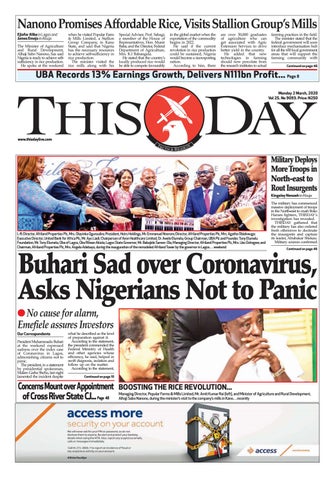
L-R: Director, Afriland Properties Plc, Mrs. Olayinka Ogunsulire; President, Heirs Holdings, Mr. Emmanuel Nnorom; Director, Afriland Properties Plc, Mrs. Agatha Obiekwugo; Executive Director, United Bank for Africa Plc, Mr. Ayo Liadi; Chairperson of Avon Healthcare Limited, Dr. Awele Elumelu; Group Chairman, UBA Plc and Founder, Tony Elumelu Foundation, Mr. Tony Elumelu; Oba of Lagos, Oba Rilwan Akiolu; Lagos State Governor, Mr. Babajide Sanwo- Olu; Managing Director, Afriland Properties Plc, Mrs. Uzo Oshogwe; and Chairman, Afriland Properties Plc, Mrs. Angela Adebayo, during the inauguration of the remodeled Afriland Tower by the governor in Lagos… weekend
The military has commenced massive deployment of troops in the North-east to crush Boko Haram fighters, THISDAY’s investigation has revealed. THISDAY gathered that the military has also ordered fresh offensives to decimate the insurgents and capture its leader, Abubakar Shekau. Military sources confirmed Continued on page 46
Buhari Sad over Coronavirus, Asks Nigerians Not to Panic No cause for alarm, Emefiele assures Investors Our Correspondents President Muhammadu Buhari at the weekend expressed sadness over the index case of Coronavirus in Lagos, admonishing citizens not to panic. The president, in a statement by presidential spokesman, Malam Garba Shehu, last night lamented the incident despite
what he described as the level of preparation against it. According to the statement, the president commended the Federal Ministry of Health and other agencies whose efficiency, he said, helped in swift diagnosis, isolation and follow up on the matter. According to the statement, Continued on page 10
Concerns Mount over Appointment of Cross River State CJ... Page 48
BOOSTING THE RICE REVOLUTION... Managing Director, Popular Farms & Mills Limited, Mr. Amit Kumar Rai (left), and Minister of Agriculture and Rural Development, Alhaji Sabo Nanono, during the minister’s visit to the company’s mills in Kano…recently
2
MONDAY MARCH 2, 2020 •T H I S D AY
MONDAY MARCH 2, 2020 • T H I S D AY
3
4
MONDAY MARCH 2, 2020 •T H I S D AY
5
MONDAY, ÍşËœ ͺ͸ͺ͸ Ëž T H I S D AY
NEWS Southern, Middle Belt Leaders Back Obasanjo, Gowon on New Constitution Group News Editor Ejiofor Alike
Email Ejiofor.Alike@thisdaylive.com, 08066066268
Deji Elumoye in Abuja The recent call by a former president, Chief Olusegun Obasanjo, and ex-Head of State, General Yakubu Gowon, for the federal government to set necessary machinery in motion to establish a Constituent Assembly that will fashion out a new constitution for the country has received the support of Southern and Middle Belt leaders. The Southern and Middle Belt Leaders Forum (SMBLF), in a statement issued yesterday and entitled: 'Restructuring: Gowon, Obasanjo Can't Be Wrong', emphasised that the warnings to federal government
from the two oldest former Nigerian leaders that Nigeria must restructure to avoid a war situation is not lost on the Forum as the country moves from one challenge to the other. The Forum consisting of leaders of four groups namely South-west, South-east, SouthSouth and Middle Belt in a statement jointly signed by Mr. Yinka Odumakin; Gen CRU Ikekire; Senator Bassey Henshaw; and Dr. Isuwa Dogo respectively, noted that Gowon was the first to warn in January that Nigeria must urgently deal with the business of restructuring to avoid another civil war. According to the leaders,
Gowon was the man who led the country through its last civil war from 1967-1970 and proclaimed "No Victor, No Vanquished,� which we observed more in the breach over the years. They further noted that the latest admonition is coming from Obasanjo who fought vigorously in the war to keep Nigeria united "but is now warning us 50 years after the hostilities ended that we need to restructure now to save the country from anarchy and break-up even as he commits to fighting for the unity of Nigeria but on the basis of equality of all citizens". The Forum, therefore,
applauded the position of the two elder statesmen saying "we align with the patriotic interventions of the leaders and call on those in the saddle now to look beyond temporary gains of power and heed the advice to set this country on the path of negotiation, inclusiveness and a federal constitutional order as a stitch in time saves nine, says ancient wisdom". The leaders further stressed that "the core issue at the heart of restructuring calls is that we can live together in peace and harmony once we make justice and equity the cornerstones of our existence as a country and not a union of the horse and
the rider that is the order at the time in violation of federal spirit. "Only those who do not wish the county well would not heed the statesmanlike call not to allow the stonewalling of the restructuring call to lead to a situation where frustrations could push nationalities in the country to embrace self-determination instead of trustful give-and - take that the demand for federalism seeks." The Forum warned that the agitation for restructuring cannot be ignored or wished away by any government at this particular time in the nation's history. They said: "It is sheer
wishful thinking for anybody to assume that the displeasure that various nationalities are feeling over the many attendant inequities of unitary Nigeria can disappear with strong-arm tactics and bullying those at receiving ends with terror gangs on rampage around the country . "A cursory look at events around the world in recent years have shown clearly that the force of arms cannot succeed in keeping together any diverse people brought together by historical circumstance but refuse to constitute themselves with respect, justice and understanding".
House Summons HoS, Onu over Unaudited Account of Agency Adedayo Akinwale in Abuja The House of Representatives has summoned the Head of Service of the Federation (HoS), Dr. Folasade Yemi-Esan, Minister of Federal Ministry of Science and Technology, Dr. Ogbonnaya Onu, as well as the Permanent Secretary of the ministry over nine years of unaudited accounts of one of its agency, Natural Medicine Development Agency. The House Committee on Public Accounts is investigating the refusal by non-treasury and partially funded agencies to render their audited accounts between 20011 and 2019 According to Auditor General of the Federation’s report, the Agency submitted only 2013 audit account, while 2014 to 2019 are still outstanding. The Chairman of the
Committee, Hon. Wole Oke, at the ongoing investigative hearing expressed displeasure over the failure of the agency to account for multi-billion naira appropriated for nine years. In 2016, the committee said the agency got allocation of N377,931,365 out of which the sum of N255,222,949 was for recurrent while N122,708,417 was for capital expenditure. It added that in 2018, the agency got total allocation of N1.105 billion out of which N246,234,918 was for personnel, N56,176,596 was for overhead, N302,411,514 was for recurrent while N802,710,432 was for capital expenditure. Oke expressed disgust over the lackadaisical attitude of the accounting officers to the extant financial laws and regulations, adding that the offence amounts to gross misconduct.
CONFERENCE WITH BISHOPS... L-R: Minister of Transportation, Mr. Rotimi Amaechi; Vice President Yemi Osinbajo and Imo State Governor, Senator Hope Uzodinma, during the Catholic Bishops Conference in Abuja‌yesterday godwin omoigui
Anxiety in Imo, Zamfara as S’Court Resumes Hearing in Judgments Reversal Suits Our suit, a chance for apex court to correct its mistakes, says PDP Chuks Okocha and Alex Enumah in Abuja Palpable anxiety has gripped politicians and their allies as the Supreme Court today resumes hearing in two separate applications seeking to reverse its judgments in two governorship appeals in Zamfara and Imo States. In the first application, the Peoples Democratic Party (PDP) and the former Governor of Imo State, Hon. Emeka Ihedioha, are asking the apex court to set aside its judgment, which removed Ihedioha from office on the grounds that he did not win majority of lawful votes cast at the March 9, 2019 governorship election in Imo State. The All Progressives Congress (APC) in Zamfara State filed the second suit, asking the Supreme Court to reverse its judgment which voided the participation of the APC in the 2019 general election in Zamfara State on the grounds of invalid primary election. Ahead of today's hearing of the Imo State review application
at the Supreme Court, the PDP yesterday restated its expectation, saying that its suit affords the apex court an opportunity to correct the error in its judgment. While the APC is silent, the main opposition party said should the Supreme Court decide not to correct the mistakes, it will be leaving behind a dangerous precedent as the number of voters allowed to the APC governorship candidate, Senator Hope Uzodinma, is more than the voters registered by the Independent National Electoral Commission (INEC). The Supreme Court had on February 18, adjourned till today to enable all parties to perfect all processes regarding the two suits. However, the outcome of today's hearing is already generating anxiety following last week's ruling of the apex court in which it excoriated APC lawyers, Chief Afe Babalola and Chief Wole Olanipekun, for having the temerity to file an application seeking the reversal of its judgment
on the Bayelsa governorship election dispute. The apex court on February 26, while delivering ruling in the applications by the APC and its governorship candidate in Bayelsa State, Mr. David Lyon, described the request by APC to review its judgment voiding the participation of its candidate in the Bayelsa governorship election as vexatious, frivolous and an abuse of court process. The apex court in the unanimous ruling delivered by Justice Amina Augie, had described the motion as a deliberate desecration of the judiciary. She subsequently ordered Babalola and Olanipekun to pay N10 million each as fines to each of the three respondents. As the Supreme Court resumes hearing in the Imo and Zamfara applications today, the question on the lips of many is, would the apex court maintain its stand not to sit on appeal over its own judgment or would there be a shift? Another fear, which would probably dominate the minds
of lawyers to the applicants, is, if the applications are thrown out, what is the nature of fine the apex court would hand down on them? While Chief Kanu Agabi (SAN) is the lead counsel to Ihedioha and PDP in the Imo State case, Chief Robert Clarke (SAN) is the lead counsel to the APC in the Zamfara State case. It was gathered that there was also anxiety over the possible sacking of Uzodinma should the Supreme Court find merit in the PDP's application and grant the prayers of the opposition party. In the Zamfara State case, the APC is asking the court to review the consequential order which barred it from participating in the 2019 general election due to inability of the party to conduct primary election. Hearing in the matter brought by their lawyer, Clarke was shifted to March 2 upon the discovery that two respondents in the matter were not in court and were not served hearing notice. The Chief Justice of Nigeria
(CJN), Justice Ibrahim Muhammad, who presided over a seven-member panel, while adjourning the matter, said necessary parties were not before the court as required by law and as such the matter could not go on. Meanwhile, the PDP yesterday restated its expectation, saying that it only wants the apex court to realise its mistakes and subsequently correct them. Addressing a press conference yesterday, the National Publicity Secretary of PDP, Mr. Kola Ologbondiyan, said: "We are not contesting the powers of the Supreme Court as the last court of appeal; rather, we are saying the Supreme Court was misled and therefore should use the opportunity of our appeal to correct itself because it was misled. "It was misled because the votes allocated by the Supreme Court are more than the total votes registered by INEC in Imo state. We are saying that something is fundamentally wrong. The APC misled the
justices of the Supreme Court. This is our position. "PDP has sustained democracy for 20 years and therefore it is morally right for us to let the Supreme Court know when something is wrong. We are not doing it because PDP is all knowing; but to correct a dangerous situation that is capable of hurting our democracy." He also denied the news doing the rounds that the party is contemplating withdrawing the petition, stating that if for anything, the PDP is ready to pay any sanction imposed on any member of the party's legal team appearing before the Supreme Court justices. The party has also rejected the judgment of the Kogi State High Court, which voided its governorship primary in the state. PDP described the judgment as a classical example of judicial rascality and scandalous travesty of justice, which cannot stand. It said the party would appeal the judgment of the Kogi court.
6
MONDAY MARCH 2, 2020 •T H I S D AY
MONDAY MARCH 2, 2020 • T H I S D AY
7
MONDAY MARCH 2, 2020 • T H I S D AY
9
8
MONDAY, ÍşËœ ͺ͸ͺ͸ Ëž T H I S D AY
NEWS
UBA Records 13% Earnings Growth, Delivers N111bn Profit
Gross earnings hit N500bn Contributions from 19 African subsidiaries, France, UK, USA now 46% Goddy Egene The United Bank for Africa Plc (UBA) has announced its audited results for the fullyear ended December 2019, recording impressive growth across top and bottom lines. According to the 2019 financials filed at the Nigerian Stock Exchange (NSE) on Friday, the bank’s gross earnings grew by 13.3 per cent to N559.8 billion, compared to N494 billion recorded in the corresponding period of 2018. The bank’s total assets also grew by 15.1 per cent to an unprecedented N5.6 trillion for the year under review. This was the first time the bank’s gross earnings and assets would respectively cross the N500 billion and N5 trillion marks. Notwithstanding the challenging business environment in Nigeria, the bank’s profit before tax was impressive at N111.3 billion, compared to the N106.8 billion recorded at the end of 2018. Furthermore, its profit after tax rose by 13.3 per cent to N89.1 billion, compared to the N78.6 billion recorded in 2018. On the cost side, UBA’s operating expenses grew by 10.1 per cent to N217.2 billion, as against the N197.3 billion in 2018, well below average inflation rate within the period, a reflection of cost efficiency gains. These results depicted the bank’s deepening of its PanAfrican business strategy, given the growth in the contribution of its 19 African subsidiaries to the Group’s net earnings and total assets. Ex-Nigeria operations’ contributed 46 per cent to the Group’s profit before tax (PBT) in the year under review. In addition, UBA has been deploying innovative lifestyle products to expand its market
share across sub-Saharan Africa, leveraging its presence in the United Kingdom, United States of America and France, to build a true Africa’s global bank, facilitating trade and capital flows between Africa and the rest of the world. In its tradition of rewarding shareholders, the bank proposed a final dividend of 80 kobo for every ordinary share of 50 kobo for the financial year that ended December 31, 2019. The final dividend, which is subject to the affirmation of the shareholders at its Annual General Meeting, will bring the total dividend for the year to N1, as the bank had paid an interim dividend of 20 kobo earlier in the year. The results showed that UBA recorded a remarkable 20.2 per cent growth (to N2.1 trillion) in loans to customers, whilst customer deposits increased by 14.4 percent to N3.8 trillion, compared to N3.3 trillion recorded in the corresponding period of 2018. This reflected increased customer confidence, enhanced customer experience, early wins from the ongoing business transformation programme and the deepening of its retail banking franchise. Commenting on the result, the Group Managing Director/ CEO, Kennedy Uzoka, noted that 2019 was important for UBA Group as it gained further market share in most of its countries of operation. “The year 2019 was a very remarkable one for UBA given the adverse market developments. Nonetheless, we achieved sizable growth in balance sheet and earnings, even as we reposition the bank for the future. “Gross earnings crossed the N500 billion threshold to N559 billion, whilst total assets also crossed the N5 trillion mark for the first time to N5.6 trillion.
Our strategy remains centred around unparalleled service to our esteemed customers. “Accordingly, we are making significant investments in a technology-driven transformation journey. We have recorded early gains as shown in the 39 per cent growth in electronic banking income to N38.8 billion in 2019, from N27.9 billion in 2018. “Our businesses are gaining commendable share in their markets across regions in Africa, as we deepen the scale and scope of our operations.� Uzoka said he was excited about the synergy the UBA Group had built and the progress it had made in its transformation drive. “We have positioned the
bank as a truly pan-African banking franchise, leveraging our operations in France, the UK and the USA, to deepen intra-African trade and facilitate capital flows between Africa and the rest of the world. “In 2020, we will pursue aggressive deepening of market share in all our subsidiaries, leveraging technology, rich human resources and our customerfirst strategy to win in all the markets we operate, notwithstanding the challenges of our operating environment,� he added. Also speaking on the performance, the Group CFO, Ugo Nwaghodoh, said the bank was wellpositioned to sustain
impressive performance across key financial indices, adding that already, some of its previous investment in digital and technological transformation are already paying off significantly. “We navigated the fragile yield environment in our largest market to deliver an eight per cent growth in net interest income to N221.9 billion. This was bolstered by a 7.8 per cent and 13.9 per cent growth in interest income from corporate loans and investment securities respectively as well as a four per cent cost of funds driven by our stable retail deposits. “Resulting from cost efficiency gains within the year, cost-to-income ratio moderated to 62.7 per cent
(64% in 2018), whilst profit for the year grew 13.3 per cent, to N89.1billion, translating to 16.2 per cent return on average equity (RoAE),� Nwaghodoh said. United Bank for Africa Plc is a leading pan-African financial institution, offering diverse banking and payments services to more than eighteen (18) million customers, across 1,000 business offices and customer touch points in 20 African countries. With presence in New York, London and Paris, UBA is connecting people and businesses across Africa through retail, commercial and corporate banking, innovative cross-border payments and remittances, trade finance and ancillary banking services.
CELEBRATIONS... L-R: President of the Senate, Dr. Ahmad Lawan; his Deputy, Senator Ovie Omo-Agege; and Akwa Ibom State Governor, Mr. Emmanuel Udom, during the 60th birthday celebration of Senator Akon Eyakenyi in Uyo‌yesterday
EFCC Investigates Oghiadomhe, Kwankwaso, Kayode over Alleged N35bn Defence Contracts Kingsley Nwezeh in Abuja Former Chief of Staff to former president, Dr. Goodluck Jonathan, Chief Mike Oghiadomhe, and two former defence ministers, Alhaji Musa Kwankwaso and Prince Adetokunbo Kayode, are being investigated by the Economic and Financial Crimes Commission (EFCC) over their alleged involvement in the N35 billion contracts for procurement of arms, THISDAY has learnt. A former Permanent Secretary in the Ministry of Defence, Dr. Haruna Sanusi, and Major General Nguni, were also alleged to be involved in the defence contract and are being investigated by the agency. The investigation showed that the contracts were for the supply of arms and
ammunition, provision of logistics items and equipment to the Nigerian contingents in peace keeping missions. The N35 billion was a loan bond obtained by the Ministry of Defence in June 2008 from the Debt Management Office (DMO) for provision of logistics for peace keeping missions. The investigation which was confirmed by the Spokesman of the EFCC, Mr. Tony Orilade, showed that some of the contracts were not completed while advance payments only were allegedly made. At the centre of the contract saga is Mr. Donald Peterson, Managing Director of Richfield Technologies Limited, VTB Export & Import Limited, Freerose Limited and African Integrated Services Limited. The investigation cited
a statement made by Mr. Peterson “under caution� who said he had done many contracts for the Ministry of Defence which included the supply of Terrex Crane, truck recovery and communication equipment. He said he was awarded contract for the supply of communication equipment for the sum of N1,020,287,357 for the supply of truck recovery vehicle (10 tonnes) at the sum of N50,000,000 shipped from China and delivered to the Nigerian Army Depot in Lagos; supply of Terrex at the sum N269,000,000.00 which was shipped from the United States to the Nigerian Navy in Lagos; and trainer stimulator awarded at the cost of N433,317,213.00. He also handled the supply of five units of fuel trailers awarded at the cost
of N85,000,000.00, shipped from China and supplied at the Nigerian Army Depot in Lagos as well as contract for the supply of machine refueller. A source at the EFCC said the two contracts for the supply of arms and ammunition were awarded to his company, VTB Export at N533,000.000.00 and N778,000,000.00 respectively. “He further explained that the two letters of credit opened were not utilised and he was not aware that the contracts were terminated as no letter was sent to him or his company in this regard. “He maintained that he was only paid about N106,000,000.00 advance payment for one of the contracts�, the source quoted Peterson as saying in a statement he made at
the EFCC. He further stated that he made payments to some government officials for the contract awarded. He maintained that he paid via cheques over N100,000,000 for the N1,020,000.00 communication contract. He further alleged that the former chief of staff’s son also secured some contracts for arms and ammunition from the Nigerian Police Headquarters. The contracts, he said, were nine in number all below N50,000,000 totaling N500,000,000.00. The statement further affirmed that Mr. Peterson “paid the sum of $240,000 cash to one of the officials for facilitating the contracts. He further said that he paid cash of N40,000.000.00 to a personal assistant to another
official for facilitating the letter of credit for the supply of N533,000,000.00 and for the award of stimulation supplies to Lagos. Peterson also said he was given three contracts for N120,000,000.00 stating that he paid N50 million each to the official who gave him the contract. The contractor further claimed in the statement he made to EFCC that one of the officials told him “not to execute the contract but to pay him N120,000.000.00 which he paid in cash through a third party. He further listed all the bank accounts through which payments were made and the phone numbers of those concerned. The EFCC Spokesman, Tony Orilade, said investigation into the matter was ongoing.
10
MONDAY, ÍşËœ ͺ͸ͺ͸ Ëž T H I S D AY
PAGE TEN BUHARI SAD OVER CORONAVIRUS, ASKS NIGERIANS NOT TO PANIC the president praised the governments of Ogun and Lagos States as well as some citizens for their vigilance and prompt responses to the incident. While advising against panicking over the index case, Buhari said raising alarm over the incident would do more harm than good. Instead, he encouraged Nigerians to heed the advisories issued by both the Federal Ministry of Health and the Nigeria Centre for Disease Control (NCDC) as being aired by the Federal Ministry of Information.
No Cause for Alarm, EmeďŹ ele Assures Investors Also preaching hope, the Governor of Central Bank of Nigeria, Mr. Godwin Emefiele, allayed fears of the outbreak of COVID-19 eroding investments in the country, urging both local and foreign investors not to fret. Speaking to THISDAY at the weekend, Emefiele, who assured the investors that there was no cause to panic, commended the efforts by the federal government and the Lagos State government to contain the situation. With the viral outbreak spreading to more countries, the price of oil has dropped precipitously as global demand weakened even further. The benchmark Brent crude dropped 14 per cent last week to its lowest levels since July 2017, closing Friday at $50.52 a barrel, below the country’s 2020 budget benchmark of $57 per barrel. Also, the global stock markets plummeted for a seventh consecutive day last Friday, due to the deadly virus. This is just as the Nigerian equities market declined in February, with the Nigerian Stock Exchange (NSE) AllShare Index (NSE ASI) falling by 9.1 per cent, while market capitalisation shed N1.119 trillion. Also, the treasury market recorded a mild performance as average yield rose one basis points week-on-week to 3.9 per cent. The 182-day instrument enjoyed the most buying interest, while the 91- day instrument closed flat at 2.9 per cent and sell-offs were recorded in the 364day instruments as yields advanced to 5.6 per cent. But Emefiele, who described the situation as an unfortunate incident which has taken the global economy by surprise, expressed optimism that countries were making efforts to see to its fast eradication. He said: “In terms of whether or not it would affect economic growth in the global economy, we think that it would affect global growth. However, it is a temporary phenomenon - temporary in the sense that given all the efforts being made by countries where this unfortunate virus has been detected, we think that the resolution to the problem is in sight. “As a result, its effect on the economies affected would be short-lived. For us in Nigeria, luckily, the incident that has been discovered is currently being handled professionally and we are confident that it will not adversely affect the country.
“However, as a result of this, we have seen that the global stock market in the last one week has suffered drastic decline as a result of the widespread of the virus in different parts of the world, which has unfortunately affected the price of crude oil.� According to him, Nigeria being an oil exporting country would naturally be affected as a result of the drop in the price of crude oil. But he noted that the disease was a temporary phenomenon, adding that its effect on the Nigerian economy would be very minimal. “As a result, I am advising foreign and local investors to go about their business. The Nigerian economy remains resilient, the monetary and fiscal authorities are currently focused on diversifying the economy away from being heavily reliant on oil and one of these is the example of the Dangote Refinery, which we just visited, where in the month of May, the fertilizer plant will begin commercial production,� he added. He reiterated that the Dangote plant, which is currently being test-run, would become a major source of forex revenue for the country. “As for the refinery and the petrochemical plant, they are obviously one of the biggest in the world. We believe that when these refinery and petrochemical plants come into operation by the first quarter of next year, it would save the country at least 20 per cent of the cost of forex spent importing petroleum products in this country. “That will massively help the country’s reserves and therefore can be seen to be in consonance with the drive to reduce the import of items that can be produced in Nigeria,� he added.
FG IntensiďŹ es Airport Procedures to Contain COVID 19 Meanwhile, the federal government has activated all airport-specific Public Health Emergency Contingency Plans (PHECPs) as part of efforts to reduce the spread of Coronavirus, officially known as COVID-19, in Nigeria. The Director General, Nigerian Civil Aviation Authority (NCAA), Captain Musa Nuhu, said in a statement yesterday that travellers returning from countries experiencing community transmission of the COVID-19 must present themselves to Port Health Services on arrival at the Point of Entry. After series of tests on persons suspected of contracting the virus, which turned out negative, Nigeria officially recorded its first case of COVID-19 last Friday with the discovery of an index case in an Italian in Lagos. The Italian, who came into Nigeria a few days before he started exhibiting signs of the virus, has been quarantined and is said to be in a stable condition. However, as part of efforts to curb the spread of the virus, the federal government said more attention would be paid to incoming travellers, especially from countries with reported cases of COVID-19. So far, the virus, which broke out in Wuhan, a Chinese town in 2019, has been confirmed
in 55 countries and six others reporting suspected cases. "There will be minimum disruption to facilitation of travel due to the thorough screening at entry post. We appeal to travellers who develop signs and symptoms of the disease after returning from a trip abroad to seek immediate medical attention at the nearest health facility. "We are working in assistance with airlines to track passengers who may have come in contact with suspect or ill persons as well as other measures the National Surveillance Systems requires," the federal government said through the NCAA. Nuhu advised airlines and other airport users to heed the guidance of Port Health Services on the use of screening forms, assessment of suspect or ill travellers and any other measures they may adopt. According to him, the NCAA has ensured that all measures adopted at Nigerian airports are in accordance with International Civil Aviation Organisation (ICAO) Standards and Recommended Practices (SARPs) and WHO International Health Regulations (IHR 2005). "In line with the guidelines of ICAO and Collaborative Arrangement for the Prevention and Management of Public Health Events in Civil Aviation (CAPSCA), we have been working with the Federal Ministry of Health and other stakeholders in the aviation industry to ensure all travellers coming into the country are adequately screened while causing minimum disruption to facilitation of travel," he added. The NCAA boss advised the travelling public to remain calm and alert, take necessary precaution in protecting themselves while travelling, including alerting crew members and airport facilitation staff to travellers that may look ill or showing signs and symptoms of the disease. "Airlines, airport operators, security agencies and other aviation industry stakeholders are advised to take appropriate precaution to protect their staff," he stated.
FCTA Places Nine Chinese on Selfisolation The Federal Capital Territory (FCT) Administration has asked nine foreigners, mainly Chinese, who arrived in the country through the Nnamdi Azikiwe International Airport, Abuja, to observe self-isolation for 14 days and report symptoms including, respiratory track disease, severe fever, cough and sneezing consistent with COVID-19 to the health authorities. The Director, FCT Primary Health Care, Dr. Josephine Okechukwu, yesterday, while speaking on the readiness of the FCT health authorities to tackle Coronavirus said that the foreigners voluntarily offered to be in self-isolation in their homes for two weeks, having arrived from one of the countries mainly afflicted by the scourge, which has already affected 70,000 people globally out of which 2,000 have died. Okechukwu, however, allayed fears of an outbreak
in the FCT. She said: “There is no identified case of Coronavirus in the FCT. We are screening all the passengers coming from some of these high risk countries by taking their temperature. What we also do is that if we have suspected cases from some of the foreign visitors, we advise them to stay in their homes for 14 days and monitor the signs associated with the disease. We have about nine Chinese that went into self-isolation, as it is simply impossible for us to quarantine every suspected case.� She added that although the territory was yet to record any case of Coronavirus, proactive preparations had been stepped up to curtail the disease. She added that about 300 health care workers mainly doctors, nurses and laboratory scientists from the tertiary, secondary health facilities were last week trained in collaboration with the World Health Organisation (WHO), on Coronavirus surveillance. She said the FCTA had created Coronavirus isolation units at the National Hospital and University of Abuja Teaching Hospital, Gwagwalada for suspected victims. However, she stated that as the reserved facilities, made up of two beds each, were deemed to be grossly insufficient, the health authority has initiated talks with the FCT Permanent Secretary, Mr. Chinyeka Ohaa, on the feasibility of acquiring a bigger accommodation. In Edo State, government has deployed health officials in Benin Airport and all the motor parks in the state to screen travellers coming into the state. The Deputy Governor, Hon. Philip Shaibu, said at a meeting with stakeholders in the health sector and the representative of the World Health Organisation (WHO), at Government House, in Benin City that the state government decided to start screening from all the entry points into the state to prevent any spread of the disease to Edo. According to him, the Irrua Specialist Teaching Hospital is going to be a centre for screening of any suspected cases of Coronavirus. In his remarks, the Chief Medical Director of Irrua Specialist Hospital, Prof. Sylvanus Okogbeni, said the hospital was capable of carrying out diagnosis. The State Coordinator of the World Health Organisation (WHO), Mrs. Faith Ireye, said the manifest of the airline boarded by the Italian man should be made available to the Edo State government, adding that Italy is the second home of Edo people. In Benue State, the Governor, Dr. Samuel Ortom, has set up Emergency Response Committee, headed by the state Commissioner for Health and Human Services, Dr. Sunday Ongbabor. Other members of the committee include Dr. Samuel Ngise, Secretary; Commissioner for Information, Culture and Tourism, Hon. Ngunan Addingi; Commissioner for Water Resources and Environment, Mr. Dondo Ahire, as well as Commissioner for Agriculture and Natural Resources, Dr. Timothy Ijir.
Ortom also directed that the surveillance on Coronavirus be stepped up in the 23 local government areas of the state. Already, a treatment centre has been established at the Benue State University Teaching Hospital and a location identified to be used as quarantine unit in the event of any outbreak of the disease. The 43 suspected coronavirus cases that were isolated for 14 days in Plateau State have tested negative. Plateau State Commissioner for Health, Dr. Nimkong Larndam, said there was no confirmed case of coronavirus in the state. He said: “We have four Chinese miners who just returned from holidays in China; since they came from another country that is heavily infected with the virus, they could be suspected to have the virus. But the Chinese were screened in Addis Ababa, Ethiopia; they were also screened in Abuja airport, and in those screenings they were proved negative. “Even though the suspects were not positive, such people are supposed to be isolated for 14 days. So we have isolated them between now and 11th of March. “It is not only the four Chinese that we had to isolate; all the people that had contacts with the Chinese on their return to Wase had to be fished and isolated too.�
NESG Calls for Upgrade of Preventive Capacity However, despite Emefiele’s assurance, the NESG has stated that given Nigeria’s increasingly close economic links with China, it is imperative to upgrade national preventive readiness and ensure adequate capacity to isolate any infected person entering Nigeria. NESG said it was also important for Nigeria's public policy to note the adverse effects of the disease on global economic growth, especially commodity prices and adjust to ameliorate these adverse effects. A communiquÊ issued at the first meeting of the year by the Board of Directors of the NESG reviewed the global and domestic economic and financial environments, as well as the outlook for the rest of the year 2020. It noted that the Nigerian economy remained very fragile through a combination of slow growth and vulnerability to changes in external conditions, especially oil price fluctuations. "The Board notes that 10 out of the 46 sectors of the economy, contributing approximately 27.1 per cent of output, contracted in 2019. A review of performance by the various economic sectors showed that the agriculture sector continues to grow slowly. Whilst the service sector, at 53 per cent, remained the largest contributor to output, growth in these sectors is adversely affected by issues, which include rising incidences of insecurity and continuing closure of our nation’s border. "The Board noted that during 2019, a combination of lower than anticipated oil prices and the OPEC cap on crude oil production resulted in public revenue continuing
to perform below expectations. This has led to rising public indebtedness and budget underperformance. The Board commends the federal government for the enactment of the Finance Act – a law which has the potential to significantly and sustainably improve fiscal transparency and effectiveness," the communiquÊ said. It explained that the increase in Value Added Tax (VAT) from five per cent to 7.5 per cent would improve non-oil revenue for the government – especially for the sub-national governments. It is, however, important for stimulating output growth and sustaining competitiveness of the economy to ensure that higher levels of taxation do not choke the fragile growth, it stated.
Stock Market Loses N1.1tn in February The Nigerian equities market, however, suffered a decline in February with the NSE ASI falling by 9.1 per cent, while market capitalisation shed N1.119 trillion. The market performance in February was negative compared with growth of 7.5 per cent recorded by the NSE ASI and a gain of N1.88 trillion posted by market capitalisation. Also, the volume and value of trading were lower in February as investors traded 5.436 billion shares worth N74.591 billion in 80,507 deals as against 9.877 billion shares valued at N129.626 billion exchanged in 112,724 deals in January. The NSE ASI, which closed at 28,843.53 in January, fell to 26,216.46 at the end of February, while market capitalisation declined from N14.857 trillion to N13.658 trillion. Market analysts attributed the dismal performance in the review month to investors exiting due to concerns in the global market due to the outbreak of COVID-19 and unimpressive results released by some quoted companies. Commenting on the February market performance, a stockbroker and Managing Director of Network Capital Limited, Mr. Oluropo Dada, said Continued on page 46
TOP GAINERS NGN NGN %
VITAFOAM 0.24 4.32 FLOURMILLS 1.00 22.00 TOP LOSERS NGN CADBURY 0.90 8.10 ETI 0.60 5.40 NEM 0.20 1.80 NIGBREW 4.50 40.50 OANDO 0.30 2.70 HPE Nestle Nig Plc â‚Ś1,130.00 Volume: 416.304 million shares Value: N6.192 billion Deals: 5,220 As at Friday 28/02/2020 See details on Page 37
5.8 4.7 % 10 10 10 10 10
MONDAY MARCH 2, 2020 • T H I S D AY
11
12
MONDAY MARCH 2, 2020 •T H I S D AY
(JWF :PVS #VTJOFTT " -JGU XJUI 1PMBSJT )FBMUI 4FDUPS -PBO
*HW IXQGLQJ IRU +RVSLWDOV 3KDUPDFLHV 0HGLFDO /DERUDWRULHV DQG 'LDJQRVWLF &HQWUHV DW D FRPSHWLWLYH LQWHUHVW UDWH
%(1(),76 *HW FXVWRPL]HG IXQGLQJ IRU \RXU EXVLQHVV
'HGLFDWHG 5HODWLRQVKLS 0DQDJHU
)OH[LEOH FROODWHUDO UHTXLUHPHQW
)LQDQFLDO $GYLVRU\
(OLJLEOH WR DWWHQG DQQXDO FDSDFLW\ EXLOGLQJ HYHQW
3RUWIROLR 0DQDJHPHQW
6ZLIW 7XUQ $URXQG 7LPH
&RQWDFW XV WRGD\ LI \RX DUH DQ 60( LQ WKH KHDOWK VHFWRU
0HPEHU 1',& ',6
MONDAY MARCH 2, 2020 • T H I S D AY
13
14
T H I S D AY ˞ ˜ Ͱ˜ Ͱ͎Ͱ͎
COMMENT
Editor, Editorial Page PETER ISHAKA Email peter.ishaka@thisdaylive.com
CURTAILING THE CORONAVIRUS Tony Ademiluyi argues for massive campaigns on preventive measures
W
hen the corona virus hit China recently with some deaths recorded and many severely ill, many countries were at a crossroads as the communist country is a strategic partner to so many countries of the world. Many countries in the west most notably the United States were forced to shut down their operations there and the neighbouring Japan recently announced that all schools will be shut down as from this week to curb the spread of the disease. Nigeria wasn’t left out as many of her businessmen flock to China to import goods. Many of these entrepreneurs were stranded there as they couldn’t buy goods since the Chinese government shut down most of their factories and couldn’t return home for fear of spreading the disease. Egypt recorded the first case in Africa and some die hard optimists and prayer warriors opined that it won’t come to Nigeria which prides herself as the ‘Giant of Africa’. On 27th February, 2020, the worst happened as the first case of the coronavirus was recorded in Lagos. An Italian man from Milan who was travelling and passing through Lagos had the disease which was not detected at the airport. The disease was diagnosed at the virology laboratory of the Lagos University Teaching Hospital and the patient is currently being looked after at the Nigeria Centre for Disease Control in Yaba. If this first case is not well managed, it has the potential of causing havoc in the city that is regarded as the economic hub of the entire West Africa. Lagos has over 20 million residents and something worse than the plague of black deaths that swept the entire Europe in the Middle Ages may reinvent itself here if care isn’t taken. The health authorities have taken a proactive step which is highly commendable by trying to identify those who flew with the index case and the places he has visited in Lagos. Much as it is a step in the right direction, how effective will that be especially in a country where there is absence of data? The health authorities must also ensure that unscrupulous elements don’t take advantage of this new crisis to create a widespread panic through the abuse of the new and social media. The authorities should tackle this new scourge in a similar way that the Ebola virus was tackled nearly six years ago. As gleaned from the Africa Report Magazine, on 20 July 2014,
THE HEALTH AUTHORITIES MUST ENSURE THAT UNSCRUPULOUS ELEMENTS DON’T TAKE ADVANTAGE OF THIS NEW CRISIS TO CREATE WIDESPREAD PANIC THROUGH THE ABUSE OF THE NEW AND SOCIAL MEDIA
a man carrying the disease travelled from Liberia to Lagos. Patrick Sawyer was not diagnosed with Ebola for three days, during which time nine health care workers were infected. However, once the diagnosis was confirmed, the health ministry worked with the US Centers for Disease Control and Prevention’s office in Nigeria to declare an Ebola emergency and created the facilities to isolate exposed people during the requisite 21-day monitoring period. It also put an Incident Management System in place to coordinate responses. The centralised response system was vital in controlling the outbreak. This same approach should be adopted in handling this new scourge. Systems should be sturdily put in place to combat it and people who have the symptoms should be promptly isolated, monitored and treated before being allowed to go back to the society. There should also be measures put in place to ensure that health workers are adequately protected. We recall the bravery of the largely unsung heroine, Dr. Stella Ameyo Adadevoh of First City Consult Hospital who contacted the disease when she tried to stop Patrick Sawyer – the Liberian from leaving the hospital. At a trying time like this, we don’t need posthumous heroes and so it is imperative that the health authorities must do something urgent to protect their own. During the Ebola period, the Roman Catholic Church stopped its adherents from shaking hands during the offertory. The religious groups which are arguably the most influential in the country can be co-opted to help in the fight against this disease. The clergymen should assist the government by preaching from the pulpit in order to more effectively drive the message home. The use of hand sanitizers should be made compulsory in every public place and the mass media especially the government controlled ones should swiftly spring into action and penetrate the hearts of the masses in both Pidgin English and the Vernacular on the need to maintain the highest form of personal hygiene. The health authorities should also roll out extensive preventive measures that the citizens can take advantage of as prevention is better than cure. Care should be taken for the disease not to spread outside Lagos so that we can forestall an epidemic. In the immortal words of Dr. Martin Luther King Jr we shall overcome. Ademiluyi wrote from Lagos and edits www.africanbard. com
NIGERIA’S CRASHING INTEREST RATES The sharp drop in interest rates hallmarks the public sector hold on the economy, writes Boniface Chizea
A
n unanticipated development within the financial sector was the sudden sharp and precipitous drop in interest rates across board. The reason for this development is not far to seek. Following the awakening to the realization of the fact of fiscal unsustainability occasioned by a situation whereby if we kept fidelity to obligations arising from our debt structure, we would continuously be committing up to about 60 per cent of revenue inflow there was the need for a quick solution. The solutions we found resulted in the recent approval of the Finance Bill by the National Assembly; probably the most prominent and most discussed aspect of this bill was the hike in Value Added Tax (VAT) from 5 to 7.5% which has since been implemented. The follow up strategy was to attempt to restructure the debt itself by drastically reducing the cost of borrowing by targeting borrowing from less costly sources which resulted now in the resort to borrowing from the N10 trillion pension fund at single digit interest rates as against the double digit rates at which the funds were hitherto sourced from the private sector. It was recently speculated that government was contemplating borrowing a further whopping N2 trillion from this fund but which has since been denied. Fears have been raised going by the value for money index prevalent in our environment variously estimated at N14 for every N100 expenditure which is said to have deteriorated lately to nine for N100 expenditure due to the high incidences of corruption in the system that the fear of the pension fund facility being undermined is real and genuine. The ultimate result of which would lead to the pensioners holding to the wrong end of the stick as pension payment would no longer be taken for granted. To ensure that this discussion is put in context, it is advisable that we consider here
the extent of the drop in interest rate before going on to consider its implications. There was a write up on the matter which went viral indicating interest rates at various segments of the market. It was reported that one mid-tier progressive bank in the country now offers one per cent interest rate on all deposits up to N50 million! Now this is clearly a glaring case of financial dis- intermediation. The bank is simply saying to depositors, “No thanks, keep your deposits�. The dilemma of the depositors under this scenario is better appreciated when we recall that we recently suffered reversal on the trend of inflation rate in the country as the inflation rate was reported to be at 12.13 per cent. At one percent a depositor under this situation will have his money lose value to the extent of the differential. Treasury bills rate crashed suddenly from a high of 10-16 per cent to the current 2.5%, denying the middle class the primary investment outlet. Not long ago if you invested M5 million in T/Bs for six months you received upfront interest of about N400, 000. I am here talking of what I know but now you have to bargain hard to receive interest of N90,000 in three months on that amount. It is that bad. The FGN Bonds now have upend coupon rates of 6 per cent. So, the drop in interest rates is precipitous, hallmarking the extent of public sector hold on the jugular of the economy. What are the implications for the economy? May be as a foreground to this discussion it is good to make certain things clear so that there is no misunderstanding. Interest rates are factor costs and therefore we should rather be celebrating this development as it should impact positively the cost of production. But one has to be careful as the rates today are not aligned with the fundamentals of the economy which on its own is problematic. If interest rates are much lower than the rate of inflation it becomes a disincentive to savings and undermines the ability of the financial sector to
perform its crucial financial intermediation role. If we consider the situation elsewhere outside the country, say in developed economies, inflation rates are low single digit which is aligned with the prevalent interest rates without leading to any distortions. The implications of this development for the economy at large is that it will create a situation of micro-economic instability so crucial for businesses to thrive particularly considering the sudden nature of the drop in interest rates. One of the struggles we have engaged in is that of achieving greater financial deepening. This explains all the discussions about financial inclusion and the need to reduce our bloated informal financial sector second only to that of Italy. What is for now uncertain is the transmission effect of this drop in interest rates. To what extent has it impacted the cost of lending? If lending remained at the previous investor unfriendly high rates, then we cannot then pinpoint the likely benefits of this development beyond the fact that it contributes to the solution of the situation of fiscal unsustainability which has resulted into massive borrowings partly to meet maturing recurrent obligations of government. The Central Bank has its job cut out for it as it perennially battles liquidity in the system. There has been this persistent complaint by some powerful interested parties that the central bank is its own enemy as it is accused as being responsible for creating the excess liquidity in the system following the way and manner it injects liquidity particularly as it regularly intervenes in the foreign exchange market to maintain stability of exchange rates. It has been argued that the CBN should rather share the dollar accruing to the Federation Account to the other tiers of government which would then proceed to convert as the need arises thereby postponing the sudden injection of the naira equivalent. There are of course many things wrong with this prescription not
the least of which is that dollar is not legal tender currency in Nigeria. Recently the central bank itself admitted that it injected a massive sum of 43.5 billion dollars in 15 months to support the rate of exchange. Therefore, for the central bank the battle to keep the rates of exchange within preferred range for stability is made even fiercer with this development as the surplus naira looks for accommodation in the dollar. The banks as always are the whipping boys. They don’t want the deposits because of limited outlets for their use. In the past the banks took advantage of the money market for profitable deployment of their excess liquidity. The recent pressure on the banks to lend a certain percentage of their deposits out to the real sector at a risk of a fine has no doubt encouraged this disposition of negative attitude to growing the deposit base. A preview of the source of income of the banks in the past would confirm that interest income has not constituted a strong source. But it is ill-advised to continue to take the profitability of banks for granted. Banks are the goose that lays the golden eggs but because of their level of profitability against the background of not so thriving economic environment, they become targets of complaints with charges of not operating with the best interest of the customer in mind. For the average bank customer, the jury is still out. We have to wait for the transmission effect to debut and manifest in the cost of funds before we can make any categorical statement. The middle class, whatever is left of it today is groaning under the loss of probably what has lately been the first recourse to profitably warehouse surplus funds as the interest rates crash. No doubt there is uncertainty in the air but the expectation is that before long we would adjust as we all come to terms with the new reality. Dr. Chizea wrote from Lagos
15
T H I S D AY ˾ FRIDAY, MARCH 2, 2020
EDITORIAL CBN AND THE ANCHOR BORROWERS’ PROGRAMME The central bank should play little or no role in quasi-fiscal operations
I
n its economic update for Nigeria released in the last quarter of 2019 with the theme, “Jumpstarting Inclusive Growth: Unlocking the Productive Potential of Nigeria’s People and Resource Endowment”, the World Bank had recommended that curbing the use of quasi-fiscal operations by the Central Bank of Nigeria (CBN) would both alleviate distortions in the allocation of credit and improve policy predictability. According to the bank, “the CBN has attempted to directly increase its flow of credit to targeted sectors through development finance operations, with the aim to overcome the shallowness of the commercial bank credit market. Many of these operations are agricultural development schemes intended to support small rural enterprises and smallholder farmers. Regardless of their merits as development policies, financing these interventions through the CBN rather than the federal budget reduces the transparency of fiscal policy and the effectiveness of monetary policy.” There is no ambiguity that the Anchor Borrowers’ Programme (ABP) is one of such quasi-fiscal operations of the CBN THE CBN SHOULD REVIEW which the global THE PROGRAMME SO multilateral financial THAT CASES OF NONinstitution alluded to. REPAYMENT OF LOANS Latching on its developmental functions, AND SOME OTHER the CBN established REPORTED ABUSES ARE the ABP, which was STAMPED OUT launched by President Muhammadu Buhari on 17th November 2015 with the objective of creating a linkage between anchor companies involved in the processing and smallholder farmers (SHFs) of the required key agricultural commodities. The thrust of the ABP is the provision of inputs in kind and cash (for farm labour) to smallholder farmers with a view to boosting the production of rice, maize, poultry, sorghum, cassava, tomatoes and cotton, among others. The idea is to stabilise input supply to agro-processors and address the country’s negative balance of payments
on food. It is a loan to farmers without collateral and the benefitting farmers are given farm input and cash to cultivate their farms, including the experiment on rice.
A
T H I S DAY EDITOR BOLAJI ADEBIYI DEPUTY EDITOR YEMI AJAYI, DAVIDSON IRIEKPEN, MANAGING DIRECTOR ENIOLA BELLO DEPUTY MANAGING DIRECTOR KAYODE KOMOLAFE CHAIRMAN EDITORIAL BOARD OLUSEGUN ADENIYI EDITOR NATION’S CAPITAL IYOBOSA UWUGIAREN MANAGING EDITOR JOSEPH USHIGIALE
T H I S DAY N E W S PA P E R S L I M I T E D EDITOR-IN-CHIEF/CHAIRMAN NDUKA OBAIGBENA GROUP EXECUTIVE DIRECTORS ENIOLA BELLO, KAYODE KOMOLAFE, ISRAEL IWEGBU, IJEOMA NWOGWUGWU, EMMANUEL EFENI DIVISIONAL DIRECTORS BOLAJI ADEBIYI, PETER IWEGBU, ANTHONY OGEDENGBE DEPUTY DIVISIONAL DIRECTOR OJOGUN VICTOR DANBOYI SNR. ASSOCIATE DIRECTOR ERIC OJEH ASSOCIATE DIRECTORS PATRICK EIMIUHI, SAHEED ADEYEMO CONTROLLERS ABIMBOLA TAIWO, UCHENNA DIBIAGWU, NDUKA MOSERI DIRECTOR, PRINTING PRODUCTION CHUKS ONWUDINJO HEAD, COMPUTER DEPARTMENT PATRICIA UBAKA-ADEKOYA
ccording to the structure of the ABP, a farmer who wants to repay his loan can either do so with cash or give the central bank his /her produce of same value, after which officials of CBN’s Development Finance Department would sell and recover the loan. Over four years of existence, the CBN said the programme has supported more than 1.5 million farmers across the 36 states of Nigeria in cultivating 16 different commodities in over 1.4 million hectares of farmland. But in spite of the achievements, the ABP has been fraught with reports of non-repayment of loan, diversion of input, side-selling, and other issues. Some of the farmers see the loan as their share of the national cake. The programme to which the CBN had as at July 2019 committed about N171 billion is reportedly seen as another government bonanza with farmers in some parts of the country defaulting in loan repayment. One instance of such default was reported in Kebbi where the chairman of the state chapter of the Rice Farmers Association of Nigeria (RIFAN), Mohammed Augie said that of the 70,000 farmers that benefitted from the ABP loans in 2015, only about 200 farmers were able to repay their loans. Although the apex bank has disputed the report, we want to borrow a familiar adage that there is no smoke without fire. The CBN should go beyond denying the reported default and move to insulate the programme against going the way of other government interventions that turned out to be seen as bonanza by the beneficiaries. Besides, there is an urgent need for the CBN to begin to, perhaps, review the programme in such a way that cases of non-repayment of loans and some other reported abuses are stamped out. The apex bank should also begin to consider the recommendation of the World Bank to play little or no role in quasi-fiscal operations.
TO SEND EMAIL: first name.surname@thisdaylive.com
Letters to the Editor
TO OUR READERS Letters in response to specific publications in THISDAY should be brief (150-200 words) and straight to the point. Interested readers may send such letters along with their contact details to opinion@thisdaylive.com. We also welcome comments and opinions on topical local, national and international issues provided they are well-written and should also not be longer than (9501000 words). They should be sent to opinion@thisdaylive.com along with the email address and phone numbers of the writer.
KYARI IN THE EYE OF THE STORM
I
magine a leader having an individual with the attributes of a tiger’s strength and the peerless vision of an eagle as an advisor. Tigers are the largest amongst other wild cats; extremely fast and powerful. The eagle sees the whole picture from miles away, picking out granular details with clinical precision. What wouldn’t any leader give to have the ‘Eagle-Tiger’ Mallam Abba Kyari in their corner? It was not going to take much for the agitations to gain momentum when the rules of the game changed. Historically, people complain when the norm is disrupted. They loathe gatekeepers who checkmate ploys designed to hoodwink their principals. They sponsor smear campaigns that are prosecuted under the guise of “protecting our democracy”. They deride the much sterner stuff of intellect that makes the office of the chief of staff impenetrable to briefcase politicking. They cherish unfettered access that will enable them influence key decisions. Fortunately, this Aso Rock will not pander to the desires of such people. Not under the watch of Abba Kyari as Chief of Staff. Since he elevated the office to one where the focus is on strategy over business-as-usal
ceremony’, Kyari has been the object of unending vilification. Should he look the other way and gloss over important matters of the State in a bid to shore up his public image? The tiger in him will not give in to renegade attacks nor will his eagle vision fail to point out issues he believes the President needs to note in the best interest of the nation. This article does not seek to canonise Abba Kyari. One does not need to be a saint to make the decision to serve one’s principal without fear or fervour. The point is, can we take another look at the antecedents of the people casting aspersions on his person? Are they not constituents of the fair weather friends of the nation? The ‘chief of staff is too powerful’ narrative is a spent tactic. Nigeria would fare well with a chief of staff that is cerebral, one that can actually shield, support, guide, engage and make the president’s job more effective. One that is powerful enough not to budge on principle and due process. Yes, Abba Kyari is not a saint. Would he have instances where he is wrong on certain issuess? Most certainly. But one thing is sure, Nigeria will fare much better with Abba Kyari not being a rubber stamp chief of staff. Kingsley Chinedu, Port Harcourt
CORONAVIRUS IN NIGERIA
C
oronavirus was confirmed in Nigeria last week. The development has sent shockwaves and fear in the minds of Nigerians. It was reported that an Italian national who flew into Lagos from Milan had developed symptoms of the disease in Ogun State. He was screened and confirmed positive in Lagos where he is currently being attended to in an isolation centre and responding to treatment. Coronavirus was first discovered in Wuhan province of China. However, the deadly disease has been spreading speedily across many countries. The symptoms of the disease include: runny nose, pneumonia and fever. The Director General Nigeria Centre for Disease Control, Dr Chikwe Ihekweazu stated that concerted efforts are being put in place to detect the disease and stop the disease from spreading. The case of coronavirus has come at a time when the country is battling with the outbreak of Lassa fever. Nigerians
need to worry about the emerging case of coronavirus for two or more reasons. First, the disease has no preventive vaccine and can be contacted through mingling with people who have been infected. This raises fears in our markets, parks, institutions and social gatherings. Second, our health sector is deficient and can hardly provide an emergency response to victims. I have read in national dailies that the affected Italian national had complained about the poor condition of the Lagos isolated centre where he was initially kept. With the recorded case of the disease, there is the need for government to embark upon preventive measures. This calls for screening in our airports, seaports, in addition to aggressive sensitisation campaigns, free distribution of face masks and sanitisers. Our health personal should also be on red alert. These measures will go a long way towards detecting and curtailing the spread of the disease. Ibrahim Mustapha, Pambegua, Kaduna State
16
MONDAY MARCH 2, 2020 •T H I S D AY
MONDAY MARCH 2, 2020 • T H I S D AY
17
18
T H I S D AY ╦╛ MONDAY MARCH 2, 2020
Group Politics Editor NSEOBONG OKON-EKONG
POLITICS
Email: nseobong.okonekong@thisdaylive.com 08114495324 SMS ONLY
M O N D AY D I S C O U R S E
Five Years On, Fight Against Corruption Proceeds at a Measured Pace Alex Enumah writes that the recent sentencing of the former Publicity Secretary of the Peoples Democratic Party (PDP), Chief Olisa Metuh after four years of trial brings to ямБve, convictions in high proямБle corruption cases under the President Muhammadu Buhari administration, that made ямБght against corruption its major mantra
Magu
Onnoghen
Metuh
Dasuki
-
TVN PG CJMMJPO QVCMJD GVOET JOUP QSJWBUF VTF BMUIPVHI UIF TPVSDF PG UIF CJMMJPO DPVME OPU CF BTDFSUBJOFE EVSJOH UIF USJBM #VU UIF GPSNFS 1%1 4QPLFTNBO DMBJNFE UIBU UIF TBJE GVOET XFSF NBEF BWBJMBCMF UP IJN CZ UIF UIFO 1SFTJEFOU %S (PPEMVDL +POBUIBO UP DBSSZ PVU B OBUJPOBM BTTJHONFOU )PXFWFS EFMJWFSJOH KVEHNFOU JO UIF DBTF UIF USJBM KVEHF +VTUJDF 0LPO "CBOH IFME UIBU UIF QSPTFDVUJPO XBT BCMF UP FTUBCMJTI UIF JOHSFEJFOUT PG HVJMU JO BMM UIF TFWFO DPVOU DSJNJOBM DIBSHF BHBJOTU .FUVI BOE IJT DPNQBOZ +VTUJDF "CBOH JO UIF NPSF UIBO GPVS IPVST KVEHNFOU TBJE IF GPVOE .FUVI HVJMUZ JO BMM PG UIF TFWFO DPVOU DSJNJOBM DIBSHF CSPVHIU BHBJOTU IJN CZ UIF 'FEFSBM (PWFSONFOU T BOUJ DPSSVQUJPO BHFODZ UIF &DPOPNJD BOE 'JOBODJBM $SJNFT $PNNJTTJPO &'$$ )F BDDPSEJOHMZ TFOUFODFE IJN UP WBSJPVT QSJTPO UFSNT JO FBDI PG UIF DPVOU JO MJOF XJUI
UIF NJOJNVN OVNCFS PG ZFBST QSFTDSJCFE CZ MBX GPS FBDI PGGFODF XJUI UIF IJHIFTU DBSSZJOH B NJOJNVN PG TFWFO ZFBST 5IF KVEHF TBJE UIF QVOJTINFOU XBT UP TFSWF BT MFTTPO UP PUIFST JO QVCMJD TFSWJDF UP BWPJE UIF UFNQUBUJPO PG EJTTJQBUJOH QVCMJD GVOET GPS QSJWBUF BOE QFSTPOBM VTF +VTUJDF "CBOH JO UIF KVEHNFOU TUBUFE UIBU OPUXJUITUBOEJOH UIF QMFBEJOHT PG MFOJFODZ CZ DPVOTFM UP UIF EFGFOEBOUT .FUVI NFSJUFE UIF WFSEJDU 5IF +VEHF XIP CFSBUFE .FUVI GPS EFTUSPZJOH IJT TUBUFNFOU NBEF UP UIF &'$$ SFNBSLFE UIBU .FUVI IBE BO PQQPSUVOJUZ UP SFNFEZ UIF TJUVBUJPO CFGPSF JU HPU PVU PG IBOE CVU CVOHMFE JU i)F IBE PQQPSUVOJUZ UP SFTPMWF UIF JTTVF XJUI UIF DPNQMBJOBOU XIFO IF XBT DPOGSPOUFE XJUI UIF TUBUFNFOU PG BDDPVOU TIPXJOH UIBU IF USBOTGFSSFE / NJMMJPO UP BO BDDPVOU PXOFE CZ IJT XJGF
i)F PVHIU UP IBWF CFFO TPCFS CFDBVTF PG UIF JOWPMWFNFOU PG IJT JNNFEJBUF GBNJMZ u UIF DPVSU IFME 'PS $PVOU 0OF UIF KVEHF TFOUFODFE .FUVI UP TFWFO ZFBST JNQSJTPONFOU $PVOU 5XP TFWFO ZFBST $PVOU 5ISFF ├аWF ZFBST $PVOU 'PVS TFWFO ZFBST $PVOU 'JWF UISFF ZFBST XJUI B ├аOF PG / NJMMJPO $PVOU 4JY UISFF ZFBST XJUI B ├аOF PG / NJMMJPO BOE $PVOU 4FWFO TFWFO ZFBST JNQSJTPONFOU 5IF TFOUFODFT XIJDI BSF UP SVO DPODVSSFOUMZ BDDPSEJOH UP UIF KVEHF DPNFT JOUP FGGFDU GSPN UIF EBZ UIF KVEHNFOU XBT EFMJWFSFE 8IJMF UIF DPVSU PSEFSFE UIF XJOEJOH VQ PG %FYUSB *OWFTUNFOU -JNJUFE BOE UIBU UIF CBMBODF JO UIF ├аSN T CBOL BDDPVOUT CF GPSGFJUFE UP UIF 'FEFSBM (PWFSONFOU +VTUJDF "CBOH JO BEEJUJPO JNQPTFE B ├аOF PG / NJMMJPO PO .FUVI +VTUJDF "CBOH IFME UIBU .FUVI BOE IJT DPNQBOZ XFSF HVJMUZ PG VOMBXGVM QPTTFTTJPO
'$5 "CVKB IBE PO .BZ JNQPTFE UIF NBYJNVN TFOUFODF PG ZFBST PO /ZBNF IBWJOH DPOWJDUFE IJN JO PVU PG UIF DIBSHFT BHBJOTU IJN CZ UIF 'FEFSBM (PWFSONFOU 5IF &DPOPNJD BOE 'JOBODJBM $SJNFT $PNNJTTJPO &'$$ IBE JO BSSBJHOFE /ZBNF PO B DPVOU DSJNJOBM DIBSHF CPSEFSJOH PO DSJNJOBM CSFBDI PG USVTU BOE NJTBQQSPQSJBUJPO PG / CJMMJPO CFMPOHJOH UP UIF TUBUF )F XBT BDDVTFE PG DPNNJUUJOH UIF PGGFODFT CFUXFFO BOE XIFO IF TFSWFE BT HPWFSOPS PG 5BSBCB 4UBUF r5IF TBNF +VTUJDF #BOKPLP JO CBSFMZ B TQBDF PG UXP XFFLT BGUFS TIF TFOU 3FWFSFOE /ZBNF UP KBJM BMTP KBJMFE GPSNFS 1MBUFBV HPWFSOPS 4FOBUPS %BSJZF 0O +VOF TIF BMTP TMBNNFE UIF NBYJNVN TFOUFODF PG ZFBST JNQSJTPONFOU PO %BSJZF IBWJOH DPOWJDUFE IJN PO DSJNJOBM CSFBDI PG USVTU BOE DSJNJOBM NJTBQQSPQSJBUJPO PG QVCMJD GVOET +VTUJDF #BOKPLP IBE GPVOE UIF EFGFOEBOU HVJMUZ PO PG UIF DSJNJOBM DIBSHFT MFWFMFE BHBJOTU IJN CZ UIF 'FEFSBM (PWFSONFOU #BOKPLP JO BEEJUJPO IFME UIBU UIF TFOUFODFT XFSF XJUIPVU UIF PQUJPO PG ├аOF BOE XPVME SVO DPODVSSFOUMZ r5IF DBTF BHBJOTU /ZBNF BOE %BSJZF SFBDIFE B MPHJDBM DPODMVTJPO ZFBST BGUFS GSPN UP r"U UIF UJNF PG IJT TFOUFODJOH JO %BSJZF XBT TFSWJOH TFOBUPS XIJMF /ZBNF XBT TUJMM B QPMJUJDBM GPSDF UP SFDLPO XJUI JO GPS IBWJOH UIF EJTUJODUJPO PG CFJOH UIF POMZ
NBO FMFDUFE UISJDF BT HPWFSOPS JO 5BSBCB 4UBUF r"MUIPVHI UIF "QQFBM $PVSU BG├аSNFE UIF KBJMJOH PG CPUI /ZBNF BOE %BSJZF GPS DPSSVQUJPO DIBSHFT UIF BQQFMMBUF DPVSU IPXFWFS SFEVDFE UIFJS TFOUFODJOH PO UIF HSPVOET UIBU UIF GPSNFS HPWFSOPST XFSF ├аSTU UJNF PGGFOEFST BOE PVHIU OPU UP IBWF SFDFJWFE UIF NBYJNVN QVOJTINFOU GPS UIFJS PGGFODFT 8IJMF UIBU PG /ZBNF XBT SFEVDFE GSPN UP ZFBST UIBU PG %BSJZF XBT SFEVDFE UP ZFBST r4JNJMBSMZ UIF BQFY DPVSU SFGVTFE UP TFU BTJEF UIF ZFBS QSJTPO UFSN IBOEFE /ZBNF CZ UIF $PVSU PG "QQFBM GPS CFJOH BQQSPQSJBUF 5IF BQFY DPVSU IPXFWFS WPJEFE UIF ├аOFT JNQPTFE PO IJN CZ UIF BQQFMMBUF DPVSU #VU UIF DPVSU JT ZFU UP EFMJWFS JUT KVEHNFOU JO UIF BQQFBM ├аMFE CZ %BSJZF BHBJOTU UIF EFDJTJPO PG UIF $PVSU PG "QQFBM r'PSNFS "CJB 4UBUF (PWFSOPS 0SKJ 6[PS ,BMV XIP MJLF %BSJZF XBT B OFXMZ FMFDUFE TFOBUPS XBT PO %FDFNCFS TFOU UP KPJO IJT DPMMFBHVFT GPSNFS HPWFSOPST JO QSJTPO CZ B 'FEFSBM )JHI $PVSU JO -BHPT TIPSUMZ BGUFS IJT DPOWJDUJPO PO GSBVE DIBSHF UP UIF UVOF PG / CJMMJPO )F JT UP TQFOE UIF SFTU ZFBST PG IJT MJWF JO B DPSSFDUJPOBM DFOUFS r0O "QSJM UIF $PEF PG $POEVDU 5SJCVOBM $$5 EFMJWFSFE B KVEHNFOU BHBJOTU UIF JNNFEJBUF QBTU $IJFG +VTUJDF PG /JHFSJB $+/ +VTUJDF 8BMUFS 0OOPHIFO "MUIPVHI 0OOPHIFO XBT OPU TFOU UP KBJM IF XBT IPXFWFS SFNPWFE GSPN PG├аDF BT
BTU XFFL QSFDJTFMZ 'FCSVBSZ B 'FEFSBM )JHI $PVSU JO "CVKB TFOU GPSNFS 1VCMJDJUZ 4FDSFUBSZ PG UIF 1FPQMFT %FNPDSBUJD 1BSUZ 1%1 $IJFG 0MJTB .FUVI UP KBJM GPS MBVOEFSJOH UIF TVN PG / NJMMJPO .FUVI BOE IJT DPNQBOZ %FYUSB *OWFTUNFOU -JNJUFE XFSF BSSBJHOFE PO B TFWFO DPVOU DSJNJOBM DIBSHF CPSEFSJOH PO NPOFZ MBVOEFSJOH UP UIF UVOF PG / NJMMJPO BMMFHFEMZ SFDFJWFE GSPN UIF GPSNFS /BUJPOBM 4FDVSJUZ "EWJTFS /4" $PMPOFM 4BNCP %BTVLJ 3UE 5IF TBJE GVOET BDDPSEJOH UP UIF QSPTFDVUJPO XFSF QSPDFFET PG DSJNF CFDBVTF UIFZ XFSF BMMFHFEMZ EJWFSUFE CZ %BTVLJ GSPN NPOJFT NFBOU UP QSPDVSF XFBQPOT UP ├аHIU JOTVSHFODZ JO UIF DPVOUSZ 0VUTJEF UIF / NJMMJPO .FUVI BOE IJT ├аSN XFSF BDDVTFE PG VOMBXGVM QPTTFTTJPO UIFZ XFSF BMTP BDDVTFE PG MBVOEFSJOH BOE DPOWFSUJOH UIF
QUICK FACTS: r5IF 1SFTJEFOU .VIBNNBEV #VIBSJ BENJOJTUSBUJPO IBT NBEF DMFBS JUT SFBEJOFTT UP ├аHIU DPSSVQUJPO XJUI UIF BSSFTU PG TFWFSBM QFSTPOT TVDI BT GPSNFS HPWFSOPST TFSWJOH TFOBUPST BOE )PVTF PG 3FQSFTFOUBUJWFT NFNCFST GPSNFS NJOJTUFST BOE FWFO HFOFSBMT 5IF NBKPS NBOUSB PG UIF BENJOJTUSBUJPO JT UIF XBS BHBJOTU DPSSVQUJPO r0OMZ ├аWF IJHI QSP├аMF QFSTPOT IBWF CFFO DPOWJDUFE PO DPSSVQUJPO DIBSHFT JO ├аWF ZFBST PG UIF #VIBSJ BENJOJTUSBUJPO r-BTU XFFL QSFDJTFMZ 'FCSVBSZ B 'FEFSBM )JHI $PVSU JO "CVKB TFOU GPSNFS 1VCMJDJUZ 4FDSFUBSZ PG UIF 1FPQMFT %FNPDSBUJD 1BSUZ 1%1 $IJFG 0MJTB .FUVI UP KBJM GPS MBVOEFSJOH UIF TVN PG / NJMMJPO *U UPPL GPVS ZFBST UP TFDVSF IJT DPOWJDUJPO r5ISFF GPSNFS HPWFSOPST IBWF CFFO TFOU UP QSJTPO PWFS DSJNJOBM CSFBDI PG USVTU DPSSVQUJPO BOE TUFBMJOH PG TUBUF GVOET BNPOHTU PUIFST XIJMF UIFZ XFSF BU UIF IFMNT PG BGGBJST JO UIFJS TUBUFT 5IF GPSNFS HPWFSOPST DVSSFOUMZ TFSWJOH WBSJPVT KBJM UFSNT JO UIF OBUJPO T DPSSFDUJPOBM DFOUFST JODMVEF 3FWFSFOE +PMMZ /ZBNF GPSNFS HPWFSOPS PG 5BSBCB 4UBUF +PTIVB %BSJZF GPSNFS HPWFSOPS PG 1MBUFBV 4UBUF BOE 4FOBUPS 0SKJ 6[PS ,BMV GPSNFS HPWFSOPS PG "CJB 4UBUF r+VTUJDF "EFCVLPMB #BOKPLP PG B )JHI $PVSU PG UIF 'FEFSBM $BQJUBM 5FSSJUPSZ
$+/ BOE BT KVTUJDF PG UIF 4VQSFNF $PVSU )F XBT BMTP PSEFSFE UP GPSGFJU TPNF BNPVOUT PG GPSFJHO DVSSFODJFT GPVOE JO TPNF PG IJT BDDPVOUT OPU EJTDMPTFE JO IJT BTTFUT EFDMBSBUJPO GPSNT BT SFRVJSFE CZ MBX GPS QVCMJD PG├аDF IPMEFST 5IF $$5 GPVOE 0OOPHIFO HVJMUZ PG BMM TJY DPVOU DIBSHF CPSEFSJOH PO GBJMVSF BOE GBMTF BTTFU EFDMBSBUJPO DIBSHFT 8IJMF $PVOU 0OF PG UIF DIBSHF TBJE UIF GPSNFS $+/ EJE OPU EFDMBSF IJT BTTFUT CFUXFFO UIF QFSJPE UP XIFO IF XBT BQQPJOUFE "DUJOH $+/ $PVOU m PG UIF DIBSHF DMBJNFE UIBU 0OOPHIFO EJE OPU EFDMBSF ├аWF PG IJT BDDPVOUT XJUI 4UBOEBSE $IBSUFSFE #BOL JO IJT BTTFUT EFDMBSBUJPO GPSNT PG r&YBDUMZ UISFF NPOUIT BOE GPVS EBZT BGUFS UIF USJBM DPNNFODFE UIF USJCVOBM DPODMVEFE JUT ├аOEJOHT BOE BSSJWFE BU B HVJMUZ WFSEJDU BHBJOTU 0OOPHIFO r)F XBT SFNPWFE BT $+/ CBSSFE GSPN IPMEJOH BOZ QPMJUJDBM PG├аDF GPS UIF OFYU ZFBST BOE XBT NBEF UP GPSGFJU UIF NPOJFT JO UIF ├аWF BDDPVOUT IF XBT BDDVTFE PG OPU EFDMBSJOH r4PNF PG UIFTF DBTFT DVSSFOUMZ HPJOH PO JODMVEF UIBU PG GPSNFS .JOJTUFS PG "WJBUJPO $IJFG 'FNJ 'BOJ ,BZPEF GPSNFS 4FOJPS 4QFDJBM "TTJTUBOU PO 1VCMJD "GGBJST UP GPSNFS 1SFTJEFOU +POBUIBO %S %PZJO 0LVQF GPSNFS #FOVF 4UBUF (PWFSOPS (BCSJFM 4VTXBN BOE GPSNFS /BUJPOBM 4FDVSJUZ "EWJTFS /4" $PMPOFM 4BNCP %BTVLJ 3UE
19
T H I S D AY ˾ MONDAY MARCH 2, 2020
MONDAY DISCOURSE
Baiyeshea
Raji
Ekeh
Obazi-Nweze
of the sum of N400 million transferred to them from the account of the office of the National Security Adviser (ONSA) domiciled at the Central Bank of Nigeria (CBN). The court said evidence before it proved that the funds formed part of the unlawful activities of then NSA, adding that the claim by Metuh that the funds were payment for a national assignment he carried out for then President Goodluck Jonathan was untenable. According to the judgment, Metuh’s failure to call President Jonathan to give evidence was fatal to his case. Justice Abang held that he was certain that President Jonathan would not have given a verbal approval for payment of the said national assignment. The Judge further held that Metuh ought to have known or probably new that the funds were part of the unlawful activities of the former NSA, whom he (Metuh) said had no contract with, in the first place, and yet went ahead to dissipate the funds. While stating that the first defendant was not telling the court the truth, Justice Abang said if the defendants knew of the inflow of the sum of N400 million from the Office of the National Security Adviser (ONSA) where he had earlier claimed in his statement that he never had any contract with, he (Metuh) ought to have questioned the source of the money and should not have gone ahead to spend it. The court also held that the only person who could have corroborated Metuh’s claim that the money was authorized by former President Goodluck Jonathan was the then president himself, whom the defendants planned to call but later abandoned. The court further noted that even when it was subpoenaed to call Dasuki who was a principal officer to Jonathan, relevant questions were not put before Dasuki to affirm or deny that President Jonathan directed that the sum of N400 million be paid to Metuh for a national assignment. To some persons, the verdict was encouraging, in the sense that it has brought to five, the number of convictions in high profile political cases under this administration, particularly in the last two years or thereabouts. Before Metuh, three former governors have been sent to prison over criminal breach of trust, corruption and stealing of state funds amongst others, while they were at the helms of affairs in their states. The former governors currently serving various jail terms in the nation’s correctional centers include; Reverend Jolly Nyame, former governor of Taraba State; Joshua Dariye, former governor of Plateau State and Senator Orji Uzor Kalu, former governor of Abia State. Justice Adebukola Banjoko of a High Court of the Federal Capital Territory (FCT), Abuja had on May 31, 2018 imposed the maximum sentence of 14 years on Nyame, having convicted him in 27 out of the 41 charges against him by the Federal Government. The Economic and Financial Crimes Commission (EFCC), had in 2007 arraigned Nyame on a 41-count criminal charge bordering on criminal breach of trust and misappropriation of N1. 64billion belonging to the state. He was accused of committing the offences between 1999 and 2007, when he served as governor of Taraba State. In prosecuting the case the EFCC, presented various witnesses who alluded to the fact that Mr. Nyame approved the diversion of various funds amounting to over N345million to a company, Saman Global within five weeks in 2005, among other allegations. Though Nyame denied having any link with
the said company, the court however, found him guilty of breach of public trust. According to the judge, the defendant confirmed approving the memo wherein the order for the transfer of the funds were made, adding that the actions of the perpetrators under the watch of the Governor can be likened to the story of Alibaba and the 40 thieves. The same Justice Banjoko, in barely a space of two weeks after she sent Reverend Nyame to jail also jailed former Plateau governor, Senator Dariye. On June 12, 2018, she also slammed the maximum sentence of 14 years imprisonment on Dariye having convicted him on criminal breach of trust and criminal misappropriation of public funds. Justice Banjoko had found the defendant guilty on 15 of the 23 criminal charges leveled against him by the Federal government. Banjoko in addition held that the sentences were without the option of fine and would run concurrently. The EFCC had in 2007 arraigned Dariye on a 23-count criminal charge bordering on money laundering, criminal breach of trust, corruption amongst others. Dariye was accused of diverting the sum of N1.126 billion from the Plateau State Government’s Ecological Funds through an unregistered company, Ebenezer Reitner Ventures linked to him. Incidentally, Dariye at the time of his sentencing in 2018 was serving senator, while Nyame was still a political force to reckon with in, for having the distinction of being the only man elected thrice as governor in Taraba State. The judgments were considered as epoch in the history of Nigeria because it ended 11 years of fierce legal battles with the jailing of not just former governors, but a serving senator. It should be noted that although the Appeal Court affirmed the jailing of both Nyame and Dariye for corruption charges, the appellate court, however, reduced their sentencing on the grounds that the former governors were first time offenders and ought not to have received the maximum punishment for their offences. While that of Nyame was reduced from 14 to 12 years; that of Dariye was reduced to 10 years. Similarly, the apex court refused to set aside the 12-year prison term handed Nyame by the Court of Appeal for being appropriate. The apex court, however, voided the fines imposed on him by the appellate court. But court is yet to deliver its judgment in the appeal filed by Dariye against the decision of the Court of Appeal. The next high profile case that led the accused to prison is that of former Abia State Governor,
Orji Uzor Kalu, who like Dariye, was a newly elected senator. Kalu was on December 5, 2019, sent to join his colleagues, former governors in prison by a Federal High Court in Lagos shortly after his conviction on fraud charge to the tune of N7.65 billion. He is to spend the rest 12 years of his live in a correctional center. Justice Mohammed Idris, who was recently elevated to the bench of the appellate court had to get a fiat from the President of the Court of Appeal, Justice Zainab Bulkachuwa, to return and hand down the guilty verdict which took the former Abia governor to prison. Kalu was arraigned alongside his company, Slok Nigeria Limited, the then Director of Finance and Accounts at the Abia State Government House, Udeh Udeogu. The EFCC had filed a 39 amended criminal count charge bordering on fraud, breach of trust, misappropriation, conspiring and diverting over N7 billion of state’s funds. Before the conviction of Kalu late last year, the Federal Government had earlier in the year secured conviction against the immediate past Chief Justice of Nigeria (CJN), Justice Walter Onnoghen. Although Onnoghen was not sent to jail, he was, however removed from office as CJN and as justice of the Supreme Court. He was also ordered to forfeit some amounts of foreign currencies found in some of his accounts not disclosed in his assets declaration forms as required by law for public office holders. The Code of Conduct Tribunal (CCT) had in a judgment delivered on April 18, 2019 found Onnoghen guilty of all six count charge bordering on failure and false asset declaration charges. While Count One of the charge said the former CJN, did not declare his assets between the period, 2005 to 2016, when he was appointed Acting CJN, Count 2 – 6 of the charge claimed that Onnoghen did not declare five of his accounts with Standard Chartered Bank in his assets declaration forms of 2014. The three-man panel of the tribunal headed by Danladi Umar, held that from the testimonies of the prosecution witnesses and the written statement of Onnoghen to investigators of the Code of Conduct Bureau wherein he admitted that he made a mistake of not declaring the five accounts with the Standard Chartered Bank, Onnoghen was guilty as charged. The CCB had on January 11, 2019 said to be acting on a petition filed by a non-governmental organisation, the Anti-Corruption and ResearchBased Data Initiative (ARDI) and coupled with the said statement by the former CJN
had hurriedly package a six-count charge of non-asset declaration and dragged Onnoghen before the CCT for trial. Though he was initially scheduled for arraignment on January 14, 2019, he was, however, not arraigned until February 15, 3019, in response to a bench warrant issued for his arrest by the CCT boss on February 13, 2019. However, exactly three months and four days after the trial commenced, the tribunal concluded its findings and arrived at a guilty verdict against Onnoghen. Consequently, he was removed as CJN, barred from holding any political office for the next 10 years and was made to forfeit the monies in the five accounts he was accused of not declaring. The amounts to be forfeited were N26.8million, $137, 700 and 13, 730 Pounds Sterling. Reacting, some Nigerians, mainly legal practitioners said the judiciary and the government should be commended for securing most of these convictions because it is not easy to fight corruption in Nigeria, particular when those being charged are influential persons in the society with intimidating resources to prevent their prosecution. “Well, the process of prosecution is terribly slow and not even steady. This is because those who steal our ‘commonwealth’ are high profile people. And they have enough money to hire (equally), high profile lawyers. They play a lot of pranks on our rather soft, porous and permissive legal system to frustrate and prolong their trials. Imagine that in five years of this administration, whose major mantra is to fight corruption, only five high profile persons have been convicted. “This is abysmally too low in a country in which more than two/thirds of its politicians, civil servants, public servants and people are corrupt,” says Mr. John Baiyeshea, a Senior Advocate of Nigeria. While decrying the length of time it takes to prosecute a case in Nigeria, he said in other climes corruption cases does not take more than (maximum) one year to conclude. “As far as I am concerned, the President had a genuine desire to fight corruption head long when he came to office in 2015. But he is already overwhelmed and corruption is fighting back and the corrupt people seem to be winning. “It is sad and tragic that this country has been brought to its knees by the hydra-headed monster called corruption. “If we lose the fight under this government, I don’t know whether we will get it right again in any reasonably foreseeable future. My heart bleeds for this country,” he had concluded. Another senior lawyer, Malam Ahmed Raji (SAN) who also holds the view that corruption has really eaten deep into the fabric of the Nigerian society, said Nigerians should encourage the government in the fight as it is not something that should be left alone to the government. “Corruption has many facets. It is an endemic societal ill in most third world countries and it is also a herculean task which is not easy to tackle in a society like ours where corruption is almost a way of life which is often celebrated. To a very great degree and having regards to the naked and monumental contradictions in the system, the EFCC under Ibrahim Magu is doing a great job especially with a prosecutor like Rotimi Jacob SAN. Mr. Jacob is doing a great work. Although, there is, however, room for improvements,” he said.
The judgments were considered as epoch in the history of Nigeria because it ended 11 years of fierce legal battles with the jailing of not just former governors, but a serving senator. It should be noted that although the Appeal Court affirmed the jailing of both Nyame and Dariye for corruption charges, the appellate court, however, reduced their sentencing on the grounds that the former governors were first time offenders and ought not to have received the maximum punishment for their offences
NOTE: Interested readers should continue in the online edition on www.thisdaylive.com
20
T H I S D AY ˞ Ͱ˜ Ͱ͎Ͱ͎
FEATURES
Group Features Editor: Chiemelie Ezeobi Email chiemelie.ezeobi@thisdaylive.com, 08038901925
Boko Haram: Maximising Nigeria's Military Power Kingsley Nwezeh looks at the role of the Nigerian military in a democracy, its arsenal, especially in the face of the seeming intractable Book Haram insurgency, intervening factors hindering the war and better approaches to be adopted
President Muhammadu Buhari
T
he importance of the military in a democracy cannot be overemphasised. In a sense, beyond its constitutional role, the military is seen as a national asset and a tool for national cohesion. Indeed, the military is the soul of a nation. Going by its records in peace-keeping missions and other pro-democracy engagements across the world, the Nigerian military could be comfortably referred to as a formidable force.
The Constitution The Nigerian Constitution captures the role of the military in Section 217 (1) which states that "There shall be armed forces for the Federation which shall consist of an army, a navy, an air force and such other branches of the armed forces of the federation as may be established by an Act of the National Assembly. "(2) The Federation shall, subject to an Act of the National Assembly made in that behalf, equip and maintain the armed forces as may be considered adequate and effective for the purpose of (a) defending Nigeria from external aggression; b) maintaining its territorial integrity and securing its borders from violation on land, sea, or air; (c) suppressing insurrection and acting in aid of civil authorities to restore order when called upon to do so by the President, but subject to such conditions as may be prescribed by an Act of the National Assembly; and (d) performance of such other functions as may be prescribed by an Act of the National Assembly.� Global Campaigns Historically, the military has fought battles across the globe to keep the peace of the world. From the contingent that fought in Burma in the second world war to the Congo crisis in the 60s, the first and second Liberian wars, the Sierra-Leone War, the various peacekeeping operations, and most recently the warship that was deployed to force out Gambian dictator, former President Yahya Jammeh. Most of the campaigns, even when they were not sanctioned by the Nigerian populace, were all geared towards the restoration of democratic
NSA, Babagana Monguno
rule in the affected countries. Global Military Ranking The 2018 and 2019 Global Military Strength Ranking puts Nigerian military at No. 43 ahead of such European nations as Belgium, Portugal and the Carribbean nation of Cuba. A global military ranking institution, Global Fire Power (GFP), citing United States' Central Intelligence Agency (CIA) Fact Book credits Nigeria with 181,000 total military personnel (other sources say 250,000), 172, 400,000 available manpower from a population of 190 million. That is to say that at any time, the country could draw from available manpower especially in war times. Those fit for service stands at 40, 710,000 while citizens reaching military age stands at 3, 456,000. Out of the total military personnel, 124, 000 are active(other sources say 162,000) while 57,000 are reserved. Meanwhile, Nigeria's total aircraft strength is 124, with nine fighter aircraft, 21 attack aircraft, 52 transport aircraft, 47 trainer aircraft with a helicopter strength of 43 and 11 attack helicopters.
A school of thought believes that the Nigerian military have effectively quelled civil disorder and other forms of armed conicts in the country. In fact, the armed forces, it holds, are no longer the nation’s last line of defence... but the ďŹ rst line of defence
The Chief of Air Staff, Air Marshal Sadique Abubakar said recently that 30 aircraft were purchased in the last three years in addition to the controversial 12 Tukano fighter planes acquired recently from the United States when they are delivered. The Nigerian Air Force deployed fighter planes that flew over 30,000 hours in the north-east in the last one year, while the Nigerian Navy has since established a base in Baga, around Lake Chad in a joint effort to neutralise terrorist group, Boko Haram and the Islamic State for West African Province (ISWAP). Also, the GFP ranking also credits Nigerian Army with 148 combat tanks, 1,420 armoured fighting vehicles, 25 self-propelled artillery, 339 towed artillery and 30 rocket projectors. Nigeria's total naval assets stands at 75 with four frigates and 93 patrol craft. The Navy recently acquired 300 patrol boats to boost its arsenal. In contrast, the ranking which is based on population of the country, manpower/personnel strength, financial strength, military arsenal and continental or sub-continental area of influence for a particular country (Nigeria: West Africa) ranks United States from where Nigeria adopted the presidential system of government, as the country with the greatest military firepower. The United States has a total military personnel strength of 2,83,100 with available manpower of 145,215 million from a total population of 326, 625,791. The country is also credited with 13, 362,000 total aircraft strength comprising attack, fighter, transport and trainer aircraft, a total helicopter strength of 5, 758 and 20 aircraft carriers, 38, 888 armoured fighting vehicles in addition to 5,888 combat tanks, 1,197 rocket projectors among others. Funding Under the former President Goodluck Jonathan administration, the initial complaints bordered on inadequate funding which resulted in use of inferior equipment compared to the ones being used by the insurgents, a situation that led to low morale and actual defection of troops to neighbouring countries. A recent statement issued by the
Defence Headquarters boasted robust funding for the armed forces. “At the heat of Boko Haram insurgency in 2012 to 2013, the Nigerian Armed Forces with limited weapon chased Boko Haram out of Abuja and other cities into Sambisa Forest. How much more now that the military is well equipped with determined troops to take on any terrorist group, be it Boko Haram or Islamic State in West Africa�, former Defence Spokesman, Brigadier General John Agim, had said. In the 2018 budget, the military proposed N38 billion for the purchase of ammunition, jet fighters, amoured tanks, landing ships, patrol vehicles and boats among others. Going by the record of appropriations since 2008, a total of N6 trillion was expended on defence by the end of the 2018 fiscal year. A significant part of this budget was concentrated on the war against insurgency. The huge defence allocation represents 10.51 per cent of the N58.001 trillion appropriated in the past 11 years. The sum of N2.945 trillion or 40 per cent nearly half of the budget was spent between 2012 and 2014. Additionally, President Muhammadu Buhari would have spent N1.864 trillion (30.57 per cent) or more of the 11 years defence budget since coming to power in 2015. Intractable Insurgency? As the fourth most powerful military in Africa after Egypt, Algeria and South Africa in addition to the experience of the nation's military in combat missions across the globe, with Nigeria's military arsenal and intelligence capabilities, it is curious that the country is yet to declare total victory over the terrorists. While government has made several declarations to the effect that the battle is won, the battle still rages and casualty figures have not abated. A school of thought believes that the Nigerian military have effectively quelled civil disorder and other forms of armed conflicts in the country. In fact, the armed forces, it holds, are no longer the nation’s last line of defence owing to many threats to the security, stability, peace and unity of the country. It is convenient to say that the armed forces have become the first line of defence in the country.
21
T H I S D AY ˞ Ͱ˜ Ͱ͎Ͱ͎
FEATURES
L-R: Chief of Defence Sta, General Gabriel Olonisakin; Chief of Army Sta, Lieutenant General Tukur Buratai; Chief of Naval Sta, Vice Admiral Ibok Ete Ibas and Chief of Air Sta, Air Marshal Sadique Abubakar
Other observers believe that the military had never been so engaged in sundry internal security operations as it is now in the history of the nation. Military personnel are presently saddled with the responsibility of engaging serious armed conflicts of different scope ranging from insurgency, terrorism, kidnapping, armed robbery, cattle rustling, farmers-herdsmen clashes, pipeline vandalism, electricity cable vandalism, oil theft, illegal bunkering, ritual killing, electoral violence, cultism which are all threats to national stability. They maintain that where severe internal crisis in any part of the country overwhelmed the civil police, the military had always been deployed by the President and Commander-in Chief in line with the military’s constitutional obligation to provide assistance in aid of civil authority in the restoration of law and order, peace and security. They further argue that the resort to the military had always ensured that emerging internal security threats do not degenerate or escalate to the point of consuming the entire country or any of its federating units. Allegations against the Military The military has roundly being accused of perpetrating human rights abuses in the course of its operations to which they have issued vehement denials. The accusations are internal and external. Amnesty International has repeatedly presented video and documentary evidence especially in the case of killing of 150 Biafra youths engaged in peaceful demonstration in addition to those killed during Operation "Python Dance" in the South-eastern part of the country in a bid to effect the arrest of IPOB leader, Nnamdi Kanu. Accussations have also poured in from foreign agencies over extra-judicial measures adopted in the fight against insurgency in the North-east. A former Defence Minister and Chief of Army Staff, Theophilus Danjuma, said recently the military was taking sides in the crisis involving herdsmen and farmers in his home state, Taraba. Though the Chief of Army Staff, Lt. General Yusuf Buratai, had set up a committee which cleared the army of complicity, the accusation still lingers. The recent clash between the army and the shiite muslim sect is another case in point. While 16 shiite members were killed, some soldiers were wounded. The sect members were protesting the long incarceration of their leader, ElZakzaky in spite of subsisting court orders. He was later released last year.
The Brigade of Guards had issued a statement to the effect that the sect members pelted military vehicles conveying missiles to an undisclosed destination. Casualty Figures Since the commencement of hostilities in the North-east 10 years ago, the casualty figures have expectedly been high. Some have put the figures at 20,000 including civilians, aid workers and military personnel who died in action. But the former Governor of Borno State, Kashim Shettimah, has a totally different statistics on the deaths recorded so far. “The Boko Haram insurgency has led to deaths of almost 100,000 persons going by the estimates of our community leaders over the years. Two million, one hundred and fourteen thousand (2,114,000) persons have become internally displaced as at December of 2016, with 537,815 in separate camps; 158,201 are at official camps that consists of six centres with two transit camps at Muna and Customs House, both in Maiduguri. “There are 379,614 IDP’S at 15 satellite camps comprising Ngala, Monguno, Bama, Banki, Pulka, Gwoza, Sabon Gari and other locations in the state. 73,404 persons were forced to become refugees in neighbouring countries with
Huge interests in crude oil deposits in the Lake Chad Basin, the refusal of some weapons manufacturers to sell arms to Nigeria and other entrenched schemes of some foreign nations have also been put forward as factors prolonging the war against terrorist group, Boko Haram, and ISWAP in the North-east
Niger having 11,402 and Cameroon having 62,002.� The present governor of the state, Professor Babagana Zullum, also visited Chad and sought the repatriation of 120,000 Nigerians refugees there. The former governor had said at a recent lecture: “we have an official record of 52,311 orphans who are separated and unaccompanied. We have 54,911 widows who have lost their husbands to the insurgency and about 9,012 have returned back to various communities of Ngala, Monguno, Damboa, Gwoza and Dikwa". Who is Prolonging the War? There have been publications, comments and theories adducing reasons why the war against the terrorists in the North-east is unending. Some have alluded to international conspiracy while others allege that top government functionaries, Civil Society Organisations (CSOs)/Non- Governmental Organisations (NGOs), food /weapons suppliers and indeed the top military brass are in the mix. Huge interests in crude oil deposits in the Lake Chad Basin, the refusal of some weapons manufacturers to sell arms to Nigeria and other entrenched schemes of some foreign nations have also been put forward as factors prolonging the war against terrorist group, Boko Haram, and ISWAP in the North-east. A top military source told THISDAY that huge oil deposits in the Lake Chad Basin have provoked foreign interests thus fuelling the insurgency. Some NGOs also are believed to have made upfront payment of hotel accommodation for 10 to 15 years, indicating that backers of such organisations know the war would not end in 15 years. France is also believed to have interest in the area to the effect that it has started oil exploration from the Chad side of Lake Chad. The source said: "If Nigeria starts her own exploration, it would be against French interest. The topography of the area where you have the crude oil deposits is tilted towards Nigerian side and when Nigeria starts exploration, they (France) will loose out. Some lecturers were taken to that area to conduct a survey and on their way back, Boko Haram ambushed them and killed all of them.� On difficulties ecountered in accessing weapons to prosecute the war in the North-east, he lamented the inability of government to access weapons. "Western nations have practically
refused to sell us weapons. Amnesty International has been filling monthly reports urging weapons manufacturers not to sell arms to us based on our poor human rights records. Have you wondered why United States had to sell us the 12 Tucano aircraft and decided to deliver it in 2020? Nobody has raised that issue not National Assembly, not journalists. "We are used to the offers of training and promise to provide intelligence but we are familiar with that. We need weapons to fight this war. Now look at this scenario. Go to Maiduguri, foreign NGOs have booked all the hotels there but here is the most interesting part. They paid to stay in hotels in Maiduguri for 10-15 years. How do you explain that? So they and their backers are working to ensure that the war never ends", he said. Review of Strategy The entire approach to the war on the part of government needs to be reviewed in order to end the carnage. The military strategy needs to be tinkered with. The internal and external interest groups require needed evaluation. If weapons manufacturers are not selling weapons, there is the need for reinvention and creativity. Going by Nigeria's military ranking and reputation, it would seem that Nigeria is not unleashing its full arsenal on the terrorists. The Defence Industry Corporation of Nigeria (DICON) was established to produce small arms. How far has it helped in the war against insurgents? If the military is pelted with accusations of human rights abuses, should it not look inwards? On the diplomatic sphere, a more expanded international conference on Boko Haram should be convened with all the stakeholders and issues on the table. The previous conferences held outside the country did not adequately address the issues. It took greater commitment of US President, Donald Trump and other Western allies to tackle the once dreaded ISIS. The late Head of State, General Sanni Abacha, was once quoted as saying that "if an insurgency lasts more than 48 hours, then somebody in government knows about it". In criticising the Jonathan Presidency, President Mohammadu Buhari rechoed this statement as opposition candidate. Shall we now say the same of this government? Time will tell and the time to maximise Nigeria's military power is now.
22
MONDAY MARCH 2, 2020 •T H I S D AY
MainOne Launches ‘Managed Cloud Service at the 5th Edition of its Flagship Annual Gathering, Nerds Unite 2020 On February 21, 2020, MainOne hosted its 5th annual gathering of customers, partners and tech professionals at Nerds Unite 2020 themed: “Enabling the Digital Economy”, with over 500 IT professionals, influencers, and decision makers in attencdance. The event was momentus for MainOne as it featured the launch of its’ Managed Cloud Services’ in partnership with Microsoft and HPE operated by Selectium. As part of its Cloud launch activities, the company also held a Pre-Event C-Level Cocktail Reception that provided Leading Industry Experts and Key Decision makers the opportunity to network and discuss disruptive technologies that will aid business sustainability and growth in today’s competitive landscape.
From left to right: Oluwasayo Oshadami, DGM Technical Solutions & Managed Networks MainOne; Mr. Kashifu Abdullahi, DG NITDA; Funke Opeke, CEO MainOne; Gimba Mohammed, GM Nigeria Sales
Startup Session Panelists and MainOne CEO From left to right: Kingsley Abrokwah, CEO Kudigo; Mayokun Fadeyibi, Vice President Cars45; Funke Okpeke, CEO MainOne; Mimi Omokri, Head of Business Development Uber; Adewale Yusuf, CEO Techpoint; Chika
Exhibition area at the event
Over 500 Tech enthusiasts, experts and decision makers present at the event
MainOne CEO, Funke Opeke, welcomes guests and launches the ‘Managed Cloud Services’
Enterprise Session Panelists From left to right: Akin Ogunsola, Cloud Consultant; Mike Ogbalu, CEO Verve International; Olayinka Oni, CTO Sterling Bank; Wale Olokodana, Business Group Director Microsoft; Ernest Sales, CEO
Mr. Kashifu Abdullahi, DG NITDA, addressing the attendees on behalf of the Minister of Communications and Digital Economy, Dr. Isa Pantami
Microsoft partner booth
MainOne booth at the event
HPE operated by Selectium partner booth
From left to right: Ed Callen, MD Hewlett Packard Enterprise (HPE); Gimba Mohammed, GM Nigeria Sales MainOne
Fireside chat with MainOne and Cloud partners, HPE operated by Selectium and Microsoft From left to right: Ernest Sales, CEO HPE operated by Selectium; Funke Opeke, CEO MainOne; Wale Olokodana, Business Group Director Microsoft
Introduction of MainOne CEO, Funke Opeke for opening address
23
T H I S D AY ˞ Ͱ˜ 2020
BUSINESSWORLD R A T E S MONEY MARKET OVERNIGHT OBB
A S
A T
REPO 3.83 3
CALL 1-MONTH 3-MONTH
3 4 6
F E B R U A R Y S & P INDEX INDEX LEVEL 1-DAY MONTH-TO-DATE
505.18% 0.59% 1.41
Group Business Editor Obinna Chima
Email obinna.chima@thisdaylive.com 08152447875
2 1 , S & P INDEX 1/4 TO DATE YEAR TO DATE
2 0 2 0 4.99% 4.99%
EXCHANGE RATE N37/1US DOLLAR* *AS AT LAST FRIDAY
Quick Takes COVID-19: Nigeria-China Confab Postponed
CSR IN ACTION
L-R: Representative of Speaker, Lagos State House of Assembly, Hon. Rauf Olawale Sulaimao; Prof. Pat Utomi; Chairman of Westron Nigeria Properties Limited, Chief George lgboegwu, and his wife, Gogo, during the inspection tour and inauguration of theWestron Road and Bridge at ljegun Egba, Satellite Town, Lagos State...recent abiodun ajala
NCC Raises Concern over Poor Infrastructure in Planned 5G Auction Emma Okonji
TELECOM
The Nigerian Communications Commission (NCC) has reiterated its plan to auction the fifth generation network, otherwise known as 5G network that is currently being deployed by developed economies. It, however, raised concern about the poor state of power infrastructure in the country, which the regulator said, could mar the deployment of the technology in the country. MTN had in December last year, did a trial launch of 5G in three cities in Nigeria, in preparation for the rollout of 5G across the country. NCC, however raised fears of successful deployment of 5G without adequate power infrastructure.
The regulator, which stated this at the just concluded Social Media Week 2020 in Lagos, identified inadequate fibre coverage and poor state of power infrastructure as factors that could slow down 5G deployment across the country. It therefore called on the federal government to prioritise adequate power generation and distribution in the country to address the challenge. Speaking on the theme: 5G Network Deployment- Social Economic Benefits and Challenges, the Director, Technical Standard and Network Integrity at NCC, Mr. Bako Wakil, said 5G remained a clear departure
from 3G and 4G networks. According to Wakil, “5G also known as IMT 2020 has been designed with huge capability and requirements for today and future need. Having carried out successful trial in the country, the next is commercialisation, but we have identified the erratic power situation and low fibre infrastructure as major limitations to 5G deployment on a large scale in Nigeria.� While NCC can comfortably address the fibre infrastructure gap, Wakil said “power generation and distribution is not within our purview of NCC, but we are working with the relevant agencies to see what can be done.� In his contribution, at the panel moderated by NCC
Head of Online and Special Publication, Dr. Niyi Ibietan, the Commission’s Assistant Director, Spectrum Administration, Mr. Kenneth Uzoekwe, said lots of spectrum have been identified by the International Telecommunications Union (ITU). Uzoekwe, who represented the Commission’s Director of Spectrum Administration, Mr. Austin Nwaulune, said about six spectrum at higher bands have been marked down, “they are available, but yet to be assigned.� According to him, 5G’s importance and beauty also lies in the availability of spectrum. He stressed that whenever Nigeria is ready for Continued on page 24
Nigeria’s Sluggish Economic Growth Worries LCCI Dike Onwuamaeze The Lagos Chamber of Commerce and Industry (LCCI) has stated that realities in the macroeconomic environment suggests that the economy was yet to recover from the 2016 recession. The chamber noted that growth was still sluggish and weak to create employment opportunities for the fast-growing population and lift millions of Nigerians out of poverty. The LCCI, in a statement yesterday, therefore, called on the government to embrace structural, policy and regulatory reforms to unlock the
ECONOMY huge growth potentials in the economy. According to the LCCI, the performance of key sectors, such as manufacturing, trade and real estate that had the capacity to facilitate economic diversification were still largely constrained in 2019. The chamber observed that the manufacturing sector grew at a slower pace of 0.77 per cent in 2019, as against 2.09 per cent in 2018, while the trade sector remained in recession in 2019, as it contracted by 0.63
per cent and 0.38 per cent in 2018 and 2019 respectively. In the same manner the real estate maintained its negative growth trajectory in 2019, contracting by 4.74 per cent and 2.36 per cent in 2018 and 2019 respectively. It noted that the sectors were constrained in spite of the marginal improvement recorded in Nigeria’s output performance as the Gross Domestic Product (GDP) growth rate rose by 2.27 per cent in the year under review compared to 1.91 per cent recorded in 2018. The chamber noted that the growth in the year 2019 was largely driven by the oil, ICT, agriculture and art, entertain-
ment and recreation sectors. The statement which was signed by the Director General of LCCI, Dr. Muda Yusuf, noted that the oil sector grew at a faster pace of 4.59 per cent in 2019, from 0.97 per cent in 2018. Yusuf, attributed the growth in the oil sector to increased average daily crude production of 2.01 million barrels in 2019 compared with 1.92 million barrels in 2018, as well as favourable oil prices, which averaged at about $64 per barrel in 2019. He also noted that the ICT sector grew by 11.08 per cent in
The2020Nigeria-ChinaInvestmentConferencewhichseekstoencourage Chinese investors who already have investments in the country to explore other opportunities in the rural areas has been postponed following the growing concerns over the spread of the Coronavirus. Speaking during a media brieďŹ ng on Abuja,the National Coordinator/ ChiefExecutiveoftheNigeria-ChinaBusinessCouncil(NCBC),Mr.Matthew Uwaekwe said the organising committee of the conference was closely monitoring developments regarding the Novel Coronavirus which ďŹ rst emerged from Wuhan, China in December 2019. He said the safety of invited Nigerian and Chinese guests remained a top priority as the committee had chosen to take serious precautions as recommended by the Nigerian and Chinese health authorities as well as the World Health Organisation (WHO). He said the conference which was formerly scheduled for February 27-28, 2020 will now hold between March 31-April 1, 2020 in Abuja. Themed: “Stimulating the Rural Economy through Investment and Project Financing with Special Focus on Private Sectors, Local and State Governmentsâ€?, the conference seeks to encourage investors to take advantage of availability of infrastructural facilities, government equities and favourable human capital in rural areas to create more investments in line with the present administration’s ease of doing business as well as the incentive beneďŹ ts. Hesaid:“Theconferenceobjectiveamongothersistoprovideaplatform for an interactive session; match making, business to business between NigerianinvestorsandtheirChinesecounterpartswithaviewtostimulating the rural economy through projects investments and projects ďŹ nancing.â€?
JAN Hosts Management Programme
The Junior Achievement Nigeria (JAN) in partnership with the Lagos Business School (LBS) recently hosted members of the National Youth Service Corps (NYSC) in its 2020 Venture in Management Programme (ViMP).TheinitiativewaspartofmeasurestopreparetheNYSCmembers for the world of work. Speaking at the event, the Executive Director, Junior Achievement Nigeria (JAN), Mrs. Simi Nwogugu, said the programme was designedforoutstandingNYSCmembers,whohadgonethroughextensive application process. She also noted that after the screening processes, 50 members were selected to undergo a mini-MBA programme at the LBS “Theventureinmanagementprogrammeisaprogrammeforoutstanding youthcorpers.Theseyouthcorpershavegonethroughextensiveapplication process. We have selected the 50 top youth corpers that apply to the programme and we take them to Lagos Business School and we do like a full week of courses. It is a mini-MBA programme.Today is opportunity for them to wine and dine, with alumni of the programme.â€? She further stated that JAN has been running the programme in the past 20 years, adding that some of the alumni are now leaders in business. She added that in selecting the top 50, JAN examined leadership, experience and ability to solve problems, academic excellence (either they have scored a 1st class or 2.1). According to her, “We are not the ones who rank them, but the board members, (formerly Accenture, now they are Verrati). They have been conducting the ranking exercise with us for 20 years now. So they receive the applications and screen, then pick the qualiďŹ ed candidates. What we have noticed is that there is a strong social responsibility component of the programme. There is that desire by many to give back even when they go into business. These participants of the programme have gone to teach in dierent public schools.â€?
S’Africa’s Credit Growth Slows
Growth in private sector credit in South Africa in January slowed to 5.01 per cent year-on-year, from a revised 6.12 per cent in December, central bank data showed on Friday.According to Reuters, expansion in the broadly deďŹ ned M3 measure of money supply quickened to 7.02 per cent in January from a revised 6.15 per cent in December. Meanwhile, South Africa’s trade balance swung to a deďŹ cit of 1.87 billion rand ($122.72 million) in January from a revised 13.89 billion rand surplus in December, data from the revenue service showed on Friday. Exports fell 1.4 per cent on a month-on-month basis to 101.41 billion rand, while imports rose by 16.1 per cent to 103.28 billion rand, the South African Revenue Service said.
“The central bank will not allow you to borrow money and not pay again. The era has gone. Now, when you take a loan, you will pay. If you don’t pay, we will take your money wherever you keep it� CBN Governor,
Continued on page 24
Mr. Godwin EmeďŹ ele
T H I S D AY ˞ Ͱ˜ Ͱ͎Ͱ͎
24
BUSINESSWORLD NCC RAISES CONCERN OVER POOR INFRASTRUCTURE IN PLANNED 5G AUCTION commercial deployment of 5G network, there would be some re-assignment of some spectrum to fast track deployment. On what 5G holds for Nigeria if successfully deployed, Uzoekwe said broadband would improve, leading to faster download and upload of contents; encourage financial inclusion, faster health care service delivery, smarter transport system and appliances. Addressing the gap created by inadequate power, Wakil said though solar technology and inverter could be deployed to cell sites relatively, but raised security fears of possible theft of the solar panels. Wakil assured Nigerians that NCC would do everything possible to ensure that the National Assembly members pass the Critical National Infrastructure Bill into law, adding that the passage will deter social miscreants from willfully damaging telecoms facilities, knowing the consequences. NIGERIA’S SLUGGISH ECONOMIC GROWTH WORRIES LCCI
2019 compared to 9.65 percent in 2018. “Growth in the ICT sector was driven by telecommunication and information services sub-sector, which rose by 11.33 per cent and 11.41per cent in 2018 and 2019 respectively. The rapid growth of the ICT sector can be attributed to increased investment in the fintech space, expanded e-commerce and diverse innovations in the use of ICT across sectors,� he said. In the same manner, the agriculture sector grew by 2.36 per cent in 2019 as against 2.12 per cent in 2018. The chamber said that growth of the sector was powered by crop production, which accounts for over 85 per cent of productivity in the sector. “On quarterly basis, agriculture expanded by 2.28 per cent and 2.31 per cent in the third and final quarter of 2019, which was supported by the sustained intervention of the Central Bank of Nigeria and positive impact of land border closure,� Yusuf said.
Group Business Editor
Obinna Chima
Capital Market Editor
Goddy Egene
Comms/e-Business Editor
Emma Okonji
Senior Correspondent
Raheem Akingbolu (Advertising) Correspondents
Chinedu Eze (Aviation) Eromosele Abiodun (Maritime) James Emejo (Finance) Ebere Nwoji (Insurance) Chineme Okafor ((Energy) Reporters
Nume Ekeghe (Money Market) Nosa Alekhuogie (ICT)
NEWS
APCON, OAAN Agree on Standard Operating Procedure for Outdoor Advertising Raheem Akingbolu
very crucial, perhaps indispensable, arm of the advertising industry. It used to be considered a support medium in the execution of marketing communications campaigns. Today, however, we have seen successful marketing communication campaigns in which the Out-of-Home platforms are either the major plank or the sole plank of the campaign,�
she said. Earlier in his opening remarks, the Chairman of the SOP committee, Ade Akinde, enjoined all members to support the initiative as OOAN has a lot to do to reposition the industry. He advised APCON to put its weight behind OOH business in the country, considering the importance of the segment to the advertising industry and
Nigerian economy. Among the objectives of the new operational procedure are provision a forum for dispute resolution among OAAN members, cooperation with other industry sectoral bodies and associations in furtherance of mutual interests as well as promotion of responsible and ethical advertising practice, conscious of the wellbeing and sensibilities of
consumers and other members of the society in all matters of commercial communication. The event was attended by other sectoral groups including Advertisers’ Association of Nigeria (ADVAN), Association of Advertising Agencies of Nigeria (AAAN) Media Independent Practitioners Association of Nigeria (MIPAN) and media owners among others.
In a renewed approach to raise the bar for practitioners in the out-of-home (OOH) sub sector of the advertising industry, the Outdoor Advertising Agency of Nigeria, (OAAN), in conjunction with Advertising Practitioners Council of Nigeria (APCON) are working on Standard Operating Procedures which will soon be adopted by all the stakeholders. The move came as a way to reposition the OOH landscape as the sub sector is crucial in the advertising industry. According to OAAN, the purpose of the SOP was to develop a workable and a suitable standard for OOH advertising practice with a view to achieving a desired cooperation. Speaking at a joint briefing in Lagos, Acting Registrar, APCON, Ijedi Iyoha, commended the initiative by OAAN for putting together the draft document which she said would go a long way to redefine the terms of business engagement between practitioners in the Out-of-Home segment and other stakeholders in the advertising industry. Represented by the Deputy Director, Registration and Professional Development, APCON, Joe- Eugene Onuorah, she said the long evolution of OOH advertising in Nigeria had witnessed tremendous improvement in the structure of the platform as well as in the dynamics and processes of its value delivery, adding that evolving digital technology has further improved the business of OOH advertising. Managing Director/CEO, Guaranty Trust Bank Plc, Mr. Segun Agbaje (left), and the Co-founder, Social Media Week, Mr. Obi Asika, at the Social Media “Out-of-Home advertising is a Week presentation held in Lagos... recently ETOP UKUTT
SOCIAL MEDIA WEEK
Research Institute Moves to Boost Tomato, Telfairia Production James Emejo in Abuja The National Horticultural Research Institute (NHORT) has conducted training programmes to boost the production of both tomato and telfairia in the country. The Executive Director/Chief Executive, National Horticultural Research Institute (NHORT), Dr. Abayomi Olaniyan, said the training became necessary considering the importance of both commodities in daily diet and economic empowerment of Nigerians. He said there’s currently a short fall in tomato production when considered with its demand, particularly during the second and third quarters of the year. Speaking at a workshop on tomato and telfairia nursery prac-
tices and value addition, which was organised by the institute in Abuja, he noted that tomato nursery practices represented the major constraints on the production of the commodity. He said tomato nursery management was important for future development of the commodity value chain adding that putting efforts on quality seedling production could offer scope for sustainable tomato cultivation going forward. According to Olaniyan, tomato, with its high economic and nutritional values remained a profitable horticultural crop that provides income for farmers and agents involved in the production and marketing. Noting that tomato nursery will provide employment op-
portunities for technical, skilled and semi-skilled and unskilled labour, he said participants would be trained in value addition and processing to reduce seasonal glut and inconsistent year round supply. On the other hand, he said telfairia was an important and seed of great economic importance and which is in high demand and widely consumed in the country. He said the institute has the mandate to conduct research into genetics improvement, production, processing, utilisation and marketing of fruits, vegetables, ornamental plants and spices, adding that tomato and telfairia are important mandate crops of NIHORT. Also speaking to THISDAY during the programme, which
witnessed practical demonstrations to participants, Director, Research/ Training Coordinator, National Horticultural Research Institute (NHORT), Dr. Olutola Oyedele, said the training had become relevant as “agriculture is now business and one of the ways to diversify the economy.� She said the institute had decided to impart the relevant knowledge to the unemployed youths and women to boost the present administration’s agenda on job creation and improved well-being for Nigerians. She said: “Traditionally women are known to be very conversant with value addition/processing across the value chain. And since the training is also focusing on value addition, we are also bringing in women so that they could
do it in the comfort of their homes and make money. “We are also interested in imparting knowledge and skills in the unemployed youths so that rather than looking for white collar jobs that are not really available, they can key into different segments of the value chain right from the nursery all through to the production, value addition and other parts of the value chain for tomato and telfairia otherwise known as Ugwu in the local name. “The training is a form of economic empowerment because at the end of this training programme they will be empowered to go and start off at their own various levels and also a means of curbing unemployment that could lead to other vices if not attended to.
Kwara Explains New Policy on Workers’Salary Payment Hammed Shittu in Ilorin The Kwara State government has said its recent directive to all workers in the state public service to open new salary accounts with commercial banks of their choice was neither punitive nor designed to cripple micro finance banks in the state. Rather, the government said the move, among others, was to fight the menace of ghost workers which it
stated continues to gulp millions of public funds at the expense of development. The National Association of Microfinance Banks (NAMB) in the state, recently appealed to the state Governor, Alhaji AbdulRahman AbdulRasaq, to rescind his administration’s decision on the policy. issue. It also cried out that some of the 13,438 civil servants and pensioners banking with 15
microfinance banks across the state were indebted to the banks to the tune of one billion naira. However, the Chief Press Secretary to Governor, Mallam Rafiu Ajakaye, at a media briefing in Ilorin, recalled that the federal government had also taken similar steps to clean up its payroll and restore sanity in the system. According to him, “We want to clarify that the decision of the
government is not a punitive measure targeted at anyone. We also want to clarify that this initiative was long conceived before this administration. “Perhaps the difference here is that this administration is mustering the courage to do what is right in full appreciation of the mandate of the people of Kwara State and save scarce public resources.� Ajakaye added, “The govern-
ment has actionable intelligence from various security agencies that the much-talked about ghost worker syndrome is deeply enabled through transactions involving some of these institutions with the collusion of some unscrupulous government functionaries. “This is a cancer that continues to eat into public resources at the expense of development. The government has a duty to end the circus.�
T H I S D AY ˞ Ͱ˜ Ͱ͎Ͱ͎
25
GebreMariam: African Airlines Need Cooperation to Dominate Regional Market The Group Chief Executive Officer of Ethiopian Airlines, Tewolde GebreMariam, in this interview said African airlines need to increase their market share in the region by increasing their level of collaboration or adopting measures such as mergers and acquisition. GebreMariam, who spoke at the just concluded MRO Africa held in Addis Ababa, also explained why his airline has been successful. Chinedu Eze brings the excerpts: What is the secret of the success of Ethiopian Airlines? I think we agreed that we have done a good job for the continent, cumulatively now we fly to close 125 international destinations and 63 of them are in Africa. So, we have done our share to bring Africa together and connect Africa although we still have a lot to do, but we have done our share to connect African cities with global trading centres of the world, like China, India, South East Asia, Europe, Middle East North America and South America. So, we have the world within our reach and it means a lot for people doing business between Africa and the rest of the world because connectivity is the engine of social economic development. So, to answer the question, let me first share with you our belief: past performance is not a guarantee for future success. Although we all first have to learn from history and learning from history is a vital knowledge base for the future, but past performances cannot guarantee future successes, future success can only be guaranteed by what we intend to do, what we base on and also establishing a strong foundation. So, in our vision 2025, we focused on four major pillars of the vision and these are: number one Human Resource management. Human resource development is key critical. It is the starting point because businesses are all about people and as you talk about the airplanes, it is about the people. So, investing more than $100 million in our regional carrier, other airlines in Europe or US or elsewhere may not be required to do so because the market is huge and they can always have the best global talent wherever it is located. But in our case our survival is very critical. So, continuous flow of training of pilots, technicians, engineers and other parts of the business is very, very important. So we have made sure that a continuous supply of these key professionals in aviation area was our priority and will continue to be our priority. A lot of time we talk about the brain drain from the developing countries to the developed world countries, that’s still continues. And we will want to quickly solve that trend, the answer to that was to train as many as possible. So today, except in pilots where we have about 15 per cent of our pilots from foreign countries, we are training more technical personnel and in fact we are supporting our zeal in this goal, women have plus or minus about 200 technicians all over Africa supporting other airlines and joint venture airlines. So human resource development is key. The second one is fleet. As we are all in the airline industry, fleet choice, the right fleet for the right operation is very important because that is the most expensive source. So, we have invested in modernising our fleet and today our fleet average age is about five years while the global industry is around 12 years. So we have a relatively young fleet. The third one is the infrastructure: which you don’t see in many airlines development in the rest of the world. So, we have a very large amount of facilities, aviation academy, which can train about 4,000 students a year. Right now we are using around 1500 for the normal operation for its capacity, which means we have capacity for growth, the expansion of the airport and a million tonnes cargo capacity. Right now we are using around 460 thousand tonnes, so again with over 50 per cent capacity, giving us enough room to grow. And the fourth one is systems: by systems we mean the processes and also the IT system, which brings them together. Today the airline is fully automated internally integrated by finance, procurement, human resources, operations and MRO. We have also automated the customer services, so the investment in the in the four pillars is one of our assurance that we will keep on succeeding. You mentioned earlier in your presentation, that Ethiopian airlines has achieved and even
GebreMariam exceeded the target in vision 2025, what are the targets for 2035? The fact that we achieved the targets for vision 2025 encouraged us to come up with a new strategic roadmap. So, in our planning policy, we have a statement, which says that as an airline we should have 50 years strategic roadmap at any point in time. So, that is the driving force of our planning policy. So now we are coming with a new strategic roadmap for vision 2035, which starts this year 2020 and it goes to 2025. So basically we are going to scale up the goals and we make an analysis of all the driving forces, the business model, the objective, the strategy and also the operating requirement and as you all know is safe, we drew a line from China all the way to Brazil, and Addis is located right in the middle and that is a huge geo-location advantage, of course on the disadvantage side, Addis is 2400 meters above sea level, a challenge for G-engines, and for airplanes, that is a huge challenge because we use between 10 to 20 tonnes on every flight on a wide-body plane because of the altitude. But again in that location advantage, if we take a flight radius with a Boeing 787, 10 hours flight radius around our location, 10 hours east, 10 hours north, south and west, there are more than 6.3 billion people living in this region. And most of these locations are located in a fast
We are working for the vision, for the vision that we inherited from our forefathers, that they have given us an airline which has survived wars, famine, poverty and all kind of challenges in the last 70 plus years
growing trade line. The line between China and Brazil is the fastest growing trade line today in our world. So this shows that we still have the opportunity for growth and as long as we do the right thing at the right time, we believe that we can scale up the growth. You announced recently that Ethiopia is building a new airport about 40 kilometers away; we understand this is for better performance of the aircraft at the rural altitude. But from a practical stand point, when you look at Bole, you look at the investment you have invested in this airport, how do you balance it if you now move the hub from Bole to the new airport? What will Bole be used for if you have a new airport? This is a very good question and it has been discussed internally and it is a valid question and we have to do a lot of analysis on how to go about it. But the thing is let’s look at Bole at the current location; we have out grown the location. Bole is already surrounded by the city and the opportunity to grow in Bole is almost nil because the space is almost exhausted. So we are trying to stretch as much as we can to grow in Bole but our analysis revealed that beyond 2025 we need a new airport. The current location and capacity, even after we have invested 350 million US dollars to expand the airport and now the capacity grew from around 14 million today to 22 million. But again the growth of the airline, with the growth rate that we are going by 2025 we will be passing that number. So congestion will be a major problem and it has been a major problem. So long planning is very important. So the new airport is going to give us enough room for growth. If we remain here, then our growth will still be at current pace. So the move is mandated by the constraint here at Bole. And also on our way we also partially resolve the altitude issue because right now it is 2400 meters above sea level, but in the new location it will be 1900 for the new GU9X then you will be able to fly directly to Washington. As you all know today we have direct flight to Washington with a technical stop in Dublin. Washington Addis we can fly direct
but Addis Washington we cannot and we have given explanations to the customer why we need to stop in Dublin simply because of the altitude. And in terms of maintaining the two locations, that is why we choose a location, which is not far away from Bole. When you look at the African airline landscape, it is very lopsided. While on one hand you have a strong Ethiopian Airlines, on the other hand you have many weak African airlines, so there is an imbalance, can you comment on why it is so? Yes, and we are not happy about that because although as you said so far we are profitable with the growing and a remarkable growth rate but let’s put all African airlines together - big, small and medium - we are all small airlines in Africa because if we are the largest airline in Africa, we only have 130 airplanes and when you compare these number of airplanes with the Emirates of this world, we are still small, we are very small. So, put together all of us, we only have 20 per cent of the market share. So it is not someone is growing faster than the other, someone is more profitable than the other. I think as a continent we have a problem and we need to solve this problem. The market share came down from 60 per cent and depending on how you measure it, it is even lower than 20 per cent according to AFRAA (African Airlines Association) and that decline is continuing and who knows if that decline continues where it all happens. So, I think we all need to cooperate and put our resources together, if there is a need for consolidation, then let’s consolidate or if we need to maintain our brands, we can maintain our brands. Air France and KLM they maintain their brands but as a group they are strong when they merger. The Lufthansa group maintained Swiss as a brand, again, as a group they are stronger. So, I think we have to work together in terms of developing indigenous Africa aviation. An airline X (foreign carrier) can fly to a city in Africa and how many people does it employ? 10 or 20 people. But an indigenous airline in that country can employ maybe up to 1000 or 2000 people. So, indigenous airline enhances job creation and also preparing the African aviation for Africa within Africa by Africans. So I think we should focus on that. Is it time for Ethiopian airlines to consolidate or to grow further? Can you do both successfully? As I said we still have a big room for growth because the continent share of the entire global aviation is only 2.3 per cent, so Africa is growing, Africa is attracting a lot of direct foreign investment. Africa’s exports are growing and African middle class is growing. Today before you know it, we have around between 200 and 300 million people who are categorised as middle class society. These are people can afford to travel by air within Africa and the rest of the world. Now, if we continue to grow the indigenous aviation sector in the continent and then we have growth opportunity for all of us. The market can grow big enough for all of us. And in terms of consolidation, I think Ethiopian Airlines has to be mindful of its growth and also its stability. As you must have noticed in the last decade, we have been trying to expand our hub system, expansion to West Africa, central Africa, Southern Africa, Eastern Africa; in places where it makes sense to develop a hub. And we strongly believe that having dominant operating model, even in very well developed aviation sectors like Europe, you still have hubs like Amsterdam, London, Paris and Frankfurt. So secondary markets are speed routes to the hub, so the hub system in Africa is going to bring Africa together and by doing so we are also supporting other African countries in their ambition to re-establish their national carriers. So the cooperation part is also being CONTINUED ON PAGE 26
26
T H I S D AY ˞ Ͱ˜ Ͱ͎Ͱ͎
GEBREMARIAM: AFRICAN AIRLINES NEED COOPERATION TO DOMINATE REGIONAL MARKET taking care of. Let us look at your alliance strategy in Africa. Initially, Ethiopian airlines was setting a hub in West Africa, Southern Africa and central Africa. But today, I am see you establishing JVs in Equatorial Guinea, Ghana, establishing a 100 per cent owned airline in Mozambique. It seems to me that the original alliance strategy is changing in a sense that you wanted three secondary hubs before, and now you are talking to Ghana, you have been in Nigeria, can you just tell us what these JV strategy in Africa for Ethiopian airlines is? The strategy is, again is always around enabling and empowering Africans to contribute, to participate in the continent’s aviation development. First we are strengthening and expanding the hub because we don’t believe that every African country or every African government’s ambition is to put a national flag carrier. It doesn’t work that way, because this is a purpose driven, economics of scale, economics of density are very, very important in the aviation industry. So we are developing the hubs where they make economic sense but at the same time, we are also supporting other African governments in their ambition to re-establish their national carrier. Take Nigeria, for instance, right now there is no African airline flying between Nigeria and Europe. There is no African airline flying from Ghana to Europe or from Nigeria to the UK or from Ghana to UK. The other airlines are flying, good. They are serving the public, good. But you need competition, because the customer needs competition because fares on the routes that I mentioned now are very, very high. So competition will bring the fares down, better quality and make a lot of choices for the customer. Ethiopian is a friend to all in Africa, in my view and yet being strong and powerful, but Ethiopian Airlines went into Mozambique and formed a 100 per cent airline in Mozambique to compete head to head with a national carrier. What necessitated that strategy? We have been invited by the Mozambique government to support the air carrier in the country. We have been working with them but sadly the country cannot develop itself without air transport service. Mozambique is a very young country, as you know, from Mabula or Makala to Maputo is three hours. So they need air transport in their social economic development. And they have invited us to support them, they set out RMP, we participated in their tender and we won, and we have a small airline there. Look at the contribution of that small airline to the domestic air transport market in Mozambique. Fares have gone down and this is done by the travelling public. Connectivity has improved; we have hubs in Maputo and another hub in Kenya. So, is it not possible for you to run in partnership with the national airline of Mozambique? Yes, it is possible but it takes two to tango. Yes, so we partner with them, because there is still enough market for growth. In Mozambique investment is coming in. The next couple of years in Mozambique will be huge and tremendous, so we still have opportunity to work together. It is almost one year to the tragic accident in Ethiopia, our thoughts and our prayers are with the families of the deceased and to Ethiopian Airlines staff and management. What impact did it have on you personally going through this crisis? Well this is a very tragic accident, which could have happened to any airline, as we all know it has to do with the programmes in the airplane. It was very unfortunate that it happened to us and it is very, very tragic. It has consumed a whole part of us and it was very shocking but as you said, we have handled it professionally. Personally it was a very, very testing moment, and it took me by surprise, it was a shock and it took me quite a long time to come to terms with reality, to accept reality because in the first moments, how can it be, it cannot happen and the denial, of course and the emotional aspect but I have to accept the reality. And this is a tragic accident that we lost our colleagues, our passengers, and 2019 was a very, very challenging year in our history because of that and it was a very sad story. Going forward when the model of aircraft
PTI Denies Contract Racketeering, Corruption Allegations Sylvester Idowu in Warri
GebreMariam type is re-certiďŹ ed, do you intend to still y the aircraft? This is a very tough question because number one, we believe that all the problems of the airplane are going to be fully resolved and we have to see that. The other thing is that we have not made a decision; we are still waiting. It is not going to be an easy decision. On one hand, we are committed to the 737 NG as you know they operate NGs and the Max is an extended version of that, so diversification has its own problems but the same time we also need a very strong, solid, sound business case to convince our internal personnel and also our customers that the airplane is fully safe. So we have not made that decision, we have to yet see how and when it comes back. Ethiopian Airlines has gone through rapid growth, your staff are under great stress to cope with this growth, how do you reassure them, encourage them, incentivise them? As you said, you know the purpose of working at Ethiopian Airlines is a little bit different. Of course, we are all hired by the company and being paid salary by the company but the purpose why we work for Ethiopian Airlines is not for the pay cheque. I am sure if you ask everybody at Ethiopian Airlines at whatever level they will tell you the same thing. We are working for the vision, for the vision that we inherited from our forefathers, that they have given us an airline which has survived wars, famine, poverty and all kind of challenges in the last 70 plus years. So there is a passion to it that the young generation today, maybe my generation or the generation younger than I are taking it upon themselves that if the airline survived all the challenging times it should continue to succeed in their generation. So, there is a commitment, determination and passion within each and every one. That is a big, big asset of the airline and that is continuing. Today our technicians where ever they are, if they have a problem in the airplane they will not leave the airplane before they fix the problem, no matter how long it takes, 24 hour or 12 hours, they must make sure that they fix it. This is something intrinsic which has brought the airline to this level. Going forward, yes growth is not an easy thing, growth means commitment, passion and growth may have some stretching on the resources of the organisation. But at the same time as I said the fact that we have the largest aviation academy, it shows and has showed us that we can continue to produce the numbers that we want to cope with the growth. For instance, we have been growing double digit close to 20 per cent in the last one decade. What is your management and leadership style? I think hard work and of course smart hard work. And that has to start from the leader; you cannot give instructions from 40,000 personnel; you have to experience it, you have to see it, you have to try it and they have to work together. So being a role model is very, very important because you walk the talk. You walk the talk about strategy, about execution, vision but you have to show them that you yourself work like 14 hours a day and 7 days a week. So that is very, very important because everybody follows the leader.
The Petroleum Training Institute (PTI) has debunked corruption allegations leveled against it by the Petroleum and Natural Gas Senior Staff Association of Nigeria (PENGASSAN). According to a statement issued in Warri and signed by its Deputy Director, Public Affairs, Brown Ukanefimoni, the PTI management warned the perpetrators that such allegations were tantamount to slander and libel. It further urged members of the public to keep an open mind until the outcome of the investigations. Describing the accusations as, “spurious� and an attempt to soil the good works of the Sunny Iyuke- led management, the statement averred that staff welfare has topped management’s priorities since its inception in 2016. PENGASSAN had reportedly accused the Iyuke-led PTI administration of embezzling the sum of N600 million from the institution’s account, illegal deduction of staff monies due
the National Health Insurance Scheme, the various pension administrators, among other fraudulent activities. Denying all allegations, the statement said, “Ordinarily, we do not want to join issues with PENGASSAN since we are not on Press trail. This reckless allegations against the Iyuke-led management were calculated attempts to bring the management to disrepute among the right thinking members of the public. “To set the record straight, the Institute’s management wishes to state that the PTI management has never been caught in the web of financial embezzlement from the Institute’s account, not to mention a whopping sum of 600m as alleged by the union. “That, the allegatioan of massive fraud and corruption where management was alleged to have withdrawn monies recklessly from PTI account is false and a figment of imagination of mischief makers.� It added: “That, management at no time withdrew N286
million to offset the bills of Delta State Board of Internal Revenue. Management wishes to challenge anyone with such proof. “That, the issue of contract racketeering is an unfounded and baseless clue purported by agents of strife and destabilisation on a mission to truncate the good works of Prof. Iyuke. To boot, Management has always followed Bureau of Public Procurement (BPP) guidelines in the award of contracts. “That, at no time has the Director of Finance and Accounts (DFA) used his personal account to launder Institute’s funds for self-aggrandisement as well as undermine the capabilities and integrity of the Economic and Financial Crimes Commission (EFCC) or the Independent Corrupt Practices Commission (ICPC) or any other government agencies in curbing financial malpractices. “That, Management remits the deductions of National Health Insurance Scheme (NHIS) from her employees to the various Agencies responsible for providing such services.�
Olam Pledges to Boost AgricValue Chain Hamid Ayodeji Olam Nigeria has expressed its preparedness to enhance the agriculture sector of the country by up scaling the production and processing in the nation’s tomato value chain. The firm disclosed that it was set to produce 30 metrics tons of tomato per hectare, as against the 7.5 metric tons per hectare which is Nigeria’s average yield for tomato. According to a statement issued by the company, it recently embarked on a pilot farming project in the country, which is executed by its subsidiary, Caraway Africa Nigeria Ltd thereby, acquiring 20 hectares of land and set up farms in Karfi, Kano State, as well as Jigawa State. The Vice President, Olam Nigeria, Reji George, in the statement noted that by September, the firm would be set to support 1,000 farmers and acquire 500 hectares of land as
it commences a farmers’ out grower programme. According to him, the commercial pilot farming initiative which Olam Nigeria was embarking upon was a precursor to a backward integration project for tomato paste production which will commence in March 2021. “A major challenge confronting the production of tomatoes in Nigeria is a lack of good variety seeds to buy. Another problem is extremely poor yields as low tomato production lead to higher prices, thereby making it unattractive for processors to purchase. “These challenges are also linked to the unwillingness of farmers to produce tomatoes in large quantity because they want to avoid product decay and losses due to lack of proper storage and preservation facilities. “However, in order to address this, we have signed an MoU with the World Vegetable Centre,
a globally renowned research institute and prominent seed producer and developer, for the supply of 18 varieties of seeds, exclusively for our production,� he said. George added that: “We have also decided to go for an additional eight varieties of hybrid tomato seeds already existing in Nigeria which have a higher yield potential, but which, the farmers are not using due to its cost. We have selected tomato seed varieties which produce fresh tomatoes as well as the variants which are good for tomato processing. “The tomatoes which are being currently harvested at the Caraway Africa Nigeria Kano and Jigawa farms are considered to be of a higher quality than what is currently being produced by other farmers in terms of size, quality and weight. The tomatoes are products of the Nigerian hybrid seeds and the World Vegetable Centre seeds which were planted on a trial basis.�
Dana Air Introduces More Routes, Puts New Fleet in Service Chinedu Eze As Nigeria’s domestic carrier Dana Air puts the aircraft it acquired recently into service, the airline has introduced new destinations as part of its route consolidation and route expansion project. The company said it secured additional flights on its Lagos, Abuja, Port Harcourt and Uyo routes. The additional flights which would be operated by the airline’s latest Boeing 737 aircraft, would bring the total number of flights operated by the airline to 36 daily. Speaking on the route
consolidation efforts of the airline, the Media and Communications Manager of Dana Air Kinglsey Ezenwa said, “We have created additional flights in commitment to our strategic route expansion program, and our promise to our guests to provide seamless connectivity and altruistic options to meet their travel needs. “The additional flights include: Lagos –Port Harcourt at 6.48 and 12.06 daily, Port Harcourt to Lagos at 17.01 and 13.50, Abuja to Uyo at 8.37am and Uyo to Abuja at 10.35am, Lagos to Abuja at 19.11 and Abuja to Lagos at 7.20am and these flights will be operated by
the 2 newest aircraft addition to our fleet – The Boeing 737-300. “We are happy that our guests can now choose from the multiplicity of flight options available at Dana Air and currently, we are reviewing other destinations. Very soon we would introduce more routes as part of our consolidation efforts.� Dana Air is one of Nigeria’s leading airlines with a fleet size of nine aircraft and daily flights from Lagos to Abuja, Port Harcourt, Uyo and Owerri. The airline is reputed for its innovative online product, world -class in-flight service and unrivaled on-time performance.
27
T H I S D AY ˞ Ͱ˜ Ͱ͎Ͱ͎
Delves: Many Industries, Countries Need Transformational Change to Prosper At the forthcoming TEXEM, UK’s executive development programme, scheduled to take place in Lagos next week, Prof. Roger Delves is expected to facilitate the programme. Currently a Fellow of the Royal Society of Arts, and educated at the University of Oxford, Delves is the Associate Dean and Professor of Practice at Ashridge Executive Education, Hult International Business School. His special interests are helping others to understand the roles of authenticity and emotional intelligence in Leadership and team engagement. In this interview, he speaks shares valuable insights into leadership. Hamid Ayodeji brings the excerpts: I have to be able to trust them, and their integrity has to be beyond question. There has to be a genuinely open relationship between us.
What leadership rules should we be breaking? Leadership is more art than science. We can break any leadership rules which do not leave us feeling our integrity or values, or those of our organisation or those of our nation have been compromised or flaunted.
How do you keep your employees or team members keen and motivated? By creating and maintaining an achievement culture within which every individual feels supported and valued.
Where do our best ideas come from, and how can we spawn more creativity? I think our best ideas come when we are trusted to make mistakes and to fail. If we create cultures which welcome error and failure as inevitable on the journey to success, then we will enable ourselves to be risk-takers in the ideas we create and adopt. Nobody ever succeeded by being afraid of failure. What can we do to drive decisions down closest to the point of impact? We can change our leadership paradigm from ‘decide and tell’ to ‘ask and listen.’ Get the people affected by the decisions to have a say in the decisions. Much wisdom in organisations is ignored because it does not wear a suit and tie. Listen, with an open mind. Listening is not a commitment to act. But it should be a commitment to think. What can we do to operationalise our vision, values and strategy? Operationalising vision, values and strategy requires convergent thinking. Once the vision, values and strategy have been agreed, then bring together men and women who want to attend to the management of detail to decide how to make those things happen. High-class leaders create vision, values and strategy. High-class managers execute them. They converge strategy and execution, vision and action, values and behaviours so that the gap between each is minimised. Great organisations recognise the strengths of great leaders and great managers and develop them, for example via programmes such as TEXEM, UK’s ‘leading with personal impact during slow growth.’ As a decision-maker, what should be most important to me about developing my capability? If your skill is decision making, then you have to be utterly clear about what you bring to the decision-making process which allows people who won’t be in the room with you to trust you, believe in you, be led by you. What informs your decision-making? How does it fit alongside the vision, values and strategy of your organization? What are the leadership principles that you have discovered and executed that have contributed to your success? There are four principles which underpin and inform our emotional intelligence, and for me, they are the guiding lights of my Leadership. They are to be genuinely, deeply self-aware; then to be able, regardless of situation or circumstance, to self-manage so that what one does truly reflects who one is. A leader needs to be socially aware, truly inclusive, building cultures to be proud of, and finally to be committed to relationships which are open, honest and real. What are leaders’ greatest failure? And what can we learn from it? The greatest failures of leadership I see are the prioritising of task completion by the leader over team building. Teams complete tasks, leaders build teams. That’s what they should be rewarded for doing and given the time and space to do. What we sadly don’t seem to learn is if we reward leaders for doing the wrong thing, then we’ll keep on getting mediocre teams. Can you please talk more about execution?
In a situation, when faced with tight decision-making, what process do I need to go through to reach a sound conclusion? I have an acronym: RIGHT choices. What are the RULES? What action has INTEGRITY? What does a GOOD decision feel like to me? What HARM can I do through this decision, and how? Is there a TRUTH that I know I should abide by?
Delves What can I do to ensure that my organisation’s strategic plans actually become a reality through execution? You have to keep asking yourself ‘what’s my job? If your job is to identify the strategy, then once you’ve identified it and it’s agreed, step away. Somebody else who is good at implementation should implement it while you go away and do more strategic thinking. Someone has the job of identifying strategic implementor. If that’s not you, then your contribution is finished when the strategy is accepted. If you are the implementor, then your question is, what is the strategy that I am to implement? Make sure it is agreed and entirely signed off. Then make it happen. Too many organisations make one person responsible for too many aspects of the workflow from idea germination to product distribution. Compartmentalise. Get experts for each piece. Attend executive developing programme such as TEXEM’s leading with personal impact during slow growth. What can organisations do to take care of staff? Have a real relationship with each and every one of them—even the ones you don’t like very much. Let them feel your interest. Share hopes, fears, dreams and ambitions with them. Be vulnerable. When there is trust, then find out what concerns them and help if you can. Relationships – How do I continually deepen my personal relationships with my clients, staff, peers and leaders around me? Pouring time into a relationship is like pouring water into a plant. Time to ask and listen not just to tell. Time to build trust. Then failure can be allowed – and then risks can, therefore, be taken. Then difficult conversations can be had – so no more unresolved conflict like dragging the team underwater. As a successful leader, which one thing do you wish you had done differently? I wish I had moved away earlier in my career from the failed model of the hero leader and realised that a leader with frailties and vulnerabilities, a servant leader, dedicated to the team, is much more likely to gain commitment than a hero leader. When you’re considering partnering with another person or business, what factors are deal-breakers for you?
What can I do to lead better? Keep thinking about your values – the person you want to be; the person you know you are. Are you that person as a leader? If not, why not? What’s stopping you and why? If you’re a good person, you can be a good leader. If you’re not a good person, please don’t lead‌ Which is most important in an organisation? Mission, core values or vision? Core values. Your mission can and probably will change as the world we inhabit constantly evolves; your vision will certainly change as new opportunities emerge or are created by what you are doing now; companies cannot stay still, they must evolve. But through all this change and evolution, our values, those things that encapsulate the ditch we’d be prepared to die in, they are always the candle in the window. What is the biggest challenge facing leaders today? In order to prosper, or even survive, many industries, many countries need to undergo transformational change. That requires transformational leadership, which is extraordinarily demanding and challenging and almost always comes up short. So the challenge for leaders is, have you got what it takes to be transformational – because somebody is going to have to be. What is one mistake you witness leaders making more frequently than others? They think their job is to DO things rather than to create an environment in which other people can thrive and act. Leaders are catalysts, cultivators and need to be developed. What is the one behaviour or trait that you have seen derail more leaders’ careers? A lack of emotional intelligence. Most leaders fail not because they can’t do the cognitive stuff, but because they can’t do the interpersonal relationship stuff. What are a few resources you would recommend to someone looking to gain insight into becoming a better leader? Attend TEXEM, UK’s executive development programmes! Read some of the great management
thinkers around Leadership – Goleman, Kotter, Drucker, Goffee & Jones, Stephen Covey, Amy Edmondson, David Caruso. They have deep insight and some great things to say. Never buy a book you’re not prepared to scribble notes on! What advice would you give someone going into a leadership position for the ďŹ rst time? You’ll do things wrong. Get over it. The idea is to play the long game. Set out your principles early and keep to them. Leaders are forged in the fires of experience, so you need to lead in order to learn. But those fires are a good deal easier if you have an asbestos suit of values or principles to help you through‌ What will Leaders who attend this programme take to their organisations afterwards? Leaders who attend would: Develop their interpersonal influencing skill Learn to build enduring organisations that meet the needs of stakeholders. Learn to promote a trusting relationship in their organisation—leverage social capital for enduring success. Why should executives attend your programme holding later this month? Let me quote from the statement of a previous delegate of TEXEM, UK, and you can be the judge. Dayo Babatunde, Former Senior Partner, Ernst and Young, said and I quote: “I regard the These Executive Minds Executive Education programme as the best I have attended in recent times. Not one of them, but the very best as it was humanly perfectâ€?.
28
T H I S D AY ˞ Ͱ˜ Ͱ͎Ͱ͎
Levers to Lift Economic Growth In order for the country to achieve sustainable growth, there is need to urgently diversify the economy and adopt measures to insulate it from external shocks, writes Obinna Chima
T
he National Bureau of Statistics (NBS) last week released Nigeria’s full year 2019 Gross Domestic Product (GDP), which showed that the economy grew by 2.27 per cent, compared to the 1.91 per cent recorded the preceding year. However, the GDP for the fourth quarter of 2019, rose to 2.55 per cent, the highest quarterly growth since the 2016 recession. Growth in the preceding quarter was 2.28 per cent. According to the GDP Report for Q4, and full year, released by the statistical agency, aggregate GDP in Q4 stood at N39.57 trillion in nominal terms, higher than the N37.80 trillion in Q3 and N35.23 trillion recorded in the corresponding quarter of 2018. GDP in real terms stood at N19.53 trillion. However, quarter on quarter, real GDP growth was estimated at 5.59 per cent. The average daily oil production in Q4, however, declined to 2.00 million barrels per day (mbpd) during the review period, representing –0.04mbpd lower than the production volume of 2.04mbpd in Q3; but indicated a rise of 0.09mbpd over the 1.91 mbpd recorded in the same quarter of 2018. However, oil production remained consistently at or above 2.0mbpd all through 2019, the NBS added. The economy was largely driven by the non-oil sector, which contributed 92.68 per cent to growth in Q4 and 91.22 per cent at full year while the oil sector contributed 7.32 per cent to GDP and 8.78 per cent in 2019. Agriculture contributed 26.09 per cent to growth while industries accounted for 20.27 per cent as well as services which recorded 53.64 per cent contribution to growth. Furthermore, manufacturing contributed 8.74 per cent to real GDP in Q4 and 9.06 per cent at full year. But while the GDP figures showed slim expansion in economic activities, Nigeria’s per capita income has not grown fast enough because its population growth rate of almost per cent still outpaces its GDP growth. Indeed, the country is still faced with the challenge of poverty and low capacity due to its perennial power crisis. Per capita income is used to measure the average income in a given population, and is used to compare the wealth of one population with those of others. It also measures a country’s standard of living and helps to ascertain its development status. It is one of the three measures used for calculating the Human Development Index (HDI) of a country. That is why some economic analysts and even policymakers have stressed that the country urgently needs structural reforms to take the economy out of the woods. The reforms, they posited, should be a combination of monetary and fiscal policies that would create jobs, increase the disposable income of Nigerians and lift more citizens out of poverty. Economic Expectation The Head of Research, Coronation Asset Management, Mr. Guy Czartoryski, predicted a stable naira exchange rate against the dollar this year. Czartoryski, said this in a presentation titled: “Year Ahead 2020: Re-risking the Financial System,� he delivered at a breakfast session organised by Coronation Merchant Bank in Lagos, recently. According to him, in the long-term, the naira depreciates against the dollar in line with the difference in inflation between the two currencies. He noted that over the years, trying to stop the naira from depreciating had proven to be a forlorn activity. “We believe the CBN will keep the exchange rate at close to N362.50 to a dollar for most, if not all, of 2020. But the effect will be to add pressure on the naira as its fair value slips against the dollar. “The recent history of the naira versus dollar exchange rate shows that 20 per cent over-valuation of the naira, in terms of fair value is associated with devaluation. “Such a level may be reached during 2021, but the risks of this happening in 2020 are low, we believe. The immediate cause of naira devaluation (as opposed to long-term driver) is unsatisfied demand for dollar and resulting depletion of forex reserves at the CBN, as we observed in 2016,� Czartoryski explained. However, he pointed out that a gross forex reserve level of $30 billion or less would be dangerous,
Government consumption and investment are the main drivers of growth. The quickening of private sector credit growth is positive for growth overal
Minister of Finance, Zainab Ahmed saying it would restrict the ability of the CBN to supply dollars to the forex market. He explained that management of forex reserves is linked to the CBN’s setting of market interest rates. “Currently, Nigeria has a dual interest rate system with the CBN’s open market operations (OMO) bills available only to banks’ proprietary books and to foreign portfolio investments (FPIs). “The later accounts for a significant proportion of the CBN’s $38 billion forex reserves. If the CBN cannot sell sufficient OMO bills to foreigners in early 2020, then this could, in our view, present challenges to its forex reserve management and dispute the current N362.50 to a dollar exchange rate,� he said. “Oil prices look set to trade above $60 barrel per day in most of 2020, in our view. With the potential to sooth investors’ fears about Nigeria’s outlook. Continued OPEC cut led by Saudi Arabia are supporting the forward curve which prices oil (Brent) at $62 barrels per day. “Our core thesis is that portfolio investors (both local and international), are confident about Nigeria’s prospects when oil prices (Brent) are close to $60 barrels per day or above, and unhappy when oil prices fall below this level. “2019 was a case in point, when markets were generally happy with Nigeria’s profile, but responded negatively to oil falling to $56 barrels per day in early August – net outflows of US dollars from the reserves of the CBN rose that month, as did domestic interest rate around that time,� he added. On their part, analysts at Renaissance Capital (RenCap), also stated that a naira devaluation was unlikely in 2020. RenCap, one of the leading emerging and frontier markets focused investment banks, stated that the CBN has enough foreign exchange reserves buffers and monetary policy tools to keep the naira from depreciating in the short term, despite concerns about the drop in the country’s reserves to $36.5 billion. “The central bank will strive to maintain a relatively stable naira, by using the tools at its disposal. It is for this reason we revise our 2020 FX rate forecast to N375/$1, from N429/$1 previously. “The good news is that there has been no front
loading of imports yet, implying there is no sign of pressure on FX yet. We believe the government has the FX reserves buffer and monetary policy tools at hand to keep the naira from depreciating to its fair value, in the short term,� the firm explained. They added that the proposed $3.3 billion Eurobond to be issued by the federal government in the coming months would further help to shore up both the reserves and the naira. According to the report, Nigeria has had some positive developments in recent months that suggested some progress on the reform front. They listed some of these reforms to include the 2020 budget which was passed ahead of the start of the fiscal year (January-December) for the first time in some years, which implied government expenditure started being disbursed earlier this year. Others are the Deep Offshore Act and the Finance Act 2020. However, they noted that, “Consumption also remains weak in part due to the lack of income growth and high inflation. Job creation has also been low. “Government consumption and investment are the main drivers of growth. The quickening of private sector credit growth is positive for growth overall. “But even though the linkage between the oil price and the non-oil sector has weakened, it is still stronger than that between credit and the non-oil sector.� Getting the Economy Back To the CBN Governor, Mr. Godwin Emefiele, there is need to urgently diversify the economy and “create institutional structures that will insulate the economy from oil shocks.� Emefiele also warned that a potential fall in oil prices could debilitate the economy and adversely impact exchange rate and heighten inflationary pressure. “I reiterate that even as economic recovery stayed fragile, effective anchoring of inflation expectations remain fundamental. “Besides, potential fall in oil prices could debilitate the economy and adversely impact the exchange rate with ramifications for inflation. “It remains urgently imperative to diversify the economy and create institutional structures
that will insulate the economy from oil shocks,� he explained. According to him, following a tepid performance in 2019, global macroeconomic condition was expected to stabilise in 2020, as growth momentum inches up, albeit, sluggishly. According to the International Monetary Fund (IMF), global growth for 2020 is projected at 3.3 per cent, from 2.9 per cent in 2019. The projection was buoyed by expected positive outcome of the US-China trade talks, favourable execution of Brexit, and ample monetary policy stimulus. Regardless, downside risks subsist and market sentiments remain fragile, especially as heightening geopolitical tensions between US and Iran amplified global uncertainties. However, for the Nigerian economy, the CBN governor said short-term outlook remained modest while output growth recovery was expected to progress. He stated that CBN analysis forecast growth at about 2.4 per cent for 2020. Furthermore, Emefiele said cautious policy was irrefutable as growth was still low while per capita income and unemployment rate remained outside tolerable levels. “Besides, the modest short-term prospect is threatened by a delicate oil price dynamics, weak aggregate demand, persistent herder–farmer conflicts and prevalent security challenges. “I am of the view that a favourable resolution of these challenges, reinforced by sustained FX stability, as well as continued implementation of the Loan-to-Deposit Ratio (LDR) policy, will further boost short-term outlook,� he added. “I note the improvements in banks’ NonPerforming Loans (NPLs) position and our continuing efforts at de-risking the target sectors. “Robust credits will bolster domestic investment, household demand and factor productivity while accelerating economic diversification, and ensuring strong and inclusive growth,� he added. To the Country Manager for the International Finance Corporation (IFC) in Nigeria, an arm of the World Bank, Eme Essien Lore, there is need for ambitious reforms in Nigeria, to stimulate economic growth in the country. Lore, pointed out that good policies are instrumental in having inclusive growth agenda, “and there is no question about that.� According to her, there is an incredible amount of dynamism from the private sector in Nigeria. However, she pointed out that there was a broken social contract in the country, saying that the populace doesn’t trust government, “and therefore, for example, we have a situation where there is low tax compliance.� “I think we also have a fractured business contract between government and the private sector. We don’t have enough trust between these two critical stakeholders in the ecosystem. “It is pretty low and I think it would take years to build that trust and there must be commitment on both sides to make that happen,� she added. According to the IFC country manager, the multilateral agency would continue to advocate for good and robust policies, as well as for trust between the private sector and government. “We should be in a hurry in Nigeria,� she said. Lore noted two areas policymakers in the country should focus on. “There is a policy-driven part, which focuses on government making the right decision and putting in place robust policies. That is very important and we should always advocate for that. “There is also a part that requires more innovation and collaboration in the private sector and focusing much more in the sub-national level, which I think there are lots more opportunities at that level. CONTINUED ON PAGE 29
29
T H I S D AY ˞ Ͱ˜ Ͱ͎Ͱ͎
LEVERS TO LIFT ECONOMIC GROWTH
NAFDAC, Wine Producers to Tackle Underage Drinking Raheem Akingbolu The National Agency for Food and Drug Administration and Control (NAFDAC), has stressed the need for distillers and blenders of alcohol in the country to control the distribution of drinks to address the public health concerns resulting from under-aged drinking and excessive alcohol consumption. Director-General, NAFDAC, Prof. Christianah Adeyeye, stated this recently in Lagos, at the kick-off of the second phase of the campaign against irresponsible and under-age drinking by Distillers and Blenders Association of Nigeria (DIBAN). Adeyeye, who was represented by the Director, Food Safety and Applied Nutrition, Mr. Sherif Olagunju, said the NAFDAC Act empowered the agency, among other functions, to regulate the import, export, manufacture, advertisement, distribution,
sale and use of foods, drugs, cosmetics, medical devices, bottled water and chemicals. Also, at the event, DIBAN leadership also announced a six-month campaign to tackle irresponsible and underage drinking among the Nigerian populace. The Chairman of the association, Chief Patrick Anegbe, disclosed this while introducing the campaign to journalists and other stakeholders. He noted that underage and irresponsible drinking were serious issues that must be tackled headlong even if it would affect the bottom line of the members. According to him, this was the second phase of the campaign, which would cost the association N170 million. Anegbe, said the advocacy would be multi-pronged, covering radio, bus branding, billboards, social media and television commercials, among others. He added, “Underage and irresponsible drinking are issues
of concern to the association. In 2019, our deep value for corporate social responsibility necessitated that we should respond with a strong advocacy platform to drive responsible drinking and zero-alcohol consumption for minors and underage. “The campaign has been broken into three phases for smooth execution and the evaluation of our set objectives. “On the first phase, we spent N90 million. We are on the second phase, which is a continuation of our consumer education programme, to which we have committed a total of N170 million. “Our concern is that anyone below the age of 18 years must not drink alcohol and even the adults who want to drink must drink responsibly. We are socially responsible and that is why we are saying the underage must be protected, even if our bottom line is affected.�
Buhari “Essentially, what I am saying is that there is a part the private sector has to play. It doesn’t entirely depend on policy. We think there is absolutely an opportunity for that in Nigeria. “I do think we have a very dynamic private sector in Nigeria and things can be done outside the policy framework that are very impactful in Nigeria,� she said. Continuing, Lore added: “Why is inclusive growth important in Nigeria? It is important because of the impact it has on people, and ordinary, hardworking Nigerians, who are essentially the backbone of this society. “For more than 10 years in Nigeria, there was a situation where we had about seven per cent growth. But if we are very honest with ourselves, we would know that it was jobless growth. “In fact, in some areas in the country, then, in spite of the fact that we had growth, there was increasing poverty.� According to her, statistics today show that many people in Nigeria are suffering. “Is it malnutrition, youth employment or maternal health? For me, it is the issue of literacy that is worrisome. Statistics shows that only 19 per cent of Nigerians who are primary school graduates are literate. “That is, only 19 per cent of people who leave primary school in Nigeria can read. That hits me in my heart. “This and other scaring statistics make it imperative for us to pursue inclusive growth. We must be relentless about pursuing inclusive growth. “We must be absolutely dogged about this. It matters because it affects people in their everyday lives,� she added. She stressed the need to put the private sector in the middle in the quest to deliver inclusive growth in the country, saying “It is not government that would deliver on it, it is the private sector that can deliver on that agenda.� “But we don’t think there is a simple solution, but we do believe that boosting productivity will accelerate growth and help create more and better jobs. “So, from our perspective, all policies in the country should be designed with the objective of boosting productivity and creating more and better jobs. “Nigeria is far away from its aspirational peers and there is a lot to be done. Those aspirational peers, many of them are in Africa and in Asia as well. So, there is a lot to be done for Nigeria to bridge its productivity gap,� she added.
For more than 10 years in Nigeria, there was a situation where we had about seven per cent growth. But if we are very honest with ourselves, we would know that it was jobless growth
The Deputy Governor, Operations Directorate, CBN, Mr. Folashodun Shonubi, advised the federal government to urgently embark on an aggressive expenditure rationalisation to significantly reduce recurrent expenditure, free resources to fund expansion, ramp up fiscal stimulus and enhance fiscal buffers. According to him, deficit financing by the monetary authority should also be addressed. According to him, the government must explore opportunities for financing by the banking sector. “In the external sector, we must sustain our actions, including transparency, to further strengthen investor confidence. There has been a gradual return of investors after the sudden reversal in the last quarter of 2019. “We continue to see significant progress with the measures taken in the banking sector,� he added. According to him, a combination of the LDR based and de-risking measures by the Bank had led to the ramping up of credit into employment generation sectors, thereby enhancing prospect for improved growth. He, however, advocated for a review of capital requirement of banks to further strengthen their resilience and boost their capacity to adequately play their role as engine of growth. “As I have mentioned in my earlier statements, the fiscal authority need to rise up to the occasion and effectively support the effort of monetary policy to promote growth. “Persistent shortfall in revenue and increasing recurrent expenditure, has made the fiscal space even tighter, while recent trends in the level of deficit and debt accumulation have reached a worrisome state,� he explained. He noted that slow global economic growth has the tendency to weaken demand for Nigeria’s crude oil and cause fiscal fragility, saying crawling recovery was certain to worsen unemployment and poverty. “Though current inflationary pressure is an expected outcome of current strategies to alter the structure of domestic production, rising prices must be tamed. “The Bank must continue to take necessary actions to deliver on its primary mandate of maintaining monetary and price stability that is conducive for economic growth, even as benefits of recent measures manifest gradually. “Developments in the global economy continued to be influenced by the dynamics of China-US trade dispute, changing vulnerabilities in global financial markets, and geo-political tensions, amidst global debt build up and generally sub-optimal inflation in developed economies. “Low-inflation, especially among the major developed economies, further heightened the prospect for continued adoption of accommodative policy by central banks in 2020 to tackle slowing growth,� he said In the same vein, the Managing Director, Cowry Assets Management Limited, Mr. Johnson Chukwu said, “the key thing is to broaden the non-oil sector. “We need to stimulate sectors like manufacturing, construction and the real estate sectors. These are sectors that would create employment and lead to inclusive growth in the economy.�
Obasa, ANLCA, Applaud Westron CSR Initiative at Ijegun Port Eromosele Abiodun The Speaker of the Lagos State House of Assembly, Mudashiru Obasa, resident of Ijegun Port City and other eminent Nigerians have applauded the management of Westron Properties Limited for its commitment to corporate social responsibility (CSR). They gave the commendation during the inauguration of a 1-kilometer road, bridge and water channel built by Westron Properties by Obasa over the weekend. Speaking at the event, Obasa who was represented by a member representing Amuwo Odofin Constituency 11, Rauf Olawale, said the projects were well thought out and in line with the agenda of the Lagos State government. According to him, “I know this place very well, the entire place was a swamp. To develop this swamp into a modern port city is highly commendable. Nothing can exist in a vacuum, as far back
as 1993, nothing was on ground here but today, we are all witness to this massive development. The Lagos State House of Assembly is behind you and will continue to support you. We appreciate your several CSR projects and urge other companies operating across Lagos state to emulate what you are doing. “As you can all see, this company has done well for this community and we can only wish that they grow from strength to strength. We have a new administration in Lagos state but we understand that government is a continuum so we have to do our best to develop Lagos state. I can assure you that we are ready to take the state to the next level.� On his part, President of the Association of Nigerian Licensed Customs Agents (ANCLA), Iju Tony Nwabunike, applauded the initiative stressing that the company’s effort will reduce the over dependence on Apapa ports.
He called on other companies to emulate Westron and invest in maritime facilities, which he said is required as the current facilities are hugely inadequate. Specifically, he said, “We have all seen what Apapa has become. As customs agents we have done our best to draw attention to the plight of Nigeria Living and doing business in Apapa and we will not stop until the right thing is done. Earlier in his welcome address, the Founder and Managing Director of Westron Properties Nigeria Limited, George Igboegwu said the emerging port city of Ijegun is a private sector initiative born out of necessity. Lagos state, he added, has witnessed exponential growth in the last few years hence the need for more investment in port facilities to support existing ones. He said the company invested in the sleepy town because of its desire to support the state government’s effort and drive to move the state forward.
Green Energy Awards Scholarship to Rivers’Indigent Students Kasim Sumaina in Abuja Green Energy International Limited (GEIL), the operator of the Otakikpo marginal Field in OML 11 with operational base at Ikuru town in Rivers State, has awarded N50 million scholarship to not less than 340 students from Andoni Local Government of Rivers State. The scholarship, GEIL said would enable the beneficiaries pursue their education for the 2019/2010 session and covers secondary, undergraduate and post graduate education. Spokesman, GEIL, Olusegun Ilori, in a statement, disclosed that the students were selected based on rigorous qualifying examination from among over 7000 applicants for the scholarship under the, “Green Energy leaders of Tomorrow scholars,� instituted in 2018 to enhance the education standards of the host community youths of the company. Presenting
the scholarship awards at the yearly community stakeholders’ luncheon in Port Harcourt, the Chairman of the company Prof. Anthony Adegbulugbe, said the company apart from infrastructural improvements of the communities in its area of operation, considered provision of scholarship as critical to the human capacity development of the communities in Andoni and Rivers state at large. He said his company’s believe that crude oil production is not an end in itself, but a means to achieve economic development and other development goals prompted the move towards supporting education as one of the critical pillars of social change in the country. Adegbulugbe recalled that during the celebration of its five years of operation and engagement with the communities, the company had contributed significantly towards
achieving some United Nations Sustainable Development Goals (SDG), through consistent health interventions programs, the revamping of health facilities through the Johns Hopkins University partnerships, the conservation of animals’ species program and infrastructure development through the Community Trusts fund, among others. He said the thrust of its CSR and sustainability initiatives remains capacity building, socio economic growth, environmental protection, promotion of green and energy efficient technologies and the upliftment of the marginalised and underprivileged segments of the society. Also, the Rivers State Commissioner for Energy & Natural Resources, Dr. Peter Medee, commended the Board and management of Green Energy for investing in the education of the youth in the host communities.
c w m L in b th
30
T H I S D AY ˞ Ͱ˜ Ͱ͎Ͱ͎
NIMN to Eliminate Quacks, Decorates New Fellows Raheem Akingbolu The days of those who practise marketing, without due certification from the appropriate marketing body, the National Institute of Marketing of Nigeria (NIMN), seem to be over, as the leadership of the institute has disclosed plans to begin prosecution of such marketers, this week. Making the disclosure at the institute’s Fellows’ Night and Awards, held in Lagos, recently, the institute’s President and Chairman of council, Mr. Tony Agenmonmen, stated that the institute was being left with no other option but to prosecute those who still engage in marketing, without registering with the institute; since they had failed to avail themselves of the olive branch extended to them by the institute. He described the prosecution, which commences this week, with the first batch of erring marketers, as part of the council’s resolve at ridding the profession of fake practitioners. While describing those who practised the profession, without registering with the institute as
quacks, Agenmonmen however commended practitioners who had heeded the call and registered with the institute. He also expressed delight at the support received from professional bodies, in the country, especially the Advertisers’ Association of Nigeria (ADVAN) and Association of Corporate Affairs Managers of Banks (ACAMB), for heeding the institute’s membership registration call, as evident in the number of practitioners that had coming to register from there, in recent times. “In the past few years, we have preached the need for voluntary compliance with the requirement of the law for all marketing practitioners to be accredited and registered with the Institute. I am happy to report that many practitioners have responded. The Advertisers Association of Nigeria (ADVAN) and Association of Corporate Affairs Managers of Banks (ACAMB) have been very co-operative. “Unfortunately, even with our patience and persuasion, some practitioners have refused to comply with all the require-
ments of the law. Therefore, the first set of these people will be having their date in court from this week, as the charges against them have already been filed in court,� he stated. The NIMN boss added that the institute had been reengineered by his administration in the past few years, as evident
in the huge number of marketing professionals, over 70 of them, being inducted as fellows of the institute, at the event. While reiterating the institute’s commitment to championing the application of marketing tenets and principles to governance, Agenmonmen, however, lamented that some
provisions of the current NIMN Act, were yet to fully meet the requirements of a modern institute, when benchmarked against similar marketing institutes in other parts of the globe. “We are currently working on some amendments to the Act, which, as soon as they are approved by the NIMN General
Assembly, will be presented to the National Assembly,� he stated. The NIMN boss, however, called on members, with amendment requests, to forward same to the institute’s Registrar, to enable the institute make a robust presentation at the National Assembly.
MAN, NRMRC to Host Manufacturing Expo Dike Onwuamaeze The Manufacturers Association of Nigeria (MAN) in conjunction with the Raw Materials Research and Development Council (RMRDC), have concluded plan to co-host the fifth edition of the Nigeria Manufacturing and Equipment Expo (NME) and the sixth edition of the Nigerian Raw Materials Expo (NIRAME) between March 10 and 12th 2020, in Lagos. The President of MAN, Mr. Mansur Ahmed, said the expo was designed to address pertinent concerns for the eventual takeoff of the African Continental Free Trade Area (AfCFTA) in July this year. The event, according to him, would encompass every aspect of the manufacturing value chain and build on success of previous editions to present an improved expo that would be highly beneficial to all participants. Ahmed, said that the theme of this year’s expo, which is: “The Fourth Industrial Revolution and the Nigerian Manufacturing sector,� would challenge stakeholders to critically discuss how to tap into the opportunities the Fourth Industrial Revolution presents to remain competitive in a fast-developing industrial space. He said: “The current and developing environment in which disruptive technologies and trends such as Blockchain; Internet of Things; Machine Learning; Artificial Intelligence; Driverless car and Augmented Realty, among others, would dictate the pace of development among nations. Therefore, the need to start using technology to produce our own food, products and other indigenous innovations becomes imperative so that we do not end up dependent on developed countries.� He also said the expo, which was initiated in 2016, as a response to the government’s commitment to industrialisation
and Nigeria’s need to diversify the economy, has so far fulfilled its core mandate as attested by participants who constantly made the international manufacturing and equipment gathering a priority event. He, therefore, called on the country’s manufacturers whether large of small to take advantage of this year’s edition to explore new production processes that would increase their productivity. Ahmed said: “The NME will run side by side with a conference on Manufacturing Partnership for African Development (MPAD), a strategic gathering for thought leaders in the manufacturing sector, policy makers and government regulatory agencies to discuss solutions for existing challenges and carve out ideas for growth and development of the manufacturing sector. “On the sideline, the RMRDC will host master classes on latest research findings delivered by carefully selected resource persons. Another significant session is the Women in Manufacturing session which affords our amazons the opportunity to share their experience with intending women manufacturers who are prospecting to venture into the sector but have reservations on their expectation.� The Director General/Chief Executive Officer of RMRDC, Prof. Hussaini Ibrahim, said the expo would create a unique platform where manufacturers could seamlessly source for the much needed raw materials and benefit from research and development breakthroughs, which is very rare given the nation’s fragile industrial architecture. Ibrahim, said that the achievements of the expo included the creation of awareness on agricultural and mineral resources the country is endowed with and has comparative advantage in value addition such as cassava, maize, sorghum, limestone, gypsum, tropical fruits, kaolin, phosphate, iron and steel, etc.
GLADTO MEETYOU
Managing Director, International Monetary Fund (IMF), Kristalina Georgieva (left), after a meeting with Finance Minister, Somalia, Dr. Abdirahman Beileh, at the IMF in Washington, D.C‌recently Hancock
North Central Joint Border Operation Impounds Ammunitions, Others Hammed Shittu in Ilorin The North Central States’ Joint Borders Operation Drill has disclosed that they have impounded various contraband items with arms and ammunitions worth N135 million. The coordinator of the team, Mr. Muhammed Uba Garba disclosed this to journalists in Ilorin, Kwara State, recently, while speaking on the success recorded by the team in the past few months. According to him, “During
the period the team has seized 57 units of vehicles of various types, 1,355 bags of foreign rice, 5 long single Barrel guns, eight live cartridges, knives, 20 bags of dried yam flour, 1,728 jerry cans of petrol and 155 drums of petroleum products.� He said other items seized included,16 motorcycles ,12 bales of second hand clothes and textile materials,68 jerry cans of groundnut oil, 322 cartons of foreign cosmetics , as well as 9
NIRSAL, NiMet Move to Boost Productivity in Agriculture James Emejo in Abuja The Nigeria Incentive-Based Risk Sharing System for Agricultural Lending (NIRSAL) and the Nigerian Meteorological Agency (NiMet) have signed a Memorandum of Understanding (MoU) for the utilisation of meteorological data among other big data sets to enhance yield increase and productivity of farmers and avoidance of catastrophic weather risk events. Managing Director/Chief Executive, NIRSAL, Mr. Aliyu Abdulhameed said the collaboration will ultimately lead to the generation and provision of agro-meteorological weather information and other strategic services for supporting finance and investment decisions. He said the MoU represented a significant step towards achieving precision agriculture in the country as well as marked the start of
a strategic partnership with NiMet, whose official mandate is to provide climate and weather data services to the country. Speaking during the MoU Signing ceremony between both agencies over the weekend in Abuja, Abdulhameed, alongside Director General/Chief Executive, NiMet, Prof. Sani Abubakar Mashi, said NIRSAL would under the partnership pursue strategies to downscale the Seasonal Rainfall Prediction (SRP) components including temperature, onset of rainfall and dry spells, cessation of rainfall, among others to farmers. He said it will be an awareness campaign that will guide farmers against pre-onset rainfall (false-onset) and recommend risk measures in places that will experience severe dry spells namely Bauchi, Zamfara, Katsina, Kebbi, Borno and Yobe, where, the dry spell is expected to last between 10 to 21 days.
cartons of foreign tin tomatoes . Garba, explained that the team has also repatriated seven Beninoise,13 Nigerien and granted six suspects administrative bail. He noted that the seizures were made at different location within the states under the control of the team. The coordinator said the team would ensure a total compliance that will translate to effective revenue generation, suppression of smuggling, facilitation of legitimate trade and protection
of National security. Garba, maintained that the sector would continue to sensitise and educate members of the public on the reasons behind the borders closure.He said the Joint borders operation team would also ensure enforcement of government policies with strict adherence to laws. Garba, therefore assured that, the team would continue to work harder so as to put an end to the snuggling activities in the zone.
Unity Bank Advocates Increased Investment in Creative Industry Unity Bank Plc has advocated more investment in the creative industry to drive its contribution to the Nigerian economy. The Head, Personal & SME, Unity Bank Plc, Mr. Opeyemi Ojesina made the call in Lagos, while speaking at a panel to explore financing options for the music industry at the just concluded Social Media Week. Nigeria’s music industry witnessed an explosion over the past decade, growing by nine per cent in 2016, to hit $39 million, and was set to grow by 13.4 per cent by 2021, with an estimated worth of about $73 million, according to statistics. Highlighting impediments to flow of credits and investment, Ojesina stated that the music industry with the involvement of stakeholders in financial
services sector needs a deliberate action plan to boost investment that will grow opportunities for entrepreneurs in the sector. “To attract the required funding in the music industry, all the stakeholders involved must be deliberate about it. But most importantly, the people in the industry must begin to understand the business of their craft and build the necessary structure that would enable financial institutions to make an informed investment decision,� Ojesina was quoted in a statement to have said. Also speaking, the Head of Digital, Events and Sponsorships, Unity Bank Plc, Bashir Salami, reiterated that the bank has been exploring several financing strategies to support musicians and grow the industry.
31
MONDAY MARCH 2, 2020 • T H I S D AY
REQUEST FOR EXPRESSION OF INTEREST (Consulting services – individual consultant selection)
Selection of an Individual Consultant (ProjectVeterinary Epidemiologist-N°1), for the ECOWAS Regional Animal Health Centre (RAHC), Bamako Reference No. ECW/IC/ADM-AGRIC-3/25-02/kik The Economic Community of West African States (ECOWAS) in cooperation with the European Union (EU), intends to apply a portion of a budgeted funds for the Selection of an Individual Consultant (Project Veterinary Epidemiologist-N°1), for the ECOWAS Regional Animal Health Centre (RAHC), Bamako. 2. The consulting services (“the Services”) include the followings as shown below and the duration of the contract shall be for a maximum period of one (1) year subject to a probationary period of three (3) months. The contract could be renewed for the duration of the project based on performance and availability of funds. Duties and responsibilities of the consultants: Role Overview
academic institution. • Possess a certification in Communication, Multi-media or Public Relations will be desirable. EXPERIENCE • Shall justify at least seven (7) working years’ experience in animal disease prevention and control for International Organizations, Governement or Donors funded Projects; • Candidate shall justify of having executed at least two (2) similar assignments (large nationals projects) organized and successfully executed in ECOWAS Member States with International Organizations or Donors funded Projects; • Candidate shall justify at least one (1) proven working years of experience in implementation of European Union (EU) project/ program; • Strong IT (Word, Excel, Power Point etc) or any other relevant Software.
To accomplish the implementation of Component 4 of the PREDIP program on the Prevention and Control of TADs (COMATAO), the project Epidemiologist will ensure the implementation of the COMATAO activities at the Regional Animal Health Center (RAHC), as well as ensure the implementation of the RAHC and project communication LANGUAGE The individual consultants shall be fluent (reading, writing, strategy to achieve the key results of the PREDIP program. He/she will • speaking) in one (1) of the ECOWAS Official Languages (English, French be under the supervision of the RAHC Executive Director. or Portuguese) and the practical knowledge (reading, writing, speaking) of an additional one would be an advantage. ROLE AND RESPONSIBILITIES • Support the formulation and implementation of detailed COMATAO project annual work plan in close collaboration with team NB: The attention of interested Individual consultants is particularly drawn to Article 118 of the ECOWAS Revised Procurement Code members; • Reinforce epidemiological surveillance of transboundary (“Infringements by Candidates, Bidders and Awardees”), providing animal diseases (TADs) and zoonoses, and strengthen epidemiological information on corrupt or fraudulent practices in competing for or executing a contract. In addition, please refer to the following specific surveillance (RESEPI) networks; • Support project communication and the establishment/ information on conflict of interest related to this assignment as per “Article 119 of the ECOWAS Revised Procurement Code. strengthening of regional risk communication networks; • Support publications and multi-media on animal health; and 4. The Consultants will be selected in accordance with the Selection maintain a regional animal disease database; • Support the establishment/strengthening of regional of Individual Consultant set out in the Consultant Guidelines. The shortlisted candidates will be interviewed for the position. professional networks; • Support the maintenance and monitoring of project plans and project schedules to ensure adherence to project framework and Interested consultants may obtain further information at the email addresses below during office hours: Monday to Friday from 9.00 am appropriate documentation; • Support disease risk assessment and mitigation, and promote GMT+1 to 5.00 pm GMT+1. the achievement of quality results and the timely submission of project technical reports, and the presentation of monthly, quarterly, bi-annual Email: procurement@ecowas.int, with copy to: sbangoura@ecowas.int; deklu@ecowas.int; rahc_crsa@ecowas.int. and annual technical reports; • Support the assessment of the COMATAO project based on costs 5. Expressions of Interest (1 original and 3 copies) must be and timeliness, and in line with the key result areas of PREDIP; • Support the formulation of project activity plans, preparation of delivered in sealed envelopes and clearly marked “Selection of an project budget and expense in accordance with approved budgets and Individual Consultant (Project Veterinary Epidemiologist – N°1), for the ECOWAS Regional Animal Health Centre (RAHC), Bamako”, Do prepare interim and final activity reports. • Support strengthening collaboration with project partners, and not open except in the presence of the Evaluation Committee” to the address below latest by Thursday March 26, 2020 at 11.00 am (GMT+1), ensure relevant documentation; Nigerian Time. • Undertake any other official responsibilities as delegated. 3. The ECOWAS Commission now invites eligible Individual Consultants (“Consultants”) to indicate their interest in providing the Services. Interested Consultants should provide information demonstrating that they have the required qualifications and relevant experience to perform the Services. The shortlisting criteria are as follow:
The ECOWAS Tender Box is located at the Directorate of General Administration, Procurement Division, 1st Floor ECOWAS Commission, 101 Yakubu Gowon Crescent, Asokoro District, P. M. B. 401 Abuja Nigeria. Please note that electronic submissions are not accepted and will not be evaluated.
EDUCATIONAL QUALIFICATION • Shall Possess a Doctor of Veterinary Medicine (DVM) degree and an advance degree in Veterinary Epidemiology, Veterinary Public This EOI is also published on the ECOWAS website http://www. Health or Animal Health Surveillance and Planning from a recognized ecowas.int/doing-business-in-ecowas/ecowas-procurement
Director General Administration
32
MONDAY MARCH 2, 2020 •T H I S D AY
MONDAY MARCH 2, 2020 • T H I S D AY
33
34
IMAGES
L-R: Governor Babajide Sanwo-Olu of Lagos state; Governor Kayode Fayemi of Ekiti State; Governor David Umahi of Ebonyi State; the new Governor Douye Diri of Bayelsa state; and Governor Abdullahi Sule of Nasarawa State during the National Economic Council meeting held at the Council Chambers of the Presidential Villa, Abuja...recently PHOTO: GODWIN OMOIGUI
T H I S D AY ˞ Ͱ˜ Ͱ͎Ͱ͎
Photo Editor ĂŒĂ“Ă™ĂŽĂ&#x;Ă˜ ÔËÖË Email Ă‹ĂŒĂ“Ă™ĂŽĂ&#x;Ă˜Ë›Ă‹Ă”Ă‹Ă–Ă‹ĚśĂžĂ’Ă“Ă?ĂŽĂ‹ĂŁĂ–Ă“Ă Ă?Ë›Ă?Ù×
L-R: Surveyor Femi Kashim; the Leader of Surcon Delegation and President, International Federation of Surveyors, Prof Rudolf Staiger jointly presenting a plaque to Presidnt Muhammadu Buhari, during their visit to the State House, Abuja...recently PHOTO: STATE HOUSE
L-R: MD/CEO, Mutual BeneďŹ t Assurance Plc, Mr. Femi Asenuga; Chairman, Network Micro Finance Bank, Mr. Jegede Abiola Gold; Chairman, Mutual BeneďŹ t Group, Mr. Akin Ogunbiyi and CEO, ARCVIEW lnvestment Ltd, Mr. Segun Oshundairo during the maiden edition of Mutual BeneďŹ ts’ Customer Engagement Dinner in Lagos...recently PHOTO:ABIODUN AJALA
L-R: Channel Director, Africa Magic, Wangi Mba-Uzoukwu; Senior Brand Manager, Amstel Malta, Aminah Jagun; CEO MultiChoice Nigeria, John Ugbe and Marketing Manager Communications and Sponsorship, Nigerian Breweries, Plc, Ngozi Nkwoji at the AMVCA Sponsors & Nominees Cocktail Party headlined by Amstel Malta in Lagos...recently
L-R: Special Adviser to the president on SDGs, Mrs Adejoke Orelope Adefulire; Chief Executive OďŹƒcer, Emzor Pharmaceuticals, Dr Stella Okoli; Minister of State for Health, Senator Olorunimbe Mamora; and Permanent Secretary Ministry of Health, Mr. Abdulaziz Abdullahi, during the presentation of Maldox drugs to ministry of health, by Emzor Pharmaceuticals, in Abuja...recently PHOTO: INGSLEY ADEBOYE
President of the Senate, Ahmad Lawan (right) and the Emir of Bade, HRH Abubakar Umar Suleiman, during the wedding fatiha of the Emir’s daughters at the Gashua Central Mosque in Bade Local Government of Yobe State...recently
L-R: Chief Technology OďŹƒcer, Eat’N’Go Limited, Mr Vipin Chawla; Deputy Chief Information OďŹƒcer, African Alliance Insurance, Mr Opeyemi Okesola; Business Group Director, Security and Modern Workplace, Microsoft, Mr Pratik Roy; and Group IT Manager, DuďŹ l Prima Foods Limited, Mr Dele Adeyemo, during the 2020 Cyber Africa Conference in Lagos‌recently
T H I S D AY ˞ Ͱ˜ Ͱ͎Ͱ͎
35
L-R: Director, Partnership Department,Lagos State Ministry of Wealth Creation, Mrs Olayinka Oye Bamgboye; Guest Lecturer/Prof of Communication and Gender Studies, University of Lagos, Prof. Abigail Ogwezzy-Ndisika; Public Aairs / Communication Manager, CocaCola Foundation, Mrs Nwamaka Onyemelukwe; CEO,White Field Foundation, Pastor. Funmi Johnson; Guest Lecture, Justice Adenine Josephine Coker; and Nollywood Actress, Abiola Segun-Williams, during the S.H.A.P E 2020 Women Empowerment program initiated by White Field Foundation in partnership with Coca Cola Foundation held at Yaba, Lagos recently PHOTO: ETOP UKUTT
President of the Senate, Ahmad Lawan and Speaker of House of Representatives, Femi Gbajabiamila, in a group photograph with members of the National Assembly Service Commission, shortly after the inauguration of the Service Commission by the President at the Presidential Villa, Abuja...recently
L-R; Guest Speaker, how do we create a curriculum that serves the need of the society, Dr. Ifueko Thomas; the convener, Concerned Parents and Educators, Mrs. Yinka Ogunde; former Lagos State Deputy Governor, Princes Sarah Adebisi Sosan; and the former Miss Nigeria, Helen Prest at the Save Education in Nigeria Dialogue by Concerned Parents and Educators CPE, held in Lagos‌ recently PHOTO: SUNDAY ADIGUN
L-R: Corporate Communications Manager, Nosak Group,Kenneth Adejumoh; Shipping Manager, Nosak Group, Samuel Osahon; Team Lead, Export & Agriculture Division, Fidelity Bank,Arizona Obasi;Head Commercial, Nosak Group, Adeyinka Olowonyo; and Business Development Manager, Cobalt International Service, Obih Odimegwu, at the Central Bank of Nigeria sensitization seminar for exporters, regulators and stakeholders in the export business value chain in Lagos...recently PHOTO: ETOP UKUTT
L-R: Director, Corporate Communication and CSR, Emeka Oparah; Director, Customer Service, Veronica Onoja and Vice President Network Operations, Dr. Adedoyin Adeola all of Airtel Nigeria during a media brieďŹ ng in Lagos...recently
L-R: Commercial Manager, Nigerian Bottling Company (NBC), Yetunde Kolade; one of the beneďŹ ciaries of the ‘Gbe Bottle E’ N100,000 give away, Margaret Olorunfunmi Sowemimo and Regional Trade Marketing Coordinator, NBC, Wale Faluyi at the second phase of the NBC’s Retailers Reward Program in Ibadan, Oyo State ...recently
L-R: Country Director, Search for Common Ground, Sher Nawaz; Senior Research and Policy Lead, Dr. Ndu Nwokolo; Chairman of the Occasion, Alhaji Abubakar Bobboi; Head of cooperation to the ambassador of France in Nigeria, Mr. Ellien Helios; Commissioner Internal Security and home Aairs, Kaduna state, Mr. Samuel Aruwan; during the workshop on Rural Insecurity and violence in Northwestern in Abuja..recently PHOTO: KINGSLEY ADEBOYE
36
T H I S D AY ˞ Ͱ˜ 2020
BUSINESS/MONEYGUIDE
Accountants Seek Action against Climate Change Ndubuisi Francis Ă“Ă˜ Abuja åÓÞÒ Ă‹Ă‘Ă?Ă˜Ă?ĂŁ ĂœĂ?ĂšĂ™ĂœĂž Leaders of the accounting profession across the world recently took a united stand by calling for accountants to put their skills to work to help businesses fight climate change. The leaders were drawn from 14 accounting bodies representing members worldwide who published a call to action urging accounting professionals to put sustainability and the fight against climate change at the forefront of their work. In the call to action, the global accounting body leaders asked accountants across the world to integrate climate change risk into organisational strategy, finance, operations, and communications, support sustainable
decision-making, and provide sound advice and services. The issue was considered relevant to accountants because of their role in risk management and the fact that climate change has emerged as a significant risk, and therefore, they also have a responsibility to act in the public interest. The global bodies which signed the call to action were the Association of Accounting Technicians (AAT), Association of Chartered Certified Accountants (ACCA), Association of International Certified Professional Accountants (the unified voice of AICPA and CIMA), Chartered Accountants Australia and New Zealand (CAANZ), Chartered Accountants Ireland (CAI), and Consiglio Nazionale dei Dottori commercialistie degli Esperti Contabili (CNDCEC).
Others are CPA Australia, CPA Canada, Institut der WirtschaftsprĂźfer in Deutschland e.V. (IDW), Institute of Chartered Accountants in England and Wales (ICAEW), Institute of Chartered Accountants of Scotland (ICAS), International Federation of Accountants, Japanese Institute of Certified Public Accountants (JICPA), and Regnskap Norge/Accounting Norway. “The accounting profession has long focused on assessing and managing financial risks. However, the global risks we are seeing today, in particular environment-related risks, are pushing our profession to expand its remit,â€?CGMA, president and CEO of the Association of International Certified Professional Accountants, Barry Melancon said.
Access Bank Named among Top 500 Global Banking Brands Access Bank Plc has been named as one of the top 500 global banking brands, according to leading business valuation and strategy consultancy, Brand Finance. The bank has demonstrated growth since it was last ranked as the fifth most valuable Nigerian bank in the 2017 Banking 500 report. According to the magazine, the bank now ranks second with a valuation of $242 million. The bank’s valuation comes on the back of its successful merger with Diamond Bank in April 2019, and its recent expansion into the East African market. The nine-month post-merger
financial results posted by the bank had shown gross earnings of N513 billion, an increase of 37 per cent above the N375.2 billion recorded within the same time frame in 2018. Further analysis of the results showed the bank’s asset base remained strong and diversified, growing by 33 per cent to N6.6 trillion as at September 2019, up from N4.95 trillion as of December 31, 2018. Speaking about the growth trajectory, the Group Managing Director, Access Bank Plc, said: “In the last twelve months, Access Bank has grown into a powerhouse in the Nigerian and indeed, African banking
industry. We are happy with all the successes recorded so far, and we hope to reach and surpass other targets we have set for ourselves. “Access Bank will continue on its journey to becoming Africa’s gateway to the world, through strategic expansion into new and emerging markets within and outside Africa and providing best in-class customer experience.� He urged investors and other stakeholders to keep their faith in the bank, reassuring that the financial institution would stay true to its values of ethical and sustainable banking practices.
Coronation Merchant Bank Partners IFC Coronation Merchant Bank said it has gone into a partnership with the International Finance Corporation (IFC) to a launch a N14.4 billion Trade Finance Guarantee Facility. The partnership is expected to boost financing for local businesses and enhancement of inter-continental trade. IFC is a sister organisation of the World Bank and member of the World Bank Group. The organisation is the largest global development institution focused on the private sector in emerging markets. it works with more than 2,000 businesses worldwide, using their capital, expertise, and influence to create markets and opportunities where they are needed most. “The partnership with Coronation Merchant Bank marks a
major milestone for the Nigerian financial sector as it heralds the return of IFC to Nigeria. “Since the last five years, IFC has not done any new enrollment under the GTFP in Nigeria following a break in the Nigerian market in 2015. “The decision to partner with Coronation Merchant Bank is an attestation of the growth and development recorded in the Nigerian financial sector over the last few years. “The gesture sends a positive signal to investors and other international financiers whilst positioning Coronation Merchant Bank as a foremost institution in Global Trade,� a statement explained. According to IFC Regional Industry Head, Financial In-
stitutions Group for Europe and Centra Asia, Vittorio Di Bello, “increasing access to trade finance for local businesses is an important mechanism to support the development of the private sector in emerging markets. “We expect this financing to help boost inter-continental trade and spur economic growth for the region.� Speaking at the launch of the event, the Acting Managing Director of Coronation Merchant Bank, Banjo Adegbohungbe said: “Empowering businesses that drive inter-continental trade remains pivotal to the sustenance of growth and development in emerging economies across the world. “International trade remains crucial to the economic make-up of Nigeria yet contributes little to our national GDP.
Adeduntan Joins Global Leaders at Fintech Summit The Chief Executive Officer, First Bank of Nigeria Limited, Dr. Adesola Adeduntan, recently participated as a keynote speaker at the annual FinTech and InsureTech Summit held in Bulgaria. The FirstBank Chief delivered a keynote speech on the topic, “Banks and Clients, the New Story of Empowerment, Value Creation and Technologies� The summit served as a platform for in-depth knowledge sharing, networking, partnership and collaboration amongst participants with a view to showcase products across various industries thereby promoting foreign
investment amongst countries. The summit had over 700 global leading finance practitioners, decision-makers from the financial sector notably; banks, payment providers, insurance and pension companies, IT experts, founders of FinTech companies, government and regulatory associations from all over the world. Deliberations in the course of the conference centred on various topical issues that would deepen financial inclusion and innovation capabilities, improve speed to market with digital innovation product and services and sustainable financial system where finance delivers
positive ecosystem. In delivering the address, Adeduntan highlighted that: “FirstBank is at the forefront of banking industry innovation, making sure that it leverages innovation to deliver shareholder value and improve customer experience with the latest FinTech innovations and new trends in the Financial Services space. “In other to deepen innovation capabilities and improve speed to market with digital innovation product and services, FirstBank established its digital innovation lab to adopt agile development approach in its operations.
MARKET INDICATORS MONEY AND CREDIT STATISTICS
(MILLION NAIRA)
SEPTEMBER 2019 Money Supply (M3)
35,029,779.72
-- CBN Bills Held by Money Holding Sectors
7,374,356.91
Money Supply (M2)
27,655,422.82
-- Quasi Money
116,533,891.21
-- Narrow Money (M1)
11,121,531.60
---- Currency Outside Banks
1,625,047.69
---- Demand Deposits
9,496,483.91
Net Foreign Assets (NFA)
13,911,335.83
Net Domestic Assets(NDA)
21,118,443.89
-- Net Domestic Credit (NDC)
35,918,179.45
---- Credit to Government (Net)
10,452,199.38
---- Memo: Credit to Govt. (Net) less FMA
11,007,422.79
---- Memo: Fed. and Mirror Accounts (FMA)
25,465,980.07
---- Credit to Private Sector (CPS)
-14,799,735.56
--Other Assets Net
7,000,253.07
Reserve Money (Base Money
2,005,600.83
--Currency in Circulation
4,677,530.81
--Banks Reserves
317,121.43
Ëž Ă™Ă&#x;ĂœĂ?Ă? Ě‹
Money Market Indicators (in Percentage) Month Inter-Bank Call Rate
March 2018 15.16
Minimum Rediscount Rate (MRR) Monetary Policy Rate (MPR)
14.00
Treasury Bill Rate
11.84
Savings Deposit Rate
4.07
1 Month Deposit Rate
8.82
3 Months Deposit Rate
9.72
6 Months Deposit Rate
10.93
12 Months Deposit Rate
10.21
Prime Lending rate
17.35
Maximum Lending Rate
31.55
Ëž Ă™Ă˜Ă?ĂžĂ‹ĂœĂŁ ÙÖÓĂ?ĂŁ Ă‹ĂžĂ? Ě‹ ͯ͹Ϲ
OPEC DAILY BASKET PRICE AS AT THURSDAY, 27 FEBRUARY 2020
The price of OPEC basket of fourteen crudes stood at $51.89 a barrel on Thursday, compared with $54.01 the previous day, according to OPEC Secretariat calculations. The OPEC Reference Basket of Crudes (ORB) is made up of the following: Saharan Blend (Algeria), Girassol (Angola), Djeno (Congo), Oriente (Ecuador), ZaďŹ ro (Equatorial Guinea), Rabi Light (Gabon), Iran Heavy (Islamic Republic of Iran), Basra Light (Iraq), Kuwait Export (Kuwait), Es Sider (Libya), Bonny Light (Nigeria), Arab Light (Saudi Arabia), Murban (UAE) and Merey (Venezuela). SOURCE: OPEC headquarters, Vienna
37
T H I S D AY ˞ Ͱ˜ Ͱ͎Ͱ͎
MARKET NEWS
Peterside: Stock Market Will Rebound on Low Inflation, Others Goddy Egene The founder, Investment Banking and Trust Company (IBTC), Mr. Atedo Peterside has said macroeconomic stability, especially low inflation rate regime, will attract many investors to the Nigeria’s capital market. Speaking after he was conferred with Honourary Fellowship by the Chartered Institute of Stockbrokers (CIS) during the induction of 62
newly qualified stockbrokers into associate members in Lagos at the weekend, Peterside explained that fear of devaluation of the Naira in the wake of 12 per cent inflation rate with potential for further increase had elicited flight for safety, as local and foreign investors are taking short term bet on foreign currency as a hedging strategy. The banker, who absolved stockbrokers of the blame for persistent selling pressure
P R I C E S MAIN BOARD
F O R DEALS
leading to persistent decline in prices of shares, said the bearish trend in the market is due to unstable macroeconomic environment. “The problem of the capital market is not the fault of stockbrokers but that of macroeconomic stability framework. In Nigeria, the inflation rate is currently 12 pe rcent, compared to two per cent in the United States of America. The inflation rate in Nigeria provides incentives for devaluation of
S E C U R I T I E S MARKET PRICE
QUANTITY TRADED
VALUE TRADED ( N )
the Naira and many investors fear devaluation. “ The fear of devaluation in itself is pushing many investors towards buying foreign currency as a short term bet to speculate exchange rate. The Central Bank of Nigeria (CBN) has increased the loan to deposit ratio ( LDR) which requires banks to make loan or stop collecting deposit. With the current low interest rate, the policy is punitive. The CBN should bring inflation down
T R A D E D MAIN BOARD
A S
to five percent to stabilise the economy,� Peterside said. In his address, the President, CIS, Mr. Adedapo Adekoje explained that the Institute’s Board of Fellows approved honourary fellowship for Peterside in recognition of his intellectual and professional contributions to the growth and development of the capital market and economy as a whole. Adekoje noted that Peterside had served Nigeria in various capacities, including:
O F
Chairman, Technical Committee of the National Council on Privatisation which culminated in the landmark privatisation of all electricity distribution companies in Nigeria and Chairman, the Committee on Corporate Governance of Public Companies in Nigeria among others while he is currently the Alternate Private Sector Vice Chairman of the Nigerian Industrial Policy and ompetitiveness Advisory Council.
2 8 / 0 2 / 2 0 2 0 DEALS
MARKET PRICE
QUANTITY TRADED
VALUE TRADED ( N)
38
MONDAY, MARCH 2, 2020 ˾ T H I S D AY
MARKET NEWS
Coronation Merchant Bank, IFC Partner to Fund Nigerian Businesses Goddy Egene Coronation Merchant Bank Limited has partnered International Finance Corporation (IFC) to a launch a N14.4 billion Trade Finance Guarantee Facility to boost financing for local businesses and enhancement of inter-continental
trade. The partnership with Coronation Merchant Bank marks a major milestone for the Nigerian financial sector as it heralds the return of IFC to Nigeria. Since the last five years, IFC has not done any new enrollment under the Global Trade
A Mutual fund (Unit Trust) is an investment vehicle managed by a SEC (Securities and Exchange Commission) registered Fund Manager. Investors with similar objectives buy units of the Fund so that the Fund Manager can buy securities that willl generate their desired return. An ETF (Exchange Traded Fund) is a type of fund which owns the assets (shares of stock, bonds, oil futures, gold bars, foreign currency, etc.) and divides ownership of those assets into shares. Investors can buy these ‘shares’ on the
Finance Programme(GTFP) in Nigeria following a break in the Nigerian market in 2015. The decision to partner with Coronation Merchant Bank is an attestation of the growth and development recorded in the Nigerian financial sector over the last few years.
floor of the Nigerian Stock Exchange. A REIT (Real Estate Investment Trust) is an investment vehicle that allows both small and large investors to part-own real estate ventures (eg. Offices, Houses, Hospitals) in proportion to their investments. The assets are divided into shares that are traded on the Nigerian Stock Exchange. GUIDE TO DATA: Date: All fund prices are quoted in Naira as at 27Feb-2020, unless otherwise stated.
IFC Regional Industry Head, Financial Institutions Group for Europe and Central Asia, Vittorio Di Bello said: “Increasing access to trade finance for local businesses is an important mechanism to support the development of the private sector in emerging markets. We expect this
financing to help boost inter-continental trade and spur economic growth for the region.” In his comments,acting Managing Director of Coronation Merchant Bank, , Banjo Adegbohungbe, said: “Empowering businesses that drive inter-continental trade remains pivotal
to the sustenance of growth and development in emerging economies across the world. International trade remains crucial to the economic makeup of Nigeria yet contributes little to our national GDP. We are determined to help change this narrative by boosting access to trade financing in Nigeria”.
Offer price: The price at which units of a trust or ETF are bought by investors. Bid Price: The price at which Investors redeem (sell) units of a trust or ETF. Yield/Total Return: Denotes the total return an investor would have earned on his investment. Money Market Funds report Yield while others report Year- to-date Total Return. NAV: Is value per share of the real estate assets held by a REIT on a specific date.
DAILY PRICE LIST FOR MUTUAL FUNDS, REITS and ETFS MUTUAL FUNDS / UNIT TRUSTS AFRINVEST ASSET MANAGEMENT LTD aaml@afrinvest.com Web: www.afrinvest.com; Tel: +234 818 885 6757 Fund Name Bid Price Offer Price Yield / T-Rtn Afrinvest Equity Fund N/A N/A N/A Afrinvest Plutus Fund N/A N/A N/A Nigeria International Debt Fund N/A N/A N/A ALTERNATIVE CAPITAL PARTNERS LTD info@acapng.com Web: www.acapng.com, Tel: +234 1 291 2406, +234 1 291 2868 Fund Name Bid Price Offer Price Yield / T-Rtn ACAP Canary Growth Fund 0.89 0.90 5.77% ACAP Income Funds 0.76 0.76 34.11% AIICO CAPITAL LTD ammf@aiicocapital.com Web: www.aiicocapital.com, Tel: +234-1-2792974 Fund Name Bid Price Offer Price Yield / T-Rtn AIICO Money Market Fund 100.00 100.00 6.54% AIICO Balanced Fund 2.46 2.51 -0.13% info@anchoriaam.com ANCHORIA ASSET MANAGEMENT LIMITED Web:www.anchoriaam.com, Tel: 08166830267; 08036814510; 08028419180 Fund Name Bid Price Offer Price Yield / T-Rtn Anchoria Money Market N/A N/A N/A Anchoria Equity Fund N/A N/A N/A Anchoria Fixed Income Fund N/A N/A N/A ARM INVESTMENT MANAGERS LTD enquiries@arminvestmentcenter.com Web: www.arm.com.ng; Tel: 0700 CALLARM (0700 225 5276) Fund Name Bid Price Offer Price Yield / T-Rtn ARM Aggressive Growth Fund 15.03 15.48 -1.89% ARM Discovery Fund 343.42 353.77 -0.59% ARM Ethical Fund 29.95 30.86 2.98% ARM Money Market Fund 1.00 1.00 6.63% AXA MANSARD INVESTMENTS LIMITED investmentcare@axamansard.com Web: www.axamansard.com; Tel: +2341-4488482 Fund Name Bid Price Offer Price Yield / T-Rtn AXA Mansard Equity Income Fund 98.22 98.91 2.23% AXA Mansard Money Market Fund 1.00 1.00 NA CAPITAL EXPRESS ASSET AND TRUST LIMITED info@capitalexpressassetandtrust.com Web: www.capitalexpressassetandtrust.com ; Tel: +234 803 307 5048 Fund Name Bid Price Offer Price Yield / T-Rtn CEAT Fixed Income Fund 2.02 2.02 32.79% CHAPELHILL DENHAM MANAGEMENT LTD investmentmanagement@chapelhilldenham.com Web: www.chapelhilldenham.com, Tel: +234 461 0691 Fund Name Bid Price Offer Price Yield / T-Rtn Chapelhill Denham Money Market Fund 0.08 0.06 7.86% Paramount Equity Fund 11.98 12.19 -4.32% Women's Investment Fund 110.30 111.10 -0.18% CORDROS ASSET MANAGEMENT LIMITED assetmgtteam@cordros.com Web: www.cordros.com, Tel: 019036947 Fund Name Bid Price Offer Price Yield / T-Rtn Cordros Money Market Fund 100.00 100.00 6.15% Cordros Milestone Fund 2023 102.87 103.44 Cordros Milestone Fund 2028 111.97 112.66 CORONATION ASSEST MANAGEMENT investment@coronationam.com Web:www.coronationam.com , Tel: 012366215 Fund Name Bid Price Offer Price Yield / T-Rtn Coronation Money Market Fund 1.00 1.00 5.55% Coronation Balanced Fund 0.92 0.93 -0.58% Coronation Fixed Income Fund 1.41 1.41 6.43% EDC FUNDS MANAGEMENT LIMITED mutualfundng@ecobank.com Web: www.ecobank.com Tel: 012265281 Fund Name Bid Price Offer Price Yield / T-Rtn EDC Nigeria Money Market Fund Class A 100.00 100.00 5.93% EDC Nigeria Money Market Fund Class B 1,000,000.00 1,000,000.00 5.18% EDC Nigeria Fixed Income Fund 1,212.54 1,214.16 4.32% FBNQUEST ASSET MANAGEMENT LTD invest@fbnquest.com Web: www.fbnquest.com/asset-management; Tel: +234-81 0082 0082 Fund Name Bid Price Offer Price Yield / T-Rtn FBN Fixed Income Fund 1,352.59 1,353.77 4.77% FBN Balanced Fund 147.07 148.18 0.17% FBN Money Market Fund 100.00 100.00 6.49% FBN Nigeria Eurobond (USD) Fund - Institutional 120.00 120.34 0.64% FBN Nigeria Eurobond (USD) Fund - Retail 120.74 121.09 0.76% FBN Nigeria Smart Beta Equity Fund 123.89 125.45 -4.80% FCMB ASSET MANAGEMENT LIMITED fcmbamhelpdesk@fcmb.com Web: www.fcmbassetmanagement.com; Tel: +234 1 462 2596 Fund Name Bid Price Offer Price Yield / T-Rtn Legacy Money Market Fund 1.00 1.00 8.36% Legacy Debt Fund 3.70 3.70 1.16% Legacy Equity Fund 1.10 1.12 -2.91% Legacy USD Bond Fund 1.09 1.09 0.68% FSDH ASSET MANAGEMENT LTD coralfunds@fsdhgroup.com Web: www.fsdhaml.com; Tel: 01-270 4884-5; 01-280 9740-1 Fund Name Bid Price Offer Price Yield / T-Rtn Coral Growth Fund 3,049.34 3,082.60 2.22% Coral Income Fund 3,129.54 3,129.54 14.17% FSDH Treasury Bills Fund 100.00 100.00 6.84% GREENWICH ASSET MANAGEMENT LIMITED assetmanagement@gtlgroup.com Web: www.gtlgroup.com ; Tel: +234 1 4619261-2 Fund Name Bid Price Offer Price Yield / T-Rtn Greenwich Plus Money Market Fund 100.00 100.00 5.00% Nigeria Entertainment Fund 117.11 117.70 9.71%
GROWTH & DEVELOPMENT ASSET MANAGEMENT LIMITED assetmanagement@gdl.com.ng Web: www.gdl.com.ng ; Tel: +234 9055691122 Fund Name Bid Price Offer Price Yield / T-Rtn GDL Money Market Fund N/A N/A N/A INVESTMENT ONE FUNDS MANAGEMENT LTD enquiries@investment-one.com Web: www.investment-one.com; Tel: +234 812 992 1045,+234 1 448 8888 Fund Name Bid Price Offer Price Yield / T-Rtn Abacus Money Market Fund 100.00 100.00 5.81% Vantage Balanced Fund 2.21 2.24 2.56% Vantage Guaranteed Income Fund 1.00 1.00 10.36% Kedari Investment Fund (KIF) 140.49 140.99 12.57% LOTUS CAPITAL LTD fincon@lotuscapitallimited.com Web: www.lotuscapitallimited.com; Tel: +234 1-291 4626 / +234 1-291 4624 Fund Name Bid Price Offer Price Yield / T-Rtn Lotus Halal Investment Fund 1.19 1.21 1.86% Lotus Halal Fixed Income Fund 1,118.40 1,118.40 1.82% MERISTEM WEALTH MANAGEMENT LTD info@meristemwealth.com Web: http://www.meristemwealth.com/funds/ ; Tel: +234 1-4488260 Fund Name Bid Price Offer Price Yield / T-Rtn Meristem Equity Market Fund 9.31 9.41 -4.97% Meristem Money Market Fund 10.00 10.00 4.22% PAC ASSET MANAGEMENT LTD info@pacassetmanagement.com Web: www.pacassetmanagement.com/mutualfunds; Tel: +234 1 271 8632 Fund Name Bid Price Offer Price Yield / T-Rtn PACAM Balanced Fund 1.16 1.19 -3.11% PACAM Fixed Income Fund 12.40 12.51 9.90% PACAM Money Market Fund 10.00 10.00 7.44% PACAM Equity Fund 1.12 1.13 PACAM EuroBond Fund 103.64 105.51 SCM CAPITAL LIMITED info@scmcapitalng.com Web: www.scmcapitalng.com; Tel: +234 1-280 2226,+234 1- 280 2227 Fund Name Bid Price Offer Price Yield / T-Rtn SCM Capital Frontier Fund 135.07 137.87 8.26% SFS CAPITAL NIGERIA LTD investments@sfsnigeria.com Web: www.sfsnigeria.com, Tel: +234 (01) 2801400 Fund Name Bid Price Offer Price Yield / T-Rtn SFS Fixed Income Fund 1.02 1.02 1.75% STANBIC IBTC ASSET MANAGEMENT LTD assetmanagement@stanbicibtc.com Web: www.stanbicibtcassetmanagement.com; Tel: +234 1 280 1266; 0700 MUTUALFUNDS Fund Name Bid Price Offer Price Yield / T-Rtn Stanbic IBTC Balanced Fund 2,521.35 2,532.80 4.62% Stanbic IBTC Bond Fund 210.33 210.33 1.06% Stanbic IBTC Ethical Fund 0.88 0.89 2.81% Stanbic IBTC Guaranteed Investment Fund 273.87 273.95 1.50% Stanbic IBTC Iman Fund 154.92 156.64 2.63% Stanbic IBTC Money Market Fund 100.00 100.00 5.65% Stanbic IBTC Nigerian Equity Fund 7,674.15 7,756.30 1.69% Stanbic IBTC Dollar Fund (USD) 1.16 1.16 0.96% Stanbic IBTC Shariah Fixed Income Fund 118.18 118.18 0.00% UNITED CAPITAL ASSET MANAGEMENT LTD Web: www.unitedcapitalplcgroup.com; Tel: +234 803 306 2887 Fund Name Bid Price Offer Price Yield / T-Rtn United Capital Balanced Fund 1.18 1.20 -1.93% United Capital Bond Fund 1.76 1.76 1.74% United Capital Equity Fund 0.68 0.70 -3.55% United Capital Money Market Fund 1.00 1.00 6.85% United Capital Eurobond Fund 113.17 113.17 1.19% United Capital Wealth for Women Fund 1.08 1.09 -0.49% QUANTUM ZENITH ASSET MANAGEMENT & INVESTMENTS LTD service@quantumzenithasset.com.ng Web: www.quantumzenith.com.ng; Tel: +234 1-2784219 Fund Name Bid Price Offer Price Yield / T-Rtn Zenith Equity Fund 10.18 10.34 -0.78% Zenith Ethical Fund 11.56 11.71 -0.35% Zenith Income Fund 23.14 23.14 4.09% Zenith Money Market Fund 1.00 1.00 4.23%
REITS NAV Per Share
Yield / T-Rtn
3.15 120.17 52.41
-67.35% 0.90% 0.69%
Bid Price
Offer Price
Yield / T-Rtn
9.00 92.14 71.45
9.10 94.12 72.80
3.33% -0.35% -3.07%
Fund Name FSDH UPDC Real Estate Investment Fund SFS Skye Shelter Fund Union Homes REIT
EXCHANGE TRADED FUNDS Fund Name Lotus Halal Equity Exchange Traded Fund SIAML Pension ETF 40 Stanbic IBTC ETF 30 Fund
VETIVA FUND MANAGERS LTD Web: www.vetiva.com; Tel: +234 1 453 0697 Fund Name Vetiva Banking Exchange Traded Fund Vetiva Consumer Goods Exchange Traded Fund Vetiva Griffin 30 Exchange Traded Fund Vetiva Industrial Goods Exchange Traded Fund Vetiva S&P Nigeria Sovereign Bond Exchange Traded Fund
funds@vetiva.com Bid Price
Offer Price
Yield / T-Rtn
3.36 4.63 12.47 12.05 182.81
3.40 4.71 12.57 12.25 184.81
-5.46% -21.52% 2.72% 15.79% -2.81%
NAV Per Share
Yield / T-Rtn
108.69
17.60%
INFRASTRUCTURE FUND Fund Name Chapel Hill Denham Nigeria Infrastructure Debt Fund
The value of investments and the income from them may fall as well as rise. Past performance is a guide and not an indication of future returns. Fund prices published in this edition are also available on each fund manager’s website and FMAN’s website at www.fman.com.ng. Fund prices are supplied by the operator of the relevant fund and are published for information purposes only.
MONDAY MARCH 2, 2020 • T H I S D AY
39
T H I S D AY ˞ Ͱ˜ Ͱ͎Ͱ͎
40
CITYSTRINGS
Group Features Editor: Chiemelie Ezeobi Ă—Ă‹Ă“Ă– Ă?Ă’Ă“Ă?Ă—Ă?Ă–Ă“Ă?Ë›Ă?äĂ?Ă™ĂŒĂ“ĚśĂžĂ’Ă“Ă?ĂŽĂ‹ĂŁĂ–Ă“Ă Ă?Ë›Ă?Ă™Ă—Ëœ ͙͔͙͚͚͓͖͑͑͑͒
Securing Tomorrow for Delta Youths Chiamaka Ozulumba writes that in a bid to secure the future for youths in Delta State, Governor Ifeanyi Okowa kicked off the S.M.A.R.T agenda as one of the components of wealth and job creation through a structured omnibus enterprise development plan
W
atching Bridget Apodor, a cosmetologist and beauty therapist, display her products elicits hope for the Nigerian youth most of whom are caught in the web of rising youth unemployment in the country. Apodor is among the growing community of young Deltans who are now business owners and employers of labour, courtesy of Governor Ifeanyi Okowa’s eentrepreneurship development programmes. From the crowded hall of the jobless, she is now the proud Chief Executive Officer (CEO) of Chevonne Cosmetics. She’s not alone. Governor Okowa came into office in 2015 flaunting a development kit encapsulated in a S.M.A.R.T agenda, now Stronger Delta. One of the components of that kit was wealth creation/job creation through a structured omnibus enterprise development plan for Deltans especially the youth. S.M.A.R.T is an acronym for Strategic wealth creation projects and provision of jobs for all Deltans; Meaningful peace building platforms aimed at political/social stability; Agricultural reforms and accelerated industrialisation; Relevant health and education policies; and Transformed environment through massive urban renewal. The essence of the wealth and job creation aspect of the S.M.A.R.T agenda was to lift as many Deltans out of poverty. To actuate the vision, the Governor created the Office of the Chief Job Creation Officer (the first of its kind in the State) as a Special Purpose Vehicle to drive the job and wealth creation component of the agenda. The office initiated three main programmes namely: Youth Agricultural Entrepreneurs Programme (YAGEP); Skills Training and Entrepreneurship Programme (STEP); and Production and Processing Support Programme (PPSP), all aimed at diversifying the economy of the State and empowering the beneficiaries to become makers of the cake rather than sharers of same. The programme has become a huge success to the acclamation of Deltans. The average Deltan is a hardworking, talented and intellectually endowed person. On their own some have stamped their feet in the creative industry and other ventures that require skills. What these programmes have done is to give more impetus to the natural endowments of the people. While YAGEP is training youths in agriculture and agribusiness and helping them to establish their own ventures, the STEP trains youths in different skills/ trades as well as help them to establish their own enterprises. The alumni of these programmes are known as YAGEPreneurs and STEPreneurs. Apodor who hails from Bomadi Local Government Area and a graduate of Economics from Delta State University, Abraka is an alumnus of the STEP programme. Apodor, a STEPreneur, currently has nine products under the Chevonne brand name and her products line spans skin care and households. Yet, she was only a few years back an unstable jobseeker. She recounts her experience. “I was unemployed for six years after graduation from the university. I was in and out of private jobs for those years without a steady means of livelihood. I was discouraged and confused but I believed that someday there would be a change. Suddenly the change came. It was a drastic change. I was trained for three months by the Delta State government. After the training I was given a starter pack and money for take-off. I started from home but now I own my own shop and my business is growing,� she said. Like other beneficiaries, Apodor has trained others in addition to expanding her product line. Another beneficiary of the empowerment programme is Chiweike Nwankwo, a native of Ibusa in Oshimili North Local Government
Bridget Apodor presents her products- Chevonne Cosmetics
Chiweike Nwakwo at his ďŹ sh ponds at ADP, Ibusa Area. He is a YAGEPreneur (2015 Cycle). He was trained in fish production. A holder of a Bachelor of Science degree in Technical and Vocational Education from the Delta State University, Abraka, he has within a year and two months of establishment grown his fishery business from the pond to plate. He has scaled up into fish processing and is growing brooder stock for fish hatchery. From his initial three ponds at the Agricultural Development Programme (ADP) site at Ibusa, he has acquired a vast expanse of land to be used as his permanent site. Nwankwo sees a bright future for his business and thanks Governor Okowa whom he said gave him hope at a time he lost all hope of getting any meaningful job. “I graduated in 2010, but I remained unemployed. I looked forward to getting a government job without success until I was given hope by the Delta State Government through its job creation programme, the Youth Agricultural Entrepreneurs Programme (YAGEP). After the training which lasted for three
months, I was given a starter pack which consisted of three concrete ponds at Agricultural Development Programme (ADP) at Ibusa, 2,000 fingerlings, 145 bags of fish feeds and a monthly stipend of N10,000 for three months. I also received a smoking kiln from the state government through my cooperative group.� Asked if he still longs for regular salary job, he quips: “No, I am a very busy man now and I employ people�. In barely two years, he has grown his fish stock to over 15,000 scattered in seven ponds with two annex ponds located in Asaba. Besides, he now processes his fish to add value, to control price and to prevent wastages. Nwankwo, the yesterday jobseeker is now a job creator. He has trained over a dozen persons including members of the NYSC sent to him by the state government. Not only that, he now has his own staff as he continues to expand his business. Since the launch of YAGEP and STEP in August 2016, a total of 4,274 unemployed youths have been transformed into business
owners with some employing as many as five persons. In addition, over, 15,000 persons have also been trained and established in their choice enterprises through the Ministries of Agriculture, Youth Development, Women Affairs and the Micro, Small, Medium Enterprise Development Agency. The multiplier effect is not just that the beneficiaries are now employers of labour, their success stories has spurred other youths in the state to voluntarily embrace farming and skills acquisition as against the chase for white-collar jobs. It also reflects in the intake in admission of students into the various technical colleges and vocational centres scattered across the state. Without any doubt, Okowa’s developmentcentric government is positioning Delta to lead a productivity revolution in Nigeria. Across the nation and as far as the United Kingdom, some of the products from these initiatives have continued to compete with others in the marketplace. In major markets and super stores in Nigeria, cosmetics, processed cassava products including garri and starch, rice, an assortment of spices, fabrics and clothes from Delta State courtesy of the STEPreneur and YAGEPreneurs have continued to attract increased patronage. During the Products Exhibition and Business Fair for beneficiaries of the STEP and YAGEP, it was self-evident that Okowa has effectively lit the fire of entrepreneurship among the young men and women of Delta State. About 450 exhibitors showcased their products and exhibited their skills to the admiration of the throng of people who witnessed the two-day event. Nigeria has an actively growing population with a youth bulge many believe demands urgent attention because of its obvious security implication. Experts say the most effective way to deal with the challenge is to actively engage these youths and keep them busy. Agriculture, skill acquisition come highly recommended. This is exactly what Okowa is doing in Delta, unlocking and unleashing the power of youth entrepreneurship, changing the narrative from youth job seekers to youth job and wealth creators. He is building the youths and securing their tomorrow.
41
T H I S D AY ˞ Ͱ˜ Ͱ͎Ͱ͎
CRIME&SECURITY
Repositioning Katsina Judicial System The establishment of Community Conflict and Dispute Resolution Centres by the Katsina State Chief Judge, Justice Musa Danladi Abubakar will enhance speedy dispensation of justice and end insecurity in the state, writes Francis Sardauna
One of the newly constructed roads within the State High Court complex
The state judiciary healthcare centre
O
bviously, the problem with administration of criminal justice in Nigeria is not the absence of laws or institutions, but the will of actors within and outside criminal justice institutions to put aside their personal or group interests and apply the law. The pervading seemingly low integrity of the judiciary, which is only an aspect of the justice system has suffered greatly due to the alleged despicable acts of some members of the bench who most times collude with the bar to weaken the law, thereby allowing corruption to grow on fertile ground. This largely is the main reason for the low level of conviction of high profile corruption defendants in Nigeria, hence there is the need for periodic reforms and appointment of people of impeccable character to ensure that the laws and institutions keep up with the times. This, perhaps might formed reasons why Governor Aminu Bello Masari of Katsina State swore-in Justice Musa Danladi Abubakar on June 6, 2018 as the substantive chief judge of the state. Justice Abubakar is a detribalised person, who does not place emphasis on segregation based on religion, tribe or political affiliations. He has never been tendentious in his dealings with people rather he always ensure that justice prevail in all ramifications. There is no doubt that with Justice Abubakar as the Chief Judge of Katsina, there is glimmer of development in the state judicial system, particularly in the area of rapid dispensation of justice in accordance with the dictates of the laid down rules and regulations within the purview of the structures of the judicial system. On assumption of office, Justice Abubakar embarked on massive Correctional Centre reforms and decongestion where he granted freedom to 300 inmates who were illegally detained or spent six years in remand homes without standing trial across the state. He also promoted and ensured transparency in the investigation of cases by judges and police prosecutors in courts. He equally swore in 11acting Shari'a court judges to fill in the vacuum that existed as a result of death or retirement. In a bid to boost justice delivery system and end the current security challenges bedeviling the state, Justice Abubakar established a Community Conflict and Dispute Resolution Centre (CCDRC) in Katsina, the state capital. The centre, which is under the supervision of the Katsina Multi-Door Courthouse (KTMDCH), is to build peaceful communities to communicate, tackle conflict and work together to restore peace by providing remedies to aggrieved parties. The pioneer model of CCDRC, which has been established for Kambarawa-KwadoMakera, a cosmopolitan community within Katsina metropolis, is being coordinated and supervised by a woman whom many described as the pillar and advocate of human rights protection, Magistrate Basira Umar. The model
Gov. Masari, Justice Abba-Aji, Rtd justice Abdullahi and Justice Abubakar during the commissioning of CCDRC will soon be extended to Daura and Funtua senatorial zones. The centre operates base on the mediation and arbitration procedures as enshrined in the state Mediation and Arbitration Procedure Rules 2011, Sulhu Door Rules Practice Directions of 2011 and the High Court Civil Procedure Rules of 2017 respectively. It handle cases of minor domestic and community disputes including court and community referred neighbourhood matters such as debt, neighbourhood disputes on land, noise complaint, marital disputes and matters relating to children to provide a forum for dispute resolution and engagement at the early stage. The centre also settle matters referred from police, ward and village heads, community leaders, government agencies, non-governmental organisations, youth development, school administrators in order to provide an alternative to the judicial system at the earliest stage of the conflict. Speaking in an exclusive interview with THISDAY, the Coordinator and Supervisor of CCDRC, Magistrate Umar, said the centre aside from resolving community and domestic disputes, screen and approve tenants and landlords agreements. She said: "CCDRC in addition to settlement and resolution of minor domestic and community dispute, serve as community and neighbourhood watch that will perform functions such as screening and approving tenants and landlord agreements and person's wishing to buy houses in the neighbourhood so as to find a person of good character that will cause no harm to the community. "Therefore, we have since held a workshop with relevant stakeholders including traditional and community leaders, landlords, staff of the centre and house agents across the state
where we educate them on what we do and what they should do in order to move the state forward. Most importantly, the aim of establishing CCDRC was the main agenda for the workshop.� While acknowledging that the centre reduces time and cost in litigation, the CCDRC boss said just like KTMDCH, the community conflict and dispute resolution centre is rendering free humanitarian services and having direct access to the public through self-referrals. Similarly, the state chief judge had built, equipped and inaugurated a befitting healthcare centre to enhance the welfare of judicial officers and staff of the state judiciary which will also strengthen justice delivery system in the state. The Justice Umar Abdullahi Judiciary Health Centre, which was inaugurated alonside the CCDRC on February 6, 2020 by the Chief Justice of Nigeria (CJN), Justice Ibrahima Tanko Muhammad, would go a long way in mitigating the health needs of judiciary staff across the three senatorial zones of the state. Muhammad, represented at the occasion by the Supreme Court Judge, Justice Uwani Musa Abba-Aji, lauded the Katsina State government and Justice Abubakar for building the healthcare centre and described it as the first ever health facility in the history of the judiciary in Nigeria. He therefore urged judges in the state to reciprocate the gesture by improving on their productivity, saying the era of non performance in the judiciary is over as disengagement awaits any judge found wanting. The CJN however said: "I will continue to reiterate my call to state governors to respect the independence of the judiciary by ensuring the financial autonomy of the court, anything short of this will only amount to abuse of rule of law, which is undemocratic.� Earlier, Justice Abubakar informed the gather-
ing that the idea of providing the healthcare centre came following his appeal to Governor Aminu Bello Masari at the opening ceremony of the 2019/2020 legal year. He said: "The governor immediately approved the project and issued timeline for its completion. The project has now been successfully completed, the facility is fully equipped and staffed. This project will go a long way in enhancing the health and welfare of judicial officers whose work is tremolos and demanding. "The provision of this facility is one of the many welfare packages being enjoy by honourable judges and khadis of the state. We are being paid all our entitlements as at when due. These includes annual medical, annual vacation, and dressing allowances. "In addition, the government has always sponsored honourable judges and Khadis to all local and international trainings approved by the honourable chief justice of Nigeria and chairman board of governors of national judicial institute". To ensure judges' productivity is ultimately maintained, he said chambers and domestic maintenance allowances are being paid to judges monthly, adding that official vehicles for judges are also replaced after every four years. He added: "Katsina State judiciary has been enjoying cordial and mutual relationship with both the executive and legislative arms of government, we have never had cause to have any interference on our judicial responsibility from other branches of government. This is due to the commitment of Governor Masari in respecting the rule of law and separation of powers as enshrined under the constitution". In his remarks, Governor Aminu Bello Masari said the state government has been respecting the independence of the judiciary by giving judges in the state all the needed working apparatus, enhancing their welfares, training and retraining of judicial staff. He said: "Katsina State respects the independence of the judiciary. Therefore, medical allowances, annual Court vacation allowance, robes and dress allowances of judges are being promptly settled". In furtherance of the priority given to road rehabilitation and construction by Masari, the state chief judge constructed all roads linking offices within the State High Court complex to avert flood and ease movement of staff for efficient service delivery. He also renovated some offices including the Mosque which were dilapidated, amounting to a whooping sum of over N50 million as confirmed by the Chief Registrar of the court, Mr. Kabir Shuaibu. It is therefore imperative to note that the chief judge as a matter of principle, had rejuvenated and reinvigorated the judicial system in Katsina State to achieve the desired objectives of the National Judicial Council (NJC) as capsulated in the constitution of the Federal Republic of Nigeria.
42
MONDAY MARCH 2, 2020 •T H I S D AY
MONDAY MARCH 2, 2020 • T H I S D AY
43
44
MONDAY MARCH 2, 2020 •T H I S D AY
45
MONDAY MARCH 2, 2020 ˾ T H I S D AY
INTERNATIONAL
54 Dead as Coronavirus Spreads More Rapidly in Iran As the global death toll of coronavirus has reached nearly 3,001 people across the world, the disease has continued to spread rapidly in Iran.
So far, the virus has claimed another 11 lives in Iran, bringing the country’s overall toll to 54, according to official figures released on Sunday that showed
Pope Cancels Planned Six-day Retreat Pope Francis said Sunday he was cancelling a planned six-day spiritual retreat south of Rome after coming down with a “cold”. “Unfortunately, a cold forced me not to take part this year,” the 83-year-old pontiff said after coughing a couple of times during his weekly Sunday appearance from a Vatican window in front of supporters. The cancellation of the retreat, which was supposed to start Sunday, came as Italy battles Europe’s worst outbreak of the new coronavirus that has spread from China across much of the world. The number of cases in Italy surpassed 1,000 on Saturday. There have been 29 confirmed deaths and 105 people were receiving intensive care treatment in hospital — all of them in three adjacent northern regions near Milan. The Vatican quickly shot down speculation that the pope himself
had come down with COVID-19. “There is no evidence to suggest a diagnosis of anything other than a slight ailment,” a Vatican spokesman told AFP Sunday. The pope himself looked relatively strong Sunday despite two coughing fits that forced him to briefly turn away from the crowd. Yet concerns about his health have been mounting for days. He first looked like he might have a cold on Wednesday and lightened his workload for the rest of the week. The Vatican said a “mild ailment” had forced him to spend Thursday around his Saint Martha’s guest house in the Vatican. But he still continued celebrating the morning mass and receiving visitors even as public events were cancelled and schools closed across swathes of Italy this week because of the coronavirus outbreak.
the virus was spreading more rapidly. “Eleven people lost their lives” in the past 24 hours, health ministry spokesman Kianoush Jahanpour told a televised news conference, adding that testing across the country showed there were 385 new cases. It was the highest number of
new cases for the third successive day in the Islamic republic, which now has 978 confirmed infections. “Fortunately, along with the not-so-good news that we hear these days, especially in some provinces, we’ve had a total of 175 cases of those who have been treated and left the hospital,” Jahanpour said.
The biggest jump in newly reported cases was in Tehran province, where 170 people tested positive for the virus. Forty-four new cases were reported in the central province of Markazi and 31 in northern Alborz province. Thirty were reported in the holy Shiite city of Qom, the epicentre
of the country’s outbreak where its first two novel coronavirus deaths were announced on February 19. There were 28 in the province Gilan, on the Caspian Sea in the country’s northeast, 17 in northeastern Khorasan Razavi and eight in southern Fars province.
Death Threat Forces Guinea Bissau Interim President to Resign The man appointed interim president of Guinea-Bissau by the side beaten in the December presidential election has stepped down because of death threats, less than two days after being nominated. “Given the death threats against me and my bodyguards, I have decided to give up the role of interim president for which I was nominated, to avoid a bloodbath in Guinea-Bissau,” said Cipriano Cassama. “I fear for my physical integrity,” he said in a press statement, less than 48 hours after he was appointed by the country’s historic ruling party, the PAIGC. “My life and that of my family is in danger. I have no security,” he said, adding
that soldiers had come for his bodyguards on Friday. But he said he would stay on as leader of the National Assembly. The PAIGC has dominated political life since the former Portuguese colony won independence in 1974, and on Friday 54 of its deputies, out of the 102 parliamentary seats, appointed Cassama interim president. Two rival contenders for the presidency have been battling to assume power since the December 29 run-off vote. Opposition leader Umaro Sissoco Embalo 47, won 53.55 per cent of the votes in the second-round vote, according to the National Electoral Commission. Domingos Simoes Pereira, 56,
also from PAIGC, won 46.45 per cent but denounced the result as fraudulent. The Supreme Court, responding to a petition by the PAIGC, ordered a check of the vote tally sheets, but this has failed to resolve the dispute, with a row breaking out between the Supreme Court and the election panel. Last Thursday, Embalo conducted his own presidential swearing-in ceremony and moved into the presidential palace, without waiting for a final ruling from the Supreme Court. On Friday, he appointed Nuno Gomes Nabiam as prime minister after sacking the internationally-recognised incumbent Aristides Gomes. Embalo, a former prime
minister who fell out with the ruling party, styled himself as the outsider in the election campaign. He has vowed to break with the decades-long domination of the PAIGC. But after soldiers occupied the prime minister’s office on Friday evening, according to an AFP correspondent, Gomes denounced what he described as “attempted coup”, in a statement on his Facebook page. Guinea-Bissau has suffered chronic instability since independence, with the army often playing a major role. The country has suffered four coups and 16 attempted coups since 1974, the last one in 2012. One of the world’s poorest countries, it is also ranked as one of the most corrupt.
46
MONDAY, ÍşËœ ͺ͸ͺ͸ Ëž T H I S D AY
NEWS
I Did No Wrong in Seeking Bayelsa Judgment Review, Says Olanipekun Diri donates N40m fines to church Onungwe Obe in Yenagoa and Victor Ogunje in Ado Ekiti A Senior Advocate of Nigeria (SAN), Chief Wole Olanipekun, has said that he did no wrong in seeking the review of Supreme Court’s judgment on the outcome of Bayelsa State governorship election. Olanipekun was the head of the legal team of the governorship candidate of the All Progressives Congress (APC), Mr. David Lyon, who sought the review of the judgment earlier delivered against the APC. But the Supreme Court rebuked him and another counsel, Chief Afe Babalola (SAN), for bringing such a frivolous application before it and slammed a N60 million cumulative fine on the duo. It ordered Babalola and Olanipekun to pay N10m each to the three respondents in the suit: Bayelsa State Governor, Senator
Douye Diri; his deputy, Senator Lawrence Ewhrudjakpo, and the Peoples Democratic Party (PDP). Diri said yesterday in Yenagoa that he and Ewhrudjakpo would donate their share, amounting to N40 million, to a church. Olanipekun said yesterday in Ikere, Ekiti State during the donation of a 1,600-capacity church auditorium to Saint Peter's Anglican Church that he would speak more about the judgment review at the appropriate time. He said: "I have never regretted any of my actions since I started my legal practice because I always abide by the ethics of the job. "The truth about the matter will be revealed soon; but I have the conviction that I have done no wrong because this is a profession I love so much. "I saw the legal profession as a ministry. I am convinced and knew that what we did
was within the best tradition in law. I can tell anyone about this. "But I will speak about the whole thing at the appropriate time, I won't say more than that now." On the killing of Christians by terrorists in the North, Olanipekun urged the church against being antagonistic neither should they act cowardly in handling of the vexatious matter. "I could see the leadership of the church is not speaking up loud enough. Though, I believe we need prayers to overcome insurgency and terrorism, I know the Christians must be cautious about their actions; but they should not act cowardly. "But I know that no matter how strong the evil forces are, they won't overrun the power of God, because the power of God is not run through the power of man." Olanipekun added that the church auditorium he built
and donated was part of his contributions to the spiritual growth of his people and for the development of tourism potential of the state. "You are all aware of Saint Peter's Basilica in Vatican City, Saint Paul Church in London and many others that are tourist centres. There is no tourist that will come to Ikere today that won't ask of this church and that is the joy and benefit of it," he stated. However, Diri yesterday gave an insight into how he and his deputy would spend their share of the fine. He said the N40 million would be given to the unnamed church. Diri spoke during a thanksgiving service at the King of Glory Chapel, Government House, Yenagoa, where he also vowed to deal with the opposition if they refuse to accept his offer of peace and
work with the new government. Diri, who did not name the beneficiary church, however, said he was making the donation to the church to promote the work of God. He attributed his victory at the Supreme Court to the handiwork of God, adding that the lawyers and their clients got the anger of the Supreme Court because they tried to challenge what God had declared through the court. He thanked the people for their support and prayers as well as the Supreme Court for its wisdom and courage in handling the Bayelsa case. He said:"What has happened only proves the fact that there is God that rules in the affairs of men. His decisions are final and supreme. There is no supreme court greater than the supreme court of God. "He gave that judgment through the learned justices
and some people felt they had to question Him. And God spoke through that woman that delivered the judgment. According to her, who are you to question the supremacy of the Supreme Court?� Diri said intelligence at his disposal indicated that some opposition elements were still bent on fomenting trouble over the victory of the PDP at the Supreme Court. "As a people, let us learn to move ourselves upward. We need to build on the prevailing peace in this state so that investors can come in and we can also create employment for our young ones who want to work. "That is why we have offered the olive branch and we expect them all to accept it. But for those who refuse to accept it but rather are planning evil, they should realise that we are now on the seat of power," he added.
the fixed income market. “Thus, given an unimpressive yield environment, domestic investors hurriedly accumulated equities as the liquidity in the system hunted for alpha.� Wahab, noted that while domestic investors swooped on equities, foreign investors were unmoved since macroeconomic
landscape was not different from last year. A breakdown of trading activity in February showed that investors staked the highest value in the last week of the month, committing N24.263 billion on 1.547 billion shares in 21,646 deals. The second highest
investment was made in the first week as investors staked N20.295 billion on 1.478 billion in 23,263 deals, while the third week accounted for N17.907 billion invested in 1.499 billion in 18,515 deals. Investors splashed N12.126 billion on 912 million shares in 17,083 deals.
to the nature of the IEDs used by insurgents. Conventional IED detectors are usually tailored towards normal explosives. The Chief of Defence Staff (CDS), General Abayomi Olonisakin, met recently with the Indian High Commissioner to Nigeria, Ambassador Abhay Thakur, in Abuja, where the duo signed an MoU on the development of long range Improvised Explosive Devices detectors. Olonisakin had said the detectors would give impetus to the ongoing counterterrorism and counterinsurgency operations. The Chief of Army Staff, Lt. General Tukur Buratai, had recently decried the performance of IED detectors procured from Slovak Republic. He said some anti-mine equipment procured from that country and deployed in the North-east were not meeting targets of tactical operations. Speaking while receiving the Ambassador of Slovak Republic to Nigeria, Mr. Peter Kolasec, in his office, Buratai, who was represented by the Chief of Army Policy and Plans, Lt. General Lamidi Adeosun, said the military procured five consignments of arms and ammunition, including 127 mm KVA machine guns,
prosena anti-mine equipment and other weapons which were deployed in the North-east. He said the anti-mine equipment did not meet the expectations of army’s battle plans. “The prosena anti-mine equipment is only good for removing mines where war has taken place. We are using it the best way we can but it is not working the way we want it to work. If it can’t detect mine from 50 meters, then we need new equipment. “The way it is, it is not good for tactical operations so that we don’t waste resources�, he said, noting that insurgents deployed IEDs, which were poorly put together while maintaining that what was required was equipment that would detect and neutralise IEDS. The recent National Security Strategy (NSS) document launched by the federal government said ungoverned spaces, especially around Nigeria's international boundaries, forests and game reserves provide opportunities for criminal networks to fester and generate crime. "They constitute a critical fragility in Nigeria's national security and are antithetical to the nation's security system," it said.
with some very severe short-term effects of price inflation and undesirable impact on legal cross border trade. But nonetheless it was essential for a turnaround in the economy,� the company added. Also speaking, the Managing Director of Popular Farms & Mills Limited, Mr. Amit Kumar Rai, stated that the company had entered into a partnership with over 1,151 cooperative groups, having 41,486 member-farmers as well as 65,715ha of rice farm area
for developing the rice business. According to him, the group organises training and distributes rice farming tools free of cost to out-growers across the rice producing states in Nigeria as a part of fulfilment of dedicated service towards achieving its rice value chain initiative. He also added the group believes that focus on empowering communities leads to more progressive farmers and greater economic and social opportunities for households.
BUHARI SAD OVER CORONAVIRUS, ASKS NIGERIANS NOT TO PANIC the decline in the oil price was raising fears of possible naira devaluation. Also speaking on the market performance, a Senior Equity Research Analyst at Cordros Capital, Mustapha Wahab, said the earning released thus far, especially by cement and palm oil firms, have not be
encouraging coupled with the fact that the January rally was domestic investors-led. He explained that the liquidity surfeit in the financial system made many domestic investors to flock to the equities market in January hence the rally witnessed, noting that the story changed in February as weak
earnings releases and CBN’s continued tight regulation of the banking sector is a concern for many investors. He said: “January rally was domestic investors-led that was because of the liquidity surfeit in the system. The CBN engineered a deceleration in treasury bills and bond rates by segregating
MILITARY DEPLOYS MORE TROOPS IN NORTH-EAST TO ROUT INSURGENTS that more troops have been deployed in the North-east in the last two weeks as a follow-up to the strings of attacks against Boko Haram elements in recent weeks. Apparently miffed by the calls for their sack and the recent threats by Shekau to attack President Muhammadu Buhari next time he visits Maiduguri, the Borno State capital and the hotbed of the insurgency war, military chiefs were said to have resolved to end Shekau's intransigence by sustaining attacks on his group and cutting them off financial and logistical supports. The apex military leadership is said to be particularly rattled by Shekau's threats against the president which it considers "an insult." THISDAY gathered that Buhari, at a meeting with the service chiefs last week, had given clear directives that the insurgency war be brought to an end as quickly as possible to enable the government to focus on other critical issues of governance. A source privy to the meeting told THISDAY that the president ordered the capture of Shekau dead or alive. "He told the service chiefs to address the Shekau question,� the source told THISDAY.
According to him, in furtherance of the directive, top military officers from the Defence Headquarters and the Nigerian Army Headquarters have since relocated to Maiduguri. THISDAY also learnt that there has been massive deployment of more troops in the war zone. The service chiefs have also been shuttling between Abuja and the North-east in the past few days. There were several claims by the military in the past that Shekau had been killed but these claims were later disproved by his videos that surfaced later to show that he was still alive. Intelligence sources told THISDAY that Shekau is holed up around Lake Chad area close to the border where he surrounds himself with hostages as human shield and Improvised Explosive Devices (IEDs). "His (Shekau’s ) position has always been known to us but we are in a Catch-22 situation. Though there are concrete steps in that direction, he has surrounded himself with hostages he is using as human shield. He also encircled himself with IEDs. So, the import is that if you have to take him out the lives of the hostages are at stake. "He does not care if he dies. Terrorists are terrorists; their aim has always been to go
down with as many people as possible but the task must be accomplished", an intelligence source told THISDAY. This position was in tandem with the position of the Defence Headquarters (DHQ), according to the Defence spokesman, Brigadier-General Onyema Nwachukwu, who took a swipe at the leaders of the insurgents. "Where they are is in the Lake Chad Basin where they have surrounded themselves with Improvised Explosive Devices (IEDs) and mines. What they do is hit and run. They hit soft targets to project themselves as being virile and potent. "The strategy is to make themselves unreachable. We can conduct ground offensives to dislodge them and take over the place of course but what will be the outcome, would be a lot of fatalities. "They keep running in and out of the place, running across the border and running back. It is a hit and run kind of a thing. "That was why I called Shekau a rat. He is running about, hiding himself in holes. He does not have what it takes to confront the armed forces of Nigeria," Nwachukwu had told THISDAY. THISDAY further gathered that the military is cashing in on the opportunity offered by
the in-fighting going within the two terrorist groups that has led to the execution of some leaders and the emergence of new ones in the Islamic State for West African Province (ISWAP). Investigation also revealed that the information elicited from insurgents that recently surrendered to troops also showed that there was growing disenchantment among the leaders and fighters of Boko Haram over Shekau’s highhandedness. Some of the fighters had told troops that many of them were disillusioned and wandering in the jungle unable to surrender be killed by owing to fears that the troops might kill them. “There is a tribe existing inside there made up of so many children, women, logistics providers, medical doctors and their own brand of religious teachers. Some years back, they had departments of virtually everything. “With dwindling fortunes, paranoia set in and now those children are surrounded by IEDs and stand the risk of dying in the event of an invasion,� a military source said. The military authorities are also working on dismantling Shekau’s IEDs. Ground troops have encountered difficulties owing
NANONO PROMISES AFFORDABLE RICE, VISITS STALLION GROUP’S MILLS training and stocking of farming equipment like tractors, power tillers, and harvester combiners. "I see no reason why a 50kg bag of rice should be sold for N17,000, the same paddy rice is sold at N8,500 and maximum processing expense is N2,000 making a total of N10,500. It is unpatriotic to sell a bag more than N14,000 - N15,000," the minister said. Nanono promised to hold a meeting with rice millers on how to crash the price of rice.
The minister commended Stallion Group’s Popular Farms and Mills Limited (PFML), for investing over $70 million to boost production of agric business, especially rice and sesame in Nigeria. He applauded Popular Farm’s local rice value chain from farmers to final retailers and clearly sees the huge potential and feels hugely encouraged. The minister also said the government was contemplating on initiating the privatisation of
the fertilizer business and the use of husk as bio fuel to run the rice mills for better output. As an organisation, PFML said it was pushing forward the agenda of opportunity, sufficiency and security in the country. The minister agreed that Stallion Group has transformed itself into a productive and community sensitive company helping out-growers with all farming needs. The group is investing further in additional milling facilities to
obtain self-sufficiency in rice, locally. Some of the popular brands from the company are Tomato King, Double Bull, People’s Princess and Super Champion. Stallion Group’s Popular Farms and Mills said it registered the best quarterly sale of rice post Nigeria’s land border closure. According to the company, the border closure has definitely boosted the local agriculture in Africa's most populous country. “The policy roll out did come
MONDAY MARCH 2, 2020 ˾ T H I S D AY
47
NEWS
FG, Discos to Sign Fresh Performance Agreement on Power Obinna Chima The federal government and the power distribution companies (Discos) are working towards signing a fresh performance improvement agreement that is expected to lead to an improvement in power supply in the country.
The agreement expected to be signed before June this year, would outline the expectations from both the government and the power sector investors, so as to know who to hold accountable whenever any of the parties doesn’t perform. The Chairman of Ikeja Electric, Mr. Kola Adesina,
Coronavirus: It’s Wicked to Hoard Sanitisers, Face Masks, Says Sanwo-Olu Martins Ifijeh The Chief Incident Commander for the counter measures against Coronavirus outbreak in Lagos State, Governor Babajide SanwoOlu has said no pharmacy or business ventures must hoard face masks and hand sanitisers, describing it as wickedness. Sanwo-Olu, who spoke yesterday during his visit to the State-owned bio-security and containment facility at Infectious Disease Hospital (IDH) in Yaba, where the Italian index case is being managed, was accompanied by the Deputy Governor, Dr. Obafemi Hamzat, and Commissioner for Information and Strategy, Mr. Gbenga Omotoso. The governor said both the state and federal government healthcare officials had been working round the clock with infectious disease control professionals from the international agencies to ensure the counter measures being deployed to contain the virus achieved the desired results. He said: “Let me express a confession that I am very delighted with the level of preparedness and our response to stop coronavirus
from spreading in our country. The kind of structures we have put in place and the strategies being deployed have raised my confidence that the nation, at the end of the day, will win this battle and will put it behind. I keep on expressing to the Commissioner for Health that we must stop at nothing to achieve the very best result.” Reacting to the report of scarcity of sanitary materials at pharmacy shops across the state, the governor condemned the action, saying it was wicked for people to take the advantage of emergency situation to hoard and jerk the prices of face mask and hand sanitizer. He said: “This should not be the means for anyone to enrich themselves. It is unfortunate people are hoarding these important sanitary materials. We need to speak to ourselves. People are just abusing a rare opportunity, because the outbreak is not an event everybody wishes for. I think it is unacceptable for people to sell above the prices they used to sell before the outbreak. These people should search their conscience and ask themselves what kind of people are we. We should be our brother’s keeper.”
who disclosed this during an interactive session with journalists in Lagos, at the weekend, said the agreement would be for an initial period of five years. He explained: “The government has constituted a body, they are reviewing the document and the hope is that by the middle of this year, we would have a sign off on the performance improvement programme. “So, we are signing another performance improvement plan agreement with the regulator. This new agreement is flowing from the power sector recovery plan. “So, we now have a roadmap that we are now creating. So, in that roadmap, the expectation is that the government would play its own part, the critical success factors would be made available by government, then we can be held accountable for our performance or lack of performance in the future. “But the key thing is that those things we need – the oxygen we need, the lifeline
we need, the blood we need, would have been made available – then they can now ask us to run without tying stones on our feet, would no more be there. But as it is today, we are running a race with stones tied around our feet.” Adesina, reiterated the need for a cost-reflective tariff in the sector. He called for a change in orientation among electricity consumers, saying, “they need to know that this electron is not a national cake.” The Sahara Energy boss added: “Once government steps in into the pricing of a commodity that is required for the success of that nation, for the prosperity of the nation, from an intervention or subsidy perspective, you have just introduce a distortion into the system. “Now, to cure that distortion, is a bit of work, which is the reason why we are all arguing today why things are not working and why exactly desperate measures are required. “Now, when you look at the
United Kingdom (UK), the UK had exactly the same structure like Nigeria, until Margaret Thatcher stepped in. “If you recall from history, it was a bit of a problem. The same uproar, the same noise was made by the British, but the woman insisted, that no, I am going to do it and I am going to do it well, today, electricity supply is different in the UK, nobody is talking about supply of power any more. “That was because they went through that transition, it was tedious, it was rough, it was challenging, but they were able to overcome those teething problems and today they are supplying electricity in an uninterrupted manner. “Let me take a step backward, for any nation that truly has the desire to generate, transmit and distribute 26,000megawatts, what you should actually be producing should be about 30,000 megawatts.” He also argued that the regulator of the sector should be left to be independent.
“The regulator must be left to be independent, and given free hand to take decision within the law. The law has specified what the regulator is meant to do, let them do what they are meant to do. “Let there be very little political interference in regulation. All that government needs to do is from the policy making perspective and let policy making be consistent with where we are and what we need to do to take us to where we are going. “You can’t have policy statements that suggest that we are going backward, as investor’s confidence is badly shaken, not only in the power sector but generally” he added. He pointed out that there is an ongoing collaboration between the Ikeja Disco and Eko Disco, being spearheaded by the Lagos State government, to improve power supply in the state, so as to enhance productivity. “The Lagos state government has a sense of determination and urgency around electricity,” he said.
SERAP Asks Lawan to Drop Bill to Give Repentant Terrorists Foreign Education THANKSGIVING... Socio-Economic Rights and Accountability Project (SERAP) has sent an open letter to the Senate President Dr Ahmad Lawan, urging him to ensure that the bill that would allow ‘repentant Boko Haram terrorists’ opportunities to access public funds to enjoy foreign education is immediately dropped. SERAP also asked the Senate President to sponsor bills that would ensure access to justice and reparation for the victims of Boko Haram terrorist group. According to SERAP, “the bill, which has passed the first reading at the Senate would give opportunities to ‘repentant terrorists’ to receive foreign education including by accessing funds from the Universal Basic Education Commission, the Tertiary Education Trust Fund and subventions from the government.” In the letter dated February 28, 2020 and signed by its Deputy Director, Kolawole Oluwadare, the organisation said: “This bill erodes justice and makes a mockery of the
suffering of victims, and the unspeakable human tragedy, humanitarian crisis and appalling atrocities committed by the Boko Haram terrorist group.” SERAP said: “By calling Boko Haram members ‘ex-agitators’, the bill mocks the victims of appalling atrocities committed by the terrorist group, and is a blatant affront to victims’ dignity. ‘Repentant Boko Haram terrorists’ are not ‘ex-agitators’; they are terrorists under Nigerian and international laws.” According to SERAP: “Boko Haram members should not be allowed to enjoy foreign education while over 13 million Nigerian children of school age are roaming our streets. Alleged perpetrators of gross violations should not get the benefits at the expense of these and other deserving children. Rather than allowing perpetrators to access public funds to enjoy foreign education, the Senate should be promoting reparation for victims, to prevent future criminality and ensure the best interest of justice.”
L-R: Minister of Science and Technology, Dr. Ogbonnaya Onu; wife of Minister of Transport, Mrs. Judith Amaechi; Minister of Transport, Mr. Rotimi Amaechi; and Vice President Yemi Osinbajo, during the Mass by the Catholic Bishops Conference of Nigeria, at St. Gabriel Church, Durumi , Abuja ....yesterday GODWIN OMOIGUI
HEDA Tasks Solicitor General on 23 High-profile Corruption Cases Adedayo Akinwale in Abuja Solicitor General of the Federation has been asked to provide information to the public on about 23 high-profile cases of corruption transferred by the Special Presidential Investigation Panel for the Recovery of Public Property to the Office of the Solicitor General of the Federation
and the Permanent Secretary, Ministry of Justice. The cases were transferred in August last year through a presidential directive. Invoking the Freedom of Information (FOI) Act, the Human and Environmental Development Agenda (HEDA Resource Centre), in a petition by its Chairman, Mr. Olanrewaju Suraju, addressed to the Solicitor
General, Mr. Tayo Apata (SAN), said the cases were indeed transferred, but the public has been kept in the dark as to their status. In the request, HEDA gave a seven-day notice to the Solicitor General in accordance with the provision of the FOI Act. HEDA said its request was informed by suspension of Okoi Obono Obla as the Chairman
of the Special Presidential Investigation Panel for the Recovery of Public Property. There were media reports that President Muhammadu Buhari allegedly suspended the panel which was to investigate specifically mandated cases of corruption, abuse of office and similar offences by public officers in order to allegedly divert the attention of the public.
Danbatta to Deliver Bullion Lecture Executive Vice Chairman/Chief Executive Officer, Nigerian Communications Commission (NCC), Professor Umar Garba Danbatta is to deliver the 2020 edition of The Bullion Lecture. Danbatta is a renowned scholar, an erudite engineer, astute administrator, philanthropist, and a nation builder per excellence.
Danbatta holds B.Eng and M.Sc degrees from the Technical University of Wroclaw in Poland, and PhD from the University of Manchester Institute of Science and Technology, United Kingdom. Until his appointment as EVC/CEO of NCC, Danbatta was a lecturer in the Department
of Electrical Engineering, Faculty of Technology, Bayero University, Kano, for 32 years, where he taught courses in telecommunications engineering and electronics and held academic positions of Dean of the Faculty and Head of Department at different times. Danbatta will be speaking
on Telecoms, Digital Banking and Nigeria’s Economic Development. The Bullion Lecture, a platform conceptualised by Centre for Financial Journalism (CFJ Nigeria) for lively discourse on national and international issues, is always delivered by first-rate academics and professionals.
48
MONDAYMARCH 2, 2020 ˾ T H I S D AY
NEWSEXRTRA
Concerns Mount over Appointment of Cross River State CJ The non-appointment of a substantive chief judge for Cross River State has raised concerns among both the residents of the state and the legal profession, THISDAY’s investigation has revealed. Sources within the state judiciary have alleged that the state Governor, Prof. Ben Ayade, had instructed that state House of Assembly not to confirm the nomination of Justice Akon Ikpeme as the substantive chief judge of the state. Ikpeme had been
recommended by the National Judicial Council (NJC) as CJ since December 2019. She was also said to have appeared before the lawmakers for screening and satisfactorily acquitted herself before the State House of Assembly Committee on Judiciary Committee. But despite her recommendation by the NJC and satisfactory performance at the public screening, the governor was said to have deployed the machinery of the government to stop her confirmation.
Akume: Only Buhari Knows Right Time to Fire Service Chiefs Emmanuel Addeh in Abuja Minister of Special Duties and Inter-Governmental Affairs, Senator George Akume, at the weekend described those calling for the sack of Nigeria’s Service Chiefs as armchair critics. Akume stated this in Abuja when he received the Chairman, Ned Nwoko Foundation, Mr. Ned Nwoko, who had paid him a courtesy call to intimate the minister with his foundation’s plan to fund the fumigation of the entire country against malaria. The minister, a former governor of Benue State, added that only President Muhammadu Buhari knows the right time to fire Nigeria’s security heads. There has recently been a groundswell of calls for the removal of the heads of the country’s security architecture, following what appeared to be worsening insecurity in parts of Nigeria. But Akume said being a former army general in the Nigerian military, Buhari alone could rightly choose when to do away with the services of the
security heads, given the benefit of his professional background as a soldier. “The Nigeria Police is a great institution. The personnel have come a long way and I can vouch for them. The head of the Nigeria police today was one of the greatest police Interpol officers. You must understand that the man who is leading us today is a military general. “He’s a general, just like Eisenhower (Dwight, former United States President) who oversaw the destruction of the Germans in Europe which marked the end of the war. He was one of the most celebrated leaders in the USA. “The truth is that Buhari has brought his background to bear on the security situation in Nigeria. To the best of my knowledge, he has all the parameters to know when to say goodbye and when to retain them. “For those of us who are armchair critics, don’t forget that these were the same people who destroyed Boko Haram and restored sanity,” the minister said.
Commissioner: Why Coronavirus Patient was Moved to Lagos The Lagos State Government has said it moved Nigeria’s first Coronavirus index case from Ogun State because it was a threat to Lagosians. The government said had the Italian national been left in Ogun State, it was only a matter of time before the infection spreads into Lagos. The state Commissioner for Health, Prof. Akin Abayomi, who made this known yesterday , said Lagos is a designated testing site for Coronavirus. Abayomi explained that though the COVID-19 patient was first discovered in Ewekoro area of Ogun State where he went for business at Lafarge Plc, the Italian national started his journey from Lagos when he arrived at the Murtala Muhammed International Airport from Milan, Italy. He said, “The patient started his journey from Lagos State before heading to Ogun State. Lagos is the designated testing
site for Coronavirus. “If we had left the patient in Ogun State, the transmission was a matter of time. The longer you leave it, the more opportunity for transmission. So, it was critical for us to collaborate with Ogun State to bring the patient to Lagos for treatment. “Lagos State does not want an outbreak on its borders. Lagos and Ogun State are actually one contiguous community and if there was an opportunity for people to transmit the infection in a neighbouring state like Ogun State, definitely, Lagos would have become infected. “So, it was in our interest not only to support our neighbouring state but to protect ourselves. “We, in Lagos, are on the offensive, we are not on the defence – we are making sure that we do everything in our power to reduce the entrance of Coronavirus into Lagos.”
It was gathered that the drama and intrigues that have attended the appointment of the substantive CJ came to a climax on the date scheduled for the presentation of the report of the screening of the CJ nominee when the House refused to hold plenary. Sources within the state assembly accused senior aide of the governor of arm-twisting the lawmakers through underthe-table dealings. This, according to the source, made the lawmakers to stay away from the assembly chambers. While hosting the State NBA in October 2019, Ayade was said to have in an obvious Freudian slip expressed anger that the
then outgoing Chief Judge, Justice Michael Edem, refused to help him install a judge from the governor’s Northern Senatorial District as the successor of Edem. The governor was accused of dissolving the State Judicial Service Commission even as the constitutional tenure of five years had barely been half spent by the Commission. “The governor hastily, without following due process of seeking legislative confirmation, swore-in a new Judicial Service Commission to push the nomination of Justice Maurice Eneji, a relative of Ayade from the Northern District, as Chief Judge. The machinations of the kangaroo Judicial Service Commission did not fly with
the NJC who upheld Ikpeme, being the most senior Judge and recommended her as Chief Judge,” a source familiar with the intrigues said. While it is apparent that Ayade favours someone from the Cross River North senatorial district to be CJ as the area has never produced one, sources within the state judiciary have insisted that the sacred tradition of the Bench which is founded on seniority should be sacrosanct. “A denial of Justice Ikpeme as substantive CJ will not only destroy the foundations of the State Judiciary, but damage the ethnic cohesion of the State, a multi-ethnic population that had in past dispensations been brought
together in common purpose and identity by its leaders. The hogwash of Justice Ikpeme not being an indigene despite being married into an illustrious Efik family of Cross River State will set a most dangerous precedent with attendant socio-cultural destruction in a world where inter-ethnic marriages are more the norm than the exception,” a senior lawyer from the state explained. The lawyer called on the members of the State House of Assembly to ensure that Ikpeme is confirmed as Cross River State Chief Judge without delay. He also called on Ayade to salvage his place in history by immediately swearing-in Ikpeme as the State Chief Judge.
TWELVE HEARTY CHEERS ...
L-R: Chairman, Senate Committee on Culture and Tourism, Senator Rochas Okorocha; Acting Director-General, National Gallery of Art (NGA), Dr. Simon Odey Ikpakronyi; and Chairman, House of Representatives’ Committee on Culture and Tourism, Hon. Omoregie OgbeideIhama, during NGA’s 12th annual distinguished lecture in Abuja… weekend
Kwara APC Crisis Deepens as Two Groups Bicker over Administration of Party Hammed Shittu in Ilorin The internal crisis rocking ruling All Progressives Congress (APC) in Kwara State has continued unabated as some aggrieved members of state executive committee of the party accused the state Chairman, Hon. Bashr Bolarinwa, of high handedness in the day-to-day administration of the party. But, in a swift reaction, a group in the party, Kwara APC Integrity Vanguards
(KAIV), described the allegations of the aggrieved APC executive members as illogical allegations drawn from speculations against the party chairman and the Minister of Information and Culture, Alhaji Lai Muhammed, with a sinister motives to heat up party politics in the state. The party had been enmessed in internal crisis following the electoral victory of the party during the last year’s general elections.
The crisis, according to THISDAY checks, had splited the state executive council of the party into two camps in the state as one group was believed to be loyal to Governor Abdulrahman Abdulrasaq, while the second group was said to be loyal to the Minister of Information and Culture. However, speaking at a press conference in Ilorin, the spokesperson of the group of the state exco said to be loyal
to govenor, Alhaji Abdullahi Abubakar, said “all the actions and attitude of Hon. Bolarinwa acted against the constitution of the APC.” Abubakar, who is also the Deputy Chairman of the party in the state, added that “this ugly internal crisis in the party in Kwara State was occasioned by dissatisfaction expressed by a bloc of the state executive committee against the leadership of Hon. Bolarinwa.”
PDP Elders Move against Olujimi, Endorse Fayose’s Candidate for Chairmanship Victor Ogunje in Ado-Ekiti As the Peoples Democratic Party (PDP) Congress draws near, elders and stakeholders led by former Ekiti State governor, Mr. Ayodele Fayose, have endorsed the candidature of the former Commissioner for Environment, Mr. Bisi Kolawole, for the state chairmanship position in the state.
This seemed like a rejection of Senator Biodun Olujimi, representing Ekiti South, who is backing former House of Representatives member, Hon. Kehinde Odebunmi, for the position. The elders expressed preference for Kolawole to replace the incumbent state Chairman, Gboyega Oguntuase, at the congress of the party
slated for April 2. Apart from endorsing Kolawole, who is being prodded by Fayose, the elders also endorsed the candidature of Mr. Joseph Omolase for the position of secretary. Reading the communique after the meeting of the elders and stakeholders held in AdoEkiti over the weekend, Chief Idowu Odeyemi from the South-
west caucus said the decision to endorse Kolawole was taken after due consultations across the length and breath of the state. Odeyemi allayed the fear that what the elders have done amounted to an imposition, saying “we have to say however that this endorsement by the elders does not foreclosed the right to participate, which means the race is still open.”
MONDAY MARCH 2, 2020 ˾ T H I S D AY
49
NEWSXTRA
Boko Haram Eroding Nigerians’ Trust in FG, Catholic Bishops Tell Buhari Osinbajo, Amaechi, Onu, Uzodinma at mass service Onyebuchi Ezigbo in Abuja Catholic bishops yesterday urged President Muhammadu Buhari to do something urgently to correct a
growing distrust among Nigerians on the sincerity and ability of his administration to tackle Boko Haram and end the regrettable killings and kidnappings going
Moghalu, Burna Boy among Nigerians to Watch Next Decade Peter Uzoho A former Deputy Governor of the Central Bank of Nigeria (CBN) and presidential candidate of the Young People’s Party at the 2019 general election, Prof. Kingsley Moghalu; as well as rising music artist, Burna Boy, have been listed among 15 Nigerians who will shape activities of the next decade beginning from 2020-2030. Arbiterz, a premium digital lifestyle magazine that writes about the lives and passions of Africa’s high net worth consumers and middle classes, disclosed this in its latest publication entitled “2020-2030: 15 Nigerians Who Will Shape the Decade (Part 2). Moghalu, whom Arbiterz christened “The Insider Revolutionary”, was equally seen by the publication as “the best person to build a viable alternative party to replace the collection of contraptions that chancers and the self-deluded have tantalised Nigerian middle classes with”.
For the fast rising musician, Damini Ogulu popularly known as Burna Boy, the publication described him as “The Unrelenting Marathoner”, predicting that “on account of his versatility, marketing nous and sheer hard work, Burna Boy will remain a significant presence on the Nigerian and global music scenes this decade.” Oyo State Governor, Seyi Makinde who made the list was described as “The Modest Authority”. Others in the list include the Chief Executive Officer of UAC Nigeria Plc, Folasope Aiyesimoju, profiled “The Principal Agent”; Venture Partner at HOF Capital, a global technology investment company, and former Chief Executive Officer of Flutterwave, Iyinoluwa Aboyeji, described by Arbiterz as “The Serial Founder”. Also making the list of Nigerians to watch in 10 years time is the Chairman of President Muhammadu Buhari’s Economic Advisory Council, Dr. Adedoyin Salami, nicknamed “The Insider Outside.”
on in the country. As a way out of the helpless security situation, the bishops urged the president to seek the intervention of the global community towards ending the activities of Boko Haram terrorists in the country. They also urged the western media to beam more attention to the atrocities being committed in Nigeria by Boko Haram and other armed groups against Christians. While reading out the position of the CBCN, its president and the Archbishop of Benin, His Grace Augustine Akubueze, said that lack of significant action to prevent attacks and secure the release of those being held in captivity by Boko Haram is fast breeding distrust and lack of confidence in the Buhari-led administration, especially its ability to act decisively and without bias. He said: “The guns of the terrorists do not know who is a member of PDP or APC, Mr. President Nigeria is a secular state act to reassure Nigerians that there is no agenda to islamise Nigeria
or to give Islam and Muslims undue advantage over other religions and there adherents. “Your silence is sowing and breeding seeds of mistrust and the longer it stays this way, the more you lose those who could have given you the benefit if doubt. As things stands now, it appears only a few Nigerians can defend you with reasons; only few Nigerians can argue that your silence is not an endorsement if the barbaric actions of the terrorists and criminals,” he said. Akubueze said the bishops were embarking on a peaceful protest on behalf of over 50 million Catholics and over 100 million Christians in Nigeria against the brutal killings of innocent Nigerians by Boko Haram and terrorist herdsmen who are invading peoples’ farmLands forcefully. While alleging insincerity against the federal government, the bishops said “government seems completely insensitive to the plight of Nigerians; a government that totally ignores the cries of those who elected it
is set up for a fantastic failure”. “Only recently we have seen that some of those in the presidency have discovered that they can no longer go to some places where they campaign before elections. They are being booed by those who once supported them because these Nigerians feel let down,” he said. On demands for the sack of service chiefs the bishops urged President Buhari to heed the advice of the many well-meaning Nigerians, including members of the National Assembly. The bishops had earlier marched through the streets of Abuja soaked with water from the rains that started just few minutes before the commencement of their rosary procession organised to mourn all those killed or wounded by Boko Haram terrorists and armed herdsmen in the country. The procession which began at 3 p.m. saw the bishops march from the Christian Ecumenical Centre in Central Area, Abuja along with thousands of Catholic faithful and other priests.
The precession was led by Cardinal John Onayaikam, Archibishop Kaigama, Archibishop Akunueze, Bishop Hassan Kukah and other bishops. They bishops prayed and marched through the headquarters of the Central Bank of Nigeria, Radio House, the Army headquarters and ended up at the Our Lady of Apostles Catholic Cathedral in Area 3 Garki, Abuja The procession was concluded with benediction at the church premises. Earleir durimg his homily, the Catholic Archibishop of Abuja His Grace Archbishop Kaigama said that the federal government should not be apprehensive over the meeting of the Catholic Bishops in Abuja because the aim is to help find solutions to the problems confronting the country. He said that instead of being jittery or suspicious of the actions of the church, President Muhammadu Buhari should listen to words of advice from the bishops.
Malaria Responsible for 11% Maternal Deaths in Nigeria, Says FG Onyebuchi Ezigbo in Abuja The federal government has said malaria is responsible for about 11 per cent of pregnancy related maternal death annually in the country. The Director of Surveillance, Monitoring and Evaluation of the National Malaria Elimination Programme, Dr. Perpetua Uhomoibhi, said though Nigeria still occupies the first position in terms of high burden countries, and also in terms of mortality from malaria, the good thing is that the country is making steady progress towards the elimination of malaria. Speaking in an interview with THISDAY during the presentation of 5,000 doses of anti-malaria regiment - Maldox by Emzor Pharmaceutical Company to the the Federal Ministry of Health in Abuja, Uhomoibhi said part of the target of the malaria elimination project is to improve on the very low anti-natal care in the country by going to communities to meet with these women to give them preventive drugs where they could not come to the hospital. Regarding the current statistics on malaria prevalence, she said: “We have a decline in the prevalence in children under five from 42 per cent in 2010 to 27 per cent in 2015 and the
last survey we did showed that it is now 22.6 per cent in 2018. “Our plan is to bring it to zero and together with the help of our partners, we will achieve that. “On malaria among pregnant women, the last data we had revealed that malaria is responsible for about 11 per cent pregnancy related maternal death annually.” The Chief Executive Officer of Emzor, Mrs. Stella Okoli, presented the 5,000 doses of the anti-malaria regiment to the officials of the Federal Ministry of Health led by the Minister of State for Health, Senator Olorumibe Mamora, at a brief ceremony in Abuja. Speaking at the presentation, the minister said the federal government was highly appreciative of the gesture by Emzor. He added that what Emzor Pharmaceutical Company has done in the area of manufacturing of drugs has clearly shown the potentials of the country. “Nigerians have the capacity to do so many things so far the enabling environment is there,” he said. He commended Emzor’s generousity and tasked everyone to contribute his/her quota to the development of the society.
TACKLING AN EPIDEMIC..
L-R: Lagos Commissioner for Health, Prof. Akin Abayomi; Permanent Secretary, Ministry of Health, Dr. Olusegun Ogboye; Governor Babajide Sanwo-Olu; Commissioner for Information and Strategy, Mr. Gbenga Omotoso; and Deputy Governor, Dr. Obafemi Hamzat, during an inspection of Emergency Operations Centre and Biosecurity Unit at Mainland Infectious Disease Hospital, Yaba, Lagos…yesterday
ALSCON: Jaja Accuses Unnamed Officials of Offering BFIG $35m Compensation BPE dismisses allegation Ndubuisi Francis in Abuja The President of BFIG, the company in the centre of the protracted legal tussle over the acquisition of Aluminium Smelter Company of Nigeria (ALSCON), Mr. Reuben Jaja, has alleged that some unnamed federal government officials offered him $35 million compensation to drop his bid to acquire the controversial plant. Jaja alleged at an interactive session with journalists in Abuja at the weekend that since 2004 when BFIG won the bid to acquire the Ikot-AbasI, Akwa Ibom State-based plant, successive government officials, particularly the Bureau of
Public Enterprises (BPE), had fed Nigerians with lies. According to him, “Let me prove this to you with facts. We won ALSCON in June 2004. Apparently, we were not the preferred choice, but God Almighty made us the preferred choice. Immediately we won ALSCON, there was an effort to take it away from us right from the closure of the bids. “So, from 2004, the BPE summoned the media and what did they tell you? ‘They told you that BFIG couldn’t pay. That was why we cancelled and nullified them’. They told this blatant lie in 2004. They summoned you again in 2005, and shared this
blatant lie. They did the same thing in 2006, 2007, 2008, 2009, 2011 and 2012, for a period of eight years. They served you nothing but lies.” Jaja said the BPE had gone
to town with the story that BFIG could not pay the $410 million bid sum, noting that in 2012, the Supreme Court on a vote of 5-0 put the matter into context.
50
MONDAY MARCH 2, 2020 ˾ T H I S D AY
NEWSEXTRA
Osun Obas Declare Support for Amotekun Dike Onwuamaeze The Osun Divisional Conference of Obas has declared its total support for the Amotekun security outfit, which was initiated by the six governors of
the Southwest. The conference, which was held at the Palace of His Royal Majesty, the Elerin of Erin Osun, on Thursday February 27, described the Amotekun as a well thought out proactive step meant to ensure the security of
PDP is the Only Existing Party in Rivers State, Says Wike Davidson Iriekpen Rivers State Governor, Chief Nyesom Ezenwo Wike, has stated that the Peoples Democratic Party (PDP) is the only existing political party in the state because of its commitment to the rapid development of the state. Speaking during the defection of former Commissioner of Education and a chieftain of the All Progressives Congress (APC) in the state, Chief Allwell Onyesoh, with thousands of his supporters at the PDP Secretariat in Port Harcourt weekend, Wike said that Rivers people are happy with the performance of the PDP over the years. He said: “There is no other party in Rivers State. PDP is the only party as far as Rivers State is concerned. “Except people who do not see and those who tell lies in this state, the only party that means well for Rivers State is the PDP.” The governor said that the performance of the Rivers State PDP is beyond mere propaganda. “This is the only party that keeps its promises. When we say a thing, we go all out to carry it out on behalf of the people,” he said. He expressed happiness that Rivers leaders are returning to the PDP to promote the interest
of the state. Wike said that the PDP returnees will enjoy equal opportunities with older members of the party. He said: “Everybody has equal rights. Luckily congresses will soon start and everyone will participate. The new entrants will fill feel at home. The more the merrier.” In his remarks, former Commissioner of Education and Rivers APC chieftain, Onyesoh said his movement is not defection, but a homecoming. He said: “We came back to our house. We went on a journey. We have gone, we have seen and we have come back.” The Former Commissioner described his defection as a massive home-coming with a cross-section of the APC Membership from different wards of Etche. “We make bold to come back to the House that rightly belongs to us. I thank those who did not leave as they stayed home to keep the house in order,” he said. Receiving Chief Allwell Onyesoh into the PDP, Rivers State PDP Chairman, Bro Felix Obuah urged them never to return to the APC that has disappointed the Nation. He said that the PDP symbolises development as shown in Rivers State
lives and property in the region. It also commended the Center for Black Culture and International Understanding for as well as all the state house of Assemblies in the region for allowing the Obas, members of the public and other stakeholders to converse their positions on the issue of security and the Amotekun. The conference also commended the Governor of
Osun State, Mr. Adegboyaga Oyetola for his superlative achievements in the past 15 months that he has presided over the affairs of the state. The Obas also identified with all the governor’s programs and passed vote of confidence on him, praying God Almighty to continue to support him in the task of governing the state. The conference, which comprised all the Obas from
Osun Central and Osun West, singled out the reversion of school names and uniforms in the state to their former ones by the state governor for special commendation. It added that other “policies meant to improve the quality of education at the primary and secondary educational levels were equally supported.” The conference, also commended the Osun State
Council’s of Obas intervention, under the leadership of His Imperial Majesty, Oba Enitan Adeyeye Ogunwusi, in the imbroglio involving the Oluwp of Iwo and the Agbowu of Ogbaagbaa. It enjoined the affected Obas to allow peace to reign in their area while “admonishing Obas to exhibit high level of restraint in their dealing with colleagues and subjects.”
IT’S NICE MEETING YOU ...
Chief Executive Officer of Nigeria Exports Promotion Council (NEPC), Mr. Segun Awolowo (left), presenting souvenirs to French Ambassador to Nigeria, Mr. Jerome Pasquier, at the Ambassador’s residence in Abuja…weekend
Kano Elders Back Ganduje on Almajiri Ban Ibrahim Shuaibu in Kano Elders in Kano State under the auspices of Kano Concerned Citizen Initiative (KCCI) have described the decision to ban street begging in the state by Governor Abdullahi Umar Ganduje as a good one for the state. However, the elders faulted Ganduje for pronouncing the policy without firstly consulting stakeholders in a bid to make the
decision sustainable. Speaking at a summit on Almajirai and street begging, which was organised by the KCCI in Kano at the weekend, Chairman of the group, Bashir Othman Tofa, noted that “with millions of Almajirai roaming the streets and many resorting to begging for food, capturing them and forcefully enrolling them into schools have called for deep strategic thinking.”
According to him, the outright banning of street begging in the state without providing level ground for the sustainability of the policy, would not be successful, noting that the state government should have made proper consultation before it came up with the pronouncement. “Indeed, we support the decision of the government to ban street begging because it is good for Kano State. However,
in our opinion, we see that there is a need for proper consultations with stakeholders before making the decision. “The government cannot achieve any decision without consulting the people. Likewise, people can’t achieve anything without the government’s support. So there is a need for the government to provide level ground for the policy to be sustained,” he stated.
infected by coronavirus in Nigeria visited the firm’s office in Banana Island, Lagos, and that the firm is now on lockdown.
that it is continuing with its operations normally. Peviani said in the statement that: “As confirmed by the
State before he fell ill and was brought to Lagos where he was diagnosed with the COVID-19. “In addition, other press
Osagie Ehanire, have confirmed the itinerary of the patient. So he never visited our premises.”
Govt Alone Can’t Fund CODVID-19: Saipem Debunks Office Lockdown in Lagos Community Policing, Saipem Contracting Nigeria In a statement by Saipem’s Deputy Governor of Lagos briefings and statements by Limited has debunked the Managing Director, Mr. Walter State, Mr. Obafemi Hamzat, on the Lagos State Governor, Says Nwanguma allegation circulating on social Peviani, said the Italian had never national television channels, this Mr. Babajide Sanwo-Olu, and media platforms that the Italian been to its premises, adding person visited Ewekoro in Ogun the Minister of Health, Dr. E. Esther Oluku
As the Nigeria Police marked the phasing out of the two-year long National Policing Programme (NPP), the President of Civil Society Organisations Forum, Mr. Emeka Nwanguma, has said the objective of NPP to address community policing could not be achieved with government funding alone. Stating that funding is of the essence to delivering upbeat security to the country to tighten current lapses, Nwanguma emphasised the need to sensitise the public to offer necessary cooperation and assistance to the police. Nwanguma added that while the National Assembly passed the Police Equipment Trust Fund last year, the same is yet to be implemented, which has left the police at the mercy of the state governments and various institutions. He described this as an act of “lack of commitment” on the part of government. The implementation of the fund, he explained, would serve as the bedrock of community policing. “The community needs to be involved in community policing.
This means that the citizens can have trust in the police, work with them to identify what the problems are and what the solutions are and provide support for them,” he said. Meanwhile, NNP National Policing Manager, Mr. Emeka Ukatu, has explained that to sustain the tenets of just concluded programme, coordination and coherence among policing agencies should be at the forefront. Ukatu noted that the police which had the primary responsibility of internal security had been relegated to the sidelines with the military presence in almost all the 36 states of the federation, including the FCT. He noted that there’s also a growing proliferation of state and regional security outfits across the country. “The various security agencies should collaborate with the police, because the constitution gives that mandate of internal security to the police. “The nigeria Police should be the one leading rather than working with the various security agencies to address issues of safety and security,” he said.
No More Impediments to Burial of Lulu-Briggs, Says Widow Ernest Chinwo in Port Harcourt The widow of the late oil magnate and philantropist, Chief Olu Benson Lulu-Briggs, Dr. Seinye, has declared that there are no more impediments to the burial of the late sage as his body has been released to his son, Chief Dumo. The burial of the late sage, who died on December 27, 2018 in Ghana, has been delayed
because of series of litigations between the widow and his son, Dumo, over autopsy reports on the cause of the death of the 88-year old philanthropist. While the Ghanaian authorities have said the oil mogul died of natural causes, Dumo has challenged the verdict in what many analysts see as a jostle over the rich business empire left behind by the late octogenerian. In a statement issued
yesterday by her spokesman, Oraye St. Franklyn, the widow of the late Patriach, Dr. Seinye Lulu-Briggs, said there was no court order or anything blocking the return of his remains for burial. She therefore appealed to the son, Dumo, to fix and announce the date for the burial, as the claim that she was responsible for the delay in the burial was not true.
The statement said: “As at today there is no court order stopping the repatriation of the High Chief’s body. Dumo’s claim that she “has again, gone to another court in Accra, with an application, requesting the Ghana Attorney General to cancel the “Export Permit” granted Chief Dumo Lulu-Briggs to take his father’s mortal remains out of Ghana to Nigeria” is completely false.
NGO Provides Free Eye Surgery to Katsina Cataract Patients Francis Sardauna in Katsina No fewer than 1,039 cataract patients have benefited from free eye surgery sponsored by a United Arab Emirates (UAE)-based non-governmental organisation (NGO), Noor Dubai Foundation, in collaboration with the Katsina State Government. One of the patients, Garba
Nuhu Ruma, said he was diagnosed in 2018, but it was difficult for him to raise the money for the surgery. The 47-year-old Ruma, who was visibly overwhelmed, added: “I have been suffering from blindness for about two years and some months now, but with this surgery by Noor Dubai foundation, I have regained my sight.
“If not for the assistance of the foundation, my wife and I could not raise the money for the cataract surgery that I was diagnosed of in October 2018. The foundation carried out the surgery on me free of charge.” While narrating their ordeal, another beneficiary, Ramatu Yusuf, 12, said: “Uncle I can see you and other people clearly now.” That was her
first utterance after doctors removed the bandages from her eyes. Her Uncle, Zubairu Shuibu, said: “She was three year old when we noticed that she couldn’t see, and since then, she couldn’t go to school. But now she can start schooling. We thank the foundation for the free service, may Allah will bless them.”
MONDAY MARCH 2, 2020 ˾ T H I S D AY
51
NEWSEXTRA
Enugu Govt Kicks as Doctors Declare Strike Amid Coronavirus Cases The Enugu State Ministry of Health has described the purported strike embarked upon by the Association of Resident Doctors in Enugu State University Teaching Hospital, Parklane as ill-timed. The News Agency of Nigeria (NAN) reported that the Permanent Secretary of the Ministry, Dr. Ifeanyi Agujiobi, said this in a statement signed on behalf of the state’s
Commissioner for Health in the state yesterday in Enugu. Agujiobi said it was worrisome that the strike was coming at a time that the Federal Government and various state governments were grappling with the challenge of the new COVID-19 (Coronavirus). “The Enugu State Government received with dismay, the news that the ESUTH ARD doctors have
proceeded on a five-day warning strike. “This is ill-timed, malicious, condemnable and not done in good faith. “More so, it completely contradicts the creeds of the oaths, which they swore to
uphold,’’ he said. Agujiobi noted that the expected 24 hours’ notice of the purported strike was not given to the state government, saying that runs contrary to labour laws on strike. “For now, all the key officials
of ARD ESUTH Parklane have since remained incommunicado as their phones are switched off,’’ he added. The permanent secretary alleged that patients in the wards were hurriedly discharged and may have
attendant complications with poor health outcomes. “More worrisome is the fact that the state government has not owed any of the doctors their monthly salary and the doctors are comparatively well cared for.
Lafarge:Why We Invited Italian Who Brought Coronavirus to Nigeria The Industrial Director of Lafarge Plc, Mr Segun Soyoye, has said “the Italian who brought coronavirus to Nigeria came to inspect some installations of machines bought from a Swedish firm”. He said this during an onthe-spot-assessment by Ogun State Government, Nigeria Centre for Disease Control, and World Health Organisation teams to Lafarge facility at Ewekoro on Saturday. Soyoye added that the Italian didn’t go behind Lafarge the guest house at Ishofin Estate before he was evacuated, having developed abnormal temperatures that suggested he had been infected with Covid-19. He added, “The Italian came for a business visit. He was in Lagos on Monday and slept at Airport Hotel, Ikeja. Our driver took him there. “When we observed abrnomal temperatures and symptoms, we quickly instituted an Emergency Response Team which is led by the company’s CEO. We have to find a way of analysing and identifying
not only the Italian but also the other contacts. “The contacts are now 39 and we have quarantined them, the house and clinic as well as the vehicles. We don’t take chances that is why they are put there. “They will be there for 14 days. We will continue to observe them, we have their database, showing their biodata and other information. “The doctor is here and what he is doing is to check them on a regular basis. So far, everybody is stable. They are not symptomatic, we are providing everything for them over there. “The other thing that I have not said is that the clinic that was used for the infected person is closed, disinfected and we moved everybody out. “All the guys on duty that day, they were also quarantined, so they will be there for 14 days as well.” He also said its production lines were not shut as the guest house where the Italian was lodged is 5km to the manufacturing plants in Ewekoro.
Kano, Jigawa to Establish Joint Commission with Republic of Serbia Ibrahim Shuaibu in Kano Kano and Jigawa state governments would establish a Kano/Jigawa-Republic of Serbia Joint Commission to facilitate investment in commerce, agriculture and skills development for mutual benefit. The move would stimulate the relationship that had existed between the two states and the South-eastern European nation for mutual socio-economic benefit. Kano State Governor, Abdullahi Umar Ganduje, announced this during a banquet over the weekend at the Government House in Kano in honour of the Serbian Ambassador to Nigeria, Mr. Djura Likar, who visited the state to meet members of the business community and attend the reunion of Yugoslavia Old Students Association of Nigeria. “Serbians constructed big infrastructural projects like Gidan Murtala, Audu Bako Secretariat and the Kadawa Irrigation scheme which are still solid and living testimonies of our relationship.
“We, therefore, need to take further advantage of the expertise of the Serbians in technology and agriculture, to boost our economy. “We are ready for a synergy with the Serbians. My counterpart in Jigawa State and I have agreed to visit Serbia to discuss ways in which we can work with them to enhance agriculture, which is the mainstay of our economy,” Ganduje added. The governor maintained that Kano State has huge potentials for irrigation or lowland farming that are far under-tapped, expressing optimism that with closer cooperation with Serbians, the state would gain immense agricultural education and acquire new technologies for growth. “We will also work together to see how our youths can acquire technical skills so that we can fill our skills gap. We can no longer rely on our national curriculum because the way things are now, our universities are merely producing prospective jobless people with no skills,” Ganduje said.
BOOK LAUNCH ...
L-R: Author of the book ‘I AM BETTER THAN THIS,’ Mrs. Funmi Adewumi; former Lagos State Commissioner for Information and Strategy, Mr. Lateef Ibirogba; Director, Citizens Mediation Centre, Mrs Omotola Rotimi; former Special Adviser to Lagos State governor on Public Works, Mr. Dayo Erinle; and former Permanent Secretary, Lagos State Ministry of Information and Strategy, Mr. Fola Adeyemi, at the book launch in Alausa, Lagos…weekend
Dickson Commends Buhari on Appointment of Pondei as NDDC Boss The immediate past Governor of Bayelsa State, the Hon. Henry Seriake Dickson, has commended President Muhammadu Buhari for appointing Prof Kemebradikumo Pondei as the Acting Managing Director of the Niger Delta Development Commission. The former Governor who also commended the Minister of Niger Delta Affairs, Sen.
Godswill Akpabio, congratulated the new NDDC Acting Managing Director for the appointment. The former governor urged Prof Pondei, who he described as a hardworking professional, to use his wealth of experience to clean up the NDDC for optimum performance, in a statement by his Media Aide, Mr Fidelis Soriwei, on Sunday
He urged Prof Pondei to focus attention on the failed policies, projects and wastages responsible for the failure of the commission to address the challenges of development in the region. He enjoined Prof Pondei to collaborate effectively with the Bayelsa State Governor and those of other states in the region to actualize the objectives that
inspired the establishment of the commission. “I congratulate Prof. Kemebradikumo Pondei for his recent and well deserved appointment as Ag. Managing Director of the Niger Delta Development Commission. I also commend President Muhammadu Buhari and Chief Godswill Akpabio for the appointment.
Ribadu Backs Negotiation with Terrorists Former Chairman of the Economic and Financial Crimes Commission (EFCC), Mallam Nuhu Ribadu, has thrown his weight behind those canvassing that the federal government enters into negotiation with terrorists as alternative to physical confrontation. Ribadu also said he was not against rehabilitation of repentant insurgents, saying
such action by government can go a long way in addressing the decade-long attacks that have seen many lives lost and many people injured with property worth several millions of naira destroyed. Speaking to journalists, weekend in Abuja, on the sideline of Adamawa Community Association election, where former Permanent Secretary,
Ministry of Environment, Mr. Bawuro Yahaya, emerged president among other executive members of the association, said his home state, Adamawa had gone through worst times in the hands of the terrorists. Ribadu said if America which had battled Taliban in Afghanistan for over two decades could decide to call the terrorists for a roundtable
discussion, there was nothing that the government should not do in order to stamp out the terrorists’ activities in the country. He also called on citizens to be patient with the government in its efforts to wipe out terrorism in the country, noting that the war against the terrorists was not a conventional one, hence the delay in ending it.
Zamfara Commissioner Wants Gov to Defect to APC Deji Elumoye in Abuja A commissioner in Zamfara State, Alhaji Abubakar Tsafe, has called on the state Governor, Alhaji Bello Matawalle, to defect from the Peoples Democratic Party (PDP) to the All Progressives Congress (APC). Tsafe, who is Commissioner
for Rural Development and Cooperatives, spoke weekend at an APC rally in Tsafe Local Government Area of the state. The Commissioner, a chieftain of the APC, stated that the governor would need to join the APC so as to consolidate on the numerous successes being recorded in the state since the last nine months.
Tsafe, who is one of the APC stalwarts appointed by Matawalle into his all-inclusive government, said the governor should join the party to move the state to the next level. The commissioner who stood in for APC leader in the state, Senator Kabiru Marafa, at the crowded rally said, “We are using this medium to call
on His Excellency, Dr. Bello Matawalle to dump the Peoples Democratic Party (PDP) and join our party, APC. We want him to join in view of the peace we are enjoying now in the state. He stressed that the state would enjoy more federal attention as soon as the state governor moves to APC.
NMA President Joins Ondo Guber Race James Sowole in Akure The President of the Nigeria Medical Association (NMA), Prof Adedayo Faduyile, has joined the gubernatorial race ahead of the 2020 election in Ondo State, with a promise to pay the debt owed the Benin Electricity Distribution
Company (BEDC) by consumers in the southern senatorial district of the state within two months of assumption of office. The debt, put at over N300 million by the electricity distribution company, was one of the major reasons for lack power supply to the local
government areas in the district for about 10 years. However, residents of the district said the debt calculated by the BEDC was based on estimated billing system, which made many of them unable to pay while the actual debt being owed was about N70 million.
Speaking with journalists during an interactive section on his governorship ambition, Faduyile said it was disappointing that the socioeconomic lives of the people in the old Okitipupa division was paralysed for many years while successive government in the state appeared helpless.
52
MONDAY, MARCH 2, 2020 ˾ T H I S D AY
NEWS A WORD OF ADVICE TO THE POWER MINISTER available to industry operators under the Nigerian Electricity Market Stabilisation Facility (NEMSF) and Power and Airline Intervention Fund (PAIF). The CBN and the Ministries of Power and Petroleum Resources signed the MoU on the N213 billion NEMSF in 2014. The loans from this facility were granted to some Discos and Gencos so that they could settle outstanding payment obligations due to market participants during the transition rules of the electricity market as well as legacy debts owed by the Power Holding Company of Nigeria (PHCN) to gas suppliers. The N200 billion PAIF was yet another facility created by the CBN to assist power and airline operators plug the funding gap in their operations. Loans under this facility were disbursed to the beneficiaries through the Bank of Industry at concessionary interest rates. Due to the first line charge that the CBN has on the Discos’ revenue, both the NEMSF and PAIF facilities are fully serviced monthly by the operators, and this ensures that the loans are not delinquent. Given the revenue shortfall, plus the minimum remittance obligations (MROs) that the Discos are saddled with monthly, is it any wonder that they continue to struggle to meet their remittance obligations to NBET, TCN and the CBN, and at the same time meet their obligations to their staff, fund metering rollouts, and upgrade and expand their distribution network infrastructure? To compound matters for the Discos, last June NERC, while keeping electricity tariffs constant, revised upwards their MROs, effectively leaving the Discos with less funds to meet their OPEX requirements, much less funding their CAPEX obligations. This accounted for the attempt by the Discos to unilaterally reduce their July 2019 payments to NBET and the subsequent threat by NERC to revoke their licences. As this article is being written, the matter remains unresolved and the Discos continue to struggle to meet the revised MROs imposed on them by NERC. If the dire situation remains unaddressed, we should not be surprised if the Discos, a few months down the line, start owing staff salaries, are forced to lay off staff, and even start shutting down their distribution infrastructure. It should be noted that as the life is being squeezed out of the Discos, the ultimate result will be the diminishment of the electricity supply industry as well as whatever efficiency gains made by the operators in recent years. It will be noteworthy to add that Yola Disco, over which a force majeure was declared by its former buyers and returned to the federal government some six years ago, is now a basket case. It’s ATC&C losses have ballooned from 58.7% in 2017 to 71% in December 2019, relative to the moving average of 45% recorded by the other Discos not owned by the federal government. Ikeja Disco, meanwhile, recorded the best ATC&C losses of 24.9% as at December ending 2019. ATC&C losses are the sum total of technical losses, commercial losses, and shortage due to the inability of a Disco to collect the total amount that it has billed for electricity supplied to consumers. The most efficient Discos typically record low ATC&C losses and generate higher revenue, while less efficient operators record higher losses on their networks and concomitantly lower revenue. As a measure of their importance, the ATC&C losses projected by investors in their post-acquisition plans for the Discos, formed part of the basis for their selection during the privatisation process for the distribution assets in 2013. Now back to the role of NBET in the power sector value chain: Whereas the federal government, through the CBN, had put in place a payment assurance facility/guarantee (PAF) of N701 billion, effective January 2017 to December 2018, and then another N600 billion last year for NBET, so that the latter can make up the balance that the Discos are unable to pay and keep the Gencos and gas suppliers liquid, the reality is that the subsidy element provided by the central bank to NBET/ Gencos is unsustainable. As of October 2019, financial support from the CBN to Nigeria’s power sector stood at N1.695
Minister of Power, Saleh Mamman
trillion. Note that it is the N701 billion, plus N600 billion, plus N213 billion, plus N181 billion, that have been disbursed under PAF (to cover invoices issued by the Gencos to NBET to a minimum level of 80%), NEMSF and PAIF respectively, that make up the almost N1.7 trillion that the National Economic Council last Thursday claimed had been spent by this administration on the power sector since it came into office. Of this amount, in reality, N1.301 trillion was blown on subsidising the true cost of electricity generation while the balance was disbursed as loans to operators in the power sector. That is the reason no one hears any complaints or noise from the Gencos. All they do is generate electricity, issue invoices to NBET which buys the electricity from them in bulk, and get paid in full from the minimum remittance obligations paid by the Discos and the balance made up by the CBN. But this is an unsustainable model that only helps to conceal the inefficiency in the system and retards real growth of the power sector. Fortuitously, the unsustainability of the current structure provides the power minister a unique opportunity to correct the misalignment and impediments to growth in the sector. The payment assurance facility of the CBN is expected to run out in June this year. What this means is that the transition market is about to draw to a close and the Discos expected to enter into bilateral power purchase contracts (also known as vesting contracts) directly with the Gencos. It also presents a perfect avenue for Mamman to advise NERC to cut to the chase by recalibrating MYTO and implementing an extraordinary tariff review that enables the Discos to charge cost-reflective tariffs that factor their performance agreement targets in the form of ATC&C losses and revenue requirements that cover the cost of service of the entire electricity value chain. Of equal importance, the minister must initiate reforms that will improve the wheeling capacity of the TCN in the short to medium term, and initiate a blueprint that will make long-term recommendations on either the balkanization of the grid, or its management by the private sector as provided under the Electric Power Sector Reform Act. A performance assessment of the transmission network would reveal
that since 2015, there has hardly been any improvement in the electricity wheeled out by the TCN. It continues to be flat and is only affected by a seasonal effect between the dry and rainy seasons. Also, the absence of network redundancy (termed spinning reserve), load misalignment with the Discos’ and TCN interface issues, poor system/dispatch planning, delays in the implementation of TCN’s expansion plan, and the often bandied load rejection by Discos, seemingly seek to hide all of the listed inefficiencies in the transmission network. What is worse is that the TCN continues to rely on manual voice calls from its technical staff at its sub-stations nationwide when a fault has occurred on the transmission grid. In this day and age of automated systems, TCN needs to upgrade to the supervisory control and data acquisition (SCADA) system that can immediately detect faults on the system, isolate them and ensure that electricity is wheeled out from alternative sub-stations. With the SCADA in place, total system collapses will become a thing of the past, while partial collapses will become infrequent. Right now, only Eko Disco boasts of the SCADA on its network. It is telling that the transmission grid which allocates load to all the Discos lacks one. It will be impossible to end this article without mentioning the Metering Asset Providers (MAP) selected by NERC to bridge the metering gap in the power sector. Introduced in 2018, NERC approved the MAP regulation to encourage the development, supply, installation and maintenance of independent and competitive end-user meters for metering services in the electricity industry. In pursuance of the local content policy, MAP investors were expected to acquire a minimum of 30% of their metering volume from indigenous meter manufacturers. Regrettably, the MAP regulation has fallen flat on its face, because local manufacturers of meters cannot get funding from banks at low interest rates. The problem was further compounded when the Nigerian Customs Service (NCS) slapped a duty of 45% on imported meters for the sector. The outcome is that the MAP initiative is dead on arrival, leaving the Discos with
the responsibility of metering consumers, if they are to improve on their collection efficiency and by extension their ATC&C losses. But with the order issued last week by NERC capping estimated billing and limiting the wiggle room that was once available to the Discos to shore up their revenue, it has become imperative for the industry regulator and the power ministry to implement tariffs that enable all operators in the value chain to recover their costs. As for end-customers of electricity, it is still infinitely cheaper to pay more for electricity supplied from the grid than to expend more than double that amount for electricity powered by generators and power inverters. Today residents of Banana Island, NICON Town, Magodo, Ikeja GRA and Shonibare Estates, all in Lagos, that entered into bilateral power arrangements with the Lagos-based Discos and IPPs to pay for the electricity that they consume at higher tariffs, are all guaranteed 22 hours of electricity every day at the minimum and 24 hours daily at the maximum. Endusers in the mentioned estates are all fully metered, their distribution infrastructure rehabilitated and modernized, and fault detection and resolution carried out with efficient alacrity. The good news from such success stories is that NERC and the Lagos State Government have taken notice, with the latter now engaging Eko and Ikeja Discos to extend similar bilateral power arrangements to more residential neighbourhoods, business districts and industrial layouts in the state. What this tells us is that the electricity sector can work, if only those in government can stop passing the buck and take corrective steps to revitalise the sector. As this column has stated time without number, one of the primary reasons Nigeria remains uncompetitive and we continue to pay more for locally made goods and services is because our businesses are expending as much as 30%-40% of their OPEX on private power generation. With cost-reflective tariffs, operators in the power sector will be better placed to amortise the humongous debts on their books, raise fresh capital, and invest in network expansion programmes and extra generation capacity, which inevitably will force down electricity tariffs.
MONDAY MARCH 2, 2020 • T H I S D AY
53
54
Ëœ ÍşËœ ͺ͸ͺ͸ Ëž T H I S D AY
MONDAYSPORTS
Group Sports Editor Duro Ikhazuagbe Email duro.ikhazuagbe@thisdaylive.com 0811 181 3083 SMS ONLY
AFCON 2021 QUALIFIER
Coronavirus May Force Postponement of Nigeria, S’Leone Clash Femi Solaja with agency report Following the spread of the Coronavirus across the globe, there are indications that this month’s FIFA window may suffer postponement unless adequate measures are in place to curb the further spread of the virus. Nigeria’s Super Eagles are scheduled to play host to Sierra Leone in a Match- day 3 AFCON 2021 qualifying game slated for March 23rd at the Stephen Keshi Stadium in Asaba. Although no word on it yet from the Glass House,
THISDAY learnt that chiefs of the federation are going to decide on the matter before the week runs out. “No decision has been taken on the match yet but I am sure a meeting is going to be hold on it before the week runs out,� a top official of the a NFF told THISDAY at the weekend. But over the weekend, FIFA President Gianni Infantino has refused to rule out postponing international football matches in response to the escalating global threat of the coronavirus. Matches in the leading two divisions in Switzerland, where football’s global governing
CAF CONFED CUP
body FIFA has its headquarters, were postponed on Friday (Feb 28) after the government banned all events involving more than a thousand people. Five Serie A games in Italy were scheduled to be played behind closed doors with the clash between AC Milan and Atalanta postponed late yesterday. Leagues in Japan and South Korea were postponed earlier last week. With several players, including those from Nigeria involved in AFCON Match-day 3 coming from Europe where the virus threat has been visible in the last two weeks, several federations have started taking a second critical look at the games ahead.
“The health of persons is much more important than any football game,� said Infantino as he arrived in Belfast on Friday for weekend’s annual general meeting of the rulemaking International Football Association Board. “That’s why we have to look at the situation and hope that it (the coronavirus) will decrease rather than increase. At the moment it looks like it is still increasing. “If games have to be postponed or played without spectators until it is over, then we have to go through that.� And while hopeful that next month’s international friendlies will go ahead, Infantino added: “I wouldn’t exclude anything
at this moment. I hope we will never have to get into this direction. I think it will be difficult in any case to make a global ban because the situation is really different.� Infantino was skeptical about the prospect of a large number of matches being played behind closed doors. “Every competition organiser has to decide what is best for him,� he said. “In the short term it can be a solution in order to move on but you cannot imagine a few months of a competition with several matches played behind closed doors.� The new coronavirus has caused fixture delays across sport, with Ireland’s
Six Nations rugby union international at home to Italy, scheduled for March 7, postponed and no new date confirmed. In Asia, the Chinese Formula One Grand Prix in Shanghai, due to take place on April 19, has been postponed because of the virus while athletics’ World Indoor Championships, scheduled to take place in the Chinese city of Nanjing this month have been held until 2021. The outbreak could yet threaten the continentwide Euro 2020 football championships starting in June and the Tokyo Olympics, due to get under way in July.
Super-sub Haba Earns Horoya Vital Draw at Enyimba Nigeria’s last team standing in continental campaign this term, Enyimba, were held 1-1 by Horoya AC of Guinea at the Aba Stadium yesterday. The return leg in Conakry will be played next Sunday with Horoya having a goal on the road in the bag. Enyimba went in front after 19 minutes through Austin Oladapo, who fired an unstoppable shot from
well outside the box. However, Boniface Haba came off the bench to score a vital equaliser on 71 minutes. Haba headed home a cross from the right past Enyimba goalkeeper Theophilus Afelokhai. Nigerian forward Bolaji Sakin started for Horoya. Both teams carved chances to have won the game, but there wasn’t going to be a winner in Aba.
Eto’o Launches Castle Africa 5s in Lagos It was all glitz and glamour as Africa’s football legend, Samuel Eto’o Fils officially launched the Castle Africa 5s in Lagos on Friday. The high-octane event which was hosted by Trophy Lager in partnership with Castle Lager had various guests in attendance from the length and breadth of Africa. The Castle Africa 5s,in men and women divisions, is the biggest amateur football competition in the continent, involving grassroots teams from various African countries where the global brewer, ABInBev operates. Eto’o,a Castle Africa 5s ambassador, in company with his wife, Georgette, was joined at the launch by Super Eagles Assistant coach and Trophy 5-A-Side ambassador, Joseph Yobo and Alhassan, a Senegalese ex footballer. Highlights of the event include the breathtaking and energetic performance by the Nigerian Football Supporters Club led by its President General, Dr. Rafiu Ladipo and a showstopping display by a group of acrobats and cheorographers who displayed the flags of the 16 participating countries in this year’s tournament. At the event, football also met with entertainment as prominent names in the entertainment circles including Falz and Femi Adebayo,who are also Trophy Lager brand ambassadors were
on hand to lend support for the launch. In her remark, Marketing Director, International Breweries Plc.,Tolulope Adedeji said it was a great pleasure for the company and the Trophy brand to host the launch of the Castle Africa 5s in Nigeria considering how much Nigerians love football. She noted that the Castle Africa 5s has grown big as a developmental football initiative in the continent the same way that the Trophy 5-A-side has been impacting in Nigeria. She lauded the grassroots soccer tournaments canvassed by the parent company, ABInBev which is being executed by Castle Lager in Africa and Trophy Lager in Nigeria. The event reached its climax as the defending champions of the Castle Africa 5s, the Trophy 5-A-Side team, Scope FC, were recognised and celebrated amidst rousing welcome from the audience. The members of the team who were visibly elated for being part of the launch thanked the organisers of the Trophy 5-A-Side and Africa 5s for giving them the platform to showcase their talents and abilities. The team encouraged the managements of ABInBev and International Breweries Plc to continue to sustain the tempo and even raise the bar of the tournament to enhance grassroots football development in Nigeria and all across Africa.
L-R: Edo State Commissioner for Youths, Sports and Special Duties, Damien Lawani; Wife of CEO and Sponsor of the MASVI Group, Mrs Anita Ajayi; Winner of the men’s race, Favour Fashanu; Chairman, Owan West Local Government Council, Hon. Frank Ilaboya and Chief of Sta to Speaker Edo House of Assembly, Hon. Blessing Agbebaku with the winner of the maiden Owan West Cycling Tournament in Edo State ...at the weekend
Fashanu, Ukpeseraye Win Maiden MASVI/ Owan West Cycling Tournament Rivers State cyclist, Favour Fashanu, at the weekend raced 2hours 41 mins 41.9second to win the first MASVI/ Owan West Cycling Tournament in Edo State. The rookie 17-year old cyclist dusted some of the country’s top stars in the 100km race that flagged off at Sabongida Ora and terminated at Sobe. Delta State’s Garba Aminu was second in 2hours 41 minutes 42.06 secs while aero State cyclist Daniel Osakpolor was third in 2hours 42 mins 10.06 secs. In the 80km female race, Ese Ukpeseraye of Delta stole the limelight from four others after reaching the final stretch to the finish in 2 hours 29 minutes 26.84secs. Another Delta athlete, Glory Odiase was second in 2 hours 36 minutes 0.06 secs while Adejoke Durogbade of Oyo State placed third in 2 hours 36 minutes 0.20secs. Winner of the men’s race,
Fashanu, admitted the terrain was the most challenging in his seven years cycling career. “It is the toughest course I have competed in since 7 years I started cycling. It was tougher than the last race I competed in late last year in Kwara where I placed third,� gushed Fashanu to reporters as he struggled to catch his breath after the race. He admitted that his plan worked perfectly for him even as the victory has given him the confidence of podium placement in the road race of the National Sports Festival taking place in Benin City later this month. “ I am looking forward to winning gold at my first NSF in Edo. Now I can perfectly say that I test my race plan here in this MASVI/Owan West Cycling Tournament,� Fashanu reassured his fans. Speaking at the closing ceremony on Saturday, Chairman of Owan West LGA, Hon. Frank Ilaboya,
was full of praises for the Chief Executive Officer of MASVI Group, Hon Sunday Ajayi and his wife Anita for sponsoring the maiden Owan West cycling race. “Hon Sunday Ajayi of MASVI has shown that he is a patriotic son of Owan West and that he is ready to invest in the youths of the area. We urge other wealthy sons and daughters of Owan West to emulate him as we strive to take our local government area to the next level in line with the vision of our pragmatic governor, Godwin Obaseki and his deputy Philip Shaibu,� stressed the council boss who was elated that nine states participated in the race. He disclosed that Owan West Local Government Area of Edo State was set to become the first out of the 774 councils in the country to have a sports policy. Ilaboya a veteran sports journalist cum football
administrator said his council would next week launch what he calls FACTT, an acronym for Football, Athletics, Cycling and Table Tennis. “As a local government we have identified the sports where we have comparative advantage and we are launching a sports policy where all these would be spelt out and the road map to achieve our goal. “We would focus on tournaments for kids in primary school and junior secondary school between the ages of 6 and 13. “In the next few years anybody looking for a kid footballer should come to Owan West same for anybody looking for a rising table tennis or Cyclist star,� Ilaboya concluded. Host Edo, Delta, Rivers, Oyo, Lagos, Ogun, Anambra and Cross River participated in the maiden Owan West Cycling Tournament sponsored by MASVI Group.
55
Ëœ ÍşËœ ͺ͸ͺ͸ Ëž T H I S D AY
MONDAYSPORTS
Man City Win Third Straight Carabao Cup Manchester City secured their third League Cup win in succession - and their fourth
in five years - with victory over Aston Villa at Wembley. Pep Guardiola’s side won
PREMIER LEAGUE
Everton Hold United to Delay Hope of Top Four Everton had a late winner against Manchester United ruled out and manager Carlo Ancelotti was sent off in an entertaining game in which both teams were undone by goalkeeping mistakes. The hosts made a dream start thanks to a calamitous error by United’s David de Gea, whose clearance cannoned straight into Dominic Calvert-Lewin and then into the net for the striker’s 15th goal of the season. United responded from that early setback when Nemanja Matic’s shot smacked against the Everton crossbar, and they equalised after 31 minutes when
an historic treble of domestic trophies last season with the Premier League and FA Cup, and they thoroughly deserved their triumph despite a spirited effort from Aston Villa. Manchester City looked like
they would stroll to victory when Sergio Aguero’s strike and Rodri’s header from a corner that was hotly contested by Villa put them in complete control inside 30 minutes. Villa, while strictly second
best, offered themselves a lifeline when Mbwana Samatta headed in from Anwar El Ghazi’s cross four minutes before the interval. City continued to dominate as they sought a third goal and Villa were agonisingly
close to forcing extra time when Bjorn Engels saw his header from a corner turned on to the woodwork superbly by keeper Claudio Bravo. It was their last chance and City closed out the win their superiority merited.
Everton’s Jordan Pickford failed to stop Bruno Fernandes’ bouncing shot from 20 yards. Everton upped the tempo following the break in a feisty game where seven players were booked, and the hosts came close to scoring when Gylfi Sigurdsson hit the post with a dipping free-kick. But there was late drama as both keepers redeemed themselves with fine saves, and Calvert-Lewin had a goal ruled out by the video assistant referee in added time because Sigurdsson had been lying on the ground in front of De Gea in an offside position.
Man City players celebrating their third straight Carabao Cup...yesterday Odion Ighalo could not believe his eyes seeing Everton goalkeeper, Jordan Pickford’s ying karate kick blocking his kick from registering a second goal to Manchester United yesterday. The game ended one-all
NPFL: Lobi, Rivers Sustain Pressure on Plateau with Wins Away Promise Etim Plateau United looked to extend their lead at the top of the NPFL to within four points of Lobi Stars and Rivers United but were pegged back as the others also secured wins away from home to Kwara United and Heartland FC, on a match-day that saw two dismissals and 18 goals. Abdul Maikaba’s men went into the Match-day with a point advantage, hoping a win against Jigawa would help them widen the gaps with Lobi and Rivers. Oche Salefu gave the home side the lead on 30 minutes against Jigawa Stars at the New Jos Stadium, before Tosin Omoleye doubled their advantage seven minutes later. Some sloppy defending at stoppage time would hand Saleh Ibrahim opportunity to reduce the deficit, but could not change the dynamics of the fixture. Rivers United on the other hand continued their
MATCH DAY 22 Kano Pillars 2-0 Dakkada Kwara Utd 0-1 Lobi W’Wolves 3-0 Sunshine Wikki 1-0 Nasarawa Utd Plateau Utd 2-1 Jigawa GS Rangers 2-0 Adamawa Utd A’Warriors 2-1 Akwa Utd Heartland 0-2 Rivers Utd FC Ifeanyi Uba 1-0 MFM
impressive run this season with a hard fought win away at Heartland FC. Michael Ohawume struck in the 71st minute to hand Eguma’s men the advantage, before sealing the win four minutes later. The result lifts Rivers to second spot ahead of Lobi Stars, who also got a 1-0 win in Ilorin. Gbenaga Ogunbote’s men gained the advantage on 21 minutes, when Alex Aghahowa’s brilliant run eluded the home defense, before the midfielder calmly squeezed past Emmanuel Iwu. Lobi held on to amass all three points, despite seeing off the second half with a man down. The result helped them close in on leaders Plateau United to within a point, while surrendering second spot to Rivers United courtesy of goals difference. Akwa United’s hopes of catching up with the top three was dashed as they lost away to Abia Warriors in Umuahia. The home side took the lead in the 19th minute, through Shedrack Asiegbu, whose initial penalty was blocked by goalkeeper, Jean Efala. He however recovered on time to guide in the rebound. Sampson Gbadegbo drew the Promise Keepers level on 63 minutes, before substitute, Emmanuel Ugwuka grabbed the winner ten minutes from time for Abia. The match was the first of three home games for the Umuahia side under closed door condition.
Aruna Quadri Can Still Qualify for Tokyo 2020, Says Tikon Egyptians abort Toriola’s quest for record 8th appearance at the Olympics President of the Nigeria Table Tennis Federation (NTTF), Ishaku Tikon, has described the injury sustained by Aruna Quadri at the last Olympic Qualifying Tournament in Tunisia last weekend as unfortunate but not enough to prevent the highest ranked African player to miss the cut to the Olympic Games in Tokyo. It was unfortunate that Aruna Quadri had to withdraw due to a recurrent thigh injury because he had the chance to qualify. “But based on doctors’ advice, he was asked to rest not to complicate the injury. “Our consolation is that he can make it to Tokyo based on his ranking because he is rated 18th in the world and most of the players ahead of
him have all booked their spots at Tokyo. “From the qualification system, 13 players will be selected based on their world ranking and Aruna Quadri is the number one among the expected 13, so we are happy that he has worked hard to get this qualification through his world ranking,� Tikon further observed. The NTTF Boss was particularly thrilled with the qualification of some of Nigeria’s players for Tokyo 2020, adding that this showed that they understood the importance of making the nation proud when it matters most. “I am so happy with the performance of our players because they gave good accounts of themselves in the
tournaments which started with the ITTF Africa Top 16 Cup. With the outcome of the first tournament, Nigeria remains one of the top table tennis playing nations in Africa and we are still there in terms of quality,� he said. Meanwhile, Segun Toriola’s quest for a record eighth Olympics Games appearance was halted by Egypt’s duo of Omar Assar and Dina Meshref. Toriola and Olufunke Oshonaike lost in the mixed doubles finals of the Africa Olympic Qualifying Tournament. Toriola was aiming to become the first African and indeed table tennis world’s first player to attend eight Olympic Games, an ambition the Egyptians halted in a thrilling encounter in the Tunisian capital.
Oshonaike had earlier on Friday booked her historic place in Tokyo 2020 as the first African female athlete to attend seven Olympic Games. There was a hint from the start of the match that it might not go the way of the record-chasing Nigerians as the Egyptians raced to an 11-6 win in the first set. They cemented their hold on the match with same score win in the second set and eventually triumphed 11-7 and 11-2 in the last two sets to claim Africa’s sole slot in the mixed doubles. Toriola described the result as disappointing. He was however grateful to God for the opportunity to feature in seven Olympic Games for Nigeria.
Real Madrid End Winless El Classico with 2-0 over Barca Real Madrid put their Manchester City defeat behind them by winning the Clasico and moving back to the top of La Liga. For 70 minutes it seemed that Cristiano Ronaldo had picked the perfect night to take his seat in his private box at the Santiago Bernabeu and watch his old team. Real Madrid were battering Barcelona but could not score. But with 20 minutes left 19-year-old Vinicius found the back of the net thanks
to a Gerard Pique deflection and Real Madrid were ahead. Toni Kroos sent him through and he darted towards Marc-Andre ter Stegen’s goal. He opened his body and went for the far corner but his shot cannoned off of Gerard Pique and went past the Barcelona goalkeeper at his near post. It was fortunate but fortune favours players who play with Vinicius’ courage and he had been undaunted by a frustrating first half of
promising runs ruined by misplaced crosses. The Brazilian became the youngest player to score in a Clasico this century and he almost got a second when he cleverly flicked Dani Carvajal’s cross just wide. He then charged at Ter Stegen going over the keeper’s body leaving referee Mateu Lahoz with a touch decision. He waved away the penalty appeals. Lionel Messi had a late free-kick but this was not
Barcelona night and it sailed into Thibaut Courtois’s hands. He was also booked. Substitute Mariano Diaz added the second in injury time turning Samuel Umiti and honing in on Ter Stegen’s goal beating the German keeper at his near post. By this point Ronaldo had left his private box and headed back to Italy. Madrid still miss him but they had found two goals to beat Barcelona and move back to the top of La Liga.
Monday March 2, 2020
TR
UT H
& RE A SO
N
Price: N250
MISSILE
CAN to FG “Our cry has never been to discredit anyone or the government but the focus has been that those in power should admit the truth about what is happening to Christians in Nigeria, not as a sign of failure but an honest way to finding a workable lasting solution to the evil ongoing in our land” – Northern chapter of the Christian Association of Nigeria, asking the President Muhammadu Buhari to protect Christians from the rampaging Boko Haram insurgents and bandits.
IJEOMANWOGWUGWU BEHIND THE FIGURES
ijeoma.nwogwugwu@thisdaylive.com
A Word of Advice to the Power Minister
T
he Minister of Power, Mr. Saleh Mamman, has become the latest political entrant to the Nigerian Electricity Supply Industry (NESI) to engage in a war of words with the 11 electricity distribution companies, better known as Discos, over incessant power outages and the darkness that continues to pervade the land. His threat, which he was later to clarify, to handover the Discos to the German multinational conglomerate, Siemens, did not sit down well with the operators responsible for last mile delivery of electricity to consumers. In his clarification, he said there was no recommendation to the federal cabinet for the handover of the distribution infrastructure to Siemen, but his ministry had submitted a “proposal to the government on the problem of distribution”, leaving it for the federal government to decide what to do with the proposal. Mamman went on to complain that the country generates 13,000MW of electricity and therefore should be able to transmit and distribute same to consumers, but that the Discos were shortchanging the system by receiving 3,000MW and only paying for 1,000MW. According to him, the government was being forced to subsidise the inefficiency inherent in the system by paying for the balance. While it will be foolhardy to speculate on the “proposal” that the power minister said he had submitted to the federal cabinet, as he provided no insight on its details, it is easy to see that Mamman is following in the same path chosen by his predecessor in the power ministry, Mr. Babatunde Fashola. The former minister, from 2015 to 2019, had engaged in a war of attrition with the Discos and achieved nothing as far as improving electricity delivery to homes and businesses is concerned. To be fair, the Discos are not entirely blameless for the problems in the Nigerian power sector. According to a 2017 paper delivered by lecturers of the Federal University of Technology, Minna in Niger State, on the Methodology of Evaluation of Aggregate Technical, Commercial and Collection (ATC&C) Losses in a Typical Radial Distribution System, it was acknowledged that as the last mile in the delivery of electricity to consumers, it is the distribution system that has always been the feeblest link in the power sector value chain, and the most susceptible to criticism by consumers of electricity. The preference by Discos to resort to unscrupulous estimated billing, rather than metering end-customers on their networks, has also made them extremely unpopular. This along with power surges that have led to fire outbreaks, in many instances, the loss of lives, and the complete destruction of people’s electrical appliance, homes and business, has made them the bashing boys of the electricity supply chain. To be sure, there is no denying that the Discos, post-privatisation, have not lived up to their billing in the area of network rehabilitation, upgrade and expansion. The result is that several Nigerians continue to
PEAK GENERATION EVER ATTAINED BY TCN ON 07/02/2019
5,375MW
INSTALLED DISTRIBUTION CAPACITY (BASED ON TCN STRESS TEST IN 2015)
6,288MW
electricity, they must pay gas suppliers such as the Nigerian Gas Company (NGC) and other oil companies at a market determined rate of N80 per million standard cubic feet per day (mmscf/d). This money, however, is paid by the Gencos in US dollars at the exchange rate of N360 to $1. On the other hand, NERC, using the Multi-year Tariff Order (MYTO) and by capping the exchange rate at the official rate of N306 to $1, has allowed the Discos, which import their equipment at N360 to the dollar, to charge end-customers at retail rates/tariffs that are well below the N80 paid by the Gencos. Under MYTO, the allowed tariff charged by Discos in 2015 was N24.99 per kilowatt-hour (KWh), in 2016 - N29.01 per KWh, 2017 - N30.81 per KWh, 2018 - N30.65 per KWh, 2019 - N30.66 per KWh, and in 2020 - N30.70 per KWh. Now, it needs to be said that the Discos play a very critical role in the electricity value chain for one simple reason: It is the distribution companies that are the recipients or collectors of all the revenue from electricity customers that is required to cover the cost of service for the entire value chain. In effect, it is the balance sheets of the Discos that carry all the liabilities of the entire electricity supply industry. As such, when the Discos are illiquid and are unable to recover the cost of electricity generation, transmission and distribution at cost-reflective tariffs, the sector will remain shortchanged, un-bankable and unattractive to prospective investors. Without mincing words, this is the primary reason the power sector has continued to flounder post-privatisation. The revenue shortfall, notwithstanding, the Discos are expected to pay for the electricity that they take from the Gencos, which in turn pay the gas suppliers. Under the transition arrangement for the Power Sector Recovery Programme (PSRP), that payment is made through the Nigeria Bulk Electricity Trader (NBET), which operates as the bulk off-taker or buyer of electricity from the Gencos. However, because the Discos are unable to recover fully the cost of electricity generated, transmitted and distributed, the industry regulator stipulates to them the minimum remittance requirement that they must make to NBET monthly to partly pay for the electricity that they have bought or that they have been invoiced by NBET. Note that at about N30 per KWh, what the Discos collect from end-customers is well below the price that the Gencos pay for their gas needs, much less covering the cost of operations of the Gencos and the profit margin that the power plants are expected to make. In addition to paying NBET, the regulator determines what the Discos should pay to the TCN and Market Operator to partly cover the cost of electricity transmission. Added to this is the first line charge that the Central Bank of Nigeria (CBN) presently has on the Discos’ revenue in order to recover the loans it has made
11,000MW
Continued on page 52
Minister of Power, Saleh Mamman
go for weeks or months without electricity, not because of the shortage of electricity received from the power plants, but because of localised faults that have been exacerbated by dilapidated or non-existent distribution equipment and infrastructure. Still, it might not be too late for Mamman to embrace and champion the corrective measures needed to salvage Nigeria’s power sector. Unlike Fashola, he should not allow himself to get caught in the web of the debilitating politicking that has befuddled the issues in the power sector. I am certain that the minister is acutely aware that the power sector, post-privatisation, is made up of the upstream sub-sector comprising the gas producers/suppliers, and thermal and hydro power generation companies (Gencos); the midstream sub-sector comprising the transmission grid that is a wholly owned government asset and operated by the Transmission Company of Nigeria (TCN); and the downstream segment operated by the Discos. It is this entire value chain that is responsible for electricity supply from source to end-users. Each of the operators in the value chain is expected to operate on the basis of the market rules spelt out by the sector regulator – the Nigerian Electricity Regulatory Commission (NERC). Unfortunately, the entire value chain is in a state of flux and grossly inefficient because of the misalignment that exists between policy pronouncements and actual reality. According to data obtained from website of the System Operator, a business unit of the TCN, and other industry reports, the forecast for national peak demand stood at
25,790MW as at last Wednesday, February 26th. As shown in the table below, the country on that same date had an installed capacity of 12,910MW (approximately 13,000MW), but actual generation capacity stood at 7,652.6MW. Transmission wheeling capacity was put at 8,100MW, while actual peak generation attained the day before by TCN stood at 4,964.5MW. Data from the System Operator further showed that the highest peak generation ever attained by TCN was 5,375MW, which must be added, was achieved at 9.00pm on February 7, 2019. Meanwhile, a stress test report produced by the TCN in 2015 on total distribution network capacity showed that the 11 Discos have the capacity to transmit 6,288MW of electricity to consumers, while a more recent audit presented by Siemens to the power ministry showed that distribution network capacity currently stands 11,000MW. What can be deduced from above is that the installed generation capacity of about 13,000MW, transmission wheeling capacity of 8,100MW, and installed distribution capacity of 11,000MW, by far exceed actual peak generation of under 5,000MW that is currently wheeled out by the government-owned TCN and the highest peak of 5,375MW that the transmission company attained on February 7th last year. So the question we should all be asking the minister and industry regulator is why the excess capacity inherent in the electricity industry is not being utilized? As it stands, with national peak demand forecast at 25,790MW, operators in the electricity sector should be able to meet approximately 40% of that demand. Instead, they are only able to wheel out less than 20% of peak national demand. Starting with the upstream component of the power sector, it is apparent that the country still has some way to go before it can close the gap between installed generation capacity and national demand requirements. All the investments by past administrations (not by the extant administration) and independent power producers (IPPs) to date in thermal and hydro-electric generation plants, have only managed to close the gap by 50% while there is another 50% and growing that needs to be closed. However, due to the structural deficiencies in the system, the sector has remained unattractive to power sector investors, effectively limiting incremental growth in installed generation capacity and actual output. But for the existing Gencos to generate
O P ER R I OS NDAE L 6 O/ 0R 2 E SAT U LT C LR A REEPDOBRYTI NAESC AT T H I S2 M N I/N2G0 2 0 NATIONAL PEAK DEMAND FORECAST INSTALLED GENERATION CAPACITY ACTUAL GENERATION CAPACITY TRANSMISSION WHEELING CAPACITY BY TCN
25,790MW 12,910MW 7,652.6MW 8,100MW
PEAK GENERATION ON 25/02/2020
4,964.5MW
INSTALLED DISTRIBUTION CAPACITY (BASED ON SIEMENS’ AUDIT IN 2020)
Printed and Published in Lagos by THISDAY Newspapers Limited. Lagos: 35 Creek Road, Apapa, Lagos. Abuja: Plot 1, Sector Centre B, Jabi Business District, Solomon Lar Way, Jabi North East, Abuja . All Correspondence to POBox 54749, Ikoyi, Lagos. EMAIL: editor@thisdaylive.com, info@thisdaylive.com. TELEPHONE Lagos: 0802 2924721-2, 08022924485. Abuja: Tel: 08155555292, 08155555929 24/7 ADVERTISING HOT LINES: 0811 181 3085 0811 181 3086, 0811 181 3087, 0811 181 3088, 0811 181 3089, 0811 181 3090. ENQUIRIES & BOOKING: adsbooking@thisdaylive.com