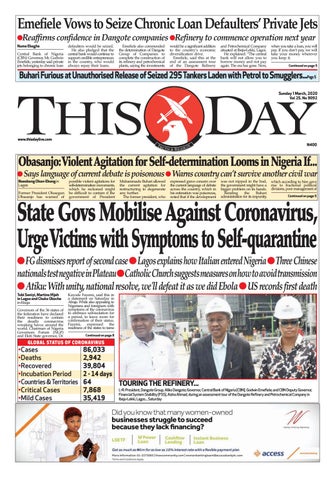
Emefiele Vows to Seize Chronic Loan Defaulters’ Private Jets Reaffirms confidence in Dangote companies Refinery to commence operation next year Nume Ekeghe Central Bank of Nigeria (CBN) Governor, Mr. Godwin Emefiele, yesterday said private jets belonging to chronic loan
defaulters would be seized. He also pledged that the central bank would continue to support credible entrepreneurs in the country, who would always repay their loans.
Emefiele also commended the determination of Dangote Group of Companies to complete the construction of its refinery and petrochemical plants, saying the investments
would be a significant addition to the country’s economic diversification drive. Emefiele, said this at the end of an assessment tour of the Dangote Refinery
and Petrochemical Company situated at Ibeju-Lekki, Lagos. He explained: “The central bank will not allow you to borrow money and not pay again. The era has gone. Now,
when you take a loan, you will pay. If you don’t pay, we will take your money wherever you keep it. Continued on page 5
Buhari Furious at Unauthorised Release of Seized 295 Tankers Laden with Petrol to Smugglers...Page 5 Sunday 1 March, 2020 Vol 25. No 9092
www.thisdaylive.com TR
UT H
& RE A S O
N400
N
Obasanjo:Violent Agitation for Self-determination Looms in Nigeria If... Says language of current debate is poisonous Warns country can’t survive another civil war Nseobong Okon-Ekong in Lagos Former President Olusegun Obasanjo has warned of
possible violent agitations for self-determination movements, which he reckoned might be difficult to contain if the government of President
Muhammadu Buhari allowed the current agitation for restructuring to degenerate any further. The former president, who
expressed grave concern over the current language of debate across the country, which in his estimation was poisonous, noted that if the development
was not nipped in the bud, the government might have a bigger problem on its hands. Berating the Buhari administration for its impunity,
which according to him gave rise to fractional political divisions, poor management of Continued on page 5
State Govs Mobilise Against Coronavirus, Urge Victims with Symptoms to Self-quarantine FG dismisses report of second case Lagos explains how Italian entered Nigeria Three Chinese nationals test negative in Plateau Catholic Church suggests measures on how to avoid transmission Atiku: With unity, national resolve, we'll defeat it as we did Ebola US records first death Tobi Soniyi, Martins Ifijeh in Lagos and Chuks Okocha in Abuja Governors of the 36 states of the federation have declared their readiness to contain the deadly coronavirus wreaking havoc around the world. Chairman of Nigeria Governors Forum (NGF) and Ekiti State governor, Dr.
Kayode Fayemi, said this in a statement on Saturday in Abuja. While also appealing to Nigerians and foreigners with symptoms of the coronavirus to embrace self-isolation for a period, to leave room for confirmation of their status. Fayemi, expressed the readiness of the states to tame Continued on page 8
GLOBAL STATUS OF CORONAVIRUS
˾Cases ˾Deaths ˾Recovered ˾Incubation Period ˾Countries & Territories ˾Critical Cases ˾Mild Cases
86,033 2,942 39,804 2 - 14 days 64 TOURING THE REFINERY... L-R: President, Dangote Group, Aliko Dangote; Governor, Central Bank of Nigeria (CBN), Godwin Emefiele; and CBN Deputy Governor, 7,868 Financial System Stability (FSS), Aisha Ahmad, during an assessment tour of the Dangote Refinery and Petrochemical Company in 35,419 Ibeju-Lekki, Lagos... Saturday
2
SUNDAY MARCH 1, 2020 •T H I S D AY
SUNDAY MARCH 1, 2020 • T H I S D AY
3
4
SUNDAY MARCH 1, 2020 •T H I S D AY
5
͚˜ ͺ͸ͺ͸ Ëž T H I S DAY, T H E S U N DAY N E W S PA P E R
PAGE FIVE
Buhari Furious at Unauthorised Release of Seized 295 Tankers Laden with Petrol to Smugglers Inaugurates platform to fight smuggling Omololu Ogunmade in Abuja President Muhammadu Buhari yesterday in Abuja ordered a crackdown on security agents conniving with smugglers to undermine the federal government’s efforts to curtail illegal goods traffic at the country's borders. Buhari inaugurated a body, OPERATION SWIFT
RESPONSE, to serve as a platform for checking illegal activities across Nigeria’s borders. A statement by Special Adviser to the President on Media and Publicity, Mr. Femi Adesina, described the initiative as a border drill exercise. According to the statement, the president expressed dismay
over information that 295 smuggled petroleum tankers were released without due authorisation on December 17, 2019 by unscrupulous security officials charged with the responsibility of protecting the borders. The statement said, "Sequel to this act, the National Security Adviser (NSA) was directed to set up a Board of Inquiry
to investigate the crime, and it was recommended to the President that all officials (civilian or security operatives) found to have connived to undermine government’s efforts should be withdrawn from the border drill and severely sanctioned by their respective organisations. "The president has accepted the recommendations and
directed the immediate withdrawal and replacement of all those found culpable. He has also directed that their respective organisations should mete immediate appropriate disciplinary actions to them." Adesina said the move was part of the federal government’s efforts to guarantee food security and improve local production of
goods at competitive prices. He said "border drill" had been a successful move, which had helped security agents to intercept and seize large quantities of foods, materials, minerals and petroleum resources illegally trafficked through the borders. He noted that the president commended the security agencies for a job well done.
Secondus: PDP Still Contemplating Review of Presidential Election Petition Clears air on Imo governorship as US attorney arrives Nigeria to witness proceeding Monday Chuks Okocha in Abuja National Chairman of the Peoples Democratic Party (PDP), Uche Secondus, says the party is still considering a review of the Supreme Court judgement on the presidential election petition it filed against
President Muhammadu Buhari. But Secondus said contrary to reports, PDP was yet to submit any application to that effect. The PDP chairman, who spoke with THISDAY yesterday in Abuja, dismissed insinuations that the party might back down on its petition over the apex
court judgement on the Imo State governorship election. He said the review of Imo governorship was not in any way challenging the supremacy of the apex court, but only a plea for it to take a second look at an obvious error that could have devastating consequences
for future elections in the country. Meanwhile, a constitutional expert, foremost US attorney and one time associate deputy US attorney general, Atty Bruce Fein, is expected to arrive the country this weekend as the international community
continues to show interest in the Supreme Court review proceedings on the Imo governorship election debacle. Secondus said on the party's petition seeking a review of the apex court judgement affirming the defeat of its candidate in the 2019 presidential election, Alhaji
Atiku Abubakar, "The national leadership of the party was only contemplating a review, but as we speak, PDP has not submitted any petition for that before the Supreme Court.
system – and they have worked in other climes,� Sani said. In his opening remarks, Osibote assured Nigerians of speaking truth to power and protecting their rights as demonstrated in the life of the founder. He explained that the importation of criminality into the organisation by some elites propelled problems within the group. Osibote also reeled off some of the efforts of the current OPC leadership at weeding out undesirable elements within the group in a bid to bring back the good eggs to the group. “We want to assure you that OPC will not derail in its chosen path of speaking the truth, protecting the rights of Nigerians and imbibing the culture and values of integrity, discipline, honour and prestige. We will ever be firm, open, cultured and disciplined as true disciples of Dr. Fasheun. “OPC started having problems, which was against the intentions of the Founder, when criminality was imported into the organisation through the active connivance of the elites. This forced many discerning
men and women of goodwill to distance themselves from the group. “However, the present leadership of the OPC is making every legal effort to weed out undesirable elements from its midst and inculcate in our members the virtues of hard work, integrity and patriotism as laid in the vision of the Founder. He, however, concluded by decrying the spilling of blood in the land, banditry, abduction, kidnapping and other forms of heinous crimes that almost made life miserable in some parts of the country. He added that the dynamics of economic growth, development, prosperity and success were never found in savagery. Further more, he noted that the purpose of setting up the organisation was, essentially, to stand against injustice. "Where you have a neighbour that threatens your future survival is considered tolerable, just because you want to ‘embrace peace’ will be a hard conversation to sell. It will not be enough to just add the word: ‘Reformed’ to the name, but in content and in character, while expressing willingness of the institute to help re-brand OPC.
We would be one of the highest foreign exchange generating companies going forward. “It is a huge project and that is why we have built a jetty and the pipeline through which we are bringing in the crude. I must confess that without the government support, there is no way we would have done what we have done so far. “I think we must thank Mr. President for his policies and we thank the CBN management for generally bringing down interest rates so that it can encourage other entrepreneurs to go into mega projects like this. We should not wait for foreign investors to come and develop our economy, it would never happen. So we have to do it ourselves.� He added, “We have been complaining that interest rates are high, so now that interest rates are low and banks are being forced to lend money out, entrepreneurs should come out with their seed capital to
borrow more money so we can develop our country.� The billionaire businessman said regarding the companies’ contribution to the economy, “Nigeria would become the biggest and only urea exporter in Sub-Saharan Africa for the first time. And we are not only exporting, we would be exporting big time. Between us and Indorama, this is going to about 4.5 million tons of urea, which is fertiliser, annually. “We also have polyethylene, which is about 1.3 million tons annually. These two products would bring in about $2.5 billion annually in terms of foreign exchange. A lot of Fx would now come in and that $2.5 billion is only about 10 per cent of remittances. Secondly, Nigeria would now become the largest exporter of petroleum products in Africa from our own domestic crude. “There are other areas where the central bank has been encouraging us.�
Continued on page 16
OBASANJO: VIOLENT AGITATION FOR SELF-DETERMINATION LOOMS IN NIGERIA IF... the economy, the non-protecting security and the politics of uncertainty in the land, Obasanjo further warned that in the event of the unexpected, Nigeria might not survive another civil wear. This, notwithstanding, Obasanjo still pledged his willingness to continue to work for the unity of the country. Speaking at the First Anniversary Lecture of the late Dr. Frederick Isiotan Fasehun, Founder of the Oodua Peoples Congress (OPC), Obasanjo said, "There is still a window of opportunity for us to nip in the bud, a possible and indeed likely agitation for self-determination that will be violent, destructive and all-empowering. “We have descended to lack of civility bordering on uncivilisation, indignity, mutual disrespect and crudity in the language of our debate, dialogue, discourse, address, comments and remarks across tribe, section, religion, ethnicity and community. If not halted, it will degenerate and poison the atmosphere to the tipping point or point of no return." Establishing a nexus between this and the current insecurity in the country, Obasanjo warned that, "If after over ten years
of fighting Boko Haram, the terrorist group is still waxing strong, let nobody out of self-delusion think that a war of self-determination by one or more geopolitical zones of Nigeria with the present disenchantment would be easily suppressed by the rest of what may remain of the country. “Some will fight to the last drop of the blood of their group rather than suffer the indignity of slavery, oppression, domination and atrocious injustice in the land of their birth and the only one that they can call their country. "If Boko Haram can get an outside support, any geopolitical zone opting for selfdetermination may equally get an external support. War may not necessarily go as planned, estimated and predicted. “Everything must, therefore, be put in place to avoid a war, the end of which no one can precisely predict. There is no assurance that Nigeria can survive a second civil war. But rather, we should seek political solution and avoid a destructive civil war." While offering some solutions, Obasanjo emphasised the need for the Executive and the
Legislature to work together to establish a Constituent Assembly. "The exercise," he said, "must not be compromised like the present Constitution. It must have full legitimacy of ‘we the people’. Talking of a new Constitution, maybe we should try a hybrid Constitution of President and Prime Minister sharing executive power in a Presidential cum Parliamentary system," he noted. Meanwhile, the event hosted by the President of OPC, Prince Dele Osibote at the NITEL Grounds, Cappa-Oshodi in Lagos, was attended by eminent Nigerians including former Governor of Osun, Olagunsoye Oyinlola and Lagos State Commissioner for Local Government and Community Affairs, Dr. Wale Ahmed. Others were a former Lagos State governorship candidate for the Peoples Democratic Party, Mr. Jimi Agbaje, President of the Certified Institute for Cooperatives and Social Enterprise Management (CICOSEMA), Prof. Kehinde Olusegun and the Ooni of Ife, Oba Adeyeye Ogunwusi, who was represented by the Osanya of Sanya, Oba Muraina Adebanjo.
The General Secretary, Arewa Consultative Forum (ACF), Anthony Sani, noted that restructuring, as widely proposed by many in the society, was not the panacea to the challenges confronting the country. Sani, therefore, called for negotiation amongst the ethnic groups in the country in order to jointly proffer solution to the problems confronting the development of the nation. “I am tempted to say that the problem might not be restructuring but the issue might be moral value. I would prefer we come together and challenge the issue confronting the country for a united Nigeria so that we can develop the country and this event is an example of such. “At the moment, Nigeria is facing a lot of challenges. Many of the challenges are socio-economic and the issue of insecurity. Because of these challenges, I have heard that the panacea is restructuring. There is no harm in restructuring. I want to us to know that Nigeria had been restructured severally. “We have operated different systems of government – presidential and parliamentary
EMEFIELE VOWS TO SEIZE CHRONIC LOAN DEFAULTERS’ PRIVATE JETS “If you are flying private jets, we will seize the private jets so that you can begin to ride on bicycles. Then we will know you are truly a liquidated person. You cannot owe banks and be flying jets all over the place. We'll come after you. You must pay those loans.� President of Dangote Group of Companies, Alhaji Aliko Dangote, said the fertiliser plant, scheduled to be fully operational in May, would be a major foreign exchange earner for the country. Dangote extolled the CBN for keeping down leading rates. Emefiele, who was on his third visit to the plant, said when the refinery is fully operational, Nigeria would become the largest exporter of refined petroleum products in Africa, with enough to serve the whole of the continent. He urged other entrepreneurs to take advantage of the low interest regime to raise funds. The CBN governor stated,
“We need to thank Aliko Dangote for the determination and his large heart. This is not a project that an ordinary person could have ever contemplated. I was here in 2016, 2019, and I'm also here today. “The central bank is interested because there is a need at this time for us to diversify the base of the Nigerian economy from oil into other areas where we can earn revenue. “The fertiliser plant, which would start commercially in May 2020, would curb the fertiliser scandals and importation. The president, in his wisdom, said we would no longer import fertiliser and this fertiliser plant of Dangote is 10 times that of Notore and this plant would generate $1 billion annually. The fertiliser would be used for our domestic consumption to help our agriculture transformation and the rest. Also, 75 per cent of it would be exported and
we would earn $750 minimum only from fertilisers.� Emefiele said it was expected that on completion the refinery would serve the whole of Africa and help to reduce freight cost. “The second project is the refinery, which is a 650,000 barrels per day capacity that will not only satisfy local need, but also position Nigeria as a major exporter of petroleum products,� he stated. The apex bank Governor added, “Because Nigeria is central, this refinery would serve the whole of Africa, which would reduce freight cost. Also because of our strategic position, it would even make the final cost of petroleum within and outside Nigeria to be lower than those that come from any other part of the world. “Today, we import almost all our petrochemicals, such as polypropylene granules and polyethylene. These would now be produced here. Everything
you produce that has a plastic base would be produced from this plant to satisfy not only domestic consumption but also export.� Dangote, who is ranked by the Bloomberg Billionaires Index as Africa’s richest man and 88th riches person in the world, said during an interview, “Right now, we have reached over 48 per cent, but majority of the equipment, when they come, are just going to be installed. We have done all the foundation, as you have seen, and first of all, we want to thank the CBN Governor, the Deputy Governor for visiting here just to justify the help they have given to us. “They were here last year and one of the reasons they are supporting us is that eventually we are going to help in terms of, not only creating jobs but also in reducing the outflow of foreign exchange, not only in petroleum products but also in petrochemicals, fertilisers, etc.
6
SUNDAY MARCH 1, 2020 •T H I S D AY
SUNDAY MARCH 1, 2020 • T H I S D AY
7
8
͚˜ ͺ͸ͺ͸ Ëž T H I S DAY, T H E S U N DAY N E W S PA P E R
NEWS
FRENIMIES UNITED BY THE NONAGENARIAN... L-R: Former Governor of Ogun State, Sen. Ibikunle Amosun; his wife, Olufunso; celebrant, Prince Babatunde Onafowokan; Ogun State Governor, Prince Dapo Abiodun; Bishop of Remo Diocese (Anglican Communion), Olusina Fape; and another former Governor of the State, Otunba Gbenga Daniel, after the church service held to mark the 95th birthday of Onafowokan at Ikenne...SaturdayÂ
STATE GOVS MOBILISE AGAINST CORONAVIRUS, URGE VICTIMS WITH SYMPTOMS TO SELF-QUARANTINE the virus, stressing that they would deploy all resources at their disposal to respond and contain the spread of the virus. This was as the federal government refuted social media reports that the Uber driver, who took the Italian index case from Lagos to Abeokuta, had also tested positive to coronavirus and had refused to be quarantined. But in a seeming attempt to set the record straight, the Lagos State government explained how the infected Italian got into Nigeria. On its part, the Catholic Church, yesterday, announced new measures of personal hygiene that could help to contain the spread of the virus. And on an optimistic note, former Vice President and presidential candidate of the Peoples Democratic Party (PDP) in the 2019 elections, Atiku Abubakar, assured Nigerians that coronavirus would be defeated, just as the country defeated Ebola, in 2014, albeit in unity and a collective resolve to be victorious. Meanwhile, three Chinese nationals were reportedly placed on self-quarantine in Wase Local Government Area of Plateau State, have tested negative to the virus. According to the NGF chairman’s statement, “We encourage the citizens to self-quarantine, if they notice symptoms related to the viral disease, and contact the nearest health facility within the states‌ We will deploy all resources available to respond and contain further spread of the virus.â€? Fayemi said as a form of proactive step, the governors had initiated monitoring infrastructure in all the states to ensure quick response and attention to anyone showing symptoms of the disease. The forum appealed for calm and urged that all should follow the necessary precautions and directives announced by the Federal Ministry of Health. "We hereby appeal to the general public to be calm and follow precautionary measures recommended by the Federal Ministry of Health and other relevant government agencies,â€? NGF said, adding, “We also enjoin citizens not to spread fake news and misinformation that can trigger fear, panic and chaos." NGF said the Federal Ministry of Health and other designated federal and state agencies would provide the relevant updates on the disease. The statement also said state governments had been strengthening emergency response preparedness and
capabilities in conjunction with the federal government and other relevant agencies. It explained that in response to the first case reported, the federal government, through the Federal Ministry of Health and Nigeria Centre for Disease Control (NCDC), had already activated the National Emergency Operations Centre and was working closely with the Lagos State Ministry of Health to respond to the case and implement firm control measures to prevent spread. Speaking on the state of the Italian, Lagos State Commissioner for Health, Professor Akin Abayomi, said the Italian had been moved to a better location after he protested that he was uncomfortable where he was initially kept. Abayomi said yesterday on the Arise Morning Show that there was some discomfort arising from heat, and the patient was moved to a renovated air-conditioned facility. “As at 6am today, I’m told that he is comfortable," the commissioner said, adding that the state has ramped up its capacity to 100 beds. He, however, said it was a bit worrying that the victim could enter the country through the Murtala Muhammed International Airport, Lagos, without being detected. But the commission added that a change in the dynamics of the outbreak might have caused the oversight at the airport. He said the focus until the last four days had been Southeast Asian countries, like South Korea, Japan, Malaysia and Singapore. And all of a sudden, there were these new epicentres in Italy and Iran and a few cases in England and France, he observed. According to Abayomi, "We have developed a form which you will have to fill if you are coming from what we defined as high risk countries. Then, you will automatically be flagged; we will put you in what we call supervised self-quarantine. “It means that you go home, stay at home for 14 days. We will call you twice in a day; we will sometime visit you if there are issues and then after 14 days, if nothing has developed you are free to move around. On the Italian, Abayomi said, "When he came in, he filled out the form actually. He stated that his point of entry is Italy, through Istanbul to Lagos. We have the form. I think there is so much going round that people didn't realise that Italy has joined the league of High Risk nations. It is a
bit worrying. But the airport is a federal facility. Lagos is there to give our support by deploying about 60 of our healthcare professionals to make sure this kind of thing does not happen. "Now we have put Italy up front, as well as Iran. It is important for us in Africa and the rest of the world to recognise that this virus is in many more places than Southeast Asia. We need to have a higher index of suspicion of people." He explained that the Italian man, who came into Nigeria with the virus, could not recollect having contact with anybody who had the virus. Abayomi stated, "He came in to Lagos on Monday evening, spent a night in the hotel, on Tuesday morning he proceeded to Ogun State. On Wednesday afternoon, he fell ill, he was seen by the company's doctors and they recognised his point of origin, they were suspicious. “They thought he could not have had malaria since he just came into the country and they called us, because they don't have a testing centre in Ogun State. We recognised that this is a High Risk situation. We advised that he be brought to us immediately under full protection. When he arrived, we put in an isolation unit and conducted the test and within hours it came out positive." He said to prevent the virus from spreading rapidly, everybody the Italian had come in contact with must be identified and isolated. To this end, Abayomi said the state government had obtained the manifest of the flight that brought the Italian into Nigeria and collected all the forms filled by the passengers. He said, "We are identifying the whole passengers. We have started contacting them one by one. We have also been to the hotel he stayed. We have identified a possible contact point with him; we have identified his room. This morning, we are going to decontaminate the whole hotel. Anyone who has used his room will also come under surveillance." The commissioner said the Lagos State government was worried because of the crowded nature of the state, but assured that proactive measures were being put in place to protect residents. Abayomi said both Lagos and Ogun states were working together to ensure the virus did not get out of control. He explained that after the Ebola outbreak, Lagos had acquired a
sophisticated bio security facility, which he said, was second to none in the continent. He, however, maintained that for now, there was no definite treatment for coronavirus. As part of the safety measures to control the disease, the Catholic Church in a statement issued by the Archbishop of Lagos, Alfred Adewale Martins, said shaking of hands during the Sign of Peace at Mass had been suspended. The church said, "In the light of this present circumstance, we hereby instruct as follows, till further notice. During this season of lent, in order to reduce the number of gatherings in church to the barest necessary, we encourage people to do Stations of the Cross privately on Wednesdays while public celebrations will take place only Fridays, especially, as it is often followed by Mass. "Communion, for the time being, shall be received on the palms. People are encouraged to have hand sanitizers handy to be used as and when needed. The use of Holy Water fonts in churches and public places should be suspended till further notice." The church also prayed for divine intervention saying, "May the Lord deliver us from this plague and all evils." Atiku, who assured Nigerians that the virus would be defeated, said in a statement on Friday that the federal government must be proactive and not resort to blame game in trying to contain the virus. He said in the statement posted on his social media pages on Friday,, "Now that Nigeria has had her first confirmed case of the Corona Virus infestation, via a citizen of Italy, who visited Lagos and Ogun states, I would want to offer my patriotic counsel to the government of General Muhammadu Buhari on how best to tackle this issue. "We must call upon our experience with the wild Ebola virus, of which we were the first nation in the world to defeat that scourge in 2014. How did Nigeria do it? We achieved it by showing unprecedented unity. “The federal government of the day worked closely with the Lagos and Rivers State governments. There was complete unity, solidarity and oneness of purpose, which created the atmosphere that defeated that deadly infestation. “I strongly counsel that any tendency to blame and point fighters must be temporarily, if not permanently, suspended. If fingers must be pointed, it must be to solutions.� He emphasised that Nigeria
needed firm and decisive actions to prevent an escalation of the scourge. The former vice president contended that if Nigeria could close its borders because of economic sabotage, it should not hesitate "to temporarily halt flights to and from any nation with a prevalence of this scourge." According to him, it is more important to secure human lives than to secure an economy. "We also need to invest in early detection facilities at our airports,� he said. Atiku, therefore, advised Nigerians, whether at government or individual levels, not to panic. "We have defeated Ebola before, and we can defeat this present predicament,� he said, stressing, “This crisis is an opportunity to show that we are first and foremost Nigerians and that we have no other country but our dear fatherland, which we must work together to keep healthy and secure." But the federal government dismissed reports of a second case of coronavirus in the country, insisting no other person has tested positive for the virus. Director-General of NCDC, Dr. Chikwe Ihekweazu, said there was presently no other suspected or confirmed case of coronavirus in the country apart from the 44-year-old index case. Ihekweazu said only its three laboratories had the capacity to test anyone in the country. According to him, “The test cannot be done outside of our laboratories. No one can claim there is a second case because we are the only ones with the facilities and reagents to test for it. We haven’t done that. “Since the outbreak started in Wuhan city in China, we have so far conducted test for 12 persons, 11 came out negative, and the only one that has come out positive is the Italian index case, who is responding to treatment. The public should disregard rumours of an escaped second patient. “If we diagnosed any case, we will definitely let Nigerians know whether it comes out negative or not, because we want to be very transparent about the whole thing. It takes four hours to get the results out, and another two hours to announce the results, so within six hours Nigerians can actually know of any case.� He described as false reports that the index case attempted to escape from isolation, noting that the expatriate has been cooperating with the authorities. Continued on page 16
COUNTRIES & TERRITORIES AFFECTED Afghanistan - 1 Algeria - 1 Australia - 23 Austria - 5 Bahrain - 38 Belgium - 1 Brazil - 1 Cambodia - 1 Canada - 14 China - 79,355 Croatia - 5 Denmark - 1 Egypt - 1 Estonia - 1 Finland - 2 France - 57 Georgia - 2 Germany - 57 Greece - 3 India - 3 Iran - 593 Iraq - 13 Israel - 5 Italy - 888 Japan - 236 Diamond Princess -705 Kuwait - 45 Lebanon - 7 Lithuania - 1 Luxembourg - 1 Malaysia - 24 Mexico - 3 Nepal - 1 Netherlands - 6 Nigeria - 1 North Macedonia - 1 Norway - 6 Oman - 6 Pakistan - 4 The Philippines - 3 Qatar - 1 Romania - 3 Russia - 5 Singapore - 98 South Korea - 3,150 Spain - 32 Sri Lanka - 1 Sweden - 11 Switzerland - 10 Taiwan - 39 Thailand - 42 UAE - 19 United Kingdom - 20 United States - 68 Vietnam - 16
SUNDAY MARCH 1, 2020 • T H I S D AY
9
10
MARCH 1, 2020 ˾ T H I S D AY, T H E S U N D AY N E W S PA P E R
SUNDAY COMMENT
Editor, Editorial Page PETER ISHAKA Email peter.ishaka@thisdaylive.com
NOW THAT CORONAVIRUS IS HERE... A good personal hygiene could make a lot of difference
T
he confirmation last Thursday that an Italian who entered the country four days earlier had tested positive to Coronavirus - officially known as COVID-19 - has finally put to rest any debate as to whether or not the disease can find its way into Nigeria. And with that reality, several positive triggers have been initiated by the federal government through the Nigeria Centre for Disease Control (NCDC). The Lagos and Ogun State governments have also formed a united front to ensure the virus does not spread beyond the index case. While we commend the authorities in the two states and Abuja for the manner the index case has been handled thus far, we enjoin critical stakeholders in the health sector to brace up for the challenges ahead. Coronavirus, which originated from Wuhan city in China last December, Campaigns has so far killed 2911 on preventive persons, infected over measures such 84,000 and has spread as good personal to 48 countries, with Nigeria becoming the hygiene like first sub-Sahara African washing hands country, and the third with soap and African nation to be water, maintaining affected. The disease, with a safe distance yet a preventive vaccine, from someone has also sent shock tremors to the global sneezing and coughing, avoiding economy as trillions of dollars had been wiped the touching of off due to crashing stock eyes, nose and markets. mouth - could Although the level of make a difference awareness on some of the risk factors is now high between life and across the country, more death can still be done, especially in dispelling baseless rumours, discouraging unhelpful practices and rolling out a comprehensive awareness campaign in major indigenous languages. Other efforts should include campaigns on preventive measures such as good personal hygiene like washing hands with soap and water, maintaining a safe distance from someone sneezing and coughing, avoiding the touching of eyes, nose and mouth and
Letters to the Editor
B
y 2020 the tenure of Hadiza Bala Usman, the Managing Director of the Nigerian Ports Authority (NPA) will come to an end. It is either she gets re-appointed or someone else takes over from her. Nonetheless, the battle for who succeeds her has commenced. The politics for NPA’s leadership is not new to both ordinary Nigerians and the political class. Today, the only difference is the Buhari administration, which tends to do things differently. Probably this time around, performance, competence and only little politics will play a role in the appointment of the new managing director of the NPA. It is certain Hadiza will want her tenure renewed and at the same time, there will be persons lobbying to take over from her. But there are questions that need to be answered. Has Hadiza Bala Usman performed
generally observing other simple routines. These could make a difference between life and death.
I
S U N DAY N E W S PA P E R EDITOR SHAKA MOMODU DEPUTY EDITORS OLAWALE OLALEYE, TOBI SONIYI MANAGING DIRECTOR ENIOLA BELLO DEPUTY MANAGING DIRECTOR KAYODE KOMOLAFE CHAIRMAN EDITORIAL BOARD OLUSEGUN ADENIYI EDITOR NATION’S CAPITAL IYOBOSA UWUGIAREN MANAGING EDITOR JOSEPH USHIGIALE
T H I S DAY N E W S PA P E R S L I M I T E D EDITOR-IN-CHIEF/CHAIRMAN NDUKA OBAIGBENA GROUP EXECUTIVE DIRECTORS ENIOLA BELLO, KAYODE KOMOLAFE, ISRAEL IWEGBU, IJEOMA NWOGWUGWU, EMMANUEL EFENI DIVISIONAL DIRECTORS BOLAJI ADEBIYI , PETER IWEGBU, ANTHONY OGEDENGBE DEPUTY DIVISIONAL DIRECTOR OJOGUN VICTOR DANBOYI SNR. ASSOCIATE DIRECTORS ERIC OJEH, PATRICK EIMIUHI ASSOCIATE DIRECTOR SAHEED ADEYEMO CONTROLLERS ABIMBOLA TAIWO, UCHENNA DIBIAGWU, NDUKA MOSERI DIRECTOR, PRINTING PRODUCTION CHUKS ONWUDINJO TO SEND EMAIL: first name.surname@thisdaylive.com
t is noteworthy that the Nigerian authorities are already putting in measures to ensure the outbreak does not snowball into another public health crisis for a nation battling myriads of challenges, including insecurity, poverty, and the obvious Lassa fever epidemic that has claimed scores of lives in recent weeks. The index case has been quarantined and placed on immediate treatment while the 28 persons who had contact with the Italian have also been placed under surveillance. Further contact tracing is being done through the Turkish airline on which he flew in from Milan as well as the hotel he stayed in Lagos and Abeokuta where he spent two days. Nigerians have also started making their contributions to preventing the spread with the use of sanitisers and face masks. Meanwhile, the Joint External Evaluation (JEE) of the International Health Regulations placed Nigeria’s capacity to prevent, detect, and respond to public health threats at 46 per cent in 2019. This is an improvement on 39 per cent in 2017. Both the Minister of Health, Dr Osagie Ehanire and the NCDC Director General, Dr Chikwe Ihekweazu had assured that Nigeria has the capacity to curtail the spread, especially with reference to how the country managed the Ebola Virus Disease outbreak in 2014. But the present coronavirus outbreak has a faster potential to spread, and has so far not been contained even in the countries with best of health facilities. Besides, although Nigeria defeated Ebola, it was at the expense of eight productive lives, and some $180 million dollars - an amount far bigger than the country’s entire health sector budget for a full year. With the virus already in the country, the nation needs the political will to prioritise interventions, and this includes beefing up airports, land and sea borders, investing in public awareness on basic hygiene health, and ensuring all contacts with confirmed case or cases are tracked and placed under surveillance. Should the coronavirus outbreak snowball beyond Lagos and Ogun to states that do not have the capacity to deal with such emergencies, the bragging right of being the first to contain Ebola in 2014 among affected nations will no longer matter much. And with our health security still weak, all the gains made in other sectors may come to nothing if coronavirus becomes a full-fledged epidemic. A nation is only as strong as its weakest link.
TO OUR READERS Letters in response to specific publications in THISDAY should be brief (150-200 words) and straight to the point. Interested readers may send such letters along with their contact details to opinion@thisdaylive.com. We also welcome comments and opinions on topical local, national and international issues provided they are well-written and should also not be longer than (950- 1000 words). They should be sent to opinion@thisdaylive.com along with the email address and phone numbers of the writer.
NPA And Politics of Succession excellently to deserve a renewal of her appointment? Are there other experienced Nigerians that can do better than her? Will the on-the-job experience and new approaches she introduced give her an edge over other persons? In 2016, Hadiza’s appointment as managing director of NPA generated some grumbles from few quarters. Many people suggested that Hadiza was appointed because of Rotimi Amaechi and Governor Nasir el-Rufai’s influence – and President Buhari will always give the duo whatever they wanted. This is 2020; the politics and high-wired power struggle of 2023 will have a degree of impact on the appointment of the new MD for NPA. Whether Hadiza gets renewed or a new candidate is appointed, certain questions remain pertinent. What degree of politics should drive the appointment of the MD of NPA? Should merit be the sole
factor in the appointment process? Many observers have opined that the seaport governance in Nigeria should be free of politics and government interference. They say, in some nations, seaport systems are usually not in control of the central government. For example, the United States of America, over 183 commercial deep sea ports along the US coastlines are administered by a decentralized port administration system. The port administration is shared across the three levels of government - federal, state and local and some of their board members are even elected. The Chinese with seven of the 10 biggest ports in the world by cargo also have port governance which also differs from the traditional landlord port system. For example, the port of Shanghai in China is world largest in terms of cargo volume and it is managed by a public-listed company, the Shanghai International Port, but
Shanghai Municipal Government owns 44.23 per cent stake. A study by some experts and port economics found out that Chinese new geo-economic policies such as the ‘Go West’ strategy and the ‘One Belt One Road’ (OBOR) initiative have triggered strategic and managerial implications on Chinese ports. Putting the findings of the study into the Nigerian context, has the Hadiza Bala-led NPA management effectively keyed in into government policies in port governance? Buhari is a thorough man and often unpredictable. Will he reappoint Hadiza Bala Usman as MD of the NPA, when her tenure ends? Hadiza is an expert in development and research. She is ‘young’ and a go-getter in a class of her own. Anyone who wants to replace her will contend with some of her achievements. Her saving of the SHIN’s fabrication and integration yard – $270 million was borrowed for the project, the stoppage of INTELS’ monopoly of oil and gas cargo and
the compliance to TSA, the stoppage of the contract scam - SAA fees on the Calabar dredging, all these are notable achievements. She has also sanctioned LADOL for violating the terms of the land lease at Tarkwa Bay, near Light House Beach in Lagos. The dismantling of the Secure Anchorage Area, operated by OMSL Limited on behalf of the Navy is also one of her good jobs. After just six months in office, she uncovered a N11.23 billion fraud at the maritime agency. Investigation revealed that some banks conniving with some officials hid monies collected as revenue in secret accounts instead of remitting same into the NPA’s Treasury Single Account with the Central Bank of Nigeria. Hadiza has blocked leakages and recovered unremitted revenues and debts running into billions of naira. She is the first female MD of the NPA. Has she done exceptionally to deserve a reappointment? The answer is everybody’s guess. ––Zayyad I. Muhammad, Jimeta, Adamawa State.
11
T H I S D AY, T H E S U N D AY N E W S PA P E R Ëž RCH 1, 2020
RIGHTOFREPLY
By OgwuwikeNwachuku
Shaka Momodu, Imo People are with Uzodinma
S
haka Momodu, Editor of THISDAY on Sunday is someone I can call a friend. I have great respect for him, hence I read him from time to time depending on what he is writing on. In fact, I have followed Shaka’s style of writing since he was Editor of THISDAY on Saturday and have continued to read him till date even when he often writes what satisfies his personal curiousity and not the desire of the audience he claims to be writing for. As Editor of THISDAY on Sunday, Shaka writes on Fridays because the back page of THISDAY on Monday hosts other columnists like former Editor of THISDAY and now the Managing Director of Arise Television, Ijeoma Nwogwugwu, former Managing Director of Diamond Bank and governorship candidate of the All Progressive Grand Alliance (APGA) in the 2015 and 2019 elections respectively in Abia State, Dr. Alex Oti and the Managing Director of THISDAY, Eniola Bello (when ocassion demands that Eni-B writes due to his tight schedule ). When, therefore, I saw Shaka’s piece sitting pretty on the back page of the medium’s flagship on Monday, February 17, I knew something beyond the comprehension of the usual audience that read THISDAY’s back page on that day had happened. I knew Shaka had worked hard to procure that page for a purpose, other than to serve public interest. I share completely in the thinking of Narendra Modi, the Indian President, that the strength of democracy lies in criticism. I also know, like many others, that constructive criticisms help to shape and nurture the direction of those in power against deviating from the norm. But I make bold to say that Shaka did not set out to critique constructively as one who either belongs to the opposition or sympathises with the opposition in the real sense of the word and he knows it. Shaka’s write up, “That Supreme Court Magic Judgment� appeared to have been written to serve a particular purpose and not necessarily to pass a message of lack of bias and constructive criticism as he pretended. I shall explain shortly. Shaka was comfortable abusing the Supreme Court as an instititution and its Justices as corrupt in veiled delivery. He did so in ways his collaborators, nay paymasters who have been lamenting their loss of power in Imo State following the Supreme Court judment of January 14 have carried on for more than two weeks now. Why will anybody excuse Shaka from lack of bias when his piece wreaked of innuendoes and venomous characteristics that are in sync with what the organisers of the protests against the Supreme Court ruling in favour of Governor Hope Uzodinma of Imo state have been doing? The circumstances leading to the Supreme Court judgment of January 14 in favour of Senator Uzodinma are well known to everyone. For the likes of Shaka who have deliberately kept a deaf ear over the issue at hand, believing what some people want them to believe, let me provide some guide. Governor Uzodinma who was the All Progressive Congress (APC) candidate in the March 9, 2019 governorship election in Imo state was robbed of most of the valid votes he scored during the election by opponents who must have colluded with the electoral umpire to undermine him. As a man who believes in fairness and equity, the distinguished senator did not rely only on mere raising of the alarm. He chose to take his destiny in his hands by following the due processes of law. First, Senator Uzodinma approached the Imo State Governorship Election Tribunal where his case was dismissed as lacking in merit. Undaunting, he proceeded to the Court of Appeal with the same complaint and at the appellate court the ruling did not also favour him because of the same gangup against him. Fortunately for Senator Uzodinma, out of the fourmember Justices who adjudicated over his matter at the Court of Appeal, one of them gave a dissenting judgment. It was that dissenting opinion that rekindled Senator Uzodinma’s hope that the future would tell about what actually transpired during the governorship election in Imo. It was that “lone voice from the wilderness� that differed from the other Justices which gave Senator Uzodinma the confidence to proceed to the Supreme Court despite all odds and pressure to drop the matter having lost at the tribunal and Appeal Court. It is intriguing to note that at the tribunal and Court of Appeal outings, Senator Uzodinma was not even given the opportunity to state his case, an indication that there was a calculated plan to frustrate him and render his efforts at the governorship election useless. Not even the Independent National Electoral Commission (INEC), the so-called electoral umpire, could show a whimper of concern as the organiser of the governorship election over Senator Uzodinma’s intention to prove himself right or wrong. But one thing that was sure is that his opponents and the INEC were so blinded to Senator Uzodinma’s zest and fighting spirit. They underrated his capacity to take his destiny in his hands, guided by his believe that God who sees in secret will at His own time bring to the open all hidden things. I can tell Shaka for free that there was so much pressure on Senator Uzodinma by his detractors to drop his matter because he had already lost out at the two courts earlier. Approaching the Apex Court, Senator Uzodinma laid his case before our seasoned, patient and highly committed Justices who painstakingly perused through the facts and evidence tendered before them in relation to the tribunal and Court of Appeal earlier rulings. One after the other, the Supreme Court considered the facts before it, particularly the controversial 388 poling units
Uzodinma
that Senator Uzodinma has been pleading with the courts to take a second a look at but was ignored as if they did not matter. To the tribunal and Court of Appeal, the 388 polling units did not matter because that was where the joker of the manipulators of the governorship election in Imo state that undermined Senator Uzodinma’s chances lay. Because the tribunal and Court of Appeal had ruled in favour of the election of ousted Emeka Ihedioha, going to the apex court to them was a fait accompli, a done deal. With that hindsight, as well, they did not bother to consider Senator Uzodinma’s appeal at the apex court with the seriousness it desired because of the delusion that they had already won. There was just no need for them to prepare for any defence. Instead, on the day of the Supreme Court judgment pockets of parties went on in some offices at the Government House Owerri because they had erroneously thought nothing was going to stop them from retaining power. But how wrong they were! When the seven Justices of the Supreme Court perused through all the facts before them, it was not difficult to pass a unanimous verdict of Senator Uzodinma being the duly elected governor of Imo state during the March 9, 2019 governorship election. The verdict was not only a turning point in dealing with the lackadaisical disposition of the INEC in the manner the institution has been conducting electoral matters in the country of late and giving vent to all sorts of underhand games, but a sign that our judicial institution is still alive to its responsibilities despite plans by powerful men and women to render it impotent. Those who ignorantly lampoon the Justices of the Supreme Court, like Shaka, to have erred in the way they arrived at the marks they rightfully awarded Senator Uzodinma that made him have comfortable votes that catapulted him from the fourth position to the first position and eventually winner of the governorship election must understand why lawyers assume the toga of learned people. It is not for fun and the Justices could not have set out to award votes to Senator Uzodinma because the law does not permit that and they know the implications. And mind you, it amounts to criminal accusation by highly uninformed persons who allege that the Justices of the Apex Court awarded unmerited votes to Senator Uzodinma to have him emerge governor. I hope the accusers will be willing to come and defend themselves if called upon to do so because he who alleges must be ready to prove himself or herself. There is no other way to get at the minds of uninformed and easily deceived persons about the abracadabra that was the Imo state governorship election on March 9, 2019 than the orchestrated protests to change the narrative. Of course the organisers of the protests against the Supreme Court ruling in favour of Senator Uzodinma were guided by the fact that our society is peopled by very gullible persons who believe anything without first thinking. However, those who know the truth know that it would be difficult to stand it on the head. The informed legal
minds are not bothered that the Ihedioha administration had approached the apex court to review its judgment. If anything, the development makes many of them laugh out. They are well aware that the noise being made about the review is nothing but distractions and an attempt to remain relevant in the eyes of the populace. They know that what they are asking for is not sustainable under the law, more so, the final court in the country that had once advised those who approached it with similar prayers to appeal to God in the circumstance. Shaka happens to be one of those who do not believe that our institutions should be respected because they want them to do their bidding and not the bidding of the majority. He belongs to the group that never sees anything good in the decision taken by our institutions charged with the responsibility of advancing the course of our democracy. He has started thinking, reasoning and acting exactly like the hired protesters who do not have any qualms doing damage to the society and system so long as they get their pay. Until I read the aspect of Shaka’s piece where he accused Senator Uzodinma of not winning the March 9, 2019 governorship election in Imo state and of having “fake resultsâ€? after the Supreme Court Justices had diligently and painstakingly done their job and unanimously returned a verdict of the Senator being validly elected, I never knew Shaka could be this naĂŻve. His naivety also appears legendary when you remember that he was accusing the Governor of “mindless forgery and falsehoodâ€? when in actual sense Shaka may not have a shred of evidence to substantiate his allegation if called upon to do so. I wonder what makes Shaka jump into the same allegation wagon. I am worried because I know that Shaka has the capacity to do the right thing if he applies his mind to it. Today, a new lexicon has been added to the political dictionary of our country in the name of “judgment reviewâ€?. Is it not said that if oil touches one finger chances are the others would be affected? Because some people mindlessly started chorusing judgment review by the apex court thinking they will get at Senator Uzodinma, the sing song across the length and breadth of the country today as far as electoral matters are concerned is judgment review. Nobody has spared a thought about the embarrassment such moves are causing our country. And like former National Chairman of the All Progressive Grand Alliance (APGA) and former senator representing Anambra Central Senatorial District, Sir Victor Umeh said while fielding questions on an AIT Programme on Wednesday, February 19, the embarrassment is both monumental and irreparable because those canvassing that Supreme Court reviews itself know they are chasing shadows. I thought people like Shaka ought to know better but they are pretending thinking that God will come down from heaven to do it for us. It is therefore laughable for Shaka to think that his acknowledgement or not of Governor Uzodinma as the duly elected governor of Imo state going by the decision of the Supreme Court will have any untoward impact when the more than four million good people of the state have already lined up behind him. Quite a pity! ––Oguwike Nwachuku is Chief Press Secretary/Media Adviser to Governor Hope Uzodinma of Imo State
12
T H I S D AY, T H E S U N D AY N E W S PA P E R Ëž ÍŻËœ 2020
NEWS
Acting News Editor ĂŒĂ™ĂŁĂ?Ă‘Ă‹ Ă•Ă“Ă˜Ă?Ă‹Ă˜Ă—Ă“ E-mail: Ă‘ĂŒĂ™ĂŁĂ?Ă‘Ă‹Ë›Ă‹Ă•Ă“Ă˜Ă?Ă‹Ă˜Ă—Ă“ĚśĂžĂ’Ă“Ă?ĂŽĂ‹ĂŁĂ–Ă“Ă Ă?Ë›Ă?Ă™Ă—ËœÍ¸Î€Í¸Î€ÍšÎ Î€ÍžÍ˝Î Í¸ Ě™Ă?Ă—Ă? Ă™Ă˜Ă–ĂŁĚš
2023: Tambuwal Counsels Buhari against Repeat of 2019 Electoral Defects ‡Urges Buhari to bequeath an enduring legacy ‡Says institutional defects threat to democratic stability Gboyega Akinsanmi Sokoto State Governor, Alhaji Aminu Tambuwal yesterday advised President Muhammadu Buhari not to bequeath a defective electoral system on the nation.
Tambuwal, Chairman of the Peoples Democratic Party Governors Forum (PDPGF), also asked the president to toe the path of honour and dignity by bequeathing a durable democratic system imbued with workable institutional
structures that could stand the test of time to Nigeria. He gave the warning in a statement his Special Adviser on Media and Publicity, Mr. Muhammad Bello issued in response to a comment credited to one of the president’s
trusted allies, Alhaji Ismailia Isa Funtua. Funtua, a former President of the Newspaper Proprietors’ Association of Nigeria (NPAN), had reportedly admitted at the 40th anniversary of the Silverbird Group that something
WELCOME ON BOARD. . . L-R: Bayelsa State Governor, Senator Duroye Diri; Chairman, Nigeria Governors ’Forum (NGF) and Ekiti State Governor, Dr. Kayode Fayemi and ter) and his Delta State counterpart, Senator Ifeanyi Okowa welcoming Diri to the NGF meeting in Abuja... yesterday
was going wrong in the country. Reacting to Funtua’s remarks, Tambuwal, who emerged the Silverbird Man of the Year, appealed to the president to leave a legacy that he would be remembered for. He said “Before he came to power in 2015, I was one of those that had respect and admiration for him. I had my expectation like other Nigerians who are very patriotic and committed to the course of democracy and good governance in this country.� Rhetorically, the Sokoto governor asked: “But can we say so in 2019? We knew what happened in the general election. Is that the legacy that President Muhammad Buhari wants to leave?� He, therefore, urged Nigerians “to make sure that our institutions are working. We do not need strong men in Nigeria. We need strong institutions.� He listed some institutional defects threatening democratic stability in the country as the introduction of a ‘new lexicon’ known as ‘inconclusive’ into the electoral system, travesty of justice, brazen use of the elements of coercion to prosecute elections conduct and insecurity. “We, as practitioners in politics, know what we are doing. We should know that, first, there is God. We are supposed to respect
the voting rights of our citizens. We must not continue to manipulate our ways to power and we must desist from attempts to emasculate our judicial system. “What we need to do is to make sure that we reform our electoral system and allow the system to exercise the franchise, conduct free, fair election and whoever wins should be so declared. We should allow the votes to count. “We should allow the security personnel to go and face the real challenges that we have in Nigeria. Not that when we have elections, they will fly people to Kogi, Bayelsa, Osun; leaving behind people in Borno, Adamawa and Yobe, allowing Boko Haram to be traversing the length and breadth of the country. “We should be able to tell ourselves the truth. So far, nothing is wrong with our system. It is not about the law. It is about the managers of the system. We must be conscious of the fact that we will go back to God almighty one day and we shall be accountable to Him of our deeds. He expressed optimism that the country has resources, both human and natural, to ensure that things work properly. What is lacking is sincere, committed and patriotic devotion’ on the part of the leadership.�
MTN Revenue Hits N1.2trn In 2019, Plans N600bn Network Expansion Emma Okonji MTN Nigeria yesterday, released its audited results for the financial year ended in December 31, 2019, recording as high as N1.2 trillion service revenue, representing an increase of 12.6 per cent. As shown in its financial results, MTN’s earnings before interest, tax, depreciation and amortisation (EBITDA), grew by 45.2 per cent to reach N629.9 billion. The company said the EBITDA margin increased to 53.9 per cent from 44.8 per cent, while its profit before tax grew by 31.1 per cent to reach N290.1 billion. Pleased with its financial achieve-
ment in 2019, MTN said it would be investing a whooping N600 billion on network expansion in the next three years. The investment, according to the telecoms company, would enable it to accelerate its 4G network expansion, deepen population coverage and support the Federal Government’s broadband initiative. MTN Nigeria, however, said its capital expenditure, excluding ROU assets, increased by 13.1 per cent to reach N208.3 billion in the financial year ended 2019. Chief Executive Officer, MTN Nigeria, Mr. Ferdi Moolman, said: “I am pleased with our performance in 2019, which demonstrates the
progress we have made in the implementation of our strategy. “Despite a challenging operating environment, we continued to deliver double-digit growth in service revenue in line with our medium-term guidance. “Voice revenue growth remained healthy, and data revenue continued to accelerate, supporting a 12.6 per cent increase in service revenue with an acceleration in growth to 14.0 per cent year-on-year (YoY) in Q4 2019. “Following the completion of the SIM re-registration exercise in Q3 2019, we recorded 2.7 million net additions in Q4. In total, we
Coronavirus: Group Commends Lagos as Ondo Reels out Measures James Sowole in Akure The Lagos Peace Movement (LPM) yesterday explained the roles of citizens in the battle against Coronavirus (COVID-19), urging over 21 million residents of Lagos to support the government to stop the deadly disease from spreading. Concerned by the confirmation of Corona virus case in Lagos, Ondo State Government advised residents of the state not to panic over the situation stating that the authority has mapped out actions on it. Besides, the management of Saipem Contracting Nigeria Limited has debunked social media reports that the Italian infected by coronavirus in Nigeria visited the firm’s office in Banana Island, Lagos and that the firm is now subject to lockdown.
In a statement he issued yesterday, LPM’s Convener, Mr. Adekunle Adeosun urged the residents of the state to join forces with the state government to stop the virus from spreading. LPM, a pan-Lagos nongovernmental organisation, urged the residents to assist the state government in its efforts at curbing the disease by making use of the telephone numbers of designated centres and people to call in cases of suspected victims of the dreaded virus. The group, also, promised to assist by incorporating the state government’s efforts into its advocacy nationwide, saying the group’s members across the federation and beyond had been mandated to call the designated lines in the event of any strange behaviour by anybody around.
The group, therefore commended the state governor, Mr. Babajide Sanwo-Olu and his cabinet members for their swift reaction to the treatment of the first victim of the disease. While giving Sanwo-Olu and his team of competent hands pats on the back for being a pace setter in any emergency situations, the rights organisation expressed the delight that, “this administration has taken the lead in its lifesaving efforts.� LPM commended the Lagos State government on its swift reaction towards the treatment of the first victim of the disease. It noted that the Sanwo-Olu administration was truly prepared for the global menace, noting that only a responsible and responsive government could put such medical equipment on ground to safeguard its people.�
added 6.1 million new subscribers to our network in2019. “Although the last quarter is usually seasonally strong, service revenue growth of 14 per cent in Q4 outpaced the seasonal effect,� Moolman said. In the third quarter, the chief executive officer explained that the company focused on several initiatives “to enhance coverage and drive data usage penetration. “These initiatives include optimising frequencies, expanding our 4G network coverage with over 6,000 additional sites leveraging 800MHz spectrum and repositioning our commercial data offerings.�
“It is pleasing to note that the promising results we reported at the end of Q3 2019 accelerated in the fourth quarter. Corresponding with the increase in our active data subscriber net additions by 2.9 million in Q4 2019, our 4G population coverage rose by 8.4pp to 43.8 per cent, giving people in 68 additional cities access to 4G. “We closed the year with 132 cities covered by 4G and became the first mobile network operator in West Africa to demonstrate the capability of 5G technology. We are excited about its potential for our customers and Nigeria’s overall national development plans,
Moolman said in a statement.� Addressing the resolved MTN dispute with the Attorney General of the Federation (AGF) over tax issues, Moolman said: “We are delighted with the progress made in resolving our dispute with the Attorney General of the Federation (AGF) on the adequacy of taxes and duties paid. “We have discontinued the legal action against the AGF following the transfer of the matter to the relevant authorities and look forward to a final resolution. We have always fulfilled our tax obligations and remain committed to maintaining good relationships with all regulatory authorities.
50m Nigerians May Suffer Mental Illness, Trauma Michael Olugbode in Maiduguri About 25 percent of Nigerian population, (about 50 million people), may suffer from mental illness in a lifetime if nothing is done to restore public order nationwide, a consultant psychiatrist, Dr. Ibrahim Mshelia, has said. Mshelia, a consultant psychiatrist at the Federal Neuropsychiatric Hospital in Maiduguri, ascribed this projection to the growing rate of armed insurgencies, banditry, kidnapping, armed robbery and extremist violence nationwide. He expressed this concern at a session with THISDAY at the weekend, noting that the rising cases of mental illness across the federation was unprecedented, thereby demanding proactive measures. There has been increased violence nationwide with extrem-
ist violence in the North-east; banditry and kidnapping in the North-west; farmers-herdsmen conflict in the North-central; communal invasion in the Southwest; youth restiveness in the South-south and secessionist campaign in the Southeast. Consequently, millions of citizens have fled troubled regions to other parts of the country while thousands have sought refuge in foreign land. Edwin Osara, who fled to Kaduna to save his sick daughter, Deborah from female circumcision promoted by his extended family, was one of such pathetic cases. After escaping violence in the South, Osara came under the attack of Boko Haram, an Islamist terrorist organisation and was left in his pool of blood. Osara, who was hospitalised for three months before recovering
from gun injuries and trauma, eventually fled with his traumatised family to the United States. Osara is not the only victim that fled from violence in the north. Since 2009, thousands have fled the north including a journalist with Daily Trust, Ibrahim Yahaya. Yahaya requested his employer to redeploy him to Lagos after his family was left traumatised after the attacks of the Boko Haram insurgents on Maiduguri Osara and Yahaya are among the lucky ones. Thousands have lost loved ones; many suffered varying degrees of injury and others lost their sanity to banditry, extremist violence and kidnapping that plague the North. On these accounts, Ibrahim said cases like that of Osara family are prevalent in the country especially in the North-west and North-east, especially Kaduna and Maiduguri, among others.
SUNDAY MARCH 1, 2020 • T H I S D AY
13
14
T H I S D AY, T H E S U N D AY N E W S PA P E R ˾ MARCH 1, 2020
OPINION Covid-19: Hardship Reveals True Friendship China is deeply appreciative of the compassion from the international community in the face of the epidemic, writes Zhou Pingjian
T
he COVID-19 outbreak is a major public health emergency that has spread in the fastest speed, caused the most extensive infection and is the most difficult to contain in China since the founding of the People’s Republic on October 1, 1949. The World Health Organisation (WHO) has declared COVID-19 “public enemy number one”. Containing the epidemic at the source is of essence. Guided by the vision of a community with a shared future for mankind, China is fulfilling its responsibility for the life and health of its own people and for global public health security. Under the strong leadership of President Xi Jinping, the 1.4 billion Chinese people are making all-out efforts in fighting the epidemic. The government has taken the most comprehensive, rigorous and thorough measures, many of which have far exceeded what WHO and International Health Regulations required. Through arduous efforts, the epidemic is generally under control, and the positive trend in the prevention and control work is now expanding. China’s effective response and sacrifice have averted the further spread of the virus in the world. We have the full confidence, capacity and determination to not only win a full victory against the epidemic but also meet China’s economic and social development goals. Hardship reveals true friendship. Ruthless as the epidemic has been, we are deeply touched by the compassion shown to us from the international community. Recently, the Embassy has been inundated with heartwarming sympathies and good wishes from Nigerian brothers and sisters. We highly appreciate that the government and good people of Nigeria firmly stand by us in this difficult time. As President Muhammadu Buhari noted in his statement of solidarity on February 2, “China’s efforts to contain the spread of the coronavirus have been exemplary, as well as the country’s collaboration with international agencies and other countries on the matter”. He added: “With all the efforts being put in, we know that it is only a matter of time before this nightmare passes.” Indeed, together we shall prevail. Foreign nationals are safe in China. According to the professional evaluation of WHO Director-General, Dr. Tedros, the safest way for foreign nationals in Wuhan is to stay put and ensure effective self-protection. He has cautioned against hasty movement as it will add more uncertainties. We still suggest that countries follow WHO recommendations and educate their
nationals to ensure sound protection in accordance to local health regulations. The Chinese government attaches great importance to the safety and well-being of foreign nationals, including foreign students. The Foreign Ministry of China has directed relevant local departments to take the protection of foreign nationals in China as a high priority and to work hard to address their difficulties. Please be assured that we will take all necessary and effective measures to protect the safety and health of Nigerian nationals in China. We have enhanced information disclosure. Local departments have kept local foreign nationals informed in an open and transparent way via websites, WeChat, Weibo and e-mail, posting updates on the epidemic situation through public letters, releasing information on self-protection, opening 24-hour multilingual hotlines. The host provinces and municipalities of consular missions have held news briefings or video conferences to share updates on the latest development of the epidemic and answer questions. Guangdong Province compiled and circulated a Handbook on the Epidemic Prevention and Control for the consular missions. We have worked to guarantee the life needs of foreign nationals. Ensuring the well-being of foreign nationals has been made a priority in the work of local governments and community-level bodies, who have worked hard to meet the needs of foreigner in daily life, epidemic prevention and treatment, and resolve their legitimate concerns to the best of their ability. Consulates have been provided masks, sanitizer and other preventive materials to solve their difficulties. We have done our best to treat foreign patients. Local authorities are making their best efforts to see that foreign patients are treated in a timely manner and well taken care of. As of February 19, 29 foreign nationals in China had been diagnosed with the COVID-19. Among them, 10 were in Hubei province, there were 18 recovered
There are areas where we are not doing good enough. We welcome opinions and suggestions and will make improvements accordingly. The COVID-19 has come and it will go. The outbreak is just temporary, but friendship and cooperation are forever
and discharged cases, two deaths and nine cases under treatment in isolation. No reported cases of Nigerian being diagnosed with COVID-19 in China. We have tried our best to provide services for international students. The Chinese government cares about the life and health of foreign students just as we care for our own children. Leading local officials have either visited foreign students in person or talked to them through video links. For example, Party Secretary of Jiangxi Province visited the more than 500 international students in Nanchang University to offer his support. Many universities have launched online courses to provide diverse means of study for international students. All of them have distributed masks and other personal protective supplies to their international students and worked to ensure that they can have meals in canteens or through food delivery. Local government agencies have coordinated to complete visa and residence permit procedures for international students. Those who are confirmed to be infected with the virus are under good medical care. In Hubei Province, there are 5400-plus international students, including 50 Nigerian students in Wuhan. All universities in the province have taken thoughtful measures. For example: they have launched 41 special hotlines to provide 24/7 counseling for international students; assigned staff to provide free food delivery and buy stuff for students staying in dorms; created WeChat groups consisting of faculty members, volunteers and international students to learn about their needs and situations; provided psychological counseling to ease loneliness, anxiety and fear; with regard to the difficulties reported, school authorities have tried to resolve problems after verifying the situations with the students concerned. Having said that, facing such an unprecedented outbreak, it is impossible to have been perfect in our work. There are areas where we are not doing good enough. We welcome opinions and suggestions and will make improvements accordingly. The COVID-19 has come and it will go. The outbreak is just temporary, but friendship and cooperation are forever. China will always remember the sympathy and support given to us in this battle against the virus. Our heartfelt appreciation goes to all the countries, international organizations and people across the world who have stood with us in tackling the epidemic. ––Dr. Pingjian is Ambassador of China to Nigeria .
Nigeria And The Politics of Vigilantism Michael Nwankpa argues that the non-state armed groups are tools to negotiate power and representations in any future restructuring
N
igeria, Africa’s largest economy, is currently experiencing an increase in partially or fully statesupported non-state armed group with Amotekun in the Southwest region, Shege Ka Fasa in the North, Ogbunigwe in the Southeast, while other regions such as the Niger Delta (South-South) are deliberating on forming their own security outfit. Typical of Nigeria’s political violence landscape, the vigilante groups are formed along regional and ethnic lines. The rise of state-sponsored vigilante group comes against a background of heightened insecurity in the country marked by 10 years of Boko Haram insurgency, Fulani militia rampage, frequent abduction and other high crimes across the country. To some extent, the establishment of the regional vigilante groups is justifiable considering the weakness of the Nigerian federated state especially the centralised Nigerian police force (NPF) with its inability to protect the lives and properties of its citizens. The Nigerian Police Force is underfunded, ill-equipped and incapable of executing its duty of law and order. The capacity of the NPF was undermined by the long years of military rule. Nigeria was governed by successive military leaders from 1983 to 1999, and previously (1966-1979). Although Nigeria has returned to democratic government since 1999 and has had successive democratic leaders since then, the impact of the military, including militarisation and psyche of violence remains. Nigeria’s peculiar political structure also has an adverse impact on the effectiveness of the NPF. Nigeria is a highly centralised state with a central government based in the capital city of Abuja and 36 states, roughly divided evenly into six geopolitical zones- Southeast, Southwest, Northeast, Northwest, South-South and Middle Belt. Interestingly, the 36 states rely primarily on the oil-dependent federal government for its revenue as much as they do on the Nigeria Police Force for their security. Unsurprisingly, such arrangement creates tension between the states and the federally-controlled police force. To some degree, there is lack of accountability, unresponsiveness to crime, barring the technical inadequacies of the NPF. Although valid, such explanation is inadequate and limited in explaining the rise of vigilante groups in Nigeria. There is a deep political explanation for the rise of state-sponsored and state-supported non-state armed groups in Nigeria. The Nigerian state with
its pluralistic linguistic, ethnic and religious character, presents a dangerous site for contest of power, and therefore proclivity to conflict. It is not surprising that Nigeria is rife with conflicts which include ethno-religious, social and political violence. Nigerian elites have often manipulated the linguistic and ethno-religious differences for their own political gains. Hence, while Amotekun, Ogbunigwe, Shege Ka Fasa represent to some extent a genuine concern and response of the leaders and peoples of these regions to incessant attacks by bandits, militias, criminals and terrorists and the weak response (and, in some cases, indifference) of the federal government, they symbolize a much deeper geopolitical objectives. Amotekun, Ogbunigwe, Shege Ka Fasa represent political tools to be used as bargaining chips by leaders of these regions to negotiate power in Nigeria’s current federal structure or any future restructuring. These newest vigilante groups form part of Nigeria’s history of regional activism, agitation and struggle for justice, fairness, and equality. They are a resurgence of state-supported armed militant groups such as O’Odua People’s Congress (OPC), Bakassi Boys, Mambilla Militia group and hisbah police. These non-state armed groups were formed shortly after 1999 following Nigeria’s return to democratic government. The Civilian Joint Task Force (CJTF) also falls under this category. CJTF is a non-state armed group comprising largely of northeastern Nigerian youth that are assisting the Nigerian military in its counterterrorism operations against Boko Haram and its splinter groups. However, CJTF was originally formed to counter Boko Haram’s terrorism as well as the collective punishment unlawfully meted on the northeastern Nigerian youth by the military who perceived the youth to be collaborators and supporters of the terrorist group. Although CJTF has been assimilated into the military’s counterterrorism operation, one should not forget that it suffered double jeopardy before then. CJTF has been instrumental in most of the successful counterterrorism operations carried out by the Nigerian military, although it has drawn backlash for its heavy-handedness and wanton display of extra-judicial power. In similar vein, the vigilante groups (such as Bakassi Boys and OPC) set up in early 2000s helped in curbing crime as much as they encouraged extra-legal killings and abuse of power. The
recent groups, especially Amotekun have garnered wide support from Yorubas from all walks of life including its religious, political, cultural and intellectual elite. Although it initially drew the ire of the federal government, the central government has conceded to it. The initiatives such as Ogbunigwe, Shege Ka Fasa from other regions have not received similar level of support from its elite. It is not far-fetched to claim that these latest statesupported vigilante groups are at best, the regions’ challenge of Nigeria’s centralized security structure, specifically the ineffective NPF, and at worst, attempt to strengthen their position in any negotiation about power sharing among its elites. The Nigerian state has applied in the past the principle of consociation in managing the interests of its elites from multiple ethnic groups. This involved the use of constitutions and institutional arrangements as a political technology that accommodates the rights and concerns of the various ethnic compositions with the view of eliminating ethnic domination and determining patterns of authority. Some of the affirmative actions include removing institutionalised barriers against certain ethnic groups, non-institutionalised biases that deny access for certain groups into institutions, institutionalised systemic biases against some groups, quota system (usually non-elective) that guarantees appointment for certain number of an ethnic group, and proportional representation (usually elective) for ethnic groups. The consociation efforts are guided by the principle of ‘federal character’ that aims at ethnic balance in federal appointments. These efforts have been effective to some extent in limiting ethno-religious conflicts, but the politics of identity, largely primordial identity of ethnicity, has remained defiant to the consociation efforts by the Nigerian political elites, such that ethnicity and regionalism form the tool for mobilising, organising and contesting access to state power. There is a genuine concern with insecurity and the vigilante groups such as Amotekun response to this threat and the central government’s (including the NPF) ineffective response. However, underlying such establishment is often a political strategy that each region with its elites employ for greater power and representation in Nigeria’s highly centralized government. ––Dr Nwankpa, mnwankpa@gmail.com
T H I S D AY, T H E S U N D AY N E W S PA P E R ˾ MARCH 1, 2020
15
LETTERS Judges As Deciders: Is Democracy Under Threat?
T
he 16th President of the United States, Abraham Lincoln best defined the true meaning of democracy when he described it as the ‘Government of the people, for the people and by the people.’ The electorate is an important stakeholder in the process whose wish must be respected at all times. When democracy returned back to the country in 1999 after a 16-year military hiatus, the politicians viewed the people as the final arbiter and did everything humanly possible to court their attention and gain their favour especially during the electioneering season. The masses whose lot hasn’t fared better since independence are treated like demi gods during the campaign season only to get dumped like used tissue paper after the elections which were usually flawed. All this changed in 2006 when the former governor of Anambra State, Peter Obi was declared the winner of
CJN Tanko Mohammad the 2003 gubernatorial elections which sent Dr. Chris Ngige, then of the PDP, packing. The Pandora’s Box was opened and the judiciary now became the most powerful decider of the electorate’s choice. In 2007, the current Transport Minister, Chibuike Rotimi Amaechi was declared the winner of
the 2007 gubernatorial elections in Rivers State despite not having contested the elections. In 2008, the Supreme Court sacked the then Edo State Governor, Professor Oserinmhe Osunbor in favour of Comrade Adams Oshiomhole, the erstwhile President of the Nigerian Labour Congress. The electoral
timeline was changed in Kogi, Ondo and Bayelsa States due to litigations. In 2010, Dr.Kayode Fayemi and Ogbeni Rauf Aregbesola were made the governors of Ekiti and Osun due to the judgement by the Supreme Court. The gubernatorial elections weren’t the only ones altered by the courts. It permeated the legislature both at the state and federal level as well as the local government councils. We recall the case of Ben Obi, a former presidential aide to Olusegun Obasanjo who became a senator after three years of a protracted court battle. Senator Uche Ekwunife became a member of the Federal House of Representatives some years ago after a court threw her opponent out of the green chamber. Shamsudeen Dambazau had his certificate of return withdrawn in favour of Surajo Kanawa. The controversial Senator Dino Melaye lost his seat to the former President of the Nigeria Union of Journalists, Senator Smart Adeyemi due to a court
What Next After N-Power Scheme?
T
he National Social Investment Programmes (NSIPs) created by the federal government in 2016 for poverty reduction is gradually becoming poverty creation platform as the beneficiaries continue to experience delay in the payment of their stipends, rise in prices of goods and services in the market due to inflation, undefined exit package plan for the N-power beneficiaries, among others. On 24th February, 2020, a league of the N-power beneficiaries who claimed to be representing the interest of all the beneficiaries in Ogun State embarked on a two- day peaceful protest demanding government’s response on what becomes their fate after the N-power scheme. The reason is because those that have been working since the inception of the programme in 2016 are still in the system, working as volunteers till date. The service year ought to be two years. Although the reason for the extension of service, according to the N-power officials, is to be able to finalize the exit plan for the volunteers so that they will not return to the street as unemployed graduates, which is a good plan. But, since the announcement of the exit plan in 2019 there have not been any visible step taken by the government to match this promise.
Rather, what seems to be the monthly experience is the delay in the payment of the beneficiaries’ stipends and complaints of lack of transparency created by the bad elements among those that were handling the programme before being transferred to the Ministry of Humanitarian Affairs, Disaster Management and Social Development on 1st October, 2019. The spokesperson for the Ministry, Rhoda Ishaku Iliya, said on 23rd February that the present processes, especially beneficiary enrolment and payments including consultancies, are being scrutinised and stakeholders are being consulted for inputs that will lead to the total overhaul of the programmes in order to achieve the purposes for which they were established. Truly, the overhauling of the system is long overdue, looking at the level of corruption in the system. Corruption has eaten deep into the fabric of the core goal of the scheme. The Vice President, Professor Yemi Osinbajo while launching scheme in 2016, said it is to change the lives of the less-previleged in the country. This lack of transparency has denied the majority of the beneficiaries of the N-power scheme the tablet device they ought to have been given immediately they were adopted into the system which the officials in charge of the programme
claimed to have distributed to them in the media. The same narrative is obtainable in the school feeding programme where the government continues to pay through the NSIPs for the food that are never prepared for the majority of pupils in schools across the country. The same thing is happening at the level of trader monies where some traders are being denied access to the N10,000 even though eminently qualified. It is the same lack of transparency that is responsible for the delay in the implementation of the exit plan the government claimed to have for the N-power beneficiaries. If not, by now the 200,000 graduates that started the programme in 2016 ought to have been given letter of permanent employment while the batch 'B' graduates of the scheme ought to have completed all the necessary clearance, warming up to pick up their letters of permanent employment. In fact, the government ought to have made the platform an employment pool where graduates from different fields are drawn to fill vacant positions in the ministries and other areas including private sectors where vacancies exist. President Buhari in 2015 promised to create a million jobs yearly and in 2019 promised to uplift 100 million Nigerians out of poverty in 10 years. But less than a million graduates
in N-power are doing volunteer jobs under the watch of the government since 2016, collecting N30, 000 monthly. In an ideal situation, the government ought to have started the upliftment with these 500,000 graduates since they have acquired the relevant experiences in the areas they have been doing volunteer job. Unfortunately, the reality on ground seems to be different from the promises made by the president during campaigns. This is complicated by the lack of clear statement on the next level package for the volunteers. Though the Minister, Hajiya Sadiya Umar Farouq recently reiterated the commitment of the government to the exit package plan but she failed to disclose the details and the time it is likely to come. The state and federal governments continue to employ people to fill the same positions the N-power beneficiaries are serving as volunteer. Therefore, it is high time the government transformed the Npower beneficiaries from volunteers to permanent staff with a commensurate payment with their qualifications instead of filling the vacant positions with new people who have the same qualifications with the volunteers that have been living on a stipend since 2016. ––Femi Oluwasanmi, Ibafo, Ogun State.
order that compelled both men to slug it out in a re-run. The only exception so far is that of the presidential elections. That jinx may be broken given the precedence that is being set now. In the United States in 2000, it was the Supreme Court that decided the electoral victory between George Bush Jr. of the Republican Party and former Vice-President of the United States and the Democratic Party candidate, Al Gore. The bone of contention was the votes in Florida where Bush’s younger brother held sway as its governor at the time. The Supreme Court by a vote of five to four ruled in favour of Bush with Gore. The controversial Supreme Court judgement was a huge source of mockery by satirical writer, Michael Moore in his best seller ‘Stupid White Men’ where he lampooned both Bush and the Supreme Court. The current practice of few individuals being the final arbiters in the decision of electoral matters is setting a dangerous precedent as the legitimacy of these public office holders will be hugely questioned. What is the point of the masses queuing under the sun and rain for long hours, enduring the scorching heat or cold only for their wishes to be upturned by an unelected crop of Judges
who are the so-called learned gentlemen? The actions by the judges cast a huge slur on the authenticity of the democratic process especially when you critically consider some judgements which were up for review. What was the justice in denying David Lyon his electoral victory when he suffered for the sin of his deputy? At the very worst, his deputy could have been disqualified with a re-run being ordered instead of sending him to political Siberia. Senator Hope Uzodinma who came fourth in the elections with not a single House of Assembly member being elected from the APC is now governor. One wonders if it is now necessary to get a permanent voter card (PVC) if a distant court can invalidate their votes using technicalities that are largely misunderstood by the hapless masses. The National Assembly and the Independent National Electoral Commission (INEC) should strengthen the electoral laws so that going to the court becomes the last resort rather than the norm. The United States after which we modeled our democracy doesn’t see governors running endlessly to court which encourages frivolous litigations. ––Tony Ademiluyi, Lagos.
Boko Haram And The ‘Unbelievers’
F
or diehard pro-Boko Haram zealots, what happened at Garkilda in Adamawa State a couple of days ago, when local Christian folks of that town fled to the hills for safety as Boko Haram terrorists approached town to start a process of massive destruction of homes and churches was a culmination of “divine prophesy” in the mould of something like “oh, ye believers, the unbelievers (that is, Christians) shall flee in terror before the mighty swords of you the believers.” In “mighty terror” indeed. And it was sheer terror those Christian folks saw. This bellicose religiosity targeted at Christians is the reason why those who were elected to office and have sworn to protect the nation have abdicated their constitutional responsibilities. What a mess Nigerian Christians have found themselves in! Now, why
don’t those “believers” be men enough to do things the manly way by raising their dukes as real men do and do battle instead of sneaking up on unprotected tribes people to slaughter their defenceless wives and children? It is only cowards who sneak up on defenceless people to do pillage. What is needed now is for Boko Haram and other religiously-fueled terror groups to call out the Christians to do battle. It is time to take out the “terror” thing and have opposing armies set up in battle array against one another. That is how real men fight, and then we’d know who is a “believer” and who is an “unbeliever.” Didn’t the Bible record how real men fight? The Bible condemned cowardice in all its entirety. –– Sunday Adole Jonah, Department of Physics, Federal University of Technology, Minna, Niger State
16
T H I S D AY, T H E S U N D AY N E W S PA P E R Ëž ÍŻËœ 2020
NEWS Falana: Public Officers Criminally Diverted $4bn Recovered from Abacha Loot ‡ Laments Buhari’s failure to account for recovered loots ‡ Asks state govts not to allow EFCC, ICPC handle their cases
Gboyega Akinsanmi A human rights lawyer, Mr. Femi Falana (SAN) has alleged that some unscrupulous public officers had criminally diverted over $4 billion recovered from the late head of state, General Sani Abacha between 1999 and now. Falana, also alleged that the administration of President Muhammadu Buhari has treated the court orders secured for the publication of all the recovered loots of the late military ruler with disdain. He made the allegations in the keynote address he delivered at the 18th anti-corruption situation room held in Abuja with focus to review the efforts of the state and non-state actors in the fight against corruption in Nigeria in 2019. The Human Rights and Environmental Development Agenda set up the situation room with Premium Times Centre for Investigative Journalism, National Orientation Agency, Technical Unit on Governance & Anti-Corruption Reforms and African Centre for Media and Information Literacy. At the session, Falana expressed concern that the administration of US President Donald Trump, which warehoused part of the Abacha loot, had arrogantly set conditions for the repatriation $308 million that the federal government negotiated
with the US and Jersey Island in the United Kingdom. He lamented that after signing the tripartite agreement for the release of the stolen fund, the representative of the US Government threatened that the fund would be recovered if officials of the federal government re-looted. The rights activist added that there was no protest from the Minister of Justice and Attorney General of the Federation, Mr. Abubakar Malami (SAN), who signed the agreement on behalf of the federal government. He, however, observed that the federal government could not have protested because some unscrupulous public officers had criminally diverted over $4 billion recovered from the Abacha. He said: “In fact, the order of the federal high court secured by SERAP for the publication of all looted wealth since 1999 has been treated with disdain by the Buhari administration. “Apart from inviting Nigerians to participate in the fight against corruption the Buhari administration has partially fought corruption on the basis of the above listed priorities. “Having realised that it cannot fight and win the fight against corruption alone, the Buhari administration has rightly decided
Secondus: PDP Still Contemplating Review of Presidential Election Petition “We are specifically concentrating on the one of Imo State, because the figures did not add. The judgment of the Supreme Court with their figures is more than the registered votes and votes cast. “We know the supremacy of the Supreme Court on all issues. Everything stops on their table. That is why we took it back to them. We are simply saying, sirs, these figures don’t add up. If you leave it as it is, there would be great problems in the future. We are saying, kindly take a second look. We know you are the last power, but kindly review what you have done “We are not challenging the constitutional powers of the Supreme Court. We are merely taking it back to them, asking our lords, the justices to kindly review. This Imo State issue is different from Bayelsa State. This matter will hunt us in the future,� the PDP national chairman insisted. But in spite of the sanctions slammed on two senior lawyers in the country for seeking a review of the Bayelsa governorship verdict, the PDP leadership said it has no intention of withdrawing its petition on the Imo election. The Supreme Court is expected to hear and decide the PDP request for a review of the Imo election on Monday, March 2, 2020. Last week, the apex court sanctioned two leading lawyers, including Chief Afe Babalola for daring to stand as lawyers for the Bayelsa State All Progressives Congress (APC) governorship candidate, David Lyon. Former Attorney General of the Federation and Minister for Justice, Kanu Agabi is the lead lawyer for the PDP and Emeka Ihedioha in the review before the Supreme Court tomorrow. There have been fears that following the outcome of the
Bayelsa case the PDP and the ousted governorship candidate might withdraw before Monday. National Publicity Secretary of PDP, Kola Ologbondiyan, told THISDAY that there was no cause for alarm and that the PDP would follow the suit before the apex court to a conclusive end. “The decision to seek a review is National Executive Committee’s. An emergency NEC just took place and there was no call for withdrawal. Therefore, the party is one hundred per cent in support of the appeal for Review. “We are in the Supreme Court, because we believe that there is an injustice and that is why we are seeking a review. Our appeal is on merit and not in the same way with the APC on Bayelsa State. “The facts are not the same. So, we are going on with the case and it is our belief that the Supreme Court will listen to the facts of the case for the growth and development of democracy in Nigeria�, he said. Also, Ihedioha too has dismissed rumours that he was planning to withdraw his application for a review of the January 14 Supreme Court judgment that sacked him and installed Hope Uzodinma as governor of Imo State. Ihedioha is asking for a reversal of the judgment, because there were errors in it. The rebuttal is contained in a statement by the Director General of his campaign organisation, Dr. Vin Udokwu. Meanwhile, apart from Fein, notable representatives of other international Organisations that have confirmed attendance to the review include Amnesty International, Centre for Democracy and Development, European Union Delegation to the Federal Republic of Nigeria & ECOWAS and Youth Initiative for Advocacy, Growth andAdvancement (YIAGA) among others.
to educate, mobilise and encourage Nigerians at the grassroots level to take ownership of the fight against corruption,� he said.
Falana lamented that the courts had dismissed some serious corruption cases because the Federal Executive Council (FEC) illegally
awarded contracts. The rights activities, therefore, urged president Buhari upon to constitute the National Council
on Public Procurement in line with the provisions of the Public Procurement Act to avoid the loss of more corruption cases.
ALL FOR MERITABODE. . . L-R: Brand Ambassadors, Meritabode Nigeria Ltd, Shina Oyinida; Jide Kosoko; Managing Director/CEO, Meritabode Ltd, Mr. Oludotun Oseni;Senior Special Adviser to Lagos State Governor on Housing, Hon. Ayodeji Amodu; Nollywood Actress. Tina Uba; Brand Ambassador, Meritabode, Mr. Taiwo Akinsule, at the Meritabode love and investment season 4 party in Lagos yesterday PHOTO: ETOP UKUTT
My Case Different from Bayelsa, Ihedioha Tells Supreme Court Alex Enumah in Abuja and Amby Uneze in Owerri A former Imo State Governor, Hon. Emeka Ihedioha has told the Supreme Court that the facts and circumstances of his application before the court are different and distinguishable from the one filed by the All Progressive Congress (APC) and i’s candidate, David Lyon with respect to the governorship election of Bayelsa State. As the apex court delivers its judgment today, there is obvious anxiety among the people of the state, as members of the Peoples Democratic Party (PDP) in Okigwe has asked God for intervention.
Ihedioha made the distinction in his further affidavit in support of his application dated February 28, wherein he argued that his application before the apex court was not in any way seeking review of the court’s judgment or asking the apex court to sit on appeal over its judgment. The former governor had approached the apex court to set aside the January 14 judgment, which removed him from office as Imo State governor and installed Hope Uzodinma as his replacement, to March 2. However the apex court had on February 18 adjourned hearing in the application to Monday March
2, following a request by Ihedioha’s lawyer, Chief Kanu Agabi (SAN) for time to reply the respondents. However, in between the adjourned date, a similar application brought by the APC and its sacked governorelect for Bayelsa State, David Lyon and his deputy, DegiEremienyo for reversal of its judgment was dismissed by the court. In a unanimous judgment, a seven-man panel of Justices of the apex court headed by Justice Sylvester Ngwuta, dismissed the two different applications that sought the setting aside of the February 13 judgment that went
against Lyon and his deputy. Justice Amina Augie, who delivered the lead judgment, described the fresh applications that were filed by Lyon and his deputy, as well as the All Progressive Congress, APC, as “highly vexatious, frivolous and gross abuse of the judicial process�. It held that the applications were aimed at “desecrating the sanctity of the court�, stressing that it was an invitation for the Supreme Court to sit on appeal over its final judgment in violation of the Constitution. However Ihedioha explained that his application is seeking the court “to set aside it’s January 14, 2020 that removed him from office for being a nullity.
Coronavirus: Governors Urge Victims to Self-quarantine, FG Dismisses New Report Ihekweazu added, “He was the one who contacted the authorities through his doctor in Abeokuta. He knows we are doing the best to ensure he is given quality treatment. He came from a developed country, so definitely, there may be one or two minor issues he may not be used to here, but he definitely did not attempt to escape. The report is untrue.� However, confirming that three Chinese nationals had been placed on self-quarantine in Wase Local Government Area of Plateau State, Ihekweazu said the Chinese nationals did not have symptoms of coronavirus, but as a policy of the Nigerian government, they had been asked to go into self-isolation for 14 days. Confirming also that no one with the virus had escaped quarantine, the Ogun State government said everyone that the primary contacts had interactions with was being monitored. The government, in a statement by the Chief Press Secretary to the Governor, Kunle Somorin, stated, “We wish to put it straight that there is nothing of such. It is the figment of the imagination
of some unscrupulous elements, whose desire is to incite fear in the members of the public. “This period calls for sombre, responsible and responsive actions. COVID-19 is challenging the global community like no other disease in the past. The government is treating the challenge as such. How to contain and provide lasting solution to the scourge is our concern. We do not wish to dissipate energy on responding to this kind of frivolity. We all must be sensitive at this critical time in our history.� The statement said the state government had activated an Emergency Operation Committee (EOC) to manage any development that might arise from reported case of coronavirus. The committee, headed by the Commissioner for Health, Dr. Tomi Coker, comprises staffers of the ministry, Hospital Management Board, representatives of NCDC, World Health Organisation (WHO), and representatives of the Federal Medical Centre (FMC), Abeokuta. The EOC consists of seven sub-committees, including Risk
Communication and Mobilisation, Surveillance, Case Management, Infection Prevention Control (IPC), Central Coordination/Planning and Logistics/ Finance. Briefing newsmen at the end of a meeting with the committee, Coker said the multidisciplinary committee would meet daily and update the general public on developments. She said an Emergency Operation Centre had been opened at Block C within the State Secretariat to attend to issues relating to the outbreak. Reassuring residents on efforts made so far to contain the spread of Convid-19, the Commissioner said the Governor Dapo Abiodun government had put everything in place ahead of time to arrest the situation. Meanwhile, a Member of Parliament in Iran, Mohammad Ali Ramazani Dastak, has died of Coronavirus disease. Iranian State TV reported on Saturday that the MP, who tested positive to the virus few days ago, was recently elected as the representative for Astana Ashrafieh. “He died on Saturday morning after being taken to hospital for treatment,� the station reported.
Deaths in Iran from coronavirus have hit 43, the highest number outside China, and the total number of infected people has risen to 593, an Iranian health official said on Saturday. “Unfortunately nine people died of the virus in the last 24 hours, increasing the death toll to 43 ... the total number of infected people is 593,� Health Ministry spokesman Kianush Jahanpur told state TV, calling on people to stay at home
US records first death from new virus
A person has died in Washington state of COVID-19, state health officials said Saturday, marking the first such reported death in the United States. State officials issued a terse news release announcing the death, gave no details and scheduled a news conference. Health officials in California, Oregon and Washington state worried about the novel coronavirus spreading through West Coast communities after confirming three patients were infected by unknown means.
SUNDAY MARCH 1, 2020 • T H I S D AY
17
18
NEWS OF THE
T H I S D AY, T H E S U N D AY N E W S PA P E R Ëž RCH 1, 2020
WEEK
Edited by Tobi Soniyi E-mail: tobi.soniyi@thisdaylive.com
governor-elect of Bayelsa State. Justice Amina Augie, who read the lead judgment said only legislation could alter the decision of the apex court once a matter had been fully heard and an order made. The court awarded the cost of N10 million to be paid each by Mr Lyon’s lawyer, Afe Babalola, and APC’s lawyer, Wole Olanipekun. It also ordered that each of the lawyers must pay the N10 million to each of the three respondents – the PDP, Governor Diri, and the Deputy Governor of Bayelsa State, Lawrence Ewhruojakpo.
Kano Bans Street Begging
Corona VIrus
Panick as Nigeria ConďŹ rms First Case of Coronavirus
Finally, Nigeria has joined the league of nations battling to contain deadly Coronavirus, officially known as COVID-19. The virus was confirmed by the Minister of Health, Dr. Osagie Ehanire, in a statement issued in the wee hours of Friday. The case is an Italian citizen who works in Nigeria and returned from Milan, Italy to Lagos on February 25, 2020. According to the minister, the case was confirmed by the Virology Laboratory of the Lagos University Teaching Hospital, which is part of the Laboratory Network of the Nigeria Centre for Disease Control (NCDC). The battle is on to identify all the contacts of the patient.
The Kano State Governor Abdullahi Ganduje on Tuesday announced a ban on street begging by children popularly referred to as Almajiris. The state said the effort was to fully consolidate the free and compulsory primary and secondary schools education in the state. However, many doubt the efficacy of the ban. A former Kaduna senator, Shehu Sani, Ganduje said a law banning street begging by children popularly referred to as ‘almajiris’ would end begging in the north.
2020 Budget Threatened as Oil Price Drops Below Benchmark
Global crude oil prices continued to contract on as countries across the world continue to record new cases of coronavirus. Nigeria’s 2020 budget is threatened because the country depends on crude oil for an estimated 90 per cent of export earnings and more than 50 per cent of government revenue. Last Thursday, Brent crude which is the international benchmark for crude oil was trading at $51.95 per barrel. This figure is $5 lower than Nigeria’s $57 crude oil benchmark in the 2020 budget.
Metuh in a chat with one of his lawyers
Metuh to Serve Seven Years
A former National Publicity Secretary of the Peoples Democratic Party (PDP), Chief Olisah Metuh, and his firm, Destra Investments Limited, were sentenced to seven years in prison. Justice Okon Abang had found them guilty of count one, two and three of the seven-count charge filed against them by the Federal Government. The Economic and Financial Crimes Commission (EFCC) had instituted the charge against Metuh and his company for alleged money laundering to the tune of N400 million.
S’ Court Would Not Review Bayelsa Judgment
The Supreme Court dismissed an application filed by the All Progressives Congress (APC) asking it to reverse a judgement that sacked David Lyon as
Crude oil price drops
Jilted Lover Dived into the Lagoon
Supreme Court Judicial verdict
The increasing rate of suicide among young people came into the limelight as a jilted lover, Princewill David, reportedly jumped into the Lagos lagoon from the Third Mainland Bridge, but was rescued by the police. The incident occurred less than two weeks after a 21-year-old man, Toju Davies Daibo, was alleged to have also jumped into the Lagos lagoon from the Third Mainland Bridge.
THISDAY, THE SUNDAY NEWSPAPER ˞ ͚˜ 2020
BUSINESS
19
Editor: Kunle Aderinokun 08033204315, 08111813084 Email:kunle.aderinoku@thisdaylive.com
The Coming Slowdown Nigeria’s economy grew by 2.27 per cent contrary to 2.1 per cent predicted by the International Monetary Fund (IMF) for fiscal year 2019. The growth also surpassed the projections of financial and economic analysts. According to the latest report from the National Bureau of Statistics (NBS), GDP growth in the fourth quarter of 2019 was 2.55 percent, highest since third quarter 2015. Notably, the acceleration was driven by the continued expansion in the oil, agriculture, information & communication, manufacturing sectors among others. Bamidele Famoofo however reports that analysts, again, have projected that GDP growth in 2020 may not follow the same trend seen in 2019, due to certain limiting economic factors
R
ecently, the National Bureau of Statistics (NBS) published Nigeria’s fourth quarter 2019 GDP numbers. According to the report, real GDP expanded by 2.55 per cent y/y, faster than revised ďŹ gures of 2.28 per cent year on year (y/y) and 2.38 per cent y/y for Q3-2019 and Q4-2018 respectively. Notably, this outperformed consensus expectation and delivered the highest quarterly growth since Q3-2015. Accordingly, output growth in the economy settled at 2.27 percent in ďŹ nancial year 2019, beating the estimates of most analysts.“Notably, the acceleration was driven by the continued expansion in the oil, agriculture, information & communication, manufacturing sectors among others. Meanwhile, trade, which contributes c. 16.0 per cent to GDP remained contractionary for the third successive quarter, down 0.58 per cent y/y (vs. -1.45 per cent in Q3-2019 and 1.02 per cent in Q4-2018),â€?said NBS. Review The oil sector remained on the path of expansion, growing by 6.36 per cent y/y in Q4-2019. This was an improvement relative to Q4-2018’s -1.62 per cent y/y but slowed compared to Q3-2019 (6.49 per cent y/y). Notably, the y/y growth was fuelled by an increase in oil production 2.0million barrels per day (mb/d) in Q4-2019 as against 1.91mb/d in Q4-2018, following lower cases of supply disruptions, greater production uptime and the take-off of Total’s Egina project in early 2019. However, comparing Q4-2019’s production to Q3-2019, production slowed from 2.04mb/d to 2.00mb/d as Nigeria was reported to have adhered strictly to its supply cut quota by OPEC+ during the quarter. In terms of contribution to overall GDP, the oil sector contribution remained relatively marginal at 7.32 percent, (an improvement when compared to Q4-2018’s 7.06per cent but a decline relative to Q3-2019’s 9.77per cent). Finally, the effect of lower crude oil prices which averaged $62.4/b in Q4-2019 compared with $68.6/b in Q4-2018, was outweighed by the increase in production, causing a growth of 10.6per cent y/y in nominal oil GDP. Non-oil Non-oil real GDP grew by 2.26 per cent y/y in Q42019, an improvement from 1.85 per cent in Q3-2019 albeit lower in comparison to 2.70 per cent in Q42018. SpeciďŹ cally, the agriculture sector grew by 2.31 per cent as against 2.28 per cent in Q3, 2019 and 2.46 per cent in Q4, 2018 while the services sector grew by 2.60 per cent in Q4-2019 compared with 1.87 per cent in Q3-2019 and 2.90 per cent in Q4-2018. Overall, the performance for the non-oil sector was slightly better in FY-2019, up 2.06 per cent as against 2.0 per cent in FY-2018. Also, the contribution of the non-oil sector to GDP came in at 91.22 per cent in 2019 compared with 91.41 per cent in 2018. Agriculture The agriculture sector GDP grew 2.31 per cent y/y in Q4-2019, slightly better than Q3-2019 growth of 2.28 percent y/y but slower compared to Q4-2018’s growth of 2.46 per cent. Dissecting the components of the sector, crop production sub-sector which contributes c. 90.0 per cent of the sector’s GDP spurred the overall growth with an uptick of 2.52 per cent in Q4-2019 (better performance when compared to the growth of 2.41 per cent in Q3-2019 and 2.48 percent in Q4-2018). Similarly, the forestry sub-sector grew by 2.33 percent as against 1.68 percent in Q3-2019 and 1.97 in Q4-2018. Surprisingly, growth in forestry came in at 1.26 percent in Q4, 2019 compared with 3.78 per cent in Q3, 2019 and 1.74 per cent in Q4, 2018. On the other hand, Livestock sub-sector contracted by 0.20 per cent as against 0.02 percent
Zainab Ahmed
Godwin EmeďŹ ele
in Q3, 2019 and 2.35 per cent in Q4, 2018. Overall, the agric sector output rose by 2.36 per cent y/y in FY-2019, faster than 2.12 percent in FY-2018.
“These sectoral growth ďŹ gures also suggest that holistically, the country is not really experiencing growth given the fact that its population growth is estimated to be around 2.7 per cent (annualised),â€? GTI research afďŹ rmed.
Manufacturing In line with manufacturing performing manager’s index (PMI) estimates for Q4-2019, the manufacturing GDP expanded by 1.24 percent y/y, higher when compared to Q3-2019’s 1.10 percent growth and lower than Q4-2018’s 2.35 percent. Notably, the uptick in manufacturing GDP was driven by growth in the plastic and rubber products (+3.08 per cent y/y) and food, beverage & tobacco (+2.69per cent y/y). However, major drags to growth came from oil reďŹ ning (-25.71per cent y/y) as well as motor vehicles & assembly (-2.13per cent y/y). In summary, the stronger upticks recorded in the 10 of 13 subsectors of the manufacturing GDP buoyed the aggregate output. In terms of contribution to overall GDP, the manufacturing sector contributed 8.74 per cent to GDP (same as Q3-2019 but lower than 8.86 per cent recorded in Q4-2018). Analysts’ Opinion While economic experts and analysts were impressed by the growth rate delivered by the drivers of the economy in ďŹ nancial year 2019, they were unanimous in their opinion that Nigeria, the Africa’s largest economy, has not been recording real growth in recent times as population growth at about 2.6 percent still surpasses GDP growth, even at 2.27 percent achieved in FY 2019. According to experts at United Capital Plc,“updating our GDP model with the latest numbers as well as factoring the recent CBN’s pro-growth policy drive, we expect the momentum in the Nigerian economy to improve relative to FY-2019, but remain at a sub-optimal level of 2.36 per cent y/y in FY-2020 - below population growth of 2.6 per cent.â€?
GDP: Beyond 2019 Researchers at United Capital Plc said“A faster GDP growth is unlikely in the near term, given the on-going necessary but conicting ďŹ scal policy actions (e.g. the recent move to increase VAT, possible hike in electricity tariffs) may hurt consumption.â€? Another reason they gave to support their position is the continued closure of the land borders, which they said may hurt aggregate demand as a result of increased prices but has a positive effect on local production.“I n addition, subsisting concerns around policy unpredictability which has been one of the biggest impediments to FDI ows and investment generally, as well as the reluctance to implement reforms that will spur private sector growth is worrisome. A tepid outlook for crude oil prices amid demand shortages and the likelihood of a deeper supply cut in Mar-2020 suggest a negative impact on the broader growth number.â€? The analysts also argued that the time span required to ďŹ x power and other critical infrastructure that will ease the cost of doing business and other structural impediments is a factor that may subdue growth in the interim. Analysts at GTI in a recent report predicted a growth in the range of 2.1 and 2.4 per cent in 2020. “Going forward, we maintain our modest GDP growth expectation of 2.10per cent - 2.40per cent in 2020 amidst multiple downside risks such as global uncertainties, oil price volatility, insecurity, climate change impact, and lack of clear policy direction on the ďŹ scal side.â€?
20
THISDAY, THE SUNDAY NEWSPAPER ˞ ͚˜ 2020
BUSINESS/ECONOMY
$V ,QĂ DWLRQ &RQWLQXHV WR 5LVHÂŤ Nigeria recorded a consumer price index of 12.13 per cent, a 22-month high inflation in January. The increased CPI, according to the National Bureau of Statistics was due largely to pressure in food prices. Bamidele Famoofo reports that the rising inflation, apart from making life more unbearable for Nigerians, especially low income earners, is a disincentive to inflow of capital to the country
T
he consumer price index (CPI), which measures inflation increased by 12.13 per cent (year-on-year) in January 2020. The National Bureau of Statistics (NBS), which released the information recently, said the figure is 0.15 per cent points higherthan11.98percent recordedinDecember2019. ‘’On month-on-month basis, the Headline index increased by 0.87 per cent in January 2020, this is 0.02 per cent rate higher than the rate recorded in December 2019 (0.85) per cent. The percentage change in the average composite CPI for the twelve months period ending January 2020 over the average of the CPI for the previous twelve months period was 11.46 per cent, showing 0.06 per cent point from 11.40 per cent recorded in December 2019. On a month-on-month basis, the urban index rose by 0.92 percent in January 2020, up by 0.02 from 0.90 per cent recorded in December 2019, while the rural index also rose by 0.83 per cent in January 2020, up by 0.01 from the rate recorded in December 2019 (0.82) per cent. Pressure was mounted on inflation as food prices keeps on rising due to rising cases of insecurity mostly in the food producing areas of the country. The composite food index rose by 14.85 percent in January 2020 compared to 14.67 percent in December 2019. This rise in the food index, according to NBS, was caused by increases in prices of bread and cereals, meat,oilsandfats,potatoes,yamandothertubersand fish. On month-on-month basis, the food sub-index increased by 0.99 0.97 percent in January 2020, up by 0.02 percent points from 0.97 percent recorded in December 2019. Nigeria vs. Others WhileNigeria’sinflationincreasedby12.13percent in January, SouthAfrica recorded inflation rate of 4.5 percent year-on-year (7-months high) in the same period. This was due to a respective pressure in food and energy prices. Similarly, inflation rates in Rwanda (7.3per cent) and Mauritius (2.0per cent) grew compared to Dec-2019. However, Ghana (7.8per cent), Tunisia (5.9per cent) and Namibia (2.1per cent) recorded lower y/y rates. Ination vs. Capital Flow Economic analysts at United Capital Plc said to compensate investors, nominal yields on fixed income securities in African countries are expected to remain above inflation. In the case of Nigeria, however, the situation is a huge disincentive to portfolio investors as real yield stands at negative. ‘’Nigeria’s real yield at -1.4 percent is very worrisome, implying a negative real return for investors,’’ United Capital said. South Africa, another heavyweight, in the continent could still offer a real yield of 4.5 percent at the current inflation rate. Meanwhile, using the 10-year bond as a proxy for nominal yield, across the countries covered, Ghana, Tanzania and Egypt offer the highest real return at 11.2 percent, 10.7 percent and 8.8 percent respectively. Mauritius (2.2per cent) and Morocco (1.5per cent) offer the lowest cover for inflation. According to United Capital Research, a look at the performance of these economies in attracting capital, the positive real yields in Ghana and Egypt, coupled with strengthening local currencies (7.0per cent and 2.3per cent YTD respectively), has buoyed foreign portfolio inflows.As a result, foreign reserves for these countries has been on the rise. However, the policy uncertainties in Nigeria seemed to be slowing the pace of foreign capital flows, amid sustained pressure on external foreign reserves. Analysts An economist. Mr. Marcel Okeke, said the current inflationarytrendinNigeriaislargelypolicy-induced. He cited land border closure since August 2019, implementation of new minimum wage almost nationwide, hike in VAT from 5 per cent to 7.5 percent among others as reasons why inflation keeps
A pepper market
galloping. ‘’All these policies have the capacity to push up inflation rate. The local farmers are also exploiting the unorthodox policy of land border closure to hike prices of their local produce (e. g. rice)’’, he said. Okeke however said one of the steps that must be taken to curtail the rising inflation is to open the land borders; and then properly manage smuggling. ‘’Other monetary policy measures to control money supply should be put in place. Measures also have to be taken to somehow deal with Nigerians’ penchant for consumption of imported things: this will check imported inflation component of the rising trend. The campaign for use of made in Nigeria goods must be intensified, and government must begin lead by example.’’ Afinancial consultant, Dr. Boniface Chizea, said the rising inflation rate was predictable, and that all one needs to do is to follow closely the Bureau of Statistics release which explains that it is largely due to rising food prices. ‘’Food production in the country was already problematic due to the activities of Boko Haram, banditry, kidnaps across the length and breadth of this country particularly along the food producing belt of the country that made it difficult for farmers to go to farms.’’ Dr. Chizea noted that the situation became worsened with the border closure which abruptly ended importation of food items across the land borders resulting in a sudden spike in food prices. He also cited excess liquidity in the economy, noting that investment outlets dry out as a result of non-remunerative interest rates as treasury bills and commercial paper rates tumble. ‘’The foreign exchange rates have not been affected because the Central Bank is adamant in its defence of exchange rate in the interest of maintaining macroeconomic stability.’’ Meanwhile, Chizea said there are no quick fixes, as he noted that any policy resort must of necessity be work in progress. But he is confident that once the borders are reopened to allow food importation, Nigerians would heave a sigh of relief. Outlook Economic analysts with Cordros Securities have projected that inflation will climb to 14.96 percent y/y in February. The reason for this is that food inflation would persist
‘’For clarity, given the recent rise in Boko Haram’s activities in some food-producing states, we project a slight shortage of farm produce, as the populace and farms continue to get displaced. Hence, we forecast a 12bps increase in food inflation to 14.96 percent y/y. Elsewhere, while exchange rate and PMS price stability should ordinarily drive core inflation downwards, we expect the unfavourable low base to lead to a 9.51 percent y/y rise in the core basket. Overall, we forecast headline inflation of 12.30 percent y/y in February 2020,’’ the analysts asserted. According to the securities firm, the implication of rising inflation for investment is that fixed income investors will continue to battle with negative returns. ‘’On an inflation-adjusted basis, yields in the fixed incomemarketcontinuetotrenddeeperintonegative territory as the gap between fixed income yields and inflation continues to widen. Also, our outlook for yields in short to medium term suggests that yield will remain at par or slightly below current levels.’’ As Ination Continues to Rise‌ Nigeria recorded a consumer price index of 12.13 per cent, a 22-month high inflation in January. The increased CPI, according to the National Bureau of Statistics was due largely to pressure in food prices. Bamidele Famoofo reports that the rising inflation, apart from making life more unbearable for Nigerians, especially low income earners, is a disincentive to inflow of capital to the country The consumer price index (CPI), which measures inflation increased by 12.13 per cent (year-on-year) in January 2020. The National Bureau of Statistics (NBS), which released the information recently, said the figure is 0.15 per cent points higher than 11.98 per cent recorded in December 2019. ‘’On month-on-month basis, the Headline index increased by 0.87 per cent in January 2020, this is 0.02 per cent rate higher than the rate recorded in December 2019 (0.85) per cent. The percentage change in the average composite CPI for the twelve months period ending January 2020 over the average of the CPI for the previous twelve months period was 11.46 per cent, showing 0.06 per cent point from 11.40 per cent recorded in December 2019. On a month-on-month basis, the urban index rose by 0.92 percent in January 2020, up by 0.02
from 0.90 per cent recorded in December 2019, while the rural index also rose by 0.83 per cent in January 2020, up by 0.01 from the rate recorded in December 2019 (0.82) per cent. Pressure was mounted on inflation as food prices keeps on rising due to rising cases of insecurity mostly in the food producing areas of the country. The composite food index rose by 14.85 percent in January 2020 compared to 14.67 percent in December 2019. This rise in the food index, according to NBS, was caused by increases in prices of bread and cereals, meat, oils and fats, potatoes, yam and other tubers and fish. On month-on-month basis, the food sub-index increased by 0.99 0.97 percent in January 2020, up by 0.02 percent points from 0.97 percent recorded in December 2019. Nigeria vs. Others WhileNigeria’sinflationincreasedby12.13percent in January, SouthAfrica recorded inflation rate of 4.5 percent year-on-year (7-months high) in the same period. This was due to a respective pressure in food and energy prices. Similarly, inflation rates in Rwanda (7.3per cent) and Mauritius (2.0per cent) grew compared to Dec-2019. However, Ghana (7.8per cent), Tunisia (5.9per cent) and Namibia (2.1per cent) recorded lower y/y rates. Ination vs. Capital Flow Economic analysts at United Capital Plc said to compensate investors, nominal yields on fixed income securities in African countries are expected to remain above inflation. In the case of Nigeria, however, the situation is a huge disincentive to portfolio investors as real yield stands at negative. ‘’Nigeria’s real yield at -1.4 percent is very worrisome, implying a negative real return for investors,’’ United Capital said. South Africa, another heavyweight, in the continent could still offer a real yield of 4.5 percent at the current inflation rate. Meanwhile, using the 10-year bond as a proxy for nominal yield, across the countries covered, Ghana, Tanzania and Egypt offer the highest real return at 11.2 percent, 10.7 percent and 8.8 percent respectively. Mauritius (2.2per cent) and Morocco (1.5per cent) offer the lowest cover for inflation.
21
THISDAY, THE SUNDAY NEWSPAPER ˞ ͚˜ 2020
BUSINESS/MONEY
Access Bank’s Unstoppable Expansion Drive The expansion of Access Bank’s operations, in recent times, has been phenomenal. For a bank, which is not given to frivolity, but has penchant for excellence, it is therefore not surprising that, it has, before long, imprinted its indelible marks with its products and services in many countries of Africa and gaining traction in climes outside the continent, writes Kunle Aderinokun
T
make transfers effectively and efficiently, enabling millions of people to make school fees payments, merchant payments, e-commerce payments, trade payments, and remittance payments, to name a few. Presently, AccessAfrica stands as one of the best low-cost and secure payment options for instant intra-Africa transactions, even allowing users to send and receive funds in USD or LCY. In addition, Access Bank has digitised a significant number of its back-office processes and functions with a business process management solution, and is working towards becoming a 100-per cent-paperless organisation. This allows for more seamless operations across all the bank’s branches globally.
he growth of emerging market economies has been interesting to watch. Even more exciting are ways that institutions in already developed markets are positioning themselves to benefit from these growing markets. Most notable of these efforts revolve around the steady and deliberate expansion of banks. Many Nigerian banks are looking to surge into both developing and developed markets, following the trend of customer migration into new and emerging markets. Over the last few decades, banks have taken different approaches to extend their reach locally and globally. Some banks have taken a liking to regional expansion, leveraging the interactions that the proximity to their home countries allow them. On the other hand, select banks have gone cross-border, establishing a presence in countries thousands of miles from their headquarters. Expansion Trail Access Bank has been one of the banks that have led the banking expansion trail in Nigeria, intensifying domestic and international operations by increasing branch networks in its domestic market and instituting subsidiaries abroad. The cross-border expansion was feasible as a result of the growing number of banks in the emerging markets looking to either acquire another bank or be acquired. At the end of 2012, Access Bank was successfully operating in 10 countries outside of Nigeria - Burundi, CĂ´te d’Ivoire, Democratic Republic of Congo, Gambia, Ghana, Rwanda, Sierra Leone, Zambia, UK, and China. The expansion didn’t stop there, as in the past six years, the Bank opened more physical branches and became fully operational in fourteen countries – adding UAE, India, Lebanon, Cameroon, and Kenya. This therefore placed the bank strongly in some of the world’s key financial centers. In 2018, Access Bank launched its ‘Africa’s Gateway to the World’ campaign – the bank’s strategic initiative, which aims to promote ‘access to finance’ in Africa and globally. An ambitious project? Maybe for some. Access Bank started this campaign on a high by leveraging technology to offer its consumers new products. A good example is its partnership with Remita, which has offered PayDay loans to over five million external customers. The product was available on the web, through the bank’s USSD code, via ATMs, Access Mobile, WhatsApp Banking, and QuickBucks – its instant loan disbursal application. In 2019, Access Bank merged with Diamond Bank as part of its five-year strategic plan for continental expansion. The merger was driven by the need to combine the unique strength of the two institutions to produce a financial powerhouse, and the desire to guarantee customer satisfaction. Almost a year later, we can say the bank has successfully achieved a
Wigwe
considerable percentage of its goals - a financial powerhouse spanning three continents, 12 countries, and over 45 million customers. Staying true to their goal of becoming Africa’s gateway to the world, Access Bank started the year 2020 with a big announcement, acquiring majority stake in Kenya-based Transnational Bank (TNB). Through this, the bank plans to build on TNB’s existing expertise in agricultural financing while leveraging its resources to improve TNB’s other business segments. Notwithstanding the bank’s remarkable growth thus far, Access Bank’s Group Managing Director, Mr. Herbert Wigwe, has also shared his plans to open operations in four additional African countries within the year. Digital Expansion The growth of e-banking startups and solutions has proven to be incredibly beneficial for the Nigerian economy. Given that these digital innovations provide much-needed solutions to a number of issues customers of the traditional banking systems have hitherto experienced, there has been an unmistakably positive effect across various sectors.
As an established leader in the Nigerian and indeed African banking industries, Access Bank has embraced digital technology to propel both its sustainability targets and its African gateway strategic drive. This is evident in the bank’s partnership with the Africa Fintech Foundry (AFF), aimed at nurturing the next generation of cutting-edge financial-technology firms. The AFF is a pan-African accelerator designed to find and invest in start-ups that implement a global viewpoint while still focusing product offerings on Africa. Access Bank plans to harness the very best Nigeria has to offer, working closely with them to make Nigeria a retail banking powerhouse. Over the last couple of years, Access Bank has focused its expansion efforts on powering digital payments across Africa. The bank launched its AccessAfrica product, a payment system that serves to facilitate cross-border trade and non-trade payments. This product simplifies Person-to-Person (P2P), Businessto-Business (B2B), Person to Business (P2B), Government to Person (G2P) payments and optimises its transactions. With AccessAfrica, both account holders and non-holders can
BeneďŹ ts of Expansion Probably the first and most important benefit of Access Bank’s expansion is the rate at which the bank has been able to scale - growing its customer base with unprecedented ease. This has made it easier for it to secure a broader geographic footprint across Africa and the rest of the world. Access Bank, since its merger with Diamond Bank, has been able to administer its core operational infrastructure more efficiently. This means customers have better access to most of the Bank’s product offerings, including DiamondXtra, Payday Loan, QuickBucks, the Device Finance Scheme, and its USSD channel. Nine months after the AccessDiamond merger was completed, Access Bank posted gross earnings of N513 billion, showing an increase of 37 per cent above the N375.2 billion recorded within the same time frame in 2018. Interest and non-interest income contributed 79 per cent and 21 per cent respectively to the earnings, and net impairment charges stood at N10.61 billion, up from N8.353 billion in 2018. Further analysis of the results showed the bank’s asset base remained strong and diversified, growing by 33 per cent to N6.6 trillion as of September 2019, up from N4.95 trillion as of December 31, 2018. Meanwhile, customers’ deposits soared by 65 per cent to N4.2 trillion from N2.57 trillion the previous year. Outside of the bank’s exceptional numbers, many studies show that expansion and adoption of new technologies can directly result in greater productivity, greater competitiveness, and profitability. In turn, this results in the creation of more, and better jobs. As stated previously, expansion and digitisation create a positive ripple effect across various sectors translating into growth in the agricultural, financial, tourism and manufacturing sectors, and a steady reduction in poverty. Taking all this into consideration, it is clear to see how beneficial expansion - especially through mergers and acquisitions - is to the banks and the nation’s economy. Access Bank’s performance post its last merger was considerably better than the performance of either bank prior, allowing it to do more for its stakeholders, and reinforcing its case for a sustainable business model.
22
THISDAY, THE SUNDAY NEWSPAPER ˞ ͚˜ 2020
BUSINESS/MONEY InfraCredit, USAID Sign Declaration of Partnership, Co-Guarantee N13Billion Bond to Boost Power
T
he United States government through its Agency for International Development (USAID) and Infrastructure Credit Guarantee Company Limited (InfraCredit) recently signed a Declaration of Partnership for the first-ever bond co-guarantee under a risk sharing arrangement, to provide increased access to electricity to consumers in Port Harcourt, Rivers State. The N13 billion ($36.1 million) co-guarantee for a 15-year bond represents a partnership with InfraCredit, a domestic ‘AAA’ rated specialised infrastructure credit guarantee institution backed by the Nigeria Sovereign Investment Authority, GuarantCo (a Private Infrastructure Development Group company), KfW Development Bank and Africa Finance Corporation to provide local currency guarantees and mobilize long term debt financing for infrastructure in Nigeria. InfraCredit is an official partner of Power Africa. Speaking during the signing ceremony, USAID Mission Director to Nigeria, Stephen Haykin, said Nigeria was important to the US government’s global development strategy and boosting Nigeria’s economic growth can only be fully realised through a healthy power sector. He, however, noted that despite having the largest population and largest economy in Africa, Nigeria suffers poor electricity supply. “The lack of a reliable and affordable electric supply in Nigeria impedes every facet of life – from local markets to large industries and schools, hospitals, and impacts the everyday lives of the people. “Today’s event highlights a ground-breaking collaboration between USAID, InfraCredit and GEL Utility Limited to increase access to power consumers in Port Harcourt. This co-guarantee marks the first – ever risk sharing arrangement between USAID and InfraCredit, and emphasises both institutions’ dedication to supporting the development of Nigeria’s power sector,� Haykin said. Also speaking during the event, the Chief Executive Officer of InfraCredit, Chinua Azubike, said InfraCredit was committed to facilitating investments in the power sector by providing guarantees in collaboration with strategic partners such as Power Africa. “When we are able to draw on Power Africa’s capacity, networks, competence and credit quality, we can achieve our mutual objective of bridging the power infrastructure gap,� Azubike said. Also at the signing ceremony were the
L-R: Non-executive Director, Gel utility Limited, Felix Achibiri; CEO, InfraCredit Limited, Chinua Azubike; Mission Director, USAID, Stephen Haykin; and CEO, Stanbic IBTC Trustees Limited, Charles Omoera, at the signing of declaration of partnership for N13bn Bond Guarantee for power in Lagos...recently
Chief Executive of Stanbic IBTC Trustees, Charles Omoera and a non-Executive Director of GEL Utility Limited, Felix Achibiri, who expressed optimism about the success of the partnership. InfraCredit will also partner with GEL Utility Limited, which develops, operates, and provides grid-connected and off-grid electric power. GEL delivers electricity to the Port Harcourt Refining Company through an 84-megawatt (MW) power plant. The bond issue is symbolic, as it will be the first local currency corporate infrastructure bonds issued in the Nigerian debt capital markets with a co-guarantee by the USAID. With the benefit of the co-guarantee, the Series 1 Bonds was accorded a ‘AAA’ credit rating by Agusto & Co. and Global Credit Ratings Co. The Series 1 Bonds was 123 per cent subscribed by twelve (12) institutional investors including ten (10)
local pension funds. The proceeds of the bond stemming from this co-guarantee agreement will be used to provide up to 14 megawatts of excess generated electricity from the power plant to customers within the Port Harcourt area, either through Port Harcourt Electricity Distribution Company or directly to eligible customers under the implementation of the Excess Power Program in collaboration with the Nigerian National Petroleum Corporation and fund replacement of the GEL Utility Limited’s current short-term financing with long-term local currency debt. Power Africa is a US government-led partnership coordinated by the USAID, which is working to increase electricity access in Nigeria as well as the African continent. Since 2013, Power Africa has worked to add more than 30,000 megawatts of electricity generation capacity and 60 new homes and business
connections across sub-Saharan Africa. So far this initiative has leveraged over $50billion in investment from public and private sectors and the partnership with InfraCredit is expected to bolster the figure. The success of this collaboration demonstrates InfraCredit and USAID’s commitment to facilitating access to long term local currency finance to support Nigeria’s energy sector and enhance our journey to self-reliance; also importantly is the strategic significance of InfraCredit’s ability to crowd-in risk sharing capacity from highly rated international DFIs like USAID. According to Chinua Azubike “We believe this transaction marks a significant milestone and inflection point for our risk sharing strategy towards syndicating capacity to mobilize domestic credit to the private sector for infrastructure development.�
My Winning Formula: Reading, Writing and Meditating.... Toyosi Olatunji
I
read a lot, well, I try to. Maybe it’s more appropriate to say I read moderately, but I aim to read a lot. So I buy tons of books - ďŹ ction/ non-ďŹ ction, self-help, motivational, inspirational, professional, all sorts really. Sometimes, the books don’t have anything to do with improvements I’m looking to make personally, but because I ďŹ nd myself often in a position of coaching, guiding, mentoring, I read them anyway and often refer to the learnings when I’m giving out advice to others. Many times, I‘d even suggest that they read the book or loan it to them. Reading opens up my mind, almost in the same way that travelling and discovering new places does. And it’s not just books, I read tons of magazines, interesting news and lifestyle articles, short stories, old letters, pretty much anything (apart from trolling blogs - those I ďŹ nd toxic). The bottom life is that reading gives me life
and I cannot recommend it enough. Enough about reading... One other passion I’m reviving within me is journaling/writing. When I was a teenager, I wrote a daily diary (pink and cute with a padlock) and this continued into my early university years. It was important to me then to record my thoughts, my daily activities and anything remotely important to a teenager/ young adult. I wish I could blame mobile phones for stopping this practice, but I think I stopped when the pressures of uni got to me and always thought there would be time to start again. Well, 20 odd years later is the time. I ďŹ nd journaling to be a very effective tool for self awareness. I have different journals for different situations. There’s the“I can’t sleepâ€?journal for passing the time when insomnia strikes, the “oneminute gratitude journalâ€?, which prompts me to write three to ďŹ ve things I’m grateful for daily, the“Keel’s simple diaryâ€?by Phillip Keel which is rather hilarious to ďŹ ll in and my newest one, a gift from my dearly beloved friend, E;“Becomingâ€?by Michelle Obama, a guided journal for discovering your voice - it
digs deep into forgotten/ buried memories, thoughts and feelings. For me, writing via any of the above or even just randomly into a notebook is as important as reading. I feel empowered and even when I don’t share what I’ve written, I feel as though I have given something of myself for the greater good. On to meditation... I know this one has people confused - what exactly is it? What does it do? What do I do? Is it yoga? Do I chant/hum/sing kumbaya?Trust me, it isn’t that serious. Meditation is really whatever you make of it, as long as you are able to shut out all the noise and focus on what’s going on with you internally. Sometimes it’s as simple as just taking deep breaths for 5 minutes or sitting still for 40 minutes. Personally, I prefer guided meditations (I use Balance and Headspace apps) because my mind wanders a lot and I can get restless. However, if you have anxiety (or experience lots of anxious moments), as I do, you will beneďŹ t greatly from meditation. The one thing meditation does for me is that, it resets me. So whether it’s once or twice daily or weekly or bi-weekly, the important thing
is knowing that I can get that reset whenever I need it. Even the Apple Watch reminds us to breathe for as little as a minute and when I do that (sometimes 2 minutes back to back), I feel instantly energised. Interestingly, might I add, reading and writing are considered to be meditation techniques also, which makes sense as all three situations can be relied upon to shut out all the noise - sometimes external, but mostly in your own mind. This trio combination serves me well and gives me the essential balance I need to be happy and effective at work, life, relationships and everything in between. I know this may not work for everyone, but if you don’t know for sure that it doesn’t work for you, I’d urge you to try them out. And for those who have it all ďŹ gured out, what’s your winning formula? Please feel free to write me back with your thoughts.
Toyosi Olatunji is a Strategy and Financial Services Professional and also a budding Life & Business Coach based in Lagos.
23
THISDAY, THE SUNDAY NEWSPAPER Ëž Íš, 2020
INTERVIEW MOHAMMED HAYATU-DEEN
Muhammed Hayatu-deen
Age + Wisdom, Vital to Success Mohammed Hayatu-Deen gained immense media visibility in the nineties when he was appointed the pioneer ManagingDirector/ChiefExecutiveOfficerofFSB InternationalBankPlc, a distressedgovernment savings institutions that he was able to transform into a major commercial bank in Nigeria. Prior to that, Hayatu-Deen, who now runs his own business, Alpine Investment Limited, was the pioneer CEO of the Northern Nigeria Development Company (NNDC). In this interview with Ayo Arowolo, Hayatu-Deen shares the key lessons he learnt at the three institutions. Excerpts: At NNDC Lesson 1: Age plus wisdom plays vital role in success Life really began for me in 1983 when I became the Group Chief Executive Officer of the New Nigeria Development Company (NNDC), which was Nigeria’s single largest diversified holding company at the time. I rose through the ranks rapidly to become the group managing director and CEO at the age of 30. Thirty years was a relatively young age to assume the mantle of office in such a behemoth diversified holding company. So this required that one’s intellectual skills and imagination must be matched with maturity and wisdom. There are certain things perhaps
that I would have done differently if I was holding that position 5 – 10 years later than when I mounted the saddle. One was in managing relationships. The organisation was exclusively owned by the 19 Northern states with the board of directors made up of Secretaries to Governments of the constituent states of the Northern Region. The shareholders consisted of the governors of the 19 northern states under the military government and met twice a year to exercise general oversight on the state of affairs of the Group. Although we ran it like a typical private institution, the nature of its ownership, and the character and complexion of the board required that
we manage it with some modicum of care and sensitivity because it was not all the time that our commercial objectives coincided with their own political and developmental objectives and hence the need to strike the right balance between our commercial objectives and other extraneous considerations. I encountered several flashpoints in the course of prosecuting my duties as CEO. One bordered on my expectation for them to buy wholesale into the vision and the mission of the company I presented to them but I also realised that they were at times driven by political considerations which to a limited degree conflicted with the set vision and mission of the Group.
Striking that balance was not something I paid enough attention to in hindsight. Secondly I wanted to turn around the fortunes of the institution by carrying out profound and transformative change consistent with the emerging dictates and trends of the new millennium we were about to embrace. For the first time in the history of that institution we decided to institute a very deliberate, methodical, long term strategic planning culture. It was for this reason that in 1984 we hired Arthur Andersen for a period of two years to assist us in carrying out a company-wide strategic planning exercise that was going to reposition the group and its family of companies from a purely
24
THISDAY, THE SUNDAY NEWSPAPER Ëž Íš, 2020
INTERVIEW
Age + Wisdom, Vital To Success development oriented institution to one that would embrace significant reforms and make it commercially oriented and more accountable from a profitability standpoint and get it ready for the decade of the 1990s to become a very dynamic and innovative commercially oriented enterprise. So that was foremost in my mind and I wanted to achieve those objectives with speed and agility. The changes were very profound but a lot of vested interests were going to be affected because we were talking of initiating major changes in management by asking those who were not operating optimally to either leave the institution or get moved to other positions. But, of course, people would resist change when they know they are going to be affected; so I faced some stiff resistance. I should have seen that coming but I could not see it probably because of my age and relative inexperience in dealing with the nuances of human relationships. We thought that we were on a noble crusading mission and that this would be the best thing to have happened to the group and to Nigeria and that 20 years down the line in the wake of the new millennium starting with 2000 we would position the Group to leverage the benefits and avoid the pitfalls arising from full scale liberalization, privatisation and free markets. By not paying attention to those nuances or better still by not accurately interpreting those forces resistant to transformative change, I ended up becoming a victim of that change as my appointment was not renewed for a second term. They won and I lost. If I were to handle it now, I would have perhaps handled it with greater sensitivity and sophistication without compromising the core principles of the institution. I would have factored in the fact that human beings do not like big surprises and seismic change. I would have taken time to persuade the stakeholders on why we needed to institute that change instead of rushing to put the changes in place. Lesson 2: Never compromise your core principles to keep a job One other lesson I learnt following from the NNDC experience is that one should never compromise one’s core principles and value to retain a position. That is why I can say that I do not regret for a single moment, any of the actions I took to reposition NNDC for a better tomorrow because I acted selflessly and based on my inner core. That has served me well long after I left NNDC and I want to believe that it was a key factor in my getting the job at FSB International Bank and other opportunities that came later. So my advice to the young and upcoming people is that they should stick to their core principles; they should be bold and courageous to pursue their convictions, no matter how tough the situation might be. Once you compromise your core values and fundamental principles, it then means that you have lost your identity as a person and as a leader. Principled-based living simplifies your life and you go to bed every day with a clear conscience inoculated from the fear of having to explain yourself and your actions to any ill motivated enquiries. To keep my job at NNDC for the second term, I could have made huge adjustments to satisfy vested interests but I chose to stand by what I believed in and that served me quite well and has continued to serve me even up till this moment. Part of the recognitions I still receive locally and abroad are tied to the fact that a number of people can testify that I stand by certain principles. The lesson here is that you can use different methods to achieve your objective, as a leader of an organization to instigate and propagate change, but you must stick to your core principles while compromising on the margins in a spirit of give and take. This would enable you to execute the mandate with tenacity and conviction. That was one big lesson I learnt from my experience at NNDC. Lesson 3: Keep valuable relationships by any means possible One other profound take away is that one should try as much as possible to build
Muhammed Hayatu-deen
and keep relationships. At NNDC, we had a very good run but I was only the cheer leader. I shared the success we had with every member of my team. In everything in life, if you do not have a very strong, competent team with integrity around you it would be difficult to achieve your objective of running an institution successfully. I have kept most of the relationships that came my way while at the NNDC and one big lesson I have learnt is that life is like a set of revolving doors; you keep on revolving through that door for most if not all of your life. Keep every relationship in perspective. You may come across some people that you think are not valuable now but later on they may turn out to be assets. I still keep some of the relationships I built at NNDC and some of them later even permeated right through to my family and my subsequent career and civic endearvours. I had the pleasure and privilege of inviting some of the people I worked with at NNDC to join forces with me in starting other endearvours I was involved in much later. In some cases you may think you are done with a place or a person but you may find out that sooner or later, you would still get to meet them. So that is why it is important to keep relationships unless where mutual trust has been damaged irretrievably . At FSB Lesson 4: Spell out your terms before taking a major responsibility I was appointed the turnaround manager in January 1990 to transform the fortunes of the defunct Federal Savings Bank later branded FSB International Bank Plc, an ailing national savings institution. And that experience was totally different from that of NNDC in the sense that first, even though it was owned by the Federal Government, I set down clear conditions for accepting the appointment and therefore I had total and complete operational autonomy, almost like a sole
administrator in the first one year before I even got a board of directors. Secondly I now got everything I needed; all the conditions I laid down for taking over and running the institution were fully met and I was given unfettered freedom of navigation in contrast to the climate of political interference that I experienced at my previous job. So it was a lot easier from that perspective. The lesson from this experience is that when you are given a job, a near impossible job of taking over such a thoroughly and comprehensively devastated institution, do not take it for the sake of being adorned with the title. Take it because you evaluated the opportunities, threats, strengths and weaknesses of the entire institution and have come to a very solid judgment as to whether there are prospects of turning around that institution. Second you have to be sure that you lay down in crystal clear terms the basic conditions for success that must be met by the shareholders for you to have a decent shot at success. You must churn this in your mind over and over again, put it down in writing until you can see things very clearly. Thirdly go to the shareholders and give them the irreducible minimum conditions that must be met before you accept the mandate. If you make the mistake of letting someone else persuade you to compromise on some of those conditions, you would have yourself to blame. So I got the entire principal actors in the project from President Ibrahim Babangida to Chief Olu Falae, who was the Minister of Finance ; late Alhaji Aliyu Mohammed, who was the Secretary to the Government; Alhaji Abubakar Alhaji, Permanent Secretary Ministry of Finance; and Dr. Hamza Zayyad, the chairman of the Technical Committee on Privatisation and Commercialisation (TCPC) to agree with those conditions for purposes of successfully turning around the institution. And they met the conditions all the way.
Remember, Federal Savings Bank was one of the companies on the privatization list earmarked for either liquidation or turnaround; the government did not know what to do with it as a result of the string of losses it had sustained. I was hired as a turnaround manager to take a look at it with a view to determining if it could be salvaged. Interestingly these eminent people who helped me were personalities I had known in my previous job and that made things easy for me. As a matter of fact, I got a record listing on the Nigerian Stock Exchange within six months of initiating the process. I got the Securities and Exchange Commission approval. My friends Late George Akamiokhor, the Director General of SEC and the late Hayford Alile , the DG of NSE fast tracked everything for me . And that reinforces the earlier lesson I shared with you that your previous relationships may become very handy in your maximum hour of need; relationships should be serviced and lubricated at all times. You never know when, where and how they would be useful. Lesson 5: You can achieve Wonders with a solid team Here is another lesson I learnt from running FSB: if you have a very clear and compelling vision that is sharply defined and is sold to all of the stakeholders, external and internal, and you have a vigorous plan of action you can achieve wonders. Some people believed that the story of FSB was a miracle. I don’t think so; I considered it quite ordinary and basic in my view. It was simply because we had right thinking men and women drawn from every nook and cranny of this country who were imbued with profound passion and were deeply committed to the mission and the values of the organization and were willing to give it their all in order to achieve those fundamental objectives and prosecute our programmes with energy, clarity and conviction.
THISDAY, THE SUNDAY NEWSPAPER Ëž Íš, 2020
25
Age + Wisdom, Vital To Success Remember one of the conditions I agreed with the government was the need to allow me to embrace commercial conditions of service rather than government conditions of service, I was able to hire the best and the brightest from the Nigerian banking industry. At that time, if you remember, the leading bank was Citi Bank. I had hired many skilled and competent people from the bank, quite a number from the new generation banks and a few from the more dynamic older bank. So from day one, I had about 70 people in middle and executive management, each of whom was a very skilled, competent and experienced person, people who were not stuck in the past but were willing to look to the future, who were more than happy to embrace new ways of doing things for example in terms of using technology as a major platform to deliver products and services and delight their customers. FSB was the first financial institution that introduced online real time banking where you were able to open an account in Lagos and execute transactions from any other location in the country. For me that was a great lesson: the power of people. To me human capital is the single most important resource that you require to achieve your vision and deliver sterling performance and give your competitors a good run for their money. Lesson 6: Never take success for granted. You can have a very long period of profitability, unbroken for a period of 10 to 12 years, but if you have just one year of declining profitability, which was the case with FSB while I was there, people would forget about all those years of successes and then focus on that single period of poor result. That is just the way life is generally. You can be successful for a long period of time, but if you stumble for a brief fleeting moment, people would focus on your failure and forget about your past success story. As a matter of fact they would find reasons to justify why you deserve to fail and even begin to cast some measure of doubt over your past success. The lesson here is that you should never take success for granted. Never allow success to get into your head to the point that you consider yourself a superstar or a cult figure. Life does not work that way. Every single day of every week, of every month, of every year, you have to keep pushing boundaries and never become complacent. There was this one year either in 2000 or 2001, when we did not do well and the shareholders were very upset. Competitors were laughing at us and there was a lot of stuff in the media . People began to wonder whether that was indeed a sign of decline or whether things could be turned around. We took things calmly and we analysed the situation to find the causes. One of the cause of the poor results was the significant loan loss provisions we took. We decided it was better to actually bite the bullet and write off the bad loans rather than carry substandard assets in the books. We did not want to play to the gallery by window dressing our books. Lesson 6: Bow out when the ovation is loudest. I served in FSB from January 1990 to September 2004, which was a period of about 15 years. In hindsight, it is just the nature of life. By the time you spend 10 years in an institution (except where you are the owner), most of the spark could be gone. People would forget what you have done. People are by nature ambitious and they would want to move up and your long gestation up there would in their perception hinder their upward mobility. I think it makes sense that after serving for up to 10 years you should leave when the ovation is loudest. There would be people both within the organization and outside who would want to play for your seat. They are just tired of seeing your face and would believe that there are other people who can do a lot more than you have accomplished. That was a big lesson I learnt. I did not leave when the ovation was loudest and that “over staying� somehow almost eroded the achievement people credited to me and
my team at FSB. So I would say 10 years maximum is about the right duration at the helm of any organization, whether it is a company, an NGO or a government. I would therefore say that a decade should be the marker or the golden rule for the tenor of CEOs. After FSB Lesson 7: It takes different skillsets to be a successful entrepreneur I had been a career person all my life until 2004. In other words, I had been a corporate executive and employee working for shareholders, and successful at that. I had imagined that would immediately translate to success as an entrepreneur. I was wrong! I can now explain the reasons for this. As chief executive of any institution, you have vast infrastructure and resources at your disposal and you can with the click of a button move mountains and your instructions are executed instantaneously, and the reverberations are felt immediately throughout the length and breadth of the organisation. When I left and started my own business in 2005, I discovered three things. I was taking for granted that when I wanted to get things done, automatically they got done in an instant. But when I started a small business, small in terms of the number of people, things did not work out that way. You now begin to understand how entrepreneurs actually labour, sweat and struggle to get things done. So I had an initial period of frustrations and adjustment, about one year where things would not move at the speed of light as I had hitherto gotten experience for about 20 years of my career. When you migrate from a large corporate institution to an owner managed business, the imperatives are very different. The second thing I noticed is that you can actually lose a lot of money because you may not have the robust support and the risk management systems at your disposal unlike when you were working for a large corporate with well established systems of checks and balances designed to protect both the tangible and the intangible assets of the company. The skills set of being an entrepreneur can be quite different in certain respects from that of being a chief executive of a very large corporation. The third takeaway is that when you are in an exalted public position, people will mill around you in droves and you have to realise that a great many of them are principally there because of what the office can dispense rather than an endearing affection for you as a person and a great number disappear into thin air when you leave office. Fortunately for me, I had fully assimilated that lesson when I left as a Group Chief Executive Officer of NNDC at the tender age of 35. Lesson 8: Balance work with other key wheels of life. One other lesson I learnt from the family perspective is that regardless of how tasking or engaging your work is, take time to balance it with other wheels of life, especially the social wheels like your family. Remember the banking industry is an over regulated environment; you can get consumed by it if you do not deliberately take time to reflect and consider other aspects of your life. My experience was that with my first three children, my wife spent a lot more time with them than I ever did. I simply did not have the time to carefully balance between the demands and pressures of work and family. Things would have been different if I had given sufficient time to my important family commitments. I came to discover this gap after I left FSB which coincided with the delivery of my last two children who were about five and six years old then. I had enough time to be part of their story as they were growing up into teenage and adult life. Only now did I realize how much time I should have given to my children because I have come to understand these two kids a lot better. I attended all their activities. I speak to them all the time; although both of them are far away studying abroad. There were
Muhammed Hayatu-deen
very many nuances of parenting I missed out even though my wife covered up for us very well. I also realized that at that time I was so busy that I did not devote enough time to other important social causes and my faith and it is just about now that I am beginning to think through very carefully about giving back to society. It is something I should have started much earlier. Lesson 9: Prepare ahead for your retirement years Another lesson that actually surprised me was that I had always seen myself as a child and young man who would forever be under the shadows of my parents, uncles, aunties and all the rest of them. But I discovered that over the past ten years, every one of those people I was leaning on left this world due to natural causes, and I suddenly found myself as about the only person that would now be responsible for taking care of most their commitments to our extended family network. Without planning for it, I suddenly found myself becoming the patriarch of the family and as you very well know in the extended family system in Nigeria this can be quite burdensome. The lesson here is that people should plan well ahead and not be carried away by living in the moment and stop living in denial that you would never get there. You don’t get a notice because these things just happen suddenly and dramatically. For those who are coming up, I think they should just plan their lives carefully so that there are no surprises when they get to about 50 or 60 years of age. Surprises in the sense that you would be compelled to assume responsibilities for which you are not prepared. This goes beyond finances; it involves psychological and emotional commitments. For instance, a young relation may suddenly have a major kidney problem: it goes beyond just cutting a cheque; you have to be financially, physi-
cally mentally and emotionally engaged to ensure that he is restored to robust health. It is a very sobering experience really. So it is advisable to be prepared well ahead of time so that those things do not come as a surprise. NOTABLE MISTAKE About two years after I left FSB, I made a sizable investment overseas in a complex high risk, high return venture - which I had thought would bring superlative returns, but the investment went sour due to geo technical reasons. There are few lessons to be derived. One is that the legal jurisdiction is radically different from our own legal jurisdiction but I did not fully factor that into consideration. Furthermore unless it is a quoted company, if you want to invest heavily abroad, you better spend a lot of time on ground there; and don’t try to run it by remote control from outside. Another thing I discovered is that I had invested in an industry I knew little or nothing about from an ownership perspective even though I had institutionally lent to that industry as a banker. I had never operated in that sector before; it was a first for me. The complexities and nuances were very different from what I had handled in the past. Best Advice My dad gave me what I consider the best advice I had ever received. He told me, among other things: “Son, be careful in who you confide in because that person you confide in has other confidants and those other confidants also have their retinue of confidants. Eventually, the conveyor belt of confidants will dump you in the market place.� That has been a golden rule for me. You would see a lot of betrayals in people you confide in. The message is that you should be circumspect generally in terms of what you share with people.
26
T H I S D AY, T H E S U N D AY N E W S PA P E R Ëž RCH 1, 2020
How Gov. Dapo Abiodun Serenaded the Revered Monarch, Awujale with New Appointment and Flag-o of the Ijebu-Epe Road Construction ĂĄĂ™ Ă?Ă Ă?Ă˜ĂžĂ? Ă“Ă˜ ÞÒĂ? Ă–Ă‹Ă?Ăž Ă?Ă?ĂĄ ĂŽĂ‹ĂŁĂ? Ă’Ă‹Ă Ă? Ă–Ă?Ă?Ăž Ă‹ ĂšĂ?ĂœĂ—Ă‹Ă˜Ă?Ă˜Ăž Ă?Ă—Ă“Ă–Ă? Ă™Ă˜ ÞÒĂ? Ă?Ă‹Ă?Ă? Ă™Ă? ÞÒĂ? ĂĄĂ&#x;ÔËÖĂ? Ă™Ă? Ă”Ă?ĂŒĂ&#x; Ă–Ă‹Ă˜ĂŽËœ ĂŒĂ‹ Ă“Ă•Ă“ĂœĂ&#x;
ËãÙÎĂ? ĂŽĂ?ĂžĂ™Ă˜Ă‹Ëž Ă’Ă“Ă? Ă“Ă˜Ă Ă?Ă?ÞÓÞĂ&#x;ĂœĂ? Ă‹Ă? ÞÒĂ? Ă˜Ă?ĂĄ Ă?Ă’Ă‹Ă“ĂœĂ—Ă‹Ă˜ Ă™Ă? ÞÒĂ? Ă‘Ă&#x;Ă˜ ÞËÞĂ? ĂœĂ‹ĂŽĂ“ĂžĂ“Ă™Ă˜Ă‹Ă– Ă™Ă&#x;Ă˜Ă?Ă“Ă–Ëœ Ă‹Ă˜ĂŽ ÞÒĂ? Ă?Ù××Ă?Ă˜Ă?Ă?Ă—Ă?Ă˜Ăž Ă™Ă? ÞÒĂ? Ă?Ă™Ă˜Ă?ĂžĂœĂ&#x;Ă?ĂžĂ“Ă™Ă˜ Ă™Ă? ÞÒĂ? Ă”Ă?ĂŒĂ&#x;Ě‹ ĂšĂ? ĂœĂ™Ă‹ĂŽ Ă‹Ă?ĂžĂ?Ăœ Ă—Ă‹Ă˜ĂŁ ĂŁĂ?Ă‹ĂœĂ? Ă™Ă? Ă‹ĂŒĂ‹Ă˜ĂŽĂ™Ă˜Ă—Ă?Ă˜ĂžËœ ĂĄĂœĂ“ĂžĂ?Ă? Lanre Alfred
L
ike an intermittent burst of sunshine on a grey day, whoops of delight are bellowing out of the hallowed palace of one of the longest-reigning monarchs in Nigeria, the Awujale and Paramount Ruler of Ijebu land, Oba Sikiru Kayode Adetona. If the octogenarian royal father broke into a hip, youthful dance, he should be cheered on. Another of his subjects is making him proud. Perhaps after Dr Mike Adenuga, the billionaire chairman of Globacom, a proud Ijebu son who has touched his life in so many ways, no other indigene in recent time has made the Awujale as blithely excited as Governor Dapo Abiodun. Days back, the governor had installed him as the new chairman of the Ogun State Traditional Council. Interestingly, however, his has been a storied and sensational life. Enthroned at 26 when Nigeria was not yet an independent nation, he has spent the last 60 years of his life in the service of his beloved Ijebuland. Nimble on his feet and blessed with a robust and radiant visage that belies his over eight decades on terra firma. The Awujale’s journey to the throne of his forbears was fortuitous. Born May 10, 1934 into the Anikinaiya 1 Ogbagba Royal Family of Ijebu Ode, his mother, Alhaja Ajibabi Adetona (nee Onashile) hailed from two famous and illustrious families in Ijebu-Igbo, the Onashile and Aagebelesona families, a factor that would significantly help the Awujale decades later to bridge the gap between Ijebu-Ode and Ijebu-Igbo. Like every other kid his age, the young Prince Adetona was enrolled for his elementary education at Baptist School, Ereko, Ijebu-Ode but he didn’t finish there. He proceeded to Ogbere United Primary School, Oke Agbo, Ijebu-Igbo and later, Baptist School, Ijebu-Ode. All this was between 1943 and 1950. For his secondary education, he attended Olu-Iwa College (Now Adeola Odutola College), Ijebu-Ode from 1951 to 1956. After his secondary education, he was employed in the Audit Department of the Western Region of Nigeria between 1957 and 1958 but resigned in 1958 to pursue further studies in Accountancy in the United Kingdom. He stayed back in the UK where he thought that he would build a home and a career. But fate had other things in stock for him. The then Awujale, Oba Daniel Robertson Adesanya Gbelwguwa ll died in January 1959. Tradition does not allow for prolonged interregnum as it were and the process of getting another Awujale began. Though his father, Omoba Rufai Adetona was very much alive and eligible for the throne, he was deemed an illiterate and therefore passed the honour to his son who was away in the UK. Prince Adetona was brought back home and installed as the new Awujale in January 1960. The kingship also came with membership of the Western Region executive council among other appurtenances. He has spent the last 54 years on the throne, making him arguably, the longest serving First Class monarch in Nigeria. During the investiture, which held inside his palace, Governor Abiodun said that the investiture of Oba Adetona was part of government’s efforts towards sustaining a cordial relationship with the council as a result of its roles in sustaining good governance. He advised members of the council to extend the same support and cooperation given to the immediate past chairman to the
Abiodun and Oba Adetona
Abiodun in handshake with Oba Adetona, Oba Gbadebo of Egbaland
Abiodun and Oba Gbadebo of Egbaland Awujale. While commending the Olu of Ilaro and Paramount Ruler of Yewaland, Oba Kehinde Olugbenle for his commitment in addressing the violence that would have erupted after the upgrading of 75 minor chiefs to substantive traditional rulers by the immediate past administration, the governor said that his government had adopted the report of his committee and implementation was ongoing. The Commissioner for Local Govern-
ment and Chieftaincy Affairs, Hon. Afolabi Afuape said that the council, in the last one year, had made an unprecedented success through patience, maturity, intelligence and godliness. He expressed the hope that the Awujale, owing to his vast experience as the longest-serving traditional ruler in the country, would take the council to the next level. In his acceptance speech, the Awujale, who remains one of the finest representations of the traditional institution, appreci-
ated the confidence reposed in him by the governor and lauded his administration’s efforts towards tackling the security challenges that have adversely affected the socio-economic fortune of the country. Particularly, the Awujale expressed profound appreciation to the governor for flagging off the construction of the Ijebu-Ode-Epe road. The dual carriage road is planned to have 10 lanes – four on each side with one pull-out section while there would be a toll plaza comprising 14 payment points. The road, aside from easing traffic on the Lagos-Ibadan Expressway, would bring relief to commuters and indigenes, engender the socio-economic growth of the state and save Nigerians valuable time in traffic. At the turning of the sod, Abiodun said, “One of our promises was to provide infrastructure in all parts of our state. In the course of our campaign, I made a promise that our administration will rehabilitate and reconstruct the Ogun end of the Ijebu-Ode-Epe road to bring succour to our people and engender the economic development of our state. “Today’s event is yet another instance of promise made and promise kept. As a government that places a premium on integrity, we shall continue to keep our promises.� The governor added, “We will unveil two major roads in Ota, Ogun West Senatorial District, in a matter of days. These roads also link our state with Lagos. We should also keep in mind that Ogun State and Lagos State are still in talks with the Federal Government for the release of the rehabilitation of the Lagos-Sango-OtaAbeokuta expressway and Sagamu-Ogijo road.� He said his administration was committed to prioritizing and providing interconnecting roads that would link the state with its neighbours while expressing regret at the neglect of people at the border areas. He promised that they would now enjoy the dividends of democracy as their counterparts from Lagos State. The governor noted that the business climate in the state has improved tremendously in the last nine months, which he said was made possible by the public and private partnership emplaced by him. While urging the community to join hands with his government and the contractor to ensure speedy completion of the project, he added that it was imperative for the elders and youths to see themselves as partners and stakeholders in government efforts at building the state. He called on the contractor to ensure that youths in the areas area adequately engaged in the project and enjoined the youths to take the opportunity offered by the project to engage themselves in a profitable venture. The Commissioner for Works and Infrastructure, Engr. Ade Akinsanya, said the road project was a demonstration of government’s sincerity in providing enduring infrastructure in all parts of the state. He said the project was necessary as it would be an easy link to Lagos, thus improving the economic and social well-being of those in the axis. Akinsanya assured that the road would be completed in record time. The representative of members of the State House of Assembly, Hon. Atinuke Bello, thanked the government for siting the project in Odogbolu Local Government Area, saying it would create jobs and improve the business fortunes in the area.
SUNDAY MARCH 1, 2020 • T H I S D AY
27
28
T H I S D AY, T H E S U N D AY N E W S PA P E R Ëž RCH 1, 2020
PERSPECTIVE Supreme Court Never Determined Who Won Osun Elections ...Rhodes-Vivour didn’t affirm Oyetola’s victory Lillian Okenwa
W
hen the news broke on Friday, July 5, 2019 that Nigeria’s Supreme Court has affirmed the election of Gboyega Oyetola of the All Progressives Congress, APC, as governor of Osun state, many concluded that the Supreme Court has mired itself in politics and corruption. What many do not know is that the Senator Ademola Adeleke v. Adegboyega Isiaka Oyetola, Osun state election petition determined by the Supreme Court had nothing to do with who won the election. Also many do not know that the question of electoral violence, rigging, over voting and all never arose at the apex court and that Hon. Justice Olabode Rhodes-Vivour did not affirm the election of Oyetola as winner of Osun state governorship election. It was the opinion of many Nigerians that the Independent National Electoral Commission, INEC merely paved way to edge Adeleke out by cancelling 3, 498 votes and ordering a rerun in seven polling units when he was already leading in the election. All that is history now and Governor Oyetola has since been enthroned while the amiable dancing Senator Adeleke of the Peoples Democratic Party, PDP, is quietly licking his wounds somewhere. What has not settled is the role of the Supreme Court in all this as Hon. Justice Rhodes Vivour who wrote the leading judgment has been described as a corrupt and unfair judge who turns justice on its head. Essentially, the Supreme Court held that the judgement of the trial tribunal is a nullity because one of the judges that make up the three man panel did not sit on the day the testimonies of Respondents’ Witnesses 12 and 13 were taken. The nagging question is - Did Hon. Justice Obiorah sit on February 2019? Now the Record of Appeal is the only document that gives an indication of what took place in court. The court has a task of taking notice of its contents and resolving issues as in this case as to whether the said judge sat or not. It turned out that when Oyetola’s counsel, Chief Wole Olanikpekun, SAN pointed out that Obiorah that not sit on 6th February, 2019, Adeleke’s counsel, Dr. Onyechi Ikpeazu, SAN agreed that it was so. Dismissing the non-participation of Justice Obiorah in the 6th February, 2019 proceedings at the Court of Appeal, Ikpeazu said: â€œâ€Śnon-participation of Obiorah J in the proceedings of 6 February, 2019 thereby rendering the proceedings a nullity is a mistaken postulation because the fact that all members of the Tribunal or that the Chairman of a Tribunal did not sit in on all the proceedings of the Tribunal is neither an issue of lack of jurisdiction nor a matter of nullity of the proceedings.â€? He did not dispute the accuracy of the proceedings to the effect that Justice Obiorah did not sit on 6 February, 2019. It must be noted that in every proceeding before the Tribunal, Obiora signed at the end of the proceedings for the day except on February 6, 2019. In his processes at the Court of Appeal, Ikpeazu maintained that Justice Obiorah did not sit on February 6, 2019 but did a summersault at the Supreme Court saying that there are conflicts in the Record of Appeal. In his judgment, Rhodes Vivour cited Oputa JSC thus: “‘A party should be consistent in stating his case and consistent in proving it. He will not be allowed to take one stance in the pleading then turn summersault during trial. Justice is much more than a game of hide and seek. It is an attempt on our human imperfections notwithstanding to discover the truth‌’ Continuing, he revealed that: “An appeal is a rehearing of the case. Parties must maintain the
CJN Muhammad
same stance on the facts rights up to the Supreme Court. Though counsel, at times present the semblance of truth, the judge is expected to pursue the truth. “The appellant cannot say in the Court of Appeal that the non-participation of Obiorah J in the proceedings of 6 February, 2019 is neither an issue of lack of jurisdiction nor a matter of nullity of the proceeding then in the Supreme Court say that the Record of Appeal is in conflict, but fail to say what the conflict is. “A party must be consistent with the case he sets up and not shit ground in another court as it suits his fancy. That is precisely what the appellants are doing and that is legally wrong. “Finally, I must observe that the heading of the day’s proceedings are written by the Registrar of Court signifying the Judge/s that would sit on the day. This may not necessarily be so. “The signature/s at the end of the proceedings for the day indicates which judge sat to hear the proceedings. on 6 February, 2019 Obiorah’s name appears on the top of the page for the proceedings of the day, but at the end of the day’s proceedings Obiorah J did not sign and that was the only proceeding that he did not sign at the end of the day. “Right from the Court of Appeal, Dr. O. Ikpeazu SAN and Chief Wole Olanikpekun, SAN agreed that Obiorah J did not sign. The Record of Appeal supports their stance. I am in the circumstances satisfied with the decision of the Court of Appeal that, on 6 February, 2019, Obiorah J did not sit and so did not sign the proceedings for the day‌â€? After citing a plethora of previously decided cases by the Supreme Court and the West African Court of Appeal, WACA, Rhodes-Vivour further stated thus: â€œâ€ŚHis absence during the hearing on 6 February, 2019 affects the sound-
ness of the judgment since he never saw or heard the testimony of RW 12 and RW13‌ â€œâ€ŚIt is elementary that in such a situation Obiorah J cannot come back to sit as if he never absented himself. The Proper order in such a situation is for the case to start de novo (all over) and for counsel to try and suggest before this court that there might be conflicts in the Record of Appeal. “The correct order is to declare the judgment of the Trial Tribunal a nullity as a result of one of the panellists not sitting on a day proceedings were held. “Learned counsel for the appellants ought to have advised his clients that failure of Obiorah J to sit on 6 February, 2019 and then return to court and prepare and deliver majority judgment is a fundamental error. “The Tribunal was not properly constituted as regards numbers of the panellists on 6 February, 2019. The absence of Obiorah J, from the proceedings ‌affected the competence of the Tribunal to deliver a judgment in any form‌â€? Ordinarily, the matter should have been referred back to the Trial Tribunal for retrial so that the testimonies of RW 12 and 13 could be taken before the proper number of judges. Unfortunately, the 180 days designated for hearing of election matters had elapsed at this time. Sending the matter back would have been futile. A Trial Tribunal is properly constituted when three judges sit. That is the quorum. Anything to the contrary becomes a nullity. More so, when a judge who was absent on a day’s proceedings came back to write the lead judgment, the action would negate the entire process. This is because he did not fully participate and so do not have knowledge of the whole hearing.
29
T H I S D AY, T H E S U N D AY N E W S PA P E R Ëž RCH 1, 2020
OPINION
O BASANJO
AT
83
A Leader and His Country “I don’t want to be remembered. I am still here and have much to do. As difďŹ cult as it might seem, I want every stage of my life to be more exciting than the lastâ€?. --- Madeleine Albright 64th Secretary of State of the United States
I
can think of no one to whom Madeleine Albright’s witticism on her own life applies as much as our very own Chief Olusegun Obasanjo, GCFR, former President of Nigeria and two-time head of state who led Nigeria from 1976 to 1979 as a military leader, and from 1999 to 2007 as a democratically elected president. Retired military general, farmer, politician, author, traditional title holder, and with an earned Doctor of Philosophy (Ph.D.) obtained at 80, Obasanjo remains an enigma, a deep, restless and controversial leader whose footprints remain indelible in the sands of contemporary Nigerian history. On January 12, 1970, then Col. Obasanjo, Commander of the Nigerian Army’s Third Battalion, accepted the instrument of surrender from the Biafran military high command led by Phillip Effiong in Amichi, ending Nigeria’s three-year civil war. Since that day, Obasanjo has remained a permanent fixture in Nigerian national life, in and out of office. Some are born great. Some achieve greatness. Others have greatness thrust upon them. The general perception of President Obasanjo, or “Baba OBJâ€? as he is fondly and colloquially referenced, is that greatness was thrust upon his shoulders. As he told me once in conversation, “I was neither the first nor the last in my class in my schooldays. I was somewhere in the middleâ€?. It is not in doubt, however, that he rose to the occasion that fate and destiny prepared for him. “You have prepared a table before me in the presence of my enemies; You anoint my head with oil; my cup runs over‌â€? the Biblical psalmist wrote in Psalm 23. As he turns 83 on March 5, it is worth reflecting objectively on Obasanjo as a leader, his impact on our national past, our contemporary politics, and, possibly, on the future of Nigeria. I begin with an uncontentious but nevertheless controversial proposition. Of all Nigeria’s presidents, certainly since our return to democracy in 1999, Obasanjo is, by a mile, the most competent and effective leader we have had. “Effectiveâ€? is a word I have chosen deliberately. I could have said “popularâ€? or “lovedâ€? but did not. That’s because effectiveness is the ultimate measure of governance, and therefore of a leader given an opportunity to govern. Leadership is not always a popularity contest, even if some of Nigeria’s political leaders, after having been “popularlyâ€? elected into office, spend their tenures seeking popularity while remaining spectacularly ineffective in governance. President Obasanjo understood late American President Harry Truman’s famous saying that “the buck stops hereâ€?. He took and owned leadership responsibility, and gave no excuses. He sought out, respected and encouraged talent. He is confident enough to harness individuals who are intellectually and professionally grounded. OBJ was, unquestionably, the boss. It is no surprise, then, that his most important act in an otherwise relatively unremarkable first term in office as an elected president in 1999 was the compulsory retirement of all military officers who had previously held political appointments. This step, a correct and justified one, is believed to have been aimed at neutering a culture of military coups, subordinating the military to civilian control, and ensuring the stability of our nascent democracy. President Obasanjo shone in his second term in office. He conceived and implemented numerous reforms and policy initiatives that built strong institutions – another requirement for good governance. The Obasanjo government got the Pension Reform Act passed, created the Economic and Financial Crimes Commission (EFCC), undertook the necessary but controversial consolidation of the Nigerian banking sector and strengthened the Central Bank of Nigeria institutionally with the passage of the CBN Act of 2007, and prioritized economic management with important fiscal reforms as well as achieving a spectacular cancellation of Nigeria’s foreign debt. To achieve these milestones, Obasanjo combined both technocrats and politicians in his cabinet. He undoubtedly governed seriously through the former and played his politics through the latter. He assembled a strong team led by Dr. Ngozi Okonjo-Iweala, the Minister of Finance, and included the likes of Prof. Chukwuma Soludo (CBN Governor), Nasir El-Rufai (Minister of the Federal Capital Territory) and Nuhu Ribadu (EFCC Chairman). He empowered and protected these technocrats from political interference, and by so doing won important policy victories that opened up the Nigerian economy. Hope was in the air, and thousands of Nigerians in diaspora returned home or planned to. But Obasanjo also displayed tendencies that his critics saw as undermining the separation of powers and the rule of law. This was manifested in his running battles with the National Assembly and frequent orchestrated removals of Senate Presidents and the Speaker of the House of Representatives (although this could also be assessed in the context of several efforts to impeach President Obasanjo), as well as his ambivalence towards the victory of the Lagos State Government at the Supreme Court of Nigeria over the creation of local governments. We have today a decidedly
Obasanjo and Moghalu
worse situation under the “rule� of another former military head of state, in which every institution of state has been bent to the service of vested, parochial and anachronistic agendas. A tug of war between a full commitment to democratic values and the military instinct of command and control is a paradox of the participation of the ex-military class in our politics. President Obasanjo is committed to Nigeria’s unity and therefore to the effective management of our diversity. This sets him apart from many of his political contemporaries. Of all Nigerian presidents since 1999, he ran the most ethnically diverse presidency and government. OBJ sees far beyond tribe and creed, focusing more on the substance and content of individuals. He is not an ethnic politician, but is no less Yoruba than any son or daughter of Oduduwa simply because he considers the length and breadth of Nigeria as his remit. In a fractured country that is yet to become a nation with any unity of purpose, in which many leaders have been reduced to the role of ethnic chauvinists by the injustice, hegemonic mindset, and winner-take-all nature of our politics, this trait goes to the core of OBJ’s relevance and influence even out of office. He is seen as a godfather of Nigerian politics precisely because of his indisputably – and unapologetic -- pan-Nigerian disposition. The “Nigerian-unity-at-all cost� worldview, which Obasanjo shares with other ex-military leaders of his generation must, however, be interrogated in the light of existing tensions in the country. What does “One Nigeria� mean, especially in the context of equity and justice to its component peoples? Nation-building is an exercise of will, not just happenstance. I suspect that OBJ’s perspective on this sensitive issue has evolved over time. While he remains committed to Nigeria remaining one country, he appears to have developed a more nuanced appreciation of the Nigerian Project. Where once Nigeria in his vision must remain one entity, with no questions asked, he appears to have become more sensitive to questions of political equity, hegemonic domination, and justice for Nigeria’s component nationalities. It may be that this is a practical adjustment necessary, in his view, to ensure the survival of his beloved country. In a country whose politics has remained largely
geopolitical, the question of the rotation of the presidency to the South in 2023, and specifically to the Igbo of Southeastern Nigeria, is a looming test of this proposition. The Southeast, one leg of the Nigerian ethnic-majority tripod, has never produced a democratically elected Nigerian leader. Are they shut out of the opportunity to produce a Nigerian president perhaps because of their attempt at secession from the Nigerian state 53 years ago, “no victor, no vanquishedâ€? notwithstanding? Time – and OBJ himself – will reveal where he stands on this fundamental aspect of national reconciliation and nationbuilding. Obasanjo is a man of ideas. Unlike many Nigerian and African leaders, he is obsessed at both conceptual and practical levels with the challenge of development and democracy that African countries face. His chairmanship of the board of trustees of the Brenthurst Foundation, a Johannesburgbased think tank funded by the South African billionaire Jonathan Oppenheimer, has provided an effective platform for his intellectual leadership on the subject. He has co-authored books such as “Making Africa Workâ€? and “Democracy Worksâ€? with Brenthurst Foundation executive director Greg Mills and others. Another work, “The Asian Aspirationâ€?, which examines the lessons of the East Asian development “miracleâ€? for Africa, is due for publication this year. Highly respected as a world leader, Nigeria in world affairs was at the table, not on the menu under Obasanjo’s leadership. He championed the New Partnership on African Development (NEPAD) with then South African President Thabo Mbeki, and, together with former United Nations SecretaryGeneral Kofi Annan, played a decisive leadership role in Africa’s response to the HIV/AIDS pandemic and the establishment of The Global Fund to Fight AIDS, Tuberculosis and Malaria in 2002. Since leaving office twice, he has been a leading member of several prestigious and influence organizations of world leaders such as the Club of Madrid and others. He has mediated several international conflicts, including serving as the Special Envoy of the Secretary-General of the United Nations to the Democratic Republic of Congo, and is a mentor to several political leaders around the world. Proudly African and yet cosmopolitan, OBJ is almost always clad in his native Yoruba attire. Nigerians were surprised and amused when a photograph of him in a natty western suit somewhere in Vietnam appeared on social media. The same reaction rippled nationwide when a video of him and his wife Bola doing a classical western dance style at a party to celebrate his Ph.D. went viral. We should not be surprised. Baba is a man of many parts. He has even mimicked the famous South Korean musician PSY’s “Gangnam styleâ€? dance! Obasanjo is a colossus, an institution. But, for all his achievements and impact, he is human. He is fallible. He acknowledges that leaders make mistakes and should learn from them. One lesson he might consider is that, while he relied mainly on technocrats in his time in office, he defaulted to career politicians when it came to leadership succession. The results have been controversial. Not every subsequent president has proven to have his capacity for digging intellectually into public policy options, and backing technocrats to develop and execute them. The ultimate leader’s capacity matters. No nation can make progress beyond the capacity, or the lack thereof, of its head of government. Winston Churchill once famously quipped: “History will be kind to me, because I intend to write itâ€?. OBJ may still be too busy, with a frenetic schedule of global travel and activity, to be thinking of being remembered. But he will inevitably be recalled in history. I think that history will be kind to Olusegun Obasanjo. Prof. Moghalu, a presidential candidate in Nigeria’s 2019 elections, is a Distinguished Senior Fellow at The Fletcher School of Law and Diplomacy at Tufts University’s Council on Emerging Market Enterprises, the CEO of Sogato Strategies LLC, a global strategy advisory ďŹ rm, and President of the Institute for Governance and Economic Transformation.
˜ ˞ MARCH 1, 2020
30
MARKET NEWS
NASCON’s New Plant to Boost Economy of Apapa Community Goddy Egene NASCON Allied Industries Plc’s new multi-billion plant is set to take off, the management of the company has assured the host community in Apapa of economic development and employment opportunities for
the people. The Managing Director, NASCON, Mr. Paul Farrer, who was represented by the Chief Financial Officer, Mrs. Aderemi Saka, disclosed this at a sensitisation forum held in Alayabiagba, Ifelodun Local Government.
A Mutual fund (Unit Trust) is an investment vehicle managed by a SEC (Securities and Exchange Commission) registered Fund Manager. Investors with similar objectives buy units of the Fund so that the Fund Manager can buy securities that willl generate their desired return. An ETF (Exchange Traded Fund) is a type of fund which owns the assets (shares of stock, bonds, oil futures, gold bars, foreign currency, etc.) and divides ownership of those assets into shares. Investors can buy these ‘shares’ on the
According to him, the company produces family-oriented products such as salt and seasonings, noting that the location of the its plant the community will add flavour and taste to their activities as these are products used every day in families. She urged the community
floor of the Nigerian Stock Exchange. A REIT (Real Estate Investment Trust) is an investment vehicle that allows both small and large investors to part-own real estate ventures (eg. Offices, Houses, Hospitals) in proportion to their investments. The assets are divided into shares that are traded on the Nigerian Stock Exchange. GUIDE TO DATA: Date: All fund prices are quoted in Naira as at 27Feb-2020, unless otherwise stated.
to see NASCON as a partner in progress and ensure that the relationship is nurtured for growth through constant engagement and consultations on issues. Chairman of Ajeromi-Ifelodun Local Government Area, Mr. Abdulfatai Ayoola described the
new plant as a huge blessing to the community which he said would boost economic activities within the environs. He stated that the local government will partner and provide every support within its powers towards ensuring that the new
plant settles fast in the community. “We promise you every support that you need to make the plant take off and succeed. It will be of mutual benefit for everyone for the plant to succeed as the multiplier effect will change the economic fortunes of the community,� he said.
Offer price: The price at which units of a trust or ETF are bought by investors. Bid Price: The price at which Investors redeem (sell) units of a trust or ETF. Yield/Total Return: Denotes the total return an investor would have earned on his investment. Money Market Funds report Yield while others report Year- to-date Total Return. NAV: Is value per share of the real estate assets held by a REIT on a specific date.
DAILY PRICE LIST FOR MUTUAL FUNDS, REITS and ETFS MUTUAL FUNDS / UNIT TRUSTS AFRINVEST ASSET MANAGEMENT LTD aaml@afrinvest.com Web: www.afrinvest.com; Tel: +234 818 885 6757 Fund Name Bid Price Offer Price Yield / T-Rtn Afrinvest Equity Fund N/A N/A N/A Afrinvest Plutus Fund N/A N/A N/A Nigeria International Debt Fund N/A N/A N/A ALTERNATIVE CAPITAL PARTNERS LTD info@acapng.com Web: www.acapng.com, Tel: +234 1 291 2406, +234 1 291 2868 Fund Name Bid Price Offer Price Yield / T-Rtn ACAP Canary Growth Fund 0.89 0.90 5.77% ACAP Income Funds 0.76 0.76 34.11% AIICO CAPITAL LTD ammf@aiicocapital.com Web: www.aiicocapital.com, Tel: +234-1-2792974 Fund Name Bid Price Offer Price Yield / T-Rtn AIICO Money Market Fund 100.00 100.00 6.54% AIICO Balanced Fund 2.46 2.51 -0.13% info@anchoriaam.com ANCHORIA ASSET MANAGEMENT LIMITED Web:www.anchoriaam.com, Tel: 08166830267; 08036814510; 08028419180 Fund Name Bid Price Offer Price Yield / T-Rtn Anchoria Money Market N/A N/A N/A Anchoria Equity Fund N/A N/A N/A Anchoria Fixed Income Fund N/A N/A N/A ARM INVESTMENT MANAGERS LTD enquiries@arminvestmentcenter.com Web: www.arm.com.ng; Tel: 0700 CALLARM (0700 225 5276) Fund Name Bid Price Offer Price Yield / T-Rtn ARM Aggressive Growth Fund 15.03 15.48 -1.89% ARM Discovery Fund 343.42 353.77 -0.59% ARM Ethical Fund 29.95 30.86 2.98% ARM Money Market Fund 1.00 1.00 6.63% AXA MANSARD INVESTMENTS LIMITED investmentcare@axamansard.com Web: www.axamansard.com; Tel: +2341-4488482 Fund Name Bid Price Offer Price Yield / T-Rtn AXA Mansard Equity Income Fund 98.22 98.91 2.23% AXA Mansard Money Market Fund 1.00 1.00 NA CAPITAL EXPRESS ASSET AND TRUST LIMITED info@capitalexpressassetandtrust.com Web: www.capitalexpressassetandtrust.com ; Tel: +234 803 307 5048 Fund Name Bid Price Offer Price Yield / T-Rtn CEAT Fixed Income Fund 2.02 2.02 32.79% CHAPELHILL DENHAM MANAGEMENT LTD investmentmanagement@chapelhilldenham.com Web: www.chapelhilldenham.com, Tel: +234 461 0691 Fund Name Bid Price Offer Price Yield / T-Rtn Chapelhill Denham Money Market Fund 0.08 0.06 7.86% Paramount Equity Fund 11.98 12.19 -4.32% Women's Investment Fund 110.30 111.10 -0.18% CORDROS ASSET MANAGEMENT LIMITED assetmgtteam@cordros.com Web: www.cordros.com, Tel: 019036947 Fund Name Bid Price Offer Price Yield / T-Rtn Cordros Money Market Fund 100.00 100.00 6.15% Cordros Milestone Fund 2023 102.87 103.44 Cordros Milestone Fund 2028 111.97 112.66 CORONATION ASSEST MANAGEMENT investment@coronationam.com Web:www.coronationam.com , Tel: 012366215 Fund Name Bid Price Offer Price Yield / T-Rtn Coronation Money Market Fund 1.00 1.00 5.55% Coronation Balanced Fund 0.92 0.93 -0.58% Coronation Fixed Income Fund 1.41 1.41 6.43% EDC FUNDS MANAGEMENT LIMITED mutualfundng@ecobank.com Web: www.ecobank.com Tel: 012265281 Fund Name Bid Price Offer Price Yield / T-Rtn EDC Nigeria Money Market Fund Class A 100.00 100.00 5.93% EDC Nigeria Money Market Fund Class B 1,000,000.00 1,000,000.00 5.18% EDC Nigeria Fixed Income Fund 1,212.54 1,214.16 4.32% FBNQUEST ASSET MANAGEMENT LTD invest@fbnquest.com Web: www.fbnquest.com/asset-management; Tel: +234-81 0082 0082 Fund Name Bid Price Offer Price Yield / T-Rtn FBN Fixed Income Fund 1,352.59 1,353.77 4.77% FBN Balanced Fund 147.07 148.18 0.17% FBN Money Market Fund 100.00 100.00 6.49% FBN Nigeria Eurobond (USD) Fund - Institutional 120.00 120.34 0.64% FBN Nigeria Eurobond (USD) Fund - Retail 120.74 121.09 0.76% FBN Nigeria Smart Beta Equity Fund 123.89 125.45 -4.80% FCMB ASSET MANAGEMENT LIMITED fcmbamhelpdesk@fcmb.com Web: www.fcmbassetmanagement.com; Tel: +234 1 462 2596 Fund Name Bid Price Offer Price Yield / T-Rtn Legacy Money Market Fund 1.00 1.00 8.36% Legacy Debt Fund 3.70 3.70 1.16% Legacy Equity Fund 1.10 1.12 -2.91% Legacy USD Bond Fund 1.09 1.09 0.68% FSDH ASSET MANAGEMENT LTD coralfunds@fsdhgroup.com Web: www.fsdhaml.com; Tel: 01-270 4884-5; 01-280 9740-1 Fund Name Bid Price Offer Price Yield / T-Rtn Coral Growth Fund 3,049.34 3,082.60 2.22% Coral Income Fund 3,129.54 3,129.54 14.17% FSDH Treasury Bills Fund 100.00 100.00 6.84% GREENWICH ASSET MANAGEMENT LIMITED assetmanagement@gtlgroup.com Web: www.gtlgroup.com ; Tel: +234 1 4619261-2 Fund Name Bid Price Offer Price Yield / T-Rtn Greenwich Plus Money Market Fund 100.00 100.00 5.00% Nigeria Entertainment Fund 117.11 117.70 9.71%
GROWTH & DEVELOPMENT ASSET MANAGEMENT LIMITED assetmanagement@gdl.com.ng Web: www.gdl.com.ng ; Tel: +234 9055691122 Fund Name Bid Price Offer Price Yield / T-Rtn GDL Money Market Fund N/A N/A N/A INVESTMENT ONE FUNDS MANAGEMENT LTD enquiries@investment-one.com Web: www.investment-one.com; Tel: +234 812 992 1045,+234 1 448 8888 Fund Name Bid Price Offer Price Yield / T-Rtn Abacus Money Market Fund 100.00 100.00 5.81% Vantage Balanced Fund 2.21 2.24 2.56% Vantage Guaranteed Income Fund 1.00 1.00 10.36% Kedari Investment Fund (KIF) 140.49 140.99 12.57% LOTUS CAPITAL LTD ďŹ ncon@lotuscapitallimited.com Web: www.lotuscapitallimited.com; Tel: +234 1-291 4626 / +234 1-291 4624 Fund Name Bid Price Offer Price Yield / T-Rtn Lotus Halal Investment Fund 1.19 1.21 1.86% Lotus Halal Fixed Income Fund 1,118.40 1,118.40 1.82% MERISTEM WEALTH MANAGEMENT LTD info@meristemwealth.com Web: http://www.meristemwealth.com/funds/ ; Tel: +234 1-4488260 Fund Name Bid Price Offer Price Yield / T-Rtn Meristem Equity Market Fund 9.31 9.41 -4.97% Meristem Money Market Fund 10.00 10.00 4.22% PAC ASSET MANAGEMENT LTD info@pacassetmanagement.com Web: www.pacassetmanagement.com/mutualfunds; Tel: +234 1 271 8632 Fund Name Bid Price Offer Price Yield / T-Rtn PACAM Balanced Fund 1.16 1.19 -3.11% PACAM Fixed Income Fund 12.40 12.51 9.90% PACAM Money Market Fund 10.00 10.00 7.44% PACAM Equity Fund 1.12 1.13 PACAM EuroBond Fund 103.64 105.51 SCM CAPITAL LIMITED info@scmcapitalng.com Web: www.scmcapitalng.com; Tel: +234 1-280 2226,+234 1- 280 2227 Fund Name Bid Price Offer Price Yield / T-Rtn SCM Capital Frontier Fund 135.07 137.87 8.26% SFS CAPITAL NIGERIA LTD investments@sfsnigeria.com Web: www.sfsnigeria.com, Tel: +234 (01) 2801400 Fund Name Bid Price Offer Price Yield / T-Rtn SFS Fixed Income Fund 1.02 1.02 1.75% STANBIC IBTC ASSET MANAGEMENT LTD assetmanagement@stanbicibtc.com Web: www.stanbicibtcassetmanagement.com; Tel: +234 1 280 1266; 0700 MUTUALFUNDS Fund Name Bid Price Offer Price Yield / T-Rtn Stanbic IBTC Balanced Fund 2,521.35 2,532.80 4.62% Stanbic IBTC Bond Fund 210.33 210.33 1.06% Stanbic IBTC Ethical Fund 0.88 0.89 2.81% Stanbic IBTC Guaranteed Investment Fund 273.87 273.95 1.50% Stanbic IBTC Iman Fund 154.92 156.64 2.63% Stanbic IBTC Money Market Fund 100.00 100.00 5.65% Stanbic IBTC Nigerian Equity Fund 7,674.15 7,756.30 1.69% Stanbic IBTC Dollar Fund (USD) 1.16 1.16 0.96% Stanbic IBTC Shariah Fixed Income Fund 118.18 118.18 0.00% UNITED CAPITAL ASSET MANAGEMENT LTD Web: www.unitedcapitalplcgroup.com; Tel: +234 803 306 2887 Fund Name Bid Price Offer Price Yield / T-Rtn United Capital Balanced Fund 1.18 1.20 -1.93% United Capital Bond Fund 1.76 1.76 1.74% United Capital Equity Fund 0.68 0.70 -3.55% United Capital Money Market Fund 1.00 1.00 6.85% United Capital Eurobond Fund 113.17 113.17 1.19% United Capital Wealth for Women Fund 1.08 1.09 -0.49% QUANTUM ZENITH ASSET MANAGEMENT & INVESTMENTS LTD service@quantumzenithasset.com.ng Web: www.quantumzenith.com.ng; Tel: +234 1-2784219 Fund Name Bid Price Offer Price Yield / T-Rtn Zenith Equity Fund 10.18 10.34 -0.78% Zenith Ethical Fund 11.56 11.71 -0.35% Zenith Income Fund 23.14 23.14 4.09% Zenith Money Market Fund 1.00 1.00 4.23%
REITS NAV Per Share
Yield / T-Rtn
3.15 120.17 52.41
-67.35% 0.90% 0.69%
Bid Price
Offer Price
Yield / T-Rtn
9.00 92.14 71.45
9.10 94.12 72.80
3.33% -0.35% -3.07%
Fund Name FSDH UPDC Real Estate Investment Fund SFS Skye Shelter Fund Union Homes REIT
EXCHANGE TRADED FUNDS Fund Name Lotus Halal Equity Exchange Traded Fund SIAML Pension ETF 40 Stanbic IBTC ETF 30 Fund
VETIVA FUND MANAGERS LTD Web: www.vetiva.com; Tel: +234 1 453 0697 Fund Name Vetiva Banking Exchange Traded Fund Vetiva Consumer Goods Exchange Traded Fund Vetiva GrifďŹ n 30 Exchange Traded Fund Vetiva Industrial Goods Exchange Traded Fund Vetiva S&P Nigeria Sovereign Bond Exchange Traded Fund
funds@vetiva.com Bid Price
Offer Price
Yield / T-Rtn
3.36 4.63 12.47 12.05 182.81
3.40 4.71 12.57 12.25 184.81
-5.46% -21.52% 2.72% 15.79% -2.81%
NAV Per Share
Yield / T-Rtn
108.69
17.60%
INFRASTRUCTURE FUND Fund Name Chapel Hill Denham Nigeria Infrastructure Debt Fund
The value of investments and the income from them may fall as well as rise. Past performance is a guide and not an indication of future returns. Fund prices published in this edition are also available on each fund manager’s website and FMAN’s website at www.fman.com.ng. Fund prices are supplied by the operator of the relevant fund and are published for information purposes only.
A
WEEKLY PULL-OUT
01.03.2020
SONIA IRABOR How I Evolved, Built My Own Identity ASSISTANT EDITOR OLUFUNKE OLAODE/funkola2000@gmail.com
32
T H I S DAY, T H E S U N DAY N E W S PA P E R Ëž 1, 2020
COVER
SONIA IRABOR
My Life’s Not Cast in Shadows of The Irabors The grit in her studied look. The excitement in her voice. The sobriety in her thought. And the clairvoyance of her vision. All like connecting dots form a woman of substance. In simultaneous sequence, her life is both eclectic and electric. Like a beautiful flower, she flourishes and blossoms in the sun of serenity and sometimes in the chaos of an unpredictable atmosphere. Sonia Irabor holds her own. Welcome to the world of Sonia, the editor of Genevieve Magazine and recipient of Forbes Africa Under30 in 2018. Sonia is a shining light to Nigerian youths, particularly women who aspire to rise beyond their limits, writes Funke Olaode
Y IRABOR
ou need to see her. You should meet her. An adventurous lady with an effervescent spirit; drifting effortlessly into various roles. Her indefatigable energy is inspiring; you can feel the rush of adrenaline in her body. The beauty of her supple skin and suave disposition tell you about her world and class. Yet, in a breathtaking moment of simplicity, you find her enchanting depth of genius as a young leader and motivator. Her facade is an embodiment of smile and seriousness; a flash of conviviality measured by sobriety. She is young but she has come a long way. That’s Sonia Irabor for you. It’s true: the Irabors (Soni and Betty) easily come to your mind. But there will be no misjudging if you think Sonia’s going to be better than the couple. Simple. The grit in her studied look. The excitement in her voice. The sobriety in her thought. And the clairvoyance of her vision. All like connecting dots form a woman of substance. In simultaneous sequence, her life is both eclectic and electric. Like a beautiful flower, she flourishes and blossoms in the sun of serenity
and sometimes in the chaos of an unpredictable atmosphere. That sum up Sonia. The young Irabor holds her own as the current editor of Genevieve Magazine and recipient of Forbes Africa Under30. Besides, Sonia is a shining light to Nigerian youths, particularly women who aspire to rise beyond their limits. Sonia Irabor, the editor of Genevieve Magazine can be described as a chip off the old block. Her parents, Soni and Betty Irabor are one of Nigeria’s most successful and respected media moguls. With Sonia toeing the same path, one can say she is renewing the Irabors’ media dynasty. On the other hand, she is not as the parents are still in the act of doing media business. Sonia Irabor is not new to the media. She belongs to the league of households whose lives revolve around the media for decades. Her parents eat, sleep and breathe media. Who would forget in a hurry Soni Irabor’s voice on Radio Nigeria that made listeners stay glued to the radio during news hours? Irabor is a matriarch of newscasting in Nigeria. He, alongside Bisi Olatilo, in those days, was a delight to listen to. That was the power in the voice of Irabor. And of course, Betty Irabor has done well for the womenfolk as a media mogul. Though read English, over the last four decades, Aunty Betty, as she is fondly called, has paid her dues
57
MARCH 1, 2020 ˾ T H I S DAY, T H E S U N DAY N E W S PA P E R
COVER
How I’m Using Genevieve Magazine To Inspire Women as one of the most respected media practitioners in Nigeria. In 2003, she founded Genevieve Magazine, one of the most read lifestyle, fashion and beauty magazines in the country. And to seal her authority as a most accomplished female publisher, in 2011, she was honoured by the Association of Professional Women Bankers. Currently the chairman and editor-in-chief of Genevieve Magazine, Betty Irabor handled the mantle of editorship to her daughter, Sonia Irabor in 2017. Shrewd, intelligent and professional, the younger Irabor is beginning to carve her own niche. In a way, her career trajectory was unveiled when Sonia was only 13. Sonia would later travel abroad to study Media, Communications, and Society. Upon graduation, she honed her skills at reputable media organizations, demonstrating her skills in public relations. The move saw her strike deals for several leading brands. She later worked as a ghost-writer for Cosmopolitan and Huffington Post in London. Afterward, she returned to Genevieve magazine as an assistant editor and the UK correspondent. Seven years down the line, she was appointed as the editor of the magazine. Having accomplished parents sometimes creates a burden of expectations but not for Sonia whose experience of 17 years working in the media industry both home and abroad come in handy and has contributed to her staying power when the mantle of editorship fell on her shoulders three years ago. To her, it’s been an exciting and pivotal challenge. Sonia has been with the magazine as a teen columnist at age 13 and has been committed to its cause. Since she took over the mantle of leadership what innovation has she made to the publication? She is not a person that takes glory for its success, with her sense of modesty, she gives kudos to the entire team at Genevieve for keeping the vision going. Sonia points out: “The entire team and I have been focused on ensuring that we continue to evolve with our audience while creating space for new readers to join the adventure. We have also expanded our efforts to include and grow our digital presence as much as possible. It’s in no way a finished vision. We are still building, creating, developing, trying and learning.” Genevieve is a lifestyle, fashion and beauty magazine with a global appeal whose sole objective is to promote women who have made giant strides in their endeavours. Can she boldly say that the magazine has achieved its set out objectives? “Yes, it has,” Sonia says. “I’d like to believe that we have - and continue to - promote and empower every woman or young girl who picks up our magazine. We hope to showcase a connected world that allows every woman, at whichever stage of her life she may be at, to feel inspired, understood and seen without judgment.” With leadership comes responsibilities and being a woman
sometimes can be daunting due to mean stereotype, prejudice and conscious bias of being a woman. This sometimes makes the woman not to realize her full potential. Lately, women have gone beyond just ordinary flowers around the table when decisions are made. They can hold their heads high. As one of the very few female editors in Nigeria, what are the challenges if any, that she has faced? “The challenges I face as a woman in Nigeria, thankfully do not hinder my work as an editor, specifically. Unfortunately, they exist in many other forms that I must navigate and battle in order to live a free, fair, balanced and just life, and in order to help other women and young girls to achieve the same, as best as I can,” the GM editor admits. Having distinguished herself over the years by being focused, dedicated and committed to her calling, Sonia’s efforts haven’t gone unnoticed. In 2018, she was one of the recipients of the prestigious Forbes Africa under 30. Forbes is big no doubt and its awards are given out to deserving, distinguished and
to her? “It’s a wonderful honour be
exceptionally young Africans who have excelled in their endeavours. Sonia made
it in 2018. It is being considered and acknowledged,” two years though. How did she Sonia discloses. feel when her name was mentioned Versatile and adventurous, and what does the recognition Sonia’s life is intertwined in
many things beyond editing as she is involved in acting, writing, producing, freelancing, etc. How does she juggle all that? “I am very passionate about these roles,” Sonia reveals, “so I ensure that I find the time for each of them. They are not all daily tasks, so that also helps me to map out my life in such a way that I am able to dedicate enough energy and time to each of the things when they present themselves.” Sonia has accomplished parents who are veterans in the media long before she was born. The Irabors have continued to be relevant as they keep reinventing and evolving. For the young Irabor, their shoes may be large for her to fill, she would always follow her heart, toe her own path and continue to carve her own niche. But does the name Irabor places too much pressure on her or gives her confidence concerning her desire to be the best? “I am thankful that I have worked hard to evolve and build my own identity and work, while still acknowledging the privilege, weight, and power that my family name carries. I am thankful not to be buried under the pressure of the name, but instead to be empowered to work hard, build, create and earn my stripes.” And if there is something she cherishes in terms of ideal about her famous parents that she would like to replicate in her personal and career life is their humility. Sonia explains: “It is amazing when you have people who have achieved so much and still remain true to themselves. I cherish my parents’ humility, hard work, smart work, and truth.” When last did you see Sonia on the road, in the cinemas or celebrities journals? By virtue of her work, she is in the public glare but at the same time private. She, however, points out: “I certainly would not count myself as being in the public glare, as you put it. I much prefer to put my head down, face my own work and humbly stay in my own lane.” Young, dynamic and focus, if she were to look back in life, were there things she would have done differently? “Everything I have done and experienced, I have learned. For that reason, I do not wish to change any aspect of my journey, no matter how dark some tunnels may have been,” says the young editor with confidence. It has been 17 years of impacting lives through GM, what is her hope and aspirations for the magazine. And where does she see it at 30? Sharing her thought, she states: “My hope is that it is still very much alive, still very much part of the conversation, still evolving beyond my mother and myself while remaining impactful.”
58
MA ˜ ͺͺ ˾ THISDAY, THE SUNDAY NEWSPAPER
INTERNATIONAL Functional Purposes of Immunity in International Relations: The Case of Nigeria’s House of Representatives
I
mmunity is an interesting topic in international law and relations, simply because, as a concept, it officially legitimises or legalises an act of illegality, and thus, it is a concept that is in conflict with itself. Etymologically, the coinage of immunity can be dated to the time of the plague of Athens in 430 BC when, conceptually, immunity was derived from medicine. By that time, studies were carried out to investigate immunity to diseases. This is the focus of immunology, which differentiates between and among three main types of immunity: innate, adaptive, and passive or acquired immunity, active immunity, and passive immunity. Active immunity is of two types: natural, in which case antibodies or lymphocytes are produced as a result of infection; and artificial, in which case antibodies are produced as a result of vaccine-induced immunisation. In the same vein, passive immunity also has two categories: natural passive immunity in which antibodies are passed to a foetus through the placenta or in the colostrum; and artificial passive immunity, in which ‘antibodies that have been produced by infected host or produced in vitro are given to a healthy host.’ As explained by Tim Newman in the Medical News Today of January 11, 2018, ‘our immune system is essentially for our survival. Without an immune system, our bodies would be open to attack from bacteria, viruses, parasites, and more. It is our immune system that keeps us healthy as we drift through a sea of pathogens.’ This column is not particularly interested in the medical origin of the concept of immunity. However, one point about it is noteworthy: immunity is essentially about survival, it is about the need to neutralise threats to survival. Consequently, from the perspective of biology or medicine, immunity is a means of survival and this quest for survival remains also valid in the conception of immunity in international law and relations, which considers immunity essentially as a means of protection. In fact, it is synonymous with protection. In international law and international relations, immunity is again of two types: legal immunity, which is immunity from prosecution, and utility-defined immunity. In both cases, immunity is defined by three factors. First, there must have been violation of law, without which there would not have been a basis for the application of immunity; the act of violation must have been prompted by the need to protect a societal interest, which, in terms of priority of choice, must be more important than the value of having to impose liability for the wrong doing; and the violator of the wrong doing must still be in the public service. As such, immunity clause is an official means of protecting crimes, ensuring national security or covering up certain information on behalf of Government. Immunity does not apply to ordinary people. It also does not apply to their private engagements. It is essentially applicable to acts engaged in on behalf of government, allegedly to protect larger societal interests. As a result of the acting on behalf of Government, it is believed that Government also owes it a responsibility to protect its agents. It is on this basis that the notion of protection, especially, diplomatic protection, becomes relevant. Diplomatic protection covers non-prosecution, hence immunity from prosecution. Let us espy, at this juncture, the manifestations of immunity in international law and relations before addressing the saga at the Nigerian House of Representatives which wants the application of the immunity clause to the presiding officers of the House. In other words, on what basis should the application of the immunity clause to the presiding officers of the House of Representatives be predicated? Immunity normally applies to accredited Foreign Service Officers, international functionaries, and senior public servants on official missions, including Honourable Members of the House and Distinguished Members of the Senate. This is in spite of the existence of parliamentary immunity.
Immunity in International Relations
Immunity at the level of international law is basically about sovereignty that is largely defined by the doctrines of equality and independence of States. In other words, it is presumed that all States are legally equal, politically independent and can enter into international relations on its own volition as a sovereign.
VIE INTERNATIONALE with
Bola A. Akinterinwa Telephone : 0807-688-2846
e-mail: bolyttag@yahoo.com
Gbajabiamila, Speaker of the House of Reps Consequently, no state has the right to prosecute another sovereign state, especially without its consent. It is for this reason that international relations is characterised by the frequent applications of the principle of reciprocity, in its sense of retorsion and reprisal. In this regard, there is a differentiation between functional immunity, that is, the application of the rule of ratione materiae, on the one hand, and the application of the rule of personal immunity, which is the rule of ratione personae. This differentiation can be understood in the context of ECOWAS plurilateral agreement on privileges and immunities. For instance, as provided in the ECOWAS General Convention on Privileges and Immunities, done in Lagos on the 22nd of April 1978, the grant of privilege and immunity is on the basis of two main factors: that the ECOWAS has ‘in the territory of each Member State, the legal capacity required for the performance of its functions,’ and that the property, secretariat and functionaries of the ECOWAS must be allowed to enjoy the same privileges and immunities accorded to accredited diplomats (vide the preamble). It is on this basis that Articles 4 and 6 of the ECOWAS Convention on Privileges and Communities provide that the Community, its income, assets and properties, shall be exempt from all direct taxes, all imports and export duties, prohibitions and restrictions on imports and exports, customs duties, prohibitions and restrictions of import and exports in respect of its publications and exemption from excise duties and taxes payable on the purchase of moveable and immoveable property. All these are manifestations of economic privileges. Although there are some exemptions attached to the privileges and immunities, such as non-exemption ‘from taxes or duties which are no more than charges for public utility services,’ or that ‘articles imported under such exemptions shall not be sold or otherwise disposed of in the country into which they were imported,’ there is no disputing the fact that the grant of privilege
Several politicians, governors, etc, who are on record to have financially bastardised their states, are not only now members of the ruling party, APC, but have also sought refuge in the National Assembly either as an Honourable Member of the House of Representatives or as a Distinguished Senator.This raises questions about who should be considered as an honourable and a distinguished person in the true sense of the words.And true enough,the quest for immunity for the presiding officers of the House of Representatives cannot but be an attempt to provide a cover up for the obnoxious financial crimes committed by politicians, in both the House of Representatives in the immediate, and in the Senate, in the long run. If it is not so, what really can be the justification for a public speech or debate that essentially characterises the activities of legislators in law-making to qualify for immunity from prosecution,if it is not to protect criminal suspects who joined the APC for refuge? Perhaps we should also: what is the long term, functional purpose of the bill in the making?
or immunity is largely based on performance of official duties on behalf of a sending State in order to qualify for the privilege or immunity. And perhaps more interestingly, on the functionaries of Member States, Article 6 of the Convention on Privileges and Immunities is very clear on the scope of application of the rule of privilege and immunity: immunity from personal arrest or detention and official interrogation, as well as from inspection or seizure of their personal baggage (paragraph a); immunity from legal process of every kind in respect of words spoken, written or acts done by them in the exercise of their functions, paragraph (b); inviolability for all their papers and documents, paragraph (c); exemption in respect of themselves and their spouses from immigration restrictions, aliens’ registration, etc. There is also immunity from national obligations in the State they are visiting or through which they are passing in the exercise of their functions. In fact, paragraph (f) provides for the same immunities and facilities in respect of currency or exchange restrictions as are accorded to representatives of foreign governments or temporary official missions. And most importantly, paragraph (g) provides for ‘such other privileges, immunities and facilities not inconsistent with the foregoing, as diplomatic envoys enjoy except that they shall have no right to claim exemption from customs duties on goods imported (otherwise than as part of their personal baggage), or from excise duties on sales taxes.’ What is particularly noteworthy about all the aforesaid privileges and immunities is that they all apply in the context of performance of official duties. They do not apply to the exercise of personal or private activities. A second point of interest is that the foregoing provisions are largely inspired by the provisions on the same issue of immunities in the 1961 Vienna Convention on Diplomatic Relations, which essentially cover accredited diplomats and international functionaries. In this regard, how do we explain immunity in the context of Nigeria, and especially in terms of parliamentary immunity? What is the current position of Nigeria’s Constitution and what is now wanted by the House of Representatives? More importantly, is there any real need for special protection for the presiding officers of the House, since immunity is also essentially about protection against prosecution for illegal acts?
Nigeria’s Parliamentary Immunity Saga
Without doubt, parliamentarians generally enjoy one form of immunity or the other. All members of the ECOWAS Parliament, established under Articles 6 and 13 of the 1993 ECOWAS Revised Treaty, for instance, do enjoy Parliamentary immunity in all the Member States, that is, they cannot be prosecuted, summoned, arrested, detained or sentenced, except in case of flagrante delicto, regardless of whether or not the Parliament is in session or on recess. More importantly, it is made clear by the ECOWAS Parliament that ‘before any Member of Parliament is apprehended in a case of flagrante delicto, duly established suits or confirmed sentence, clearance must be sought from the Bureau of the Parliament. The Parliament can, through a two-third majority, request from the competent authority, the suspension of a detention order on a suit against a Member of Parliament.’ One point of observation about this Parliamentary immunity is that it is multilateral in nature, and therefore quite different from Parliamentary immunity at the national or domestic level. Parliamentary or legislative immunity allows parliamentarians to have partial immunity from prosecution. In the Westminster systems, legislators are only protected from civil action for slander and libel by parliamentary immunity. ‘Parliamentary immunity from criminal prosecution is not enjoyed by Members of Parliament under the Westminster system. This lack of criminal immunity is derived from the key tenet of the British Constitution that all are equal before the law.’ If we do admit here that ‘all are equal before the law,’ why grant immunity to some people? By granting the privilege of immunity to some categories of people, does that not show inequality of status of the people? If the factor of equality of people before the law is the determinant, there should not be any good basis for the existence of immunity clause. The clause exists because of varying factors are used, rather than equality before the law: acting on behalf of Government, tenure in office, etc. For instance, at the level of Nigeria’s 1999 Constitution as amended, Section 308 provides in paragraph 1(a) that ‘no civil or criminal proceedings shall be instituted or continued against a person to whom this section applies during his period of office.’ Paragraph 1(b) adds that ‘a person to whom this section applies shall not be arrested or imprisoned during that period, either in pursuant of the process of any court or otherwise.’ And more significantly, paragraph 3 says ‘this section applies to a person holding the Office of President or Vice President, Governor or Deputy Governor, and the reference in this section to ‘period of office’ is a reference to the period during which the person holding such office is required to perform the functions of the office.’ Many observations that may explain the making of a bill on immunity for the presiding officers of the House of Representatives for possible enactment into law can be made at this juncture. (See concluding part on www.thisdaylive.com)
MARCH 01, 2020˾ THISDAY, THE SUNDAY NEWSPAPER
59
High Life Kunle Soname Joins Super Rich Club
Soname
T
here is too much to be said about money. It is a luxury that affords luxuries, a distinguishing beauty mark that has provoked many an ill-conceived sojourn into deep, dark and dry places of the world; the very same ideal responsible for sparking instant love interests and passions. Those who refute the power of money have never fallen in love or inhaled the equally fantastic clout of an exotic grass. With more and more people chasing the cloud across desert skies, those who have tamed the furtive nimbus stand out. Soname is one of such people. Things continue to bloom and blossom for Bet9ja owner and boss, Kunle Soname. Given the vast wealth at his disposal, that man could decide to be the emperor of a few nations and several others would line up to have their national flags bearing his name. “Wealthier with cowries than some Nigerian States with Pound notes”, Soname is rich, rich, rich. It has been pointed out that Kunle Soname is one of those folks without an active fervour for Nigerian polity, and yet continues to swell in riches as though he did have a passion for the mystic mechanics of that age-old sport. The man is more interested, it seems, in actual sports, betting, investments, and his love life. An Ijebu-Remo man, Soname has cropped the very identity of the dual tribe, combining the noble prestige of one against the industry and business acclaim attributed to the other. Of course, that native identity has not deterred him from being a boss abroad as well as at home. His establishment, Bet9ja is one of the most patronized business enterprises in Nigeria. Even if sports betting joins food, clothing, and shelter as basic needs, Bet9ja might only pull in a few additional interests – having already acquired the rest. So vast is its reach that the company almost singlehandedly sponsored the Big Brother Naija show (an investment that ran along the corridors to 100 million), another franchise that will be rubbing shoulders with basic needs soon enough. There are also several global investment pursuits where Soname is lord. The most notable of this is the second division Portuguese football club, the Clube Desportivo Feirense, acquired in 2016 owing 70 percent of its stocks to Soname. But for a few tweaks here and there, Soname would be the wealthiest dude in the country. Until that is an acknowledged fact, Soname sits with the super-rich.
with KAYODE ALFRED 08116759807, E-mail: kayflex2@yahoo.com
...Amazing lifestyles of Nigeria’s rich and famous
Aregbesola, Oyetola’s Fight Rages On On 5 October 2013, there was a governor who, along with his deputy, took the state and nation by storm when he appeared in a primary school, properly uniformed and ready to exemplify the modalities of contemporary educational transformation. Although one green leaf in a forest floor of events, that single episode would come in later years to haunt the legacy that eight years bear witness to, and more and more. In recent times, Osun State has had its spot in the polity and all the inherent reputation of silent canons and wars in places dark and air-conditioned. For folks who are close to the action, the citizenry has sat on the side-lines while rumours of a festering animosity trail the state governor, Gboyega Oyetola, and his predecessor, Rauf Aregbesola. It would appear that that rumoured conflict has come to a tight crescendo with Oyetola’s move to reverse Aregbesola’s most spectacular move in education. That move, now over six years old, was designed to rectify the faults in the school system, including a school re-classification policy (which saw the merger of schools, and the setting aside from gender and religiousbased attitudes and outlook). Then there was the thing about having a 9-3-4 system of
Aregbesola
education rather than the traditional 6-3-3-4. Then there was the O-Uniform policy, which had students from every school in the same uniform, the Osun State Uniform. As far as policies go, it was challenged
for more reasons than most people would like to look into. In any case, recent moves by Governor Oyetola in that same sphere have been received with mixed reactions. According to reports, Oyetola intends to reverse those policies following complaints and objections from stakeholders. This has been allegedly construed by Aregbesola’s camp as Oyetola’s scheme to tarnish the legacy of his predecessor and former boss – something they consider betrayal and disloyalty. More so, it was also implied that the policy, which is under scrutiny now, was actually sponsored by Oyetola while still under Aregbesola, an obviously devious scheme to flush Aregbesola’s most legible legacy of governance. Oyetola’s camp has reportedly washed their hands free of any such allegation. Those who have publicly addressed the issue maintain that Oyetola’s government is a legacy of Aregbesola, and so no such antagonism is going on behind the curtains. It does not help matters at all that there are continuing rumours that the past governor and his successor are not as chummy as they used to be and that words, policies, and counter-policies are being flung at one another with intent to malign.
Quiet Senator: Lekan Mustapha Gets His Groove Back at 60 With countless unanticipated changes racking the Nigerian political scenes in recent times, it is good to know that there are folks who have emerged stronger, advancing through the ranks, and with a good deal more clout than was formerly possessed. Senator Lekan Mustapha is one of these, and at three score years, his plumage reflects more and more of his recovered groove. It was a time of glee and gratefulness in Senator Mustapha’s residence in the Ijebu Ode area of Ogun State. The senator, who currently represents Ogun East Senatorial district, had just turned 60 and dignitaries from all over trouped in to celebrate him and his accomplishments in recent years. The event itself was something of a highend celebration – seemingly regardless of Senator Mustapha’s intentions – with the attendance of such luminaries as former Governor Ibikunle Amosun; former Minister of Finance, Jubril Martins-Kuye; former Chairman
of Ogun State All Progressives Congress (APC) party, Derin Adebiyi; the Ebumawe of AgoIwoye, Oba Razaq Adenugba; Chief Executive Officer of Rites Foods, Adebola Adegunwa; and lots more. Senator Mustapha (full name Ramoni Olalekan Mustapha) has had his time in the sun, business and polity duly accounted for. His political career, especially, fully kick-started in 2007 when he was elected to represent his Ogun East constituency in the Nigerian Senate, and then appointed to serve in committees on Niger Delta, Interior Affairs, Commerce and Capital Markets. Since then, Senator Mustapha has made several wins for himself and his party, but not without experiencing one loss or two. The recent years have especially had their toll on the senator, as he fell behind on the political game in Ogun State. But one learns a thing or two when pushed to the back burners, and that is what Senator Mustapha did: learned from old losses, shave off evaluated excesses,
Mustapha
and float to the surface. Thus, his victory in the Senate elections was proof that he never truly lost or exhausted his mojo, and that quiet and contented demeanour is not a facade. Doubtless, Senator Mustapha has much to be grateful for – three terms in the National Senate, for one. At 60, the best things for the Senator are by no means far behind but arrayed in an excellent fashion for the years to
Supremacy War: How Ooni of Ife Finally Humbled Oluwo with Six Months’ Ban
Oba Ogunwusi
The Oluwo of Iwo land, Oba Aldulrasheed Akanbi has been hit with a six-month suspension over reasons that were not exactly spelt out but onlookers are happy to submit. All things considered, the suspension has been viewed by many as evidence of the fact that pride comes before a fall, and humility is one virtue that can be impressed upon anybody,
royalty or rogue. Since the coronation of Oba Abdulrasheed Akanbi in 2016, Yorubaland has rather experienced more features in television, bulletins and not a few gossip nubs. Much of this attention attended the unconventional quirks of the new Oba, much of which has been labelled mere eccentricity by some and outright unorthodox by others. In four years, nary a year went by in which Oba Akanbi is not credited with something jaw-cutting. For instance, it is alleged that less than two years on the throne, Oba Akanbi had a squabble with the publicity secretary for the now-extinct National Party of Nigeria (NPN), Abiola Ogundokun, stripping Ogundokun of chieftaincy titles on account of the latter pointing out the Oba’s oddities. Not too long after that episode, Oba Akanbi was accused of disrespecting the traditional deities of Yorubaland, inadvertently referring to them as obsolete past times of the dark ages. That was not appreciated at all but was definitely not going to be the last religious stunt pinned on him. Soon afterward, Oba Akanbi offended Islamic clerics when he led a Sallah prayer session in place of an Imam.
Aside from deities and clerics, Oba Akanbi also allegedly had shadow conflicts with the Ooni of Ife, Oba Babatunde Ogunwusi, Alaafin of Oyo, Oba Lamidi Adeyemi, and most recently, the Agboowu of Ogbagba, Dhikrulahi Akinropo, who Oba Akanbi allegedly assaulted during a meeting. Apparently, Oba Akanbi has a knack for this kind of thing. In any case, the Osun council of kings has taken the initiative to assault his bulwark for once, with a 6-month suspension. The meeting was headed by the Ooni of Ife, Oba Ogunwusi, and has been construed by some folks as a fitting response to the roguish king. In the meantime, rumours soon emerged after the suspension was publicized that life continues for the suspended king who does not give a bat’s eyelid about the suspension. Curiously, counter rumours have arisen where Oba Akanbi has accepted the decree of the many and humbled himself before the council of kings. Pride goes before a stumble, therefore, if not a fall.
THISDAY, THE SUNDAY NEWSPAPER Ëž ÍŽÍŻËœ Í°ÍŽÍ°ÍŽ
60
HIGHLIFE
Why Forbes Rating Does Not Interest Mike Adenuga
Adenuga
Many money men covet and lobby far and wide for a mention on the Forbes Rich List. Don’t blame them, it satiates their conceit. They deploy huge resources to push their rating in the American journal and when listed, these billionaires take out congratulatory adverts in newspapers. But Dr. Mike Adenuga, the Globacom boss, is markedly different. He pays no heed to such ephemeral listing. Many analysts have even consistently argued that he is bestowed with wealth far beyond the worth ascribed to him in previous Forbes Rich Lists and might even be the richest on the continent. He is, however, unperturbed by such guesses.
Yes, if Adenuga doesn’t strike you at first sight, then possibly, he is a masterpiece of a man disguised as a blank canvas. The trillionaire businessman affects a flurry of beings curled into one: he is science, an art, a foundation of genius with dashes of brilliance brightening the creativity of his mind and soul, thus illumining the world. A product of pure intellect, vision, and sheer enterprise, he can become any form he creates; he is a library of masterpieces, an intricate web of sensitivity and hope attuned in full measure to the world’s needs. This is a glimpse of who he truly is. In top business schools across the continent and beyond, the corporate exploits of Adenuga are veritable case studies for academic researches. And there seems to be unanimity of opinions that the patently self-effacing businessman has created phenomenally successful businesses and changed the world in significant ways. A force of nature; a towering force of hope and entrepreneurial depth, indeed, very few men can knead the tripartite traits of genius, modesty, and character into that moral and human centaur that remains unattainable to generations of tycoons and multi-billionaires like the entrepreneur extraordinaire. The Globacom chairman achieves this with unequalled grace. He also epitomizes merit and affluence with indescribable allure. He’s got a heart of gold too. His forays into the business sector are richly layered and iconic. He is a peerless patriot whose commitment to national and economic stability is beyond doubt.
Having recorded a series of remarkable firsts in the highly competitive world of local and international commerce, there are no more worlds for Adenuga to conquer. He has created a legendary brand in Globacom, Africa’s biggest telecommunication network which is both a burden and blessing. But rather than submit to the rigours and pressures of commerce, he towers in excellence thus creating a powerhouse that Africa can be proud of. Stories are told of his greatness and echoes of his humanity are fed like fodder to the masses. In a land dogged by human and infrastructural lapses, the humanity of ‘The Bull’, as many affectionately call him, nourishes the glands of kith and kin even as his genius oils the wheels of industry. This is why he is perpetually on the song, among his clan and league of extraordinary men. He emerges as the perfect symbol of business excellence seen at home and abroad as a historic figure, the personification of a business calculus within Nigeria and the African continent. Yet, unlike the proverbial warrior who lives to sing the song of his deeds and derring-do, Adenuga remains impressively humble and immune to conceit, treading a rare path to acclaim thus, attracting honour in torrents, from home and abroad. He is like the mango tree, the more fruits he bears, the lower he bows in humility. For Adenuga, success comes with the weight of humility.
Agony of Nigeria’s Female Rappers The trappings of fame command the lust of infinite segments of Nigeria’s celebrity crowd. Everybody wants to be famous. Thus in pursuit of instant wealth and acclaim, many have died and more are still dying to actualize their fantasies of celebrity life. But beyond the trappings of fame subsists an ill-bliss that becomes the bane of many a celebrity hopeful. The pressures of success no doubt becomes too unwieldy for even the most practiced superstar, no sooner than the trappings of fame begin to disassemble like a sandcastle. Despite the odds, very few worry what they might find out about themselves once they become the superstars of their dreams. Former Most Beautiful Girl in Nigeria, Munachi Abii, proved to be lyrically constructive, concise and clear. She made hip hop heads look beyond her drop-dead beauty into the message contained in her music. Sexy without revealing too much; smooth without the gangster nuances of male rappers, she devoted her time and talent to create an image of credibility over sexuality. But not much has been heard from her in recent years. Back in the mid-90s when rap music was considered not Nigerian enough, Adeshola ‘Weird MC’ Idowu drew national attention to herself as the clean-shaven, cross-dressing young lady spitting rhymes with accustomed ease. After paving the way for Nigerian femcees, the self-styled ‘rappertainer’ relocated to London. Some years later, she returned with a new album, After Da Storm, which re-established her in the music scene and closed the gap between male and female rappers. But not for long. Corporate sector victimization and lack of a formidable record label have ensured that Weird MC’s propagation of female rap is stunted but not stopped. Weird MC has since moved back to London. Yetunde ‘Sasha’ Alabi was a former member of Eldee’s Trybe Records before being signed on to Storm Records. She had everything going for her musically or so we thought. In her decadelong career, Sasha toured extensively all over Africa and was controversially adjudged Africa’s best female act at the MTV Africa Music Awards 2010. Sasha might have
appropriated the First Lady of Nigerian hip hop title to herself, but discerning music followers and fans know that her repertory does not qualify her as such. Even her debut album, First Lady, released in 2007, was just a relative success, spewing a few chart hits. Her visibility was only sustained by being at the right places at the right time, not in terms of her quality of works. However, Kelechi Ohia got music lovers gawking and gaping and then, dancing with the release of her introductory video, Wa Wa Alright. She hit the music scene almost unaccompanied. And everybody moved sideways for the young lady to have her way. Pitifully, her debut album, The Investment, tanked and Kel had to go join the queue, which had become longer, from behind again. Now, those who earmarked her for great strides in music have realized that in life, as it is in music, sex appeal can only take you a little far, you have got to back it up with a substance that Kel has not shown that she has. Her real name is Funke Martin Luther but she is popularly known as Blaise. In the early days of Nigeria’s hip-hop evolution, Blaise was also part of Eldee’s Trybes Records. She even featured on Da Trybe’s (comprising Eldee, KB and Freestyle) 2002 song, Oya. Academic matters, however, took precedence over a music career. Before leaving, she had already established herself as a versatile and innovative rapper with impressive word-play. Sadly, Blaise’s blasĂŠ approach to releasing a full body of work continues to ensure her relegation in the pecking order of femcees. Before it became obvious that Bukola ‘BOUQUI’ Afolayan was strictly into gospel rap, there had been comparisons between her and Sasha on who raps better. They are both young and beautiful; and perceived to actually connect more with the young audience than Weird MC. Bouqui relocated to the US over five years ago. If only former on-air-personality, Kemi ‘Kemistry’Olisaemeka were a more organised person, she would have given other acts a good chase for the rap queen title. To underscore her commitment to pursuing a rap career, Kemistry released a
Abii
single, Alujo that enjoyed fair rotation on air. She was also featured on a couple of other songs but that was as far as she could go as she abandoned both career and passion and relocated to the US under very controversial circumstances. She is now a hair model. Eva Alordiah, after a whirlwind entry into the industry and a controversial relationship with Trybe Records, Eva found her feet with the release of her debut EP, The GIGO E.P, as an independent artist. The EP is an acronym for Garbage in Garbage Out and was released in November 2011. Eva’s love for words and rhyming quickly distinguished her. Though young and talented, not much is being heard from her musically in recent time.
Why Sanwo-Olu Doesn’t Joke with Senator Remi Tinubu
Kashamu
T
here is absolutely nothing eye-battling about a woman behind a man’s success. Much like the invisible pepper in a spicy Yoruba stew, the clout of the successful women behind successful men is something of an acknowledged fact. The only instance or scenario that compels a second glance is one in which the successful woman is another man’s husband, in which case that pot of stew must be stirred again. Babajide Sanwo-Olu has, in his brief time as the governor of Lagos State, achieved a great deal. In many ways, Sanwo-Olu has already laid down tracks and the coming years will only accentuate as evidence of revolutionary turnabouts in the state’s history. These successes have been laid at the feet of Sanwo-Olu and his patrons and allies, including the leonine boss, Asiwaju Bola Ahmed Tinubu. Tinubu especially has been credited with being the most supportive patron of SanwoOlu’s administration, always available to lend an ear to policy considerations and such, as well as yanking practical solutions from his armoury of experience and inuence. These suggestions from Tinubu are reportedly always embraced by Sanwo-Olu, and that strategy has not yet failed either party. The administration continues to be strong, stable and aptly frustratingly decisive to the opposition. Recently, however, rumours have emerged that Senator Remi Tinubu, the wife of Bola Tinubu, is the actual power behind Sanwo-Olu. According to these reports, SanwoOlu is really closer to the Senator than he is to her formidable hubby. Reasons for this abound. Senator Remi Tinubu is reportedly the brains behind SanwoOlu’s gubernatorial nomination and candidature. She, it was who played the seamstress behind the curtains and tied the needed clout and congresses required for Sanwo-Olu’s ascension. As a result, Sanwo-Olu’s victory in the gubernatorial elections is bound to Senator Remi’s efforts and schema. This fact has been indicated as the motive behind Sanwo-Olu’s veneration of the Senator. Not only does he owe her gratitude for his nomination – if the stories are to be believed – but also the quality of powers that she employed to his side. Now a stakeholder in Lagos State affairs as a result of her contributions, Senator Remi Tinubu enjoys a continuously advantageous camaraderie with Sanwo-Olu.
THISDAY, THE SUNDAY NEWSPAPER Ëž ÍŽÍŻËœ Í°ÍŽÍ°ÍŽ
61
HIGHLIFE
Amaju’s Mojo‌ How He has Transformed African Football Angels fly because they take themselves lightly. They do not think too much of themselves neither does the revered football administrator, Amaju Pinnick. He wears his badge of temperance and humility in the shape of a subtly hued bowtie thus affirming that he isn’t what many of his disparagers make him out to be. Contrary to misconceptions about his character, Pinnick, according to sources close to him, is actually a modest, compassionate, accommodating and understanding man. His only shortcoming, if at all it could be considered as such, is his lack of tolerance for sycophancy, bribery or any form of corruption. It is often said that too much money destroys character, corrupts virtue, dishevels morals and feeds the vanities of its random possessors. Thus, too many possessors of the legal tender have been found to lose their humanity and souls to its enthralling caprices and vile. But Pinnick is remarkably different. The dark-hued gentleman, who is close to the filthy rich, the influential and the good, the bad and the ugly within and outside the shores of Nigeria, is immune to the wiles and ravages of money. Unlike too many of his peers that have fallen to money’s devious charms, he is invulnerable and almost infallible to its terrifying charms. Despite his connection to the corridors of power and influence, Pinnick is hardly goaded to believe himself capable of feats otherwise unachievable if he were of modest means. He lives a life of modesty and does not subscribe to the usual vanities that eventually consume his contemporaries in the circuit of the wealthy. His generosity exceeds the bounds and understanding of human reasoning. Beneficiaries of his generosity enthuse about his large heart and capacity for compassion. Blessed with the gift of presence, when Pinnick walks into a room, people sit up, straighten their ties or adjust their garbs, hold
Mojo
their breath and listen with rapt attention. And he dazzles with his graceful command, charm and candour. He enjoys the bequest of performance too, which often translates to rare excellence. The moment he set foot in the Nigeria Football Federation as President in September 2014, he has imbued the office with unprecedented nobility and passion for excellence. Sheer passion and ambition are the threads running through Pinnick’s ascent to the pinnacle of African football and the threshold of world football politics. It is, conversely, these qualities that are threatening to be his greatest Achilles’ heel. Within the last five years of his stewardship, Pinnick has evolved as a leading figure in global football; being appointed first as a member of the Organising Committee for FIFA Competitions (arguably the most important committee in the world football body) and later into the Confederation of African Football (CAF) Executive Committee in 2017.The first and the only Nigerian that served as Match
Commissioner in the last World Cup in Russia, he commissioned both a Semi Final and 3rd placed match. His rising popularity and profiles seem to be an enabler for hatred and envy with sociopathic behaviour instead of love, joy, support and prayers - Nigeria ! We hail thee!! A few months after, he was appointed Pesident of the African Cup of Nations. He would also become the First Vice President of CAF in September 2018. Perhaps because of his understanding of African football management, FIFA President, Gianni Infantino, always has him by his side. More so, because while so many big names in African football administration fell to the tempting allure of the filthy lucre, Pinnick passed the FIFA Integrity Test (a rigorous check on an individual’s credibility and personal life) with flying colours. This got him the various appointments into FIFA and CAF. His stock also rose steeply following a surprise decision to abstain from the race to succeed Kwesi Nyantakyi on the FIFA Council, instead, allowing other qualified FA chiefs in Africa to battle for the slot. On the continent, he is revered for his interventions in enthroning a more transparent and better run CAF, and still being applauded and appreciated for being front and centre of the removal of former CAF president, Issa Hayatou who had spent almost three decades in the saddle and was adamant on remaining in office. If he wanted at the time, Pinnick would have become CAF president but he put Malagasy football administrator, Ahmad Ahmad, forward, at great personal risks. Ahmad, who has been president since 2017, has, according to sources, been an abysmal failure and embarrassment to football globally. Pinnick is reportedly regretting supporting Ahmad but he is consoled by the fact that he championed the course of change in CAF. The Pinnick administration has also concentrated on enhancing the capacity of administrators, referees and coaches. About two dozen referees went for refresher programs in the United Kingdom in December 2014.
Business Runs in Family... Mohammed Dangote Strikes Oil Deal in Indonesia
Dangote
After settling well into marital life, Mohammed, billionaire Aliko Dangote’s nephew, is also finding his feet in the international oil industry. The young man, whose wedding in December 2018 to Sara, the daughter of Fouad Hayel Saeed, a wealthy Yemeni-born, Malaysiabased businessman, was a showstopper, is now the go-to man in the Indonesian national oil
company, Pertamina. Sources say Indonesia is in a hurry to find a source of crude oil to replace the volumes it had been buying from Iran before the renewed US sanctions. Fortunately for Mohammed, his wife’s father is the managing director of the Malaysia and Indonesia ends of the behemoth Hayel Saeed’s HSA Group, which operates around the world as a multinational company and manages companies in different economic sectors. The HSA Group run by the Hael Saeed brothers is regarded as the most prominent family business in the Arab region. Add to that being a Dangote, he became the plug for the Pertamina to secure monthly crude cargoes from the Nigeria National Petroleum Corporation (NNPC). Through his connection too, the Indonesian Minister of State Enterprises, Rini Soemarno, met with NNPC managers in Abuja in August. In October, Indonesian business tycoon, Erick Thohir, who previously owned the Inter Milan football club of Italy, took over from Soemarno and also courted Mohammed.
Interestingly, the Indonesian ambassador to Nigeria, Harry Purwanto, is understood to have been largely kept out of the loop. The reason for this is not quite clear. But Mohammed has lived up to the billing and he has been instrumental in brokering a meeting between his Indonesian clients and the powerful new group managing director (GMD) of the NNPC, Mele Kyari; and the Chief of Staff to President Muhammadu Buhari, Abba Kyari. Mohammed first came into the news when he got married in Malaysia and had in his entourage Nigeria’s wealthiest men including Femi Otedola and Atedo Peterside, businessman and founder of Stanbic IBTC Plc among others. His father is Sani, the immediate younger brother of the world’s richest black man and is a successful businessman in his own right with investments in key sectors of the economy including manufacturing, agriculture and oil services and vicepresident of the Dangote Group.
Motherhood According To Kay Ovia, Her Unusual Love for Children Few women possess that rare attribute that makes them worthy of being called woman and mother but Kay Ovia is remarkably different. The delectable wife of Zenith Bank chief, Jim Ovia, effortlessly combines motherhood and wifehood in the same girth. Like a nurturer of life and builder of joy, Kay understands the challenges of raising another woman’s children as one’s kids hence she devotes herself fully and without restraint, to fostering children her husband had with another woman. Very few women indeed could navigate the terrain of stepmotherhood without resorting to violence, deviousness, duplicity and other extreme measures but Kay Ovia, unlike most women, has learnt to treat her stepchildren as her own. She wouldn’t ever maltreat them thus she commits to their development the way real mothers devote their time and their
hearts to raising their eternal sweethearts. Kay certainly understands the rigours involved in bringing a child to the world. She has experienced the bittersweet miseries of pregnancy and the excruciating pains of giving birth hence her undying love and care for her stepchildren. Due to her unrelenting affection and care, Kay’s step-kids equally endeavour to do her proud. They respond to her love with even greater love and enthusiasm thus it is always difficult for anyone to know that she isn’t their real mother. The quality of friendship, affection, and care shared by his wife and her stepchildren (Ovia’s children by another woman) reportedly gladdens Ovia’s heart thus he is always eager to celebrate Kay as the best wife and mother ever.
Ovia
Tragic Politics of Akpabio... Absent at Governor Emmanuel’s Father’s Burial
Akpabio
With the complexities that go on in the game of politics, one wonders why political science has not taken over the high seat of mathematics as a subject that racks the brain and leaves many a willing student to come tumbling after. With the wealth of experience at his disposal, one wonders if the Minister for Niger Delta Affairs, Godswill Akpabio, misplaced his calculator when he didn’t show up for the burial service of Governor Udom Emmanuel’s father, Elder Gabriel Emmanuel Nkanang. The burial ceremony was held at the United Evangelical Church/Qua Iboe Church, Awa-Iman, Onna Local Government Area of Akwa Ibom State. The ambience was one of appreciation for a life well spent, rather than one of loss and grief. Elder Nkanang, who had died at the ripe old age of 90, was celebrated for his contributions to education and was a father and mentor to many. Dignitaries were on the ground to see the legend one last time. These included – to name a few – Vice President Yemi Osinbajo, former Nigerian Presidents, Chief Olusegun Obasanjo and Goodluck Jonathan – with Dame Patience Jonathan; state governors (including Delta State’s Ifeanyi Okowa, Cross River’s Ben Ayade, Edo’s Godwin Obaseki, Abia’s Okezie Ikpeazu, Enugu’s Ifeanyi Ugwuanyi, Ekiti’s Kayode Fayemi, Niger’s Abubakar Bello, Sokoto’s Aminu Tambuwal, Osun’s Adegboyega Oyetola, Oyo’s Seyi Makinde, and Rivers’ Nyesom Wike) and several other Nigerian bosses (such as the Nigerian Senate President, Ahmed Lawan, his predecessor, Bukola Saraki. Former Deputy Senate President Ike Ekweremadu, Minority Leader Enyinnaya Abaribe, and Muhammadu Sanusi, the prestigious the Emir of Kano). Anybody with the eyes to see would have noticed the absence of former Akwa Ibom governor, Chief Godswill Obot Akpabio. So far, no reason has been publicized for Akpabio’s absence, other than that he probably had more pressing issues to attend to. That said, being a former governor himself, not to mention an experienced hand at the sport of politics, Akpabio ought to have known to come. In Nigerian politics and gentry social life, birthdays are not only birthdays but meeting places and demonstrations of goodwill and good sense – so are burial services. In any case, it might be nothing. Or not, really. It might be a tragic miscalculation with long-reaching ramifications. Or not.
THISDAY, THE SUNDAY NEWSPAPER Ëž ÍŽÍŻËœ Í°ÍŽÍ°ÍŽ
62
Adebayo Adeoye bayoolunla@gmail.com; 08054680651
NTDC DG Folly Coker’s Ingenuity
Fateema Mohammed Honoured
Coker
When Folorunsho Folarin-Coker was appointed by President Muhammadu Buhari as the director-general of the Nigerian Tourism Development Corporation, NTDC, it was applauded by many. The confidence reposed in him by those who lauded his appointment stemmed from the fact that Folarin-Coker had left the Lagos State Ministry of Arts, Culture and Tourism with impressive records. Since his appointment, he has initiated a lot of programmes that have further made the agency more attractive to the stakeholders, thereby putting the country on the global map in the area of tourism which was formerly non-existing. Indeed, his recent disclosure that the agency would be collaborating with the Lagos State Ministry for Tourism, Arts and Culture, to strengthen tourism in the state and in Nigeria has been lauded as an important and long overdue move. Speaking during a visit to his office in Abuja by the Lagos State Commissioner for Tourism, Arts and Culture, Uzamat Akinbile-Yusuff, he called on state governments to collaborate with the federal government in the joint efforts to boost tourism in their localities. He said that the visit was necessitated by the need for states to collaborate with the federal government to effectively tap into tourism potential in their localities. The director-general urged other states in the federation to emulate Lagos in its rapprochement towards the federal government for the mutual benefits of both levels of government. “When the federal government and the Lagos State government come together on a project, success is guaranteed. It is like saying when both parties clap, the whole of Africa will hear. “Tourism has huge revenue-generating potential and it is good for the government at all levels to come together and tap the optimum benefits of this potential.� He urged other states in the federation to emulate Lagos State by mapping out collaborative strategies with the federal government to develop tourism and other sectors of the economy. Responding, Akinbile-Yusuff said her ministry would take advantage of the unique opportunity provided by NTDC to reach out to major tourism stakeholders in Africa. “This collaboration will provide us with the opportunity to further market Lagos as a must-visit destination in Africa and the world. Lagos State is prepared to collaborate with NTDC in areas that will give recognition to creative arts and tourism development. Lagos is a preferred destination for business, leisure, and entertainment,’’ she said. Akinbile-Yusuf was accompanied on the visit by Mr. Babatubnde OlaideMesewaku, Permanent Secretary, Lagos Ministry of Tourism, Arts and Culture, and other top officials of the ministry.
Mohammed
Without a doubt, it was a very defining moment for Hon. Fateema Mohammed when she was honoured with a chieftaincy title of Yeye Tayese of Ijoko Land by His
Royal Highness, Onijoko of Ijoko Land, Oba Fatai Alabi Matanmi, on Sunday, February 16. The honour, it was gathered, was in
recognition of her contributions to politics and human development in general. In his remarks on the occasion, Oba Matanmi stated that the conferment of the chieftaincy title on her was a decision upheld by the palace chiefs and people of Ijoko who appealed to him to reward her for her immense contributions towards the uplift of Ijoko Land and Nigeria as a whole. Following the official conferment ceremony at the Onijoko’s palace, Mohammed, who is the Chief executive of Shalom Ventures, gathered friends, family, royal fathers and well-wishers at a celebration party in Ikeja GRA. In attendance were top government functionaries, socialites, and business moguls. The Borno State-born politician was a member of Jimi Agbaje Campaign Team, Lagos State (PDP gubernatorial candidate 2007). She was also the coordinator of the Aeroland Campaign Team (Senate in 2015) and director-general, Atikunation - Atiku Support Group for the 2019 presidential election, 2017 to date. Although she has been twice unlucky to have represented Ifako-Ijaye Federal Constituency at the lower National Assembly, Mohammed has remained glued to her set goals of impacting her immediate environment outside politics. Unlike many others who do their philanthropy for political purposes, the dark-skinned lady has proved that she actually has the milk of kindness flowing in her. Regarded as an ambitious and resultsdriven individual, she also enjoys a cult following for her humanitarian gestures.
Make-up Queen Banke Meshida’s Father Goes Home Banke Meshida-Lawal, the brains behind the popular BMPRO Line, alongside siblings, held a befitting burial ceremony for their father, Prof. Ebenezer Ajibola Meshida, on Friday, February 21, 2020. The memorable event was graced by family members, friends, and scores of society personalities. It was, no doubt, an eventful celebration of the life and times of the late Professor of Engineering and the winner of the 2008 NLNG prize for Science, who died on Friday, December 20, 2019. The funeral rites kicked off on Thursday, February 20, 2020, with a service of songs at The Chapel of the Healing Cross, Idi Araba, Lagos, while the lying-in-state and funeral service
took place on Friday, February 21, at The Chapel of the Healing Cross, Idi Araba. It was followed by the Internment at the Ebony Vaults, Ikoyi, Lagos and climaxed with a grand reception in Lagos. An eminent scholar, Prof. Meshida’s last days on earth were spent in the loving and caring company of his immediate family. In 2008, Meshida clinched the Nigeria LNG Prize for Science for his life work: Lateralite, a stabilization flux for finegrained lateritic soils to make Nigerian roads durable through the elimination of pot-holes and gullies. Meshida was the recipient of many other awards and he worked with a number of international organizations.
Meshida
Zinox Boss, Leo Stan Ekeh’s Birthday Devoid of Fanfare
Ekeh
He is not known to be a man with affinity for celebrating, big time, events like birthdays and making noise like that, even when they are milestone and
remarkable ones. To him the Chairman Zinox Group, Leo Stan Eken, birthdays are like every other day that just comes and goes like yesterday; he only chooses to use the day to thank God for another year, in anticipation of yet another glorious one in good health and prosperity, with a very motley gathering of close friends and family. That was exactly what the indefatigable and compulsive businessman did days back when he added a year penultimate weeks, which he celebrated in a very profile, as he was always wont to do in years past on such occasions. Many will know him as the big brain behind the first indigenous computer company in Nigeria, Zinox Group, but Stan Ekeh, the Chairman of this high-flying group is eminently more than that as he is on the side. An
ambitious and very reserved businessman of no mean repute. But in spite of his great accomplishments and rare taste for opulence, the billionaire businessman’s impressive story is still being patiently waited to be told, as he has continued to ply his trade in such a way that makes many of his competitors go green with irresistible envy. It is only evident that he enjoys an uncommon grace, considering the inclement business climate in the country, but this is not a reason why he doesn’t roll out the drums to celebrate his birthdays befitting of his status, as he can conveniently afford to splash out quantum money to do so. Talk of one man of means with an exceedingly knack for humility, simplicity and unusual savvy.
63
THISDAY, THE SUNDAY NEWSPAPER Ëž ÍŽÍŻËœ Í°ÍŽÍ°ÍŽ
SOCIETY WATCH
Obateru Akinruntan Remains Unperturbed Oba Fredrick Obateru Akinruntan, Olugbo of Ugboland, is wealthy, colourful and flamboyant. He has always been in the news for so many reasons. Only recently, news broke that the billionaire king lost his Abuja hotel after it was taken over by the Assets Management Company, AMCON, over N5bn debt owed Ecobank Plc. The respected royal father was also in the news for the fact that the control of his profitable tank farm and oil and gas businesses with huge yields is now in the hands of some financial institutions. For this, many of his traducers went to town dancing over his ‘misfortune’, believing that he is no longer as rich as he claims to be. However, Society Watch gathered that the man considered as one of the richest monarchs in the continent of Africa has not lost sleep over this. It was gathered that, in spite of all the seeming losses, Oba Akinruntan is still sitting comfortably on a goldmine. “Oba Akinruntan’s wealth is not about his investment in Obat Oil and Gas or hotel business alone; he has a chain of businesses scattered around the continent and Dubai. So, it would be out of place to rejoice over losing a business out of so many,’’ the source added. Since the deep pocket ruler became the Olugbo of Ugboland, he has put the name of the riverine community on the world map with a number of projects such as the eye-popping palace. In 2014, the flamboyant and colourful traditional ruler was
Okeowo and Akin-Olugbade
ranked by Forbes magazine as the second richest King in Africa and the richest in Nigeria. He has a custombuilt 2012 Rolls Royce similar to that of Queen Elizabeth II. Aside from oil and gas business, Oba Akinruntan is also into real estate. He has choice buildings in London and across Nigeria, including the prestigious Febson Hotels and Mall
in the Central Business District of Abuja. The stylish Oba, who sits atop a business conglomerate with interests in petroleum, shipping, construction, fishery, tourism and hospitality, consultancy services and water purification and production, owns one the most expensive yachts in the country.
Vanessa Amadaseun’s Kind Gestures
Amadaseun
Vanessa Amadaseun, a lawyer, runs the Safe Heaven Foundation, Lagos, a non-profit organization. In the past years, she has been using the platform to pursue the cause of humanity, offering humanitarian services to the less privileged in the society. For her humane gestures, many love to describe her as an angel in human form lighting up the physical world. Her charity initiative is a reminder that there is some good in the world, indeed.
The graduate of the University of East London has worked as a legal adviser to some of Nigeria’s top companies. Described as an exceedingly intelligent woman, Amadaseun, who also obtained a Master ’s degree in International Law and World Economy, recently, reached out to hundreds of widows and less privileged children in her hometown, Uhen, in Ovia North East Local Government Area of Edo State to mark her birthday.
Honourable Adewale Temitope Adedeji’s Endearing Vision Adewale Temitope Adedeji, representing Ifako-Ijaye constituency1 at the Lagos State House of Assembly, has shown evidence of a politician who is ready to give his constituents the dividends of democracy. The young lawmaker, who is regarded as one of the emerging next waves of political gladiators in Lagos, has brought purposeful representation to his constituency in a short period of time. Besides being a vocal presence in the house, the lawmaker has also adopted an open-door policy with his constituents. Adewale’s pro-poor approach has endeared him to a lot of people in the Ifako-Ijaye constituency I. A graduate of the University of Lagos, he had worked as an aide to both former governors of Lagos, Asiwaju Bola Ahmed, and Raji Fashola before he contested and won the election into the state assembly. The man fondly called Dr. Jah by friends and admirers is also described as a round peg in a round hole.
Laser Expert Bimbo Ige Celebrates
It is one thing to be beautiful, but it is another thing entirely to be brilliant. Bimbo Ige, the adorable United Kingdom returnee laser expert and cosmetic teeth whitening specialist, has both. In a short period of time, she has quickly built a reputation for excellence since relocating back to the country in 2017. Trained as an aesthetician, Bimbo, who started her business in Nigeria exactly three years ago, has created a good impression among her far-ung clientele. To her credit, she has done well for herself taking over the industry like a veteran. A few days ago, Bimbo had reasons to celebrate, as she added a year in style, and it was a moment to remember. Bimbo and her clique of friends partied non-stop to celebrate yet another chance in the land of the living at the prestigious Velvet. The colourful party had in attendance men and women of high taste from all walks of life.
Prince Yanju Lipede’s New Moves Prince Adeyanju Lipede, the head honcho of Solution Media and InfoTech, is a man blessed with beautiful ideas. He is known for his foresight and creativity in the entrepreneurial world. The man of style who is on top of his game at the moment is doing wonders in the tourism and hospitality industry in Nigeria. He has raised the bar in the industry with the introduction of a 42-metre long luxury yacht. With a 600-sitting capacity banquet and 1,100 standing, with a fully air-conditioned interior, Adeyanju’s HI-Impact Cruise is exclusively designed for corporate organizations. Hi-impact Planet is said to have changed the tourism
sector in Lagos catering to tourists, especially kids from all walks of life. It was gathered that his luxury Hi-Impact Cruise’s yacht will kick off operations officially this Easter. Already, preparations are in top gear for a smooth take-off of the exclusive luxury transportation that is bound to change hospitality and tourism in Nigeria. Lipede, a pragmatist, has had some years of experience in Europe and the Middle East, which he is bringing to bear on his new HIP. It will be recalled that, in 2013, he held an event called Hi-Impact for Creative Kids, where he was able to bring about 3,000 children together on Children’s Day.
Lipede
Ige
64
T H I S D AY, T H E S U N D AY N E W S PA P E R Ëž ÍŽÍŻËœ Í°ÍŽÍ°ÍŽ
LOUD WHISPERS
with JOSEPH EDGAR (09095325791)
Emir Sanusi – Activist of Another Hue I watched His Royal Highness deliver one of the most thoughtprovoking speeches recently. He stood there in full robes, guarded by equally expansively dressed palace guards to deliver one of the most penetrating speeches aimed directly at the very heart of the aristocracy. This man no dey fear o, pata pata, they will take their thing, him don kuku talk him own. With facts, data and sound logic, he painted a very sad and gloomy picture of the North making proclamations that would shake the establishment. This is not an ordinary emir o. This one na supersonic one o. Let me just
add here that the things he was talking about especially the role of the elites in the decimation of society is not only limited to the North, it is everywhere o. Here down south na the same thing we dey see. Education, nutrition, infrastructure, rudderless leadership is an epidemic that has taken over the whole country. The feeling of nothingness, the feeling that we are just floating like a ship that has lost its bearing is all pervasive. The people are just looking with disgust and lethargy. Abi how do you explain where some state governments were voted in by a 200,000 margin in a state of about
18m? Emir Sanusi continues to be a torn in the flesh of the very system that has nurtured and projected him. Is this a case of biting the finger that has fed him? Whatever the case is, the bobo is talking the truth and very fearlessly. This tells me that there is still hope. As he spoke, the audience was numb. The very people who are behind this our suffering. He told them his mind and walked away. Welldone, sir. But can I ask one small question sha, don’t vex o? This your very beautiful robe is plenty o. What if you want to piss quick quick, how will you manage? Just curious o.
ADERINWALE – THE OBASANJO ENCYCLOPEDIA You know he is bald-headed but in that head is the wisdom of Solomon. So I had gone to visit Baba Obasanjo to intimate him of my plans to produce a play about his life titled Aremu. OBJ listened to me very carefully and said the person to talk to was not in town. That once he comes back, he will link us. That was how I was introduced to the world of Mr. Aderinwale. Our first meeting was an excursion as he took us down the road travelled by Karl Marx and Albert Einstein in a discussion that was very deep and intellectually stimulating. As he spoke, I was wondering if this talk would not make me miss my afang woman at Onigbogbo who had sent a text asking if she could sell the last afang. Anyways, as we progressed in the project, aiming to deliver one of the most exciting stage plays this country has ever seen, I began to see why this gentleman is so important in the life of Chief Obasanjo. I hear he has been with him all of 30 years and did not run very far during the Abacha attack. He is so cerebral, very eloquent and clear-headed. I do not think anybody understands the former president like Ayo. His guidance and support has made this journey quite remarkable. I am watching you. I need to understand how you mix this level of reverence, brilliance with
a large dose of humility while still remaining ever loyal. As he would shout, Dukeeeeeeee you have a long way to go. Be like say when we finish with Aremu, my next play will be Ayo and unlike Aremu where we had to go through over 500 actors to get Aremu, this one I go just ask Papi Luwe to do it. Gracias sir and well done.
the camaraderie amongst the students were not comparable. I became a king and all I could not achieve in Command, I achieved in this great school. Today, they are marking the 40th anniversary of the school and have named me and the great footballer – Jonathan Akpaborie brand ambassadors. In response, I will throw a huge afang party that will excite the school. I cannot finish with this write-up without mentioning Idiat and Ifeoma. I have never met Idiat but have met Ifeoma, their energies and interest in coordinating this event were quite remarkable. Up school and a happy anniversary. Mbok, but them flog me well for the school o. They beat the stubbornness commot for my head, what the soldiers at Command could not achieve, the civilians with their ‘atori’ achieved because today I am the Duke of Shomolu. Thanks to the family I met at Angus.
Obasanjo
ANGUS MEMORIAL HIGH SCHOOL – HAPPY 40TH ANNIVERSARY You see Obafemi Awolowo, the late great sage had once told me in my dream, that it is not how many times you fall but how many times you stand. Yes na, he came to me in the dream with wrapper and slippers, he was not wearing shirt and asking if I knew where Fela Kuti was. I say I have a small feeling that they won’t be in the same place. Anyways the gist is that when I fail for Command three times; there was something between me and form four, I just could not pass that line. My papa of blessed memory took me to a mechanic’s workshop. Please go and read my book -aarrrghhh if you want to hear the gist. Anyways, I surfaced at this school. It was then Igbobi College School 2 but was later turned into Angus Memorial High School named after one of the white principals of Igbobi College. The atmosphere was austere and very far from the lush green meadows that was Command. But the warmth, the friendliness and
Metuh
Sanusi
OLISA METUH – SUNSET AT DAWN As I watch the video of my friend Olisa taking a ride into prison, I was overwhelmed with emotions. Olisa is my friend and as a young stockbroker he was my client. I used to go to his office at Onikan and then his house at Dolphin. He was confident and cocky. He knew where he was going to and was very sure he would get there. As he was about to enter the van, he stopped to tell his wife he loved her and hugged her in the process. At that
point I broke down in tears. I really cried o. At one point I started asking myself why, the man himself no cry. He only ask for where he could put his legs and his madam did not cry, she hugged and tapped him on the shoulder so why was I sitting down here in Shomolu crying like a fool? I do not know why. Maybe it was the rice the madam gave me the last time I was in their home some 20 years ago or the confidence Olisa showed on that video that got to me. It would most likely be the love, loyalty and friendship his wife showed that got to me. She did not cry o, jump and slam herself on the ground throwing her wrapper and headgear all over the place like some people will do. She was calm and composed, reminding me of the last time police catch me. Duchess hold the policeman daring that one to touch me. If you are a man, she shouted, touch him. Me, I come dey beg the police say, please ignore am. I get girlfriend and she want use you carry her fight. Luckily, the policeman understand, be like say him na prostitute expert, he smile and say, madam I will release oga today. He is a nice and gentleman. Kai, Duchess no happy o. Please, don’t mind me with my digression, Olisa it is well, all we can do right now is to pray for you and the family. It is well. The system has spoken, you can appeal and God will take the final decision. Be strong bro.
Makama
Abang
65
MARCH 01, 2020˾ T H I S D AY, T H E S U N D AY N E W S PA P E R
LOUD WHISPERS SARS – A CANCER? This SARS, why can’t they just be disbanded once and for all? I think they are more trouble than you can imagine. No day passes that we do not hear one story or the other. This latest one in Sagamu to say the least, was very shocking. We used to see them all over the place, especially in Shomolu as they drive around like an army of occupation. Thankfully, I have never had any encounter with them. It was only once I was going into Iwaya that it looked like they wanted to try me. I was driving in my gleaming new BMW – mbok, I go tell una the story of this one o. Make I just talk small that was how one light spoil inside the car o, Cosharis say na N900,000one small light o. I have dashed them the car – so as I drove, this team of SARS people just appeared by my side. They parked looked at me very well, I was their profile – uncombed hair, tattoos all over my body and t-shirt. I looked like Naira Marley. They ordered me to park. I parked but did not open the car. They came out, walked round the car, I just went into massive prayers, Oh God, The powers of Jerubabel amaze around me, destroy Oh God, the Philistines are around me, destroy! As I was praying I remember I had not paid tithe for a year. So I immediately asked for forgiveness and the fire of Damocles to descend and burn to pieces these sons of Esau as they attempt to ransack me. God must have checked his accounts and discovered that I used to pay tithe before because he came down. The head of the team, tapped on my window and with a smile with yellow teeth said, “Oga, you be musician”? And I replied that I used to sing back up for Mandators, and he screamed, ‘I know you and I say yea I know you. And he said, no be your mama be that mama Calabar for Abiodun bus top for Shomolu wey get big yansh….. I could have replied him and told him about his mother’s k-legs but I look the gun and sheepishly replied, na me. He say, your mama na nice woman. Oya dey go. Mr. Inspector General of Police, I think the time has come for you to scrap the whole damn thing. They have passed their shelf life and rebuild a crack elite team made up of university graduates funded by corporate Nigeria and with international exposure so they can police and fight crime using the best of international practices and not these goons we are seeing who are adding to the problems instead of resolving them. I tire. JUSTICE ABANG HAS DONE HIS JOB I have many things to tell you my lord. But the issue here is that I am not sure if it is the same Justice Abang that used to be very popular one time with all those colourful injunctions or na different one. You know as I am writing now, I am threading a very slippery path. Any wrong word now na my buttocks I go dey look and Aremu will end. But a man gotta do what he has to do. So after sentencing his classmate to a total of 39 years, I have read in so many journals what the judge is reported to have gone through during the about four years of the trial. According to the report, the judge was quoted to have talked about that humiliation, the personal attacks by his former colleagues all because he had a job to do. Finally, he was quoted as saying that he has forgiven all who tried to make his life miserable. Mbok, this must have been very terrible having your former
Danjuma
classmate in front of you as a judge. I cannot even imagine the trauma this must have caused the learned judge especially if they were very close friends in school sharing chocolate beverage and drinking garri together. But what could a hard-working judge do under the circumstances but to do his job as best as he can? It is OK. I no write again, I am having headache writing this piece cos. I am choosing my words and reading every word six times before I allow it go. Me I cannot be kept anywhere for one hour, talk less of the kind of years people are
Malami
getting now. Let me carry my wahala go and yab Tuface, that one cannot do anything to me, I will just knock that is gorimapa head. Kai. SENATOR DAISY DANJUMA – AN ETERNAL BEAUTY I had once confessed my crush for this eternal beauty on this page. Let me state very clearly that this so-called crush begins and ends in my head. You know that daddy is a retired but not tired general. Anyways, I got the wish of a lifetime when my friend and sister Funmi facilitated a meeting
DOUYE DIRI – IT’S TIME FOR WORK Why they agree to the release of some of these videos continue to beat my imaginations. So they have released one with the immediate-past Governor of Bayelsa, Mr. Dickson and his successor Mr. Diri on their knees and thanking God for the Supreme Court verdict affirming their victory. Come and see big big heads in the
Diri
room. That was all I could see. The heads were very big o, singing praises and thanking the Most High. Please Mr. Diri don’t come and do 40 days and 40 nights in the wilderness, there is work to be done o. The people of Bayelsa need responsible and caring government. Oya work don start, come on get off your knees.
with the distinguished former senator. But you know how devil dey do him thing, that is how piss was just catching me out of nervousness. So I stopped somewhere to pee and ended up wetting my pants. The whole front was wet with dribble. Kai, I could not go and see madam with a wet patch all over a very strategic part of my pants. I asked my driver to put the air conditioner to the highest and I put the pants close to it. No work o. I called Funmi to announce that I was running late. I thought about going to buy new pants but no time. That was how I tucked out my shirt and walked with a straight face to meet the most beautiful senator Nigeria has ever produced. She was sweet and the perfect hostess. We talked about my plays especially Emotan which was of her Bini ancestry and also Aremu which has her darling hubby depicted in very glowing terms. As we spoke, I felt the wet patch, making me very uncomfortable but as guy man, I carry myself with the dignity only the late Kofi Annan could muster. It was a swell meeting and madam spoke pidgin with me, meaning that she liked me and was comfortable with me. I was happy as I took my leave. Now those of you who are reading this story, some of you don’t know how to keep secret. I just gave you guys personal gist, please don’t go and be telling people o before madam will now hear that I came for meeting with wet pants. That is why Senate wants to do death sentence for all these kind talk. Abeg o. MALAMI – MY CANDID ADVICE Let me tell you very clearly – do not give anybody any farthing as commission. What is that? Commission for looting? Please do not let me hear that any kobo is paid to anybody from this money o. See the kind of suffering that is going on in the land and one man is bold enough to stand up and be looking for money that was stolen from us in the first place. I am very happy to hear that you have said you will not pay anybody o. Let me tell you one story, that is how I went to look for sponsorship from one state government and asked for N5m. One yeye man inside there say I should go and write and ask for N70m so that he will collect 30%. I just look at this mumu. Me I will come and give you 30% for what. This Nigeria ehn, corruption is truly a malaise. So I went back to change to N70m, because if I did not do it the file will end up inside gutter. That was how His Excellency approved N5m, this idiot started chasing me all over the place for his 30% that I did not know what he did to get the money out. What he did not know was that His Excellency had called me to announce his donation wishing me well. I thanked him for his support for the art and invited him to the play. This mumu not knowing all this one, the guy started appearing in all my watering holes threatening me. When I had enough, I showed him His Excellency’s numbers on my phone and the call log between me and His Excellency and that if he did not stop harassing me, I will return the money to the state government with a covering letter explaining why I did not want the money. The coward scurried away abusing my mother. Kai my mama has suffered. So Mr. Malami stand firm and ask this person to scurry off.
66
MARCH 1, 2020 ˾ THISDAY, THE SUNDAY NEWSPAPER
THEALTERNATIVE
with RenoOmokri
The Stark Illiteracy Facing Christendom
F
or one year in 1998, I lived as a member of the National Youth Service Corp, in Potiskum, Yobe state, where I read the Quran and befriended many almajirinci. One of the major culture shocks I experienced is the vast knowledge that these itinerant scholars had about the Quran, the hadiths of the prophet and Islamic jurisprudence. Now, I am not talking about adults. I am talking of young children, some of them no older than 7. Believe it or not, many of the almajiri in Northern Nigeria can recite the Quran by heart. The degree of commitment to their religion that I saw amongst the almajirinci in Potiskum, and earlier in Sokoto and Birnin Kebbi, where my family was based, is to a large extent missing in modern day Christianity in much of the world. Let us take Nigeria for example. Southern Nigerians are very keen on education and we are some of the most educated people in the planet. Yet, though we may have read the complete works of Shakespeare, and the Principia, by Isaac Newton, very few of us have read Scripture from beginning to end. Atypical Southern Nigerian Christian is very well versed in current affairs, intellectually sound, and thinks he or she knows all that is to be known. But ask them about their religion, and the exactitude they display when it comes to matters of academics and current affairs, gives way to vague notions. In truth, many Christians have not read their holy books and know only bits and pieces. Sadly, these bits and pieces tend to be the parts about miracles and financial breakthroughs, and on fiery prayers against our enemies. I recently taught on #RenosNuggets, the importance of honouring your parents over everybody but God. And it was like I had unleashed a floodgate. Many outraged Christians came on my timeline talking about the need to honour God by giving to their pastors and the church, And they cited all types of Scripture. I have read Scripture from the beginning to the end in multiple translations. Moreover, I have read Scripture in the original languages. The foundation of both Judaism and Christianity is the 10 Commandments. Though there are in fact about 400 Mosaic laws, the 10 Commandments are like a cornerstone for the Jewish faith, of which Christ Followership (erroneously called Christianity, which is a name given by unknown persons to the followers of Christ-Acts 11:26), is an offshoot. During the lifetime of Christ and the disciples, Christianity was not seen as a different religion. Rather, it was seen as the fulfilment of Judaism. I have heard Christians say that Christ came to change the law. That is in fact false. Christ Himself actually came to fulfil the law. He said so in Matthew 5:17 “Do not think that I have come to abolish the Law or the Prophets; I have not come to abolish them but to fulfill them.”
Many Christians point to Christ’s teaching of ‘love your neighbour as yourself’ as a New Testament law. But Christ was actually quoting from Leviticus 19:18. Too many Christians have been taken captives by their pastors because they do not read the word of God. They rather read the word of men. Going back to my #RenosNuggets teaching, many Christians told me that they preferred to honour God with their first salary of the year by sowing it to church or pastor. They said that by virtue of Romans 11:16, that means their whole salary for the year will be blessed. I laughed! First of all, Paul was not talking about money or material things in Romans 16:17. He was talking about people. Read the two verses before that verse and the two verses after. In the New Testament, Christ is seen as the First Fruit. Which is why 1 Corinthians 15:20 says: “Christ risen from the dead, and become the firstfruits of them that slept.” Be that as it may, the First Fruits originated in the Torah and Talmud of the Old Testament, and are strictly AGRICULTURAL, as were tithes. First fruits and tithes were NEVER to be converted into money and presented at the Temple. In fact, the only time tithes were allowed to be monetised, is where the tither lived too far away from the Temple, in which case, such a person was to sell their tithes, and personally consume the proceeds by using it to buy wine: “if that place is too distant and you have been blessed by the LORD your God and cannot carry your tithe (because the place where the LORD will choose to put his Name is so far away), then exchange your tithe for silver, and take the silver with you and go to the place the LORD your God will choose. Use the silver to buy whatever you like: cattle, sheep, wine or other fermented drink, or anything you wish. Then you and your household shall eat there in the presence of the LORD your God and rejoice.”-Deuteronomy 14:26. The idea that the only way to honour God is by giving to your pastor or church is not scripturally sound. It has been propagated by many mercantile men of God, who are taking advantage of the mass hypnosis currently afflicting Christians, which prevents them from reading Scripture, preferring instead to read church doctrines. The Fountain of Origin of our faith goes back to the Law of Moses, who in Deuteronomy 18:15, became the first person to give a specific prophecy about the Messiah. That is why during the transfiguration, Moses appeared to our Lord and Saviour. Go back and study the Ten Commandments. Only God and parents are mentioned in the 10 Commandments. Pastors are not mentioned. Honour your father and your mother is the fifth commandment. When you honour your parents, you are automatically honouring God. They go hand in hand. No prayer on Earth is as potent as the prayer of a parent for their child. It is the reason Esau was so
pained by Jacob’s deception in stealing his father’s blessing. To show you how important this is, consider that one of the last acts of Christ was fo honour His mother by ensuring that Yohanna (wrongly called John) looked after her. We, Southern Nigerian Christians, as with many other bodies of Christians, are to a large extent more beholden to our pastors, than we are to our God. Because we do not read Scripture, we are easily tossed to and fro by every wind of doctrine. We are so highly educated that we can use logic to justify whatever our pastors teach us, whether or not it is backed by Scripture. And we want to look down on the illiterate almajiri in Northern Nigeria, who are fully literate on what they consider the most important book on Earth (from their perspective). If you take a look at the Islam that is being practiced in many parts of the world and compare it with the Islam that prophet Mohammed propagated in the Quran, very little has changed. How they eat, drink, dress, pray, marry, divorce, and even go to the toilet and bathroom, is governed by what the Quran says. Sadly though, if you take a look at many of the practices of modern day Christians and you compare it with Scripture, you may be forgiven if you think that we have upgraded from what God told us to do in His word. The most important book in the world, bar none, is the Scriptures. Christ said “what shall it profit a man, if he shall gain the whole world, and lose his own soul?”. Let me paraphrase that and say ‘what shall it profit a Christian if he shall read all the books on Earth and not the Scripture?’ It is best to read academic books and acquire knowledge in combination to reading the Scriptures. However, if I had to choose one or the other, I would prefer to be a Christian almajiri and have knowledge of the whole word of God, than to know only Western education and a little Scripture. I urge you, if you follow Christ, then find time to read Scripture. Be like the Berean believers of whom it was said: “The Berean Jews were of more noble character than those in Thessalonica, for they received the message with great eagerness and examined the Scriptures every day to see if what Paul said was true.”-Acts 17:11.
#RenosNuggets
Dear men, Women who demand financial maintenance from men they are not married to are an ungodly nuisance. Only your wife, mother and unmarried daughter deserve your maintenance. Girlfriends don’t deserve it. You are not stingy. You are being wise. Don’t just marry any pretty girl you meet. Vegetable and weed look alike but one nourishes you while the other poisons you. You need passion, not poison. Love, not lust. You need a girl that sees you as her fiancé, not as her financier #FreeLeahSharibu #RenosNuggets.
THE ENGAGEMENTS with ChidiAmuta
A Fi er c e U r g en c y in t h e No rt h Chidi Amuta
O
ur north is suddenly in bold relief. Intelligence estimates among most influential agencies in the world are unanimous on one thing: the northern half of Nigeria has emerged as an area of grave strategic instability. The region is fast degenerating into an internal security nightmare and an imminent danger to regional security. It poses a danger to itself, to the Nigerian state and indeed the whole of West Africa and the larger Gulf of Guinea stretch. Acombination of widespread violent criminality, sectarian insurgency, economic desperation and social dislocations has created a vast terrain of trouble. This should concern every Nigerian. While the immediate manifestations are located in the north, the wider implications are national in scope and import. We may not all live in the north. But the trends that are now haunting the region constitute an existential threat to Nigeria’s long-term stability and continuation as a united democratic state. Political correctness may dictate that we desist from discussing Nigeria’s problems along a North –South axis. But it is such persistent self -delusion and self-denial that have brought us face to face with the frightening urgency of the present moment. The specter of a meltdown in the north has happily of late aroused some voices of concern and enlightenment in the region itself. Afew significant leaders have correctly identified the seeds of the present danger. The Emir of Kano, Lamido Sanusi, has been persistent in
this regard. Similarly, current Kaduna state Governor, Nasir El-Rufai, has not only identified the causes but taken executive steps to address some of them head on. The specific manifestatons include abject poverty, educational backwardness, destitution, unemployment, nutrition deficiency and the demographic time bomb of uncontrolled population growth. An estimated 90% of Nigeria’s 87 million abjectly poor people live in the north. Its population of out of school kids (over 8 million) is far higher than the national average. The incidence of general nutritional deficiency in the region is uncomfortably high. Education standards remain dismal as an affirmative action called quota system that has been in place for over 50 years has not managed to raise standards but only turned out a quantum of high school and university graduates that are generally uncompetitive. Ademographic time bomb ticks away uncontrolled as family sizes have increased geometrically in the absence of sensible social policy and taming of cultural profligacy. Droves of excess children roam the streets as vagrants, beggars or plain destitutes. Access to cheap opioids and counterfeit narcotics has produced hordes of mindlessly violent criminals or dazed youth with no moral or economic anchors. Enter the bandits, cattle rustlers, kidnappers and random killers now roaming the region. Add to this the relative free flow of arms throughout the Sahel from ungoverned stretches from Sudan, Libya, Mali and through the weak borders between Nigeria and Chad, Niger and parts of Cameroun. The violence and insecurity that is raging
through the north resembles every bad place in today’s world. The unknown gangs that strike at night, torching villages and whole settlements only to disappear in the day bear the footprints of the Janjaweed militia that laid the foundations for the dismemberment of Sudan. The squads of suicide bombers that strike atmarkets, churches and public buildings bear the imprints of the Al Shabab terror gangs in Somalia and parts of Kenya. The Boko Haram factions that raid towns, cart away school girls in lorry loads and take territory while imposing their reign of terror on whole local governments sound like a script from the worst of ISIS and the Taliban in Afghanistan. The Shiite factions that are ready to carry their grudges to engage security forces in gun duels in the center of Abuja sound like an attempt to convert a bit of Abuja into something like war time Kabul. The various militias and bandit squads threatening the various states and extorting their governors bear the semblance of the casual militias that seized control of parts of Libya after the demise of Muamar Gaddafi. But the unfolding tragedy in northern Nigeria is entirely home made even if it mimics bad behavior elsewhere. We cannot afford to localize the implications of the situation in the north to the region. They are national problems that should challenge every Nigerian because the troubles in the north are a clear and present threat to the security of Nigeria. Our country has always been one continuum of geography, culture, free movements and exchanges. The roving Fulani herdsmen of yore have become the weaponized killers and kidnappers of today. The millions of Almajirin
children that have virtually no parental ties have invaded the streets of Lagos and other southern towns as beggars and miscreants. The burden of a seemingly intractable insurgency engagement with Boko Haram and its affiliates has thrust us into a war that no one planned for. Our defence and security budgets have jumped over the last decade and still increasing. There is no room for equivocation. The trouble with the sad situation in the north is squarely that of regional political leadership. We must confront it for what it is. In the 50 years since the end of the Nigerian civil war, both apex federal political leadership and the leadership of all the northern states have collectively and variously failed the people. An affirmative action programme otherwise called quota system has been in force in education and employment in federal establishments for that long. Taken together, these massive appropriations of privilege have only yielded the crisis currently on hand. But we are in a national emergency and there is no time for the luxury of shifting blames. So much time has passed. So much resource has been wasted. So many opportunities have been squandered and there is no sweetness anywhere in the region. This is of course not to say that other parts of the country are paradise. But no other region of Nigeria faces the lethal existential threats that loom over the north today. Yet, we must return to the leadership question in confronting the northern question. ––Dr. Chidi Amuta, a member of the THISDAY Editorial Board writes from Lagos. Continued online www.thisdaylive.com
ARTS & REVIEW
MEETING KAFAYAT QUADRI...THE SINGER WHO COLLECTS GUITARS PAGE 69
A
PUBLICATION
01.03.2020
Professor Anatsui with LIMCAF's 2017 top four winners in Dakar, Senegal in 2018
WITH ITS SIGHTS ON THE FUTURE, LIMCAF HEADSTO DAKAR BIENNALE EDITOR OKECHUKWU UWAEZUOKE/ okechukwu.uwaezuoke@thisdaylive.com
T H I S D AY, T H E S U N D AY N E W S PA P E R ˾ MARCH 1, 2020
68
ARTS & REVIEW\\VISUAL ARTS
LIMCAF's 2017 top four winners posing before an El Anatsui's installation at the Dak'Art main exhibition
WITH ITS SIGHTS ON THE FUTURE, LIMCAF HEADS TO DAKAR BIENNALE With a proposed Off exhibition at this year’s Dakar Art Biennale or Dak’Art, the Life in My City Art Festival hopes to breathe new life into the Nigerian art scene, Okechukwu Uwaezuoke reports
I
t’s been some time the idea of a Nigerian off exhibition at the Dakar Art Biennale – a. k. a. Dak’Art– appealed so much to art stakeholders. Back in 2008, the then Joe Musaled National Gallery of Art had come up with the bright idea of organising an all-Nigerian show at the Senegalese capital’s prestigious Hotel Teranga. Apparently, this show – even when it was not part of the Dak’Art Ins or main events – was supposed to make a loud statement about Nigeria’s presence at the continent’s foremost contemporary art platform. Before that exhibition, titled Naija, there had been perfunctory efforts by a handful of individual Nigerian artists – albeit alongside those of artists from other countries – which drew the plaudits of the festival’s regulars. More than a decade on from 2008, the Life in My City Art Festival’s board has given its assent to a proposed all-Nigerian Off exhibition at this year’s Dak’Art. Life in My City Art Festival, also known by its acronym LIMCAF, is arguably the longest-running Nigerian annual contemporary art event, whose grand finale exhibition as well as awards and gala night would be held for the 14th consecutive year in Enugu sometime by late October this year. The fiesta’s organisers have Professor El Anatsui, one of the event’s main patrons, to thank for its planned participation in this year’s Dak’Art. Perhaps, it was because he thought the annual event was “getting better and better” that the Ghanaian-born former University of Nigeria, Nsukka art lecturer first sponsored its 2017 top four winners to an all-expenses trip to the biennale’s 2018 edition. Later, he would extend this largesse to the top six winners of LIMCAF’s 2018 and 2019 editions. Hence, this year, LIMCAF’s top 12 winners – six each from the 2018 and 2019 – are being sponsored on the same terms by Professor Anatsui. Only that this time, the 12 young Nigerian artists – consisting of five from Lagos, three from Ibadan, two from Enugu and one each from Lafia and Ondo – will be leveraging on this privilege to mount a group exhibition of their works in Dakar under the banner of LIMCAF, according to a press statement signed by LIMCAF’s executive director, Kevin Ejiofor. Talking about the artists, the chosen 12 are Ifedilichukwu Chibuike, Nurudeen Popoola, Sale Godday Okwosi, Okewu Jonathan, David Olatoye Babatunde and Edward Samuel, who are the 2018 winners, and Victor Emma Olaoye, Samson Maduabuchi Ejiofor, Toritseju Favour Clarke, Idowu Emmanuel Dare as well as the only two female artists in the group: Rashidat Folashade Fagorusi and Doris Onyinye Chukwuma, the 2019 winners. Meanwhile, the proposed Dak’art Off exhibition, whose venue has not yet been disclosed, will be featuring 24 new works – two each from these 12 participating artists – and is being organised in partnership with Mor Faye, a Senegalese artist who had been a jury member in one of LIMCAF’s previous editions. Ejiofor hopes that the outing would contribute to the rich diversity of artworks that make the biennale so fascinating for visitors from all parts of the world. Another statement by LIMCAF’s art director, Dr Ayo Adwunmi, disclosed that the itinerary of the top 12 winners has already been mapped out. They would first be hosted to an evening
The LIMCAF winners and a guest at a breakfast table with El Anatsui in Dakar, Senegal reception in Enugu by LIMCAF’s board and organising committee members on Sunday, May 24, he said. Afterwards, they would embark on a trip to Nsukka, where they would meet Professor Anatsui for a guided tour of his studios, the next day. From Enugu, they would depart for the Senegalese capital on Tuesday, May 26 through Lagos and return to Nigeria on Friday, June 5. Professor Anatsui envisages that the proposed trip to Dakar would broaden the scope of these young artists, who have won prizes at a national level. “They need to be encouraged to go and see what is happening out there,” he said. It is just for this reason of exposure that the artists have been scheduled to arrive Dakar two days before the event’s official opening on Thursday, May 28. This, at least, would give them enough time to witness the installation of works by the Dak’Art In exhibition participants and interact with the works. “You know Dak’art is also competitive,” Professor Anatsui explained. “Artists from all over Africa and the diaspora would submit their works and a committee would make their selection based on the strength of their works. The whole idea is having won competition at the local level, I wanted the selected LIMCAF artists to see what is happening at the continental level.” Of course, the broadening of their outlook by seeing what precisely is happening in the art world would boost their confidence enough to eventually want to compete at the Dak’Art. Besides, Professor Anatsui sees the biennial event as a very fertile forum for networking since it attracts museums, galleries and curators from
all over the world. While acknowledging the improved quality of entries in the recent LIMCAF editions, he criticised the fixation of much of entries in the annual event on the human body. This applies even to cases, where the artists had commendably appropriated non-traditional media for their works. “There are more exciting things to do with such media than the human body. When you go into the art world now, you will see that people have gone beyond depicting human figures.” This is the whole point of his sponsoring the LIMCAF winners to Dak’Art. He envisages freeing the young Nigerian artists from this fixation. Meanwhile, a call for participation has gone out for LIMCAF’s 2020 edition, whose theme is: “Vision 2020: So Far, So What?” The theme, a metaphor for a projected dream, and subsequent hopes and impediments that characterise Nigeria’s social, economic and political realities over the years. Intending participants, who are not expected to be more than 35 years by October 31 this year, are expecting to have been residing or studying or working in Nigeria for at least five years before their application. Their entries could be in any of the following six categories: painting/mixed media/drawing, sculpture/installation art, ceramics, graphics/digital art, photography/video and textile art/fashion design. All entries, which should be submitted online in the first instance, should get to the organisers by Sunday, May 31.
69
T H I S D AY, T H E S U N D AY N E W S PA P E R ˾ MARCH 1, 2020
ARTS & REVIEW\\EXHIBITION
LAGOS THROUGH THEIR LENSES Yinka Olatunbosun
S
ix young photographers are telling the Lagos story from an insider's perspective in this new exhibition, titled Dis Lagos Life. The show, which opened on Monday February 24 at the Wheatbaker Hotel, Ikoyi, is a fusion of the works of Amanda Iheme, Ayanfe Olarinde, Nelly Ating, Oluwamuyiwa Logo, Omoregie Osakpolor and Soni Nwandu who tapped into their visual artistry to make conscious messages about the spirit of Lagos. These visual narrators have gone beyond the surface portrayal to reveal historical perspectives, beauty and the energy in this dynamic city that is renowned as the most populous African city. Curated by Nneoma Ilogu, a manager at SMO Contemporary Art, the show is the first exhibition of the year, setting a tone for how the art enthusiasts will engage with the city of contradictions. “Dis Lagos Life takes us on a journey through the streets and occurrences in Lagos,” said Nneoma who further revealed that the idea started in the previous year. While some of the artists already had works based on Lagos, some were in the process of documenting Lagos with an interrogative mind when the project started. “It pushes us out of our curated bubbles into the raw beauty and harsh realities of the city, forcing us to engage, discuss, speak out and make change, even if just in our little corners.” One of the artists, Omoregie Osakpolor who was a creative writing teacher at the private school in Lekki is a sociallyconscious photographer, who ventured into photography during his national youth service year. At the National Youth Service Corps camp, he participated in the Skills Acquisition and Entrepreneurial Development programme and has remained unstoppable since 2016. His works assess the state of demolition in economically disadvantaged communities in Lagos and raises questions about cultural dislocation. Logo Olumuyiwa is an emerging artist, who is famed for his Monochrome Lagos series. Inspired by other international photographers, who have documented vibrant cities such as New York and Berlin, he documents the beauty in the chaotic city by stripping it of its usual colours to create an intimate engagement with the subject matter of humanity. “He decided to document that alternative visual vocabulary for how people perceive Lagos. What we see here started in 2010. Over the years, he has created an archive of what Lagos looks like,” said the curator. Images of children at play, crowded but functional bus parks and other daily scenarios jostle for viewers’ attention as they are lined along the walls of The Wheatbaker Hotel. What’s also interesting in Logo’s pieces is the creative titles and the sense of humour behind each one. His works include “Man and a Mannequin” which captures the essence of street trading in Lagos while “Danfo Driver" highlights the commuter life in the
A view of some of the exhibits boisterous city. In the work, titled “Put Your Back into It”, which parades a water cart pusher, Logo tells a visual story of resilience and daily struggles of the Lagosian. Through the lens of Amanda, the viewer can travel down memory lane on the colonial heritage of Lagos with the title “The Way of Life”. This psychotherapist took up her passion for photography to build a portfolio of works that document the lifecycle of the city's historical architectural pieces. “She documented these buildings in Brazilian Quarters by giving it soul and life,” the curator explained. In the collection, she demonstrated how some of these buildings had been preserved, renovated, transitioned and even destroyed. One of the works titled “Water House" was owned by Papa Esang, a former slave who returned to Lagos after the abolition of the slave trade. “He was given a plot of land in Lagos, built the house and started selling water. Later, his son expanded it to Lagos Water Corporation. So, Water House represents a preservation of people's legacy,.” In the piece titled, “Glover Hall”, Amanda communicates the idea of reincarnation as the new Glover Hall has been moved from the original site to somewhere within the same area. Somi may have started her career in fashion but has since transitioned into photography to make globally relevant statements.
Born in Lagos, she was raised in the US. One of her photographs shows the Third Mainland Bridge, which is quite symbolic in the way she has bridged humanity across social status and cultural differences. In the series titled “Makoko: Life on the Water", Somi unearthes the harsh realities of living along the coastal lines, which is one of the burning issues on the global climate change discourse. Nelly has spent less than a year in Lagos having lived most of her life in Northern Nigeria. However, one encounter with Tola Shittu, a migrant changed the way she saw Lagos. Though Lagos is the economic capital of Nigeria, attracting people of different backgrounds daily, Nelly discovered that a lot of Lagosians want to leave the city for a better life elsewhere. During the mentoring programme called Ted X, she met Tola who had been denied the UK immigration visa twice. Tola's husband is a medical doctor who had secured employment in the UK and left Nigeria shortly after their wedding in 2018. In the photographs taken by Nelly, Tola is the sole subject, lying helplessly in the fabric of her self-made wedding dress with the pain of rejection. The power of light and emotions were profound in this collection that is deeply provocative. Nelly's technique of inverted images, shades and shadows is in itself a visual bombardment of relatable sentiments. With Ayanfe, collage is a way of life and expression. The multi-disciplinary artist makes a collection titled “Lagos Hustle Diary", which addresses the theme of survival in a city where most residents share a love-hate relationship. For her, the people of Lagos are its priceless jewel. She articulates her view using digital collage and photography built from scraps. The Founder and Artistic Director, SMO, Sandra Mbanefo Obiago described photography as “an under-represented medium in Nigerian art collections.” “Dis Lagos Life showcases powerful narratives which will heighten our socio-cultural awareness, while providing us with unforgettable images of a city which draws us into a whirlwind of energy, colour and vibe at a critical time in our ever-changing history,” she said. The show, which runs till May 17, is supported by Wheatbaker and Louis Guntrum Wines.
MUSIC
Meeting Kafayat Quadri...the SingerWho Collects Guitars Yinka Olatunbosun
K
Kafayat
afayat Quadri is one of the fastrising acoustic soul singers and percussionist from Nigeria who is famous for her hijab as part of her identity. Only a handful of Muslim women are producing secular music and the space has shrunk over the years. Inside her Victoria Island, Lagos flat is an assemblage of music production equipment. A lawyer by training, Kafayat has a variety of taste in music, perfumes and flavours. The touch of cinnamon in the coffee left a lingering taste as the conversation transitioned from the living room to the coffee table where she figuratively unveiled herself. Her first performance on the stage can be traced back to her days at the Federal Government Girls College, Shagamu in 1997. Naturally, she experienced stage fright because she was very self-conscious. “I was from a modest family compared to other children whose parents were politicians, bank owners, kings and all,” she recalled. “If you are not in that league, you'd really feel like an outcast. I always felt like I needed to do better rather than try to impose myself on them.” Gradually, that self-consciousness gave way to self-confidence. Nonetheless, she’d never forgotten that moment in her budding years because that performance left her with a dry throat with some students making a jest of her. “There were a lot of mean girls who were emotional bullies. They just kept laughing. They make you feel like you’re not good
enough or rich enough or pretty enough.” Meanwhile, as a law student at the Obafemi Awolowo University, Ile-Ife, she was going through a phase in her spirituality. The Islamic community on campus is known to be very strict and anyone who pursues secular interest such as music is perceived to be a “casual Muslim”.’ She kept a low profile but her outgoing persona shone beneath the veil. Kafayat has a collection of eight guitars, “of museum value,” which she had been collecting as a child. She has also invested in drums and devoted time to honing her skills. Her parents showed support but when she secured admission to the university, her father advised her not to go with her guitar to avoid being distracted. “At Ife, I performed once at our final year dinner at the Pit Theatre in 2007,” she recalled. In her experience, parents are usually wary that their children who venture into music may become promiscuous or become easy targets of oppressive governments. But Kafayat navigated the secular music space with caution, conscious of her Islamic identity while letting her music heal the souls they touch. “I started singing in 1999. We used to have that annual concert and then we had a 21stanniversary celebration at the school. I think the person who gave me the most confidence was my father. He was following the process of my learning and was asking lots of questions. My father was more of an artist than a land surveyor that he was. My father was very humorous and homely. He was like a brother. My mother was the serious one but then we needed that balance. My father worked a lot to make sure that we didn’t forget him. He always mattered in our lives.” Although her father died in 2005 before her career in music took a different turn, with her
performing in different cities of the world, she would always give him credit for the early music influences she got from his music collection. “My father loves music. He would listen to Fela, Sola Allison, Lagbaja, Yusuf Olatunji, Rex Lawson, Marvin Gaye and Michael Jackson. I grew up in Abeokuta and that is where my drums are kept,” she said. Being in the spotlight with her hijab comes with a measure of prejudice. Although she had developed a thick skin, she is aware of how such an attitude had killed other's dreams and courage to live the life that they desire. “I always like to ignore it. I’m very emotional so I don’t let things like that upset me. Once, I met a sound engineer, who was shocked to see me during a soundcheck. He told me that in all his career, he had never met a Muslim woman who was performing at a secular music festival organised by Christians.” After her post-graduate studies at a University in Malaysia, she started to teach at the Institute of Advanced Legal Studies which is domiciled in the University of Lagos. As a research fellow with some free time, she makes beats, writes songs and records them in her apartment. With her five-piece band, she had performed at Industry Night at Hard Rock Cafe, Lagos International Jazz Festival, French Art and Film Festival, Malaysia, George Town Literary Festival amongst others. “I create different genres of music. I do instrumentals with my keyboard, my phone and I record some of them here,” she explained. One of her latest songs is “Wasi Ile Eko". Others include “Save Your Love", “Dance of Joy", “Solace" and “Come As You Are.”
70
THISDAY, THE SUNDAY NEWSPAPER ˞ ͚˜ 2020
GAVEL
Editor: Olawale Olaleye SMS:08116759819 email:wale.olaleye@thisdaylive.com
Constitution Amendment and Rights of Nigerians Abroad As the National Assembly moves to further amend the 1999 Constitution, stakeholders are canvassing the voting rights of Nigerians in the Diaspora come 2023. Deji Elumoye and Udora Orizu report
I
n the Eighth National Assembly, nothing much was achieved by the then lawmakers in the area of amending the 1999 constitution. Most constitutional bills raised on the floor of the two chambers then were either knocked off at the preliminary stages or not pursued beyond the first reading. No thanks to the cat and mouse relationship between the Legislative arm headed by Senator Bukola Saraki and the Executive as represented by President Muhammadu Buhari. That appeared to have changed upon the inauguration of the Ninth Assembly on June 11, 2019 as the SenatorAhmad Lawan-led legislative arm made the issue of the amendment of the Constitution one of its cardinal programmes. The Senate President, who also doubles as Chairman of the NationalAssembly, Dr.Ahmad Lawan, made good his promise eight months into his administration, when he inaugurated a 56-man Constitution Review committee for the Senate last month. The committee headed by Deputy Senate President, Senator Ovie Omo-Agege, had since swung into action with the eight-man steering committee meeting behind closed-doors last week to come up with a working document for the larger committee. Members of the steering committee that attended the maiden meeting included Senate Leader, SenatorYahayaAbdullahi; Deputy Senate Leader, SenatorAjayi Borrofice and Deputy Chief Whip, Senator Sabi Abdullahi. Others are Senate Minority Leader, Senator Enyinnaya Abaribe; Senate Deputy Minority Leader, Senator Emmanuel Bwacha; Minority Whip,SenatorPhilipAdudaandDeputyMinority Whip, Senator Sahabi Ya’u. The meeting considered a timetable for the larger committee including dates for visiting and meeting with stakeholders in the six geopolitical zones as well as input of the public and the organised civil society groups as well as registered political parties. It also compiled the constitutional bills numbering about 18 currently before the Ninth Senate for action by the main committee while these decisions are to be taken to the main committee for ratification and necessary action this month. The bills include Constitution of the Federal Republic of Nigeria 1999 (Alteration) Bill, 2019 (SB. 109), sponsored by Senator Babba Kaita Ahmad (Katsina North); Constitution of the Federal Republic of Nigeria 1999 (Alteration) Bill, 2019 (SB. 75) sponsored by Senator Istifanus Gyang(PlateauNorth);ConstitutionoftheFederal Republic of Nigeria 1999 (Alteration) Bill, 2019 (SB. 48) sponsored by Senator Rose Oko (Cross River North). Also, the Constitution of the Federal Republic of Nigeria 1999 (Alteration) Bill, 2019 (SB. 184) sponsored by Senator Uche Ekwunife (Anambra Central). Others are Constitution of the Federal Republic of Nigeria 1999 (Alteration) Bill, 2019 (SB. 204) sponsored by Senator Gabriel Suswam (Benue North East); Constitution of the Federal Republic of Nigeria 1999 (Alteration) Bill, 2019 (SB. 218) sponsored by Senator Olubunmi Adetunmbi (Ekiti North). There’s also the Constitution of the Federal Republic of Nigeria 1999 (Alteration) Bill, 2019 (SB. 240) sponsored by SenatorAbdullahiAdamu (Nasarawa West); Constitution of the Federal Republic of Nigeria 1999 (Alteration) Bill, 2019 (SB. 247) sponsored by Senator Surajudeen Ajibola Basiru (Osun Central); Constitution of the Federal Republic of Nigeria 1999 (Alteration) Bill 2019 (SB.74) sponsored by Senator Istifanus Gyang (Plateau North) and Constitution of the Federal Republic of Nigeria 1999(Alteration ) Bill, 2019 (SB. 259) sponsored by Senator Opeyemi Bamidele(Ekiti Central). The Senate Constitution review committee, which is to handle all bills seeking one alteration or the other in the provisions of the 1999 Constitution was constituted at plenary by Lawan on February 6. Members of the committee include, apart from the steering committee members as per state representation, Senators Theodore Orji (PDP
Lawan and Gbajabiamila Abia Central),Aishatu Ahmed (APCAdamawa Central), Stella Oduah (PDP Anambra North), Albert Akpan (PDP Akwa Ibom North East) and Dauda Jika (APC Bauchi Central). There are Senators Degi Eremienyo (APC Bayelsa East), Gabriel Suswam (PDP Benue North East),Abubakar Kyari (APC Borno North), Gershom Bassey (PDP Cross River South), James Manager (PDP Delta South), Sam Egwu (PDP Ebonyi North), Mathew Urhoghide (PDP Edo South) and Bamidele Opeyemi (APC Ekiti Central). Other states representatives include former Deputy Senate President, Ike Ekweremadu (PDP Enugu West), Danjuma Goje (APC Gombe Central), Rochas Okorocha (APC Imo West), Muhammad Sabo (APC Jigawa South West), Uba Sani (APC Kaduna Central), Kabiri Gaya (APC Kano South) and Ahmed Kaita (APC Katsina North). Senators Mohammed Adamu Aleiro (APC Kebbi Central), Smart Adeyemi (APC Kogi West), Sadiq Umar (APC Kwara North), Oluremi Tinubu (APC Lagos Central),AbdullahiAdamu (Nasarawa West), Sani Musa (APC Niger East), IbikunleAmosun (APC Ogun Central), Nicholas Tofowomo (PDP Ondo South), Bashiru Ajibola (APC Osun Central) and Teslim Folarin (APC Oyo Central). Also on the list are Senators Dimka Hezekiah Ayuba (APC Plateau Central), George Sekibo (PDPRivers East),Aliyu Wammako (APC Sokoto North), Abubakar Yusuf (APC Taraba Central), Ibrahim Gaidam (APC Yobe East) and Mohammed Hassan Gusau (PDP Zamfara Central). The zonal representatives are Senators Bala Na’Allah (APC Kebbi South) and Ibrahim Shekarau (APC Kano Central) for the North West geo political zone; for the North East Geo- political zone are Senators Kashim Shettima (APC Borno Central) and Lawal Gumau (APC Bauchi South) and Senators Lilian Ekwunife (PDP Anambra Central) and Chukwuka Utazi (PDP Enugu North), are to represent the Southeast geo-political zone on the committee. On board too are Senators Eyinkenyi Etim (PDP Akwa Ibom South) and Rose Oko (PDP Cross River North) are for South South zone on the committee, Abdulfatahi Buhari (APC Oyo North) and Biodun Olujimi (PDP Ekiti South)
are for South West geo-political zone, while representing the North Central geo political zone are Senators Tanko Al-Makura (APC Nasarawa North) and Yakubu Oseni (APC Kogi Central). While waiting on the House of Representatives to constitute its committee on Constitution Review with a view to also starting work in earnest like the upper legislative chamber, the clamour for Nigerians living in the diaspora to participate in the 2023 electoral process has yet again become an intense public debate. Nigerians in diaspora cannot vote during elections and this situation has continued to generate heated discourse on the need to amend the 1999 constitution to allow diaspora voting. In recent times, the hope of Nigerians living in the diaspora to participate in the electoral process have risen again, as the Presidency, National Assembly and Independent National Electoral Commission(INEC)haveexpressedcommitment towards the implementation of diaspora voting. As Nigerians await the 2023 elections, pressure is being mounted on the National Assembly to amend relevant laws to enable diaspora voting. It is clear that the first and major step to be taken is in their hands. The lawmakers are expected to amend the provision of sections 13 (1) (c) of the Electoral Act 2006, as amended and Sections 77(2) and 117 (2) of the 1999 Constitution, which provides for only citizens present in Nigeria at the time of registration of voters to register and vote during elections. President Muhammadu Buhari, had at a recent meeting with the executive committee members of the Nigerian Community in Ethiopia (NICE), Addis Ababa, advised Nigerians to pressurise National Assembly to make diaspora voting a reality. The leadership of the legislative arm had at various fora hinted of its readiness to revisit the diaspora bill and see to the implementation of diaspora voting. The Senate President, however, listed certain arrangements that must be in place before the NationalAssembly could come up with necessary legislation that would enable Nigerians resident abroad to participate in future general election in the country. Lawan said the agenda of the Ninth National
Assembly was to work for Nigerians but that the issue of diaspora voting should be a consensus with Nigerians. Represented by Chairman of the Senate Committee on Diaspora, Senator Ajibola Bashiru, at a recent stakeholders workshop Lawan said apart from legal framework, the committee in the senate, with INEC should also look at those other issues. His words: “The President of the Federal Republic has thrown the challenge at us with his speech in Ethiopia. Just like in the case of Ghana, making a law is not really the first thing to do, because to make a law and the law is not in sync with reality, they will just be there and nobody will promote it. “Some of the issues around this consensus will need to be first addressed, one of this is in which election do we even want diaspora voting? We need to agree this across board before even bringing any legislation to the NationalAssembly. “I will say that two aspects are possible. One is the presidential election, because it’s single constituency or possibility of having special constituency for the diaspora in case of representation at the National Assembly. “I will say that in terms of logistics it will be hard to say that you want to do out-of-country voting and diaspora voting in relations to house of sssembly or local governments or senatorial elections. We need to first start from somewhere and that is having an understanding of which election do you want to participate in.� The House of Representatives on its part also expressed its readiness to re-open a bill introduced in the Eighth National Assembly seeking to allow Nigerians in the diaspora to participate in Nigerian elections. Speaker Femi Gbajabiamila, emphasised that constitutional amendment is needed before Nigerians in diaspora could be allowed to vote. He stressed that millions of Nigerians, who reside outside the country, have as much a stake in the present and future of Nigeria as those who live in the country. He, however, said before allowing diaspora voting, there is the need to plan well by first understanding the nuances, intricacies and the hurdles in front, before considering diaspora voting if Nigeria will get it right.
71
T H I S D AY, T H E S U N D AY N E W S PA P E R ˾ MARCH 1, 2020
CICERO
Editor:Olawale Olaleye Email:wale.olaleye@thisdaylive.com, SMS: 08116759819
IN THE ARENA
Obaseki vs Oshiomhole
It’s Time for an Organised Intervention in Edo The frequent use of improvised Explosive Device to settle political scores in Edo State calls for an organised intervention, writes Adibe Emenyonu
T
he political atmosphere in the heartbeat of Nigeria, Edo State is becoming scary by the day due to the uncommon devices politician in the state now use to settle political scores and ultimately ensure victory by all means possible in the June governorship primaries. Ten days after an explosion occurred at the residence of Chief Francis Negbeneki in Benin City, capital of Edo State, another bomb exploded at the home of the factional State Secretary of the All Progressives Congress (APC), Mr. Lawrence Okah. Following the late night inauguration of nine members out of the 24 members-elect of the state House of Assembly, the All Progressives Congress (APC) in Edo State became sharply divided. While some pledged loyalty to Governor Godwin Obaseki, others pitched tents with the National Chairman of the party, Comrade Adams Oshiomhole. The situation remained same with verbal wars, threats and occasional physical attacks until Saturday, February 1, when a hand grenade exploded at the house of Chief Inegbeneki, an ally of Oshiomhole. Curiously, similar explosion, which must have been from an Improvised Explosive Device (EID) blew off ceiling and shattered the windows of Mr. Lawrence Okah, another ally of the APC National Chairman. In the two incidents, fingers were pointed at the governor, because of his alleged public threat to those opposed to him particularly, Oshiomhole. Speaking on the incident that occurred at his house, off Airport road in the state capital, Mr. Okah accused Governor Obaseki of being responsible for the explosion, because according to him, the governor has been plotting to kill him over his second term ambition. Governor Kayode Fayemi of Ekiti, Chief of Staff to the President, Abba kyari_ Obaseki and Oshiomhole Okah, who spoke while conducting journalists round his support the governor, because he has not done well. Gunmen residence, where the bomb exploded said gunmen had last bombs in homes? Must they kill because they want a second went to his office and opened fire. It is just the grace of God that Tuesday fired at his bedroom. He alleged that Governor Obaseki term. had earlier threatened him and had carried out the threat with the nobody died in his office. They were shooting to kill.” “People like us have tried to engage them. All we get are Ize-Iyamu also recalled the incident that happened at attacks. insults. Our desire for peace is not a sign for weakness. This Inegbeneki’s house, off Boundary road saying: “They went to “On Tuesday, last week, I heard gunshots. They shot at my rubbish must stop. They must call their people to order. This is Chief Inegbeki house and threw bomb there,” arguing that no one not the work of robbers. Armed robbers cannot throw bomb and bedroom. The police came and picked 52 bullets here. Yesterday, would go and throw bomb in his own house, because he wanted at about 12:30, I heard a noise like boom. I called my security walk away. This was politically motivated. Lawrence Okah is to do some mischief. and they said it looked like a bomb. The one they threw at my Secretary of this party. You cannot force him to do your bidding. If He said Chief Inegbeneki’s offence was that he was coordinatbedroom did not detonate. If that one had detonated, you would you want him to work for you, you must submit yourself to the ing a rally in his hometown in Irrua and that Lawrence Okah had party. not have seen me to talk to. been the subject of a lot of attack and attention. “The one that was targeted at my room. If it had exploded “We will continue to call our people to maintain peace. If we He said some days ago, Okah had reported that gunmen shot it would have been a different story. I just want to advise Mr. want to retaliate, this city will be turned into a war zone. It is time Governor. He has threatened me before and he has carried out the at his house, pointing out that if not for the grace of God, the the security agencies start to make arrest. The culprits will not be people living around there would all have been killed. threat. difficult to find. Who are the culprits? Who are encouraging them “And should such happen, will Godwin Obaseki and Philip “By the grace of God, we are alive to speak to our people to let is obvious. They should not push us where by we look for these Shaibu tell us everybody should go and mind their casualties. them know what is going on. We pray to God for those we help people and begin to arrest them. Enough is enough”, he warned, reminding the governor and his not to turn around against us. By the Grace of God I am one of “We can arrest them until the police do their work. We don’t supporters that they are all strangers in Benin land and as such, those that helped this government to be and the Governor has want to take the laws into our hands. We appeal to the police not should not take others for granted, because they don’t have the turned now to kill my enemy,” he said. to wait for people to die before they realised this matter is serious. capacity to sustain what they are doing. Also, one of the governorship hopefuls, Pastor Osagie They have used guns now; they are using bombs. We don’t know “If they push us to the wall, the consequences will be disastrous. what next they will use,” he said. Ize-Iyamu, who was present at Okah’s residence alongside other personalities said Governor Obaseki and his Deputy, Philip Shaibu We have been talking peace to our people but if they begin to Responding, Governor Obaseki said the resort to violence was think that immunity is a license to kill, they will be mistaken. They the stock-in-trade of Ize-Iyamu, Oshiomhole and their cohorts in must not kill to get second term. need to be very careful. This thing must stop. All these have been Ize-Iyamu said they would arrest the perpetrators if the police the Edo Peoples Movement (EPM). happening and the governor has pretended he is not aware. failed to arrest them. He said the perpetrator do not have the Obaseki, who spoke through his Special Adviser on Media “People are being shot and he does not condemn the act. This capacity to sustain what they are doing, because if they pushed and Communication Strategy, Mr. Crusoe Osagie, said the state one has happened and the governor will be silent. What peace them to the wall, the consequences would be disastrous. chapter of the APC was peaceful until the EPM and its enablers committee are we talking about when these people are throwing He said, “The man simply is in the forefront saying he will not commenced their nefarious activities across the state.
P O L I T I CA L N OT E S
Hurray, the Economy Gets a Breather?
A Minister of Finance, Zainab-Ahmed
t a time the country is confronted by multi-faceted socio-political challenges, which ranged from insecurity to increasing political anxiety, a report last week that the Nigerian Gross Domestic Product (GDP) grew by 2.27 per cent in 2019, was a huge relief for a majority of the people. A report released last Monday by the National Bureau of Statistics (NBS) indicated that the 2019 growth was higher than the 1.91 per cent growth achieved in 2018. A further analysis of the NBS report also showed that the fourth quarter 2019 GDP grew by 2.55 per cent (year-on-year) in real terms. The fourth quarter growth
was 0.17 per cent higher than the 2.38 per cent growth recorded by the economy at the same period in 2018. Consequently, the report signposted an increase of 0.27 per cent points, when juxtaposed with the third quarter of 2019. Thus, the strong fourth quarter 2019 growth rate represented the highest quarterly growth performance since the 2016 recession. Without doubt, this is a commendable feat, which was believed to have shocked even some of the global financial institutions. It is however yet to be seen how the leadership would ride on the back of this development to address other issues that seem to be dwarfing their mark. But, this is certainly worthy of mention.
THISDAY, THE SUNDAY NEWSPAPER ˾ MARCH 1, 2020
72
BRIEFINGNOTES Campaign Financing at the Heart of Metuh’s Conviction After four years of fierce legal battle court finally convicts Metuh for spending public funds on party and self, Alex Enumah reports
J
ustice Okon Abang of the Federal High Court Abuja, last week sentenced former Publicity Secretary of the Peoples Democratic Party (PDP), Chief Olisa Metuh to seven years imprisonment without an option of fine for spending public funds on the activities of his party, the PDP. He was also jailed for diverting part of the N400 million he unlawfully received from the office of the National Security Adviser (ONSA) under Col. Sambo Dasuki (Rtd). Metuh is not the first to be jailed for spending public funds on party affairs or diverting public funds into personal use. When President Muhammadu Buhari first assumed office as Head of State in 1983, the likes of late Professor Ambrose Alli, late Chief Bola I’ve and Chief Bisi Onabanjo were sent to prison for tampering with public funds. Infact the military panel that tried them at the time had handed down a 100 years prison terms on the late Alli for misappropriating the sum of N983,000 meant for road projects in the former Bendel State and was only released in 1989 after the fine imposed on him was paid. Similarly both Chief Ige and Onabanjo were jailed for several years after the Buhari government in 1983 found them guilty of enriching themselves with party funds. They were however released from prison by the General Ibrahim Babangida regime which overthrew the government of Buhari in 1985. But for Metuh, February 25, 2020 would best be described as a dark Tuesday as he on that day came face to face with his greatest fear, which is spending any time at all in prison over corruption allegations. The trial, which started on January 15, 2016, finally came to an end with a guilty verdict by the trial judge, Justice Okon Abang, who found Metuh guilty on all seven count criminal charge filed against him by the federal government. Abang in the more than four hours judgment took time dismantling Metuh’s defence against the charge one after the other. And having convicted him went ahead to sentence him to seven years in prison. As if predetermined, not even the plea by the lawyer representing Metuh’s company, MR. Tochukwu Onwugbufo, Senior Advocate of Nigeria, could persuade Justice Abang not to send Metuh to jail as he maintained that but for Metuh’s stubbornness he might not have been jailed. According to the judge, Metuh started to compound his problem when first he destroyed his statement made to the EFCC, wherein he claimed that his company Dextra Investment Limited has not handled any government project and that the company has no staff, adding that even when he was confronted with hard facts of his complicity in the charge, he remained hardened. “He had opportunity to resolve the issue with the complainant, when he was confronted with the statement of account showing that he transferred N50 million to an account owned by his wife. He ought to have been sober, because of the involvement of his immediate family,” the court held. Another issue believed to have also worked against Metuh was the absence of a cordial relationship with the judge and Metuh’s first team of lawyers led by Dr. Onyechi Ikpeazu SAN, whom the judge said capitalised on every opportunity to humiliate him, adding that but for God and his immediate family, he would have given up in trying the defendants. Metuh and his company, Dextra Investment Limited were arraigned on a seven count criminal charge bordering on money laundering to the tune of N400 million allegedly received from a former National Security Adviser (NSA), Colonel Sambo Dasuki (Rtd), also standing trial for diverting money meant for arms purchase in the fight against terrorism. They were also accused of laundering and converting the sum of $2 billion of public funds into private usage. According to the Economic and Financial Crimes Commission in the charge sheet, Metuh was said to have illegally received the money from the Office of the NSA in the build-up to the 2015 general election. But the former PDP Spokesman insisted that his travail was more political than crime-related, claiming that he was being prosecuted, because of his strong criticism of the ruling party, the All Progressives Congress (APC) and President Muhammadu Buhari. He claimed that the said funds were legitimate and that the funds followed due process, adding that the money was to enable him carry out a national assignment as directed by then president,
Olisa Metuh in cuffs during his trial
Ige
Ali
Dr. Goodluck Jonathan. In prosecuting the case, the EFCC, before closing its case, called eight witnesses and tendered several documents to support its case against Metuh and his company. Among the documents is a bank document, which captured the details of the transactions carried out by Metuh and his company, Dextra Investment Limited. Metuh, on his part, called 14 witnesses with himself as the 15th witness in proving his innocence. The second defendant called in only one witness. Also while the prosecution closed its case in February 2016, barely a month after trial commenced, Metuh did not close his defence until late 2019. First, he had filed a no-case submission on the grounds that the prosecution failed to call former President Jonathan, who according to him engaged him on a national assignment to douse the tension allegedly raised by the forthcoming 2015 general election. But the court dismissed his no-case submission and ordered him to open his defence. Also, Metuh’s attempts to get another judge to try him owing to the poor relationship between his lawyers and the trial judge were all rebuffed by Justice Abang as well as the Court of Appeal and the Supreme Court.
Onabanjo At a point, one of the lawyers, Mr. Emeka Etiaba SAN, opted to withdraw from defending Metuh, his request was however rejected by the court. It was only in early 2019 that both Ikpeazu and Etiaba were finally disengaged from the matter. They had in an application asked to be excused from the case owing to threat to their lives by some unknown persons. But before the court could deliver its ruling in the application, Metuh on his own disengaged them and engaged another lawyer in the person of Abel Ozioko, who concluded his defence. Both the Court of Appeal and the Supreme Court in their separate rulings had declined to stop Metuh’s trial at the Federal High Court. Not even his allegedly failing health. On one occasion, he was brought to court on a stretcher following threat by the court to revoke his bail if he failed to appear in court at the next adjourned date. During his trial, the former publicity secretary in another occasion collapsed in court while making his way to the dock. Metuh who until he was sentenced attended trial with the aid of a walking stick as a result of his failing health was on three occasions denied request to get medical attention abroad.
NOTES FOR FILE
Lagos and the Gains of Okada Ban
Lagos Governor, Babajide Sanwo-Olu
It goes without saying that the recent ban on commercial motorcycle and tricycle by the Lagos State Government did not go down with a majority of the people especially, the masses, who thought it was a deliberate move to clamp down on the poor of the society. Indeed, the clashes at different times between some of the aggrieved riders and security agencies were indicative of the anger of the poor over the ban of their “crucial” means of transportation in a mega Lagos city. But the government advanced different reasons the ban was inevitable and in fact, not negotiable. Apart from citing extensive security imperative of the ban, there was also the health dimension, which a majority
of the people did not pay attention. The fact that the engines of the common type of okadas used by a majority of the riders, produced the most lethal carbon monoxide, made it impossible for any responsible government to pander to sentiment at the risk of collective health of the people of the state. Last week, however, there were indications the ban might have begun to pay off in the state. This fact was played up during a programme on the “Quality Air Update” by CNN, when they acknowledged that the Lagos air quality had gone up to 3 from 5 within less than a month of the ban. That’s victory for good thinking.
T H I S D AY, T H E S U N D AY N E W S PA P E R ˾ MARCH 1, 2020
73
CICERO/PERSONALITY
Nigeria’s Anti-Corruption Czar Maligned but Maverick The EFCC acting Chairman, Ibrahim Magu, can be described as a lean, mean fighting machine as he remains undaunted in the face of political attacks and mischaracterization, writes Vanessa Obioha
T
he acting Chairman of the Economic and Financial Crimes Commission(EFCC), Ibrahim Magu, bears the burden of a nation steeped in corruption. He will be 58 years old this year. A husband and a father of three children he understands the weight of integrity and honesty. As an accountant, he understands the sanctity of probity and transparency; and as a policeman, he walks a path of fairness and rule of law. As a mortal, he lays no claim to perfection. Yet, where others are bent and broken, Magu stands tall, shoulder high. No; not because he is arrogant and certainly not because he is indifferent. Magu loves his country, Nigeria, and he has demonstrated that many times. To illustrate: Between 1983 and 1986, Magu studied for a degree in Accounting at the Institute of Administration, Ahmadu Bello University, Zaria graduating with a Bachelor’s of Science in Accounting and later served as the NYSC accountant at the Benue State Health Services Management Board. He was, in 1987, appointed full-time Accountant II by the Borno State government where he served in various ministries and departments, rising to become a zonal accountant. At that point, he chose to protect and serve his fellow citizens. Having resigned from his accounting job, he joined the Nigeria Police Force as an Assistant Superintendent of Police in 1990. After some years, he moved to the then newly-established Special Fraud Unit (SFU) of the Nigeria Police Criminal Investigations Department (CID) where he served as a team leader in charge of Financial Crimes, Money Laundering and Advance Fee Fraud investigations. Magu lives by example. He gets the job done even his avowed critics often claim he has only been successful in media trials of alleged looters, witch-hunting of political opponents of his principal. The EFCC boss knows he has a mountain to climb. He is always climbing higher, rising above every attack by his traducers. Even surprising those who are trying to pull him down. What is undeniable is that Magu’s EFCC has done what many of his predecessors would have dreamt of accomplishing. What the often sombre-looking Magu lacks in the eloquent speech he makes up for in his record convictions of some of Nigeria’s notorious looters and fraudsters. He makes arresting and prosecuting of the nation’s criminals look easy on the eye. Yet, scrutiny of every case demonstrates the arduousness and commitment of Magu and his cohorts at the EFCC. Appointed as the acting chairman of the anti-graft agency in November 2015, it did not take Magu long to blaze the trail so much that between November 9 and December 31, 2015, he had ensured 103 financial crime offenders were convicted. By 2016, another set of 194 fraudsters were convicted; and the following year, 189 convictions were made in addition to billions of naira being recovered. It did not stop there: by 2018, the number of convicted criminals rose to 217. Despite the refusal of the National Assembly to confirm his appointment as the substantive EFCC chair, Magu has continued to work harder as his team ensured that 890 people were convicted in 2019. The success of Magu’s tenure is not just about the convictions: tens of billions of naira have been recovered besides properties such as filling stations, lands, real estate, petroleum products, jewellery, automobiles, vessels, hospitals, company shares, heavy machines, and broadcast equipment among others were recovered by the commission between 2015 and 2018. Between January 2018 and August 2019, the commission recovered N108 billion; $106,516,222; $1,635,925; and £629,193 pounds and €25,575. The fear of Magu is the beginning of wisdom for Nigeria’s serving and erstwhile state governors. The reason is not farfetched. During his time as governor, Joshua Dariye was arrested along in London, England on 20 January 2004, with large sums of money. He was accused of stealing about $9 million of public funds and money laundering. EFCC, in 2007, preferred 23 counts of money laundering involving alleged diversion of about N1.126 billion Plateau State government’s ecological funds against him. An Abuja High Court in 2018 sentenced Dariye to 14 years’ imprisonment (later reduced to 10 years) on the charges of criminal breach of trust and misappropriation of funds (N1.6 billion) while he was governor. Former governor of Taraba State, Jolly Nyame, was sentenced last year to 14 years’ imprisonment for his acts of criminal breach of trust and misappropriation of the sum of N1.64 billion belonging to the state. Then entered erstwhile Abia State governor and President Muhammadu Buhari’s ally, Orji Uzor Kalu. He was convicted by the Lagos Division of the Federal
Magu,INEC Chairman High Court on Thursday, 5 December 2019 and sentenced to 12 years in prison for N7.65 billion fraud, among other multiple sentences ranging from three years to five years on 27 counts. For Magu to be appointed as the substantive chairman of EFCC will rather be over the dead body of some individuals. What matters, however, to Magu is getting the country’s looters behind bars and recovering the nation’s stolen wealth. Magu knew what he signed for when he was seconded to the newly-established Economic EFCC in May 2003 where he was appointed its pioneer head of administration and finance, later heading the Economic Governance Section of the agency, dealing with general investigations, financial crimes and money laundering in both the public and private sector. He was promoted to chief superintendent of police (CSP) in 2003. In 2009, Magu was redeployed to the Nigeria Police Force and posted to State Criminal Investigations Department Ekiti State Police Command as its deputy head. He also served in the Anti-Fraud Investigations Section of the Force Criminal Investigations Department between 2010 and 2012; and was also the Second-in-Command, Special Investigation Bureau (SIB), Nigeria Police Force Headquarters. Magu was promoted assistant commissioner of police in September 2012 before he was redeployed to the EFCC as the deputy director, Directorate of Professional Responsibility and served on various committees and participated in
a number of ad hoc assignments which include Technical Committee on the Establishment of the Nigeria Finance Intelligence Unit; member, Federation Accounts Allocation Committee; member Presidential Task Force on the Decongestion of Eastern Ports; member, Federal Government Committee on Cyber Security Legislation in Nigeria. Magu is currently a member of the Presidential Investigation Committee on the Procurement of Firearms from 2007 – 2015. Magu has engaged with the United States Postal Inspection Service, the FBI, the US Securities, and Exchange Commission, the US Financial Crime Enforcement Unit (FINCENT), the South African Anti-Corruption Unit (Scorpion) and the Hong Kong Anti-Corruption Agency, on training and/or joint investigations. He has also collaborated with the Metropolitan Police, London, Her Majesty’s Customs and Excise and Scotland Yard. He worked with the United States government in the WILBROS Bribery Investigation, the Halliburton Investigations. He has also closely worked with the CBN, Securities and Exchange Commission (SEC), the Nigeria Customs Service, the Nigeria Finance Intelligence Unit, Department of State Services, Independent Corrupt Practices Commission (ICPC), the Code of Conduct Bureau and the Nigeria Police. Magu who is currently a Deputy Commissioner of Police was appointed acting Chairman of the EFCC on November 9, 2015. No doubt that Magu deserves confirmation as EFCC Chairman. Liking him or hate him, his record speaks eloquently for his achievements.
T H I S D AY, T H E S U N D AY N E W S PA P E R ˾ MARCH 1, 2020
74
CICERO/INTERVIEW
Musa Wada: In All Boxes, Kogi is Nigeria’s Worst State Peoples Democratic Party governorship candidate in the 2019 Kogi State governorship elections, Musa Wada speaks to Adedayo Adejobi on a wide range of national issues, including his civil service years. Excerpts:
W
hat really led you into politics? I went into politics basically to serve my people. For many years after my graduation, I was in the public service and I rose through the ranks. I headed many positions in the Nigerian Port Authority (NPA) though I started as civil engineer II. I later became chief port engineer in Tin Can Island Port. I became afterward, the manager of two ports, starting from the Calabar Port. After putting many years into public service doing the same thing every day, I just felt that the better way to serve the people in this clime is through politics, because that is of course the right platform. Basically, the government in place that time was not doing well enough for the people in terms of infrastructure development. When I looked at what was coming into the state and yet see that basic things like salaries were not being paid, I was unhappy. I mean you could literally see suffering, poverty, and frustration on the faces of the people. While I was in active service, the demand of the people in terms of welfare was just outrageous. See, when I collect salary, a chunk of it goes to people and little comes to me to take care of my own needs and that of my household. That was an indication of the kind of poverty on the ground in the state. So, I just say to myself, look, after putting all these years to serve my country through the seaport, I must not wait for my time of retirement before I leave. One has to leave service when one is still very strong. Because of my interaction with people all through my career years, I have been able to feel their pains, understand their basic needs and rendered help the best way I could to many people as possible. In fact, there is no holiday that I don’t go home, whether it is Christmas, Easter, Sallah or any major break. And I use those periods to interact with the people I especially, interact with the grassroots people a lot. Not that when I take leave and I will rush to travel abroad, no, I made sure I spent quality time with my people and this has been ongoing over the years starting far way back as at when I began my career. So, I knew basically that if I go into politics, I would have a great chance of being victorious. In summary, I went into politics solely to serve my people, and that is what I can say to you for now. Your name is Wada, what is your relationship with the other Wada who was once governor of Kogi State? He is my elder brother. Okay. That obviously meant you consulted him before venturing into politics? That is what many people have been saying. They say to me ‘your brother was a governor, and your father-in-law was a governor and you too want to be a governor. But, honestly, in this case, I must confess I didn’t do much consultation. I knew the feelings of the people about me. And let me tell you, the politics of consultation will not make you do what you want to do. I just felt I needed to contest on the platform of the Peoples Democratic Party – PDP. As I told you earlier, I have been interacting with the people a lot and when I began making my moves, I didn’t know that my elder brother was going to be interested at that time. I took my decision without consulting him. I was just driven by the burning desire in my heart to serve the people and the people saw obviously that I was ready and that I had better plans and ways to serve them than the government in place at that time and even the current one. Something must have been going through your mind when you took the bold step to resign your well-paying job and go into full-blown politics and to even run for the gubernatorial seat, knowing full that it wasn’t a shoe-in. What actually spurred you into that? To start with, it was a strong decision I had taken to go into politics and though I had a good job, I felt it was about timing; it was my time. So, I went into that race with a mindset and with an understanding that I was going to win the election. Yes, of course no one ordinarily will go into something serious with the hope of losing but my own conviction of wining was high amidst the possible obstacles I observed that I may face in the party primaries, like facing strongmen like Senator Melaye Dino, and the rest of the contestants. As I told you earlier, people advised me to dare not try wasting my time and resources, because there was no way I could possibly fly the PDP flag. I, however, summoned the courage to face it headlong. I told them that God was the one leading me into the race. It is important to say that I was also tired of the monotony of work in the civil service. I wondered if I was going to do just one thing every day until I retired. I wanted to explore with the strong desire I earlier talked about, which is to give meritorious service to Kogi people whom I felt deserved something better than what they were and are still having.
Wada
Many Nigerians out there believe that the PDP and the APC are merely two sides of a coin with no ideological difference. Do you agree? You see, I must tell you that you can’t compare our politics in the third world and especially Nigeria’s with that of civilised nations. Let me give you an example, in the United States of America, it is difficult to switch parties the way we do here in Nigeria. For them, the party is basically about the ideology they believe in. The Democrats are different from the Republicans and you can see from their history that if a grandfather chooses to be a Republican, most likely the sons will follow in that path down to the grandchildren from generation to generation. But in Nigeria, the case is different; they take selfish interest above national service! Look at it closely, what is PDP; what is APC? Who are those in APC today? They are the very people that were in PDP yesterday! Rotimi Amaechi was a governor under the PDP regime but all of a sudden he is an APC chieftain today. Many of them like that. You see how funny it is that these same fellows left PDP and are now shouting 60 years of PDP reign when they were the persons actually at the helm of affairs in the said time! So the people are not wrong when they say that there is no difference between PDP and APC as parties because if you truly look at it, there is no ideological path these two parties are toeing. I just hope we will one day come up with an amendment in our constitution that will forbid or restrain candidates from switching from one party to another after losing tickets. Carefully look at the situation in the country right now and judge for yourself. In fairness between APC and PDP, who has performed better? APC has been in power for the past five years; they came on the mantra of change with the promise to curb insecurity and corruption but let me ask you, what is the state of our nation’s security right now? I will leave you to answer that question. Transparency International came out with a report on the current terrible corruption rate in Nigeria, are we not going down? I am not trying to defend PDP but I leave it to you. Just compare the two. Ask yourself where were we in 2015 and where are we now? However, to answer your question, I make bold to say that there is no difference between the two parties. If you became Kogi’s governor, what would you do differently to make your people enjoy the dividends of democracy? Just as I have promised during my campaigns, I am simply out to serve our people – to change the narratives in Kogi politics. I am out to bring good governance to our good people of Kogi State. I am not mincing words; Kogi is the worst state in Nigeria today. In terms of development, in terms of human empowerment, in terms of the economy, virtually in terms of everything! Go to Kogi State capital, Lokoja, you will be very ashamed of yourself if you are an indigene of Kogi State. One will ask, what is happening to the allocations meant for the state?
Check it, the Federal Allocations from 2017 – 2019 vis-a-viz what is on the ground, you will know that the government did just nothing for the teeming good people of Kogi State. I am not just talking, go and confirm it yourself. When you travel to Kogi, the state capital welcomes you with the worst roads in this country. The capital’s outlook tells you a situation of an unplanned city – as though there are no professionals in the ministry of works or urban planning department, who should be responsible for planning the entire capital city and how it should look meeting with current modern way of planning cities. Whether you approach Lokoja from Abuja or the Southeast, I tell you, you will see that it is truly the worst state capital in Nigeria. The Kogi woes continue with payment of workers’ monthly salaries in percentages since the inception of the current administration in 2015. If I come in as governor, honestly, I am going to immediately declare a state of emergency in all sectors: education, health, agriculture, I mean every sector! As a matter of priority, since Kogi is a civil service state, I will ensure prompt payment of salaries to workers, because it is connected to other economic activities. If you don’t pay salaries, the man selling in his shop will not get business, the market woman too may not be able to sell anything reasonably well, neither will children school fees be paid as at when due. I will create a level ground for the private sector to thrive. Lokoja was supposedly Nigeria’s first capital. We cannot throw away that history and, ordinarily, Lokoja is supposed to be a place people will want to visit. So, if I get in, the city of Lokoja will experience unprecedented transformation in terms of infrastructure. Kogi roads as I have said earlier are too bad, I mean too bad! Anyway, I have been thinking outside the box and I have come up with a plan to raise funds without using the Federal Allocation to work on the major roads in and around Lokoja since the South-south, Southeast and Southwest Nigeria seem to have Kogi as the entry point to the Federal Capital Territory. We would develop a toll system and use that income to fix the roads. Let me tell you, people will be happy if we extract extra fees but deliver the expected projects. Here we are, having a governor who doesn’t think well within or without the box. It is very unfortunate where we the Kogi people found ourselves at the moment. When the almighty allows me to come in as Governor of Kogi State, I will empower people; we call it human capital development. I will encourage agriculture, which Kogi is known for. We have zones like Koto, Ibaji, which are swampy areas and good for rice farming. I remember Governor Wada started rice production project there that was almost going on a commercial scale, but today, that project is dead, because there was no encouragement to the farmers in terms of provisions of the basic implement for largescale rice farming. We will look out for the needs of the farmers and ensure they are supported with modern farming machines and seedlings that can give us the desired output whether rice, yam or whatever. Nigeria’s debt profile keeps increasing by the day. Is this sustainable? Even economists will tell you that when you live your life borrowing, then you are going to be in a lot of trouble. Just look at it from the layman point of view; if you are living in a community and everybody gets to know that you are a perpetual borrower, how will you feel? Let me tell you, Nigeria is in a sorry state. Look at the debt profile. The next generations are to be greatly pitied, because they are in serious trouble. We are not even talking about offsetting the principal; servicing the debts alone takes a chunk of our budget right now. Let me take you back to Kogi State. They have taken bailout fund of 50.8 billion and I learned they have started deducting from source, what does that mean? It means the money coming to the state from the Federal Allocation will always decrease and the greater implication is that there will be no enough money to carry out real capital projects that will benefit the good people of Kogi State. I think there must be a radical departure from the syndrome of borrowing money from international communities. There is something we need to understand; lenders are usually happy when they keep lending. The implication is that you will continue to be their slave. Just imagine us borrowing from the Peoples Republic of China! Only God knows the kind of conditions attached to such loans. They say they want to use the borrowed money for infrastructure – roads, rail lines and that’s fine! You have to borrow when you need to borrow but I believe we can come out of this situation if we are willing to.
75
THISDAY, THE SATURDAY NEWSPAPER ˾ MARCH 1, 2020
CICERO/HEALTH FOCUS
The Cost of Coronavirus in Nigeria Apart from the panic the outbreak of Coronavirus in Nigeria has generated, the potential mortality rate associated with the infection, high cost in management, and the negative impact it will have on Nigeria’s economy will be too much to bear if it is not nipped in the bud quickly. Martins Ifijeh writes
B
y standard global health prediction, disease outbreaks are only 36 hours away from potentially entering any country of the world irrespective of how farther apart the index country and the receiving nations are geographically placed. No thanks to technologies like aircrafts and drones. It however took Nigeria 59 days to get its first confirmed case of the Coronavirus outbreak which broke out from Wuhan city in China since December 31, 2019, despite Nigeria’s high trading partnership with China and its market. This is after it had spread to over 50 other countries, including Algeria and Egypt in Africa, and Killed over 2, 800 people, and infected over 84,000 persons, especially in China; the epicenter of the outbreak. With a 44 year old Italian confirmed by the Nigerian government to be infected by the disease, it is now a dawned reality that the country is now among nations currently being affected by the outbreak; a situation that has triggered a number of responses by the federal government, Lagos and Ogun state governments, world health bodies, and unsurprisingly, Nigerians who are now personally making efforts to ensure they do not contract the virus. Corona Virus On specifics, the Federal Ministry of Health and the Nigerian Centre for Disease Control (NCDC), with support from the Lagos and Ogun state governments, as well as the Health Ports Services at the Lagos airports, have started contact tracing of every one who was in contact with the Italian index case. So far, scores of persons have been identified and quarantined, including 28 persons from Ogun State where the Coronavirus patient spent two days before he was transported back to Lagos for isolation and treatment, upon confirmation of his disease status. Turkish airline, with which he flew into Lagos from Milan in Italy has also commenced tracking of the hundreds of passengers who came into the country with him via the same aircraft. But while the outbreak has no doubt raised a lot of concerns, especially because of the nature of its spread and the mortality rate associated with it even in the most advanced countries like China and Iran where it has killed over 2500 and 43 persons respectively, just like Ebola, it will not be contained without it leaving its negative footprint on any nation it has broken into. Ebola, which ravaged some African countries, cost several billions of dollars to contain, according to World Bank estimates. For Nigeria, a nation that became the first to defeat the virus, it cost it eight productive lives, including that of Dr. Stella Amayo Adedavho, some $180 million, a shake in oil market prices, and it caused panic, anxiety and uncertainty among Nigerians, especially Lagos residents, who didn’t know what else to make out of the virus.
Implication for Health Sector If this present outbreak in the country unfortunately snowballs into a full-fledged epidemic, the lean Nigerian health sector will bear the brunt of the spread, especially since the country has not enough facilities to carter for the myriads of healthcare challenges bedeviling millions of Nigerians presently, not to mention when there is an a disease epidemic. While China has the second biggest economy globally, its healthcare facilities started shrinking within the first month of the Coronavirus outbreak in Wuhan city, with all health facilities in the city and Hubei province overloaded with patients infected by Coronavirus; a move that necessitated the country’s leader to order for the immediate building of emergency hospitals with thousands of beds. Despite this move by the Chinese government, it again turned to stadia across several provinces and converted them to temporary hospitals where thousands of beds were laid side by side in a bid to have all patients access treatment. Nigeria’s healthcare strength is nowhere near that of
Lagos State Commissioner for Health, Prof Akin Abayomi China, and other countries currently experiencing several bouts of the spread yet still complains of its healthcare resources depleted. Although the Minister of Health, Dr. Osagie Ehanire and the Director General, Nigeria Centre for Disease Control (NCDC), Dr. Chikwe Ihekweazu have said the country has what it takes to manage the virus, it is safe to say the country’s capacity can only address the public health challenge if the case is nipped in the bud. Despite their reassurances, indications on ground reveal that Nigeria is yet to prioritise health security, especially if the score of the country’s Joint External Evaluation of the country is considered which unfortunately rates at 46 per cent. in 2019, it scored 39 per cent. What this means is that the country is 56 per cent less ready to address Coronavirus or any other disease outbreak of same kind. But with the virus already in the country, the nation needs the political will to prioritise interventions, and this include beefing up airports, land and sea borders, investing in public awareness on basic hygiene health, and ensure all contacts with confirmed case or cases are tracked and placed under surveillance.
Economic Implication The two days the Italian index case visited Lafarge Plc led to the quarantining of the entire facility in Abeokuta, with at least 28 staff of the organisation put under surveillance. With just one confirmed case, a multinational company has been closed down, with man power, productivity and investment wasting away until authorities deems it fit to resume operations. Should there be a major outbreak, it is not out of place several organisations, including government institutions will be shot with the country losing huge sums of money daily. While only eight persons were infected by the 2014 Ebola outbreak, it cost Nigeria and development partners about $180 million to tackle. Should Coronavirus snowballs, the country might end up spending the whole of 2020 national budget to tackle the outbreak, which then translates into starving other sectors of the economy the needed funds to function. The announcement of the virus in Nigeria Friday has started having a toll on the country’s economy, as reports suggests the stocks dropped to their lowest level in the year in intra-day trade. The NSE all-share index fell 1.62 per cent to 26,373.83 points around mid-day Friday, according to Bloomberg data, making it the biggest decline since early July 2019. Also, the global oil markets was also roiled by the fastspreading coronavirus, as crude oil was on course for its biggest weekly loss since 2011, intensifying speculation that the Organisation of Petroleum Exporting Countries (OPEC) and its allies will strike a deal to support prices. Futures in New York fell a sixth day after fears over the outbreak sent shares on Wall Street down by the most in almost a decade. With crude prices down more than 14 per cent this week, there are signs that OPEC and its allies could be nearing agreement on action to stem the rout before meeting in Vienna next week. Bloomberg quoted unnamed OPEC’s top official to have said the group and its allies are displaying a “renewed commitment” to reach an accord as the virus puts the world economy on course for its worst performance since 2009. Humans as Ultimate Cost Although the outbreak, if intense, would not only affect the economy and the lean health infrastructure of the country, it will ultimately lead to high mortality rate, with children, youths and the elderly dying before their expected time. Will the Nigerian government and stakeholders address this present outbreak with kid gloves, or will it prioritise interventions to nip it in the bud before it becomes a pandemic the country will be unable to control? Time will tell.
76
SUNDAY MARCH 1, 2020 •T H I S D AY
T H I S D AY, T H E S U N D AY N E W S PA P E R ˾ MARCH 1, 2020
77
CICERO/ONTHEWATCH
Gov Makinde‘s Unending Battle for Control of Oyo LGs Last Monday’s forceful resumption of office by chairmen of the local government areas and LCDAs sacked by Governor Seyi Makinde in Oyo State, has revealed that there are more to the development than the claim to autonomy at the third tier, Kemi Olaitan writes
A
t his inauguration on May 29, 2019, nothing in the wildest imagination of Governor Seyi Makinde suggested to him that his decision on who should be at the helm of affairs at the local government level in the state, between his own appointees and those elected in May, 2018 during the administration of governor Abiola Ajimobi, would court so much controversy, potent enough to distract him. Makinde on the day of his inauguration through his Chief of Staff, Chief Oyebisi Ilaka, announced the sacking of the Chairmen of the 33 Local Government Areas (LGAs) and 35 Local Council Development Areas (LCDAs) and directed them to hand over to their Heads of Local Government Administration (HLA) or the most senior directors in their local government areas and councils. This decision was to come under attack from various opinions, political camps, the public and most especially, the sacked helmsmen. Indeed, for the past eight months, the sacked local government chairmen and their councilors, had engaged the Makinde administration in battle, all in a bid for them to return to their positions. The battle however climaxed last week, when the embattled Chairmen under the auspices of Association of Local Governments of Nigeria (ALGON), with the support of the police made good their threat to resume in their respective councils. For about three days, reports from all the 33 local government areas and 35 Local Council Development Areas in the state showed that majority of the chairmen resumed even though there were reports of violence in some of the councils. The state Chairman of ALGON, Ayodeji AbassAleshinloye, while speaking on the resumption of his members, said he and other members were ready to cooperate with Makinde to move the state forward at the grassroots level. Abass-Aleshinloye maintained that he and his When Makinde met with the IG members had employed all peaceful and legal options to reclaim their mandate eight months Minister of Justice, Abubakar Malami (SAN), Inspector General after they were sacked, adding that their resolve to resume was of Police, Mohammed Abubakar; Commissioner of Police, Oyo premised on the Supreme Court judgment, which declared that State Command, Mr. Shina Olukolu, and the Oyo State APC no governor has the right to unjustly dissolve elected chairmen. chairman, Mr. Akin Oke. He however added that it was unfortunate that it was only The parties and their agents were restrained from taking any Makinde that remained adamant to the return of the local step that could tamper with the case pending the hearing and government chairmen in his state, stressing that those, who determination of the Motion on Notice. were illegally sacked in Ogun, Ekiti, Kwara had been returned. According to the Court, the sacked chairmen, as well as “We have resumed, though NULGE (local government the four other defendants, their officers, agents, privies or workers) members did not come today. We talked to the people, otherwise, were restrained from taking steps that would cause we held a prayer and we urged people to be law and abiding. a breach of peace by embarking on self-help to give effect to a Till the time that I left, there was no problem. But, we just heard letter dated 14th January 2020 with reference number HAGF/ that there were some hoodlums that are going around to OYO/2020/VOL.I/1 issued by the Attorney General of the unleash violence on the people. Federation to the sacked chairmen and the Inspector General of “But we assured people that we will be peaceful. By law, Police pending the hearing and determination of the motion on I am the chairman of Oluyole Local Government Area. I am notice. still compiling the report. We have majority of our people that But Makinde, on Wednesday, headed for Abuja where he resumed today, but there are some elements that want to attack met the Inspector General of Police, Mohammed Adamu and us. We have instances in Ekiti, Kwara, Ogun, where the sacked declared that his administration would not condone violence chairmen had been returned. in Oyo State. “You all must have heard about the issue of local “Why will Oyo state be different? This is a self-inflicted government administration in Oyo State. There is a court pain on the people of Oyo State. For almost eight months, we order yesterday restraining the IG, the CP and the AIG from have not been in the office. We waited and we are law-abiding giving unilateral order regarding the issue of local government people. Makinde has never called us. We must finish our tenure. administration in Oyo State. We have spent one year in the office before he came and we “I came to brief the Inspector General that this is the situation. must finish our tenure,” he said. We do not want chaos in Oyo State. I personally, am lawHowever, to prevent the situation from escalating, the state abiding; if there is a court judgment, I would obey it and he has government on Tuesday got an order from the state High Court given me the assurances that once he gets the copy of the court sitting in Ibadan, restraining the 68 sacked council chairmen order, he would do the needful.” and chairmen of Local Council Development Areas (LCDAs) For political watchers in the pace setter state, the needless crifrom forceful and illegal takeover of the council offices across sis may not be so much about, who takes charge at the councils the state. but rather positioning the two major political parties, the ruling The Court, presided over by Justice Moshud A.A. Abass, Peoples Democratic Party (PDP) and the main opposition, the granted the four reliefs sought by the lead counsel to the Oyo All Progressives Congress (APC) ahead the 2023 elections. State Government, Dr. Akin Onigbinde (SAN), including an For a party that was in power for eight years to conduct an order of interim injunction restraining the sacked chairmen election at its twilight, many believed was nothing but a booby from forcefully taking over the Local Government Councils or trap by the administration of Senator Ajimobi for its successor. taking steps capable of causing breach of peace in the State. The first sign that the then APC administration would The orders of interim injunction followed an ex-parte motion make the third tier difficult for Makinde was the court ruling filed by the State Government in Suit No: I/78/2020 while also it got from the state High Court presided over by Justice A. A. restrained were the Attorney General of the Federation and Aderemi, immediately the PDP candidate was declared winner
of the 2019 governorship election in the state. In the suit initiated by the ALGON members, the defendants were Ajimobi, the state House of Assembly and the state Attorney General and Commissioner for Justice. Between that time and now, the ALGON members led by Abass-Aleshinloye, who are members of APC, have been in the trenches with the governor employing everything in their arsenal. Indeed, analysts hold the view that the sacked Chairmen are capitalising on the fact that the APC is at the centre to destabilise the administration of Governor Makinde. For example, the letter by the Attorney General of the Federation (AGF), Mr. Abubakar Malami, SAN, to the state Attorney General and Commissioner for Justice, Prof. Oyelowo Oyewo, over the Supreme Court judgment on local government administration is seen in some quarters as political. The AGF in the letter dated 14 January 2020, with reference HAGF/OYO/2020/Vol.I/I and titled: “Unconstitutionality of dissolution of elected local government councils and appointment of caretaker committee, and copied the IGP, DG, DSS, the Ag, chairman of EFCC and NFIU, directed Makinde to reverse the dissolution of local government administration in the state and emphasised the urgent need for compliance with extant judicial decisions. In the letter, Malami pointed out that the decision of the Supreme Court on the matter was binding on all 36 states of the federation and insisted that “the common practice by some governors in dissolving elected local government councils is unconstitutional, null and void. So, also any system of local government run by Caretaker Committee is outright illegal and unconstitutional. “To this end, I hereby request all their Excellencies, State Governors and Speakers of State House of Assembly, who are currently acting in breach of the provisions of Section 7(1) of the 1999 Constitution (as amended) and also acting in disobedience of the Supreme Court judgment highlighted above to immediately retrace their step by ensuring compliance with the above in the overall interest of the rule of law and our democracy,” he said The AGF letter reads further that, “The need to immediately disband all caretaker committee and restore democratically elected representatives to man the local governments has therefore become obligatory”.
78
T H I S DAY, T H E S U N DAY N E W S PA P E R Ëž ÍŽÍŻËœ Í°ÍŽÍ°ÍŽ
ENTERTAINMENT
Top 5 Nigerian Live Bands That Will Rock 2020 From big rooms to intimate spaces, live band music plays a key role in the lifeline of the entertainment value chain. With hundreds of incredible highlife arenas, gigs, and functions — including big clubs, it’s a formidable task to narrow down the best live music bands in Nigeria just to five, Adedayo Adejobi reports Shuga Band- Akinloye Tofowomo Call him the trailblazer, frontline revolutionist, olutionist, innovator, and the ageless grandmaster of contemporary live band music in Nigeria, and you wouldn’t be wrong. The Ile-Oluji singer and shrewd businessman has show-business sewn into his DNA. Year in, year out, he ranks top as the indisputable number one live band crooner. Akinloye Tofowomo, popularly known as Shuga by the high and mighty, y, y and the lowly has made a name for himself. self. Like him or hate him, he’s become the biggest name in the business of providing ng g live music and he’s been a delight to Nigeria’s geria’s g nouveau rich’s social circle through his style tyle y of quality and ageless music. With great vocal strength and impeccable business strides, s, he’s reached towering heights only focused, diligent men could attain. dway y His band is like a circus, dance, Broadway ountry y show and gig rolled into one. From the country theme to old-school and the masqueradee theme, oye y has it is noteworthy to say that of late, Akinloye nts. found a niche and knack for themed events. ce for Akin Shuga does not take his audience o make granted. Every single night, he strives to it ‘that special show’. When you look att how he kind of long he has been doing this and with the reputation he has created for himself, itt would be easy for him to just take a few nightss easy but the man, even with his experience, still gives his all, every single night. Seeing him perform at the yuletide season at a private gig put together by telecommunications mogul, Mike Adenuga, one is convinced again, that he is way ahead of his peers as a performer. With Shuga, every band member is given time to shine, with a sound that takes in all genres from old skool to pop, highlife to sheer rock brilliance - blending the best of them all to create a world that can only be Shuga, never seeming contrived. Although modest and a man of few words, Shuga has groomed talents and built the best singers from their raw talents to become vocal powerhouses. From the Let’s Go album to Christmas in Africa, I Can Walk theme-song for polio premiered in Canada at the Rotary Convention and counting, with so many great songs to his credit, you can take a bet that if you watch Shuga perform two gigs the same day, he wouldn’t play the same repertoire of songs. He needn’t worry. Having released one of the most classic and artful albums of the year, his solo shine was no doubt an instant classic. Charm runs through all that he does. With cutting banter, a graceful poise, a smattering of classics, he is the songwriter’s songwriter. Through the remarkable highlights that graced his extremely busy calendar, 2019 marked the 20th
Akinloye Tofowomo- Shuga Band
In the space of five years, he has earned himself and retained the spot as a highly sought-after band. While his unique sound was born as a result of the sinking ship and dwindling fortunes of the Sharp Band in the sweaty stage venues of Lagos, that intense energy of this Lagos dance floor staples is magnified by their ever-growing status as true classics. Ever since he left the dwindling band to set up a parallel business, Veentage has bloomed into a festival headlining, an arena-worthy force of nature in the live band business. His name is not far from the lips of the crème de la crème. From its name, the band seems to have positioned itself well and is blessed with a uniquely great sound, blending vintage sound and music of this present generation. Five years and counting, it’s done well for itself to rank high in a very competitive space. Desmond has a newfound purpose, and the good ship of veentage sails on. The band works so well on stage with commendable energy, very good songs. Without a doubt, Veentage Band is in the league of the best live band performers out there. Always flawless, the crowd is always involved. With Desmond and Ejiro Emokiniovo, his music director who doubles as the pianist, fabulous showmanship and their stage presence is unmatched. Very few bands sound as good live, and even fewer sound better. In reality, Veentage Band Iron surpasses both of these. Live, p they are unmatched.
anniversary of Shuga Band tagged, Shuga ‘Coated’ alongside the band’s second album release at the Concert at Eko Convention centre. His first-of-itskind gig in the history of a live band in Nigeria sold out. The Shuga band in an equally incredible performance featured, proving its mettle in the acclaimed top chart movies of the last year King of Boys movie and Chief Daddy. From top-notch corporate gigs to smouldering grunge-pop high life social functions and heavyweight political events of 2019, cosmopolitan, resplendent and magnetic talent Akin Shuga, who is the president of Association of Music Band Owners of Nigeria (AMBON) retains the highly coveted number one spot. Revenue source: Performance fees; tours, music label; music management; consultancy business, speaking engagements, nongovernmental organisation; cash ‘sprays’, equipment rental, and farming. Veentage Band- Desmond Emokiniovo Onstage, his charm and the wife’s charisma is disarmingly palpable. The duo makes a great power music couple doing magic on the music stage. Held together by elastic dance moves and exquisite showmanship, Desmond Emokiniovo and his wife, have last year turned so many open fields and halls into a disco carnival.
Desmond Emokiniovo
T H I S DAY, T H E S U N DAY N E W S PA P E R Ëž ÍŽÍŻËœ Í°ÍŽÍ°ÍŽ
79
ENTERTAINMENT
Nigeria’s Five Finest Live Bands To Rock 2020 Awolowo University, Ile Ife in Osun State. He isn’t reinventing the wheel – his band is just a mixed grill of the good old-fashioned and new skool, for everyone and delivered with a scream in your face and a hand on your shoulder. Ayo Ajekigbe is arguably one of the most magnetic men in Nigeria’s live band business and going strong, he’ll be drawing his fans in for decades to come. Scandal-free Ayo Ajekigbe who clocks 50 in March is married to Olapeju, his wife of inestimable value and soul mate and dream partner is making magic happen together. With a resolve to slow down a bit to re-focus, re-calibrate and re-position the business to meet the growing demands, reality, and intricacies of the music business in the 21st century, he’s started a second line music company with a focus on strictly line-array speakers and equipment imports and sound productions. Revenue source: Performance fees, cash ‘spraying’ at gigs, equipment importation and rentals and farming.
Ayo Ajekigbe- Faith Band
It’s not likely anybody who has seen Veentage Band within the past five years would disagree that they should at least be in the second position. Not only have their performance skills got better with age but somehow age seems to have helped with their high energy levels. Revenue source: Performance fees, equipment rentals, speaking engagements Faith Band- Ayo Ajekigbe In a class of his own, gentle, calm, suave and a master of his craft. No party is complete in Lagos High Life circle without Ayo Ajekigbe. There are no off-peak periods for the live band owner. That the popular Faith Music Band is one of the hottest and a wave-making celebrity live bands in Nigeria today is not an exaggeration. The band’s strength is derived from humility, focus and discipline stand them out, so does the band’s customized signature attire and style with trendsetting sparkling white clothes matched with abeti-aja caps. Their innovation set a precedence fashion for celebrity live band musicians on stage. For anyone whose seeing the Faith band perform lately, he’s gone strong on a new fresh repertoire to accommodate and cater to the varied audience of the old and young. From old skool to hip hop and his ageless music comfort zone, he is cutting across to keep all audiences. For those who frequent Lagos parties, you must have one way or the other stumbled on Ayo Ajekigbe’s men dressed in white attire, prim and proper, well-organized, timeconscious, and clearly focused band. At wedding receptions, birthdays, burial ceremonies and other social functions, the band has become the favourite of Lagos celebrities, who want an adaptive band that plays a potpourri of music from gospel, juju, and highlife to hip-hop and now old skool. The founder and the leader of Faith Music Band is no one, but humility personified Ayo Ajekigbe, who had a dream to become a medical doctor, which was truncated by a government policy during the Lateef Jakande era. Being a brilliant student, who topped his class, he was his teacher’s delight as he carted away prizes and awards in school for outstanding performances. He fell in love with King Sunny Ade, the late Biggie Wright, and Swing Paw-Paw. Ayo Ajekigbe is the band’s leader and chief executive officer of Faith Music Band. He began his music career in 1996 as the choirmaster of First Baptist Church Choir, Lagos Island. His sojourn into music started with his close friend, whom he met at the Obafemi
Eboni Band But you’ve danced to Eboni Band’s live music at some point. Yes, you have. To the super-rich and party rockers, Eboni Band is a name they have on speed dial. In his late 40’s, the leader of the Eboni Band, superintends over one of the biggest and hottest live bands in Nigeria. The band’s name stems from his black skin. The father of three from Delta State came to Lagos 31 years ago whilst awaiting admission to study music at the Obafemi Awolowo University after clinching a grade 8 certification at the Victor Uwaifo School of Music in Warri. Since his foray into Lagos, he hasn’t looked back and fortune seems to have smiled on him. His career kicked off in a Lagos studio as a backup singer and an engineer before he joined Onyeka Onwenu for two years. He then moved unto Sharp Band for five years and left to form the Eboni Band. They may all play the same kind of music, but Godbless Ubeibifayen’s Eboni Band’s song presentation comes with the Eboni-style humour and laughter. He is set apart from his peers with his discipline, power dressing, humour and discretion on the quality and choice of what to play at social functions. Blessed with longevity, the hard-working and consistent band will likely outlive most of today’s pop musicians. Busy every day, he’s said rake in
Seun Bankole- SB Live
mouth-
watering figures in billing and patronage. Godbless Ubiebifayen The h success of the band is not sudden but gradual. When he started, it was as though there was no light at the end of the tunnel. But with focus, patience, faith, hard work, perseverance, and tenacity, the Eboni band became the band of choice in the social circle. In his quest to create a band that would skillfully render a cross-section of music genres of hip hop, high-life, jazz, rhythm and blues, reggae to name a few, GodBless Ubiebifayen, who is also the lead vocalist and music director released a nine-track album titled, Girl Of My Dreams. Hilarious songs; Ogogoro, Girl of my Dreams, Body Calling and You Thief My Heart Comot will crack up any listener. Revenue source: Performance fees, cash ‘spraying’ at gigs, equipment rental, farming and investment in Music Lounge. SB Live - Seun Bankole This young prodigy of Akinloye Tofowomo is no doubt a good ambassador who is not only making his former boss proud but also redefining the trade by adding his flair, style, panache p and unique energy to what live band music mu should be. To most party lovers residing in the mainland axis axi of Lagos, Seun Bankole, also known as SB, is not n a strange name. The ebullient figure is taking tak over parties as the artiste of choice for people peo p who love and enjoy a medley of songs from fro a band. The Mushin-born dexterous keyboardist is an afro-pop artiste whose performance style has carved car a niche for him in the entertainment circle cir and has earned him and his band the popular po tag, ‘master of all trades’. From his heyday of playing at Troy Lo Lounge to becoming the toast of party lov lovers on the mainland, SB and has grown rap p rapidly and gotten bigger, thus commanding att attention transcending the shores of Nigeria. The singer must be in awe of how far he’s com in a short time. It’s not far-fetched; come his pedigree, diligence, and professionalism ma that possible. made Within a short time frame, Seun Bankole has released at least five medley-styled albums and a single titled, ‘Gbemileke’ featuring alb 9ice. 9ic The last year saw him junketing across the 10 states sta in the United States, with a testament of a sold-out gig roaster and an award-winning soldsol out concert where he thrilled his fans. Not resting on his laurels, he believed he hasn’t has achieved anything extraordinary yet. Revenue source: Performance fees, cash ‘sp ‘spraying’ at gigs and equipment rental.
80
THISDAY, THE SATURDAY NEWSPAPER ˾ MARCH 1, 2020
BOOKREVIEW
The Buhari Presidency Ademola Adebisi
H
istory, it is widely acknowledged and believed, is the lag of past actions and inactions. This is anchored on the premise that, whatever we do or fail to do today, will go down as history. Everyone is afraid of being on the wrong side of history. Thus, everyone strives to be on the good and credit side of historical ledger. Yet, a great number of philosophers, observers and analysts have raised doubt on the sanctity of history. The questions are these: what is the right side of history? Who decides the right and wrong sides of history? Can friends and foes come up with common historical account, on the same issue? Is history then not often one-sided? The answers to these posers cast dim over the light history attempts to throw on events of life. Consider these notions of history: Mark Twain had pontificated: the very ink with which all history is written is merely fluid prejudice. Satayana also affirmed this, as he is not scared to emphatically declare that, history, is a pack of lies about events that never happened, told by people who were never there. One other fact about history according to Chuck Palahncik, is that, man tends to be remembered more for what he destroys than what he creates. Otherwise, Benito Mussolini would not have been more remembered as an aggressive, expansionist and fascist villain than as a revivalist of Italian glory and social regeneration. Is history then not a bunch of lies, falsehood and deliberate omissions and glorification of inanities? Voltaire agreed no less. He wrote of history as a pack of lies we play on the dead, even a times on the living, one can add. It is because of this value-laden nature of history that political science has attempted to evolve its own soft scientific tools of analysis without completely jettisoning the historical instrument of data gathering and data analysis. No matter where the pendulum will swing, President Muhammadu Buhari has committed himself to history and unequivocally his steps and missteps are bound to be written about. In earnest, a group of political scientists have brazed the trail, deploying the fairly less-value laden tools of political analysis to assess the Buhari democratic presidency. In 2014, the trio of Professors JohnA.AAyoade, AdeoyeAkinsanya and Olatunde J.B Ojo had elected to embark on the intellectual trip of studying the content, form and context of exercising presidential power in Nigeria. This intellectual goal culminated in their debut of a four-part celebrated book project on the Jonathan Presidency. In furtherance of this goal, the troika, but short of one TITLE: The Buhari Presidency 2015-2019 this time- following the demise of Professor Olatunde JB OjoEDITORS: John A.A Ayoade and Adeoye A Akinsanya in 2019- have come up with another edited seminal treatise PAGE: 376 pages titled: The Buhari Presidency 2015-2019. PUBLISHER: John Archers Publishers, Ibadan Dedicated to the memory of their late colleague, Profes- REVIEWER: Ademola Adebisi, Ph.D sorsAkinsanya andAyoade, have brought to the fore, a clinical and cerebral analysis of how President Buhari has exercised Yoruba people of Nigeria would say: O je ni ile oro je ni ile eegun (indiscriminate partakers in all traditional festivals for personal his executive powers during his four years, within the framework gains without being adherents of any). In the process of their oscillatof his campaign agenda, personality traits and the context of his ing and transiting as political pilgrims and nomads from one party social, political and economic constraints. The book which is to another, with their attendant exploitation of situations, they have organized into 13 chapters deployed the pool of the intellectual become an albatross to good governance in the first four years of the resources of well-established and nascent scholars to do a scientific Buhari Presidency the chapter correctly portrays. and non-visceral analysis of how President Muhammadu Buhari Handled by a foremost political scientist, JohnA.AAyoade, this deployed his executive powers in different spheres during his first chapter is indeed a seminal exposition on the phenomenon of party term. defection which needs only a little empirical brace to be elevated to In order to put the analysis on a proper footing, the book starts the level of a theory for universal applicability. with the Chapter titled, Politics and Cabinet Selection. This prime This chapter sounded a note of warning to President Buhari in chapter assesses the processes and subterranean factors that dealing with defectors and chattered a direction for him thus, “a dictated the nature and the capability of Buhari’s cabinet which good person cannot work with anybody because only like poles was late in coming, with the consequential costs and benefits. The attract in social physics too”. cabinet, the chapter raises, is a product of the mix of the features The frosty relations between the legislature and the executive of Nigerian politics: extreme partisanship, absence of consensus, and how it affects governance forms the focus of chapter four of the violence and self -aggrandizement. Thus, the cabinet according book, titled, Legislative- Executive Relations.The research into this to the chapter, was barely efficient and effective in meeting the was led by an eminent professor,AdeoyeAkinsanya. This frosty yearnings and expectations of the people and thus called for rejig relations, the chapter anchored on the inherent fissiparous tendency in the years ahead. This chapter dovetails into the next chapter of in the President’s party, the APC, which even had the majority in the the book titled, PoliticalAppointments and the Principle of Federal legislature , who rather than behaving as party true adherents chose Character. In this chapter, rigorous attempt is made to investigate to be disloyal to the party leadership and the Buhari Presidency. the strong allegation that the BuhariAdministration honored the This, the chapter correctly captured, not only slowed down the principle of federal character more in the breach than the compliperformance of the Buhari’sAdministration, but also undermined ance. Without fear of being challenged, the chapter comes up with its effectiveness and efficiency. The obvious conflict that dominated the findings that, theAdministration did not breach the principle the relationship between the executive and the legislature in those of federal character where it is constitutionally mandatory. Beyond years, has certainly created the impression the contributors of the this, the chapter also found that, in other political appointments chapter hold that, the Parliamentary Executive is more efficient particularly in the appointment of the Heads of the Security and stable than the Presidential executive. One demurs here. For Agencies, the President swung the pendulum towards the North. the dysfunctionality that might have arisen out of this seeming The chapter thus fittingly, submits that, while the President has the water-tight separation of powers between the executive and the prerogative to choose those he prefers to work with, he ought to be legislature was more of the divergent temperament of the political mindful of the interest of the country and as a statesman, he must actors in the two arms of government. Perhaps this is a matter for strive to strike a balance. further research. In what is an attempt to lay bare one of the factors that Chapters five and six of the book dwell on the economic activities undermined and tainted the Buhari presidency in the first term, of the Buhari Presidency. While chapter five focuses on theAdminthe book in chapter three dissected incisively the phenomenon of istration’s penchant for borrowing to finance public infrastructure, party jumping or defection with the ingenious title: The Buhari Presidency: Paradise infested by ‘rats’. The concept of ratting which chapter six examines the strengths, weaknesses, opportunities and threats (SWOT) of the administration economic revival and growth was borrowed from the political “rat race” of Winston Churchill, template tagged: Economic Recovery and Growth Plan (ERGP). from one political platform to another, was examined in all Indeed, chapter five’s advocacy for a return by government to dimensions exposing Nigerian politicians as being largely driven the tax-based mode of public financing and chapter six’s call on by self-aggrandizement and self-promotion. They are indeed as
government to avoid the pitfalls that contributed to the failure of previous plans are voices that should not get the treatment of the one in the wilderness. The lukewarm attitude of President Buhari’sAdministration to the recurring issue of the restructuring of the Nigerian federation and the politics of godfatherism using Lagos and Ogun StateAPC primaries as case studies, came under focus in chapters seven and eight respectively. captioned , “ That the House Called Nigeria Would not Collapse”, the chapter on restructuring discusses the imperative of restructuring the Nigerian Federation, the lukewarm attitude of President Buhari and hammers that, the only preventive measures that can forestall the collapse of the House called Nigeria is to enthrone fiscal autonomy for the federating units and reallocate more powers to them by decongesting the heavily loaded but not heavenly decreed, exclusive powers of the central authority. One cannot agree less on this. Another important national issue which cropped up under the Buhari’s Presidency is the issue of National Minimum Wage. The discussion of this in chapter nine was located in the “complex web of Nigeria’s inter-governmental relations and contends, that a realistic National Minimum wage is tied to the will of governments at all levels to redress the imbalance in the distribution of the country’s commonwealth.” Chapter ten of the book assesses the off-season Osun State governorship election of 2018 conducted under the administration’s re-constituted Independent Electoral Commission. The chapter lucidly chronicled the organization, conduct and supervision of the election by INEC and also established the extent to which the election was free, fair and credible against the backdrop of the cacophonic and conflicting reports and conclusions of the domestic and international observers. The chapter adjudged the election to be largely free, fair and credible, but not without emphasizing the need for political actors to abide by the rule of law in future elections with a view to genuinely consolidating democracy. The matter of corruption comes into focus in chapter eleven entitled: The Judiciary and theAnti-corruption Crusade. The chapter examines the sounds and bite of the administration in the war against corruption and the role played by the judiciary in the anti-corruption war and also the corruption within the judiciary itself. The chapter submits that, much still needs to be done by theAdministration to stem and prevent the pandemic disease of corruption from becoming permanently incurable. The last but one chapter revisits festering question of General Muhammadu Buhari’s Educational Qualifications. The work needless to say, is a re-examination of the issue of whether or not Buhari possesses the constitutionally required educational qualifications to contest the 2015 election. Handled by a professor of Law,Adewale Elijah, the chapter clearly examines the “nooks and crannies” of the constitution and the ordinary laws of the country and concluded unequivocally that, the President was not short of the required educational qualification. Last but not the least, the Nigerian foreign policy is subjected to a thorough and incisive scrutiny in chapter thirteen of the book by an erudite and foremost scholar of international relations, Professor OlayiwolaAbegunrin. Foreign policy matters did not occupy the centre- stage during Buhari’s campaign for the 2015 general elections that brought President Buhari to power. He solicited for votes on the plank of three- pronged agenda namely, security, economy and the fight against corruption. Though on the surface, the three issues apparently appear domestic, however, the fact that the global stage can be used to pursue them make them very much foreign policy issues and drives. In appreciation of this, the author of this chapter masterly deployed the three issues as a framework for analyzing Buhari’s diplomatic and foreign policy forays. In the cutting-edge analysis, the achievements and the challenges of the Buhari’s foreign policy are brought to the front burner. As Buhari has set out for his final term, the final words of the chapter would certainly boost the final score of Buhari on foreign policy should he heed those words: “without doubt, Nigeria needs most urgently a new foreign policy architecture, both for intra-African as well as for global relations, which will enable it to face the challenges posed by paradoxes of globalization. Such an architecture must be based on the protection of Nigerians and the country’s national interest”. With the exceptional strengths of this work, one would have expected that, in evaluating the Buhari’s presidency, attention would be focused on areas such as: The Buhari presidency and the rule of law; fundamental human rights, national security; infrastructural development and social investments. However, those critical issues did not catch the attention of the editors in this first edition. Good enough, I am opportune to be privy to the template for The Buhari’s Presidency 2019-2023 which copiously addresses those unfinished businesses of the Buhari’s democratic Presidency. I therefore, commend this book to the reading of political scientists, historians, political actors, public affairs, analysts and all patriotic Nigerians expecting it to enrich their knowledge and provoke further research on Buhari’s Presidency. –––Dr Ademola Adebisi writes from Federal College of Agriculture, Akure, Ondo State.
SUNDAY MARCH 1, 2020 • T H I S D AY
81
82
THISDAY, THE SUNDAY NEWSPAPER Ëž ÍŽÍŻËœ Í°ÍŽÍ°ÍŽ
with DEMOLA OJO demola.ojo@thisdaylive.com
Ă‹Ă?Ăž ĂĄĂ?Ă?Ă•Ëœ ĂšĂœĂ™ĂžĂ?Ă?ĂžĂ? Ă“Ă˜ Ă‹Ă‘Ă‹Ă—Ă&#x; Ă?ÙÖÖÙåĂ?ĂŽ ÞÒĂ? ĂŽĂ?ËÞÒ Ă™Ă? Ă‹ Ă?Ă™Ă™ĂžĂŒĂ‹Ă–Ă–Ă?ĂœËœ ËŠĂœĂ?ĂšĂ?Ă˜ĂžĂ‹Ă˜ĂžËŞ ÙÕÙ Ă‹ĂœĂ‹Ă— Ă—Ă?Ă—ĂŒĂ?ĂœĂ? ĂĄĂ?ĂœĂ? ĂœĂ?Ă?Ă?Ă“Ă Ă?ĂŽ Ă“Ă˜ Ă‹Ă“ĂŽĂ&#x;Ă‘Ă&#x;ĂœĂ“Ëœ Ă‹Ă˜ĂŽ Ă“Ă‘Ă?ĂœĂ“Ă‹ËŞĂ? Ă?Ă™ĂœĂ™Ă˜Ă‹Ă Ă“ĂœĂ&#x;Ă? Ă“Ă˜ĂŽĂ?â Ă?Ă‹Ă?Ă? ĂĄĂ‹Ă? Ă›Ă&#x;Ă‹ĂœĂ‹Ă˜ĂžĂ“Ă˜Ă?ĂŽ Ă“Ă˜ Ă‹Ă‘Ă™Ă?˛˛˛
L
ast week, the death of a young footballer in Sagamu, Ogun State, once again brought the Special Anti Robbery Squad (SARS) of the Nigeria Police into the spotlight. Citizens, especially younger ones, have for some time now been protesting via social media, the atrocities of police attached to the special unit. They have called on government to ban them after accusations of intimidation, extortion and other illegal activities to the detriment of the people they are supposed to protect. Last week however, the protests spilled to the streets of Sagamu after Kazeem Tiyamiyu, a Remo Stars player, met his unfortunate death after being hit by a car. According to his club, and protesters who clashed with police, he was a victim of police brutality. The underlying issue that needs to be
addressed sooner rather than later, is the welfare of those who have been handed arms to protect Nigerians. If they are not well taken care of, it should be no surprise if they take matters into their own hands with the tools at their disposal. However, it seems the welfare of “repentant� Boko Haram members is uppermost in the plans of some Nigerians in high places. While there have been attempts to distance the Senate from a bill sponsored by one of its members, Ibrahim Gaidam, to set up an agency tto “deradicalise, rehabilitate and reintegrate� these purveyors of violence back into society. Gaidam, who incidentally, is a former governor of Yobe State, one of three states that have suffered the most from terrorists, seeks foreign education for these socalled reformed terrorists using taxpayers
MARCH 01, 2020˾ T H I S D AY, T H E S U N D AY N E W S PA P E R
83
SOCIALMEDIABITS money. This, despite the fact Boko Haram frequently attacks schools and seeks the elimination of Western education. You would expect the former governor to be the last to propose such a bill after seeing up close the devastating atrocities of people who at best, should be deradicalised behind bars for the rest of their lives. But Gaidam is not alone. He the face of a movement that has support in very high places. It must hurt the many opponents of his proposal that last week, some “repentant” members of the sect were flown into Nigeria from Niger Republic on a military aircraft and will be fed, clothed, and provided with psycho-social support.. While the senate bill is in its infancy, the terrorists are already being cuddled and pampered. Still on security, it wasn’t lost on observers on social media that President Muhammadu Buhari had a security meeting with his military chiefs while the national security adviser, Babagana Monguno, was conspicuously absent. This was all the more obvious because pictures emanating from the meeting showed an empty seat. It was revealed that after meeting with the president for a
short period, the service chiefs proceeded to meet with the president’s chief of staff, Abba Kyari. The NSA recently called out the chief of staff for “meddling” and taking decisions on behalf of the president so you can understand why he wasn’t at the meeting. Meanwhile, the first case of the novel coronavirus (COVID-19) to be detected in sub-Saharan Africa was an Italian male who travelled from Milan through Instabul to Lagos. Nigerian authorities were able to discover, test, confirm, quarantine and inform the public within 48 hour of the index case arriving in the country. At the moment, it is not known if anyone else has been infected. However, it is pertinent to note that the Western media has been going on for weeks about how Africa is not prepared for the virus when ideally, focus should be on stopping the spread of the virus from Europe, especially Italy. It is also as important put things in perspective and quit the sensationalism and fear-mongering. While this has proven to be a very infectious virus, the fatality rate is quite low. At this point in time, this should be seen as an opportunity to elevate healthy habits a part of everyday living.
84
T H I S D AY, T H E S U N D AY N E W S PA P E R Ëž ÍŻËœ 2020Ëœ
NEWS XTRA
TI, ICPC, NFIU Seek End to $17bn Illicit Financial Flows
‡ Canvass stiffer regulation of BDCs by CBN ‡ Urge the president to assent to amended CAMA Gboyega Akinsanmi Transparency International (TI), Nigeria Financial Intelligence Unit (NFIU) and the Independent Corrupt Practices and Other Related Offences Commission, among others, have called on the Central Bank of Nigeria (CBN) to work out more stringent measures to end $17 billion illicit financial flows. The anti-corruption bodies have asked the CBN to regulate the operators of the Bureau de Change (BDCs), noting that they are crucial in reporting formal and informal cash transactions, including diaspora remittances, which account for large financial inflow to Nigeria. The bodies made the call in a communiquÊ at the third antimoney laundering conference held in Abuja recently with focus on how to explore new frontiers in Nigeria’s anti-money laundering regime through the effective use of data. The conference, which was convened by the Civil Society Legislative Advocacy Centre (CISLAC) in collaboration with TI, was attended by representatives from public sector, corporate bod-
ies and civil society organisations. Alongside the ICPC, NFIU and CISLAC, the communiquĂŠ was signed by the Corporate Affairs Commission, National Drug Law Enforcement Agency, Special Control Unit against Money Laundering, Code of Conduct Bureau and Securities and Exchange Commission (SEC), among others. In the joint communiquĂŠ they issued after the conference, the anti-corruption bodies said with $17 billion, Nigeria annually accounted for about 34 percent of $50 billion illicit financial flows in Africa, a situation that should be ended to attain the sustainable development goals (SDGs). It added that suspicious financial transactions “are increasingly detected but not adequately investigated. Money launderers and their enablers in and outside Nigeria trade with impunity and without consequences.â€? It equally observed that the BDCs “are crucial in reporting formal and informal cash transactions, including diaspora remittances, which account for large financial inflow to Nigeria. The Central Bank of Nigeria and other dedicated institutions are
urgently required to regulate the sector.â€? The communiquĂŠ, therefore, urged the CBN to improve its financial and regulatory oversight in combating money laundering and corruption through banks. The communiquĂŠ urged the National Assembly “to prioritise the passage of all pending bills that will catalyse the anti-money laundering campaign especially the Companies and Allied Matters Act (CAMA). The President should expatiate the enactment of this crucial legislation without delays. “The National Assembly must assert greater supervision and control over the financial institutions and their oversight institutions including the anticorruption agencies to investigate and to reduce the volume of illicit financial flows and their damage to the national development,â€? it added. Also, the communiquĂŠ asked President Muhammadu Buhari to “sign the Companies and Allied Matters Act (CAMA) to facilitate establishment of a beneficial ownership register accessible to the public by the Corporate Affairs Commission.â€?
Despite rapid improvement in reported suspicious transactions, the communiquĂŠ lamented that rate of prosecution, conviction and asset confiscations on money laundering charges remained disappointing in Nigeria and in Africa. The communiquĂŠ emphasised the need for all anti-corruption agencies in Nigeria and Africa to transit from manual to digital technology to fight money laundering effectively, noting that digitalisation “makes anti-money laundering implementation more efficient and result oriented.â€? Within the period covered by the report, the communiquĂŠ said pre-election and election years had the highest number
of suspicious transaction reports, saying the nexus between money laundering and political parties’ corruption was undisputable. It observed that availability of reliable data “is critical for effective anti-money laundering measures. Relevant public and private organisations should measure their business practices against international benchmarks as set by Financial Action Task Force and other global standard setters. “Declaration of assets owned by senior officials and Politically Exposed Persons as required by the Code of Conduct Act must be enhanced, data made public and suspicious wealth investigated by the law enforcement.
“There should be promotion of transparency and the involvement of civil society groups and citizens’ participation in the utilisation and management of confiscated and seized assets,� the anti-corruption bodies demanded. The communique explained the CBN should improve its financial and regulatory oversight in combating money laundering and corruption through banks. It added that the conversion of usable information into credible intelligence “should be improved by the anticorruption agencies. The rate of investigations, convictions and asset confiscation on credible AML evidence must be improved and made public;
Ex-Militants Seek Overhaul of Amnesty Programme Emmanuel Addeh Former militant leaders from nine oil producing states yesterday asked President Muhammadu Buhari to overhaul the Presidential Amnesty Programme (PAP) after the suspension of Prof. Charles Dokubo as Coordinator of the programme. The former warlords commended the president and the National Security Adviser (NSA), MajorGeneral Babagana Monguno for promptly suspending Dokubo, urging them to restructure the amnesty office for more efficiency. Coming under the aegis of the Leadership, Peace and Cultural Development Initiative (LPCDI), the
ex-militants pledged their support for any initiative that would uplift the people of the Niger Delta. They made the call in a statement by LCPDI’s President, Clifford Reuben yesterday, calling for a meeting with the NSA and other relevant agencies on the way forward for the interventionist programme He said: “Let us assure you of our total support on the success of the amnesty. It also means that we can bring an end to all acrimony surrounding fictitious groups and criminal elements that are always dragging the programme backward for selfish gains. “As it stands now, nobody can handle the programme without
involving the critical stakeholders who understood the programme from the onset,� the statement said. The statement said now the president “has finally listened to the voice of reason and put a stop to the threat against the existing peace in the region, we thank God that those days when amnesty office and the budgeted funds meant for ex-militants were diverted are over. “By involving ex-militant leaders who were in the Niger Delta struggle and understand the problems of the youths of the region, we assure Mr President that the inefficiencies within the system will be a thing of the past.
Court Sets Aside Arbitral Award in SPDC, Global Gas Dispute Bayo Akinloye A Lagos High Court has set aside the arbitral tribunal award, which dismissed Global Gas and Refining Limitedd’s claim for a breach of contract for the supply of gas by the Shell Petroleum Development Company of Nigeria The presiding judge, Justice Taofiquat Oyekan-Abdullahi delivered the ruling in Suit No: LD/1910GCM/2017 between Global Gas and Refining Limited v. Shell Petroleum Development Company of Nigeria. In his ruling, the judge set aside the ICC Award in which the majority of the Arbitral Tribunal (Prof. Oba Nsugbe, QC, SAN & Mrs Doyin RhodesVivour, SAN with Mrs Dorothy Udeme Ufot, SAN delivering a minority opinion upholding the claims of the claimant) dismissed the claimant’s claims. The judge underscored the fundamental importance of
full disclosure in international commercial arbitration. She, thus, upheld the argument of Global Gas that the failure and neglect of the President of the Arbitral Tribunal, Prof. Oba Nsugbe, QC, SAN to disclose his earlier involvement in a matter in which the SPDC was involved amounted to gross misconduct for which the Award delivered by the Majority of the Arbitral Tribunal ought to and must be set aside. Global Gas Refining Limited (GGRL) is an independent indigenous gas processing operator and liquefied petroleum gas (LPG) producer, operating in the Niger Delta Region of Nigeria. It is on record that the company is the first Nigeria indigenous private company to successfully embark on a multi-million dollar gas processing and refining facility in the country, with operations and assets situated
in the Niger Delta creeks at Cawthorne Channel, Rivers State. This facility with such a tremendous capacity to advance the regional and national economic growth of the nation, was put in jeopardy by the SPDC’s inability to honour their side of a binding Gas Supply Agreement executed in March 1998 and renegotiated and resigned in March 2002. Consequently, a large workforce comprising of several hundreds of teeming Nigerian youths were laid off, experts of different nationalities, several dozens of local contractors, as well as the thriving host communities have all now been made redundant. Over $400m secured from international financial institutions and individual investors are now also in jeopardy because of economically hurtful decisions being made by the Shell Petroleum Development Company of Nigeria (SPDC)
EXERCISING SUFFRAGE. . . Enugu State Governor, Mr. Ifeanyi Ugwuanyi casting his votes at his Amube ward II polling unit, Ohom Orba, Udenu Local Government Area...yesterday
Group Urges S’Court to Remain Steadfast Tobi Soniyi Following unwarranted attacks by politicians over some judgements of the Supreme Court, a non governmental organisation, Patriots for the Advancement of Peace and Social Development has charged justices of the apex court to remain steadfast and undaunted in the dispensation of justice no matter whose ox is gored. The group commended the apex court for its judgments in the Zamfara, Imo and Bayelsa states and described them as landmark and courageous decisions. It gave the advice in a statement yesterday, commending the apex court justices for their courage in the discharge of their duties with the barrage of cases coming up for review before the court noting that the decisions of the court should remain final. The statement, which was signed by its Executive Director, Alhaji Sani Abdulahi Shinkafi, urged the Supreme Court to bow to pressure to force it to review its judgments. He commended the court
for the landmark judgment it delivered in the case of All Progressives Congress in Zamfara wherein the court set aside the election of the party because it failed to hold a valid primary election. He said that judgment elevated the tenets of our democracy above unbridled partisan politics, The judgment elevated the provisions of Section 87 of the Electoral Act 2010 (as amended) above the reckless shenanigans of the political class. “For enriching Nigeria’s jurisprudence and deepening our democracy regarding the acute necessity of conducting primary elections; the Supreme Court deserves enormous commendation, not condemnation, over the Zamfara decision of May 24 2019.� Shinkafi noted that in 2020, the Supreme Court had seen in two landmark judgments, sacked two purportedly elected governors of Imo and Bayelsa States. Shinkafi said: “We urge Your Lordships to remain steadfast, stoic and undaunted as the apex court of the nation. The orchestrated at-
tempt by politicians to review Your Lordships’ decision in Zamfara, Imo and Bayelsa is a knee-jerk reaction propelled by desperation and tomfoolery. “It is quite sad and unfortunate that this is the 2nd attempt to review the Zamfara decision. We understand that on July 22, 2019, Your Lordships struck out the application for review filed by APC and its candidates in Zamfara. Why will a 3rd application for review be filed again over the Zamfara decision? “The Imo judgment is significant because it installed as governor the candidate of APC who came 4th in the results purportedly declared by INEC. “However, the appeal before Your Lordships revealed to Nigerians and the world at large that 388 polling units results were unlawfully excluded and suppressed by INEC in a bid to declare PDP and its candidate winner of the election. “Your Lordships dutifully collated these 388 polling units results and rightfully returned the APC and Senator Hope Uzodinma as winner of the election. Since then, all hell has broken loose.
SUNDAY MARCH 1, 2020 • T H I S D AY
85
86
THISDAY, THE SUNDAY NEWSPAPER ˞ ͚˜ 2020
SUNDAYSPORTS
Edited by: Demola Ojo email:Demola.ojo@thisdaylive.com
El Clasico: Wounded Madrid Face Stern Barca Test Kick off: 9pm
T
he biggest club game in world football is back again as Barcelona make the trip to the Bernabeu to face Real Madrid with a two-point advantage at the top of the La Liga standings. Real head into today’s El Clasico having failed to win any of their last three games in all competitions, which includes a 2-1 defeat to Manchester City in the Champions League midweek. When Real were sat at the top of the standings several weeks ago, Zinedine Zidane still found himself coming in for criticism with his side less than convincing in some of their victories. With just one win coming from their last five in all competitions, which includes defeats in the Copa del Rey and Champions League, Zidane has come under further scrutiny from a demanding fanbase. Although a win over their great rivals will change the mood at the Bernabeu, a second successive loss in La Liga will leave Barcelona five points clear with just 12 matches remaining. When taking the manner of their setback against Man City into consideration, Zidane will feel that today’s showdown has come at the perfect time for his players to prove their worth. Karim Benzema has 18 goals to his name for the season, but the experienced Frenchman has now gone five games without finding the back of the net. The fact that Real have struggled since the 32-year-old’s drop-off in the final third highlights their reliance on the frontman, putting the onus on one of his teammates to step up with Eden Hazard seemingly out until the summer through injury. While Gareth Bale has found himself in and out of the team in recent months, you have to go back to October 5 for the last time that the Wales international contributed a goal or assist for the Spanish giants. Having only featured as a substitute against Man City, it may take a big occasion such as the one to act as the catalyst for the 30-year-old to rediscover his touch in a Los Blancos shirt. Like his counterpart in the dugouts, Quique Setien felt the weight of responsibility on his shoulders when replacing Ernesto Valverde as Barcelona
The last Clasico played in the league in December last year ended in a 0-0 draw
manager in the middle of January. However, after an indifferent start to life at Camp Nou, Setien has witnessed Barca record three successive wins in La Liga, a streak which has taken the club back into first place. Their unbeaten run was extended on Tuesday night with a 1-1 draw away at Napoli in the Champions League last 16, putting the Catalan giants in a position to take advantage in next month’s reverse fixture. There will be those who still have reservations about the former Real Betis man, but the 61-year-old
deserves plenty of credit for improving results when having to contend with numerous selection issues. Although the arrival of Martin Braithwaite has boosted numbers in the final third, Setien is having to manage the workload of Lionel Messi and Antoine Griezmann. The pair have chipped in with six of Barcelona’s last eight goals, strengthening the argument that the club could miss out of silverware this season should either man join Ousmane Dembele and Luis Suarez in the treatment room. Despite concerns over a defence which has kept
just three clean sheets in 10 matches since Setien’s appointment, there is a feeling that Barcelona will always have a chance of victory with their star attacking duo on the pitch. That said, Griezmann’s best work this season has come from the left flank, rather than down the centre in the role he is expected to occupy tonight. Despite sustaining an injury during the latter stages against Napoli, Gerard Pique is expected to start for Barcelona. Although Jordi Alba is closing in on a return to full fitness, Junior Firpo is likely to continue at left-back.
Watford Shock Liverpool, End Red’s Invincible Hopes Coronavirus: Juventus Versus Inter Postponed Five Serie A matches this weekend have been postponed because of coronavirus, including Juventus’game at home to Inter Milan initially scheduled for today. Matches at Udinese, AC Milan, Parma and Sassuolo have also fallen victim to the outbreak of the virus in Italy. The games were initially going to be played behind closed doors, but Serie A took the decision yesterday to call them off. All ďŹ ve ďŹ xtures have been rescheduled for Wednesday, 13 May. As a consequence, the Coppa Italia ďŹ nal, which was scheduled for the same day, has been moved to the following week on Wednesday, 20 May four days before the end of the domestic season. Four of this weekend’s ďŹ ve postponed ďŹ xtures were due to take place today. Italy has put towns in the north into lockdown after more than 300 people were infected, 12 of whom have died. It follows last weekend’s disruption when four Serie A games in Milan, Bergamo,Verona and Turin were suspended and Serie B side Cremonese drove 300 miles to Ascoli, only to be sent home upon arrival. Then onThursday, Inter Milan’s Europa League victory over Ludogorets was played behind closed doors at San Siro Stadium. Yesterday, France announced a ban on indoor gatherings of more than 5,000 people to prevent the spread of the virus and today’s Paris halfmarathon is cancelled - but football matches are not affected.
Liverpool’s hopes of remaining unbeaten for an entire Premier League season were ended in sensational style by a rampant Watford at Vicarage Road yesterday. Ismaila Sarr scored twice while captain Troy Deeney added a third in a sparkling secondhalf display from the hosts as Liverpool’s run of victories was brought to a shuddering halt. The Reds had won their past 18 Premier League games and another at Vicarage Road would have made history as the longest winning run in the English top ight. But they never got going against a Watford
side who were superb from start to ďŹ nish. The Hornets had more chances in the ďŹ rst half and only a superb save from Alisson, to deny Troy Deeney, prevented them from leading at the break. However, Watford deservedly took the lead when Abdoulaye Doucoure squeezed a cross in from the left and the impressive Sarr was there to stab in. Liverpool had fallen behind against West Ham last week but still managed to grind out a win. However, there was a feeling that this time was different, with the Reds sloppy in
possession and lacking bite in attack. It was no surprise that Watford doubled their advantage. Sarr was put through on goal by Will Hughes and the winger calmly lifted the ball over Alisson and into the net. Captain Deeney then completed a famous victory, curling into the back of the net from the edge of the area. This is not a result that is going to halt Liverpool’s title charge with the Reds 22 points clear at the top but it was nevertheless an unexpected and memorable result for Watford.
South East Cricket Championship Set for Awka Femi Solaja
The 10th edition of the South East Cricket championship tagged ‘Chuma Anosike Cup’ will feature six male and female teams as the landmark edition promises to be colourful and exciting for participants, ofďŹ cials and spectators. At the brieďŹ ng to herald the commencement of this year’s edition, the promoter of the competition and Former Vice President, Nigeria Cricket Federation, Barrister Chuma Anosike said this year’s tournament will hold in Awka, the Anambra state capital from March 11th to 15th. Anosike who is also the Chairman of Anambra Cricket Association explained that the tournament has achieved so much despite the challenges faced in the course of growing the game in the zone through the
competition. “When we started in 2011, only three states; Imo, Enugu and Anambra took part and there was no female participation. It was at the third edition that Abia and Ebonyi joined. To the glory of God we’ve been able to move the tournament round the states and that is one of the fundamental objectives, to ensure that all the states host the event. “We’ve actually done all the state and we are doing the third round now. A number of the objectives we set out to achieve has been attained, the game has continued to grow but not as popular as football but it’s deďŹ nitely increasing in popularity.â€? While commending sponsors, ofďŹ cials and participants for making the tournament a toast of the South East and pride of
Nigerian cricket, Anosike stated that there is still a lot to do in developing the game in the region while hoping that the stakeholders will work together to achieve more.
RESULTS & FIXTURES Brighton
0–1
Bournemouth
2–2
Chelsea
Newcastle
0–0
Burnley
West Ham
3–1
Southampton
Watford
3–0
Liverpool
Everton
v
Tottenham v Real Madrid
Crystal Palace
Man United 3pm Wolves
v
3pm
Barcelona 9pm
SUNDAY MARCH 1, 2020 • T H I S D AY
87
Sunday March 1, 2020
TR
UT H
& RE A S O
N
Price: N400
MISSILE
Tambuwal to President “We should allow the security personnel to go and face the real challenges that we have in Nigeria. Not that when we have elections, they will fly people to Kogi, Bayelsa, Osun; leaving behind people in Borno, Adamawa and Yobe, allowing Boko Haram to be traversing the length and breadth of the country” – Sokoto State governor, Aminu Tambuwal in a statement issued by his Special Adviser on Media and Publicity, Mr. Muhammad Bello.
SIMONKOLAWOLE SIMONKOLAWOLELIVE!
simon.kolawole@thisdaylive.com, sms: 0805 500 1961
Nigeria through the Lens of Coronavirus
I
n eight weeks — between January and February 2020, to be specific — a disease killed 118 Nigerians. According to the Nigeria Centre for Disease Control (NCDC), there were 2,633 “suspected” cases, 609 “confirmed” and nine “probable” during the period. The NCDC disclosed that as at February 23, the disease had spread to 27 of Nigeria’s 36 states, affecting 115 local government areas. Fatality rate was 17.1 percent. The worst-hit states are Edo, Ondo and Ebonyi — the trio taking a 72 percent slice of the total number of cases. You are forgiven if you did not know the extent of the damage Lassa fever has done to Nigeria this year alone. You are probably more conversant with COVID-19, the coronavirus that has not infected — much less killed — any Nigerian on this soil. But you are more likely to see COVID-19 on the front pages and as an item of discussion by the national assembly, compared to Lassa. In reality, Lassa is a bigger enemy, at least for now. The little attention to Lassa may be because poor and lowly Nigerians are the ones mostly at the receiving end, whereas COVID-19 is international and more likely to affect the big guys. Whatever the case is, COVID-19 could stretch us further. We could be dealing with, potentially, two epidemics: one local, the other global. Both certainly need attention. Nevertheless, looking at Nigeria through the lens of the COVID-19 outbreak, I would say it has exposed, yet again, our tendency to pay less attention to tackling the diseases that regularly kill our own people. Every year, Lassa fever, cholera and meningitis kill poor and hapless Nigerians — those who cannot afford to apply for a visa, much less buy a flight ticket — but they do not get the media coverage and serious policy intervention that they deserve. You will hardly hear a senator or house member raise an issue of “urgent national importance” over cholera and Lassa fever. Let us hope that the COVID-19 situation will open our eyes to the oft-ignored dire picture around us. Meanwhile, I would say there was an air of inevitability that the coronavirus would reach Nigeria. For one, we are an important destination in Africa. But all suspicion had been on some Chinese from the red zone bringing the ailment here. But it was a European — an Italian — that introduced it. He had returned Nigeria with a reported normal temperature on February 25 only to fall ill the following day. That is why it is very easy to spread the virus: there may be no initial symptoms, just like HIV, but the virus can be transmitted at the asymptomatic stage all the same. Conversely, Ebola is transmitted only when the patient exhibits symptoms. Viruses behave differently. When Senator Ajayi Boroffice, a professor of zoology who holds a PhD in human genetics, takes to the floor of the national assembly to raise the alarm that there was no screening for COVID-19 at the nation’s airports, you really have to worry about his conclusions. There is no airport in the world where they test for coronavirus at entry point. The basic test is to take
Ehanire
your body temperature, which could be indicative of a million illnesses. That your temperature is above normal does not automatically mean you have COVID-19. It could be a common cold, malaria or maybe you are heavily indebted! A senator should not be spreading panic from the hallowed legislative chambers. All over the world, the standard protocol is self-reporting if you think you have been in contact with someone who has the virus. If you are coming from an endemic zone, you can be quarantined or advised to self-quarantine, depending on the adopted procedure. The incubation period for the virus is 14 days, but some cases have shown that it is safer to observe the potential carrier for 28 days. It is only when some symptoms begin to manifest that a test for the coronavirus will be carried out. If you are positive, you fill a form for contract tracing. The notion that anybody can be diagnosed with COVID-19 at the airport when they are not showing any symptoms is not based on science. What I have also observed is that we are generally cynical as a people. The most common reaction when the index case was reported in Nigeria on Friday was: “We are finished!” There is this feeling that the government cannot handle it. Given the endemic incompetence, corruption and indifference in our public institutions, you cannot blame Nigerians for not having faith in the system. If the government cannot contain extrajudicial killings by SARS — ironically the name of another coronavirus — is it the more complicated COVID-19 that it can handle? The onus is on government to be aware of the cynicism, reassure the citizens and continue to engage with them. But I am also happy to report that in spite of these obvious failings on the part of government and the negativity in the land, many Nigerians have demonstrated a very positive attitude since the news broke. On social media, I have read inspiring comments like “we tackled Ebola, we will tackle this virus too”. This is highly encouraging. It takes one positive spirit to
inspire other positive-minded people. One by one, a positive message is being passed around to inspire hope and comfort. What it also means is that positive people will spread positive messages, such as what to do to avoid contracting the virus and how to react when you suspect you have it. These are problem solvers. As usual, there are terrible human beings out there, full of mischief and evil, doing everything to concoct and distribute fake news, to spread panic and to cause commotion. Somebody composed and distributed a message that a company in Banana Island, Lagos, “is on lock down. That is the office the Italian with the Coronavirus went to when he returned to Nigeria. Folks need to note information as this to take necessary precautions. Healthy and safe wishes to all.” They hide under the guise of helping the public! Even the devil is disguised as an angel of light! This is nothing but mischief, rebroadcast by willing tools who never bother to verify anything in their lives! Same day, someone composed and sent this wicked lie: “BREAKING NEWS! Isaac Adewale Olorogun, taxi driver who drove the Italian man to Ogun State tested positive to corona virus. Escapes from quarantine and demands 100 million naira to be paid to his family by federal government otherwise he will spread corona virus all over Nigeria.” It was attributed to AIT, which has since denied it. But the lapdogs had quickly started sharing and re-sharing. It seems that is what gives them a sense of accomplishment in life. This group of evil doers will stop at nothing to invent lies and cause public panic. Like I told a friend on Friday, the fake news will probably kill more people than the virus itself. As we confront this new common enemy in COVID-19, we ALL have a role to play to help contain it. The first thing is to accept that it is a threat to all of us — no matter the tongue, party and religion. If the only thing we can do is stop re-broadcasting fake news, that would be lovely. It would even be better if we can begin to question, verify, clarify and counter the fake messages being broadcast under the guise of “is it true?” Verifying and countering them would be a wonderful contribution to containing the mischief. I am genuinely impressed with public-spirited and responsible Nigerians who have been working round the clock to counter the mischief. Evil must not overcome good! The official response has been encouraging and we must all play our part as well to make sure we avert or contain the virus from spreading. From Dr Osagie Ehanire, the minister of health, and Dr. Chikwe Ihekweazu, the DG of NCDC, to top Lagos state government officials, I have been very impressed with the optics. This needs to be sustained, especially in terms of regular updates, preparedness, sensitisation and coordination. Above all, if you suspect you are infected, please call the advertised emergency numbers: 08023169485, 08033565529 and 08052817243 (Lagos state) or 0800970000-10 (NCDC). COVID-19 is NOT a death sentence.
And Four Other Things… CRUDE AWAKENING COVID-19 is not just killing people: it is harming global economy. Stock markets are bleeding everywhere. Nigeria’s economy, hopelessly tied to the global prices of crude oil, is feeling the heat already. Demand for crude oil is dropping and prices are going south as well. As at Saturday, our Bonny light was trading at $54.93 per barrel — below Nigeria’s $57 crude oil benchmark in the 2020 budget (although, our benchmark was overambitious). In case you have forgotten, crude oil accounts for roughly 90 per cent of Nigeria’s export earnings/FX income as well as more than half of government revenue. Nobody needs to teach us to tighten our belts. Critical. POLICE BRUTALITY Pardon my crudeness, but I seem to have a suggestion that I believe can help reduce the incidence of extrajudicial killings by police across the country. President Muhammadu Buhari should summon the inspectorgeneral of police and the commissioners of police and give them a simple instruction: if any police officer kills an innocent citizen, the IGP, and the CP under whose territory the killing is carried out, will be dismissed from service and put on trial for murder. Will it work? I don’t know. But let us try it. Nigeria is an unusual country and the time has come to try unusual measures in order to save Nigerians from extinction. If it doesn’t work, we can try another trick. Experimentation. SUPREME COURT The Supreme Court has laid down the marker by refusing to review its judgment in the Bayelsa governorship case. Many Nigerians think it is a controversial judgment that should be reversed, reviewed or set aside. The day the apex court reverses itself, you can be sure there would be applications for review in every case it adjudicates on. That would definitely be disastrous for the system. In fact, knowing Nigerian politicians, I can bet that there would be further applications to review the review. After all, Zamfara APC has gone twice to the Supreme Court asking for “review”. But as Justice Amina Augie declared, there must be an end to litigation. Indisputable. NCDC’S TEST The Nigeria Centre for Disease Control (NCDC), set up in 2011 to lead the preparedness, detection and response to infectious disease outbreaks, is handling one of its biggest challenges so far: COVID-19. It is reassuring to have someone like Dr. Chikwe Ihekweazu at the helm. The NCDC DG is one of the very few epidemiologists certified by the World Health Organization (WHO). He inspires confidence, given his qualification, experience and performance so far. We cannot go wrong putting the right people in the right place. He needs all the support he can get at all levels in the management of the situation. We overcame Ebola. We will overcome COVID-19. Positive.
Printed and Published in Lagos by THISDAY Newspapers Limited. Lagos: 35 Creek Road, Apapa, Lagos. Abuja: Plot 1, Sector Centre B, Jabi Business District, Solomon Lar Way, Jabi North East, Abuja . All Correspondence to POBox 54749, Ikoyi, Lagos. EMAIL: editor@thisdaylive.com, info@thisdaylive.com. TELEPHONE Lagos: 0802 2924721-2, 08022924485. Abuja: Tel: 08155555292, 08155555929 24/7 ADVERTISING HOT LINES: 0811 181 3085, 0811 181 3086, 0811 181 3087, 0811 181 3088, 0811 181 3089, 0811 181 3090. ENQUIRIES & BOOKING: adsbooking@thisdaylive.com