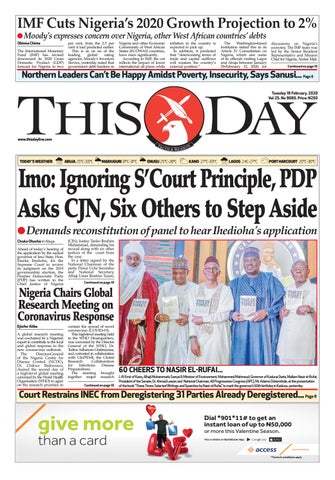
IMF Cuts Nigeria’s 2020 Growth Projection to 2% Moody’s expresses concern over Nigeria, other West African countries’ debts Obinna Chima The International Monetary Fund (IMF) has revised downward its 2020 Gross Domestic Product (GDP) forecast for Nigeria to two
per cent, from the 2.5 per cent it had predicted earlier. This is as on ne of the leading global rating agencies, Moody's Investors Service, yesterday noted that government debt burdens in
Nigeria and other Economic Community of West African States (ECOWAS) countries, have risen significantly. According to IMF, the cut reflects the impact of lower international oil prices while
inflation in the country is expected to pick up. In addition, it predicted that “deteriorating terms of trade and capital outflows will weaken the country’s external position.�
The Washington-based institution stated this in its Article IV Consultation on Nigeria, which saw some of its officials visiting Lagos and Abuja between January 29-February 12, 2020, for
discussions on Nigeria’s economy. The IMF team was led by the Senior Resident Representative and Mission Chief for Nigeria, Amine Mati. Continued on page 10
Northern Leaders Can’t Be Happy Amidst Poverty, Insecurity, Says Sanusi...
Page 6
Tuesday 18 February, 2020 Vol 25. No 9080. Price: N250
www.thisdaylive.com TR
TODAY'S WEATHER
ABUJA 25°C-33°C
MAIDUGURI 31°C-31°C
UT H
& RE A S O
ENUGU 25°C-28°C
N
KANO 27°C-33°C
LAGOS 24C-27°C
PORT HARCOURT 20°C-30°C
Imo: Ignoring S’Court Principle, PDP Asks CJN, Six Others to Step Aside Demands reconstitution of panel to hear Ihedioha's application Chuks Okocha in Abuja Ahead of today’s hearing of the application by the sacked governor of Imo State, Hon. Emeka Ihedioha, for the Supreme Court to review its judgment on the 2019 governorship election, the Peoples Democratic Party (PDP) has written to the Chief Justice of Nigeria
(CJN), Justice Tanko Ibrahim Muhammad, demanding his recusal along with six other justices of the court from the case. In a letter signed by the National Chairman of the party, Prince Uche Secondus and National Secretary, Alhaji Umar Ibrahim Tsauri, Continued on page 10
Nigeria Chairs Global Research Meeting on Coronavirus Response Ejiofor Alike A global research meeting was co-chaired by a Nigerian expert to contribute to the local and global response to the new coronavirus outbreak. The Director-General of the Nigeria Centre for Disease Control (NCDC), Dr. Chikwe Ihekweazu, chaired the second day of a high-level global meeting convened by the World Health Organisation (WHO) to agree on the research priorities to
contain the spread of novel coronavirus (COVID-19). This high-level meeting held in the WHO Headquarters, was convened by the Director General of the WHO, Dr. Tedros Adhanom Ghebreyesus, and co-hosted in collaboration with GloPID-R, the Global Research Collaboration for Infectious Disease Preparedness. The meeting brought together major research Continued on page 10
60 CHEERS TO NASIR EL-RUFAI... L-R: Emir of Kano, Alhaji Muhammadu Sanusi II; Minister of Environment, Mohammed Mahmoud; Governor of Kaduna State, Mallam Nasir el-Rufai; President of the Senate, Dr. Ahmad Lawan; and National Chairman, All Progressives Congress (APC), Mr. Adams Oshiomhole, at the presentation of the book “These Times: Selected Writings and Speeches by Nasir el-Rufai,� to mark the governor’s 60th birthday in Kaduna...yesterday
Court Restrains INEC from Deregistering 31 Parties Already Deregistered... Page 8
JLYH PRUH WKDQ D FDUG
'LDO WR JHW DQ LQVWDQW ORDQ RI XS WR 1 RU PRUH WKLV 9DOHQWLQH 6HDVRQ $OVR DYDLODEOH RQ 4XLFNEXFNV $SS
7HUPV FRQGLWLRQV DSSO\
2
TUESDAY FEBRUARY 18, 2020 •T H I S D AY
TUESDAY FEBRUARY 18, 2020 • T H I S D AY
3
4
TUESDAY FEBRUARY 18, 2020 •T H I S D AY
TUESDAY FEBRUARY 18, 2020 • T H I S D AY
5
6
TUESDAY, ˜ ͺͺ ˾ T H I S D AY
NEWS
Group News Editor Ejiofor Alike Email Ejiofor.Alike@thisdaylive.com, 08066066268
Northern Leaders Can’t Be Happy Amidst Poverty, Insecurity, Says Sanusi
John Shiklam in Kaduna and Michael Olugbode in Maiduguri The Emir of Kano, Alhaji Muhammadu Sanusi II, yesterday expressed concern about the rising waves of poverty, insecurity and illiteracy in the North. The emir, at the 60th birthday celebration of the Kaduna State Governor, Mallam Nasir el-Rufai, in Kaduna, said no Northern leaders could afford to be happy in the midst of the socio-economic problems facing the region. He spoke just as the humanitarian crisis occasioned by the insurgency in the Northeast has forced some 1,000 residents of Kayamla in Borno State out of their homes to be sleeping on Maiduguri streets for fear of being attacked by Boko Haram. Moved by their plight, the Borno State Government yesterday resettled the internally displaced people, who were rejected at IDP camps, to temporary accommodation. Sanusi warned that the region cannot continue to rely on quota
system and federal character to get jobs for its children at the expense of the other parts of the country, which are busy turning out graduates. He said the region would destroy itself if it did not change its current status and address the challenges of poverty, millions of out-of-school children, malnutrition, drug problem and Boko Haram insurgency. “When we talk about birthday, we talk about happiness. Just last week, someone asked me, ‘are you happy?’ “And I said, ‘I am not’. And the person was surprised. Nobody who is a leader in Northern Nigeria today can afford to be happy. You cannot be happy about 87 per cent of poverty in Nigeria being in the north. “You can't be happy with millions of Northern children out of school. You can't be happy with nine states in the North contributing almost 50 per cent of the entire malnutrition burden in the country. “You can't be happy with the drug problem, you can't be
South-west States to Hold Public Hearings on Amotekun Bill
Barring any unforeseen circumstances, the Houses of Assembly in the six states of the South-west will hold separate public hearings on a bill for the establishment of a joint security outfit for the region, Operation Amotekun. The public hearings, it was gathered, was fixed for February 24 at a meeting of the Speakers of the Houses of Assembly of the six states. According to an advertorial signed by the Chairman of the Conference of Speakers of South-West State Legislatures, Hon. Bamidele Oleyelogun, said, “After an exhaustive deliberation, the conference resolved that, as a matter of urgency, all the State Houses of Assembly should commence action on the process of passage of the (Amotekun) bill into law. “The conference, also in this regard, mandated all the State Houses of Assembly to simultaneously hold public hearings on the bill in their respective states on Monday, 24th February 2020. “The Conference of Speakers of South-West Legislatures urges all the people of the South-West to attend and make meaningful contributions to the bill that regulates the protection of lives and property in our states.” The advertorial added that after the public hearings, the six speakers would reconvene and meet with Attorneys General from the states “to address all conflicting areas and to review the contents
of the reports generated at the public hearing for harmonisation into the proposed law”. While the conference of the South-West speakers said a public hearing on the proposed law would hold on Monday, the status of the bill differed in the six South-West states. The Ekiti State House of Assembly had passed the bill on Friday, while the Osun State House of Assembly yesterday commenced work on the Amotekun bill. The lawmakers later received the bill from Governor Adegboyega Oyetola and it scaled the first reading. Also, the Ondo State House of Assembly said yesterday that it was ready to start legislative process on the passing of the bill known as the Ondo State Security Bill. The lawmakers had last Wednesday received the bill from the State Executive Council. However, the lawmakers are currently on recess but the Director of Information Service of the Assembly, Mr. Sehinde Falokun, has hinted that the lawmakers would cut short their holiday and reconvene today (Tuesday) to work on the bill. While the Oyo State House of Assembly will hold public hearing tomorrow, the Ogun State House of Assembly has fixed today (Tuesday) for the commencement of the hearing of the bill. The Lagos State House of Assembly is on recess and would resume in March.
happy with the Boko Haram problem. You can't be happy with political thuggery. You can't be happy with all the issues; the Almajiri problem that we have. “So, we wish Nasir a happy birthday, but we do not want him to be happy as a leader because you are happy when you think you have reached a state of delivering and taking your people to where you want
them to be.” The emir said because of the condition of the North, “it is almost correct now to say that if you are seen as normal; if you are a governor in the North or a leader in the North, and you are seen as normal in the sense that you continue to do what your predecessors have been doing; doing the same thing, which has been normalised, then, there is something wrong
with you. You are part of the problem.” According to him, “the real change in the North will come from those who are considered mad people because you look around and say if this is the way we have been doing things, and this is where we have ended up, maybe we need to do things differently.” He said if the government had been populated with
middle-aged men, there was need to try younger people and try women. “If we have spent our money and time on physical structures, may be we need to invest more in education of our children. “May be we need to invest more in nutrition. May be we need to invest more in primary healthcare” he stated. Continued on page 37
BRAINSTORMING ON IMPROVING NATIONAL FINANCES... L-R: Deputy Governor of Jigawa State, Alhaji Umar Nnamadi; Lagos State Deputy Governor, Dr. Obafemi Hamzat; Permanent Secretary, Federal Ministry of Finance, Dr. Mahmoud Isa-Dutse and Lagos Commissioner for Finance, Dr. Rabiu Olowo, during the Federal Account Allocation Committee (FAAC) retreat, in Lagos...yesterday
Presidency: Buhari Not Travelling to UK, Saudi Arabia, Austria Says president didn’t accuse Borno residents of colluding with Boko Haram
Omololu Ogunmade in Abuja The presidency yesterday asked Nigerians to ignore "fake news" circulating on the social media that President Muhammadu Buhari had concluded plans to embark on foreign trips to the United Kingdom, Saudi Arabia and Austria respectively. It also denied reports that Buhari accused residents of Borno State of colluding with Boko Haram. The Special Adviser to the President on Media and Publicity, Mr. Femi Adesina, in a statement, described the claim as fake news and concocted information. He said the purveyors of the fake news claimed that Buhari would first travel to the UK for 20 days after which he would proceed to Saudi Arabia and later to Austria. Adesina who advised Nigerians to desist from further sharing the false information on social media, said members of the president's family, ministers, the military and some government officials had also been victims of the alleged falsehood. The statement read: "Purveyors of fake and concocted information are currently on overdrive, and Nigerians are urged to be
careful what they consume as news, and also share with others, particularly from the social media. "An unfounded information has been making the rounds that President Muhammadu Buhari is billed to travel to the United Kingdom for 20 days and from there proceed to Saudi Arabia and then Austria. “Fake. It is nothing but falsehood from mischievous minds. "Members of the first family, ministers, top government officials, the military, and other key institutions, are equally objects of this orchestrated falsehood, coming from enemies of national cohesion. "We urge Nigerians to be discriminatory about what they accept as credible information and restrain themselves from sharing what they have not authenticated as genuine. That is how we can all collectively beat the malevolent minds at their pernicious games." Buhari last week returned to the country from a trip to Ethiopia where he attended the African Union (AU) summit and flew directly to Maiduguri, the capital of Borno State, on a condolence visit over the recent killings in the state. About 30 travellers were killed in attacks on Auno, a location just 25 kilometres to
Maiduguri, last week. Buhari had last month returned to Nigeria from the UK-Africa Investment Summit 2020, which held in London from January 17. During the trip, the president met with British Prime Minister, Mr. Boris Johnson, and briefed him about developments in Nigeria. He told Johnson about the efforts of his administration in the agricultural sector, saying it has led almost to self-sufficiency in rice and other grains production. According to him, Nigeria has saved billions of naira in foreign exchange and the efforts are now deployed in other areas of development. On the war against insurgency, Buhari had said things were a lot better, stressing that the Nigerian government is making efforts to disabuse the minds of the people on the true philosophy of Boko Haram. Meanwhile, the Presidency has also denied that the president accused residents of Borno State of colluding with Boko Haram. Presidential spokesman, Mallam Garuba Shehu, said this yesterday on NTA’s ‘Good Morning Nigeria’ programme. Buhari had at a sympathy
visit to Maiduguri last week stated, “Boko Haram or whatever they are cannot come to Maiduguri or its environs without the local leadership knowing, the local leadership is in charge of security in their own respective areas. But Shehu said the president’s words were misrepresented, adding that he also received a backlash on the social media because of the comment. The president’s spokesman said: “I am happy that Isa (Gusau) raised the issue. When the president left Maiduguri, he stressed the need for more intelligence and more support for security and we received a backlash on the social media that the president had raised questions about the commitment of the people of Borno in the war against insurgency. “Never would the president have said such a thing. But as I just said, quality intelligence is a condition sine qua non for the success of any war.” The Special Adviser to the Borno State Governor on Public Relations and Strategy, Mr. Isa Gusau, who was also on the same programme with Shehu, faulted the allegations by the president that Boko Haram was succeeding due to the collaboration of residents.
TUESDAY FEBRUARY 18, 2020 • T H I S D AY
7
8
TUESDAY, ˜ ͺͺ ˾ T H I S D AY
NEWS
Court Restrains INEC from Deregistering 31 Parties Already Deregistered Chuks Okocha and Alex Enumah in Abuja Justice Anwuli Chikere of the Federal High Court in Abuja yesterday restrained the Independent National Electoral Commission (INEC) from carrying out its planned de-registration of 31 political parties, pending the hearing of a suit challenging the powers of INEC to delist them. The restraining order came 11 days after the commission had deregistered 74 political parties with 31 of them seeking a judicial review of INEC's decision. But in a swift reaction, the electoral body faulted the ruling, stating that a court cannot restrain it for an event that has already taken place. Justice Chikere gave the order in a ruling on an interlocutory injunction brought against the Attorney-General of the Federation and Minister of Justice and INEC by the 31 political parties. Justice Chikere adjourned till February 27 for hearing in the substantive suit. The court had on January 23 fixed ruling for yesterday after counsel to the plaintiffs, Mr. Kehinde Edun, had moved and argued the interlocutory motion. The plaintiffs, Advanced Congress of Democrats (ACD), Advanced Nigerian Democratic Party (ANDP), All Blending Party (ABP) and 28 others had in March last year sued the AGF and INEC at the Federal High Court over the planned de-registeration of political parties. Justice Chikere in the ruling held that the plaintiffs have legal rights, which must be protected and consequently ordered the defendants to maintain status quo pending the hearing and determination of the main suit. In the main suit with number: FHC/ABJ/CS/444/2019, the plaintiffs asked the court to determine whether the provisions of sections 225A b(I) , b(ii), c(I), c(ii) c(iii) of the 1999
Constitution, introduced by the 4th Alteration Act number 9 of 2017, are to be construed disjunctively/alternatively or whether they are to be construed conjunctively. "Whether the 2nd defendant can exercise any power under section 225A (b) and (c) of the 1999 Constitution without conclusive and democratic elections be first heard and concluded into all electoral constituencies of the federation. "Whether having regards to the lack of authority by the second defendant to conduct and determine the winners for chairmanship and councillorship elections into local government and wards in the federation the second defendant should be allowed to exercise power to de-register political parties for failure to win election into such seats" and others. The plaintiffs said if the above questions are in the affirmative, the court should declare that the provisions of sections 225A b(I) , b(ii), c(I), c(ii) c(iii) of the 1999 Constitution, introduced by the 4th Alteration Act number 9 of 2017, are intended to be construed dis-junctively. "A declaration that the power conferred on the second defendant by section 225A (b) and (c) of the 1999 Constitution to de-register political parties could not have been intended to have any retroactive effect and as such election into all electoral constituencies must first be held before the power of the second defendant under this can accrue," they averred. They, therefore, prayed the court for an order of injunction restraining the second defendant from exercising the powers conferred on it by section 225A (1)) and (c) of the Constitution of the Federal Republic of Nigeria, 1999 until conclusive and democratic elections are held into the presidency, all governorship, National Assembly, State Assembly, local government chairmanship and councillorship positions in the federation, which elections must have been held after this
Lawyer Slams N100m Suit against Obaseki, IG for Banning Political Rallies Akinwale Akintunde A legal practitioner, Emankhu Isibor Addah, has dragged the Edo State Governor, Godwin Obaseki and the Inspector General of Police, Mohammed Adamu to court for what he described as “illegal order” made by the governor, banning all forms of political rallies in Edo State. In the suit marked FHC/ ABJ/CS/133/2020 filed before the Federal High Court in Abuja Addah is challenging Obaseki’s ban on rallies. The governor, who is the 1st respondent in the suit, had on December 13 through the Secretary to the State Government, announced publicly the total and complete ban on all political rallies, demonstrations and or procession in any part of
Edo State. The applicant, who is also a politician in the state, is asking the court to declare that the statement or declaration by Obaseki that it has placed a total and complete ban on all political rallies, demonstration or procession in any part of Edo State, is unlawful and a violation of his fundamental rights as entrenched in Section 40 of the 1999 Constitution and Article 11 of the African Charter on Human and People’s Rights (Ratification and Enforcement) Act Cap A9 LFN 2204. Addah is also praying the court for a mandatory injunction against the respondents, its men and officers, agents jointly and severally, to immediately cease and stop giving effect to the enforcement of the said total and complete ban on all political rallies in any part of Edo State.
section was introduced. "An order of injunction restraining the second defendant from exercising its powers to de-register the plaintiffs or any political party for that matter as the second defendant does not have the powers to conduct elections into all the positions listed in section 225 A(b) and (c) of the 1999 constitution. "An order of injunction restraining the second defendant from deregistering the plaintiffs or any political party for that matter for failure to win seats or certain percentages of the vote cast at the 20I9 general election as these political parties could have won but for irregularities and cancellations perpetrated by persons who are not agents
of the political parties." The plaintiffs, however, on Friday brought an order of mandatory injunction for the court to compel INEC to restore the political parties to status quo, the motion was supported by an affidavit of urgency. Reacting to the judgment, IPAC President, Chief Peter Ameh, said from the order of the court, INEC had been restrained from deregistering the political parties. Ameh who addressed journalists shortly after the court pronouncement, also said that those who wanted to topple the leadership of IPAC on account of the INEC's party deregistration had failed. He said: "We believe in the spirit and letters of the law
and that was why we did not call our members out to protest. We went to court to defend our rights and to ensure that our children will not be afraid to join an association or political party because it will be deregistered the next day without recourse to provisions of the constitution of the land".
Court Can't Stop Event That Has Taken Place, Says INEC However, INEC has faulted the ruling, saying that a court cannot restrain an event that has already taken place The INEC’s Director in charge of Voter Education and Publicity, Mr. Oluwole Osaze Izzi, said a court could not
stop an event that had taken place. He added that no restraining order was granted, as only an accelerated hearing was granted . "Ordinarily, courts don't grant injunctions to stop an act which has already been done. We haven't seen the order. So, it is difficult for us to comment on it. Perhaps, the fact of deregistration wasn't brought to the court's attention. I am aware that this was mentioned in court today by the plaintiffs' lawyer but their application to restore the plaintiffs as registered political parties wasn't taken today. "This motion is still pending. The court has granted accelerated hearing of the case," Uzzi stated.
FOR BETTER POLITICS... L-R: Senior Project Manager, Robert Bosch Academy, Mr. Jannik Rust; Founder, Incubator Africa, Mrs. Alero Ayida-Otobo; former presidential candidate, Allied Congress Party of Nigeria (ACPN), Dr. Obiageli Ezekwesili and Founder, Centre for Values in Leadership (CVL), Prof. Pat Utomi, at the Fixpolitics conference in Lagos… yesterday etop ukutt
FG Identifies 45 Sites for Gas Flare Commercialisation Programme Peter Uzoho The federal government has identified 45 out of 178 gas flaring sites in the country, which will be awarded to successful bidders for the commencement of the first phase of the National Gas Flare Commercialisation Programme (NGFCP). However, some of the bidders have expressed reservations over alleged anomalies in the programme's bidding process. The Director of the Department of Petroleum Resources (DPR), Mr. Sarki Auwalu, gave details of the programme yesterday at a bidders' conference in Lagos. The programme was launched in December 2016 by the then Minister of State for Petroleum Resources, Dr. Ibe Kachikwu, to offer gas for sale by the federal government through a transparent and competitive bidding process, with a structure devised to provide project bankability for the flare gas buyers. Speaking to journalists on the sidelines of the bidders' conference, Auwalu said the 200 bidders would be competing among themselves over the 45
flare points. "There are 200 bidders that have been shortlisted. Over 800 bid and we looked at the capacity, the quantity, the quality of what they have. So, these 200 bidders are competing for about 45 flare sites for now and there are other flare sites, which are coming on board. And this is to show that investors are interested in Nigeria because of the potential," he said. He said the process for the emergence of the preferred bidders was ongoing, adding that it would take them 60 days to evaluate proposals of the bidders based on certain criteria. "The process is on. When the preferred bidders submit, it will take us 60 days to evaluate and this evaluation will take the process of making sure that all the bidders have submitted their bonds and given their Milestone Development Agreement. "Milestone Development Agreement is key. If you bid and you win, you have to tell us when you are going to deliver the project and you have to bond it. So we are trying to make sure that what we are doing is reality," he stated. Auwalu, however, described the programme as the first of
its kind in the world, saying that it is going to be beneficial to Nigerians and profitable to the investors in the project. He added: "This gas resource as we mentioned, we have over 200 trillion standard cubic feet that is already discovered and we produce 800 billion daily and we utilise some percentage of it, export some percentage and we flare 11 per cent of it. "We are taking back that 11 per cent that is flared. It is part of Nigeria's commitment to the Climate Change Agreement that we signed in Paris in 2015." Meanwhile, during a special session at the conference, some of the bidders bemoaned what they perceived as lack of fairness and transparency in the bidding process. One of the bidders and the Director of ONEL Oil Exploration and Production Limited, Mr. Onwusameka Ogbowuokara, decried DPR's emphasis on making profit from the project through excessive charges on the bidders. Ogbowuokara who described the process as a scam, however, wondered why some companies were exempted from the bidding process and were
given flare sites. He said: "And if you are concerned about our environment, why do you lay too much emphasis on making profit? Now you have just released a few flare points and many of them are zero. Are we not ashamed as Nigerians that this big project could attract this kind of shame? Zero on the platform and we have foreigners who are looking at us. Are we not ashamed? And you called us here today again. "You dedicated a platform for this project, how well does it work? You go to the platform, you post question because you are in need of an answer and nobody answers you. I called somebody in DPR, maybe the person is here today, I said, why is it so? He said 'there is somebody that is responsible for that thing'. "We had already taken a stand to sue all of you but our consultant said, 'no, don't do that.' What we want you to do now is to go back to your offices; look at yourselves, look at your children. What legacy are you going to leave for your children? Not just for us. This thing is a scam," he explained.
TUESDAY FEBRUARY 18, 2020 • T H I S D AY
9
10
TUESDAY, ˜ ͺͺ ˾ T H I S D AY
PAGE TEN NIGERIA CHAIRS GLOBAL RESEARCH MEETING ON CORONAVIRUS RESPONSE funders and over 300 scientists and researchers from a large variety of disciplines. At the meeting, the experts concluded that much was still not known about this disease and how to control it. “Gaps and priorities were discussed and agreed, including in areas such as how best to diagnose the disease, the development of new treatment, ethical implications of the research, regulations, the role of epidemiology and social sciences and ultimately how to develop a vaccine to prevent the disease. “Particular emphasis was placed on the need for any new technologies or
approaches to be available to low- and middle- income countries such as Nigeria, who have the least capacity and resources to respond to a pandemic.” The experts also outlined mechanisms for continuing scientific interactions and collaborations beyond the meeting, which will be coordinated and facilitated by WHO. They worked with research funders to determine how necessary resources can be mobilised so that critical research can start immediately. The deliberations will form the basis of a research and innovation roadmap
charting all the research needed and this will be used by researchers and funders to accelerate the research response. The meeting resolved that research to contain an epidemic requires the collaboration of basic and social scientists from different fields, affected communities and support and coordination by governments and international organisations. It was also noted that Nigeria, the most populous nation in Africa, has an important role to play in all aspects of the response and the research needed. This will place the nation
well in terms of coping with any emerging threat as well as supporting the country’s neighbours. WHO Director-General, Dr. Tedros Adhanom Ghebreyesus, said: “This outbreak is a test of solidarity -- political, financial and scientific. We need to come together to fight a common enemy that does not respect borders, ensure that we have the resources necessary to bring this outbreak to an end and bring our best science to the forefront to find shared answers to shared problems. Research is an integral part of the outbreak response.” “I appreciate the positive
response of the research community to join us at short notice and come up with concrete plans and commitment to work together.” This week also saw the first case of the dreaded Corona virus disease diagnosed in Egypt. The new coronavirus disease, which emerged in Wuhan China and is spreading globally, is fortunately less fatal than SARS but seems to be more easily transmitted. Nigeria’s response, led by the Federal Ministry of Health and NCDC, has built on earlier work such as the Field Epidemiology Training
Programme, improvements in surveillance using a new national system (SORMAS) and the successful response to the West African Ebola outbreak. The devastating impact of previous pandemics on lives and the economy of countries has highlighted the need for better preparedness. While there is still yet to be a single case of COVID-19 in Nigeria, the leadership demonstrated to date by the health ministry and NCDC is the direction needed to prepare for future health epidemics and needs replicating across the health sector.
recuse themselves, we have now sought to formalise that request or demand. “We hereby request that the seven persons that heard the case earlier should recuse themselves from participating in the consideration of this new application. We are not unmindful of the fact that a litigant cannot dictate to the court the panel that should hear its case. However, due to the extraordinary circumstances and the nature of this case, we think that our request is a fair one that meets the justice of the case. "Consequently, we feel it as our patriotic duty to hereby humbly request that your Lordship constitute a different panel of this great Court (other than the one that delivered the judgment) for the purpose of hearing this application. “If a judge had handled a kindred suit, a related suit earlier, the law recognises that he may not hear a case
arising from the earlier one, as the likelihood of bias will be high,” PDP stated. The party cited the case of Dr. Nnamdi Eriobuna Vs. Ikechukwu Obiorah, where the late Justice Niki Tobi, JCA, as he then was, said: “Etymologically, bias means slant, personal inclination or preference; a one-sided inclination. It also means a pre-conceived opinion, a pre-disposition to decide a cause or an issue in a certain way, which does not leave the mind perfectly open to conviction. Bias creates a condition of mind which sways judgment and renders a judge unable to exercise his functions impartially in a particular case. There is another expression and it is likelihood of bias. “When a party in an action contends that there is likelihood of bias, he is anticipating that the judge will be biased in the judicial
process. The act of bias is not formalised. The act of bias is not concretised, but by the generality of the conduct of the judge, the possibility of bias is overt. And the possibility is substantial. ….. The law recognises quite a number of causes of bias. I should confine myself to only one and that is the one relevant to this appeal. It is fore-knowledge or previous knowledge of the case. This arises when the judge at one time or the other, had done something in the matter to the extent that he cannot be said to be a completely neutral person or stranger to it.” PDP told the CJN that Section 36(1) of the Constitution of the Federal Republic of Nigeria, guarantees fair hearing to every citizen or entity in the determination of his rights or obligation and guarantees an independent and impartial body for such determination.
and development partners. The team wishes to thank the authorities and all those it met for the productive discussions, excellent cooperation, and warm hospitality,” the statement added. Mati, stated that the pace of economic recovery in the country remains slow, as declining real income and weak investment continued to weigh on economic activity. He said inflation, driven by higher food prices, has risen, marking the end of the disinflationary trend seen in 2019.
The report explained that risks to debt sustainability included adverse debt dynamics, weak financeability and debt management capacity. “These factors are particularly present in Togo (B3 stable), and to some extent, Ghana (B3 positive) and Nigeria (B2 negative). “For some sovereigns in the region, improved institutional strength and shock-absorption capacity bolster their ability to sustain higher debt burdens compared with 10 years ago. “For instance, the positive outlook on Ghana's rating reflects our view that institutional improvements will help the government manage potential shocks and avoid a sharp and selffulfilling increase in debt,” it added. According to the report, although Nigeria's debt levels is still low, debt dynamics in the country is becoming adverse and “fiscal metrics are deteriorating while debt management capacity remains weak.” “Others, including Mali (B3 stable) and Niger (B3 stable) have more sustainable debt burdens under Moody's central scenarios but they remain vulnerable to shocks that could materially increase their debt burdens and undermine their debt sustainability. “More highly rated Senegal (Ba3 stable) and Côte d'Ivoire (Ba3 stable) have the highest external debt owed to private creditors as a share of GDP, but have the best financial management capacity,” it
added. Nigeria’s total public debt, comprising the Federal Government of Nigeria (FGN), the 36 states and Federal Capital Territory (FCT) stood at N26.215 trillion as at September 2019, according to data from the Debt Management Office (DMO). This indicated a two per cent growth when compared with the N25.701 trillion recorded as at June 30, 2019. The DMO Director General, Ms. Patience Oniha, had said the total debt stock implied that in the quarter July to September 2019, a two per cent growth was recorded, adding that the debt included promissory notes of N821.651 billion, which had been issued to settle the FGN’s arrears to oil marketers and state governments under the promissory programme, approved by the Federal Executive Council and the National Assembly. The country’s debt profile is expected to rise further in the coming days as the federal government plans to appoint transaction advisers for a potential $3.3 billion Eurobond issue through an open competitive bid process. The new Eurobond, the first after the 2018 issuance, would be used to partly fund the 2020 budget deficit and refinance an existing $500 million Eurobond due in January next year. Already, the request for its approval has been sent to the National Assembly and the process is expected to be completed this quarter.
IMO: IGNORING S’COURT PRINCIPLE, PDP ASKS CJN, SIX OTHERS TO STEP ASIDE the main opposition party demanded that a new panel be set up to hear Ihedioha’s application. Should the CJN agree to the request, the Supreme Court, which presently has only 13 justices, will be short of personnel to hear the case. Going by the principle of the Supreme Court, reconstituting the panel will require seven justices of the apex court to hear the case; one justice short of the six that would be left after seven of their colleagues might have recused themselves from the case as being demanded by the PDP. In the letter dated February 14, 2020, the party said it feared “likelihood of bias” and “denial of right to fair hearing.” The other justices the party asked to recuse themselves along with Justice Muhammad are: Justice Nwah Sylvester Ngwuta, Justice Olukayode Ariwola,
Justice Kudirat Kekere-Ekun, Justice Amina Adamu Augie and Justice Uwani Musa Abba Aji. The party said the seven justices, including the CJN, should recuse themselves from participating in hearing the application for setting aside their earlier judgment in the above case, on grounds of likelihood of bias. PDP added that there are judicial precedents obtained in other climes and Nigeria to back up its demands. "Further note that there are judicial precedents in Nigeria, Great Britain and United States of America in support of our request for the reconstitution of a different panel to handle the current application before the court," the party said. The Supreme Court, in a unanimous judgment read by Justice Kekere-Ekun on January 14, 2020, had sacked Ihedioha as the governor of Imo State and directed
the Independent National Electoral Commission (INEC) to issue a certificate of return to Senator Hope Uzodinma, candidate of the All Progressives Congress (APC) to replace the PDP candidate. PDP said it had become imperative that the CJN and the other justices who served in the panel that sacked Ihedioha be replaced to ensure that fairness and justice were not only done, but seen to have been done. “They should recuse themselves from participating in hearing the application for setting aside their earlier judgment in the above case on grounds of likelihood of bias, that is, fair hearing,” the party said. According to the PDP, which had earlier asked the seven justices to recuse themselves at a press conference, "as a follow-up to our earlier call on all members of the panel to
IMF CUTS NIGERIA’S 2020 GROWTH PROJECTION TO 2% The statement signed by Mati, at the end of the visit, was posted yesterday on the fund’s website. Mati said external vulnerabilities in the country were increasing, reflecting a higher current account deficit and declining reserves that remain highly vulnerable to capital flow reversals. The exchange rate has remained stable, helped by steady sales of foreign exchange in various windows. “High fiscal deficits are complicating monetary policy. Weak non-oil revenue mobilisation led to further deterioration of the fiscal deficit, which was mostly financed by CBN overdrafts. The interest payments to revenue ratio remains high at about 60 per cent. “Under current policies, the outlook is challenging. The mission’s growth forecast for 2020 was revised down to two per cent to reflect the impact of lower international oil prices. Inflation is expected to pick up, while deteriorating terms of trade and capital outflows will weaken the country’s external position,” he said. However, Mati noted that policymakers in the country have recognised the vulnerabilities, which led to a number of initiatives that had been introduced. “The authorities have taken a number of welcome steps. These include measures to boost revenue through the adoption of the Finance Bill and Deep Offshore Basin Act and improve budget execution
by adopting the 2020 budget by end-December 2019. “The tightening of monetary policy in January 2020 through higher cash reserve requirements to respond to looming inflationary pressures is welcome. Progress on structural reforms—particularly in Doing Business, finalising power sector reforms and strengthening governance—is commendable. “Major policy adjustments remain necessary to contain short-term vulnerabilities, build resilience, and unlock growth potential. “Non-oil revenue mobilisation—including through tax policy and administration improvements—remains urgent to ensure financing constraints are contained and the interest payments to revenue ratio sustainable. “Recourse to central bank overdrafts should be limited and the mission supports the authorities’ plans to use the low domestic yield environment to front load their financing requirements,” it stated. He stressed the need for further tightening of monetary policy by the Central Bank of Nigeria (CBN), “albeit through more conventional methods.” This, the multilateral institution said, was needed to contain domestic and external pressures arising from large amounts of maturing CBN bills. As part of its restrictive monetary policy stance, the CBN Monetary Policy Committee (MPC) at the
end of its last meeting had raised the Cash Reserve Ratio (CRR) from 22.5 per cent to 27.5 per cent. Mati, however, reiterated the advice on ending direct central bank interventions, securitising overdrafts to introduce longerterm government instruments to mop up excess liquidity and moving towards a more flexible exchange rate. “Banking system vulnerabilities should continue to be addressed. The mission welcomed recent efforts to reduce legacy non-performing loans. The introduction of risk-based minimum capital requirements would also help strengthen bank resilience,” he stated. The IMF officials also noted that structural reforms, particularly executing the much-delayed power sector recovery plan, implementing the anti-corruption and financial inclusion strategy, as well as addressing infrastructure and gender gaps, are essential to boost inclusive growth in the country. “Nigeria’s border closure will continue to have significant economic consequences on the country’s neighbours. It is important that all involved parties quickly resolve the issues keeping the borders closed—including to stop the smuggling of banned products. “The team held productive discussions with senior government and central bank officials. It also met with representatives of the banking system, the private sector, civil society organisations
Moody’s Expresses Concern over Nigeria, Other West African Countries’ Debts Meanwhile, one of the leading global rating agencies, Moody's Investors Service, has noted that government debt burdens in Nigeria and other Economic Community of West African States(ECOWAS) countries, have risen significantly. The development, according to the agency, has offset much of the debt relief from the early 2000s and raising concerns over debt sustainability. "Debt burdens in the ECOWAS are now almost double what they were in 2010 and are unlikely to fall, raising concerns about debt sustainability, with potentially significant economic and social costs," a Moody's Vice President - Senior Credit Officer, Lucie Villa, stated in a report she co-authored.
TUESDAY FEBRUARY 18, 2020 • T H I S D AY
11
12
TUESDAY FEBRUARY 18, 2020 ˾ T H I S D AY
NEWS
Coronavirus: Nigeria Faces Drug Insecurity, Says NAFDAC ECOWAS requires $50m to battle epidemic Onyebuchi Ezigbo in Abuja The National Agency for Food and Drug Administration and Control (NAFDAC) has warned that the current outbreak of the deadly coronavirus, officially named COVID-19, in China, puts the country in grave danger of drug insecurity, as most of the country’s medicines are imported. This is coming as the West African Health Organisation (WAHO) yesterday said that about $50 million is required by West African countries to tackle Coronavirus. The Director General of NAFDAC, Prof. Mojisola Adeyeye, stated this in a press conference yesterday in Abuja. The NAFDAC boss who was speaking on the upcoming African Medicine Quality Forum (AMQF) meeting to hold from
February 24-28, explained that Nigeria imports 70 per cent of its medicines and other active and non-active ingredients. According to her, “70 per cent of our drugs are imported and the alarm I am sounding now is one everybody should take seriously. We have drug insecurity because of the coronavirus. “India is already feeling it because they buy most of their materials and active ingredients from China. If India is feeling it, we should start praying because we don’t manufacture anything here except water; we import almost everything – active and non-active ingredients, equipment. “So, it is a scary thing, and I have been emphasising this from day one. We need drug security. Since we import 70 per cent of our drugs, then, we are in trouble if such things happen”.
The NAFDAC boss also urged people to desist from cooking their foods with paracetamol, especially the use of the drug to soften meats. “When paracetamol is subjected to heat while cooking with it, it changes to para-aminophenol and benzoquine, which destroys the kidneys. We have done a lot of enlightenment because the major problem of our people is ignorance and illiteracy”. Meanwhile, WAHO yesterday said that about $50 million is required by West African countries to tackle Coronavirus. It said that amount will be used to create an ecosystem and put in place, critical personal
protection equipment, laboratory supplies,communication and coordination strategies towards Coronavirus response. The Director General of WAHO, Prof. Stanley Okolo who spoke at a press briefing by WAHO yesterday in Abuja, said that only about 18 countries in Africa including Nigeria have the laboratory capacity to test for the virus. Okolo said that ministers of health of ECOWAS had at the emergency meeting on February 14, 2020 agreed to come up with a regional plan and strategy for coronavirus. He said the meeting agreed that all the member states will support the plan to the best of their capacity.
Also speaking at the event, the Minister of State for Health, Dr. Olorunmibe Mamora said that the federal government is monitoring the health of Nigerian citizens in China through the Nigerian Ambassador and will not hesitate to evacuate them if the need arises. He said, “We are in touch with our Ambassador in China and the Chinese Ambassador to Nigeria is also in touch with the ministry, and we are getting information on the condition of Nigerians in Wuhan and we are monitoring the health of our citizens. If and when the need arises to evacuate them, we will do so but we don’t want a
situation we create panic. This is not time for fear; this is not time for stimatisation; it is time for science. Chinese government is testing everyone that is trying to leave China to ensure that they don’t go and spread the virus”. Mamora who noted that Nigeria has a plan as part as its preparedness, said there may be need for Nigeria to assist some of her sister countries in ECOWAS. He observed that though there are insinuations that Coronavirus may not survive in a very hot environment, government will not relax but rather will intensify its preparedness and response efforts to ensure that Nigerians are safe.
Magu Begs UK to Extradite Alison-Madueke The acting Chairman of the Economic and Financial Crimes Commission (EFCC), Ibrahim Magu, has appealed to the Government of United Kingdom (UK) to extradite the former Minister of Petroleum Resources, Mrs. Diezani Alison-Madueke, to account for $2.5 billion allegedly missing in her ministry during the administration of former President Goodluck Jonathan. Magu, at media briefing in Kaduna yesterday, ahead of today’s passing out parade of EFCC trainees at the Nigerian Defence Academy (NDA), said personnel of the commission were trained to, “shoot and kill corruption in Nigeria; so, we cannot be challenged by any threat. Fielding questions from reporters, the EFCC boss said Alison-Madueke has stolen so much money that she needed to be extradited to the country
to return the money back to the federal government. According to him: “I was in London this year; we did investigation together with the UK team, and anywhere I go, I always call for extradition of corrupt Nigerians to return back the money. “This woman has stolen so much, not less than $2.5 billion, but unfortunately she has generation of looters who are supporting her. This is not good. “We are in touch with the international community, she is under protective custody, otherwise, we would have arrested her, return her to Nigeria”. He however, said corruption is surmountable, pointing out that in 2019, a total of 1,218 convictions were secured by the commission. The EFCC boss also added that in January this year, 28 convictions were made, involving billions of dollars and pound sterlings.
FIRS Begins Nationwide Sensitisation on Finance Act Ndubuisi Francis in Abuja The Executive Chairman, Federal Inland Revenue Service (FIRS), Mr. Muhammad Nami, has launched a nationwide tour to sensitise the people, especially taxpayers on the 2019 Finance Act. The first leg of the tour started yesterday in the South-west where he met with the Ogun State Governor, Mr. Dapo Abiodun, as well as FIRS officials from Ogun, Oyo and Osun states, in Abeokuta, the Ogun State capital. A statement issued by the FIRS’ Director, Communication, Mr. Abdullahi Ismaila Ahmad, said Nami is on the tour with a select group of top management staff as well as the member representing the South-west on the FIRS Board, Chief Wale Ogunyomade. In his address during the meeting with the governor, Nami solicited the support of the Ogun State government in realising the N8.5 trillion revenue target set for the agency by the federal government, stressing that
“this comes back to the states and local governments as monthly allocations, which states and local governments apply to provide public infrastructure in your respective territories.” Nami urged Abiodun to work closely with the FIRS to ensure a prompt collection and forwarding of withholding tax and Value Added Tax (VAT) on contracts, Company Income Tax as well as Stamp Duty, among others, stressing that the FIRS is now the sole government agency tasked with the collection of Stamp Duty on behalf of the federal government. Responding, the governor assured him that “Ogun State would be found a worthy partner of the FIRS in achieving the service’s revenue target.” He listed a series of reforms, which his administration has implemented towards making the state the investment destination of choice based on what he called the state’s “push factor” in relation to its proximity to Lagos State.
TACKLING HOUSING DEFICIT…
L-R: Managing Director, Perfect Estate Developers Limited, Mr. Dayo Babatunde; Minister of Works and Housing , Mr. Babatunde Raji Fashola; representative of the Minister of FCT, Mr. Tony Odigie; Chairman, Federal Mortgage Bank of Nigeria (FMBN), Dr. Adewale Adeeyo; and Managing Director / Chief Executive Officer, FMBN, Mr. Ahmed Musa Dangiwa, during the inauguration of Woodhill Estate under the FMBN Cooperative Housing Development, in Kuje Area Council, Abuja... yesterday. ENOCK REUBEN
Protesters Storm APC Secretariat, Demand Oshiomhole’s Sack Adedayo Akinwale in Abuja Protesters under the aegis of All Progressives Congress (APC) Young Stakeholders yesterday stormed the national secretariat of the party in Abuja demanding the sack of the National Chairman, Mr. Adams Oshiomhole. The call for his sack may not be unconnected with last week’s judgment of the Supreme Court, which sacked the APC candidate, who was the governor-elect, Mr. David Lyon. The apex court had sacked
Lyon on the grounds that his deputy, Senator Biobarakuma Degi-Eremienyo presented false information to INEC in aid of his qualification for the November 16 governorship election in Bayelsa State. However, the protesters who stormed the secretariat at about 11.00 a.m, were armed with various placards with inscriptions such as: “Oshiomhole Must Go,” “Oshiomhole go home,” “We are tired of losing,” among others. The protesters described Oshiomhole’s continued stay in
office as a curse, stressing that it would bring misfortune to the party, adding that his action has decimated the number of the states controlled by APC from 24 to 18 . While speaking on behalf of the protesters, Mr. Genesis Johnson, accused Oshiomole of impunity particularly over the nullification of the party’s victory in Bayelsa State by the Supreme court. He said that his impunity had caused the party a major lost in states like Zamfara. Johnson stated: “Look at what happen in Bayelsa State; it was
caused by Oshiomhole and we say ‘enough is enough’. We want him to park his load and leave that office. He is not the only Nigerian that can manage that office. “Since he came into this office, he has been creating problems for this party. We suffered to win election and at the end of the day, opposition will go to court and collect the state. We are not happy with his conduct and we are the party faithful; we ask him to go; we put him there. Bringing Oshiomole is like bringing curse to the party.”
ASUU Opposes New Law to Fight Sexual Harassment Deji Elumoye in Abuja Public university lecturers under the aegis of the Academic Staff Union of Nigerian Universities (ASUU) yesterday opposed the formulation of a new law to fight sexual harassment of female students in higher institutions. Rather, the body canvassed for the review of existing laws to adequately address the issue of sexual harassment in higher schools. National President of ASUU, Prof Biodun Ogunyemi, made the position of the lecturers known at a public hearing on
‘Sexual Harassment of Students in Tertiary Educational Institution Prohibition Bill’ sponsored by the Deputy Senate President, Senator Ovie Omo-Agege. Emphasising that ASUU was not in support of sexual harassment in any form, Ogunyemi stressed that if there was a law that addressed issues relating to sexual harassment, there was no need wasting time on another law. According to him, “Are there no laws that would address this same problem we are concerned about? I think the answer is yes. We have the Act of 2015.
“We should reconcile this bill with that Act to cover our new areas of concern. Are we also going to formulate a separate law to address corruption in universities; are we going to formulate other laws to address sexual harassment in the police force? “If we find any law deficient, what does it cost us to review it? This bill has failed to take cognisance of various extant legislations that currently deal with sexual offences. I see confusion between sexual harassment and abuse.” Ogunyemi said there was the need to review the existing laws
and recognise the autonomy of the universities. He added: “We have a law-the autonomy law of 2007-legislated by the National Assembly, which has already made provisions for us to address all of these. We talk of the institutional procedures-these procedures are irreconcilable with prosecution. “There are aspects that are criminal; immediately such instance happens, we know where to go. Universities are currently handling problems like this and we should not agree with you; we should not discredit our custodians of knowledge.”
TUESDAY FEBRUARY 18, 2020 • T H I S D AY
13
14
T H I S D AY Ëž Ëœ ÍŻÍśËœ 2020
COMMENT
Editor, Editorial Page PETER ISHAKA Email peter.ishaka@thisdaylive.com
SUPREME COURT JUDGMENTS ARE REVERSIBLE Chuks Iloegbunam challenges the decision of the apex court on the Imo governorship election
N
igerians must with one voice put this critical question to the seven-member Supreme Court panel of judges that sacked Governor Ihedioha of Imo State and planted Senator Hope Uzodinma as his replacement: Distinguished as you all are, would you have dared to pronounce this same perversity if other than the All Progressives Congress (APC) is currently in control of the Federal Government of Nigeria? The controversial Supreme Court verdict was read by Justice Kudirat Motonmori Olatokunbo Kekere-Ekun. Mrs. Kekere-Ekun was born in 1958. She earned her first Law degree from the University of Lagos, and the second from the London School of Economics and Political Science, not from backyard or quota colleges that routinely grant admissions to laggards confirmed incapable of passing basic School Certificate subjects like English and Mathematics. Called to the Bar in 1981, she was appointed to the Supreme Court 32 years later. Notable lawyers hailed her appointment to the apex court, two of whose informed opinions are here: “I have read a few of her judgments; she is very sound in law. In other words, she suppresses technicality and allows substance to prevail. She has that equitable spirit of trying to do justice,� said Professor Itse Sagay, SAN. Said Mr. Tani Molajo, SAN: “This jurist has risen quickly through our judicial system by sheer dint of diligence, scholarship and uprightness. I dare say that I speak the mind of the entire profession when I say that the transfer of all those virtues to our highest court in the person of Justice Kekere-Ekun is cause for celebration.� Equity. Diligence. Scholarship. Uprightness. These are some of the intensifiers used in support of Justice Kekere-Ekun’s suitability to sit in judgment over the affairs of her fellow human beings. But, if asked by her son or daughter, would she be able to pinpoint any of these wholesome qualities in the judgement she read, which bizarrely manufactured 103,257 votes in excess of the number of voters registered by the Independent National Electoral Commission (INEC) for last year’s Imo State governorship election? Critical point: None of the parties to the Election Petition disputed either of INEC’s total number of registered voters and total number of accredited voters for the governorship contest, from the Election Tribunal right up to the Supreme Court. The other honourable members of the Supreme Court panel that decided Imo governorship in Senator Uzodinma’s bewildering favour are: Chief Justice Ibrahim Tanko Mohammed (66 years), Justice Nwali Sylvester Ngwuta (68), Justice Olukayode Ariwoola (65), Justice Amiru Sanusi (70), Justice (Mrs.) Amina Adamu Augie (65), and Justice (Mrs.) Uwani Musa Abba Aji (62). That puts the average age of the distinguished justices at 64.8 years. What impact is the judgment of these highly respected jurists likely to have on Nigerians that are today only six years old, or four years old, or eight years old? Take the Honourable Justice Ngwuta who has been a Supreme Court Justice since 2011. He was, like a handful of other Justices of the apex court, arrested in October 2016, by operatives of the Department of State Services, on allegations of bribery and corruption. Arraigned in court on 13 counts of money laundering by the office of the Attorney General of the Federation, he was, like his peers, discharged and acquitted because lawyers successfully argued the incompetence of all the charges by standing on the key point that cases against superior court Judges – from the High Courts to the Supreme Court – should first be treated by the National Judiciary Council (NJC). How would Justice Ngwuta respond if a sister or brother of his asked why the Supreme Court validated election result disavowed by three legally constituted bodies – the INEC, the Election Tribunal and the Court of Appeal, but flagrantly submitted to it by a Police officer legally incompetent to do so? We are here talking of results
BY CHANGING THE TIME-HONOURED LEGAL PRINCIPLES AND ACCEPTING THE RESULTS FROM A POLICE OFFICER WHO WAS NOT AT THE 388 POLLING UNITS, THE SUPREME COURT MAY NOT APPRECIATE THE SERIOUS IMPLICATIONS OF THEIR DECISION
which, according to the processes filed by lawyers to Governor Ihedioha who is seeking a review of the Supreme Court judgment, were computed by Senator Uzodinma. “The fraudulent nature of the additional votes was demonstrated by the fact that the total votes cast as shown in the first appellant/respondent’s computation was more than the total number of voters accredited for the election‌,â€? argues Ihedioha. How would Justice Amina Augie react to the following distorted statistics from the Uzodinma results? One, Unit No. 69: The registered number of voters in this unit is 492. But APC “scoredâ€? 819 votes. That is an astonishing 334 votes over and above the number of those registered by INEC to vote in the unit! Two, Unit No. 285: The registered number of voters in this unit is 449. But APC “scoredâ€? 780 votes, which figure is 335 votes more than the number of voters registered by INEC to vote in that unit. How would Justice Uwani Musa Abba Aji explain the following incongruities? One, in the 388 units whose results were computed by Senator Uzodinma, he won an incredible 95 per cent of the votes. But, in contradistinction, he won a miserly 12 per cent of the votes cast in the 2883 polling units on which INEC result was based. Two, in the 388 units of Uzodinma’s votes computation, no results were entered for the 68 other political parties that fielded candidates for the governorship election. Damningly, there were no fields in Uzodinma’s dubious result sheets even for the inputting of scores of the other political parties. My flabber is comprehensively gasted. Senator Sola Akinyede is a constitutional lawyer. After forensically dissecting the text of the Supreme Court judgment, he published an article entitled Supreme Court and Imo: A Matter of Courage on the back page of THISDAY of January 27, 2020. In it, he called for a review of the Supreme Court decision. His argument: “The decision of the Supreme Court in Imo goes beyond Ihedioha. It goes beyond Imo. It goes beyond PDP or APC. It goes to the heart and foundation of the acceptability, credibility not just of the Supreme Court, but of our justice system and our democracy. Amid its conflicts and contradictions, if this decision is allowed to stand, it will set a precedent, and under the doctrine of STARE DECISIS, the decision must be replicated in the different Election Petitions Tribunals and Divisions of the Court of Appeal across the country with each one picking any that fits its fancy. With a loss of confidence in the justice system and disparate decisions by the various courts and Tribunals, the consequences could be grave, leading to a breakdown of law and order in different parts of the country in 2023/2024. “By changing the time-honoured legal principles and accepting the results from a police officer who was not at the 388 polling units, the Supreme Court may not appreciate the serious implications of their decision. But as a politician, I know that without knowing it, they have just given a licence to politicians to manufacture results from their bedrooms and call an army officer, Civil Defence officer or anyone to present the results in court.â€? Nigeria is retrogressing, rather than progressing. In the years immediately following the wind of Independence that blew across Africa, Nigeria played a leading role in supplying many newly independent eastern and southern African countries with judges. Dr. Udo Udoma was the Chief Justice of Uganda in the 1960s, for instance. Justice Michael Onyiuke was a judge in Tanzania. Justice Emmanuel Ayoola was a Judge of the Appeals Chamber of the Special Court for Sierra Leone. Nigeria’s renown as a centre of jurisprudential excellence was global. t*MPFHCVOBN UIF BVUIPS PG (FOFSBM PG UIF 1FPQMF T "SNZ XSPUF WJB JMPFHCVOBN! IPUNBJM DPN
SUPREME COURT’S VERDICT AND OPPOSITION’S HYSTERIA The Supreme Court verdict on the Imo governorship election is in order, argues Charles Otu
S
ince the January 14th, 2020 unanimous decision of a seven-man panel of the Supreme Court on the Imo governorship election, it appears the dust raised by that landmark decision would perpetually remain unsettled! Having gone the road widely travelled by typical Nigerian politicians just like his co- flagbearers in AA, Uche Nwosu and APGA’s Sen. Ifeanyi Ararume, APC’s Hope Uzodinma could perhaps have lost hope but for the fact that his case was not the same in material fact. His was a novel case seeking for justice against wrongful exclusion of valid votes already signed and validated by the electoral umpire. His perseverance eventually paid off with the One-against-Four minority judgment of Hon Fredrick Oho of the Court of Appeal who held: “All your reliefs are hereby granted and I hereby declare you the duly elected Governor of Imo State‌.â€? It is already public knowledge that the appellant (Uzodinma’s) contention (as different from the rest of his co-appellants in Imo) was simply that his 213, 695 votes were wrongfully excluded and that the erstwhile governor, (Ihedioha) was returned based on a wrongful computation of results from the 2, 883 polling units. This contention, not too common in our post- election legal history particularly at the level of the apex court in our land, must have made their Lordships to pay detailed attention to the pleadings of the appellants and in relation to the material, dismissed the decisions of the lower courts and therefore upheld the appeal! In the words of revered Justice Motonmori Olatokunbo Kekere-Ekun of the Supreme Court: “The appeal is allowed. The judgment of the lower court affirming the judgment of the Governorship Election Tribunal is hereby set asideâ€?. The apex court had therefore consequently ordered that votes due to the appellants (Uzodinma) and All
Progressives Congress) from the 388 polling units that were wrongly excluded from the score be ascribed to them. The substance of the facts of the case of Uzodinma V. Ihedioha which would undeniably shape the context and practice of our law appears to be mischievously ignored by both the protesting parties, their perceived sponsors and many analysts who seem more determined to add to the mumbo-jumbo of our pantheon law especially as it affects the common man. Having taken time to painstakingly study the voluminous expose’ by the learned jurists of the apex court on Imo, it would only be safe to conclude that Ihedioha, PDP and their protesters seem in the eyes of reasonable Nigerians to be misdirecting their anger! Otherwise, when will his legal team take some portions of the blame for failing to properly join issues with the petitioners/appellants to contradict their claims, particularly at the lower tribunal where the law allows same? It is even more bemusing to saner minds the way and manner the losers and their party, (PDP) are attempting to foist a review of its decision on the Supreme Court mainly on the grounds that the judgment that favoured Uzodinma was obtained by fraud. In the motion for review pending before the apex court, it is contended by Ihedioha that “the Appellants/Respondents (Uzodinma) fraudulently misled this court (Supreme Court) into holding that a total of 213, 495 votes were unlawfully excluded from the votes scored by the 1st Appellant/Respondent in the election�, adding that “The fraudulent nature of the additional votes was demonstrated by the fact that the total votes cast as shown in the 1st Appellant/Respondent’s computation was more than the total number of accredited voters for the election and in some polling units more than the total number of registered voters�. The Supreme Court, in order to satisfy the
curiosities and doubts of all parties has however reportedly fixed Tuesday, February 18th 2020 to determine motion for review in Imo. The views of some lawyers who had argued that the Supreme Court under the principle of stare decisis is bound by its previous decisions, and as such there had been cases where the judgment of the Supreme Court astonished a section of the public but the court didn’t reverse its judgment when approached to do so have now been altered with the confirmation by the spokesperson of the apex court to the Cable.ng enquiry that the appeals would be determined tomorrow. But the Supreme Court seems to have dropped a hint on the dead-on-arrival posture of the respondent’s cross-appeal when it held while delivering its judgment: “Having regard to the resolution of Appeal No SC 1462/2019 in favour of the appellants, this crossappeal is spent. It has become academic and is hereby struck out. Parties to bear their costs�. A constitutional lawyer, Realwan Okpanachi had in an interview with the News agency of Nigeria posited that the apex court no longer had the jurisdiction to entertain any application relating to the Imo Governorship election, because it had clearly passed the 60 days provided for in the constitution, citing Section 285 (7) which states that “an appeal from a decision of an election tribunal or Court of Appeal in an election matter shall be heard and disposed of within 60 days�. On the argument of many regarding precedence, Okpanachi reflected that: “On November 2, 2009, Supreme Court dismissed Celestine Omehia’s application seeking for review of its judgment of October 25, 2007, which removed him and declared Rotimi Amaechi as the Governor of Rivers State. But Omehia re-appealed, saying that the apex court made a mistake. He had argued that the judgment contradicted some provisions of the 1999 Constitution. But the
seven-man panel led by Justice Alloysius KatsinaAlu described the suit as frivolous and an act of judicial rascality. They accordingly dismissed the case with N100, 000 cost, saying even if it was a mistake; the apex court has a right to make a mistake�. It was the insistence of the apex court that Amaechi remained the legitimate governor and that the decision was final regardless of whether it was rightly or wrongly entered. He recalled that the Supreme Court Justice Katsina-Alu had urged anybody aggrieved by the court’s decision to appeal to Heaven where God Almighty reigns supreme and not in Nigeria where they held sway, adding that “only God can reverse the October 25, 2007 verdict.� It would further be recalled that the Supreme Court had nullified the elections of all the candidates of the APC in Zamfara State in the 2019 general elections. The then learned Acting CJN who had led a five-man panel declared the first runners-up in the 2019 general elections in the state as the winners of all the posts earlier declared to have been won by the APC and its candidates. It would be recalled that the APC, worried by the judgment, had filed an application asking the Supreme Court to review the judgment. But the court threw away the appeal. In his lead judgment, Justice Rhodes Vivour, held that the application was incompetent and time-barred, adding that the court had no jurisdiction in the matter. “The Supreme Court has no jurisdiction over the matter because anything that has to do with pre-election matter must be brought within 60 days after a decision had been delivered�, he had held, maintaining that the consequential orders made were part and parcel of the pre-election matter and it was an abuse asking the apex court to review its judgment or orders. t0UV XSPUF GSPN "CVKB
15
T H I S D AY ˾ TUESDAY, FEBRUARY 18, 2020
EDITORIAL A FEDERAL COMMUNITY POLICE? The community police being put in place excites a few and worries many
O
n the heels of the launching of ‘Operation Amotekun’ to address widespread insecurity in the South west last month, the federal government directed the police hierarchy to commence recruitment of special constables for community policing. The Inspector General of Police, Mohammed Adamu had in turn asked state commissioners of police and others to liaise with traditional rulers and community leaders in their domains to screen volunteers who would be engaged. The idea does not appeal to many Nigerians. Even though the clamour for community policing had been on for years, many are hesitant to buy-in as the concept is likened to the failed Abuja-controlled policing system: the rules are simply being remade at the local level. This is even more so when the police IG said the officers would be under the control of the Nigeria Police Force. The recruits are expected to carry out same functions and duties of the conventional police, including wearing the regular police uniforms and are expected to be paid allowances by the federal GOVERNORS AS THE CHIEF government. There SECURITY OFFICERS OF are several questions THEIR STATES, MORE left unanswered. Will OR LESS, BEAR THE this brand of comHUGE RESPONSIBILITIES munity police meet the security needs of FOR THE UPKEEP AND the people? Will it not MAINTENANCE OF THE suffer the fate of the POLICE IN FORM OF LOGISTICS, ALLOWANCES regular police? Can it operate independently AND OTHER FORMS OF of Abuja? ASSISTANCE At the Southeast security summit initiated by the police IG last week in Enugu, the Ohanaeze Ndigbo, a socio-political group dismissed Adamu’s model of community policing as unworkable. Even though the initiative was reportedly embraced by the governors in the region, the pan Igbo oganisation said the IG’s “police architecture” did not take
into consideration the governors who are the chief security officers of their various states. Indeed, the President General of Ohanaeze Ndigbo, Nnia Nwodo, said the exercise with its command and control “is dead on arrival.”
A
T H I S DAY EDITOR BOLAJI ADEBIYI DEPUTY EDITOR YEMI AJAYI, DAVIDSON IRIEKPEN, MANAGING DIRECTOR ENIOLA BELLO DEPUTY MANAGING DIRECTOR KAYODE KOMOLAFE CHAIRMAN EDITORIAL BOARD OLUSEGUN ADENIYI EDITOR NATION’S CAPITAL IYOBOSA UWUGIAREN MANAGING EDITOR JOSEPH USHIGIALE
T H I S DAY N E W S PA P E R S L I M I T E D EDITOR-IN-CHIEF/CHAIRMAN NDUKA OBAIGBENA GROUP EXECUTIVE DIRECTORS ENIOLA BELLO, KAYODE KOMOLAFE, ISRAEL IWEGBU, IJEOMA NWOGWUGWU, EMMANUEL EFENI DIVISIONAL DIRECTORS BOLAJI ADEBIYI, PETER IWEGBU, ANTHONY OGEDENGBE DEPUTY DIVISIONAL DIRECTOR OJOGUN VICTOR DANBOYI SNR. ASSOCIATE DIRECTOR ERIC OJEH ASSOCIATE DIRECTORS PATRICK EIMIUHI, SAHEED ADEYEMO CONTROLLERS ABIMBOLA TAIWO, UCHENNA DIBIAGWU, NDUKA MOSERI DIRECTOR, PRINTING PRODUCTION CHUKS ONWUDINJO
mid the increasing wave of crime and banditry in the country occasioned by the failure of the Nigeria Police to maintain law and order, there had been calls for the establishment of community police for effective local policing. The aim is to hire locals familiar with the environment, language and all the nuances of culture to help identify, fight crimes and solve problems. The success of the Civilian Joint Task Force in the North-east is an eye opener. Indeed, the All Progressives Congress (APC) committee on federalism headed by the Governor of Kaduna State, Nasir El-Rufai endorsed the establishment of state police as a means of effective policing, a promise reinforced by the Vice President Professor Yemi Osinbajo when he said that “you cannot police a country of this size, with a police command that functions out of Abuja. We must have a state police, community police.” However, the community policing they spoke about is not one controlled from Abuja, that has failed the nation woefully. There could be areas of mutual cooperation between the federal and the state, but the not the suffocating model that is in the works. Community policing is better handled by the state. The Nigeria Governors’ Forum (NGF) has long championed the call for state police. The call is an expression of concern and indeed a vote of no confidence in the present structure. And the governors have very compelling reasons to ask for the decentralisation of the Nigeria Police Force as presently constituted. They, as the chief security officers of their states, more or less, bear the huge responsibilities for the upkeep and maintenance of the police in form of logistics, allowances and other forms of assistance. But they have no control over these police commands. As it is, nothing has changed. That explains why governors and others will repose more faith in regional security outfits than the one being imposed from Abuja.
TO SEND EMAIL: first name.surname@thisdaylive.com
Letters to the Editor
TO OUR READERS Letters in response to specific publications in THISDAY should be brief (150-200 words) and straight to the point. Interested readers may send such letters along with their contact details to opinion@thisdaylive.com. We also welcome comments and opinions on topical local, national and international issues provided they are well-written and should also not be longer than (9501000 words). They should be sent to opinion@thisdaylive.com along with the email address and phone numbers of the writer.
NIGERIA AS A MASSIVE GRAVEYARD
T
he finality of death can be terrifying. But death is the ultimate leveller. It is a debt everyone must pay regardless of age, race or class. Indeed, when the Grim Reaper calls, it respects no one. Like a virtual friend posted on his Facebook wall, death is a sermon on our mortality. But no life deserves to be terminated abruptly, even with the certainty of death. Everyone has a right to live. This explains why the killings by Boko Haram elements, bandits and kidnappers have sparked outrage among well-meaning Nigerians. No day passes without one reading chilling stories of our compatriots that are sent to early graves by the lethal weapons of the merchants of death across the land. Without doubt, it is clear that there is a resurgence of insurgency in the beleaguered north. Like Abiku ( a Yoruba word for a child that dies only to be reborn), it has resurrected after a seeming hiatus before the presidential election, depositing sorrow and tears in homes and agony in our bones. Despite the rising spectre of violence in Nigeria, there appears to be a consensus of denial among the men of power. If President Buhari is not bragging about successes of the military in tackling Nigeria’s monstrous security challenge, his media aides are telling Nigerians why they should be grateful to Buhari because our security situation is not as bad as it used to be under former President
Jonathan. Hear Buhari’s spokesman, Mr Femi Adesina: “We know what the situation was as at 2015 and we know what it is today despite the reversals in security, it is still not as bad as it used to be in the country.” Oh, really? Well, right thinking Nigerians may not agree. In spite of the braggadocio about the successes the present government has recorded in the fight against insurgency, available statistics show a government wallowing in self-delusion. The 2019 Global Terrorism Index, for example, shows that Nigeria is the third most impacted country in the world by terrorism after Iraq and Afghanistan. Now, wait for this: Nigeria has retained the unenviable position since 2015. According to GTI, 2040 died in 2018 due to terrorism, adding that the figure rose by 508 from 2017. Only some weeks back, the European Union condemned the recent upsurge in violence against ethnic and religious communities. The body observed that “progress has stalled in the fight against Boko Haram, ISWAP and the increased occurrence and severity of suicide attacks and direct attacks against military positions.” But, who needs the European Union or America to tell us the grotesque realities of our situation before we know the insecurity in the land has precipitated sorrow and tears across the land, making us slaves to our fears on our roads, homes, markets, farms? Not even religious houses are spared. Ladesope Ladelokun, ladesopeladelokun@gmail.com
THE RELEASE OF BOKO HARAM PRISONERS he Niger Delta militants had a clear cause which was the fulcrum of
T
their struggles. Their region produced the wealth of the nation but the structural lopsidedness and sinister nature of the Nigerian state made it impossible for them to enjoy the benefits of the black gold. They vandalized pipelines, abducted Caucasian workers and took up arms against the state to protest their plight. Their strategy worked as the administration of the late Umaru Musa Yar’Adua granted a majority of them amnesty which helped to calm their frayed nerves. Some of them were sent to learn courses that will make them relevant in the oil and gas sector in European and Asian countries while the rest were trained locally and in South Africa. Their reintegration into the society made a whole lot of sense as they were rebels with a cause and this helped to bring peace to the troubled Niger Delta region. The recent release of 1400 Boko Haram members from a prison in Borno by the federal government was clearly in bad taste as the circumstances were clearly different from that of the Niger Delta militants. The latter were agitating for a known cause while the former are nothing but blood thirsty elements whose only mission is to spread terror. Many soldiers reportedly weren’t in support of it as it made a huge mockery of their efforts in curtailing the menace. Their release is highly demoralizing as it makes their efforts in wiping out the scourge futile. Think of the sacrifice these brave soldiers make for our dear country to be safe. Many complain that they are paid a pittance which explains why some of them even deserted their duty posts as they couldn’t match the sophisticated weapons of warfare of their adversary. The government should have zero tolerance for terrorism and should never in any circumstances negotiate with them as they are worse than emotional blackmailers who will stop at nothing to wreck more havoc. Tony Ademiluyi, Lagos
16
TUESDAY FEBRUARY 18, 2020 •T H I S D AY
TUESDAY FEBRUARY 18, 2020 • T H I S D AY
17
18
T H I S D AY ˾TUESDAY FEBRUARY 18, 2020
POLITICS
Group Politics Editor NSEOBONG OKON-EKONG Email nseobong.okonekong@thisdaylive.com (08114495324 SMS ONLY)
Waiting With Bated Breath for the Supreme Court Alexander Enumah, Amby Uneze and Vanessa Obioha write that all eyes are on the Supreme Court as it entertains an appeal to review its judgement on the 2019 Imo State governorship election
Uzodinma
A
s the appeal filed by the ousted former governor of Imo State, Rt. Hon. Emeka Ihedioha, asking the Supreme Court to review its judgement on the Imo State governorship election held on March 9, 2019 opens today, Tuesday, February 18, the Independent National Electoral Commission (INEC) has for the umpteenth time released the certified true copy (CTC) of its Forms EC40G submitted to the Imo State Governorship Elections Tribunal indicating that the controversial 388 polling units were cancelled due to obvious irregularities as prescribed by the Electoral Act. The 388 polling units presented by the candidate of the All Progressives Congress (APC), Hope Uzodinma, who the Supreme Court has since declared governor of Imo State, was the basis on which the Court announced Uzodinma as winner of the March 9, 2019 governorship election in Imo State as against Emeka Ihedioha who won the election based on popular votes of the people. However, four advocacy groups have weighed in on the raging controversy surrounding the Supreme Court’s judgement. The apex court had on January 14 sacked Emeka Ihedioha of the People’s Democratic Party (PDP) from the governorship office and declared Hope Uzodinma of the All Progressives Congress (APC) the duly elected governor of the state. The groups- Movement for the Advancement of Democracy in Nigeria, Cadrell Advocacy Centre, Youth Arise for Nigeria and Constitutional Rights Advocates Initiative- collectively claim that the premise of the Supreme Court’s judgement was one-sided, because Section 179 (2) of the amended 1999 constitution stipulates that only a candidate with the highest number of valid votes and also a spread of 25 percent of the votes in two-third of the local governments in a state can be declared winner. “From available facts, whereas 25 percent of votes in 18 LGAs is the minimum requirement to emerge as governor in Imo state,” said Liborous Oshoma, the Publicity Secretary of Youth Arise for Nigeria, “Emeka Ihedioha only secured 25 percent in 14 LGAs and ought not to have been returned in the first place. Shockingly, Senator Hope Uzodinma who secured 25 percent in two local government areas was declared by the Supreme Court as a governor on the basis of simple majority controversial votes from 388 units without consideration of the constitutional requirements of spread, despite the concurrent findings of both Tribunal and Appeal Court.” He added that “Neither the APC nor the PDP candidate met these constitutional requirements. We are expecting that the Supreme Court will order the electoral umpire, the Independent National Electoral Commission (INEC) to conduct another election for the two main candidates to the governorship seat in the state.” The groups emphasized that it is the only way to save the constitutional democracy from
Muhammad public ridicule, while pointing out that the apex court did not reflect in any paragraph in its entire judgment the particular local government areas where Uzodinma met the 25 percent threshold. “This is the first time that we are having a governor declared where there is no result sheet, like in the case of Senator Duoye Diri in Bayelsa state, where the Supreme Court quickly corrected the error. But that is not the case with Uzodinma. That’s why it is a fundamental error that ought to be corrected. If we do not raise our voices now, one day someone will win majority votes and be declared the winner. And gradually set the precedent for others to follow.” Meanwhile, the court processes which begins today at the request of Ihedioha have been described by Uzodinma and his party, the All Progressive Congress (APC), as an academic exercise which would yield nothing fruitful. Uzodinma and the APC who are respondents in the application by Ihedioha noted that by the provisions of the law and public policy there ought to be an end to litigation. Ihedioha, sworn into office last May as governor of Imo State, was on January 14 removed as governor on the grounds that he did not win majority of lawful votes cast at the March 9 governorship election before he was declared winner of the poll. According to the apex court, the failure of INEC to include votes from 368 polling units robbed Uzodinma of victory at the poll. But Ihedioha displeased with the judgment of the apex court had approached the court with an application praying the court to set aside its own decision on the grounds that the apex court judgment was a nullity because it was a product of fraud, adding that the court was also misled in arriving at its judgment. In the summary of the case of Emeka Ihedioha for review by the Supreme Court, he stated that
Ihedioha the 1stAppellant/Respondent admitted under cross-examination that he was the person (and not the 3rdRespondent –INEC- or any of its officials) who computed the result that gave him the 213,495 votes alleged to have been excluded from his total votes in the election. “The fraudulent nature of the additional votes was demonstrated by the fact that the total votes cast as shown in the 1stAppellant/ Respondent’s computation was more than the total number of voters accredited for the election and in some polling units more than the total number of registered voters. “The fraud was also demonstrated by the fact that the result computed by the 1stAppellant/Respondent showed only the votes of the 1stApplicant and the 1stAppellant/Respondent without specifying the votes scored by the other 68 candidates who participated in the election. “The fraud was further demonstrated by Exhibits 63RD1 to 63RD19 (INEC Forms EC40G) which show that there were no valid elections in the 388 polling units where the additional 213,495 votes claimed by the 1stAppellant/ Respondent were allegedly generated,” Ihedioha claimed. But the two respondents in reply to Ihedioha’s motion claimed that the request is nothing but a mere academic exercise and an affront to the 1999 constitution. In a 19-paragraph affidavit filed in opposition to Ihedioha’s application, the governor and his party asserted that the 60 days allowed for the Supreme Court by the Constitution has since lapsed. “The undisputed facts relating to the Respondents/Applicants’ Motion hereinafter referred to as “the motion” are to the effect that the judgment of the Court of Appeal was delivered on 21st September, 2019 while the one sought to be set aside was delivered on 14th January, 2020. Clearly, the 60 days allowed
The undisputed facts relating to the Respondents/ Applicants’ Motion hereinafter referred to as “the motion” are to the effect that the judgment of the Court of Appeal was delivered on 21st September, 2019 while the one sought to be set aside was delivered on 14th January, 2020. Clearly, the 60 days allowed by Section 285(7) of the 1999 Constitution (as amended) for this Honourable Court to hear and determine appeal from the Court of Appeal in an election matter, lapsed on 17th January, 2020. The Motion to set aside was filed on 5th February, 2020, 19 days after the time allowed by the Constitution. It is now a settled law that the 60-days limit to determine and conclude litigation on election matters is sacrosanct and cannot be extended by any guise
by Section 285(7) of the 1999 Constitution (as amended) for this Honourable Court to hear and determine appeal from the Court of Appeal in an election matter, lapsed on 17th January, 2020. The Motion to set aside was filed on 5th February, 2020, 19 days after the time allowed by the Constitution. “It is now a settled law that the 60-days limit to determine and conclude litigation on election matters is sacrosanct and cannot be extended by any guise”, they insisted in the counter affidavit filed on their behalf by the lawyer, Mr. Damian Dodo (SAN). In the counter affidavit deposed to by one Mathew Mola, the two respondents, said the apex court is not in the habit of sitting on appeal over its own judgment as demanded by Ihedioha. The respondents claimed that since January 14 when the apex court delivered the landmark judgment that brought Senator Uzodinma to power, the court has since ceased to have the constitutional power to adjudicate on the declaration of Uzodinma as the winner of the March 9, 2019, governorship election in Imo State. The deponent averred that by the rule of the apex court, the court is prohibited from reviewing its own judgment once delivered except to correct clerical mistakes or accidental slips. “As the highest court in the land, the Supreme Court jealously guides its process against abuse by litigants”, he said, “and does not indulge in academic exercise or answer by hypothetical questions.” The deponent asserted that contrary to the claim of Ihedioha in his application, the scores of all the candidates in the election as declared by the Independent National Electoral Commission (INEC) were clearly set out, adding that a petitioner whose votes were excluded from the declared results are entitled to compute the votes excluded in the presentation of his case. The counter affidavit denied the allegation that Uzodinma admitted that he allocated votes to himself or that the votes in the 388 polling units were in excess of the registered voters. “I know as a fact that the issue of total number of votes cast exceeding the total number of accredited voters did not arise from the petition or the appeal considered and determined by the Supreme Court. “I also know that the issue of the votes of 68 other candidates not been reflected was never raised by Ihedioha in the appeal that led to the judgment now been challenged. Describing Ihedioha’s allegations as wild and baseless, the deponent said that Uzodinma and APC did not mislead the Supreme Court to perpetuate any fraud in the appeal that brought them to power. NOTE: Interested readers should continue in the online edition on www.thisdaylive.com
19
T H I S D AY ˾ TUESDAY FEBRUARY 18, 2020
POLITICS
Edo PDP at the Crossroads Over Zoning Adibe Emenyonu writes that the Peoples Democratic Party in Edo State looks good to cause an upset in the governorship election in the state, if it manages critical decisions at its upcoming congress well
Igbinedion
Ogbeide-Ihama
Ugbesia
Orbih
I
person of Senator Odion Ugbesia from Edo Central which negates the earlier arrangement that the position will not be zoned, rather that interested aspirants should be allowed to contest. In addition to this, there are surreptitious moves by some powers that be to zone the governorship position to Edo South with the calculation that the ruling APC will surely bring a candidate from the zone. The permutation which is tearing the party apart is that should APC candidate come from Edo South district which controls more than half of the voting population, PDP stands no chance if its candidate should come from elsewhere, hence the support given to Ogbeide -Ihama from Edo South. Suspecting betrayal of the agreement of no-zoning, chieftains of the party from the Central senatorial district, rose from a caucus meeting of leaders at Uromi with a demand to zone the position of governorship in the coming primary of the party to the district. Addressing journalists at the end of the meeting, the PDP leaders including Mr. Hilary Ekhoye, Mr. Richard Okosun, Mr. John Yakubu, Broderick Itua, Mr. Gideon Ikhine, Kenneth Imansuangbon and Mrs. Julie Okosun among others said the agenda of the Esan people in Edo state is to become the next governor the state on the platform of the party because the post has eluded them for the past 20 years of democracy in the state. Speaking on behalf of others, Ekhoye said, “What we have resolved at that meeting is that Esan must produce the next governor of this state. That is our consensus decision that is the position of Esan, we are not going for any other position. What we are asking now is that other senatorial districts should join us in our demand because Esan is the home of PDP in Edo state. We may not arrive there easily but we are going to continue to discuss with people in Edo North and Edo South to give us this opportunity because this is what we want. There may be a few
people who may not agree with us because of their selfish ambition but that is our general agreement.” On his part, Imansuangbon, said the party in the state has no choice than to abide by its earlier stand of no-zoning, adding the intervention of the party National Chairman, Uche Secondus, who reaffirmed the no-zoning formula of the party. He therefore appealed for calm but frowned at the activities of some mischief makers who are hell bent on forcing people to do their bidding, reminding the party in Edo not to forget too soon what imposition caused PDP in Bayelsa. According to him, if the PDP leadership in Edo allow a popular candidate, they should be rest assured that the game is over for the APC irrespective of the candidate they may field, noting, “I am not one of those who think it is over for PDP if the process is not free and fair.” Another governorship aspirant of the party, Ikhine said Edo state is made up of three senatorial districts, North, South and Central, arguing that in the state, it is only the central district that has always won elections for the PDP in the state. It is against this backdrop he said the district has resolved to discuss and negotiate with the two other senatorial districts that what it wants is the governorship slot. He recalled that Chief Lucky Igbinedion was governor for eight years. There was the brief tenure of Osunbor. Then it was zoned to Edo North. After that time, the governorship position which was supposed to come to the central, was again taken to the South. “It was at that point in time we said it was the turn of Edo Central, but Ize-Iyamu ran and we lost. Before that the chance was given to Charles Aivebere, but we also lost. In the past 20 years of the PDP, the Esan man has not been given the chance to aspire to be Governor of Edo state,” he said. Nevertheless, at a rally in Edo North to
recruit new members, the Afemai agenda surfaced as a working document for PDP members from the area who seek the position of secretary of the party and governorship. Stating the position of the zone made up of six local government areas, tagged; “Afemai Declaration 2020,” Oladele Bankole, House of Representatives candidate of PDP for Akoko-Edo Federal Constituency in 2019, said to bring government closer to the people of the area, the party must zone to the district, the position of party scribe and deputy governorship in its coming congress, adding that the district also deserves two slots on the Board of Trustees (BOT) of the party. Incidentally, intrigues and self-survival plots by each of the zones to outdo each other had created suspicion among the critical players. This prompted the party youth wing to seek Secondus’ intervention over imposition plot that may likely sink the party’s chances if unchecked. Coordinator of the PDP youths under the name, PDP Youths for Justice, Alhaji Musa Kadiri, in a statement issued, tasked Secondus to tackle Edo PDP crisis at the party’s National Working Committee meeting scheduled to take place in Abuja. Kadiri said Senator Ugbesia was not fit to pilot the affairs of the Edo PDP adding that the best option for the party was to be united and strong after the congresses before it can revert back to its zoning principles. He accused the PDP state chairman, Chief Dan Orbih of attempting to kill the party after his tenure which was why he was pushing for Ugbesia. He further said that Ugbesia achieved nothing as a Senator and could not lead Edo PDP to the seat of power. The chairmanship position he suggested should be zoned to the Owan axis of Edo North or Edo South senatorial district which has not produced the chairman since 1999. Also, the Concerned Youth Forum of Edo PDP led by Mr. Obaruakporo John blamed Chief Orbih for the party’s failure to produce a governor in Edo in his 12 years as the party chairman. Obaruakporo said Edo Central has won all elections for PDP from Presidential to House of Assembly since 1999 except in 2019 when the chairman forced all the candidates on the party and it resulted to total failure. He said the Edo Central has never produced Governor or Deputy Governor in the state pointing that in all previous elections, governorship has always been zoned but now that it was obviously the turn of Edo Central to produce the party governorship candidate, the Orbih-led leadership planned a coup against Edo Central by leaving the zoning open to all for contest but this is not happening without some traitors from Edo Central collaborating with Orbih to effect his plan.
t is expected that with the bad blood and crisis within the ruling All Progressives Congress (APC) in Edo State, its rival, the Peoples Democratic Party (PDP) would take the advantage to block all loopholes, emerge stronger and take over governance in the state. Late last year, when the party caucus led by former governor, Chief Lucky Igbinedion hosted a meeting in his residence in Benin City, a statement emerged that the party agreed that positions; particularly the state chairmanship and governorship will not be zoned. It was said that the philosophy behind it is to throw up the emergence of credible persons. The statement which was signed by the State Publicity Secretary of the party, Chris Nehikhare, noted that the decision was taken to enable the party, “seek for the best materials for both positions irrespective of senatorial district.” The party leaders at the meeting to discuss what they termed; “Roadmap to 2020,” also unanimously agreed that the stewardship of the party chairman, Chief Dan Orbih and that of his executive had been exemplary and worthy of praise. All the speakers from Chief Tom Ikimi, who spoke on behalf of Edo Central to Senator Victor Oyofo, who spoke on behalf of Edo North and HE Lucky Igbinedion for Edo South, affirmed this position. According to the statement, “It was agreed that it was the responsibility of the National Working Committee (NWC) to conduct congresses that will usher in a new exco at the end of the tenure of the present executive. It was resolved that the Chairman at the earliest possible time will liaise with the National Working committee (NWC) to know the time table for Edo congresses coming up in early 2020. “It was also resolved that the positions of chairman and governorship will not be zoned as the party must seek for the best materials for both positions irrespective of senatorial district.” The leaders canvassed for unity, peace and fairness, with the party hoping to benefit from the problems in APC by marketing and expanding the PDP frontiers in the state. Also present at the meeting was Mr. Kenneth Imansuangbon, popularly known as ‘Rice Man’ and Gideon Ikhine who are governorship aspirants from Edo Central senatorial district as well as Senator Matthew Urhoghide, representing Edo South in the Senate, and Hon. Omoregie Ogbeide-Ihama, representing Oredo Federal Constituency in the House of Representatives. The outcome of that meeting was welcomed by everyone in attendance irrespective of tribal leaning. However, recent developments after that famous declaration appeared to be dividing the party with the incumbent chairman of the party, whose tenure expires by March this year, plotting to plant a successor in the
Incidentally, intrigues and self-survival plots by each of the zones to outdo each other had created suspicion among the critical players. This prompted the party youth wing to seek Secondus’ intervention over imposition plot that may likely sink the party’s chances if unchecked. Coordinator of the PDP youths under the name, PDP Youths for Justice, Alhaji Musa Kadiri tasked Secondus to tackle Edo PDP crisis at the party’s National Working Committee meeting scheduled to take place in Abuja
NOTE: Interested readers should continue in the online edition on www.thisdaylive.com
20
TUESDAY FEBRUARY 18, 2020 •T H I S D AY
TUESDAY FEBRUARY 18, 2020 • T H I S D AY
21
22
TUESDAY FEBRUARY 18, 2020 •T H I S D AY
A
WEEKLY PULL-OUT
18.02.2020
EXAMINING THE CONSTITUTIONALITY OF INEC’S DEREGISTRATION OF POLITICAL PARTIES
INEC Chairman, Professor Mahmood Yakubu
2/DASHBOARD
18.02.2020
Affidavit of Correction/ Change of Name on Issued Certificate(s): Propriety of PAGE 4
Lagos Advisory Committee on Police Prosecution Powers Submits Report PAGE 5
ILFA holds African Legal Counsel Forum in Kenya PAGE 5
Ogun CJ Charges Magistrates to be Digital Conscious PAGE 5
QUOTABLES ‘There’s also the school of thought that, we are talking of banditry, kidnapping and murder. Some people have argued that, what does the Armed Forces have to with that, anywhere in the world....If you change the service chiefs, does that address the issue of kidnapping and banditry? Those outfits are set up, for external aggression.’ – Hakeem Olufemi Gbajabiamila, Lawyer, Speaker, House of Representatives, 9th National Assembly, Federal Republic of Nigeria
‘If we agree that the military decree that is masquerading as a Constitution is worse than useless, then, of course, we have to go about replacing it as a basic law of Nigeria.....Constitutionmaking is a matter for a Constituent Assembly, however comprised, whether by election or nomination.’ – Professor Akin Oyebode, Professor of International Law and Jurisprudence, former Vice Chancellor, Ekiti State University
‘Supreme Court Cannot Change its Own Ruling’, Yusuf Ali PAGE 5
‘Young Lawyers must not Underestimate Pupillage’ PAGE 6
COLUMNISTS DR. MIKE OZEKHOME, SAN, OFR, FCIARB, PH.D, LL.D Constitutional Democracy, means a system of government, in which political and governmental power, is defined, limited and shared by a grundnorm called the Constitution, which provides inbuilt checks and balances. This column seeks to fiercely discuss constitutional, legal and political issues, with a view to strengthening, deepening and widening the plenitude and amplitude of democracy and good governance, without fear or favour. The writer of this column, Dr. Mike Ozekhome, SAN, is a Constitutional Lawyer, Human Rights Activist, Pro-Democracy Campaigner, Notary Public and Motivational Speaker. He co-founded the Civil Liberties Organisation (CLO), Nigeria's pioneer human rights league, on October 15,1987, the Universal Defenders of Democracy (UDD), in 1992, and with Chief Gani Fawehinmi and others in 1998, the Joint Action Committee of Nigeria (JACON), to push out the military. In his early days, he lectured at the University of Ife. Dr. Ozekhome is an author of many books. He is also a Special Counsel at the International Criminal Court (ICC), at The Hague.
JOY HARRISON-ABIOLA AJoy Harrison-Abiola holds a Bachelor of Arts (BA) degree from Ondo State University and a Master of Business Administration (MBA) from Lagos State University. She is a Fellow of the Institute of Strategic Management Nigeria (ISMN), a member of the Association of Legal Administrators Illinois, and a member of the International Relations Committee (Africa). She is is a leading Legal Management Professional, with over 21 years’ experience as a business professional. She works with Adepetun Caxton- Martins Agbor & Segun- ACAS-Law as the Practice Administrator.“FROM THE BACK OFFICE” explores what law firms need to do, to remain competitive and relevant in today’s business and economic climate, and will also look at ways to re- engineer and awaken the dynamics of the contribution of the Legal Management Professionals; to better position them to provide practical solutions to the challenges facing law business.
ONIKEPO BRAITHWAITE EDITOR JUDE IGBANOI DEPUTY EDITOR AKINWALE AKINTUNDE REPORTER TUNDE BUSARI GROUP HEAD OCHI OGBUAKU II ART DIRECTOR
/3
Bayelsa: A Vote for the Supreme Court Decision
I
The Bayelsa Decision wonder why people seemed to be shocked by the decision handed down by the Supreme Court last Thursday in PDP, Senator Douye Diri and Senator Lawrence Ewhrudjakpo v Biobarakuma Degi-Eremienyo, Lyon David Pereworimin, APC and INEC CA/A/1053/2019 SC.1/2020, in which the Apex Court upheld the judgement of the trial court sacking the 2nd and 1st Respondents, as the Governor and Deputy Governor-elects of Bayelsa State respectively, as a result of the vitiation of their joint ticket by virtue of the disqualification of the 1st Respondent, on account of his presentation of forged/false certificates to INEC. Is the uproar because people have been less than satisfied, with what they believe are some of the strange judgements delivered by the Apex Court, and felt that this is just another one of them? Or is it because they expected the Apex Court to automatically find in favour of the ruling APC, so that the APC could finally have the foothold they have been craving for, in the South South zone? Or still yet, is it because they were shocked that the Apex Court made the right decision in this case? It is extremely disheartening, that most of our politicians seem to be involved in one criminal saga or the other - whether it’s forgery of educational qualifications, or drug peddling, or outright theft. How can one person who has not been married to five different husbands, have five different names for goodness sake? It is therefore, not surprising that, if there was a Guinness Book of Records category for the country most adept with electoral fraud and malpractice, Nigeria would be one of the strongest contenders for winner. How did we sink this low? Trust me when I say, this ilk of fraudulent, corrupt politicians, can never lead Nigeria to the Promised Land. When many countries conduct their elections, we don’t hear of election petitions. Following the 2019 general elections, Nigeria had close to 800 election petitions, according to the President of the Court of Appeal. Is it that our politicians have the worst game spirit in the world, or that our electoral processes are so flawed, or a combination of both? Having said that, immediately after the Bayelsa decision was delivered, the public started making all kinds of comments, insinuations and comparisons, including saying that there is now an equaliser - Imo State (APC)/Bayelsa State (PDP), and now that the PDP got judgement in the Bayelsa case, why didn’t they cast aspersions on the Apex Court? As Lawyers, we know that no two cases may necessarily be on all fours with each other, and there may be distinguishing factors, which no matter how small, may result in different judicial outcomes. Each case must be decided upon its own merits according to the law, and certainly not on party lines. The issues involved in the case of the Imo State election petition, are quite different from that of Bayelsa State - the only similarities being that, they were gubernatorial election petitions, and the two major contestants in both cases, were the APC and PDP. Constitutional Viewpoint: Forged Documentation Section 187(1) of the 1999 Constitution of the Federal Republic of Nigeria (as amended)(the Constitution) unequivocally provides that, a person running for the office of Governor shall not be deemed to have been validly nominated for the office, unless he nominates another candidate as
Biobarakuma Degi-Eremienyo
Deputy. The meaning of this provision is that, no gubernatorial candidate can be validly nominated without a deputy gubernatorial candidate. Section 187(2) goes on to provide that, the provisions of Chapter 6 Part II of the Constitution, as they relate to the Governor, including Section 182 pertaining to Disqualifications, are also applicable to the Deputy Governor. Section 182(1)(I) of the Constitution provides thus: “No person shall be qualified for election to the office of a Governor of a State (in this case, Deputy Governor of Bayelsa) if he presents a forged certificate to the Independent National Electoral Commission”. Several documents, each with different names (multiplicity of names), change of names not using the legally acceptable means (Deed Poll), fraudulent corrections, documents not related to one another, nothing to link all the certificates and names together, in the words of the trial Judge, amongst other improprieties, “......brandishing certificates that do not carry his name and using affidavits to assert his ownership of the certificates, does so in error and fraudulently”. Even the name on the 1st Respondent’s INEC form, was different from the one on the Statutory Declaration of Age! The question then arises, could David Lyon have been a validly nominated candidate by virtue of Section 187(1) of the Constitution, when the candidate he nominated as his Deputy was adjudged to be disqualified, by reason of presenting forged documents to INEC? Even a first year law student, knows that the answer to that question, is a resounding NO. Without a validly nominated Deputy, it follows that, David Lyon was not a validly nominated candidate. This automatically means that APC did not take part in the election, as the party did not have validly nominated candidates for the gubernatorial election, ab initio; and the votes cast for them, were wasted, and go to no issue. If you were disqualified from an election, how can you have votes? I certainly sympathise with Mr Lyon, that his Deputy ‘spoiled his show’. But, why was an alarm not raised either by him, or by INEC when they noticed the anomalies in the 1st Respondent’s documentation, at the time of submission to INEC? Section 31(5) of the Electoral Act 2010 (EA) allows a person to approach the Federal High Court for a declaration that information or documentation presented by a candidate is false, if there is reasonable suspicion of such (which the Appellants did, when the contents of the 1st Respondent’s INEC form were discovered), while Section 31(6) of the EA empowers INEC to disqualify the candidate from participating in the election, upon such declaration by the court. By virtue of Section 31(8) of the EA, the APC is facing a fine of N500,000 upon conviction, for presenting the 1st Respondent with forged documentation, as a candidate. Or did they deliberately keep quiet, because they believed they could get away with it? Because, the option to make a substitution, was there - Section 33 of the EA, permits substitution, in the case of death or withdrawal of a candidate; the 1st Respondent could have been instructed by his party, to withdraw. Unless it was too late to withdraw, as Section 35 of the EA mandates that, withdrawal must be not later than 45 days to the election. In this case, the Supreme Court made the right decision. There was no other option, open to
Newly sworn in Bayelsa State Governor, Senator Douye Diri
it. For those who cite Section 140(2) of the EA as the authority for calling for new elections when a candidate is disqualified, instead of declaring the runner up as the winner, that provision is null and void to the extent of its inconsistency with the constitutional provisions that I have already cited above, amongst others (Section 1(1) and (3) of the Constitution). See the case of Labour Party v INEC & Ors FHC/ABJ/CS/399/2011 per Kolawole J (as he then was) on the nullification of Section 140(2) of the EA; Ekejiuba v INEC & Anor (2016) LPELR-4092 on the principle that, the Constitution takes precedence over any law, and laws that are inconsistent with the Constitution, are null and void to the extent of their inconsistency. See also Adisa v Oyinwola (2000) LPELR 186 (SC). Runner Up The second question which then follows, is whether the candidate who got the the second highest number of votes, satisfied the provisions of Section 179(2)(a) and (b) of the Constitution, to be declared as the winner of the election, that is the next highest number of votes cast, and not less than 25% of the votes cast in each of at least two thirds of all the local governments in Bayelsa State. If he didn’t have the required spread, a by-election between that candidate and the one who came in third, would have been called. In any event, APC not having valid candidates, would not be a part of the by-election (Section 179(3) and (4) of the Constitution). Bayelsa has eight local governments, and two thirds of eight is 5.33, which, as we were taught in primary school, is less than 5.5, and if rounded up to the nearest whole number would be five. The PDP was said to have won two local governments, namely Sagbama and Kolokuma/ Opokuma, while the APC was said to have won six. The First Scenario I decided to base my calculations on two scenarios - first, as if the APC votes were not cancelled and include the total number of votes that had initially been declared by INEC, in order to satisfy the unbelievers and naysayers. In Yenagoa, 25% of the votes cast amounted to 11,213, PDP scored 19,184. In Brass, 25% of the votes cast was 8,560.25, PDP scored 10,410. In Ekeremor, 25% of the votes cast was 9,958.25, PDP scored 18,344 (over 40%). So, apart from winning two local governments, PDP secured well over 25% in three others, totalling five local governments. To take it further and satisfy people like the APC Chairman, who prefer to make statements to further antagonise Nigerians who are more or less at the end of their tether, without verifying their facts, I added .33 of Ogbia Local Government, to make it the exact 5.33, two thirds of eight. 25% of the .33 votes, amounted to 5,921 - PDP scored 13,763, which is over 50% of .33. The Second Scenario The second scenario - by virtue of the decision handed down by the Supreme Court, the votes of APC do not count, and would have to be deducted from the total votes cast. So, in Yenagoa, Brass, Ekeremor and Ogbia, without the APC votes, PDP won - in Yenagoa, 25% was actually 5,061.25, PDP scored 19,184, in Brass, 2,633.5, PDP scored 10,410, in Ekeremor, 4,586, PDP scored 18,344 and the .33 in Ogbia, 1,213.66, PDP scored 13,763. Either way, like it or not, the PDP secured the spread, and satisfied the aforementioned requirements of Section 179(2)(a) and(b) of the Constitution. Is this the end of the road for Bayelsa gubernatorial litigation? No. The new Governor is still fighting a court case with Timi Alaibe, who contested the primaries with him. Stay tuned! APC Chairman’s Reaction It is indeed, unfortunate, that someone who is placed in such a high position of authority as the Chairman of the ruling party, APC, in a bid to win elections at all costs, is quite content to mislead and inflame the public, and shame Nigeria to the outside world needlessly, with his thoughtless comments. This is not a subjec-
ONIKEPO BRAITHWAITE
THE ADVOCATE onikepo.braithwaite@thisdaylive.com onikepob@yahoo.com Twitter: @TheAdvocateTD
“THIS IS NOT A SUBJECTIVE TAILORING COMPETITION ABOUT WHICH DESIGNS THE JUDGES LIKE THE BEST; IT IS ABOUT AN ELECTION, ABOUT OUR ELECTORAL AND JUDICIAL PROCESSES, ABOUT CRIMINAL, FRAUDULENT ACTS, ABOUT CONSTITUTIONAL AND STATUTORY PROVISIONS, AND ABOUT GOVERNANCE OF A STATE. IT IS SERIOUS BUSINESS”
tive tailoring competition about which designs the Judges like the best; it is about an election, about our electoral and judicial processes, about criminal, fraudulent acts, about constitutional and statutory provisions, and about governance of a State. It is serious business. It would not have been difficult, to do the calculations about the local government spread (as I have done), prior to coming out with a public statement, saying that the PDP didn’t secure the spread. The APC Chairman’s behaviour, also sends a wrong message to the world, that it is of no moment and absolutely acceptable, for people to present forged documentation, false qualifications and so on, to get by in Nigeria, as long as the APC wins! As for the excuse that Honourable Justice Mary Peter-Odili is the former First Lady of Rivers State under PDP leadership, the Respondents were at liberty to have requested that she recuse herself from the Panel, if they didn’t want her. I don’t think they did. In any event, whether she was part of the Panel or not, would not change the fact that, there were numerous discrepancies in the 1st Respondent’s documentation. INEC’s Deregistration of Political Parties I heartily congratulate INEC, for the deregistration exercise which it recently undertook. It is empowered by the Constitution, so to do. Even if all 74 parties that were deregistered were rolled into one party, I wonder if they would still meet the new criteria set out in Section 225A Fourth Alteration to the Constitution 2018, to have avoided deregistration! It is absolutely ludicrous and laughable that, practically everybody in Nigeria, even if he only secured 10 votes (and I’m being generous here), comes on television and is referred to as a “former Presidential candidate in the 2019 elections!” - casting my vote in the elections was so cumbersome, looking for the symbol of the party I wanted to vote for (and I’m literate), talk less of a vast percentage of our electorate, that is illiterate. It would have been grudgingly acceptable to have to go through all that palaver, if the parties even met the constitutional criteria. But, they did not. I applaud INEC, for this. Three Gbosas to INEC!
4/LAW REPORT
18.02.2020
Affidavit of Correction/Change of Name on Issued Certificate(s): Propriety of
T Facts
he 2nd and 1st Respondents obtained a joint ticket on the platform of the 3rd Respondent, to contest the Governorship election in Bayelsa State for the offices of Governor and Deputy-Governor. In compliance with the provisions of Section 31(1) of the Electoral Act, 2018 (as amended), the 3rd Respondent submitted the names and personal information and particulars of the 1st and 2nd Respondents (as in INEC Form CF001, for each of the candidates) to the 4th Respondent (INEC). Upon the publication of the 1st Respondent’s Form CF001 duly sworn by him, the Appellants approached the Federal High Court in line with Section 31(5) of the Electoral Act, claiming that the published information were false. They prayed the court to invoke the provisions of Section 31(6) of the Electoral Act to disqualify the 1st Respondent (and by necessary implication, the 2nd Respondent) from contesting the election, on the ground that the 1st Respondent presented false information in his Form CF001 submitted to INEC, in support of his nomination. They highlighted the various discrepancies in the name of the 1st Respondent, as shown on the numerous certificates and affidavits presented by him to INEC. The Appellants urged the court to interpret the documentary evidence containing the multiplicity of names submitted by the 1st Respondent, and declare that he had given false information. The 2nd and 3rd Respondents admitted that the 1st Respondent owned the various documents, and that the multiple names appearing on the documents belong to him. The trial court, therefore, found that the 1st Respondent gave false information to INEC and invoked the provisions of Section 31(6) of the Electoral Act, to disqualify the 1st Respondent (and consequentially the 2nd Respondent) from contesting the Governorship Election in Bayelsa State. The court held inter alia, that the affidavit of correction of the name of the 1st Respondent’s first school leaving certificate and his West African Examination Council (WAEC)/GCE Certificate, was fraudulent; that the only authority competent to correct anything on the certificates was the authority that issued the certificates, and that the affidavit of correction and confirmation of name does not conform to the proper mode of changing name or correcting a name on a certificate, which can only be by Deed Poll. The court pronounced that the 1st Respondent, having failed to approach the lawful authorities that issued the certificates to him to have his name changed, that flaunting of the said certificates which do not tally with the name of the 1st Respondent, and employing the use of affidavit to assert ownership of the said certificates, is untenable. The decision of the trial court was successfully appealed by the Respondents, at the Court of Appeal. The appellate court held that, the suit did not disclose a reasonable cause of action; that there was denial of fair hearing, by the failure of the trial court to consider a Preliminary Objection filed before it, though the court countenanced a similar objection of the other party; and that the procedure adopted by the trial court was not appropriate for the said suit, as the facts in dispute are likely to be hostile. The decision of the Court of Appeal, informed the further appeal to the Supreme Court. Issues for Determination 1. Whether the lower court was right when it held that, the originating procedure adopted by the trial court was not appropriate for the instant suit, where the supporting affidavits and counter affidavits “are in dispute and/or likely to be hostile”. 2. Whether the lower court was right when it found that, the Appellants did not establish their case founded on Section 31(5) of the Electoral Act, to warrant the trial court invoking the sanction provided in subsection (6) of Section 31 thereof. Arguments The Appellants challenged the finding of the lower court, on the procedure adopted for commencing the suit. They submitted that the suit relates to interpretation of documents by the trial court, and that the originating procedure adopted was appropriate, especially given the admission of the various conflicting documents submitted by the 1st Respondent, in support of his nomination as aspirant for the position of Deputy Governor of Bayelsa State.. On the second issue, the Appellants submitted that, the 1st Respondent presented false information in his Form CF001 to INEC. They contended that the 1st Respondent alluded to some other names other than the name – BIOBARAKUMA DEGI- EREMIENYO, which was submitted in his sworn INEC Form CF001. It was argued that, his first school leaving certificate issued in 1976 has the name – DEGI BIOBRAGHA. His WAEC/GCE certificate of 1984 bears the name – ADEGI BROKUMO. In his first degree certificate, the name is – DEGI BIOBARAKUMA WANGAWA. Further, in his Affidavit of Correction and Confirmation of Name, sworn to on 9th August, 2018, the 1st Respondent stated his name as – BIOBARAKUMA DEGI. Yet, in another Affidavit of Regularisation Name, sworn to on 18th September, 2018, the 1st Respondent averred that his correct name is BIOBARAKUMA WANAGHA DEGI EREMIENYO. On that same 18th September, 2018, he deposed to yet another affidavit before an unnamed Notary Public, where he averred that while registering for WASSCE Examination, the alphabet “A" was inadvertently added to his surname to read- Biobarakuma Wanagha ADEGI, and that same was captured in the certificate he obtained therefrom (though his 1984 WAEC/GCE bears the name ADEGI BIOBAKUMA not Biobarakuma Wanagha ADEGI). In this affidavit, he further deposed to the fact that he took
Hon. Ejembi Eko, JSC
In the Supreme Court of Nigeria Holden at Abuja On Friday, the 13th day of February, 20120 Before Their Lordships Mary Ukaego Peter-Odili Olukayode Ariwoola John Inyang Okoro Amina Adamu Augie Ejembi Eko Justices, Supreme Court SC.1/2020 Between 1. Peoples Democratic Party (PDP) 2. Senator Douye Diri (Governorship Candidate of PDP in the November 16, 2020 Bayelsa State Governorship Election) 3. Senator Lawrence Ewhrudjakpo (Deputy Governorship Candidate of PDP in the November 16, 2020 Bayelsa State Governorship Election). Appellants And 1. Biobarakuma Degi-Eremienyo (APC Deputy Governorship Candidate for Bayelsa State) 2. Lyon David Pereworimin (APC Governorship Candidate for Bayelsa State 3. All Progressive Congress (APC) 4. Independent National Electoral Commission (INEC) 4. Government of Osun State 5. Attorney-General of Osun State ....... Respondents (Lead Judgement delivered by Hon. Ejembi Eko, JSC)
chieftaincy title, and by Nembe Custom, he added Eremienyo to his Surname and his full name reads – BIOBARAKUMA WANAGHA ADEGI-EREMIENYO. The Appellants submitted that, all the foregoing facts and more, which are supported by documentary evidence, show that the 1st Respondent gave false information to INEC, and that the Appellants rightly invoked the provisions of Section 31(6) of the Electoral Act to seek that the 1st Respondent, as well as the 2nd Respondent, be disqualified from contesting the Governorship election in Bayelsa State. The Respondents on their part, argued that in view of the conflicting affidavit of parties on the issues raised by the Appellants, Originating Summons cannot be an appropriate means of commencing the suit. With regard to the second issue, the Respondents, particularly the 2nd and 3rd, submitted that the documents with the various names belong to the 1st Respondent who was known by the name at various times and so, the documents presented to INEC were not false. Court’s Judgement and Rationale
“....... IT IS ONLY THE AUTHORITIES THAT ISSUED THE FIRST SCHOOL LEAVING CERTIFICATE AND THE WEST AFRICAN EXAMINATION COUNCIL THAT ISSUED THE GCE CERTIFICATE, THAT CAN EFFECTIVELY CHANGE THE NAMES APPEARING ON THEM. NO AFFIDAVIT OF CORRECTION OR REGULARISATION, CAN EFFECTIVELY CHANGE THE NAMES THEREON. MORE SO, AN AFFIDAVIT OF CHANGE, CORRECTION AND CONFIRMATION OF NAME MUST BE BY DEED POLL, AND NOT MERE DEPOSITION”
Deciding the issue of proper mode of commencement of the action, the Supreme Court held that, given the documents presented before the trial court and the questions raised for its determination, the court rightly found that the entire proceedings is based on documentary evidence. The Appellants merely asked the court in their Originating Summons to interpret the documentary evidence, vis-a-vis the claim by the 1st Respondent to the various names on the documents. They prayed the court to hold that, the names on the documents do not belong to the 1st Respondent and that he did not have a nexus with them, as he falsely claimed in his Form CF001. The Supreme Court held that, these facts were not in hostile conflict, and that the lower court erred when it found that the Originating Summons were premised on conflicting facts. On the very fundamental legal issue of propriety of the sworn affidavits of the 1st Respondent to correct the various names on the different certificates submitted to INEC in support of his nomination, the Supreme Court agreed with the trial court that, it is only the authorities that issued the First School Leaving Certificate and the West African Examination Council that issued the GCE certificate, that can effectively change the names appearing on them. No Affidavit of Correction or Regularisation, can effectively change the names thereon. More so, an Affidavit of change, correction and confirmation of name must be by Deed Poll, and not mere deposition. Curiously, by the Statutory Declaration of Age deposed to by the 1st Respondent’s uncle, it was stated that his name, as at 31st July, 1990 was BIOBARAKUMA DEGI. In the Affidavit of Regularisation of Name deposed to by the 1st Respondent on 18th September, 2018 however, he averred that his name at birth is BIOBARAKUMA WANAGHA DEGI. Further, the 1st Respondent claimed in the said affidavit that, while registering for his WAEC examinations, the alphabet “A" was erroneously added to his surname to read Biobarakuma Wanagagha ADEGI, which was captured in the certificate issued, but the WAEC General Certificate of Education shows the name enlisted as ADEGI BIOBAKUMA and not BIOBARAKUMA WANAGAGHA ADEGI as falsely claimed by him. Further, the 1st Respondent failed to explain why in 1990, inspired of the error alluded to by him earlier, the River State University of Science and Technology still inscribed the name – DEGI BIOBARAKUMA on his certificate, instead of BIOBARAKUMA WANAGAGHA DEGI, which he alleged to be his name at birth. The Apex Court held that, it is fraudulent for one person to allegedly bear several names that he uses variously chameleonically, to suit the changing environment. While the 1st Respondent alleged the ADEGI on his WAEC certificate to be an error, no explanation was given for the first name – BIOBARAGHA, which is not a synonym for BIOBAKUMA or WANAGAGHA or WANAGHA, as shown in the various certificates. On this note, the Supreme Court found that, by the provisions of Section 182(1)(j) of the 1999 Constitution (as amended), no person shall be qualified for election to the office of Governor of a State, if he has presented a forged certificate to INEC. By the decision on ANGOS DIDE v SELEKETIMIBI (2009) LPELR-4038(CA), Form CF001 is a certificate of the truth of the facts and particulars given by the candidate (1st Respondent), in the said form. Should any facts vouched to be true turn out to be false, particularly where it is deliberate, then the candidate, the 1st Respondent herein, has presented a forged or false certificate. Their Lordships held further that, Section 31(5) of the Electoral Act complements Section 182(1)(j) of the 1999 Constitution. It empowers any person who has reasonable grounds to believe that any information given by a candidate is false, to file a suit at the High Court (Federal or State), against such person, seeking a declaration that the information in the affidavit is false. By the provisions of Section 31(6) of the Electoral Act, the sanction for presenting to INEC, Form CF001 containing false facts about the personal particulars or information of the candidate, is an Order of the High Court disqualifying such candidate from contesting the election. Having established that the Appellants proved that the Form CF001 presented to INEC by the 1st Respondent contained fundamental false facts, information and particulars, it follows that the joint ticket of the 1st and 2nd Respondents was vitiated by the disqualification of the 1st Respondent. Both candidates are deemed not to have participated in the Governorship election, conducted in Bayelsa State. The Supreme Court thereby, Ordered INEC to declare as winner of the election, the candidate with the highest number of lawful votes cast, with the requisite constitutional (geographical) spread. Appeal Allowed. Representation Yunus Ustaz Usman, SAN with Sir F.N. Nwosu, Esq., Udu Diegbe, Esq., Lona Aake-Adekwu and Andrew O. Ijer, Esq. for the Appellant. M.J. Numa, Esq. with Iyekoroghe, Esq., I.G. Kelubia, Esq., Y.M. Zakari, Esq. and T.M. Eke, Esq. for the 1st and 2nd Respondents. Audu Anuga, Esq. with I.S. Ibanichuka, Esq., Festus Jumbo, Esq., Samson Eigede, Esq. and Adewale Adegboyega, Esq. for the 3rd Respondent. T.M. Inuwa, SAN, A.A. Umar, SAN with Nendy Kuku, Esq., Bashir M. Abubakar and S.M. Danbaba for the 4th Respondent. Reported by Optimum Publishers Limited (Publishers of the Nigerian Monthly Law Reports (NMLR))
18.02.2020
NEWS/5
L-R: Mrs. Rukayat Owolabi (Member), Mr. Moyosore Onigbanjo, SAN, Lagos State Attorney-General and Commissioner for Justice, Mr. Fola Author-Worrey (Chairman), Ms. Titilayo Shitta-Bey, Solicitor-General and Permanent Secretary, Lagos State Ministry of Justice and Mrs. Arinola Momoh-Ayokanmbi (Member) at the presentation of Report by the Advisory Committee on Police Prosecution at the Magistrates Court, held at Alausa, last week
L-R: Senior Partner, ALP Advocates Uganda, Francis’s Gemara, Counsel and Director, Business Development, ALP East Africa, Patricia M. Mutiso, and Partner, ALP Nigeria, Olasupo Shasore, SAN
Lagos Advisory Committee on Police Prosecution Powers Submits Report Akinwale Akintunde Barely a month after being inaugurated, the Legal Advisory Committee on Police prosecution of criminal matters in Magistrate Courts, has presented the Report of it's review to the Lagos State Attorney-General and Commissioner for Justice, Mr. Moyosore Onigbanjo, SAN. The Committee was inaugurated by the Attorney-General, following a call from some non-governmental organisations, demanding that the State Government should challenge the right of the Police to prosecute criminal cases, at the Magistrates’ Courts. According to a statement by Mr. Kayode Oyekanmi, Director, Public Affairs, Ministry of Justice, Onigbanjo disclosed that the Advisory Committee
was given a one-month assignment to review the Police Prosecution power, and provide recommendations accordingly. The Attorney-General commended the Committee’s timely intervention and selfless service, to actualise the set goals of the review. He stated that, the recommendations presented by the Committee would aid the State Government plan, to bring substantial change to the administration of justice in Lagos State. The Attorney-General said the outcome of the Committee’s review, will be analysed and announced to the general public, in due course. Presenting the Report last Tuesday, Chairman of the Advisory Committee, Mr. Fola Wrthur-Worrey, applauded the
Attorney-General’s support through the course of the review and selection of the Committee members, who aided the successful review. Arthur-Worrey said the Committee reviewed the competence of non-Lawyers in the prosecution of criminal cases in Magistrates courts. He noted that, over 15,000 cases were pending, due to unprofessional practices of some Prosecutors. He disclosed that, stakeholders involved in prosecution matters were also engaged in the review, to achieve a balance and accurate report. The Seven member Advisory Committee include: Mr. Fola Arthur-Worrey, Chairman; Mr. Norrison Quakers, SAN, member and Ms. Titilayo Shitta-Bey, Solicitor-General/
Permanent Secretary, Ministry of Justice. Other members of the Committee are: Director, Public Prosecutions, Mr. Yhaqub Oshoala member, O/C Legal Dept, Criminal Investigation, Yaba, Lagos, DSP Yetunde Cardoso, Chairman, NBA Ikorodu, Mr. Bayo Akinlade, Mrs. Rukayat Owolabi and Mrs. Arinola Momoh-Ayokanmbi, as the Secretary. As part of its engagement with all spectrum of society in the State, the Committee about three weeks ago, held a Public Stakeholders Meeting at Ikeja, where senior members of the NBA, which included Mr. Femi Falana, SAN, Dr. Muiz Banire, SAN and others, made important contributions and recommendations to the Committee.
Ogun CJ Charges Magistrates to be Digital Conscious Ademola Orunbo The Ogun state Chief Judge, Honourable Justice Mosunmola Dipeolu, has charged the Magistrates in the State to be digital conscious, as the world has gone beyond analogue in addressing issues of life. Justice Dipeolu made this known at the opening address of a two -day training of Magistrates on Digital and Evidence eDiscovery Law Practice in Nigeria, held at High Court Complex Hall, Kobape Road, Abeokuta. The CJ said that, training and re-training of Judiciary staff was a major focus of her administration, noting that, since her assumption of office as the Chief Judge of the State, it has been one of her cardinal principles to make continuous learning a priority. She said "there are different training programmes for all cadres of staff; and I have tremendously increased the number of Judges that attend local and international courses. "We have also just finished a day's training for Bailiffs, Process Servers and Litigation Officers; and a 3-day First Aid Training is in the pipeline for all Judges and Magistrates, this is in addition
to today's training." She said that technology has revolutionised the method, ease, speed and time with which it conducts peoples' activities, noting that, business transactions were conducted faster, learning and teaching were richer, and the legal profession was generally better positioned, as it should not lag behind. "Indeed, we all know and pride ourselves with the fact that, the legal profession is a conservative and traditional one, and these are virtues which must be preserved, in order to maintain the prestige of the profession", Justice Dipeolu said. She added that, it was imperative for the legal profession in relying more and more, on technology tools like electronic law reports and virtual case management tools, noting that the shift in technology has led to the emergence of a new kind of evidence, being digital evidence, resulting from Electronically Stored Information (ESI). She said electronic discovery, is a procedure by which parties involved in a legal case, preserve, collect, review and exchange information in electronic formats, for the purpose
of using it as evidence, noting that digital evidence and e-dicovery procedure must thus, be considered within the context of advancement in science and technology. In his welcome address, the Chairman Judiciary Training Committee, Justice Olarewaju Mabekoje said that, it was rare opportunity for the State Judiciary service in constituting such a training for the members of staff, noting that, it would aid and improve their performances and productivity. He said that the training of Magistrates on digital evidence and e-discovery law practice, would also assist in curbing the wasting of human hours and capacity, noting that, it was a way of moving from analogue to the electronics device in tackling litigation issues and dispensation of justice in the State. He admonished all the participants to key into the report of the training, make use of it, and see it as an opportunity in acquiring other skills and knowledge in life, and appreciated the Chief Judge of the State, Justice
Mosunmola Dipeolu l, for the great privilege of organising such training. "It was a rare privilege for them in acquiring such a skill and knowledge, I believe that they will return to their duty posts with a better deliberation in analysing litigation with digital evidence, so as to also justify the enormous amount been spent on training and retraining them", Justice Mabekoje said In his opening remarks, the Trainer, Chief Emeka Arinze, said that technology has taken over a lot of human life, saying that every aspect of existence, from transportation, publishing, marketing and distribution, had been taken over by technology. "As you can see that virtually every aspect of life has been taken over by technology, and the law should not be excepted in going digital; that's more reason they really need to key into it, before it is too late", Arinze said He added that, in this 21st century, it was imperative to key into technology, especially in addressing all civil, criminal and other matters of litigation, in the country.
ILFA holds African Legal Counsel Forum in Kenya International Lawyers for Africa (ILFA), recently held a two-day African Legal Counsel forum in Nairobi, Kenya, from February 10 -12, 2020, themed ‘Gaining Perspective – Enhancing the Effectiveness of African Corporate and Government Lawyers’. The two-day ILFA capacity- building summit, was aimed at uniting and elevating the African in-house legal community through discussion, cooperation and networking with a premium audience of peers, where senior inhouse counsel meet and
discuss hot topics, in an exclusive and dedicated forum, exchanging ideas on workplace practices within established and respected in-house teams, gain knowledge and insight from leading international in-house counsel, as they discussed their greatest challenges and best practice approaches. There were discussions and debates centred on what the future holds for Africa based in-house counsel, with first-hand experiences on new approaches, differentiators and concepts from legal thought-leaders.
‘Supreme Court Cannot Change its Own Ruling’, Yusuf Ali Hammed Shittu in Ilorin A Senior Advocate of Nigeria (SAN) and Constitutional Lawyer, Mallam Yusuf Olaolu Ali, at the weekend said that, the Supreme Court cannot change the substance of its own judgement. Ali who spoke with journalists in Ilorin on Sunday at his residence during a luncheon he organised in honour of the newly appointed Vice Chancellor of University of Abuja, Professor Abdulrasheed Na'alla, was responding to the chances of the Governorship candidate of Peoples Democratic Party (PDP) in Imo State,the embattled Emeka Ihedioha, who is awaiting the review of his case before the Supreme Court, today. According to him: "The Supreme Court cannot change the substance of its own judgement, they can only correct errors". Ali said: "There was this case Adeniji versus Asiyanbi in 1967 or so, if there are errors, the Supreme Court can correct them, but not to change the substance of its own judgement.
"For instance, if the Supreme Court awards a case of land to A, you cannot go back and ask it to award it to B. But, if for example, in describing the land instead of saying the land is in Oko-Olowo, it is stated that it is in Taiwo, then the attention of the Supreme Court can be drawn to such error, and it would be corrected.'' The Lawyer added: “There are exceptional cases where you can go back to Supreme Court after judgement, whether their own case falls into that category or not, I don't know”. Ali however, urged Nigerians to shun desperate moves to clinch power at all cost, in order to have a peaceful and egalitarian society. According to him, "Nigerians should respect constituted authority, and allow the rule of law to prevail in their day to day activities". Ali explained that, court pronouncements should be obeyed to the letter, to entrench sanity in our polity, and attributed the cause of some of the nation's problems to the desperation of Nigerian politicians.
6/
18.02.2020
Fundamental Rights Suit Between Ikoyi Club and its Ex-Entertainment Chairman, Gbadesire, may Shift to Supreme Court Stories by Akinwale Akintunde The legal battle between Ikoyi Club 1938 and its ex-Entertainment Chairman, Mr. Gbenga Gbadesire is not yet over, despite the unfavourable decision by the Court of Appeal against the Appellant, Gbadesire. Indications are that the N100 million fundamental rights suit, may shift to the Supreme Court soon. Gbadesire, who served as the Entertainment Chairman of Ikoyi Club 1938 between February, 2006 and February, 2008, had taken the Trustees of the Club to court, claiming N100 million in damages, over alleged unwarranted or unprocedural expulsion from the Club. In the suit first filed by the late Bamidele Aturu, before late Fred Agbaje took over at the demise of the former, he had also contended that his expulsion from the Club, via a letter dated October 2, 2008, was unprocedural and a breach of Rule 9 of the Ikoyi Club 1938 Rules 2007. Aggrieved that he was unjustly suspended by the General Committee of the Club, a body which consists of all the elected and appointed officials of the Club, including the Trustees, Gbadesire had appealed to the 3-member Trustees in a letter dated
September 8, 2008, to objectively take a second look at his case. But, the Trustees who were part of the General Committee, (see Trustees on page 43 of GREEN BOOK, no. 18: j) that first suspended him, in a shocking and unprecedented U-turn to his appeal, instead, dismissed him from the Club. Ironically and embarrassingly, even the letterhead of Ikoyi Club used in dismissing him, bore his name as Entertainment Chairman of the Club, and this was six (6) months after leaving office. Apart from the pedestal inquisitiveness to know who wanted him out of the Club, his Lawyers asked the Lagos High Court to Interpret the roles/duties of the Trustees as enshrined in the 2007 Rules/Constitution of the Club, as it relates to Trustees, Disciplinary and General Committee. The Lawyers had prayed the court, to determine whether the Trustees of the Club did not flout their own rules by expelling the Claimant on appeal, without a trial; whether has not suffered double jeopardy by punishing him twice on the same offence/allegation, by denying him the natural principle of fair hearing, and whether his reputation, integrity and pride had not been damaged by a Club he served
meritoriously for two years. Gbadesire further contended that, he was not given fair hearing by the Club before he was expelled, and urged the court to declare that his right to fair hearing and the principle of natural justice under Section 36 of the 1999 Constitution, were violated. He had also urged the trial Judge, Justice Dawodu, to declare that his expulsion was a malicious and flagrant abuse of his right to the freedom of association as protected by Section 40 of the Constitution. But, in his 2015 judgement, Justice Dawodu dismissed the suit, for lacking in merit. Gbadesire however, appealed the judgement of Justice Dawodu. He had through his counsel, Mark Alata of Festus Kayemo Law firm, prayed the appellate court, to set aside the decision of the lower court and grant his reliefs. Gbadesire had contended that, the “learned trial judge erred in law by holding that the Respondent complied with the Rules of the Club, hence the Appellant’s right to a fair hearing, was not infringed upon. Unfortunately, Gbadesire also lost at the Court of Appeal, as the Appellate Court in their judgement delivered last December, upheld the decision of Justice Dawodu of the lower court.
Gbadesire however, believes that the appeal court Justices erroneously upheld the High Court ruling, without also considering the grounds of appeal in line with the Rules/ Constitution of the Club, and issues of fundamental human rights as enshrined in the Constitution and as globally held to, which Ikoyi Club and any other association is bound to adhere to. He noted that, the most painful aspect of the whole issue was when in February 2015, after the demise of his first counsel, Bamidele Aturu, a criminal dimension was added to the case, and he was unjustly taken before an Ikeja Chief Magistrate, and this led to Mrs. T.O. Aje-Afunwa sending him to Kirikiri Prisons in Suit No. MIK/A/112A/2014, by one Mr. Alaba Okupe of Ikoyi Club and SIB Ikeja. However, Gbadesire is optimistic that when he re-tables his grounds of appeal as championed by his counsel before the Supreme Court, the miscarriage of justice will be set aside by the Apex Court, so that his hard earned pride and dignity are restored, because there is no doubt that a Club whose Rules and Constitution are not registered with the CAC, cannot audaciously mete out injustice without the legal system calling it to order.
Court Stops Lagos State from Stripping Judiciary of Power over Probate Registry A Lagos High Court has stopped the Lagos State Government, from taking over the Probate Registry of the High Court from the control of the Judiciary. Justice Babajide Candide-Johnson held that, it would amount to a usurpartion of the powers of the judicial arm of government, for the executive arm to seek to excise the Probate Division from the management and control of the High Court. Lagos-based Human Rights Lawyer, Ebun-Olu Adegboruwa, SAN, filed the suit against Lagos State Government in 2015, to challenge its decision to take over the administration of the Probate Division of the High Court. In 2015, the Lagos State Government had announced its plan to privatise the Probate Division, alleging bureacracy and widespread corruption in the system. A draft Bill was then sent to the Lagos State House of Assembly, to aid the prompt execution of this policy.
Upon filing the suit, Mr. Adegboruwa, SAN, applied for, and secured an order of interim injunction, granted by Justice Abdulfatal M. Lawal, on March 7, 2015, against the Lagos State Government, and the case was subsequently, transferred to Justice Babatunde Candide-Johnson, for hearing and determination. In the suit, Mr. Adegboruwa, SAN, sought amongst other the reliefs, a court declaration that management and administration of probate matters is a judicial function, which can only be performed by the Judiciary. He also prayed the court to declare that, the Probate Division of the High Court of Lagos State, is a substratum and intrinsic part of the High Court of Lagos State, and as such, fees, duties, taxes and revenue collected and accruable to High Court of Lagos State cannot be removed, excised, privatised, taken away, outsourced or managed by any agency of the executive, entity or private
organisation, in any manner whatsoever and howsoever. Adegboruwa also sought for an order of court declaring that, Lagos State House of Assembly cannot make a law that seeks to usurp the judicial powers and functions conferred on the Lagos State High Court by Section 6 (2) of the 1999 Constitution of the Federal Republic of Nigeria. He prayed the court to also declare that, Lagos State House of Assembly cannot make laws that are inconsistent with the provisions of Section 6 of the 1999 Constitution of the Federal Republic of Nigeria. He also urged the court to restrain the Defendants, whether by themselves, their servants, officers, agents, banks, privies or otherwise howsoever, from removing, excising, privatising, taking away, outsourcing or managing the fees, duties, taxes and revenue collected and accruable to High Court of Lagos State
by Sections 6 (2) and 270 (2) of the 1999 Constitution of the Federal Republic of Nigeria, in any manner whatsoever. In its response, the Lagos State Government opposed the suit, contending that the court could not competently stop the Executive or Legislative arm, from performing their constitutional duties. The Government also challenged the locus standi of Adegboruwa, to maintain the action and contended further that, the case did not disclose any reasonable cause of action. Delivering judgement in the suit last Wednesday, Justice Candide-Johnson issued an order of perpetual injunction, restraining the Lagos State Government from taking over or interfering with the management and administration of the Probate Division of the High Court of Lagos State. The Judge reviewed the facts of the case, CONTINUED ON PAGE 13
Legal Personality of the Week Oroma Azeez
‘Young Lawyers must not Underestimate Pupillage’ the dreaded hour came, and the Claimant’s Counsel announced his appearance. I announced my appearance for the Defendants, then went on to make an application for adjournment. The Judge declined my application for an adjournment as I had anticipated, and insisted that I proceed with my case. I honestly do not remember how I mumbled my way through, but it was not an entirely hopeless situation. Lesson learnt.
Please, give a brief introduction of yourself My name is Oroma Azeez. I am a Law graduate of Oxford Brookes University, Oxford, UK. I was admitted to the Nigerian Bar in December 2010, and I am currently a Partner at Alegeh & Co. My core areas of interest are General litigation, Child Law and Environmental Law. I am an ardent advocate of the latter Glory of Nigeria, every child’s right to a decent childhood, basic education and creating an enabling environment. Have you had any challenges in your career as a Lawyer, and if so, what were the main challenges? While challenges are inevitable, in some regard they are also welcome, as challenges are usually a stepping stone to the next chapter. However, there are challenges that, one has little or no control over, such as the Administration of Justice. Everyone in the system has a role to play, and we must consciously approach our work with diligence and integrity. What do you consider to be your worst day, as a Lawyer? I have had a few, but my first appearance in court will forever resonate in my mind. I
Oroma Azeez
had just been posted to Lagos for my NYSC, and my first task was to get an adjournment for a tenancy matter the firm was handling. I had not seen the case file, I was not familiar with the facts of the case, the city or the courts. I got to court just before 9.00am, having just been instructed that morning, and waited for my case to be called. It was not long before
What has been your most memorable experience as a Lawyer, so far? While there are a few memorable events in my career thus far, in my first year in Alegeh & Co., there was an Admiralty matter that was particularly complicated. I had done my research on the subject-matter, and I wasn’t quite convinced with my findings. I had a conversation with my Principal, Mr. A.O. Alegeh, SAN, and his approach to the subject-matter was invigorating. As he would often say “use your ingenuity”. It is amazing what you can accomplish when you think outside the box, as the “text book approach” to a matter might not give your Client the desired result a “practical approach” would. Who has been most influential in your
life? Okey Wali, SAN. He has taught me integrity, self-esteem, contentment, and a zeal for excellence. Why did you become a Lawyer? At first it was simply curiosity. There was an aura about the way Mr. Wali and his colleagues spoke, dressed and dined, to mention a few things. Later on, I got hooked on Perry Mason (a 1960 Tv Series about a Lawyer who got people out of hopeless situations) - at this point I could not see myself doing anything else. What would be your advice to anyone wanting a career in Law? Be focused, dedicated, creative, pay attention to details, be willing to learn daily, be open to corrections, and most importantly, never underestimate the importance of tutelage/ pupillage, it is career defining. If you had not become a Lawyer, what other career would you have chosen? I would have chosen Child care or Interior design. Where do you see yourself in ten years? Changing the narrative, and making a lasting impact in the legal profession.
18.02.2020
/7
8/COVER
18.02.2020
D
I
S
C
18.02.2020
O
COVER/9
U
R
S
E
Examining the Constitutionality of INEC’s Deregistration of Political Parties The Independent National Electoral Commission (INEC) has come under criticism since its recent announcement of the deregistration of some political parties, drawing the ire of some Nigerians. On Thursday, February 6, 2020, 74 out of the 91 odd political parties which took part in the 2019 general elections, found themselves in political limbo on account of their being deregistered. The electoral umpire now has 18 political parties, on its register. Chief Ferdinand Orbih, SAN, Festus Okoye of INEC, and Dr Mike Ozekhome, SAN take their positions on the propriety or otherwise, of INEC’s sudden sledge hammer on the political parties
The Knots and Bolts of Deregistration of Political Parties Festus Okoye
O Background
n the 6th day of February, 2020, the Independent National Electoral Commission (INEC) deregistered 74 (otherwise duly registered) Political Parties. By the said deregistration, the Parties ceased to be corporate bodies with perpetual succession and a common seal that can sue and be sued in its corporate name, and revert to Political Associations (if the
Chief Ferdinand Orbih, SAN
INEC Chairman, Professor Mahmood Yakubu
Festus Okoye
Has INEC got the Power to Deregister Political Parties in Nigeria? Ferdinand O. Orbih, SAN, FCarb
I
Historical Introduction n the First Republic, Nigeria had many Political Parties. The prominent ones were, the National Council of Nigeria Citizens (NCNC) led by Dr. Nnamidi Azikiwe, the Action Group (AG) led by Chief Obafemi Awolowo, and the Northern Peoples Congress (NPC) led by Sir Ahmadu Bello. There were other less prominent political parties who formed alliances with the three big ones to further their political objectives, some of which were the Northern Elements Progressive Union (NEPU), the United Middle Belt Congress (UMBC) and the Mobolaji Grand Alliance, to mention only but a few. One interesting feature of party politics in the First Republic, was that a person did not need a political party to contest an election, since it was possible to run as an independent candidate. Individuals could form their political parties, and contest elections thereon. For example, the late Professor Chike Obi did not only form his own political party-the Dynamic Party- but, he won election to both the Eastern Region House of Assembly and the Federal House of Representatives on its platform. Professor Chike Obi attained his feat when the late Dr. Nnamdi Azikiwe had a larger than life image in Eastern Region, and it was virtually unthinkable that, someone could belong to a party other than the NCNC in that region at the time. The right to contest election as an independent candidate in Nigeria, vanished when the military regimes that ruled the country infused their command and obey culture into all aspects of our national life, including formation, registration and operation of political parties. For instance, in 1979, the Obasanjo military regime came up with rigorous and elaborate rules and regulations for registration of political parties, after jettisoning the Parliamentary system of government and replacing the same with the Presidential system. Out of the fifty political
parties that applied for registration at that time, only five of them were adjudged to have met the criteria for registration. These were the National Party of Nigeria (NPN), Unity Party of Nigeria (UPN), Great Nigeria Peoples Party (GNPP), Nigeria Peoples Party (NPP) and Peoples Redemption Party (PRP). The Babangida military regime attempted to unite the country by force, when it created two political parties-the National Republican Convention (NRC) which he dubbed “a little to the right”, and the Social Democratic Convention (SDP) which he dubbed “a little to the left”. Babangida’s experiment at political engineering collapsed, with the annulment of the June 12, 1993 election. Thereafter, five political parties emerged under the repressive General Sanni Abacha military regime. The politically sagacious Chief Bola Ige, described these five political parties as the “five fingers of a leprous hand.” The Abacha political experiment was buried with him, when the General died in 1998. Registration of Political Parties under the 1999 Constitution The Independent National Electoral Commission (INEC), is one of the Federal Executive Bodies established by Section 153(1)(f) of the Constitution of the Federal Republic of Nigeria 1999 (as amended). It is created as the electoral umpire in Nigeria, and vested with the exclusive responsibility and mandate under paragraph 15(a)-(c) of Part 1 of the Third Schedule to the 1999 Constitution, to among others, register political parties, monitor the organisation and operation of those political parties, as well as organise, undertake and supervise the conduct of elections to the offices of President, Vice President, the Governor and Deputy Governor of a State, and to the membership of the Senate, the House of Representatives and the House of Assembly of each State of the Federation. Registration of political parties, refers to the process of certification of their corporate existence, and recognition of their entitlement to operate as legal entities recognised by law and entitled to participate in elections, including to canvass for votes, nominate, field and sponsor candidates for elective offices in Nigeria. See INEC vs MUSA (2003) LPELR-24927(SC) page 39 paragraphs D – F
where the Supreme Court per AYOOLA, J.S.C stated thus: “Registration of political parties facilitates the exercise of the regulatory and monitoring powers of INEC, which are within the purview of the legislative competence of the National Assembly. According recognition to a political party, is the fact of acceptance of the existence of an association eligible to function as a political party, while registration is the recording and certification of that fact". The power to register political parties in Nigeria, is vested exclusively on INEC under the Constitution as aforesaid, but the exercise of that power is however, not at large or at the whims and caprices of INEC. They are regulated by the provisions of the same Constitution, and the Electoral Act 2010 (as amended). In this regard, the guidelines to be followed by INEC for registration of a political party, is spelt out by the provisions of section 222 of the Constitution as follows: “222. No association by whatever name called shall function as a political party, unless – a) the names and addresses of its national officers are registered with the Independent National Electoral
“......A NEW SECTION 225A THROUGH THE 4TH ALTERATION......EMPOWERS INEC TO DEREGISTER A POLITICAL PARTY, IF IT FAILS TO WIN AT LEAST TWENTY-FIVE PERCENT OF THE VOTES CAST IN ONE STATE OF THE FEDERATION, IN A PRESIDENTIAL ELECTION......”
Commission; b) the membership of the association is open to every citizen of Nigeria irrespective of his place of origin, circumstances of birth, sex, religion or ethnic grouping; c) acopyofitsconstitutionisregisteredintheprincipal office of the Independent National Electoral Commission in such form as may be prescribed by the Independent National Electoral Commission; d) any alteration in its registered constitution is also registered in the principal office of the Independent National Electoral Commission within thirty days of the making of such alteration; e) the name of the association, its symbol or logo does not contain any ethnic or religious connotation or give the appearance that the activities of the association are confined to a part of the geographical area of Nigeria; and f) the headquarters of the association is situate in the Federal Capital Territory, Abuja.” Against the background of the above constitutional guidelines, the parameters for the exercise of the powers of INEC to register political parties, as well as the process and procedure for registration of political parties, are specifically spelt out in Section 78(1)-(6) of the Electoral Act 2010 (as amended). It includes the requirement of a formal application to INEC to be made not later than 6 months before a general election, payment of administrative fees as may be fixed by the Commission, issuance of a letter of acknowledgment of submission and registration within 30 days of the application, or notification in writing stating the reasons for non-registration. A certificate of registration procured by false or misleading information, may be cancelled. INEC’S Power to Deregister Political Parties under the Electoral Act De-registration of a political party as the phrase implies,
CONTINUED ON PAGE 10
promoters so wish). The Chairman of INEC, Professor Mahmood Yakubu addressed the media on the 6th day of February, 2020 and rationalised the deregistration of the 74 Political Parties, and the reason for the retention of 18. He stated that “Prior to the Fourth Alteration, the Electoral Act 2010 (as amended) had provided for the deregistration of political parties. Based on this provision, the Commission, between 2011 and 2013, de- registered 39 political parties. However, several of the parties challenged the power of INEC to deregister them, particularly on the ground that the Electoral Act is inferior to the Constitution, and that deregistration infringed their fundamental rights under the same Constitution. Subsequently, the courts ordered the Commission to reinstate the parties”. The Chairman stated that “In order to implement the provision of the Fourth Alteration to the Constitution, the Commission carried out an assessment of political parties, to determine compliance with the requirements for their registration. Similarly, following the conclusion of the 2019 general election, including court-ordered re-run elections arising from litigation, the Commission was able to determine the performance of political parties in the elections. In addition, they were also assessed on the basis of their performance in the Area Council elections in the Federal Capital Territory (FCT), which coincided with the 2019 general elections. It should be noted that, the FCT is the only part of the country where INEC is empowered by the Constitution to conduct Local Government elections”. On the basis of the foregoing, “Seventy-five (75) political parties did not satisfy the requirements of the Fourth Alteration to the Constitution. However, one of the political parties, the Action Peoples Party (APP), filed a suit in court, and obtained an order restraining the Commission from deregistering it. Consequently, the party remains registered pending the determination of the case by the court. The new political party, Boot Party (BP), registered by court order after the 2019 general elections, will also continue to exist. Accordingly, seventy-four (74) political parties are hereby de- registered. With this development, Nigeria now has eighteen (18) registered political parties”. Reactions Since the deregistration of the 74 Political Parties, there have been varied and variegated reactions from a crosssection of Nigerians, critical stakeholders, registered Political Parties and deregistered Political Parties. From newspaper reports, commentaries and interviews on radio and television, the reaction of civil society groups and organisations and reviews of comments on the social media, it is clear that most Nigerians support the action of the Commission, and are insisting that the Commission did not go far enough. Most of them are of the view that, we have too many Political Parties, and that between 3 to 7 Parties will be ideal for the country. Some of them insist that, some of the parties are a “nuisance” and only serve as “commercial platforms for hire”.
“THE INJUNCTION PURPORTEDLY SECURED BY SOME POLITICAL PARTIES IN 2011-2016 BASED ON THE PROVISIONS OF THE ELECTORAL ACT, 2010, HAVE THEREFORE, BECOME OTIOSE OR SPENT. THE PRESENT DEREGISTRATION IS PREDICATED ON CHANGED CIRCUMSTANCES, OCCASIONED BY THE CONSTITUTIONAL ALTERATION IN 2018”
The leaders of some of the deregistered Political Parties have accused the Commission of acting unconstitutionally, and insist that the Commission must wait for the conduct of the Edo and Ondo Governorship Elections, and the conduct of all Local Government Elections, before any action can be taken against them. Some of them claim that, the Commission does not have the power to monitor their activities, and once they are registered, they cannot be deregistered. Others contend that, they have cases in court and that the Commission must await the outcome of their cases in court, before exercising its deregistration powers and going ahead to deregister them, when their cases are in court amount to presenting the Judiciary with a fate accompli. I have also heard some of the leaders of the deregistered Political Parties claim that, they obtained judgement between 2011 and 2016 against the Commission deregistering them, and that the said judgement subsists. Similarly, a couple of the leaders of the deregistered parties, claim that they are small parties and need time to grow followership and membership. These are by no means exhaustive, but give a good understanding of the different views and stands of the Nigerian people, and the major stakeholders on the number of political parties in Nigeria and the deregistration of 74 of the political parties. Understanding the Constitutional and Legal Provisions The First Issue A good understanding of the law and the Constitution is required, for a better appreciation of the stand of the Commission, on the registration and deregistration of political parties in Nigeria. There is no doubt that a lot of work, in terms of research, monitoring and investigation, goes into the registration and deregistration of Political Parties. The Commission does not carry out the registration and deregistration of Political Parties in a vacuum, or arbitrarily. The Commission is guided by the Constitution of the Federal Republic of Nigeria, the Electoral Act, 2010 (as amended), and its Regulations and Guidelines. It is axiomatic that the Constitution of Nigeria, is the fundamental law of the land, and INEC is a creation of the said Constitution. The Constitution vests the Commission with the power to register political parties, and monitor their organisation and operation including their finances, conventions, congresses and primaries. Political Associations
CONTINUED ON PAGE 11
10/COVER
18.02.2020
HAS INEC GOT THE POWER TO DEREGISTER POLITICAL PARTIES IN NIGERIA? refers to the process of terminating the corporate existence of the political party, by taking away its recognition and right to continue to field candidates, canvass for votes, or participate in elections as a political party. This may result from the voluntary winding up of the political party, breach of any of the requirements of registration, or any other causes. Although there was no express provision in the 1999 Constitution (prior to the recent 4th Alteration) vesting powers on the Independent National Electoral Commission to de-register political parties, Section 78(7) of the Electoral Act 2010 expressly vested that power on INEC in the following terms: “78(7)The Commission shall have power to de-register political parties on the following grounds: (i) breach of any of the requirements for registration; and (ii)for failure to win Presidential or Governorship election or a seat in the National or State Assembly election.” This statutory provision, clearly vests powers on INEC to de- register political parties that breach any of the requirements of registration, or fail to win any elections in Nigeria. But, that was not the end of the matter, because the courts construed and interpreted the above provisions and determined that Section 78(7ii) was unconstitutional, null and void. See NCP & Anor., vNational Assembly of FRN & Ors (2015) LPELR-25990(CA) page 16 – 28 paragraphs B – D where the Court of Appeal per IYIZOBA, J.C.A held as follows: “I reiterate once more that, there is nothing in Sections 222 - 229 of the Constitution prescribing that the continued existence of a recognised political party depended on its ability to win at the least a seat in the National or State Assembly. There is no quarrel with Section 78(7i) which empowers the Commission to de- register a political party on the ground of breach of any of the requirements for registration. But, deregistration under Section 78(7ii) for failure to win at least a seat in the National or State Assembly, is a different ball game. There is no constitutional backing for the provision. The Respondents' argument is that, the power to enact the law is given by Section 228(d). But, from the wording of Section 228(d), it is not in doubt that the power given is to enable the commission more effectively, to ensure that the political parties observe the provisions of this part of this chapter. The sections in that part of the chapter are, Sections 221-229. There is nothing in any of those Sections that a political party must win at least a seat in the National or State Assembly, for its continued existence. I agree with learned counsel for the Appellants that the way and manner political parties are to be regulated and the extent to which the 1st Respondent may make laws for the monitoring and regulation of political parties, are as provided in Sections 222 - 229 of the Constitution, and that the provisions of Section 78(7)(ii) is not consistent with these provisions. In INEC v MUSA (SUPRA) @ 160 C-E the Supreme Court held: "There is no doubt that the Independent National Electoral Commission has power to register political parties, and the National Assembly can legislate in regard to the exercise of those powers. Where, however, in the exercise of its legislative power to make laws to provide for the registration, monitoring and regulation of political parties, the National Assembly purports to decree conditions of eligibility of an association to function as a political party, it would have acted outside its legislative authority as stated in the Constitution". Clearly, the National Assembly here, decreed conditions of eligibility of a registered political party to continue functioning as a political party outside the provisions of the Constitution. A right conferred by the Constitution cannot be taken away by
CONTINUED FROM PAGE 9
any other statutory provision, except by the Constitution itself. Section 78(7ii) of the Electoral Act is inconsistent with the provisions of the Constitution. INEC v MUSA (SUPRA); A.G. ABIA STATE v A.G. FEDERATION (2002) 6 NWLR (PT.763) 264. It is null and void." The necessary legal implication and effect of the above decision, was that Section 78(7ii) of the Electoral Act was invalidated and expunged from the corpus juris in Nigeria, and INEC retained only the power to de-register any political party that breaches any of the requirements of registration, but not the power to de- register any political party on the ground of failure to win elections in Nigeria. Power to Deregister Political Parties under the Constitution Following the decision in NCP & Anor. v National Assembly of FRN & Ors x-rayed above, the National Assembly in a swift reaction amended the Constitution by inserting a new Section 225A through the 4th Alteration. The said Section empowers INEC to deregister a political party, if it fails to win at least twenty-five percent of the votes cast in one State of the Federation, in a Presidential Election; or one Local Government of a State, in a Governorship Election. Under the Section, the Commission is also empowered to deregister a political party, if it fails to win at least one ward, in a Chairmanship election. Furthermore, the Commission is empowered to deregister a political party, if it fails to win one seat in the National or State House of Assembly Election, or one seat in a Councillorship election. The Problem with Section 225A of the Constitution The problem with Section 225A of the Constitution, lies in the inelegant way and manner the section was drafted. For instance, it is a bit difficult to determine whether the word “or” used in the section to separate the various scenarios that could lead to de- registration, was used disjunctively or conjunctively. If a court comes to a decision that, the word or in the section was conjunctively used, then it means that a Political party may only be deregistered if it fails to meet all the situations stipulated in the section. If the Court comes to a contrary decision that the word “or” used in the Section was used disjunctively, that would mean that, should a political party fail to meet any of the criteria laid down in the Section, then it is liable to be deregistered. Another problem with the Section, is the fact that the courts have to decide whether or not the words Local Government used in the section, are applicable to Area Councils and vice versa. A question that arises in the interpretation of the section is, would it be fair to apply the provisions pertaining to failure to gather votes from a Local Government Council election, when some State Governments simply refuse or neglect to conduct Local Government Council elections? What if the State where the Governor fails to conduct Local Government Council election, is an area of strength for the political party that has been adjudged to fall foul of the provisions of Section 225A of the Constitution? Is Section 225A Desirable or Necessary? Section 225A of the Constitution is highly desirable, under the Presidential system of Government that we are operating in Nigeria. Before the recent deregistration exercise by INEC, there were ninety-three political parties in Nigeria. Having ninety-three political parties on the ballot paper, was nothing short of a logistical nightmare for INEC. This was even more so, when placed against the backdrop that, an inadvertent exclusion of one of the parties from the ballot, could lead to a nullification of a Presidential election. Given the fact that a large proportion of our population is illiterate, having ninety-three political parties on the ballot paper with the attendant problem of explaining
“SECTION 225A OF THE CONSTITUTION IS HIGHLY DESIRABLE...... HAVING NINETY-THREE POLITICAL PARTIES ON THE BALLOT PAPER, WAS NOTHING SHORT OF A LOGISTICAL NIGHTMARE FOR INEC..... GIVEN THE FACT THAT A LARGE PROPORTION OF OUR POPULATION IS ILLITERATE.......”
the symbol and location of a particular political party on Election Day, is a daunting task for the electorate. On these grounds alone, the reduction of the number of political parties, if done according to law, is a welcome development.
In any case, there is no doubt that, the decision to refuse registration, and by analogy, to de-register a political party is subject to judicial review, provided that such suit is commenced within 30 days of the receipt of the notification. See Section 79 of the Electoral Act 2010.
Issues of Fair Hearing and Access to Court Although there is no provision in the Electoral Act, which requires that INEC must consult with a political party or receive representation from it before exercising the power to de-register, it stands to reason that, some form of hearing ought to be accorded to the party sought to be deregistered. This is because, by the provisions of Section 36 of the Constitution of the Federal Republic of Nigeria 1999, every person in Nigeria is guaranteed the right to a fair hearing, in the determination of their civil rights and obligations. There can be no doubt that, the decision to de-register a political party on grounds of failure to meet or comply with registration requirements, must necessarily involve a determination of its civil rights and obligations in respect of which some form of hearing, even if only by representation, is reasonably required.
Conclusion The requirements for registration of a political association as a political party are ably spelt out in Section 222 of the 1999 Constitution, and meeting those requirements is not the end of the matter. Even after a political party has been duly registered, it must ensure that it remains a viable entity, by remaining relevant by winning a percentage of the votes at various levels of the electoral process. INEC reserves the right and power, to de- register a political party that fails to remain relevant by winning the percentage of the votes prescribed in Section 225A of the Constitution, ex-rayed above. INEC also reserves the right to cancel the certificate of registration, if it is found that it was obtained by false or misleading information. Chief Ferdinand Orbih SAN, FCarb, Benin City, Edo State
18.02.2020
/11
THE BOLTS AND KNOTS OF DEREGISTRATION OF POLITICAL PARTIES are permitted to exist, and groups are permitted to exist, in accordance with the Constitution. The Commission is not empowered to monitor the existence of Associations, or force them to comply with certain procedural and other requirements. It is only duly registered political parties, that the Commission is constitutionally mandated to monitor their organisation and operation. These powers of the Commission are explicit, and not subject to multiple interpretations. You do not come forward for the registration of your Association as a political party, if you are not ready to subject the Association (now a political party), to the constitutional powers of the Commission. Section 229 of the Constitution defines a Political Party to include - any association whose activities include canvassing for votes in support of a candidate for election to the office of President, Vice-President, Governor, Deputy Governor or membership of a legislative house or of a local government council. More concretely, Section 221 of the Constitution makes it mandatory that: “No association, other than a political party, shall canvass for votes for any candidate at any election, or contribute to the funds of any political party, or to the election expenses of any candidate at an election”. Furthermore, only the Independent National Electoral Commission and no other Commission or Agency, is empowered to register Political Parties. This registration power embedded in Sections 222 to 228 of the Constitution and Sections 78-84 of the Electoral Act are enormous, and Political Parties that meet the constitutional and legal threshold can be registered. These powers of the Commission to register political parties have been given judicial stamp in the case of Ekejiuba v INEC & Anor (2016) LPELR-4092 wherein it held that: “The six conditions of registration are well spelt out in Section 222 of the 1999 Constitution (as amended) thus: "222. Noassociation by whatever name called shall function as a political party, unless - (a) the names and address of its national officers are registered with the Independent National Electoral Commission; (b) the membership of the association is open to every citizen of Nigeria irrespective of his place of origin, circumstances of birth, sex, religion or ethnic grouping; (c) a copy of its constitution is registered in the principal office of the Independent National Electoral Commission in such form as may be prescribed by the Independent National Electoral Commission; (d) any alteration in its registered Constitution is also registered in the principal office of the Independent National Electoral Commission within thirty days of the making of such alteration; (e) the name of the association, its symbol or logo does not contain any ethnic or religious connotation or give the appearance that the activities of the association are confined to a part only of the geographical area of Nigeria; and (f) the headquarters of the association is situated in the Federal Capital Territory, Abuja". In Independent National Electoral Commission (INEC) & Anor v Alhaji Abdulkadir Balarabe Musa & Ors (2003) 3 NWLR (Pt.806) 72; (2003) 1 S.C. (Pt.1) 106; (2003) LPELR - 1515 (SC) at p.39, the Supreme Court, per Ayoola, JSC defined the word registration, thus: “Registration is the process of recording the existence of a political party, and it provides evidence and certification of compliance with Section 222 of the Constitution. It is evident that, a political party cannot be registered as being in existence unless the association has satisfied the conditions of eligibility in Section 222”. Conversely, a registered Political Party can be deregistered in compliance with Section 225A of the 4th Alteration to the Constitution which came into force in 2018, and provides that the Independent National Electoral Commission shall have the power to de-register a Political Party for(a) Breach of any of the requirements for registration (b) Failure to win at least twenty-five percent of votes cast in(i) One State of the Federation in a Presidential Election; or (ii) One Local Government of the State in a Governorship election (c) Failure to win at least(i) One ward in the Chairmanship Election, (i) One seat in the National or State House of Assembly elections or, (iii) One seat in the Councillorship election. One basic irreducible minimum in the 4th Alteration to the Constitution encapsulated in Section 225A of the Constitution, is the undisputed power of the Commission to deregister any political party that violates or breaches any of the six conditions for registration, articulated in Section 222 of the Constitution. A violation of one out of the six conditions, can lead to the deregistration of a political party. In other words, if a political party ceases to maintain an office in the Federal Capital Territory Abuja but complies with other 5 conditions in Section 222 of the Constitution, it can still be deregistered. The operative word in Section 225A(a), is breach of ANY of the conditions for registration. The provision did not say, a breach of all the provisions of Section 222 of the Constitution. Therefore, parties that no longer maintain an office in the Federal Capital Territory Abuja and whose existence no longer reflects the geographical spread in the Constitution, will no doubt resist being monitored and verified, as they are no longer in compliance with constitutional and legal requirements.
CONTINUED FROM PAGE 9
The Second Issue The second issue relates to the operational timeline, for the actualisation of the intendment of Section 225A of the Constitution. It can be seen from the wordings of Section 225A(b) & (c) of the Constitution, that the Commission is only circumscribed by timelines embedded in one electoral cycle, and relating to elections it conducts. Reference to Chairmanship Election and Councillorship Election in Section 225A(b) & (c) can only mean and be understood to mean, Chairmanship and Councillorship Elections in Area Councils of the Federal Capital Territory, which are the only Local Elections conducted by the Commission. It amounts to red herring and electoral sophistry, to postulate that reference to Chairmanship and Councillorships in Section 225A of the Constitution, refers to Local Government Elections which are the exclusive preserve of the States Independent Electoral Commissions. The States Independent Electoral Commissions, do not register Political Parties and Voters. They rely on the Political Parties registered by the Commission and the Voters Register compiled by the Commission, for the conduct of their Local Government Elections. In some of the States, the tenure of the Local Governments ranges between one year and three years, and some States have not conducted Local Government Elections in 8 years. It will be incongruous for the Lawmakers to intend that Section 225A can never be operational on grounds of the flux and fluidity in the operations of the Local Governments and the States Independent Electoral Commissions. Moreover, Section 225A of the Constitution did not make any reference to Chairmanship of Local Governments, or Local Government Councils.
Appeal in the case of Ekejiuba (Supra) wherein it held that: “The law is well settled to the effect that, any Act of the National Assembly which is inconsistent with the Constitution is void ab initio.”.Att-Gen. Abia State v Att-Gen. Federation (2002) 6 NWLR (Pt.763) 264; Att-Gen. Ondo State v Att-Gen. Federation (2002) 9 NWLR (Pt.772) 222; (2002) 6 SCNJ 1. Therefore, since I have found that Section 78(7))(ii) of the Electoral Act, 2010 is in conflict with Section 222 of the Constitution, which is the grund norm and supreme law in Nigeria, the said Section 78(7)(ii) of the Electoral Act, 2010 having met the brick or stone wall, must be broken and struck down. It must always be borne in mind by lawmakers that, it is a well settled principle of law that: a right conferred or vested by the Constitution cannot be taken away or interfered with by any other legislation or statutory provision, except the Constitution itself, and any such other law purportedly made abrogating a right conferred by the Constitution, will be void to the extent of its inconsistency. See Tukur v Government of Gongola State (1989) 4 NWLR (pt. 117) 517 at 541; Oloba v Akereja (1988) 3 NWLR (Pt.84) 508 at 523." Per Iguh, JSC in Adisa v Oyinwola (2000) LPELR 186 (SC) at pages 100 - 101; (2000) 10 WRN 125. Further see National Conscience Party (NCP) & Anor v National Assembly of the Federal Republic of Nigeria & 2 Ors (2016) 1 NWLR (Pt.1492) 1 at 26 (CA)”. The injunction purportedly secured by some Political Parties in 2011-2016 based on the provisions of the Electoral Act, 2010, have therefore, become otiose or spent. The present deregistration is predicated on changed circumstances, occasioned by the constitutional alteration in 2018.
The Third Issue The third issue relates to the insistence on futuristic projections on likely seats to be won by a Party, if Section 225A is kept in abeyance pending the holding of future elections. Fortunately, or unfortunately, Section 225A of the Constitution came into force in 2018, and did not provide for a sunshine clause or abeyance clause. The lawmakers would have provided a transitional provision, if they intended to keep Section 225A of the Constitution in abeyance, or wanted it to come into force later. Another unfortunate scenario is the fact that, some persons are not aware of the fact that the National Assembly in the exercise of its powers, exercised its constitutional powers and corrected itself in the 4th Alteration to the Constitution. Prior to the said correction, the National Assembly provided for the deregistration of Political Parties, in Section 78 of the Electoral Act. Although the Electoral Amendment Act 2015 substituted the said section with a new section, it remains inferior to the Constitution. It is in this wise, that one can situate the stricture of the Court of
Conclusion I believe that Political Parties play an important role in a democracy, and their existence underlines the fundamentals of multiparty democracy while their absence undermines the essence of representation and the sovereign right of the people to free choice. It may be better for the National Assembly to provide a threshold for political parties, before they can get on the ballot. This will prevent parties that are not ready for the task of canvassing for votes, or parties that are still building structures and harvesting membership to continue with their building work, and begin the sponsorship of candidates later. It is also possible for the National Assembly to tighten the constitutional requirements of party registration, and prevent electoral recidivism wherein deregistered parties that are in violation find their way back to the registration table, less than 6 weeks after deregistration. Festus Okoye Esq. , Lawyer, Hon. National Commissioner & Chairman, Information and Voter Education, Independent National Electoral Commission (INEC)
12/COVER
18.02.2020
Can INEC Deregister Political Parties? Mike Ozekhome, SAN
T Introduction
he Independent Electoral Commission (INEC) on February 6, 2020, announced the deregistration of 74 out of 91 political parties which took part in the 2019 general elections. That has left the electorate with 18 political parties, to contend with. Professor Mahmood Yakubu, INEC’s Chairman told a bewildered nation that, the deregistered political parties no longer met the requirements for their continued existence. Not unexpectedly, 33 aggrieved parties that were deregistered, argued that they had some court actions against INEC bordering on their existence, a stance rebuffed by INEC. Many Nigerians hailed the electoral umpire, for this “bold step”. Their argument is that, although there is the need to provide the much needed political space for all actors, the proliferation of as many as 91 political parties, was too unwieldy and unmanageable. Gani Fawehinmi’s Intervention To prevent the imposition of a teleguided two-party State, Chief Gani Fawehinmi, SAN (as he was accustomed to) had headed for the court to institute the case of INEC & Anor v Balarabe Musa & Ors (2003) 3 NWLR (Pt 806) 72. He desired to enthrone a wider participatory regime in politics, plurality of voices, opinions, ideological preferences and leanings. But, what we later beheld was a mushrooming of many associations, masquerading as “political parties”. Many of them had no fixed or registered addresses; never fielded candidates in any elections, or won any seat, even at a local government level. They simply traded with the bigger political parties, some parading and promoting ideas and principles that defied political analysis. How does an Organisation become a Political Party? Section 40 of the 1999 Constitution (as altered) provides that: “every person shall be entitled to assemble freely and associate with other persons, and in particular he may form or belong to any other association for the protection of his interests”. It is thus, clear that, the right to belong to, or form a political party is a constitutional right, not a privilege. But, how do you form a political party? Who regulates it? What are the criteria? The answer can be found in the third schedule, Part 1, Section 15 of the 1999 Constitution. This section provides that INEC: “shall have power to: (a) organise, undertake and supervise all elections to the offices of the President and Vice-President, the Governor and Deputy Governor of a State, and to the membership of the Senate, the House of Representatives and the House of Assembly of each State of the Federation; (b) register political parties in accordance with the provisions of this Constitution and an Act of the National Assembly; (c) monitor the organisation and operation of the political parties, including their finances; (d) arrange for the annual examination and auditing of the funds and accounts of political parties, and publish a report on such examination and audit for public information; (e) arrange and conduct the registration of persons qualified to vote and prepare, maintain and revise the register of voters for the purpose of any election under this Constitution; (f) monitor political campaigns and provide rules and regulations which shall govern the political parties; (g) ensure that all Electoral Commissioners, Electoral and
“MANY OF THEM HAD NO FIXED OR REGISTERED ADDRESSES; NEVER FIELDED CANDIDATES IN ANY ELECTIONS, OR WON ANY SEAT, EVEN AT A LOCAL GOVERNMENT LEVEL. THEY SIMPLY TRADED WITH THE BIGGER POLITICAL PARTIES, SOME PARADING AND PROMOTING IDEAS AND PRINCIPLES THAT DEFIED POLITICAL ANALYSIS”
Mike Ozekhome, SAN
Returning Officers take and subscribe the Oath of Office prescribed by law; (h) delegate any of its powers to any Resident Electoral Commissioner; and (i) carry out such other functions as may be conferred upon it by an Act of the National Assembly.” This section thus, places INEC in a pre-eminent supervisory role, to dictate which associations can thrive as political parties. Forming a political party by an individual or group, is therefore, not automatic. This position was given judicial imprimatur by the Apex Court in the causa celebre, INEC & Anor v Balarabe Musa & Ors (supra). In a landmark judgement which we shall resort to again and again in this write-up, the very lucid and fecund Justice Niki Tobi, JSC (God bless his soul), stated the legal position thus: “Section 40 of the Constitution. By the section, every person shall be entitled to assemble freely and associate with other persons, and in particular, he may form or belong to any political party, trade union or any other association for the protection of his interests. The proviso is to the effect that, the above provision shall not derogate from the powers conferred by the Constitution on the INEC, with respect to political parties to which INEC does not accord recognition. While the section vests in the individual the right to associate, and assemble with other persons and form or belong to any political party, the proviso restricts the right, and restriction is to the effect that, the provision will not derogate from the powers of INEC with respect to political parties to which the Commission does not accord recognition. In other words, Section 40 applies only to political parties which INEC accords recognition. In this respect, Section 222 of the Constitution comes into play, as that section provides for conditions to be fulfilled or satisfied before an association can function as a political party”. Per TOBI, JSC. (Pp. 96-97, Paras. E-C) (..... read in context) This judgement clearly referred to Section 222 of the 1999 Constitution (as altered). The section provides as follows: 222. No association by whatever name called shall function as a party, unless – (a) the names and addresses of its national officers are registered with the Independent National Electoral Commission; (b) the membership of the association is open to every citizen of Nigeria irrespective of his place of origin, circumstance of birth, sex, religion or ethnic grouping; (c) a copy of its constitution is registered in the principal office of the Independent National Electoral Commission in such form as may be prescribed by the Independent National Electoral Commission; (d) any alteration in its registered constitution is also registered in the principal office of the Independent National Electoral Commission within thirty days of the making of such alteration; (e) the name of the association, its symbol or logo does not contain any ethnic or religious connotation or give the appearance that the activities of the association are confined to a part only of the geographical area of Nigeria; and (f) the headquarters of the association is situated in the Federal Capital Territory, Abuja. Thus, the Constitution itself (the font est origo), imposed conditions that an association must fulfil, before INEC can register it as a political party. As Justice Olayinka Ayoola, JSC, was to dilate upon in the Balarabe Musa case,
“Registration of political parties, facilitates the exercise of the regulatory and monitoring powers of INEC, which are within the purview of the legislative competence of the National Assembly. According recognition to a political party, is the fact of acceptance of the existence of an association eligible to function as a political party, while registration is the recording and certification of that fact”. Per AYOOLA, JSC. (P.39, Paras, D-E) (Read in context). It follows that, any attempt by INEC to regulate associations that desire to be political parties in a manner not prescribed by the Constitution, would be ultra-vires its powers. Justice Ayoola, JSC, was again on song here, when he expounded: “Registration of political parties by the State, therefore, comes in two forms namely: regulation directly by the Constitution as in Section 222, and regulation authorised by the legislature or other agency of the State, as may be permitted by the Constitution. It follows that, any attempt to regulate political parties not by the Constitution itself or by its authority, is invalid”. Per Ayoola, JSC. (P.26, Paras. A-B). The above position does not by any stretch of the imagination suggest that, INEC was, by Section 222, stripped bare of powers to make guidelines and stipulate conditions for the registration of political parties, as may be prescribed by the National Assembly. This is because, the Constitution cannot contain every minute detail of an issue. Being the grundnorm, it looks at the larger picture, leaves the minute details to the Legislature. Justice Ayoola captured this essence in the Balarabe Musa case, when he held that: “The Constitution does not by itself, expressly stipulate conditions for the registration of political parties. It only empowered INEC to register political parties, and the National Assembly to legislate for the regulation of political parties. There were several guidelines made by INEC which though not within the conditions prescribed by the Constitution for eligibility of an association to function as a political party, were quite valid because they were incidental and relevant to the registration process and were within the regulatory powers of INEC, the details of which cannot be expected to be set out in a Constitution. It is only those guidelines which were of the nature of the conditions of eligibility to function as a political party, that were invalid as being made without authority of the Constitution. In the result whether INEC could prescribe guidelines for the registration of political parties outside the conditions stipulated in the Constitution or not, must depend on the nature of the guidelines. Procedural, evidential and purely administrative guidelines are “outside the conditions stipulated by the Constitution”, yet they are valid. When a declaration sought is couched in wide and imprecise terms, as in relief 2 in this case, it should be rejected. To grant such, would lead to confusion.” Per Ayoola, JSC. (Pp. 44-45, Paras. E-C). “Registration” of a political party in the words of the Supreme Court in the Balarabe Musa case (supra), is “the process of recording the existence of a political party, and it provides evidence and certification of compliance with Section 222 of the Constitution. It is evident that, a political party cannot be registered as being in existence, unless the association has satisfied the conditions of eligibility in Section 222”. Per Ayoola, JSC (P.39, Paras. A- C). Power to Deregister Political Parties The provisions of Section 78 (7) (i) (ii) were tested in the case of National Conscience Party v National Assembly (2016) 1NWLR (Pt 1492) 1. The above provisions are to the effect that INEC “shall have power to deregister political parties on the following grounds: (i) Breach of any of the requirements for registration; and (ii) For failure to win Presidential or Governorship election or a seat in the National or State Assembly”. The court demurred and held that the section was unconstitutional, as it infringed, amongst others, on the “doctrine of covering the field”. On Whether the National Assembly has power to enact Section 78(7) (ii) of the Electoral Act 2010, the court held: “There is no constitutional provision giving the National Assembly the power to enact Section 78(7) (ii) (ii) of the Electoral Act 2010. (P. 23, para. E)”. On whether the provisions of Section 78(7) (ii) of the Electoral Act 2010 is consistent with the provisions CONTINUED ON PAGE 13
18.02.2020 CAN INEC DEREGISTER POLITICAL PARTIES? of Sections 222-229 of the 1999 Constitution, the court held that “the provisions of Section 78(7) (ii) of the Electoral Act 2010 are inconsistent with the provisions of Sections 222-229 of the 1999 Constitution. This is because, there is no section of the 1999 Constitution which gives power directly or indirectly to the Independent National Electoral Commission to de-register parties for failure to win Presidential or Governorship election or seat in the National or State Assembly. See Independent National Electoral Commission (INEC) & Anor v Alhaji Abdulkadir Balarabe Musa & Ors (2003) 3 NWLR (Pt.806) 72; (2003) 1 S.C. (Pt.1) 106; (2003) LPELR 1515 (SC) at p.39.......”. The above decision was, re-echoed by the Court of Appeal in Ekejiuba v INEC & Anor (2016) LPELR – 40926 (CA). The court held, inter alia, that INEC cannot deregister a political party because if the makers of Section 222 of the Constitution had intended to give INEC such powers, they would have said so clear. Hear the intermediate Court: “Unarguably, by virtue of the combined effect of the proviso to Section 40 and paragraph 15(b) of the part 1 of the Third Schedule to the 1999 Constitution (as amended), the 1st respondent is endowed with the power not to accord recognition to any political party, just the same that it has the power to register political parties, to which citizens of Nigeria have the freedom of choice of which of the political parties that the 1st respondent has registered, to belong to, for the protection of his interests. Therefore, the 1st respondent possesses enormous powers with respect to the existence of political parties to Nigeria. For, it plays the critical role of determining which political party it would register, and also, which one it would not accord recognition. To my mind, it is the political association which qualifies to be accorded recognition by the 1st respondent, that it would invariably register. Hence, if a political association does not have what it takes for it to be accorded recognition by the 1st respondent, then it cannot qualify for registration. Therefore, to my mind, according recognition to a political association precedes its registration as a political party by the 1st respondent. The six conditions of registration are well spelt out in the Section 222 of the 1999 Constitution (as amended)”. In Independent National Electoral Commission (INEC) & Anor v Alhaji Abdulkadir Balarabe Musa & Ors. (2003) 3 NWLR (Pt.806) 72; (2003) 1 S.C. (Pt.1) 106; (2003) LPELR 1515 (SC) at p.39, the Supreme Court, per Ayoola, JSC, defined the word registration, thus: “Registration is the process of recording the existence of a political party, and it provides evidence and certification of compliance with Section 222 of the Constitution. It is evident that, a political party cannot be registered as being in existence, unless the association has satisfied the conditions of eligibility in Section 222.” Then the question is, having been first recognised as a political association and duly registered as a political party, by the 1st respondent, to which citizens of Nigeria, could freely belong in order to protect their interests, all in the exercise of their rights under the 1999 Constitution (as amended), can the same 1st respondent later turn round and de-register such a political party, a power which was not provided for under the aforesaid Constitution? For, if the constitution provided for the power to register political parties and not to accord recognition to some other political parties, was it out of place for the same Constitution to have provided that
COVER/13 CONTINUED FROM PAGE 12
Voters at the polling station
a political party can be de-registered by the 1st respondent, under certain conditions, if that was, the intendment of the framers of the Constitution? I am of the considered opinion that, if the framers of the 1999 Constitution, having provided for the recognition of political associations which could metamorphose to political parties through the processes of registration by the 1st respondent pursuant to Section 222 of the Constitution, had the mind that the registered political parties could be deregistered, the conditions for such de-registration would have been spelt out in the Constitution. In other words, since the conditions and processes involved before a political association is registered as a political party by the 1st respondent are clearly spelt out in Section 222 of the Constitution, similarly the processes and conditions for a de- registration of a political party by the 1st respondent, if that was in the mind of the framers of the Constitution, the same would have been clearly set out in the Constitution. I am fortified in my reasoning, having drawn inspiration from the decision of the Supreme Court in INEC v Musa (supra) at pages 36-37 thereof, to the effect that: "Where the Constitution has provided exhaustively for any situation and on any subject, a legislative authority that claims to legislate in addition to what the Constitution had enacted must show that, and how, it has derived its legislative authority to do so from the Constitution itself. In this case, Section 222 of the Constitution having set out the conditions upon which an association can function as a political party, the National Assembly could not validly by legislation, alter those conditions by addition or subtraction, and would not by legislation authorise INEC to do so, unless the Constitution itself has
so permitted." per Ayoola, JSC." Per YAKUBU, J.C.A. (Pp. 22-27, Paras. D-B). The Constitution Clears all Grey Areas The legislature, watching from the sidelines, as the duel between INEC and political parties ranged on the plenitude and amptitude of INEC’s powers to deregister political parties, decided to move in. It did so, through amendment of the 1999 Constitution. Section 225A of the Constitution of the Federal Republic of Nigeria (Fourth Alteration, N0 9) Act, 2017, expressly gives INEC powers to deregister political parties for the many reasons stated therein. It provides as follows: “The Independent National Electoral Commission shall have power to de-register a political party for a) Breach of any of the requirements for registration b) Failure to win at least twenty-five percent of votes cast ini. One state of the federation in a presidential election or ii. One seat in the National or state House of Assembly election or iii. One seat in the councillorship election”. Conclusion The above provision, has ended the debate. INEC was right and constitutionally grounded, to have deregistered 74 out of the then existing 91 political parties. The only ground upon which any of the deregistered political parties can successfully challenge INEC’s action, is if such a political party can show that it has not breached any of the provisions of Section 225A of the Constitution Federal Republic of Nigeria (Fourth Alteration, N0 9) Act, 2017. C-O-U-R-T!!!
EFCC, NYSC, Stage Road Walk Against Corruption Nationwide Akinwale Akintunde The Economic and Financial Crimes Commission (EFCC) in conjunction with the Federal Ministry of Youth and Sports Development and the National Youth Service Corps (NYSC), last Friday staged a nationwide rally aimed at enlisting public support for the fight against corruption. The anti-corruption walk, tagged: “Nigerian Youths Walk against Corruption”, held simultaneously across the country. The Lagos version featured a walk across Lagos Island and Ikoyi, and included EFCC staff, NYSC members and officials, among others. Speaking during the Road Walk, the anti-graft Commission’s Secretary, Mr. Kayode Ola-Olukoyede, said the rally was aimed at carrying every stakeholder along in the anti-graft war. Ola-Olukoyede said the anti-corruption walk serves as a platform to sensitise and mobilise Nigerian youths to reject the evil of corruption, as well as enable Nigerians to take ownership of the fight. The Commission’s Secretary, also advised young people to be diligent and to shun corruption.
“We have arrested so many youths. If we keep putting youths in jail, what is going to be the future of Nigeria? “So, we want to encourage you; wherever you see corrupt practice, say no to it. Resist it. If anyone is trying to lure you to it, say no. You can win by integrity. Integrity pays. “Very soon as Youth Corp members, will start job-hunting. But, where are the jobs? Why aren't you getting the jobs? A few people, have plundered the country's resources. “But let me assure them that, at the EFCC, we are not relenting. Let corruption fight back, we will stand against it. We will fight corruption. We will send them to jail. We are not going to give them any chance again, in Nigeria. “I want to implore you, this is just the beginning. We will soon be calling and inviting you, to join us for more battles against corruption. Nigerian youths, don't believe in those engaging in 419 (fraud). 419 does not pay. You've seen some of the ones we've arrested. “We have arrested, so many youths. If we keep putting youths in jail, what is going to be the future of Nigeria? So, we want to encourage you; wherever you see corrupt practice, say no to it. Resist it. If anyone is trying to lure you to it, say no. You can win by integrity. Integrity pays. Integrity
can take you far. So, we want to encourage you; choose to do the right thing. Don't join the Joneses, because there is no future for them. Let us do the right thing”, he said. Ola-Olukoyede also disclosed that, the United States Government has warned that it will recover the over $308 million looted and stashed abroad by former Head of State, the late Gen Sani Abacha, if it is re-stolen in Nigeria. He said the US gave this warning two weeks ago, during a repatriation pact it signed with the Federal Government to return the $308 million, a meeting he was privileged to be on the team that went to recover. “You know what the Oyinbos told us, when we wanted to sign the treaty? They had the audacity to look into our eyes, and said: ‘If you people steal this money again, we will collect it back from you. “I stood up against them, I said: “We are not a corrupt nation. A few people might have stolen money, but Nigeria is not a corrupt nation. We have a lot of youths, who are not corrupt. “And you know it is not their fault, (they said that) because they have seen recovered loot being looted again”, he added.
14/
11802.2020
TALKING CONSTITUTIONAL DEMOCRACY DR. MIKE OZEKHOME, SAN
SMS only to 08098898888
The Supreme Court Verdict on Bayelsa Election: When I became a Nostradamus
I
Introduction t is no longer news that the people of Bayelsa went to the polls last year, 2019, to elect another set of new leaders that will govern them for another four year term. The outcome of the results showed that, Mr Lyon polled 352,552 votes to defeat Duoye Diri of the Peoples Democratic Party (PDP) who polled 143,172 votes. The total number of registered voters was announced as 922,562, and the number of accredited voters was put at 517,883. Prior to the above election, a Federal High Court sitting in Abuja and presided over by Justice Inyang Ekwo, gave a judgement disqualifying Degi following discrepancies in his name. Now, the Replay Following the above judgement, and after my findings, I had dilated like Nostradamus (the man who saw tomorrow), as follows. This was after a pain-staking and rigorous legal analysis, of the position of the law on the issues involved. My analysis and statement were posted on 12th, November, 2019, over three months ago. Hear what I said then (which Apex Court affirmed on 13th February, 2020): “Bayelsa Guber: Why APC no longer has a Governorship Candidate” “In a landmark judgement, in a suit instituted by the PDP against the APC candidate, David Lyon and his running mate, Biobarakuma, the trial Judge found and held that Biobarakuma gave false information in relation to his educational qualifications, and went ahead to depose to an affidavit to correct the discrepancies. “The Judge held that, all his documents bore different names and therefore disqualified him from contesting the forthcoming governorship elections. “The legal effect of the disqualification of the deputy governorship candidate of the APC in Bayelsa State under the Constitution and the Electoral Act (except reversed) on appeal, simply means that the APC has no governorship candidate at all in the November 16, 2019 gubernatorial elections. The reason is simple. “By virtue of Section 187(1) of the 1999 Constitution, ‘a candidate for the office of Governor of a State shall not be deemed to have been validly nominated for such office unless he nominates another candidate as his associate for his running for the office of Governor, who is to occupy the office of Deputy Governor and that candidate shall be deemed to have been duly elected to the office of Deputy Governor if the candidate who nominated him is duly elected as Governor in accordance with the said provisions’. “Section 186 which precedes this Section 187, creates the office of Deputy Governor. Section 187(2) emphatically states that, all the provisions regarding qualification for election, tenure of office, disqualifications, declaration of assets and liabilities and oath of Governor shall equally apply to the office of Deputy Governor, as if references to Governor were references to Deputy Governor. “What this simply means is that, any ticket devoid of a joint running mate, is automatically
“.......ANY TICKET DEVOID OF A JOINT RUNNING MATE, IS AUTOMATICALLY INVALID, NULL, VOID AND OF NO EFFECT WHATSOEVER, BECAUSE IT IS SIMPLY UNCONSTITUTIONAL”
Newly sworn in Bayelsa State Governor, Senator Douye Diri Lyon David Pereworimin
invalid, null, void and of no effect whatsoever, because it is simply unconstitutional. “The Constitution envisions and has deliberately made a governorship candidate to be a siamese twin with the deputy governorship candidate in any election, sharing the same unbreakable umbilical cord. “One without the other, is not competent to contest. It will tantamount to a futile attempt to play Hamlet without the Prince of Denmark, or to argue that six is not the same as half a dozen. Where a governorship candidate cannot, therefore, produce a deputy governorship candidate, his candidature lapses into historical electoral oblivion. “His aspiration abates, and dies prematurely and completely. As dead as dodo. This is the law. No sentiments about it. No lachrymal effusion. No politics.” Fast forward to the Present Supreme Court’s Verdict Following my above analysis, like Nostradamus (the man who saw tomorrow), on Thursday, 13th February, 2020, the Supreme Court delivered a judgement, removing the APC governor-elect, for Bayelsa State, David Lyon and replacing him with the PDP candidate, Diri Duoye, barely 24 hours to the formal swearing in. With all humility, I always discuss constitutional, legal, human rights, rule of law and democracy-related issues most dispassionately, devoid of any political, religious, ethnical or sectional undertones. As a Constitutional Lawyer, my readers, followers, admirers and even traducers and critics alike, deserve to know the truth, the whole truth, and nothing but the truth. It does not really matter, that I may be the only one trumpeting that truthful position. It does not really matter at all, that my views are not popular at the material time I utter them. After all, I am not in any popularity contest with anybody. Nigerians and members of the international community, always deserve to know the truth. They should be able to confidently take my words on marble to the bank, sure of their deposit, without any interest whatsoever accruing thereto, and without any strings attached. We should stand firm on hallowed principles and allow ourselves to be judged by history and posterity. We should not be actuated by ephemeral gains, or allow our perception and views to be coloured by ulterior motives. I have striven hard, very hard, to ensure that my credibility, reliability and dependability are not assailed or watered down by extraneous matters. All hail the Federal Republic of Nigeria.
Different Countries, Different Forms of Government (Part 13) Socialism Introduction Last week, we discussed Capitalism and Communism in detail. Today, we shall take on Socialism as a form of government, the advantages and failures of this form of government. Socialism is a political, social and economic theory of social organisation which advocates that the means of production, distribution and exchange should be owned or regulated by the entire community, and not by individuals. In Marxist theory, it is a transitional social state between the overthrow of capitalism, and the realisation of communism. The theory advocates for collectivism, rather than individualism. There are three types of socialism. Namely, Utopian socialism; Leninism and Marxism Leninism. Socialism advocates collective or governmental ownership and administration, of the means of production and distribution of goods. In a socialist set up, there is no private ownership of property. It is a transitional period, between capitalism and communism. The four factors of production which in a socialist order are collectively owned by everyone, are labour, capital, goods and natural resources. Origin of Socialism The word “socialism” comes from the Latin word “socius”, meaning “companion.” It was first used in England at the beginning of the 19th century, and a little later in France. It was applied to the social theories of Englishman Robert Owen (1771-1858) and Frenchmen Saint-Simon (1760-1825) and Charles Fourier (1772-1837). Owen criticised the capitalist organisation of industry, based on competition and on the exploitation of the workers. He recommended a cooperative system, in which men and women would live in “Villages of Unity and Cooperation, enjoying the fruits of their labour in both agriculture and industry”. Several Owenite communities were set up in Scotland, Ireland and even in the United States. But, they eventually disintegrated. In France, Fourier advocated the creation of model communities called phalansteries, consisting of people who would work according to their preferences. Unlike Owen, who accepted State intervention to set up his “villages,” Fourier believed his system
would work on an entirely voluntary basis. Moreover, members of his communities would be paid according to their efforts, and would be allowed to own property. Fourier thought he had discovered a social organisation, that corresponded with men’s natural desires in their search for happiness. Fourierist communities were actually set up, in Europe and in the United States. But, they also failed. Nearer to modern socialism, were the ideas of Frenchman Saint- Simon. Saint Simon advocated the collective ownership of the means of production, and their administration by experts in the fields of science, technology, industry and finance. Saint-Simon believed that, cooperation between science and industry would produce a new society in which people would have equal opportunity of finding prosperity, according to their abilities and the amount and quality of their work. While none of these early socialist ideologies succeeded, they however paved the way for later movements. They were the early voices of modern-day socialism, which has been defined as a system of social organisation based on public ownership and control of the principal means of production and distribution of goods. While its fundamental aims are similar to those of communism, present-day social democracy differs from Marxism, in that it advocates progressive reforms, but not revolution and a one- party system. Although more respectful of individual freedom than communism, socialism has not succeeded in bringing about international peace and happiness. Why? Why Socialism failed For one thing, socialism has not proved itself more powerful than nationalism. Concerning the Second International, a Federation of Socialist parties and trade unions founded in 1889, we read that it “issued many moving and stirring manifestoes against war, but when war broke out [in 1914, it disclosed its paralysis. Most of its national components sided with their own governments, and abandoned the idea of international working-class solidarity”. (Encyclopedia Britannica). Since then, the socialist movement has continued to be fragmented, and to mean different things to different people. The name “socialist” is used by various governments throughout the world, some of which differ very little from progressive conservative governments; whereas others are authoritarian and even totalitarian. The word “socialist” has therefore, lost much of its meaning for many sincere people who thought it would lead to a worldwide brotherhood, in a classless society of material prosperity and happiness. Little wonder that French trade-union leader Edmond Maire wrote in “Le Monde”: “The historic failure of the labour movement in its ambition to build socialism . . . [has] led a number of militants, both workers and intellectuals to give up even the longterm hopes. . . . The young appear to be particularly affected, by this weakening of the socialist hope”. Thus, whether it is by means of capitalism, communism or socialism, mankind’s quest for a system that will bring material prosperity and real happiness, has failed. American sociologist Daniel Bell admits: “For the radical intelligentsia, the old ideologies have lost their ‘truth,’ and their power to persuade. Few serious minds believe any longer that one can set down ‘blueprints’, and through ‘social engineering’ bring about a new utopia of social harmony”. THOUGHT FOR THE WEEK “Under socialism all will govern in turn, and will soon become accustomed to no one governing.” (Vladimir Lenin).
18.02.2020
/15
FROM THE BACK OFFICE JOY HARRISON-ABIOLA
ibejiiya@gmail.com
New Wigs: Surviving the First Years
I
find it fascinating observing new wigs -new associates - in law firms, especially on their first day at work. They are a sight, for sore eyes. Thrilled, dreamy, energetic, idealistic, positive, eager, with a “go-to-it” attitude, and yet hesitant. These new associates usually whine about the same thing – whether they schooled here in Nigeria or abroad, attended private or public university, whether they graduated first, second or third class (I don’t meet many 3rds). They usually have the same complaint – “that their education did not prepare them for the real world of law practice; and that real practice is so different from what they were taught in school.” So, essentially all new wigs start out on a level playing field. Fresh out of school, novice Lawyers, knowing next to nothing about being a Lawyer, and maybe even less about what it takes to be part of a law firm. What can new wigs do, to survive the first years at a law firm? What can they do to stand out? What do law firms’ value? Like most younglings just starting out, new associates should be carefully nurtured, they must start work life on fertile soils. New associates must grow under favourable circumstances, their enthusiasm and energy must be encouraged and channeled into productive and profitable directions. Recall the famous quote by Joseph Story, a 19th century American Lawyer and Jurist; “The Law is a jealous mistress and requires a long and constant courtship. It is not to be won by trifling favours, but by lavish homage.” The Real World of Law How do we help junior Associates flourish? How do they transit from the classroom, into the real world of law? How do they meet and exceed firms’ expectations? After all, it takes a village to raise a child. A law firm’s onboarding process is certainly an important kickstart for a career in a law firm. However, how much can four hours, a day or even a week of lectures teach a new associate about the inner workings of law firm management? What can law firms learn from other industries about the on-boarding process, that will help new wigs survive their first years in law firms and go on to become a Managing Partner? How much time should a law firm dedicate to the onboarding process? HR professionals will advice that, onboarding should last 90 or 100 days minimum. Studies have shown it takes one year for an employee to be fully on-boarded, and set on the path for career success with a new employer. How much time typically do law firms dedicate to the onboarding process? How long will it take for a new wig or a new employee to complete compliance tasks, get a good feel of the firm’s culture, receive sufficient job-specific training, adjust to new technologies, and make an informed decision about whether the firm is a good fit? Are law firms investing enough time in the onboarding process, for it to make a significant impact on their businesses? That
New Wigs, during their Call to Bar
will be the focus, for an upcoming article. However, recent studies have shown that onboarding programs that last less than a month, are detrimental to retention rates. The Eight Commandments of Survival What are some of the unwritten commandments, that are critical to the survival of a new associate joining a law firm? 1) Learn the firm culture – Every firmhas its own unwritten culture; it is imperative the new associate figures out the culture’s rules of success. And determines if the firm’s culture, is a good fit or not. A law firm’s culture is not taught, it is an abstract concept. It must be learnt by observation, and understanding culture is essential to career success. Culture is usually described, with the metaphor of an iceberg. Only about one-eighth of an iceberg is visible above water i.e. about 12.5%, the remaining 87.5% of the iceberg is well hidden. The visible part of a firm’s culture, is only a small part of a much larger whole. New wigs need to seriously study, how their firm works. Watch, Listen and Learn. As a new wig, watch closely and observe things and people around you. Listen well, to what is spoken and unspoken. Studies reveals that 90% of communication, is non-verbal. 2) Build relationships - A key concept for new associate survival, is building relationships. The skill required to build relationships within the firm, is the same skill required to build external relationships with clients and potential clients. Dealing with people, is perhaps, the biggest singular challenge you will face in your career, and it is true, whether you are an Engineer, Lawyer or an Actor. Studies conducted by the Carnegie Institute reveal that, even in technical careers such as law, only about 15% of your success is dependent on technical knowledge, 85% is based on people skill – your personality and ability to build meaningful relationships. You will discover the invaluable resources
“THE SKILL REQUIRED TO BUILD RELATIONSHIPS WITHIN THE FIRM, IS THE SAME SKILL REQUIRED TO BUILD EXTERNAL RELATIONSHIPS WITH CLIENTS AND POTENTIAL CLIENTS. DEALING WITH PEOPLE, IS PERHAPS, THE BIGGEST SINGULAR CHALLENGE YOU WILL FACE IN YOUR CAREER......” that colleagues, paralegals, and even court clerks and registrars can become to you, when they are well courted. 3) Take the Socials Seriously - Closely connected to the first and second commandment, is the commandment to take the socials seriously. If your firm holds social events, attend, and be friendly. Seek to learn more about people in the firm, their personalities, their likes and interests. People are naturally more interested in themselves. If you want to take the socials seriously, you need to think about the other person, not about yourself. Ask them what their dreams are, help them achieve it, introduce them to people that will help – a good tailor, a good drycleaner, a good small chops chef, etc.; get them a drink at socials, be nice and funny, and they will like you. If they like you, they will invest in your success. When you have established strong professional ties within your firm, you may then focus on building connections within your professional community. Make time to attend, professional community events. 4) Clarify expectations – Be proactive,
COURT STOPS LAGOS STATE FROM STRIPPING JUDICIARY OF POWER OVER PROBATE REGISTRY CONTINUED FROM PAGE 6 and the respective submissions contained in the written addresses of the parties. He held that, as a legal practitioner who frequently files applications and other processes at the Probate Division, it could not be said that Adegboruwa does not possess the requisite capacity to institute and maintain the action against the Defebdants. Dwelling on the merits of the case, the court held that, though the Defendants had denied the existence of any Bill to privatise the administration of probate matters, the averments of the Defendants in their further affidavit indicating that the Bill was at the preliminary stage, gave credence to the affidavit evidence of the
Claimant, that the Defendants were having clandestine meetings, and had refused to hold any public hearing that would enable him participate in the process. On reliance on its findings from the examination of the draft Bill attached to the counter-affidavit of the Defendants, the court held that, the primary concern of the Claimant, was the imminent ouster of the judicial powers and constitutional functions of the Lagos State Judiciary. The court held that, the contents of the draft Bill constitute a potent threat to the constitutional functions of the Judiciary. Relying on the 1999 Constitution, the court held that, the Claimant had done
enough to invoke the powers of the court, and it therefore, granted all the reliefs claimed in the suit. In his reaction, the Senior Advocate hailed the courage of the Judiciary in setting the tone for orderliness and observance of the rule of law, by all those who are in positions of authority. He stated that the case has proved that, the insinuation that the Judiciary of the States are timid and under the control and influence of the Executive, is not always the case. He urged other Lawyers, to take up cases in court to challenge all acts of impunity, and the excesses of those entrusted with power.
about defining expectations. As a new wig, never make assumptions. “Assumption is the lowest form of knowledge.” When in doubt, always ask questions. Never assume you know what a client or colleague is thinking or means, especially if it is unclear, and will affect your course of action or decisions. When you get your first few assignments, ask the assigning Lawyers what they expect, and ask specifically about the timeline to deliver on the assignment. When you clarify expectations, you are better equipped to exceed them. And, when you successfully complete an assignment, always ask, as a new wig, if you can do anything more. 5) Understand Priorities – it is not unusual for new associates to have multiple assignments. One of the complaints of new wigs in law firms, is that they are inundated with varying assignments, and find it difficult sometimes to determine what assignment to prioritise. You can determine what is priority based on the instructing party’s rank or status within the firm; secondly you can determine priority by simply asking? If a Partner gives you an assignment, and you have several work items on your table from other less senior colleagues, and you are unable to determine on your own the urgency of the partners instruction to you, instead of keeping quiet, respectfully explain to the partner what you have on your plate and inquire about the urgency of the partner’s instruction (I will wager that you are dealing with an understanding partner). Time is very essential, in law practice. Law firms are pressurised environments; and there are always deadlines to meet. So, do excellent work and do it on time. 6) Seek Constant Feedback – Do not wait until it is performance evaluation time, to receive your report card handed over to you. As a new wig, be proactive, seek professional feedback from your supervisors on a regular basis. If possible, after every project ask the salient question - How did I do? Or how am I oing? You can learn a lot from a question as simple as, “Did my letter sufficiently cover the issues?” or, “Could I have done anything differently?” I know they say no news is good news, but understand that, many supervisors will avoid tough conversations about performance. Also, while some supervisors may be happy to provide feedback, new wigs need to cultivate the habit of asking. If you do not receive feedback, it is okay to knock on your supervisors door to ask how you are doing on a regular basis. Even if all is going well, it is still helpful to converse about work processes and to obtain real-time feedback on what is working (and not working), to allow for idea generation and forward momentum. The new associate’s need for feedback and assistance from supervising Lawyers, is critical for their surviving the first years. 7) Dress the Part – Even clients expect Lawyers, to look the part. As a new wig, dress professionally and conservatively. I understand the new millennial dress down wave, but I choose to take the safe mid-point position. Some things are changing, but they will not all change overnight. You have signed up, to a conservative profession. Even if other Lawyers dress casually, it is far better to start out more formally, and relax later. On dressing the part, take your cues from the Managing Partner or senior Lawyers within the firm. 8) Be Brief – Lastly, I discovered an unwritten law in law firms, “less is more.” It is also, an old law of Toastmasters. Nobody likes the garrulous. To my surprise, it was also advocated by Joseph Story in "Advice to a Young Lawyer," The American jurist and law magazine: Volume 5 (1831), p. 298. “Be brief, be pointed, let your matter stand Lucid in order, solid and at hand; Spend not your words on trifles but condense; Strike with the mass of thought, not drops of sense; Press to close with vigour, once begun, and leave, (how hard the task!) leave off, when done.”
16
TUESDAY FEBRUARY 18, 2020 •T H I S D AY
23
T H I S D AY ˾ ͯͶ˜ 2020
BUSINESSWORLD
Group Business Editor Obinna Chima
Email obinna.chima@thisdaylive.com 08152447875
ͯ Ͳ ˜ Ͱ ͮ Ͱ ͮ MONEY MARKET OVERNIGHT OBB
REPO 3.25 2.50
CALL 1-MONTH 3-MONTH
3 6.50 7.63
S & P INDEX INDEX LEVEL 1-DAY MONTH-TO-DATE
501.80% 0.27% 0.73
S & P INDEX 1/4 TO DATE YEAR TO DATE
4.29% 4.29%
EXCHANGE RATE N306.95/1US DOLLAR* ̩
Quick Takes NACCIMA, UNILAG Seal Deal
FOR A VIBRANT CAPITAL MARKET
L-R:SeminarChairman/CEO,GlobalMandateConsultingLimited,Dr.SuleymanAbdulNdanusa;ChiefExecutiveOfficer,FMDQGroup,MrBolaOnadeleKoko,andActingDirectorGeneral,SecuritiesandExchangeCommission(SEC),MaryUduk,duringtheSEC’sBudgetSeminarheldinLagos…recently
Derefaka: FG Liberalising Gas Market with New Transportation Code Chineme Okafor in Abuja The federal government intends to make Nigeria’s gas market profitable to investors and the country, with the National Gas Transportation Network Code, the Technical Adviser on Gas Business and Policy Implementation to the Minister of State for Petroleum Resources, Justice Derefaka, has said. In a note sent to THISDAY on the recent launch of the National Gas Transportation Network Code by Sylva, Derefaka who is also the Project Manager for the Nigerian Gas Flare Commercialisation Programme (NGFCP), explained that it was part of a larger plan to stimulate growth in the country’s gas sector. He said key strategies adopted in the National Gas Policy which the federal government approved
ENERGY in 2017, included measures to stimulate the gas market as it relates to the domestic economy, get Nigeria’s export gas competitive and secure long-term gas-based energy security for the country. “The network code is a gas market liberalisation enabler aimed at ensuring gas pipeline integrity, open access to pipeline and common understanding on metering with a set of rules and protocols. “They are designed to govern the operations of gas network players in a way that impacts the gas market as part of efforts towards transparency and efficiency in the operation of pipelines in the country,” said Derefaka. He explained that the code would ensure transparency in the industry, guarantee fair
and non-discriminatory access to gas transportation network, attract foreign investors, and help to ensure that, “the wrong gas does not go into the pipeline.” “This network code aims to harmonise gas balancing arrangements to support the completion and functioning of Nigerian gas market, the security of supply and appropriate access to the relevant information, in order to facilitate trade and to move forward towards greater market integration,” he added. According to him, the network code would also enable new ways of doing business in the Nigerian domestic gas market. “Every gas meant for domestic use either for power, petrochemical or industrial, will have a single entry and exit point to cut short the sharp practices prevalent in the current
supply and distribution system,” he stated. “Note also that the gas network code has been long overdue and the whole industry has anticipated the network code and expect to see it come on stream soon. And from an investor perspective, it assures that when they invest, their gas will be operated in best practices and help in boosting the confidence of international financiers because they are always concerned about things being done properly. “It will also provide them with an idea of how serious the government wants to drive the gas sector forward,” Derefaka further noted. He stated that as part of its regulatory and operational mechanism, the network code would include Continued on page 24
…DPR Upbeat about New Gas Initiative Peter Uzoho The Director of the Department of Petroleum Resources (DPR), Mr. Sharki Auwalu, has said the newly launched Nigerian Gas Transportation Network Code (NGTNC) will help the country a great deal, saying it was designed to open up access and enhance availability and affordability of domestic gas or cooking gas for Nigerians. The NGTNC was formally launched at the just ended third edition of the Nigerian International Petroleum Summit (NIPS) in Abuja by the Minister of State for Petroleum Resources, Chief Timipre Sylva, with oil and gas players and stakeholders in attendance. The Network Code became effective from the day of
ENERGY launch -February 10, 2020, as the transporter and all existing users of the transportation network were mandated to within six months migrate from existing gas transportation agreements to the network code by executing the necessary ancillary agreements. However, throwing more light on the network code, Auwalu, during his presentation at the summit, described it as a set of rules that guide the use of the gas transportation system in Nigeria. He added that the code would essentially govern the operations of all the network players including suppliers, transporters, shippers and agents.
According to him, the code is a contractual framework between the network operator and network users, serving as an important negotiation component of the gas business and transactions in the Nigerian domestic gas market. He explained that the code was patterned after the United Kingdom’s Uniform Code (UNC) and modelled on a methodology that is established, recognised and practiced globally within matured gas markets, which, when implemented, shall entrench transparency in the gas industry. Auwalu, further explained that the network code was also intended to ensure fair & non-discriminatory access to the gas network; promote gas trading and deepen domestic
gas penetration in-country. According him, “It also aims to promote investments in the gas sector. What we should be expecting is to have an open access. What we are doing for Nigerians is to create an enabling environment for everybody to have access to gas. “The network code is to provide availability, just like in the communication sector, when networks were created - MTN and other networks, telephone became more available and affordable. That is exactly what we want to achieve in the gas sector using the network code. “We want to create transport network in such a way that every Nigerian has access to Continued on page 24
The Nigerian Association of Chamber of Commerce Industry Mines andAgriculture(NACCIMA)hassignedamemorandumofunderstanding (MoU) with the University of Lagos (UNILAG), to promote cooperation in research, trade and business relations with China. The MoU, which is to be implemented through the Institute of Nigeria China Development Studies (INCDS) domiciled at UNILAG, would to ensure mutually beneficial ties between Nigeria and China. The Director General of NACCIMA, Ayo Olukanni, described the MoU as a strategic move by NACCIMA to consolidate its economic ties with the growing Chinese private sector in Nigeria. Olukanni, observed that the MoU would also be of great service to NACCIMA members who do business or are desirous of doing business with Chinese companies. Under the MoU, NACCIMA members would receive training and take part in workshops on the various opportunities in the various areas of the Chinese economy including how to establish successful joint ventures with their Chinese counterparts. In his remarks at the signing ceremony, theVice Chancellor of UNILAG, Prof. Oluwatoyin Ogundipe, expressed delight that the MoU has been signed and hoped to leverage on the visible and prominent role of NACCIMA in the Nigerian economic landscape and its position as the voice of Nigerian private sector. Ogundipe, assured that the university would be committed to faithful implementation of the MoU. The National President of NACCIMA, Ms. Saratu Iya Aliyu, was represented by the NationalTreasurer of NACCIMA, Prof. Kunle Ade Wahab, during the signing of the MoU. Other members of NACCIMA that were present were the Head, IT, Policy Development Unit, Mr. Opeyemi Alaran.
FairMoney Gets Brand Ambassador
FairMoney,mobilebankforemergingmarkets,hassignedcomedian and actor, Animashaun Samuel Perry, known professionally as Broda Shaggi, as its brand ambassador. The deal is for an initial period of one year and would see Broda Shaggi collaborate with FairMoney to reach its grassroots audience. The comedian who is also a singer and voiceover artist was said in a statement to have over three million followers on Instagram and came into the limelight for his humorous socialmediaskits.LastDecember,BrodaShaggifeaturedinFairMoney’s influencer marketing campaign dubbed, “The Friends LoanTest.”The reception the brand received from the association signalled that the comedian is a good fit. In the statement, FairMoney’s Head of Direct Marketing, Seun Oratokhai, said both parties were pleased with the terms of the contract. “Broda Shaggi was an obvious choice following the interaction with consumers during the “Friends Loan Test” and the “No Excuses” campaign which launched last year. Our consumers and target audience also connected with him immensely during our roadshows and activations,” Oratokhai said. FairMoney offers individuals and small businesses loans from N1,500 to N150,000 through its free mobile app available in the Google Play Store for Android users.
Bank Arranges $1.46bn Financing for SGR
TheGovernmentofTanzaniaMinistryofFinance,hassignedafacility agreement with Standard Chartered (SC.com)Tanzania for a US$ 1.46 billion term loan financing to fund the construction of the Standard Gauge Railway (SGR) project from Dar es Salaam to Makutupora. Running approximately 550 kilometres long, the SGR project is one of the country’s biggest projects connecting Dodoma to Dar es Salaam via Morogoro and Makutupora. Once completed, the SGR Rail project would provide a safe and reliable means for efficiently transporting people and cargo to and from the existing Dar es Salaam Port. According to the Tanzania Railways Corporation, it was expected that the railway would address current congestion challenges and decrease freight service charges by 40 per cent, as the railway would be able to haul up to 10,000 tons of freight, equivalent to 500 lorries, pertrip.ItwillalsoconnectTanzaniatoBurundi,RwandaandTheDemocratic Republic of Congo, DRC, thereby playing a key role in enhancing regional trade.The project has already created more than 8,000 new direct employment opportunities for Tanzanians and has opened up opportunities for the local communities surrounding the project area to access social services such as shelter and food.
“I reiterate that even as economic recovery stayed fragile, effective anchoring of inflation expectations remain fundamental. Besides, potential fall in oil prices could debilitate the economy and adversely” PCBN Governo
Mr. Godwin Emefiele
24
T H I S D AY ˾ ͯͶ˜ 2020
BUSINESSWORLD DEREFAKA: FG LIBERALISING GAS MARKET WITH NEW TRANSPORTATION CODE
other ancillary agreements and Licenses to be issued to its users. These agreements he added included supplier, operator (or transporter), shipper and agents licenses framework/accession agreement; network entry/exit (interconnection) agreements and operational balancing agreement (OBA). “In a nutshell, the network code system will play a vital role in ensuring that it delivers the energy that is the lifeblood of our economy, keeping our lights on, our homes warm and our businesses running,” he said. He stated that the network code would also open up new developments in the gas supply chain such as compressed natural gas (CNG) for transportation and liquefied petroleum gas (LPG) for cooking while reducing deforestation. “As a government, it is important that we facilitate the emergence of these new uses of gas through appropriate interventions which is why the Hon Minister of State recently inaugurated the National Gas Expansion Programme (NGEP), stating that the country is on the verge of becoming a gas hub for the African subregion. …DPR UPBEAT ABOUT NEW GAS INITIATIVE gas. We call it ‘Gas-to-people’. This means that the seller, the distributor, producer and others have a common ground to sell and trade in gas. It makes it available and affordable to each and every Nigerian.” However, Auwalu, added that the department was using technology to reposition the entire downstream sector of the nation’s petroleum industry. He added: “We are using technology to reposition the downstream sector- enhance security, enhance skills set for the operators of the downstream, give them basic skills that they need to be safe and manage the critical infrastructure they are working with. “So our own strategy is to ensure that minimum industry training is given to each individual: integrity for the facility, trying to avail them of new strategies, new technology of achieving quality, safety and availability of downstream products.”
NEWS
FG Secures Legal Approval for 3050MW Mambilla Power Plant Chineme Okafor in Abuja Nigeria has gotten an approval from the International Court of Arbitration to resume works on its 3050 megawatts (MW) capacity Mambilla hydro power plant, the federal government has said. According to a statement from the ministry of power, a lawsuit filed at the International Court of Arbitration against the execution of the project which could be the country’s largest hydro power plant when completed, has been withdrawn. The ministry quoted the chairman of the project delivery committee for the plant, Mr. Farouk Yabo, to have made the disclosure during the project’s sensitisation meeting. Yabo, explained that the lawsuit was one of the factors that had stalled the power project, adding that 40 years after it was initiated the legal issue had finally been resolved and the lawsuit withdrawn. “The person that took the federal government to the International Court of Arbitration has already withdrawn the case last week,” he said, adding that the plaintiff had reached an agreement with the government.
Similarly, the ministry stated that the government inaugurated the project delivery committee to fast-track its execution. It quoted the Minister of Power, Mr. Sale Mamman, to have said that the committee was approved by President Mohammadu Buhari,
as well as the constitution of an Inter-Ministerial Steering Committee (IMSC) which he chairs. The IMSC, he noted has been tasked with the responsibility of facilitating seamless strategic coordination of activities for effective delivery of the project.
“This committee will be supported by the project delivery committee, which will be responsible for overseeing the implementation of the project,” he explained. He further stated that prior to the inauguration of the committees, the ministry initiated
some steps for a successful take-off of the project. Similarly, the statement quoted the Minister of State for Power, Mr. Goddy JedyAgba, to have urged members of the committees to put in their best in the tasks assigned to them.
COURTESYVISIT
L-R: Executive Director, Inlaks, Olufemi Muraino; Relationship Manager, Services and Growth Sector, Nigerian Stock Exchange(NSE),Vivian Okoloigwe; MD/CEO Africa Operations, Inlaks, Femi Adeoti; Head, Primary Market, NSE, Tony Ibeziako, andTeam lead, Services and Growth sector, NSE, Lanre Odufuwa ,during a visit by the NSE officials to Inlaks in Lagos... recently
Adegbite Seeks Integration of Artisanal Miners in Devt Programmes Kasim Sumaina in Abuja The Minister of Mines and Steel Development, Mr. Olamilenka Adegbite, has expressed displeasure about the non-integration of artisanal small-scale miners into the national poverty alleviation and rural development strategy. According to him, even though the Act clearly assigns full responsibility of sector’s development to his ministry, progressive development of the industry requires the involvement and synergy of a broad range of public, private and non-governmental stakeholders. The minister disclosed this recently in Abuja, in a keynote address he delivered at first
public stakeholder consultative meeting with artisanal miners. He said formalisation was the only tried and tested pathway across the globe to retain economic and social benefits as well as manage negative environmental, social, health and safety impact of Artisanal and Small-Scale Mining (ASM) activities. He lamented that so far, its the negative impact of ASM activities and not its social-economic importance that had been more visible in Nigeria, noting that, “for instance, we have seen how armed gangs have exploited the ASM operators and exacerbated the security situation in Zamfara state. “We continue to experience high levels of smuggling of
minerals, particularly gold, gemstones and tin. It has led to severe health challenges and deaths recorded in Niger and Zamfara state from exposure to poisonous lead during gold processing, destroyed the environment through high use of mercury in gold bearing communities,” he said. Adegbite, stated that although the country’s legal, regulatory and institutional framework for ASM was aligned with global best practice, it has had limited success with its implementation. He noted that there are several reasons for this but, “mostly, we have been constrained by weak Institutional capacity and limited financial
resources. Further, the ASM sector has not been properly integrated into the national poverty alleviation and rural development strategy.” The minister while expressing optimism about the sector’s contribution to the economy, said, “to realise these benefits and manage the negative impact, we have adopted a progressive approach through building an enabling environment for the ASM sector.” According to him, we will achieve this by strengthening our existing ASM formalisation process, incentivising miners and traders to participate in the formal economy and improving our effectiveness in monitoring the ASM sector. Through formalisation, we aim
to bridge the gap between the ASM mineral trade and gangs as well as illicit trade. Continuing, he disclosed that to improve regulatory enforcement effectiveness and efficiency, “we have established a remote sensing unit within the ministry with all required hardware and software. Through the unit, we now have the capacity for long term monitoring of ASM and other mining operation to support decision making. “We will process satellite imagery and Geographical Information Systems (GIS) data on ASM sites in the unit. Clearly, the ASM sector can no longer be ignored and is here to stay. To ignore the ASM sector is perilous,” he said.
Edo/Delta Customs Generates N1.8bn in January Sylvester Idowu in Warri Group Business Editor
Obinna Chima
Capital Market Editor
Goddy Egene
Comms/e-Business Editor
Emma Okonji
Senior Correspondent
Raheem Akingbolu (Advertising) Correspondents
Chinedu Eze (Aviation) Eromosele Abiodun (Maritime) James Emejo (Finance) Ebere Nwoji (Insurance) Chineme Okafor ((Energy) Reporters
Nume Ekeghe (Money Market) Nosa Alekhuogie (ICT)
The Nigeria Customs Service (NCS), Edo/Delta Command has generated N1.8 billion in January 2020. Comptroller of Customs, Edo/Delta Command, Compt. Olaniyi Alajogun, made the disclosure in an interview with THISDAY. He said the federal government gave his command a revenue target of N32 billion in the 2020 fiscal year, as against the target of N18 billion recorded in 2019. The 2020 revenue target figure, according to him, translated to N2.7 billion
per month in contrast to last year’s monthly target of N1.5 billion. Alajogun, explained that the upward review of the revenue target for the Command became imperative as the federal government increased the target for the entire Nigeria Customs Service in 2020, to about N2 trillion. He, however, expressed optimism that collections for subsequent months would show progressive improvement. “I want to believe that it is always like that at the beginning of every year all
over the place because that is when businessmen are expecting what the Budget and the government policies will look like”, he said. The Customs Area Controller revealed that irrespective of the challenges confronting the Edo/Delta Command, it did well in 2019 when it even surpassed its revenue target of N18,023,840,518.73 for the year, by recording N22,181,117,360.75. Comparatively, the figure showed that the revenue collected for the year 2019 under review was N6,350,682,647.75 higher than the collections for 2018.
Alajogun, therefore, tasked the officers and men of the Command to see the new revenue target as a wakeup call and endeavor to put in their expertise to justify the confidence reposed in them. “The revenue that we will be able to collect in the Command is largely based on the cargo input, that is, the volume of cargo that we are able to get. And considering the peculiar nature of this Port (Warri Ports), we know it is not very active Port, and it is no mean task; but we are always hopeful that things will get better. “On our part, the best we
can do is to make sure that the little cargo that comes, we make sure we collect all collectable revenue by putting in our expertise and make sure that no revenue that is supposed to come into government coffers go untapped. So, that is the best we can do considering the cargo inlet that we have in this axis. “We are determined that whatever little things we have; due diligence must be done to make sure we collect maximum duty. It is just a question of applying ourselves properly to the job we have to do,” he added.
25
T H I S D AY ˾ ͯͶ˜ 2020
BUSINESSWORLD
ANALYSIS
Assessing States’ Fiscal Condition None of Nigeria’s 36 states could fully fund their 2019 budget with funds they received from both the federation account and internally generated revenues. In most cases, the funds couldn’t pay up to 50 per cent of their expenditures, writes Chineme Okafor
Adio
A
new quarterly report – ‘analysis of 2019 FAAC disbursements’ – which the Nigeria Extractive Industries Transparency Initiatives (NEITI) released recently, has disclosed that states in Nigeria are in financial distress. The report provided an analysis of the payout to the states by the Federation Accounts Allocation Committee (FAAC) for the year 2019. It used from the National Bureau of Statistics (NBS), NEITI’s attendance at FAAC meetings, and the Office of the Accountant General of the Federation to assess and reveal the financial struggles of the states. According to the report, in 2019 the total FAAC disbursements were N8.147 trillion with the federal government’s share amounting to N3.376 trillion while the states and local governments got N2.761 trillion and N1.649 trillion respectively. From the FAAC earnings of the states, the report also showed that a state - Osun – got the lowest disbursed figure of N24.14 billion in 2019 while Delta got the highest figure of N218.58 billion. In percentage terms, Osun’s FAAC earnings was only able to cover 37 per cent and 15.63 per cent of its recurrent and budget expenditures. What they earned from FAAC In its analysis of the disbursement patterns, the NEITI disclosed that three states received less than N40 billion from the FAAC in 2019, and they included Osun - N24.14 billion, Cross River - N36.22 billion and Ogun - N38.63 billion. It further stated that nine states received between N40 billion and N49 billion and they were Gombe which got 40.93 billion, Ekiti - N41.2 billion, Zamfara - N41.67 billion, Plateau - N42.13 billion, Kwara - N42.35 billion, Ebonyi - N44.54 billion, Nassarawa - N44.78 billion, Taraba - N46.43 billion, and Adamawa which was paid 48.25 billion from the FAAC. Additionally, 14 states received between N50 billion and N59 billion. They included Yobe (N51.51 billion), Enugu (N51.89 billion), Abia (N51.93 billion), Kogi (N52.23 billion), Bauchi (N52.25 billion), Kebbi (N52.81 billion), Anambra (N53.8 billion), Benue (N54.24 billion), Sokoto (N55.38 billion), Oyo (N55.7 billion), Imo (N55.95 billion), Niger (N56.34 billion), Ondo (N57.79 billion), and Jigawa (N58.76 billion) while four states which received between N60 billion and N69 billion were Borno (N61.6
Buhari billion), Katsina (N63.14 billion), Edo (N64.43 billion), and Kaduna (N66.98 billion). Kano State received N82.34 billion. Amongst the states which got more than N100 billion from the FAAC were Lagos - N117.76 billion, Bayelsa - N139.69 billion, Rivers - N158 billion, Akwa Ibom - N171.43 billion and Delta - N218.58 billion. The NEITI report informed that four of the five states in the highly-paid categories were in the Niger Delta region – Rivers, Akwa Ibom, Bayelsa and Delta, and they earned that much on the back of the 13 per cent derivation principle. Inadequate for recurrent, budget expenditure Despite their earnings, the NEITI explained that the states could not stay financially buoyant in 2019. It noted that net disbursements were only adequate in covering the recurrent expenditure of 15 states and inadequate in covering the full budgets of all the states. “The values (net FAAC disbursements expressed as a percentage of recurrent expenditure) range between 36.9 per cent in Osun State and 151.8 per cent in Akwa Ibom State. The percentages were below 100 per cent in 21 states: Osun, Ogun, Oyo, Plateau, Kogi, Lagos, Kwara, Ondo, Abia, Ekiti, Adamawa, Taraba, Gombe, Edo, Bauchi, Niger, Benue, Sokoto, Cross River, Jigawa and Enugu. “For these states, the implications are that
Starting from January 2019, oil prices started rising, but have not reached the highest level experienced in 2018. The lower oil prices contributed to lower revenues which ultimately led to the lower figures for FAAC disbursements starting from January 2019
net FAAC disbursements alone cannot service their recurrent expenditure. Thus, for their most basic expenditure, these states have to rely on both FAAC disbursements and IGR,” said the report. “There are 15 states where the net FAAC disbursements expressed as percentage of recurrent expenditure was above 100 per cent. These states are: Bayelsa, Zamfara, Kano, Nassarawa, Delta, Katsina, Kaduna, Rivers, Anambra, Borno, Imo, Yobe, Ebonyi, Kebbi and Akwa Ibom. “These figures mean that these states were able to fund their recurrent expenditure completely from their net FAAC disbursements. Thus, excess funds would be left for capital expenditure,” it added. The NEITI also indicated that in terms of net FAAC disbursements expressed as a percentage of the state budgets for 2019, they ranged from 3.4 per cent in Cross River to 56.2 per cent in Yobe. According to it, “the figures clearly indicate that no state was able to finance its total budget based on FAAC disbursements alone.” It stated that the situation appeared quite critical, “as this percentage was above 50 per cent in only two states: Delta State (56 per cent) and Yobe State (56.2 per cent).” “Thus, for almost all states, FAAC disbursements were quite inadequate in servicing their budgets. These states would need IGR to fulfil this purpose,” the NEITI further explained. In terms of total revenue expressed as percentage of budgets, the NEITI equally stated that the total revenue of the states which included net FAAC disbursements and Internally Generated Revenue (IGR) ranged from 5.9 per cent in Cross River state to 72.9 per cent in Delta State. “These percentages show that even with the addition of IGR to FAAC disbursements, no state can independently finance its budget. Thus, all states would be faced with the option of either not fully implementing their budgets or borrowing to achieve this,” the NEITI said. The report thus indicated that in Cross River for example where its government proposed a budget estimate of N1.043 trillion tagged budget of `Qabalistic Densification’ in 2019, it was only able to fund it by a meagre 5.9 per cent. Better oil price could save the day Pointing to oil price variations as one of the
reasons for low FAAC earning by the states in 2019, the NEITI therefore suggested that a healthier oil price in 2020 could help the states beat back their financial troubles. It said that the monthly price of crude oil analysed between January 2015 and December 2019 showed that oil prices experienced a big drop from late 2018. “Starting from January 2019, oil prices started rising, but have not reached the highest level experienced in 2018. The lower oil prices contributed to lower revenues which ultimately led to the lower figures for FAAC disbursements starting from January 2019. “Average oil prices were $56.9 per barrel in 2019. Compared with average oil prices of $64.9 per barrel in 2018, average oil prices in 2019 were lower by 12 per cent,” the NEITI noted. According to it: “Available data for the first month of 2020 shows average oil price of $58.6 per barrel. This suggests that oil prices have experienced an increase over the 2019 figures.” The NEITI stated that if efforts by member countries of the Organisation of Petroleum Exporting Countries (OPEC) and its allies led by the Russian Federation to stem falling oil prices are sustained, then it is hoped that oil prices will not fall further, adding thus: “If this happens, it will result in increased revenue for the federation, and ultimately boost FAAC disbursements in 2020.” The Central Bank of Nigeria (CBN) Governor, had said instead of depending on handouts from the Federation Account; states could explore their areas of strength to shore up their IGR. Emefiele, had noted that looking inward remained a viable alternative to make the states viable in the face of the dwindling oil cash. Emefiele said: “I do not think states can’t be viable. They were self- sustaining in the days of regions. I don’t like states coming to Abuja with pan in hands. “We’ve abandoned agriculture. Everybody is now depending on oil. States can be viable if they leverage on their advantage.” He had added: “Our story in rice production has yielded positive results. At this point it really fit to thank and commend the federal government for the border closure. “Whereas at the CBN we have been doing everything possible through blocking of accounts and all that to restrict smuggling of rice into the country, but we think the border closure has resulted in very good result for all of us and I will give you an example.”
26
T H I S D AY ˾ ͯͶ˜ ͰͮͰͮ
Mabogunje: Our Priority MAKE WEALTH is to Promote Trade LAST The newly elected President of the Lagos Chamber of Commerce and Industry, Mrs. Toki Mabogunje, in this interview, highlights her agenda for the Chamber. Dike Onwuamaeze brings the excerpts: What are your major areas of priorities as you begin you term as the president of LCCI? There are many areas, but I will just speak of one or two priority areas. One priority area is the cross border trading. And one of the big mandates of the LCCI, is the promotion of cross border trade. That being our area of focus we continue in our promotion of diplomatic relations. Just a few days ago I had diplomatic luncheon. We will continue to receive trade group here. We also have trade missions going out. Our members belong to the different sectors of the business economy. So those fairs that attract the attention and the interest of our members we arrange for them to go out there. We will continue to engage government agencies and stakeholders wherever we feel that there may be hiccups or challenges for them. For example, the ETLS we all have been talking about, that is, the ECOWAS Trade Liberation Scheme, we engaged with them last year and will continue to engage with them. Our SMEs have complained that the process is a little complicated for them and we looking for ways to simplify it a little bit for them and in supporting them in getting those licenses. That is part of it. At the federal level we are engaging the federal government about our preparedness for the African Continental Free Trade Area (AfCFTA) agreement. We engage with the export promotion council on issues that have to do with exports. Remember that the LCCI has membership that cut across all sizes of businesses, from the really big one to the small ones and our focus is on all of them as we cannot discriminate against any of them. Our vision is that whether you are big, medium or small enterprise the chamber is there for you and will engage in facilitating your growth. The entire objectives are two things: the growth of our businesses and the development of the Nigerian economy. These are the things that drive us. How do you intend to engage with the Lagos state government in improving the business environment? Lagos State has actually made big strides, though more could have been done. There can be much more private-public collaboration in terms of trade. As a chamber of commerce we actually have a strong relationship with Lagos State Government. We have a strong relationship with the Lagos State Ministry of Commerce. We tend to be consulted on several issues around trade and trade facilitation in Lagos state. Our flagship annual activity which is the Lagos International Trade Fair is well supported by the government by their presence. They normally take a pavilion and bring their SMEs to the fair. We find them to be an open and listening government. The Secretary to the State Government was present at the diplomatic luncheon I mentioned earlier. There could be a lot more of that kind of collaboration: more dialogue, more discussions around the barriers that already exist for players in the market. Traditionally, when a new president comes on board he actually visits the Lagos State’s governor and the Speaker of the House of Assembly where we talk about laws that govern business and trade in the state. We also talk about other issues with the government on the business environment in the state. This is where we let them understand some of the issues that we
Mabogunje are having. One of the challenges the state government is grappling with is the issue of being the former capital of the country. So, there are many places where they have to collaborate with the federal government in other for things to move, especially on issues such as port congestion, which is one of our biggest issues right now. We have talked about it with both the state and the federal governments. It appears as if there is more collaboration between the Sanwo-Olu administration and the federal government. I saw in the news recently that there was a stakeholders meeting with those resident and doing business in Apapa who are getting together to see how they can help themselves. There is to be more around that. What efforts are you making to promote the application of technology in driving business? Lagos State has technology as one of its priority areas. I know that they want to turn Lagos into a smart city. We need to do a lot more dialoguing with them. We actually have a small fair that takes place every July called the ICTEL. The intention is actually to engage with stakeholders and to see how we can get outcome from that conference that we can take to the authorities and engage with them on how to enable technology to thrive in the business environment. Lagos is the commercial capital of the country and if we are talking about technology and trade and it is not happening in Lagos it means we are in trouble. What are you doing to encourage more investments into Lagos? With investment I think Lagos has the advantage of the first place of call. When people fly in they generally fly into Lagos. We are speaking with Lagos about more investments friendly policies. Lagos has some agencies already like the Lagos Free Trade Zone where issues like land where such industries will be located and all of that. We have another agency that deals with foreign investments, so what we do at the LCCI is to engage more with them. And whenever we have investment conference or forums we invite them so that we can carry them along to let them know the way the private sectors are thinking about these things.
Grace Omenyo Agada
How to End Unhealthy Entitlement to Wealth ØÞÓÞÖÏ×ÏØÞ ÓÝ ÞÒÏ ÌÏÖÓÏÐ ÞÒËÞ Ë ÚÏÜÝÙØ ÓÝ ÎÏÝÏÜàÓØÑ ÙÐ ÍÏÜÞËÓØ ÚÜÓàÓÖÏÑÏÝ ÙÜ ÝÚÏÍÓËÖ ÞÜÏËÞ×ÏØÞ˛ àÏÜãÙØÏ ÓÝ ÏØÞÓÞÖÏβ ØÎ áÏ ËÖÖ ÏâÚÜÏÝÝ ÏØÞÓÞÖÏ×ÏØÞ ÓÝ ÎÓʥÏÜÏØÞ ËÜÏËÝ ÙÐ ÙßÜ ÖÓàÏݲ ËÜÏØÞÝ ÐÏÏÖ ÏØÞÓÞÖÏÎ ÞÙ ÞÒÏÓÜ ÍÒÓÖÎÜÏØ˛ ÓÞÓäÏØÝ ÐÏÏÖ ÏØÞÓÞÖÏÎ ÞÙ ÞÒÏ ÑÙàÏÜØ×ÏØÞ ËØÎ Ï×ÚÖÙãÏÏÝ ÐÏÏÖ ÏØÞÓÞÖÏÎ ÞÙ ÞÒÏÓÜ ÝËÖËÜã˛ ËàÓØÑ ËØ ÏØÞÓÞÖÏ×ÏØÞ ×ÏØÞËÖÓÞã ÓÝ ÞÒßÝ ØÙÞ ÏØÞÓÜÏÖã Ë ÌËÎ ÞÒÓØÑ˛ ÒËÞ ×ËÕÏÝ ÏØÞÓÞÖÏ×ÏØÞ ÌËÎ ÓÝ ÒÙá ÏØÞÓÞÖÏ×ÏØÞ ÓÝ ÐÙÜ×Ïβ ØÎ áÒËÞ ÞãÚÏ ÙÐ ÏØÞÓÞÖÏ×ÏØÞ Ë ÚÏÜÝÙØ ÒËݲ ÒÏÜÏ ËÜÏ ÞáÙ ÞãÚÏÝ ÙÐ ÏØÞÓÞÖÏ×ÏØÞ˛ ÒÏ ʨÜÝÞ ÞãÚÏ ÓÝ ÞÒÏ ˫ Ù×ÏÞÒÓØÑ ÐÙÜ Ù×ÏÞÒÓØÑ ÏØÞÓÞÖÏ×ÏØÞˬ˛ ØÎ ÞÒÏ ÝÏÍÙØÎ ÞãÚÏ ÓÝ ÞÒÏ ˩˪ Ù×ÏÞÒÓØÑ ÐÙÜ ÙÞÒÓØÑ ÏØÞÓÞÖÏ×ÏØÞ˪˪˛ ÒÏ ÝÙ×ÏÞÒÓØÑ ÐÙÜ ÝÙ×ÏÞÒÓØÑ ÏØÞÓÞÖÏ×ÏØÞ ÓÝ ÞÒÏ ÏØÞÓÞÖÏ×ÏØÞ ÞÒËÞ ÏâÚÏÍÞÝ ÍÏÜÞËÓØ ÍÙ×ÚÏØÝËÞÓÙØ ÐÙÜ ÝÏÜàÓÍÏÝ ÜÏØÎÏÜÏβ ÒËÞ Óݘ Ë ÚÏÜÝÙØ ÎÏ×ËØÎÝ Ë ÜÏáËÜÎ ÓØ ÏâÍÒËØÑÏ ÐÙÜ ÞÒÏ ÚÜÙàÓÝÓÙØ ÙÐ àËÖßÏ˛ ÙÜ ÏâË×ÚÖϘ Ï×ÚÖÙãÏÏÝ áÒÙ ÓØàÏÝÞ ÞÒÏÓÜ ÞÓ×Ï ËØÎ ÏØÏÜÑã ÞÙ ÑÜÙá Ë ÍÙ×ÚËØã ÍËØ ÎÏ×ËØÎ Ë ÝËÖËÜã ÜÏáËÜβ ÓÞÓäÏØÝ áÒÙ ÚËã ÞËâÏÝ ÞÙ ÞÒÏ ÑÙàÏÜØ×ÏØÞ ÍËØ ÏâÚÏÍÞ ÍÏÜÞËÓØ ÚÜÓàÓÖÏÑÏÝ ÓØ ÜÏÞßÜØ˛ ÒÓÝ ÞãÚÏ ÙÐ ÏØÞÓÞÖÏ×ÏØÞ ÞÒËÞ ÏâÚÏÍÞÝ ÝÙ×ÏÞÒÓØÑ ÓØ ÜÏÞßÜØ ÐÙÜ Ë ÍÏÜÞËÓØ àËÖßϘ ÓÝ ÒÏËÖÞÒã ËØÎ ÌÏØÏʨÍÓËÖ˛ Þ ÓÝ ÒÏËÖÞÒã ÌÏÍËßÝÏ ÓÞ ÜÏÛßÓÜÏÝ Ë ÚÏÜÝÙØ ÞÙ ÚËã Ë ÍÏÜÞËÓØ ÚÜÓÍÏ ÓØ ÜÏÞßÜØ ÐÙÜ ÓØÍÙ×Ï˛ ÒÓÝ ÕÓØÎ ÙÐ ÏØÞÓÞÖÏ×ÏØÞ ÒÏÖÚÝ Ë ÚÏÜÝÙØ ÎÏàÏÖÙÚ ÞÒÏ ÍËÚËÍÓÞã ÞÙ ËÎÎ àËÖßÏ ËØÎ ÞÒßÝ ÓÝ ÒÏËÖÞÒã˛ ÒÏØ Ë ÚÏÜÝÙØ áÙÜÕÝ ÙÜ ËÎÎÝ àËÖßÏ ÞÙ ËØÙÞÒÏÜ ÚÏÜÝÙØ˛ ÒÏÓÜ ÏâÚÏÍÞËÞÓÙØ ÐÙÜ Ë ÜÏáËÜÎ ÓÝ ÜÓÑÒÞ ËØÎ ËÚÚÜÙÚÜÓËÞÏ˛ ÒÓÝ ÓÝ ÞÒßÝ ÞÒÏ ÙØÖã ÞãÚÏ ÙÐ ÏØÞÓÞÖÏ×ÏØÞ ÞÒËÞ ÓÝ ÌÏØÏʨÍÓËÖ˛ ÒÏ ÝÏÍÙØÎ ÞãÚÏ ÙÐ ÏØÞÓÞÖÏ×ÏØÞ ÓÝ ÎÓʥÏÜÏØÞ˛ Þ ÜÏÛßÓÜÏÝ ÝÙ×ÏÞÒÓØÑ ÓØ ÏâÍÒËØÑÏ ÐÙÜ ØÙÞÒÓØÑ˛ ÒËÞ Óݘ ÓÞ ÎÏ×ËØÎÝ ÍÙ×ÚÏØÝËÞÓÙØ ÓØ ÞÒÏ ËÌÝÏØÍÏ ÙÐ àËÖßÏ˛ ÙÜ ÏâË×ÚÖϘ ÝÙ×Ï ÍÒÓÖÎÜÏØ ÏØÔÙã ÍÏÜÞËÓØ ÚÜÓàÓÖÏÑÏÝ ÐÜÙ× ÞÒÏÓÜ ÚËÜÏØÞÝ ÐÙÜ ØÙ ÏÐÐÙÜÞ ÙØ ÞÒÏÓÜ ÚËÜÞ˛ ËàÏ ÐÙÜ ÞÒÏÓÜ ÌÖßÏ ÌÖÙÙβ ÒÏÝÏ ÍÒÓÖÎÜÏØ ÝÏÏ ×ÙØÏã ËÝ ÝÙ×ÏÞÒÓØÑ ÞÒÏã ÎÏÝÏÜàÏ˛ ØÎ ØÙÞ ÝÙ×ÏÞÒÓØÑ ÞÒÏã ÒËàÏ ÞÙ ÏËÜØ˛ ÒÓÝ ÕÓØÎ ÙÐ ÏØÞÓÞÖÏ×ÏØÞ ÜÙÌÝ ÍÒÓÖÎÜÏØ ÙÐ ÞáÙ ÞÒÓØÑݲ ÓÜÝÞ˜ ÓÞ ÜÙÌÝ ÞÒÏ× ÙÐ ÞÒÏ ËÌÓÖÓÞã ÞÙ ÎÏàÏÖÙÚ ÝÙßØÎ áÙÜÕ ÏÞÒÓÍݲ ÏÍÙØΘ ÓÞ ÎÓ×ÓØÓÝÒÏÝ ÞÒÏÓÜ àËÖßÏ ÐÙÜ ×ÙØÏã˛ ÒÓÖÎÜÏØ ÑÜÙá ßÚ ÞÙ ÝÏÏ ×ÙØÏã ËÝ Ë ÐÜÏÏ ÜÏÝÙßÜÍÏ ÜËÞÒÏÜ ÞÒËØ ÝÙ×ÏÞÒÓØÑ ÞÒËÞ ÎÏ×ËØÎÝ ÒËÜÎ áÙÜÕ˛ ÒÏã ÎÏàÏÖÙÚ ÜÓÑÒÞÝ ÞÙ ÚÜÓàÓÖÏÑÏÝ áÓÞÒÙßÞ ÍÙØÍÏÜØÝ ÐÙÜ ÍÙØÞÜÓÌßÞÓÙØ˛ ÒÏ ÝÙ×ÏÞÒÓØÑ ÐÙÜ ØÙÞÒÓØÑ ÏØÞÓÞÖÏ×ÏØÞ ÓÝ ÞÒßÝ ËØ ßØÒÏËÖÞÒã ÕÓØÎ ÙÐ ÏØÞÓÞÖÏ×ÏØÞ˛ Ù ÒÙá ÓÝ ÞÒÏ Ù×ÏÞÒÓØÑ ÐÙÜ ØÙÞÒÓØÑ ÏØÞÓÞÖÏ×ÏØÞ ÐÙÜ×ÏÎˣ ÒÏ ÝÙ×ÏÞÒÓØÑ ÐÙÜ ØÙÞÒÓØÑ ÏØÞÓÞÖÏ×ÏØÞ ÓÝ ÐÙÜ×Ïβ ÒÏØ ÚËÜÏØÞÝ ÙàÏÜÝßÚÚÖã ÞÒÏÓÜ ÍÒÓÖÎÜÏØ áÓÞÒ ßØÏËÜØÏÎ áÏËÖÞÒ ËØÎ ÖÓÐÏÝÞãÖÏ˛ ËÜÏØÞÝ ÍÜÏËÞÏ ÞÒÏÝÏ ÚÏÜÐÏÍÞ ÐË×ÓÖã ÏØàÓÜÙØ×ÏØÞÝ ÞÒËÞ ÜÏʮÏÍÞÝ ÞÒÏ ÕÓØÎ ÙÐ ÏØàÓÜÙØ×ÏØÞ˛ ÒÏã áÓÝÒÏÎ ÞÒÏã ÒËÎ áÒÓÖÏ ÑÜÙáÓØÑ ßÚ˛ ßÞ Ë ÚÏÜÐÏÍÞ ÏØàÓÜÙØ×ÏØÞ˛ ÒËÞ ÓÝ ÖËÎÏØ áÓÞÒ ÞÒÏ ÞÜËÚÚÓØÑÝ ÙÐ áÏËÖÞÒ ÓÝ ÝÏÖÎÙ× áÒËÞ Ë ÍÒÓÖÎ ØÏÏÎÝ ÞÙ ÝßÍÍÏÏβ ÒÓÖÎÜÏØ ÓØ ÞÒÓÝ ÕÓØÎ ÙÐ ÏØàÓÜÙØ×ÏØÞ ÎÏàÏÖÙÚ Ë ÎãÝÐßØÍÞÓÙØËÖ ÜÏÖËÞÓÙØÝÒÓÚ áÓÞÒ ×ÙØÏã˛ ÒÏã ÌÏÍÙ×Ï ÖËäã ßØÒËÚÚã ËØÎ ÎÏÚÏØÎÏØÞ ÙØ ÏâÓÝÞÓØÑ áÏËÖÞÒ˛ ÙÜ ÍÒÓÖÎÜÏØ ÞÙ àËÖßÏ ×ÙØÏã ËØÎ ×ËØËÑÏ ÓÞ áÏÖÖ˛ ÒÏã ×ßÝÞ ÌÏÖÓÏàÏ ÞÒËÞ ×ÙØÏã ÙØÖã ÍÙ×ÏÝ ÞÒÜÙßÑÒ ÒËÜÎ áÙÜÕ˛ ÒÏØ ËÍÍÏÝÝ ÞÙ ×ÙØÏã ÌÏÍÙ×ÏÝ ÏËÝã˛ ØÎ áÒÏØ ×ÙØÏã ÞÒËÞ ÓÝ ËÍÍÏÝÝÓÌÖÏ ÓÝ ØÙÞ ÏËÜØÏÎ ÙÜ ÔßÝÞÓʨÏβ ÒÏ ÜÏÝßÖÞ ÓÝ ËäÓØÏÝݘ ßØáÙÜÞÒÓØÏÝݘ ËØÎ ÏØÞÓÞÖÏ×ÏØÞ˛ ËÜÏØÞÝ ×ßÝÞ ÜÏÝÓÝÞ ÞÒÏ ÞÏ×ÚÞËÞÓÙØ ÞÙ ÙàÏÜÚÜÙÞÏÍÞ˜ ÙàÏÜ ÑÓàϘ ËØÎ ÙàÏÜÓØÎßÖÑÏ ÞÒÏÓÜ ÍÒÓÖÎÜÏØ˛ ÒÏã ×ßÝÞ ÕÏÏÚ ÞÒÏÓÜ ÚÜÙÞÏÍÞÓàÏ ÞÏØÎÏØÍÓÏÝ áÓÞÒÓØ
ÜÏËÝÙØËÌÖÏ ÖÓ×ÓÞݲ ËÜÏØÞÝ ×ßÝÞ ËÖÝÙ ßØÎÏÜÝÞËØÎ ÞÒËÞ ÞÒÏÜÏ ËÜÏ ÞáÙ ÞãÚÏÝ ÙÐ ÚÜÙÞÏÍÞÓÙØ˛ ØÎ ÙØÖã ÙØÏ ÓÝ ÌÏØÏʨÍÓËÖ ÐÙÜ ÞÒÏÓÜ ÍÒÓÖÎÜÏØ˛ ÒÏ ʨÜÝÞ ÞãÚÏ ÙÐ ÚÜÙÞÏÍÞÓÙØ ÓÝ ÞÒÏ ÞÒÜÏËÞ ÚÜÙÞÏÍÞÓÙØ ËØÎ ÞÒÏ ÝÏÍÙØÎ ÞãÚÏ ÙÐ ÚÜÙÞÏÍÞÓÙØ ÓÝ ËÓØ ÚÜÙÞÏÍÞÓÙØ˛ ÒÜÏËÞ ÚÜÙÞÏÍÞÓÙØ ÓÝ ÚÜÙÞÏÍÞÓÙØ ÞÒËÞ ÕÏÏÚÝ ÍÒÓÖÎÜÏØ ËáËã ÐÜÙ× ÖÓÐÏ̋ÞÒÜÏËÞÏØÓØÑ ÎÓÝÏËÝÏÝ ÙÜ ÎËØÑÏܲ ÒÓÝ ÞãÚÏ ÙÐ ÚÜÙÞÏÍÞÓÙØ ÓÝ ÌÏØÏʨÍÓËÖ ÐÙÜ Ë ÍÒÓÖβ ËÓØ ÚÜÙÞÏÍÞÓÙØ ÓÝ ÚÜÙÞÏÍÞÓÙØ ÞÒËÞ ÝÒÓÏÖÎ Ë ÍÒÓÖÎ ÐÜÙ× ÚËÓØ˛ ÒÓÝ ÞãÚÏ ÙÐ ÚÜÙÞÏÍÞÓÙØ ÜÙÌÝ Ë ÍÒÓÖÎ ÙÐ àËÖßËÌÖÏ ÖÓÐÏ ÖÏÝÝÙØݲ ËÓØ ÓÝ ÒÙá ÖÓÐÏ ÒÏÖÚÝ ßÝ ÑÜÙᲠÒÓÏÖÎÓØÑ Ë ÍÒÓÖÎ ÐÜÙ× ÚËÓØ ÓÝ Ó×ÚÏÎÓØÑ ØËÞßÜËÖ ÎÏàÏÖÙÚ×ÏØÞ ËØÎ ÑÜÙáÞÒ˛ ÓÞÒÙßÞ ÚËÓؘ Ë ÚÏÜÝÙØ ÍËØØÙÞ ÑÜÙá ÞÙ ÞÒÏ ØÏâÞ ÖÏàÏÖ ÓØ ÖÓÐÏ˛ ÙÜ ÏâË×ÚÖϘ ÓÐ Ë ×ÙÞÒÏÜ ÎÏÍÓÎÏÝ ÞÙ ÚÜÙÞÏÍÞ ÒÏÜ ÍÒÓÖÎ ÐÜÙ× ÞÒÏ ÚËÓØ ÙÐ ÐËÖÖÓØÑ ËØÎ ÍÜËÝÒÓØÑ ÓØÞÙ ÞÒÓØÑݲ ØÎ ÎÏÍÓÎÏÝ ÞÙ ÍËÜÜã ÞÒÏ ÍÒÓÖÎ ÞÒÜÙßÑÒÙßÞ ÍÒÓÖÎÒÙÙβ ÒËÞ ÍÒÓÖÎ áÓÖÖ ØÏàÏÜ áËÖÕ ÙÜ ÝÞËØÎ ÙØ ÒÓÝ ÙáØ ÞáÙ ÐÏÏÞ˛ ÒÏ ÙØÖã áËã ÐÙÜ Ë ÍÒÓÖÎ ÞÙ ÑÜÙá ÓØÞÙ ËØ ÓØÎÏÚÏØÎÏØÞ ËÎßÖÞ ÓÝ ÐÙÜ Ë ×ÙÞÒÏÜ ÞÙ ÜÏÖÏËÝÏ ÞÒÏ ÍÒÓÖÎ ÐÜÙ× ÝËÐÏÞã˛ Ó×ÓÖËÜÖ㘠ÓÐ Ë ×ÙÞÒÏÜ ÜÏÐßÝÏÝ ÞÙ ÎÏÚÜÓàÏ Ë ÍÒÓÖÎ ÙÐ ÌÜÏËÝÞ ×ÓÖÕ ËʰÏÜ ÞÒÏ ÝÞÓÚßÖËÞÏÎ áÏËØÓØÑ ÚÏÜÓÙβ ÏÍËßÝÏ ÝÒÏ áËØÞÝ ÞÙ ÚÜÙÞÏÍÞ ÒÏÜ ÍÒÓÖÎ ÐÜÙ× ÞÒÏ ÚËÓØ ÙÐ áÏËØÓØÑ˛ ÒÏ ÍÒÓÖÎ áÓÖÖ ØÙÞ ÏËÞ ÞÒÏ ÜÓÑÒÞ ÕÓØÎ ÙÐ ÐÙÙβ ÒËÞ áÓÖÖ ÒÏÖÚ ÒÓ× ÎÏàÏÖÙÚ ÓØÞÙ Ë ×ËÞßÜÏ ËÎßÖÞ˛ ÒÏ ÙØÖã áËã ÐÙÜ Ë ÍÒÓÖÎ ÞÙ ÎÏàÏÖÙÚ ÓØÞÙ Ë ×ËÞßÜÏ ËÎßÖÞ˛ Ý ÐÙÜ ÞÒÏ ×ÙÞÒÏÜ ÞÙ ÝÞËÜàÏ ÒÓ× ÙÐ ÌÜÏËÝÞ ×ÓÖÕ˛ ÓÞÒÙßÞ ÞÒÏ ÜÓÑÒÞ ÏâÚÙÝßÜÏ ÞÙ ÚËÓØ˛ ËÞßÜËÖ ÎÏàÏÖÙÚ×ÏØÞ áÓÖÖ ØÙÞ ÞËÕÏ ÚÖËÍÏ˛ ËÖßËÌÖÏ ÏÝÝÙØÝ áÓÖÖ ÌÏ ÖÙÝÞ ËØÎ ÑÜÙáÞÒ áÓÖÖ ÌÏ Ó×ÚÏÎÏβ ÒÏØ ÞÒÓÝ ÒËÚÚÏØݘ ÚËÜÏØÞÝ áÓÖÖ ÒËàÏ ÞÙ ÍËÜÜã ÞÒÏÓÜ ÍÒÓÖÎÜÏØ ÐÙÜ ÞÒÏ ÜÏÝÞ ÙÐ ÞÒÏÓÜ ÖÓàÏݲ ËÜÏØÞÝ ×ßÝÞ ÞÒßÝ ÜÏÖÏËÝÏ ÞÒÏÓÜ ÍÒÓÖÎÜÏØ ÐÜÙ× ÝËÐÏÞã˛ ÏËØ ÞÒÏ× Ùʥ ÙàÏÜ ÎÏÚÏØÎÏØÍÏ ÙØ áÏËÖÞÒ˛ ØÎ ÒÏÖÚ ÞÒÏ× ÎÏàÏÖÙÚ ÞÒÏ ËÌÓÖÓÞã ÞÙ ÍÜÏËÞÏ ØÏá áÏËÖÞÒ˛ ØÖã ÞÒÏØ ÍËØ ÞÒÏã ÌÏÍÙ×Ï ÜÏÝÓÖÓÏØÞ ËÎßÖÞ ÞÒËÞ ÍËØ áÓÞÒÝÞËØÎ ÞÒÏ ×ËØã ÒËÜÎ ÕØÙÍÕÝ ÙÐ ÖÓÐÏ˛ ÒÏ ÜÙËÎ ÞÙ áÏËÖÞÒ ÓÝ ÞÙßÑÒ˜ ÐßÖÖ ÙÐ ÚËÓØ ËØÎ ÚÏÜÝÏàÏÜËØÍÏ˛ ÓÞÒÙßÞ ÞÒÏ ÜÓÑÒÞ ÏâÚÙÝßÜÏ ÞÙ ÚËÓؘ ÍÒÓÖÎÜÏØ áÓÖÖ ÌÜÏËÕ ßØÎÏÜ ÞÒÏ áÏÓÑÒÞ ÙÐ ÖÓÐÏ˛ ÒÓÏÖÎÓØÑ ÍÒÓÖÎÜÏØ ÐÜÙ× ÚËÓØ ÓÝ ÚÜÙÎßÍÓØÑ Ë ÑÏØÏÜËÞÓÙØ ÙÐ ÐÜËÑÓÖÏ ÍÒÓÖÎÜÏØ˛ ÜËÑÓÖÏ ÍÒÓÖÎÜÏØ áÓÖÖ ÌÜÏËÕ ÓØ ÞÒÏ ËÌÝÏØÍÏ ÙÐ ÞÒÏÓÜ ÚÜÙÞÏÍÞÓàÏ ÚËÜÏØÞÝ ÒÓÖÏ ÓÞ ÓÝ ÞÒÏ ÎßÞã ÙÐ ÚËÜÏØÞÝ ÞÙ ÚÜÙÞÏÍÞ ËØÎ ÚÜÙàÓÎÏ ÐÙÜ ÞÒÏÓÜ ÍÒÓÖÎÜÏØ˛ ÒÏã ×ßÝÞ ×ËÕÏ ÝßÜÏ ÞÒËÞ ÚÜÙÞÏÍÞÓÙØ ÎÙÏÝ ØÙÞ ÝÞËØÎ ÓØ ÞÒÏ áËã ÙÐ ÎÏàÏÖÙÚ×ÏØÞ˛ ËÜÏØÞÝ ×ßÝÞ ÜÏÝÓÝÞ ÞÒÏ ÞÏ×ÚÞËÞÓÙØ ÞÙ ÌËÓÖ ÍÒÓÖÎÜÏØ ÙßÞ ÙÐ ÚËÓØ˛ ÒÓÝ ÓÝ ÞÒÏ ÙØÖã áËã ÞÙ ÏØÎ ßØÒÏËÖÞÒã ÏØÞÓÞÖÏ×ÏØÞ ÐÙÜÏàÏܲ ÒÏ ÜÙÖÏ ÙÐ ÏâÓÝÞÓØÑ áÏËÖÞÒ ÓÝ ØÙÞ ÞÙ ÝÞËØÎ ÓØ ÞÒÏ áËã ÙÐ ÑÜÙáÞÒ ËØÎ ÎÏàÏÖÙÚ×ÏØÞ ÌßÞ ÞÙ ÏØÒËØÍÏ ÓÞ˛ ÒÏ ÞÜßÏ ÜÙÖÏ ÙÐ áÏËÖÞÒ ÓÝ ÞÙ ÒÏÖÚ Ë ÍÒÓÖÎ ÎÏàÏÖÙÚ ÞÒÏ ÍËÚËÍÓÞã ÞÙ ÝÏÓäÏ ÚÜÓÍÏÖÏÝÝ ÙÚÚÙÜÞßØÓÞÓÏݲ ßÍÒ ÙÚÚÙÜÞßØÓÞÓÏÝ ÞÒËÞ ÚËÜÏØÞÝ ÍÙßÖÎ ØÙÞ ÝÏÓäÏ ÎßÏ ÞÙ ÞÒÏ ÖËÍÕ ÙÐ ÍËÚÓÞËÖ˛ ÒÏØ ÍÒÓÖÎÜÏØ ÝÏÏ áÏËÖÞÒ ËÝ Ë ÞÙÙÖ ÞÒËÞ ÒÏÖÚÝ ÞÒÏ× ËÎÎ àËÖßÏ˛ ÒÏã áÓÖÖ ÝßÍÍÏÏÎ ÖÓÕÏ ÞÒÏÓÜ ÚËÜÏØÞݲ ÞÒÏÜáÓÝÏ ÞÒÏã áÓÖÖ ÐËÓÖ˛ Grace Agada is a Generational Wealth Advisor, Business Longevity Expert, and Author of the popular Solid Wealth Book. She Consults and Coaches a private group of clientele comprising Family Business Owners, C-Suite Executives, and the Boards of multinationals. She helps her clients prepare their businesses and leadership for generational relevance, competitive advantage and Goodwill with consumers. Her role is to help her client plan and execute Leadership succession, Business succession, and Consumer succession.
TUESDAY FEBRUARY 18, 2020 • T H I S D AY
27
28
IMAGES
L-R: Head, IT Program Delivery/Agile Programs Formation, Omo Osemwegie; Head, Africa Fintech, Access Bank, Segun Adeniyi; Founder/CEO, Agile Advisor Africa, Abiodun Osoba and Director, Agile Practitioners Association of Nigeria, Tunde Giwa during the AGILE Nigeria conference 2020 in Lagos...recently PHOTO: ABIODUN AJALA
T H I S D AY ˾ ͯͶ, 2020
Photo Editor ÌÓÙÎßØ ÔËÖË Email ËÌÓÙÎßØ˛ËÔËÖË̶ÞÒÓÝÎËãÖÓàÏ˛ÍÙ×
L-R: Secretary to state Government, Prince Wole Oyebamiji; Governor of Osun State, Mr Adegboyega Oyetola; Speaker of Osun State House of Assembly, Hon. Timothy Owoeye and Deputy speaker, Hon Femi Popoola, during the celebration of year 2020 Cultural Day with workers and presentation of a total sum of N1.2 billion bonds to all categories of retirees in the State, at Buffet, Olukemi Kolawole lake Resort, State Secretariat Osogbo...recently
L-R: P&G Government Relations Director for Africa, Temitope Iluyemi; P&G President for Asia, Middle East & Africa, Magesvaran Suranjan, Vice President of Nigeria, His Excellency Professor Yemi Osinbajo, P&G Vice President for Asia, Middle East & Africa, Omar Channawi, and P&G Managing Director for Nigeria, Adil Farhat during a visit to the VP to discuss P&G’s plan to increase its investment in local manufacturing in Abuja...recently
L-R: Chairman Federal Inland Revenue Services, Mr. Mohammed Nami; Deputy Comptroller General of Custom, Mrs. Talatu Mario-isa; Representatives of Minister of Finance, Mrs. Fatima Hayatu; and Board Member FIRS, Mr. Adewale Ogunyomade during the 2020 FIRS plan corporate retreat in Abuja…recently
L-R: Head Corporate Finance, RMB Nigeria, Kemi Owonubi; Co-founder & CEO Verod Capital, Danladi Verheijen; Chief Economist Africa & Middle East, Standard Chartered Bank, Razia Khan; CEO, Pension Fund Operators Association of Nigeria, Oguche Agudah and , Partner, Alliance Capital Alliance, Gbenga Adetoro at the Private Equity & Venture Capital Association of Nigeria Quarterly Breakfast forum sponsored by RMB Nigeria in Lagos... recently
Kwara State Governor AbdulRahman AbdulRazaq addressing various stakeholders, including traditional rulers, during a one-day security dialogue meeting held in Ilorin...recently
Speaker, Lagos House of Assembly/Chairman, Conference of Speakers of State Legislature in Nigeria, Rt. Hon. ( Dr. ) Mudashiru Ajayi Obasa(right) and Consul - General of German Embassy, Dr. Stefan Truamann, when the speaker paid a courtesy visit to the embassy in Lagos...recently
T H I S D AY Ëž ÍŻÍśËœ Í°ÍŽÍ°ÍŽ
29
L-R: Lagos State Deputy Governor, Dr. Obafemi Hamzat; Governor Babajide Sanwo-Olu; and Chairman, Bariga LCDA, Hon. Alabi Kolade, during the commissioning of network of roads in Bariga...recently
L-R: Snr. Medical OďŹƒcer, General Hospital Ikorodu, Dr. Ademola Abiola; Business Manager, Ikeja Electric Ikorodu Business Unit, Oyewole Oyeleye; Deputy Medical Director, General Hospital Ikorodu; Dr. Okudero Abimbola; Chief Commercial OďŹƒcer (CCO), Ikeja Electric, Enobong Ezekiel and Head, Corporate Communications, Ikeja Electric, Felix Ofulue during Ikeja Electric’s donation of phototherapy machine and clinical items to children’s ward of General Hospital Ikorodu, as part of its CSR initiatives in Lagos...recently
L-R: Director, Highways, Construction and Rehabilitation, Engr.Yemi Oguntominiyi; Minister of Works & Housing, Mr Babatunde Fashola (SAN); other Directors and senior Journalists during the Hon. Minister’s inspection of Federal Government Highway Projects in Cross River and Akwa Ibom States...recently
Hon. Minister of Works & Housing, Mr Babatunde Fashola,SAN (middle), and others during the Hon. Minister’s inspection of ongoing Dualization of Odukpani – Itu (Spur to Ididep Itam) – Ikot Ekpene Road in Cross River and Akwa Ibom States...recently
L-R:Group Finance Director, Enpee Group, KLM Rao; Head, Financial Institutions, RMB Nigeria, Seyi Soetan; CEO, Agro Allied Resource Processing, Madhuka Khetan; Senior Trade Finance Transactor, Tosin Olatunji; Finance Executive, Indorama Eleme Petrochemical Limited, Afeez Rabiu at the GTR West African Trade Conference sponsored by Rand Merchant Bank in Lagos... recently
Peoples Democratic Party (PDP) Supporters Celebrating as the Supreme Court declares the Peoples Democratic Party (PDP) as winner of the November 16 Governorship election in Yenagoa-Bayelsa State... recently
R-L: Managing Director, Gucon International, Engr. Abiola Salau; Head of National oďŹƒce, West African Examination Council (WAEC), Olu Olanipekun; Osun State Governor, Mr. Adegboyega Oyetola and others, during the turning of sod of the WAEC permanent oďŹƒce in Osogbo...recently
30
T H I S D AY ˾ TUESDAY FEBRUARY 18, 2020
PROPERTY & ENVIRONMENT Alaro City: Civic Heart, FDI Magnet of Lekki Free Zone Bennett Oghifo
A
laro City, a new ultra-modern all-inclusive city in the Lekki Free Zone, Lagos, is becoming a magnet of sorts for foreign direct investments and this is expected to be unprecedented in the years ahead. “Money knows where to go and multiply, you do not need to go asking it to come,” said Kingsley Muoghalu, former Deputy Governor of the Central Bank of Nigeria, speaking, recently, at Nnewi 2020 Investment Summit where he urged the federal government to replicate the Lekki Free Zone (LFZ) model across strategic manufacturing hubs in the nation. Mr Muoghalu’s comments echo that of other notable economists and finance experts in the country who have observed the recent unveiling of new investments in Alaro City, the new inclusive city-scale development in the LFZ. On January 31, Governor Babajide Sanwo-Olu of Lagos State commissioned the launch of operations of Ariel Foods FZE, located in Alaro City; as well as welcomed other investors who were in various stages of constructing their facilities in the new city. The facility by Ariel Foods covers 15,414 square meters and is the largest ready-to-eat therapeutic foods factory in Africa. At the launch, the company’s Chairman, Dhiren Chandaria, said the facility has a yearly production capacity of 18,000 metric tonnes and is the most technically advanced manufacturing facility in the world; capable of enabling Nigeria to meet its own requirements and
export nutritional ready to eat foods. The factory brings needed FDI, therapeutic foods capacity and jobs creation. Other companies expected to create thousands of jobs in the coming months and years that were unveiled at the launch include: Starium (BUA Group), Sana Industries, Universal Homes, HMD Africa, Loatsad Promomedia, Kenol and ASB Valliant. Universal Homes is an exciting investor as it plans to tackle one of Nigeria’s biggest problems: housing. John Latham, the Executive Director of Universal Homes, said the firm already has 2,000 homes completed and under construction in Kenya. “Universal Homes is bringing its high-quality, accessibly priced apartments to Nigeria, in partnership with Alaro City,” he said. “We are pleased to play a role in the housing agenda of Lagos State and to be the pioneer residential development in Lekki Free Zone surrounded by amenities like shops, schools and healthcare.” Launched in January 2019, Alaro City is planned as a 2,000-hectare mixed-income, city-scale development with industrial and logistics locations, complemented by offices, homes, schools, healthcare facilities, hotels, entertainment and 150 hectares (370 acres) of parks and open spaces. Currently, 16 companies are designing or building their facilities in the city; and 3.5km of initial road networks and a modular 50MVA power plant are under construction. A partnership between Rendeavour, Africa’s largest new city builder, and Lagos State Government, Alaro City has been widely hailed as the next evolution of Lagos. In one year, it has emerged as the biggest catalyst for
investment in the LFZ and created thousands of direct and indirect jobs. Any keen watcher of Rendeavour’s mode of operation would not be surprised at the growth and significance of Alaro City. The company is seen as Africa’s largest new city builder, with over 12,000 hectares (30,000 acres) of city-scale developments in the growth trajectories of large cities in Kenya, Ghana, Nigeria, Zambia and Democratic Republic of Congo. Stephen Jennings, Founder and CEO of Rendeavour, said the company is creating the living and working spaces that will help sustain and accelerate Africa’s economic growth, meet the aspirations of Africa’s burgeoning middle classes, and serve as a catalyst for further urban development. “We are proud to be bringing significant foreign direct investment to Nigeria,” he said at the launch of Ariel Foods facility in Alaro City. “We have a long-term commitment to Africa, and to Nigeria in particular. We opened our first businesses in Nigeria in 2006, launching what is today one of Nigeria’s and the continent’s leading investment banks, Renaissance Capital, and in 2012, RenMoney, Nigeria’s leading consumer finance bank. Alaro City is a symbol of our commitment to Nigeria, and of the continuity of a partnership anchored in three administrations of the Lagos State Government. Alaro City is also a symbol of the significant market demand for a high-quality, inclusive city-scale developments designed for business and living. With the first 1,000 hectares of Alaro City activated, we already see demand outstripping supply,
and investors ready to bring capital to activate strategic locations such as portions of the city’s earmarked second 1,000 hectares with waterfront access.” More than partnering with Rendeavour to ensure that the full potentials of Alaro City are achieved, the Lagos State Government also needs to support investments in the LFZ by accelerating critical supporting infrastructure in the zone. Stakeholders such as the Lekki Estates Residents and Stakeholders Association have intensified calls for the complete construction of the Lekki-Epe Expressway; the construction of the proposed 50-hectare truck park announced by the past administration; as well as supporting roads such as the 7th Axial Road from the Lekki Deep Sea Port, linking the LFZ to the Shagamu-Benin Expressway. The seaport, which recently got a financing boost in the form of a $629 million loan from the China Development
Bank for its construction, equipping and early operation, is another game-changer in the LFZ and requires all the support it can get from the state government. If successfully managed, at 100% operational capacity, the seaport has the potential to re-position Nigeria as the new trans-shipment hub in sub-Saharan Africa. Governor Sanwo-Olu, speaking at the launch of Ariel Foods FZE in Alaro City, said his government would create the right environment for these investments. “Alaro City is a critical part of our plan for the development of the Lekki Free Trade Zone,” he said. “When this project is completed, it will essentially amount to one of the busiest and inclusive urban development that the state has seen in recent times; and one which combines high quality residential, commercial and industrial facilities, all surrounded by 150 hectares of parks and green spaces. As a public private partner-
ship between Rendeavour and the Lagos State Government; our goal is for Alaro City to become a veritable model for PPPs of this kind. We also intend for it to serve as a model for the kind of reasonably-priced and climate-friendly urban developments that Lagos deserves, as a 21st century megacity. We are thus grateful to Rendeavour for being excellent partners and investors on this project. I assure you that our administration in Lagos State will continue to guarantee policies, programmes and initiatives that will attract investments and create the right environment for these investments to thrive and create economic value.” As more investments pour into Alaro City and the LFZ, the Lagos State Government will also begin to serve as a model for other state governments as such calls as that made by Mr. Muoghalu will increase and policy makers will be forced to examine the LFZ model.
Ariel Foods facility at Alaro City Lekki Free Zone… Lagos
Waste Management: LAWMA to support Edo State The Managing Director of Lagos Waste Management Authority (LAWMA), Dr. Muyiwa Gbadegesin has
said the authority would support Edo State in its efforts to entrench a robust waste management system.
A statement by the authority said LAWMA’s managing director gave the assurance recently, while
receiving the management team of Edo State Waste Management Board, on a three-day fact-finding
L-R: Chief Operating officer of the Lagos Waste Management Authority (LAWMA), Mr. Ibrahim Odumboni; Chief Executive Officer, LAWMA, Dr. Muyiwa Gbadegesin; General Manager, Edo State Waste Management Board, Mr. Charles Imariagbe; and the board’s Assistant General Manager, Mr. Asemota Edwin, during the board’s 3-day fact-finding visit to LAWMA in Lagos… recently
visit to Lagos, at LAWMA headquarters, Ijora-Olopa. Dr. Gbadegesin expressed delight at the visit and the ongoing partnership between LAWMA and its Edo State counterpart, aimed at sharing ideas for improved waste management in both states. Gbadegesin noted that the journey of effective waste management and sustainable sanitation culture was a long one, which necessitated continuous introduction of innovative ideas, to tackle the day-to-day challenges of managing backlogs of refuse generated in the metropolis. Also speaking, the General Manager of Edo State Waste Management Board, Mr. Charles Imariagbe, appreciated the Authority for hosting the team, adding that the visit provided them the opportunity to learn the strategies adopted by LAWMA in meeting the
waste management needs of residents of Lagos State. While addressing the team, the Chief Operating Officer of LAWMA, Mr. Ibrahim Odumboni, commented on the private sector participants (PSP) scheme, their mode of operation, and the delineation of wards for billing and effective waste collection across the state. LAWMA’s Assistant Director, Business Development and Strategy, Dr. Essien Nsuabia, spoke on the evolution of LAWMA in waste management in the state and the various initiatives introduced by the agency, to establish cleaner and livable environment. The team, in the course of the visit, embarked on a tour of some of the Authority’s facilities such as Simpson and Oshodi Transfer Loading Stations, and Olusosun dumpsite, for first-hand assessment.
31
T H I S D AY ˾TUESDAY FEBRUARY 18, 2020
PROPERTY & ENVIRONMENT
NCF Leads Conservation of Vulture Species in Africa Bennett Oghifo
T
he Nigerian Conservation Foundation (NCF) has said it is concerned by the grave decline in the population of Vultures in the country on account of traditional medicine practices and from outright persecution. “The conservation of Vulture species in Nigeria and Africa is a priority for all because of their importance in the ecosystem and NCF will not rest on it oars until every bird species especially vultures are protected from harm and illegal trade,” the foundation said in a statement, recently. According to NCF, “Globally, the population of vultures has
suffered a serious decline with some species recording about 95% drop. “This decline has been blamed on various factors including direct persecution, poisoning, death from diclofenac biomagnification, use of vulture parts for traditional medicines, among others. “In Africa, where we have about 11 species of vultures, they have also suffered the same fate of decline. It has been shown that the 6 out of the 11 species of vulture in Africa are at the brink of extinction (BirdLife 2015). According to BirdLife, this decline has tremendous impact on human health and the economy.” The Foundation said, “In Nigeria, the vulture popula-
tions have witnessed marked declines both in protected and unprotected areas. Protected areas that are supposed to be haven for these species have also witnessed this disturbing trend. A 2008 study by Tende and Uttosson shows that most of the vultures in Yankari Game Reserve have all declined. Of the five vulture species recorded in the Reserve in the early 80s only 2 species existed with very few individuals. In 2013, a follow up study by Onoja and others was conducted in and around Yankari Game “Reserve with similar result of the rate of decline. The marked decline of the Hooded Vulture population was thought to be imperceptible because of its cosmopolitan
nature; however, it took just 5 years for the International Union for the Conservation of Nature (IUCN) to raise the conservation status of this species from Least Concern to Critically Endangered. “This is because the Hooded Vulture declined more than 95% of its population. The major cause of decline in Nigeria was thought to be for traditional medicine, as recorded by Ogada and Buij in their 2011 study and by Saidu and Buij in thiers of 2013. This led to some preliminary market surveys. Other causes of decline are: poisoning in abattoirs for onward sale in the wildlife market; extraction of eggs from nests; Habitat degradation from indiscriminate logging thereby reducing nest sites for vultures;
and poor perception of vultures as harbinger of ill-will leading to direct persecution by locals “Worried about this deleterious trend on the population of these Vultures, the Nigerian Conservation Foundation (NCF) took deliberate steps to reverse the trend in Nigeria while joining the BirdLife Partnership across the globe to curb the global decline.” The Advocacy Plan In 2015, NCF developed the Vulture Advocacy Plan as tool to implement deliberate activities toward vulture conservation. This plan was shared with the BirdLife African Secretariat and with funding from the Leventis Foundation was used to implement ‘Vulture
Decline in West Africa: Breaking the trend through Stakeholders’ engagement in Nigeria’ between 2017 and 2018 to carry out activities that will serve as a solid foundation towards the conservation of vultures in Nigeria. Stakeholders’ engagement in Nigeria This project as the pioneering effort to engage stakeholders within the wildlife trade valuechain in Nigeria provided the required foundational knowledge for NCF to understand some of the most critical issues around the socio-economic value chain driving illegal wildlife trade in Nigeria with belief-base use (traditional medicine) as chief driver.
Destiny Crest Engineering Plans Youth Skills Development Good for to Expand Across all 36 States in Economic Growth, Says Wole Aboderin Nigeria’s socio-economic Chartered Estate Surveyor and 2020, Says Kehinde Muibi growth will be enhanced by the Valuer, has a Doctorate Degree Muibi Kehinde Hammed is the Managing Director/CEO of Destiny Crest Engineering Services Limited. His extensive passion for uncompromised quality in the construction of housing and infrastructural projects has been awarded to his success in starting Destiny Crest, one of the fastest-growing building and construction companies in Nigeria. Kehinde shares insights on his experiences and journey into entrepreneurship and how he started his company with zero funds and grew his company to international standard, now dominating the building and construction industry. Fadekemi Ajakaiye reports
Muibi Kehinde Hammed How would you describe your company in three words? I will describe Destiny Crest Building Engineering Company as peculiar, flourishing and credible. In less than 2 years of operation, we’ve gotten more jobs than we imagined when we first began. We’ve also done pretty well in retaining a large percentage of our clients because of our quality service delivery. What inspires the growth of your company? Well, I will say we hire the best engineers. We don’t have so many technical staff but more than 75% of our engineers are certified and registered. Our staff inspires and aids our growth. Give us a brief detail about yourself and early career life. I was born on September 22nd, 1992. I’m a graduate of Mathematics and Statistics at Osun State College of Technology and Business Administration. I also attended IRGIB Africa University, Benin Republic. I started my career professionally as a banker, worked in First Bank, Nigeria and Skye Bank. My banking experience came with the responsibility of the implementation of new services, processes, advice on financial
matters and building relationship with clients and later moved to Christal Homes a real estate and development company as the Executive Director and Chief Operations Officer for two years. Delivered six estates at Christal Homes and moved the company to profitability before my exit, I would gladly say all these experiences I acquired while working made transitioning as an entrepreneur a lot easier. It was a dream I conceived and nurtured growing up in my early years in school and here I am living my dream and doing what I have always loved which is building my own construction company. What is your company’s structure in terms of personal, culture, competitive advantage, marketing strategy and branding? Destiny Crest operates a wellstructured model in terms of our organizational culture and strategies. One of our standards is to recruit experienced engineers with a maximum of 15 years of experience. We’ve also tilted towards strategic partnerships with various key players in other construction companies, private and public sectors as this has increased our client base and
overall performance. We also understand that quality and timely delivery are key to how far and successful a construction company can go and we are not compromising on this. As a growing company, we continuously strive to improve and grow our brand and come up with better ways to build a positive, trusted brand that leaves every customer with an unforgettable experience that cannot be gotten elsewhere. By the year 2020, we would become a household name when it comes to a trusted construction company in Nigeria and in the diaspora. Where do you envision your company in the next five years? In the next five years, we want to be among the biggest construction companies in Nigeria and across the continent of Africa. Currently, we have offices in the southwest region; Lagos, Osun, Ondo, Ekiti, Oyo, and Ogun state. We also have offices in the south-south region – Delta, and Anambra. The goal is that by 2020 we would extend our borders to all the 36 states in Nigeria and be top in mind of contractors and architects both at the state and federal levels.
development of the skills of the nation’s youthful population, the Special Assistant to the President on NGOs, in the office of the First Lady, Dr. Wole Aboderin, has said. Records show that most of Nigeria’s population is young, with 42.54% between the ages of 0–14 and, according to Aboderin, it is important that these people be imbued with the right skills and orientation to make them absolutely productive for the benefit of the nation. The Special Assistant to the President on NGOs then appealed to non-governmental organisations and civil society groups to partner the government in its efforts at national development by placing priority on youth skills building. Government alone, he said cannot meet the yearnings of all Nigerians, hence the call for support from relevant organisations and the private sector to assist in growing the nation’s economy. Thus, Aboderin commended an NGO, Mirror of the Masses, which paid him a courtesy visit in Abuja, recently, for its contribution to the development of the country and solicited for more support from the organisation and other relevant groups. The leader of the delegation, Mr. John Dunu congratulated Dr. Aboderin, on his appointment and expressed the desire of the NGO to give him maximum support, particularly in the areas of youth development and peaceful coexistence. Oyewole Olumuyiwa Aboderin, the Special Assistant to the President on NGOs, in the office of the First Lady, is a
Public Administration, Associate Nigeria Institution of Estate Surveyor and Valuer, Member Estate Surveyor and Valuer Registration Board of Nigeria, Fellow Chartered Institute of Democratic Administration. He was born on the 30th of October 1973 to the Aboderin family of Kudeti South East/ North East Local government in Ibadan, Oyo State and the Shonibare family of Ita Ntebo Ijebu-Ode, Ogun State. Until his appointment as Special Assistant, he was the Chief Executive Officer of Wole Aboderin Consulting, a real estate and project management firm. Honorary Doctorate Degree in Public Administration; Associate Nigerian Institute of Estate Surveyors and Valuer (NIESV); Member, Estate Surveyor and Valuer Registration Board of Nigeria (ESVABON); Fellow Chartered Institute of Democratic Administration; Member, Board of Trustees, Micro, Small and Medium Enterprises Advocacy and Support Initiative (MSME –ASI-ORG). He studied Estate Management (Higher National Diploma) at Osun State College of Technology from 1999 – 2002; and he had his Senior School Certificate at Oba Akinbiyi High School, 1 Mokola Hill, Ibadan from 1988 – 1992. Aboderin worked at Real Estate Mortgage Finance Consultant; G.M.V Advantage Nig. Ltd., Misa Nig. Limited; Jide Taiwo & Co.; Rotimi Olukoga & Associates; MicCom Cables & Wires Ltd.; and Adold Engineering Development Company Limited. Adold Engineering Development is an Engineering
Wole Aboderin and construction development Company incorporated 1976, Registered under Category “D” (major contracts) with the Federal Works registration board, Ministry of Petroleum Resources (DPR) PHCN and other corporate organisations. He said Adold Construction Company has expanded to offer full range services in engineering and management related to the construction industry. These services range from development studies and planning, complete engineering and design, to procurement construction and supervision. Complete project management or any component of engineering and management services desired could be provided Adold engineering has become an integral of engineering and construction Industry in Nigeria. Adold Construction Company has successfully completed over 250 projects. Included in this number are various works for Shell Petroleum Development Company Limited in Warri and Port Harcourt, Chevron, Texaco, First Bank Plc. UBA Plc, Savanah Bank Plc, Lead Way Assurance, Rank Xerox, Wemabod Estate, Ajayi Crowther University, Globacom Limited, Arevea T & D Nigeria Ltd., and ARM Ltd.
Julius Berger Posts Turnover Up by 35.94%, Completes Section of Abuja-Kano Highway Fadekemi Ajakaiye Construction company, Julius Berger has released its unaudited financial report, where it posted a turnover of N264.56 billion, up by 35.94% when compared to the turnover of N194.62 billion recorded in the corresponding period in 2018.
In this fourth quarter result for the period ended, December 31, 2019, the company’s profit before Tax grew by 44% to close at N14.68 billion away from the previous close of N10.2 billion. Profit after Tax was up by 68.87%, closing the year 2019 at N10.3 billion away from the previous close of N6.1 billion in 2018.
Also recently, Julius Berger handed over completed section III of the Abuja-Kano highway to the federal government in accordance with Clause 48 (2) (b) of the Standard Condition of Contract for Road Works and also in accordance with the procedure for partial handing over of works.
32
T H I S D AY Ëž ÍŻÍśËœ 2020
BUSINESS/MONEYGUIDE
SON Moves to Enforce Standards Dike Onwuamaeze The Standards Organisation of Nigeria (SON) is partnering with the Association of Nigerian licensed Customs Agents (ANLCA) and electronic dealers to achieve an effective and speedier service delivery at the port. The Director General of SON, Mr. Osita Aboloma, gave this assurance recently, during an interactive session with journalists. He described the partnership as a welcomed development and in line with the mandate of SON to facilitate trade at the port. He assured that the partnership would benefit all parties as long as they remained within the limits of law, adding that the automation of SON’s services is flawless and reduces the turnaround time for clearing of goods. “By the way, I will let you know that we have automation in respect to products registration, and we also have automation in respect to pre-shipment
document, that’s SONCAP. It allows you to get our documents certifications before you ship goods to Nigeria. It’s a clearing documents per say. So, when somebody deliberately misinformed the public that he incurred demurrage because of SONCAP, that amount to false claim. “Because you cannot ship in your goods into Nigeria without some form of qualify certifications. It makes our job easier without compromising the quality of goods that comes into Nigeria,� Aboloma said. The director general also explained that the agency’s partnership with electronic dealers would, “give them the benefit of doubt that they will do the right things. But, basically, coming under association does not exonerate people from deliberate attempt to reduce the quality of the products that are being sold to Nigerian consumers. “Therefore, we will continue
to hold them collectively and individually liable for nonconformity to our standards. We have raised the bar, and informed them accordingly. Because, we have discovered that most of the products that are sold in Alaba market are life threatening to the health of consumers. And anything that is not up to international best practice or Nigerian minimum standards will be seriously frowned at.� Reacting to the director general’s comments, the National President of the Association of Nigerian Licensed Customs Agents (ANLCA), Mr. Iju Tony Nwabunike, said the association is partnering with SON in the area of ease of doing business and on how to make things work seamlessly in the port. According to Nwabunike, the federal government through the Vice President of Nigeria, Prof. Yomi Osibajo, was championing the campaign on the ease of doing business.
MARKET INDICATORS
3,000Benefitfrom Fidelity Bank’sEmpowerment Programme Onuminya Innocent Ă“Ă˜ ÙÕÙÞÙ Fidelity Bank Plc, has trained over 3,000 undergraduates from various tertiary institution on skills acquisition through its youth empowerment programme. The bank’s CEO, Nnamdi Okonkwo, was quoted in a statement to have made the disclosure during the closing ceremony of the Fidelity Youth Empowerment Academy (FYEA), held at the Sokoto State University (SSU) in Sokoto, recently. “The students were drawn
from the five institutions that have benefitted from the banks youth empowerment initiative that aims to teach vocational and entrepreneurship skills�, he stated. Okonkwo who was represented by the Head, Corporate Social Responsibility (CSR) and Sustainability, Fidelity Bank, Mr. Chris Nnakwe called on Nigerian youths to embrace entrepreneurship and create wealth for themselves instead of searching endlessly for nonexisting paid jobs. Organised as part of the bank’s CSR intervention,
Nnakwe pointed out that the programme now in its 7th edition seeks to empower the Nigerian undergraduate with skills and enterprise training, which are relevant for self-reliance. He stated that the bank had organised the programme in various institutions of higher learning including the University of Nigeria, Nsukka; Waziri Umar Federal Polytechnic, Birnin-Kebbi; Federal Polytechnic Oko, Anambra State; Rivers State University of Science and Technology, Port Harcourt; Bayero University, Kano and Nnamdi Azikiwe University, Awka.
Jaiz Bank Declares N1.8bn Profit for 2019 James Emejo Ă“Ă˜ ĂŒĂ&#x;ÔË Non-interest finance institution, Jaiz Bank Plc, has declared a profit after tax (PAT) of N1.79 billion according to its 2019 unaudited financial results which was submitted to the Nigerian Stock Exchange (NSE). This signified a 114 per cent growth when compared with N834.36 million recorded at the end of 2018. The report indicated that its total assets rose by 53 per cent from N108.462 billion in 2018 to N166.837 billion, while gross income rose by 80 per cent from N7.5 billion in 2018 to N13.517 billion in 2019.The bank’s earnings per share also surged up to 6.06 kobo per share as against 2.83 kobo per share in 2018, representing an increase
of 114 per cent, attesting to the increasing public interest in Islamic finance products. The Managing Director/Chief Executive of the bank, Mr. Hassan Usman, said the major driving force was the deliberate efforts to satisfy customers, which is evident in the significant growth in the deposit base.The bank further deepened its support for the MSMEs sector with targeted intervention to meet diverse needs of small-scale bourgeoning entrepreneurs. It also invested more on IT infrastructures, improved ebanking channels that made it easier for customers who prefer to bank on the move than use bricks-and-mortar banking hall services. In April last year Jaiz Bank secured a N3 billion credit facility
from the Bank of Industry (BoI) for onward lending to the Micro, Small and Medium Enterprises (MSMEs) in the country, a move which Usman said SMEs will be able to access the funds to grow their businesses and create wealth. In addition, earlier in January 2019, he had reiterated the bank’s commitment to facilitating financial inclusion to a large segment of the society who are currently excluded from its financial services. To this end, he noted that the targeted group or those who don’t have access to financial services would be allowed to open account without meeting the strict Know Your Customer (KYC) requirements including utility bills, international passports among others.
Keystone Bank Partners NCF In a bid to ensure sustainable cities and communities under the Sustainable Development Goal (SDG) 11 of the United Nations (UN), Keystone Bank Limited has partnered the Nigerian Conservation Foundation (NCF) on a tree planting campaign in Lagos State. The trees are expected to absorb carbon dioxide in the environment and create an ecosystem that will help to reduce pollution. Speaking on the campaign in Lagos recently, Mr. Adeyemi Odusanya, an Executive Director of the
bank, said some staff members of Keystone Bank recently visited the NCF office in Lagos to plant some Mahogany trees. He said the objective was to further the operations of the bank with the Sustainable Development Goals , adding that under the arrangement, NCF would nurture the plants to maturity. The SDGs are a collection of 17 global goals designed to be a blueprint to achieve a better and more sustainable future for all. They were set in 2015 by the UN General Assembly and intended to be achieved by the year 2030.
The SDGs include: No Poverty, Zero Hunger, Good Health and Well-being, Quality Education, Gender Equality, Clean Water and Sanitation, Affordable and Clean Energy, Decent Work and Economic Growth, Industry, Innovation and Infrastructure. Others are Reducing Inequality, Sustainable Cities and Communities, Responsible Consumption and Production, Climate Action, Life Below Water, Life On Land, Peace, Justice, and Strong Institutions and Partnerships for the Goals. The goals are broad based and interdependent.
MONEY AND CREDIT STATISTICS
(MILLION NAIRA)
SEPTEMBER 2019 Money Supply (M3)
35,029,779.72
-- CBN Bills Held by Money Holding Sectors
7,374,356.91
Money Supply (M2)
27,655,422.82
-- Quasi Money
116,533,891.21
-- Narrow Money (M1)
11,121,531.60
---- Currency Outside Banks
1,625,047.69
---- Demand Deposits
9,496,483.91
Net Foreign Assets (NFA)
13,911,335.83
Net Domestic Assets(NDA)
21,118,443.89
-- Net Domestic Credit (NDC)
35,918,179.45
---- Credit to Government (Net)
10,452,199.38
---- Memo: Credit to Govt. (Net) less FMA
11,007,422.79
---- Memo: Fed. and Mirror Accounts (FMA)
25,465,980.07
---- Credit to Private Sector (CPS)
-14,799,735.56
--Other Assets Net
7,000,253.07
Reserve Money (Base Money
2,005,600.83
--Currency in Circulation
4,677,530.81
--Banks Reserves
317,121.43
Ëž Ă™Ă&#x;ĂœĂ?Ă? Ě‹
Money Market Indicators (in Percentage) Month
March 2018
Inter-Bank Call Rate
15.16
Minimum Rediscount Rate (MRR) Monetary Policy Rate (MPR)
14.00
Treasury Bill Rate
11.84
Savings Deposit Rate
4.07
1 Month Deposit Rate
8.82
3 Months Deposit Rate
9.72
6 Months Deposit Rate
10.93
12 Months Deposit Rate
10.21
Prime Lending rate
17.35
Maximum Lending Rate
31.55
Ëž Ă™Ă˜Ă?ĂžĂ‹ĂœĂŁ ÙÖÓĂ?ĂŁ Ă‹ĂžĂ? Ě‹ ͯ͹Ϲ
OPEC DAILY BASKET PRICE Ëœ ͯͲ Í°ÍŽÍ°ÍŽ
The price of OPEC basket of fourteen crudes stood at $56.73 a barrel on Friday, compared with $55.86 the previous day, according to OPEC Secretariat calculations. The OPEC Reference Basket of Crudes (ORB) is made up of the following: Saharan Blend (Algeria), Girassol (Angola), Djeno (Congo), Oriente (Ecuador), ZaďŹ ro (Equatorial Guinea), Rabi Light (Gabon), Iran Heavy (Islamic Republic of Iran), Basra Light (Iraq), Kuwait Export (Kuwait), Es Sider (Libya), Bonny Light (Nigeria), Arab Light (Saudi Arabia), Murban (UAE) and Merey (Venezuela). SOURCE: OPEC headquarters, Vienna
33
T H I S D AY ˾ ͯͶ˜ 2020
MARKET NEWS
Stanbic IBTC Leads Afreximbank’s N300bn Bond Issiuance Programme Goddy Egene Stanbic IBTC Capital Limited, a subsidiary of the Stanbic IBTC Holdings Plc has established a N300 billion Domestic Bond Programme for the African Export-Import Bank (Afreximbank). The signing ceremony, which marked the official kick-off of the initiative was held in Lagos. The establishment of the debt issuance programme in the Nigerian capital market
by Afreximbank makes it the third supranational ever to join an elite group of Nigeria’s development partners, enabling the domestic capital market. It is vital to establish the bond programme in local currency, considering the strong liquidity and current low yields in the domestic market. This initiative by Afreximbank aligns with global best practice in treasury management and innovation to stay abreast of evolving market conditions.
P R I C E S MAIN BOARD
F O R DEALS
It will aid in stimulating the expansion and development of Nigeria, through the intervention in various sectors of the Nigerian economy. Afreximbank, a multi-product partner of Stanbic IBTC and the Standard Bank Group, is one of Africa’s largest Developmental Finance Institutions and a seasoned issuer in the international capital markets. Stanbic IBTC Capital Limited remains fully committed to developing the Nigerian capital
S E C U R I T I E S MARKET PRICE
QUANTITY TRADED
VALUE TRADED ( N )
markets and has been at the forefront of driving financial innovation and advising clients on staying ahead of changing times. The parent firm of Stanbic IBTC Capital Limited, Stanbic IBTC Holdings Plc recently recorded a profit after tax of N75.035 billion for the year ended December 31, 2019, showing a marginal growth over the N754.44 billion posted in the 2018. Profit before tax (PBT) rose
T R A D E D MAIN BOARD
A S
from N88.15 billion for 2018 to N90.925 billion, just as PAT grew from N74.4 billion to N75.035 billion. The slower growth in PAT was due to higher tax paid in 2019 that stood at N15.9 billion, as against N13.7 billion in 2018. Meanwhile, trading at the stock market resumed for the week on bearish note as investors’ esntiments remained weak. The Nigerian Stock Exchange (NSE) All-Share Index fell 0.7 per cent to close at 27,570.58 following decline suffered by BUA
O F
Cement Plc, Guaranty Trust Bank Plc and Ecobank Transnational Incorporated among others. Market capitalisation shed N96.3 billion to close at N14.3 trillion. However, activity level improved as volume and value traded rose 1.6 per cent and 23.8 per cent to 134.6 million shares and N1.6 billion respectively. The most active stocks by volume were Zenith Bank Plc (22.5 million shares), United Capital Plc (17.2 million shares) and GTBank (12.4 million shares)
1 5 / 0 2 / 2 0 2 0 DEALS
MARKET PRICE
QUANTITY TRADED
VALUE TRADED ( N)
34
TUESDAY, FEBRUARY 18, 2020 ˾ T H I S D AY
MARKET NEWS
Standard Chartered Officials Speak on How to Harness W/African Economic Opportunities Goddy Egene Trade and finance experts recently gave useful insights on how to leverage the Africa Continental Free Trade Area (AFCFTA) as a key engine of economic growth,
industrialisation and sustainable development of the West Africa region. They also discussed ways to generate alternative financing of Agribusiness and how to harness opportunities in the
A Mutual fund (Unit Trust) is an investment vehicle managed by a SEC (Securities and Exchange Commission) registered Fund Manager. Investors with similar objectives buy units of the Fund so that the Fund Manager can buy securities that willl generate their desired return. An ETF (Exchange Traded Fund) is a type of fund which owns the assets (shares of stock, bonds, oil futures, gold bars, foreign currency, etc.) and divides ownership of those assets into shares. Investors can buy these ‘shares’ on the
huge infrastructural gap in West Africa through Export Credit Agencies (ECA) and public sector investment. The experts spoke at the annual Global Trade Review (GTR) conference titled “GTR
floor of the Nigerian Stock Exchange. A REIT (Real Estate Investment Trust) is an investment vehicle that allows both small and large investors to part-own real estate ventures (eg. Offices, Houses, Hospitals) in proportion to their investments. The assets are divided into shares that are traded on the Nigerian Stock Exchange. GUIDE TO DATA: Date: All fund prices are quoted in Naira as at 14Feb-2020, unless otherwise stated.
West Africa Conference 2020” that was held in Lagos with Standard Chartered Bank as gold sponsor. For instance, while delivering her keynote address at the conference, the Chief
Economist, Africa & Middle East, Stantard Chartered Bank, Razia Khan, said Nigeria has biggest economic opportunities in the sub-Sahara West Africa region, noting that the region is on track for a growth and
recovery. “2020 is a year of uncertainty due to the global outlook, nevertheless Sub-Saharan West Africa region is on track for a growth recovery with the biggest opportunities for Nigeria.”
Offer price: The price at which units of a trust or ETF are bought by investors. Bid Price: The price at which Investors redeem (sell) units of a trust or ETF. Yield/Total Return: Denotes the total return an investor would have earned on his investment. Money Market Funds report Yield while others report Year- to-date Total Return. NAV: Is value per share of the real estate assets held by a REIT on a specific date.
DAILY PRICE LIST FOR MUTUAL FUNDS, REITS and ETFS MUTUAL FUNDS / UNIT TRUSTS AFRINVEST ASSET MANAGEMENT LTD aaml@afrinvest.com Web: www.afrinvest.com; Tel: +234 818 885 6757 Fund Name Bid Price Offer Price Yield / T-Rtn Afrinvest Equity Fund 153.18 156.67 4.56% Afrinvest Plutus Fund 100.00 100.00 2.95% Nigeria International Debt Fund 319.91 319.91 2.46% ALTERNATIVE CAPITAL PARTNERS LTD info@acapng.com Web: www.acapng.com, Tel: +234 1 291 2406, +234 1 291 2868 Fund Name Bid Price Offer Price Yield / T-Rtn ACAP Canary Growth Fund 0.91 0.91 7.69% ACAP Income Funds 0.76 0.76 33.92% AIICO CAPITAL LTD ammf@aiicocapital.com Web: www.aiicocapital.com, Tel: +234-1-2792974 Fund Name Bid Price Offer Price Yield / T-Rtn AIICO Money Market Fund 100.00 100.00 7.10% AIICO Balanced Fund 2.47 2.52 0.33% info@anchoriaam.com ANCHORIA ASSET MANAGEMENT LIMITED Web:www.anchoriaam.com, Tel: 08166830267; 08036814510; 08028419180 Fund Name Bid Price Offer Price Yield / T-Rtn Anchoria Money Market 100.00 100.00 6.23% Anchoria Equity Fund 103.67 104.04 1.67% Anchoria Fixed Income Fund 1.18 1.18 3.38% ARM INVESTMENT MANAGERS LTD enquiries@arminvestmentcenter.com Web: www.arm.com.ng; Tel: 0700 CALLARM (0700 225 5276) Fund Name Bid Price Offer Price Yield / T-Rtn ARM Aggressive Growth Fund 15.68 16.15 2.35% ARM Discovery Fund 352.91 363.56 2.16% ARM Ethical Fund 30.13 31.04 3.58% ARM Money Market Fund 1.00 1.00 7.00% AXA MANSARD INVESTMENTS LIMITED investmentcare@axamansard.com Web: www.axamansard.com; Tel: +2341-4488482 Fund Name Bid Price Offer Price Yield / T-Rtn AXA Mansard Equity Income Fund 99.75 100.45 3.82% AXA Mansard Money Market Fund 1.00 1.00 NA CAPITAL EXPRESS ASSET AND TRUST LIMITED info@capitalexpressassetandtrust.com Web: www.capitalexpressassetandtrust.com ; Tel: +234 803 307 5048 Fund Name Bid Price Offer Price Yield / T-Rtn CEAT Fixed Income Fund N/A N/A N/A CHAPELHILL DENHAM MANAGEMENT LTD investmentmanagement@chapelhilldenham.com Web: www.chapelhilldenham.com, Tel: +234 461 0691 Fund Name Bid Price Offer Price Yield / T-Rtn Chapelhill Denham Money Market Fund 0.08 0.06 7.86% Paramount Equity Fund 12.69 12.52 -0.20% Women's Investment Fund 112.56 113.44 1.89% CORDROS ASSET MANAGEMENT LIMITED assetmgtteam@cordros.com Web: www.cordros.com, Tel: 019036947 Fund Name Bid Price Offer Price Yield / T-Rtn Cordros Money Market Fund 100.00 100.00 7.53% Cordros Milestone Fund 2023 104.34 104.90 Cordros Milestone Fund 2028 113.94 114.61 CORONATION ASSEST MANAGEMENT investment@coronationam.com Web:www.coronationam.com , Tel: 012366215 Fund Name Bid Price Offer Price Yield / T-Rtn Coronation Money Market Fund N/A N/A N/A Coronation Balanced Fund N/A N/A N/A Coronation Fixed Income Fund N/A N/A N/A EDC FUNDS MANAGEMENT LIMITED mutualfundng@ecobank.com Web: www.ecobank.com Tel: 012265281 Fund Name Bid Price Offer Price Yield / T-Rtn EDC Nigeria Money Market Fund Class A N/A N/A N/A EDC Nigeria Money Market Fund Class B N/A N/A N/A EDC Nigeria Fixed Income Fund N/A N/A N/A FBNQUEST ASSET MANAGEMENT LTD invest@fbnquest.com Web: www.fbnquest.com/asset-management; Tel: +234-81 0082 0082 Fund Name Bid Price Offer Price Yield / T-Rtn FBN Fixed Income Fund 1,322.41 1,323.55 2.43% FBN Balanced Fund 150.36 151.53 2.41% FBN Money Market Fund 100.00 100.00 6.68% FBN Nigeria Eurobond (USD) Fund - Institutional 120.28 120.61 0.87% FBN Nigeria Eurobond (USD) Fund - Retail 120.94 121.27 0.93% FBN Nigeria Smart Beta Equity Fund 127.57 129.19 -1.97% FCMB ASSET MANAGEMENT LIMITED fcmbamhelpdesk@fcmb.com Web: www.fcmbassetmanagement.com; Tel: +234 1 462 2596 Fund Name Bid Price Offer Price Yield / T-Rtn Legacy Money Market Fund 1.00 1.00 8.16% Legacy Debt Fund 3.69 3.69 0.92% Legacy Equity Fund 1.14 1.16 0.97% Legacy USD Bond Fund 1.09 1.09 0.53% FSDH ASSET MANAGEMENT LTD coralfunds@fsdhgroup.com Web: www.fsdhaml.com; Tel: 01-270 4884-5; 01-280 9740-1 Fund Name Bid Price Offer Price Yield / T-Rtn Coral Growth Fund 3,110.67 3,144.82 4.27% Coral Income Fund 3,180.92 3,180.92 16.03% FSDH Treasury Bills Fund 100.00 100.00 7.32% GREENWICH ASSET MANAGEMENT LIMITED assetmanagement@gtlgroup.com Web: www.gtlgroup.com ; Tel: +234 1 4619261-2 Fund Name Bid Price Offer Price Yield / T-Rtn Greenwich Plus Money Market Fund 100.00 100.00 5.15% Nigeria Entertainment Fund 118.79 119.31 10.53%
GROWTH & DEVELOPMENT ASSET MANAGEMENT LIMITED assetmanagement@gdl.com.ng Web: www.gdl.com.ng ; Tel: +234 9055691122 Fund Name Bid Price Offer Price Yield / T-Rtn GDL Money Market Fund N/A N/A N/A INVESTMENT ONE FUNDS MANAGEMENT LTD enquiries@investment-one.com Web: www.investment-one.com; Tel: +234 812 992 1045,+234 1 448 8888 Fund Name Bid Price Offer Price Yield / T-Rtn Abacus Money Market Fund 100.00 100.00 6.39% Vantage Balanced Fund 2.26 2.29 4.94% Vantage Guaranteed Income Fund 1.00 1.00 10.66% Kedari Investment Fund (KIF) 140.64 141.17 12.71% LOTUS CAPITAL LTD fincon@lotuscapitallimited.com Web: www.lotuscapitallimited.com; Tel: +234 1-291 4626 / +234 1-291 4624 Fund Name Bid Price Offer Price Yield / T-Rtn Lotus Halal Investment Fund 1.19 1.22 2.41% Lotus Halal Fixed Income Fund 1,114.09 1,114.09 1.44% MERISTEM WEALTH MANAGEMENT LTD info@meristemwealth.com Web: http://www.meristemwealth.com/funds/ ; Tel: +234 1-4488260 Fund Name Bid Price Offer Price Yield / T-Rtn Meristem Equity Market Fund 9.66 9.76 -1.38% Meristem Money Market Fund 10.00 10.00 4.10% PAC ASSET MANAGEMENT LTD info@pacassetmanagement.com Web: www.pacassetmanagement.com/mutualfunds; Tel: +234 1 271 8632 Fund Name Bid Price Offer Price Yield / T-Rtn PACAM Balanced Fund 1.40 1.43 14.66% PACAM Fixed Income Fund 12.54 12.64 10.99% PACAM Money Market Fund 10.00 10.00 7.06% PACAM Equity Fund 1.14 1.15 PACAM EuroBond Fund 105.67 107.59 SCM CAPITAL LIMITED info@scmcapitalng.com Web: www.scmcapitalng.com; Tel: +234 1-280 2226,+234 1- 280 2227 Fund Name Bid Price Offer Price Yield / T-Rtn SCM Capital Frontier Fund 135.07 137.87 8.26% SFS CAPITAL NIGERIA LTD investments@sfsnigeria.com Web: www.sfsnigeria.com, Tel: +234 (01) 2801400 Fund Name Bid Price Offer Price Yield / T-Rtn SFS Fixed Income Fund 1.02 1.02 1.52% STANBIC IBTC ASSET MANAGEMENT LTD assetmanagement@stanbicibtc.com Web: www.stanbicibtcassetmanagement.com; Tel: +234 1 280 1266; 0700 MUTUALFUNDS Fund Name Bid Price Offer Price Yield / T-Rtn Stanbic IBTC Balanced Fund 2,521.35 2,532.80 3.31% Stanbic IBTC Bond Fund 210.33 210.33 0.83% Stanbic IBTC Ethical Fund 0.88 0.89 3.93% Stanbic IBTC Guaranteed Investment Fund 273.87 273.95 1.26% Stanbic IBTC Iman Fund 154.92 156.64 3.22% Stanbic IBTC Money Market Fund 100.00 100.00 6.19% Stanbic IBTC Nigerian Equity Fund 7,674.15 7,756.30 3.12% Stanbic IBTC Dollar Fund (USD) 1.16 1.16 0.78% Stanbic IBTC Shariah Fixed Income Fund 118.18 118.18 0.00% UNITED CAPITAL ASSET MANAGEMENT LTD Web: www.unitedcapitalplcgroup.com; Tel: +234 803 306 2887 Fund Name Bid Price Offer Price Yield / T-Rtn United Capital Balanced Fund 1.21 1.23 0.43% United Capital Bond Fund 1.76 1.76 1.33% United Capital Equity Fund 0.70 0.72 -0.29% United Capital Money Market Fund 1.00 1.00 6.97% United Capital Eurobond Fund 112.83 112.83 0.86% United Capital Wealth for Women Fund 1.09 1.10 0.67% QUANTUM ZENITH ASSET MANAGEMENT & INVESTMENTS LTD service@quantumzenithasset.com.ng Web: www.quantumzenith.com.ng; Tel: +234 1-2784219 Fund Name Bid Price Offer Price Yield / T-Rtn Zenith Equity Fund 10.46 10.62 1.92% Zenith Ethical Fund 11.69 11.84 0.79% Zenith Income Fund 23.03 23.03 3.62% Zenith Money Market Fund 1.00 1.00 5.19%
REITS NAV Per Share
Yield / T-Rtn
3.45 120.09 52.41
-64.35% 0.83% 0.69%
Bid Price
Offer Price
Yield / T-Rtn
9.26 96.19 74.73
9.36 98.25 76.14
6.29% 4.02% 1.38%
Fund Name FSDH UPDC Real Estate Investment Fund SFS Skye Shelter Fund Union Homes REIT
EXCHANGE TRADED FUNDS Fund Name Lotus Halal Equity Exchange Traded Fund SIAML Pension ETF 40 Stanbic IBTC ETF 30 Fund
VETIVA FUND MANAGERS LTD Web: www.vetiva.com; Tel: +234 1 453 0697 Fund Name Vetiva Banking Exchange Traded Fund Vetiva Consumer Goods Exchange Traded Fund Vetiva Griffin 30 Exchange Traded Fund Vetiva Industrial Goods Exchange Traded Fund Vetiva S&P Nigeria Sovereign Bond Exchange Traded Fund
funds@vetiva.com Bid Price
Offer Price
Yield / T-Rtn
3.65 5.07 12.93 11.80 176.79
3.69 5.15 13.03 12.00 178.79
2.90% -14.15% 6.42% 13.39% -5.79%
NAV Per Share
Yield / T-Rtn
108.69
17.60%
INFRASTRUCTURE FUND Fund Name Chapel Hill Denham Nigeria Infrastructure Debt Fund
The value of investments and the income from them may fall as well as rise. Past performance is a guide and not an indication of future returns. Fund prices published in this edition are also available on each fund manager’s website and FMAN’s website at www.fman.com.ng. Fund prices are supplied by the operator of the relevant fund and are published for information purposes only.
35
TUESDAY FEBRUARY 18, 2020 ˾ T H I S D AY
NEWSXTRA
Air Peace to Commence Direct Flights to India Gets permits to link Jeddah, Milan, Lisbon
Ndubuisi Francis in Abuja The federal government has given indigenous carrier, Air Peace approval to commence direct flights between Nigeria and India. The airline has also secured the necessary permits for direct air link between Nigeria and Milan (Italy), Jeddah (Saudi Arabia) and Lisbon, the Portuguese capital, among others. The Chairman and Chief
Executive Officer of the airline, Mr. Allen Onyema made the disclosures in Abuja yesterday at the India-Nigeria Business Forum, organised by the Indian High Commission in Nigeria. Onyema regretted that despite the huge volume of business between Nigeria and India as well as the fact that the Asian country is a destination for medical tourism among scores of Nigerians, there has not been any form of direct flights for decades.
“A lot of Nigerians look up to India for their health challenges. They go round the world to be connected to India. We thank the Nigerian government for giving Air Peace the approval as a flight carrier to India,” he said. He applauded President Muhammadu Buhari for being what he described as a ‘positive radical’ by making the possibility of direct connections between both countries possible. Onyema disclosed that his
Ezekwesili Decries Monopoly Democracy in Nigeria A former Minister of Education, Dr. Obiageli Ezekwesili, yesterday stated that Nigeria cannot progress under what she described as monopoly democracy. Speaking at a #FixPolitics conference organised by the Robert Bosch Academy in Lagos, the former minister argued that the country was not moving forward because old politicians were exercising a political monopoly over the country. “When you look at the degree of participation in a democracy, it will tell you whether such democracy is participatory or a monopoly. A monopoly democracy is more dangerous
than an economic democracy. To have a monopoly in how the system functions is to retard the system. “In Europe, statehood is about people with a similar language coming together. In Africa, it was the Berlin Conference that marked out the territories. In Nigeria administrative convenience propelled the colonial authorities to bring the people together. It was a patchwork. “Nigeria is made up of people who had nothing in common. There was no common identifying point of reference beyond the colonial power’s administrative convenience.” She said Nigeria could have
overcome the challenges resulting from the 1914 amalgamation if the right things were done at independence in 1960. Ezekwesili blamed the post-independence leaders for not renegotiating the terms of Nigeria’s existence when they replaced the British. “In gaining independence, there was something that needed to happen that did not happen. There needed to be a discussion between these people that were brought together by the colonialists. That did not happen. The fact that we failed to hold some dialogue on how to live together constituted a gap. These failures and gaps continue to hunt us to this day.”
airline was waiting for the Indian government to give a concurrent endorsement for Air Peace to commence operations soon. He assured that just as it did on the Nigeria-Dubai route, Air Peace would crash the air fare when operations commence on the Nigeria-India corridor with two wide-body B777 aircraft. “Within the next few months, God willing, we shall be flying to Mumbai. The business is huge between India and Nigeria but
direct air connection has been lacking’,” he said, adding that his airline currently operates to India via an interconnectivity arrangement with Air Arabia. The Air Peace chief executive lamented the exploitation of Nigerian travellers by foreign carriers, noting that where those carriers charge about N4 million for first class seat, the Nigerian airline is flying at N850,000 on the same routes, using the same equipment.
With 28 aircraft already in its fleet, Onyema disclosed that the airline is on the verge of taking delivery of 22 other brand new airplanes. Onyema also disclosed that the process of flying on the London route is on, stressing that the federal government had also approved routes such as Houston, United States of America; Jeddah, Saudi Arabia,; Milan in Italy and Lisbon in Portugal as well as Tel Aviv in Israel .
30 Communities Seek Removal of Osun Monarch Crisis unfortunate, says state govt Yinka Kolawole in Osogbo No fewer than 30 communities from Osun West Senatorial district yesterday staged a peaceful protest to the Government House in Abere to demand for the immediate removal of Oluwo of Iwo, Oba Abdulrasheed Akanbi, over the face-off between him and Agbowu of Ogbaagbaa, Oba Dhirulahi Akinropo. It would be recalled that last week Oba Akanbi allegedly beat Oba Akinropo during a peace meeting. The unfortunate incident occurred at the office of Assistant Inspector General of Police, Zone
11, Bashir Makama, where Oba Akanbi allegedly attacked and punched Oba Akinropo. The protesters expressed their displeasure over the matter. Some of the placards by the protesters read thus: ‘Oluwo must be brought to book,’ ‘Oluwo is lawless and justice must prevail.’ An elder among the protesters, Asiwaju of Ile-Ogbo, Chief Raphael Akanbi Nafiu, presented a copy of petition to the state government, seeking for sanctions against Oluwo. At the front of the Governor’s Office, the protesters were attended to by Osun State Commissioners for Information, Health and Special
Adviser to the Governor on Local Government and Chieftaincy Matters. Also, Osun State Government has said it’s aware that the state traditional council is looking into the matter. The government added that traditional rulers ought to protect and preserve the sacredness of traditional institutions. The government, in a statement by Osun State Commissioner for Information and Civic Orientation, Mrs. Funke Egbemode, noted that situations where royal fathers engage in public display of temperament did not edify the revered stools of our forebears.
36
TUESDAY FEBRUARY 18, 2020 ˾ T H I S D AY
NEWS XTRA
Falana to Sue FG over Tenure of Service Chiefs A human rights lawyer and Senior Advocate of Nigeria (SAN), Mr. Femi Falana, yesterday said he would file court process this week to seek the removal of the service chiefs based on the expiration of their tenure. Falana, who spoke at Channels Television’s Sunrise Daily programme, argued that it was illegal for President Muhammadu Buhari to extend the tenure of the service chiefs. When asked why no one had challenged the matter in court if indeed it was illegal, Falana said, “I can assure you that it is already being escalated. To the best of my knowledge, a suit will be filed during the week in respect
of this matter.” Falana recalled that activist, Mr. Festus Keyamo (SAN), who now serves as the Minister of State for Labour and Employment had sued the President Goodluck Jonathan’s government for failing to seek the approval of the Senate before appointing the service chiefs. He said the Federal High Court had stated while delivering judgment that the National Assembly must approve the appointment of service chiefs before they can be installed. The activist said it stands to reason that if the Senate approved the appointment of service chiefs, then the Senate’s approval must be sought before their tenure could
be extended. The senior advocate said, “My colleague who is now a minister in this government, secured a judgment that service chiefs must be approved by the Senate and President Jonathan had to seek the approval of the National Assembly in line with the judgment of the court.
“Now, going by that judgment, the President cannot extend the expired tenure of service chiefs without going to the National Assembly. So, when the House of Representatives recently passed a resolution that the service chiefs should go, they should have relied on the judgment to say you cannot extend without
approval if you cannot appoint without our approval.” When asked if he implied that Buhari was breaking the law, Falana responded, “for sure.” Falana said under the Public Service Rules and the Harmonised Terms and Conditions of Service of Military Officers and under Section 26 of the Armed Forces
Act, there was no provision for the extension of tenure beyond the period stipulated by law. The activist said it was wrong even though it had been done in the past. “You cannot extend the tenure of certain officers while you ask others to go upon putting in 35 years in office,” he said.
Odinkalu Raises the Alarm as Rivers Court Denies Him Copy of Judgment Tobi Soniyi A former Chairman of the Governing Council of the National Human Rights Commission (NHRC), Dr. Chidi Odinkalu has raised the alarm that almost three weeks after the Rivers State High Court delivered judgment against him in a libel suit, the court has refused to release a copy of the judgment to enable him file his appeal. Justice Augustina KingsleyChuku of a Rivers State High Court in Port Harcourt had on January 27 slammed a sum of N250million as cost against Odinkalu for allegedly publishing defamatory materials against a former governor of Rivers State, Dr. Peter Odili. However, on the February 7, 2020, Odinkalu’s counsel, Mr. IC Opi applied for a copy of the judgment to enable him prepare an appeal on behalf of his client. As at press time, the lawyer said that the court refused to give him a copy of the judgment. On February 17, Mr. Adeyinka Olumide-Fusika, (SAN) who had since taken over as Odinkalu’s lead counsel wrote another letter to the court requesting for an authenticated copy of the judgment. A copy of his letter obtained
by THISDAY reads: “I now lead a team of lawyers acting for the defendants (Chidi Odinkalu and Ayisha Osori) in the suit in the above caption which was determined before his Lordship, the Hon Justice A.U. Knigsley-Chuku. ‘My understanding is that judgment was delivered in the suit on January 27, 2020, and my colleague Mr. IC Opi of the defence team, had on February 7, 2020 applied (copy attached) for the certified true copy of the judgment but is yet to be obliged therewith up till now. “By Section 294(1) of the Constitution of the Federal Republic of Nigeria 1999, my clients are entitled to a duly authenticated copy of the judgment within seven days of the 27/1/2020 date of its delivery. The seven days had expired since February 3, 2020.” Odili had in 2018 instituted legal action against the ex-NHRC boss for alleged defamation, demanding the sum of N1 billion as total and general damages and a public apology to be published in national newspapers. Delivering judgment in the suit, Justice Kingsley-Chuku ordered the defendant to pay Odili N250million and an additional N300,000 as cost.
Ex-SSS Boss Seeks Overhaul of Nigeria’s Security System Funmi Ogundare Former Director of State Security Service (SSS), Mike Ejiofor, yesterday called for the total overhaul of the operating environment of the service chiefs, saying if this step is not taken, there would be no difference in what they had been doing before now to combat crime and ensure security in the country. Ejiofor who was reacting to calls for the removal of service chief to solve the problem of insecurity in the north-eastern part of the country, said the security personnel need to be properly equipped and given adequate training to operate effectively. Ejiofor, who was a guest at the Morning Show on AriseTV, said: “The service chiefs have tried their best, but we can’t continue to do the same thing and expect the same results. Perhaps from pressure from people, asking for their removal, I think it’s high time
government did something about it and effected some changes. “On the other side, our security architecture as it is now, even if you change the service chiefs, without changing the operating environment, there would not be any diffrence. “They need to be properly equipped and that is why I am happy that the senate is looking into the structure to see how the security architecture can be re-jigged. We can bring in new people but if they don’t have the necessary equipment, operating environment and adequate training, and technology, it’s not going to make any difference.” Emphasising on the issue of rehabilitating former Book Haram members into the society, he added: “For me, it’s extremely premature. We are fighting a war that we have not won, it’s only when we have won that you can talk about deradicalising people.
BUILDING TOP MANAGERS…
L-R: Permanent Secretary, Sokoto State Ministry of Budget and Planning, Mr. Abu Shekara; former Special Adviser on Economic Affairs to the late President Umaru Yar’Adua, Dr. Tanimu Yakubu; Sokoto State Commissioner for Finance, Hon. Abdussamad Dasuki; and Permanent Secretary, state Ministry of Finance, Mr. Dahiru Abbas, at the Management Retreat by the Sokoto Ministry of Finance in Lagos…weekend
Bandits Kill Police Inspector,Vigilante Member in Niger Laleye DipoinMinna An Inspector of Police, Ibrahim Mitra, and an unnamed agent of a vigilance group have been killed in an encounter with bandits in Bangi town, headquarters of Mariga Local Government Area of Niger State. At least six bandits were said to have been killed in the same faceoff between them and the police. The incident reportedly happened last Sunday according to a source
close to the police. THISDAY learnt that the bandits raided the Bangi community during which they rustled about 300 cattle, but the police led by Inspector Mitra repelled the attack and recovered the earlier rustled cattle. It was learnt that the bandits remobilised last Sunday at about 2.00p.m. and waged an all-out attack on the police. “They were up to 60 bandits all on motorcycles carrying
sophisticated rifles, shooting sporadically, and in the process, the police Inspector and the vigilante member were killed “The police, however, were able to kill six of the bandits,” the police source said. It was further gathered that the slain policeman transferred from Minna to Bangi was January this year after some of his colleagues reportedly complained that he had “stayed too long in the state capital.”
Though the state Police Public Relations Officer (PPRO), DSP Muhammad Abubakar, when contacted, confirmed the story, he however did not give details. “I will get back to you soon,” Abubakar declared. Meanwhile, an expanded state security meeting was held at the Government House in Minna yesterday with the state Governor, Abubakar Sani Bello, presiding.
Court Orders Arrest of Ex-customs CG, Dikko for Absconding from Trial Alex Enumah in Abuja A Federal High Court in Abuja has issued a warrant of arrest against a former Comptroller-General (CG) of the Nigeria Customs Service (NCS), Mr. Abdullahi Dikko. The judge, Justice Ijeoma Ojukwu, made the order on the grounds that Dikko has consistently failed to show up for trial. At the court session yesterday, Dikko’s lawyer, Mr. Solomon Akuma, presented a medical report, claiming that Dikko was critically ill and on admission in London. But the judge said Akuma had on the last adjourned date,
promised to produce his client in court. She said the address on the medical report (No: N6 Ahmed Musa Crescent Jabi, Abuja) does not support his claim that his client is in a London hospital. Ojukwu asked the prosecution to set aside the arrest warrant if they find out that Dikko is indeed in a London hospital. Ojukwu added that if he is not in London, he should be arrested and brought to court on March 16, 2020. Dikko is being prosecuted by the Independent Corrupt Practices and Other Related Offences Commission
(ICPC) alongside a former Assistant Comptroller-General of customs in charge of Finance, Administration and Technical Services, Mr. Garba Makarfi, and a lawyer, Mr. Umar Hussaini. ICPC accused Dikko of inducing one Yemi Obadeyi, an Abuja estate developer, to pay the total sum of N1,100, 952,380.96 into the account of Capital Law Office (a company belonging to Hussaini) for the purchase of 120 units of duplexes as residential accommodation for officers of the customs. In 2017, the Economic and Financial Crimes Commission
(EFCC) recovered 17 exotic vehicles from Dikko’s warehouse in Kaduna. In November 2019, judge of a Federal High Court in Abuja, Justice Nnamdi Dimgba, ordered the EFCC to discontinue its case against the former customs comptroller-general following the non-prosecution agreement entered into by the AttorneyGeneral of the Federation (AGF), Mr. Abubakar Malami, and Dikko. Dikko had reportedly returned N1.5 billion, which is alleged to be proceeds of crime, to the government.
Presidency, N’Assembly, INEC Express Readiness for DiasporaVoting Adedayo Akinwale and Udora Orizu in Abuja The hope of Nigerians living in diaspora to participate in the electoral process have received some nods as the Presidency, the National Assembly and the Independent National Electoral Commission (INEC) have expressed commitment to work towards the implementation of diaspora voting. The stakeholders revealed this
yesterday during a workshop by the Nigeria Diaspora Voting Council in Abuja. Speaking at the workshop, Vice President Yemi Osinbajo stated that the administration of President Muhammadu Buhari has endorsed without any reservation diaspora voting. Represented by Senator Babafemi Ojodu, the vice president said Nigerians in diaspora contribute greatly to our economic growth with their resources, therefore it
goes without saying that they are potentially crucial in playing their part significantly to sharpen Nigerian issues and developmental journey. He said: “In the words of President Buhari in Addis Ababa, ‘you will need to convince the National Assembly to amend the relevant laws to make diaspora voting a reality.’ What he was saying in effect is that the ball is now in the court of the National Assembly, the federal government on his part
is ready to collaborate with Nigeria Diaspora Voting Council.” On its part, the Independent National Electoral Commission (INEC) said the electoral body would nothinder diaspora voting rather the commission believed it’s the way to go. INEC National Commissioner, Mohammed Leki, in his presentation, said the commission was in support of diaspora voting and it’s ready to see to its implementation.
37
TUESDAY FEBRUARY 18, 2020 ˾ T H I S D AY
24 HOURS...
24 HOURS...
Osinbajo Expresses Worries over Nigeria’s Rising Population Seriki Adinoyi in Jos The federal government yesterday expressed worry over the rate of population growth in the country, describing it as ‘pretty high’. It said between 1991 and 2006 when the last population census exercise was conducted, Nigeria’s annual growth rate stood at 3.18 percent (NBS 2018), noting that at this annual growth rate, it is estimated that Nigeria’s population in 2050 will be about 543 million. The federal government added that the rising population has far reaching negative consequences on the country’s socio-economic and infrastructural development if nothing is done to address the inherent challenges. Vice President Yemi Osinbajo, who expressed the concern at the
National Institute of Policy and Strategic Studies (NIPSS) in Jos while inaugurating the Senior Executive Course 42 of participants of the institute, however, added that the government was determined to tackle the challenge through the appropriate policy framework. He said: “Clearly, this population size will be more of a burden than an asset unless there is an appropriate and commensurate growth in the economy to take care of it.” Osinbajo, who was represented at the occasion by the acting Head of Service of the Federation, Mrs. Folashade Yemi-Esan, pointed out that it was in order to address the problem that the federal government recently approved
NNPC, Partners Disburse $360m for Ogoni Clean-up Ejiofor Alike The Nigerian National Petroleum Corporation (NNPC) and its joint venture partners - Shell Petroleum Development Company (SPDC), Total Exploration and Production of Nigeria (TEPNG) and Nigerian Agip Oil Company (NAOC), have disbursed $360million towards the Ogoniland Clean-up project as recommended by the United Nations Environment Programme (UNEP). The Group Managing Director of the NNPC, Mallam Mele Kyari, made this disclosure during a presentation to the House of Representatives Committee on Environment and Habitat at the National Assembly Complex in Abuja, according to a statement by the corporation’s Group General Manager, Group Public Affairs Division, Mr. Samson Makoji. Kyari, who was represented by the NNPC’s Chief Operating Officer, Upstream, Mr. Roland
Ewubare, stated that funding was not the challenge of the Ogoniland clean-up project. He stressed that NNPC and its JV partners were up-to-date in their financial remittance to the clean-up project fund based on the United Nations Environment Programme (UNEP) framework. “Ogoni clean-up is a massive issue and NNPC and its JV partners are ready to fund the project as prescribed by the UNEP Report. We have so far disbursed $360million out of the $900million recommended. The disbursement was based on the standards set which required that we release funds based on the implementation parameters of the clean-up exercise,” Mele Kyari said. He noted that though NNPC and its JV partners were not responsible for the implementation of the clean-up, all stakeholders must come together to ensure that the project was carried out successfully.
Navy Nabs 33 Suspected Oil Thieves in Warri Sylvester Idowu in Warri Nigerian Navy Ship (NNS Delta) in Warri yesterday handed over 33 suspected oil thieves to the Economic and Financial Crimes Commission (EFCC) officials for further investigations and prosecution. The suspects were handed over along with three ocean going vessels MT Neli, MT De-Praise and MT Madam Esther, as well as a wooden boat and a badge, all ladened with substances suspected to be crude oil and illegally produced AGO also known as diesel. Commander of NNS Delta, Rear Admiral Ibrahim Dewu, who was represented by the Executive Officer, NNS Delta, Navy Captain Anthony Victor Kujoh, said the suspects were arrested at different locations off Escravos rivers in Warri South-west Local Government Area of Delta State in the past three weeks. He said susbstances suspected to be illegally produced AGO and suspected stolen crude oil were found aboard the vessels,
while the crew members could not produce any valid documents from either the Nigerian National Petroleum Corporation (NNPC) or the Department of Petroleum Resources (DPR) authorising lifting of the products. “From preliminary investigations, we discovered that the vessels did not have any valid oil lifting approval from NNPC and DPR. We also discovered that the vessels changed their names thrice without any valid papers. Also there was no valid NIMASA sea faring certification at the time of arrrest,” he said. Dewu warned criminals to stay clear of the area of responsibilities of NNS Delta, noting that Nigerian Navy was poised to block all escape routes to criminals in the Nigerian maritime environment. A Principal Detective Suprintendent of EFCC, Benin Zonal office, Richard Ogberagha, while receiving the suspects and vessels, said investigations had already commenced into the circumstances surrounding the vessels, their crew members and the products found on them.
‘Population Growth and Human Capital Development,
Challenges and Opportunities’ as the focus of study for this year’s Senior
Executive Course 42 participants is to enable them articulate evidence-
based and appropriate responses to the issues.
WELL DESERVED HONOUR…
L-R: Executive Director, Centre for Peace and Self Value Re-Orientation, Mr. Abraham Oyibo; Edo State Commissioner for Social Development and Gender Issues, Hon. Maria Edeko; Commissioner for Water Resources, Hon. Moses Agbukor; his wife, Mrs. Rosemary Agbukor; and Permanent Secretary, Ministry of Water Resources, Mrs. Oboh Akonjie, during the presentation of certificate of integrity stewardship as ‘Service Ambassador’ to Hon. Agbukor in Benin City…yesterday
NORTHERN LEADERS CAN’T BE HAPPY AMIDST POVERTY, INSECURITY, SAYS SANUSI He commended el-Rufai’s reforms in the education sector, noting that what the governor is doing in the sector is what will save the North. “If you look at what Nasir is doing in Kaduna, with 40 per cent of his budget in education, that is the only thing that is going to save the North. I know that when we say these things, they don’t go down well. “We have been saying this for 20 to 30 years. “If the North does not change, the North will destroy itself. The country is moving on. quota system that everybody talks about must have a sunset clause. “The reason that people like Nasir stand up and they are nationalists is that they don’t have any sense of inadequacy. “You don’t need to rise on being from Kaduna State or being from the North or being a Muslim to get a job; you come with your credentials; you go with your competence; you can compete with any Nigerian from anywhere. “And believe me, if we don’t listen, there would be a day when there would be a constitutional amendment that addresses these issues of quota system and federal character. “The rest of the country cannot be investing, educating its children, producing graduates and then they watch us, they can’t get jobs because they come from the wrong states when we have not invested in the future of our own children. “So, as we celebrate Nasir at 60, we need to celebrate him as a public officer who is addressing the core problems of his constituency.
“Is it education? Is it girl child education? Is it women’s right? Is it child begging? Is it parental irresponsibility, demographic growth? Is it managing a multi-cultural, multi-ethnic and multi-religious society and bringing them into one community where they are all citizens? He has done a lot that we can learn from,” he said. He commended the governor for developing himself over the years as a surveyor, a lawyer, noting that the governor has Masters degrees with over 80 certificates from Harvard university. He said: “So, I am proud to count Nasir as one of my friends. I usually say I have to keep him as a friend because he is the only person in Nigeria beside whom I am considered a moderate. “People usually go to him and say talk to your friend, the emir, or your friend Sanusi; same way people tell me, talk to your friend Nasir. “Even two days ago, someone sent me to him with two messages. I delivered the first one, which I thought was nice and friendly, but when I saw his reaction, you did not deliver the second one. I am waiting for the right time to deliver it. “It is important to realise that the positions we hold are transient and they do not define us. “Anybody can be called a governor; anybody can be called an emir, a commissioner or a minister, but at the end of the day, you should know that God had given you a chance to do something, to leave a mark and impact people’s lives.
“When he had issues with teachers in Kaduna State, some of his friends came to me to advise him because he was in his first term. That he should not take such risks, he can lose election. I said, okay I will advise him, but I knew he was not going to listen to that advice. So, I told him what people were thinking. He said your highness, if the people of Kaduna want to vote me out because I want good education for their children, let them do it. “And I agreed with him. After winning an election, you should be governing, you should not be in a campaign mode for four years. “You were elected to serve. If people appreciate it and vote for you, fine; if they don’t, you have done your bit.” 1,000 Displaced Women, Children Sleep on Maiduguri Streets Meanwhile, residents of Kayamla in Borno State have taken to sleeping on Maiduguri streets for fear of being attacked by Boko Haram. The people, numbering about 1,000 from about 300 households, have been sleeping on the streets because they were turned back at the internally displaced persons (IDPs) camps on arrival about two weeks ago. Kayamla is in Konduga Local Government Area (LGA) of troubled Borno State and about 20 kilometres from the state capital, Maiduguri. The people who were beside the NYSC IDPs camp in the centre of Maiduguri, said they had to flee to Maiduguri when villages
around them were attacked and they felt they might be raided by Boko Haram. They said they tried to get admitted into some IDPs camps in Maiduguri but they were turned back and they subsequently decided to sleep on the streets. Speaking to THISDAY, the women said their husbands sent them into Maiduguri to seek refuge while they stayed back in Kayamla. One of the women, Maimunat Abba, said: “We have been staying here for about two weeks now; we have no choice but to sleep on the streets since we were turned back from the camps. “Even this camp (NYSC IDPs camp) told us that they do not have room for us and we decided to stay on the road. We have been sleeping in the cold since then.” She added that they decided to flee into Maiduguri when it was becoming apparent that their village might be attacked like others around them, which have been attacked and deserted. They were subsequently taken off the streets to the Stadium IDPs camp by the Borno State Emergency Management Agency (BOSEMA) yesterday afternoon. They were equally given supply of relief materials by the North East Development Commission. Speaking to journalists, the Chairperson of BOSEMA, Hajiya YabawaKolo,saidthestategovernment got to know of their predicaments yesterday and immediately arranged accommodationforthemattheStadium IDPs camp. She stated that they were about 300 households and numbered over 1,000.
Osun Wants LAUTECH Governing Council Reinstated Osun State Government has called for the immediate re-instatement of the Governing Council of Ladoke Akintola University of Technology (LAUTECH), which it alleged was technically and unilaterally incapacitated by the Oyo State Government’s withdrawal of their representatives. It also insisted that
a university could not be managed without a governing council in place. LAUTECH is jointly owned by Osun and Oyo States. The Osun government also demanded that the council be allowed the freedom to carry out its statutory duties to enable the university function properly because
“everything starts and ends with the council, and everything done without the council is illegal and cannot stand.” The Osun call came at the wake of the ongoing “auditing/screening exercise” at Ibadan of the staff of the university by the Oyo State Government.
“We wish to place it on record that the Osun State Government is not averse to any legitimate action or exercise that is executed within the context of the extant laws establishing the LAUTECH, and in the spirit of its joint ownership.”
38
TUESDAY, ͚΀˜ ͺ͸ͺ͸ Ëž T H I S D AY
BACK PAGE CONTINUATION THE SUPREME COURT ON BAYELSA why should Lyon or his party suffer the consequences? At its level, the Supreme Court should not interpret the law in a way that defeats the purpose of an election, it should do justice to the parties and give effect to the will of the people during an election rather than employing technicalities that defeat that will. To do so is not only unfair and unjust, but is disruptive as a curfew has had to be declared in Bayelsa with soldiers now out in the streets. Such decisions by the Supreme Court in the Imo governorship election, and now in Bayelsa affect the perception and confidence of people in our justice system not just in Nigeria but internationally with potentially serious consequences for our country. A few months ago, Nigerians were aghast and angry to learn that a UK court had awarded damages in the sum of $9.6 billion amounting to 20% of our foreign reserves against us to a small Irish private company-P & ID. P&ID could not have happened but for Clause 20 in the contract with Nigeria which provided that the disputes were to be resolved in London rather than in Nigeria where the subject matter of the contract was located. Such clauses which have virtually become standard in international contracts signed by Nigeria and Nigerians
Justice Tanko Muhammad
is a reflection of the lack of confidence in our justice system. Although the justice systems in the developed countries work, they are not without their biases. As the National Assembly prepares to
amend the Constitution, it should take a second look not just at section 182(1) j, but the whole Constitution with a view to inserting an emphatic general proviso to the effect that where a person is disqualified
as a result of non-compliance with certain provisions of the Constitution, a person who is not guilty of non-compliance shall not be affected by the disqualification. With such a proviso, where the deputy-governor–elect is disqualified, the governor–elect will nominate another deputy, and where the governor-elect is disqualified, the deputy –governor elect becomes the governor. This will be in consonance with section 181(1) of the Constitution which provides that if a person elected as governor dies before taking his oath of office, or is unable FOR ANY REASON WHATSOEVER TO BE SWORN IN, the person elected with him as deputy- governor shall be sworn in as governor and he shall nominate a new deputy-governor who shall be appointed by the governor with the approval of a simple majority of the House of Assembly in the state. In the spirit of this section, the Supreme Court should simply have ordered that David Lyon be sworn in and allowed to nominate a new deputy subject to the approval of the Bayelsa State House of Assembly. r4FOBUPS "LJOZFEF B DPOTUJUVUJPOBM MBXZFS XBT JO UIF 4FOBUF GSPN UP
NEW GENERATION KINGS AND THE ‘MIKE TYSON’ OF IWO The Commissioner for Chieftaincy and Local Government Affairs representing the state government was also there. Nobody has reported that the Agbowu of Ogbaagba assaulted the traditional ruler of Iwo. Every other commentator has condemned the “Mike Tyson� of Iwo. Mike Tyson is a licensed boxer. Professional boxers are not allowed to fight on the streets, outside the ring. Mike Tyson at the height of his career broke the rule more than twice, in 1988 against Mitch “Blood� Green, and in 2002, against Lennox Lewis, both in pre-match encounters. Still, Tyson was condemned for his wrong conduct. The Telu I (or Emir?) of Iwo, as the Oluwo of Iwo is otherwise known, is neither a professional boxer nor was he confronting another boxer, this matter before us is a case of a traditional ruler behaving very badly. The Oluwo committed multiple offences in the presence of constituted authority: the police and the state government as represented by the Local Government Chairman, the Commissioner for Local Government and Chieftaincy Affairs and other state officials. AIG Makama should have ordered his arrest on the spot, for assault, disruption of public peace and for constituting himself into a public nuisance. The Osun State Government is yet to issue the Oluwo of Iwo a query. He should get a query forthwith from the same authorities that gave him his staff of office. The last time I checked, no traditional ruler in Nigeria is covered by the law on immunity in the Nigerian Constitution. Any traditional ruler that chooses to behave in an unruly or irresponsible, law-breaking manner has as much right as a common felon. I am surprised that the “Mike Tyson of Iwo� with his gross misconduct in the presence of so many witnesses, is still walking free. He should be writing statements at a police station! The Agbowu of Ogbaagba who is the aggrieved party in this matter should also stop being spineless. He should report the assault on his person at the police station! He got a cut on his neck. What if the Mike Tyson of Iwo had cracked his skull open? The people of Iwo have also been disturbingly silent. Is Iwo Olodo Oba, no longer the the land of valiant people? Traditional rulers in Africa derive their legitimacy from the people they represent. They sustain in modern times, traditional and primordial connections that define the people’s cultural authenticity. It is not for nothing that they are regarded as the spiritual and political heads of their communities, second only to the gods in the people’s cosmogonic thought-process. In some communities, traditional rulers are in fact regarded as the direct representatives of the gods, and hence, they are expected to be super-human, more discerning, wiser, and to act as the court of last resort for the community. There is, therefore, in other words, an unwritten code of conduct for traditional rulers especially in the South West of Nigeria. This code of conduct does not accommodate roguish behavior. It frowns
upon any kind of criminality on the stool and goes further to prescribe punishment for any traditional ruler who subverts the community’s interest. The checks and balances in the traditional kingship system were so strong at a time, any errant traditional ruler was required to commit suicide upon the say-so of the kingmakers, or abdicate the throne. A rogue traditional ruler could in fact be banished from the community. The intrusion of colonial rule and its disruptive impact disoriented traditional systems, and in postcolonial Africa, the new colonialists have further abbreviated traditional authority. Nonetheless, traditional rulers as icons and symbols or relics, are still expected to conduct themselves like gods among men. When they err, they violate tradition and disgrace their people. The Mike Tyson of Iwo should be reminded that whereas he claims that he is protecting ancestral land, that does not give him the right to resort to self help and violence. One Yoruba king was once sentenced to death by hanging. In 2010, the then Deji of Akure was deposed for beating up his estranged wife. Oluwo should have a sense of history. His ancestors were dignified, sober and wise kings. He must not desecrate that throne! Let this be said: when this “Mike Tyson� ascended the throne of Iwo, there was a lot of excitement. The people of Iwo like many other communities in the South West have been appointing as traditional rulers, over the years, young, educated, men who can project the community and speak the language of a new world. Telu I ‘s predecessor was a teacher and an academic. He brought dignity to the throne. When Akanbi showed up as the choice of the kingmakers, the belief was that given his cosmopolitan outlook, he would bring a new sass to Iwo kingdom. He had lived abroad. He sounded modernist and progressive. He even ascended the throne with a foreign wife, who was an exemplification of the modern outlook. Other Yoruba people thought Iwo had stepped up. But it didn’t take long before the conflict between the modern and the traditional began to unfold. In this regard, the current Oluwo of Iwo is an archetype.
In times past, traditional rulers were chosen through divination, and the people believed and accepted the pronouncement of the fathers of secrets. These days, the palm nuts of Orunmila have also modernized. The divining tray clearly knows the difference between the Naira and the Dollar or Euro. I may not be able to push this further, but I am concerned that there is now in the South West, an emergent generation of traditional rulers who are young and educated but who by their conduct seem totally unprepared for the assignment that they have taken up. They are expected to be the people’s traditional fathers, but they behave publicly like children who still need to be guided. They violate traditional norms and values and seem to have absolutely no understanding of the dignity of the thrones that they occupy. An average king in Yorubaland was revered but how can anyone adore these new generation Obas who go to parties and clubs every week. They fight on the streets. They hustle with their own subjects over everything. We are in the age of “oshomo� kings (kings who go to parties and chase women openly). They dance and wine like plebeians. They shuttle from one hotel to the other and engage in “gbas gbos� conduct that is unbecoming of the exalted office that they occupy. There are important national and local issues that they can comment upon but they don’t: when they are not fighting on social media with an estranged wife like the Mike Tyson of Iwo, they are busy engaging in fistfights, again like the Oluwo of Iwo, who seems to have an anger management problem. Traditional rulers in the South West used to be among the most respected of their set in Nigeria. The late Ooni of Ife brought so much dignity to the throne, he built bridges across Nigeria. He and the late Emir of Kano were like Siamese twins. Ooni Okunade Sijuwade and Kano Emir, Ado Bayero were a stabilizing force in Nigeria. Ooni Sijuwade, Olubuse II similarly shared the same relationship and brotherhood with the Obi of Onitsha, the revered Obi Nnaemeka Achebe. Across Nigeria, there are also other distinguished traditional rulers who act in line with the
Let this be said: when this “Mike Tyson� ascended the throne of Iwo, there was a lot of excitement. The people of Iwo like many other communities in the South West have been appointing as traditional rulers, over the years, young, educated, men who can project the community and speak the language of a new world. Telu I ‘s predecessor was a teacher and an academic. He brought dignity to the throne
significance of their traditional mandate. The Alaafin of Oyo, Lamidi Adeyemi III, to cite a close example, was in fact an amateur, professional boxer. In more than 50 years on the throne, nobody has accused him of giving people cuts in their jaws and necks. He is a highly revered monarch, whose intellectual gifts and wisdom on the throne are exceptional. Young men can be admitted to the throne, these days, but perhaps the state governments that give them the staffs of office may need to organize training sessions for them, beyond the obviously compromised traditional induction in the aboriginal conclaves. I now return to the main issue that triggered the belligerence within the traditional community in Iwo, Osun State: land. The ownership, possession and alienation of land is a very sensitive and volatile matter in African communities. It formed the basis of the pre-colonial and post-colonial struggles in East and Central Africa from Kenya to Zimbabwe to Tanzania. Across Nigeria, control over land has also resulted in many conflicts and loss of lives and property as illustrated by the TivJunkun riots, communal clashes between Ife and Modakeke, and between Umuleri and Uguleri, and the most recent violent confrontations between herders and farmers in the Middle Belt and the Southern parts of Nigeria. It is not a matter to be taken lightly. The Oluwo says other traditional rulers are selling land in his domain. Is he aware of the Land Use Act which vests land ownership in the trusteeship of the Governor? Is he also enlightened enough to know that any dispute over land is better resolved in the law courts, and not through self help or what is known among the Yoruba as “omo onile or ajagun gbale� pretensions? The people of Iwo expect him to be an enlightened king. Why does he serve them so badly? Trouble today, controversy tomorrow. And now he has added pugilism and street fight to his cocktail of incorrect conduct? He must be told that he endangers the same people he leads. Nigeria cannot afford a rogue traditional, monarchical establishment with an unmerited sense of entitlement in all matters particular and general. In times past in Yorubaland, as recently as the 18th and 19th Century as Professor I. A. Akinjogbin tells us in his authoritative and unimpeachable research on the subject, Yoruba communities fought wars over every issue including the encroachment of farm lands, ego matters and sheer display of power and greed. In the century covered by Akinjogbin’s research, one traditional ruler inflicting injury on a rival traditional ruler could ignite sentiments that will catalyze a civil war. That other Yorubaland is not too far away. The king of Ogbagbaa in Osun State may not know how to pack a punch, but his people may not be as lenient. The Nigerian State at both Federal and state levels should therefore not treat the pugilism of the Oluwo of Iwo as one of those incidents. The relevant security agencies must dig deeper to forestall any kind of negative consequence.
39
˜ ˜ ͺͺ ˾ T H I S D AY
TUESDAYSPORTS
Group Sports Editor Duro Ikhazuagbe Email duro.ikhazuagbe@thisdaylive.com 0811 181 3083 SMS ONLY
NFF: We Are Not Aware of Amokachi’s Appointment as Technical Director Pinnick defends Yobo’s choice as Eagles assistant coach Duro Ikhazuagbe with agency report Against a backdrop of speculations that former Super Eagles forward, Daniel Amokachi, has been appointed to replace Bitrus Bewarang as head of the Technical Department of the Nigeria Football Federation (NFF), Ademola Olajire spokesman of the federation has said he is not aware of such appointment at the Glass House. The former English FA Cup winner with Everton FC was reported to have been appointed by a sports daily yesterday ahead of other interested coaches like former Chelsea FC of England and PSG FC of France Technical Director Mike Emenalo, Austin Eguavoen, Ladan Bosso, Sam Okpodu and Mutiu Adepoju who showed interest in reviving the NFF technical department. But Olajire told THISDAY yesterday evening that he was not aware of such an
appointment. “ As I speak with you, nobody has informed me that such an appointment is in the offing or that some names have been scheduled to be interviewed for the post that is not even vacant yet,” observed the communications director of the federation. Meanwhile, NFF President, Amaju Pinnick has defended the choice of Joseph Yobo as
assistant coach of the senior national team, amid a fears in a section of the sporting media and coaches over his appointment last week. The former captain, 39, replaces Imama Amapakabo and is expected to work with manager Gernot Rohr as third in command. “The concept behind this is to nurture and condition former captain Joseph Yobo to provide leadership and mentorship for the young team,” Pinnick told BBC Sports yesterday. “He has an incredible experience playing for some of Europe’s biggest clubs. He
is one of our most-capped players ever and also won the Nations Cup. “I believe that as Nigerians we have a chance to make a positive step forward and it’s important to give him the opportunity to succeed.” Despite the criticism, Pinnick said the football authority is ready to support Yobo to grow in the role and in his effort to obtain the required licences. He also calls for patience and public support to enable Yobo to follow in the footsteps of his former coach, Nigeria legend Stephen Keshi. “Yes FIFA rules say that
the head coach and first assistant coach must have coaching licences, but Yobo is not the first assistant coach,” Pinnick added. “That’s how Stephen Keshi started. Who says Yobo can’t be the next Nigerian to win the the Nations Cup as player and coach. “We can tap into his wealth of knowledge because we can not keep relying on foreigners as coaches all the time. We as a nation can help build one of our own.” In the last three decades, Austin Eguavoen, Stephen Keshi and Samson Siasia are the three former
international players to have gone from assistant coaches to managing the Super Eagles. Yobo featured in three World Cup tournaments in 2002, 2010 and 2014, playing ten matches at the World Cup finals in total - the most appearances for the West African nation on the biggest stage. He became the first African to captain Everton in October 2007 and made more than 250 appearances for the Toffees, helping them qualify for the Champions League in 2005 and playing in the side that lost the 2009 FA Cup final to Chelsea.
Daniel Amokachi...NFF not aware of his appointment
Athletes Demand Payment of Allowances Owed By Gusau’s AFN Nigeria track and field athletes have demanded the payment of all allowances owed by the impeached President of Athletics Federation of Nigeria (AFN), Ibrahim Shehu Gusau. The athletes made the demand in Akure during the AFN AllComers competition held at the Federal University of Technology stadium. At a parley with some board members of the AFN led by its acting President, Olamide George, the athletes demanded that these allowances should be paid even if the Minister of Youth and Sports Development, Sunday Dare, has to be called upon to bail out the federation like he did for the junior athletes who went to the Africa U-18 and U-20 Championships in Abidjan, Cote D’Ivoire last April. The athletes listed some of the allowances they are owed to include that for the African Championships held in Asaba in August 2018, the IAAF (now World Athletics) Relays in Yokohama, Japan in May, 2019 and the World Athletics Championships in Doha, Qatar in September/October 2019. They revealed they were either
not paid some at all or were short paid. In his response, AFN President George reminded the athletes that these allowances were included in the budget made by the impeached president and government released the necessary funds to prosecute the events. ‘We will continue to appeal to the Sports Minister to see if he can bail us out like he did for the junior athletes. I know it is difficult for government to pay again for events it has released funds for but we will look for ways to pay while efforts are made to make Gusau account for these monies,’ said George. The AFN president revealed that coaches attached to the teams for these competitions are also owed allowances, some since the World Athletics Championships in London in 2017. “What we have not been able to understand and we have asked Gusau to come and explain is how the AFN under his leadership at the time could be owing athletes for events either fully or partially sponsored by World Athletics and for which budgets were made and funds released.
Ighalo Debuts for Man United, Misses Chance for Headline Goal Odion Ighalo who came on as a late substitution for Anthonio Martial in Manchester United’s 2-0 defeat of Chelsea at Stamford Bridge last night has made history as first Nigerian international to play for the Red Devils. Ighalo almost capped his debut with a goal. He had his lucky moment on his first touch but missed. Despite the miss, Odion fans who watched the match on
television back home in Lagos went agog with celebration immediately he had his first touch. The former Super Eagles forward is on a six month deal from Shanghai Shenhua .
CHAMPIONS LEAGUE (Round of 16) 9pm Atletico v Liverpool Dortmund v PSG
WORTHY CHAMPIONS...
Players of Lagos Lieghton Kings, champions of the prestigious Majekodunmi Cup celebrating all the trophies the won on the podium during the closing ceremony of the 2020 GTB Lagos International Polo Tournament in Ikoyi, Lagos...on Sunday
NPFL: Abia Warriors Fire Coach after Scandalous Loss to Enyimba Twenty-four hours after the Nigerian Professional Football League (NPFL) Match day 20 between host Abia Warriors and Enyimba was disrupted by fans in Umuahia, the People’s Elephant romped to their eighth win of the domestic season yesterday in the rescheduled match in Okigwe. With the game resuming in the 24th minute from where it was forced to be abandoned after Enyimba Chairman Felix
Anyasi Agwu and some players were bloodied in the crowd violence on Sunday, the Aba team secured the vital win to climb to 13th spot on the log despite having four matches at hand. Stanley Dimgba produces a brace in the 41st and 66th minutes, while Victor Mbaoma (44th) and Anayo Iwuala (60th) completed the goal haul before Yakub Hammed’s consolation strike in the 74th minute for
Abia Warriors. Meanwhile, Abia Warriors have sacked Coach Emmanuel Deutcsh as the Head Coach of the Umuahia based team. In a press statement signed by the Club’s Secretary, Mr Esiaba Ebere, said losing three matches in a row, and conceding nine goals in the process does not portray the qualities of an ambitious team like Abia Warriors. The club was particularly
irked losing the Abia Derby by such scandalous margin of four goals against Enyimba. The statement directed the Cameroonian-born gaffer to hand over the club properties in his possession to the Secretary and wished him the very best of luck in his future endeavour. Chief Coach of the club, Willy Udube, has been directed by the to take over the affairs of the team in the interim capacity.
Alli Wins 10th Edition of DOAMF Golf Tournament Bayo Alli has emerged winner of the 10th edition of the Daniel Ogbechi Akujobi Memorial Foundation (DOAMF) Annual Charity Golf Tournament at the Ikoyi Club 1938, Lagos. The DOAMF foundation is a charitable organization established in 2007 in memory of Daniel who died from injuries sustained in an accident along Lagos-Ibadan expressway in
2005. Speaking at the prize presentation ceremony, Alli said that winning the category was an honour in memory of Daniel. “Winning feels good but doing it for a noble course is even more fulfilling. I commend the consistency of the organisers of the DOAMF charity golf tournament. “This foundation has made
it possible for us to gather here and play for a noble course that has impacted a lot of lives. “The annual report every year shows that this is a worthy course, kudos to you all,’’ he noted. The foundation is dedicated to the enhancement of education and healthcare of the less privileged. Scholarships are given at various level of
educational pursuit; the charity organisation built the Accident and Trauma centre in 2011. 178 amateur golf players played in the 10th edition of Daniel Akujobi tournament. The founder of the foundation and father of Daniel junior said that the foundation has come a long way won’t relent in its bid to assist the less privileged in the society.
Tuesday February 18, 2020
TR
UT H
& RE A S O
N
Price: N250
MISSILE SERAP to FG “We are concerned that substantial part of the estimated $5bn returned Abacha loot since 1999 may have been diverted, re-stolen or mismanaged, and in any case remain unaccounted for” – An advocacy group, SERAP, asking the federal government to tell Nigerians how a total of $5bn Abacha loot so far recovered since 1999 has been spent.
TUESDAY WITH REUBENABATI abati1990@gmail.com
New Generation Kings and the ‘Mike Tyson’ of Iwo
O
ver the weekend, the Yoruba community in the South Western part of Nigeria was treated to the shocking news of a fight that broke out between two traditional rulers at an arranged peace meeting in Osogbo, Osun State, with one traditional ruler punching another in the face and the neck, sending the beaten traditional ruler to the hospital. The appropriate title of the duel is: Oba Abdulrasheed Adewale Akanbi, Oluwo of Iwo vs. Oba Dhirulahi Akinropo, the Agbowu of Ogbagbaa. The winner was the Oluwo of Iwo – he gave the Agbowu a few blows to the face and the neck, and that one had to be taken to hospital, to be treated for the Technical Knock Out (TKO) that he got in the very first round of the fight. The only thing to note is that this was not a commercial boxing tournament, and so, everyone is surprised that traditional rulers would resort to fistfights at a meeting. The meeting in question was called by the Assistant Inspector General of Police in charge of Zone XI, Bashir Makama. In attendance were monarchs from Iwo, Olaoluwa and Ayedare communities of Osun State to resolve a lingering dispute over the ownership and sale of communal land. The Oluwo of Iwo, the paramount ruler of the area had petitioned the Nigeria Police
Osun State Governor, Gboyega Oyetola
much earlier that other traditional rulers were encroaching on and selling land that belongs legitimately to his domain and he would not accept that. Leye Oyebade, Makama’s predecessor as AIG Zone XI had called meetings of the traditional rulers to resolve the matter, but he could not find a solution before he was posted out of the Zone. AIG Makama chose to continue where his predecessor stopped.
The Police should be commended for their peace-making moves and for exploring the option of alternative dispute resolution in Osun State. Both Oyebade and Makama meant well. At the meeting called by AIG Makama however, the dialogue degenerated into chaos. The Oluwo of Iwo claims that the Agbowu of Ogbasgba in the course of the meeting called him “a mad man” and pointed his staff of office at him. He felt he needed to teach the colleague-Oba a lesson, so he landed some blows on him. He has not denied this, except to insist that he acted in self-defence and in recorded videos now being widely circulated, the Oluwo of Iwo has rained further abuse on the Agbowu, with a threat that he is not yet done with him. The Agbowu has not denied being beaten. He sustained injury - a cut to his neck - and had to be taken to hospital for trauma treatment. Asked why he did not fight back and inflict his own injury, the Agbowu in an interview with The Punch newspaper claims that having been on the throne for 24 years and fully seized of the fact that being a traditional ruler requires a certain level of decorum, there was no way he could have responded in kind. This is a subtle reference to the fact that the Oluwo of Iwo is a relatively younger traditional ruler
who has not spent as many seasons on the throne, but some other persons may well hold the view that the Agbowu’s response is cowardly. He got pummeled and he could not stand up for himself! He had to be rescued from “the Mike Tyson” fists of the Oluwo of Iwo by AIG Makama. The only thing that the Agbowu of Ogbaagba has going for him however, is that whereas he may have been assaulted in the presence of the Nigeria Police, he is the winner of the duel with the Oluwo of Iwo in the court of public opinion. Many commentators are alarmed that a traditional ruler would descend to the level of a scuffle. In protest and to mock the Oluwo of Iwo, they have since re-named him the “Fesegbade of Iwo” (that is, he who grabs the throne with a fistfight), or “Alaluwo of Iwo” (that is, the killer-pugilist of Iwo). These are no compliments. The conclusion is that the Oluwo of Iwo is the aggressor in the matter even if he has tried to present it as a case of “two-fighting.” He claims the other Oba called him a “mad man” and pointed his staff of office in his direction. There were 28 other traditional rulers in attendance. The AIG Zone XI was there. Continued on page 38
SOLAAKINYEDE The Supreme Court on Bayelsa GUEST COLUMNIST
W
ith the nullification of the election of the erstwhile Governor-elect of Bayelsa State, David Lyon by the Supreme Court, as expected, the Peoples Democratic Party (PDP) is jubilant while the All Progressives Congress (APC) is melancholic. While it is not yet clear whether the nullification was on account of possession of multiple identities or forgery, it is good to pause irrespective of party affiliation and ask if it was the right decision and whether the decision was or is in the interest of our democracy. In doing so, I believe that the first question we should ask ourselves is “What is the purpose of elections”? I believe that the purpose of elections in a democracy is for citizens to elect persons of their choice to govern them. All laws, rules and regulations regarding elections should be interpreted with this core purpose mind. Section 182(1) j of the Nigerian Constitution provides that no person shall be qualified for election to the office of Governor if he has presented a forged certificate to the
Independent National Electoral Commission (INEC). As it is not uncommon for politicians to procure fake NYSC, tax clearance and educational certificates, the provision is necessary and salutary as persons of questionable character and integrity should not be allowed to operate in our political space. The language of the section is very clear and unambiguous. It is the person that presents a forged certificate that is disqualified. However, the Supreme Court held that even though Lyon did not present a forged certificate, he is disqualified because his running mate Degi-Eremienyo did, as their ticket is a joint one which had become “vitiated.” Is this fair to Lyon, his party the APC and most especially the thousands that trouped out to vote for him on election day? The Supreme Court failed to give Section 182(1) j its simple and natural meaning, and give effect to the core purpose of elections-allowing the will of the people of Balyesa to prevail by not only disqualifying the person whom they held presented a forged certificate but by disqualifying the governor-elect who did not. The argument
that because the ticket is a joint one that had become vitiated, is not only contrary to the simple meaning of section 182(1) j, but is a technical argument that violates the will of the Bayelsa people. The basis of our political and electoral system in Nigeria is that the vote is for the political party and not for the individual. This is confirmed by section 177 (c) of the Constitution which states that a person shall be qualified for election to the office of Governor of a State if he is a member of a political party and he is sponsored by that political party. This is further confirmed by the fact that on election day, what is on the ballot paper is not the picture or name of the candidate but the logo of the political party. It is significant that the provision that a governorship candidate is to contest with a running mate is not in this qualification section of the Constitution which only refers to nationality, age, political party membership and minimum level of education. Section 187 (1) relating to the Deputy-Governor simply enjoins a governorship candidate to nominate a deputy as his associate which David Lyon
did and his associate’s nomination remained valid during and after the election until it was nullified by the Supreme Court. By virtue of our Constitution, it was APC that was voted for in Bayelsa. If the deputy-governor-elect was disqualified, the governor–elect who was unblemished should have been left alone to nominate another deputy. The argument that whatever affects the running mate affects the governorship candidate is not supported by the Constitution and indeed is contrary to the spirit of the provisions of section 181(1) of the Constitution which states that where the Governor-elect is for ANY REASON UNABLE TO BE SWORN IN, his Deputy shall be sworn in. It is submitted that “for any reason” includes disqualification. Furthermore, neither the governor-elect nor his party are forensic experts. If INEC the body charged with the responsibility of conducting elections and verifying certificates is not expert enough, or does not have access to the infrastructure to verify the authenticity of certificates, Continued on page 38
Printed and Published in Lagos by THISDAY Newspapers Limited. Lagos: 35 Creek Road, Apapa, Lagos. Abuja: Plot 1, Sector Centre B, Jabi Business District, Solomon Lar Way, Jabi North East, Abuja . All Correspondence to POBox 54749, Ikoyi, Lagos. EMAIL: editor@thisdaylive.com, info@thisdaylive.com. TELEPHONE Lagos: 0802 2924721-2, 08022924485. Abuja: Tel: 08155555292, 08155555929 24/7 ADVERTISING HOT LINES: 0811 181 3085, 0811 181 3086, 0811 181 3087, 0811 181 3088, 0811 181 3089, 0811 181 3090. ENQUIRIES & BOOKING: adsbooking@thisdaylive.com