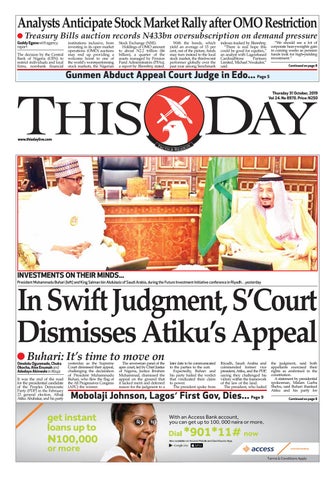
Analysts Anticipate Stock Market Rally after OMO Restriction Treasury Bills auction records N433bn oversubscription on demand pressure Goddy Egene with agency report The decision by the Central Bank of Nigeria (CBN) to restrict individuals and local firms, non-bank financial
institutions inclusive, from investing in its open market operations (OMO) auctions may end up providing a welcome boost to one of the world’s worst-performing stock markets, the Nigerian
Stock Exchange (NSE). Holdings of OMO amount to about N2.2 trillion ($6 billion), a quarter of the assets managed by Pension Fund Administrators (PFAs), a report by Bloomberg stated.
With the bonds, which yield an average of 15 per cent, out of the picture, funds may turn instead to the local stock market, the third-worst performer globally over the past year among benchmark
“We should see a lot of corporate heavyweights gain in coming weeks as pension funds look for high-yielding investment.”
indexes tracked by Bloomberg. “There is real hope this could be good for equities,” an analyst with Lagos-based CardinalStone Partners Limited, Michael Nwakalor,” said.
Continued on page 8
Gunmen Abduct Appeal Court Judge in Edo... Page 5 Thursday 31 October, 2019 Vol 24. No 8970. Price: N250
www.thisdaylive.com TR
UT H
& RE A S O
N
INVESTMENTS ON THEIR MINDS... President Muhammadu Buhari (left) and King Salman bin Abdulaziz of Saudi Arabia, during the Future Investment Initiative conference in Riyadh…yesterday
In Swift Judgment, S’Court Dismisses Atiku’s Appeal Buhari: It’s time to move on
Omololu Ogunmade, Chuks Okocha, Alex Enumah and Adedayo Akinwale in Abuja
It was the end of the road for the presidential candidate of the Peoples Democratic Party (PDP) in the February 23 general election, Alhaji Atiku Abubakar, and his party
yesterday as the Supreme Court dismissed their appeal, challenging the declaration of President Muhammadu Buhari, who flew the flag of the All Progressives Congress (APC) the winner.
The seven-man panel of the apex court, led by Chief Justice of Nigeria, Justice Ibrahim Muhammad, dismissed the appeal on the ground that it lacked merit and deferred reason for the judgment to a
later date to be communicated to the parties to the suit. Expectedly, Buhari and his party hailed the verdict that vindicated their claim to power. The president spoke from
Riyadh, Saudi Arabia and commended former vice president, Atiku, and the PDP, saying they challenged his victory within the framework of the law of the land. The president, who hailed
Mobolaji Johnson, Lagos’ First Gov, Dies... Page 9
the judgment, said both appellants exercised their rights as enshrined in the constitution. A statement by presidential spokesman, Malam Garba Shehu, said Buhari thanked Atiku and his party for Continued on page 8
2
THURSDAY OCTOBER 31, 2019 •T H I S D AY
Pr
om
o tin g E n te r pr
is e
Paula Cademartori is the founder and Creative Director of the eponymous luxury accessories line, Paula Cademartori, which is famous for its iconic metal buckle. In 2005, Paula moved from Brazil to Milan, Italy, to learn more about her culture and further her education in fashion. While in Milan, Paula gained a masters degree in Fashion Accessories at Istituto Marangoni, the leading schools for fashion and design in Italy. Afterwards, Paula earned a managing certificate at SDA Bocconi, one of the most prestigious business schools in Europe, before interning in Versace’s style office. In 2009, Paula participated in the Vogue Talents competition where she was consecrated as one of the most promising names on the international fashion scene. The following year, she founded Paula Cademartori an Italian-made accessories brand, which has become a global street style hit, sported by the likes of Anna Della Russo and Gigi Hadid. On Sunday, November 10th 2019, Paula Cademartori will be at the GTBank Fashion Weekend to lead the conversation on Bringing out the Luxury in Streetwear.
Register to attend her masterclass @ fashionweekend.gtbank.com
Paula Cademartori 9 & 10 November, 2019 Plot 1, Water Corporation Drive, Oniru, VI, Lagos 10am to 10pm daily
Attendance is free
#AfricasFinest
THURSDAY OCTOBER 31, 2019 • T H I S D AY
3
4
THURSDAY OCTOBER 31, 2019 •T H I S D AY
THE FEDERAL PALACE, VICTORIA ISLAND, LAGOS
Abe Odedina, Love Play, 2018, acrylic on plywood, 115 x 112.7cm. Image courtesy of Ed Cross Fine Art
FRIDAY 1ST TO SUNDAY 3RD NOVEMBER 2019
Over 22,000 visitors have experienced 200 of Africa and The Diaspora’s leading artists at ART X Lagos. Join us at the 4th edition from 1st 3rd November 2019. GOLD SPONSOR
SILVER SPONSORS
CATEGORY SPONSORS
ar txlagos.com
DIVERSITY & EDUCATION SPONSOR
BRONZE SPONSORS
ART X LIVE! SPONSOR
MEDIA SPONSORS
@ar txlagos
5
THURSDAY, ͻ˜ ͺ ˾ T H I S D AY
NEWS
Group News Editor Ejiofor Alike Email Ejiofor.Alike@thisdaylive.com, 08066066268
Gunmen Abduct Appeal Court Judge in Edo Adibe Emenyonu in Benin City Few days after Justice Abdul Dogo of the Federal High Court, Akure, Ondo State, regained his freedom from Kidnappers, suspected gunmen yesterday in Benin City, abducted Justice Chioma
Nwosu-Iheme of the Court of Appeal, Benin Division. The gunmen also killed her police orderly before taking her away to an unknown destination. This incident is also coming barely a month after gunmen kidnapped the Chief Medical Director
of Irrua Specialist Hospital, Prof. Sylvanus Okogbeini, on his way to Benin City to board a flight to Abuja for a meeting, killing two of his police orderlies. According to an eye witness report, Justice Nwosu-Iheme was trailed and intercepted in her SUV
along Benin-Agbor road near Christ Chosen Church. It was gathered that a Toyota Voltron car with four gunmen suddenly overtook the Justice's car and immediately opened fire, killing the police orderly on the spot. The suspected kidnappers
then shot one of the tyres of the SUV forcing the driver to stop, while the Justice was hurriedly whisked into the hoodlums' vehicle to an unknown destination. The Edo State Commissioner of Police, Mr. Mohammed DanMallam, who confirmed the
incident, said attempts were being made by the police to rescue her. According to Dan-Mallam, "A justice was kidnapped today in Benin City but security measures are in place to rescue her and bring the hoodlums to book by the power of the Almighty God."
INEC: Immunity Saved Bello from Prosecution Chuks Okocha in Abuja
The Independent National Electoral Commission (INEC) yesterday said that it could not prosecute the Kogi State governor, Yahaya Bello, for double registration because he has immunity. He also said that the commission could not enforce his disqualification for double registration because double registration is not an offence under the Electoral Act. The INEC Chairman, Prof. Mahmood Yakubu, who made the clarification, also called on the Peoples Democratic Party (PDP) to provide evidence that the commission collected a list of partisan ad-hoc staff from the All Progressives Congress (APC). Speaking yesterday at a quarterly media meeting with journalists, the INEC chairman said, "On the issue of double registration, there is nothing INEC can do with someone who has a constitutional immunity. The governor in question has a guaranteed constitutional immunity.
"We disciplined our staff that were involved because it is within our reach to take administrative action against them. Moreover, the Electoral Act does not permit us to disqualify any one based on the account of double registration. This is our handicap". On the allegation of receiving a prepared list from the APC, the INEC chairman challenged the PDP to provide actionable evidence as it is not enough to make frivolous allegations. He said that it is common to hear from politicians make unsubstantiated allegations, citing the case of a politician in Anambra State who claimed that INEC had stocked twolorry loads of ballot boxes to rig the elections against his party but after the elections, he sang another song. "By and large, all we have to say is to ask those making these allegations to provide to INEC actionable evidence and we will move into action. Give us evidence and INEC will act swiftly", Yakubu said.
Arik Airline Unfit to Be National Carrier, Says Sirika Omololu Ogunmade in Abuja The Minister of Aviation, Senator Hadi Sirika, yesterday dismissed the call by the Asset Management Company of Nigeria (AMCON) to transform Arik Airline into a national carrier. Answering questions from State House correspondents after the weekly Federal Executive Council (FEC) meeting presided over by Vice-President Yemi Osinbajo, Sirika said the airline lacked the capacity to function as a national carrier. According to him, the best the airline can do is to buy shares in the new national carrier when it eventually makes a debut or invest in the business wherever it deems fit. The minister who said those advocating the transformation of Arik into a national carrier did not understand his ministry’s agenda for a national carrier, explained that the would-be national carrier must be an airline that can support the national economy with $450 million to boost the country’s Gross Domestic Product (GDP) and effectively serve 200 million people. He said upon the evolvement of African Union (AU) Agenda 2063, which included the idea of a Single African Aviation Market two decades ago, Nigeria thought its then flagship carrier, Nigeria Airways, could take advantage of the initiative
as the strongest airline on the continent then. However, he said the situations later turned the other way round and Nigeria lost that opportunity, adding that the assumptions that Arik should be considered as the national carrier is not tenable because the airline as it is today lacks what it takes to function in that capacity. Earlier, Sirika had said FEC approved N574 million for insurance and special risk projects for the Aviation College in Zaria and jacked up the contract sum for the construction of perimeter fencing for Port Harcourt Airline to N2.7 billion with the approval of over N200 million to augment the earlier cost. Also briefing, the Minister of Finance, Budget and National Planning, Mrs. Zainab Ahmed, said the council approved N3.239 billion for the completion of the National Deposit Insurance Corporation (NDIC) zonal office in Bauchi. Ahmed who said the contract sum included the value added tax (VAT), added that the project would be completed in 96 weeks. Ahmed also said FEC approved another N2.489 billion for the development of Abuja corporate office annex of NDIC as well as the Ikoyi and Lekki offices of the company in Lagos. She said the sum was approved as sum for 12 consultancy firms.
GETTING READY FOR FEC MEETING... Head of the Civil Service, Mrs. Folashade Yemi-Esan; Chief of Staff to the President, Mallam Abba Kyari; Secretary to the Government of the Federation, Mr. Boss Mustapha; and Vice President Yemi Osinbajo, during the Federal Executive Council meeting in Abuja…yesterday godwin omoigui
ASUU Insists on Industrial Action over IPPIS Adibe Emenyonu in Benin City, Francis Sardauna in Katsina and Kemi Olaitan in Ibadan
The Academic Staff Union of Universities (ASUU), yesterday insisted on embarking on industrial action if the federal government stops the payment of their salaries for their refusal to enroll in the Integrated Payroll and Personnel Information System (IPPIS). The Benin, Sokoto and Ilorin zonal branches of the union said yesterday that their members would resort to their “no pay, no work” policy if the federal government carry out its threat to stop their salaries. The Benin Zonal Coordinator of ASUU, Mr. Fred Esumen, said during an enlarged meeting of the Benin Zone of the union, held at the Ugbowo campus of University of Benin, in Benin City, that if the federal government sanctions its members, who do not enroll for the IPPIS on the October 31, 2019 deadline, ASUU will embark on "no pay, no work." The ASUU membership in
the zone comprises University of Benin, Ambrose Alli University (AAU), Ekpoma both in Edo State; Adekunle Ajasin University (Akungba, Akoko), University of Science and Technology (Okitipupa) both in Ondo State; Delta State University (Abraka) and the Federal University of Petroleum Resources (FUPRE) both in Delta State. Esumen who addressed journalists, declared that the IPPIS policy being championed by the Office of the Accountant-General of the Federation (OAGF) was a mere directive, which cannot and should not take precedence over the law. The directive, he said, violates the agreement ASUU had reached with the government in the past and the laws establishing universities via the miscellaneous act as amended in 2003 that vested powers in the Governing Councils to take control and manage funds of the universities including staff recruitment and promotion.” The ASUU coordinator however, ruled out legal option in the pursuit of justice,
saying that government does not honour agreement. The Sokoto Zonal Coordinator of the union, Mr. Jamilu Shehu, said yesterday at a press conference held at the Umaru Musa Yar'Adua University, Katsina, that the attempt by federal government to "forcefully" enroll staff of universities in the IPPIS was not only an illegality, but total violation of university autonomy. According to him, the IPPIS also violates university autonomy and FGN/ASUU agreement and did not tackle the peculiarity inherent in the nature and structure of universities. Shehu explained that IPPIS does not capture the remuneration of staff on sabbatical, external examiners and assessors, earned academics allowances part time and consultancy services being rendered by lecturers across universities. He stressed that the union viewed the claim by the Accountant-General of the Federation (OAGF) that ASUU’s position against IPPIS is an endorsement of
corruption as cheap blackmail and calculated attempt to sabotage university autonomy. The University of Ilorin chapter of ASUU yesterday also asked its members to disregard the order to enroll on the IPPIS. The union said any attempt by the federal government to attempt a stoppage of salaries will be resisted with the activation of a total showdown. The UNILORIN ASUU, which is under the Ibadan Zone of the union, called on the Accountant General of the Federation (AGF) to stop wasting tax payer’s money in placing propaganda and misinformation in the public domain. The chapter in a congress resolution signed by its chairperson, Prof. Moyo Ajao, and made available to journalists in Ibadan, Oyo State urged the federal government to address the challenges raised by the union on the ‘mere spreadsheet’ presented to it by its IPPIS contractor, insisting that the union will not be cajoled or forced into the scheme.
APC Loses Two N’Assembly Seats to PDP in Sokoto Onuminya Innocent in Sokoto The Court of Appeal, Sokoto Division, yesterday returned Senator Ibrahim Danbaba and Balarabe Kakale as senator and member of the House of Representatives, respectively, under the platform of the Peoples Democratic Party (PDP). In a short judgment read
by Justice Frederick Oho, the court said the appeals filed by Danbaba and Kakale both candidates of the PDP during the 2019 elections, succeeded, adding that the details of the judgment would be given later. Oho set aside the judgments delivered by Sokoto State Election Petitions Tribunal ,which dismissed the appellants’ petitions in favour of the respondents who are All
Progressives Congress (APC) candidates. The APC candidates who won the elections and are occupying the seats at present are Abubakar ShehuTambuwal for Sokoto South Senatorial District and Aliyu Shehu, representing Bodinga/ Dange-Shuni/Tureta Federal Constituency. Recall that the Appeal Court had on Tuesday also
ordered a fresh election in Sokoto North/Sokoto South Federal Constituency of Sokoto State.The Court ordered the Independent National Electoral Commission (INEC) to conduct the election within 90 days. The case was filed by Abubakar Abdullahi, candidate of PDP against the election of incumbent House of Representatives member, Bala Hassan of APC.
6
THURSDAY, ͻ˜ ͺ ˾ T H I S D AY
NEWS
Court Orders Lagos Assembly to Suspend Ambode’s Probe Committee obeys, adjourns indefinitely Segun James and Akinwale Akintunde A Lagos High Court sitting in Ikeja has ordered the Lagos State House of Assembly to maintain status quo in the ongoing investigation of former Lagos State Governor, Akinwunmi Ambode. Justice Yetunde Adesanya gave the order yesterday, following an exparte motion filed by Ambode through his counsel, Tayo Oyetibo (SAN). Joined as respondents in the
suit are the Speaker, Lagos State House of Assembly, Hon. Mudashiru Obasa; House Clerk, Mr A.A Sanni; Chairman of the Ad hoc Committee set up by the House to probe the procurement, Hon. Fatai Mojeed and members of the committee. The committee members are Gbolahan Yishawu, A.A Yusuff, Yinka Ogundimu, Mojisola Lasbat Meranda, M.L Makinde, Kehinde Joseph, T.A Adewale and O.S Afinni. Ambode instituted the suit
against the state assembly to contest the constitutionality of the probe of the buses, which were procured based on budgetary approval as part of the Bus Reform Project of the State Government designed to revolutionise public transportation in line with global best practices. Meanwhile, Ambode’s lawyer was yesterday turned back at the sitting of the committee probing the former governor. The lawyer, Mr. Olaniran
Obele from the chambers of Tayo Oyetibo (SAN), counsel to Ambode, told journalists that they were not allowed into the committee meeting. However, following the receipt of the order of the court asking that the status quo be maintained, the joint committee adjoined its probe indefinitely in deference to the court ruling. Speaking with journalists, Obele said, "We came to represent Ambode but the officials of the House of
Assembly in a military manner prevented us from entering the committee room. "We brought processes from the court and letters to serve on the committee chairman and the speaker but they refused to accept validly issued court document, letter containing what the court has said to them but we were not allowed to go in. "The former governor respects the House; he has sent his lawyer to inform the committee set up by the House that this is what transpired in the court; it is out of courtesy that we have come," Obele said. "We were around, while the preliminary of the proceeding was on, but we were not allowed in. We didn't come here to submit court proceedings alone, but we came to represent the former governor. If they didn't take any step, we don't have a problem with that, but it would be very sad if they took any action," he said. Addressing journalists after
adjoining until further notice, Chairman of the committee, Hon. Fatai Mojeed said the asssembly sent its legal team to represent it in the court. "We started late because before we commenced sitting we had to get feedback from our legal team that went to the court and from the feedback from our lawyers we have to adjoin the sitting until further notice in respect of the court ruling. "We are lawmakers; we are not lawbreakers, and we have to respect the court opinion, so that is why we adjoin till further notice. Lagosians should be expecting more from us," he said. Explaining why the former governor's lawyer was not allowed into the committee room, Mojeed said it is against the business rule of the House. "We invited the former governor, not his representative; we want him to come and clear himself; that is why they were not allowed in and it is even against our business rule.”
Buhari: How We’ll Lift 100m Out of Poverty NNPC, Saudi firm strike deal to revive refineries Omololu Ogunmade in Abuja
DISCUSSING MATTERS OF STATE... L-R: Minister of State, Health, Senator Adeleke Mamora; Minister of Transport, Mr. Rotimi Amaechi; and Minister of Interior, Mr. Rauf Aregbesola, during the Federal Executive Council meeting in Abuja…yesterday
Lagos Set to Auction 53 Vehicles Impounded for Traffic Offences Task force awaits directives on 7,350 impounded motorcycles Chiemelie Ezeobi The Lagos State Environmental and Special Offences Unit (Taskforce) has concluded arrangements to auction 53 vehicles that were impounded for various traffic offences. While 31 vehicles were impounded and forfeited to the state for illegally plying one way, 22 others were those that were seized and abandoned for over six months at the taskforce’s yard. THISDAY gathered that the 31 vehicles were forfeited to the state government following conviction by the mobile court. The Chairman of the agency, Mr. Olayinka Egbeyemi, a Chief Superintendent of
Police (CSP), said owners of the impounded vehicles who abandoned their cars contravened the Lagos State Transport Sector Reform Law 2018, adding that public notice has been issued for owners of the cars to identify their vehicles at the agency’s car parks in Ikorodu and BoladeOshodi. "At the expiration of the one-month verification exercise, the agency shall apply to the court for an order of 'Public Auction' where members of the public would have opportunity to buy any of these vehicles”, the chairman said. Egbeyemi clarified that the owners of the vehicles forfeited to the government pleaded
guilty before Magistrate Omobola Salawu of the Lagos State Mobile Court at Oshodi after their arrest for driving against traffic. According to him, in addition to the forfeiture of the vehicles, each traffic offender was sentenced to 100 days 'Community Service' at any public institution. The chairman, however, said with the state government’s zero-tolerance for violation of the law, the agency would continue to prosecute traffic offenders until sanity is restored on the roads and law-abiding citizens are allowed to commute without being impeded by unlawful individuals.
He also confirmed that over 7,350 impounded motorcycles are presently in custody of the agency for plying restricted routes, including highways and bridges across the state. He stated that the agency was awaiting further directive from the government on what to do with the impounded motorcycles. He added that the motorcyclists were apprehended around restricted routes such as Agege, PenCinema, Apapa, Ikorodu, Mile 2, Obalende, Oyingbo, 2nd Rainbow, Lagos-Abeokuta Expressway, Ojota, Maryland, Yaba, Oshodi, Ikorodu Road, Apongbon, Ikeja and IyanaIpaja.
President Muhammadu Buhari yesterday listed investments and reforms in agriculture as ways conceived by his government to lift 100 million Nigerians out of poverty in the next 10 years. The president also welcomed the commitment of Saudi energy company, Aramco, and Public Investment Fund (PIF) to collaborate with the Nigerian National Petroleum Corporation (NNPC) to revive Nigeria’s refineries. A statement by a presidential spokesman, Malam Garba Shehu, said the president, while speaking as a panelist at the ongoing Future Investment Initiative (FII) conference in Riyadh, expressed his government’s resolve to fulfill his promise to reduce poverty in Nigeria. Shehu said Buhari and other panelists - President Mahamadou Issoufou of Niger and President Uhuru Kenyatta of Kenya - at a plenary session during the summit, explored the topic: ‘‘What’s next for Africa? How will investment and trade transform the continent into the next great economic success story?’’ According to him, the president spoke on poverty reduction in Nigeria, outlining the vigorous implementation of key reforms of his administration in the farming and agricultural sector, including soft loans to farmers,
availability and affordability of farming inputs and restrictions on food imports grown locally, as some of the measures that have encouraged agricultural revolution in Nigeria. He also said Buhari responded to a question posed to the discussants on whether Russia is now Africa's best friend, saying Russia is ‘‘visibly helping’’ Nigeria in all the priority areas of his government such as security, economy and the fight against corruption. The presidential aide said the president added that Russia had remained a committed development partner to Nigeria, recalling its support to Nigeria during the country’s civil war. Shehu said Buhari also spoke on anti-corruption drive in Nigeria, describing corruption as an ‘‘embarrassing topic’’ for developing countries and highlighted measures taken by the Nigerian government to eliminate graft through lawful enforcement and preventive measures. The president also reached an agreement with King Salman of Saudi Arabia for a partnership between Nigeria and Saudi Arabia in the area of oil and gas. The agreement was reached when both men held talks on the sidelines of the ongoing FII conference. Shehu, in a separate statement, said both leaders made commitments to deepen partnership for the development of both countries.
THURSDAY OCTOBER 31, 2019 • T H I S D AY
! " " " ! " #$
% & '
( " ) *+$, ( " ) " -
" .
" " /! ! / "
7
8
THURSDAY, ͻ˜ ͺ ˾ T H I S D AY
PAGE EIGHT IN SWIFT JUDGMENT, S’COURT DISMISSES ATIKU’S APPEAL expressing their opposition to his declaration as the winner of the presidential election through the process of rule of law. He stated: "The former vice president and his political party exercised their rights, under the Nigerian Constitution and electoral laws, to petition the courts and dispute this result. ‘‘They did so first at the Presidential Election Petition Tribunal which ruled in September 2019 against them. Now - following his appeal to the Supreme Court and its ruling to dismiss their case for 'lacking merit' – this matter is now closed. “The president and government of Nigeria do wish to extend our gratitude to former vice-president and his party for undertaking their campaign through protestations to the courts. "In this regard, they have conducted themselves in line with the laws of the country they sought to lead.” Shehu said the president hailed the judgment and thanked the people of Nigeria for the mandate they gave him to run the affairs of the country for another four years. He also said having exhausted litigations over the last presidential election, the country can now move forward in the interest of all Nigerians. According to him, “Now, following this final legal bid before the highest court, it is time the country is afforded the right to move on – in the interest of all Nigerians – regardless of how they voted. “The elected president and his government now must be enabled to focus solely on addressing the issues that concern the country." But Atiku and the PDP expressed deep reservation, with the candidate calling the judgment part of the challenges of democracy in the country. "It is said that the Supreme Court is not final because it is infallible, but that it is infallible because it is final. While I believe that only God is infallible everywhere, and only Nigerians are infallible in our democracy, I must accept that the judicial route I chose to take, as a democrat,
has come to a conclusion," Atiku said in a statement, adding: "Whether justice was done, is left to the Nigerian people to decide. As a democrat, I fought a good fight for the Nigerian people. I will keep on fighting for Nigeria and for democracy, and also for justice." He thanked all Nigerians, whom he said had stayed the course since the commencement of trial in the petition. His legal team, however, blamed the loss of the legal battle on the current electoral laws, which according to them was flawed. Atiku and PDP challenged the entire judgment of the Presidential Election Petition Tribunal, which had affirmed the election of President Muhammadu Buhari. The hearing came exactly 49 days after the tribunal's verdict, which confirmed Buhari’s return for a second term of office and nearly 37 days after the appellants filed their appeal seeking to nullify the judgment and be declared lawful winners of the presidential poll. Other members of the panel were Justices Bode Rhodes-Vivour, Kayode Ariwoola, Musa Datijo, Inyang Okoro, Ejembi Eko and Uwani Abba Aji. Atiku and his party had approached the apex court to set aside the judgment of the Presidential Election Petition Tribunal, which affirmed the declaration of Buhari as winner of the presidential poll. The appeal was dismissed in the very first hearing by the apex court. "Having gone through the briefs for over two weeks, we have come to the conclusion that this appeal lacks merit. This appeal is hereby dismissed. Reason will be given at a date to be communicated to parties," Justice Muhammad said. However, reacting to the verdict of the apex court, lead counsel to the petitioners, Dr Levy Uzuokwu SAN, expressed shock and blamed the loss of their clients on the state of the nation's law, which according to him needed urgent amendment. According to him, Atiku gave a good fight but lost to the Nigerian factor.
He said that the decision of the court especially the reasons in dismissing the appeal would be carefully studied when released and that comprehensive reaction would be made public. "I don't want to speculate until they give their reasons. No reason has been given, we have done our best, our clients have done their best and the rest is for Nigerians,” he said, adding: "But let me say this, unless something drastically is done to electoral jurisprudence in this country there will be problem because it is now becoming obvious that petitioners will always find it difficult to prosecute their cases. But all said until they give their reasons, we will take it up from there." Another lawyer in the team of Atiku and PDP, Chief Mike Ozekhome SAN, also faulted the electoral laws particularly the period within which a petitioner must file his petition and present same for adjudication. Ozekhome stated that the constitutional provisions within which a petition can be determined in totality is like a rock of Gibraltar that cannot be shifted or moved for now, no matter the grievances of any contestant in a rigged election. In Atiku's appeal, the senior lawyer averred that it was good that a baby has been delivered today and not aborted; adding that whether the baby is malfunctioning is another thing for the history. Buhari’s lawyers lauded the apex court for doing justice in the matter. Wole Olanipekun SAN, the lead counsel, said: "We want to appreciate and commend the Supreme Court for rising to the occasion. That is the way it should be and the judiciary has done well. "For us as counsel we have done our best, both for petitioners and respondents. And as lawyers this is how far we have gone and we cannot say more than that." Also counsel to the All Progressive Congress, Prince Lateef Fagbemi SAN, said with the verdict every issue surrounding the election of Buhari has been put to rest. "The chapters, paragraphs and lines having to do with the 2019 election especially the presidential aspects have
been laid to rest until 2023. It has been a night of long knives, but we thank God that it has ended peacefully," he said. Counsel to the Independent National Electoral Commission (INEC), Mr. Yunus Usman SAN, noted that the verdict had also rested the contentious issue of electronic voting, adding that once the Electoral Act is amended the commission would not hesitate to abide by it. He said: "I am very happy and we should thank God that we have the type of judges we have at the Supreme Court and this server issue, thank God it has been laid to rest. "INEC has never said it has no server but this particular server they are claiming www.factdontlienigeria. com, we say INEC does not have that type of server and they said it was through that server that results were transmitted." Before the verdict, the presiding justice of the seven man panel, Justice Muhammad had informed the counsel in the matter that the panel has reached a decision to the effect that judgment in the main appeal would cover the other appeals including the cross appeal filed by the APC. Counsel to INEC, Usman; Buhari, Olanipekun; and APC, Fagbemi, agreed with the decision of the apex court, while counsel to the PDP, Uzuokwu, however, disagreed praying the court to hear their interlocutory appeal challenging the striking out of certain paragraphs in their petition by the tribunal. While he agreed that due to time constraints, the Supreme Court could not make an order for retrial at the lower court, he argued that the apex court could hear the appeal and consider in reaching a verdict in the main appeal. However, efforts to prevail on the apex court for the appellants to consolidate their appeals were refused, prompting the court to stand down the matter for 20 minutes to enable the appellants come to terms with the position of the apex court.
In all there are seven appeals, which the apex court said are similar and as such wants to avoid delivering multiple judgments in almost the same issue, adding that one of the appeals is an abuse of court process. At the resumption of the hearing, the court allowed the defendants to adopt and argue their interlocutory appeal in which they urged the court to allow their appeal and consider their submissions in their final judgment. In arguing the main appeal, Uzoukwu submitted that the respondents, particularly Buhari failed to give explanation between the names Muhammadu and Mohamed as contained in exhibits R19 and R21. Uzuokwu submitted further that there is no pleading on record that the two names belong to the 2nd respondents. While he argued that the discrepancy is a fundamental defect, the senior lawyer stressed that, "It is not for the tribunal to speculate without evidence, that Mohamed is the same person when there was no pleading or evidence". On the issue of certificate, the appellants stated that no reason has been given by Buhari on record, why it is impossible to bring forth any of the three certificates he claimed in exhibits P1. "Nobody gave evidence that they have cited original, Certified True Copies, photocopies or graphic copies of the said certificates", Uzuokwu said, "Buhari did not even present testimonial of the primary school he claimed to have attended or testimonials of his secondary school and that of the Officer Cadet". On the issue of server, while the appellants stated that INEC have consistently denied that they have a server, they submitted that INEC failed to establish where they store their card reader data and Permanent Voter Card (PVCs). He added that the tribunal erred in holding that electronic elections was prohibited in Nigeria when it relied on the old provision of section 52(2) of the Electoral Act 2010 to arrive at that decision.
They therefore urged the apex court to allow the appeal and grant the reliefs sought. Responding, counsel to INEC, Usman urged the court to dismiss the appeal because the appellants failed to prove their claims that they won the February 23 presidential election by calling just five polling units agents out of the 119,000 polling units. Usman said by law, the appellants ought to call at least one witness from each of the polling units across the federation, adding that failure to do so was fatal to their case. On the issue of server, Usman submitted that the commission is not in position of the particular server been contested by the appellants, adding that section 52(2) gave INEC the right to chose on the method of conducting the election and did not include electronic transmission of results. On his part, Buhari's lawyer, Olanipekun SAN, dismissed the submission of Uzuokwu on the grounds that the appellants failed to prove that Buhari was not qualified. He added that the respondent called in witness who testified concerning the names, Muhammadu and Mohamed, adding that they were able to prove that the two names belong to President Buhari. Olanipekun recalled that the tribunal in a ruling on an application seeking to strike out the name of Uzuokwu from the petition on grounds of the difference in his name, held that whether Levy or Levinus, he is the same person. Adding that the tribunal was right to hold that both Mohamed and Muhammadu are the same person. Counsel to the APC, Fagbemi SAN also aligned himself with the submissions of INEC and Buhari and urged the court to dismiss the appeal for lacking merit. The Presidential Election Petition Tribunal had on September 11 dismissed the petition of Atiku and PDP against the election of Buhari on the grounds that the petitioners failed to substantiate the allegations made in their petition.
ANALYSTS ANTICIPATE STOCK MARKET RALLY AFTER OMO RESTRICTION Nigerian pension funds, the largest in sub-Saharan Africa after South Africa, have cut their exposure to local shares to five per cent of total assets from a high of nine per cent in April 2018, according to the market regulator, the National Pension Commission (PenCom). CardinalStone estimated that pension funds’ position in local shares may return to around 10 per cent, mostly in companies with high dividend yields. Retirement funds could also seek higher returns in corporate debt, bank fixed deposits and other domestic government debt, according to the firm. With only eight per cent of working Nigerians saving for retirement, the pension industry has vast scope to grow in a country the United Nations expects to be the world’s third most-populous by 2050. At the same time, the government of President Muhammadu Buhari needs
to undertake more ambitious reforms to spur the economy and in turn make local stocks more attractive to fund managers. “While it is possible to see some asset re-allocation towards equity markets, for pension funds to start buying equities again, the economic policy environment has to show credibility around structural reforms to unlock economic growth,” Head of Investment Research at Sigma Pensions, Wale Okunrinboye said. The co-founder of Cardinal Stone Partners Limited, a Lagos-based investment firm, Mr. Mohammed Garuba, had said even before the CBN decided to place the restriction on OMO auction, it was only in Nigeria that private sector and individuals were allowed to invest in the instrument. He had explained that OMO auction was supposed to be strictly between the central bank and the banks.
“OMO is a liquidity management tool. PFAs and the rest were never supposed to invest in OMO. For normal Nigerian Treasury Bills (NTBs), it is open to everybody, you fill your forms and go for auction. But OMO is 100 per cent at the central bank’s discretion. The central bank can decide to issue it anytime or any day they like. That is how it is everywhere in the world apart from Nigeria,” Garuba had explained. A recent report by Stanbic IBTC Stockbrokers Limited, showed that PFAs’ exposure to equity investment had dropped significantly from a high of 9.25 per cent in April 2018, to as low as 4.93 per cent in August 2019. The equity market declined by 20 per cent in 2018, and it is currently in the red as it has plunged by 15.8 year-to-date (YtD) at the close of business last Thursday. However, the report had stated that over the same
period, investments in FGN securities was up by a whopping 22 per cent to N6.819 trillion, from N5.589 trillion in March 2018. Government total public debt stock is now sitting at N25 trillion ($70 billion) – about 20 per cent of Nigeria’s GDP today. But this does not include CBN OMO Bills. “If we strip out the performance as a result of the MTN listing, the market loss YtD would be above 20 per cent. “In absolute terms, the equity exposure of PFA has declined by N275 billion ($765 million) in the last 18 months. This would be driven by a combination of losses accrued from the share price depression and also absolute sale of shares,” it had added.
T.Bills Auction Records N433bn Oversubscription on Demand Pressure Meanwhile, the Primary
Market Auction (PMA) for Nigerian Treasury Bills (NTBs) held yesterday was oversubscribed to the tune of N433 billion as the Central Bank of Nigeria only allotted N132.5 billion out of a total subscription of N566 billion recorded. This was a reflection of the demand pressure observed in the market since last week when the regulator announced its restriction of OMO auction. A breakdown of the results of the auction seen by THISDAY showed that for the 91-day tenor, whereas the total amount offered was N28.019 billion, total subscription was N72.441 billion. Also, for the 91-day bills, while the total amount offered was N10.615 billion, total subscription was N49.677 billion; just as for the 364-Day bills, while the central bank put up a total of N93.915 billion for auction, total subscription recorded was N443.503 billion.
TOP GAINERS UPL LAWUNION UACN DANGCEM ACCESSBANK TOP LOSERS AFROMEDIA FLOURMILLS WEMABANK
NGN NGN 0.11 1.21 0.04 0.49 0.45 6.45 3.00 149.00 0.15 7.50 NGN 0.04 0.37 1.50 14.00 0.04 0.56 LAFARGE 0.95 13.40 UNITYBANK 0.04 0.59 HPE Nestle Nig Plc ₦1,220.00 Volume: 156.8 million shares Value: N1.809 billion Deals: 3,088 As at yesterday 30/10/19 See details on Page 41
% 10 8.8 7.5 2.0 2.0 % 9.7 9.6 6.6 6.6 6.3
THURSDAY OCTOBER 31, 2019 ˾ T H I S D AY
9
NEWS
2020 Budget Report to Be Ready for Consideration Tuesday Deji Elumoye in Abuja The Chairman of the Senate Committee on Appropriations, Senator Jibril Barau, has assured that the 2020 budget report being
compiled by his committee will be ready next Tuesday for the consideration of the upper legislative chamber. Barau, who spoke yesterday evening after receiving reports of
Mobolaji Johnson, Lagos’ First Gov, Dies The first military governor of Lagos State, Brig. Gen. Mobolaji Olufunso Johnson (rtd), has dead at the age of 83 years. Johnson had a glorious career in the military and was appointed as military administrator by the late military Head of State, Major Gen. Thomas Aguiyi-Ironsi. Gen. Yakubu Gowon appointed as governor of Lagos State between 1966 and 1975 before he was retired by the late former Head of State, Gen. Murtala Mohammed. His administration pioneered the building of major infrastructure in Lagos State. When the late Dr. Nnamdi Azikiwe was inaugurated as Governor General, he commanded the military Guard of Honour at the Recce Course, now Tafawa Balewa Square in Lagos. He was a director of Julius Berger, and later the chairman of the construction giant, for several years. Johnson was born on February 9, 1936. His wife had died several years ago but he is survived by many children and several grandchildren. After he was appointed by Aguiyi-Ironsi as the administrator
of of Lagos in 1966, he embarked on the reform of the state civil service and appointed some experienced and reputable technocrats to head some sensitive departments. Some of his appointees were the Administrative Secretary, AdeyemiBero; Finance Secretary, Folarin Coker, and the acting secretary to the Military Government, Howson Wright. An incorruptible patriot, the late Johnson was one of the two governors, who were not found guilty of corruption by the panel set up by Murtala Mohammed to investigate the various allegations of corruption amongst the state governors. Meanwhile, the Lagos State Governor Mr. Babajide Sanwo-Olu has expressed sadness over the death of Johnson. Mobolaji Johnson died in Lagos after a brief illness. Sanwo-Olu, in a condolence message signed by his Chief Press Secretary, Mr. Gboyega Akosile, described the late Johnson as a complete gentleman and officer. He said Johnson contributed immensely to the development of Lagos state in particular and the nation in general.
Kogi, Bayelsa Guber Polls: INEC Releases Data of EligibleVoters Chuks Okocha in Abuja With less than 16 days to the governorship elections in Kogi and Bayelsa States, the Independent National Electoral Commission (INEC) yesterday officially released the data of eligible voters in the two states as well as the Kogi West senatorial district elections taking place the same date being November 16. According to INEC Chairman, Professor Mahood Yakubu, “Bayelsa State has eight local government areas, 105 Registration Areas (RAs), 1,804 Polling Units (PUs) and 923,182 registered voters of which 498,790 (54.3 percent) are male while 424,392 (45.97 percent) are female.” He further stated that “the number of PVCs collected across the state as at September 30, 2019, is 889,308 (96.3 percent) with 33,874 (3.76) remain uncollected.” For Kogi State, Yakubu said the “state has 21 LGAs, 239 RAs, 2,548 PUs while the number of registered voters is 1,646,350 of which 825,663 (50.1 percent) are male and 820,687 (49.9 percent) are female. “The number of PVCs collected is 1,485,828 (90.2 percent) leaving 160,522 (9.8 percent) uncollected. The Commission will make available detailed figures of PVCs collected in each state by LGA and Registration Areas as part of
our continuing effort to deepen transparency and accountability.” The INEC chairman said copies of the data would be made available at the Commission stakeholders’ meetings in Yenagoa and Lokoja, adding that the same information will also be uploaded on the Commission’s website. On the Nembe state constituency supplementary election in Bayelsa State, he said it would have been held seven months ago but for protracted litigation, and that it was finally settled by the Supreme Court. Yakubu said the elections would take place in six polling units with a total of 2,076 registered voters. On the Kogi West senatorial election, he said the total number of registered voters in the senatorial district is 432,515. Meanwhile, Yakubu said all uncollected PVCs have been retrieved from LGA offices and deposited at the branches of the Central Bank of Nigeria (CBN) in Bayelsa and Kogi States for safe keeping pending the resumption of Continuous Voter Registration (CVR). The INEC chairman said at the end of the governorship primaries in both states, 45 political parties in Bayelsa State (42 male and three female) and 23 in Kogi (21 male and 2 female) would be on the ballot.
some sub-committees on the 2020 budget proposal , said that his panel would meet the Tuesday deadline for the submission of its report to the Senate. Senate President, Dr. Ahmad Lawan, had before adjourning plenary on Tuesday tasked the appropriations committee to conclude its work and submit a detailed budget report for Senate consideration by November 28. However, despite its avowed commitment to giving accelerated
consideration to the processing of the budget bill, it was observed that the Senate’s own schedule for the entire processing of the budget have run into hitches. This is because many of the committees were still engaging the MDAs under their supervision as at when they were expected to be concluding works on their reports. The committee Chairman, however, stressed that despite the fact that some standing committees
were still engaging some federal ministries departments and agencies (MDAs) on the budget estimate will not stop his panel from submitting its report. The chairman said there was nothing to worry about because the deadline for submission of reports was not negotiable. Barau, however, added that “we have started receiving and considering reports from various committees and we would meet up with the November 28 given
to us to lay our report.” As at yesterday evening which marked the first day of the sub- committees meeting with main appropriations committee, only three out of the 68 senate committees had appeared before the panel. The committees are those on Capital Market, Cooperation and Integration, and Privatisation that defended and submitted their reports.
GALLANT LOSERS...
L-R: National Chairman, Peoples Democratic Party (PDP), Prince Uche Secondus; PDP’s vice presidential candidate, Mr. Peter Obi; and National Publicity Secretary, Kola Ologbondiyan, after the judgment on the Presidential Election Petition at the Supreme Court in Abuja... yesterday Kingsley Adeboye
Dangote Refinery to Start Operation in 2021 Dangote refinery, which is being built in Lagos by Africa’s richest man, Alhaji Aliko Dangote, is scheduled to start production at full capacity in 2021, a senior executive of the company has said. The company’s Group Executive Director, Devakumar Edwin, told journalists in Lagos that the refinery will be ready for operation at the beginning of 2021, with full capacity reached by the end of the first half of the year. Nigeria is Africa’s largest crude oil producer, but lacks refining
capacity to meet its own fuel needs. “The Dangote refinery, which is designed to maximise petrol output, will produce enough to allow for a small surplus of that fuel for export. It will also be able to send a large volume of diesel and jet fuel to international markets”, Bloomberg quoted Edwin as saying. “We are confident that we can meet 100 per cent of the requirement of the country; so, the balance will go for export,”
Edwin said. He disclosed that Dangote plans to take advantage of local crude supply, adding that it won’t participate in the crude-for-fuel swap deal that is managed by the Nigerian National Petroleum Corporation (NNPC). “We are going to buy the crude just at the export price and will sell our products at the import price, the crude swap is operating only for the importers of the product,” Edwin said. The new refinery has been
designed to process varieties of crude from sweet to light crude sourced both locally, and abroad. Dangote plans to export its diesel to Europe and gasoline to Latin America, Western and Central African markets, Edwin said. Evacuation of refined products will be done by sea and through roads, he said. “We are thinking of investing in vessels. We want to make sure we are not held for ransom by any transport operators.”
Senate Concurs with House, Rejects Operation Positive Identification Summons Buratai The Senate yesterday supported the House of Representatives and rejected the ‘Operation Positive Identification’ exercise being planned across the country planned by the Nigerian Army. The Chairman, Senate Committee on Army, Senator Ali Ndume, who made this disclosure to journalists in his office, added that the joint National Assembly Committee
on Army had summoned the Chief of Army Staff, Lt. Gen. Tukur Buratai, to appear before the lawmakers today to explain the modalities for the implementation of the exercise. He said such exercise was not acceptable to the federal lawmakers being the true representatives of the people. “Although the Chief of Army Staff had described the alert as fake but as representatives of
the people, we have summoned him to come and clarify it to Nigerians. “As representatives of the people, we will not support any action or policy that would either cause inconveniences for Nigerians or tamper with their fundamental human rights which include freedom of movement. “A similar exercise was done in the North-East and
the people did not complain simply because the area is suffering great insurgency. It is not the case with other parts of the country. “I support the idea of having every Nigerian having identification cards but anything that would cause any form of inconveniences for our people is not acceptable and would be vehemently resisted by us in the National Assembly.”
Minimum Wage: JNPSNC to Train State Councils Tuesday The Joint National Public Service Negotiating Council (JNPSNC) will on Tuesday train the 36 joint councils on how to open negotiations with their state governments. An official of the state
councils in one of the Southwest states, who spoke on condition of anonymity, said the training will help the local unions gather experiences on the intrigues involved in negotiating with the state
governments. “The state governors have declared that payment of the consequential adjustments depend on the capacity of the states to pay. Of course, the negotiating skills of the
unions are important in this kind of situation. The aim of the training is to help the local branches gather such skills to be able to confront the governors and their teams,” he explained.
10
THURSDAY OCTOBER 31, 2019 •T H I S D AY
THURSDAY OCTOBER 31, 2019 • T H I S D AY
11
12
THURSDAY OCTOBER 31, 2019 •T H I S D AY
THURSDAY OCTOBER 31, 2019 • T H I S D AY
13
14
T H I S D AY ˾ ˜ ͱͯ˜ Ͱͮͯͷ
COMMENT
Editor, Editorial Page PETER ISHAKA Email peter.ishaka@thisdaylive.com
TACKLING POVERTY THROUGH RECOVERED ASSETS The distribution of recovered funds to the poor is making positive impact, write David Ugolor and Ayibakuro Matthew
A
t the start of this week, a total of 724 field monitors were deployed across 19 states and the Federal Capital Territory, Abuja for the second phase of the monitoring of the use of the $322.5 million Abacha loot returned from Switzerland in 2018. By the end of the monitoring exercise, they would have confirmed, from a representative sample, if 329,963 poor households across Nigeria currently enrolled in the National Cash Transfer Programme (NCTP) are being paid basic monthly sums of N5,000 from the Abacha funds. This second phase follows from the first monitoring exercise undertaken by a network of civil society organisations led by the Africa Network for Environment and Economic Justice (ANEEJ) in December 2018. The report of that exercise, which was released earlier in the year, showed that over 90 per cent of the poorest households that were enrolled in the NCTP were receiving the stipulated monthly sums. Beyond the significance of this monitoring framework, the utilisation of the recovered funds to finance targeted cash transfers to the poorest Nigerians signifies a departure from previous experiences in Nigeria with regard to the utilisation of recovered assets. Whereas recovered funds have previously been allocated to fund infrastructural projects in the national budget in an opaque manner with negligible monitoring, the current framework has the potential of tackling the enormous challenge of poverty in the country through recovered assets. At the commencement of the NCTP, there were dissenting voices who questioned the rationale of paying a paltry sum of N5,000 monthly to poor Nigerians. Unfortunately, these arguments were built on a perennial lack of trust in government intervention programmes based on past experiences. Beyond this, attacks on social investment programmes reflect a poor understanding of the state of poverty in the country and the role of such social safety net programmes in safeguarding people against the extreme adversity and hardship that poverty entails. In a country where an estimated 87 million people, representing about half the population, live in extreme poverty and about a quarter of the population is either unemployed or underemployed, programmes like the NCTP could not be more timely. Hence, away from the numbers, the most significant revelation of the monitoring exercise was arguably the testimonies of the positive impact of the Abacha funds on the poorest Nigerians: providing food, safeguarding shelter, assisting the sick with medication, ensuring children remain in school, enabling small-scale businesses and providing people with livelihood skills. The fact that these results are being achieved through funding from looted funds provides room for optimism. There is also room for improvement. The monitoring exercise revealed that officials involved in the implementation of the cash transfers, especially at the local government and community levels were deducted parts of the funds meant for the beneficiaries. These revelations, which came to light through the monitoring exercise, were duly passed on to the relevant government agencies for appropriate action. In furtherance of this, the National Social Investment Office
IN A COUNTRY WHERE SUCCESSIVE GOVERNMENTS HAVE STRUGGLED TO MOBILISE PUBLIC SUPPORT FOR THE AGE-LONG FIGHT AGAINST CORRUPTION, DEMONSTRATING THAT THE PROCEEDS OF CORRUPT PRACTICES CAN EFFECTIVELY CONTRIBUTE TO ADDRESSING POVERTY CAN BE TRANSFORMATIVE
(NSIO) has just established a strategic partnership with the Independent Corruption Practices Commission (ICPC) to ensure that persons involved in such illegal practices are duly prosecuted. A toll-free hotline was also launched for this purpose. The emergence of pockets of corrupt practices in the implementation of the NCTP demonstrates the inherent problem of corruption in Nigeria. And it is for this purpose that the continuing monitoring of the use of recovered funds by civil society is crucial. This is not just to ensure the success of this programme but for the bigger picture of the emerging potential best practices in this area. In a country where successive governments have struggled to mobilise public support for the age-long fight against corruption, demonstrating that the proceeds of corrupt practices can effectively contribute to addressing poverty can be transformative. To achieve this, all stakeholders must continue to play their strategic roles individually and collectively. The experience with the use of the Abacha loot in funding the NCTP and the monitoring of the process by civil society already demonstrates discernible good practices in this regard. There are three important elements that have enabled this. The first is the relative transparency demonstrated by the relevant government agencies such as the National Cash Transfer Office and the National Social Safety Nets Coordinating Office in sharing programme information with civil society. The role of this in facilitating the monitoring process was duly acknowledged in the report by ANEEJ. The second factor is the approach of collective action adopted by all stakeholders from the point of signing the MOU for the return of the Abacha funds to the current stage of its use and monitoring. Both government actors and civil society have demonstrated a disposition for qualified cooperation with the ultimate objective of ensuring the success of the model of using recovered assets to address fundamental development challenges. Finally, the move to institutionalise the social investment programme of the government is a commendable, especially in the light of the poverty trajectory of the country. World Poverty Clock projects that Nigeria will be home to about 110 million people living in extreme poverty by 2030. Hence, moving the social investment office from its erstwhile domiciliation under the Office of the Vice President to the substantive Ministry of Humanitarian Affairs, Disaster Management and Social Development will ensure that the programme does not suffer the fate of similar programmes in the past. Whilst its initial location under the Vice President’s office, arguably, provided the needed political will for the programme to thrive, the current move would, no doubt, ensure that it would outlive the present administration. In a similar vein, ANEEJ and other civil society organisations have to sustain its monitoring role to ensure that recovered assets – and public funds generally – continue to be used to the country’s enormous development challenges. Ugolor is executive director, while Ayibakuro is Senior Research and Social Norms Advisor, ANEEJ
CATCHING UP WITH DUKE
Okwudili Ojukwu-Enendu writes that the Imo government is working smartly and taking development to the grassroots
A
journey always seems much easier following a man that knows the way. The man of ideas will always have the competitive edge. Ideas rule the world. These were the thoughts that assailed my mind as I reviewed Governor Emeka Ihedioha’s tour of local governments to inspect works being undertaken by local government chairman. It struck me that Ihedioha would be a man of history, positive history. Till date, any mention of Cross River State throws up the name, Donald Duke. This is the 12th year since he vacated office as the governor of the state after two terms. Yet, he is still remembered as though he were still there in office. The landmarks he left behind make him a man of history. This very week, the current governor of the state, Prof Ben Ayade personally flagged off the dry-run for this year’s Calabar Carnival. It is one of the twin legacy projects of Duke. Right out of the blues, he instituted it and got it into the global tourism calendar and it remains a major Nigerian event more than a decade after his exit. That is the intangible legacy. The other legacy of Duke is the Tinapa Resort and Free Trade Zone. It is a beauty to behold and a product of a sound mind meant to yield revenue to both operators and the
government. The fact that the government of Nigeria has blocked this wonderful pointer to Nigeria’s desired future does not diminish the vision that inspired it or the master-craft that moulded it. Its continued official blockade simply amplifies the perception and reality of different levels of ‘Nigerianness’. Tell me that if this edifice were in Minna or Kano, the federal government will block it! My main interest here though, is how this project was realized. In the last few months of Duke in office, he invited a number of editors to Calabar and showed us some of his projects, including Tinapa. I walked close to him and asked him the cost of the project and he said N50bn (a lot back in 2007). Then I asked him how much his government contributed to that. He said N5bn – just 10% of the project cost! He explained that this contribution was in the form of basic infrastructure – basically creating the water channel and the port, as well as access roads. I marveled. Such smartness! There, he has a legacy that will stand for a very long time, and he didn’t bleed his state to realize that. He understood the concept of leverage and applied that. Now, back to Imo State. Governor Ihedioha is showing smartness of another kind and the outcome will stamp his name in the annals of the state. A few months ago, he ordered the local government caretaker committee
chairpersons to embark on at least two physical projects. He insisted that one of them must be a mini-stadium. I don’t know who remembers any local government in the country doing anything with its funds apart from paying salaries, with huge backlogs owed. Out of the blues, Ihedioha ordered them to embark on physical projects, and three months later, he actually went inspecting. The surprise was that all of these local government chairmen actually got started and by the time the governor came visiting, many had taken the building of brand new secretariat buildings to the decking level! The extant secretariat buildings had been built over 30 years ago and many of them are in poor state. Who believed that these LGs can, by themselves build befitting secretariats? They have also advanced work on the ministadia too. If these LG chairmen maintain the current pace of work, then these secretariats could be commissioned within one year. Something struck me here. Anybody interested in how Nigeria is governed knows that state governments bully and gobble up much of the local government funds illegally. But Imo, right now seems to be bucking the trend. Otherwise, the governor wouldn’t have had the boldness to make this demand of the local government chairpersons. And if he was brazen enough to demand that, the local
government heads would have looked him in the face and asked him where the funds for those were. Now, see how it all kicks in and the picture it creates. Imo has 27 local government areas. If all of them complete two physical projects in a year, that would mean some 54 physical projects that Ihedioha will commission for them in a year. If he succeeds in getting them do this in three out of his four-year tenor, tell me if Ihedioha won’t be considered a super performer? Add to this, the 380km of rural roads that he has flagged off across all 27 local government areas at a cost of N13bn, and it becomes clearer that Imo State is in for a wholesale change. Of great interest to me is not just what Governor Ihedioha is doing, but how he does them. The road project is being executed under the World Bank’s Rural Access and Mobility Project (RAMP) – meaning the deployment of low cost patient capital. Then there is the N9.2bn erosion control project at Urualla, again with massive support from the World Bank’s cheap patient capital pool. Ihedioha contributed just N500m to this project and the rest of the funding came from the World Bank – over 18 times leverage! A thinking head has certainly come to Douglas House! Ojukwu-Enendu was a newspaper editor
15
T H I S D AY ˾ THURSDAY, OCTOBER 31, 2019
EDITORIAL THE N10.33 TRN BUDGET PROPOSAL The budget proposal is welcome. But for now spare the cheers
P
resident Muhammadu Buhari on 8th October this year presented a N10.33 billion budget estimate to the National Assembly. It is based on the oil price benchmark of $57 per barrel, a production estimate of 2.18 million barrel per day (mbpd) and an exchange rate of N305 per US Dollar for the 2020 fiscal year. There is also an expectation that the federal government will achieve a real GDP growth of 2.93% in 2020, driven largely by non-oil output, as economic diversification accelerates, and the enabling business environment improves. On paper, the estimates appear okay. But the reality is different. If, for instance, there is anything that the proposed oil price benchmark reveals, it is that there is no fidelity to planning, even in the budget. The draft Medium Term Expenditure Framework (MTEF) 2020-2022 calls for a “a lower benchmark oil price of $55/b (against WHY DID THE FEDERAL $60/b for 2019) is GOVERNMENT CHOOSE TO assumed considering GO WITH A BENCHMARK the expected oil glut OF $57/B AT A PERIOD OIL in 2020, as well as WAS SELLING FOR $58/B? the need to cushion against unexpected price shock.” This is because, as the documents states, there are strong indications of an oversupply in the market in 2020. In advocating for a more realistic benchmark, the MTEF further said that the US shale oil would account for most of the total supply increase, while new projects in Norway, Brazil and Australia would also contribute to the increase in non-OPEC supply. Besides, market sentiments do not support an expansion in demand. “In fact, the growth in demand for OPEC oil specifically is projected to slow down next year”, stated the MTEF. The pertinent questions therefore are: Why did the federal government choose to go with a benchmark of $57/b at a period oil was selling for $58/b? What sort of desperation could have blinded the policy-
Letters to the Editor
makers to the danger of such unrealistic assumption? Since it is clear that the finances to fund most of the projects in the budget will come from local and foreign loans, will they not add to the growing debt portfolio and further compound our problem? We understand that there is need to revamp the critical infrastructure that had virtually collapsed amid growing population but we are nonetheless worried that we may unwittingly be entering another debt trap. How realistic is the federal government’s ‘Budget of sustainable growth and job creation’ when the federal government has N2.45 trillion earmarked for debt servicing in 2020?
T T H I S DAY EDITOR BOLAJI ADEBIYI DEPUTY EDITOR YEMI AJAYI, DAVIDSON IRIEKPEN, MANAGING DIRECTOR ENIOLA BELLO DEPUTY MANAGING DIRECTOR KAYODE KOMOLAFE CHAIRMAN EDITORIAL BOARD OLUSEGUN ADENIYI EDITOR NATION’S CAPITAL IYOBOSA UWUGIAREN MANAGING EDITOR JOSEPH USHIGIALE
T H I S DAY N E W S PA P E R S L I M I T E D EDITOR-IN-CHIEF/CHAIRMAN NDUKA OBAIGBENA GROUP EXECUTIVE DIRECTORS ENIOLA BELLO, KAYODE KOMOLAFE, ISRAEL IWEGBU, IJEOMA NWOGWUGWU, EMMANUEL EFENI DIVISIONAL DIRECTORS BOLAJI ADEBIYI, PETER IWEGBU, ANTHONY OGEDENGBE DEPUTY DIVISIONAL DIRECTOR OJOGUN VICTOR DANBOYI SNR. ASSOCIATE DIRECTOR ERIC OJEH ASSOCIATE DIRECTORS PATRICK EIMIUHI, SAHEED ADEYEMO CONTROLLERS ABIMBOLA TAIWO, UCHENNA DIBIAGWU, NDUKA MOSERI DIRECTOR, PRINTING PRODUCTION CHUKS ONWUDINJO TO SEND EMAIL: first name.surname@thisdaylive.com
TO OUR READERS Letters in response to specific publications in THISDAY should be brief (150-200 words) and straight to the point. Interested readers may send such letters along with their contact details to opinion@thisdaylive.com. We also welcome comments and opinions on topical local, national and international issues provided they are well-written and should also not be longer than (9501000 words). They should be sent to opinion@thisdaylive.com along with the email address and phone numbers of the writer.
THE HAJJ SAVINGS SCHEME
T
he National Hajj Commission of Nigeria (NAHCON) is fine-tuning plans to introduce The Hajj Savings Scheme in the nearest future. The scheme is a strategy to assist Muslims incapable of raising Hajj fare instantaneously to make small deposits over a long period of time. Introduction of the scheme by NAHCON finds legality in the commission’s establishment Act 2006 that mandates the commission to establish, supervise and regulate a system of Hajj Savings Scheme to be operated by the Pilgrims Welfare Boards of each state and the FCT. The act further mandates the commission to set-up a Board of Trustees for the savings scheme comprising of men of integrity who are not members of the commission. NAHCON is also at liberty to take other measures desirable for the success of the scheme. It would be recalled that in several fora, the NAHCON Chairman had warned that with time, Hajj payment will no longer be like a supermarket transaction, meaning intending pilgrims show up any time they wish and pay for the Hajj without regard for planning period. Hence, the scheme is one of the strategies being proposed to ensure, not just proper planning but that shortlisting of intending pilgrims, on government quota, is done well on time and on an early comer order. The scheme when started will be a safe haven for
here are other issues that raise concerns. While noting that inflation is expected to remain slightly above single digits in 2020, the president further gave a breakdown of the budget estimate to include “statutory transfers of N556.7 billion, non-debt recurrent expenditure of N4.88 trillion and N2.14 trillion of capital expenditure (excluding the capital component of statutory transfers), debt service estimated at N2.45 trillion, and provision for Sinking Fund to retire maturing bonds issued to local contractors stand at N296 billion.” There are obvious contradictions here that would have to be resolved if the 2020 budget is to make any meaningful impact on Nigerians. Interestingly, this will be the first time that the annual federal budget will be presented in October in a bid to return to the January to December budget cycle which was the norm in the early years of President Olusegun Obasanjo’s administration from 1999 to 2003. This is a welcome development as the unpredictable budget cycle of recent years has created problems for planning and for the proper implementation of the nation’s macro-economic framework. We hope the leadership of the National Assembly will be able to walk the talk and pass the budget before the year runs out. The greater task of course will be how the federal government intends to implement the budget that poses more questions than answers.
intending pilgrims to receive turnovers through investing their deposits in shari’ah-compliant transactions. Though the main target of the investment is aimed at facilitating performance of pilgrimage at least once in a depositor’s lifetime, the potential benefit is that it will be a reserve that shall enhance the society’s economic capacity through providing socio-economic safety nets for public concerns and to persons identified by the board of trustees as deserving of its support. At the individual level, besides generating returns for the depositors, Hajj Savings Scheme is believed, will introduce certain level of financial discipline and savings culture for the enrolled members irrespective of age. The arrangement is that an eligible member will deposit a certain minimum amount that will be determined by the board of trustees. At the time of registration, the intending pilgrim shall identify the period he or she intends to perform the exercise. His contributions will be channeled into fund revolving ventures for profits to accrue. If the depositor’s contributions pullulate enough profit to enable them perform the Hajj before the stated time, the person shall be given the option of proceeding for the Hajj or the transaction be continued on his behalf until his preferred time.
Fatima Sanda Usara, head, Public Affairs, NAHCON and Ahmad Sani, head, NAHCON’s Hajj Savings Scheme Programme
JULIUS BERGER: WHEN IS ENOUGH, ENOUGH?
T
o say that travelling along the Kaduna-Zaria axis of the KanoAbuja federal highway constitutes daily nightmare for motorist clearly understates the grievous problems. Indeed, a journey which normally takes five hours from Kano to Abuja now takes at least nine to ten hours. And even at that, one must have been extremely lucky to have escaped the notorious Birnin-Yero trap. But those not so fortunate enough usually spend the whole day in the traffic gridlock, and it is routine! It is common knowledge that the KadunaZaria highway despite being the shortest among the three segments of the Kano-Abuja federal highway under reconstruction by Julius Berger, has nevertheless become the most dangerous due frequent deadly accidents; and serious traffic gridlocks recorded on daily basis. More painful is the attitude of the management of the construction company who seems not to care about the ongoing logjam. It is not unusual for somebody going to Zaria or Kano or any other far northern states as the case may be, to take a detour through Jos road or via a barely passable and makeshift road that bursts
out adjacent to Jaji Cantonment. It is worth noting that while similar constructions are being undertaken concurrently at Kaduna-Abuja and Kano-Zaria axis respectively of the same highway by the company, the traffic holdup and accidents along those corridors do not in any way measure up in comparison to Zaria-Kaduna notorious portion! Something must therefore be wrong along the line. But whatever may be the cause, the company must shoulder greater responsibility for this endless nightmare. Worth recalling too is the fact that whereas both Abuja-Kaduna and Kano-Zaria segments have graciously allowed smooth passage through the completed portions of the highway thus easing the traffic gridlock; the ZariaKaduna segment has so far vehemently refused to extend similar gesture to motorists despite all entreaties! Government must therefore call the management of Julius Berger to order because the suffering is becoming unbearable. The management in charge of the Birnin-yero portion must be made to ease the ongoing suffering and avoidable deaths! Kabiru Tsakuwa, Kano.
16
THURSDAY OCTOBER 31, 2019 •T H I S D AY
THURSDAY OCTOBER 31, 2019 • T H I S D AY
17
18
T H I S D AY ˾ THURSDAY OCTOBER 31, 2019
POLITICS
Group Politics Editor NSEOBONG OKON-EKONG Email nseobong.okonekong@thisdaylive.com (08114495324 SMS ONLY)
Out of Date With Luck
Nseobong Okon-Ekong and Vanessa Obioha ask what the political future holds for former Vice President Atiku Abubakar
H
e has seen and had it all. Well, almost! Rising to the designation of Vice President of Nigeria, between 1999 and 2007, there is only one rung left on the ladder to becoming Nigeria’s No. 1 Citizen. And Alhaji Atiku Abubakar has sought the office of President of Nigeria with everything available to him: His enormous wealth, extensive contacts and huge goodwill. But every time it looks like he has it locked in his grip, it slips through his fingers like one attempting to grab water. Yesterday, yet again, another Abubakar quest for the country’s presidency ended in disappointment, as the Supreme Court dismissed his contention against the election of President Muhammadu Buhari. The verdict of the apex court has prompted many to wonder what his political future holds. That question lingered on the lips of many observers of the political landscape in Nigeria after the Supreme Court dismissed the appeals of Alhaji Atiku Abubakar, presidential candidate of the Peoples Democratic Party (PDP) in the February 23 presidential election. Abubakar challenged the outcome of the election which saw President Muhammadu Buhari leading with 56 percent against his 41 percent. Calling the results a sham, Abubakar headed to the tribunal where he tasted the first rejection. Despite his claims that the election was marred with irregularities and that Buhari lacked the educational competence to run the country, his petition was thrown out. Notwithstanding the big blow that Justice Mohammed Lawal Garba who presided over the ruling alongside four other judges dealt him, the 72 year-old politician and businessman who will turn 73 on November 25, proceeded to file an appeal against the tribunal ruling at the country’s Supreme Court. For a moment, a slight hope was harboured by votaries of Abubakar that perhaps, the apex court will overturn the ubiquitous outcome of such contested elections as none has recorded success since the country returned to Democratic rule in 1999. That hope turned to shock and then fury when the judgment of Chief Justice Tanko Muhammad and other six judges reverberated around the country. “We have examined all the briefs and the exhibits for over two weeks and we agree that there is no merit in this appeal,” Muhammad said at the ruling. Speaking after the ruling, the former Anambra state governor and Atiku’s running mate, Peter Obi thanked the supporters of the candidate while pointing out that the judgment was not about “President Buhari or His Excellency Atiku Abubakar, it’s about the future of Nigeria, what we are going to bequeath our children.” On Twitter, a myriad of opinions from fans and detractors were expressed. It was jubilation in the camp of All Progressive Congress (APC) which later released a statement, hailing the judiciary for “standing firm in the face of the PDP and Atiku’s subterfuge.” Others mocked the PDP for their lofty campaign
Abubakar
that Atiku will overthrow the sitting president. The clairvoyants in the micro-blogging site were swift to point out that the handwritings have always been visible on the wall. The affected candidate visibly hurt by the judgment in his statement accepted the judgment by the Supreme
His decision to contest in the February presidential election was expected to be the turning point for the Adamawa state indigene, having employed all political intelligence to win the support of the electorates. He swayed the Southeast voters by choosing an Igbo man and revered political stalwart Obi as his running mate
Court but not without some provocative thoughts for the opposition as well as the apex court. “It is said that the Supreme Court is not final because it is infallible, but that it is infallible because it is final. While I believe that only God is infallible everywhere, and only Nigerians are infallible in our democracy, I must accept that the judicial route I chose to take, as a democrat, has come to a conclusion. Whether justice was done, it’s left to the Nigerian people to decide. As a democrat, I fought a good fight for the Nigerian people. I will keep on fighting for Nigeria and for democracy, and also for justice. The judgement is part of democratic challenges we must face as a nation. The Nigerian judiciary, just like every estate of our realm, has been sabotaged and undermined by an overreaching and dictatorial cabal, who have undone almost all the democratic progress the PDP and its administrations nurtured for 16 years, up until 2015. “Can Nigeria continue like this? Recently, former United States Assistant Secretary of State for Africa, Linda Thomas-Greenfield, averred that Nigeria had rolled back the democratic gains she made in 2015. When democracy is rolled back, the economy, the society and the judiciary will not be far behind. Today, the nail has been put on the coffin and the gains we collectively made since 1999 are evaporating, and a requiem is at hand. In a democracy, you need a strong judiciary, a free press and an impartial electoral umpire. Nigeria has none of those three elements as at today.
One man, one woman, one youth, one vote, should be the only way to make gains in a democracy. And when that is thwarted, the clock starts to tick. Two and a half millennia ago, Sophocles said ‘If we are to keep our democracy, there must be one commandment: Thou shalt not ration justice. Nigeria will do well to observe this warning. “ He continued: “To those who think they have broken my spirit, I am sorry to disappoint you. I am too focused on Nigeria to think about myself. I gave up that luxury twenty years ago. The question is not if I am broken. The question is if Nigeria is whole? This is not a time for too many words. It will suffice for me to remind Nigeria of this - we are an independent nation and we are the architects of our fate. If we do not build a free Nigeria, we may end up destroying her, and God forbid that that should be the case. I was a democrat, I am a democrat, and I will always continue to be a democrat.” Once a Vice President to former President Olusegun Obasanjo, Atiku’s political ambition became conspicuous after he expressed his intention to run for presidency in 2003, challenging his superior in office at the time. Many active actors on the political claim that 2003 was Abubakar ’s golden chance to become President. All the governors of the PDP supported his dream, but at the crucial time, he gave in to Obasanjo’s plea to allow him serve a second term. Subsequently, he has run under different political flags and is one of the brains behind the formation of APC. His decision to contest in the February presidential election was expected to be the turning point for the Adamawa state indigene, having employed all political intelligence to win the support of the electorates. He swayed the South-east voters by choosing an Igbo man and revered political stalwart Obi as his running mate. Having studied the political landscape in Nigeria to find loopholes which he could easily fill, he won the heart of many youths, selling lofty ideas of entrepreneurship and innovation. Little wonder that he was seen as the next Messiah that would save Nigerians from bad leadership. With his latest defeat, it is evident that the shrewd businessman may not have the opportunity to run for office again. While critics argue that he has run out of dates with luck, Abubakar who is credited for strengthening political institutions may have to find a willing politician to pass the baton. The PDP already has possible candidates who are furiously eyeing the party’s presidential ticket. Perhaps, the businessman may find solace in his vast business interests and philanthropy. If anything, Abubakar has no intention to rest on his oars. He is determined to change the course of politics in this country, whether he is holding the magic wand or not. Arguably, one of the very few Nigerians whose influence and acceptance cuts across ethnic, partisan and religious lines, there is a tiny window of opportunity open for another presidential quest. On his own steam, Abubakar has the capacity to pull a surprise if he chooses to walk that path again.
19
T H I S D AY ˾ THURSDAY OCTOBER 31, 2019
BAYELSA/KOGI DECIDE 2019
Group Declares Support INEC Begins Airlift of Materials, Profiling of for Wada, Says Bello Boat Owners for Bayelsa Governorship Poll Governs with Impunity Emmanuel Addeh noting that the Commission was to reduce the time it polls.
Martins Ifijeh
A group known as Opinion Moulders and Critical Stakeholders of the Igala/Basa Nation has declared support for the governorship ambition of the candidate of the Peoples Democratic Party (PDP), Dr. Musa Wada. The decision, it said, was taken after painstakingly reviewing the leadership quality of the present governor, and candidate of the All Progressive Congress (APC), Alhaji Yahaya Bello, describing his governance style as gradual entrenchment of impunity and authoritarian rule. In a statement signed by the Convener of the group, Senator Alex Kadiri, the group said the latest entrenchment of impunity was the unconstitutional impeachment of Elder Simon Achuba as deputy governor of the State. According to Kadiri, “Igala/ Basa Nation rejects this brazen assault on the constitution of Nigeria. We therefore give our unflinching support to Achuba in his quest to set aside the illegal impeachment. “Under Bello’s watch, the Igala/Bassa Nation, an indeed the majority of the people of Kogi State witnessed the worst form of governance since the creation of the state. In spite of the hefty financial resources at its disposal, salaries, pensions and gratuities are still not paid. The lucky ones were paid on percentage basis. It is on record that N50.8 billion bailout which was secured to clear outstanding salaries, pensions and gratuity have been willfully wasted on the
politics of self-perpetuation and aggrandisement.” He said the body notes the current atmosphere of insecurity, reign of fear and terror being unleashed on its people by state sponsored miscreants and political thugs, adding that Igala/ Bassa Nation has witnessed the proliferation of dangerous weapons of violence, imported into the area by top government officials to harass and intimidate the people. “The educational sector has not fared better under Bello. The Kogi State University which was one of the nation’s highly valued universities is now a shadow of its past glory. Draconian government policies under Bello has led to the mass sack of a generation of experienced lecturers from the institution without replacement and a dislocation of the university’s academic and administrative system. “Bello has not commissioned or completed a single project in the entire Igala/Bassa land despite the unprecedented financial resources available to him.” The group said it would therefore not compensate failure by supporting Bello’s reelection bid, adding that the Igala/ Bassa Nation, which comprises of nine Local Government Areas of Kogi East Senatorial District (Ankpa, Bassa, Dekina, Ibaji, Idah, Igalamela-Odolu, Ofu, Olamaboro, and Omala) therefore endorses Wada and the deputy governorship candidate of the PDP, Hon. Sam Aro in the November 16 governorship election.
Why INEC Can’t Prosecute Kogi Governor For Double Registration r Ask PDP in Bayelsa to Provide Evidence of Partisan Recruitment of Ad-hoc Staff Chuks Okocha The Independent National Electoral Commission (INEC) on Wednesday said that it cannot prosecute the Kogi state governor, Yahaya Bello for double registration because he has immunity He also said that the commission cannot enforce his disqualification for double registration because double registration is not an offence under the electoral act. The INEC chairman also called on the Peoples Democratic Party (PDP) to provide evidence that the commission collected a list of partisan ad-hoc staff from the All Progressives Congress (APC) . Speaking at a quarterly media meeting with newsmen, the INEC chairman said, “On the issue of double registration, there is nothing INEC can do with someone who has a constitutional immunity. The governor in question has a guaranteed constitutional immunity.
“We disciplined our staff that were involved because it is with in our reach to take administrative action against them. Moreover the electoral act does not permit us to disqualify any one based on the account of double registration. This is our handicap.” On the allegation of receiving a prepared list from the APC, the INEC chairman challenged the PDP to provide actionable evidence as it is not enough to make frivolous allegations. He said that it is common to hear from politicians make unsubstantiate allegations, citing the case of a politician in Anambra state who claimed that INEC had stocked two lorry loads of ballot boxes rig the elections against his party but after the elections he sang another song. “By and large, all we have to say is to ask those making these allegations to provide to INEC actionable evidence and we will move into action. Give us evidence and INEC will act swiftly,” Yakubu said.
To reduce some of the difficulties encountered in previous elections in Bayelsa State, the Independent National Electoral Commission (INEC) has said that it would make use of helicopters in the November 16 governorship election in the state. The electoral body also disclosed that in collaboration with the Nigerian Navy, it has started the profiling of contracted boat operators , including conducting background check to determine their suitability to ferry non-sensitive materials during the poll. Speaking on Wednesday in Yenagoa, the Resident Electoral Commissioner (REC), Monday Udoh, told newsmen that Bayelsa is a very difficult terrain to conduct elections,
is facing challenges squarely. He added that the Commission was fully prepared for the poll, stressing that the training of ad-hoc staff for the exercise had been concluded. “We have concluded arrangements with boat owners and the supply of buses to the point that the Navy is profiling them. Profiling means that we want to know the owners of the boats and the identity of their drivers. “We have trained our adhoc staff. Apart from that, we have given them copies of the training so that even when they go home, they can train themselves. “INEC wants this election to be exemplary in a way that it is going to act as a catalyst for the 2023 general election,” he said. Udoh explained that the deployment of helicopters
takes for materials to get to their destinations and return to areas of collations during the election. “We are tackling insecurity and on November 1, I am going to be in Abuja with the Inspector General of Police and officers in the military and other security agencies to talk more about security, particularly how to escort materials. “We have enlisted the use of helicopters so that where we used to have so much problem or maybe so much time running on the sea, we have to airlift them to where they should be,” he added. According to the REC, the INEC in Bayelsa was bent on conducting a free, fair, credible and peaceful governorship election which would be a catalyst for the 2023 general
He refuted allegations that he was in cahoots with certain interests to fraudulently sway the election results against the Peoples Democratic Party (PDP) which had accused him of underhand dealings, insisting that the report that he conspired with the ViceChancellor, Federal University Otuoke to publish only APC members as supervisory officers (SPOs) was a lie. Udoh said, “We shall remain focused on achieving our mandate. We shall not be distracted by false news being peddled against my humble self and INEC Bayelsa State. “ I have no contact with the Acting DVC of Otuoke either to recruit or to receive a list from him. It is completely false and a figment of the imagination of the authors of such news.”
TO MOVE LAUTECH FORWARD
From left: Seyi Makinde, Oyo State Governor, Prof. Oladapo Afolabi, Chairman of Council (LAUTECH) and Osun State Governor, Adegboyega Oyetola, shortly after the meeting in Abuja, on Wednesday, on way forward for Ladoke Akintola University of Technology (LAUTECH)
PDP’s Cry Over INEC Officials’ List Sign of Sinking Party, Says APC Emmanuel Addeh The All Progressives Congress (APC) on Wednesday reacted to an allegation that it was conniving with the Independent National Electoral Commission (INEC) to rig the Bayelsa State governorship election scheduled for November 16. In a new twist, a statement issued by the alternate Director General of the APC Campaign Council, Prof. Seiyefa Brisibe, said the Peoples Democratic Party (PDP) was in the process of inducing key staff of the organisation to sway the election in their favour. The APC said that it was important to notify the national
and state officials of the INEC that their integrity was at stake and should therefore clear the air on the alleged plan. “Any perpetuation of an illegality in connivance with the PDP, which is just a paper tiger, and a rejected party in the state for its 20 years of misrule, will destroy the image of the electoral body. “We therefore, urge INEC to withstand the temptation of being used by the PDP to truncate the electoral process, especially with regard to the November 16 governorship polls in the state. “It is shameful that the PDP which claims to be on ground with all the structures required to win the elections, has chosen
an illegal path. “A sensible and sensitive leader would rather have spent money to clear some backlog of payments to workers and pensioners to drastically reduce the prevailing poverty in the State” the party said. The party said that it was unfortunate that the Bayelsa state chapter of the PDP is accusing the APC of influencing the appointment of ad-hoc staff by INEC, stressing that it was a sign of a sinking party. “That accusation without doubt is symptomatic of a sinking party which in error believes that the electoral umpire cannot on its own recruit its staff for purposes of election but must depend on
others to get things done. “The PDP has always perpetuated such illegalities to impede the electoral wishes of the people and whenever they fail in their bid to compromise the process by colluding with INEC they cry foul, which is what they have resorted to again. “They have failed to know that it is always within the purview of the electoral umpire to select their adhoc staff for the conduct of election based on set criteria which includes competence and capacity to handle critical assignments such as election and that INEC performs this assignment with the view to conducting credible polls” the APC said.
Activist Predicts Victory for Natasha Akpoti in Court Ibrahim Oyewale A Member of Amnesty International, United State of America, Comrade Sunday Jatto has said that victory for Natasha Akpoti in court today, Thursday October 31, 2019 would guarantee an emblem for democratic liberation in Nigeria. Jatto, a human rights lawyer, disclosed this in a statement to
journalists in Lokoja. Jatto said that the recent annulment of some political parties in Kogi and Bayelsa states, by the Independent National Electoral Commission (INEC), called for the attention of the judiciary and the global human rights community. According to him, the provisions of the Universal Declaration of Human Rights
(UDHR) and relevant sections of the Nigerian Constitution protects the fundamental rights of every Nigerian. He stressed that the section remained is valid human rights covenant to be obeyed the way people obey the Word of God. ‘’The constitution of Nigeria recognizes every person that is 18 years and above as an adult, but to the consternation
of Nigerians on Sept. 30, 2019, the INEC banned some political parties and Nigerians from contesting governorship election. ‘’This, by interpretation and implication, means that some Nigerians who are below 35 years even if the person is 34 years are politically incapacitated to run an election for a particular office such as the deputy governor.”
20
T H I S D AY ˾ ˜ ͱͯ˜ Ͱͮͯͷ
FEATURES
Group Features Editor: Chiemelie Ezeobi Email chiemelie.ezeobi@thisdaylive.com, Tel: 08038901925
Changing the Narrative for Female Entrpreneurs Following the seeming undertone of suppression and relegation of female entrepreneurs in Nigeria despite their impressive population, Sigma Pensions in partnership with Lionesses of Africa, is set to change the narrative with strategic entrepreneurship seminars, global presence and networking, Nume Ekeghe reports
E
ntrepreneurship plays a great role in the development of any country’s economy, as it is a business created by an individual or groups of individuals who innovate or taking risks with the aim of making profits or money. Experts have attributed good entrepreneurship to comprise 99 per cent communication, which is a way people interact, communicate, interfere, and even discover new things in and around them. To this regards, for any entrepreneurship to bring about national development, entrepreneurs, particularly Nigerian entrepreneurs, must place premium on networking, and critical thinking for general wealth creation and development. The 2018 Global Entrepreneurship Index (GEI) published by the Global Entrepreneurship and Development Institute (GEDI), ranks Nigeria 101st out of 137 countries with 19.7 GEI score, making the country 12th in Africa, in terms of numbers of entrepreneurs. In terms of statistics, GEI likewise revealed that 41 per cent of early-stage businesses are run by females as opposed to 39 per cent for males. However, the sad truth is that, as compared to the males, only a few of the 41 percentage grows beyond the early-stage despite the creativity and innovativeness of these women. According to GEI, “The average growth rate of women enterprises is still lower than the average growth rate for businesses run by men.” Business analysts, however, have identified that quiet a number of factors are contributing to the slow growth rate in Nigeria. These factors include limited access to financing, gender discrimination, lack of career advancement, and poor networking. This was the motive to which Sigma Pensions, in partnership with Lioness of Africa, and Actis, recently held a women entrepreneurship forum in Lagos state, with several women captains of industries and over 400 women entrepreneurs in attendance. Speaking with THISDAY on the partnership between the trio, the Associate Vice President and Head of Relationship Management, Sigma Pensions, Ofilia Nwanyanwun, said it was to promote women. According to her, "Globally, we found out that women are most likely the ones to be entrepreneurs. And for us, Lionesses of Africa is a fantastic global brand to partner with in promoting women entrepreneurs. "If you noticed, for some years now, there has been a lot clamour for inclusion, diversity, and a lot of companies now have more and more products, specifically focused on women. So for us, this is a drive to build women capacity, to help women grow their businesses, and grow the economy. "If women grow, the economy grows, and everything works. So we are glad to be part of that, to ensure that everything works. And we intend to make this a regular phenomenon, whereby we can bring key captains of industries that are women, camp under the same atmosphere with women entrepreneurs, just to build women capacity, so they can thrive better in their various businesses." In her address, the Chief Executive Officer (CEO), Security ID, Kofo Akinkugbe, spoke on the need for women entrepreneurs to continually improve on themselves, and the product or services they offer. According to her, "when you make a little success, what do you do with it? When you start small, and then you experience small level of success, and you are able to move forward again and you experience another small level of success, then you move forward again, you need to scale fast. "If you don't scale fast, you can lose disruptions. You will get disrupted in your industry, so it is extremely important that you scale as fast as you can. In scaling, you must be able to spot idea services. Think about what else you can manufacture in line with your products, and
L-R: Vice President, Business Development, Sigma Pensions, Mabel George; CEO, DO.II Designs, Ifeyinwa Ighodalo; MD, Sigma Pensions, Dave Uduanu; Founder/CEO, Secure ID, Kofo Akinkugbe, and Head of Admin, Actis, Ese Adejuwon at the Lioness Lean in Lagos sponsored by Sigma Pensions
L-R: Partner, Actis, Natalie Kolbe; CEO, U-Connect Human Resources, Omomene Odike; MD, Sigma Pensions, Dave Uduanu; Business Strategy Manager, Vlisco Nigeria Limited, Yvonne Chioke, and Melanie Hawken, Founder/CEO, Lioness of Africa, at the Lioness Lean in Lagos sponsored by Sigma Pensions
equipment. And ensure you are adding value." Also speaking on the partnership, Founder and CEO, Lionesses of Africa, Melanie Hawken, revealed that the organisation is a public enterprise which partners with really savvy business strategic partners across the world. According to her, "in each country, we try to find lead partners that actually share our vision. And our vision is to empower a million women entrepreneurs that can grow great and sustainable businesses. Businesses that employ people, create jobs, create locally manufactured product and get those into the global market. "We are here to really support and promote women entrepreneurs. As a platform, everything we do is free for women entrepreneurs. On our platform you can showcase your company, promote your products, we launch products and services on our platforms. "We want to see more resources being made available, so we are going to be producing more Nigerian-specific resources for the female entrepreneurs here. We are going to be inviting more Nigerian entrepreneurs to join us in our global event, so this is the first of many visits. "The potentials for female entrepreneurs here
in Nigeria is absolutely phenomenal. There are some world class businesses and brands being built here in Nigeria by women, but the world doesn't know about them yet. "What we hope to do as an organisation, is to give those women entrepreneurs more exposure. To get them profiled, and known outside of Nigeria, not just within the continent, but also globally around the world network, and see those companies grow." For the Global head, Private Equity Actis, Natalie Kolbe, it was all about inclusive growth and job creation. According to her, "we have invested in Sigma Pensions, and are putting together with Lionesses of Africa and the three of us are very passionate about job creation and inclusive growth on the continent. "And this is a fantastic platform to bring women entrepreneurs together, so that we can support them as a private sector actors. These entrepreneurs are going to therefore be the agent of growth and employment. "Africa has always been a great place for entrepreneurs, but women here are often stuck in smaller businesses. So what we are trying to
do is to empower women, give them space and tools to make them grow into bigger businesses, so they can grow to the next level, and in that way, create inclusive growth plus employment." In her address, the CEO, U-Connect Human Resources, Omomeme Odike, posited that when you selling a service, it has to do with a lot of ambience, the way you package yourself, they way you speak, the values of what you are selling, and as well as your office space. According to her, "there is nothing you can't make money from. And the least investment you can actually have is the one you have to make use of your brain, yourself and your portfolios. "Your liquidity actually goes far higher, and rates far higher than most of those manufacturing businesses. And another thing you need to do when starting a business in Nigeria is to pay attention to your taxes. Monitor the books." She concluded that the greatest assets you can have being an entrepreneur is to "just have the courage to take the first step. Have the courage to do your homework. Don't be swayed by social media, or what you see in it. Make research, intensive one. Be focused, and please know what you are doing”.
21
T H I S D AY ˾ ˜ ͱͯ˜ Ͱͮͯͷ
#THISISNIGERIA -
Cheta Nwanze
The Nigerian University System under Siege: The LASU Experience
A
cademia is meant to be a community concerned with the pursuit of research, education, and scholarship, and thrives on academic freedom and contestation of ideas. It is a community that’s expected to express its scholastic ideas without risk of official interference or professional disadvantage. Such ideals are expected to dwell in an environment that breathes freedom. Recently, these cherished values have come under severe threat in Nigerian universities. Patron-client politics have crept into the ivory tower such that it’s only a matter of time before the citadel of learning reaches the tipping point into decline. Governing Councils made up mostly of contract seekers, and Vice-Chancellors who are more of empire builders than promoters of innovations and research, now occupy the seats that were one time held by selfless minds who put their best in serving the world through scholarly approaches. These university administrators are succeeding at destroying the culture of debate, robust disagreements and serious intellectual engagements with their political pursuits. Consequently, the academia is receding into graveyards where silence is the norm amidst harassment, intimidation, profiling, and persecution. Just like the days of military era in Nigeria, it is increasingly risky to be courageous and outspoken in the campuses as the culture of silence and cautious intervention is creeping in and
replacing the healthy, profound dialogues, protests and call for necessary actions. The university-based unions have been the target of pillory, penetration, and politicisation by administrators. University Management sponsorship of candidates for union elections is pervasive with a view to compromise union leadership. The struggle to undermine and hijack the unions in order to weaken their capacity to proffer alternatives and expose official misdemeanours, is at the core of conflicts on campuses. A microcosm of a declining university system in Nigeria is the Lagos State University. As per a major report by Premium Times’ Nicholas Ibekwe, one of Nigeria’s best investigative journalists, LASU has been enmeshed in intractible crises, with allegations of high handedness, financial mismanagement, and utter disrespect of extant rules being levelled against the incumbent Vice-Chancellor, Lanre Fagbohun. The prevalent crisis in LASU at the moment is hinged on the clash between the university management and the local chapter of ASUU and came to a head with the recent dismissal of the union’s Secretary, Assistant Secretary and Treasurer by the university. This followed the earlier dismissal of the Chairman and Vice Chairman of the union in 2017. The recently dismissed officers were allegedly axed for demanding an investigation into the circumstances surrounding the promotion of Fagbohun to the rank of Professor, which by extension would put to question his qualification for the position of Vice-Chancellor, as no
one below the rank of full professor may be so appointed. There have also been media reports on the alleged diversion of pension funds by the university administration, contrary to the rules governing pension fund administration. The immediate past Governing Council of the institution is also allegedly complicit in the issues bedevilling the university. including the emergence of Dr Fagbohun as Vice-Chancellor with a questionable promotion. There have also been troubling reports that the Vice-Chancellor is enforcing an oath of secrecy on members of staff of the university, contrary to all public service rules. The university administration in connivance with the Governing Council is also said to have suspended the remittance of the check off dues of ASUU in LASU since January 2019 in violation of the provisions of extant labor laws. However, the expiration of the tenure of the Governing Council gives Governor Babajide Sanwoolu an excellent opportunity to reset the compass of LASU for good and investigate all these alleged abuses of power and due process in the University. The first step in doing this is for the state government to obey its own laws by setting up a visitation panel for the university to unravel the rot that has pervaded it in the last ten years. The law establishing LASU stipulates that there shall be a visitation at least every five years. The last visitation was in 2009. Naturally, a panicky university administration as well as sympathizers of the immediate past
Council will not be comfortable with this idea, as they are aware that a visitation panel of credible personalities will certainly exhume all the ghosts they buried in terms of funds mismanagement, contract awards, admission processes and a host of other issues. But the Governor need only to obey the law if he is to send a strong message that there are boundaries between politics and institutions in Lagos. Next, the Governor must choose a Governing Council made up of men and women of proven integrity to implement the vision of the Visitor, as well as any decisions arising from the findings of the visitation panel. LASU needs to become a truly world class university where academic culture prevails. Students need to live on campuses with modern hostels as their peers do elsewhere, rather than struggling daily with the stress of Lagos to get to school and back home for lack of hostel accommodation. This requires giving practical effect to the amendment of the university law by the past state administration to change its non-residency status. The current situation in LASU is annihilating the good of the institution, but also provides a very clear test of the resolve of the administration of Governor Babajide Sanwoolu to fulfill his campaign promise of a new Lagos, a significant part of which ought to be a new LASU. That is if he is bold enough to shun partisan politics and articulate a vision of a modern university befitting the Centre of Excellence. -Cheta Nwanze is Lead Partner at SBM Intel
22
THURSDAY OCTOBER 31, 2019 •T H I S D AY
Illegality: Under Police Protection, NICON Trustees Grabs, Sells & Unlawfully Built on People's Land at ALMA Beach Estate, Ikate, Lagos.
W
E REFER TO A REJOINDER PUBLISHED ON PG 33 OF VANGUARD OF MONDAY 28 OCTOBER 2019, IN WHICH ONE ABAH ONAH TRIED HARD TO CONCORT AND DELIBERATELY MISREPRESENT FACTS, WITH INTENT TO DECEIVE THE PUBLIC, CONCERNING THE ILLEGALITY BEING PERPETRATED BY NICON AND ITS AGENTS AT ALMA BEACH ESTATE. ON 22 OCTOBER 2019 ALLOTTEES OF ALMA BEACH ESTATE MET WITH THE COMMISSIONER OF POLICE LAGOS STATE AND DEPUTY COMMISSIONER OPERATIONS FOR A PRE-ARRANGED MEETING IN WHICH NICON'S REPRESENTATIVES ALSO ATTENDED. 2. THE ISSUE FOR DISCUSSIONS IS THE INVASION OF LANDS/PROPERTY AT ALMA BEACH ESTATE BY ARMED POLICE AT THE PARTISAN BEHEST OF NICON. 3. IN SUMMARY, CP INSTRUCTED DC OPS TO ENSURE THAT ARMED POLICE CEASED TO ENTER INTO ALLOTTEES' LAND; THAT THE DEPLOYMENT TO ALMA BEACH WAS ON THE ORDERS OF SUPERIORS IN ABUJA, NAMELY THE OFFICE OF CP LEGAL, OFFICE OF PSO TO THE IGP AND AT THE INSTIGATION OF THE OFFICE OF FCIID, HEADED BY DIG MIKE OGBIZI BASED ON AN INSTRUCTION DATED 26 SEPTEMBER 2019. CONTRARY TO THE CP'S ORDERS ARMED POLICE REMAIN ON ALLOTTEES' LANDS/PROPERTY HAVING DISPLACED LAWFUL OWNERS AND/OR THEIR WORKERS, SOME OF WHOM WERE VIOLENTLY ASSAULTED BY NICON'S THUGS LED BY OLUWASEUN KAYODE. 4. ON 22 OCTOBER 2019 AND IN THE PRESENCE OF ARMED POLICE, NICON
1.
NICON's Thug, Oluwaseun, damaging property.
Armed police on allottee's land in breach of orders of CP Lagos.
AND ITS THUGS FORCEFULLY TOOK OVER LAND OF AN ALLOTTEE AND COMMENCED BUILDING WORKS ON IT. ABAH ONAH, BODE THOMAS AND EJETA OTUONIYO HAVE BEEN ADVERTISING AND SELLING INNOCENT PEOPLE'S LAND. ABAH ONAH'S APPOINTMENT BY NICON AS RECEIVER OF ALMA BEACH LTD IS UNDER COURT CHALLENGE. HE THEREFORE LACKS THE POWER TO DEAL WITH LAND OR PROPERTY AT ALMA BEACH ESTATE. 5. UNDER LAGOS STATE LAWS — NICON’S ACTIONS AMOUNT TO LAND GRABBING WHICH IS AGAINST THE LAW. 6. WHY IS THE NIGERIA POLICE ALLOWING ITSELF TO BE USED BY NICON TO PERPETRATE THESE CRIMES? 7. WHY ARE SENIOR OFFICERS IN ABUJA, INCLUDING THE HEAD OF FCIID ABUJA INTERESTED IN LAND AT ALMA BEACH ESTATE? WHY IS AREA J/AJAH COMMANDER ALWAYS SENDING OFFICERS TO HARRASS WORKERS AND ALLOTTEES? 8. WHY IS LAGOS STATE GOVERNMENT ALLOWING ITS LAWS TO BE BROKEN WITH SUCH IMPUNITY BY NICON? WE CALL ON THE PRESIDENCY @MBUHARI TO URGENTLY CALL ON THE IGP @POLICENG TO ISSUE IMMEDIATE INSTRUCTIONS TO WITHDRAW THE POLICE FROM ALMA BEACH ESTATE. WE CALL ON GOV. SANWO-OLU @JIDESANWOOLU TO URGENTLY INSTRUCT THE AG TO PROSECUTE NICON AND ITS AGENTS UNDER THE LAND GRABBING LAWS OF LAGOS STATE.
NICON thugs causing property damage.
Property destroyed by NICON thugs.
NICON selling allottees' land without any court order.
Policeman preventing access to allottees at the partisan behest of NICON.
Armed police harassing innocent site workers.
Nicon forcefully taking over allottee’s land and building on it
NICON thugs destroyed property of site workers.
SIGNED
Chief N C Okwarauba OKWARAUBA & COMPANY LEGAL PRACTITIONERS 14A APAPA - OSHODI EXPRESSWAY, IJESATEDO, SURULERE LAGOS EMAIL: okwaraubacompany@yahoo.com
Some property damaged by NICON thugs.
23
T H I S D AY ˾ ͱͯ, 2019
BUSINESSWORLD R A T E S
A S
MONEY MARKET OBB OVERNIGHT
A T
REPO 6% 6.86 %
CALL 1-MONTH
7% 9.75 %
O C T O B E R S & P INDEX INDEX INDEX LEVEL 1-DAY
Group Business Editor Obinna Chima Email obinna.chima@thisdaylive.com 08152447875
2 5 , 2 0 1 9 S&P
418.83 % 0.04 %
1/4 TO DATE YEAR TO DATE
EXCHANGE RATE 1.58 % 17.33 %
N306.95/1US DOLLAR* *AS AT LAST FRIDAY
Quick Takes GE Partners Dangote on Digital Solutions
PROMOTING E-GOVERNANCE
L-R: Chairman, Association of Licensed Telecoms Operators of Nigeria, Gbenga Adebayo; CEO, DigiServe, Mr. Lanre Ajayi; Chairman, MTN Board of Directors, Dr. Ernest Ndukwe; President, Association Telecoms Companies of Nigeria, Mr. Olusola Teniola, and Managing Director, Internet Exchange Point of Nigeria, Mohammed Rudman, at an eGovernment conference organised by DigiServe in Lagos...recently
Report: Multiple Taxation Stifling Growth of Telecom Sector Stories by Emma Okonji Growth of Nigeria’s telecommunications industry is crippled by challenges of multiple taxation; a report has stated. The report disclosed that telecommunications firms in Nigeria pay over 40 different taxes and levies, imposed by various different state and local governments. The report was launched at a programme organised by Africapractice, a Strategic Communications firm. The report was on Tax and Enabling Business Environment in Telecoms. According to the report, “Nigeria’s telecommunications industry is crippled by a multiple taxation challenges.
TELECOM Telecommunications firms in Nigeria pay over 40 different taxes and levies, imposed by various different state and local governments. “This directly impacts the industry’s ability to innovate; to improve mobile and data network quality, to reduce prices, to drive mobile penetration, and to deploy infrastructure around the remotest parts of the country. This also directly impacts the ability of telecoms operators to support nascent businesses and industries, further stunting economic growth. And when the number of taxes imposed continue to rise even further,
as with the recent introduction of the Police Trust Fund Levy, Communications Service Tax, these costs are inevitably passed on to you the consumer.” The report further said telecommunications operators expend vast amounts of money to construct masts, towers and provide the infrastructure that allows subscribers to connect with your families, friends, colleagues, businesses, emergency response services and even the rest of the world. With penetration levels around 70-80 per cent there is a demand-supply gap that our telecommunications operators must meet. The report added that the over-taxation of the telecommunications industry is not
unique to Nigeria. “For various reasons, the industry is one of the few, with the unique combination of a degree of relative demand inelasticity, an expanding consumer base peculiar to developing countries and inelastic short-run supply. “Evidence, however shows that removing or reducing the taxes on mobile connections or handsets has had net positive impacts on the economy and can increase digital inclusion, spurring inclusive growth. “The available evidence indicates that the reduction or removal of telecommunications sectorspecific taxes across countries by 2020 could have a sizeable Continued on page 24
Innovators Urged to Focus on Disruptive Technology The Minister of Communications and Digital Economy, Dr. Isa Pantami, has charged young innovators to come up with disruptive technology and crazy ideas that would completely change the way we live in Nigeria. He stated this during the presentation of the Young Innovators tag “Seeds for the Future” by the Managing Director, Huawei Technologies Nigeria Limited, Mr. Zhang Lulu, in Abuja, recently. The minister urged the innovators to explore emerging technology and come up with disruptive technology
TELECOM and build applications that would completely change the way we live and interact with one another. Pantami, reiterated that the expectation of the federal government was for the young innovators to come back from the scheme to create jobs as digital economy has potential to lift millions of Nigerians out of poverty. “As potential digital personality, you must think about being potential employers. Come up with big ideas as you become potential employers instead of
job seekers. “Each and every one of you should think of employing 50,000 people in a few years,” Pantami told the young innovators. Pantami added: “In the next few years most probably one may not need to travel to India, Egypt, USA or UK for medical attention or surgery, Surgery can be conducted by using 5G and through artificial intelligence”. He urged them to focus more on emerging technologies such as artificial intelligence, robotic, cloud computing, quantum computing, mega storages, internet of things, visual reality
and augmented reality. The Minister thanked the Huawei Technologies for keying-in to the capacity building of the young innovators in the country and urged them to focus on the hands-on training and bridge the gap between the academia and the industry. The Managing Director, Huawei Technologies Nigeria Limited, Mr. Zhang Lulu while presenting the students from different institutions in Nigeria noted that Huawei has been investing in digital skills in Nigeria and had implemented Continued on page 24
GEandDangoteCementPlchavesignedanagreementtodeployGE’sAsset PerformanceManagement(APM)digitalsolutiontoreduceunplanned downtimeandenhanceperformanceatitstwocementplantsinObajana and Ibese, Nigeria. The project includes extending the current service agreement for an additional 50,000 operating hours for the seven GE LM6000PCaeroderivativegasturbinesinstalledatthesites. GE’s total plant solutions will improve efficiency, reliability essential to continuousoperationsandtheplants’businessstrategy. OperationsDirector,DangoteCementPlc,RaviSood,said,“Powersupply isbothakeyinputandamajorcostinourmanufacturingprocess.” He added: “Operational performance is crucial to our cement plant’s overallproductivity,directlyaffectingendproducts.Beingatthefrontof cementproductioninAfrica,webelieveextendingourservicesagreement withGEandtheintroductionofdigitalsolutionswillallowustoimprove efficiencies, anticipate further reductions in unplanned downtime and becomemoreself-sufficientinpowerproductioninacountrywhich,with approximately 190 million inhabitants, is the most populous country in Africaandtheseventhmostpopulouscountryintheworld.” APMleveragescutting-edgetechnologytomonitortheperformanceof powergenerationassetstoreducedowntime,avoidturbinesdamageand remotely predict and resolve issues. APM sensors will be installed not onlyonthesevenaero-derivativeturbines,butalsoontheirassociated generators and gear boxes to predict and accurately diagnose issues withgreateraccuracybeforetheyoccur. “Energyinfrastructureisgettingsmarter,anddigitalsolutionsallownotonly theshiftfromtraditionalcalendar-basedrepairstopredictivemaintenance, buttheyalsoincreasepowerassetavailabilityandreliability,”saidElisee Sezan,CEOforGE’sGasPowerbusinessesinsub–SaharanAfrica.“We areproudtocontinueour13-yearcollaborationwithDangoteCementto helpthemsupportNigeriaandotherAfricancountriestowardsachieving self-relianceandself-sufficiencyintheworld’smostbasiccommodities.”
Enahoro Named Promasidor’s Director
Mr. Andrew Enahoro, a knowledgeable corporate communications and legal professional has become the Director of External Relations atPromasidorNigeriaLimited,effectiveOctober1,2019. Withhisover20years’experienceinhelpingcompaniestoimprovetheir relationships and business performance, Enahoro in his new position, wouldberesponsibleforhighlevelengagementofidentifiedstakeholders andregulators. He would also lead Promasidor’s backward integration initiatives to guaranteethecontinuedsustainabilityofthebusinesswhilstproviding top-levelsupervisiontothecommunicationsteam. Beforethecurrentelevation,Enahorohadbeenthecompany’sHeadof CorporateCommunicationsandLegalsinceSeptember2010,whenheled theCorporateCommunicationsDepartmentresponsiblefordeveloping, articulatinganddrivingthecorporatebrandengagementsandcorporate reputationmanagement. During this period, he also managed the external and internal communications strategy and acted as the in-house attorney with overall responsibilityformanagingthecompany’slegalissuesincollaboration withtheexternalcounsels.
Admiralty Mall Set to Open
TheretailandshoppingspaceinLekkiphase1issettogetaboostwiththe plannedopeningoftheAdmiraltyMall. Themallwhichisjointlydeveloped by one of Nigeria’s leading real estate development firm, Dreamspace Limited in conjunction with Horizontal Capital Investment Limited has been described as a welcome development by the residents of Lekki. ConstructionworkfortheAdmiraltyMallwouldbecompletedandready forthepublicfirstquarterof2020. Withmanyyearsofexperienceandgreatstridesinbuildingworldclass facilities such as the present Maryland Mall and other top notch luxury apartments/recreationalfacilitiesacrossthecountry. Thedevelopers oftheprojectswitheyesfordetailsareensuringthattheAdmiraltyMall turns out to be one of the most secured, pleasant and spacious mall in theLekkienvironment.
“Our members were however concerned that the banks were unlikely to discontinue the USSD service fees charged by the banks when customers utilise the USSD channel thereby resulting in double and over billing, but telcos charge consumers for the USSD access from their airtime” Chairman Association of Licensed Telecoms Operators (ALTON),
Gbenga Adebayo
24
T H I S D AY ˾ ͱͯ˜ Ͱͮͯͷ
BUSINESSWORLD REPORT: MULTIPLE TAXATION STIFLING GROWTH OF TELECOM SECTOR impact on sector expansion, and also on macro-economic growth. “Studies also show that these measures will not only increase inclusion, but governments can recover higher taxes and fees in the long run, through more efficient and streamlined taxation. Corroborating the report, the Chairman, Association of Licensed Telecoms Companies of Nigeria (ALTON), Mr. Gbenga Adebayo, said the issue of multiple taxation had been a recurrent decimal that needs Executive Order to address the situation. According to him, governments were in the habit of imposing taxes that have no bearing with telecoms operations such as Parking tax, Effluent Discharge tax, Social Service levy, PAYE tax, Right of Way tax, Sewage tax, Environmental/Ecological tax, Hawking levy, Building Fitness levy, among several other taxes and levies. Speaking on the implications of taxes on telecommunications, Adebayo said it would stifle economic growth.
INNOVATORS URGED TO FOCUS ON DISRUPTIVE TECHNOLOGY various programms in the country. He said during the young innovators visit to China, they would be able to attend handson trainings at the Huawei’s world class labs, learn the latest trends happening in the industry and exchange ideas with the experts from around the world at their global headquarters in China. The Young Innovators selected from different Universities were Ugwu Obinna, University of Ibadan; Udohi Young, Covenant University; Akingbola Oluwapemisin, Univeristy of Ibadan; Onuora Chiamaka, University of Lagos; Ihenyen Joy, Igbinedion University and Fatima Rabiu, Ahmadu Bello University Others are Kolade Joseph, Cloud Exchange Technical School; David Kemdirim, University of Port Harcourt; Abdussamad Musa and Abdulrahman Aliyu, Abubakar Tafawa Balewa University.
NEWS
Oracle Advises Organisations to Adopt AI Technology Stories by Emma Okonji Oracle Nigeria, a technology solution company for enterprise and small businesses has stressed the need for organisations to adopt full scale front-end to back-end Artificial Intelligence (AI) technology in order to deliver improved and integrated customer experiences. Applications Sales Director, Oracle Nigeria, Oludare Ogunlade, in a statement, explained that by leveraging artificial intelligence on many modern core systems, organisations could unlock significant value not only for their customers but for themselves. Addressing one of the leading AI use cases in customer service, Ogunlade said, “When chatbots, for instance, are used in this area of the business, they can reduce the cost to serve customers while improving the response time, consistency, and quality of customer interactions. “Similar benefits arise when the chatbot is customer-facing or when used by agents themselves to augment their knowledge. “It’s not just about chatbots – automation across both sales and marketing processes can improve quote-to-cash turnaround times and reduce administrative workloads. Additionally, it allows for a level of personalised messaging to customers that were previously unachievable.” Recently, at the Oracle OpenWorld conference in the United States, Oracle unveiled
AI-voice for enterprise, which includes a series of new features to its cloud applications, including its supply chain management, human capital management, customer experience and enterprise resource planning tools. The enhancements include a number of new or improved AI-driven features, such as the expansion of the Oracle Digital Assistant. According to Ogunlade, “Enterprises are demanding an AI-powered voice assistant that understands their specific
vocabulary and enables naturally expressive interactions for its users. “The combination of natural language processing, natural language understanding, and custom machine learning algorithms, allow Oracle Digital Assistant to understand a user’s natural conversation, derive intent, produce logical compositional forms, and identify and learn user behaviour patterns in order to proactively take action on behalf of the user.” The Oracle Digital Assistant
has proven to improve service delivery to prospective students at the University of Adelaide where the Director of Prospect Management at the university, Catherine Cherry, stated, “The International Eligibility chatbot has enabled us to improve our student experience for international students. With this brand-new service, we can answer the most critical question prospects will ask us.” Addressing value creation, using AI, Ogunlade added that much had been made of the abilities of AI to bring signifi-
cant value to the customer. “AI can produce repeatable, scalable, and reliable outcomes for customers, improving their overall experience. However, AI can also deliver enormous efficiency through various lines of business and across roles, creating a more streamlined organisation that can shift their focus to creating client value,” Ogunlade said, adding that more organisations are moving to the cloud to cut costs and improve operational efficiency by using AI and cognitive technologies.
MEDIA BRIEFING
L-R: Head, Corporate Social Responsibility, Fidelity Bank Plc, Chris Nnakwe; Wife of the Governor, Anambra State, Mrs Ebelechukwu Obiano ; Deputy Vice Chancellor, Admin, Nnamdi Azikiwe University, Prof. Karu Arinze Umobi; Registrar, Mrs. Philomena Okoye, and Founder / CEO, Gazelle Academy, Muna Onuzor, at a media briefing to sensitise members of the public on the ongoing Fidelity Youth Empowerment Academy(YEA6) training programme in partnership with Gazelle Academy & Caring Family Enhancement Initiative (CAFE), held in Anambra State...recently
FG Urged to Use Technology in TraderMoni Disbursement Lendtech platform operators in the country have urged the federal government through the office of the Vice President, Prof. Yemi Osinbajo, to disburse the government’s TraderMoni loans through technology platforms in order to bring more Nigerians into the financial inclusion net. TraderMoni is an empowerment scheme of the federal government created for petty traders and artisans across Nigeria. It is a loan programme.
Co-founder and CEO, Social Lender, Faith Adesemowo said lending technology companies across the country have been using technology to disburse loans to people irrespective of their status with different measures to determine their ability and willingness to pay back. She cited the example of Social Lender’s social reputation score, which can be used to profile applicants’ details in order to ascertain who is
eligible for loan and loan repayment. A similar procedure should be extended to the “petty traders and artisans who are a direct beneficiary of TraderMoni”, she said. She added that the score will evaluate the type and size of formal credit the trader requires for her business or personal needs. According to her, if TraderMoni partners with the lendtech firms’ such cooperation
will ensure that before loans are disbursed, recipients would have gone through financial literacy sessions to educatethe applicants on money management, investment instruments and the benefits accruable from such venture. “Currently our loan default ratio is under 5 per cent. This is good for unsecured lending if you compared with the microfinance and other conventional lenders,” Adesemowo said.
She explained that Social Lender is a digital financial services platform that financial institutions can leverage to extend service and value to the under-served and unbanked demography. The Managing Director/ Chief Executive Officer, Xpress Payments, Oluwadare Owolabi said financial inclusion allows people and businesses to have access to useful and affordable financial products and services that meet their needs.
‘Start-ups Must Believe in Nigeria to Scale’
Group Business Editor
Obinna Chima
Capital Market Editor
Goddy Egene
Comms/e-Business Editor
Emma Okonji
Senior Correspondent
Raheem Akingbolu (Advertising) Correspondents
Chinedu Eze (Aviation) Eromosele Abiodun (Maritime) James Emejo (Finance) Ebere Nwoji (Insurance) Chineme Okafo (Energy) Reporters
Nume Ekeghe (Money Market) Nosa Alekhuogie (ICT)
The Chairman, Zinox Group, Leo Stan Ekeh, has said budding entrepreneurs and business owners must retain a level of belief in Nigeria in order to scale their business. Ekeh affirmed that growing a business in Nigeria’s peculiar business environment requires the essential ingredient of a firm faith in the country. He made this disclosure at The Kingdom Summit 2019, an International Marketplace and Leadership Conference organised by the Redeemed Christian Church of God (RCCG) in Lagos. The event, with the theme – ‘From Business Person to Nation Changer’, addressed key issues surrounding the growth Start-ups in Nigeria. According to Ekeh, “You must not be discouraged by the
challenges you face in business today. Also, you must not allow people discourage you with their negative projections. “You must have faith in Nigeria in order to grow your business and scale. As a matter of fact, before I started out in business during undergraduate days in India and after my post-graduate in Cork City, I was clear that I was going to return to Nigeria. “Sometimes, I laugh when people say things were better in the past than they are today. When I returned to Nigeria to start up my first company, Task Systems Ltd., the society was completely analogue. The print and publishing industry, which I transitioned to digital publishing, was still relying on
the old system of casting metal type at the time. This was why I was determined to create an IT identity for Nigeria. We eventually achieved this through Zinox. “It is on record that the Zinox Group pioneered electronic petrol dispensing pumps, Desktop Publishing and Computer Graphics, INEC Data Capture System, firstinternationally certified Computer brand - Zinox, pioneered E-Commerce in Africa, amongst other firsts. If we do not have faith, you will not have the mental capacity to research, incubate and achieve products that may add greater impetus to the economy.” However, Ekeh, a serial digital entrepreneur, cautioned his audience on the need to incubate and go through structured
process, incubate and build a culture of sustenance. More to the point, Ekeh frowned upon the falsification of data in order to hood-wink potential investors. “I see a lot of start-ups brandishing false figures and falsifying data in order to deceive investors to part with their money. There are a few high-profile instances of such here in Nigeria. “Such a practice is highly dangerous and if you indulge in it, you will surely pay for it. A lot of business owners see it as a smart way of raising funds but your integrity is at stake. “If you lose your integrity, you have not just lost all, but you have also destroyed others in same economy and you will pay dearly for it. In 21st century, there
is a strong connection between wealth and spirituality. The way you made your money comes with eternal pain or pleasure. “I see a lot of rich people that excites young people are in Hell on earth but you may not know. Wealth is now a right for both the children of the poor and the rich, but more kids from poor homes have better intelligence, energy and spirituality to challenge the status quo. “Some of you just start out in business and decide to buy flashy cars or fly First Class as a status symbol. What you fail to remember is that the difference between an Economy Class ticket and a First Class ticket, your business may not be able to achieve it as profit in one year,” Ekeh said.
25
T H I S D AY Ëž ÍąÍŻËœ Ͱ͎ͯ͡
Experts Suggest Blended Finance for Social Investment Funding Sunday Ehigiator Experts at the recently held impact investment symposium, organised by Impact Investors Foundation (IIF) in Lagos, have suggested blended financing as a tool in addressing several impactful social and infrastructural deficiencies in Nigeria. In his welcome address at the event, the Executive Director, Africa Capital Alliance and Chairman, IIF, Engr. Afolabi Oladele said blended finance would enhance the building of the ecosystem for successful impact investing in Nigeria. According to him, “To achieve the United Nations (UN) 17 Sustainable Development Goal (SDGs), a significant scale-up of investment from diverse sources is required. “The UN estimated that the annual funding needed to achieve the SDGs by 2030 is about $4 trillion, much greater than the current aggregate SDG focused funding of $1.5 trillion from domestic and international sources. The $2.5 trillion gap dwarfs official development flows and philanthropic com-
mitments, which is currently $350 billion by over five folds. “In Nigeria, the estimate by UNESCO puts the financial requirement to achieve SDG 4 alone, which deals with equitable quality education for children, at about 434 billion per annum between 2015 and 2030. “Nigeria’s total federal budget for 2018 is $29.9 billion, with education accounting for only seven per cent of this amount. Sub-national governments have even smaller resources at their disposal to fund their budgets.� Continuing, he said: “This implies that, if public resources are solely depended on for implementing quality education goal, then Nigeria already faces an annual financial gap of over $32 billion, which is more than its annual budget. It therefore means that to achieve the SDGs in Nigeria, a significant scale-up of investment is required and the involvement of the private sector is critical. “Blended finance is the strategic use of catalytic capital from public and philanthropic sources to mobilise additional private sector investment. It has
been presented as an important approach in engaging the private sector for financing the gap in SDGs funding.� In her keynote address, the President/CEO, Calvert Capital, Washington Dc, Jennifer Pryce said, “If you Goggle the totality of the capital market, it is $270 trillion. To move that money into the community is the goal. How do we do that? What we have seen is, there exist two level of intermediation that helps money move out of the capital markets into the communities. “There is a certain group called ‘Capital Raising Intermediaries’; they solve what investors need. Investors needs around liquidity, around rescue returns, around volume, and diversification. “And there is Capital Deployment Intermediaries. These are non-profit organisations or intermediaries that are working close to communities that are sourcing for capital moves, customising capital needs for the market that they are investing in. They provide technical assistance ensuring that those communities, those projects are ready for capital.
FG Urged to Ban Importation of New Vehicles Emmanuel Ugwu, Umuahia The federal government has been urged to extend its import restriction policy to the vehicle manufacturing sector by banning the importation of new vehicles into the country. The Coalition of South East Youth Leaders(COSEYL) made the call in a statement signed by its president general, Chief Goodluck Egwu Ibem, saying drastic economic measures must be taken to save the local vehicle manufacturers. Nigeria used to have thriving vehicle manufacturing sector when the assembly plants of Volkswagen in Lagos and Peugeot in Kaduna were churning out brand new vehicles for the Nigerian market. However, with the unrestricted importation of both brand new and second hand vehicles of all kinds the local manufacturers were put out of business with the attendant loss of jobs. But the youth leaders said with the emergence of indigenous vehicle manufacturers like Innoson Motors, there was need for government’s intervention to strengthen the sector and keep them in business. “We therefore urge the federal government to extend the same
ban placed on some food items to new cars and vehicles since they are manufactured here in Nigeria by our indigenous firm, Innoson Motors,� the statement said. It noted that the federal government has already demonstrated a commendable political will by placing a ban on the importation of rice, fish, poultry products to stimulate local production and patronage hence it should do same to vehicle importation. “This policy if properly implemented will improve our country’s balance of payment, gross domestic products (GDP) and also provide more employment opportunities,� COSEYL said. According to the group, Nigeria’s large appetite for imported vehicles results to huge trade deficits and colossal loss of foreign exchange as the countries that sell the vehicles to Nigeria import little or nothing from the consuming nation. COSEYL noted that Innoson Motors, which is now the flagship of local vehicle manufacturing is presently rolling outlined good quality vehicles� adding that if encouraged with appropriate policies and patronage the company
would not only satisfy the local market but export vehicles to other African countries. It pointed out that vehicle manufacturing companies in developed countries like Toyota Volkswagen, Ford, among others enjoy the protection and patronage of their hence the Nigerian government would not be doing anything unusual by encouraging local vehicle manufacturers. “Today those countries are celebrated and rated as developed because of what they manufacture. We can attain the same feat, if we support our own companies,� the group said, adding that the economy would be the better for it. The group further stated that the financial interventions the federal government made in the agriculture sector could be replicated in the vehicle manufacturing sector. “One of the most effective way of fighting insecurity is by providing employment for our teeming youth. Financing, supporting and patronizing indigenous firms is the easiest way to achieve it. “It will be a great disservice if we Nigerians don’t believe in ourselves by using what is produced here in Nigeria,� the youth leaders said.
Hollandia Inspires Consumers in New Campaign Raheem Akingbolu One of Nigeria’s leading evaporated milk brands, Hollandia Evap Milk, has launched a new marketing communication campaign. Aimed at inspiring and enabling consumers to achieve their daily goals, the campaign strengthens the milk brand’s position as the all-rounder evaporated milk and positions it as the perfect accompaniment
to a wide variety of breakfast meals, foods and drinks, such as cereals, custard, pancakes, smoothies, tea, coffee, and chocolate beverages. Tagged “Start Your Day Right with Hollandia Evap�, the TVC follows the life of celebrity mum and goal-oriented actress, Mercy Johnson-Okojie, and other mums. The film showcases their daily morning routine of preparing nourishing breakfast meals with Hollandia
Evap Milk for their families, and highlights the satisfaction they derive from choosing the Hollandia Evap Milk brand to achieve their goal of keeping their families healthy, well-nourished and prepared for the long day ahead. The commercial closes with Mercy Johnson-Okojie endorsing Hollandia Evap Milk as the ideal evaporated milk brand that helps consumers start their day right.
THE ENTREPRENEUR’S BEST FRIEND
DEBBIE LARRY-IZAMOJE
How to Make More Sales I sometimes attend trade fairs to monitor our clients and show my support and it beats me that everything I attend a trade fair there is always one stall that seems to have mastered the art of selling. So much so that it pulls crowds of people not intend to be in its target market. In my years of building of Nigeria’s fastest digital agencies, I have realized that you do not get paid by closing deals, but by offering value in advance. If you’ve been struggling with sales all through 2019, here are 6 tips that will help you if implemented properly; 1. GET YOUR FINANCIAL MINDSET RIGHT: If you’re too comfortable you’ll never be good at sales, if you do not have a target you’ll never be aggressive with sales. If you’re too proud you’ll never close a deal! You have to think far. The worst sales people are comfortable people. Stop being Lazy and giving excuses as to what or why you don’t need money because if you think you don’t need money you will probably never get enough of it. People who have been able to succeed at sales have made up their minds to get their money right which is why you can’t sell on behalf of a business you know nothing about. 2. FOLLOW UP: The money is in following up, it’s not at that meet and greet you’ve paid to attend. Following up is hard and it is said that only 25% of millennial sales people make a follow up call. As a sales person you have to get ready to receive “No� the first time, In short, Most of your sales will be made after the 5th - 8th try depending on the industry you operate in. Always remember that the fortune is in the follow up 3. MIX UP YOUR STRATEGIES: The beauty of being a businessperson is that you get to take risks. Why be sales people if you won’t dare to mix up strategies and find what works for you. If you do only online marketing you need to add personal selling. Use the internet, online marketing and offline marketing , personal visits, phones, referrals and influencers. Keep trying different methods until you find what works. 4. WRITE UP THE DEAL: It’s also important to do your research before a
pitch, find where the decision maker is and pitch there. If you are not fortunate to meet a decision maker, always have your portfolio or samples with you so that this can be shown to the decision maker. Familiarize yourself with writing emails. Sometimes the person that will sign off or the decision maker may not be the one in communication with you. Always write! You can also refer to it after many years. 5. TRAINING: When you stop learning, you stop earning. Keep training, keep learning and keep studying. The way sales are done now is not how it was done 3 years ago. You have to see each pitch as a competition you are training for. Always be ready and ensure that as a CEO, your employees are also as knowledgeable about the industry and competition as you. 6 GIVE YOUR CONSUMERS OPTIONS: You should understudy your target market and provide different variations of the same product or service. This is because you do not want your customers feeling like they need to step out of your brand/organization to be fully satisfied. If you offer hair services consider adding or partnering with a makeup service company, if you offer traditional marketing consider a partnership with a young and vibrant agency like Image Boosters. Always ensure that your consumers have options while still working with you. ABOUT THE AUTHOR Debbie Larry-Izamoje AKA The Entrepreneur ’s Best-Friend, holds a BSc in Information management from the University of Sheffield, United Kingdom. And Msc in management from University College London (UCL). She has also secured certificates in user innovation from Massachusetts Institute of Technology (MIT) and Innovation and strategy from Harvard University. She is the founder of Image Boosters a Communications and strategy agency aimed at assisting SME’s, with core services in social media management and business strategy consultation. Website: www.imageboosters.com.ng Instagram: @dee_larry @imageboosters_ Email: contactus@imageboosters.com. ng or debbie@imageboosters.com.ng
Group Introduces STEM Education in Kano School Ugo Aliogo
As part of efforts to increase the learning of science, technology, engineering and mathematics (STEM) in Nigeria, STEMi Makers Africa has introduced STEM Education in Gawuna Science and Technology Primary school, Kano State. According to a statement, one of the objectives of STEMi Makers Africa is to generate a talent base of the next generation of scientists, technovators and STEM professionals who would serve as catalysts and global leaders in Africa’s competitiveness and for the economic improvement of all citizens. The Strategy Lead for STEMi Makers Africa, Amanda Obidike; said exposing students to
STEM and giving them opportunities to explore STEM-related concepts would develop their passion for it and hopefully pursue jobs in STEM-related fields. She further explained how students and teachers could go from theoretical curriculums to project-based learning. Obidike, noted that, “Children can see that what they are learning now is relevant to their future and the future of Africa is in creating an interest in STEM often lacking when learning new concepts that do not seem to carry real-world application.� According to her, “The students were given orientation on the basics of STEM and the power of ideas. They were further introduced to Robotics and the local
design construction of Truck machines. “As an organisation that promotes an inclusive and equitable quality education that steers lifelong learning opportunities for all, the STEMi Makers Africa is taking strong measures to integrate STEM education and reading literacy across Africa. “The students were also introduced to a Book on the World Solar System to get them interested in Space Science and their local environment.� The Chairman of the School Based Management Committee for Kano State, Muhd Abdu, Headmaster of Gawuna science and technology primary School, Yusuf Dani Gama and the School Supervisor, Saudst Aliyu expressed delight.
26
T H I S D AY ˾ ͱͯ˜ Ͱͮͯͷ
BUSINESSWORLD
ANALYSIS
Unlocking Digital Opportunities with Tech Innovations Emma Okonji writes on the need to unlock digital opportunities with technology innovations
P
enultimate week, technology companies like ITEX Integrated Services Limited, a financial technology (FinTech) company, and Inlaks Technology Solutions Company, held separate digital summits in Lagos where technology solutions and initiatives that would unlock digital opportunities for Nigerians were showcased. Both events attracted the presence of top officials of the Central Bank of Nigeria (CBN). The CBN Deputy Governor, Mr. Ade Shonubi, stressed the need for banks to invest more in customers than the technology that drives banking processes. Also, the Director, Payments Systems Management at CBN, Mr. Sam Okojere, explained that the best way to unlock digital opportunities and deepen financial inclusion, was to address the challenges that could slow down the speed of penetration of cashless policy, which the CBN introduced since 2010. According to him, CBN would soon release new guidelines on cash transaction charges that would exempt micro finance banks, mortgage institutions and some financial institutions from paying bank charges on cash-in and cash-out transactions. Okojere explained that that CBN had put a lot of innovations into the cashless initiative to ensure that things were done in proper perspective and that all parties involved in providing different forms of services are fairly treated. Okojere, emphasised the need for the removal of certain bank charges on financial transactions, to enable unhindered penetration of cashless initiative that will unlock digital opportunities. According to him, “There is need for clarifications on what is payable and what is not payable. Financial institutions that generate accounts for the federal, state and local governments are exempted from paying bank charges. Embassies, diplomatic missions, multinational agencies, donor agencies, Ministries, Departments and Agencies (MDAs) of government, mobile money operators are not supposed to pay bank transaction charges and they will be exempted in the new guidelines that will be released soon.” Okojere further explained that CBN has put a lot of innovations into the cashless initiative to ensure that things were done in proper perspective and that all parties involved in providing different forms of services are fairly treated. “In collaboration with Banker’s Committee, we introduced the shared agent network that will boost agent network in achieving the 500,000 agent points across the country before the end of 2020. CBN has recognised the need for agency banking and had since released regulations around it to ensure financial inclusiveness for all Nigerians. “CBN has since realised that there has been some forms of misconception about agency banking in terms of what they do and what they are supposed to do. The major role of Super Agents(SA) in agency banking, is to aggregate the mobile money operators and provide the platform to manage the agents. But CBN has noticed that some of the SA are already taking over the role of the agents themselves. Some Super Agents now issue virtual wallets, which is contrary to the framework that gave rise to agency banking. They are not supposed to be directly involved in transferring money from foreign countries into Nigeria,” Okojere said. He, however, explained that agents were allowed to do cash-in and cash-out transactions and funds transfers in remote areas were banks cannot establish their branches.
Also, Shonubi, who spoke on ‘Bank Branches and The Future: The Regulator’s Perspective,’ said the regulator would always want to look at things slightly different from the way those it regulates think, adding that the focus of the regulator is about the impact of banking services on their customers and the people and not really about the technology that drives the entire process. According to him, “When talking about bank branches, we look at agent points and agent services in financial inclusion drive. Services to customers should extend beyond the technology that is driving the service. In all successful banking services, there had always been the need for trust, and that is what the core banking services are built upon. “Trust could be defined as the probability that expectations of the service rendered, will be met and satisfactory to the customer. What attracts customers to the bank is about trust and the reward system. Bank branches must therefore build on trust to attract customers to the branches.” Shonubi further explained that banks should focus more on how to impact customers and build their trust. “The focus should therefore be on the people and not about the technology. In Nigeria, we have less than 40 million people who are banked in a population of 200 million. It goes to show that majority of the people do not carry digital devices and they are not digital. It is for this reason that banks should focus more on the customers and provide them with services that will meet their needs,” Shonubi said. Tech experts’ view The CEO, African Operations at Inlaks, Mr. Femi Adeoti, stressed the need for greater collaboration between the banks, FinTechs and the regulator, where banks should not see FinTechs as threats but as collaborators to adaptation to digital change, which will enable them deliver better customer experience. According to Adeoti, in the nearest future, banks would not be competing against FinTech players, but with big players like Amazon, Facebook, Apple and Google. The people are evolving with
technology and banks therefore needs to adapt and be prepared for the future that is coming. “Key elements for the survival of banks into the future should be their concern and focus more on customer experience than the products they provide for the customers. Banks need to upgrade their resources with innovative talents, that must include Artificial Intelligence (AI), Machine Learning (ML), Biometrics and other solutions. The essence is to drive data, which is the new oil in the banking industry,” Adeoti said. Executive Director, Infrastructure Business at Inlaks, Mr. Tope Dare, explained that the financial service and banking sector in the last decades, witnessed disruption due to changing technology and consumer behaviors. According to Dare, “By 2020, most of the big players in the fintech industry will be competing with banks for same customers. Therefore, only banks that can transform into an effective digital bank will survive the threat and stay relevant.” Deputy Governor 1, Bank of Ghana, Mr. Maxwell Opoku-Afari, who was represented by Mr. Claren Blay from Bank of Ghana, said: “Technology is evolving fast and banks must evolve with technology evolution. Banks must invest in mobile money because mobile money cannot function without the banks. The FinTechs have come to stay and banks need to collaborate with FinTechs to provide the mulch needed customer experience.” Allaying perceived stakeholders’ fears that Nigeria may not meet the target of achieving 500,000 agent networks by 2020, designed to drive financial inclusion in the country, owing to the short period of time, the Executive Chairman of ITEX, Dr. Frederick Igbinedion, assured Nigerians that the target was achievable. According to him, having achieved 30 per cent of the target, the summit was designed to address possible hiccups and also accelerate processes that would help achieve and surpass the target. Mobile money operators as agent of change Last year, the CBN, commercial banks,
Nigeria Inter-Bank Settlement Systems (NIBSS), came together and licensed mobile money operators and other stakeholders in giving cognisance to the role of agent banking in the achieving financial inclusion and after a review of progress made in the financial inclusion journey, the financial institutions initiated the creation of Shared Agent Network Expansion Facility (SANEF) with the primary objective of accelerating financial inclusion in Nigeria. The core objective of SANEF is the creation of 250,000 agent points by the end of 2019 and another 250,000 by the end of 2020 making a total of 500,000 agents in two years. The Chief Executive Officer, SANEF, Mrs. Ronke Kuye, who presented the lead speech at both summits, said SANEF was incorporated as a company in January this year, to intervene in the cashless policy initiative to widen and deepen financial access points and services for the purpose of increasing financial inclusion to 80 per cent by the end of 2020. She explained that financial inclusion as at December 2018, was less than 63.2 per cent. Giving the status of financial inclusion in the country, Kuye said a recent survey on financial inclusion in Nigeria revealed that 36.8 per cent of the 99.6 million adult population are financially excluded as at December last year. Over the years, there have been concerted efforts by financial institutions and other stakeholders in the industry to bring about a drastic reduction in the number of Nigerian adults who cannot access formal financial services. Agent banking, a system of providing banking services such as cash deposit and withdrawal, bill payments, funds transfer and BVN enrolment to customers through licensed agents outside the bank branch has been identified as a major enabler of last mile access to formal financial services by the unbanked and underbanked population in Nigeria which as at 2010 stood at a whopping 39.2nmillion individuals and 46.3 per cent of the total adult population of the country. The Financial Systems Strategy 20:2020 launched by the Central Bank of Nigeria has as one of its focal points seeks to reduce the amount of people without access to financial services to a maximum of 20 per cent of the adult population by year 2020. Financial inclusion strategy Over the years, there have been concerted efforts by the CBN, deposit money banks and other stakeholders in the industry to bring about a drastic reduction in the number of Nigerian adults who cannot access formal financial services. The importance of financial inclusion strategy with the attendant benefits of raising the country’s Gross Domestic Product (GDP), improvement in the standard of living of citizens and increase in per capita income among other benefits, have been described by industry stakeholders as key to digital transformation that will open up digital opportunities. Agent banking, a system of providing banking services such as cash deposit and withdrawal, bill payments, funds transfer and BVN enrollment to customers through licensed agents outside the bank branch has been identified as a major enabler of last mile access to formal financial services by the unbanked and underbanked population in Nigeria which as at 2010 stood at 39.2 million individuals and 46.3 per cent of the total adult population of the country. The Financial Systems Strategy 20:2020 launched by the CBN has as one of its focal points seeks to reduce the amount of people without access to financial services to a maximum of 20 per cent of the adult population by year 2020.
27
T H I S D AY Ëž ÍąÍŻËœ Ͱ͎ͯ͡
Djouahra: Nigerians Need Enhanced Skills in Imaging Technology Sales and Marketing Director, B2C Business, Canon Central and North Africa, Mr. Amine Djouahra, in this interview speaks about the future of camera business globally, especially with the emergence of smartphones. Emma Okonji brings the excerpts:
C
Kaduna, Abuja, among other places. So for simple reason, we came to learn, and we have an expertise when it comes to digital imaging but we would like to learn what works for Nigeria, what are the needs of Nigerians. So when we started in 2016, we had to fix up our distribution, because Nigerians were saying they don’t know where to buy genuine Canon products. We also had to fix our warranty and service centre because people were asking for warranty on our products. And then we started doing surveys, we came up with a campaign called ‘My Canon My Naija’ because we wanted to identify with the Nigerian market and to prove a point that Cannon was not just coming to do business in Nigeria, but to invest in Nigeria and help grow the Nigerian imaging market. In the process, we appointed 14 members and we opened our office in 2016 in Nigeria, and today we are so happy to say that there are 14 Nigerians that work in our Nigerian office. So in order to identify more with the African markets where we operate, we decided to come up with local contents and we had partnership with Nigerians like T.Y Bello, Kunle Afolayan, among others to ensure that we add local content to our line of production that will appeal to the Nigerian and African audience.
amera business in Nigeria and globally is being challenged by the emergence of mobile phones. So looking at the Canon camera business in Nigeria and globally, what picture do you see? Well, there are two ways to look at this trend. On one side, we can say that camera sales are going down, but on the other side we can say picture consumption is growing. So it means that in the past, those who had access to camera and could buy $1,000 camera. But today, almost everybody has access to smartphones with good camera and high quality pixel. Now it’s up to the manufacturer to show what is the limitation of that smartphone and to convert a percentage of these customers who are clicking pictures, because on our daily life, we see people posting pictures throughout their day. So at certain moment, some of them will develop that interest into photography and would like to go further whether into professional or more into enthusiasts and amateur but keen for very high quality and that is cannons role to be a part of that transition. This is because no matter what, the smartphone cannot give you the quality of pictures that premium compact camera can give you. What is the volume of sales for canon products in Nigeria, in relation to printers and cameras? I will start by saying that we are enjoying a leading market position when it comes to camera business in Nigeria. You can notice our leadership position in products when you go into the market and see how strong Cannon official products are presented. Since we started in 2016, we had not only experienced a double digit growth year-on-year, but we have also experienced more than 10-20 per cent growth year-on-year for both cameras and printers. Now when it comes to camera, I would say we are strongly dominating the market and when it comes to the printing business for the refill tank, we are also leading this segment, and I think we offer the best product in the market today. What is your market share and sales target for 2019? I will start by giving you our corporate philosophy, which is all about working and living for the common good. So our target is not only about business, our target goes beyond business, because we believe that as a leading brand, we should give back to the community. And for that, we have a unique programme that supports people who do not have educational background or who do not have a job, and we take them through a clear certification in photography or videography, and allow them to run their own business and to have a decent life for them and their families, and we are so proud that today in Nigeria after the few years where we launched this special programme, we have trained more than one thousand people. Today many of these people are participating in international competitions and they are recognised by international institutions and they are running their own business. So beyond the fact that as a manufacturer in imaging industry, we would like to improve the daily lives of our Nigerian customers. We want also to go beyond that, and support
Djouahra
people to develop their skills, because we believe in Nigerians and their tech savvy skills. Today we speak a lot about Nollywood, we believe that the future of Nollywood will be brighter and brighter, so we would like to be the strong partner who will help these Nigerian future professionals to shine and to export the Nigerian culture and showcase Nigerian daily lives through photography and videography. Which market is your biggest market for camera and printers in Africa? For the territory that we handle,
But today, almost everybody has access to smartphones with good camera and high quality pixel. Now it’s up to the manufacturer to show what is the limitation of that smartphone and to convert a percentage of these customers who are clicking pictures, because on our daily life, we see people posting pictures throughout their day
which is 44 countries except South Africa, and the surrounding countries, Nigeria is our biggest market in cameras and printers. What was your focus and target for the road show in the Canon Discovery Week? So the focus of the road show is meet, engage and learn. In several ways, we always like to meet our customers, and we like our customers to meet our team members and our experts. We like to engage and hear from them and learn from them, and in we will in turn, like them to experience new technologies from Canon, the reason being that many Nigerians are already owning cameras and printers. But sometimes they are not taking 100 per cent benefit of the products. So that’s why we would like our experts, like our certified trainers to engage with them and show them all what they can do with that products and all what our new product can do for them. So, it is very important for us that we go closer to the customers and we break this kind of perception that we are just manufacturer supplying goods. We want to let customers know that we are brand that supports the daily business and the daily lives of our Nigerian customers. In one of your bouquet of products, there were African photos shot from different African countries, which shows how Canon is telling the African story to be able to sell the African market. What drives this initiative? We started in Nigeria in 2016 and I came to Nigeria for the first time in March 2016, and since March 2016 to March 2019, I have been coming every month, sometimes even twice or three times a month. Together with my team, we have been going to places like Owerri, Port Harcourt, Onitsha,
So what are Canon investments in Nigeria and what does the future holds for Canon products in Nigeria? Well, there has been a lot of investments and partnerships in Nigeria, thereby building strong network of partners, investing in service centres to give the highest level of service to customers. In our products, there are different service levels. For example, a printer is a basic service, but when it comes to lens or camera, there are premium tools which are required to give that service. So that is why we invested a lot to have the highest level of service centre in the African continent and in Nigerian. We have invested in a lot of campaigns, we have invested in a lot of activities. I can say that there are investments that we have done, which cannot be valued with any number. The first one is opening a local rep office, when all other brands were closing offices in 2016, and that was when Nigeria was going through recession, when naira moved from N200 to N520 per dollar. I remembered at that time when we were opening our office and people were surprised at our courage to open office when other brands were closing offices as a result of the recession then. So, we started by hiring local people, and we started with one person and after three years we have 14 people spread across Lagos, Abuja, and Port Harcourt to make sure that we give the best service to Nigerians throughout all the 36 states. Beyond that, we have had a number of workshops where we have trained people who were not having any educational background, which allowed them to enter into a field of professional photography, and videography. The training the received has made them self-employed and self-dependent. There are still much more investments to be done and we believe we can still expand our investment into more states. So it has been an exciting years for Canon doing business in Nigeria and other African countries.
28
T H I S D AY ˾ ͱͯ˜ Ͱͮͯͷ
BUSINESSWORLD
E-BUSINESS
YouTube Unveils New Initiatives to Support Local Creators Stories by Emma Okonji YouTube, the world’s most popular online video community has unveiled two new initiatives to support the growth of YouTube Creators in Nigeria. The first is a YouTubedriven promotional campaign that features upcoming content from top local YouTube channels and Creators. The second is a partnership with MTN, which will see creators provided with free data for three months’ and MTN launching new packages to enable Nigerians to watch more of their favourite
YouTube content. Launched in Lagos, at an event attended by top Nigerian YouTube creators, entertainers, movie industry experts, influencers as well as media, the YouTube campaign showcases a vast array of verticals and local content from genres like entertainment, food, beauty, comedy and sports. At the event, creators were presented with MiFi devices and free internet access for the next three months’ to help them share more content, more conveniently. MTN also introduced new offerings for consumers to take up so
they can watch more of their favourite YouTube channels. The announcement builds on the first YouTube Week, hosted in Lagos in June, and the support for 10 creators through Mr Eazi’s emPawa Africa initiative, announced at Google for Nigeria in July 2019. Speaking at the event, Google’s Country Marketing Manager in Nigeria, Olumide Balogun, said: “YouTube is doing this to help more people
discover content that they will love on the platform. Helping more Creators to get discovered and succeed, and making it easier for more people to be able to access YouTube through affordable data plans is important to us.” According to him, “YouTube is committed to supporting YouTube creators to develop locally relevant content. In addition to YouTube Week in June and the Mr. Eazi emPawa Africa partnership
announced in July, we have also awarded Play Buttons to Creators as they hit subscriber milestones this year. Into 2020 and beyond, we will continue to showcase local artists like we did with Burna Boy’s Spotlight Story documentary, and continue hosting training and skill acquisition programs. “Over 5000 hours of content are uploaded to YouTube every minute. YouTube attracts a global generation that has grown up watching what
they want, whenever they want, on whatever device is closest. What happens on YouTube is a reflection of what is important and relevant to the world. YouTube has a large and passionate community of people who express themselves, share experiences, and reflect on what they care about from moment to moment. We are very excited to be able to extend our support of this community in Nigeria.”
Phase3 Telecoms Assures Customers of Quality Service Delivery Phase3 Telecom, West Africa’s independent fiber optic infrastructure company, has attained 16 years of service excellence in the telecommunications industry. The company that began operations in 2003 pioneered optic fiber services over power lines, to provide backbone, broadband, and converged services across Nigeria. In 16 years, Phase3 has expanded the scope of its operations beyond the shores of Nigeria, through invaluable global partnerships with viable entities such as PCCW global. Having launched multiple expansion projects targeted at transforming the sub-region’s telecommunications landscape, using innovative technology as leverage to effectively connect people and businesses that operate in the region with each other, and the rest of the world. Reeling out the company’s achievement in the past 16 years, and the commitment to provide quality customer service, its Chief Executive Officer, Mr. Stanley Jegede, said: “Not without awareness of the country’s current economic clime or the required commitment to creating ingenious and cost effective connectivity solutions that meet the need
of a rapidly growing, and evolving population – the Phase3 family remains grateful that 16 years of business operations has prepared the team for a smarter aptitude for proffering distinctive value focused solutions that carry true customer experience and service excellence at their core”. And as part of the company’s recent network milestones, it commenced its end-to-end network technology upgrade to expand the the scope of its on-going enterprise solutions drive, for an increasing user portfolio of MSMEs, services sector and multinational companies, in contribution to the country’s thriving broadband penetration drive. According to Jegede “The chief goal of Phase3 technology upgrade is to ensure robust network infrastructure, scalability, interconnect operational capacity, resilience, service optimization and coverage that will enhance communications and connectivity projects across multiple locations to support more start-ups, growing businesses and institutions to boost economic growth and increase the successes of the national broadband penetration plan.”
XHS Nigeria Unveils Xerox Products The sole authorised Xerox distributor and document solution provider in Nigeria, XHS Nigeria Limited has launched two new products - Primelink Xerox 9065 and Xerox 9070 Presses for the Nigerian market. Speaking at a press briefing to announce the products in Lagos, the company’s General Manager, Sales and Marketing, Mr. Femi Abidoye noted that the products were introduced to meet yearning expectations of the low price sensitive graphic communications and commercial printing presses. According to Abidoye, “The objective is to maintain leadership and expand Xerox’s market share position in the EPC segment, expand capabilities, bridge gap with competition as well as con-
solidate options shared with other products in the Xerox entry production portfolio.” The GM pointed out that the target market of the platform would remain high quality, graphic intensive environments, in-house creative, marketing and communications, prints for pay and office power users. “The series is planned to be the worldwide replacement for the Xerox C60/C70 product family, and the Xerox C60/C70 will be maintained in the portfolio to support the Adaptive CMYK Plus technology. Enhancements offered by the products include a speed increase at the low end, improvements to media handling- increasing weights to 350 gsm simplex and adding banner sizes up to 660mm,” Abidoye said.
KNOWLEDGE-SHARING FORUM
L-R: Chairperson, ICT Group, Lagos Chamber of Commerce and Industry (LCCI), Ms. Nozipho Sibanda; Partner, Deioltte/Guest Speaker, Mr. Tope Alodenusi; President, LCCI, Mr. Babatunde Ruwase, and Vice President, Agnes Shobayo, at the LCCI 2019 ICT Group’s symposium on cybersecurity, held in Lagos…recently PHOTO: ETOP UKUTT
Firm to Power Digital Banking with New Solutions Cowries Microfinance Bank and Craft Silicon, a pioneer in financial technology, have announced the successful implementation of the Craft Silicon’s Core Microfinance Banking solution at the bank. Cowries MFB now leverages Craft Silicon’s proven platform to power its operations across its branches spread throughout the country, engaging its customers with a truly digital banking experience and an enriched product and services portfolio. The Managing Director of the bank, Mr. Chimaobi Agwu, said: “The micro lender selected Bankers Realm Microfinance Solution (BRMFS) from Craft Silicon because of its track records”. He explained that the core banking solution would provide
a strategic platform upon which Cowries MFB shall develop advanced and modern banking services and products. According to him, “Moving to a unified, functionally rich core banking platform will support Cowries MFB in increasing customer convenience, enhancing the time to market of products and services, and reducing its operating costs. “A unique feature of the application is its ability to accommodate a network of other micro finance institutions, wherebysuch institutions can be Integrated to the Craft Silicon Bankers Realm Solution and outsource ownership and management of their core banking application to Cowries, which will be positioned as a digital support partner to these Microfinance
Banks. Giving the opportunity for collaboration which is highly neededto bridge the financial inclusion gap currently.” The Group CEO of Craft Silicon, Mr. Kamal Budhabhatti, said: “A truly digital transformation of operations is no longer a choice for progressive microfinances, but an inevitable need today. To achieve this, microfinance banks need to take a holistic approach to digitization covering front-to-back office processes. The technology rejuvenation along with new solutions at Cowries MFB will provide the microfinance a robust foundation to drive growth and the agility to innovate continuously.” The bank managed to successfully launch the system in record time compared to its
peers. Agwu thanked Cowries MFB and Craft Silicon’s staff for their loyalty and dedication and for working around the clock to complete the implementation with professionalism and excellence. Furthermore, he praised the Central Bank of Nigeria (CBN) for their continued support and supervision to ensure a smooth and effective transfer between core banking systems. BRMFS is a modern and proven enterprise platform that meets the needs of next generation microfinances. This web enabled application gives microfinances the capacity to service markets in diverse geographies and cultures in a multi-channel context, as it supports multi-currency and multi-lingual features.
Stakeholders Harp on Adoption of Digital Services Stakeholders at the recently concluded maiden Mobile and Disruptive Technology Forum (MoDiTECH2019), have called for a new focus on digital services that will boos5 Nigeria’s economy. They were of the view that through adaptive planning, evolutionary development, early delivery, and continuous improvement with agile development methods, there would be rapid and flexible response to change. Participants at the forum were exposed to how industry leaders were using disruptive technologies such as Mobile Internet, Automation of Knowledge and Work, Internet of
Things (IoT), Cloud Technology etc. to improve the quality of life for people and redefining business models such as Agritech, FinTech, e-Billing, e-Commerce, e-Governance, e-Payments, transportation, smart city, among others. The Executive Vice Chairman (EVC) of the Nigerian Communications Commission (NCC), Prof. Garba Danbatta, said through its regulatory excellence, the commission is at the forefront of unleashing the digital economy that will spur industrial growth, job creation, and Return on Investment (RoI) for investors. According to him, the internet is at the leading
edge of digital revolution, which informed why NCC is supporting operators to deploy more infrastructure. “Today, Nigeria has started a test-run of 5G, the latest technology for delivering broadband services and such other services as Internet of Things (IoT), Artificial Intelligence (AI). The trial will last for three months. Nigeria hopes to join other countries which are in a rush to deploy the 5G technology because of its immense promise for digital communication,” Danbatta said. Danbatta, who was represented by the Director, Technical Standards and
Network Integrity at NCC, Bako Wakil, also disclosed that the commission was “at the verge of sending the N65 billion request for supporting the already six infrastructure companies (InfraCos) licensed to roll out broadband infrastructure across the country, to the Federal Executive Council (FEC) for approval”. In a keynote presentation titled: ‘Social and Global Impact: Engaging for Growth’, the Founder/Vice-Chairman of CWG Plc, Mr. Austin Okere, recalled that in 2018, the mobile ecosystem contributed more than $500 billion to the funding of the public sector through general taxation, globally.
29
T H I S D AY ˾ ͱͯ˜ Ͱͮͯͷ
BUSINESSWORLD
ANALYSIS
Path to Fiscal Sustainability Raheem Akingbola writes on the need for governments at all levels to adopt measures that would bring about fiscal sustainability
I
n the last 10 years, civil servants, contractors and retirees have continued to bear the brunt of the economic situation in Nigeria as a result of the irregular payment of their arrears. As a result of government domestic expenditure arrears in local government, state and even at the federal level, the purchasing power of the masses have dropped drastically, thereby suffocating the entire market. The reality today is that most governments have failed their financial obligations as payments of salaries, pension, gratuity, contractors´ arrears and utilities are not being paid as at when due. At various fora, experts have alluded to the fact that accumulation of government expenditure arrears has now remained the most common problems in public financial management (PFM). According to Wale Adeyemi, a former Chairman, Lagos chapter of the Chartered Institute of Bankers of Nigeria (CIBN), non-payment of salaries or contractors’ arrears is not a good omen for any financial economy and will dampen the morale of those affected. He said: “Government failure of respecting its financial obligation to stakeholders is seriously affecting the nation’s economy. For instance, how will people who are owed salary be in good frame of minds to function well at work. “Besides, this also affects other ways of life as health problem could emanate from failure to honor such obligation. Today, we hear more cases of hypertension, other health problem, suicide and these are also reducing deliverables. It will also interest Nigeria that social menace like ‘yahoo yahoo’, kidnapping and even insurgents are as a result of poor economy. It has also affected purchasing power because it is when you have money that you can buy or give job to artisans. In simple economy, we all know that lack of demand will lead to less supply. Above all, it dovetails to poor banking and borrowing system because where there isn’t enough to take care of immediate needs, saving will be difficult,” he said. Adeyemi, also stated that contractors who borrow from banks or other financial institutions to carry out projects would bear the brunt of paying more interest when their money is not paid as at the stipulated time by government. To this end, he argued that it will not only affect the profit margin but could also lead to liquidation of security or forces affected contractors or salary earners to begin disposing their personal belongings. For government, the expert also believed that lack of trust will deny it of attracting foreign loans and bond, arguing that lack of confidence would affect international perception. Credibility challenge Over the years, the continued accumulation of expenditure arrears by governments is believed to have seriously reduced government credibility, which is believed to be having negative effect on the domestic economy by reducing growth, increasing cost of service delivery and reducing service delivery. During the fiscal crisis of 2015-16, oil revenues declined significantly due to the sharp drop in oil prices and domestic production. Thus, the lower statutory transfers to Nigerian states combined with existing weaknesses in public financial management led to the accumulation of substantial domestic expenditure arrears - total domestic expenditure arrears across all states nearly doubled between 2014 and 2017. According to statistics from the Debt Management Office (DMO) as at the end of 2018, 32 states reported having contractor arrears, 30 states reported having pension and gratuity arrears and 10 states reported salary and other staff claim arrears. Besides, DMO reported that the end of year stock of arrears continued to increase in 2017 and 2018 despite the steady rise of the oil price between 2016 and 2018. Persistent expenditure arrears are typically a symptom of underlying weaknesses in a country’s PFM system. This can be the result of failures at any or all stages of the PFM cycle, including inadequate legal frameworks, unrealistic budgeting, weak or cumbersome expenditure controls, inefficient cash management, lack of (or problems with) a financial management information system
Marina (FMIS), or gaps in fiscal reporting. Other causes include delays in processing of payments due to complicated expenditure approval procedures, and or deliberate delays of payments. The Way forward A senior lecturer in the Department of Economics at the Ekiti State University, Dr. Taiwo Owoeye, in an interview with THISDAY urged government at all levels to quickly readjust and correct the abnormalities in view of its effect on purchasing power and economic growth. “The situation has almost reached the peak as most of the people being owed are low income earners and this has dealt a serious blow on their purchasing power. “By extension, market men and women, artisans and even schools are affected because civil servants, contractors and pensioners who are owed by government cannot fulfil their obligation to pay for services rendered. Since 2015 and 2016 when we experienced recession, household consumption has declined. Meanwhile, because things are interwoven, it has affected the growing of the economy,” the university don stated. To revamp the economy, Owoeye called for a good understanding of the causes for arrears to prevent new arrears from accumulating. According to him, common measures to prevent arrears include; strengthening the legal and regulatory framework; enhancing the credibility and realism of the budget; improving accounting and reporting and strengthening commitment controls to effectively limit commitments to approved budget allocations and to actual cash availability. Other suggestions he made are; improvement and integration of cash and debt management; enhancing oversight of state-owned enterprises and upgrading the government financial management information systems. Creation of SFTAS and its recommendations The negative socio-economic impact of having significant arrears on individuals, households and businesses led to the creation of the State Fiscal Transparency, Accountability and Sustainability (SFTAS) Program for Results by the federal government. The program supported with financing from the World Bank was designed to support states through provision of performance-based grants and technical assistance to implement the 22-point Fiscal Sustainability Plan, strengthening the fiscal transparency, accountability and sustainability across all 36 States. One of the key SFTAS Program results focuses on the improved clearance/reduction of stock of domestic expenditure arrears. Specifically, the
result on domestic expenditure arrears require states to establish several processes and systems and to reduce their stock of domestic arrears. By its structure, the key processes and systems required include; recording of all domestic arrears in a regularly updated internal domestic expenditure arrears database; a robust arrears verification process with arrears categorised as either valid, contested or rejected; selected elements of the internal arrears database are made publicly-accessible online; and an Arrears Clearance Framework (ACF) established and published on a state official website. In addition, states are required to clear domestic expenditure arrears and achieve a reduction in their total stock of domestic arrears. For the basic target, at least a five percent decline in the stock of total domestic expenditure arrears at the end of the year, compared to the previous year, or
maintain the stock of arrears below 5 billion naira. For the stretch target, it is expected that at least a 20 percent year-on-year decline in the stock of total domestic expenditure arrears at the end of the year, compared to the previous year. It must be emphasised that the clearance of arrears must be consistent with the ACF of the state. Perhaps it is important to note also that achieving the domestic arrears result under the SFTAS Program for Results, attracts up to $2 million in performance-based grants per state, per year for those states that successfully achieve the result. In view of this, it is therefore incumbent on the state governments to take bold and courageous measures to reduce the backlog of arrears to the barest minimum for sustainable growth and development.
NSE, CBAN Seek Improved Access to Credit for MSMEs Goddy Egene The Nigerian Stock Exchange (NSE) and the Credit Bureau Association of Nigeria (CBAN) have stressed the need for unhindered access to credit by operators of micro, small and medium scale enterprises (MSMEs) in Nigeria, in order to unlock growth and development of the sector. Speaking while receiving the delegates of the Credit Bureau Association of Nigeria (CBAN) led by the Chairman of the association, Mrs. Jameelah Sharrieff- Ayedun, during a visit to the exchange in Lagos, the Head, Trading Business, NSE, Mr. Jude Chiemeka, said MSMEs needed an improved credit reporting to access capital for the various projects. According to him, the MSME sector is the backbone of major developed economies, as well as important contributors to employment. He pointed out that MSMEs account for over 80 per cent of businesses and more than 70 per cent of employment in Nigeria. He added that despite the significant contribution of MSMEs to the Nigerian economy, challenges still persisted that hinder the
growth and development of the sector as they find it difficult to access credit facilities to expand their business. Chiemeka added that the NSE was fully committed to ensuring that the MSMEs, which he described as the engine room for Nigerian economic development, have long term access to finance as it has set in motion a modality to achieve this objective. Responding, the CBAN chairman who is also the Managing Director/CEO Credit Registry, Mrs. Sharieff Ayedun, said there was need to promote and encourage MSMEs in Nigeria by providing enabling environment where they would have access to affordable credit. This, she said, would add value to the Nigerian economy, improve the country’s Gross Domestic Product (GDP) and correspondingly contribute to more employment and improved standards of living for Nigerians. According to her, Nigeria has witnessed a tremendous improvement on loan repayment by both corporate and individual borrowers attributing this to the existence of the Credit Reporting Act in the country. The CBAN boss said over
the years, the association has engaged in series of education and enlightenment on responsible borrowing. She disclosed that the 6th National Credit Reporting Conference, an annual flagship event of the Association holding on Friday, November 1, 2019, would discuss the accessibility of credits by the MSMEs and other issues relating to responsible borrowing. According to her, the event would have the Executive Governor of Lagos State, Mr. Babajide Sanwo-Olu and the Governor of Central Bank of Nigeria, Mr Godwin Emefiele as Special Guests of Honour. She said the conference would also discuss the need for evaluating the MSMEs in Nigeria with the aim of unlocking further growth and development of the sector adding that such evaluation will assist in attaining a status report on the level of effect or impact of the existing funding and other support strategies on the target recipients; as well as aid in driving policy assessment, redirection and formulation going forward, especially in this present economic climate.
30
T H I S D AY ˾ ͱͯ˜ Ͱͮͯͷ
BUSINESSWORLD
PERSPECTIVE
Case for Stronger National Housing Fund Scheme Terungwa Isaac
in the NHF Act have also been marginal and largely insignificant. This chronic widescale non-compliance to the provisions of the Act and inherent weaknesses that make enforcement difficult has denied the scheme, and indeed, the FMBN of necessary liquidity to scale its housing delivery programs so they reach more low-and-medium income earners. Housing Policy Analysts suggest and other stakeholders familiar with trends and development in the industry hold the view that the sum of probable investments from the financial institutions in the past 27 years would have added over N500billion. With such level of funding, the FMBN would have been in a greater position to leverage trillions in long-term finance from the private sector, international development finance institutions and created far more mortgage loans for Nigerian workers.
R
ecent calls from housing industry stakeholders for more aggressive government action towards tackling the rising housing challenge are timely and necessary. The advocacy, which includes increased funding of strategic government housing agencies such as the Federal Mortgage Bank of Nigeria, has gained additional momentum since the unveiling of the 2020 budget proposals. From the National Assembly to professional bodies like the Real Estate Development Association (REDAN) to housing policy analysts and practitioners, there is now a growing consensus that in the wake of the spiraling housing deficit, estimated by experts to be around 22 million housing units, there could be no better time for stronger action than now. Underpinning this unanimity is the time-honored fact that housing is a social responsibility, a human right and a social development issue and the government has a strong role to play in promoting affordable home-ownership. In fact, the social development aspect of housing is recognised by Goal 11 of the United Nations 2030 Agenda for Sustainable Development which emphasises that governments, “Make cities and human settlements inclusive, safe, resilient, and sustainable”, a pact that Nigeria is a signatory. A key target is that governments should prioritise and take more aggressive action to ensure “access for all to adequate, safe and affordable housing and basic services and upgrade slums.” This is because research has established clear links between housing conditions and social outcomes, including health, social belonging, education outcomes, social security, and satisfaction with living conditions. Housing, Necessary But Expensive Venture At the crux of the challenge is the practical reality that owning a decent home is a necessary expensive venture. Typically, the cost of 2-bedroom apartment could range between N5 million to N8 million, while a decent 3-bedroom bungalow may require upwards of about N10 million to build. And this, excludes the cost of land, which varies depending on the location. For majority of Nigerian workers, raising such finance to own their dream homes remain a tough task. At least, not from salaries as the case of federal civil servants illustrates. The average consolidated salary for a level 4 staff of a federal ministry is slightly above N20,000 less tax deductions while that of someone who is on level 14 is just around N100,000 monthly. Noteworthy, is the fact that from levels four to 14, the salary increments range between N7,000 to N10,000. All things considered, even with the recent increase, this pay package still ranks as poor. The implication is that it is near impossible for civil servants to survive on these abysmally low paybacks talk less of saving from them to build or purchase their own home even after 30 years of service. This, in large part, explains the prevalence of rented accommodation in cities such as Abuja and Lagos as well as the rapid expansion of slums on their outskirts. NHF as Solution to Housing Finance Challenge It was this stark reality of the generally poor wage structure of civil servants, the vital need to help Nigerian workers own their homes at prices and terms they can afford as well as the strategic importance of housing to overall national develop-
Dangiwa ment that underpinned the decision to establish the National Housing Fund (NHF) Scheme in 1992. Twenty-seven years later, the NHF scheme has made decent and affordable homeownership possible for tens of thousands of Nigerian workers in every state of the country. Despite challenges, the scheme has proven to be one of the few effective tools that can be further empowered and strengthened in the drive to deliver the Buhari Next Level Agenda for housing. Recent statistics from the Federal Mortgage Bank of Nigeria (FMBN), which manages the scheme on behalf of the federal government, show that the scheme has enabled the provision of housing loans to 48,454 beneficiaries totaling over N228 billion, financed construction of 27,721 housing units for low – to – medium income earners at cost of over N102.6 billion inclusive of the disbursed amount. An objective analysis of similar government programs shows that the NHF Scheme’s profile of impact – in the size of finance and depth - is unmatched. Affordable Housing Requires Stronger Institutions However, it is important to note that the scheme could have done and achieved a lot more if it was structurally, financially and institutionally empowered as originally conceived and outlined in the law that established it in 1992. As a program that was designed to function primarily as a pool of cheap and long-term funds for tackling the housing affordability challenge, the framers of the NHF law had clear ideas on its catalytic role in championing affordable housing delivery. They also understood in practical terms the pivotal role of ensuring sustainable flow of funds, maintaining a robust financial base to power delivery of its mandate and indeed, mapped out unambiguous sources of finance that would drive its operations on scale. The first sustainable source of finance for the NHF was monthly contributions from workers who are potential beneficiaries. The scheme stipulated that workers
in the federal and state civil services register and contribute 2.5 per cent of monthly salary to the pool as a basis for qualification to access affordable housing loans from the Federal Mortgage Bank of Nigeria (FMBN) at interest rates as low as 6 percent and for payback periods of over 30 years. Second, the NHF law provided that financial institutions invest in the scheme to boost its financial strength. Commercial and merchant banks were required to invest 10 per cent of their loans and advances portfolio in the scheme while insurance companies were also mandated to commit 40 per cent and 20 per cent of life and non-life funds. Thirdly, the federal government was also required to make periodic injections of funds through direct interventions to bolster the financial standing of the bank. Underlying these key sources of much need financial inflows into the NHF Scheme was the need to go beyond the poor budgetary provisions for housing, the emphasis on sustainability and the need to promote financial leverage as a prerequisite to growing a robust pool of housing finance to support growing need for expansive housing delivery. Unfortunately, only a fraction of these sources necessary for driving FMBN’s affordable housing delivery programs has been tapped, albeit sub-optimally. Speaking recently at an interactive session with the House of Representatives Committee on Housing and Habitat, Rahimatu Aminu-Aliyu, the Executive Director Loans and Mortgages re-stated a sad but known fact that has compromised the capacity of the NHF for greater impact: contributions from civil servants and workers have constituted the main active source of finance for the FMBN since the scheme commenced 27 years ago. Even so, she emphasized that many states including Lagos, Kano, Oyo, Ondo and Kebbi are not contributing to the scheme as required by law. Commercial and merchant banks basically have invested next to nothing. Same with the insurance companies. Injections of funds from the federal government through direct interventions as enshrined
Stronger NHF for Affordable Housing Finance Despite these setbacks, the NHF can be said to have had a historic catalytic impact on the Nigerian housing market at many key levels. Noteworthy is the strategic role that it has played over the decades, long before the creation of a Secondary Mortgage Market with the coming of the Nigeria Mortgage Refinance Company (NMRC), as the leading provider of long-term, low-cost affordable housing finance for the country’s mortgage banks and developers. As a wholesale mortgage institution, FMBN has over the decades deployed the low-interest, long term funds from the NHF to boost liquidity in the mortgage industry and finance the construction of affordable housing stock by real estate developers. Mortgage loans that it lends through primary mortgage banks attract interest rates as low as 6% with tenors of up to 30 years. The bank also gives estate development loans and cooperative development loans running into hundreds of millions at unmatched interest rate of 10% with tenors of up to 24 months. Indeed, the bank ranks as the leading development partner to those who build houses for Nigeria. It is against this background, that it is important for stakeholders to rally round and support efforts to revise the National Housing Fund (NHF) bill that is under consideration at the National Assembly. The amendments which broadly seek to increase the flow of sustainable finance to the scheme so it can do more are timely and necessary. The introduction of stiffer penalties to ensure investments by commercial and merchant banks and insurance companies will help create a larger pool of resources that can be used to provide more low cost, longer term housing loans to Nigerian workers, especially those within the low-medium income class. With a housing deficit which is estimated to be over 22million now and requiring trillions to fix, what the country has is a national housing emergency that requires the collaboration of both government and the private sector and Nigerians to fix. A well housed population enhances productivity, strengthens security and prevents crime. Without cheap funds, it will be impossible to give housing loans at single digits and for long periods of time. Recent calls from housing industry stakeholders for the strengthening of the Federal Mortgage Bank of Nigeria (FMBN)’s operational and financial capacity underscore the pivotal role of the bank to addressing the country’s housing deficit. They should spur the government into taking bolder and radical steps towards resetting the country’s foremost mortgage bank on the path of greater and more expansive impact. -Isaac is a housing policy analyst based in Abuja
31
T H I S D AY Ëž ÍąÍŻËœ Ͱ͎ͯ͡
Anyaeto: Nigeria Still Operating Outdated Oil Sector Regulations Emmanuel Anyaeto is the Managing Director of Integrated Gas and Energy Services, which engages in natural gas and power business from Los Angeles. In this interview, he advises countries and institutions – especially in Africa, on energy related policies. Chineme Okafor brings the excerpts:
W
hy haven’t you contributed towards ďŹ xing the challenges in Nigeria’s energy sector? If you’re sick you go to a doctor, right? If someone is sick and the person goes to a lawyer, will the person ever get well, no. Nigeria has the expertise to solve its problems, both in diaspora and in-country, however, there’s no willingness to solve the problems yet. Otherwise, there are experts all over the world in all fields of science and management, and they are available for hire to solve problems. Energy consumption is directly linked to poverty and wealth. Nigeria’s energy sector lacks both short term and long-term strategy. This is appropriately reflected in the poverty level of the country. Nations with the highest energy consumption per capita are the richest while those with the least energy consumption per capita are the poorest. There is no clear strategic coordinated effort, through policy, regulation to competitively attract private investment for purposes of increasing energy availability, consumption and efficiency in the country. There’s a bill – the Petroleum Industry Bill (PIB), which many say would largely ďŹ x the ills in the oil industry, but passage of that bill in the parliament has stalemated for years now. What needs to be done across board to sought this out? They should just forget the PIB! It’s too little, too late now. PIB had its window of opportunity between 2010 and 2015 to be in place, but the country missed the opportunity. Nigeria is still operating with outdated oil and gas regulations that are not comprehensive enough to put the country in a competitive position with other African countries. The last time a part of the country’s governing oil and gas law, the Petroleum Act, got amended was in 2004. A child born in 2004 should be preparing to take university entrance examination, JAMB, by 2019. On the other hand, several African countries are attracting major investments in oil and gas exploration because they have better laws and regulations than Nigeria. Major oil and gas discoveries and investments in Africa in the last five years are majorly in Egypt, Mozambique, Tanzania, Senegal, Mauritania, Ghana, South Africa and most of these discoveries of oil and gas in Africa are diminishing Nigeria’s leadership of the industry in Africa. Even if PIB is passed today, foreign investors are focusing their exploration activities in other African countries while major IOCs in the country are already disposing their assets in Nigeria for investments in other parts of Africa and it would take a lot of encouragement to convince their headquarters to change this strategy.
Do you by any chance have an idea of how competitive Nigeria’s oil industry is at the continental stage and are we still topping the chart especially with regards to LNG production and investments? According to the 2019 Annual Report of the International Gas Union, Nigeria was the fifth LNG exporter in the world in 2018 after Qatar, Australia, Malaysia and the USA with Nigeria exporting about 20.5 million metric tons of LNG which is about 6.5 per cent of global export. However, in Africa Nigeria remains number one producer and exporter of LNG in Africa. It is important to note that President Buhari built the current capacity of Nigeria LNG when he was military Head of State. Since then, further development of NLNG has not only remained dormant but faced with increasing multiples of challenges such as double taxations, financing, politics, regulatory approvals, gas sourcing and regulatory and fiscal regimes. As Nigeria remains dormant, the LNG terrain across Africa is changing very fast.
Anyaeto
Mozambique’s first LNG project, the Coral South FLNG achieved FID in 2017 and has contracted its entire 3.4MTPA capacity to BP. Other Mozambique LNG projects include the Anadarko led Area 1 h LNG project has progressed with site preparation and FID. Also, another Mozambique LNG project is the Rovuma LNG Area 4 project led by ExxonMobil consortium, which aims to build the world’s biggest liquefaction trains outside Qatar. Both projects will attract an estimated investment of about $30 billion for production of 20 million metric ton of LNG, almost like the current size of current Nigeria LNG production capacity. British Petroleum and its partners are also developing large scale LNG production facility off the west African cost of Senegal and Mauritania where 15 trillion cubic feet (tcf) of gas reserves has been discovered with additional estimated reserves of 50 trillion cubic feet. This alone, with adequate investment, will make Nigeria a lesser LNG producer compared to other African countries. Other African countries that are developing LNG projects include Algeria, Egypt, Equatorial Guinea, Tanzania, Cameroon, Senegal and Mauritania. Africa countries recently signed a trade pact - the AfCFTA, what impact do you think this will have on natural gas and power trading in the continent. I must commend the government of Nigeria and other African countries for signing the continental free trade agreement. This agreement is overdue and if it had been executed in the past 10 years or more, Africa would have been in a better energy position. Nigeria currently exports gas into the West Africa region through the West Africa Gas Pipeline (WAGP). It also exports power to other West African countries through the West Africa Power Pool transmission lines. Once AfCTA is implemented, both regional gas and power infrastructures can be extended to other neighboring countries for increased export of gas and power. Nevertheless, it is important to mention that other countries in West Africa
that are producing excess electricity and gas will compete with Nigeria in the emerging Africa export market. But in terms of energy trade with the continent, does Nigeria have any competitive advantage to leverage? Nigeria currently has competitive advantage in export of gas and electricity due to existing contracts with its customers in the region. However, such advantage may be short-lived because other countries such as Ghana is currently producing more gas and electricity than it requires domestically, therefore, is looking for market within Africa to export the excess capacity. Two major FSRU (floating storage regasification unit) projects for importation of LNG into West Africa are in progress. They are the TEMA FSRU (Ghana) and the Cotonou FSRU (Benin), and both, on completion will compete with pipeline gas from Nigeria and Ghana. On electricity, countries that use to buy electricity from Nigeria like Togo and Benin are fast-tracking the construction of their own power plants and will stop electricity importation from Nigeria in the near future. Let’s talk about climate change and energy security and supply, do you believe it is real, are there implications of it on Nigeria’s oil industry? Climate change is real. You can see that in Nigeria we are still experiencing rainy season when we should be enjoying new yam harvests with harmattan session. It has great implications for oil and gas industry in Nigeria because they are the major contributor to global warming through gas flaring which releases a lot of dangerous gases into the air such as carbon dioxide, hydrogen sulphide, Sulphur dioxide, carbon monoxide and other particulate matter. These chemicals not only damage the ozone layer of the atmosphere which causes climate change, they also cause sicknesses, diseases, disability and death in oil and gas areas of operation. That’s why I wasn’t too excited to hear that oil and gas has been discovered in northern Nigeria. Except
current laws are changed, communities in those areas will suffer like the people of Niger Delta. Nevertheless, we need to applaud the federal government for starting the gas flaring reduction projection called Nigerian Gas Flare Commercialisation Programme (NGFCP). If implemented successfully, the NGFCP will create jobs, improve the environment, make more energy available to Nigerians and reduce environmental damage in host communities. I know you’re into mathematics, and other applied sciences, which makes me ask you how important they’re to our national development. And, how well has Nigeria embraced mathematics for development? Yes, I have passion for mathematics and astrophysics just like most people in Africa have passion for religion. While religion may appear to be a good thing, it is not godliness. Understanding mathematics and sciences is part of godliness because both aids society to create things and solve human problems which is the first commandment of God – create, dominate and take care. Today in Africa we don’t follow that first commandment of God at the Garden of Eden because we pay less emphasis on mathematics and sciences. Lately, people have realised that mathematics is not a science. It is a language which God used to create the universe and humans. It is also the language used to interpret other sciences such as physics, chemistry, engineering, medicine and space science. Mathematics is the common language they are used to produce results. So, any society or country that is poor in mathematics learning will be poor in solving human problems. We are unable to find medical solutions to sickle cell, malaria and other diseases that specifically plague Africa because we lay more emphasis on religion than mathematics and sciences. Both political, economic, social, medical and engineering problems starts and ends with mathematics, otherwise people will remain in darkness or depend on other societies that have fully developed mathematical curriculum.
32
IMAGES
T H I S D AY ˾ ˜ ͱͯ˜ Ͱͮͯͷ
Photo Editor ÌÓÙÎßØ ÔËÖË Email ËÌÓÙÎßØ˛ËÔËÖË̶ÞÒÓÝÎËãÖÓàÏ˛ÍÙ×
L-R: President, African Export-Import Bank (AFREXIM), Prof. Benedict Okey Oramah: Group Managing Director, FBN Holdings Plc. Mr. Urum Kalu (UK) Eke; and the Chief Executive Officer, Ecobank Transnational Incorporated, Mr. Akinyemi Ade at the CIBN 2019 investiture themed: Nigeria’s Emerging New Economy: Opportunities, Challenges and Prospects, in Lagos...recently sunday adigun
L-R: Managing Director Centenary City Developers FZE, Dr. Odenigwe Ike Michaels jr ; Corporate Marketing Manager Centenary City Developers FZE, Ahmad M. Al-Amin; Wife of Kebbi State Governor/Founder&CEO Medicaid Cancer Foundation, Dr. Zainab S. Bagudu;Brand Ambassador, Centenary City Developers FZE, Amina Ahmed Kolo and Former Commissioner for Education, Imo State, Mrs. Mma Jane Michaels at the Art Exhibition on Breast Cancer Awareness held in Abuja...recently
L-R: Minister of Transportation, Hon. Rotimi Amaechi; Prince Tonye Princewill, during a media chat after inspecting the on going rail project in Lagos...recently
Deputy Senate President, Ovie Omo-Agege; former Minister of State for Education, Mrs. Iyabo Anisulowo; President of the Senate, Ahmad Lawan, and the Leader of the delegation of Chairmen of Colleges of Education in Nigeria, Alhaji Lawal Bukar, during the courtesy visit by the colleges of education chairmen to the Senate President in Abuja recently
L-R: Head, Debt Solutions; FBNQuest Merchant Bank, Tonna Ejiofor; Deputy Managing Director, FBNQuest Merchant Bank, Taiwo Okeowo; Managing Director/CEO, Eterna Plc, Mahmud Tukur; Executive Director, Eterna Plc, Kudi Badmus and Head, Investment Bank, FBNQuest Merchant Bank, Patrick Mgbenwelu at Eterna Plc Syndicated Corporate Facility Signing Ceremony which took place in Lagos...recently
L-R: Senior associate, White and Case, Deji Adegoke; Head of Africa, White and Case, Mukund Dhar; Partners, White and Case, Melissa Butle; Allan Tayor, and Robert Wheal at the White and Case Oil and Gas workshop in collaboration with Standard Chartered Bank in Lagos…recently
L-R; Director, Best Service Raya Distribution Nigeria Ltd. Ahmed Mandy; Marketing Director, Xiaomi Nigeria ,Habeeb Somoye; CEO Xiaomi Nigeria, Lin Chen; Managing Director, Ya feng Technology Company Ltd. Seifullah Balarabe Gaya; Marketing Director, Xiaomi, Xingyu Yang; and Sales Manager, Xiaomi, Narvey Deng, during the launch of Redmi Note 8 series by Xiaomi in Lagos…recently SUNDAY ADIGUN
33
T H I S D AY Ëž Ëœ ÍąÍŻËœ Ͱ͎ͯ͡
L-R; Chief Operating OďŹƒcer, Ikeja Electric, Mrs Folake Soetan; Chief Executive OďŹƒcer, Dr Anthony Youdeowei; Vice Chairman, Onigbagbo Residents Association, Mr Dikko Usman and Treasurer, Onigbagbo Residents Association, Mrs Anthonia Bakare during the signing of Premium Power Purchase Agreement between Ikeja Electric and Onigbagbo Residents Association in Lagos...recently
L-R; Vice Chairman, Chartered Institute of Management Accountants (CIMA), Nigeria Branch, Femi Adebayo; Chairman, CIMA Nigeria branch committee, Dr Seyi Olanrewaju; Lagos State Commissioner for ďŹ nance, Hon. Rabiu Olowo and Chief Executive OďŹƒcer, 9mobile Nigeria, Stephanie Beuvelet, at the 2019 CIMA Nigeria branch committee discuss titled’ Finance Agility in the digital age in Lagos... recently
L-R: Ex-OďŹƒcio, Association of Asset Custodians of Nigeria (AACN), Mr. Akeem Oyewale; Director, Securities and Exchange Commission (SEC), Lagos Zonal OďŹƒce, Mr. Stephen Falomo; Vice President AACN, Aderonke Adetoro; Publicity Secretary AACN, Babatunde Majiyagbe; Member AACN, SeďŹ na Akinnigbagbe; and President AACN, Mrs. Taiwo Sonola; at the Industry seminar on Custody business organized by the association in commemoration of its 10th year anniversary in Lagos...recently
L-R; Executive Assistant, New Media&Public Relations to the Lagos State Governor, Olusegun Fafore; Special Assistant to President Buhari on Digital and New Media, Tolu Ogunlesi and Chairman, Lagos State Chapter, Nigerian lnstitute of Public Relations, Olusegun Mcmedal at the opening of the4th Lagos Digital PR Sumit in Lagos...recently abiodun ajala
Aare Onakakanfo of Yorubaland, Iba Gani Abiodun Ige Adams (left) and Emir of Ilorin, HRM Alhaji Ibrahim Kolapo Zulu Gambari. during a visit by Adams to the Emir in llorin...recently
L-R: Head of Branches, Standard Chartered Bank, Bernardette Ukah; Head, Priority & Premium Banking Standard Chartered Bank, Chima Ebor; Visa Summer Campaign Winners, Franklin Chukwudi Nechi (Rep.), Ifeoma Adaeze Okafor and Business Development Director, Visa West Africa, Badeji Oluwatoyin, at the Visa Summer Campaign Prize presentation ceremony in Lagos... recently
34
T H I S D AY Ëž ÍąÍŻËœ Ͱ͎ͯ͡
Supporting Educational Akala: We are Tackling Instability through Youth Philanthropy with Advocacy Employment Olutayo Irantiola
The Foundation for Partnership Initiative in the Niger Delta, recently signed the second phase of its Niger Delta Youth Employment Pathways Project grants award which targets training 2000 youths in three states in the region. In this interview, the Executive Director of the Foundation, Dara Akala explains the motive behind the project. Adedayo Adejobi provides the excerpts:
W
hat is the motive behind this project? To address the growing rate of youth unemployment and under-employment in the Niger Delta, the Foundation for Partnership Initiatives in the Niger Delta (PIND), will be training 2, 000 young men and women to be sustainably employed in the agricultural and Information and Communication Technology (ICT), and Building Construction sectors. The Niger Delta has witnessed conflicts and youth restiveness and as such, the region records some of the highest rates of unemployment in the country. So, in 2017, PIND, with support from Ford Foundation, initiated the first phase of the Niger Delta Youth Employment Pathways (NDYEP) project to actively target youth in three states of Akwa Ibom, Rivers and Abia. Of the target to train 1,000 youth, over 1,400 completed technical and soft skills training. This included youth who had no prior livelihood skills. So for this second phase that is being launched, 2000 people would be trained. What do you intend to achieve at the end of the programme? The beneficiaries are young men and women in the range of 16 and 26 and the plan is to connect them with jobs after the training. The plan is that we will not only equip them with skills, we will also ensure that they have jobs at the end of the day. The program starts with an analysis of what skills are required in the market place, that’s the employment market. Then we also try to find out what the training providers are providing; the skills they are providing and we try to match this with what the market needs. What we hope to achieve is that the people that are being trained on this program will be learning on the job. There are some that are on the pathway of formal wage jobs that are employed by companies, there are those that will go on the pathway of entrepreneurship; those ones will receive entrepreneurship trainings in addition to the technical trainings that will enable them to establish their own small businesses. These set of trainees is not being employed by people but rather they are job creators themselves. Can you dwell more on the details of the project? The grantees will implement technical, business and employability skills trainings that demonstrate actual potential for job readiness. The Jumpstarting Youth Aquaculture Enterprise grant is aimed at identifying and supporting interested young entrepreneurs starting aquaculture value-added services and fish production businesses by providing access to and training on best practices and technologies. The Bright Future Grant for the ICT sector is aimed at strengthening the ICT ecosystem and providing youth with training in market-relevant skills that will enable them obtain jobs in ICT and related sectors. The Building Skills for Construction grant aims to support initiatives for professional development in the housing construction sector, that provide youth with practical technical skills in trades such as masonry, tiling, plumbing, electrical, ceiling and wall finishing, (and related soft skills) that are currently most in demand by construction sector employers. Many traditional skills acquisition programs fail to deliver sustainable results because they do not pay attention to what happens post training. The NDYEP has built a robust infrastructure for post-training support that assists young entrepreneurs to navigate around the harsh conditions of business world. The support to trained youth consists of business advisory services, market linkages and access to
Akala finance both as investment or working capital for growth and expansion. Why is the training targeted at only three nine Niger Delta states? There is a reason for that, the pilot phase of the project covers only three states, Rivers, Abia and Akwa Ibom. These states were selected by the donors and this was based on the data that was drawn from the office of the Vice President that showed that the prevalent rate of unemployment in these states. If you look at the National Bureau of Statistics data, you will find out that the highest rate of youth unemployment is in Rivers State which is about 37 per cent and that is closely followed by Akwa Ibom which is about 36 per cent so this is where we have the highest youth unemployment rate. What were the criteria for selection? First, it is the interest or passion to learn a skill; secondly, you have to fall within that age range of 16 to 26. So if you are outside of this age range you will need substantial qualifications to be admitted for the program. Then we are looking at gender and social inclusion because we are looking to incorporate people with disabilities. For gender balance, men and women are given equal opportunities on the program. More importantly, we try as much as possible to ensure that people with disabilities can also join in the program. What is the monetary value of the grant? We received a total of $2 million from the Ford Foundation and the target is to train in the first year, 1000 people and in the second year 2000 youths. But you need to understand the training components just to prove the concept of this modelling pathway for youth employment. There are other things like Ecosystem building which is working with stakeholders that have interest or a stake in youth employment creation in the region. By that I mean the government, the private sector, ministry of youth, ministry of economic empowerment and employment, bringing them together. And the training provides us also up to the national board for technical education. It discusses the issue of youth unemployment in a very sustainable way. When will it be extended to the other Niger Delta states? Once we have piloted the concept in these three states, we will be exploring opportunities of partnering with the state governments in the remaining states to explore and extend the program to their states. Already, we are working with a total of 19 partners; we had 13 the first time and we have six new ones coming on board now so that’s a total of 19 service providers so far.
P
hilanthropy is a globally renowned gesture by a well-meaning individual in uplifting the stand of some other people. This act is not rare in Nigeria too as philanthropists, in the recent times, have supported the government in many ways and changed the situation for many persons. This could be in the areas such as health, education, community development, human services, sports and recreation amongst others. However, it has been ascertained that some philanthropic gestures do not align with the current need of certain communities. This usually occurs when there is no detailed research and interaction with the people to know what the problem is and how they intend to scale the hurdle of their community and this bring great joy to every stakeholder. The United Nations Educational, Scientific and Cultural Organation (UNESCO), has advocated that budgetary provision for education, on the minimum should be between 15 to 20 per cent of the annual budget of a nation. In Nigeria, the 2019 budget fell short of it. This year, the education sector got N620.5 billion (about 7.05 per cent), marginal raise over the total of N605.8bn budgeted for the sector in 2018. Over the years, the country’s funding for education continued to rotate between five per cent, six per cent and seven per cent of the national budget. There has been lot of hullabaloo about the state of education in Nigeria. At various point in time, people have called for the total declaration of a state of emergency in that sector. According to a report in The Punch newspaper of October 31, 2018, “The National Economic Council presided over by Vice President Yemi Osinbajo recently urged governors to declare emergency on education in the 36 states of the federation. It also urged the state and federal governments to allocate at least 15 per cent of their yearly budgets to education with a view to revolutionising the sector.� All of these challenges have brought the timely intervention of The Akin Ogunbiyi Foundation which is at the forefront of raising the bar of the standard of education in Osun State. The Foundation is not just giving funds to enhance education but has also led the discourse by inviting stakeholders to chart a way forward for education in the state and Nigeria at large. The Akin Ogunbiyi Foundation Lecture Series was held in Osogbo, the Osun State capital and the theme was, “Education as an input variable for National Development.� The keynote speaker at the event was the former Vice Chancellor of the Obafemi Awolowo University and Past Secretary General, Association of Vice Chancellors of Nigerian Universities Professor Michael Faborode who set the matter open before Nigerians by calling for an urgent reform of the educational system in the country Some of the highlights of Faborede’s presentation were the need for education to be fit for purpose if we want to achieve enviable heights like China, Korea and other Asian countries that has advanced and made remarkable progress. Equally cited as very important, is that leaders within the Nigerian educational system must provide leadership for the achievement of the Sustainable Development Goals (SDGs) and partner with the private sector and Non-Governmental Organisations like The Akin Ogunbiyi Foundation in ensuring that Nigeria moves from a developing nation to a developed nation like China, Korea and others. The Professor of Agricultural and Environmental Engineering also noted that the Ministerial Strategic Plan developed for the 2015-2019 administration had nine pillars which include, Addressing the Out-of-School Children Phenomenon; Strengthening Basic and Secondary School Education; Teacher Education, Capacity Building, Professional Development and Adult Literacy and Special Needs Education.
Ogunbiyi
Others are Education Data and Planning; Curriculum and Benchmark Minimum Academic Standard; Technical and Vocational Education and Training; Quality and Access to Higher Education; and e-learning. According to Faborode, “The fact of the matter is that we as a country need much more commitment to honest strategic planning and more honest implementation of our plans for development. The global and continental strategies/plans have helped us to define achievable goals for all the levels of education – Child Education; Pre-Nursery/Nursery; Primary; Secondary/Technical/Vocational; Teacher Education; Higher/Tertiary Education. We are thus left with their painstaking expert domestication, transparent political will and honest and patriotic implementation of the domesticated plans.� Having laid the fact before the audience, the panelists which included Professor Pat Utomi of the Centre for Values in Leadership; Professor Akintayo Dayo Idowu, Osun State University; Ms Adetutu Sangonuga, Partner, Human Capital Partners; Mrs Ayopeju Njideaka, CEO Nurture House Consulting (NHC) and Mr Seye Oyeleye, Director- General, Dawn Commission, all spoke about the various ways of enhancing the educational system in Nigeria. Some learnings from their analysis are that, leaders are no more developed through the proscription of the Student Union Governments across Nigerian Universities. The development of a country would steam more from the quality of primary and secondary education and not tertiary education. The up skilling of leadership through refresher courses. The Akin Ogunbiyi Foundation was set up as a philanthropic gesture of Dr Ogunbiyi, Group Chairman, Mutual Benefit Assurance Group, who is renowned for supporting various students with scholarship awards both within and outside the country. Some of the beneficiaries are 10 graduates of the West African College of Insurance Institute, Banjul, The Gambia; 22 graduates of the College of Insurance and Financial Management; 25 students of Adeleke High School; 15 students of the Faculty of Health and Clinical Sciences, Obafemi Awolowo University (OAU) and many other postgraduate students which includes a Ph.D student in Architecture of the University of Leeds, United Kingdom. The Foundation seeks for inclusive growth and progress for every Nigerian and by extension Africans in addressing the root cause of poverty and degradation. The cardinal pillars of the organisation include health; education; empowerment; leadership and poverty alleviation. When philanthropic gestures align with strategic advocacy such as this lecture, the future of the country will definitely become more beautiful. We need people with brave hearts to champion other areas in which change is desired in Nigeria, this will make the nation soar in Africa and the world at large. -Irantiola wrote from Lagos
35
T H I S D AY ˾ ͱͯ˜ Ͱͮͯͷ
BUSINESSWORLD
AGRIBUSINESS
Lagos Woos Investors in Coconut Value Chain Stories by Oluchi Chibuzor Governor Babajide Sanwo-Olu of Lagos State has pledged the state’s preparedness to support prospective investors in the coconut value chain. He assured potential investors of bountiful return on their investments. The governor disclosed this at maiden international coconut Summit held in Lagos recently. Sanwo-Olu who was represented by the Commissioner for Agriculture, Prince Gbolahan Lawal, also stated his administration’s readiness to provide the
enabling environment necessary to fully harness potential in the coconut value chain. He pointed out that with oil prices averaging $63 per barrel this year, there was a compelling need for economic diversification, with greater emphasis on agriculture in general and the coconut value chain in particular in Lagos State. According to the Governor, the state has about two million trees with an annual production of 200 million husked nuts worth about N10 billion, and has the potential of more than 10 million trees with an annual production
of one billion husked nuts worth about N50 billion. He added that presently, Lagos State is the hub of Coconut Value Chain, not only in Nigeria, but the entire West Coast of Africa. The governor listed some of the activities the state government was embarking upon to ensure sustainable coconut production and processing as including aggressive coconut rehabilitation program (replanting), production of improved planting materials, youth empowerment schemes through the provision of small scale coconut processing equip-
ment and a private sector-driven expansion program on coconut plantations and seed gardens. “Coconut is one of the greatest gifts of nature to man because it exhibits a wide range of products, perhaps the most useful tree in the world. It grows naturally along coastal terrain and cultivated in about 92 countries of the world such as India, Indonesia, Philippines, Sri-Lanka and Nigeria among others. Lagos State is naturally blessed with a vast Coconut Belt made up of 180 km2 (18,000Ha) Coastal line and about 703.19 Km2 (70.319Ha) on the Islands.
COURTESY VISIT
L-R: Executive Director, Loans and Mortgages Services, Federal Mortgage Bank of Nigeria (FMBN), Rahimatu Aminu-Aliyu; Managing Director/CEO, Ahmed Musa Dangiwa; Minister of Works and Housing, Mr. Babatunde Raji Fashola, and Executive Director, SBM Imperial City, Biola Olayinka Pedro, during a courtesy visit to the minister in Abuja…recently
FAO, EU Seal €40m Deal to Boost Sustainable Fisheries The Food and Agriculture Organisation of the United Nations (FAO) has signed a €40 million, five-year programme (FISH4ACP), with the European Union (EU) to boost the development of sustainable fisheries and aquaculture in Africa, the Caribbean and the Pacific Group of states (ACP). FISH4ACP is an innovative EU-funded programme, devised with ACP. It is to be implemented by the FAO. It would invest in value chains to stimulate inclusive growth, bolster food security and minimise impact on the marine environment. In Africa, the programme will support both aquaculture and fisheries value chains. They include
inland and marine fisheries, involving catfish, small pelagics, oyster, shrimp and tilapia value chains from Nigeria to Zimbabwe, and from Lake Tanganyika to São Tomé and Príncipe and the continent’s Atlantic shores. The signing, which took place in Oslo, Norway, at the “Our Ocean 2019” conference, had representatives from governments, business, civil society and research institutions in attendance at the global event to promote action for a clean, healthy and productive ocean. Welcoming the initiative, the European Commissioner for Maritime Affairs and Fisheries, Karmenu Vella, said, “The focus on all three aspects of sustainability
- the economic, the environmental and the social - sets this programme apart. “It will enable us to strike a balance between production and protection, to contribute towards fair income distribution; to promote decent working conditions, sound fisheries management and social inclusiveness; and to champion sustainable aquaculture practices.” On his part, the FAO DirectorGeneral Qu Dongyu said: “We welcome this new, comprehensive value chain approach to the development of fisheries and aquaculture that takes into account all players, at all stages - from net to plate. This is an innovative approach that will boost economic returns and social
equity, and reduce negative impacts on the marine environment.” FISH4ACP is to kick off in early 2020 with value chain assessments aimed at pinpointing the main challenges in each of the value chains and helping them explore new markets, reduce waste and losses, improve fishers’ working conditions and manage fish stocks at sustainable levels. Capture fishery production in ACP countries nearly doubled from 4.6 million tonnes in 1990 to 8.5 million tonnes in 2016. Also, aquaculture production in ACP countries jumped from 50,000 tonnes in 1990 to 790,000 in 2016, but still represents less than one per cent of global production.
AfDB Partners Global Firm on Youth Empowerment The African Development Bank (AfDB) and Seedstars World, a Swiss-based start-up in emerging markets, have announced a strategic partnership to implement innovative ‘job creation track’ model to support youth employment and entrepreneurship in Africa. The partnership is in line with the Bank’s entrepreneurship and innovation lab under its Jobs for Youth in Africa (JfYA) strategy. The Bank in a statement on its website said the aim of the initiative was to create 25 million jobs and equip 50 million young people with skills to enhance their employability
and entrepreneurial success by 2025. It said the strategy would support countries to stimulate entrepreneurship, youth employment and economic development with a focus on young women. The Coordinator, Jobs for Youth in Africa, Tapera Muzira, said: “This is a spectacular initiative which will jump-start Africa’s encouragement of youth involvement in business enterprise and job creation. This partnership between the Bank and Seedstars World is an electrifying component of the Bank’s continuing commitment to sustainable job creation for women and young
people across the continent.” Seedstars is a Swiss-based private group of companies with a mission to impact people’s lives in emerging markets through technology and entrepreneurship. The group’s activities cover over 80 emerging ecosystems in a variety of events such as the Seedstars World Competition, acceleration programs, physical hubs called Seedspace, venture capital investments and company building activities. However, African Development Bank will select and award the startup demonstrating the most potential for sustainable job creation with three months’ access to the
Seedstars investment readiness program. The Bank would also be the main partner for the remaining local bootcamps, as well as a twoday private bootcamp during the Seedstars Africa Summit on 2-5 December, 2019 with an emphasis on improving gender balance across all activities. As a catalyst for the best business and investment opportunities in the region, the Summit will bring together its network of startups, investors, mentors, ambassadors, partners and over 300 key stakeholders across the continent.
Minister Inaugurates Milk Centre in Kano Chris Uba The Minister of Agriculture and Rural Development, Mr. Muhammad Nanono has inaugurated a mini-milk collection centre in Tassa Village in Dawakin Kudu Local Government Area of Kano State. The Director of Information in the Ministry, Mr. Ezeaja Ikemefuna, disclosed this in a statement. Speaking at the event, the minister stated that the centre would alleviate the plight of milk sellers and improve their business. According to him, the federal government would establish additional centres in other states of the federation in order to further improve the economic wellbeing of the people. He pointed out that, “Additional collection centres would be established in Gujungu and Ringim is Jigawa so as to get fresh and hygienic milk’’. Meanwhile, the minister, who also visited Gezawa Commodity Exchange Market, identified the provision of Quarantine and Produce Inspectors as one of the major problems facing the export market. “We have a situation where exportable commodities cannot be exported because of adulteration and misuse of fertilizer. We are thinking of having Quarantine in Dawanau International Grains Market, the biggest grain market in African because about 75 per cent of export commodities pass through the market,” he added. Nanono, stressed that, “the ultimate goal is to unlock the vast potential of Agriculture value chains through partnerships and synergy with the like-minded enterprises, organisations and institutions throughout the world. He pointed out that, “it will mutually create wealth, generate local employment and contribute significantly to the economic growth of Nigeria and its gross domestic product(GDP), this will further contribute to the foreign exchange earning of Nigeria.”
WorldFish Commits $1m for New Aquatic Research Responding to the global call to action for sustainable transformation of food systems amid the growing climate crisis, WorldFish has pledged USD 1 million to expand scientific understanding of the role of aquatic foods for planetary health and human wellbeing in 2020. The commitment would support the development of a new, multi-year global research program on fish and future aquatic foods; the establishment of a Fish for Africa Innovation Hub to help accelerate national and regional efforts to meet the Sustainable Development Goals by 2030 through cutting-edge market and policy innovations informed by scientific evidence on affordable, safe and sustainably fish and aquatic foods. The pledges were made during the 6th annual “Our Ocean Conference” hosted by the government of Norway, in Oslo. WorldFish is an international, nonprofit research organization with headquarters in Penang, Malaysia, and offices in Asia, Africa, and the Pacific. Its mission is to harness the potential of fisheries and aquaculture to reduce poverty and hunger in developing countries. The new initiative includes national foresight studies for India and Nigeria – countries with large fisheries sectors that are expected to grow significantly in the coming years. Ultimately, WorldFish would utilise the new research program on fish and aquatic foods to build a coalition of public and private partners to help accelerate the transition to sustainable aquatic food systems and enhanced ocean governance. Speaking on the development, the DirectorGeneral, WorldFish, Dr. Gareth Johnstone, said there was a great promise in fish and aquatic foods to feed billions, nourish nations, and help make the much-needed transition to healthier diets and more sustainable food systems.
T H I S D AY ˾ THURSDAY, OCTOBER 31, 2019
36
HEALTH & LIFESTYLE
Group Features Editor: Chiemelie Ezeobi Email chiemelie.ezeobi@thisdaylive.com, Tel: 08038901925
Cervical Cancer: How Govt Gambles with Women’s Rights to Reproductive Health Taking a journey into the lives of some women with cervical cancer, Omolabake Fasogbon in this investigation, reports that it is a not a good time for Nigerian women and girls given that actions and inactions of professionals and government at all levels are fueling the incidence and high death rate from the cancer type
I
nside the Gynae B ward of the Lagos State University Teaching Hospital (LASUTH), a reserved section for the low- and middle-class women with all manner of reproductive system cancer, was filled to capacity with patients. While some were newly admitted, some have been on bed for close to three to five months with no significant signs of improvement. Reflecting high cost of treatment, some, already well and discharged were held down till they are able to settle their medical bills. With noxious smells wafting through the ward, the whimpering and bawling for early death by the patient, this reporter struggled to hold herself to initiate a discussion with some of the patients, even without a nose cover. Among them was Mrs Gbade (not real name), now deceased, whose ailment was at advanced stage of cervical cancer. Writhing in pains she struggled to speak to THIDSAY; “I want to die” she cried out severally. As much as she was willing to bare her plight, her strength had failed her. Her husband, who eventually spoke on her behalf, said: “It all started early 2018 with bleeding that is different from her normal menstruation. I took her to Ikorodu General Hospital where after running all tests, it was detected that she had cervical cancer and was referred to LASUTH for proper treatment. But she refused to believe the report, saying, ‘I reject it in Jesus name’. “She refused to go for treatment not until this year that the symptoms became severe. She eventually agreed to visit LASUTH where she ran advanced tests, after which they commenced treatment on her,” Mr Gbade recalled explaining that he has been on and off duty since his wife has been on admission, while his only daughter has stayed away from school just to take care of her mother. Asides his monthly salary and bank’s savings, he said he has been approaching friends, families, colleagues and micro finance banks to raise over N500,000 for diagnosis and treatment which seemed not to have yielded positive result. The money he said, also includes N7,500 for meals and bed space paid daily for more than one month. This they did daily before the wife finally died. Mr Gbade is not pleased with the circumstances leading to his wife’s death despite the amount already spent. He blamed the doctors for not giving her the required treatment. “ I believe the doctors here were responsible for her early demise because two weeks ago, they called to tell me that she was okay and has been discharged but I refused that she should be discharged because all wasn’t well with her. Here is someone declared okay and fit, but could not walk from her bed to the entrance of the ward, still bleeding and yet could not eat. I made sure I bought and did all they asked me to do to avoid excuses. The doctors abandoned her because they said she was at advanced stage.” Another patient, 55 years old Mrs. Sola, (again not real name) a widow, and nanny is crying for financial support from government and well to do Nigerians to save her life from stage one cervical cancer. “It all started last year with bleeding, I thought it was my menstruation returning because I had already reached menopause. But when the bleeding became too much and started clotting, I suspected danger which prompted my visit to LASUTH. After series of tests, I was told I have cervical cancer. “I have been in and out of hospital because I can’t afford to continuously pay for bed space when I’ve not even raised money for all the tests and treatment. My only son is a private school teacher, while I am just a widow feeding on what I get from my nanny job,” she explained. As the sound of her cry overshadowed her
Cervical cancer is preventable
utterances, her 28-year-old son took over the discussion. Trying to hold back tears, he said: “Honestly, I’m tired. This is too much for me. There is no one to turn to and the government is not helping. We were here in July before my mum’s case became this bad, but because we didn’t have money, we were asked to return when we are buoyant. So far, I have spent almost N400,000, yet doctors said they haven’t commenced the proper treatment as she would still need to undergo major surgery”. Grim Picture Gbade and Sola are just a minute number among hundreds of Nigerian women who have either succumbed to cervical cancer or are still battling to get the required treatment. The cancer type is a threat to women folks across the globe and particularly in Africa. Globally, it is recorded that one woman dies of cervical cancer every two minutes. It is a type of cancer that occurs in the cells of a woman’s cervix — the lower part of the uterus that connects to the vagina. Oncologists explain that it is usually preceded by a curable premalignant stage which can be detected by screening. Like every other cancer type with risk factors, cervical cancer too has its multiple risk factors, notable which is getting infected with human papillomavirus (HPV) usually transmitted via sex, amongst other lifestyle and dietary factors. WHO records that it is the fourth most frequent cancer in women with an estimated 570,000 new cases in 2018 representing 6.6 per cent of all female cancers. According to the latest statistics published by the International Agency for Research on Cancer (IARC), an estimated 266,000 women die every year from cervical cancer, of which more than 85 per cent live in low-income countries. Without changes in prevention and control, deaths expected to rise to 416,000 by 2035, with over 95 per cent expected to be women living in poor countries like Nigeria. In 2018, it was reported that about 119,284 new cervical cancer cases were diagnosed while 81,687 women die from the disease in Africa annually. Cervical Cancer is 70 Per cent Preventable As deadly as it is, cervical cancer is the most preventable cancer type. According to WHO, “Comprehensive cervical cancer control includes: primary prevention (vaccination against HPV), secondary prevention (screening and treatment of pre-cancerous lesions), tertiary prevention (diagnosis and treatment of invasive cervical cancer) and palliative care.”
Scientists have established HPV types (16 and 18) to be primary positive agent for the scourge. It is said that 99 per cent HPV is said to be the positive agent responsible for 70 per cent of cervical cancers and pre-cancerous cervical lesions. This is why first of all, WHO recommends that two to three doses of HPV immunisation should be given to yet-to-be-sexually-active girls between ages nine to 14 to rule out cervical cancer as they advance into womanhood. The HPV vaccine is proven nearly 100 per cent effective before a girl child is exposed to sex but less effective in women that are already sexually active. However, with 43 per cent of girl children in Nigeria subjected to forced child marriage and accompanying sexual violence, the benefits of the HPV vaccine are more or less nullified by negative cultural practices that undermine the reproductive / sexual health rights of girl children. Rating the efficiency of screening and treatment of pre-cancerous lesions recommended by WHO, Chief Clinical Oncologists at NSIA-LUTH Cancer Centre, Prof. Francis Durosinmi-Etti (OFR), said, the scourge can be cured if diagnosed at an early stage. He explained further that while cancer in itself is categorised into four stages, (one to four), cervical cancer advances from zero to five, in which stages three, four and five are the worst of all. “Cervical cancer can spread to stage three or four within 30 or 40 years depending on the degree of differentiation of cancer cells in the body. This is why regular screening is important to ascertain the health status for immediate treatment before it spreads to aggravation,” he said. How Government Action Fuels Incidence Rate As a result of rising incidence of cervical cancer deaths, WHO has declared a global call to action to eliminate CC to reach the goal of elimination through prevention. In Nigeria however, government efforts to deal with cancer has been more of reactive than preventive. THISDAY investigations revealed that enough is not being done to prevent the debilitating health condition, with treatment access and affordability a herculean task. This situation has given room for investors including government, to allegedly explore and exploit the situation to their gain. A case in point is the outcome of Nigeria’s first ‘National Cancer Control Plan’, (NCCP), between 2008-2013. The plan has as its priority: public education, cancer prevention, early diagnosis and referral, effective therapy and palliative care.
While the plan was approved with a budget for implementation, not much was achieved as seen with the absence of HPV vaccine in the national immunisation scheme, high cost of vaccine in few hospitals, poor awareness and enlightenment as well as huge cost of diagnosis. THISDAY also gathered that the budget for the plan was majorly expended on specious awareness, establishing oncology training for nurses as well as purchase of one accelerator each for Federal hospitals in Lagos, Zaria, Benin and Abuja. Founder and National Convener, Women Advocates for Vaccine Access, Chizoba Wonodi said, “The awareness on cervical cancer and prevention is quite low. There are no large scale education and information effort from the government around HPV. Several NGOs conduct awareness raising activities, but these efforts are limited and not implemented to cover all states and local governments in the country”. THISDAY investigations showed that the implementation pace is however slow due to inadequate budgetary provision. The NSIA- LUTH Cancer advanced Centre is one of the proactive projects undertaken to combat cancer in the country. The project is structured under a public-private partnership (PPP) arrangement between the Nigeria Sovereign Investment Authority (NSIA), and LUTH. While the establishment of the centre has been commended as it will provide much-needed treatment judging by the level of investment and expertise that went into it, stakeholders believe that more still needs to be done in terms of providing prevention services or have prevention centre in an addition. For now, the centre is strictly operated as a business venture. The centre is branded as one of the best cancer treatment centre in the world, but it is also one of the most expensive in the country despite being a partnership project with the federal government. Prohibitive Cost of Treatment and Failure of NHIS At LASUTH, despite its inability to handle many of its present cancer cases, it keeps admitting cancer patients who in the end are later referred to other competent hospitals after patients might have spent a lot. In addition to money spent on drugs and other treatments options, patients pay a compulsory fee of N7500 which covers for feeding and bed space for every day they spend in the hospital. Some CC patients stay as long as three to four months in the hospital. LASUTH does not own a cancer linear accelerator and has only few consultants. It is also still lagging behind in the area of radiotherapy and chemotherapy. “The hospital is still struggling to meet with standards”, our source revealed. Sharp Practices in LASUTH A relative of a patient in LASUTH, Mr. Segun (surname withheld), shared with THISDAY how his mother was brought to the hospital and how her situation degenerated before she was referred to UCH in Ibadan. “A consultant asked me to take my mother to Eko Hospital for radiotherapy because the clinic does not have the facility. This costs about N400,000. Shockingly, when I got to Eko Hospital, I met the same consultant that prescribed the radiotherapy for us in LASUTH, only for the consultant to tell me that my mother does not need the treatment option. This was after I had paid a non-refundable consultation fee of N50,000 and registration fee of N8,000. NOTE: Interested readers should continue in the online edition on www.thisdaylive.com
T H I S D AY ˾ THURSDAY, OCTOBER 31, 2019
37
NEWS
Martins Ifijeh
IHME Research Shows 789,037 Nigerian Children Below Five Years Died in 2017
A research published in ‘Nature’, a journal and conducted by the Institute for Health Metrics and Evaluation (IHME) at the College of Medicine, University of Washington, has shown that, at least, 789,037 children below the age of five died in Nigeria in 2017. The study also shows that the highest mortality rate in 2017 at the level of local government areas was 195.1 in Garki, Abuja, while the lowest was 52.0 in Egor, Edo State. Although the research suggests the number of under five deaths was still high in
the country, it noted that 19 years ago, the number was much higher at 1,011,620 deaths. According to the study, the likelihood of a child reaching age five varies nearly four-fold among local government areas in Nigeria. The findings read in part: “Neonatal disorders are the biggest causes of deaths before age five in both 2000 and 2017. Decreases in deaths from diarrhea and lower respiratory infections accounted for 40 per cent of the overall drop in child deaths over the study period.” The study is the first of its kind, mapping child deaths in
99 low- and middle-income countries at the level of individual districts. The Lead Researcher, and Director of the Local Burden of Disease (LBD), IHME, Dr Simon Hay said: “It is as reprehensible as it is tragic that, on average, nearly 15,000 children under age five die every day. Why are some areas doing so well, while others struggle? “ In order to make progress, we need to enable precise tar-
geting of interventions, such as vaccines. Our findings provide a platform for nations’ health ministers, clinicians, and others to make focused improvements in health systems.” The findings include precision maps illuminating health disparities within countries and regions often obscured by national-level analyses. An interactive visualisation accompanying the research compares child death rates
from year to year. The research looks at countries where more than 90 per cent of child deaths occurred in 2017. Mortality rates varied as much as 10fold between districts within a country. The research also shows that across all countries studied, the likelihood of a child dying before age five varied more than 40-fold at the district level. The study, funded by the Bill
& Melinda Gates Foundation, reveals areas of success where strategies could be replicated across and within countries, according to Hay. Researchers estimated that if every district in the low- and middle-income countries studied had met the Sustainable Development Goal (SDG) target of at least as low as 25 child deaths per 1,000 live births, 2.6 million fewer children would have died.
Every Nigerian Should Have Legal Identity by 2030, Says UNICEF Kuni Tyessi in Abuja The United Nations is working assiduously with the federal government towards ensuring that come 2030, every Nigerian is captured and have a legal identity. This was announced in Abuja recently by the United Nations Children’s Fund (UNICEF) in an official open letter by its Nigeria representative, Peter Hawkins, to every Nigerian child in commemoration of the 30 years of existence of the Convention on the Rights of the Child. The letter stated that Nigeria has made a lot of progress even though so much more needs to be done towards ensuring that all children have rights that are realised and sustained generations to come. While emphasising that many children in Nigeria have been robbed of their childhood due to conflict and insecurity, it said too many children were still subject to violence, discrimination, exploitation, hunger, and have not been able to go to school, especially girls. “We also need to recognise how much more needs to be done to ensure that all children, each and every one of
you have every right realised, now and for generations to come. “For example, the UN has set a goal that every human being on the planet will have a legal identity by 2030, and together with your government, we are working hard to make that happen in Nigeria. “In the 30 years since its adoption, the CRC has helped to transform the lives of children like you worldwide. It established that children are not the property of adults, but people in their own right, with rights of their own. “We also have goals around education. Too many young Nigerians don’t have full education that will prepare them for modern jobs and business opportunities. “Many children in families with low incomes are left behind and miss out on the opportunities afforded to wealthier families. These children are in poverty trap determined entirely by the family they are born into. This is not fair.” The letter further stated that in fulfilling the rights of every Nigerian child, leaders must take into action issues that affect their lives.
L-R: Zonal Coordinator, National Agency for the Control of AIDS (NACA), Dr Uduak Daniel; Commissioner for Health, Akwa Ibom State, Dr Dominic Ukpong; DG, NACA, Dr Aliyu Gambo; and Member of NACA Board, Bar. Manuela Izunwa at the official commissioning of NACA South South Zonal Office in Uyo recently
Imbibe Culture of Handwashing, Premier CoolTells Nigerians Martins Ifijeh As part of plans to commemorate the 2019 Global Handwashing Day, Premier Cool in collaboration with PZ Cussons Foundation and United Purpose have called on Nigerians to imbibe the culture of handwashing. Speaking during one of the series of events to mark the day in Lagos, the Group Brand Development and Activation Manager, Personal Care, PZ Cussons, Charity Ilevbare-Adeniji said handwashing helps in the prevention of germs and diseases,
adding that it would aid a healthier society. Ilevbare-Adeniji said: “For the past five years, PZ Cussons have partnered successfully with United Purpose in increasing awareness and understanding about the importance of handwashing with soap as an easy, effective, and affordable way to prevent diseases and save lives. This is the sixth year running and we have always focused on other states such as Benue, Cross River and Abuja. “However, this year, we decided to include our host
state, Lagos, as they say ‘Charity begins at home.’ Our newly improved soap is a perfect fit with its antibacterial properties that help keep one fresh and protected from many germ-related diseases. We cannot over-emphasise the importance of handwashing with soap as a preventive method,” she said. According to the manager, about 60,000 children from 210 schools across the country were engaged during this year’s commemoration, noting that children across the various schools and communities were empowered as ‘Hygiene Heroes’; making
them handwashing promoters trained to inspire their schools and families. The Chairman, PZ Cussons Foundation, Professor Eyitayo Lambo said handwashing has the capacity to enhance the health and hygiene of Nigerians, adding that students and Lagos residents should wash their hands with soap and water as often as possible. Global Handwashing Day is dedicated to increasing awareness and understanding about the importance of handwashing with soap as an effective and affordable way to prevent diseases.
Sanofi Steps Up Campaign againstThrombosis Martins Ifijeh As part of move to combat the growing incidence of death due to venous thromboembolism (VTE) in Nigeria, multinational pharmaceutical company, Sanofi, has organised a scientific conference aimed at bringing Nigerian healthcare practitioners up to date with the management of the condition. Speaking at the conference in Lagos recently, the General Manager and Country Chair, Sanofi Nigeria-Ghana, Pharm. Folake Odediran said engagement with stakeholders was to identify gaps in VTE management and how to overcome the challenges. The conference, which held simultaneously in
six centres and beamed digitally from Lagos to medical practitioners in Ibadan, Abuja, Benin, Enugu and Kano, also served as a platform for the launch of Clexane, the company’s new drug for the management of VTE. Odediran said: “We are providing value by focusing on driving VTE awareness, capacity building for healthcare practitioners, partnerships with health care associations and providing innovative treatment and prophylaxis options. “The deadly nature of thrombosis is an important and growing health issues not only in Nigeria but globally. Worldwide, one in four people die from causes related to thrombosis; it claims more lives than AIDS,
breast and prostate cancer, as well as motor vehicle crashes combined. The main concern is that many people are not aware of this condition.” “VTE also has its socioeconomic burden, as patients would need to spend more days in the hospital, resulting in extra treatment costs and reduction in hospital bed space available for other patients,” she added. In her keynote presentation titled “Overview of VTE Disease Burden in Nigeria: How Hospitals Can Reduce The Risks”, a Professor of Haematology at the School of Medicine, University of Benin, Prof. Omolade Augustina Awodu drew attention to the importance of VTE as a medical condition worthy of attention.
According to her, raising awareness on the condition was important because of its high rate of morbidity and mortality, adding that the condition sometimes occur without symptoms, unrecognised, misdiagnosed and untreated or under-treated. “Annually, 1.5 million VTE events occur in the European Union and 900 000 in the United States. More than 500,000 deaths per year are due to complications related to VTE. Many of these are sudden and from undetected disease. Some of these events and deaths could be prevented given the availability of effective VTE prophylaxis, she said. She disclosed that acutely ill medical patients especially, surgical cases, are the most
vulnerable to VTE. “The risk of VTE is increased by obesity, malignancy, history of VTE, immobility and hereditary or predisposition to developing thrombosis. This risk is also affected by the nature and duration of the operation, type of anesthesia, dehydration, sepsis, varicose veins and hormone therapy,” she further disclosed. Awodu advised on the need for VTE risk assessment policy for all hospitalised patients in our hospitals so that people at risk could get appropriate prophylaxis since hospitalisation is linked to about 60 per cent of Venous thromboembolism cases. In another presentation, a cardiologist at the Bayero University Kano and Aminu
Kano Teaching Hospital, Kano State, Prof. Mahmoud Sani stressed the need for patients on admission to undergo risk assessment for VTE to prevent sudden death. “The risk of DVT in medically hospitalized patients without anticoagulation is about 10-20 per cent,” he said, adding that “all hospitalized patients should have a risk assessment for VTE and bleeding risk upon admission “Risk should be documented and discussed with the patient and thromboprophylaxis offered. Patients on admission should be reassessed 24 hours after admission and every time the clinical situation changes,” Sani recommended.
38
T H I S D AY ˾ THURSDAY, OCTOBER 31, 2019
HEALTH
Discrimination, Poor Road Infrastructure Barrier against White Cane Users, Says FNSB Oluchi Chibuzor As part of efforts to reduce the plight of visually impaired Nigerians who use white cane to aid mobility, the Federal Nigeria Society for the Blind (FNSB) has called for immediate restructuring on the current state of the roads in the country. This, according to them, would enable over four million visually impaired Nigerians to effectively utilize the tool, which is a corner stone in the rehabilitation of the blind. Speaking to journalist in Lagos recently to mark the International White Cane Safety Day Walk, the Executive Secretary, FNSB, Omowunmi Ogunkua, said stiffer punitive measures were required to curb increasing abuses of white cane users
by pedestrians and motorists. She said the school has all the necessary facilities to mold every visually impaired citizen in the country to become independent and productive since it was established as a vocational training centre for the blind (VTCB) in 1955. According to her, “It is very common to hear that the white canes of the blind are trampled on by pedestrians and motorist. The discrimination against persons with disabilities (Prohibition) Act 2018, seeks to protect the rights of the visually impaired, including those who use white cane to navigate. “The disability law does not have a specific mention of the White Cane Safety Law for blind and the visually impaired so that the public in general would be on the lookout for them
and give them the respect; through infrastructural amenities like good roads that would allow them to move around unhindered,” she said. The society, however said “Nigeria is long overdue in this 21st century for the necessary infrastructure to make living and movement easier for the impaired; through traffic lights along our major roads with buttons for them to press to turn on red light to halt traffic. “Speed breaks be constructed on the dual carriage ways of Agege Motor road on both sides of the road close to Cappa Bus stop, as they appeal to government, international organisations, corporate world and philanthropist to donate more white canes for the use of blind person.”
L-R: Chair, Association for the Advancement of Family Planning, Dr Ejike Oji; Deputy Director, Gender, Adolescents, School Health andElderlyCare,MrsOluyemisiAyoola;participant,ChineloOkonkwo;andYoungDesignerforAdolescents360Project,Synderella Bulus, during the commemoration of the 2019 International Day of the Girl Child, organised by the Federal Ministry of Health and the Society for Family Health in Abuja recently
Vinci Clinic Commences Subsidised Hair Treatment, Surgery Ayodeji Ake One of the leading hair restoration clinics, with 33 clinics in 14 countries, Vinci Hair Clinic, has begun subsidised hair treatment including surgical hair restoration as part of plans to commemorate its five years existence in Lagos. In a statement made available to THISDAY recently, the Managing Director, Africa Region, Vinci Hair Clinic, Ayo Otubanjo, noted that over the years, the clinic has been offering quality hair treatments which should
discourage Nigerians from travelling out of the country for hair treatments. He said: “Vinci is celebrating the provision of hair loss solutions in Lagos for five years. In September 2014, Vinci Hair Clinic was launched in Lagos with the first hair restoration clinic outside South Africa. “We offer a wide range of treatment options for different hair loss types, ranging from medications for treating of certain conditions of alopecia in the initial stages, to surgical hair restoration, where baldness has set in. “In the past, our clients had to travel
abroad for hair restoration solutions such as hair transplants, micro scalp pigmentation, mesotherapy, among others. “Our clients come from all over Africa and this has been the impetus for us to grow organically. We now have three clinics - in Lagos, Abuja and Accra - with plans to expand to Nairobi and Kigali in order to service the demand for hair loss solutions across the continent.” He said the organisation will be offering clients a 30 per cent discount on its wide range of hair loss solutions.
FG, UNICEF Commend Edo for Addressing Open Defecation Adibe Emenyonu in Benin City The federal government and the United Nations Children’s Funds (UNICEF) have commended the Edo State Governor, Mr. Godwin Obaseki, for his commitment towards the eradication of open defecation and its associated problems in the state. The Minister of Water Resources, Sulaiman Adamu and UNICEF’s Communication for Development Specialist, Mrs. Caroline Akosile, who were in Edo State recently during the launch of Open-Defecation-free Road Map said the governor’s efforts towards ending open defecation was applauding, urging him to show more commitment in the actualisation of the goal by 2015. Adamu said he was visiting several states across the country with his team to intimate state governors on the national launch of the campaign against open defecation to be performed by President
Muhammadu Buhari on November 19, 2019. According to him, “Nigeria failed to meet the millennium development goals in 2015 because we were relying on budgetary allocation and investment were not enough. “This gave birth to the Partnership for Expanding Water Sanitation and Hygiene (PWASH). The federal government intends to target water and sanitation entrepreneurship as we work with microfinance organisations on issues relating to water and sanitation to enable people earn a living.” He said water is an economic commodity to be paid for, noting that 13 of the 774 local government areas in the country have achieved the open defecation-free target. The UNICEF Specialist, Akosile said the state government’s commitment to WASH demonstrated a determination to eliminate open defecation in communities across the state.
She said: “Obaseki was the first governor to pay up the counterpart funding for water and sanitation programme. Access to safe water and sanitation is a fundamental human right as declared by the UN General Assembly”, she added. Obaseki launched the campaign shortly after signing the PWASH Protocol on the federal government’s goal of achieving an open defecation-free country by 2025. Obaseki added that his administration would ensure that the state is open defecation-free, adding that, “we will take inventory of water projects in the state and fix faulty facilities as part of efforts to sustaining the WASH programme. “We will ensure we have functional water systems in our schools. In every ward, we will demand up-to-date details in terms of water projects so that water associations will be formed for the water projects schemes.”
UNICEF’s Open Letter to Nigerian Children Dear Naija children, 30 years ago – long before many of you were born – the world came together to write a document that would help to defend and protect your rights. They did this because they recognised that childhood is a very precious time – a time when you must be able to grow as healthily as possible, learn in school, be protected from violence, be treated fairly, and have your views listened to. This document – called the UN Convention on the Rights of the Child, or the CRC – became the most widely accepted human rights treaty in history, and the African Charter on the Rights and Welfare of the Child – recognise how important children’s rights – YOUR rights – are to the world. In the 30 years since its adoption, the CRC has helped to transform the lives of children like you worldwide. It established that children are not the property of adults, but people in their own right, with rights of their own. It inspired governments, including the Nigerian government, to change laws and policies to protect children, and make more investments in children. Today, more and more of you are getting the healthcare and nutrition you need to survive and develop. And more and more of you have a strong voice in your communities, participating in shaping your community and your country. All of these advances should be celebrated. But there are still millions of children in the world and here in Nigeria whose rights are not fully respected and protected. Too many children are still subjected to violence, discrimination or exploitation… are hungry… have not been able to go to school – especially girls. And too many of you are robbed of your childhoods due to conflict and insecurity. You may be one of them. So, while we need to celebrate how far we have come – and Nigeria has indeed made a lot of progress – we also need to recognise how much more still needs to be done to ensure that all children – each and every one of you - have every right realised – now and for generations to come. For example, the UN has set a goal that every human being on the planet will have a legal identity by 2030, and together with your government, we are working hard to make that happen in Nigeria. We also have goals around education. Too many young Nigerians don’t have full education that will prepare them for modern jobs and business opportunities. Many children in families with low incomes are left behind and miss out on the opportunities afforded to wealthier families - these children are in a ‘poverty trap’ determined entirely by the family she or he was born into. This is not fair. Technological advancements have also dramatically shaped our lives since the adoption of the CRC and the African Charter on the Rights and Welfare of the Child, and your safety online must be a priority. More and more of you are going online than ever before – joining children around the world in browsing social media, playing games, and viewing videos – and this is a good thing. We want to see Nigerian children engaging with their world and expressing their views using modern technology. But there are also risks – from online bullying to violations of your privacy that are often not clear at all – even to educated adults. False information online has deceived children into handing over money, giving away their data and being exploited. We need to work hard to ensure that you are safe offline AND online, and that you are equipped with the knowledge and skills to claim your digital rights. Whether it is online or offline, I have been so inspired to see children in Nigeria standing up to let their voices be heard and advocating for their rights, including their right to a healthy and viable planet. For example, at the United Nations in New York earlier this year, Debbie -- a 12-year-old girl from Lagos -- was part of a group of 15 child activists who demanded that governments take action to preserve our earth for their generation and future generations of children. All of you – every child in Nigeria -- has this same right to have your voices heard and to know and understand your rights. I have recently launched an initiative called the “Passport to your Rights” with the ambitious goal that every child in Nigeria has a copy of this Passport and knows their rights by the year 2024. We are thrilled to give copies of the passport to all of you here today, and hope you will work with us to spread the word to your brothers and sisters, family and friends. Fulfillment of your rights also depends on leaders taking action on issues that will affect your lives: fighting poverty; ensuring that children have access to quality healthcare, nutritious food, clean water and a good education; and that no child is subjected to violence, exploitation or abuse. The roadmap for this action is the UN’s Sustainable Development Goals – a global agreement to pursue a more equal, prosperous, safe and sustainable world for all people and the planet. Young people like you are also taking action on these Global Goals. Just last week, the World’s Largest Lesson – an initiative to teach children about the Goals and inspire your action – was launched in Nigeria and already 700,000 children have learned about the goals. Let us also work together to ensure that every child knows about the goals – and that you are helping to make them a reality through your own actions. The fulfilment of child rights and the success of the Global Goals go hand-inhand – and one cannot be achieved without the other. This year, we are celebrating the 30th anniversary of the Convention on the Rights of the Child. And next year, we will celebrate the 30th anniversary of the adoption of the African Charter on the Rights and Welfare of the Child, as well as the 10 year “Decade for Action” to achieve the SDGs. All of this together presents an urgent, triple call for action for the children of Nigeria. We cannot fail in this mission. And we need all of you here and all of those watching to work with us in protecting the rights of every Nigerian child, so that they may have a fair chance in life to fulfill their full potential and achieve their dreams. I started this talk with some difficult information, but I am ending it by telling you that I have a lot of hope. I have hope in Nigeria – and that is mostly because I have hope in you. Every day in my work, I see children who are fully capable of taking the lead in demanding urgent action. I see children who are excited to learn about and shape their country and the world around them. Many of you are already taking a stand, and we are listening, as you develop into the leaders of the future. Thank you for challenging and inspiring us. We must work together – both for you and with you -- to find the solutions to the challenges of today, to build better futures for tomorrow and to improve the world you and your future children will inherit. Know your rights, hold us accountable for helping to deliver the future you want in Nigeria. Now is your turn, now is your time and your future starts now!
39
T H I S D AY ˾ THURSDAY, OCTOBER 31, 2019
NEWS
Girls Complain of National Confusion about Reproductive Health, Rights Martins Ifijeh A group of Nigerian girls have expressed concern over the reproductive health and rights of females in Nigeria, saying they bear the brunt of gender-based violence, stereotyping, stigmatisation, and policies that leave girls confused and unhappy. The girls, who spoke one after the other at a media roundtable in Abuja recently, organised by the Federal Ministry of Health, and the Society for Family Planning to mark the 2019 International Day of the Girl Child, said there were many cases of policy inconsistency or lack of policy on issues that clearly need legal or policy directions, and failure to imple-
ment laws or punish those who commit gender-related offences, all of which contribute to the confusion. A young designer with Adolescents 360 Project implemented by Society for Family Health, Synderella Bulus, who made a presentation on ‘What Does the Nigerian Girl-child Want?, said the girl child wants her voice to be heard; she wants to work, pursue a career and become relevant in the society without restriction; she wants to be at liberty to marry at will and to a man of her choice. She said: “Most adolescent girls lack parental care and support as they are seen to soon end up in a man’s house as wives, and while finances are readily available for other
things, it is usually not for the girl child’s education as she is not made a priority. “When the girl child is educated, she is coerced to study a particular course, and not the course of her choice just because she is a girl. Worse, girls are pressured into not coming back home after graduation without getting all set for marriage. “There is poor communication between the girl child and her mother, particularly on issues around reproductive health. Girls from broken homes lack proper parenting, and so lack support systems for advice and counseling.” An out-of-school girl from Kurudu District, Karshi Road in the FCT, Grace Maduka, charged that it was necessary to
educate mothers because many don’t understand sexual and reproductive health and rights issues, particularly rape; rather they’re judgmental. “A girl is raped and is in pain, and all her mother has to says, ‘What were you wearing?’ “Some girls get pregnant through rape, and they’re afraid to talk to their mothers or other elders because they are going to be insulted, judged or crucified; so, they go to friends who may not know much either. They end up in some small clinic for abortion, and in the end lose their womb. There is need for intervention programmes to educate mothers in the communities,” she said. Aishatu also spoke of the need for intervention programmes
for boys, saying that the preponderance of intervention programmes catering to girls alone was unhealthy. “Boys are left out. One of my male friends once asked me, ‘Why is it just girls, girls, girls. Did God create only girls? We girls are just much more vulnerable, but then a girl can’t impregnate herself,” Aishatu waxed philosophical. The Deputy Director, Gender, Adolescents, School Health and Elderly Care (GASHE), Mrs Oluyemisi Ayoola said it was beautiful programming for girls and giving them wings to fly, but that oftentimes the wings were clipped by some of the relationships they start. She said: “If we really want our adolescent girls
to soar, we cannot leave out adolescent boys. We should also programme for boys because, if we’re aiming for demographic dividends, we cannot achieve it with the girls alone. Boys are also abused. Boys need to learn about relationships – that love is not sex, and if a girl says “no”, her “no” is “no”. The Project Director, Adolescents 360 Project, Hajiya Fatima Muhammad who explained the attention paid to girls, said: “We seem to be more concerned about girls because it is girls who bear the brunt of the things that are not right about SRH in Nigeria, and violence from males—pregnancy, stigma, trauma etc.”
Experts Call for Sustainable Healthcare System in West Africa Rebecca Ejifoma Healthcare leaders across Africa have called for improvement in government regulations, financing, leadership and management strategies in Africa’s healthcare sectors for the development of a sustainable system in West Africa. These issues were brought to the fore at the Leaders in Healthcare/ Medic West Africa Exhibition and Conferences in Lagos recently, tagged: ‘Laying the foundation for the provision of primary healthcare in West Africa’. The Chairman, Senate Committee on Health, Dr. Ibrahim Yahya Oloriegbe hinted on government policies as essential to accommodating sustainable healthcare goals in Nigeria. He said: “Health in Nigeria is
ranked at 11 in terms of capital expenditure. It remains a key focus area for the national budget.” Speaking also, the Deputy Minister of Health, Ghana, Dr. Alex Kodwo Kom Abban highlighted the value of the private sector in establishing a healthcare system that is advanced and sustainable. He said: “The healthcare challenges in Nigeria are not different from the ones in Ghana. Proper collaborations with the private sector from concept to realisation in decision-making within the sector are extremely vital.” Abban said the private sector should not be seen as competitors, but rather as collaborators who will contribute their quota towards achieving universal health coverage by 2030.
Embrace NewTechnologies, Odumodu Charges Pharmacists Chris Uba Former Director General, Standards Organisation of Nigeria (SON) and Principal Partner of NQI Consult Limited, Dr. Joseph Ikemefuna Odumodu, has enjoined pharmacists in the country to keep abreast with technological development in order to be relevant in the highly competitive world, which is currently dominated by the Western and Asian countries. Odumodu, who spoke recently in Benin, Edo State, where he was a keynote speaker at the 2019 Pharmacy Week, said because of a fast-changing world driven by technology, it was imperative to have a continuous robust conversations about its disruptions and shocks in the ways “we do things in our industry. “Increasingly and across the globe, both academics and practitioners are questioning the continued relevance of our profession in the face of future technologies such as artificial intelligence, robotics, quantum computing, e-commerce, internet of things etc. Indeed, and to be
fair to us their impacts cut across all sectors and industries. “We are operating in a very challenging economic environment characterised by rapidly rising population and growing unemployment rate. It is estimated that in another 30 years, the population of Nigeria will spiral to about 400 million. “So, we have to begin to plan how to manage the health challenges of 400 million people from the current 206 million in a situation where disposable income remains low,” said Odumodu. According to him, while there have been some good news in the health sector such as improvement in immunisation coverage, drop in wild polio virus cases, health insurance for coverage for the formal sector, availability of midwives to primary health centers, access to free health for pregnant women and children under five years, drop in HIV prevalence rate and reduction of fake medicines, a lot still needs to be done when viewed against some other discomforting and sobering statistics.
L-R: National Publicity Secretary, Nutrition Society of Nigeria (NSN), Olusola Malomo; Chairman, Lagos State Chapter, NSN, Dr. Oluwatosin Adu; and Managing Director, CHI Limited, Roy Deepanjan, taking wellness pledge at the maiden edition of the Chivita World Juice Day, held in Lagos recently
Lagos to Employ Art as HealingTherapy in Health Facilities Martins Ifijeh The Lagos State government has inaugurated a 10-member committee; ‘Art4Life Steering Committee’ to oversee the use of art as healing therapy in health facilities across the state. The Commissioner for Health, Lagos State, Prof. Akin Abayomi, who inaugurated the committee in his office at Alausa, Ikeja, explained that the committee will drive the Art4life project aimed at using art to create a soft and compassionate environment to aid the process of healing for patients in health facilities. “The Art4Life project marks a new dimension in how we manage healthcare and wellbeing of our people in Lagos. We are adding a softer touch to how we deliver quality health care to our people in Lagos by bringing arts to contribute and transform the
healing process in our health facilities”, Abayomi said. He added that the Art4Life project was in further fulfilment of the present administration’s promise and commitment to strengthen healthcare system in the state, noting that the introduction of art therapy will help improve mental health and wellbeing of citizens. Abayomi stressed that the Art4Life project will introduce a softer method of looking beyond the physical in attending to patient’s health thereby reducing trauma, anxiety, emotional difficulties, and medical conditions amongst others. “We need to pay great attention beyond the physical with a view to reducing mental trauma, emotional difficulties as well as depression, family or relationship issues through art therapy”, the commissioner
said. While explaining the benefits of art therapy, Abayomi stated that several art methods, including visual, creative and performing arts, such as drawing, painting, music, dancing and collage, amongst others may be used with patients ranging from young children to the elderly, adding that people who have experienced emotional trauma, physical violence, domestic abuse, anxiety, depression, and other psychological issues can benefit from expressing themselves creatively. He assured that the use of art therapy would be activated in all medical facilities across the state emphasizing that it has a magical way of impacting positively on a depressed patient especially when they see nature. He urged members of the
committee which include Ms Aduke Gomez as the Chairperson; Ms Adenrele Sonariwo, Mr. Victor Ehikhamenor, Princess Adepeju Hameed, Mrs Dorcas Shonibare, as well as Dr. Tolu Ajomale, Mr Bimbo Manuel, Mr. Umaru Aliyu, Mr. Muyiwa Majekodunmi and Mr. Wale Adeniji to go the extra mile in achieving its goals and objectives so that in less than a year, its successes can be celebrated. In her remarks, Gomez thanked the government for the opportunity to serve. Also inaugurated same day was a three-man Advisory Committee for the Art4Life initiative headed by Dr. Abayomi Finnih with Ms Yeni Kuti and Nelson Makamo as members. They are expected to act as patrons, playing advisory role to assist the steering committee.
40
T H I S D AY Ëž ÍąÍŻËœ 2019
BUSINESS/MONEYGUIDE
BUA Group’s Obu Cement, CCNN Set to Merge Obinna Chima BUA Group, one of Africa’s largest conglomerates yesterday announced the consolidation of its cement business comprising the publicly listed two million MTPA Cement Company of Northern Nigeria Plc (CCNN) and six million tonnes per annum (MTPA) Obu Cement Company Plc. The company explained in a statement yesterday, that the move was part of its bid to deepen the Nigerian capital market and enhance the growth of the cement industry, It also revealed that it has notified the regulators. Furthermore, BUA announced that its newest three million metric tonnes cement plant which it started constructing in 2018 – the $450million dollars Sokoto Kalambaina II plant -was scheduled for completion in the second half of next year.
“With the consolidation and addition of the Sokoto Kalambaina II plant, this will bring BUA Cement’s total installed capacity across all its cement holdings to 11 MTPA, Commenting on the development, the Founder & Executive Chairman of BUA Group, Abdul Samad Rabiu, said this consolidation would mark the culmination of the first phase of the BUA mid-term strategic plan for its cement businesses, which currently include four cement plants spread across Obu Cement Company and the Cement Company of Northern Nigeria. “A new $450million Sokoto Kalambaina II Plant is scheduled to come on stream in the second half of 2020 alongside another 48MW power plant to complement the existing assets and take advantage of a growing cement market in Northern Nigeria and the West African region,� Rabiu
added. “This consolidation will cement BUA’s position as the second largest cement producer in Nigeria whilst also positioning it to take advantage of the combined synergies to effectively serve Northern and Southern Nigeria based on the strategic locations of these plants – as well as a sizeable export market. “We intend to continue creating value for the benefit of shareholders of the consolidated company by maintaining our focus on outperforming the Nigerian cement industry across key indices through a laserlike commitment to excellent products and service delivery, operational efficiency as well as maintaining our leadership positon in our home markets,� Rabiu said. Analysts predicted that the move would put BUA Cement in a stronger position to compete even better and explore export opportunities in neighboring countries.
L-R: Speaker, Lagos State House of Assembly, Rt. Hon. Mudashiru Obasa; Former Secretary-General of the Commonwealth, Chief Emeka Anyaoku; President, Chartered Institute of Bankers of Nigeria (CIBN), Dr. Uche Olowu, and Managing Director/CEO, First City Monument Bank (FCMB), Mr. Adam Nuru, receiving the Honorary Fellowship Award of the CIBN during a ceremony held in Lagos‌recently
MARKET INDICATORS
Hits OML 25: Host Communities Tackle Wike Ernest Chinwo Ă“Ă˜ Ă™ĂœĂž Ă‹ĂœĂ?Ă™Ă&#x;ĂœĂž The crisis rocking Oil Mining Lease (OML) 25 in Kula Kingdom, Abonemma Local Government Area is yet to abate as the host communities have declared that Rivers State Governor, Nyesom Wike, lacks the powers to call for a stakeholders’ meeting as that area has been ceded to Bayelsa State. This is as the Pan-Niger Delta Forum (PANDEF) also faulted Wike’s decision to organise a stakeholders’ meeting for OML-25, urging the governor to concentrate on things that would bring peace to the state. Addressing a media briefing on behalf of Belema, Offoin-Ama and Ngeje communities in Port Harcourt yesterday, spokesman of
the host communities, Chief Fiala Okoye-Davies, said Belema and Oko-Ama communities where the OML-25 is situated is in Bayelsa State and not Rivers State. He accused Wike of being instrumental to the ceding of the area to Bayelsa when he was Minister of State for Education under Goodluck Jonathan’s presidency. Okoye-Davies said: “We therefore appeal to the federal government to place a caution on the Governor of Rivers State to religiously obey constitutionality and follow civility in the governance of the people whom he swore an oath to protect not to balkanise our communities and make life a living hell for us. “It is worthy to note that Belema and Oko-Ama communities wherein the OML-25 is situate is in Bayelsa State and not Rivers State by the 11th Administrative
Map of the Federal Government. This matter is subsisting before the apex court. “Conclusively, we have reflected that His Excellency when he was the Minister of State for Education was instrumental to the ceding of OML-25 to Bayelsa State. Until that position is reversed, common sense alludes to the fact that OML-25 is in the territory of Bayelsa State and doesn’t require the steer of Rivers State.� Okoye-Davies alleged that the stakeholders’ meeting by the state government was politically-motivated and a potential threat to the recent peace accord on the resolution of OML-25 dispute by the Group Managing Director of the Nigerian National Petroleum Corporation (NNPC), Mele Kyari, and Minister of State for Petroleum, Chief Timipre Sylva.
Bayelsa Oil Commission to Meet IOCs, Subsidiaries Following testimonies and documents received from individuals and other concerned bodies, the Bayelsa State Oil and Environmental Commission (BSOEC) has formally invited the management of all National, International oil companies and their Nigerian subsidiaries operating in Bayelsa State to a meeting with the Commission The Secretary of the commission Dr. Kathryn Nwajiaku -Dahou who confirmed the invitation, explained that the
meeting which comes up on Friday, November 1, 2019, in Yenagoa, would be to ensure that the views of all stakeholders, including those of International and National oil companies operating in Bayelsa that are yet to meet with the BSOEC, are reflected in the final report. The BSOEC chaired by the Archbishop of York, United Kingdom, Dr John Sentamu, was established by Governor Henry Seriake Dickson in March 2019, pursuant to the Commissions of Inquiry Law of Bayelsa State 2006
to investigate the environmental and human damage caused by the operations of oil companies in particular as a result of oil spills in Bayelsa State. According to Nwajiakou – Dahou, this open and final invite is premised on the fact that the BSOEC, having received testimonies from individuals and other diverse groups impacted by oil and gas activities, would not want to send a report without meeting with all the relevant bodies, having toured the nook and crannies of Bayelsa state.
STL Trustees Limited Wins Award Ugo Aliogo For the second consecutive year, STL Trustees has emerged ‘Trustees of the Year’ at the annual BusinessDay Banks’ And Other Financial Institutions (BAFI) Awards held in Lagos recently. According to a statement, the Publisher, BusinesdDay Media Limited, Frank Aigbogun said the BAFI awards seeks to identify, celebrate the financial institutions and leaders that have excelled across a number of areas, including financial performance, shareholder value creation,
brand value growth, corporate governance, sustainability, and employment of new technology, compliance, innovation, and contribution to the industry’s overall growth.� The Managing Director, STL Trustees, Funmi Ekundayo, said in 2018, when the award to recognise leading financial institutions in the non-banking financial sector was introduced, the company won the maiden edition. Ekundayo added: “We thank our clients for the trust they have reposed in us over the years and we salute every other Stakeholder who contributes
their quota towards building a virile and respected Brand that continues to innovate its business model with a view to providing unparalleled trusteeship services to its clients. “We owe this recognition to them. The firm’s core values are integrity, professionalism, commitment and innovation. Armed with these corporate values, the company strives to consistently deliver trust solutions that are guaranteed to meet the needs of both its corporate and individual clients on a continuously satisfactory basis.�
MONEY AND CREDIT STATISTICS
(MILLION NAIRA)
NOVEMBER 2018 Money Supply (M3)
31,794,803.44
-- CBN Bills Held by Money Holding Sectors
6,333,064.28
Money Supply (M2)
25,461,739.17
-- Quasi Money
14,773,076.98
-- Narrow Money (M1)
10,688,662.18
---- Currency Outside Banks
1,711,763.59
---- Demand Deposits
8,976,898.59
Net Foreign Assets (NFA)
18,990,400.78
Net Domestic Assets(NDA)
12,804,402.66
-- Net Domestic Credit (NDC)
26,062,986.22
---- Credit to Government (Net)
2,980,229.66
---- Memo: Credit to Govt. (Net) less FMA
7,093,619.43
---- Memo: Fed. and Mirror Accounts (FMA)
-4,144,571.43
---- Credit to Private Sector (CPS)
23,082,756.56
--Other Assets Net
13,258,583.57
Reserve Money (Base Money
6,811,192.37
--Currency in Circulation
2,100,129.91
--Banks Reserves
4,366,259.05
Ëž Ă™Ă&#x;ĂœĂ?Ă? Ě‹
Money Market Indicators (in Percentage) Month
March 2018
Inter-Bank Call Rate
15.16
Minimum Rediscount Rate (MRR) Monetary Policy Rate (MPR)
14.00
Treasury Bill Rate
11.84
Savings Deposit Rate
4.07
1 Month Deposit Rate
8.82
3 Months Deposit Rate
9.72
6 Months Deposit Rate
10.93
12 Months Deposit Rate
10.21
Prime Lending rate
17.35
Maximum Lending Rate
31.55
Ëž Ă™Ă˜Ă?ĂžĂ‹ĂœĂŁ ÙÖÓĂ?ĂŁ Ă‹ĂžĂ? Ě‹ ͯ͹Ϲ
OPEC DAILY BASKET PRICE Ëœ Ͱ͡ Ͱ͎ͯ͡
The price of OPEC basket of fourteen crudes stood at $61.44 a barrel on Tuesday, compared with $61.65 the previous day, according to OPEC Secretariat calculations. The OPEC Reference Basket of Crudes (ORB) is made up of the following: Saharan Blend (Algeria), Girassol (Angola), Djeno (Congo), Oriente (Ecuador), ZaďŹ ro (Equatorial Guinea), Rabi Light (Gabon), Iran Heavy (Islamic Republic of Iran), Basra Light (Iraq), Kuwait Export (Kuwait), Es Sider (Libya), Bonny Light (Nigeria), Arab Light (Saudi Arabia), Murban (UAE) and Merey (Venezuela). SOURCE: OPEC headquarters, Vienna
41
T H I S D AY ˾ ͱͯ˜ Ͱͮͯͷ
MARKET NEWS
Sterling Bank Posts N7.3bn Net Profit, Promises Improved Performance Goddy Egene The Managing Director/CEO, Sterling Bank Plc, Mr. Abubakar Suleiman has said the bank will continue to take a customercentric approach to achieving growth and enhance its digital capacity while remaining focused on exceeding performance in the previous year. Suleiman stated this while commenting on the financial performance of the bank for the nine months ended September
30, 2019, where it recorded a profit after tax (PAT) of N7.35 billion. In all, the bank posted gross earnings of N113 billion, compared with N114 billion in the corresponding period of 2018, while net interest income stood at N47.53 billion, up from N39.834 billion in 2018, representing a growth of 19.3 per cent. The growth was driven by 200 per cent growth in the bank’s retail and consumer loans
P R I C E S MAIN BOARD
F O R DEALS
portfolio. Specta, the bank’s innovative digital lending platform, supported this growth with volumes averaging N8 billion per month, reaching over 40,000 individuals at the end of September, 2019. Fee and commission income rose from N10.7 billion to N14 billion, while it ended the period with a profit before tax of N7.65 billion, compared with N8.5 billion. PAT stood at N7.37 billion, as against N8.2 billion in 2018. Other financial highlights
S E C U R I T I E S
MARKET PRICE
QUANTITY TRADED
VALUE TRADED ( N )
showed that customers’ deposits appreciated to N853.551 billion during the period under review compared to N760.6 billion in the corresponding period of 2018, indicating a growth of N12.2 per cent while loans advances to customers grew to N635.093 in 2019 from N621.017 billion in 2018, representing a growth of 2.3 percent. Shareholders’ funds rose to N109.535 billion during the period under review in 2019 compared to N97.800 billion reported for the corresponding
T R A D E D MAIN BOARD
A S
of 2018, representing a growth of 12 per cent. Non-performing loans dropped to 7.4 per cent during the review period in 2019 from 8.7 percent in the corresponding period of 2018, representing an improvement of 14.6 percent. Commenting on the performance, Suleiman said: “Our performance continues to reflect positive results of strategic decisions and investments in our focus areas. We recorded significant improvement in
O F
transaction led revenue and our funding base riding on adoption of digital channels. Overall, we delivered a 7.7 per cent increase in operating income and profit after tax of N7.58 billion. “Going into the final quarter, we will continue to take a customer-centric centric approach to achieving growth and enhance our digital capacity to further support the business, while remaining focused on exceeding our performance in the previous year.”
2 9 / 1 0 / 2 0 1 9 DEALS
MARKET PRICE
QUANTITY TRADED
VALUE TRADED ( N)
42
˾ THURSDAY, OCTOBER 31, 2019
Thursday, October 31, 2019
THISDAY AFRINVEST 40 INDEX
Thisday Afrinvest 40 Index Sheds 3bps Yesterday, the Thisday Afrinvest 40 Index declined by 0.03% ƚŽ ƐĞƩůĞ Ăƚ ϭ͕ϭϯϲ͘ϰϴ ĨŽůůŽǁŝŶŐ ƉƌŝĐĞ ĚĞĐůŝŶĞ ŝŶ ZENITH (-0.3%
Fundamental Performance Metrics for THISDAY AFRINVEST 40 Index
%), WAPCO (-ϲ͘ϲйͿ ĂŶĚ FLOURMIL (-9.7%). These stocks ĐƵŵƵůĂƟǀĞůLJ ĂĐĐŽƵŶƚ ĨŽƌ ϭϱ͘Ϯй ŽĨ ƚŚĞ ŝŶĚĞdž͘
Ticker
Current Price
THISDAY AFRINVEST 40
Price Previous Current Change Price Weightin YTD Change g
Price Change Index to Date
ROE
ROA
P/E
P/BV
Divindend Earnings Yield Yield
1,136.48
-0.03%
-22.6%
13.6%
17.7%
6.1%
4.9x
0.6x
7.5%
1 Guaranty Trust Bank PLC
25.50
0.0%
ŽŵĞƐƟĐ ƋƵŝƟĞƐ DĂƌŬĞƚ ZĞĐŽƌĚƐ 'ĂŝŶ͙ ASI Up 25bps
18.5%
-26.0%
-26.1%
32.9%
5.4%
3.9x
1.2x
10.8%
26.0%
2 Zenith Bank PLC
16.95
-0.3%
11.9%
-26.5%
-26.5%
24.3%
3.4%
2.7x
0.6x
16.5%
37.6%
ƵLJŝŶŐ ŝŶƚĞƌĞƐƚ ŝŶ ƚŚĞ ůŽĐĂů ďŽƵƌƐĞ ƉƵƐŚĞĚ ƚŚĞ ďĞŶĐŚŵĂƌŬ
4 Nestle Nigeria PLC
3 Dangote Cement PLC
ŝŶĚĞdž ŶŽƌƚŚǁĂƌĚ ĂƐ ƚŚĞ ^/ ƌŽƐĞ ϮϱďƉƐ ƚŽ ƐĞƩůĞ Ăƚ
7 Cement Co Northern Nigeria PLC
ĐŝĂƟŽŶ
E' D
;нϮ͘ϭйͿ͕
ACCESS
;нϮ͘ϬйͿ
and UACN ;нϳ͘ϱйͿ ďƵŽLJĞĚ ŵĂƌŬĞƚ ƉĞƌĨŽƌŵĂŶĐĞ͘ ŽŶƐĞͲ ƋƵĞŶƚůLJ͕ ŝŶǀĞƐƚŽƌƐ ŐĂŝŶĞĚ EϯϮ͘ϯďŶ ĂƐ ŵĂƌŬĞƚ ĐĂƉŝƚĂůŝƐĂƟŽŶ ĂĚǀĂŶĐĞĚ ƚŽ EϭϮ͘ϴƚŶ͘ ,ŽǁĞǀĞƌ͕ ĂĐƟǀŝƚLJ ůĞǀĞů ǁĞĂŬĞŶĞĚ ĂƐ ǀŽůƵŵĞ ĂŶĚ ǀĂůƵĞ ƚƌĂĚĞĚ ĨĞůů ϰϭ͘ϱй ĂŶĚ ϯϰ͘ϲй ƚŽ ϭϱϲ͘ϴŵ ƵŶŝƚƐ ĂŶĚ Eϭ͘ϴďŶ ƌĞƐƉĞĐƟǀĞůLJ͘ dŚĞ ƚŽƉ ƚƌĂĚĞĚ ƐƚŽĐŬƐ ďLJ ǀŽůͲ ƵŵĞ ǁĞƌĞ MULTIVERSE ;Ϯϱ͘Ϭŵ ƵŶŝƚƐͿ͕ STERLNBANK ;ϭϵ͘ϱŵ units) and ACCESS ;ϭϴ͘ϳŵ ƵŶŝƚƐͿ ǁŚŝůĞ ƚŚĞ ƚŽƉ ƚƌĂĚĞĚ ƐƚŽĐŬƐ ďLJ ǀĂůƵĞ ǁĞƌĞ E' D ;Eϱϲϵ͘ϵŵͿ͕ 'h Z Edz ;EϮϱϰ͘ϮŵͿ and MTNN ;EϮϱϭ͘ϴŵͿ͘
2.1%
9.2%
-21.5%
-19.9%
51.6%
23.4%
6.6x
3.1x
10.6%
15.2%
0.0%
8.7%
-17.8%
-17.3%
82.9%
26.3%
20.7x
17.1x
5.2%
4.8%
46.25
0.0%
4.3%
-45.9%
-40.9%
10.2%
4.6%
21.6x
2.3x
5.0%
4.6%
5.30
0.0%
4.6%
-33.3%
-33.8%
10.2%
1.2%
3.3x
0.3x
4.9%
30.2%
15.90
0.0%
4.8%
-18.0%
-18.0%
5.8%
5.4%
10.5x
0.6x
2.7%
9.5%
5.75
0.0%
4.2%
-25.3%
-26.3%
0.4x
14.8%
6 FBN Holdings Plc
8 United Bank for Africa PLC
ŝŶ
149.00 1,220.00
5 Nigerian Brew eries PLC
Ϯϲ͕ϯϭϬ͘ϳϳ ƉŽŝŶƚƐ ǁŚŝůĞ zd ůŽƐƐ ĞĂƐĞĚ ƚŽ -ϭϲ͘ϯй͘ WƌŝĐĞ ĂƉƉƌĞͲ
9 International Brew eries PLC
12.60
0.0%
1.9%
-58.7%
-60.0%
-48.8%
-4.0%
517.00
0.0%
3.7%
-19.2%
-19.2%
13.7%
8.7%
3.4x
0.5x
7.0%
11 Access Bank PLC
7.50
2.0%
4.9%
10.3%
15.4%
22.8%
2.2%
1.9x
0.5x
6.8%
12 Ecobank Transnational Inc
7.10
0.0%
1.9%
-49.3%
-50.3%
15.9%
1.1%
2.3x
0.3x
10 SEPLAT Petroleum Development C
16.7%
5.8x
-12.1% 29.4% 53.1% 44.2%
13 Stanbic IBTC Holdings PLC
37.00
0.0%
2.7%
-22.8%
-22.8%
27.0%
4.0%
5.7x
1.4x
5.5%
17.7%
14 Unilever Nigeria PLC
26.70
0.0%
2.3%
-27.8%
-27.8%
3.4%
2.2%
58.0x
2.1x
6.2%
1.7%
15 Lafarge Africa PLC
13.40
-6.6%
2.4%
7.6%
11.7%
50.3%
23.4%
13.5x
0.6x
16 Guinness Nigeria PLC
23.85
0.0%
0.6%
-66.9%
-66.9%
4.8%
2.6%
12.2x
0.6x
6.4%
8.2%
17 Okomu Oil Palm PLC
54.95
0.0%
1.2%
-27.9%
-27.9%
18.3%
13.2%
9.7x
1.8x
3.8%
10.3%
7.4%
18 Total Nigeria PLC
123.20
0.0%
1.0%
-39.3%
-39.3%
1.0%
0.2%
154.1x
1.6x
15.3%
0.6%
19 11 PLC
147.90
0.0%
1.3%
-20.3%
-20.3%
24.8%
10.9%
6.6x
1.5x
5.8%
15.1%
14.00
-9.7%
0.9%
-39.4%
-36.9%
3.1%
1.1%
10.9x
0.4x
8.6%
3.36
0.0%
1.0%
-32.8%
-30.0%
14.5%
2.6%
1.4x
0.2x
20 Flour Mills of Nigeria PLC 21 Oando PLC
9.2% 69.1%
22 Fidelity Bank PLC
1.69
0.6%
1.2%
-16.7%
-16.7%
12.4%
1.4%
1.9x
0.2x
6.5%
23 Transnational Corp of Nigeria
1.01
-3.8%
1.0%
-23.5%
-21.7%
11.7%
2.6%
5.2x
0.6x
3.0%
19.3%
24 Dangote Sugar Refinery PLC
10.35
0.0%
0.8%
-32.1%
-30.1%
19.6%
11.6%
6.1x
1.2x
11.0%
16.3%
1.9x
52.8%
25 Diamond Bank PLC
ĞĂƌŝƐŚ ^ĞĐƚŽƌ WĞƌĨŽƌŵĂŶĐĞ WĞƌĨŽƌŵĂŶĐĞ ĂĐƌŽƐƐ ƐĞĐƚŽƌƐ ǁĂƐ ďĞĂƌŝƐŚ ĂƐ ϯ ŽĨ ϲ ŝŶĚŝĐĞƐ ĞŶĚĞĚ ƚŚĞ ƚƌĂĚŝŶŐ ĚĂLJ ŝŶ ƌĞĚ͘ dŚĞ /ŶĚƵƐƚƌŝĂů 'ŽŽĚƐ ŝŶĚĞdž ůĞĚ ůĂŐŐĂƌĚƐ͕ ƐŚĞĚĚŝŶŐ Ϭ͘ϳй ĚƵĞ ƚŽ Ă ůŽƐƐ in WAPCO (-ϲ͘ϲйͿ ǁŚŝůĞ ƐĞůů-ŽīƐ ŝŶ FLOURMIL (-ϭ͘ϴйͿ ĂŶĚ CHAMPION (-Ϭ͘ϭйͿ ůĞĚ ƚŽ Ă ĚĞĐůŝŶĞ ŝŶ ƚŚĞ ŽŶƐƵŵĞƌ 'ŽŽĚƐ ŝŶĚĞdž ďLJ ϯϮďƉƐ͘ /Ŷ the same vein, the Insurance ŝŶĚĞdž ĨĞůů Ϭ͘ϭй ĨŽůůŽǁŝŶŐ sell ƉƌĞƐƐƵƌĞƐ ŝŶ AIICO (-Ϯ͘ϵйͿ ĂŶĚ LASACO (-ϯ͘ϵйͿ͘ KŶ ƚŚĞ ŇŝƉ ƐŝĚĞ͕ ƚŚĞ ĂŶŬŝŶŐ ŝŶĚĞdž ůĞĚ ƚŚĞ ŐĂŝŶĞƌƐ ǁŝƚŚ Ϭ͘ϭй ƐƚĞŵŵŝŶŐ from ƉƌŝĐĞ ĂƉƉƌĞĐŝĂƟŽŶ ŝŶ ACCESS ;нϮ͘ϬйͿ ŐĂŝŶƐ ŝŶ MTNN
26 FCMB Group Plc
1.61
0.6%
0.7%
-14.8%
-10.6%
9.2%
1.2%
27 UAC of Nigeria PLC
6.45
7.5%
0.5%
-33.8%
-32.5%
-6.9%
-3.3%
28 Sterling Bank PLC
2.00
0.0%
0.7%
5.3%
5.3%
8.1%
0.8%
6.7x
0.5x
0.0%
0.3%
-40.0%
-40.0%
7.3%
4.6%
14.3x
1.5x
5.4%
30 NASCON Allied Industries PLC
14.85
0.0%
0.4%
-17.5%
-17.5%
35.9%
12.1%
14.8x
3.7x
7.1%
31 Forte Oil PLC
15.90
0.0%
0.2%
-42.1%
-43.2%
49.7%
8.1%
32 Union Bank of Nigeria PLC
7.05
0.0%
0.5%
25.9%
25.9%
7.0%
1.1%
11.2x
0.9x
18.55
0.0%
0.3%
-7.7%
-16.1%
21.8%
2.5%
2.7x
0.7x
100.6%
37.1%
34 PZ Cussons Nigeria PLC
0.1%
-54.5%
-55.3%
0.2%
-26.7%
-26.7%
36 Wema Bank PLC
0.56
-6.7%
0.2%
-11.1%
-11.1%
9.0%
0.9%
4.5x
0.4x
5.4%
22.1%
37 Beta Glass PLC
53.80
0.0%
0.2%
-21.2%
-21.2%
17.8%
12.5%
5.0x
0.8x
2.4%
20.2%
38 Dangote Flour Mills Plc
2.7%
1.0%
8.9x
11.8%
11.4%
0.0%
0.6%
224.8%
237.1%
-30.8%
-9.1%
5.40
0.0%
0.1%
-11.5%
-11.5%
5.1%
2.6%
20.0x
0.7x
40 AXA Mansard Insurance PLC
1.65
0.0%
0.1%
-9.8%
-9.8%
9.4%
2.6%
5.7x
0.8x
T o p 10 G a i n e r s T ic k er
P ric e
-9.5% 3.1%
T o p 10 T r a d e s b y V o l u m e P ric e C hg %
T ic k er
Vo lum e
P ric e C hg %
1.21
10.0%
M ULT IVER SE
25.0
0.0%
0.49
8.9%
ST ER LN B A N K
19.5
0.0%
7.5%
A C C ESS
18.7
2.0%
2.1%
Z EN IT H B A N K
14.5
-0.3%
7.50
2.0%
UB A
11.0
0.0%
1.61
0.6%
GUA R A N T Y
10.0
0.0%
FCM B
1.69
0.6%
F ID ELIT YB K
8.1
0.6%
127.00
0.0%
T R A N SC OR P
8.0
-3.8%
1220.00
0.0%
FCM B
4.9
0.6%
1.51
0.0%
FB NH
4.7
0.0%
J ULI
T o p 10 L o s e r s
T o p 10 T r a d e s b y V a l u e
P ric e
P ric e C hg %
T ic k er
Value
A F R OM ED IA
0.37
-9.8%
D A N GC EM
569.9
2.1%
F LOUR M ILL
14.00
-9.7%
GUA R A N T Y
254.2
0.0%
P ric e C hg %
WEM A B A N K
0.56
-6.7%
M TNN
251.8
0.0%
WA P C O
13.40
-6.6%
Z EN IT H B A N K
245.8
-0.3%
UN IT YB N K
0.59
-6.3%
A C C ESS
139.8
2.0%
C OUR T VILLE
0.22
-4.3%
N EST LE
66.2
0.0%
LA SA C O
0.25
-3.8%
UB A
63.4
0.0%
1.01
-3.8%
ST ER LN B A N K
38.4
0.0%
0.67
-2.9%
F LOUR M ILL
36.3
-9.7%
1.01
-1.0%
FB NH
24.9
0.0%
T R A N SC OR P A IIC O C H A M P ION
Asset Management
Investment Research
Ayodeji Ebo | aebo@afrinvest.com
Ola Belgore | obelgore@afrinvest.com
Robert Omotunde | romotunde@afrinvest.com
Adedoyin Allen | aallen@afrinvest.com
Oluwarotimi Ashimi | oashimi@afrinvest.com
Adedayo Bakare | abakare@afrinvest.com
Brokerage
5.0% 17.5%
6.45
A C C ESS
T ic k er
3.9x
149.00
UA C N
ϵ͘ϴйͿ͕ FLOURMILL (-9.7%) and WEMABANK (-ϲ͘ϳйͿ͘ tĞ
Afrinvest West Africa Limited
0.5x
8.8x
22.25
N EST LE
fundamentals.
95.9x
39 Transcorp Hotels Plc
ŐĂŝŶĞƌƐ ƚŽĚĂLJ ǁĞƌĞ UPL ;нϭϬ͘ϬйͿ͕ LAWUNION ;нϴ͘ϵйͿ
see ŽƉƉŽƌƚƵŶŝƟĞƐ ĨŽƌ ďĂƌŐĂŝŶ ŚƵŶƟŶŐ ŝŶ ƐƚŽĐŬƐ ǁŝƚŚ ƐŽƵŶĚ
37.7%
0.0%
M TNN
absence of any major market drivers. ,ŽǁĞǀĞƌ͕ ǁĞ
8.9% 10.8%
0.0%
F ID ELIT YB K
ŵĂŝŶƚĂŝŶ ŽƵƌ ďĞĂƌŝƐŚ ŽƵƚůŽŽŬ ĨŽƌ ƚŚĞ ƌĞƐƚ ŽĨ ƚŚĞ ǁĞĞŬ ŝŶ ƚŚĞ
6.7% -1.7%
5.50
ŽŶ dƵĞƐĚĂLJ ĂƐ ϴ ƐƚŽĐŬƐ ŐĂŝŶĞĚ ĂŐĂŝŶƐƚ ϭϭ ƚŚĂƚ ůŽƐƚ͘ dŚĞ ƚŽƉ
and UACN ;нϳ͘ϱйͿ ǁŚŝůĞ ƚŚĞ ƚŽƉ ůŽƐĞƌƐ ǁĞƌĞ AFROMEDIA (-
7.0%
25.55
35 Chemical and Allied Products P
D A N GC EM
;ĂĚǀĂŶĐĞͬĚĞĐůŝŶĞ ƌĂƟŽͿ ĚĞĐůŝŶĞĚ ƚŽ Ϭ͘ϳdž ĨƌŽŵ ϭ͘ϯdž ƌĞĐŽƌĚĞĚ
15.0%
1.2x
33 Julius Berger Nigeria PLC
LA WUN ION
/ŶǀĞƐƚŽƌ ƐĞŶƟŵĞŶƚ ĂƐ ŵĞĂƐƵƌĞĚ ďLJ ŵĂƌŬĞƚ ďƌĞĂĚƚŚ
52.3% -28.6%
38.40
UP L
/ŶǀĞƐƚŽƌ ^ĞŶƟŵĞŶƚ tĞĂŬĞŶƐ
8.7% 10.4%
29 Presco PLC
;нϬ͘ϭйͿ ƉƵƚ ƚŚĞ &Z/-/ d ŝŶĚĞdž ŝŶ ƚŚĞ ƉŽƐŝƟǀĞ ƌĞŐŝŽŶ͘ &ŝŶĂůůLJ͕ ƚŚĞ Kŝů Θ 'ĂƐ ŝŶĚĞdž ĐůŽƐĞĚ ŇĂƚ͘
0.2x 0.3x
43
THURSDAY, OCTOBER 31, 2019 ˾ T H I S D AY
MARKET NEWS
Conoil Plc Records N1.7 Billion Nine Months Profit after Tax Goddy Egene Petroleum products marketing firm, Conoil Plc has reported a profit after tax (PAT) of N1.7 billion for the nine months ended September 30, 2019, showing an increase of seven per cent compared with N1.59 billion in the corresponding period of 2018.
The unaudited results showed that Conoil Plc recorded a jump of 49 per cent in revenue from N75.8 billion to N112.7 billion. However, cost of sale rose by 56 per cent to N102 billion, from N65.3 billion, bringing gross profit to N11.05 billion, as against N10.4 billion. Financing cost rose from N1.483 billion to N1.832 billion.
A Mutual fund (Unit Trust) is an investment vehicle managed by a SEC (Securities and Exchange Commission) registered Fund Manager. Investors with similar objectives buy units of the Fund so that the Fund Manager can buy securities that willl generate their desired return. An ETF (Exchange Traded Fund) is a type of fund which owns the assets (shares of stock, bonds, oil futures, gold bars, foreign currency, etc.) and divides ownership of those assets into shares. Investors can buy these ‘shares’ on the
Consequently, profit before tax (PBT) stood at N2.45 billion, up from N2.27 billion, while PAT rose from N1.59 billion to N1.7 billion. The company ended the nine months with retained earnings of N14.441 billion, up from N13.9 billion in the corresponding period of 2018. Market analysts said if the company will be able to sustain
floor of the Nigerian Stock Exchange. A REIT (Real Estate Investment Trust) is an investment vehicle that allows both small and large investors to part-own real estate ventures (eg. Offices, Houses, Hospitals) in proportion to their investments. The assets are divided into shares that are traded on the Nigerian Stock Exchange. GUIDE TO DATA: Date: All fund prices are quoted in Naira as at 29Oct-2019, unless otherwise stated.
the performance in the last quarter of the year, shareholders would be able to smile home with dividend at the end of the year. Shareholders of Conoil Plc received a dividend of N1.4 billion for 2018 financial year. Chairman of the company, Mike Adenuga, had in August told the shareholders that every segment of their business
will continue to receive the desired attention with a view to maintaining world class levels of operating and capital discipline. “We believe that the future holds a lot of promise for our shareholders, the company will surely reward them for their steadfastness and unwavering faith in its prospects,” Adenuga said.
He attributed Conoil’s improved performance in 2018 to the commitment of the board and management of the company to deliver solid financial results in spite of the enormous challenges that confronted operators in the downstream oil sector, including the prohibitive cost of procuring petroleum products.
Offer price: The price at which units of a trust or ETF are bought by investors. Bid Price: The price at which Investors redeem (sell) units of a trust or ETF. Yield/Total Return: Denotes the total return an investor would have earned on his investment. Money Market Funds report Yield while others report Year- to-date Total Return. NAV: Is value per share of the real estate assets held by a REIT on a specific date.
DAILY PRICE LIST FOR MUTUAL FUNDS, REITS and ETFS MUTUAL FUNDS / UNIT TRUSTS AFRINVEST ASSET MANAGEMENT LTD aaml@afrinvest.com Web: www.afrinvest.com; Tel: +234 818 885 6757 Fund Name Bid Price Offer Price Yield / T-Rtn Afrinvest Equity Fund 136.28 138.60 -13.23% Afrinvest Plutus Fund 100.00 100.00 14.07% Nigeria International Debt Fund 282.21 282.21 4.68% ALTERNATIVE CAPITAL PARTNERS LTD info@acapng.com Web: www.acapng.com, Tel: +234 1 291 2406, +234 1 291 2868 Fund Name Bid Price Offer Price Yield / T-Rtn ACAP Canary Growth Fund 0.88 0.88 4.28% ACAP Income Funds 0.76 0.76 33.59% AIICO CAPITAL LTD ammf@aiicocapital.com Web: www.aiicocapital.com, Tel: +234-1-2792974 Fund Name Bid Price Offer Price Yield / T-Rtn AIICO Money Market Fund 100.00 100.00 12.32% AIICO Balanced Fund 2.40 2.43 8.07% ARM INVESTMENT MANAGERS LTD enquiries@arminvestmentcenter.com Web: www.arm.com.ng; Tel: 0700 CALLARM (0700 225 5276) Fund Name Bid Price Offer Price Yield / T-Rtn ARM Aggressive Growth Fund 14.02 14.44 -15.50% ARM Discovery Fund 327.35 337.22 -8.21% ARM Ethical Fund 28.03 28.88 -0.73% ARM Money Market Fund 1.00 1.00 11.75% AXA MANSARD INVESTMENTS LIMITED investmentcare@axamansard.com Web: www.axamansard.com; Tel: +2341-4488482 Fund Name Bid Price Offer Price Yield / T-Rtn AXA Mansard Equity Income Fund N/A N/A N/A AXA Mansard Money Market Fund N/A N/A N/A CAPITAL EXPRESS ASSET AND TRUST LIMITED info@capitalexpressassetandtrust.com Web: www.capitalexpressassetandtrust.com ; Tel: +234 803 307 5048 Fund Name Bid Price Offer Price Yield / T-Rtn CEAT Fixed Income Fund 1.90 1.90 12.41% CHAPELHILL DENHAM MANAGEMENT LTD investmentmanagement@chapelhilldenham.com Web: www.chapelhilldenham.com, Tel: +234 461 0691 Fund Name Bid Price Offer Price Yield / T-Rtn Chapelhill Denham Money Market Fund N/A N/A N/A Paramount Equity Fund N/A N/A N/A Women's Investment Fund N/A N/A N/A CORDROS ASSET MANAGEMENT LIMITED assetmgtteam@cordros.com Web: www.cordros.com, Tel: 019036947 Fund Name Bid Price Offer Price Yield / T-Rtn Cordros Money Market Fund 100.00 100.00 11.68% Cordros Milestone Fund 2023 94.12 94.76 Cordros Milestone Fund 2028 94.31 95.15 CORONATION ASSEST MANAGEMENT investment@coronationam.com Web:www.coronationam.com , Tel: 012366215 Fund Name Bid Price Offer Price Yield / T-Rtn Coronation Money Market Fund N/A N/A N/A Coronation Balanced Fund N/A N/A N/A Coronation Fixed Income Fund N/A N/A N/A EDC FUNDS MANAGEMENT LIMITED mutualfundng@ecobank.com Web: www.ecobank.com Tel: 012265281 Fund Name Bid Price Offer Price Yield / T-Rtn EDC Nigeria Money Market Fund Class A N/A N/A N/A EDC Nigeria Money Market Fund Class B N/A N/A N/A EDC Nigeria Fixed Income Fund N/A N/A N/A FBNQUEST ASSET MANAGEMENT LTD invest@fbnquest.com Web: www.fbnquest.com/asset-management; Tel: +234-81 0082 0082 Fund Name Bid Price Offer Price Yield / T-Rtn FBN Fixed Income Fund 1,206.27 1,207.02 13.46% FBN BALANCED FUND 137.69 138.55 -3.56% FBN Money Market Fund 100.00 100.00 12.49% FBN Nigeria Eurobond (USD) Fund - Institutional 118.28 118.48 8.72% FBN Nigeria Eurobond (USD) Fund - Retail 118.82 119.02 9.46% FBN Nigeria Smart Beta Equity Fund 120.37 121.91 -19.75% FCMB ASSET MANAGEMENT LIMITED fcmbamhelpdesk@fcmb.com Web: www.fcmbassetmanagement.com; Tel: +234 1 462 2596 Fund Name Bid Price Offer Price Yield / T-Rtn Legacy Money Market Fund 1.00 1.00 10.83% Legacy Debt Fund 3.58 3.58 10.38% Legacy Equity Fund 1.02 1.04 -16.12% Legacy USD Bond Fund 1.07 1.07 4.23% FSDH ASSET MANAGEMENT LTD coralfunds@fsdhgroup.com Web: www.fsdhaml.com; Tel: 01-270 4884-5; 01-280 9740-1 Fund Name Bid Price Offer Price Yield / T-Rtn Coral Growth Fund 2,973.76 3,003.45 -0.35% Coral Income Fund 3,042.06 3,042.06 11.00% FSDH Treasury Bills Fund 100.00 100.00 12.78% GREENWICH ASSET MANAGEMENT LIMITED assetmanagement@gtlgroup.com Web: www.gtlgroup.com ; Tel: +234 1 4619261-2 Fund Name Bid Price Offer Price Yield / T-Rtn Greenwich Plus Money Market Fund 100.00 100.00 10.48% Nigeria Entertainment Fund 111.96 112.34 4.07% GROWTH & DEVELOPMENT ASSET MANAGEMENT LIMITED assetmanagement@gdl.com.ng Web: www.gdl.com.ng ; Tel: +234 9055691122 Fund Name Bid Price Offer Price Yield / T-Rtn GDL Money Market Fund 10.00 10.00 11.84%
INVESTMENT ONE FUNDS MANAGEMENT LTD enquiries@investment-one.com Web: www.investment-one.com; Tel: +234 812 992 1045,+234 1 448 8888 Fund Name Bid Price Offer Price Yield / T-Rtn Abacus Money Market Fund 100.00 100.00 11.53% Vantage Balanced Fund 2.14 2.16 -0.81% Vantage Guaranteed Income Fund 1.00 1.00 15.00% Kedari Investment Fund (KIF) 139.47 139.60 11.61% LOTUS CAPITAL LTD fincon@lotuscapitallimited.com Web: www.lotuscapitallimited.com; Tel: +234 1-291 4626 / +234 1-291 4624 Fund Name Bid Price Offer Price Yield / T-Rtn Lotus Halal Investment Fund 1.16 1.18 5.14% Lotus Halal Fixed Income Fund 1,103.95 1,103.95 10.89% MERISTEM WEALTH MANAGEMENT LTD info@meristemwealth.com Web: http://www.meristemwealth.com/funds/ ; Tel: +234 1-4488260 Fund Name Bid Price Offer Price Yield / T-Rtn Meristem Equity Market Fund N/A N/A N/A Meristem Money Market Fund N/A N/A N/A PAC ASSET MANAGEMENT LTD info@pacassetmanagement.com Web: www.pacassetmanagement.com/mutualfunds; Tel: +234 1 271 8632 Fund Name Bid Price Offer Price Yield / T-Rtn PACAM Balanced Fund 1.29 1.31 4.58% PACAM Fixed Income Fund 12.12 12.16 8.30% PACAM Money Market Fund 10.00 10.00 12.16% PACAM Equity Fund 1.00 1.01 PACAM EuroBond Fund 101.40 103.34 SCM CAPITAL LIMITED info@scmcapitalng.com Web: www.scmcapitalng.com; Tel: +234 1-280 2226,+234 1- 280 2227 Fund Name Bid Price Offer Price Yield / T-Rtn SCM Capital Frontier Fund 123.25 123.90 2.12% SFS CAPITAL NIGERIA LTD investments@sfsnigeria.com Web: www.sfsnigeria.com, Tel: +234 (01) 2801400 Fund Name Bid Price Offer Price Yield / T-Rtn SFS Fixed Income Fund 1.01 1.01 11.51% STANBIC IBTC ASSET MANAGEMENT LTD assetmanagement@stanbicibtc.com Web: www.stanbicibtcassetmanagement.com; Tel: +234 1 280 1266; 0700 MUTUALFUNDS Fund Name Bid Price Offer Price Yield / T-Rtn Stanbic IBTC Balanced Fund 2,386.47 2,397.38 3.06% Stanbic IBTC Bond Fund 207.50 207.50 11.50% Stanbic IBTC Ethical Fund 0.82 0.83 -13.16% Stanbic IBTC Guaranteed Investment Fund 269.80 269.90 11.19% Stanbic IBTC Iman Fund 144.97 146.49 -11.17% Stanbic IBTC Money Market Fund 100.00 100.00 12.00% Stanbic IBTC Nigerian Equity Fund 7,369.53 7,447.99 -13.25% Stanbic IBTC Dollar Fund (USD) 1.15 1.15 6.11% Stanbic IBTC Shariah Fixed Income Fund 101.21 101.21 0.00% UNITED CAPITAL ASSET MANAGEMENT LTD Web: www.unitedcapitalplcgroup.com; Tel: +234 803 306 2887 Fund Name Bid Price Offer Price Yield / T-Rtn United Capital Balanced Fund 1.16 1.16 -0.71% United Capital Bond Fund 1.69 1.69 15.40% United Capital Equity Fund 0.66 0.67 -7.46% United Capital Money Market Fund 1.00 1.00 12.60% United Capital Eurobond Fund 110.65 110.65 8.39% United Capital Wealth for Women Fund 1.05 1.06 5.15% QUANTUM ZENITH ASSET MANAGEMENT & INVESTMENTS LTD service@quantumzenithasset.com.ng Web: www.quantumzenith.com.ng; Tel: +234 1-2784219 Fund Name Bid Price Offer Price Yield / T-Rtn Zenith Equity Fund 9.69 9.84 -14.11% Zenith Ethical Fund 11.21 11.39 -10.39% Zenith Income Fund 22.52 22.52 11.44% Zenith Money Market Fund 1.00 1.00 11.41%
REITS NAV Per Share
Yield / T-Rtn
5.40 117.80 53.38
-44.85% 6.01% 3.17%
Bid Price
Offer Price
Yield / T-Rtn
7.99 83.41 67.20
8.09 85.22 68.47
-19.45% -26.11% -21.56%
Fund Name FSDH UPDC Real Estate Investment Fund SFS Skye Shelter Fund Union Homes REIT
EXCHANGE TRADED FUNDS Fund Name Lotus Halal Equity Exchange Traded Fund SIAML Pension ETF 40 Stanbic IBTC ETF 30 Fund
VETIVA FUND MANAGERS LTD Web: www.vetiva.com; Tel: +234 1 453 0697 Fund Name Vetiva Banking Exchange Traded Fund Vetiva Consumer Goods Exchange Traded Fund Vetiva Griffin 30 Exchange Traded Fund Vetiva Industrial Goods Exchange Traded Fund Vetiva S&P Nigeria Sovereign Bond Exchange Traded Fund
funds@vetiva.com Bid Price
Offer Price
Yield / T-Rtn
3.13 5.06 11.34 10.33 154.01
3.17 5.14 11.44 10.53 156.01
-21.65% -33.41% -22.27% -16.27% 16.24%
NAV Per Share
Yield / T-Rtn
108.40
17.40%
INFRASTRUCTURE FUND Fund Name Chapel Hill Denham Nigeria Infrastructure Debt Fund
The value of investments and the income from them may fall as well as rise. Past performance is a guide and not an indication of future returns. Fund prices published in this edition are also available on each fund manager’s website and FMAN’s website at www.fman.com.ng. Fund prices are supplied by the operator of the relevant fund and are published for information purposes only.
44
THURSDAY OCTOBER 31, 2019 •T H I S D AY
THURSDAY OCTOBER 31, 2019 • T H I S D AY
45
46
THURSDAY OCTOBER 31, 2019 ˾ T H I S D AY
INTERNATIONAL
Leaders in Pre-election Clash over NHS, Brexit and Economy Boris Johnson and Jeremy Corbyn have clashed over the NHS, Brexit and leadership at the last Prime Minister’s Questions before the general election. The Labour leader said voters had a “once in a generation”
chance to save the NHS, which was in “greater danger” than at any time in its history. He said voters had the chance to back “real change” and an end to austerity. But the PM warned of
12 Migrants Found Alive in Refrigerated Truck in Belgium Twelve migrants — 11 Syrians and a Sudanese, all men — have been found alive in a refrigerated truck in Belgium transporting fruit and vegetables, police said Wednesday. The discovery came as British police investigate the deaths of 39 people whose bodies were found a week ago in another refrigerated truck parked east of London. The Belgium human cargo was discovered on a road linking the city of Antwerp to the capital Brussels on Tuesday, a police spokeswoman said. All 12 were “in good health,” she said. The driver of the truck contacted the police after suspecting he had stowaways in the back, and he was directed to pull over into a
highway parking area. A police investigation has been launched, notably to find out how the migrants got on board and whether they were seeking to get to Britain. Several Vietnamese families fear their relatives were among the eight women and 31 men who died in the London case. The trailer they were in transited through Belgium. Migrants and people-smugglers often use Belgium to try to reach Britain. In many cases, migrants try to sneak aboard trucks stopped in parking areas. Last weekend, Belgian authorities said they had found two more trucks carrying 20 migrants, all alive.
“economic catastrophe” and “political disaster” if Labour got into power. Political parties are readying themselves for a general election campaign after MPs voted for a 12 December poll. The legislation approved by MPs on Tuesday has begun its passage through the House of Lords, where it is not expected to be opposed. And the electoral authorities have set a deadline of the end of Tuesday 26 November for people to register to vote. The cut-off point
to apply for postal votes is the same day, but at 17:00 GMT. In their final encounter in Parliament before the election, the two leaders exchanged barbs over their political values and disputed their parties’ respective records on the NHS. The Labour leader accused the PM - who he has challenged to a one-on-one TV debate of running down the health service, saying cuts to funding had contributed to rising waiting times for cancer treatment and operations.
He said a Labour government would reverse what he said was the growing privatisation of the NHS, saying it existed to “make people better, not make the wealthy few richer”. “The choice at this election cannot be clearer,” he said. “People have the choice to vote for real change after years of Conservative and Lib Dem cuts, privatisation and tax handouts for the richest.” Johnson said he agreed voters faced a “stark choice” between a government spending
“unrivalled” sums on the NHS and a Labour party that would “wreck the economy”. Dismissing the Labour leader as an “Islingtonian protester” rather than a real leader, he said Mr Corbyn’s “flip-flopping” over Brexit would lead to more years of “toxic, tedious, torpor”. While 2020 would be a “wonderful year” under a Tory government, he said electing Jeremy Corbyn would result in further referendums on Europe and Scottish independence.
South African Police Arrest 100 People in Protest against Xenophobia The South African police on Wednesday arrested 100 people as part of an operation to disperse a group of refugees and asylum seekers, who had staged a prolonged sit-in near the UN refugee agency in Cape Town. The refugees and asylum seekers have been camping outside the offices of the UN High Commissioner for Refugees for weeks. They were asking to be moved out of South Africa, where they
say they do not feel safe after a wave of xenophobic violence. Local media showed footage of police firing water cannon into the crowd of protesters, some of whom were visibly distressed or had small children strapped to their backs, and removing personal items like clothes, sleeping bags and cooking equipment from the street. The South African Police Service (SAPS) said in a statement they moved in to evict around 300 people from the area in
accordance with a court order. “About one hundred people have been arrested after they failed to heed the call to disperse,” the police said. The police added that the UNHCR had tried to resolve the impasse without success. The refugees want to be repatriated to their home countries or moved elsewhere after a spate of deadly riots and attacks in September, which killed at least 10 people and left many
foreigners afraid to live in the country.
47
THURSDAY OCTOBER 31, 2019 ˾ T H I S D AY
NEWSEXTRA
Alleged Money Laundering: Maina Seeks Transfer of Case to Another Judge Alex Enumah in Abuja The federal government yesterday commenced the trial of former Chairman of the defunct Pension Reform Task Team, Abdulrasheed Maina on corruption allegations and money laundering. Maina was on October 25 arraigned alongside a firm, Common Input Property and Investment Ltd, allegedly linked with him on a 12-count criminal charge bordering on corruption and money laundering. Though Maina pleaded not
guilty to all the charges, Justice Okon Abang however ordered his remand in the Kuje Correctional Centre, pending the hearing and determination of his bail application slated for November 19, 2019 and also fixed October 30 for commencement of his trial. When the matter was called yesterday, Maina prayed the court to transfer his case to another judge on the grounds that he was not comfortable with Abang. Maina had alleged that the judge had in the last sitting aggravated his blood pressure
MTN Rakes N460.1bn Revenue, 61.6m Subscribers in Nine Months Emma Okonji MTN Nigeria Communications Plc, otherwise known as MTN Nigeria, yesterday released its quarter three results for the nine months ended on September 30, where it recorded increased Earnings Before Interest, Tax, Depreciation and Amortisation (EBITDA) by 39.3 per cent to N460.1 billion and an increased subscriber number by 0.1 million to reach 61.6 million subscribers on its network, with increased active data subscribers by 1.6 million to reach 22.3 million active data users on its network. According to the financial report, the telecoms company’s service revenue increased by 12.1 per cent to N854.9 billion, even though EBITDA grew by 39.3 per cent to N460.1 billion. The EBITDA margin increased to 53.7 per cent, while earnings per share rose by 29 per cent to N7.29k, with increased capital expenditure (Capex) by 39.5 per cent to N154.1 billion. MTN Nigeria CEO, Ferdi Moolman, while analysing the Q3 financial results, said the
bottom-line remained strong with growth of 24.0 per cent and 28.9 per cent respectively in profit before and after tax. “Our company’s performance is very encouraging, demonstrating the resilience of our business despite a challenging operating environment. We sustained double-digit growth in service revenue led by growth in voice and data revenue. “We recorded 61.6 million subscribers, representing a 0.1 million increase QoQ. We were required to undertake a SIM reregistration process, which resulted in a disconnection of around 0.6 million active subscribers, limiting base growth. “During the quarter, we focused on the end-to-end optimisation and repositioning of our data offerings. We made significant investments in accelerating 4G network expansion; and leveraging 800MHz spectrum activated in Q2 2019. We launched enhanced 4G+ services in Lagos, Abuja, and Port-Harcourt. We also changed our pricing strategy, placing us in an even stronger competitive position going forward.
by his (Judge) remarks. Maina made the appeal through his counsel, Joe Kyari-Gadzama (SAN), at the commencement of his trial on Wednesday. He alluded to the proceedings of October 25, 2019 where Justice Abang had told the court registrar to tell him (Maina) to stop looking at him (Justice Abang) so as to enable him concentrate on delivering his ruling on the bail application filed by the defendant. “Please I don’t want the 1st defendant to look at me when I am delivering my ruling so that I can concentrate,” Justice Abang had said. However, the court registrar in trying to comply with the judge’s directive, further compounded the matter when he had asked Maina to look at the prosecution, who brought him to court. Irked by the misrepresentation,
Abang, cautioned the registrar against such act The judge later continued with his ruling, ordering the EFCC to remand the defendant in the Nigerian Correctional Service Centre and adjourned for today, October 30. At yesterday’s proceedings, Maina signalled his intention to talk while in the dock but Abang overruled him since he was represented at the court by Gadzama. “My Lord, the 1st defendant told me I should tell the court, on his behalf, that on October 25 of this month, he was before the court and while the court was on, the judge asked him not to look at him. “And he wondered why he should not look at him since he was not the only one that appeared before the court that
day,” Gadzama said. He said as a result of the judge’s remark, Maina told him that his high blood pressure rose astronomically, and he felt so bad with the comment as if he had been convicted already. Maina’s counsel, therefore, told Justice Abang that his client told him he would seek the indulgence of the court if the case could be reassigned to another judge. However, the request was turned down with the judge directing the prosecution counsel, Mohammed Abubakar, to open its case by calling witnesses. The prosecution counsel, M. S. Abubakar, called the first witness, Mairo Mohammed, a banker who admitted opening naira and dollar accounts for Maina. She admitted knowing Maina. “Yes my Lord, his name is
Abdulrasheed Maina. We have a bank-customer relationship, and also, he is a junior brother to my late husband. “He is my brother in-law, and I know the company called Common Input Property and Investment Ltd. “I approached Maina when he was Chairman, Police Pension Task Force and solicited for deposit, and he gave the bank a deposit of N3 billion in 2011, ànd the funds were moved to Treasury Single Account with CBN around 2012. “In a bid to grow my deposit, I also approached Maina for more deposits and I opened about 12 accounts for him and his immediate family.” Mohammed told the court. The matter has been adjourned to November 4 for continuation of trial.
North-east: FG Lifts Ban on Two International NGOs
PARTNERSHIP FOR DEVELOPMENT...
Olawale Ajimotokan in Abuja
Obasanjo Travelled More than Buhari, Oshiomhole Alleges
The federal government has announced the lifting of the suspension of the activities of Action Against Hunger and Mercy Corps by the military under the Operation Lafiya Dole Theatre in Borno and Yobe states. The Nigeria Army had on September 18, declared the two international NGOs “persona non grata” for allegedly assisting Boko Haram insurgent group with food and drug supplies. Minister of Humanitarian Affairs, Disaster Management and Social Development, Hajia Sadiya Umar Farouq, announced the lifting of the suspension at a press conference in Abuja yesterday. She made the announcement in the company of the UN Resident and Humanitarian Coordinator in Nigeria, Mr. Edward Kallon. Farouq said the federal government was concerned about counter terrorism efforts, adding that all measures must be in place to support its
efforts to end the conflict in the north-east. The minister added that while the suspension of Action Against Hunger and Mercy Corps is temporarily lifted, the concerns and recommendations of the Board of Inquiry (BoI) will continue to receive attention and scrutiny to address. She also said that issues raised by Kallo will be addressed on the seven-point agenda to strengthen coordination and partnership between the humanitarian community and the federal government in the north-east. According to her, the issues will be raised at the planned civil- military coordination workshop in Maiduguri by the Ministry of Humanitarian Affairs and other stakeholders from November 6-8. She listed some of the issues to be addressed at the workshop to include: establishment of high level policy forum on humanitarian assistance in the north-east by the ministry to discuss all emerging issues with the humanitarian response in the war ravaged zone.
Rivers State Governor, Nyesom Ezenwo Wike (right), and President, Real Madrid Football Club, Florentino Pérez, at the Santiago Bernabeu, Madrid...yesterday.
Adedayo Akinwale ín Abuja Following the allegation that President Muhammadu Buhari engages in frequent foreign trips, the National Chairman of All Progressives Congress (APC), Adams Oshiomhole, has said that the president was yet to match any of his predecessors in visiting foreign lands, especially former President Olusegun Obasanjo. Oshiomhole faulted the claims while fielding questions from journalists yesterday in Abuja.
He said that the late Gani Fawehinmi ín a book he wrote calculated the number of days Obasanjo spent in foreign lands during his eight-year tenure as the president of the country. Oshiomohle argued that “saying that President involves in frequent trips is not correct. I remember very well, there is no President in recent Nigeria’s history, since 1999 till now, that travelled out of Nigeria as much as former President Olusegun Okikiola Aremu Obasanjo did. “If you check through your newspapers and play
back some of your electronic coverages, you will find where Gani Fawehinmi of blessed memory took time to calculate the number of days President Obasanjo was out of Nigeria, visiting foreign countries. “Reacting to a recent statement credited to the Chairman of Presidential Advisory Committee Against Corruption (PACAC), Prof. Itse Sagay, accusing Oshiomhole of creating more problems for the party with his aggressive attitude, the chairman of the ruling party said that he won’t reply through the media over series of allegations levelled
against him about crisis in the party and Edo State. He said though he had not read what the PACAC chairman said, he added that even if he had read it, he won’t reply through newspapers out of respect he has for him. The national chairman said he remembered very well that Sagay was one of those who asked him to contest for president, insisting that he would not reply him through the newspapers, but would find out what he had said.
US Military Trains NAF Personnel Medical Evacuation Capabilities Adedayo Akinwale ín Abuja The United States military has trained Nigerian Air Force (NAF) medical personnel on Casualty Evacuation (CASEVAC) as part of a
four-phased Aerial Patient Movement Program. The US Mission in Abuja, in a statement yesterday, revealed that the rigorous two-week training was conducted at the Nigeria Air Force Base Hospital in Abuja, adding that
it would enable the NAF to effectively recover wounded soldiers from the battlefield. The US added that these trainings were designed to assist in the increase of the medical capability of the Nigerian armed forces.
It added that the training provided patient evacuation tactics, techniques, and procedures to reduce casualty mortality rate at the point of injury and increase patient survivability during transport.
48
THURSDAY OCTOBER 31, 2019 ˾ T H I S D AY
24 HOURS...
24 HOURS...
Human Rights: EU, Inter-American Courts Pledge Support for African Court Tobi Soniyi in Kampala, Uganda The fight against human rights violations received a boost yesterday as the African Court on Human and People’s Rights, the European Court of Human Rights and the InterAmerican Court agreed to work together against the violators of human rights in their respective jurisdiction. After series of consultations, the three human rights courts yesterday in Kampala, Uganda signed a memorandum of understanding and agreed to work together to strength the protection of human rights and access to international justice for persons under the jurisdiction of the three tribunals. Being the youngest of the courts, the African Court stands to benefit most from the MoU. They also agreed to “contribute to state efforts to strengthen their democratic institutions and human rights protection mechanisms and to overcome common
challenges to the effective enjoyment of human rights.” Under MoU, the three institutions will share conceptual and jurisprudential standards on human rights. The understanding will enable the African Court, the youngest of all the three institutions to send its staff to the European Court and the Inter-American Court to enable them acquire the necessary experience. “The parties shall cooperate through joint actions to achieve their specific mandates to promote the respect for human rights in the state parties to their respective constitutive instruments and, ultimately universally”, the MoU stated. The agreement will also enable the African Court to benefit from the experience of the EU and the Inter-American courts in enforcing its judgments. The President of the African Court, Justice Sylvain Ore’; the President of the InterAmerican Court, Mr Eduardo Mac-Gregor Poisot; and the Vice President of the Erupoan Court Angelika Nussberger ;signed the memorandum of
understanding on behalf of their respective institutions. The African Court is a
Chiemelie Ezeobi and Chinecherem Ojiako To counter piracy, crude oil theft, and other maritime crimes, the Nigerian Navy (NN) in collaboration with its French counterpart and other international navies yesterday kicked off Exercise Grand African NEMO 2019. During the five-day exercise, the participating navies are expected to conduct anti-piracy, anti-crude oil theft (COT), visit board search and seizure (VBSS), search and rescue, and anti-poaching drills. During the flag-off, the Flag Officer Commanding (FOC), Central Naval Command (CNC), Rear Admiral Suleiman Garba, said the exercise will be coordinated by the French Navy. He noted that the concept of the exercise is to operationalise some of the decisions that have been agreed upon by countries in the Gulf of Guinea (GoG). Specifically, he said the exercise also tries to achieve the aims of the Yaoundé declaration adopted in June 2013, which ensures that countries of the GoG are able to exchange information regarding maritime crimes and security in the entire region. Garba further noted that the exercise will also enable the NN practice some of the evolutions required at sea to counter all sorts of maritime
illegalities. He noted that sequel to the Yaoundé declaration, several inter-regional maritime exercises had been held to improve cooperation among regional navies in West and Central Africa. This he said is in recognition of the trans-national nature of maritime insecurity, which requires trans-border cooperation between all users of the common, to mitigate illicit maritime activities the world over. He said: “The exercise ‘GRAND AFRICAN NEMO 2019’ is one which is aimed at supporting the efforts made by regional navies and allied nations. “Today, the NN is deploying four ships and one helicopter for the exercise to carry out various naval drills together with other foreign ships within Nigeria waters which is in line with strategic directives of the Chief of the Naval Staff, Vice Admiral Ibok-Ette Ekwe Ibas, to end crude oil theft and other economic sabotages in the nation’s maritime environment through enhanced patrol and operations. “ Regarding other agencies partaking in the exercise he said: “As you are aware, the NN is not a prosecuting agency and that is why we have on board today such agencies as the customs and immigration.
protection of human and peoples’ rights in Africa. The court commenced its
operations in 2006, and has its permanent seat in Arusha, Tanzania.
ADVERTISING ON THEIR MINDS…
L-R: Chairman, Lagos Advertising and Ideas Festival (LAIF) Management Board, Steve Babaeko; Vice Chairman of LAIF Management Board, Temitope Jemerigbe; member, LAIF Management Board, Bolaji Alausa; and Publicity Secretary, Association of Advertising Agencies of Nigeria (AAAN), Jenkins Alumona, at a media roundtable on 2019 LAIF awards in Lagos...weekend
Kogi Election: Group Declares Support for Wada Martins Ifijeh
Nigerian Navy, Others Partner against Piracy, Crude Oil Theft
continental court established by the member-states of the African Union, to ensure the
A group known as Opinion Moulders and Critical Stakeholders of the Igala/Bassa Nation has declared support for the governorship ambition of the candidate of the Peoples Democratic Party (PDP), Musa Wada, in the forthcoming gubernatorial election in Kogi State. It said it took the decision after painstakingly reviewing the leadership of the present governor, and candidate of the All Progressives
Congress (APC), Alhaji Yahaya Bello, describing his governance style as gradual entrenchment of impunity and authoritarian rule. In a statement made available to THISDAY yesterday, which was signed by the Convener of the group, Senator Alex Kadiri, it said the latest entrenchment of impunity was the unconstitutional impeachment of former Deputy Governor of the state, Elder Simon Achuba. Kadiri said: “Igala/Bassa Nation rejects this brazen assault on the
constitution of Nigeria. We, therefore, give our unflinching support to Achuba in his quest to set aside the illegal impeachment. “Under Bello’s watch, the Igala/ Basa Nation, the majority of the people of Kogi State, witnessed the worst form of governance since the creation of the state. In spite of the hefty financial resources at its disposal, salaries, pensions and gratuities are still not paid. The lucky ones were paid on percentage basis. It is on record that N50.8 billion bailout which was secured to clear
outstanding salaries, pensions and gratuities has been willfully wasted on the politics of self-perpetuation and aggrandisement.” He said the organisation noted the current atmosphere of insecurity, reign of fear and terror being unleashed on its people by state sponsored miscreants and political thugs, alleging that Igala/ Bassa Nation has witnessed the proliferation of dangerous weapons imported into the area by top government officials to harass and intimidate the people.
FG Inaugurates 100KW Solar Mini Grid in Akwa Ibom Community The federal government, through its implementing agency, Rural Electrification Agency (REA) will today inaugurate a 100KW solar hybrid mini grid power plant in Akpabom Community in Onna Local Government Area of Akwa Ibom State. The project, which is the third to be commissioned under the Rural Electrification Fund (REF), will provide clean, safe, affordable and reliable electricity for the community members. Akpabom has a population
of over 2,000 people. Economic activities include fishing, cassava. With this newly installed basic amenities, Akpabom community has joined Upake (80KW) in Kogi State; as well as Kare-Dadin Kowa and Tsulaye (98.8KW) in Kebbi State in experiencing social and economic progress thanks to the solar mini grids project under the Rural Electrification Fund (REF). Speaking on the project, the REA Managing Director/ CEO, Mrs. Damilola Ogunbiyi, emphasised the federal
government’s commitment to meeting its developmental goals by providing electricity access for all. Reiterating REA’s role, she stated that “as an agency, we are responsible for powering unserved and underserved communities; therefore, it is fulfilling every time homes, businesses, schools and medical centres are connected to sustainable solar power. Almost immediately, we are able to witness rural communities being transformed with clean energy through the jobs that are created
during construction, to their micro and small businesses scaling to larger capacity thanks to reliable electricity.” Enumerating the benefits of the newly installed mini off grid, GVE Projects Limited Chief Executive Officer, Ifeanyi Orajaka, said the installed mini grid comprising a total of 306 solar panels and a distribution network cable of 5.5KM, will adequately energise the community. He also mentioned that 58 jobs were created as a result of the local labour.
Abuja Law Firm Gets First ISO 9001: 2015 QMS Certification Omololu Ogunmade in Abuja The Standard Organisation of Nigeria (SON) has certified a reputable Abuja law firm, Ace Solicitors, as NIS ISO 9001:2015 Quality Management System (QMS) standard compliant. Presenting the certificate to the firm in Abuja, Director-General of SON, who was represented by Mr. Olumide Alade, described Ace Solicitors as the first law firm in Nigeria to obtain ISO 9001:2015 QMS certification. The firm has also become the first law organisation in Nigeria
to commence the broadcast of law practice in Pidgin English, through its platform, “Law in Pidgin English.” A statement by the Chairman of Ace Solicitors, Chief Bright Igbako, explained that the pursuit of ISO 9001:2015 QMS certification began with the quest spearheaded by its Managing Partner, Mrs. Ese Igbako, for an internationally recognised standard of service delivery Igbako said the firm, which commenced legal practice in Lagos in 1994 and still runs the Lagos office, was rebranded Ace Solicitors
in May 2006, serving as the voice of individuals, families, start–ups and medium-sized private organisations, multinationals, government agencies, nongovernmental and religious organisations. Igbako who explained the process leading to ISO 9001:2015 QMS standard compliance certification, added that the firm launched its radio programme, “Law in Pidgin English,” to serve the interest of Nigeria’s very large population who mainly speak Pidgin English as the firm’s corporate social responsibility
(CSR). “After receiving rigorous training and complying with all the requirements of the standard, the firm was audited by officials of SON and certified in July 2019; making Ace Solicitors one of the very few law firms in Nigeria to be certified as ISO 9001:2015 QMS standard compliant. “The improvement in the quality of legal services rendered by the firm is evident by the feedback from existing clients and increase in the number of prospective ones.”
49
THURSDAY OCTOBER 31, 2019 ˾ T H I S D AY
24 HOURS...
24 HOURS...
Endure Short-term Pains for Long-term Gains, NCS Tells Nigerians Ernest Chinwo in Port Harcourt The Comptroller-General of the Nigerian Customs Service (NCS), Col. Hameed Ali (rtd), has urged
Nigerians to endure short-term pains in order to enjoy long-term gains from the partial closure of the country’s land borders. This is as the NCS announced
Afe Babalola Hospital Records Another Medical Feat, Performs Functional Endoscopic Sinus Surgery Idowu Sowunmi Four months after it successfully performed three open heart surgeries/interventions, Afe Babalola Multi-system Hospital in Ado-Ekiti has again successfully carried out its first Functional Endoscopic Sinus Surgery (FESS). The procedure was carried out on a young lady with recurrent growth in the nostrils with an extension to all the sinuses. She was diagnosed as a case of Antrochoanal Polyp with Pansinusitis. According to a statement by the Head of Corporate Affairs of Afe Babalola University, AdoEkiti, Mr. Tunde Olofintila, the patient had a successful surgical procedure arising from the use of minimally invasive technique called FESS with the advantage of short hospital stay and with minimal intra operative blood loss. “The beauty of the treatment was that the patient was discharged after an overnight admission for recuperation. By this successful FESS, ABUAD Multi System Hospital, a new generation tertiary health centre with a mission to reverse the direction of medical tourism in Nigeria, has positively demonstrated its ability and capability to use this technique as a result of which Nigerians no longer need to travel abroad for the sake of undergoing FESS. “FESS is a procedure for the treatment of sinus disease and restoration of the functions of
the paranasal sinuses using tiny telescopes mounted on cameras and tiny instruments. The development of high-resolution telescopes, camera systems, medical imaging systems and instrumentations has propelled FESS to the gold standard in the management of sino-nasal diseases. “The paranasal sinuses are air filled spaces lined by mucosa within the bones of the face around the nose. They help to keep the skull light and assist with nasal breathing and smelling. Diseases of these sinuses often lead to head or facial pains, facial congestion and heaviness, loss of sense of smell and impaired taste among others,” the statement said. FESS has been available in a few government hospitals and a handful of high-end private hospitals in Nigeria for about a decade now. Most of these centres offer various degrees of basic and advanced FESS based on their equipment levels and expertise. However, FESS remains a major reason for medical tourism outside Nigeria. Prior to the advent of Endoscopic Sinus Surgery, patients having sinus surgeries have had to undergo extensive surgeries involving incisions through the face or oral cavities. These surgeries are associated with extensive tissue dissection, significant blood loss, and the attendant post-operative pains, prolonged hospitalisation and facial scars.
Cities Business Plan Contest to identify teams around the world with forward-looking, viable plans for a Charter City. The winners each exceeded our expectations regarding the location, target industries, and growth potential of their respective Charter Cities. The Charter Cities Institute looks forward to working with all three teams as they execute their plans”. The Enyimba Economic City is a 9464-hectare Greenfield Charter City. It will connect the 9 states of South-East and South-South Nigeria, with a population of about 60 million, turning the area into a global business hub. The city will leverage existing / improved infrastructure, including high-grade roads, rail, airports, inland ports, natural gas pipelines, a 540 MW power plant, water treatment and waste management. Enyimba Economic City will feature a state-of-the-art administrative structure to attract residents and businesses.
importantly is that we must be able to bear the initial pains in order to stabilise and have long term successes. “We don’t have to eat rice everyday. There are other alternative foods. I assure you that the price will stabilise and the ordinary farmers will have value for their farming business.” The Customs comptroller general also advised Nigerians to be wary of rating imported foreign rice as most them currently in the market are expired and are re-bagged, after polishing them with chemicals. “All those things they are bringing into our country are aimed at bringing us to our knees. We must reach out to Nigerians for them to know the deadly effect of what they are consuming.
“We are consuming expired foreign rice. When it causes cancer, we would begin to find who to blame. What they (importers) do is that they polish and re-bag the rice after polishing it with chemicals for unsuspecting consumers to eat,” he stated. Ali also said there was need to dredge the country’s ports to allow big ships access in order to boost maritime revenue in the country. He said: “The problem is that we don’t have a deep sea port. Most of the big ships, when they come, they discharge on the high sea because our ports are not deep, then we have to use barges to evacuate them. “It is a big challenge that none if the five ports in the country is deep. This is an
issue the government needs to tackle. So the government needs to tackle it and make the ports accessible for big ships as well as make them viable. “Dredging the Calabar, Warri, Cross Rivers and Lagos Ports is an investment which the government needs to make to boast the maritime revenue.” On the people arrested for importing fake, sub-standard expired goods, Ali said they would be prosecuted after full investigations to serve as deterrent to others. Meanwhile, Ali has said NCS seized 99 containers valued at N2.03 billion in its two Area Commands in Port Harcourt.
GIVING BACK TO SOCIETY…
L-R: Generator winner, Frank Ayegbeye; Kannywood artist, Sani Danja; Generator winners, Laura Onwugbenu and Precious Adanne Emmanuel; Chairman, GSM Village, Abuja, Chris Eze; and Generator winner, Barnabas Angba, at the Abuja Zonal prize presentation to winners of the promo held at Wuse Market, Abuja...yesterday
Police Arrest Impersonator of FCT Minister Olawale Ajimotokan in Abuja
Enyimba Economic City Wins Business Plan of theYear 2019 The Enyimba Economic City (EEC), a brain child of Governor Okezie Ikpeazu-led administration, has won the first Charter Cities Business Plan Contest for 2019 with a cash prize of $25,000. To clinch the coveted prize, the Enyimba Economic City beat several other participating Cities from around the world including Blackstone Charter Cities of Australia and Novgorod New Hanse Town of Russia who came 2nd and 3rd respectively. In a statement released by the Charter Cities Institute, organisers of the contest, the institute said it is “pleased to announce the winners of our Charter Cities Business Plan Contest. After application reviews and interviews, 1st prize and $25,000 is awarded to Enyimba Economic City (Nigeria), 2nd prize, $10,000, to Blackstone Charter Cities (Australia), and 3rd prize to Novgorod New Hanse Town (Russia). “We launched the Charter
the seizure of 99 containers valued at N2.03 billion from its two area commands in Port Harcourt. Addressing journalists after an inspection of the seized items at the Customs Area II Command in Onne, Rivers State, Ali noted that many Nigerians are complaining of hardship arising from the border closure. He said many people have stated that the time was not ripe for the closure of the borders as the government was yet to provide the necessary infrastructure to encourage local production of needed goods. According to him, “There will never be a good time. The decision to close the border is ripe; we don’t need to have 100 percent electricity or good roads before we take the step. Most
The Police Command of the FCT has arrested an impersonator of the FCT Minister Malam Muhammed Musa Bello. The FCT Command Commissioner for Police, Bala Ciroma, yesterday said the suspect, one Mohammed Bello Kolo who is 27 years, will be arraigned before the court for the crime upon conclusion of investigation
to serve as a deterrent to others. Ciroma, while briefing journalists said the suspect had been parading himself as the “Honourable Minister’ of FCT” and defrauding unsuspecting members of the public. The police commissioner said that the impersonator had so far defrauded his victims to the tune over N52 million, which he received on installment on the guise of awarding his victims
contract. He said the Police operatives attached to the State Intelligence Bureau of the FCT Command, nabbed the suspect on October, 28, 2019, after receiving series of complaints about his activities. The suspect, who confessed to the crime, said he got access to classified information when he posted to the FCT Administration during his National Youth Service Corps (NYSC) service years.
Police said among the exhibits recovered from him, were a 206 Peugeot with Registration Number ABJ 856 SU; a Tricycle with Registration Number KEF 807 WT; a 55” and 46 inches Samsung Plasma TV; one dining set; 10,000 watts Fireman Generator set; a washing machine Hisense Deep Freezer, which the suspect claimed to have purchased from the money he received.
Insecurity: Gani Adams Faults South-west Govs on Recruitment of Private Security Hammed Shittu in Ilorin Aare Ona Kakanfo of Yorubaland, Chief GaniAdams, has berated some South-west governors for their alleged plan to recruit their surrogates to form state security apparatus in the region. He said such purported move would not improve security situation in the region. Speaking with journalists in Ilorin, Kwara State capital during a sensitisation programme on security for members of the Oodua Peoples Congress (OPC), Adams condemned the move, describing
it as unacceptable. The Aare Ona Kakanfo, who said political leaders should differentiate between politics and security, added that “without security there can’t be good governance.” He commended present complementary roles between the police and the OPC on security matters, especially in the South-west, adding that stakeholders should support the collaboration rather than work against it. Do you know that some Southwest governors are recruiting their
political errand boys for security purposes without consulting me or the OPC anymore? And when the issue of security threats arises, they’ll remember to call the Aare Ona Kakanfo to come and intervene. I’m not getting salary from any government, but I’ve been using my money to run this position and for this organisation. “An example is in Ogun State, where some few people were taken to forest to be personal private security of the state government. It’s condemnable. We should differentiate between politics
and security. Without security, there can’t be good governance. “When a government decides to politicise security matters, such move is doomed to fail. If there’s any security problem in the South-west region, people should not hold me or the Inspector General of Police (IGP) responsible. The IGP has done his part by partnering with our organisation based on our antecedents. But, some of our governors want to politicise security issues. It’s uncalled for and it’s unacceptable,” he alleged.
50
THURSDAY OCTOBER 31, 2019 ˾ T H I S D AY
SUPREME COURT VERDICT...
SUPREME COURT VERDICT...
Accept Verdict in Good Faith, ACF Tells Atiku Our Correspondents The Arewa Consultative Forum (ACF) has called on former Vice President and candidate of the Peoples Democratic Party (PDP) in the 2019 presidential poll, Alhaji Atiku Abubakar to accept the verdict of Nigerians and the affirmation of the Supreme Court of President Muhammadu Buhari’s victory at the poll, as a true democrat. In a statement issued yesterday by the spokesman of the forum, Alhaji Muhammad Ibrahim, the forum also appealed to President Buhari to be magnanimous in victory and invite the opposition to join hands in building a peaceful and prosperous Nigeria. “The challenges of elections through the due process of the democratic institution is part of strengthening of our democracy. “ACF once again call on Alhaji Atiku as a true democrat to accept the verdict of Nigerians and the affirmation of the Supreme Court of President Muhammadu Buhari victory at the 2019 polls. “ACF also appeal to President Buhari to be magnanimous in victory and invite the opposition to join hands in building a peaceful and prosperous Nigeria.”
PDP Expresses Shock over Verdict
The Peoples Democratic Party (PDP) has expressed shock at the judgment of the Supreme Court on the presidential election petition filed by the party and its presidential candidate, Atiku Abubakar. In a statement by the party’s National Publicity Secretary, Kola Ologbondiyan, the main opposition party said, “indeed, what we witnessed today was not what majority of Nigerians, who participated and observed the Presidential election expected; and this includes even members of the APC. The PDP argued that it indeed made a solid case, with undisputable evidence, showing that Atiku won the presidential election, adding that it was surprised that the justices of the Supreme Court held otherwise. The main opposition party, however, acknowledged that the apex court is the highest court of the land. The party added that “the distinction of its case remains for Nigerians, including generations yet unborn, to appreciate”. PDP expressed gratitude to millions of Nigerians across board for voting Atiku in the election as well as for their unflinching support for the party during the election and throughout the duration of court proceedings.
Judgment Another Landmark, Says Sanwo-Olu
Lagos State Governor, Mr. Babajide Sanwo-Olu in his congratulatory message to President Muhammadu Buhari described the judgment as “yet another landmark” in the country’s annals. The governor said he received the news with “great joy”, noting that the Supreme Court’s judgment had not only consolidated the nation’s democracy but also further strengthened the citizens’ belief in the judicial process. Sanwo-Olu, in a statement signed by his Chief Press Secretary, Mr. Gboyega Akosile, said the APC’s victory at the apex court affirmed the will of majority of Nigerians, stressing that the judgment averted the danger of returning the country to the period of plague, which, the governor said, defined the PDP’s “16 years of misrule”. “With great joy in my heart, I have received the news of the victory of President Muhammadu Buhari and my great party, All Progressives Congress (APC), at the Supreme Court today. This is yet another landmark judgment that will enrich our democratic and political processes. “The judgment is a great relief for all Nigerians after a period of fierce contest and bickering that marred the last general elections. The Supreme Court has not only upheld the choice of a greater number of Nigerians who chose APC and the President at the polls, it has also affirmed our belief in the judiciary as impartial arbiter whose pronouncements have strengthened our democracy in a great leap.”
APC Hails Verdict
The All Progressives Congress (APC) has hailed the Supreme Court’s dismissal of the appeal filed by the Peoples Democratic Party (PDP) and its presidential candidate, Atiku Abubakar against President Muhammadu Buhari’s victory. The party in a statement issued by its spokesman by its National Publicity Secretary, Mallam Lanre Issa-Onilu, said that following the earlier judgment of the Presidential Election Petition Tribunal, which dismissed in its entirety the PDP and Atiku’s petition, the apex court was apt in dismissing the appeal for lacking merit. He stressed that with the ruling of the Supreme Court, which has finally affirmed Buhari’s election victory, the PDP and Atiku should jettison their disruptive agenda against Nigeria, which he allegedSS that they wanted to pursue in the next four years. Issa-Onilu noted; “the party hails the judiciary for standing firm in the face of the PDP and Atiku’s subterfuge and for siding with the Nigerian electorate who through their votes decided to do away with PDP’s ignominious past and re-elect the President Buhari-led APC administration which has ushered in a new era of progressive growth for our country. “The PDP and Atiku should not confuse opposition politics for their unpatriotic agenda. Democratic politics cannot be practiced in the state of anarchy, confusion, which the PDP and Atiku wish to achieve. Such diabolic plan will definitely fail.”
IT’S NICE MEETING YOU…
Enugu State Governor, Hon. Ifeanyi Ugwuanyi (left); and Consul-General, United States Embassy in Nigeria, Claire Pierangelo, when the latter paid a courtesy call on the governor at the Government House, Enugu… yesterday.
Verdict Affirms People’s Collective Voice, Says Tinubu
The All Progressives Congress National Leader, Bola Tinubu, has congratulated President Muhammadu Buhari over the affirmation of his re-election by the Supreme Court. He said “the rule of law conclusively affirmed the collective voice of the people by dismissing the petition filed by the Peoples Democratic Party (PDP) and their presidential candidate, former Vice President Atiku Abubakar. The sun rose high in the Nigeria sky today to shine its light over the entire land.” In a statement he personally signed, Tinubu also commended PDP and Atiku “for the energetic electoral campaign they conducted and for their tenacious pursuit of what they believed was their legal remedies”. He said the PDP and its former presidential candidate should now channel the energy and intellect deployed in the electoral and legal processes toward joining APC “to move this nation more rapidly and assuredly forward.” “On February 23, the people tendered the foremost expression of their sovereign, democratic will by voting for the reelection of President Muhammadu Buhari. Today, the rule of law conclusively affirmed the collective voice of the people by dismissing the petition filed by the Peoples Democratic Party (PDP) and their presidential candidate, former Vice President Atiku Abubakar. The sun rose high in the Nigeria sky today to shine its light over the entire land. “This decision and this day will be recorded as important milestones on Nigeria’s insuperable march toward perfecting democracy and the rule of law across our land. Democracy has been affirmed and strengthened. By its ruling, the Supreme Court also affirmed that the rule of law is paramount; that the law is to be applied objectively, without regard to fear, friend or foe. The law is the law. Nothing is to be added to it and nothing subtracted from it. No one should enjoy undue favor or suffer unjust prejudice from its application.
Obi Expresses Concern on Effects of Judgment
The vice presidential candidate of Peoples Democratic Party (PDP), Mr. Peter Obi has said that the concern of all discerning minds from the outcome of the Supreme Court ruling should be on its effects in the society. Obi said that the issue really is not about the parties or the candidates but about the society and what the present generation is bequeathing to their children. The former governor of Anambra State said in a statement from his media office in Abuja that the candidate and the party decided to approach the court after the election because they were sufficiently convinced that what was declared by INEC did not reflect the vote cast by majority of Nigerians. “The issue here is not about the candidates or the party; it is about democracy and our society.” Obi finally commended Nigerians for their commitment to PDP and to democracy and urged them not to relent. he also commended the legal team for all their efforts that would undoubtedly enrich the nation’s jurisprudence..
Secondus Salutes Nigerians for Supporting PDP, Democracy
The National Chairman of the main opposition Peoples Democratic Party (PDP), Prince Uche Secondus yesterday saluted Nigerians of all divide for their commitment and support to the party and to democracy. Secondus said that the commitment of Nigerians to democracy and its tenets despite inhibiting factors is worthy of emulation and highly commendable.
Reacting to the Supreme Court ruling striking out the appeal of the PDP and its presidential candidate, Alhaji Atiku Abubakar in a statement from his media office, the national chairman said that the nation’s apex court has ruled but the final judgment comes from God almighty. “We thank you for your support for PDP, for your commitment to democracy. Nigerians know that you voted PDP, even APC knows that you rejected them on February 23, 2019, international community knows you voted for PDP; if Supreme Court of seven justices says otherwise, leave it to God the ultimate judge.” He also commended the press, the fourth estate of the realm for their commitment to democracy and good governance in the land but urged them not to relent in their roles of holding politicians accountable to the people. Secondus however told the people to remain resolute in their prayers to God since the country is in such a untidy state that only God can bail her out.
Court Murdered Hope of Nigerians, Says CUPP
The Coalition of United Political Parties (CUPP) has said that the Supreme Court has murdered the hope of Nigerians for a better life and betrayed the country with the hurried affirmation of President Muhammadu Buhari’s election.
Oyetola Congratulates Buhari Governor Adegboyega Oyetola of Osun State has congratulated President Muhammadu Buhari over his victory at the Supreme Court, saying the victory was a sweet one. In a statement by his Chief Press Secretary, Ismail Omipidan, the governor said that the Supreme Court’s decision had put paid to the legal battle over the 2019 presidential election. The governor further noted that lovers of democracy must commend the resilience of the judiciary in deepening the country’s democracy through its sound judgments. “On behalf of the people and government of the Osun State, I congratulate our president, Muhammadu Buhari, on his victory at the Supreme Court. “With this judgement, it is my hope that the verdict has put to an end the needless bickering, distractions and provocation that greeted the 2019 presidential election. “I congratulate the leadership and all members of our party, the All Progressives Congress (APC), on this victory,” Oyetola said.
Judgment will Not Deter Opposition, Says PDP House Caucus The Minority Caucus of the House of Representatives has said that the judgment of the Supreme Court on the petition by the Peoples Democratic Party (PDP) and its presidential candidate, Atiku Abubakar, on the February 23 presidential election would not deter the opposition in its constitutional role of ensuring checks and balances in the system. The Minority Leader, Hon. Ndudi Elumelu, in a statement yesterday, noted that the judgment was surprising to many Nigerians, but pointed out that the Supreme Court is the highest court in the land, which makes its decision final. He commended Nigerians for standing with the PDP throughout the litigation process and assured that all hope is not lost, as the opposition would continue to insist on due process as well as propagate alternatives on programmes and policies in the general interest of the citizens. Elumelu however assured “that the development will not detract from the commitment and determination of the opposition in the House of Representatives to always protect the interest of Nigerians by ensuring accountability, equity, fairness and strict adherence to the rule of law in all aspects of governance.”
THURSDAY OCTOBER 31, 2019 ˾ T H I S D AY
51
NEWSEXTRA
2020 Budget: Health Sector to Get N56.7bn as First Line Charge, Says Ngige Onyebuchi Ezigbo in Abuja The Minister of Labour and Employment, Senator Chris Ngige, has said the health sector will receive N56.7 billion from the Consolidated Revenue of the federation in addition to other funds provided in 2020 budget. The minister said the amount is the one percent of the Consolidated Revenue of the federation statutorily allocated to the country’s health sector under the Health Act. In a statement issued yesterday by the Deputy Director, Press and Public Relations of the ministry, Mr. Charles Akpan, the minister said Nigeria had done very well in both remuneration and investment in the health sector. With regards to the recent agreement reached with labour
on the full implementation of the minimum wage, Ngige said the Consolidated Medical Salary Scale (COMESS) which was in the category B of the public service remuneration grade was well protected and remunerated even before the consequential adjustment negotiation. On the budget for the health sector, Ngige said: “The health is getting one percent from the consolidated revenue of the federation. The one percent in the 2019 budget for instance amounted to N49 billion and N56.7billion in 2020 budget. This is apart from the statutory budget to the sector in the Federal Ministry of Health annual budget.” Ngige stated this at a meeting with the leadership of Nigerian Medical Association (NMA) in Abuja.
He challenged the NMA to take the battle for the upliftment of the national healthcare system to the 36 states of the federation where governors have completely abdicated their responsibilities, likening the federal government to a willing horse that must not be ridden to death. “The state governments have abdicated their responsibilities and nobody is talking to them; nobody is doing anything. Everything is now federal. Federal government will provide tertiary healthcare, secondary and even primary healthcare as well as provide a place for residency programme. How can we do that? The federal government is in fact a willing horse, but if a horse is willing, you don’t ride it to death,” Ngige said while receiving the leadership of NMA in Abuja.
Academy: Wike Meets Real Madrid President To consolidate the gains of the partnership entered between Real Madrid and the Rivers State Government on the operation of Real Madrid Academy, Port Harcourt, Rivers State Governor, Nyesom Ezenwo Wike yesterday met with the President of Real Madrid Football Club, Florentino Pérez at the Santiago Bernabeu, Madrid.
The Rivers State Governor reiterated his commitment to developing the best Real Madrid Academy that would groom International football stars and empower less privileged children. The meeting held on the sidelines of the Real Madrid Match against Leganes. Governor Wike informed the President of Real Madrid
Football Club that the Real Madrid Academy in Port Harcourt would effectively combine football and education as it grooms new stars. He thanked the leadership of Real Madrid Football Club for the partnership with the Rivers State Government, saying that the partnership will yield positive results for the global football family.
52
THURSDAY OCTOBER 31, 2019 •T H I S D AY
53
THURSDAY OCTOBER 31, 2019 • T H I S D AY
(/(%5$7,21 2) ,)( 7KH HQWLUH 2Q\HQNSD IDPLO\ ZLWK JUDWLWXGH WR *RG FHOHEUDWHV WKH OLIH DQG OHJDF\ RI RXU 0DWULDUFK GHYRWHG PRWKHU JUDQGPRWKHU DQG JUHDW JUDQGPRWKHU
332/21,$ 0DGDP
2GDZD\L
0/:&/,1" 1(( 1:2*8
-XO\ $XJXVW
"(&%
81(5$/ 55$1*(0(176 (59,&( 2) 21*6 'DWH 9HQXH 7LPH
)ULGD\ 1RYHPEHU 9LFWRU 2Q\HQNSD V &RPSRXQG 1JZD 8PXDVXD ,VXLNZXDWR /*$ $ELD 6WDWH SP
81(5$/ (59,&( 'DWH 6DWXUGD\ 1RYHPEHU 9HQXH 8PXDVXD ,VXLNZXDWR /*$ $ELD 6WDWH 7LPH SP
6KH LV VXUYLYHG E\ &KLOGUHQ 1JR]L DQG (PPDQXHO ,PRK ,MHRPD DQG 6DPXHO 2EXUX 9LFWRU DQG 6RSKLD 2Q\HQNSD (]LQQH DQG $ELROD %DQNROH
,IHDQ\L DQG <YRQQH 2Q\HQNSD &KLDJR]LH DQG 8]RPD 2Q\HQNSD
%URWKHUV 6LVWHUV *UDQGFKLOGUHQ *UHDW *UDQGFKLOGUHQ DQG D KRVW RI RWKHU UHODWLYHV WRR QXPHURXV WR PHQWLRQ
54
THURSDAY, OCTOBER 31, 2019 ˾ T H I S D AY
THURSDAYSPORTS
Group Sports Editor Duro Ikhazuagbe Email duro.ikhazuagbe@thisdaylive.com 0811 181 3083 SMS ONLY
AFCON 2021 QUALIFIERS
Rohr Recalls Musa, Akpeyi, Kalu, 20 Others for Benin, Lesotho Balogun, Etebo, Olayinka on standby Duro Ikhazuagbe Super Eagles Captain, Ahmed Musa, goalkeeper Daniel Akpeyi and France-based Samuel Kalu have made their way back to the Nigerian senior team after
missing the high-profile friendly with Brazil in Singapore recently. The trio were listed in the 23-man squad Coach Gernot Rohr invited for next month’s 2021 Africa Cup of Nations qualifying matches against
F I FA U - 1 7 W O R L D C U P
Buhari Salutes Golden Eaglets on Victory over Ecuador Femi Solaja
President Muhammadu Buhari has applauded the performance of the Golden Eaglets in their second match of the ongoing FIFA Under-17 World Cup finals in Brazil on Tuesday. Golden Eaglets won the match with two late goals to leave the final scoreline at 3-2 in top of the table clash against Ecuador. The feat guaranteed Nigeria’s qualification into the knock out phase with a game to spare in the. President Buhari, in a statement by his spokesman, Mr Femi Adesina in Abuja yesterday said: “The fact that the youngsters never gave up, and turned the table against their opponents, is a lesson in persistence and resilience.” The president recommended the can-do spirit displayed by the young boys to Nigerians, urging them to display such in all areas of endeavor, and in national development. While wishing the Eaglets well in their final group match against Australia, which may well be a formality, Buhari pledged government support to the boys as they strive to win the Under-17 World Cup yet again, thus confirming Nigeria’s position as a global power at the cadet level. The win against the South Americans leave Nigeria clear at the top of the Group B table and will face Australia tomorrow in the final match
of the phase. Aside the win on Tuesday, another talking point of the match was the first hat trick of the on going tournament by match hero, Ibrahim Said, Not only has Said become the leading scorer at Brazil 2019, he has put Nigeria ahead of other countries regarding the number of hat trick stars in the history of the tournament. He is the sixth Nigerian to score three goals or more in a match after that of Phillip Osondu in a 3-2 defeat of Bolivia on July 14, 1987 at Jeux Canada Games Stadium, Saint John’s New Foundland in Canada. That of Nwankwo Kanu followed 26 years ago when the lanky footballer scored three of the goals in the 8-0 defeat of Canada on August 22, 1993 in Japan. Femi Opabunmi also scored three goals in a 5-1 defeat of Australia on March 23, 2001 in Trinidad & Tobago. The fourth Nigerian to score a hat trick in the competition was Kelechi Iheanacho who netted four times against Mexico in 2013. He is one of the only three players to have scored four goals in an U17 World Cup match. The other two are David of Spain in a match against New Zealand in 1997 and Colombia’s Carlos Hidalgo in the match against Finland in 2003.
... Zenith Bank Hails Eaglets’ Fighting Spirit Zenith Bank Plc, partner of the Nigeria Football Federation, has showered praises on the national U-17 team for booking a place in the last 16 stage of the FIFA U-17 World Cup. In the global age grade competition taking place in Brazil, the Golden Eaglets won their first match 4-2 against Hungary on Saturday and only on Tuesday, the team also defeated Ecuador 3-2 to confirm Nigeria’s place in the second round. Interestingly, the team came back from 2-1 down to win the two games 4-2 and 3-2 respectively. The Group Managing Director of Zenith Bank, Ebenezer Onyeagwu, on Wednesday commended the players for their fighting spirit. Onyeagwu said: “It is not easy to achieve victory from a losing position. It shows determination and good fighting spirit. “We have a good record in this competition and we
expect the Eaglets to go far in the tournament.” The Zenith Bank boss added that his outfit was proud of the impact made by some players in the team who emerged from the Future Eagles project the bank is having with the NFF. In Brazil, some of the Future project products in the team are Usman Ibrahim, Samson Tijani (c), Olakunle Olusegun Akinkunmi Amoo and Divine Nwachukwu. “We are happy that the partnership is a boost to the country’s football and this is enough to make us do more for football and sports in general,” Onyeagwu added. Tijani scored two goals while Usman scored one in the 4-2 win Nigeria recorded over Hungary. Amao and Olusegun are yet to hit target but they have been impressive in the two games. Nigeria’s last group match is against Australia on Friday.
Benin Republic and Lesotho. While Musa’s absence was down to the back injury he sustained at his Saudi Arabia club, Akpeyi was overlooked for the clash with Brazil in order for the handlers to give new boy, Maduka Okoye of Fortuna Dusseldorf in the German Bundes liga the chance to show his skill. The injury sustained by first choice goalkeeper, Francis Uzoho, appears to have openned fresh doors for the Kaizer Chiefs safe hands. The call is also the first for Akpeyi since the AFCON 2019 ended in Egypt last July. Both Okoye and Ikechukwu Ezenwa are in the squad to do battles with Benin Republic and Lesotho. Defender Kenneth Omeruo is
Ahmed Musa
also back, while there is another opportunity for midfielder Mikel Agu to flow back to the mainstream. France-based utility player, Kalu returns after missing the prestige friendly against Brazil. England-based midfielder Oghenekaro Etebo and Leon Balogun are on standby. Super Eagles who won the bronze medals in Egypt will open their campaign for a place in Cameroon 2021 by welcoming the Squirrels of Benin Republic (who also featured in Egypt) to the Godswill Akpabio Stadium, Uyo on Wednesday, 13th November, before flying to Maseru to play Lesotho’s Crocodiles on Sunday, 17th November, on Day Two of the qualifying series.
Daniel Akpeyi
THE INVITED 23 EAGLES Goalkeepers: Daniel Akpeyi (Kaizer Chiefs, South Africa); Ikechukwu Ezenwa (Heartland FC); Maduka Okoye (Fortuna Dusseldorf, Germany) Defenders: Kenneth Omeruo (CD Leganes, Spain); Abdullahi Shehu (Bursaspor FC, Turkey); Chidozie Awaziem (CD Leganes, Spain); William Ekong (Udinese FC, Italy); Olaoluwa Aina (Torino FC, Italy); Jamilu Collins (SC Padeborn 07, Germany); Oluwasemilogo Ajayi (West Bromwich Albion, England); Bryan Idowu (Lokomotiv Moscow, Russia) Midfielders: Alexander Iwobi (Everton FC, England); Mikel Agu (Vitoria Guimaraes, Portugal);
Wilfred Ndidi (Leicester City, England); Joseph Ayodele-Aribo (Glasgow Rangers, Scotland); Ramon Azeez (Granada FC, Spain) Forwards: Ahmed Musa (Al Nassr, Saudi Arabia); Victor Osimhen (Lille OSC, France); Moses Simon (FC Nantes, France); Samuel Chukwueze (Villarreal FC, Spain); Paul Onuachu (KRC Genk, Belgium); Emmanuel Dennis (Club Brugge, Belgium); Samuel Kalu (Girondins Bordeaux, France); Standby: Leon Balogun (Brighton & Hove Albion, England); Peter Olayinka (SK Slavia Prague, Czech Republic); Oghenekaro Etebo (Stoke City, England)
Samuel Kalu
Dare, Tallen to Storm NWPL Super 4 Grand Finale For the first time in the history of the Nigeria Women Premier League Super 4, the grand finale of the 2018/2019 edition will be graced by two ministers of the Federal Republic of Nigeria. The Sports Minister, Sunday Dare, and the Minister for Women’s Affairs, Pauline Tallen, have confirmed their presence at the Agege Stadium, as Special Guests of Honour at the grand finale of the NWPL Super 4. Chairperson of the Nigeria Women Football League, Aisha Falode, announced this on
Tuesday evening. Falode, who is also a board member of the Nigeria Football Federation, noted that, the two ministers who are positively relevant to the event will play multiple roles at the grand finale which has been fixed for Sunday, November 3, 2019. “The two ministers whose presence would add value to the grand finale, will combine to take the ceremonial kick-off before they will combine forces at both the Third Play final and the Final.
The duo will take turn to present medals and trophies to the last three teams on the final day.” An elated Falode, said she noticed that the Minister for Women Affairs fell in love with women’s football when she attended the Japan 2020 Olympic Qualifying match between Nigeria’s Super Falcons and the Atlas Lioness of Algeria, played at the Agege Stadium. On Sunday, November 3, Pauline Tallen will be staging a return to the Agege Stadium, this
time to watch the high profile Women’s Premier League Super 4 challenge where the season’s champions will be determined. “We are very happy for her confirmation of attendance as a special guest. “We are also most delighted to have the indefatigable Sports Minister, Sunday Dare, in our midst. Since he resumed office as Minister, he has constantly played a fatherly role in the development of women’s football in Nigeria. We appreciate his extra care towards ensuring
NTTF Boss Vows to Improve Coaching in Nigeria Olawale Ajimotokan in Abuja
The Nigeria Table Tennis Federation (NTTF), President, Ishaku Tikon, on Tuesday, expressd the commitment of NTTF towards building the capacity of Nigerian table tennis coaches. He said the objective of the federation remains to produce quality players at all levels. Tikon was speaking at the one-day strategic meeting he had with coaches to fashion out plans and agree on ways of moving the game forward in the country. He noted that the game of table tennis is dynamic and is
advancing regularly with new technology and rules geared towards high performance. The presidemt pleaded for cordial relationship between the administrators, coaches and players alike, saying team work is a far better strength than division. “You will all agree with that table tennis is one of the games in the world that advances regularly with new technology and rules that is geared towards high performance. The coaches are the vehicle that drives the high performance engine. “Recently in collaboration with the Nigeria Olympic Committee (NOC), I attracted an ITTF level
2 coaching course that took place in Ibadan. I was not happy with the outcome of the course because out of the 15 participants, only three passed the course. I am working assiduously to source for materials that will help you next time. Furthermore, through NOC, I will be pushing for 70 per cent level 1 and 30 per cent level2 courses respectively from ITTF, ” Tikon said. He said the cardinal programme of his administration is to give international spread and exposure to the coaches at international events. He promised to partner with state governments to develop table tennis at the grassroots levels.
“One important value of a coach is to produce quality players at all levels that will be integrated into the NTTF pool for further nurturing. The challenge most of you have is the low or zero activities at the local or zonal levels. However, we are planning on how to partner with the various state governments to really develop table tennis at the grassroots level,“ he said. National team coach, Bello Nasiru (Alakoro), commended the NTTF boss for putting together the one day, meeting, saying it will enable the coaches to voice out their minds and chart the way forward for the development of table tennis in the country.
55
˜ ͻ˜ ͺ ˾ T H I S D AY
THURSDAYSPORTS
Makinde: Make 3SC Great Again
Golden Eaglets’ Ibrahim Said (centre) celebrating his hat trick against Ecuador at the ongoing FIFA U-17 World Cup in Brazil on Tuesday night
NPFL NEWS
Remorseful Kano Pillars’ Captain, Ali, Performs Community Service Regrets conduct that landed him 12-match ban Suspended Kano Pillars Captain, Rabiu Ali, has expressed regrets for his unruly actions that led to his being banned him from 12 games of the Nigeria Professional Football League (NPFL). The former champions, Pillars will start the new season with a fixture in Kano against Rivers United without Ali, who is serving suspension following his angry confrontation with a referee in a 2018/19 NPFL Championships Playoff against Rangers International in June. His conduct was adjudged to have instigated the Kano Pillars fans to encroach the pitch, which subsequently attracted a 12-match
ban for the Pillars’ Skippo. Ali in an interview with www. npfl.ng expressed regrets for his action on that day which led to his suspension, revealing that it has been troubling his mind since then. “My wish is to turn back the hand of the clock and every wrong scenario will be revised for good, I am sincerely sorry for my deeds as I intend to be a role model next time,” Ali submitted. As part of his sanction by the League Management Company (LMC), Ali was involved in community service during the 3rd edition of Ahlan Pre-season Tournament in Kano, where
he visited Government Boys Secondary School Stadium. The midfielder coached the students in football and preached the need for discipline before proceeding to control traffic as Road Marshal for three hours on Airport Road junction in Kano City. On the team’s prospects this season, Ali believes that Pillars made the right additions to the squad to compete for the top in the 2019/2020 NPFL season which gets underway this Sunday. He said that the reputation of the team has made them attractive to some quality players who have joined to be part of the seasonal high performing side.
“We are Kano Pillars and that name has a strong reputation in the league considering our mega fan base and where the team is coming from. So we can not slack or leave any stone unturned at this stage,” declared Ali.
Rabiu Ali... Kano Pillars Captain
…Club Owners Preach Fair-play as NPFL Kicks off on Sunday Ahead of the November 3rd kick off date of the Nigeria Professional Football League (NPFL) 2019/2020 season, the Football Club Owners Association of Nigeria have enjoined its members to imbibe the spirit of fair-play throughout the season. The association said the sacrifices made in the last season’s abridged league as well as the achievements recorded can only be consolidated upon if all the member-clubs exhibit high level of sportsmanship as
the league returns to the 20-team format. According to a statement jointly signed by its Chairman, Isaac Danladi, and Executive Secretary, Alloy Chukwuemeka, the Club Owners commended all football stakeholders for their patience and understanding in the face of the avoidable litigation challenges faced by the entire Nigeria football fraternity recently which affected the system. It congratulated the new
Minister of Youths and Sports, Mr. Sunday Dare, on his appointment as well as his positive drives towards ensuring that football is given the right direction to progress devoid of undue sentiments and unnecessary interference. Club Owners reaffirmed their confidence on the leadership of the NFF and the LMC in their concerted efforts at giving the League a new direction to excel. Meanwhile, the association has named a six-man delegation to attend the burial ceremony of
the mother of its BOT Chairman and ex Lobi Stars Chairman, Mr. Dominic Iorfa at Gboko, Benue State on November 9, 2019. The Delegation is to be led by its Chairman, Danladi with others like Mr. Mike Idoko of Lobi Stars, Davidson Owumi of Rangers FC, Mallam Ibrahim Osanga of Nasarawa United FC, Mr Pius Henwan of Plateau United and Alloy Chukwuemeka the association’s scribe.
C H E V R O N J N R T E N N I S FA L L - O U T
Ekpenyong Calls for More Private Sector Participation in Sports Peter Ekpenyong, whose wards, David and Rebecca, played in the final matches of the U-16 boys and girls’ categories of the just-concluded Chevron Junior Tennis Masters Championship, has called on corporate bodies within the South-south region and the entire country to invest in sports development in the zone. Ekpenyong said there were abundant talents in the region, adding that helping them to build their talents would take the youths away from crime and other vices. David Ekpenyong won the
silver medal in the boys’ U-16 category after losing to Daniel Adeleye from the South-west in the final, while his older sister, Rebecca, won the girls’ version. Speaking after the competition, which drew tennis lovers from all walks of life to the Lagos Lawn Tennis Club, Onikan, Ekpenyong Snr. said: “We have a lot of talents in the South - south and it is obvious that the Chevron Tennis Programme is yielding dividends by bringing up the sporting talent in the zone. “Giving the youths the avenue to display their talents would
help the country discover the athletes in them and also reduce crime in the country. “Nigeria is blessed with top quality human resources that could win medals for the country if well developed.” Also speaking at the end of the competition, the Chairman/ Managing Director of Chevron Nigeria, Mr. Jeffrey Ewing promised that his company would continue to invest in the youth of the country through sports. He added, “Today, we commemorate the long standing history of investing in developing
the capacity of the younger generation in the area of tennis. I would like to use this opportunity to commend our JV partner, the NNPC, for sharing and supporting our vision, which is to help boost the profile of Nigerian tennis sport. “Today’s event offers another great display of tennis artistry by our young players. The Junior Masters Championship is designed to discover and nurture future players and champions. We are moving closer to the realization of this objective with each tournament.
I have always loved the Shooting Stars Sports Club more commonly referred to as 3SC or as was the case in the 1970s Shooting Stars. Not because they have a particularly beautiful style of play as was the case with Stationeries Stores of Lagos or Arsenal Football Club of London and Lagos. I guess I fell in love with them because they were the most prominent team in the part of the world I was living when the idea of watching football at the stadium became a fad for me. I served my NYSC year in Ibadan and lived with my sister’s husband Engineer Sam Ibitoye (Toyin Ibitoye’s father). He it was who introduced me to going to the stadium to watch football matches and that is how my love affair with Shooting Stars started. In Ibadan everyone loved Up Sooting. The taxi driver could give you a discount if he knows you love Shooting Stars. The meat seller would give you an extra chunk of meat if you identify yourself as a fan of the Ibadan-based club. And the referees, almost all of them fear blowing against the Stars. Much like refs in England would favour Manchester United. Shooting Stars Sports Club (3SC) so named by Festus Adegboye Onigbinde was one of the best three teams in Nigeria becoming the first team to win International honours for the country when it won the Africa Cup Winners’s Cup in 1976. It was also to become the first Nigerian team to win what was then known as CAF Cup. In 1984 and 1996 it was the runner up in the more prestigious Champions Cup. It was also the very first winners of the West African Club Championship Cup. Through to the early 1990s the club was one of the best clubs not only in Nigeria but also in Africa, ranking alongside such great club sides like Tonnere Kalala, Zamalek, Ma Fez and Ashanti Kotoko. It effectively served as a rallying point for the Yoruba race who needed a counter foil to the burgeoning Enugu Rangers which was formed mainly as an Ibo team. Shooting Stars Sports Club in its many metamorphoses has won the Premier League five times and the FA Cup four times. For just about everybody it was Shooting Stars and no one else. Oyo State Governor, Seyi Makinde I have a feeling that David Jemibewon (Military Governor of the Western Region in the late 1970s) reputation was greatly enhanced by his perceived love for 3SC. Similarly, Chief Lekan Salami, though a successful businessman, is more well known for his undiluted love for the Ibadan club. He reaped the adulation of a grateful people. Despite its lure and success, signs that Shooting Stars Sports Club would crumble have become evident even by the 1980s, mainly because the club was only managing to be effective without being efficient. It was always managed on a fire brigade basis. It was a club that has form but no structure. Around 1986, some of us - Ayo Daniel, now a pastor in the Uk, Rotimi Akeredolu now Governor of Ondo State, myself and a few others- formed IMPROVAS which was meant to improve the club by making it self-sustaining. We did not succeed mainly because club officials felt threatened. But in truth, too many people have become leech on the club and were not in a hurry to let go. It was therefore little wonder the club slipped into ‘recession’ from which it has never really recovered. But the truth is that, Shooting Stars Sports Club should never had gotten into dire straits at a time it had the largest fan-base in Africa! It was the only club that had a fans club in almost all the states of the federation. In effect, it had a base of about 60 million people that could key into its development. Apart from Kano Pillars, it was the only club that could guarantee substantial attendance at its matches. 3SC was not a club that would not have been able to fend for itself if its handlers had weaned it from government patronage and its attendant interference. If well managed, I believe the club would not only be able to be self sustaining but would also generate funds for government in terms of taxes. An efficiently run 3SC would provide regular employment for thousands of people. It would recreate the spirit of wellbeing that has long been gone. What do I think could be done? Set up a Task Force whose main duty would be first to get the club back to the Premiership and then make it a veritable market success. This of course would be hinged on success of the club on the fields. The ultimate aim of the club would be to become a real all-sport club, devoting aspects to sports like Basketball, Boxing, Tennis , Table Tennis, Athletics etc. We could then have a thriving football club that could end up engineering the business of sports in Oyo State. If Governor Seyi Makinde would help kick start the rebirth of Shooting Stars he may end up starting a sports revolution. And who knows, may earn himself a place in the many hearts who yearn for the really good old days of Shooting Stars. But GSM can make 3SC shine again. We would all benefit if that happens.
Thursday, October 31, 2019
TR
UT H
& RE A S O
N
Price: N250
MISSILE Atiku Abubakar to Nigerians “In a democracy, you need a strong judiciary, a free press and an impartial electoral umpire. Nigeria has none of those three elements as at today. To those who think they have broken my spirit, I am sorry to disappoint you. I am too focused on Nigeria to think about myself. I gave up that luxury twenty years ago. The question is not if I am broken. The question is if Nigeria is whole” – Former VP on yesterday’s Supreme Court Judgement.
OLUSEGUNADENIYI THE VERDICT
olusegun.adeniyi@thisdaylive.com
Buhari and the Fayawo Economy O
n 15th October, the comptroller-general of the Nigerian Customs Service (NCS), Col. Hameed Ali (rtd), announced that “all goods, for now, are banned from being exported or imported through our land borders and that is to ensure that we have total control over what comes in”. He added: “We are strategizing on how best the goods can be handled when we eventually get to the point where this operation will relax for the influx of goods.” With that statement, it became clear that the land borders between Nigeria and her neighbours that had been closed since August were not about to be opened soon. Considering the negative impact smuggling of goods through our land borders has created for local businesses and national security, it is difficult to fault the decision. For instance, data from ‘India and Benin Republic Bilateral Trade Report’ between 1st to 24th November 2016 reveals that within a 24-day period, India exported to Benin Republic 3340 shipments valued at about 75 million dollars. “Top products which India exports to Benin are - Rice (HS Code - 1006) which accounted for 31.75% of total exports followed by Motor Vehicles…”, the report states. And we are talking of just one country! With a population of 12 million people, which is about half that of Lagos, we must question why Benin Republic is reputed to be the 5th importer of rice in the world and the largest importer of second hand vehicles and clothes. The issue is that in clear violation of ECOWAS statutes, Benin Republic authorities have for decades made the smuggling of goods into Nigeria a mainstay of their economy. Niger, Chad, Cameroun and countries that do not even border Nigeria are also neck deep in this unwholesome practice. Great economies of the world are sustained by the strength of their local production. In Nigeria, the influx of smuggled items has practically killed local initiatives. A recent report by the Enforcement, Investigation and Inspection Department in the Statistics Office of the NCS on smuggled products from 2016 to date is revealing. An overview of the report shows that the NCS seized items valued at N8.056 billion in 2016, N9.812 billion in 2017, a whooping N56.258 billion in 2018 and N1.806 billion from January to June this year. Yet, the items seized may amount to a tiny percentage of those that eventually entered our shores. In 2016, commodities valued at N8,056,098,567.15 billion were seized by the NCS. A product by product breakdown, and their monetary values, are as follows: Artefacts, N115,727,471; bags/suitcases, N82,200,750; beverages/confectioneries, N5,870,655; boats/canoes/vessels, N1,075,000; ceramics and articles of ceramics, N11,670,016; cosmetics/ perfumes/deodorants, N896,500; electronic/ parts thereof, N4,777,150; fish/fish products, N19,210,000; footwears, N147,279,950; fridges/ used compressors/air conditioners, N14,471,000; furniture and parts thereof, N143,450,511; and insecticides/repellents, N33,070,000. Others included were: Machinery/mechanical appliances/ parts thereof, N29,766,500; motor cycles/ bicycles, N61,547,420; motor vehicles, N2,634,385,382.65; narcotics/Indian hemp/hard drugs, N495,344,674; pharmaceuticals/medicaments, N389,727,800; plastic/articles of plastic N10,919,420; petroleum products, N4,119,281.50; rethreaded and used pneumatic tyres N287,004,650; poultry products, N1,063,021,200; and raw hide/processed leather, N52,000,000. Others were rice, N1,170,690; soap/ detergents/toiletries, N149,249,000; spaghetti/ noodles, N23,881,064; spirit/beers, N7,636,000; sugar/salt, N348,600; textiles, fabrics and articles
Hameed Ali thereof, N499,426,900; timber and parts thereof, N379,128,600; tomato paste, N109,000; vegetable oil, N170,103,972; wines/alcoholic beverages, N10,567,500 and other goods N37,421,900. While interested readers can check out the online edition for the breakdown of seized items from 2016 to 2019, the quantum of smuggled products in 2018 was alarming as items valued at whooping N56,258,550, 658.32 were seized. Records of the seizure by the NCS were, animal/ wildlife animal products valued at N4,348,057,579; arms and ammunition, N106,647,607; bags/ suitcases, N16,145,900; beverages/confectioneries, N11,658,400; boats/canoes/vessels, N12,520,000; ceramics and articles of ceramics, N15,700,800; cosmetics/perfumes/deodorants, N1,990,000; elect/electronics/parts thereof, N96,771,092; fish/fish products, N2,282,000; footwears, N184,864,982; fridges/used compressors/air conditioners, N19,639,225 and furniture and parts thereof, N4,718,000. Others were insecticides/ repellents, N16,659,600; machinery/mechanical appliances/parts thereof, N51,691,568; maize, NN1,248,000; and motorcycles/bicycles, N7,917,332; narcotics/Indian hemp/hard drugs N529,824,417; pharmaceuticals/medicaments N38,145, 257, 037; plastic/articles of plastic, N16,192,000; petroleum products, N78,846,440; rethreaded and used pneumatic tyres, N65,994,278; poultry products, N136,188,500 and printed books/materials, N99,000. There were also rice, N2,516,234,000; scrap metals, N186,135,943; soaps/detergents/ toiletries, N35,557,200; spaghetti/noodles/couscous N200,273,200; spirit/beers N18,236,500; sugar/salt, N57,809,068; textiles fabrics and articles thereof, N765,816,545; timber and parts thereof N90,000,000; tomato paste N130,967,180; tobacco and cigarettes, N5,310,500; vegetable oil, N229,101,436; wines/ alcoholic beverages, N4,296,000 and other goods, N313,303,401. Whatever may be the misgivings over the closure of our land borders, we cannot allow our country to become a dumping ground for smuggled goods that feed the economy of our neighbours. But if we are to tackle the issue of smuggling, we must also look inwards. Growing up, many of us actually thought smuggling was a legitimate profession, given the impunity of perpetrators. It was not uncommon to hear that someone was a ‘Fayawo’ (smuggler) and there are many Nigerians who have become
exceedingly rich, even billionaires on account of this economic sabotage. And if we are to be honest, the real enablers of these crooks are top officials of Customs. In fact, the majority of smugglers are Custom officials (retired and serving). Given the foregoing, we must commend the attempt by the Buhari administration to confront this challenge that has not only economic but serious national security implications. For instance, in 2016, illegal arms and ammunition worth N532,183,095.24 and hard drugs related goods worth N495,344,674.00 were seized by Customs. If we extrapolate that the majority of smuggling activities succeeded, then we can only imagine the danger this poses to our national security. But the questions remain: Will the closure of the land borders finally stop smuggling? For how long do we intend to close these land borders? What happens after they are eventually reopened since they cannot be closed for ever? In a research paper titled, “Second-hand vehicle markets in West Africa: A source of regional disintegration, trade informality and welfare losses”, four Nigerian lecturers, Abel Ezeoha, Chinwe Okoyeuzu, Emmanuel Onah and Chibuike Uche examined “second-hand vehicle markets in the West African region, focusing on the triad trading arrangements among Nigeria, Benin, Togo, and Niger” with the conclusion that the market provides disincentives against regional integration. “Benin and Togo are incentivised by the revenues derived from re-export trade and port operations. Niger provides a proxy market for the illegal re-export of these vehicles to Nigeria, with the latter suffering huge welfare losses as a major consuming nation”, they wrote. That the closure of land borders came just three months after signing the African Continental Free Trade Agreement is unfortunate. But we were left with little choice. My friend, Dr Orji Ogbonaya Orji, the NEITI Director of Communications, is easily one of the most humorous Nigerians around. On Tuesday, Orji told me the story of a man whose wife was involved in adultery and was crying. While his friend commiserated
with him, he reportedly said, “No be the man wey dey sleep with my wife inside a locked room dey pain me. Na the man wey dey peep through the window.” From my reading of the situation, those (about 50 other African countries) “peeping through the window” are more dangerous to our economic wellbeing than some naughty neighbours. Dealing with those neighbours will send a message to them that we will not allow our country to be a dumping ground in the name of free trade. The border closure is an opportunity for Nigeria to correct the anomaly of corruption among NCS officials who should advise government on the appropriate tariff on goods that are currently smuggled in order to encourage legitimate importation and enhanced revenue. This is also an opportunity to determine the competitive advantage of the Nigerian economy in the production of those smuggled items we consume. But more important is the need for internal cleansing by the NCS, regardless of their current posture. The modus operandi, orientation and doctrine of the NCS is inherently dysfunctional to the wellbeing of our economy. On the whole, the challenge for the federal government is that of remaining faithful to the relevant ECOWAS and AU treaties on legitimate movement of goods and persons while controlling the epidemic of smuggling across our land borders. It is difficult to quantify the damage smuggling, surreptitiously encouraged by a number of our neighbouring countries, has done to our economy and national security. We have not even addressed the subversion by these countries of our foreign exchange market and the social welfare transfer payments as beneficiaries of smuggled subsidised fuel from Nigeria. While fidelity to ECOWAS and AU treaty obligations is important, the issues we need to address in this closure of borders are: Combating smuggling, curbing institutional corruption, protecting and promoting local industry and boosting revenue through tariff reform. For now, let the land borders remain closed until we can guarantee a measure of sanity.
Not Yet Buratai Republic! When two weeks ago someone sent me a WhatsApp message about a nationwide ‘Operation Positive Identification’ by the military, I instantly dismissed it as fake news. But to be sure, I forwarded it to THISDAY editor in Abuja, asking him to investigate. But by last week, some online media had started to run the story, following confirmation from the verified Twitter account of the Nigerian Army. On Monday, the report hit the mainstream media. In a bid to “checkmate bandits, kidnappers, armed robbers, ethnic militia, cattle rustlers as well as other sundry crimes across the various regions of Nigeria,” according to the statement, all citizens and residents of our country will, effective 1st November, be subjected to a martial law dictated by the Chief of Army Staff, Lt-General Yusuf Buratai. Nigerians, says the decree, should move about with “legitimate means of identification such as National Identification Card, Voters Registration Card, Drivers’ License and International Passport or other valid official identification” during the duration of the so called OPI scheduled to hold throughout the country from 1st November 23rd to December 2019. Mr Femi Falana, SAN, has most appropriately described
the purported directive as “a sad reminder of the illegal practice of the white minority rulers which compelled Africans to carry pass books outside their homelands or designated areas under the apartheid regime in South Africa.” On Tuesday, the Army, again from its verified account, tweeted another version of the statement, emblazoned with a ‘Fake News’ alert. There was no assurance that they would not do what is being reported. Yet, what Nigerians demand is a clear assurance from the military that there is no plan to trample on their rights to move about their country without let or hindrance. We are still waiting for an official statement from the army to that effect. Despite the security challenges we are facing today, Nigeria remains a democracy. And for that reason, we cannot be taking dictation from anybody in the army on how to conduct ourselves as free citizens with basic rights. Since we are now at that critical juncture when the liberties of citizens can no longer be taken for granted, when crude coercion seems to be overwhelming the rule of law and public decency, eternal vigilance—as the old saying goes—is the price of liberty!
Printed and Published in Lagos by THISDAY Newspapers Limited. Lagos: 35 Creek Road, Apapa, Lagos. Abuja: Plot 1, Sector Centre B, Jabi Business District, Solomon Lar Way, Jabi North East, Abuja . All Correspondence to POBox 54749, Ikoyi, Lagos. EMAIL: editor@thisdaylive.com, info@thisdaylive.com. TELEPHONE Lagos: 0802 2924721-2, 08022924485. Abuja: Tel: 08155555292, 08155555929 24/7 ADVERTISING HOT LINES: 0811 181 3085, 0811 181 3086, 0811 181 3087, 0811 181 3088, 0811 181 3089, 0811 181 3090. ENQUIRIES & BOOKING: adsbooking@thisdaylive.com