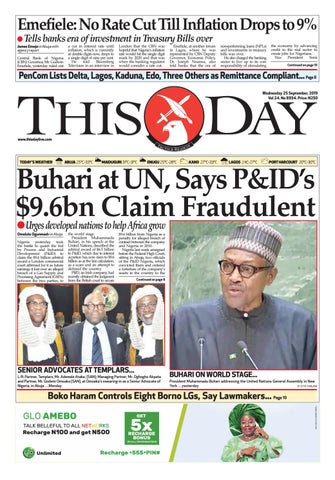
Emefiele: No Rate Cut Till Inflation Drops to 9% Tells banks era of investment in Treasury Bills over
James Emejo in Abuja with agency report
Central Bank of Nigeria (CBN) Governor, Mr. Godwin Emefiele, yesterday ruled out
a cut in interest rate until inflation, which is currently at double digits now, drops to a single digit of nine per cent. He told Bloomberg Television in an interview in
London that the CBN was hopeful that Nigeria’s inflation rate would hit the single digit mark by 2020 and that was when the banking regulator would consider a rate cut.
Emefiele, at another forum in Lagos, where he was represented by CBN Deputy Governor, Economic Policy, Dr. Joseph Nnanna, also told banks that the era of
non-performing loans (NPLs) and investments in treasury bills was over. He also charged the banking sector to live up to its core responsibility of stimulating
the economy by advancing credit to the real sector to create jobs for Nigerians. Vice President Yemi Continued on page 10
PenCom Lists Delta, Lagos, Kaduna, Edo, Three Others as Remittance Compliant... Page 8 Wednesday 25 September, 2019 Vol 24. No 8934. Price: N250
www.thisdaylive.com TR
TODAY'S WEATHER
ABUJA 25°C-33°C
MAIDUGURI 31°C-31°C
UT H
& RE A S O
ENUGU 25°C-28°C
N
KANO 27°C-33°C
LAGOS 24C-27°C
PORT HARCOURT 20°C-30°C
Buhari at UN, Says P&ID’s $9.6bn Claim Fraudulent Urges developed nations to help Africa grow
Omololu Ogunmade in Abuja
Nigeria yesterday took the battle to quash the bid by Process and Industrial Development (P&ID) to claim the $9.6 billion arbitral award a London commercial court affirmed for it as future earnings it lost over an alleged breach of a Gas Supply and Processing Agreement (GSPA) between the two parties, to
the world stage. President Muhammadu Buhari, in his speech at the United Nations, described the arbitral award of $6.5 billion to P&ID, which due to interest accretion has now risen to $9.6 billion as at the last calculation, as a scam and an attempt to defraud the country. P$ID, an Irish company, had recently obtained the judgment from the British court to secure
$9.6 billion from Nigeria as a penalty for alleged breach of contract between the company and Nigeria in 2010. Nigeria last week arraigned before the Federal High Court, sitting in Abuja, two officials of the P&ID Nigeria, which convicted them and ordered a forfeiture of the company’s assets in the country to the Continued on page 8
SENIOR ADVOCATES AT TEMPLARS...
L-R: Partner, Templars, Mr. Adewale Atake, (SAN); Managing Partner, Mr. Oghogho Akpata and Partner, Mr. Godwin Omoaka (SAN), at Omoaka's swearing-in as a Senior Advocate of Nigeria, in Abuja …Monday
BUHARI ON WORLD STAGE...
President Muhammadu Buhari addressing the United Nations General Assembly in New York …yesterday state house
GLO AMEBO
GET
TALK BELLEFUL TO ALL NETWORKS
Recharge N100 and get N500
5x
RECHARGE BONUS
ON ALL DENOMINATIONS
Unlimited
Recharge *555*PIN#
Terms and conditions apply.
Boko Haram Controls Eight Borno LGs, Say Lawmakers... Page 10
2
WEDNESDAY SEPTEMBER 25, 2019 • T H I S D AY
WEDNESDAY SEPTEMBER 25, 2019 • T H I S D AY
3
4
WEDNESDAY SEPTEMBER 25, 2019 • T H I S D AY
WEDNESDAY SEPTEMBER 25, 2019 • T H I S D AY
5
6
WEDNESDAY SEPTEMBER 25, 2019 • T H I S D AY
WEDNESDAY SEPTEMBER 25, 2019 • T H I S D AY
7
8
wednesdAY, september 25, 2019 • T H I S D AY
page eight
PenCom Lists Delta, Lagos, Kaduna, Edo, Three Others as Remittance Compliant Identifies Imo, Bayelsa, Osun, Kano, 25 others as defaulters
Ebere Nwoji
The National Pension Commission (PenCom) has listed only seven out of the 36 states in Nigeria as being current in their remittance of pension fund deductions from the salaries of their employees as well as in remitting their own part of contributions into the Retirement Savings Account (RSA) of their employees as mandated by the contributory pension scheme (CPS). PenCom, in its latest second quarter 2019 report, which THISDAY obtained yesterday, listed the seven states as Delta, Edo, Ekiti, FCT, Jigawa, Kaduna and Lagos. On the other hand, it listed 28 states that do not remit both pension deducted from their workers’ salaries and contributions to the RSAs
of their workers to include Abia, Ebonyi, Enugu and Imo, Akwa Ibom, Bayelsa, Cross River, Oyo, Osun, Ondo and Ogun states. Other defaulting states are Anambra, Rivers, Adamawa, Bauchi, Benue, Borno, Ebonyi, Gombe, Kano, Katsina, Kebbi, Nasarawa, Niger, Plateau, Sokoto, Taraba and Zamfara. However, Yobe State, which has no pension scheme, could also be classified as one of the defaulting states. Section 1.3.2 Section 2 (1) of the Pension Reform Act 2004 (PRA), 2014 provides that CPS should apply to any employee in the public service of the federation, the public service of the Federal Capital Territory (FCT), the public service of the state government, the public service of the local government
councils and the private sector. PenCom in the report said whereas Section 9 (3) of the Act requires every employer to which the Act applies, to take a life insurance policy for its employees for a minimum of three times the annual total emolument of the employees, sub-section 2.1 of the Act further states that the employer shall fully bear all costs in relation to procurement of the life policy in addition to and separate from, the contributions to be made by the employer to each employee’s RSA. The report showed that most states have no group life insurance policy arrangement for their workers. For instance, out of the 36 states, 35 states have no group life insurance arrangement for their workers.
It also stated that only the FCT and Kaduna have valid group life plan for their workers, while 32 states do not. “State governments continued to make progress in the level of implementation of the CPS. As at the second quarter of 2019, a total of 25 states of the federation have enacted pension laws on the CPS; seven states are at the bill stage and five have, however, embarked on pension reform other than the CPS. “The commission held a meeting with the officials of Jigawa (State and Local Governments) Contributory Pension Scheme. The meeting was convened to review the commission’s comments on the Trust Deed Governing the administration of the Contributory Defined Benefits Scheme in Jigawa State.
“At end of the meeting, the delegation expressed appreciation to the commission for its input and promised to incorporate the comments into the Trust Deed and re-submit for the commission’s review,” it adde In continuation of the refund of pension contributions to military and security agencies personnel, following their exemption from the CPS, the commission had, during the quarter under review, processed 2,080 applications for refund. A total sum of N142.13 million was refunded to the contributors, while N83.67 million, representing the contributions by the federal government, was returned to the Contributory Pension Account domiciled with the Central Bank of Nigeria (CBN).
DEFAuLTING STATES 1. Abia 2. Ebonyi 3. Enugu 4. Imo 5. Akwa Ibom 6. Bayelsa 7. Cross River 8. Oyo 9. Osun 10. Ondo 11. Ogun 12. Adamawa 13. Bauchi 14. Benue 15. Borno 16. Gombe 17. Kano 18. Katsina 19. Kebbi 20. Nasarawa 21. Niger 22. Plateau 23. Sokoto 24. Taraba 25. Zamfara 26. Anambra 27. Rivers 28. Ebonyi 29. Yobe
Lawan Recants on Submission of MTEF/PSF Draft for 2020 Budget Senate summons Malami, Sylva over $9.6bn P&ID’s claim Inaugurates 69 standing committees today
Deji Elumoye in Abuja
The Senate President, Dr. Ahmad Lawan, yesterday recanted his earlier statement on the submission to the Senate, of the 2020-2022 Medium Term Expenditure Framework ( MTEF) and Fiscal Strategy Paper (FSP) documents from the executive for the 2020 budget. He said at plenary that the Senate was yet to receive the documents. Lawan, last Friday, in anticipation of a prompt submission of the documents, had promised that the first major work of the Senate upon resumption yesterday would be the consideration and approval of the MTEF. He told journalists upon
return from an overseas trip on Friday evening, that he had been informed that the executive had forwarded the documents to the National Assembly. But he sang a different tune yesterday as he said after an hour of executive session that the National Assembly was still awaiting the receipt of the document. "The Senate at the closed-door session resolved to await the transmission of the MTEF/FSP documents from the executive to it and by extension, the House of Representatives," he added. The MTEF and FSP documents as stipulated in the Fiscal Responsibility Act, are proposals that must be presented first to the lawmakers by the president for required
approval of parameters upon which the budget estimates are based. The Fiscal Responsibility Act placed so much importance on the MTEF document to the extent that it has spelt out the specific details of its contents and scope. Also yesterday, the Senate summoned the Attorney General of the Federation and Minister of Justice, Abubakar Malami and the Minister of State for Petroleum, Mr. Timipre Sylva, to appear before it and brief the legislature on the $9.6 billion recent judgment awarded to Process and Industrial Development (P&ID) against Nigeria by a law court in London. This was sequel to a point
BuHARI AT uN, SAYS P&ID’S $9.6BN CLAIm FRAuDuLENT
federal government. Ahead of the resumed hearing of the matter tomorrow, Nigerian delegation comprising the Attorney General of the Federation and Minister of Justice, Mr. Abubakar Malami (SAN); Minister of Information and Culture, Alhaji Lai Mohammed; Inspector General of Police, Mr. Mohammed Adamu, Central Bank of Nigeria (CBN) Governor, Mr. Godwin Emefiele and Acting Chairman, Economic and Financial Crimes Commission (EFCC), Mallam Ibrahim Magu, arrived in London on Saturday for the legal battle. On Sunday, the delegation met for five hours with the foreign legal team and others to brainstorm on strategy to get the court to reject P&ID’s bid to attach Nigerian assets to the claim for its collection. One of the strategies Nigeria is mulling is to present before the British court proceedings at the Federal Court that led to the conviction of the P&ID Nigeria officials for tax evasion among other sundry charges, to back its claim that the failed gas deal was fraudulent from conception. It was against the foregoing that Buhari in his address at the
74th United Nations General Assembly (UNGA) in New York formally reported the case to the world body. He said Nigeria is fighting all manners of social ills, including corruption as typified by the P&ID case. The president, whose speech was emailed to journalists in Nigeria, told the global body that the swift reaction of Nigeria to the attempt by the company to rob it of its billions of dollars was a clear message to other international criminal groups. "This is true in the battle against violent extremism, against trafficking in people and drugs and against corruption and money laundering. The present Nigerian government is facing the challenges of corruption head-on. We are giving notice to international criminal groups by the vigorous prosecution of the P&ID scam attempting to cheat Nigeria of billions of dollars," he said. Buhari also lamented other international criminal activities, including murder in New Zealand, xenophobia and related crimes in other countries, blaming such grievous crimes on the failure of "tech companies" in various parts of the world to live up
to their responsibilities. "The world was shocked and startled by the massacre in New Zealand by a lone gunman taking the lives of 50 worshippers. This and similar crimes which have been fuelled by social media networks risk seeping into the fabric of an emerging digital culture. "Major tech companies must be alive to their responsibilities. They cannot be allowed to continue to facilitate the spread of religious, racist, xenophobic and false messages capable of inciting whole communities against each other, leading to loss of many lives. This could tear some countries apart. "Organised criminal networks, often acting with impunity across international borders, present new challenges where only collective action can deliver genuine results," he stated. Buhari thanked the UNGA for the honour accorded to Nigeria by giving the most populous black nation the opportunity to produce its current President; assuring it that Tijjani Muhammad-Bande, who ascended the office on September 17, would not let it down. "Nigerians are truly grateful and shall endeavour to live
of order raised at plenary by the Chairman of the Senate Committee on Judiciary, Senator Opeyemi Bamidele, who expressed concern over the judgment that he claimed has put the country in bad light. According to Opeyemi, "my motion is on the need to invite the Minister of Justice and Attorney General of the Federation and other relevant stakeholders to brief relevant committees of the Senate on the award of $9.6billion against the federal government of Nigeria, by a United Kingdom court in the matter of P&ID versus Federal Government of Nigeria." The Senate, therefore, resolved to invite Malami and Sylva to brief four of its committees judiciary, petroleum (upstream),
gas and power - on the court judgment. "The Senate, accordingly resolves to invite the Minister of Justice and Attorney General of the Federation, in the company of other relevant stakeholders, including officials of the Ministry of Petroleum Resources and professional arbitrators engaged on behalf of the Federal Government of Nigeria in this regard, to comprehensively brief the Senate Committees on Judiciary, Human Rights and Legal Matters, Petroleum Resources (Upstream and Downstream), Gas Resources and Power on the details of the 2010 contract with P&ID as executed, reasons for the default as well as the handling of resultant
negotiations, arbitration, court proceedings and steps being taken to resolve the matter in the overall best interest of the Nigerian economy and security of the nation’s assets at home and abroad". Malami, according to Lawan, who presided over plenary, is expected to explain to the committees what steps Nigeria is taking to resolve the issue at stake. Meanwhile, Lawan will today inaugurate the 69 Standing Committees of the Senate. Lawan who made the announcement at plenary yesterday, read out the full list of members of the committees. He said the committees' inauguration would be done at once.
up to the expectations and responsibilities thrust upon us. Ambassador MuhammadBande is an experienced and seasoned diplomat and I am confident that he will prove to the international community his suitability for this most demanding assignment," he added. Buhari also called on the international community to take interest in the development of Africa, saying that a developed Africa will not be a thorn in the flesh of advanced countries but will rather be friendly with them and serve as a partner in progress. According to him, Africa is bestowed with rich and immense resources, which when explored by investing in the continent, would lead to productivity and outputs that would be beneficial to the entire world. Buhari canvased what he described as coordinated multilateral efforts for the development of Africa, adding that the current multilateral efforts being made for African development are not coordinated but "plainly incremental." He therefore pleaded with advanced countries to take advantage of the enormous
resources in Africa for the benefit of the entire world. "A developed Africa will not be antagonistic to industrialised countries but will become friends and partners in prosperity, security and development. A prosperous Africa will mean greater prosperity for the rest of the world. A poor Africa will be a drag on the rest of the world. Is this what the international community wants? "A coordinated multilateral effort should be set in motion to utilise and maximise use of the enormous resources on the African continent for the benefit of all nations. Investing partners will be able to recoup their investments manifold over time. "Current attempts to help develop Africa by industrial countries are un-coordinated and plainly incremental. We have the skills, the manpower and the natural resources, but in many instances, we lack the capital – hence my plea for industrial countries to take a long-term view of Africa, come and partner with us to develop the continent for the benefit of all," he said. Buhari also drew the attention of world leaders to poverty in Africa, describing it
as a potent source of prevalent crimes in the continent including insurgency, crossborder crimes and human trafficking. He described poverty as one of the greatest challenges confronting the world, Continued on page 10
TOP GAINERS NGN NGN % ABCTRANSPORT 0.03 0.34 9.6 NPFMFB 0.09 1.22 7.9 UACN 0.50 7.65 6.9 COURTVILLE 0.01 0.21 5.0 JAIZBANK 0.02 0.45 4.6 TOP LOSERS NGN % CADBURY 1.15 10.45 9.9 STERLBANK 0.19 2.01 8.6 STANBIC 3.55 39.30 8.2 CORNERSTONE 0.03 0.39 7.1 DANGSUGAR 0.70 10.35 6.3 HPE Nestle Nig Plc ₦1,215.10 Volume: 154.034 million shares Value: N2.825 billion Deals: 2,922 As at yesterday 24/9/19 See details on Page 41
WEDNESDAY SEPTEMBER 25, 2019 • T H I S D AY
9
10
wednesdAY, september 25, 2019 • T H I S D AY
news
Boko Haram Controls Eight Borno LGs, Say Lawmakers Army declines comment
Shola Oyeyipo in Abuja
Despite the claim of the federal government that it has “technically” defeated Boko Haram and the terror group was no longer in control of any territory, two members of the House of Representatives from Borno State, the epicentre of the insurgency, yesterday told the House that eight local government areas in the state are under the control of the insurgents. They expressed concerns about the spike in the deadly activities of the terrorist group, saying the insurgents have refreshed their expansionist quest and continued to sustain control over more local government areas/communities in the state. The House Chief Whip, Hon. Mohammed Tahir Monguno, representing Marte/Monguno/ Nganzai Federal Constituency of Borno State and his counterpart from Damboa/Gwoza/Chibok Federal Constituency of the state, Hon. Ahmadu Usman Jaha, spoke while the House was debating a motion of ‘’urgent national importance’’ that Monguno sponsored. The motion was brought pursuant to Order 8, Rule 4 of the relevant rules of the House. According to Monguno,
there is the need for special intervention in the protracted security situation because the gains recorded against the Boko Haram by the Buhari administration are currently being reversed. He said: “Before the advent of the current administration, the territorial integrity of this country had been compromised as a result of the activities of Boko Haram insurgents. It is also a public knowledge that as a result of the activities of Boko Haram, about two-thirds of local government areas, particularly in Borno State, the epicentre of Boko Haram insurgency, came under effective control of the Boko Haram insurgents, thereby administering their own rules and regulations, hoisting their flags and comprising the territorial integrity of the country. “Maiduguri, the capital of Borno State, had become another huge IDPs' camp as a result of the influx of people from other local government areas and it triggered a very huge humanitarian crisis. With the coming of this government as well as the political will exhibited by the leadership of President Muhammadu Buhari, as well as the gallantry exhibited by our armed forces, today, I can report to you that these
Borno State Governor, Prof. Babagana Umara Zulum local government areas have been degraded (reclaimed). ‘’But of recent, we have started witnessing a retrogression in the successes so far achieved in the fight against Boko Haram insurgency, which is a risk of going back to the pre-2015 ugly scenario of Boko Haram effectively having control over some local government areas. And it might trigger mass migration of people from the affected local government areas to Maiduguri.” Corroborating Monguno, Jaha gave graphic details of how Boko Haram has taken control of areas in his constituency, saying that more needed to be done to motivate soldiers
EmEfIElE: No RATE CuT TIll INflATIoN DRopS To 9% Osinbajo, also at the occasion, identified the banking industry as a key player in actualising President Muhammadu Buhari’s promise of lifting millions of Nigerians out of poverty. “How soon do I see interest rates coming down? I’m not seeing that coming this year,” Emefiele said in the interview with Bloomberg, “During the course of 2020 we may be able to see that, but I can’t see that until we begin to see the numbers showing inflation is trending downward.” The central bank held the monetary policy rate at 13.5 per cent last week for the third straight meeting after surprising the market in March with the first cut since 2015. While inflation has slowed from as high as 18.7 per cent in January 2017 to 11 per cent in August, it’s been outside the target band of 6 per cent to 9 per cent for more than four years. “Unfortunately it’s been sticky coming downwards as soon as it hit about 11 per cent. “The Monetary Policy Committee would love to see it at about 9 per cent before beginning to aggressively thinking about easing,” Emefiele said. He also said most of the banks
have obeyed a directive to raise loan-to-deposit ratio to 60 per cent as directed by CBN and those that fail to do so will face penalties by October 1. “Compliance level has been excellent. Not all the banks have complied, naturally. Sanctions will be administered by October 1,” he added. The CBN had ordered banks to increase lending by late September in a bid to shore up an economy struggling to recover from a contraction in 2016, its first in a quarter of a century. The monetary authority wants to steer banks away from naira bonds, which offer hefty yields, and into consumer and corporate lending. Some lenders have warned that extending more credit amid double-digit inflation could jeopardise the health of the banking system. S&P Global Ratings warned last week that the directive is unlikely to unlock credit, unless the government addresses other structural bottlenecks to investment in Africa’s most populous country. At another event in Lagos, the CBN governor told banks that the era of NPLs and investments in treasury bills was over. Emefiele, at the opening
of the 12th Annual Banking and Finance Conference 2019, with a theme: "The Future of Nigerian Banking Industry- 360 Degrees," warned that the era whereby banks practised what he termed as armchair banking- deploying their assets in fixed income instruments, particularly treasury bills and bonds at the expense of the real sector, was over. He stated that the era of non-performing loans, which had plagued the banking industry, was over as anyone who benefits from any facility must pay back. He called on the judiciary to support the debt recovery initiative through quick dispensation of justice. The CBN governor urged the industry to embrace the 21st century banking ideals, by redirecting surplus resources to critical sectors of the economy. He said the days of brick and mortar banking were gone, urging banks to embrace digital banking. He also described unemployment as the biggest challenge in the country and appealed to the banks to assist government in addressing the challenge. He said: "Talking about transformation, banking in Nigeria has come a very long
BuHARI AT uN, SAYS p&ID’S $9.6BN ClAIm fRAuDulENT explaining that poverty elimination, on the other hand, is a tool for sustainable development. The president also listed efforts being made by the federal government to address poverty in Nigeria. He said: "Poverty in all its manifestations remains one of the greatest challenges facing our world. Its eradication is
an indispensable requirement for achieving sustainable development. In this regard, Nigeria has developed a National Social Investment Programme – a pro-poor scheme that targets the poorest and most vulnerable households in the country. "Africa charges you with the singular task of initiating the effort we are calling for.
The United Nations has in place processes for promoting collective action to combat global threats. No threat is more potent than poverty and exclusion insurgency, cross-border crimes, human trafficking. "They are the foul source from which common criminality, insurgency, cross-border crimes, human trafficking and its terrible consequences draw
in the frontline so as to win the war. Jaha, who commended the Whip for bringing in the motion as matter of urgent public importance, stated that “the truth of the matter is, substantial number of geographical locations occupying Borno and other insurgency related areas are still under the occupation of Boko Haram whether we like it or not.’’ He said: “Let’s take for instance, in local government that has 13 electoral wards like my own, Gwoza, only three or four wards are not under the occupation of Boko Haram. “In Chibok, I have 10 electoral wards, only two are not under the occupation of Boko Haram. In Damboa, I have 10 electoral wards, only one ward is not under the occupation of Boko Haram. This is as far as Chibok, Damboa, Gwoza Federal Constituency is concerned. “The same thing; the Chief Whip of the House can bear me witness; out of the 10 local governments in northern Borno, only two local governments and their headquarters, are still not under the occupation of Boko Haram.” Before he was eventually ruled out of order, Jaha canvassed for more funding for the military while alleging
that soldiers on the frontline are being paid N500 per day totalling N15,000 in a month. He wondered how much such a soldier will send home to take care of his family. The lawmaker said the target is to encourage soldiers on ground, adding that the federal government needs to accept the fact that Boko Haram population is less than five per cent of the Nigerian soldiers. He claimed that but because Boko Haram group is committed and stimulated, the terrorists are ready to bring the war to “our doorstep.” “Our soldiers are not committed because they are not stimulated; they are not motivated; they are not ready to take the war to their doorstep. Inasmuch as we are not ready to stimulate them, motivate them, make them comfortable, give them insurance, provide insurance cover for each and every military man, definitely we are not going to win that war,” he stated. The Speaker, Hon. Femi Gbajabiamila, said the motion was an offshoot of the Monday security meeting between the leadership of the House and service chiefs. “As you are all aware, the leadership of the House and the heads of security committees
met with the heads of security agencies - the security chiefs – behind closed doors for almost five hours yesterday (on Monday). ‘’This motion by Hon Monguno is a result of some of the outcomes of that meeting. And there will be a couple more, arising from that meeting, which we believe that we should put some legislations to enhance their work to help with the security issues concerning this country,” Gbajabiamila added. However, when contacted on the phone to react to the lawmakers’ allegation that Boko Haram controls some territories in Borno State, the Theatre Commander of Operation Lafiya Dole, Maj. Gen. Olusegun Adeniyi, said he would not be able to answer such an inquiry on the phone. But when our correspondent volunteered to come over to his office, he said he should not bother as responding to such an allegation would not have made him to rise to a Major General in the Nigerian Army. Attempts to get the spokesman of Operation Lafiya Dole, Col. Ado Isa, to respond was also unsuccessful as he did not pick up his call when THISDAY called his telephone line.
way. Today, with our new generation banks, the players of this space are digital in nature. We have gone beyond armchair banking where players play safe. "Today, the CBN is calling on the banking system to be alive to its responsibility. We cannot conceive an economy without banks and neither can we conceive banks without an economy. "What do I mean by this? What I am simply saying is that the days of armchair banking, playing in the treasury bills space, those days are right behind us. The Central Bank of Nigeria is bullish and we have in fact, taken our responsibility very seriously. "In the past months, we have come with new initiatives: the loans to deposit ratio is aimed at transforming liquidity management into risk asset management and asset transformation. "We do not want the banks to be money changers. Banking is not banking if you only play in the government fixed income space. Banking becomes meaningful when you take liquidity excesses from your surplus centres and channel them into scarce areas; that way you are transforming liquidity into assets and you
are growing the economy and creating employment. "Talking about employment, employment is the most serious issue facing our country and this is where banks must play a critical role. “We must support government in asset creation; we must support the government in creating jobs for the teeming population. "That is why we implore banks to ensure that idle liquidity is transformed into asset creation. We have also tried to de-risk the banking industry. The days of nonperforming loans are behind us and we call upon the judiciary to assist us in this regard. "We shall lend to borrow in the old fashion way, by paying back when we have accessed facility from the banks.” On his part, Osinbajo said the banking industry would play a crucial role in the actualisation of Buhari’s promise of lifting millions of Nigerians out of poverty. According to him, achieving success in the present administration's numerous initiatives to empower Nigerians, depend on "what the banking industry is prepared to do, how adaptable the banking industry will be to giving
loans, especially microcredit. Everything is changing very quickly." He said to make meaningful impact, government needed to create good jobs and opportunities, industrialise and provide the environment for local businesses, particularly small and large, to create wealth and value. Osinbajo said government was committed to tackling concerns of young entrepreneurs and start-ups, small traders, as well as the "millions at the bottom of the economic value chain, the millions at the bottom of the pyramid, those who sell from their trays and table tops all over the markets in our country." “We started that journey with our collaboration with the Bank of Industry to deliver the GEEP programme, better known as TraderMoni and MarketMoni by providing microcredit to almost two million petty traders. The Bank of Industry has now brought this huge bottom of the pyramid into the formal financial system and that has been recognised worldwide. "Recently the programme won the AfDB prize for financial inclusion because of the work that was done with TraderMoni. This is a huge task," he added.
their inspiration." In an attempt to appeal to the conscience of world leaders that they have a responsibility to help Africa, Buhari recalled how the United States assisted Europe and Japan following the devastating effects they suffered from the World War II. He said such compassionate intervention by the United States helped to facilitate the
recovery of both the Europe and Japan, adding that this good gesture promoted friendly relations between them and the United States since then. He urged the developed world to extend such a gesture to Africa to strengthen the ties between them. The president also spoke on climate change, saying Nigeria shares the world view on the
phenomenon by working towards carbon emission targets that he signed in 2015. He also spoke on the threat posed by violence to the world, noting that Nigeria has itself been a victim of the tragedy. He added that Nigeria with a huge population of 200 million, derives its strength from its diversity.
WEDNESDAY SEPTEMBER 25, 2019 • T H I S D AY
11
12
WEDNEsDay sEptEmbEr 25, 2019 • T H I S D AY
NEWs
Group News Editor Ejiofor Alike Email Ejiofor.Alike@thisdaylive.com, 08066066268
Declare Me Winner, Says Atiku in Appeal to Supreme Court APC files counter appeal at apex court
Chuks Okocha, Alex Enumah in abuja and Uche Nnaike in Lagos The candidate of the Peoples Democratic Party (PDP) in the last presidential election, Atiku Abubakar, has asked the Supreme exclusively reported on Sunday Court to declare him winner of the February 23 presidential
election. This is coming as the All Progressives Congress (APC) has filed motions challenging sections of the September 11 presidential election tribunal judgment, and seeking the nullification of evidence proffered by the PDP and accepted by the tribunal. Atiku’s request was contained
APC Govs Back Probe of Eighth N’Assembly’s Constituency Projects Adedayo Akinwale in abuja The Progressive Governors Forum (PGF) has said that the current investigation by the Independent Corrupt Practices and other related offences Commission (ICPC) into alleged abuses in the execution of constituency projects by the Eight National Assembly was in line with the anti-corruption crusade of President Muhammadu Buhari. The anti-graft body had recently revealed that it had established cases of abuse and non-execution of contracts, even after money had been paid. The revelation however is believed to be creating apprehension among lawmakers. The Senate spokesman and Chairman of its Committee on Media and Public Affairs, Senator Adedayo Adeyeye,wasquotedbyanationaldaily to have said that it was unfortunate that the ICPC went public with the investigation even when it was yet to contact the leadership of the National Assembly or at least the lawmakers involved in the said projects. But the Edo State Governor and PGF Deputy Chairman, Godwin Obaseki, said the decision of the Buhari-led federal government to probe alleged abuses in the execution of constituency, was in line with the government’s anti-corruption agenda The governor conveyed the PGF’s position yesterday in Abuja while addressing journalists at the end of the inaugural meeting of the PGF Legislative Programme Steering Committee. Obaseki who is the chairman of the committee was represented by his deputy, Phillip Shuaib, while the Governor of Kastina State, Aminu Masari, who was absent at the
inauguration is the co-chairman. He said, “when these synergies are there, the issue of constituency projects probing or no probing will not be there. It is in line with the principle of Mr. President’s cleaning the books, but it does not really mean that those constituency projects are not there.” Obaseki said that in order to ensure theachievementof progressivegoal,the PGF has set up programmes steering committees structured and constituted toprovidetherequiredtechnicalservices to its member-states. He cited the PGF Legislative Programme Steering Committee that wouldprimarilyprovidePGFmembers with clear and concise contextual recommendations in terms of legal framework governing government processes and decisions. Obasekiexplainedthatthecommittee monitors ongoing government operations, identifies issues suitable for legislative review, gather and evaluate information and recommend course of action to PGF. The governor said the party recognises the fact that the legislature is thebackboneofanydemocracy,adding that no democracy can flourish except, and until its legislature is strong and progressively active. To this end, he stressed that part of the objectives of the PGF Legislative programmes therefore, was to ensure cordial relations between the legislatures and the executive arm. Obaseki stressed that the goal was to develop a good framework of engagement andtomanageand regulate all emerging differences such that conflicts between the executive and the legislature at all levels where APC rules are minimised, adding that these conflictswouldonlycontinueto weaken the party’s capacity to meet the expectations of its citizens.
in a joint appeal with his party, PDP, against the judgment of the Presidential Election Petition Tribunal (PEPT), which dismissed their petition for being incompetent and lacking in merit. A copy of the appeal, which was filed on Monday as exclusively reported on Sunday by THSDAY, was obtained yesterday. The five-man panel in the lead judgment delivered by its Chairman, Justice Mohammed Garba, held that the petitioners failed to prove their allegations against President Muhammadu Buhari, whose declaration as winner of the election they are challenging, and the conduct of the election. But Atiku and PDP in a 95page document containing 66 grounds of appeal, urged the Supreme Court to set aside all the decisions of the tribunal because it erred in reaching the conclusion that the petitioners failed to prove their case against the respondents. The petitioners had hinged their case on the grounds that Buhari lied on oath in his Form CF001 submitted to INEC to aid his clearance for the presidential election. They have also alleged irregularities and substantial non-compliance with the Electoral Act and guidelines during the poll. Respondents in the petition include the Independent National
Electoral Commission (INEC), Buhari and the All Progressives Congress (APC). In the appeal filed against the upholding of Buhari’s election by the tribunal, the petitioners said the panel erred in law by holding that Buhari was eminently qualified to contest the poll. They also accused the panel of descending into the arena to defend Buhari. They accused the justices of making use of evidence never pleaded or led at the trial by any of the respondents and sometimes credited statements to the petitioners’ witnesses, which were never made. For example they submitted that, “there was no evidence at the trial that schooling at the Military Training School was “higher than Secondary School Certificate education.” “The 2nd respondent or any of the respondents for that matter did not lead evidence on the meaning of “Officer Cadet”. “The 2nd respondent neither claimed nor led evidence that the 2nd respondent was “eminently qualified to contest.” “Contrary to the testimony of RW1 regarding the submission of his certificates to the Army, the lower court inferred that the 2nd respondent “in fact submitted his certificates to the military.” The appellants further argued that INEC did not lead evidence wherein it informed the court that it was satisfied with the
qualification of the Buhari. Also Buhari, according to the petitioners, throughout the trial, did not lead any evidence to show that he successfully went through primary school, secondary school and famous military college(s) in the USA, UK and or India, whereas the lower court assumed he did. In ground one of the appeal, Atiku and PDP said the tribunal erred in law when it relied on “overall interest of justice” to hold that Buhari’s documents were properly admitted in evidence. According to them, the documents, which bordered around his certificates, were not pleaded and were not front-loaded. On ground two, relating to the ruling of the tribunal that Buhari does not need to attach his certificates to his Form CF 001, the appellants submitted that the tribunal gave restrictive interpretation to Section 76 of the Electoral Act 2010 (as amended) in order to exclude Form CF001 from its provisions. “The conduct of election by the 1st respondent starts with the screening of candidates”, they said adding that “no candidate can be screened unless he completes Form CF001 (Exhibit P1). “In Form CF001, under the column for “Schools Attended/ Educational Qualification with dates”, there is the clear
provision: “ATTACH EVIDENCE OF ALL EDUCATIONAL QUALIFICATIONS”. “Certificates are evidence of educational qualifications,” the petitioners explained. “The lower court held that Buhari passed with credits in English Language, Geography, History, Health Science, Hausa and a pass in English Literature in 1961 by inference when there was no evidence throughout the trial and indeed no evidence from the school principal to the effect that the 2nd respondent wrote or actually passed those subjects”, they argued. In addition, they accused the tribunal of attaching evidential value to the military statement on Buhari’s certificate in making a case for Buhari after rejecting same document for lack of probative value. But the appellants submitted that they led sufficient evidence before the tribunal to prove that Buhari lied concerning the schools he purported to have attended and certificates obtained. “If anything, the evidence of RW1 and RW2 concerning educational qualifications of the 2nd Respondent as filled in Form CF001 on 8/10/2018 is merely hearsay. The 2nd Respondent did not attach to Form CF001, filled on 8/10/2018, the certificates he claimed to have
Continued on page. 52
Buhari Redeploys Keyamo, STRENGTHENING BUSINESS TIES.. Alasoadura in Minor Cabinet L-R: Group Managing Director, Access Bank Plc, Mr. Herbert Wigwe; Ogun State Governor, Prince Dapo Abiodun; Lagos State Governor, Mr. Babajide Sanwo-Olu; and President of Dangote Group, Alhaji Aliko Dangote; at the US-Africa Leadership Forum on the theme, Reshuffle “Strengthening the future of US-Africa Trade and Investment,” at Lott’e New York Palace, New York…yesterday Olawale Ajimotokan in abuja
President Muhammadu Buhari has approved the immediate redeployment of two ministers of state - Mr Festus Keyamo and Senator Tayo Alasoadura. The redeployment is coming barely two months after they were appointed into the cabinet by President Buhari. A statement issued yesterday by Director Information, Office of the
Secretary to the Government of the Federation (OSGF), Wille Bassey, said Keyamo, who is the Minister of State for Niger Delta Affairs is to move to the Ministry of Labour and Employment as Minister of State, while Senator Alasoadura is to move to Ministry of Niger Delta Affairs as Minister of State. The statement said the redeployment takes effect from yesterday, Tuesday, September 24, 2019.
House Urges INEC to Deregister Parties Shola Oyeyipo in abuja The House of Representatives has asked its Committee on Electoral Matters to investigate the circumstances surrounding the non-implementation of Section 78 (7) (ii) of the Electoral Act by the Independent National Electoral Commission (INEC). The section of the law
empowers the electoral umpire to deregister political parties. The decision followed the adoption of a motion to call on INEC to Implement Section 78 (7) (ii) of the Electoral Act, 2010 moved by Hon. Francis Charles Uduyok. Uduyok noted that the aforementioned sub-section clearly states that failure of any political
party to win at least one seat in the national or state assembly elections will result in de-registration of the said political party. He expressed concern that since the commencement of the Act, Section 78 (7) (ii) has not been fully implemented given the rising number of political parties in Nigeria with neither a seat in either a state House of Assembly
or the National Assembly; “If Section 78 (7) (ii) of the Electoral Act is fully implemented, it would regulate the numerous political parties, reduce election costs, as well as reduce void votes caused by the inability of citizens to comprehend the long list of political parties on ballot papers,” Uduyok stated.
WEDNESDAY SEPTEMBER 25, 2019 • T H I S D AY
13
14
T H I S D AY • WEDNESDAY, SEPTEMBER 25, 2019
COMMENT
Editor, Editorial Page Peter Ishaka Email peter.ishaka@thisdaylive.com
The 9/11 JudgmenT
sonnie ekwowusi argues that the decision of the Presidential election tribunal is unfortunate
T
he 9/11 judgment continues to draw the ire of the public. The people are embittered about 9/11 because it is simply repugnant to equity, justice and good conscience. Eight out of the 10 top litigation lawyers I discuss 9/11 with affirm that it is a complete embarrassment to the judiciary, and, that not even Awolowo V Shagari is as embarrassing as 9/11. They shudder why the tribunal descended into the arena and manufactured a case for President Buhari and thereafter ruled that he attended courses that qualify him to seek election as president when that was never Buhari’s case (a court cannot make a case for a party). I tell friends that what is at stake in 9/11 is neither Buhari nor Atiku. After all, Buhari and Atiku, like all mortals, will answer the call of their Maker some day and leave the stage for other politicians. What is really at stake in 9/11 is the soul of the judiciary. If the judiciary, a veritable third arm of government, is aborted our democratic experiment will equally be aborted to the detriment of the governed. That is why 9/11 will continue to provoke public outrage. It is gladdening that some lawyers are summoning courage to expose the manifest errors in 9/11. For instance, under the title, Atiku V Buhari: Is the Judiciary on Trial? (THISDAY newspaper, 17 September 2019, pages 1-14) legal luminaries of varying degrees of weight unequivocally agreed that 9/11 is simply a fruit of compromised and emasculated judiciary and therefore completely unacceptable because it is a gateway to judicial cataclysm in Nigeria. When former Chief Justice of Nigeria Walter Onnoghen was summarily fired with a forged ex-parte order and replaced with Justice Mohammed Tanko the people completely lost the little confidence they had in the Nigerian judiciary. Their impression at that time (which remains same today) was that the replacement of Onnoghen with Tanko was to ensure that no court or tribunal in Nigeria delivers an independent verdict. The 9/11 judgment seems to have proved the people right. To satiate its conscience that it was out to do justice to both Atiku and Buhari, the tribunal hypocritically embarked on a gruelling nine-hour voyage of jurisprudential discoveries (during which many lawyers following it not only fell asleep but were snoring aloud) before it finally landed where it had all along be wanting to land. Anyway, something happened to me shortly after the delivery of the 9/11 judgment. A cheeky friend of mine who saw me from a distance started hailing me. When I turned and asked him what was in the offing, he said, “Your judiciary has shown its true colour again”. “What do you mean?” I asked feigning ignorance. “The Atiku, Buhari case now. I watched the proceedings live. Those tribunal members messed up with that case. They should not have given it to Buhari. It is obvious that Atiku won even with the certificate issue alone. What is means now is that people like me can go to court and swear to an affidavit that I have a PhD and it will be accepted” My friend, no doubt, speaks the mind of many right-thinking members of the Nigerian public. With 9/11, many Nigerians have completely lost confidence in the Nigerian judiciary - both as a bulwark of justice and as the last hope of the common man. If you are still in doubt of what I am saying, visit the social media-Facebook, instagram, WhatsApp platforms - and will see how many small boys and girls are making a jest of Nigerian judiciary and Nigerian lawyers simply because
THe erOsiOn Of public cOnfidence in any cOurT Of law undermines THe nObiliTy and inTegriTy Of THaT cOurT
of 9/11. Who cares a hoot about public opinion? You may ask. But public opinion matters a lot. The erosion of public confidence in any court of law undermines the nobility and integrity of that court. In Metropolitan Properties Co. (FGC) Ltd V Lannon (1968), Master of the Rolls Lord Denning said: “Justice must be rooted in confidence and confidence is destroyed when the right-minded people go away thinking saying: The judge was biased”. This saying is true and worthy of full acceptance not only in the era of Lord Denning but to this day. Granted, controversial political court decisions always evoke disturbing public complaints against the court, but the grave truth is that 9/11 has steeped the Nigerian judiciary into the worst crisis, possibly the most serious since the exit of the military. The unpalatable truth is that since the inception of the Buhari government the judiciary has been falling into the swamp of uncertainty. With 9/11, the law of the land is now at a stage where the appearance of justice is probably impossible and is certainly not to be expected in our courts. With the greatest respect, 9/11 is a laborious exercise in error of law. Overwhelming evidence was led to prove that President Buhari was not qualified for election to the office of the president because he did possess his alleged certificates. But unfortunately the tribunal deliberately chose to belittle the evidence. Pursuant to the combined effects of sections 131(d) and 318 (1)(a-d) of the 1999 Constitution a person shall be qualified for election to the office of a President of Nigeria if he possesses a school certificate or a secondary school certificate or its equivalent or even a primary school certificate or Grade 11 Teacher’s certificate. Note that sections 131(d) and 318(a-d) viva voce stipulate that the candidate seeking election as president must provide the certificates issued to him by the relevant authorities in his educational pursuit. This is why the INEC form CF001 to be filled by the candidate has provisions for the attachment of the candidate’s educational certificates with attendant dates. Now in filling his form CF001 Buhari claimed that he obtained a primary School Certificate, a secondary School Certificate (WASC) and Officer Cadet. He did not claim in form CF001 that he attended many educational courses or that he was educated up to primary school level or secondary school level qualifying him for election to the office of the President as the tribunal wants us to believe. He simply and unambiguously claimed in the form CF001 that he possesses a Primary School Certificate, a Secondary School Certificate (WASC) and Officer Cadet. But Buhari did not attach his academic qualifications to his INEC form CF001. Instead, he swore to an affidavit that his certificates were with the military. Ironically both Atiku and Buhari tendered a national newspaper duly certified by the National Library wherein the military had denied as far back as 2015 that it was in possession of Buhari’s alleged certificates. Even Buhari’s first witness, Major.-Gen. Paul Tarfa (rtd), who claimed he was Buhari’s classmate, denied that he and Buhari submitted their certificates to the military. When asked if he and Buhari submitted their certificates to the military, Paul Tarfa simply responded: “We did not submit our certificates to the Nigerian Army as there was no such thing.”
Waning Strength Of gOvernment
T
The strength of government is not about the use of force, but about the rule of law, writes Oseloka H. Obaze
wo recent governance events underlined the waning strength of government in our democracy. Contextually, the waning strength of government is unrelated to the capacity to defend the nation; but instead, refers to the diminution of democratic institutions, the very pedestal on which any democracy is built. In a democracy, the three arms of government - executive, legislative and judiciary - are constitutionally considered separate but equal. Yet Nigeria’s Executive Branch, in show of superiority, has been muzzling the legislature and judiciary. The optics is bad, as the ruling APC controls the Executive and Legislative arms. By way of a backgrounder, in1968 McGeorge Bundy, published a book titled, The Strength of Government. His concern then was that the democratically elected national government in the U.S. was tacitly shirking its responsibilities. His contention was that the “national government is dangerously weak... too weak for the job assigned to it, let alone the new tasks brought by explosive change.” Bundy also advocated ways of improving governance in the Executive Branch, by strengthening democratic institutions and “reconciling strong political authority with widespread political participation.” Therein, lies a lesson for Nigeria. The strength of government is also not about military capacity or use of force; but about the rule of law, consolidating democratic institutions and entrenching the social contract between the government and the governed. As such, the waning strength of government is not reflective of the absence of hard power, but encapsulates the deploy-
ment of soft power to accomplish set institutional goals. Of these, the responsibility to protect -a task embedded in national defense obligations- remains the most vital of the basic duties of any government. That explains why defense and security matters tend to elicit broad bipartisanship. Astoundingly, the first of the recent events upended the rule, which holds that in established democracies, the doctrine of civilian control of the military is an established and accepted norm. Hence, it is commonly accepted in matters of national security that the “ultimate responsibility for a country’s strategic decision-making is placed in the hands of the civilian political leadership, rather than professional military officers.” On 20 September, 2019, Nigerians became privy to a countervailing scenario, when the National Assembly invited the Joint Chiefs of Staff (Chief of Defence Staff, Chiefs of Staff of the Army, Air Force and Navy), along with Inspector General of Police, and other heads of other National Security outfits - Immigration, Customs, and DSS - to a closed-meeting on the security situation in Borno State. The invitation at the instance of the Rt. Hon. Femi Gbajabiamila, the Speaker of House of Representatives, was to discuss a ‘sensitive’ motion by Honourable Ifeanyi Momah, titled, “Review of the Military Strategy of ‘Super Camps’ in the Fight against Boko Haram in the North East Zone.” The various invitees were in attendance except the Service Chiefs, who delegated ranking senior military officers as proxies, to the chagrin of the House members. This drew the ire of the Speaker, who remarked, “I do not think this happens anywhere; [in] any parliament
in the world, where the head of parliament will call the Service Chiefs for a nagging problem on how to resolve it and they will not come.” What is most ironical and perplexing, is that both the Executive and Legislative Branches are controlled by the ruling APC. What is most disconcerting is the incremental disregard by senior officials of the Executive Branch for the National Assembly and the Judiciary, in responding to statutory legal or oversight summons. The second event, relates to the presumably leaked National Judicial Council (NJC) shortlist of nominees to the Supreme Court dated 18th September 2019, now circulating on the social media. The veracity of the shortlist is yet to be refuted by the Federal Government. Barring that list being confirmed as fake news, it has vast implications for our democracy. It affirms the waning of strength of government. It may well be coincidental, that three judges reportedly on that list had also served and rendered judgment on the recently concluded Presidential Election Petition Tribunal (PEPT). Even so, where there is continuity-in-governance (CoG); where the strength of government is not waning; and inter-governmental liaison is not dysfunctional, judges who are by virtue of seniority on career-track roster for imminent elevation to the Supreme Court, should not have been assigned to the PEPT for obvious reasons. The topmost is possible conflict of interest. Second, is to avoid the perception of impropriety. It may well be that the three judges, were ab initio being considered for elevation strictly on merit. Having served on the PEPT, they have unwittingly been placed at risk of accusations of
personal gratification- be it aforethought, instantaneous, or ex-post facto. The two events raised herein may well be aberrations. Yet two points are clear. The Senate and the House of Representatives as statutory oversight bodies with powers to confirm budgets, appointments and issue summons, must work in tandem in wielding the big stick and in setting partisanship aside. Secondly, the NJC, whose primary function is “to protect the Nigerian Judiciary from the whims and caprices of the Executive Branch,” should have foreseen the probable perception of conflict of interest in the nomination of judges who served on the PEPT. Two choices were open to the NJC; appoint to the PEPT those judges not on the seniority tracks to the Supreme Court; or hold off on conducting interviews to the Supreme Court until well after the presidential election petition is disposed of by the Supreme Court. Waning strength of government gains impetus in three ways; by inaction, willful action or both. Whereas in theory and codification, constitutional dictates and statutes are extant; in reality and practice, precepts dominate. Where the waning strength of government manifests fears of the existence of a ‘deep state’ tends to arise. Promoting democracy requires constant shielding of its sustaining institutions. That’s moral and strategic imperative. The expedient practice of mixing accepted international democratic norms, with self-serving precepts should always be eschewed. That’s another moral and strategic imperative. Obaze is MD/CEO, Selonnes Consult – a policy, governance and management consulting firm in Awka
15
T H I S D AY • WEDNESDAY, SEPTEMBER 25, 2019
editorial Onyema and XenOphObic FallOut It’s time we re-examined our foreign policy thrust within the continent
T
he xenophobic violence that engulfed parts of South Africa in late August and early September this year may have subsided but its consequences and likelihood of repeat should not be wished away. Time has therefore come for Nigeria and other African countries whose nationals were targets of the madness to pursue long-lasting solutions that would enhance the economic opportunities and dignity of their own citizens. The Nigerian authorities will also do well to reward the patriotism of the chairman of Air Peace Airline, Mr Allen Onyema, who ferried many Nigerians back home from South Africa. In a country where help does not come cheap and where business people hardly invest in humanitaran gestures, Onyema’s sacrifice deserves commendation. Evacuating Nigerians caught up in the nasty experience in South Africa at no cost to the public treasury is a worthy example of corporate citizenship. Other private sector leading compaEvacuating nigErians nies should emulate caught up in thE this. In the absence of a national carrier, Air nasty ExpEriEncE Peace has given these in south africa stranded Nigerians at no cost to thE something positive public trEasury is about Nigeria to relate a worthy ExamplE to. In other climes, of corporatE those are the kinds of people who receive citizEnship national honours. That much was reaffirmed last Wednesday by the House of Representatives which received the Air Peace chairman in plenary with a standing ovation. “We hereby commend Mr Allen Onyema and recommend him to the federal government for higher honours in Nigeria,” said Speaker Femi Gbajabiamila at the session. We agree with the recommendation. Rewarding those who are making (or have made) significant contributions to our nation is not only a noble ideal, giving national honours strictly on merit will inspire the present and the coming generations to individual
letters to the Editor
A
greatness and greater service to the country. Meanwhile, even though the killings, lootings, arsons and chaos may have ebbed, it would appear that in the manner of the perennial attacks, the last wave ended only after spending its natural course. What that means in effect is that another round of cataclysmic bursts of hatred and destructive aggression could yet surface again. It is noteworthy that the South African envoy dispatched to Nigeria by President Cyril Ramaphosa expressed the country’s ‘sincerest apologies’ for the attacks. “The incident does not represent what we stand for,” Jeff Radebe told President Muhammadu Buhari, adding that South African police would “leave no stone unturned that those involved must be brought to book.”
W
T H I S DAY
EDitor BoLAJI ADEBIYI DEputy EDitor YEMI AJAYI, DAVIDSoN IRIEKPEN, managing DirEctor ENIoLA BELLo DEputy managing DirEctor KAYoDE KoMoLAfE chairman EDitorial boarD oLUSEGUN ADENIYI EDitor nation’s capital IYoBoSA UWUGIAREN managing EDitor JoSEPH USHIGIALE
T H I S DAY N E W S PA P E R S L I M I T E D
EDitor-in-chiEf/chairman NDUKA oBAIGBENA group ExEcutivE DirEctors ENIoLA BELLo, KAYoDE KoMoLAfE, ISRAEL IWEGBU, IJEoMA NWoGWUGWU, EMMANUEL EfENI Divisional DirEctors BoLAJI ADEBIYI, PETER IWEGBU, ANTHoNY oGEDENGBE DEputy Divisional DirEctor oJoGUN VICToR DANBoYI snr. associatE DirEctor ERIC oJEH associatE DirEctors PATRICK EIMIUHI, SAHEED ADEYEMo controllErs ABIMBoLA TAIWo, UCHENNA DIBIAGWU, NDUKA MoSERI DirEctor, printing proDuction CHUKS oNWUDINJo to sEnD Email: first name.surname@thisdaylive.com
hile the South African authorities are walking back on the irresponsible rhetoric of some of their leaders that helped to fuel the killings, this is the time for Nigeria to begin a reappraisal of its foreign policy objectives. It is now clear that the refrain of Africa being the centerpiece of our foreign policy has outlived its relevance. A more pragmatic approach that reflects the yearnings of our people and the country’s status is needed urgently to address our external affairs deficiencies. But not even that should be a substitute for developing the type of environment that would make travelling out for substandard jobs less attractive for our citizens. Luckily, the capacity of the Nigerian people to rise to the challenges of patriotism and nation-building is not in doubt. This was what Air Peace airline demonstrated by airlifting traumatised Nigerians from Johannesburg to Lagos free of charge. The comment of Onyema is instructive: “We want to send a signal to the world that Nigerians are their brothers’ keepers. When I stepped inside the aircraft to welcome them (returnees), they started singing the national anthem. There was nobody there singing about separation. They felt proud to be Nigerians; they rose in unison.” While we commend Onyema and insist that his exemplary conduct should not go unrewarded by the Nigerian authorities, it is also important that we reexamine our foreign policy thrust within the continent.
to our rEaDErs Letters in response to specific publications in THISDAY should be brief (150-200 words) and straight to the point. Interested readers may send such letters along with their contact details to opinion@thisdaylive.com. We also welcome comments and opinions on topical local, national and international issues provided they are well-written and should also not be longer than (9501000 words). They should be sent to opinion@thisdaylive.com along with the email address and phone numbers of the writer.
AfricA, climAte chAnge, hostility And PeAce
t a function organized by the United Nations Information Centre (UNIC), and the Centre for Peace and Environmental Justice (CEPEJ), on Friday 20th September, 2019, in Lagos to mark this years’ International Day of Peace which had as a theme: “Climate Action For Peace,” I listened with rapt attention to the keynote speaker, Mr Ronald Kayanja, Director, the UNIC, Nigeria, the content of which will form both the plot and focal point of this piece. Kayanja in that presentation used analytical method and properly framed arguments to underline how current conflict in North East Nigeria is not unrelated to the changes in climate in that region over time; as well as provides a link to how climate change also sets the stage for the farmer-herder violence witnessed in parts of West Africa and many countries that face violent conflicts in Africa: Somalia, the Democratic Republic of the Congo, South Sudan, Sudan (Darfur), Mali and the Central Africa Republic. Local tensions over access to food and water resources can spill over into neighbouring countries as people seek to find additional resources and safety – placing more strain on the resources of those countries which could amplify tensions. In these instances, climate change does not directly cause conflict over diminishing access to resources, but it multiplies underlying natural resource stresses, increasing chances of a conflict, he said. Obviously, a well-structured argument, however, should this be the only explanation for hostility in Africa? Definitely not - as there was a veiled agreement among stakeholders at the gathering that other factors such as the act of judging and condemning fellow citizens because they are from a certain tribe; social discrimination; the general tendency
of public institutions not being able to manage the affairs and public resources; the inability to accept one’s ideas or way of life because of ethnic considerations; and public officials use of public office, not as an avenue for the public good but as an opportunity for private gains, fuel hostility. This, however, is not particularly unique to Nigeria as a country but cuts across Africa. Indeed, apart from Kayanjas’, definition of climate change as changes in weather patterns over several decades or more which make a place warmer or receive more rain or get drier, what made the lecture crucial is the new awareness on the dangers of, and warning on the urgent need to address climate change which he said has become even clearer with the release of a major report in October 2018 by the world-leading scientific body for the assessment of climate change, the Intergovernmental Panel on Climate Change (IPCC), warning that in order to avoid catastrophe, we must not reach 1.5o C and 2oC. More apprehensive is the record which indicates that today’s climatic warming – particularly the warming since the mid – 20th century—is occurring much faster than ever before and can’t be explained by natural causes alone. As to the cause of the challenge, scientists explicitly attribute these to human action. Putting it more prosaically, humans—more specifically, the Greenhouse gases (GHG) emissions we generate, was reported to be— the leading cause of the earth’s rapidly changing climate. Greenhouse gases play an important role in keeping the planet warm enough to inhabit. But the amount of these gases in our atmosphere has skyrocketed in recent decades. According to the IPCC, the concentration of carbon dioxide, methane, and nitrous oxides “have increased to levels unprecedented in at least the last 800,000 years.”
The burning of fossil fuels like coal, oil, and gas for electricity, heat, and transportation is the primary source of human-generated emissions. A second major source is deforestation, which releases sequestered carbon into the air. It’s estimated that logging, fires, and other forms of forest degradation contribute to 20 per cent of global carbon emissions. Though our planet’s forests and oceans absorb greenhouse gases from the atmosphere through photosynthesis and other processes, these natural carbon sinks can’t keep up with our rising emissions. The resulting buildup of greenhouse gases is causing rapid warming worldwide. To further explain the challenge we currently face ‘as the earth atmosphere heats up, it collects, retains, and drops more water, changing weather patterns and making wet areas wetter and dry areas drier. Higher temperatures lead to melting of ice which in turn leads to sea rise, floods and storms and other disasters. The changes in weather patterns, drought and flooding affect livelihoods’. As to what should be done to this appalling situation, it was reported that the UN Secretary-General has made climate action a major part of his global advocacy, calling on all member states to double their ambition to save our planet. While this is ongoing, we are all called to adjust in psychological, social or economic systems in response to actual or expected climatic stimuli and their effects or impacts. We need to bring in changes in processes, practices, and structures to moderate potential damage or to benefit from opportunities associated with climate change. In simple terms, countries and communities need to develop adaptation solution and implement actions to respond to the impact of climate change that is already happening, as well as prepare for future impact. Jerome-Mario Utomi, Jeromeutomi@yahoo.com
16
WEDNESDAY SEPTEMBER 25, 2019 • T H I S D AY
WEDNESDAY SEPTEMBER 25, 2019 • T H I S D AY
17
18
T H I S D AY • WeDNesDAY sePTeMbeR 25, 2019
Midweekpolitics
Group Politics Editor NseoboNg okoN-ekoNg Email nseobong.okonekong@thisdaylive.com 08114495324 SMS ONLY
a N a LY S i S
Season of Long Knives Against Osinbajo
Raheem akingbolu writes that subtle but potent steps are being taken by President Muhammadu buhari to weaken the influence of Vice President Yemi osinbajo
Osinbajo
Buhari
I
n words and body language, President Muhammadu Buhari has not hidden his love for Vice President Yemi Osinbajo. At various fora, the President is quick to refer to Osinbajo’s loyalty, genuine faith in Jesus Christ and commitment to the service of the nation. However, with the recent development in the presidency, rumours are going round that the Vice President may be used and dumped. While some observers are of the opinion that the President must have applied his military training to discretely distance himself from the Vice President, but pundits who are close to Aso Rock insist that the development should not be linked to Buhari, but the influential cabal in the presidency. The suspected disaffection between Buhari and Osinbajo became noticeable after the inauguration. It became more pronounced after President Buhari named his ministers and it was discovered that neither Osinbajo nor former Governor of Lagos State and All Progressives Congress (APC) National Leader, Bola Tinubu, had little or no input in forming the new cabinet. Then came the announcement of the Ministry of Humanitarian Affairs, Disaster Management and Social Development, which though new but considered necessary. The ministry is conceived to provide solutions to the plight of millions of internally displaced persons as well as coordinate humanitarian affairs and social development in the country, including the the much publicised Federal Government intervention; N-Power, Trader Moni and Market Moni. It will be recalled that Vice President Osinbajo, leveraged on all these during the build up to the Presidential election to approach the grassroots. At the peak of the campaign, President Buhari was so impressed that he confessed that his deputy’s activities through the houseto-house campaign and market activation were boosting the popularity of the All Progressive Congress and its candidates. In another development, the President had felicitated with Osinbajo, when the latter and nine others survived helicopter crash in Kabba, Kogi State during the campaign. While a section of the country celebrated the new ministry and the minister incharge, political analysts who understood the undercurrent chuckled. Knowing well that the decision to create the ministry was primarily to move out some of the
functions under the Office of the Vice President. Critics of the new ministry considered it an affront against the Vice President. Another signal that pointed to the fact that Osinbajo was being relegated was the President’s announcement at the close of the two-day retreat organised for the ministers, that they should always go through his Chief of Staff, Abba Kyari, for meeting requests and through the Secretary to the Government of the Federation, Boss Mustapha, for issues relating to the Federal Executive Council. He reiterated the same thing the following day while inaugurating the ministers. He said: “In terms of coordinating communication, kindly ensure that all submissions for my attention or meeting requests be channeled through the Chief of Staff while all Federal Executive Council matters be coordinated through the Secretary to the Government of the Federation in order to speed up the process of decision-making.”
With the new development, panic is said to have gripped the aides of the Vice President, who do not to know what the future holds for them. Speculations are high that most of those working in the office of the nation’s Number Two Citizen may be redeployed to ministries and parastatals
Immediately the announcement was made, not a few Nigerians came out to criticize the president. Despite efforts by the administration’s spin doctors to water down the issue with the argument that it was a global practice, a section of the country and opposition voices believed the statement was expressly made to reduce the stature of Osinbajo. In what looked like a final straw that broke the camel’s back, Nigerians were stunned when President Buhari dissolved the Osinbajo-led economic team and announced an Economic Advisory Council, EAC, to fill the gap. This advisory council will replace the current Economic Management Team, EMT, previously headed by Osinbajo. The new appointment however came with a caveat: the EAC should report directly to the President and not the Vice President. The EAC will advise the President on economic policy matters, including fiscal analysis, economic growth and a range of internal and global economic issues working with the relevant cabinet members and heads of monetary and fiscal agencies. “The EAC will have monthly technical sessions as well as scheduled quarterly meetings with the President. The Chairman may, however, request for unscheduled meetings if the need arises,” the statement further stated. Before the furor generated by the appointment could settle, the president threw another salvo. He directed the Vice President to, henceforth, seek presidential approvals for agencies under his supervision. Under the laws setting up the agencies, the president is empowered to give final approvals but the provisions were not followed during the first term. Currently, Osinbajo is the chairman of the governing boards of the National Emergency Management Agency (NEMA), the National Boundary Commission (NBC) and the Border Communities Development Agency (BCDA). He is also the chairman of the board of directors of the Niger Delta Power Holding Company (NDPHC), a limited liability company owned by the federal government and Niger Delta states. With the new memo, the Vice President will now have to seek approvals for contract awards, annual reports, annual accounts, power to borrow, and power to make regulations, among other key functions.
Meanwhile, the office of Vice President has reacted to the report through a statement issued by the Senior Special Assistant to the President, Office of the Vice President, Laolu Akande. He dismissed the report as false and an attempt to sow the seeds of discord between Osinbajo and Buhari With the new development, panic is said to have gripped the aides of the Vice President, who do not to know what the future holds for them. Speculations are high that most of those working in the office of the nation’s Number Two Citizen may be redeployed to ministries and parastatals. The question on many lips is what caused the evident bad blood between Buhari and Osinbajo. To some observers, the problem started when a few dissenting voices started mouthing what they called ‘Osinbajo 2023 or Tinubu 2023’ to indicate that either the Vice President or his political godfather may succeed the president. A political analyst and member of the Committee for the Defence of Human Rights, Godwin Anyebe, is one of those who link the challenges being faced by Osinbajo to the coming 2023 general election. In a telephone conversation with this reporter, Anyebe argued that the decision to pull the rug off the feet of Osinbajo was a calculative effort to weaken his spirit ahead of 2023 election. He said, “I pity Vice President Yemi Osinbajo because he’s not a politician. He has lost it long ago but was kept in office so that he could be used to appease Yorubas, especially Christians, during the build up to the general election. Immediately APC won, the cabals, which include two South-west governors, two former governors, also from the South-west, a former governor from one of the South-south states, a North-central governor and a senior presidential aide, had gone back to the drawing board on how to silence the Vice President. Don’t forget, a lot of us have always insisted that Buhari is not in charge. This is another proof. It will interest you to know that 90 percent of who-got-what in the ministerial list could be linked to this cabal with little or no input from Buhari.” Anyebe argued that the game has just started. He called on Tinubu to quickly find a way of harmonising his team with that of Osinbajo before the two of them are finally consumed politically.
19
T H I S D AY • WEDNESDAY SEPTEMBER 25, 2019
ANAlYSiS
PDP Takes Another Shot at Anambra Governorship David-Chyddy Eleke writes that the Peoples Democratic Party in Anambra State has started early preparation for the governorship position, which has eluded it in the past 16 years
Obiano
Obi
Chidoka
Ekwunife
nambra is regarded as a predominantly Peoples Democratic Party (PDP) state, but the last time it smelt the governorship of the state was 16 years ago. As another election beckons in 2021, the party has begun mapping out strategies to reclaim the state, reports David-Chyddy Eleke. That the Peoples Democratic Party (PDP) controls the biggest population in Anambra State is not in doubt. It is also a statement of fact that politics is a game of number, but what is in doubt is the ability of the party to deploy its number to its advantage in the state. Since 2006, when the former governor of the state, Mr. Peter Obi sacked Dr. Chris Ngige who was then a PDP governor, the All Progressives Grand Alliance (APGA) has remained in power till date. Attempts by the PDP in previous elections to win back the Anambra Government House, through several other candidates had failed. In 2007, the party tried to return to the seat of power with Senator Andy Uba as its candidate, but despite winning overwhelmingly in an election that was later declared to have been heavily rigged, it later failed. Though its candidate was sworn in, the court ruled that Obi who was just one year into his term had the right to complete his four-year mandate. This led to Uba being removed after 17 days as governor, giving the unenviable record as the state chief executive with the shortest reign in this political dispensation. Again, in 2010, the party fielded Prof. Chukwuma Soludo as its candidate, and he ran against then Governor Peter Obi who was seeking a second term in office. The Soludo challenge was not successful. The failure of the party in that election was a bitter one because as acceptable and popular as Soludo was, he lost to Obi. The party’s loss then was attributed to two factors. The incumbency factor of the then governor, Obi and the infighting in the PDP, which was as a result of opposition by some big wigs, over the handing of the ticket of the party to Soludo who was then seen as a fresher in PDP. This pushed some aggrieved members to work against the party. In 2013, the party, despite several meetings aimed at mending fences and pacifying some aggrieved people, still could not win the governorship position when it fielded Dr. Tony Nwoye. Nwoye was beaten by the candidate of the All Progressives Grand Alliance (APGA), Chief Willie Obiano. Yet again, the tussle in the party, occasioned by personal interests of some of the big wigs was fingered as being responsible for Nwoye’s loss. Nwoye had literarily
been handed the party’s ticket by the national working committee of the party after a heated fight for it, leading to the disenchantment of most party members. 2017 was not also easy for the party. Despite a clean victory by a former UN diplomat, Mr Oseloka Obaze, in its primary election, it was still difficult to get all the stakeholders of the party to ne on the same page in order to defeat Chief Obiano who was seeking a second term. Obaze was then supported by former governor, Mr. Peter Obi who had moved out of the APGA and joined PDP. It was gathered that the grouse of most of the stakeholders was the seeming influence of Obi in the choice of who flies the party’s flag. Most of them felt that he was too young in the party to influence the choice of the governorship candidate. As 2021 beckons, the party having weighed all of its problems and diagnosed it to be mostly internal, has resolved to start early to galvanize support and also set the tone of the laws that will guide it in the coming election, and also plugging the loopholes that caused its failure in Anambra governorship elections. For example, within two months, the party has held stakeholders meeting in the state, twice. The first meeting
was held in August. It was attended by all major stakeholders, including former governors, former ministers, former and serving federal legislators and past chairmen of the party. The state party chairman, Mr Ndubuisi Nwobu who set the ball rolling during the meeting assured that the main essence of the meeting was to start early to make plans to win back the governorship position of the state in the governorship election scheduled to hold in 2021. He said there was need to begin early preparation to ensure that the problems that can rob it of the election were dealt with, and also to ensure that all of its members were mobilized under the same umbrella. During the meeting, stakeholders of the party, including Senator Ben Obi, Senator Uche Ekwunife among others urged members who were desirous of contesting for the governorship position to begin early to seek support for the party. Senator Ben Obi in his address called on members of the party to join hands to raise resources for the party as leaving it to billionaires would mean bringing the party on its knees. Ekwunife on the other hand commended the members of the party for remaining steadfast, despite having been out of power for a long time, but urged all to rally round the party to bounce back again. She referred to Anambra as a PDP state. In the second meeting which held in September, the party did not only reiterate its commitment to winning back the state. It went a step further to invite the South-east national vice chairman of the party, Mr. Austin Umahi to the meeting. In the meeting, state chairman of the party, Chief Nwobu told Umahi that the party was ready to win back the state, but solicited his support to ensure that the primary election was free of manipulation. Nwobu said, “The party will not do any form of merchandising in the forthcoming election. All those interested in contesting the governorship election should go and seek the support of the people and not hope that they can induce the party to hand them the ticket on a platter of gold. “Our zonal chairman, may I tell you that Anambra PDP is very easy to govern. I found out since I became the state chairman of the party. All you need to cage an Anambra man is to keep telling him the truth. As elections approach, I want to say that there will not be any form of merchandising during this election. The primary election of the party would be very transparent. “If you tell Anambra people the truth, they Are very easy to handle. Do not listen to people who will come with money because they need the ticket.
What Anambra man does not like is one doing his wish and asking him, ‘what will you do?” During the meeting tagged; ‘Putting Anambra State back into the Political track of the South-east’, some intending aspirants were given the chance to address the house and state their intention. The trio of Hon. Chris Azubogu, Dr. Obiora Okonkwo and Barr Emeka Etiaba declared their interest in the governorship seat, while Senator Uche Ekwunife who also addressed the meeting said she was still making consultations and would do so on a later date. Meanwhile, THISDAY gathered that other members of the party who plan to vie for the ticket of the party include; Mr. Osita Chidoka and Godwin Ezeemo, among others. In his response, Umahi affirmed that he would not allow any money bag, no matter how big to hijack the party. The zonal chairman warned interested aspirants to resort to hard work rather than hoping to hijack the party to get its ticket. He said, “We’re happy that Anambra PDP today is one family. There is no faction in the party in the state today, and I want to assure you that under my watch, no one man can hijack this party. My wish is that under my watch, Anambra will join PDP. I am not in doubt that you have the capacity to do this. You have people in Anambra who are capable, and the party in the state also has the resources. When we started working to win Imo State, I was always going to the state on a weekly basis, and it was like a joke, but today Imo is a PDP state. We hope that Anambra will be the fifth PDP state in the South-east, and when I am handing over, I will do so with happiness.” Obviously, PDP in Anambra has the capacity to win the state, but its greatest problem has always been lack of unity. A member of the party who spoke to THISDAY once stated that no party in Nigeria can win the governorship position in the state if it does not receive the support of splinter members of PDP or black legs in the party who choose to work against its interest. He challenged this reporter to check all the past governorship elections. He said confidently that traces of PDP members working against the party would be found. As 2021 governorship election closes in, it would be another opportunity to assess the party’s strength, especially if it is able to work together. One thing is sure, the transparency of the primary election process and the choice of who flies the party’s flag would determine the level of support the party gets from its teeming members.
A
Within two months, the party has held stakeholders meeting in the state, twice. The first meeting was held in August. It was attended by all major stakeholders, including former governors, former ministers, former and serving federal legislators and past chairmen of the party
20
T H I S D AY • WEDNESDAY SEPTEMBER 25, 2019
FEaturEs
Group Features Editor: Chiemelie Ezeobi Email chiemelie.ezeobi@thisdaylive.com, 08152252325
New Lease of Life for Workers in Oyo
Kemi Olaitan reports that for civil servants in Oyo State, it is a new dawn as Governor Seyi Makinde has announced new policies that will make life more comfortable for them
W
hen workers in the employ of the Oyo State government on Wednesday left their offices and filled the car park of the Governor's Office, State Secretariat, Ibadan, for an interactive session with Governor Seyi Makinde, nothing in their imagination told them of the goodies awaiting them from a governor who has come to see the welfare of workers in the pace setter state as one of the top priorities of the administration, which only recently celebrated its 100 days in office. Notwithstanding, the workers were already elated to be at the venue for the governor given what he has done for them in over three months since assumed the leadership of the state. They could not but smile and exchange banters among themselves as they patiently awaited the arrival of the governor and other top government officials. Setting the tone for what to expect, the Secretary to the State Government (SSG), Mrs. Olubamiwo Adeosun, while welcoming the workers to the interactive session, thanked them for their cooperation with the administration so far, adding, however, that they should do more. According to her, the state government appreciates that without the workers, the administration cannot achieve its set goals to take the state to the level of which it would become a source of emulation by other states in the country. She noted that at all times, the administration of Governor Seyi Makinde, would do everything humanly possible to make workers in the state have a new lease of life. The state Head of Service (HoS), Mrs. Alolade Agboola, made the ecstatic crowd of workers to be on their feet cheering Governor Makinde, when she told them that the governor has increased the car loan to civil servants from N500,000 to N750,000 and the housing loan from N2 million to N3 million in order to assist civil servants in the state. She also disclosed that the governor had approved a monthly grant of N20 million for car loan for the state workers; N15 million as car loan for Teaching Service Commission staffers and N20 million for housing loan to ensure that more civil servants benefit from the schemes. She however charged the workers to be more committed to their duties and shun any activity that could tarnish the image of the service and their families in general. She said: “This is the time for us to be rededicated to our duties. Truancy, lateness to work, disloyalty to the government, embezzlement, hobnobbing and other improper conducts will not be condoned and anyone found culpable of such acts should be ready to face the wrath of the law." The Oyo State Chairman of the Nigeria Labour Congress (NLC), Comrade Bayo Titilola-Sodo, on his part, lauded the governor for showing commitment to workers’ welfare since assuming office. Titilola-Sodo, while making reference to the prompt payment of salaries and pensions on or before 25th of every month, however, called on Makinde to consider filling of vacancies in ministries and agencies, fulfill his campaign promises on training and retraining and resolve pending matters on transfers and conversion of workers in the state. The governor, accompanied to the event by his wife, and whose speech was intermittently applauded by the workers singing his praises, said the wage bill of workers in the state increased by N1 billion, shortly after the governorship election of March 9, 2019. According to him, “between March
Cross section of workers at the event
Workers cheering the governor
Governor Makinde addressing the workers 10 when we were declared the winner of the election and May 29 when we eventually got into office, the salary bill of Oyo State increased by N1billion but we paid it and some questions are being asked. We promised oneness and, for us, that is the path we are going to continue to tread on." Makinde however, maintained that despite the N1 billion increase, his government had been paying the wage bill, declaring that the government would embark on a verification of workers in the state to ensure that the payroll is not suspicious.
While calling for the cooperation and involvement of workers to carry out the verification within the shortest period of time in order to free up some funds that can make the government execute some of the things workers were asking for such as training and retraining, he stated that his administration remained committed to the welfare of workers in the state because as a son of former civil servants, he was fully aware that workers need the support and assistance of the state government to do good things. He said, “The not-so-good news, which
will be good in the end is that, we have to carry out a verification exercise. This is not to witch-hunt anybody but to convince ourselves that we don't have fraud in our payroll system. If we are able to save money through that exercise, we can also utilise growth to take care of the welfare of the workers and use the rest for the generality of the people of Oyo State. “So, I want to solicit for your cooperation, involvement and support to carry this out within the shortest period of time. This exercise will free us some money that can make us do some of the things you are asking for; by training, both local and foreign. So, I am assuming I will have your support concerning the issue of the payroll. “The federal allocation is a little short of N5billion naira but the salary is N5.1 to N5.2billion naira for the state workers in Oyo State. For the local government teachers and others, it is about N3billion naira. On a monthly basis, we have to look for N8billion naira to make payment for the salaries.The good news is, one, the Federal Allocation into the local government is around N5billion as well and they are paying N3billion for the teachers, workers, traditional rulers and it all comes to about N3.2billion or thereabout. So, the good news is that the local government, at this point, is able to cover their wage bill. “Also, the good news since when we came in is, we have not embarked on any serious capital project at the local level because there is still turn-in to sort out that level of governance. With the extra N2billion we get on a monthly basis, we must have accumulated N8billion sitting in the local government account. The internally generated revenue (IGR) is about N2billion. We do take from the IGR to augment salaries. Of course, we have to do things for the generality of the people of Oyo State. We have to carry all the capital projects. We also have to do things that will expand our economy to make our IGR go on." Makinde was however quick to call on the civil servants to be open to challenges and to move in the same direction with his government, adding that “though we have made little progress, we are not satisfied. For us, those are marginal but if we all can work together we can really make giant progress. The political office holders cannot do it alone. If we have your support, we can together to achieve the desired result”. He also warned those seeking to divide the people of the state along religious lines, saying, “governance for us is beyond politics or religion. Nobody under my watch will be discriminated against because of political leaning or religion. So, those who want to divide us with political or religion sentiment should find another work to do.” Makinde while also responding to demands from the NLC Chairman and workers, said his government would remain open to workers in the state, disclosing that a dedicated phone line would be given to workers to interact with him 24/7. One of the workers, who simply identified herself as Mrs. Kehinde Adebisi, expressed appreciation to Makinde, most especially for the increment in the car and housing loans to civil servants in the state. According to her, it is only a leader with humane heart that will do what he did, stating that workers in the state owe it a duty to work more for the progress of the pacesetter state. "Governor Makinde deserves the appreciation of workers in the state, since his assumption of office he has continued to see to the welfare of workers. With this new increment, I have no doubt in my mind that it will make us to be dedicated to our duty and contribute our quota to the development of the state", she said.
21
T H I S D AY • WEDNESDAY SEPTEMBER 25, 2019
features
An Empowerment Initiative for Young Men
Vanessa Obioha writes that the Recall For Men Conference, which seeks to groom men to be better versions of themselves, recently unveiled a new initiative that will empower 200 young men at the inaugural trading and financing grant
L-R: Richard Mofe-Damijo, Ezegozie Eze, Yetunde Bernard, Olisa Adibua, Jorge Maciel and Femi Jacobs
A
total of 200 young men are expected to get grants for their businesses in the inaugural trading and financing grant spearheaded by organisers for the Recall For Men Conference. The new initiative was disclosed during the second edition of the conference which seeks to groom men to be better versions of themselves. According to the convener of the conference, Yetunde Bernard, the grant was initiated to make the courses and mentorship programs offered by the conference more accessible. "This year we've created a trading and funding online platform. We will still be having our offline classes but we are going online so we can be accessible to more people. This is an African intervention, we want people in the Diaspora to also know that the hustle is real, that our dynamics are completely different. One can access a particular course for a period of time and put up a business plan and apply for the grant. A lot of brands are partnering us on this." Bernard also revealed that there will be criteria for selection. For instance, a participant will have to take certain courses to access the grant. "The point is that you have the platform so that you can express yourself. Sometimes men can be vulnerable and don't know how to express themselves. On the online platform, there are mentors
who have been through different issues and can guide you. Yes, it will be industry focused but it is comprehensive. It covers all the areas that affect a man. That is, mentally, health-wise, financially. Beyond the master classes, we want to get other things done."
Generally, the African man grows up entitled. He is told he is the head of the family, but what usually happens is that as he gets older, he realises he doesn't really know what it is to be the head of family because everyone is asking him to provide. Nobody is really telling him how to do things
The Recall for Men Conference was inspired by Bernard's desire to see men more responsible in the society. She argued that because the male child has been left alone to survive in a world where he knows little or nothing about, he grapples with his identity. "We have just been tilting towards doing things for a certain group of people and neglecting others. What has been happening is that our men don't really have anywhere to get practical information on what it means to be a man in today’s world because the dynamics are completely different. This Is the digital age. “Generally, the African man grows up entitled. He is told he is the head of the family, but what usually happens is that as he gets older, he realises he doesn't really know what it is to be the head of family because everyone is asking him to provide. Nobody is really telling him how to do things. “On the other hand, if you look at girls, they are told from an early age on what to do, so somehow they are used to getting instructions, they are used to understanding, working their way through and learning new roles. A boy is left on his own. What he is really after is how to make money because society has made him believe that if you don't have that purchasing power, you are a nobody, so his identity is reduced to just what he can give. Most times, he stumbles on success. So that's what we are trying to do with this initiative.
It is really a movement for men by men. Men don't need much to strive, they just need principles." While Bernard tackled the theme 'The Hustle is Real' in the maiden edition last year, the second edition which was held recently at Landmark Event Centre, Victoria Island, expanded on 'Maximise Your Hustle'. Hosted by Femi Jacobs, different speakers from entertainment, agriculture, fintech and e-commerce were featured in the conference. They include veteran broadcaster Olisa Adibua; Nollywood actor Richard Mofe-Damijo; media and entertainment consultant, Bizzle Osikoya; Founder of Payporte, Eyo Bassey; Mozambican Jorge Maciel, who is the CEO of Intel Trucking and Logistics among others. Each of the speakers shared their personal experience climbing the ladder of success. Some were heart-rending but at the same time inspiring, particularly the story of Maciel who grew up in abject poverty in Mozambique but today is a renowned partner of famous Hollywood star Will Smith. His life-changing story encouraged quite a number of young men at the event. For aspiring musicians in the audience, they gleaned facts and realities of the music industry from Osikoya, Adibua as well as Ezegozie Eze, the General Manager of Universal Music Group Nigeria. There were also different masterclasses for the participants to expand their knowledge.
22
WEDNESDAY SEPTEMBER 25, 2019 • T H I S D AY
Get
Get
@ N4,000
@ N8,000
Valid for 30 days
Valid for 30 days
10GB 24GB Terms and conditions apply.
Visit www.quickteller.com/ntel or the nearest ntel store to subscribe
@ntelng
23
T H I S D Ay • WEDNESDAY, SEPTEMBER 25, 2019
BUSINESSWORLD R A T E S money mARKeT oVeRnIGHT oBB
A S
Email obinna.chima@thisdaylive.com 08152447875
A T S E P T E M B E R
RePo 24.71 22.43
Group Business Editor Obinna Chima
cALL 1-monTH 3-monTH
25 21 23
S & P InDeX InDeX LeVeL 1-DAy monTH-To-DATe
408.86% - 0.07% -0.29%
1 3 , S & P InDeX 1/4 To DATe yeAR To DATe
2 0 1 9
2.15% 14.53%
eXcHAnGe RATe N306.90/1US DOLLAR* *AS AT LAST FRIDAY
Quick Takes
Hilton Reaches New Milestone in Africa
MANPOWER DEVELOPMENT
L-R:PublicitySecretary,NigerianAssociationofPetroleumExplorationists(NAPE),AbdullateefAmodu;GeneralManager,Strategy&BusinessImprovement, Seplat Petroleum Development Company Plc, Anthony Agbojo, and President, NAPE, Ajibola Oyebamiji, at the NAPE one -day seminar for oil and gas media professionalsinLagos....recently ETOPUKUTT
Accountants Urged to Embrace Adaptability Peter Uzoho Considering how technology has taken over the accounting profession, one major skill required for accountants to prepare for the future is adaptability, a report has stated. This was the viewpoint of David Lyford-Smith, Technical Manager in the Tech Faculty of the Institute of Chartered Accountants in England and Wales (ICAEW), at the 49th annual accountants conference organised by the Institute of Chartered Accountants in Nigeria (ICAN). The conference, which had the theme: ‘Building Nigeria for Sustainable Growth and Development’, took place in Abuja, recently. David Lyford-Smith, who
economy presented a paper at the plenary session titled: ‘Disruptive Innovations: Challenges and Opportunities in the Accounting Profession,’ explained that professionals needed to adapt to changing standards in the industry, especially as it adjusts to emerging technology. He noted that the accounting profession was already reacting by creating exams and learning materials to produce knowledgeable newly-qualified accountants. He added: “Nigeria has a young and growing accountancy profession and this means there is a huge opportunity for students and current accountants to be trained today for the needs
of the near future. “In the very near future, the number one skill for accounting will be adaptability. Accountants won’t have to be technologists but must be able to talk to them; they need to be able to meet in the middle. “These effects are already being felt. The Big four - KPMG, Ernst & Young (EY), Deloitte and PwC- are already struggling to keep their juniors occupied while teaching them the basics.” Lyford-Smith, added that other skills that would be required were statistical thinking and understanding data. According to him, “Understanding statistical thinking is a key skill for auditors interpreting analytics data. Software may be able to process huge amounts of information, but interpreting
the results correctly means taking a skeptical interpretation and understanding concepts such as margins of error, outliers, sampling bias, and so on. “Accountants still need to be able to prioritise useful tests above interesting ones and be able to tell the difference.” Speaking on the transformational trends in accounting aptly referred to as the ‘ABCDs of accounting technology’, LyfordSmith explained that these have been the focus of the ICAEW’s tech work over the last couple of years. The ABCDs of accounting technology are artificial intelligence (AI), blockchain, cybersecurity and data. He said: “Once accountants Continued on page 24
Nigerian Breweries to Continue Paying out all Profit as Dividend Goddy Egene Nigerian Breweries Plc has no plan to change its dividend policy of paying out all profit to shareholders, indications have emerged. The leading brewing firm, which is owned 53.23 per cent by Heineken N.V Group, has a policy of paying out all its profit as dividend to shareholders. While Nigerian Breweries most times resort to bank borrowings to fund its operations after paying out all profit as dividend, it had always explained there was no need to plough back its earnings into the business, hence its robust dividend policy. Although some analysts have picked holes in the company’s
economy decision to always pay out all profit as dividend then go for bank borrowings at high interest rate, the company does not have immediate plans to change that dividend policy. This indication came from a financial forum organised by the brewery firm recently. Also, the company does not have plan for any capital expenditure for now, saying spare capacity is more than enough to accommodate demand growth. However, the company said it sourced 57 per cent of raw materials locally in 2018, while its target is it to increase this to 60 per cent in 2020.
The company’s sales for the half year ended June 30, 2019 was driven by premium lager Heineken, which grew by double-digit. The company explained that the one per cent decline in sales was by caused by the higher excise tax. However, the company has confirmed that market share in the economy segment was under competitive pressure from International Breweries, which discouraged it from price increases implementation for fear of further market share losses. Also, Nigerian Breweries Plc took Stella (premium lager brand introduced in 2017) and Maltex (malt drink) off brand portfolio because their performance did not meet expectations,
while Malt brands like Maltina and Amstel Malta are said to be facing stiff competition from other malt brands as well as soft drinks. Nigerian Breweries Plc ended the H1 of 2019 with profit after tax (PAT) of N13.3 billion showing a decline of 27.9 per cent compared with N18.4 billion recorded in the corresponding period of 2018. The recorded a revenue of N170.2 billion as against N172.659 billion in 2018. While administrative expenses fell from N10.34 billion to N9.44 billion, financing cost rose from N4.287 billion to N5.252 billion. Analysts at WSTC Securities Limited, said Nigerian BrewerContinued on page 24
Hilton announced at the African Hotel Investment Forum (AHIF), the signing of Hampton by Hilton Sandton Grayston, a deal which marks the first for the brand in Africa and a milestone of 100 hotels tradingorunderdevelopmentinAfricaforHiltoninitscentenaryyear. A franchise agreement was signed with Afrirent Pty through its Indalo Hotels & Leisure subsidiary, a level one Black Economic Empowerment (BEE) third party operating company. Indalo would be the operator of the 158 guest room Hampton by Hilton hotel in Sandton, the financial capital of South Africa. The mid-market propertywouldjoinHilton’sflagshipupscaleHiltonSandton,offering additional choice for travellers to the district commonly known as ‘Africa’s richest Square Mile’. Construction is scheduled to begin at the site on Grayston Drive in early 2020 with first guests set to be welcomed by mid-2021. HamptonbyHiltonservesvalue-consciousandquality-driventravellers atmorethan2,500propertiesacrosstheworld.Itoffershigh-quality accommodation and amenities, such as complimentary WiFi, free hot breakfast, and a thoughtful service defined as Hamptonality, with guest happiness being the number one priority. Hilton has enjoyed a rapid period of expansion in the focused service segment through the Hilton Garden Inn brand which has operational hotels in six African markets and a further ten under development. Patrick Fitzgibbon, Senior Vice President, Development, Europe, Middle East & Africa, Hilton said: “With this being our 100th year, reaching the milestone of 100 hotels allows us to reflect on our rich legacy of pioneering tourism on the African continent but also to look to the future.
Experts to Speak at Omolayole Lecture
The Group Managing Director of Dangote Industries Limited, Mr. Olakunle Alake and the President/Chairman, Nigerian Institute of Management (NIM), Prof. Olukunle Iyanda, are expected to lead top managementexpertsinboththepublicandprivatesectortodiscuss corporate governance and allied topical issues at the 35th/2019 edition of the Omolayole Annual Lecture. The lecture being organised annually by the AIESEC Alumni Nigeria and hosted by the Nigerian Institute of Management, comes up tomorrow (September 26, 2019), in Lagos. The lead sponsor for this year’s event is Dangote Industries Limited with support by other organisations including Stanbic IBTC, Zenith Bank Plc, Coronation Merchant Bank, among others. Briefing journalists on Monday ahead of the event, the NIM boss, saidOlakunlewhoisscheduledastheguestspeakerwouldspeakand proffer fresh insights on critical management issues as “Corporate Governance and Succession Planning”, which is the theme of the lecture. He explained that the lecture is held annually in honour of pastPresidentoftheinstituteandfirstNigerianChairman/Managing Director of Lever Brothers Nigeria Plc, now, Unilever Nigeria Plc, Dr Michael Omolayole.
AIICO Appoints Ajayi Executive Director
TheBoardof AIICOInsurancePlchasappointedMr.OlusolaAjayiasan ExecutiveDirectorinthecompany,followingasuccessfulassessment and due approval by the National Insurance Commission (NAICOM). A statement from AIICO Insurance, signed by the Head, Strategic Marketing&CommunicationsDepartment,SegunOlalandu,described Olusolaasanexperiencedbusinessleaderwithover15years’leadership positionsinmanagementconsultingandinsuranceinNigeriaandthe United Kingdom. He joined AIICO in 2009, as head of the Business StrategyandTransformationteams.In2013,heassumedleadership of the retail life insurance business, and has led the transformation of the agency business, by deploying cutting-edge solutions and enabling capabilities which has resulted in significant growth in the company’s annual premiums and asset under management (AUM). According to the statement, prior to joining AIICO, he worked at Accenture (Lagos) in the Financial Services market unit, before joining Deloitte Consulting (London). The statement said as a business consultant in both firms, Olusola, supported/led business transformation initiatives in strategy, process optimisation and technology deployments.
“The main issue Nigeria is facing is the rapidly increasing population which clearly results in much higher demand of energy needs. Infrastructural investments, regulatory and policy limitations are a major challenge hampering growth of the power sector”
Exhibition Director, Power Nigeria
Deep Karani
24
T H I S D AY • WEDNESDAY, SEPTEMBER 25, 2019
BUSINESSWORLD
NEWS
ACCouNTANTs urged To emBrACe AdAPTABiliTy
CBN Targets 70,000 Farmers under ABP in Borno
adapt to changing trends, they will realise how much time and resources can be saved. For instance, AI involves automating even non-repetitive tasks, replicating accountants’ intuition and turbo-charging accountants’ judgment. “With blockchain, there is no need to reconcile books, although the accountant will still need to assess the economic value of assets.” Lyford-Smith, however noted that cyber risk was high but explained that there was a need for new controls around detection, response and resilience. With the recent focus on big data, new sources of non-financial data were available to provide hard evidence for decisions, identify how data supports specific decisions and provides value, as well as check the integrity and quality of new sources of data. The Excel specialist who has strong interest in digitalisation of taxes, emphasised that technology was important for audit and taxation, saying it provided simplification and could be tailored according to each country’s specific circumstances.
Peter Uzoho with agency report
NigeriAN Breweries To CoNTiNue PAyiNg ouT All ProFiT As divideNd ies reported a weak H1’19 performance, particularly in the second quarter (Q2) of the year. The analysts said that beyond the increased excise duties charged on Nigerian Breweries Plc’s products, the decline in revenue to the fiercely competitive landscape in the industry, especially from International Breweries Plc. “While NB reported a decrease in revenue in H1’19, International Breweries grew its top line by 29 per cent yearon-year, which asseverates that the latter has increased market share during the period,” they explained. According to them, they expect weak revenue growth in the near to medium term, owing to increased competition and continued effect of excise duty imposed; amid weak consumer demand due to lower purchasing power.
The Central Bank of Nigeria (CBN) has said it is targeting about 70, 000 farmers and businesses under its Anchor Borrower Programme (ABP) in Borno State in 2019. The Head of Finance Development Office (DFO), of the CBN, Mr. Mahmood Nyako, disclosed this in Maiduguri, in an interview with the News Agency of Nigeria. Nyako stated that the bank had initiated viable programmes to encourage production, transform value chain, enhance financial inclusion and encourage the growth of small and medium scale enterprises (SMEs). He added that the CBN adopted practical measures to finance the value chain to encourage agricultural activities, enhance enterprising skills and specialisation to achieve self-sufficiency. The programmes, according to him, include the ABP; Accelerated Agriculture Development Scheme (AADS), Agriculture Credit Guarantee Scheme Fund (ACGSF), and Agri-Business Small and Medium Enterprises Investment Scheme (AGSMEIS), among others. The CBN official revealed that 52, 008 were expected to participate in the ABP and 500 big holder farmers under ACGSF, while 17, 000 youths and businesses would be supported under AADS and AGSMEIS, respectively. He also explained that the bank had registered eight farmers’ associations, a number of private and prime anchors to provide inputs and other
support services to farmers for dry season activities under ABP. “The bank initiated an N2 billion fund to support up takers under the Paddy Aggregation Scheme (PAS) and Maize Aggregation Scheme (MAS), to set up mills. “The fund is designed to encourage agricultural processing, value addition and create a market for the produce,” he said, adding that an anchor consultant, Kalef Ventures had so far established a rice mill at
Jere, while Elbaton and Koila mills would soon commence operation in the state,” Nyako said. Nyako, added that about N1.5 billion fund would be provided to the state government to open up 10, 000 hectares of farmlands while the bank provides inputs for distribution to youth to fast track implementation of AADS programme. According to him, the central bank would also provide loan facilities to 7,000 youths and
businesses under the AGSMEIS scheme in the state. While calling on the state and local government councils to sensitise the people to promote participation in the programmes, Nyako urged the beneficiaries to make effective utilisation of the facilities to ensure sustainability. ABP is a critical component of the Federal Government’s agriculture transformation agenda designed to encourage crop production and processing to achieve self-sufficiency.
It is also aimed at enhancing farmers’ access to fertilisers; seeds, inputs, promote farmer enterprising skills, value addition and create a market for the produce. The programme is being implemented by the CBN in collaboration with Bank of Agriculture (BOA), Nigeria Agriculture Insurance Corporation (NAIC) and designated agricultural input dealers otherwise called “private anchors”.
COURTESYVISIT
L-R: Chairman, Nigerian Economic Summit Group, Asue Ighodalo, during a courtesy visit to the Vice -President, Prof. Yemi Osinbajo, to brief him on the upcoming 25th Nigerian Economic Summit, in Abuja…recently
Lagos Mulls Bond Offering Seeks Loan to Fund 2020 Budget Segun James As part of the effort to fast-track the completion of ongoing projects and ensures development, the Lagos State government may float bond and seek loans to fund the year 2020 budget. Commissioner for Economic Planning and Budget, Mr. Sam Egube, disclosed this during the year 2020 budget consultative forum held in Ikorodu for residents of Lagos-east Senatorial district. Egube, said the amount of bond that would be floated would depend on the outcome of the consultations going on between the government,
the people and other critical stakeholders. The commissioner stressed that the government was determined to accelerate the development of the state to catch up with the rapid population growth of the city-state. “So we will match the citizens’ demands with the resources we can generate. It is the shortfall that we will be considering to fund through bonds and borrowings. “Aside from that option, we will be expanding the tax net rather than increase it. We believe through this, we will be able to get more revenue to finance the budget,” Egube
added, while also disclosing that only 700, 000 out of the almost 30 million residents of the state pay their taxes in the state. The commissioner, who was represented by the Special Adviser to the Governor on Economic Planning and Budget, Mr. Adebayo Sodade, stressed that the Babajide Sanwo-Olu-led administration was considering these plans because it has the interest of everyone at heart. According to him, “that is the reason we are going round to get residents’ input into next year’s budget.” While arguing that next year’s budget was important, Egube
argued that the budget would be catering for 29 million residents, saying, we cannot but ensure that infrastructures are available to meet their demands. The commissioner said: “The present population of Lagos is now 27 million. And by next year, the population of Lagos should be increasing to 29 million”. Lamenting the huge infrastructural deficit that had trailed the huge population, Egube stressed that the government cannot discourage anyone from migrating to Lagos. “We cannot discourage people from moving into
the state. The only thing we can control is the birth rate. And that could only be done through aggressive sensitisation that residents should engage in family planning.” Earlier, the Permanent Secretary of the ministry, Mrs. Abiola Liadi, hinted that the year 2020 would be citizen-oriented, saying; this is to ensure that Lagos works for all irrespective of age, gender, tribe or status. “This shall provide the opportunity to share ideas and rub minds with you the citizens to ensure that your desired interests are adequately captured in the budget”.
FCTA Seeks UN-HABITAT Partnership onTransportation, Waste Mgt Group Business Editor
Obinna Chima
Capital Market Editor
Goddy Egene
Comms/e-Business Editor
Emma Okonji
Senior Correspondent
Raheem Akingbolu (Advertising) Correspondents
Chinedu Eze (Aviation) Eromosele Abiodun (Maritime) James Emejo (Finance) Ebere Nwoji (Insurance) Chineme Okafor ((Energy) Reporters
Nume Ekeghe (Money Market) Nosa Alekhuogie (ICT)
Olawale Ajimotokan in Abuja The Federal Capital Territory (FCT) Minister, Mallam Muhammad Bello has revealed plans by the FCT Administration to partner with UN-HABITAT (the United Nations Human Settlement Programme) for the improvement and development of critical infrastructure such as transportation, waste management and mass housing. Bello, made the call when he received a delegation of officials of UN-HABITAT led by its Director, Regional Office for Africa, Dr. Naison Mutizwa Mangiza, who were on a courtesy visit
to the FCTA. He said the FCT population was growing and facing challenges such as provision of affordable mass housing, mass transportation and waste management. Relating to the provision of a functional and affordable mass transportation system which would not impact negatively on the environment, the minister called for technical assistance for the use of electric or hybrid mass transportation buses that will release less or none of harmful carbon emissions into the atmosphere that is currently occurring with the use of diesel powered mass
transportation buses. He noted that the use of electric/hybrid buses to create a reliable mass transportation system would reduce the number of vehicles on the roads and ultimately lead to a cleaner and safer environment. In the same vein, he suggested possible sources of renewable energy such as solar for charging purposes. On waste management, Bello said the technical support of the UN organisation would help the FCT better manage waste collection and disposal which includes recycling. This, he said has the potential of providing jobs for many
unemployed youths in the society. The minister also commended UN-HABITAT’s plans to upgrade the Nigeria country office to a Multi-country office. He stressed the need for FCT to avoid mistakes of many urban cities that tend to grow, develop and eventually decay. He also emphasised on the greening policy of the administration in confronting the challenges that tend to bedevil many urban cities. Bello, also accepted the invitation of the UN HABITAT to attend the World Urban Forum (WUF 10) scheduled to hold in Abu Dhabi next year.
Earlier, the UN-HABITAT Regional Director had commended Nigeria’s leadership role in the funding of UN-HABITAT programmes and activities, not only in Nigeria, but other African countries. Mangiza, said they were in the FCTA to see how UN HABITAT could provide support for the administration especially in the areas of proposal conceptualisation to access funds and capacity development. The meeting was attended by the FCT Minister of State, Dr Ramatu Tijjani Aliyu, The Permanent Secretary, Sir Chinyeaka Ohaa and other senior members of the FCTA.
25
T H I S D AY • WEDNESDAY, SEPTEMBER 25, 2019
BUSINESSWORLD
NEWS
ELEVATING TO THE NEXT LEVEL
Marie-Therese Phido
Strategies for Becoming a Better Speaker
This weekend we attended a program we had all been excitedly looking forward to. The topic was very catchy and relevant to all of us from various perspectives. Everybody wanted to get their own message and start acting on the recommendations and experience from the speakers. The session had two speakers. Each speaker had been assigned the responsibility to speak on a particular area of the discussion. When we got to the venue, the first speaker was invited to start his presentation and given twenty-five minutes to present his topic. He commenced with the usual opening speech of being grateful to have been invited and wishing all of us well. Then his slides were a few minutes delayed. Our first observation was that he could not start without his presentation. The second was that, fifteen minutes into the presentation, he was still going through the introductions. By then, many people had started to fidget and were wondering when the meat of the presentation would start. At the twenty-five minutes mark, we were still struggling to understand the message. Extra time was given to him to ensure that he passed his message across but it was almost impossible. Many of us left his session with different interpretations as questions were being asked about what each person understood by what he said. Nobody really got a clear understanding and each person conjectured their own take away. The contrast with the second speaker was like night and day. He started immediately, went straight into the topic, brought out the salient points with
relevant examples and illustrations and even tried to cover up for the first speaker because he knew that the first message was not coherently delivered. If we had not had a second speaker, many of us would have felt cheated and left upset because of the precious time that would have been taken out of the limited hours we have on weekends. I am sure many of us can relate with the situation above. Where we have listened to speakers who are very ineffective. I remember my very first presentation with Dick Kramer. We were preparing for a strategy session and had to have dry-runs to get ready. After my dry-run, I knew I had not done very well, so I told my immediate boss then, Ifueko Omoigui about my poor performance. The night before the presentation, Ifueko helped me dry-run and gave me learning points. When I delivered my presentation the next day, Dick came to me and said, “what happened? Are you the same person? The contrast was remarkable.” Since then, I have attended additional training to hone my skills. From my narrative, you can decipher the difference between the first speaker and the second speaker. Comments from participants about the first speaker were: lack of subject matter knowledge, presentations skills and articulation. While the opposite was the case for the second speaker. Maybe if the first speaker had taken the time to learn how to speak, he would have been more effective and we would not have felt cheated about the waste of time and the expended emotion in looking forward to the event.
‘Kano to Unveil Agro-pastoral Development Project’ Stakeholders Commend FG’s Intervention over High Charges
How do we ensure that we become confident, compelling and strategic speakers? According to Mind Tool: • Plan appropriately – plan your communication appropriately. Your paramount objective at the beginning should be to grab the attention of your audience. You need to intrigue them by starting with powerful openers like storytelling, statistics, headliners or facts that are relatable to the topic. Planning will also help you think on your feet, especially when unexpected questions are asked or you have to start without your slides like the first speaker. • Practice – you cannot be a confident compelling speaker without practice. Volunteer for speaking opportunities, whether formal or informal. It is also an effective tool to sell and position your business. Speaking opportunities are invaluable to your personal brand. • Engage with your audience – Ask leading questions. Encourage your audience to ask questions. Limit the use of words that reduce your power as a speaker ‘such as’, ‘I think’. They reduce your authority and conviction. Other words are ‘actually’, which conveys submissiveness. In addition, be conscious of how you are speaking because talking too fast may convey nervousness. Learn to gather your thoughts and pause. Pauses make you sound confident, natural and authentic. Avoid reading your slides or speech verbatim. Instead, make a list of important points and memorize them.
• Pay attention to your body language – Your body language gives cues to your audience about your inner state. Pay attention to how you stand, your breathing, eye contact and smile. Avoid leaning on one leg or using gestures that feel unnatural. • Think positively – Don’t be afraid. Fear make us slip into negative self-talk, especially right before we speak. Use affirmation and visualization to raise your self-confidence. • Watch recordings of your presentation – Record your presentations and speeches. You can improve your skills dramatically, by watching yourself speak. As you watch, notice verbal stalls like ‘um’ or ‘like’. Look at your body language: are you swaying, leaning on the podium, have your hands in your pockets, or leaning heavily on one leg? Are you looking at the audience? Did you smile? How did you gesticulate and so much more. Becoming a strategic speaker as you can see from the above, is learnable and doable. You can be trained to become impactful and effective. Let’s work on honing our skills and elevating our public speaking to the next level. •Marie-Therese Phido is Sales & Market Strategist and Business Coach Email: mphido@elevato.com.ng tweeter handle @osat2012 TeL: 08090158156 (text only)
26
T H I S D AY • WEDNESDAY, SEPTEMBER 25, 2019
BUSINESSWORLD
ANALYSIS
As Monetary Policy Reaches its Limit Obinna Chima writes on the need for the federal government to develop initiatives to rejuvenate economic activities as monetary policy appears to have reached its limit at this point in time
Last weekend, nine out of eleven members of the Monetary Policy Committee (MPC) met to evaluate developments in the global and domestic economies and examined the outlook for the rest of the year. At the end of the meeting, the committee decided to retain the Monetary Policy Rate (MPR) at 13.5 per cent and also retained the asymmetric corridor of +200/-500 basis points around the MPR. In addition, they retained the Cash Reserve Requirement at 22.5 per cent and the Liquidity Ratio at 30 per cent. The MPR is the rate at which the CBN lends to commercial banks and it often determines the cost of fund in the economy. The central bank in recent weeks have clearly revealed a gradual shift towards a hawkish stance along with the increase in short term rates at primary auctions in August 2019, triggering a flattening of the yield curve. In arriving at its decisions, the CBN Governor, Mr. Godwin Emefiele, who read the committee’s communique at the end of its two-day meeting in Abuja, explained that in its considerations regarding the policy options to adopt, the MPC as usual, felt compelled to review the options of whether to tighten, hold or loosen. According to him, the committee noted the positive moderation in inflation, though slowly from 11.08 per cent in July to 11.02 per cent in August 2019. Emefiele, pointed out that given that this was still above the target range of 6-9 per cent, and considering the pressure on reserve accretion caused by the relatively weak crude oil price, the MPC felt the imperative to tighten. On the contrary, he said the committee was of the view that doing so in the midst of a fragile growth outlook would increase the cost of credit, and further contract investment and constrain output growth. “On loosening, the committee felt that this would result in increased system liquidity and hence, heighten inflationary tendencies in the economy. In particular, the MPC was of the view that loosening would drive growth in consumer credit but without a corresponding adjustment in real sector output. “The committee was also convinced that increased liquidity and interest rate moderation would result in exchange rate pressures as money supply rises. As regards the option to hold, the MPC opined that the option requires a clear understanding of the quantum and timing of liquidity injections into the economy, before deciding on possible adjustments to the stance of monetary policy.
“The committee was also of the opinion that retaining the current position of policy offers pathways to appraising the effects of the suit of heterodox monetary policy to encourage credit delivery to the real sector, especially in the light of the subsisting implementation of the Loan-to-Deposit Ratio policy,” he added. The MPC meeting came exactly 16 days after the National Bureau of Statistics (NBS) revealed that Nigeria’s Gross Domestic Product (GDP) growth rate slowed to 1.94 per cent (year on year) in real terms in the second quarter of the year (Q2 2019), compared to the 2.10 per cent (revised from 2.01 per cent) in the preceding quarter. According to the GDP Report for Q2 2019, the Q2 estimate represented –0.16 percentage point contraction of the economy. However, compared to the corresponding quarter of 2018 (Q2 2018), which recorded a growth of 1.50 per cent, the growth observed in Q2 2019 indicated an increase of 0.44 per percentage points. Owing to this, analysts have advised the federal government to urgently evolve practical strategies to stimulate growth in key sectors of the economy. According to them, monetary policy appears to have reached its limits, even as they stressed that the economy was in dire need for fiscal push to once more be on the path of growth. To analysts at Afrinvest, the decision to hold rather than cut rate meant that the CBN would continue its unconventional approach to monetary easing. “We expected sustained pressure on the banks to boost lending as the September 30, 2019, deadline for meeting the minimum LDR
As regards the option to hold, the MPC opined that the option requires a clear understanding of the quantum and timing of liquidity injections into the economy, before deciding on possible adjustments to the stance of monetary policy
of 60 per cent looms. “Similarly, we expect CBN’s development financing interventions to be expanded to support growth. In our opinion, there is a need to go back to convention by restoring the relevance of the MPR as a policy instrument necessary for guiding monetary policy. “We suspect that the need to retain and attract foreign investors to the fixed income market has prompted the tightening stance. “This is important as the CBN intends to maintain exchange rate stability in the face of declining external reserves, which has been prompted by a weak current account balance and slowing portfolio flows,” the firm added. But Senior Research Analyst at FXTM, Lukman Otunuga, pointed out that while central banks across the world were easing monetary policy in the face of decelerating global growth and trade uncertainty, the CBN left interest rates unchanged at 13.5 per cent. It noted that given how economic growth remains sluggish and inflation eased to a 43-month low in August, the conditions are ripe for the CBN to turn on the stimulus taps to float the Nigerian economy. “While the prospects of rising oil prices amid geopolitical tensions could lend some support to the nation, the short-term benefits will be overshadowed by core themes weighing on the nation. “Should trade disputes, volatile oil prices and unfavorable global conditions continue exposing Nigeria to downside shocks, the CBN could be forced to turn on the monetary policy life support to prevent the economy from flattening,” he added. In their assessment of the MPC decision, analysts at Lagos-based CSL Stockbrokers Limited, expressed concern about the likely impact of the minimum wage implementation, adjustment in the exchange rate for computing duty on imports and the refund by subnational governments of bail-out funds to federal government on inflation. Furthermore, they pointed out that the recent plan to ban food import from accessing forex from the CBN windows would likely increase inflationary pressures in the coming months; while expected rise in VAT rate would put pressure on the demand side, limiting the downward trend in the elevated price index. “Therefore, we retain our forecast of no change in MPR over 2019 and we see scope for further implementation of a tighter monetary policy via liquidity in the medium-term. “This is premised on the increased reliance
on OMO tool by the CBN rather than the less effective MPR. “From external sector standpoint, the current account balance is expected to deteriorate reflecting drags from rising payments for services and weaker oil prices. “Additionally, trade surplus is likely to decline due to increasing imports as relatively stable naira will continue to stimulate non-oil import demand,” the financial advisory firm added. Also, Cowry Assets Management Limited, welcomed the decision by the MPC to retain policy rates even as the firm anticipated that the decision not to adjust monetary policy rate downwards – would be complementary to the ongoing efforts to increase credit to the private sector up to at least 60 per cent of banks’ customer deposits, “which we feel could spur output growth without jeopardising the slowing inflationary trend.” “In addition, we expect the current interest environment to remain attractive to foreign portfolio investors – in light of accommodative monetary policies in developed markets – as their dollar inflows should help strengthen the local currency,” the firm stated. The Chief Executive Officer, Cowry Assets Management Limited, Mr. Johnson Chukwu, called for appropriate policy mix for the sectors that either slowed down or contracted in the GDP report. He said: “We need to look at those activities that would spur growth in the manufacturing sector. I think one fundamental thing that we must understand is that consumption level is low, so we need to stimulate consumption. This is because without consumption, there won’t be manufacturing “So, the demand level in the economy is very weak, which is why a lot of Nigerians are worried. One of the ways to stimulate consumption at a time like this is through public works. Unfortunately, government is not in a position to fund public works. Commenting on the performance of the economy, economist and former Director General, Abuja Chamber of Commerce and Industry (ACCI), Dr. Chijioke Ekechukwu, said the weak growth represented a warning signal for the country to evolve urgent measures to stimulate growth. “It is a warning signal. We need to get our fundamentals right again. It is an indication that different sectors are dropping in their business activities,” he said, adding: “Some portfolio investors exited the country to where their returns will be higher and that has been happening since last year.”
27
T H I S D AY • WEDNESDAY, SEPTEMBER 25, 2019
BUSINESSWORLD
INTERvIEW
Awojobi: Trusteeship Business Needs More Awareness The Managing Director/Chief Executive Officer, FBNQuest Trustees Limited, Mr. Adekunle Awojobi, spoke to Goddy Egene on the 40th anniversary of the company and developments in the trusteeship industry. Excerpts: What are some of the key changes the Trusteeship industry in Nigeria has recorded over the last 40 years? The Trusteeship industry has come a long way. Most of the changes the industry has witnessed so far have been either regulatory, structural or operational. Certain other major changes witnessed by the industry had been the growth in the Nigerian economy. At a time in Nigeria, most of the Trust companies were largely bank-owned. The Central Bank of Nigeria (CBN) regulation changed this completely as ownership of a trust company by banks is a non-permissive asset. At the last count, we have close to about 26 corporate trust companies operating in the country today with ownership in either a banking group structure or privately owned by non-bank related group of investors. In terms of operational changes, the National Pension Commission in 2004 rolled out the Pension Reforms Act. Entities like FBNQuest Trustees had to exit the administration of pension activities in order to comply with the new law. Nigeria’s return to democracy at the close of the 20th century ushered in some business optimism and some form of economic growth, which directly impacted the Nigeria debt capital market. The early 2000s saw a rise in opportunities within the municipal bonds space, which had been stunted during the military era of the 80s and 90s. Various state governments like Lagos, Plateau, Rivers, Bayelsa, Zamfara, Oyo, Benue, Bauchi and Cross River States were major beneficiaries of the growth of the debt Awojobi capital market. Within that period also, issuances We believe there is a need to create more by corporates also increased. Several financial institutions, manufacturers, real estate companies awareness on what wealth transfer truly entails. took the opportunity offered by the debt capital Generally, the knowledge of Trust, how it works, markets, even with multilateral institutions the protection around the concept and the parsuch as the International Finance Corporation ties involved is yet to be fully understood for (IFC) participated. On the regulatory side, the people to embrace. In addition, people need to increase in transactions in that space meant that understand the distinction and benefits of Trusts the Securities and Exchange Commission (SEC) as against Wills. This is part of our focus which also became more active doing a fantastic job is covered under our Legacy Series. not only to grow that market but also to ensure Would you say certain government policies that investors are protected as much as possible. have been instrumental in driving Trustee In Nigeria, where many people are not services to both individuals and corporates? One major issue we can readily talk about educated on the relevance of wealth preservation and there are cultural challenges here is the cost of transferring assets to a Trust on adopting wills, how challenging has it arrangement, particularly with real properties. While this cost varies across states, we typically been running a trustee business? This was one of the biggest challenges we find a situation where clients feel that the cost faced some 10 years ago when we made up our is on the high side. So take for example, you minds to grow the private trust space. When acquired a number of properties before you we mooted the idea back then, we realised got to discussing trust with us; if you intend that people were not prepared to discuss the to transfer these properties to the Trust duly concept of Will as they assumed it involved created by you, you will be paying between discussing death. We needed to try and first five and 10 per cent of the total value of these break that belief. That was what eventually properties depending on the locations of these gave rise to our Legacy Series. We started properties. with writing articles in the major newspapers Would you say that certain government in the country. We then noticed that while this was creating successes for us, we still needed policies have been instrumental in driving to make a much bigger impact. We at some Trustee services to both individuals and point decided to go electronic by extending corporates? One major issue we can readily talk about the Legacy Series to radio. We have continued to run both in the print and electronic media here is the cost of transferring assets to a Trust ever since. Some two years back, we decided arrangement, particularly with real properties. to go digital, using the various social media While this cost varies across states, we typically platform as our target. All of these have been find a situation where clients feel that the cost geared towards ensuring that the right kind of is on the high side. So take for example, you information is spread to the public. Gratefully, acquired a number of properties before you we have seen people relax when we discuss got to discussing trust with us; if you intend estate planning with them. However, a lot still to transfer these properties to the Trust duly needs to be done as I am not sure we have created by you, you will be paying between been able to capture a significant number of five and 10 per cent of the total value of these the market. The Pension Act of 2014 has also properties depending on the locations of these been helpful in terms of providing a platform properties. for Trust companies to market Wills. Like you How will you describe the growth of the know, without a Will, it is practically impossible for your heirs or beneficiaries to access your FBNQuest Trustees business within the last pension funds unless they obtain a Letter of 40 years? Our growth has been quite tremendous. We Administration from the probate court. So with this, we are better able to speak to professionals are quite pleased with our progression in terms and workers alike on the need to have, even of contribution to society, financial performance if it is just a Simple Will that captures certain and scale of operations. When we look back and realise that we have progressed from being a aspect of one’s Estate. small entity which depended entirely on its parent What information do you think Nigerians company for staff, office space and operational lack in order to be encouraged to embrace facilities to a full-fledged, industry-leading trust Trusts as a viable means of wealth transfer? company with branches in several regions of
have served on. Thirdly, the forward-thinking legacy handed down by the founding fathers continues to put the wind in our sails. For example, by 2015 non-interest/ethical finance as inspired by Islamic Finance had begun to gain traction in Nigeria. FBNQuest Trustees immediately took initiative by propagating education about Islamic/ethical finance amongst finance professionals and interested segment of the citizenry. In partnership with some of the most prominent scholars and training firms in the country, we organized successful knowledge sharing seminars on this growing area of finance. It was not a surprise therefore, that in 2017 when the first government issued Sukuk instrument was launched by the Federal Government of Nigeria, FBNQuest Trustees was one of two Trust Houses trusted to handle the transaction.
the country, one can say the growth has been phenomenal. Let me also add that in terms of the business itself, the company started primarily focusing on the management of Pension Funds. We were pension managers to several textile and industrial concerns back then as well as managing the pension fund of the entire workforce of First Bank in those early days. Over the years however, we have become more focused and better positioned on our core responsibilities. This has enabled us to better leverage our strength and become a very innovative and trailblazing company, moving from selling products, which most trust companies do, to providing bespoke services and solutions clearly tailored at meeting the client’s needs. What are some of the major roles played by FBNQuest Trustees to drive growth and impact the industry? One of the company’s key objectives, according to its founding charter was “to position First Trustees as the leading Trust and Asset Management Company in Nigeria”. We are proud that that objective has been largely met and our aspiration is to continue to set the trend and become an invaluable factor in the industry’s value chain. Let me quickly state a few striking impacts we have had on the industry over the years: First, FBNQuest Trustees is quite distinguished in its reputation as a pioneer mass educator. We are known as an enlightenment Trust house in Nigeria particularly with the popular “Legacy Series”. Through this programme, which features in both the print and electronic media, we have educated thousands of households in the area of succession, inheritance and estate planning over the last decade. We are quite pleased that some of our competitors are taking a cue from our lead as they are beginning to contribute their bit to mass education especially in estate planning, inheritance and succession. Secondly, based on our professionalism and brand strength amongst peers, we unarguably continue to be the preferred local partner for international and multilateral entities looking to do business in Nigeria. For example, in 2013 when the International Finance Corporation (IFC) issued its up to $50,000,000 fixed rate senior unsecured bonds, the very first bond issued by a multilateral institution in Nigeria, FBNQuest Trustees was trusted to serve as the sole bond trustee on the transaction. AFC and Afreximare other multilaterals that have since issued similar programmes, which we
Recently, FBNQuest Trustees began an awareness programme on Islamic Estate Planning in Nigeria. What is the impact of this type of inheritance planning, and how far have Nigerians embraced it? I would not call it an awareness campaign. As the most innovative Trust company in Nigeria, we saw a need in that space and we keyed into it. The need arose essentially from the fact that several activities have been going on in the Islamic Finance market. We have had Islamic banks and Insurance companies play their bit; and we had to intensify our efforts in this space. The beauty of Islamic Estate planning is the fact that it is well structured. In terms of acceptance, we are beginning to see an increase in the number of people subscribing to this service. While the level of acceptance is still on the low side, which is typical of services of this nature, our future growth expectations are on the high side. Are there any challenges in encouraging Muslim clients to embrace this solution? Like the conventional Trust arrangement, knowledge is a key aspect of Islamic Estate Planning. The structure is also complex and requires a high level of skills if you really want to venture into this. So, in addition to providing education and developing literature that help ease these difficulties, we are also collaborating with experts in that field. We currently have subsisting arrangements with notable scholars and firms in that regards. The collaboration and partnership has been quite successful. What are some of the firm’s key achievements recorded during the course of this 40year milestone? We have achieved several first in this regard. Permit me to highlight these briefly. We are the first Trust Company to actively engage and project Estate Planning solutions to stakeholders through the weekly the Legacy Series in both print and electronic media, the first Trust company to publish a compendium on Estate Planning, the first Trust company to host a mass education radio programme on Estate Planning, the first Trust company to introduce Islamic Estate Planning and host an Islamic Estate Planning clinic, the Trust company to act as sole Trustee to the very first bond issued by a multilateral institution in Nigeria (IFC) and the only Trust company to partner and organise a stakeholders meeting on VAIDS and its implications for Estate Planning. Finally, we are one of two Trust companies to participate in the only FGN Sukuk bond. We have contributed significantly with respect to the expansion of the Trust business in Nigeria. What is FBNQuest Trustees looking to achieve in the next decade? Technology will play a big part in the Trust business. While a number, of companies, both trust and non-trust companies have ventured into this area, I believe that ours will change the entire landscape of the Trust business. I believe we are aware of the implications of fintech and how it continues to shape the future of finance. We will therefore continue to innovate in our bid to stay ahead.
28
WEDNESDAY SEPTEMBER 25, 2019 • T H I S D AY
WEDNESDAY SEPTEMBER 25, 2019 • T H I S D AY
29
30
T H I S D AY • WEDNESDAY, SEPTEMBER 25, 2019
BUSINESSWORLD
PERSPECTIVE
Unlocking Opportunities in Nigeria’s Non-oil Export Sector Abba Bello I am pleased to be here today at this impressive event marking the Annual Conference of the Financial Correspondents Association of Nigeria. Let the start by commending the initiative and thoughtfulness of FICAN in putting together a forum like this and in general appreciate members of the media for your role in nation building by creating awareness and promoting useful exchange of views on important national issues. I am particularly pleased and honoured to be invited as the Keynote Speaker to address the theme “Unlocking Opportunities in Nigeria’s Non-Oil Sector”. Given the mandate of NEXIM as the export development bank of Nigeria, I will be speaking more from the perspective of the non-oil export sector. This will also underscore the role of export in promoting economic development, particularly at a time when Nigeria has just signed the African Continental Free Trade Agreement (AfCFTA). Besides, as we strategise to strengthen the external sector and become more globally competitive, most of the challenges of the domestic economy are being addressed as well. Nigeria’s Economic Structure and the Export Sector Nigeria is currently the largest economy in Africa with an estimated GDP of $450 billion according to the International Monetary Fund (IMF). Following the last rebasing exercise in 2014, it became clear that the country’s production base has become well diversified with the services sector accounting for 53% of GDP. (See the table below). Indeed, the Nigerian economy started to exhibit some of the features of developed economies with relatively lower share of the Agriculture sector and increased contribution of services sector to GDP. However, in spite of the increased diversification of the production base, Nigeria has remained largely a mono-product economy with the Oil and Gas Sector, which currently accounts for less than 10% of the Gross Domestic Product, contributing about 70% of government revenues and over 90% of export revenues. This meant that economic growth in Nigeria bears direct relationship with the developments in the oil sector, such that when oil price is high, and therefore oil revenue, (assuming production target is achieved), then growth tends to be high and vice versa. A further evidence of the strong correlation of the oil sector with economic growth was observed following the collapse of the global oil price in 2015, arising from supply glut and weak economic growth. This impacted adversely on the Nigerian economy, leading to: • Lower government revenues with attendant budgetary pressures at all tiers of government. • Decline in export revenue, which fell from US$97.82billion in 2013 to US$82.95billion in 2014, US$46.11billion in 2015 and US$34.70bn in 2016 before recovering to US$63.09bn in 2018. • Weakening of macro-economic variables with Naira exchange rate devaluation, rising inflation and high interest rates. Indeed, the Nigerian economy slipped into recession in 2016, recording 5 consecutive quarters of negative GDP growth before recovering in the second quarter of 2017, following improvements in international oil price and increased availability of foreign exchange in the country. The key lesson from the foregoing is that Nigeria must fully diversify its economy and move away from the dependence on oil to ensure sustainable growth and development. However, besides revenue volatility, the oil sector is also associated with the Dutch Disease phenomenon, often manifesting in Naira exchange rate appreciation, which makes other products less competitive in the export market. I am sure that many of our farmers would bear testimony to the positive impact on agricultural produce of the collapse of oil price in 2014-2015. But even of more significance is the fact that the oil sector is an enclave, relying mostly on capital-intensive technology, with attendant consequences of low employment, which makes the sector incapable of generating enough jobs to address the growing challenge of unemployment in Nigeria, particularly amongst the youth. It is to address the above problems that the present administration of President Muhammadu Buhari has introduced some policy measures to increase productivity in the non-oil sectors and engender diversification of the Nigerian economy. Such policy measures include, the Economic Recovery and Growth Plan (ERGP), the Agricultural Promotion
Bello Policy (APP) and the Mining Industry Roadmap (MIR), amongst others. Distinguished Ladies and Gentlemen with the foregoing background information, I wish to now review the non-oil export sector. Overview of Nigeria’s Non-Oil Export Sector In the immediate post-independence period, non-oil exports, which were mainly agricultural commodities and solid minerals, made up 97% of Nigeria’s exports. Crops like cocoa, cotton, palm oil, palm kernel, groundnut and rubber were major export commodities. However, between 1970 and 1974, non-oil exports dropped from 43% to 7% due to rapid increase in the international oil price and Nigeria’s production. The ensuing Dutch Disease led to movement of resources out of the non-oil sector, contributing to its neglect and lack of investments in the erstwhile export sectors, particularly value added export. It has been observed that Nigeria lost about US$10bn export opportunities in crops like Cocoa, Oil Palm, Cotton and Groundnut alone. In spite of the corrective measures over the years, the imbalance in our export trade has persisted with the non-oil sector now accounting for just about 5%-7% of Nigeria’s exports by value. Hence, Nigeria’s non-oil export sector is currently characterised by: 1. Systemic decline in the contribution of total exports to GDP, dropping from 31.44% in 2012 to 18.44% and 10.63% in 2014 and 2015, respectively before rising to 13.17% in 2017. The figures from 2014 to 2017 have been below global average of exports to GDP of about 30%, according to World Bank data. 2. Few export destinations, with the dominance of limited number of agro-allied commodities such as cocoa, rubber, leather, shrimps/fish, sesame, cashew and cotton, which account for over 60% of non-oil exports. 3. Insignificant contribution of the other agricultural sub-sectors like shea, ginger, cassava, yam, sweet potato, cowpeas and pineapple to export revenues, although Nigeria is one of the highest producers of these commodities, according to data from the Food and Agricultural Organisation. 4. Low export performance of the mining sector, which contributes less than 3% of total non-oil exports and 1% of GDP annually, even though Nigeria has over 34 solid minerals in commercial quantities. 5. Inability of Nigeria to develop significant footprint in services export, despite the dominance of services in the GDP. Challenges /Constraints to the Non-Oil Export Sector The low level of growth of non-oil exports sector and its sub-optimal contribution to annual export revenues could largely be attributable to the under-listed issues with varying degrees of impact: Funding, which includes volume/availability of export credits; high cost of funds; absence of medium/long-term funds since the export sector is perceived as high risk by the Deposit Money Banks (DMBs); and absence of innovative trade finance instruments. These problems have manifested in low level of credit to the export sector, which accounts for less than 1% of total credit to the private sector by DMBs over the years. Operation issues, including supply side constraints arising from low level of technology and outdated factories in the case of manufacturing projects.
The agricultural sector is also confronted with the challenge of aged plantations of farms with low yield per hectare, owing to preponderance of non-mechanised farming, reliance on rain fed agriculture despite the availability of over 20 large dams all over the country, poor access to inputs such as improved seeds/seedlings fertilizers and agro-chemicals, amongst others. There is also high cost of operations owing to constraints of power supply and absence of other key production-supporting infrastructure, which sometimes heavily impact the operational expenses of producing entities. Policy Constraints: which include challenges relating to targeted support for the export sector to facilitate re-investment, movement to higher value chains and reduce the impact of the high cost of funds. For instance, the Export Expansion Grant, which was introduced in 1986, was suspended in 2014 to address issues relating to delays in payment, scope of use, among other factors. It is however, noteworthy that some of the issues have been resolved and the scheme is currently running. Quality standards, which include failure to meet sanitary/phytosanitary standards; lack of conditioning/warehousing facilities for use by exporters; lack of accredited laboratory facilities for testing and establishing quality standards of exportable commodities; and failure to comply with packaging and labelling requirements. For example some of our agricultural produce are rejected in the export market due to failure to use hydrocarbon-free jute bags. Logistics issues, which include absence of multimodal transport system and inefficient maritime logistics, which makes Nigeria to score to be low on the World Bank’s Logistics Performance Index (2018), where the country was rated 110 out of 160 countries based on its performance ranking on key indicators such as custom processes, infrastructure, international shipment and timeliness, amongst others. While some of these challenges could appear daunting, there is the need for continued collaboration of government and the private sector to address them in order to achieve the full potential in the non-oil sector and promote rapid economic growth. In this regard, I would like to highlight the activities of NEXIM in promoting the non-oil sector. Role of Nigerian Export-Import Bank As you may all be aware, NEXIM was established in 1991 by the Nigerian Export-Import Bank Act as an Export Credit Agency to promote the diversification of the Nigerian economy and support the export sector through the provision of credit and risk bearing services to exporters. As part of efforts to address the key challenges of the non-oil export sector, NEXIM over the years has played significant role through its funding/risk bearing intervention and other trade facilitation initiatives. In this regard, NEXIM’s footprint can be found in the key sectors of the economy, notably the Cocoa Processing Industry, Fish Trawling as well as Oil Seed industry, where the Bank largely financed the key players, many of which grew to rank among the top 100 exporters as published annually by the Central Bank of Nigeria. Over the last two years, the Bank has embarked on a strategic intervention programme in support of the ERGP through the following key initiatives structured along 5 Strategic Pillars: a. Products/Market Diversification: The Bank is promoting production and value addition
in the agricultural sector, through its support of non-traditional export products to correct the current dominance of raw commodities with low export revenues and to broaden the export basket. The Bank is also promoting services export in the areas of professional services, creative economy, Business Process Outsourcing and is partnering to reverse Medical Tourism, which currently accounts for over US$1bn annual spending. b. Regional Industrialisation/Export Promotion: Here the Bank is incentivising regional industrialisation to crowd-in long term investment capital towards utilising local resource endowment, thereby creating jobs and enhancing economic growth. The initiative is geared towards supporting the one-state-one export commodity programme of the Federal Government for which NEXIM has earmarked at least N1billion per state, which is expected to be enhanced to N5billion in the next 3-5years. c. Bridging Export Facilitating InfrastructuresThe Bank is also supporting the development of logistics and transport infrastructure to facilitate movement of bulk cargo. NEXIM is partnering with private sector operators to facilitate the establishment of a regional shipping company, the Sealink Project, to bridge logistics infrastructure gap as well as boost regional and transit trade. The initiative is now being extended to facilitate inland waterways operations, through collaboration with other government Agencies such as the Nigerian Inland Waterways Authority (NIWA), the Nigerian Shippers Council (NSC) and the Nigerian Navy. It is expected that this initiative could facilitate bulk movement of solid minerals via barges, thereby enhancing export revenue from this sector to the tune of $1.3bn - $3.9billion annually. We are also catalyzing investments in assaying and laboratory infrastructure for quality certification of solid minerals. d. Improving Export Handling/Packaging: NEXIM’s intervention also seeks to promote investment in packaging materials such as jute bags, corrugated carton and flexible packaging towards improving export competitiveness and reducing incidents of export rejection. e. Broadening the scope of Export financing: NEXIM, in partnership with Afreximbank and other Stakeholders, under the auspices of FSS 2020, is promoting Factoring as an alternative trade finance instrument and an SME financial inclusion strategy. It is expected that Factoring will help to minimise the incidents of informal trade and enhance regional trade, particularly within the context of the ECOWAS Trade Libralisation Scheme and the African Continental Free Trade Area. Under the partnership framework of the key stakeholders, the draft Nigerian Factoring Bill has been developed and was presented to the 7th National Assembly where it has passed the first reading and the public hearing. The Bill is now awaiting further legislative processes and enactment into law by the 8th Assembly. The draft Factoring Bill, when passed, will provide the required regulatory/legal environment towards boosting factoring operations and integrate the Nigeria economy into the global factoring market currently valued at €2.8trillion. On its non-funding activities, the Bank is enhancing the established Guarantee Funds for the purpose of providing investment guarantees and other risk mitigating instruments towards attracting investments into the non-oil sector Distinguished Ladies and Gentlemen, as part of measures to drive the above strategic initiatives, the Bank has enhanced its collaboration and partnership with the Central Bank of Nigeria, which led to the operationalisation of two funding schemes, under a new philosophy of Produce, Add Value and Export (PAVE). These are the N50bn Export Development Fund and the N500bn Non-Oil Export Stimulation Facility (NESF), which have been established to support the entire value chain in the non-oil export sector. The NESF is also to be used in funding the Export Facilitation Initiative Funding Framework (EFIFF), which is an initiative of the Nigerian Bankers Committee to promote targeted investment in five main commodities, including Cocoa, Oil Palm, Cashew, Shea and Sesame Seeds. • Bello, MD/CEO, NEXIM Bank, gave the keynote address at the 2019 Annual Conference of Finance Correspondents Association of Nigeria held in Lagos, at the weekend NOTE: Interested readers should continue in the online edition on www.thisdaylive.com
31
T H I S D AY • WEDNESDAY, SEPTEMBER 25, 2019
BUSINESSWORLD
PERSECTIVE
Applying Nigerian Content Development Levy in Oil Industry Martins Arogie “Operating and service oil and gas companies that default in remitting one percent of the value of their contracts to the Nigerian Content Development Fund (NCDF) would henceforth be blocked from participating in the industry tendering processes by the Nigerian Content Development and Monitoring Board (NCDMB). Such non-compliant companies would also be suspended from getting statutory clearances such as the processing of Expatriate Quota applications.” The Executive Secretary NCDMB, Engr. Simbi Wabote, made the above statement on Monday, at the 2019 Nigerian Oil and Gas Conference in Abuja and added that the Board also “reserved the right to refer such economic sabotage to the Economic & Financial Crimes Commission (EFCC) for further action in line with our Service Level Agreement.” The above statement, available on the website of the NCDMB, has become a source of concern for many companies operating in the oil and gas sector. Nigerian tax and regulatory authorities can be aggressive with the interpretation and implementation of provisions of statutes which empower them to collect taxes and or levies from companies in the country. It is, therefore, only normal that a statement like that, attributed to the most senior official of the Board, will be a cause for concern for companies. This is even more-so given the ambiguity around the application of the Nigerian Content Development (NCD) levy which is the subject of the statement. Oil and gas is the major source of government revenue in Nigeria, accounting for over 65 per cent of government’s receipts. It also contributes over 90 per cent of the country’s foreign exchange earnings. You would, therefore, expect it to be the largest contributor to the country’s gross domestic product. It is not even the second largest contributor as it currently lags behind agriculture and manufacturing. A significant amount of the resources generated in the sector is spent abroad due to a perceived dearth of quality goods and competent resources in Nigeria. The industry is highly technical and expensive; therefore, it is normal for investors to be wary of increasing the risk profile of their projects by commissioning the use of goods and or services that may not be of the required quality. These issues, however, did not make the Nigerian Government to wave the white flag and rightly so. It, therefore, sought to put in place a plan to increase the level of Nigerian content in the oil and gas industry with the passage of the Nigerian Oil and Gas Industry Content Development Act (NOGICDA) in 2010. Nigerian Content Development Fund It was acknowledged, though, that Nigerian content could not merely be legislated into reality. Government had to take more definite steps to improve the capacity of Nigerian companies and the proficiency of Nigerian technical personnel to take up more responsibility in the sector. The transfer of contracts and jobs to firms without the capacity to execute may adversely impact an industry, over the long term, which remains the lifeblood of government. It was, therefore, important for government to create an avenue for these Nigerian firms and personnel to obtain the required operating standards in the oil and gas industry. It was against this backdrop that Section 104 of the NOGICDA was introduced. The section provides for the funding of the implementation of Nigerian Content Development in the oil and gas industry. The funding is expected to be generated from the application of a one per cent levy on ‘every contract awarded to any operator, contractor, subcontractor, alliance partner or any other entity involved in any project, operation, activity or transaction in the upstream sector of the Nigeria oil and gas industry.’ The fund, which is to be managed by the Board, should be directed at any activity, project or programmes aimed at increasing Nigerian content in the oil and gas industry. The above provision appears straight forward and should not be a concern to companies operating in Nigeria. The Board and its Executive Secretary will be well within their rights to apply punitive measures against companies, which fail to abide by the provision. But it is not straight forward, and many companies have cause to be concerned as
Wabote they do not even know if they are amongst the defaulters referred to by the ES. They may think that they are not amongst the defaulters’, after-all, you cannot default in compliance of an obligation that does not apply to you or your contracts in the first place. But are they correct? Or should they wait to see if they receive visitors from the Economic and Financial Crime Commission (EFCC) before determining if the provision applies to them? Will it be appropriate to wait until it is time to apply for or renew your expatriate quota positions? The Sub-contract question The question is who and what does that provision apply to? The first item of “dispute” in the provision was the extent to which the requirement to deduct would apply to a subcontract or what exactly is a subcontract? If I get a drilling contract from a major exploration and production company today and subcontract it to another company, will I be obliged to deduct the one per cent on the subcontract sum given that the E&P Company would have deducted the one per cent from my own fee? It is the same drilling contract so should the one per cent be paid twice? What if my sub-contractor then decides that he is unable to undertake the work and subcontracts the same scope that I obtained from the E&P company (there is actually no change in scope throughout the sub-contract process), would he still be liable to deduct the one per cent? The response of the Board to these queries today as you rightly guessed is YES to all! The levy should apply to all sub-contracts no matter how far it goes. This is despite that players in the industry have pointed to the fact that all of these additional costs brought on by multiple applications of the levy is ultimately transferred to the major E&P company and that the Nigerian Government gets to pay at least 55 per cent of the cost at the end of the day so it may be counter-productive. The Board has, on their part, argued that its primary objective is to increase the actual participation of Nigerian companies in the implementation of projects in the oil and gas industry. A scenario where a Nigerian company obtains a contract solely on the basis that it is Nigerian and thereafter subcontracts it to a foreign company would not suffice in helping the Board achieve its targets. Therefore, the application of the levy to all levels of subcontract is to create a situation where it becomes economically unviable to subcontract after obtaining a contract on the basis that you meet the minimum Nigerian content requirement from an ownership perspective. Consequently, it would be cheaper in the long
run to award the contract to a Nigerian company with the technical capacity to do the job than to one, which is merely acting as a pass-through. This, therefore, underscores the need for the application of the levy to be retained across all sub-contract levels. It is, however, debatable if this argument has justifiable merits. The Upstream Sector Question Another area of dispute is what constitute an activity, work, project or transaction in the upstream sector of the Nigerian oil and gas industry. Unfortunately, the NOGICDA does not define this phrase. The Board, it appears, has, therefore, taken a very liberal view of the phrase to include all contracts awarded by E&P and servicing companies. Their position is that the primary focus of these companies is with respect to upstream-related activities and they would not be able to achieve this focus without the support of other ancillary industries or activities. Therefore, the ancillary or support industry activities should qualify as an activity in the upstream sector. A case in point is the provision of catering services to engineers aboard a drilling rig. The engineers would be unable to undertake their task without food. Therefore, the caterer is providing an activity in the upstream sector of the economy and his fees would qualify for the application of the one per cent NCD levy. But is this correct? It is debatable. The key questions are what should qualify as an upstream oil and gas activity and is this different from participating in an activity in the upstream sector of the oil and gas industry? To answer the first question, I have reproduced below, several definitions of upstream oil and gas activity. “The upstream oil and gas segment is also known as the exploration and production (E&P) sector because it encompasses activities related to searching for, recovering and producing crude oil and natural gas.” “Upstream industry is the portion of the oil and natural gas industry that is responsible for finding crude oil and natural gas deposits, along with producing them. Upstream industry is sometimes known as the exploration and production or E&P sector. This part of the petroleum industry includes all activities that happen out in the field including drilling wells, trucking supplies, and mining oil sands. In addition, it includes planning and preparation— including environmental studies and engineering plans.” The definitions may not be able to pass legal mettle because, unfortunately, none of the sources can be considered as an unimpeachable expert in the subject matter. However, the common
theme in each of the quoted definitions is that upstream oil and gas activity is restricted to activities related to the exploration, drilling, completion and production of oil and gas. This excludes activities such as catering and accounting services (which the writer actually provides). Therefore, any activity that is not directly connected to any of the four sub-sets earlier listed would not qualify as upstream oil and gas activity. However, is it possible to participate in the upstream sector of the oil and gas industry without engaging in upstream activity? The answer on face value may be yes. A caterer providing food to an E&P company is clearly not carrying out an upstream activity but would struggle to argue that he or she is not involved in an activity or transaction in the upstream sector of the economy. But is that the intention of the Act? Should caterers providing food to E&P companies also suffer a one per cent deduction from their contract fees? How does taking one per cent from a tax adviser’s fees help in the implementation of the NOGICDA especially when you consider that these services are typically provided by Nigerians anyway? Also, how does this apply to service companies? Or better still, what is a service company? Will a company qualify as a service company because it has only E&P clients or because it says it is one in its memorandum and articles of association? So, if a catering company indicates in its MEMART that it provides catering services for companies in the oil and gas industry, does that automatically make it an oil and gas servicing company? If yes, is it obliged to deduct one per cent from the fees paid to the firm which supplies it the fruits it serves as part of its menu daily to the workers of the E&P Company? Surely, the fruits supplier cannot be said to be involved in an upstream activity or involved in an activity in the upstream sector of the economy? The same applies to the vendor who supplies stationery to a company involved in the provision of vessels to an E&P company. The stationery vendor cannot be deemed to be involved in an upstream oil and gas activity or in an activity in the upstream sector of the oil and gas industry, despite the fact that its customer’s activities are solely in the upstream sector of the oil and gas industry. It is important to note at this point that the NOGICDA itself stipulates that it will only apply to “…all matters pertaining to Nigerian content in respect of all operations or transactions carried out in or connected with the Nigerian oil and gas industry.” It also defines the Nigerian oil and industry to include all activities connected with the exploration, development, exploitation, transportation and sale of Nigerian oil and gas resources including upstream and downstream oil and gas operations. Consequently, it would be difficult to extend the application of the levy to activities not directly related to those outlined above. Section 104 of the NOGICDA actually sought to limit the application of the levy to a particular sub-set of the Nigerian oil and gas industry. It would, therefore, be disingenuous to attempt to extend the scope to cover all transactions engaged in by E&P companies and companies which provide services to them. Application to foreign contractors Another area of confusion with respect to the application of the levy is the extent to which, if any, it applies to foreign companies. Are foreign companies also liable to deduct the one per cent levy where they sub-contract a portion of work obtained directly from Nigeria? If yes, how is the NCDMB supposed to monitor this? Would it not be better to restrict the obligation to only Nigerian companies whose books the NCDMB can have access to? Or would restricting the obligation to deduct to only Nigerian awardees of contract and subcontract be an incentive to use a foreign company as a pass through rather than a Nigerian company? I doubt that the latter would be the case as, if you could award the contract to a foreign company in the first place, why would you need another foreign company as a pass through? •Arogie is the Associate Director, Tax, Regulatory and People Services Division at KPMG in Nigeria NOTE: Interested readers should continue in the online edition on www.thisdaylive.com
32
images
T H I S D AY • WEDNESDAY SEPTEMBER 25, 2019
Photo editor Abiodun Ajala email abiodun.ajala@thisdaylive.com
Cross section of some members of Nigeria Union of Journalists(NUJ) Lagos Chapter, during a fitness walk led by its Chairman, Mr. Qasim Akinreti to kick start the second year anniversary/press week of the union in Lagos... recently
L–R: Lagos State Commissioner of Economic, Planning and Budget , Mr. Sam Egube ; Author , Mrs. Okeobaro Chuma-Chinye; Former minister of Aviation, Mrs. Kema Chikwe and Principal Secretary to PDP National Chairman, Mr. Chuma Chinye at the public presentation of a book titled “ Building the Dream” held in Abuja...recently PHOTO: gODWiN OmOigUi
L-R:Category Marketing Manager, PZ Wilmar Limited, Chioma Mbanugo; Celebrity Chef, Ifeyinwa Mogekwu; Deputy Managing Director, PZ Wilmar Limited, Ipsit Chakrabarti; Human Resource Director, PZ Cussons, Joyce Coker; and Celebrity Chef, Winifred Emmanuel, at the official Mamador Fried Rice Day celebration at the company headquarters, in Lagos...recently PHOTO: sUNDaY aDigUN
L-R Director, Route to Market, Sandro De Assis, Global Management Trainee, Dubem Orji and Managing Director, Annabelle Degroot all of International Breweries Plc during the commemoration of the Global Beer Responsible Day by the company in Lagos...recently
L-R: Chairman elect, International Scientific Council for Trypanosomiasis Research and Control (ISCTRC), Dr. Augustine Igweh; Permanent Secretary, Ministry of Science and Technology, Mr. Bitrus Nabasu; Minister of Science and Technology, Dr. Ogbonnaya Onu and Zambia Chairperson, ISCTRC/Head of Mission, Interafrican Bureau for Animal Resources, Prof. Ahmed El-Sawalhy, during the 35th general conference of ISCTRC in Abuja... recently PHOTO: eNOCK ReUBeN
L-R: Senate Chief Whip, Senator Orji Uzor Kalu; Deputy Minority Whip, Senator Sahabi Yau; Senator Babba Kaita; President of the Senate, Senator Ahmed Lawan; Deputy Chief Whip, Senator Sabi Abdullahi and Senate Leader, Senator Abdullahi Yahaya, during the arrival of Senate President from a visit to Morrocco and Germany, in Abuja…recently PHOTO: JULiUs aTOi
L-R: Turkey Ambassador to Nigeria, Mr. Ahmed Metih; President, SKAL International, Abuja, Mrs. Juliu Tongrit; and Managing Director, Topaz Travel and Tour Ltd, Mrs Susan Akporiaye during the presentation and induction ceremony of SKAL International in Abuja...recently PHOTO:eNOCK ReUBeN
L-R: Chairman, VCare Diagnostics Ltd, Mr. Adiatu Adeyemi Olatunde; Managing Director, Dr. Sanjay Mathur and Quality Assurance Manager, Dr. Abiola Adejumobi, at the media presentation / unveiling of VCare Diagnostic Ltd in Lagos...recently PHOTO: eTOP UKUTT
T H I S D AY • WEDNESDAY SEPTEMBER 25, 2019
33
iMAgES
L-R; USTDA Regional Director for Sub Saharan Africa,Heather Lanigan; COO for Xenergi Limited, Debo Fagbami; Chief Executive Officer of Xenergi Limited, Emeka Ene; Charge d’Affaires US Embassy Abuja, Kathleen FitzGibbon; CFO, Abuja Electricity Distribution Company, Ijeoma Ikoku Okeke and Managing Director, Abuja Electricity, Ernest Mupwaya at the U.S Trade and Development Agency grant signing ceremony for gas gathering and processing project in Niger Delta with Xenergi Limited in Abuja... recently
L-R: District Governor, District 9110 Nigeria, Rotary International, Dr, Jide Akeredolu (left) and the newly installed Charter President, Rotary Club of Eko Atlantic, District 9110 Nigeria, Rotary International, Dr. Sunit Deb Roy at the latter’s installation in Victoria Island, Lagos...recently
L-R: Executive Vice Chairman, ENL Consortium, Princess Vicky Haastrup; Group Managing Director, SIFAX Group, Adekunle Oyinloye; Executive Director, Operations, Oceandeep Services, Mrs. Rollens McFoy; and Partner, Paul Usoro and Co. Adetola Bucknor-Taiwo at the fourth edition of the Taiwo Afolabi Annual Maritime Conference organised by SIFAX Group in Lagos..recently PHOTO: SUNDAY ADIGUN
R-L: Chief Executive Officer, MTN , Mazen Mroue; Loveth Ugochukwu and her daughter, Stephnie Ugochukwu one of the 15 finalist young Programmers, during the MTN Hackathon presentation of certificates to the programmers in Lagos....recently
L-R: Former Legal Adviser, Nigerian National Petroleum Corporation (NNPC), Chief Dena. Anthony; Guest Speaker/Managing director, Transmission Company of Nigeria (TCN), Mr. Usmam Gur Mohammed; and Chairman, Petroleum Club, Dr. Tunde Afolabi, during the Petroleum Club Annual Guarantors dinner held at Lascala Restaurant Onikan, Lagos...recently PHOTO: MUBO PETERS
L-R: Representative of the Deputy Minister of Health, Angola, Hon Gifty Mensah; Deputy Minister of Health, Ghana, Dr Patrick Ndimubanzi; Deputy Minister of Health, Rwanda, Hon Sarah Opendi; Minister of State for Health, Nigeria, Senator Olorunnimbe Mamora and Deputy Minister of Health, Liberia, Hon Dr Francis Katteh at the 3rd AFRICAN MINISTERS OF HEALTH SESSION ON PALLIATIVE CARE hosted by African Palliative Care Association and Ministry of Health of the Republic of Rwanda in Kigali...recently
34
T H I S D AY • WEDNESDAY SEPTEMBER 25, 2019
EDUCATION Restoring Olabisi Onabanjo Varsity Teaching Hospital’s Past Glory
In this report, Funmi Ogundare, who visited the Olabisi Onabanjo University Teaching Hospital, Sagamu, Ogun State, writes that the ailing state-owned tertiary institution requires a lot of efforts and facilities by the current administration to regain its past glory
T
he Olabisi Onabanjo University Teaching Hospital (OOUTH) was established on January 1, 1986 to provide clinical facilities for the training of medical students, in conjunction with the Obafemi Awolowo College of Health Sciences (OACHS), Olabisi Onabanjo University (OOU), and for the provision of tertiary healthcare services for the people of Ogun State and the country at large. In an effort to meet the demands of a teaching hospital, a five-member caretaker board was constituted on July 5, 1985 to transform the institution, which had earlier been identified by the state government as the nucleus of a state teaching hospital and meeting the demands of an enhanced function. The immediate objective of the caretaker board was the refurbishing, restoration, equipping and updating of the physical infrastructure of the institution and the introduction of a new administrative system to meet the demands and requirements for the accreditation of the newly-established teaching hospital by the Medical and Dental Council of Nigeria (MDCN). However, over the years, the institution’s facilities seem to have witnessed a decline due to lack of funding and adequate training and remuneration of doctors by previous administrations that paid lip service to the institution which used to be rated as one of the best in the country by watching it degenerate without an alternative means of replacement. As it is, the institution seems to have become a shadow of itself and almost a death trap. On his assumption of office in June year, Governor Dapo Abiodun visited the institution to inspect the facilities in place and expressed shock and disappointment over the deplorable condition of the hospital known as one of the best medical facilities in the country, but now turned sub-standard. He said the teaching hospital was unfit to churn out qualified competent medical doctors, considering the institution’s deplorable state, which required urgent attention, adding, “most of the medical equipment are obsolete and others not functional.” While speaking with journalists shortly after the inspection, Abiodun explained that the visit was informed by his earlier meeting with the health management authority of the institution, adding that this followed a report that he got about the position of the hospital, being the only teaching hospital in the state. He said he would soon set up a team after a final report from the medical director to restore the lost glory of the hospital and stressed that his administration attached paramount importance to the health sector with an assurance to turn round the institution for better. “I am putting up a team after a final report from the medical director. I don’t see how this place can produce good doctors; we shall go back to the drawing board. The institution is substandard and in depressing state. We shall look into facilities and personnel.” Already, an administrative nine-man committee had been set up to look into the remote and immediate causes of the challenges facing the Olabisi Onabanjo University Teaching Hospital and in line with its interim recommendations submitted, the governor had approved the immediate recruitment of resident doctors, nurses, pharmacists, laboratory scientists and all other categories and cadres of healthcare professionals. He ordered that advertisement should be immediately rolled out in all departments where manpower shortage exists, adding that recruitment should take immediate effect. The committee chaired by the Chief Medical Director of Reddington Hospital, Dr. Yemi
Ogun State Governor, Dapo Abiodun Onabowale, advised the government to recruit competent medical doctors to fill all the manpower shortage at the teaching hospital. While inaugurating the committee, the governor charged members to assess the operational modalities of the hospital and to suggest how to improve the standard in line with acceptable universal standard for medical training, research and tertiary health care services. The committee was also charged to determine the state of facilities of the various units and departments and make recommendations to the state on the steps necessary to ensure sustainable operations in the institution and determine quick wins and palliative actions to stem further degeneration of the institution and facilities. Other terms include reviewing all third party arrangements in the institution, including the Private-Public Partnership (PPP) and other services provisioning arrangement and determine their level of compliance at the time of that engagement and with the efficacy but more especially suitability for the intent of the state government; reviewing and recommending programme and strategies to ensure that the operation of the hospital is self-sustaining and financially independent; as well as reviews that will be critical to the long-term sustainability of the image and productivity of the institution. During a visit to the institution to ascertain the level of decay of the facilities, THISDAY discovered that the wall into the entrance of the Daniel Akintonde Modular Theatre inaugurated on September 15, 1995 by the former Military Administrator, Lieutenant Colonel Daniel Akintonde, has caved in and almost giving way. It has no working medical equipment for accident victims, besieged with shortage of staff, insufficient testing kits, and a near-dead maternity ward. The Chairman, Association of Resident Doctors, Dr. Femi Ajose confirmed to THISDAY that the institution’s operating theatres need total overhauling; the brain CT scan, echo cardiography machine, MRI, mobile x-ray machines, peak flow meter, spirometry, dialysis machines, C-arm for orthopedic
cases, operating tables are non-functional and need a change. He said the rot was a systemic failure, adding that since the governor has already gone round to inspect the facilities himself, he should be able to do the needful. “Unfortunately, the rot didn’t start during Abiodun’s administration, neither did it happen when the chief medical director came on board.” He described the facilities as far below expectation which affects the doctors. “There is no appropriate training for doctors here and a holistic diagnosis for patients. The hospital’s internally generated revenue has also reduced,” he said. He expressed concern about the exodus of Nigerian doctors who seek greener pasture abroad saying, “the exodus won’t stop. The pay is very poor here. For some, it is not the pay, but the quality of life for the doctor and his immediate family. There is also no facility to train the best of specialists and there is no adequate security even as a life saver.” A top official in the institution, who preferred anonymity, corroborated Ajose, saying, “OOUTH used to be rated as one of the best in the country. The decline was on the part of previous governments. Some of the good hands that we had retired, but were not replaced because the government was looking at the wage bill and other cadres of staff. The subvention was not also forthcoming.” He regretted the poor funding of the institution, saying that though staff salary is being paid, the capital budget that should have been released to upgrade facilities was not forthcoming. “Our recurrent maintenance fee was rising. The generators, sphygmomanometer and other equipment are obsolete and dysfunctional and not replaced. Some are irreplaceable for clinical service delivery, training and research are suffering. I have had to rely on IGR to sustain the project.” He said the institution needs a robust budget and a complete overhaul of the system to be able to attain its old glory. On the exodus of Nigerian doctors abroad, he said the government should ensure that the facilities and income of doctors should
be as competitive as what obtains abroad; this he said will make them stay at home to practice. “When I joined as house officer in 1985, I did not have to think of travelling abroad, life then was cheaper, there was adequate power supply, doctors were motivated and the resources to train them were as comparable to what we have in the UK.” He argued that there was nothing bad about doctors going abroad to seek greener pasture, saying that aside the fact that the government cannot absorb the teaming medical officers, the country has not developed its resources to what is obtained in developed countries. “There have been many breakthrough medical exploits, but our own is still as it is 50 years ago. The doctors going abroad want to gain knowledge and be happy with the practice. We have become poorer in terms of resources and economy. The money we are earning has lost value.” He said corporate organisations, churches and individuals have been supporting the institution in one way or another, however, the management has made recommendations to the government to do what is obtainable in federal teaching hospitals so as to boost the capacity of medical officers. In a telephone conversation, the Chairman of the Nigeria Medical Association (NMA), Ogun State branch, Doctor Ismail Lawal disclosed to THISDAY that a transition committee on health has been created by the current administration which mandated the association to chronicle what is needed for the institution to function. “The governor had a meeting with us two months ago and said there is need for urgent intervention, apart from recruitment of personnel, the building and facilities are nothing to write home about. When you call a place a teaching hospital, you expect something higher than primary and secondary level of health care. It cannot boast of the kind of facilities that private institutions have. He also disclosed that the process of recruitment of doctors has started, adding that interviews were conducted on September 19 and the doctors are expected to resume work this week. “The interview for resident doctors will take place this week also. We also hope that other cadres will be brought in. At the level of personnel, the remuneration is another issue, we are still on it. Hopefully, before the end of November, we should be able to resolve it.” Lawal said the administration has promised to improve on the issue of remuneration due to the gross shortage at the personnel level, adding that without which, bringing in people might not be that easy. “The problem there is that if you employ somebody today and he checks out another place that payment is higher than what you are going to pay, definitely, he would leave and go to the next place. As a matter of fact, we took it upon ourselves to discuss with people one on one and very soon, remuneration will be improved upon and that is what we are trying to resolve.” The chairman also emphasised on the issue of staff welfare saying, “when you improve on staff welfare, they will be willing to make things work. We have a pathology unit without eco machine. We are working towards the issue of facilities, if someone has an accident along the way, they will bring the person to OOUTH, if someone has a fracture, we should be able to resolve the problem. These are the things we are expecting. “With the way the governor is going, very soon things will get better. Unfortunately, the IGR cannot cater for the needs of the institution. The government has social responsibility; health and education are social responsibilities, unless you want people to suffer.”
35
T H I S D AY •WEDNESDAY SEPTEMBER 25, 2019
EDUCATION
Kwara Poly Expels 8 Students over Exam Malpractices
Hammed Shittu in Ilorin
The Kwara State Polytechnic, Ilorin said it has expelled eight students for their alleged involvement in examination malpractices during the just concluded rain semester examination. In a statement signed by Mr. Daramola Olayinka on behalf of the registrar, the institution said the expulsion was in line with the provision in the Students’ Information and Regulations Handbook 2014 of the school. The statement reads “The Kwara State Polytechnic authority having considered the report of the Academic Board in respect of your involvement in examination malpractices obtained approval for your immediate expulsion from the polytechnic. “Your expulsion is in line with the provision in the Students’ Information and Regulations Handbook 2014. “You therefore cease to be students of the polytechnic and you should hand over all polytechnic properties in your possessions to your heads of depart-
ments or the appropriate polytechnic authority.” The statement added: “The expelled students include Usman Saliu (HND/17/BAM/FT/143) Business Administration Department; Ogbo Peter Chinedu (HND/18/PA/ FT/576) Public Administration Department; and Omowale Oluwadare Oluwadamilola (ND/17/ ACCT/FT/641) Accountancy Department, all from the Institute of Finance and Management Studies. “Others are Abdullahi Habibat Ajoke (ND/17/ ARC/FT/207) Architectural Technology Department; Okaka Christian Sunday (ND/17/ARC/ FT/198) Architectural Technology Department; Yakuba Jiya Ndakpotun (HND/18/EMT/FT/095) Estate Management Department; Ahmed Simbiat Adepejuola (ND/17/ARC/FT/211) Architectural Technology Department; and Olusegun Emmanuel Dada (ND/18/QS/FT/094) Quantity Surveying Department, all from Institute of Environmental Management Studies.” It advised them to stay away from the institution with immediate effect.
Nexford Varsity Moves to Connect Education with Workplace Uchechukwu Nnaike
As part of its continued efforts to equip learners with skills and competences that would make them relevant in the workplace, Nexford University recently held its open day in Lagos. The event, which held at the Oriental Hotel, Victoria Island, also featured CV reviews, applications and on-sight admissions, as well as learning from career specialists and subject matter experts on business management and entrepreneurship. The Vice-President of Academic Innovation at the university, Dr. Robin Johnston said the event was organised to bring together entrepreneurs and individuals in Nigeria to focus on quality education and the connection between the workplace and education. She said the event was also aimed at addressing the needs of small businesses/startups, adding,
“we will provide access to where employment is and where the jobs are in the future. We are working with employers and there is a connection between the workforce and our model is the workplace alignment model; looking at what do people need now and in the future not only in transferable skills which means communication, critical thinking, problemsolving, but also in skills for the future.” She disclosed that the institution researched over 30 million job vacancies as part of its model and to create its model, and that it does not use textbooks, but relies on relevant information from business fields. According to the Country Manager for Nexford University, Olamidun Majekodunmi, the institution intends to foster its mission of high quality higher education that empowers current and intending learners with
the skills they need to advance in their careers. She said the event was also aimed at enabling greater social and economic mobility as part of its push to stop brain drain and unlock $1trillion in untapped global economic value The country manager stressed that Nexford is an online university because of its mission of staying current with the use of artificial intelligent. “The only way we can do that is by constantly refreshing our curriculum, constantly understanding the data that is out there, what employers are looking for in terms of soft skills and hard skills, what they are looking for in fresh graduates and make sure that our graduates are equipped in soft skills and hard skills. The only way that we can maintain standard is by being online and using technology. We remain nimble to adapt to the always
changing landscape of the workplace,” she said. The open day also featured a panel discussion on the critical skills needed in workplaces and for entrepreneurs. Some of the skills highlighted were creativity, leadership skills, technical skills, among others. The students were also advised to be determined, create their dreams, develop their presentation skills, study and understand the organisation they intend to work with, among other skills. Some of the panellists were award-winning actor, singer and entrepreneur, Banky W; the founder, She Leads Africa, Afua Osei; the founder of Business Lab Africa, Tricia Ikponmwonba; the Lead at Teach for Nigeria, Bunmi Adefisayo; and Mark Igbinedion from Get Qualified; as well as others Miss Olamidun Majekodunmi and Dr. Robin Johnston from the Nexford University.
Anthos House Marks One Year of Caring for Special Needs Children A Lagos-based school for children with special needs, Anthos House, a subsidiary of Greensprings School, recently marked its first year anniversary with a ceremony at the school premises. In her remarks at the event, the Head of School at Anthos House, Dr. Kimberley Scollard said as it has been for the past one year, the school will continue to encourage its students to be more independent, adding that besides academics, the aim of the school is to ensure that students gain necessary life skills such as cooking, shopping and the ability to take care of themselves. Also speaking, the Executive Director of Greensprings School, Mrs. Lai Koiki said: “The oneyear journey of Anthos House has been amazing, but I must say that the special needs journey is almost as old as the journey of Greensprings School. This is because we believe it is important to allow our special children to have some form of inclusive education, and there is no reason for families with special needs children to be ashamed. We are all special in one way or the other. “So, over 30 years ago, we started a special needs unit in Greensprings known as learning support; this
initiative was born out of the necessity for children to have the opportunity to socialise. Moreover, children with special needs can be very valuable to society if they are given the appropriate environment to flourish. “I thank God that quite a number of parents took the opportunity of Greensprings special needs unit at that time. Anthos House has now grown out of the vision we had about 35 years ago, and it is positioned to provide older children with a pathway for independence, selfmanagement and the high possibility of experiencing work and life.” A parent, Mrs. Angela Emuwa expressed delight about how things are going in the school, saying, “I am very excited with the progress Anthos House has made within a short period of one year. When we joined, the school was still under construction, but today, I am happy with what I am seeing, most especially with the school’s focus on improving the life and entrepreneurial skills of the students.” Anthos House is located in Jakande, Lekki and as a special needs school, it accommodates students from 10 to 17+ years old, with autism, down syndrome, cerebral palsy, ADHD and other learning difficulties.
L-R: The Head of Legal Compliance and Communications, Total E&P Nigeria, Staff Multipurpose Co-operative Society, Mr. Henry Hector-Amiwero and some Nigerian students on tour to NASA, USA… recently
Harrow Online School Opens in Nigeria Uchechukwu Nnaike
Harrow School Online is now accepting Nigerian students who wish to start their advanced level education in September 2020 to prepare them for higher education and employment opportunities of the future. The new school is founded on the traditions and academic excellence of Harrow School in England; a renowned full-boarding school for boys aged 13-18. The school was founded with the approval of Queen Elizabeth 1, who granted a royal charter in 1572 to the founder, John Lyon to establish the school. The Harrow School Online is a co-educational school for ambitious students from 16 years and above, who have strong English skills and are looking for a
prestigious, quality British education that suits their lifestyle. Students will be given the opportunity to study virtually for the Pearson Edexcel International A-Level examinations. Focusing initially on STEM subjects (Chemistry, Physics, Mathematics, Further Mathematics) and Economics. Pearson is providing the technology that underpins the online school via a platform that is already used by more than 75,000 virtual school students around the world. Using the digital platform, the school said students will take part in one-toone academic tutorials, live online lessons with a teacher and other students, self-study lessons completed at a time and pace to suit the individual student, and regular coaching sessions
that will provide them with personalised support and feedback. Aside the focus on academic excellence, the school will also aim to mirror the ethos of Harrow School in England as much as possible through a virtual house system, the opportunity to participate in extracurricular activities (such as a chess club and a student newspaper) and the chance to attend a summer course at Harrow School in England. It added that UK-based and qualified teachers, who are subject matter experts will be recruited and trained to the same levels of excellence required by Harrow School. According to the Principal, Heather Rhodes, “we live in a rapidly changing world and education must too
adapt to the new challenges this presents and reflect young people’s lifestyles and aspirations. It is a privilege to be at the forefront of this new chapter of education. We are pleased to be partnering with Pearson using their expertise in this area to make it a reality. I look forward to welcoming our first students in September 2020.” The Head of Pearson Schools in the UK, Sharon Hague said: “Pearson is investing in digital innovation and our collaboration with Harrow School builds on our existing leadership in online schooling in the US and worldwide. Through this innovation we are helping export high quality, British curriculum internationally, using technology to increase access to quality education for international learners.”
36
T H I S D AY • WEDNESDAY SEPTEMBER 25, 2019
EDUCATION
New Era Old Girls Honour Founding Member Uchechukwu Nnaike Old girls of New Era Girls Secondary School, Surulere, Lagos, under the aegis of the New Era Girls Secondary School Old Girls Association (NEGSSOGA) from all walks of life recently converged on the school hall for investiture of Alhaja Raliat Koleosho as the Life Matron of the association. The event was also an opportunity for the old girls to relive their experiences as students of the school and reunite with old friends. According to the National President, Mrs. Tamramat Abiodun the association decided to honour Alhaja Koleosho because she was one of the people that initiated the founding of the
association about 28 years ago. “We felt that was an act that is worthy of emulation that she should be rewarded in her lifetime, being the Charter President and she eventually became the first president of the association. Even after she left office, she has remained committed, continued to show passion, she continued to encourage those that are coming behind her. Those are virtues that we felt need to be celebrated.” The president said the significance of the award is that the awardee will continue to her role as a mother and mentor; she will continue with her passion and commitment and encouragement of the association. As part of its objectives
of improving the quality of education at the school, she said the association has transformed the environment and improved the visibility of the school. She recalled that a member of the association facilitated the construction of a block of classrooms, as well as ICT building. The president added that during the school’s 70th anniversary, the old girls inaugurated projects worth about N20 million in the school. She said the association also intends to organise counselling sessions for the students and a set is interested in providing sanitary towels for the girls. “So we are focussed on improving the academic excellence of the students, as well as their
moral development.” Responding, the awardee who graduated from the school in 1963, who thanked the association for the honour, said she would try her best to lay a good example for others. “This award means a lot to me because I never knew that I could be conferred with this award. Since the inauguration of the association I have been trying my best in my own little way.” She advised upcoming members to try as much as possible to emulate what she did during her tenure because before one can attain her current status, one has to work hard, be punctual at meetings and contribute as much as possible towards the growth of the association.
KEHINDE OMORU www.kayomoru.com
LET’S USE WHAT IS LEFT
Isn’t it amazing how your mind, soul and body have been created to interrelate? An understanding of this relationship should make you consciouslyseektocontrolexternalandinternalaffectsthatfrequently threaten to destroy this harmony. Your tools of control are close by you. Think of it; list your own implements. Just take a look around, take plants as an example. Since ancient time, plantsandtheirextractshavecreatedthisharmonyI’monabout.Generally, dependence on plants still far outweighs our dependence on modern day laboratory-made portions. •How often then do you seek out fresh, organic and unadulterated plants for your mind, soul and body needs? Inaffordability and inaccessibility to hospitals and health centres, for a vast number of people, are reasons to go plants. Preference for indigenous native remedies is another popular reason to do so. So many people use medicinal plants to remedy an array of infections and diseases caused by micro-organisms. Some common medicinal plants used on the home front in Nigeria today include: Henna plant (popularly known as Lali) Hibiscus flower (zobo) Bitter leaf Cayenne (Bawa) Aloe vera Patminger - Efirin Clove - Konofuru and camwood. Camwoodpowderisobtainedbygrindingthebarkofthecamwoodtree (Baphia nitida). It is called Osun in Yoruba, Majidi in Hausa, Uhie in Igbo and Ekui in Cross River. Nigerians across the country use camwood as a regular facial and body wash ingredient, as well as an ingredient to treatpimples,eczema,ringworm,unevenskintonesduetothesunburn, premature skin aging and wrinkling, sprains and rheumatic pains, skin inflammations, as well as other types of skin blemishes. AfewstudieshavebeendoneinNigeriaontheeffectivenessofcamwood. Agwa O.K. etal (2012), in a study of the therapeutic effects of some camwoodnativetocertainpartsofNigeria,titledA ‘ ntimicrobialActivity ofCamwood’publishedintheAfricanJournalofBiotechnology,suggests that camwood possesses some level of antimicrobial activity and can be used to treat pathogenic infections. Some ways people apply camwood topically are as follows: •Camwood is added to Aqueous cream BP and used as a body wash for adults, babies and infants of all ages. •Camwood is mixed with regular tablet or liquid bath soap and use for all over the body wash. •Camwood is mixed in with a paste of mango flesh and used as a face mask, left on for a couple of hours or as required, then washed off with a good facial soap. •Camwood is mixed in with rosewater and glycerine to make a paste and thereafter used as face mask (as in no. 3) above. Do you think you might want to include cam-wood in your shopping list this week?
Mrs Kehinde Omoru writes from the UK
Staff and students of Randle Junior Secondary School, Apapa, Lagos, during a campaign to mark the Action Week for Climate Change… recently
ECS Partners Zabaketa Spain on OLASS Toilet Facilities Funmi Ogundare As part of efforts to improve the basic health and sanitation of students in schools, the Educational Corporation Society (ECS), in partnership with Associación Zabaketa of Bilbao, Spain, has built and renovated the toilet facilities of Our Lady of Apostle Secondary School for girls, (OLASS), Ijebu Ode, Ogun State. Now, the school can boast of functional hygiene infrastructure comprising 40 units of bathrooms/ showers and 30 toilet units. Also, its teachers have been taught to incorporate basic hygiene in the curriculum and learning modules to promote basic human right and good hygiene behavior among the students. Speaking at the handingover ceremony recently, the Director of ECS, Dr. Emmanuel Ihenacho recalled how the society and Zabalketa had been
working jointly to raise standards of hygiene and learning outcome in various schools within Enugu, Lagos and Ogun States over the years, adding that the current sanitation and hygiene project at the school marked the 19th in the series of its intervention. “The overall objective of the project was to contribute towards resolving contextual problems that impede the exercise of the basic rights of the more disadvantaged population of Nigeria. Specifically, this was done by way of improving the basic conditions of educational environment of children and young people that guaranteed their protection and health.” He said the project started in 2016 when the school authority and other stakeholders in the school approached ECS through Reverend Sister Pauline Gaiya for support in the provision
of hygiene infrastructure, saying: “The appeal was supported by appeal letters from the Bishop of Ijebu-Ode, PTAs, ministry of women affairs and the JDPC. Further preliminary assessment of need and basic confirmation of project ownership, ECS acceded to the request even though funding was the greatest challenge. “Thanks to the collaboration of the Asociación Zabaketa, some sort of funding was secured from the Ayuntamiento de Getxo to execute the project.” Ihenacho said the project was then phased into two for ease of implementation, adding that the first was completed in 2017 and the second phase was recently completed and being handed over to the Bishop of Ijebu-Ode, the school authority and the PTA. The school’s Director of Education, Reverend Father Emmanuel Matuluko said through the gesture,
ECS is taking part in the formation of the students, while emphasising on the maintenance of the facility. “To whom much is given, much is expected considering the amount of money sunk into the project. The beneficiaries must therefore make the best use of the little things entrusted in their care,” he said. The Principal, Mrs. Naomi Ajayi thanked the ECS for the completion of the project, saying that the school used to have the pit toilet that gave her students infection before the intervention. “We are optimistic that the intervention will go a long way in improving sanitary and hygiene condition of the girls,” she said, while urging corporate bodies to support the ECS. “It is a worthwhile venture, no doubt. It is commendable we will make the good use of the facility.”
Randle School Enlightens Students on Climate Change In line with the Global Week of Action for a just, peaceful and sustainable world, Randle Junior Secondary School, Apapa, Lagos recently held a campaign to educate students about the various human activities that cause climate change and ways of mitigating the effect. With the theme ‘StandTogetherNow’, students were advised to always keep the environment clean and avoid air water and soil pollution and contamination, which are some of the causes of climate change. In his paper titled ‘Saving the Planet from Air Pollution’, the convener, Mr. Oyekanmi Oyemade stated that people do not intentionally seek to cause pollution, but disposing of waste products into the nearby environment is often the most convenient, and inexpensive form of disposal. “Thus, pollution is an example of indirect or second-order environmental consequences of human development efforts resulting in climate change.” According to him, The 195 countries that signed the Paris Climate Agreement in December 2015 have now ratified the treaty, adding, “the world’s governments have agreed that we need to listen to the scientists - we really do have to stay under two
degrees of global temperature change, but there is no policy in place that gets us to where we need to be, futuristic calamity.” He regretted that the agreement most governments signed have no binding targets or penalties, so the governments are not formulating policies that will get their people to where they need to be. He predicted a future that will be low carbon and almost exclusively local as a result of the on-going Action for Sustainable Development Conference in New York, and Global Action Week of School Strike for Climate Change on 20-27 September, 2019. While describing the postcarbon economy as a land of opportunity, Oyemade said it is a vast un-occupied space waiting for a new generation to inhabit it. “With this bold project, we are looking for the leaders who are going to help create a new vision for a post-carbon society, with a sense of concern and responsibilities to ensure sustainable development. Therefore, let us ‘StandTogetherNow’ to say no to climate change in order to save our future,” he said. The students also engaged in environmental sanitation to rid the school surroundings of pollutants.
37
T H I S D AY • WEDNESDAY SEPTEMBER 25, 2019
EDucATioN
How Do Children Learn in Early Childhood (0-6 Years)? Yinka Awobo-Pearse How do children learn in the early years? This is a question that if posed to many: teachers, parents, educational researchers or policy makers, the responses will vary depending on who you ask. Educational researchers and teachers may say children learn through play. They may also say that children learn by imitating adults. Another group may say that children learn by following instructions, teachers’, parents’ or a knowledgeable other. Another, by interacting with the environment through exploring, manipulating, discovering and assimilating. Over the years, ongoing research supports the thinking that children learn through a combination of all of the above. The human brain, which is the master organ, responds to all stimuli. To clarify, learning here not only refers to letters, numbers and general knowledge, but includes the education of the child towards becoming a functioning member of the society, the real purpose of education. In early childhood, the focus should never be on what is learnt, but how the child is developing. In the early years, you cannot separate learning from development as these go hand in hand. A child is said to be developing well when the child is learning new behaviours and is able to take on more complicated tasks and solve simple problems. For you to understand how children learn, you must seek to understand child development. There are four main areas of development in early childhood: personal, social and emotional, communication and language, physical and intellectual (which includes, literacy, mathematics, understanding the world,
drama, dance, music, art and craft). These areas are interwoven, which means that the child develops in all areas simultaneously, albeit, at different paces. They are co-dependent and feed each other. A child that is well supported emotionally will be happy to try new things, making learning possible. This is what in education is referred to as holistic development. A child doesn’t choose to develop in one area today and choose another tomorrow. Learning is life for the child. Understanding that a two-year-old has a six-10 minutes attention span, period of concentration is useful knowledge that a parent, teacher, carer or child minder could use to choose age appropriate activity that encourages learning. Also, expecting a three-year-old to sit through a 15 minutes lesson is totally unrealistic and a recipe for disaster. It would result in frustration for both child and teacher. The first thing to know is that every child is different. As each of us has a unique fingerprint, DNA, so is the way our brain, mind and body interact, unique to every individual. Each person processes information differently. What works for child A may not work with child B. Secondly, learning is not done in isolation. Learning is social, cultural, intellectual, emotional, personal and physical all at once. Learning is social because we learn through interactions with others. Children learn through their interactions with adults, other children, their environment and the society at large. Another way of saying this is that learning happens in context. It has to make meaning to the child. For example, a child who lives on a farm, by age four, will have a basic
LASU Wins 2019 Maritime Blueprint Contest Students of the Department of Law, Lagos State University (LASU) have emerged winners of the 2019 Maritime Blue Print debate competition titled ‘Achieving the Blue Economy Dream in the Nigerian Maritime sector’. Now in its fourth edition, the competition, sponsored by SIFAX Group, is part of the activities of the Taiwo Afolabi Annual Maritime competition, held in partnership with the Maritime Forum of the Faculty of Law, University of Lagos (UNILAG). At the end of the keenlycontested debate involving the two finalists- UNILAG and LASU, the trio of Tiamiyu Toheeb, Enifeni Ibrahim and Emmanuel Omotayo from LASU emerged winners with 67 points while the UNILAG team of Mubarak Agboola, Otitoola Folajimi and Alao Joshua scored 65 points. They defeated students from eight other institutions that participated in the debate:
Bowen University, University of Ilorin, Babcock University, Afe Babalola University, Crescent University, University of Ibadan, Obafemi Awolowo University and University of Benin. In his remarks, the Executive Vice-Chairman, SIFAX Group, Dr. Taiwo Afolabi commended the winning team for its doggedness and well-researched presentations, adding that the competition’s key objective of stimulating university students’ interest in the maritime industry is gradually being fulfilled. “The quality of the thoughts and styles of delivery by the students have been very encouraging. This has shown that the competition on an annual basis is yielding its desired results. This competition will go a long way in stimulating the interests of the students in maritime business. SIFAX Group will continue to partner the Maritime Forum to make this a sustainable initiative,” he said.
Awobo-Pearse understanding about planting seeds and harvest. Another four-year-old, who lives in the city, may know about planting seeds but wouldn’t have the same level of understanding about harvest as the child who lives on a farm. Learning is also cultural. A child learns the language, customs and ways of their community. Education is interwoven with culture. Learning is intellectual; the brain processes information, builds understanding before assimilation and abstraction happens. Also, Piaget (1896-1980), famously discovered through research, that children think and learn differently from adults. This informed a change in the way children were being taught in the classrooms. Various educational researchers picked up on Piaget’s work and developed it further to what we now know as how children learn. Learning is emotional, if a child is unhappy or scared, such a child cannot learn. Children that grow up in conflict areas, war torn zones struggle to learn. Research also shows that fear paralyses the child’s brain in early childhood and stops it from
learning. On the contrary, children that are cared for and lovingly supported are able to learn, develop and excel in school. Learning is personal. In our uniqueness, our interests and abilities vary widely. Even when given the same opportunities, the skills acquired, learning outcomes vary from child to child. A child at 18 months old may speak clearly in sentences, another at the same age may have little language, use phrases or single words to express her/himself. Likewise, if I show two children the same picture, their reactions and what they notice will be different. Both are developing, learning, even though at different paces. Learning is physical. Growth makes new movements and interactions possible. As a child starts to crawl, walk, or run, the child has a wider area to explore and learn from. The child also has access to more interactions with people in the immediate area who now view the child as ready for more. Third thing to note is that learning is progressive. We build on our knowledge and so do children in the early
years. Information should be presented to children from simple to complex. For example, you learn to identify sounds before you teach reading. The fourth is that children present their knowledge in unique ways. A child may not be able to answer a direct question of what is 2+2. The same child may effortlessly count and pick out four pencils from a pile and add two more to it if needed without a plus sign in sight. Fifth, environment is a big part of learning in the early years. The environment here refers to the people; teachers, parents, carers, child minders, guardians and family who daily interact with the child. The teacher must understand child development and how this will affect how s/he interacts with the child. Parents must understand their role in supporting the child from birth through early childhood, physically, emotionally and in developing language and communication skills. It also refers to the physical environment; home, school, town and country. Independence is central to a child’s development of self-esteem and learning in the early years. A child that is carried everywhere, on the back (as we culturally do) may have no desire to walk anywhere by her/himself. A child must be encouraged to do things for her/himself as soon as the child grows. A nine-monthold can hold her/his bottle and feed self if encouraged. A child needs a language rich environment, where s/ he is constantly engaged in conversation and encouraged to talk to stimulate language development. The combination of encouraging and knowledgeable adults is necessary for learning and development of the child. Sixth, children must have opportunities for practice. We have all heard ‘practice makes perfect’. Children need lots of opportunities to practice what they learn for assimilation to be complete. That is why you will see the child being drawn to the same activity over and over again.
Seventh, challenges are necessary to prompt the development of curiosity, problem solving and critical thinking skills which further cement or extend the child’s knowledge. Curiosity is a strong desire to know or learn. A curious child will ask questions, manipulate and explore her/his environment and learn. A child that can fix a four-piece puzzle comfortably can be challenged to fix an eight-piece puzzle. The adult when introducing this new puzzle may stay with the child to ‘scaffold’ this new activity. Scaffolding is a term introduced by Jerome Bruner (1915-2016) to represent the support given to learners to learn something more complex than what s/he already knows. Dr. Montessori (1870-1952) famously said that ‘play is the work of the child’. In early childhood, children through play, imitate adults and are instructed to learn. In summary, in early childhood, play is the child’s work. Children in early childhood learn through interactions with the environment, knowledgeable adults, teachers, parents and carers who respect their uniqueness, encourage, stimulate and challenge them in age appropriate ways that support their natural development. It takes everyone playing their role for learning to occur. Parents must be purposeful about parenting. The home environment should support the child’s natural inclination for movement, language development and independence. The teacher also must use her/his knowledge of child development to support each child in the classroom. This way the child will learn. I will end with the words of John Lubbock: “The important thing is not so much that every child should be taught, as that every child should be given the wish to learn.” -Awobo-Pearse has been teaching in early years for 15 years and is a Continuing Professional Development (CPD) certified teacher trainer
Adeboye: Redeemers Varsity’s Vision is to Produce God-fearing Nigerians Yinka Kolawole in Osogbo The General Overseer of the Redeemed Christian Church of God (RCCG), Pastor Enoch Adeboye has stated that the vision and mission of the Redeemers University is to produce God-fearing, academically outstanding and diligent young Nigerians. Also in accordance with the policy of the institution, Miss Dosumu Opeyemi has been offered automatic employment of graduate assistantship, in addition to a full scholarship for her postgraduate programmes in the institution. Opeyemi emerged the
overall best graduating student of Accounting with a Cumulative Grade Point Average (CGPA) of 4.88. Speaking at the 11th convocation ceremony of the institution, Adeboye who was represented by Pastor Joseph Obayemi, stressed that the institution’s desire and effort to produce Godly professionals in the work place of life informed the emphasis of producing them as entrepreneurs or employers of labour rather than employees, more so in the fast pace socio-economic climate. Adeboye therefore urged the graduands to be ready to engage their heads and
hands as they proceed from the university to the bigger world, as well as to be committed to God, hard work and to excellence, and that they would realise that they become a good reference point with God supporting and rewarding them bountifully. He also appreciated members of the staff who have served diligently to produce the great minds. Also speaking, the ViceChancellor, Professor Anthony Akinlo said a total of 301 graduated with 21 of them in first class category; 91 made second class upper division;131 graduated with second class lower division; 58 others fell
into the third class category. In addition to this, he said 11 others are being awarded Bachelor of Arts in Christian Religion Studies with one of them graduating with first class, six others with second class upper division and four with second class lower division. Furthermore, 18 others are being awarded Diploma in Religious Studies. Akinlo urged the graduates to be good democrats and role models not only in the local setting, but for the world at large. He said a lot of investment has been made in them therefore they should go out and translate it to reality.
38
T H I S D AY • WEDNESDAY SEPTEMBER 25, 2019
CITYSTRINGS
Group Features Editor: Chiemelie Ezeobi Email chiemelie.ezeobi@thisdaylive.com, 08152252325
Tackling the Danger Lurking Around Niger Boundary
The recent tanker explosion at Dikko junction was a disaster that was bound to occur because the authorities have not shown any serious concern about developing the boundary between Niger State and other parts of the country, writes Laleye Dipo
D
ikko junction in the Suleja Local Government of Niger State is a route followed by most vehicles going either into or out of Abuja, Kaduna or Niger States. The alternative is through Suleja town, a much longer route, which is usually characterised by traffic gridlock and congestion caused by huge number of people displaying their wares, hawking, or trekking along the narrow roads in the commercial town, thereby making motorists avoid it except they are going into the town. As a result of the strategic location of Dikko junction, it is always a beehive of activities day and night, resulting in the area being congested and without anyone to take control. Both sides of the road, especially from Minna after the ECWA church, are dotted with makeshift shops where different goods ranging from loaves of bread brought from different parts of the country, assorted fruits, yams, irish and sweet potatoes, vegetables, soft drinks, palm or groundnut oil as well as suya and roasted chicken etc are displayed for travelers to buy. There is also a live goat, ram, cattle, and fowl market around the place. Most often, these goods are cheaper than what obtains either in Suleja town itself, Minna or any other market around, which explains its attraction to people. It has therefore become routine for both commercial and private motor vehicle owners to stop by at the Dikko junction for commuters to make purchases, a development that daily contributes to the congestion at the junction. The presence of illegal roadside car, tanker and trailer parks on all sides of the road also contribute to the congestion and deter drivers from having easy manoevouring of their vehicles. Thus for many, the disaster that happened at Dikko junction on August 30, 2019, was one that was bound to occur given the setting of the junction and the inaction by Suleja Local Government, which should have brought sanity to the area but were only concerned on the collection of revenues from the traders and commercial vehicle drivers. The thick smoke and red flame from the fire that followed the explosion could be seen several kilometers from the spot the accident happened making night travelers to make a detour or stay a long distanc away from the flame in order not to be caught in the inferno. Two reasons were given for the cause of the accident by eyewitnesses. On one hand, eyewitness account had claimed that the tanker driver, who was coming in from Warri in Delta State and was going to Adamawa State, had tried to negotiate the bend when he lost control. The heavy duty vehicle overturned and spilled its content, a combustible material (PMS ) on the ground, which got in contact with naked fire and exploded. Another eyewitness account stated that traders around had warned the tanker driver not to park his vehicle but he ignored them and before he knew what was happening the vehicle had overturned and exploded. One trailer driver at the scene corroborated the account when he said the driver was warned but he continued to try to park resulting in the back tyres slipping off the road, a development that broke the tank away from the body of the trailer. The trailer driver who spoke in Hausa and declined to give his name said following the development, the tank containing 33,000 litres of fuel overturned spilling its content and resulted in the outbreak. The driver, a Kano state indigene, was among those injured and taken to the hospital in Wuse. Narrating the aftermath of the accident he said "we tried to run for our lives but the fire caught up with us”. The Niger State Emergency Management Agency (NSEMA) and the Federal Road Safety Corp (FRSC)however attributed the cause of the accident to reckless driving by the tanker driver. Alhaji Ibrahim Inga, Director General of
The charred remains of some vehicles
Some burnt yams
Some of the shops razed by the fire NSEMA while commenting on the incident said: "if the driver had been more careful the accident would not have happened.” As at the last count, six people have been confirmed dead with one of them burnt beyond recognition, eight others were injured while 19 vehicles were completely burnt just as 35 shops were razed. A further breakdown revealed that while three out of the six victims died on the day the accident happened, two died on the way to Kano for treatment, while one died at the hospital in Kano. The eight victims were initially admitted at the Wuse General Hospital but had to discharge themselves because of alleged lack of treatment by the management of the hospital. They were therefore taken to a local traditional medicine man at Angwa Dawaki area in Suleja Town for treatment before officials of the Niger State
government prevailed on them to seek medical attention at a specialist hospital in Kano. THISDAY learnt that all the injured are indigines of Kano State. One of them who also spoke on condition of anonymity before being moved to Kano said his relations asked him to leave the hospital "if i want to survive" because "there is no proper care here". Speaking in Hausa the victim said " they just dumped us on the bed, no doctor came to see us. My people said I should leave and see a traditional medicine man that will give me proper treatment.” When NSEMA DG was asked why the hospital authorities did not attend to the victims he said: " I was not at the hospital so I cannot say what transpired there. When I learnt that they are here in Suleja I went there and facilitated their movement to Kano".
The loss would have been more colossal but for the fact that the accident happened in the night 10.00 pm which resulted in reduction in human and vehicular traffics at the junction at the time. The tanker driver and his conductor "as usual" according to another eyewitness escaped without anyone knowing how nor their whereabout up till now. Survivors of the explosion have been counting their losses with one of them Malam Abubakar Usman who sold fruits, saying he lost everything including cash to the fire. "I thank God that I am alive, I will pick up the pieces and start all over again," Abubakar Usman who said he had been plying his trade in the area for more than five years reiterated. THISDAY learnt that the tracker of the tanker has been removed by officials of the NSEMA, who believe that after its scientific examination, the owner of the tanker could be known and traced to account for the damage caused. A source said that it is the practice for such vehicles to be insured comprehensively, adding that the insurance company would be located and made to take up its responsibility to the victims and owners of vehicles burnt. Meanwhile, the Niger State government has moved to forestall a repeat occurrence with Governor Abubakar Sani Bello directing that all illegal motor parks in the state should be cleared "with immediate effect". Bello gave the directive in a statement signed by his Chief Press Secretary, Mary Noel Berje, in which he attributed the disaster to the illegal and in disciplined behaviour of tanker and trailer drivers. "It is quite unfortunate that the accident happened. As a government we are pained to see the lives of our people being cut short, especially as a result of the recklessness of drivers. We will enforce all necessary laws with regards to illegal motor parks and other activities on the highways. “I have therefore directed that the illegal park where the accident took place and other illegal motor parks and markets in the state be cleared off. We would ensure that our laws are enforced to the letter," Bello who was away in Japan when the accident happened was quoted as saying in the statement. Days after the governor’s directive, the order has not been implemented as all the illegal parks including the one at Dikko junction and parts of Minna the state capital, are still operational. "It is only if the government has the political will that all these illegal motor parks that have been causing obstruction to movement of vehicles can be dismantled" a senior civil servant in the ministry of transport said. However, in line with the directive of the governor, the NSEMA has begun an assessment of the disaster with a view to present its outcome to the government. The DG said his officials have visited Dikko several times since the accident occurred and “we are already compiling our report and we will submit our findings to the governor very soon". The Secretary to the state government, Alhaji Ibrahim Ahmed Matane and the speaker of the house of assembly, Alhaji Abdullahi Bawa Wuse, have also commiserated with victims of the disaster, during which they assured them of government’s assistance. Matane specifically said government would work with relevant agencies in the state to ensure compliance to laws regulating motor parks and business operation on the highways before encouraging the survivors "not to despair in their moments of trials, but to remain in faith". Wuse on his part said the legislature would work with relevant agencies to bring about laws that would regulate the operation of motor parks in the state. It would be recalled that the Dikko tanker explosion is one out of the series of tanker related accidents that has taken place in the state, which also led to loss of lives of innocent people and their properties.
39
T H I S D AY • WEDNESDAY SEPTEMBER 25, 2019
Crime&SeCurity
Fostering Civil, Military Relationship
With the aim of fostering a cordial relationship between the civil populace and the military, the Nigerian Army recently organised a town hall meeting, Sunday Ehigiator reports
I
n this clime, when a civilian sees a military man approaching, there is usually an atom of fear. This could be alluded either to some misconceptions of the military being a brutal force when dealing with erring civilians, or actual actions of some bad eggs among the military system, that have so acted uncivilised when interfacing with civilians. With the high rate of insecurity in the country, gone are the days when people assume that the military, especially men of the Nigerian Army (NA), should remain in their barracks, and await external war before asserting their prowess. More recently, one can see the relentless efforts of the army in the troubled North-east area of the country, with several of them continually paying the ultimate price, to keep law abiding civilians safe. In essence, civilians cannot live peacefully without the effort of the military, and likewise, the military will be incapacitated without civilians to protect, hence the need for collaboration, respect, and love between the duo. This collaboration was the recent thrust of a town hall meeting organised by the Nigerian Army. Themed “Fostering the relationship between the civil populace Populace and the Nigerian Army’, the meeting which was held at the 9 Brigade headquarters in Ikeja, Lagos was well attended by members of other security agencies in Nigeria such as the Nigerian Immigration Services, Nigerian Prison Services, Nigerian Customs, Nigerian Fire Services, Department of State Security Services (DSS), and Lagos State Traffic Management Agency (LASTMA), among others. In his welcome address, the General officer Commanding (GOC), 81 Division of Nigerian Army, Major General Olu Irefin, ably represented by the Commander 9 Brigade Lagos, Brigadier General M.A Etsu-Ndagi, said the military exists only to serve the people, and to defend the country. According to him, “this meeting seeks to improve civil-military relationship between the Nigerian Army (and Nigerian military) and the civil populace. Civil-military relationship stands on a tripod. On one leg, it has to do with the relationship between the Nigerian Army and the civil authority; on another leg, it has to do with the relationship with the civil populace, and of course the relationship with other security agencies. “This town hall meeting is part of the Nigerian army forecast of events as approved by the Chief of Army Staff, Lt. Gen. TY Buratai, and implemented as at when due by headquarters, 81 division of the Nigerian army. This meeting seeks to compliment the modest efforts of the NigerianArmy overtime, to improve civil-military relationship between the Nigerian Army and all the different phases of personalities that I mentioned earlier. “Some of the modest efforts made include, the establishment of the ‘Department of CivilMilitaryAffairs’, in December, 2010. More recently is the ‘Human Rights Desk’ set-up under the department by the current Chief of Army Staff, Lt. Gen. TY. Buratai. He has also decentralised the human rights desk into the divisions for wider coverage. “The efforts towards improving civil-military relationship have to be continuous for so many reasons. Among the reason is that, year in and out, we can enlist indigenes from the populace, and as such, it is important that those indigenes are oriented through programmes of this nature. “For example, a lot of people when enlisting, and are questioned on why they want to be enlisted in the Nigerian army, they give funny response like ‘XYZ is dragging land with their family, and that is why they want to be enlisted so they can settle score and regain the land’. Unfortunately, there are a lot of civilians who think in this line. A lot of people are not aware of the efforts the Nigerian Army has made to properly orientate the minds of our personnel to obey the rule of law, and respect human rights. “And because of these negative mindsets of theirs, they easily castigate the Nigerian Army. Hence when there are issues, rather than investigate, they are very quick to propagate because of this wrong mindset. We have a situation where a lot of people find the army as an oppressive force, which is not so. Even as I speak, there is every possibility that someone may quote me out of context, remove one word, or add another
Cross section of participants at the town hall meeting
Sister security agencies at the meeting
Guest Lecturer, Major Depriye Biambo to reverse what I have said, but this is not in the interest of civil-military relationship. “It is expected that you should love your military because a lot of efforts are being made to saddle the minds of the soldiers into thinking the way they used to think. We know that the military of those days came down from the British colonial masters. And a lot happened during the colonial rule when the colonial masters were using military for impunity expenditure and all that. “So it would take some time, and I am sure that a lot of orientation has been done to correct the minds of the military itself. As I said, the civilians themselves need to understand all those modest efforts that have been made. We want a situation where for example, a personnel erred; which of course they can, because the army is a microcosm of the society, and we have a lot of bad eggs in the society just as we have in the Nigerian Army, we m want a situation that it could be reported after consultation with the military that ‘captain XYZ had done this or that, and the military being a discipline force, has taken XYZ action against the personnel’. “That is better, rather than just going out to report that, ‘the army has done it again’. And at the end of the day, you find out that what was
actually said wasn’t the truth.” Addressing participants on the topic, ‘Effective Civil-Military Relations as a Tool for Combating Security Challenges’, the Guest Lecturer, Major Depriye Biambo, opened by saying if the military weren’t up to its responsibilities, “we all wouldn’t be sitting here to discourse civil-military relationship”. Speaking further, he said, “While the primary role of the military is fighting external aggression, there are however many situations where the Nigerian Police are unable to curtail some internal insurgencies or riots, and therefore, there is the need to bring in military intervention within the country. “Such occasion puts the military in direct contact with the community, as the rules of engagements necessarily have to change, as human rights abuses so often emanates. For example, in Lagos right now, there are situations which overwhelm them, that require the interventions from the military. And in such cases, because they already have the military out there, it is easy to intervene in such cases. “In the course of the military’s effort to protect the populace against the actions of some troubling organisations like the IPOB and the likes, there
are times that the military would be accused of abuse of human rights or whatever you call it. I want to support what the commander said earlier, that while you are reporting as journalists, you should put in mind that our duty as security agents is the protection of you the journalist, and defaulter. “Our duty is to make sure that you are able to walk out there freely, work at the right time, return home at night after work, to a better Mafoluku without fear. Our duty is to ensure that when you see a patrol vehicle either of the police, defense, or the army, you are confident to move. Our duty is to make sure that the police bring to book anyone that tries to attack you, while the army aims at the person not to kill but subdue, just to make sure you the law abiding citizen stay alive to carry on with your businesses peacefully. “From the available records, a lot has gone sour in the divinity of the civil military relationship which needs to be corrected. Civilians must always be seen as a bunch of lawless people, who needs to be wiped back into place, however, the civil community have always not being charitable to the military, and they may have held on to the ‘civil story mentality’, this is a situation whereby, the storyteller builds his story from the ways he wants them reported rather than the facts as it ought to be. “It is this mentality that has aided the reporting of the stories of clashes between civilian and the military, which paints the military as the oppressor and the civilian as the victim. This is what is put out as the truth. Such action sways the mind of the reader, and tilts their compassion to the weaker party, who would expect that the civil rights organisations would through up cankerworms against the military on the account of whatever abuses. “Against this backdrop, let me put it out that all the Nigerian Army division has a human right desk, where you can go and complain that your rights have been abused against any military officer, and the military would surely take action. As I speak to you, there are so many officers in jail for just slapping a civilian.” He however recommended that, “there should be balance for military operations, especially when we are out there. We should get intelligence and information report before responding. Prioritise the protection of innocents and vulnerable. Follow clear objectives and ensure strict compliance, strongly reprimand every military violation of rights, constantly interface with the public, and strictly outlaw any form of internal actions. There should be continued joint action with sister agencies which we have being doing for years now.” In a brief interview with THISDAY, a representative from the Department of state Security Service (DSS), Salome Akala, said “In those days we used to think that the military is confined to the barracks, and they are not supposed to intrude into internal security matters. “But we have been schooled by the 1999 constitution that the military is empowered to suppress any internal insurrection that might arise. Section 217 of the 1999 constitution clearly harps on that. So, when you see the military, coming to help out in civil matter, we shouldn’t think that they are intruding but they are actually doing what the constitution has required of them. “Lagos is so big that military help is needed. That is why we see them often on the streets of Lagos. And I give it to the military that they have done well over the years. They have been quite civil to an extent, especially in Lagos. I interact with them a lot, and I have seen how they work with other sister security agencies. “But there should be more collaboration. If there is a problem, the military should be seen being impartial in the dispensation of justice. They shouldn’t be seen taking sides especially when military personnel err and they aren’t doing anything about it, it doesn’t give a good image of the military. “The media should also help in telling the right stories about the military and paramilitary operations in the country. There is what is called, ‘pictures in the head’. The civil populace has a very strong, unbiased, and fixated mentality of about the military. It is time to start telling the right stories. They should collaborate with security operatives in telling stories correctly, because security is everyman’s business. Hence, journalists must stop being sensational.”
40
T H I S D AY •WEDNESDAY, SEPTEMBER 25, 2019
business/MOneYGuiDe
Engage Stakeholders in Planned FX Restriction for Milk, Food, CBNTold Peter Uzoho Public policy analysts and experts have advised the Central Bank of Nigeria (CBN) to ensure industry stakeholders are properly engaged in its plan to restrict access to forex from its regulated window for the importation of milk and food. The analysts who spoke in Lagos yesterday, at the fourth edition of Regulatory Conversation, with the theme: “Foreign Exchange Restrictions on Food Imports and Implications for Regulating and Growing the Nation’s Economy,” suggested that the central bank should consult widely with the stakeholders in order to find a way to achieve a positive outcome for the country. The event was organised by the Integrity Organisation/ Convention on Business Integrity in conjunction with Proshare, the
Lagos Chamber of Commerce and Industry, BusinessDay, and ActionAid Nigeria. Speakers at the panel included the founder of Centre for Values in Leadership, Prof. Pat Utomi; Publisher of BusinessDay, Mr. Frank Aigbogun; DirectorGeneral, Lagos Chamber of Commerce and Industry (LCCI), Mr. Muda Yusuf; member of Manufacturers Association of Nigeria (MAN), Mr. Oluwasegun Oshindipe; official of the Consumer Protection Council (CPC), Mrs. Sussy Onwuka; and Founder of Proshare and moderator of the discussion, Mr. Olufemi Awoyemi. Speaking on the planned policy, Aigbogun said there was need for the CBN to consult more with stakeholders and ensure that whatever comes out of the consultation reflect the wishes of the masses and the players.
“There should be a consensus that this policy is indeed the right one for Nigeria at this particular time. People should be given time to make the investment, because we are talking about private sector investment here,” he said. He added: “People will need to do feasibility studies; they need to look at the entire value chain so that they will position themselves; they will need to look at things around packaging; they will need to then raise capital. “Surely, they haven’t been given time to do that. Even if the goal of the objective can be understood, we are going about it in a very wrong way,” he added. In his contribution, Yusuf said: “We have a situation whereby the CBN has taken over matters of trade market. It is a major problem and it is causing a great disruption.”
L-R: Relationship Officer, First City Monument Bank (FCMB), Mr. Dapo Arasi; Head, Public Sector, Southwest Region, Mr. Olusoji Adetunji; Zonal Head, South-west 1, Mr. Alfred Amubioya; Governor of Oyo State, Engr. Seyi Makinde; Executive Director, Business Development, FCMB, Mrs. Bukola Smith; Executive Director, FCMB Capital Markets Limited, Mr. Tolu Osinibi, and Relationship Manager, Mr. Adebayo Yusuf, during a courtesy visit by FCMB to the governor in Ibadan, Oyo State…recently
UBA Partners LCCI on 2019 LagosTrade Fair Nume Ekeghe The United Bank for Africa (UBA) Plc and the Lagos Chamber of Commerce and Industry (LCCI) have assured small medium enterprises (SMEs) that the 2019 Lagos International Trade Fair will bring far reaching benefits that would help transform their businesses. UBA’s Head, Group Consumer Retail Business, Mr. Jude Anele, gave the assurance yesterday, at a media briefing to officially herald the 2019 Lagos international Trade Fair as well as unveil sponsors of the fair. He said the bank has put in place various service offerings to guarantee that this year’s fair provides a veritable platform to catalyse businesses to new highs. He explained that the 33rd edition of Lagos International Trade Fair scheduled to commence
on November 1st, 2019, was expected to provide an avenue for networking, trade and investment bound to boost business activities in Africa’s largest economy and by extension, Africa. While ensuring that SMEs maximise their presence at the fair, Anele explained that UBA would provide an uninterrupted banking services during the twoweek event, and also provide advisory services to the small and medium entrepreneurs, fundamental to achieving their business goals. He said, “Worthy of mention is that merchants and entrepreneurs from other African countries and abroad would be able to conduct their transactions seamlessly without currency exchange hassles, using the extensive reach of UBA as a pan African bank with presence in key commercial capitals in the world.
“We have realised that critical to the success of SMEs in Africa is not necessarily access to finance, but their understanding of business and accounting mechanisms, process and procedures critical to their growth and existence especially on e-commerce, tax management, and bookkeeping and access to funding, and these are issues which we are trying to address.” Speaking on the ease of payment during the event, especially with African companies from outside Nigeria, Anele disclosed that UBA has successfully put in place solutions that would see ease of payment within Africa. “UBA will be deploying stateof-art Point of Terminals(POS) configured towards ensuring merchants receive immediate values in currencies of their choice,” Anele assured.
Peters Appointed into US Chamber of Commerce Advisory Board The United States Chamber of Commerce announced that the Chairman and CEO of Aiteo, Mr. Benedict Peters, will serve on the Board of Advisors for the US-Africa Business Center. This was disclosed in a statement obtained yesterday. According to the statement, the mission of the US-Africa Business Center was to build lasting prosperity for Africans and Americans through job creation and entrepreneurial spirit, “something that Mr. Peters has been active in on
Peters
the continent for many years.” Welcoming Peters to the Board of Advisors, Chairman of
the U.S.-Africa Business Centre, Scott Eisner, was quoted to have said: “We value and appreciate the insights from companies such as yours as they not only benefit the Center, but also play a pivotal role in strengthening the ties between the United States and countries throughout Africa.” Peters would join CEO’s from many Fortune 500 companies who have a strong presence in Africa, including Banco Prestigío, BP, Caterpillar, Chevron, IBM, MasterCard, Microsoft, and many others.
Firm to Unveil App for Food Selling, Ordering Fuudnet Technology Limited will today in Lagos, launch its food selling and ordering App known as Fuudzie. Fuudzie App serves as a digital market place for selling and ordering of processed food. According to the promoters, the solution allows chefs, cooks, kitchen owners, restaurants and processed food vendors sell their food and food products to a wide audience.It also opens food lovers to varieties of mouth-watering dishes from the comfort of their various locations. “Fuudzie App has been built with very flexible functionalities, there is currently nothing like it
in Nigeria,” it stated. The promoters, in a statement, listed some of the functionalities to include the fact that it allows food vendors register their businesses, upload their menu, pictures of the meals and set prices by themselves on the platform. In addition, “food vendors can set the time for which they will be available for ordering daily. This can be updated at the beginning of each day. “It provides flexibility of working hours to the food vendor and ensures that customers can only order from vendors that are available to supply. “Fuudzie App also allows for pre-order meals. Food
vendors who supply bulk meals and need more time to process the meals can set the timing of the meal to one day or more as might be required. “Customers can also order for bulk meals and receive the order the next day or on their preferred date. “All food vendors who sign up on the app will be verified and inspected within 72 hours before they are authorized to go live on the app. This is to ensure quality and safety for the customers. “Payments can be done by using the card or wallet option through a safe payment channel integrated into the app.
MARKET INDICATORS MONEY AND CREDIT STATISTICS
(MiLLiOn nAiRA)
NOVEMBER 2018 Money Supply (M3)
31,794,803.44
-- Cbn bills Held by Money Holding sectors
6,333,064.28
Money supply (M2)
25,461,739.17
-- Quasi Money
14,773,076.98
-- narrow Money (M1)
10,688,662.18
---- Currency Outside Banks
1,711,763.59
---- Demand Deposits
8,976,898.59
net Foreign Assets (nFA)
18,990,400.78
net Domestic Assets(nDA)
12,804,402.66
-- net Domestic Credit (nDC)
26,062,986.22
---- Credit to Government (net)
2,980,229.66
---- Memo: Credit to Govt. (net) less FMA
7,093,619.43
---- Memo: Fed. and Mirror Accounts (FMA)
-4,144,571.43
---- Credit to Private Sector (CPS)
23,082,756.56
--Other Assets net
13,258,583.57
Reserve Money (base Money
6,811,192.37
--Currency in Circulation
2,100,129.91
--banks Reserves
4,366,259.05
• Source - CBN
Money Market Indicators (in Percentage) Month Inter-Bank Call Rate
March 2018 15.16
Minimum Rediscount Rate (MRR) Monetary Policy Rate (MPR)
14.00
Treasury Bill Rate
11.84
Savings Deposit Rate
4.07
1 Month Deposit Rate
8.82
3 Months Deposit Rate
9.72
6 Months Deposit Rate
10.93
12 Months Deposit Rate
10.21
Prime Lending rate
17.35
Maximum Lending Rate
31.55
• Monetary Policy Rate - 13%
OPEC DAILY BASKET PRICE AS AT MoNDAY, 23 SEPTEMBER 2019
The price of OPEC basket of fourteen crudes stood at $64.51 a barrel on Monday, compared with $65.30 the previous Friday, according to OPEC Secretariat calculations The OPEC Reference Basket of Crudes (ORB) is made up of the following: Saharan Blend (Algeria), Girassol (Angola), Djeno (Congo), Oriente (Ecuador), Zafiro (Equatorial Guinea), Rabi Light (Gabon), Iran Heavy (Islamic Republic of Iran), Basra Light (Iraq), Kuwait Export (Kuwait), Es Sider (Libya), Bonny Light (Nigeria), Arab Light (Saudi Arabia), Murban (UAE) and Merey (Venezuela). SOURCE: OPEC headquarters, Vienna
41
T H I S D AY •WEDNESDAY, SEPTEMBER 25, 2019
mARKET NEWS
A.G Leventis Offers to Buy out Minority Shareholders, to Delist from NSE Goddy Egene AG.Leventis (Nigeria)Plc yesterday said, Boval S.A acting on behalf of itself, Leventis Holding S.A, and Leventis Overseas Limited, which are core shareholders of the company, has planned to acquire the shares held by other shareholders. In a notification to the Nigerian Stock Exchange (NSE) A.G Leventis said Boval S.A had approached
the Board of Directors of the company with an intention to acquire the shares held by other shareholders at an offer price of 53 kobo per share, and subsequently delist the company from the NSE. The offer price of 53 kobo represents a premium of 85 per cent to the 60-day volume weighted average share price and 104 per cent to the company’s closing share price on 23 September2019. According to the company,
P r i c E s MaiN Board
f o r dEaLs
the proposed transaction would be implemented under a Scheme of Arrangement in line with section 539 of the Companies and Allied MattersAct,CapC.20 Laws of the Federation of Nigeria, 2004. “The proposed transaction is still subject to the review and clearance of the NSE and the Securities and Exchange Commission (SEC) as well as the approval of the shareholders of the company.
s E c u r i t i E s MarkEt PricE
quaNtity tradEd
vaLuE tradEd ( N )
The terms and conditions of the proposed transaction will be provided in the Scheme Document which will be dispatched to all shareholders following the receipt of the “noobjection” of the regulators and an order from the Federal High Court to convene a Court-Ordered Meeting. “Further developments will be communicated to shareholders in due course.
t r a d E d MaiN Board
a s
A.G Leventis shareholders are advised to exercise caution in dealing in AGL’s shares until further information is provided,” the company said. A.G Leventis had recovered from a loss of N3.476 billion in 2017 to a profit of N876 million in 2018. The company is, however, heading for another loss this year going by the results for the six months ended June 2019. A G Leventis
o f
posted a revenue of N3.96 billion in 2019, down from N6.918 billion in 2018, while it recorded a loss of N282.292 million compared with a loss of N545.904 million in the corresponding period of 2018. Meanwhile, trading at the stock market remained bearish as the NSE All-Share Index fell 1.1 per cent to close at 27,352.24, while market capitalisation shed N138.2 billion to close at N13.3 trillion.
2 4 / 0 9 / 2 0 1 9 dEaLs
MarkEt PricE
quaNtity tradEd
vaLuE tradEd ( N)
42
WEDNESDAY, SEPTEMBER 25, 2019 • T H I S D AY
mARKET NEWS
Experts Make Case for Adequate Financing of the Power Sector Goddy Egene
Experts yesterday have highlighted the need for adequate financing of the energy sector in Nigeria. They spoke at the ongoing 2019 Power Nigeria Exhibition and Conference in Lagos. The exhibition and conference is the largest power
event serving West African utility, commercial, industrial and key-end user markets that brought together experts from the financial sectors including, the Central Bank of Nigeria, FBNQuest Merchant Bank and Nigeria Infrastructure Debt Fund to discuss collaborative strategies to close the financial gap in the
A Mutual fund (Unit Trust) is an investment vehicle managed by a SEC (Securities and Exchange Commission) registered Fund Manager. Investors with similar objectives buy units of the Fund so that the Fund Manager can buy securities that willl generate their desired return. An ETF (Exchange Traded Fund) is a type of fund which owns the assets (shares of stock, bonds, oil futures, gold bars, foreign currency, etc.) and divides ownership of those assets into shares. Investors can buy these ‘shares’ on the
power sector. The experts shed light on the reforms needed in the energy sector to attain its full potential and yield returns on investments. They also discussed how lack of access to capital is hindering the electricity sector. Also highlighted were frameworks for assisting companies with
floor of the Nigerian Stock Exchange. A REIT (Real Estate Investment Trust) is an investment vehicle that allows both small and large investors to part-own real estate ventures (eg. Offices, Houses, Hospitals) in proportion to their investments. The assets are divided into shares that are traded on the Nigerian Stock Exchange. GUIdE To dATA: date: All fund prices are quoted in Naira as at 23Sep-2019, unless otherwise stated.
funding requests; risk mitigation tools in projects or expansions; electricity-focused mutual funds/ collective investment schemes in Nigeria; returns investors can expect and how lending rates can be improved in the next two years. For instance, Head, Energy and Natural Resources,
FBNQuest Merchant Bank, Rolake Akinkugbe-Filani said there was a huge financial gap in the sector that needs to be urgently addressed to meet sector growth. “The Nigerian power sector needs to rid itself of legacy debt of over N300 billion if any progress is to be made. There
is a need for private funding to be injected into the system and for an urgent shift in the funding landscape from investment banks to SME initiatives. Private sector investment could come in terms of advisory, capacity building for project developers as well as financing for capital projects,” Akinkugbe-Filani said.
offer price: The price at which units of a trust or ETF are bought by investors. Bid Price: The price at which Investors redeem (sell) units of a trust or ETF. Yield/Total Return: Denotes the total return an investor would have earned on his investment. Money Market Funds report Yield while others report Year- to-date Total Return. NAV: Is value per share of the real estate assets held by a REIT on a specific date.
DAILY PRICE LIST FOR MUTUAL FUNDS, REITS and ETFS MUTUAL FUNDS / UNIT TRUSTS
AFRINVEST ASSET MANAGEMENT LTD aaml@afrinvest.com Web: www.afrinvest.com; Tel: +234 818 885 6757 Fund Name Bid Price Offer Price Yield / T-Rtn Afrinvest Equity Fund 141.46 143.38 -10.08% Afrinvest Plutus Fund 100.00 100.00 12.66% Nigeria International Debt Fund 272.40 272.40 -0.30% ALTERNATIVE CAPITAL PARTNERS LTD info@acapng.com Web: www.acapng.com, Tel: +234 1 291 2406, +234 1 291 2868 Fund Name Bid Price Offer Price Yield / T-Rtn ACAP Canary Growth Fund 0.88 0.88 4.42% ACAP Income Funds 0.77 0.77 35.02% AIICO CAPITAL LTD ammf@aiicocapital.com Web: www.aiicocapital.com, Tel: +234-1-2792974 Fund Name Bid Price Offer Price Yield / T-Rtn AIICO Money Market Fund 100.00 100.00 12.32% AIICO Balanced Fund 2.37 2.41 7.03% ARM INVESTMENT MANAGERS LTD enquiries@arminvestmentcenter.com Web: www.arm.com.ng; Tel: 0700 CALLARM (0700 225 5276) Fund Name Bid Price Offer Price Yield / T-Rtn ARM Aggressive Growth Fund 14.33 14.76 -13.65% ARM Discovery Fund 330.60 340.57 -7.30% ARM Ethical Fund 28.02 28.86 -0.78% ARM Money Market Fund 1.00 1.00 12.32% AXA MANSARD INVESTMENTS LIMITED investmentcare@axamansard.com Web: www.axamansard.com; Tel: +2341-4488482 Fund Name Bid Price Offer Price Yield / T-Rtn AXA Mansard Equity Income Fund 93.78 94.44 -7.32% AXA Mansard Money Market Fund 1.00 1.00 12.57% CAPITAL EXPRESS ASSET AND TRUST LIMITED info@capitalexpressassetandtrust.com Web: www.capitalexpressassetandtrust.com ; Tel: +234 803 307 5048 Fund Name Bid Price Offer Price Yield / T-Rtn CEAT Fixed Income Fund 1.86 1.86 10.86% CHAPELHILL DENHAM MANAGEMENT LTD investmentmanagement@chapelhilldenham.com Web: www.chapelhilldenham.com, Tel: +234 461 0691 Fund Name Bid Price Offer Price Yield / T-Rtn Chapelhill Denham Money Market Fund 100.00 100.00 13.62% Paramount Equity Fund 12.15 12.26 2.91% Women's Investment Fund 108.20 108.93 4.51% CORDROS ASSET MANAGEMENT LIMITED assetmgtteam@cordros.com Web: www.cordros.com, Tel: 019036947 Fund Name Bid Price Offer Price Yield / T-Rtn Cordros Money Market Fund 100.00 100.00 11.60% Cordros Milestone Fund 2023 96.37 97.05 Cordros Milestone Fund 2028 97.43 98.24 CORONATION ASSEST MANAGEMENT investment@coronationam.com Web:www.coronationam.com , Tel: 012366215 Fund Name Bid Price Offer Price Yield / T-Rtn Coronation Money Market Fund N/A N/A N/A Coronation Balanced Fund N/A N/A N/A Coronation Fixed Income Fund N/A N/A N/A EDC FUNDS MANAGEMENT LIMITED mutualfundng@ecobank.com Web: www.ecobank.com Tel: 012265281 Fund Name Bid Price Offer Price Yield / T-Rtn EDC Nigeria Money Market Fund Class A 100.00 100.00 12.18% EDC Nigeria Money Market Fund Class B 1,000,000.00 1,000,000.00 12.07% EDC Nigeria Fixed Income Fund 1,109.55 1,115.90 11.65% FBNQUEST ASSET MANAGEMENT LTD invest@fbnquest.com Web: www.fbnquest.com/asset-management; Tel: +234-81 0082 0082 Fund Name Bid Price Offer Price Yield / T-Rtn FBN Fixed Income Fund 1,244.25 1,245.03 11.17% FBN BALANCED FUND 140.76 141.70 -1.41% FBN Money Market Fund 100.00 100.00 12.22% FBN Nigeria Eurobond (USD) Fund - Institutional 119.90 120.28 8.46% FBN Nigeria Eurobond (USD) Fund - Retail 120.20 120.58 8.99% FBN Nigeria Smart Beta Equity Fund N/A N/A N/A FIRST CITY ASSET MANAGEMENT LTD fcamhelpdesk@fcmb.com Web: www.fcamltd.com; Tel: +234 1 462 2596 Fund Name Bid Price Offer Price Yield / T-Rtn Legacy Money Market Fund 1.00 1.00 10.69% Legacy Debt Fund 3.54 3.54 9.07% Legacy Equity Fund 1.06 1.08 -13.13% Legacy USD Bond Fund 1.07 1.07 3.76% FSDH ASSET MANAGEMENT LTD coralfunds@fsdhgroup.com Web: www.fsdhaml.com; Tel: 01-270 4884-5; 01-280 9740-1 Fund Name Bid Price Offer Price Yield / T-Rtn Coral Growth Fund 3,008.84 3,040.20 0.84% Coral Income Fund 3,006.77 3,006.77 9.72% FSDH Treasury Bills Fund 100.00 100.00 12.15% GREENWICH ASSET MANAGEMENT LIMITED assetmanagement@gtlgroup.com Web: www.gtlgroup.com ; Tel: +234 1 4619261-2 Fund Name Bid Price Offer Price Yield / T-Rtn Greenwich Plus Money Market Fund 100.00 100.00 10.89% Nigeria Entertainment Fund 110.61 111.64 3.15% GROWTH & DEVELOPMENT ASSET MANAGEMENT LIMITED assetmanagement@gdl.com.ng Web: www.gdl.com.ng ; Tel: +234 9055691122 Fund Name Bid Price Offer Price Yield / T-Rtn GDL Money Market Fund 10.00 10.00 12.35%
INVESTMENT ONE FUNDS MANAGEMENT LTD enquiries@investment-one.com Web: www.investment-one.com; Tel: +234 812 992 1045,+234 1 448 8888 Fund Name Bid Price Offer Price Yield / T-Rtn Abacus Money Market Fund 100.00 100.00 11.58% Vantage Balanced Fund 2.17 2.19 0.49% Vantage Guaranteed Income Fund 1.00 1.00 15.88% Kedari Investment Fund (KIF) 130.92 130.81 4.68% LOTUS CAPITAL LTD fincon@lotuscapitallimited.com Web: www.lotuscapitallimited.com; Tel: +234 1-291 4626 / +234 1-291 4624 Fund Name Bid Price Offer Price Yield / T-Rtn Lotus Halal Investment Fund 1.17 1.19 6.10% Lotus Halal Fixed Income Fund 1,120.53 1,120.53 9.80% MERISTEM WEALTH MANAGEMENT LTD info@meristemwealth.com Web: http://www.meristemwealth.com/funds/ ; Tel: +234 1-4488260 Fund Name Bid Price Offer Price Yield / T-Rtn Meristem Equity Market Fund 9.80 9.88 -8.36% Meristem Money Market Fund 10.00 10.00 11.14% PAC ASSET MANAGEMENT LTD info@pacassetmanagement.com Web: www.pacassetmanagement.com/mutualfunds; Tel: +234 1 271 8632 Fund Name Bid Price Offer Price Yield / T-Rtn PACAM Balanced Fund 1.29 1.32 5.30% PACAM Fixed Income Fund 11.98 12.09 7.46% PACAM Money Market Fund 10.00 10.00 12.22% SCM CAPITAL LIMITED info@scmcapitalng.com Web: www.scmcapitalng.com; Tel: +234 1-280 2226,+234 1- 280 2227 Fund Name Bid Price Offer Price Yield / T-Rtn SCM Capital Frontier Fund 123.06 123.12 1.72% SFS CAPITAL NIGERIA LTD investments@sfsnigeria.com Web: www.sfsnigeria.com, Tel: +234 (01) 2801400 Fund Name Bid Price Offer Price Yield / T-Rtn SFS Fixed Income Fund 1.03 1.03 10.45% STANBIC IBTC ASSET MANAGEMENT LTD assetmanagement@stanbicibtc.com Web: www.stanbicibtcassetmanagement.com; Tel: +234 1 280 1266; 0700 MUTUALFUNDS Fund Name Bid Price Offer Price Yield / T-Rtn Stanbic IBTC Balanced Fund 2,342.37 2,353.70 1.17% Stanbic IBTC Bond Fund 205.10 205.10 7.87% Stanbic IBTC Ethical Fund 0.84 0.84 -11.58% Stanbic IBTC Guaranteed Investment Fund 266.54 266.64 9.88% Stanbic IBTC Iman Fund 144.92 146.45 -11.19% Stanbic IBTC Money Market Fund 100.00 100.00 12.10% Stanbic IBTC Nigerian Equity Fund 7,498.85 7,580.35 -11.71% Stanbic IBTC Dollar Fund (USD) 1.14 1.14 5.56% Stanbic IBTC Shariah Fixed Income Fund 100.60 100.60 0.00% UNITED CAPITAL ASSET MANAGEMENT LTD Web: www.unitedcapitalplcgroup.com; Tel: +234 803 306 2887 Fund Name Bid Price Offer Price Yield / T-Rtn United Capital Balanced Fund 1.14 1.15 -2.54% United Capital Bond Fund 1.66 1.66 10.47% United Capital Equity Fund 0.65 0.66 -9.83% United Capital Money Market Fund 1.00 1.00 12.72% United Capital Eurobond Fund 109.29 109.23 8.15% United Capital Wealth for Women Fund 1.04 1.05 5.15% QUANTUM ZENITH ASSET MANAGEMENT & INVESTMENTS LTD service@quantumzenithasset.com.ng Web: www.quantumzenith.com.ng; Tel: +234 1-2784219 Fund Name Bid Price Offer Price Yield / T-Rtn Zenith Equity Fund 9.96 10.13 -5.21% Zenith Ethical Fund 11.23 11.40 -5.62% Zenith Income Fund 22.29 22.29 10.29% Zenith Money Market Fund 1.00 1.00 11.66%
REITS
Fund Name FSDH UPDC Real Estate Investment Fund SFS Skye Shelter Fund Union Homes REIT
EXCHANGE TRADED FUNDS
NAV Per Share
Yield / T-Rtn
Offer Price
Yield / T-Rtn
5.40 117.09 53.10
-44.85% 5.40% 2.63%
Fund Name Lotus Halal Equity Exchange Traded Fund SIAML Pension ETF 40 Stanbic IBTC ETF 30 Fund
Bid Price
Fund Name Vetiva Banking Exchange Traded Fund Vetiva Consumer Goods Exchange Traded Fund Vetiva Griffin 30 Exchange Traded Fund Vetiva Industrial Goods Exchange Traded Fund Vetiva S&P Nigeria Sovereign Bond Exchange Traded Fund
Bid Price
Offer Price
Yield / T-Rtn
3.43 5.29 11.99 10.81 148.89
3.47 5.37 12.09 11.01 150.89
-14.20% -30.46% -17.93% -12.44% 12.69%
NAV Per Share
Yield / T-Rtn
108.34
17.40%
VETIVA FUND MANAGERS LTD Web: www.vetiva.com; Tel: +234 1 453 0697
INFRASTRUCTURE FUND
Fund Name Chapel Hill Denham Nigeria Infrastructure Debt Fund
8.27 87.83 70.71
8.37 89.74 72.06
-16.78% -25.11% -20.23%
funds@vetiva.com
The value of investments and the income from them may fall as well as rise. Past performance is a guide and not an indication of future returns. Fund prices published in this edition are also available on each fund manager’s website and FMAN’s website at www.fman.com.ng. Fund prices are supplied by the operator of the relevant fund and are published for information purposes only.
43
WEDNEsDay sEptEmbEr 25, 2019 • T H I S D AY
INTERNATIONAL
UK’s Supreme Court Voids Suspension of Parliament
I strongly disagree with the justices, UK PM says Renews call for elections after court setback
Britain’s Supreme Court ruled Tuesday that Prime Minister Boris Johnson acted unlawfully in suspending parliament in the run-up to Brexit, in a stunning blow that sparked immediate calls for him to resign. The 11 judges of the country’s highest court were unanimous in their verdict, which they said meant parliament could now immediately reconvene. Johnson had argued that shutting down parliament until October 14 was a routine move to allow his new government to set out a new legislative programme. But critics accused him of trying to silence MPs ahead of Britain’s
scheduled exit from the European Union on October 31 — the terms of which remain unclear. “The court is bound to conclude that the decision to advise Her Majesty to prorogue was unlawful,” Supreme Court President Brenda Hale said. She said this was “because it had the effect of frustrating or preventing the ability of parliament to carry out its constitutional functions”. She said the suspension was as a result “void and of no effect”, adding: “Parliament has not been prorogued”. The Speaker of the House of Commons, John Bercow, said MPs
Pius Adesanmi Family, 345 Others to Get $144,500 Each for Boeing 737 MAX Crash United States aeroplane maker, Boeing Tuesday said it had launched a compensation fund for the relatives of those who were killed in crashes involving the company’s 737 MAX model in Indonesia and Ethiopia. The families of the 346 victims are each to receive $144,500, according to a statement by the fund, which is managed by prominent U.S. attorney, Ken Feinberg. A social media influencer, Nigerian-born Canadian professor, writer, literary critic, satirist, and columnist, Pius Adesanmi, was among those who died in the March 10, 2019 crash, when Ethiopian Airlines Flight 302 plunged shortly after take-off. Boeing said in July that it would set aside $100m in financial aid for the families, half of which is to be made available in the short term.
Feinberg, who worked on similar compensation projects in the wake of the September 11 terrorist attacks and the BP Deepwater Horizon oil disaster, has assured claimants that they will not be required to waive the right to litigate in order to receive compensation. Lion Air Flight 610 killed all 189 aboard, the U.S. Federal Aviation Administration warned airlines that erroneous inputs from an automated flight control system’s sensors could lead the jet to automatically pitch its nose down, but the agency allowed the jets to continue flying. Five months later, the same system was blamed for playing a role when ET302 crashed on March 10, killing all 157 passengers and crew and prompting a worldwide grounding of the 737 MAX that remains in place.
Trump: I Deserve the Nobel Peace Prize United States President, Donald Trump told reporters at the United Nations Monday that while he was deserving of a Nobel Peace Prize, he didn’t expect to be awarded one. “I think I’m going to get a Nobel Prize for a lot of things, if they gave it out fairly, which they don’t,” Trump said following a bilateral meeting with Pakistani Prime Minister Imran Khan. As do many US conservatives, Trump then voiced frustration that former President Barack Obama received the award in 2009. “Well, they gave one to Obama immediately upon his ascent to the presidency and he had no idea why he got it,” Trump said despite not being asked about his predecessor. “You know what, that was the only thing I agreed with him on.” Obama was awarded the Nobel Peace Prize more than a year and a half into his first term
of office. In its announcement, the committee said it was giving it to Obama “for his extraordinary efforts to strengthen international diplomacy and cooperation between peoples,” and singled out his “vision of and work for a world without nuclear weapons.” In his acceptance speech, Obama noted that it was unusual that he was receiving the prize at the beginning of his presidential term. “Compared to some of the giants of history who have received this prize —Schweitzer and King, Marshall and Mandela — my accomplishments are slight,” Obama said. But Obama also noted that “throughout history, the Nobel Peace Prize has not just been used to honor specific achievement. It’s also been used as a means to give momentum to a set of causes, and that’s why I will accept this award as a call to action — a call for all nations to confront the common challenges of the 21st century.”
should reconvene immediately. The judges “have vindicated the right and duty of parliament to meet at this crucial time to scrutinise the executive and hold ministers to account”, Bercow said. The ruling is a major blow to Johnson, and sparked calls for him to stand down. “I invite Boris Johnson, in the historic words, to consider his position, and become the shortest serving prime minister there has ever been,” main opposition Labour leader Jeremy Corbyn said. The Westminster leader of the Scottish National Party (SNP), Ian Blackford, said: “We must be back in parliament immediately. “We want to get back to work. On the back of this, Boris Johnson must resign.” Johnson, who took office on July 24, had advised Queen Elizabeth II as head of state to prorogue parliament, which then took place early on September 10. He insisted it was a longoverdue move unrelated to Brexit, but it sparked accusations that he
was trying to avoid scrutiny from a hostile parliament. Most members of the House of Commons oppose Johnson’s threat to leave the European Union next month even if he has not agreed exit terms with Brussels. In two separate cases, more than 75 lawmakers and a team backed by former Conservative premier John Major had challenged the prorogation as unlawful. One had failed in the High Court in England, while another succeeded in Scotland’s highest civil court — with the Supreme Court asked to make the final ruling. Ahead of the decision, Johnson — who is attending the UN General Assembly in New York — repeated that MPs will still have “ample opportunity to debate Brexit”. Officials noted that in the week between returning from their summer break and prorogation in the early hours of September 10, MPs rushed through a law aimed at stopping a “no deal” Brexit next month.
The government had argued that a prime minister’s power to suspend parliament was “one of high policy and politics, not law”. Advocate General Richard Keen had argued that ruling against the government would see the courts straying into an “ill-defined minefield”. The ruling is the most dramatic in the turbulent Brexit process, and comes at a crucial time. Johnson has insisted Britain must leave the EU on October 31 no matter what, more than three years after the 2016 referendum vote for Brexit. But the law passed by parliament earlier this month demands he ask EU leaders for a delay if he has not got a divorce deal by a Brussels summit on October 17. He has expressed optimism that he can agree new terms by then, to replace the deal struck by his predecessor Theresa May, which was rejected by MPs. But EU leaders are not as hopeful.
The bloc’s chief negotiator, Michel Barnier, said Monday that London’s current position did not offer any “basis to find an agreement” on leaving. Meanwhile Prime Minister Johnson said he disagreed with but would respect the Supreme Court ruling which found his decision to suspend parliament unlawful. “I have to say that I strongly disagree with what the justices have found. “I don’t think that it’s right but we will go ahead and of course parliament will come back,” he told British broadcasters during a visit to New York. He renewed his call for the rival Labour Party to back new elections after the Supreme Court ruled that his suspension of parliament was illegal. “The obvious thing to do is call an election. Jeremy Corbyn is talking out the back of his neck,” Johnson told reporters on a visit to New York, referring to the Labour leader.
diplomats...
President of the 74th Session of the United Nations General Assembly, Prof. Tijjani Mohammad-Bande (left), United Nations SecretaryGeneral, Mr. Antonio Guterres and an official during the opening ceremony of the 74th Session of the United Nations General Assembly in New York…yesterday sUNDay aGHaEZE.
ECOWAS, ICRC Review Plan for Humanitarian Law Implementation Across Sub-region The ECOWAS Commission alongside member states and the International Committee of Red Cross (ICRC) on Tuesday converged in Abuja to review action plan for the effective implementation of the International Humanitarian Law across West Africa. The News Agency of Nigeria (NAN) reports that the review was a follow up to the new International Humanitarian Law (IHL) Plan of Action 2019 to 2023 which was validated by member states in 2018. Dr Siga Jagne, Commissioner, Social Affairs and Gender, ECOWAS Commission said that in 2009, ECOWAS and ICRC developed a Plan of Action on implementation of IHL in West Africa. She explained that the plan set
out targets for member states in relation to the ratification and accession to International Treaties and translation into legislative frameworks. Jagne said that the 2019 review meeting which also serves as a capacity building workshop would focus on key themes which include Sexual Violence and Protection of Vulnerable populations and sexual violence in detention. She listed other priority themes to be discussed to include conditions of detention and detention in non-international armed conflict. She said that the meeting would seek to discuss ECOWAS’ contributions to the Draft Resolutions ahead of the 33rd International Conference of the Red Cross and Red Crescent scheduled to hold in Geneva in
December. “Our collaboration with ICRC in the area of International Humanitarian Law holds important implications for our collective aspiration for Peace and Security in the region. “We will continue to reiterate that IHL is an extension of the notion of the Rule of Law to situations of armed conflicts with salutary and subsisting effects. “On the general posture of populations and actors with respect to rule of law (extending well beyond subsisting hostilities), this it is closely linked to International Human Rights Law (IHRL)”, she said. According to her, basic operational priorities going forward will deal with further elaboration of the joint programming between ECOWAS and ICRC and the
coordination of the work of the Commission around IHL and IHRL. Other priorities will focus on ensuring coordination at the level of member states between in-country ICRC teams, member states’ functionaries and ECOWAS Special Representatives and strengthening Regional Reporting System. “We will in collaboration with ICRC develop technical guidelines on each thematic areas in the international humanitarian law plan of action and assist in development and implementation of indicators to aid implementation,’’ Jagne said. Also speaking, Dr. Jean Queguiner, Deputy Head of delegation, ICRC Nigeria said that over the years, ICRC and ECOWAS Commission had worked to promote international humanitarian law in the region.
43
WEDNEsDay sEptEmbEr 25, 2019 • T H I S D AY
INTERNATIONAL
UK’s Supreme Court Voids Suspension of Parliament
I strongly disagree with the justices, UK PM says Renews call for elections after court setback
Britain’s Supreme Court ruled Tuesday that Prime Minister Boris Johnson acted unlawfully in suspending parliament in the run-up to Brexit, in a stunning blow that sparked immediate calls for him to resign. The 11 judges of the country’s highest court were unanimous in their verdict, which they said meant parliament could now immediately reconvene. Johnson had argued that shutting down parliament until October 14 was a routine move to allow his new government to set out a new legislative programme. But critics accused him of trying to silence MPs ahead of Britain’s
scheduled exit from the European Union on October 31 — the terms of which remain unclear. “The court is bound to conclude that the decision to advise Her Majesty to prorogue was unlawful,” Supreme Court President Brenda Hale said. She said this was “because it had the effect of frustrating or preventing the ability of parliament to carry out its constitutional functions”. She said the suspension was as a result “void and of no effect”, adding: “Parliament has not been prorogued”. The Speaker of the House of Commons, John Bercow, said MPs
Pius Adesanmi Family, 345 Others to Get $144,500 Each for Boeing 737 MAX Crash United States aeroplane maker, Boeing Tuesday said it had launched a compensation fund for the relatives of those who were killed in crashes involving the company’s 737 MAX model in Indonesia and Ethiopia. The families of the 346 victims are each to receive $144,500, according to a statement by the fund, which is managed by prominent U.S. attorney, Ken Feinberg. A social media influencer, Nigerian-born Canadian professor, writer, literary critic, satirist, and columnist, Pius Adesanmi, was among those who died in the March 10, 2019 crash, when Ethiopian Airlines Flight 302 plunged shortly after take-off. Boeing said in July that it would set aside $100m in financial aid for the families, half of which is to be made available in the short term.
Feinberg, who worked on similar compensation projects in the wake of the September 11 terrorist attacks and the BP Deepwater Horizon oil disaster, has assured claimants that they will not be required to waive the right to litigate in order to receive compensation. Lion Air Flight 610 killed all 189 aboard, the U.S. Federal Aviation Administration warned airlines that erroneous inputs from an automated flight control system’s sensors could lead the jet to automatically pitch its nose down, but the agency allowed the jets to continue flying. Five months later, the same system was blamed for playing a role when ET302 crashed on March 10, killing all 157 passengers and crew and prompting a worldwide grounding of the 737 MAX that remains in place.
Trump: I Deserve the Nobel Peace Prize United States President, Donald Trump told reporters at the United Nations Monday that while he was deserving of a Nobel Peace Prize, he didn’t expect to be awarded one. “I think I’m going to get a Nobel Prize for a lot of things, if they gave it out fairly, which they don’t,” Trump said following a bilateral meeting with Pakistani Prime Minister Imran Khan. As do many US conservatives, Trump then voiced frustration that former President Barack Obama received the award in 2009. “Well, they gave one to Obama immediately upon his ascent to the presidency and he had no idea why he got it,” Trump said despite not being asked about his predecessor. “You know what, that was the only thing I agreed with him on.” Obama was awarded the Nobel Peace Prize more than a year and a half into his first term
of office. In its announcement, the committee said it was giving it to Obama “for his extraordinary efforts to strengthen international diplomacy and cooperation between peoples,” and singled out his “vision of and work for a world without nuclear weapons.” In his acceptance speech, Obama noted that it was unusual that he was receiving the prize at the beginning of his presidential term. “Compared to some of the giants of history who have received this prize —Schweitzer and King, Marshall and Mandela — my accomplishments are slight,” Obama said. But Obama also noted that “throughout history, the Nobel Peace Prize has not just been used to honor specific achievement. It’s also been used as a means to give momentum to a set of causes, and that’s why I will accept this award as a call to action — a call for all nations to confront the common challenges of the 21st century.”
should reconvene immediately. The judges “have vindicated the right and duty of parliament to meet at this crucial time to scrutinise the executive and hold ministers to account”, Bercow said. The ruling is a major blow to Johnson, and sparked calls for him to stand down. “I invite Boris Johnson, in the historic words, to consider his position, and become the shortest serving prime minister there has ever been,” main opposition Labour leader Jeremy Corbyn said. The Westminster leader of the Scottish National Party (SNP), Ian Blackford, said: “We must be back in parliament immediately. “We want to get back to work. On the back of this, Boris Johnson must resign.” Johnson, who took office on July 24, had advised Queen Elizabeth II as head of state to prorogue parliament, which then took place early on September 10. He insisted it was a longoverdue move unrelated to Brexit, but it sparked accusations that he
was trying to avoid scrutiny from a hostile parliament. Most members of the House of Commons oppose Johnson’s threat to leave the European Union next month even if he has not agreed exit terms with Brussels. In two separate cases, more than 75 lawmakers and a team backed by former Conservative premier John Major had challenged the prorogation as unlawful. One had failed in the High Court in England, while another succeeded in Scotland’s highest civil court — with the Supreme Court asked to make the final ruling. Ahead of the decision, Johnson — who is attending the UN General Assembly in New York — repeated that MPs will still have “ample opportunity to debate Brexit”. Officials noted that in the week between returning from their summer break and prorogation in the early hours of September 10, MPs rushed through a law aimed at stopping a “no deal” Brexit next month.
The government had argued that a prime minister’s power to suspend parliament was “one of high policy and politics, not law”. Advocate General Richard Keen had argued that ruling against the government would see the courts straying into an “ill-defined minefield”. The ruling is the most dramatic in the turbulent Brexit process, and comes at a crucial time. Johnson has insisted Britain must leave the EU on October 31 no matter what, more than three years after the 2016 referendum vote for Brexit. But the law passed by parliament earlier this month demands he ask EU leaders for a delay if he has not got a divorce deal by a Brussels summit on October 17. He has expressed optimism that he can agree new terms by then, to replace the deal struck by his predecessor Theresa May, which was rejected by MPs. But EU leaders are not as hopeful.
The bloc’s chief negotiator, Michel Barnier, said Monday that London’s current position did not offer any “basis to find an agreement” on leaving. Meanwhile Prime Minister Johnson said he disagreed with but would respect the Supreme Court ruling which found his decision to suspend parliament unlawful. “I have to say that I strongly disagree with what the justices have found. “I don’t think that it’s right but we will go ahead and of course parliament will come back,” he told British broadcasters during a visit to New York. He renewed his call for the rival Labour Party to back new elections after the Supreme Court ruled that his suspension of parliament was illegal. “The obvious thing to do is call an election. Jeremy Corbyn is talking out the back of his neck,” Johnson told reporters on a visit to New York, referring to the Labour leader.
diplomats...
President of the 74th Session of the United Nations General Assembly, Prof. Tijjani Mohammad-Bande (left), United Nations SecretaryGeneral, Mr. Antonio Guterres and an official during the opening ceremony of the 74th Session of the United Nations General Assembly in New York…yesterday sUNDay aGHaEZE.
ECOWAS, ICRC Review Plan for Humanitarian Law Implementation Across Sub-region The ECOWAS Commission alongside member states and the International Committee of Red Cross (ICRC) on Tuesday converged in Abuja to review action plan for the effective implementation of the International Humanitarian Law across West Africa. The News Agency of Nigeria (NAN) reports that the review was a follow up to the new International Humanitarian Law (IHL) Plan of Action 2019 to 2023 which was validated by member states in 2018. Dr Siga Jagne, Commissioner, Social Affairs and Gender, ECOWAS Commission said that in 2009, ECOWAS and ICRC developed a Plan of Action on implementation of IHL in West Africa. She explained that the plan set
out targets for member states in relation to the ratification and accession to International Treaties and translation into legislative frameworks. Jagne said that the 2019 review meeting which also serves as a capacity building workshop would focus on key themes which include Sexual Violence and Protection of Vulnerable populations and sexual violence in detention. She listed other priority themes to be discussed to include conditions of detention and detention in non-international armed conflict. She said that the meeting would seek to discuss ECOWAS’ contributions to the Draft Resolutions ahead of the 33rd International Conference of the Red Cross and Red Crescent scheduled to hold in Geneva in
December. “Our collaboration with ICRC in the area of International Humanitarian Law holds important implications for our collective aspiration for Peace and Security in the region. “We will continue to reiterate that IHL is an extension of the notion of the Rule of Law to situations of armed conflicts with salutary and subsisting effects. “On the general posture of populations and actors with respect to rule of law (extending well beyond subsisting hostilities), this it is closely linked to International Human Rights Law (IHRL)”, she said. According to her, basic operational priorities going forward will deal with further elaboration of the joint programming between ECOWAS and ICRC and the
coordination of the work of the Commission around IHL and IHRL. Other priorities will focus on ensuring coordination at the level of member states between in-country ICRC teams, member states’ functionaries and ECOWAS Special Representatives and strengthening Regional Reporting System. “We will in collaboration with ICRC develop technical guidelines on each thematic areas in the international humanitarian law plan of action and assist in development and implementation of indicators to aid implementation,’’ Jagne said. Also speaking, Dr. Jean Queguiner, Deputy Head of delegation, ICRC Nigeria said that over the years, ICRC and ECOWAS Commission had worked to promote international humanitarian law in the region.
44
WEDNEsDay sEptEmbEr 25, 2019 • T H I S D AY
INTERNATIONAL
Ghana Arrests Three Men Involved in Coup Attempt The Ghanaian government has said it has arrested three alleged suspected coup plotters who were involved in a failed plot to “destabilise” its government. The arrested men are Frederick Yao Mac-Palm, Ezor Kafui, and Bright Allan Debrah Ofosu. The government said the men belong to a group known as ”Take Action Ghana (TAG)” whose aim was to undermine the affairs of the country. The Ghanaian government announced how a group
attempted to overthrow its government in a statement published on its Twitter handle The government posted a statement titled ‘Security agencies foil attempt to create instability in Ghana’ on its Twitter handle. The government, also in its statement, listed some of the weapons recovered to include six pistols, three smoke grenades, 22 IEDs, two AK47 magazines and one long knife. Aside from the listed weapons, the government also said
US Reps to Announce Trump’s Formal Impeachment Inquiry Top Democrat, Nancy Pelosi, will on Tuesday announce the start of a formal impeachment inquiry of Donald Trump in the US House of Representatives, US media reported. Pelosi is the Speaker of the House of Representatives, was to deliver a statement at 5:00 pm (2100 GMT) after consulting with party members demanding Trump’s impeachment over claims
he pressured Ukraine’s leader to investigate his political rival Joe Biden. Citing sources close to Pelosi, US media including The Washington Post, The New York Times and NBC News reported she would announce the formal impeachment inquiry, the first step in a process that could ultimately lead to Trump’s removal from office.
computer equipment, such as voice recorder and a Ghanaian passport were among the items seized from the group. According to the government, the stash of weapons and ammunition was found following 15 months of
surveillance. The government also said the group was aiming to recruit and radicalise a large number of young people. ”But this was a guise for their intention to build a support base of youth, and radicalise them
against the political authority in Ghana,” the government said. The government said one of the alleged coup plotters, who is a doctor, was alleged to have started procuring weapons and improvised explosive devices.
The statement said they procured some chemicals that were to be used to concoct weapons from a hospital. The government has also accused military personnel of being involved in plotting to obtain weapons.
Netanyahu, Rival Gantz Teams to Meet over Political Deadlock Negotiating teams representing incumbent Israeli Prime Minister Benjamin Netanyahu and his rival for the premiership Benny Gantz were are to meet on Tuesday in an effort to overcome a political impasse following last week’s election. The meetings come after the pair met on Monday night at the behest of President Reuven Rivlin, who sees a unity government as the only solution, since neither candidate is backed by enough lawmakers to form
a government, needing the support of at least 61 members. Rivlin left the pair to talk privately following an initial three-way meeting at his residence. He invited both candidates for a follow-up on Wednesday evening, according to a joint statement issued by Netanyahu and Gantz after the meeting. “We have taken a significant step forward tonight, and now the first challenge is to establish a channel of direct
communication between the sides,” Rivlin said after the meeting. A unity government with the two biggest parties – Netanyahu’s Likud and Gantz’s Blue and White – would likely include a premiership rotation, but there is reportedly disagreement over who would go first. Also complicating efforts to form a unity government, Netanyahu has signed an agreement with the rightwing and ultra-Orthodox parties that back him,
committing that they will not enter a coalition without each other. Gantz’s party by contrast has spoken about forming a liberal unity government, which would clash with the interests of the ultraOrthodox parties. Moreover, Blue and White has repeatedly said it will not sit in a government led by Netanyahu, who faces indictments over corruption charges that will be the subject of a hearing to be held next week.
Rights Groups Worried as Govt Forces Arrest 640 People in Harry, Meghan Celebrate Eygpt after Protests National Heritage Day in South Africa
Britain’s Prince Harry and his wife Meghan Markle will spend the day in windy Cape Town on Tuesday visiting children’s outreach projects and historical sites on the second day of their 10-day visit to southern Africa. Their first stop on South Africa’s Heritage Day will be Monwabisi Beach near the impoverished and violence-ridden township of Khayelitsha, where children are being taught to surf as a form of therapy. They will then visit The Lunchbox Fund, one of the beneficiaries of donations made to mark the birth of their son, 4-month-old Archie, who is yet to be spotted around town with his parents. In the afternoon, the royal couple will visit the Bo-Kaap, a South African heritage protection site, at the foot of Signal Hill near Table Mountain, which has
been the home to generations of so-called Cape Malay people – originally slaves brought to the country from Malaysia and Indonesia. Heritage Day is a public holiday held on Sept. 24 every year and aims to celebrate and foster a better understanding of the myriad cultures that make up South African society. After three days together in Cape Town, Meghan will stay in South Africa and Harry will travel to Botswana, Angola and Malawi, where he plans to plant trees in a natural reserve, witness an anti-poaching exercise and visit HIV/AIDS projects, including projects visited by his late mother, Princess Diana. Harry will reunite with Meghan in South Africa on Oct. 1, one day before they wrap up their trip in Johannesburg.
Epstein’s Paris Flat Searched in French Probe French investigators searched disgraced US financier Jeffrey Epstein’s luxury Paris apartment on Tuesday, deepening a probe into allegations that the sex offender procured young women to abuse in France. Epstein, who was arrested in New York in July on charges of trafficking underage girls for sex, was found hanged in his New York jail cell on August 10 while awaiting trial over abuses involving girls at his Palm Beach home and on his private island in the Caribbean. But his ownership of an apartment in the heart of upmarket Paris and allegations from women who say they were abused in France
prompted French prosecutors to open their own criminal probe last month. Epstein’s flat on Avenue Foch near the Champs-Elysees — one of the world’s most exclusive addresses — was scoured for evidence from Monday afternoon to the early morning hours of Tuesday, a source close to the probe said. A week earlier, investigators searched the nearby headquarters of Karin Models, an agency founded in 1978 by Epstein associate Jean-Luc Brunel, himself accused in American court documents of rape and of procuring young girls for his friend.
At least 640 protesters have been arrested in Egypt after rare demonstrations took place against President Abdel-Fattah al-Sissi, an Egyptian rights group said on Tuesday. The protesters were detained in 14 provinces, including the capital, Cairo, in a crackdown launched following protests on Friday, the Egyptian Commission for Rights and Freedoms said. The group condemned “the arbitrary detentions and arrests of demonstrators” and urged “the immediate and unconditional release of all detainees.” It also said it “holds the Egyptian government fully responsible for their physical safety and human dignity.” Arrests took place between Friday and Monday, the group said. Thousands of antigovernment protesters gathered in several cities across the country on Friday, according to media reports and videos posted on social media. The protests came in response to calls by activists on social media, including Egyptian contractor and actor Mohamed Ali, who is in exile in Spain. Ali, who worked in army projects for 15 years, posted a series of videos accusing al-Sissi and the military of corruption. Last week, al-Sissi – who is currently in New York to attend the UN General Assembly – defended the military against the corruption claims. On Tuesday, Amnesty International called on world leaders gathered in New York to condemn the crackdown. The London-based group said it has documented the arrests of at least 59 people from five cities across Egypt during the protests.
nges erian since ts of ding CN)
nt of this n of r, we t can ector le in laid said
deral ently d of ector, llion ver, if aim other y, it is
WEDNEsDay sEptEmbEr 25, 2019 • T H I S D AY
45
NEWSExtra
Falana: Why Sowore was Not Released Alex Enumah in abuja
A human rights activist and Senior Advocate of Nigeria (SAN), Mr. Femi Falana has said that the Convener of #RevolutionNow protest, Omoyele Sowore, was not released yesterday by the Department of State Services (DSS) because his international passport, which the court asked him to desposit, was in Lagos. Justice Taiwo Taiwo of the Federal High Court Abuja yesterday ordered the immediate release of Sowore who has been in custody of the DSS, since August 3, 2019. Justice Taiwo said the release was contingent on the grounds that the order of detention made on August 8, has elapsed. The court ordered that Sowore would not be kept longer than the 45 days granted by it without a fresh application for his further detention.
The 45 days elapsed on September 21. When the matter came up Monday, the court held that following the expiration of the detention order for 45 days and the absence of any application for Sowore’s further detention, the court is inclined to order for his release. The prosecution had initially applied for the extension of the order for another 20 days. However, the prosecution counsel, Godwin Agbadua announced withdrawal of the application of the motion, adding that the defendant had already been charged with treasonable felony, money laundering as well as insulting the president. He submitted that filing of a criminal charge that carries punishment of death is enough grounds for the court to allow for the detention of Sowore. “The moment information is
filed such a person cannot be said to be held illegally”, he said. However, Sowore’s lawyer, Falana, reacting said, filing of an information cannot metamorphous into a remand order. Falana also submitted that treasonable felony, one of the charges against Sowore was not a capital offence. “He cannot ask the court to detain a citizen prospectively or in anticipation of arraignment of a defendant under his custody,” Falana said. He subsequently urged the
court to make a consequential order for the release of Sowore since the earlier order expired on September 21. Justice Taiwo in a short ruling held that there is no application before him for extension of the detention order and that there is evidence that the prosecution has concluded its investigation of the defendant. He, accordingly ordered for the immediate release of Sowore. Justice Taiwo ordered that Sowore be released to his lawyer, Falana, who must
produce him whenever he is needed. He however ordered that Sowore deposits his international passport with the court. But Falana told THSDAY yesterday that Sowore could not produce the passport because it was in Lagos. The senior lawyer said the Publisher of Sahara Reporters will regain his freedom today after producing the document. One of the human rights lawyers, who was in court yesterday for Sowore, Mr. Abdul
Mahmud, told THISDAY last night that the DSS had not complied with court’s ruling. According to him, “in a country where there is rule of law, Sowore ought to have been released by now, because as I speak to you, there is no legal order backing the continued detention of Sowore.” Sowore was arrested in the early hours of Saturday August 3, in a hotel in Lagos by men of the DSS on account of the #RevolutionNow protest which he had spearheaded.
No Disco Has Paid Tax to FG Since 2013, PwC Alleges
Proposes supply of 50% of generated power to industries Chineme Okafor in abuja Foremost accounting and consulting firm, PricewaterhouseCoopers (PwC) has alleged that none of the 11 power distribution companies (Discos) in Nigeria has paid tax to the federal government since 2013 when the private investors took over the distribution assets. To raise the financial capacity of the power companies, PwC has also advised the federal government to raise electricity tariff of industrial consumers in Nigeria to N80 per kilowatt hour (kwh). But the Executive Director, Research and Advocacy of the Association of Nigerian Electricity Distributors (ANED), Mr. Sunday Oduntan, said the Discos have no comment on the allegation that they have not remitted taxes to the government since they took over their assets in 2013, adding, “we are focused on providing electricity to Nigerians.” PwC also advised the government to ensure that a minimum of 50 per cent of the total electricity generated in the country daily be channelled to industries, adding that if this happened, the level of contribution of the manufacturing sector to the country’s Gross Domestic Product (GDP) would rise to N13.3 trillion from N6.4 trillion at the moment. PwC stated this yesterday in a presentation made by its Chief Economist, Dr. Andrew Nevin, at a power sector roundtable organised by Mainstream Energy Solutions – operators of the Kanji and Jebba hydro power plants. It equally stated that none of the 11 power distribution companies (Discos) in Nigeria had paid tax to the federal government since 2013 when they took over the distribution assets from it. At the roundtable which was themed: “Next Level of r the Nigerian Power Sector – Unlocking Real Liquidity,” the Vice President, Prof. Yemi Osinbajo, equally stated that the government had after giving out a total of N1.5 trillion to the power sector as intervention funds in the last two years, decided that the sector
needed some structural reforms to regain financial stability. According to Nevin, if the government raised industrial tariff to N80/kwh, and subsequently increase power delivery to industries to 40,000 megawatts (MW), it would within seven years increase their GDP contributions to N49.6 trillion and create up to 45.59 million jobs for Nigerians. Nevin explained that Nigeria needed to focus its electricity delivery to sector with the highest value for their use, adding that the remaining 50 per cent of generated volumes of electricity from the grid could go to residential consumers in the country. He also noted that the Discos have been unable to pay tax to the government from their operations because they have been on loss-making tracks since 2013 when they bought the assets from the government under the power privatisation exercise. But in response to the PwC proposal, the Managing Director of the Transmission Company of Nigeria (TCN), Mr. Gur Mohammed, said the proposed premium tariff for industrial power consumers would be inefficient and unable to solve the sector’s liquidity crisis if it would be collected by the Discos whom he alleged were inefficient in their operations. Mohammed also claimed that the 132 kilovolt (kV) transmission lines through which the industries get electricity supplies from the national grid, but which the Discos collect money for belonged to the TCN. He said the TCN had challenged the Nigerian Electricity Regulatory Commission (NERC) for allocating electricity customers on the 132kV lines to the Discos, adding that it was against the spirits of the law guiding the power sector’s operations. In his remarks however, Osinbajo who was represented at the meeting by the Minister of Power, Mr. Sale Mamman, explained that the government had recognised the need to undertake structural reforms in the sector. He noted that the growth of the sector was important to the government in its drive to take 100 million Nigerians out of poverty within 10 years.
ECOnOmy On thEir minds...
R-L: First Vice President, Chartered Institute of Bankers of Nigeria (CIBN), Mr. Bayo Olugbemi; President/Chairman of Council, CIBN, Dr. Uche Olowu; Vice President, Prof. Yemi Osinbajo; and Commissioner for Budget, Lagos State, Mr. Samuel Egbusi, during the opening ceremony of the 12th Annual Banking and Finance Conference held in Abuja... yesterday
Dangote, Bill Gates, Mo Ibrahim Raise Concerns over Climate Change Renowned philanthropists, Bill Gates, Mo Ibrahim and Aliko Dangote yesterday at the Africa Centre, expressed concern over the effect of climate change and the stereotypes on Africa that have hindered business opportunities in the continent. Deliberating on the Future Business in Africa, at The Africa Center, the three entrepreneurs said the climate change is an issue that must be confronted headlong to minimize its effect on the continent. African heads of state, business leaders and celebrities, including supermodel Naomi Campbell, were in attendance. Bill Gates brought up the challenge of climate change saying “Africa is where we are going to meet some of our toughest challenges.
Sadly, the impact climate change, although Africa had the least to do to cause climate change. The actual difficulties will first be felt by the farmers of Africa,” he said. He asked rhetorically, “Why is the continent where the availability of the labour is the highest, where the availability of land is the highest, where the production per hectare is the lowest, why can’t it move not only to be self-sufficient but also to be a net exporter Aliko Dangote spoke about Africa’s rising wealth. He said: “Today when you look at it you are thinking about the five fastest-growing economies in the world - four are in Sub Saharan Africa.” He said Africa has got potentials which if properly managed can lift the continent
to an enviable height. In his own view, Mo Ibrahim said the stereotype of African corruption is an issue. “Let’s be frank, there is a lot of minds in the West here - people think Africa is a very corrupt place. Corruption is a problem a global problem. I don’t think it is an African problem. “It’s not just about more seats, and more schools and more (inaudible) or more whatever we are doing there it is about the quality of that and what are we teaching our kids”, he added. The CEO of the Africa Center, Uzodinma Iweala stated “We are here right now facing a world on fire because some people could imagine how to function without fossil fuels, and we are here alone because
a vast majority of us can’t imagine a life without mass consumption “And we are here because for the most part, we cannot imagine true equality in which we value the existence and visualize the potential of each individual and the societies they come from no matter how different they look or seem.” A Trustee of the Center, Hadeel Ibrahim, tanked all those who have contributed to the Center and announced the naming of the hall as the Aliko Dangote Hall. “In recognition of the extraordinary generosity of the Dangote foundation with their gifts in excess of 20 million US dollars, it is my honour to announce the naming of this the Aliko Dangote Hall”, he stated.
Jigawa Assembly Suspends Ex-Chief Whip, Majority Leader for Six Months The Jigawa State House of Assembly has suspended two principal officers of the House for six months over interference with an investigation by the lawmakers. Those suspended are the former Chief Whip of the House, Mr Aminu Sule, and former Majority Leader, Mr Sani Ishaq,
both members of the All Progressives Congress (APC) representing Ringim and Gumel constituencies respectively. Charmian of the House Committee on Information, Mr Aminu Zakari, disclosed this to reporters on Tuesday at the end of plenary in the Dutse, the state capital. According to him, both
members allegedly attempted to confiscate some financial documents in the Ministry of Finance to prevent the committee set up by the House to investigate financial misappropriation between 2017 and 2018 perform its duties effectively. When contacted, the
former Majority Leader denied the allegation, stressing that it was not honourable for a member of the House to engage in such activities. Sule and Ishag were impeached along with the former Speaker of the House, Mr Isah Idris, in May 2019.
44
WEDNEsDay sEptEmbEr 25, 2019 • T H I S D AY
INTERNATIONAL
Ghana Arrests Three Men Involved in Coup Attempt The Ghanaian government has said it has arrested three alleged suspected coup plotters who were involved in a failed plot to “destabilise” its government. The arrested men are Frederick Yao Mac-Palm, Ezor Kafui, and Bright Allan Debrah Ofosu. The government said the men belong to a group known as ”Take Action Ghana (TAG)” whose aim was to undermine the affairs of the country. The Ghanaian government announced how a group
attempted to overthrow its government in a statement published on its Twitter handle The government posted a statement titled ‘Security agencies foil attempt to create instability in Ghana’ on its Twitter handle. The government, also in its statement, listed some of the weapons recovered to include six pistols, three smoke grenades, 22 IEDs, two AK47 magazines and one long knife. Aside from the listed weapons, the government also said
US Reps to Announce Trump’s Formal Impeachment Inquiry Top Democrat, Nancy Pelosi, will on Tuesday announce the start of a formal impeachment inquiry of Donald Trump in the US House of Representatives, US media reported. Pelosi is the Speaker of the House of Representatives, was to deliver a statement at 5:00 pm (2100 GMT) after consulting with party members demanding Trump’s impeachment over claims
he pressured Ukraine’s leader to investigate his political rival Joe Biden. Citing sources close to Pelosi, US media including The Washington Post, The New York Times and NBC News reported she would announce the formal impeachment inquiry, the first step in a process that could ultimately lead to Trump’s removal from office.
computer equipment, such as voice recorder and a Ghanaian passport were among the items seized from the group. According to the government, the stash of weapons and ammunition was found following 15 months of
surveillance. The government also said the group was aiming to recruit and radicalise a large number of young people. ”But this was a guise for their intention to build a support base of youth, and radicalise them
against the political authority in Ghana,” the government said. The government said one of the alleged coup plotters, who is a doctor, was alleged to have started procuring weapons and improvised explosive devices.
The statement said they procured some chemicals that were to be used to concoct weapons from a hospital. The government has also accused military personnel of being involved in plotting to obtain weapons.
Netanyahu, Rival Gantz Teams to Meet over Political Deadlock Negotiating teams representing incumbent Israeli Prime Minister Benjamin Netanyahu and his rival for the premiership Benny Gantz were are to meet on Tuesday in an effort to overcome a political impasse following last week’s election. The meetings come after the pair met on Monday night at the behest of President Reuven Rivlin, who sees a unity government as the only solution, since neither candidate is backed by enough lawmakers to form
a government, needing the support of at least 61 members. Rivlin left the pair to talk privately following an initial three-way meeting at his residence. He invited both candidates for a follow-up on Wednesday evening, according to a joint statement issued by Netanyahu and Gantz after the meeting. “We have taken a significant step forward tonight, and now the first challenge is to establish a channel of direct
communication between the sides,” Rivlin said after the meeting. A unity government with the two biggest parties – Netanyahu’s Likud and Gantz’s Blue and White – would likely include a premiership rotation, but there is reportedly disagreement over who would go first. Also complicating efforts to form a unity government, Netanyahu has signed an agreement with the rightwing and ultra-Orthodox parties that back him,
committing that they will not enter a coalition without each other. Gantz’s party by contrast has spoken about forming a liberal unity government, which would clash with the interests of the ultraOrthodox parties. Moreover, Blue and White has repeatedly said it will not sit in a government led by Netanyahu, who faces indictments over corruption charges that will be the subject of a hearing to be held next week.
Rights Groups Worried as Govt Forces Arrest 640 People in Harry, Meghan Celebrate Eygpt after Protests National Heritage Day in South Africa
Britain’s Prince Harry and his wife Meghan Markle will spend the day in windy Cape Town on Tuesday visiting children’s outreach projects and historical sites on the second day of their 10-day visit to southern Africa. Their first stop on South Africa’s Heritage Day will be Monwabisi Beach near the impoverished and violence-ridden township of Khayelitsha, where children are being taught to surf as a form of therapy. They will then visit The Lunchbox Fund, one of the beneficiaries of donations made to mark the birth of their son, 4-month-old Archie, who is yet to be spotted around town with his parents. In the afternoon, the royal couple will visit the Bo-Kaap, a South African heritage protection site, at the foot of Signal Hill near Table Mountain, which has
been the home to generations of so-called Cape Malay people – originally slaves brought to the country from Malaysia and Indonesia. Heritage Day is a public holiday held on Sept. 24 every year and aims to celebrate and foster a better understanding of the myriad cultures that make up South African society. After three days together in Cape Town, Meghan will stay in South Africa and Harry will travel to Botswana, Angola and Malawi, where he plans to plant trees in a natural reserve, witness an anti-poaching exercise and visit HIV/AIDS projects, including projects visited by his late mother, Princess Diana. Harry will reunite with Meghan in South Africa on Oct. 1, one day before they wrap up their trip in Johannesburg.
Epstein’s Paris Flat Searched in French Probe French investigators searched disgraced US financier Jeffrey Epstein’s luxury Paris apartment on Tuesday, deepening a probe into allegations that the sex offender procured young women to abuse in France. Epstein, who was arrested in New York in July on charges of trafficking underage girls for sex, was found hanged in his New York jail cell on August 10 while awaiting trial over abuses involving girls at his Palm Beach home and on his private island in the Caribbean. But his ownership of an apartment in the heart of upmarket Paris and allegations from women who say they were abused in France
prompted French prosecutors to open their own criminal probe last month. Epstein’s flat on Avenue Foch near the Champs-Elysees — one of the world’s most exclusive addresses — was scoured for evidence from Monday afternoon to the early morning hours of Tuesday, a source close to the probe said. A week earlier, investigators searched the nearby headquarters of Karin Models, an agency founded in 1978 by Epstein associate Jean-Luc Brunel, himself accused in American court documents of rape and of procuring young girls for his friend.
At least 640 protesters have been arrested in Egypt after rare demonstrations took place against President Abdel-Fattah al-Sissi, an Egyptian rights group said on Tuesday. The protesters were detained in 14 provinces, including the capital, Cairo, in a crackdown launched following protests on Friday, the Egyptian Commission for Rights and Freedoms said. The group condemned “the arbitrary detentions and arrests of demonstrators” and urged “the immediate and unconditional release of all detainees.” It also said it “holds the Egyptian government fully responsible for their physical safety and human dignity.” Arrests took place between Friday and Monday, the group said. Thousands of antigovernment protesters gathered in several cities across the country on Friday, according to media reports and videos posted on social media. The protests came in response to calls by activists on social media, including Egyptian contractor and actor Mohamed Ali, who is in exile in Spain. Ali, who worked in army projects for 15 years, posted a series of videos accusing al-Sissi and the military of corruption. Last week, al-Sissi – who is currently in New York to attend the UN General Assembly – defended the military against the corruption claims. On Tuesday, Amnesty International called on world leaders gathered in New York to condemn the crackdown. The London-based group said it has documented the arrests of at least 59 people from five cities across Egypt during the protests.
nges erian since ts of ding CN)
nt of this n of r, we t can ector le in laid said
deral ently d of ector, llion ver, if aim other y, it is
WEDNEsDay sEptEmbEr 25, 2019 • T H I S D AY
45
NEWSExtra
Falana: Why Sowore was Not Released Alex Enumah in abuja
A human rights activist and Senior Advocate of Nigeria (SAN), Mr. Femi Falana has said that the Convener of #RevolutionNow protest, Omoyele Sowore, was not released yesterday by the Department of State Services (DSS) because his international passport, which the court asked him to desposit, was in Lagos. Justice Taiwo Taiwo of the Federal High Court Abuja yesterday ordered the immediate release of Sowore who has been in custody of the DSS, since August 3, 2019. Justice Taiwo said the release was contingent on the grounds that the order of detention made on August 8, has elapsed. The court ordered that Sowore would not be kept longer than the 45 days granted by it without a fresh application for his further detention.
The 45 days elapsed on September 21. When the matter came up Monday, the court held that following the expiration of the detention order for 45 days and the absence of any application for Sowore’s further detention, the court is inclined to order for his release. The prosecution had initially applied for the extension of the order for another 20 days. However, the prosecution counsel, Godwin Agbadua announced withdrawal of the application of the motion, adding that the defendant had already been charged with treasonable felony, money laundering as well as insulting the president. He submitted that filing of a criminal charge that carries punishment of death is enough grounds for the court to allow for the detention of Sowore. “The moment information is
filed such a person cannot be said to be held illegally”, he said. However, Sowore’s lawyer, Falana, reacting said, filing of an information cannot metamorphous into a remand order. Falana also submitted that treasonable felony, one of the charges against Sowore was not a capital offence. “He cannot ask the court to detain a citizen prospectively or in anticipation of arraignment of a defendant under his custody,” Falana said. He subsequently urged the
court to make a consequential order for the release of Sowore since the earlier order expired on September 21. Justice Taiwo in a short ruling held that there is no application before him for extension of the detention order and that there is evidence that the prosecution has concluded its investigation of the defendant. He, accordingly ordered for the immediate release of Sowore. Justice Taiwo ordered that Sowore be released to his lawyer, Falana, who must
produce him whenever he is needed. He however ordered that Sowore deposits his international passport with the court. But Falana told THSDAY yesterday that Sowore could not produce the passport because it was in Lagos. The senior lawyer said the Publisher of Sahara Reporters will regain his freedom today after producing the document. One of the human rights lawyers, who was in court yesterday for Sowore, Mr. Abdul
Mahmud, told THISDAY last night that the DSS had not complied with court’s ruling. According to him, “in a country where there is rule of law, Sowore ought to have been released by now, because as I speak to you, there is no legal order backing the continued detention of Sowore.” Sowore was arrested in the early hours of Saturday August 3, in a hotel in Lagos by men of the DSS on account of the #RevolutionNow protest which he had spearheaded.
No Disco Has Paid Tax to FG Since 2013, PwC Alleges
Proposes supply of 50% of generated power to industries Chineme Okafor in abuja Foremost accounting and consulting firm, PricewaterhouseCoopers (PwC) has alleged that none of the 11 power distribution companies (Discos) in Nigeria has paid tax to the federal government since 2013 when the private investors took over the distribution assets. To raise the financial capacity of the power companies, PwC has also advised the federal government to raise electricity tariff of industrial consumers in Nigeria to N80 per kilowatt hour (kwh). But the Executive Director, Research and Advocacy of the Association of Nigerian Electricity Distributors (ANED), Mr. Sunday Oduntan, said the Discos have no comment on the allegation that they have not remitted taxes to the government since they took over their assets in 2013, adding, “we are focused on providing electricity to Nigerians.” PwC also advised the government to ensure that a minimum of 50 per cent of the total electricity generated in the country daily be channelled to industries, adding that if this happened, the level of contribution of the manufacturing sector to the country’s Gross Domestic Product (GDP) would rise to N13.3 trillion from N6.4 trillion at the moment. PwC stated this yesterday in a presentation made by its Chief Economist, Dr. Andrew Nevin, at a power sector roundtable organised by Mainstream Energy Solutions – operators of the Kanji and Jebba hydro power plants. It equally stated that none of the 11 power distribution companies (Discos) in Nigeria had paid tax to the federal government since 2013 when they took over the distribution assets from it. At the roundtable which was themed: “Next Level of r the Nigerian Power Sector – Unlocking Real Liquidity,” the Vice President, Prof. Yemi Osinbajo, equally stated that the government had after giving out a total of N1.5 trillion to the power sector as intervention funds in the last two years, decided that the sector
needed some structural reforms to regain financial stability. According to Nevin, if the government raised industrial tariff to N80/kwh, and subsequently increase power delivery to industries to 40,000 megawatts (MW), it would within seven years increase their GDP contributions to N49.6 trillion and create up to 45.59 million jobs for Nigerians. Nevin explained that Nigeria needed to focus its electricity delivery to sector with the highest value for their use, adding that the remaining 50 per cent of generated volumes of electricity from the grid could go to residential consumers in the country. He also noted that the Discos have been unable to pay tax to the government from their operations because they have been on loss-making tracks since 2013 when they bought the assets from the government under the power privatisation exercise. But in response to the PwC proposal, the Managing Director of the Transmission Company of Nigeria (TCN), Mr. Gur Mohammed, said the proposed premium tariff for industrial power consumers would be inefficient and unable to solve the sector’s liquidity crisis if it would be collected by the Discos whom he alleged were inefficient in their operations. Mohammed also claimed that the 132 kilovolt (kV) transmission lines through which the industries get electricity supplies from the national grid, but which the Discos collect money for belonged to the TCN. He said the TCN had challenged the Nigerian Electricity Regulatory Commission (NERC) for allocating electricity customers on the 132kV lines to the Discos, adding that it was against the spirits of the law guiding the power sector’s operations. In his remarks however, Osinbajo who was represented at the meeting by the Minister of Power, Mr. Sale Mamman, explained that the government had recognised the need to undertake structural reforms in the sector. He noted that the growth of the sector was important to the government in its drive to take 100 million Nigerians out of poverty within 10 years.
ECOnOmy On thEir minds...
R-L: First Vice President, Chartered Institute of Bankers of Nigeria (CIBN), Mr. Bayo Olugbemi; President/Chairman of Council, CIBN, Dr. Uche Olowu; Vice President, Prof. Yemi Osinbajo; and Commissioner for Budget, Lagos State, Mr. Samuel Egbusi, during the opening ceremony of the 12th Annual Banking and Finance Conference held in Abuja... yesterday
Dangote, Bill Gates, Mo Ibrahim Raise Concerns over Climate Change Renowned philanthropists, Bill Gates, Mo Ibrahim and Aliko Dangote yesterday at the Africa Centre, expressed concern over the effect of climate change and the stereotypes on Africa that have hindered business opportunities in the continent. Deliberating on the Future Business in Africa, at The Africa Center, the three entrepreneurs said the climate change is an issue that must be confronted headlong to minimize its effect on the continent. African heads of state, business leaders and celebrities, including supermodel Naomi Campbell, were in attendance. Bill Gates brought up the challenge of climate change saying “Africa is where we are going to meet some of our toughest challenges.
Sadly, the impact climate change, although Africa had the least to do to cause climate change. The actual difficulties will first be felt by the farmers of Africa,” he said. He asked rhetorically, “Why is the continent where the availability of the labour is the highest, where the availability of land is the highest, where the production per hectare is the lowest, why can’t it move not only to be self-sufficient but also to be a net exporter Aliko Dangote spoke about Africa’s rising wealth. He said: “Today when you look at it you are thinking about the five fastest-growing economies in the world - four are in Sub Saharan Africa.” He said Africa has got potentials which if properly managed can lift the continent
to an enviable height. In his own view, Mo Ibrahim said the stereotype of African corruption is an issue. “Let’s be frank, there is a lot of minds in the West here - people think Africa is a very corrupt place. Corruption is a problem a global problem. I don’t think it is an African problem. “It’s not just about more seats, and more schools and more (inaudible) or more whatever we are doing there it is about the quality of that and what are we teaching our kids”, he added. The CEO of the Africa Center, Uzodinma Iweala stated “We are here right now facing a world on fire because some people could imagine how to function without fossil fuels, and we are here alone because
a vast majority of us can’t imagine a life without mass consumption “And we are here because for the most part, we cannot imagine true equality in which we value the existence and visualize the potential of each individual and the societies they come from no matter how different they look or seem.” A Trustee of the Center, Hadeel Ibrahim, tanked all those who have contributed to the Center and announced the naming of the hall as the Aliko Dangote Hall. “In recognition of the extraordinary generosity of the Dangote foundation with their gifts in excess of 20 million US dollars, it is my honour to announce the naming of this the Aliko Dangote Hall”, he stated.
Jigawa Assembly Suspends Ex-Chief Whip, Majority Leader for Six Months The Jigawa State House of Assembly has suspended two principal officers of the House for six months over interference with an investigation by the lawmakers. Those suspended are the former Chief Whip of the House, Mr Aminu Sule, and former Majority Leader, Mr Sani Ishaq,
both members of the All Progressives Congress (APC) representing Ringim and Gumel constituencies respectively. Charmian of the House Committee on Information, Mr Aminu Zakari, disclosed this to reporters on Tuesday at the end of plenary in the Dutse, the state capital. According to him, both
members allegedly attempted to confiscate some financial documents in the Ministry of Finance to prevent the committee set up by the House to investigate financial misappropriation between 2017 and 2018 perform its duties effectively. When contacted, the
former Majority Leader denied the allegation, stressing that it was not honourable for a member of the House to engage in such activities. Sule and Ishag were impeached along with the former Speaker of the House, Mr Isah Idris, in May 2019.
46
WEDNEsDay sEptEmbEr 25, 2019 • T H I S D AY
NEWSExtra
Fashola Knocks ‘Backward Economists’ for Criticising FG’s Borrowings
Chineme Okafor in abuja
The Minister of Works and Housing, Mr. Babatunde Fashola, has slammed economic experts opposed to the federal government’s huge borrowings and debt accumulation, describing them as ‘backward economists’ who could not successfully run businesses. Speaking during a meeting at the Lagos Business School (LBS), Fashola said such economists had been loudest in criticising the government for borrowing to finance road, power and transport infrastructure projects in the country. The minister, who justified the borrowings, also claimed that kidnapping of people which has been on the rise across the country was not entirely new and advised Nigerians to adjust their lifestyles, which perhaps give them away easily for such crime. “Today, the government is constructing roads in every state of Nigeria and while revenues are a challenge to prompt completion, some experts who have not successfully shown they can run a small business moan the loudest about Nigeria’s borrowing
to fund infrastructure investment. He said: “A Nigerian has borrowed billions of dollars to build a refinery, petrochemical plant, fertiliser plant and gas processing plant, yet some backyard economists complain that a country whose population is in the hundreds of millions is borrowing too much to fix rail, roads, ports (air and sea) and power. “They come to the public space to talk about the GDP (Gross Domestic Product) and infrastructure of the United States and OECD (Organisation of Economic Cooperation and Development) countries. But they are ominously silent on America’s public debt that exceeds $21 trillion.” According to him, a lot of Nigerians go on holidays to places like the US for medical treatment, seek for their citizenship, fly their airplanes and use their airports but unknowingly pay in part for the debt these countries have incurred for building the infrastructure they enjoy. Challenging business students at the LBS, Fashola said: “All of you, business school graduates must seize the public space from
those half-baked economists and enlighten the public about the necessity to invest before you can claim a dividend.” He explained that federal roads such as the Lagos-Ibadan Expressway, Apapa-Oworonshoki Expressway, Ikorodu-Sagamu, and Lagos-Badagry were built about four decades ago and have outlived their design lives, with their carrying capacities now overwhelmed by a growing population. He noted that since the country returned to democratic
governance in 1999, these have been the roads its citizens have clamoured the most for their reconstruction, upgrade and expansion, adding that nothing worthy of note happened until 2016 when construction either commenced or was restarted. “What we now hear is the inconvenience, instead of the acknowledgement that government is now responding and providing the service we all craved for almost two decades. Please be aware that all those roads under construction are
now construction sites and, in the world, that we now live in, safety on construction sites is now a big issue. “Not only for motorists who have to drive through them but also for our brothers and sisters who are working there to deliver the infrastructure we desperately crave. A camera sees only what the man behind the lens wants it to see. So, instead of inconvenience, I see service, with the hope that things will get better,” the minister noted. Commenting on trends in
national development, Fashola said the government in December 2018, through analysed data it gathered over three years, between 2016 and 2018, observed that crime statistics particularly clashes between herdsmen and farmers increased between October and March every year in 2016, 2017 and 2018. “The data also showed that the water levels from rivers and canals began to recede around this period from October, when the rainy season ends to March which is the peaking period of the dry season.
Again, Senate Decries Spate of Banditry, Kidnapping Raises fresh hopes on PIGB The Senate has expressed worries at the spate of kidnapping, ethnic conflicts, rural and highway banditry, herdsmen and farmers’ conflict and cattle rustling in the country. The lawmakers have also assured Nigerians that the ninth Senate would improve on the activities of its predecessors by ensuring that the passage of the Petroleum Industry Governance Bill (PIGB) becomes a reality. President of the Senate, Ahmad Lawan, who disclosed this in his welcome address on resumption from an eight weeks annual vacation, said that it was time to overhaul the security architecture of the country. He said that the Senate would revisit the report of its adhoc Committee constituted by the 8th Senate and also seek new efforts to check pervasive insecurity in the country. Lawan said: “It is time we probably review our security architecture. The 8th session of the senate set up an adhoc committee to review the security arrangement of the country. “We will revisit the report of the committee in addition to making new efforts at finding solutions to the security challenges presently facing our nation. “We commend our security agencies for working hard to tackle these challenges. We cannot however overemphasize the need for collaboration amongst them. “Other than adequate funding, we might need some structural changes to enable them perform at the optimum. We must strengthen the agencies to make them more efficient.” He said that the Senate would review and pass the Petroleum Industry Bill (PIB) towards reforming the nation’s petroleum sector.
“The Petroleum Industry is long overdue for reform,” Lawan said. “Several efforts and attempts were made in the past three sessions of the National Assembly but they were unfortunately not successful. “It, however, remains a legislation that should succeed. We are going to renew and redouble our efforts at the reform, by doing things differently this time.” He added: “The previous efforts were lone efforts either on the part of the executive, as witnessed in the sixth and seventh sessions of the National Assembly, or the part of the legislature, as seen in the eighth session. “Perhaps an early consultation and collaboration between the two arms of government will yield the desired outcome in the overriding national interest. Our priority is to have an oil industry that is functional and productive, in a fair, just and transparent environment.” He noted that youth unemployment remains a challenge cannot allow to continue. “Youths are ideally a present and a future fulcrum of a nation’s work force,” Lawan said. “They are therefore a priceless asset of a nation’s population. “While noting the ongoing reform in the agricultural sector, an improved agricultural road map could make the sector attractive to our youths and then contribute to resolving the problem of youth unemployment. “To further improve on the agricultural sector, peasant farmers should continually be encouraged through funding, materials and mechanization, to increase their productivity, towards national selfsufficiency in food production.” He called on the Senate to be bonded in goals and in objectives irrespective of political affiliation
PROMOTING TRADE AND INVESTMENTS…
L-R: Chairman, Operations Committee, Trade Commission Board, Lagos Chamber of Commerce and Industry(LCCI), Mr. Ojo Banjoko; Head, SME Sales, Airtel Nigeria, Toyin Seriki; Chairman, Trade Promotion Board and Vice-President, Lagos Chamber of Commerce and Industry(LCCI), Mr Gabriel Idahosa; and Group Head, Consumer and Retail Banking, United Bank for Africa (UBA) Plc, Mr. Jude Anele; at the press conference organised by LCCI, on the upcoming Lagos International Trade Fair 2019, held in Lagos…yesterday
Kogi West: Appeal Court Reserves Judgment in Melaye’s Suit Alex Enumah in abuja The Abuja Division of the Court of Appeal, yesterday reserved judgment in the suit filed by Senator Dino Melaye challenging his sack as senator representing Kogi West senatorial district. A three-man panel of justices of the Appeal Court, led by Justice Abubakar Yahaya, announced that the date for judgment is reserved and would be communicated to parties as in the suit. The Kogi State National Assembly Election Petition Tribunal had in a two-to-one majority judgment last month nullified the victory of Melaye in the February 23 Senatorial election for Kogi West. The tribunal, in nullifying Melaye’s election held that there were evidences of substantial
non-compliance with the electoral provisions as well as other Irregularities. Dissatisfied, Senator Melaye had approached the appellate court to set aside the judgment of the tribunal and restore his mandate as representative of the people of Kogi West Senatorial District in the National Assembly. Appeals in the suit reserved for judgment include that filed by the Peoples Democratic Party (PDP), Independent Electoral Commission (INEC) and Dino Melaye. PDP, represented by Jubrin Okutepa (SAN) in his final argument prayed the appeal court to set aside the majority judgment on grounds of denial of fear hearing and refusal to evaluate evidence adduced during the hearing. According to the PDP, the
tribunal failed to evaluate the testimonies of its witnesses while it made no reference to all the documentary evidence it supplied before the tribunal, leading to the tribunal’s wrong conclusion of over voting, even when the petitioner did not tender voter register. The PDP further claimed that the tribunal erred in law when it based its claim of over voting on the number of collected permanent voter cards rather than voter register as required by law. The party therefore urged the three-man panel justices to invoke section 16 of the Court of Appeal Act and dismissed the petition for lacking in merit. In the second appeal filed by INEC, through its lawyer, Kola Olowookere, the Appeal Court was urged to dismiss the allegation
of mutilation of election result and favouring a particular candidate as alleged by the petitioner, Senator Smart Adeyemi. The electoral body argued that finding of over voting by the tribunal was wrong and baseless because the voter register and result of election in 2015 tallied with the result in the disputed area. The electoral body alleged that the tribunal did not evaluate the exhibits it tendered to prove that there was no over voting and pleaded that appeal be allowed. In the third appeal, Melaye through his lawyer Dr. onyechi Ikpeazu (SAN), urged the Appeal Court to set aside the over voting decision of the tribunal because it was based on hearsay instead of polling units agents’ result.
FG Commends Osun Gov’s Wife for Rescuing Nigerian Stranded in Trinidad and Tobago Adedayo Akinwale in abuja The federal government has commended the wife of Osun State Governor, Mrs. Kafayat Oyetola, for rescuing a Nigerian man, Benjamin Sesan Ojo, who was stranded in Trinidad and Tobago, describing it as exceptional patriotism. The Chairman, Nigerians in Diaspora Commission
(NIDCOM), Hon. Abike Dabiri-Erewa, made the commendation in a statement issued yesterday by her Director of Media, AbdurRahman Balogun, saying Mrs. Oyetola’s humanitarian gesture was outstanding. She said: “This is an uncommon kind gesture from you. It is a commendable effort and a wonderful
humanitarian gesture which must be emulated by other Nigerians.” Dabiri-Erewa noted that the patriotism displayed by the wife of the Osun State governor in bringing back the stranded Nigerian and his six-year-old daughter from Trinidad and Tobago, through her foundation, Ileri Oluwa Development Initiative, was
commendable. Ojo, a homeless Nigerian in Trinidad and Tobago, and his daughter, required help to come back home. The Ilesa, Osun State-born citizens had been living in Trinidad and Tobago for 12 years homeless and had been ill for three years without a job or means of coming back home, having lost contact with his family for long.
47
WEDNESDAY SEPTEMBER 25, 2019 • T H I S D AY
NEWSEXTRA
16 Young People File UN Human Rights Complaint on Climate Change Dike Onwuamaeze Sixteen young people from around the world have petitioned against Argentina, Brazil, France, Germany, and Turkey in a groundbreaking legal complaint about climate change with the United Nations Committee on the Rights of the Child. The youth petitioners are between the ages of eight and 17 and hail from Argentina, Brazil, France, Germany, India, Palau, Marshall Islands, Nigeria, South Africa, Sweden, Tunisia, and the United States. According to a 17-year-old petitioner from South Africa, Ayakha Melithafa, “People who are older aren’t paying as much attention because they will not be as affected. They don’t take us children seriously, but we want to show them we are serious.” Their petition showed how five regional leaders and G20 members, namely Argentina, Brazil, France, Germany, and Turkey have failed to curb emissions while continuing to promote fossil fuels in spite of their knowledge about the risks of climate change for decades. The petitioners alleged that without the leadership of these five countries, the global effort to solve the climate crisis cannot succeed even though climate crisis was caused and is being perpetuated by the actions and inactions of all states. The youth activists narrated the impact of climate change on their own lives, including brushes with death and loss of neighbors from wildfire or flooding. They claimed that climate change constituted a threat to traditional ways of life such as reindeer herding or fishing and capable of causing significant health hazards such as dengue fever, malaria and asthma. They also stated that harmful effects of climate change include
hardships from drought, air quality and poisoned marine life as well as mental anxiety or depression about the present and future. The petition calls on states to immediately take binding international cooperative action to limit global warming to the levels identified by science. It used expert analysis and personal narratives to demonstrate how the effects of climate change, such as hurricanes, droughts, sea-level rise, the collapse of food systems, and other threats, “have violated and will violate each petitioner’s human rights by threatening their physical survival, impairing their physical and psychological development, and harming their health.” The petitioners gathered in New York to participate in a press conference, hosted by UNICEF, introducing the petition and their demands. They will also be participating in the Global Climate Strike, and various other events surrounding Climate Week, the United Nations Climate Action Summit and UN General Assembly. “Climate change is not a problem which any country can solve on its own. All the countries must join their hands together to solve this crisis as it is a global issue,” said Ridhima Pandey, an 11-year-old petitioner from India. Their petition was prepared and filed on behalf of the youth climate change activists by the international law firm, Hausfeld LLP and the nonprofit environmental public interest law organization Earthjustice. It was filed with the United Nations Committee on the Rights of the Child. The Committee monitors the implementation of the Convention on the Rights of the Child, which protects the human rights of children around the globe. The convention was signed by every country in the
Magu: Corruption Has Crept into Implementation of N-SIP John Shiklam in Kaduna Acting Chairman of the Economic and Financial Crimes Commission (EFCC), Mr. Ibrahim Magu, has said corruption has found its way into the implementation of the National Social Investment Programme (N-SIP). N-SIP was established in 2016 under the Office of the Vice President to ensure school feeding for primary school pupils, create jobs and carryout conditional cash transfer for traders and the poor. The programme is said to have gulped N450 billion. Speaking at the 15th AntiCorruption Situation Room organised by Human and Environmental Development Agenda (HEDA) yesterday in Kaduna, Magu charged the civil society organisations to investigate its implementation. The EFCC boss, who was represented by the commission’s spokesman, Wilson Uwujaren, also dismissed insinuations that the fight against corruption was being selective, saying “all the crises in Nigeria today boil down to corruption.” He said the EFCC was doing everything possible to ensure that stolen resources were recovered
and returned, urging civil society organisations to play more active role, especially in the N-SIP. “Corruption has crept into the implementation of the programme. We want to ensure that we don’t create more crises from a crisis situation. In the Anchor Borrowers programme, there are people who are bagging sand instead of fertiliser,” he said. Earlier, the guest speaker at the event, Prof. Adam Ahmed Abere, attributed all the security and socio-economic problems facing the country to corruption. He said corruption hinders true democracy, noting that banditry in Zamfara and Katsina states was consequence of mining operations in the two states. “The plan is to make the area an ungovernable environment to bring arms in and control the mining activities fully but the federal government’s ban on mining activities had helped to reduce the crises,” he said. Also speaking, HEDA Executive Director, Mr. Olanrewaju Suraju, said the Anti-corruption Situation Room was designed to facilitate interaction between stakeholders in promoting anti-corruption and good governance.
world, except for the United States. The five respondent countries have agreed to a communications procedure that gives the Committee the authority to receive legal complaints from children whose rights have been violated.
“Without transformational change in the next decade, the human rights impact of climate change on the Petitioners and more than 2 billion other children will be locked in and irreversible,” said the Chairman of Hausfeld,
Michael D. Hausfeld. “What we all must do now is: talk less, act more.” Among the petitioners is Greta Thunberg, a Swedish student climate activist, who sparked a global youth climate action
movement through her Fridays for Future school strikes in 2018. Greta is joined by Alexandria Villaseñor, a fellow American activist who co-founded the U.S. Youth Climate Strike.
Military Moves to Flush Out Insurgents, Bandits in North-east Kingsley Nwezeh in Abuja As part of measures to sustain the heat on fleeing insurgents, the Nigerian Army has vowed to flush out insurgents hibernating in forests and parks in the North-east and North-western parts of the country. In this wise, the Chief of Army Staff, Lt. Gen. Tukur Buratai, has ordered troops to be ruthless with insurgents and show no mercy, saying the time to end the activities of Boko Haram and Islamic State for West Africa Province (ISWAP), has come. This was coming as the Conservator-General of the National Park Service, Alhaji Ibrahim Goni, called for support from governors where national parks are located to assist in protecting those parks so that they would not turn to places
of abode for criminal elements. He said out of 228,000 Square kilometers of dense vegetation and forests containing seven parks and 300 forest reserves, only 100 square kilometers are protected. Terrorist groups such as Boko Haram and ISWAP have used sprawling forests and parks notably Sambisa Forest located in Borno State, cutting across Yobe and Adamawa states as hideouts and launching pads for attacks on troop locations in their 10-year insurgency campaign. Armed bandits have also used Rugu Forest and other forests spanning Kastina, Zamfara and Kebbi states and some parts of Niger Republic for the same purpose, wrecking havoc and leaving trails of blood. In a bid to contain security threats posed by the use of the forests by insurgents and
bandits, the Nigerian Army has commenced training of national park rangers attached to the National Park Service with a view to flushing out criminal elements in parks and forests. Speaking in Yobe, Buratai urged troops to be ruthless and show no mercy to fighters of Boko Hrama and ISWAP, declaring that the time to end the activities of the terrorist organisations has come. Buratai, who spoke through the Theatre Commander, Operation Lafiya Dole, Major General Olusegun Adeniyi, urged soldiers to end the war by adopting a ruthless disposition devoid of mercy. While addressing troops of the Operation Lafiya Dole, Sector 2 Command, Damaturu, Yobe State, Buratai said: “There is no better time than now to do it. This is the time to allow our country
rest from the menace of Boko Haram. “You should be ruthless with Boko Haram and anybody supporting Boko Haram. You should show no pity let there be no excuses.” Buratai, who was represented by Chief of Standards and Evaluation, Major General Okwudili Azinta, at a collaborative seminar, donated two Hilux vehicles to assist park rangers patrol the forests and reserves. In his remarks, the Conservator-General called on state governors where national parks are located to assist the park service in funding forest patrols, charging other security agencies notably the Nigerian Navy, the Nigerian Air Force, the Nigeria Police and other security agencies and para-military organisations to follow suit.
Bandits Kill Pastor’s Wife after Collecting Ransom in Kaduna John Shiklam inKaduna Facts have emerged on how Mrs. Esther Katung, the wife of Pastor Ishaku Katung of ECWA Church in Bagoma, Birnin Gwari Local Government Area of Kaduna State was killed by suspected kidnappers after collecting a ransom of N250,000 from the family. The deceased was abducted on September 14 in Bagoma when bandits broke into her home at about 11.30 p. m., but her husband was said to have escaped with serious injuries when the kidnappers came calling. Family sources said late Esther Katung and other two victims initially escaped from the captivity, but she ran out of luck and was recaptured by the kidnappers, who broke her leg and smashed her head, leading to her death. The bandits were said to have dumped her corpse in the bush, but this was later discovered days after the family paid the ransom. The source said even after killing her, the hoodlums gave the impression that she was still alive and insisted on collecting the ransom before releasing her. The kidnappers were said to have demanded for N5 million as ransom, but after series of negotiations and pleas, they agreed to collect N250,000 for her release. The source explained that people who went to deliver the ransom had to run for their dear lives as the bandits burnt their motorcycles after collecting the money. Confirming the incident, Chairman of the Kaduna State chapter of the Christian Association of Nigeria (CAN), Rev. Joseph Hayab, lamented that human life has been reduced to nothing in Nigeria. He described as very scary the alarming rate of kidnappings in Kaduna State, noting that people are living under perpetual fear of the unknown. Hayab said: “What really
happened was that, she attempted to escape with two others. But she was not lucky. They killed her and dumped her corpse in the bush.
After they had killed her, they were still demanding for the ransom without telling us that they had killed her and the ransom was
delivered to them. They burnt the motorcycle of those who went to deliver the ransom and collected their mobile phones.”
GENERAL PROCUREMENT NOTICE Benin Enterprise Park: Phase 1
Benin Enterprise Park Limited (Ò BEPLÓ ) is in the process of developing the 997 hectare Benin Enterprise Park (Ò BEPÓ ) which is located in Edo State, Nigeria. The first phase of the BEP occupies a footprint of 93 hectares and is the subject of this procurement notice. Phase 1 of the project is expected to include the following components: Lot 1: Primary Infrastructure • Roadworks; • Storm water drainage; • Borehole water supply; • Domestic sewage collection and treatment; • Power distribution at 11 and 0.4 kV; • Street lighting; • Cable conduit system for ELV; and • Boundary wall and fences. Lot 2: Power Generation • 40MW gas-fired open cycle power plant; • 6km gas spur line; hot tap into gas trunkline; and PRMS. Lot 3: Industrial Plots • Construction of industrial buildings with a combined footprint of circa 30 hectares. Lot 4: Temporary Accommodation Units • Modularised accommodation units for up to 500 personnel. Engineering, Procurement and Construction (Ò EPCÓ ) tenders will be sought in respect of each of the above-described lots; and further individual supporting activities may be tendered from time to time. Specific procurement notices for EPC contracts will be announced, as they become available, in Tenders Electronic Daily, the online version of the Supplement to the Official Journal of the European Union and in a Nigerian newspaper of national circulation. Prequalification of EPC providers will soon be required for the package of works described above.
48
WEDNEsDay sEptEmbEr 25, 2019 • T H I S D AY
NEWSExtra
CAN Cautions Politicians against Fuelling Religious Disharmony Onyebuchi Ezigbo in abuja The Christian Association of Nigeria (CAN) has advised politicians and government officials to avoid provocative political utterances and decisions capable of causing religious conflict in the country. The association expressed concern over the threat by the Kaduna State Urban Planning Development Agency to demolish the St George Anglican Church, Sabon Gari, Zaria. In a statement issued yesterday, the CAN President, Rev. Samson Supo Ayokunle said that CAN was concerned that the only reason for withdrawing such threat was “historical value” and not for the purpose for which the church was built and the blessings it has brought to the immediate communities and the entire country. “We acknowledge the fact that the Kaduna State Government has decided to retract their threat to demolish the ancient church building which has been standing for over 110 years in that location ‘for historical value’ of the church. In the statement, which was signed by its Director of Legal and Public Affairs, Kwamkur Samuel Vondip, CAN said: “While we commend the government for taking the bold step to withdraw their earlier threat to demolish the Cathedral, we are concerned that
the only reason for withdrawing such threat is for “historical value” not for the purpose for which the church is built and the blessings it has brought to the immediate communities and the entire nation,” he said. Ayokunle said Nigeria was passing through very critical challenges of insecurity, poverty and high level of joblessness, leading to many Nigerians giving up on life to the extent of committing suicide, adding that this is a time for more commitment to God and spiritual values. He further said that all arms and tiers of government were expected to recognise this and promote more commitment to God rather than waging war against religious organisations. He said that the association had observed that some politicians in power were the ones using their “selfish ambitions or immature political decisions to cause political tensions in our land, not the religious leaders as such. “We seize this opportunity to plead with them to desist from provocative political decisions that border on religion that can set the religious groups against one another. “We the religious leaders in the country have promised never again to allow any politician or any other group to use their actions or statements to divide us again,” he said. Ayokunle noted that without
religious harmony in Nigeria, there cannot be peace and progress. “We urge those in political leadership never to give flimsy excuse of overriding public interest again in this country to order for the relocation of any church or mosque all over the country,” he said. Regarding the botched move to demolish the Anglican church
in Kaduna, CAN said: “Don’t we have abundance of land in Zaria Local Government Area to which the so-called market can be relocated?” The statement said that the reason given by the state government suggested lack of respect for the church in Nigeria and a probability of future threats to other churches without that
long ‘history of historical value,’ not only in Zaria but the entire Kaduna State. “By the time that church started there, about 110 years ago, how many structures were in the vicinity to now warrant threat to the existence of the church? “If the market came there many years after the existence of the church, should it be the
church which first got there that should have its existence threatened? If overriding public interest was the excuse given, is the church equally not serving the public? Is the church serving an individual? The threat issued in the first instance was a provocation which ought not to happen in the first instance,” he said.
TRANSFORMING PUBLIC SERVICE…
L-R: Vice Chairman of the Oil Producers Trade Section (OPTS), Mr. Lorenzo Fiorillo; Permanent Secretary, Office of the Head of the Civil Service of the Federation (OHCSF), Dr. Magdalene Ajani; Acting Head of the Civil Service of the Federation, Dr. Folashade Yemi-Esan; and Prof. Prof. Bhaskar Pant of the Massachusetts Institute of Technology (MIT) at the Opening Ceremony of the two-day training programme on Radical Innovation for Senior Civil Servants held in Abuja …yesterday
$9.6bn Judgment Debt: Review Egbemode, Others Make List of Oyetola’s Commissioners, all Contracts with IOCs, Ex-CBN Special Advisers Complex by the Secretary to the Olamiju Olasiji, Yinusa Olalekan, of the nominees would start on Yinka Kolawole in Osogbo Chief Tells FG State Government, Mr. Wole Isamotu Rafiu Olasunkanmi, Jamiu September 30.
Ndubuisi Francis in abuja
A former deputy governor of the Central Bank of Nigeria (CBN), Dr. Obadiah Mailafia, has declared that the $9.6 billion judgment debt against Nigeria in the case with an Irish registered firm, Process and Industrial Developments (P&ID) Limited has offered the country a golden opportunity to revisit all the contracts entered into with international oil companies (IOCs). In an interview with THISDAY, Mailafia, who was the presidential candidate of the African Democratic Congress (ADC) in the 2019 polls, lamented the P&ID controversy, but noted that in every storm, there is always a silver lining. He, therefore, advised the federal government to latch on the situation and review all contracts with foreign oil companies. “It provides a golden opportunity to revisit our oil sector and to revise all the contracts we have entered into with foreign oil companies. Every storm has a silver lining,” Mailafia said, regretting the regulatory uncertainty in the oil sector, which remains by far the biggest source of domestic and foreign earnings. “ Last year, the National Assembly passed only one aspect of the Petroleum Industry Bill (PIB). Such half-way solutions can be more dangerous than no solutions at
all. I suspect that the iniquitous multinational oil companies did their best to kill the bill and to put enough spanners on the spokes of economic reform of the petroleum sector. “It is a very murky business. For my part, I do not see why individuals should own oil blocks. Why can’t they be sold to states and local communities? Why can’t we enforce a metering system to ensure greater transparency in the daily lifting of crude by the oil majors? Why can’t NNPC be transformed into a fully commercial venture like Saudi Aramco, Petrobras of Brazil and Petronas of Malaysia? “Why must it continue to be treated like a cash cow to be milked to the hilt by successive administrations to the detriment of the Nigerian people? For my part, I see a rainbow in the recent $9.6 billion award by the London Admiralty and Commercial Court against our country in favour of a shadowy 419 offshore firm by the improbable name of Process and Industrial Development (P&ID). It may well turn out to be the biggest legal scam against the government and people of Nigeria.” On the economy, he said the present administration does not believe in economic development, but is preoccupied with what he described as a different agenda.
Osun State Governor, Gboyega Oyetola, yesterday forwarded a list of commissioners and special advisers to the state House of Assembly 10 months after his inauguration. A son of the All Progressives Congress, APC chieftain, Chief Bisi Akande; the Chairman of the Nigerian Guild of Editors and Editor-in-Chief/Managing Director of New Telegraph, Funke Egbemode; among others made the list. The list, which was presented to the House Speaker, Rt Hon. Timothy Owoeye, at the Assembly
Oyebamiji, was later read to the lawmakers during plenary session, where the Speaker told the nominees to submit their credentials on or before September 27. Other nominees include: Akeju Taiwo, Adebisi Obawale, Oluremi Omowaiye, Ibitoye Felix, Sola Oladepo, Bola Oyebamiji, Ajisefini Abiodun, Muminu Adekunle, Ogunfolaju Sola Oyehan, Oladimeji Olanubi, Agunbiade Nathaniel, Folorunsho Bamisayemi, Lawal Yemi Azeez and Olaonipekun Henry. Others are: Adeleke Adebayo,
Olawumi, Akande Oluwafemi, Olumide, Babatunde Olawale, Olaniyan Hussein, Adeosun Rasaq, Badmus Rahmon Lekan, Bakare Akande, Giwa Lateefat, Tadese Raheem, Adewole Adedayo, Lawal Tajudeen, Babalola Idiat, Kolajo Aderemi, Kareem Akande, Oyegbile Rufus and Olaboopo Olubukola. Four out of the nominees (Babalola Idiat, Remi Omowaiye, Bola Oyebamiji and Isamotu Rafiu Olasunkanmi) served under the administration of former governor, Ogbeni Rauf Aregbesola. The Speaker said the screening
Recently, some civil society organisations, public commentators and lawyers faulted the ways and manners in which the governor was piloting the affairs of the state, challenging him to appoint commissioners with immediate effect. However, in the last nine months all former commissioners during the Aregbesola administration were made supervisors in all the ministries and they have been running the affairs of those ministries
Buhari: I’m Aware 54% of Nigerians Live Below Poverty Line President restoring Nigeria to respectable international standing, says APC Omololu Ogunmade and Adedayo Akinwale in Abuja President Muhammadu Buhari yesterday in New York, said he was aware that 54 per cent of Nigerians live below poverty line. This is coming as the All Progressives Congress (APC) has applauded President Buhari on his inspiring address at the United Nations 74th General Assembly in New York. Buhari made this admission while delivering a keynote address at the Nigeria high-level side-event on “SDG Integration – Bridging the Policy Planning – Budgeting Gap for the Achievement of the Sustainable Development Goals.” However, in the speech which was emailed to journalists in Nigeria,
Buhari said it was against the background of his knowledge of the degree of abject poverty in the country that he had made poverty reduction a cardinal objective of his administration. He also said it was the reason the government in May this year, made a commitment to rescue 100 million Nigerians from poverty in accordance with the principle of Sustainable Development Goals (SDGs) and the launch of National Social Investment Programme (NSIP) “Excellencies, distinguished ladies and gentlemen, I am aware from Official Statistics that approximately 54 percent of Nigerians live below the poverty line as defined by World Bank. It is pertinent to state that reducing extreme poverty and
hunger is one of the cardinal objectives of our administration. “It is for this reason that in May this year, we committed ourselves to lifting approximately 100 million Nigerians out of poverty within a 10-year period. This is a national development priority and in line with the aspirations of the SDGs. We have since established an ambitious National Social Investment Programme (NSIP) targeting the poor and vulnerable members of the Nigerian population. “Through the National Social Investment Programme (NSIP), we are tackling and addressing the root causes of poverty in all its manifestations. For example, the Home Grown School Feeding Programme (HGSF) component is
feeding almost 10 Million school pupils daily and empowering over 90, 000 local catering staff across the country,” he said. Buhari also said it was in expression of the federal government’s desire to genuinely implement SDGs that the programme was domesticated in Nigeria as Integrated Sustainable Development Goals Model in 2017 (iSDG). Meanwhile, the National Publicity Secretary of the APC, Mallam Lanre Issa-Onilu, in a statement issued yesterday in Abuja commended the president’s call for strong action against xenophobia, racism, poverty, climate change, international crimes terrorism and other forms of threat to life.
WEDNEsDay sEptEmbEr 25, 2019 • T H I S D AY
49
NEWSExtra
Fashola: Buhari Inherited N1tn Debt on Road Construction Shola Oyeyipo in abuja Minister of Works and Housing, Mr. Babatunde Raji Fashola, yesterday said the President Muhammadu-led administration inherited about N1 trillion debts from state governments for repair of roads across the country. Fashola, who made this known during a two-day
interactive session with the Francis Uduyok-led ad-hoc Committee on Abandoned Federal Government Projects (Works) from 1999 till date, said this necessitated the Buhariled government to direct states to desist from repairing federal roads due to the high costs being demanded after such repairs. According to him, “The states submitted a bill of almost N1
trillion, when President Buhari was elected. He asked us to work out the entitlement of each state among others. Ultimately, the Bureau Public Procurement (BPP) certified about N44 billion. I don’t remember the exact amount now. Except for two states, I think Cross River and another state; they didn’t have the documents
at the time, which we have sent back to the President. “But the decision to pay those inherited debts, including the ones I contracted as a governor in Lagos, was with the caveat that I should tell the governors to leave his roads alone. Those were the directives. I was not the one that took the decision.’’
The minister said he was directed to tell the states not to fix the federal roads again if they were going to claim compensation, adding that the amount of inherited debt was more than the budget of the ministry. Responding to the federal lawmakers, who noted that the ministry is handling too much
projects by handling 472 road projects at once, Fashola attributed the development to demands by lawmakers. He advocated the need to stop embarking on new projects so as to complete old ones, stating that “money is not enough for what we want to build.”
FIRS: PDP Demands Investigation into N90bn Allegation Chuks Okocha in abuja Peoples Democratic Party (PDP) yesterday demanded for a systemwide investigation into the alleged siphoning of N90 billion from the coffers of the Federal Inland Revenue Service (FIRS) in which top members of the Muhammadu Buhari Presidency and the All Progressives Congress (APC) have been mentioned. The party demanded that the Buhari Presidency must not cover up this humongous corruption involving highly placed officers in this administration, as it had allegedly done in the past. PDP, in a statement by its National Publicity Secretary, Kola Ologbondiyan, alleged that in the face of excruciating hardship being endured by citizens, a government, which came into office on the mantra of change and zero tolerance for corruption, has become enmeshed in atrocious acts of corruption. “Our party notes that this shocking allegation directly
borders on gross misconduct and breach of public trust. “The party therefore rejects the flimsy denials and threats being pushed through the FIRS as a belated attempt at cover-up by persons close to the Presidency,” the party said. PDP advised against any delay in applying established statutory processes and procedures, saying the President should order an investigation into the issue to demonstrate that the Buhari administration is not a citadel of corruption. This, it said, was very important as reports are already in the public domain of how the money allegedly taken from the FIRS was purportedly diverted to private purses and for other extraneous purposes including the 2019 extravagant campaigns of the APC. Nigerians, PDP added, expected that all the national resources should always be used to ensure the welfare of the citizenry and must be accounted for at all times.
SDP Protest Rocks INEC Headquarters in Abuja Chuks Okocha in abuja Aggrieved supporters of the Social Democratic Party (SDP) yesterday stormed the headquarters of the Independent National Electoral Commission (INEC) in Abuja to protest the alleged disqualification of the governorship candidate of the party for the November 16 governorship election in Kogi State, Mrs. Natasha Hadiza Akpoti, from contesting the election. The peaceful protesters gathered at the INEC office in Zambezi crescent, Mataima, Abuja, as early 8a.m., carrying placards with various inscriptions. Some of the inscriptions on their placards read: ‘Natasha must contest, we won’t accept anything else’; ‘Natasha is Kogi’s hope’; ‘Say no to intimidation, Natasha is our choice;’ ‘We are for peace’; and ‘It is Natasha or nobody else’, among others. Yesterday’s protest was like that of the one that greeted the disqualification of the Allied Peoples Movement (APM) deputy governorship candidate, where the party protested against the disqualification of Awombo Bala for being underage aged. He was 27 years It was gathered that the person whose name SDP initially submitted as it governorship running mate for the governorship
election, Mr. Muhammad Bashiru Yakubu, is less than 35 years of age as prescribed by the electoral law, following which the party thus sought to replace him with Khalid Adam. The letter written by SDP to INEC to that effect last Monday, which was the deadline set for replacement of names of candidates, was reportedly turned down by the Prof Mahmood Yakubu-led Commission. The development, which impliedly means that SDP will not field candidate for the election, it was gathered, was the reason why the protesters stormed the INEC office yesterday. The SDP protesters, who were also joined by some leaders of the Young Progressive Party (YPP) and Allied Peoples Movement (APM) vowed not to vacate the INEC premises until their issue was addressed formally. Attempts by security personnel attached to the INEC headquarters, made up of mobile and regular policemen as well as operatives of the Nigeria Security and Civil Defence Corps (NSCDC), to disperse the protesters, however, proved abortive as they (the protesters) stood their ground. While speaking with journalists at the venue, the SDP governorship candidate, Akpoti, declared that they will not sit back and allow INEC to disenfranchise them.
dOing wOrk Of gOd...
L-R: Newly ordained priests, Rev. Okafor Chukwuemeka Joseph; Rev. Emmanuel Emenike Onyia; Rev. Reuben Simeon Onyebuchi; Archbishop, Lagos Archdiocese, Most Rev. Dr. Alfred Adewale Martins; Rev. Okoli Harrison Chinagorom; and Rev. Paul Tobechukwu Ariole, during the priestly ordination of Catholic Archdiocese of Lagos at St. Jude Catholic Church, Mafoluku, Oshodi, Lagos...yesterday. PHOTO: KOLaWOLE aLLI
Projects to Bear Names of Host Communities, Says Wike Ernest Chinwo in port Harcourt Rivers State Governor, Nyesom Wike, has declared that henceforth projects in Port Harcourt would be identified by the name of the host communities. Wike made this declaration yesterday when he inaugurated the rebuilt Port Harcourt Fruit Garden Market, now renamed Ogbum-Nu-Abali Fruit Garden Market, which was gutted by fire last year. The inauguration of the project was part of the activities that marked the first 100 days in his second tenure. Wike announced that the state government would allocate shops to traders who owned shops in the market before it got burnt.
He said: “Let me assure all of you, that those who are traders here will get back their shops. We already have the names of these traders. “We shall also allocate shops to the host community of Ogbumnu-Abali. Thereafter, we shall ballot, if there are shops remaining. “We must begin to reflect the names of the communities where projects are allocated. This is important,” he said. The governor warned the traders against selling on the road as there were enough shops and spaces to accommodate all traders within the market. He urged the traders to always pay their taxes because such taxes would be used to develop more projects for other residents
of the state. He recalled that the market was razed down during the campaign period. According to him, several political groups made promises but only the Rivers State Government was able to redeem its pledge. Wike stated that firefighting equipment would be installed in the market to forestall future occurrence of fire outbreak. The Permanent Secretary, Bureau of Special Projects, Mr Sunday Okere, said the new Ogbun-nu-Abali Market has four buildings (one storey each) and eight buildings (bungalow), designed to promote commercial activities. Other facilities in the market include: 232 open stalls, 72
lock up shops, toilet blocks, car park, drainage, internal roads, a warehouse, generator, transformer, perimeter fence and a security house. Wike, according to the Mayor of Port Harcourt City Local Government Area, Victor Ihunwo, has lived up to his promise to the traders. He said that the market is the best of its kind. “The traders are celebrating the market and Governor Wike who has kept his promise,” he said. Chairman of the Ogbumnu-Abali Fruit Garden Market Traders Association, Chigozie Nnolim, expressed gratitude to the Rivers State Governor for delivering the market to them.
Amnesty Programme Empowers 100 Rural Women The Presidential Amnesty Programme yesterday empowered 100 rural women in coastal communities across the Niger Delta with vocational starter packs to promote self-reliance in the region. The beneficiaries who were given the items at a flag-off ceremony in Warri, Delta State, were the first batch among 400 rural women to be empowered in the fishing sector. Coordinator of the Presidential Amnesty Programme, Prof. Charles Dokubo, while commissioning the starter packs for distribution, expressed President Muhammadu Buhari’s commitment to uplifting the lives of rural women in the Niger Delta region.
Dokubo who was represented at the occasion by his Special Assistant on Media, Mr. Murphy Ganagana, said training and empowerment of beneficiaries of the Amnesty Programme will receive a boost to fast-track the achievement of the objectives for which the Programme was initiated. “We are doing a lot to ensure the sustenance of peace and development of the Niger Delta. The flag-off of the empowerment of rural women in fishing that we are witnessing today is tailored towards actualizing our objectives. Training and empowerment of beneficiaries of the Amnesty Programme will be pursued vigorously in the days ahead so that Mr. President
will realize his dream for the Niger Delta,” he said. Ganagana also warned the beneficiaries against selling the items while encouraging them to put the items into judicious use for the benefit of their families and communities. Among the items given to the women were; Yamaha 8 outboard engines, fishing nets, fishing hooks, life jacket, life rings, and fire buckets. The chairman of Innotek Royal Service Limited who supplied the above items noted that the items provided to the beneficiaries will improve on the livelihood of the women folk in Niger Delta, make them professionals in their trade and achieve food security, among
other gains. Speaking on behalf of the beneficiaries, Mrs. Baby Lelekumo, who hails from Egbema in Delta State, praised President Muhammadu Buhari for empowering Niger Delta women through the Presidential Amnesty Programme. “I thank President Buhari for the gift he gave to us. I thank him so much and I thank Prof. Charles Dokubo who is committed to uplifting the Niger Delta. May the Almighty God bless them because whosoever blesses a woman blesses a nation. For what he has done for us, his tenure will bear fruit for the whole of Nigeria,” she said.
50
WEDNEsDay sEptEmbEr 25, 2019 • T H I S D AY
NEWSExtra
Buhari’s Supporters Thwart Sowore’s Protesters in New York Attempts by a handful of supporters of the presidential
candidate of the African Action Congress (AAC) in the last general
Domestication of iSDG will Determine Scope of National Development Plan, Says FG The federal government has assured Nigerians and the international community that the domestication of the integrated Sustainable Development Goals (iSDG) simulation model in Nigeria was timely and would be used alongside other models to determine the size and scope of projects and programmes in the next national development plan. Minister of State for Budget and National Planning, Prince Clem Ikanade Agba, disclosed this on Tuesday in his remarks on the SDG implementation process in Nigeria at the Nigerian high-level side event on the margins of the 74th United Nations General Assembly (UNGA) in New York. At the event attended by President Muhammadu Buhari, the Nigerian delegation and members of the international community, Agba said “we are gathered at this side event of the United Nations General Assembly (UNGA) to affirm the domestication of the integrated Sustainable Development Goals (iSDGs) simulation model in Nigeria, a feat many countries in the UN family and indeed globally, have yet to achieve.” He stated that the idea that was conceptualized two years ago was borne out of “the well-thought out desire to domesticate and customize the integrated SDGs Simulation Model to our own peculiar context”, adding that “this measure of success could not have been achieved without the firm support of President Muhammadu Buhari.” Agba said that “in March 2017, Nigeria took a bold step on the journey to domesticating the iSDGs simulation model with the
engagement of the Millennium Institute (MI), Washington, United States and the support of the United Nations Development Programme, Nigeria office. “Our idea and strategy for domestication of the Model was to build local capacity by exposing the staff of key relevant Ministries, Departments and Agencies (MDAs) whose activities fall within the 17 SDGs to the use and operationalisation of the Model. “However, this was achieved only when the iSDGs simulation model had been customised to Nigeria’s unique peculiarities through the technical assistance from the Millennium Institute.” He added: “At the beginning of the domestication process in 2017, the model was anchored at the Nigeria’s Budget Office. It is gladdening that we now have the Model housed in the restructured Ministry of Finance, Budget and National Planning. “So as a ministry, we will like to reaffirm our commitment to judiciously utilise this planning tool, along with other existing tools, as we aim to revert to our well-known tradition of long-term National Development Planning.” The minister said that the Buhari administration was presently in the process ess of developing a successor plan to the Nigeria Vision 20: 2020 and the Economic Recovery and Growth Plan (ERGP) 2017 – 2020 as both would terminate in December, 2020. “The iSDGs domestication is therefore very timely as it will also be used alongside other models to determine the size and scope of programmes and projects in the plan.
GOtv Rewards Customers with Back-to-school Promo Offer Leading digital pay-television operator, GOtv, has announced its plan to reward subscribers, especially parents and guardians, with its “Back to School” Promo offer. The Back to School Promo offer, which runs till Saturday, 28 September, will see 75 subscribers winning N100,000 each to augment payment of their children’s school fees, and 200 customers winning N50,000 worth of school supplies. The Chief Customer Officer, MultiChoice Nigeria, Mr. Martin Mabutho, said the offer is one of the ways by which GOtv appreciates its subscribers and supports them with preparations for their children, who are returning to school for a new academic session. “We recognise that getting the kids back to school comes with a few challenges and we want to take some of that load off our customers. With the GOtv Back to School Promo, we are giving our customers on GOtv Max, Plus and Value a unique
opportunity to enjoy quality and affordable programming on our platform as well as the chance to win additional funds to take care of their children’s educational requirements,” Mabutho said. To partake of the promo, active and disconnected GOtv subscribers are required to renew their subscription for as low as N1, 250 on GOtv Value, N1, 900 on GOtv Plus or N3, 200 on GOtv Max before Saturday. Mabutho also added that kids have a galaxy of educative and entertaining shows to keep them happy on their return from school on the various kiddies’ channels on GOtv. Such shows include the Mickey Mouse Clubhouse, which airs on Wednesday at 5am on Disney Junior (GOtv channel 60); Alvin in Alvinnn!!! And the Chipmunks, showing weekdays at 2:30pm on Nickeloeon (GOtv channel 60); and Strawberry Shortcake, airing on Saturday on JimJam (GOtv channel 61).
election, Omoyele Sowore, to stage a #RevolutionNow styled protest in New York against the elected government of President Muhammadu Buhari was thwarted by supporters of the administration yesterday. Supporters of the Buhari-led government under the aegis of Alliance of Nigerians in America (ANM) dismissed claims by the supporters of the embattled AAC presidential candidate. Olajide Okuneye, one of the main organisers of the group, who gathered at the Nigerian House to counter protests by
supporters of Sowore, who was earlier granted bail for treason by a Nigerian court today, said Nigeria was not isolated from problems happening across the globe but that the president has shown leadership and capacity to tackle them. “Buhari knows what he is doing, is the best man for the job. Nigerians should be more patient because the problems of Nigeria cannot be solved in a twinkle of an eye, we must follow due process in tackling them. “Before now we cannot boost of feeding ourselves but the
borders in Nigeria have been closed for more than a month and we have not heard that the nation has collapsed. This is the real operation feed the nation, this is the real man feeding the nation. There is no two ways about it, he is the best thing that has happened to Nigeria,” Okuneye said. However, the handful of those for Sowore, who were joined by Opeyemi Sowore, the wife of the AAC candidate, demanded that he be set free. Opeyemi has spoken out against the continued detention of her husband
by the Department of State Services. The group chanted different slogans which include: Free Sowore now; We are tired of killings; stop the kidnapping; we in America want to go home but no place to call home, we tired of medical tourism, freedom of speech is guaranteed under the constitution among others. Meanwhile the Civil Society Legislative Advocacy Centre (CISLAC) has demanded compliance and total respect for the rule of law by Nigeria Government as the release of Sowore.
CONDOLENCE VISIT…
Lagos State Deputy Governor, Dr. Obafemi Hamzat (left), and son of the late Oniru of Iruland and former Commissioner for Waterfront and Infrastructure, Prince Adesegun Oniru, during the deputy governor’s condolence visit to the family of the late monarch, at Iru Palace, Victoria Island, Lagos…yesterday KOLa OLasUpO
Jigawa Assembly Suspends Ex-Chief Whip, Majority Leader The Jigawa State House of Assembly has suspended two principal officers of the House for six months over interference with an investigation by the lawmakers. Those suspended are the former Chief Whip of the House, Mr Aminu Sule, and former Majority Leader, Mr
Sani Ishaq, both members of the All Progressives Congress (APC) representing Ringim and Gumel constituencies respectively. Charmian of the House Committee on Information, Mr Aminu Zakari, disclosed this to reporters on Tuesday at the end of plenary in the Dutse, the state capital.
According to him, both members allegedly attempted to confiscate some financial documents in the Ministry of Finance to prevent the committee set up by the House to investigate financial misappropriation between 2017 and 2018 perform its duties effectively.
When contacted, the former Majority Leader denied the allegation, stressing that it was not honourable for a member of the House to engage in such activities. Sule and Ishag were impeached along with the former Speaker of the House, Mr Isah Idris, in May 2019.
Group Condemns Payment of Money for Bail, Advocates Proper Funding of Police SundayEhigiator A civil society organisation, Rule of Law and Accountability Advocacy Centre (RULAAC), has condemned the act of receiving money from suspects by police officers in the name of bail application. The group also called on the federal government to provide adequate funding for the police as panacea for bail money collection. RULAAC Executive Director, Okechukwu Nwanguma, said this during a one-day civil society organisation/media engagement themed: “Nigeria Police Force (NPF), Bail Process and Citizens Rights” recently organised by RULAAC in Lagos State, in partnership with the Nigeria Policing Programme (NPP). Nwanguma said the engagement
was aimed at increasing public awareness on the police bail process, to clarify the rights of citizens, powers and duties of the police under the law. According to him, “If we do not address the root cause of corruption, which includes poor funding, welfare and equipping the Nigeria Police Force, ‘bail is free’ may only be a cliché. “You do not expect Divisional Police Officers, Area Commanders to use their salaries to run their stations. Divisions run on zero budgets. This is affecting the liberty of Nigerians as bail money collection is being used as a justification to run the station. “There is no justification to deny people their liberty. The government should properly fund the police and the money should be judiciously used.” Also speaking at the event, the
President, Committee for the Defence of Human Rights (CDHR), Barrister Malachy Ugwummadu, said though the police may be under-funded; it’s no justification to collect money for bail as it goes against the law of the land. “I am not supporting legalising bail money as a way of raising fund for the police. Underfunding the Nigeria Police Force should not be transferred to members of the public,” he said. Also speaking, the Executive Director, International Centre for Human Rights Nonviolence and Safety Awareness, Barrister Sarah Unobe, posited: “Some people preferred to give bail money to the police rather than giving the bail money in court which is usually tedious. The court collects more money from suspects in the name of the bail condition.
“Many people are inside different prisons today due to lack of capacity to meet bail conditions. Those in authorities should look into the court bail money.” Also, commenting on the issue of bail, some senior police officers at the event blamed lawyers and the government for bail money collection. “Officers at the stations print the bail papers, arrest warrant, and any other documents required to run a police station. We use our money to go to court to prosecute suspects, give money to prisons officials to convey suspects to prison and pay court clerks. “Also, on some occasions, lawyers collect money from their clients and they lie that they will give such money to the police for bail,” the alleged.
WEDNEsDay sEptEmbEr 25, 2019 • T H I S D AY
51
NEWSExtra
Again, Armed Robbers Attack Babangida University Laleye Dipo in minna Three weeks after armed robbers raided the off-campus hostel of the Ibrahim Badamasi Babangida University in Lapai,
Niger State, armed gang has again stormed another off campus hostel, where two male students were injured. It was learnt that one of those injured, Abdulhamid Danyaya,
Anambra Assembly on Collision with Obiano over Prado SUVs The members of Anambra State House of Assembly are up in gloves in Governor Willie Obiano over alleged proposed gifts of Prado jeep vehicles to the 30 lawmakers. The lawmakers accused the governor of wasting funds, insisting that the state should patronise Innoson Motors being manufactured by their own son. The state government had proposed the gifts to the lawmakers to help them in discharge of their oversight functions in the state. The proposal was sequel to complaints by some lawmakers over the delay in provision of statutory allowances and other entitlements by the state government. They contended the purchase of Toyota Prado Jeeps to the tune of almost N1billion was an unnecessary waste of funds when a similar vehicle produced by Innoson Motors Limited would cost less. The lawmakers noted that other governors of the South East and South south had been patronising the local car manufacturing company ,adding that Obiano had ignored his own son. But in swift reaction, Chief Press secretary to Speaker Emma Madu
said he was not aware of any car gift to the lawmakers . However, the Deputy Chief Press Secretary to the Governor, Mr Emeka Ozumba, told the public to discountenance such allegation. He said thE House of Assembly and the Executive had enjoyed good working relationship, adding that there was no cause for alarm. Chairman, southeast conference of 2019 APC House of Assembly candidates, Hon. Afam Ezenwafor, told reporters the Governor should drop such idea and patronise the local manufacturer. According to him: “Obi procured Innoson motors for AVS, schools and local govt councils in the state, it is worthy of emulation.” “I commend Gov Ugwuanyi of Enugu state who purchased over 100 hilux pickups from Innoson motors for the security agencies in the state.Other southeast governors must do same” “We can only grow our local economy and encourage think home investment when our leaders patronize local contents, govs of Imo, Abia and Ebonyi are not patronising Innoson motors and that’s sad, that attitude must change”.
Kwara Speaker Decries Backwardness of North Senatorial District Hammed Shittu in Ilorin The Speaker of Kwara State House of Assembly, Rt. Hon. Salihu Yakubu Danladi, has decried the seeming backwardness and slow pace of development of the northern senatorial area of the state among the three senatorial districts. He, however, called on the relevant stakeholders to forge a common front for the development of the area without further delay. Danladi stated this yesterday while paying homage to the traditional rulers in Edu-Patigi axis of the Kwara North senatorial district where he visited His Royal Highnesses Saadu Kawu Haliru, Umar Bologi and Dr. Haliru Yahyah of Lafiaji, Pategi and Tsonga Emirates respectively. He equally made an unscheduled visit to the Youth Employment and Social Support Operation (YESSO) training centre, a world bank assisted youth employment and empowerment programme, taking place at College of Education Technical in Lafiagi, where trainees drawn from Baruten, Kaiama and Isin are being trained on different vocation. The Speaker, while addressing the traditional rulers in their various palaces, emphasised the need to bring all stakeholders in
Kwara North senatorial together for a summit that would illuminate the developmental pathways for the senatorial district and take it out of the retrogression among the comity of senatorial districts in the state. The Speaker, who also hails from Baruten Local Government Area of the state that falls within Kwara North senatorial district, said: “It is unfortunate that in Kwara North, we don’t have a standard school; no standard hospital; our road networks are bad; our youths are jobless, and our people, who are largely farmers, are suffering helplessly. “This is not the time to fight or point fingers at anybody, rather, we should ask questions why despite the opportunities our sons had had in the past, our situations remain unchanged. “Our traditional institutions have a lot to do in bringing political and relevant stakeholders together to look beyond political sentiments and personal interests, and deliberate on the development of Kwara North. “We must set developmental agenda for the senator, House of Representatives members, House of Assembly members and political appointees at different levels from Kwara North senatorial district, and not just to diffuse influence for our personal interests.”
was among those robbed in the first robbery attack and was reported to have identified one of the robbers in the first attack which led to their arrest. It was learnt that Danyaya was cut in the head with a machete, and was taken to Lapai General Hospital before being transferred to the IBB specialist hospital in Minna for proper medical treatment. Another student, who was injured but whose identity
was not immediately known, was reported to have tried to defend Danyaya when he sustained injuries from attack by another member of the gang. An eyewitness said: “The robbers came around 1a.m. last Monday, and out of the 10 rooms in the hostel, they raided eight rooms and collected phones, laptops, and money from students.” Speaking on the injury sustained by Danyaya, the eyewitness said: “The cut is
so deep that when we rushed him to the General Hospital in Lapai, he was given pints of blood before he was referred to the IBB Specialist Hospital in Minna where is currently battling for life. “One of the robbers was however, stabbed in the stomach in the scuffle with other students, but was arrested and handed over to the police.” The state Police Public Relations Officer, DSP Muhammad Abubakar, when
contacted, confirmed the story, saying two students were injured while seven arrests had been made in connection with the robbery. In the last incident three weeks ago, three students of the institution were arrested while dangerous weapons, including knives and cutlasses, were recovered from their residence. The three suspects have not been charged to court though.
LearneD cOLLeagueS...
Director General, Nigerian Law School, Prof. Isa Chiroma (SAN); former President, Nigerian Bar Association, Chief Wole Olanipekun (SAN); and Chairman Council of Legal Education, Chief Emeka Ngige (SAN), at the opening ceremony of the International Bar Association (IBA) in Seoul, South Korea...recently
School Director Tasks Govt on Private Investment in Education The Executive Director, Grace Schools, Gbagada, Lagos, Mrs Tokunbo Iyiola Edun has challenged the government to appreciate the laudable impact of the private sector in developing the education sector in the country. Edun said the federal government should see private school owners as partners and not as competitors. Edun who made this statement as part of activities lined up for the 25th anniversary of Grace High School, added that the private school owners are facing severe challenges as result
of heavy taxation and provision of facilities that can engender growth and development of the education sector. “We make learning fun for our students. We provide education that makes the students fit in anywhere in the world. It is interesting to note that we have included a lot of technology into how students are taught. For instance, our pupils are taught how to operate computer from the nursery level. This is through some visual aid learning. The primary school arm was established in 1968 while the
secondary arm commenced in 1994. My late mother, Deaconess Grace Bisola Osinowo established the schools and I have been part of it all. Today she is no more but her worthy legacies are being sustained. Grace High School is sustaining a worthy legacy of holistic and qualitative education service offerings,” she explained. “’The secondary school arm is 25 this year and we have outlined programmes for the anniversary. We are poised to raise the bar of academic attainments in Nigeria . We
are constantly improving to enhance upscale educational service delivery. We have been around for some time and this underscores our commitment to provide qualitative learning for all our students. Our strong focus is to develop students who will compete favorably across the globe. We boast of an enabling and conducive environment, with world-class facilities for intellectual, academics, spiritual, moral and physical development of a child. We are poised to producing godly students who are the future leaders of our dear country, Nigeria.’
Makinde Appoints Economic Adviser Oyo State Governor, Mr. Seyi Makinde, has approved the appointment of a seasoned economist from the Department of Economics, University of Ibadan, Dr. Musibau Adetunji Babatunde, as his Chief Economic Adviser. Makinde, in a statement signed by his Chief Press Secretary, Mr. Taiwo Adisa, confirmed that Babatunde’s
appointment takes immediate effect. Makinde had previously announced a four-point developmental agenda that made the expansion of Oyo State’s economy its key pillar. Babatunde was a recipient of the World Trade Organization (WTO) Doctoral Internship Visiting Scholar Support Award, Geneva, Switzerland,
in September 2005. He was educated at the Nigerian premier university, the University of Ibadan, where he graduated with a B.Sc degree in Economics. He also obtained his Masters and Ph.D degrees from the same institution. He served as Director in the Industrial Policy Course in Africa and Domestic Resource Mobilisation for Investment for African Policy Makers with the
United Nations’ African Institute for Economic Development and Planning (IDEP), Dakar, Senegal. Babatunde was the overall best graduating student in the Masters of Science Degree in Economics at the University of Ibadan and a recipient of the African Economic Research Consortium (AERC), Nairobi, Collaborative Ph.D Scholarship Award for African Scholars.
Sokoto Police Pledge to Partner Media on Crime Fighting Onuminya Innocent in sokoto Sokoto State Police Command has expressed its readiness to partner with the media to fight banditry and other crimes in the state. The state Commissioner of Police, Ibrahim Kaoje, stated
this yesterday when the state working committee of Nigeria Union of Journalists (NUJ) paid him a courtesy visit in his office. Receiving members of the NUJ members, Kaoje said no organisation would succeed in its activities without the support
of the media. “Any organisation, whether governmental or nongovernmental, who does not make use of journalists to project its activities is bound to crash. The journalists are just like a needle if they pinch you, you sit up,”
he said. He urged the media practitioners in the state to act in accordance with the ethics and rules of the profession and thanked members of the committee for the visit which he said was apt and long overdue.
52
WEDNEsDay sEptEmbEr 25, 2019 • T H I S D AY
NEWSExtra
UK, UNICEF Tackle 233,000 Malnutrition Cases in North-east Region Michael Olugbode in maiduguri The
United
Kingdom
and the United Nations Children Fund (UNICEF) have tackled malnutrition in 233,000 children in the
World Leaders Target 5bn People in New Universal Healthcare by 2030 Onyebuchi Ezigbo in abuja World leaders attending the United Nations General Assembly (UNGA) meeting in New York, United States of America have adopted a high-level political declaration to fast-track investment in universal health coverage that would reach five billion people unable to access health care by 2030. The World Health Organisation (WHO), in a statement yesterday, said the UN member-states were committed to the advancement of universal health coverage by investing in four major areas around primary health care, including mechanisms to ensure no one suffers financial hardship because they have had to pay for healthcare out of their own pockets, and implementing high-impact health interventions to combat diseases and protect women’s and children’s health. WHO added that countries agreed to strengthen health workforce and infrastructure and reinforce governance capacity. The countries are to report back on their progress to the UNGA in 2023. “This declaration represents a landmark for global health and development,” WHO DirectorGeneral, Dr. Tedros Adhanom Ghebreyesus, was quoted as saying. Ghebreyesus said the declaration was the most comprehensive set of health commitments ever adopted
at this level, saying the world has 11 years left to achieve the Sustainable Development Goals (SDGs), adding that universal health coverage is key to ensuring that the target is accomplished. He added: “Universal health coverage is a political choice. Today, world leaders have signalled their readiness to make that choice. I congratulate them.” The declaration by the leaders came a day after the WHO and its partners flagged the need to double health coverage between now and 2030 or reach up to five billion people unable to access health care. “Now that the world has committed to health for all, it is time to get down to the hard work of turning those commitments into results,” said Melinda Gates, Co-Chair of the Bill & Melinda Gates Foundation. “We all have a role to play. Donors and country governments need to move beyond business as usual to bolster the primary health care systems that address the vast majority of people’s needs over their lifetimes,” said Gates. WHO, along with 11 other multilateral organisations, which collectively channeled one third of development assistance for health, yesterday launched their Global Action Plan for health and well-being for all. The plan would ensure that the 12 partners provide more streamlined support to countries
Fayemi Tasks APC on Transparent Primaries for Ekiti LG Polls Victor Ogunje in ado Ekiti The Governor of Ekiti State, Dr. Kayode Fayemi, has directed the leadership of the All Progressives Congress (APC) in the state to ensure a transparent and hitchfree process for the emergence of the party’s councillorship and chairmanship candidates for the December 7 local government election. The state Independent Electoral Commission (ESIEC) had last week announced the date and time table for the election. Also, the Peoples Democratic Party (PDP) had expressed readiness to participate in the polls as the main opposition party. The elections, 16 council chairmen and 177 councilors will be elected in the LGAs of the state. The governor in a statement issued by his Chief Press Secretary, Mr. Yinka Oyebode, cautioned against imposition of candidates as being alleged in some wards. The APC will conduct its primaries on September 28.
Fayemi said every effort must be made to ensure genuine consensus on candidates’ emergence, adding that clear primary should be the mode of selection, where consensus is impossible. The governor, who restated his earlier position on a transparent process, said he had no preferred candidate, as he cautioned against people dropping his name in a bid to scuttle laid down procedure. According to him, “The primaries must be well done in a way that even losers will know that they lost fairly and squarely, and I have no preferred candidate anywhere. Everybody should go and work for the support of their people. After all, I went through primaries even as a former governor and leader of the party.” The governor also urged members of the party to show good examples to others by observing laid down rules of the party and ensuring that differences arising from the contest are resolved amicably.
troubled North-east Nigeria, THISDAY has learnt. The sponsorship for this intervention, which stood at $10 million, is through the Department for International Development (DFID), the United Kingdom department responsible for administering overseas aids, and covered October 2018 to May 2019. As a result of the success of the initial project managed by UNICEF, DFID in April 2019 approved a £22 million multi-sectoral
intervention of malnutrition in the Northeast for another three years. The intervention, which spans April 2019 to March 2022, targets 87,000 persons with a comprehensive treatment of malnutrition. Speaking to journalists yesterday in Maiduguri, Borno State capital, Nutrition Manager of UNICEF, Sanjay Das, said the intervention has yielded immense success as drugs and nutrition compliments
are now available to tackle malnutrition through funding from DFID. He, however, lamented that the intervention has faced some challenges, including insecurity which made project areas inaccessible. Das also noted that the medical team has not been able to access some areas in the state in the rainy season due to flooding and because some parts of the town have a scattered
population and difficult to bring together under one medical facility. When THISDAY visited one of the internally displaced persons (IDPs) camps, Bakasi, housing 39,176, it was learnt that 105 new cases were attended to last week. A Community Management of Acute Malnutrition (CMAM) Provider at the camp, Ibrahim Shaibu, said they also attended to patients from the host community.
brainstOrMing against POVErtY…
L-R: World Bank’s Vice President for Human Development; Annette Dixon; Executive Director, UNICEF, Henrietta Fore; Governor Godwin Obaseki of Edo State; Chair, Girls Not Brides, Mabel Van Oranje; 2019 Global Teacher Prize Winner, Peter Tabichi, at the World Bank Group event on Ending Learning Poverty in New York…recently
Declare Me Winner, SayS atiku in appeal to SupreMe court attained neither did he tender any certificate before the lower court as conclusive proof of his educational qualifications,” they stated. They said the crucial issue in their case was that the purported claim by Buhari that his “Primary School Leaving Certificate, WASC and Officer Cadet” are with the Secretary of the Military Board is false. On the issue of denying probative value on documents tendered by the petitioners for failure to call relevant witnesses, the appellants said exhibits tendered before the lower court were certified true copies of electoral documents. “PW60, PW62 and other witnesses called by the appellants through their statements on oath, which they adopted, had spoken to the exhibits and tied them to the appellants’ case. “RW7 called by the 2nd respondent was confronted with some of the electoral forms and he spoke to them and thereby tied them to the appellants’ case. “Being certified true copies of public documents, there was no need to call the makers as a party can rely on entries on the face of result sheet. “The exhibits were not in any way dumped on the lower Court, as erroneously held by the court. “PW60 analysed and testified on the effect and contents of the documents admitted as exhibits by the court”, they argued.
The appellant faulted the position of the tribunal on the variation in the name of Buhari, wherein it held that it is nonsequitor since both of them refer to him, that is whether “Mohammed” or Muhammed” or “Muhammadu” the name(s) refer to one and the same person. They argued that Buhari neither claimed in his pleadings nor evidence that at any time he was known as “Mohamed Buhari.” “There is no evidence on record that the name “Buhari” refers and belongs to the 2nd respondent exclusively. Neither the 2nd respondent nor any witness called by him testified that he was at any time known as “Mohamed Buhari”. They also faulted the tribunal’s position on use of smart reader on grounds that the prohibition on the use of electronic voting contained in section 52(1) (b) of the Electoral Act, 2010 was amended and deleted therefrom by the Electoral (Amendment) Act, 2015 Government Notice No. 26 of 31 March 2015, Federal Republic of Nigeria Official Gazette. On the issue of not calling relevant witnesses, the appellants said the onus was on Buhari to prove or establish his assertion that the certificates he listed in Form CF001 filled and submitted to INEC were in fact with the Nigerian Military Board, especially in the face of the denial by the Nigerian Army vide Exhibits P24 and P80.
They said: “The appellants had no responsibility to call the then Director of Army Public Relations, Brig. Gen. Olajide Laleye. “Exhibit P80 is the video recording and transcripts also tendered wherein the then Director of Army Public Relations, Brig. Gen. Olajide Laleye, denied the claim of the 2nd respondent that his certificates were with the Army. The said video was played in open court. “Brigadier General Olajide Laleye was very clear in Exhibit P24 (Same as R23) in his statement that neither the original copy or CTC nor statement of result of the 2nd respondent was found in his file. “The said statement of Brigadier General Olajide Olaleye excludes any inference to the effect that the Nigerian Army had the certificates of the 2nd respondent. Meanwhile, APC has filed motions challenging sections of the September 11 presidential election tribunal judgment, and seeking the nullification of evidence proffered by the PDP and accepted by the tribunal. Premium Times reported that a cross appeal filed in an apparent reaction to the PDP’s earlier application before the Supreme Court yesterday, the APC asked the apex court to disregard a number of evidence and witnesses noted for the PDP at the Court of Appeal. In a counter application filed yesterday, the APC asked the Supreme Court to reconsider the
decision of the election tribunal to accept evidence proffered by the prosecution witness numbers 40, 59 and 60. The witnesses whose appearances the APC is challenging are Atiku’s spokesperson, Segun Showunmi, whose appearance at the tribunal resulted in the PDP’s presentation of a video evidence containing statements made by an INEC official from Bayelsa, Mike Igini, who said that INEC had planned to transmit results to a central server. The other two witnesses are the witness number 59 and 60: David Njorga was cited by the petitioners as a data expert, and Joseph Gbenga, described by the PDP as a data analyst. The APC also wants the court to remove at least 42 paragraphs from the PDP’s documents. The request made by the APC is similar to an initial request brought by the party challenging the PDP’s petition at the tribunal. The APC application was brought by its lawyer, Lateef Fagbemi. The Supreme Court is yet to fix a date for hearing of the appeals. Atiku and the PDP seek the nullification of the February election won by President Muhammadu Buhari and the declaration of Mr Abubakar as president-elect. The presidential election tribunal had earlier ruled in favour of Buhari and the APC.
53
wednesdAY, september 25, 2019 • T H I S D AY
wednesdAYsPORTs
Group sports editor Duro Ikhazuagbe email duro.ikhazuagbe@thisdaylive.com 0811 181 3083 SMS ONLY
12TH
Hisses as Gusau Guns for IAAF Vicepresident Seat, Ogba Withdraws Duro Ikhazuagbe With the controversy surrounding the $135,000 mistakenly paid into the account of the Athletics Federation of Nigeria (AFN) by IAAF and the embarrassment it generated for the country globally still in the sub-consciousness of track & field aficionados, AFN President, Ibrahim Shehu Gusau, is one of the 13 candidates vying for the vacant four Vice President slots of the world body at the Council Elections slated to hold in Doha, Qatar today. According to Gusau in his application form to IAAF, his only claim to track & field is competing in high jump and 200m as a high school student. Interestingly, amongst some of the 13 candidates Gusau will be competing against for the Vice-president seat is Ukrainian former high jump world record holder Sergey Bubka. Bubka first set the outdoor world record in Bratislava in May 1984 and broke it twice over the next few
Gasau...AFN President
weeks and won his first Olympic gold medal at Seoul ’88. Apart from his involvement in IAAF in the last two decade was also once in IOC at the highest level. Also in the race is former Cuban athlete, Alberto Juantorrena who is the only athlete to win both the 400 and 800 m Olympic titles, which he achieved in 1976. Several other former top athletes like Abby Hoffman (Canada), Sylvia Barlag and Jackson Tuwei of Kenya are also in the race. Gusau’s chances are further narrowed by IAAF’s gender sensitivity by ensuring that one of the vice presidents is female. Before Gusau entry into the race, immediate past President of AFN, Chief Solomon Ogba was listed as candidate for a Council Membership seat but had to pull out in the interest of what he called ‘global business.’ He was one of the 40 candidates vying for 13 Individual Council Members seats on offer. The former Delta State sports commissioner could not pull through his ambition four years ago in his bid to become the first Nigerian to be in the IAAF Council at the elections held in Beijing, China. IAAF Senior Manager, Communications, Yannis Nikolaou, confirmed that Ogba voluntarily withdrew his candidature from the race.
Eaglets Pummel Guatemala 5-1 in UEFA/CAF Tourney Overwhelming attacking football was on display when five-time world champions, Golden Eaglets of Nigeria scored four goals within 25 minutes of play and one more in the second half to ensure 5-1 victory over Guatemala on Match day 2 of the UEFA/CAF U17 Tournament in Turkey. A 5th minute goal by Olakunle Olusegun unsettled Guatemala and as they were still trying to gather themselves together, Abdullahi Fawaz rattled them further with his goal in the 10th minute. Eaglets continued their attacking forays into the vital area of Guatemela and it was another goal seven minutes later when David Oduko, a left full back registered his name on the scoresheet. Mercurial left footed attacking midfielder, Akinwunmi Amoo made it goal number four for the Eaglets in the 24th minute.
There was no doubt that the record champions of the world were in dominant control of the game, but Guatemala got a goal in the 30th minute as the game went into the break with Nigeria leading 4-1. The second half witnessed Nigeria missing some goal-scorong opportunities. However, Ibraheem Jabaar was very clinical with his sublime goal in the 84th minute to make it 5-1 against the hapless Guatemalans. Speaking after the game, Captain of the Eaglets, Samson Tijani, said that the players only implemented the instructions of the coaching crew of the team in line with their coaching philosophy of how a team should play and the players were happy with the number of goals scored. “We are glad that we played well according to the formation that the coaches wanted us to play
“Mr Solomon Ogba has withdrawn his candidature for individual IAAF Council member as he will not be able to devote the time needed to attend Council meetings and matters with his ongoing global business commitments,” Nikolau stressed in reply to why Ogba withdrew from the race. 45 candidates from across the globe have put themselves forward for election to the international federation’s
governing board, the IAAF Council. Lord Sebastian Coe is returning unopposed as president of IAAF for another four-year term. The 45 candidates, a six percent increase on the number of candidates in 2015, will be elected into 18 positions on the Council at the IAAF Congress two days ahead of the World Athletics Championships Doha 2019.
The 18 positions are broken down into one President, four Vice Presidents – at least one of which will be female - and 13 Individual Members. In addition to these 18 positions there will be six Area Presidents who have already been elected by their Areas and two members of the Athletes’ Commission (one female and one male) who will be elected by the Athletes’ Commission in November, making a total
of 26 IAAF Council Members.
THOSE GUSAU IS RUNNING AGAINST (4 SEATS) Ahmad AL KAMALI (M)(UAE) Nawaf BIN M. AL SAUD (M)(KSA) Sylvia BARLAG (F) (NED) Sergey BUBKA (M) (UKR) Geoffrey Gardner (M) (NFI) Abby HOFFMAN (F) (CAN) Alberto JUANTORENA (M) (CUB) Ximena RESTREPO (F) (CHI) Ibrahim SHEHU-GUSAU (M)(NGR) Adille SUMARIWALLA (M (IND) Jackson TUWEI (M) (KEN)
Super Eagles Captain, Ahmed Musa snubbed Cristiano Ronaldo to vote for Barcelona Star Lionel Messi who emerged winner of the FIFA Best Player award for a record sixth time on Monday night in Milan
T H E B E ST AWA R D
S’Eagles Captain, Musa, Snubbed Ronaldo for Messi, Rohr Voted Mbappe Femi Solaja Super Eagles Captain, Ahmed Musa, and Coach Gernot Rohr did not vote for Cristiano Ronaldo respectively as Argentina and Barcelona star, Lionel Messi emerged winner of the FIFA Best Player of the Year for the sixth time on Monday night in Milan, Italy. Musa was spot on in picking the Barcelona star as his first choice to win the award for the sixth time. Super Eagles coach, Rohr, picked French World Cup 2018 hero Kylian Mbappe as his first choice. Messi won the 2019 FIFA Best Award with 46 points, eight points ahead of Virgil van Dijk with Ronaldo third on 36 points. Many football pundits tipped
the towering Liverpool defender van Dijk to win after he had earlier won the UEFA top prize weeks ago. Others went for Ronaldo who did well for both club and country Portugal. But FIFA’s voting process that enables national team captains and coaches as well as top football writers all over the world to decide the winner favoured Messi for a record six time. A forensic auditing of the voting pattern obtained by THISDAY from FIFA website moments after the event in Italy showed that Super Eagles captain, Musa voted Messi as number one followed by Ronaldo before his fellow African star, Mohamed Salah. Rohr on the other hand, voted Mbappe, van Dijk and Eden
Hazard in that order. The trend of voting by Nigerians had always favoured the Argentine over his arch-rival Ronaldo going by previous votes by late Amodu Shaibu and Stephen Keshi, Joseph Yobo, Vincent Enyeama and John Mikel Obi. Interestingly, from the analysis of the global voting result, Messi as Argentina captain voted for Ronaldo as his second in a choice of three players. His number one choice was Senegal’s Sadio Mane while the third was Frenkie De Jong. Ronaldo who is also captain of Portugal did not vote for Messi. Instead, he opted for Matthijs De ligt, De Jong and French player, Kylian Mbappe. It is suspected that Ronaldo
did not vote for anyone who could be a threat to his possible emergence as winner. Van Dijk as captain of Holland voted Messi as number one, his fellow Liverpool stars, Salah and Sadio Mane in that order. Ronaldo who did not turn up for the event in Milan, waxed philosophical on his Instagram account shortly after Messi emerged winner. “Patience and persistence are two characteristics that differentiate the professional from the amateur. “Everything that is big today has started small. You can’t do everything but do everything you can to make your dreams come true. And keep in mind that after night always comes dawn,” wrote the ex-Real Madrid man.
Zenith /Delta Principals’ Cup: Oganisers Move Opening Match to St. Patrick’s College The venue of the kick off match of the 4th edition of Zenith Bank/ Delta Principals’ Cup football competition has been changed. Zenith Bank in partnership with the Delta State Government revived the competition only three years ago after several years in limbo. However, the opening match
originally slated for the Stephen Keshi Stadium in Asaba is now billed to take place at the St. Patrick’s College also in Asaba on Monday September 30. Isioma Onyeobi College Asaba is scheduled to clash with Niger Mixed Secondary School also of Asaba in the opening encounter to be witnessed by Governor Ifeanyi Okowa and his executive
council. The organisers of the developmental football tourney, Hideaplus Limited, explained that the change was necessary to enable the schools to have enough time to train on the pitch. CEO of Hideaplus, Tony Pemu, said the issues of having huge fans watch the opening match was also considered.
Pemu Said: “We looked at all areas and wanted the young players enjoy the game. Turn out at the St Patrick is expected to be huge because it is centrally placed and the size will also be an advantage for an opening match. “The Stephen Keshi Stadium will still host the final match. We are making all the arrangements to ensure we start well.”
The state Commissioner for Basic and Secondary Education, Chief Patrick Ukah, said that all aspects of the competition will be very well organized because the Local Organising Committee was ready for a great tournament. “The participants will have huge fun because we have the best of everything and the governor is very passionate
about this project,” Ukah said. Meanwhile, in some of the ongoing preliminary games, Ekpan Secondary School defeated Ebrumede Secondary School 3-0 while from Ugheli North, Ekredjebo Secondary School whipped Ofouma Secondary School 4-0 in another one sided encounter.
WEDNESDAY, SEPTEMBER , • T H I S D AY
54
WEDNESDAYSPORTS
In Love with Arsenal, Bashed By Gunners Paul Pogba (right) has not played for Manchester United since August 31 when the team drew 1-1 at Southampton
Pogba Set to Return for Man Utd in Carabao Cup Midfielder Paul Pogba is set to return to the Manchester United team for the Carabao Cup third-round tie against League One Rochdale today. The 26-year-old’s ankle injury ruled him out of France’s Euro 2020 qualifying wins against Andorra and Albania this month. Pogba has missed three United games because of the problem. “He’ll probably get some minutes against Rochdale,” said United manager Ole Gunnar Solskjaer. After playing Rochdale,
who are 17th in third tier, at Old Trafford, United host Arsenal in the Premier League on Monday. Pogba missed the 1-0 league win against Leicester on 14 September, the 1-0 Europa League victory over Astana and Sunday’s 2-0 league defeat by West Ham. Meanwhile, Manchester United Executive Vicechairman Ed Woodward has said that “everyone at the club” is determined to bring back success by winning trophies. Speaking to club investors after the club reported record
annual financial revenues of £627.1m, Woodward unusually - addressed on-field matters. “Everyone at the club remains resolute in our desire to get Manchester United back to the top of English football,” he said. “We will continue to make the investments necessary to make that happen.” The latest financial figures cover the 12 months to 30 June. United have finished in the top three of the Premier League once in six seasons since Sir Alex Ferguson retired in 2013.
They have failed to qualify for the Champions League three times during that spell and are eighth in the Premier League this season after six games. The club estimate their failure to qualify for this season’s Champions League will cost them between £40m and £60m in reduced revenue for 2020. “We and our growing global fan base demand success,” said Woodward. “Success means winning trophies and that target has never changed.”
GOtv Boxing Night 20: Fans Tip Winner of Joe Boy, Real One Clash Ahead of the African Boxing Union (ABU) lightweight title bout, boxing fans have been giving their opinions on who they think will triumph between reigning champion, Oto “Joe Boy” Joseph, and West African Boxing Union (WABU) champion, Rilwan “Real One” Oladosu. The bout, which headlines GOtv Boxing Night 20 slated for 12 October at the Indoor Sports
Hall of the National Stadium in Lagos, is widely rated as the biggest boxing bout on Nigerian soil in more than two decades, the reason it has provoked enormous interest among boxing fans who have taken to the social media to express their views. Both boxers remain undefeated since turning professional and are currently involved in a longrunning war of words which,
Joe Boy...tipped to win
on four occasions, saw them being pulled apart to prevent an exchange of bare-knuckled punches. The rivalry dates back to their amateur days, during which they were said to be the best of the crop and view each other with no little degree of sporting animosity. A boxing fan, Moses Adejoh Mansa, believes that Joe Boy is a better boxer and will retain his title. “Joe Boy all the way. Any day. Any time,” he posted on a Facebook thread on the coming bout. Sharing the same sentiment is another fan, who identifies himself simply as Adeola. He is convinced that the ABU champion is more skillful and will win the fight. However, many others are rooting for Real One. Adetokun Abayomi Mike, for instance, admits that both boxers are very good, but tipped Real One to carry the day. “I go for Real One. I know both boxers well, but power will change hands on that day,” he wrote. He found many others agreeing with his sentiment, with Oluwatobi Sunday, Martins Abiola and Oladunjoye Lateef Olawale
both posting “Real One all the way.” To others, the fight is too close to call. Rising lightweight boxer, Isaac “I-Star” Chukwudi, is torn between the two boxers, who he described as his favourites on the domestic scene. He stated that if it was up to him, he would prefer that they do not meet at this stage in their careers. “I never wanted this fight to happen now because both are the best we have in Nigeria. I was hoping that Joe Boy would vacate the ABU title for Real One, while he goes after a bigger title. I don’t want either to lose,” he said with barely disguised regret that they two have been paired. Another Facebook user, Zeezo Reezo, is similarly in two minds and just wants to see the better boxer win. “Real One is good, but Joe Boy is a good puncher, so let the better man win,” he wrote. Joe Boy, a three-time winner of the best boxer award at GOtv Boxing Night, is facing arguably his toughest opponent yet in Real One, who has also won the award on two occasions.
NOVA Merchant Bank Partners Ikoyi Club on the 2019 Nigeria Cup NOVA Merchant Bank has announced that it is proud to partner Ikoyi Club 1938 in hosting the 2019 edition of the Nigeria Cup Golf Tournament. The Nigeria Cup is an annual event which commemorates the anniversary of Nigeria’s independence and celebrates
our national heritage, the game of golf and sporting excellence. “At NOVA Merchant Bank, we are fervent believers in the spirit of competition and its capacity to drive higher levels of performance which the tournament clearly represents” stated the MD/ CEO, Anya Duroha.
According to the Chairman, Mr. Phillips Oduoza, “A round of golf embodies life in so many ways with its mix of obstacles, temporary setbacks and victories. We remain committed to our overarching philosophy of new thinking, new opportunities to help our clients overcome the various financial challenges
they face.” He said that NOVA Merchant Bank offers an integrated suite of financial solutions covering wholesale banking, investment banking, asset management, wealth management, trade services, transaction banking, cash management and digital banking.
I have always loved my national football team now known as the Super Eagles but previously and variously known as the Green Eagles and the Red Devils. Why not? Isn’t that what true patriots should do? As a growing boy, I always hoped I would one day play for my country and would make her football team unbeatable. To do this, I had imagined I would go to India and procure a talisman which when I wore it would make it impossible to score against me. I had imagined that would make us beat any team. We would then perpetually become Word Champions. I watched (actually listened to radio commentaries about them is more appropriate) Olu Onagoruwa, Godwin Ezekwe, Lati Gomez, Lawal Inua Rigogo etc keep goal for our country. But I never managed to get far with goalkeeping. While I was at the University of Ile-Ife, Isaac Akioye who was our Director of Sport/football coach told me I would always play third fiddle to Ricky Manuwa and Michael Iyayi who were both six footers as against my 5.8ft. But today, I am not going to talk about my truncated dream. Suffice it to say Ife was my last bus stop as a football player! Now as a retired father and an active grandpa, my realities are different. I can only play football in my dreams. And watch football matches on television. The Super Eagles draw my unalloyed support. I still look around for Shooting Stars Sports Club (3SC) and wonder if it will ever get Governor Seyi Makinde’s attention. I remember Stationery Stores FC and the promise it held. But now, it is Arsenal Football Club that rules my passion. Interestingly, my interest in the London club was kindled when Nwankwo Kanu joined them. Since then, I have remained a loyal fan of the club so much so that when one of my sons asked what present I would like for my 70th birthday (which incidentally is still some few years away), I told him I would want to watch Arsenal beat Manchester United or Chelsea at the Emirates Stadium with him! I have enjoyed watching the team play the most exhilarating football, seen them through the highs and lows. And also received some irreverent bashing from envious haters of the club when our players open the door for criticism. I know nothing can make me leave the club. But last weekend would have seen me suspend my support for Arsenal Football Club if they had not squeezed that win over Aston Villa. On Saturday was my son’s birthday and Sunday was my younger brother’s engagement party. We all expected Arsenal to win for us and for 90 agonizing minutes, it was not going to happen! Pierre-Emerick Aubameyang’s third goal was not going to matter until the final whistle when we can confirm we have won the match. Fortunately we didn’t need more than Auba’s marvelously taken free-kick to eventually see off the robust Aston Villa squad and start a celebration which was more profound because Arsenal won. Why was it important we won? For some time now, the Gunners have been underachieving. Since we have not won the most important football trophy in England - the EPL Cup. The solace we had in being a top four team stopped three years ago. Almost everyone felt Arsene Wenger had to go. He went. A new gaffer was employed. And despite a huge clearance sale and some fairly decent buys, it does look we are not moving forward. On the contrary, our defence which was our weakness under Wenger, became even weaker. After six matches in the League, we have conceded ten goals joining Bournemouth as the two teams in the current Top Ten to be the ‘leakiest’. Suddenly, calls for the sack of Unai Emery are building up from quiet whispers to loud murmur. Amongst fans, it is becoming increasingly difficult to believe Emery is the solution to our problems. Some like Ayo Daniel a friend of mine in Leicester City have jumped ship because no one seems to understand the ‘playing from behind ‘ system that keeps leaking goals. With the buys the team made this season the expectations are high - go as far as possible in the Premiership, secure at least a Top Four finish and win a trophy or two. After the 2-2 draws with Tottenham Hotspur and lowly Watford, it became difficult not to expect anything from victory against Villa... What then is the prognosis for our team? If Emery gets to work and uses the right players and strategy in upcoming games with Manchester United, Bournemouth, Sheffield United and Crystal Palace, this should see us closer to the top of the log not lower than the third spot. Would it happen? A lot depends on Emery. Our team is not about his ego. It is about occupying our rightful place in English football. Those of us who follow Arsenal know that our club has a culture that is unique to it. One of its most alluring qualities is that which encourages the feeling that football can be played beautifully. When we play we want to see our team play with panache, class and elegance. All these are legacies of our Professor - Arsene Wenger who moved English football from the ‘kick, push and follow’ to the highly entertaining type played by Arsenal. We love our team and continuously want to see it retain its value of playing football with flair and decency. When there is a deviation, we bash the handlers. We continuously seek a balance between playing good football and winning decently.
55
T H I S D AY • wednesdAY,sePTembeR 25, 2018
wednesdAYsPORTs
Siasia Pleads for Help over Kidnapped Mum Former Nigeria coach and player Samson Siasia has said that he is still in the dark as to the whereabouts of his abducted mother. Mrs Ogere Siasia, 76, and two others have been held captive since they were seized in Bayelsa, southern Nigeria ten weeks ago. But Siasia says the police are no closer to finding her. “The police said it’s been difficult to track these kidnappers, but my great concern is that my mother is very sick,” Siasia told BBC Sport. “For someone who is unwell to be held against her will is not only callous, but heartbreaking and sad. “So I can only keep appealing to these guys to please let my mother go. I would like for the government or whoever is capable to help me bring my mother back.” Siasia also recently filed an appeal against a life ban for match-fixing, imposed by world football’s governing body FIFA. It’s the second time in four
years that Mrs Siasia has been kidnapped after she was held by gunmen for 12 days, before her release back in November 2015. Siasia, who played over 50 times for his country while scoring 16 goals, has had little contact with his mother, but believe she is unwell. Although the Bayelsa state police said they are currently trying to rescue her unharmed, the former Nantes and Lokeren striker says he is a broken man who needs the support of a nation he served. “What more can I do but plead for assistance from the government, police and my country that I served as a player and coach,” he said. “My mother is seriously sick and this bothers me a lot. I don’t know where or who to turn to at this point. “I’ve not had a job for three years, battling with a FIFA ban appeal and to have my sick mother in the hands of kidnappers, I just feel extremely tired.”
RUGBY WORLD CUP
Samoa Beat Russia 34-9 after Strong Second Half Performance Three tries in eight minutes at the start of the second half saw Samoa overcome a slow start and earn a bonus-point win against spirited Russia. The Pacific Islanders went down to 13 men in the first half as Rey Lee-Lo and Motu Matu’u were both sin-binned for high tackles on Vasily Artemyev. Russia led at the break thanks to two penalties from Yury Kushnarev. But Samoa found their fluency to run in five second-half tries and ease to victory as the Bears ran out of steam. Samoa narrowly top Pool A - which also contains hosts Japan, as well as Ireland and Scotland - on points difference. Russia were on top in the early stages at Kumagaya Stadium as Samoa were slow to find their feet, but it was the latter who opened the scoring through Alapati Leiua’s try. The Bears responded well and two penalties from Kushnarev
put them into the lead in the 25th minute. Samoa then received two yellow cards in three minutes when Lee-Lo and Matu’u were sent to the bin by referee Romain Poite. In both instances, the players appeared to make contact with Russian skipper Artemyev’s head, but Poite deemed that he was dipping into contact and that yellow cards were sufficient. Samoa hit the ground running in the early stages of the second half, with Afaesetiti Amosa’s score and a quickfire Ed Fidow double taking the game away from Russia. Lee-Lo and Leiua’s second wrapped up the scoring, with Russia held up on the line as they pressed in vain for a consolation try. Samoa now face a crucial tie against Scotland on Monday (11:15 BST) in Kobe, whereas Russia meet Ireland in the same city on Thursday, October 3 (11:15 BST).
Rangers Seal Multi-million Naira Kitting Deal with Lotto The management of CAF Confederation Cup 2019/20 hopefuls, Rangers International Football Club of Enugu on Tuesday signed a five-year multi million Naira contract deal with Lotto SPA Italia to produce and brand all the football kits for the club. Speaking during the signing of the contract at Rangers Secretariat in Enugu, Rangers’ General Manager, Davidson Owumi said the contract was between the club and Desgraf & Mart’s Ltd, Lotto agent in Nigeria.
He said that the essence of the contract was to be a sort of relief in the funding of the club by the government, stressing, “This is really a land mark occasion and we are indeed very glad to be associated with this. I strongly believe that it will go a long way towards letting our teaming fans have our spots kits and as well generate income for the club.” Owumi said that the contract is a landmark achievement in the history of Nigeria club football, adding that “it is the first time a club in country is attracting such a deal in Nigeria.”
Colchester players celebrating breezing past Tottenham Hotspur to reach fourth round yesterday
CARABAO CUP
Tottenham Beaten by League Two Colchester in Penalty Shoot out League Two Colchester United produced a huge upset as they beat Premier League Tottenham on penalties to reach the Carabao Cup fourth round. The Essex side - the lowestranked team in the third round frustrated last year’s semi-finalists throughout the 90 minutes and won a dramatic shootout after Christian Eriksen and Erik Lamela missed from the spot. After Eriksen’s first kick of the shootout was saved by Dean Gerken, the hosts looked to have wasted their advantage when Jevani Brown tried an audacious
‘Panenka’ effort, which was so weak that Paulo Gazzaniga was able to abort his dive, stand up and punch the ball to safety. But when Moura smashed Tottenham’s fifth effort against the bar, Tom Lapslie stepped up to send Colchester into the last 16 for the first time in 44 years. Elsewhere, holders Manchester City eased into the fourth round of the Carabao Cup with a comfortable win at Preston. Raheem Sterling opened the scoring with a fine solo goal and then set up Gabriel Jesus to blast in a second.
The game was effectively decided by half-time as Ryan Ledson turned David Silva’s cross into his own net. Preston’s Josh Harrop and City’s Phil Foden hit the woodwork in the second half as a comeback never really looked on the cards. Brazilian teenager Gabriel Martinelli scored twice as Arsenal breezed into the last 16 of the Carabao Cup with a 5-0 win against Nottingham Forest. The 18-year-old was making his first competitive start for
the Gunners and opened the scoring with a powerful header. Defender Rob Holding nodded in a second before Joe Willock struck. Reiss Nelson side-footed in a fourth before Martinelli’s superb long-range effort completed the win. Nottingham Forest, who like Arsenal made a raft of changes for the tie, barely troubled a rampant Arsenal with their only shot on target a late Sammy Ameobi strike that was comfortably saved by Emiliano Martinez.
Russia Facing Total Ban from All Major Sports Events Russia could face a ban from all major sports events over “discrepancies” in a lab database, the World Anti-Doping Agency (WADA) has warned. The country has been given three weeks to explain “inconsistencies” or risk being excluded from the Olympics and world championships. Russia also faces being barred from hosting major events. “There’s evidence this data has been deleted,” chairman of WADA’s compliance panel, Jonathan Taylor, told BBC Sport. “We need to understand from the Russian authorities what their explanation is.” Russia handed over data from its Moscow laboratory in January as a condition of its reintegration back into the sporting fold after a three-year suspension for a statesponsored doping programme. But on Monday WADA said its executive committee had been
informed that a formal compliance procedure had been opened over the discovery of “inconsistencies”. “This is hypothetical at the moment, but if the experts maintain their current view, then the compliance review committee will make a recommendation to send a notice to RUSADA asserting ‘you’re non-compliant’ and proposing consequences,” said Taylor. “In a case with a ‘critical non-compliance’, there is now a starting point for the sanctions that can go up and down, and they do include sanctions against RUSADA and options include no events hosted in Russia, and they do include no participation of Russian athletes in world championships and up to the Olympics.” Taylor emphasised that under a new set of rules, Wada now has the power to apply such punishments, but also explained
that if Russia were to appeal, the case would ultimately be decided by the Court of Arbitration for Sport (CAS). “Everyone has agreed they will enforce what CAS agrees,” he said. “We’ve got to be very careful. Procedure has got to be followed. We can’t prejudge the outcome.” The International Olympic Committee (IOC) rejected WADA’s recommendation to ban Russia from the 2016 Olympics in Rio following the doping scandal, but suspended the team from the 2018 Winter Olympics in Pyeongchang, with athletes forced to compete as neutrals. On Monday the International Association of Athletics Federations (IAAF) confirmed its decision to uphold a ban on Russia just four days before the start of the World Championships in Doha after hearing a report from its task force overseeing the country’s reinstatement efforts.
But Russia now faces the prospect of being excluded from many other events, including next year’s Olympics in Tokyo and football’s 2022 World Cup. Taylor said Wada’s new sanctioning powers justified the highly controversial decision to reinstate RUSADA in January before the data could be analysed. But Linda Helleland, Wada’s outgoing vice-president, said: “The reason I, along with Oceania, voted against Russia’s reinstatement back in September of last year, was because we first wanted to assess all the data given, and then decide whether Russia should be rendered compliant or not. This would have been the right way to proceed. “This process has already stripped the sports bodies of a lot of credibility. We owe it to all the fans and athletes around the world to at the very least try and restore some trust.”
TR
Wednesday September 25, 2019
UT H
& RE A S O
Price: N250
N
MISSILE
Catholic Bishops to FG “We observe that our democracy is derailing from what it should be. The qualities of accountability, transparency, independence of the judiciary, respect for fundamental rights, observance of the rule of law, and fair and credible electoral process, to mention only these, are still lacking” – Catholic Bishops Conference of Nigeria declaring that living in Nigeria has become precarious and that the country’s democracy is derailing.
KAYODEKOMOLAFE THE HORIZON
kayode.komolafe@thisdaylive.com
0805 500 1974
The Liberal Order and Its Enemies “So much of liberalism in its classical sense is taken for granted in the west today and even disrespected. We take freedom for granted, and because of this we don’t understand how incredibly vulnerable it is” –Niall Ferguson
A
t a time like this, one cannot but sorely miss Stanley Macebuh in the public sphere. The eminent public intellectual, who passed on nine years ago at 67, was one of the most efficient exponents of liberalism ever produced in this land. So, in a way, this column today is a welldeserved tribute to his intellectual depth and commitment as a convinced liberal. A man immensely rich in ideas, Dr. Macebuh succeeded greatly in always contextualizing the discussion of Nigerian problems within in the mega ideological trends in the world. That was long before the glorification of shallowness in the media and the gross pollution of the public sphere with hate, lies and prejudice. Yes! One upon a time, it was possible to vigorously debate issues in this country unlike the shouting match taking place among budding fascists, bigots and irredentists prowling in the social media. In fact, the title of this piece is an inspiration from a Macebuh’s famous essay published in the opinion-editorial page of The Guardian 36 years ago. This was just a few months to the end of the liberal democratic experiment of the Second Republic. In that essay entitled “The Liberal Tradition and its Enemies,” Macebuh identified “the politicians of the Right” and “the ‘intellectuals of the Left” as the enemies of liberalism. The piece, of course, received robust responses from the right, left and centre of the ideological spectrum. It was as if he provided the intellectual meat on the table for erudite public intellectuals to chew for months. For Macebuh, liberalism should be the philosophical foundation of the polity, economy and society. However, if Macebuh were to be alive today to receive what many liberals would consider a soul-lifting news from the British Supreme Court, he would perhaps slightly revise his position: the latter-day enemies of liberalism are the emerging populists in the West led by Donald Trump in Washington and Boris Johnson in London. The Supreme Court in London ruled that the “prorogation” of the British Parliament by Prime Minister Johnson is “unlawful, null and void” The president of the UK Supreme Court, Brenda Hale, said of Johnson’s action: “The effect upon the fundamentals of our democracy was extreme.” Based on the Brexit election three years ago, Johnson has resolved to take the United Kingdom out of the European Union (EU) by October 31, “do or die.” The Brexit drama assumed a constitutionally outrageous dimension when Johnson suspended the parliament for five weeks on September 3, 2019. The reason he gave was that his administration needed time to formulate policies in preparation for the Queen’s speech. But it was clear to even a casual observer of the British political scene that Johnson’s action was a cynical ploy to prevent parliamentary scrutiny of his desperate march to a no-deal Brexit. He seems unmindful of the consequences of his brinkmanship on the Britain’s economy. Johnson’s brazen political steps amount to a grand assault on the British cherished
Boris Johnson political institutions. Here we are talking of institutions which have sustained the British liberal democracy for centuries. Johnson and his Brexit cohort complain that the parliament is delaying with “endless debates” their plan to crash out of an institutionalized continental body. They forget that part of the moral cost of democracy is the time and patience needed for decisions to be reached. Liberal democracy doesn’t have the luxury of the diktat which is readily available in a dictatorship. That’s why the elaborate process of discussions, consultations, explanations, elections and respect for institutions are considered as festivals (and not burdens) of democracy. But Johnson, the man they call the British Trump, appears to have lost his patience with the British traditions of liberal democracy. The British call their parliament “the mother of parliaments.” Yet, their Prime Minster didn’t blink an eye in manipulating executive powers to suspend it. Some of his political opponents have called the suspension of parliament a “coup.” With the Supreme Court verdict, the Johnson coup has failed woefully. It would be interesting to watch the aftermath of the judicial crushing of the coup. The trajectory of liberal democracy has been rather intriguing for a while. In 1992, American political theorist Francis Fukuyama proclaimed the “triumph of the West” and the “unabashed victory of economic and political liberalism.” This “end point of mankind’s ideological evolution” is embodied in his celebrated book, The End of History and the Last Man. It is a development of an essay written three years earlier entitled “The End of History?” By the way, the book was very popular among public intellectuals in Nigeria at the time. A seminar or lecture was not complete without triumphant quotations from it by enthusiasts of liberal democracy under a military regime. It was, of course, unthinkable for a Nigerian
The latter-day enemies of liberalism are the emerging populists in the West
liberal scholar then to imagine that 30 years later a prime minister would suspend the British Parliament, a model democratic institution. It is, therefore, worthwhile to pay attention to the trends from both the Right and the Left. For instance, the legitimate leftist struggles for social justice, humane society, genuine freedom and popular democracy are better waged in a stable atmosphere of liberal democracy. Such a space may be unavailable in a regime of fascism or populism. That’s one credit you cannot deny the liberal order despite its structural limitations in fundamentally addressing the problems of a capitalist society. The liberal order nurtures institutions, principles and traditions that even its opponents can invoke to argue in the course of arguments. Socialists and others on the left are the ultimate targets of demagogues. And make no mistake about it, the Nigerian polity has become a breeding ground of such ideologues. Trump and Johnson have followers and admirers in this underdeveloped polity. That partly explains while although this reporter, by no means ideologically a liberal, is highly perturbed about the seeming retreat of the liberal order. To be sure, the threat to liberalism and its traditions had been noticeable before the emergence of Trump and Johnson. The Scottish liberal historian Niall Ferguson once remarked: “No civilization, no matter how mighty it may be appearing to itself, is indestructible.” This dialectical formulation is worth pondering by all those concerned about the liberal order. As if he envisaged the coming into power of the Trumps and Johnsons in the West, Ferguson identified the “nature” of the problem in a 2012 book entitled The Great Degeneration: How Institutions Decay and Economies Die. According to Ferguson, the “key components” of the western civilization are “democracy,” “capitalism,” “rule of law” and “civil society.” The institutions of these components make western civilization work. The institutions are now under severe assault. Yet, the values of this civilisation are being universalized. Other peoples are, in fact, actively borrowing from the West. Hence, there is the need to pay adequate attention to the degeneration taking place in a realm from where you borrow. Ferguson posits that institutions are degenerating in the West. The reign of populists would seem to be confirming some of the symptoms of the disease observed earlier by the historian. While Johnson is suspending the parliament in the UK, Trump is asking Ukraine to investigate the son of his political rival, former Vice President Joe Biden. Trump once threatened to jail another opponent, Hilary Clinton. Reporters are barred from the White House because they report negatively on President Trump. The president once described a state judge who gave a judgment against his government as “so-called.” The pattern is always clear: the populist is often at war with the judiciary, media, parliament, the rule of law, civil society and of course, opportunistically, the “elite.”. The populist has no patience for the democratic process. In the western horizon, the resurgence of the extremist right-wing parties makes the emergence of more Trumps and Johnsons predictable. In Hungary, Prime Minister Vicktor Orban has even proclaimed an “illiberal democracy,” in his own words. There may be more of such proclamations if the National Front comes to power in France or the Alternative for Germany ever forms a government in
Germany. The threat to liberal democracy in the West should be of interest to those committed to building liberal democracy in Nigeria. Politicians and pundits alike here are fixated with the ethnicity of the political office holders in charge of “juicy” ministries and the geo-political origins of those who win the fat government contracts. Barely three months after the inauguration of the president and some governors, politicians are already busy making 2023 calculations and pundits are busy pontificating on those who would be candidates in elections to be held in four years from now. The liberal space in the polity provides the field for this sort of game. In such a political climate, there may be little or no time for even public intellectuals to reflect on what is happening to liberal democracy itself. Yet, attention should always be drawn to the big issues of our time because of the inevitable consequences of not taking the necessary actions. After all, the Nigerian political and economic elite often turn in the occidental direction to seek their inspiration and models. When a Nigerian politician calls on the “international community” to intervene in the Nigerian situation, what he actually means is an invitation to the same illiberal Trumps and the Johnsons of this world to help. In reflecting on the threat to liberal democracy, the immediate lessons to learn from the spectacles of Trump and Johnson is that building institutions is as important as being mindful of the strength of character in the choice of leaders. For a long time, the West has lectured the rest of the world, especially, Africa, to focus on building “strong institutions” and not “strong leaders.” Doubtless, strong institutions matter a great a deal as the British Supreme Court, a judicial institution, proved admirably yesterday by saving another institution, the parliament, from the machination of an impulsive populist. However, the role of the individual in history cannot be discounted. Here comes in the factor of the orientation of the leader. A nation should be to be wary of the ideas that influence those in charge of governance. If by accident, a fascist is elected in a liberal democratic election, the tendency is for him to smash the very basis of liberal democracy. No matter how awesome an institution may seem, a desperate charlatan wielding power would not care a hoot to undermine it for selfish interest. If for nothing else, the threat to liberal democracy should be of interest to democrats in Nigeria because of the centrality of human freedom to the democratic enterprise. It is a misnomer to refer to bridges, roads and boreholes as “dividends of democracy” in Nigeria. The real dividend of democracy is freedom. No government should be permitted to thrash it. Again, as demonstrated in the opening quote of this column today, even a rightwing scholar is expressing the fear that freedom has become” vulnerable” in the West. In such a global situation, there is a greater need to be vigilant in Nigeria and other African countries. For instance, Nigerians across the political spectrum should be united in opposing the disobedience of court orders and detention without trial by the government of President Muhammadu Buhari. If doing so amounts to keeping the liberal tradition, it is a worthwhile thing to do when viewed in historical terms. For it is in the ultimate interests of those who cherish freedom as conservatives, liberals or radicals to be united in defence of freedom.
Printed and Published in Abuja by THISDAY Newspapers Limited. Lagos: 35 Creek Road, Apapa, Lagos. Abuja: Plot 1, Sector Centre B, Jabi Business District, Solomon Lar Way, Jabi North East, Abuja . All Correspondence to POBox 54749, Ikoyi, Lagos. EMAIL: editor@thisdaylive.com, info@thisdaylive.com. TELEPHONE Lagos: 0802 2924721-2, 08022924485. Abuja: Tel: 08155555292, 08155555929 24/7 ADVERTISING HOT LINES: 0811 181 3085 0811 181 3086, 0811 181 3087, 0811 181 3088, 0811 181 3089, 0811 181 3090. ENQUIRIES & BOOKING: adsbooking@thisdaylive.com