Onyema: Banking Sector Recapitalisation Beneficial to Stock Market Obinna Chima and Goddy Egene The Chief Executive Officer of the Nigerian Stock Exchange (NSE), Mr. Oscar Onyema, has said the plan by the Central Bank of Nigeria (CBN) to raise the capital base of commercial
banks above the current N25 billion minimum level will be beneficial to the stock market. Onyema, said this in response to THISDAY's question on the sidelines of an economic conference organised by Rand Merchant Bank Nigeria in Lagos.
He, however, said the NSE was studying the pronouncement by the CBN to know what the banking sector regulator intends to achieve. Onyema said: "We are still studying the pronouncement. So, we are not quite sure what
it means. But what I can say is that historically, if you look at the last big recapitalisation efforts for the banking sector, the capital market was greatly used for raising the financing and indeed it was very beneficial to the capital market to the extent that the market
became more sophisticated and a lot more players came into the market from the investors perspective." According to the NSE boss, the financial sub-sector on the NSE remains one of the most liquid sectors listed on the stock exchange.
"So, we know that potentially, it could be very beneficial to the capital market. So, we are studying it and we intend to engage and see how we can serve as a trusted partner in implementing that Continued on page 8
Yakubu: INEC Most Improved Public Service Institution‌
Page 6
Thursday 27 June, 2019 Vol 24. No 8844. Price: N250
www.thisdaylive.com TR
TODAY'S WEATHER
ABUJA 25°C-33°C
MAIDUGURI 31°C-31°C
UT H
& RE A S O
ENUGU 25°C-28°C
N
KANO 27°C-33°C
LAGOS 24C-27°C
PORT HARCOURT 20°C-30°C
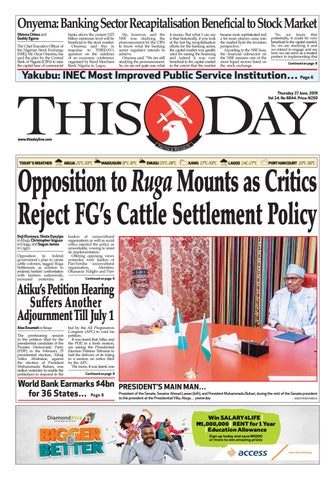
Opposition to Ruga Mounts as Critics Reject FG’s Cattle Settlement Policy Deji Elumoye, Shola Oyeyipo in Abuja, Christopher Isiguzo in Enugu, and Segun James in Lagos Opposition to federal government’s plan to create cattle colonies, tagged Ruga Settlement, as solution to endemic herders’ confrontation with farmers nationwide, increased yesterday as
leaders of socio-cultural organisations as well as social critics rejected the policy as unworkable, vowing to resist its implementation. Offering opposing views yesterday were leaders of Pan-Yoruba socio-cultural organisation, Afenifere; Ohanaeze Ndigbo and PanContinued on page 6
Atiku’s Petition Hearing Suffers Another Adjournment Till July 1 Alex Enumah in Abuja The pre-hearing session in the petition filed by the presidential candidate of the Peoples Democratic Party (PDP) in the February 23 presidential election, Alhaji Atiku Abubakar, against the election of President Muhammadu Buhari, was stalled yesterday to enable the petitioners to respond to the
bid by the All Progressives Congress (APC) to void his petition. It was learnt that Atiku and the PDP, in a fresh motion, are asking the Presidential Election Petition Tribunal to halt the delivery of its ruling in a motion on notice filed by the APC. The move, it was learnt, was Continued on page 8
World Bank Earmarks $4bn PRESIDENT’S MAIN MAN‌ President of the Senate, Senator Ahmad Lawan (left), and President Muhammadu Buhari, during the visit of the Senate president for 36 States‌ Page 8 to the president at the Presidential Villa, Abuja‌ yesterday godwinomoigui :LQ 6$/$5< /,)( _ _ 1 5(17 IRU <HDU _ (GXFDWLRQ $OORZDQFH 6LJQ XS WRGD\ DQG VDYH 1 RU PRUH WR ZLQ DPD]LQJ SUL]HV
2
THURSDAY JUNE 27, 2019 • T H I S D AY
THURSDAY JUNE 27, 2019 • T H I S D AY
3
4
THURSDAY JUNE 27, 2019 • T H I S D AY
DFFHVV PRUH
LQQRYDWLRQ
:H DUH WXUQLQJ WKH ZRUOG LQWR RQH FRQQHFWHG XQLYHUVH WKURXJK RXU GLJLWDO SD\PHQW VROXWLRQV 6R QR PDWWHU ZKHUH \RX RSHUDWH \RX FDQ HQMR\ VHDPOHVV IDVW DQG FRQYHQLHQW LQWUD $IULFDQ DQG JOREDO ƪQDQFLDO WUDQVDFWLRQV
/HWśV KHOS \RX DFKLHYH PRUH
%DQNLQJ ZLWK $FFHVV %UDQFK _ $70 _ 2QOLQH _ 0RELOH _ &RQWDFW &HQWHU
)RU (QTXLULHV DFFHVVEDQNSOF FRP
)DFHERRN FRP DFFHVVEDQNSOF _ 7ZLWWHU FRP P\DFFHVVEDQN <RXWXEH FRP DFFHVVEDQNSOF _ /LQNHG,Q DFFHVVEDQNSOF ,QVWDJUDP P\DFFHVVEDQN
THURSDAY JUNE 27, 2019 • T H I S D AY
5
6
THURSDAY, ÍşÍżËœ ͺ͸͚Π˞ T H I S D AY
PAGE SIX
Yakubu: INEC Most Improved Public Service Institution Chuks Okocha in Abuja Amidst perceived lack of independence, mainly by opposition parties, the Chairman of the Independent National Electoral Commission (INEC), Prof. Mahmood Yakubu, yesterday described the commission as the most improved public institution in Nigeria. Yakubu, at the 2019 postelection review session with the second batch of Electoral Officers (EOs) from 17 states, in Abuja, said the commission should be rated high when compared with its counterparts in other West African countries, especially given its area of wide coverage and its staff’s dedication to duty. He said: "Whenever I compare what we have done with what my colleagues elsewhere have done, I sometimes say we are many countries in West Africa rolled into one. "Given the size of our voter registration, our population, one can conveniently say if
you look at what happened in our elections taking from the period of 1999 to date, I have no doubt in my mind that INEC is the most improved public service institution in Nigeria today. "We have offices in all the local government areas (LGAs). Tell me one agency, which has offices in LGAs and the staff work as hard as our EOs and staff at the LG levels?� According to him, the commission has everything to be proud of and will keep striving to improve on its service delivery. He said the purpose of the meeting was for officers to explore ways and means by which they could improve the system. He added that the commission would not lose the experience it had gathered over the years on improving the electoral process and urged the electoral officers to share their experiences to help improve on the country's electoral process. "So, feel free to make
suggestions, observations, and comments on how we can make the system even better. "This is our meeting; we should open up better where we need to work even harder to make the electoral process what it should be,� Yakubu stated. In his remarks, the Electoral Management Expert, International Foundation for Electoral Systems (IFES), Mr. Seray Jah, commended INEC for its commitment to the review of the 2019 elections and improving the country's electoral process. Jah said: “If Nigeria got its electoral system right, the sub-region would be rubbed off of the positive." "Therefore, we hope this meeting will lead to actionable recommendations that will further enhance credible elections in Nigeria.� In his contribution, the Programme Coordinator, European Union Support to Democratic Governance in Nigeria, Maria Mauro,
said the centre was working with its partners to improve elections and good governance in Africa. According to Mauro, “There is no perfect election as there is no perfect world. There is no any electoral law that has been acceptable worldwide but we do have best practices, which we have to adjust to the contexts, tradition and specific situation found in each country." She commended Nigeria for running its elections with one electoral law, even though there was need for some reviews. "In Europe, in spite of the fact that we have the same population, each state has its own electoral law. So, I have admiration for Nigeria for maintaining its unity and having elections the same date, the same period with same legal framework," she said. Mauro said ECES was committed to working with INEC while looking forward to the conclusion of the review of the elections.
Yakubu
O P POSITION TO RUGA MOU N T S AS CRI T I C S R E J ECT F G’S CAT T L E SE T T L EM E N T POL I CY Niger Delta Forum (PANDEF). Their objection agrees with the position of South-east governors and the Benue State government expressed on Tuesday, opposing the federal government policy, incidentally enunciated to solve the worsening pastoralist clashes with farmers. The Permanent Secretary, Federal Ministry of Agriculture and Rural Development, Alhaji Muhammadu Umar, had on Monday said the federal government had commenced the establishment of farm settlements, better known as Ruga settlements, for herdsmen to stop the constant clashes between the herders and farmers. He said the programme had started in 12 pilot states. But prominent opinion leaders who spoke to THISDAY on the development, said the decision was unacceptable and would be resisted. Ijaw leader and convener of Pan-Niger Delta Forum (PANDEF), Chief Edwin Clark, who emphasised that he was speaking on behalf of the South-south, said President Muhammadu Buhari should be advised to jettison the idea, vowing that his people will resist it. He said: “I think they should advise him (President Buhari) strongly; our people will not take it. If you want to believe in the unity of Nigeria, the president should abandon that decision. It is unacceptable to us. I am the leader of our people and I am speaking on behalf of our people. Nobody should try it. We will not accept it. “I was shocked yesterday (Tuesday) when it was announced. It appears we do not have one country. It appears we have a country where some people are ruling, imposing their will and their culture on the other side. This is unacceptable. That is an obnoxious pronouncement – the decision taken by the federal government. “They have enough land in the north, particularly in the
North-west and North-east, after that the North-central. They have no right to come and say they want to come and establish farm settlements in every part of Nigeria. The president has no right; he has no authority; the fact that he is the president of Nigeria does not give him the power to do that! We are in a federation. Federal government has no right! So, they should not try it. “We in the Niger Delta or South-south we have had enough problem with oil pollution, our ecosystem has been destroyed, now you want to bring cows. We would not accept it! Our people will not accept it.� On how they would convey their rejection to the federal government, he said: “Our governors should go and protest. They have access to him. The president alone does not hold the power in a federation. We have the president and 36 governors and the National Assembly. This is not a matter of decree or order given by Mr. President. It is a continuous issue and it will violate our own culture. We are fishermen and we are farmers. We cannot go and say there must be fish farm everywhere in the north.� National Secretary of PANDEF, Dr. Alfred Mulade, told THISDAY that the plan was a recipe for further crisis and insecurity across the nation rather than to curb the heinous activities of herdsmen in the country. Mulade said: "Without any equivocation, PANDEF strongly condemns the programme and hereby states that there is no land anywhere in the Niger Delta Region for the establishment of such settlements for herdsmen. It is quite disturbing that in a democracy, the federal government would unilaterally decide the establishment of Ruga settlements or cattle colonies. "It is necessary to note that the Land Use Act, enacted in 1978 to regulate land administration systems and to ensure effective and equitable
utilisation of land and land resources in the country, vests all urban land within a state in the state governor, and all non-urban land in the local governments in which they are found." A prominent Yoruba leader and Afenifere chieftain, Chief Ayo Adebanjo, expressed similar views. He said the federal government’s decision to set up settlements for herders would amount to illegality where the state government did not surrender portions of their land for such use. He said: “They cannot do that except the governor of the state gives them the land. He has not gotten the power to get the land from them by force. Under the Land Use Act, it is the government of the state that has control over the land and until the governor of the state gives him the land he cannot use it! “I understand that the Ministry of Agriculture went somewhere and started to dig the place without the authority of the governor. It is an illegal and unconstitutional thing. That is why I say he is a civilian dictator. Even the constitution that he imposed on us he is disobeying it. They have not abrogated the Land Use Act.� National Publicity Secretary of Afenifere, Mr. Yinka Odumakin, told THISDAY that the group rejected the government’s proposal. "We ask all Yoruba not to allow an inch of land for this colonisation project," he said. According to him, the latest move confirms former President Olusegun Obasanjo's suspicion "that a Fulanisation agenda is on through this sinister plot to forcibly take over lands across Nigeria and handover to Fulani." The Buhari administration, Odumakin added, should realise that it is daily putting a knife on the ropes "that bind us as different peoples within Nigeria by its openly clannish posturing and sectional conduct." Also expressing disagreement with the
development, the National Chairman, Middle Belt Forum (MBF), Dr. Bitrus Pogu said: “Changing the name of something is semantics; So, all I can tell you is that it is nothing. The same colony or whatever, which is being renamed, nothing special. There is no tribe that deserves any special treatment in this country. “And we know our local Fulani – every community in this country knows their local Fulani. We know that there has been an influx of Fulani from across West Africa into this country and we cannot just condone foreigners coming to be enjoying government’s patronage just to change demography and do whatever they want to do. We will not accept it. “I can tell you categorically we are going to put our position across because we know that influx has been going on since the time of Obasanjo, unknown to many communities. But every community in Nigeria knows their local Fulani, who are Nigerians, and we cannot allow them to, under the guise of Ruga or whatever, populate our country with foreigners who have been killing our people. We will oppose it.� On its part, the apex Igbo socio-cultural organisation, Ohanaeze Ndigbo expressed its opposition to plans by the government to build settlements for the herdsmen, saying that the southern states will not subscribe to such plans. The organisation said any plan by government to build settlements for the herders would be resisted as that would be a direct invitation for anarchy. The Deputy National Publicity Secretary of the Organisation, Mr. Chuks Ibegbu, who spoke to THISDAY on behalf of the socio-cultural organisation, said cattle rearing was a private business and as such taxpayers’ money should not be used to build farm settlements for them. He reaffirmed the
organisation’s initial position that the South-east had no land to donate for such settlement. He said: “Firstly, if the government wants to build settlements for the herders, they must be ready to build for other business interests. They must be ready to build settlements for every category of businesses across the country. “We are not ready to release our land for any colony, grazing or settlement of any kind. It’s unacceptable to us. Fulani herdsmen should go and negotiate and purchase land if they so desire. “The federal government has no right to apportion land for private business. I run a farm too and I have many people who are involved in such business; settlements should be built for all of us. Singling out the Fulani herdsmen for settlement is an invitation to anarchy.� Also, Nigeria’s foremost environmental rights advocate group, the Environmental Rights Action (ERA), warned that the plan was not only dangerous, but provocative in view of the tensed security and ethnic situation in the country. According to the Executive Director of ERA, Mr. Nnimmo Bassey, "This is an extremely provocative move considering the current violent relationships we are experiencing in that context." Bassey said what the federal government needed to have done before unveiling the policy was to have consulted widely. "There should be national consultations on this needless measure and this should be restricted to states that want such settlements," he stated. He wondered if the government would build farm settlement for other ethnic nationalities across the country. A former political adviser to Obasanjo, Mr. Akin Oshuntokun, on his part, said the federal government was going about the plan in a deceitful manner. He said: "At the inception
of the policy, what the federal government told the public was that the establishment of the cattle colonies, which I assume is now called "Ruga settlement," is subject to the acceptance of the initiative by the state government of the intended location. "Apparently, it seems it is now going to be imposed regardless of the disposition of any state. A number of states of the intended locations, especially Benue State, have rejected the imposition. This has legal implications. I believe any land acquisition or use in any part of Nigeria is subject to the approval and consent of the state government.� He warned that implementing the policy is a recipe for crisis. "Of course, I stand to be corrected. More importantly is that going ahead with the implementation of this policy on the basis of imposition is a recipe for disaster. It is going to compound and deepen the crisis it is ostensibly meant to resolve. You are thereby radicalising an already explosive situation. And whatever is left of Nigeria's federalism is rendered unto the dogs," Osuntokun said.
TOP GAINERS NGN NGN % COURTEVILLE 0.02 0.23 9.5 CHIPLC 0.02 0.24 9.0 LINKASSURE 0.05 0.71 7.5 NIGBREW 4.00 62.00 6.9 BERGPAINTS 0.45 7.15 6.7 TOP LOSERS NGN % CHAMS PLC 0.03 0.27 10 BETAGLASS 7.35 66.35 9.9 CCNN 1.30 12.00 9.7 PRESTIGE 0.04 0.50 7.4 UNITYBANK 0.05 0.64 7.2 HPE Nestle Nig Plc â‚Ś1,350.20 Volume: 394.062 million shares Value: N3.269 billion Deals: 3,377 As at yesterday 26/6/19 See details on Page 39
THURSDAY JUNE 27, 2019 • T H I S D AY
7KRXJKWV FRXQW EXW DFWLRQV PDWWHU
$V SDUW RI RXU &5 6 &RUSRUDWH 5HVSRQVLELOLW\ DQG 6XVWDLQDELOLW\ :HHN XQGHU WKH 63$5. LQLWLDWLYH ZH ZLOO EH YLVLWLQJ DQG HPSRZHULQJ WKH OHVV SULYLOHJHG DQG VWXGHQWV 9LVLW RXU ZHEVLWH ILUVWEDQNQLJHULD FRP FRUSRUDWH KRPH UHVSRQVLELOLW\ VXVWDLQDELOLW\ IRU PRUH GHWDLOV RQ KRZ WR SDUWLFLSDWH <RX FDQ DOVR JLYH LQ FDVK WR WKH 63$5. $FFRXQW &UHDWH D NLQGHU ZRUOG ZLWK
:29(1 ,172 7+( )$%5,& 2) 62&,(7< < ( $ 5 6
&RQWDFW XV ILUVWFRQWDFW#ILUVWEDQNQLJHULD FRP FRPSODLQWV#ILUVWEDQNQLJHULD FRP 5&
7
8
THURSDAY, ÍşÍżËœ ͺ͸͚Π˞ T H I S D AY
NEWS
World Bank Earmarks $4bn for 36 States To focus on health, poverty eradication, human capital devt
Chuks Okocha in Abuja The World Bank has earmarked about $4 billion for poverty eradication, erosion control, human capital development and health-related issues in the 36 states of the federation. Chairman of the Nigeria Governors’ Forum (NGF), Governor Kayode Fayemi of Ekiti State, said this yesterday in Abuja, explaining that the money would be spent on projects that would uplift the states’ capacity expand the possibilities for their development. He spoke at a press conference where he briefed journalists on the outcome of a meeting governors had with World Bank officials in Abuja. Fayemi said: "The bank is spending somewhere in the region of $4 billion in states, and some of our states
are benefiting from a range of grants, even the loans, which we can benefit from on the basis of the bank’s investments in our states. "So, it is important for us to work on that engagement both in terms of the lending operations, in terms of advisory activities, in terms of the concrete action in our states. I don’t know of many development agencies that have programmes in 36 states; the World Bank does and all of our governors were present in this meeting. We had an extensive discussion on how to improve on existing relationship and how to build on those projects that have transitioned from one governor to the other. "This is important because transition can be a challenging period and it is absolutely important that we treat government as a continuum and address
whatever gaps that there are without throwing the baby away with the bath water. These are what came out from the investment/lending portfolio, a programme for result portfolio, which are two vehicles that the World Bank uses in their relationship and support in our states." He added that the NGF has proposed suggestions, which the bank has taken up and will be implementing to better the relationship it has built with Nigeria over the years. "There is a question of course of also not having enough resources and the need to expand the lending portfolio from what it is now both to the federal government and the subnational entity. It is absolutely important that that vehicle is not closed because if we can borrow from the World Bank at one percent interest,
it is always going to be better for us than for us to be borrowing at 25 percent commercial lending rate’ that is a no brainer, we will all agree with that. "For us, it is about development and if you look at some of the programmes, whether you are talking about BESDA - The Better Education Service Delivery for All, in our states, which focuses a lot on the northern states, where we have a high percentage of out-of-school children; or you look at a Saving One Million Lives that deals with malaria and all other diseases that have been responsible for the high rate of child mortality, under five mortality in many of our states, and these are grants. "These are not loans, including FISTA, which is about fiscal transparency in our states. You will see that the World Bank is a
critical partner that we really need to work with in order to improve quality of life and living conditions of our people." Giving details of how the World Bank would spend the money across the states, the World Bank Country Director, Rachid Benmessaoud, said: "We at the bank have been particularly engaging with the NGF as the important platform for engaging with the sub-national governments beside our engagements at the state level. "As you know, the World Bank mission is to fight poverty and build prosperity. We know that the number of poor people has increased in Nigeria in terms of number though the trend is decreasing. "So, fighting poverty in Nigeria and Africa is going to be absolutely critical for reducing poverty globally.
So, therefore, our priorities, which we have engaged with the governors, will be around investing in human capital, investing in people to have access to basic education, health services, social protection. "But we do recognise the development challenges, which also require investing in infrastructure and filling the large infrastructure gap. But with that, we want to make sure that those infrastructure gaps are filled by bringing more of the private sector so that it will enable us to create the physical space for governors to invest in human capital, including financing from development partners like the World Bank. But most importantly to increase the domestic revenue mobilisation for providing primary spending on the social sector."
Court Adopts NBC, DAAR’s Terms of Settlement as Judgment Alex Enumah in Abuja To Justice Inyang Ekwo of the Federal High Court, sitting in Abuja, yesterday endorsed the terms of settlement adopted by DAAR Communications Plc and the National Broadcasting Commission (NBC) in resolving the dispute following the suspension of the operations of Africa Independent Television (AIT) and Raypower radio by the NBC. Justice Ekwo adopted the seven-point terms of settlement as consent judgment of the court following the decision of the parties, including the Federal Ministry of Information and Culture and the Attorney General of the Federation, to resolve the matter out of court. In the settlement terms,
DAAR Communications Plc agreed to furnish the NBC with a concrete proposal and ensure the prompt payment of the outstanding licence renewal fee for its national network broadcast licence. The communication outfit also agreed to take steps to ensure balance in its news coverage, especially political commentary, on its stations across the country and also to take full editorial responsibility for the use of content sourced from the social media and any other outlet. Similarly, the parties agreed that DAAR Communications Plc shall ensure that all programmes transmitted on its television and radio stations across the country comply with the provisions
of the 1999 Constitution and the NBC Act as well as the Nigeria Broadcasting Code. On its part, the NBC agreed to reverse immediately the suspension of the national network broadcast licence of DAAR Communications Plc. The parties, however, agreed to bear their cost of the legal action. The terms of settlement was signed on behalf of the broadcasting company by its Group Managing Director, Mr. Tony Akiotu while the NBC Director General, Mr. Kawu Modibbo, signed on behalf of the commission. The agreement was signed in the presence of Chief Mike Ozekhome (SAN) and Eseoghene Igbako, counsel to the plaintiff and NBC
respectively. The terms of settlement were pursuant to the reconciliatory meeting held by the parties DAAR Communications Plc and NBC on June 9, 2019. The President of the Newspapers Proprietors’ Association of Nigeria (NPAN), Prince Nduka Obaigbena, had convened a meeting of all critical stakeholders in the sector over the broadcast licence of DAAR Communications Plc. The meeting, which was attended by representatives of the Broadcasting Organisations of Nigeria ( BON ), the Nigerian Guild of Editors ( NGE) and the Nigeria Union of Journalists ( NUJ), proffered amicable solutions to the issues in the interest of the nation.
Chairman, DAAR Communications, Raymond Dokpesi
ONYEMA: BANKING SECTOR RECAPITALISATION BENEFICIAL TO STOCK MARKET recapitalisation whenever it comes," he added. Also, the Chief Executive Officer, Rand Merchant Bank Nigeria/Regional Head, RMB West Africa, Mr. Michael Larbie, who welcomed the policy announcement by the central bank, said a bank was just as strong as its balance sheet. According to Larbie, the capacity of a financial institution to lend to industries and other sectors would be dependent on the capital it has. "I think stronger and well capitalised banks would be good for the economy. And the
important thing is clear, being big is one thing, but having the right assets and industries to lend to, sensibly, where you don't have accumulated nonperforming loans (NPLs), is really going to be the balancing that we need to have. "Really, providers of capital expect to get a return on the capital. So, return on capital is going to be very important and I think it is something that our industry, collectively working with the governor and the people at the CBN need to find what the optimal answer is. "But I have no doubt that
well-capitalised banks are certainly good for the economy and no doubt if those capital raised are deployed prudently, then it can go a long way in creating more industry giants to support the economy," the RMB Nigeria boss added. CBN Governor, Mr. Godwin Emefiele, while announcing the plan to recapitalise the banks, said the 2004 banking industry recapitalisation, which increased banks’ capital base from N2 billion to the current N25 billion, had weakened. He said: “You will all agree with me that it was Governor
Soludo in 2004 that did the last recapitalisation we had, moving the capitalisation from N2 billion to N25 billion. “And I must commend those efforts because it resulted in positioning Nigerian banks not only in Africa, but also being among the banks in the world in terms of capitalisation and it also increases or helps to strengthen the banking industry capacity to take on large ticket transactions- and those are some of the things we badly need today. “And if you relate N25 billion in 2004 exchange rate, which
was about N100 to N25 billion, it is certainly only about $200 million. Today, if we relate N25 billion at N360, you can see that it is substantially even lower than $75 million. What we are trying to say is that recapitalisation has weakened quite substantially and there is a need for us to say it is time to recapitalise Nigerian banks again." Meanwhile, the stock market was yet to react positively to the expected impact of the banking recapitalisation plan as the market continued its downward trend.
The NSE All-Share Index fell 0.47 per cent on Tuesday to close at 29,068.68, from 29,809.20, while market capitalisation shed N62 billion to close lower at N13.074 trillion, down from N13.136 trillion the previous day. In all, 22 stocks lost value, including six banking stocks, while 14 stocks gained, including two banking stocks. Market operators said it is too early for the market to react to the pronouncement of the CBN governor because the full details of the recapitalisation plan and modalities are yet to be unveiled.
to strike out paragraphs where allegations of act of thuggery, arrest, intimidation and coercion were made against Vice President Yemi Osinbajo, the Nigeria Army, the Nigeria Police and several other individuals who were not joined as defendants in their petition. APC also applied that the claim by Atiku and the PDP that Buhari was not educationally qualified to stand for the presidential election be expunged from their petition because it is a pre-election matter, which the tribunal has no jurisdiction
to adjudicate upon. Besides, APC also asked the tribunal to strike out the petition for failure to comply with mandatory provisions of paragraph 4 and 7 of the first schedule to the Electoral Act 2010 and section 134 of the 1999 Constitution. It similarly faulted the petition for being incompetent and for violating Sections 2 and 24 of the Legal Practitioner’s Act and therefore urged that the petition be struck out together with the list of documents and list of witnesses to be relied upon by the petitioners.
AT I K U’S PETITION HEA R IN G SU FFERS AN OT H ER AD J OU R N M EN T T I L L J U LY 1 because the tribunal had on June 11 allowed the APC to withdraw a motion in which the petitioners had already filed a counter affidavit and went on to adjourn ruling in the other motion they did not respond to. The argument of Atiku and PDP was that if the court could allow the APC to withdraw its motion, for which a counter affidavit had been filed, then the court should equally allow them respond to the motion on notice, which they did not respond to since the motion was withdrawn on the hearing
date without prior notice. The APC had in the motion on notice filed by its lead counsel, Mr. Lateef Fagbemi (SAN), on May 15, prayed the tribunal to void and strike out Atiku's petition on various grounds of alleged irregularities and non-compliance with the Legal Practitioner’s Act. When the motion was argued by Fagbemi, Atiku and PDP did not file counter affidavit, prompting the tribunal to reserve ruling in the APC's motion. However, at yesterday's proceedings, lead counsel to
the petitioners, Chief Chris Uche (SAN), informed the tribunal that the petitioners have just received the response of the APC to their request asking the tribunal to stop delivery of ruling in the motion and would need time to respond on point of law. The tribunal Chairman, Justice Mohammed Garba, after listening to arguments by the parties in the petition, adjourned further hearing till July 1. The APC had on June 11, through Fagbemi, prayed the tribunal to strike out Atiku's petition or in the alternative
strike out several paragraphs that were not supported by facts and laws. Among others, Fagbemi prayed the tribunal to remove 10 states in the list of states where Atiku alleged that electoral malpractices took place in the presidential election. The grouse of APC was that the petitioners failed to disclose the specific polling units where the alleged infraction took place thereby making their claims imprecise, nebulous and vague. Fagbemi also applied for order of the tribunal
THURSDAY JUNE 27, 2019 ˾ T H I S D AY
9
NEWS
Group News Editor Ejiofor Alike Email Ejiofor.Alike@thisdaylive.com, 08066066268
Bandits Kill 29 People in Borno Villages Michael Olugbode in Maiduguri Suspected members of Boko Haram Islamic sect last Monday attacked two Borno State villages killing 29 persons. In the deadlier of the two attacks, the terrorist group attacked Ngamgam in Mobbar Local Government Area of the state killing 20 farmers. Ngamgam is about 50 kilometres east of Damasak, the Secretariat of Mobbar, which has border with Niger Republic, another country in the Lake Chad Basin troubled by Boko Haram and its sister organisation, Islamic State of West Africa Province (ISWAP). Sources told THISDAY that the attack was a punishment on the people of the village for allegedly leaking information on their operations to the military. The source said: “The terrorists stormed the settlement in about five pickup vans and motorcycles, first accusing the villagers of divulging information on their operations to the military, thereby taking
side with the military in the ongoing war against them.” He added: “They (Boko Haram) told the villagers pointblank that that was why they had come to punish them; and they immediately picked out many for slaughter and shot others, the total of the people killed was 20.” The source also revealed that “the insurgents are used to carrying out serial killings of people in the border villages, but this time, they decided on a mass killing of villagers mainly for the offence of allegedly divulging information to the military on their operations. “The insurgents impose taxes on the residents of all the villages as well as enslave them, especially to farm for them; so this massive killing of the Ngangam farmers could also have been intended by the insurgents as a stern warning to the residents of the agrarian settlements to, as the rainy season sets in, prepare to farm for them or face the consequences.” He said the killing led to
Court Quashes Criminal Charge against Gbajabiamila Alex Enumah in Abuja Justice Othman Musa of an Abuja High Court yesterday quashed the criminal charge brought against the Speaker of the House of Representatives, Hon. Femi Gbajabiamila by the African Peoples Party (APP) at the Grade 1 Area Court, Karishi, Abuja. In the matter of an application for judicial review for an order of certiorari, Gbajabiamila in a motion on notice brought pursuant to Section 12 of the Federal Capital Territory, Abuja Area Court Act, 2010, Order 44 Rule (A) and (2) of the High Court of the FCT Rules 2018, challenged the criminal proceedings instituted against him by the APP. The party and Hon. Anas Mohammed who are respondents at the FCT High Court, had alleged at the Grade 1 Area Court, that Gbajabiamila lied on oath while filing Form CF001 of the Independent National Electoral Commission (INEC) during the last general election to the effect that he was never convicted of any crime. The respondents had contended that the Speaker was found guilty of professional misconduct by the State Bar of Georgia, United States of America in 2007. But in a judgment delivered yesterday, Justice Musa quashed the criminal charge, which was filed against Gbajabiamila at the Grade 1 Area Court, Karishi, Abuja on the grounds that the lower court lacked jurisdiction to entertain and determine the matter. “The lower court acted recklessly in a matter it has no jurisdiction to do so,” Justice Musa held. In the suit marked: FCT/ HC/BW/M/267/19, the judge further held that the allegation of disciplinary proceedings levelled against Gbajabiamila does not amount to a criminal conviction
by a court of law. Consequently, the court declared the proceedings and decisions of the Grade 1 Area Court of May 30, 2019, as “unconstitutional, ultra vires, null and void.” Justice Musa said if a false information was given by Gbajabiamila in the course of filing out his INEC Form CF001 as alleged by the respondents, a criminal charge ought to have been filed against the Speaker at either the Federal High Court or the FCT High Court as prescribed by the Electoral Act as amended. “The 1st respondent (APP) is not a legal officer of INEC. Criminal matters are only enforceable by a law enforcement agency,” the judge said. The judge held further that an indictment by a mere disciplinary committee or commission that is not a court of law recognised by the constitution does not amount to a criminal conviction. “The order of 26 February, 2007 of the State Bar of Georgia, United States of America against Hon Gbajabiamila does not amount to a criminal offence known by any Nigerian law. “I, therefore, hold the view that the direct criminal complaint against Gbajabiamila was misconceived. “Having dutifully combed through all the facts and the laws that have been presented before the court, and having soberly reflected on the robust arguments of counsel in the matter, I am satisfied that the reliefs of the application (Gbajabiamila) are granted. “Consequently, an order is hereby made nullifying the entire proceedings of the Grade 1 Area Court, Karishi, Abuja. The charges in suit no: CR/349/2019 and Motion No: M/19/2019 between African Peoples Party (APP) Hon. Femi Gbajabiamila are hereby quashed,” Justice Musa declared.
mass exodus of people from the village into Damasak. In the second attack last Monday, the Boko Haram terrorists were alleged to have
attack a village in Guzamala Local Government Area of the troubled state, the birthplace of Boko Haram, killing nine persons and carting away their
food and livestock. A chieftain of the Civilian Joint Task Force in the state, Abba-Aji Kalli, told THISDAY on phone that men of the
vigilance group phoned to inform them in Maiduguri that the insurgents attacked Kaula in Guzamala council area and killed nine persons.
PERFORMANCE APPRAISAL...
L-R: National Commissioner, Independent National Electoral Commission (INEC), Prof. Anthonia Okoosi-Simbine; INEC Chairman, Prof. Mahmood Yakubu; and INEC National Commissioner, Dr. Muhammed Mustaphaat Lecky, at the review of the 2019 general election in Abuja... yesterday JULIUS ATOI
Herdsmen Attacks, Communal Clash Claim 12 Lives in Kogi,Taraba Yekini Jimoh in Lokoja No fewer than 12 persons were killed by herdsmen in Kogi State and in the crisis between the Jukun and Tiv in Taraba State. Some suspected herdsmen allegedly invaded koton-karfi and Onzo communities in Kogi Local Government Council of Kogi State, killing seven persons. Five persons also were killed on Tuesday and several houses burnt in a fresh crisis between the Tiv and Jukuns in Rafinkada Village of Wukari LGA of Taraba State. It was gathered that the two separate attacks in Kogi State took place at about 2 a.m. and 3 a.m. According to a source in one of the affected areas, the suspected Fulani herdsmen had hidden in a mountain surrounding
the communities without the knowledge of the people. However, at about 2 a.m. on Tuesday the suspected herdsmen numbering over 30 fully armed with AK 47 riffles and other dangerous weapons invaded the communities and opened fire on the houses of the people. According to the source, the suspected herdsmen divided themselves for the coordinated attack on the two communities. It was gathered that three persons died on the spot during the attack which lasted several hours. Meanwhile, the Administrator of the Kogi LGA, Mr. Muhammed Tanko who confirmed the attack while speaking with THISDAY yesterday, said the security agents in the state were on the top of
the situation. He noted that the attack took them by surprise because kotonkarfi community is a peaceful community. When our reporter called on the Kogi State Police Public Relation Officer Mr. William Ayah on the incident he said the command was yet to be briefed. In a related development, five persons were killed on Tuesday and several houses burnt in a fresh crisis between the Tiv and Jukuns in Rafinkada Village of Wukari LGA of Taraba State. The Caretaker Committee Chairman of the council, Mr. Daniel Adidas, confirmed the development in a telephone interview with the News Agency of Nigeria (NAN) in Jalingo. Adi alleged that gunmen
in army camouflage attacked Rafinkada and set several houses ablaze. The chairman disclosed that a soldier who was injured in the attack was receiving treatment at an undisclosed hospital in Wukari. He said that the deployment of soldiers to the area had brought the situation under control. Police Public Relations Officer (PPRO) of the state police command, DSP David Missal, confirmed the incident, but said only one person killed “The report I have indicated that armed militia youth crossed from Benue State and attacked a community in Wukari LGA and one person was killed and some houses burnt”, the PPRO said.
PDP Senate Caucus to Resist Move to Replace Principal Officer Senate committed to healthy financial institutions, says Lawan
Deji Elumoye in Abuja The opposition Peoples Democratic Party (PDP) Caucus in the Senate has vowed to resist moves by the party leadership to replace one of the principal minority officers elected about a fortnight ago. This is just as the Senate leadership yesterday expressed its commitment to healthy financial institutions in the country. THISDAY gathered that the recent move by the national leadership of the PDP, to swap names of selected principal officers of its Senate caucus is causing ripples among the party’s senators. The National Working Committee of the PDP was on Tuesday reported to be planning to rejig the minority
leadership positions by dropping Senator Clifford Ordia (Edo Central) for Senator Sahabi Yau (Zamfara North) as replacement. THISDAY gathered that the attempt to drop Ordia is causing ripples among the Senate caucus of the party. Some PDP senators from the South-south, who have vowed to resist the move, said the party can’t impose anyone on them without due consultation. One of the aggrieved Senators from the zone said yesterday in Abuja that the principal minority officers’ election was conducted at a meeting held at the Abuja residence of the National Chairman of the PDP, Uche Secondus on June 14 According to him, nominations
were made in the presence of party leaders and PDP senators and those who emerged were unanimously backed by the various organs of the party. He stated that the recent move to alter the list and drop some names, did not have the backing of the caucus of the party, adding that no one has been consulted or a meeting held with PDP senators to agree on the issue. He accused governors of mounting pressure on the leadership of the PDP to ensure that their interest is represented in the Senate. The Senator further explained: “Under the rules of the Senate, it is not the responsibility of the National Working Committee to select principal officials.
“It is the responsibility of the senators themselves to select who leads them. The minority senators have freely elected those they want and nothing will change it. “The argument that they want to represent every part of the country is false. There are eight positions open to the PDP in the two chambers of the National Assembly. Even if you share one to each geopolitical zone, two will still get an extra slot. “Those we selected are known to us. They are the people we can work with. Some governors causing this division don’t know how the parliament operates. They want to control everything in the party for their selfish interest.”
10
THURSDAY JUNE 27, 2019 ˾ T H I S D AY
NEWS
Gunmen Kidnap Passengers on Akure-Ado Ekiti Road James Sowole in Akure Barely a week after the Nigerian Army launched drone to tackle kidnapping in Ondo and Ekiti States, gunmen suspected to be kidnappers last Tuesday evening reportedly abducted a driver of a commercial vehicle and some
passengers onboard on Akure/ Ikere-Ado Ekiti road, Ondo State. A source in the area said the commercial driver identified as Akinde Felix, was driving towards Akure from Ado Ekiti when the hoodlums who had already blocked the road, stopped him and reportedly took him and
Danjuma Purchases London’s Iconic Hotel for N1bn James Emejo with agency report A former Minister of Defence, Lt. Gen. Theophilus Yakubu Danjuma (rtd), has acquired the Kings Arms Hotel, London for N1 billion, according to Bloomberg. The hotel is a 300-year-old inn next to London’s Hampton Court Palace, once the home of Henry VIII. The facility is expected to open soon after ongoing refurbishment, with rooms costing about 250 pounds ($318) a night, the report stated. Guests can dine on traditional fare in the six restaurants, a reference to the monarch’s many wives, or grab a pint on the terrace. In this most English of settings, it’s fitting the owner is a retired military man still referred to as “General.” The hotel is just one of Danjuma’s investments in a network of assets that span at least three continents. The 80-year-old Nigerian is worth $1.2 billion, according to the Bloomberg Billionaires Index, with his family office managing a portion of that wealth, often through low-key holdings such as the 14-room hotel. “We never tend to look at trophy assets,” said daughter
Hannatu Gentles, the second of Danjuma’s five children and chief operating officer of his London-based family office. “We’re not going to head to Mayfair to buy a 15 million-pound apartment primarily because we are a yield business.” Danjuma’s new venture is far removed from civil war and deepwater oil fields, the spheres where he amassed his power and fortune. In 2006, his South Atlantic Petroleum Ltd. sold almost half its contractor rights for a section off Nigeria’s coast to a state-backed Chinese firm for $1.8 billion. Danjuma was awarded the block in 1998 by the regime of former dictator and fellow army officer the late Gen. Sani Abacha, making him one of a handful of Nigerians made extraordinarily wealthy from the country’s energy reserves. “Basically, these people got winning lottery tickets,” said Antony Goldman, founder of West Africa-focused ProMedia Consulting. “At the time, you had a government desperate for credibility that was isolated internationally.” Danjuma was “someone who’s not really a politician, who is respected in business and in the army.”
JAMB Releases 3,736 Withheld Results after PhysicalVerification The Joint Admissions and Matriculation Board (JAMB) yesterday released the Unified Tertiary Matriculation Examination (UTME) results of 3736 candidates after the board had invited them to come for physical verification and prove that they were not involved in malpractices. The affected candidates were last Monday asked to go to the JAMB offices in Abuja, Delta, Gombe, Oyo, Kwara, Kaduna, Lagos and Imo states where they were interviewed by the Intelligence Committee of the Board. However, four candidates were discovered by the board to have indulged in malpractices ranging from inflating their scores to cheating and therefore had their results withdrawn. According to JAMB, they are candidates with registration number 97512230IB, 97049254GG, 96531098BC and 96634599GA. The JAMB Head of Information, Dr. Fabian Benjamin, who confirmed these developments, said the
board would not spare efforts in identifying and sanctioning any candidate who attempted to falsify UTME. “It may be recalled that during the release of the 2019 UTME results on Saturday, 11th May, 2019, the Board had explained among others that; one, post-examination discovery of serious infractions may lead to withdrawal of any released result. “Two, a number of candidates’ results were withheld for further verification and anyone not deeply implicated would have his or her result processed. “There were, however, some that needed further direct interaction and interview to establish clearly whether they were culpable or not. Candidates in this category were invited to appear in eight centres across the country. “Consequently, 3,736 candidates who were found to be either free of any blame or entitled to the benefit of the doubt, have their results processed for release. The 3,736 results are now released,” he explained.
the passengers away. He said the vehicle was left opened in the middle of the road, which attracted members of the public to the abandoned vehicle and raised the alarm. A source at the Ado garage in Akure, who confirmed the abduction of the driver, said the actual number of the passengers in the bus could not be confirmed but said the incident had been reported at the police station. He said the abductors took the advantage of the bad portions on the road to carry out the operation. Reacting to the development, the state Police Public Relations Officer (PPRO), Femi Joseph, debunked the report that more than 10 people were abducted in the incident. Joseph said only the driver of
the vehicle who was travelling to Akure was reported to have been kidnapped by the gunmen, disclosing that the family of the driver had reported the incident at the police station. He described the alarm raised by some people in the state over the incident as a deliberate attempt to cause panic in the state. According to him, “the Ondo State Police Command wishes to allay the fear of the public as a result of the news making the rounds on social media that an 18-seater bus conveying some passengers from Ikere to Akure was blocked while 10 passengers were kidnapped. “We wish to state that the story was exaggerated, and to set the record straight, a space bus, Toyota Previa was driven
by one Akinde Felix from Ikere Ekiti enroute Akure last Tuesday, with only the driver on the bus. “At about 4:30p.m., close to the National Youth Service Corps (NYSC) farm at Itaogbolu, the vehicle was blocked by suspected hoodlums, while the driver who was the only occupant of the vehicle was whisked away. “The command has since begun investigation and intensifying efforts to not only rescue the victim but to also arrest the perpetrators.” He also denied the involvement of any corps member serving in the state in the kidnap incident, maintaining that only one person was abducted. Similarly, the state NYSC yesterday debunked the news that some corps members in
the state were kidnapped. The management of the state NYSC in a statement said the news is not only false but baseless and unfounded. According to the statement, “The management, through the established procedure, can authoritatively tell the public especially the parents and guardians not to panic as all corps members serving in all the local government areas in the state or those who are currently in camp at IkareAkoko are safe, sound and healthy. “The NYSC has put in place necessary machinery and effective measure to safeguard at all times the lives and properties of members of the service corps.”
STRATEGISING FOR GUBER POLL…
L-R: Chairman of Peoples Democratic Party Elders Advisory Council, Air Vice Marshal Larry Koinyan (rtd); former President Goodluck Jonathan; Governor of Bayelsa State, Hon. Seriake Dickson; and state Chairman of PDP, Hon. Cleopas Moses, during the inauguration of the State PDP Elders Advisory Council at Government House, Yenagoa…yesterday
You are Misleading Nigerians, Senators’ Monthly Pay is N15m, Sagay Replies Lawan The Chairman of the Presidential Advisory Committee Against Corruption (PACAC), Prof. Itse Sagay (SAN), has asked Senate President Ahmed Lawan to stop misleading Nigerians, insisting that senators earn N15million monthly and not N750,000 as claimed by the Senate president. Lawan had said on Tuesday that there was no such thing as ‘jumbo pay,’ adding that he earns N750,000 as salary. Speaking yesterday, however, Sagay said Nigerians were more interested in how much senators take home monthly in salary and allowances. The senior advocate said Lawan was only speaking half- truth because everyone knows that the bulk of the money earned
by senators is embedded in their allowances. Sagay said, “He (Lawan) knows that nobody will take him seriously. I respect and like him but what he has done is to give half-truth. He is telling us the actual salary without mentioning anything about the allowances. “That’s where the jumbo pay comes in when you talk of building, furniture, domestic this or that, 15 items and those items alone bring everything up to N13.5 million a month. So, simply mentioning the base salary, which brings it over N14 million, is not sufficient. “So, technically, he’s right, that’s their salary. But what is his income, take-home pay, at the end of the month? It’s about N15 million and
we are not including so many other things we need not talk about now. The senior advocate said the presiding officers of the National Assembly earn more than ordinary members. He, therefore, asked Lawan to come clean. “Not only that; that leadership of the two houses earn a lot more — tremendous amounts. I don’t really want to go into issues not to create controversy but what he’s saying now is pure technical truth about salary but not about allowances, which is where the jumbo really is,” Sagay said. The PACAC chairman, who was the first to expose the jumbo pay of federal lawmakers, said he was still trying to ascertain the
allowances of principal officers. He said, “What I have not been able to do is give details of what the leadership earn. There is the leadership aspect that I hadn’t revealed — the excess that the Senate leader (President) and deputy Senate leader, leader of the house; the same thing applying to the House of Representatives. “What they get — the current ones — that I have not been able to release. I had the details of the previous house. They were mindboggling; we are talking of one person getting up to N280 million a year in allowances for his position. But I don’t know what they had during the Saraki era or what the present group is going to award themselves.”
Insurgency: Troops Eliminate Three Terrorists, Recover Five Gun Trucks Kingsley Nwezeh in Abuja Troops of the Nigerian Army yesterday killed three insurgents and recovered five anti-aircraft guns and gun trucks during a fierce encounter in Mafa Local Government Area in Borno State. The army, had in the last one week, recovered a large cache of assorted arms and ammunition and rescued 100 women and
children kept as farm slaves in the North-east. Troops of the 112 Task Force Battalion located in Mafa town decimated the terrorists who had approached the town in five gun trucks mounted with anti-aircraft guns. An update on the war against insurgency issued by the Army Headquarters said the planned attack was foiled following earlier
intelligence received on the move by the insurgents. It said swift fire power deployed against the insurgents led to the death of three of them while many others fled with gunshot wounds. “Troops of 112 Task Force Battalion deployed at Mafa in Borno State had effectively dealt ruthlessly with members of BHTs/ISWAP terrorists in Mafa,
Mafa Local Government Area of Borno State when some terrorists attempted to attack the town. “The terrorists’ failed attack on Mafa was as a result of available intelligence indicating the desperate longing for food and other logistics by terrorists necessitated by the recent, incredibly tireless and ferocious troops’ operational exploits,” it said.
11
THURSDAY JUNE 27, 2019 ˾ T H I S D AY
NEWS
Falana Calls for Monthly Inspection of Detention Facilities by Judges Martins Ifijeh and Esther Oluku A human rights lawyer and Senior Advocate of Nigeria (SAN), Mr. Femi Falana, has advocated for
monthly inspection of detention facilities of federal government agencies by judges of the Federal High Court. In a statement made available to THISDAY yesterday, he said
APC Support Groups Urge Buhari to Ignore ‘Blackmailers’ Adedayo Akinwale in Abuja The All Progressives Congress (APC) support groups yesterday staged a rally in support of President Muhammadu Buhari, urging him to ignore ‘blackmailers’ bent on distracting him from delivering good governance to Nigerians. The convener of the rally, Dr. Paul Dowells, alleged that the sabotage within the corridors of power was becoming more alarming with the recent sponsored campaign against the president. He called on the president to ignore those who earlier protested against some of his personal staff.
According to him, “if Buhari is not on the driver’s seat, we will not have enjoyed the N-Power, the Conditional Cash Transfer, the Market money and many more.” Rowell said, “We are members of the governing All Progressives Congress (APC). We are Prodemocracy, we are Pro-Buhari, we believe in your leadership qualities and strength of governance as you continue to sail the affairs of this entity called Nigeria. “As a people, we agreed to stand and defend democracy, which we did for sixteen years before clinching power. The sacrifice of every individual is commendable, before, during and after the elections.
this was in order to end illegal detention of criminal suspects and political detainees in the country, as the Administration of Criminal Justice Act, 2015 has made provisions for it. He said the ACJ, 2015 made copious provisions for pretrial detention, detention time limits and monthly inspection of all police stations by chief magistrates designated by the chief judge of each state of the federation. The Lagos lawyer said: “It is further provided by section 34 (4) of the ACJ Act, 2015 that judges of the high court, having jurisdiction, shall visit all detention facilities of other federal government agencies authorized to make arrests. During such visit, the judge or the chief magistrate shall have the power to grant bail or order the release of a suspect
or order the arraignment in the appropriate court. “Pursuant to section 34 of the ACJ Act, the Chief Justice of Nigeria directed all chief judges in the country to designate judges and chief magistrates to conduct a monthly inspection of all police stations and other detention facilities. In line with the directive, the chief judges of the Federal Capital Territory and the 36 states have designated chief magistrates to visit police stations on a monthly basis. But for some undisclosed reasons, your Lordship has not deemed it fit to comply with the directive.” He said however, on the basis of the increasing wave of indiscriminate arrest and prolonged detention of many citizens and foreigners living in Nigeria, his law firm was compelled to request the
designation of judges of the Federal High Court to conduct monthly inspection of all the detention facilities, adding that in spite of repeated assurances to do the needful, “Your Lordship has not acceded to our request.” He alleged that some agencies of government have continued to detain thousands of persons without trial in various detention facilities in the country. He said in particular, scores of people were being detained by the Nigerian armed forces in detention facilities, including underground cells, noting that some of the detainees have been held incommunicado in dehumanising detention conditions for over three years without trial. “Recently, the Federal High Court ordered the State Security Service to release a journalist,
Mr. Jones Abiri from unlawful custody. The said Mr. Abiri was abducted in Yenogoa, Bayelsa State sometime in 2016, blindfolded and taken to Abuja where he was dumped in a dungeon and detained for over two years without trial. As his incarceration could not be justified in law the Federal High Court ordered his immediate release and awarded him reparation of N10 million. Although Mr. Abiri has regained his freedom the damages have not been paid. We have since requested the new management of the SSS to release about 294 other detainees who have been detained for about three years without trial. Based on our complaint a number of the detainees have since been released from illegal custody.”
FG Condemns Torture, Inhuman Treatment Alex Enumah in Abuja The federal government yesterday expressed its commitment to protect the rights of the people against all forms of torture and inhuman treatment in the country. This position was taken in Abuja at an event organised by the Federal Ministry of Justice to commemorate the 2019 United Nations International day in support of victims of torture. Solicitor General of the Federation and Permanent Secretary, Ministry of Justice, Dayo Apata, in an address maintained that the right to freedom from torture is non-negotiable. Apata, who was represented by the Director, Legal Drafting Department of the ministry, Hamza Tahir, said allegations of
torture were prevalent in detention centres, police stations, adding that officers of security agencies that perpetrate the act are, most times not punished. He said security agencies engage in acts of torture because they lack forensic and standard investigation techniques. The Solicitor General said the application of torture to extract confession from suspects or as a way of punishment amounts to a by-pass of the judicial process by not subjecting the suspect to the time-honoured practice of trial of suspects in the regular courts. He said Section 34 (1) of the Constitution of the Federal Republic of Nigeria 1999, as amended prohibits the infliction of torture.
States Failed to Remit N3.4bn Deducted from Workers’ Pay, PenCom Alleges The acting Director-General of National Pension Commission, Mrs Aisha Dahir-Umar, has alleged that some of the 36 states operating the Contributory Pension Scheme refused to remit about N3.4 billion pension contributions deducted from their workers monthly remunerations into their respective Retirement Savings Accounts (RSAs) with their Pension Fund Administrators (PFAs). Speaking yesterday in Lagos during the second quarter consultative forum for states, which was attended by pension compliance officers and other stakeholders from different states and pension fund operators’ offices, Dahir-Umar said that N8.09 billion was remitted as pension contributions in the first quarter of 2019.
“Based on PFAs’ returns, over N3.4 billion pension contributions are uncredited into state employees’ RSAs as of May 31, 2019, and the age analysis showed that over 38 per cent of this amount had been outstanding for over one year. Dahir-Umar, who was represented by the Head, States Operations Department, PenCom, Dan Ndackson, said a major item, which should occupy a pride of place during deliberations, was the recurring issue of uncredited remittances, which denied concerned employees the investment income that should have accrued to them. She added that it was heartwarming to observe the steady progress of the implementation of the CPS in the states, especially with regards to the remittance of pension contributions.
ALL EYES ON HIGHER RETURNS…
L-R: Group Managing Director of UAC Nigeria Plc, Mr. Folasope Aiyesimoju; Chairman, Mr. Daniel Agbor; and Company Secretary/Legal Adviser, Mr. Godwin Samuel, at the 2018 Annual General Meeting of UAC in Lagos.... yesterday AKINYELE ABAYOMI
WAEC Certificate: Court Dismisses Case against Kwara Gov A High Court sitting in Ilorin yesterday dismissed the certificate forgery case filed against Kwara State Governor, Abdulrahman Abdulrazaq, following the claimant’s application to withdraw the case. Delivering judgment, Justice Adenike Akinpelu, struck out the case after Adekunle Abraham, a
member of the PDP who filed the case, told the court he had presented a notice of withdrawal of the case. Akinpelu held that the withdrawal means that, the efforts of one Olusola Olaseinde, who wanted to join the suit were inconsequential since the original case had been withdrawn.
AbdulRazaq had repeatedly said the case was politically motivated and meant to stop him from contesting the March 9 governorship poll, adding that the claimant was acting out a script from his political adversary. The governor had won several court cases filed by a faction of the All Progressives Congress (APC)
led by one Ishola Balogun-Fulani. Balogun-Fulani had filed a suit challenging the candidature of AbdulRazaq, but the Appeal Court and the Supreme Court dismissed the case, affirming that the Governor was rightly nominated by the APC National Working Committee led by Comrade Adams Oshiomhole.
Drug: NDLEA Arrests 517, Convicts 40 in Akwa Ibom, Enugu Gideon Arinze in Enugu and Okon Bassey in Uyo The National Drug Law Enforcement Agency (NDLEA), Enugu State Command, yesterday said it arrested 105 drug suspects and seized 549 kilogramme of cannabis in the state between January and June 2019. The agency also revealed that it has between June 2018 and June 2019 convicted 20 persons while 412 suspects were arrested for being in possession of hard drugs in Akwa Ibom State. The Enugu State Commandant of NDLEA, Mr. Adeyemi O.
Adeofe, who disclosed this while addressing journalists during the commemoration of United Nations International Day against Drug Abuse and illicit drug trafficking, revealed that 20 of the arrested suspects have been convicted while many others are still in court. According to him, “Like you know all over the country, we are having preponderance of drug abuse, but within our limited resources and logistics available to us, we have been trying our best to make sure we reduce it to the barest minimum. Adeofe explained that between January and June 2019, the agency arrested 105 suspects; 98 male and
seven female. And out of all cases that have gone to court, 20 people have been convicted while a lot of the cases are still in court. “We have seized about 549 kilogramme of cannabis between January and June in Enugu State; we have seized 37 grammes of heroin, 800 grammes of methamphetamine and 100 kilogramme of ephedrine which is a precursor chemical for producing methamphetamine,” he said. Meanwhile, NDLEA in Akwa Ibom State has revealed that it has between June 2018 and June 2019 convicted 20 persons while 412 suspects were arrested for being
in possession of hard drugs in the state. Briefing journalists in Uyo on the activities of the agency to mark the 2019 International Day against Drug Abuse and Trafficking, the state Commander of NDLEA, Mr. Mohammed Sokoto, further made it known that the command also seized a total of 322. 5 kg of drugs during the period under review. According to him, out of the total number of suspects apprehended, 56 were female while 356 were male, stressing that the command during the period also rehabilitated 10 persons and integrated them back to the society.
12
THURSDAY JUNE 27, 2019 ˾ T H I S D AY
NEWS
Gates Foundation Earmarks $1.6bn Assistance for Nigeria Onyebuchi Ezigbo in Abuja Bill and Melinda Gates Foundation has so far committed $1.6 billion to support its development intervention in Nigeria. The Foundation’s Chief Strategy Officer and President Global Policy and Advocacy, Mark Suzuam, who spoke at an interactive session with journalists in Abuja, yesterday, said that the major target of its intervention in polio eradication in the country has substantially been achieved. He said that apart from its supportive roles in the federal government-led effort to wipe out incidences of polio, the group had also assisted in raising funds to fight AIDS, tuberculosis and malaria. In a fact sheet presented
by the foundation, it said that efforts were further directed at empowering communities by supporting initiatives that lead to agricultural innovation. Suzuam said he and other members of the foundation’s visiting team had earlier in the day met with state governors in Abuja under the auspices of the Nigeria Governors Forum where they urged them to try and scale up immunisation and vaccination activities in their respective states. According to Suzuam, the need for more efforts in the implementation of immunisation programme has become necessary following recent reports of polio cases in some states in the Northwest, North-east and South- west parts of the country. He said that there was the
need to sustain the immunisation and vaccination drive so as not to allow the health campaign to lose steam, thereby squandering the gains so far made.
Under its agricultural intervention programme, Bill and Melinda Foundation said it promotes transformation, helping in policy development,
agriculture sector coordination and sector-wide investments at the federal and state levels. “We help to empower Nigerian small holder farmers
with knowledge, tools and tecnologies they need to increase their productivity in crops and livestock commodities and to have nutritious foods,” it said.
Senate President Keeps Mum after Meeting with Buhari President Muhammadu Buhari yesterday met behind closed doors with Senate President, Ahmad Lawan, at the Presidential Villa, Abuja. Although the agenda of the meeting was not made public, it might not be unconnected to the ministerial list expected to be submitted to the National Assembly when the lawmakers resume sitting from July 2. After the meeting, the Senate President refused to answer questions from State House correspondents who had wanted to know the agenda and outcome of his meeting with the president. There has been anxiety on why President Buhari has not constituted his cabinet one month after the inauguration of his second term on May 29, 2019. It took about six months for the president to set up his cabinet in 2015 when he took over from former President Goodluck Jonathan and there was the insinuation that the delay in constituting the cabinet was responsible for the economic
recession in 2016. But Secretary to the Government of the Federation (SGF), Boss Mustapha, was reported to have told journalists on the sideline of the 26th Annual Meeting of the Africa Export-Import, Afreximbank 2019 in Moscow, Russia, that Buhari has reflected over constituting his cabinet and that it would be placed before the National Assembly as quickly as possible. The SGF said that going to the Next Level, the Buhari administration would focus more on the desired effect of achieving tangible result in the fight against corruption, revamping the economy and securing the country. Explaining the reason for the delay in announcing the cabinet, the SGF said, “Our system is unique unlike others; we have an executive system where your membership of a parliament denies you of the opportunity of being the minister unless you resign from parliament to become a minister.
NDLEA Records Seizure of 146.820kg Illicit Drugs, Arrests Suspects Chinedu Eze The National Drug Law Enforcement Agency (NDLEA), Murtala Muhammed International Airport (MMIA), Command, has recorded a seizure of 146.820 kilogrammes of drugs from 33 suspected traffickers in six months. The NDLEA airport Commander, Mr. Garba Ahmadu who disclosed this to journalists to mark the International Day Against Drug Abuse and Illicit Trafficking, said 28 males and five females were nabbed with various Illicit drugs carefully concealment in the different ways. These drugs include cocaine, methamphetamine, cannabis sativa, heroine and
ephedrine. According to Ahmadu, some of the drugs were concealed in tomato cans, baby diapers, food stuff, body lotion containers and ingestion. Giving a breakdown of the drugs intercepted, he said, “Cocaine, 15.580 kg; heroin, 14.720kg; cannabis sativa 54.140kg; methamphetamine, 34.240kg; and ephedrine 28.140. We had three internal concealments, which are the ones that were swallowed by the suspects”. Speaking on the cartels who planted drugs in passengers’s luggage in connivance with airline staff and ground handling staff, Ahmadu advised airlines to always deploy senior officials to airports for baggage tagging to avoid the Kano incident.
AWARD OF EXCELLENCE…
L-R: Managing Partner, Market Space, Mr. George Thorpe; Senior Faculty Officer, Lagos Business School, Prof. Chris Ogbechie; and the Publisher/CEO, Marketing Edge, Mr. John Ajayi; during Marketing Edge’s National Marketing Stakeholders Summit & Brands and Advertising awards of excellence, held in Lagos…yesterday ABIODUN AJALA
Osinbajo’s Kidnap Comment: Buhari, APC Have No Concern for Nigerians, Says PDP Chuks Okocha in Abuja The Peoples Democratic Party (PDP) has stated that the reckless dismissal of the alarming spate of kidnapping in the country by Vice President Yemi Osinbajo has further confirmed that the All Progressives Congress (APC) administration has no iota of concern towards the pain and suffering of Nigerians. The party noted in a statement signed by its National Publicity Secretary, Kola Ologbondiyan, that attempting to play down the kidnapping menace as not being “as massive as that,” Osinbajo clearly demonstrated that the APC and its government are not connected with the people
but only pretends towards them during electioneering. According to PDP, “In dismissing the security problem, the vice president is simply telling victims of kidnapping that as far as the APC and its administration are concerned, they have not suffered enough.” The PDP stated that such anti-people disposition, as being witnessed under the APC government, “can only come from an uncaring and insensitive administration that does not have the mandate of the people. “It is therefore unfortunate that instead of being remorseful and seeking solutions, Osinbajo is rather playing on the sensibility
of Nigerians by attempting to justify his comment, which has been widely condemned by citizens from all walks of life. “Osinbajo has only succeeded in showcasing President Muhammadu Buhari’s incompetence and failure in securing Nigeria. He has also ridiculed his office in the eye of the
international community, which is well aware of the gravity of kidnapping and other security challenges confronting our country. “What has Osinbajo said to the families whose breadwinners have been killed by kidnappers and many who are still languishing in kidnappers’ dens?
THURSDAY JUNE 27, 2019 • T H I S D AY
13
14
T H I S D AY Ëž Ëœ Í°ÍľËœ Ͱ͎ͯ͡
COMMENT
Editor, Editorial Page PETER ISHAKA Email peter.ishaka@thisdaylive.com
TRAINING LEADERS OF DEVELOPMENT IN A NATION Okello Oculi argues that it pays more to be committed to the community
O
ne of the items displayed at the Democracy Day cultural show was a Fulani young man whacking another Fulani lad across the chest. The victim was shoved back to face further blows when his courage buckled. His attacker did not show mercy and hit him till he collapsed. In the circumstances in which ‘’Fulani Herdsmen’’ ride into a Zamfara village in motorcycle convoys with AK-47 guns blazing (very much in the tradition of America cowboys), it was easy to assume that nomadic Fulani celebrate gratuitous cruelty. In cattle-grazing economies anchored in migratory access to wild distant grassland there is need for an ideological tool which values sacrifice of one’s instinct for safety and life in order to protect the economic resources of a community in the face of dangers ranging from hungry lions to armed robbers. In his play ‘’Death and The King’s Horseman’’, Wole Soyinka has contempt for the man who will not save a community from calamity by meeting the constitutional obligation of being buried together with a dead King. His preference of future indulgence in lust with a young woman is vigorously condemned. When the British coined the notion of ‘’The Fulani Disease’’ to refer to the consumption as personal income government revenue collected from local government taxes, they were referring to attitudes of mind distant from nomadic Fulani values. That offending practice was typical of feudal forms of administration wherever it occurs in the world. The protection of livestock owned by a community and on which it depends for survival - and not personal gratification - is of absolute priority. It is little wonder that at the Democracy Day event, women as custodians of the human species rejected the shame of cowardice in the face of pain from a whip. Wole Soyinka did not handle how to train those who will not be hedonistic when the welfare of the community is at stake. How would post-colonial education in Nigeria include this value in its cooking pot? The organisers of ‘’Democracy Day’’ did not offer any hints about the infusion of ‘Fulani whip’ in school curriculum to train resistance to dictatorship as a measure for promoting democratic culture. Both Tiv and Igbo emphasis on ‘’chi’’ (roughly translated as the trajectory of an individual’s fate), would seem to defy control by the community in soaring toward self fulfilment. Both notions, however, lead to ‘positive antagonism’ as each individual chi refuses to accept domination by another, resulting in a creative dynamism which produces defensive cooperation, and a possible development which does not leave anybody excluded. In Chinua Achebe’s classic novel ‘’Things Fall Apart’’, Okonkwo, the man with the most dynamic ‘’chi’’, ends up disgraced by desecrating the
TRADERS FROM ONITSHA FIGHT FOR SPACE IN KUMASI, JOHANNESBURG, HOUSTON (TEXAS), AND GUANGZHOU IN CHINA. THESE RECORDS OF DARING EXPLORATION, OVERCOMING OBSTACLES AND ECONOMIC ENTERPRISE ARE ABSENT FROM FARMING IMAGINATION IN YOUTHS
community’s dictum that no one kills a child who calls him ‘’Father’’, and loses the moral authority to mobilise the community to fight British colonial invasion. Achebe also fails to provide how to infuse in school curriculum the power of community moral authority to tame destructive dynamism of chi. The ‘’Kuwait Disease’’ afflicts school pupils to regard their hardworking British teachers as ‘’Slaves’’. Presumably, only persons classified as ‘’slaves’’ work hard in Kuwaiti society. A questionnaire administered to students at Ahmadu Bello University in 1980 also showed that ‘’Work’’ was done only by lower classes. In South Africa the Calvinist creed which regarded labour as a form of worship counterbalanced a racial aristocracy’s exploitation of labour by Blacks. British, French and Japanese histories saw the demise of ‘’lazy’’ feudal classes replaced by rigorous high quality education in designated schools, colleges and professional institutes for training future leaders. An interesting example is Japanese kindergarten pupils being stripped naked to play outside in extremely cold winter weather. Parents interviewed by the BBC supported it because it trained endurance and strong will in children. Leaders who graduate from such climatic terror are expected to handle hazards similar to atom bombs - once dropped on Hiroshima and Nagasaki - as well as prospecting for oil under excruciating heat in the Sahara Desert. Americans continue to exploit their historical legacy of migrating westwards across vast unknown spaces by promoting bold experimentation, invention of foods and scientific tools. Hollywood films perpetually activate imagination of youths by exploiting terrestrial and space travel; myths of invaders from outer space and powers in genetically modified extra-humans. It is, however, intriguing that corporations acknowledge that landmark inventions continue to be by foreign students who develop their doctoral thesis as employees at places like Stanford University’s Silicon Valley in California. In Nigeria, Kano and Borno hold ancient memories of trade and religious diplomacy with Morocco, Libya and Egypt. Ogbomosho people are known to have traded and settled in locations ranging from Jos, Nairobi to Paris. Traders from Onitsha fight for space in Kumasi, Johannesburg, Houston (Texas), and Guangzhou in China. These records of daring exploration, overcoming obstacles and economic enterprise are absent from farming imagination in youths. The capture of broadcast images with sexual gyrations by youths has benefited from poverty in the dramatization of historical memories. Hazards in untamed ‘’chi’’ and Fulani defence of a community’s survival in a post-SAP impoverishment, have fuelled a civil war; feeds current kidnappings for ransom; yahoo-enticements; drug consumption, corruption and human trafficking. Support for media tools that offer critical counter-aspirations cries out.
A JUNE 12 WITH A DIFFERENCE Lanre Arogundade reviews a dance drama on June 12 saga
I
had looked forward to being a guest speaker; or perhaps, a guest discussant, when for the second time in two years, Yemi Olowolabi, professional colleague and Ondo State Commissioner for Information, requested that I should be part of June 12 celebrations in Ondo State. Having been unable to honour similar invitation in 2018, I was determined to make it this time around. It was only a couple of days to the event that his explanation came that it would not be the usual talk-talk affair because the state government has opted for a drama (dance drama really) presentation of the June 12 phenomenon. For this purpose some Nollywood actors have been enrolled to stage the play in conjunction with the state’s troupe. Along this line my role would be to serve as a member of the panel that would review the drama with a view to filling important historical gaps being an active interventionist and indeed a leader of the June 12 struggles. I felt it was a welcome departure from what has become a June 12 ritual and was eager to see how it would all turn out. The delays associated with the arrival of dignitaries over, the event finally kicked off at The Dome in Akure following the arrival of the deputy Governor who stood in for Governor Rotimi Akeredolu. And the tone of what to expect was inspirationally set by Oba Adedokun Abolarin, the Òrà ngún of Oke Ila in Osun State, a fellow great Ife and activist. He welcomed the fact that drama was chosen to retell the June 12 story and urged that the ideals should not be forgotten. Then came the performance by a large cast among which the two very notable Nollywood stars were Toyin Adegbola (Asewo to re Mecca) and Ebun Olaiya (Igwe). The opening choruses and choreographies soon dovetailed into the story of General Ibrahim Babangida’s political transitional turns and twists until he finally imposed two politi-
cal parties and Bashorun MKO Abiola emerged the presidential candidate of the Social Democratic Party (SDP). The semblance of the ‘stage IBB’ to the real IBB was striking; but that of the young man who played the role of MKO Abiola and ably mimicked his voice was much more so. They got loud cheers throughout the performance. The play brought back memories of option A4 system of voting as voters queued behind MKO and his rival Alhaji Tofa. The annulment came as MKO was coasting to victory and the protests soon started. It continued during the interim government of Ernest Shonekan and did not abate under General Sani Abacha despite his brutal suppression of pro-June12 forces. The play brought back memories of women heroism in the June 12 struggle, with Kudirat Abiola whose assassination was featured in the drama, standing out. So also the heroism of the likes of Chief Abraham Adesanya, Chief Gani Fawehinmi, journalists, young Nigerians, etc. The play also correctly interpreted and represented the mood of the Nation at those crucial turning points - the death of Abacha (the scene where beautiful, well-endowed and Apple-bearing ‘Indian’ ladies romanced Abacha to death indeed drew loud applause) and the wild jubilations that followed; so also the death of MKO and the sadness that enveloped the country under General Abubakar Abdulsalami. The script did not stop at those junctures as the play also captured the return of General Olusegun Obasanjo to power in 1999 ostensibly to ‘appease’ the Yoruba over June 12; the coming into power of President Umar Yar’Adua and his death in office; the Goodluck Jonathan years (the lady who acted Patience Jonathan was also well applauded); the return of General Muhammadu Buhari in 2015 and now 2019; and of course the celebrations elicited by the declaration of June 12 as democracy day. Lasting over one and half hours, the dance
drama got the audience captivated and even those in the audience who had not been born or were kids during the June 12 saga would have made some sense out of the dramatic narrative. And that was the take-off point of my review after Prof. Wunmi Raji had made a scholarly critique of the performance. I emphasized that the stage play was evidence that drama, among others, is also about history and what we witnessed was a good historical recall of the June 12 epic, suggesting that the play should go national and indeed be taken to Abuja for next year’s June 12 celebrations. For future performances however, I suggested some important corrections especially as they relate to some false narratives about June 12. For example the NADECO banner was displayed in the immediate protests that greeted the annulment whereas the organization had not been formed in those July 1993 days of massive public demonstrations and resistance. NADECO was indeed only formed in May 1994 initially as an exile group fighting for the restoration of June 12. Meanwhile there was no banner of Campaign for Democracy (CD) that actually called and spearheaded the protests. To the extent that June 12 movement was pan Nigerian, I also said it would have also been good to if characters that represented the likes of Alfred Rewane, Anthony Enahoro, Chima Ubani, among others, were featured being leading dramatis personae of the struggles. Another omission was the not having the background name, EPETEDO, at the scene where the play recalled how MKO declared himself president-elect. The famous declaration was made at Epetedo in Lagos. Obviously, there is the need for more research while the play should be rid of excessive adulations of those currently in power much as it is proper to reflect the people’s appreciation of the recognition of June 12. But, for a play all but put together within just seven days, as we learnt, the entire cast deserves accolades for a good and thought-provoking
performance. Going forward, I urged the state government to invest in drama in its secondary schools, working in concert with prominent indigenes in the Nollywood industry in order to channel the energies of the students in creative directions. In this regard, I cited the fact that my ability to interpret and critique the play derives from my background in drama way back in the 1970s at Ekiti Parapo College (EKPACO), Ido-Ekiti where we used to contest for a prize donated by late Duro Ladipo, a great Nigerian playwright and actor, during the then annual inter house drama competition. I recalled that towards my final years, I was a lead character in ‘Kiriji’, a play based on the Yoruba internercine wars of the 19th century as then directed by our English and Literature teacher, Mr. (now Chief) Bayo Adeniran while I featured prominently in other ones including ‘The Open Secret’, put together and directed by our Vice Principal, Chief Adeola Adebayo Fatoye and ‘Son of the Slave Parents’ directed by Olu Erinola, a National Youth Corps member. Beyond Ondo State, I think we need to bring back or introduce traditions like this in our secondary schools. Last line: The Akure visit was made the more refreshing by the opportunity of reunion with some Nigerians who qualify as what the French would call Ancien Combatant in the struggles of Nigerian peoples. Big brother Prof. Bayo Aborisade, a former ASUU leader, was there and bigger brother (he’s younger but if you know what I mean with his fiery polemics and flaming grammar!) Doyin Odebowale too, albeit highly priestly, in his all white Yoruba (jakan I suppose) attire. And there was the other re-union over pounded yam with EKPACO school mates - Ayodele Adeleye (McCarthy), our senior prefect and Bola Ekundayo Akingbade. Arogundade is the Director, International Press Centre, Lagos
15
T H I S D AY THURSDAY, JUNE 27, 2019
EDITORIAL Dealing With The Cancer Epidemic The authorities could do more to contain the raging disease
W
hile we only know of prominent people who have died as a result of the disease, there is no doubt that cancer has become a huge burden in our country. Today, there are thousands afflicted men and women across the country who have been knocked down by the deadly disease and currently battling for survival. It is not that Nigeria’s cancer statistics have suddenly become worse than those of countries of equivalent demographics. The cancer diagnosis centres in Nigeria are located mostly in teaching hospitals. Several of them don’t work. Where they work, waiting time is long. And after diagnosis, the number of qualified oncologists as a function of our population is abysmal, not to talk of availability and cost of cancer drugs and therapy. Ordinarily, cancer screening ought to be part of a comprehensive primary TACKLING THE CANCER health care delivery EPIDEMIC DEMANDS system. But we are in a IMPROVED AWARENESS country where hardly ON CAUSES, SYMPTOMS, anything qualifies as a critical national EARLY DETECTION emergency except AS WELL AS SIMPLE LIFESTYLE AND DIETARY it afflicts those who decide. Even at that, ADJUSTMENTS medical emergencies even when they afflict the most privileged, only qualify for overseas treatment. But it needs not be so. Beyond the matter of medical personnel, facilities, personnel and care, tackling the cancer epidemic demands improved awareness on causes, symptoms, early detection as well as simple lifestyle and dietary adjustments. Aside the agony that the disease is terminal, most Nigerian hospitals and medical centres lack the diagnostic capacity to quickly detect and treat such infections. This has greatly compounded the problem, forcing several Nigerians to travel to countries like India, the Emirates, United Kingdom etc., in search of treatment for the dis-
Letters to the Editor
ease. The economic consequence of this is that it has led to so much capital flight. It is indeed curious that despite avowals by successive governments that healthcare is one of its core agenda of action it is becoming increasingly difficult to see the impact on the citizenry even with the existence of the National Health Insurance Scheme.
F
T H I S DAY EDITOR BOLAJI ADEBIYI DEPUTY EDITOR YEMI AJAYI, DAVIDSON IRIEKPEN, MANAGING DIRECTOR ENIOLA BELLO DEPUTY MANAGING DIRECTOR KAYODE KOMOLAFE CHAIRMAN EDITORIAL BOARD OLUSEGUN ADENIYI EDITOR NATION’S CAPITAL IYOBOSA UWUGIAREN MANAGING EDITOR JOSEPH USHIGIALE
T H I S DAY N E W S PA P E R S L I M I T E D EDITOR-IN-CHIEF/CHAIRMAN NDUKA OBAIGBENA GROUP EXECUTIVE DIRECTORS ENIOLA BELLO, KAYODE KOMOLAFE, ISRAEL IWEGBU, IJEOMA NWOGWUGWU, EMMANUEL EFENI DIVISIONAL DIRECTORS BOLAJI ADEBIYI, PETER IWEGBU, ANTHONY OGEDENGBE DEPUTY DIVISIONAL DIRECTOR OJOGUN VICTOR DANBOYI SNR. ASSOCIATE DIRECTOR ERIC OJEH ASSOCIATE DIRECTORS PATRICK EIMIUHI, SAHEED ADEYEMO CONTROLLERS ABIMBOLA TAIWO, UCHENNA DIBIAGWU, NDUKA MOSERI DIRECTOR, PRINTING PRODUCTION CHUKS ONWUDINJO
urther complicating the situation is the very low awareness of the scourge among Nigerians, especially rural women. The Federal Ministry of Health and the National Orientation Agency are yet to create the level of awareness that would bring sufferers to the danger of the cancer scourge. Instructively, the most common types of cancer in Nigeria are carcinoma of the uterine cervix and breast for women and liver and prostate cancers for men over 40 years. But what is responsible for the growth of cancer scourge in Nigeria? Although medical experts differ somewhat as to the exact causes of the disease, there seem to be some agreement over the fact that increased rate of obesity, reduced physical activity, and more “Westernized” diets are likely contributors to the development of various types of cancer. Put more succinctly, the major cause is the habit of the people which is not helped by government policy or lack of one. For instance, while most countries are making stringent laws against tobacco, our government seems to be encouraging it. All said, we believe that the task of saving its citizens from the cancer scourge remains essentially with government which has to provide both the basic facilities to combat the disease and to create the enabling environment that can facilitate the collaboration of the private sector in tackling the menace. Increased awareness campaigns, improvements in public health and increased funding for health care initiatives - by government, donor agencies, and development partners - are all likely to lead to a decrease in the incidence of this killer disease. Nigerians themselves must also begin to imbibe the culture of regular medical check-ups so they can commence treatment of any diagnosed ailment promptly before it gets too late.
TO SEND EMAIL: first name.surname@thisdaylive.com
TO OUR READERS Letters in response to specific publications in THISDAY should be brief (150-200 words) and straight to the point. Interested readers may send such letters along with their contact details to opinion@thisdaylive.com. We also welcome comments and opinions on topical local, national and international issues provided they are well-written and should also not be longer than (9501000 words). They should be sent to opinion@thisdaylive.com along with the email address and phone numbers of the writer.
LIFE OF PERSONS LIVING WITHVITILIGO
D
epression culminating in suicide is a leading phenomenon in our world today since depression affects the body, mood, and thoughts. Of note, low self-esteem, disappointments, negative social skills, idleness, being broke, negative body image, being excessively self-critical, trauma, verbal/physical/ sexual abuse, bereavement, setbacks in school or work, exposure to violence, social isolation, parental conflict, bullying, peer pressure, amongst others are leading factors that cause depression. Beyond doubt, the impact of negative body image is profound, with rising cases of body shaming. Of note, the human skin constitutes the natural clothe of the body, being a cynosure of all eyes, hence, humans, generally speaking, take a bath, use lotion, perfume, wear other artificial apparels and accessories to add to the appeal of the skin. Thus, skin discolouration screams to the human sense of sight and is a turn off. One of such skin discolouration is‘vitiligo’, a disorder causing loss of colour in the skin and creating a variety of patterns on the skin, such as milky white skin patches as a result of loss of pigment. Vitiligo occurs in 1-2% of the population worldwide with widespread social neglect, psychological trauma, and disability of the tens of millions of people who suffer from vitiligo. Hence, World Vitiligo Day is an annual global observance on June 25 (albeit, the UN Secretary General is yet to officially designate June 25 as World Vitiligo Day) to spread global awareness about vitiligo. The role of mental health in vitiligo treatment cannot be overstated considering the social and emotional difficulties that accompany the diagnosis, hence, attention has shifted in recent times beyond
medical research and treatment updates for persons living with vitiligo to their mental and emotional health. Notwithstanding, numerous misconceptions and cocktail of implausible cock-ups still abound about vitiligo in large parts of the world; as odd as the disorder being tagged a communicable disease, a spiritual attack resultant from affliction by witches and wizards, a curse, wrong blood group combination between parents, amongst other cathedra of notions; albeit, suggestio falsi. Socializing attracts stigma, ultimately, leading to depression just as living in seclusion perforates the clean white A4 sheet of persons having this disorder; as is the fate of an ill-fated chicken whose owner has terminal disease, losing its life, either resultant from its use as thanksgiving offering for recovery of its owner or funeral meal of the sick owner. Little do those who stigmatize persons living with vitiligo disorder know that the fact that a thousand mosquitoes fed from Mr. A without infecting him with malaria, yet Mrs. A though bitten by just a single mosquito is diagnosed of malaria does not ipso facto indicate a stronger immune system for Mr. A simpliciter. The cardinal principle is- life happens! The awareness drive to aid societal acceptance of persons with vitiligo disorder in Nigeria has been beneath underwhelming, thereby keeping persons with the disorder in the lurch. Quite clearly, it is important that we retain the moral authority as humane humans by appreciating this disorder and pursue multilateral efforts in therapy development and health-care education for vitiligo which must not be done haphazardly, and never turn Emperor Nero of the old Roman empire, who stood aloof playing on his
fiddle whilst the great city of Rome was consumed and destroyed by fire; and of course, à la carte options should be explored in our fatherland. Remarkably, Section 42(2) of the Constitution of the Federal Republic of Nigeria 1999 (as amended) reads- no citizen of Nigeria shall be subjected to any disability or deprivation merely by reason of the circumstances of his birth. Equally, with respect to children who are living with vitiligo disorder, the Nigerian Child Rights Act, 2003 is apt; it provides that every child who is in need of special protection measures has the right to such measure of protection as is appropriate to his physical, social, economic, emotional and mental needs and under conditions, which ensure his dignity, promote his self-reliance and active participation in the affairs of the community. Regrettably, a social survey, done with the aid of questionnaires, reveals the ignorance of Nigerians about this disorder, leading to apathy and this makes clean breast of the importance of the theme of discourse and affirms that though this writer has an axe to grind on the theme of discourse, he is not merely crying wolf. This in itself begs the question of the impact the new legislation on discrimination- the Discrimination against Persons with Disabilities (Prohibition) Act 2018, which lingered in the National Assembly for donkey years before it was signed into law on January 23, 2019 by President Muhammadu Buhari, will make. Nonetheless, we hope to strike gold in the vitiligo advocacy campaign. Michael O. Ogunjobi is the author of ‘Super Amen,’ a novel aimed to create a community of inspiration and hope for persons living with vitiligo
16
THURSDAY JUNE 27, 2019 ˾ T H I S D AY
NEWS
First Lady Decries Rising Cases of Drug Abuse James EmejoinAbuja The First Lady, Aisha Buhari yesterday expressed regret over the increasing cases of drug abuse, particularly in the northern part of the country. She said that drug abuse had become a multi-faceted problem which required a multi-dimensional
approach. Speaking at a conference to mark this year’s international day against drug abuse and illicit trafficking which was organised by MTN Foundation in partnership with the National Drug Law Enforcement Agency (NDLEA), she said there should be a balance between drug demand reduction and total
Rungas Industries to Manufacture Gas Cylinders in Egypt Rungas Industries, a subsidiary of Rungas Group of Companies, in collaboration with United Group of Egypt, has secured an executive partnership with the National Organisation for Military Production (Egyptian Government) to produce and assist with the distribution of Liquefied Petroleum Gas (LPG) Compressed Natural Gas (CNG) composite cylinders. According to a statement by the company, the Egyptian government has already allocated 28,000 square metres of land for the $30 million project in Alexandria, which is the home for the Egyptian Gas Industrial Park. The facility will be producing 200,000 LPG composite cylinders for domestic use and 130,000 CNG cylinders for vehicles and automobiles. Rungas in conjunction with Amtrol-Alfa Worthington of Portugal are providing the technology and technical knowhow to set up the type III LPG Composite Cylinder Facility, which will be dedicated to domestic use whilst the CNG cylinders produced will be used for vehicles across Egypt. Both products will be exported from Egypt to neighbouring Arab countries as well as serve the North and Eastern African markets. The Egyptian government has
mandated Rungas and their partner to set up the facilities after extensive product research was carried out and Amtrol facility in Portugal was visited by an Egyptian delegation to carry out a compliance inspection to ensure that cylinders met all standards for cylinder production in Egypt. The Vice Chairman and Managing Director of the National Organisation for Military Production, Dr. Hassan Ahmad Ab Elimagied executed the contracts on behalf of the Egyptian government and provided his support verbally for the project. The CEO of Rungas Industries and the Group Chief Executive Officer of the Rungas Group of Companies, Mr. Lanre Runsewe, said with this partnership with the Egyptians, coupled with the ongoing launch plans for setting up a state of the art LPG composite in Nigeria that Rungas would be a continental force. “Rungas has been an agent of AmtrolAlfa- Worthington, promoting their LPG composite cylinders across the WestAfrica Sub region – whilst operating an import and supply model we have been supplying composite cylinders to oil majors and independent retailers across 10 states of Nigeria. Clients are Oando, MRS, Forte Oil, Ultimate Gas and Sublime to name but a few,” he said.
blockage of identified channels of supplies if the ongoing campaign to eliminate drug abuse is to be successful. Represented at the occasion by wife of the Vice President, Dolapo Osinbajo, Buhari said the menace has become a major source of concern, especially in the North. The conference was themed:’Justice for Health, Health for Justice; Working together for a Drug Free Nation.” She said: “The challenge of drug abuse as especially manifested in the northern part of the country, has been a source of great concern to me. The traumatic experience
of a mother watching her off springs waste away is agonising and can only be imagined. “Indeed,drugabuseisamulti-faceted problem requiring a multi-dimensional approach which should aim at striking a balance between drug demand reduction and total blockage of identified channels of supplies if the ongoing campaign to eliminate drug abuse is to be successful. “To remedy the situation, implementing policies to enable the fusion of strong family units becomes essential as it provides the moral foundation through proper parental guidance to nurture children, attend to their needs and guide them
properly to adulthood.” However, Chairman, MTN Foundation, Julius Adelusi-Adeluyi, said Nigerians as well as corporate organisations have a duty to ensure that the menace of drug and substance abuse was addressed as soon as possible. He said drug and substance abuse has become a national emergency the country must address. He said:“Something can and should be done about this situation. And we at the MTN foundation are very keen to spare head this project and we invite other corporate bodies to join us to address this particular challenge.
“We need a team spirit, a team work across the professions. We need to embark on a robust awareness campaign to draw attention to this problem.” The chad “Justice for Health, Health for justice; working together for a drug free nation” as its theme. In January, a report by the National Bureau of Statistics (NBS) lamented widespread drug abuse in the country. It stated that the extent of drug use in the country was comparatively high when compared with the 2016 global annual prevalence of 5.6 per cent among the adult population, a report on Drug Use in Nigeria 2018 has stated.
NEW PARTNERSHIP DEAL…
Founder/Group Chief Executive Officer of Rungas Group, Lanre Runsewe (left), and Vice- Chairman/ Managing Director of the National Organisation for Military Production, representing Egyptian Minister of State for Military Production, Hassan Ahmed Abd Elmagied, after signing the deal to produce Liquefied Petroleum Gas and Compressed Natural Gas cylinders for Egyptian government in Cairo…recently
EFCC Re-arraigns Ex-Minister, Akinjide,Two Other PDP Chieftains for Money Laundering
Davidson Iriekpen
The Economic and Financial Crimes Commission (EFCC) yesterday re-arraigned a former Minister of State for the Federal Capital Territory (FCT), Mrs. Jumoke Akinjide, and two chieftains of the Peoples Democratic Party (PDP) in Oyo State before a Federal High Court sitting in Lagos. The trio of Akinjide, Senator Ayo Adeseun who represented Oyo Central senatorial district between 2011 and 2015 and Mrs. Olanrewaju Otiti, a chieftain of the party in Oyo State were re-arraigned on a N650 million money laundering charge. At the proceedings yesterday before Justice Chukwujekwu Aneke, counsel to the EFCC, Rotimi Oyedepo, told the court
that the prosecution had amended the charge against the defendants. He asked the court to quash a previous charge made against them and substitute same with a fresh 24-count amended charge. When the counts were read to the defendants, they all pleaded not guilty. A Senior Advocate of Nigeria (SAN), Bolaji Ayorinde, who is representing Ms. Akinjide then made an oral application for the court to allow his client to continue on the existing bail granted to her by the previous court. The lawyers for the other defendants also made similar requests. But the EFCC prosecutor, Oyedepo objected and instead asked the court to impose fresh bail conditions which will secure the attendance of the
defendants in court for their trial. He said, “My lord the prosecution is worried about how this case has travelled from Ibadan to Lagos and my lord will be the fourth judge that will handle this case, all at the instance of the defence. Our fear is that these defendants are interfering with the quick dispensation of justice in this case and the interest of justice will be better served if defendants file motion for bail, so that we can respond to it by placing before the court, reasons why these defendants should not be granted bail and we can only place that fact before my lord by way of affidavit”. In a short ruling, Justice Aneke dismissed his objections and granted the oral application of the defendants to continue on the existing bail
earlier granted to them by the former trial judge. The judge said, “I have perused the submissions of respective counsel, I am of the view that bail should not be used to serve as punishment on the defendants whom the constitution presume innocent until otherwise proven. “Consequently I order that the defendants should continue on the existing bail earlier granted to them by Justice Muslim Hassan”. The court then adjourned the case to September 30 for trial. Akinjide was first arraigned on January 16, 2018, before Justice Sule Hassan alongside Adeseun and Otiti, on a 24-count charge bordering on fraud and money laundering. They, however, pleaded not guilty and were granted bail.
using chemical input, besides the establishments of facilities across the country which runs into billions. Berry, Ajayi noted, is increasingly making farming ‘sexily’ attractive for Nigerian youths using ICT, biotechnology and tissue culture propagation. According to Ajayi, Berry’s contribution to putting organic crops on the table of Nigerians, said the establishment of state-ofthe-art tissue culture laboratories and bio-organic fertilizer plants across the country for employment generation is no doubt worthy of emulation.
In a remark, representative of the IITA DG, based in Abuja, Dr. Gbassay Tarawali, has applauded the collaboration between IITA and Contec, adding that it will go a long way to boost food security. He said: “Honestly I’m really impressed with the all the facilities that I saw here, I didn’t know that tissue culture laboratory exist in Abuja city. I have been hearing people talk about it how you can grow and multiply plantlets in tiny pieces and then go through the process and I have never really seen it and it happening in such a massive scale here.
IITA, Contec Sign Deal Fred Ojeh The International Institute of Tropical Agriculture (IITA), Ibadan, Oyo State, and Contec Global Agro Limited (CGAL, have entered into a win-win deal to drive food security using organic farming technology. The collaborative agreement will be fast tracked through the provision of building facilities, technology, exchange of expertise and provision of finance. CGAL is one of Nigeria’s foremost privately driven bioorganic facilities in Abuja with spread across the 6 geopolitical
zones using microbial soil nutrients, bio solution and biotechnology for 100 percent organic farming. Meanwhile, the Chairman and Founder of CGAL, Dr. Benoy Berry, has bagged MarketingEdge Magazine’s Visionary Founder and Icon of Nigeria’s organic agriculture 2018. The award was conferred on him yesterday IN Lagos. On why Berry emerged winner of the award, the Publisher of the Magazine, Mr. John Ajayi, said the founder of the company, has consistently focused on driving food security without
THURSDAY JUNE 27, 2019 • T H I S D AY
17
18
T H I S D AY ˾ THURSDAY JUNE 27, 2019
POLITICS
Group Politics Editor NSEOBONG OKON-EKONG Email nseobong.okonekong@thisdaylive.com (08114495324 SMS ONLY)
‘Cross River State Has Never Been This Bad’ Nseobong Okon-Ekong dialogues with a former All Progressives Congress governorship aspirant in Cross River State, Mr. Emmanuel Robson who coordinated a political support group called Business Professionals for Buhari
H
our governorship campaign did not seem to gain much traction, the prevailing opinion is that you were not a serious contender? I ran for the nomination of the All Progressives Congress (APC) in Cross River State. I started my campaign around July and effectively we ended the campaign in September, 2018 when our party nominated Senator John Owan Enoh as the governorship nominee for the APC. Throughout the period of July to September, I was effectively campaigning throughout Cross River State and also joining various meetings of the aspirants both in Calabar and in Abuja as was organised by the national exco of our party. After the nomination had been completed, we shifted our focus to supporting the candidate of our party. My political support group in Cross River State is called the Fresh Mandate Group. It is the biggest political support group on the APC platform in Cross River State. We campaigned extensively, and we mobilized all our more than 450000 members across the state to come out and vote massively for President Muhammadu Buhari. The margin of 120000 votes which the President got this year was more than 29000 he got four years ago. The Mani Robson for Governor Campaign in Cross River State was very huge. When we started campaigning for the governorship nominee and the President, we also did that with various campaign activities. I am from Odukpani Local Government Area. I am an Efik man from Creek Town.
I clearly understand that we essentially gave the PDP the weapon which was used against us. Some of these issues are not unheard of in politics. It just very sad that it happened in our state. A similar situation also happened in Rivers State and Zamfara. Democracy in Nigeria is still evolving. These are teething issues that will always throw itself up. As the political process evolves and people learn their lesson, this will become a thing of the past, five or 10 years down the line. It is hoped that in the next four years, when we will be going into elections again as a party in the state, this internal democratic issues would have been completely sorted out; so that we can have a unified house.
Robson conversation at all.
You are one of those who agrees that the activities of former Minister Usani Uguru Usani was a distraction that disrupted the APC governorship campaign in Cross River State Let me throw some light into because it has been a sore point in our party. The governorship primary in the state is a duty that is solely the preserve of the national exco of the party. It sent a committee which came to Cross River State and conducted the primary. Senator John Owan Enoh became the successful candidate. While that was happening, Pastor Usani Uguru Usani was also organizing his own primary on the side. If you look through the record of the events, you will see that he used some members of the public, I assume they were members of the party to conduct his own primary, in which he emerged as the winner. But the primary that threw up Senator John Owna Enoh as the governorship nominee was conducted by the national exco of the party as stipulated by the party constitution and was also recognised by INEC in the election proper for the position of governor in the state. Do you think that if you had combined forces with former Minster Edem Duke, the party’s governorship ticket could have been won by an Efik candidate? I don’t think that was an issue for the party when we were all running for the office of the governor on the platform of the APC. We don’t believe that rotation is actually the solution to bringing about capable and qualified people to run the affairs of the state. We believe that the so-called rotation encourages mediocrity. As a party in Cross River State, the APC had made it known that we were going to throw up the opportunity to every man who wanted to run for governor of the state. That is how my brothers stood up and vied for the nomination; and I did as well. We believe that the best candidate should have the nomination and we felt that on our own we were equally qualified. It never occurred to us at any point that one person or the other should step down while the other person should run. We all went into the contest and the best candidate was chosen by members of the party. It never was an issue for any person to step down for the other during the process of the primary. There was no such
Are you satisfied with the state that Cross River State is right now? Cross River State has never seen it this bad in the history of its existence. The state has seen what I call the failure of governance. The level of decadence is beyond comprehension. If you drive around the state capital, you will see the decay of various infrastructure; the roads, the public buildings are all in a state of disrepair. Cross River State needs redemption. There is high level of criminality now-armed robbery, kidnapping, ritual murders. Between eight and 12 years ago, especially during the administration of former Governor Donald Duke. Cross River State used to be the go-to-destination for tourists in Nigeria and from outside the country, but now the streets of the state capital is an eyesore and the high level of insecurity has forced many tourists not to come to the state. Tourism used to be the third source of income generation for the state, but now it doesn’t even feature in the top 20 income generating sources of the state. Cross River State is in a very bad shape now. That is why I left my private business and decided that I wanted to contest for the office of governor of the state. I wanted to bring in my private sector experience to bear in the running of the state, as it happened members of our party decided otherwise and chose my fellow party man and we eventually threw our support behind him. We hoped that the election will go our way. I am very happy that the state exco of the party in Cross River State and even our nominee are in court currently challenging the last election, which was a charade. Our hope is that at the end of the process, he will be able to reclaim his mandate, as the duly elected governor of Cross River State. From the election result, the populace don’t seem to agree that it was a sham, isn’t the true situation that the APC wasn’t able to get its act together? As you have rightly observed, we had some internal issues. We were divided as a party. There were two persons laying claim to the mandate of the party governorship nominee. Many people who would have come together to vote for APC as a party were confused on the day of the election. The
INEC contributed to the confusion because barely 24 hours to the presidential and national assembly elections, the Resident Electoral Commissioner in Cross River State hosted a press conference and announced that the APC had no candidate for any position. The confusion snowballed from that time to the governorship election. As a matter of fact, our candidate, Senator John Owan Enoh did not have his name published on the INEC website until about 1pm on the day of the election. It was on that same day that the REC went on the phone to actually call our candidate. All these confusion meant that our party people who were energized to go to the poll felt that they couldn’t vote if they didn’t have a proper nominee established on that day. The party was divided between those who would have loved to vote for Senator John Owan Enoh and the other people who were promoting the candidacy of Pastor Usani Uguru Usani. There was essentially voter suppression. The incumbent party in the state used that as a propaganda instrument in causing more confusion. They sent out a lot of press releases, printed a number of leaflets and went into the neighbourhood in the state announcing that the APC had no candidate. Our people essentially stayed at home. Let’s even take a step back, for a party that did not have an established candidate until 1pm on the day of the election, so the party faithful did not really know if they were even participating in the election. That contributed to low turnout of our members during the governorship election. If the situation was different and we went into the election on a level playing field against the opponent, the incumbent party in the state, we would have won that election squarely because the indigenes of Cross River State have realized that the last four years of the administration of the current governor was a disaster and nobody wanted that to happen again. Whatever vote had been allocated to our governorship aspirant is an under-representation of what would have been the true state if all our members had come out to vote. Should you really blame the PDP for your predicament? Whatever happened was self-inflicted by the APC. Politics is a game of enlightened self-interest,
Have you been in governance at any level? No. As a matter of fact I have essentially been a private sector person. I have worked for various financial institutions in Nigeria. I decided about nine years ago to step into private sector business. I set up a financial services consulting company. Eventually, we grew to the point of acquiring a major stake in a micro-finance bank for which I am the chairman. I have also been involved in property development. I also own a security consulting company which is based in Abuja. I am very active in the area of Corporate Social Responsibility. I have the Mani Robson Foundation which is located in Calabar. This foundation has been heavily involved in providing financial support to Cross Riverians in the area of maternal health care, widow support and educational scholarship. Recently we donated books and other educational materials to Hope Waddell Training Institution in Calabar. During my campaign, we provided scholarship to students in Calabar, Odukpani and Bakassi towards their secondary school examination. We have been involved in a lot of financial empowerment to the people of Cross River State. This is the first time that I have ventured into politics. Don’t you think you should have started at the level of a legislator to acquaint with the processes of politicking? As an individual, I always like taking charge and having executive powers to make decisions and to make things happen. I wanted to change the narrative of poverty and despondency in Cross River State. I felt that the platform that will allow me do such would be to have executive power as the governor of the state. With such, one is able to set the vision, get the right people recruited in driving that vision and also setting the agenda for the next four to eight years for a re-birth. Our campaign was appropriately themed, the Re-birth Mission for Cross River State. I wanted to bring in my private sector experience as a governor to completely change the bad situation we see in the state today. Why do you think people who succeed a previous office holder in Nigeria completely deconstruct what the predecessor did? Why don’t we have people who continue with the success story of the previous occupant of the office? I think that every new administration comes in with its own vision of what they think is right and also its vision of how to drive the economic and the political activities of the state. Many a time that vision of the economy and politics is not usually aligned with what the previous administration had done. I am one of those people who believe that continuity in government is very essential for growth and development. But we don’t see that in Nigeria. Each new administration that comes into power has a different vision of how it wants to actualize growth and development. NOTE: Interested readers should continue in the online edition on www.thisdaylive.com
19
T H I S D AY ˾ THURSDAY JUNE 27, 2019
POLITICS
‘It’s Necessary to Challenge INEC’s Administrative Interpretation of the Supreme Court Decision on Zamfara’ Chuks Okocha holds a conversation with the former National Secretary of Labour Party and constitutional lawyer, Dr. Kayode Ajulo who is crusading on the need for a legal interpretation to the Independent National Electoral Commission’s administrative decision to award all nominated offices in the 2019 national elections to the Peoples Democratic Party
T
he Zamfara case has disenfranchised almost half a million people. Constitutionally, is there a way we can ensure that people are enfranchised? Let me quickly correct one impression, not that the Supreme Court cases cannot be repealed. Supreme Court can reverse itself, going with our laws. There are some instances where the Supreme Court can reversed itself. For example where it’s shown that the judgement is gotten through fraudulent means, and when it’s so obvious that what was given should not have been given. We should understand that the Supreme Court is the highest law of the land and after that, you can only appeal to the Almighty God, as we say. If you look at what happened in the Zamfara case, we all agree that injustice has been done. Our law and courts is not a court of sentiments. The court will look at the whole issue as it is, take the issue from both parties. Let everyone come with their case and the court will give judgement. In as much as it’s so painful that we believe these number of people should not be disenfranchised the way it is now, but we try to understand with the reasoning of the Supreme Court. In trying to say that those people they cast their vote for are not supposed to be on the ballot. Because of that, whatsoever vote is cast for them is void. As it is, the court has given its judgment. We have to understand that this is not a mere judgement. It’s a judgment that requires the Independent National Electoral Commission (INEC). If I have my way I will urge some people to go and test that decision of INEC. In this case, after the judgement of Supreme Court, they referred the case to INEC for the administrative interpretation of the decision of the Supreme Court, where more than 500,000 votes were voided From my own understanding, I don’t want to believe it gave the Peoples Democratic Party (PDP) the necessary vote. The Supreme Court mentioned something about the one who won as prescribed by law, which means that there are some provisions of the constitution to be met. The first question is, can we say that the person that won and now the governor has the prerequisite number of votes cast? This, I believe, needs interpretation. INEC has made its own interpretation by so declaring, but I want a situation that we can have judicial decision on that which has not been done. I think for such a controversial decision, it’s necessary to have it interpreted in our courts. You know for any election, especially the gubernatorial or presidential, for somebody to be declared a winner, there are some constitutional provisions you must meet, and one of such is that you must have the 2/3 vote cast in 1/4 of the constituency. If you check the spread in Zamfara, do you see any lacuna in that decision of INEC. What was decided by INEC is an administrative decision as the umpire. What could be done is that whosoever feels otherwise could go to the tribunal to raise it. That interpretation has different meanings. Some of us may agree with INEC and some won’t and it’s expected that those who are not in agreement with INEC need to take a recourse to the tribunal to file a petition and ask the court to make a proper decision, unfortunately I don’t believe anybody has been able to do that. That case as it is now, has some peculiar circumstances, will it be seen
service to render to Nigeria. If you want to give advice the new governors forum, from the antecedence of Yari as chairman of the governors forum, who you think brought stability, what issues do you think the new chairman of the governors forum should engage? The first thing is to synergize with the federal government like the immediate past leadership of the governors forum. It was previously perceived that the governors seem to be antagonizing the federal government, which is natural, particularly when we are talking about sharing of power and resources, then there are lots of issues to trash out. I think the Nigeria Governors Forum need a leadership that will understand their disposition and understand how to persuade the federal government to get whatever they need and that’s what Yari did. I think at that level, Dr Kayode Fayemi needs to emulate Abukakar Yari, particularly with the way he tried as much as possible to stabilize the nation. Ajulo as a status bar? Because of its peculiar circumstances, from the way I see it, what is supposed to happen is that immediately INEC made such a decision, that the said party has been declared winner and returned ‘so and so’ person, it’s expected that within 21 days, anybody that fails to agree, particularly among the candidates or the party should raise an objection to say this return is improper. Unfortunately, I’m yet to see anyone. Take a look at former Governor Yari, do think that his nemesis is traceable to playing the godfather role or that his enemies were smarter than him? Apart from being a lawyer, I was the National Secretary of a political party. It’s one of those things that should be expected. If want to have an enemy, just call yourself a politician. Anyone that refuses to agree with you or feels threatened with what you are doing will attack you. I want to believe that it is expected. Just mention any political actor that has never been attacked in this country. Former Governor Yari, whether you like it or not, is somebody that rose from being a party member to be a member of the federal legislator, chief executive of a state and chairman of all the governors in this country. He’s someone that has huge potentials, what he has done is so grand that the array of enemies that will stand against him will be as huge as what he has attained. It is expected. But we should not foreclose the fact that during his time, the synergy between the state and the federal government increased. It was the same between the governors and the Presidency. It was the first time you see them not having issues. In the past administration, you see the way governors were going to court every day, call each other names; and fighting ministers of the federation. You see that what the states got was unprecedented. I believe that some people just want to be heard. You can’t just wake up and say you are expelling someone. Former Governor Yuri is at the centre of the crisis in Zamfara, what role can President Buhari play to resolve it? We don’t need to apply the law here. One needs to apply his common sense first. When it comes to political issues, we don’t need law to settle political differences. I
think what the president needs to do as the National Leader of that party is to call the two parties. It’s a family affair. It’s political differences and not personal issues that needs to be resolved as soon as possible. We are in the ‘Next Level’ since May 29, the President has not announced members of the federal executive council. Are we not going back to the familiar road? I pray that we are not going back to the familiar terrain. I say this because I believe the President is aware of that and in two or three of his utterances he has already tried to reassure Nigerians that all the past mistakes of the first term will not be made. One of the mistakes was to wait for almost six months to appoint his cabinet. I want to believe that this is the 21st day after the inauguration. I want to believe that from the body language of the President, he’s trying assiduously to ensure that the cabinet members are appointed. And we should not forget the fact that he has been making some appointments. Immediately after he was sworn in, he reappointed the Central Bank Governor, that shows the importance he places on the economy. He has made one or two appointments including those at the NNPC. You can see all these areas are those that hold the life of our economy. For the president to be doing that, I think he’s on course. Still on Zamfara, a political sacrilege has been committed, do you agree with the school of thought that former Governor Yari should be made a minister? If I have my way, I think that’s the best thing and I want to believe that if there should be anybody in this current dispensation particularly before, during and after the election that deserves to be in the government of Muhammadu Buhari, I think it should be former Governor Yari. This is someone that tried to bring artisans and technocrats, politicians, organized Labour together and also tried to bring those that are not even members of the All Progressives Congress (APC) together to form a very strong advocacy group and move round the whole country with other Buhari support group. For him to have such foresight, I think he still has a lot of
Talking of bail out, it’s a new financial terminology under the present administration, does bail out really make sense in a federation? We may believe we are having problems, if we go constitutional. Mind you, the basic work of government is to see to the welfare and security of people and whatsoever needs to be done to ensure that should be allowed. Bail out is to ensure the security of the state. What matters most is that some amount of money is made available to enable the state to function properly because without bail out, you can imagine what will happen. Before that, you can see some governors were owing several months, our civil servants were crying. With the bail out, immediately civil servants can walk over to the governor and say pay our salary after all we learnt that you received our Paris club fund. These are the things that stabilized the country and make Nigeria run smoothly. Without payment of these two funds, what will Nigeria turn to? On the state of security, especially in Zamfara where banditry has become the order of the day and this has led people to clamor for state police. Boko haram in the North-east and general insecurity all over the country, what do you think is the way out? When we talk of banditry and other forms of insecurity, in as much as many people talk about state police, I want to believe with my experience, what we need is community policing. Each community is supposed to look for a way to police themselves. What matters most is that we need to deepen the quest for community policing. Whether you are in uniform or not, you must be able to know how to police your area. Recently, the Yorubas have already given the bandits ultimatum to leave Yoruba land, after that we move in and know how to flush them out. That is what is expected from every part of the country. Don’t wait for the federal government or Nigerian police to do the whole thing. How do know herdsmen with sticks and the ones with a gun? We have been able to profile the Fulani bandits. The herdsmen we know go with sticks. The communique is so clear. Any herdsman with a gun or AK47 is not a herdsman, he’s a criminal. Our laws doesn’t permit you to carry such weapons. If you carry that, you are a criminal who needs to be flushed out.
20
T H I S D AY Ëž Ëœ Í°ÍľËœ Ͱ͎ͯ͡
FEATURES
Group Features Editor: Chiemelie Ezeobi Email chiemelie.ezeobi@thisdaylive.com, Tel: 08152252325
Green Schools Initiative to the Rescue Chiemelie Ezeobi writes that Notore Chemical Industries, Nigeria’s leading agro-allied company and fertilizer manufacturer, through its Green Schools Initiative is changing the narrative by rallying stakeholders in the agricultural and educational sectors to expand the secondary school curriculum to get students acquainted with the nitty-gritty of agriculture at an early age
A
After Nigeria caught the crude oil bug over six decades ago, one of the segments of the economy that received the hardest hit was the agricultural sector. Agriculture had hitherto laid the foundation for Nigeria’s industrialisation, contributing the largest share to an economy that was experiencing very boisterous growth. Commercial farms blossomed and farming was seen and practiced as proper business. However, after decades of abandoning agriculture, dwindling hydrocarbon revenue and the need to rearticulate the economy has made going back to the farm a priority for governments and many other private actors looking to drive sustainable development. The resort to rejig agriculture is cast against the backdrop of the sector’s immense potential to absorb a large workforce. In fact, even with low productivity, agriculture still accounts for two-thirds of Nigeria’s working population, according to the Food and Agriculture Organisation (FAO). Unfortunately, there still exists the belief that farming is a profession for the poor and illiterate, which entails grueling toil in the farmland with a pittance as returns. These notions have been fuelled over the years by lack of proper training for those who go into agriculture, causing them to demonise and abandon the venture, leading to an ageing farming population that is dying away gradually. This narrative is being changed by Notore Chemical Industries, Nigeria’s leading agro-allied company and fertiliser manufacturer, through its Green Schools Initiative. The initiative, a novel national programme, rallies stakeholders in the agricultural and educational sectors to expand the secondary school curriculum with the intention to get students to practice agriculture in dedicated farmlands in their school premises. The priority is to get young Nigerians acquainted with the nitty-gritty of agriculture at an early age, introduce them to the business and money-spinning aspect of the practice and at the same time, make schools self-sustaining in food production. Keen on setting the right mood for the programme’s national roll-out, Notore launched the Green Schools Initiative at Aliyu Musdafa College, in Yola, Adamawa State, on June 11, at a ceremony graced by Nigeria’s First Lady, Hajiya Aisha Muhammadu Buhari, as well as her counterparts from Niger, Chad, Ghana and The Gambia. Managing Director/Chief Executive Officer (CEO), Notore Power & Infrastructure, Femi Solebo, said the Green Schools Initiative was timely because it was coming at a period when Nigeria’s population was growing faster than there are farmers to feed the nation. Noting that agriculture still remains the largest sector of the Nigerian economy and employs two-thirds of the labour force, he said, “Agriculture accounts for approximately 22 per cent of Nigeria’s GDP. However, in the past, many of the youth have not been interested in going into agriculture as a career due to their previous misconceptions about the sector. However, this is something we are working to change as we highlight the various benefits of agriculture as a business.� He added that Nigeria’s rapidly ageing active farmer population was due for a baton-change, noting, “When the current farmers retire, Nigeria will face a major crisis in food production because without a strategy a new generation of sustainable farmers will not exist.� Breaking down the concept of the Green Schools Initiative, he said that the programme aims to ignite the interest of school students in agriculture and encourage them to pursue agriculture-related careers instead of banking and oil & gas sector careers. According to him, “The Green Schools initiative involves Notore partnering with
Left to Right: First Lady of Niger Republic, Lalla Malika Issoufou; First Lady of Nigeria, Aisha Muhammadu Buhari; Group Head, Commercial Division, Notore Chemical Industries Plc, Tijjani St. James; First Lady of The Gambia, Fatoumatta Bah-Barrow, and MD/CEO, Notore Power & Infrastructure, Femi Solebo, at the launch of Notore's Green Schools Initiative at Aliyu Musdafa College, Yola
Left to Right: Tijjani St. James; Principal, Aliyu Musdafa College Yola, Ibrahim H. Tukur; Femi Solebo; Founder, Tony Elumelu Foundation, Tony Elumelu; Lalla Malika Issoufou; Aisha Muhammadu Buhari; First Lady of Chad, Hinda Deby Itno; Fatoumatta Bah-Barrow and First Lady of Ghana, Rebecca Akufo-Addo at the launch
Secondary Schools across Nigeria to establish demonstration farms that will be used to teach students modern agricultural techniques and best practices. The hands-on approach of demonstration farms accelerates the adoption of these international agricultural best practices, which will give the students a competitive edge over their counterparts in other sectors.� He said that Notore’s launch of the Green Schools Initiative reflects its commitment to enhancing the quality of life as aptly captured in the company’s mission statement, noting that the initiative is a strong testament to Notore’s quest to be a significant contributor to the development of Africa, and especially Nigeria, as it targets the youth. Solebo added that the company also supports food security in Sierra Leone, Niger Republic and other West African countries. Tijjani St. James, Head of Notore’s Commercial Division, said the Green Schools Initiative will start off with 120 Unity Schools and top stateowned colleges across the country, stating that the company aims to significantly increase the number of participating schools and include
relevant NGOs and state governments in the quest to lay the foundation for Nigeria’s future agricultural development. He said, “Notore will see to it that this initiative makes maximum impact and endures for a long time by working with the Federal Ministry of Education to expand the Agricultural Science subject curriculum to include agri-business at the SS3 level. “As we progress, we will expand the sizes of the demonstration farms so that each school cultivates a minimum of two hectares annually to help minimize Federal Government’s spend on grain purchases to feed the students.� St. James also revealed that the First Lady of Niger wants Notore to replicate the initiative in her country by including it in the existing MOU that Notore has with Niger. Nigeria’s First Lady, Hajiya Buhari said she was pleased that the initiative was kicking off at her former school, Aliyu Musdafa College, noting that the programme contributes immensely to President Muhammadu Buhari’s quest to stimulate youth interest in agriculture. According to her, “I have always expressed
my desire to see that women and young people become self-reliant; this is why I welcome the effort of Notore Chemical Industries to introduce a Green Schools Initiative, which is aimed at inculcating the love of agriculture and especially farming among Nigerian youth. With the commissioning of the pilot this afternoon at Aliyu Musdafa College, I hope that it will be replicated in all schools in the country. Our young people need to see agriculture as a business and a way to grow the Nigerian economy. I therefore commend Notore for this initiative.� She said that it was delightful that Notore’s Green Schools Initiative would ignite the interest of school-age youths in agriculture and encourage them to grow up to take agriculture-related careers. Noting that there was a need to support such causes, she called on the private sector, non-governmental organisations and extension agencies to invest in agriculture because “The potential is enormous, and the foundation is the youth, as they are the future of the nation. I also call on the youths to embrace agriculture and turn our economy around.�
21
T H I S D AY Ëž Ëœ Í°ÍľËœ Ͱ͎ͯ͡
#THISISNIGERIA Zainab Al-Amin
Religion and Development in Nigeria
N
igeria is a very religious country. It is so religious that Nigeria always comes top on religious countries index and for any problem you hear things like ‘prayer solves every problem’. As a result, even our leaders use that against us by either telling us to pray or blame us for any calamity. For example, in the case of Zamfara during the outbreak of meningitis, the then Governor Abdulaziz Yari was given early warning to prepare for it but he didn’t and then blamed Zamfarians for fornicating which made God punish the people with the outbreak of meningitis. The same Zamfara is currently under siege as no day passes that someone is not killed or kidnapped and we have learnt that Zamfarians were told it is because they sinned against God that his wrath has befallen them through massive killings, kidnappings and cattle rustling with PRAYER and REPENTANCE as the only way out. The entire northwest is under siege because even President Buhari’s village is not safe as recently as 1st May 2019, his district head was kidnapped. However, most religious leaders and elders keep telling whoever cares to listen that the only solution is ‘PRAYER’. Some even say it is God’s doing that gives or takes security so the President should not be blamed as security belongs to God alone and I was thinking maybe the army, police and other security agencies should be dissolved so we leave God in charge of our security. After all, what is the essence of having such faith and still pay heavily for security if our faith is not weak? Away from governance, we are also guilty of the same attitude in our personal lives. On university campuses you will find students who attend religious activities during lecture hours, knowing fully well the lecturer does not entertain late comers, then start cursing the lecturer, saying “God will punish him! I went to serve God but because he does not have the fear of God, he locked me out. My God will fight him back!� Same students hardly study since they invest so much time on religious activities neglecting what brought them to school, but in the end, they hope their ‘PRAYERS' will confuse the lecturer to award free marks or God will install knowledge of everything from their syllables in their brain as a reward for their devotion of their time to religious activities! In some cases, a mere religious outfit or title get us carried away. We become too comfortable because the person looks or acts religious, then we start hyping the person, seeing the person as a messiah.The world has moved on but we are still caged, dragging religion into everything, forgetting that God will not come down from heaven and make Nigeria a technologically advanced country nor a peaceful and prosperous nation. Also, no amount of prayers can change our fortunes if we do not work round the clock to make it happen. Today, the world is a global village so you can track whatever progress is made around the globe from the comfort of your room, and so far no nation has developed because the followers are ‘religious’. In fact, the top 20 countries in the world are not in the top 40 most religious countries in the world; rather, they are among the least religious and it is not because they are pagans that they are not at the top, but because they set their priorities right; when it is time to pray, they pray and when it is time to study, update themselves or work, they do that without dragging religion into it as no religion supports irresponsibility. When they want to vote for leaders, they do not just listen and study the manifesto of every political party but they look at the track record of the candidate and see if it falls in line with what they want and in the event the person does not get it right, they vote out the person without any sentiment or wishful thinking that giving the person another chance will make
SDGs
Bible and Quran
skills or are out of touch with reality. We drag religion into it and assume after we pray, an incompetent person can become competent. The truth remains that this attitude is the reason why Nigerians are getting poorer by the day, there is massive insecurity all over the country with the northwest, Mr President’s home, being the worst hit. There is no prayer or religious activity that can make a vulture metamorphose into an eagle. It is either an eagle or a vulture and whichever one you want, you will get it and there is no changing it because you are a believer. If being a believer is all that is required for a nation to develop, Nigeria could have been competing with Canada but it’s not the case. As such, what we need in a leader is competence and until the day we see leadership in governance the same way we see our jobs where we either perform or get sacked, Nigeria will be underdeveloped. Our employer does not pray for us to deliver because we said we are competent, we pray in our homes, then ensure we perform. Leaders should be self-critical for fear of loosing their jobs but until we get to that point, we have a long way to go as a nation. Religious Symbols
the person deliver anything better. This is why these countries have developed.
In Nigeria, we believe it is our responsibility to pray for failed leaders; people with no leadership
t;BJOBC "M "NJO JT B )VNBO SJHIUT BDUJW JTU B 1PMJUJDBM 4DJFOUJTU XJUI TQFDJBM JOUFSFTU JO DPOnJDU QSFWFOUJPO BOE EF FTDBMBUJPO JO "GSJDB
22
THURSDAY JUNE 27, 2019 • T H I S D AY
23
T H I S D AY Ëž Í°ÍľËœ Ͱ͎ͯ͡
BUSINESSWORLD
Group Business Editor Obinna Chima Email obinna.chima@thisdaylive.com 08152447875
Í° ÍŻ Ëœ Í° ÍŽ ÍŻ ͡ MONEY MARKET OBB OVERNIGHT
REPO ͜˛;ͯ Ϲ ͡˛Ͱͯ Ϲ
CALL 1-MONTH
͡ Ϲ ͡˛͜͜ Ϲ
S & P INDEX INDEX INDEX LEVEL 1-DAY
S&P ͹͡͹˛;ʹ Ϲ ͎˛͎ͳ Ϲ
1/4 TO DATE YEAR TO DATE
EXCHANGE RATE ͯ˛͜ͳ Ϲ ͎ͯ˛͹͎; Ϲ
͹͎ʹ˛͡ͳ˚ͯ ̊ ̊
Quick Takes Rack Centre Wins Data Cloud Award
Ă‹Ă?Ă• Ă?Ă˜ĂžĂœĂ?Ëœ Ă?ĂœĂ“Ă?Ă‹ËŞĂ? ĂšĂœĂ?Ă—Ă“Ă&#x;Ă— Ă“Ă?Ăœ
Ă?Ă?ĂœĂžĂ“Ă?Ă“Ă?ĂŽ Ă?ÙÖÙĂ?Ă‹ĂžĂ“Ă™Ă˜ ÎËÞË Ă?Ă?Ă˜ĂžĂœĂ? Ă?Ă?ĂœĂ Ă“Ă?Ă?Ă? ĂšĂœĂ™Ă Ă“ĂŽĂ?Ăœ Ă’Ă‹Ă? ĂŒĂ?Ă?Ă˜ Ă‹Ă˜Ă˜Ă™Ă&#x;Ă˜Ă?Ă?ĂŽ Ă‹Ă? ÞÒĂ? ĂĄĂ“Ă˜Ă˜Ă?Ăœ Ă?Ă™Ăœ Ă‹ Ă?Ă?Ă?Ă™Ă˜ĂŽ ĂŁĂ?Ă‹Ăœ ĂœĂ&#x;Ă˜Ă˜Ă“Ă˜Ă‘ Ă‹Ăž ÞÒĂ? Ͱ͎ͯ͡ ËÞË Ă–Ă™Ă&#x;ĂŽ ĂĄĂ‹ĂœĂŽĂ? Ă“Ă˜ Ă™Ă˜Ă‹Ă?Ù˛ Ăž ĂĄĂ™Ă˜ ÞÒĂ? âĂ?Ă?Ă–Ă–Ă?Ă˜Ă?Ă? Ă“Ă˜ Ă?Ă‘Ă“Ă™Ă˜Ă‹Ă– ËÞË Ă?Ă˜ĂžĂœĂ? Ă“ĂŽĂŽĂ–Ă? Ă‹Ă?Ăž Ă‹Ă˜ĂŽ Ă?ĂœĂ“Ă?Ă‹Ë›
Ă˜ Ă?Ă?Ă–Ă?Ă?ĂžĂ“Ă˜Ă‘ Ă‹Ă?Ă• Ă?Ă˜ĂžĂœĂ? Ă?Ă™Ăœ ÞÒĂ? Ă‹ĂĄĂ‹ĂœĂŽËœ ÞÒĂ? ĂšĂ‹Ă˜Ă?Ă– Ă™Ă? Ă”Ă&#x;ĂŽĂ‘Ă?Ă? ÞÙÙÕ Ă“Ă˜ĂžĂ™ Ă‹Ă?Ă?Ă™Ă&#x;Ă˜Ăž ÞÒĂ? Ă?Ă™Ă—ĂšĂ‹Ă˜ĂŁËŞĂ? Ă™Ă&#x;ĂžĂ?ĂžĂ‹Ă˜ĂŽĂ“Ă˜Ă‘ Ă?Ă?Ă™Ă?ĂŁĂ?ĂžĂ?Ă— Ă™Ă? ĂœĂ™ĂŒĂ&#x;Ă?Ăž Ă‹Ă˜ĂŽ ĂŽĂ“ĂœĂ?Ă?Ăž Ă?Ă™Ă˜Ă˜Ă?Ă?ÞÓà ÓÞã åÓÞÒ Ùà Ă?Ăœ ͹ͳ Ă?Ă‹ĂœĂœĂ“Ă?ĂœĂ? Ă‹Ă˜ĂŽ Ă?Ă“Ă Ă? Ă&#x;Ă˜ĂŽĂ?ĂœĂ?Ă?Ă‹ Ă?Ă‹ĂŒĂ–Ă?Ă?Ëœ Ă“ĂžĂ? Ă‹ĂŒĂ“Ă–Ă“ĂžĂŁ ÞÙ Ă?Ă?Ă‹Ă–Ă? Ă“ĂžĂ? ÙÚĂ?ĂœĂ‹ĂžĂ“Ă™Ă˜Ă? ĂžĂ’ĂœĂ™Ă&#x;Ă‘Ă’ Ă“ĂžĂ? ×ÙÎĂ&#x;Ă–Ă‹Ăœ Ă˜Ă‹ĂžĂ&#x;ĂœĂ? Ă‹Ă˜ĂŽ Ă“ĂžĂ? ÖÙå ĂšĂœĂ™Ă Ă?Ă˜ ÚÙåĂ?Ăœ Ă&#x;ÞÓÖÓĂ?Ă‹ĂžĂ“Ă™Ă˜ Ă?Ă?Ă?Ă?Ă?ÞÓà Ă?Ă˜Ă?Ă?Ă? ĂŽĂ?Ă?ÚÓÞĂ? Ă‹ Ă?Ă’Ă‹Ă–Ă–Ă?Ă˜Ă‘Ă“Ă˜Ă‘ Ă?ÖÓ×ËÞÓĂ? Ă‹Ă˜ĂŽ Ă“Ă˜Ă?ĂœĂ‹Ă?ĂžĂœĂ&#x;Ă?ĂžĂ&#x;ĂœĂ‹Ă– Ă?Ă˜Ă Ă“ĂœĂ™Ă˜Ă—Ă?Ă˜ĂžË› Ă’Ă? Ă”Ă&#x;ĂŽĂ‘Ă?Ă? Ă‹Ă–Ă?Ă™ Ă?Ă™Ă˜Ă?Ă“ĂŽĂ?ĂœĂ?ĂŽ Ă‹Ă?Ă• Ă?Ă˜ĂžĂœĂ?ËŞĂ? Ă?Ă?ĂœĂ Ă“Ă?Ă? ĂŽĂ?Ă–Ă“Ă Ă?ĂœĂŁËœ Ă“ĂžĂ? Ă™Ă&#x;ĂžĂ?ĂžĂ‹Ă˜ĂŽĂ“Ă˜Ă‘ Ă?Ă&#x;Ă?ÞÙ×Ă?Ăœ Ă?ËÞÓĂ?Ă?Ă‹Ă?ĂžĂ“Ă™Ă˜Ëœ Ă‹Ă?Ă’Ă“Ă?Ă Ă?Ă—Ă?Ă˜Ăž Ă™Ă? ÍŻÍŽÍŽ ĂšĂ?Ăœ Ă?Ă?Ă˜Ăž Ă&#x;ÚÞÓ×Ă? Ă?Ă“Ă˜Ă?Ă? Ă“Ă˜Ă?Ă?ĂšĂžĂ“Ă™Ă˜Ëœ Ă‹Ă˜ĂŽ Ă“ĂžĂ? Ă–Ă™Ă&#x;ĂŽĚ‹Ă™Ă˜Ě‹ ĂœĂ™Ă&#x;Ă˜ĂŽ ÞÒËÞ Ă™Ă?Ă?Ă?ĂœĂ? Ă‹ Ă–Ă™Ă?Ă‹Ă–Ă–ĂŁ Ă’Ă™Ă?ĂžĂ?ĂŽ Ă‹Ă˜ĂŽ ĂĄĂ™ĂœĂ–ĂŽ Ă?Ă–Ă‹Ă?Ă? Ă?Ă–Ă™Ă&#x;ĂŽ Ă?Ă?Ă™Ă?ĂŁĂ?ĂžĂ?Ă— ÞÙ Ă“Ă‘Ă?ĂœĂ“Ă‹ Ă‹Ă˜ĂŽ Ă&#x;ĂŒ Ă‹Ă’Ă‹ĂœĂ‹Ă˜ Ă?ĂœĂ“Ă?Ă‹Ë› Ă?Ă–ĂŽ Ă“Ă˜ Ă™Ă˜Ă‹Ă?Ă™ ĂœĂ?Ă?Ă?Ă˜ĂžĂ–ĂŁËœ ÞÒĂ? ËÞË Ă–Ă™Ă&#x;ĂŽ Ă–Ă™ĂŒĂ‹Ă– ĂĄĂ‹ĂœĂŽËœ Ă™ĂœĂ‘Ă‹Ă˜Ă“Ă?Ă?ĂŽ ĂŒĂŁ ĂœĂ™Ă‹ĂŽ ĂœĂ™Ă&#x;ĂšËœ Ă&#x;ĂŒĂ–Ă“Ă?Ă’Ă?Ăœ Ă™Ă? ÞÒĂ? ĂŒĂ‹Ă?Ă?ĂŽ ËÞË Ă?Ă™Ă˜Ă™Ă—ĂŁËœ ĂœĂ?Ă?Ă™Ă‘Ă˜Ă“Ă?Ă?Ă? ĂžĂ?Ă‹Ă—Ă?Ëœ ĂšĂœĂ™ĂŽĂ&#x;Ă?ĂžĂ?Ëœ Ă“Ă˜Ă˜Ă™Ă Ă‹ĂžĂ“Ă™Ă˜Ă?Ëœ Ă“Ă˜Ă“ĂžĂ“Ă‹ĂžĂ“Ă Ă?Ă? Ă‹Ă˜ĂŽ ĂšĂœĂ™Ă”Ă?Ă?ĂžĂ? Ă“Ă˜ ÞÒĂ? Ă‘Ă–Ă™ĂŒĂ‹Ă– Ă“Ă˜ĂŽĂ&#x;Ă?ĂžĂœĂŁË› Ă’Ă‹Ă“ĂœĂ—Ă‹Ă˜ Ă™Ă? ĂœĂ™Ă‹ĂŽĂ‘ĂœĂ™Ă&#x;ĂšËœ Ă’Ă“Ă–Ă–Ă“Ăš Ă™ĂĄËœ Ă?Ă‹Ă“ĂŽ ÞÒĂ? Ă‹ĂĄĂ‹ĂœĂŽĂ? ĂĄĂ™Ă&#x;Ă–ĂŽ Ă’Ă?Ă–Ăš ÞÙ ĂŽĂ?Ă?Ă“Ă˜Ă? Ă‹ Ă˜Ă?ĂĄ Ă?ĂœĂ‹ Ă“Ă˜ ÞÒĂ? Ă“Ă˜Ă?ĂœĂ‹Ă?ĂžĂœĂ&#x;Ă?ĂžĂ&#x;ĂœĂ? Ă—Ă‹ĂœĂ•Ă?Ăž Ă‹Ă˜ĂŽ Ă‹Ă?Ă•Ă˜Ă™ĂĄĂ–Ă?ĂŽĂ‘Ă?Ă? ÞÒĂ? Ă“Ă˜Ă?ĂšĂ“ĂœĂ‹ĂžĂ“Ă™Ă˜Ă‹Ă– ĂšĂ?ÙÚÖĂ?Ëœ Ă“Ă˜Ă˜Ă™Ă Ă‹ĂžĂ“Ă™Ă˜ Ă‹Ă˜ĂŽ Ă?âĂ?Ă?Ă–Ă–Ă?Ă˜Ă?Ă? Ă“Ă˜ ÞÒĂ? ÎËÞË Ă?Ă?Ă˜ĂžĂœĂ?Ëœ Ă?Ă–Ă™Ă&#x;ĂŽ Ă‹Ă˜ĂŽ Ă?ĂŽĂ‘Ă? Ă?Ă?Ù̋Ă?ĂŁĂ?ĂžĂ?Ă—Ëœ Ă‹Ă˜ĂŽ ĂœĂ?Ă?Ă–Ă?Ă?Ăž ÞÒĂ? ĂžĂœĂ?Ă—Ă?Ă˜ĂŽĂ™Ă&#x;Ă? Ă?Ă&#x;Ă?Ă?Ă?Ă?Ă? Ă‹Ă˜ĂŽ Ă‹Ă?Ă’Ă“Ă?Ă Ă?Ă—Ă?Ă˜ĂžĂ? Ă“Ă˜ ĂŽĂ“Ă Ă?ĂœĂ?Ă“ĂžĂŁËœ Ă“Ă˜Ă˜Ă™Ă Ă‹ĂžĂ“Ă™Ă˜ Ă‹Ă˜ĂŽ Ă?âĂ?Ă?Ă–Ă–Ă?Ă˜Ă?Ă?Ë›
NIMC Extends Diaspora Enrolment to India
STOCK-TAKING
L-R: Non-Executive Director, Cadbury Nigeria Plc, Mrs. Ibukun Awosika; Company Secretary/Chief Counsel, Mrs. Fola Akande; Chairman, Mr. Atedo Peterside, and Managing Director, Mrs. Oyeyimika Adeboye, at the 54th Annual General Meeting of the company held in Lagos...recently
How Fusion of IT, Business Drives Digital Transformation Stories by Emma Okonji Challenged by the need to increase the productivity and profitability of technology and non-technology businesses across all sectors of the global economy, the Regional Senior Director, East and West Africa Applications Sales Leader at Oracle, Tamer Farouk, has advised organisations and business owners on the need to fuse Information Technology (IT) with business processes. This, he said would enable countries to seamlessly achieve their digital transformation dream. According to him, the pressure currently mounting on the modern Chief Information Officer
TELECOM (CIO) was not too dissimilar with Chief Executive Officers (CEOs) increasingly demanding that they align their IT processes with the overarching strategic objectives of the organisation and prove the long-term business value of their investments. He said in many ways, the demand would require the CIO to become every bit as creative as the CEOs, fusing the interests of different lines of business to cook up an innovative digital transformation offering that whets the appetite of the entire organisation. He listed some key starting points for any enterprise looking
to improve its IT-Business alignment to include Co-operative culture; Setting realistic targets; and Creating internal focus groups. In the area of Co-operative culture, he cited a recent survey conducted by the International Data Corporation (IDC) in East and West Africa, explaining that the overwhelming consensus was that the digital transformation process should be jointly led by IT and the business. “While the emergence of use cases built around innovation accelerators like robotics, artificial intelligence, the Internet of Things (IoT), and 3D printing is driving a new wave of business process transformation led by individual business units, the
IT department must always be involved. “Allowing business units to operate in silos encourages the spread of shadow IT, whereby business units procure IT solutions without the knowledge or approval of IT. This can introduce complex problems around security and management and cause cost and governance issues to spiral out of control, ultimately placing the overall strategic goals of the organisation in jeopardy,� Farouk said. As tempting as it might be for customer-facing teams such as sales and marketing to go off and pursue their own digital agenda, none of their initiatives Continued on page 24
Report: Emerging Markets Seen Adopting Cryptocurrency Faster A recent research survey sponsored by Luno, one of the promoters of cryptocurrency, has shown that people who have less finances appear to take greater financial risks, thus confirming the possibility of high adoption rate of cryptocurrency in emerging markets. The initial findings from the survey tagged ‘Future of Money’, which took the views of more than 7000 respondents across Europe, Africa and South-east Asia helped in explaining the belief on emerging markets and financial risk taking. As large global tech firms start to move into blockchain and altcoins, the research shows
TELECOM why early adopters, the most important audience for these firms, would probably come from emerging markets. Analysing the survey report, Luno CEO, Marcus Swanepoel, said: “As some of the world’s largest tech giants announce they are launching cryptocurrency coins, we believe developing markets will be the lead adopters. Our research shows that in these markets people are more financially savvy because they have to be, which means that they need and understand the benefits the new coins can offer.� When asked if a single global
currency would make the current financial system better or worse, almost three times as many respondents from Nigeria and South Africa said it would make it better, compared to the UK, Swanepoel said. According to him, “The data also identified why money is such a focus in emerging markets. When asked why money is important to them, 60 per cent respondents said it was ’to secure my family’s well-being or to ‘pay for my education. In Nigeria 25 per cent of the respondents said same, compared to 8 per cent in the UK. A further question regarding the setting of a monthly
expenditure budget found that 80 per cent of people in Malaysia; 65 per cent in Nigeria; 73 per cent in South Africa and 74 per cent in Indonesia, said they do, compared to 54 per cent in the UK. Again, 33 per cent respondents in Indonesia compared to 0 per cent in the UK, are more likely to stay within the budget they set.� The survey report added: “It is very clear that if money is not simply a ‘nice to have’ and is vital for the future, then people spend more time understanding it, managing it, preserving it and to an extent being creative with Continued on page 24
Ă˜ Ă?Ă™Ă˜ĂžĂ“Ă˜Ă&#x;Ă‹ĂžĂ“Ă™Ă˜ ÞÙ ÞÒĂ? Ă?Ă˜ĂœĂ™Ă–Ă—Ă?Ă˜Ăž Ă™Ă? Ă“Ă‘Ă?ĂœĂ“Ă‹Ă˜Ă? Ă“Ă˜ ĂŽĂ“Ă‹Ă?ĂšĂ™ĂœĂ‹ Ă“Ă˜ĂžĂ™ ÞÒĂ? Ă‹ĂžĂ“Ă™Ă˜Ă‹Ă–
ĂŽĂ?Ă˜ĂžĂ“ĂžĂŁ Ă‹ĂžĂ‹ĂŒĂ‹Ă?Ă?Ëœ ÞÒĂ? Ă‹ĂžĂ“Ă™Ă˜Ă‹Ă– ĂŽĂ?Ă˜ĂžĂ“ĂžĂŁ Ă‹Ă˜Ă‹Ă‘Ă?Ă—Ă?Ă˜Ăž Ù××ÓĂ?Ă?Ă“Ă™Ă˜ Ě™ Ěš Ă’Ă‹Ă? Ă?âÞĂ?Ă˜ĂŽĂ?ĂŽ ÞÒĂ? ĂšĂœĂ™Ă‘ĂœĂ‹Ă—Ă—Ă? ÞÙ ÞÒĂ? Ă?ĂšĂ&#x;ĂŒĂ–Ă“Ă? Ă™Ă? Ă˜ĂŽĂ“Ă‹Ë› Ă’Ă? Ă“ĂœĂ?Ă?ĂžĂ™Ăœ Ă?Ă˜Ă?ĂœĂ‹Ă–Ëš Ă™Ă? Ëœ Ă–Ă“ĂŁĂ&#x; Ă¤Ă“Ă¤Ëœ Ă?Ă‹Ă“ĂŽ ÞÒĂ? Ă?âÞĂ?Ă˜Ă?Ă“Ă™Ă˜ ĂĄĂ‹Ă? Ă“Ă˜ Ă–Ă“Ă˜Ă? åÓÞÒ ËŞĂ? Ă—Ă‹Ă˜ĂŽĂ‹ĂžĂ? ÞÙ Ă?Ă˜Ă?Ă&#x;ĂœĂ? ÞÒËÞ Ă‹Ă–Ă– Ă“Ă‘Ă?ĂœĂ“Ă‹Ă˜ Ă?ÓÞÓäĂ?Ă˜Ă?Ëœ Ă–Ă?Ă‘Ă‹Ă– ĂœĂ?Ă?Ă“Ě‹ ĂŽĂ?Ă˜ĂžĂ? Ă‹Ă˜ĂŽ Ă“Ă‘Ă?ĂœĂ“Ă‹Ă˜Ă? Ă“Ă˜ ĂŽĂ“Ă‹Ă?ĂšĂ™ĂœĂ‹ ĂĄĂ?ĂœĂ? Ă?Ă˜ĂœĂ™Ă–Ă–Ă?ĂŽ Ă“Ă˜ĂžĂ™ ÞÒĂ? Ă‹ĂžĂ“Ă™Ă˜Ă‹Ă– ĂŽĂ?Ă˜ĂžĂ“ĂžĂŁ Ă‹ĂžĂ‹ĂŒĂ‹Ă?Ă? Ă‹Ă˜ĂŽ Ă“Ă?Ă?Ă&#x;Ă?ĂŽ ÞÒĂ? Ă&#x;Ă˜Ă“Ă›Ă&#x;Ă? Ă‹ĂžĂ“Ă™Ă˜Ă‹Ă– ĂŽĂ?Ă˜ĂžĂ“Ă?Ă“Ă?Ă‹ĂžĂ“Ă™Ă˜ Ă&#x;Ă—ĂŒĂ?Ăœ Ě™ Ěš Ă&#x;ĂšĂ™Ă˜ Ă?Ă&#x;Ă?Ă?Ă?Ă?Ă?Ă?Ă&#x;Ă– Ă?Ă˜ĂœĂ™Ă–Ă—Ă?Ă˜ĂžË› äÓä Ă‹Ă–Ă?Ă™ Ă?×ÚÒËĂ?Ă“Ă?Ă?ĂŽ ÞÒĂ? Ă“Ă—ĂšĂ™ĂœĂžĂ‹Ă˜Ă?Ă? Ă™Ă? ÞÒĂ? Ă“Ă˜ Ă“Ă‘Ă?ĂœĂ“Ă‹Ëœ Ă?ĂžĂœĂ?Ă?Ă?Ă“Ă˜Ă‘ ÞÒËÞ Ă“Ăž Ă“Ă? Ă‹ Ă—Ă‹Ă˜ĂŽĂ‹ĂžĂ™ĂœĂŁ ĂœĂ?Ă›Ă&#x;Ă“ĂœĂ?Ă—Ă?Ă˜Ăž Ă?Ă™Ăœ Ă‹Ă˜Ă• Ă‹Ă?Ă?Ă™Ă&#x;Ă˜Ăž ÙÚĂ?Ă˜Ă“Ă˜Ă‘Ëœ Ă–Ă‹Ă˜ĂŽ ĂžĂœĂ‹Ă˜Ă?Ă‹Ă?ĂžĂ“Ă™Ă˜Ă?Ëœ Ă‹Ă?Ă?Ă?Ă?Ă? ÞÙ Ă?ÑËÖ˚ÒĂ?ËÖÞÒ Ă?Ă?ĂœĂ Ă“Ă?Ă?Ă?Ëœ Ă‹Ă?Ă›Ă&#x;Ă“Ă?Ă“ĂžĂ“Ă™Ă˜ËšĂœĂ?Ă˜Ă?ĂĄĂ‹Ă– Ă™Ă? ÞÒĂ? Ă“Ă˜ĂžĂ?ĂœĂ˜Ă‹ĂžĂ“Ă™Ă˜Ă‹Ă– ÚËĂ?Ă?ĂšĂ™ĂœĂžËœ ĂŽĂœĂ“Ă Ă?ĂœËŞĂ? Ă–Ă“Ă?Ă?Ă˜Ă?Ă? Ă‹Ă˜ĂŽ ÞÒĂ? ĂžĂœĂ‹Ă Ă?Ă– ĂŽĂ™Ă?Ă&#x;Ă—Ă?Ă˜ĂžËœ Ă‹Ă—Ă™Ă˜Ă‘ ÙÞÒĂ?ĂœĂ?Ë› Ă’Ă? Ă?Ă˜ĂœĂ™Ă–Ă—Ă?Ă˜Ăž Ă?âĂ?ĂœĂ?Ă“Ă?Ă? ĂĄĂ“Ă–Ă– Ă“Ă˜Ă Ă™Ă–Ă Ă? ÞÒĂ? ĂŽĂ?Ă—Ă™Ă‘ĂœĂ‹ĂšĂ’Ă“Ă? Ă‹Ă˜ĂŽ ĂŒĂ“Ă™Ă—Ă?ĂžĂœĂ“Ă?Ă? ÎËÞË Ă?ËÚÞĂ&#x;ĂœĂ? Ă™Ă? Ă‹Ă–Ă– Ă“Ă‘Ă?ĂœĂ“Ă‹Ă˜ Ă?ÓÞÓäĂ?Ă˜Ă? ĂœĂ?Ă?Ă“ĂŽĂ“Ă˜Ă‘ Ă“Ă˜ Ă˜ĂŽĂ“Ă‹ Ă‹Ă˜ĂŽ Ă“Ă˜ Ă?Ă™Ă–Ă–Ă‹ĂŒĂ™ĂœĂ‹ĂžĂ“Ă™Ă˜ åÓÞÒ Ă‹Ă˜ĂžĂ‹ĂžĂ‹ Ă˜Ă“Ă Ă?ĂœĂ?Ă‹Ă– Ă?ĂœĂ Ă“Ă?Ă?Ă? Ă“Ă‘Ă?ĂœĂ“Ă‹ Ă“Ă—Ă“ĂžĂ?ĂŽËš Ă–Ă™ĂŒĂ‹Ă–Ëœ Ă‹ Ă“Ă‘Ă?ĂœĂ“Ă‹Ă˜ Ă™Ă—ĂšĂ‹Ă˜ĂŁ Ă–Ă“Ă?Ă?Ă˜Ă?Ă?ĂŽ ĂŒĂŁ ÞÙ Ă?Ă?ĂœĂ Ă? Ă‹Ă? Ă“ĂžĂ? Ă‹Ă‘Ă?Ă˜ĂžËœ Ă‹Ă˜ĂŽ Ă?Ă‹ĂœĂœĂŁ Ă™Ă&#x;Ăž Ă?Ă˜ĂœĂ™Ă–Ă—Ă?Ă˜Ăž Ă?Ă?ĂœĂ Ă“Ă?Ă?Ă? Ă‹Ă?ĂœĂ™Ă?Ă? ÞÒĂ? Ă‘Ă–Ă™ĂŒĂ? åÓÞÒ Ă‹ Ă Ă“Ă?ĂĄ ÞÙ Ă?Ă˜Ă?Ă&#x;ĂœĂ“Ă˜Ă‘ ĂŒĂ?Ă?ĂžĚ‹Ă“Ă˜Ě‹Ă?Ă–Ă‹Ă?Ă? Ă?Ă?ĂœĂ Ă“Ă?Ă?Ă? Ă‹Ă˜ĂŽ Ă“Ă˜Ă?Ă–Ă&#x;Ă?Óà ÓÞã˛ Ă’Ă? Ă?âĂ?ĂœĂ?Ă“Ă?Ă? ĂĄĂ?Ă˜Ăž Ă–Ă“Ă Ă? Ă™Ă˜ Ă™Ă˜ĂŽĂ‹ĂŁËœ ͰͲÞÒ Ă&#x;Ă˜Ă? Ͱ͎ͯ͡ Ă‹Ăž ÒÓà ËÔÓ ÞËÎÓĂ&#x;Ă— Ă?ĂžĂœĂ™ ĂžĂ‹ĂžĂ“Ă™Ă˜ Ă?Ă¤Ă¤Ă‹Ă˜Ă“Ă˜Ă? Ă–Ă?Ă Ă?Ă– Ă‹ĂŒĂ‹ Ă’Ă‹ĂœĂ‹Ă• Ă“Ă˜Ă‘Ă’ Ă‹ĂœĂ‘Ëœ Ă™Ă˜Ă˜Ă‹Ă&#x;Ă‘Ă’Ăž Ă–Ă‹Ă?Ă?Ëœ Ă?ĂĄ Ă?Ă–Ă’Ă“Ě‹ ÍŻÍŻÍŽÍŽÍŽÍŻËœ Ă˜ĂŽĂ“Ă‹Ë›
Ă˜ Ă‹ĂŽĂŽĂ“ĂžĂ“Ă™Ă˜ ÞÙ Ă˜ĂŽĂ“Ă‹Ëœ ÞÒĂ? ĂšĂ‹ĂœĂžĂ˜Ă?ĂœĂ? ĂĄĂ“Ă–Ă– Ă‹Ă–Ă?Ă™ ĂŒĂ? Ă‘Ă™Ă“Ă˜Ă‘ Ă–Ă“Ă Ă? Ă“Ă˜ Ă™Ă’Ă‹Ă˜Ă˜Ă?Ă?ĂŒĂ&#x;ĂœĂ‘Ëœ Ă™Ă&#x;ÞÒ Ă?ĂœĂ“Ă?Ă‹ Ă?ĂœĂ™Ă— ĂœĂ“ĂŽĂ‹ĂŁËœ Í°ÍŻĂ?Ăž Ă&#x;Ă˜Ă?Ëœ Ͱ͎ͯ͡ Ă‹Ăž ÍŻĂ?Ăž Ă?Ă–Ă™Ă™Ăœ Ă“Ă Ă™Ă˜Ă“Ă‹ Ă“Ă–Ă–Ă‹Ă‘Ă? Ă?Ă?Ă“Ă?Ă? Ă–Ă™Ă?Ă•Ëœ Ă?Ă˜ĂœË› Ă“Ă Ă™Ă˜Ă“Ă‹ Ă™Ă&#x;Ă–Ă?Ă Ă‹ĂœĂŽ Ă‹Ă˜ĂŽ Ă&#x;ĂžĂ&#x;Ă‹Ă– Ă™Ă‹ĂŽËœ Ă“Ă Ă™Ă˜Ă“Ă‹ Ă‹Ă˜ĂŽ Ă“Ă˜ ÞÒĂ? Ă˜Ă“ĂžĂ?ĂŽ ĂœĂ‹ĂŒ Ă—Ă“ĂœĂ‹ĂžĂ?Ă? Ă?ĂœĂ™Ă— Ă’Ă&#x;ĂœĂ?ĂŽĂ‹ĂŁËœ Ͱ;ÞÒ Ă&#x;Ă˜Ă? Ͱ͎ͯ͡ Ă‹Ăž Ă‹Ă–Ă–Ëœ Ă–Ă?Ă Ă?Ă– ÍąËœ Ă‹Ă–Ă?Ă™Ă˜Ëœ Ă’Ă‹Ă?Ă? Í°Ëœ Ă—Ă— Ă&#x;ĂœĂ‹Ă“ĂœÍ°Ëœ Ă&#x;ĂŒĂ‹Ă“ ͯͯͲ ÍŻÍŽÍŽË› âKudimoney Secures MFB Licence Ă“Ă˜Ă‹Ă˜Ă?Ă“Ă‹Ă– ĂžĂ?Ă?Ă’Ă˜Ă™Ă–Ă™Ă‘ĂŁ Ă?Ă™Ă—ĂšĂ‹Ă˜ĂŁËœ Ă&#x;ĂŽĂ“Ă—Ă™Ă˜Ă?ĂŁ Ă’Ă‹Ă? ĂœĂ?Ă?Ă?Ă“Ă Ă?ĂŽ Ă‹ Ă—Ă“Ă?ĂœĂ™Ă?Ă“Ă˜Ă‹Ă˜Ă?Ă? ĂŒĂ‹Ă˜Ă•Ă“Ă˜Ă‘ Ă–Ă“Ă?Ă?Ă˜Ă?Ă? Ă?ĂœĂ™Ă— ÞÒĂ? Ă?Ă˜ĂžĂœĂ‹Ă– Ă‹Ă˜Ă• Ă™Ă? Ă“Ă‘Ă?ĂœĂ“Ă‹ Ě™ Ěš Ă‹Ă˜ĂŽ Ă’Ă‹Ă? Ă‹Ă˜Ă˜Ă™Ă&#x;Ă˜Ă?Ă?ĂŽ ĂšĂ–Ă‹Ă˜Ă? ÞÙ Ă?Ă’Ă‹Ă˜Ă‘Ă? Ă“ĂžĂ? Ă˜Ă‹Ă—Ă? ÞÙ Ă&#x;ĂŽĂ‹ Ă“Ă˜ Ă™ĂœĂŽĂ?Ăœ ÞÙ Ă?ĂžĂœĂ™Ă˜Ă‘Ă–ĂŁ ĂŽĂ“Ă?Ă?Ă?ĂœĂ?Ă˜ĂžĂ“Ă‹ĂžĂ? Ă“ĂžĂ? ĂŒĂœĂ‹Ă˜ĂŽË›
Ă&#x;ĂŽĂ‹ËŞĂ? Ă–Ă‹Ă&#x;Ă˜Ă?Ă’ Ă“Ă? ÞÓ×Ă?Ă–ĂŁ ÞÙ Ă‹ĂŽĂŽĂœĂ?Ă?Ă? ÞÒĂ? Ă?âĂ?Ă?Ă?Ă? ĂŒĂ‹Ă˜Ă• Ă?Ă’Ă‹ĂœĂ‘Ă?Ă? ÞÒËÞ Ă’Ă‹Ă Ă? ĂŒĂ?Ă?Ù×Ă? Ă‹ Ă?Ă™Ă˜Ă?ĂžĂ‹Ă˜Ăž Ă?Ă™Ă&#x;ĂœĂ?Ă? Ă™Ă? ĂĄĂ™ĂœĂœĂŁ Ă?Ă™Ăœ Ă“Ă‘Ă?ĂœĂ“Ă‹Ă˜ ĂŒĂ‹Ă˜Ă• Ă?Ă&#x;Ă?ÞÙ×Ă?ĂœĂ?Ë› Ă‹Ă?Ăž ĂŁĂ?Ă‹ĂœËœ ÞÒĂ? Ă?Ă˜ĂžĂœĂ‹Ă– Ă‹Ă˜Ă• Ă™Ă? Ă“Ă‘Ă?ĂœĂ“Ă‹ ĂœĂ?Ă?Ùà Ă?ĂœĂ?ĂŽ Ùà Ă?Ăœ Í´Íł ĂŒĂ“Ă–Ă–Ă“Ă™Ă˜ Ă‹Ă? Ă“Ă–Ě‹ Ă–Ă?Ă‘Ă‹Ă– Ă?Ă’Ă‹ĂœĂ‘Ă?Ă? ĂĄĂœĂ™Ă˜Ă‘Ă?Ă&#x;Ă–Ă–ĂŁ ĂŽĂ?ĂŽĂ&#x;Ă?ĂžĂ?ĂŽ Ă?ĂœĂ™Ă— Ă?Ă&#x;Ă?ÞÙ×Ă?ĂœĂ?ËŞ ĂŽĂ?ÚÙĂ?Ă“ĂžĂ? Ă‹Ă˜ĂŽ ÙÞÒĂ?Ăœ ĂžĂœĂ‹Ă˜Ă?Ă‹Ă?ĂžĂ“Ă™Ă˜Ă? ĂĄĂ“ĂžĂ’Ă“Ă˜ ÞÒĂ? ĂŒĂ‹Ă˜Ă•Ă“Ă˜Ă‘ Ă?ĂŁĂ?ĂžĂ?Ă—Ëœ Ă&#x;ĂŽĂ‹ Ă?Ă‹Ă“ĂŽ Ă“Ă˜ Ă‹ Ă?ÞËÞĂ?Ă—Ă?Ă˜ĂžËœ Ă“Ă˜Ă?Ă“Ă?ĂžĂ“Ă˜Ă‘ Ă“Ăž ĂĄĂ“Ă–Ă– Ă?Ă’Ă‹Ă–Ă–Ă?Ă˜Ă‘Ă? ÞÒÓĂ? ÞÙÙ̋ÙĂ?ĂžĂ?Ă˜ Ă‹Ă?Ă?Ă?ÚÞĂ?ĂŽ Ă˜Ă™ĂœĂ— Ă‹Ă˜ĂŽ Ă™Ă?Ă?Ă?Ăœ Ă?Ă&#x;Ă?Ă?Ě‹Ă?ĂœĂ?Ă?Ëœ Ă?ĂœĂ?Ă? ĂŒĂ‹Ă˜Ă•Ă“Ă˜Ă‘ ÞÙ Ă“Ă‘Ă?ĂœĂ“Ă‹Ă˜ Ă—Ă“Ă–Ă–Ă?Ă˜Ă˜Ă“Ă‹Ă–Ă?Ë› Ù̋Ă?Ă™Ă&#x;Ă˜ĂŽĂ?ĂœĂ?Ëœ Ă‹ĂŒĂ? Ă‘Ă&#x;Ă˜ĂŽĂ?ĂŁĂ“ Ă‹Ă˜ĂŽ Ă&#x;Ă?Þã ×ÙÞÙĂ?Ă’Ă™Ëœ ĂŒĂ™ĂžĂ’ Ă?Ă“Ă˜ĂžĂ?Ă?Ă’ Ă‹Ă˜ĂŽ ĂŒĂ‹Ă˜Ă•Ă“Ă˜Ă‘ Ă“Ă˜ĂŽĂ&#x;Ă?ĂžĂœĂŁ Ă Ă?ĂžĂ?ĂœĂ‹Ă˜Ă?Ëœ Ă?Ă?Ăž Ă&#x;Ăš ÎÓÑÓÞËÖ ĂŒĂ‹Ă˜Ă•
Ă&#x;ĂŽĂ‹ ÞÙ Ă™Ă?Ă?Ă?Ăœ Ă?ĂœĂ&#x;Ă?ĂžĂœĂ‹ĂžĂ?ĂŽ Ă?Ă™Ă˜Ă?Ă&#x;Ă—Ă?ĂœĂ? Ă‹ Ă—Ă™ĂœĂ? Ă—Ă™ĂŒĂ“Ă–Ă?Ëœ ×ÙÎĂ?ĂœĂ˜ Ă‹ĂšĂšĂœĂ™Ă‹Ă?Ă’ ÞÙ ĂžĂœĂ‹ĂŽĂ“ĂžĂ“Ă™Ă˜Ă‹Ă– ĂŒĂ‹Ă˜Ă•Ă“Ă˜Ă‘Ë› Ă˜Ă–Ă“Ă•Ă? ĂžĂœĂ‹ĂŽĂ“ĂžĂ“Ă™Ă˜Ă‹Ă– ĂŒĂ‹Ă˜Ă•Ă?Ëœ Ă&#x;ĂŽĂ‹ ĂŽĂ™Ă?Ă? Ă˜Ă™Ăž ĂœĂ?Ă–ĂŁ Ă™Ă˜ ĂŒĂ‹Ă˜Ă•Ă“Ă˜Ă‘ Ă?Ă?Ă?Ă?Ëœ ĂŽĂ™Ă?Ă?Ă˜ËŞĂž ĂšĂœĂ™Ă?Ă“Ăž Ă?ĂœĂ™Ă— Ă—Ă?Ă—ĂŒĂ?ĂœĂ?ËŞ Ă—Ă“Ă?Ă?Ă™ĂœĂžĂ&#x;Ă˜Ă? Ă™Ăœ Ă—Ă“Ă?ÞËÕĂ?Ă?Ëœ Ă‹Ă˜ĂŽ Ă‹Ă?ĂžĂ&#x;Ă‹Ă–Ă–ĂŁ Ă’Ă?Ă–ĂšĂ? Ă—Ă?Ă—ĂŒĂ?ĂœĂ? Ă‘Ă?Ăž Ă‹Ă’Ă?Ă‹ĂŽ Ă?Ă“Ă˜Ă‹Ă˜Ă?Ă“Ă‹Ă–Ă–ĂŁË› Ă&#x;ĂŽĂ‹ Ă—Ă?Ă—ĂŒĂ?ĂœĂ? ĂœĂ?Ă?Ă?Ă“Ă Ă? Ă‹ ĂŽĂ?ĂŒĂ“Ăž Ă?Ă‹ĂœĂŽËœ Ă‹ ĂšĂ?Ă˜ĂŽĂ“Ă˜Ă‘ Ă‹Ă˜ĂŽ Ă?Ă‹Ă Ă“Ă˜Ă‘Ă? Ă‹Ă?Ă?Ă™Ă&#x;Ă˜ĂžËœ Ă‹Ă˜ĂŽ Ă‹Ă˜ ËÚÚ ÞÒËÞ Ă•Ă?Ă?ĂšĂ? ÞÒĂ?Ă— Ă“Ă˜ Ă?Ă™Ă˜ĂžĂœĂ™Ă– Ă™Ă? ÞÒĂ?Ă“Ăœ Ă?Ă“Ă˜Ă‹Ă˜Ă?Ă?Ă? Ă‹Ăž Ă‹Ă–Ă– ÞÓ×Ă?Ă?Ëœ Ă˜Ă™ ×ËÞÞĂ?Ăœ ĂĄĂ’Ă?ĂœĂ? ÞÒĂ?ĂŁ Ă‹ĂœĂ? Ă–Ă™Ă?Ă‹ĂžĂ?ĂŽË›
“Government should stimulate growth in the tech ecosystem and also impact on local innovation hubs by providing the necessary infrastructure, such as power, broadband infrastructure and good road network, as well as create an enabling business environment� CEO, MainOne,
Ms. Funke Opeke
24
T H I S D AY Ëž Í°ÍľËœ Ͱ͎ͯ͡
HOW FUSION OF IT, BUSINESS DRIVES DIGITAL TRANSFORMATION
FG Seeks to Boost Internet Access
should ever be allowed to happen in isolation, Farouk advised. He said successful digital transformation would require extensive collaboration and cooperation between IT and business leaders to ensure the right outcomes are achieved. In the area of setting realistic targets, Farouk said organisations struggling with large legacy infrastructure, must agree on a series of smaller, short-term goals aimed at kickstarting the digital transformation process. Transitioning to cloud-based infrastructure gives organisations the scale and freedom to experiment with new innovations at a realistic pace, making it relatively pain free to trial smaller-scale solutions. Introducing digital assistants into customer service channels or launching a mobile app to improve customer service are just two examples of small steps that can deliver significant returns, he said.
Emma Okonji
REPORT: EMERGING MARKETS SEEN ADOPTING CRYPTOCURRENCY FASTER how they maximise the use of it. The report therefore asserted that if a cryptocurrency could provide a secure and cheaper means of exchanging value, better than the existing system, it would be used. This is why there is a general belief that as new cryptocurrencies, linked to global brands are introduced they will find an important audience in emerging markets.� These markets are also more likely to exhibit grassroots level adoption, Swanepoel said, adding “In almost every emerging market country surveyed, over half of the people said they will turn to family, friends or colleagues for financial advice over government organisations which shows that people in these markets rely on information from those closest to them� The survey presents an overview of a study conducted by Dalia Research for Luno between May and June this year about the future of money. The sample of over 7,000 individuals with internet access was drawn in France, Indonesia, Italy, Malaysia, Nigeria, South Africa and the United Kingdom.
The federal government, through the Federal Ministry of Communications has called for a policy framework that will enhance access to the internet for all citizens. The Permanent Secretary, Federal Ministry of Communications, Mr. Musa Istifanus, who made the call during the 2019 Nigeria DigitalSense forum on Internet Governance for Development (IG4d) and Nigeria IPv6 roundtable in Lagos recently, said citizens must not be denied access to the internet because of its many benefits. The Permanent Secretary, who was represented by the Director, e-Government at the ministry, Olufemi Olufeko, said there was need for an ideal policy framework that would enhance internet access for all citizens. Addressing the theme, �Policy Framework for Connecting Nigerians for Improved Internet Governance�, Istifanus said: “Access to ICTs, including Internet, will enable and accelerate development in key areas of life. He said internet should be for everyone, everywhere, and made accessible to all without any restrictions. This is evident in the recent adoption of the UN Sustainable Development Goals (SDGs). Therefore there is need for an ideal policy framework which provides for an enabling rather than a restrictive environment to foster dynamic, efficient and flexible interconnection to networks. “The framework should encompass three broad areas expansion of Infrastructure, skills development and entrepreneurship, and open up governance
structures around the internet to a multi-stakeholder approach.� He said the policy should focus on expansion in both access infrastructure and content infrastructure, that would seek to promote investment in network and content; promote transparent and affordable licensing procedures; enhance fair price on Right of way; flexible technology; and ensure policies are technology neutral, and flexible enough to encourage new ways of delivering access. “We need policy principles,
skills development and entrepreneurship policy that will focus on human capacity both to run networks and also develop content and service to promote a strong local ecosystem of infrastructure, content and services,� Istifanus said. He explained that the internet would only be fully adopted, and its benefits universally shared, when there is a compelling local content promotion on all locally developed products. He equally spoke on the need to develop human capacity and
open up governance structure around the internet through a multi-stakeholder approach. He, however, said government has made efforts to deepen broadband penetration across the country, but frowned at countries who still put restriction to Internet access. According to him, Nigeria set a five-year National Broadband Plan 2013-2018 with target of a minimum 30 per cent broadband penetration but surpassed its target to achieve 31.48 per cent in December 2018 and has
currently reached 33 per cent broadband penetration. Executive Director, DigitalSense African Media, organiser of the forum, Mrs. Nkem Nweke, said the event was created 10 years ago for Nigerian internet stakeholders to converge annually to raise and address germane issues concerning the ICT sector. According to her, building an inclusive digital economy and society require development of human and institutional capacities.
CSR IN ACTION
L-R: Group Head, Personal Banking, Access Bank Plc, Njideka Esomeju; Comptroller General of the Nigeria Immigration Service (NIS), Mohammed Babandede; Group Head, Corporate Communications, Access Bank, Amaechi Okobi, and Passport Control OďŹƒcer, Ikoyi Passport OďŹƒce, Manir Yari, during the inauguration of the passport production building which was rebuilt and remodeled by the bank at the Ikoyi Passport OďŹƒce, Lagos‌recently
Court Fails to Halt Renewal of 90,000bpd OML 29 Emmanuel Addeh in Yenagoa The Federal High Court sitting in Yenagoa, Bayelsa State, has adjourned a suit seeking to halt the renewal of Oil Mining Lease (OML) 29 instituted by Nembe communities in Bayelsa. The court, presided over by justice Abimbola Awogboro, however, declined to heed the prayer of the complainants, the Nembe/Bassambiri group, from making an order maintaining the ‘status quo ante’ which the defendants argued would effectively halt the ongoing
operation of the oil well. While the lease would expire on June 30, 2019 , the operator of the oilfields had commenced renewal formalities by the payment of $82 million to the Department of Petroleum Resources for its renewal, it was learnt. According to justice Awogboro, the adjournment was to hear the application of other communities within the OML 29 seeking to join the suit filed before the court, namely the Nembe/ Ogbolomabiri people. In the Suit No. FHC/YNG/ CS/62/2015, the Nembe
people alleged the abdication of social obligations to the host community by the owners of the facility. The plaintiffs are Ikaonaworio Eferebo-Igoma, Iyerite Chiefson Awululu-Atubu, Ayebaesin Edoghotu-Omoh, Markson Amaegbe-Orutari, B.C. Benwari-Yousuo and Doibo Evans representing OML 29 host communities, while the defendants are the Attorney-General of the Federation, Minister of Petroleum Resources, the Federal Ministry of Environment and Shell Petroleum Development Company of Nigeria.
Others are Aiteo Exploration and Production Ltd, AttorneyGeneral of Bayelsa State and the Deeds Registrar, Bayelsa State Ministry of Lands. At the resumed hearing in Court 2, Federal High Court, Yenagoa, the Plaintiffs’ legal team led by Mr Iniruo Wills, had urged the court to make an order declaring that the status quo be maintained since if renewed, the decision of the federal government may render the case nugatory. Justice Awogboro adjourned the case to September 27, for hearing on the application for
joinders and several others. Shell Petroleum Development Company in 2015, divested its equity in OML 29 and transferred its interest in the oil block, including NCTL for 1.7 billion dollars to Aiteo. However, the host community, said the divestment was done without resolving the untold negative impact of their operations on the people. The communities are also seeking an environmental audit of the impact of the oil field on the host communities and the implementation of the social obligations to them.
Arnergy Closes $9m Series ‘A’ Financing to Provide Sustainable Energy Group Business Editor
Obinna Chima
Capital Market Editor
ÙÎÎã Ă‘Ă?Ă˜Ă? AgriBusiness/Industry Editor
Ă™Ă˜Ă‹ĂžĂ’Ă‹Ă˜ äĂ? Comms/e-Business Editor
Ă—Ă—Ă‹ Ă•Ă™Ă˜Ă”Ă“ Senior Correspondent
Ă‹Ă’Ă?Ă?Ă— Ă•Ă“Ă˜Ă‘ĂŒĂ™Ă–Ă&#x; (Advertising) Correspondents
Ă’Ă“Ă˜Ă?ĂŽĂ&#x; äĂ? (Aviation) ĂœĂ™Ă—Ă™Ă?Ă?Ă–Ă? ĂŒĂ“Ă™ĂŽĂ&#x;Ă˜ (Maritime) Ă‹Ă—Ă?Ă? Ă—Ă?ÔÙ (Finance) ĂŒĂ?ĂœĂ? åÙÔÓ (Insurance) Ă’Ă“Ă˜Ă?Ă—Ă? Ă•Ă‹Ă?Ă™ (Energy) Reporters
Ă&#x;Ă—Ă? Ă•Ă?Ă‘Ă’Ă? (Money Market) Ă™Ă?Ă‹ Ă–Ă?Ă•Ă’Ă&#x;ÙÑÓĂ? (ICT)
Emma Okonji Nigerian distributed utility company, Arnergy, has raised $9 million in a Series A round of funding led by Breakthrough Energy Ventures with participation from the Norwegian Investment Fund for Developing Countries (Norfund); EDFI ElectriFI and All On. The financial deal will enable Arnergy to provide affordable, sustainable and reliable energy for sectors such as healthcare, education, hospitality, agribusiness, financial services and micro businesses that are driving impact and
producing positive economic outcomes in Nigeria. Announcing the financial deal in Lagos recently, the Founder and CEO of Arnergy, Femi Adeyemo, said: “We are excited to enter this next phase in Arnergy’s development with investors that share our vision of tackling the most pressing energy challenges across emerging market economies, starting with Nigeria. We believe that energy needs in Nigeria have surpassed rudimentary requirements of low power utilisation and our product offerings are solving for reliability and not just access.�
Arnergy’s distributed renewable energy systems harness the combination of solar power, superior storage solutions and proprietary remote management technologies to deliver scalable, reliable and affordable energy solutions that are tailored to tackle issues related to intermittency and grid unreliability. Since launch, Arnergy has delivered over 2MW of installed capacity and over 5MWh of storage capacity to business and residential clients across Nigeria. Adeyemo said Arnergy’s market scaling ambitions, fueled by the influx of new
capital, would include new business models and partnership opportunities, as well as consumer financing and channel expansion activities. He explained that targeted verticals for the company’s 5KW modular systems would include small businesses, healthcare, hospitality, financial services, agribusiness and education. Carmichael Roberts of Breakthrough Energy Ventures, said: “Arnergy inherently understands the West African market and its need for power reliability. “Creating accessibility to reliable renewable energy sources
is paramount to economic growth in this region. With Arnergy’s technology, we can significantly decrease carbon emissions and it’s a model that can be replicated all over the developing world.� According to EVP Clean Energy from Norfund, Mark Davis, “Access to clean and stable energy is a prerequisite for job creation and development. Norfund is proud to support the expansion of Arnergy, which will provide Nigerian households and businesses on a weak-grid connection with a cheaper, cleaner and more reliable power solution to meet their daily needs.�
T H I S D AY Ëž Í°ÍľËœ Ͱ͎ͯ͡
25
BUSINESSWORLD
ANALYSIS
Why Nigeria Needs Another Banking Sector Recapitalisation Obinna Chima writes on the plan by the Central Bank of Nigeria to raise the minimum capital requirement of banks before the end of 2023
R
eforms in the banking sector have become perennial actions in developing and emerging economies of the world, in which Nigeria as a country is not left out. In fact, Matthew Gidigbi, in a research paper titled: “An Assessment of the Impact of Banking Reforms on Economic Growth and Bank Performance in Nigeria,� pointed out that banking reform takes place in an economy to ensure stability and viability of the economy. Mainly, banking reforms usually set to achieve macroeconomic goals of price stability, full employment, high economic growth and internal and external balances. Over the years, reforms in Nigeria have been directed towards financial intermediation, financial stability and confidence in the system. In Nigeria, the Central Bank has oversight role of managing financial institutions and dynamic role of manipulating financial related factors in boosting the economy. Banking sector recapitalisation helps in strengthening the banks to assume risk and absorb losses. A study by the International Monetary Fund (IMF) showed that the significant and prolonged drop in oil prices since mid-2014 changed the fortunes of Nigeria and many other energy-exporting nations around the world. The report showed that budgets in oil exporting nations generally turned from surpluses to large deficits, slowdown in growth as well as increased threats to financial stability. The report stressed that in such a challenging environment, a policy of “business as usual� will not suffice--policymakers will need to adopt significant measures to put public budgets on a sounder footing, address risks to liquidity and the quality of assets in the financial sector, and improve growth prospects. These clearly, might have spill over effects on the banking system in Nigeria and other oil producing countries, and could be one of the reasons why the Senior Resident Representative and Mission Chief for Nigeria, African Department, IMF, Mr. Amine Mati, had about two years ago, suggested that the Central Bank of Nigeria (CBN) should recapitalise the banks. Following the intense weakening of the country’s macroeconomic environment, resulting in the deterioration of asset quality and rise in non-performing loans (NPLs) in the banking industry, the IMF boss had advised the CBN to consider asking the country’s lenders to recapitalise. These clearly are some of the reasons the CBN Governor, Mr. Godwin Emefiele, recently disclosed his intention to recapitalise banks in the country before the end of his new five-year tenure. Emefiele, said the CBN would embark on a programme that would lead to the recapitalisation of the banking industry within the next five years. He said the objective was to position Nigerian banks among the top 500 in the world. As a result, he stressed that banks would be required to maintain higher level of capital and liquid assets in order to reduce the impact of an economic crisis on the financial system. Speaking at the unveiling of a five-year policy thrust of the CBN, effectively signalling his agenda for a second term as the apex bank helmsman, Emefiele also said it would work with the fiscal authorities to pursue a double digit growth rate within the next five years. He said the CBN would work assiduously to bring down the rate of inflation to single digit and accelerate the rate of employment. Providing insights into reasons for the planned recapitalisation, the CBN boss said the 2004 banking industry recapitalisation which increased banks’ capital base from N2 billion to the current N25 billion had weakened. He said: “You will all agree with me that it was Governor Soludo in 2004 that did the last recapitalisation we had, moving the capitalisation from N2 billion to N25 billion. “And I must commend those efforts because it resulted in positioning Nigerian banks not
Marina
only in Africa, but also being among the banks in the world in terms of capitalisation and it also increases or helps to strengthen the banking industry capacity to take on large ticket transactions- and those are some of the things we badly need today. “And if you relate N25 billion in 2004 exchange rate which was about N100- N25 billion it is certainly only about $200 million . Today, if we relate N25 billion at N360, you can see that it is substantially even lower than $75 million.� According to the CBN governor: “What we are trying to say is that recapitalisation has weakened quite substantially and there is a need for us to say it is time to recapitalise Nigerian banks again. “It is a policy thrust which will be discussed at the Committee of Governors’ meeting and of course, the framework for the recapitalisation of Nigerian banks will be unfolded for the whole world to know.� State of Banks’ Assets The total assets of 11 commercial banks listed
I think stronger and well capitalised banks would be good for the economy. And the important thing is clear, being big is one thing, but having the right assets and industries to lend to, sensibly, where you don’t have accumulated nonperforming loans is really going to be the balancing that we need to have
on the Nigerian Stock Exchange (NSE) stood at N39.065 trillion as at the end of December 2018, compared with the N34.898 trillion in the comparable period of 2017. In comparison, South Africa’s banking sector had total assets of R5.14 trillion (N129 trillion) as of December 2017. The compilation of the Nigerian banks’ results for the year ended December 31, 2018, by THISDAY, showed that the combined total assets grew by N4.167 trillion or 11 per cent in the year under review. The banks are Zenith Bank Plc, Access Bank Plc, Guaranty Trust Bank Plc (GTBank), United Bank for Africa Plc (UBA), FBN Holdings Plc, Fidelity Bank Plc, FCMB Group, Ecobank Transnational Incorporated, Sterling Bank, Union Bank of Nigeria Plc, and Wema Bank Plc. But the computation did not capture total assets of Suntrust Bank, Keystone Bank, Heritage Bank, Polaris Bank, Providus Bank, Citibank and Standard Chartered Bank as they are not listed on the NSE. According to the results, while ETI posted total assets of N8.224 trillion as at December 2018, compared with the N6.865 trillion it reported in the comparable period of 2017; Zenith Bank recorded total assets of N5.956 trillion as of December 2018, higher than the N5.595 trillion it was the previous year; GTBank recorded N3.287 trillion total assets as of December 2018, up from N3.551 trillion the previous year and Access Bank’s total assets stood at N4.954 trillion at the end of 2018, higher than N4.102 trillion reported the previous year. It is worthy to note that following its business combination with the Defunct Diamond Bank, Access Bank’s total assets jumped to N6.427 trillion at the end of the first quarter of 2019, its recently released results showed. Furthermore, while Fidelity Bank’s total assets climbed to N1.719 trillion at the end of 2018, from N1.379 trillion the previous year; Union Bank posted total assets of N1.455 trillion as at December 2018; Sterling Bank recorded N1.103 trillion and Wema Bank’s total assets stood at N488 billion at the end of 2018. Some of Nigeria’s tier 2 banks are operating with weak capital which makes them vulnerable to shocks, a report had indicated. Analysts at Lagos-based CSL Stockbrokers Limited, which gave the warning, noted that capital adequacy is a persistent issue for a number of Nigerian banks. The CBN requires that banks with international subsidiaries maintain a capital adequacy ratio
(CAR) of 15 per cent while banks without international subsidiaries maintain a CAR of 10 per cent. The minimum requirement for systemically important banks is 16 per cent. Therefore, the firm in the report, pointed out that given the tough regulatory environment, some banks would require more capital in order to create sufficient buffers for their growth plans as well as unforeseen problems. It also stated that any naira devaluation would affect the capital adequacy ratio of some banks negatively. Furthermore, it noted that the implementation of Basel III, a new global regulation on CAR, which is expected to commence this year, was also expected to put some pressure on capital. “A naira devaluation, in theory, challenges CAR because the naira-equivalent value of risk-weighted assets (RWAs) rise given that these include foreign currency loans. “The impact of foreign currency loans on RWAs is however expected to be offset by windfall gains banks make from net long FX positions, which should in turn boost capital. “Our expectation of a 5-7 per cent devaluation in the naira to N385-N390/US$ however is minimal and should have very marginal impact on the capital position of our covered banks. “Asset quality also poses a challenge to capital adequacy. If a bank suffers an unexpected rise in cost of risk (COR) that exceeds the capacity of one year’s profits to absorb it, then that bank will be looking at writing down capital.� Experts’ Opinion Economists and financial market experts have expressed divergent views about whether Nigerian banks should be asked to hold a new minimum capital base. The Chief Executive Officer of the Nigerian Stock Exchange (NSE), Mr. Oscar Onyema, said the plan to raise the capital base of commercial banks above the N25 billion minimum level would be beneficial to the stock market. However, he said said the NSE was studying the pronouncement by the CBN so as to know what the banking sector regulator intends to achieve. Onyema said: “We are still studying the pronouncement; so we are not quite sure what it means. But what I can say is that historically if you look at the last big recapitalisation efforts Continued on page 26
26
T H I S D AY Ëž Í°ÍľËœ Ͱ͎ͯ͡
BUSINESSWORLD
ANALYSIS
Can Nigeria’s Workforce Compete Globally? Solomon Elusoji
I
n 2017, India was said to be the best country for global outsourcing, an industry with annual revenues of over $85 billion. But Nigeria, Africa’s largest economy, is losing money to global outsourcing. For example, in 2016, Nigerian Information Technology (IT) consumers spent over $1 billion, but less than two per cent of payments went to local entities; buyers prefer to purchase software and services from foreign companies, rather than local ones, because the former is regarded as more sophisticated and reliable. But the Association of Outsourcing Professionals of Nigeria (AOPN) wants to change this trend. The group believes global outsourcing, rather than pulling revenue out of the country, can become a viable source of employment generation and national income. Recently, AOPN organised an expo tagged ‘Nigeria: The Next Outsourcing Hub’ in Lagos, where it invited key stakeholders to speak and elucidate on its vision. “The challenge is making Nigeria the next outsourcing hub,� AOPN’s President, Mr Obiora Madu, says. “Do we have what it takes? Yes. We have so many advantages,� some of which include the country’s large youth population, the preponderance of English speakers, and a favourable timezone. But the challenges are as numerous as the advantages Madu enumerates. What is outsourcing? Outsourcing is the contracting out of processes to external parties. It is usually divided into two broad categories: business process outsourcing (BPO) and information technology outsourcing (ITO), but the core principle, paying other people to do things you would rather not do as a business, is the same At the base of every outsourcing activity is people and the environment in which they operate in. India is a huge outsourcing magnet for IT jobs because its educational system is designed in a way that allows
it to churn out a flood of IT professionals that are globally competitive and cheaper than those who offer similar services in developed economies. “Ordinarily, we should be an attractive hub for outsourcing,� keynote speaker at the recent AOPN expo, Sam Ohuabunwa says. “The Nigerian economy has cheap labour, which is highly teachable and adaptable.� But the Nigerian workforce has long been criticised for the low quality of its education and paucity of in-demand skills. “We need to educate and increase awareness, seek more investments and partnerships, train personnel to deliver quality services,� Ohuabunwa says. “Government must focus on human capital development. We must close the knowledge gap.� “What they did in India was to introduce
short certification courses,� Madu notes. “It is something we have to do for ourselves. Software companies are outsourcing jobs to people in Ikeja. The opportunities are there. Let’s get out of our comfort zones.� Also, the best outsourcing countries are propped up by a high level of public infrastructure. China, which grew its outsourcing revenues from $1.38 billion to $106.46 billion between 2006 and 2016, has invested intensively in public infrastructure during the last 20 years, according to the World Bank. A clunky legal framework Meanwhile, the competitiveness of the Nigerian workforce is also affected by the absence of a legal framework for regulating outsourcing in the country. Generally, trade and labour unions believe outsourcing is
a threat to decent work environment and welfare. Labour lawyer and expert, Bimbo Atilola believes AOPN must act to generate a bill to regulate outsourcing in the country or risk further clashes with unions. In 2013, PENGASSAN approached the industrial court to declare outsourcing illegal, he explains. The court refused. Even the ILO does not declare outsourcing as illegal. Instead, member states are required to enact a law to regulate the practice. And that is the missing link. In Nigeria today, there is no law that regulates the practice of outsourcing. For years, AOPN has tried to pass a bill regulating the outsourcing industry in the country, to guarantee some level of standardisation. “We are still working on it,� Madu says. “These things take a lot of time.�
Why Nigeria Needs Another Banking Sector Recapitalisation for the banking sector, the capital market was greatly used for raising the financing and indeed it was very beneficial to the capital market to the extent that the market became more sophisticated and a lot more players came into the market from the investors perspective.� According to the NSE boss, tthe financial sub-sector on the NSE remains one of the most liquid sectors listed on the stock exchange. “So, we know that potentially, it could be very beneficial to the capital market. So, we are studying it and we intend to engage and see how we can serve as a trusted partner in implementing that recapitalisation whenever it comes,� he added. Also, the Chief Executive Officer, Rand Merchant Bank Nigeria/Regional Head, RMB West Africa, Mr. Michael Larbie, who welcomed the move by the central bank, pointed out that a bank is just as strong as its balance sheet. According to Larbie, the capacity of a financial institution to lend to industries and other sectors would be dependent on the capital they have. “I think stronger and well capitalised banks would be good for the economy. And the important thing is clear, being big is one thing, but having the right assets and industries to lend to, sensibly, where you don’t have accumulated non-performing loans (NPLs), is really going to be the balancing that we need to have. “Really, providers of capital expect to get a return on the capital. So, return on capital is going to be very important and I think it is something that our industry, collectively working with the Governor and the people at the CBN need to find what the optimal answer is. “But I have no doubt that well-capitalised banks is certainly good for the economy and no doubt if those capital raised are deployed prudently, then it can go a long way in creating more industry giants to support the economy,� the RMB Nigeria boss added. Also, the President, Chartered Institute of Bankers of Nigeria (CIBN), Mr. Uche Olowu,
EmeďŹ ele
said it was a step in the right Olowu, who spoke in an interview with THISDAY, pointed out that for the central bank Governor to have said the banks should be ready for another round of recapitalisation, “it means that capital has been eroded and if the banks would have to take on more business and to be well positioned for the kind of opportunity that would come, then they have to be recapitalised.� “This is because without capital, it would be difficult for you to do the kind of business you are expected to do. So, if a regulator has said that, he has all the data. “All the banks need to do is to re-strategise and start working towards the direction of the CBN. Today, if they have to play in certain markets, they definitely need to beef up their capital,� the CIBN boss added. But the Chief Executive Officer, Financial Derivatives Company Limited, Mr. Bismarck Rewane, argued that the first step ought to be for the regulator to evaluate whether the
recapitalisation that was done in 2014 has had any impact on the industry and the economy. According to Rewane, consolidation can either be regulatory induced or market-induced. “Obviously, there is always the need for buffers, but you cannot make the minimum capital requirement a buffer requirement. “Those who are well capitalised would be able to do things and would be able to differentiate themselves from others who are not well capitalised. I think that without knowing the objective for the consolidation and an evaluation of the current consolidation to see whether it has achieved the objective for which it started; or is it competitive pressure to say because Ghana and few other countries have done it?� he maintained. Also, a former bank Chief Executive Officer, Mr. Okechukwu Unegbu, said the pronouncement by the CBN Governor could send panic into the system if not properly managed. But, Unegbu, who is presently the CEO of Maxifund Investments and Securities Plc, argued
that beyond recapitalisation, the issue of human capital in the banking industry should also be given serious attention. “We must understand that everything is not about money coming into the system. We should be talking about capacity building and the type of personnel behind these institutions. “These days, a lot of bankers don’t have career path. Most bankers don’t have job satisfaction. Today, the level of fraud in the system is on the rise and it is a result of deficiency in capacity building.� But the Head of Research at FSDH Merchant Bank, Mr. Ayodele Akinwunmi, said with the double-digit growth the CBN Governor has said he would be targeting in the next five years, recapitalising the banks would be essential. “As the economy grows, lending activities would increase and more viable lending opportunities would be thrown up. As that increases, the capital that bank would require to support the expected increase in lending would increase. “So, it is going to be a win-win for everyone. For me, if we expecting double-digit growth in the Gross Domestic Product, then the financial system must then be well capitalised to ensure that they support that growth that we are expecting. “Secondly, I think the capital market is deep enough to support any banking recapitalisation. So, until we see the modalities and the amount, for now, I think any bank in Nigeria can raise any money in the capital market to support their business,� Akinwumi explained. Clearly, the foregoing shows that while the central bank continues to consider how best to approach the matter, it must ensure that the exercise is carried in such a way not to hurt confidence in the system. Also, the regulator must ensure that whenever this would take place, financial institutions are given enough time so as not be put under undue pressure. This may also result to mergers and acquisitions within the banking sector.
27
T H I S D AY Ëž Í°ÍľËœ Ͱ͎ͯ͡
Oramah: Infrastructure Biggest Development Constraint in Nigeria Dr. Benedict Okey Oramah is the President and Chairman, Board of Directors of the African Export–Import Bank. In this interview with Iyobosa Uwugiaren, he speaks on Bank’s current projects and other issues. Excerpts:
A
freximbank is currently working with the African Union (AU) to launch a new ďŹ nancial transaction product to promote intra-regional trade in Africa. Could you let us understand more about the project? One of the problems Africa has today is that it has very low level of intra-regional trade. The intra-regional trade share of Africa stands at between 15 and 17 per cent. It is an improvement from the nine per cent it used to be some 15 years ago. But, still far from comparable regions. The EU is talking of 70 percent. A region that doesn’t trade with itself does not develop. Africa is the continent that trades the least with itself, and Africa is the least developed economy in the world and there is a reason for that. When you trade with yourself, you then create dynamic comparative advantage. But beyond that, you create regional value chains and you are then able to create a market. What is responsible for that? Colonialism fragmented Africa into 55 countries and even balkanised it. So, you have so many countries, even some of them that are so small that they cannot be economically viable. That’s why we have these problems. Whereas, if everybody pools together, it becomes a different story; we create a market. Big steps have been taken by the different governments and the current leaders to change all of these. The Africa Continental Free Trade Agreement (AfCFTA) was signed last year. Before that, in 2012, the African Union launched strategy called the Boosting Into Africa Trade (BIAT). So, all these are reflective of the understanding of the leaders of the challenges of pursuing development and getting the integration that is required. But signing the Free Trade Agreement is one thing, making it achieve the objectives for which it was created is another. One of the problems is the currencies. Africa has a multiplicity of currencies. Apart from the CFA Zone currencies, every country has its own currency. So, if a country wants to trade with another country, you use a third currency, either the dollar or the Euro; that creates another transaction cost. The estimated transaction cost for the level of trade we have achieved today is about $170 billion. Even if you take a transaction cost of about one percent for $170 billion, that’s about $1.7 billion of transaction cost, which is more than the total exports of more than 40 per cent of the African countries. So, what we’ve done is that we have created a technology-driven platform for intra-regional payments and that platform will enable intra-African trade to be paid for in local currencies. For example, if a Nigerian wants to buy goods from Ghana, he can pay in Nigerian currency. If a Ghanaian wants to buy goods from Nigeria, he can pay in Cedi and so forth. The effect of this is that it will reduce significantly, the foreign currency content of the intra-regional trade payment. That, for us, is going to be a game changer in the continent. The African Union has adopted that platform as an AU’s project and that is why at the Extra Ordinary AU Summit in Niamey, where the ACFTA implementation will be launched, this product will also be launched. So, can it be taken that it was a wrong step taken by Nigeria to have declined signing the African Free Trade Agreement last year? What I know is that Nigeria said they are studying the implications. They didn’t have enough time to consult, socialise it among the labour unions, among the manufacturers. I believe they’ve almost completed it and they will make a decision soon. I believe that when it is time for that decision to be made, the right decision will be made. I don’t think Nigeria will take a decision that is not in its best interest. As a country Nigeria has also invested in regional integration. It was Nigeria
1 trillion dollars. But it may surprise you really that for many years, Africa enjoys a trade surplus with China. Specific countries sometimes have deficit. But for many years, Africa has surplus. They export to China more than they import from China. The only thing you will tell me is that most of their exports are raw materials. But China is encouraging Africa to export more of manufactured goods and more of certain kinds of agricultural goods. They even invited Africa in a big import fare they did, they want others to bring what they can sell to China. I think what Africa has to do is to explore what they can sell to the Chinese market, apart from those exporting petrol, oil and gas. They should look at other agricultural commodities like soybeans. China buys a lot of soybeans from the world. China buys a lot of sesame from the world.
Oramah
that hosted the meetings of the OAU – now AU in Lagos, which articulated the long term plan, which included all these issues of integration. There was also the Abuja Treaty of the 90s that set the roadmap, including the ACFTA. Nigeria hosted all these and committed resources. That is an indication that Nigeria is not against integrating the continent. So, I believe that they will conclude the consultations that they are holding and after that they will make a decision that they consider appropriate. Today, 52 countries have signed it. It’s only Benin, Eritrea and Nigeria that are pending. I believe that Benin will sign if Nigeria signs. Eritrea, one can understand their delay because Eritrea has had issues about the sanctions that were placed. Eritrea is not happy about the way their dispute with Ethiopia was handled internationally. But they’ve resolved the issues with Ethiopia and the sanctions have been lifted. All those were just done a few months ago. So, you will expect that it will take them a bit of time to go through the process themselves, understand the discussions, and then make their own decision. Nigeria is a big player in African economy and it also has its own economic challenges. How will this Pan-African Payment and Settlement System impact on the Nigerian economy? Nigeria is a powerhouse for trade in the region. You do not see it in the trade statistics a lot -- because most of it is informal. What this will do is that it will formalise most of these informal trade because the small trader in Ghana that wants to buy goods from Nigeria, from his cell phone, can pay for the goods in Cedi and the seller in Nigeria in Balogun Market will get the money in naira. That means trader doesn’t need to travel all the way to Nigeria. You will see official trade figures balloon and this will actually bring back a lot of the trade diverted because of currency. Too much of intra African trade that would have occurred are not occurring because of currency issues, because people want to earn dollars somewhere to be able to pay for intra-regional trade. But if they know they will pay for it in local currency, they don’t have to be looking for foreign currency to be able to pay in foreign currency. So, the
trade that today goes away from Africa will become intra-regional and Nigeria will be a big beneficiary for it. You have a huge equity in your bank. Tell us how you’ve been able to use it in helping some of the African economies to grow, especially Nigeria in the last few years? We are very active in the continent in many ways. Apart from the loans we give and the advisory services, we are pursuing so many initiatives. We disburse an average in a year of between $8 billion and $10 billion of loans and advances, apart from the guarantees. Besides that, for Nigeria in particular, almost $15 billion have been disbursed in this country. We are the major supporter of many of the banks, providing trade support lines to many of the banks. Not long ago, we arranged for the Bank of Industry, a $750 million facility in support of small and medium size enterprises. We are also working with the Federal Ministry of Trade to develop three Industrial Parks – the Lekki Industrial Park, the Enyimba Industrial Park and other. We have a project going on in Abuja to develop a centre of excellence for healthcare, tertiary care. We are doing another one in collaboration with Kings College Hospital in Ogun State with the help of the state, which gave us land. We are also developing an African Quality Assurance Centre for testing and certification, which will help Nigeria to be able to export agricultural products to many parts of the world, which today is a difficult thing. Without that infrastructure, the goals of the Manufacturers Association of Nigeria (MAN) will not be fully achieved. We are also supporting NNPC and also working with other agencies of government to support some of the projects that are targeted at critical infrastructure in the country. Share with us the impact of China on the growth and development of intra-African trade? China is doing business in Africa. China is today the largest trading partner. The trade went down a bit when the commodity prices collapsed a few years ago. It’s gone up again to about $180 billion. The total trade is about
As a banker and ďŹ nancial expert, do you think Nigeria is implementing its poverty alleviation programmes in the right way? Capital is scarce in a developing country. Labour is abundant. Land is fixed. So, what do you do? You have to make investments in labour intensive activities. So, the idea that some people go into labour intensive activities when they are making their development planning is a good thing. First of all, projects get abandoned and even if you complete them, they do not tackle your unemployment issues. That is why I think light manufacturing is the way to go. Some people say we want to add value to our raw materials. Adding value to raw materials means if I get cotton or if I have bauxite, I want to go and invest in alumina and all that. But is it the best thing? You know the cost of doing an Aluminium plant, the investment you require and then the investment in power and all that to process bauxite into alumina and aluminium. And when you make that investment, how many people does it employ? You may invest a dollar in that and you employ one person. Whereas, if you do an industrial park that is labour intensive, that does garments you export, if you spend one dollar, it will employ five people and a factory within the industrial park may cost you just five million dollars and you will employ 1,000 people. You will spend maybe $500 million dollars to build an aluminium plant and you will not have maybe 1,000 people there. Some people will say we have bauxite and industrialisation means processing it into alumina. But it’s not. What are your criteria for determining what sector you can help to grow? The agreement and charter establishing our affairs determine what we do. We support trade, we finance exports, imports, projects that will promote trade, projects that facilitate trade like ports, and we also offer guarantee for services. In a particular country, before we intervene, we do what we call the country strategy paper. First of all, we look at what is the content of the strategy itself and we build our strategy around that. Just few weeks ago, governors in Nigeria raised the alarm that the country may recede into a recession again. How can Afrixim help Nigeria in such situation? I was at the swearing in of President Muhammadu Buhari and I heard President say that the economy grew more than two per cent. It may not be a very big growth, but that is not a recession. With the commodity prices, the oil prices where they are, I don’t really think that Nigeria is going into a recession. However, can Nigeria grow faster, yes it can and President Buhari even mentioned it. We need to make investments in the right places. We need to promote the private sector. We need to make sure we develop our infrastructure. Infrastructure is the biggest constraint. We need to make the right policies that will improve confidence in the economy. Nigeria can build the infrastructure; it shows that it can be done and done quickly.
28
T H I S D AY Ëž Í°ÍľËœ Ͱ͎ͯ͡
BUSINESSWORLD
INTERVIEW
Edwards: Nigeria Needs Data Enabling Products to Create Digital Economy The Vice President, Sales for Europe, Middle East, Africa and India at Western Digital, Nigel Edwards, in this interview speaks on the importance of data storage, some of the company’s data enabling products that would enhance digital transformation and economic growth in Nigeria. Emma Okonji presents the excerpts:
H
ow can Nigeria and other African countries take advantage of data that is fast exploding to boost digital transformation? The challenge for everybody is that people see big data explosion as something that concerns only big organisations like Amazon, Microsoft, Google among others but the truth is that everybody, both big and small organisations, including government, must begin to take advantage of data explosion around them and make effective use of data to address several challenges. I do not know the rate at which data is growing in Nigeria specifically, but we have seen in the last four to five years in some cases at the global level, the growth rate of between 14 to 15 per cent for data storage and data growth. So that alone puts a lot of concern on many organisations to drive capacity growth with data. What we are doing at Western Digital is to ensure that we provide the market with latest technology that will enable companies and consumers to embrace data and to take advantage of data explosion to address the issue of data storage. So we are making storage devices available for everyone to enable people feel comfortable about the data they generate and share. Your core technology is on storage. How will this help address issues around global data explosion among organisations and individuals? Yes, our core technology is on storage, but our focus is to position our brand as a data enabler in the age of global technology explosion. So we are enabling the growth of data with our products release that are centred around data storage. We do not see ourselves as just storage device manufacturer because we are much more than producing hardware storage devices, having scaled up our products portfolio. So what is the speciďŹ c contribution of Western Digital to global data growth? We have sold large quantity of storage devices and in the last one year, Western Digital contributed 43 per cent of the total digital storage products that were sold globally. So what I can say about our contribution to global data growth is that everything that was developed from the data storage perspective, largely came from Western Digital and that makes us enabler of global data growth and explosion. Western Digital has been in operation in Nigeria for quite some time, but Nigerians started noticing your actual aggressive marketing recently. What actually prompted the need for your new marketing strategy? Yes, we have been in the Nigerian market for quite some time, but three years ago we realised that we have not fully penetrated the Nigerian market and we came up with three-stage approach to deepen our presence in the Nigerian market. The essence is for us as a company to understand what we need to put in place to create a strong marketing foundation and build on that foundation as we take it forward. So we started aggressive marketing in Nigeria about two years ago with our SanDisk brand and our marketing team has done a very good work in that regard. Going forward, Nigerians will be seeing more of Western Digital products in the market. How can Western Digital help in addressing the high demand for access to data in Nigeria? Demand for data is growing exponentially across globe and Nigeria is not the only country with high demand for data. To
share some of the marketing strategies? We are not scared about competition because we have our clear strategies on competition. We have a clear plan of what we want to achieve and how we want to achieve the plan in the Nigerian market. We will continue to do our best to satisfy our customers and ensure they have stable business, while using our products. How can your products enhance digital transformation in Nigeria? Storage of data is key to digital transformation and our business is about data storage devices as well as enabling data growth across regions. Again, the efficiency that we put in place in our new products is geared towards digital transformation, which is all about using available data and the result of data analytics to address specific challenges and grow economies in a more digital way. There is increase in the awareness and use of data among business customers and data is driving digital transformation. So the impact of Western Digital as enabler of data, is key in enhancing digital transformation in Nigeria and other regions where we have presence. We are are enabling companies to realise the need for data storage and we are making it cost effective for them to invest in data business and do more marketing activities around data that they are creating.
Edwards
address the growing demand for data in Nigeria, we are expanding our distribution chain for our products and solutions. We have also scaled up our products and made them more flexible to grow with the market demand. So the key thing for us as a company is to work closely with our partners and expand our distribution network in Nigeria and at the same time, increase our local presence in Nigeria. The Nigerian market is a large, with
The challenge for everybody is that people see big data explosion as something that concerns only big organisations like Amazon, Microsoft, Google among others but the truth is that everybody, both big and small organisations, including government, must begin to take advantage of data explosion around them and make effective use of data to address several challenges
different market groups and interests. So where lies your target audience in the Nigerian market? The SanDisk products are consumer-based, addressing several market segments like the oil and gas, manufacturing, telecommunications, health, education, among others and we have been very successful in pushing our products across these target audience. But as Western Digital becomes more established in Nigeria, there will be opportunities for us to develop and grow our business in other sectors of the Nigerian economy because all industries, be it Nollywood, need data and they are creating data by the day. Although our biggest target audience in the Nigerian market is in the consumer space, but our focus is to diversify to every other sector of the Nigerian market. What are some of the speciďŹ c areas and sectors of the Nigerian economy that you think is fast driving data that needs the attention of Western Digital? Some sectors of global economies are actually driving data explosion faster than people actually thought. For instance the autonomous car industry that will produce cars that will be controlled without the physical presence of drivers, is actually driving data, because lots of data are needed to control autonomous cars and we are beginning to see the gradual appearance of autonomous cars in some countries, beginning with the trial-testing on some designated roads. Autonomous cars are built with a lot of sensors and cameras that make use of massive data to operate them. Again the 5G network, which is the latest generation network, comes with a lot of data with increased bandwidth that will also drive data explosion in various sectors of the Nigerian market. You are in a market where there are competitors and you need marketing strategies to survive competition. Can you
How can Small and Medium Enterprises (SMEs) beneďŹ t from some of your listed products? As we develop our products, we also consider SME business because they are key to national development. From the data we have about Nigerian businesses, SMEs are developing fast and they need our products to consolidate their growth. So we have solutions and products for startups and SMEs at affordable rates. How do you support your distribution network and what kind of support do you offer to your partners? We offer timely support through our distribution network from our various support centres in Nigeria. So we have a strong distribution chain that helps us to address customer challenges of any sort. As a company, we have arrangement on how damaged products can be returned to the company through our distribution channel. What is the level of security built around your products to ensure maximum protection of customer businesses? All our products have various levels of security built into them, which include our enterprise and hard drive products. They come with encryption modules that protect customer business. Security is critical, especially with the explosion of data and we take security very seriously in all our products design. How will you describe the mission of Western Digital to the Nigerian market and how important is the market to your company? The Nigerian market is key to us at Western Digital, just like other markets were we operate. As a company, we have done so much in the data storage market, and our mission is to have up to 40 per cent of the total data storage market in Nigeria, and there is no reason why we cannot achieve it because we have fantastic brand across the global market. If we can effectively support our distribution network, our customers and consumers with great technology, then we can achieve the feat and even surpass it.
29
T H I S D AY Ëž Í°ÍľËœ Ͱ͎ͯ͡
BUSINESSWORLD
E-BUSINESS
NACETEM Moves to Address Skill DeďŹ cit in Science, Technology Stories by Emma Okonji The Director General/Chief Executive Officer of the National Centre for Technology Management (NACETEM), Prof. Okechukwu Okwuonu, has said the agency commenced training across Nigerian’s economic sector to address the skill gaps in science and technology innovation. Okwuonu, who spoke at a national workshop programme organised by
the agency on management of science, technology and innovation (STI) projects in Yenogoa, Bayelsa State recently, said the workshop was designed for scientists, engineers, builders, project managers and other stakeholders to enhance skills development across the various sectors. “Specifically, the workshop is designed to enhance the skills of professionals in science and technology sector and help to develop concrete
and practicable solutions to address knowledge and skills gaps in managing STI based projects across the various economic sectors in Nigeria. “I am pleased to give this address at this momentous workshop coming at a very auspicious moment that the administration of President Muhammad Buhari is placing premium on science, technology and innovation as a
driver of Nigeria’s economy,� Okwuonu said. According to him, the significance attached to science and technology was evident in the kind of support the current administration has extended to the Ministry of Science and Technology and its agencies. He said it is with this backing that NACETEM, as an agency of the ministry,
has been relentless in reaching out to all and sundry, particularly in the area of capacity building. “The workshop is one of the novel ways the agency is ensuring that no stone is left unturned in making science, technology and innovation a veritable tool of sustainable development,� he added. The DG said: “I am aware that we have in our midst
professionals such as project managers, engineers, quantity surveyors, builders, among others, and that the array of professionals here present are from both the private and the public sectors. “The cheering news is that NACETEM is ready to expose us to the global best practices in managing science, technology and innovation based projects via the workshop.�
VDT to Boost Retail Broadband Service with 4GLTE Technology VDT Communications has concluded arrangements to launch its retail data network 4G LTE Advanced service into the market in July, beginning with Lagos, before extending the retail broadband service to four other states before the end of the year. With the theme: Live the Life, the VDT retail broadband service was expected to enhance premium quality service for homes and individual subscribers in Nigeria. Speaking at the pre-launch event in Lagos recently, the Managing Director of the company, Mr. Biodun Omoniyi, said the opportunity to actualise the dream of retail broadband service, came with the successful acquisition of a broad channel 2.3GHz Spectrum from the Federal Government through Bitflux Communications Limited; a consortium which VDT is the principal partner. According to him, VDT Long Term Evolution (LTE) technology would leverage the Bitflux network to provide premium quality 4G broadband experience in the country. “Despite the existence of
other players in the market, the decision to launch VDT 4G LTE service is owing to the gaps existing in the market due to poor quality networks, customer service and support service inherent in the market. VDT 4G LTE Advanced has come to fill these yawning gaps with superior network quality, top-notch network performance and proactive customer and support services. “Our ultimate goal is to offer members of the public an exceptional broadband experience every time they use our network. Thus, enhancing all aspects of their lives qualitatively and quantitatively; helping them to achieve more and truly live the life they are meant to. “Our products range include home CPE and mobile mifi devices at highly attractive rates. These we offer with free 3068 of data. We also offer the most attractive free night browsing 8pm to 7am plan available in the industry. We still offer a free power bank. Our data plans also come in highly affordable rates; as low as N3,500 and unlimited internet data plan at low prices. See the flyer attached for details.�
MainOne to Boost Varsity Technology Initiative MainOne, West Africa’s connectivity and data centre solutions provider, on the heels of the expansion of its network into Edo State has assured the University of Benin of its support towards continued ICT development at the university. The Chief Executive Officer (CEO) of MainOne, Funke Opeke, reiterated her commitment towards improving access to ICT on campus with the investment in fiber connectivity to campus, as well as by pledging financial support and internship opportunities for the top performing ICT students at the university. The pledge was made at a private meeting hosted by the Vice Chancellor of University of Benin, Prof. Faraday Orumwense, represented by the Deputy Vice Chancellor, Ekehuan Campus, Prof. Joel Agbolagba, minutes before the start of the 4th edition of University’s ICT Day event themed: “Building Sustainable Future with ICT Tools and Apps�. The university’s ICT Day event was focused on enlightening
the students, faculty, secondary school pupils, and general public on the importance of ICT tools in the sustainable economic development of Nigeria. MainOne CEO, Funke Opeke, who was also the keynote speaker at the event, stressed the importance of students taking advantage of the opportunities available to them in ICT. She highlighted how advances in technology and access to infrastructure, have lowered the barrier to entry for potential entrepreneurs like never before regardless of age, gender, social or educational status. She also noted that, there are more opportunities for financing from local incubators alongside international initiatives to support the growing network of technology startups. Opeke encouraged the students, stating that, “21st Century success as entrepreneurs or in paid employment will come from adding value with ICT tools and apps. I urge you all to go disrupt the world with an app.�
STRENGTHENING PARTNERSHIP
L-R: General Manager, Cisco Nigeria and West African Countries, Olakunle Oloruntimehin; Global Citizen Co-Chairman of Board of Directors, Chris Stadler; Chief People OďŹƒcer, Cisco, Francine Katsoudas, and Co-founder/CEO of Global Citizen, Hugh Evans, at the celebration of 200 Cisco networking academies in Nigeria, held in Lagos...recently PHOTO: ETOP UKUTT
Cisco Promotes 200 ‘Cutting-edge Standalone Networking Academies in Radio Software Will Nigeria Enhance 5G Coverage’ Global technology player, Cisco, has reaffirmed its commitment to strengthen digital skills in the country as the company celebrates the establishment of 200 Networking Academies (NetAcads) in Nigeria, making Nigeria the country with the highest number of Cisco NetAcads in Africa. The celebration took place at a NetAcad Demo and roundtable session held recently at Federal Science and Technical College, Yaba, Lagos. Founded in 1998, the Cisco Networking Academy is a comprehensive e-learning program that provides an ever-expanding community of students, employers, educators’, NGOs and employees with the requisite technical and entrepreneurial skills required to transform the world for the better. The celebratory event and demo session which had in attendance, the Chief People Officer, Cisco, Francine Katsoudas, and other senior executives of Cisco, provided an opportunity for NetAcad students to demonstrate their technical skills acquired from the training they received. Demos showcased included a smart IoT solutions system, the assembling of a computer by students from Queens and Kings College, Lagos. Other interesting demos included a robotics demo by NetAcad students who won the National
Robotics Competition as well as a demo from the runner-up of the 2019 Cisco Global Problem Solver Challenge, who won a sum of $10,000 for their REALDRIP solution. Commenting at the NetAcad demo and roundtable session, the General Manager of Cisco Nigeria and West African Countries, Olakunle Oloruntimehin, said: “At Cisco, we have come to understand that technology is truly powerful when combined with education. We are proud to say that for over 20 years, the Cisco Networking Academy has impacted the lives of over 9 million students globally. Our courses are designed to mold technical talent and hone our students’ skills for innovation in digitisation. In partnership with a number of educators and instructors at 200 academies in Nigeria, we are constantly working to deliver the best curricula to help train these students�. The roundtable session ended with an announcement from Cisco on its new three-year partnership deal with international advocacy organisation, Global Citizen, to power the movement to end extreme poverty. The partnership involves the company’s commitment to funding and technology to help end poverty, playing a vital role in making progress towards the United Nations Global Goals for Sustainable Development and ending extreme poverty by 2030.
With 5G deployments rapidly gathering momentum globally, Ericsson has said that its recently launched software and hardware solutions, will expand 5G deployment options and coverage. The new solutions extend network capacity and coverage, enabling smooth network evolution, and facilitating new consumer and industry use cases. While already supporting frontrunner service providers through the rollout of commercial 5G using non-standalone (NSA) 5G New Radio (NR), Ericsson has now introduced standalone NR software. In addition to extending deployment possibilities, 5G standalone NR software makes for a new network architecture, delivering key benefits such as ultra-low latency and even better coverage. Ericsson is also evolving its cloud solution with an offering optimized for edge computing to meet user demand. This will enable service providers to offer new consumer and enterprise 5G services such as augmented reality and content distribution at low cost, low latency, and high accuracy. Announcing the new initiative, the Executive Vice President and Head of Business Area Networks at Ericsson, Fredrik Jejdling, said: “We
continue to focus our efforts on helping our customers succeed with 5G. These new solutions will allow them to follow the 5G evolution path that fits their ambitions in the simplest and most efficient way. According to him, the new standalone 5G NR software could be installed on existing Ericsson Radio System hardware. Coupled with Ericsson’s 5G dual-mode Cloud Core solutions, the new products are aimed at opening new business opportunities for service providers – especially having established an architecture that facilitates agility, provides advanced support for network slicing and enables the speedy creation of new services. Most operators will start with NSA and once the 5G coverage has been established, also deploy standalone. “Low bands will play a key role in cost-efficiently extending the coverage provided by 5G deployments to date. Ericsson has also launched Inter-band NR Carrier Aggregation – a new software feature that extends the coverage and capacity of NR on mid- and high bands when combined with NR on low bands. This will improve speeds indoors and in areas with poor coverage,� Jejdling said in a statement.
30
T H I S D AY Ëž Í°ÍľËœ Ͱ͎ͯ͡
New Vista for NNPC Peter Uzoho writes on the recent appointment of Mele Kolo Kyari, as the Group Managing Director of the Nigerian National Petroleum Company and expectations from operators and stakeholders
T
he recent appointment of Mr. Mele Kolo Kyari as the Group Managing Director of the Nigerian National Petroleum Company (NNPC) by President Muhammadu Buhari has continued to receive commendation from operators and industry stakeholders. To a lot of them, the new NNPC boss, who has been described as a professional, is expected to steer the corporation to its next level of growth. In fact, some operators in the sector have expressed optimism that the new NNPC boss woul introduce reforms that would deregulate the sector and resolve the problems of the refineries. Kyari, who was appointed recently, replaces Maikanti Baru who retires later this month. The new Group Managing Director of the NNPC, hails from Borno state. Kyari, a Geophysicist, is an expert in crude oil marketing and currently Nigeria’s Representative at the Organisation of Petroleum Exporting Countries (OPEC) where he provides leadership and participates in engagements relating to Crude oil, Gas production and associated market issues. Kyari is considered by many at the NNPC towers as a model servant leader whose actions inspire, serve, and empower others to produce the best. He is credited with the transformation of the management of the complex Crude oil Marketing of the nation’s crude oil through the establishment of world class systems and processes. Kyari, who shares the same surname with President Buhari’s Chief of Staff is not related to Abba Kyari with those in contact with him during his 27 years at the corporation describing him as results-driven leader. Kyari, led a team that proposed and managed the Direct Sales and Direct Purchase (DSDP) arrangement of Petroleum products from 2016 to date a process that saved the nation $1 million in 2016 when compared with the previous crude SWAP arrangement with products. He also led various work teams in developing the Petroleum Industry Bill which ensured that Government’s take in the Production Sharing Contract Arrangement is greatly enhanced, and contributed immensely in resolving the disputes with International Oil Companies (IOCs) arising from the various interpretation issues with the PSCs averting claims of $9 billion dollars filed by the IOCs. Aside his vast experience in the management of both Upstream and Downstream activities, he is said to possess a “a rare ability� in commercial decision making and his equally outstanding in his ability to manage International Oil Companies (IOCs), which had all been demonstrated in the course of his over 28 years illustrious career in the oil and gas sector. He started his carrier as a Field Geologist with the Department of Geological Survey of Nigeria. He joined NNPC in 1991 as a Processing Geophysicist with Integrated Data Services Limited (IDSL). In 1998 he was deployed to National Petroleum Investment Management Services (NAPIMS) and worked as an Exploration Geophysicist. In 2007, Mr. Kyari was given the role to head Production Sharing Contracts Management in Crude Oil Marketing Division (COMD). While in COMD, he displayed exceptional management qualities that led to his appointment in 2014 as General Manager, Crude Oil Stock Management and in 2015 he became Group General Manager, COMD, a position he held till date. Mr. Kyari has attended several high- level leadership training both at home and overseas. His knowledge of the industry had projected positive image for Nigeria at various international fora where he presented papers that highlighted the enhanced and transparent National dealings in petroleum trades by the NNPC. Besides his professional accomplishments, Kyari has also been quietly working to make operations of the NNPC more transparent and accountable as the Corporation’s Focal person for the Open Government Initiative- a drive aimed at making governance more open and participatory.
Kyari
The procurement process he put in place for the DSDP (Direct Sale of Crude Oil and Direct Purchase of Petroleum Product) resulted in saving of over $1 billion every year since 2016. In addition, he is the Focal Person for NNPC’s Commodity Trading Initiative. This initiative makes it possible for Government to know those who are buying the country’s crude and at what prices, and how much has been made.He created effective systems to ensure maximum transparency and accountability of crude oil and gas sales in the industry. He has also restored sanity to the operations of Crude Oil & Gas Terminals owing to his leadership supervision. He is also a unionist, and many have cited his activism as a trade unionist as likely reason why he is an advocate for transparency. He is fondly called by other unionists as “grand chairman.� Kyari was born on the 8th of January 1965 in Maiduguri, Borno State. He attended Government Community Secondary School Biu in Borno State between 1977 to 1982. Mr. Kyari graduated from University of Maiduguri in 1987 with a Bachelor of Science in Geology. He was NNPC’s former General Manager, Crude Oil Stock Management, 2014-2015. Kyari has also participated in various deepwater projects across the globe. Kyari was appointed by President Muhammadu Buhari to take over from Baru on July 7, as the 19th Group Managing Director of the national oil company. Having served for three years since July 2016, Baru has become the third longest serving group managing director of NNPC, after Dr. Jackson Gaius-Obaseki, and Dr. Funsho Kupolokun, since the return to civilian rule in 1999. With the appointment, the NNPC has produced 10 group managing directors since 2008 and none, except Baru, stayed in office for up to two and a half years. NNPC’s Group General Manager, Group Public Affairs Division, Mr. Ndu Ughamadu, who disclosed the appointment of Kyari, added that Buhari also appointed alongside Kyari, seven new Chief Operating Officers (COOs) for the corporation. Stakeholders’ Commendation and Expectations To the Chairman of the Petroleum Technology Association of Nigeria (PETAN), Mazi Bank-Anthony Okoroafor, Kyari’s background as a geologists would be a plus in govern-
ments plan to achieve and exceed 40 billion barrel reserves and daily production of four million barrels. According to Okoroafor, how the new NNPC boss drives the industry and his vision for the industry would determine if he would actualise the government aspirations. He advised Kyari to in the first 100 days make Local Content a national agenda, get a team to brainstorm how to use oil and gas as engine for economic transformation of Nigeria, lobby Mr President to sign PIGB as amended, get a team to brainstorm and set road map for 40m barrels reserve and 4m bopd, work with the ministry/dpr to accelerate the renewal of soon-to-expire licenses for oil blocks, and also create new concessions for the unallocated 53 deepwater blocks, since the last bid round was 12 years ago, among others. “Mele should clear uncertainties around commercial frameworks and make room for attractive fiscals and regulatory regimes to pull investors. The NNPC should approve and escalate to other projects, the proposed framework between itself and operators on OML118. Government should assent to and speedily sign the PIGB (Petroleum Industry Governance Bill), PIFB (Petroleum Industry Fiscal Bill), PIAB (Petroleum Industry Administration Bill) and the PHICDB (Petroleum Host and Impacted Community Development Bill),� he said. Also, the Niger Delta Oil Monitoring body, South South Reawakening Group (SSRG) commended the president over th appointment. The group, in a statement signed by its Convener, Mr. Joseph Ambakederimo, noted that the appointment of Kyari was well thought out by President Buhari to bring transparency into the nation’s oil company. “As President Buhari begins his second tenure in office we make bold to say that the future looks good and it is becoming glaring that he has opened the floodgate of appointments with professionals and incorruptible persons to occupy key positions of critical institutions that are core to the economic mainstay of the nation. “This is manifest in the just appointed Group Managing Director of the Nigerian National Petroleum Corporation (NNPC), Mr. Mele Kolo Kyari. We want to applaud the President for his foresight in picking Mr Mele Kyari whom we would describe as a “round peg in a round hole�. The SSRG however urged the new GMD to live up to the expectations of Nigerians and
the President for giving him the opportunity to showcase the skills that he brought to bear in the transformation of the crude oil marketing department noting that “his output in the crude oil marketing department was extraordinary. “He brought an age long experience to bear and turn around the crude oil marketing division. The crude oil marketing division was made possible by Mr Mele kyari who embraced modern technology and transparency. We believe the same strategy would be employed to reposition the NNPC and it’s subsidiaries to the path of profit making like it’s counterparts in other countries�, it added. The Executive Secretary of Depot and Petroleum Products Marketers Association of Nigeria (DAPPMA), Mr. Femi Adewole, said NNPC under Kyari should provide a level-playing field for all the marketers to compete. According to him, Kyari, as the representative of the federal government in the oil and gas industry should also ensure quick deregulation of the downstream sector. “Since he represents the federal government in this industry, he should create a level-playing field for all the marketers to compete. What do I mean by that? The NNPC gives major marketers petroleum products on credit. I am not saying that all DAPPMA members deserve to be given on credit but many DAPPMA members have the capacity and should also be given on credit. When NNPC deliver cargoes to the major marketers, they should also deliver to the DAPPMA members. He should also ensure that the sector is quickly deregulated,� Adewole explained. Some other operators in the downstream sector, have also urged the new NNPC boss to introduce reforms that will deregulate the sector and resolve the problems of the refineries. “Downstream operators are bleeding because of the monopolistic market. If he continues as the sole supplier of petroleum products, the sector will continue to suffer. Deregulation is the answer to the challenges facing the sector,� said a CEO of one of the oil marketing companies. Also, the Nigeria Extractive Industries Transparency Initiative (NEITI) welcomed the appointment of Kyari, describing the choice as a well-deserved appointment and an intimation of more openness and reforms in the national oil company. Waziri Adio, the head of NEITI said Kyari is a well-known transparency champion and one who enthusiastically shares the principles, which underline the work of NEITI and the global EITI on good governance of the oil and gas industry. The NEITI executive secretary explained that as a member of the global EITI working group on commodity trading transparency, Kyari’s appointment has placed him in a vantage position to push the frontiers of openness and reforms and to work more closely with NEITI and the global EITI to implement remedial issues in NEITI’s reports. He added that the implementation of the findings of NEITI’s reports will not just be effective for operations of NNPC but also for optimisation of benefits of the oil and gas sector to Nigeria and Nigerians. ‘’We look forward to close collaboration between our two organisations in the interest of our country and we do hope that transparency and accountability will be taking notches higher and indeed mainstreamed in the operations of NNPC under his watch.� In a congratulatory message addressed to Kyari, the Secretary General of OPEC, Mr. Mohammad Sanusi Barkindo, described the appointment as well-deserved. “On behalf of the members of the OPEC Economic Commission Board (ECB) and the staff of the OPEC Secretariat, may I convey our sincere congratulations on your recent well-deserved appointment as Group Managing Director of the Nigerian National Petroleum Corporation. We wish you every success in this important and challenging role, and many years of service to NNPC, and the country,�Barkindo said.
THURSDAY JUNE 27, 2019 • T H I S D AY
31
32
T H I S D AY Ëž Í°ÍľËœ Ͱ͎ͯ͡
McMicheal: Nigerian Market Fertile for Business Growth The Chief Executive Officer, Eat’n’Go Limited, Nigeria’s franchisee for Domino’s Pizza, Patrick McMicheal, in this interview with Reheem Akingbolu, speaks about how government positive disposition to foreign-direct investment has helped his business to expand. Excerpts:
E
the stores are opened. It is incredibly a lot of work from finding the right location, to getting all the approvals to open the stores and then putting in the infrastructure, hiring the local team, training the local team and then getting the store opened. After that stage, you will be thinking of advertising to customers to let them know that we are actually here, so it is quite a huge task just to get there.
at ‘n’ Go launched the Domino’s Pizza brand in Nigeria seven years ago, when competition in the Quick Service Restaurant sub-sector of the food and drink industry was almost at the peak. How has the brand fared? There is no doubt the fact that it is a very competitive market but we have always been confident because there are a lot of big businesses in the Quick Service Restaurants (QSR) field. When it is like that, a serious player in the field really has to work hard to appeal to consumers. In any field at all where human beings are the stakeholders; either as operator or customer, success is rented and the rents are due every day. For you to remain a preferred brand, you and your team have to work hard. In this regard, I think our strength lies in the fact that we have continued to reposition through products and marketing to continue to move forward. McMicheal
How do you keep your consumers loyal to your brand? Like I just pointed out, first of all, you have to be proud of a great product. Secondly, you must have great service and third and you should have a great image. After that, you have to try and back up what you say with what you do and for us it is just about making sure that we serve our customers the best way so that they can get great value. This is a very driven value market place and you must be able to provide products that customers can afford and that they like.
through provision of basic infrastructure that will make business easy to do. Over the years, we have seen and experienced the government of Nigeria being very supportive of our business. As a company, we will continue to grow and contribute to the ecosystem because we are part of the fabric of Nigeria now and we are giving back. As we are growing and employing people along the way, I think our strategy is in line with the government at both the federal and state level. It is about advancing Nigeria.
As a player in the Nigerian market, how can you describe government’s disposition towards businesses? In any market at all, both government and investors have roles to play to sustain the economy and that is what I see in Nigeria. Manufacturers and other businesses work hard, employ people and pay tax as their contribution to the economy. When this is done, government reciprocates
You have just crossed the 100th line in your business expansion with the reopening the Yaba outlet. What does that portend for the company? We are really excited because it has taken us a long time to get to this spot. The team is working credibly hard to get to a 100 stores. You know it is never easy because everybody looks at it and think that it is quite easy that
Beyond Lagos, Abuja, Ibadan and perhaps Port Harcourt, what are your plans to deepen the penetration in other part of Nigeria? Our company targets the entire country with spread all over and this informs why we have continued to deepen penetration beyond the four cities you mentioned. For instance, we have just opened in Akure, we have opened in IIorin, we have opened in Enugu while we have gotten Calabar under construction as I speak. So we will continue to roll out across these big major regional cities in Nigeria. This is your seventh year and you have opened 100 stores, can you please share the challenges you have faced so far and how you have been able to cope? There are challenges with every single store; you learn, you never stop learning as you are continuously opening stores and as you hit the huddles, you just have to think your way through it. The good thing about the Eat’n’Go culture is that every problem that presents itself to us is a solution somewhere and as a team like I said earlier, we have to hustle to get the business and you got to think smart to get the business as well. Going forward, are we going to see more stores being opened? Yes, right now, we celebrate a 100th store today but we have already put some under construction to up the ante to 116 stores and we are continuously looking for sites. We have
built a plan across Nigeria in the next five years to open more than 300 stores. How much have you spent so far? Right now, we have invested over N10 billion in doing the business in Nigeria but we cannot quantify what it will be in five years to this period when we would have opened 300 stores. We will continue to invest into Nigerian economy because we have very strong local bankers here. Let me quickly add that we rely on local funding as none of our funding partner is coming from overseas. Therefore, we will continue to work with our bankers and our shareholders to grow the business. Seven years after, what has been your company’s attitude towards CSR? As a responsible company, we know it is really important to give back to the society. In doing so, we partner the promoters of Slum2School Africa to touch lives. As a successful business in Nigeria, it is really important for us that we give back and at the same time, our DNA with our team is all about the education and the training of members of our team. So; the Slum2School Foundation fits in very well for us because it is all about training and educating young children who may not have had that opportunity in Nigeria. This year, we are going to support a 1000 children into school through the Eat’n’Go partner; Slum2School Foundation. It appears the brand is stronger in the southern part of Nigeria, is it a deliberate plan? It is where we started and you are always stronger where you start. If you ask me this question in five years, we will probably be really strong in Kano at that time and different parts of Nigeria but for now, we are stronger in the South because that was where we started.
Tackling Industrial Waste Beyond innovation and product offering, Raheem Akingbolu writes that players in the carbonated beverage sector with estimated growth of over $340 billion can compete effectively and win more patrons in the market through their approaches to waste disposal
C
arbonated beverages sector is one of the fast growing sectors in the worldwide beverages market with the estimated market worth of over $340 billion in 2014. In the recent past, the industry has undergone major changes regarding product innovations and offerings and the market is expected to reach $412.5 billion by 2023, according to Grandview research forecast. Europe dominates the global carbonated beverage drink market with a majority of the market demand generated in the region. North America and Asia-Pacific are expected to witness the fastest growth owing to increased disposable income, growing young population and changing food habit preferences in countries, like China, India, South Korea, and Japan. India and Nigeria have been showing the strongest growth regarding value consumption, in the last five years. Countries have witnessed rapid urban growth globally, increased economic and technological development in the past few years and these have also brought about increasing industrial development coupled with various forms of environmental pollution. Since the production of waste is an integral part of industrial activities, it is obvious therefore, that industrial growth apparently leads to an increase in the production of industrial waste. These wastes are produced in the form of solids, liquids, gases and air-borne particulate matter, which can be emitted into the environment. Tackling Industrial waste The issue of industrial waste has become one of the most crucial matters confronting society in general and industries in particular. Public concern on these issues continue to be expressed daily through the media. Advocates of environmental protection have drawn the attention of the national policy-makers to the
health hazards and potential dangers caused by the inadequate management of waste. In Nigeria, many industrialised cities still have inadequate waste management; poorly controlled open dumps and illegal roadside dumping remain a problem. Such dumping destroys scenic resources, pollutes soil and water resources and people. This situation is probably a social problem as much as a physical one. Many people apparently are simply disposing their wastes as inexpensively and as quickly as possible. Many, in fact, may not see dumping their garbage as an environmental problem. If nothing else, this is a tremendous waste of resources; much of what is dumped could be recycled or reused. During treatment and disposal of Industrial drinks, the biological oxygen demand (BOD), chemical oxygen demand (COD) and its suspended solids (SS) are three functional parameters most regularly monitored and most often used to evaluate the performance efficiency of waste water treatment plant. For industries, one of the greatest challenges facing modern corporate managers is that of the employment of efficiency for the maximum use of available raw materials waste minimisation. This is very vital because waste generated during the production process is a silent partaker of dividend sharing without making any contribution to the equity base of any organisation. In the management of materials for production, adequate attention is paid to the flow of the required materials into the organisation to the point where these materials are converted into company’s end product. Production cost vs production waste For finished products to get to the customer, a lot of control efforts come to play in the production process. This is aimed at reducing the production costs to the barest minimum, while not mortgaging
the quality of the products, for the benefit of the customer and the organization itself. The Quality Control System is a basic regulatory medium in production circle. Presently, there is a global tailoring of economies into competitiveness in a customer-oriented fashion. Organisations survival now hinges on customer satisfaction. A corresponding management technique –Total Quality Management (TQM) is also in place to meet customer satisfaction. The concepts of Total Quality Management like continuous improvement and the zero-defect call are apt solutions and guides to effective waste management. Total Quality Management guarantees waste eradication, high quality and increased profitability. In The La Casera Company PLC, strenuous efforts are made to reduce production waste to the barest minimum and also to attempt to eradicate it through Quality Control checks. The bottling machines are state of art facilities with high efficiencies that are automated to reduce process waste generation. But how well has the organization achieved its quest in effective waste disposal and management? The concept of treatment engaged by TLCC on disposal management internally involves total inventory of all waste streams, categorisation of the waste, recycling or reuse of waste, waste treatments to reduce the risks and safe disposal of the waste. Solid waste management hierarchy ranks the most preferable ways to address solid waste. Source reduction or waste prevention, which includes reuse, is the best approach TLCC uses to manage solid waste. This means reducing the amount of trash discarded by making maximum use of raw materials. Once waste is created, recycling which includes composting is one of the most effective methods of reducing the amount of material in the waste stream. Quality Assurance Manager, The La Casera Company Plc, Emmanuel Adeku, explained that
the company understands the importance of effective effluent treatment for food and beverage manufacturers, and realises there are very different challenges in these industries to solve in order to remain compliant and profitable. We have experience and technologies to address waste disposal and management problems that have helped us achieve all our goals, including regulatory compliance and the reduction of costs. “Comprehensive technologies and experience provide solutions for treatment of our waste water from pre-treatment to direct-discharge to the public drain. We ensure that all water returned to the natural environment is treated to the level that supports aquatic life. Treated water released into the environment is suitable for use in agriculture as well as supporting plant and animal life. These turnkey solutions helped us realize long-term efficiencies, stringent environmental compliance and overall positive impact to our bottom lines. Also, we are in collaboration with our dealers in the collection and recovery of post-consumer Best-Before products as part of our extended producer responsibility initiative. We have integrated sustainability and corporate responsibility into every part of our operations, building long-term shared value for our business and stakeholders.� On the external efforts toward environmental safety, the Senior Brand Manager, La Casera, Ruth Ode, explained that TLCC has structured its implementation programmes in three categories: One: Communication and advocacy intervention to educate the populace on proper waste disposal of PET. Two: Partnership with recyclers or off-takers to convert the collected PET to other uses like energy, fibre and textiles. Three: TLCC is also working towards collection of post-consumer waste PET from the environment through designated collectors and placement of bins in strategic locations.
T H I S D AY Ëž Í°ÍľËœ Ͱ͎ͯ͡
33
BUSINESSWORLD
DEVELOPMENT
IMF AfďŹ rms Need to Drive Growth through Education Ugo Aliogo The International Monetary Fund’s (IMF) 2019 economic health check for Nigeria has highlighted substantial inequality in access to education between girls and boys as well as between the rich and poor. According to a report on the IMF website, it is widely accepted that addressing educational gaps results in rapid and large benefits for children, their families, communities, and the country more broadly. It cited a survey conducted by the National Bureau of Statistics (NBS),
to have shown that a girl born into a Nigerian family in the poorest fifth of society spends about one year in school—approximately a third of the already limited schooling enjoyed by, say, her brother. The report stated that access to education improves as a family gets richer, but gender inequality in education is entrenched and barely disappears for the richest 20 per cent of households. It further showed that closing the gender gaps in education across all income groups could boost Gross Domestic Product (GDP) by five per cent in one generation, adding that it would lower
income inequality by two-quarters points as measured by the Gini coefficient-a reduction that many countries strive to achieve over decades. “The government and development partners all recognize that more resources and structural changes are needed to improve access to education and make it more equitable. Adequate funding for teachers and schools can help raise the quality of education. But spending beyond the classroom can also yield educational benefits. “For example, investments in safe access to water and sanitation facilities will improve health and
therefore learning opportunities for all kids, while giving an extra boost to school attendance. Mobilising revenue through, for instance, comprehensive VAT reform and improved tax administration will be critical to fund these efforts. “Other reforms require few additional resources and are important in shaping priorities. Passing into law the Gender and Equal Opportunities Bill and implementing a Children’s Rights Act are examples of legal changes that would put equality of opportunity on the statute books—a move which would have a positive impact for generations to come,� it added.
REWARDING CUSTOMER LOYALTY
L-R: MD, Foods Division, Flour Mills of Nigeria, Delvin Hainsworth; Chairman, Ejide Nigeria Limited, Alhaji Monsur Ejide; GMD, Flour Mills Nigeria, Paul Gbededo, and Director, Ejide Nig Ltd, Mrs Faridat Ejide, at the FMN Customers forum/award night held in Lagos...recently PHOTO: ABIODUN AJALA
Non-passage of Metallurgical Industry Bill Worries Stakeholders Seriki Adinoyi in Jos Stakeholders in the metallurgical industry from the North Central zone have expressed concern over the continued absence of the metallurgical industry law in the country. The stakeholders made this known during the second Nigeria Metallurgical Industry Forum for the North Central zone, which held in Jos, the Plateau State Capital recently, said it was high time Nigeria looked into in the overall interest of the country. Speaking at the event, the Acting Director, Metallurgical Inspectorate and Raw Materials Development Department (MIRMDD), Mr. Victor Ihebinike, said the country would
benefit most especially if the law becomes operational. He added: “Since the Metallurgical Industry Bill was passed by the 7th National Assembly and transmitted for presidential assent, it was returned to the Assembly due to some loopholes discovered by the previous administration. When the present administration came on board, it was again transmitted to the president for his assent but since then, we don’t know what has happened to it. We will continue to push for its passage into law because we believe the law when assented to will cause rapid development in the sector for the benefit of the people.� In his remarks, the Permanent Secretary, Ministry of Mines and
Steel Development, Mr. Abdulkadir Mua’azu, noted that Nigeria was endowed with various natural resources. Muaazu, who was represented at the event by the Director, Reform Coordination and Service Improvement, Mr. Zaccheus Atte, added that it was in realisation of this that the Ministry developed a roadmap and also articulated some sustainable programmes, strategies and activities for the development of the metallurgical sector in the country. According to him, these included recovery and reoperationalization of Ajaokuta Steel Company Limited, Ajaokuta; NIOMCO, Itakpe; DCL, Aladja; ALSCON, Ikot-Abasi through commercialization and
concession as well as building confidence on private metallurgical plants operators in the country among others. The Permanent Secretary added: “It is an identified fact that the steel and other metals development have unarguably remained the bedrock of industrialization, sustainable growth of any nation. Based on this fact, the Federal Government under President Muhammad Buhari is poised to create enabling environment for metallurgical operators and all other allied metal outfits in the sector with a view to creating new jobs and wealth for national prosperity.� Muaazu therefore called on the stakeholders to join hands with the government to enable it achieve its goal in the sector.
Firms to Connect 10,000 SMEs to Solar Power Ugo Aliogo Global tech giant, Microsoft, through its 4Afrika initiative, has partnered with ICE Commercial Power, a Nigerian-based renewable energy provider to provide reliable solar power to 10,000 Small and Medium Enterprises (SMEs) across Nigeria for the next two years. The Chief Executive Officer, ICE Commercial Power, Emmanuel
Ekwueme, who disclosed this in a statement, said the partnership with Microsoft4Afrika would enable the company leverage a powerful cloud platform to deliver quality service to its customers. He explained that ICE had piloted its business model with a focus on SMEs, adding that small businesses were suffering the most amid Nigeria’s electricity supply woos, as a greater percentage of
their running cost go to offsetting power bills. Ekwueme said the ICE was poised to connect 10,000 SMEs to reliable solar power in the next two years, noting, that the team at Microsoft 4Afrika and Microsoft Nigeria had been very supportive from the first day, and with its partnership, the earlier pilot programme has been a great success. He added that the next phase would enable the company
to scale its technology to reach more small business customers across the country. The ICE CEO noted that a major technology component of the ICE operation involves utilising cloud-connected solar equipment, which helps facilitate remote monitoring and maintenance, adding that the company maintains an integrated web and mobile-based platform, which helps facilitate payments processing for customers.
Chevron Reviews GMoU To Meet SDG Targets James Sowole in Akure Chevron Nigeria Limited (CNL) operators of Nigeria National Petroleum Corporation (NNPC) Chevron Joint Ventures, said it had reviewed its Global Memorandum of Understanding (GMoU) to catalyse Sustainable Development Goals (SDGs) in the country. The CNL General Manager, Policy, Government and Public Affairs (PGPA), Mr. Esimaje Brikinn, disclosed this at Ode Ugbo, Ilaje Local Government, Ondo State at the 2019 Annual General Meeting of Ilaje Rural Development Advocacy Committee initiatives (Ilaje-RDC). Brikinn said the review was driven to also facilitate the continuation of key fundamental aspects of the GMoU, which is transparency and accountability. The general manager, who was represented at the event by the PGPA Area Manager, Mr. Sam Daibo, explained that the review gives room for operational excellence, creativity, sustainable economic empowerment programmes and small business and enterprise development. “We reviewed the GMoU to align more with the sustainable development goals. It seeks to improve efficiency, cost effectiveness, stakeholders’ participation and new innovations that would add value to the GMoU model. “It also seeks to evolve programmes and schemes that would generate income/employment and develop programs that will make the Regional Development Committees (RDCs) competitive and take advantage of opportunities outside RDCs and CNL,� Brikinn said. Also at the event, the general manager listed some of the interventions sponsored by the company and presented a cheque of N7, 790,000 for RDC community scholarship beneficiaries. He urged the community leaders and stakeholders to embrace peace which is perquisite for prosperity and business activities. He also appealed to the RDCs leadership to build bridges with all stakeholders in Ugbo and work towards bringing all stakeholders into its fold in order to achieve harmonious peace and tranquility. While expressing pleasure for the achievements of the Ilaje RDC, Brikinn said CNL would continue to provide support to ensure that sustainable development achieved for the people.
Group Launches Healthcare Research Consortium Ugo Aliogo As part of efforts to improve research capacity in Nigeria healthcare space and apply the technology to further understand the genomic potential in African population, 54gene has launched a national research consortium. Speaking at the launch of the event in Lagos recently, the Chief Executive Officer, 54gene, Dr. Abasi Eneobong, there was need to understand the genomics of Africans because in 2018, only two per cent of research carried out on genomics was done on Africans. He also noted that Africans make up 14 per cent of the world’s population, adding that the genetic diversity of Africans is like half of the world’s population so basically, almost 50 per cent genetic variations lies in Africa. He remarked that due to a lot of reasons, the continent has not produced genomes, for people to study, adding that Caucasian producing the most genomes, and most of the studies and breakthroughs that have been carried out so far, have been carried out on Caucasian genomes. Eneobong explained that there are situations in which some of the new drugs are made, new diagnosis and personalised therapies are not working on Africans, stating that being able to understand the genomics “and finding the variations that we could target for drugs or diagnosis, we could potentially find therapists that treat people of all races.� According to him, the bio bank is an initiative setup for collecting samples, and it is voluntarily, therefore 54gene partner with health institutions in Africa, “who we recruit into the heritage study and our goal is that within the next six months.�
T H I S D AY ˾ THURSDAY, JUNE 27, 2019
34
HEALTH & LIFESTYLE
Group Features Editor: Chiemelie Ezeobi Email chiemelie.ezeobi@thisdaylive.com, Tel: 08152252325
Dearth of Health Workers: PAMO to the Rescue Despite having about 200 million residents, Nigeria can only boast of 35,000 physicians, amounting toonedoctorper6000Nigerians.Sameshortageisexperiencedamongotheralliedhealthworkforce. But the Pamo University of Medical Sciences hopes to change the narrative through the training of young Nigerians to meet the demand. Martins Ifijeh who was at the second matriculation ceremony of the institution reports
Nigeria needs more medical personnel
If global healthcare index is to be judged by the ratio of physicians to citizens of a country, Nigeria will unarguably be ranked about the lowest worldwide. It is one country that has all it takes to produce the desired number of physicians needed for its 200 million population, but for obvious factors, it is among nations with the least healthcare personnel globally. On specifics, Nigeria has an estimated 35,000 medical doctors for its 200 million residents, according to figures from the Medical and Dental Council of Nigeria (MDCN), which amounts to one physician per 6,000 residents or one physician to 1000 families. This is even as the World Health Organisation (WHO) has recommended that every nation should have at least one physician to 435 persons. What this therefore means is that for Nigeria to meet WHO recommendation, it would boast of at least 460,000 physicians, but the present statistics has shown that the country is still 425,000 away from achieving the dream; a huge gap that suggests the situation is somewhat hopeless. Apart from the dearth of doctors, the country still suffers lack of adequate nurses, medical laboratory scientists, and other healthcare workers. To compound the challenge, medical schools in Nigeria cannot absorb the number of qualified candidates who are interested in pursuing courses in the medical field. Universities in Nigeria, whether private or public offering medicine are distracted by other courses since they are not specialist institutions. But the PAMO University Medical Science (PUMS) is fast coming to the rescue, and hopes to change the narrative; first through the establishment of Nigeria’s first all-purpose medical science university, and then by raising its standard, such that products from the institution would not only attempt to close the gap in number of physicians needed in the country, but to ensure the school churns out doctors, pathologists, nurses, physiologists, among others who would stand head-to-head
with best healthcare personnel across the globe. The university, sited in a serene atmosphere in a large expanse of land off Aba Road in Port Harcourt, has courses such as anatomy, biochemistry, human nutrition and dietetics, pharmacology, physiology, and nursing medical laboratory science in the Faculty of Basic Medical Sciences, as well as Bachelor of Medicine and Surgery (MBBS) in the Faculty of Clinical Sciences. The school management said it recognised how much medical science graduates are of high demand in the country due to its population and drive to become a healthcare destination for residents and other African countries. Established barely 14 months ago, PUMS, last week held its second matriculation for medical students and its allied health counterparts in Port Harcourt, with the number of Nigerian young prospective university students filling their Joint Admission and Matriculation Board (JAMB) already exceeding the quota the school has set for new students. Speaking during the matriculation ceremony, a former Governor of Rivers State and ProChancellor of the university, Dr. Peter Odili said the school was gradually establishing its name in gold, and hopes that in no distance time it will be an institution to reckon with not just in Nigeria, but across Africa and beyond. He said in less than 14 months of establishing the institution, Nigerians were now choosing the school ahead of the quota set by the university, adding that this has, in a short time, become a choice of study for many Nigerians filling their JAMB forms. The renowned medical doctor noted that the level of discipline and quality of learning in PUMS was unrivaled, as its projection remains to become one of the best universities in the country. He said: “Those who are filling PAMO University in their JAMB forms have surpassed the space we have for students. This shows that many students want to come to the school for their academic pursuit. Our plan is to ensure that
graduates from this institution are exceptional in the course of offering healthcare services to Nigerians. And for that to happen, they must be certified worthy in character and learning, which is what we are pursuing. “Though, the university has put in place stringent conditions of learning, they would help in guiding you to success. Take those pains now and bear, at the end of the day, you will forever be grateful to the university you attended Nigerians. “In the hospital setting, the most important person is the patient. You must therefore treat your patients like your bosses without which you have no work. For that to happen, your character must be impeccable, and that is what PUMS is about,” he added. The Vice Chancellor, PUMS, Prof. Michael Diejomaoh told the audience at the ceremony that the occasion was again an opportunity to showcase the institution’s uniqueness, adding that students should take their studies seriously. He said: “We want you to make us proud. You were given this admission because we found you worthy in character. We want you to be worthy ambassadors of the institution and Nigeria.” Diejomaoh, a world-class obstetrician and gynaecologist, tasked the students on the need not to flout the rules and regulations of the institution, pointing out to them that at the end of their studies, they won’t regret attending the university as they would stand out in their chosen professions. Also sharing his thought, former Head of State and Chancellor of PUMS, General Abdulsalami Abubakar (rtd), described the institution as a world class university dedicated to building healthcare workers, including medical doctors, nurses and other health workers in the country. While commending the state government for supporting the school, he said the progress made in PUMS within the last one year shows the prospects and what the future holds for Nigerians. He said: “Going by the impact and steady
progress the university has made in just two years, it could not have come at a better time than now to fill the gap left by most institutions in the country.” He decried the inability of most Nigerian public universities to provide standard medical-related programmes, promising that PUMS would strive to address all the challenges facing medical education and practice in the country as it aims to achieve global excellence in terms of teaching, research and community services. Abdulsalami reiterated that PUMS would strives to address challenges associated with medical practice and education in order to achieve global excellence in terms of teaching, research and community services. He added that the university will produce graduates in different fields of medicine who are not only competent in their professions but also worthy in character and learning. He advised the students to be good ambassador of the school, adding that he has no doubt that based on the training the students would receive, they would all stand out in the society. On his part, Governor of Rivers State, Nyesom Wike said he was glad that students from the institution can now use the state teaching hospital for their trainings, adding that products of the school would eventually benefit the state, as well as the country. Wike, whose government is sponsoring 100 students every year in PUMS, said the state will also support the school with N250 million. He called on illustrious sons and daughters of the state to emulate the pro-chancellor by establishing institutions that have lasting legacy. To the students, Wike said, “Students matriculating here should count themselves worthy to be in PUMS because their courses are constantly on demand. Be willing to serve our country and state when you graduate.” For those who were there to witness the event, PUMS could not have come at a better time than now when the country’s health sector is in dare need of solutions.
T H I S D AY ˾ THURSDAY, JUNE 27, 2019
35
NEWS
OkonkwoTakes Pharmacy to Another Level Steve Okoronkwo’s Principles of Pharmacy Practice in Nigeria comes handy for Pharmacy students and practicing Pharmacists. Experts said the book is a valuable manual for quality practice and study of the profession.A product of painstaking research, Principles of Pharmacy Practice in Nigeria was launched on June 27, 2019 at Sheraton Hotel and Towers, Ikeja, Lagos. A seasoned pharmacist and lawyer who has won countless laurels in the course of practice and service to humanity,Okoronkwo is the Managing Director and Chief Executive officer, CEO of AlTinez Pharmaceuticals Ltd. He hails from Akokwa in Ideato North local government area of Imo state.He attended the prestigious Dennis Memorial Grammar School (DMGS), Onitsha from 1980 to 1985 and University of Nigeria, Nsukka (1986-1991) where he studied pharmacy. Thirst for more knowledge outside pharmacy led the versatile pharmacist to veered into Law.Thus in 1998, Okoronkwo was admitted to study Law at the University of Lagos, Akoka. On graduation in 2005, he attended the Nigerian Law School and finished in 2006. His passion for continuous self-development prompted Okoronkwo to go through the West African Postgraduate Col-
At Last, FG Moves Towards Zero Waste Tolerance Level r4BZT XBTUF JODSFBTFT SJTL GPS DBODFS MVOH EJTFBTF PUIFST Ayodeji Ake
Oknkwo
lege of Pharmacists’ programme between 2002 and 2007. Two years after he was back at the University of Lagos for his MBA (2009-2011). His work experience began at the Murtala Mohammed Specialist Hospital, Kano in 1991, where he worked as a pupil pharmacist. He was also at the NNPC Medical Clinic, Benin City, in 1993, as part of his NYSC programme. Between 1996 and 1997, he was a superintendent pharmacist at BC & Partner ltd, Onitsha. He also worked at Al Pharma Limited in 1998. He later started Al-Tinez Pharmaceutical Ltd with friend in 2000. The Awarding winning Pharmacist and legal luminary, Pharmacist (Barr) Okoronkwo is a Fellow of the West African Postgraduate College of Pharmacists and Fellow of the Pharmaceutical Society of Nigeria.
The dynamics for the smooth implementation of the Extended Producer Responsibility Programme (EPR) which is a process towards achieving zero waste tolerance level has begun in Nigeria. This is also as the Lagos State Government has stated that poor disposal of waste can increase the risk for various types of cancer, lung diseases, among others. The stride was made known at the official launch and inception meeting of the Global Environment Fund (GEF)/ United Nations Environment Programme (UNEP) in collaboration with the National Environmental Standards and Regulations Enforcement Agency (NESREA) in Lagos recently. Speaking at the occasion, the Federal Controller of Environment, Lagos State and representative of the Permanent
Secretary of the Ministry of Environment, Mrs. Oluwatoyin Agbenla, declared that the project implementation was solely intended for the good of the environment and benefit of all Nigerians. She said, “This project is apt, considering the volume of waste being generated and the need to use waste as a resource to grow the economy and generate employment along the waste value chain’, she stated. She disclosed that the concern about waste arose from the fact that it contains thousands of hazardous substances, which are released into the environment from the prevalent crude recycling practices where cables are burnt openly; Cathode Ray Tubes (CRT) and other parts are broken and processed to extract copper, precious materials such as gold, diamond, etc. Giving further details to buttress the project launch,
Agbenla revealed that nearly 500,000 used computers are imported into the country annually through the Lagos port alone stressing that of the huge volumes, only 25 per cent were functional used electronics while the remaining 75 per cent were junk or unserviceable! She added that it was to curb the growing concerns that the federal government provided a legal frame work and established the National Environmental Standards and Regulations Enforcement Agency (NESREA) which in turn developed powerful regulations on different sectors of the economy, one of them the National Environmental (Electrical/Electronics Sector) Regulations, 2011. According to her, the intervention of GEF was to stimulate the development of sustainable circular economy for the endof-life electronic products in
Nigeria, including the treatment and management of e-waste. “It is therefore important that we work together to take positive actions that will evolve an enduring legacy to improve the environmental quality in our rural and urban areas,” she announced. Earlier, the DirectorGeneral/CEO of NESREA, Prof Aliyu Jauro while welcoming the representatives comprising nongovernmental organisations, environmental consultants, recyclers and collectors, major brand owners/distributors/assemblers of electrical electronics, the academia, United Nations agencies, and the GEF team, reiterated that the objective for starting the programme was to adopt financially self-sustaining circular economy approaches for electronics. The DG explained that the United Nations Environment Programme (UNEP) is the implementing agency, while NESREA is the executing agency.
Experts Urge FG to Provide Integrated Health Polices for Aged People Adedayo Akinwale in Abuja Experts have called on the federal government to provide integrated health policies for older people in Nigeria, saying there is need to make the country’s health care age friendly. The experts also stressed the need to provide health insurance for old people or it should be highly subsidised. Speaking at the first distinguished public lecture and the opening ceremony of the International Training Program in Gerontology and Geriatrics, organised by Dave Omokaro Africa Institute on Ageing and Development (DOFRIAD), Prof. Funmi Togonu-Bickersteth, of the Department of Psychology, Obafemi Awolowo University, Ile-Ife, said there was need to provide health policies that support individuals at various stages in life. Earlier, the Executive Director, DOFRIAD, Dr. Emem Omokaro, said that inspite of the youths’ budge, there were increasing number of older persons in Nigeria and Africa. According to her, “what we have in Nigeria and other Africa regions is that we have simultaneous challenges. “They focus on employment, they focus on enrolment in school, they focus on reproductive health, they focus on lowering indexes of maternal mortality, infant mortality, at the same the tendency to ignore
older persons because you think they already done their beats. “But when you look at human rights, the fact that they grow old does not mean they are not human beings.” Omokaro noted that there was need for the government to put in place framework to tackle the problems being faced by older people. She stated: “Government should look at ageing as a development issue, mainstream the challenges of ageing into developmental policy, pragmatic framework and attack it just as it is attacking the problem of youths, in fact inter-generational synergies are the best. “The policy framework has to come from government, without a policy, you don’t have an action plan. Give us the legal framework, the policy framework, the strategic implementation plan, then everybody goes to work “We look forward to reintroducing the bills to the ninth assembly and to work with them to creating new bills and we need the legal foundation for the policy to work.” Also, the Chairman of the Governing Board of DOFRIAD, Prof. Akpan Ekpo said the board was a response to challenges of glaring deficit in aggregated data on older persons as well as gaps in policy, normative and pragmatic action frameworks in ageing in Nigeria and Africa in general.
FIGHTING DRUG ABUSE
L-R:BoardMember,HouseofFreedom,AdeolaBali;Specialguest,wifeofLagosStateGovernor;Dr.IbijokeSanwo-Olu;Host,ChairmanFreedomFoundation, Dr.Tony Rapu; Coordinating Manager, Adeshola Bello; and representative of UNODC,WilliamWu Shiyin during a drug symposium on Practicals to Combat SubstanceAbuse,heldinLagosrecently
Male Infertility Increasingly Alarming in Nigeria, Says Nordica Martins Ifijeh Nordica Fertility Centre has raised alarm over the increasingly prevalent rate of male infertility in Nigeria, saying it has now surpassed female infertility in the country. Speaking during the ‘2 in 1 Depth Fertility Forum’ held in Lagos recently, and organised by the Fertility Awareness Advocacy Initiative, in collaboration with the Nordica Fertility Centre, a consultant with Nordica, Dr. Olugbenga Saanu said while studies have shown that 40 per cent of the causes for infertility is linked to females, that of males was tilting towards 50 per cent. He said men need to come out more to address infertility issues rather than the perceived belief that it is a woman’s problem. Saanu said: “Studies have shown that sperm count is dropping every day, and this is already a concern to us. In the 1930s, men produced between
300 to 500 million per mil of sperm count, but now what we see is around 50 million per mil of sperm count. “To bring this home, Nordica Fertility Centre did a study which spanned over 10 years. The study showed that in 2003, average men had 34.6 per cent while in 2013 it declined to 24 per cent. Concentration also moved from 20 million per mil to 15 million per mil,” he said. He said there are a lot of factors contributing to male infertility, adding that lifestyle, types of jobs, among others plays a huge role. The medical doctor said: “Lifestyle like smoking of cigarette, marijuana and shisha, as well as excessive intake of alcohol can be fingered. Also, driving for long hours, and placing your phones in your trouser pockets could cause radiation, which has also been fingered to cause low sperm count.” He said but with the help of assisted reproduction, which includes Invito Fertilisa-
tion (IVF), low sperm count can be adequately treated, adding that some men may only have blocked tubes preventing sperm from been released. “Through IMSI or IPSI, pregnancy can be achieved”, he added. On his part, an Embryologist with Nordica Fertility Centre, Ayelehin Ibukun Ebenezer Oshoetan, who spoke on how to determine the sex of a baby, said between couples, the male determines the sex of the baby, and not the woman, as usually perceived in the society. He said: “The male and female has 23 pairs of chromosomes. The last pair is XY for male and XX for female. If the male brings X then the pregnancy will result in a baby girl, but of he brings in the Y, the pregnancy will result in a boy child. So, it shouldn’t be pushed to the woman to determine the sex of a child. It is what the man brings the woman delivers.” While he acknowledged that
people want certain sex for reasons, including for gender balancing, social reasons, cultural reasons or medical reasons, he said NIPSY test, which is presently being done in Nordica can determine the sex of a baby at the very early stage. He also stated that through pre-implantation screening, a couple can know whether the sex of the baby even before the woman gets pregnant. “In fertility clinics, one can now check whether the chromosomes will end as a boy or a girl, and all these can be done before the woman gets pregnant,” he said. A member of FAAI, Ebenezer Oshoetan, while narrating how he eventually had his child after 19 years of marriage, said his first visit to Nordica resulted in pregnancy, and that he was glad he took the decision. “Do not believe the myth that IVF babies are not normal. My son is 10 years old, and already in secondary school. He is the brightest in his class,” he said.
36
T H I S D AY ˾ THURSDAY, JUNE 27, 2019
HEALTH
Finally, Edo Govt Opens Abandoned Five Star Hospital After 30 months of abandonment, Obaseki finally opens the New Central Hospital built by former Governor Adams Oshiomhole. Adibe Emenyonu writes Before his exit as Governor of Edo State, Comrade Adams Oshiomhole built a five-star hospital. The new ultramodern hospital was erected beside the old Central Hospital and was commissioned on November 8, 2016 by President Muhammadu Buhari. While commissioning the hospital, President Buhari who was then on a two-day official visit to the state noted the importance of having such befitting ultra-modern hospital to ensure that members of the public no longer suffer from accessing modern facility for treatment. The president lauded the sacrifices made by Oshiomhole and expressed his respect for the personal sacrifice he made to complete the edifice. He further described the hospital as the best legacy Oshiomhole gave to the people of the state, pointing out that he was impressed with the project because “it takes a lot of courage for the former governor to do what he did”. Emphatically, President Buhari said: “I am impressed with the work. This is the best thing Oshiomhole can do for the people. When I was coming, I asked him, ‘whose edifice is this?” In his address during the inauguration, Oshiomhole stated that his aim of building a hospital of such sophistication was to prevent medical tourism. The general hospital, he stated was established in 1902 with 10-bed capacity but has since been upgraded to 280 bed capacity by successive governments hence the need for state of the act equipment. He added that his administration deemed it wise to build a new one at the detriment of a new government house to provide quality healthcare to both the rich and poor in the state, noting that equipment in the new hospital were ordered from a German-based company with the latest technology and would be manned by experienced and qualified personnel from the private sector. Oshiomhole explained that the hospital will not be run by government but a private body for sustainability. According to him, “I almost wept when I first visited the old hospital. What I found there was shocking and I concluded that even if a healthy man visited the hospital, he would be admitted the next day. “This new hospital is fitted with the latest technology in healthcare delivery. Subject to what the next governor will do, my position is that this hospital will not be run in the same way the public service is run”, he said. All these elicited accolades from members of the public who hope that a new healthcare delivery system has eventually come. Their hope however was prolonged when the new government under Godwin Obaseki refused to open the hospital for public use. Even in the midst of protest and condemnation, the governor was not moved. At first it was the civil society group that came up last year by giving Obaseki a marching order to open the hospital. The second was the opposition Peoples Democratic Party (PDP) in the state who came mocking the APC led administration saying the so called state of the art equipment purportedly in the new hospital was after all taking from the old Stella Obasanjo Women and Children Hospital, also owned by the state government but built under the PDP government of Chief Lucky Igbinedion. Against this barrage of criticism, the state government was forced to issue a statement giving its position on why the hospital was yet to be opened for public use. In the statement signed by the Media and Communication Strategy Adviser to Governor Obaseki, Mr. Crusoe Osagie said government has a robust healthcare delivery plan for the hospital and people of the state which according to him are categorised into primary, secondary and
New Central Hospital, Benin
tertiary. He said Edo government has started with the development of primary and secondary healthcare and the Central Hospital was being developed to serve the tertiary healthcare needs. Osagie disclosed that as soon as the plan is completed, the old Central Hospital will be moved to Stella Obasanjo Hospital to provide secondary care to patients, adding however, that the new Central Hospital would be run on a Public Private Partnership (PPP) bases. His words: “Government wants to run Central Hospital on a Public Private Partnership (PPP) basis. We are bringing investors and several of them have come to look at it but we are yet to come to agreement on which private organisation should run it and the way and manner it should be run”. Obaseki’s media adviser also debunked the rumour and insinuations that the hospital was either ill-equipped or facilities therein borrowed when he declared, “the hospital is fully equipped and any right thinking government would think of sustainability of the project and not just running it because if you start running it without a sustainability plan, it is only a matter of time before it goes comatose. The PPP would ensure its sustainability, functioning, and efficiency”. He further stated that the hospital would be affordable to the common man because the government was working on a health insurance scheme plan that would capture every Edo person, adding that a law is being drafted by the state to be taken to the assembly to help initiate the scheme. “I believe that by the third quarter of
next year, the people will begin to see the health policy of this administration taking effect,” Osagie declared. Corroborating Edo government’s position in the area of equipment availability to run the hospital, the firm which was awarded the contract to supply equipment for the hospital, Vamed Engineering, through its spokesperson, Anthony Azodo, said all equipment and office furniture have been supplied and installed to full capacity at the hospital. Azodo’s clarification was in reaction to protest and insinuations by some NGOs and the opposition PDP respectively, demanding explanation on why the hospital was still under lock and key more than two years after it was commissioned. He however, disclosed that one of the hurdles preventing the hospital from being put to use was because they are waiting for personnel that will man the equipments He said to that effect, several memos were written to Edo State government to get personnel that would handle the various machines which had not been replied to, warning that some of the equipment have a duration of two years to wear out if not put into use. The Vamed Engineering spokesman who explained that the equipment came in batches and that majority of them were installed last year and early this year, added that 100 percent of the equipment in the bill of quantity have been installed. Among those listed were mammograph, an equipment used for diagnosing and locating tumors of the breast otherwise known as breast cancer, adding that the hospital as at the time it was commissioned was not
fully equipped because of the sudden rise in the exchange rate. Explaining the position of government on the delay in response to Vamed’s memo requesting for training of workers to operate the machines in the new hospital, Edo State Commissioner for Health, Dr. David Osifo, said government does not just want to recruit any how medical personnel, but those specially trained with experience to man the equipment. He said, “These special personnel are not easy to come by”. In spite all the hurdles, there was a sudden cheer last week as the Central Hospital was unceremoniously opened to the public. Although no explanation was given for the impromptu opening of the medical facility, it was however gathered that it was politically motivated given the present political crisis in the state between Obaseki and his predecessor, and in a bid to score some political points, decided to open the hospital. Few days ago and at the height of imbroglio at the state assembly over the clandestine inauguration of nine members out of 24, and election of a new speaker and deputy speaker by the nine, the hospital renamed Edo Specialist Hospital was seen attending to patients who reportedly went there for medical checks. Besides, workers were seen attending to patients when THISDAY visited the facility. The hospital also offered free radio diagnostics and CT scan to patients. Speaking, the Chief Executive Officer of the hospital Dr. Chukwuka Monye said facilities in the hospital are of specialist category and not that of a general hospital. According to him, patients who can afford it would get world best standard services.
37
T H I S D AY ˾ THURSDAY, JUNE 27, 2019
NEWS
KidneyTransplant: Constituents Call on Ifeanyi Ubah, Others to Save Onuegbu Some constituents of Anambra South have joined the family of Uzochukwu Onuegbu, friends and Nanka community on the campaign to save Uzochukwu, who was diagnosed of kidney disease. Nanka is located in Orumba North Local Government Area of Anambra South Senatorial District. The constituents under the umbrella of ‘Campaign to Save a Soul’, are calling on indigenes of Anambra South especially Senator Ifeanyi Ubah, Senator Andy Uba, ABC Orjiakor, Emeka Offor and Dr. Azudialu Obiejesi, among others to save Uzochukwu. Narrating his experience to journalists, Uzochukwu said he started feeling unusual six months ago and decided to visit the hospital, and after normal checkup, nothing was found. According to him, when it continued, “I decided to run a general test because I was anxious to know the problem. When the test came out, they saw high blood pressure and
I was given medical advice. “When I continued to experience pains, I proceeded to University of Nigeria Teaching Hospital (UNTH) and I was admitted for a long period of time. “In the last six months, I spent all I have on dialysis. I am finding it difficult to feed my family or send my three kids to school. With N12million I will be healthy again. “This is why I am particularly calling on Senator Ifeanyi Ubah a man with the heart of gold, my brothers in the House Representatives and House of Assembly and others to come to my rescue. “Below is my account details for assistance Uzochukwu Onuegbu Access Bank 0007123904. I strongly believe I will live. God bless you all.” Uzochukwu is the first son of his father and his younger siblings are looking up to him for survival, but with his current condition, it is now difficult for him to continue playing his role.
Edo Plans Rehabilitation Centre for Victims of Drug Abuse Adibe Emenyonu in Benin City Edo State government has disclosed plans to set up a rehabilitation centre for victims of drug abuse in the state. The Commissioner for Health and Chairman, Edo State Drug Control Committee (ESDCC), Dr David Osifo, disclosed this in Benin City recently, during the commemoration of the International Day Against Drug Abuse and Illicit Drugs Trafficking. Osifo said the centre would be established by the state government in collaboration with the University of Benin Teaching Hospital (UBTH) and
the Federal Neuro-Psychiatric Hospital, Uselu; an arrangement which would enable victims of drug abuse access adequate treatment and rehabilitation. He said there was an unmet need for drug abuse treatment in Nigeria, adding that statistics have shown through Drug Use Survey that nearly 40 per cent of high-risk users wanted treatment but were unable to get any. Osifo declared that it was on this note that the Edo State Drug Control Committee developed a proposal to set up the centre taking into cognisance the peculiar needs of psychiatric patients who roam the streets as a result
of drug abuse. According to him, “once the centre is open, we will take victims of drug abuse from the streets and give them adequate treatment.” He said Edo has the second highest prevalence rate of drug abuse in the South-South region at 15.5 per cent, after Delta State with a prevalence rate of 18.0 per cent. Osifo said the committee was also working to reduce drug abuse by promoting prevention, social inclusion and protection as well as building the knowledge for justice and healthy living. “We will be involved in advocacy visits to schools,
religious and traditional places, and we want parents to teach their children the consequences of drug abuse,” he said. He noted that the 2019 theme for the International Day Against Drug Abuse and Illicit Drugs Trafficking, ‘Health for Justice, Justice for Health’ highlights the need for inclusive and accountable institutions for criminal justice, health and social services to work together to provide integrated solutions. Osifo stated that activities to commemorate the event in the state include campaigns in mosques, churches and a public presentation of two books: A Dance Against Taboo and The Last Syndicate.
PEPFAR Honours NACA DG, Other Heroes of HIV Response in Nigeria Martins Ifijeh The United States President’s Emergency Plan for AIDS Relief (PEPFAR), Nigeria Program, has honoured the Director General, National Agency for the Control of AIDS (NACA), Dr. Sani Aliyu and 15 other heroes of HIV response in Nigeria. The award ceremony held in Abuja recently to honour the 16 distinguished men and women that have made significant contributions to the HIV epidemic control in Nigeria, was part of the commemoration of PEPFAR’s 15th anniversary. The awardees, drawn from People Living with HIV (PLWH), civil society, government, and private citizens, are all persons who have made sacrifices and committed themselves to serve those affected by HIV and AIDS. Sharing her thoughts, the Director of Media, NACA, Mrs. Toyin Aderibigbe said “In the face of the epidemic, they have provided outstanding leadership, fought against the stigma and discrimination that impedes HIV service uptake, offered innovations, has made great sacrifices for the greater good. “Dr. Aliyu has given special attention to empowering and engaging with PLWH, vulnerable women and girls, key populations, adolescent and young people and has strived to ensure that the civil society and faith-based responses are better coordinated and supported. “PEPFAR’s support to Nigeria revolutionised and accelerated the delivery of services over the past 15 years, extending a lifeline to people in need, building capacity, strengthening
Nigeria’s health systems and leaving a legacy in the heart of many people. “Nigeria’s HIV/AIDS response today has a renewed focus and has made significant progress, with more than 1.1 million people on treatment and a programme of sustained investment to expand the treatment programme and remove barriers to treatment and prevention for all Nigerians. “American generosity, the work of PEPFAR and its partners, and the heroism of the awardees that has saved millions of lives, averted millions of new infections, and changed the course of the AIDS epidemic in Nigeria is appreciated and commendable. “Abdulkadir Ibrahim, National Coordinator of the Network of People Living with HIV/AIDS in Nigeria (NEPWHAN) is noted. The generosity of PEPFAR, and the sacrifices of people working to change the course of HIV in Nigeria is an enduring legacy cherished by all,” she said. For Aliyu, there is no better way to appreciate PEPFAR’s assistance to the country in the control of HIV/AIDS and celebrate the heroes of the response than to demonstrate government commitment to putting more people on treatment, keeping them alive, healthy and productive and ultimately end AIDS in the country. The Co-ordinator, Association of Women Living with HIV in Nigeria (ASHWAN), Assumpta Reginald, National, said: “I celebrate Dr Aliyu for his vision and the breath of fresh air that he brought to the National HIV response. With him, we will surely get to the next the mile and end AIDS in Nigeria.”
L-R: DG/CEO, National Institute for Pharmaceutical Research & Development (NIPRD), Dr. Obi Peter Adigwe; Permanent Secretary, Federal Ministry of Health, Mr. Abdulaziz Mashi Abdullahi; Senator representing Kwara Central Senatorial District, Ibrahim Oloriegbe during the Presidential Launch of NIPRD Health Engagement, Education, Access Discuss held in Abuja recently
Sickle Cell: Obaseki Lauds eHealth Africa for Donating GenotypeTesting Kits Adibe Emenyonu in Benin City The Edo State Governor, Mr. Godwin Obaseki, has commended eHealth Africa for their donation of Rapid Diagnostic Kits to improve genotype testing in the state. The governor noted that this was one area the people were concerned about, adding that his administration has restructured the sickle cell centre last year with some funds. He reiterated commitment to improve the welfare of sickle cell patients, pointing out that Rapid Diagnostic Kits donated by the organisation would be used for detecting sickle cell genotype in the state. The governor who spoke during the commemoration of the 2019 World Sickle Cell Day, held at the Sickle Cell Centre in Benin City, the Edo State capital, said the incidence of sickle cell anaemia can be checked, reduced drastically and possibly eradicated if people take the test to know their genotype, especially before marriage and after delivery of babies. According to him, the state
government was concerned about the welfare of persons living with sickle cell and would continue to collaborate with development partners to improve support to the centre. Also speaking, the Programme Manager, Health Delivery System, eHealth Africa, Muhammed Hassan, said the kits will help in detecting genotype of about one million people in the state. He urged government to increase advocacy campaign to encourage people to know their genotypes so as to reduce the incidence of the public health challenge. He said the organisation was partnering the Edo State government for the deployment of the test kits across the state, and urged sickle cell patients to enroll for the state’s proposed health insurance scheme. He added that the organisation was currently digitising data of about 15,000 patients at the centre to allow for the proper policy formulation for sickle cell patients. The President of the Sickle Cell Club, Mr Aigbonoga Asekome, thanked Governor Obaseki for his support and called for speedy passage of a bill to strengthen the operations of the sickle cell centre.
Hygeia Summit to Address Suicide Incidents in Nigeria Ayodeji Ake Following the rising incidents of mental health issues in Nigeria and across the globe, Hygeia, a Health Maintenance Organisation (HMO) has said its 2019 high powered summit will focus on addressing the scourge in other to reduce suicide rates in the country. Speaking during a press conference to share details on the proposed conference holding July 11 in Lagos, the Chief Executive Officer, Hygeia HMO, Mr. Obinnia Abajue said suicide cases in the country was on the rise and has now become a concern, which therefore prompted conversations on tackling it. He said: “We will be bringing together under one roof health players who will brainstorm on how healthcare value chain can work effectively and we will as well draft policies that will enhance the health sector. “In 2017 we began with the idea of having a conference to bring all the stakeholders together, reminding them of their roles in the health sector. Nigeria is the most populous black nation in the world and if we look at healthcare
today, we will discover that the number of people who will not have access to healthcare will grow. “Our healthcare conference is designed to bring issues to the fore and ensure Nigerians get access to quality healthcare. Alongside, we will have conversations with different stakeholders on how we can improve on healthcare services. “It will include people that are involved in the value chain because the essence of this is to ensure the entire system works for good. What we are bring to the fore is how Nigerians can get affordable and access to quality healthcare. We are focusing on mental health and why the HMOs needs to work.” He emphasised that the most sustainable way to ensure people have access to healthcare was through HMOs. “We are proud to be the first people that will be coming out to organise something like this. We saw the need to bring together stakeholders and speak out on ways forward as regard health in Nigeria. I believe that if we engage in discussions, it will help us draft out working policies,” he said.
38
T H I S D AY Ëž Ëœ Í°ÍľËœ 2019
BUSINESS/MONEYGUIDE
PETAN Urges New NNPC Boss to Make Local Content National Agenda Uzoho Peter The Petroleum Technology Association of Nigeria (PETAN) has advised the newly appointed Group Managing Director of the Nigerian National Petroleum Corporation (NNPC), Mr. Mele Kolo Kyari, to in the first 100 days in office, make local content policy a national agenda. The Chairman of PETAN, Mazi Bank-Anthony Okoroafor, who said this in a chat, also advised Kyari, to also lobby President Muhammadu Buhari, to sign the Petroleum Industry Governance Bill (PIGB) as amended, into law. In addition, he advised him to in his first 100 days in office, get a team to brainstorm on how to use oil and gas as engine for economic transformation in Nigeria; brainstorm and set roadmap for 40 million barrels reserve
and four million barrels per day and create right environment to encourage investment in deep offshore to unlock deep offshore. “Deepwater still need to be funded, tall order to compete for funds. The landscape is getting very competitive,� the PETAN boss explained. “Moving forward we need to properly define an indigenous company before it is abused for peoples selfish and unpatriotic interests. A proper definition of Indigenous Nigerian company is a company that originated in Nigeria, has Nigerian directors, headquarted in Nigeria, assets in Nigeria, etc “To sustain the momentum we need to address the following: We need our school curriculum to create employable Nigerians with the right skill set; increase education budget; lways have an assertive and industry person in-charge of
NCDMB; create a pipeline of job opportunities to sustain capabilities and capacities already built; get the PIB signed into law, among others. “The passage of and the assent by Mr. President to the PIGB is important to send a signal to the market that this government is serious about the oil reform agenda. The uncertainty created by the lack of passage of the reforms have significantly affected investments in the Nigerian oil and gas sector,� he added. Okoroafor, noted Mele’s background as a geologists would be a plus in the federal government’s plan to achiev and exceed 40 billion barrel reserves and daily production of four million barrels. “How he drives the industry and his vision for the industry will determine if he will actualise the government aspirations,� he said.
L-R: Managing Partner, AAC Professionals, Mr. Bayo Ayoade; President/Vice Chancellor, Babcock University, Ilishan-Remo, Ogun State, Prof. Ademola Tayo; his wife, Prof. Grace Tayo; recipient of Doctorate degree in Accounting/ Deputy Director/Head, Strategy, Organisation, Research and Policy, Financial Reporting Council (FRC), Dr. Iheanyi Anyahara, and his wife, Mrs. Ngozi Anyahara, at Anyahara’s PhD Hooding ceremony at Babcock University, Ilishan-Remo, Ogun State...recently
MARKET INDICATORS
Standardisation, Quality Assurance Critical for Renewable Energy in Nigeria, Says SON DG Oluchi Chibuzor The Director General of the Standard Organisation of Nigeria (SON), Osita Aboloma, has emphasised the need for stakeholders in the renewable energy industry to comply with quality assurance and standards in order to drive the deployment of Pico Photovoltaic (PV) in the off-grid solar system. The DG, made the call at the SON/International Finance Corporation (IFC) Stakeholders’ Workshop on the development of standards for Pico PV Products and Solar Home Systems (SHS) Kits, in partnership with Lighting Africa, held recently in Lagos. Abpartnership was represented by Head Laboratory, SON Lagos, Alewu Cherry, in an opening speech, stressed the need for the private sector to actively participate in standards development in Nigeria, like other African Nations, through its Manda-
tory Conformity Assessment Programme (MANCAP) and Standards Organisation of Nigeria Conformity Assessment (SONCAP). He said the with emerging opportunities in the sector, there was need to understand standards and specifications for Pico Photovoltaic (PV) system. According to him, “We therefore need standards to be assured that there is quality. So, for efficient use of energy and also for Renewable energy to work for us, there must be standards and we all must be ready to implement every requirement and specifications. “The workshop is to drive the needed ideas for the deployment of quality Pico PV Systems capable of ensuring clean, safe, low cost, durable and efficient off-grid energy off less than or equal to 350 Watts and 35 V peak Direct current (DC) regardless of locations either in the cities
or in the rural areas,� he said. He also added that SON was equipped with all the necessary Quality Assurance tools capable of giving confidence to providers, dealers and consumers of all PV systems through testing and certification. According to the Program Manager, Lighting Africa Nigeria, International finance Corporation (IFC), Allwell Nwankwo, said, “the lighting Africa Nigeria program plays a catalytic role in terms of activating the market for off-grid solar sector and formally publish the International Electrotechnical Commission(IEC) standards in Nigeria for SON to adopt. “Our aim is to institutionalise quality in the off-grid solar market in Nigeria, because after the standards have been adopted, critical thing would be implementing the standards in Nigeria to ensure that the sector is not infiltrated by counterfeit products.�
BEDC Explains Constraints to Power Distribution in Ondo-south The management of BEDC Electricity Plc (BEDC) has assured residents of Ondosouth that it is committed to providing power to their various communities provided the federal government through the Transmission Company of Nigeria (TCN) addresses the present technical constraints that impede power distribution to the areas. BEDC in its reaction to complaints by Governor Rotimi Akeredolu of Ondo State, over lack of power supply to some parts of Ondo-outh, appealed to the Governor to put pressures on TCN and other federal governmentrelated institutions to create an enabling environment for BEDC to serve its customers better by addressing these technical constraints. These constraints according to a statement from the BEDC include the repair of the faulty breaker on the 30MVA TCN transformer which affected voltage to Ondo South axis
causing very poor and none useful power ‘candle light’. BEDC also called for the replacement of the unstable Ife/Oshogbo 132KV undersized line and the recommencing/ completion of the proposed 132/33KV, 2x 60MVA at Erinje in Okitipupa which will provide capacity for up to 90megawatts of power when completed. “In order to have a lasting and complete solution to Ondo South electricity need as well as have a lasting solution to Ondo state general power limitations, the permanent solution is for TCN to complete the proposed 132/33KV, 2x60MVA at Erinje in Okitipupa project which has been awarded by NDDC and abandoned as well as replace the unstable Ife/ Oshogbo 132KV undersized line,� BEDC said. When this is completed, BEDC said it would be able to take the transmitted power and distribute same to customers in other parts of Ondo South,
but noted that, “this will only serve an additional 25% of the power needs in this area. This is because the estimated total power supply needed is 47.6MW and only additional 11MW will be available from this TCN source, hence there would still be a shortfall of about 36.6MW.� BEDC said that in January it collaborated with Niger Delta Power Holding Company (NDPHC) using National Independent Power Project (NIPP) to restore power supply to Ode-Aye town in Okitipupa and Igbokoda in Ilaje local government area of Ondo South by rehabilitating the distribution network in a phased manner and by bypassing major load using centers. “This was done to demonstrate to customers in Ondo South axis that the network was ready to receive and distribute power when TCN makes same available� the company added.
MONEY AND CREDIT STATISTICS
(MILLION NAIRA)
NOVEMBER 2018 Money Supply (M3)
31,794,803.44
-- CBN Bills Held by Money Holding Sectors
6,333,064.28
Money Supply (M2)
25,461,739.17
-- Quasi Money
14,773,076.98
-- Narrow Money (M1)
10,688,662.18
---- Currency Outside Banks
1,711,763.59
---- Demand Deposits
8,976,898.59
Net Foreign Assets (NFA)
18,990,400.78
Net Domestic Assets(NDA)
12,804,402.66
-- Net Domestic Credit (NDC)
26,062,986.22
---- Credit to Government (Net)
2,980,229.66
---- Memo: Credit to Govt. (Net) less FMA
7,093,619.43
---- Memo: Fed. and Mirror Accounts (FMA)
-4,144,571.43
---- Credit to Private Sector (CPS)
23,082,756.56
--Other Assets Net
13,258,583.57
Reserve Money (Base Money
6,811,192.37
--Currency in Circulation
2,100,129.91
--Banks Reserves
4,366,259.05
Ëž Ă™Ă&#x;ĂœĂ?Ă? Ě‹
Money Market Indicators (in Percentage) Month
March 2018
Inter-Bank Call Rate
15.16
Minimum Rediscount Rate (MRR) Monetary Policy Rate (MPR)
14.00
Treasury Bill Rate
11.84
Savings Deposit Rate
4.07
1 Month Deposit Rate
8.82
3 Months Deposit Rate
9.72
6 Months Deposit Rate
10.93
12 Months Deposit Rate
10.21
Prime Lending rate
17.35
Maximum Lending Rate
31.55
Ëž Ă™Ă˜Ă?ĂžĂ‹ĂœĂŁ ÙÖÓĂ?ĂŁ Ă‹ĂžĂ? Ě‹ ͯ͹Ϲ
OPEC DAILY BASKET PRICE Ëœ Í°Íł Ͱ͎ͯ͡
The price of OPEC basket of fourteen crudes stood at $64.79 a barrel on Tuesday, compared with $65.05 the previous day, according to OPEC Secretariat calculations. nThe OPEC Reference Basket of Crudes (ORB) is made up of the following: Saharan Blend (Algeria), Girassol (Angola), Djeno (Congo), Oriente (Ecuador), ZaďŹ ro (Equatorial Guinea), Rabi Light (Gabon), Iran Heavy (Islamic Republic of Iran), Basra Light (Iraq), Kuwait Export (Kuwait), Es Sider (Libya), Bonny Light (Nigeria), Arab Light (Saudi Arabia), Murban (UAE) and Merey (Venezuela) SOURCE: OPEC headquarters, Vienna
39
T H I S D AY Ëž Ëœ Í°ÍľËœ Ͱ͎ͯ͡
MARKET NEWS
NSE Promotes ETFs asViable Investment Option Goddy Egene The Nigerian Stock Exchange (NSE) has commenced a threeday enlightenment campaign to increase investors’ awareness and participation in the Exchange Traded Funds (ETFs) market. The campaign which runs from June 26 to 28, 2019, would see the exchange engage investors through social media, radio, email and in-house workshop, on the benefits of ETFs as transparent and low cost investment option.
ETFs are professionally managed vehicles designed to give investors broad exposure to the market by tracking an index (market cap allocations) or specialised themes that consider factors such as value and growth investing (smart beta strategy). Speaking on the campaign, Divisional Head, Trading Business Division, NSE, Mr. Jude Chiemeka, said: “This initiative is in line with the NSE’s strategic objective of providing new and accessible opportunities for
P R I C E S MAIN BOARD
F O R DEALS
citizens to create durable wealth. The exchange continues to showcase the benefits of ETFs as a sound and viable investment option to tap into the capital markets. I am pleased with efforts made by ETF providers and advisers to create and introduce more ETFs that align with the needs of institutional and retail investors thereby deepening the ETF market segment.� The ever-growing investment vehicle gives institutional
S E C U R I T I E S MARKET PRICE
QUANTITY TRADED
VALUE TRADED ( N )
and individual investors access to a wide range of asset classes such as stocks, bonds, commodities, real estate and investment themes, i.e. Shariah investing, sector bias, dividend yield and more. The exchange explained that ETFs can be purchased on the NSE just like stocks and bonds through dealing member firms as well as online trading platforms. In December 2011, the first ETF (tracking the price of Gold)
T R A D E D MAIN BOARD
A S
was listed on the NSE’s ETF Board, since then a number of equity and fixed income ETFs have been introduced to the Nigerian bourse. Meanwhile, the Nigerian equities market sustained its bearish run for the for the third consecutive trading session with the NSE All-Share Index (ASI) falling by 0.20 per cent to close at 29,609.00. Similarly, market capitalisation shed N26.3 billion to close at N13.05 trillion. As a result,
O F
the year-to-date decline worsened to 5.8 per cent. Activity level was, however, mixed as volume traded increased by 55.5 per cent and value traded declined by 20.61 per cent to 394.1 million shares and valued at N3.27 billion respectively. The top traded stocks by volume today were Wema Bank Plc (194.67 million shares), Guaranty Trust Bank Plc (20.39 million shares) and Unilever Nigeria Plc (20.10 million shares).
2 0 / 0 6 / 2 0 1 9 DEALS
MARKET PRICE
QUANTITY TRADED
VALUE TRADED ( N)
˾ THURSDAY, JUNE 27, 2019
40
Thursday, June 27, 2019 Thisday Afrinvest 40 Index Declines 19bps
THISDAY AFRINVEST 40 INDEX
Yesterday, the Thisday Afrinvest 40 Index declined 19bps to ƐĞƩůĞ Ăƚ ϭ͕Ϯϵϲ͘Ϭϭ ĚƵĞ ƚŽ ƐĞůů-ŽīƐ ŝŶ NESTLE (-ϯ͘ϱйͿ͕ FBNH (ϭ͘ϰйͿ ĂŶĚ CCNN (-ϵ͘ϴйͿ͘ dŚĞƐĞ ƐƚŽĐŬƐ ĐƵŵƵůĂƟǀĞůLJ ĂĐĐŽƵŶƚ
Fundamental Performance Metrics for THISDAY AFRINVEST 40 Index
ĨŽƌ ϭϲ͘ϳй ŽĨ ƚŚĞ ŝŶĚĞdž͘
Local Bourse Extends Bearish Streak... ASI sheds 0.2% dŚĞ ŵĂƌŬĞƚ ƐƵƐƚĂŝŶĞĚ ŝƚƐ ďĞĂƌŝƐŚ ƌƵŶ ŝŶ LJĞƐƚĞƌĚĂLJ͛s session as ^/ ĚĞĐůŝŶĞĚ Ϭ͘Ϯй ƚŽ Ϯϵ͕ϲϬϵ͘Ϭ ƉŽŝŶƚƐ͕ ŽŶ ƚŚĞ ďĂĐŬ ŽĨ ůŽƐƐĞƐ ŝŶ NESTLE (-ϯ͘ϱйͿ͕ EE ;-ϵ͘ϴйͿ ĂŶĚ d '> ^^ ;-ϭϬ͘ϬйͿ͘ /ŶǀĞƐƚŽƌƐ ůŽƐƚ EϮϲ͘ϯďŶ ĂƐ ŵĂƌŬĞƚ ĐĂƉŝƚĂůŝƐĂƟŽŶ ĚĞĐůŝŶĞĚ ƚŽ Eϭϯ͘ϬƚŶ͘ ĐƟǀŝƚLJ ůĞǀĞů ƌĞŇĞĐƚƐ Ă ŵŝdžĞĚ ƉĞƌĨŽƌŵĂŶĐĞ ĂƐ ǀŽůƵŵĞ ƚƌĂĚĞĚ ĂĚǀĂŶĐĞĚ ϱϱ͘ϱй ƚŽ ϯϵϰ͘ϭŵ ƵŶŝƚƐ ǁŚŝůĞ ǀĂůƵĞ ƚƌĂĚĞĚ ĚĞĐůŝŶĞĚ ďLJ ϮϬ͘ϲй ƚŽ Eϯ͘ϯďŶ͘ dŚĞ ƚŽƉ ƚƌĂĚĞĚ ƐƚŽĐŬƐ ďLJ ǀŽůƵŵĞ ǁĞƌĞ t D E< ;ϭϵϰ͘ϳŵ ƵŶŝƚƐͿ͕ 'h Z Edz ;ϮϬ͘ϰŵ ƵŶŝƚƐͿ ĂŶĚ hE/> s Z ;ϮϬ͘ϭŵ ƵŶŝƚƐͿ ǁŚŝůĞ hE/> s Z ;Eϲϰϯ͘ϭŵͿ͕ 'h Z Edz ;EϲϮϱ͘ϲŵͿ ĂŶĚ DdEE ;Eϯϳϲ͘ϬŵͿ ůĞĚ ƚŚĞ ǀĂůƵĞ ĐŚĂƌƚ͘
Mixed Sector Performance
Ticker
Current Price
THISDAY AFRINVEST 40
ƵŶĚĞƌ ŽƵƌ ĐŽǀĞƌĂŐĞ ĐůŽƐĞĚ ŝŶ ƚŚĞ ŐƌĞĞŶ͘ dŚĞ Kŝů Θ 'ĂƐ ŝŶĚĞdž ůĞĚ ƚŚĞ ŐĂŝŶĞƌƐ͕ ƵƉ Ϭ͘ϵй ĚƵĞ ƚŽ ŐĂŝŶƐ ŝŶ ^ W> d ;нϭ͘ϬйͿ ĂŶĚ &KZd ;нϰ͘ϴйͿ͘ dŚĞ /ŶƐƵƌĂŶĐĞ ŝŶĚĞdž ĨŽůůŽǁĞĚ ĐůŽƐĞůLJ as it ŝŶĐŚĞĚ ƵƉ Ϭ͘ϴй ŐŝǀĞŶ ƉƌŝĐĞ ĂƉƉƌĞĐŝĂƟŽŶ ŝŶ >/E< ^^hZ ;нϳ͘ϲйͿ͕ // K ;нϲ͘ϭйͿ ĂŶĚ ,/W> ;нϵ͘ϭйͿ͘ ůƐŽ͕ ƚŚĞ ĂŶŬŝŶŐ index ŐĂŝŶĞĚ Ϭ͘ϯй ŽŶ ƚŚĞ ďĂĐŬ ŽĨ ďĂƌŐĂŝŶ ŚƵŶƟŶŐ ŝŶ d/ ;нϮ͘ϵйͿ͕ ^^ ;нϬ͘ϴйͿ ĂŶĚ E/d, E< ;нϬ͘ϯйͿ͘ KŶ ƚŚĞ ŇŝƉ ƐŝĚĞ͕ ůŽƐƐĞƐ ŝŶ EE ;-ϵ͘ϴйͿ ĂŶĚ d '> ^^ ;-ϭϬ͘ϬйͿ ĚƌŽǀĞ ƚŚĞ /ŶĚƵƐƚƌŝĂů 'ŽŽĚƐ ŝŶĚĞdž ĚŽǁŶ ďLJ ϭ͘ϵй ǁŚŝůĞ ƚŚĞ ŽŶƐƵŵĞƌ 'ŽŽĚƐ ŝŶĚĞdž ƐŚĞĚ Ϭ͘ϰй ĚƵĞ ƚŽ ůŽƐƐĞƐ ŝŶ E ^d> ;-ϯ͘ϱйͿ ĂŶĚ hZz ;-ϲ͘ϰйͿ͘ dŚĞ &Z-/ d ŝŶĚĞdž ůŽƐƚ Ϭ͘ϰй ĚƌŝǀĞŶ ďLJ DdEE ;-Ϭ͘ϰйͿ͘
Price Change Index to Date
ĚĞĐůŝŶĞ
ƌĂƟŽͿ
ƐƚƌĞŶŐƚŚĞŶĞĚ
ƚŽ
Ϭ͘ϵdž
ĨƌŽŵ
Ϭ͘ϲdž
recorded yesterday ĂƐ ϭϳ ƐƚŽĐŬƐ ĂĚǀĂŶĐĞĚ ƌĞůĂƟǀĞ ƚŽ ϭϵ ƐƚŽĐŬƐ ƚŚĂƚ ĐůŽƐĞĚ ŝŶ ƚŚĞ ƌĞĚ͘ dŚĞ ƚŽƉ ŐĂŝŶĞƌƐ ǁĞƌĞ KhZds/>> ;нϵ͘ϱйͿ͕ ,/W> ;нϵ͘ϭйͿ ĂŶĚ >/E< ^^hZ ;Ϭ͘ϳйͿ ǁŚŝůĞ , D^
P/E
P/BV
Divindend Earnings Yield Yield
-0.19%
-11.7%
29.6%
17.1%
5.6%
4.9x
0.7x
6.4%
30.65
0.2%
19.4%
-11.0%
-11.2%
33.1%
5.3%
4.6x
1.5x
9.0%
21.9%
2 Zenith Bank PLC
20.00
0.3%
12.3%
-13.2%
-3.6%
24.7%
3.2%
3.4x
0.8x
14.0%
29.8% 12.0%
3 Dangote Cement PLC 4 Nestle Nigeria PLC 5 Nigerian Brew eries PLC 6 FBN Holdings Plc 7 Cement Co Northern Nigeria PLC 8 United Bank for Africa PLC 9 International Brew eries PLC 10 SEPLAT Petroleum Development C 11 Access Bank PLC 12 Ecobank Transnational Inc
16.3%
184.00
0.0%
10.0%
-3.0%
-1.1%
40.1%
21.8%
8.3x
3.0x
8.7%
1,350.00
-3.5%
8.4%
-9.1%
-8.5%
81.2%
27.4%
22.6x
17.0x
4.3%
4.4%
62.00
6.9%
5.0%
-27.5%
-19.0%
9.5%
4.4%
28.4x
2.8x
3.9%
3.5% 24.5%
6.80
-1.4%
5.1%
-14.5%
-15.0%
10.0%
1.1%
4.1x
0.5x
3.8%
12.00
-9.8%
3.2%
-38.1%
-38.1%
4.7%
4.3%
3.5x
0.5x
3.3%
28.7%
6.15
0.0%
4.0%
-20.1%
-21.2%
15.5%
1.7%
2.6x
0.4x
13.8%
38.3%
4.9x
0.5x
3.6%
20.6%
7.6%
16.70
0.0%
2.2%
-45.2%
-47.0%
-23.8%
-3.2%
500.00
1.0%
3.2%
-21.9%
-19.4%
10.1%
6.3%
4.1x
6.65
0.8%
3.8%
-2.2%
2.3%
22.2%
2.1%
1.7x
0.4x
10.55
2.9%
2.5%
-24.6%
-26.2%
15.3%
1.2%
3.0x
0.5x
-2.1%
59.1% 33.8%
13 Stanbic IBTC Holdings PLC
40.00
0.0%
2.5%
-16.6%
-13.8%
30.3%
4.6%
6.0x
1.6x
3.8%
14 Unilever Nigeria PLC
32.00
0.0%
2.4%
-13.5%
-13.5%
12.7%
7.7%
17.9x
2.2x
4.7%
15 Lafarge Africa PLC
11.85
2.6%
1.8%
-4.8%
-1.3%
-6.3%
-1.6%
16 Guinness Nigeria PLC
47.55
0.0%
1.0%
-34.0%
-34.0%
6.8%
3.7%
15.9x
1.2x
3.8%
17 Okomu Oil Palm PLC
66.60
0.0%
1.3%
-12.6%
-12.6%
21.0%
16.0%
10.5x
2.2x
4.5%
9.5%
18 Total Nigeria PLC
150.00
0.0%
1.1%
-26.1%
-26.1%
19.3%
4.5%
8.8x
1.7x
11.6%
11.4%
19 11 PLC
170.00
0.0%
1.3%
-8.4%
-8.4%
30.5%
12.8%
7.1x
1.8x
4.9%
14.1%
14.00
0.0%
0.8%
-39.4%
-36.9%
6.6%
2.0%
6.5x
0.4x
7.1%
15.4%
0.8x
16.7% 5.6% -8.6% 6.3%
21 Oando PLC
4.00
0.0%
1.1%
-20.0%
-16.7%
14.3%
2.5%
1.8x
0.2x
22 Fidelity Bank PLC
1.70
-1.2%
1.0%
-16.3%
-16.3%
12.7%
1.4%
2.0x
0.2x
6.5%
23 Transnational Corp of Nigeria
1.14
0.0%
1.0%
-13.6%
-9.5%
16.4%
3.6%
4.3x
0.7x
2.6%
23.5%
24 Dangote Sugar Refinery PLC
11.35
0.0%
0.8%
-25.6%
-23.3%
22.3%
12.6%
5.7x
1.3x
9.7%
17.6%
26 FCMB Group Plc
1.60
-0.6%
0.6%
-15.3%
-11.1%
8.8%
1.2%
2.0x
27 UAC of Nigeria PLC
6.20
2.5%
0.4%
-36.4%
-35.1%
-7.9%
-3.6%
55.1% 49.2%
25 Diamond Bank PLC 0.2x
8.7%
50.0%
0.3x
10.3%
-31.6%
2.35
-2.9%
0.7%
23.7%
23.7%
9.3%
0.9%
7.2x
0.6x
29 Presco PLC
52.00
0.0%
0.3%
-18.8%
-18.8%
7.3%
4.6%
13.6x
2.0x
3.8%
7.4%
30 NASCON Allied Industries PLC
15.00
0.0%
0.3%
-16.7%
-16.7%
32.2%
12.9%
9.8x
3.2x
6.7%
10.2%
31 Forte Oil PLC
28 Sterling Bank PLC
30.40
4.8%
0.4%
10.7%
8.6%
48.9%
7.4%
32 Union Bank of Nigeria PLC
6.90
0.0%
0.5%
23.2%
23.2%
6.6%
1.2%
12.1x
0.9x
33 Julius Berger Nigeria PLC
20.90
0.0%
0.3%
4.0%
-5.4%
19.9%
2.3%
4.2x
0.8x
34 PZ Cussons Nigeria PLC
13.8%
2.3x
-6.9% 8.3% 9.6%
23.6%
7.10
0.0%
0.2%
-41.3%
-42.3%
0.7x
2.1%
27.50
0.0%
0.2%
-21.1%
-21.1%
68.7%
31.5%
9.3x
5.8x
10.5%
10.7%
36 Wema Bank PLC
0.66
0.0%
0.2%
4.8%
4.8%
7.3%
0.7%
6.9x
0.5x
4.5%
14.6%
37 Beta Glass PLC
66.35
-10.0%
0.2%
-2.9%
-2.9%
6.4x
1.1x
2.0%
15.5%
38 Dangote Flour Mills Plc
17.50
0.0%
0.4%
155.5%
165.2%
-15.8%
-5.1%
39 Transcorp Hotels Plc
5.40
0.0%
0.1%
-11.5%
-9.2%
6.0%
3.2%
12.0x
0.7x
40 AXA Mansard Insurance PLC
1.94
0.0%
0.1%
6.0%
6.0%
11.0%
3.1%
8.5x
0.9x
35 Chemical and Allied Products P
T ic k er
/ŶǀĞƐƚŽƌ ƐĞŶƟŵĞŶƚ ŵĞĂƐƵƌĞĚ ďLJ ŵĂƌŬĞƚ ďƌĞĂĚƚŚ ;ĂĚǀĂŶĐĞͬ
ROA
1,296.01
T o p 10 G a i n e r s
/ŶǀĞƐƚŽƌ ^ĞŶƟŵĞŶƚ ^ƚƌĞŶŐƚŚĞŶƐ
ROE
1 Guaranty Trust Bank PLC
20 Flour Mills of Nigeria PLC
WĞƌĨŽƌŵĂŶĐĞ ĂĐƌŽƐƐ ƐĞĐƚŽƌƐ ǁĂƐ ŵŝdžĞĚ ĂƐ ϯ ŽĨ ƚŚĞ ϲ ŝŶĚŝĐĞƐ
Price Previous Current Change Price Weightin YTD Change g
P ric e C hg %
C OUR T VILLE
0.23
9.5%
C H IP LC
0.24
9.1%
LIN KA SSUR E
0.71
8.3% 11.7%
Vo lum e
P ric e C hg %
WEM A B A N K
194.7
0.0%
GUA R A N T Y
20.4
0.2%
7.6%
UN ILEVER
20.1
0.0%
62.00
6.9%
FB NH
17.4
-1.4%
7.15
6.7%
F LOUR M ILL
14.6
0.0%
0.70
6.1%
A C C ESS
14.0
0.8%
30.40
4.8%
UB A
13.6
0.0%
B ER GER A IIC O FO
-6.4% 2.8%
T o p 10 T r a d e s b y V o l u m e
P ric e
NB
2.7x
T ic k er
(-ϭϬ͘ϬйͿ͕ d '> ^^ ;-ϭϬ͘ϬйͿ ĂŶĚ EE ;-ϵ͘ϴйͿ ůĞĚ ƚŚĞ
M B EN EF IT
0.22
4.8%
C ILEA SIN G
11.4
-3.0%
ĚĞĐůŝŶĞƌƐ͘ tĞ ĞdžƉĞĐƚ ƚŚĞ ďĞĂƌŝƐŚ ƉĞƌĨŽƌŵĂŶĐĞ ƚŽ ďĞ ƐƵƐƚĂŝŶĞĚ
LA WUN ION
0.52
4.0%
CHA M S
9.0
-10.0%
ET I
10.55
2.9%
Z EN IT H B A N K
9.0
0.3%
ŝŶ ƐƵďƐĞƋƵĞŶƚ ƐĞƐƐŝŽŶƐ͕ ďĂƌƌŝŶŐ ƚŚĞ ŽĐĐƵƌƌĞŶĐĞ ŽĨ Ă ŵĂũŽƌ T o p 10 L o s e r s
ĐĂƚĂůLJƐƚ ŝŶ ƚŚĞ ŵĂƌŬĞƚ͘ T ic k er
P ric e
P ric e C hg %
0.27
-10.0%
B ET A GLA S
66.35
-10.0%
CCNN
12.00
-9.8%
CHA M S
T ic k er
Value
UN ILEVER
643.1
P ric e C hg % 0.0%
GUA R A N T Y
625.6
0.2%
M TNN
376.0
-0.4% 0.0%
P R EST IGE
0.50
-7.4%
F LOUR M ILL
204.6
UN IT YB N K
0.64
-7.2%
Z EN IT H B A N K
179.5
0.3%
LA SA C O
0.29
-6.5%
N EST LE
177.7
-3.5%
C A D B UR Y
10.25
-6.4%
NB
147.4
6.9%
J A IZ B A N K
0.45
-4.3%
SEP LA T
144.4
1.0%
0.54
-3.6%
WEM A B A N K
128.5
0.0%
1350.00
-3.5%
FB NH
118.9
-1.4%
LIVEST OC K N EST LE
Afrinvest West Africa Limited
T o p 10 T r a d e s b y V a l u e
Brokerage
Asset Management
Investment Research
Ayodeji Ebo | aebo@afrinvest.com
Ola Belgore | obelgore@afrinvest.com
Robert Omotunde | romotunde@afrinvest.com
Adedoyin Allen | aallen@afrinvest.com
Oluwarotimi Ashimi | oashimi@afrinvest.com
Adedayo Bakare | abakare@afrinvest.com
41
THURSDAY, JUNE 27, 2019 ˾ T H I S D AY
MARKET NEWS
UACN Pays N1.8bn Dividend, Moves to Improve Performance Goddy Egene The Chairman of UAC of Nigeria Plc, Mr. Dan Agbor, has said the company is embarking on initiatives to boost growth in its business and deliver better returns in the years ahead.The conglomerate is paying a dividend of N1.8 billion for the year ended December 31, 2018, despite the
weak group performance. However, in his address at UACN’s annual general meeting (AGM) in Lagos, the Chairman of the company, Mr. Dan Agbor, said: “Despite the 2018 performance, the board is recommending for your approval a dividend of N1,844,029,440 in respect of the 2018 financial year, which translates to a gross dividend of 64 kobo
A Mutual fund (Unit Trust) is an investment vehicle managed by a SEC (Securities and Exchange Commission) registered Fund Manager. Investors with similar objectives buy units of the Fund so that the Fund Manager can buy securities that willl generate their desired return. An ETF (Exchange Traded Fund) is a type of fund which owns the assets (shares of stock, bonds, oil futures, gold bars, foreign currency, etc.) and divides ownership of those assets into shares. Investors can buy these ‘shares’ on the
per ordinary share of 50 Kobo.” According to him, the company is currently working on a plan to stabilise its real estate business, UACN Property Development Company (UPDC), which constitutes a drain on the group’s performance. “We are encouraged by the initiatives implemented thus far but recognise that a significant
floor of the Nigerian Stock Exchange. A REIT (Real Estate Investment Trust) is an investment vehicle that allows both small and large investors to part-own real estate ventures (eg. Offices, Houses, Hospitals) in proportion to their investments. The assets are divided into shares that are traded on the Nigerian Stock Exchange. GUIDE TO DATA: Date: All fund prices are quoted in Naira as at 25June-2019, unless otherwise stated.
amount of work lies ahead. It is important to mention that one of the key elements of the strategic plan of your management is for the Company to operate as a much simpler and leaner holding company, with the main focus being on the subsidiary companies,” he said. He added: “We are strengthening and empowering the management
and Boards of subsidiary companies to drive value creation and increasing their accountability for delivering ambitious plans. Towards this end, we are carrying out a comprehensive review of our organizational structure to ensure increased autonomy and effectiveness of operating subsidiary companies.” He assured the shareholders that
the company’s contributions to the industrialisation and economic, political and social development of the country in the last 140 years of UAC’s existence would be sustained. The chairman noted that even though 2018 was a challenging year for the business, the company recorded growth in its packaged foods, logistics, paints and quick service restaurant businesses.
Offer price: The price at which units of a trust or ETF are bought by investors. Bid Price: The price at which Investors redeem (sell) units of a trust or ETF. Yield/Total Return: Denotes the total return an investor would have earned on his investment. Money Market Funds report Yield while others report Year- to-date Total Return. NAV: Is value per share of the real estate assets held by a REIT on a specific date.
DAILY PRICE LIST FOR MUTUAL FUNDS, REITS and ETFS MUTUAL FUNDS / UNIT TRUSTS AFRINVEST ASSET MANAGEMENT LTD aaml@afrinvest.com Web: www.afrinvest.com; Tel: +234 818 885 6757 Fund Name Bid Price Offer Price Yield / T-Rtn Afrinvest Equity Fund 145.97 148.18 -7.14% Afrinvest Plutus Fund 100.00 100.00 8.11% Nigeria International Debt Fund 278.13 278.13 1.80% ALTERNATIVE CAPITAL PARTNERS LTD info@acapng.com Web: www.acapng.com, Tel: +234 1 291 2406, +234 1 291 2868 Fund Name Bid Price Offer Price Yield / T-Rtn ACAP Canary Growth Fund 0.88 0.88 4.40% ACAP Income Funds 0.77 0.77 34.48% AIICO CAPITAL LTD ammf@aiicocapital.com Web: www.aiicocapital.com, Tel: +234-1-2792974 Fund Name Bid Price Offer Price Yield / T-Rtn AIICO Money Market Fund 100.00 100.00 13.28% AIICO Balanced Fund 2.32 2.35 4.54% ARM INVESTMENT MANAGERS LTD enquiries@arminvestmentcenter.com Web: www.arm.com.ng; Tel: 0700 CALLARM (0700 225 5276) Fund Name Bid Price Offer Price Yield / T-Rtn ARM Aggressive Growth Fund 15.18 15.63 -8.53% ARM Discovery Fund 340.86 351.14 -4.42% ARM Ethical Fund 28.71 29.58 1.67% ARM Money Market Fund 1.00 1.00 13.18% AXA MANSARD INVESTMENTS LIMITED investmentcare@axamansard.com Web: www.axamansard.com; Tel: +2341-4488482 Fund Name Bid Price Offer Price Yield / T-Rtn AXA Mansard Equity Income Fund 95.90 96.58 -5.22% AXA Mansard Money Market Fund 1.00 1.00 12.79% CAPITAL EXPRESS ASSET AND TRUST LIMITED info@capitalexpressassetandtrust.com Web: www.capitalexpressassetandtrust.com ; Tel: +234 803 307 5048 Fund Name Bid Price Offer Price Yield / T-Rtn CEAT Fixed Income Fund 1.83 1.83 13.49% CHAPELHILL DENHAM MANAGEMENT LTD investmentmanagement@chapelhilldenham.com Web: www.chapelhilldenham.com, Tel: +234 461 0691 Fund Name Bid Price Offer Price Yield / T-Rtn Chapelhill Denham Money Market Fund 100.00 100.00 13.68% Paramount Equity Fund 11.97 12.08 1.39% Women's Investment Fund 105.80 106.53 2.20% CORDROS ASSET MANAGEMENT LIMITED assetmgtteam@cordros.com Web: www.cordros.com, Tel: 019036947 Fund Name Bid Price Offer Price Yield / T-Rtn Cordros Money Market Fund 100.00 100.00 12.98% Cordros Milestone Fund 2023 98.91 99.37 Cordros Milestone Fund 2028 98.87 99.18 CORONATION ASSEST MANAGEMENT investment@coronationam.com Web:www.coronationam.com , Tel: 012366215 Fund Name Bid Price Offer Price Yield / T-Rtn Coronation Money Market Fund 1.00 1.00 12.24% Coronation Balanced Fund 0.83 0.83 -3.31% Coronation Fixed Income Fund 1.20 1.20 7.45% EDC FUNDS MANAGEMENT LIMITED mutualfundng@ecobank.com Web: www.ecobank.com Tel: 012265281 Fund Name Bid Price Offer Price Yield / T-Rtn EDC Nigeria Money Market Fund Class A N/A N/A N/A EDC Nigeria Money Market Fund Class B N/A N/A N/A FBNQUEST ASSET MANAGEMENT LTD invest@fbnquest.com Web: www.fbnquest.com/asset-management; Tel: +234-81 0082 0082 Fund Name Bid Price Offer Price Yield / T-Rtn FBN Fixed Income Fund 1,202.17 1,203.01 7.62% FBN Heritage Fund 142.92 143.85 0.10% FBN Money Market Fund 100.00 100.00 12.87% FBN Nigeria Eurobond (USD) Fund - Institutional 116.97 117.38 5.88% FBN Nigeria Eurobond (USD) Fund - Retail 116.91 117.32 6.09% FBN Nigeria Smart Beta Equity Fund 135.15 137.03 -9.90% FIRST CITY ASSET MANAGEMENT LTD fcamhelpdesk@fcmb.com Web: www.fcamltd.com; Tel: +234 1 462 2596 Fund Name Bid Price Offer Price Yield / T-Rtn Legacy Money Market Fund 1.00 1.00 11.28% Legacy Debt Fund 3.44 3.44 5.96% Legacy Equity Fund 1.11 1.13 -8.72% Legacy USD Bond Fund 1.05 1.05 2.30% FSDH ASSET MANAGEMENT LTD coralfunds@fsdhgroup.com Web: www.fsdhaml.com; Tel: 01-270 4884-5; 01-280 9740-1 Fund Name Bid Price Offer Price Yield / T-Rtn Coral Growth Fund 3,040.41 3,069.50 1.85% Coral Income Fund 2,924.61 2,924.61 6.75% GREENWICH ASSET MANAGEMENT LIMITED assetmanagement@gtlgroup.com Web: www.gtlgroup.com ; Tel: +234 1 4619261-2 Fund Name Bid Price Offer Price Yield / T-Rtn Greenwich Plus Money Market Fund 100.00 100.00 12.77% Nigeria Entertainment Fund 108.71 109.26 1.28% GROWTH & DEVELOPMENT ASSET MANAGEMENT LIMITED assetmanagement@gdl.com.ng Web: www.gdl.com.ng ; Tel: +234 9055691122 Fund Name Bid Price Offer Price Yield / T-Rtn GDL Money Market Fund 10.00 10.00 13.00%
INVESTMENT ONE FUNDS MANAGEMENT LTD enquiries@investment-one.com Web: www.investment-one.com; Tel: +234 812 992 1045,+234 1 448 8888 Fund Name Bid Price Offer Price Yield / T-Rtn Abacus Money Market Fund 100.00 100.00 12.47% Vantage Balanced Fund 2.16 2.18 0.50% Vantage Guaranteed Income Fund 1.00 1.00 15.87% Kedari Investment Fund (KIF) 131.92 132.01 5.56% LOTUS CAPITAL LTD fincon@lotuscapitallimited.com Web: www.lotuscapitallimited.com; Tel: +234 1-291 4626 / +234 1-291 4624 Fund Name Bid Price Offer Price Yield / T-Rtn Lotus Halal Investment Fund 1.21 1.23 5.58% Lotus Halal Fixed Income Fund 1,114.25 1,114.25 6.67% MERISTEM WEALTH MANAGEMENT LTD info@meristemwealth.com Web: http://www.meristemwealth.com/funds/ ; Tel: +234 1-4488260 Fund Name Bid Price Offer Price Yield / T-Rtn Meristem Equity Market Fund 10.59 10.68 -7.98% Meristem Money Market Fund 10.00 10.00 12.00% PAC ASSET MANAGEMENT LTD info@pacassetmanagement.com Web: www.pacassetmanagement.com/mutualfunds; Tel: +234 1 271 8632 Fund Name Bid Price Offer Price Yield / T-Rtn PACAM Balanced Fund 1.28 1.30 4.38% PACAM Fixed Income Fund 11.59 11.67 4.11% PACAM Money Market Fund 10.00 10.00 12.25% SCM CAPITAL LIMITED info@scmcapitalng.com Web: www.scmcapitalng.com; Tel: +234 1-280 2226,+234 1- 280 2227 Fund Name Bid Price Offer Price Yield / T-Rtn SCM Capital Frontier Fund 125.13 125.87 3.71% SFS CAPITAL NIGERIA LTD investments@sfsnigeria.com Web: www.sfsnigeria.com, Tel: +234 (01) 2801400 Fund Name Bid Price Offer Price Yield / T-Rtn SFS Fixed Income Fund 1.03 1.03 6.93% STANBIC IBTC ASSET MANAGEMENT LTD assetmanagement@stanbicibtc.com Web: www.stanbicibtcassetmanagement.com; Tel: +234 1 280 1266; 0700 MUTUALFUNDS Fund Name Bid Price Offer Price Yield / T-Rtn Stanbic IBTC Balanced Fund 2,360.75 2,373.04 1.99% Stanbic IBTC Bond Fund 202.88 202.88 6.70% Stanbic IBTC Ethical Fund 0.89 0.90 -5.79% Stanbic IBTC Guaranteed Investment Fund 257.70 257.80 6.30% Stanbic IBTC Iman Fund 153.06 154.78 -6.17% Stanbic IBTC Money Market Fund 100.00 100.00 12.70% Stanbic IBTC Nigerian Equity Fund 7,914.65 8,007.87 -6.78% Stanbic IBTC Dollar Fund (USD) 1.12 1.12 2.94% UNITED CAPITAL ASSET MANAGEMENT LTD unitedcapitalplcgroup.com Web: www.unitedcapitalplcgroup.com; Tel: +234 803 306 2887 Fund Name Bid Price Offer Price Yield / T-Rtn United Capital Balanced Fund 1.20 1.21 0.70% United Capital Bond Fund 1.72 1.72 7.87% United Capital Equity Fund 0.71 0.73 0.82% United Capital Money Market Fund 1.00 1.00 13.25% United Capital Eurobond Fund 111.36 111.36 3.82% United Capital Wealth for Women Fund 1.13 1.14 3.78% QUANTUM ZENITH ASSET MANAGEMENT & INVESTMENTS LTD service@quantumzenithasset.com.ng Web: www.quantumzenith.com.ng; Tel: +234 1-2784219 Fund Name Bid Price Offer Price Yield / T-Rtn Zenith Equity Fund 10.57 10.74 0.45% Zenith Ethical Fund Zenith Income Fund Zenith Money Market Fund
11.32 22.11 1.00
11.46 22.11 1.00
-4.61% 14.62% 12.17%
REITS NAV Per Share
Yield / T-Rtn
5.40 121.56 52.50
-44.85% 3.25% 1.47%
Bid Price
Offer Price
Yield / T-Rtn
9.76 97.81 81.34
9.86 99.85 82.80
-7.48% -16.63% -8.29%
Fund Name FSDH UPDC Real Estate Investment Fund SFS Skye Shelter Fund Union Homes REIT
EXCHANGE TRADED FUNDS Fund Name Lotus Halal Equity Exchange Traded Fund SIAML Pension ETF 40 Stanbic IBTC ETF 30 Fund
VETIVA FUND MANAGERS LTD Web: www.vetiva.com; Tel: +234 1 453 0697 Fund Name Vetiva Banking Exchange Traded Fund Vetiva Consumer Goods Exchange Traded Fund Vetiva Griffin 30 Exchange Traded Fund Vetiva Industrial Goods Exchange Traded Fund Vetiva S&P Nigeria Sovereign Bond Exchange Traded Fund
funds@vetiva.com Bid Price
Offer Price
Yield / T-Rtn
3.55 6.05 13.07 10.75 143.37
3.59 6.13 13.17 10.95 145.37
-11.09% -20.46% -10.75% -12.93% 8.88%
NAV Per Share
Yield / T-Rtn
111.37
17.40%
INFRASTRUCTURE FUND Fund Name Chapel Hill Denham Nigeria Infrastructure Debt Fund
The value of investments and the income from them may fall as well as rise. Past performance is a guide and not an indication of future returns. Fund prices published in this edition are also available on each fund manager’s website and FMAN’s website at www.fman.com.ng. Fund prices are supplied by the operator of the relevant fund and are published for information purposes only.
42
THURSDAY JUNE 27, 2019 • T H I S D AY
THURSDAY JUNE 27, 2019 • T H I S D AY
43
THURSDAY JUNE 27, 2019 ˾ T H I S D AY
44
INTERNATIONAL
Cocaine Production Hits New Record in 2017, Says UN Report Global cocaine production reached an all-time high in 2017, breaking the previous year’s record by 25 percent, the UN drugs and crime agency said Wednesday in its annual report, as production soars in post-conflict Colombia. New remote fields and criminal gangs boosted production in the world’s top supplier, despite efforts to steer rural communities away from coca cultivation following
a peace deal with FARC rebels. “Of course it’s bad news every time. It’s bad news for the producing countries… What is happening in Columbia is worrisome,” said Angela Me, chief of research of the Vienna-based United Nations Office on Drugs and Crime (UNODC). The report said the jump in production “was mainly driven by increases in cocaine manufacture
Trump, Other G20 Leaders to Arrive in Separate Airports for Summit in Osaka United States President Donald Trump has chosen Osaka’s Itami Airport, which typically operates domestic flights, as his arrival destination for the G20 summit, while the rest of the attending world leaders will land at Kansai International Airport, according to the summit program. Trump will arrive in Osaka on Thursday at 7 p.m. local time (10 a.m. GMT). Indian Prime Minister Narendra Modi, Turkish President Recep Tayyip Erdogan and Chinese President Xi Jinping will land at Kansai airport earlier on Thursday.
German Chancellor Angela Merkel’s plane is expected to arrive in Osaka on Friday morning, a few hours before the official start of the summit. In November 2018, Merkel was late for the G20 summit in Buenos Aires because herAirbusA340 Konrad Adenauer was forced to make an emergency landing after a technical malfunction. The summit’s organisers have warned people arriving in and departing from Osaka during the days of the event of possible flight delays and traffic restrictions in and around the city’s airports.
in Colombia, which produced an estimated 70 percent of the world’s cocaine”. In the decade to 2017, there was a 50 percent increase in manufacture, reaching a record 1,976 tons two years ago, according to the report, which bases its figures on national monitoring systems. Over the same 10-year period, the amount of cocaine seized worldwide rose by 74 percent. In 2017, authorities across the globe intercepted a record quantity of the drug: in all 1,275 tons were seized, up 13 percent year-on-year. “This suggests that law enforcement efforts have become more effective and that strengthened international cooperation may be helping to increase interception rates,” the report said.
Almost 90 percent of seizures were in the Americas, with Colombia alone intercepting 38 percent of the global total in 2017. Cocaine production in some central areas of Colombia dropped following the 2016 peace deal with the former Revolutionary Armed Forces of Colombia, or FARC, as farmers were offered alternatives to growing coca bush. But the report said Colombia has since seen more coca cultivation, with new fields — often far away from major cities — being planted and criminal groups moving into areas previously controlled by the rebels. The report gave 2018 figures for global opium production, which had soared to a record in 2017. It said drought in Afghanistan had helped spur a drop in output
by 25 percent to some 7,790 tons in 2018, adding that previous years’ overproduction had likely also knocked prices. UNODC also sharply hiked its estimates of how many people suffer from drug use disorders and need treatment, after it ran surveys in populous India and Nigeria. Globally some 35 million people were affected in 2017, some 4.5 million people more than previously estimated, UNODC said. “A lot more people need treatment than we previously thought… Six out of seven don’t receive the treatment they need,” Me said, adding the organisation could revise its numbers again were it given access to data from China.
North America’s opioid crisis also reached new heights in 2017 with more than 47,000 opioid overdose deaths in the United States, the report said. UNODC estimates that there were 53.4 million opioid users worldwide in 2017, up 56 percent from the 2016 estimate due to the surveys from India and Nigeria. While fentanyl and its analogues remained the key problem in North America, tramadol is besetting West, Central and North Africa. Global seizures of the synthetic opioid surged from less than 10 kilogrammes in 2010 to almost nine tons in 2013 and a record 125 tons in 2017. Cannabis remains the most widely used drug worldwide with an estimated 188 million people using it, the report said.
New UN Envoy Lauds AU Troops for Stabilising Somalia The newly appointed UN envoy in Somalia on Wednesday lauded the critical role played by the African Union (AU) troops in ongoing efforts to stabilise Somalia. James Swan, special representative of the UN Secretary-General for Somalia, who arrived in Mogadishu on Tuesday, pledged to collaborate with the African Union Mission
in Somalia (AMISOM) to help support peace efforts in the Horn of Africa nation. “We have no more important non-Somali partner than the African Union. This relationship is critical to our collective regional and international efforts to support Somalia and the Somali people,’’ Swan said in a statement issued by the AU mission. The U.S. national who was
appointed by UN chief, Antonio Guterres, in May met with senior AMISOM officials led by Francisco Madeira, special representative of the Chairperson of the African Union Commission for Somalia in his first engagement in Mogadishu. Swan saluted AU troops for fighting armed groups and pledged cooperation to restore peace in Somalia. In his remarks, Madeira
said AMISOM would benefit from Swan’s vast knowledge of Somalia, having served as a political officer in the Office of the U.S. special envoy for Somalia from 1994 to 1996. “We will seek coordination, collaboration and harmonisation of positions to ensure that aspects of inclusive politics are enhanced in order to yield results,” Madeira said.
THURSDAY JUNE 27, 2019 ˾ T H I S D AY
45
NEWSEXTRA
Military Kills Bandits, Recovers Weapons in Kebbi, Sokoto, Zamfara Onuminya Innocent in Sokoto Nigerian Army yesterday said it has contained the activities of
bandits rampaging in some parts of the country by neutralising their operations in Katsina, Zamfara, Sokoto and Kebbi States.
Samsung’s 200,000bpd Egina Project Wins ‘Project of the Year’ Award in France Samsung Heavy Industries Nigeria (SHIN) has received the ‘Project of the Year’ award at the African Assembly, organised by the Oil & Gas Council in Paris on June 24, 2019. SHIN received the award, along with its client Total, for the Egina Floating Production Storage and Offloading unit (FPSO), which will add 200,000 barrels of crude oil per day to Nigeria’s daily oil production. Together, the companies received not one but two awards – 2018’s ‘Breakthrough Deal of the Year’ and 2019’s ‘Project of the Year’. The Oil & Gas Council, an influential international network of global oil and gas company executives, organises multiple meetings, including the annual Africa Assembly, which is recognised as the region’s most influential corporate development, strategy, finance and investment gathering. This is the second win for Samsung, which has joined the prestigious and illustrious portfolio of nominees including Eland Oil and Gas, ExxonMobil and ENI for Mozambique’s Rovuma LNG Project. The award programme, part of the Africa Assembly, has been running for the past 10 years now. It is an initiative that celebrates ground-breaking achievements, the best performing companies and executives who have pioneered new frontiers, inspired others through their activities and achieved growth in Africa. With 410 attendees, 246 participating organisations, the
assembly itself spread across 41 countries, inviting over 60 speakers. Speaking during the award-giving ceremony, the Vice-President of Corporate Development, EMEA of Oil and Gas Council, Mr. Wesley Johnson, said: “We are impressed by SHIN’s endeavours and it is no surprise that such achievement should be celebrated on an international stage. I believe it means a lot for Nigeria, revealing the potential of Nigerian resources and the heights of success and development that can be reached with the right effort.” It is also of no minor consequence to have been nominated by the public and voted to win by the award’s judging committee that consists of international industry leaders from Shell, Standard Chartered Bank, McKinsey & Company Schlumberger, among others. Speaking while receiving the award, the Chief Executive Officer of SHI-MCI FZE, the joint venture of SHIN, Mr. Dongseong Suh said: “It is proof of our collective philosophy that responsible investment, powered by a belief in people, can drive real change. Nigeria can stand tall in the world. It is now home to a world-class fabrication and integration yard. Together we have proved that Nigeria’s local content rules work. They can be the platform that delivers shared economic success for ordinary Nigerians, for the country as a whole. That’s why this award is so important to not only to Samsung Heavy Industries Nigeria but for the nation of Nigeria. I thank you, and I accept this award with honour and pride.”
N’Delta Elders Canvass Adequate Funding for Amnesty Programme Ndubuisi Francis in Abuja Various leaders from the Nigerian Delta have tasked the federal government to adequately fund and sustain the Presidential Amnesty Programme (PAP) in order to maintain peace and fast-track development in the region. While reviewing the impact of the interventionist programme since its creation in 2009, leaders of the hitherto restive region said in separate sessions that it has helped to stabilise the security situation in the region, increased crude oil production output and given a boost to the country’s revenue. They also commended the PAP Coordinator, Prof. Charles Dokubo, for his “demonstration of passion
and commitment towards achieving the objectives for which the programme was created.” According to rights activist and frontline Ijaw leader, Elder Timi Kaiser-Wilhelm Ogoriba, the federal government should sustain the programme in view of its immense benefits to the people of Niger Delta and the country’s economy. “This programme has to stay. It has to stay because if as at yesterday, your oil production quota was low, and because of the programme it has become high, then you have to maintain the momentum. “Thank God the people running the programme are in tune with the ideas that formed the bedrock of the formation of the programme.
Briefing journalists at the command headquarters in Sokoto, the General Officer Commanding of the 8 Division, Major General Hakeem Oladipo Otiki, said operation Harbin Kunama 111 with the help of Air Task Force component has neutralised the activities of bandits operating within the North-western states of the country. Otiki added that during the operation, several hideout of the bandits were raided and several numbers of the criminals were killed while some were arrested.
He said with the launching of Operation Harbin Kunama 111, additional troops were drafted to dominate the North-west theatre of operation, especially the hinterlands where the bandits roam about freely. “With the renewed efforts by the army headquarters and increased collaboration with other security agencies, including the Nigerien Armed Forces, especially in the area of joint border patrols, the dynamics of the operation has assumed a new dimension,” he said.
The GOC said the operation was recently yielding more positive results, culminating in several encounters and defeat of bandits in Isa, Rabbah and Burkusuma around Sububu forest in Sokoto State. He further explained that in Katsina State, troops are operating in super camp in Batsari, Safana and Kankara in Dumburum forest while in Kebbi State, the troops condoned Bena, Jega and Danko Wasagu in Gando forest. He said in the process of the operation the troops recovered
eight AK47 rifles, two G3 rifles, two GPMGs, three Dane guns, nine AK 47 magazines, 48 rounds of 7.62mm special ammunition and charms from the bandits. Otiki commended Chief of Army Staff (COAS), Lt General Tukur Buratai, and the governors of the states in the region for their support. He stated that some gallant soldiers paid a supreme price at the course of the engagement, but point out that their labour would not be in vain.
WELL-DESERVED AWARD…
L-R: Chief Executive Officer of SHI-MCI FZE, the joint venture of Samsung Heavy Industries Nigeria Limited (SHIN), Mr. Dongseong Suh; Deputy Managing Director of Total E & P Nigeria, Mr. Ahmadu-Kida Musa; and Counsel, Winston & Strawn, Mr. Jason Kar, during the award of ‘Project of the Year’ award to SHIN at the African Assembly, organised by the Oil & Gas Council in Paris, France…recently
Education Group to Boost Biology Learning in 70 Schools in Oyo, Ogun Oghenevede Ohwovoriole in Abuja Cell is Life, a social initiative of Supreme Pearls Corporate Services Limited to promote the interest of secondary school students in Biology science and create an atmosphere where students can learn key topics in their fundamental biology,has decided to expand bigger and better in its 3rd edition of the interschool Biology competition. The initiative, which was introduced in 2017, will feature 70 prominent secondary schools across Ibadan, Oyo State and Abeokuta, Ogun State in an event expected to hold later in
the year. In a statement by its Executive Director, Miss Funmilayo Sodipo, yesterday, the group said that with the initiative, it has the long-term vision of instilling in students, the passion to pursue science-related career in the future. ‘’To keep the flag flying and the impact growing, the initiative has decided to expand bigger and better in the 3rd edition of the interschool Biology competition that will feature 70 prominent secondary schools across Ibadan, Oyo State and Abeokuta, Ogun State. ‘’The competition is designed to help us further achieve our vision to be a foremost initiative
dedicated to the promotion and advancement of science education in Nigerian schools. And the mission: to promote the interest of secondary school students in the sciences through competitions, regular seminars, talks and giving educational aids to students. ‘’Practically, we hope to also use the competition to prepare the current crops of secondary school students for outstanding success in Biology in the next WASSCE, NECO and UME examinations’’, Sodipo added. Explaining the three phases of the competition, she said the ‘’screening phase’’ is the first stage of the competition where each participating school conducts an
internal selection process where they get to choose who will be representing their school at the first stage of the competition. While the ‘’examination phase’’ will have students representing each school converge to write a written examination in Biology, saying the examination consists of both objective questions and essay questions designed and prepared by academic professionals in line with relevant syllabi to test their knowledge in the subject. ‘’From this phase, only 10 secondary schools get to advance to the next stage - The Grand Finale’’, the statement further explained.
Makinde Appoints Political Adviser Kemi Olaitan in Ibadan The Governor of Oyo State, Mr. Seyi Makinde, yesterday named a former Minority Whip of the House of Representatives and former Publicity Secretary of the pan-Yoruba socio-political group, Afenifere, Hon. Babatunde Oduyoye, as his Special Adviser on Strategy and Political Matters. A statement by the Chief Press Secretary to the Governor, Mr. Taiwo Adisa, and made available to THISDAY, said the appointment was coming on the heels of the
approval granted the governor by the Oyo State House of Assembly for the appointment of 12 Special Advisers. Oduyoye, the statement said, is expected to bring on board his over 30 years of political experience as a national leader of the Alliance for Democracy (AD), an Afenifere chieftain and a former member of the House of Representatives. The newly-named Special Adviser holds a Master’s degree in Peace and Conflict Studies from Nigeria’s premier university, the
University of Ibadan, where he also had his undergraduate studies in Psychology. He was elected President of the Students’ Union Government of the university between 1985 and 1986. The statement further indicated that besides serving two terms in the House of Representatives, representing Ibadan NorthWest/Ibadan South-West Federal Constituency between 1999 and 2007, Oduyoye has also been a businessman and a stakeholder in the hotel and
tourism industry. While in the House of Representatives, Oduyoye served in various House Committees including: Police Affairs, Education, Culture and Tourism and Inter-Parliamentary Union. Oduyoye is the chairman/ CEO of Majerita Ventures Limited; Majerita Hotels and Resorts Limited and Wawo Stores Limited. Makinde wished Oduyoye the best in his service to the state.
46
T H I S D AY ˾ THURSDAY, JUNE 27, 2019
THURSDAYSPORTS
ÜÙßÚ ÚÙÜÞÝ ÎÓÞÙÜ˝ Duro Ikhazuagbe ×ËÓÖ˝ duro.ikhazuagbe@thisdaylive.com 08111813083
Nigeria is First Country to Qualify for AFCON 2019 Round of 16 Defeats Guinea 1-0 to pick six points to land in next round
Nigeria became the first team to qualify for the last 16 of the Africa Cup of Nations as the Super Eagles beat Guinea 1-0 in Alexandria, Egypt yesterday. Three-time winners Nigeria scored the only goal in the 73rd minute when Moses Simon’s right-wing corner was headed in at the near post by Kenneth Omeruo. Nigeria now have six points from their two games after a 1-0 win over Burundi in their first match on Saturday and have topped the group going into Sunday’s final group clash with Madagascar. Only a win for the India. ocean island can tumble Nigeria from the top spot. The top two nations in each of the six groups advance, along with the four best third-placed
countries Nigeria dropped captain John Mikel Obi, who played for Middlesbrough in 2018-19, but their side did include Brighton defender Leon Balogun, Stoke midfielder Peter Etebo, Leicester midfielder Wilfried Ndidi and Arsenal forward Alex Iwobi. The Gunners man had one of the best chances when it was goalless with a curled effort from just outside the penalty area, but Guinea goalkeeper Ibrahim Kone produced a spectacular one-handed save to push it over the bar. Guinea’s side included Liverpool midfielder Naby Keita, who was making his first start for club or country since 1 May, when he picked
FEMI’S AFCON 2019 FLAKES Chukwueze’s Rising Profile After a brilliant season with Villarreal at just concluded Spanish topflight, Super Eagles pacy winger, Samuel Chukwueze was thorn between playing for Flying Eagles at the FIFA U-20 Championship concluded recently in Poland and of course the ongoing Africa Cup of Nations in Egypt. The 21-year-old player chose the bigger stage and it seems it is paying off for him. The Nigeria was joint first with Malian Ismailia Sarr for most completed dribbles after Match Day one seven times. Another Nigerian, Wilfred Ndidi was in ninth position with four times. Sadly Egyptian star player, Mohamed Salah did not even make the top 10.
Iwobi Aims at Another Final in Two Month After the failed quest to help his club, Arsenal FC, to qualify and play in the UEFA Champions League in the coming season, Alex Iwobi is now dreaming of another final match this time, the AFCON 2019 with the Super Eagles of Nigeria. Iwobi who scored the Gunners’ consolatory goal in the 1-4 Europa tournament loss to fellow Londoners Chelsea at Olympic Stadium in Baku, believes the dream can become a reality next month if Nigeria’s good fortunes continue in the continental showpiece. “Of course it is everyone’s dream as a player to win titles. It was painful that I failed to achieve this with my club last May but it will be good to make up with Nigeria in Egypt fiesta. Many Nigerians, regardless of club affiliate will definitely wish the 23 –year-old forward come true as Super Eagles aim at fourth title.
Sadio Mane is the Winner of the Club v Country Battle It is a dream of any player plying his trade in Europe to play in the final and win the prestigious UEFA Champions League trophy. Senegalese talisman, Sadio Mane achieved this feat with Liverpool early this month in Madrid, Spain when his side won by a lone goal in all-English final. The dark skinned forward has since put the feat behind him! Hear him, “to win for my country, which has never won a Cup of Nations, would be magnificent. I am even ready to trade in my Champions League success to win the Africa Cup of Nations,” Mane told France Football in an interview published on Tuesday.”The return to Dakar (with the trophy) would be extraordinary. That is my craziest dream,” he said.
Flags and Animal Colours All the 24 teams with their national team’s colour all have something in common. The unique element makes it a bit difficult to know which flag and colour for any particular nation. All of them have a combination of red, green and yellow. Only those with crest in the middle allows for easy identification!
Sex Scandal Rocks Pharaohs’ Camp Host nation, Egypt is not having the best of things at the moment ahead as their camp was during the week embroiled in sex scandal and has forced the Egyptian FA to axe Amr Warda. Indecent exposure on social media was at the heart of the matter. Reports claimed Amr Warda was banned from the national squad after discussions with the team’s technical and administrative bodies. The action was to maintain the discipline and focus of the team. The sexual harassment claims surfaced earlier this week on social media platforms. Multiple women posted screenshots and testimonies of Warda’s alleged lewd comments. The Wednesday decision comes hours after another viral clip posted on Twitter by a social media user showed him apparently exposing himself to her
Kenneth Omeruo celebrating his winning goal against Guinea... up a groin injury in the Reds’ 3-0 loss to Barcelona in the first leg of their Champions League semi-final. However, Keita received some strong challenges and only lasted 71 minutes before he was substituted. He was replaced just before
a Nigeria corner and Guinea, who now have one point from their two matches, went behind instantly thanks to Omeruo’s header. A below –par first half gave way to a lively second half, during which Odion Ighalo, who earned all the three points
for Nigeria after coming on as a substitute against Burundi on Saturday, could have scored if the Guinean defenders had not checkmated Ahmed Musa’s pass from a swift counterattack, and Alex Iwobi forced a smart one –handed save from Guinea’s goalkeeper Ibrahim
Kone from a snap shot. At the beginning, the Syli Nationale were more businesslike, working three shots on target including one that rattled Daniel Akpeyi, before Moses Simon fired wide over the bar when he freed himself from the right.
Odegbami Hails Eagles for Outstanding Performance against Guinea Says win will boosts fans’ interests in AFCON 2019 Former Super Eagles Captain, Segun Odegbami has hailed the Super Eagles for recording a second win in the 2019 Africa Cup of Nations in Egypt as the glory-seeking African champions defeated Guinea 1-0 in the star match of Group B. Odegbami was on set at the NTA/HotSport studios on Wednesday evening to provide insights into the Nigeria/Guinea game won by the Super Eagles as well as for the Uganda and Zimbabwe Group A match. Reflecting on the Super Eagles performance at the Game, Odegbami enthused “”I’ve seen a good game and very impressed with the performance of the Nigerian team.
I think this team has the potential of becoming another super Super Eagles. Their composure, their confidence, their calmness, their expressiveness individually on the ball is such that we haven’t had for some time, yet most of these players are just coming into the team fresh. I see a very bright future not for these set of players only, but for the Super Eagles as a team.” One of the greatest footballers Africa has ever produced, Odegbami was runner-up in African footballer of the year in 1980 when the then Green Eagles lifted the Africa Cup of Nations for the first time. The Super Eagles’ lone goal victory over Guinea and subsequent
qualification for the Round of 16 in the ongoing Africa Cup of Nations in Egypt has re-energised the interest of the Nigerian football community in the championship. That situation has opened a bigger vista of opportunities for advertisers to take advantage of the live transmission of the matches which the Nigerian Television Authority (NTA) has the sole rights to broadcast on terrestrial channels in partnership with HotSports Media Group, its Official Marketing Agency. The Super Eagles are now guaranteed to play at least two more matches with the number increasing as they progress in the competition, a boost for brands and
products which desire to reach their potential and exciting customers and other stakeholders. NTA and HotSports have spiced up the broadcast with exciting analyses by sports and entertainment personalities, including former Nigerian national team captain, Chief Olusegun Odegbami MON; Segun Agbede, more widely known as The Pundit in football circles in Nigeria and Deji Omotoyinbo veteran of many tournaments. Nigeria’s last group match is on Sunday against Madagascar while the Round of 16 commences on July 5 and the final on July 19, affording more room for marketing opportunities.
Adegoke Throws CBN Senior Tennis Title Open Central Bank of Nigeria junior tennis sensation, Godgift Timibra who is unseeded at the on-going CBN senior tennis tournament when he defeated tournament seed 9
l, Ikechukwu Iloputa 6-4,64, to book a quarter final ticket while 6th time winner, Abdulmumuni Babalola beat Jebutu Emnanuel 6-1, 6-1 to advance to the quarter finals
as well. Nonso Madueke outclassed Leo Anthony 6-1, 6-0 to also move into the quarter’-finals while Christian Paul beat Adewale Samson 6-1, 6-3 to pick a quarter-final ticket also. Tounament too seed, Sylvester Emmanuel dropped Tochukwu Eze, 6-4, 6-2. as men’s sinles seed 2 Joseph Imeh stopped John Henry 6-3, 6-3.Oyinlomo Quadre, Bukola Olowu, tournament top seed, Blessing Samuel, Blessing Anuna and number two seed, Christy Agugbom have also moved to the next stage of the competition. All doubles events were postponed till tomorrow due to the heavy rain that disrupted activities in the early hours of the day
The absence of the women singles defending champion of the on-going 41st edition of the annual Central Bank of Nigeria Senior Tennis tournament, Sarah Adegoke has thrown the title open as a new champion must emerge this year. Besides throwing the 2019 CBN senior tennis championship title open, Adegoke’s absence from the most glamorous tennis event not only in Nigeria but the sub-Saharan region, has equally created a healthy rivalry among the top female players who have been super-charged for the crown, thereby raising the standard of the game as well.
47
THURS Ëœ Í°ÍľËœ Ͱ͎ͯ͡ Ëž T H I S D AY
THURSDAYSPORTS
Zimbabwe Win Jinx Continues with Draw against Uganda Uganda and Zimbabwe yesterday played out an entertaining 1-1 draw in Group A of the Africa Cup of Nations in Cairo, Egypt. Uganda took an early lead through Emmanuel Okwi’s close-range finish after Zimbabwe goalkeeper George Chigova had parried Lumala Abdu’s shot. But Zimbabwe equalised when Khama Billiat scored after fine work down the left wing from team-mate Ovidy Karuru. Zimbabwe’s Knowledge Musona and Uganda’s Patrick Kaddu both missed glorious chances to get a winning goal. Musona hit the crossbar when faced with an open goal from only four yards out and then, after Zimbabwe’s Evans Rusike had a shot saved on the goalline, Kaddu volleyed over from six yards with the goal empty.
Zimbabwe, who were aiming for only their third win at a Cup of Nations finals, now have to beat DR Congo in their final group match on Sunday to have a chance of making it out of the group phase for the first time. Uganda top the group with four points from two games, but will be overtaken by Egypt if the hosts beat DR Congo later on Wednesday. Nottingham Forest defender Tendayi Darikwa and Alec Mudimu, who plays for Welsh Premier League side Cefn Druids, were both in the Zimbabwe side, with Bevis Mugabi, released by Yeovil Town at the end of last season, among the Uganda starting line-up. In Group B, Nigeria became the first team to qualify for the last 16 as they beat Guinea 1-0.
Zimbabwe (yellow shirts) last won a match at an Africa Cup of Nations ďŹ nals in 2006. The jinx continues with yesterday’s 1-1 draw with Uganda in the AFCON 2019
GOTV BOXING NIGHT 19
I’ll Be Next Featherweight Champion, Says TP Rock Rising featherweight boxer, Tope “TP Rock� Musa has announced his desire to be the next national champion in the division. The boxer, whose next fight is against Kazeem “The Light� Oliwo at GOtv Boxing Night 19 on
14 July at the Indoor Sports Hall of the National Stadium in Lagos, said he sees his opponent as a stepping stone to the national title. “I’m convinced that I will be the next champion. The fight with Oliwo is a warm-up
Wimbledon: Nadal Seeded Number Three World number two Rafael Nadal has been seeded third for Wimbledon this year behind top-ranked Novak Djokovic and world number three Roger Federer. The Spaniard now has a 50-50 chance of being in the same half as Djokovic and thus could meet him in the semi-finals of Wimbledon starting July 1 through July 14. Had he been second seed, rather than Federer, he could not have met the defending champion before the final. The women’s seedings reflect the world rankings, so Serena Williams is 11th and Britain’s Johanna Konta 19th. Wimbledon seeding is different from the other Grand Slams in that it does not always follow world rankings and is affected by grass-court performances. Nadal said it “doesn’t seem right� when asked
about his likely seeding behind eight-time champion Federer for the championships, which begin on Monday. Last year’s finalist and world number eight Kevin Anderson is seeded fourth, and John Isner moves up to ninth after his run to the 2018 semi-finals. Anderson’s elevation to fourth seed means Dominic Thiem, Alexander Zverev and Stefanos Tsitsipas all drop down one position in the seedings compared to their world ranking. Britain’s Kyle Edmund, the world number 31, is the 30th seed while British duo Jamie Murray and Neal Skupski are seeded 10th in the men’s doubles. French Open champion Ashleigh Barty tops the ladies’ seedings for the first time at a grand slam, with Naomi Osaka second and defending champion Angelique Kerber fifth.
for me. He is far behind me and I do not expect any other outcome than victory because I’m better and fully prepared,� said TP Rock. Not many will dismiss his claim, given his performance at GOtv Boxing Night 16, which he narrowly lost to Taiwo “Esepo� Agbaje, the current national champion and winner of the best boxer award at the event. “I lost narrowly, but
everybody present knew I gave a good account of myself. It was a really close contest and I’m certain that if the opportunity presents itself again, I will defeat Esepo,� he said. GOtv Boxing Night 19 will feature nine bouts, including two all-female bouts. The show will be headlined by the international welterweight challenge bout between reigning
West African Boxing Union (WABU), Rilwan “Babyface� Babatunde, and Eden Biki of Ghana. Other big names in action are Oto “Joeboy� Joseph, reigning African Boxing Union (ABU) lightweight champion; Waidi “Skoro� Usman, a former ABU featherweight champion; Taiwo “Esepo� Agbaje and Rilwan “Real One� Oladosu, WABU lightweight champion.
The best boxer at the event, to be broadcast live on SuperSport in 50 African countries, will go win a cash prize of N1 million alongside the Mojisola Ogunsanya Memorial Trophy. GOtv Boxing Night 19 will be beamed live on Africa’s biggest sport channel, SuperSport, in 47 African countries.
Zenith Bank Women B’ball: Teams Intensify Preparation ahead Tip off Some of the teams campaigning in this year’s Zenith Bank Women’s Basketball League have continued to intensify their preparations ahead of the season expected to tip off on Monday July 1. Players of one of the teams expected to vie for honours this year, Mountain of Fire and Miracles Ministries Women Basketball Club of Lagos are currently in camp training as they prepare for their second season in the league. The Shade Olukoya Queens as the team is called took the league by storm last season and narrowly missed out on a place on the continent after losing the third place game which saw them finish fourth. Speaking with reporters
during one of their training season, the Vice-captain of the team, Oluchi Nzekwe, said they were ready to perform better than they did the last time. “Last season we just came together with few weeks to the start of the season and we were able to achieve what we did,� she said. “This time around, we
have been training so hard and looking forward to the start of the season. We are not looking forward to qualifying for the playoff alone, but targeting a continental slot. “We are not under any pressure because apart from having a young team, we now have some experience players in the team which will help us to achieve our
goal.� Dolphins, Oluyole Babes and the defending champions, First Bank are also in their respective camps warming of for the start of the season. Meanwhile, the sponsor of the league, Zenith Bank Plc, has reiterated their commitment to supporting Nigeria youths especially through sports.
12th AAG: Falconets to Tackle South Africa, Cameroon
The draw for the football event of the 12th All-Africa Games has been conducted in Cairo, Egypt with host nation Morocco heading Group A that also has Equatorial Guinea, Mali and Algeria. Nigeria heads Group B and will trade tackles with Cameroon, South Africa and Zambia.
Organizers have reiterated that this year’s All-Africa Games women football event will be contested by players under the age of 20. This means Nigeria’s team will be composed of the U20 girls, also known as Falconets. Some months ago, CAF announced that the teams that featured at the 11thWomen
Africa Cup of Nations in Ghana in November/December 2018 would be the same teams to contest the gold medal of the football event of the All-Africa Games. The 12th All-Africa Games will hold between late August and early September this year.
HiFL: UNIUYO Tuskites, ABU Nobles Secure Comfortable Wins Action continued on Tuesday, in the ongoing 2019 edition of the Higher Institution Football League (HiFL), as UNIUYO Tuskites outclassed IAUE Minders in the opening Group C game, Vice-Chancellor, University of UYO, Prof EneďŹ ok Essien SAN, performing the Kick o at the held at the University of Uyo Higher Institutions Football League Match between UNIUYO Tuskites and IAUE Minders in Stadium. Idara Jude, UNIUYO’s Uyo‌..on Tuesday
hat-trick scorer, ensured that the Tuskites secure a superb victory over the Minders. UNIUYO Tuskites, dictated play at the start of the game and in the 3rd minute Idara Jude converted a brilliant cross to score a fantastic header to the delight of home fans. However, IAUE Minders’ Ikemefuna
Frank, scored a stirring equalizer in the 30th minute to bring his team back into the game. Idara Jude expressed his dominance over the Minders defence again, in 54th minute and completed a hat-trick in the 64th minute to provoke a loud ovation at the UNIUYO Stadium.
Thursday, June 27, 2019
TR
UT H
& RE A S O
N
Price: N250
MISSILE Garba Shehu to Protesters
“In one hotel here in Abuja, there is a shop that sells packages of protests. At a given fee, they will write the protest speech, the placards and give you the marchers, men, and women as well as the lead speaker who in many cases is a lawyer. Very soon, reporters and photographers will be buying this service to attack editors they don’t like” – Presidential spokesman, Garba Shehu, on Monday’s protest by people who called on President Buhari to sack some of his trusted allies.
OLUSEGUNADENIYI Buratai and the Fighting Troops THE VERDICT
olusegun.adeniyi@thisdaylive.com
W
ritten by Philip Paul Bliss, ‘Hold the Fort’ (Ho My Comrades) is one of the most popular Christian hymns. It is also one of my favourites. Not only because of its powerful lyrics and rich melody but also the story behind it. The hymn was inspired by ‘The Battle of Allatoona Pass’ on 5th October 1864 during the American civil war. A Union garrison stationed in Atlanta, Georgia had been invaded by a large army of Confederates. Outnumbered and outgunned, the fighting troops were on the verge of surrender when they saw a signal flag raised several kilometres away on the Kenesaw Mountain which read: “Hold the fort; I am coming. W. T. Sherman.” It was from their commander, Major General William Tecumseh Sherman. The signal drew applause and the Union soldiers kept up the fight until reinforcement eventually arrived. Recounting the story in a Sunday School class attended by Bliss in April 1870, Major Daniel Webster Whittle uttered the words that must have nudged the songwriter: “No incident of the war illustrates more thrillingly the inspiration imparted by the knowledge of the presence of the commander; and that he is cognizant of our position; and that, doing our utmost, he will supplant our weakness by speedy reinforcements. So the message of Sherman to the soldiers of Altoona becomes the message of the Great Commander, who signals ever to all who fight life’s battle, ‘Hold the Fort’.” Although written in spiritual context, the most instructive lesson is that victory on the battlefield depends on the commander. If he is one that can inspire hope, has earned the trust of his troops and is committed to their welfare, the battle is half-won. Regardless of how powerful the enemies might be. The converse is the case if the commander is not trusted by the troops. In the years since Nigeria has been engaged in a war against the Boko Haram insurgency that is ‘technically defeated’, we have focused on (and derided) the capacity of our fighting troops. It’s time we looked at the commanders. Against the background of the postretirement confession by the late Chief of Defence Staff, Air Marshall Alex Badeh that he “was head of a military that lacked the relevant equipment” to fight the Bioko Haram insurgency, available facts do not support the recent claim by the Chief of Army Staff, Lt.-General Tukur Buratai. Accusing the fighting troops of “insufficient willingness to perform assigned tasks or simply insufficient commitment to a common national and military course” is enough to dampen their fighting spirit. It is tantamount to a vote of no confidence from their commander. Yet, there are reports that these soldiers often go on for months without their meagre operational allowance and their families are almost always left to fend for themselves when they pay the supreme sacrifice. Since the beginning of this year alone, dozens of soldiers have either been killed, wounded, are missing or have been captured mostly due to the fact that the insurgents are better equipped and more motivated. In a
Buratai
January 2015 story titled ‘The soldiers without enough weapons to fight jihadists’, the BBC reported that the Nigerian soldiers running away from Boko Haram militants were low on ammunition and allocated unserviceable vehicles. “Imagine me and you are fighting,” a soldier told BBC, “We both have guns but while you are wearing a bullet proof vest, I’m carrying an umbrella.” To now suggest that our troops are not committed to the cause is deplorable, especially given their enormous sacrifices on the battlefield. Some of the challenges of our troops in the war against Boko Haram are highlighted in my book, ‘Against the Run of Play: How an incumbent president was defeated in Nigeria’. I particularly recalled how a few weeks after resuming duty at the then newly established 7th Division of the Nigerian Army, Major General Ahmadu Mohammed narrowly escaped death when his own soldiers opened fire on his vehicle at Maimalari Barracks in Maiduguri. The angry soldiers were said to be protesting the death of their colleagues who were drafted to face well-armed insurgents with inferior weapons. I also recounted how desperate wives of soldiers blocked the gates of the 21 Armoured Brigade stationed at Giwa Barracks in Maiduguri, to prevent their husbands being taken out to fight. “Our men are telling us that they go into battle with guns that cannot withstand that of Boko Haram,” one of the angry women said before she added: “Some of our friends are now widows and nobody is taking care of them and their children once their husbands are dead.” There are several disturbing reports on the welfare of the soldiers we send to die for their country and the weapons we give them to fight. Notably, when 54 soldiers were sentenced to death in December 2014 by a military court, one of them took to his Facebook page to write: “I am a soldier and I am sentenced to death by the Nigerian Army, because we did not go to fight Boko Haram without equipment. We ask(ed) for weapon instead (they) gave (us) death sentence.” The pertinent question here is: If we send soldiers to the war front without
the necessary arms and ammunition and they also know that if they die, their families will not be taken care of, why should we blame any of them for showing ‘insufficient commitment’? Trading blames and making excuses are clear signs that those saddled with the war against insurgency have run out of ideas. On May 15 while receiving the House Committee on Army led by its Chairman, Remande Shawulu, at the Theatre Command in Maiduguri, Buratai said “the myriad of security challenges we are facing now in the North-west, North-central and other parts of the country, I want to believe and rightly so, is the fall out of the just concluded general election”. He added: “There are several political interests – politicians in particular are not happy with their defeat and therefore, trying to take revenge, sponsoring some these criminal activities.” A month earlier, the then defence minister, Mansur Dan Ali accused traditional rulers of ‘helping’ armed bandits attack communities and increase insecurity in the country. At other times, it is the communities at the receiving end of Boko Haram brutalities that are blamed. Now we are told the problem is with the fighting troops. Unfortunately, the chief of army staff seemed to have opened a Pandora box as several images of our soldiers in pathetic conditions now flood the social media. Buratai must therefore know by now that he has a responsibility to provide for the troops and motivate them with winning words, as he did when he first assumed office. But it is also obvious that we need fresh ideas and new hands with points to prove in the next phase of the war against insurgency so as to signal a new approach. The president cannot continue to create the impression that the current service chiefs are indispensable. Challenged on all fronts, the single most important agenda in the country today is how to restore law and order. That ordinarily is the responsibility of the police. But with the police practically prostrate, Nigerians now look up to the military for solution to
the problem of insecurity. That is creating a lot of aberrations. Just two weeks ago, the Governor of Osun, Mr Gboyega Oyetola left Osogbo to keep an appointment with Buratai in Abuja on the security situation in his state. That those who should direct their request to the Commander-in-Chief now kowtow before Buratai explains why our army chief talks and behaves like a politician. More disturbing is that he and other service chiefs seem to have taken on a life role. In a regimented service, there is no greater incentive for professional excellence than the aspiration to reach the top. Yet from 2016 to date, well over 100 Major Generals and their equivalents in both the Navy and Airforce have been retired due to a lack of vacancy at the top. After 35 years, the Chief of Defence Staff, General Abayomi Gabriel Olonisakin should have retired from the army on 18th December 2016 while the Chief of Naval Staff, Vice Admiral Ibok-Ete Ekwe Ibas should have left the Navy since 1st January 2018. Buratai of course was due for retirement on 17th December 2018 before his tenure was extended. For the Chief of Air Staff, Air Marshall Sadique Baba Abubakar, his course-mates in the three services (Air force, Army and Navy) have all since retired and he should have joined them on 15th May 2017 after serving 35 years. For how long shall we continue to recycle officers who have entered professional menopause? From my reading of the situation, when you leave officers who have nothing to lose at the helm of affairs, you encourage errant behaviour. The service chiefs have not only reached the pinnacle of their careers, they have stayed beyond the normal course. The talk in town is that there is no better employer than President Buhari because he will never sack you no matter what you do, sometimes even against his own interest. However, the issue here is national security. Olonisakin, Abubakar, Ibas and Buratai have given their best in the fight against insurgency and they obviously have nothing new to offer. It’s time they took their leave.
On Sex for Grades…
S
hortly before the commencement of a public policy forum, ‘Galvanising popular consensus against corruption’ organised by the Shehu Musa Yar’Adua Centre and the MacArthur Foundation on Tuesday, I had a chat with Ms Monica Osagie, the post-graduate student at the centre of the sex-for-marks scandal that brought down Professor Richard Akindele at the Obafemi Awolowo University, Ile-Ife. She would later share her story at the session where young people were mobilised to fight the different variants of corrupt practices in our society, including sexual harassment in Nigeria’s tertiary institutions which is the subject of my current research. For decades, randy lecturers demanding sexual gratification from female students
in exchange for marks has been a norm on most of the campuses of tertiary institutions in Nigeria. In many cases, female students who refuse to accede to such demands have had their academic careers delayed, truncated or damaged. With funding support from Ford Foundation, I have since January been working on a book on this malaise so as to deepen awareness of the drivers, risks and consequences of the culture of gender-based violence on our campuses. Tentatively titled, ‘Naked Abuse: Sex for Grades in Nigerian Universities’, I must express my appreciation to the Independent Corrupt Practices Commission (ICPC) chairman, Prof Bolaji Owasanoye whose office has been of tremendous assistance to my research efforts. I am targeting early next year for the release of the book.
Printed and Published in Lagos by THISDAY Newspapers Limited. Lagos: 35 Creek Road, Apapa, Lagos. Abuja: Plot 1, Sector Centre B, Jabi Business District, Solomon Lar Way, Jabi North East, Abuja . All Correspondence to POBox 54749, Ikoyi, Lagos. EMAIL: editor@thisdaylive.com, info@thisdaylive.com. TELEPHONE Lagos: 0802 2924721-2, 08022924485. Abuja: Tel: 08155555292, 08155555929 24/7 ADVERTISING HOT LINES: 0811 181 3085, 0811 181 3086, 0811 181 3087, 0811 181 3088, 0811 181 3089, 0811 181 3090. ENQUIRIES & BOOKING: adsbooking@thisdaylive.com