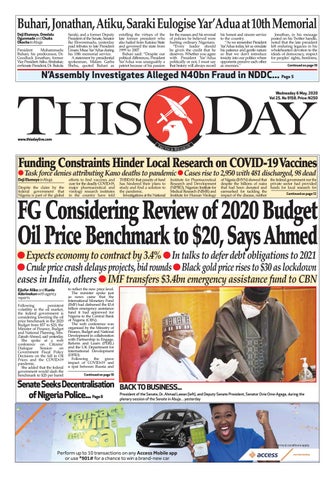
Buhari, Jonathan, Atiku, Saraki Eulogise Yar’Adua at 10th Memorial Deji Elumoye, Omololu Ogunmade and Chuks Okocha in Abuja President Muhammadu Buhari; his predecessor, Dr. Goodluck Jonathan; former Vice President Atiku Abubakar; ex-Senate President, Dr. Bukola
Saraki; and a former Deputy President of the Senate, Senator Ike Ekweremadu, yesterday paid tributes to late President Umaru Musa Yar’Adua during his 10th memorial service. A statement by presidential spokesman, Malam Garba Shehu, quoted Buhari as
extolling the virtues of the late former president who also hailed from Katsina State and governed the state from 1999 to 2007. Buhari said: “Despite our political differences, President Yar'Adua was unarguably a patriot because of his passion
for the masses and his reversal of policies he believed were hurting ordinary Nigerians. “Every leader should be given the credit that he deserves. Whether you agree with President Yar’Adua politically or not, I must say that history will always record
his honest and sincere service to the country. “As we remember President Yar'Adua today, let us emulate his patience and gentle nature so that we don't introduce toxicity into our politics where opponents perceive each other as enemies."
Jonathan, in his message posted on his Twitter handle, noted that the late president left enduring legacies in his wholehearted devotion to the ideals of democracy, respect for peoples’ rights, freedoms, Continued on page 10
N’Assembly Investigates Alleged N40bn Fraud in NDDC... Page 5 Wednesday 6 May, 2020 Vol 25. No 9158. Price: N250
www.thisdaylive.com TR
UT H
& RE A S O
N
Funding Constraints Hinder Local Research on COVID-19 Vaccines Task force denies attributing Kano deaths to pandemic Cases rise to 2,950 with 481 discharged, 98 dead
Deji Elumoye in Abuja Despite the claim by the federal government that Nigeria is part of the global
efforts to find vaccines and cure for the deadly COVID-19, major pharmaceutical and virology research institutes in the country have told
THISDAY that paucity of fund has hindered their plans to study and find a solution to the pandemic. Investigations at the National
Institute for Pharmaceutical Research and Development (NIPRD), Nigerian Institute for Medical Research (NIMR) and Institute for Human Virology
of Nigeria (IHVN) showed that the federal government nor the despite the billions of naira private sector had provided that had been donated and funds for local research for earmarked for tackling the Continued on page 12 impact of the disease, neither
FG Considering Review of 2020 Budget Oil Price Benchmark to $20, Says Ahmed Expects economy to contract by 3.4% In talks to defer debt obligations to 2021 Crude price crash delays projects, bid rounds Black gold price rises to $30 as lockdown eases in India, others IMF transfers $3.4bn emergency assistance fund to CBN Ejiofor Alike and Kunle Aderinokun with agency reports Following persistent volatility in the oil market, the federal government is considering lowering the oil price benchmark in the 2020 Budget from $57 to $20, the Minister of Finance, Budget and National Planning, Mrs. Zainab Ahmed, said yesterday. She spoke at a web conference on Citizens’ Dialogue Session on Government Fiscal Policy Decisions on the fall in Oil Prices and the COVID-19 pandemic. She added that the federal government would slash the benchmark to $20 per barrel
to reflect the new price level. The minister spoke just as news came that the International Monetary Fund (IMF) had disbursed the $3.4 billion emergency assistance fund it had approved for Nigeria to the Central Bank of Nigeria (CBN). The web conference was organised by the Ministry of Finance, Budget and National Development in collaboration with Partnership to Engage, Reform and Learn (PERL) and the UK Department for International Development (DFID). Following the grave impact of COVID-19 and a spat between Russia and Continued on page 10
Senate Seeks Decentralisation of Nigeria Police... Page 8
BACK TO BUSINESS... President of the Senate, Dr. Ahmad Lawan (left), and Deputy Senate President, Senator Ovie Omo-Agege, during the plenary session of the Senate in Abuja…yesterday
2
WEDNESDAY MAY 6, 2020 •T H I S D AY
WEDNESDAY MAY 6, 2020 • T H I S D AY
3
4
WEDNESDAY MAY 6, 2020 •T H I S D AY
5
WEDNESDAY, ͞˜ ͺ͸ͺ͸ Ëž T H I S D AY
NEWS
Group News Editor Ejiofor Alike Email Ejiofor.Alike@thisdaylive.com, 08066066268
N’Assembly Investigates Alleged N40bn Fraud in NDDC House summons Akpabio
Deji Elumoye, Chuks Okocha and Udora Orizu in Abuja The National Assembly yesterday passed a resolution to investigate an allegation of N40 billion fraud against the Interim Management Committee (IMC) of the Niger Delta Development Commission (NDDC). While the Senate raised a seven-member ad-hoc committee to look into the allegation, the House of Representatives summoned the Minister of Niger Delta Affairs, Senator Godswill Akpabio, and the IMC to explain to the House the plan of the commission to ameliorate the effect of the present economic situation on the region.
After debating a motion sponsored by the Chairman of the Senate Committee on Navy, Senator Thompson Sekibo, the Senate passed a resolution to investigate the allegations on how the IMC spent N40 billion within three months. The ad-hoc the committee, headed by Senator Olubunmi Adetunbi, was given a month to look into the financial transactions and report back to the Senate. Members of the committee are Senators Jika Dauda Haliru (APC Bauchi Central), Mohammed Tanko Almakura (APC Nasarawa South), Abdulfatai Buhari (APC Oyo North), Chukwuka Utazi (PDP Enugu North), Ibrahim
UK Evacuates 304 More Britons from Nigeria Chinedu Eze The United Kingdom yesterday evacuated another batch of its citizens from Nigeria through Murtala Muhammed International Airport (MMIA) in Lagos. A British Airways Boeing B747 with registration mark BAW 9156, airlifted 304 passengers, including 21 crew members to Heathrow Airport, London. The flight took off at about 4.45 p.m local time and the UK High Commission said the final batch of the airlift would take place on May 8. So far, the UK has evacuated a total of about 1,699 citizens from Nigeria since the onset of the COVID-19 pandemic, which forced the closure of airports. THISDAY learnt that each passenger paid ÂŁ477.50 from Abuja and ÂŁ490.50 from Lagos, according to information on the
UK Mission's website. Nigeria's Minister of Foreign Affairs, Geoffrey Onyeama, explained that the aircraft that would airlift the last batch of UK citizens on May 8, would bring in about 300 Nigerians who wished to return home from that country. A statement from the UK Mission said the flights were made possible by the Ministries of Foreign Affairs, Transportation and Aviation, the Federal Capital Territory (FCT) and Lagos State authorities. The British High Commissioner, Mrs. Catriona Laing, stated that to be eligible for all flights, the primary residence has to be in the UK, adding that they prioritised helping the most vulnerable and those who have an underlying medical condition placing them at greater risk of serious illness if they contract COVID-19.
Hadeija (APC Jigawa North East) and Degi-Eremienyo Biobarakuma (APC Bayelsa East). The Senate also directed its Committee on Niger Delta Affairs, headed by Senator Peter Nwaoboshi, to within one month investigate the appropriateness of the alleged arbitrary sack of the management staff of NDDC. Sekibo, in the motion entitled "urgent need to investigate alleged financial recklessness in the Niger Delta Development Commission," alleged that reports from the commission revealed financial recklessness which must be halted and investigated. According to him, while President Muhammadu Buhari set up IMC to co-ordinate forensic audit of financial
transactions carried out by the dissolved board of the commission, reports emanating from IMC indicated financial recklessness by the new management. He added that aside financial recklessness by IMC, it's also indulged in alleged arbitrary sack of the management staff of the commission. "While President Buhari's action of setting up an IMC and the forensic audit may have been conceived to forestall the financial recklessness of the commission and reposition it for fast-tracking of the development of the region, the IMC has been more bedeviled with the same financial misuse, misapplication, misappropriation or outright fraud in the management of the funds of the commission.
"Within the last three months, the commission has spent over N40 billion of the commission's fund without recourse to established processes of fund disbursements, which has opened up further suspicion among stakeholders of the Niger Delta Region,� he alleged. While debating the motion, Senators Bala Ibn Na’Allah and Ajibola Basiru, through different constitutional points of order, said the motion was based on allegations and tried to stop it from being adopted. Lawan said the seven-man adhoc committee would determine the veracity or otherwise of the allegations. Also discussing the alleged sleaze in the commission, the House directed its Committee on NDDC to investigate all
procurements and financial transactions of the commission for this fiscal year to ascertain compliance with relevant provisions of the law. The committee is also to investigate adherence to the Act setting up the commission, in the layoff and engagement of key management personnel. This was sequel to the unanimous adoption of a motion, titled, 'Need to Investigate the Alleged Financial Malfeasance and Other Activities in the Niger Delta Development Commission,' sponsored by Hon. Peter Akpatason. While presenting the motion, Akpatason raised the alarm on claims that the commission had spent over N40 billion without a corresponding effect on the region.
STAYING SAFE... Director-General, National Council for Arts and Culture, Chief Olusegun Runsewe (left), and Deputy Inspector-General of Police, Operations, Mr. Abdulmajid Ali, during the presentation of locally made face shields and masks and hand sanitisers by the agency to the police in Abuja...yesterday
THISDAY Correspondent Killed in Apapa Truck Accident Obaigbena consoles family, unfolds relief package for widow, children Chiemelie Ezeobi The Judiciary Correspondent of THISDAY Newspapers, Mr. Akinwale Akintunde, has died. He died on Monday at Lagos Island General Hospital, Lagos, where he was rushed to after a truck hit the commercial motorcycle that was taking him home after the close of work. Akintunde had finished production for the Tuesday Law pages on Monday night and had set off for home but never made it to return to his son and pregnant wife. He boarded a commercial motorcycle in Apapa, but on the way, he was hit by the truck driver who was trying to reverse without checking if the road behind him was free. According to eyewitnesses, the commercial motorcyclist was trying to manoeuvre between stationary trucks when one of the hitherto stationary truck drivers moved out of its lane to another. While reversing, the truck driver hit the motorcycle and crushed both the rider and passenger. Akintunde was first taken to the Apapa Health Centre but they suggested that he be taken to the general hospital given the gravity of his injuries. Speaking to THISDAY on Akintunde’s final moments, Mr. Henry Ojeluh, a colleague
and friend, said although the deceased was in pain, he was still lucid when he was taken to the hospital. He was put on oxygen but the hospital and the neighbouring hospitals did not have his blood group. Ojeluh said for hours he drove round to get the blood to no avail until he finally got one from a hospital in Aguda, Surulere but Akintunde had died by the time he returned to the general hospital. THISDAY Managing Editor, Joseph Ushigiale, who was mandated to commiserate with the wife and family members and liaise with them on the burial plans, said the driver had been arrested and the truck impounded. He said: “Some policemen that were at the scene of the accident apprehended the driver and impounded the truck. Akintunde was rushed to our corporate headquarters by the police team and some money was released for his treatment. “A few hours later, the doctors pronounced him dead. I was mandated to liaise with the wife and family members to commiserate with them on his passing and also ascertain the burial plans. “This morning, we broke the news to the pregnant wife. Afterward, some members of his family, church, colleagues and I
Late Akintunde converged on the mortuary to chart a way forward. May his soul rest in peace.� While extending his condolences to the bereaved family, the Chairman & Editor-inChief, THISDAY Media Group/ ARISE News Channel, Nduka Obaigbena, pledged to bear the cost of the education of the children of the deceased. He said: “Very very sad. Needless. May his soul find peace. Perfect peace. THISDAY will meet all financial costs of his burial, his continuing salary and the cost of the full education of his children. May God bless and keep his family.� In tributes sent in by colleagues and friends, the deceased was described as an easygoing, dedicated and resilient journalist who was passionate about his job. THISDAY’s Deputy Managing Director, Mr. Kayode Komolafe,
described his death as “tragic and shocking.� “Akin was a pleasant and conscientious guy. God rest his soul and comfort his family,� he added. The Editor, THISDAY Newspapers, Mr. Bolaji Adebiyi, said: “It's a pity. May his gentle soul rest in peace. Amen.� On her part, the Managing Director of ARISE News Channel, the broadcast arm of THISDAY, Ms. Ijeoma Nwogwugwu, described his death as tragic. “What a big loss! May his blessed soul rest in eternal peace,� she said. While the Sunday Editor, Mr. Shaka Momodu, wrote: “Oh My God!! May his soul rest in peace,� the Group News Editor, Mr. Ejiofor Alike, said: “Very devastating! May his soul rest in peace�. On his part, Deputy Editor, Daily, Davidson Iriekpen, described Akin as one of the most peaceful and conscientious reporters in the newsroom. "He was just too peaceful to face the kind of horrendous death that befell him. May his soul rest in peace," he added. Also on the platform, the Group Business Editor, Mr. Obinna Chima, said: “Painful. May God grant him eternal rest�, while the Group Sports Editor, Mr. Duro Ikhazuagbe, said: “Very painful way to die. May Akin's soul rest in peace.
We have missed a very dedicated colleague.� In a personal tribute to the deceased on his Facebook page, Mr. Raheem Akingbolu of THISDAY Business Desk wrote: “ Goodnight Akin! you were a great guy. I was again forced to ask this morning why good people die too soon. On April 30, my colleague marked his wedding anniversary on Facebook, everybody celebrated with him. “I'm personally touched because Akin was exceptional in behaviour, job ethic and disposition to work. To me, this is a personal loss. Rest in peace brother.� Writing from her personal experience on the Law Desk with the deceased, Yinka Olatubosun said: “ It's sad. I was on the same team with Mr. Akin for four years and he was very humble and hardworking. “I'm finding it extremely difficult to write and do anything because I know he deserves better than this untimely death. May God console us and most especially the young family he has left behind.� Also, THISDAY Aviation Correspondent, Chinedu Eze, said: “He was calm, mature and very dedicated to his work. He was quietly admired by all because of his devotion to duty." The Nation’s Deputy News Editor and former Judiciary
Correspondent, Joseph Jibueze, described the deceased as a dependable ally and a trustworthy journalist. He said: "I am deeply saddened by Akin's passing. He was a good friend and a dependable ally. A few weeks ago, we covered the Egbe Amofin Ni Eko annual lecture together and rode in the same car back. "I called his number on Monday over a story we were to work on only to hear that he was involved in an accident that proved fatal. My heart goes out to his wife, family, THISDAY staff and all those who know him." Reacting to Akintunde’s demise, the Executive Director of Access to Justice, Mr. Joseph Otteh, said he was devastated with the sad news. While condoling with THISDAY over what he described as “horrendous loss�, Otteh prayed God to give the organisation and his family the fortitude to bear loss. “I've just recovered my breath after hearing of the passing of Akin. I can imagine how devastating the news is for you all and the entire organisation, not talking of his young family. I am deeply grieved by the news. “Please accept my condolences, those of my family and of Access to Justice. May God give you all the fortitude to bear this horrendous loss,� he said.
6
WEDNESDAY MAY 6, 2020 •T H I S D AY
WEDNESDAY MAY 6, 2020 • T H I S D AY
7
8
WEDNESDAY, ͞˜ ͺ͸ͺ͸ Ëž T H I S D AY
NEWS
Senate Seeks Decentralisation of Nigeria Police Backs community policing initiative Investigates status of 5G network in Nigeria Deji Elumoye and Chuks Okocha in Abuja The Senate yesterday called for the decentralisation of the Nigeria Police as part of efforts to boost the protection of lives and property. It also resolved to probe the status of fifth generation (5G) network in the country. The Senate urged the 36 state Houses of Assembly to pass laws that would legalise community policing in their respective states. The Senate, in resolving to adopt the recommendations of its Ad-hoc Committee on Nigerian Security Challenges, headed by Senator Yahaya Abdullahi, called for the expansion of the states' security councils and constitution of area command, local government and ward level advisory councils. These were the high points of the recommendations of the ad-hoc committee report on the urgent need to restructure,
review and re-organise the current security architecture, which was considered and approved in the Senate yesterday. The committee, set up on January 29, 2020, in its report, made recommendations, which were also approved by the Senate. The Senate, therefore, urged the executive to direct the Ministry of Police Affairs and the Inspector General of Police to “decentralise the police command structure with operational and budgetary powers� vested in the following 11 zonal commands: Kano/Jigawa/ Katsina, Sokoto/Zamfara/ Kebbi, Kaduna/Niger/ FCT, Ekiti/Kwara/Kogi, Benue/ Plateau/Nasarawa, Bauchi/ Yobe/Borno and Adamawa/ Taraba/Gombe. Other commands are: Lagos/ Ogun, Oyo/Osun/Ondo, Edo/ Delta/Bayelsa, Rivers/AkwaIbom/Cross Rivers, Imo/Abia and Anambra/Enugu/Ebonyi.
The Senate also urged the federal government to set up zonal security advisory committees at each zonal commands to advise on the security challenges facing each zone. The proposed composition of the zonal advisory council include governors in the zone (to preside on a rotational basis); zonal Assistant Inspector-General of Police; state commissioners of police in the zone; state directors of the Department of State Security Service; zonal immigration officers; zonal customs officers; representatives of the Nigeria Security and Civil Defence Corps and the Nigeria Correctional Service in the zone. Others are chairmen of state traditional rulers' council in the zone, faith-based leaders in the zone; civil society representatives; representatives of senators, House of Representatives members, business community and labour
in the zone as well as and any person or persons deemed to be useful and relevant, taking into account the socio-cultural peculiarities of the zone. Recommendations were also made for the expansion of the State Security Council and constitution of area command, local government, and ward level advisory councils. The Senate urged the federal government to direct the Ministry of Police Affairs and the Inspector General of Police to immediately implement the community policing strategy involving local stakeholders at the grassroots, including traditional rulers and local notable personalities with a view to addressing local security challenges. It also called on the state Houses of Assembly to legalise community policing and for governors to fund the community policing from grants appropriated to each local government. The federal government
is also to financially support community policing initiative with an annual grant. The Senate resolved that the following laws are to be amended immediately. They include: The Armed Forces Act CAP A20 LFN 2004; National Security Agencies Act, LFN 2004; Police Act CAP P19, LFN 2004; Immigration Act, CAP P1 LFN 2004; Nigeria Security and Civil Defence Corps (Establishment) Act NO 2, 2003. Others include Nigeria Security and Civil Defence (Amendment) Act No, 6. 2007; Customs and Excise Management Act CAP C45 LFN 2004; Nigerian Communications Commission Act CAP N94 LFN, 2004; the National Identity Management Commission (NIMC) Act, No 23, 2007; and Review of the Evidence Act in the Judicial Administration. The Senate yesterday also resolved to probe the status of 5G network in the country.
This was a sequel to the adoption of a motion sponsored by the Chairman of the Senate Committee on Science and Technology, Senator Uche Ekwenife, asking four standing committees to determine the status of 5G network in the country. The investigating committees are: Communications, Science and Technology, ICT and Cybercrimes, which would determine the technological impact of the 5G network on Nigerians. The four committees, led by the communications committee headed by Senator Oluremi Tinubu, are to report back to plenary within four weeks. Ekwunife, in her motion, drew attention to the fact that "the uncertainty on whether or not the 5G network has been launched in Nigeria will continue to fuel speculations and rumour concerning the deployment of the 5G network and its effects on citizens of Nigeria."
Presidency: We Won't Breach Agreement on Repatriated $311m Abacha Loot Omololu Ogunmade in Abuja The newly-repatriated $311 million recovered from the assets of the late Head of State, Gen. Sani Abacha, to Nigeria from the United States would be fully utilised as agreed, the Presidency assured the nation yesterday. The Office of the AttorneyGeneral of the Federation (AGF) had announced on Monday the return of $311 million from the United States and Jersey to the country after intense negotiations. The fund, according to a statement from the AGF's office, had risen from the earlier $308 million the federal government negotiated for in February as a result of accrued interest. Presidential spokesman, Malam Garba Shehu, in a statement, said parts of the fund would be utilised for the execution of three major capital projects in accordance with federal government's agreement with the US. He added that the remaining parts would be deployed to create jobs and enhance skills in the construction sector. According to him, the fund has already been earmarked to finance the Lagos-Ibadan Expressway, Second Niger bridge, and Abuja-KadunaKano Expressway. "These funds have already been allocated, and will be used in full, for vital and decades-overdue infrastructure development: the Second Niger Bridge, the Lagos-Ibadan and Abuja-Kaduna-Kano expressways - creating tens of thousands of Nigerian construction jobs and local skills, which can then be useful in future projects. "Part of the funds will also be invested in the Mambilla Power Project which, when completed, will provide electricity to some three million homes - over ten million citizens - in our country," he said.
According to him, the fund and others earlier returned from the United Kingdom and Switzerland, would be utilised for the country's development. He explained that without the earlier repatriated funds, the ongoing fight against COVID-19 would have been tough. "Without these funds, the fight against COVID-19 would be even tougher," he said. He described the receipt of the funds as an attestation to the stronger relationship between Nigeria and the United States. Shehu said it was the combined cooperation of the government of the UK and US respectively as well as the involvement of the US government that facilitated the return of different funds from both countries. "The receipt of these stolen monies - and the hundreds of millions more that have already been returned from the United Kingdom and Switzerland are an opportunity for the development of our nation, made far harder for those decades the country was robbed of these funds "The latest return is a testament to the growing and deepening relationship between the government of Nigeria and the government of the United States. "Without the cooperation both from the UK government, the US executive branch and the US Congress, we would not have achieved the return of these funds at all," he added. The statement said the funds were not handed to previous governments because affected countries could not trust them with such funds. It explained further that the $320 million earlier repatriated from Switzerland is "already being used for the government’s free school feeding scheme, a stipend for millions of disadvantaged citizens, and grain grants for those in severe food hardship."
REVIVING MORIBUND COMPANY... Imo State Governor, Senator Hope Uzodimma (left), and the Interim Committee Chairman, ADA Palm, Brig-Gen. Austin Egwuagu (rtd), during a visit to the company by the governor in Owerri‌yesterday
House Bows to Pressure, to Hold Public Hearing on Infectious Diseases Bill Sets up committee to probe bribery allegation Udora Orizu in Abuja The House of Representatives has resolved to hold a public hearing on the Infectious Diseases Control Bill, 2020 after clamour by stakeholders. The Speaker, Hon. Femi Gbajabiamila, in a speech yesterday, said the House would take the controversial Infectious Diseases, Control Bill, 2020, through a public hearing. The speaker has been accused of surreptitious attempts to pass the bill by circumventing due process. Besides, some provisions of the bill have been criticised for being antithetical to constitutional provisions. Also, Senator Dino Melaye had sued the National Assembly over the bill, saying it's against the rights
of Nigerians. Gbajabiamila has also set up a 12-man committee to look into allegations that he and some members of the House collected $10 million bribe from a foreign sponsor to speedily pass the bill. “The Control of Infectious Diseases Bill will be put forward to a public hearing where stakeholders' contributions will be sought to make improvements to the bill before it is reviewed and debated by the Committee of the Whole. “It is from the accumulation of these myriad views, suggestions and good-faith critiques from within and outside the House that we will arrive at final legislation that meets the present and future needs of our country, and which we all can support
in good conscience,� he said. He, however, warned that the public hearing may be conducted in line with the COVID-19 guidelines. “The social distancing guidelines under which this House and the whole country operates, for the time being, means that the usual format of public hearings is not tenable. If a socially distant public hearing becomes workable, we will certainly explore that option. “Nonetheless, the House will provide alternative platforms for all Nigerians who desire to send in written documents that articulate their concerns, make recommendations on amendments and perhaps present other formulations for a new framework for managing infectious
diseases in Nigeria. All the contributions we receive will be considered and aggregated to improve the proposed legislation,� he added. Gbajabiamila also raised a committee to probe allegations that he and some members of the House collected $10 million bribe from a foreign sponsor to pass the bill. The committee is chaired by Hon. Henry Nwawuba (PDP, Imo). Reacting to the $10 million bribery allegation, the spokesperson of the House, Hon. Benjamin Kalu, had told THISDAY that the House could not fall for cheap blackmail. He said the bill was still going through the legislative process and urged Nigerians to make their input through their representatives or during public hearing.
WEDNESDAY MAY 6, 2020 • T H I S D AY
9
10
WEDNESDAY, ͞˜ ͺ͸ͺ͸ Ëž T H I S D AY
PAGE TEN BUHARI, JONATHAN, ATIKU, SARAKI EULOGISE YAR’ADUA AT 10TH MEMORIAL and reason for living as well as a commitment to the rule of law and laws of equity and justice. He said: "Yar’Adua built bridges across Nigeria. He was a president like no other who lived and died for the sake of his country. He stood on the side of the people, toiling day and night to make their lives better. “President Yar’Adua built strong bridges of hope, love
and understanding for which he became a force for national unity and positive change across our blessed land. “I will continue to remember President Yar’Adua as a colleague and a boss who became my brother and friend,� he added. Atiku, in a statement by his media office, said Nigerians would not
forget the achievements of Yar'Adua's short-lived administration. "As each year passes by, we are constantly reminded of his outstanding leadership skills and decision-making acumen. "Yar'Adua was a man that was never shy of reaching out to people; irrespective of political party affiliations whenever it came down to finding solutions to
addressing issues that bedeviled us as a nation," he said. Atiku explained that with the creation of the Niger Delta Ministry and the Amnesty Programme, he ushered in a new era of peace and stability in the Niger Delta region and by extension, the whole country. Saraki tweeted: “10 years after President Umaru Musa Yar’Adua’s passing, we are
constantly reminded about his humanity, his dedication to duty, and his desire for a Nigeria we can all be proud of. May Allah (SWT) forgive his sins and continue to retain for him a place in Aljanah Firdaus.� Ekweremadu commended the late Yar’Adua for designating Akanu Ibiam Airport, Enugu as an international airport. “We lost a leader in the
late President Yar’Adua 10 years ago. When in July 2007 I led South-east senators to discuss challenges facing the region with him, he was surprised the region had no direct access to the world and graciously designated the Akanu Ibiam Airport, Enugu as an international airport,� Ekweremadu tweeted. Yar’Adua died on May 5, 2010, after a protracted illness.
FG CONSIDERING REVIEW OF 2020 BUDGET OIL PRICE BENCHMARK TO $20, SAYS AHMED Saudi Arabia, oil price had plummeted, forcing the federal government to propose a downward review of its $57 oil price benchmark to $30 in an amendment discussed with the National Assembly leadership a month ago. It also reviewed its proposed production volumes from 2.18 million barrels per day to 1.70 million barrels. This effectively necessitated the shaving off of the total sum of N312.820 billion, representing 15 per cent of its N10.59 trillion budget passed in December last year. The federal government has also decided not to hold bidding rounds for major oilfields until crude prices recover while some upstream projects will be completed much later than originally planned as a result of the crash in the price of crude oil. Nigeria is grappling with a significant drop in oil prices and a collapse in global fuel demand caused by lockdown measures aimed at containing COVID-19. Therefore, it has projected the country’s economy to contract by 3.4 per cent, as dwindling oil revenues and the pandemic forced the country to cut the budget plans for a second time to assume a lower petroleum price of $20 per barrel. However, as Italy, Spain, Nigeria, and India, together with Ohio and other states in the United States began allowing some people to go back to work and also opened up construction sites, parks, and libraries, oil price jumped again yesterday on hopes of a recovery in fuel demand. “We are in the process of an amendment that is bringing down the revenue indicator to $20 per barrel,� Ahmed said at the web conference. She added that Nigeria was having trouble selling some of its oil cargoes and would have to cut production to below what it originally expected in the budget. The country, as part of an agreement with OPEC and other producing nations, agreed to trim output to help balance the global market. As a result of the cuts and lower prices, the budget office director said projected oil and gas revenues would drop by over 80 per cent this year. Ahmed and the Group Managing Director of the Nigerian National Petroleum Corporation (NNPC), Malam Mele Kyari, said at the conference that the delay in some licensing rounds cut the country’s projected revenue from signature bonuses to N350 billion ($972.22 million) this year from N939 billion originally expected.
They said most of the anticipated revenue would come from licence renewals. The minister said some upstream oil and gas projects would be delivered “much later than originally planned� due to scaled back government investments. “Where you require foreign investment...this is not a good time,� Kyari said of the licensing rounds, adding that “the appetite would be very low.� The federal government is, however, accelerating bidding rounds for socalled “marginal� fields, which Kyari said were less impacted by low oil prices because they would likely be taken up by local producers and would require less capital to develop. Budget Office DirectorGeneral, Mr. Ben Akabueze, according to Reuters, emphasised that oil revenues were expected to fall by more than 80 per cent. He said the government had revised its projections and expected the economy to contract by 3.4 per cent this year compared with its previous expectation that it would grow by 2.9 per cent. Nigeria would speed up marginal field licensing and oil mining licence renewals to try to raise revenues, Akabueze said. The government officials also discussed the issue of Nigeria’s debt servicing costs. The finance minister said Nigeria was in talks to defer debt service obligations to “2021 and beyond.� “It’s not debt forgiveness, it’s just rescheduling of our obligations,� she added. She, however, did not provide details of the lenders with whom talks were held. Ahmed explained that Nigeria was spending around 58 per cent to 60 per cent of revenues to service debt, which was responsible for the request. And the budget office director-general said debt servicing costs were expected to rise by N200 billion in 2020.
Black Gold Price Rises to $30 as Lockdown Eases in India, Others Meanwhile, as Italy, Spain, Nigeria and India, together with Ohio and other states in the United States, began allowing some people to go back to work and also opened up construction sites, parks and libraries, oil price jumped again yesterday on hopes of a recovery in fuel demand. Reuters reported that some European and Asian countries along with several US states began to ease lockdown measures put in place to curb the spread of COVID-19 pandemic. Following this
development, which has raised the hope for oil demand, West Texas Intermediate (WTI) crude futures were up 11.2 per cent, or $2.29, at $22.68 per barrel, while the global benchmark, Brent crude futures were up 7.2 per cent, or $1.97, at $29.17. It had earlier gained $2.96 to trade at $30.16 per barrel. Vehicle traffic in most of the United States, including those yet to lift shelterin-place orders has also rebounded Swiss bank UBS said the easing of restrictions would help lead to a balance in supply and demand for the oil market in the third quarter and even projected an undersupply by the fourth, forecasting an end2020 recovery of Brent to $43 per barrel and $55 per barrel by mid-2021. Reflecting hopes that the oil industry may have passed the worst of coronavirusinduced lockdowns, hedge funds and money managers were buyers of petroleum derivatives for a fifth straight week in the week ended April 28. Morgan Stanley said the peak of oversupply in global markets had likely been reached and a storage crunch was abating. Still, global oil demand and prices suffered historic losses in April and recovery is likely to be slow with air traffic not expected to rebound any time soon. With Saudi Arabia, Russia other major producers and companies slashing output, the market shrugged off a decision by a Texas energy regulator to abandon a proposal for a 20 per cent output cut in the United States’ biggest oil-producing state. With the trend in the global oil market, crude oil price is set to end the nightmare of producers following the decreasing United States’ inventories, coupled with expectations that the gradual relaxation of lockdowns by countries would improve demand. Apart from easing of the lockdowns by countries, the price is also being lifted by signs that the United States crude glut is not growing as quickly as expected after the COVID-19 pandemic had caused it to slump to a two-decade low. The increases are, however, a modest but marked recovery from the nosedive of US crude futures for May to as much as $40 into the negative on April 20 - an unprecedented plunge below zero that traders had not previously believed was possible.
Brent futures had also tanked to below $20 a barrel
While the US President Donald Trump said his administration would soon release a plan to help US oil companies, Treasury Secretary, Mr. Steven Mnuchin, said the help could include adding millions of barrels of oil to national reserves. Western Europe’s largest oil producer, Norway, said it would lower output from June to December, cutting production for the first time in 18 years as it joined other major producers in action aimed at supporting prices and curbing oversupply. OPEC and other oilproducing nations, a grouping known as OPEC+, agreed last month to cut output by a record amount, around 10 per cent of global supply, to support oil prices. The agreed cuts took effect from May 1. Even before May 1, Kuwait said it had begun reducing oil supply to the international market without waiting for the deal agreed to take off. In addition to the OPEC+ deal, other producers were also pledging reductions. With countries that have lockdown measures in place accounting for more than 90 per cent of last year’s oil demand, there are hopes of demand recovery as these countries reportedly moved to ease lockdowns. An OPEC-led supply pact had initially collapsed on March 6, temporarily ending three years of cooperation and starting a battle for market share. This free-for-all lasted until the producers, known as OPEC+, agreed to a new cutback from May 1. The resulting glut compounded the hit to prices that the COVID-19 outbreak was having on demand, sending oil to a 21-year low below $16 a barrel this month.
IMF Transfers $3.4bn Emergency Fund to CBN Meanwhile, the International Monetary Fund yesterday said it had disbursed to the Central Bank of Nigeria (CBN) the $3.4 billion assistance it recently approved to help Nigeria address its current economic crisis. IMF Managing Director, Kristalina Georgieva, in an interview on CNBC Africa monitored by THISDAY yesterday, noted that a few days after it approved the financing, it transferred the amount to the country’s apex bank. “We have already disbursed emergency assistance. The board approved and within days, we disbursed the fund to the country. It goes into the central bank in dollars and
gets transferred into naira in the case of Nigeria,� Georgieva stated. IMF Board last week approved Nigeria’s request for $3.4 billion in emergency financial assistance under the fund’s Rapid Financing Instrument (RFI) to support the federal government’s efforts in addressing the severe economic impact of the COVID-19 economic shock and the drastic fall in oil price. Georgieva restated that the financial support did not come with the usual IMF conditionalities. “The conditions are quite favourable, the repayment period is five years. Up to three-and-a-half years is grace period. And the interest on the loan is one per cent. So in that sense, our members can benefit more directly through the fund, from very low interest rates globally. We also have a number of safeguards when we provide financial support to countries that have been approved, met and exceed the safeguards,� she added. IMF chief executive stated that the COVID-19 crisis had presented Nigeria and other African countries another chance to build fiscal buffers and strong healthcare systems. “Across Africa, as it is the case across the whole world, this crisis puts pressure on moving fast in digitalisation and transforming how societies and economies work. And I very much hope that Africa that has been geared towards that kind of transformation comes out of this crisis with a stronger capacity to be part of the new knowledge economy. That means, however, that countries need to sustain after COVID -19 investment in health, education, human capital, which are critical for success and also prioritise their public investments in a way that support that kind of transformation. “Across Africa, governments have started recognising how important it to build buffers so they can weather shocks. In the case of Nigeria, the finance minister is setting a target to increase the share of tax to GDP. "Before the crisis, it was eight per cent, this year because of drop in revenue, it may even shrink to five per cent. But the objective of five years is to lift it up to 15 per cent,� she said. Georgieva expressed sympathy to Africans mostly affected by the pandemic and the economic shock it has created, adding that “IMF responded very early with a commitment to rapidly increase emergency financing.� She said: “With the support of our shareholders,
we doubled what we can provide. From the African countries we have about 40 requests, and I’m very proud to say that 21 sub-Saharan African countries have received financial support from the IMF with Nigeria getting the largest share of $3.4 billion assistance. “We are aiming to continue with rapid approvals because we recognise speed is of an essence to help health systems cope with the pandemic but also to help vulnerable people and vulnerable parts of the economy to cope. "Our aim is to get some $18 billion into the hands of policy makers and rapidly flowing in support of their economies. "We have done two important things for SubSaharan Africa. We’ve mobilised debt relief for the countries with low income to their debt service to the fund. Twenty-three countries are not able to pay us for the next six months and we would extend that to, most likely, two years. “Secondly, together with the President of the World Bank, we led the effort to come with the debt standstill for official bilateral creditors. We call on the private sector to also join in. When the economies stand still, debt economies should also stand still.� The IMF chief lamented that Nigeria has been seriously hit by the economic impact of the pandemic, saying “it is hit because of the measures it takes, because of restrictions in the world economy and by the collapse of oil prices.� Echoing the fund’s prediction, she stated: “To put this in numbers, for Africa we project a contraction of one and a quarter percent. This is going to be a deeper contraction in our perception, in Nigeria. It would go from +2 per cent growth to -3.4 per cent. Whilst we are projecting recovery in 2021, it is going to be only a partial recovery. “Therefore, difficult days are ahead and in that context, we very much welcome the decisive measures to protect the economy and to protect the most vulnerable people in Nigeria. What we project in a situation when the fiscal gap is going to be quite significant in the order of somewhere between $11 billion, that’s the injection from the fund and other financial institutions, is critical and timely.� According to her, collectively with the World Bank, African Development Bank and other partners of Nigeria, the country would be helped to overcome the economic crisis unleashed by COVID-19.
WEDNESDAY MAY 6, 2020 • T H I S D AY
11
12
WEDNESDAY, ͞˜ ͺ͸ͺ͸ Ëž T H I S D AY
NEWS FUNDING CONSTRAINTS HINDER LOCAL RESEARCH ON COVID-19 VACCINES the United Kingdom, because Deaths to COVID-19 Infectious Disease Hospital,
vaccines and curative drugs. Meanwhile, the pandemic remained on the front burner of public health discourse yesterday as the nation entered the second day of relaxation of the lockdown imposed on the Federal Capital Territory (FCT), Lagos and Ogun states on March 30. Sadly, Nigeria recorded 148 new cases of COVID-19 yesterday, bringing the tally to 2,950 confirmed cases with 481 persons discharged and 98 dead. Announcing this last night, the Nigeria Centre for Disease Control (NCDC) said Lagos recorded 43 new cases, Kano 32, Zamfara 14, FCT 10, Katsina nine, Taraba seven, Borno and Ogun six each, Oyo five, Edo, Kaduna and Bauchi three each, Adamawa and Gombe two each, while Plateau, Sokoto and Kebbi recorded one each. However, the Presidential Task Force on COVID-19 denied media reports that it had attributed the recent harvest of deaths in Kano State to the pandemic even as the World Health Organisation (WHO) and the African Union (AU) advised Nigeria to extend its testing capacities beyond the capital cities to smaller towns, so as to control the spread of the virus. In Lagos, the state government announced the discharge of 60 more patients from its isolation centres, bringing to 321 the total number of successfully treated persons in the state since the February 27 index case. The federal government also yesterday issued guidelines on the management of the public and private sector-led COVID-19 relief funds to be incorporated into the Treasury Single Account (TSA). But three of the major research institutes that THISDAY spoke to yesterday said although they had planned to commence the groundwork for vaccines and drugs research, they got stuck due to lack of funding. In an exclusive interview with THISDAY, IHVN Executive Director, Prof. Alash’le Abimiku, said the institute had outlined ways to support the development of vaccines and drugs against COVID-19 but that so far it was yet to get financial support from the government. She said: “We have not received any funding from the government towards research into finding a vaccine or cure for COVID-19. We have submitted papers to the Presidential Task Force on COVID-19 on what we can do, but so far we have received nothing. We have also not received any funding from the government in the last three years for research. Our support comes from international donors, and not our government. “Government needs to encourage brilliant scientists in the country so solutions can be developed as soon as possible.� Abimiku, who was the first researcher to document Nigeria’s unique HIV strain as HIV-subtype C, said one of the biggest challenges for developing countries battling the COVID-19 pandemic was that they were limited by a lack of structures needed for scientific researches, adding that this is also playing out in Nigeria. She said: “Asking where Nigeria is in the development of vaccines and drugs for COVID-19 is a million-dollar question. Most efforts in terms of finding cure and vaccine are happening in the industrialised world like the United States and
they already have structures for such researches. “Nigeria does not have the capacity to develop vaccines and cure. However, I know we have some herbs and drugs that can help but they are really not vaccines or drugs against COVID-19. “What IHVN can do is to test whether candidate vaccines and drugs from Europe or the US can work in our population.� NIPRD Director General, Dr. Obi Adigwe, said the institute had plans to drive researches for vaccines and drugs against the virus, but it required the support of philanthropists, development partners, and the private sector to achieve its objective. “Government has done a lot in this area, but we will require funding from these three key areas for us to drive the research process speedily. There is so much we have done, but research could be limited by funding. We are calling on development partners, well-meaning Nigerians and the private sector to support this process. The government cannot do this alone,� he said. A researcher with NIMR, who spoke to THISDAY on the condition of anonymity, said funding was hampering research efforts towards developing vaccines and drugs for COVID-19. He said: “While monies are coming out from different areas towards halting the spread of the virus in the country, no one is looking at funding research. We presume both the government and the private sector have decided to leave that area to developed world like the US, UK and Europe. They may not want to put money into this area.� According to him, Nigeria has some of the best brains in the science world to provide the solution to the pandemic, but poor funding and lack of structures are responsible for their withdrawal. All calls made to NIMR Director General, Prof. Babatunde Salako, to get his thoughts were not answered. Replying one of the SMS sent to him, he said he would respond later. He, however, didn’t get back before press time. The Minister of State for Education, Mr. Chukwuemeka Nwajiuba, had told ARISE News Channel, a sister broadcast arm of THISDAY Newspapers, that N5 billion had been created for research into vaccine and cure for COVID-19. "Nigerian universities are working very hard to find a solution, and this is being done in a coordinated manner; some are doing researches at the molecular level, others are looking at the vaccine levels, and so on. “I spoke to the Executive Secretary of the Tertiary Education Trust Fund (TETFUND), Prof. Suleiman Bogoro, and he told me they were already talking to all the universities to coordinate research efforts against COVID-19. The coordination is important because the World Health Organisation (WHO) has stressed on coordinated race. It is not a competitive race,� he had said. He, however, told THISDAY last night that he was still expecting feedback from the TETFUND on its efforts to coordinate researches by the universities.
Task Force Denies Attributing Kano Mass
The team leader of the Ministerial Task Force Team on COVID-19 in Kano, Dr. Nasiru Sani Gwarzo, said yesterday in Kano that the comment credited to him that mass deaths in the state were caused by the pandemic was quoted out of context. Gwarzo, who is the Permanent Secretary, Federal Ministry of Industry, Trade and Investment, said at a news conference in Kano that medical experts undertaking verbal autopsy for those involved in Kano "mysterious deaths," were yet to conclude their assignment. He noted that it would have been wrong of him to preempt the report of the medical experts. "Some of the national dailies reported a percentage of people that died of COVID-19 in the state; that is not true. "The state is doing verbal autopsy and the result is not out. I want to use this opportunity to reiterate that the newspaper reports were wrong," he added. Also addressing the House of Representatives yesterday when the Presidential Task Force on COVID-19 honoured the invitation of the lawmakers, the Minister of Health, Dr. Osagie Ehanire, said there was no evidence yet that the mass deaths in Kano were caused by COVID-19.
WHO, AU Urge Nigeria to Extend Testing Beyond Capital Cities WHO and AU have advised Nigeria to extend its testing capacities beyond the capital cities to smaller towns to control the spread of the virus. Regional Director for Africa WHO, Dr. Matshidiso Moeti, and the Director, Africa Centres for Disease Control and Prevention, Dr. John Nkengasong, made the call during a virtual briefing organised by the World Economic Forum (WEF) yesterday. Moeti advised the federal government to take an urgent step in this regard. Nkengasong, however, commended efforts taken so far by the Nigerian Centre for Disease Control (NCDC) and stressed the need for increased investment in public health. He said: “I would like to recognise the important work the government of Nigeria is doing through the NCDC over the last couple of months to mitigate, prevent and control the spread of the virus. “My advice to Nigeria is that they should continue to expand and strengthen its public health system, especially the testing capacity to not just the major city of Lagos and Abuja, but all through the entire country. “That way, they would be able to pick up cases as they emerge and trace their contact. That is the only way you can be sure to continue to function while maintaining a good public health handle on the country."
Lagos Discharges 60 More Patients Lagos State government has discharged 60 more COVID-19 patients from its isolation centres, bringing to 321 the total number of successfully treated persons in the state. Announcing this yesterday, the Governor, Mr. Babajide Sanwo-Olu, said: "The patients include 31 from the Mainland
Yaba, 19 from the Ibeju-Lekki Isolation Centre and 10 from the Eti-Osa Landmark Isolation Centre."
FG Issues Guidelines on Management of COVID-19 Funds The federal government yesterday issued guidelines on the management of the public and private sector-led COVID-19 relief funds to be incorporated into the Treasury Single Account (TSA). President Muhammadu Buhari approved a temporary tinkering of the TSA to manage the funds. The Office of AccountantGeneral of the Federation (OAGF) yesterday released the framework on the management of the funds. According to a statement from the OAGF, the framework covers all public funds allocated and dedicated to the fight against COVID 19, including the Fiscal Stimulus Package currently standing at N500 billion. It applies to all donations by corporate bodies and individuals to the federal government to fight COVID-19 and the mitigation of its social and economic effects on citizens, including donations under the Private Sector Coalition Against COVID-19 (CACOVID) Fund domiciled at the CBN. Donations into the CACOVID spearheaded by the CBN to raise funds to combat COVID-19 had risen to N27.160 billion as of April 23, up from the N25.894 billion reported previously. The framework also provides clarity on the operation of the five newly opened COVID-19 Donor TSA Sub-Accounts domiciled in commercial banks, outlining that in addition to the main CACOVID Fund Account with CBN, the president approved the opening of five COVID-19 Donor Accounts, which form part of the existing TSA arrangement in the five commercial banks- Zenith Bank, Access Bank, Guaranty Trust Bank, UBA and First Bank. Explaining the objective of the framework, the OAGF said the federal government recognised citizens' expectations that these resources be prudently applied towards the fight against COVID 19, adding that "in accord with citizens expectations, the government is committed to managing these funds with the highest sense of transparency and integrity.� On the scope of Commercial Bank TSA Sub Account, the guidelines said they would be for receiving COVID-19 donations only. Under the guidelines, all accounts with commercial banks are to be linked with the TSA at CBN to provide a single consolidated view of aggregate government cash balances. This is designed to provide a single window for real-time access to details of receipts and payments across all commercial bank accounts. It said failure to sweep all balances within 24 hours would be considered a violation of the presidential directive on TSA, which shall attract sanctions. On disbursements, the guidelines said the disbursement of all COVID-19 fund, including those being collected directly by CBN and those domiciled with commercial banks would be through appropriation.
Framework for Managing Pandemic Outdated,
Gbajabiamila Insists House of Representatives, Hon. Femi Gbajabiamila, yesterday said Nigeria’s framework for managing the COVID-19 pandemic was outdated. He told the Chairman of the Presidential Task Force on COVID-19, Mr. Boss Mustapha, who lead a delegation of the team to the legislature that the framework is obsolete. He argued: “Our current framework for the prevention and management of infectious diseases is obsolete and no longer fit for purpose. The current law severely constrains the ability of the federal government and the Nigeria Centre for Disease Control (NCDC) to take proactive action to prevent the entry into Nigeria of infectious diseases and the management of public health emergencies when they occur. “I disagree wholeheartedly with the suggestion that this is not the ideal time to seek reforms of infectious diseases and public health emergency framework in the country. “The weaknesses of the present system have already manifested in the inability of the government to hold to proper account those whose refusal to adhere with NCDC guidelines led to the further spread of the coronavirus in Nigeria. We have had people break out from isolation centres and others, who are fully aware of their status chose to travel across state lines on public transport.�
House Demands Details of COVID-19 Donations The House also demanded details of the pledges made so far by donors to fight against the pandemic. The lawmakers also questioned NCDC DirectorGeneral, Dr. Chikwe Ihekweazu, on his reported comment on the Control of Infectious Diseases Bill. The House had invited the members of PTF, Ihekweazu and some ministers to brief it on efforts by the federal government to curb the pandemic. Ihekweazu, last week while responding to questions from journalists on the bill had expressed reservations about its timing, adding that he was not consulted. Responding to the lawmakers' question, he stressed the need for updated legislation on infectious diseases control law, saying NCDC is the most affected by the insufficient nature of the current Act. He, however, owned up to his statement that the House did not consult him before commencing work on the new bill. The DG, when pressed further by Gbajabiamila if this crisis period is the best time to amend the bill, said: "It's not in my position to provide an answer, I think you are right in your process, mine is to do the job." Also, Mustapha, when asked by the legislators to give details of the pledges made so far by donors to fight the pandemic said the team didn't have access to the account, adding that any enquiries on the pledges should be directed to the Accountant General of the Federation.
yesterday passed through the first reading. The Clerk of the Senate, Mr. Nelson Ayewoh, had earlier announced the first reading of the National Health Emergency Bill to the hearing of all the senators. Shedding more light on the bill, its sponsor, Senator Chukwuka Utazi, said its contents and intendment were not the same with the one before the House of Representatives. He added that unlike the bill before the House, the Senate's version would not generate any controversy as no fewer than 102 senators are co-sponsors of the bill. The President of the Senate, Dr. Ahmad Lawan, directed the Sergeant-at-Arm to ensure that copies of the bill are given to all senators ahead of its consideration for second reading next Tuesday.
Kwara Doctors to Get N25,000 Daily Allowance Kwara State government has approved a daily allowance of N25,000 for doctors involved in the fight against COVID-19. Governor AbdulRahman Abdulrasaq broke the news in a tweet yesterday. He said the allowance was in appreciation of the efforts made by medical practitioners to end the pandemic in the state.
34 Doctors Test Positive in Kano Kano State chapter of the Nigerian Medical Association (NMA) has said 34 doctors have tested positive for COVID-19 in the state. The state Chairman of NMA, Dr. Sanusi Bala, told the News Agency of Nigeria (NAN) yesterday that many of the victims were doctors working at the Aminu Kano Teaching Hospital (AKTH) and private clinics. According to him, many of them were infected through normal clinical routines while attending to unsuspected COVID-19 cases.
Patients Gombe
Protest
in
Bill on Quarantine Act passes ďŹ rst reading
Some COVID-19 patients yesterday staged a protest at the Federal University Teaching Hospital in Gombe, destroying some equipment in their ward. The patients, who were under quarantine, were said to have complained of ill-treatment. While the protest at the hospital was ongoing, some patients at Kwadon Isolation Centre in Yamaltu Deba LGA of the state took to the streets, also lamenting poor treatment. They were said to have blocked the Gombe-Biu road, chanting anti-government songs. Some of them reportedly went to unknown locations after the protest while others returned to the centre. One of the patients said he had been abandoned since officials of the NCDC brought him to the hospital three days ago. He said he had not been given drugs and was left on his own alongside some patients admitted to the hospital over COVID-19. Another said only vitamin C drug had been given to him since he got to the centre earlier in the week.
At the Senate, the National Health Emergency Bill, 2020, aimed at strengthening the nation's Quarantine Act in the light of the COVID-19 pandemic,
r"EEJUJPOBM SFQPSUT CZ /EVCVJTJ 'SBODJT $IVLT 0LPDIB "EFEBZP "LJOXBMF 6EPSB 0SJ[V .BSUJOT *Ă KFI BOE /VNF &LFHIF
13
T H I S D AY ˾ WEDNESDAY MAY 6, 2020
MIDWEEKPOLITICS The Making of an Action Governor
Group Politics Editor NSEOBONG OKON-EKONG Email nseobong.okonekong@thisdaylive.com 08114495324 SMS ONLY GOVERNANCE IN PHOTOS
Segun James writes that his handling of the COVID-19 pandemic in Lagos State has made a hero of Governor Babajide Sanwo-Olu
Sanwo-Olu
U
sually, a honeymoon implies two people celebrating their mutual love and affection and avoiding crowds and other people as much as possible. So, it is in the Nigerian political firmament between the people and political officeholders as reality bites and everyone settles to regular everyday existence. Avoiding themselves. But in today’s Lagos, the love affairs between Governor Babajide Sanwo-Olu and the people is becoming long lasting. To the effect that the Governor is now being called “Action Governor.” Lagosians don’t give this epithet out easily. It has to be earned. The last Governor who earned it was Mr. Babatunde Raji Fashola. Before him, it was Alhaji Lateef Jakande, Brigadier Raji Rasaki, Brigadier Buba Marwa and Asiwaju Bola Ahmed Tinubu who also earned similar accolade.Today, Sanwo-Olu has joined the exclusive club of ‘action governors’ barely one year after assuming office. When he entered the governorship race, his victory seemed assured given the powerblock behind him. Soon after he was named the presumptive All Progressives Congress (APC) governorship candidate for Lagos state, the opposition started calling him a stooge of the national leader of the party, Asiwaju Bola Tinubu. He was portrayed as a ‘yes-man’ who had nothing to offer the state. The opposition said that he will be governor in name only as the “real governor” will be the Asiwaju. He was given no chance. For a state like Lagos that prides itself as the Centre of Excellence, it was not the smoothest of starts for Sanwo-Olu. As the days move into weeks, the people started to complain. He was accused not only of being slow but without any idea on how to move the state forward. To his critics, he was making their assessment of him come true. But when he finally found his rhythm, the Governor started receiving the accolade from Lagosians. It is said that in life, the margin of victory can sometimes be measured in inches. That saying of the elders seems to have rang true in the life of Sanwo-Olu as in less than one year, he has proved his critics wrong that he is simply a pawn in the hands of a political chess master. That was until he started fixing the roads. A simple task of filling the potholes on the roads of Lagos all of a sudden started making the difference in the traffic gridlock of the city-state. While many people expect him to announce a series of grandiose projects that will take years to complete and which have no bearing to the needs of the people, he simply started fixing potholes! And what a difference it made. Not surprising, this simple action has eased the proverbial Lagos “go-slow” trafficjam. Not done, he opened up the waterways to marine transportation, a situation that help
reduced pressure on the road and has helped many Lagosians to get to work on time. A simple solution to complex situation. Another point that has helped endeared him to the people was that he never stopped work on any of the projects began by his predecessor, Governor Akinwunmi Ambode even as he returned contractors to projects embarked upon by Governor Babatunde Fashola that were abandoned by Ambode, a move that has ensured continuity in governance, something rare and unheard of in the country’s political system. Normally, what you hear is that all blames regarding financial atrocities bedeviling the state are heaped on the previous government. But today, what has earned the Governor his epithet is his handling of the Coronavirus pandemic in the country. Few things command attention like a pandemic such as COVID-19. Just as the Ebola pandemic made Governor Fashola a national and international celebrity, COVID-19 has made Sanwo-Olu the rave of the moment. Unusually, an impressed President Muhammadu Buhari, who is known for his taciturnity, moved by the actions of the governor had to donate to the Lagos State COVID-19 fund while heaping accolades on him. As the Chief Incident Commander on the COVID-19 pandemic in the state, Sanwo-Olu took the battle against the disease head on. At the beginning of the pandemic in the country, only Lagos was ready with a standard facility to house victims. Since the outbreak, he has increased the number of isolation centres in the state to eight, each with no less than 100 bed capacity. He updated the people daily on what is happening and what efforts the government is taking to manage it. For his efforts, corporate organisations, individuals and the federal government have donated cash and medical materials to the government, all in appreciation of how Sanwo-Olu has handled the situation. He has since become a roll model for other Governors in the country. In a country where titles are taken as a mark of achievements, Sanwo-Olu, a few months into his administration ordered that he should no longer be addressed as “His Excellency”, a title taken for granted by every other governor. In a statement he personally signed, he said he should simply be addressed as ‘Mr. Governor’. He insisted that only God is excellent. This was another first among title loving Nigerian political office holders. At functions outside the state, when he is addressed as His Excellency, he is quick to correct it. Sanyo-Olu lives by examples. After he flagged off the 40 kilometer Access Bank Lagos Marathon, he stopped his convoy at the Lagos Marina where he ordered his aides, top government functionaries and security details to jog alongside him on the 7 km road to the Eko Atlantic City terminal point for the marathon. At the end, only him and a few security aides completed the exercise. Others fell by the waysides. As he jogged along the streets, he was greeted with applause and praises by impressed Lagosians who joined him on the trail. As Lagos state comes out of a devastating lockdown ordered by the federal government over a month ago which has had a profound effect on the nation’s socioeconomic landscape, Sanwo-Olu continues to be a role-model. Models simplify. They are supposed to. Their style may be complex, they deliberately leave out some things in order to focus on others. They also leave out factors that cannot be modeled satisfactorily. For Sanwo-Olu, his focus has been on governance instead of politics. It has paid off handsomely for him. And it has made a huge difference to the outcome.
AKS Emergency Management Agency desk officer, Mr Isaac Umana representing Dep Gov, Mr Moses Ekpo, at the distribution of relief materials to wind storm victims at Ikot Idem Udo, Oruk Anam LGA
Vehicles filled with passengers and goods from Kebbi and Kwara states intercepted at Illie Town in the State of Osun close to the boundary with Oyo State by security agents for violating the lockdown order of the state government to curb the spread of COVID-19
Officials from the Office of the First Lady of Lagos State, Mrs. Ibijoke Sanwo-Olu delivering relief materials to the less privileged at Modupe Cole Memorial Child Care Treatment Home
Governor Adegboyega Oyetola of the State of Osun at the Government House, Osogbo taking delivery of a set of fumigation machine donated by the Ooni of Ife, Oba Adeyeye Enitan to Osun State Government as part of measures to curb the spread of COVID-19
14
T H I S D AY ˞ ˜ ʹ˜ 2020
COMMENT
Editor, Editorial Page PETER ISHAKA Email peter.ishaka@thisdaylive.com
COVID-19, BILL GATES AND THE FAMILY
Sonnie Ekwowusi writes that the family is the social compass that holds the world together
“
Stay-safe, Stay-at-home�, “Stay away from COVID-19 by staying-at-home�. These coronavirus catchphrases and other similar ones constantly dominate the socio-political space all over the world today. They also underline the importance of the family institution as a fundamental pillar of society. There is no place like home. Everything may seem to be collapsing; your bank account may be empty; it may appear as if you have reached the end of the tether, but do not worry. Your resting place is your home. Whether it is a ramshackle in the remotest village in Africa or an imposing skyscraper, your home is your home. And now that the economy, schools, banks, International Financial institutions - World Bank, International Monetary Fund (IMF) and others, United Nations, Stock Exchange, Executive, Legislature, Judiciary, Internet, social media, advancements in science, technology, economic development, social organization are failing modern man he is invariably and irresistibly seeking and finding protection and succour in his home. So much fuss about the economy. But we forget that there is a correction between family growth and economic growth. The economy needs healthy family, honest and responsible workforce to sustain it. Come to think of it, the economy does not manufacture honest work force, good investors or economists or financiers and others to sustain it. Honest work force, good investors or economists, financiers and others are products of the family. Consequently family failure easily translates to decline in productivity, loss of profit and may even lead to complete economic failure. Therefore the family, if you like, is that social compass that holds the world together. The family institution is the very key institution upon which the human society lays its claim to civilization. It is therefore a big paradox that the family institution is systematically being whittled down or destroyed today. Imperiling the family is tantamount to imperiling human civilization. For example, in Africa the family institution is an authentic safety net that caters for the well-being of the individual. The African communalism (notably propounded by the late University of Ibadan Emeritus Professor Jacob Festus Ade-Ajayi) or the African communal spirit of sharing or the spirit of egbe belu ugo belu (The spirit of live-and-let-live) is a veritable social-safety system embedded with the social security for the socialization and improvement of the well-being of the individual. A person born into an African family depends on his/her family for virtually everything. Unlike in the West where children are wont to dispatch their old parents to the Old People’s Homes, the African oldies, whether they are still productive or not, always have their rightful places in the family where they are continually respected, revered and protected. But unfortunately what we have been witnessing in Africa, Nigeria inclusive, over the years is a profound systematic destruction of the African families especially by the United Nations Population Funds (UNFPA), Marie Stopes International abortion clinics, Cuttmacher Institute and others. In Nigeria, the multi-billion local and foreign
THE FAMILY INSTITUTION IS THE VERY KEY INSTITUTION UPON WHICH THE HUMAN SOCIETY LAYS ITS CLAIM TO CIVILIZATION
organizations which have ceaselessly been in the vanguard of mowing down human capital are: United Nations Population Funds (UNFPA), Marie Stopes International abortion clinics, Cuttmacher Institute, Family Health International (FHI), International Women’s Health Coalition (IWHC), Population Services International (PSI), International Consortium of Medical Abortion (ICMA), Union for African Population Studies (UAPS), Population Reference Bureau (PRB), Planned Parenthood Federation of Nigeria, (PPFN), Nigeria Centre for Disease Control (NCDC) funded by American multi-billionaire Bill Gates and others. You may be aware that between 1942 and 1943 a collection of some of the literary works of English author Clive Staples Lewis (C.S Lewis, 1898–1963,) including his The Screw Tape Letters and the first series of his Broadcast Talks were published and later incorporated into his other works such as Mere Christianity, Perelandra, that Hideous Strength (these last two were part of his Ransom Trilogy), and The Abolition of Man. You will recall that by late March 2020 an excerpt purportedly culled from C. S. Lewis’ The Screw Tape Letters was circulating on the social media. At that time many social media warriors and social media activists found the purported excerpt interesting. The purported excerpt involved an exchange between Satan and Jesus Christ. The exchange allegedly occurred in the aftermath of a pandemic similar to COVID-19 in the time of C.S Lewis. Some deny that the excerpt was culled from C.S Lewis’ The Screw Tape Letters. Nevertheless, please permit me to reproduce the said except, if not for anything, for the purpose of buttressing our argument in this piece. Whereas Satan had boasted that he would cause confusion and anxiety in the world and shut down businesses and places of worship during a pandemic similar to COVID-19 that occurred in the time of C.S Lewis, Jesus Christ promised that he will restore and strengthen the family unit during that pandemic time. Below is the full exchange between Satan and Jesus. Satan: “I will cause anxiety, fear and panic. I will shut down business, schools, places of worship, and sports events. I will cause economic turmoil�. Jesus: “I will bring together neighbours, restore the family unit, I will bring dinner back to the kitchen table. I will help people slow down their lives and appreciate what really matters. I will teach my children to rely on me and not the world. I will teach my children to trust me and not their money and material resources�. Whether you choose to believe or disbelieve the aforesaid exchange, one incontrovertible truth today is that the coronavirus scourge has created anxiety, fear and panic in the minds of so many people. It has also led to the shutting of down of businesses, schools, places of worship and sports events. Consequently many are now seeking protection in their various homes. As we speak, many parents are not only happily reunited with their children at their various homes they are also forging the closely-knit family ties and communal bonds which were inconceivable prior to the outbreak of the coronavirus pandemic.
COVID-19, POST LOCKDOWNS, BEFORE THE VACCINE The ‘new normal’ may continue to be traumatic, writes Rajendra Aneja
A
s lockouts ease across nations, life will not go back to the earlier “normal�, till a vaccine is found to neutralise COVID-19. Finding the vaccine, may take 12-15 months. Then, we have to inoculate the whole world. Expect lockdowns, on and on-and-off basis, for the next 18-24 months. So, our “locked-down� way of living and working, with occasional relaxations, may be the “new normal� at least for some time. We will have to wear masks, practice social distancing, avoid large groups, etc. Even if bars and restaurants are open, we will sit at appropriate distances. Cars, trains and planes, will carry fewer passengers. Schools and colleges may hold classes online. Offices will operate with 50 per cent of the staff operating from their homes. Getting part-time domestic help may be difficult; we may have to cook our own foods and wash our clothes. Densely populated countries in Asia and Africa should undertake mass-testing of their populations. Cities which have many slums and congested localities, should aim for 100 per cent testing. Testing for Covid-19 should be made free. The costs should be borne 100 per cent by governments. The economies of all countries will be confronted with nil to negative growth rates in the current year. Many factories will find it difficult to re-start their operations, since their migratory labour has returned to the villages. It will not be easy to lure them back. Many labourers may remain ensconced in their villages, till the disease is controlled. Consumers will save, rather than spend. Having been through a traumatic lockdown, the first in the history of mankind, consumers will conserve their monies for unchartered days ahead. As companies face declining demand, jobs are likely to reduce. Hence, unemployment could augment across countries. It may be necessary to provide unemployment benefits to displaced workers. Large corporations will shed people; their
revenues will decline. Companies which are cash rich, will be marginally comfortable. The stock market will oscillate. Governments will have to provide additional incentives to industries to kickstart production. Many governments will not have the money to provide welfare to all citizens. However, this is not the time to scrounge. Governments should resort to deficit budgeting for about two-three years, but ensure that the poor are saved from further ordeals. The world has not faced a health and economic crisis of this scale, since World War II. The responses of all governments, must be equally gigantic in all areas, including health, public welfare and fiscal policy. The recent violence in Lebanon is a grim warning of how a protracted lockdown can fray tempers. Due to the lockdown scores of workers and youngsters, who do not have savings are idling at homes, many without food and money. This is happening across countries. The frustration of the hungry, will overflow in rioting onto the streets. Any government which declares a lockdown, has the legal and moral responsibility to feed those who do not have or cannot access food. If developing countries lift the lockouts too soon, they run the risk of massive infections, which their fragile health systems cannot manage. They are short of testing kits, hospital beds and medicines. If the lockouts are extended indefinitely, then the unemployed will revolt. Unemployment allowances, medical benefits, pensions for senior citizens, etc., do not exist in developing countries. So, the pain of hunger is more. Governments will have to act with compassion, discretion and start opening selected economic sectors gradually, so that the disease is contained and yet people are able to make a living. The doctors, nurses and medical personnel, who minister to Covid-19 patients, render a great service to humanity. They deserve recognition and reward. They work beyond the call of their duty exposing
themselves constantly. The pressures on the medical fraternity will continue, even after the lockdowns are eased. The disease can surface anytime, anywhere. Many citizens, especially the young and the old are finding this current phase, very traumatic. So, a large number of people will require psychiatric counselling. The scientific community and WHO, will be under intense pressure to concretise a set of medicines to treat Covid-19 and discover a vaccine expeditiously. Even after the vaccine is discovered, it will be a challenge to produce five to seven billion doses rapidly, to ensure every citizen in the world is inoculated. This will require robust global logistics. International air travel between countries may not commence for three to four months. There could be limited flights, even within countries. Social distancing will be practised even during air travel. This means fewer passengers and higher fares, to cover costs. Smaller, regional airlines may face closure. The human race is engaged in its biggest survival battle, with a disease which we have not yet understood, for which we yet do not have a globally accepted set of medicines to treat it and do not yet have a vaccine to prevent it. The stresses between USA-Iran, USA-China, Russia-Saudi Arabia on oil, etc., should all recede. Presidents and Prime Ministers across the world, should suspend all border disputes, trade disagreements, etc., till Covid-19 is resolved. Covid-19 is teaching everyone, the importance of washing hands, using sanitisers, maintaining hygiene, observing cough etiquette, etc. Those who have the money to buy various hygiene and sanitising products, can augment their immunity. Covid-19 could usher a revolution in cleanliness and sanitation amongst those who can afford hygiene products. However, about 30 to 40 per cent of the global population lives on low or daily wages. According to the ILO, there are 244 million global migratory workers. They are desperate for food. How will they buy sanitisers, when they do not have the money
to eat? About 900 million people in the world live in slums. Sometimes, around 100 persons use a single toilet in these slums. Governments need to improve the hygiene levels and living conditions in the slums of the world. We are all going through some stress and anxiety these days. A poem I wrote, 51 years ago, in 1969, entitled, “Never Give Up� may be relevant these days: “When mountains of trouble tumble down, When the loyalty of friends has disappeared, When those whom you helped try to shun you, When those whom you admired doubt you, When you are saturated with shocks, When the body refuses to take another step, When the spirit has fought enough, When everything is at its lowest ebb, It is then, Then, that you must not give up. The path may be long, And the bare feet may bleed, The tears may pour down incessantly, And the heart may be as heavy as lead. It is then, that you must not give up. It is then, that you must not complain, For he who complains accuses himself. Every night has a day following it. After the rains come the rainbows, And after the pain comes the healing.� This is a time, for all nations to join forces, irrespective of ideology and religion, to defeat a disease that threatens everyone. An unknown, invisible virus has frozen our world. All our global technologies, digitisation, space programmes are inadequate to counter Covid-19. This is a humbling time for mankind globally. However, failure is not an option. Aneja was the Managing Director of Unilever Tanzania. He is an alumnus of the Harvard Business School and the author of “Rural Marketing across Countries�
15
T H I S D AY ˾ WEDNESDAY, MAY 6, 2020
EDITORIAL COVID-19 AND ALMAJIRI PROBLEM The northern governors must ensure that the children do not return to the streets
N
o fewer than 50 of the 59 active cases of coronavirus in Kaduna State have been traced to the repatriated Almajiri pupils from Kano State, according to Governor Nasir el-Rufai. The revelation came at a time governors of the northern states have been exchanging among and between themselves hundreds of these unfortunate children who have for years been abandoned on the streets. Now that many of these boys are confirmed to have fallen victims to Covid-19, we hope the authorities in the states concerned will nurture them back to recovery. Almajiri is a system of Islamic education practiced in northern Nigeria for young boys between the ages of three and 12 who leave their parents and are brought under the tutelage of some religious teachers. Ordinarily, the idea of sending children to seek deeper Islamic education is not bad. But over the years in many of the northern states, these boys have been left to fend for THE REPATRIATION OF themselves hence THESE CHILDREN TO THEIR they grow up to be a HOME STATES PRESENTS social menace. They A NEW OPPORTUNITY also account for more than 80 per cent of TO ENROL THEM INTO SCHOOLS AND GIVE THEM the reported 10.5 million children that A NEW LEASE OF LIFE are out- of- school in Nigeria. To address the challenge, the administration of former President Goodluck Jonathan constructed 115 model schools to reduce the number of Almajiri children roaming the streets in the northern states. But most of these schools have either been abandoned or have not been put to proper use. It is therefore no surprise that in this era of coronavirus, the unhygienic lifestyles of these children have exposed them to the pandemic which in turn has engendered a spike in community transmissions of the virus. We are already
witnessing this in many states, especially Kaduna and Kano. But with the repatriation of these children to their home states presents a new opportunity to enrol them into schools so as to give them a new lease of life. Since many of the Almajiri schools are still there, it would not be out of policy to refurbish and bring them to proper use. This new opportunity presented by the Covid-19 pandemic should not be missed. The northern governors must work to ensure that these young boys do not return to the streets. The solution is to ensure a full compliance with the provisions of the Universal Basic Education Act, 2004 which made formal education compulsory for school age children from basic one to nine. All that is required is the political will on the part of the governors.
I T H I S DAY EDITOR BOLAJI ADEBIYI DEPUTY EDITOR YEMI AJAYI, DAVIDSON IRIEKPEN, MANAGING DIRECTOR ENIOLA BELLO DEPUTY MANAGING DIRECTOR KAYODE KOMOLAFE CHAIRMAN EDITORIAL BOARD OLUSEGUN ADENIYI EDITOR NATION’S CAPITAL IYOBOSA UWUGIAREN MANAGING EDITOR JOSEPH USHIGIALE
T H I S DAY N E W S PA P E R S L I M I T E D EDITOR-IN-CHIEF/CHAIRMAN NDUKA OBAIGBENA GROUP EXECUTIVE DIRECTORS ENIOLA BELLO, KAYODE KOMOLAFE, ISRAEL IWEGBU, IJEOMA NWOGWUGWU, EMMANUEL EFENI DIVISIONAL DIRECTORS BOLAJI ADEBIYI, PETER IWEGBU, ANTHONY OGEDENGBE DEPUTY DIVISIONAL DIRECTOR OJOGUN VICTOR DANBOYI SNR. ASSOCIATE DIRECTOR ERIC OJEH ASSOCIATE DIRECTORS PATRICK EIMIUHI, SAHEED ADEYEMO CONTROLLERS ABIMBOLA TAIWO, UCHENNA DIBIAGWU, NDUKA MOSERI DIRECTOR, PRINTING PRODUCTION CHUKS ONWUDINJO HEAD, COMPUTER DEPARTMENT PATRICIA UBAKA-ADEKOYA
n June last year, the National Security Adviser, Major-General Babagana Monguno, identified the almajiri system in the north as a breeding ground for insecurity in the country. As we have seen with Covid-19, leaving them on the streets also endangers all of us. It is against the foregoing that we hope that the Kano State Council of Ulamas would review its recent opposition to the ban on street begging. It is indeed unfortunate that rather than deploy the power at their disposal to promote child education and put machinery in place to give these boys a promising future, many have exploited their misfortunes. To rid our society of this menace, incentives that will motivate these children to attend and stay in schools should be provided by the governors in the northern states. Transporting them from one state and dumping them in another offers no practical solution to a problem that has festered for decades. However, the root of the Almajiri system is the production of many children without commensurate economic power to take care of them. There will be no sustainable solution until there are deliberate moves to address the issue of irresponsible procreation in our country.
TO SEND EMAIL: first name.surname@thisdaylive.com
Letters to the Editor
TO OUR READERS Letters in response to specific publications in THISDAY should be brief (150-200 words) and straight to the point. Interested readers may send such letters along with their contact details to opinion@thisdaylive.com. We also welcome comments and opinions on topical local, national and international issues provided they are well-written and should also not be longer than (9501000 words). They should be sent to opinion@thisdaylive.com along with the email address and phone numbers of the writer.
Substance And Character, Not Looks
I
took a stroll in the estate and to the shopping precinct to buy bread. Finished, I walked back, thinking about lost opportunities as a result of the forced lockdown. I wondered why this virus – Covid-19 should make people who work for themselves feel so financially inadequate. I love this estate with its well-arranged boulevard and trees. But I do not live here, my friend asked me to visit him and I came in few days before the lockdown. I negotiated the bend to connect the stretch of road leading to my friend’s house in this highly protected estate. Then I saw two ladies jogging towards me, one very much older than the other. I do not stare at people especially women, so I looked away. Women love to evaluate men a lot, creating buffers and so I do not give them the chance to pigeon-hole me amongst all men interested in wanting to “get busy.” They jogged past me then I heard, “hello! Uncle Simon Abah.” Who would know me here? She called again and I had to look back and stop, the young lady walked up to me and the older stayed away nearby. You were my Head Teacher at Tantua International Group of Schools in Port Harcourt many years ago. I couldn’t make her out,
she has changed now, looking so beautiful and well-formed but when she told me her name, I remembered her and her mother. “I almost didn’t know you again, you have a pot belly now and you are not as handsome as you were as Head Teacher,” the young lady told me. “Handsome?” I asked her. “Yes! Many of us had ‘crush on you’ and she went on to give me names of some who did, like her. They were 11 years old at the time. Crush! “So what do you do now and here?” I asked her. She told me where she works and I was happy for her. Then the discussion veered back to how handsome she thought I should have been now. “Aren’t people supposed to get cool and handsome as they get older?” How old are you now, I asked her. Twenty four years, she responded. At that age, the world was my oyster. I was in fairyland. I thought the world was a pedestrian walkway but harsh realities later brought me back to my right mind. So I could understand why she doesn’t think me handsome. As people get older their beauty weakens, with age of course and pressures of life. But she countered it by telling me that she would get finer with age. I wished her luck. She is really beautiful. Simon Abah, Abuja
As The World Awaits Covid-19 Vaccines
T
he first confirmed index case of the pandemic of Covid-19 in Nigeria was announced on 27 February 2020, when an Italian citizen in Lagos tested positive for the virus. Most people infected with the COVID-19 virus will experience mild to moderate respiratory illness and recover without requiring special treatment. Older people, and those with underlying medical problems like cardiovascular disease, diabetes, chronic respiratory disease, and cancer are more likely to develop serious illnesses. The best way to prevent and slow down transmission is to be well informed about the COVID-19 virus, its causes, and how it spreads. Protect yourself and others from infection by washing your hands or using an alcohol-based sanitiser and maintaining social distance. The COVID-19 virus spreads primarily through droplets of saliva or discharge from the nose when an infected person coughs or sneezes. So it’s important that you also practice respiratory etiquette (for example, by coughing into a flexed elbow). At this time, there are no specific vaccines or treatments for COVID-19. However, there are many ongoing clinical trials evaluating potential
treatments. As the world awaits the vaccines for the pandemic, economic, political, social, and educational activities have been put on hold. The changes brought by the Coronavirus in Nigeria are visible and have since forced governments at state and federal levels to request for loans and donations. Some government and private institutions have started to lay-off or slash salaries of their workers to cushion the financial effect of the pandemic. Despite the economic downturn, prices of commodities, especially consumables have skyrocketed. Governments and health sectors have completely moved their attention to the control of Covid-19. This affects other health-related issues like diabetes, HIV/AIDS, hypertension, malaria, typhoid other diseases that need extensive care. This, according to some experts, is responsible for the incessant deaths in Kano. The pandemic is a calamity and a blessing. It is a calamity because it is destroying almost everything in the world, and a blessing because it teaches us lessons. Bilyaminu Gambo Kong-kol, Bayero University, Kano
16
WEDNESDAY MAY 6, 2020 •T H I S D AY
17
WEDNESDAY, ͞˜ ͺ͸ͺ͸ Ëž T H I S D AY
30 April 2020 His Excellency President Muhammadu Buhari, GCFR President, Federal Republic of Nigeria State House, Abuja Your Excellency,
SO THAT CROSS RIVER STATE DOES NOT BECOME A DANGER TO THE NATION IN THE COVID-19 CONTAINMENT EFFORT 1. Well-meaning people of Cross River State have watched with deep concern the State Government’s confusing response to the global Covid-19 pandemic as it affects the State. We write to draw your attention to these concerns and seek that the Federal Government intervene so that Cross River State does not become a danger to the nation in the Covid 19 containment effort. 2. In a memorandum to the Governor of Cross River State, Senator Ben Ayade, dated 9th April 2020, attached hereto as Annex 1, we set out our worries and made copious suggestions in line with known best practices for the State Government’s consideration and action. In a second letter dated 15th April 2020, the Cross River State branch of the Nigerian Medical Association also detailed its serious concerns on the State’s Covid-19 response and the state of its health sector, attached here as Annex 2. Sadly, neither of these letters have been taken seriously by the State Government. Indeed, subsequent public remarks by the Governor and his subordinates, particularly the State Commissioner for Health, Dr. Betta Edu, have given us greater reason to fear deeply for the safety of all residents of Cross River State. 3. The nation has been treated to series of bizarre theatrics from Governor Ayade. He has relentlessly made public pronouncements against the directives of the Federal Government and the World Health Organisation (WHO) on measures to manage the pandemic. Using the fact that he has a Ph.D. in an unrelated scientific field, he has touted patently false and misleading science as a basis for his actions. The Governor’s various dangerous actions may have been overlooked as merely comical, but the supportive actions and pronouncements from the State Commissioner for Health and other acts of the Government make us fear that the lives and health security of residents of the State have become endangered and are secondary to Gov. Ayade and his obviously misguided professional advisers. 4. Mr. President is invited to note that even after illegally engineering the withdrawal of =N=900,000,000.00 (nine hundred million naira) from the joint funds of the 18 Local Governments in the State, ostensibly towards Covid-19 intervention actions, the State Government has gone on to extract another =N=4,500,000,000 (four billion five hundred million Naira), from the same joint local government fund for an alleged investment in a State airline, of all things. Attached hereto as Annex 3 and Annex 4 are documents establishing these illegal withdrawals. 5. The State Government has done very little to train, equip and deploy health personnel, build and equip healthcare facilities, laboratories and isolation centres in the State, drive home the message about the importance of testing, physical distancing and personal hygiene and generally prepare to contain the disease in the State. Yet, in contrast, the State Government has also made a big public relations show of distributing food items amongst a few communities in the State and locking down the State at its main land border at the Itu Bridge, even as other land and riverine entry points along the State’s borders are very much in use. 6. As proof of preparations to contain the disease, citizens are shown pictures of hotel facilities at the Tinapa Resort Hotel that are passed off by the State Government as a 116-bed isolation centre. The sad truth, however, is that the only facility with some semblance of an isolation centre is a 4-bed building within the University of Calabar Teaching Hospital complex. Furthermore, the State Civil Service Commission very recently published a call for applications for experienced medical personnel to be employed into the State Ministry of Health. Unfortunately, Cross River State is now well-known in Nigerian medical circles, as noted in Annex 2, as the State with the lowest paid medical personnel.
7. It also obvious that the provision of training, equipment and protective gear for medical personnel ranks low in the State Government’s order of priorities. Therefore, sad and ominous as this may sound, we have every cause to believe that that the State Government has taken these actions noted in paragraph 6 too little and too late. We believe that in all likelihood not much will change in the near future unless concerted action is taken by the Federal Government to push the State to dedicate resources to remedying these deficiencies in a planned and deliberate manner. 8. Cross River State has a pool of well-trained and deeply-experienced epidemiologists, virologists, microbiologists and public health specialists who have gained extensive experience and skills in disease control. Yet, as far as we are aware, none of them has been consulted by their own State Government. Instead of seeking their support and advice and focusing on building up and equipping the State’s available facilities and deploying this pool of experts as volunteers and adjunct staff to areas where they are needed, the State Governor is constantly asking for money from the Federal Government and others. 9. Furthermore, rather than seek support and collaboration with Federal Government agencies to ramp up testing in the State, the Commissioner for Health, who we note has spent the last 5 of her 8 years medical post-qualification experience holding political appointments, has been on national television threatening to quarantine any official from the National Centre for Disease Control (NCDC) who enters the State to conduct tests or training for Covid-19. The ostensible reason for these bizarre and potentially tragic acts by the State Government seems to be so that Cross River can continue to claim to be free of Covid-19 cases. 10. Nothing can be more grotesque than this. It betrays the resolve of the leadership of the State Government to expose the citizenry to avoidable death. This desire to refuse non-cash support from the Federal Government and denigrate international protocols for the management of the pandemic is both inexplicable and unconscionable. Unfortunately, elders and prominent leaders of Cross River extraction, including men and women in politics, traditional and religious institutions, have inexplicably maintained silence in the face of the potentially fatal misdirections and provocative statements and actions of the State Government. It is this silence that compels us to call out for help. 11. Mr. President, there is enough anecdotal evidence to support the belief that cases of the Covid-19 disease exist in the State. As a matter of policy, the State Government has rejected even the smallest degree of testing, which means that contact tracing is out of the question. Cross River State is clearly not prepared to deal with the coronavirus pandemic in any institutional manner or in accordance with known best practice. We are at the mercy of maverick behaviour by the Governor and his Commissioner for Health who between them are fully responsible for the extremely worrisome Covid-19 health situation in the State today. 12. Consequently, being left with no option, we urgently appeal to Your Excellency to grant the following prayers: a. DIRECT the Presidential Task Force on Covid-19, the Ministry of Health, the National Centre for Disease Control and other relevant agencies to immediately provide support to the State in the form of test kits, PPE, ventilators and trained personnel to be delivered to the three Federal medical institutions in the State, namely the Navy Reference Hospital Calabar, the University of Calabar Teaching Hospital and the Federal Neuro-Psychiatric Hospital; b. DIRECT that accordingly test stations are to be established in the said Federal medical institutions
and urgently utilised in accordance with proper medical protocols for testing citizens of Cross River State for the Covid-19 virus; c. DIRECT that the outcomes of tests to be conducted be used in determining whatever public health measures are necessary to be further undertaken in the State for the detection, containment and prevention of the Covid-19 disease; and d. DIRECT that relevant Federal law enforcement, intelligence and military agencies are immediately deployed to reinforce the lockdown at all entry points into the State in aid of efforts to ensure that prayers a to c above are fully and properly executed. 11. Copies of our letter will be sent to various stakeholders in the State, beginning with the State Governor. We thank Your Excellency for your forbearance and call on your goodwill towards our State to take decisive action as requested. Please remain assured of our highest regards and best wishes.
Richard Duke CHAIRMAN BOARD OF TRUSTEES EďŹ k Leadership Foundation
Timothy Esu CHAIRMAN Good Governance Committee EďŹ k Leadership Foundation
Barbara James MEMBER Good Governance Committee EďŹ k Leadership Foundation
Eyo O. Ekpo MEMBER Good Governance Committee EďŹ k Leadership Foundation
Cc. His Excellency Professor Ben Ayade Governor, Cross River State State House Calabar Forum
His Excellency Dr. J. K. Fayemi Governor, Ekiti State/ Chair, Nigeria Governors
Dr. Osagie Ehanire Honourable Minister of Health Federal Ministry of Health Federal Secretariat Complex Central Area, Abuja Chief Godwin Jedy-Agba, MFR Honourable Minister of State Ministry of Power Power House Zambezi Crescent, Abuja
Mr. Boss Mustapha Secretary to the Government Of the Federation/Chairman Presidential Task Force on Covid-19 OďŹƒce of the Secretary tothe Government of the Federation Abuja Dr. Chikwe Ihekweazu Director-General Nigeria Centre for Disease Control Plot 801, Ebitu Ukiwe Street Jabi, Abuja
Chief Clement Ebri, CON Former Governor Cross River State State Housing Estate Calabar
Mr. Donald Duke, CON Former Governor Cross River State Diamond Hill Calabar
Senator Liyel Imoke, CON Former Governor Cross River State State Housing Estate Calabar
Vice-Admiral Ibok Ette Ibas Chief of the Naval Sta Defence Headquarters Area 8, Garki, Abuja
His Eminence Edidem Ekpo Okon Abasi IV Obong of Calabar Adiabo, Cross River State
Members House of Assembly of Cross River State House of Assembly Complex Calabar
Chairman Cross River State Traditional Rulers Council c/o Palace of the Paramount Archibong Ruler, Bakassi Local Government Area, Cross River State
Chairman, Christian Ass. of Nigeria Cross River State Branch c/o Bishop Archibong
Imam Abdulkabir Olowolaiyemo Central Mosque, Calabar
Intercessors Bible Mission Calabar
18
WEDNESDAY MAY 6, 2020 •T H I S D AY
19
T H I S D AY ˞ ʹ˜ 2020
BUSINESSWORLD R A T E S MONEY MARKET OVERNIGHT OBB
A S
REPO 2.75 2.25
CALL 1-MONTH 3-MONTH
20 20 20
A T
Group Business Editor Obinna Chima Email obinna.chima@thisdaylive.com 08152447875
A P R I L
S & P INDEX INDEX LEVEL 1-DAY MONTH-TO-DATE
ͳ͎Ͱ˛;ʹϹ ͯ˛͎͹Ϲ ;˛͡ʹϹ
3 0 ,
S & P INDEX 1/4 TO DATE YEAR TO DATE
2 0 2 0
;˛͡ʹϹ Ͳ˛Ͳ͡Ϲ
EXCHANGE RATE ͹ʹͯ˚ͯ ̊ ̊
Quick Takes Rosabon Unveils N10bn Fund
SUPPORTING COVID-19 FIGHT
L-R: Deputy Managing Director, Operations, Lumos Nigeria, Mrs. Stella Abimbola Shopeju; Lagos State Commissioner for Energy & Mineral Resources, Mr. OlalereOdusote,andChiefExecutiveOfficer,LumosNigeria,Mrs.AdepejuAdebajo, duringthepresentationoftheLumosSolarHomeSystemstotheLagos StateGovernmentaspartofthecompany’sinterventiontocontainthespreadofCovid-19,inLagos...recently KOLAWOLE ALLI
Domestic Investors Maintain Lead in Stock Market Transactions Goddy Egene Domestic investors continued to dominate trading at the stock market as statistics showed that they accounted for 54.63 per cent of the total transactions in the month of March, 2020. The domestic investors have been leading foreign investors since the beginning of year, accounting for 70.1 per cent in January, 51 per cent in February and 54.63 per cent in March. According to numbers released by the Nigerian Stock Exchange (NSE), investors traded N242.91 billion in the month of March, showing an increase of 63.58 per cent above the N148.5 bil-
CAPITAL MARKET lion recorded in February. The performance of March when compared to the performance in March 2019, revealed that total transactions increased by 120.6 per cent from N110.11 billion Domestic investors accounted for N132.69 billion, which was a 54.63 per cent, while foreign investors accounted for N110.22 billion or 45.37 per cent. The performance of March when compared to the performance in March 2019, revealed that total transactions increased by 120.6 per cent from N110.11 billion. A further breakdown of the
total transactions showed that total domestic transactions increased by 71.97 per cent from N77.16 billion in February to N132.69 billion in March 2020. Domestic institutional investors traded N72.46 billion worth of shares in March, while domestic retail investors accounted for N60.23 billion, up from N47.60 billion and N29.56 billion respectively. Last year, the NSE organised workshops as part of measures to encourage retail investors to play in the Nigerian capital market. The Divisional Head, Trading Business, NSE, Mr. Jude Chiemeka, had said the low level of domestic investors was below
expectation, hence the need to increase the number. “Currently, there are about three million retail investors in the Nigerian capital market, representing only three per cent of the total adult population in the country. The exchange recognises the need to improve investor participation, and is leveraging recent capital market initiatives such as the know your customers(KYC) requirements for capital market investments, as well as promoting the introduction of globally competitive investment products with low entry thresholds, to achieve financial inclusion goals,� Continued on page 20
WTO Calls for Bridge in Digital Divide among Countries Peter Uzoho The World Trade Organisation (WTO) has published a new report that looked at how the COVID-19 pandemic has affected e-commerce, including the implications for cross-border trade. According to the report posted on the global trade body’s website, the pandemic has highlighted the glaring need to bridge the digital divide, both within and across countries, given the central role the digital economy has played during the crisis. It stressed that many traditional obstacles have been accentuated and have continued to hamper greater participation in e-commerce activities by small producers, sellers and consum-
HEALTH ers in developing countries, particularly in least-developed countries (LDCs). This, it stated, underscored the need for efficient and affordable information and communications technology (ICT) services, such as telecommunication, computer and other IT services and emerging technologies. The report noted the increased use of e-commerce as consumers adapt to lockdowns and social distancing measures and draws attention to several challenges, such as the need to bridge the digital divide within and across countries. As well as highlighting the uptick in e-commerce during the
COVID-19 crisis, the report also looked at measures introduced by governments to facilitate e-commerce and some of the challenges facing the initiatives. It noted that governments all over the world have worked to increase network capacity, encourage the provision of expanded data services at little or no cost, and lowered or scrapped transaction costs on digital payments and mobile money transfers. The report also looked at ongoing e-commerce discussions in the WTO and how continued implementation of the WTO’s Trade Facilitation Agreement could address some of the challenges brought to the fore by the COVID-19 pandemic. It argued that the experiences and lessons
emerging from the COVID-19 crisis could be a further incentive for global cooperation in the area of e-commerce, which could help to facilitate cross-border movement of goods and services, narrow the digital divide, and level the playing field for small businesses. “The enforcement of social distancing, lockdowns and other measures in response to the COVID-19 pandemic has led consumers to ramp up online shopping, social media use, internet telephony and teleconferencing, and streaming of videos and films. “This has resulted in spikes in business-to-consumers (B2C) Continued on page 20
As part of measures to help corporate organisations and businesses mitigate the impact of the coronavirus pandemic, Rosabon Financial Services, Nigeria’s leading Non-Bank Financial Services Provider, has announced a N10 billion fund targeted at essential service providers to help ďŹ nance their eet asset acquisition and maintenance support. Eligible FMCGs, pharmaceuticals, oil and gas ďŹ rms and other essential service providers can access the funds as part of Rosabon’s unique Operating Lease facility, to help meet their eet asset acquisition needs while they focus their cash ow in meeting their rising demands this period. Speaking on the fund, Managing Director, Mr. Chukwuma Ochonogor stated that the fund provides an opportunity for essential service providers to purchase eet assets without disrupting their cash ow or hinder other pressing business needs. According to Ochonogor: “Essential service providers in Rivers State deserve our unwavering commitment to provide muchneeded capital to fund their eet asset acquisition which is vital to their business operationsthis period. “With the Rosabon Operating Lease facility, your business can have fast and convenient access to the eet assets needed to increase business eďŹƒciency and support business expansion, in-spite of the COVID-19 pandemic and economic struggles.â€? He further stated, “the facility is aordable with low monthly repayments and a exible contract tenor of up to 48 months. A purchase option has also been made available at the end of the contract tenor.â€? “We consider it the most suitable arrangement for FMCGs, Pharmaceutical companies and other essential service providers to expand and meet rising demands without having to purchase, operate and maintain their eet,â€? he added.
Old Mutual Launches e-Claims Channel
Old Mutual Nigeria, has launched an electronic claims’ payment channel to ensure convenient access to insurance beneďŹ ts for its customers.The company said the payment solution was to cushion the eects of the pandemic on businesses. The initiative was also to help halt the spread of the COVID-19 pandemic. The ďŹ rm, which is the Nigerian subsidiary of the pan-African insurance ďŹ rm and global ďŹ nancial services provider, Old Mutual Limited, announced that with the electronic channel, policyholders would be able to make claims through its digital and mobile-friendly web portal, to ensure that their access to the beneďŹ ts of insurance remains sacrosanct. The Executive Head Marketing of Old Mutual, Alero Ladipo, said the development of the e-claims channel was in line with the company’s commitment to providing accessible, convenient and aordable customer service experience. “Wearecommittedtodeepeningaccessibilitytoinsurancesolutions to our customers in Nigeria. With the rapid spread of COVID-19, businesses have resorted to working remotely. “Also, the federal and state governments had to carry out the responsible constraint on movement and large gatherings in its eort to break personto-person spread of this virus. So, it is expedient that we meet our customers at the point of their needs,â€? she added.
AIICO Pays N1.7bn Claims
AIICO Insurance Plc said it paid a total of N1.7 billion claims within the ďŹ rst 21 days of the COVID-19 lockdown in two states and the FCT that was announced by President Muhammadu Buhari last month. The company in a statement to this eect said the above payment covered claims, beneďŹ ts, loans, and maturity payments. AIICO Executive Director, Retail Business, Mr. Sola Ajayi, said within theďŹ rstthreeweeksofthelockdown,thecompany,paidN907million inlifeinsurancebeneďŹ tsto1,441individualcustomersandoverN480 million to 10,275 Annuitants on its life annuity plan. “For us, commitment is an act, not a word. These are extraordinary times, and we have evolved; we keep producing great results.This is part of the AIICO culture, and it has accounted for our high customer retention rate, we are poised to do even more,â€? Ajayi stated.
“Businesses that survive post COVID-19 will have to leverage technology to provide some level of resilience to address what will become the new normal in enhancing social distancing� COO, MDXi
Gbenga Adegbiji
20
T H I S D AY ˞ ʹ˜ Ͱ͎Ͱ͎
DOMESTIC INVESTORS MAINTAIN LEAD IN STOCK MARKET TRANSACTIONS he said. According to him, these initiatives have begun to yield positive results as the market has in recent times witnessed an upturn in retail investor participation. He noted that financial inclusion was a priority of stakeholders in the capital market, stressing that the “NSE makes it a primary concern to contribute towards the achievement of Nigeria’s National Financial Inclusion Strategy of reducing the proportion of adult Nigerians that are financially excluded to 20 per cent in the year 2020.� The NSE official had said aside from understanding capital market products as individual investors, the workshop was intended to aid the appreciation of basic investment principles, deepen understanding of personal financial management, promote financial literacy and gradually help in restoring confidence in the Nigerian capital market across the youth demography, through dissemination of information about investment principles which can be used to leverage the capital market to grow and preserve wealth. WTO CALLS FOR BRIDGE IN DIGITAL DIVIDE AMONG COUNTRIES sales and an increase in businessto-business (B2B) e-commerce. “The increase in B2C sales is particularly evident in online sales of medical supplies, household essentials and food products. Demand has also increased for internet and mobile data services. The network capacity and spectrum to accommodate the shift to online activities has urgently had to be adapted by both operators and governments,� it stated. It noted that demand has fallen, however, for certain services with a large online component, such as tourism services. “E-commerce for goods and services trade has been adversely impacted by the same factors that have caused disruption in supply and demand overall. “Such disruptions have resulted in delivery delays or outright cancellation of orders. Several other e-commerce-related challenges have arisen or been further amplified during this pandemic,� it added.
Group Business Editor
ĂŒĂ“Ă˜Ă˜Ă‹ Ă’Ă“Ă—Ă‹ Capital Market Editor
ÙÎÎã Ă‘Ă?Ă˜Ă? Comms/e-Business Editor
Ă—Ă—Ă‹ Ă•Ă™Ă˜Ă”Ă“ Senior Correspondent
Ă‹Ă’Ă?Ă?Ă— Ă•Ă“Ă˜Ă‘ĂŒĂ™Ă–Ă&#x; (Advertising) Correspondents
Ă’Ă“Ă˜Ă?ĂŽĂ&#x; äĂ? (Aviation) ĂœĂ™Ă—Ă™Ă?Ă?Ă–Ă? ĂŒĂ“Ă™ĂŽĂ&#x;Ă˜ (Maritime) Ă‹Ă—Ă?Ă? Ă—Ă?ÔÙ (Finance) ĂŒĂ?ĂœĂ? åÙÔÓ (Insurance) Ă’Ă“Ă˜Ă?Ă—Ă? Ă•Ă‹Ă?Ă™Ăœ Ě™(Energy) Reporters
Ă&#x;Ă—Ă? Ă•Ă?Ă‘Ă’Ă? (Money Market) Ă™Ă?Ă‹ Ă–Ă?Ă•Ă’Ă&#x;ÙÑÓĂ? (ICT)
Wabote: COVID-19 Will Impact Oil Sector Manpower Training Negatively Emmanuel Addeh in Abuja The Executive Secretary of the Nigerian Content Development and Monitoring Board (NCDMB), Mr. Simbi Wabote, has said current disruption in the oil and gas industry as a result of the COVID-19 pandemic will have a negative impact on manpower training in the sector. Speaking during a webinar organised by the Oil and Gas Trainers Association of Nigeria (OGTAN) tagged “Challenges, Opportunities, and New Realities for Oil and Gas Trainers�, Wabote advised companies in the industry to reposition and redesign their training modules to overcome the challenges created by the crash in crude oil prices. He warned that the twin challenges of the covid-19 pandemic and low price of crude oil might remain for a considerable time, stressing that most face to face programmes will no longer hold. The NCDMB boss projected that there would be delayed learning interventions, loss of businesses, revenue and jobs, predicting that most oil and gas trainings would likely take place in virtual classrooms and would require virtual machines, simulators and dongles. “Such training would demand high cost of set up, but the operational cost would be lower over time
and learning costs would become cheaper,� he said. Wabote argued that virtual learning models might lead to lower assimilation by the trainees and reduced profits for the companies at the onset. He listed critical requirements for oil and gas training in the new regime as expanded spaces for ongoing trainings, reduced number of students per classroom, increased cost of instructors,
face masks, hand sanitisers, hand gloves, soaps and water. According to him, the negative impact of the prevailing circumstance on OGTAN members would include stoppage and cancellation of training programmes, delay in payments, reduction in the number or trainees and higher cost of administering programmes. “Other effects might include
abandonment of physical classrooms despite huge investments already made, need for new capitalisation to acquire infrastructure, absence of high speed internet and need for retraining of faculties� he said. He also warned that there would be shortage of training opportunities because the oil industry was suffering from the absence of new projects, crash
in oil price, which will lead to low funding for trainings, competitive rivalry and lack of certainty in training opportunities. Speaking further Wabote said the new regime of virtual training would attract new and global competitors, some with advanced technologies. He advised local players to explore collaborations, international accreditations, quality, cost and differentiation.
TRADE ONTHEIR MINDS
Kazakhstan’s Minister for Foreign Affairs (left), and Director General, World Trade Organisation (WTO), Roberto Azevêdo, during a meeting at the WTO in Geneva‌recently
We’re Providing Support for Nigeria’s Energy Sector, Says Siemens Chinedu Eze Siemens Energy Limited said it has continued to provide support Nigeria’s energy sector. Siemens, a leading service provider for the energy industry said it remains committed to supporting Nigeria’s oil and gas sector in this critical time. “Through this pandemic Siemens Field Service Engineers continue to deliver solutions to customers and partners
in industries catering to vital infrastructure, providing them with much needed technical support. “The Field Service Engineers ensure that customers’ plants and sites keep running uninterrupted, for the lights in all our customer locations nationwide,� the company said in a statement. Speaking on the company’s commitment to keeping the lights on in Nigeria, Vice President, Service & Digital, Siemens Energy
Limited, Seun Suleiman said, “It’ is amazing to share with you the business advantage of localising the Field Ops organisation in Nigeria especially with the pandemic of COVID-19. “We have been able to successfully meet most of our customer field service interventions without any hindrance and these FSRs have been fully supported via incountry Tier 1 technical support. “This has significantly kept us in operation despite the
suspension of international flights in Nigeria and multiple curfews imposed in Lagos & Port Harcourt. “We are immensely proud of our frontline employees working hard on all our customers’ sites to keep the lights on for millions of Nigerians during these difficult times.� Also commenting, the Head Business Development, Siemens Energy Limited, Oladayo Orolu highlighted the importance of
essential utilities running during this period, “In these challenging times, it is important we keep the lights on to power essential utilities that keep our homes and hospitals conducive, powered and safe. “As we support our customers and work to keep Nigeria powered, we continue to prioritise the health and safety of our employees, cooperating with the relevant public and health authorities,� it added.
Africa50 Supports COVID-19 Response with $300,000 Grant Hamid Ayodeji The Africa50 has announced a grant of US$300,000 to the Africa Centres for Disease Control and Prevention (Africa CDC) to support response to the COVID-19 pandemic in Africa. The grant would be used specifically for the purchase of test kits and other medical equipment and to mobilise frontline responders, as highlighted in the Africa Joint Continental Strategy for COVID-19. This was disclosed in a state-
ment yesterday. The Chief Executive Officer of Africa50, Alain Ebobisse, said the grant signalled the beginning of a longer-term partnership between Africa50 and Africa CDC on public health issues in Africa. “As a pan-African entity funded by 28 African shareholder governments, Africa50 is well placed to join Africa CDC and the African Union in their efforts to combat COVID-19 on the continent. “We look forward to a longerterm collaboration with Africa CDC to help address the conti-
nent’s health infrastructure needs, leveraging each other’s expertise and stakeholder networks. “We are fully committed to engaging with our African shareholders and partners in these challenging times,� Ebobisse added. Africa50 is a pan-African infrastructure investment platform that contributes to Africa’s growth by developing and investing in high-impact national and regional projects and mobilising private sector funding. The grant was awarded as part of Phase 1 of the COVID-19 Relief Support
Initiative (RSI) of Africa50, which aims to respond to immediate public health needs in Africa. “The Africa Joint Continental Strategy for COVID-19 highlights four things: cooperation, collaboration, coordination and communication. This pandemic will be won at the community level and it requires everybody working together with a unique level of cooperation. We particularly acknowledge the grant from Africa50 as a good example of the kind of solidarity that Africa needs from individuals and institutions in
Africa,� Director, Africa CDC, Dr. John Nkengasong added. The Partnership to Accelerate COVID-19 Testing (PACT): Trace, Test & Track, launched by the African Union Commission in April 2020 has identified wellcoordinated actions and strong partnerships at all strategic levels as key to achieving remarkable success in the response to COVID-19 in Africa. PACT aims to support testing of 20 million Africans by the end of 2020 and the deployment of one million community healthcare workers to support contact tracing.
Sovereign Trust Insurance Pays N2.78bn Claims Sovereign Trust Insurance Plc said it paid a total of N2.78 billion claims in 2019. The company said the amount paid out was a significant improvement in its claims management strategy when compared to N4.2 billion it paid in 2018. The company’s spokesperson and Head Sales and
Corporate Communications, Mr. Segun Bankole, while giving a breakdown of how the claims were settled, said in 2019, fire had the highest figure of N932 million, with oil and gas insurance ranking second with total claims settled to the tune of N701 million. Also, motor insurance claims
amounted to N537 million while marine and aviation claims stood at N305 million. He said sum of N248 million was paid on general accident policy with car insurance figures at N56 million. Executive Director, Technical Operations, Sovereign Trust, Mr. Jude Modilim, said there is no
compromise to genuine claims settlement at Sovereign Trust Insurance. According to him, this was because the major focus of the company is to ensure that its teeming customers get to enjoy the benefits of taking out any form of insurance policy with the company through prompt settle-
ment of claims when the need arises. “That to us, is the only way to prove that we are well and alive to our responsibilities as an underwriting firm in the country. We intend to uphold this obligation and we will always continually strive to make good our promise “, he said.
T H I S D AY ˞ ʹ˜ Ͱ͎Ͱ͎
21
UBA Starts 2020 on Strong Note While most of its competitors recorded flat growth in the first quarter of 2020, United Bank for Africa posted a positive results indicating bright future prospects for investors, writes Goddy Egene
T
he COVID-19 has caused so much apprehension among Nigerians as no one is able to measure the level of impact it will have on human lives and businesses. Economically, there are fears that its impact would be massive with some indications already showing through financial performance of companies at the end of first quarter (Q1) to March 30, 2020. The financial results of many businesses have shown decline in Q1, while some ended with marginal growth. Yet some posted higher growth, showing significant level of resilience. United Bank for Africa (UBA), which is panAfrican financial institution, is among those that started 2020 on strong note as its profit before tax (PBT) and profit after tax (PAT) witnessed appreciation. Apart from ending the Q1 with stronger bottom-line, UBA has assured stakeholders that all the investments made by bank over the years in the area of would enable it to has continue to meet the needs of customers in terms of digital patronage in the period of COVID-19 pandemic and beyond. 2020 Q1 performance UBA recorded gross earnings of N147.2 billion, up from N131.7 billion posted in the corresponding Q1 of 2019. Net interest income rose to N65.417 billion, compared with N58.075 billion in 2019. The bank leveraged on modest growth in both interest and non-interest income as well as increased efficiency to deliver an impressive 8.5 per cent growth in profit before tax (PBT) to N32.7 billion compared with N30.2 billion recorded in 2019. Profit after tax (PAT) grew from N28.665 billion to N30.101 billion in 2020. The financial institution sustained its strong profitability recording an annualised 20 per cent return on average equity (RoAE). Loans and advances to customs rose from N2.061 trillion to N2.256 trillion, while customers’ deposits improved from N3.832 trillion to N4.272 trillion, showing the confidence reposed in the brand. The bank’s total assets also rose by 13.4 per cent to N6.4 trillion in the period under review, compared to N5.6 trillion recorded at the end of the 2019 financial, while shareholders’ funds grew to N612.6 billion from N597.9 billion in the same period. UBA explains performance Speaking to the Q1 2020 numbers, the Group Managing Director/CEO of the United Bank for Africa (UBA) Plc, Mr. Kennedy Uzoka, expressed satisfaction, saying the performance remained encouraging despite the challenging business environment. He said: “We are pleased with our top and bottom lines in the first quarter of 2020, delivering N147.2 billion in gross earnings and PBT of N32.7billion. The double-digit growth in the top-line testifies to the resilience of our business model as a group, even as the 17 per cent growth in our fees and commission income underscores our diversified business model, enabling us to deliver best value to our stakeholders, even in tough macroeconomic scenarios.� Uzoka said he is very excited about recent successes they have recorded in all their business segments, especially their retail and electronic banking businesses within the period, with retail deposits accounting for 72 per cent of customer deposits even as cost-of-funds moderated to 3.3 per cent. “We will continue to grow market share in all our markets, whilst maintaining cost discipline across our businesses, driving efficiency in our processes using best-rated technology,� he said. Speaking on customers’ growing concerns on banking services during the lockdown due to the coronavirus pandemic, Uzoka explained that the bank has put in place various strategic channels to ensure that customers’ transactions are effectively carried out with ease. He said: “In response to the spread of COVID-19 several national governments have announced a partial or total lock down
Kennedy Uzoka in a number of our markets, post Q1 2020. Fortunately, we have built robust electronic channel platforms to enable us effectively serve our customers from the convenience of their homes. Despite the lock down, our banking channels have remained open to our customers 24/7, even as we continue to align and adapt our operating model to ensure we service our customers excellently and safely.� He noted that as economies and businesses adjust to the headwinds occasioned by the novel Covid-19 pandemic, the bank has been identifying emerging strategic opportunities arising from this and positioning to take full advantage of this to delight customers and create value for stakeholders. “We also remain committed to our prudent risk management practices, as profitable growth and good asset quality remain our priority in 2020,� he stated. Also speaking, the Group Chief Finance Officer, UBA, Ugo Nwaghodoh, said: “Our profitability ratios are upbeat and indicative of our good earnings quality and cost efficiencies. We recorded a return on average equity (ROAE) of 20 per cent for the period, bolstered by a net interest margin of six per cent and 11.6 per cent growth in net fee and commission income. Amidst the volatile operating environment, the bank recorded a net loan growth of 9.5 per cent whilst maintaining our low to moderate risk appetite. Remarkably, our operating income grew 12.2 per cent, giving credence to improved operational efficiency across the group, and the increasing contribution of subsidiaries to our earnings base. We are exploring and taking advantage of all opportunities to improve our operational and balance sheet efficiencies, given the prevailing market conditions.� Shareholders’ commendation Given the impressive performance and the dividend paid in 2019, the 2020 Q1 results and the role UBA is playing in helping to lessen the negative effects of the coronavirus pandemic
across the African continent, shareholders of the bank showered encomiums on the board and management. For instance, President of Association for the Advancement of the Rights of Nigeria Shareholders, Dr Faruk Umar applauded the group for the contribution of N5 billion ($14 million) to the fight against Covid19, saying that the move was unprecedented and will substantially support governments, as they work to tame the scourge. Umar hailed the 20 per cent increase in dividend that the bank paid to shareholders. He said: “I am also happy that you fulfilled the promise you made at the AGM last year to pay dividend in Naira and not kobo, by paying N1 per 50 kobo shares to shareholders, in this difficult time. We have seen the first quarter results, and we are particularly happy about the performance of our subsidiaries across Africa.� Looking ahead Speaking on future outlook, Uzoka said while they hope that a vaccine would be found for the coronavirus, he disclosed that UBA would continually do business in a way to ensure that customers do not have to physically be in the bank. “We are set to take our business to the customers wherever they are and however they want it. As our Q1 results indicate, we can produce robust results, despite the challenges. We are buoyed by our significant geographic diversification, our historic investment in efficiency and the dedication of our staff. Our commitment to our loyal shareholders is amply demonstrated in our progressive dividend policy.� According to him, while they made considerable advances in 2019, they do not intend to rest on their oars. “We will continue to focus on implementing the strategies we have developed for which the execution is at different stages of implementa-
tion. We will continue to explore opportunities and devote attention to the execution of the several initiatives that emanate from the ongoing transformation agenda. We will always strive to deliver our services in a sustainable way and ultimately be able to predict our customers’ preferences. Our execution plan will continuously leverage technology to simplify and streamline our processes to delight our customers,� Uzoka said. The GMD said he is proud to say that UBA is blessed with talented employees and best among equals in the industry. “We have best-in-class strategy, a solid foundation, the right vision, and, above all, employees with the right skillset and attitude to enable us to keep growing the bank for the next 70 years and beyond,� he said. Also looking ahead, the Group Chairman, UBA, Mr. Tony Elumelu said 2020 is set to be a year of growth in the operating economies as well as for the bank. “As the trade and financial flows across African countries receive a massive boost from the take-off of AfCFTA, UBA is uniquely positioned to leverage on this to propel growth. In Nigeria, we are also set for an impressive year with a record signing of the national budget before the beginning of the year, creating much better economic prospects for the country from improved budget implementation in 2020. Our confidence for stellar performance in 2020 is further bolstered by the improved capacity of our executive management team and the transformation agenda currently being rolled out across the bank with the objective of deepening our digital and retail banking capabilities, extending our operational efficiencies through technology leverage and most importantly strengthening our people management capabilities,� he said “I have no doubt that with this foundation built on the right processes, technology optimization and people strategies, we are on the right path to delivering the UBA of our dreams,� Elumelu added.
ug ng
ow
22
T H I S D AY ˞ ʹ˜ Ͱ͎Ͱ͎
Wapic Insurance: Heralding New Chapters Hamid Ayodeji writes on the seamless leadership change at Wapic Insurance Plc and its subsidiary, Wapic Life Assurance Limited
E
ffective board succession planning is one of the indicators of a healthy organisation. It is vital to allow for board diversity, to bring fresh perspectives for organisational growth as well as to enhance investor confidence. That was why stakeholders hailed the successful change of leadership baton at Wapic Insurance Plc and its subsidiary, Wapic Life Assurance Limited recently when board appointed Mr. Mutiu Sunmonu as Chairman of Wapic Insurance and Mr. Bababode Osunkoya as chairman of Wapic Life. This followed the retirement of Aigboje Aig-Imoukhuede as Chairman of both organisations. Shareholders and other stakeholders expect the two new Board leaders to build upon the robust legacy of the Aig-Imoukhuede’s board and take the business to through its next growth phase. But, the Board decided that the current Chairman of Wapic Insurance (Ghana) Limited, Mr. Frank Beecham, should retain his position until the end of his tenure. In his farewell speech, the former Chairman spoke highly of his two successors, their suitability for the job and the unimpeachable credentials they both exhibit. He described the two new chairmen as professionals and business leaders with extensive experiences. According to the immediate past Chairman, Sunmonu and Osunkoya, were well prepared for their respective positions and to lead the next phase of both companies. Sunmonu is a respected business leader, with extensive board experience in various organisations across multiple sectors of the economy. He is the former Managing Director of Shell Petroleum Development Company of Nigeria (SPDC) and Country Chairman of Shell Companies in Nigeria, with an Oil & Gas career spanning over 36 years in Nigeria, United Kingdom and the Netherlands. Similarly, Osunkoya, who until his appointment as Chairman of the Board of Wapic Life Assurance, was the Chairman of the company’s Board Audit and Compliance Committee, having being appointed to the company’s Board in January 2013. Osunkoya is a Senior Partner at the Chartered Accounting firm of Abax-OOSA Professionals, boasting over two-decade cognate experience in banking, business and financial advisory. He is one of Nigeria’s foremost certified Forensic Auditors, a Fellow of the Institute of Chartered Accountants of Nigeria (ICAN) and Chartered Institute of Taxation of Nigeria (CITN); he will champion Wapic Life Assurance’s growth objectives in this phase of the transformation agenda. “As I retire from the Boards of Wapic Insurance and Wapic Life Assurance today, I am confident that Messrs. Mutiu Sunmonu and Bababode Osunkoya will enjoy the necessary support towards the actualisation of our outlined institutional goals in this second phase of our Transformation Agenda,� the former Access Bank CEO added. The company was the first Nigerian underwriter to refund 100 per cent premium on motor insurance to its customers. “With a sense of fulfilment, Wapic Insurance has successfully transformed into an insurance company of choice. “The series of implemented corporate actions have established the company as a leader championing customer-centric initiatives and programmes aimed at industry transformation,� Aig-Imoukhuede added. Healthcare Intervention Recently, the insurer announced a pioneering initiative costing millions of naira in premium revenue that would give refunds to its motor insurance policy holders. The offer from Wapic Insurance ensures that customers with active policies are automatically credited with refunds based on the lockdown period. Since the outbreak of the pandemic in Nigeria, Wapic Insurance has been at the forefront of Insurance sector contributions
Sunmonu towards the fight against the Covid-19 virus. The company has contributed N40 million to the federal government’s Covid-19 response effort, Wapic is also one of the insurance companies underwriting free health cover for Nigeria’s 5000 health workers. Most importantly the company is demonstrating its commitment to sustainable business practices by fighting the pandemic through its core underwriting products and services Wapic Insurance also said it remains committed to rolling out more socially responsible and development focused initiatives using its capital, products and services during these challenging times. Transformation Journey The Board, under the leadership of AigImoukhuede, articulated a transformation agenda which saw Wapic emerge as a regional leader in the insurance sector. Some of the key highlights of the agenda were: recapitalising the organisation for competitiveness; brand revitalisation; entrenching a culture of excellence; recruiting and developing talented employees; transforming customer experience; and digitisation and automation. At the time Aig-Imoukhuede took over the leadership of the Board, Wapic Insurance’s total capital was N4.7 billion. But, working with the team at the bank, he successfully recapitalised the business to the tune of N23.1billion, between 2011
As the company continues on its transformational journey to restore conďŹ dence in the insurance industry through prompt claims payment processes and a pleasant customer experience, Wapic has committed to pushing beyond all boundaries in its levels of service delivery
Osunkoya and 2019, a significant 400 per cent growth. It is noteworthy that the General business which has already met the 2018 NAICOM recapitalisation requirement is now also well positioned to recapitalise its Life subsidiary business in 2020. Formerly known as Intercontinental Wapic Insurance, the Aig-Imoukhuede -led Board, worked with the management team on a rebranding exercise that not only changed the company’s name to Wapic Insurance, but also established a relevant and compelling promise to all customers and stakeholders. The rebranded Wapic Insurance was supported by a new brand identity, which included a new logo, as well as focused internal and external communication which aligned all stakeholders and signaled the company’s new business trajectory and repositioning in the industry. “This deliberate and strategic action announced that Wapic Insurance was heading in a new direction, a major milestone in the company’s repositioning. “This was supported by the completion of a modern head office built in line with state-of-the-art sustainability principles. “The brand has become a source of pride to all stakeholders and Wapic has become a credible partner to customers and counterparties, large and small, both locally and internationally,� a report stated. Also, to elicit trust in the company’s values, the Board championed an organisation-wide cultural re-orientation and change management programme with excellence, professionalism and integrity at the heart of its DNA. With the support of management consultancy, Accenture Nigeria, Wapic embraced a high-performance mindset through important shifts in organisational practices, employee attitudes and behaviour. With that, principles of excellence, integrity and professionalism became entrenched in the organisation across all levels of operation and the company established the Wapic Insurance Academy to deliver a 4-month postgraduate ‘boot camp’ to the best-of-the-best university graduates, as a precondition to employment in the company. To date, the Academy has produced five classes of Entry Level Trainees totaling 120 Trainees from Nigeria and Ghana. As a reinforcement of its resolve, Wapic Insurance also entered into an arrangement
with the Lagos Business School (LBS) to support the development of mid-level to senior management employees as well as partnerships with global re-insurance companies such as Munich Re who deliver bespoke training for key talent. “Today, Wapic Insurance does not only pride itself as one of the best places to work in Nigeria – the company has become a convergence point for highly motivated and talented employees, pushing the boundaries of innovation in the Nigerian insurance sector,� it added. Similarly, Wapic has invested time in understanding customers’ needs and developing processes to create a unique and excellent customer experience, enabling it to reengineer its service delivery in order to ensure a seamless customer journey across all touch points. The company also deepened engagement with its customers through convenient electronic channels as well as personal client visits, using its Financial Service Advisors (FSA) and Contact Centre agents. As the company continues on its transformational journey to restore confidence in the insurance industry through prompt claims payment processes and a pleasant customer experience, Wapic has committed to pushing beyond all boundaries in its levels of service delivery. For the size of its business, Wapic Insurance has a robust IT infrastructure, supporting its automation and digitisation. The company invested in several state-ofthe-art technology solutions and applications to boost its operational efficiency upon realising the scale of transformation that would be required to take its operations to industry-leadership. As service excellence was at the core of its operations, Wapic Insurance strengthened service delivery and quality with the adoption of WapX, an excellent worldclass core insurance application developed by Asseco Europe. With WapX, Wapic Insurance now seamlessly rolls out digital insurance products and services. This first mover strategically heralded a new dawn in operational delivery and service excellence for the insurance industry in Nigeria. Wapic Insurance was the first in West Africa to deploy a Core Insurance Application of this level supporting current and future capability.
T H I S D AY ˞ ʹ˜ Ͱ͎Ͱ͎
IMAGES
23
Photo Editor ĂŒĂ“Ă™ĂŽĂ&#x;Ă˜ ÔËÖË Email Ă‹ĂŒĂ“Ă™ĂŽĂ&#x;Ă˜Ë›Ă‹Ă”Ă‹Ă–Ă‹ĚśĂžĂ’Ă“Ă?ĂŽĂ‹ĂŁĂ–Ă“Ă Ă?Ë›Ă?Ù×
Chief of Sta, Govt House, Owerri, Barr. Nnamdi Anyaehie (left) and FCMB Representative, Mr. Chinedu Anyanwu during the presentation of the rice at Government House, Owerri...recently
L-R: Minister of State for Education, Hon. Chukwuemeka Nwajiuba, who Represented the Secretary to the Government of the Federation, Boss Mustapha; Governor of Bayelsa State, His Excellency, Sen. Douye Diri; and Minister of State for Petroleum Resources, Chief Timipre Sylva, during a courtesy visit to the Governor, at Government House Yenagoa...recently
Representative of the First Lady, Dr. Hajo Sani (r) presenting a list of items donated to the Chief Medical Director (CMD), Federal Medical Center, Abuja, Prof. Saad Ahmed during the presentation ceremony of medical supplies and food items to some agencies to cushion the eects of the COVID-19 Lockdown through the Future Assured Project of the First Lady, Hajia Aisha Buhari in Abuja...recently
PDP Chairman for Anaocha Local Government area, Anambra State, Chief Jude Onyeanwuna Ezeani(left) and other members of the Local Government Executive receiving Covid-19 pandemic palliatives donated by Chineto Ozigbo Foundation in Anambra State... recently
L-R: Vice President, Business Development, Arnergy, Chioma Keke; Permanent Secretary, Health Service Commission, Lagos State, Dr. Eniayewun Ademuyiwa; Manager, Policy & Partnerships, AllOn, Adaobi Oniwinde; Vice President, Operations, Arnergy, Azeez Onasoga; Permanent Secretary, Ministry of Energy & Mineral Resources, Lagos State, Abdulahmed Mustapha; and Hub Manager, AllOn, Sele Inegbedion at the oďŹƒcial presentation of Arnergy 22.5 kWp solar energy installation to the ministry of health to power the Isolation center at Landmark, Victoria Island, Lagos...recently. PHOTO: KUNLE OGUNFUYI
L-R: Minister of Foreign Aairs, Mr. GOFFERY Onyeama; Minister of Health , Dr. Osagie Ehanire and SGF, Mr. Boss Mustapha during the Covid-19 press brieďŹ ng in Abuja...recently
An oďŹƒcial of Strategy and Innovation for Development an NGO, applying hand sanitizer on women of Kpebi community, during the Non-Government Organisation’s outing to sensitise people against the spread of COVID-19, at Kpebi community in Abuja...recently
L-R: Commissioner for Agriculture, Oyo state, Mr Ojemuyiwa Ojekunle; Permanent Secretary in the Ministry, Mrs Bola Oloko; and Managing Director of DC Engineering Limited, Mr Adedeji Adegoke, during the donation of food items by the company to Oyo State government, in Ibadan...recently
24
T H I S D AY Ëž Í´, 2020
EDUCATION ASUU Won’t Shy away from Nigeria’s Education Emergency, Says Ogunyemi Professor Biodun Ogunyemi is the President of the Academic Staff Union of Universities. In this interview with Funmi Ogundare, he explained why ASUU will not abandon its struggle to make the Nigerian ruling class accord university education its rightful place in the scheme of things, among other issues. Excerpts:
C
OVID-19 has thrown up serious global economic challenges, with the dismal economic climate, are we still going to witness ASUU calling out its members on strike? As far as ASUU is concerned, Nigeria is confronted with two interrelated emergency situations. The emergency situation in the education sector has been with us in the last five years or so when budgetary allocations by federal and state governments were scandalously made lower and lower. The minister of education acknowledged this emergency situation in 2017 when he said Nigeria was the only country among the D8 nations that was allocating less than 20 per cent of its annual budgets to education. Since that year budgetary allocations to education hovered between 6 per cent and 7 per cent. That was before the outbreak of COVID-19 pandemic. With recent report of government’s plan to cut allocation to education in the 2020 budget on account of COVID-19, it means the woes of the sector would be further worsened. So, there’s no shying away from the education emergency, and that’s where ASUU stands. The second emergency situation, which appears to have overshadowed the education emergency, is the health sector emergency. COVID-19 has practically exposed our rulers as playing a big game of deception with investment in the health sector. But, this time around, they didn’t have any choice than to mobilise funds for equipment and medicaments in response to coronavirus. They had to quickly do this because COVID-19 does not respect creed or class and there’s no other country that will welcome members of the Nigerian ruling class under this situation of global lockdown. The coronavirus conundrum actually vindicated ASUU’s advocacy for investment in university education over the years. At the onset of COVID-19 attack, Nigerians suddenly discovered that even the most patronised teaching hospitals in the country could not boast of five functional ventilators. You then imagine how many medical students would have undergone their training neither sighting nor handling some other basic equipment and facilities which are critical to the production of 21st century physicians. The root of this degeneracy can be traced back to university laboratories and libraries. So, the rot and decay thrown up by the COVID-19 crisis in the health sector are not in any significant way far from what is prevalent in the universities. That is why ASUU keeps saying the health emergency cannot be meaningfully resolved without addressing the education emergency. What ASUU has done in the wake of COVID-19 is to join forces with governments at the federal and state levels to combat the pandemic. Many of our medical and para-medical members are at the frontlines in the management of infected
motivation associated with their work, it is a fact that researchers cannot be better than the quality of their laboratories or libraries.
Professor Ogunyemi people. Other members of the union are also involved in producing and donating materials and equipment needed for the prevention and control of the spread of the dreaded virus. We see our roles in this respect as historic. We are standing with Nigerians to prosecute and win the war against COVID-19 for the preservation of all of us. However, that does not mean ASUU will abandon its struggle to make the Nigerian ruling class accord education, particularly university education, its rightful place in the scheme of things. This is the second emergency, it is a struggle Nigerians need to join ASUU to address after victory over coronavirus. It’s a struggle for this and future generations of Nigerians. Most stakeholders have expressed dismay at the inability of the university communities in Nigeria to proffer immediate solution, especially on ramping up advanced tests in several molecular laboratories and biological facilities in universities. What is your view on this? As I hinted earlier, most university laboratories in Nigerian today are bereft of facilities and equipment for cutting edge research. How many of our first and second generation universities have functional molecular laboratories? Not to talk of the third generation universities and those established in the last eight years or so! You need to see the report of the federal governmentsponsored Needs Assessment Report of 2012. Can
you imagine university chemistry laboratories without running water and kerosene stoves were being used in place of bunsen burners? Besides, many of the campuses visited were without power for more than three-quarters of the day! Not much has changed since then. In fact it was the 2012 report that gave rise to the 2013 Memorandum of Understanding (MoU) in which government agreed to inject a total of N1.3 trillion revitalisation fund into public universities over a period of six years. The fund was to come in six tranches beginning with N200 billion in 2013, and N225 annually in the five subsequent years. We were gravely disappointed to learn later that what was released as the first tranche for 2013 was actually taken from the Tertiary Education Trust Fund (TETFund). That tells you how deceptive government could be. This is why ASUU continues to talk of ‘revitalisation fund’ since 2013. Some little improvement you will observe on our university campuses today could be attributed to TETFund and the close monitoring by campus-based staff and student unions of the utilisation of the released revitalisation fund. Until the Nigerian rulers stop playing lip service to addressing the rot and decay in our universities, as well as change their mentality of turning universities into constituency projects, there is no way our institutions would make significant contributions to research of the magnitude of COVID-19. No doubt, we have the human resources. Apart from the
What efforts did the university community make to ease the pains of Nigerians, as it was observed that there was no matrix or model in the distribution of palliatives during the lockdown? I am aware that some universities were involved in distributing palliatives directly to people and groups in their host communities, but I don’t have the full picture. What I am sure of, however, is that branches of ASUU nationwide were actively involved in producing and distributing information, education and communication (IEC) materials, hand sanitizers, hand washing devices, and so to support government’s efforts in checking the spread of COVID-19. Our union could have possibly purchased palliative items for distribution in the communities if not for the unjust seizure of our members’ salaries for three months now by agents of the IPPIS. They have remained adamant in lifting the embargo even when the president directed that the withheld salaries be paid unconditionally. To the best of my knowledge, ASUU members were not involved in the distribution of government’s palliative items. Maybe our members could have advised them on a more workable framework if government had approached them. Now that it is obvious and shameful that there is no register of the poor and vulnerable in the country, what should be the contribution of the university community as an intellectual centre and with members of high integrity, to produce a validated register of the poor and vulnerable? The greatest obstacle to coming up with accurate social register is overpoliticisation. In other climes, all information needed to reach out to the target groups would be sourced from their bank. This is a job for the National Bureau of Statistics (NBS). State and local councils should also have their records. But our problem is the fear that the figures may be manipulated if you entrust the data collation to the sub-national authorities. A case in point was when the Governor Babatunde Raji Fashola did a census of Lagos residents a few years ago. I don’t think the federal government has accepted the outcome of the exercise since then. So, if there is a national understanding, departments of demography in our universities could work with federal and state governments to come up with a more scientific way of producing a credible social register for the country. NOTE: Interested readers should continue in the online edition on www.thisdaylive.com
Edo Varsity Iyamho Commences Second Semester Lectures Online Sunday Ehigiator Edo University, Iyamho in its determination to graduate students within the stipulated time from date of entry into the institution, has due to the lockdown occasioned by the COVID-19 pandemic, decided in the meantime to resume academic activities online on its CANVAS Learning Management System (LMS) and Academic Information System (AIS) platform. This information was contained in a circular to staff, students and parents and
signed by the Registrar of the university, Dr. Isoken Ogboro. According to the information, academic activities will commence by April 27, 2020 with students’ registration for the second semester on LMS, while lectures will begin online on May 4, 2020. The CANVAS Learning Management System is a digital learning platform where both staff and students can interact the same way they do in their conventional classrooms. It provides a computerised learning platform which enables students perform all academic
activities online. Staff and students can access the CANVAS Learning Management System either on laptop or using their android phones with their login details from anywhere in the world. The CANVAS Learning Management System has the capacity to accommodate 100 video conferencing/lectures for both staff and students simultaneously. Edo University Iyamho is the only university in the West African Sub Region with this Ivy League Learning Management System which is in use by 70
per cent of the Ivy League universities in the world today. Acquired in the first semester of the 2018/2019 academic session and launched in January 2019 by the Minister of Education, Mallam Adamu Adamu, who was represented by Prof. Ifeoma Isiugbo-Abanihe. The CANVAS Learning Management System has been in use in the university for more than a year, with both lecturers and students enrolled fully on the platform. The management has organised series of trainings for lecturers and students of
the university on the use of the CANVAS Learning Management System and they all attest to the fact that this wonderful investment in virtual education is the way to go. On his part, the ViceChancellor, Prof. Emmanuel Aluyor reiterated the need for the university to continuously train its staff on the use of this modern technology so that they can deliver the best services to the students effectively. The beauty of the CANVAS Learning Management System is that parents can also monitor their wards’ performances in
class activities, as well as their overall performance in the university. The university library which is rich in e-resources is also available and accessible to students during this period of lockdown from the comfort of their homes. Students can access the e-library using their login details. The management also advised students of the university to visit the LMS and AIS platforms for the commencement of their course registration as from Monday, April 27, 2020 and lectures on May 4, 2020.
25
T H I S D AY Ëž Í´, 2020
EDUCATION
How Can Children in EarlyYears (ECCDE) Continue Learning through COVID-19 Pandemic? Yinka Awobo-Pearse
T
he world is facing unprecedented times and most of us have gone through what I will call the five phases of this pandemic. The first one is denial, not accepting the realities. The second is fear and paralysis, not able to function. The third is acceptance, when you accept that this is the new reality. The fourth is figuring out how you will function in this new order. The fifth and an important step is when you begin to readjust your thinking, reorient yourself to what we are calling the ‘new normal’, and gradually, resume your life in the present reality. The timing from the first to the fourth phase is usually the longest for most people. Once you accept what the status is, you are better able to navigate the issues. The pandemic induced lockdown and school closures has caused educators all over the world to ardently embrace technology as a vehicle of learning. Schools worldwide, immediately migrated to schooling online in varying degrees. In Lagos and Ogun States, we gladly witnessed learning on radio, TV and online for primary and secondary school pupils. Early years learning did not feature in all of the governments’ efforts. It may be because, it either was not considered priority, nursery schooling is not that important, or everyone is at a loss as to what to do with children in early years. It is obvious that early childhood education is the most underrated, underfunded and neglected sector in the Nigerian public education space. This is unfortunate as early years education is the foundation on which solid primary and secondary education are built. The child develops executive functions and skills that will be applied to lifelong learning in the early years. Two questions: How do we ensure the education of nursery school age children, 3-6 years old and pre-nursery, 2-3 years old is not truncated during this period? Why is it important to keep this age group meaningfully engaged? Can children 2-6 years benefit from remote learning (online school) or does it even make sense? To adequately answer these questions, we have to understand how children learn during this phase of development. Children 0-6 years old are directly influenced and impacted by their environment. The nursery school’s physical environment is designed and created by educators, teachers to cater for the child’s developmental needs. The classrooms, playfields, activities are designed to support the child in all areas of development; physical, personal, social and emotional, communication and language, literacy, mathematics, understanding the world and encourage creativity and expressions. Learning and development, happens through everyday interactions and the child’s exploration and manipulations within the environment. Nursery school, the home and family make up the primary learning experiences for the child. The child at this age requires an organised
Awobo-Pearse environment to adequately cater for her/his developmental needs. I will add here that the brain develops most rapidly between the ages of 0-6 years old and even more rapidly in the first two years of life. The child’s brain not only needs proper nutrition, it also needs stimulation to develop. Also, during this stage, play is the work of the child. Everything the child ‘plays’ with, teaches the child something. It is important that the child continues to have access to the right environment, replete with age appropriate learning aids, to adequately support the child’s learning and development. This can and has been created online. To think that a nursery aged child, 2-6 years old would stay devoid of structured learning until September or October, with no impact on their development, can only be considered naĂŻve at best. A good number of parents view nursery schools as ‘daycare’, a place to leave their child whilst they go to work. The child is not really learning. Thus, most find it difficult to see why the child needs any structure at this point. No doubt, childcare is a big part of school for children below three years old. What we do not consider is that if the child is required to read and write by age five (in Nigeria), there must be stimulation of the brain from an early age. Also, child development research tells us that the child at this age, is unconsciously taking in all that is happening around him/her. This means that learning is going on, whether it is good, bad, ordered or random. It is important that the
COVID-19: TASUED Donates Food Palliatives to Host Communities In its effort to cushion the effects of the COVID-19 pandemic, the management of Tai Solarin University of Education, Ijagun, Ogun State has donated food items and other protective materials to its host communities. The Vice-Chancellor, Prof. Abayomi Arigbabu, while making the donation, said COVID-19 pandemic has made life unbearable for a large number of households, as it has affected their means of livelihood, thus, the need for the university to show empathy by giving its widow’s mite to them. “The pandemic has ravaged our world so much that many families have suffered lost of livelihood, jobs or cut-in income. In our little way, the university
has donated two truck loads of rice, beans and garri with the production of 200ml pocket size hand sanitizers, as well as large number of face masks for the aged and children in the host communities.� The Chairman of the TASUED Host Community Association, Chief M.O Taiwo while receiving the items on behalf of the host communities, commended the university management for its kind gesture. “Words alone cannot be enough to express our profound appreciation to the university. People who think that those in the university belong to a certain class and cannot be reached, we now realise that they really have human feelings
and can relate very well with our fears and feelings. It is of note that they are indeed our friends in good times and in bad times,� he said. The host community association comprises 18 different villages within and around the university. Other members of the management team at the presentation ceremony include the Ag. Registrar, Mr. Tunde Oduwole; the University Librarian, Mrs. Sola Oyesiku; Director, Directorate of Academic Planning and Quality Assurance, (DAPQA), Prof. Niran Adetoro. Others are the Chairman of the Host Community Association, Mr. Taiwo and the Secretary, Mr. Tope Olukoya, among others.
child’s learning is focused and purposeful. The role of parents as co-teachers is most pronounced during the early years. In a perfect world, parents would provide a home environment that supports and nurtures their child’s learning and development. The reality is that many parents feel out of their depths and are not confident about their ability to support their child’s education. This is why nursery schools have remained a support and extension of the home for most children in urban areas around Nigeria and indeed the world over. The child also has an inner need for purposeful movement and activities that engage the hand which directly stimulates brain development. Would the parent commit to offering a structured home environment that incorporates learning into everyday activities to support their child’s development? If the answer is no, I would recommend the support of professional educators. How can my 2-6 years old benefit from online or remote learning? Children learn from watching videos online, TV, listening to radio, playing games etc. These are all forms of remote learning. Parents are often surprised when their child repeats something s/he heard on TV or radio with clarity. There in is proof of the result of remote learning for children in this age group. Children do benefit from remote learning. Remote learning or online school may not be for everyone as it requires total commitment on the part of the parent. Parent must
aim to participate in the activities on offer so as to garner the full benefit from it. It can also offer parents support to establish a learning environment at home and be in a position to adequately take on the job of co-teacher. What then should remote learning, online school look like for a 2-6 years old? What is most important is that the child’s remote learning is structured and tailored to their current level of development. Daily schedules should include movement, early literacy, early numeracy and general knowledge activities. Every activity should be underpinned with the philosophy that children this age need to interact with their environment and manipulate materials. The activities should encourage and support the development of skills required for the child’s age group with minimal screen time. Screen time should not extend beyond the one hour a day recommended in the WHO guidelines for physical activity, sedentary behaviour and sleep for children five years and under, released in 2019. This remote learning could be disseminated through TV, radio, internet, learning management systems, via WhatsApp, classroom apps etc. Some may ask, why bother? As a proponent of good quality early childhood education, and a preacher of the value of supporting the learning and development of the child as the brain is developing rapidly between birth and six years old, I will advise that you neither neglect your child’s early years education nor leave it to chance. Parents need to be deliberate about the early years. Brain scientists have told us that the neurons in the brain need to be exercised during the early years so it develops the right connections, as later may be too late. I would like to add here that parents that engage their nursery age children with TV shows, online learning videos and activity websites without any structure or professional support should be aware that most of these have no filters. A lot of the videos posted online are not checked for their effectiveness in supporting the learning and development of children. Some are actually detrimental to the child’s overall wellbeing. There is also the danger of prolonged screen time. What is important is that you ensure your child learning continues undisturbed. Also, whatever direction you choose to take your child’s learning, seek the advice of qualified early childhood professionals. In conclusion, children 2-6 years old, need an organised and purposeful environment to support their learning and development. Quality education is every child’s right and is also in line with the UN Sustainable Development Goal 4. The value of early years education should not be underestimated or underrated. We must as a nation continue to invest in early childhood education in every form. This is the only way to bring an improvement in every child’s overall performance nationwide. -Awobo-Pearse has been teaching in early years for 15 years and is a CPD certified teacher trainer
COVID-19: NGO Worries about Spread in IDP Camps Uchechukwu Nnaike The founder of an Abuja-based non-governmental organisation, Oge Pep Empowerment Initiative, Ms. Pepsie Adiukwu, has warned that Internally Displaced Persons (IDP) camps in the country could be COVID-19 flash points if not properly managed. She called on the federal and state governments, as well as public-spirited individuals and well-meaning organisations to assist IDPs with palliatives and protective items. “The IDPs are among the poorest of the poor. They are living in penury. More should be done for them in the fight against the spread of the deadly virus. “This means that efforts to flatten the curve of this
pandemic may not be realised soon if adequate attention is not paid to these camps.� Adiukwu added: “We as an NGO, have been doing our best to ensure that these persons are carried along and looked after. “Recently, a kind-hearted philanthropist, Mr. Terhemen King Michael, partnered with us in reaching out to one of such camps, the New Kuchingoro IDP Camp in Abuja, where he shared over N250,000 among the displaced persons. “Such a gesture saw more than 200 displaced persons receiving cash donations from the philanthropist; hence, the need for more,� she said. Adiukwu noted that IDPs left their homes as a result of violence and are staying in clustered makeahift shelters,
which negate the principle of social distancing. She said the organisation had contracted a seamstress who resides in the camp to produce face masks for members of the community. “We understand the need to be safe and protect ourselves and others from coronavirus and to adhere strictly to preventive measures. “This informed our decision to provide face masks for the IDPs at New Kuchingoro. Given the urgent need for prevention against the COVID-19, we call on governments to come to the aid of IDPs and other vulnerable people in our society. “We also call on philanthropists to join us in upholding the values we hold dear: charity, justice and being our brothers’ keepers,� she said.
26
T H I S D AY ˞ ʹ˜ 2020
BUSINESS/MONEYGUIDE
Investors to Get 7% Return on Afrinvest Dollar Fund Obinna Chima Afrinvest Asset Management Limited yesterday said investors in its new dollar mutual fund are to get as much as seven per cent return on their investment annually. The Managing Director, Afrinvest Asset Management Limited, Mr. Ola Belgore, said this during an online media briefing. Belgore, described the Afrinvest Dollar Fund as an open-ended mutual fund which invests in dollar-denominated securities, floated by Nigerian sovereigns, supra-national entities and corporates as may be determined by the Fund Manager. According to him, the objective of the fund is to achieve income generation and capital appreciation for investors, both in the long, short and medium term.
He said the fund was designed to deliver significant higher returns than what is obtainable from the average domiciliary account in any bank. Belgore, explained that there is free entry and investors have the opportunity to go out easily, subject to devaluation at the period and their objective. “It is also an opportunity for you to diversify away from other investments if they are in naira. Some of the benefits of the fund is the fact that the lock-in period is actually 180 days. “So, you don’t have to wait a whole year if you don’t want. You can do it for six months and decide to exit. “This does not mean that you cannot take your money before the first 180 days, it only means that after the 180-days there won’t be any penalty if you decide to withdraw whether
partly or your entire investment. “But within the first 180 days, if you choose to redeem your investment, then there is a penalty in the accrued interest,� Belgore explained. In addition, he said the investment window could also be very useful to hedge against currency devaluation. “The projection on this fund is that it will return between six to seven per cent per annum. “With as little as $1,000, you can invest in Afrinvest Dollar Fund and earn competitive returns. Furthermore, unit price is currently US$100 “Afrinvest Dollar Fund invests in a mix of FGN Eurobonds and Corporate Eurobonds as may be approved by SEC. Afrinvest Dollar Fund provides investors with the opportunity to diversify into USD asset,� he added.
MARKET INDICATORS
FCMB to Restructure Half of Loans on Oil, Virus FCMB Group Plc plans to restructure half of its loans after plunging oil prices, the COVID-19 lockdown and naira devaluation hindered the ability of its clients to repay their debt. Credit facilities across industries ranging from oil and gas to smalland medium-sized enterprises would be reorganised, Bloomberg quoted the Lagos-based lender to have said during a presentation yesterday. New terms would include a six-to 12-month moratorium on principal debt repayments and
an extension on loan maturities of up to two years. Plummeting crude prices have dealt a hammer blow to the economy of Africa’s largest oil producer, just as the outbreak of Covid-19 shutters businesses and the movement of people to contain the spread of the disease. Authorities devalued the local currency by four per cent against the dollar in March. The measures by FCMB come after its impairment charges surged by 61 per cent to N3.7 billion in the first quarter, accord-
ing to a filing to the Nigerian Stock Exchange. Loans in the period rose seven per cent to N764.3 billion from a year earlier. The lender plans to increase impairments to offset losses in unhedged upstream assets in the oil and gas industry, it said. About 37 per cent of the bank’s customers have foreign-currency loans and earn income in naira, so the lender will convert those into the local currency, FCMB said. The bank is targeting a loan growth of between 10 to 14 per cent this year.
Access Bank to Open 10 ‘CLOSA’Branches. As part of its commitment to increase access to banking services in communities across the country, Access Bank Plc said it has concluded plan to open 10 ‘Access CLOSA’ outlets in six cities in Nigeria. A statement explained that the ‘CLOSA’ branches are Access Bank Branded Cabins situated in ‘Metropolitan areas’ offering banking services to its customers. The bank described the move as a timely intervention to mitigate the effect of restrictions caused by the COVID-19 pandemic. It stated that the branches would be located not less than three kilometres or more than 20 kilometres from the nearest existing Access Bank branch, and would offer banking services such as cash deposits
and cash withdrawals (no 3rd party withdrawals), customer on-boarding, funds transfer subject to a limit of N150,000, BVN enrolment, card issuance, card activation, cheque deposit, bills payment, and ATM services. Speaking about the initiative, the Group Managing Director, Access Bank Plc., Herbert Wigwe said: “Access CLOSA was introduced last year, and now, the peculiarities of the Coronavirus has made it even more important to bring banking services closer to the people. Access Bank understands that the risk of transmission is higher in congested spaces and to mitigate this risk, we will be commissioning 10 more banking outlets to serve the needs of our esteemed customers.
“The CLOSA banking service is not being introduced to replace our existing branches, rather aid the Bank in delivering on its commitment to offer best-in-class service to our customers. We are not aloof to the threat of the COVID-19 pandemic, and whilst we will do all that is required to ensure branches remain safe for our employees and customers in line with the protocol advised by the health authorities, we urge our customers to leverage on our digital channels in carrying out transactions.� Managed by Access Bank and Agency banking representatives, Access CLOSA branches are set to begin operations in Port Harcourt, Lagos, Kogi, Kaduna, Bayelsa, Delta, Anambra, and Kogi.
Despite Novare Appeal, PenCom Hands over First Guarantee to New Board Despite Novare Holdings’ appeal, the National Pension Commission (PenCom) on Monday handed over First Guarantee Pension Limited to new board. PenCom had revealed that its regulatory intervention in First Guarantee Pension Limited had been concluded. In a statement, the commission said the company, which is a Pension Fund Administrator (PFA), has been handed over to its reconstituted board of directors with Kashim Ibrahim Imam as chairman. Other members of the board are Tsegba Terngu, Ahmed Salik, Pat Asadu, and George I. Ozodinobi. PenCom said its intervention in the company which began in August 2011,
was based on the findings of its routine and special examinations. As part of the intervention, the commission appointed an interim management committee to oversee the affairs of the company. It added that the conclusion of the intervention was as a result of the judgment delivered by the Court of Appeal, Abuja division on Thursday, April 30, 2020, in the three appeals filed by the commission, the Attorney-General of the Federation and the PFA, against the judgment of the Federal High Court that nullified the commission’s regulatory measures. But Novare Holdings (Pty) Limited had appealed the judgment of the Court of Appeal at the Supreme Court.
It equally filed a motion seeking to restrain PenCom, First Guarantee Pension Limited or anyone from interfering with the management or assets of First Guarantee Pension Limited pending the determination of the appeal by the Supreme Court. The Court of Appeal sitting in Abuja had delivered judgments involving disputes between Novare Holdings, PenCom and First Guarantee Pension Limited. Novare Holdings had over a decade ago, brought in foreign investments in First Guarantee Pensions Limited, and following shareholders’ disputes, PenCom allegedly removed the management of the company and took over same.
MONEY AND CREDIT STATISTICS
(MILLION NAIRA)
SEPTEMBER 2019 Money Supply (M3)
35,029,779.72
-- CBN Bills Held by Money Holding Sectors
7,374,356.91
Money Supply (M2)
27,655,422.82
-- Quasi Money
116,533,891.21
-- Narrow Money (M1)
11,121,531.60
---- Currency Outside Banks
1,625,047.69
---- Demand Deposits
9,496,483.91
Net Foreign Assets (NFA)
13,911,335.83
Net Domestic Assets(NDA)
21,118,443.89
-- Net Domestic Credit (NDC)
35,918,179.45
---- Credit to Government (Net)
10,452,199.38
---- Memo: Credit to Govt. (Net) less FMA
11,007,422.79
---- Memo: Fed. and Mirror Accounts (FMA)
25,465,980.07
---- Credit to Private Sector (CPS)
-14,799,735.56
--Other Assets Net
7,000,253.07
Reserve Money (Base Money
2,005,600.83
--Currency in Circulation
4,677,530.81
--Banks Reserves
317,121.43
Ëž Ă™Ă&#x;ĂœĂ?Ă? Ě‹
Money Market Indicators (in Percentage) Month
March 2018
Inter-Bank Call Rate
15.16
Minimum Rediscount Rate (MRR) Monetary Policy Rate (MPR)
14.00
Treasury Bill Rate
11.84
Savings Deposit Rate
4.07
1 Month Deposit Rate
8.82
3 Months Deposit Rate
9.72
6 Months Deposit Rate
10.93
12 Months Deposit Rate
10.21
Prime Lending rate
17.35
Maximum Lending Rate
31.55
Ëž Ă™Ă˜Ă?ĂžĂ‹ĂœĂŁ ÙÖÓĂ?ĂŁ Ă‹ĂžĂ? Ě‹ ͯ͹Ϲ
OPEC DAILY BASKET PRICE AS AT TUESDAY, 28 APRIL 2020
The price of OPEC basket of thirteen crudes stood at $18.36 a barrel on Monday, compared with $16.52 the previous Friday, according to OPEC Secretariat calculations. The OPEC Reference Basket of Crudes (ORB) is made up of the following: Saharan Blend (Algeria), Girassol (Angola), Djeno (Congo), ZaďŹ ro (Equatorial Guinea), Rabi Light (Gabon), Iran Heavy (Islamic Republic of Iran), Basra Light (Iraq), Kuwait Export (Kuwait), Es Sider (Libya), Bonny Light (Nigeria), Arab Light (Saudi Arabia), Murban (UAE) and Merey (Venezuela). SOURCE: OPEC headquarters, Vienna
27
T H I S D AY ˞ ʹ˜ 2020
MARKET NEWS
Union Bank CEO Assures Shareholders of Higher Returns on Investment Goddy Egene The Chief Executive Officer of Union Bank of Nigeria, Mr. Emeka Emuwa has said the bank remains committed to delivering improved performance and higher returns in 2020 and beyond. Emuwa, stated this at the annual general meeting (AGM) of the bank, which was held virtual in Lagos, in keeping with the physical distancing measures put in place due to the global COVID-19 pandemic.
“Returning value to our shareholders has been at the core of Union Bank’s transformation and continuous drive to become a leading financial institution in Nigeria. Notwithstanding the tough operating environment, we remain focused on our strategy and ambition as we strive towards achieving our ambition to be Nigeria’s most reliable and trusted banking partner,� he said. According to him, in 2019, they continued to emphasise revenue
P R I C E S MAIN BOARD
F O R DEALS
productivity and efficiency across all facets of their business. “We were focused on further leveraging the platform (people, technology, brand and infrastructure) we have steadily built over the years to drive sustainable growth in earnings and profitability. Our efforts yielded positive results as we witnessed major feats across all our priority areas,� he added. In her address, the Chairman of the bank, Mrs. Beatrice Hamza Bassey said she was pleased to
S E C U R I T I E S MARKET PRICE
QUANTITY TRADED
VALUE TRADED ( N )
inform the shareholders that they have recommended a dividend payment for the first time in over a decade. “We remain committed to delivering high-quality earnings to our shareholders, and I am pleased to announce we were able to deliver this in 2019, despite the challenging operating environment. We remain focused on delivering value to our shareholders as we continue to drive growth and profitability of our business
T R A D E D MAIN BOARD
A S
towards sustaining this trend,� she stated. The shareholders approved the 25 kobo dividend per share and applauded the bank’s strong performance and focus on shareholder value enhancement. Union Bank recorded profit before tax of N24.7 billion for the year ended 2019, showing a growth of 33 per cent compared with N18.7 billion posted in 2018. Gross earnings grew by 14 per cent to N159.9 billion from N140.1 billion in 2018. Customer deposits
O F
also increased by five percent to N886.3 billion compared to N844.4 billion in 2018, reflecting the strength of the brand in a very competitive environment for deposits. Meanwhile, the equities market gained further yesterday as buying interest in Dangote Cement Plc and Nestle Nigeria Plc lifted the Nigerian Stock Exchange (NSE) All-Share Index by 3.12 per cent to be at 23,809.31. Market capitalisation added N374.9 billion to close at N12.4 trillion.
3 0 / 0 4 / 2 0 2 0 DEALS
MARKET PRICE
QUANTITY TRADED
VALUE TRADED ( N)
28
WEDNESDAY MAY 6, 2020 ˾ T H I S D AY
NEWS
FG to Inject N2tn Stimulus into Economy Says aviation sector loses N21bn monthly
Ejiofor Alike The Minister of State for Budget and National Planning, Prince Clem Agba, has said that the
federal government expects the injection of about N2 trillion stimulus into the economy in response to the COVID-19 pandemic and the fall in oil prices.
Nigeria Faces Bleak Economic Future, Says LCCI Dike Onwuamaeze The Lagos Chamber of Commerce and Industry (LCCI) has predicted a bleak future for the Nigerian economy in the short and medium term due to the impact of COVID-19, which might cause Nigeria’s GDP to plunge by 3.4 per cent as the International Monetary Fund(IMF) forecasted. The chamber gave this prediction yesterday during its quarterly press briefing on the state of the Nigerian economy, which was held at the Commerce House in Lagos to address the country on issues bothering on the economy and the private sector at this critical period in the national and economic history. The President of LCCI, Mrs. Toki Mabogunje, who addressed journalists, said: “Following the fallout of the COVID-19 pandemic, we see the short to medium-term outlook for the economy as bleak, just as the pandemic has led to an unprecedented collapse in commodity prices, capital flight, turmoil in the capital market, supply chain disruption across sectors and destabilisation of commercial
and economic activities. “Hence, we resonate with the IMF position on a looming severe contraction of the economy by the end of 2020.” Mabogunje, however, stated that the current COVID-19 experience presented Nigeria with ample opportunity for the government and policymakers to pursue structural reforms and put in place home-grown policies. “Reforms such as the liberalisation of the petroleum downstream sector, exchange rate convergence, securitising government’s equities in joint ventures, privatising government’s redundant assets, PPP-led infrastructural development, export diversification, agro-based industrialisation and cut in governance costs are direly needed to aid the rebound of the economy going forward and especially in times of adversity,” he added. The chamber noted that the continued depletion in external reserves by 12 percent or $4.7 billion between January and mid-April 2020 would limit the extent the Central Bank of Nigeria (CBN) could intervene in the foreign exchange market.
FG to Evacuate 265 Nigerians from Dubai Adedayo Akinwale in Abuja The federal government has disclosed that 265 Nigerians would be evacuated from Dubai, United Arab Emirates (UAE) on Wednesday (tomorrow). The spokesperson of the Ministry of Foreign Affairs, Mr. Ferdinand Nwonye, who disclosed this in a statement issued yesterday, added that the evacuees would undergo a mandatory 14-day supervised quarantine in a monitored environment . He also revealed that discussions were also ongoing
with British Airways, through the British High Commission, to evacuate about 300 Nigerians from London on Friday, May 8, 2020. Nwonye noted that the flight, BA 9155 would depart London Heathrow Airport, Terminal 5, at 07.10a.m and arrive Lagos at 1.10p.m. He said further that arrangements are equally ongoing with Ethiopian airlines to bring evacuees back to Abuja from New York on Monday, May 11, 2020.
10 Doctors Contract Pandemic at Kano Teaching Hospital The Chairman of Association of Resident Doctors at the Aminu Kano Teaching Hospital (AKTH), Dr Abukakar Nagona yesterday disclosed that no fewer than 10 medical doctors have tested positive for COVID-19 at the Aminu Kano Teaching Hospital. Nagona, who made the confirmation to newsmen in Kano, said the doctors were treating patients, who came to the hospital with symptoms later discovered to be COViD-19.
“Eight of the infected doctors have been sent to Isolation centres, while the remaining two have gone into self-isolation in their respective homes, as they were yet to develop any symptoms,” he said. However, he attributed the vulnerability of the doctors to “the absence of adequate Personal Protective equipment, as well as the failure of patients to wear face masks when coming to the hospital for treatment”.
He has also disclosed that the government would explore ways of supporting the airlines, saying that the aviation sector loses N21 billion monthly due to the present pandemic. Speaking yesterday at a webinar, Agba said the Economic Sustainability Committee had outlined five broad policy objectives with which to deal
with the problems. “All in all, when everything is put together, both government funding and the funds we are expected to get from the Central Bank of Nigeria (CBN), Banks of Industry and other multilateral agencies and grants that we are receiving, we expect to get a stimulus of about N2 trillion going into the economy.”
According to him, “We are also looking at how to support the Aviation sector. Like you know, a lot of planes are parked and this is causing almost N21 billion (loss) on a monthly basis. We are looking at how to provide some form of bailout support to ensure that the industry doesn’t die.” “Of the $2.5 billion facilities
from the World Bank, about $1 billion of it will be going to the States as loans. These are concessionary loans. Mr. President has already approved N850 billion loan from domestic capital market. “He has also approved $150 million to be taken from the Sovereign Wealth Account in support of FAAC.
PRIVATE SECTOR SUPPORT.....
L-R: Enugu State Commissioner for Health, Prof. Ikechukwu Obi; representative of the Nigerian Private Sector Coalition Against COVID-19 (CACOVID) and Regional Head, United Bank for Africa Plc, Enugu and Ebonyi states, Mrs. Chiaka Mbagwu; representative of Access Bank Plc, Mr. Ikemefuna Nwaorah; and Enugu State Governor, Hon. Ifeanyi Ugwuanyi , when CACOVID supported the state government with some medical items at its already equipped COVID-19 isolation and treatment facility at the Enugu Medical Diagnostic Centre... yesterday
NJC Committee Recommends Adoption of Remote Hearing by Courts Davidson Iriekpen The 10-man committee set up the Chief Justice of Nigeria (CJN), Justice Tanko Ibrahim Muhammad, to come up with urgent practical strategic measures to ensure courts continue to function despite the lockdown and COVID-19 challenges yesterday submitted its report in Abuja. THISDAY gathered that the report, which was submitted by the sub-committee led by
the Acting President Court of Appeal, Justice Monica Mensem, recommended essentially the adoption of remote hearing by courts in view of the reality of the pandemic. Others in the sub-committee who were present yesterday include Justice Ishaq Bello, Chief Judge of the FCT; Justice John Tsoho, Chief Judge of the Federal High Court; Justice Benedict Kanyip, President of the National Industrial Court and senior lawyer, Mr. D. D.
Dodo (SAN). THISDAY checks revealed that the committee essentially adopted the NJC Circular No. NJC/CIR/HOC/II/656 dated April 6, 2020, which recommended that all heads of courts and judicial bodies continue to include the use of appropriate technology on virtual or remote hearings. They were also required to provide strategic measures and guidance for courts and where physical hearings must be held, they should to do so sparingly
and in line with appropriate regulations and guidelines issued by the health protocols approved by the Nigeria Centre Disease Control (NCDC). This, it was learnt, should cover things like access control, infrared temperature detector/ thermometer, space requirement per person, physical distancing within the court premises, protective gears, sanitation and periodic decontamination of the courtrooms amongst other measures.
19m Children Displaced By Conflict in 2019, Says UNICEF Segun Awofadeji in Bauchi The United Nations Children’s Fund (UNICEF) Nigeria has warned that internally displaced children are vulnerable to the COVID-19 pandemic. The warning was contained in a UNICEF’s report that looked into the risks and challenges faced by internally displaced children and the urgent actions needed to protect them. The report, which was titled
“Lost at Home,” stated that there were 12 million new displacements of children in 2019. It pointed out that 3.8 million of them were caused by conflict and violence while 8.2 million were displaced by disasters linked mostly to weatherrelated events like flooding and storms. A press release that was signed by the UNICEF Representative in Nigeria, Mr. Peter Hawkins, and made available to newsmen yesterday, said: “In North-east
Nigeria, there are currently 1.9 million people displaced from their homes. Sixty percent of them are children while 25 per cent of them are under the age of five. “Globally, an estimated 19 million children - more than ever before, according to UNICEF were living in displacement within their own countries due to conflict and violence in 2019 – some of them for years. “‘Lost at Home,’ looks at the risks and challenges internally
displaced children face, and the urgent actions needed to protect them. As COVID-19 continues to spread around the world, these children are among the most vulnerable to its direct and indirect impacts. “Hundreds of thousands of children in north-east Nigeria are living in the shadow of conflict – and now in the increasingly challenging shadow of a global pandemic and its potential socioeconomic aftermath.”
NNPC Experiences Production Disruptions in 11 Terminals Emmanuel Addeh in Abuja Nigerian National Petroleum Corporation (NNPC) has revealed that it experienced disruptions in 11 of its terminals around January this year. Describing the interruptions as ‘key setbacks’, the NNPC said that the stoppage of workflow during the month under review affected production. It listed the affected facilities as Forcados, Bonga, Ogu Acha, Erha,
Bonny, Amenam, Egina, Akpo, Brass, Ima, Qua Iboe as well as Usan, putting the loss during the period in thousands of barrels. In Forcados, the corporation said that the Batan flow station came down due to a trip alarm on the ABB HV switch which led to the generator shutting down with10kbd shut-in in six days. It added that it was the same for Opuama and Otumara flow stations, which were also shut down for 13 days due to leaks
and suspected illegal connection on one of the terminals, with a loss of 50kbd. For Bonga, NNPC said there was production stoppage for three days due to power loss initiated by a smoke detection alarm activation, which led to an emergency shutdown and put the total loss at 51,000 bpd. As for the Ogu Acha terminal, the Odidi flow station was shut down for five days to commission the VIOSS with
shut-in of 20kbd while Jones Creek flow station was halted for over four days for debottlenecking and statutory inspection of pressure vessels and release valves, disclosing that 17kbd was shut-in. For Erha, it said: “Production shut-in due to emergency for six days with aggregate loss of 320,470barrels while in Bonny, NCTL shut down due to leaks on Botokiri axis from with shut-in of 120kpd.
29
WEDNESDAY MAY 6, 2020 ˾ T H I S D AY
NEWS XTRA
Confusion as Police Barricade Emir of Daura’s Palace Francis Sardauna inKatsina Confusion and uncertainty enveloped Katsina State yesterday following the sealing off of the Emir of Daura’s Palace, Alhaji Umar Farouq Umar, by armed police officers. The mobile police officers, who were acting on the directive of the state government, were said to have arrived the emir’s palace on Sunday
night in a commando style and ordered people to vacate the palace. This was confirmed by the Katsina State Police Command Public Relations Officer, Supritendent Gambo Isah, who said that police acted on the directive of the Katsina State Governor, Mr. Aminu Bello Masari. It was alleged that the decision to seal off the ancient palace followed the inability of the monarch to
adhere to social distancing law while distributing food items to the needy to cushion their hardship while fasting. It was further alleged by sources that the state government was constrained to shutdown the palace after three persons have died of COVID-19 pandemic in the palace while unspecified number of people in the palace have been quarantine at different isolation centres in the state. A prominent son of Daura, who
craved anonymity, told THISDAY in a telephone interview that contrary to the protocols imposed by state government to contain the spread of COVID-19, the traditional ruler assembled more than 1,000 people in his palace and distributed food to them without regard to the regulation requiring the observance of social distancing. However, Masari, who also confirmed the development to journalists at the Government
House, said the decision was not a coup but purely an administrative exercise aimed at identifying those who might have positive cases of COVID-19 within the emirate council. The governor, who was visibly disturbed by the alarming rate of COVID-19 cases in the state, said the sealing off of the paramount ruler’s palace was not a witch-
hunt, but to curtail the spread of the pandemic in the area. He said: “We have over 80 cases that we have taken from Daura. You must have heard and I am sure there was a release that we have to take certain measures which were purely administrative in order to contain the spread of the disease especially in Daura that has to do with the emir ’s palace.
Akeredolu Orders Return of Almajiris to State of Origin James Sowole in Akure
Ondo State Governor, Oluwaroyimi Akeredolu, has ordered the return of about 20 persons of northern states origin popularly called Almajiris back to their various states. The Senior Special Assistant to the Governor on Security, Alhaji Jimoh Dojumo, disclosed the directive of the governor while speaking on the 20 Almajiris that were sneaked into the state in a cement truck last Monday night. The sudden arrival of Almajiris, who were discovered at the Dangote Cement Depot along Oyemekun road in Akure, the state capital, caused panic among residents of the state who alerted the authorities of their arrival. It was gathered that the Almajiris had traveled down to the state from Sokoto State despite the shutdown of borders across
the state. Despite that their bodies were covered with cement dust, one of the Almajiris, who gave his name as Garba, stated that they arrived in the state on a bus from Sokoto State. Dojumo, who led the state taskforce team on COVID-19 to the depot where the Almajiris were dumped, stated that the state government has commenced blockage of some routes which some travellers have been using to sneak into the state. He urged other state governments to be vigilant in their surveillance. According to him, “We received information that some Almajiris numbering about 20 were dumped in a particular location by some trailers at night and that they are stranded as they don’t know their destination.
The Director General of the National Council for Arts and Culture (NCAC), Otunba Segun Runsewe has donated COVID-19 Personal Protection Equipment (PPE) to the Nigeria Police Force. This donation, which is a continuation of the support of the council to the fight against the pandemic, is to enhance the security of officers and men of the force who are in the frontline in the effort to curb the pandemic. The items donated includes locally made customised face shield, regular face masks made of local fabric and Sanitizers, liquid soap, Information and Communication materials, among others. Speaking during the handing over of the items, Runsewe commended the gallantry of the Police and their commitment to the enforcement of COVID-19 guidelines. The NCAC boss also commended the Inspector General of Police, Mr. Mohammed Adamu for directing
members of the force to respect human rights citizens in the discharge of their duties. He also thanked President Muhammadu Buhari for showing exemplary leadership and commitment to the eradication of the epidemic. The Inspector General of Police who was represented by the Deputy Inspector General of Police in charge of Operations Mr. Mojid Ali in his acceptance speech thanked Runsewe and his management team for appreciating the efforts of the Nigerian Police Force in the fight against the pandemic. The DIG noted that the donation by the Director General of NCAC is yet another demonstration of his outstanding commitment to duty and to the development of the Nigerian nation. The DIG appealed to other well- meaning Nigerians to emulate the good gesture of NCAC boss by assisting the police with similar donations
AGRICULTURE TO THE RESCUE....
L-R: Ogun State Commissioner for Agriculture, Dr. Adeola Odedina; Governor of Ogun State, Prince Dapo Abiodun; and his Senior Special Assistant on Agriculture, Dr. Angel Adelaja-Kuye, during the flag-off of the 2020 planting season at the Agro Services Corporation Complex, Asero, Abeokuta...recently
Oba of Benin Warns against Making Frivolous Complaints Runsewe Donates Protective to Security Agencies Equipment to Police stressing that there are existing and advices as stipulated by maintenance of peace is the Adibe Emenyonu in Benin-city The Oba of Benin, His Royal Majesty Oba Ewuare II, yesterday warned individuals, groups and villages with genuine complaints and claims that fall under the purview of the Benin Traditional Council (BTC) to desist from making any form of frivolous complaints and utterances to security agencies in the state. He urged them to exercise utmost restraint, maintain peace and refrain from making such complaints to security agencies,
established palace structures, processes and procedures for handling such complaints arising from disputes among and between individuals, groups and villages. Speaking at a press conference held in his palace in Benin-city, Oba Ewuare II, who spoke through the Iyase of Benin, Chief Sam Igbe, stated that: “These structures at the moment have been placed on hold as a result of the COVID-19 pandemic to ensure that all necessary protocols
the government and relevant authorities are adhered to.” The king said: “It is expected that all pre-COVID-19 arrangements maintain the status quo as we all patiently await the lifting or relaxation of the various lockdown protocols and the subsequent resumption and adjudication of complaints emanating from individuals, groups and villages.” According to the Iyase of Benin Kingdom, “His Royal Majesty reiterates that this restraint and
minimum sacrifice that all and sundry are expected to make to ensure that the virus currently ravaging the globe is contained for the safety and security of lives and the assurance of public health, pending when activities revert back to normal and where issues pertaining to existing and emerging complaints and disputes shall be resolved in line with established processes and procedures.”
NAICOM to Unveil Fresh Recapitalisation Guidelines Ebere Nwoji The National Insurance Commission, (NAICOM) has said it will come up with fresh guidelines for the recapitalisation of insurance sector that will take care of the negative impact of the COVID19 and its attendant impact on businesses. The Commissioner for Insurance, Mr. Sunday Thomas, who stated this yesterday during an online conference titled: “Post
COVID19: Impact on Insurance Industry,” organised by the Finance Institution Training Centre (FITC) in collaboration with NAICOM, said the regulatory body is currently studying the impact of the pandemic on businesses and will at the end of the study, restrategise and come up with a data-based, result-oriented regulatory model. Thomas, said after the pandemic, there would be change in regulation, adding that the
commission aside reviewing its recapitalisation, and consolidation initiatives would focus on market development responsibility and knowledge-based development . “Things cannot remain the same; the distribution pattern cannot be the same for brokers and underwriters cannot continue from end to end systemic terms of products patterns and claims management. There will be data extraction for the industry. Consumers will know there is
benefit in insurance currently. Illiteracy is generally felt more in insurance even by the educated class,” he said. He said generally, insurance, leveraging on the COVID-19 experience, should do more than they were doing before . The brokers, according to him, must change their way of doing things looking at collaboration with underwriters in creating products and reduce competition.
Osun Discharges Eight Patients Lockdown: Farmers Allege Police Intimidation, Harassment African Centre of Excellence in Yinka Kolawole in Osogbo The Osun State Government has announced the discharge of eight COVID-19 patients, including two children from its isolation centre. A statement that was issued yesterday by the State Commissioner for Health, Dr. Rafiu Isamotu, disclosed that Osun had not recorded any new case in the last 24 hours but is awaiting test result of one sample sent to an NCDC’s accredited testing centre, the
Genomics of Infectious Diseases, Ede. According to Isamotu, the number of active COVID-19 cases in the state has dropped from 10 to two with the discharge of the eight patients. He said: “Today, we discharged eight patients who have tested negative twice for the COVID-19 from our isolation centre, comprising three males and five females including two children of ages two and five years.”
Adedayo Akinwale in Abuja
Farmers associations under the aegis of Voices for Food Security yesterday cried out that under the lockdown, police intimidation is affecting the ability of its members to access agricultural inputs as they prepare for new planting season. The farmers in a statement issued yesterday said while they understood the reason for the lockdown order put in place by the federal and some
state governments as a result of the coronavirus pandemic, they lamented that its member are already hampered by lack of access to market and finance. The association said its members now find it even more difficult to sell their harvests in a period marked by lockdown in many of states, adding that this is affecting incomes of local farmers and driving more people into poverty. It stressed that the recent guidelines released by the federal government for the movement
of agricultural produce to curtail food shortages and ensure effective 2020 crop production was appreciated, but noted that there was still silence on how smallholder farmers who have already suffered losses can be compensated. It stated: “The lockdown and police intimidation are affecting our ability to access inputs, especially in states far away from ports where trailers have to travel long distances to reach farmers. This is especially important as we
consider the needs of farmers in the rainy season planting period. “We observe that these palliative and recovery windows may well work for the manufacturing and other sectors, but we are concerned that they do not adequately cover the needs of agriculture sector stakeholders let alone meeting the country needs of smallholder farmers who presently face the challenge of feeding the country during the lockdown and immediately afterwards.
30
WEDNESDAY MAY 6, 2020 ˾ T H I S D AY
COVID -19 UPDATE...
COVID -19 UPDATE...
Wike Accuses FG of Double Standard on Relocation of Almajiris Ernest Chinwo in Port Harcourt Rivers State Governor, Nyesom Wike, has accused the federal government of double standard on the issue of relocation of Almajiris. This is as he charged government-recognised traditional rulers to set up task force in their respective communities to enforce the closure of markets, hotels and beer parlours across the state. Addressing governmentrecognised traditional rulers at the Government House in Port Harcourt yesterday, Wike expressed regret that the federal government initially was not against the relocation of Almajiris by state governments in the North.
He said the federal government had to do a volte-face when other states in other parts of the country started relocating the Almajiris. According to Wike, “When they started relocating the Almajiris in the North, the federal government said nothing. Immediately they heard that we have relocated some Almajiris, they came up with the declaration that it is against the inter-state movement. This is double standard.” He said the stance has made his administration to continue to work on the state borders to ensure that they remain closed, charging local government chairmen to take more stringent measures to stop the influx of persons into the state. On the shutdown and
restrictions in the state, Wike said they are necessary to slowdown the spread of coronavirus. The governor asked traditional rulers to set up task forces in their domains to assist the state
government in the enforcement of the shutdown to ensure the realisation of the objectives. He added: “This task force is strictly for COVID-19. The
state government will support all traditional rulers to carry out these responsibilities.” On the closure of markets, Wike said the state Food Purchasing
Committee headed by the Secretary to the Rivers State Government SSG) would purchase all the foodstuffs and distribute them to the people.
Enugu Intercepts Fleeing Patient Following the directive of Governor Ifeanyi Ugwuanyi of Enugu State, the state’s rapid response team on COVID-19 and the state’s security apparatus, in a coordinated sequence of events with the Delta State COVID 19 taskforce, moved swiftly yesterday, detected, contained and returned a confirmed COVID 19 case who had escaped from an Isolation and Treatment Centre in Delta State to Enugu. Reacting to the development, the Enugu State Commissioner for Health, Prof. Emmanuel Ikechukwu Obi, in a statement disclosed that “contact tracing and decontamination has commenced immediately”. Obi added: “For record purposes, total cases ever detected in Enugu State remains eight, with six active cases receiving treatment”. The health commissioner therefore reminded “the good people of Enugu State that in times like these, we owe a responsibility to each other to inform relevant authorities”,
stating that “when we develop symptoms or know someone who may have symptoms or history of cross boundaries travel into the state”. He asked also reminded residents of the state that the numbers to call for health assistance are 08182555550 or 09022333833, or the NCDC number 080097000010. According to him, “the Enugu State Ministry of Health also reminds the people of the state on the need to strictly adhere to the COVID-19 restriction orders and other precautionary measures in the state, which remain in force until further notice, as earlier announced, as follows: “All inter-state land boundaries remain closed as earlier directed except for medical emergencies and movement of essential goods and services. The Presidential directive on the compulsory use of face masks or covering in public and the overnight curfew from 8pm to 6am has taken effect yesterday, May 4, 2020.
Katsina NTA GM Tests Positive Francis Sardauna in Katsina The General Manager of the Katsina State station of Nigeria Television Authority (NTA), Mr. Ayinde Suaga, has tested positive to coronavirus. The state Chairman of the Nigeria Union of Journalists (NUJ), Tukur Hassan Dan-Ali, who disclosed this in a statement yesterday, expressed displeasure over the development. Katsina State, according to the Nigeria Centre for Disease Control (NCDC), as at May 5, 2020, has 83 confirmed cases of COVID-19 with seven deaths. He said journalists in the state were exposed to the deadly disease, hence the need for the state government and other stakeholders to provide Personal Protective Equipment (PPE) to them in order to avoid contracting the virus. The NUJ chairman appealed to practicing journalists to be cautious and adopt precautionary measures while discharging their duties in the state. According to him, “Katsina
State Council of the NUJ expressed deep concern over the report that its member, who is also the General Manager of NTA Katsina, Suaga, has tested positive to coronavirus. “The NUJ strongly believed that Suaga contracted the coronavirus as a result of his day-to-day service as journalist and leader of the NTA Katsina. “We hereby remind our members in the state to be cautious, and continue to take all precautionary measures during coverage of events and while delivering their services as journalists. “Katsina State Government and other stakeholders should as a matter of urgency provide media organisations and all the practicing journalists with PPE and other needed support to continue with their primary assignments during this pandemic period.” While wishing Suaga quick recovery, Dan-Ali called on his family, friends and others who had contact with him to give medical personnel the necessary support when the need arises.
CORPORATE SOCIAL RESPONSIBILITY...
L-R: Country Chief Executive Officer, Lafarge Africa Plc, Mr. Khaled El-Dokani; a beneficiary, Mr. Sikiru Elegbede; and Non-Executive Director, Lafarge Africa Plc, Mrs. Elenda Giwa-Amu, during the presentation of relief materials to residents of Lagos-Island East Local Council to cushion the effects of the lockdown in Lagos...recently
FG Waives Import Duty on Medical Supplies President Muhammadu Buhari has given a blanket waiver of Customs duty on medical supplies and ordered the immediate evacuation of all imported medical equipment from Nigerian ports, as part of the efforts to tackle the COVID-19 pandemic.. Disclosing this yesterday, via his official Twitter handle, the Special Assistant to the President on Digital and New Media, Mr. Tolu Ogunlesi, stated that in addition to the
import waiver, Buhari had also directed the Nigeria Customs Service (NCS) to implement expedited clearing of all imported healthcare equipment, medical and pharmaceutical supplies at the nation’s ports. “Mr President has approved a blanket waiver of import duties for medical equipment and supplies, as part of Nigeria’s efforts to strengthen health infrastructure in response to the COVID19 pandemic. “In addition to the import
waiver, President Buhari has also directed the Nigeria Customs Service to implement expedited clearing of all imported healthcare equipment, medical and pharmaceutical supplies. “The presidential waiver on import duties for medical equipment and supplies, and directive for expedited clearing, took effect from May 1, 2020.” The presidential aide also added that Buhari would be making a final decision on Nigeria’s closed borders once the COVID-19
pandemic was over. “On land border reopening, we‘ve reached a reasonable level of understanding with our neighbours; a clear commitment to complying with the trade protocols they were previously abusing. The final decision will be made by Mr President, once this pandemic is over,” he added. “We are leveraging on technolsend out information to ensure investors are informed,” Uduk explained.
SEC Urges Investors to Explore Capital Market Opportunities Ndubuisi Francis in Abuja As the COVID-19 pandemic continues to take its toll across the world, the Securities and Exchange Commission (SEC) has urged investors to look to the capital market as a window for wealth creation. According to a statement
issued by the Commission, the acting SEC Director General, Ms. Mary Uduk, who gave the admonition in Abuja yesterday, said the organisation was aware of the economic implications of the virus, adding that this was why the management of the SEC has ensured that the market remains open for trading.
She stated that while the lockdown and its partial easing have had tremendous negative impact on Nigeria’s economy and lives of the citizens, she however, urged Nigerians to remain resolute and explore opportunities available in the capital market. “We must continue to make the best we can of the situation. As a
regulator, we have put measures in place to ensure our market does not shut down. Trade is presently going on at the various exchanges that make up our market. The Nigerian Stock Exchange (NSE) is continuing with trading, the FMDQ and all the other exchanges are actually continuing, and everything is going well.
UITH Asks 30 Workers to Self-isolate Hammed Shittu in Ilorin The authorities of the University of Ilorin Teaching Hospital (UITH) in Ilorin have directed about 30 workers of the hospital to proceed on self-isolation with immediate effect. The development, according to THISDAY checks, was due to the recent discovery of one of the patients of the hospital who tested positive to COVID-19 pandemic.
The affected staff, it was gathered, included medical doctors, nurses and other support staff of the hospital. Sources close to the hospital told journalists in Ilorin yesterday that the management of the hospital has asked them to proceed on self-isolation since last Sunday morning. According to an highly placed source in UITH, who craved anonymity in an interview
with journalists in Ilorin yesterday, “An accident patient with head injury, who was transferred to UITH from Ladoke University Teaching Hospital, Ogbomoso, tested positive for COVID-19 and was one of the two declared as new positive cases by the Kwara State governor last Sunday. “The said patient, who is a driver, was evacuated from UITH last Sunday
morning, almost five hours before official declaration and taken to the isolation centre. “All the caregivers who came in contact with the victim, who was on admission at the Accident and Emergency surgical unit of the hospital, have since been advised to proceed on self-isolation and samples taken. They cannot be less than 30 in all.”
Bauchi Gov Sets up LG Committees to Tackle Spread Segun Awofadeji in Bauchi Bauchi State Governor, Senator Bala Mohammed, has set up a functional and viable Local Government Committees to work out modalities of tackling the further spread of coronavirus disease in the state.
The governor announced this yesterday while addressing journalists after a meeting with caretaker chairmen of the 20 local government areas of the state. He said the committees would sensitise citizens at the grassroots on COVID-19 pandemic, and ensure
compliance with the order for the closure of borders across the state. According to him, “We discussed issues concerning COVID-19 pandemic and the need to establish Local Government Committees for sensitisation, surveillance and locking down
our borders so that we will be protected from the virus. The governor, who was concerned about the increase in the number of cases in the state, directed the chairmen to ban business and social gatherings with visitors from other states.
Ëœ ͞˜ ͺ͸ͺ͸ Ëž T H I S D AY
31
WEDNESDAYSPORTS
Group Sports Editor Duro Ikhazuagbe Email duro.ikhazuagbe@thisdaylive.com 0811 181 3083 SMS ONLY
Death Visits Nigeria Football again as NFF Board Member, Okenwa, Dies Duro Ikhazuagbe Death struck the Nigeria football family again yesterday as a Member of the Executive Committee of the Nigeria Football Federation and Chairman of the Nigeria National League, Hon. Chidi Ofo Okenwa, died at 50. Okenwa was also the Chairman of the Enugu State Football Association. Okenwa family sources in Enugu told THISDAY that the football technocrat was diagnosed with leukemia shortly before the coronavirus pandemic lockdown but has been managing the situation until it took a different dimension on Monday evening. According to the Director of Communications at the NFF, Ademola Olajire, “Hon. Okenwa was said to have been restless throughout the night and slumped in the early hours before being rushed to a private hospital in Enugu, where he was confirmed dead on Tuesday morning.� President of the NFF, Mr.
Late Hon. Chidi Ofo Okenwa
Amaju Melvin Pinnick, who was devastated by the sad news of one of his core loyalists on the federation board, paid glowing tributes to Okenwa. The late Enugu FA Boss was part of a meeting of the NFF Executive Committee held via video conferencing penultimate Friday. It was that same day that Okenwa celebrated his 50th birthday. “This is a huge shock. Each and everyone of us on the NFF Board is in absolute grief. Chidi (Okenwa) was a loyal soldier of Nigeria football and was a leading member of our intellectual wing. This is a terrible blow. “He was one man you can always rely on to give candid advice. We bounced ideas off him regularly and picked his brain on many issues because of his wide knowledge and decades of experience in football administration. We will sorely miss him,� Pinnick said. Similarly, a former FIFAbadged referee, Linus Mba said of the demise of Okenwa: “The news of Chidi’s death came to me this afternoon as a great shock. “His death is not only a great personal loss but a great link that will be missing in football development in Enugu State and also in the organisational thrust of the NFF. “We will soon start feeling the impact of the demise of Chidi,� observed the erudite retired arbiter. Mba prayed to God to find Okenwa a very comfortable place in heaven. In another condolence
COVID-19 Tests for Barcelona Players Today Barcelona players will be tested for Covid-19 at the club’s training ground today before resuming individual work “in the coming days�. La Liga teams have been given permission to return to training this week following the easing of some restrictions by the government. Barca saythe league “gave the go-ahead� for testing after inspecting the facilities at their training ground. La Liga organisers are aiming for a June restart to the season. Players from the top two divisions will train individually after an agreement with Spain’s sports and health authorities that guaranteed the safety of both players and staff. Football in Spain was suspended indefinitely in
March amid the coronavirus pandemic and all players must be tested before they can return to training facilities. The country’s top division has created detailed protocols for the return to training so proper health safeguards are observed. Part of this involves training sessions progressing from individual to small groups and then team training. “These measures cover a period of approximately four weeks with different phases that, in any case, will be subject to the de-escalation process established by the government,� a La Liga statement read. There are 11 rounds of matches remaining, with Barcelona top of the table, two points clear of Real Madrid.
message, the Nigerian Referees Association (NRA), also expressed sadness at the death of the NFF board member. President of the association, Otunba Tade Azeez, described the late Okenwa as friend of Nigerian referees. “He was one of those who placed a premium for
refereeing and never failed to identify with the NRA when necessary. “Referees in Nigeria will miss the wise counsel of late Chief Okenwa while wishing the family, Enugu FA and members of NFF the fortitude to bear the loss,� concludes a statement signed by Kelechi
Mejuobi, National Publicity Secretary of the NRA. Brilliant, humble, eloquent, witty, thorough and committed to the development of Nigeria Football at all levels, Hon. Okenwa evinced capacity, zeal and fervour, and gave his all for the good ending of any project or
assignment in which he found himself. The remains of the late Chidi Ofo Okenwa has been deposited in a mortuary in Enugu and the NFF said they are in contact with his family with regards to a decision on the date of the final burial rites.
Barcelona were two points ahead of Real Madrid in the La Liga before the lockdown due to the coronavirus pandemic
Rivers United Eye NPFL Title, Commends Eunisell for Support Rivers United FC are confident that they can challenge for the Nigeria Professional Football League (NPFL) title with support from their front-of-shirt partner, Eunisell. According to the Rivers United General Manager, Okey Kpalukwu, the Port Harcourtbased club is in the running to win the league title this season and they have put every measure in place to keep their players on their toes despite an enforced break by the outbreak of the coronavirus pandemic across the World. “We are not hoping for anything less because we also want to be champions. But all of that will be determined on the pitch. Although we are praying to win the league, we will also put in our efforts and do what is necessary to make it easier for us to actualize our ambition. So we are not planning less, we are planning to win the league like every other team at the top of the standings,� said Kpalukwu. He also spoke on their thriving partnership with Eunisell, describing it as “one of a kind.� He commended Eunisell for backing the club through thick and thin, adding that the
chemical and specialty fluid organization’s contribution to the club cannot go unnoticed. “Our partnership with Eunisell is one of a kind. This is something most clubs are looking forward to having and that is why we must commend Eunisell for this partnership they have kept over the years with us. They have never failed us and they have always shown a huge presence. This has given the players some kind of boost as well. The partnership also points to the fact that we are looking for ways of new streams of income away from what the state government has given to us. “At the same time, the relationship has been a balanced one. Rivers United played in the continent in the past with Eunisell as the front-of-the-shirt sponsor and registered Eunisell as one of our shirt sponsors with CAF which helped us use our branded jerseys on the continent. “Now the Rivers people are aware of Eunisell’s contribution to the club which has saved us costs. We are grateful to them,� Kpalukwu said. Rivers United Technical Manager/Head Coach, Stanley Eguma, also made the
declaration that they want to win the title and finishing second is not part of their ambition. He explained that players and coaches have been holding meetings via social media platforms to keep team bonding. “We want to win the league title. Everybody that is associated with Rivers United FC knows we cannot afford to play second fiddle. The objective is to win the league title and we will not derail. “It has been hard. I have been using technology. We use Zoom and WhatsApp for team meetings. The players have also been doing their personal training. I have told all of them that the league can resume at any moment because no one knows when the COVID-19 will end. So we are keeping ourselves prepared,� Eguma said. Captain of the club, Festus Austine, further reiterated their strong desire to win the title and would rather focus on the challenge instead of worry about the other contenders. “The target is to win the trophy this season. Every one of us understands what we need to do to achieve that. Our target is to win the NPFL trophy. We
(the players) have a (WhatsApp) platform where we regularly remind ourselves what we want to achieve this season. “We are gunning for the league trophy and we are not relenting. I also appreciate the players who know what they want. And for the teams around us on the log, they have their respective destinies in their hands. We at Rivers United have resolved that we are gunning for the league trophy and we will get it right,� the Rivers United defender said. Eunisell Limited Group Managing Director, Chika Ikenga, has also urged the Rivers United contingent to stay within touching distance of the title race and stay on their toes despite the pandemic. “So far, Rivers United have done very well. They are currently second on the table. Right now, I urge everyone at the club to stay within the guidelines of the health authorities, as we look forward to the league restarting. We are also urging them to give the title chase their best shot because we have faith in them, and that is why we are proud to be associated with the club,� said Ikenga.
PFA Chief Proposing Short Halves when Season Resumes Professional Footballers’ Association (PFA) Chief Executive, Gordon Taylor, has suggested halves of less than 45 minutes could be considered when football resumes. Discussions about the English Premier League’s return are ongoing but Taylor said that players are “concerned� about safety. “They are not stupid,� he
told BBC Radio 4’s Today programme on Tuesday afternoon. “They would have to be satisfied that it is safe.� The Premier League said the idea is “not on the table�. Football League Chairman, Rick Parry said “there haven’t been any discussions about it�, but did tell a Department of Digital, Culture, Media and Sport committee hearing: “I
don’t think we should be ruling out any creative ideas.� The Premier League is hopeful of a potential 8 June resumption. No set date has been given for the EFL, but Parry said the current season must be concluded by July 31. Taylor was talking about how to combat player fatigue, with so many games expected to be played in a short period.
He told the BBC: “We don’t know the future but we do know what propositions have been put, what ideas have been put - the possibility of having more substitutes, games possibly not being the full 45 minutes each way, talks of neutral stadiums. “Ideally, you want to keep the integrity of the competition, and of course, that was about
playing home and away and having the same squad of players as before it was suspended. “The very fact that you are in professional sport, you need to be very resilient. You need to be able to bounce back because you’ll get more setbacks than you will good times, and I would like to think that’s how my members are.
“So it remains in process and we shall just have to wait and see, and look at it on a day by day basis and see if it’s achievable. But if we don’t try, then it’s never going to be achievable. “There’s lots of points to be made, but above all, can the seasons be completed and can they be completed safely?�
TR
Wednesday May 6, 2020
UT H
& RE A SO
N
Price: N250
MISSILE
CAN to Gbajabiamila
“The Christian Association of Nigeria and other well meaning citizens of t his country have critically and carefully looked into this bill and cannot but observe the following: That, it was initiated to destroy the Civil and Hum Rights of Nigerians. It prevents Nigerians from having a say in their own affairs through the hasty and away way by which the House is trying to make it a law” – Christian Association of Nigeria cautioning the Speaker of the House, Femi Gbajabiamila, against passing into law the proposed bill on infectious disease control.
KAYODEKOMOLAFE THE HORIZON
kayode.komolafe@thisdaylive.com
0805 500 1974
What about other Diseases? T
he hectic and draining schedules of the medical workforce in this season of gloom can only be imagined by those outside the realm of healthcare. Like Reverend Father George Ehusani said in a recent homily, medical workers are at risk from infection as they care for patients suffering from a highly infectious disease such as COVID-19. It’s a risk taken on behalf of our collective humanity. According to the Catholic priest, the activities of medical personnel in this period of public health emergency amount to a deep expression of the Biblical love for fellow human beings because the risk includes possibly sacrificing their lives. Indeed, some Nigerian health workers were among the hundreds killed by coronavirus since the outbreak of COVID-19. Ehusani, therefore, suggested that the clergy should also demonstrate this love to members of their congregation who are COVID-19 patients. His compassionate proposition: pastors, prophets and bishops etc. should apply to health authorities to be permitted to wear Protective Personal Equipment (PPE) so that they could have some limited access to members of their congregation and comfort them while in pains. Although Ehusani is fully conscious of the risk of such access, yet he is not comfortable with just sending prayerful messages to the sick. He wants to visit isolation centres to empathise and show love to the brother or sister on the sick bed. The practicality of this unusual suggestion may be questioned; but the nobility of the spirit behind the thoughts cannot be denied at all. The health workers surely deserve the resounding applause they have been receiving as they grapple with the extreme demands of this emergency in their various beats. There should be more of such applause from the high and the low of a grateful public. There can’t be enough moral solidarity with these combatants in the frontline of the COVID-19 war. This is more so that the jobs of these doctors, pharmacists, nurses, technologists and other members of the medical team have been made more difficult by the complex nature of the coronavirus crisis. The matter even becomes more complex when you ponder the implications of the toll taken by the COVID-19 on the healthcare delivery system as a whole. Meanwhile, experts say COVID-19 patients with underlying conditions (other diseases) are more vulnerable in their situations. Some of the conditions often cited include diabetes, high blood pressure, obesity, immune deficiencies as well as the diseases of the liver, lungs, kidney and the heart. With the enormous professional energy, huge resources and quality time required to prosecute the COVID-19 war effectively, the other diseases are seemingly being neglected to the peril of the health of the affected individuals. It should be quickly added that this is by no means due to the fault of the medical personnel labouring day and night in the various hospitals and isolation centres. The faulty system and those who run it especially at the policy level should be held squarely
Minister of Health, Dr. Osagie Ehanire responsible for this dangerous trend. It is undeniable that the burden of the health workforce is compounded by the reality of the patients of other diseases to whom they still have a duty to attend. In the very unfortunate circumstance, for instance, the case of a patient whose ailment has symptoms similar to those of COVID-19 becomes pathetic. Such a patient may not be given the required attention beyond the immediate suspicion of coronavirus infection. Medical appointments have become more difficult to fix in the age of coronavirus. What’s more, a patient who sneezes too vigorously could easily be suspected of having been infected with coronavirus. Another patient with persistent dry cough is likely going to be viewed as a candidate for COVID-19 by the laymen in his vicinity. The matter is made worse by the fact of limited capacity to test and confirm the true nature of the individual patient’s problem. Other diseases should not be ignored while the due priority is given to COVID-19 because of its immense public health effects. The deaths of malaria patients are not reported. Those patients also develop a fever like COVID-19. Similarly, the story of the victims of Lassa fever is no more hitting the headlines. Yet, this infectious disease still ravages communities in Nigeria. Maybe, the seeming silence on it is because you hardly find a “big name” in the register of Lassa fever victims. Is it a class question again? As at April 26, Nigeria recorded 987 cases of Lassa fever cumulatively this year in 27
Other diseases should not be ignored while the due priority is given to COVID-19 because of its immense public health effects
states and 128 local government areas. Out of these cases 188 have died. Talking about contagious diseases, last year alone 207 patients tested positive for yellow fever. That’s why some countries would insist that travellers from this country should produce evidence of vaccination against yellow fever at the port of entry. It would ordinarily be expected that in a well- organised setting, Nigeria’s experience of successfully combatting Ebola virus could have been used not only in terms of fortifying the system against epidemics in general, but also in developing the healthcare delivery system and making the services available to all, the poor and the rich alike. Nothing so far suggests that Nigeria has made use of that experience. This , of course, is far from suggesting that the impact of the Ebola crisis was of the same magnitude as that of the raging devastation of the coronavirus that’s responsible for COVID-19. The index case of Ebola virus was reported on July 20, 2014. By October 20 in the same year, the World Health Organisation (WHO) had declared Nigeria free of Ebola. The well organised operation lasted for three months. However, one lesson, for instance, that ought to have been learnt is that of bolstering the capacity of the Nigeria Centre for Disease Control (NCDC). Before the coronavirus index case in Lagos, NCDC was busy tracking suspected cases of Lassa fever in local government areas. Tests were carried out and figures of results were announced as part of the sensitisation of the public about Lassa fever. Some activities surely went on the Lassa fever front. The severe operational limitation of NCDC is, however, put on display by the coronavirus crisis. This federal agency has not been suitably equipped for the crucial job assigned to it. The NCDC has not been sufficiently funded to deal with coronavirus crisis, Lassa fever, yellow fever and other infectious diseases. The NCDC should be developed to deal with the possibilities of future epidemics. After all, according to virologists, the particular virus causing COVID-19 is just one of the many coronaviruses out there in nature. By the way, the funding being advocated here is not a case of “throwing money at the problem,” as our neo-liberals are wont to put it in their cliché. There is no running away from the situation. The first step by any government that is serious about disease control would be giving an agency such as NCDC a budgetary priority. The next step would be for the administration’s project monitors , legislature, civil society and other forces to police the agency’s activities so as to ensure that it is properly structured and that the funds are judiciously used for the defined purpose. There is no evidence from the structure of funding NCDC to show that the institution is taken seriously by the federal government to control diseases including the one having the enormity of COVID-19. A point of clarification may be apposite to the priority that a disease control agency deserves. Surveillance of the health landscape of the country is part of the duty of NCDC. The organisation should set standards in matters of disease control. In a way, this is a
regulatory function necessary in the interest of public health. That is the point being missed by those clamouring for the decentralisation of the functions of the agency. It would be a terrible policy misstep to leave every state to control diseases in its own way in a country in which some state governors would like to capriciously declare their state coronavirus -free without any scientific test. The same central standards should also be set in combating other diseases including epidemics. Epidemics do not respect federalist principles just as pandemics don’t recognise national borders. Disease control is one national department that needs a well-developed structure to exercise effective control in the interest of all parts of the country. At a larger level, the situation with the management of the non-COVID-19 patients should compel policymakers and the public to rethink health economics in Nigeria. It is a great thing that despite the grim mood of the moment, the optimists are projecting into a brighter post-COVID-19 outlook for Nigeria. The centrality of a developed healthcare delivery should be considered as part of that projected future. Otherwise, nothing will have been learnt from this crisis. There is hardly any point prescribing any rigid model out there in the world to follow in confronting the crisis in the health sector. After all, nationalisation of private health institutions is being contemplated in some climes in the face of emergency. The thing to do is for Nigeria to structure its own solutions to the problems according to its peculiarities. One other lesson is that Nigeria should embark on adequate local production of medical equipment, drugs and other needs of the crucial healthcare sector. It seems strange that the federal ministry of science and technology is not quite visible in the task force and committees put together to plot the country’s way out of this crisis. To put it mildly, it is a huge national shame that imported sanitizers from China are on the pharmaceutical shelf during this crisis. There have been reports of local efforts to manufacture some of the crucial items of equipment and other materials needed in fighting COVID-19. In a regime of all-round development planning, the ministry of science and technology should have a role to play in coordinating and standardising the innovative efforts. It has become a matter of national health safety for Nigeria to manufacture some of its critical needs in the health sector. The science and technology ministry should drive the process and support the various private initiatives in the interest of national development. In the light of all of the above , the inevitable flux of this crisis period should be taken as a transition to the future. One implication is that a good part of the money being donated to support government’s efforts on COVID-19 out to be used at least in equipping the hospitals and other health institutions appropriately. The process of a radical change in healthcare delivery system should begin now so that COVID-19 and other diseases could be effectively tackled.
Printed and Published in Lagos by THISDAY Newspapers Limited. Lagos: 35 Creek Road, Apapa, Lagos. Abuja: Plot 1, Sector Centre B, Jabi Business District, Solomon Lar Way, Jabi North East, Abuja . All Correspondence to POBox 54749, Ikoyi, Lagos. EMAIL: editor@thisdaylive.com, info@thisdaylive.com. TELEPHONE Lagos: 0802 2924721-2, 08022924485. Abuja: Tel: 08155555292, 08155555929 24/7 ADVERTISING HOT LINES: 0811 181 3085 0811 181 3086, 0811 181 3087, 0811 181 3088, 0811 181 3089, 0811 181 3090. ENQUIRIES & BOOKING: adsbooking@thisdaylive.com