FAAC Shares N780.92bn among FG, States, LGs on New Exchange Rate Ndubuisi Francis in Abuja More cash came in yesterday for the 36 states of the federation as the Federation Accounts Allocation Committee (FAAC) shared a total of N780.926 billion as March allocation based on the
new exchange rate of N360 to a dollar. Other beneficiaries included the federal government, local governments and other agencies. The distributed amount comprised Statutory Revenue, Value Added Tax (VAT), and
Exchange Gain, according to a communique issued by the committee. Unlike in previous occasions when the amount shared was calculated based on the official exchange rate of N305 to $1, the sum distributed yesterday among the beneficiaries
was arrived at based on the adjusted exchange rate of N360 to a dollar. The Forum of Commissioners for Finance had last week announced that due to the current lockdown occasioned by COVID-19 pandemic, the monthly
FAAC meetings usually held in Abuja would hold via virtual conferencing, to share the March allocation. Giving further details of the March revenue, the communique said the gross statutory revenue for the month at N597.676 billion,
was higher than the N466.058 billion received in February by N131.618 billion. Value Added Tax (VAT) also yielded a gross revenue of N120.268 billion in March as against N99.552 billion in Continued on page 8
NNPC Earns $5.18bn from Oil, Gas when the Going was Good in 2019... Page 5 Thursday 23 April, 2020 Vol 25. No 9145. Price: N250
www.thisdaylive.com TR
UT H
& RE A S O
N
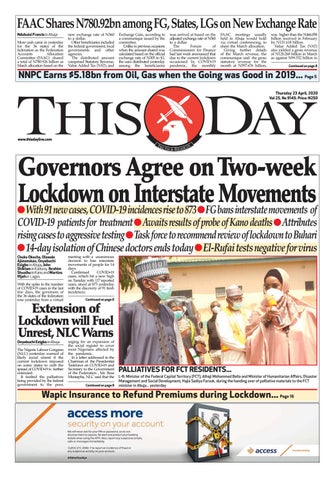
Governors Agree on Two-week Lockdown on Interstate Movements With 91 new cases, COVID-19 incidences rise to 873 FG bans interstate movements of COVID-19 patients for treatment Awaits results of probe of Kano deaths Attributes rising cases to aggressive testing Task force to recommend review of lockdown to Buhari 14-day isolation of Chinese doctors ends today El-Rufai tests negative for virus Chuks Okocha, Olawale Ajimotokan, Onyebuchi Ezigbo in Abuja, John Shiklam in Kaduna, Ibrahim Shuaibu in Kano and Martins IďŹ jeh in Lagos With the spike in the number of COVID-19 cases in the last few days, the governors of the 36 states of the federation rose yesterday from a virtual
meeting with a unanimous decision to ban interstate movements of people for 14 days. Confirmed COVID-19 cases, which hit a new high on Tuesday with 117 reported cases, stood at 873 yesterday with the discovery of 91 fresh incidences. Continued on page 8
Extension of Lockdown will Fuel Unrest, NLC Warns
Onyebuchi Ezigbo in Abuja
The Nigeria Labour Congress (NLC) yesterday warned of likely social unrest if the current lockdown imposed on some states to curb the spread of COVID-19 is further extended. It faulted the palliatives being provided by the federal government to the poor,
urging for an expansion of the social register to cover most Nigerians affected by the pandemic. In a letter addressed to the Chairman of the Presidential Taskforce on COVID-19 and Secretary to the Government of the Federation , Mr. Boss Mustapha, NLC said that the Continued on page 8
PALLIATIVES FOR FCT RESIDENTS... L-R: Minister of the Federal Capital Territory (FCT), Alhaji Mohammed Bello and Minister of Humanitarian Aairs, Disaster Management and Social Development, Hajia Sadiya Farouk, during the handing over of palliative materials to the FCT minister in Abuja... yesterday
Wapic Insurance to Refund Premiums during Lockdown... Page 16
2
THURSDAY APRIL 23, 2020 •T H I S D AY
THURSDAY APRIL 23, 2020 • T H I S D AY
3
4
THURSDAY APRIL 23, 2020 •T H I S D AY
5
THURSDAY, ͺͻ˜ ͺͺ ˾ T H I S D AY
NEWS Despite Offer to Pay Withheld Salaries, Strike Continues, Says ASUU
Group News Editor Ejiofor Alike
Email Ejiofor.Alike@thisdaylive.com, 08066066268
Kayode Fasua in Abeokuta The Academic Staff Union of Universities (ASUU) yesterday ruled out calling off its ongoing nationwide strike despite the olive branch from President Muhammadu Buhari directing the payment of the withheld February and March salaries of its members. The lecturers’ salaries were withheld following their refusal to register on the Integrated Payroll and Personnel Information System (IPPIS) as ordered by the federal government. But the president on Tuesday directed the payment of the salaries to cushion the effects of COVID-19 pandemic on the lecturers. National President of the union, Prof. Abiodun Ogunyemi, in a reaction to the Buhari’s directive, said the strike would not be called off. He added that the strike was not only because of the dispute over IPPIS, adding that the federal government’s gesture would only create a conducive environment for a constructive engagement between the two parties. “It will lead to a meaningful dialogue. The ongoing
industrial strike action by the union is still on. Our strike is not just about the IPPIS,” he said. The ASUU president wondered why the federal government directed the vicechancellors to pay lecturers with their Bank Verification Number (BVN). “Our members weren’t paid with BVN in the past,” he added. ASUU also expressed optimism that a Nigerianmade vaccine for the treatment of COVID-19 is achievable, provided there is political will to empower the nation's biomedical and behavioural scientists, among other scholars, to undertake cutting-edge researches. Ogunyemi expressed the conviction in Abeokuta, the Ogun State capital, when he led members of the association to donate 1,000 pieces of hand sanitisers to the state government. Delivering the items to the state’s Deputy Governor, Mrs. Noimot Salako-Oyedele, Ogunyemi, said Nigeria could develop a vaccine for COVID-19 provided experts the researchers were well funded. "For instance, conscious
and determined investment in university education at national and sub-national levels would give our country quality medical scientists, behavioural scientists, creative scholars and other cream of informed citizens who can respond intelligently to
challenges like the COVID-19 pandemic. "To achieve better results, we believe Nigerian governments at the federal and state levels need to work with public intellectuals and patriotic trade unions like ASUU. "We also believe such
collaborative efforts should be channelled towards addressing issues of funding, conditions of service, academic freedom and university autonomy and other matters which are germane to repositioning Nigerian universities for global competitiveness,” he stated.
Ogunyemi added that ASUU's involvement in the war against COVID-19 pandemic was consequent upon the directive issued to all its 70 branches and 13 zones, to play active roles in the fight against the spread of the virus in Nigeria.
PARTNERING TO DEFEAT COVID-19... L-R: Director General, Nigeria Centre for Disease Control (NCDC), Dr. Chikwe Ihekweazu and Ogun State Commissioner for Health, Dr. Tomi Coker, when Ihekweazu led a team of World Health Organisation and NCDC officials to inspect isolation centres and molecular laboratories at the Olabisi Onabanjo University Teaching Hospital, in Sagamu, Ogun State... on Tuesday
Prince Charles, Rwandan NNPC Earns $5.18bn from Oil, Gas when the Going was Good in 2019 President, Others Condole Posts $434.8m crude oil sales revenue in January The statement said vandalism According to the NNPC, 59.89 1999, before recovering slightly Ejiofor Alike, Peter Uzoho in of NNPC pipelines across the per cent of the average daily gas to $21 on the prospect of extra and Emmanuel Addeh with Buhari over Kyari's Death Lagos country recorded a phenomenal produced was commercialised pledges by producers to cut in Abuja
Omololu Ogunmade in Abuja
The heir to the British throne, Prince Charles, Rwandan President Paul Kagame and former Vice President Namadi Sambo yesterday joined other national and world leaders to mourn the Chief of Staff to the President, Malam Abba Kyari. Kyari passed on on April 17 following complications from COVID-19 infection. Prince Charles, in his condolence letter to President Muhammadu Buhari, described Kyari's death as “a desperately sad news,” and sent his “deepest possible sympathy” to Buhari and the government and people of Nigeria. Senior Special Assistant to the President on Media and Publicity, Malam Garba Shehu, in a statement, said the crown prince, Kagame and Sambo expressed sadness over the death of the chief of staff. Prince Charles, in a condolence letter to the president, lamented that the death of Kyari occurred through this “pernicious virus..." He added: "I can only begin to imagine what an immense gap Mr. Kyari’s untimely death will leave in Your Excellency’s life and my heart goes to you and Mr. Kyari’s family.” Kagame, in his condolence message through the Embassy of Rwanda in Abuja, said the government and people of Rwanda mourned with Nigeria and its people over Kyari's death. He seized the occasion
“to express solidarity to the government and people of the Federal Republic of Nigeria as we are faced with the COVID-19 global crisis.” Sambo, in his own message to the president, described the death of Abba Kyari as a “monumental national loss.” Shehu also said industry leader and businessman, Abdulsamad Rabi’u, sent a condolence letter to the president in which he expressed saddened over what he described as “this colossal loss.” According to him, Kyari “served the country and your administration with diligence and utmost loyalty. He was deeply committed to the service of Nigeria and his efforts, especially in ensuring the success of Your Excellency’s agriculture industry agenda did not go unnoticed. He was a beacon of loyalty and a patriot.” The statement added: "Other messages received by President Buhari included those from the Emir of Gazargamu, Ahmad Tijjani Ibn Saleh from Yobe State; the Secretariat of the Developing D-8 Organisation for Economic Cooperation headquarters in Ankara, Turkey; retired Ambassador Jibrin Chinade; Alhaji (Dr) Adamu Abubakar Maje, the Emir of Hadejia, Jigawa State. "Former Minister of Labour and Productivity, Dr Emeka Nwogu and a former Managing Director of the Guardian Newspapers, Eluem Emeka Izeze, also sent condolence messages to the president."
The Nigerian National Petroleum Corporation (NNPC) said yesterday that the country exported oil and gas worth about $5.18 billion from January 2019 to January 2020. Nigeria also recorded crude oil and gas export sales revenue of $434.85 million in January 2020, alone, an increase of 94.30 per cent from the December 2019 figures. NNPC gave the figures yesterday as the global benchmark crude, Brent, sank below $15 a barrel to its lowest since 1999, before recovering slightly to $20 on the prospect of extra pledges by producers to cut output in addition to a pact by major producers to limit supplies. NNPC, in its Monthly Financial and Operations Report (MFOR) for January, released yesterday in Abuja, said January's crude oil export sales contributed $336.65million (77.42 per cent) of the dollar transactions for the period, compared to the $136.36 million sales in the previous month. NNPC Group General Manager, Group Public Affairs Division, Dr. Kennie Obateru, in a statement, added that export gas sales in January amounted to $98.20 million. He, however, noted that 2019 to January 2020 crude oil and gas transactions, valued at $5.18 billion was exported. According to him, the January 2020 edition of the monthly report of the corporation is the 54th edition of the series.
spike of 50 percentage increase in January, adding that during the period, 60 pipeline points were vandalised, compared to the 40 incidents recorded in December last year. “Atlas Cove-Mosimi and Mosimi-Ibadan axis pipelines accounted for 50 per cent and 17 per cent of the breaks respectively, while all other routes accounted for the remaining 33 per cent” the report said. It, however, explained that NNPC, in collaboration with the local communities and other stakeholders, were working in harmony to curtail pipeline vandalism. The report stated that to ensure steady supply and effective distribution of petrol nationwide, 1.20 billion litres of the product, translating to 38.68 million litres/day, were supplied for the month. The corporation stated that it had been monitoring the daily stock of fuel to achieve smooth distribution of petroleum products and zero fuel queue nationwide. In the gas sector, out of the 253.09 billion cubic feet (BCF) of gas supplied in January 2020, a total of 151.16BCF of gas was commercialised, consisting of 36.20BCF and 114.96BCF for the domestic and export market respectively. NNPC said the figures translated to 1,167.80 million standard cubic Feet (mmscfd) of gas supply to the domestic market, with 3,708.23mmscfd of gas supplied to the export market during the month.
while the balance of 40.11 per cent was re-injected, used as upstream fuel gas or flared. “Gas flare rate was 7.90 per cent for the month under review i.e. 643.59mmscfd, compared with average gas-flare rate of 8.46 per cent i.e. 671.40mmscfd, covering January 2019 to January 2020. “Out of the 1,167.80mmscfd of gas supplied to the domestic market in January 2020, about 639.70mmscfd of gas, representing 54.78 per cent, was supplied to gas-fired power plants, while the balance of 528.10mmscfd or 45.22 per cent was supplied to other industries, ” the company said. The report explained that 640mmscfd of gas delivered to gas fired-power plants in January 2020 generated an average power of about 2,683 MW, compared with December 2019 where an average of 596mmscfd was supplied to generate 2,498 MW. It said from January 2019 to January 2020, an average of 1,203.93mmscfd of gas was supplied to the domestic market, comprising an average of 693.73mmscfd or (57.62 per cent) as gas supply to the power plants and 510.20mmscfd or (42.38 per cent) as gas supply to industries.
Oil Price Recovers to $20 over Extra Pledges to Cut Output The global benchmark crude, Brent, yesterday sank below $16 a barrel to its lowest since
output in addition to a pact by major producers to limit supplies. Brent touched $15.98 a barrel, but later rose by 8.4 per cent to $20.96 a barrel. U.S. West Texas Intermediate (WTI) crude futures for June delivery rose $3.57, or 30.9 per cent, to $15.14 a barrel. Since the start of the year, Brent has fallen more than 65 per cent, while WTI has dropped around 75 per cent. Although the Organisation of Petroleum Exporting Countries (OPEC) was again tackling a supply glut, the drop in demand had been far less extreme than that triggered by the current restriction on movements worldwide to tackle the COVID-19. OPEC and allied producers, referred to as OPEC+, agreed this month to reduce output by 9.7 million bpd, starting from May. Additionally, producers are already considering further steps and this led to yesterday’s price recovery. For instance, Saudi Arabia on Tuesday said it was ready to take extra measures with other producers. Iraq made similar comments. The next formal OPEC+ meeting is in June. The United States and other countries also said this month they would pump less. But Reuters reported that in a development that raises doubt over a formal US supply cut, two of three Texas regulators on Tuesday delayed a vote to force producers to curtail output.
6
THURSDAY, ͺͻ˜ ͺͺ ˾ T H I S D AY
NEWS
NESG Asks FG to Leverage on Technology, Agriculture to Boost Economy Emma Okonji and Nosa Alekhuogie The President of Nigerian Economic Summit Group (NESG), Mr. Laoye Jaiyeola, has called on the federal government to identify key sectors of the economy, especially Information and Communications Technology (ICT) and the agricultural sectors and empower them in order to sustain the economy during the post-COVID-19 era. Jaiyeola, while fielding questions yesterday when he appeared on a programme on Arise Television, a sister broadcast arm of THISDAY Newspapers, said he was concerned about the state of the Nigerian economy in the post-COVID-19 era, which would usher in a new normal for Nigeria to deal with. He advised the federal government to invest in
agriculture and leverage technology in empowering states and small businesses like the Micro, Small, and Medium Enterprises (MSMEs), to enable them to become innovative and more productive in sustaining the economy during the post-pandemic era. He described the Economic Sustainability Committee, headed by Vice President Yemi Osinbanjo, which was set up by President Muhammadu Buhari to address the economy in the post-pandemic era, as a good initiative, but advised that government must focus on key sectors of the economy and leverage technology to achieve the committee's objectives. He said: “After COVID-19, global economies are expected to have a decline in GDP because of the adverse effect of COVID-19 on economies, and Nigeria’s GDP is expected to contract
Anumudu Died of Complications from Protracted Illness, Says Globe Motors Bennet Oghifo Globe Motors Holdings Limited has said its Chairman, Chief William Anumudu, died of complications arising from a protracted illness. In a statement yesterday, the Managing Director, Globe Motors, Mr Victor Oguamalam, said further statements would be made by the family. ‘’The management and staff of Globe Motors regrettably announce the untimely death of our Founder and Chairman, William Anumudu. This occurred subsequent to complications arising from a protracted illness. Further statements and all related arrangements will be as announced by the family," the statement said. Anumudu, was a foremost manufacturers’
representative in Nigeria’s auto industry. According to family sources, he died on Tuesday at about 4 a.m. hours before he was to be flown to Germany for treatment. He was said to have tested negative for COVID-19 after he became sick a few days ago. “One of Nigeria’s biggest car dealers, WILLY ANUMUDU, has died! The Chairman of GLOBE MOTORS, Victoria Island suffered some health challenges a few days ago and was tested for COVID-19, which came out negative. He was to be airlifted to Germany this morning but died about 4 am,” the Publisher of Ovation Magazine, Chief Dele Momodu, said in a tweet. The family was yet to make an official statement, as at press time.
by three per cent this year. As a country, we need to diversify and government needs to pump more money into the economy. "Government also needs to identify some key priority areas like agriculture and technology that will add significant value to the Nigerian economy. Government must create the enabling environment for MSMEs to thrive in the post-COVID-19 era. “Beyond what the federal government is doing, the state governments must think of new ways to generate money and depend less on federal allocations. State governments must be innovative to empower small businesses in their states, which will improve the volume of taxes generated by states. If we can leverage technology to deal with agriculture, we will have sufficient food supply in the country that can feed our citizens.”
Speaking on the impact of the lockdown, Jaiyeola, who is a financial expert, said those calling for the suspension of the lockdown have their reasons because most Nigerians live on daily and weekly wages to feed their families. "Such people need to go out on a daily basis to work and have money to take care of family needs or else they will be hit by hunger in the inside and the virus on the outside," he added. He, however, called on the federal government to roll out more testing centres and testing kits to address the rising cases of COVID-19 in Nigeria. He also urged the federal government to list farmers among those on essential duties during the lockdown period in order to avert a food crisis. Explaining the different measures that state governments could take to
become economically viable, Jaiyeola said: “Every state in the country has the potential to be economically viable, but because the state governors are used to collecting monthly federal allocations, some are no longer innovative and they are not generating enough revenue for the state. "State governments should be able to attract foreign investors to their states, but the foreign investors are not motivated to come and invest in Nigeria because our ‘Ease of Doing Business’ is still poor. "Oil prices have crashed and agriculture is the next alternative for the federal government to accept and promote. We need more research in agriculture to boost food production. "Agriculture in Nigeria accounts for 22-25 per cent of the country’s GDP, but this could be improved if priority is given to agriculture.” Both the public and private
sectors, he added, must come together to implement policies that would turn around the economy. Jaiyeola who raised concern that the effects of COVID-19 may lead to job loss in the post-pandemic era, said: “MSMEs are the largest employers of labour in Nigeria because of their large population, accounting for about 85 per cent of Nigeria labour force. “If MSMEs are empowered, there will be multiplicity of taxes and this will boost the country’s revenue. It is far better to give money to MSMEs than give money to households in the name of empowerment. This is because the MSMEs will invest the money in their small business and nurture the business to a successful growth level.” He added that if MSMEs are empowered it would cushion the effect of job loss in the post-COVID-19 era.
BOOST FOR COVID-19 TREATMENT... L-R: Lagos State Commissioner for Health, Prof. Akin Abayomi and the Governor, Mr. Babajide Sanwo-Olu, at the inauguration of a 80-bed Isolation Centre for COVID-19 treatment, in Lagos... yesterday
Business Leaders, Others Seek Delay in AfCFTA's Implementation OPS calls for review of lockdown, exit strategy James Emejo in Abuja and Dike Onwuamaeze in Lagos Some members of the organised private sector (OPS) and experts in international trade have called for the postponement of the take-off of the African Continental Free Trade Area (AfCFTA) agreement, scheduled to commence on July 1, because of the devastating effects of the COVID-19 pandemic. The OPS also urged the federal government to design and implement an exit strategy amid the current lockdown to contain the spread of the pandemic in the country. Among the leaders of the OPS who canvassed the extension of the commencement date of AfCFTA, while speaking in separate interviews with THISDAY, were the Directors General of the Lagos Chamber
of Commerce and Industry (LCCI), Nigerian Association of Chamber of Commerce, Industry, Mines and Agriculture (NACCIMA) and the Nigeria Employers Consultative Assembly (NECA). Others who spoke to THISDAY included experts in international trade relations such as former Foreign Minister, Prof. Bolaji Akinyemi and a Senior Research Fellow and Head, Division of International Economics Relations, Nigeria Institute of International Affairs (NIIA), Dr. Efem N. Ubi. According to Akinyemi, the commencement of the AfCFTA should be extended by another 12 months. He said: “Industrial production is down. Factories are closed. Global and intraAfrica trade are suspended. All the factors underpinning the AfCFTA are in suspense. It is
only rational for the operations of the AfCFTA not to be activated. I will recommend a 12 months wait.” Ubi said the disruption of the global economy by the COVID-19 pandemic had made the take-off date for the AfCFTA impossible because of the disadvantaged porous and fragile nature of African economies that are weak in manufacturing and heavily dependent on importation. He added that countries in Africa are more concerned about the survival of their national economies than pursuing the AfCFTA agenda. “So, it is nearly impossible for us to be contemplating about the commencement of the continental free trade area by July 1. Currently, every member country to the agreement is working hard to bail itself from the impending recession and the catastrophic
impact of COVID-19. It is only when the economies of member nations are working that they can trade among themselves. “Therefore, the African Union (AU) should be more concerned with the economic survival of its member states for now than with the commencement of the AfCFTA on July 1,” Ubi stated. In his contribution, the Director General of NACCIMA, Mr. Ayoola Olukanni, said the take-off date of AfCFTA might be deferred because of the pandemic. Olukanni explained that the pandemic has forced countries back to the drawing board in an effort to devise their individual survival strategies. “The COVID-19 is a global phenomenon that is beyond the contemplation of anybody in terms of its devastating consequences. So, it is likely that the commencement of
the continental free trade area will be postponed because it is important first and foremost, to stabilise and ensure the survival of the economies of African nation-states before going ahead with the AfCFTA agreement. “Currently, force majeure is being cited as reason for not being able to fulfill contractual obligations by many firms and entities as a result of the unforeseen impact of COVID-19, which is a fundamental challenge to the global economy that Africa is a part of,” he added. The Director General of the LCCI, Dr. Muda Yusuf, also told THISDAY that the AfCFTA agreement might not be launched on July 1, as earlier scheduled, since most countries are now in unilateral mode and responding to the telling impact of the COVID-19 pandemic with
varied individual strategies. Yusuf said: “The COVID-19 pandemic experience may diminish the disposition of countries towards multilateralism. The imperative of building individual country’s resilience played out in COVID-19 scenario and the AfCFTA is likely to fall into abeyance for now,” Yusuf's counterpart in NECA, Dr. Timothy Olawale, stressed the need for the African Union to review the commencement date and make necessary adjustments in the light of the current impact of COVID-19. Olawale said the pandemic had resulted in protracted shutdown of factories, businesses and the termination of cross-border contracts, which did not contain properly drafted force majeure provisions. Continued on page 16
THURSDAY APRIL 23, 2020 • T H I S D AY
7
8
THURSDAY, ͺͻ˜ ͺͺ ˾ T H I S D AY
PAGE EIGHT GOVERNORS AGREE ON TWO-WEEK LOCKDOWN ON INTERSTATE MOVEMENTS The federal government has also prohibited the movement of all persons diagnosed with COVID-19 to another state for treatment, saying they should be cared for in the state where the diagnosis was made, except there is a medical indication to the contrary. It also said it was awaiting the results of the investigation being carried out by the Federal Ministry of Health, the Kano State chief epidemiologist, officials of Kano Public Health Department and those of the Nigeria Centre for Disease Control (NCDC) on the deaths being recorded in Kano State to know what further steps to take to curb the situation. The federal government, however, denied the insinuation that the unexplainable deaths being recorded in the state is connected to the fake vaccine currently in circulation in the state and warned the public against buying or using a locally brewed mixture being offered as COVID-19 vaccine. The governors, in a communique after their virtual conferencing yesterday, said a restriction on interstate movements for two weeks was imperative to mitigate the spread of the virus from state to state. Also, with over 25 states now affected by the spread of the virus and increasing evidence of community transmission, the governors called for the decentralisation of the COVID-19 response team to check community infection. They pledged to work with the Nigeria Centre for Disease Control (NCDC) to protect health workers. In the communique which was signed by the Chairman of the Nigerian Governors' Forum (NGF) and Ekiti State Governor, Dr. Kayode Fayemi, the governors said: "Members expressed serious concern over the rising spread of the virus among health workers and resolved to work with the Nigeria Centre for Disease Control (NCDC) to ensure that health workers are adequately provided with personal protective equipment (PPE) and are constantly trained on the use of protective gear. "Governors unanimously
agreed to the implementation of an interstate lockdown in the country over the next two weeks to mitigate the spread of the virus from state to state. Only essential services will be permitted." The governors said in order to strengthen coordinated implementation of public health recommendations across states, they would set up COVID-19 Committees at the regional level, headed by their state Commissioners of Health to interface with the State Task Force Committees on COVID-19 already established in each state. The forum also said it received briefing from the governors of Lagos, Bauchi, Oyo and Ogun States who shared their experiences and lessons from the fight against COVID-19. The communique said the governors held a minute’s silence in honour of all Nigerians killed by the virus, especially health workers who were in the frontline of the battle against the epidemic. The governors also conveyed their condolences to President Muhammadu Buhari and the people of Borno State on the passing away of the Chief of Staff to the president, Mallam Abba Kyari.
FG Bans Interstate Movements of COVID-19 Patients Also yesterday, the federal government announced a ban on the movement of COVID-19 patients to other states for treatment. The Minister of Health, Dr. Osagie Ehanire, told reporters in Abuja during a briefing by the Presidential Task Force on COVID-19 that the ban was to avoid the high risk of exposure of other persons during patients' movements. He also said Patent and Proprietary Medicine Vendors (PPMVs) and pharmacists have been prohibited from treating persons diagnosed of or suspected to be COVID-19 patients. He said that any PPMVs that attempts to treat persons diagnosed of COVID-19 or suspected of contracting the virus.
He warned that a violation of the directive would result in the cancellation of the operating licences of the offenders. Ehanire said: “All persons diagnosed with COVID-19 be henceforth treated in the state where the diagnosis was made, rather than be referred to their states of origin except there is a medical indication to the contrary. “This is to avoid the high risk of exposure of other persons in the course of transfer. “Private hospitals desiring to manage COVID-19 patients should apply to their state Ministries of Health for permits, meet IPC standards and be accredited by a FMoH-certified state team after compliance with protocols, before being granted." The minister noted that Rapid Response Teams (RRTs) have been deployed in Abia, Gombe and Sokoto States by the NCDC to support their COVID-19 response teams. On the Chinese medical personnel whose 14-day isolation ends today, Ehanire said they would be subjected to tests to know their status before exiting from their isolation centres.
.....Awaits Results of Probe of Kano Deaths Ehanire also said the federal government was awaiting the results of investigation into the incidents that led to the series of deaths recently recorded in Kano State. According to him, the federal government has stepped in to assist the state health officials to unravel the cause of the deaths. He said the Federal Ministry of Health, the state chief epidemiologist, officials of Kano Public Health Department and those of the NCDC were investigating the deaths. On allegation of possible suspension of testing in Kano State due to shortage of test kits, the minister said testing was temporarily halted in order decontaminate the laboratory after some staff of the laboratory were infected while carrying out their duties. He allayed fears over the pandemic, saying despite the rising cases confirmed so far, the virus has a cure rate of over 90 per cent.
He added that if those with the typical symptoms report early for testing and treatment or quarantine, their chances of full recovery are high. On his part, Minister of Information and Culture, Alhaji Lai Mohammed, said the deaths in Kano State were not connected to the fake vaccine currently in circulation in the state.
FG Warns against Use of Local Brew Offered as Vaccine However, the NCDC warned members of the public against buying or using a locally brewed mixture being offered as COVID-19 vaccine. The agency gave the warning yesterday via its verified Twitter handle @NCDCgov. The agency, in a tweet, said: “A liquid mixture is being sold with claims that it is”#COVID19 vaccine. This is false! “There is currently no vaccine or drug approved for #COVID-19 prevention by health authorities.”
COVID-19 Cases Hit 873 with 91 Fresh Discoveries The NCDC, in its update on the pandemic yesterday, said Nigeria had recorded 91 new cases of COVID-19, bringing to 873, the total number of confirmed cases in 25 states and the Federal Capital Territory (FCT). The agency, in a breakdown, said 74 new cases were recorded in Lagos, five in Katsina, four in Ogun, two each in Edo and Delta, and one each in Kwara, Oyo, FCT and Adamawa State. It said: "As at 11:25 pm on April 22, there are 873 confirmed cases of COVID-19 reported in Nigeria. 197 have been discharged with 28 deaths. A breakdown of the total number of cases shows that Lagos now has 504 cases, FCT 119, Kano 73, Ogun 24, Katsina 21, Osun 20, Oyo and Edo 17 each, Kwara 10, Kaduna, Akwa Ibom and Borno nine each, Bauchi eight, Delta six, Gombe five, Ekiti four, Ondo and Rivers three each, Jigawa, Enugu, Niger and Abia two each, while Benue, Anambra, Sokoto and Adamawa recorded
one each.
FG Attributes Rise in Cases to Aggressive Testing Reacting to the upsurge in number of confirmed cases, Chairman of PTF on COVID-19, Mr. Boss Mustapha, ascribed the rise in number of positive cases to the expansion in the testing capacity. He said given the dynamic nature of the response plan, the strategy for testing had been modified while house-to-house testing had been intensified in some communities in Lagos and FCT.
Task Force to Recommend Review of Lockdown to Buhari Mustapha, who is also the Secretary to the Government of the Federation (SGF), added that the PTF will today study the report of the Director General of NCDC, Dr. Chikwe Ihekweazu, and the World Health Organisation (WHO) representative in Nigeria on nine states and use it as the basis of the recommendation to Buhari on extension or review of the four-week lockdown imposed on FCT, Lagos and Ogun States to prevent the spread of the virus.
Nigerian Evacuees to Bear Cost of Repatriation, Says FG Also speaking at the briefing, Foreign Affairs Minister, Mr. Godfrey Onyeama, said the federal government would not be responsible for the flight and isolation cost of Nigerians to be evacuated from some foreign countries with high cases of COVID-19. Onyeama said Nigerians forced to return home as a result of the pandemic would solely cater for their wellbeing because the federal government lacked the financial resources to do so. “The financial aspect of this is one that we are very mindful of. We had some students who were trapped in Khartoum, Sudan and we had to bend backward to find the resources to try to pay for their return and two weeks of isolation because
FAAC SHARES N780.92BN AMONG FG, STATES, LGS ON NEW EXCHANGE RATE February, an increase of N20.716 billion. A total of N62.928 billion was available from exchange gain in the month under review. From the total revenue of N780.926 billion, the federal government received N264.330 billion, states-- N181.487 billion and the local governments received N135.950 billion. Oil producing states received
N38.751 billion as 13 per cent derivation revenue, while the cost of revenue collection by revenue agencies and allocation to the North East Development Agency (NEDC) was N160.408 billion. According to the communique, the federal government received N217.773 billion from the gross statutory revenue of N597.676 billion, states got N110.457 billion and
local government councils received N85.158 billion. The sum of N32.299 billion was given to oil-producing states as 13 per cent derivation revenue while cost of revenue collection agencies and NEDC got N151.989 billion. Giving further breakdown, the communique stated that the federal government received N16.777 billion from VAT revenue of N120.268 billion,
states received N55.925 billion, local government councils got N39.147 billion, while the cost of collection by revenue agencies and allocation to NEDC was N8.419 billion. However, from exchange gain, the federal government received N29.780 billion, states--N15.105 billion, local government councils received N11.645 billion while oil producing states received
N6.452 billion from the total revenue of N62.982 billion available. Petroleum Profit Tax (PPT), Companies Income Tax(CIT), Import and Excise Duties, Oil and Gas Royalties and Value Added Tax (VAT) all recorded substantial increases during the month under review. The balance in the Excess Crude Account (ECA) currently stands at $ 72.221 million.
of the poor who cannot afford a meal per day. We posit that using the old platform will not deliver the desired result. "The most critical need of the poorest of the poor among us is to beat hunger. Government palliatives should be tailored in a way that guarantees poor Nigerians, especially daily income earners at least two daily meals. Thus, we call for an expansion of the national social register to capture individual Nigerian workers who do not live with their families," it said. NLC also explained that resources provided for the national school feeding programme should be rechannelled to feeding the poor, the aged and the destitute. The union also urged President Muhammadu Buhari to include other social partners on the inter-ministerial economic response of the
pandemic. "Beyond the threat of COVID-19 to health and life, there are also very real threats to livelihood. Jobs are under threat. Many employees are finding it difficult to source money to keep workers at work and sustain the production lines. It has been projected that the socio-economic impact of COVID-19 would ripple on, at least, for the next two years. "Many countries around the world are mobilising resources to deal with the aftermath of the COVID-19 pandemic. Many governments have set up COVID-19 response teams devoted to economic and income recovery. Governments are also engaging with organised labour to find a human faced approach to dealing with the aftermath of COVID-19 pandemic," the NLC stated.
they are young students. But unfortunately for all the others, we just don’t have the financial resources because you can see the huge amount of money we have to pay for the various aspect of the challenges. It’s unfortunate that the government is not in a position to pay for everybody to come home and for their stay in isolation centres for two weeks,” Onyeama said.
El-Rufai Tests Negative for Pandemic Kaduna State Governor, Mallam Nasir el-Rufai, yesterday said he had tested negative for the virus, adding that he felt relieved for recovering from the COVID-19. He said with his sound health and prayers from the people, he would continue to spearhead efforts at curtailing the spread of the disease. The governor, in a live broadcast after he was discharged from the isolation centre, said he had amended the Quarantine Regulations, which now require everyone in the state to wear a face mask when going out. El-Rufai on 28 March 28, had announced that he tested positive for the virus and had proceeded into isolation. “I am delighted to report today, that after nearly four weeks of observing a strict medical regime, I have now received the all-clear after two consecutive negative test results,” he said. He commended the medical personnel of the state Ministry of Health and the Barau Dikko Teaching Hospital who managed his case for their dedicated and professional care.
Kano Records 320 Suspected Cases The Kano State Government has confirmed that it recorded over 320 suspected cases of COVID-19 in which 73 were confirmed positive. The state Coordinator of COVID-19 Task Force, Dr. Tijjani Hussaini, at a media briefing yesterday, said that two out of the 73 confirmed cases were health workers. "We were able to monitor 53 cases of passengers of interest that came from epicentre from some states and outside the country," he added. He stated that 63 out the 73 cases were admitted and the remaining evacuated to the isolation centre. However, the state government has relaxed the lockdown from 6am today to midnight in order to allow people to prepare for the forthcoming Ramadan fast.
EXTENSION OF LOCKDOWN WILL FUEL UNREST, NLC WARNS stimulus package should be in consultation with other social partners. The letter, dated April 14, 2020 and signed by NLC President, Mr. Ayuba Wabba, also warned that the extension of the lockdown beyond one month may trigger social unrest. Wabba urged the federal government to consider how Nigerians are coping with the lockdown before taking any decision on the issue. "While we understand the public health imperatives for extending the lockdown in some parts of the country, it is also very important to underscore the fact that the states currently under total lockdown are the economic and administrative nerve centres of Nigeria. "This is very dicey. As much as it is important to keep many Nigerians from dying in the hands of coronavirus, loss of
income and the accompanying destitution can also be a pathfinder for numerous other sicknesses and deaths. This is the time to play the balancing game. "The truth is that our economy might relapse into prolonged coma if the current lockdown in the nation’s nerve centres goes beyond the current extension," he said. Wabba added that prolonged lockdowns are best effective in the short-term, while with the medium to long-term, the human instinct to survive would kick in and restraint might lead to the collapse of law and order. He said within the first two weeks of the lockdown in some parts of the country, "there were widespread acts of civil disobedience, inducement of law enforcement agents to gain passes and even various forms of violent crimes.
"No one is sure how long this dam would hold. We fear that the situation will get out of hand if the lockdown exceeds one month. "While we commend government for being proactive, we opine that the stimulus package would be best served through consultation with social partners. "Labour and private sector employers have a good understanding of industries where jobs and production are in most danger," it said. On palliatives, the NLC called for an improvement in the distribution system through increased stakeholders' participation. "Mass-based organisations such as labour has the grassroots presence, especially at wards and units, and can ensure that palliatives get to those who really need them – the poorest
TOP GAINERS NGN NGN % NEM 0.20 2.20 10 LAFARGE 1.00 11.35 9.6 LIVESTOCK 0.05 0.70 7.6 TRANSCORP 0.05 0.73 7.3 PZ 0.25 4.25 6.2 TOP LOSERS NGN % SKYAVN 0.16 1.80 8.1 UNIONDAC 0.02 0.29 6.4 GUINNESS 1.30 19.00 6.4 CAVERTON 0.10 2.25 4.2 UNION BANK 0.30 6.20 4.6 HPE Nestle Nig Plc ₦975.00 Volume: 186.229 million shares Value: N1.852 billion Deals: 3,446 As at yesterday 22/4/2020 See details on Page 27
THURSDAY APRIL 23, 2020 • T H I S D AY
9
10
THURSDAY APRIL 23, 2020 ˾ T H I S D AY
NEWS
Air Chief: At 56, NAF Has Acquired Multiple Air Strike Capabilities 21 bandits, four soldiers killed in Zamfara Kingsley Nwezeh in Abuja The Chief of Air Staff, Air Marshal Sadique Abubakar, yesterday reviewed the exploits of the Nigerian Air Force (NAF) since inception in 1964 and declared
that the organisation has acquired the ability to conduct multiple air strikes when compared to the past. Abubakar, during an occasion in Abuja to celebrate the organisation’s 56th anniversary, said the NAF had made substantial progress,
FG Pays 23m Shillings for Release of 60 Nigerians from Tanzanian Prisons Adedayo Akinwale in Abuja The federal government has said it has paid a total of 23,090,000 to secure the release of 60 Nigerians serving various jail terms in Tanzania. The Head of Media and Public and Relations Unit of the Nigeria in Diaspora Commission (NIDCOM), Mr. Abdur-Rahman Balogun, in a statement issued yesterday said that most of them were arrested for alleged drug related offences, while a few of the offences bothered on immigration. He explained that ever before COVID-19 pandemic, the Nigerian mission had been working on repatriation of Nigerian prisoners in Tanzania, adding that the Nigeria Ambassador to Tanzania, Dr. Sahobi Gada was in Nigeria in
January 2020, having successfully secured the release of 60, out of 73 Nigerians, in various prisons in Tanzania. He noted that arrangements were then being made by the Ambassador for their repatriation. Balogun stressed that despite securing repatriation for 60 out of the 73, the mission sent a team out to ascertain if there were more Nigerians in Tanzanian prisons. He stated: “While the mission has joined other countries in making a plea for amnesty for Prisoners during this COVID- 19 period, the mission remains optimistic the Tanzanian Government would respond positively , while the mission will continue to work on repatriation, which was affected as a result of Covid-19.
especially in the deployment of air power. He recalled that in the 60s, bombs were rolled out from the cabin with bare hands but over the years it had acquired the capacity to attack enemy locations in the North-east and other flashpoints in the country at the same time. “Looking at the history of Nigerian Air Force, a service that started in 1964, we had progressed tremendously. If you look at where we are today, compared to the beginning, we have
every reason to thank the almighty God for giving us a service we can be proud of. “In the 60s, especially during the civil war, we use to roll bombs out with our bare hands from the cabin of an aircraft but today, all that has changed. “We can now attack multiple enemy locations at the same time in the North-east and other troubled areas. Clearly, we have made substantial progress and we hope to continue to work hard so that our
country will be secured,” he stated. Abubakar, who spoke after the ceremonial fly past of fighter jets of the Air Force in commemoration of the 56th anniversary, commended NAF personnel for their patriotic contributions to ensure the peace of the nation and commitment to work. “Well, I want to salute the courage, commitment and sense of patriotism of officers, airmen and airwomen of the Nigerian Air Force. They are doing so much.
“They are working very hard to ensure that our country is secured, have serviceable aircraft and support government policies”, he said. Abubakar noted that NAF was at the forefront of the battle against COVID-19 pandemic. “We are at the forefront of ensuring that it is curtailed. We are the one flying officials of government all over the federation. We have flown over 151 hours so far in support of the Presidential Task Force on COVID-19.
COLLABORATING AGAINST PANDEMIC...
L-R: Ogun State Commissioner for Health, Dr. Tomi Coker; state Deputy Governor, Mrs Noimot Salako-Oyedele; Ogun State Governor, Prince Dapo Abiodun; Director General, Nigeria Centre for Disease Control (NCDC), Dr. Chike Ihekweazu; and the World Health Organisation (WHO) Country Representative for Nigeria, Dr. Fiona Baraka at the interactive session after the inspection of the Isolation Centre, Ikenne and Molecular laboratory at the OOUTH, Sagamu by WHO and NCDC...Tuesday
UK Nationals Pay £490.50 Each for Repatriation to Ramadan: Sultan Directs Muslims to Look for London Moon from Today Chinedu Eze Another batch of UK nationals was evacuated from the Murtala Muhammed International Airport (MMIA), Lagos yesterday. The passengers totaling 310, including 21-crew were airlifted by British Airways (BA) flight BAW9116, operated by Boeing B747 by 4:16 p.m local time as part of the United Kingdom’s repatriation efforts over the COVID19 pandemic. The flight was the fourth evacuation carried out by the UK government recently and each passenger paid £490.50 according to information on the UK Mission’s website. On Saturday, April 18, a BA
Boeing 747 airlifted 301 Britons from MMIA at 16.10 hours, while 242 were moved from the Nnamdi Azikiwe International Airport, Abuja on the same day. On Monday, April 20, a Boeing 747 British Airways (BA) flight BA9157 with registration number G-CIVO airlifted 213 Britons (including 22 crew members) . The British High Commissioner to Nigeria, Catriona Laing, stated that to be eligible for all flights, primary residence has to be in the UK, stressing that they prioritised helping the most vulnerable and those who have an underlying medical condition, which places them at greater risk of serious illness if they contact COVID-19.
Tinubu Mourns Anumudu The All Progressives Congress (APC) National Leader, Asiwaju Bola Tinubu, has joined family, friends and business associates of the Chairman of Globe Motors Holdings (Nigeria) Limited, Chief Willie Anumudu, to mourn his passing. Anumudu suffered some health challenges a few days ago and was tested for COVID-19 but the result turned out negative. He, however, died early Tuesday as he was to be flown to Germany for further treatment. In his condolence message, Tinubu described the late Anumudu as a prominent businessman reputed for his industry and humanitarian activities. “Anumudu was a renowned philanthropist and businessman.
As chairman of Globe Motors Nigeria Limited, he was reputed for his industry, business expertise and philanthropic activities. “He was very close to me. His death is a personal loss. But it is also a distressing loss to the country. Apart from his contributions in the business sector, the country needs people like Anumudu at this critical time when the government and private sector players are putting minds and resources together to halt the spread of the coronavirus pandemic and mitigate its effects on our people and economy. “I commiserate with his wife, Nkiru, children as well as his friends and associates. May Almighty God comfort them at this time, and may the soul of late Anumudu also find eternal rest.
Onuminya Innocent in Sokoto The Sultan of Sokoto, Alhaji Sa’ad Abubakar III, had directed Muslim Ummah to look for the crescent moon of Ramadan 1441AH from April 23. Abubakar made the call in a
statement signed by Chairman of the Advisory Committee on Religious Affairs, Sultanate Council, Sokoto, Prof. Sambo Junaidu, which was made available to journalists in Sokoto yesterday. “This is to inform the Muslim Ummah that Thursday April 23,
2020, which is equivalent to 29th day of Sha’aban 1441AH shall be the day to look out for the new moon of Ramadan 1441AH. “Muslims are, therefore, requested to start looking for the new moon and report its sighting to the nearest district or village head for onward communication
to the Sultan,” it said. The statement added that the public can directly report the sighting of the crescent moon through the following telephone numbers: 08037157100, 07067416900, 08066303077, 08036149757 and 08035965322.
Editors Condemn Harassment of Journalists By Ebonyi Govt The Nigerian Guild of Editors (NGE) has condemned the persistent harassment of journalists in Ebonyi State on the orders of the Governor of the state, Mr. David Umahi and other state authorities. The body cited the arrest of a reporter with Vanguard Newspapers, Mr. Peter Okutu, on Tuesday, April 21, 2020 at the behest of the Chairman of Ohaukwu Local Government Council, Mr. Clement Odah. In a statement issued by its President, Mr. Mustapha Isa, and General Secretary, Mary Atolagbe, NGE noted that Okutu was arrested in a gestapo
manner by men of the Special Anti-Robbery Squad (SARS), at a hotel in Abakaliki, after he was lured to the hotel by Odah, over a story on military invasion of Umuogodoakpu-Ngbo community in Ohaukwu LGA. “The bone of contention was not on the veracity of the story but on the number of persons allegedly killed during the military invasion,” NGE said. NGE noted that rather than intervene and rein in his men, state Commissioner of Police, Mr. Awosola Awotunde, justified the arrest and accused journalists of “heating up the polity.”
NGE recalled that a similar incident took place in the same Ebonyi State barely four days ago, when a reporter with Sun Newspapers, Mr. Chijioke Agwu, was harassed and arrested at the Government House by the Chief Security Officer (CSO) on the orders of Governor Umahi. The reporter was subsequently handed over to the state’s Commissioner of Police. The body noted that Umahi had also announced a ban, on The Sun and The Vanguard reporters, for life from the Ebonyi Government House. NGE urged all stakeholders
to note that journalists are not criminals who should be harassed, intimidated, arrested and subjected to inhuman treatment under any guise. “If any person feels maligned by a media report, the least required of such a person is to put forward what he or she considers the correct narrative and in the spirit of right of reply, the media is obligated to publish same”. NGE called on the Inspector General of Police, Mr. Mohammed Adamu, to call his men to order, not only in Ebonyi State, but all over the nation.
FCTA Raises the Alarm over Influx of Beggars into Abuja Chuks Okocha in Abuja The Federal Capital Territory Administration (FCTA), has raised the alarm over the influx of beggars into the territory from neighbouring states in spite of the COVID-19 pandemic and the lockdown in the nation’s capital. The Minister of State for FCT, Dr. Ramatu Aliyu, who raise the alarm yesterday while inspecting
palliative items at Tunga Mage community in Gwagwalada Area Council, stressed that FCT is not a dumping ground for beggars and therefore warned that anyone caught aiding and abetting such gross violation of containment protocol, would be made to face dire consequences. Aliyu urged stakeholders and residents to assist security agencies halt the trend by acting
as whistleblowers. The minister state said; “Information got to us yesterday night that trucks and pick-ups are offloading destitute at the boundaries of the FCT or in some of our suburbs. “We heard there is influx of destitute into the territory. FCT is not a dumping ground. This is a cry to residents, both natives and non-natives, and also a cry
to the royal fathers, the Christian Association of Nigeria (CAN) and the League of Imams, as well as Civil Society Organisations to please blow the whistle when they see strange faces in their areas.” Aliyu wondered how people continued to sneak into the territory despite the lockdown in the FCT and most of the states surrounding it.
THURSDAY APRIL 23, 2020 • T H I S D AY
11
T H I S D AY • THURSDAY APRIL 23, 2020
12
politics
Group Politics Editor NSEOBONG OKON-EKONG Email nseobong.okonekong@thisdaylive.com (08114495324 SMS ONLY)
‘APC- led Federal Government is a Failure’ Hammed Shittu holds a conversation with former Osun State governorship candidate for the Labour Party and African Democratic Party, Fatai Akinade Akinbade, a former Secretary to the Osun State Government on the sideline of a recent Peoples Democratic Party stakeholders meeting in Ilorin, Kwara State
W
ould you say the current alleged maladministration of the ruling All Progressives Congress (APC), will serve as the basis for your party, the Peoples Democratic Party (PDP), to return to power in 2023? It is a known fact that in any democratic setting, the government draws its powers from the people. This becomes more instructive if one pays attention to the simple definition of what democracy is: Government of the people, for the people and by the people. Central to democracy, are the people. As a result, if the people are the main plank upon which democracy is built and if your question on the APC-led Nigerian government is anything to go by, one can readily infer that the APC has failed the people on all fronts. If that be the case, the very people who enthusiastically brought them to power, will enthusiastically show them the way out at the polls in the 2023 elections. I don’t want to belabour the issue by listing the things that they have done wrong. Nigerians are taking note of everything and at the polls, they will do the needful to either retain or vote them out.
Recently, you returned to the PDP, your former party, in a grand style at a rally held in Ibadan, the Oyo State capital. So what really motivated your return to the party after your sojourn in other parties? With the way the country is being run, APC, the ruling party, is like a behemoth which can not be confronted with kids glove. If there’s this deafening complaints across the land on account of the suffering of the people, then all well meaning Nigerians, should do everything possible to come together. It is only through unity of purpose that the APC can be defeated. If we all come back together under the same umbrella, it will be less tasking for us to trounce them at the polls. That is why we rejoined the PDP. If we are scattered and consumed by our individual ambitions, we can never achieve it. As a matter of fact, on a personal note, I would have rejoined the PDP after we had our governorship election in Osun State as I was under intense pressure from different quarters but I had to wait for the final approval of my boss, Prince Olagunsoye Oyinlola. At the fullness of time, we both rejoined the party. And for us, it was an home-coming as evident at the reception given to us on Wednesday, 18th March, 2020, at the ancient Mapo Hall, Ibadan. We are back into the PDP and it’s for good. Why are PDP chieftains in the country not at the forefront like the APC leaders did to wrestle power from the PDP during the 2015 elections? Different folks, different strokes. Besides, two situations are never alike. APC came to power on the crest of lies. They told heaps of lies to confuse the minds of Nigerians. Unfortunately as government in power, they have exhausted their “weaponry” in lies and it is now evidently getting back at them. As for the PDP leaders, within the precinct of the law, they have been reaching out to Nigerians silently.
my horizon. In these two outings, everybody knows that the outcomes were not the true reflections of my electoral worth.The elections were heavily monitised .So, those contests did not demean or devalue my political clout and electoral value. My integrity is intact as I still maintain a very large political base across the state. I don’t have any regret whosoever over my political trips to LP and ADC. Now I’m back to the PDP, life continues. As one of the major political stakeholders in Osun State, how will you assess successive administrations in the state? Right from inception of the state and up till now, every government has tried to leave their imprints in one way or the other. Nobody is perfect, and as such, each of these administrations, equally have their pitfalls as well.Above all, each of these administrations, has shown reasons of being in place at different times in history of the state.It will continue to be the trend.
Akinbade
Their strategies and approaches are not benchmarked on lies, but rather in making the people to see reasons at future elections. Having been in government before, the PDP has many transformational achievements to point at. Anybody who thinks future organized elections will be based on lies or noise, will be making a hell of a mistake. Nigerians are now wiser as they have learnt their lessons in a hard way. What have been your experiences in your sojourn to Labour Party
(LP) and the African Democratic Congress (ADC) where you contested as the governorship candidate of the two political parties at separate times in Osun State? Those experiences for me, were worthwhile. I say so because in life, we keep learning. I can categorically tell you that flying the flags of the Labour Party (LP) and African Democratic Congress (ADC) at different times in Osun State,.actually afforded me the opportunity of meeting and interacting with many more people who have further helped in widening
Those experiences for me, were worthwhile. I say so because in life, we keep learning. I can categorically tell you that flying the flags of the Labour Party (LP) and African Democratic Congress (ADC) at different times in Osun State,.actually afforded me the opportunity of meeting and interacting with many more people who have further helped in widening my horizon. In these two outings, everybody knows that the outcomes were not the true reflections of my electoral worth.The elections were heavily monitised .So, those contests did not demean or devalue my political clout and electoral value
What assurance will you give to your teeming supporters on your recent return to the PDP and what will you do to reconcile both foundation and the new members of PDP in Osun State? I want to assure my teeming supporters that in rejoining the PDP, we came with the sole aim of solidifying and expanding the party’s support base to make electoral successes at the polls, much easier. For us, PDP is one and indivisible family. As such, we shall throw our heart at ensuring that festering crises within the party, are quelled. Elders are already working and talking to all concerned and everybody is seeing reason.The party will bounce back strongly on all fronts for the good of the people. Would you say that the FG has done well on the war against terrorism and the advise you can give to curtail the menace? While I will commend the Muhammad Buhari led administration in the area they have succeeded in the fight, there are still however, more gaping holes often bogged down by politics, ethnicity, lack of adequate maintenance of war tools and the like . Recently, I saw a video which went viral where an army general was complaining about the state of their fighting tools which had been grounded by lack of maintenance. That in itself ,is a form of defeat. So the government has to be sincere with itself. If Boko Haram must be defeated.soldiers must be motivated so as to encourage them to fight on. Counter allegations have continued to trail the war against corruption of the FG, what is your take on this? As long as the fight against corruption is encased in politics of selection and skewed towards the opposition, then that cannot be said to be a fight against corruption but rather a calculated attempt to silence the opposition.For the fight to achieve its desired objectives, then it must be holistically fought regardless of who is involved. So in doing this, due process and transparency must be followed. Without these, the crusade will amount to nothing but self-deceit.
THURSDAY APRIL 23, 2020 • T H I S D AY
13
14
T H I S D AY ˾ ˜ Ͱͱ˜ ͰͮͰͮ
COMMENT
Editor, Editorial Page PETER ISHAKA Email peter.ishaka@thisdaylive.com
COURAGE IN LEADERSHIP
Nathaniel Ikyur pays tribute to Benue State Governor, Samuel Ortom, at age 59
T
here’s something about his persona that has defined his life and character. He’s being a fighter from birth. He’s refused to be drowned by circumstances or challenges. He has continued to make his way through odds to stay afloat. His name is Samuel Iorarernyi Ortom, the fifth democratically elected governor of Benue State. He’s clocked 59 years today, April 23, 2020. He was born on April, 23rd, 1961, and hails from Guma local government area of Benue. He understands and takes charge of his environment at all times. Governor Ortom was not born with a silver spoon, neither was there anyone in his lineage that could command any significant influence anywhere in the political or business sectors. He leaned on God who has helped him to conquer where the fainthearted would freeze. His incredible life story is what many would shy away to tell. He did before the Nigerian Senate on Wednesday, 6th July, 2011 when he was screened to be appointed cabinet minister. It was so moving that he was only asked to take a bow and go on account of his sincerity as a school dropout, a motor park tout and one who struggled to attain education through very difficult means. As one of his publicists in the 2015 governorship campaigns, I saw Ortom exhibit an uncommon faith. Here was a man who lost in the PDP governorship primaries. Yet, he remained undaunted. He invited everyone to his swearing in on May 29, 2015. It was strange. A few days after, he emerged a candidate of the APC and won the general elections. His electoral victory in 2015 could best be described as God’s handiwork. Nothing more. The aftermath was difficult, but he sailed through the pile of litigations. As if that wasn’t enough, his re-election in 2019 was laced with landmines that an ordinary politician would have caved in. Again he emerged victorious. On both occasions, Ortom proved that his political sagacity was a key attribute to his success. Interestingly, the governor has had a swinging wave of political movements. In 2015, he defected from the PDP after losing at the primaries to the APC and won. In 2018, he also defected back to the PDP under very difficult circumstances. He still clinched the party ticket. He was able to mobilise the PDP leadership, both at the national and state levels to queue behind him. He won the party primaries and the main elections. Then the plot to stop his second term bid thickened. The Economic and Financial Crimes Commission (EFCC), Department of State Services (DSS) and the Nigeria Police became tools in the hands of the federal authorities to stop him. On one hand, some members of the 8th Benue state House of Assembly conspired with their collaborators to impeach Ortom. They failed. Ortom is a courageous leader who has never allowed himself to be weighed down by challenges. At the height of the resistance to the enactment of the Open Grazing Prohibition and Ranches Establishment Law 2017, no one could speak up for him. His colleague governors refused to be drawn into ‘his war’ to save themselves for re-elections. He was unruffled. But many whispered to him privately, supporting his position on ranching, not just for Benue but for Nigeria as a whole. None volunteered to speak publicly to support him. It was curious how in early 2018, the Police High Command transferred all of the governor’s personal police aides to other states. Though the order was later rescinded, it was part of the plot to weaken him and oust him from office. Some wondered why Ortom won in 2019. It was simple. He defended
ORTOM IS A COURAGEOUS LEADER WHO HAS NEVER ALLOWED HIMSELF TO BE WEIGHED DOWN BY CHALLENGES. AT THE HEIGHT OF THE RESISTANCE TO THE ENACTMENT OF THE OPEN GRAZING PROHIBITION AND RANCHES ESTABLISHMENT LAW 2017, NO ONE COULD SPEAK UP FOR HIM
the Benue ancestral land with all sincerity. He also campaigned like an opposition candidate. The APC on the other hand campaigned as if they were the party in power. Ortom literally begged the electorate. He was everywhere, leading the campaign at the front and not leaving anything to chance. He spoke to everyone. He communicated in the language the people wanted to hear. The APC relied on a mythical ‘federal might.’ It never came. Before they knew it, the curtain was drawn. They lost. Ortom of the PDP won. In the last five years as governor, Ortom has made impact in road construction, health care development, etc. For instance, from 2015 till date, Benue State University has graduated 272 medical doctors. Over 42 primary healthcare centres have been built. Many more are under way. Security, agriculture, education, rural development, works and transport have also had their share. More than 34 ongoing rural roads are under construction. Some are completed while others are at various stages of completion. Rural electrification projects are also ongoing by the ministry of Rural Development and Cooperatives. Primary schools’ reconstruction and rehabilitation has received tremendous attention bringing hope to that sector hitherto neglected. The governor is angry that Benue has been turned into killing fields and a theatre of war, with an increasing number of deaths, destruction of farmlands and property. Sometimes an entire village is razed down in attacks. Ortom as a governor has not rested in confronting Abuja on this. He says this is a dangerous threat to food security. On May 7th, 2019, the governor spoke on ‘The Challenge of Mitigating Herdsmen Attacks on People of Nigeria: Lessons from Benue State’, at the Professor Miriam Ikejiani-Clark lecture at the University of Nigeria, Nsukka (UNN). Ortom lamented how the federal government deployed all its might in an attempt to strangulate him simply because he spoke truth to power. He had warned that “those who think that the problem of herdsmen is only that of Benue valley and Middle Belt states should watch out. It is spreading and soon it will become an obvious national social and economic problem too difficult to contain.” And it came to pass. He has never hidden his anger how Benue had suffered unprovoked attacks and killings which appear more like a pogrom or genocide masked in terrorism. As he puts it, “it’s not because they do not know their attackers. Benue people know those who are visiting them with unprovoked violence and killing their kith and kin,” but says the concern of Benue people is not just with the herdsmen militia. It is “with those who hire the killers as mercenaries; those who bring them and show them our ancestral lands for them to turn into killing fields.” Ortom suspects the role of the government at the centre in the implementation of the anti-open grazing law. Their disposition on the activities of the herdsmen have exposed the intentions of those behind the killings. He feels they are doing everything possible to truncate the law and ensure the continued destruction of farmlands, occupation and killings of Benue people by armed herdsmen. This is what he wants to end. As Ortom celebrates 59 years of God’s faithfulness, we’re sure Benue will reap more dividends of democracy from a man of uncommon courage, who’s always winning against all odds. *LZVS JT UIF 1SJODJQBM 4QFDJBM "TTJTUBOU PO .FEJB UP #FOVF 4UBUF (PWFSOPS
KYARI’S PASSAGE AND MATTERS ARISING Olusegun Adeniyi pays tribute to the former Chief of Staff to the President, Abba Kyari t $POUJOVFE GSPN CBDL QBHF
I
was happy for his intervention that night even though I was concerned about his public image. But I am a journalist, not a PR agent. Even if I wanted to help, counter narratives had to be supported with facts that would dispel the ones in circulation and these were things he never wanted in the public domain. He was so protective of both the president and the government he was serving that one simply had to respect his position of not playing the media game, even at the expense of his personal reputation. But he valued my friendship and I have several messages to attest to that. Having also been in government before, I knew Kyari would need a sounding board, someone whose opinion he could trust. The way my friend, Waziri and other colleagues at THISDAY helped me when I was presidential spokesman. I elected to be his public eye so he could see beyond the Villa that I know can easily shield power holders from reality. To play that role effectively, I knew better than to discuss with Kyari transactional issues or take personal advantage of our relationship. I never did. He was aware of the damaging allegations about him—and I pleaded with him to offer a defense, to the point he became irritated by my persistence on the issue. In his piece on Sunday, https://www.thisdaylive. com/index.php/2020/04/19/tribute-to-kyari-a-goodman-is-gone/, Waziri spoke about Kyari’s humanity, the role he played when my brother, Agboola was sick and how he came to my house twice within 24 hours after Agboola’s death. The second time, he even had to wait for more than an hour because I was out without my mobile phone. Those were not the only times he visited me. He was fiercely loyal
to those he considered his friends. Ironically, for the Shuwa-Arab from Borno State who was robed as the ultimate Fulani supremacist by his traducers, most of these friends happened to be southerners. Incidentally, I had dinner with Kyari on Friday 13th March, the day he arrived Abuja from his ill-fated German trip. He bought books for me as he did on every trip and he asked me to pick them that night. I met him at the dinner table with a friend (a Yoruba man) and joined them. We ate together. And we shook hands! So, when Kyari called to inform me about his COVID-19 status just 10 days later, I self-isolated for several days as a precaution. I have read numerous charges against him. The most painful is that of clannishness and nepotism for which the Buhari administration is notorious. Not only was I aware of Kyari’s own frustrations, I knew he did not command the kind of power and authority credited to him, even though he did have some influence. There were several things he could not do just as there were decisions that were beyond his control but had to live with. That is what loyal aides do. And he was fiercely loyal to, and extremely protective of his boss. Let me leave it at that! I am also aware of several competent southerners who are in government today on account of Kyari. Obviously, there will be people who know Kyari more than some of us (after all, our relationship started less than a decade ago through THISDAY editorial board). And there are those who may have experiences different from mine. But interrogating his stewardship can be done without muckraking or peddling unsubstantiated allegations at a time he is no longer here to defend himself. In the system of government we practice, the executive powers of the federal government are vested in the president and exercised by others in delegated capacity.
Reuben Abati made that very clear in his column of Tuesday, https://www.thisdaylive.com/index. php/2020/04/21/abba-kyari-a-death/ Whatever role Kyari may therefore have played or presumed to have played, fair-minded people can assume he was merely obeying orders. At all times, and in all circumstances, the buck stops only on one table: that of the president, commander-in-chief. The question now is: Who succeeds Kyari? While the president is weighing his options, he must understand that the appointment of an overtly political person will complicate governance challenges in a post-coronavirus Nigeria when we will be faced with very serious economic issues. We run our country from proceeds of rent. “So, when the price now goes to $22 and we’re producing at $30, we’re out of business”, said the Group Managing Director of Nigerian National Petroleum Corporation (NNPC), Mr Mele Kyari last month. On Monday, crude was selling far below that benchmark! The nature of the challenge ahead cannot be clearer. Besides, appointing a political person will also deepen existing divisions within the presidency and the entire nation. It is bound to further problematize Buhari’s transition politics that has been kicked off, even before the first-year anniversary of his second term. Yet, so strategic is the office that the cover of the latest edition of Harvard Business Review (May–June 2020 Issue) is titled, ‘The Case for a Chief of Staff’. After conceding that the role “originated in the military and government, and dates back centuries,” the magazine is making a case for every business leader to have a Chief of Staff. “Andrew Roberts’s ‘Napoleon: A Life’ describes the vital role that Louis-Alexandre Berthier played in assisting Napoleon at the height of his powers. Historians Ron Chernow and Joseph Ellis have described
the CoS–like role that Alexander Hamilton played for George Washington. These people aren’t to be confused with the personal secretaries or aidesde-camp that each leader also had. Rather, they were close advisers who handled the most-delicate strategic matters and became trusted confidants,” the magazine wrote. Trusted confidant. Exactly what the late Kyari was to Buhari. That much can be glimpsed from the effusive tribute by the president. While I am not for canonizing people after their death, I know most of what people are now sharing about Abba Kyari to be true. But why did they not say it while he was alive? Prof Farouk Kperogi once tackled this question: “It’s one of the supreme ironies of our humanity that it is tragedies and traumas, more than successes and prosperity, that usually bring out the depth of the humanity in us”. Perhaps, as he explained, “it is because these tragedies remind us all of our own frailty, our own vulnerability, and own mortality.” At the end, either Kyari had the absolute trust of his principal to have wielded the powers he did or he simply was filling a vacuum. There are people who believe the first and many who would swear by the second. There are also those who argue that the truth lies in-between. If Kyari therefore chose not to betray the trust of his principal by accepting blame for everything that went wrong in Nigeria while he was alive, the greatest disservice to his memory would be to reveal things that may lower his principal in public estimation, now that he is no more. So, Kyari carries all the blame to his grave and it is now left between him and his God as well as the judgement of posterity. May his soul rest in peace and may God comfort the family he left behind.
15
T H I S D AY ˾ THURSDAY, APRIL 23, 2020
EDITORIAL UNIVERSITY LECTURERS AND OUTSTANDING PAY It is important that the issue of IPPIS is resolved urgently
T
he presidential directive that salaries of university lecturers be paid without any pre-condition is commendable. But it still does not obviate the tardy manner the issue had been handled by the Ministry of Finance, Budget and Planning. The non-payment of the February 2020 salary to members of the Academic Staff Union of Universities (ASUU) that had complied with the Integrated Payroll and Personnel Information System (IPPIS) was a clear breach of faith. The Minister of Finance, Budget and National Planning, Zainab Ahmed, had said only lecturers of federal universities who are not on the IPPIS would be denied their February salary. But they were not paid before the latest presidential directive. We recall that ASUU had embarked on a two-week warning strike early last month and forced government to open discussion on the IPPIS and other issues, following a threat to withhold the February salary of those who failed to register on the platform. But with record showing majority of the lecturers had actually complied with the requirement, we see no further justification for this delay in the payment of their THE MINISTRY OF FINANCE salaries. While there SHOULD FACILITATE THE is no way we can PROMPT COMPLETION develop our country OF THE DOCUMENTATION until efforts are made to revitalise key sectors PROCESS WITH like education, it is THE OFFICE OF THE unfortunate that most ACCOUNTANT GENERAL of the disputes are OF THE FEDERATION always occasioned by broken promises and unfulfilled agreements by the federal government. Despite objections by ASUU that the introduction of IPPIS would stymie the systemic progress made so far in the running of the nation’s university system, government defiantly pressured all lecturers to register on the platform it evolved to rid the system of corruption. When the whole controversy started, we raised objections to the position of ASUU not to submit to IPPIS and backed the
federal government. While we therefore acknowledge the efforts to clean up the IPPIS and ensure that many of the faceless workers that are still receiving salaries through the backdoor are removed from the payroll, the overall initiative should be to use biometrics to link up the IPPIS human resource management module with the payroll itself. There was no reason for denying those who have complied with IPPIS their legitimate entitlements.
O T H I S DAY EDITOR BOLAJI ADEBIYI DEPUTY EDITOR YEMI AJAYI, DAVIDSON IRIEKPEN, MANAGING DIRECTOR ENIOLA BELLO DEPUTY MANAGING DIRECTOR KAYODE KOMOLAFE CHAIRMAN EDITORIAL BOARD OLUSEGUN ADENIYI EDITOR NATION’S CAPITAL IYOBOSA UWUGIAREN MANAGING EDITOR JOSEPH USHIGIALE
T H I S DAY N E W S PA P E R S L I M I T E D EDITOR-IN-CHIEF/CHAIRMAN NDUKA OBAIGBENA GROUP EXECUTIVE DIRECTORS ENIOLA BELLO, KAYODE KOMOLAFE, ISRAEL IWEGBU, IJEOMA NWOGWUGWU, EMMANUEL EFENI DIVISIONAL DIRECTORS BOLAJI ADEBIYI, PETER IWEGBU, ANTHONY OGEDENGBE DEPUTY DIVISIONAL DIRECTOR OJOGUN VICTOR DANBOYI SNR. ASSOCIATE DIRECTOR ERIC OJEH ASSOCIATE DIRECTORS PATRICK EIMIUHI, SAHEED ADEYEMO CONTROLLERS ABIMBOLA TAIWO, UCHENNA DIBIAGWU, NDUKA MOSERI DIRECTOR, PRINTING PRODUCTION CHUKS ONWUDINJO HEAD, COMPUTER DEPARTMENT PATRICIA UBAKA-ADEKOYA
ur understanding of the process is that the full implementation of the IPPIS will enable the automation of the lecturers’ salaries and move away from the old order. But available reports indicate that the universities could not pay the February salaries, apparently because the federal government did not cashback bursary department accounts for the month. Yet, creating unnecessary bottlenecks in the implementation of IPPIS and by extension the payment of the ASUU members’ salary is unacceptable. The Ministry of Finance should facilitate the prompt completion of the documentation process which we understand has been lodged with the office of the Accountant General of the Federation. It is indeed unfortunate that the federal government and ASUU have for several years now been locked in running battles over the implementation of agreements reached. The consequences have been lengthy industrial strikes by the lecturers, with the attendant debilitating effects on educational development in particular and academic pursuits in general. While we appeal to the lecturers to exercise patience, it is important for the authorities to do everything within their powers to find a lasting solution to what can again cripple tertiary education in our country. But much more important, the federal government must learn never to make commitment it has no capacity or willingness to implement. While we commend President Muhammadu Buhari for his intervention to cushion the effects of COVID-19 pandemic lockdown period on lecturers and members of their family, the issue of IPPIS has to be resolved quickly so that we do not continue to have academic disruptions on our campuses.
TO SEND EMAIL: first name.surname@thisdaylive.com
Letters to the Editor
TO OUR READERS Letters in response to specific publications in THISDAY should be brief (150-200 words) and straight to the point. Interested readers may send such letters along with their contact details to opinion@thisdaylive.com. We also welcome comments and opinions on topical local, national and international issues provided they are well-written and should also not be longer than (9501000 words). They should be sent to opinion@thisdaylive.com along with the email address and phone numbers of the writer.
KYARI’S BURIAL: What Should Have Been Done
T
he death was announced of Nigeria’s Chief of Staff to the President, Abba Kyari in the early hours of 18th April 2020 of complications arising from COVID-19 infection and in accordance to Muslim religious believes and rites, his burial was immediately scheduled and conducted at Gudu cemetery in FCT, Abuja. However, there has been great public outcry on total disregard to federal government COVID-19 pandemic precautionary directives and NCDC safety protocols which was evident in the televised burial. In addition, the public had to endure viral video of one of the “supposedly” professionals kitted in PPE removing and disposing his PPE in most unprofessional manner outside the cemetery. Indeed, the public was outraged. In truth, this is one case I wish to be completely wrong but my concerns are engraved in my observations, 10-year experience in community health development and two years of intensive epidemiological studies. It was clear that that burial was conducted with 90% disregard to safety protocols and I am genuinely frightened and so should any sane resident of FCT and Nigeria at large. I don’t have issue with the government conducting a state burial for Abba Kyari; this is Africa and we understand our tradition. However, the government should have taken full responsibility to follow standard safety protocols for the sake of our public health. One would have thought that government should know better especially as we strive to consolidate on the gains we have made against the virus over the past weeks the nation has been on lockdown and the sacrifice the people have had to make in obeying the stay-athome order. I wish the people concerned had thought this through because if I was consulted, below are the safety protocols that should have and could have been followed:
One, hold a security briefing with the state security agencies on the need to fully enforce lock down in Abuja on the 18th April 2020. Two, announce the death and schedule the burial of Abba Kyari without mentioning the cemetery location. However, encourage the public to watch the burial on national TV as it will be beamed live. Three, clearly state that the burial will be a private owing to the current pandemic. This means only his nuclear family members, religious leaders who will perform the burial right and a few selected senior government officials will observe the burial. Four, engage highly trained professionals to supervise the handling of the corpse and grave. Five, arrange the cemetery and clearly mark the standing point of persons as they enter the cemetery. Six, provide N95 nose mark which provides 95% protection rather than the surgical mask that was used by most people who attended the burial. Surgical mask provides only 5% protection. Seven, facilitate the entry and exit from the cemetery through a well-coordinated procession. Everyone must adhere to the procession. Eight, provide hand wash/disinfectant stand at the entrance of the cemetery. Everyone must observe disinfection process as they exit the cemetery. Nine, comprehensive fumigation and disinfection of the cemetery immediately the burial is concluded. Ten, the Minister of Communication, Minister of Health and the NCDC boss to hold a joint press conference to reassure the public of their safety as well as highlight safety protocols followed in the burial. I do hope that the constituted authorities will try to do some mitigation as well as take proper precaution in the future. Francis Duru, Lagos
Kidnap-For-Cash In Niger Delta
T
he episodes of expatriate kidnap-for-cash that were rife at the Niger Delta region some years ago were thoroughly misplaced agitations; granted the “big boys” controlling things back then got their ransom cash and “lived big” but to what end? The apparent easy cash and safety net that the kidnapping business provided back then became the nucleus for widespread humansnatch criminalities across Nigeria that Fulani and Boko Haram elements have exploited so gruesomely in their relationships with the Nigerian state and the Nigerian people. There exists no solid evidence that the Niger Delta region has improved on the human development index as a result of the incidences of wanton kidnappings that were rife back then. Hasn’t the Niger Delta region even regressed? Sunday Adole Jonah, Department of Physics, Federal University of Technology, Minna, Niger State
THURSDAY APRIL 23, 2020 ˾ T H I S D AY
16
COVID -19 UPDATE...
COVID -19 UPDATE...
Wapic Insurance to Refund Premiums during Lockdown Wapic Insurance Plc, one of Nigeria’s leading underwriters, has become the first Nigerian motor insurer to offer customers refunds on their insurance premiums.
This act of empathy is made in line with Wapic’s understanding that most drivers are stuck at home and unable to drive their motor vehicles in line with the
Nasarawa Bans Operations of Commercial Motorcycles, Tricycles Igbawase Ukumba in Lafia The Nasarawa State Government yesterday banned all commercial motorcycles and tricycles operations in the state in order to control and contain the spread of COVID-19. This was contained in the state government proclamation No.4, issued and signed by the state Governor, Abdullahi Sule. The order equally restricted the use of private motorcycle to only one passenger per bike and only in other parts of the state not placed on total lockdown. It further directed all security personnel, government functionaries and traditional rulers to ensure full compliance with the proclamation, stressing that security patrols will be intensified to ensure full compliance, even as it warned that defaulters
will be prosecuted in accordance with the law. According to the proclamation, “It has become necessary to take these measures as a result of the continued violation by commercial motorcycle operators of the restriction on human and vehicular movement and total lockdown of Karu Local Government Area as well as curfew imposed in all urban centres of the state between the hours of 8pm and 6am daily.” The governor said the proclamation was in line with the powers conferred on him pursuant to Paragraph 7 of the Nasarawa State Dangerous Infectious Diseases (Emergency Prevention) Regulation 2020, adding that it has become imperative to issues these directives in order to protect the citizens of the state.
Extending Lockdown will Be Catastrophic for Nigeria, Says Ayade Bassey Inyang in Calabar Cross River State Governor, Professor Ben Ayade, has warned that any further extension of lockdown of the country in response to the ravaging COVID-19 pandemic will spell doom for the country. He said any further extension of the lockdown would give rise to uncontrollable youth restiveness, adding that it was better to lockout than lockdown. The governor spoke at the Industrial Park, Calabar. Ayade said the recruitment of 8,000 youths was targeted at avoiding social tension in view of the harsh economic impact created by COVID 19.
He added: “With prices of oil falling, locking out is far better than locking down because another two weeks of lockdown will find this country under siege by young people. There is no way you can hold down these young energies for too long. “It is demographic, it is statistics. Sixty Five per cent of the population is below the age of 35 and the virus itself does not have penetrative force in such a demography and that is what we have to recognise as a country” The governor explained that the difference in climate conditions between the west and Africa was the reason the pandemic is ravaging that part of the world.
NOSDRA: Death of Fishes on N’Delta Shoreline Not Caused By Oil Spill Bennett Oghifo National Oil Spill Detection and Response Agency (NOSDRA) has said a large number of fishes found dead on the shoreline of some communities in Delta, Bayelsa, and Rivers states were not killed by oil spill pollution. A statement from the office of NOSDRA’s Director General/CEO, yesterday, said when news broke recently of a large number of dead fishes on the shorelines of Delta, Bayelsa and Rivers states, it “carried out a reconnaissance of the area in Delta State where we first got the report through a member of a Non-Governmental Organisation. There was no incidence of oil spill within the area of reported dead fishes, notwithstanding that a few dead fishes were along the shoreline.” The agency said samples of the dead fishes, water and sediments
have been sent to a laboratory to ascertain the cause(s) of such incident. The statement said, “Currently, the analyses are being carried out and our findings will be jointly considered by these relevant stakeholders to enable an appropriate solution, as well as put in place more stringent regulations in the future.” NOSDRA also said it brought on board other relevant agencies of government that equally have mandates on the nation’s territorial waters, particularly the Nigerian Maritime Administration and Safety Agency (NIMASA), Nigerian Institute of Oceanography and Marine Research (NIOMR), the Federal Institute of Fisheries Research and National Environmental Standards and Regulations Enforcement Agency (NESREA) “for all hands on deck assessment of the possible cause(s) of the death of the fishes in such large numbers.”
COVID-19 pandemic stay at home policy. Beyond financial and other contributions the company is making to fight the COVID-19 pandemic, Wapic is serious about supporting its customers, particularly the most vulnerable, during this difficult time. The insurer takes pride in always putting customers first and continually improving its services
to deliver a unique and excellent customer experience. Wapic’s outgoing Chairman, Mr. Aigboje Aig-Imoukhuede advised: “We know that our customers are experiencing unprecedented circumstances and many are struggling to cope. We want to recognise the sacrifice you are making by driving significantly less as you support our country’s objectives in flattening the curve
of the pandemic. We want our customers to know they can Rest Assured and we will defeat this pandemic together.” Wapic is passing the benefit of reduced motor insurance claims during this period onto our existing policy holders. T he refund will automatically be credited to customers with active policies at the end of the lockdown period.
Wapic Insurance Plc is engaged in the business of underwriting life and non-life insurance risks for corporate and individual customers, and also provides investment risk products for individuals. The company’s range of insurance services includes, motor, general accident, fire, engineering, special risk, marine and group life insurance for the risk management of businesses and individuals.
PROVIDING CORPORATE SUPPORT...
L-R: Director, Pharmaceutical Services, Lagos State Primary Health Care Board, Mrs. Shakirat Adeosun; Permanent Secretary, Lagos State Primary Health Care Board, Dr. Aina Olugbemiga Ayoola; and Corporate Communications Manager, Nosak Group, Mr. Kenneth Adejumoh, during the presentation of essential medical items to support Lagos State Government in the fight against COVID-19 pandemic… recentlyI
BUSINESS LEADERS, OTHERS SEEK DELAY IN AFCFTA’S IMPLEMENTATION He said the take-off date for trading under the AfCFTA might be postponed or suspended until further notice if the pandemic persists by July 1 because containing the pandemic might entail a restriction on international trade contrary to the principles of the AfCFTA agreement. “A key factor to aid the success of the AfCFTA is free movement of goods and people. But the pandemic has constrained its implementation as national borders had been closed and movement of people limited. It is doubtful if the AfCFTA can be implemented before the total containment of the spread of COVID-19, a scenario not possible till the successful launch of a vaccine in 2021. “The AU Commission, therefore, must revisit its work plan to determine which programmes in the light of COVID-19 are critical to continue over the coming months and those that can be temporarily suspended so that funds and staff can be re-allocated to COVID-19related programming. This means the commission will need to make tough decisions to suspend some activities and to re-organise its activities around a smaller portfolio of strategically important and mission critical priorities,” Olawale said. However, a Partner with the Aelex Legal Practictioners and Arbitrators, Mr. Soji Awogbade, told THISDAY that there should be no reason for the AU to postpone the commencement date of the AfCFTA. Awogbade, who is also the Head, Trade Practice Group of Aelex and an adviser
to the National Action Committee that advise the federal government on the implementation of AfCFTA, said any postponement of the commencement date would signal to the international business community that Africa was not serious about integration. According to him, since COVID-19 has not terminated regional trade among the regional bodies like ECOWAS, “it should not hinder the commencement of the AfCFTA.” He said the agreement should take off because “there is no prescribed minimum quantity of trade that is required for it to commence. So, we will not wait till every participant is ready and every obstacle is removed. Otherwise, we will be prepared to wait forever and never start.” He added that the significance of July 1 is to enable the continent to launch the structure for intra-African trade that would accommodate participants as they get on board and the volume of trade would be growing to the benefits of the African economies. “Let us accelerate the growth of intra-African trade. We are not talking of the manufacturing of sophisticated products. We are talking about exporting maize to countries in Africa that can turn it into cornflakes rather than exporting raw maize to Kellogg and importing packaged flakes that will give Kellogg 98 percent of the entire trade transactions.” However, efforts to get the reaction of the African Union (AU) were unsuccessful as Mr.
Patient Atcho, Department of Trade and Industry, did not respond to an email sent to him on the subject. OPS Seeks Review of Lockdown, Exit Strategy The OPS has called on the federal government to design and implement an exit strategy amid the current lockdown to contain the spread of the pandemic in the country. It added that such strategy is necessary towards the reopening of the economy. The OPS, in a proposal signed by the President, Abuja Chamber of Commerce and Industry, Prince Adetokunbo Kayode, noted that the lockdown should be reviewed urgently. The recommendations, which are now before the Presidential Taskforce on COVID-19 and other top officials of the federal government, drew the attention of the government to the urgent need to commence an immediate plan for an exit strategy by reviewing the lockdown as a prelude to reopening the economy while battling the pandemic. The OPS stated that the situation report from the grassroots, city suburbs and inner city areas, indicated increasing restlessness among those whose livelihood depend on daily pay or trading. “It is agreed that the lockdown was occasioned by the dire need to contain the pandemic. But by now, the conclusion of the third week of the lockdown, there are urgent calls for the designing of an exit strategy”, the OPS noted in its proposal obtained by THISDAY.
It added that the exit strategy is expected to “combine the continuation of procedures to contain and reduce further spread of the pandemic as well as reducing the present serious socio-economic problems facing the populace.” Among other recommendations, the private sector group said the mandate of the presidential task force on the pandemic should include designing smart and phased opening and relaxation of the lockdown from April 27, and announcing smart exit strategies as quickly as possible. It called for the acceleration of the determination of curative drugs by NAFDAC for the treatment of the virus, adding that “COVID-19 may end up being with us for a long time, like malaria. So the earlier we approve a curative drug, the better.” The group also described the stimulus and palliatives being provided by the federal and state governments as a great initiative and called for an equitable distribution of the palliatives. The OPS said:”We suggest that the federal government engages with the governors’ forum to immediately review the casual way the distribution of palliatives and stimulus for the general populace is currently being handled everywhere, by both levels of government. “We suggest the adoption of household distribution through the polling units of all the wards in our LGAs. This must now be the basis for a verifiable and transparent method for soci
Continued on page... 6
THURSDAY APRIL 23, 2020 ˾ T H I S D AY
17
COVID -19 UPDATE...
COVID -19 UPDATE...
Northern Govs Seek More Testing Centres, Almajiri Ban The Northern Governors’ Forum has called for more testing centres in the region. The forum on Tuesday held a meeting presided over by its chairman, Governor Simon Lalong of Plateau State. It was convened via teleconferencing with 17 governors
participating. Lalong’s Director of Press and Public Affairs, Dr Macham Makut, in a statement in Jos on Tuesday, said during the meeting, the forum chairman briefed the members on some of the issues discussed at their last meeting and the follow up
developments. He said, “He (Lalong) told them (the northern governors) that based on their resolution at the last meeting, he had a discussion with President Muhammadu Buhari where
he conveyed their concerns on the need for the region to access special funding, palliatives, testing centres and other forms of support to assist the region deal with the COVID-19 pandemic. “He said the President assured
him of the support of the Federal Government within the context of Federal Government programmes both under the coronavirus response other incentives to farmers and states. “The governors also discussed
the risk that almajiri children are exposed to because of the coronavirus disease where they unanimously decided to totally ban the almajiri system and evacuate the children to their parents or states of origin.”
Lagos Pays Families ofVictims of Abule-Ado Explosion The Lagos State Government has commenced the payment of compensation to the next -of- kin of those who lost their lives in the explosion that rocked the Shoba community in the Abule-Ado area of the state on Sunday, March 15, 2020. The Director-General of the Lagos State Emergency Management Agency, Olufemi Oke-Osanyintolu, said the state government had approved the payment of N2.5m to the next of kin of each deceased victim of the explosion. Oke-Osanyintolu, in a statement by the LASEMA Public Relations Officer, Nosa Okunbor, on Wednesday, stated that the approved next of kin had been invited for verification,
identification and collection of the money. He said, “The verbal commitment made by Governor Babajide Sanwo-Olu to assist the victims/families affected by the gas explosion of Sunday, March 15, 2020, in Shoba, Abule-Ado, in the Amuwo Odofin Local Government Area, has been graciously approved by the state Executive Council. “This approval has been conveyed to the victims’ families by the DG/CEO of LASEMA, who highlighted the modalities for collection and how much each victim’s family is entitled to collect. Each named next of kin of a deceased victim will be given N2.5m by the Lagos State Government.”
CORPORATE SOCIAL RESPONSIBILITY...
L-R: National Sales Manager, NASCO Group, Mr. James Iwunze; Permanent Secretary Lagos State Ministry of Agriculture, Dr. Olayiwola Onasanya; and General Manager, NASCO Group, Rotimi Oyesiji, during the presentation of NASCO products worth N30 million to the Lagos State Government in support of the fight against COVID 19 in Lagos...yesterday AKINYELE ABAYOMI
Fayemi Frees 30 Prisoners Victor Ogunje in Ado Ekiti In a desperate mover to curb the spread of COVID-19 in Ekiti State, the state Governor, Dr. Kayode Fayemi, has ordered the release of 30 prisoners in the Ado Ekiti Correctional Centre. The state Attorney-General and Commissioner for Justice, Olawale Fapohunda, disclosed this in Ado-Ekiti yesterday. According to Fapohunda, “The Ekiti State Advisory Council on
Prerogative of Mercy met on April 15, 2020, to consider applications for clemency from 45 prisoners in the Ado-Ekiti Correctional Centre. “The council considered these applications on merit, and recommended 30 inmates who fell within the category of inmates stated in the public notice published by the Ministry of Justice on April 13, 2020. It considered four categories of prisoners. “They include persons held
in pre-trial detention, particularly those for minor or low-risk of offensces; women with children on pre-trial detention or convicted for non-serious offences with less than 18 months to serve their sentences; inmates at risk such as the elderly or those with underlying life-threatening health issues, and inmates convicted for minor, low risk offences, particularly those who have 18 months or less remaining of their sentence to serve.”
Women Group Feeds 2,000 Indigent Muslims in Celebration of Ramadan Peter Uzoho In commemoration of this year’s Ramadan, an Ilorin-based nongovernmental organisation, Pious Muslim Women has commenced distribution of food items worth millions of Naira to 2,000 indigent Muslims across nine Muslim states in Nigeria under its annual Ramadan Feeding Programme. The group also congratulated all Nigerian Muslims on this year’s holy month of Ramadan. The Founder of Pious Muslim Women, Dr. Hamdalat Yusuf, in a statement, described Ramadan as one of Allah’s special favours for humanity and for which
humanity can hardly express sufficient appreciation. According to her, “we members of the Pious Muslim Women therefore enjoin Muslims worldwide to abide by the scripturally prescribed tenets of fasting during Ramadan so we can all reap the benefits”. Yusuf added that as part of the group’s appreciation to Allah, it has therefore announced its decision to feed about 2000 Muslims across nine states during this year’s Ramadan fast, pointing out that this year was the sixth in the series since 2014 when the group was established. Yusuf said: “Every year, we organize our Ramadan Feeding
Programme. It is one of our many programmes aimed at benefiting the vulnerable in the society. Our Ramadan Feeding programme is a succor to widows, orphans and indigent Muslims in our community. “We cover the major towns of nine states in Nigeria in which most of our members reside. The states are Kwara, Lagos, Osun, Ogun, Oyo, Kaduna, Kano, Niger and Rivers States. “Our usual practice is to give raw food stuff such as rice, beans, garri, wheat, semovita and groundnut oil, amongst others. However, because of the COVID-19 pandemic, this year, we decided to give a sum of N5,000 to each of our beneficiaries.
Tafawa Balewa Principal Sec, Uaboi Passes on The Uaboi family of Sabongida Ora, Owan West Local Government Area of Edo State yesterday announced the death of one of their illustrious sons and distinguished administrator, Sir Sunday Aireruo Uaboi, at the age of 90. Uaboi, who served as the Principal Private Secretary to the
first indigenous Prime Minister of Nigeria, Sir Tafawa Balewa, died on April 11, 2020. According to a statement issued by his family, he attended Edo College Benin-city, and thereafter proceeded to the University of Exeter, United Kingdom. He then began a distinguished career in the Federal Civil Service.
A devout Christian and a complete gentleman, the remains of Uaboi will be interred on April 24 at a private funeral ceremony. He is survived by his wife, Lady Bisi Uaboi (Nee Soremekun), five children, in-laws, many grandchildren and a great grandchild.
18
T H I S D AY Ëž Ëœ Í°ÍąËœ Í°ÍŽÍ°ÍŽ
FEATURES
Group Features Editor: Chiemelie Ezeobi Email chiemelie.ezeobi@thisdaylive.com, Tel: 07010510430
Sadiya Farouq and the Burden of Expectations Emma Agu
E
very crisis throws up either a hero or a villain. Most often, the person at the epicentre of the crisis, either as provocateur or solution, does not necessarily have to be the leader, be it of a nation or a group, no matter how that group is defined. The coronavirus pandemic is one such crisis that, at the end of the day, will not only redefine socio-economic and other relations among and within nations, it is bound, by the nature of things, to determine the fate, the future of some key actors in the survival game that is playing out. If you take the United States of America, for instance, though President Donald Trump is present at every briefing, there is no doubt the person everyone wants to listen to is, a man called Dr. Anthony Fauci, the Director of the National Institute of Allergies and Infectious Diseases, in the United States. His authoritative responses to questions, laden with both wisdom and expertise, provide a compass for making informed judgements on the pandemic. In Britain, even before he was infected, Prime Minister Boris Johnson had been the cynosure of public attention. In Nigeria, the Presidential Task Force on COVID-19, headed by the Secretary to the Government of the Federation (SGF), is unquestionably, the agency charged with the responsibility of managing the country’s COVID-19 response. Populated by very strategic office holders, the body has incorporated a daily media briefing as part of its overall strategy for keeping this enemy at bay. While questions still arise over the impact of the PTF, the fact remains that, to the extent that infections can be held down and the recovery rate of patients of the pandemic remains high, the panel will be entitled to any plaudits it demands. But, given the nature of things, neither the SGF nor any other member of the PTF has been under as much persistent scrutiny as the Minister of Humanitarian Affairs, Disaster Management and Social Development, Hajia Sadiya Umar Farouq. Her relevance stems from the fact that, on her shoulders falls the critical task of bringing succour to the many homes and individuals who, even at the best of times, are unable to meet their basic needs. These are the poorest of the poor, the vulnerable and the physically challenged members of the society. This she has done as the custodian of the Social Investment Program SIP, of the government. Besides, as the manager of disasters, whatever palliative from the government to mitigate the humanitarian challenge posed by COVID-19, passes through her ministry. A vibrant but self-effacing personality, even prior to the COVID-19 challenge, two recent tragedies ensured that the Minister would have no respite from challenges of a humanitarian nature. The mayhem by Boko Haram insurgents at Auno, in Borno State, in February in which 30 persons died and the gas pipeline explosion in March, at Abule Ado area of Lagos State that killed over 25 persons have both put her crisis management capability on overdrive. Her personal visits to the scenes coupled with immediate relief efforts amply demonstrated that she possessed the temperament and expertise demanded by the nation’s humanitarian challenges. Of course, only last October, the minister, assisted by the Nigerian Air Force, oversaw the return of about 133 Nigerians who had taken refuge in Cameroun. Those who credit President Muhammadu Buhari with all kinds of powers have never credited him with the gift of clairvoyance. One begins to wonder if he had a premonition of the COVID-19 pandemic when he took the unprecedented step of creating the Ministry of Humanitarian Affairs, Disaster Management and Social Development in 2019. But here
Farouq
we are. With the pandemic, Hajia Sadiya Farouq, is already in the eye of the storm. What has she done, or not done, to find herself in the eye of the storm? In my view, the answer is to be found in Nigeria’s crisis of confidence. The trust gap between the Government and the governed, is a major factor in this crisis. Of course, in the era of fake news, the tendency for self-serving mischief makers to make political capital out of even issues of life and death, has compounded this hiatus, not to ignore the clear abdication of roles by institutions with the responsibility of creating the environment of trust. For me, I have some great admiration for her youthful energy, calm disposition and focused pursuit of her charge. Have you noticed as she waltzes through the length and breadth of the country, trying, as best as she could, to deliver hope to the hopeless and succour to the despondent? Within one week, she was in Imo, Oyo, Lagos, Anambra, Niger, Ogun, Ebonyi and Nasarawa States, distributing palliatives to the needy. She had started from Kwali Local Government of Abuja, the Federal Capital Territory. At every point, she conveyed not only the President’s palliative measures but kick-started payment of the mandatory cash transfer to beneficiaries. In these dangerous times, it takes great confidence, ownership of a programme and untrammelled patriotism, for anybody, minister or not, to risk exposure to an invincible and unforgiving enemy like the novel Coronavirus, aka COVID-19. Yet that is precisely what she has done. To be sure, the recipients of the Federal Government’s largesse will always remember the messenger of hope who brought smiles to their faces and rubbed a balm to their broken hearts. I am told that when she got to Iho, the headquarters of Ikeduru LGA in Imo, my home State, in company of the Imo State Deputy Governor Professor Placid Njoku
and the Minister of State for Education, the equally youthful, vibrant and cerebral Hon. Emeka Nwajiuba who doubles as the head of operations of the scheme, she was received by an appreciative crowd who had patiently waited for the flag off of payment of stipends of N20, 000, to the beneficiaries of the Conditional Cash Transfer Programme and distribution of the palliative. That is as it should be: the presence of government officials especially when they are representing the President, should elicit joy, not sorrow; provoke love not hatred, and instil courage, not fear. Thus, all things being equal, in the days and weeks ahead, this emergent Amazon will be all over the country, dispensing largesse and happiness to many Nigerians; from Sokoto to Cross River, from Bauchi to Edo and from Jigawa to Rivers States. Yet, as one of those paradoxes that trail governmental actions and the lives of public officers, her every statement and every action will be trailed, as it is already the case, by both positive and negative responses. Many will applaud. From commendation to condemnation, the Minister needs to gird her loins for the inevitable eye of the storm. Some of the questions being asked include, the disparity in the quantum of cash transfers between states in the North and the ones in the South, how the beneficiaries were selected, the measures aimed at guarding against mismanagement of the palliatives and donations to the PTF, the claim that the National Assembly has been left out of the management of both the palliatives and the SIP (cash transfer register) and many other posers that beg for answers. These are legitimate posers that call for honest answers. But shouldn’t these questions have been addressed long before now, by representatives of the people? Agreed that uneasy lies the head that wears the crown, it is still left to question
if, the present anger against the Minister, is not a case of misplaced aggression. In the instant case of the management of the COVID-19 pandemic, I am inclined to ask: if the Legislature was not carried along in handling of the palliatives, should it not be attributed to the failure of the NASS to be as proactive as its counterpart, the Congress of the United States, another country that runs the presidential system of government? Was it right to leave the entire decision-making process to the Executive Branch, only to turn round to bemoan exclusion from governance? I raise these posers because I see some merit in the misgivings over the manner of distribution of the palliatives. It does not speak well of the government’s effort and the personal sacrifice of Sadiya Farouq, with members of her team if, at the end of the day, the deserving beneficiaries of the palliatives are excluded. Furthermore, it will amount to an unpardonable squandering of opportunity if this humanitarian situation is derailed by self-serving politics, with our emergent Amazon becoming the latest victim of Nigeria’s crisis of confidence. We should never allow that to happen. The humanitarian crisis that has befallen the nation dictates that it takes advantage of the Minister’s rich antecedents as former Federal Commissioner for Refugees, Migrants and Internally Displaced Persons, to deliver the palliative measures, to as many Nigerians as possible. That is the least we can ask from a Nigerian who is blessed with the antecedents, compassion, presence of mind and physical energy to drive this historically important process, in an equitable and just manner. t"HV B GFMMPX PG UIF /JHFSJBO (VJME PG &EJUPST /(& BOE /JHFSJBO 6OJPO PG +PVSOBMJTUT /6+ XBT DIJFG QSFTT TFDSFUBSZ $14 UP $IJFG &SOFTU 4IPOFLBO IFBE PG UIF */( JO
19
T H I S D AY ˾ APRIL 23, 2020
BUSINESSWORLD R A T E S
A S
MONEY MARKET OBB OVERNIGHT
A T
REPO 2% 2.25 %
CALL 1-MONTH
1.75 % 5.50 %
A P R I L S & P INDEX INDEX INDEX LEVEL 1-DAY
Group Business Editor Obinna Chima Email obinna.chima@thisdaylive.com 08152447875
1 7 , 2 0 2 0 S&P 487.69 % 0.26 %
1/4 TO DATE YEAR TO DATE
EXCHANGE RATE 4.73 % 1.36 %
N361/1US DOLLAR* *AS AT LAST FRIDAY
Quick Takes ‘Visa Secure’ Launched
VisaIncorporatedhasintroducedthe‘VisaSecure’,previouslyknownas VerifiedbyVisa,anupdatedprogramtohelpmakeonlinepaymentsmore secure.AvailableacrosstheCentralandEasternEurope,MiddleEastand Africa(CEMEA)region,VisaSecureprovidesrulesandpoliciesmerchants andissuingbankshavetofollowtoauthenticatee-Commercetransactions andverifycardholderidentitybeforeatransactioncanbeauthorised. VisaSecureusesthelatestEMV3-DSecure(3DS)specification,whichisthe newindustry-widemessagingprotocoldesignedtopromotefrictionless consumerauthentication.Itenablesconsumerstoverifytheiridentitywith theirissuingbankorotherentity(issuer)whenmakingcard-not-present (CNP)e-Commerce/onlinepayments.Theadditionalsecuritylayerhelps preventunauthorisedCNPtransactionsandhelpsprotectmerchantsfrom exposuretoCNPfraud. Thepaymentsolutionwasdesignedtoprovideincreasedfraudprotection, minimisecardholderfriction,andincreasethecompletionofsales,leading toabetterexperienceforallpartiesinvolved.Formerchants,VisaSecure deliversgreaterfraudpreventionbysharinguptotentimesmoredatawith issuersforbetterriskanalysisandadvanceddecisionmaking.Ithelpsboth merchantsandissuersdetectandavoidfraudmoreeffectively.Consumers canalsobenefitfromasmootherandconsistentuserexperienceacross multiplepaymentchannels,includingmobileweb,in-appanddigitalwallet payments,withoutanycompromiseinsecurity. VicePresidentandCountryManager,VisaWestAfrica,KemiOkusanya, said:“Visahasbeenhelpingonlinemerchantsandissuersidentifypotentially fraudulent transactions with 3DS for nearly 20 years. e-Commerce in Nigeriaisgrowingrapidly.”
CURBING COVID-19 SPREAD
Director General, Nigeria Centre for Disease Control (NCDC), Dr. Chikwe Ihekweazu (left) and the United Nations (UN) Resident Coordinator in Nigeria, Mr. Edward Kallon, during the handover of medical test kits co-financed by IHS Towers to the Nigerian government towards the fight against COVID-19 in Abuja...recently
ITU Rolls Out Regulatory Guidelines for Digital Transformation Stories by Emma Okonji As new technologies evolve, the International Telecommunication Union (ITU) has released the 2020 Global ICT Regulatory Outlook. The guidelines include the benchmark of Fifth Generation Collaborative Regulation, a new tool for policymakers and regulators to leverage digital transformation for all through stronger collaboration across sectors. Speaking about the new regulatory guidelines, ITU Secretary-General, Mr. Houlin Zhao, said: “Collaboration across sectors proves increasingly successful in piloting regulators and policymakers towards broad and inclusive
TELECOM digital transformation. Indeed, digital technologies and services are transforming lives across society - from agriculture to smart water management systems, and ITU stands ready to support regulators and policymakers around the world. The ‘G5 Benchmark’ serves as a compass for regulators on their journey towards digital transformation for all.” According to him, the benchmark of Fifth Generation Collaborative Regulation, also referred to as the ‘G5 Benchmark’, would help to fast-track collaboration among regulators and policymakers from the ICT sector and other sectors to drive digital transformation for all.
As the ICT landscape is complex and fast moving, the ‘G5 Benchmark’ offers metrics to assess gaps, proposes smart roadmaps through shifting regulatory landscapes, tracks progress and proposes solutions where concrete progress towards the Sustainable Development Goals has proved challenging, Zhao said. He added that the concept of ‘regulation generations’ would help stakeholders to analyse the maturity of modern regulatory frameworks – from the command and control of first generation (G1) regulation, to a collaborative and harmonised approach in fifth generation (G5) regulation. The 2020 Global ICT Regulatory Outlook benchmarks
regulation across 193 countries worldwide and offers an objective perspective on the latest trends driving ICT policy and regulation. It also highlights six golden rules that accelerate the take-up of mobile broadband and seven rules that boost fixed broadband adoption. ITU said its findings showed that 16 countries out of 193 now have collaborative regulatory frameworks in place to enable digital transformation for all. “16 G5 countries now have holistic, forward-looking regulatory frameworks in place set to enable digital transformation across their economies. “More than half of world’s population is concentrated in G2 Continued on page 20
‘Innovation Will Drive Workforce, Governance Post COVID-19’ The Managing Director of Rack Centre, a Certified Data Centre operator, Mr. Tunde Coker, has predicted that technology innovations would spring up in the post COVID-19 era. According to him, the innovations would be expected to drive governance, work style, healthcare delivery, education and communication from their usual ways. Coker, who spoke to the media during a webinar organised by his organisation, said the expected changes would bring about a new normal, drive productivity in governance and reduce operational costs in organisations in the postCOVID-19 era.
TELECOM According to him, in the post COVID-19 era, activities would shift towards online and internet traffic would grow, with many people working from home, once they are connected to the internet. “During the post COVID-19 era, semi-flex office staff location will spring up, where new offices will be created close to workers’ residence and they will travel only few kilometres to access the semi-flex office and work from there as a virtual team, while connecting to the office. “Virtual Edutech will spring up, when students will be
studying from their homes and getting connected to the school virtually through their connected devices like laptop, iPad and mobile phones. “There will be high definition video and Augmented Reality (AR) will be used for healthcare delivery, where medical doctors will attend to people in remote and far places to carryout quick medical consultations. “Governments at all levels and organisations will hold meeting through digital conferences like video conference and teleconference. Documents will be signed digitally after each virtual meeting,” Coker said. He argued that Blockchain technology would reach a new
height of acceptability, while internet exchange volume would grow significantly. Global supply chain would change and African countries would benefit more from such, he added. Giving statistics of connectivity before and during the lockdown period, in order to back up his prediction, Coker said before the lockdown, Microsoft teams had 32 million global daily users, but that the connectivity increased to 44 million daily users with 900 million meetings on a daily basis globally, while Zoom, another online platform, had Continued on page 20
GSMA Cancels MWC Shanghai 2020
Industryassociation,theGSMA,haspulledtheplugonitsMWCShanghai 2020, cancelling its second major event of the year due to the Covid-19. The event was originally scheduled to run from June 30 through July 2, withmorethan75,000attendeesandover500exhibitorsexpected. Inlieuofthemainevent,theGSMAsaiditplannedtoworkwithgovernment andhealthofficialstoidentifysuitabledatesandvenuestoholdregional conferencesinChinainthesecondhalfof2020.Itaddeditwouldconfirm thefeasibilityoftheseplansinthecomingmonths. “Welookforwardtocontinuingtoengageintheregionthroughouttheyear and in the build-up to MWC Shanghai 2021,” GSMA said in a statement. ThemovecomesaftertheGSMAinFebruarywasforcedtocancelMWC Barcelona, Spain 2020, as the spread of Covid-19 made it impossible to holdtheeventasplanned. Itlaterofferedacompensationpackageforexhibitorswhichhadsigned upfortheevent,andsignedacontractwithlocalpartnersensuringMWC will be held in Barcelona at least until 2024. Plans for the third event in theMWC2020series,MWCLosAngelesinOctober,remainunchanged, GSMAsaid.
Coca-Cola Partners Jumia
The Coca-Cola Company has announced partnerships with leading e-commerce platform, Jumia to provide access for consumers to shop fortheiressentialsonlineasopposedtogoingtostores. ThepartnershipiscomingontheheelsofNigeriaCenterforDiseaseControl’s (NCDC)directive,encouragingNigerianstopracticesocialdistancingas ameanstocurtailthespreadoftheCoronavirus. Thepartnershipwouldseeconsumersgetfreeshippingonselecteditems. ThepartnershipalsoextendstosupermarketsincludingGamewhichnow have e-ordering systems. Consumers will also enjoy price discounts on selectedproducts. Speakingonthepartnership,FranchiseCommercialManager,Coca-Cola Nigeria Limited, Phoebe Larry-Izamoje said: “The COVID-19 pandemic hasalteredalmosteverythingwithregardstohumaninteractionsinthe world. Considering the need for social distancing brought about by this pandemic, Coca-Cola, in its bid to help consumers have greater access to its products at less or no risk to lives, decided to partner Ecommerce platformstomakeitsproductseasilyaccessible,bearingthecostofdelivery andofferingadiscounttoourconsumers.Thisisjustoneofourlittleways ofhelpingpeoplecopeduringthesedifficulttimes.” Also,Head,KeyAccountManagementatJumiaNigeria,KolawoleOsinowo, said:“WeareproudtopartnerwithCoca-ColaNigeriaLimitedaspartof our commitment to provide customers access to essential products duringthischallengingtime.Thispartnershipisinlinewithour“StaySafe” campaign.Westrivetocontinueoperatingsothatcustomerscontinueto stayathome,usee-commercetoshop,andstaysafeduringthelockdown.”
“What the government requires immediately is how to pool revenue to finance its expenditure in 2020 and 2021. So, the immediate priority now is for us to look inwards” DG, WAIFEM,
Dr. Baba Musa
T H I S D AY ˾ APRIL 23, 2020
20
BUSINESSWORLD ITU ROLLS OUT REGULATORY GUIDELINES FOR DIGITAL TRANSFORMATION and G3 countries, with potential to leapfrog to near universal digital inclusion. Meanwhile, a quarter of countries remain in the G3 category, making progress on stronger policy and regulation, but are unable to unlock the full potential of ICT markets,” Zhao added. According to him, in just one decade, G4 became the established standard for every ICT regulator, with more than 50 countries in this category. However, 40 per cent of countries languish in G1 or G2 categories, missing development opportunities and increasingly adrift from global digitisation and economic transformation. The Director of ITU Telecommunication Development Bureau, Doreen Bogdan-Martin, said: “The Global ICT Regulatory Outlook 2020 is as a rich, powerful and practical tool to all of us seeking to build a world of meaningful connectivity through regulation that is open across sectors, and above all, collaborative. “It lays out clearly the trends, the challenges and the opportunities before the regulatory community in 2020 and continues to set out the decades-long ICT regulation story as our industry develops and responds to major world crises like the 2008 financial crash and COVID-19.”
‘INNOVATION WILL DRIVE WORKFORCE, GOVERNANCE POST COVID-19’ 10 million users daily before the global clampdown, but the figure rose to 200 million users daily during the global lockdown. He said the implications for Nigerian government would be increased demand for broadband infrastructure in the post-COVID-19 era. According to him, Rack Centre had since doubled its capacity and had put infrastructure in place that would enable organisations have access to its data from a remote location, without physically appearing at the data centre. This, he said, would boost efficiency and reduce cost of operation.
NEWS
Report: Banking Malware Attacks Target Corporate Users Stories by Emma Okonji The recent malware report from Kaspersky showed that in 2019, 773,943 users of the company’s solutions globally were attacked by banking Trojans. Of those users, a third, which was about 35.1 per cent were in the corporate sector, according to the report. It stated that in Africa, almost every hundredth user varying from 0.9 per cent to one per cent in Nigeria, South Africa, Ethiopia, and Kenya were attacked by banking Trojans at least once during the past year. According to the report, ‘Banking Trojans,’ were one of the most widespread tools for cybercriminals as they focused on stealing money. It stated that the Trojans also known as ‘Bankers’ usually search for users’ credentials for e-payment and online banking systems, hijacking one-time passwords, and then passing that data to the attackers. Furthermore, the report stated that a third of the attacks in 2019 targeted corporate users, which saw an increase from the figure of 24 per cent to 25 per cent that has remained fairly consistent for the previous three years. According to experts, the rationale for this showed clear attacks on the B2B sector that could not only provide access to
banking or payment system accounts, but through employee exposure, could also compromise a company’s financial resources. The collected data also showed that Ethiopia had the largest share of corporate users among those who are targeted by banking malware in African regions, which reached 71 per cent in 2019, a situation that revealed that almost two thirds of banking malware attacks
in the country were aimed at the corporate sector. The country was closely followed by South Africa, where this figure was significantly smaller and could be compared to the global number, reaching 30 per cent. The report stated that Nigeria and Kenya however, saw this parameter lower than average, with approximately a fifth, which is about 22,5 per cent of
banking malware attacks in Kenya targeting corporate devices, compared to 13 per cent in Nigeria. Analysing the report, a security expert at Kaspersky, Oleg Kupreev, said: “While the overall number of attacks with bankers decreased in 2019, the growing interest for corporate users’ credentials indicates we are not yet seeing respite from financial threats. “We therefore ask everyone
to stay cautious when conducting financial operations online from personal computers (PCs.) While we are in the current peak of remote working during the Coronavirus pandemic, it is especially important not to underestimate criminals’ desire for stealing money.” According to him, in 2019, the share of financial phishing increased from 44.7 per cent of all phishing detections to 51.4 per cent.”
HACKATON COMPETITION
L-R: Executive Director, We Innovation Hub, Wole Odetayo; Executive Director, Financial Services Innovators, Aituaz KolaOladejo; Assistant Director, Payment System Management Department, Central Bank of Nigeria, Aisha Isa-Olatinwo; and Group Head, Digital Banking, Sterling Bank, Dipo Alabede, during the Financial Services Innovators and Google Development Group Hackathon sponsored by Sterling Bank Plc in Lagos... recently
Galaxy Backbone Assures of Improved Connectivity Galaxy Backbone, an organisation under the Federal Ministry of Communications and Digital Economy, has assured all government agencies of high level connectivity that will give their workers uninterrupted access to their offices and hubs, while working from home during the lockdown period. In a statement released by Galaxy Backbone, the agency said it had set up a team made up of senior management staff, Network Engineers, System Administrators and Customer
Operations Executives, including its Covid-19 Action Team, to ensure seamless connectivity across all government agencies and private organisations that are connected to the hub of Galaxy Backbone. According to the statement, the main objective is to ensure the continuity of government operations through the provision and implementation of video conferencing, Internet Protocol (IP) Phones and other communication services to the members of Presidential Taskforce
Committee, Office of the Vice President, Ministers, Permanent Secretaries of Federal Ministries, Security Operatives, Federal Ministry of Health, the National Centre for Disease Control (NCDC) and other public sector essential service providers. Managing Director/ Chief Executive of Galaxy Backbone, Prof. Muhammad Abubakar, said several successes had been recorded through the initiative, which he explained, had enhanced the operations of government officials during
the COVID-19 period. According to him, over 150 Unified Communication devices, from video conferencing terminals to vdeo phones, have been installed in the offices and residences of top government officials. Abubakar noted that these services had recently enabled the executive officers of the government to communicate among themselves while maintaining the principles of social distancing. “We have deployed video conferencing facilities and
IP telephony to the state house to enable effective communication and possible online meetings of President Muhammadu Buhari and members of the Presidential Task Force on COVID -19, Ministers, top government officials and other NEC members,” Abubakar said. All our personnel at the frontline will continue to adhere strictly to all the guidelines set by the NCDC, Federal Ministry of Health and the World Health Organisation (WHO) as it discharges its essential services.
COVID-19: Firm to Assist Organisations with Tech Solutions Group Business Editor
Obinna Chima
Capital Market Editor
Goddy Egene
Comms/e-Business Editor
Emma Okonji
Senior Correspondent
Raheem Akingbolu (Advertising) Correspondents
Chinedu Eze (Aviation) Eromosele Abiodun (Maritime) James Emejo (Finance) Ebere Nwoji (Insurance) Chineme Okafo (Energy) Reporters
Nume Ekeghe (Money Market) Nosa Alekhuogie (ICT)
To support the efforts of the federal and state governments in the fight against the COVID-19 pandemic, Arit of Africa, an indigenous information and communication technology solution provider, is offering its custom-made technology solutions to businesses and organisations in Nigeria at no cost. The company said the gesture was part of its corporate social responsibility (CSR) to ensure many businesses continue to stay in operation and interact with local and international clients and partners during
the COVID-19 lockdown. The Executive Director and Chief Technology Officer of Arit of Africa Limited, Mr. Olusola Ogunsola explained in a statement that the company fully understood there may be an economic recession of post-COVID-19 which may lead to layoffs and budget cuts. According to Ogunsola, “Companies and organisations will definitely have to look to technology to mitigate the negative impact of the recession. We are working with organisations to either optimise already
deployed technology solutions or deploy new cost-effective and efficient solutions that will ensure the organisations save cost and achieve much more with less. “We are a global and local company hence we have extensive understanding and knowledge of the global and local markets. We are best placed to provide tailor-made solutions to sustain the operations of companies post-COVID-19. “Post COVID-19, there will be little tolerance for losses and inefficiencies. Companies need to embrace
technology solutions that are cost-saving and efficient.” Ogunsola, said technology solutions have rescued a lot of businesses during the COVID-19 lockdown. He added that workers, “can work remotely from home; accessing vital company information using very secured VPNs. Meetings can be scheduled with communication solutions like Microsoft Teams, Cisco Webex, Zoom and others.” While commending the Federal and State governments for the steps taken in containing the spread of
the virus and the various testing centres commissioned by the government to increase the rate and geographical spread of the testing, Ogunsola said the impact of the COVID-19 pandemic on businesses and organisations cannot be over emphasised. To curb the spread of the coronavirus, the federal government like other nations has enforced lockdown in some states in the country while also shutting the borders to prevent the mass movement of people in and out of the country.
21
T H I S D AY ˾ Ͱͱ˜ ͰͮͰͮ
BUSINESSWORLD
INTERVIEW
Dozie: Why Technology Skills Gap Leveraging Emergency Number Exists among Nigerian Women in COVID-19 Fight The Director, Marketing and Communications,Africa, Mastercard, Ifeoma Dozie in this interview addresses the technology skills shortage among Nigerian women. Nosa Alekhuogie brings the excerpts:
Dozie
W
hat has been the impact of Mastercard’s Girls4Tech Programme? Girls4Tech is a signature based programme which was developed by Mastercard engineers and technologists and it is aimed at girls aged between 8 and twelve. It introduces them to Science, Technology, Engineering and Mathematics (STEM) skills in a fun and inspiring way. It focuses on three subjects; the first one is Cryptology, Algorithm and Digital conversions. It is delivered in a workshop style and also implemented by Mastercard employees in the course of a day. What necessitated the launch of the programme? Mastercard is very passionate about addressing the skills gap. So in the world of technology, there is a current skills gap in terms of the amount of women that are particular in participating in STEM. Too many girls and women are excluded from the area of technology and we know, being a technology company, that this is the future and not only is it the future but it also pays more. So, we are quite passionate about introducing and inspiring younger girls to really take more interest in technology, to break the stereotype that exists that it is just for boys, to enable and empower them so that they can become the future generation and leaders, more women designing products, more women taking active roles in the future development of different kinds of technology initiatives. It is something we are very passionate about. That inspired the creation of Girls4Tech. How were the beneficiaries selected and what process did they have to go through? We implemented the programme this year in Holy Child College and we reached out to 60 girls in various schools. The way it works is that we pick schools in different countries. We have reached about 500,000 girls so far in 28 countries and we have an ambition to reach a million by 2025. So in Nigeria this year, the last one we did was at Holy Child College but we started in 2017 where we went to different schools in the past and the idea is to go to more schools. We don’t choose girls at random, we just pick schools in general and there isno criteria. If a school is willing, we go to the school, spend an afternoon with them and we take the girls through the workshop using practical and fun exercises. The workshop is run half a day, when we went to Holy Child College, we spent an afternoon there. Our ambition is to go to more schools and to reach more girls in Nigeria and in different countries. In Kenya, we did something similar this year, and we reached about 80 girls as well in the school. So it is a question of finding the right school, making sure they are open and just implementing it during the course of the year. What do you think can be done to bridge the gender gap in the technological space in Africa? It is an interesting gap because when you look at the graduates of Science and Technology in Nigeria today, only 22 per cent are women and Nigeria is currently ranked 128th out of 153 countries in the
2020 Global Gender Gap Report. So for us, if we start with them young and expose them to the right skills and inspire them, what we see is that more girls want to develop careers in the world of technology and science. That’s how we bridge the gap, it starts with a programme of Girls4Tech but there are other initiative that Mastercard is also implementing. There is something called Women in Technology, Women by Design where it is really about ensuring that women are the ones designing the products of the future, they are the ones who ultimately can ensure that there is more skills and exposure to the right kind of environment that will really enable girls to flourish in this area. What we see is that more girls are involved in technology. The economy is a better place and it is when you have a world that is designed by women for women then you have better economic prosperity. Are you in partnership with any other organisation? This is a Mastercard programme and it is based on global Mathematics and Science standard. But it is a signature based programme. So, Mastercard employees roll it out and it has engaged more than 4,400 employee mentors worldwide. However, Mastercard has partnered Scholastic, Be Better China, Major League Baseball, Network for Teaching Entrepreneurship (NFTE), R&A and YCAB in Indonesia to further scale the programme and offer STEM skills in unique ways to girls ages 8-16. How can you address the technology skills shortage in Nigeria as a whole? That’s a big job to do but with the way we play our part, we are confident that the Girls4Tech programme will address the technology skills shortage among Nigerian girls. So we believe by starting early, we are exposing girls to STEM skills , the likelihood that they would pursue a career, take those subjects in the university, the statistics would increase and then they would go into the work force. So that’s one end of the spectrum. On the other end of the spectrum, if you look at Mastercard card employees, not just globally but in Africa, the percentage of women is quite significant. We are exposing young girls and also employing more women. Mastercard is going above and beyond in that sense and is addressing the gap in the diversity. I come from a different world of Fast Moving Consumer Goods (FMCG), where we talk about gender diversity but we are not there yet. Mastercard is there and has completely diversified, which is very inspiring. What do you think the future of STEM is in Nigeria? The subjects that we focus on is for a particular reason, when we talk about algorithms and cryptology, that’s technology, and technology is what empowers economies, changes lives and what improves economies. I can’t see into the future and I am not a scientist but I do know that technology is the future. Obviously, all the skills in STEM are important, you can’t end up in the technology world if you don’t have those skills and that’s why we started from STEM but ultimately if I predict what could be in the future, I would say there are so many trends that are influencing the current reality and the future reality. In the technology space, what could be done to encourage these girls to remain focused and take on STEM as a career? I think its education and its role models. So, I think the more girls are exposed to the right kind of role models, when you can show that you can have a successful career in technology. Also, if you make them understand that it is not just for boys because we still have those stereotypes where girls think that Science and Mathematics are for boys. It is about bridging that gap and addressing those stereotypes and that’s exactly what Girls4Tech does. That’s why we are implementing this programme in so many countries and focusing it in Nigeria.
The 122 Emergency Number that was established by Nigerian Communications Commission, has become a veritable platform to support the fight against the COVID-19 pandemic, writes Emma Okonji
Pantami
Danbatta
T
He said so far, the ECCs with their operational 112 toll-free emergency number, have been implemented in 17 states of the federation and the Federal Capital Territory (FCT). Aside FCT, beneficiary states of the ECC include: Benue, Kwara, Plateau, Kaduna , Kano, Katsina, Ogun, Ekiti, Ondo, Oyo, Edo, Akwa Ibom, Cross Rivers, Imo, Enugu, Anambra and Adamawa. President Muhammadu Buhari, had on March 19, 2020, unveiled the Abuja ECC facility and flagged off the 112 National Emergency Number in Abuja. The president had explained that the 112 Number would demonstrate his administration’s resolve to keep Nigerians safe. The lockdown and stay-at-home order of the governments across the country have led to a situation where Nigerians have become increasingly dependent on telecommunication networks to rescue the situation created by the spread of COVID-19. With telecoms access, Nigerians are able to keep in touch with relatives, friends and business associates to make up for the social distancing measures, which all have been directed to maintain, amid other measures at curbing the spread of the pandemic.
he Executive Vice Chairman of Nigerian Communications Commission (NCC), Prof. Umar Garba Danbatta had on assumption of duty in 2015, accelerated the implementation of Emergency Communication Centres (ECC) across the country as mandated by the Nigerian Communications Act (NCA) 2003. From the inception, the centres were planned to use the NCC toll-free 122 Emergency Number to respond to emergency situations that needed emergency intervention. Today NCC has established the centres across 17 states of the federation, including the Federal Capital Territory, Abuja. While NCC was busy with the establishment of ECC locations in the country to handle emergency cases and distress calls, little did the commission know that it will turn out to be a veritable technology tool to stop the spread of COVID-19, through quick and real time intervention responses to victims of the virus who needed quick attention, while using the 122 Emergency toll-free line. Today state governments are taking advantage of the ECC in their states to distribute COVID-19 palliatives and to respond quickly to those affected by the virus that has infected over 1.8 million people and killed over 116,000 people globally, including Nigeria. All over the world, governments have been rolling out ideas and solutions that will help manage the spread of the virus and the state governments across the 17 locations where ECCs have been established, are taken full advantage of the centres to provide quick responses to Coronavirus victims, through the use of the 122 Emergency Number. The Minister of Communications and Digital Economy, Dr. Isa Pantami, recently told the 36 state governors under the aegis of Nigeria Governors Forum (NGF), that the ministry would continue to support state governments to help them identify vulnerable persons for proper distribution of COViD-19 items through a data mining study coordinated by the NCC), with the support of telecommunications providers in the country. The Chairman of Nigeria Governor’s Forum, and Governor of Ekiti State, Dr. Kayode Fayemi, had said the governors were taking necessary measures to strengthen operations in their ECCs to improve the communication response between distressed citizens and Emergency Response Agencies (ERAs) including the state emergency agency, ambulances, Police, fire service and the Federal Road Safety Corps(FRSC). 112 Emergency Number as succour The NCC recently said the National Emergency Number would continue to provide succour to Nigerians in the nation’s collective efforts to fight the spread of the pandemic. According to the Director of Public Affairs at NCC, Dr. Henry Nkemadu, “Already, states and federal government agencies are leveraging the 112 National Emergency Number, whose calls are handled through the Emergency Communication Centre (ECC) established by the Commission across the country. “The ECC project is the brainchild of NCC to enable easy communication by Nigerians with emergency first responders such as Police, Fire Service, FRSC, National Orientation Agency (NOA), among others by dialing the three-digit toll-free number 112.” According to Nkemadu, the NCC fast-tracked the execution of the emergency project, whose implementation had hitherto been dragging, in recognition of its mandates to promote and enhance public safety through the use of a particular number, which shall be designed as the universal safety and emergency assistance number for telephone services generally.
Benefits Leveraging the 112 Number by Nigerians will help to complement other efforts put in place by the Nigeria Centre for Disease Control (NCDC) with respect to reporting cases of the pandemic and other emergencies that may arise at this time of lockdown which could be in terms of robbery, road accident, fire outbreaks of areas and markets places that are now desolate due to shutdown of commercial activities The NCC ACT 2003 expressly mandated the commission to take immediate steps upon the commencement of the Act to promote and enhance public safety through the use of a particular number, which shall be designed as the universal safety and emergency assistance number for telephone services generally; and encourage and facilitate the prompt deployment throughout Nigeria of seamless, ubiquitous and reliable end-to-end infrastructure for emergency communications needs. Findings showed that each of the ECCs is equipped with among other things like 11 workstations, a server system that receives and processes 112-calls from members of the public and then dispatches the calls to the appropriate agency that has responsibility to attend to the specific emergency; and power supply mix consisting of public power supply from the national grid, two units of 100KVA generators, among others. The facilities also include two units of 20KVA UPS powered by 160 units of 100AH inverter batteries and another 10KVA UPS powered by 16 units of 100AH inverter batteries; and the facility is also equipped with six dispatch workstations for the response agencies. To ensure that all ECCs are effectively managed in handling COVID-19 related calls at this time of the pandemic, Danbatta, penultimate week, paid unscheduled visits to the ECC locations in Kano and Kaduna. During the visits to the two centres, Danbatta had interactions with the personnel on ground, as he asked them various questions relating to the in-coming call traffic volume and how the calls were effectively dispatched to various emergency response agencies (ERA) connected to the centres for prompt response, especially the NCDC. The EVC urged the personnel on duty at the two ECC locations to see their work more as a national assignment, which involves saving the lives of fellow Nigerians who may be in any emergency.
22
T H I S D AY Ëž Í°ÍąËœ Í°ÍŽÍ°ÍŽ
Tackling Malnutrition
Repositioning amidst Strong Competition
Ugo Aliogo examines the contribution of the International Non-Governmental Organisations in Raheem Akingbolu writes on the competition in the media buying sub-sector of the West African tackling malnutrition he United Nations Office for the Marketing Industry and the emergent forces within. Coordination of Humanitarian Affairs
T
(OCHA) in a report noted that the food security situation confronting north-east has deteriorated. The report explained that findings from the October 2019 post-harvest Cadre Harmonise (CH) Analysis indicated that 2.95 million people are food insecure across Borno, Adamawa and Yobe States. The report affirmed that the above figure marks a 72 percent increase compared to findings of the CH analysis during the same period in October 2018 (1.7m). It further stated that those numbers were expected to increase to 3.84 million this year, in the absence of sustained humanitarian assistance. It stated: “The marked deterioration in the food security situation is linked to the upsurge in insecurity as evident in renewed attacks by non-state armed groups which have led to a new wave of displacements, limited access to farming and grazing land essential for livelihood opportunities. This situation has stretched communal resources due to increased dependency from Internally Displaced Persons (IDPs) and returnees. “Most Local Government Areas with conspicuous levels of deterioration in the food security situation have been captured in partners’ planning and response strategy for prioritisation. Sector partners will maintain ongoing assistance as planned with close monitoring of the food security situation. “As of October 2019, around 2.2 million people have received food security assistance: Of these, 37 per cent received food assistance and the remainder agriculture and livelihood assistance. The government of Nigeria has continued to conduct food distribution, including cereals and condiments, in select camps and host communities across the BAY States. “In October, partners started the distribution of locally-produced fuel-efficient stoves to 2,000 households in Gwoza LGA of Borno State. The cooking stoves use less firewood than normal stoves which help reduce the time it takes to search for firewood. In addition, a total of 1,000 households (HH) have received micro-gardening inputs (vegetable seeds and gardening tools) in Monguno (600HHs) and Dikwa (400HHs) LGAs of Borno State.� Some International Non-Governmental Organisations (INGOs) have been at the forefront of eradicating malnutrition in Nigeria especially World Food Programme (WFP), PLAN Nigeria and others. As part of its response in tackling malnutrition, the World Food Programme (WFP) provides young children and pregnant and lactating women (PLW) with specialised nutritious food or cash-based transfers to PLW. Speaking to THISDAY, the National Communications Officer, WFP Nigeria, Dr. Kelechi Onyemaobi, said in February, WFP assisted almost 202,000 nutritionally vulnerable children and women with specialised nutritious foods and cash-based transfers. “Some 114,000 children 6 - 23 months; 4,000 children 24 -59 months with MAM and some 3,000 children 6 -59 months received Super Cereal Plus; and 81,000 pregnant and lactating women were assisted with either specialised nutritious foods (Super Cereal) and vegetable oil or cash-based transfers to enable them buy nutritious foods such as eggs, fish, beans and vegetables to supplement their diets,� he stated. He further explained that in 2019, WFP complemented food assistance with malnutrition prevention and treatment activities through blanket supplementary feeding for 133,329 children 6–23 months, 7,907 children 6–59 months, “with moderate acute malnutrition, and 120,972 pregnant and lactating women in areas with acute malnutrition over 10 percent and chronic malnutrition above 30 percent.� He added that super cereal was provided to women and super cereal plus to children as specialised nutritious foods. Onyemaobi remarked that WFP nutritional assistance improved nutrient intake, strengthened dietary diversity, and emphasised optimal nutrition practices, especially among young children, women of reproductive age, adolescent girls, and other nutritionally at-risk groups. He affirmed that WFP has also delivered nutrition education, social and behaviour change communication (SBCC), and training on enhancing nutritional cooking and feeding, hygiene and health care, and home food fortification practices, “through SBCC, WFP reached over 107,000 beneficiaries with messages on optimal breastfeeding and feeding practices.� WFP Response to Malnutrition The National Communication Officer, said in collaboration with the Yobe State Primary Health Care Management Board, WFP implemented small-scale health facility-based targeted supplementary feeding for treatment
I of children 6–59 months with moderate acute malnutrition (MAM). He hinted that in partnership with UNICEF, WFP complemented the management of children with severe acute malnutrition under the community-based management of acute malnutrition approach. According to Onyemaobi, “Participating health centres were required to meet minimum SPHERE standards for management of MAM. The rate for MAM treatment recovery in these centres was 97.62 percent, far above the target value of 75 percent, while MAM treatment mortality (0.04 percent), non-response (0.28 percent) and default rates (2.06) were well below recommended ceilings. For each of these indicators, there was no significant difference between girls and boys. “To enhance programme outcomes WFP provided training sessions for health centre staff and mothers and ensured that mothers received locally available foods containing the required nutrients for their children. Training of community nutrition mobilisers was conducted across locations where blanket supplementary feeding was implemented to promote age-appropriate infant and young child feeding (IYCF), including good hygiene and childcare practices. “The results demonstrated that well-trained women from the communities were capable to support active case finding and IYCF education. Men targeted through father-to-father peer support groups were found to provide important community support for the adoption of better nutrition-related behaviours. “Additionally, WFP continued to support the multi-sectoral delivery of health and nutrition interventions in Borno State, targeting the 1,000-day window of opportunity from conception to a child’s second birthday through improved quality and increased coverage of basic nutrition services and reductions in household food insecurity. WFP delivered these activities in close coordination with UNICEF and the Borno State Primary Health Care Development Agency. “WFP supported pregnant and lactating women and caregivers of children under 2 with cash transfers of NGN 5,000 conditioned on participation in UNICEF-supported maternal, new-born and child health services, and maternal support groups. These cash transfers enabled mothers and caregivers to enrich daily diets through the purchase of eggs, milk, fruits, vegetables, meat and other nutritious foods for themselves and their children. “Cash transfers also supported women’s income generating activities by helping to create new businesses or strengthen existing ones such as rice milling, beekeeping, petty trade and tailoring; and helped to establish village savings and loans associations that provided opportunities for women’s groups to collectively save income from their businesses and access loans from group savings.� Also reacting to the issues, the Field Coordinator, Plan International Nigeria, Kamal Ahmed, said as an INGO, it is focused on clinical management of malnutrition cases of children 0-five years in health facilities and IDP camps – outreach treatment sites. He also noted that it prioritises prevention as well through Infant and young child feeding (IYCF) nutrition and health education. He also hinted that PLAN Nigeria engages in clinical case management in five tertiary hospitals in Borno State, adding that there is a large number of children suffering from severe and acute malnutrition (SAM). In explaining the causes of malnutrition, Ahmed remarked that one of the causes of malnutrition is lack of access to farmland for people to cultivate food crop to feed themselves and their families. The Field Coordinator stated that when people don’t have enough food to feed their families, it will lead to starvation and consequently malnutrition.
n Nigeria, the competition for available advertising budget is fierce, particularly among global networks with branches in the country. All of Omnicon, WPP, Publicis, Havas/ Vivendi, and IPG have offices in Lagos, where they pitch their international connections and specialised audience scanning and media planning tools to businesses with pockets deep enough to pay them a sensible retainer. Alas, because the Nigerian economy has recently experienced some shocks, consumer spending power has shrunk. The World Poverty Clock ranks the country as one with the highest number of people living in extreme poverty within any single country. Naturally, the low spending ability of Nigerians has shrinking marketing budgets nationwide, as businesses must now save every naira wherever possible if they would like to see another year. Going by the looks of its headquarters in Magodo, a quiet suburb of Lagos, SBI Media cuts the picture of a start-up that is seriously trying to stem its burn rate. From the cute little reception area, which you slip into just after the security post by the main gate outside, to the living room sized waiting area upstairs and the sterilised, barely decorated offices, its whole operation looks like what you might call a polished shoebox of an establishment running like clockwork on a shoestring budget. But this seven-year-old media independent — an agency that helps advertisers determine the best media to place their marketing messages and at what price — is anything but starved of cash. As one would soon discover, SBI’s appearance has been carefully cultivated. Agencies like this are rated on their ability to save money for their clients—something they are able to do by the quality and depth of their connections with publishers and the cash they are able to advance to said publishers before each ad campaign the agency brings. By combining relationships with upfront payments, an agency can extract the highest possible discounts from media owners. Traditionally acting for their clients as the bridge between creative agencies which produce the communication assets and media houses which publish them, media agencies’ revenue comes from fees and commissions. And they have been doing quite well, lately, especially with revolution in digital media and the attendant tools such as Artificial Intelligence (AI) and big data, both of which have facilitated programmatic and predictive media buying. Figures released by AdNews show that media agency billings in 2019 were set to top $291 billion worldwide. For these businesses, SBI Media tries to be the answer. Run by Rotimi Bankole, 39, the agency says, with a small, nimble executive team, straight-to-the-point spending and continued training, it hopes to keep its costs low so it can help its clients save money Right now, the headcount at SBI Media is only 50 staff that is then supported by a coterie of impermanent support personnel that are hired on project basis. When questions are raised about SBI being rather small for some of the accounts it pitches for, Bankole’s retort is that being small is his company’s edge. “Once you have a solid team, you can never go wrong,� Bankole declares. “You will face challenges but with the best team, you will win.� And this team? He picks them by looking at “their antecedent, open-mindedness, team-playing ability and, most especially, their work ethic and personal values.� So far, it appears Bankole has the results to justify his business model. For start-
Bankole
ers, SBI Media is currently punching way above its weight in the market. Some of the country’s biggest advertisers — First Bank, Access Bank, Sterling Bank, Turkish Airlines, and 9Mobile — currently have SBI Media as their official media agency. Aside from these towering and notably busy accounts, SBI has a somewhat rare relationship with Transsion Holdings, owners of the Infinix, iTel, Tecno Mobile, Boomplay, and Transnet brands. If this were the old, hallowed days of advertising, SBI Media is what you would have described as Transsion’s agency of record. Since the two began a tentative affair in 2015, SBI’s services for Transsion have extended beyond media buying to advisory services on product launches, celebrity endorsement, events, and production. Inside Transsion, Jeff Tang, marketing manager at Tecno Mobile proudly says that, “Transsion is happy with SBI. We work together smoothly.� So, all considered, it is not farfetched a claim that, since 2015, SBI’s annual revenue has grown year on year by 50 per cent. “We accept that this is a remarkable achievement and is good for morale, but we won’t rest on our oars,� Bankole said. Going forward, the agency aims to deepen its connection in the tech and mobile communications space, as Bankole sees the mobile telecoms market as “perhaps the most exciting and promising at this moment.� He added: “We are proud to be in a partnership with 9Mobile, a brand known for its innovation and leadership. We believe the market will lead information and communication technology innovation as more investment and leverage of artificial intelligence, big data analytics, quantum cloud computing, and real-time automation becomes major business drivers. With the coming of 5G technology, the industry will see more investment and need to innovate and communicate.� After helping Tecno Mobile to launch new flagship phones online in April as the coronavirus pandemic was rearing its head in Nigeria, Bankole sees the urgency in his vision for tech and media to commingle. “With the way businesses have had to adapt to remote operations during this COVID-19 outbreak, we can see that digital marketing will continue to take centre stage, TV will further evolve into digital forms becoming more mobile and real time, and streaming and on-demand platforms will become mainstream and people like us will need to adapt to fit in,� he said. Being a pioneer member of Masscom Global, a network of African, Asian, and Middle Eastern media independents formed in 2018 to serve emerging markets with “home-grown insights and world class intelligence,� Bankole is confident that SBI Media can remain world-class in thoughts and actions, even as it remains petite.
23
T H I S D AY Ëž Í°ÍąËœ Í°ÍŽÍ°ÍŽ
Maintaining Food Security This is Time for Comprehensive Oluchi Chibuzor writes on the need to boost food production in the country
Economic Reforms
F
ood insecurity across many households in the world remains a challenge and the COVID-19 pandemic has continued to bring this to the fore. Clearly, the rapid spread of the COVID-19 poses a serious challenge to global food security. This challenge can only be overcome through coordinated efforts by players in the food production system irrespective of their farm size. Highlighting the negative impact of the pandemic on global food supply, the FAO chief, QU Dongyu, referring to the 2007 to 2008 global food price crisis, had said uncertainty at that time triggered a wave of export restrictions by some countries, while others started importing food aggressively. Dongyu, said this contributed to excessive price volatility, which was damaging for low-income food-deficit countries, as some countries are refusing to sell their products. In response to the harsh realities of COVID-19, countries like Vietnam, recently stopped new export contracts, while they reviewed the country’s supply situation and export policy. The news of potential Vietnamese export restrictions, according to FAO, tended to buoy sentiment in other origins, especially in Thailand, where prices had already been well underpinned by a drought-reduced offseason crop. These food staples are major areas that the nation’s agricultural policy had targeted in recent times in its backward integration drives for which the nation has a comparative advantage to produce locally. With the country, having adjusted properly to the border closure which according to government was intended to force the teaming population back to the occupation that laid the foundation for the nation’s prosperity and national development. This, according to experts, was instrumental for Nigeria escaping the vulnerability of this period without having to depend on global food supply, when price of oil has dropped significantly far below the 2020 budget benchmark. They, however, attributed this success to the nation’s agricultural policies which must be sustained to ensure the emergent agro-based economy potential is realized. Consequently, consolidating on post era of food importation and encouraging the robust local food production systems for what the country eats and consume should not be compromise by any government, they added. Nigeria, been a country dependent on staple food like rice, maize, wheat and so on, the President, All Farmers Association Of Nigeria (AFAN), Alhaji Faruk Rabi’u, said would have been in crisis assuming the country had continued the importation of these items at this critical period that some countries are putting restriction measures in place to sustains local supply. He acknowledged the need for people to believe that Nigerian farmers can feed the nation, as COVID-19 has shown that farmers can feed the nation. According to him, “When the President announced the border closure people was agitating while closing it, with the advent of COVID-19 we have been able to provide palliatives to people; are we not lucky to have close our border before the occurrence of coronavirus? and now we put ourselves back to the hand of farmers. “We are feeding as a nation and still we are eating, it means the farmers are doing very well to feed the nation. So the farmers need to be supported, because the truth is that we do not know when the pandemic will stop and are not praying that this thing should continue, but the farmers have tried to support the nation. “Now we are eating Nigerian rice, maize, tomato, beans and so on, so nobody will say there is no food in the market.� He maintained that the truth is that farmers should be supported especially at this period of the pandemic, now that government is battling with coronavirus and not much attention is given to other sectors. He added: “We the farmers will partner with
Buhari
investors to bring tractors to share and other inputs to farmers at various local governments. We believe that Nigeria would stand on its feet now that the bearing of agriculture issues is on our hand.� Adding his voice, the General Manager of Elephant Group Plc, Dr. Rotimi Fashola, said the progress recorded in the agricultural sector in the previous season made government to purchase grains that was distributed as palliatives. According to him, “Prior to 2020 there has been a consistent increase in production in paddy and rice milling output. There has been an increase in number of milling factories. This intervention made possible by CBN led to development in agriculture generally.� A dealer in agro produce who pleaded anonymity, said, the nation should be grateful that it has stopped importation of some essential food items to some reasonable measures. “It is good that we increase our domestic food production capabilities. A country that cannot feed itself cannot survive in the period of emergency like this. With grains bought from farmers and stored in reserves made it possible for us to have what to distribute as palliative measures,� the source added. But for the Founder, Soilless Farmlab, Samson Ogbole, food production should not be seasonal because hunger is not seasonal. He, however, admitted that both small-holder and big farmer should be given equally opportunity. “The reality today is that lockdown today is affecting the small holder farmers more than it is affecting the rich farmers because government is buying from the commercial big farmers,� he added. For Rabi’u, “The issue of continuing to import food, with the situation now, has shown Nigeria that enough is enough to continue to import food; while giving other country employment and our people are crying of unemployment. This agriculture is the highest sector that would give employment,� he stressed Generally, all over the world, smallholder farmers hold the key to feeding any nation and are mechanism to drive rural development. These smallholder farmers face a lot of challenges which includes land holder rights issues, lack of access to markets and financing, and climate change, insecurity just to name a few. Speaking further, AFAN president said all this must change with all stakeholders, investors coming together to support all the government policies that has help the country to stockpile food items leading to the distribution of grains. In most cases, smallholders also do not enjoy the same availability of technology that many of their counterparts in the west have, and are limited to primitive agricultural methods by comparison. For AFAN president, relevant government agencies and state governments must take agriculture seriously, “because before the introduction of the Anchor Borrower’s Programme, rice production was between 20 to 25 percent of our local consumption, now it has risen to 95 percent so by this the initiative is a good programme. We need to start from somewhere.�
Zainab Ahmed
Patrick Okigbo III
A
s the Nigerian adage goes, the wind has exposed the fowl’s behind and it is not pretty. For years, high oil prices glossed over Nigeria’s poor economic choices but a reversal in fortune has put Nigeria’s vulnerability on global display. Will Nigeria’s leaders – in government, civil society, and the private sector - use this opportunity to drive the needed reforms? There is a compelling case for the removal of the fuel subsidies and to drain that cesspool of corruption. The question is; can Buhari do it? No reform process is easy but some are easier than the others. A fuel subsidy reform, at this time, is not as difficult or complicated as, say, a public service reform. This is because the drop in crude oil prices means that the reform will have minimal impact on the poor. The government must be commended for realising this fact. In March 2020, Petroleum Product Pricing Regulatory Authority (PPPRA) dropped the retail price of a litre of petrol from N145 to N125, in the first instance, and then to N123.50, in the second instance. This is a move in the right direction but it has, again, stopped short of a full reform. The gains will not be sustained. They were not sustained when a similar programme was tried in 2016. While Nigerians are thankful for the reduction in price, the review looks arbitrary. How did PPPRA arrive at this figure? Why is PPPRA the only ones anointed enough to talk to the gods and then interpret the revelation for the rest of us? Why their pricing template is not made public for other experts and market players to chime in? Using the 2016 PPPRA template, Nextier Advisory calculated that the current pump price should be about N100. If this is correct, why are Nigerians paying an extra N23.50 per litre? President Buhari, this is the time to act. As was the case in 2016, you have another golden opportunity to remove the fuel subsidy and rout those who have continued to profit from the subsidy at the detriment of the masses. Let market forces determine the price of fuel as it does the price of garri. The government should ensure that marketers do not collude to set prices. The current state of the world economy provides the government with the opportunity to resolve many of its fundamental economic challenges. Most Nigerians appreciate that the country can’t continue stumbling its way to the future. It needs far-reaching reforms. Nigerians still see President Buhari as bold enough to make difficult choices. They would understand if the President
calls for a “big bath�, or that concept in finance where all of the defective decisions and pulled together for a one-time write-off. The opportunity for reform is now. Not tomorrow. Now! No one knows what the state of the world would be in the morning. President Buhari should outline the major reforms and communicate how he has decided to sequence them. He should invite comments from Nigerians who already know that the country can’t continue to prioritise fuel subsidy payments over investments in education, healthcare, infrastructure, or defence. Nigerians are waiting for this clarion call from President Buhari. He should see this as his opportunity to define his space amongst the constellation of leaders. President Buhari, fear not. The labour unions are the only ones who would resist the reforms because of the potential loss of jobs at the government refineries. Counter their argument with evidence of the billions of dollars that have been spent on turn-around maintenance (TAM) of the refineries without any considerable success. There is no assurance that further spending on the refineries would make any difference. The government should be bold enough to propose a privatisation of the assets after putting in place a generous severance package for any staff who may lose their jobs. The labour unions cannot argue about the negative impact on the masses if the reform is implemented now. The current low oil price regime means that there won’t be any increase in pump prices and so no increase in the cost of transportation for the poor. Fuel prices may go back up in the future but that will be after the world has defeated COVID-19 and opened up its doors. At that point, Nigeria can recommend a suite of palliative measures including but not limited to universal health coverage, conditional cash transfers, transportation vouchers, etc. In conclusion, the current global challenges have presented an opportunity for President Buhari to provide a definitive solution to the perennial fuel subsidy. His ability to seize the moment could be what brings together his life’s work to its apogee. This could be that opportunity he has been looking for to strike one effective blow on corruption. Failure to address this problem could quicken the decline of this once-great nation. All eyes are now on President Buhari to see if you can rise to the occasion and do the needful. It would be a shame and a wasted opportunity if he doesn’t. -Okigbo III is founder and principal partner at Nextier
24
IMAGES
L-R: Apex Nurse, Mainland Hospital, Yaba, Adeoye Basirat; Chairman,National Association of Nigeria Nurses and Midwives (NANNM), Lagos Council, Blessing Isreal; Senior Brand Manager, Expand Global Industries, Oluwaseun Ayeni; and Head of Marketing Expand Global Industries, Olumide Aniyikaiye, during the donation of Nittol Detergent to front line medical personnels to fight against coronavirus by Henkel at Lagos Mainland Hospital Isolation centre in Yaba, Lagos...recently ETOP UKUTT
T H I S D AY ˾ ˜ Ͱͱ˜ ͰͮͰͮ
Photo Editor ÌÓÙÎßØ ÔËÖË Email ËÌÓÙÎßØ˛ËÔËÖË̶ÞÒÓÝÎËãÖÓàÏ˛ÍÙ×
L-R; Nestlé Institution & Alternative Trade Channels Manager,Mr. Yinka Olajide; CEO Ekiti Fountain Holdings, Mr. Oska Seyi Aiyeleso; Chairman, Ekiti Inland Revenue Service, Mr. Olumuyiwa Ogunmilade; Nestlé Regional Sales Manager, Ekiti State, Ms. Titi Folahan and Nestlé Institution & Alternative Trade Channels Manager, Mr. Bayo Fadenipo during the donation of food items to Ekiti State Government by Nestle Nigeria to cushion the effect Covid 19 pandemic...recently
Lagos State Governor, Mr. Babajide Sanwo-Olu(middle) flanked by Commissioner for Health, Prof. Akin Abayomi (left) and Chief of Staff, Mr. Tayo Ayinde (right) during the press .briefing on the update of Covid-19 in Lagos...recently L-R: Chairman, Nigeria Union of Journalist, Lagos Council, Dr. Qasim Akinreti; National Secretary, Humanity First Nigeria, Alhaji Raji Dauda; Representative Amir, Ahmadiyya Muslim Jama’at Nigeria, Alhaji Mufadhil Bankole, Naib Amir Finance/Administration, Sadr Majlis Ansarullah Nigeria, Alhaji (Engr) Abdul Waheed Adeoye; Missionary-in-Charge Ahmadiyya Muslim Nigeria, Murabbi Afzaal Ahmad Rauf and Alhaji Lakunle Bello, during the distribution of COVID 19 relief food items, to Ahmadiyya National Headquarters,by Humanity first Nigeria at Ojokoro, Lagos...recently
L-R: Area Sales Manager B2B, Flour Mills Nigeria Plc,Mr. Emmanuel Adebayo; Secretary to Rivers State Government,, Dr. Tammy Danagogo and FMN Sales Officer, Rivers/Bayelsa, Mr. Tiwalade Ibraheem, at the official handover of food products donated by Flour Mills of Nigeria to Rivers State as part of FMN’s commitment to support the lockdown against the spread of Coronavirus across Nigeria...recently
L-R: Bayelsa State Deputy Governor, Senator Lawrence Ewhrudjakpo Governor Douye Diri, and Secretary to the State Government, Rt. Hon. Konbowei Benson, during the commencement of the second phase distribution of foodstuff to Bayelsans at the DSP Alamieyeseigha Banquet Hall, Yenagoa...recently
R-L; Speaker of the House of Representatives, Rep. Femi Gbajabiamila, Minister of Power, Sale Mamman, GMD NNPC, Mele Kyari and NERC Chairman, James Momoh during a power sector stakeholders’ meeting on the 2-month free power supply to Nigerians conveyed by the Speaker held at the National Assembly, Abuja...recently
One of the on going isolation center project being constructed by the Nigeria private sector-led Coalition Against Covid-19 (CACOVID-19) at Infectious Disease Hospital, Yaba , Lagos... recently kunle ogunfuyi
25
T H I S D AY ˾ , APRIL 23, 2020
HEALTH & LIFESTYLE
ÜÙßÚ ÏËÞßÜÏÝ ÎÓÞÙÜ˝ ÒÓÏ×ÏÖÓÏ äÏÙÌÓ ×ËÓÖ chiemelie.ezeobi@thisdaylive.com, Tel: 07010510430
Olalekan: To Minismise Surface Infection of COVID-19, Stop Touching Door Handles, Rail Charles Olalekan is the Chief Operating Officer and Managing Director of the Institute of Human Virology of Nigeria. In this interview with Martins Ifijeh, he said beyond person-to-person transmission of COVID-19, surface infection from door handles, rails, tables, among others could lead to transmission. He also spoke on the activities of the institute in ensuring a healthy Nigeria
T
he spread of COVID-19 is taking a toll on Nigeria, how do we address this? First thing is that Nigerians should not panic as there is a high recovery rate from the disease. Infancy up to the age of 59 years or so have a high potential to survive it as long as they do not have underlying issues like diabetes, heart problem, HIV, and the likes. Those with such underlying problems should isolate themselves from people around them. They should also keep hydrating; take lots of water and fruits. The disease depresses the respiratory system, and the only way it does that is by going to the lungs, and ventilators are in short supply. Recently, US said it had only 67, 000 ventilators, and out of which, 70 per cent were already in use due to the high flu season. Sometimes, not having some infrastructures may come back to help you. We don’t congregate our old people in Nigeria, and they are mostly not in the urban area. They are generally in the rural areas. Even social distancing is already practiced there because their houses are evenly dispersed. The chances that our old people will be adversely affected is not as high as in Italy and US where old people leave in old people’s and nursing homes, with a lot of them already having preexisting conditions. Some have weak hearts, diabetes, cancer, and other chronic ailments, and this poses a lot of risks if they get infected with COVID-19. In Washington, an individual who was infected, in turn infected a nursing home and then the nursing home had 49 deaths, but we don’t have that here. We need to listen to our public health experts. We need to wash our hands regularly, practice social distancing and other hygiene protocols. New York is presently dealing with surface infection; touching door handles, tables or rails are enough to transmit the virus. Beyond social distancing and hand washing, Nigerians need to be careful with surfaces, including door handles and rails. CBN said it will put a trillion naira on the table to tackle the pandemic and has encouraged private sectors to access the fund. Will IHVN take advantage of this? We will take advantage of every opportunity we have. Our challenges are that these announcements are made without guidelines. What parts of the industry are
our intervention was in 27 states in Nigeria, then they said we needed to streamline for efficiency. So we came down to about 10 states then in 2015 we narrowed to four states. Guess what, one of the states has more funds than even when we were in 10 states. So it is not a function of how spread they are, it is a function of what they want you to achieve with the fund. For instance, we are in Rivers State now and the state is considered a high risk area for HIV. Our budget from CDC on Rivers alone is more than 50 per cent of the other three states, including Katsina, FCT and Nasarawa. The isolation centre in Yaba, which was also used during Ebola in 2014, is one of the facilities we were using for TB management. But we had to redistribute the patients to other centres when Ebola came.
Olalekan
they dedicated into? Some said laboratories, some said to build infrastructure. I work in an environment where things are very specific. If you are going for a tuberculosis grant for instance, the area of intervention is defined, so I can write to that, but when someone says I am putting N100 billion down, the person need to specify. We are talking to our bankers because we know the federal government doesn’t give money directly. Our bankers will help us scan the environment and advise us. For a nonprofit organisation like IHVN, what are your major challenges? First is the operating environment. A lot of people in this clime do not understand the role of nonprofit organisations. We cannot blame them because there seems to be a mushroom of some nonprofit organisations. So they see you sometimes as someone begging for money to take care of yourself. They don’t see the larger impact. Funding is another challenge. We have
to struggle for funds and grants. We don’t have specified line of funding like it applies in the US. We practically compete for funds, and they come with specific mandates. So even if you see an intervention you need to get into, as long as your funding doesn’t allow you to do that you can’t do it. For instance, on this COVID-19, we would have loved to do something, but we can’t. We are scrambling to even print basic material for our staff. What is IHVN success rate? In terms of getting funding, if you have 10 per cent of the funding you want, it is a high success rate. So what we do is keep applying. If your application is sound you will get a second chance of defending your budget. We have had 25 to 30 per cent success rate. The good thing is that we have had consistent funding. We have been getting direct funding from the Centre for Disease Control (CDC) in the United States since 2009. The funding goes zigzag. When we started
What prompted the building of your new research edifice? A lot of the laboratories in the country require uninterrupted 24 hour power supply. So our idea is to replicate all our laboratories in one place. We have laboratories in Jos, Zaria, Asokoro, Gwagwalada, and so on. While these labs will be maintained, we needed to replicate all in one building, which is the edifice you are talking about. This will bring brilliant minds in Africa to come here for research. For instance, on COVID-19, nobody is travelling out of Nigeria, so how do we develop vaccines? How do we know if chloroquine is effective or not? Nobody is testing it. If we set the edifice up, put heads together with smart Nigerian scientists, we will come up with solutions because they will not have to worry about power or other things. The platform will bring our bright scientists together. How has the board of directors of IHVN supported your work? They have been very supportive. Some of them are from the banking sector. For our edifice, a lot of the funds came from their influence. When the board was first set up, I was the only person with a business back ground, my boss then would say it appeared I get bored anytime there were discussions because they talk often about science. I agreed with him that we needed to expand it to bring in some business minds; cutting across advertising, communication, banking and finance, and so on. Today, we have a very robust and supportive board.
5G Will Transform Healthcare, Other Sectors, Says NIEEE Martins Ifijeh The Nigerian Institute of Electrical and Electronic Engineers (NIEEE) has said that the evolution of 5th generation of mobile network popularly called 5G has the potential to digitally transform industries such as healthcare, energy, finance services, transportation, entertainment, manufacturing, among others. In a statement made avail-
able to THISDAY recently, the National Chairman, NIEEE, Kings Adeyemi said while the spread of COVID-19 was a threat to life and global economy, the 5G technology has potential to accelerate global industrial and environmental advancement without health implications adding that the 5G technology had no link to COVID-19. He said: “New generation of networks are launched
every 10 years. The first to fifth generations were released between 1980 and 2020, and the increasing demands from telecom consumers are shaping the development of wireless industries. “Every new generation of networks has its excitement and skepticism. In the evolution of wireless network signal there are usually skepticisms like cancer, brain tumor, which never happened.”
He said that 5G technology does not have any health risk and has nothing to do with the current coronavirus pandemic adding that countries without the 5G networks has recorded COVID-19 cases. “5G signals are transmitted over the radio waves, not by sneezing or handshake or any other ways coronavirus can be transmitted. 5G signals are not bio agent, hence cannot be transmitted using transmitting
station. As experts, we cannot link coronavirus pandemic to 5G mobile communication network,” Adeyemi said. He said that making 5G a platform for many wireless technologies to co-exist would enhance technologies behind Internet of Things (IoT), artificial intelligence, smart city, smart home, self-driving cars, remote operations and machine learning, among
others. Noting that with the advancement of technology in the 20th century, humanity has been exposed to various forms or ironised and non-ironised forms, which enhanced fast operations Adeyemi said that all the health concerns about 5G network has no scientific base, and as such, should be disregarded.
26
T H I S D AY Ëž Ëœ Í°ÍąËœ 2020
BUSINESS/MONEYGUIDE
Wema Bank Posts 56% Profit Growth in 2019 Nume Ekeghe Wema Bank Plc has released its audited financial results for the year ended December 31, 2019, which showed that its profit after tax (PAT) grew by 56.16 per cent to N5.2 billion in 2019, compared with the N3.33 billion recorded the previous year. Also, the bank’s profit before tax (PBT) increased by 40.83 per cent year-on-year to N6.76 billion in 2019, up from N4.8 billion in 2018. According to the results released yesterday, Wema Bank’s non-interest income grew by 74.24 per cent in the year under review, from N13.89 billion in 2018, to N24.21 billion in 2019. The drivers to the non-interest income were a 22.93 per cent year-on-year growth in net fees and commission and 167.32 per cent year-on-year growth in trading income. The bank’s customer deposit was also up by 56.35 per cent in the year under review, to N577.28 billion, a against the N369.20 billion recorded in 2018, just as net loans and advances closed at N289.24
billion, an increase of 14.69 per cent when compared to the N252.19 billion in 2018. Wema Bank’s non-performing loans (NPL) also climbed to 7.38 per cent in the full year 2019, from 4.98 per cent in 2018; and its total asset was up by 56.35 per cent. Commenting on the results, Managing Director/Chief Executive Officer, Wema Bank, Ademola Adebise said: “We are pleased to announce our 2019 financial year results. The results show that year on year, Wema Bank has continued its steady growth trajectory. The bank recorded gross earnings of N94.89 billion which was a 32.65 per cent increase over the 2018 performance of N71.53 billion. “The bank has continued to grow its deposit base, while also reducing its cost of funds. Deposits are up by 56.35 per cent in the period. Loans and advances grew from N252.19 billion in 2018 to N289.24 billion in full year 2019, a year-on-year increase of 14.69 per cent. “The bank has also increased its dividend payment from three kobo per share to four
kobo per share translating to dividend yield of eight per cent.� Ademola cautioned that, “while the results for 2019 showed very strong growth, the economic headwinds of the last few weeks has moderated our growth expectations for the next few months. It is expected that the economic and social impact of the Covid-19 virus will be far reaching. “As a bank we have also tried to play a role in supporting local and federal efforts in providing relief to those impacted directly and indirectly. According to the Wema Bank boss, this “new normal� has necessitated massive adoption of technology across the economy and we are glad that we have stayed ahead of the curve and our previous technology investments have continued to yield results. ALAT, Nigeria’s First Fully Digital Bank, continues to record strong performance as adoption rates have grown and customer base is almost at the half a million mark. We plan to continue our growth in customer acquisition and retention despite the headwinds.�
Lekki Gardens Donates Relief Materials to 1,000 Families One of the leading real estate and property development companies, the Lekki Gardens Estate Limited has announced donation of essential food supplies to over 1000 families in its host communities in parts of Lagos State. The initiative was part of the company’s contribution to mitigate the impact of the COVID – 19 pandemic on homes. At a handover ceremony of the food items in Lagos, the Managing Director and Chief Executive Officer of Lekki Gardens Estate, Mr. Richard Nyong stated that the food materials were for over 1000 families in communities where their estates are located. These, he listed to include Awoyaya, Parapo, Lakowe, Olokunla, Alabeko, Owode, and IkateElegushi, all in Lagos State. At an average of four persons per household, he noted the company was actually supporting and touching the lives of over 4000 persons across the seven
communities in the intervention, emphasising that whatever it would cost the company, within its means, to touch lives at this period, it would do. According to Richard Nyong, who was represented by the Chief Engagement Officer of Lekki Gardens Estate, Romeo Akinwade, given that the country, and indeed the world, was united in confronting the pandemic, “our organisation is also standing together with the Government to ensure that we leave no-one behind. Hence, we appreciate all who are partnering with us in this initiative to touch as many lives as possible: whether it be our staff, our host communities and our residents.� He reiterated that the act of good neighborliness by the company was consistent with its primary business goal which was to live a fulfilled life – better living; more wealth; and a secure future. However, he added: “We recognise that true wealth lies not
in the pocket but in the heart, which explains why we have consistently been part of our communities, being our neighbour’s keeper, since we began business close to a decade ago.� The Lekki Gardens Estate Chief Executive further noted that today, many Nigerians are hungry, and hopeless, adding that there was a strong feeling of abandonment, and frustration, driving some into anti-social and criminal activities. These unusual times, he said, required, “that we give succor to the masses in our communities.� Appealing to other people and organisations to step forward and assist, Nyong stated that the COVID-19 outbreak was predicted to have significant impact on various segments of the world, noting that the populations most at risk are those that depend heavily on the informal economy; have inadequate access to social services; and therefore have limited opportunities to cope.
Chinese Firms Supports Nigeria’s COVID-19 Fight In a bid to ensure that Nigeria effectively fights and wins the battle of containing the COVID 19, a coalition of Chinese firms and nationals resident in Nigeria have resolved to join resources in providing support to Nigeria in the fight for the containment of the dreaded disease. The group disclosed that to ensure that they are able to reach out to a large set of people and groups, it has directed its member organisations to make allocation and identify states, governments, agencies, groups and or individuals that they desire to support. By this structure, it noted in a statement, support would be provided to a larger number of recipients without duplications. “Arising from this drive, dona-
tions have continued to pour-in to different groups and government agencies from different Chinese companies within the country. Recently, a Chinese firm, Mutual Commitment Company Ltd donated medical face mask and hand gloves to Nigerian military and medical protection materials to Bauchi State Government as its support in the nation’s quest to curb the ravaging coronavirus pandemic in the country. “The donation to the Nigerian Military was received by the Chief of Defense Training and Operations, Maj.-Gen. Lucky Irabor, who received the items on behalf of the Chief of Defense Staff, Gen. Gabriel Olonisakin at the Defence Headquarters,� it stated. Also, it disclosed that another
Chinese firm, Kenyang Mining Company Nigeria Limited donated N3 million and 30,000 face masks to the Nasarawa State Government as part of its contribution to fight the spread of coronavirus in the state. “Other donations that have also come in from the group of Chinese firms included the donation of eight tons of ethanol to Ondo State by Wewood Limited, the donation of Viju Milk Drinks, Obest Biscuits, Mama V Tomato Paste and Mr. V Premium Table Water by Viju Industries (Nigeria) Limited, a player in the milk drink industry in Nigeria and West Africa to Lagos and Ogun State governments in alleviating the pains and disruptions to the daily lives of citizens as a result of the lock down.
L-R: Chief Eletu Odibo of the Elegushi Family; Chief Engagement OďŹƒcer, Lekki Gardens Estate, Romeo Akinwade, and Chief Legal OďŹƒcer, Steve Agbiboa, during the donation of essential food supplies to 1,000 families in Lekki Gardens Estate’s host communities... yesterday
MARKET INDICATORS MONEY AND CREDIT STATISTICS
(MILLION NAIRA)
SEPTEMBER 2019 Money Supply (M3)
35,029,779.72
-- CBN Bills Held by Money Holding Sectors
7,374,356.91
Money Supply (M2)
27,655,422.82
-- Quasi Money
116,533,891.21
-- Narrow Money (M1)
11,121,531.60
---- Currency Outside Banks
1,625,047.69
---- Demand Deposits
9,496,483.91
Net Foreign Assets (NFA)
13,911,335.83
Net Domestic Assets(NDA)
21,118,443.89
-- Net Domestic Credit (NDC)
35,918,179.45
---- Credit to Government (Net)
10,452,199.38
---- Memo: Credit to Govt. (Net) less FMA
11,007,422.79
---- Memo: Fed. and Mirror Accounts (FMA)
25,465,980.07
---- Credit to Private Sector (CPS)
-14,799,735.56
--Other Assets Net
7,000,253.07
Reserve Money (Base Money
2,005,600.83
--Currency in Circulation
4,677,530.81
--Banks Reserves
317,121.43
Ëž Ă™Ă&#x;ĂœĂ?Ă? Ě‹
Money Market Indicators (in Percentage) Month
March 2018
Inter-Bank Call Rate
15.16
Minimum Rediscount Rate (MRR) Monetary Policy Rate (MPR)
14.00
Treasury Bill Rate
11.84
Savings Deposit Rate
4.07
1 Month Deposit Rate
8.82
3 Months Deposit Rate
9.72
6 Months Deposit Rate
10.93
12 Months Deposit Rate
10.21
Prime Lending rate
17.35
Maximum Lending Rate
31.55
Ëž Ă™Ă˜Ă?ĂžĂ‹ĂœĂŁ ÙÖÓĂ?ĂŁ Ă‹ĂžĂ? Ě‹ ͯ͹Ϲ
OPEC DAILY BASKET PRICE Ëœ Í°ÍŻ Í°ÍŽÍ°ÍŽ
The price of OPEC basket of thirteen crudes stood at $14.63 a barrel on Tuesday, compared with $14.19 the previous day, according to OPEC Secretariat calculations. The OPEC Reference Basket of Crudes (ORB) is made up of the following: Saharan Blend (Algeria), Girassol (Angola), Djeno (Congo), ZaďŹ ro (Equatorial Guinea), Rabi Light (Gabon), Iran Heavy (Islamic Republic of Iran), Basra Light (Iraq), Kuwait Export (Kuwait), Es Sider (Libya), Bonny Light (Nigeria), Arab Light (Saudi Arabia), Murban (UAE) and Merey (Venezuela). SOURCE: OPEC headquarters, Vienna
26
T H I S D AY Ëž Ëœ Í°ÍąËœ 2020
BUSINESS/MONEYGUIDE
Wema Bank Posts 56% Profit Growth in 2019 Nume Ekeghe Wema Bank Plc has released its audited financial results for the year ended December 31, 2019, which showed that its profit after tax (PAT) grew by 56.16 per cent to N5.2 billion in 2019, compared with the N3.33 billion recorded the previous year. Also, the bank’s profit before tax (PBT) increased by 40.83 per cent year-on-year to N6.76 billion in 2019, up from N4.8 billion in 2018. According to the results released yesterday, Wema Bank’s non-interest income grew by 74.24 per cent in the year under review, from N13.89 billion in 2018, to N24.21 billion in 2019. The drivers to the non-interest income were a 22.93 per cent year-on-year growth in net fees and commission and 167.32 per cent year-on-year growth in trading income. The bank’s customer deposit was also up by 56.35 per cent in the year under review, to N577.28 billion, a against the N369.20 billion recorded in 2018, just as net loans and advances closed at N289.24
billion, an increase of 14.69 per cent when compared to the N252.19 billion in 2018. Wema Bank’s non-performing loans (NPL) also climbed to 7.38 per cent in the full year 2019, from 4.98 per cent in 2018; and its total asset was up by 56.35 per cent. Commenting on the results, Managing Director/Chief Executive Officer, Wema Bank, Ademola Adebise said: “We are pleased to announce our 2019 financial year results. The results show that year on year, Wema Bank has continued its steady growth trajectory. The bank recorded gross earnings of N94.89 billion which was a 32.65 per cent increase over the 2018 performance of N71.53 billion. “The bank has continued to grow its deposit base, while also reducing its cost of funds. Deposits are up by 56.35 per cent in the period. Loans and advances grew from N252.19 billion in 2018 to N289.24 billion in full year 2019, a year-on-year increase of 14.69 per cent. “The bank has also increased its dividend payment from three kobo per share to four
kobo per share translating to dividend yield of eight per cent.� Ademola cautioned that, “while the results for 2019 showed very strong growth, the economic headwinds of the last few weeks has moderated our growth expectations for the next few months. It is expected that the economic and social impact of the Covid-19 virus will be far reaching. “As a bank we have also tried to play a role in supporting local and federal efforts in providing relief to those impacted directly and indirectly. According to the Wema Bank boss, this “new normal� has necessitated massive adoption of technology across the economy and we are glad that we have stayed ahead of the curve and our previous technology investments have continued to yield results. ALAT, Nigeria’s First Fully Digital Bank, continues to record strong performance as adoption rates have grown and customer base is almost at the half a million mark. We plan to continue our growth in customer acquisition and retention despite the headwinds.�
Lekki Gardens Donates Relief Materials to 1,000 Families One of the leading real estate and property development companies, the Lekki Gardens Estate Limited has announced donation of essential food supplies to over 1000 families in its host communities in parts of Lagos State. The initiative was part of the company’s contribution to mitigate the impact of the COVID – 19 pandemic on homes. At a handover ceremony of the food items in Lagos, the Managing Director and Chief Executive Officer of Lekki Gardens Estate, Mr. Richard Nyong stated that the food materials were for over 1000 families in communities where their estates are located. These, he listed to include Awoyaya, Parapo, Lakowe, Olokunla, Alabeko, Owode, and IkateElegushi, all in Lagos State. At an average of four persons per household, he noted the company was actually supporting and touching the lives of over 4000 persons across the seven
communities in the intervention, emphasising that whatever it would cost the company, within its means, to touch lives at this period, it would do. According to Richard Nyong, who was represented by the Chief Engagement Officer of Lekki Gardens Estate, Romeo Akinwade, given that the country, and indeed the world, was united in confronting the pandemic, “our organisation is also standing together with the Government to ensure that we leave no-one behind. Hence, we appreciate all who are partnering with us in this initiative to touch as many lives as possible: whether it be our staff, our host communities and our residents.� He reiterated that the act of good neighborliness by the company was consistent with its primary business goal which was to live a fulfilled life – better living; more wealth; and a secure future. However, he added: “We recognise that true wealth lies not
in the pocket but in the heart, which explains why we have consistently been part of our communities, being our neighbour’s keeper, since we began business close to a decade ago.� The Lekki Gardens Estate Chief Executive further noted that today, many Nigerians are hungry, and hopeless, adding that there was a strong feeling of abandonment, and frustration, driving some into anti-social and criminal activities. These unusual times, he said, required, “that we give succor to the masses in our communities.� Appealing to other people and organisations to step forward and assist, Nyong stated that the COVID-19 outbreak was predicted to have significant impact on various segments of the world, noting that the populations most at risk are those that depend heavily on the informal economy; have inadequate access to social services; and therefore have limited opportunities to cope.
Chinese Firms Support Nigeria’s COVID-19 Fight In a bid to ensure that Nigeria effectively fights and wins the battle of containing the COVID 19, a coalition of Chinese firms and nationals resident in Nigeria have resolved to join resources in providing support to Nigeria in the fight for the containment of the dreaded disease. The group disclosed that to ensure that they are able to reach out to a large set of people and groups, it has directed its member organisations to make allocation and identify states, governments, agencies, groups and or individuals that they desire to support. By this structure, it noted in a statement, support would be provided to a larger number of recipients without duplications. “Arising from this drive, dona-
tions have continued to pour-in to different groups and government agencies from different Chinese companies within the country. Recently, a Chinese firm, Mutual Commitment Company Ltd donated medical face mask and hand gloves to Nigerian military and medical protection materials to Bauchi State Government as its support in the nation’s quest to curb the ravaging coronavirus pandemic in the country. “The donation to the Nigerian Military was received by the Chief of Defense Training and Operations, Maj.-Gen. Lucky Irabor, who received the items on behalf of the Chief of Defense Staff, Gen. Gabriel Olonisakin at the Defence Headquarters,� it stated. Also, it disclosed that another
Chinese firm, Kenyang Mining Company Nigeria Limited donated N3 million and 30,000 face masks to the Nasarawa State Government as part of its contribution to fight the spread of coronavirus in the state. “Other donations that have also come in from the group of Chinese firms included the donation of eight tons of ethanol to Ondo State by Wewood Limited, the donation of Viju Milk Drinks, Obest Biscuits, Mama V Tomato Paste and Mr. V Premium Table Water by Viju Industries (Nigeria) Limited, a player in the milk drink industry in Nigeria and West Africa to Lagos and Ogun State governments in alleviating the pains and disruptions to the daily lives of citizens as a result of the lock down.
L-R: Chief Eletu Odibo of the Elegushi Family; Chief Engagement OďŹƒcer, Lekki Gardens Estate, Romeo Akinwade, and Chief Legal OďŹƒcer, Steve Agbiboa, during the donation of essential food supplies to 1,000 families in Lekki Gardens Estate’s host communities... yesterday
MARKET INDICATORS MONEY AND CREDIT STATISTICS
(MILLION NAIRA)
SEPTEMBER 2019 Money Supply (M3)
35,029,779.72
-- CBN Bills Held by Money Holding Sectors
7,374,356.91
Money Supply (M2)
27,655,422.82
-- Quasi Money
116,533,891.21
-- Narrow Money (M1)
11,121,531.60
---- Currency Outside Banks
1,625,047.69
---- Demand Deposits
9,496,483.91
Net Foreign Assets (NFA)
13,911,335.83
Net Domestic Assets(NDA)
21,118,443.89
-- Net Domestic Credit (NDC)
35,918,179.45
---- Credit to Government (Net)
10,452,199.38
---- Memo: Credit to Govt. (Net) less FMA
11,007,422.79
---- Memo: Fed. and Mirror Accounts (FMA)
25,465,980.07
---- Credit to Private Sector (CPS)
-14,799,735.56
--Other Assets Net
7,000,253.07
Reserve Money (Base Money
2,005,600.83
--Currency in Circulation
4,677,530.81
--Banks Reserves
317,121.43
Ëž Ă™Ă&#x;ĂœĂ?Ă? Ě‹
Money Market Indicators (in Percentage) Month
March 2018
Inter-Bank Call Rate
15.16
Minimum Rediscount Rate (MRR) Monetary Policy Rate (MPR)
14.00
Treasury Bill Rate
11.84
Savings Deposit Rate
4.07
1 Month Deposit Rate
8.82
3 Months Deposit Rate
9.72
6 Months Deposit Rate
10.93
12 Months Deposit Rate
10.21
Prime Lending rate
17.35
Maximum Lending Rate
31.55
Ëž Ă™Ă˜Ă?ĂžĂ‹ĂœĂŁ ÙÖÓĂ?ĂŁ Ă‹ĂžĂ? Ě‹ ͯ͹Ϲ
OPEC DAILY BASKET PRICE Ëœ Í°ÍŻ Í°ÍŽÍ°ÍŽ
The price of OPEC basket of thirteen crudes stood at $14.63 a barrel on Tuesday, compared with $14.19 the previous day, according to OPEC Secretariat calculations. The OPEC Reference Basket of Crudes (ORB) is made up of the following: Saharan Blend (Algeria), Girassol (Angola), Djeno (Congo), ZaďŹ ro (Equatorial Guinea), Rabi Light (Gabon), Iran Heavy (Islamic Republic of Iran), Basra Light (Iraq), Kuwait Export (Kuwait), Es Sider (Libya), Bonny Light (Nigeria), Arab Light (Saudi Arabia), Murban (UAE) and Merey (Venezuela). SOURCE: OPEC headquarters, Vienna
27
T H I S D AY ˾ ˜ Ͱͱ˜ ͰͮͰͮ
MARKET NEWS
Q1: GTBank Records N113bn Revenue, N50 Profit After Tax Goddy Egene Guaranty Trust Bank (GTBank) Plc yesterday made public its unaudited financial results for the first quarter (Q1) ended March 31, 2020, showing a revenue of N112.865 billion, which was an increase of 2.3 per cent above the N110.328 billion recorded in the corresponding Q1 of 2019. Net interest income rose from N57.566 billion to N63.058 billion in 2020, while net fee
and commission income fell from N18.010 billion to N13.554 billion. However, the bank’s loan impairment charges soared by 88 per cent from N651 million to N1.223 billion in 2020. Profit before tax (PBT) grew by 2.1 per cent from N57 billion to N58.2 billion, while profit after tax (PAT) increased from N49.303 billion to N50.069 billion in 2020. A further look at the performance showed that the
P R I C E S MAIN BOARD
F O R DEALS
bank’s loan book grew by 8.0 per cent from N1.502trillion as at December 2019 to N1.622 trillion in March 2020, while customers’ deposits increased by 9.3 per cent to N2.768trillion from N2.533 trillion in the same period. Total assets at N4.057 trillion, while shareholders’ funds printed at N661.1 billion respectively. Full impact Capital Adequacy Ratio (CAR) at 23.5 per cent, just as non-performing loan (NPL) ratio and Cost of
S E C U R I T I E S MARKET PRICE
QUANTITY TRADED
VALUE TRADED ( N )
Risk (COR) improved to 6.0 per cent and 0.1 per cent in March 2020 from 6.5 per cent and 0.3 per centin December 2019 respectively. Commenting on the results, the Managing Director/CEO of GTBank Plc, Mr. Segun Agbaje, said: “These are very difficult and uncertain times, not just for the financial services sector and the economy as a whole, but also for hundreds of millions of people around the world whose lives and livelihoods have been
T R A D E D MAIN BOARD
A S
put at risk by the COVID-19 pandemic. At GTBank, we know that the impact of this pandemic may sustain for months to come, but we remain positive that, by staying nimble and continuing to build on the strength of our businesses, we are appropriately positioned to cope with emerging economic realities, as reflected in our first quarter result.” According to him, as a platform for enriching lives, GTBank’s focus is on safe-
O F
guarding lives and livelihoods. “That is why we are working round the clock to keep all our members of staff and customers safe, supporting the government in combatting the pandemic and being there for our customers in every way that they may need our support at this time,” he said. Meanwhile, trading at the stock market closed positively as the NSE All-Share Index rose by 0.66 per cent to be at 22,780.30.
2 2 / 0 4 / 2 0 2 0 DEALS
MARKET PRICE
QUANTITY TRADED
VALUE TRADED ( N)
28
THURSDAY, APRIL 23, 2020 ˾ T H I S D AY
MARKET NEWS
Emerging Africa Capital Supports Fight against COVID-19 Goddy Egene The Emerging Africa Capital Group, a leading African provider of capital raising, wealth management, trusts and asset management services, has partnered Lagos, Ogun and Oyo
States as well Women in Finance Nigeria (WIFNG) to provide relief in the fight against the COVID-19 pandemic in Nigeria. According to the firm, its first round of contributions were to the different public funds set up by Lagos, Ogun and Oyo State
A Mutual fund (Unit Trust) is an investment vehicle managed by a SEC (Securities and Exchange Commission) registered Fund Manager. Investors with similar objectives buy units of the Fund so that the Fund Manager can buy securities that willl generate their desired return. An ETF (Exchange Traded Fund) is a type of fund which owns the assets (shares of stock, bonds, oil futures, gold bars, foreign currency, etc.) and divides ownership of those assets into shares. Investors can buy these ‘shares’ on the
governments to contain the menace and an initiative by WIFNG, which involves the distribution of food packages as palliatives to vulnerable Nigerians, specifically widows and elderly persons in various communities. Emerging Africa also entered
floor of the Nigerian Stock Exchange. A REIT (Real Estate Investment Trust) is an investment vehicle that allows both small and large investors to part-own real estate ventures (eg. Offices, Houses, Hospitals) in proportion to their investments. The assets are divided into shares that are traded on the Nigerian Stock Exchange. GUIDE TO DATA: Date: All fund prices are quoted in Naira as at 21Apr-2020, unless otherwise stated.
partnership with other credible initiatives such as the private sector-led Coalition Against Covid-19 (CACOVID). It also contemplating the purchase of medical supplies and personal protection equipment (PPEs) for health workers and Nigerians.
Similarly, Emerging Africa is also providing support to the Capital Market Covid-19 Support Initiative recently launched by the Securities and Exchange Commission(SEC), to raise about N1billion to support efforts to eradicate the virus. Commenting, Group Chief
Executive Officer, Toyin Sanni, said: “Emerging Africa will continue to provide all kinds of support including financial donations, professional services, thought leadership and awareness creation in Nigeria and the rest of Africa, until this scourge is over.”
Offer price: The price at which units of a trust or ETF are bought by investors. Bid Price: The price at which Investors redeem (sell) units of a trust or ETF. Yield/Total Return: Denotes the total return an investor would have earned on his investment. Money Market Funds report Yield while others report Year- to-date Total Return. NAV: Is value per share of the real estate assets held by a REIT on a specific date.
DAILY PRICE LIST FOR MUTUAL FUNDS, REITS and ETFS MUTUAL FUNDS / UNIT TRUSTS AFRINVEST ASSET MANAGEMENT LTD aaml@afrinvest.com Web: www.afrinvest.com; Tel: +234 818 885 6757 Fund Name Bid Price Offer Price Yield / T-Rtn Afrinvest Equity Fund N/A N/A N/A Afrinvest Plutus Fund N/A N/A N/A Nigeria International Debt Fund N/A N/A N/A ALTERNATIVE CAPITAL PARTNERS LTD info@acapng.com Web: www.acapng.com, Tel: +234 1 291 2406, +234 1 291 2868 Fund Name Bid Price Offer Price Yield / T-Rtn ACAP Canary Growth Fund N/A N/A N/A ACAP Income Funds N/A N/A N/A AIICO CAPITAL LTD ammf@aiicocapital.com Web: www.aiicocapital.com, Tel: +234-1-2792974 Fund Name Bid Price Offer Price Yield / T-Rtn AIICO Money Market Fund 100.00 100.00 7.07% AIICO Balanced Fund 2.53 2.58 2.62% info@anchoriaam.com ANCHORIA ASSET MANAGEMENT LIMITED Web:www.anchoriaam.com, Tel: 08166830267; 08036814510; 08028419180 Fund Name Bid Price Offer Price Yield / T-Rtn Anchoria Money Market N/A N/A N/A Anchoria Equity Fund N/A N/A N/A Anchoria Fixed Income Fund N/A N/A N/A ARM INVESTMENT MANAGERS LTD enquiries@arminvestmentcenter.com Web: www.arm.com.ng; Tel: 0700 CALLARM (0700 225 5276) Fund Name Bid Price Offer Price Yield / T-Rtn ARM Aggressive Growth Fund 13.17 13.57 -14.00% ARM Discovery Fund 316.31 325.85 -8.43% ARM Ethical Fund 27.29 28.12 -6.15% ARM Money Market Fund 1.00 1.00 5.90% AXA MANSARD INVESTMENTS LIMITED investmentcare@axamansard.com Web: www.axamansard.com; Tel: +2341-4488482 Fund Name Bid Price Offer Price Yield / T-Rtn AXA Mansard Equity Income Fund 87.90 88.52 -8.51% AXA Mansard Money Market Fund 1.00 1.00 5.94% CAPITAL EXPRESS ASSET AND TRUST LIMITED info@capitalexpressassetandtrust.com Web: www.capitalexpressassetandtrust.com ; Tel: +234 803 307 5048 Fund Name Bid Price Offer Price Yield / T-Rtn CEAT Fixed Income Fund N/A N/A N/A CHAPELHILL DENHAM MANAGEMENT LTD investmentmanagement@chapelhilldenham.com Web: www.chapelhilldenham.com, Tel: +234 461 0691 Fund Name Bid Price Offer Price Yield / T-Rtn Chapelhill Denham Money Market Fund 0.07 0.05 6.81% Paramount Equity Fund 10.20 10.39 -18.49% Women's Investment Fund 104.70 105.40 -5.28% CORDROS ASSET MANAGEMENT LIMITED assetmgtteam@cordros.com Web: www.cordros.com, Tel: 019036947 Fund Name Bid Price Offer Price Yield / T-Rtn Cordros Money Market Fund 100.00 100.00 6.17% Cordros Milestone Fund 2023 94.89 95.22 Cordros Milestone Fund 2028 102.32 102.69 CORONATION ASSEST MANAGEMENT investment@coronationam.com Web:www.coronationam.com , Tel: 012366215 Fund Name Bid Price Offer Price Yield / T-Rtn Coronation Money Market Fund N/A N/A N/A Coronation Balanced Fund N/A N/A N/A Coronation Fixed Income Fund N/A N/A N/A EDC FUNDS MANAGEMENT LIMITED mutualfundng@ecobank.com Web: www.ecobank.com Tel: 012265281 Fund Name Bid Price Offer Price Yield / T-Rtn EDC Nigeria Money Market Fund Class A N/A N/A N/A EDC Nigeria Money Market Fund Class B N/A N/A N/A EDC Nigeria Fixed Income Fund N/A N/A N/A FBNQUEST ASSET MANAGEMENT LTD invest@fbnquest.com Web: www.fbnquest.com/asset-management; Tel: +234-81 0082 0082 Fund Name Bid Price Offer Price Yield / T-Rtn FBN Fixed Income Fund 1,331.22 1,334.24 3.11% FBN Balanced Fund 134.04 134.98 -8.70% FBN Money Market Fund 100.00 100.00 6.12% FBN Nigeria Eurobond (USD) Fund - Institutional 107.71 108.62 -9.67% FBN Nigeria Eurobond (USD) Fund - Retail 108.25 109.16 -9.66% FBN Nigeria Smart Beta Equity Fund 107.01 108.27 -17.77% FCMB ASSET MANAGEMENT LIMITED fcmbamhelpdesk@fcmb.com Web: www.fcmbassetmanagement.com; Tel: +234 1 462 2596 Fund Name Bid Price Offer Price Yield / T-Rtn Legacy Money Market Fund 1.00 1.00 6.56% Legacy Debt Fund 3.73 3.73 2.21% Legacy Equity Fund 0.98 0.99 -13.72% Legacy USD Bond Fund 1.10 1.10 1.41% FSDH ASSET MANAGEMENT LTD coralfunds@fsdhgroup.com Web: www.fsdhaml.com; Tel: 01-270 4884-5; 01-280 9740-1 Fund Name Bid Price Offer Price Yield / T-Rtn Coral Growth Fund 2,918.19 2,948.52 -2.19% Coral Income Fund 3,150.18 3,150.18 14.91% FSDH Treasury Bills Fund 100.00 100.00 6.19% GREENWICH ASSET MANAGEMENT LIMITED assetmanagement@gtlgroup.com Web: www.gtlgroup.com ; Tel: +234 1 4619261-2 Fund Name Bid Price Offer Price Yield / T-Rtn Greenwich Plus Money Market Fund 100.00 100.00 4.98% Nigeria Entertainment Fund 116.17 116.58 8.65%
GROWTH & DEVELOPMENT ASSET MANAGEMENT LIMITED assetmanagement@gdl.com.ng Web: www.gdl.com.ng ; Tel: +234 9055691122 Fund Name Bid Price Offer Price Yield / T-Rtn GDL Money Market Fund N/A N/A N/A INVESTMENT ONE FUNDS MANAGEMENT LTD enquiries@investment-one.com Web: www.investment-one.com; Tel: +234 812 992 1045,+234 1 448 8888 Fund Name Bid Price Offer Price Yield / T-Rtn Abacus Money Market Fund 100.00 100.00 5.02% Vantage Balanced Fund 2.07 2.11 -5.48% Vantage Guaranteed Income Fund 1.00 1.00 11.15% Kedari Investment Fund (KIF) 140.96 141.48 -1.72% LOTUS CAPITAL LTD fincon@lotuscapitallimited.com Web: www.lotuscapitallimited.com; Tel: +234 1-291 4626 / +234 1-291 4624 Fund Name Bid Price Offer Price Yield / T-Rtn Lotus Halal Investment Fund 1.16 1.18 -0.57% Lotus Halal Fixed Income Fund 1,116.00 1,116.00 3.56% MERISTEM WEALTH MANAGEMENT LTD info@meristemwealth.com Web: http://www.meristemwealth.com/funds/ ; Tel: +234 1-4488260 Fund Name Bid Price Offer Price Yield / T-Rtn Meristem Equity Market Fund N/A N/A N/A Meristem Money Market Fund N/A N/A N/A PAC ASSET MANAGEMENT LTD info@pacassetmanagement.com Web: www.pacassetmanagement.com/mutualfunds; Tel: +234 1 271 8632 Fund Name Bid Price Offer Price Yield / T-Rtn PACAM Balanced Fund 1.31 1.33 7.71% PACAM Fixed Income Fund 11.51 11.55 2.43% PACAM Money Market Fund 10.00 10.00 4.09% PACAM Equity Fund 0.98 0.99 PACAM EuroBond Fund 86.93 89.01 SCM CAPITAL LIMITED info@scmcapitalng.com Web: www.scmcapitalng.com; Tel: +234 1-280 2226,+234 1- 280 2227 Fund Name Bid Price Offer Price Yield / T-Rtn SCM Capital Frontier Fund 111.54 113.35 -8.12% SFS CAPITAL NIGERIA LTD investments@sfsnigeria.com Web: www.sfsnigeria.com, Tel: +234 (01) 2801400 Fund Name Bid Price Offer Price Yield / T-Rtn SFS Fixed Income Fund 1.00 1.00 3.11% STANBIC IBTC ASSET MANAGEMENT LTD assetmanagement@stanbicibtc.com Web: www.stanbicibtcassetmanagement.com; Tel: +234 1 280 1266; 0700 MUTUALFUNDS Fund Name Bid Price Offer Price Yield / T-Rtn Stanbic IBTC Balanced Fund 2,521.35 2,532.80 -3.01% Stanbic IBTC Bond Fund 210.33 210.33 2.21% Stanbic IBTC Ethical Fund 0.88 0.89 -10.67% Stanbic IBTC Guaranteed Investment Fund 273.87 273.95 2.46% Stanbic IBTC Iman Fund 154.92 156.64 -7.49% Stanbic IBTC Money Market Fund 100.00 100.00 5.67% Stanbic IBTC Nigerian Equity Fund 7,674.15 7,756.30 -10.85% Stanbic IBTC Dollar Fund (USD) 1.16 1.16 1.76% Stanbic IBTC Shariah Fixed Income Fund 118.18 118.18 0.00% UNITED CAPITAL ASSET MANAGEMENT LTD Web: www.unitedcapitalplcgroup.com; Tel: +234 803 306 2887 Fund Name Bid Price Offer Price Yield / T-Rtn United Capital Balanced Fund 1.08 1.10 -10.17% United Capital Bond Fund 1.79 1.79 3.13% United Capital Equity Fund 0.59 0.61 -16.25% United Capital Money Market Fund 1.00 1.00 7.45% United Capital Eurobond Fund 114.17 114.17 2.08% United Capital Wealth for Women Fund 1.04 1.04 -4.53% QUANTUM ZENITH ASSET MANAGEMENT & INVESTMENTS LTD service@quantumzenithasset.com.ng Web: www.quantumzenith.com.ng; Tel: +234 1-2784219 Fund Name Bid Price Offer Price Yield / T-Rtn Zenith Equity Fund 9.55 9.67 -7.01% Zenith Ethical Fund 11.34 11.47 -2.34% Zenith Income Fund 23.34 23.34 4.98% Zenith Money Market Fund 1.00 1.00 4.89%
REITS NAV Per Share
Yield / T-Rtn
3.10 113.96 52.75
-67.85% 1.81% 1.34%
Bid Price
Offer Price
Yield / T-Rtn
7.74 78.60 59.98
7.84 80.25 61.08
-11.02% -15.02% -18.65%
Fund Name FSDH UPDC Real Estate Investment Fund SFS Skye Shelter Fund Union Homes REIT
EXCHANGE TRADED FUNDS Fund Name Lotus Halal Equity Exchange Traded Fund SIAML Pension ETF 40 Stanbic IBTC ETF 30 Fund
VETIVA FUND MANAGERS LTD Web: www.vetiva.com; Tel: +234 1 453 0697 Fund Name Vetiva Banking Exchange Traded Fund Vetiva Consumer Goods Exchange Traded Fund Vetiva Griffin 30 Exchange Traded Fund Vetiva Industrial Goods Exchange Traded Fund Vetiva S&P Nigeria Sovereign Bond Exchange Traded Fund
funds@vetiva.com Bid Price
Offer Price
Yield / T-Rtn
2.48 3.87 10.38 10.39 172.10
2.52 3.95 10.48 10.59 174.10
-30.06% -34.30% -14.03% 0.04% -8.10%
NAV Per Share
Yield / T-Rtn
108.69
17.60%
INFRASTRUCTURE FUND Fund Name Chapel Hill Denham Nigeria Infrastructure Debt Fund
The value of investments and the income from them may fall as well as rise. Past performance is a guide and not an indication of future returns. Fund prices published in this edition are also available on each fund manager’s website and FMAN’s website at www.fman.com.ng. Fund prices are supplied by the operator of the relevant fund and are published for information purposes only.
29
˾ THURSDAY, APRIL 23, 2020
Thursday, April 23, 2020 Thisday Afrinvest 40 Index Up 0.9% Yesterday, the Thisday Afrinvest 40 Index fell 88bps to close at
THISDAY AFRINVEST 40 INDEX
ϵϲϭ͘ϭϮ ƉŽŝŶƚƐ ĨŽůůŽǁŝŶŐ ƉƌŝĐĞ ĂĐĐƌĞƟŽŶ ŝŶ GUARANTY (+1.4%), ZENITH (+5.4%), and ACCESS ;нϮ͘ϱйͿ͘ dŚĞƐĞ ƐƚŽĐŬƐ ĐƵŵƵůĂƟǀĞͲ ly account for 17.7% of the index.
Fundamental Performance Metrics for THISDAY AFRINVEST 40 Index
Current Price
Ticker
ĂƌŐĂŝŶ ,ƵŶƟŶŐ ƌŝǀĞƐ WŽƐŝƟǀĞ WĞƌĨŽƌŵĂŶĐĞ͙ ASI up 0.7%
Price Price Current Change Change Weightin YTD Index to g Date
ROE
P/E
961.12
0.88%
-34.5%
-3.9%
100.00
0.0%
31.6%
-4.8%
-8.3%
2
Airtel Africa PLC
298.90
0.0%
(+0.9%) buoyed market performance as the All-^ŚĂƌĞ /ŶĚĞdž ĂƉͲ
17.4%
0.0%
0.0%
3
Guaranty Trust Bank PLC
18.60
1.4%
8.5%
-37.4%
-36.3%
31.6%
5.5%
2.7x
0.8x
14.7%
37.6%
preciated 66bps to close at 22,780.30 points. Consequently,
4
Zenith Bank PLC
13.75
5.4%
5.9%
-26.1%
-26.5%
23.8%
3.4%
2.1x
0.5x
20.7%
48.4%
5
Nestle Nigeria PLC
975.00
0.0%
4.1%
-33.7%
-33.7%
95.4%
25.7%
16.9x
17.0x
7.7%
5.9%
6
Dangote Cement PLC
136.00
0.0%
5.3%
-4.2%
-4.2%
21.6%
11.7%
11.5x
2.6x
12.3%
8.7%
7
Access Bank PLC
6.25
2.5%
3.3%
-37.5%
-38.1%
17.8%
1.6%
2.1x
0.4x
10.7%
48.6%
8
United Bank for Africa PLC
5.85
2.6%
2.9%
-18.2%
-18.8%
16.2%
1.6%
2.3x
0.3x
17.1%
43.1%
9
FBN Holdings Plc
4.25
0.0%
2.3%
-30.9%
-34.6%
13.3%
1.3%
2.2x
0.2x
8.9%
45.4%
10
Nigerian Brew eries PLC
34.50
0.0%
2.0%
-41.5%
-41.5%
9.6%
4.2%
20.3x
1.6x
6.4%
4.9%
11
Lafarge Africa PLC
11.35
9.7%
2.6%
-25.8%
-17.8%
48.0%
22.2%
21.2x
0.5x
12
SEPLAT Petroleum Development C
494.40
0.0%
2.3%
-24.8%
-16.5%
16.2%
9.6%
2.7x
0.4x
7.6%
36.4% 25.4%
േϳϴ͘ϰďŶ
ƚŽ ƐĞƩůĞ Ăƚ
േϭϭ͘ϵƚŶ while YTD loss moderated to -ϭϱ͘ϭй͘ ĐƟǀŝƚLJ ůĞǀĞů weakened as volume and value traded fell 25.6% and 20.3% ƌĞƐƉĞĐƟǀĞůLJ ƚŽ ϭϴϲ͘Ϯŵ ƵŶŝƚƐ ĂŶĚ േϭ͘ϵďŶ͘ dŚĞ ƚŽƉ ƚƌĂĚĞĚ stocks by volume were ZENITH (40.0m units), FBNH (30.7m units) and GUARANTY (25.8m units) while GUARANTY (േ486.8m), ZENITH (േ420.5m) and WAPCO (േ192.5m) led the value chart.
ƵůůŝƐŚ ^ĞĐƚŽƌ WĞƌĨŽƌŵĂŶĐĞ Sector performance was bullish as 4 ŽĨ ϲ ŝŶĚŝĐĞƐ ƵŶĚĞƌ ŽƵƌ ĐŽǀͲ
4.4%
Divindend Earnings Yield Yield
P/BV
MTN Nigeria Communications PLC
ŵĂƌŬĞƚ ĐĂƉŝƚĂůŝƐĂƟŽŶ ĂĚǀĂŶĐĞĚ
11.7%
ROA
1
Gains in ZENITH (+5.4%), WAPCO (+9.7%) and BUACEMENT
THISDAY AFRINVEST 40
Previous Price Change
3.9x
0.5x
7.8%
21.1%
10.1x
14.1x
5.0%
9.9%
na
3.6%
4.7%
13
Stanbic IBTC Holdings PLC
27.50
0.0%
1.7%
-32.9%
-31.3%
27.3%
4.1%
3.9x
1.0x
10.9%
14
Flour Mills of Nigeria PLC
21.00
0.0%
1.3%
6.6%
6.6%
3.6%
1.3%
16.3x
0.6x
5.7%
15
International Brew eries PLC
5.00
0.0%
0.7%
-47.4%
-47.4%
-130.5%
-8.2%
16
Ecobank Transnational Inc
5.00
0.0%
0.9%
-23.1%
-23.7%
13.2%
0.8%
1.7x
0.2x
17
Fidelity Bank PLC
1.82
5.8%
0.8%
-11.2%
-9.9%
13.4%
1.5%
1.8x
0.2x
11.0%
54.5% 15.3%
5.8x
6.1% -61.6% 59.5%
18
11 PLC
160.90
0.0%
0.9%
8.8%
8.8%
24.1%
10.9%
6.5x
1.5x
4.9%
19
Okomu Oil Palm PLC
55.05
0.0%
0.8%
-1.0%
-1.0%
19.1%
13.5%
9.5x
1.8x
5.4%
10.5%
20
Dangote Sugar Refinery PLC
12.35
0.0%
0.6%
-9.2%
-11.8%
19.6%
11.6%
7.3x
1.5x
8.9%
13.6%
na
1.4%
21
Transnational Corp of Nigeria
0.73
7.4%
0.4%
-26.3%
-31.8%
22
Unilever Nigeria PLC
11.00
0.0%
0.3%
-50.0%
-46.9%
-6.1%
-3.8%
23
Guinness Nigeria PLC
19.00
-6.4%
0.3%
-36.8%
-36.8%
4.9%
2.6%
9.9x
0.5x
8.0%
10.1%
24
FCMB Group Plc
1.60
4.6%
0.4%
-13.5%
-12.1%
9.2%
1.1%
1.8x
0.2x
9.3%
55.6%
25
Sterling Bank PLC
1.31
0.0%
0.3%
-34.2%
-31.1%
9.8%
0.9%
3.5x
0.3x
2.3%
28.4%
26
UAC of Nigeria PLC
7.50
0.0%
0.3%
-12.8%
-15.7%
-9.8%
-4.4%
2.3x
0.4x
1.5%
43.0%
27
Custodian and Allied Insurance
5.75
0.0%
0.3%
-4.2%
-4.2%
13.6%
5.3%
5.9x
0.8x
7.8%
17.0%
28
Presco PLC
36.45
0.0%
0.2%
-23.3%
-23.3%
15.9%
6.4%
9.2x
1.4x
5.5%
10.9%
29
Union Bank of Nigeria PLC
6.50
3.2%
& Gas index trailed, advancing marginally by 0.2% following
0.3%
8.3%
7.4%
8.4%
1.2%
7.9x
0.8x
3.8%
12.7%
30
Total Nigeria PLC
96.30
0.0%
0.2%
-13.2%
-13.2%
8.8%
2.0%
12.5x
1.1x
14.5%
ƉƌŝĐĞ ĂƉƉƌĞĐŝĂƟŽŶ ŝŶ K E K (+2.2%). Conversely, sell pressure
31
Oando PLC
2.30
2.2%
0.1%
-42.4%
-42.4%
14.5%
2.6%
1.0x
0.1x
ĞƌĂŐĞ ŐĂŝŶĞĚ͘ ĂƌŐĂŝŶ ŚƵŶƟŶŐ ŝŶ ZENITH (+5.4%), GUARANTY
(+3.4%) and UBN (+1.2%) drove gains in the Banking (+2.8%) index to top the gainers chart. Likewise, buying interest in NEM (+10.0%) and t W K (+9.7%) spurred increases in the Insurance (+2.0%) and Industrial Goods (+1.4%) indices. The Oil
0.9x
-7.4%
8.0% 101.0%
32
NASCON Allied Industries PLC
10.05
0.0%
in GUINNESS (-6.4%) drove decline in the Consumer Goods (-
0.2%
-22.4%
-22.4%
16.5%
5.8%
14.0x
2.4x
4.0%
7.1%
33
Julius Berger Nigeria PLC
25.80
0.0%
0.2%
29.6%
29.6%
23.2%
2.9%
3.9x
0.8x
10.7%
25.7%
0.2%) index to emerge as the lone laggard while the AFR-ICT
34
Wema Bank PLC
0.55
0.0%
0.1%
-25.7%
-19.1%
9.0%
0.9%
4.4x
0.4x
5.5%
35
Ardova PLC
10.00
0.0%
0.1%
-44.8%
-44.4%
5.1%
1.4%
36
Continental Reinsurance PLC
37
Beta Glass PLC
70.00
0.0%
0.1%
30.1%
30.1%
17.4%
11.4%
38
Notore Chemical Industries Ltd
62.50
0.0%
0.1%
0.0%
0.0%
-12.1%
-3.8%
39
AXA Mansard Insurance PLC
1.58
0.0%
0.1%
-20.2%
-20.2%
10.3%
2.8%
40
Transcorp Hotels Plc
4.00
0.0%
0.0%
-18.4%
-18.4%
1.1%
0.5%
ŝŶĚĞdž ĐůŽƐĞĚ ŇĂƚ͘
^ƚƌŽŶŐ /ŶǀĞƐƚŽƌ ^ĞŶƟŵĞŶƚ
na
/ŶǀĞƐƚŽƌ ƐĞŶƟŵĞŶƚ ĂƐ ŵĞĂƐƵƌĞĚ ďLJ ŵĂƌŬĞƚ ďƌĞĂĚƚŚ ;ĂĚǀĂŶĐĞͬ
previous session as 19 stocks advanced against 3 decliners. The
best performing stocks were NEM (+10.0%), t W K (+9.7%)
0.0%
T ic k er
P ric e
6.3x
1.0x
2.7%
-7.0%
6.9x
0.7x
14.6%
49.4x
0.5x
1.8%
T o p 10 T r a d e s b y V o l u m e
P ric e C hg %
T ic k er
N EM
2.20
10.0%
Z EN IT H B A N K
Vo lum e
P ric e C hg %
31.0
5.4% 0.0%
WA P C O
11.35
9.7%
FB NH
30.7
LIVEST OC K
0.70
7.7%
GUA R A N T Y
25.8
1.4%
6.4%) and s ZdKE (-ϰ͘ϯйͿ ůŽƐƚ ƚŚĞ ŵŽƐƚ͘ tĞ ĞdžͲ
T R A N SC OR P
0.73
7.4%
UB A
20.0
2.6%
PZ
4.25
6.3%
WA P C O
17.1
9.7%
12.7
4.6% 2.5%
LEA R N A F R C A
1.03
6.2%
FCM B
F ID ELIT YB K
1.82
5.8%
A C C ESS
8.9
5.5%
F ID ELIT YB K
5.8
5.8%
13.75
5.4%
IN T B R EW
5.4
0.0%
1.60
4.6%
WA P IC
3.6
3.8%
LIN KA SSUR E
^ƚƌŽŶŐ /ŶǀĞƐƚŽƌ ^ĞŶƟŵĞŶƚ 'ƵĂƌĂŶƚLJ dƌƵƐƚ ĂŶŬ WůĐ (Unaudited Q1:2020 Result): Gross
Z EN IT H B A N K FCM B
േϰϵ͘ϯďŶ ŝŶ Yϭ͗ϮϬϭϵ͘ EŝŐĞƌŝĂŶ ƌĞǁĞƌŝĞƐ WůĐ (Unaudited Q1:2020 Result): Revenue
T o p 10 T r a d e s b y V a l u e
T o p 10 L o s e r s
Earnings grew 2.3% Y-o-Y to േϭϭϮ͘ϵďŶ ĨƌŽŵ േϭϭϬ͘ϮďŶ ŝŶ Q1:2019 while PAT rose slightly by 1.6% Y-o-z ƚŽ േϱϬ͘ϭďŶ ĨƌŽŵ
0.58
T ic k er
P ric e
UN ION D A C
0.29
T ic k er
Value
-6.5%
GUA R A N T Y
486.8
1.4%
420.5
5.4% 9.7%
P ric e C hg %
P ric e C hg %
GUIN N ESS
19.00
-6.4%
Z EN IT H B A N K
C A VER T ON
2.25
-4.3%
WA P C O
192.5
FB NH
130.5
0.0%
UB A
115.5
2.6%
declined 0.1% Y-o-z ƚŽ േϴϯ͘ϮďŶ ĨƌŽŵ േϴϯ͘ϯďŶ ŝŶ Yϭ͗ϮϬϭϵ ǁŚŝůĞ PAT also fell 0.6% Y-o-z ƚŽ േϱ͘ϱϬďŶ ĨƌŽŵ േϱ͘ϱϰďŶ ŝŶ Yϭ͗ϮϬϭϵ͘
D A N GC EM
96.4
0.0%
M TNN
93.5
0.0%
A C C ESS
55.1
2.5%
GUIN N ESS
54.1
-6.4%
30.9
0.0%
N EST LE
Afrinvest West Africa Limited
15.9%
1.5x
and >/s ^dK < (+7.7%) while hE/KE (-6.5%), GUINNESS (-
pect trading to remain mixed for the rest of the week.
22.5% -15.1%
na
T o p 10 G a i n e r s
ĚĞĐůŝŶĞ ƌĂƟŽͿ ƌŽƐĞ ƐŚĂƌƉůLJ to 6.3x from the 0.1x recorded in the
0.8x
Brokerage
Asset Management
Investment Research
Ayodeji Ebo | aebo@afrinvest.com
Ola Belgore | obelgore@afrinvest.com
Abiodun Keripe | AKeripe@afrinvest.com
Adedoyin Allen | aallen@afrinvest.com Oluwarotimi Ashimi | oashimi@afrinvest.com
Adedayo Bakare | abakare@afrinvest.com
THURSDAY APRIL 23, 2020 • T H I S D AY
31
Thursday, April 23, 2020
TR
UT H
& RE A S O
N
Price: N250
MISSILE David Umahi to Journalists “If you think you have the pen, we have the koboko. Let’s leave the court alone. Ebonyi people are very angry with the press and let me warn that I won’t be able to control them or know when they unleash mayhem on you, if you continue to write to create panic in the state” – Governor David Umahi, warning journalists in Ebonyi to desist from writing negative stories about the state.
OLUSEGUNADENIYI Kyari’s Passage and Matters Arising THE VERDICT
olusegun.adeniyi@thisdaylive.com
H
ardly a day passed without the late Chief of Staff to the President, Mallam Abba Kyari and I exchanging calls or WhatsApp messages. I never failed to forward negative comments I received about him and he took them as graciously as he took my criticisms of the government he served. But three weeks ago, his response to my post was uncharacteristic. At 5.40pm on 28th March, I had forwarded a message circulating on social media: “With donations streaming in from international organisations, private individuals and corporate bodies to help government fight Covid-19 in Nigeria, you can expect figures of the ‘infected’ to begin to rise exponentially, as every state seeks a bite into the coronavirus cake. Mark my word!” Kyari’s response came exactly 20 minutes later: “This is not charitable. Apart from Lagos, no other state has been supported. Even NCDC was given N5 billion. The budget for the country is being worked out by the task force. I doubt if we can get the preparedness, professionalism and details provided by the Lagos State Health Commissioner. We had an all-day meeting with him last Sunday and I did not hesitate in recommending the refund of the N4 billion the state has spent and the additional N6 billion needed for the next few weeks. I think you should meet and speak with him. He is the kind of public officer you need to support. It is a pleasure meeting and working with such a knowledgeable professional dedicated to public good.” He then forwarded Prof. Akin Abayomi’s number. Immediately I received his message, I called Kyari to explain that he must have misread the post. And I felt bad that my message might have been insensitive. Five days earlier when Kyari had tested positive to COVID-19, I was one of the first persons he called. When he eventually concluded arrangements to go to Lagos, he shared his statement with me before releasing it to the public so I knew when he left Abuja. We continued to exchange messages until three weeks ago and when he was no longer reachable, I was in touch with some of his close friends and daughter, Aisha. They always assured me all was well. But in the end, we lost him. My relationship with the late Kyari began upon my return to Nigeria in June 2011 when I was appointed chair of the THISDAY editorial board. In reconstituting the board, we brought in Mallam Nasir el-Rufai, Dr Eddie Iroh, Dr Chidi Amuta, Mrs Eugenia Abu, Mr Femi Falana, SAN, Mrs Maryam Uwais, Bashorun Akin Osuntokun, Dr Okey Ikechukwu, Mr Waziri Adio, Mrs Uju Hassan Baba, Mallam Bashir Ibrahim Yusuf, Ms Ekanem Etim-Offiong, Mr Sonnie Ekwowusi, Mr Tony Uranta, Mr Bisi Ogunbadejo and the late Kyari. Messrs Kayode Komolafe, Emmanuel Onyejena, Nduka Nwosu and Peter Ishaka were co-opted from within to join us. I delighted in chairing meetings of these distinguished Nigerians. Engagements were always robust and sometimes fiery. On independence day in the early years (up until 2014), we published a special edition where each contributed their personal positions on
Late Kyari the state of the nation as a way of offering a diversity of voices and ideas that too often disappear into the anonymity of THISDAY editorials. Although many of these eminent personalities have left the board, mostly to take public service roles, I maintained close relationships with all of them. But aside Amuta who took me under his wing from the first day and has remained a mentor, none was more supportive than Kyari. In my column on 3 September 2015 following his appointment as Chief of Staff, I wrote how Kyari had been a moderating influence. “If the discussion of any issue (especially online) got heated and he sensed that some were crossing the line, Kyari would either call or send me a personal mail suggesting how he thought I should intervene. And his counsel always worked.” A friend in government, as the old joke goes, is a friend lost. But that was not the case with Kyari who provided me access and never held my critical positions on public issues (which he sometimes disagreed with) against me. When news began to filter about power mongering and the allegations of
The question now is: Who succeeds Kyari? While the president is weighing his options, he must understand that the appointment of an overtly political person will complicate governance in a postcoronavirus Nigeria when we will be faced with very serious economic challenges.
corruption against him started to swirl, I always confronted him with whatever information I heard. I knew him to be a modest man and he was by no means poor before joining government, so I failed to understand what he would do with the kind of wealth he was said to be amassing. At every point, he took the trouble to explain his own side. I also never failed to tell him that as a public office holder, his accountability should not be to friends but to Nigerians; and that he needed to defend his name. His counter-argument was that he was not the real target of the allegations and that so long as he remained loyal to his principal and maintained a clear conscience, people could say whatever they liked. He operated under a very divided government and perhaps felt an obligation not to further compound the situation by joining issues with people he said were only trying to draw him out so they could get at his principal. He, however, believed he would have his say after office. That day will now never come. To be sure, I was concerned about the public image of Kyari which he was very much aware of (he actually forwarded more negative stories of himself to me than I did to him). But he never heeded my advice to set the record straight on many of these issues. On a couple of occasions when the allegation came from someone I knew, I would wait until I had an opportunity to speak with Kyari, call the person and then hand him (Kyari) the phone to explain his side that he had shared with me. The last time was two months ago, following the judicial abracadabra that toppled my friend, Emeka Ihedioha as governor of Imo State and enthroned the man who came fourth in the election (even when the figures did not add up). I had heard too many tales of the role allegedly played by Kyari. When I called him on the matter, he dismissed the allegation as ridiculous. One morning in February, Emeka was in my house and when he started naming prominent people who had told him ‘the role played by your friend in my matter’, I knew where he was going. While still talking, I sent a message to Kyari that since he said he had nothing to do with Emeka’s case, would he mind speaking to him? He called immediately and I handed the handset to Emeka. They spoke at length, though whether or not Emeka believed him is a different matter altogether. From legislative matters to decisions of the courts to executive appointments, everything in Nigeria had something to do with Abba Kyari. If you believe the Nigerian rumour industry, Kyari was the ‘invisible hand’ in every bad decision taken in our country from September 2015 until he died last week. Last Saturday, I received a condolence message from the former PENCOM Director General, Ms Chinelo Anohu which said, “Thank you for showing me a different side of him before he passed.” It is an open secret that Chinelo, who currently runs the Africa Investment Forum at the African Development Bank (AfDB), was doing an excellent job at PENCOM before her controversial removal. Like most people, she also had a ‘Kyari story’ so I asked her last year when she came home from Abidjan, “should I arrange for you to see him?” She laughed and said, “He
won’t want to see me.” That evening, I called Kyari to ask whether he was home and when he answered in the affirmative, I said I was bringing Chinelo to see him. I went to Chinelo’s house and personally drove her to see Kyari. After that encounter, Chinelo had a completely different view of the man. There is hardly anyone I know personally who told me a ‘Kyari tale’ that I did not put directly in touch with him either by phone or physical meeting. I felt I owed him that and he appreciated it. As powerful as the late Chief of Staff was deemed to be, the access he gave me was such that I could see him anytime I wanted. He never failed to return my missed calls or reply to my messages. There are people who forever hold it against me that I was close to Kyari (because they knew) yet couldn’t ‘push’ the proposals they brought to me. A friend was in my office one day when a call came and I said, “It’s Abba Kyari on the line.” We must have spoken for about ten minutes. After the call, my friend said, “You mean you know Abba Kyari? You are laughing and gisting with the President of Nigeria and I am suffering like this? You are a wicked person.” There were boundaries I knew I could not cross. Kyari was not the kind of person to take requests for favour. If I had tried that with him, it would have soured our relationship and limited my access to him. And as a journalist, I valued that access. Besides, I took time to study him. Once Kyari lost respect for you, your chapter with him was closed. Ben Bradlee, the legendary Washington Post editor who ran the newspaper for decades, including during the Watergate scandal that resulted in the resignation of President Richard Nixon, died in 2014. He was a close personal friend of John Kennedy before the latter became the President of the United States. Their friendship endured throughout the Kennedy administration due to their mutual respect and Bradlee’s professionalism. I was careful not to allow my friendship with Kyari cloud my judgement as a journalist. But he tolerated me essentially because he was fair-minded. There was an occasion in his house when a top government official said, “Abba, I don’t understand this your friendship with Segun. He criticizes the government all the time. He also has a powerful platform yet has never defended any of the allegations against you.” Before I could speak, Kyari interjected, “That is not the job of a journalist. His job is to defend public good, not personal friends.” NOTE: Concluded on page 14
Now Available! Last week, I promised that my book, ‘NAKED ABUSE: Sex for grades in African Universities’ would be available from Monday morning. Unfortunately, due to the lockdown in both Abuja and Lagos, there were some unexpected delays. But working with MAX, the book is now available. Readers can order their copies at max.ng/NakedAbuse. Please enjoy the read. I will also love to get your feedback.
Printed and Published in Lagos by THISDAY Newspapers Limited. Lagos: 35 Creek Road, Apapa, Lagos. Abuja: Plot 1, Sector Centre B, Jabi Business District, Solomon Lar Way, Jabi North East, Abuja . All Correspondence to POBox 54749, Ikoyi, Lagos. EMAIL: editor@thisdaylive.com, info@thisdaylive.com. TELEPHONE Lagos: 0802 2924721-2, 08022924485. Abuja: Tel: 08155555292, 08155555929 24/7 ADVERTISING HOT LINES: 0811 181 3085, 0811 181 3086, 0811 181 3087, 0811 181 3088, 0811 181 3089, 0811 181 3090. ENQUIRIES & BOOKING: adsbooking@thisdaylive.com