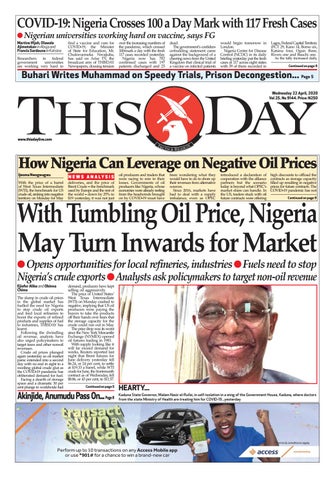
COVID-19: Nigeria Crosses 100 a Day Mark with 117 Fresh Cases Nigerian universities working hard on vaccine, says FG Martins Ifijeh, Olawale Ajimotokan in Abuja and Francis Sardauna in Katsina Researchers in federal government universities are working very hard to
find a vaccine and cure for COVID-19, the Minister of State for Education, Mr. Chukwuemeka Nwajiuba, has said on Arise TV, the broadcast arm of THISDAY Newspapers, dousing tension
over the increasing numbers of the pandemic, which crossed 100-mark a day with the fresh 117 cases recorded yesterday. Nigeria now has 782 confirmed cases with 197 patients discharged and 25
dead. The government’s confidence-building statement came against the background of a cheering news from the United Kingdom that clinical trial of a vaccine on infected patients
would begin tomorrow in London. Nigeria Centre for Disease Control (NCDC) in its daily briefing yesterday put the fresh cases at 117 across eight states with 59 of them recorded in
Lagos, Federal Capital Territory (FCT 29, Kano 14, Borno six, Katsina four, Ogun three, Rivers one and Bauchi one. As the tally increased daily, Continued on page 9
Buhari Writes Muhammad on Speedy Trials, Prison Decongestion... Page 5 Wednesday 22 April, 2020 Vol 25. No 9144. Price: N250
www.thisdaylive.com TR
UT H
& RE A S O
N
How Nigeria Can Leverage on Negative Oil Prices Ijeoma Nwogwugwu
N E W S A N A LY S I S
With the price of a barrel of West Texas Intermediate (WTI), the benchmark for US crude oil, sinking into negative territory on Monday for May
deliveries, and the price of Brent Crude – the benchmark used by Europe and the rest of the world – down by 25% to $19 yesterday, it was not just
oil producers and traders that were racing to rein in their losses. Governments of oil producers like Nigeria, whose economies were already reeling from the headwinds brought on by COVID-19 must have
been wondering what they would have to do to shore up their revenues from alternative sources. Since 2016, markets have had to deal with a supply imbalance, even as OPEC
introduced a declaration of cooperation with the alliance partners but the scenario today is beyond what OPEC’s market share can handle. In the US, traders stuck with oil future contracts were offering
high discounts to offload the contracts as storage capacity filled up resulting in negative prices for future contracts. The COVID-19 pandemic has not Continued on page 9
With Tumbling Oil Price, Nigeria May Turn Inwards for Market Opens opportunities for local refineries, industries Fuels need to stop Nigeria’s crude exports Analysts ask policymakers to target non-oil revenue Ejiofor Alike and Obinna Chima The slump in crude oil prices in the global market has fuelled the need for Nigeria to stop crude oil exports and feed local refineries to boost the exports of refined products and supplies of fuel to industries, THISDAY has learnt. Following the dwindling oil revenue, analysts have also urged policymakers to target taxes and other non-oil revenues. Crude oil prices plunged again yesterday as oil market panic extended into a second day with no end in sight to a swelling global crude glut as the COVID-19 pandemic has obliterated demand for fuel. Facing a dearth of storage space and a dramatic 30 per cent plunge in worldwide fuel
demand, producers have kept selling oil aggressively. The price of United States’ West Texas Intermediate (WTI) on Monday crashed to negative, implying that US oil producers were paying the buyers to take the products off their hands over fears that the storage capacity for the crude could run out in May. The price drop was its worst since the New York Mercantile Exchange (NYMEX) opened oil futures trading in 1983. With supply looking like it will far exceed demand for weeks, Reuters reported last night that Brent futures for June delivery yesterday fell $6.24, or 24 per cent, to settle at $19.33 a barrel, while WTI crude for June, the front-month contract as of Wednesday, fell $8.86, or 43 per cent, to $11.57. Continued on page 5
Akinjide, Anumudu Pass On... Page 8
HEARTY... Kaduna State Governor, Malam Nasir el-Rufai, in self-isolation in a wing of the Government House, Kaduna, where doctors from the state Ministry of Health are treating him for COVID-19...yesterday
2
WEDNESDAY APRIL 22, 2020 •T H I S D AY
WEDNESDAY APRIL 22, 2020 • T H I S D AY
3
4
WEDNESDAY APRIL 22, 2020 •T H I S D AY
5
WEDNESDAY, ͺͺ˜ ͺͺ ˾ T H I S D AY
NEWS
Group News Editor Ejiofor Alike Email Ejiofor.Alike@thisdaylive.com, 08066066268
President Writes CJN on Speedy Trials, Prison Decongestion Canvasses special courts to handle robbery, banditry, cases Omololu Ogunmade in Abuja Concerned about the possible effects of COVID-19 on inmates in correctional centres, President Muhammadu Buhari yesterday called for urgent and speedy trial of court cases. The president, in a letter to the Chief Justice of Nigeria (CJN), Justice Tanko Muhammad, said decongesting custodial centres had become imminent following the outbreak of COVID-19 pandemic. The letter came against the backdrop of a presidential pardon that the president in the exercise of his powers on Prerogative of Mercy granted 41 inmates of correctional centres on April 9. He had also called on governors to consider clemency for 2,600 inmates under their authority.
In the letter, the president referred the CJN to the recent call by the United Nations on all countries “to consciously reduce the population of prison inmates since physical distancing and self-isolation in such conditions are practically impossible.” According to a statement by the president's media adviser, Mr. Femi Adesina, the president told Justice Muhammad that the congestion of correctional centres threatened both the health of the inmates and that of the public. Giving an account of the state of the correctional centres in the country, Buhari canvassed the necessity for decisive and urgent moves to address the situation. “From available records, the inmates’ population at various custodial centres across the
country presently stands at 74,127 out of which 52,226 are Awaiting Trial Persons (ATPs). “Most of these custodial centres are presently housing inmates beyond their capacities and the overcrowded facilities pose a potent threat to the health of the inmates and the public in general in view of the present circumstances, hence the need for urgent steps to bring the situation under control," the president said. Buhari advised the CJN to encourage chief judges of states to tour correctional centres in their jurisdictions and identify inmates who deserve freedom and act accordingly. “...It has become imperative for Your Lordship to request State Chief Judges to embark on an immediate visit to all custodial/correctional centres within their respective states to
identify and release deserving inmates where that has not been done already,” he added. He also listed other factors the judges should watch out for during the visits. He said: ''The chief judges are enjoined to consider conditional or unconditional release of ATPs who have spent six years or more in custody. ATPs who have no confirmed criminal cases against them, aged inmates and terminally ill may be discharged. “It is expected that particular attention should be on the aged, those with health issues, low-risk offenders, those with no sufficient legal basis to remain in custody, inmates convicted for minor offences with or without an option of fines and inmates who have less than three years term left to serve having served
a substantial term of their service for offences that attract five years and above. “Payment of fines may be made in favour of inmates convicted of lesser offences with an option of fine, who are in custody because of their inability to pay such fines.” The president explained that a report on such proposed visits should be forwarded to the Presidential Committee on Correctional Service Reform and Decongestion Secretariat in the Federal Ministry of Justice for compilation and subsequent transmission to his office. He admonished the CJN to “at this stage, consider taking immediate steps as appropriate to ensure the setting up or designation of special courts in all states, including the FCT, to try cases of armed robbery, banditry, kidnapping and other
serious offences, in order to facilitate speedy trials.” Buhari tasked Justice Muhammad to ensure that states' chief judges and the High Courts of the Federal Capital Territory (FCT) comply with the requirements of the Administration of Criminal Justice Act/Law on the issuance of remand warrants in criminal cases. “There is the need to ensure that the Chief Judges of states and FCT High Courts direct lower courts to comply with requirements of the Administration of Criminal Justice Act/Law in issuing remand warrants in criminal cases especially in cases which are not within their jurisdiction. “This will regulate the volume of entry of Awaiting Trial Inmates into custodial centres,” he stated.
MAN Urges Manufacturers to Look Inwards for Raw Materials
Nume Ekeghe
Following trade restrictions in some of Nigeria's trading partners due to the COVID-19 pandemic, the President of the Manufacturers Association of Nigeria (MAN), Mr. Mansur Ahmed, has advised manufacturers in the country to look inwards. He told THISDAY that with the disruption in the supply chain, manufacturers now have to look inwards for sourcing of raw materials. He added: “Initially there was a restriction from India for pharmaceutical raw materials but they have relaxed that now. Now every manufacturer has to think through and find ways they can remain afloat. “We also need to be looking for locally made raw materials to see if we can source those materials locally because there a lot of materials that can be substituted,” he said. The Head of Consulting at Agusto Consulting Limited, Mr. Jimi Ogbobine, identified one of the core issues that has come to the fore due to the pandemic as the structure of global supply chains. He said: “Prior to the pandemic, China served as the global manufacturing hub, with 40 per cent of the world's manufacturing output. However, the pandemic exposed the underlying issues with this concentration risk. The lockdowns and restrictions on foreign travel imply that the pace of globalisation will be slowed down over the next 12 to 18 months. “Thus, there are underlying risks with undue dependence on Chinese supply chains. The Chinese supply chains offer the competitive advantage of low cost and high efficiency. This model has been successfully replicated
by mainly south east Asian countries like Thailand and Vietnam but not on the scale of China. “We believe the distortions to global supply chains portend risks and opportunities for Nigeria. Will Nigerian companies see this as a chance to increase investments in local backward linkages, or will it be a time to diversify from China to other countries? We recognise it will be difficult to compete with the Chinese on cost and efficiency but also believe that management must give consideration to these thoughts at this time. “ On his part, the Managing Director, Sthenic Finance and Advisory, Mr. Adebayo Durodola, said commerce and business activities in China and India had affected revenues of retail and manufacturing businesses. He said: “There has been a drastic drop in the topline of companies especially companies that depend on retail customers. Also, this period will see a depletion of inventories. Even though the federal government has kept the ports open, we are still looking at a situation of increase in cost of goods sold because transportation cost has increased. In essence, business that depends on imports will be struggling with decline in revenue and increased in cost of goods sold. “India and China contribute to critical sector of our economy such as power, pharmaceutical, hydrocarbon, solar energy, agriculture among others. If there is political instability in those countries, it will have a systemic effect on our GDP because we are dependent on those countries, especially in critical sectors.”
IMO BATTLES PANDEMIC... Chairman, Imo State COVID-19 Prevention and Control Committee, Prof. Maurice Iwu (left), and Chairman of Aurebel Gas, Chief Reginald Ikpewujo, after a meeting in Owerri...yesterday
FG Rejects Air Travel Requests by Five Govs Chinedu Eze The federal government yesterday said that it declined the requests of five governors to travel by air in compliance with the travel restrictions imposed in the country to contain the spread of the COVID-19 pandemic. This was disclosed yesterday by the Minister of Aviation, Senator Hadi Sirika, at a press conference in Abuja. Sirika explained that two governors from the South-east, one from the North-central and another two from the South-south regions had made requests to travel by air but he turned the requests down in strict compliance with the
federal government’s flight restriction policy. The minister, however, did not explain whether the governors wanted to travel out of the country or they wanted to travel locally. Sirika also said that government was very strict about flight restrictions in Nigeria’s airspace, noting that concessions were only allowed on COVID-19 related flights, which might include the movement of medical personnel, medical supplies or related cargo. He added that the other approvals, which might be one per cent of the air movement during the closure of Nigeria’s airspace was for the evacuation
of foreigners by their countries. The minister also explained that the flurry of flight movements around Abuja yesterday was due to activities by the Nigerian Air Force in preparation to mark its one-week celebration, which started today. “Every single flight that you would see, that received approval would be an essential flight and 98 per cent of them would be connected to COVID-19. A few of them; maybe, one per cent might be repatriation request from the diplomatic community, which must go through the Ministry of Foreign Affairs or evacuation of illness of another kind and that evacuation must need the
stamp of a teaching hospital." Sirika denied that VIP movements were going on in Nigeria. “There is no exception given to governors. I had denied several of such flights, including two governors from the South-south, two from South-east and one from the North-central; by the way, three of them are members of APC. This is just to say that once you see a flight approval, just know that it is diligently done, it must be essential, it must be COVID-19-related or some other flights like cargo that will bring in medicines or equipment or something related to our own well-being like food,” he said.
6
WEDNESDAY APRIL 22, 2020 •T H I S D AY
WEDNESDAY APRIL 22, 2020 • T H I S D AY
7
8
WEDNESDAY, ͺͺ˜ ͺͺ ˾ T H I S D AY
NEWS
Former AGF, Akinjide, Globe Motors Chairman, Anumudu, Pass On Buhari, Jonathan, Atiku, Gbajabiamila, Tinubu, others mourn Akinjide
Our Correspondents Former Attorney-General of the Federation and Minister of Justice, Chief Richard Akinjide, and the Chairman of Globe Motors, Chief William Anumudu, died yesterday. While Akinjide passed on at 88 in Ibadan, Anumudu died at 68 in Lagos. Condolence messages poured in moments after news of the deaths broke with President Muhammadu Buhari, his predecessor, Dr. Goodluck Jonathan; former Vice President Atiku Abubakar; Speaker, House of Representatives, Hon. Femi Gbajabiamila; and National Leader of All Progressives Congress (APC), Senator Bola Tinubu, paying homage to Akinjide. The sympathisers also included the Olubadan of Ibadan land, Oba Saliu Adetunji; pan-Yoruba socio-political group, Afenifere, and legal luminary, Chief Afe Babalola (SAN). The Nigerian Bar Association (NBA) and the Body of Senior Advocates of Nigeria (BOSAN) also mourned the late legal icon. Buhari, according to a statement by his Special Adviser on Media and Publicity, Mr. Femi Adesina, commiserated with the government and people of Oyo State over the demise of the late AGF. The president said Akinjide made a remarkable impact as Minister of Education in the First Republic, Minister of Justice and Attorney General in the Second Republic and a member of the Judicial Systems' Sub-committee of the Constitution Drafting
Committee of 1975-1977. The president noted that the late AGF used his rich experience and knowledge to serve the country and humanity. Jonathan expressed sadness over the passing on of Akinjide, describing his death as a great loss to the nation. Atiku, in a tweet commiserated with the Akinjide family and prayed that God should grant him a perfect rest. Gbajabiamila, in a condolence statement, described Akinjide's demise as a painful loss, saying that he lived an exemplary life worthy of emulation, especially by the upcoming generation of lawyers in the country. The Olubadan of Ibadan land, described the passage of Akinjide as a monumental loss to the nation. The monarch in a statement by his Director of Media and Publicity, Mr. Adeola Oloko, said he was an accomplished lawyer and politician who gave a good account of himself while in public service. According to Adetunji, Akinjide, who also served as a chieftain in the Olubadan of Ibadan’s court of clan nobles, was a patriot who displayed a great love for his fatherland and the people. Tinubu also sent his commiseration to the deceased’s family and the government and people of Oyo State. The message signed by his Special Adviser on Media, Mr. Tunde Rahman, said: “Chief Akinjide was an extraordinarily brilliant lawyer and an indisputable giant in the legal profession." Afenifere also described Akinjide as a brilliant attorney
with a forensic knowledge of the law. National Publicity Secretary of Afenifere, Mr. Yinka Odumakin, told THISDAY yesterday that Akinjide would always be remembered as a brilliant barrister with forensic knowledge of the law. Babalola described him as one of the pillars behind the Nigerian bar, adding that he was shocked when he received the news of the departure of the erudite lawyer. He said the former AGF was a good and reliable lawyer during his lifetime. The NBA also commiserated with the family, friends, and
associates of the former minister. Its National Assistant Publicity Secretary, Mr. Akorede Lawal, in a statement, quoted the association’s president, Mr. Paul Usoro (SAN), as describing the deceased as a brilliant advocate and one of the finest of the legal profession. The BOSAN prayed to God to grant the Akinjide family the fortitude to bear the loss. In a statement signed by the Secretary, Mr. Seyi Sowemimo (SAN), the group said as a consummate Bar enthusiast, Akinjide served as President of the NBA between 1970 and 1973 and in that capacity,
became a statutory member of Council of Legal Education and Body of Benchers, and later became a Life Bencher and Chairman of the Body of Benchers.
Anumudu Foremost Manufacturers’ Representative The Chairman of Globe Motors Holdings (Nigeria) Limited, Anumudu, was a foremost manufacturers’ representative in Nigeria’s auto industry. According to family sources, he passed on yesterday morning about 4 a.m. hours before he was to be flown to
Germany for treatment. He was said to have tested negative for COVID-19 after he became sick a few days ago. “One of Nigeria's biggest car dealers, WILLY ANUMUDU, has died! The Chairman of GLOBE MOTORS, Victoria Island suffered some health challenges a few days ago and was tested for COVID-19 which came out negative. He was to be airlifted to Germany this morning but died about 4 am,” the Publisher of Ovation Magazine, Chief Dele Momodu, said in a tweet. The family was yet to make an official statement, as at press time.
CLEARING THE CORRECTIONAL CENTRE... L-R: Ogun State Attorney-General and Commissioner for Justice, Mr. Akingbolahan Adeniran; Controller, State Correctional Centre, Mr. Abolade Benson; and the state’s Chief Judge, Justice Mosunmola Dipeolu, during a jail delivery exercise at the Sagamu Correctional Centre....yesterday
Concerns Heighten over Harvest of Deaths in Kano State govt launches probe Experts say deaths not related to pandemic Ibrahim Shuaibu in Kano The toll from mysterious deaths that have hit Kano State has continued to rise, despite denial by the state government. THISDAY gathered yesterday that no fewer than 190 people had been buried within four days of the lockdown of the state to curb the spread of COVID-19. The state government had imposed the lockdown shortly after the state recorded its COVID-19 index case last week. As at Monday, the state had a total of 59 cases. However, some medical experts have attributed the deaths to high blood pressure, malaria, ulcer and even hunger. They added that the dearth of doctors to attend to patients in all the hospitals across the state has worsened the fatality rate. The spate of the deaths has caused fears and confusion among residents, who have wondered why the state government has focused attention on COVID-19 while people were dying mysteriously. Some of the residents told
THISDAY that people might be dying of the virus without being detected. The deaths were reported in areas like Zage, Kano Municipal, Tarauni, Gwale, Kurna, Dala, Chiromawa, Zango, Kofar Mata, Fagge, Kumbotso, and some local government areas outside the metropolis like Bichi, Kunchi, Wudil, Gwarzo and Shanono among other areas. Reports indicated that about 190 people have died in the past four days in the state, amounting to an average of 47 deaths per day. A cemetery guard at Farm Centre, who identified himself as Adamu Umar told THISDAY that on Sunday alone, they buried over 17 bodies, adding that the situation is scary as it is unusual ever since he began working there in the last four years. Accounts from the major cemeteries in the Kano City, which include Farm Centre and Abbatuwa, Dandolo, revealed that about 200 people were buried in the past seven days. THISDAY gathered that on Tuesday alone, about 10 people were buried at Farm Centre;
six people at Dandolo; four in Filin Mushe and four persons at Fagge cemetery. A senior officer with the state Ministry of Justice was buried at the Gwarzo Central Cemetery on Sunday, while the wife of Gwarzo Chief Imam was also buried last Saturday. In Bichi, a resident of Agalawa was buried on Monday. However, a female Nursing officer at Murtala Muhammed Specialists Hospital Kano, who spoke to THISDAY under anonymity, said most of the deaths were caused by hypertension, anaemia, diabetes, malaria and typhoid. She also attributed some of the deaths to ulcer as a result of hunger and poverty. The state Executive Secretary of Primary Healthcare Board, Dr. Tijjani Hussaini, said that medics were yet to ascertain the medical cause of the mysterious deaths, but acknowledged that the situation had “sent residents panicking”. “The investigation is prompted by reports that more deaths have been recorded in the past seven days. “We want to know the
number of persons already dead. We also want to investigate how they died. “It is when we have a good idea; it is when we get the outcome of the findings that we can properly draw conclusions and brief the public,” he said. Reacting to the reports, a medical practitioner, Dr Mustapha Hikima, who is also the Chief Medical Director of Nasarawa Hospital, said the Ministry of Health had conducted a survey between April 13 and 19 to see the pattern of deaths in the state. He added that “after the quick survey, the result had shown that there was no significant increase in the rate of death recorded in the state." According to him, the cemeteries taken as sample in the survey by the ministry were Dala, Fagge, Gwale, Kano Municipal, Nasarawa and Tarauni because of the densely populated nature of the areas. He stated that the result did not show significant increase in the number of deaths recorded. He appealed to the residents to be calm as the deaths were not related to COVID-19.
He added that the ministry would soon come up with an enlightenment programme in that regard. He, however, explained that sometimes in a season, there is a surge in number of deaths in the state occasioned by the outbreak of some diseases such as malaria. He added that as the hot season sets in, people would be having flu and catarrh as a result of change of weather. He said the medical personnel are now afraid to attend to patients for fear of COVID-19. He said: "We don't have the baseline information, but considering the high population size of Kano, the increase in the deaths is not significant. “We should also take the time of the occurrence of the deaths into consideration. The time happens occasionally. So, it is subjective to judge when a case happens within just three days. "To me, this is not a serious problem because it happens sometimes. So, I appeal to people to be calm." The state government has promised to investigate the
issue. The state Ministry of Health, in a statement signed by its Information Officer, Mrs. Hadiza Namadi, said: “The attention of the Kano State Ministry of Health has been drawn to a post being circulated on social media platforms on purported death of number of people within two days and buried in some cemeteries within Kano metropolis. “As the ministry could not immediately verify the veracity of the claim going round, the state Commissioner of Health, Dr. Aminu Tsanyawa, hereby assures the general public that investigation into the matter is ongoing to verify the claim and possible causes of the deaths. “Tsanyawa also assured that the public will be informed on the outcome of the investigation in due course. “While he prayed for the repose of the souls of the departed, the commissioner also advised people to continue to observe social distancing, wash hands regularly, avoid gatherings and stay at home to prevent the spread of COVID-19.”
9
WEDNESDAY, ͺͺ˜ ͺͺ ˾ T H I S D AY
PAGE NINE WITH TUMBLING OIL PRICE, NIGERIA MAY TURN INWARDS FOR MARKET Following the plummeting oil price, Nigeria had revised her 2020 budget benchmark from the initial $57 per barrel to $30 per barrel but still, the prevailing market price of crude presents no hope for financing the budget. The most viable option, it was gathered, is for the country to freeze oil exports and feed upcoming local refineries to facilitate exports of refined products, earn foreign exchange and save local industries the huge cost incurred on diesel for power supply. Apart from exporting the refined products, other derivatives from the refineries can be used as raw materials for industries, such as plastic industries. THISDAY learnt that the multiplier effects will make local industries globally competitive and spur the Nigerian economy to greater heights. The Minister of Finance, Budget and National Planning, Mrs. Zainab Ahmed, had hinted that the 650,000 barrels per day Dangote Refinery was expected to save Nigeria about $10 billion in foreign exchange when completed. She said: “This is a very important project one of the largest refineries in the world today. Mr. President is very proud of this project and we speak about it everywhere we
go in terms of the number of jobs which it is creating and the good that it will be bringing to our economy. “And for us in government, that is a saving of at least $10 billion that will be sitting in our reserves instead of flying out to pay for petroleum products.” Africa’s richest man and President of Dangote Group, Alhaji Aliko Dangote, had also projected that when operational, the Dangote Refinery and Petrochemical plant would save the country over $2.5 billion yearly through urea and polythene products export to other countries. Apart from the foreign exchange accrual benefit, he also said the plant would have the capacity to employ more than 70,000 Nigerians, doubling its current workforce, when it becomes operational. Governor of the Central Bank of Nigeria (CBN), Mr. Godwin Emefiele, had also confirmed that the fertilizer plant would generate a minimum of $750 million through export annually. Emefiele said the fertiliser plant would stop Nigeria from the importation of fertilizers as about 25 per cent of its products would be used for domestic consumption to boost agriculture in the country. “This project is so strategically positioned that it will even make the final price of
petroleum within Nigeria and even outside Nigeria to be lower than those imported outside the African continent,” he reportedly added. With an average daily consumption of 45 million litres of petrol daily, Nigeria also has a huge market for refined petroleum products, if upcoming refineries are given adequate feedstock instead of exporting the crude. Apart from the 650,000 bpd Dangote Refinery, modular refineries of various capacities, and the 445,000 bpd NNPC refineries, the Group Managing Director of NNPC, Malam Mele Kyari, had also stated that it had initiated five condensate refineries with an estimated combined production capacity of 200,000 barrels per day. According to him, such kind of refineries could become operational within two years. He explained that the condensate refineries would complement the upcoming Dangote Refinery as well as other refineries in the country under rehabilitation, with the hope of guaranteeing energy security for the country. He said: “We are doing something about what we call a condensate refinery. What that means is that the condensate resources that we have, which are very easy to convert to fuel, not like a typical
refinery but it does work very quickly, and then we can also convert up to 90 per cent of the feedstock into, for instance, the light petroleum products. “But it is something that you can get into work in two years. So, we have four other initiatives of that nature with a combined capacity of probably getting 200,000 barrels condensate. The combination of that with the Dangote’s 650, 000 barrels per day and our refineries that we are fixing can guarantee energy security for us. “So, once you have such opportunities, you will see Nigeria becoming a net exporter of gasoline (petrol) to the West African countries, the whole of Africa within our view and probably reverse the flow of products because it comes from Europe not because Europe is the source of petroleum but because the processing facilities are there,” he reportedly told Arise News Channel.
Meanwhile, the DirectorGeneral, West African Institute of Financial and Economic Management (WAIFEM), Dr. Baba Musa, has said the biggest opportunity for both policymakers in the country
and operators of business is to look inwards. According to Musa, over the years, the mantra has been to diversify the economy, but despite that, there has been heavy reliance on oil as a major source of revenue. “But if you look at most of the developed economies, most of them are driven by the taxes they collect. So, in our tax system, there is still a lot of room for improvement. Nigeria’s tax to Gross Domestic Product (GDP) is far below Africa and even West African average. “So, what is required is that now all those loopholes in terms of revenue collection, we need to block them.” The WAIFEM boss argued that encouraging the Dangote Refinery as well as the modular refineries in the country to come on stream, in the medium term, would also help support domestic production and reduce the cost of businesses. He said the pandemic has also brought to the fore the need to increase investment in the health sector. “What the government requires immediately is how to pool revenue to finance its expenditure in 2020 and 2021. So, the immediate priority now is for us to look inwards. Already, the government has an agriculture agenda and there
is also the Anchor Borrowers’ Programme; we need to ramp them up in such a way that the country becomes a net exporter. Then, after that, in the medium term, the Dangote Refineries, the modular refineries would also be encouraged to come on stream, because this is the right time for them to be operational. But what is important is that we need to look inwards,” he added. The Founder, Foundation for Economic Research, Prof. Akpan Ekpo, advised that going forward, the federal government should always prepare what he termed a non-oil budget “What I have been saying for years is that anytime we have high crude oil price, we should always see it as a windfall, save a lot of the revenue and target it for spending on infrastructure. I worked with Anthony Ani when he was Minister of Finance and we planned to do a non-oil budget. “If you look at the Nigerian economy, oil contributes only 10 per cent to Gross Domestic Product (GDP), while the nonoil sector contributes 90 per cent. So, we can actually do a non-oil budget. If we had been doing it for years, we would have gotten used to it, so that if the oil price does well, it becomes like a windfall. Let us demystify the oil sector because oil may finish one day,” he said.
ado, it will have to revise its budget for the second time and base all future budgets on $20 a barrel. This must be backed by strong legislation to save and protect excess crude oil earnings to shield the economy from exogenous shocks. Lower oil prices also present a window for a low cost energy scenario that can make businesses and industries more productive and competitive. The Petroleum Products Pricing Regulatory Agency (PPPRA) is currently fixated with the pump price of petrol, forgetting that its mandate includes the prices at which diesel, kerosene, and aviation fuel are sold at fuel outlets and depots. Despite lower oil prices in the last two months,
oil marketers have remained unresponsive and have kept the price of diesel, which is used by businesses and industries as an alternative energy fuel to run their organisations, high. With lower prices of diesel and even gas that is piped to thermal power stations, businesses should be able to benefit from lower energy costs. Furthermore, the government needs to urgently meet with current promoters of new refineries (with particular emphasis on the Dangote refinery) and introduce enhanced incentives/special foreign exchange window to super-accelerate the completion of all on-going refineries in the industry. Other than the benefits of import substitution,
the completion of the Dangote Refinery and modular plants will go a long way to making Nigeria a net exporter of refined petroleum products to other African countries. The prompt passage and implementation of the Petroleum Industry Governance Bill (PIGB) and new privatised model for the national oil company and independent regulator – creating efficient, leaner models – will also go a long way to reduce the cost of production. Significantly winding down the federal government’s equity in the joint ventures to raise capital to shore up infrastructure funding shortages/and fund enhanced social protection structures is another area that should be explored.
Records Two Deaths
Buhari to Make Difficult Decisions on Lockdown Next Week
Analysts Ask Policymakers to Target Non-oil Revenue
HOW NIGERIA CAN LEVERAGE ON NEGATIVE OIL PRICES just caused a global economic crisis, but more importantly, has exposed the vulnerability of resource-rich economies like Nigeria with weak supply chain capabilities – and low local value addition. Just a month ago, the Nigerian government revised its 2020 budget by slashing the oil benchmark from $57 per barrel to $30 per barrel, effectively resulting in a downward revision of its expenditure framework on capital expenditure for the year. But as governments around the world locked down their countries in an attempt to contain the spread of COVID-19 and demand for crude oil fell in an already over-saturated market, the
price of the commodity plunged concomitantly. As it stands, there is no sign that oil prices will recover in the near future as countries around the world adjust to the “new normal”. The new normal will be one where the race to discover a cure or vaccine for COVID-19 continues in earnest. But as the world waits expectantly for a medical breakthrough, there will be less domestic and international travel, lower productivity, billions will lose their jobs, many who manage to hold on to their jobs will be forced to work from home, which in turn will lower demand for rail and road transportation. The outlook for oil has never been so dire, even as the new
normal unfolds where demand is significantly lower than what it has ever been. The big losers in the new scenario are oil exporters such as Nigeria with no refineries, which with generous discounts still struggle to sell their oil but have to import refined products to meet the needs of their large population. Nigeria has a population of over 200 million people – easily a captive market that should motivate the creation of refining capacity – but the situation is pathetic in that the country still produces raw crude solely for exports. Yet, this stark reality presents Nigeria with a unique opportunity to adjust to the uncharted territory in which it finds itself. Without further
COVID-19: NIGERIA CROSSES 100 A DAY MARK WITH 117 FRESH CASES the NCDC Director-General, Dr. Chikwe Ihekweazu, told the Katsina State Governor, Hon. Aminu Masari, yesterday in Katsina that President Muhammadu Buhari would have to make a tough decision next week on the way forward, revealing that the president would have a teleconference with the governors of the 36 states today. Speaking yesterday during the Morning Show on Arise News Channel, the broadcast arm of THISDAY Newspapers, Nwajiuba said so far, a N5 billion fund had been created for research, adding that coordinated activities had commenced among researchers in the country on finding vaccines that can help in the prevention of the disease. He said: “Nigerian universities are working very hard to finding a solution, and this is being done in a coordinated manner; some are doing researches at the molecular level, other are looking at the vaccine levels, and so on. “I spoke to the Executive Secretary of the Tertiary Education Trust Fund (TETFUND), Prof. Suleiman Bogoro, and he told me they were already talking to all the universities to coordinate research efforts against COVID-19. The coordination is important because the World Health Orgnisation (WHO) has stressed on coordinated race. It
is not a competitive race. “The executive secretary of the Nigerian University Commission (NUC) is also coordinating the efforts of everybody; so, we know who is doing what. They need to know who is researching on the molecular level, vaccine level, and the rest. The universities are providing some sort of guidance to the researchers,” he said. He also mentioned that the Federal Ministry of Education was also working towards providing electronic learning for primary and secondary students through the use of radios, televisions, and the internet, adding that this would ensure they are also learning while staying at home. In the same vein, the DirectorGeneral of the National Institute for Pharmaceutical Research and Development, (NIPRD), Dr. Obi Adigwe, told THISDAY yesterday that the parastatal had commenced testing for locally produced ventilators as this would help curb the scarcity of the medical equipment in the country.
FG Shifts Focus to Kano, Monitors Oyo, Osun, Ondo, Edo Meanwhile, the federal government has shifted focus to Kano State as the new epicentre of COVID-19 in the country and is also closely monitoring Oyo,
Ondo, Edo and Osun States for new cases of the virus. The Chairman of the Presidential Task Force on COVID-19, Mr. Boss Mustapha and the National Coordinator PTF COVID-19, Dr. Sani Aliyu, made this revelation yesterday when the task force addressed the media in Abuja. Mustapha, while saying that the task force would submit its report to President Buhari, said Nigeria would not be the same again at the end of the pandemic, given some machines and technology innovated and invented by some Nigerians. Mustapha, who is also the Secretary to the Government of the Federation, said the state would receive attention given the current reality as a state with a heavy burden of the virus infection. He said the PTF was also awaiting the NCDC and World Health Organisation (WHO) to submit their report and ascertain if the recent surge in inexplicable deaths in the state is related to COVID-19 infections, adding that support will be given to the state to strengthen coordination across board. Aliyu reiterated this concern by stating that the federal government was closely monitoring the pattern of infection in Kano, Osun, Ondo, Oyo, and Edo States. He said because of the concern for Kano they had increased the number of tests to see the possibility of having more cases from
the state. According to him, “Because we are increasing the number of tests, as we ramp up, there is the possibility that we will continue to have more and more cases coming here. “We do note the concern about increased reporting of cases – we are closely monitoring Kano, Osun, Oyo, and Edo. We note the particular concern with Kano and we have engaged closely with the state government. The Minister of Information and Culture, Alhaji Lai Muhammed, urged the people of Kano to ignore an unverified drug called COVID-19 vaccine, which is yellow in colour and presently circulated by hawkers in the state as a potential cure for the disease. Meanwhile the Minister of Humanitarian Affairs, Disaster Management and Social Development, Ms. Sadiya Farouq, has said the federal government has distributed 279 trucks to the FCT, Lagos and Ogun States, which are affected by the lockdown imposed by the president. Farouq said the trucks were loaded with some of the 70,000 metric tonnes of grains from the national reserves, which Buhari ordered to be distributed as palliatives to the states.
Lagos Discharges Nine More Patients,
In another development, Lagos State Government has discharged nine more COVID-19 patients, bringing to 107 the total number of successfully treated persons in the state. Announcing this yesterday, the Incident Commander on COVID-19 in the state, Governor Babajide Sanwo-Olu, said the discharged patients include five females and four males. He said: "They are eight Nigerians and one Polish citizen. Five were discharged from the Infectious Disease Hospital, Yaba and four from Onikan Isolation Centre." The state government also yesterday announced the deaths of two more COVID-19 patients, bringing the total number of COVID-19 related deaths in the state to 16. The state Commissioner for Health, Prof. Akin Abayomi, via his Twitter handle, @ ProfAkinAbayomi said the dead patients were aged 45 and 36 respectively. He said, “One of the deceased was a 45-year-old Nigerian; a male who returned from India in January 2020. “The second death involved a 36-year-old Nigerian; female with a severe underlying health condition. She had no history of travel or contact with any #COVID19 confirmed case.
Ihekweazu said yesterday that Buhari would make difficult decisions for the country on the ongoing war against the pandemic after meeting with the governors today. Continued on page 10
TOP GAINERS NGN NGN % OMOMORTBANK 0.05 0.60 9.0 NPFMFB 0.10 1.25 8.7 LASACO 0.01 0.25 4.1 LEARNAFRICA 0.02 0.97 2.1 CUSTODIAN 0.50 5.75 9.5 TOP LOSERS NGN % CHAMPBREW 0.09 0.81 10 OANDO 0.25 2.25 10 LAFARGE 1.05 10.35 9.2 FIDELITYBANK 0.17 1.72 8.9 CHAMS PLC 0.02 0.21 8.7 HPE Nestle Nig Plc ₦975.00 Volume: 250.346 million shares Value: N2.325 billion Deals: 4,877 As at yesterday 21/4/2020 See details on Page 27
10
WEDNESDAY, ͺͺ˜ ͺͺ ˾ T H I S D AY
NEWS
Analysts Predict Sustained Pressure as Inflation Rises to 12.26%
James Emejo in Abuja and Nume Ekeghe in Lagos
As the Consumer Price Index (CPI), which measures inflation, rose to 12.26 per cent (yearon-year) in March, analysts yesterday predicted sustained inflationary pressure in the coming months. They hinged their prediction on the exchange rate adjustment, border closure, obstruction in agriculture value chain and high food demand due to the lockdown and movement restrictions occasioned by the COVID-19 pandemic. They also called on the federal government to relax movement restrictions to allow farmers and transporters take advantage of the planting season to suppress food inflation, which has been on the rise in recent times. The inflation rose to 12.26 per cent in March compared to 12.20 per cent in the preceding month, according to the National Bureau of Statistics (NBS). The agency, however, noted that the current lockdowns in Abuja, Lagos and Ogun States to contain the spread of the COVID-19 pandemic as well as various major disruptions in normal economic activities in some states, which started in April, did not have "any major impact on the March 2020 inflation report." According to the CPI report for March, which was released yesterday, food inflation increased to 14.98 per cent in the review month compared to 14.90 per cent in February. The NBS attributed the 0.13 per cent rise in the food index to increases in prices of bread and cereals, fish, potatoes, yam
and other tubers, oils and fats, vegetables and fruits. Also, core inflation, which excludes the prices of volatile agricultural produce, increased to 9.73 per cent in March, up by 0.3 per cent compared to the 9.43 per cent recorded in February. The core index recorded highest increases in prices of passenger transport by air, tobacco, household textiles, major household appliances, domestic services and household services, pharmaceutical products, maintenance and repair of personal transport equipment, water supply and catering services. Urban inflation rate peaked at 12.93 per cent (year-on-year) in March from 12.85 per cent in the preceding month while the rural index increased to 11.64 per cent compared to 11.61 per cent in February. Inflation had assumed a downward direction in recent consecutive months when it dropped in January 2019 to 11.37 per cent from 11.44 per cent in December in 2018. The headline index further reduced to 11.31 per cent in February and 11.25 per cent in March but resorted to the upward trajectory in April when it climbed to 11.37 per cent- and further to 11.40 per cent in May- before falling to 11.22 per cent in June, 11.08 per cent in July, 11.02 per cent in August before returning to 11.24 per cent in September, 11.61 per cent in October and 11.85 per cent in November and 11.98 per cent in December- and now 12.13 per cent in January 2020 and 12.20 per cent in February as well as 12.26 per cent last month. Head of Research at Afrinvest
West Africa, Mr. Abiodun Keripe, said there would be sustained inflationary pressure in the coming days. “The marginal rise in inflation suggests a muted transmission of the recent VAT increase as well as exchange rate pressure. We believe this can be explained by the social distancing measures taken to slow the spread of COVID-19, which has reduced economic activity and consumer spending. Going forward, we anticipate increased pressure on domestic consumer prices, mainly food. “Our expectation is driven by the disruption to the agriculture value chain amid the lockdown with the reduced agriculture output. We believe there would be a faster-paced increase in inflation once the lockdown measures are relaxed and economic activity resumes. Until then, the pass-through of trade restrictions, exchange rate weakening and the recent VAT increase to consumer prices would be muted," he stated. Head of Research, United Capital, Mr. Wale Olusi, said the lockdown brought about an increase in demand, which in turned led to a spike in food prices. He said: “Food inflation has accounted to the largest chunk for the month of March and that is because before the lockdown, there was a crazy rush for people to stock up ahead of the lockdown. So what you saw was an increase in demand and sellers started hiking prices which is not surprising. “There was also naira devaluation. However, ahead of the devaluation, the parallel market was already trading lower. So, if you put all this
together, what you would find is an inflated price all over the place and it is in line with our expectation. We think the pressure would continue in April for similar reasons.” Commenting on the inflation outcome, Professor of Finance and Capital Markets at the Nasarawa State University, Keffi, Prof. Uche Uwaleke, said tackling the public health and economic crisis foisted by the COVID-19 pandemic would have a positive impact on the general price level. He added that the effective implementation of the recently announced stimulus package by the government and the Central Bank of Nigeria (CBN), largely involving credit facilities to businesses at low interest rates, would help in addressing inflationary pressures, particularly on prices. The former Imo State Commissioner for Finance also advised the federal government to work in consultation with state governments to consider suspending the new VAT regime till the current economic and health crises disappear. He said: "To help bring down food inflation, it will also help if the movement restrictions are relaxed in good time for farmers and transporters, who would be required to wear face masks, to enable them take advantage of the planting season." Former Director General, Abuja Chamber of Commerce and Industry, Dr. Chijioke Ekechukwu, said there should be free movement for agricultural products, raw materials and finished products of manufacturing concerns. However, he said the current situation presented an opportunity in the part of
the country to become more ingenious, adding that "many locally manufactured products will start emerging in our markets." According to him, local production capacities will start increasing with more job creation, adding that "this obviously is subject to how long the pandemic remains with us." Ekechukwu said: "I expect to see the inflation rate rise higher than this in the short and long run till the end of the year. We all know that our foreign currency revenue base from oil has been heavily threatened. Our naira revenue base is also threatened by the lock down and attendant negative economic outlook. "Foreign reserves have been depleted. The demand for foreign currency cannot be matched by supply, so foreign exchange of the naira to other currencies is rising everyday. High exchange rate will have high consequences on prices of goods and services. "The lockdown is not allowing farmers to go to the farms and not allowing free movement of farm produce. There is therefore scarcity of same in the marketplace. Insecurity still remains a bane in the production output of the agricultural value chain. All these will affect supply chain adversely and resultant price hikes. "The way to contain the inflation rise amid the COVID-19 threat is by looking inwards to adjust ourselves to only things that will not require payment in foreign currency, by sourcing our raw materials locally and our finished goods," he added. On his part, an Associate
Professor of Agricultural Economics at University of Port Harcourt, Anthony Onoja, called for special provisions regarding movements of vehicles delivering farm inputs, adding that SMEs need credit facilities at single digit interest rate to weather the storm. He called for an improvement in health facilities while the current sensitisation efforts on mitigation measures against the spread of COVID-19 pandemic should be sustained. "These can ease the level of rise in inflation at least on the short and mid-term basis. "The increase in the consumer price index, (CPI) by 12.26 per cent (year-on-year) in March 2020 implies a rise in inflation rate facing the Nigerian economy now. This represents 0.06 percent points higher than the rate recorded in February 2020 (12.20) percent. "Even though the difference is small, it signals the advent of the expected negative effects of the COVID-19 pandemic on Nigerian economy. This is planting season for farmers and unfortunately some farmers are affected by lockdown in some states of the federation. "There are disruptions in the supply chain of agricultural inputs like seeds and fertilizers. Farmers are also grappling with poor access to markets and face risks of loss of produce harvested. When you factor these problems which are even exacerbated by the crash in naira value relative to US dollars as a result of oil glut due to COVID-19, it is easy to conclude that the inflation rise is most likely associated with the impact of the COVID-19 pandemic in Nigeria and the rest of the world," he said.
doctors and other health workers said payment was expected to take effect from March 2020. The approval is for three categories of healthcare workers. The first category is the payment of 50 per cent of salaries as hazard allowance to health workers, while the second is 40 per cent as the consolidated salary for healthcare workers.
this is an uncertain science, but I’m certain that we will throw everything we’ve got at developing a vaccine,” he said.
COVID-19: NIGERIA CROSSES 100 A DAY MARK WITH 117 FRESH CASES He, therefore, urged Nigerians to prepare for the tougher directives that the federal government would put in place to tackle the spread of the pandemic. Ihekweazu, who was speaking in Katsina when he paid a courtesy visit to Governor Aminu Bello Masari at Government House said the decisions would be taken across the country in different ways. He added that the president would today, have a teleconference with state governors, adding also that there would be some difficult decisions to be made on how to revamp the economic growth of the country. He said: "Next week Mr. President will make some very difficult decisions for the country in terms of the lockdown in three states but also across the country in different ways. "There will be some very difficult decisions to be made about how to restart part of the economy, what to restart and what not to restart." The NCDC boss explained that Nigeria could not get back to the pre-COVID- 19 era, insisting that some adjustments had to be made in the country's engagements with the outside world. He reiterated that scientists were working on a vaccine, which he said might not be ready for up to a year, stressing that a mechanism had to be established for controlling the spread of the pandemic in the country. Responding, Masari said the state government had established a COVID-19 Rapid
Response team headed by the state’s deputy governor with membership mostly from the ministries of health, information, security agencies, religious and traditional leaders.
FG Urges Nigerians to Use Face Mask at Public Gatherings The federal government has also asked Nigerians to use a face mask or improvised cloth mask at public places where social distancing may not be practicable. Speaking at the media briefing by the Presidential Task Force, the Minister of State for Health, Senator Olorunimbe Mamora, said the federal government had assessed the current state of the pandemic with regard to the rising cases in some states like Kano and had ordered heightened responses to such areas. He said more medical supplies had been distributed to the states with special attention to the states with more cases of COVID-19. He said that the DirectorGeneral of the NCDC, Ihekweazu and a team of health officials had visited six states to assess the state of readiness to contain the pandemic. He said that 23 national rapid response team (RRTs) had been deployed to support the COVID-19 response in each of the affected states.
Nigeria Has Only 300 Critical Care Doctors, Says NMA
The Nigerian Medical Association (NMA) has, however, raised the alarm that the country has only 300 critical care doctors, an amount grossly insufficient should Nigeria’s COVID-19 cases surge beyond expected. The association also said the various researches on vaccines and cure by university scholars in the country may be hampered by the federal government’s refusal to pay three months' salaries it owes university workers. Speaking yesterday during the Morning Show on Arise News Channel, the President, Dr. Francis Faduyile, said these set of doctors were trained to care for patients needing intensive care but that they were in short supply in the country. Faduyile said: “Those trained to operate critical care units are majorly the critical care anaesthesiologists. Unfortunately, we have only 300 of them in the country. Should there be a surge in COVID-19, it will mean we are in a short supply. Generally, we do not have enough doctors in Nigeria. “But beyond the numbers, how many of our doctors are encouraged to take up the treatment of COVID-19? This is around the 7th week since COVID-19 started in Nigeria, yet there is no health insurance or incentives for doctors and other health workers on the front line. Up to date, no government paper or a categorical statement encouraging our members. Some Nigerians fighting the disease will need highly skilled personnel, yet these workforces are not encouraged.”
He said in the last three months, Lassa fever had killed over 135 medical and health workers, adding that the government was yet to take steps to motivate health workers facing the COVID-19 pandemic. On claims that the federal government was in talks with an insurance firm to provide life insurance to health workers fighting the pandemic, the NMA president said no health worker had been given any form of insurance. “Some insurance companies have offered to give insurance to health workers, but what we hear is N1 million or N2 million life insurance for highly specialised nurses, doctors or consultants. You should know that this is gross under-insurance. Let government come out to tell us what it has done, so we know who they have insured.” On the use of face masks, he said it was a good development, but that this must be practiced along with social distancing.
FG Approves Increase in Health Workers’ Allowance In a related development, the federal government has approved three months’ increase in allowances of medical doctors and other health workers in Nigeria. The measure is targeted at those on the frontline of the fight against COVID-19. Minister of Labour and Employment, Senator Chris Ngige, who led the federal government team to meet with
UK Begins Clinical Trial of Vaccine on Patients Tomorrow Meanwhile, the United Kingdom’s Health Secretary, Matt Hancock, has said that there would be clinical trials of a potential COVID-19 vaccine on patients from tomorrow. The vaccine, called ChAdOx1 nCoV-19, is being developed by scientists at the University of Oxford. Speaking at the daily Downing Street press conference, Hancock said the government was “throwing everything” at the vaccine drive. The Cable reported that he also announced that a provision of £20 million had been made for the Oxford team to help fund the clinical trials. Hancock said an additional £22.5 million in funding would be made available for researchers at Imperial College, London. He said the government would “back them to the hilt and give them every resource they need to get them the best possible chance of success as soon as possible.” “In the long run the best way to defeat coronavirus is through a vaccine. This is a new disease,
Reddington Refutes Claim over Suspension of Operations Meanwhile, Reddington Hospital Lekki has refuted claims it has suspended operations for 14 days over COVID-19 exposure, saying the information was false and should be disregarded. Announcing this yesterday, the Consultant Physician and Medical Director, Reddington Hospital Lekki, Dr. Misbah Oleolo, said the hospital was not exposed to COVID-19, as all protocols against the spread of the disease were being followed. He said: "Our attention has been drawn to a memo issued by Oando Plc listing Reddington Hospital Lekki as one of the private hospitals, which have suspended operations due to the COVID-19 pandemic. "We have never had to suspend operations since the onset of COVID-19. We have been fully compliant with the guidelines issued by the Federal Ministry of Health regarding COVID-19. "We will continue to pursue a policy of strict screening and surveillance of all patients and visitors to all our branches. A no-facemask no-entry policy has been instituted for the protection of our patients, staff, and visitors." It expressed its displeasure with Oando for putting out unverifiable information about the hospital.
WEDNESDAY APRIL 22, 2020 ˾ T H I S D AY
11
NEWS
Buhari Directs Payment of Withheld Salaries of ASUU Onyebuchi Ezigbo in Abuja
President Muhammadu Buhari has directed the immediate payment of salaries of lecturers withheld for
not registering with the Integrated Personnel and Payroll Information System (IPPIS). THISDAY gathered that the gesture was a sign of the
South-south Govs Mourn Abba Kyari The South-South Governors Forum has commiserated with President Muhammadu Buhari over the death of his Chief of Staff, Mallam Abba Kyari. In a condolence message to the President and the deceased’s family, Chairman of the Forum and Governor of Delta State, Dr. Ifeanyi Okowa, said that Abba Kyari’s death was saddening, especially for the circumstances that culminated to the tragic incident. He noted that the incident was a particularly great loss to Buhari as the late Chief of Staff was known to have been outstandingly loyal to him, a pleasant phenomenon that had been acknowledged by
the president himself about the deceased. Okowa sympathised with Buhari, the Kyari family and the entire nation over the incident, and urged them to take solace in the impressive testimonies about the life and times of the late Chief of Staff, which epitomised patriotic service to his country and humanity. “On behalf of my colleagues, the governors of the Southsouth, I extend profound condolences to President Buhari and members of Abba Kyari family on the unfortunate demise of the Chief of Staff to the President.
president’s goodwill to the members of the Academic Staff Union of Universities (ASUU) who have embarked on an indefinite strike to protest the non-fulfillment of a previous agreement with the government as well as the order stopping its members’ salaries. Minister of Labour and Employment, Dr. Chris Ngige, told THISDAY yesterday that the president
directed that the February and March salaries are paid immediately to help cushion the impact of the economic difficulties imposed by the COVID-19 pandemic on Nigerians. “President Muhammadu Buhari has today approved the immediate payment of the withheld salaries of February and March 2020 of the university lecturers who had not registered on the IPPIS platform.
“He has also directed that the Minister of Finance, Budget and Planning, and the Accountant General of the Federation to effect the payments urgently by all means to cushion the deleterious effects of the COVID-19 period on the lecturers and members of their family. “All vice-chancellors are to revalidate affected lecturers’ BVN and forward same to AGF Office for the payments,” he said.
Both the federal government and ASUU had expressed readiness for dialogue to address the lingering dispute, including the disagreement over IPPIS. THISDAY had exclusively reported about plan by the federal government to release the withheld salaries of ASUU members as a form of an olive branch to help quicken the resolution of the crisis in the education sector.
Buhari’s Personal Bodyguard Dies The presidency yesterday announced the death of one of President Muhammadu Buhari’s personal bodyguards, Warrant Officer Lawal Mato. Mato, according to a statement issued by Senior Special Assistant to the President on Media and Publicity, Mallam Garba Shehu, succumbed to diabetes, which he had struggled with in the last three years, yesterday. He was one of the security details restored back to President Buhari by the late President Umaru Musa-Yar’Adua as personal security, but had been off full duty in the last three years. “After three years of struggling with diabetes, one of President Muhammadu Buhari’s bodyguards, Warrant
Officer Lawal Mato, on Tuesday passed away. “The president described the officer, who had been working with him for many years before he won the 2015 elections, as ‘very thorough, trustworthy and dependable soldier who carried out his duty with diligence and focus. “President Buhari prayed that Allah will ease his passage to paradise and grant his family, government and people of Jigawa State, the fortitude to bear the loss. “WO Mato was part of a team that former President Umaru Musa Yar’adua restored to President Buhari as personal security and he had been off full duty for three years, treating diabetes,” the statement said.
NNPC: No Cause for Worry over Slump in US Oil Price Atiku calls for strategic oil reserve Ejiofor AlikeinLagosandChuks OkochainAbujawithagency reports The Group Managing Director of the Nigerian National Petroleum Corporation (NNPC), Malam Mele Kyari, has said Nigeria has no cause to be apprehensive over the slump in the United States crude oil futures, saying the development is not a reflection of the reality in the global oil market capable of impacting Nigeria’s oil production. This is coming as former Vice President Atiku Abubakar has called on the federal government to build a strategic crude oil reserve with massive storage capacity. Kyari, who spoke with Premium Times yesterday said the country has no cause to be apprehensive as the US oil price has no capacity to impact on the production of Nigeria’s Brent crude. “That is not real crude oil price. That is the traders’ paper figure just showing the detail at the close of their business for the month. You would have observed that it has
changed this morning (Tuesday). This is because they are not sure of the storage facilities for their stock of products they have,” the NNPC boss said. He said the situation, which reflects the current position in the US market, does not have any direct impact on the price of the Brent crude oil blend, which rose to about $28 per barrel before dropping to the current price of to $26.24 a barrel on Tuesday. “Usually, the spread between OPEC price and the other prices vary by about $8 to $9. When that is deducted from the prevailing price, we have the real price in the market. But, today, Brent is about $28 per barrel. If $8 or $9 is deducted, we will know what the real price is today. “But, it’s really nothing for us (Nigeria) to worry about at all. Like I said the other day, the market will still change and rebound after the OPEC output cut. We will have to wait and see what is going to happen. It is just the close of the market month,” he said.
SHARING EXPERIENCE ON PANDEMIC…
Oyo State Governor, Mr. Seyi Makinde (left), and Director General, Nigeria Centre for Disease Control (NCDC), Dr. Chikwe Ihekweazu during his visit to Oyo State…yesterday
IG Redeploys CP over Abia Killing The Inspector General of Police (IG), Mr. Mohammed Adamu, has ordered the deployment of Ms Janet Agbede as the new Commissioner of Police in Abia. A statement by the Force Public Relations Officer, DCP Frank Mba, in Abuja yesterday, said Agbede would take over from Mr. Okon Ene who had been redeployed to the Force Headquarters.
He said the deployment of Agbede followed the unprofessional conduct and misuse of a firearm by a policeman in Ebem Ohafia area of the state that led to the death of one Ifeanyi Arunsi. The IG condemned the unfortunate incident that happened on Friday, adding that it was glaring that the policeman was unprofessional
in his conduct. He condemned the resort to self-help by some people in the area and the destruction of government property and operational assets of the police. Adamu also constituted a Special Investigation Panel headed by Mr. Anthony Ogbizi, the Deputy Inspector General of Police in charge of the Force Criminal Investigation
Department. He said the panel would carry out a comprehensive investigation into the unfortunate incident. According to him, the panel will review police actions and inactions prior, during and after the death of Arunsi and the circumstances surrounding the attack on the police station and damage on property.
Bandits Kill Seven People in Niger LG Laleye DipoinMinna No fewer than seven persons were killed in two days of attacks on communities in Rafi Local Government Area of Niger State. THISDAY learnt that two persons were killed by the bandits on Sunday evening while five others were killed on Monday. In the first incident, according to reports from the area, about
50 bandits riding on motorcycles stormed Gidigori and adjoining villages shooting sporadically and in the process killed two villagers before making away with valuables and cattle. In the second incident, THISDAY was told that men of the local vigilante who were angered by the first attack and killings, had assembled themselves for a counter attack.
It was learnt that as the vigilante laid ambush for the bandits, their plan leaked to the invaders who attacked them from behind killing five of them. This time around it was said that not less than 100 cattle were rustled by the bandits. When contacted, the Director General of the Niger State Emergency Management Agency Alhaji Ibrahim Ahmed Inga
said government has deployed additional security operatives to the areas, assuring that the bandits will be arrested and prosecuted. Chairman of Rafi LGA, Alhaji Ismaila Musa Modibo who also confirmed the incident, said a report has been made to the appropriate quarters about the worsening security situation in the area.
Fire Outbreak Averted at CBN’s Jos Branch Seriki Adinoyi in Jos What would have been another major fire incident was averted yesterday at the Jos branch of the Central Bank of Nigeria (CBN).
The fire, according to an eyewitness, started at about 9 .15 a.m. and was contained before it could escalate. Policemen and the bank’s security outfit were drafted to
the scene to prevent miscreants from taking advantage of the incident to loot the office. The fire, THISDAY gathered, started from an air conditioner installed in the inverter room on
the second floor of the building. However, it was immediately put out by the bank security unit with fire extinguishers and hydrants in the building before the arrival of men of the fire service.
PDP Demands Prosecution of SGF, Others Chuks Okocha in Abuja The Peoples Democratic Party (PDP) has called for prosecution of the Secretary to the Government of the Federation (SGF), Mr. Boss Mustapha and others for violating COVID-19 safety regulations.
Mustapha, who is the chairman of the Presidential Task Force on COVID-19 pandemic, had on Saturday, led others to the burial of the Chief of Staff to the President, Mallam Abba Kyari in Abuja. The SGF and others had violated health safety and social restriction directives issued by the federal
government to contain the spread of COVID-19. The SGF had since apologised on behalf of himself and other Presidency officials that attended the burial that breached COVID-19 protocols. However, in a statement issued yesterday by the spokesman for the
PDP, Mr. Kola Ologbondiyan, the party rejected the apology tendered by the SGF. The PDP said: “Our party understands that the apology came after widespread condemnation of the conduct of such government officials and other individuals at the funeral.
12
T H I S D AY ˾ WEDNESDAY APRIL 22, 2020
MIDWEEKPOLITICS
Group Politics Editor NSEOBONG OKON-EKONG Email nseobong.okonekong@thisdaylive.com 08114495324 SMS ONLY
A N A LY S I S
A Peep into Judges Docket after COVID-19 Alex Enumah writes that with the exception of urgent, time-bound suits, judges would have to joggles cases as they give expeditious hearing in ongoing trials
Muhammad
Oyo-Ita
Sani
Sowore
T
cases involving political office holders and human rights abuses cases ongoing before various judges of the FHC, Abuja which were at various stages of hearing before the lockdown. Among them is that of the former Head of Service of the Federation, Mrs Winifred Oyo-Ita, who is standing trial over allegations bordering on fraud, abuse of office, money laundering amongst others to the tune of over N400m. Other ongoing trials are that of former National Security Adviser (NSA), Sambo Dasuki; former pension boss, Mr Abdulrasheed Maina; former Adamawa Governor, Rtd Air-Vice Marshall Murtala Nyako, former Attorney General of the Federation and Minister of Justice, Mr Bello Adoke; former Kaduna state National Assembly member, Senator Shehu Sani. Other cases at the FHC, Abuja include that of the publisher of SaharaReporter, Mr Omoyele Sowore standing trial on allegation bordering on treason and that of former Emir of Kano, Mallam Mohammadu Sanusi challenging his banishment. In the case of Sowore who is being tried alongside one Olawale Bakare for allegedly calling for a revolution against the government of President Muhhamadu Buhari, the trial judge had in march adjourned to April 1 and 2 for continuation of the testimony of the prosecution’s first witness, Mr Rasheed Olawale, an operative of the Department of State Service (DSS). Justice Ijeoma Ojukwu had adjourned the hearing to enable the prosecution furnish the defence with a detail statement of the witness as well as other witnesses to be called in the case.
Apart from continuation of evidence, the judge had also reserved her ruling in an application seeking for protection of witnesses in the case. However, when the court eventually resumes, it is expected that the court will have to schedule a new date for the hearing of the cases as well as other matters that could not take place because of the lockdown. Also to be rescheduled is the case of former Emir of Kano which was earlier scheduled for March 26 for hearing. Sanusi had dragged the Inspector General of Police, Director General of the State Security Service, Attorney General of the Federation and Attorney General of Kano State before the court over his detention and confinement to Awe town in Nasarawa State. Justice Chikere Anwuli had fixed March 26 for hearing of Sanus’s originating motion after ruling that his detention was illegal, unlawful and consequently set it aside. Similarly, the court would have to reschedule the case of former Adamawa Governor slated for March 25. Nyako alongside his son, Abdul-Aziz; two companies, Sebore Farms and Extension Ltd and Pagado Fortunes Ltd are standing triala on a 37-count charge of criminal conspiracy, stealing, abuse of office and money laundering to the tune of N29 billion. At the last sitting, the defendants had asked trial judge, Justice Okon Abang of the Abuja Division of the Federal High Court to strike out the alleged N29 billion money laundering charge filed against them by the Economic and Financial Crimes Commission (EFCC) on the grounds that they have no case to answer in the charge. Nyako, in a no-case submission motion
filed by his team of lawyers led by Kanu Agabi SAN, on behalf of first, second, sixth and seventh defendants, contended that, “no case has been made out by the prosecution warranting an answer from them.” They argued that from the testimonies of the 21 witnesses called by the prosecution, there was not a single shred of evidence that suggested even remotely that a case had been made out against them. But the EFCC arguing through its lawyer, Oluwaleke Atolagbe, told Justice Abang that the commission intended to comprehensively respond to the first, second, sixth and seventh defendant’s no-case submission. Mr Atolagbe told the court to give him seven days within which to file his responses. His request was granted by Justice Abang, who held that defendants are at liberty to file and serve their reply on point of law within seven days. The judge subsequently adjourned till March 25 for parties to adopt their written addresses for and in opposition to the defendants’ no-case submission. Another case which has to be rescheduled when the court resume is that of the former Chairman of the defunct Pension Reform Task Team, Abdulrasheed Maina, seeking a further variation of his bail. The EFCC had, on October 25, 2019 charged Maina, his son, Faisal and a firm, Common Input Property and Investment Ltd allegedly linked to him to court over corruption allegation. Although Maina pleaded not guilty to the 12-count charge bordering on money laundering and was admitted to bail, he has however not been able to meet the bail conditions. Justice Okon Abang had last year admitted Maina to bail in the sum of N1 billion and two sureties in like sum who must be serving senators with no criminal record or pending charge. In addition the sureties must show evidence of three years tax payment and own landed property in the Asokoro or Maitama area of Abuja. Although the judge had in an application dated January 28 this year varied the bail yet Maina has been unable to meet the new condition and had to apply for another variation. His lawyer at the last adjournment had told the judge, “The defendant (Maina) has come back humbly to say that he is thankful of the earlier granted bail, as well as the variation, but that the conditions cannot be met. “No Senator has agreed to stand as surety to be coming here and be signing on a daily basis,” he said.
he impact of the ravaging Coronavirus pandemic became pronounced on the judiciary on Monday, April 6, 2020 when the Chief Justice of Nigeria (CJN), Justice Ibrahim Muhammad, extended the suspension of all court activities in the country indefinitely. The indefinite suspension was to align with the Federal Government’s lockdown order on the Federal Capital Territory, Lagos and Ogun States in order to curtail the spread of the COVID-19 pandemic. Before the government’s lockdown order which was for a period of two weeks starting from 11pm of March 29, 2020, the CJN had already taken proactive steps to shut court activities for a period of two weeks starting from March 24, 2020. Justice Muhammad however directed that the courts should attend to urgent and time bound cases so as not to rob litigants of justice. The directive for indefinite suspension which was addressed to all Heads of Court read, “Your Lordship will recall that in tandem with COVID-19 Regulations 2020 and as a preventive measure on the spread of the virus in the country, I had by Circular No. NJC/CIR/HOC/11/631 dated 23rd March, 2020 directed all Heads of Courts to suspend court sittings for an initial period of two weeks from 24th March, 2020. “In View of the fact that the initial period of two weeks suspension of courts sittings will expire on 7th April, 2020, I hereby extend the suspension of court sittings till further notice, given the lockdown measure put in place by federal and some state governments to curb the spread of COVID-19. It should also be noted that before the suspension order the CJN had directed Heads of Court to put in place measures that would prevent the spread of the virus in their courts by limiting the number of lawyers, litigants as well as other persons in court during proceedings amongst other measures. However, it is believed that courts are expected to maintain the preventive measures when the suspension is lifted. Judges no doubt would face the challenge of large cases in their dockets when they resume due to the stockpile of cases occasioned by the lockdown. Apart from scheduled cases which were not taken as at their adjourned dates, no doubt fresh cases would be assigned to judges thereby increasing their workload. The judges ordinarily would pick up from where they stopped and give expedited hearing to ongoing cases except in the event of urgent and time bound cases which would be given priority. In the Federal High Court (FHC) in Abuja, for example, there are over 10 corruption
It is believed that courts are expected to maintain the preventive measures when the suspension is lifted. Judges no doubt would face the challenge of large cases in their dockets when they resume due to the stockpile of cases occasioned by the lockdown. Apart from scheduled cases which were not taken as at their adjourned dates, no doubt fresh cases would be assigned to judges thereby increasing their workload. The judges ordinarily would pick up from where they stopped and give expedited hearing to ongoing cases except in the event of urgent and time bound cases which would be given priority
NOTE: Interested readers should continue in the online edition on www.thisdaylive.com
13
T H I S D AY ˾WEDNESDAY APRIL 22, 2020
POLITICS
In Plateau, It’s Season of Vigilance against COVID-19
GOVERNANCE IN PHOTOS
Seriki Adinoyi writes that the Plateau State government has taken laudable steps to douse palpable fear of the spread of Coronavirus in the state
Lalong
T
hough there is no confirmed case of Coronavirus in Plateau State, its government has done tremendously well both to prevent it and in preparedness for any eventual
outbreak. This is because, according to the Governor of the state, Hon. Simon Lalong, prevention is better and cheaper than cure. So, since the index case of the virus in Lagos in February was announced, Plateau state has been on the guard doing all it can to prevent the spread of the disease to its domain. The state was among the first to isolate and quarantine 43 of its citizens in Wase Local Government Area, in the Southern zone of the state, after some Chinese miners that had travelled in December returned without subjecting themselves for proper scrutiny before uniting with the people of the community. The state immediately constituted a highpowered delegation made up of representatives of the state Ministry of Health, Nigerian Immigration Service (NIS), World Health Organization (WHO), and security agents. After the usual period of 14 days, the people turned out to be free from the infection and were given a clean bill of health, so they were freed to join the people. When the late Chief of Staff to the President, malls Abba Kyari was diagnosed with the virus, many governors, including Lalong, for fear of contracting the disease following their close interaction with Kyari went for a test. Lalong and his family tested negative to the virus and this was publicly announced in the state to douse apprehension among citizens who were concerned for the governor’s safety. Though many complained that he delayed in going for the test, the governor said he had to wait for the incubation period to pass so that his result will be accurate. Reacting to the results, the governor said
When the late Chief of Staff to the President, malls Abba Kyari was diagnosed with the virus, many governors, including Lalong, for fear of contracting the disease following their close interaction with Kyari went for a test. Lalong and his family tested negative to the virus and this was publicly announced in the state to douse apprehension among citizens who were concerned for the governor’s safety
he and his family decided to take the test in order to help in tackling the rising stigma gradually building up on the disease and making people reluctant of coming out even when they notice any symptom. He said, “Corona Virus is not a death sentence and if we are not careful, people can die out of fear and stigma. I call on all our citizens particularly those who notice any symptom of the disease including difficulty in breathing, fever, cough, sore throat, headache and general fatigue, or have had contact with any infected person to report to health officials and submit themselves for examination.” Lalong, in a state-wide broadcast, also outlined measure government was taking to prevent the spread of the virus to the state, and reeled out restriction measure prescribed for citizens to guard themselves against becoming victims. He also immediately set up a taskforce, comprising of stakeholders in the health and other sectors, which he personally chaired, to monitor and ensure enforcement of the restriction order. When citizens seemed reluctant at keeping to the restriction order, the Governor on the 27th of March, 2020 directed security agencies to embark on full enforcement of the measures, urging them to arrest and prosecute anyone found violating them. Among the restriction orders, which are still currently in place, are closure of all markets (except those selling food items, pharmaceuticals and cooking gas), restriction number of in places of worship to 50 persons and less, and strict observance of 2-metre social distancing where up to 50 people congregate, as well as provision of hygiene materials such as water, soap and sanitizers. The Governor also immediately prohibited street trading, street hawking, and begging, and placed ban on all drinking joints, social centres and night clubs. He also ordered mandatory provision of take-away packs by restaurants to avoid crowding, and cancelled all festivals, burial and wedding ceremonies and anniversary celebrations. Others are strict adherence to 2-metres social distancing in motor parks and inside all transport vehicles and tricycles, capture of data of inbound and outbound passengers at all motor parks in the state, and 14 days self-isolation for overseas returnees or those who know that they have had contact with any of the confirmed cases in the country. Earlier, the state government had advised against unnecessary movement and travels, having ordered closure of all schools from primary to tertiary levels. While appealing to citizens to adhere to the rules, the Governor urged them not to see it as punishment but to consider it as precautionary measure, aimed at safeguarding the possible occurrence of the disease in the state. Urging religious houses to make it a duty to pray against the spread of the disease, the Governor and his officials, at regular interval briefed the press of development to keep the public abreast of steps being put in place. As palpable apprehension continued to rise with each confirmed case in other states, especially neighbouring states of Bauchi, Kaduna, and Benue, the Governor went ahead ordered total closure of all borders to prevent entry and exit from the state. He also ordered fumigation of the entire state, especially public places. To make fumigation exercise effective, the Governor declared a total lockdown of the state for one week, when no one was expected to leave their homes. During this period the company engaged in the fumigation went round the state to disinfect the air and all public places. NOTE: Interested readers should continue in the online edition on www.thisdaylive.com
Special Adviser for Water Resources and Energy, Mr. Ibitoye Felix Adeniran, assisting law enforcement agents to confiscate a tricycle for lockdown violator, during enforcement of the two-week stay home order by Osun State Government to stop spread of Covid-19, at Ila-Orangun
Governor David Nweze Umahi of Ebonyi State (in reflective jacket) studying a project plan with the Commissioner for Concession and Infrastructure, Engr. Fidelis Nweze (right) and officials of Kings and Project Consultants in one of the numerous project sites in Ebonyi State
Some Members of the State Executive Council after a meeting with Governor Babajide Sanwo-Olu on the government’s palliative measures at the Government House, Marina. From left to right, Agriculture Commissioner, Prince Gbolahan Lawal, Special Adviser, Agriculture, Ms. Abisola Olusanya, Deputy Governor, Dr. Obafemi Hamzat, Commissioner for Finance, Dr. Rabiu Olowo, Information and Strategy Commissioner, Mr. Gbenga Omotoso and Deputy Chief of Staff, Mr. Gboyega Soyannwo
L-R: Ekiti State Deputy Governor, Otunba Bisi Egbeyemi; Ekiti State Governor, Dr Kayode Fayemi; State Commissioner for Health and Human Services; Dr Moji Yaya-Kolade; during the Governor’s briefing on the new Covid-19 case in Ado-Ekiti
14
T H I S D AY ˞ ˜ ͰͰ˜ Ͱ͎Ͱ͎
COMMENT
Editor, Editorial Page PETER ISHAKA Email peter.ishaka@thisdaylive.com
PALLIATIVES WITHOUT RELIEF
Chinedu Bosah writes that the relief materials being shared among the poor cannot provide relief
A
number of countries are dishing out social packages and palliatives to cushion the crises associated with the COVID-19 pandemic. Some level of social security was never the generosity of the bourgeois state, the working class fought for it in the past in some countries and one of it is the unemployment benefit. Though, these rights are currently under attack. The working class and the poor are yet to win such rights in a number of countries such as Nigeria. Nigeria ruling elite are predominantly more backward, bankrupt, selfish and self-serving considering the fact it is largely unproductive. The initiative to build industries has been surrendered to their senior partners in Europe, America, Japan, Russia and China due to their lateness to capitalism, hence, have emerged as bellboys whose preoccupation is to loot. COVID-19 met us unprepared medically, economically and socially with poor infrastructure and in the absence of a concrete and sustainable social program, the masses are bound to suffer in the face of lockdown in Nigeria. The Buhari-led government announced to pay N20,000 to one million extremely poor people but was made to look as if it was a response to COVID-19 lockdown whereas it was part of tokenist social measures introduced since 2016 and the government defaulted in paying the N5,000 monthly stipend since January 2020 and the 20,000 represents January to April 2020. Firstly, it is incredible how the government arrived at extreme poor persons out of over 90 million people leaving in poverty when data is as scarce as gold and the government would have possibly relied on corrupt soothsayers to arrive at the number of beneficiaries. Secondly, the N5,000 for an indigent person monthly and less than what is expended to care for a security or pet dog in the house of the rich in one week and it shows how the Buhari-led government has debased Nigerians. Thirdly, the N5,000 monthly stipend was for a period when the economic crises were not this pronounced and one would have expected a serious government to review upward the monthly stipend to N50,000 monthly and expand the beneficiaries to cover all poor people in Nigeria as the government is locking down. What the government and establishment politicians are doling out as palliatives are less than what they spent to bribe voters and party bigwigs during 2019 general elections. In the last 12 years, the federal government has spent over N5 trillion to bailout greedy bankers, inefficient power sector companies and irresponsible and overfed capitalist elite but find it difficult to bail out the poor. The adage that ‘one cannot learn how to dance at old age’, best fits the Nigerian ruling elite who failed in normal period and will fail the more in an emergency situation. The relief materials being distributed to a very tiny part of the population cannot provide relief. The relief material that was sent to Akinola CDA in Alimosho by the Lagos State Government wherein 16 cups of rice (12.5 kg of rice) and six loaves of bread were expected to be shared by over 500 hundred households and
EVEN A GENIUS MATHEMATICIAN WILL FIND IT DIFFICULT TO ARRIVE AT THE SHARING FORMULAE OF THREE KG OF RICE, SIX PIECES OF NOODLES TO BENCO STREET IN ALIMOSHO MADE UP OF ABOUT 150 HOUSEHOLDS!
the community resolved to return the so-called palliative in spite of the prevailing hunger to avoid a stampede. Even a genius mathematician will find it difficult to arrive at the sharing formulae of three kg of rice, six pieces of noodles to Benco Street in Alimosho made up of about 150 households! If Mr Mudasiru Obasa (Speaker of the Lagos House of Assembly) had known that the youths will convert the small loaves of bread (four per compound) he donated to some part of Agege community into special-purpose football, he would have actually donated round leather footballs. No doubt the relief materials and palliatives from the state governments and the federal government are not only tokenist, but it is also an insult to Nigerians. Nigeria government easiest response to COVID-19 is to lockdown and order the ill-motivated Police and the go-and-kill Military to enforce it. The most difficult is to ensure the lockdown does not affect the poor negatively, to carry out mass testing, equip the hospitals, motivate medical workers in the frontline, ensure that agricultural produce, drugs and consumables are distributed and subjected to price control. Between February 2020 and March 29, 2020, it did not occur to the government to mobilize the populace for an adequate response, hold meetings with farmers and other essential workers at different levels and work out the free flow of essential goods and services, government officials were preoccupied in the usual jamboree and grandstanding. In less than five days after the lockdown, social crises inevitably started rearing their ugly heads, street urchins have mobilized for mass stealing, more beggars have emerged on the street, robbery and burglary are on the rise, women and youths protested the lockdown without support in Delta State. Organised mass gangs like the Awawa Boys, One Million Boys, etc., have become more daring in their attacks in Lagos and Ogun States, move around in convoys of over 200, stealing everything including bread, sachet water, biscuits, etc. Nigerians have largely resorted to self-help in responding to the crises created by the bourgeois ruling elite, community by community self-defenses have been formed to resist attacks while the Police Force has been reduced to background roles such as taking into custody street urchin arrested by community vigilante groups. To add salt to injury, the Buhari-led government and many other state government have extended the lockdown by another two weeks without recourse to the socio-economic implications for the masses, without viable and adequate palliative, an act that is insensitive and reckless. The capitalist class only concentrates planning to their production on the basis of profit and relegates public interest to disarray and crises and this is the reason why education, healthcare and other key sectors will continue to suffer. We need public planning of societal resources and to be democratically managed to enable us to produce and exchange what we all need and only a socialist mode of production and exchange can achieve it. leninbosah@yahoo.com
MANKIND’S BITTER BATTLE WITH CORONAVIRUS Finding an antidote to coronavirus should be the top priority for world leaders, writes Rajendra Aneja
T
he coronavirus is the biggest and most serious problem facing mankind, since World War II. The virus has impacted over 200 countries with two million infections. Over 134,000 people have lost their lives by mid-April. World leaders should galvanise themselves and their countries to manage the mammoth challenge facing humanity. The virus has taken many lives and disrupted the economies of many countries, crippling global economic prospects. Countries should sink their political, religious and ideological differences to merge their medical forces and research capabilities to fight it. If the virus spreads further, it could cause immense human and economic damage across the world. If the virus spreads to some highly populated South Asian and African countries, where standards of hygiene might not be optimum and where medical facilities might be inadequate, we could face a draconian situation. Thus, finding a solution to coronavirus expeditiously is the number one task that confronts the entire world today. Let us hope that local governments are able to control the situation and they all cooperate generously to manage this dreaded virus. Apart from combining our medical resources and knowledge across the world, we also need to pray. Many articles and comments in the global press talk about falling markets and suffering companies. Stock markets and companies will bounce back. However, the human beings who lose their lives will not return. Every human being is a family member and leaves a great void in his home and community. So, we just need to labour round-theclock to find an antidote for coronavirus. All countries, should sink their political, religious and ideological differences to forge their medical forces and research to fight the Coronavirus scourge. Leaders like Donald Trump, Boris Johnson,
Vladimir Putin, Xi Jinping, Narendra Modi, etc., should pool their national medical research teams, to find a cure for this dreaded virus. Lockdowns have to be thought through, as to how they impact all segments of the population, including the poor and daily wage earners. With the lockdown in India, millions of workers, not sure if the lockdown will be extended and whether they will have jobs later, are trying to get back to their villages. Whenever the lockdown is lifted, many of the workers may not return immediately to the cities and their jobs. This will cripple manufacturing units. It is therefore critical that governments across countries take proactive steps to ease the pain of manufacturing units, to ensure growth in 2020-21. The year 2020-21 is likely to be one of the most challenging in recent decades in human and financial terms. However, governments can minimise the impact of Covid-19 and the possible recession by being proactive and micromanaging situations. For instance, the Indian apparel sector is in deep trouble, as large global retailers are cancelling current and future orders, since the retail outlets in their own countries are shut due to lockdowns. India apparel exporters have large inventories of finished products, raw materials and so on, which will have to be written off. Garments are almost a “perishable� product, for they are made against specific orders, dictated by prevailing fashion trends. Production in many of the apparel factories is grinding to a halt. However, the units are required to pay full salaries to all employees. Now salaries constitute 25-30 per cent of the cost of a garment, as compared to about 7-8 per cent of the cost of a product in any other industry. Many of the units are in danger of having to shut down completely. The apparel sector needs the active support of the government. For instance, the wages of the
staff can be paid from the employees’ insurance funds, which the units have been paying into. The government could also pay the salaries of the staff for about three months. Banks can contribute by increasing the working capital limits of manufacturing units by 25 per cent, without additional collaterals. Tax payments should be deferred for a period of three months, without any penalties. Such steps may help manufacturers across the world to survive the current crisis. Manufacturers can then keep their workers during this lean period and provide them with food, accommodation, etc., during this grim patch. Tough times come and go. However, we can never lose our humaneness and hope. It is heart-rending that global leaders and scientists are not prepared for this type of virus contingency. Mankind has evolved weapons like the atom bomb and nuclear missiles to kill in a war. Surely, mankind can also discover an antidote to save human lives. Finding an antidote to coronavirus should be the top priority for world leaders. Everything else can wait. Unless a vaccine is found urgently, it will be difficult to deal with the possible waves of Covid-19 virus. A number of scientists and institutes like the Bill Gates Foundation are engaged in finding a vaccine for coronavirus. Again, if the scientists and institutions across the world engaged in this pursuit, could pool their efforts and share information freely, the world may benefit immensely. The WHO could take leadership, and become a repository of all data. Vice President Mike Pence of USA has declared that a treatment for coronavirus “could literally be available by this summer, or early fall.� Unfortunately, this is not good enough. The cure for coronavirus has to be found within weeks, if not days. The world has many bright scientists and medical researchers. They should pool their minds and resources and work non-stop jointly, to find an
antidote. This is critical. The need of the hour is urgent clinical trials with different drugs and medicines and universal sharing of the data amongst global medical personnel. Over 440,000 patients have recovered from coronavirus across the world. We live in an age of digitisation and Big Data Analysis. The data of the recovered patients should be analysed by age group and previous medical records, in conjunction with the medicines used to cure them. This will tell us which are the best set of medicines to treat patients. The World Health Organisation (WHO) should be studying the medicines that were used to cure these patients and share it with all countries. This exchange of information could save many lives. A human being is a social entity. How long will the seven billion people isolate themselves? They need to work, eat and economies have to run to generate money and jobs. So, if the normal cycle to find a vaccine is 15 to 18 months, scientists from across the world must forge to lick this issue within weeks or months. This should be possible, with sharing of research efforts. Covid-19 is the number one problem facing the world. Human lives, families, companies, economies are being impacted. This should be the top agenda for medical research institutes across the world. All the winners of the Nobel Prizes for physics and chemistry should get together for his purpose and help mankind across the world. The post Covid-19 could be a very different from the world we live in. People and countries could be warier of each other. Finding the vaccine to cure coronavirus, is the only way to restore normalcy in a traumatised world. This is a bitter battle, the world cannot afford to lose. Aneja was Managing Director of Unilever, Tanzania. He is an alumnus of the Harvard Business School and is the author of “Rural Marketing across Countries�.
15
T H I S D AY ˾ WEDNESDAY, APRIL 22, 2020
EDITORIAL BURYING THE DEAD IN A PANDEMIC The dead should not be allowed to pose a threat. They should be buried promptly
R
eports of accumulating corpses in mortuaries following the lockdown imposed on citizens in most parts of the country needs to be given urgent attention. In the efforts to contain the spread of coronavirus, the lockdown being imposed in many of the states is laudable. But it must not be implemented in a way that could create room for a different kind of epidemic. With the end of the battle against COVID-19 not yet in sight, and with mortuaries already overflowing with corpses, a time may soon come when streets could be filled with dead bodies. Sadly, reports indicate this may already be happening in some of the states where mortuaries have shut their doors against new corpses. As dangerous as coronavirus is, people also die of natural causes and different kinds of other ailments. It is therefore poor judgment on the part of both the federal and state governments to concentrate all attention on the fight against COVID-19 while discounting the reality that thousands of people die every day from THE AUTHORITIES MUST other causes and FIND A WAY AROUND THE would need to be PROBLEM BY ASKING buried as a matter of PEOPLE TO ARRANGE A necessity. Therefore, QUICK BURIAL AND DEFER the authorities should, as a matter ALL CEREMONIES TILL of urgency, come up AFTER THE PANDEMIC with measures and policies on burials. Given the prohibition of gatherings for funerals, families of the dead should be advised to swiftly organise burials and hold funeral ceremonies at a later date. This is an issue that should be promptly dealt with before we create another problem while trying to solve one. In view of the mismanagement of the burial of the late Chief of Staff to the President, Mallam Abba Kyari, which attracted a needless crowd, it is important that whatever guidelines are
released to the public on burials at this period be scrupulously enforced.
O
T H I S DAY EDITOR BOLAJI ADEBIYI DEPUTY EDITOR YEMI AJAYI, DAVIDSON IRIEKPEN, MANAGING DIRECTOR ENIOLA BELLO DEPUTY MANAGING DIRECTOR KAYODE KOMOLAFE CHAIRMAN EDITORIAL BOARD OLUSEGUN ADENIYI EDITOR NATION’S CAPITAL IYOBOSA UWUGIAREN MANAGING EDITOR JOSEPH USHIGIALE
T H I S DAY N E W S PA P E R S L I M I T E D EDITOR-IN-CHIEF/CHAIRMAN NDUKA OBAIGBENA GROUP EXECUTIVE DIRECTORS ENIOLA BELLO, KAYODE KOMOLAFE, ISRAEL IWEGBU, IJEOMA NWOGWUGWU, EMMANUEL EFENI DIVISIONAL DIRECTORS BOLAJI ADEBIYI, PETER IWEGBU, ANTHONY OGEDENGBE DEPUTY DIVISIONAL DIRECTOR OJOGUN VICTOR DANBOYI SNR. ASSOCIATE DIRECTOR ERIC OJEH ASSOCIATE DIRECTORS PATRICK EIMIUHI, SAHEED ADEYEMO CONTROLLERS ABIMBOLA TAIWO, UCHENNA DIBIAGWU, NDUKA MOSERI DIRECTOR, PRINTING PRODUCTION CHUKS ONWUDINJO HEAD, COMPUTER DEPARTMENT PATRICIA UBAKA-ADEKOYA
rdinarily, the enforcement of burial codes applies more to the adherents of Christian faith. The habit of turning burial ceremonies into occasions of glitz and glamour where relatives of the dead seek to impress the whole world with lavished funerals is uncommon with Muslims. Thus, the lockdown and the attendant accumulated corpses in the mortuaries will not be an issue of concern to adherents of the faith who bury their dead within 24 hours of passage in accordance with Islamic rites. So, since this challenge is mostly in the south, it is important for the governors in the region to come up with practical solutions. Indeed, these governors have a responsibility to quickly come up with executive orders, compelling citizens to bury their dead within 24 hours with only few family members in attendance to avert piling up corpses at the morgue. The governors need to appeal to the people that just as the coming of COVID-19 compelled a lockdown and principle of social and physical distancing, citizens also have a responsibility to sacrifice the fanfare which usually accompanies these burials for now. They can bury their loved ones with a few people in attendance and under strict protocols. In the United States, as a result of social distancing caused by Coronavirus, burial services are held with mourners only given the option of either walking past the casket or drive by in cars to pay their last respect to the dead. But the challenge is in the culture of ostentation associated with burials in our country. In some cultures, burials are not done until houses are built by children which were not considered necessary when the dead was alive. But at time like this, the authorities must find a way around the problem by asking people to arrange a quick burial and defer all ceremonies till after the pandemic has been defeated.
TO SEND EMAIL: first name.surname@thisdaylive.com
Letters to the Editor
TO OUR READERS Letters in response to specific publications in THISDAY should be brief (150-200 words) and straight to the point. Interested readers may send such letters along with their contact details to opinion@thisdaylive.com. We also welcome comments and opinions on topical local, national and international issues provided they are well-written and should also not be longer than (9501000 words). They should be sent to opinion@thisdaylive.com along with the email address and phone numbers of the writer.
Farewell, Abba Kyari
I
f you have travelled widely – locally and across many countries, you will find out that people of all cultures and religions share some common qualities: humanity, justice, courage, wisdom/knowledge, temperance and belief in divine existence. Where is the justice in gloating over the death of a mere mortal? Many Nigerians do not live happy, better lives because of the tendency to beef people under the guises of religion, ethnicity and region and in this case Abba Kyari became the scape-goat. Abba Kyari was brilliant in his own right and achieved many firsts. He was no Adolf Hitler and Hienrich Himmler. I never met him – but I write this for humanity sake: don’t gloat when people die. A chief of staff can only be as powerful as the president wants him to be. Abba Kyari was a man of immense knowledge, you only need to read his profile to know so and the president needed his wealth of knowledge to help him deliver on his electoral promise. The same way President Richard Nixon did when he appointed H.R. Haldeman, as his powerful chief of staff. It is on record that H.R. Haldeman became the second most powerful person in the country under the administration of Richard Nixon and so I wonder why people misjudged Abba Kyari for the failings of the Muhammadu Buhari administration. Maybe worrywarts wanted Kyari to have been disloyal to the president, if he did so, he might have said farewell to his job earlier than when death came calling. For whatever it is worth, Abba Kyari had a quiet life free from controversies and President Buhari couldn’t have been his ragdoll. The buck stops at the president’s table (“The buck stops here” U.S. President Harry S. Truman) and not his chief of staff. Perceived enemies seem to appear stronger when negotiations are held in their comfort zones. Those who loved to hate Kyari exploited this strategy in his life time and never ventured out of comfort zones to know him personally
before judging him, they believed what they read about him in the media. The office he occupied was powerful indeed and, he may have stepped on toes, but I believe that his brief was to check the excesses of hangers-on, the temperament of others especially those with rasping attitude to make Nigeria unsafe. I wish he served his full time and lived many years outside the administration to belie the impression people held about him. Political persons know that they would have enemies. But Abba Kyari didn’t make the mistake of having unnecessary ones. He mended fences with the media because he knew that the fourth estate is too powerful to have issues with. Do not forget that the media greatly contributed to President Richard Nixon’s downfall in 1974. While gloomy-Guses blame Abba Kyari even in death, killings are on-going in Jos, Taraba, Niger, Katsina and many places in Nigeria. The level of violence in Nigeria now is worse than in the days of Goodluck Jonathan. Nigeria’s future is guided by people in every corner and bends who are not bothered about Nigeria. Events have proven so. The Nigerian state away from Abba Kyari is encumbered with years of non-performance by politicians; politicians in the fourth republic appear to be devoid of experience to take Nigerians to Shangri-La, they enjoy the roles, not duties of office and many haven’t mastered the emotions necessary for high office. The president in his last term in office needs the blue print of Kyari for the development of a rich country with so much potential but whose system in Nigeria is a failed one. Whatever failings Kyari might have had, owing to human foibles, he was not a rabble-rouser for division and he didn’t encourage the government to deal mercilessly with political enemies, and he took the affairs of state earnestly. Despite the sudden death, history would be kind to him. Simon Abah, Abuja
Tears For Kano Internal Revenue Workers
D
espite risking their lives to roam the length and breadth of Kano State to collect taxes, it’s disheartening to hear that the government does not give a damn about the welfare of Kano State Internal Revenue personnel. During this lockdown for Covid-19, I hope it has come to the attention of governor Dr. Abdullahi Umar Ganduje that not a single staff of Kano Internally Revenue Services received his March salary. To me, delay or more so failure to pay staff salaries is an outright breach of contract. Therefore, as the delay affects only workers of Kano Revenue Services, it’s imperative to ask these vital questions: What delayed the payment of March salary? What was responsible for the delay? Although there were insinuations about alleged disagreement between the Kano State ministry of finance and the Chairman of KIRS leading to the KIRS Chairman’s untimely resignation, that should not affect the payment of salaries. The workers have families to feed and cater for, especially during this lockdown season. For being their employer, the Kano State government must be held responsible for their ordeals. Therefore, l appeal to Dr Ganduje to as a matter of urgency pay their salaries without further delay.
Abbas Datti, comradeabbasdatti@gmail.com
16
WEDNESDAY APRIL 22, 2020 •T H I S D AY
17
T H I S D AY ˞ ͰͰ˜ Ͱ͎Ͱ͎
FEATURES
Group Features Editor: Chiemelie Ezeobi Email chiemelie.ezeobi@thisdaylive.com, 08038901925
A Firefighter’s Ingenuity using Google Maps Chiemelie Ezeobi reports on how a Nigerian firefighter is using Google Maps to help people in Nigeria find medical and emergency facilities across the country
Adamu
N
You don't just reach that level. Sagir has been working with Google Maps for several years. It’s a passion he said he developed after discovering that many Nigerians found it hard finding important medical information and facilities online.
Google Maps Google Maps was launched in February 2005 with the vision to assist people everywhere as they navigate, explore and get things done in the world. And through the work of map-enthusiasts Sagir, Google is able to get more local information to help more people in different places to find information that is relevant and important to them at critical times. With over 2,000 reviews of places, and 7,000 plus photos, Sagir’s work and input in maps are a helpful resource to the many people who turn to Google Maps to navigate during important times such as these. Today, Sagir is one of the few level 10 Local Guides in the country.
Drive What drives him? Why has he decided to focus on this area? Why is it important? According to a report, in Nigeria over 70 per cent of the population live in the semi urban and rural areas, where affordability and access to quality medicines is a major challenge. On this Sagir said: “I challenged myself to add photos and important information about hospitals and medical centers when I come across them. It’s particularly important here in Nigeria where we have one of the lowest life expectancies in the world partly because of inadequate access to quality medicare. I have even discussed and pitched this idea to other local Guides across the world and they bought into it. As a result, in the last thre years, we’ve held an official “Hospital edit month�, where we focus on adding and editing hospital information in Google Maps.� “So far, I’ve mapped over 1000 medical facilities in Nigeria, hosted over 10 activities in four states of the nation, and not less than 50 activities are held by other local Guides across the globe. Whenever I see the comments people are leaving regarding my pictures of medical facilities, I feel honoured and grateful for having the opportunity to contribute, and that my contribution helps. That's a great joy�. He added. In an interview with THISDAY, he reiterated that his passion for community service is his driving force. “By so, I see mapping as community service because I'm helping my community to find places/ businesses easily on map. I have done this for four years.� On how he has been able to balance his passion as a local guide and firefighting he said: “Yes I'm a firefighter in one of
igerians are known for one thing; ingenuity, especially in the face of crisis. That the world is presently battling COVID-19 pandemic is not news anymore but what might perhaps be news to you is the drive by a Nigerian firefighter in using Google Maps to help people in Nigeria find medical and emergency facilities across the country. You may have never heard of Sagir Adamu, but chances are you have already seen one of his photos while using Google Maps. He is a level 10 Local Guide on Google Maps. Sagir is also a firefighter in one of Nigeria’s oil and gas companies, making him a hero online (through mapping) and offline (fighting fires). Local Guides is a global community of explorers who write reviews, share photos, answer questions, add or edit places, and check facts on Google Maps. Millions of people rely on their contributions to decide where to go and what to do. In his spare time, Sagir takes photos of medical and emergency facilities (amongst other things) and adds them to Google Maps so that anyone can get a clear picture of what a particular place or location looks like via the Google Maps platform. His 7 thousand plus photos on Maps have already been viewed more than 11 million times!
the oil and gas companies in Nigeria but I work shift duties. I use my free time and off days for mapping�. On how he maps facilities he said: “I do visit the facilities and ask questions like phone number, operational hours, and the kind of services offered. Then I check if all these information are available on map. If not, I add it and if yes, I add pictures of the facility. Its voluntary work and I don’t have sponsorship. I use my time and money to move around and subscribe for data I use to upload the information. There are challenges always. Sometimes you will be welcomed and you get the information you need but sometimes not. There are instances that they will threaten you.� Despite the inherent challenges, Sagir is not deterred in his quest to a hero online and offline. About the Local Guides program Local Guides (LG) is a community program designed to engage and retain
local contributors who are passionate about sharing their experiences by contributing reviews, photos, lists and more. Local Guides share their knowledge and make it easier for others to discover local places. Local Guides contributions help capture the latest information about the real world so everyone can get better information wherever they are with relevant and up to date information. When Local Guides upload photos on Google Maps, they receive points for that, so they can level up. Google Maps also rewards them for posting relevant reviews, answering surfers' questions, adding places and even customizing the map itself. Level 10 is the maximum. For example, there are very few in Nigeria. Sagir Adamu is one of them. Local Guides are a global community made up of more than 120+ million people across 24,000 towns and cities worldwide. It was launched in 2015 and connects live about 200 of the most engaged Local Guides from 64 regions and countries.
18
WEDNESDAY APRIL 22, 2020 •T H I S D AY
19
T H I S D AY ˞ ͰͰ˜ 2020
BUSINESSWORLD R A T E S MONEY MARKET OVERNIGHT OBB
A S
REPO 2.25 2
CALL 1-MONTH 3-MONTH
1.75 5.50 5.63
Group Business Editor Obinna Chima Email obinna.chima@thisdaylive.com 08152447875
A T
A P R I L
S & P INDEX INDEX LEVEL 1-DAY MONTH-TO-DATE
487.69% 0.26% 4.73%
1 7 ,
S & P INDEX 1/4 TO DATE YEAR TO DATE
2 0 2 0
4.73% 1.36%
EXCHANGE RATE N361/1US DOLLAR* ĚŠ
Quick Takes SanoďŹ Partners GSK on Vaccine
COURTESYVISIT
L-R: CEO Aftrac Limited, Patricia Simon-Hart; MD Zigma Ltd and President, Women in Energy Network (WIEN); Funmi Ogbue; Group Managing Director, Nigerian National Petroleum Corporation, Mallam Mele Kyari; Chief Operating Officer MRS Holdings Ltd, Amina Maina, and Director of Corporate and RegulatoryAffairsatAOSOrwell,CharlotteEssiet,demonstratingthe‘EachforEqualsignduringacourtesyvisitbyWIENtotheNNPCinAbuja...recently
WTO, WHO Seek End to Trade Restrictions to Boost Medical Supplies Obinna Chima The World Trade Organisation (WTO) and the World Health Organisation (WHO) have stressed the importance of open trade in ensuring flow of vital medical supplies. They stated this in a joint statement released yesterday, that was signed by WTO Director-General, Roberto AzevĂŞdo and WHO DirectorGeneral, Tedros Adhanom Ghebreyesus. Both organisations emphasised their support for efforts to ensure normal cross-border flow of vital medical supplies and other goods and services. “Protecting lives is our top priority, and these efforts can be impeded by unnecessary disruptions to global trade and supply chains,â€? they declared. The COVID-19 has rapidly progressed to become a global pandemic, causing unprecedented, far-reaching impact on the health, social and economic well-being of communities around the world. “The WHO and WTO are committed to responding effectively to the situation, working together with other international organisations and
ECONOMY our respective memberships. “Global, coordinated action is required to deal with the extraordinary challenges the pandemic poses to people’s health as well as their livelihoods. “Protecting lives is our top priority, and these efforts can be impeded by unnecessary disruptions to global trade and supply chains,� they explained. According to both organisations, governments’ trade policy decisions significantly influence both getting medical equipment and supplies to where they are urgently needed and catalysing the supply of critical inputs for the production of medicines and health technologies to fight the pandemic. They also pointed out that keeping trade in health technologies as open and predictable as possible was therefore of vital interest. This, the WTO and WHO noted, would help countries respond to this crisis, to recover from it and to build the health systems that will foster greater resilience in the future. They also said both organisa-
tions are working together to support efforts to ensure the normal cross-border flow of vital medical supplies and other goods and services, promoting them where possible, and to resolve unnecessary disruptions to global supply chains, in furtherance of the International Health Regulations (2005) and WTO rules. “The purpose of the International Health Regulations is to prevent, protect against, control and provide a public health response to the international spread of disease in ways that are commensurate with public health risks, with a view to minimising interference with international traffic and trade. “WTO rules provide governments with the flexibilities they may need to address essential medical supply shortages and/ or public health challenges. But any measure taken to promote public health that restricts trade should be “targeted, proportionate, transparent and temporary�, consistent with recent calls from world leaders. “Governments need to avoid measures that can disrupt supply chains and negatively impact the poorest and most vulnerable, notably in developing and least
developed countries that are typically reliant on imports of medicines and medical equipment. “We call on our Members to continue to share information about their measures with WHO and WTO, in line with the established transparency mechanisms, which are now especially valuable in supporting a coordinated response,� they added. According to the statement, to ensure that health technologies, including diagnostics, medicines, vaccines and other medical supplies vital to treating patients infected by COVID-19, reach those in need quickly, “we emphasise the importance of streamlining conformity checks based on regulatory cooperation and international standards.� “While we are heartened by the remarkable research efforts and the rapid mobilisation of public and private resources to develop COVID-19 health technologies, we call upon governments to implement policy measures that can further facilitate their research and development, and to promote their rapid dissemination within Continued on page 20
Downstream Oil Sector Reform Excites LCCI Dike Onwuamaeze The Lagos Chamber of Commerce and Industry (LCCI) has commended the decision of the Nigeria National Petroleum Corporation (NNPC) to reform the downstream sector of the country’s oil and gas sector, saying ending the subsidy regime was a welcomed development. The LCCI also noted the move would be a game changer for the oil and gas sector in particular and the Nigerian economy as a whole.
ENERGY The chamber, in a statement signed by the Director General of the LCCI, Dr. Muda Yusuf, said the impact of the reform on the economy would be invaluable. “However, it is vital to ensure that this new policy direction will be entrenched so that there will be no contemplation of any form of reversal. We are aware that similar attempts to undertake this crucial reform in
the past have not been successful. “However, we are confident that in the current dispensation, this will not be the case,� the chamber said. The LCCI therefore requested that urgent steps should be taken to consummate the reform process with an appropriate legislative framework that would reconcile the initiative with some extant laws, such as legislations setting up the Petroleum Subsidy Fund (PSF), the Petroleum Product Pricing and Regulatory Agency (PPPRA)
and the Petroleum Equalization Fund (PEF). “It is imperative to ensure clarity on access to foreign exchange for petroleum marketers to import petroleum products. Operators (who are currently in a quandary on this matter) are eagerly awaiting guidelines from the central bank of Nigeria on this critical aspect of access to foreign exchange for the importation of petroleum products,� the chamber said. Continued on page 20
French biopharmaceutical giant, SanoďŹ and British rival GlaxoSmithKline Plc (GSK), have gone into partnership to develop a vaccine against the COVID-19, which, if successful, will be commercialised in the second half of next year, the French ďŹ rm said in a release. “Thiscollaborationbringstogethertwooftheworld’slargestvaccines companies. By combining our scientiďŹ c expertise, technologies and capabilities, we believe that we can help accelerate the global eort to develop a vaccine to protect as many people as possible from covid-19,â€? GSK chief executive oďŹƒcer (CEO), Emma Walmsley, said in the release. According to the statement, SanoďŹ would contribute its S-protein covid-19 antigen, which has produced an exact genetic match to proteins found on the surface of the virus, and the DNA sequence encoding, is the basis of SanoďŹ â€™s licensed recombinant inuenza product in the US. On the other hand, GSK would provide its proven pandemic adjuvant technology, which is an immunological agent added to a vaccine to boost its immune response to produce more antibodies and longlasting immunity. The two ďŹ rms have set up a joint task force, co-chaired by SanoďŹ â€™s global head of vaccines David Loew and GSK’s president of vaccines business Roger Connor. “As the world faces this unprecedented global health crisis, it is clear that no one company can go it alone.That is why SanoďŹ is continuing to complement its expertise and resources with our peers, such as GSK, with the goal to create and supply suďŹƒcient quantities of vaccines that will help stop this virus,â€? said SanoďŹ CEO Paul Hudson. The two parners have however indicated that the ďŹ rst phase of clinical trials will start in the second half of this year.
S’Africa GDP to Shrink 4.9%
South Africa’s economy will contract sharply this year as activity is hit by the coronavirus outbreak, despite expectations the central bank will cut interest rates again in May, a Reuters poll stated on Monday. The country is already in recession, with the economy expected to have contracted 1.9 per cent last quarter and to shrink an unprecedented 23 per cent this quarter, the poll showed. Another rate cut from the central bank - which cut 100 basis points from borrowing costs on March 19 and then again on April 14 - is expected to help the ďŹ nance ministry, which has already ramped up borrowing. Economists now expect the economy to shrink 4.9 per cent this year before recovering with two per cent growth next year. Last month’ssurveyhadsuggested0.3percentand1.2percentexpansions, respectively.The forecasts showed huge levels of uncertainty due to a country-wide lockdown. Even the most optimistic economist forecast a contraction of one per cent, while the most pessimistic predicted a 14.6 per cent contraction. Base eects may play a role next year, with the most optimistic economistforecastinggrowthof5.1percent,butsomerespondents said the lockdown would make it costly and diďŹƒcult to bring the economybacktonormality.Withconsumersstayinghomeandglobal oil prices falling sharply, ination forecasts were also cut. Prices are now expected to rise 3.8 per cent this year and 4.5 per cent in 2021, compared with 4.2 per cent and 4.6 per cent in a March poll.
Zambia, IMF Hold Talks
Zambia will hold talks with the International Monetary Fund (IMF) on the Southern Africa’s country request for an economic programme, its ďŹ nance minister Bwalya Ng’andu said on Monday. African nations including Zambia have become heavily indebted in the past decade and are seeking support from the IMF, World Bank and European Union for wide-ranging debt relief. The IMF last week forecast Zambia’s economy would contract by 3.5 per cent in 2020, from growth of 1.5 per cent in 2019, as the coronavirus pandemic hits economies across the world. Zambia’s economic activity has also been hampered by widespread power shortages. “Zambia will now discuss with the fund on an appropriate macro-economicframeworkthatwillleadtoaprogrammeeventually,â€? Ng’andu told reporters.
“Businesses that survive post COVID-19 will have to leverage technology to provide some level of resilience to address what will become the new normal in enhancing social distancing� COO, MDXi
Gbenga Adegbiji
20
T H I S D AY ˞ ͰͰ˜ Ͱ͎Ͱ͎
WTO, WHO SEEK END TO TRADE RESTRICTIONS TO BOOST MEDICAL SUPPLIES countries and across borders so as to ensure equitable access to those technologies. “Such initiatives include targeted investment, ensuring open access to clinical test results, the sharing of relevant intellectual property rights, increasing manufacturing capacity, open and transparent procurement regimes, the elimination of tariffs on relevant health technologies, and trade facilitation measures to reduce costs and delays. “Global action, solidarity and international cooperation are more necessary than ever to address this health situation. WHO and the WTO are working together to play their part,� it added. DOWNSTREAM OIL SECTOR REFORM EXCITES LCCI It also commended the NNPC’s pronouncements on the future involvement of the private sector in the operation of the countries moribund refineries, describing it as another laudable initiative that would ensure that these national assets are put to use for the growth and development of our economy. The chamber said the advantages the reform of the downstream oil and gas sector would create include the release of resources for investment in critical infrastructures such as power, roads, the rail systems, health sector, education sector etc., and the unlocking of the huge private sector investment potentials in the downstream oil sector especially in petroleum product refining. “This will ultimately reduce importation of petroleum products and ease the pressure on the foreign exchange market as well as the burden on our foreign reserves. “It will eliminate the patronage, rent seeking activities and corruption that currently characterise the downstream oil sector. “It will create more jobs for the teeming youths of the country in the downstream oil sector as investment in the sector improves,� the chamber said.
IFAD Commits $40m to Avert Food Crisis Oluchi Chibuzor The United Nation’s International Fund for Agricultural Development (IFAD) has committed US$40 million and launched an urgent appeal for additional funds to support farmers and rural communities to continue growing and selling food. This move was necessitated by the disruptions caused by the COVID-19 pandemic and economic slowdown threatening the lives and livelihoods of the world’s most vulnerable people. According to a report, IFAD’s new multi-donor fund, the COVID-19 Rural Poor Stimulus Facility, would mitigate the effects of the pandemic on food production, market access and rural employment. As part of the broader UN socio-economic response framework, the report explained that the facility would ensure that farmers in the most vulnerable countries have timely access to inputs, information, markets and liquidity. On top of its own contribution, IFAD aims to raise at least $200 million more from Member States, foundations and the private sector. “We need to act now to stop this health crisis transforming into a food crisis,� President of IFAD, Gilbert F. Houngbo said. “The fallout from COVID-19 may push rural families even deeper into poverty, hunger and desperation, which is a real threat to global prosperity and
stability. “With immediate action, we can provide rural people with the tools to adapt and ensure a quicker recovery, averting an even bigger humanitarian crisis,� he added. The report noted that with movements restricted to contain further spread of the virus, many small-scale farmers are unable to access markets to sell produce or to buy inputs, such as seeds or fertilizer. Closures of major transport routes and export bans are also likely to affect food systems adversely, it stated. “As entire production chains are disrupted and unemployment rises, the most vulnerable include daily labourers, small businesses and informal workers, who are very often women and young people. “The return of workers
from cities affected by lockdowns will put further strain on rural households, which will also stop receiving much needed remittances,� it added. The report pointed out that about 80 per cent of the world’s poorest and most food insecure people live in rural areas, adding that even before the outbreak, more than 820 million people were going hungry every day. A recent United Nations University study had warned that in a worst-case scenario, the economic impact of the pandemic could push a further half-billion people into poverty. “This pandemic is threatening the gains we have made in reducing poverty over the past years. To avoid serious disruption to rural economies, it is essential to ensure agriculture, food chains, markets and trade
continue to function,� Houngbo said. “A majority of the world’s most impoverished people are already suffering the consequences of climate change and conflict. An economic downturn in rural areas could compound these effects, generating more hunger and increasing instability, especially in fragile states.� The Rural Poor Stimulus Facility would focus on providing inputs for production of crops, livestock and fisheries to small-scale producers so that they can weather the immediate effects of the economic crisis; facilitating access to markets to support small-scale farmers to sell their products in conditions where restricted movement is interrupting the functioning of markets, including providing logistics and storage support; and the provision of targeted funds
for rural financial services to ensure sufficient liquidity is available and to ease immediate loan repayment requirements to maintain services, markets and jobs for poor rural people. In addition, it aims to use digital services to share key information on production, weather, finance and markets. “Even before the COVID-19 pandemic, IFAD was already stepping up its programmes and calling on member states to increase investments in rural development to achieve Sustainable Development Goal 2 – ending hunger. “A timely response to the pandemic is an opportunity to rebuild the world’s food systems along more sustainable and inclusive lines and build the resilience of rural populations to crisis, whether related to health, climate or conflict,� the IFAD boss added.
HUMAN CAPITAL DEVELOPMENT
L-R: Graduate Development ProgramTrainees, Inlaks, Remi Onoh; Oluwakorede Ogunleye; Managing Director/CEO, Africa Operations, Inlaks, Femi Adeoti; Graduate Development Program Trainees, Abigeal Adenigbagbe, and David Olayiwola, at the 2020 Inlaks graduate development program held in Lagos‌ recently ETOPUKUTT
Kwara Begins Data Capturing for Loan Disbursement Hammed Shittu in Ilorin As part of efforts to cushion the effect of the Covid-19 pandemic in Kwara State, the state government has commenced immediate data capturing for the monthly payment of “Owo Arugbo� (monthly stipends to aged women) and soft loans to transport workers in the state. Already, the state governor, Alhaji AbdulRahman AbdulRazaq has approved the deployment of Mr. Jacob Ajiboye, a civil servant from
Oke Ero local government, as the Secretary of the state’s social investment programme, as provided for under the Kwara State Investment Programme (KWASSIP) Law so as to ensure the full implementation of the programme to the affected stakeholders in the state. Also, the operations of the KWASSIP would be supported by Mohamed Brimah, from the Federal Ministry of Humanitarian Affairs.
Brimah, would act as anchor/consultant for the KWASSIP on account of his experience and technical know-how of the Federal Government’s version of the programme. In a statement issued in Ilorin, by the State Head of Service, Mrs. Modupe Oluwole, “the data capturing for potential beneficiaries of the loan begins Monday, focusing on commercial motorcyclists, tricyclists and cab drivers across the state.� It added: “The data
capturing exercise will be initially done through telephone while biometric capturing will take place in manners that respect physical distancing and other safety measures to prevent the spread of COVID-19. “The government will also on Monday begin enumeration for Owo Arugbo, the conditional cash transfer (CCT) component of the Kwara State Social Investment Programme. The Owo Arugbo targets indigent adults who are 60 years
old and above.� The statement however added that, “the disbursement will be made through digitised payments called mobile wallets — modelled after the transparent, foolproof online payment of the bursary in 2019 by the administration.� Furthermore, it explained that the administration would soon extend soft loans to transport workers under Owo Isowo, one of the components of the Kwara Social Investment Programme.
CHI Explains Share Offer Extension Group Business Editor
ĂŒĂ“Ă˜Ă˜Ă‹ Ă’Ă“Ă—Ă‹
Ebere Nwoji
Capital Market Editor
The Group Managing Director and Chief Executive Officer of Consolidated Hallmark Insurance (CHI), Mr. Eddie Efekoha, has said his company secured approval of its regulators to extend the deadline for its share offers because of the outbreak of COVID-19. Efekoha, who stated this recently, noted that the outbreak of the COVID-19 was the major cause of the extension of the company’s offer period from April 1 to May 1, 2020, as approved by the Securities and Exchange
ÙÎÎã Ă‘Ă?Ă˜Ă? Comms/e-Business Editor
Ă—Ă—Ă‹ Ă•Ă™Ă˜Ă”Ă“ Senior Correspondent
Ă‹Ă’Ă?Ă?Ă— Ă•Ă“Ă˜Ă‘ĂŒĂ™Ă–Ă&#x; (Advertising) Correspondents
Ă’Ă“Ă˜Ă?ĂŽĂ&#x; äĂ? (Aviation) ĂœĂ™Ă—Ă™Ă?Ă?Ă–Ă? ĂŒĂ“Ă™ĂŽĂ&#x;Ă˜ (Maritime) Ă‹Ă—Ă?Ă? Ă—Ă?ÔÙ (Finance) ĂŒĂ?ĂœĂ? åÙÔÓ (Insurance) Ă’Ă“Ă˜Ă?Ă—Ă? Ă•Ă‹Ă?Ă™Ăœ Ě™(Energy) Reporters
Ă&#x;Ă—Ă? Ă•Ă?Ă‘Ă’Ă? (Money Market) Ă™Ă?Ă‹ Ă–Ă?Ă•Ă’Ă&#x;ÙÑÓĂ? (ICT)
Commission (SEC) . Consolidated Hallmark Insurance had received the approval of regulators to raise an additional sum of N1,056,900,000 to further beef up its capital base. SEC gave the approval to the company to offer a total of 2,032,500,900 units of 50 kobo each at 52 Kobo per share through a rights issue. The offer opened on Monday, 24th February, 2020 and is to run for a period of five weeks. A statement from the corporate communications manager of the company, Mr.
Ben Mamedu, said shareholders of the company who were listed on the register of members as at close of business on February 3, 2020, qualified to take advantage of the offer on the basis of one new share for every existing four units currently being held. He said the rights issue was one of the series of steps approved by shareholders of the company at an extraordinary general meeting held last November, 2019, where the Directors were given the mandate to embark on various
measures to meet the new N10 billion required minimum capital base of operators in the general business and special risks category. But Efekoha, said in consideration of the adverse effect of the lockdown on account of the COVID-19 and the fact that discerning investors would usually wait to the last week of the offer before putting their money through, the company had secured the approval of the regulator’s for extension of the share offer from April 1, deadline to May 1,2020.
He commended the regulators for being supportive and proactive during the COVID-19 lock down period. Speaking on the effects of the COVID-19 on insurance business, Efekoha, who also doubles as the President, Chartered Insurance Institute of Nigeria, said the magnititude of loss incurred by various sectors in terms of time and finance is no doubt very huge. He however said having insurance policy or policies that cover one’s valued assets is the surest way of having peace of mind.
21
T H I S D AY ˞ ͰͰ˜ Ͱ͎Ͱ͎
Showing Resilience amidst COVID-19 The technological transformation by the Nigerian Stock Exchange has made the stock market to operate remotely and recover over N552 billion despite the lockdown caused by COVID-19, writes Goddy Egene
T
he coronavirus pandemic, known as COVID-19, is blowing an ill wind that is doing nobody any good. The global economic is in trouble following lockdown to curtail further spread of the virus. Nigeria is not an exception as the federal government had since the beginning April locked down Lagos, Federal Capital Territory (FCT), Abuja and Ogun State. Some other states have equally joined to lockdown thereby putting a hold on economic activities. Like other sectors of the economy, the capital market is witnessing the negative impact of the COVID-19. Trading is being done remotely since the lockdown began. Many companies have rescheduled their activities, which is having serious financial implications. Despite the lockdown, the stock market has shown some resilience going by the performance of the market so far. The market had dipped by20.6 per cent in the first quarter of the year. However, the market has witnessed some recovery amidst the challenges of the COVID-19. Specifically, the market capitalisation of the Nigerian Stock Exchange (NSE) has appreciated by N553 billion since the beginning of the lockdown. Similarly, the NSE All-Share Index rose from 21,861.78 to 22,920.41. However, market analysts said the resilience that the Nigerian bourse has shown in these challenging times resulted from two major factors, which are the activation of the company’s business continuity plan(BCP) and consistent capacity building in technology, automation and digitalisation of its operations over the years. Before the federal government announced the lockdown of Lagos, Ogun State and Abuja, leading to the shutting down of all businesses in the affected states, the NSE had activated had its BCP. The Chief Executive Officer of NSE, Mr. Oscar Onyema said from March 25, the exchange would close all its trading floors temporarily for 30 days as part of measures to curtail the spread of the Coronavirus. According to him, remote trading would then be adopted while its staff would be available through all its digital platforms to provide support. “Over three weeks ago, we activated precautionary health measures across our offices where we screened visitors with thermometers, provided sanitisers and minimised access into our premises. We have activated a 30-day remote working plan
for our employees excluding essential staff. All our trading floors will be temporarily closed, although remote trading will continue and NSE staff will be available through all our digital platforms to provide support. We regret any inconvenience this may cause in the discharge of your business activities, but we must act in the best interest of all stakeholders at this time,� Onyema said. According to him, in line with their robust business continuity management framework, they would like to reassure stakeholders that they have put in place measures to ensure their operations and trading activities continue seamlessly throughout this period. He said: “As an exchange, we will ensure that all relevant information continues to flow into the market to ensure the pricing of risk assets remains transparent and reliable across asset classes to allow investors to value their portfolios and make informed investment decisions under these volatile conditions. Dealing members are, therefore, encouraged to continue to trade remotely via our electronic platforms such as FIX protocol and XNET, and reach out to their Compliance Officer if any support is required. Please note that we will provide manual support to members without remote access during this period. Issuers who have any business to conduct with The Exchange can reach out to their Relationship Manager for guidance. You should
As an Exchange, we will ensure that all relevant information continues to ow into the market to ensure the pricing of risk assets remains transparent and reliable across asset classes to allow investors to value their portfolios and make informed investment decisions under these volatile conditions
continue to submit all regulatory filings via Issuers’ Portal (X-Issuer).� Since the activation of its BCP on 23 March 2020, the employees of the NSE have engaged in remote working while dealing member firms have been trading remotely and seamlessly. The NSE has also continued to actively pursue avenues to deepen the capital market and widen the pool of investment instruments for investors with new listings and capacity building exercises. However, all of these would not have been possible without technology that has been systematically put in place since 2011. Enabling seamless trading activities and business Operations The journey to the present technological state of the NSE began in 2013 through its transformation agenda with the launch of the historic and robust technology platform, X-GEN in 2013. X-GEN has demonstrated its innovative trading capabilities, delivering benefits including: improved market order flow, increase in the number of trades, direct market access, remote trading and income diversification for the exchange and its stakeholders. X-Gen has also brought about the advent of mobile trading technologies to the retail and institutional segments of the Nigerian capital market. NSE continued the deployment of cutting edge technology with the launch of an Issuers’ Portal, called X-Issuer. X-Issuer is a secure web based portal designed to enable issuers file information in an electronic format to the NSE, thereby improving the compliance and regulation experience of issuers. Some of the unique benefits of the application include data capture, form submission validation and other ancillary services such as submission notification mechanisms and tracking of submitted information. The Exchange had explained that with this, issuers were no longer required to submit hard copies of information to the exchange by post, hand delivery or courier, which we will agree is more relevant than ever under today’s circumstances. Equally, in 2014 the NSE launch of the X-Whistle – a programme that empowers a whistleblower (an employee, an investor, a compliance officer, an issuer, a stockbroker or any member of the public) to report possible violations of the rules and regulations of the exchange, the securities law, and fraud related to activity within the capital market.
This platform promotes the exchange’s zerotolerance policy for misconduct and has played a significant role in minimising market infractions. NSE was reported to have assisted the federal government in building a whistle blowing portal that has seen the country receive several billions of naira in stolen loot. In 2015, the NSE launched the Broker Oversight & Supervision System (X-BOSS), a first of its kind in the West African capital market. Describing the platform as a marriage between cutting edge, twenty-first century technology and robust, comprehensive regulation, Executive Director, Regulation, NSE, Ms. Tinuade Awe, had said: “The system is designed to promote compliance as well as reduce the financial and operational burden of complying with regulatory requirements. At the time of the launch, she asserted that the system would provide a secure central repository for information about dealing members of the exchange, which is critical from a regulatory perspective.� The system also ensures that dealing members are abreast of their regulatory obligations at all times, a function that is heavily leveraged today. To strengthen the integrity of the market and create a safe and secure trading experience, the NSE deployed X-Smart. This market surveillance tool leverages artificial intelligence and allows the exchange to proactively monitor market manipulation (including spoofing and layering), detect and deter manipulative tendencies, gather intelligence, carry out traders’ monitoring and analysis, conduct multiasset and cross-market surveillance, and execute risk-based supervision of flagged participants. The NSE’s customer-centric approach has given rise to several other solutions including X-Bot and X-Mobile. X-Bot, the artificial intelligence (AI) powered Chatbot that allows investors make enquiries through Facebook Messenger. It was designed to provide market participants, especially retail investors with fast, convenient and real-time access to data that can influence investment decisions. “An additional benefit of the X-Bot is its capability to learn through customers’ interactions and become better at providing our customers with more relevant and timely solutions progressively,� the exchange said. On the other hand, X-Mobile is a mobile app designed to enhance investors’ participation in the Nigerian capital market. It features market snapshots, stock prices, market analytics, financial news, dealing members directory and trade simulation.
22
T H I S D AY ˞ ͰͰ˜ Ͱ͎Ͱ͎
As REA Powers Isolation with Solar Energy Following recent concerns over poor power supply in many isolation centres across the country, the Rural Electrification Agency revved up its intervention to close the gap in some affected institutions, writes Emmanuel Addeh A few days after the index case of the covid-19 pandemic was announced in Lagos, there was an uproar over the non-availability of power supply at the isolation centre where the patient, an Italian, was being monitored when the outbreak hit Nigeria in February. Media reports had stated that aside the first case recorded in Nigeria who complained of unbearable heat waves due to erratic power, the stories were not different in several other centres in the country, as victims experienced severe discomfort as a result of the shortage of electricity supply. Though by their very nature, pandemics put immense pressure on every part of a country’s infrastructure, a country like Nigeria, already confronted by a severe deficit of amenities was bound to feel the impact even more. So intolerable was the condition of a number of the centres, that reports had alleged that the Lagos patient made moves to escape the place he was being treated, until the authorities decided to move him to a better powered and better equipped facility. Taking up the gauntlet and faced with the huge challenge, given that it was a public health issue, the Rural Electrification Agency (REA), the organisation tasked with the electrification of rural and unserved and underserved communities by the federal government, began strategising on how best to solve the problem. A few days later, the organisation led by Mr. Salihijo Ahmad, Managing Director, Chief Executive Officer of REA, agreed to deploy a cleaner and more sustainable option: the solar power off-grid mini-grid plants to power the beleaguered isolation centres. For the agency, the speed with which the planned strategy was deployed would also make a difference between who would survive in a matter that had become one between life and death. One thing was sure: if stories told by patients emerging from the various isolation units were unpalatable, the chances of Nigerians reporting or agreeing to be isolated would be very slim and if treatment and drugs requiring uninterrupted power supply for preservation were damaged, the fight against Covid-19 would be lost even before it began. To that extent, the REA said it embarked on fulfilling its pledge to deploy solar power in the lighting of several isolation centres, starting from Abuja, Lagos, the two most impacted places and Ogun state with the first phase delivered in just 14 days, according to the agency. The agency said it presented the four completed solar hybrid mini grid plants in the three states as part of its support in stemming the tide against the Covid-19 pandemic. For a start, the REA handed over to authorities at the health centres a 53.1KWp solar hybrid mini grid installed at the University of Abuja Teaching Hospital Covid-19 isolation centre and a 25KWp solar hybrid mini grid at the Nigeria Centre for Disease Control (NCDC) public health laboratory in Lagos. Also, the REA handed over a 20KWp solar hybrid mini grid at the 128-bed Ikenne isolation centre and the 10KWp solar mini hybrid Iberekodo isolation centre in Ogun state. It said the initiative was being implemented by the agency to complement the efforts of the federal and state governments as well as the private sector in containing the spread of the covid-19 virus in the country. This, the agency noted, followed the outlined intervention and palliative measures of President Muhammadu Buhari, in his national broadcast of 29th of March, 2020 and the Minister of Power, Saleh Mamman’s directive on the role of REA in complementing the government’s effort. The organisation had before now, said that it was providing emergency electrification of covid-19 health centres across the country in collaboration with development partners. Ahmad, while delivering his remarks at the handover of the project, reiterated REA’s support in containing the pandemic and commitment towards electrification of unserved and underserved
areas across the country. Ahmad added that the initiative was a swift response to a national call on agencies by government to intervene in the ongoing fight against the spread of the COVID-19 pandemic. He said: “As we all know the world is faced with a challenging task of finding solutions towards the containment of the covid-19 pandemic which has ravaged countries across the world, including Nigeria. “Since the identification of the index case in Nigeria, the federal government has put up measures to contain the spread of this virus in the country by providing funding, setting up new structures, improving existing ones as well as capacity building for our dedicated health care workers who are in the frontlines. “ Earlier on, Mr. President set up a Presidential Task Force on covid-19 to combat the spread of the virus and subsequently outlined interventions and palliative measures in his national broadcast of 29th March, 2020. “The Minister of Power also directed on the role of REA in complementing the federal government’s efforts on covid-19 in his press release of 31st March, 2020. “The Agency also put out a press release on 3rd April, 2020 outlining its support towards
But I would like to sound a word of caution. That is that, there would be damage, whether we like it or not. But the objective should be to limit the damage and the timing of our intervention can be very important
containing Covid-19 in the country by providing emergency electrification of covid-19 health centres across the country, collaboration with development partners on accelerating disbursement to qualifying developers. “This is as well as engaging the Central Bank of Nigeria (CBN) through the Federal Ministry of Power towards inclusion of energy companies under the Covid-19 intervention program of the bank� He added: “The REA being the implementing agency of the federal government for the electrification of unserved and underserved areas across the country hereby provides and hands over this 53.1KWp solar hybrid mini grid at the University of Abuja Teaching Hospital Covid-19 Isolation centre. “This project is one of initial four solar hybrid mini grids implemented by the REA at Covid-19 health facilities. “The other three are 25KWp solar mini grid at the NCDC public health laboratory in Lagos, 20KWp solar hybrid mini grid at the 128-bed Ikenne isolation centre and the 10KWp solar mini hybrid mini grid at the 100-bed Iberekodo isolation centre in Ogun state. “Implementing these projects will provide clean, safe and reliable electricity to enable our health workers thrive towards the fight against this Covid-19 disease�. It was learnt that the 10KWp solar hybrid mini-grid in Ogun has 28 of 380Kwp solar panels with total installed capacity of 10.640KWP and 16 numbers of 12V/200AH batteries with 10kw hybrid inverter capacity as well as safety, control and distribution network to provide back-up and stand-alone clean, safe and reliable power to the centre to enable dedicated health workers save lives and fight covid-19. Ahmad acknowledged the work of the Presidential Task Force on Covid-19, the NCDC and the Economic Sustainability Committee towards containing Covid-19 in the country, while keeping the economy viable and sustainable. He assured the federal government and the Nigerian people of fulfilling the REA’s mandate of providing clean, safe, reliable and affordable electricity to unserved and underserved areas across the country. In his comments, the Director of Administra-
tion at the NCDC, Mr. Yakubu Abdullahi, who represented the NCDC Director General, Dr Chike Ihekweazu, applauded the gesture by the REA, stressing that it will go a long way to easing the difficulties hitherto encountered during power shortages. “This will truly help our health workers in containing the spread of Covid-19 in the country� he said. The beneficiaries of the solar mini grids thanked the federal government and the REA for delivering the project towards combating the pandemic, noting that they will provide the much needed power in the institutions. The NCDC said that the project will not only provide constant power to the centres to help combat Covid-19, it will also provide a conducive environment for patients to recover from this disease. The swift response of the REA’ to the hitherto looming crisis in the centres has also drawn commendation from some quarters, including the minister of power Mamman, who lauded the agency on the prompt completion of projects. In a statement by his Special Adviser, Media and Communications, Aaron Artimas, the minister said that providing the patients with the necessary power would guarantee them an excellent atmosphere to recuperate. Mamman, said rising swiftly to the president’s directive to specific ministries and agencies to provide succour in the fight against the deadly virus, the REA effectively installed solar power within a short period of time following. “The projects were handed over to the Presidential Task Force on COVID-19 through the NCDC, without fanfare in view of the physical distancing order of the federal government. “The NCDC which has taken control of the facilities applauded both REA and the federal ministry of power for the gesture, saying that it would go a long way to assist in curtailing the spread of the coronavirus in Nigeria� the minister said. With its intervention in providing uninterrupted power supply to some of the centres across the country, the agency said it was set to scale up its effort to ensure that the pain faced by covid-19 victims is at least ameliorated by ensuring that the centres are adequately served.
T H I S D AY ˞ ͰͰ˜ Ͱ͎Ͱ͎
23
IMAGES
Photo Editor ĂŒĂ“Ă™ĂŽĂ&#x;Ă˜ ÔËÖË Email Ă‹ĂŒĂ“Ă™ĂŽĂ&#x;Ă˜Ë›Ă‹Ă”Ă‹Ă–Ă‹ĚśĂžĂ’Ă“Ă?ĂŽĂ‹ĂŁĂ–Ă“Ă Ă?Ë›Ă?Ù×
R-L: CBN, Manager, Owerri branch, Mrs. Georgina Nwankwo, Governor of Imo State; Senator. Hope Uzodimma, Deputy Governor, Prof. Placid Njoku, Speaker, Imo State House of Assembly, Rt. Hon. Chiji Collins and Secretary to State Government, Prof. Cosmas Iwu during the presentation of relief items to the lmo State Governmentat by CBN in Owerri...recently
Rivers State COVID-19 Palliatives Committee distributing foodstus to People of Eleme LGA, River State... recently
L-R: FMN Area Sales Manager, Mr. Abdulfatai Isa; FMN Production Manager, Fatai Sobande; and Honorable Commissioner of Information, Kano State; Comrade Mohammed Garba,during the oďŹƒcial handover of food products donated to Kano Government by Flour Mills of Nigeria (FMN), as part of its commitment to support the lockdown against the spread of Coronavirus across Nigeria in Kano state....recently
Cross section of FCT Committee on COVID-19 team visited the National Agency for Science and Engineering Infrastructure( NASENI ) to assess the agency’s COVID-19 intervention products in Abuja...recently
The Corps Marshal Lagos State Environmental Sanitation Corps CP Gbemisola Akinpelu (retd) on advocacy campaign to sensitize the market leaders at Ile-Epo market on the need for social distances in the market in Lagos...recently
Representative of the Executive Vice Chairman, National Agency for Science and Engineering Infrastructure (NASENI), Dr Onuwe Abdulmalik (R) explaining to the Minister of State for FCT, Dr Ramatu Tijjani (L) the mode of operation of NASENI ventilator during her visit to the Agency in Abuja...recently
L-R: Corporate Aairs Manager, Nigerian Breweries Plc., Joy Egolum; Lagos State Epidemiologist, Dr. Ismail Abdul-Salam; Medical Adviser, Nigerian Breweries Plc., Dr. Richard Ajayi and Corporate Aairs Advisor, Chisom Onyeka, during the presentation of drinks to Lagos State Government by Nigerian Breweries as part of the company’s CSR donations to support the ďŹ ght against COVID 19 in Lagos ..recently
A Mobile Court trying a violator of the directive on the cessation of movement across FCT Abuja....recently PHOTO: JULIUS ATOI
24
T H I S D AY ˞ ͰͰ˜ Ͱ͎Ͱ͎
EDUCATION Parents Add Role of Teachers to Keep Children Busy amidst Lockdown Curtailing the spread of the COVID-19 pandemic has become imperative as parents who spoke to Funmi Ogundare, explained the measures they have been taking to make their children realise that rather than playing football on the street, kicking out the pandemic is a collective responsibility
P
arents are taking on the dual roles of teachers and guardians as they devise ways of making children and their wards appreciate the importance of the stay-at-home directive of the federal government and measures to contain the coronavirus pandemic. They are teaching, counselling, as well as advising and controlling the activities of their wards during the lockdown. Activity schedules like regular school timetables have also played a major role in most homes. Others are guiding their wards into online certificate programmes, supervised book reading, as well as creative writing. Parents say they now take the time to explain the current health situation and its impact on everyone, teaching them how to prevent the spread of the pandemic and the danger inherent in mixing with crowd, keeping safe and practising simple hygiene, constant hand washing, disinfecting surfaces, as well as relating to them the importance of safety and staying indoors. A parent, who is the Director of Marketing and Communication, Babcock University, Ilishan Remo, Ogun State, Mr. Suleiman Joshua told THISDAY that he has been reassuring his children that if they do these simple things, they will be fine, adding that he has been keeping them productively engaged at home to kill boredom. “I drew up a schedule of daily activities involving everyone: prayer time, house chores stating who does what, food time, time for exercise stating who leads each day, study time in which each person touches base with their academics, leisure time dedicated to storytelling by anyone who has any interesting stories or experiences to share, reading time where each person picks any book of his/her choice from the book shelf, read a chapter and summarises it.� The book, he said, is read in advance at least a day to sharing it with everyone, adding that it is to develop the culture of reading in them and broaden their experiences about peoples, places and life generally. Another way to make the best use of their time, Joshua said, is to keep in touch with friends by phone. They are free to use their phones at this time. After which, they all submit their phones in my room. I also encouraged one of them to do an online certificate programme in a field related to her course of study. It’s three months, she can continue if school reopens before completion time,� he said. For the younger one who loves constructing houses, ships, cars and other things, Joshua said he arranged with a designer to guide him in this area, adding that they do video conversations. “This is at a cost to me anyway. That is how I keep my children off the street, and they enjoy it. Everyone looks to the next day. Sometimes, things don’t go as planned, but everyone has a sense of direction.� A lawyer, Mr. Sonnie Ekwowusi also corroborated Joshua, saying, “I have developed a flexible timetable for my children at home starting from the time they wake up till they go to bed. I have included in the timetable such things like morning devotions, house chores, breakfast, study, little repairs at home, lunch, games, sports and watching movies.� The Vice-Chancellor of Edwin Clark University, Kiagbodo, Delta State, Professor Timothy Olagbemiro said he ensured that his children keep to the instructions on staying safe and detaching themselves from listening to gossips on the pandemic. According to him, “the coronavirus knows no adult or youth. There are tons of fake news on the pandemic which would only bring them depression and fear. Yes, they may have faith, but if they are not careful, that faith can give room to fear.� He noted that he has also advised them to look for skills they can acquire from the internet and learn to put up proposals which they could try to implement, adding, “there are tons and
A mother guiding her children through their homework tons of information they could obtain via the web that could be of benefit to them. They could read novels to improve their vocabulary or learn to increase their reading speed and skills.� The VC said he has also advised his children to use the time to be closer to God. “They could set up specific times to pray for what they want in life. God asks us to ask for what we need. It means we can ask Him for anything we want and with faith, it could be achieved. The youths must remember their creator now, be friend to him, respect and serve him because time is coming in their old age when it will be too late to do so.� A Theatre/Film Director, Mr. Tunde Adeyemo said he has been educating his children on the importance of avoiding all exploits hinged on physical social attractions and interactions, be it in sports, education or entertainment, as well as make them realise that the society is a collective responsibility. “As a parent, I have given special concern to those within the teenage bracket who at this age, are highly susceptible to the exploits of social cohabitation, with all the fangs of global influences. They are vulnerable to the euphoria that comes with the instinct to discover both their bodily endowments and their boundless potential at their beck and call, with no regard to consequences. They have been educated on the implications of their actions during this passive third world war tagged Covid-19.� Adeyemo, who is also an actor and writer, said he has educated his teenage children to aside socialising on social media, displaying nudity and vagrant nuances, they could take online tutorials with a seemingly nonactive classroom responsiveness. “Rather than exposing themselves to the risk of Covid-19 infection through physical socialisation, they can roam the world online, shopping, studying and socialising on the convenience of their phones and computer. I believe that if the emergence of Covid-19 can keep our children to themselves in isolation for two to three weeks, they would learn to look inwards and perhaps the reading culture which seems to have long eluded their generation, would return unofficially.� The President and Chief Executive Officer, Global Fund for Children, Mr. John Hecklinger, who has two teenage sons, said, “I have told
my boys that their risks of serious illness is low, but it is their job to keep their grandfather who also stays with us safe. So, we all must stay away from others, even if they miss their friends. Our children need the right information to make them appreciate what the world is going through.� However, sticking to government’s stay at home policy to guard against contracting the dreaded Covid-19 seems to be a challenge for the youths in the country, who have turned the streets to their football field and also do other forms of exercise, thereby defying the stay at home order, Within the lockdown week, THISDAY monitored the compliance level of the youths who are meant to keep to the stay at home order of the federal government, designed to keep the spread of the pandemic at bay. This reporter discovered that the youths seem to have defied the rule and are therefore defeating the objectives of the lockdown. Between the hours of 7am and 11am, the youths usually take to the streets to either play football or do exercise within the Lagos metropolis. From Gbagada to Orile-Iganmu, Boundary, Surulere to Amuwo-Odofin and other places that have open spaces, the defiant youths prowl in groups, interacting without the awareness of now. At the open places on the thoroughfare, in Gbagada, this reporter saw some youths jogging away in excitement, flaunting their sinews and interacting freely and sometimes competing, muscling their way on who would reach the set target first. In Amuwo-Odofin, social distancing seems to be a mere platitude to the youths who believe that coronavirus which is currently ravaging mankind is a conspiracy theory. In one of the streets visited at Jakande area of Amuwo-Odofin, youths between the ages of 17 and 22 years, congregated under a mango tree popularly called ‘Abe Igi’ around 9am to strategize on who the players are going to be for the day. THISDAY checks revealed that since the lockdown started in Lagos on March 30, they have been congregating on different streets to play foootball. In an interaction with some admission seekers who were waiting for their turn to be called into their makeshift football field, they told THISDAY
that they are already bored of staying at home. Master Micheal Akinloye said: “The virus is yet to get to our area and we need to exercise our bodies. We are not supposed to be living in fear. Coronavirus can come anyway it wants, but it is not here yet. Besides, I don’t have any reason to fear. If I begin to exhibit fear now, if it eventually comes, what will I do?� Master Wale Boboye said, “we play with our legs, we don’t have to necessarily touch the next person. There is no reason to fear since President Muhammadu Buhari has said we should not panic. In Paris, they jog, it’s only in Nigeria that they arrest people.� Already, efforts are being made to ensure that awareness is spread at the grassroots and communities about the coronavirus, while the state government has dispatched the taskforce and mobile courts to arrest and try those who disobey the lockdown order. The Chairman of Amuwo Odofin Local Government Area, Mr. Valentine Buraimoh said parents have a big role to play by teaching their children the danger of the virus and ensure that they don’t go and mix with the crowd on the street, adding that those who fail to comply with the lockdown rules would be picked up and made to face the tribunal. The Director, Centre for International Advanced and Professional Studies (CIAPS), Professor Anthony Kila said rather than be on the street, his children will utilise the lockdown period to write more about the books they have read, shows they have watched and express themselves, adding that this method will get them to eventually read more in terms of content and format. “I have advised them to write down what they think of people, events, ideas and places. By so doing, they will begin to design and defend their perfect world such that even people that listen to what they have done, will be awed by what they will discover.� The President, Universal Learn Direct Academia (ULDA) and former Rector of Lagos State Polytechnic, Chief Olawumi Gasper said: “The time will be used to create a story around Covid-19 pandemic, by sharing personal experiences and challenges during the lockdown into a novel. A good script with good story lines will attract publishers and streams of finance for the young author.�
25
T H I S D AY Ëž APRIL 22, 2020
EDUCATION
‘Investment in Research across Disciplines is Imperative if Nigeria Must Grow’ Professor Idowu Babatunde is the third Vice-Chancellor of Adegboyega University, Ogwa, Edo State. In this interview with Funmi Ogundare, the Professor of Zoology explained why government at all levels must invest heavily in research across all disciplines, saying that Nigeria can’t afford to be left behind in a knowledge-based world economy, among other issues. Excerpts:
H
ow do you intend to complement the effort of your predecessor and ensure that the university is among leading private universities in the country? When I applied as a vice- chancellor here, I had in mind what I wanted to do for the university. It is owned by the Apostolic Church Nigeria. So I considered my intention a call to serve God in another dimension if I was offered the job. Eventually, the job came and I was sworn in on January 6, 2020 to the glory of God. Even before I was sworn in, I had started some preliminary studies of the challenges confronting the school. Effectively, the handover files and my interactions with my predecessor, Professor Benard Aigbokhan brought me fully up to speed. So I hit the ground running from day one. From the very beginning, I knew that I was going to build on what my predecessor planted and expand the ground for high activities which will put the university on a global map. The first thing my management team did was to put all the necessary things in place to secure approval from the National Universities Commission (NUC) and the Council of Legal Education (CLE) in order to start the College of Law. But for the current Covid-19 pandemic, the two bodies would have visited the university by now. Hopefully, as soon as this crisis is over, the bodies will visit our school and the programme will commence in September. Apart from the Law programme, arrangement is on the way to commence Nursing Science, Security and Intelligence Studies, Architecture, Engineering and Education. Most importantly, we shall expand and rebrand existing undergraduate and postgraduate programmes to meet the current challenges and global competitiveness. Right now, the world is looking for innovative and solution driven academic programmes. Courses like Mechatronics, Software Engineering, etc are highly needed in the market. Therefore, some of the existing programmes have to be rebranded to take new names and dimensions. Another area I want to build on is agriculture. When I came, I discovered that the university is sited in a unique location. Given my background in Zoology and experiences as a farmer, I knew that agriculture would be very viable here. We had several consultations and concluded that there was need to invest heavily in agriculture for two reasons. One, it will generate a lot of income for the university and expand her internally generated revenue base. Two, the host community and the entire state would benefit from our farming activities through extension services. Immediately, I purchased over 4,000 cocoa and cashew seedlings and started a nursery farm. We also purchased pawpaw and oil palm seedlings. Very soon, we shall have them transplanted and more seedlings purchased. My goal is to make the university a cocoa and cashew destination. Most of these raw materials will be processed here. This explains why we are also planning the building of a heavy industrial park. This park will be a hub for several agricultural and other commercial activities. Trust me, we shall produce chocolate bars here in Samuel Adegboyega University.
Prof. Babatunde We shall start our own bottle water company, bakery and all that. If you do a study of this community, you will understand that the indigenes are not investing so much in cash crops; we shall encourage them through our own activities. By the grace of God, the university will also go into full scale livestock farming. You and I know that agriculture will eventually become the main stay of the Nigerian economy. Expectedly, look at how oil prices are summersaulting. Another important area that I have started building on is research. Universities all over the world are known for their research outputs. We are going to invest heavily in research. The university has the Centre for Research and Development of Esanland (CEDEL). That centre provides us with a unique opportunity to conduct serious research activities that will place us on a global map. At the moment, I am working seriously with the Director, Professor Bridget Inegbeboh to make the centre a UNESCO centre. Through it, cutting edge studies will be concluded soon. The university also intends to attract global scholars who have won several grants. Already, I have held several meetings with academic staff within the last two months. The idea is to provoke their research interest. Fortunately for us, the university boasts of thorough academics. They represent the very best in their fields of endeavor. We shall therefore encourage them to undertake serious studies that will announce the university soon. In fact, most of such studies will be funded through grants. We shall sponsor some of the staff to academic conferences and research workshops. This will enable them publish their research findings in high indexed journals abroad. This will surely give the university high visibility. One area I am passionate about is exchange programme. By the grace of God, the institution will establish exchange programmes with some international universities that will enable our students and staff spend some semesters abroad. When such arrangement is concluded, it will surely give us the needed rating. Entrepreneurship is central to what we are doing right now. The
last administration completed a building that will house the Centre for Entrepreneurship. Soon, we shall have it equipped and massive commercial activities will commence there. We want to produce graduates that can invest seriously in entrepreneurship. It is therefore on us to prepare them now. More so, the university has decided to step up its visibility through heavy publicity and rebranding. This is why we are currently investing so much effort to ensure that there is reliable internet service for both staff and students. Apart from the fact that this will encourage research, it will also help in online and social media campaigns. In furtherance to this, we are working day and night to ensure that the National Broadcasting Commission (NBC) gives the Department of Mass Communication licence to operate a campus radio. All the equipment needed have been purchased. We are just waiting for the licence to commence operation. When operational, it will surly help the publicity and educational need of the university. How will you go about the rebranding effort? It is simple, the first thing we did was to identify an academic space in the map. Now that we have done that, we shall occupy it. You see, in branding, one must identify a niche for himself through conscious positioning. We shall also learn to tell our own stories. If we don’t tell our story, nobody will do that for us. Again, we shall partner the media. They are our friends and we shall explore that. As a Professor of Zoology, what wealth of experience are you bringing on board to impact students positively? By the grace of God, I was until my appointment, the Dean of Student Affairs Division, Federal University of Agriculture, Abeokuta. As the dean, I had first-hand knowledge of what students represent and how to engage with them. Now as a vice-chancellor, my experience will play a huge role here. The first thing I did upon assumption was to engage the students and their leadership. Their challenges were brought to the table and we are solving them as we speak. I knew that if I wanted to win their trust, the first thing was to listen to them. We did. However, it is a two way thing; we listened to them and they must listen to us. Work has commenced on the ICT mast to have it extended to increase students’ and staff’s access to the internet. The internet will surely help them to do their studies and also to link up with reasonable friends outside the university. Apart from this, sports is central. Top on my agenda is to equip the sports unit and increase sporting activities of students. We shall work out scholarship programmes to attract sports talents who will boost our sports capacity.The university also places premium on discipline. As a faith-based institution, we shall never compromise our values. This will surely continue. This does not in any way diminish the fact that they are young people. We shall be fair but firm. The exchange programmes with other international universities will surely
help them become better people. In what ways will your administration bolster the institution’s research output and innovations for economic beneďŹ ts? Research is at the heart of any university activity. The first thing I did upon assumption was to engage the academic staff. Now that they have seen my resolve to invest in research, they are motivated to go into serious research activities that will be published in best journals abroad. I personally told many of them to start one or two research activities. The university will provide support where necessary. Grant winning is also our focus. Until staff in this university win several research grants, I will never be satisfied. Very soon, research workshops will hold in the university. Staff, will also attend academic conferences anywhere in the world. The Centre for Research and Development of Esanland is key in this effort. The centre provides us with key opportunities to develop cutting edge research. It will attract research fellows also. Our science laboratories will be equipped with state-of-the-art facilities to enable faculties and students conduct research. Fortunately for us, the proprietors and other friends of the university have started donating learning materials that will boost research. Just recently, I was with a former president of this country, he donated several volumes of books to our library. Within the same month, a renowned lawyer and Senior Advocate of Nigeria, who is a respected member of the Esan community, donated several volumes of books to our law library. He has equally promised to support the law programme. How do you monitor the quality of teaching between lecturers and students that will make them globally competitive? First, the recruitment process is stringent. We don’t just recruit anybody that has the requisite qualification; we look beyond certificate. We go extra miles to ensure that the best academics are recruited. With this, you will surely get quality. They are several ways to monitor the quality of teaching in every university. Our university has a quality control mechanism to ensure that the right teaching is provided for the students. We have a student feedback mechanism where academic staff are assessed through questionnaire at the end of every semester. This provides students the opportunity to assess their lecturers and it gives us an idea of who is not doing well. Again, we ensure that all heads of departments and deans of colleges ensure quality control. They have the mandate to ensure that academic staff go to classes always and they also monitor the quality of what the staff are teaching. The Academic Planning Unit is managed by Professor May Ogbe, a renowned Professor of Biological Sciences. Her unit is doing very well. In fact, I recently approved the appointment of a sub-director for the unit to ensure academic planning activities there. I can assure, we are on track. NOTE: Interested readers should continue in the online edition on www.thisdaylive.com
You Lack Power to Threaten UNIJOS Mgt, Professors Tell Reps Seriki Adinoyi in Jos Concerned professors of the University of Jos have decried the manner the House of Representatives Committee on Federal Character has interrogated and threatened the university management with prosecution over alleged imbalances in the distribution of staff, stating that the committee clearly lacks the powers to issue such threat.
Briefing journalists in Jos at the weekend, the members, led by Professor Noel Wannang, said though they are not against the lawmakers carrying out their oversight functions, they must do so with decorum. The professors said they were in possession of a video trending in the social media on the interactive session between the committee and management of the university. “In the said
video, the committee alleged imbalances in the distribution of staff of the university to the advantage of the North Central Zone and of Plateau State in particular. “Having diligently watched the video clip, we observed that the committee, from its opening remarks, had already presumed the university guilty of violating the federal character principles. Specifically, they referred to
the university as the ‘Federal University of Plateau State’- an act that exposes a premeditated intention. “While the said encounter was meant to be an interaction, we however, noted that it was rather an interrogation of the university management, who were badgered with questions but not given the chance to adequately respond, thus denying them fair hearing.
Specifically, we noted that while the university management was willing to provide documentary evidence in support of their case, they were denied the opportunity. “We noted, and sadly too, that the committee of supposedly honourable law makers descended to the level of issuing threats of prosecution on the university management; a mandate they clearly lack.�
He stated that the governing council is the appropriate organ responsible for appointments, employment and promotion of staff. Such appointments with regards to principal officers of the university, are usually well advertised and candidates given equal opportunities by the council. The council executes these functions on behalf of the visitor, who is the President of the Federal Republic of Nigeria.
26
T H I S D AY ˞ ˜ ͰͰ˜ 2020
BUSINESS/MONEYGUIDE
Risk Managers Urge Businesses to Adopt Post COVID-19 Survival Strategies Nume Ekeghe The Risk Managers Association of Nigeria (RIMAN) has urged businesses to adopt measures that would enable them survive post COVID-19 pandemic. According to RIMAN, there would be a new business and consumption attitude due to the disruptions caused by the pandemic. The President, RIMAN, Mr. Magnus Nnoka said this yesterday, during a webinar organised by the association and EY, with the topic: “Risk Management for Business Resilience.� Partner, Advisory, Leader at EY West Africa, Mr. Ben Afudego, also noted that risk managers are inclined to adopting risk management practices to mitigate the aftermath of the COVID-19 crisis. Nnoka said: “We are in a crisis period globally and also in Nigeria. And what this means is that when we come out from the COVID-19 pandemic, we are going to be talking of the past because we are going to see a new normal and that new normal means that some of the risk approaches, we have used in the past would not be of use anymore.
“We are going to see a new normal which would come with opportunities and challenges and off course would come with new approaches.� He also noted that businesses that have good risk management principles would survive post pandemic. “The best practice wherever risk management is seen as a culture remains that risk managers are involved at the beginning in designing business strategy and any institution that deviates from this would do reactive risk management. “What has happened in the last few months is that risk managers have had to go back to reassess their risk management framework, businesses continuity framework, risk appetite and risk strategies. “For a business to be there for a long while, you need to take your risk manager from the beginning. At these times, the institutions that would come out stronger and survive are institutions that have embedded risk management culture as part of their day to day life.� He further added: “After the pandemic, we are going to see a new normal this time around which means a new risk approach
and a new business module.� On his part, Afudego said: “As we try to get to the next phase post lockdown, businesses should consider making changes to your business model in light of the issues we have faced during this crisis. “Organisations should have the mechanism to identify the scenarios that would impact on the new business module and organisations should ensure that their crisis management team has to re-establish how to be truly equipped to manage short term impacts of crisis.� The Chairman, Board of Trustees, RIMAN, Ms. Folakemi Fatogbe said: “Right now we have crisis like no other and it means that our responses as risk managers would be responses that we had given at no other time. The COVID-19 crisis is unprecedented in many ways in terms of the speed and how it actually caught up to different countries. “Business modules would need to change because customer behavior would change. We have to be very proactive in how we manage businesses’ business continuity plans needs to be constantly refreshed.�
Report: COVID-19 Poses Food Crisis to Vulnerable Countries Oluchi Chibuzor A Global Report on Food Crises released by United Nations has stated that more people face acute food insecurity and malnutrition in the wake of the COVID-19. The report indicated that at the close of 2019, 135 million people across 55 countries and territories experienced acute food insecurity, noting that additionally, in the 55 food-crisis countries, 75 million children were stunted. This, according to the report was the highest level of acute food insecurity and malnutrition documented by the network since the first edition of the report in 2017. The report by the Global Network Against Food Crises, an international alliance of United Nation, governmental, and non-
governmental agencies working to address the root causes of extreme hunger. The 2020 annual Global Report on Food Crises, showed also that in 2019, 183 million people were classified to be in stressed condition - at the cusp of acute hunger and at risk of slipping into crisis or worse if faced with a shock or stressor, such as the COVID-19 pandemic. It added also that about 73 million of the 135 million people covered by the report live in Africa; 43 million live in the Middle East and Asia; 18.5 million live in Latin America and the Caribbean. The key drivers behind the trends analysed were: conflict - the key factor that pushed 77 million people into acute food insecurity;
weather extreme - affecting 34 million people; and economic turbulence which accounted for 24 million. For Nigeria, the report predicted that the situation was expected to significantly worsen next year particularly in the north-eastern states affected by conflict and insecurity, if nothing is done. “Between June and October, flooding across 32 of the 36 states and FCT affected over 210 000 people, displaced about 130 000 and damaged crops across the country. Factors relating to conflict, including displacement, exacerbate preexisting drivers of malnutrition including poor diets, sub-optimal childcare and feeding practices, lack of access to improved water, sanitation and health services,� it added.
Apple Expands Services to Africa, Others Apple Inc yesterday said it will expand its App Store, Apple Music and other services to dozens of new markets in Africa, the Middle East and beyond in the biggest geographical expansion of its services in almost a decade. Apple said it would expand the App Store to 20 countries, eight of them in Africa, and would offer its streaming Apple Music service in 52 additional countries and regions. According to Reuters, the expansion is the largest since Apple grew what was then called the iTunes Store to India, Russia and more than 50 other countries in 2012. Apple has focused on growing sales from its services segment, which totaled 17.8 per cent of its $260.1 billion in revenue
in its most recent fiscal year, as consumers have slowed in upgrading their smart phones. Apple executives said in January that the company had an installed base of 1.5 billion active devices and aimed to reach 600 million subscribers to either its own or third-party services by the end of this year. Apple’s biggest services revenue generator is the App Store, where it keeps a cut of between 15 per cent and 30 per cent of sales. In Africa, the store will expand to Cameroon, Ivory Coast, Democratic Republic of Congo, Gabon, Libya, Morocco, Rwanda and Zambia. It will also become available in the Maldives and Myanmar in the Asia-Pacific region, Afghanistan and Iraq
in the Middle East, and several nations in the Balkans and Oceania, for a total of 175 countries. The company is also expanding its Apple Music service, bringing the total to 167 markets. Apple’s top streaming rival, Spotify Technology SA, operates in 79 countries. Apple will have different terms and pricing for streaming music in the new markets. In the United States, Apple offers a three-month free trial and charges individual users $9.99 a month thereafter. In the new markets, Apple will offer a six-month trial period and adjust monthly prices Ivory Coast and Myanmar, and $4.99 in markets such as Iraq and Kuwait.
MARKET INDICATORS MONEY AND CREDIT STATISTICS
(MILLION NAIRA)
SEPTEMBER 2019 Money Supply (M3)
35,029,779.72
-- CBN Bills Held by Money Holding Sectors
7,374,356.91
Money Supply (M2)
27,655,422.82
-- Quasi Money
116,533,891.21
-- Narrow Money (M1)
11,121,531.60
---- Currency Outside Banks
1,625,047.69
---- Demand Deposits
9,496,483.91
Net Foreign Assets (NFA)
13,911,335.83
Net Domestic Assets(NDA)
21,118,443.89
-- Net Domestic Credit (NDC)
35,918,179.45
---- Credit to Government (Net)
10,452,199.38
---- Memo: Credit to Govt. (Net) less FMA
11,007,422.79
---- Memo: Fed. and Mirror Accounts (FMA)
25,465,980.07
---- Credit to Private Sector (CPS)
-14,799,735.56
--Other Assets Net
7,000,253.07
Reserve Money (Base Money
2,005,600.83
--Currency in Circulation
4,677,530.81
--Banks Reserves
317,121.43
Ëž Ă™Ă&#x;ĂœĂ?Ă? Ě‹
Money Market Indicators (in Percentage) Month
March 2018
Inter-Bank Call Rate
15.16
Minimum Rediscount Rate (MRR) Monetary Policy Rate (MPR)
14.00
Treasury Bill Rate
11.84
Savings Deposit Rate
4.07
1 Month Deposit Rate
8.82
3 Months Deposit Rate
9.72
6 Months Deposit Rate
10.93
12 Months Deposit Rate
10.21
Prime Lending rate
17.35
Maximum Lending Rate
31.55
Ëž Ă™Ă˜Ă?ĂžĂ‹ĂœĂŁ ÙÖÓĂ?ĂŁ Ă‹ĂžĂ? Ě‹ ͯ͹Ϲ
OPEC DAILY BASKET PRICE Ëœ ͯͲ Í°ÍŽÍ°ÍŽ
The price of OPEC basket of thirteen crudes stood at $19.70 a barrel on Tuesday, compared with $21.18 the previous day, according to OPEC Secretariat calculations. The OPEC Reference Basket of Crudes (ORB) is made up of the following: Saharan Blend (Algeria), Girassol (Angola), Djeno (Congo), ZaďŹ ro (Equatorial Guinea), Rabi Light (Gabon), Iran Heavy (Islamic Republic of Iran), Basra Light (Iraq), Kuwait Export (Kuwait), Es Sider (Libya), Bonny Light (Nigeria), Arab Light (Saudi Arabia), Murban (UAE) and Merey (Venezuela SOURCE: OPEC headquarters, Vienna
27
T H I S D AY ˞ ˜ ͰͰ˜ Ͱ͎Ͱ͎
MARKET NEWS
‘Remote Trading May Encourage Direct Transactions by Investors’ Goddy Egene The full remote trading activated by the Nigerian Stock Exchange (NSE) last month may encourage direct transactions by interested investors, the Chairman, the Chairman, Association of Securities Dealing Houses of Nigeria ( ASHON), Chief Onyenwechukwu Ezeagu, has said. The NSE had last closed its trading floors as part of efforts
to curtail the spread of the COVID-19.Since then, stockbrokers have been trading in the market via remote access. Speaking on state of the market, Ezeagu said some investors may trade directly taking advantage of the current situation. The NSE’s dynamic trading configuration enables an investor to execute transaction by using access code, generated by his stockbroking firm. But in order to prevent abuse, the stockbroker is responsible for the investor’s
P R I C E S MAIN BOARD
F O R DEALS
transaction in the event of any query from the market regulators. He explained that the policy of allowing clients to trade directly through their stockbroking firms was expected to be more operational under the current trading regime whereby all stockbroking firms trade remotely. Ezeagu noted that one of the benefits of full remote trading was that investors would no longer insist on seeing their stockbrokers physically. According to him, one of the rules of engagement for
S E C U R I T I E S
MARKET PRICE
QUANTITY TRADED
VALUE TRADED ( N )
allowing an investor to trade is that such transaction must be routed through his stockbroking firm which is directly answerable to NSE. “The full remote trading is normal as many of our dealing member firms had been trading remotely over the years before the sudden advent of coronavirus. The current trading atmosphere is a learning curve for the clients. Many of them that enjoy dealing with stockbrokers physically may begin to trade
T R A D E D MAIN BOARD
A S
themselves. But they can do this through an arrangement with their stockbroking firm, being a member of the exchange, Exchange,� said Ezeagu. Also speaking, Managing Director and Chief Executive Officer, Network Capital Limited, Mr. Oluropo Dada stated that it was a welcome development for a client to trade directly. He said it would relieve the stockbroking firm of burden and the transaction will still go through the stockbroking firm. Dada stated that the ongoing
O F
remote trading was an indication of the NSE’s global stature, noting that the current situation had made opening of accounts for new clients difficult as Know Your Client (KYC) could not be fully conducted. But commenting on the market situation, the Managing Director and Chief Executive Officer, Compass Investment and Securities, Mr. Emeka Madubuike decried the implications of uncertainties on investors’ ability to make investment decision.
1 7 / 0 4 / 2 0 2 0 DEALS
MARKET PRICE
QUANTITY TRADED
VALUE TRADED ( N)
28
WEDNESDAY APRIL 22, 2020 •T H I S D AY
WEDNESDAY APRIL 22, 2020 • T H I S D AY
29
30
WEDNESDAY APRIL 22, 2020 ˾ T H I S D AY
COVID -19 UPDATE...
COVID -19 UPDATE...
Nasarawa Quarantines 43 Lagos Returnees Martins Ifijeh The Nasarawa State Government has quarantined 43 returnees from Lagos State in an isolation facility in Jos,
Plateau State capital. The Nasarawa State Governor, Mr. Abdullahi Sule, announced during a stakeholders’ meeting yesterday that the returnees
were coming from Lagos, but were arrested in Akwanga Local Government Area of the state on their way to
Shendam in Plateau State. He said: “Their insistence to pass through Lafia, the capital of Nasarawa State,
led to their arrest after which they were taken to Jos by some security personnel. On the way,
five persons escaped, leaving the number to 43 who are now in isolation,” he added.
Osun Barricades Borders to Enforce Closure Yinka Kolawole in Osogbo As part of the rigid steps to ensure total compliance with its lockdown directive imposed on the state to curb the spread of COVID-19, the Osun State Government has mounted barricades at all boundaries leading into the state and on major roads within the state. This follows the announcement that the 14-day lockdown in the state was not a curfew, but a total lockdown with no human and vehicular movements in the state. The state Commissioner for Information and Civic Orientation, Mrs. Funke Egbemode, during an interview with journalists yesterday, said the barricades were erected to throttle back unauthorised movements across the state. She stated further that the state government was intensifying efforts to flatten the curve of COVID-19 in the state and avoid a resurgence of the disease.
Egbemode added: “the state government is determined to protect its citizens, hence, this move by the government is to keep defiant people from hurting themselves and endangering others. “The barricades will only be opened to essential duty vehicles conveying materials needed for the fight against COVID-19. Nonessential travels and movements remain banned in the state till further notice.” Corroborating Egbemode, the state Commissioner for Local Government and Chieftaincy Affairs, Hon. Adeleke Yekini Adebayo, who also doubles as a member of the state COVID-19 Task Force, noted that the government installed physical barricades at its boundaries to ensure safety of its citizens, stressing that the action was to prevent human and vehicular movements from neighboring states with increasing number of COVID-19 cases.
FG to Exempt Farmers from Restriction Orders Nationwide James Emejo in Abuja The Federal Ministry of Agriculture and Rural Development is currently working with various farmers-crop producers, poultry and tractor services associations-to design a mechanism of providing special passes to be recognised by the security agencies to facilitate free movement of food stuff, perishables, farm inputs, livestock and fish amid the current lockdown in some states to contain the spread of the COVID-19 pandemic. Security agencies officials at both states and federal levels have also been mandated to within the framework of the Federal COVID-19 Emergency Action Response Plans with relevant law enforcement agencies to develop modalities of ensuring easy movement of
foodstuff, livestock and farm inputs. These were contained in a communique at the end of the meeting of the Minister of Agriculture and Rural Development, Alhaji Sabo Nanono, with the Ministers of Defence, Interior and Police Affairs on emergency response to COVID-19. The communique, which was signed by Nanono, further recommended that the relevant security agencies should work in a coordinated way with clear instructions and directives to law enforcement agents at the various checkpoints to facilitate the passage of vehicles conveying foodstuff, perishable farm products, livestock and farm inputs without compromising national security or health measures.
NAF Distributes Palliatives to 2,000 Communities Nationwide Kingsley Nwezeh in Abuja As part of the activities to mark its 56th anniversary, the Nigerian Air Force yesterday commenced the distribution of palliatives to 2,000 host communities of NAF bases nationwide. The first phase of the programme which kicked off in Abuja targeted 500 families covering the Nuwalege and Zamani communities hosting NAF base near Abuja airport and the Ushafa community in Bwari Area Council. Speaking at the event, the Chief of Air Staff, Air Marshal Sadique Abubakar, said: “The year 2020 is proving to be a special one that has brought unexpected turn of events in our socio-economic
lives, and as early as this time of the year, everybody is wondering what the post COVID-19 period would look like.” The air force boss, who was represented by the Chief of Policy and Plans, Air Vice Marshal Oladayo Alao, directed that the 56th NAF day celebration be flagged off with the distribution of palliatives to the poor and vulnerable groups in the host communities of NAF bases nationwide. “For this first phase of the programme, the target is about 500 families covering the Nuwalege community and Zamani community off Bill Clinton Drive as well as the Ushafa community in Bwari Area Council in Abuja.
HUMANITARIAN GESTURE…
L-R: Vice President, Eko Club, Mr. Tajudeen Ibraheem; President, Dr. Ade Dosunmu; Accountant General/Permanent Secretary, Lagos State Treasury Office, Mr. Abiodun Muritala; state Commissioner for Finance, Mr. Rabiu Olowo; General Secretary, Eko Club, Mr. Razaak Amodu; and Assistant General Secretary, Mr. Yusuf Akintunde, during the presentation of cheque by Eko Club to support the Lagos State Government in fighting against COVID-19 pandemic ...yesterday ETOP UKUTT
Osinbajo, IMF, World Bank’s Representatives Meet on Economic Stimulus Vice President Yemi Osinbajo yesterday met with representatives of the International Monetary Fund (IMF) and the World Bank as Nigeria continues to improve on its economic stimulus packages for citizens. President Muhammadu Buhari had asked the Vice President to chair the Economic Sustainability Committee (ESC) and the committee has been collaborating
with domestic sectors of the Nigerian economy. Osinbajo is also interfacing with international agencies for the purpose of rolling out options as the President has directed. In a tweet by the spokesperson to the Vice President, Mr. Laolu Akande, the meeting with the agencies ended yesterday afternoon. “Osinbajo has been busy today
holding video conference-based meetings with IMF and World Bank representatives on how the agencies can collaborate with President Buhari’s forthcoming additional economic stimulus packages. “Video shows just concluded meeting with World Bank Nigeria representatives,” he tweeted. The Economic Sustainability
Committee is a seven-member team chaired by Osinbajo, and the Committee is expected to conclude its report very soon. It was set up as a response to the recent challenges in the economic front resulting from the fall in the prices of oil in the international market as well as the disruptive impact of the pandemic that has disrupted the global economy.
Delta to Make Face Masks Compulsory for Residents Delta State Government yesterday disclosed that it would make the use of face mask compulsory for residents in the state as part of measures to check the spread of COVID-19. The Commissioner for Information, Mr. Charles Aniagwu, made this known while briefing the media on the outcome of the state’s executive council meeting held virtually and presided by the governor, Senator Ifeanyi Okowa. To give effect to the decision
on the face mask, Aniagwu said that the governor would send an Executive Bill to the House of Assembly for a law on it. He explained that the decision to make the use of face mask compulsory for citizens while in public places was based on the fact that to a large extent, face mask had helped to reduce the spread of the virus, the causative agent of Covid-19. Aniagwu, who was with the Chief Press Secretary to the
Governor, Mr Olisa Ifeajika, during the briefing, added that far-reaching decisions were also taken toward further cushioning the effects of Covid-19 on the state’s economy. According to him, activities of Delta State Board of Internal Revenue (DBIR) was also reviewed to ensure that government’s income is recovered without inflicting further pains on the people. “During the Exco meeting
presided by our governor, we also resolved that all protocols must be observed in the process of awarding contracts or procurements to ensure transparency and for our people to always get value for their money. “We are concerned about the lives of our people and a decision to send a Bill to the House of Assembly to make it compulsory for everyone to wear face mask before appearing in the public was taken.
FG Postpones WASSCE, NECO Indefinitely The Federal Ministry of Education yesterday announced the indefinite postponement of the 2020 West African Senior Secondary Certificate Examination (WASSCE) and the National Examinations Council (NECO) slated for May and June. The Minister of State for Education, Chukwuemeka Nwajiuba, who spoke at the daily Presidential Task Force on
COVID-19 briefing in Abuja, noted that 15 states had already commenced electronic learning for pupils on their local television and radio channels. “We have announced that WAEC and NECO for the year have been postponed. This postponement is indefinite at the moment. We will also be looking at what we will do for schools to
reopen. As you recall, we asked that schools be vacated in the last part of March 2020 as soon as this pandemic broke out. “We have made provisions available online. The Directorate of Information and Communication Technology in conjunction with the Universal Basic Education Commission, the coordinating agency, will anchor an alliance with
State Universal Basic Education Boards in all the states so that they can key into our design. “About 15 states have already commenced learning via different channels that are available in their states, mostly local TV and radio. All the programmes they are running are approved by the Nigerian Educational Research and Development Commission.”
Motorist Kills Three Siblings in Lagos Sunday Ehigiator Three children of the same parents lost their lives after being knocked down by a vehicle plying one-way at Sangotedo area of Lagos State. The incident, according to an account by a concerned Nigerian, who shared the video of the incident on her Instagram page, @originaltombo,
happened in the early hours of yesterday. She recounted that the siblings were returning from their early morning jogging to help their mother who sells tomatoes in nearby shade in front of the Target Supermarket in Sangotedo, before they were hit by a vehicle that was plying one way. “I visited the scene of this accident
at Sangotedo this morning, which claimed the lives of three siblings who returned to assist their mother who sells nearby after their morning walk out. “This casualty happened this morning due to motorists plying one-way. (sic). “There’s need for Governor Babajide Sanwo-Olu, to appeal to
the Lagos State Traffic Management Agency (LASEMA), to be more effective in their day to day activities and punish traffic offenders,” she said. In the video shared, some lifeless bodies could be seen inside drainage, with an unoccupied vehicle that was flung across the drainage.
Ëœ ÍşÍşËœ ͺ͸ͺ͸ Ëž T H I S D AY
31
WEDNESDAYSPORTS
Group Sports Editor Duro Ikhazuagbe Email duro.ikhazuagbe@thisdaylive.com 0811 181 3083 SMS ONLY
Ighalo May Lose ÂŁ120,000 Per Week to COVID-19 As Chinese FA proposes 30 per cent wage cut for players
Duro Ikhazuagbe with agency report The effect of the Coronavirus (COVID-19) pandemic on sport has caused Chinese Football
Odion Ighalo to take massive pay cut if he returns to Shanghai Shenhua after his loan deal at Manchester United
Association (CFA) to propose 30 per cent wage cut for players in its top flight, the Chinese Super League. Nigeria’s international, Odion Ighalo who is enjoying his fivemonth loan spell at Manchester United will most likely take a massive pay cut in the region of £120,000 if he returns to Shanghai Shenhua. Ighalo who is reportedly on 300,000 pounds a week deal at Shanghai Shensua, was recently offered a new contract that will pay him 400,000 pounds a week. A 30% cut on his new deal would mean he will forfeit 120,000 pounds a week. According to China’s leading newspaper The People’s Daily, CFA has proposed to club to slash wages of players and coaches by at least 30 per cent to cut costs because of the coronavirus. The People’s Daily said that the CFA is now awaiting feedback
from teams in the top-tier Chinese Super League (CSL) and the two divisions below. The CSL season was supposed to begin on February 22 but was indefinitely postponed after coronavirus emerged in central China in December, before spreading worldwide. “After the opinions are collected and revised, the Chinese Football Association will report to FIFA and other
relevant departments,� the state-run newspaper stressed. “It is understood that the target of the Chinese Football Association (wages cuts) does not include youth players and ordinary employees with relatively low salaries,� the newspaper added. The CSL enticed foreign coaches and players in recent years with huge pay packets. Shanghai SIPG’s Brazilian
attacking midfielder Oscar is one of the best-paid players in the world on an estimated $27 million a year. Temporary wage reductions in football are a hot topic with clubs facing financial challenges because of the pandemic, which has seen most leagues indefinitely suspended. Arsenal became the first English Premier League club to agree a pay cut on Monday
with manager Mikel Arteta and players accepting a 12.5 percent reduction in salary. Clubs in Europe’s other top leagues, including Lionel Messi’s Barcelona and Cristiano Ronaldo’s Juventus, have similarly cut wages. There is still no confirmed start date for the CSL but there are claims it could now begin in late June or early July.
Victor Moses, Troost-Ekong, Others Agree to Complete Serie A Season
Super Eagles central defender, William Troost-Ekong, former forward, Victor Moses, Ola Aina along with other Nigerians plying their trade in the Italian league yesterday unanimously agreed via their clubs to complete the 2019-20 season which is currently at standstill because of the COVID-19 pandemic. There are 20 clubs in Serie A and previously, several clubs, including Sampdoria and Torino, had opposed the idea of carrying to complete the season. Even Brescia went further, preferring to forfeit matches rather than take to the field. “The Serie A general assembly however met Tuesday morning and confirmed, with a
unanimous vote of all 20 clubs connected by video conference, the intention to complete the 2019-2020 football season, if the government allows it to take place,� Serie A said in a statement yesterday. It said that the resumption of play would take place “in compliance with medical protocols for the protection of players and all professionals.� The Italian Football Federation (FIGC) has said that it wants the season to finish, even if it takes until the autumn. It hopes that teams can start training in May although there is still no indication of when, or if, the government will allow matches to be played again.
Bayern Munich Extend Davies Deal till 2025 Bayern Munichstarlet Alphonso Davies has signed a new contract with the club that is set to run until the summer of 2025. Due to the coronaviruspandemic, Davies wore a face mask as he posed
for photos to celebrate signing the deal. The 19-year-old left-back has enjoyed a hugely impressive season so far and has caught the eye in the Champions League.
Coutinho Nears Chelsea Switch Chelsea are close to agreeing a deal to bring Philippe Coutinho back to the Premier League, according to reports in Spain. The Brazilian playmaker has struggled to impress since making his move to Barcelona in 2018 after leaving Liverpool in a ÂŁ145million deal. Following a lacklustre debut season at the Nou Camp, Coutinho was shipped out on loan to Bayern Munich where he had a decent start, racking up eight goals and six assists before the coronavirus pandemic brought the sport to an abrupt halt. However, his displays
haven’t been enough to convince the German giants to make the move permanent and they are now unlikely to trigger an optional clause to sign him for ÂŁ70m. This has left the door open for Chelsea to make a move for the 27-year-old, who is now ‘very close’ to agreeing a deal with the Blues, according to Spanish news outlet Sport. Chelsea boss Frank Lampard views Coutinho as the calibre of player that will take the club to the next level and challenge the likes of Liverpool and Manchester City for the Premier League title next season.
Alphonso Davies yesterday sealed a new ďŹ ve-year Bayern Munich deal till 2025
Real Madrid Set Sight on £132m Sadio Mane Real Madrid are keen on a massive summer swoop for Liverpool’s £132million-rated superstar Sadio Mane... and reports state that the Bernabeu is the only club he would leave Anfield for. Mane has proven to be a huge success on Merseyside, coming close to winning the Ballon d’Or last year as Liverpool enjoyed an incredible season of European success. But reports in France Football state that Zinedine Zidane and Real Madrid
are keen to end the happy marriage to steal the Senegal star away from the club. In fact, it has been reported that Mane considers Real Madrid the only club he would leave for, and has long harboured dreams of playing in the famous white strip of Los Blancos. Mane is heading for legendary status at Anfield, and is said to be desperate to succeed George Weah and become only the second African player to win the Ballon d’Or
title. Mane’s countryman Keita Balde recently fanned the flames of speculation by admitting ‘I don’t think Sadio wishes to stay (at Liverpool) all his life,’ leading to rumours aplenty over his next move. It has been written that Mane has a current price tag of â‚Ź150m (ÂŁ132m) on his head, leaving only the very top European clubs able to afford his signature. France Football effectively rule out any Premier League
switch, reporting that the Reds are completely against selling one of their best players to a direct rival. That leaves PSG as the only other real potential option, and it is understood they would strongly consider a move for the Senegal star if they were to lose Neymar or Kylian Mbappe in the coming months. For Mane, though, it appears to be Real Madrid or nowhere as he considers whether his future lies at Anfield or elsewhere.
EPL to Start Two Weeks after Champions League Final UEFA have laid out plans for how the 2020-21 campaign will shape up following the result of the coronavirus outbreak – which could spark a frantic tug-of-war between clubs and countries for players. Football’s European governing body are set to announce a jam-packed schedule for the Champions League, Europa League and Nations League with a target of getting things underway by mid-September. With the global pandemic bringing football to an abrupt stop, UEFA are still weighing up when to finish this season’s Champions League and Europa League campaigns, with initial plans to host games in August over a 23-day period. Those plans would see the Champions League final played on August 29, just 16 days before the return of domestic top-flight
seasons across the continent – including the Premier League. In between these dates, the return of the Nations League is expected while the likes of Sergio Aguero, Roberto Firmino and Giovani Lo Celso all absent for a two-week period as they will look to feature in the first South American qualifiers for the 2022 FIFA World Cup. And there will be no respite for those who qualify for next season’s Champions League, either, with qualifiers set to take place on September 15 – three days into the new campaign. The first leg of the competition’s qualifiers usually take between July and August but with no confirmed return date of the domestic calendar, these fixtures will likely run alongside the start of the new season. With little or no summer break, many of Europe’s top
clubs will be expected to juggle the absurd amount of fixtures in such little time before international qualifiers will take place in early to mid-October. With the domestic fixtures now in full flow, the start of the Champions League group stages are expected to take place on October 20 in a bid to squeeze UEFA’s elite club competition in as they intend to make up for lost time. Following this, the final international break of the year will take place from November 11 to November 17, weeks before Premier League sides will have to contend with the hectic winter schedule. Into the new year now and the end of February will see the final Champions League and Europa League group stage games played. Normally, clubs would then
be given over two months to prepare for the knockout stages but with time so sparse, clubs that advance from their groups will be thrown back into knockout action just a fortnight later. The relentless amount of action doesn’t stop there for the month of March, with Euro 2020 playoff games and warm-up friendlies pencilled less than two weeks later which could see yet another tussle between clubs and national sides for their players. More knockout action will take place through the month of April before the domestic action comes to a close by mid-May for the majority of Europe’s top leagues. UEFA then plan to host the Champions League final in the final week of May, bringing a conclusive end to the season in what will be one of the toughest and most gruelling tests for football’s best players.
Wednesday April 22, 2020
TR
UT H
& RE A SO
N
Price: N250
MISSILE
PDP to FG “It’s unfortunate that those who make and enforce rules over ordinary Nigerians were found directly violating the same rules with impunity, thereby compromising the eorts to check the spread of the pandemic in our countryâ€? – PDP calling for prosecution of the Secretary to the Government of the Federation, Boss Mustapha and others for violating COVID-19 safety regulations.
ADAMSOSHIOMHOLE GUEST COLUMNIST
The Essential Abba Kyari I n my initial response to the sad news of the passing on of Mallam Abba Kyari last Friday, I attempted to recall my relationship with him in the last 47 years. There are, of course, very many people who could tell the remarkable story of the comrade’s life longer than I could ever venture to do on any occasion. In another breadth, from the responses to the news of Kyari’s demise, there are those who think that whatever he might have done right or wrong in the last five years or so as the Chief of Staff to President Muhammadu Buhari should define his entire career. What is, however, undeniable is that Kyari’s life is worthy of reflection for some valid reasons, not least of which is the role he played in the last few years of his distinguished career. Doubtless, the avalanche of opinions on the life of Kyari should compel another look at the whole idea of the role of the individual in history regardless of the structure or lack of structure in the circumstances in which the actor finds himself on the stage. From one polar end, some thinkers insist that once the institutional structures are put in place, the role of the individual as the historical figure might not be the defining factor. In other words, strengths or weaknesses, successes or errors of the individual could be moderated by the structure in place. As we have read in the last few days, some of Kyari’s compatriots are on the other polar end, insisting that the role of the individual is central to all things. That is why it is important to interrogate the mission that the individual sets for himself in life. As I observed before, borrowing from the American Novelist, Mark Twain, there are two most important dates in a man’s life. These are his birthday and the day he discovers why he was born. My humble testimony to the fact of Kyari’s career in this sober season of a raging pandemic, which has claimed his life and those of some other compatriots, is that he realised his own life purpose early enough. This could be summarised as a reasoned pursuit of common good with a keen sense of modesty. I can recall many anectodes to make this point. But a few would suffice for the present purpose. I first met Kyari in 1973 in a very humble environment. I am talking of those encounters we had in the days of the Zamfara Textile in Kaduna. As young men we were, perhaps, unconsciously laying the foundation for our respective careers in Kaduna, a flourishing city in which some members of the aspiring elite rode in their fancy Vespa motorcycles. Kyari and I found ourselves in opposing sides of the collective bargaining table at the textile company in Kaduna. I was the leader of the workers union while he represented the management
Late Kyari
as Administration Officer. For me, it was noteworthy that in the many brushes the union had with the management, Kyari showed a true character of a man with an unwavering courage of conviction and that of a true Nigerian patriot. He was unapologetic in showing compassion to the workers in their intolerable working conditions. He stood firmly on the side of human dignity and fairness. As workers protested, Kyari was the lone voice at the management meeting who spoke against the operation of two classes of canteen by the company. Kyari was emphatic in saying that having a uniform canteen for both management staff and junior workers was the only way to convince the junior workers that their meal was not inferior. On another occasion, even though he was supposed to be on the side of the “oppressor�, Kyari persuaded the management to incur extra costs by issuing all factory workers two pairs of personal protective uniform and safety boots. One lesson I learnt from him in those early days, in pushing our case with management, was that Kyari never sought to be acknowledged as a “hero� of anybody. He was firm; but he was never obtrusive For him, fighting for social justice was
The verdict of history will surely be kinder to Kyari than the one borne out of whatever might be the contemporary reading or misunderstanding of his role in some quarters
not a favor done to other members of the society, but a duty In later years, when he was an editor with a Kaduna-based newspaper, the sympathy for labour was still manifest in the way he related to the unions and the issues affecting the material lives of workers. We still continued to relate later as comrades regardless of differences in perspectives on some broad issues of the economy. So, to reduce the Kyari story to his last official address is to miss the full height of the essential Abba Kyari. The risk in such a narrative is that an otherwise fair-minded observer may lose the broader picture of a life devoted entirely to fighting for the under-privileged while the fighter prefers a strictly background role. Like any other public figure, it was not possible for everyone to know him closely. Hardly would those who knew him close enough begrudge him. It is also charitable to say that those who resented him had obviously never the chance of truly knowing him. As observed above, the last five years of Kyari’s purposeful life as a key figure in the Buhari presidency would inevitably mean different things to different folks. It is indisputable that Kyari was the embodiment of loyalty to his principal, the President, and a great compatriot. He worked for the progress of his country. Kyari was consistent in his political options. When nobody believed in the chances of then General Buhari ever upstaging the behemoth PDP, Kyari’s faith was unshaken. In 2002, he approached me as the National President of Nigeria Labour Congress to sell Buhari’s candidacy to the labour movement. Convinced about the integrity of Buhari, Kyari invested his personal resources, energy and wide contacts in the business world in the project. It would certainly be an understatement to say he shared President Buhari’s passion for a Nigeria that works for the vast majority as against the interest of a buccaneering elite. It is partly the reason that Kyari was never the darling of those used to gaming the system and their collaborators in western capitals. At least one instance could be recalled. Kyari’s conviction to fight for the downtrodden was demonstrated in 2016 when the Buhari administration was barely a year in office and the nation found herself in economic recession. As Edo state governor I observed that Kyari, just like President Buhari, was quite stubborn in opposing the devaluation of the naira. Just as they were averse to the removal of petrol subsidy. During several meetings in Abuja, you could always see the sadness on their faces when the matter came up and when the decision became inevitable. They never hid their disapproval of policies that could hurt the vulnerable and erode the purchasing power of ordinary Nigerians.
Beside his widely acknowledged loyalty to the President, Kyari was also faithful to friends through thick and thin. His sense of humour was phenomenal. Whenever we met and I complained that the stress of running the office of the party ‘s national chairman was such that I had little time to socialise with old friends like him, he would tease by saying, “If a young man like you is complaining of stress as ordinary national chairman of a party, I wonder what you expect someone like President Buhari who is running the entire country at his age and with all he has been through since the 60s and is still making sacrifices today, to say.� All told, there is no doubt that President Buhari has lost a dependable lieutenant and a convinced disciple. Kyari was a man of stellar character, a workhorse who toiled day and night to advance Buhari’s vision, a luminous torchbearer for the progressives’ community. The verdict of history will surely be kinder to Kyari than the one borne out of whatever might be the contemporary reading or misunderstanding of his role in some quarters. You might disagree with Kyari’s policy options, but you could not say that he was a policy illiterate. Perhaps, the nature of his difficult job did not permit him to do much about policy articulation. He was convinced Nigeria could design its own development agenda while independently working with partners in the global village. His concept of the legacy of the Buhari administration is that one of a radical human development, massive building of the infrastructure, industrialisation and boosting agricultural development in a secure environment. Kyari was passionate about the administration consummating its signature projects in the agriculture, power and other landmark infrastructure. He believed that the private sector should operate in an environment conducive for optimal productive activities. He was also convinced that the state had a role to play in driving the process of socio-economic development. He was critical of social inequality. And he wanted the intervention of the state accomplished without the perennial middle men of the Nigerian political economy. His policy references surely left not a few bitterly disaffected. This, of course, is the lesson the current crisis is bound to teach in every economy in the world. Can we then say that Kyari was the man who saw tomorrow? Kyari was certainly no ideological zealot; but my reflection on him shows that he was a social democrat who believed that things could be turned around for the common good. This memory of him will linger.
t$PNSBEF 0TIJPNIPMF NOJ JT UIF $IBJSNBO PG UIF "MM 1SPHSFTTJWFT $POHSFTT "1$
Printed and Published in Lagos by THISDAY Newspapers Limited. Lagos: 35 Creek Road, Apapa, Lagos. Abuja: Plot 1, Sector Centre B, Jabi Business District, Solomon Lar Way, Jabi North East, Abuja . All Correspondence to POBox 54749, Ikoyi, Lagos. EMAIL: editor@thisdaylive.com, info@thisdaylive.com. TELEPHONE Lagos: 0802 2924721-2, 08022924485. Abuja: Tel: 08155555292, 08155555929 24/7 ADVERTISING HOT LINES: 0811 181 3085 0811 181 3086, 0811 181 3087, 0811 181 3088, 0811 181 3089, 0811 181 3090. ENQUIRIES & BOOKING: adsbooking@thisdaylive.com