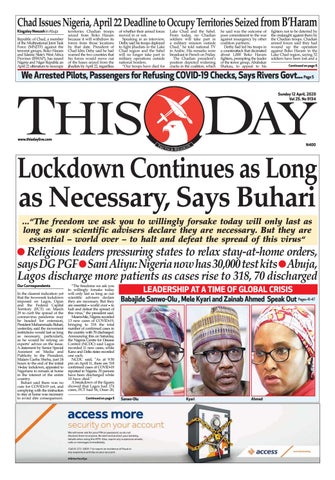
Chad Issues Nigeria, April 22 Deadline to Occupy Territories Seized from B’Haram
Kingsley Nwezeh in Abuja
Republic of Chad, a member of the Multinational Joint Task Force (MNJTF) against the terrorist groups, Boko Haram and Islamic State's West Africa Province (ISWAP), has issued Nigeria and Niger Republic an April 22 ultimatum to reoccupy
territories Chadian troops seized from Boko Haram because it will withdraw its forces from those locations by that date. President of Chad Idris Deby said he had warned the two countries that his forces would move out of the bases seized from the jihadists by April 22, regardless
of whether their armed forces moved in or not. Speaking in an interview, Derby said his troops deployed to fight jihadists in the Lake Chad region and the Sahel will no longer take part in military operations outside national borders. “Our troops have died for
Lake Chad and the Sahel. From today, no Chadian soldiers will take part in a military mission outside Chad," he told national TV in Arabic. His remarks were broadcast in French on Friday. The Chadian president’s position depicted widening cracks in the coalition, which
he said was the outcome of poor commitment to the war against insurgency by other coalition partners. Derby had led his troops in a counterattack that decimated about 1,000 Boko Haram fighters, prompting the leader of the terror group, Abubakar Shakau, to appeal to his
fighters not to be deterred by the onslaught against them by the Chadian troops. Chadian armed forces said they had wound up the operation against Boko Haram in the Lake Chad region, saying 52 soldiers have been lost and a Continued on page 5
We Arrested Pilots, Passengers for Refusing COVID-19 Checks, Says Rivers Govt... Page 5 Sunday 12 April, 2020 Vol 25. No 9134
www.thisdaylive.com TR
UT H
& RE A S O
N400
N
Lockdown Continues as Long as Necessary, Says Buhari ...“The freedom we ask you to willingly forsake today will only last as long as our scientific advisers declare they are necessary. But they are essential – world over – to halt and defeat the spread of this virus“
Religious leaders pressuring states to relax stay-at-home orders, says DG PGF Sani Aliyu: Nigeria now has 30,000 test kits Abuja, Lagos discharge more patients as cases rise to 318, 70 discharged Our Correspondents In the clearest indication yet that the two-week lockdown imposed on Lagos, Ogun and the Federal Capital Territory (FCT) on March 29 to curb the spread of the coronavirus pandemic may be headed for extension, President Muhammadu Buhari, yesterday, said the movement restrictions would last as long as necessary, particularly, as he would be relying on experts’ advice on the issue. A statement by Senior Special Assistant on Media and Publicity to the President, Malam Garba Shehu, just 24 hours to the end of the initial 14-day lockdown, appealed to Nigerians to remain at home in the interest of the entire country. Buhari said there was no cure for COVID-19 yet, and complying with the instruction to stay at home was necessary to avoid dire consequences.
“The freedoms we ask you to willingly forsake today will only last as long as our scientific advisers declare they are necessary. But they are essential – world over – to halt and defeat the spread of this virus,” the president said. Meanwhile, Nigeria recorded 13 new cases of COVID-19, bringing to 318 the total number of confirmed cases in the country with 70 discharged. Announcing this on Saturday, the Nigeria Centre for Disease Control (NCDC) said Lagos recorded 11 new cases, while Kano and Delta states recorded one each. NCDC said, "As at 9:30 pm on April 11, there are 318 confirmed cases of COVID-19 reported in Nigeria. 70 persons have been discharged while 10 have died." A breakdown of the figures showed that Lagos had 174 cases, FCT had 56, Osun 20, Continued on page 5
LEADERSHIP AT A TIME OF GLOBAL CRISIS Babajide Sanwo-Olu , Mele Kyari and Zainab Ahmed Speak Out Pages 41-47
Sanwo-Olu
Kyari
Ahmed
2
SUNDAY APRIL 12, 2020 •T H I S D AY
SUNDAY APRIL 12, 2020 • T H I S D AY
3
4
SUNDAY APRIL 12, 2020 •T H I S D AY
5
APRIL 12, 2020 • T H I S D AY, T H E S U N D AY N E W S PA P E R
PAGE FIVE
We Arrested Pilots, Passengers for Refusing COVID-19 Checks, Says Rivers Government TUC urges truce between state, FG over detention Chuks Okocha and Onyebuchi Ezigbo in Abuja, Ernest Chinwo in Port Harcourt The Rivers State Government has said it ordered the arrest of two pilots of Caverton Helicopters and their passengers because the company failed to provide the affected persons for tests by the state’s health authorities. The Commissioner for Information and Communications, Pastor Paulinus Nsirim, stated this yesterday in Port Harcourt while addressing journalists. Nsirim said Caverton Helicopters had ferried over 220 passengers into the state without allowing health professionals of the state government to ascertain their coronavirus status, despite a health emergency and a lockdown order in the state. The Caverton pilots had undertaken a trip to Port Harcourt to drop oil workers said
to be on essential duty when the state government arrested them for flouting a lockdown order put in place to check the spread of the coronavirus (Covid-19). Their arrest and detention caused a rift between the state and federal governments, with Minister of Aviation Hadi Sirika insisting the Governor Nyesom Wike government acted illegally because the workers had been authorised by the federal government. Sirika, who also spoke yesterday in Abuja at a Presidential Task Force on COVID-19 press briefing, said the pilots were on a national assignment. He stressed that the chairman of the taskforce, Boss Mustapha, had announced the exemption of oil and gas industry workers from the lockdown order in the national interest. Reacting to the standoff, the Trade Union Congress of
Nigeria (TUC) appealed to both the federal and Rivers State governments to moderate their stance on the issue of the arrested pilots and workers of Caverton Helicopters and Shell Petroleum to make for peaceful resolution of the squabble. Similarly, the main opposition Peoples Democratic Party (PDP) yesterday called for dialogue between the two parties. PDP National Publicity Secretary Kola Ologbondiyan said the party was deeply concerned that the aviation minister, who seemed more interested in politics than the safety of the citizens, was escalating an issue of protocol, which could have been managed through dialogue, to dangerous political dimensions. Explaining the position of the state, Nsirim said, “Contrary to the view being peddled by the Minister of Aviation, Alhaji
PDP calls for dialogue
Hadi Sirika, the two pilots of Caverton Helicopters and their 10 passengers were not arrested because they operated a permit granted them by the Ministry of Aviation. They were arrested because they constantly contravened the Executive Order issued by the Governor of Rivers State, His Excellency, Nyesom Ezenwo Wike, which requires that everyone coming into the state for essential duties subject themselves to mandatory health checks to ascertain their coronavirus status. “Before their arrests, the Rivers State Government issued several warnings to Caverton and other operators to ensure that their pilots and passengers are tested by Rivers State health authorities. Caverton Helicopters disregarded the warnings. “At the last count, Caverton Helicopters ferried over 220 passengers into the state without
allowing health professionals of the Rivers State Government ascertain their coronavirus status. They also refused to avail the state government their contacts, so they can be traced and tested.” The commissioner restated the administration’s commitment to the protection of the over six million citizens of the state, saying, “The Rivers State Government under the leadership of His Excellency, Nyesom Ezenwo Wike, remains committed to the protection of the over six million citizens of the state. We are not struggling to issue landing permits to airlines; neither are we contending for the control of the airspace. Therefore, the issue on ground has nothing to do with the Exclusive List. “The focus of the Rivers State government is to ensure that nobody under the guise
of transporting workers on essential services, ferries in persons who will compromise our health system. Therefore, these pilots and passengers must be subjected to health checks before they carry out their responsibilities. That is standard practice. “From all indications, it is clear that there is a plot to compromise the health of Rivers people. Otherwise, what is the motive for the grandstanding and the sponsorship of false editorials to mislead Nigerians by agents of the federal government? “The Rivers State government urges the federal government to direct all their business associates to subject themselves to health checks to ascertain their coronavirus status. On this premise, the Rivers State government is not prepared to compromise.”
fortnight ago. Buhari pledged the federal government's preparedness to release 70,000 tonnes of grain from the National Strategic Grain Reserves to cushion the effects of the lockdown, particularly on the poor, who survive mainly on daily wages. He appealed to Nigerians to observe rules spelt out by experts in the effort to contain the spread of the malignant disease through various sensitisation campaigns in the media. According to him, “We realise that today, there will be sons and daughters unable to visit their parents, and elders that are isolated from young ones. And there will be those who live day-to-day, eating as they earn, who face real and present suffering. “No elected government could ask more of the citizens of the country that elected them than today we ask of you. But we must ask you - once more - to observe restrictions on movement where they are in place, and follow the instructions of our scientists and medical advisers: stay home, wash your hands, save lives. “For those who suffer most egregiously, the government has announced multiple measures to assist: 70,000 tonnes of grain is being released from the National
Strategic Grain Reserves for distribution to those in most need; distribution of small cash payments are also being made, and will continue to be made by the federal government in the states and local government areas. “We ask you to listen and follow public announcements via the mass media for instructions as to how to receive this government support – and learn of more public assistance in the coming days." However, addressing the pressure being mounted on states by some religious leaders to end the movement restrictions, Lukman said it was a big risk for the country to take at this time. He stated, “Already, business as usual practices is making religious leaders to compel our leaders in government to relax the lockdown in many states and based on that, mosques and church congregations are returning with the high risks of getting the virus to spread faster in our society. “Chances are that should this be the case, once the spread produces the exponential figures of cases of positive persons and unfortunate deaths, citizens together with religious leaders will then turn and start blaming government. In return,
government may argue that it is because citizens refuse to observe social distancing and comply with directives of lockdown.” He alleged that the low engagement strategy by the Presidential Task Force (PTF) on COVID-19 was the reason citizens had not been able to own the fight against the pandemic. According to him, “Unfortunately, it will appear that low engagement strategy by the PTF on the COVID-19 campaign is also reducing citizens’ ability to own the fight against the spread in the country. This is not in any way passing any judgement on the leadership of the PTF in the fight against COVID-19 but to highlight areas requiring urgent attention in order that Nigeria is able to succeed in the fight against the spread of COVID-19.” Lukman said the PTF needed to broaden the scope of its membership and approach the question of expansion based on the strategy of using communication to mobilise the participation of everyone, both governmental and nongovernmental.
LOCKDOWN CONTINUES AS LONG AS NECESSARY, SAYS BUHARI Edo 12, Oyo 11, Ogun seven, Bauchi and Kaduna six each, Akwa Ibom five, Katsina four, Delta three, Enugu, Ekiti, Rivers, Kwara and Ondo two each, while Benue, Niger, Anambra and Kano had one each. Abuja and Lagos State, yesterday, announced that they had discharged four new COVID-19 patients, respectively, while Kano recorded its index case of the deadly virus. However, religious leaders in many parts of the country were said to have mounted pressure on state governments to relax the lockdown orders. But Director-General of the Progressive Governors’ Forum (PGF), Dr. Salihu Lukman, said given the poor state of hospitals in the country, the experiences of Italy, Spain, United States, and France might be a child’s play if government was unable to contain the spread of the virus. Although, National Coordinator, Presidential Taskforce on COVID-19, Dr. Sani Aliyu, sounded a note of optimism, when he disclosed that the country currently boasted about 30, 000 test kits for COVID-19. Aliyu admitted, however, that the kits were not enough for a country as large as Nigeria. In its reaction to the handling of the virus outbreak by the
All Progressives Congress (APC) federal government, the main opposition Peoples Democratic Party (PDP), yesterday, cautioned officials of the government against using the pandemic as gateway for corrupt enrichment, profiteering, and looting of the national treasury. PDP also appealed to all the anti-graft bodies to be on the look out. It called on the National Assembly to step up its oversight functions with a view to preventing an anticipated looting of the donations made by both corporate organisations and individuals. Buhari, while giving an update on the current health crisis in the country, said the government had the responsibility to enlighten its citizens "in this darkest hour," saying Nigerians must take responsibility for the fight against COVID-19. Although the president is yet to formally inform Nigerians of any intention to extend the current lockdown, his appeal barely 24 hours to the end of the initial 14 days of movement restriction in some areas, seems to be meant to prepare the minds of citizens for an extension of the stayat-home order. The statement said, “All that the government is asking you
to endure is because nowhere in the world today is there any known way of defeating this pandemic. There is no vaccine. And that means there are choices to be made: between continuing as usual, or accepting the restrictions even when they come with unintended consequences. “But at this darkest hour, it remains our duty to offer you the full and unvarnished truth: this is a global pandemic. Two hundred and ten countries and territories across the globe are affected. We cannot expect others to come to our assistance. No one is coming to defeat this virus for us. “Instead, the defeat of the virus in our country will be in our hands, alone. We cannot wait for others. We can only depend on ourselves now. And so we must – and we will – end this outbreak ourselves as Nigerians, together.” While highlighting the inconveniences Nigerians had been going through as a result of the lockdown, the president acknowledged the cooperation of the citizenry in promptly observing the restriction order. He stated that Nigerians should once more sustain the observance of the restriction that he placed on movements in Lagos, FCT, and Ogun a
Continued on page 8
CHAD ISSUES NIGERIA, APRIL 22 DEADLINE TO OCCUPY TERRITORIES SEIZED FROM B’HARAM thousand jihadists killed. The operation was launched after 98 Chadian soldiers were killed in a Boko Haram raid on a base at Bohoma in the lake's marshlands on March 23, the biggest one-day military loss in the country's history. The four countries bordering the lake – Nigeria, Chad, Niger, and Cameroon – and Benin Republic had in 2015 set up the military coalition, MNJTF, to fight Boko Haram. But Chad, which has some of the strongest armed forces in the Sahel, showed frustration with the MNJTF following the Bohoma losses. “Chad is alone in shouldering all the burden of the war against Boko Haram,” Idris publicly complained last weekend. In announcing the end of the offensive on Thursday, the army said its troops had expelled jihadists from Chadian soil and had advanced deep into Niger and Nigeria. Derby said he had warned those countries
that his forces would move out of bases seized there from the jihadists by April 22, whether their armed forces moved in or not. Army spokesman, Colonel Azem Bermendoa Agouna, told the AFP news agency that 52 troops died during the operation, which was launched on March 31. “A thousand terrorists have been killed, 50 motorised canoes have been destroyed,” Agouna said, referring to a large boat also called a pirogue. Agouna said the operation, which was launched after nearly 100 soldiers were killed in a Boko Haram attack last month, ended on Wednesday after the armed fighters were forced out of Chad. It was the first official snapshot of the outcome of Operation Bohoma Anger, launched after about 98 soldiers were killed on March 23 in the deadliest-ever attack by Boko Haram on the country's military
forces. The armed group had mounted a seven-hour assault on a Chadian army base at Bohoma. The Chadian expedition and declarations of Derby triggered a flurry of activities in Nigerian military circles. The Defence Headquarters said on Tuesday that Chad would not take the glory of Nigeria’s gallantry and contributions to the war against insurgency. Coordinator of the Directorate of Defence Media Operations, Major General John Enenche, said Nigeria was not slowing the pace of the war, as claimed by Derby. Enenche stated, “To say that we are slowing down the war is not true at all. By our mandate, you can go in pursuit of insurgents and criminals for 25 kilometres without consultation. “For His Excellency (President Derby) to say that is not right. They are playing their part of the game. It's not true.” Enenche said Nigeria fought
in Sierra Leone and other countries where it left a legacy of restoration of democratic rule and “somebody wants to take glory with 30 men. When you are in a situation like this and it is coming to an end, some people will be trying to take the glory. It is a distraction for a military to say I’m taking the glory. We have done so much there.” Army Spokesman Col Sagir Musa had issued a statement on Friday debunking claims that foreign troops were occupying Nigerian territory. Musa stated, “The Nigerian Army’s attention has been drawn to the statement now circulating on social media claiming the security and defence forces of Chad are deeply stationed in the islands of Niger and Nigeria, waiting to handover to the respective armies of these friendly nations. Nigerian Army wishes to state that there is no Chadian or any other foreign country’s
troops on Nigerian side of the Lake Chad or in any other part of the Nigerian territory. As a responsible organisation, the Nigerian Army finds it necessary to clear the wrong impression or misinformation for history and posterity as well as to avoid spreading falsehood and mischievous publications.” The army said regarding the Chadian onslaught on Boko Haram, “The operation was especially welcomed and supported by the Nigerian Army because it would deny the insurgent’s rear and logistics bases in Chad from where they often plan and launched attacks into Nigeria. It is hoped that the Chadian forces will sustain operations on their side of the border to permanently deny Boko Haram criminals of rear bases from where they can launch operations into Nigeria.” The statement further
declared, “For the avoidance of doubt, the Chadian Operation Bohoma Wrath took place only in Chadian territory and not on Nigerian territory. The Chadian security and defence forces did not cross into Nigerian territory during the operation and, thus, there are no Chadian troops holding any Nigerian territory. “The Nigerian military is fully committed and in total support of the continued cooperation between Cameroon, Chad, Niger and Nigeria to finally and speedily decimate Boko Haram/ISWAP criminals and put final end to terrorism in the region.” The statement said, “Members of the public are requested to disregard the claim and misleading information that the Chadian security and defence forces are deeply stationed in the islands of Nigeria waiting to handover.” It also said the Chief of Army Staff, Lt General Tukur Buratai, had relocated to the North-east.
6
SUNDAY APRIL 12, 2020 •T H I S D AY
SUNDAY APRIL 12, 2020 • T H I S D AY
7
8
APRIL 12, 2020 • T H I S D AY, T H E S U N D AY N E W S PA P E R
NEWS LOCKDOWN CONTINUES AS LONG AS NECESSARY, SAYS BUHARI The director-general added that communication should not be about simply passing information to citizens about what government is doing, but more about accommodating the views and interests of Nigerians through their representatives. He said it was good to have all senior federal government functionaries driving the process and consulting other arms of governments – National Assembly and governors – adding that this could be strengthened by going beyond consultations. He stated, “The reality is that consultation alone, will hardly produce the needed ownership and synergy of initiatives even within governmental structures. In fact, one can argue that some of the critical observations of the leadership of the National Assembly from the session with the Minister of Humanitarian Affairs and more recently with the PTF on Thursday, April 9, 2020 are a confirmation of the limitations of consultations. “What is required is that, depending on the terms of reference of the PTF as given by the president, the PTF should consider co-opting members of the National Assembly to join the committee.”
Nigeria Has 30,000 Test Kits The National Coordinator, Presidential Taskforce on COVID-19, Dr. Sani Aliyu, said Nigeria now had about 30, 000 test kits for the virus. Aliyu, who spoke on ARISE Television, however noted that given the population of Nigeria, the kits might not be enough. He said the federal government was not relenting in its efforts to secure more test kits for the country, assuring that in the coming weeks, Nigeria would get more kits. Aliyu stated, "We now have up to 10 laboratories across the country. We are now testing over a thousand, the last time I checked it was 1, 500 a day. "There are three labs in Lagos going at full throttle. Some of the labs are operating 24 hours a day with shifts. We have escalated testing. But there is a challenge with test kits and every country wants it. "We currently have a pool of about 30, 000 test kits, but certainly not enough for a country the size of Nigeria." He said NCDC was exploring all necessary avenues to scale up testing, explaining that government is willing to partner the private sector in this regard. "All our concern is to get reliable and safe results and make sure that people are not exposed unnecessarily to bio hazards,” Aliyu said. He added, "We will be willing to work with private labs to carry out more tests. I know there is a private lab in Kaduna about to be signed up or has been signed up. There are also private labs in Lagos that we can collaborate with. We are all in this together. It does not have to be a government-owned lab. "What is important is that it is safe, they have all the biosafety security issues intact, they also have quality assurance, that is, if we get the result, we can rely on it, they also have the right skills set in terms of the people carrying out these tests. "We have to be absolutely sure that if the result is positive, it is positive. It is even more risky if a positive result turns out to be negative, because it means that person will continue to transmit to others." He noted that molecular labs were not easy to set up, because it would require a highly skilled workforce. According to him, "You cannot
overnight create a molecular lab; they are expensive; they require highly skilled labour. We are amenable to private organisations willing to extend their facilities for this. It will help us to identify more of these cases and identify them and control the spread of the virus." Apart from test kits, Aliyu said Nigeria also needed virus transport mediums, which he said was a challenge a few days ago, adding that a government agency was already partnering another entity to produce them locally. "If we do all these, we will be able to bring the test closer to the community that needs them rather than having to transport samples on a long distance," he added. Aliyu appealed to members of the public with symptoms to come forward saying, 80 per cent of the people with COVID-19 would be fine. He stated that in China, 92 per cent of the infected patients survived. He disclosed that NCDC had reached about 90 per cent of the contacts of positive cases in the past few weeks. According to him, "This is really good. But at the same time, we have this feeling that there may be a lot more that we have not been able to reach, may be because people are worried that if they test positive we will have to isolate them. “We will isolate them in a humane way. We are not going to lock you up as if you are in prison. We consider and respect all your rights. The only thing is to have a physical barrier between you and the rest of the society so that you can be looked after in a safe way."
Abuja, Lagos Discharge Four More Patients Each The FCT and Lagos State announced the discharge of four more patients each from the coronavirus isolation centres. The FCT Ministerial Expert Advisory Committee on COVID-19 made this announcement on Saturday, and said the patients had been admitted in the isolation centres at the University of Abuja Teaching Hospital, Gwagwalada. Last week, the first set of patients numbering seven were discharged by the FCT. Given the latest recoveries, the number of patients in Abuja that have recovered from the respiratory contagion now stands at 11, even as the FCT accounts for 50 of the country's 305 COVID-19 cases. In Lagos, four patients, including an 11-year-old boy, were discharged from the Infectious Disease Hospital, Yaba, and Lagos University Teaching Hospital (LUTH). Governor Babajide SanwoOlu, who announced the developments, expressed delight that the state had successfully managed and discharged 50 COVID-19 patients. Sanwo-Olu said, “Today, four more patients, all male, including an 11-year-old boy, have been discharged from the Lagos State isolation facilities to reunite with the society. “The patients, three from Mainland Hospital, Yaba, and one from the Lagos University Teaching Hospital (LUTH), were discharged, having recovered fully and tested negative twice consecutively to #COVID19 “This brings to 50 the number of patients successfully managed and discharged from the Lagos State isolation facilities. I appeal to residents to stay at home, practise Social Distancing Principle and observe highest possible personal and hand hygiene. We are on steady course to victory, let’s all make
little sacrifices for the greater good.” Meanwhile, the FCT Minister, Malam Muhammad Bello, urged Christians in the territory to use the occasion of Easter to pray for an end to the COVID-19 pandemic, which has claimed thousands of lives across the world. Bello made the appeal on Saturday in an Easter message to residents, according to a statement by his Chief Press Secretary, Anthony Ogunleye.
Kano Records First Case Kano State, yesterday, recorded its first case of COVID-19. The patient, a former diplomat, was said to have developed the symptoms after he returned from Abuja eight days before. On his return, it was gathered that he started feeling sick and submitted himself to the Kwanar Dawaki isolation centre, where his blood sample was taken and the result came back positive for coronavirus. Although it was a mild case, the patient was admitted at the isolation centre for treatment. The Commissioner for Health, Dr. Kabiru Tsanyawa, confirmed the case. The Special Adviser on Media to the Governor, Mr. Salihu Yankasai, corroborated it when he wrote on his Twitter handle, "Kano has recorded its first case of COVID-19. "The index case lives around UDB Road in Kano. He returned from Abuja on the eve of the border closure in the state. All those close to him have been tested and are awaiting results. He is currently at Kwanar Dawaki Isolation Centre." He said Governor Abdullahi Ganduje had held a meeting with health officials to inform the public officially. A combined team of security agents had since blocked the road leading to the private hospital, where the patient was quarantined.
PDP to FG: Stop Profiteering, Looting With COVID-19 PDP cautioned officials of the APC-led federal government to stop using COVID-19 as gateway for profiteering and looting of the treasury. The party appealed to all anti-graft bodies to be on the look out. A statement by National Publicity Secretary of PDP, Kola Ologbondiyan, said, "Our party is worried over the activities of certain officials, who are using the COVID-19 pandemic to create and manipulate situations that circumvent financial documentation and accountability rules and pave way for the looting of our treasury and borrowed funds, while the people are left at the mercy of the plague. "This is in addition to anxieties that such officials are hiding under the demands of COVID-19 pandemic to mop up our international reserves as well as driving our nation into a frenzied $6.9 billion foreign borrowing, with no clear-cut terms. "This is amidst allegations of plots by unscrupulous officials to manipulate the system and create channel for a slush fund that will be diverted to corrupt APC leaders and the cabal, while mortgaging the future of our nation's generation yet unborn." The opposition party said it was afraid there were attempts to hide under COVID-19 to empty Nigeria’s $3.4 billion International Monetary Fund (IMF) savings, thereby leaving the nation dry. It said while it was obvious the Buhari administration sought to use the challenges posed by the coronavirus pandemic as an
excuse for its mismanagement of the economy, which it had wrecked before the outbreak of the pandemic, the party firmly rejected the attempt by rogues in government circles to use the scourge to “cash out” the treasury and further destroy the economy. PDP said, "Our party invites Nigerians to note that, while a handful of Nigerians have not acknowledged receiving such funds and officials involved have not been able to account for the disbursement, humongous figures are already being bandied to have been spent. "The situation is pathetic and shows how low the social investment programme, which the First Lady, Aisha Buhari, had earlier warned as being riddled with corruption, had degenerated." PDP urged the National Assembly to protect the citizens by immediately scaling up its oversight activities on the handling of the COVID-19 social intervention funding. It said the legislators must ensure clauses that guaranteed transparency and accountability, particularly in drawing from the treasury as well as in approving any further foreign loans for the Buhari administration, were enshrined in the laws. It also charged the Economic and Financial Crimes Commission (EFCC) as well as the Independent Corrupt Practices and other Related Offences Commission (ICPC) to set up special squads across the country to monitor the implementation of the palliatives and bring culprits to book.
Ilorin Emir Urges Obedience to Lockdown, as Kwara Moves to Acquire 30 Ventilators The Emir of Ilorin and Chairman, Kwara State Traditional Council of Chiefs, Alhaji Ibrahim Sulu-Gambari, charged Kwarans, particularly, the people of Ilorin Emirate, to remain calm and obedient to constituted authorities during and after the lockdown in the state to curb the spread of coronavirus. The Emir gave the charge in a statement by his spokesman and Magaji Nda of Ilorin, Alhaji Saliu Woru Muhammed. He advised the Chiefs, District Heads, community leaders, groups and associations to imbibe the culture of personal hygiene and communicate same to inhabitants of their respective communities so as to remain safe and healthy. He acknowledged the adverse effects of the lockdown but expressed optimism that such decision will impact on the health and wellbeing of the citizenry in the long run. The traditional ruler appealed to security agencies to be civil in their conducts and cautioned citizens not to run foul of the regulations spelt out to contain the pandemic. The Kwara State government said it had concluded plans to acquire 30 ventilators before the end of this month, in addition to the 10 existing ones, to be able to attend to COVID-19 patients, who might require them. Besides, the state refurbished its oxygen plant that last worked at required purity level in 2011.
Kwara currently has two COVID-19 cases, both of who are asymptomatic at the moment. Speaking with journalists in Ilorin shortly after the handover of the state's oxygen plant for use, Governor Abdulrahman Abdulrasaq said, “We have
bought five new ambulances (three on the ground and two are on the way). We have 10 ventilators now and we expect to have 30 by the end of the month and that’s one of the highest in the country today, because Kwara had no ventilator until now. "This facility comes handy at this time. If for whatever reasons any of our patients require oxygen, Kwara does not need to buy oxygen from any private sources or other states. In fact, the plant’s capacity is such that we can sell to private hospitals and some other states.” Meanwhile, the state's Technical Committee on COVID-19 said it had so far received N98, 469,880 in donations from corporate organisations and private individuals in support of fight against COVID-19 in the state. A statement in Ilorin yesterday by the spokesman of the committee, Mr. Rafiu Ajakaye, said, "The latest donors included the AlHikmah University (N5m); Into-University Educational Consult (100,000); Prince Victor Kolade (Victor Signs) (N100,000); Peter Pelumi Bamidele (N1,000); Amolegbe Oluwadamilola Fatimah (10,000); Promakar Farms Nigeria Limited (10,000); Aiyelabegan B. Rasaq (N2,000); Inyang Victor (N100,000); Amasa Mukhtar Olaide (20,000); and Suleiman Sadiq Umar (N500,000). “We commend everyone, who has donated to this humanitarian cause whether in cash or in kind. We thank every indigene and resident of Kwara for staying the course. We assure them that we will definitely come out of this stronger and better together.”
Ondo Backtracks, Orders Lockdown During Easter Following massive displeasure expressed by residents of Ondo State over a planned relaxation of the anti-COVID-19 restrictions by the government, the state has now cancelled the special concession it granted churches to hold Easter Sunday services. In a statement made available to THISDAY, the Commissioner for Information and Orientation, Donald Ojogo, said the development followed fresh concerns raised after the state discovered its second case of COVID-19. Ojogo stated, “This development has, once again, reinforced the need to deepen our collective efforts to combat the COVID-19 pandemic. The Ondo State COVID-19 Response Team has reported that the second index case, having travelled from Lagos to Ondo State, must give the government greater concern to avoid community transmission.” Against this backdrop, he said, “Ondo State Government has directed the cancellation of the special concession granted churches across the state to celebrate the Easter Sunday/ Service. This decision was taken after due consultations with the leadership of the Christian Association of Nigeria (CAN).” The state government noted that all measures and steps taken in respect of COVID-19 remained in force.
Niger Declares Two Weeks Total Lockdown Niger State Government declared a total lockdown of the state for two weeks as part of measures to contain the spread of COVID-19. Announcing this after an emergency executive council meeting in Minna, Saturday, Governor Abubakar Bello said
the decision became necessary after the confirmation of one positive case of COVID-19. The lockdown commences Monday, April 13. "The patient is a returnee from Lagos State and resides at Limawa community in Minna. Limawa community will also be in isolation for the two weeks period with health workers engaged to sensitise its residents within the period," Bello said. He said all religious gatherings in churches and mosques had been suspended till further notice, adding that he regrets the earlier decision to relax the restriction order in place. "We are liaising with local tailors association in the state for production of face masks in view of the scarcity of the items. Health workers would also be engaged at strategic points with thermometers to carry out regular temperature tests," the governor stated. He said palliatives would be provided for the poor in the society, warning politicians not to hijack the items by the time they are released.
Omo-Agege Gives N85m Cash Palliative to Constituents Deputy President of the Senate, Senator Ovie Omo-Agege, donated N85 million cash as palliative to his constituents in Delta Central Senatorial district in the wake of the coronavirus lockdown in the state. OmoAgege, according to a release issued on Saturday by his spokesman, Yomi Odunuga, has commenced the disbursement of the cash to some low income persons across the eight local government areas in Delta Central senatorial district, namely Ethiope East, Ethiope West, Okpe, Sapele, Ughelli North, Ughelli South, Udu and Uvwie. The exercise commenced in Kokori Inland in Ethiope East Local Government Area on Saturday, with cash being distributed to individuals at their homes without discrimination.
All COVID-19 Patients in Edo Stable The Edo State Commissioner for Health, Dr. Patrick Okundia, assured that all the 11 coronavirus patients in the state were stable and responding well to treatment, noting that the state is ready to handle the worst-case scenarios. Okundia, who spoke to journalists in Benin City, said some of the confirmed cases were being managed at the University of Benin Teaching Hospital (UBTH) and the Irrua Specialist Teaching Hospital (ISTH). According to him, since the outbreak of the virus, Edo State has recorded a total of 76 suspected cases, 12 confirmed cases, and one death, while 289 contacts have been line-listed. He said the suspected cases were from Oredo (30), Esan West (16), Egor (six), Esan Central (eight), Ikpoba-Okha (five), Esan North East (four), Etsako west (three), Ovia North East (two), Owan West (one), and Orhionmwon (one) local government areas. The commissioner said of the 12 confirmed cases, four were from Oredo Local Government Area; four from Esan West Local Government Area; three from Egor Local Government Area, and one from Ovia North East Local Government Area. Okundia urged residents to observe social distancing and comply with other state government’s directives aimed at preventing further spread of the coronavirus pandemic.
T H I S D AY, T H E S U N D AY N E W S PA P E R ˾ APRIL 12, 2020
9
EDITORIAL
Editor, Editorial Page PETER ISHAKA Email peter.ishaka@thisdaylive.com
EASTER IN A PANDEMIC SEASON We should assist the weak, the hungry and the suffering in our midst
T
oday’s Easter, an annual Christian festival that commemorates the resurrection of Jesus Christ, is a historic one. It is the first in living memory being marked in private homes rather than in churches and other places of worship, owing to the restrictions placed on public gatherings to stop the spread of COVID-19 pandemic. It is therefore a season that calls for a deeper reflection on the real essence of human existence. As Pope Francis said recently, “today in the tragedy of a pandemic, in the face of the many false securities that have now crumbled, in the face of so many hopes betrayed, in the sense of abandonment that weigh upon our hearts, Jesus says to each of us: Open your heart to my love, you will feel the consolation of God who sustains you.” Nothing indeed depicts the unusual time that we are in than the closure to the public in Jerusalem, for the first time in centuries, of the Church of the Holy Sepulchre—where Christians believe that Jesus was crucified, buried and resurrected. Notwithstanding, the message of the Cross rings ever true. As a result of COVID-19 pandemic, many people across the world are experiencing “fear and uncertainty, as well as trauma, separation, isolation, loss of members or even death in their families or in their church communities”, according to the World Council of Churches. “Yet, despite these traumatic and painful situations, the message of Easter continues to be a joyful one of courage and hope.” If there is any lesson from the experience of
recent weeks, it is that we must erect a framework of human solidarity in order to render assistance to the weak, the hungry and the suffering in our midst. That is the message of Easter which will serve all our people, as we unite to fight the virus that has disrupted our world. With the growing poverty and human misery occasioned by the coronavirus global lockdown, we commend the humanitarian gestures that we have seen from many Nigerians and corporate bodies. The statement these generous donors are making is that the intrinsic worth of the human person takes precedence over every other thing. The donors are saying that we are members of the same human family irrespective of our differences.
With the growing poverty and human misery occasioned by the global lockdown, we commend the humanitarian gestures that we have seen from many Nigerians and corporate bodies
Letters to the Editor
W
T
S U N DAY N E W S PA P E R EDITOR SHAKA MOMODU DEPUTY EDITORS OLAWALE OLALEYE, TOBI SONIYI MANAGING DIRECTOR ENIOLA BELLO DEPUTY MANAGING DIRECTOR KAYODE KOMOLAFE CHAIRMAN EDITORIAL BOARD OLUSEGUN ADENIYI EDITOR NATION’S CAPITAL IYOBOSA UWUGIAREN MANAGING EDITOR JOSEPH USHIGIALE
T H I S DAY N E W S PA P E R S L I M I T E D EDITOR-IN-CHIEF/CHAIRMAN NDUKA OBAIGBENA GROUP EXECUTIVE DIRECTORS ENIOLA BELLO, KAYODE KOMOLAFE, ISRAEL IWEGBU, IJEOMA NWOGWUGWU, EMMANUEL EFENI DIVISIONAL DIRECTORS BOLAJI ADEBIYI , PETER IWEGBU, ANTHONY OGEDENGBE DEPUTY DIVISIONAL DIRECTOR OJOGUN VICTOR DANBOYI SNR. ASSOCIATE DIRECTORS ERIC OJEH, PATRICK EIMIUHI ASSOCIATE DIRECTOR SAHEED ADEYEMO CONTROLLERS ABIMBOLA TAIWO, UCHENNA DIBIAGWU, NDUKA MOSERI DIRECTOR, PRINTING PRODUCTION CHUKS ONWUDINJO TO SEND EMAIL: first name.surname@thisdaylive.com
he sacrifice, love, mercy and unity that the death and resurrection of Jesus Christ exemplified are some of the enduring values of Easter that transcend doctrine and are worthy of emulation by all Nigerians. The mystery of today’s celebration is anchored on the fact that Jesus chose death because that was the penalty to which all in the flesh were liable on account of sin. In taking this path Jesus was able to bring salvation to mankind. As we therefore rejoice in His resurrection, we must also pause and reflect on the sacrifice of the cross. A day such as this also calls for us to rededicate our energy to the promotion of the common good as we seek to build a new society where the health of one is important to all. Perhaps more than at any period in history, it is important that Nigerians use this season to reflect on things that bind us together rather than on those that divide us. We must use religion not only to strengthen our nationhood but as a vehicle for deepening harmony. Besides, Easter’s enduring message, which is about love, can be transmitted by sharing with the less privileged of our society not only material possessions but also through simple gestures like kind words and sincere smiles. Unfortunately, that is where we fail most miserably. And the tragedy of that failure can be seen in practically all aspect of our national life. But we can, and must rewrite our story. As the message of a resurrected Jesus Christ continues to give hope, peace and strength to people around the world, we wish all our readers a very happy Easter.
TO OUR READERS Letters in response to specific publications in THISDAY should be brief (150-200 words) and straight to the point. Interested readers may send such letters along with their contact details to opinion@thisdaylive.com. We also welcome comments and opinions on topical local, national and international issues provided they are well-written and should also not be longer than (950- 1000 words). They should be sent to opinion@thisdaylive.com along with the email address and phone numbers of the writer.
Digital Forensics: Window to Our Digital DNA
e have a plethora of digital devices to choose from these days and the list is exponentially growing. There are newer versions of smartphones, tablets and other cool computing devices being manufactured and released for our use in an increasingly advancing and complex tech and digital age. While this trend represents progress and advances being made in the digital ecosystem, many tech users are oblivious of the fact that these devices are providing a “Window to Our Digital DNA”. DNA stands for Deoxyribonucleic Acid. We know it is the genetic code that determines all the characteristics of any living thing. In the
field of forensic science and the administration of justice that involves the settlement of disputes or the solving of mysteries, we know the value of DNA evidence in providing answers to investigative cases where truth about an incidence has to be established. In this world, to avoid the miscarriage of justice, the use of DNA evidence has the potential to provide either inculpatory or exculpatory evidence; that is serving as the basis for convicting an accused or setting him free. Therefore, much like DNA evidence, digital forensics has the potential to serve as the key to unlocking the truth in every investigative case to which the science of forensic computing can be applied. Through the examination of
digital patterns and binary codes, an investigator can link a suspect’s digital DNA to him or her. Hence, we can safely regard digital forensics as the tool and weapon for finding answers and resolving cases in our ever-expanding cyber- criminal landscape. As today’s crimes are being committed while people carry their smart devices or computing devices in their pockets and bags, little do they realize that their every step is recorded and can be traced. This is where digital forensics play a vital and detective role. Planned and executed both on and offline, digital bread crumbs are always created and dropped everywhere regarding the crimes people commit. As the wave of criminal activities
continue to grow, this clearly translates to need for the adoption of forensic investigation techniques and engagement of qualified digital forensic investigators. What makes your digital DNA unique? How is it created? Your digital DNA is born or created the moment your digital device becomes activated. As the activation is complete and you begin the process of customizing your preferences on the device, the unique difference between your phone or device from all others existing is born. From this moment on and inclusive of all the actions taken on, with and through the device, your digital journey begins. In our world where actions convey messages louder than words, a digital device with the right application of digital forensics investigative methodology can establish one’s pattern of digital
behavior that law enforcement, officers of the jury, corporate organizations can utilize to create a profile of who a person of interest might be. This trove of digital artifacts can be invaluable in deciding cases where we are presented with actions and in-actions of any individual of interest. Digital forensics, especially mobile digital forensics, has the potential to give to only machine generated digital data unique to a device, but also to its user or owner and other associated footprints. This is where smart, dedicated and well-trained people who use proven software and established procedures excel at bringing a culprit to justice and making our world less of crime. ––Dr. Ehiwe D. Dominic, Consultant, Digital Forensic & Open Source Intelligence.
10
T H I S D AY, T H E S U N D AY N E W S PA P E R ˾ ͯͰ˜ ͰͮͰͮ
NEWS
Acting News Editor ÌÙãÏÑË ÕÓØÝËØ×Ó E-mail: ÑÌÙãÏÑ˲ËÕÓØÝËØ×Ó̶ÞÒÓÝÎËãÖÓàÏ˛ÍÙט;ͽ ̙Ý×Ý ÙØÖã̚
Buhari Contravenes NNPC Act in Board Constitution Act recommends only six members, not nine Board’s decision may be set aside, warns Falana
Gboyega Akinsanmi The constitution of the Nigerian National Petroleum Corporation (NNPC) Management Board by President Muhammadu Buhari violated the Act establishing the corporation, findings by THISDAY have revealed. As shown in section 2(1),
findings further revealed that the NNPC Act only recommended a six-member board of directors contrary to nine members currently serving on the management of the state-owned oil corporation. Section 2(1) stated that the affairs of the corporation “shall, subject to Part II of this Act, be conducted by a Board of Directors
of the corporation which shall consist of a chairman and the other members.” Evident in section 2(1a-c), the Act lists other members to include a) the Director-General, Federal Ministry of Finance and Economic Development; b) the Managing Director of the Corporation; c) three persons to be appointed by the
National Council of Ministers. The Act, specifically, stipulated that all the board members “shall be persons who by reason of their ability, experience or specialised knowledge of the oil industry or of business or professional attainments are capable of making useful contributions to the work of the corporation.”
SUCCOUR FOR THE NEEDY... Octogenarian, Mama Mopelola Sotola receiving a pack of food and other relief materials from Ogun State Governor Dapo Abiodun at Oju Ogbara area of Ago Oko in Abeokuta, Friday
Section 3 of the Act, statutorily, stated that the Chairman of the NNPC Board of Directors “shall be a Minister in the Government of 1979 No. 44 the Federation to be known and styled as the Minister of Petroleum Resources.” Consistent with the records obtained from the official website of the corporation on Friday, eight members were listed as the members of the NNPC Board of Directors apart from the Minister of State for Petroleum Resources, Chief Timipre Sylva. According to the NNPC website, the NNPC Board is headed by the former NNPC GMD, Dr. Thomas M.A. John and constitutes 7 other members. With the disengagement of former Minister of State for Petroleum Resources, Dr. Ibe Kachikwu on June 27, 2019, Buhari appointed John as the acting alternate chairman of the NNPC Board of Directors. Since Sylva’s appointment as Minister of State for Petroleum Resources on August 2019, the website has yet to provide information that shows Sylva as the alternate chairman of the NNPC Board of Directors. As shown on the website, other members of the management board include the NNPC Group
Managing Director, Malam Mele Kyari; Chief of Staff to the President; Mallam Abba Kyari; Permanent Secretary, Federal Ministry of Finance, Alhaji Mahmoud Isa Dutse; Dr. Pius O. Akinyelure; Dr. Tajuddeen Umar; Mallam Mohammed Lawal and Mallam Yusuf Lawal. Apart from violating the NNPC Act, the board also comprises three members from North-east, two from South-south, one from North-central and two from North-west in violation of the Federal Character Commission (Establishment) Act, 1995. The representation is as follows: Timipre Sylva (South-south), Thomas John (South-south), Mele Kyari (North-east), Abba Kyari (North-east), Tajudden Umar (Northeast), Isa-Dutse (North Central), Mohammed Lawal (North-west), Yusuf Lawal (Northwest) and Dr. Pius O. Akinyelure (South-west). By implication, the board’s constitution breaches the Federal Character (Establishment) Commission Act, which seeks to promote, monitor and enforce compliance with the principles of the proportional sharing of all bureaucratic, economic, media and political posts at all levels of government.
Easter: Obi, Fayemi, Zulum Call for Perseverance Amid Adversity Our Correspondents The 2019 vice presidential candidate of People’s Democratic Party (PDP), Mr. Peter Obi; Chairman, Nigerian Governors Forum, Dr. Kayode Fayemi, Lagos State Governor, Mr. Babajide Sanwo-Olu and his Imo State counterpart, Senator Hope Uzodinma, among others, yesterday urged Nigerians not to despair but to be steadfast in the face of adversity. Also, Alhaji Adegboyega Oyetola of Osun State, Senator Bala Mohammed of Bauchi State; Mr. Ifeanyi Ugwuanyi of Enugu State; Prof.
Babagana Zulum of Borno State and a leader of All Progressives Grand Alliance (APGA), Mr. Alex Otti and Globacom urged Nigerians to use the period of Easter to pray for the healing of the COVID-19 patients. In a statement from his media office yesterday, Obi lamented that Christians “are marking this great season under this circumstance that we cannot even worship in our various churches because of a virus disease.” Obi explained that the pandemic indeed threw “a huge challenge that we must reflect on our existing
relationship with God. We must therefore in the joy of Easter intensify our prayers for peace in the country.” Obi, a former governor of Anambra State, charged Nigerians not to allow the prevailing hardship in the country arising from COVID-19 pandemic to affect their spirit of love, brotherliness and peaceful co existence. Rather, Obi said the uncommon situation at this period of Easter “provides good opportunity for Nigerians to pray more to God to send succour to clear the virus and alleviate
their sufferings.” In a statement by its Corporate Communication Office, Globacom urged Nigerians across the federation to use the period of Easter to pray for the victims of COVID-19 pandemic and God to heal the world. Globacom, Nigeria’s second largest mobile network operator, also prayed to God to grant families who have lost loved ones to the pandemic in Nigeria and abroad the fortitude to bear the painful losses. Globacom said: “Let us use this Easter period to further reflect deeply on the sacrifice that Jesus Christ made
on the cross. This sacrifice is a pointer to the fact that God cares for the human race at all times and has plans for their redemption from sin and all evils. This should rekindle hope in our hearts at this difficult time.” It also urged Nigerians “to remember to wash their hands regularly and use alcohol-based sanitizers; eschew unimportant travels and refrain from holding or attending large gatherings” as prescribed by the World Health Organisation (WHO) and the Nigeria Centre for Disease
Control (NCDC) towards safeguarding their health against contracting the deadly disease. “On the Glo network, subscribers can access attractive offers including the Sunday data plan that offers 1.2GB for N200 on Sundays, the Glo Ambo which gives customers five times the value of recharge to call any network and Stay Home Data plan that gives subscribers up to 20 percent more data.” Fayemi, in a goodwill message in Ado-Ekiti yesterday, said witnessing the Easter is a special grace from God in view of prevailing situation all over the world.
FBN Holdings, Sanlam Group Still in Talks over Insurance Arm
Lagos, Doyin Group Residents to Observe Restriction Order
Ugo Aliogo
Segun James
The Management of FBN Holdings Plc is still in talks with Sanlam Group, an institutional shareholder in FBNI Insurance over possible sale of FBN’s 65 percent stakes in the insurance entity, THISDAY has learnt. Besides, THISDAY findings revealed that the financial institution was considering the option as part of a strategic move to concentrate more on its core banking business. This indication became evident on Monday when FBN Holdings Plc formally notified the Nigerian Stock Exchange (NSE) as statutorily required of the ongoing discussions to divest her 65 percent stakes in one of its subsidiaries, FBN Insurance subject to all regulatory approvals. An authoritative source at the National Insurance Commission
(NAICOM) who spoke to newsmen on condition of anonymity confirmed that the two institutional shareholders are still in talks. A source at the commission said: “We are aware that FBN Holdings and Sanlam Group are still very much in talks. They have kept us abreast of the ongoing discussions.” The source added that nothing “has been concluded. What FBN Holdings has done is just performing a requisite statutory notification to the Nigerian Stock Exchange when listed companies are embarking on such transactions. “They will still return to us here at NAICOM as the regulators of the insurance business for a final sign off. When consummated, the transaction will witness the transfer of FBN Holdings’ 65 percent stake in FBN Insurance Plc to the group’s long-standing institutional investor, the Sanlam Group.
“The group is one of the largest financial services groups in Africa with over 100 years Insurance business experience and presence in 44 countries across the world and an unmatched heritage of leadership and excellence along the way. Sanlam belongs to the top three exclusive leaders club in insurance business in 11 African countries. “The Sanlam Group, which already holds 35 percent stake in FBN Insurance company will then take over the running of FBN Insurance as its full fledge subsidiary. “The transaction has so far involved extensive negotiations and thorough due diligence undertaking, both done in strict compliance with the regulatory requirements and intended to benefit all stakeholders.
The Lagos State Government yesterday pleaded with residents to observe the stay-at-home order in a bid to overcome the battle against COVID-19. Also, Nigeria’s leading manufacturing industry, Doyin Investments donated thousands of packs of noodles to the state as palliative measure to cushion the economic hardship brought upon the residents by the lockdown. The Deputy Governor of the state, Dr. Obafemi Hamzat gave the advice yesterday when he visited the Eti-Osa Isolation Centre alongside the Commissioner for Health, Prof. Akin Abayomi and Commissioner for Justice and Attorney General, Mr. Moyosore Onigbanjo (SAN). During the visit, the deputy governor expressed satisfaction
with the facilities at the isolation centre, but urged all the residents of the state to comply with the state sit at-home order. He said: “With the cooperation of people, we shall defeat this common enemy. The essence of the restriction order is to prevent the spread of the pandemic. The government did not make the order to punish people, but to ensure their safety at this period of adversity.” In a statement on Friday, CEO of Doyin Investments, Prince Samuel Adedoyin donated food items to Lagos State through the Managing Director of Doyin Investments. Adedoyin said the relief materials “is made available to assist the people in Lagos State to battle hunger caused by the lockdown, which has crippled commercial activities in Lagos State. “As we witness a rapidly
increasing number of cases of the Coronavirus in the country, we have to work hand in hand in stemming the spread of the global pandemic. I also prayed for quick recovery of those tested positive for the coronavirus already, who are receiving treatment in our various isolation centres in Lagos and Nigeria.” He enjoined all Nigerians to follow the stipulated health guidelines by the Federal Ministry of Health and the Nigeria Center for Disease Control (NCDC) in order to keep us all safe and healthy. “We equally commend the efforts of our state governors in the Southwest, and we are keen to contribute our resources as representative and individual to the collective effort that will ensure the response to the pandemic is swift and effective,” Adedoyin said.
SUNDAY APRIL 12, 2020 • T H I S D AY
11
12
SUNDAY APRIL 12, 2020 •T H I S D AY
SUNDAY APRIL 12, 2020 • T H I S D AY
13
14
T H I S D AY, T H E S U N D AY N E W S PA P E R ˾ APRIL 12, 2020
OPINION
NOW THAT WE ARE HOME
It is the time to think about our errors as a people, writes Akin Rotimi
I
n the wake of the COVID 19 pandemic, Nigeria’s President Muhammadu Buhari on March 29, 2020, announced a 14-day lockdown of Lagos and Ogun States, as well as the Federal Capital Territory, Abuja, as part of physical distancing measures (there is growing consensus that this is a more appropriate term than social distancing) aimed at containing the pandemic in Nigeria. Many other state governors have similarly exercised their powers to lockdown their states with hints that the stay-at-home orders might be extended beyond the initial two weeks. Measures in Nigeria have followed a global pattern as leaders are in a frenzy to get ahead of the crisis that caught even the most advanced countries in the world napping, and has been called the Worst Intelligence Failure in US history. While some parts of the world have been harder hit, no country is left out of the COVID 19-induced quagmire. Economies around the world have literally shut down and health systems overwhelmed. Sports – the great unifier and source of joy to many, like every other human endeavour has been hard hit, and the global gloom is deepened by the putting off of major sporting events including the Tokyo 2020 Olympics, with the only such precedent being during World Wars 1 and 2. Stadia around the world like the famous Maracana stadium in Rio de Janeiro have been turned to emergency hospitals, just like other iconic public places such as the Central Park in New York and the Excel Convention Centre in East London that had been turned into a 4,000-bed makeshift hospital for the United Kingdom’s NHS. The crisis has exposed Nigeria’s fragile healthcare delivery system, which is an indictment on our leaders past and present who preferred spending our commonwealth as medical tourists in foreign countries to building our hospitals. Now all Nigerians, rich and poor, are locked in. But that is the extent of our common fate. Wealthy Nigerians are enjoying this stay-cation making bopdaddy videos behind high walls, far from the realities of the untold suffering of the majority. The lockdown has therefore been criticised as inimical in the Nigerian context because of the socio-economic portends for the masses many of whom depend on daily meagre earnings for survival. The famed resilience of the average Nigerian in the face of adversity is stretching thin resulting in reports of pockets of defiance which, compounded by law enforcement with a penchant for excessive use of force, has resulted in at least one death - Joseph Pessu, a resident of Warri in Delta State and father of two who was killed penultimate week by a soldier. The forced lockdown however remains one of our best lines of defence against the raging monster holding the world to ransom, and we must all support our government with compliance. There is however a silver lining behind this painful development that has slowed everybody down like children sent to our rooms. Millennials who came of age when corporal punishment gave
way to more liberal approaches of raising children are familiar with the disciplinary technique called “Time-out”. This is the alternative to spanking from the behaviourally oriented parenting bag of tricks which prescribes that the naughty child is made to go stay in his/her room, or go face a wall for some time, so that the period of solitude is spent thinking about the mistakes, resulting in a change of heart. Parenting experts aver that this method encourages change in behaviour from the inside which is more tangible than the approach of enforcing it from the outside. Now that we have all been asked to stay in our respective little corners, this is the time to make the best of this crisis and think about the errors of our ways as a people. We have been living far below our potential for greatness and left too many people behind by failing to address many issues about our country. Yet, as one of the most religious people in the world, we keep hoping and praying these problems would just go away. Nobel laureate Prof. Wole Soyinka, often referred to as the conscience of the nation, metaphorically described the Nigerian government as behaving like children in a 2014 interview with CNN’s Christiane Amanpour. Berating the Nigerian government’s handling of the abduction of school girls in Chibok, Soyinka said, “It’s one of those rather child-like situations that if you shut your eyes, if you don’t exhibit the tactile evidence of the missing humanity here, that somehow the problem will go away.” His harsh words ring true not only about the Jonathan administration he was directly referring to at the time, but to every government we have ever had to date – indeed to all Nigerians. Nigeria seems to have become that stubborn adolescent that not only plays peekaboo but has also become so used to corporal punishment that it no longer has any effect. For many decades, we have been buffeted by perennial problems resulting in some of the worst human development indices in the world in spite of our vast
The emerging global order is predicted to be one in which rich countries would scale down interventions in the global south as they prioritise their own national interests. This is the time to think hard and well, and not allow this crisis go to waste
human and natural resources. Before COVID 19 came to compound issues, we were already neck-deep in a socio-economic crisis with unemployment at 23.1 percent, underemployment 20.21 percent, and youth unemployment 54.4 percent, according to the National Bureau of Statistics (NBS). The United Nations’ poverty monitor, World Poverty Clock’s current figures indicate 95,903,776 people in Nigeria, representing 48% of the entire population live in extreme poverty – that is below $1.90 a day. Most recent figures indicate that after earning over $800 billion over the past 50 years, access to electricity in Nigeria is still 54.4%, lagging far behind fragile states like Afghanistan that has 97.7%. We have a retired general as president yet we are plagued with worsening insecurity with almost daily news of cyber fraud, armed robbery, kidnapping, banditry, ritual killing, and piracy within our borders. We are contending with an insurgency that has led to the death of an estimated 27,000 human beings, since the onset of the conflict in 2009, according to the United Nations Office for Coordination of Humanitarian Affairs (UNOCHA). An estimated two million people are internally displaced, 80 per cent of them being women and children, and one in four under the age of five. Of this number, an estimated 823,000 are trapped in vast swaths of very high-risk areas making them inaccessible to humanitarian actors. This is our reality today, and even before COVID 19, we were already bracing up for a big hit to our economy in the months ahead, with rising external debt, crude oil prices dipping and sales dwindling in the wake of price wars between Russia and Saudi Arabia which has put us more than half way below benchmarks used as projections for financing the 2020 budget, which is based on assumptions of sales receipts from 2.18 million barrels of crude oil per day at $57 per barrel. The challenges we had before COVID 19 would not suddenly disappear when the pandemic does, hopefully soon. They would only become more pronounced and urgent, with little prospects of support from outside. The emerging global order is predicted to be one in which rich countries would scale down interventions in the global south as they prioritise their own national interests. This is the time to think hard and well, and not allow this crisis go to waste. Many people take time out to reflect on life when they have landmark birthdays coming up. The 60th anniversary of our independence as a country comes up in October this year. Now is the time to think of the mess we have gotten ourselves into as a country due to our collective indiscretions over the years – everyone of us at home and abroad. The sum total of our resolve as citizens, and hopefully our leaders, can result in a new dawn, and the history books may one day read that in the 60th year of our independence, the combination of the COVID 19 pandemic and economic contraction led to Nigeria’s renaissance. It is possible.
COVID-19: Repatriating Stranded Nigerians Adewale Kupoluyi argues the need to assist Nigerians wanting to return home
I
n what many people have described as a timely response, the Ministry of Foreign Affairs has directed all its missions abroad to compile a list of willing Nigerian nationals who wish to come back home. According to the Chairman, Nigerians in Diaspora Commission (NIDCOM), Mrs. Abike Dabiri-Erewa, the decision was sequel to requests received from Nigerians stranded abroad amid the ravaging coronavirus (COVID-19) pandemic. Mrs. Dabiri-Erewa, however, said that the financial implications of the trips would be borne by prospective evacuees that would be compulsorily quarantined on return to Nigeria. On the procedure to follow, NIDCOM had asked interested citizens to inform embassies in their countries of residence of their intentions to return to Nigeria. She added that while embassies in several countries were on lockdown, those interested in taking the offer should go online and fill a form provided on the commission’s website while the information provided would then be collated and coordinated alongside the Ministry of Foreign Affairs. Earlier, the federal government had said it had no plans to evacuate Nigerians from countries with high cases of the deadly virus, according to the Minister of Foreign Affairs, Mr. Geoffrey Onyeama at a joint national briefing of the Presidential Task Force (PTF) on COVID-19, meaning that NIDCOM’s intervention may be described as an afterthought. To this end, Mrs. Dabiri-Erewa urged Nigerians stranded abroad and willing to return home to key into the programme. Even though it is not very clear what the NIDCOM boss meant by ‘stranded’ but the simple meaning is that those being referred to are Nigerians that are either willing to return home but do not have the resources, or perhaps, those who have the means but are being prevented by the lockdown policy. This is where there is a need to show absolute discretion in reviewing the repatriation programme to ensure that there is no mix-up and misconception. This move is not peculiar to Nigeria. It would be recalled that nationals from the United Kingdom, United States of America,
Israel and member states of the European Union, among others, had been evacuating their citizens using emergency flights permitted in Nigeria. Despite concerns raised that leaving the country in droves could signify danger, the federal government had doused tension that the foreign citizens were only being evacuated because they were more familiar with the health systems in their home countries and that a large number of foreigners were still in Nigeria without any plan of leaving. The intervention of the federal government should be revisited without further delay because of some grey areas. No doubt, several successful Nigerians are living and working in various parts of the world. For such people, coming home may not be difficult for them in terms of logistics and their ability to purchase flight tickets. Since the focus of the government is on those that are ‘stranded’ and those that are willing to return to the country but do not have the means. Therefore, asking them to foot the bills may be counter-productive and defeat the purpose of putting in place the intervention in the first place. Many Nigerians face hard lives abroad but would rather prefer doing so since they can still feed themselves and stay alive than coming home to beg for a living. The truth is that many Nigerians travelled abroad for greener pastures given the uncertainty and harsh economic conditions at home. The prevailing situation should serve as a big lesson for our leaders to fix Nigeria’s many problems. Ordinarily, stranded Nigerians would prefer not to return home prematurely without having something reasonable to fall back on arrival. For them, the COVID-19 pandemic amounted to an unfortunate development that had forced them to return home prematurely, especially when most European and American countries are recording escalating casualties. Rather than die like chickens in a foreign land, leaving a prone and risky abode now is certainly going to be a wise decision, which makes the federal government offer very timely. However,
asking stranded Nigerians to pay for their flights home; a pre-evacuation criterion that many returnees may not be able to meet up with; the government should classify the cost as expenses to be incurred and covered by the national intervention fund. Aside from direct funding, the government could utilise part of the huge donations received so far for this purpose and also reach out to more generous individuals and corporate organisations. Just the way consumables and food items were being distributed to the supposedly poor people even though its impact cannot be ascertained, Nigerians stranded outside the country and desirous of returning home should also be assisted. This kind of intervention was carried out a few months ago though the magnitude may not be up to what is now at stake. Through private goodwill, Nigerians in South Africa who wanted to escape any possibility of further xenophobic and violent attacks were offered a free flight out of the country. The owner of private and indigenous Air Peace airlines, Chief Allen Onyema, volunteered to send an aircraft to evacuate Nigerians with the supervision of the government. This paid off as many Nigerians were repatriated home freely. On the other hand, the government should still extend the gesture to those that are voluntarily ready to come back home and have the resources but were only prevented by the restriction orders imposed as a result of COVID-19. The implication of this is that two broad categories of returnees are to be managed and taken care of by the government. For this to be done very well, the status of each evacuee should be ascertained. For instance, it should be verified that the returnees are not evading justice or found to have violated foreign laws. ––Kupoluyi wrote from the Federal University of Agriculture, Abeokuta (See concluding part on www.thisdaylive.com)
SUNDAY APRIL 12, 2020 • T H I S D AY
15
16
T H I S D AY, T H E S U N D AY N E W S PA P E R ˾ ͯͰ˜ ͰͮͰͮ
NEWS Senior Lawyers Justify Spending COVID-19 Funds without Appropriation Odinkalu faults senior lawyers on standard practice Says authority to incur expenditure required Tobi Soniyi Three Senior Advocates of Nigeria, Sebastine Hon, Femi Falana and Dayo Akinlaja have said President Muhammadu Buhari does not need the approval of the National Assembly to disburse funds donated to the federal government by the private sector. In separate interviews yesterday, the senior lawyers said the power of the National Assembly over appropriation was explicitly limited to public fund by the combined effect of sections 59, 80 and 81 of the 1999 Constitution. However, a human right activist, Dr. Chidi Odinkalu disagreed with the senior lawyers, insisting that an approval of the National Assembly was needed. However, the provisions of the constitution dealing with the budgeting process said such money or receipts must be received by the federation and not by the president or a committee set up by the president. In his reaction, Hon explained that the provision of the 1999 Constitution did not contemplate that such grants or donation by private individuals meant for specific purposes should be budgeted before being spent. “The constitution will also not require even money donated by
international organisations for this particular purpose because this is a matter of national emergency and the budgeting process is a very tedious process the constitution could not have intended such a procedure.” He, also, argued that the makers of the constitution “envisaged money and revenues received by operation of federal economic ventures and other sources of income that are made available to Nigeria as a federation. “Since the money are donations donated by individuals for the purpose of tackling a virus that is killing people, it is not within the contemplation of the constitution that such money must be budgeted before it is spent.” Also supporting Hon’s argument, Falana explained that by the combined effect of sections 59, 80 and 81 of the Constitution, the power of the National Assembly over appropriation “is explicitly limited to public fund. Pursuant to Section 80, subsection 3 and 4 of the 1999 Constitution, as amended, no monies can be spent without the approval of the National Assembly. “For the avoidance of doubt, sections 80 (3) and (4) thereof states that no moneys ‘shall be withdrawn from any public fund of the federation, other than the
Consolidated Revenue Fund of the Federation, unless the issue of those moneys has been authorised by an Act of the National Assembly and No moneys shall be withdrawn from the Consolidated Revenue Fund or any other public fund of the Federation, except in the manner prescribed by the National Assembly.’” Falana said the National Assembly lacked the vires “to appropriate funds contributed by the private sector. Or does the National Assembly want to appropriate the fund contributed by international donors and funding agencies?” He contended that it would be the business of the board of the banks and other corporate bodies that made donations to demand accountability. Citing Section 68 of the Constitu-
tion, Falana said that the National Assembly was empowered to exercise its oversight functions to the extent of probing the management of public fund appropriated by it. He said: “I want to believe that the leadership of the National Assembly is talking about the contributions of agencies like Nigerian National Petroleum Corporation (NNPC) and the Niger Delta Development Commission (NDDC), among others, to the fund. “But instead of dissipating energies over money donated to combat the COVID-19 by the private sector fund, the legislators should concentrate efforts on the N1 trillion economic stimulus packaged and approved by the management of the Central Bank of Nigeria. “That is the exclusive cons titutional responsibility of the
National Assembly because the CBN cannot spend any money without appropriation. The N500 billion COVID 19 intervention fund being proposed by President Buhari has to be appropriated by the National Assembly.” Akinlaja agreed with Hon and Falana, pointing out that the donation “does not make it public money in the sense that it would require appropriation before spending.” He explained that the source of the money “is private and such money is not required to be transferred to any of the public accounts before spending. It is money that enters the requisite public accounts that must not be spent without such appropriation. “Interestingly enough, the money donated is meant to take care of emergencies. So, I do not think
that it needs be delayed till the bureaucracy of appropriation is met. All I think the government needs do is to put in place credible mechanisms for equitable utilisation of the funds.” Odinkalu, a former Chairman of the Governing Council of the National Human Rights Commission, disagreed with the senior lawyers on the power of the federal government to spend the donated funds without appropriation. Odinkalu said the funds donated “have become public funds and should therefore be appropriated. Without appropriation, you cannot really monitor or oversee its management. “After the money had been donated to the federal government, it ceased to be private fund. When they donate it to the government, it is no longer private fund.
Akpoti Donates Kogi’s First Ventilators to Fight COVID-19 Ibrahim Oyewale The governorship candidate of the Social Democratic Party in the 2019 election in Kogi State, Natasha Akpoti, on Friday donated three
ventilators to the Federal Medical Centre in Lokoja to help tackle the coronavirus pandemic. According to a statement on Friday by the Natasha Akpoti Foundation, although the state had yet to record any COVID-19 case, the ventilators are the first to be installed in the public health facility in the state. Akpoti charged individuals and the business community to assist the government to fight the global scourge shortly after the equipment was unveiled on Friday. She added that the gesture was her response to humanity and patriotism to save Nigerians. Akpoti said, “Everyone must help each other because we cannot
fold our hands and wait for the government to equip our hospitals. We know that our hospitals have been neglected for so many years and imagine that hospitals in Kogi State do not have ventilators, so, I thought I should act if the government is not doing anything. This is my little capacity to act. “The three ventilators have been installed at the Federal Medical Centre and they have been unveiled. As of today, there is no recorded case of COVID-19 in Kogi, but it does not mean we should fold our hands. It is a proactive measure to ensure that whenever any patient surfaces, these facilities should be offered free of charge.
“Beyond this coronavirus pandemic, I hope these facilities will be able to service patients who have respiratory problems. I am passionate about healthcare and I am requesting that these facilities should be administered without a fee because I have at many times in my life been denied healthcare services because I could not afford it, even in government-owned hospitals. “I am doing this not because I am a politician, it is open for everyone to use. I hope that the business communities in the state should do the same by donating equipment to the hospitals at the moment and not always cash.”
N’Assembly to Conduct Study on 5G Network Deji Elumoye in Abuja The National Assembly is to look into the complicated issue of 5G to determine whether it will be suitable for the Nigerian environment, a lawmaker representing Taraba Central Senatorial District, Senator Yusuf Abubakar Yusuf has revealed. Yusuf, a member of All Progressives Congress (APC), disclosed the plan at a news conference he addressed in Abuja yesterday, noting that the National Assembly “will be willing to look into the issue as soon as it reconvenes.” He said the issue of 5G “is a technical and complicated issue. I read that the Nigeria Communica-
tion Commission (NCC) said they have not license anyone on 5G. For us, if the issue is brought to the National Assembly, we will look at it in terms of what is best for us in this country. “A lot of study has to be done. Are we fully adopted to 4G? It is only in this country that you see someone with four or five handsets because of network issue. “Even the 2G, 3G and 4G that we have, we have not managed them effectively and we want to jump to 5G. We will look at it from the point of view of what is best for this country. I read that South Korea has 5G and it is working. “Are people there dying? We will
look at it with consultation from our constituencies. The problem is, there is still gap between the political elites and the citizens and even the media. Until we narrow the gap, we might not be able to get things work the way we want it,” the senator said Commenting on the lack of sufficient palliative to cushion the effect of the lockdown on Nigerians, the senator said the federal government and indeed the lawmakers were really concerned about the issue According to him, we are not in the best of time. It is not the wish of government that the people should be locked indoors without palliative measures.
Anyimah Emerges ICSAN Lagos Chapter Chair The Lagos State Chapter of the Institute of Chartered Secretaries and Administrators of Nigeria has inaugurated Mrs. Nkechi Anyimah, FCIS as 10th Chairperson. Due to the lockdown, the inauguration was done virtually and attended virtually via online video app by its members. The virtual swearing in was the first of its kind in the history of the institute. The new chair said the success of the inauguration showed ICSAN as the pace setter being innovative,
creative, forward thinking and flexible in its readiness to adapt to changing and unpredictable circumstances caused by the COVID-19 pandemic. According to her, the organizations that will succeed in this era are the ones that rely on agility, transparency and forward thinking strategies. She stated that the Lagos chapter’s newly sworn-in leaders were ready to steer the chapter through the fast evolving crises and beyond and were
ever ready to provide the needed training and support to governance practitioners, chartered secretaries and administrators. She thanked members of the governing council of the institute who logged in and participated in the programme. They included Mr. Tunde Busari, SAN, FCIS, Mrs. Funmi Ekundayo, FCIS, Mrs. Jacqueline Odiadi, FCIS and Mr. Adeyinka Hassan, FCIS (who also conducted the oath taking) and our the Registrar, Mrs. Taiwo Olusesi, FCIS.
41
THISDAY, THE SUNDAY NEWSPAPER ˾ ͺ˜ 2020
SUNDAY INTERVIEW MELE KYARI Nigeria is Re-balancing its Expectations from Crude Oil Price The global oil market is currently witnessing a significant crisis with the oil price recording an 18-year low due largely to the double whammy effect of the COVID-19 pandemic ravaging world and the supremacy war between Saudi Arabia and Russia -two heavyweights in the global oil market politics, leading to over-supply of crude amidst fewer buyers. The situation has led to turmoil in the world economic activities with the potential to enthrone highlevel poverty in many nations that have little or no economic buffers, including Nigeria, if not adequately mitigated. In response, the federal government has, as usual, taken a number of emergency approaches to reduce the impact on the nation, including downward adjustment of the 2020 national budget, roll-out of palliative measures, amongst other things. However, to tackle the situation through an industry perspective, the Nigerian National Petroleum Corporation under the leadership of its current Group Managing Director, Mallam Mele Kyari, has come up with a number of interventions to enable the country come out of the woods. Kyari, who featured on a special edition of The Morning Show, a breakfast programme on Arise Television, sister broadcast station of THISDAY Newspapers, last Wednesday, stated that Nigeria would survive the current crisis with conscious change of approach about oil and gas resources as well as cost-cutting measures and borrowings. He also prescribed handing over the nation’s refineries to private hands for efficient, effective and transparent management, adding that the corporation was positioning the country as a reliable supplier of crude even beyond the crisis era. Peter Uzoho brings the excerpts:
W
hat is the latest update from the oil market? The oil market did some slight recovery in the last two days (lastMondayand Tuesday) after a bad show last week which saw oil price collapsing below $15 for the benchmark crude of Brent, and that has recovered significantly as a result of changes to system. In this market two things played out: the market fundamentals and sentiments. The sentiments came into play after the intervention of President Trump on the possible engagement between Russia and its partners at the Saudi Arabia and the rest of us to get some balancing back into market, literally to cut supply. That worked and obviously the response in the market is the recovery to $32 to the barrel this morning. Whether this is sustainable is another question that will depend on the outcome of the potential engagement that will happen tomorrow (last Thursday) during OPEC+ meeting. In real sense, two things also happened. Prior to the COVID-19 situation, there was actually over-supply in the market which wasn’t related to the COVID-19 and then of course COVID-19 came and over-supply came to around 6.8 million barrels per day as at last week. This is quite significant, and this is also very visible because you have a lockdown in the United States of America, in most of the Europe, in the whole of India for a month, and this potentially means that over-supply will grow. And if this is not curtailed, of course, you will still see some gradual slide back into the sub-20s if the situation is not adverted. In real terms I know that countries will come back; everybody is doing something to come back to work and therefore economies will pick up and I see a situation where the oil market balances at a near average of nothing below the 30s.
Kyari
Well,that’s being very optimistic,you expect the price of oil to pick up at some point.You mentioned a number of indicators that are giving you that confidence, but that’s always speculated about, even though I suppose in furtherance of what you are saying, China appears to be getting back to normal… Yes, indeed, the market as I said has two fundamentals: demand and supply, and this is clearly visible to the whole world. So we can see when demand grows and we can see when it comes down. It can also manage supply, so they are all being smothered. So what I meant is that as soon
as these countries come back to work you will see a growth in demand. You can put numbers around that and of course; in terms of supply, you know suppliers have control over what comes to the market and that is determined by the price and the cost of production and so many things that come into play. These fundamentals are very visible and the indication that we have today of the numbers is that these countries will come back to work and those supply will pick up. You will no longer have the six to seven million barrels of over-supply, it could be something lower than
that. As long as that number goes down because of your balancing situation the prices will go up.
Now you made a comment on Nigeria’s oil production cost and what this portends for the country.You said the cost on average was about $30 to produce a barrel of crude oil. But we know oil firms operate in different areas and that is a major determinant of their production cost. So, could you break this down by telling us how much it costs to produce a barrel of oil onshore, in shallow
waters, in the deep waters, off Nigeria’s coasts? When you said average of crude oil production, what it means is that you are looking at your entire basket portfolios of investment and we do have production streams that deliver at $15 to $17 maximum. You also have assets that deliver even above $35 to the barrel and in very different environments. Typically, the onshore production is cheaper than the offshore when it is operated optimally, and many of the assets that produce below $20 are actually onshore. And of course
42
THISDAY, THE SUNDAY NEWSPAPER ˾ ͺ˜ 2020
SUNDAY INTERVIEW NIGERIA WILL SURVIVE THIS CRISIS THROUGH COST CUTTING AND CHANGING OF STRATEGIES ABOUT WHAT WE DO WITH PETROLEUM knowing what the offshore means, the cost of production is high, it’s not coming down. So on production where there is water, but it’s not deep water, there you have much lower cost than the onshore. The reason is very simple. There are two operators in that environment, there are fewer distractions, and also the nature of the reservoir is in such a way that you can deliver at a lower cost. In a situation like this you will see different costs of production ranging from $15 to $38; and where you are faced with situation like that, you focus on the low-cost production. You take away your money from where it’s going to cost you more money to produce. But even that is dependent on your situation. When it’s an entry situation, for instance, you are just starting production, obviously, you are at the cost recovery phase and your cost of production will obviously be high until you are able to completely amortise your initial entry cost. So even where cost of production for an asset can be as high as $38 you will continue to produce because that is really a cost recovery phase and after that you come back to normalcy.
Some experts have explained that the inefficiencies inherent in the upstream oil and gas sector emanate from the development cost, which is in the range of $20 to $25 per barrel while actual drilling costs as apparently low as $10 per barrel. What are you doing to address this apparent waste in the system? Waste may not be the right word to describe the situation. Your operating environment is very different. For instance, we know that there are jurisdictions where you can produce oil at $3 a barrel. It’s a complete environment and two things also happen in those environments. One is the global environmental issues which is the legislative framework, the nature of the government, the nature of the contracts that are in place. And secondly, you have the reservoir issues. Some reservoirs are just like the pots, you put your well into it, you take out the oil. It is very different from our environment. Here, we have two issues also: we have the environmental issues. Our cost of production is clearly influenced by our environment: cost of security, the losses that companies suffer as a result of activities of vandals and thieves. Also the issues around premium that service providers do. You know whenever you tell them, they are coming to operate in Nigeria.... Even ordinary personnel cost are different from people who come to this country. So when you pull all these together you have a gamut of costs that are absent in many jurisdictions. And of course our reservoir itself is of different make, it’s not the same thing that you have in certain environments like the Saudi Arabia. So it costs you more, the wells are deeper in some of our locations, and also the cost of putting the assets in place are very high. It’s not really necessarily as a result of any wastages. Yes, we can agree that there are issues around governance which we are trying to address. There could be issues around plotting the cost or not picking the right projects in time, delivering on time, delays associated with non-settling of cash-call, and so many things, which cumulatively come up to increase your cost of production. Yes, I know that there are issues, but they are not the fundamental, the fundamental is the environmental issues which we have very little control over, and also the nature of our production environment itself. Is cutting production costs something that can be achieved in the short term? It can be achieved. You can do two things: it is to plan earlier. Planning early means that you need to be selective in where you put your money. Once you are able to tell where you are going to put your money, how you are going to put money becomes the secondary issue; and then you have to watch your contracting process. In your contracting process even a delay in time can cost you money. But you are saying you have to. Are you doing that? Yes, we are doing that. There are many issues. First of all, we are determined to ensure increase in our local capacity to deploy some of the services the industry requires. By law and also by sheer persuasion that this is the right thing to do. But when you make such decision just as it is done in any country and any jurisdiction the moment you decide to do it has a premium. Nigeria clearly has an immediate challenge of shoring up its oil revenue in the face of dwindling oil demand and low prices caused by the COVID-19 pandemic and other is-
the reality today is that fossil fuel is that batcher that we have today, particularly gas resources and then as we grow, even as the world moves away from complete petroleum fuel we know that this country will have utility for this. It is still not yet the times of having the renewables as the major source of supply. As we all know today, the electrically-driven vehicles can’t come here because we are yet to stabilise our electricity supply and many things, and they are not within the immediate view of the country.
But it reduces your market because Europe, UK, all these countries are moving away from fossil fuel to renewable energy and they are the people who buy your products? It rather changes your market, your market becomes yourself. That is the point I’m making. You can be the market.
Kyari
sues, including obviously the feud between Russia and Saudi Arabia. What option does the NNPC have at this time to get more of its crude cargoes sold in the international market? This is not typical with Nigeria or NNPC. You have a situation where you have oversupply. Demand is below supply and essentially what this means is that prices have come down to levels that in very many jurisdictions is below cost. There are two things you can do when situations like this come up. It is to cut down the price, which is what Saudi Arabia did initially to cut down the prices by $10.2 per barrel. Of course the whole world followed that, many countries did the same thing, we did the same thing. We discounted our crude from $3 to $4 so that we are able to have penetration into the market. That paid off to some extent, but it didn’t completely address the issues. So what countries normally do is to shut-in productions because you have no need to produce them if you can’t sell them. But sometimes you are also forced to produce it even when you can’t sell it so that you look for anyone to come take it up as it is happening in the Canadian heavy oil. It is cheaper for you to pay somebody to pick it and we did that two weeks ago, to give people a cheque of a dollar so that they can come and take the oil. Literally, as you take it free I am also going to reward you. So it can be an extreme situation where companies can resort to that, but in our case we have no such need because our reservoirs in all these we can clearly very efficiently shut down our wells and bring them back into production. So if it gets to the extreme of not having a market you can actually decide to cut down the production. We haven’t gotten to that, we won’t get to that. What we are also doing is to look at the assets themselves.You know like we have spoken earlier, some assets produce at lower cost than the others and typically that’s what every company does. It is to say let me not produce from the high cost facilities, let me produce from the low cost facility until we move in. But it is also an opportunity for us, because if you are able to expand your capacities within this period to produce more even if not at the low prices, even if it is below cost, ultimately it places you in a position in the market where tomorrow people will rely on you as a reliable supplier of petroleum that the whole world requires in times to come.And therefore you are taking a position in the future by losing today. But you won’t also completely lose because there are many things you can do today to make sure that the revenue stream supports what you are doing, which is by cutting down your cost, slowing down your projects so that the projects you can push forward you push them forward, cut down certain services you are taking that you probably don’t need today, and ultimately you balance your books, so that at the least of
resources available to you, you are still able to operate and you are also still able to meet the requirements of your shareholders. In this case, for us as a national oil company our shareholders are the whole of Nigerians. They will expect that this company delivers value to them at the end of every month. We also see beyond that, which is that the tax revenue that is coming from petroleum, the royalties that are coming from petroleum, they are all tied toward oil and gas production, including the VAT and imports. I’m sure you are aware of all these. So what we do in a situation like this is to reduce your cost, move your priorities to the assets that produce and of course, the ultimate that everybody does, which is to borrow. You borrow so that you can fill this gap of today, believing and consciously thinking that tomorrow will come. That tomorrow will bring higher oil prices that will cover for the cost of the borrowing that you have done today and the cost of the losses you suffered while still keeping your shareholders’ hope during this period.
Part of the problems is that the oil market, beyond the fact that it’s very volatile at the moment , is also the reality that oil as an energy source is under threat.The International Energy Agency (IEA) estimates that by 2040, fossil fuel such as oil will constitute less than 50 per cent of global energy demand. But for oil producing countries like Nigeria, it will take decades to replace the oil and gas infrastructure that are locked into the economy and to wean this country away from dependence on oil. Are you thinking ahead in that sense? Very well, we do; we watch the market, we watch the demand and supply balances into the future and looking at our resources that are available to us, huge resources of gas and oil. So we have a stake in this industry to make sure that we look beyond today. I don’t want to dispute what IEAsaid but I know also that there are several other assessment by very many organisations and institutions. If you look at the average of the views of all of them you will see that even by 2050, fossil fuel will continue to be the source of energy. In the energy mix, it will constitute about 70 per cent. It means that petroleum will be relevant in 2050. And those that will stay there will be the companies or countries that were able to deliver it efficiently and in the best cost effective manner. So it will continue to play. And for us as a developing country in 30 years to come (by 2050) we will still be in a position to utilise oil. So the production that we are doing today, our target of 3 million barrels per day, if our economy continues in the projectile of this growth that we are seeing, in the coming years I know that this country will probably consume all the production it can have here, and it’s cheap resource.Yes, people are moving to renewable, but
There is an OPEC meeting coming up tomorrow (last Thursday) or that is supposed to come up tomorrow- Russia, other oil producers were supposed to have met previously to try and end the turmoil in the energy market, that was called off a few days ago. Is there any certainty about the negotiations between Russia and Saudi Arabia? You know these are the two world largest producers, they continue to sell their oil at huge discount to get market share? There is a lot of over-reaction in the market which includes discount of prices and also the later on cut-down on production. But what I also know today is that my last conversation with the Minister of State for Petroleum, Timipre Sylva, is to the effect that the meeting of tomorrow (last Thursday) will hold and that is aimed at making sure that parties come on the table to see some form of balance introduced into the market, literally to cut down production such that the supply and demand balance is brought to reality. While I know that will happen tomorrow if anyone guesses is that from the market reaction and the sentiments that you have seen during this period, it appears obvious that some sort of understanding will be entertained but I am not in the position to make a definitive statement, I can’t predict, And also the minister of state will be in the best position to make comments on this. But would you say that Nigeria’s economy and revenue stream is tied to the outcome of that meeting? Not at all; actually we are re-balancing our expectations from crude oil price as if we are going to have it at $30 in the year. So, while I know this meeting takes place this country will have a recourse to its adjustments which includes borrowing, includes cutting our cost such that we survive out of this situation and we also stipple the growth part that we have seen. So I am not sure it is connected in any way to what could be the outcome of tomorrow’s meeting. It will be a good thing if the meeting comes up with some form of intervention and code that will enable the rebound of crude oil price to above the level of $57. Even if that doesn’t happen, and we are not expecting that there will be full recourse to that balancing by tomorrow’s meeting because the buildup of the stock took some time, and then the recovery of demand will also take time. So it is not something that you will see the immediate effect today. Even if that is taken into consideration, we know that this country will survive this crisis through cost cutting and changing of strategies about what we do with petroleum. Obviously, you correctly pointed out that you have to plan ahead, think, strategise; you have got a glut in oil at the moment, Aliko Dangote refinery is coming up.Will the NNPC be making overtures to that operation because of the present glut in oil? It is not overture; we are very interested in the Dangote refinery for very strategic national reasons. Because whenever you have a situation where you become a net importer of petroleum, you are in trouble, you know anything can happen along the value chain as long as you are far away from the source of supply. So the coming on the table of the Dangote refinery and very many other refinery initiatives will first of all guarantee that this country returns to a net exporter of petroleum in the short term. What that will do is to guarantee security of supply such that we don’t rely on external resources and sources to get our energy needs satisfied. So we see the Dangote refinery as an opportunity, and there are many other opportunities. SEECONCLUDINGPARTONWWW.THISDAYLIVE.COM
THISDAY, THE SUNDAY NEWSPAPER ˾ ͺ˜ 2020
43
SUNDAY INTERVIEW ZAINAB AHMED This Covid-19 Pandemic is a Good Wake-up Call for Us to Act The COVID-19 pandemic appears to have worsened Nigeria’s economic woes and recession, which is now imminent, but not peculiar to the country, is giving the federal government serious concerns. The Minister of Finance, Budget and National Planning, Mrs. Zainab Ahmed, in this interview with Arise News Network, a sister broadcast station of THISDAY Newspapers, says the administration is working assiduously to mitigate the effects of the scourge and avert the recession. More importantly, Ahmed believes it is now expedient for relevant authorities to do whatever it takes to insulate the economy from external shocks. Bamidele Famoofo presents the excerpts
C
rude oil price has dropped drastically in recent times due partly to the price war between Saudi Arabia and Nigeria. How much does that concern Nigeria? It concerns us a great deal in the sense we had projected an oil price of $57 per barrel, now we have to work with an average of $30 per barrel. Now we have to adjust the budget to around $30. Besides, we must cut volume from 2.1million barrels per day to 1.7 million barrels per day. Why? Because the demand is very low. The market is not buying crude, Nigerian crude included. In the past couple of weeks, we have cargoes of crude that are not moving because Europe is literally shut down. That is where we have our biggest market and also India. So the demand is very low. We have seen countries planning to shut down production or at least part of their production. But we hope it does not get to that. But we are happy that the price has at least adjusted to about $30 per barrel now. In the last few days, price dropped to as low as something around $17.50 per barrel. What we are doing is that we sat back, we are reassessing our plans. We are deferring anything that is not vital. Things that are not vital will have to wait. We also need to make sure we redirect resources. First of all we need to take care of the health crisis before anything else. Meanwhile, the president has directed that we must handle the case of health challenges arising from the Covid-19. He directed that we must make sure we protect salaries and pension for people to have basic resources to survive the pandemic. But for how long as nobody knows how long this pandemic will last? Our plan is that we are to continue to do that through the course of 2020. We have reviewed the plans and we will be discussing this week with the NationalAssembly on the review before it is formally delivered to them. Should African governments including Nigeria be mounting pressure on the G-7 for debt relief as suggested by a former Minister of Finance of Nigeria. I think you also mentioned that you are also seeking that? Yes, we should and we are already doing that. We had the meeting of the African Minister of Finance I think sometimes last week with over 45 finance ministers in attendance. In that meeting, we agreed collectively with the multilaterals who are in the meeting as well that we have to ask for debt deferrals for 2020 and 2021. The essence for us is to ask as a group so the pressure will be less on us and the multilaterals. The indications are that they are actually considering it, because it is not debt forgiveness, it is either deferral (suspending repayments for a while) or elongating the tenure so that what we have to pay on a monthly basis will is reduced. That will create fiscal space, which is more preferable to
Ahmed
us than taking on additional borrowings. We are however considering taking the opportunities open to us to access additional loan facilities.
On a personal level, this must be a tremendous challenging time for you. Isn’t it? Yes, it is. It worries me that our economy is in crisis. It worries me that when we made our assessment and our own assessment showed that we could go into recession in 2020. The numbers we have from NBS shows something like -3.4 per cent and that disturbs me very much. The multilateral institutions place us
on numbers that are even higher than that of the NBS. We therefore need to do something very radical and very bold and very different. It might even be something very unusual so we don’t slip into a recession.
The decisions you make will obviously go down in history because this is a very profound moment for you as the minister of finance, budget and national planning. Do you feel like the future of this country rests on your shoulder? The ministry of finance, budget and national
planning is not one person. I just want to remind you that there are two ministers in the ministry. We have two permanent secretaries working with us. We supervise about 18 agencies. In addition to that we have the Presidential Economic Council Advisory team. We also have the ministry of trade, the central bank. I’m a central part of that and l take full responsibility if we don’t do well, but the credit is to all of us, when we do it well.
In a recent media briefing you said the federal government is not stopping tax
THISDAY, THE SUNDAY NEWSPAPER Ëž ÍšÍşËœ 2020
44
WE NEED TO HANDLE THE HEALTH CRISIS BEFORE ANYTHING ELSE collection from some corporations to give a breathing space as a result of the impact of the Covid-19 Pandemic. Don’t you think it would be a prudent move on the part of government to consider giving them a breathing space? On the contrary what l said is the opposite. I said when we did the Finance Act, we were thinking about how to strengthen the economy as we encourage the small and medium businesses. It is a provision that allows the small companies to pay zero tax. The medium sized businesses pay a reduced tax of 20 percent. This is something we have planned without knowing that there would be economic crisis. Then I said for the big corporations whose company income tax is as much as 30 percent, we are going to be looking at tax deferrals. We are encouraging them to provide support for Covid-19 in terms of donations that will be tax deductibles. It is also a kind of tax relief. And then we are encouraging the real sector of the economy to come up with suggestions of what they need to be able to perform better. So, reducing tax may not necessarily make the impact that is desired. For some it may be reducing import duties when they are bringing in new equipments they need for production etc. We are engaging them through the committee chaired by His Excellency, the vice president. We want to know what the different sectors of the economy need to thrive and make it available, so reducing tax may not achieve the overall goal of stimulating the economy as planned. It appears Nigeria does not have a plan to handle a situation such as we have now when the whole world is challenged by a novel pandemic. Is that right ? Nobody plans for an extreme crisis. But as a country you are supposed to have fiscal buffers so that you can respond as required. But our fiscal buffers are low. We have said that over and over again. The fiscal space is tight and the growth that we have been attaining before this crisis has been consistent but we kept saying it is still not a strong growth because with any external shock, there will be an impact, and that is what has happened. We need to find ways to increase productivity in the country to make sure that our growth is not centered on one or two revenue streams. That we grow small businesses because any country that will grow in a manner that is sustainable must have strong small and medium enterprises. Those are the segment of the economy that employs large number of people. It is not government or the large corporations that employ the most employees. That is why we came up with the Finance Act. We did several things in the Act, making sure that apart from exempting them from some taxes, we made sure that the VAT was adjustments favoured the small businesses. We want to grow in a manner that is inclusive not just growth that is driven by one or two revenue streams or by the activities of one or two large corporate. We need to grow the small businesses. The last GDP forecast in the 2020 budget was 2.93%. Following your downward review of the budget in line with the new crude benchmark, have you reviewed your GDP forecast for 2020? We are looking at -3.4 percent, just for the numbers. That is what will happen without any of those stimuli that we are introducing. But we are reviewing the likely impact with the stimulus that we are injecting to boost the economy. The idea for us is that we don’t get into recession. The whole world is going into a recession, but we don’t want to get into a deep recession because the deeper you go the more difficult for you to get out of it. The depth of the recession depends on how long all this last and also what actions you take to protect the local economy. But no matter what actions you take it can’t exceed the limit of your resources‌ Yes. But you can maximise the use of your resources depending on how you choose to use them. Are you talking to the private sector because taking South Africa for example, one of those things that there president has done was to ask for tremendous support from that sector. Is that what Nigeria is doing? I just said the committee under His Excellency the Vice President is going to have meeting with sectors within the economy. We had a meeting last week and we are going to have another one tomorrow. We are meeting with different sectors. We need to engage these sectors to know
example, there are made in Nigeria cars. But government officials who including you and the President don’t make use of them. This pandemic and economic downturn is a good wake up call for all of us as Nigerians. We now have to actually walk that talk. Now it is a matter of survival. We have to protect the local industries; we have to consume what we produce. We have to stop imports ‌anything that is not absolutely necessary so that we can protect the local economy. That is the only way we can become insulated from external shocks.
If Nigeria stops spending its oil money today and saves all of it, would it survive as a nation? That’s an interesting one and that is what we are willing to make analysis and see how that works because like l said, the oil revenue has been a significant component of our budget at both the states and the federal levels. At the federal level, the contribution of the oil revenue to the budget is about 40-45 per cent. In 2015 it was an average of 50 per cent. We are working gradually towards reducing that dependence, but it is like the process is slow and this has to be ramped up. If there is anything that has happened, it is this pandemic providing us an opportunity or compelling us to do things differently. Now, we have to depend on non-oil revenue and l see this as an opportunity that we must not waste. We must take advantage of it and we must do things differently. With all the donations that are coming in and the tax deductibles, does it not mean a reduction to the revenue that is accruable to the Nigerian government? Yes, it is. But also if corporates are using their resources to build health infrastructure which government should ordinarily do, it is nothing wrong. The benefit is that we get things done quickly and efficiently by the private sector, and the private sector gets some relief for that spend in form of deduction from their taxes. But by the way, that is not finalised. The next stage of stimulus we are working on is to see how we can use tax to provide stimulus to businesses. Ahmed
what really they need to be better. No. I’m not talking about what the sectors need but what they are willing to do for Nigeria. Nigeria has some of the richest people in the continent. What Cyril Ramaphosa of South Africa has done is to bring these people together to access the huge money at their disposals. Laughs‌ You know what? There is already a good level of support from the private sector. A lot of donations have been realised so far and I am sure you are aware of them. So far there is up to about N32billion that has come in from different corporate and high net worth individuals. But beyond aid (donation) we also want to make sure that the businesses don’t collapse, that they are sustained. We want them to grow so that they can employ people. Remember that the commitment that the President Muhammadu Buhari made to Nigerians in June 2019 was to lift 100million people out of poverty and unemployment. You can only do that by making sure that the productive sector is active and actually producing because that is where you get the employment. It is not about just giving stipends as we are doing. No. it is putting people to work.
Forgive my ignorance. But I try to understand how you deal with issues like this in Nigeria. There is little statistics in this country that capture the level of poverty. How difďŹ cult does that make your job? You know what; we are actually doing a disservice to the National Bureau of Statistics, NBS that has been globally recognised as one of the most efficient statistics bureau in Africa today. We need to do a census, and that is done by the National Population Commission, NPC. But the NBS does an assessment on unemployment data. There is currently a survey going on household consumption that will tell you the level of poverty that is within the country. It will tell us the number of the small traders or enterprises that we have. We are doing this with the limited resources that we have. If the NBS has more resources, they can churn out more. The figures they churn out are not inaccurate as you allege. The ones we are able to do are very good service and very accurate and reliable. I can tell you that the multilaterals actually depend on the NBS. They do surveys for the World Bank, IMF and the Multilaterals and we sit back and say we don’t have data.
We do have data and l want to urge people to visit the website of the National Bureau of Statistics to see the array of data that we have there. What we don’t have is a current census. That is the responsibility of the NPC. A census is a very large exercise. Towards the end of last year and this year, we have been engaging with the NPC. The President has directed us to work together to see what they require for a census. And we have got that requirement. Unfortunately the budget had been passed before we were through and that could not go into it. It is a very large size of money and an exercise that is over a period of three years. The population commission has been doing what they call delineation i.e. earmarking the census areas, putting down addresses. They have been doing that for a while and so we have to provide more resources. It is only when the country is fully delineated that they would actually do the census. So, census is coming as well but l must say that the challenge we have right now is resources. We were planning to fund them this year so they can carry on with the exercise, but the challenge that we are having now is impeding that process. But we are planning to have the census before the expiration of this administration.
What lessons are there for Nigeria in this oil price crash knowing that it will happen to the country every time it occurs? The lesson there for Nigeria is what has always been with us. It is that we must have a Nigeria that is not depending on oil. We must drive the non-oil sector of the economy. Not only that we must walk the talk about using and consuming made in Nigeria goods. For example we are looking at a position where we do a policy that says that our roads will be constructed locally. To stop importing bitumen and constructing roads with cement or materials that are almost 100 percent available. So, we have to take that decision to say if we build social houses, all the materials must be sourced locally. We must use made in Nigeria, consume made in Nigeria and stop depending on imports. We hear these glowing words from people in government that we must source for things locally. We must develop the local industry. But there appears to be a massive disconnect between the things that are said and the things that actually happens. We look at cars for
Is it fair to say that the economic survival of Nigeria is tied to the meeting between OPEC, Russia and Saudi Arabia and other parties in the global oil market? Let me say we are waiting for positive news from that meeting. If it turns out the way we hope, then the price war would ease off and production will go back gradually to normal; and then also, prices of crude oil in the international market will begin to stabilise. But we don’t see a very quick hike in price as a result of the outcome of the meeting and that is why we are planning around $30 average per barrel for the year. What about the subsidy on petroleum which is believed to sap a lot of money out of the purse of government. Is this a time to stop subsidising petroleum products? We have stopped subsidising petroleum products in Nigeria. The announcement that has been made of price modulation is actually suggesting a full deregulation. Government is not fixing prices but going to allow the marketers to fix the prices. Then, regulators would do their work to make sure the consumers are not exploited. But in the adjustments to the budget that we are making, there is no provision for subsidy. Let’s talk about the $30 per barrel benchmark for the 2020 budget vis-à -vis cost of production. Has cost of production not consumed the projected benchmark? Cost of production varies from oil well to oil well. On the average, it is about $25 per barrel at the moment. There are some wells at are at $30 while some are at $15.Globally, each production depends on the location of the well. In our environment, security cost is a major factor and that is why it is relatively high when compared to others. It would have been lower than the $25 average that we have now. But having said that, even though the $30 is very near to our cost of production, we are just trying to be realistic because we are not in full control of the dynamics of the pricing mechanisms in the market. And because of that reason we also have dropped the production numbers. The margin is very thin, but also this is temporary. But we hope that before end of 2020 the prices would pick up. But before then, we are still with the lower numbers though optimistic.
T H I S D AY, T H E S U N D AY N E W S PA P E R ˾ APRIL 12, 2020
45
SUNDAYINTERVIEW Babajide Sanwo-Olu
Sanwo-Olu
Lagos Is Prepared for the Worst It was late Wednesday afternoon and Governor Babajide Sanwo-Olu was far from retiring for the day. Ordinarily, he should have been tired from the series of meetings that won’t stop coming – time after time – he showed no signs of fatigue either. The essence of his many meetings was also predictable: addressing the Covid-19 pandemic from their different manifestations. Thus, the interview with THISDAY was not different. Without having to patronise him, Sanwo-Olu too knew his approval rating had gone up this period, because he isn’t doing badly. For a man, who had suffered scathing criticisms since assuming office – from deplorable state of Lagos roads to the backlash from restrictions placed on commercial motorcycles and tricycles, not also forgetting the recent Abule-Ado explosion – the Covid-19 challenge has only turned out the biggest test of his leadership. Confident and bursting with the kind of energy required of a Lagos governor, Sanwo-Olu said he’d been able to tame the virus, because he started preparing for it early, after his Commissioner for Health, Professor Akin Abayomi alerted him that theWuhan, China health crisis would hit the whole world in no distant time. Although he’s so far left nothing to chance in the management of the emergencysituation,Sanwo-OluishowevernotobliviousofthefactthatthebattleagainstCovid-19isonehecannot afford to lose and that much he reveals in this interview with THISDAY on Sunday. Excerpts:
Y
our show of leadership in the face of a global health crisis has been impressive especially, as COVID-19 ravages everything in its path. How challenging has it been for you to navigate through these times? It’s been tiring times, to be honest with you. Before the outbreak of the coronavirus pandemic, nobody could tell a few months ago, a year ago, two years ago, this is how things would turn out. For everybody including myself, it’s been a strong learning curve. It’s been a very strong and difficult moment for all of us and I think there’s no business school, political school that could have given
one enough tutorial on what we’re getting into. But we’ve been lucky in Lagos. Beside the leadership, I think we’re lucky in terms of institutional knowledge and also in terms of the crop of cabinet members that we’ve put together; and specifically, to talk about my Commissioner for Health (Prof. Akinola Abayomi). We must give credit to the man, who professionally, had mentioned to me towards the end of last year (2019) urging that we should prepare for COVID-19, noting that there was trouble coming. In January, specifically, after we’ve cleared off the budgetary matters, the commissioner said to me that the pandemic was coming and it would get to us and what we
needed to do was to activate a few things and I agreed with him. As a professor, he was part of the team that dealt with Ebola. Among the things he said we needed to do was to upgrade the state’s health infrastructure like the infectious disease hospital and that we needed to set up a ‘control-and-command centre’ in anticipation of what was coming. We didn’t claim to have the knowledge of what would happen but I gave him the go-ahead, the cooperation and the approval to start preparing in earnest for the pandemic. By the
Continued on Pg. 46-47
THISDAY, THE SUNDAY NEWSPAPER ˾ APRIL 12, 2020
46
SUNDAY INTERVIEW
I
SAID TO MYSELF IF NOTHING ONE NEEDS TO TRANSPARENTLY CONTINUE TO COMMUNICATE WITH THE PUBLIC. EVEN IF WE’RE DROWNING, WE NEED TO ESCALATE ISSUES, GIVE HOPE AND ASSURANCE BY JUST SAYING TO PEOPLE, ‘YOU KNOW WHAT, THE SITUATION IS BAD BUT WE’RE GOING TO GET BETTER
t
end of January or the first week of February, we had set up an incident command, where I designated as the incident commander and the commissioner for health was designated as the deputy incident commander. Well, at that point I had no idea what that designation meant but it was such a fanciful name that I wholeheartedly embraced. Be that as it may, things began to be a bit disturbing from the reports we were getting from international media on how China was grappling with the coronavirus pandemic. Every day, it became something that I was interested in and was schooling myself. During that period, it was discovered that many of the facilities were rundown and we needed to do some rebuilding – building up capacity and re-training personnel. From the end of January all through February, we started out rapidly fixing what needed to be fixed; renovating and making generators functional. Let me admit, there were moments I became worried even before the index case of COVID-19 was recorded in Nigeria -February 27, a Thursday. Ten days before the recorded case, the commissioner started calling every evening and each time I saw his call, I was awaiting the bad news that index case had been recorded. But he’d say, ‘No, no COVID-19 case yet but we need to buy this, buy that.’ I’d say, ‘okay, no problem’, until that particular Thursday, when he called me. It was around 10:30 pm. He said to me: ‘Mr. Governor, we have our first case!’ Of course, my heart just sank. Immediately, we activated everything we’d put on the ground. ‘Everything’ included that we needed to come clean; we needed to be transparent. We needed to tell the citizens and everybody where we are. I said to him we needed to call the health minister, the NCDC (Nigeria Centre Disease Control) and the President (Muhammadu Buhari). I pointed out that, before we wake up, if we didn’t push this message forward, Nigerians would have got wind of it. About 11:30 pm, we sat down to draft a message and we waited. We waited because the issue on hand is a national issue. It’s not something Lagos was keen on taking the shine. We believed that the federal government should take the lead in the matter. We agreed that the national government should make the official announcement. By the following morning, the whole airwave had gone agog with the news. The journey had just started. We were able to absorb that first case, because we were ready and we knew what was expected of us. I visited the facility, where the patient had been taken. And because the hospital is an infectious hospital, COVID-19 is new; it’s something we’ve not seen before. But we have other infectious diseases – tuberculosis, HIV and we were dealing with Lassa fever. As of that time, the fever had killed between 160 and 170 patients. Therefore, there was a need to separate the COVID-19 unit from the other infectious diseases’ unit. It was like a repetition of Ebola, which occurred a few years ago and it was in the same infectious disease centre that we handled that. Also, in that facility we have what we call the biosecurity lab. It’s a level-three biosecurity lab – first class! It was one of the best in Africa. It was built by Lagos State in conjunction with the Canadian government, the post-Ebola era. The infection rate has been relatively low in Lagos State. However, there are modeling indicating as high as 39,000 persons may likely be infected in the state. That’s scary, what’s your reaction to such high numbers? You’re right. People will do all sorts of empirical modeling based on the trends of where the virus has emanated from and thus, they’re able to plot graphs. Yet, some of the things people didn’t understand is that we needed to look at where this thing is coming from. At the time COVID-19 got to Nigeria, it was only prevalent in developed countries, and of course, China where it originated. If you do an economic comparison, you’ll realise that a lot of those jurisdictions have many average citizens that can afford international travels. Since it’s a disease that has to be ‘brought in’, the question is how many entry points can we possibly have? In France, for example, there are more than 20 international airports. Think of the UK and the US’ airports too, indicating that journeys can start in any part of the world and terminate in these entry points. Similarly, consider the economy in Europe. You will notice that inter-country trips can be made by road at cheaper rates. Movements in these places are fluid. Our own modeling doesn’t, as a matter of fact, have to follow theirs. So, we sat down and looked at the realities on the ground here. Where are our entry points? It’s (coronavirus) not a domestic disease. It’s ‘imported’ into Nigeria. Apart from Abuja, Lagos has at least 70 per cent of international travels. We can count the number of international flights into Lagos. That’s number one. Number two and mind you, I’m talking about first-time carriers, what’s the average earning power of the people, who are travelling? Apart from the middle, upper-class people, who travel, the top set of people are the ones who actually go on repeated travels all the time. It’s not a model in which you see people earning less $1000, who need to do international travels to the UK. On that evidence, I saw that it was the same set of people
who are moving in and out and it’s not a large percentage of our population. Thus, I said to myself that if we could quickly block that entry, we would be able to stop the spread of the virus. However, these aren’t facilities under the control of the Lagos State government. We’re subnational. That decision (to block the entry points) had to be taken by the federal government. Thus, in terms of the modeling, I knew that people were using the economic indices of where those cases were coming from to reference the likely cases that occur here. But it’s not that simple taking into cognizance the number of entry points of other places compared to ours. Beyond the first level of control, is the strategy to curtail the level of transmission. But why did the Lagos State government refuse to reveal the identity of the first index case? The patient has a right to privacy, which also includes his medical records unless a patient decides to make public his or her own medical issues and records. Medical practitioners have ethical responsibility to respect the privacy of their patients in terms of their medical records and related issues. Among the patients discharged from the isolation centre, there were those willing to talk about their experiences but didn’t want their identity revealed and there were those willing to be identified publicly. Despite the numbers, fatalities still remain very low. What’s the secret behind the treatments of the patients? In truth, it’s a combination of many things. We don’t have a magic wand yet to wave the virus out of the land. At the moment, maybe we have a lot more patient-doctor ratio to the extent that we could treat the patients quicker and more effectively. Second, there’s something about us and that may boil down to the level of our immunity; we’ve developed some level of internal resistance. Could it also be because we’re in the tropics? On a lighter note, people also say that perhaps it’s because Nigerians are tough-skinned having been used to tough times. It’s certain that the health professionals are using a cocktail of medications, which I don’t know. The fatalities we’ve recorded were linked to underlying medical conditions the patients had. And hear this: Nigerians believe we pray a lot and we can’t rule out the efficacy of prayers. Think of the health professionals on the frontline, they must be praying each time they’re going in there to treat the patients. The positive outlook of the patients is also important. Clearly, no leadership could have envisaged and prepared for this kind of challenge. So, what are your takeaways from this? One thing that shouldn’t be overlooked is sincerity. Sincerity is important. You must be able to reflect what’s inside of your heart. The first thing is, we want to give our people the best possible care that we can offer them. Two, we want to encourage our staff not to look back and to know that we’re with them all the way. Three, We needed to see how we’ll use leadership as a tool to ensuring that we redefine governance. Where we need to use leadership as a tool to redefine
governance, I said to myself if nothing one needs to transparently continue to communicate with the public. Even if we’re drowning, we need to escalate issues, give hope and assurance by just saying to people, ‘You know what, the situation is bad but we’re going to get better.’ When you don’t say anything all sorts of things cross people’s minds and there’ll be nobody to dispel any wrong notions. So, I decided that I have to be out there to let people know what we’re doing. It’s only when we’ve told our people what we’re doing that they can hold us accountable. Not saying anything will suggests we don’t have a plan. Since we have a plan, our message is that everything is going to get well. We’ve provided various facilities, medical equipment and we can do better in those things. We need to tell the people what we have done, what we’re doing and what we need to do; and the places we need to get to and a real way to do it is to show leadership and transparently come forward and speak to the people. The people need to believe in you. We just need to continually carry the people along. Every day meetings are being held and I ask the team to let me know what needs to be communicated to the citizens. You know, what doesn’t get measured doesn’t get done. So, we said to ourselves, we’re going to tell people we’ll do this and that, then, we go out to do just so. That’s the essence of governance. It’s been an eye-opener for me. With all sense of modesty, it’s also been a lot more than one can imagine. Has the lockdown really been effective the way it should be? It has, to be sincere. You know the Lagos gridlock. Traffic issue in Lagos is something we still need to solve. Here’s why the lockdown helped in halting the spread of the coronavirus pandemic. So, we’re tracing some individuals, because somebody in an aircraft has tested positive for COVID-19, leading to trying to identify all the people who sat close to the confirmed COVID-19 patient. So, some mapping is required to know those likely to contract the virus because of their seats’ proximity to the confirmed case: where do these people live? What do they do? Where are they going? The surest way to get these people is to visit them and take their samples. Initially, it was taking us three to four days to track people in the early days. The logistics were heavy. That’s number one. Number two, we also realised that they’ll probably be infecting the community and one effective way is to slow down the movement of people. It’s only when you move there is the likelihood that people who don’t know you from anywhere, in a bus or somewhere else can get it. An ‘innocent’ sneeze or cough can do a lot of damage to other passengers in the bus. But when people are restricted to their homes, the spread can be contained to a great extent. That’s the whole idea of the lockdown apart from making mobility easy for those involved in contact tracing, it’s a solution that’s proven as it can be seen in Wuhan province (China). We’re fighting an invisible enemy that turns on its head our cultural and traditional values like
Continued on Pg. 47
47
T H I S D AY, T H E S U N D AY N E W S PA P E R ˾ APRIL 12, 2020
SUNDAY INTERVIEW
t THE MAIN GOAL OF GOVERNANCE AT THIS STAGE ISN’T FINANCIAL. IT’S REALLY ABOUT HOW DO YOU HELP YOUR CITIZENS; HOW DO YOU GET YOUR PEOPLE OUT OF THIS UNFORTUNATE SITUATION warm-hearted greetings and gatherings that dwell much on physical contacts. Let’s look at the impact of the COVID-19 crisis on the economy, governance and the social life of Lagos. It’s heavy. It will be heavy. All of our indices are somersaulting. It will be heavy. First, we should look at what kind of economy are we running. At the federal level, we’re running a monoeconomy with foreign earnings largely dependent on crude oil. As of today, the oil price has plummeted from $60-something to $20-something indicating that our earning power economically as a nation has crashed and we’re just getting out of the first quarter. We’re also an import-dependent economy. If we’re exportoriented, maybe our staying power will also show, at least, we’re producing. We’ve improved on food production and local consumption in the last three to four years better than what it used to be. There are many rice farms, mills. Just imagine we now need the dollar to import rice. We’ve stopped the importation of tomato puree. We have many agro-allied companies. However, power hasn’t been efficient in the country. These are some of the drivers that ought to help the cost of production even in that economy so that when you break down your cost of power you can pass that onto your customers. At the state levels, where are our IGRs? Where do we source all the money? Income taxes aren’t sure at this point. Now that many firms have shut down completely or partially, we don’t know the effects in terms of rationalisation; we don’t know the effects on employment and the lack of it. Consider VAT (Value-Added Tax): you can only exert tax on what’s consumed. Consumption has drastically reduced. Once you don’t have revenues coming, it becomes also difficult for the government to be able to progressively deliver some of the economic agenda, be it development, capital expenditure or even recurring expenditure like (payment of) salaries. It’s really going to affect us. In view of this, all of us have to think out of the box. All of us have to think through this time and we need to tighten our belt. The government now needs to be very proactive and prudently put limited resources to the best use. In Lagos, we’re designing ways to further reduce cost of governance. We’re now obligated to think more creatively on how to solve the challenges and problems confronting us in the wake of the coronavirus pandemic. On the social side, how are we going to deal with it? As it is, we have to maintain social distancing; you shouldn’t touch me and I shouldn’t touch you. This new reality is absolutely alien to our culture as a people. This will require some re-engineering of our psychology to grapple with the fact that a friend is here and you can’t give him a warm handshake. You can’t hug him. People must understand this new reality; our new social culture demands some level of physical distancing. More important, we need ourselves to be there for each other. We can expect some mental issues to come out of this new norm that we all find abnormal. Think about falling into depression in this period. Well, I also heard that this new norm has its own good side too: we heard that some families are reconciling with one another, husbands and wives who have to endure long-distance relationships have now come together. Parents are getting to understand their children better. We should also be mindful that there’ll be some social tension in homes sometimes resulting in domestic violence and it’s sad to admit that there had been reports of domestic violence. These are issues we need to manage and communicate across all strata in whatever forms. We must do everything to get our lives back. For example, we’ve developed a tourism strategy. I’m sure I’m leaking my strategy. This year, it can be envisaged that hardly will people go for summer; the financial strain brought about by COVID-19 and the post-coronavirus fear. Therefore, the question we need to ask ourselves is: what are the things we need to do jazz up the social life of people after the lockdown? We’ll think through this and see how we’ll create a local economy; revamping the beaches, promoting memorabilia, boot camps for children, etc. We must create that economy. Once it’s a naira economy, it’s good for us. Let’s make our local currency strong. What’s the cost of managing the coronavirus crisis? Even today as I speak with you, spending has been signed on some expenses, because I’m committed to a 24-hour turnaround time. There can’t be bureaucracy in all of this. However, I’ll give you some idea around that. Last year, when we started the preparation of the IPCs (Infection Prevention Control), I said to myself in the budget that let’s even wrap up before our expenses in health. It’s only what you’ve earned that you can spend. We raised some bonds last year, which we were lucky that early in the year, we had some headroom with the bond, which we’ve started spending for our health facilities. About five health facilities are concurrently being renovated. If not for the lockdown, we’d have opened two health facilities as well in Epe and Badagry. We’ve, therefore, started spending a bit on health, because of the fund we had from the bond’s proceeds. Once the health commissioner told me they needed to activate the IDH (Infectious Diseases Hospital), I was more than willing to give approval; everything is being monitored though. Vehicles, new equipment, training, welfare, etc. are part of all interventions we’re engaging in currently. There are about 10 isolation centres
that people don’t know exist with 60-bed, 80-bed capacity. All of our health workers stay in these facilities when they can’t go home. We’ve anticipated that even in the event that we have an ‘explosion’ in the number of confirmed cases, we can put people in Epe, Animosho, Ibeju-Lekki. As we speak now, we’ve had to pick 67 Nigerians stranded at the border. They’ve been lodged at our facilities in Badagry. We’ll test them and quarantine them for 14 days. They’ll be fed. We had 17 students from the Seme border a couple of days ago. We took very good care of them. When we confirmed that they tested negative to COVID-19 we allowed them to join their families. For Lagos State, it’s really not about the money now. It’s more about how quickly can we get post-COVID-19. How quickly can we get our people, who turned negative to go back home? The main goal of governance at this stage isn’t financial. It’s really about how do you help your citizens; how do you get your people out of this unfortunate situation. To be transparent, people are supporting Lagos tremendously, starting from the federal government of Nigeria; they’ve given us some recurrent money and some new funding postCOVID-19. What we’re going to do at the House of Assembly in order to obtain a big expenditure framework. We have to be fully prepared for this kind of infectious disease. We’re going to be building infectious diseases research and training facilities – purpose-built. We’re going to build a 300-bed isolation facility and office complex. We’re looking at building three to four-storey building at the Yaba facility. That’s the plan. We can’t over-prepare for catastrophe like this. Then, we’ll go back to see how we’ll revamp our entire health structures. What are the total bed-spaces at the moment? In Yaba, we have about 120 beds. We just commissioned the Onikan isolation centre; it has 110 beds. That’s 100 regular beds, four wards – two for male patients and two for female patients. Then, we have the 10-bed ICU ward. We have at Gbagada, kidney and renal centre; it’s going to take 180 beds. Aside from that, there are another 10 at Gbagada; there could be a spillover and that’ll take 250 (beds). Inside IDH Yaba, there’s a ground zero that can occupy 250 beds as well. All these are in addition to the 10 other facilities I earlier talked about. They’re private facilities that we’ve temporarily acquired; some of them have 50, 60, 80 and 40 beds. That one will give about 200 or 250 beds. If it happens that these places are stretched, we have two other plans. We can activate a tent at the Agege stadium. We can activate another tent at Surulere’s Teslim Balogun Stadium. Within 10 days we can put these tents. We have over 2000 beds bought already in the event that they’ll be needed. We just have to prepare for the worst and hope for the best. To echo the WHO’s secretary-general’s words, you can never say you over-prepared for a pandemic. When you’re faced with a pandemic that defies race, boundaries, skin colour, gender and economic status, you’ve got to build that capacity. We’ve even built capacity in terms of ventilators. We have in all of our hospitals that we’ve tracked – about 80 ventilators. But for COVID-19, we have about 40. Are you likely to ask for additional financial aids given the extent of what Lagos needs to fight this invisible but common enemy? To be fair, we still have sufficient funds. The federal government has been very magnanimous and a lot of citizens have supported us. These individuals will be thanked privately and publicly at a future date for what they have done to help us. Three things: how much has been donated so far to the Lagos government; how many people are still being
traced; and with a gradual progression in the number of confirmed cases in Lagos, don’t you think the state will reach an explosion as being experienced in Egypt and Algeria? In terms of numbers, if you take out the federal government’s financial support, I think, additionally, we’d have got about N3 billion from the well-meaning organised private sector. Just before the coronavirus pandemic spiked, we were also raising funds for the Abule Ado fire disaster. Regarding how many people we were tracing, I don’t know how many people were traced to. As of yesterday (Tuesday), I think we were still trying to track about 1000 persons. There’s the likelihood of double counting in some cases; they could also be traced in Abuja. They could also be traced in Ado-Ekiti. But we’re still tracing all these people via their mobile telephone numbers. But that’s not geo-specific. We also realised that a lot of them didn’t give their real or home addresses. We don’t know where these people are. But note the progress: we started the contact tracing from about 5000 persons. Recall the issues of temperature and entry points that I mentioned earlier. African countries like Egypt and Algeria are close to European countries than Nigeria. Two days ago (Monday), was when we finished the first cycle of 14 days; the first time we locked our border was two weeks, two days ago (Monday), that suggests that everybody that had come in from abroad would have been ill within that time or got well. The only other set of people now is the secondary or tertiary carrier –second level or third level carrier. That’s why we’ve decided to look into community infection. The first set of people that had come in and haven’t shown themselves up that they’ve fallen sick or had some crises, they’ve either been sick and got well. The day we closed our border was the last day the last set of people came in. Therefore, the last set of people should have coronavirus or should have been healed by last Monday. But, in the case that they were asymptomatic, they might have infected other people and who also may not be manifesting the symptoms. That’s why social distancing is now the solution. Do you think people are observing the directives on social distancing? It’s a new culture. Let’s be real. We have to shut many avenues that can easily lend themselves to people gathering together. Nigerians are becoming impatient about the lockdown. How do you hope to sustain this in the event of an extension and what are you saying to the people? We must be realistic about this situation. My wish, which isn’t scientific, is that all this ends as soon as possible. The health professionals will advise us. We still have about three, four, five days to make that decision. If, from the look of things, the situation of things isn’t improving, and we may have to extend the lockdown, it’ll be the responsibility of various leaders to encourage our people, to persuade them, to help them understand that the decision is taken in the overall interest of all of us. So, what do we now need to do? That’s why we’re working on what sorts of palliative or succour can we give our people? In this situation, there’s nothing too much or too little. The federal government has opened its national green reserves. We hear that very soon, the federal government will send hundreds of bags of rice to us. Lagos State, however, has started something. In all modesty, we started the first food intervention in the country. I knew we’ll not be able to reach everybody in the first instance and I knew the pressure would be on us. (See concluding part on www.thisdaylive.com)
48
SUNDAY APRIL 12, 2020 •T H I S D AY
SUNDAY APRIL 12, 2020 • T H I S D AY
49
ARTS & REVIEW A
PUBLICATION
12.04.2020
EMMANUEL ENI, HIS ART AND A TIME OF LOCKDOWN Basking in a recent recognition by Forbes magazine and the successes of his “Light Paintings”, Emmanuel Eni, from his base, in Germany muses about his art and life in these dire times. writes Okechukwu Uwaezuoke
N
ow, that’s the Don! To be more precise, he’s the Don – and the inventor, he stresses – of his relatively newly-released and muchswooned over “New Light Paintings”. Emmanuel Eni, now tending towards corpulence, sports a black fedora with a matching black jacket, which reinforces the hocus-pocus conveying the impression of
a Mafia don. Adjusting his 100-kilogramme frame in his seat with an air of contentment, he pauses to light a cigarette before resuming the video chat. Predicting the future for an artist, the Nigerian-born Germany-based artist says, comes with the territory. This, he adds, is because art evokes the thoughts and bestows coherence on the things to come. Artworks and their relevance to the times are, of course, not always obvious. But, their meanings lend themselves to further extrapolations. Take his sculptures with titles like "The Burning Earth I Saw", "Hope-fully" and "The Queen of Loneliness and the Sun" and "Black Lisa", one of his 2020 New Light Paintings, for instance. They have become repositories of the artist’s cryptic messages. “You cannot talk about life, without at the same time, talking about conflicts,” the man, who has integrated the moniker “Blackman in European kitchen” – the title of one of his early performance pieces – into his persona, resumes. He wants his listener to accept conflicts, pains, sicknesses, and death as the inexorable realities of earthly existence. Not even the evidence of the gradually advancing years on his physique nor his relocation from Berlin to the Bavarian city of Nuremberg has blunted productive acuity. His recent listing in Forbes magazine as one of the most famous and popular artists in 2020 seems to lend credence to his posturing as “one of the most outstanding contemporary artists of the world”. “As I talk to you now, my studio is littered with a thousand sculptures and a million notes in drawings on paper stacked in giant wooden boxes and a hundred paintings. My paintings, sculptures and installations adorn locations in several cities and countries.” Indeed, it has taken him almost 30 years of diligence and tenacity to get the attention of Forbes magazine and listed by IMDb, the world’s most popular and authoritative source for movie, TV and celebrity content. This has naturally impacted on the pricing of his works, especially in the German art circles. True, his many years of multimedia expressions may have earned him recognition as a painter, sculptor, performance artist, poet, and philosopher. But, they have also helped inveigle the “Contemporary Baroque” art concept into his viewers’ consciousness. He is, also, the creator of the Basic Metric Scale For Art Products (BMSFAP), which he alluded to in his drama sketch, titled “Death of the Curator”. Of course, art, like other professions, labours under great constraints in these confounding times caused by the outbreak of coronavirus. The situation is further exacerbated by the stringent policies of the European Union countries, which the artist accuses of focusing on only trade and taxation and failing its citizens when confronted with such existential challenges as wars or plagues. “Most member countries, at the early stages of the
Emmanuel Eni a.k.a. Blackman in European Kitchen pandemic, forgot the European alliance, while some forgot their people. There were even talks by European and other western governments hinting that the lives of their aged citizens could be sacrificed for those of the younger ones because of the inadequacy of masks and ventilators. In other words, the old can die in place of the younger generation because the health materials cannot go round.” Eni laments that the inhumane situation has become more difficult for him as an artist under the lockdown. “Even with the lockdown, people are still expected to go to work here in Germany, not only for essential services. They are expected to pay their rent, health insurance, water, light and all the thousand and one taxes. It is hard to make art with such a reality. The lockdown, which affected art communication and made the sourcing of materials very, very difficult, was done with every
EU-member country individually closing its borders without waiting for a unanimous consultation or a united reaction. I was so disillusioned and heartbroken and kept pondering over the question: Of what use is the EU?” He accuses the Western powers of betraying and scamming their citizens, who toil day and night to pay for every drop of water, every grain of rice, and every piece of bread, every form of artificial light, every form of warmth, every form of pleasure and fire. In the meantime, Eni is hopeful that the pandemic would blow over, even as he affirms that its true cures “cannot and, somehow deliberately, will not be found”. “In the studio today,” he says. “I’m stretching canvases, scaling frames and armatures for sculptures and installations. In the evenings and nights, I’d be writing texts and poetry, assessing and compiling them. Yes, I’m signing hundreds of thousands of paperwork, propounding on the basic metric scale for art products that I developed and working on more New Light Paintings.” And what are these New Light Paintings? Even the artist’s allusion to “paintings [that] can light [up] the night and bring sight to the dark”, among other notso-intelligible descriptions, leaves the listener none the wiser. Of course, there are still a few initial takeaways. The New Light Paintings are not stained-glass paintings but are produced on canvases. Nor are they a form of lithography. They are made with different materials and techniques, which distinguish them from other kinds of paintings. Eni, who claims the sole patent for the technique, further confounds his interlocutor with the summation: “Making a perfect picture that allows the ultimate freedom to play in the discovery of hidden aspects of pictorial composition and its reflection of the outermost and innermost feeling.” In plain language, these paintings emit light in the dark. But, the artist prefers to say that they reveal what the light says in pictures when they are in the dark. “It shows the kindest and visually most favourable images behind vivid pictures and strong themes.” According to him, they are the fallouts of his 12 years of experimentation. The deft use of colour pigments on durable canvases coax out the inner light – or the “soul of the colours and the paintings themselves – in such a way that they outshine the outer light. On the durability of the materials used for the paintings, he says that the combined use of colour pigments and canvases helps them develop multiple memories as they age. Thus, the paintings wear gracefully over a prolonged period. “The special canvases and colour pigments used in the production of the ‘New LightPaintings’ combine to seal the memory of materials and enhance the life of the painting’s matter. It enables paintings done in the technique to be folded and rolled without damage to the material.” This means that they can survive the vagaries of climate, weather, time and light. Their proliferation into both public and private collections in the central European country attests to their acceptance among the aficionados. No doubt, the happily-married father of three grownup mixed-race boys, with a slew of exhibitions and performances to his credit, has finally found his cruising level in the German art scene.
51
T H I S D AY, T H E S U N D AY N E W S PA P E R ˾ APRIL 12, 2020
CICERO
Editor:Olawale Olaleye Email:wale.olaleye@thisdaylive.com, SMS: 08116759819
IN THE ARENA
Where’s Captain Tijani Balarabe? There are unconfirmed reports that the Army Captain, Tijani Balarabe, who led the army team that killed policemen transporting kidnapping kingpin, Hamisu Wadume, last August might have been sent on a course rather than facing trial for his actions. Samuel Ajayi writes
I
t was a chilling story that sent jitters down the spine of many Nigerians, when it broke out sometime in August last year. It was when a kidnap kingpin, Hamisu Bala, a.k.a Wadume, told a shocked nation that some officers of the Nigerian Army actually helped him to escape arrest. Wadume, whose operational base was Taraba State, was first arrested on August 6, 2019 by a team of anti-crime police officers in Taraba. He was being taken to Jalingo, the state capital. If the police officers that were taking him to Jalingo thought their trip would be smooth and without hassles, they were dead wrong. And by the time they knew what was happening, the three policemen were dead. Stone dead. They had been gunned down in a most gruesome manner, when soldiers manning a checkpoint opened fire on them. As expected, investigations were launched into the incident in order to unravel those behind the dastardly if not cowardly act. There were reports that soldiers attached to the 93 Battalion of the Nigerian Army and top local police officers had connived to thwart Wadume’s arrest. Few days later, Wadume was rearrested and that was when he opened a can of worms. While being paraded before newsmen, he confirmed the suspicion that had been held that some men of the Nigerian Army were actually involved in his escape. In Ibi, a town in Taraba State, he said this: “On our way out of Ibi, some soldiers open (sic) fire on the vehicle I was being transported in and killed some police officers. The soldiers then took me to their headquarters and cut off the handcuff from my hands and set me free. I have been hiding since then until now that the police arrested Captain Tijani Balarabe me again.” Tijani Balarabe, who allegedly ordered the shootWadume had actually been re-arrested in Kano ing and killing of operatives of the Inspectorand now taken to the Force Headquarters. But General of Police Special Intelligence Response when an online newspaper, PREMIUM TIMES, Team and their civilian informants on the day sought the opinion of the spokesperson for the Wadume was being transported to Jalingo. Nigerian Army, Sagir Musa, on what the Army Wadume had been arraigned on charges had to say to the grievous allegations that its bordering on terrorism, murder, kidnapping and men were involved in the escape of Wadume, he illegal arms possession. And one of those to be was not immediately forthcoming. arraigned with the suspect was Balarabe, the Although the Nigerian Army later confirmed Army Captain. that soldiers were responsible for the attack on The Inspector General of Police had filed a the police team, it denied that it was deliberate, 16-count charge against Wadume, alongside 19 blaming it on a communication gap that was other suspects, including Balarabe, who was largely avoidable. alleged to have ordered the shooting of the IRT Now, one of those the kidnap kingpin named Operatives and their civilian informants, on was a certain Captain of the Nigerian Army,
covert operation in Taraba State. Balarabe was never in the dock till today. What might be shocking is the unconfirmed report that the Army Captain has not only been walking freely since that time; he had even proceeded on a course in Kaduna. A source said, “The soldiers and officer involved are moving freely. One was posted to Cross River and Captain Balarabe, the kingpin, is on course in Kaduna. He even went to Ibi town Taraba State last week, where the killing happened. Many people saw him.” Justice Binta Nyako, while presiding over the case, had ordered the Chief of Army Staff, Lieutenant General Tukur Buratai, or any other person in whose custody the suspects are, to produce the soldiers in court on March 30 this year. But there was no evidence that the soldiers were produced. The suspects ordered by the Judge to appear before the courts were the 2nd to 11th respondents in the charge. If the allegations that the authorities of the Nigerian Army had been shielding the officers from interrogation were true, then it would be most unfortunate. In fact, it would be a slap on the face of the nation’s judiciary and another major setback for moves to strengthen collaboration among the nation’s security agencies. For long, it has been said that Nigerian security agencies from the army to police to the DSS as well as Civil Defence hardly share intelligence, which would have assisted in achieving effective security operations. It is debatable if incidences like the killings of the policemen would do the efforts to redress this any good. While the army, at the heat of the incident, claimed there were likely proofs that the killings were in error, that still does not mitigate against the fact that those who were involved still needed to face trial and prove their innocence. Now, Nigerians would want to know why Captain Tijani Balarabe was not produced to stand trial with Wadume as directed by a competent court of law. The authorities of the Army will also have to debunk the rumours that it is deliberately protecting its own from answering for their actions and also deny or confirm the report that rather than facing trial, the captain has even been sent on a course. But if that’s not correct, where then is Balarabe? The nation needs an answer like yesterday.
P O L I T I CA L N OT E S
These Economic Stimuli Are Eye-popping!
F
Fayemi inspecting the food bank
or those who had seen the packages, it’s not easy to walk away from the economic stimuli provided by the Ekiti State Governor, Dr. Kayode Fayemi and his erstwhile colleague from Ogun State, Senator Ibikunle Amosun, and not chip in some words of commendation. For these two, also, planning and distribution had been made easy, because they had existing initiatives that catered to the needy and vulnerable in the society with handy database of the respective households. In Ekiti, for example, with over 35 items in each package supported by a paltry sum of N5000, the lucky households definitely have a reason to be
thankful to their governor, whose meticulous approach to the entire process has made it near hitchfree. It’s also understandable that with the food bank being managed by the First Lady, Erelu Bisi Fayemi, the ‘no room for mistake’ came natural. No wonder Ekiti has been rated second after Lagos in terms of states’ response to Covid-19. On his part, Amosun has a personal foundation that looks after the aged, indigent and vulnerable in the state with a standard database even as they increase in number. With over 25,000 households and five solid items in each package, it is simple arithmetic why Ogun still rejoices at the sound of his name – SIA!
52
T H I S D AY, T H E S U N D AY N E W S PA P E R Ëž ÍŻÍ°Ëœ Í°ÍŽÍ°ÍŽ
Ě“
GLITTERATI COVER
Standing Tall, Cracking Ribs Area! That’s the signature chant of Francis Agoda, the popular comedian known as I Go, Dye. For more than two decades, the comedian has excelled in his artistry, telling jokes that leave his audience in stitches while making social commentaries on issues affecting society. Plans were already underway to mark his 25th anniversary on stage, then COVID-19 happened. Vanessa Obioha profiles the comedian and his rise to fame
I
f coronavirus had not spread its tentacles across the globe, gripping nations with fear and uncertainty, popular comedian I Go Dye would have marked his 25th anniversary on stage, scheduled for Easter Sunday, April 12. He announced on Instagram last month his grand plans to celebrate the event. But that’s not to be with the increasing spread of coronavirus in Nigeria. “Due to global threats from COVID-19,� he writes in an Instagram post, “My forthcoming silver anniversary on stage, ‘I Go Dye Standing: Kinging with the Kings’, platinum edition, has been postponed. This period calls for concern and sober reflection. It’s a moment of trying times. I can’t be celebrating now.� Before COVID-19 gained traction in the country, I Go Dye concluded his FAPOH Delta state Talent and Brain Ambassador competition in Ughelli. Known as Project Sort, the competition scouts talents from different areas of the state. Born Francis Agoda, the comedian turned 41 on April 4. His looks have not changed much. He is still lean, still wears his favourite fashion items: sneakers and dark shades. His complexion is toned now compared to when he started his career. Those early days, I Go Dye stage persona was a mimicry of his humble beginnings, sometimes a bit outlandish. On one of his performances at Opa Williams’ Nite of a Thousand Laughs — the show that shot him to fame — the comedian wore a white shirt underneath a black vest on the traditional Delta wrapper. His attire evoked uproarious laughter in the packed hall. In another show, he donned an oversized coat. Sometimes, he would go all gangsta with the headscarf, big jacket and bling jewelry. His comical fashion sense projected his desire for a wealthy life. Now that he is recognized as one of the top guns in the comedy industry, that fashion style is no longer needed. Though occasionally, he surprises his audience with a Scottish plaid skirt or whatever eccentric clothing item he finds in his wardrobe. Before he was discovered by Williams in 2000, the Delta state born comedian was a regular face in Bendel Broadcasting Television where he presented mock news. Prior to that, he was the Programme Director of Press Literary Art Drama Debating Society (PLADDS). However, Nite of a Thousand Laughs gained him a wider prominence. He performed in shows in Europe, America, Asia and across Africa, bringing laughter to many hearts. He was so good at his craft that Williams proclaimed him the best comedian to ever feature on the comedy event. I Go Dye is adored for his peculiar comedy style which involved a call and response chant: ‘area!’ and the wittiness in which he delivers humour. His ability to combine wit and spontaneity on stage is one of his trump cards. “Every human action needs one to be witty, studious and spontaneous. Disregarding any of them will create an emptiness that will consume the greatest part of each performance,� he says. However, he points out the moral obligations that come with stand-up comedy. “You must respect your audience and understand your crowd at any giving time. Although spontaneity is the watchword, delivery and decorum while on stage is important. You can’t outshine the master, so it will be wrong to give awful remarks
Ogada
to your host or the guest unless they give you the right to. That is, by engaging you like they were contracted like a comedian too. However, moderation and regard to all concerned is the first rule to win the love and respect of the audience.� His jokes, he says are divinely inspired. Nonetheless, he finds common truth from uncommon issues that affect society. He, first of all, turns the issues into a relatable story before sprinkling it with humour. For instance, one of his jokes talks about the irony of a man’s pursuit of love and money. According to the comedian, when a man is broke and is after a love interest, he gets little or no attention. But when he is wealthy, he need not waste his time looking for a lady to date, the ladies will chase after him. I Go Dye is one of the few comedians that popularised the lifestyle of the people of Warri, the capital of the south-south state, Delta. His unique way of rendering all his jokes in the distinctive pidgin language of the city is endearing. Nowadays, most comedians allude to Warri in their materials. “I feel it’s the pidgin language and the way everyone from Niger Delta relates to issues,� he explains. “The most important part is the self-belief that seems to be inherent in those from this region, confidence that portrays the truth. They don’t compromise the truth, that gives them credence to what is related from there.� Apart from portraying the lifestyle of the Niger Delta region, he is also passionate about the various socio-economic issues that have
bedevilled the state. He voiced his concerns in his jokes, fearlessly attacking those in power responsible for the problems. One such issue is gas glaring. As the hub of most oil companies in the country, indigenes of Niger Delta states are often subjected to hazardous environments as a result of some of the practices of the companies. “Imagine gas flaring in this 21st century,� he says exasperatedly. “No futuristic plan to protect the region when oil goes out of value, no development at the moment. The most painful part is that the educational standard in this region is declining and nothing is being done to step up the trends.� Having been the zonal project manager of the Junior Engineering Technical Society (JETS Club) in his secondary school days, where he invented a helicopter, a hovercraft ship, a radio transmitter, and a battery table fan, it is understandable why the comedian is decrying the educational level of youths today. “Our founding fathers divided us through ethnicity and religious paths. The youths still have a long way to go, because mentoring has eluded us. Many of us are just creating ourselves to suit survival, instead of patriotic standards.� As a United Nations Millennium Development Goals Ambassador, the comedian never shies away from lending his voice to political issues. When the Department of State Services (DSS) arrested the publisher of Sahara Reporters, Omoyele Sowore, on the ground of treason, he wrote to the president, asking for Sowore’s release. In his 25 years of doing comedy, I Go Dye
has seen changes in the industry, one of them is the advent of social media. He started his career when the internet was still a novel idea in Africa. Today, the platform serves as a tool for communication and a platform for artists to showcase their creativity. Indeed, social media gave rise to a new generation of comedians. These comedians upload comedy skits on their social media pages and garner popularity within seconds. “I feel social media expanded the reach and opened up a segment that defined every comedian in his or her standard.� On Instagram, the comedian has over 400,000 followers. He has fewer followers on Twitter. His posts on Instagram are often filled with nuggets or advocacy for a social cause. For instance, in one of his posts, he shared his insight on the global pandemic and how it will determine to a large extent the future. He wrote that the pandemic is just a reminder that our knowledge is a weapon against ourselves and called on the continent to expand its farmlands and become an agricultural power hub. In another post where he celebrated Wizkid’s collaboration with American celebrity singer Beyonce, he called on the government to pay attention to the creative industry. Some of his posts are signed, ‘Amb Francis Agoda’. I Go Dye feels fulfilled in many ways since he embraced comedy as his passion, but he pointed out that he will be more fulfilled if his artistry can correct the ills of society. He would also like to correct the misconception that comedians are not creatives. “The comedy industry is not that recognized. Most people don’t really consider our success as part of the creative industry.� As a visionary in comedy, I Go Dye has not been immune to criticisms, particularly about his stage name. “Some people find it hard to accept my brand name, which makes me laugh most times because there is more to the name than what is perceived.� He coined I Go Dye from his surname Agoda, but the ‘Dye’ in his brand name is often mistaken for Die, the act of giving up one’s ghost. I Go Dye, however, stands for Initiative Guide of Developing Youth Empowerment. Though his silver jubilee is shelved at the moment, the motivational speaker and social crusader has a lot to be thankful for. There are many personalities who have impacted his life that he cannot recall all. While he has accumulated a wealthy status in his career, the Abraka indigene attributed his greatest asset to the grace of God. “Nothing can shortchange grace. Yes, there are works to do as an entertainer, but it’s only grace that makes one walk through some three decades and still remain a voice to be heard. The other aspect is the rule to avoid controversy. Everyone should build their lives, patterns that create self-respect, commitment, and creativity in little things. “These 25 years have taught me to accept all things irrespective of what I gain or lose, giving my best at all times. It has given me an opportunity to walk in the path of relating issues affecting us and request solutions.� Perhaps, the greatest lesson life has taught the engineer who is still burning with a desire to change the ideology of people and governance is that there is really no absolute champion in anything. He says, “We all have declining moments when nature will remind us of who we really are. I have also learnt to accept that there is nothing worth the pain or joy to make others unhappy for a long while.�
ASSISTANT EDITOR ËšĂ?Ă&#x;Ă˜Ă•Ă™Ă–Ă‹Í°ÍŽÍŽÍŽĚśĂ‘Ă—Ă‹Ă“Ă–Ë›Ă?Ù×
ͯͰ˜ ͰͮͰͮ ˾ THISDAY, THE SUNDAY NEWSPAPER
53
High Life A Tale of a Speaker and a Loaf of Bread
T
his world is a truly hard place. There’s no telling how people will respond to good gestures. On the one hand, chances are that the best expressions of consideration and empathy will be looked upon as exactly that and appreciated and celebrated, imitated and immortalized. But once in a while, the sun rises in the east and people don’t exactly appreciate the labour of a good man, choosing instead to fight for their daily bread rather than have it delivered to them. One would think such a seemingly ungrateful response to a humanitarian gesture would be rare amidst the current Covid-19 drama, but the episode that played out between Honourable Obasa and his Agege Constituency is a case in study. It was a fine Sunday, and the sun was shining with the legendary verve of a Nigerian soldier punishing a bloody civilian. And then vans arrived in the Agege area of Lagos to deliver the stimulus package promised by Lagos State House of Assembly Speaker, Mudashiru Obasa. The package consisted of rice, bread and sanitizers – necessary materials, all of them, in this time of crisis. Honourable Obasa had effectively distributed 10,000 bags of rice, 36,000 loaves of bread, and ample portable sanitizers to the people of his constituency, to assist with the lockdown and its consequent scarcity. The bread especially was something of a novelty. Each loaf was wrapped in a customized covering and emblazoned with the speaker’s name. While the gift was received by almost everyone in the constituency, the response in some areas was not anticipated. The people in these areas basically made footballs of the bread and kicked them into the sky. While the loaves were falling from the sky, some of these folks explained that four loaves were given to households, without regard to the number of people in those households. The speaker has however decried these claims, stating that certain troublemakers were hard at work. According to him, it is mathematically inaccurate that 36,000 loaves would be distributed to members of his constituency, and that his gesture was not politically motivated; he genuinely cares for his people. Dissenting folks have naturally shouted Honourable Obasa down, stating that the package stimulus he distributed is indeed politically motivated (especially with his name attached to the loaves), and a failure, since it was nothing compared with what he could do. They say that two million Jews were fed with manna in a wilderness; how difficult is it to feed people living in the land of milk and honey?
Obasa
with KAYODE ALFRED 08116759807, E-mail: kayflex2@yahoo.com
...Amazing lifestyles of Nigeria’s rich and famous
Who Will Settle Abisola Kola-Daisi and Fatima Ajimobi’s Fight? Fatima Ganduje, daughter of Kano State Governor, Alhaji Abdullahi Ganduje, was received into the household of former Oyo State Governor Abiola Ajimobi amidst pomp and ceremony. The stateliness of the intended groom, Idris Ajimobi, was nearly outdone by that of the attending guests, including Vice President Prof. Yemi Osinbajo and wife, Dolapo; wife of the President, Dr. Aisha Buhari; All Progressives Congress (APC) chieftain, Asiwaju Bola Tinubu; and countless other dignitaries of high power and standing. What could not have been known at the time was that the delectable daughterin-law would not be getting along with her sister-in-law, first lady of the Ajimobi household, the enterprising, the fetching, the golden Abisola Kola-Daisi. Folks have been commenting on what could have gone down between the two ladies, both of whom are queen bees wherever and whenever. The alleged misunderstanding supposed to have existed between them in the earlier days of flowers and ice-cream has been recently reported to have swelled to explosive
proportions. It has been pointed out that the alleged quarrel between Fatima Ajimobi and Abisola Kola-Daisi is not altogether unrelated to the fierceness of their inherent selves. Everybody knows that Lady Fatima can throw down at any time of any day whenever whatever she believes in is subjected to derision. That is not a woman that abides any form of nonsense, rubbish or disrespect. Then, there is Lady Abisola. While the kids of the Ajimobi clan are individually and collectively extraordinary, Lady Abisola has been known still as the extra-extraordinary of the lot. She, it is whose intrepid temperament motivated her to push forward the family name in the corporate world, with oil and gas, fashion, and everything in-between. When some folks think of a luxurious lifestyle, an entrepreneurial imagination, and a strong and beautiful body, it is Lady Abisola that rises to mind. So, two women of spice and spine, both of whom are very well acquainted with a commandeering way of life…raging fires have been known to start in similar
Ajimobi
settings. Fingers of hope shall, however, remain crossed, that sneers and invectives would be replaced with compliments and encomium – if not nothing else but to leave a soupçon of peace for the Ajimobi tribe.
...Still on the Ajimobis…Florence Ajimobi Still Holds the Ace at 61
Florence Ajimobi
If there were awards given in honour of viruses, the Covid-19 virus would
undoubtedly be the object of admiration and envy, seeing as it has successfully subsumed practically everything pertaining to human society under its reign and terror. From personal relations to business and play, the fear of contracting the virus is gradually overriding every other desire or aspiration. Thus, governments at different levels have given lockdown orders, attempting to clinch the virus’ sway and spread. But what is to become of birthday celebrations and celebrants? Shall they too tie themselves to a boredom animation, peeking out of windows and deprived of the jollity of a good day? Absolutely not. And so it is reasonably understandable that Mrs. Florence Ajimobi, the former veritable First Lady of Oyo State, still had an enjoyable evening, with friends and family in attendance, celebrating her 61st birthday. According to eyes and ears that had been placed rather auspiciously, the 61st birthday celebration of Lady Florence Ajimobi was not an altogether lethargic affair. Granted, there was the occasional hint of a loll in conversations around some tables, but the affair was still positively jived. It was a lowkey celebration, nevertheless, but was still
well-attended and well relished. For a woman of high descent, Florence Ajimobi has always shown herself to be the more domesticated of the power couple. While her husband, Senator Abiola Ajimobi is as natively Yoruba as possible (alias the “constituted authority” at their Ibadan home), Lady Florence’s reach deeply into the renowned Hajaig family of Lebanon, even though the lady herself was born in Benin City of Edo State, and flowered to full blossom in Ibadan city of Oyo State. Six decades and counting, Lady Florence continues to ride the waves – even against the currents, unsurprisingly confident and curiously carefree. Clout and credit accompany her, all the days of her life, and she lives in the house of power, forever and ever. On semi-related matters, recall that the federal government of Nigeria recently ordered several states on lockdown and almost every other on a stay-at-home routine; a directive that was given to clear the streets of the virus of Chinese descent. Furthermore, a popular Nollywood actress was arrested, charged with and convicted of disregarding that directive.
Akinwunmi Ambode to the Rescue Still, on the matter of the Covid-19 pandemic and all the fruits it has ripened for the world’s halt and eventual closedown, folks have begun to realize that heroes will not be falling out of the skies on winged sails anytime soon. In fact, the anticipated men and women on cape might originate from villages and towns, some of whom are still as wellknown to the people as ever, and others who have climbed the social ladder and have now brought the delicacies of the gods for their people. This is the very same ladder that former Lagos Governor Ambode has climbed up and down for the people of Epe, his people. The woes of the Epe people are not altogether different from those of other communities in Lagos or any other part of the country. From unemployment problems to other rural inconsistencies, the Epe folks have had their share of life. But then, they also have their slice of high society men and women, peculiar individuals who shrugged off the weight of mediocrity to star in their own right.
Ambode
Akinwunmi Ambode is one of these men. Former Lagos State Governor, Akinwunmi Ambode, has shown himself a credible man of
the people with his demonstration of empathy and feeling. Since the Covid-19 pandemic took centre stage in every corner of the country, folks have had it difficult to get enough to eat and stay calm. It was, therefore, a thing of joy when the former governor climbed out of his bunker to deliver goodies to his people. The relief package distributed by Ambode consisted of cash donations and food items especially wrapped for his people. Not one to ignore the cries of his people, the gesture revealed that Ambode was becoming more and more sensitive to the needs of the people, and less and less to the preposterousrumoursofalaissez-faireleadershipstyle. Recall that Ambode’s governorship’s runs ended on an unanticipated comma, followed by a full stop. Amidst the drama of political gymnastics, he glided into solitude. Not that he is out of his bunker, Ambode is the man in a cape, ready to fly his Epe folks to health, safety, and comfort.
THISDAY, THE SUNDAY NEWSPAPER ˾ ͯͰ˜ ͰͮͰͮ
54
Adebayo Adeoye bayoolunla@gmail.com; 08054680651
COVID-19: Siju lluyomade’s Arise Women Donates Equipment To Lagos Govt Again, Dr. Siju Iluyomade, convener, Arise Women, has tried to humanize the pristine vision of the charity organization to the admiration of all. This came to the fore on April 6, when the organization presented medical equipment to the Lagos State government to support its battle against Coronavirus pandemic, which has continued to ravage the world since late December 2019. At the Infection Disease Centre, Yaba, Lagos, Iluyomade was represented by Dr. Tokunbo Oluwole, Mrs. Folashade Segun Olaiya during the presentation of surgical masks, sanitizers, hand gloves, ventilators, among others. Olaiya said, “This is aimed at helping the frontline workers who are much at risk treating patients who have contracted the virus, particularly in the state that has been the epicenter of Coronavirus in Nigeria since the first case was recorded in the country on the 27 of February.” Responding on behalf of Lagos State government, the Incident Manager at the Isolation Centre in Yaba, Dr. Ismail Abdulsalam, expressed gratitude to Iluyomade and the entire Arise Women team for their continued support to the health sector in the state, especially at this critical time when the country is fighting a pandemic. He also called on other notable bodies to emulate the good gesture of Arise Women, by coming forth to support the government.
Iluyomade
Zaynab Otiti Obanor’s Milk of Human Kindness For some inexplicable reason, not a few had probably concluded that she would no longer gain media attention, after her marriage to the Ooni of Ife, His Imperial Majesty, Adeyeye Enitan Ogunwusi, crashed over irreconcilable disagreements. But the incredibly beautiful Zaynab Otiti Obanor has so far proved her critics wrong. Indeed, her star has not dimmed in any way; and she has, in her own little way, been impacting the society positively one way or the other via her foundation, Queen Zaynab Foundation, QZF. Like several other kind-hearted members of the public, who have stood up gallantly to be counted amongst the angels of mercy since the outbreak of the dreaded COVID-19 pandemic, she is also putting smiles on the faces of some indigent ones around her. In other words, she has joined the growing number of privileged individuals in the country, who are complementing the efforts of the governments across the country to lessen the burdens on the citizenry occasioned by the outbreak of the coronavirus, which is sweeping across the globe. In line with her wonted fellow-feeling and abiding commitment to giving back to the society that has given her fame, Obanor
through her foundation, Queen Zaynab Foundation, QZF, is donating N10,000 to 10,000 people across Nigeria towards alleviating the biting hunger in the country. Explaining the rationale behind the gesture, she said: “We hope that by providing the basic needs available to these individuals, the ability to stay home and not being forced to go on the street will be lessened. “Proper hygiene, self-preservation, and isolation are important at this time to contain the spread of COVID-19. We are hopeful and prayerful that this pandemic will be over soon without more causalities.” She also stressed further, “This issue has shown that Nigerians have a sense of communal living, as we have seen how able and good people have come, over the last few weeks, to render support to the affected and less fortunate. “No individual can do it all but we can all collectively help those who will struggle to survive during this period, as we look forward to better days ahead.” Contrary to insinuations by her traducers, this is not a one-off offer, considering the fact that the angelic face and light-skinned businesswoman has also been ‘secretly’ involved in philanthropic gestures.
Obanor
Her foundation, in the past years, had empowered the less-privileged children in Nigeria, regardless of their cultural and religious affiliations. It was also gathered that she would be using the occasion of her coming birthday on Sunday, April 19 to renew her vow with humanity. Though the birthday will be devoid of any loud noise, she will be reaching out to the less privileged as well as the widows.
Endearing Qualities of Kaduna First Lady, Hadiza El-Rufai
El-Rufai
Kaduna State First Lady, Hadiza ElRufai, comes across as cerebral. Apart from her beauty, she also possesses an intimidating qualification. This woman of substance, in spite of her elevated position, is still welcoming and does not put on airs. She is warm and not aloof. Very motherly and loving, she has the love of the people of the state at heart and her door is open to all. This successful architect is also a writer and author. Her book, ‘An Abundance of Scorpions’, has been described as a heart-breaking tale of loss and an uplifting story of a woman’s strength and determination. The Kaduna first lady, who is also a polyglot, is always in quest of knowledge. Those who know her say she has always shown evidence of a privileged woman blessed with a heart of gold.
In fact, all her actions in the past years point to the fact that she shares in her husband’s vision, which is to further change the face of Kaduna State and the country at large, while also bettering the lives of the indigenes. The Kano State-born lady has a BSc and an MSc in Architecture (1983) and an MBA (1992) from Ahmadu Bello University, Zaria, as well as a Master’s in Creative Writing (2012) from Bath Spa University, United Kingdom. She once worked as a lecturer at the Department of Architecture, Kaduna Polytechnic and the National Electric Power Authority, before working in private practice. The 59-year-old novelist has also been at the forefront in philanthropy with the Yasmin ElRufai Foundation (YELF) established in 2013.
For Chagoury Brothers, Charity Begins at Home with N1bn Donation
Gilbert Chagoury
Ronald Chagoury
“If there be any truer measure of a man than by what he does, it must be by what he gives,” a wise man once said. NigerianLebanese businessmen and philanthropists, Ronald and Gilbert Chagoury, need no introduction in business circles within and outside Nigeria. The few who don’t know them must have heard of one of their many business concerns which add immense value to Lagos.
With interests in construction, property development, manufacturing, telecommunications and more, the billionaire brothers have built larger-than-life reputations by taking on gargantuan projects that mere mortals dare not dream about, let alone venture. Apart from doing things big, the Chagourys are also famous for gleefully identifying with Eko, the indigenous name for Lagos. They are the proud owners of the
prestigious five-star Eko Hotel & Suites in Victoria Island, the hotel with the most rooms in Nigeria, as well as the worldrenowned Eko Atlantic City, an entire new modern coastal city rapidly springing up next to Victoria Island, and set to be a focal point for investors and a gateway to emerging markets on the African continent. Beyond business, the Chagourys spirit of doing more than the ordinary and going further than expected has over the years been extended to their philanthropy. This has again been proven by the donation of N1 billion to the Lagos State government to help boost the fight against the spread of the lethal and highly-contagious coronavirus that causes the COVID-19 disease. The brothers’ donation to Lagos is so far the single largest donation to the state government by a private organisation and once again shows the love they have for Eko. In addition, the hospitality magnates are donating 300 plates of high-quality meals per day to health workers and patients in the state. This gesture adds to the Chagourys’ reputation as giants of global philanthropy. As the saying goes, charity begins at home.
T H I S D AY, T H E S U N D AY N E W S PA P E R ˾ ͯͰ˜ ͰͮͰͮ
55
with JOSEPH EDGAR ̡ͽͻͺͽͿ̢
Funke Akindele – Dance of a Dunce Mbok, I am not calling anybody a dunce o. It is like that Kelvin Costner Movie- Dances with Wolves. The film no concern any wolf o. You know we creative people like to be colourful and dramatic. I have been thinking since this thing erupted how I will title my own contribution so that it will stand out. I must confess that this very talented and beautiful actress did a very mumu thing hosting that party. As if that is not bad enough, her husband did another mumu thing by posting the video on social media. That is how her fans already frustrated with hunger and sexual deprivation
that have come with this lockdown descended on them like locusts and the government decided to act. Well, let me tell you guys, the main issue here. This madam has about 5% of our population following her on her social media handles. She is a megastar influencer using her alter ego – Jenifa. So she was the obvious tool when the government was looking for a way to penetrate a skeptical population. She was the one the NCDC and the other private firms rushed to, to send a strong message to the masses. Which she did with all the talent God bestowed on her. Then she turned
mad. She did the party which went against all that she stood for as per this COVID-19 wahala. So the government did a very powerful thing by using her as a scapegoat to further strengthen the message. So her million followers watched her humiliation and that of her husband, whom I heard first ran away before resurfacing. Me, I support this move if for nothing else for at least the people to see that the situation is a very serious one. We cannot be joking with lives at this point. So you see why I have titled this the ‘dance of a dunce’ because this was really a mumu thing to do.
Akindele
Naira-Marley
Agba
Olugbade
Momodu
NAIRA MARLEY – WHAT’S THE SECRET? I watched the video and first did not recognize this ghetto icon. Looked like he had cut his hair. But his big brown teeth were glaring as he sang along with the actress’ husband. This ‘boy’ has made a career of going against the norm, calling himself and his followers Marlians. Even my driver is a Marlian. The other day as I walked into a supermarket to get groceries, that is how some very beautiful girls walked up to me to ask if I was a Marlian. I asked why, they said, I did not wear a belt and I did not comb my hair and I was wearing a chain on my ankle. I said I was 50 years o. They said it doesn’t matter that I was a Marlian. The girl had a sweet dimple on her face and her light skin and eyes were like diamonds. I quickly agree o, that I was a Marlian. She jumped up and hugged me and I paid for her groceries and walked away. I did not collect number o. You know Duchess dey read this column before dem stop to give me food for this lockdown. Well, when I got home, I asked my daughter, Chantal, to show me this Marley boy picture. The boy no fine o, just resemble Rasaki wey live beside us for Okuyiga Street for Shomolu. Well, the story is that while Funke and her husband have come out with new titles – ex-convicts, this one with Mr. Gbadamosi has come out with a slap on the wrist. As I write, we have not been told why they would not be washing the toilet at Mushin bus stop and that kind thing. They say they should write an apology letter to Buhari like Buhari is the owner of COVID-19. Me, I don’t understand that one o. They should come and tell us which soap they use to bathe or who is their juju man because this one passeth
all understanding. The people who did not leave their house but hosted the party are now ex-convicts but the ones who broke the lockdown rule, left their houses, drove past all the police checkpoints are only to write an apology letter. That Marley boy sef, can he spell? Only in Nigeria. ACCOUNTANT-GENERAL’S OFFICE ON FIRE? – NO COMMENT I will not say a word. It is not me. I won’t even acknowledge that this happened. I will just close my eyes and move on to the next topic. Me ke, talk? History will reveal everything at the right time. This is not the time to be looking for anyhow trouble before you find yourself surrounded by that kind number of people that surrounded Funke Akindele in court. Please as the buildings are going up in flames just remember that Nigeria is for all of us o. We are 200 million people o and one day we will all rise up and say, ENOUGH. Mbok, wey my sanitizer and my vitamin C. There is a God. ERNEST AND BAMI EDGAR – HAPPY ANNIVERSARY! Please let me crave your indulgence to send a shout-out to this lovely couple on the occasion of their wedding anniversary. Please, you guys do not vex. As the head of the Edgar Clan Nigeria, Shomolu, Uyo and worldwide, it is my duty to be doing this kind thing. Since my father passed on 10 years ago without preparing his handover notes, the mantle of leadership of the family which has grown from just him and mummy to about 20 individuals has fallen on me. So Ernest and Bami, congratulations on your wedding anniversary. I wish you many more years together. God bless you.
DR. SEGUN AKIN OLUGBADE – A PERFECT GENTLEMAN His elder brother, the great Prince Akin Olugbade is more popular so when the lead for me to get a meeting with the highly revered chief came, I was kinda excited. But they said go through the brother, he is urbane and he will hear you out. He shuttles Lagos and Abidjan, you could be lucky to get him in town. I immediately placed a call and he came on the line. He said, ‘I’ll talk to my PA to slot you in cos I am not in the country.’ He was so warm on the phone and when I said Joseph Edgar he said ‘Ohhh I know you, I read you.’ My head began to swell o. Some things pass money I tell you. Well, the day of the appointment came and I walked in and met a very suave, urbane and handsome gentleman. These people are the ones that really went to school. A doctoral degree holder in Law and a member of the Order of the Federal Republic, meaning that after his name they put OON. So I had to be extra careful with my diction and comportment. Luckily, I already had an experience with Chief Emeka Anyaoku. Kai, that one, if you don’t know how to cross your leg while drinking tea, don’t try o. So, here was I sitting in front of this gentleman discussing some very deep issues. I try to hold my own o. You know me I no get shame, in case I don’t understand what he is saying, I will ask question. It’s better to be tutored than to pose and remain an ignorant fool. By the end of the meeting, I can tell you that I was a better man. Ever since that first meeting, we have been communicating on issues and I must tell you his penchant for the people especially how the political-economic nuances of the elites affect them is
very prevalent in these discussions. Sad, he is in retirement and is looking like he may not really be interested in party politics. Otherwise, I would have said we still have some small hope. Well, for me like I always tell my friends in Shomolu, there is nothing more humbling than when you call people like Dr, Akin Olugbade a friend, abi? Na me dey call am friend o hoping that the feeling is mutual. If not mutual, it is nothing that a well-made bowl of afang will not sort out. Well done, sir. AY THE COMEDIAN– THE FICKLENESS OF CELEBRITY This my brother in trying to show some pity for his colleague and sister in entertainment released a series of tweets asking those who called out Funke Akindele to also call out ‘our oppressors in government’. Immediately, he ran into turbulence. Do you blame Nigerians? Idle from the lockdown and all the time in the world, they roasted him on Twitter. Mbok, come and see insults and abuse. The one that got to me was the one that said, ‘ohhh they are now oppressors but you will sell table to them for N5 million in your shows for these oppressors and now you turn to be calling for their head’ - hypocrite they screamed. Kai, AY started shaking, ran to his toilet to hide but the attacks continued unabated and in less than 24 hours he recanted and apologized. Now you see what you get when you are not rooted in any ideological positioning. The man just found himself popular and wealthy from cracking the same jokes I have been cracking here in Shomolu o and all of a sudden he now wants to comment in the political space without a firm grasp of the ideological divide or how the torrents play in that space.
Sunday April 12, 2020
TR
UT H
& RE A SO
N
Price: N400
MISSILE
Buhari to Nigerians “Instead, the defeat of the virus in our country will be in our hands, alone. We cannot wait for others. We can only depend on ourselves now. And so we must – and we will – end this outbreak ourselves as Nigerians, together” – President Muhammadu Buhari while appealing to Nigerians to stay at home until medical experts advise it is safe to do otherwise.
SIMONKOLAWOLE SIMONKOLAWOLELIVE!
simon.kolawole@thisdaylive.com, sms: 0805 500 1961
5G and Other Tales by Moonlight
I
n case you are just tuning in, let me keep you up to speed. They say fifth generation of wireless communication technology, known as 5G, was launched in China in November 2019 to weaken our immune system and infect us with the coronavirus. They say Bill Gates, the Antichrist, will then plant chips in our bodies to vaccinate us against the virus. They say he would then start controlling humans — the whole seven billion of us — through the chips using 5G. They say the world is on lockdown so that the 5G can be installed. They say the pandemic is a hoax after all. They even say the lockdown in Lagos and Abuja was to lay 5G cables for the coming of the Antichrist. Let us say I did not go to school but, as my grandmother (God rest her soul) would say, “I may be uneducated but I have a brain.” For one, South Korea launched 5G in April 2019 and did not record a coronavirus case until January 2020. Also, we don’t need any lockdown for 5G to be installed because it rides on fibre optic cable — which we have been laying across Nigeria for over 15 years! In fact, MTN and Globacom have laid nearly 20,000km of fibre optic cable all over Nigeria without any lockdown. Meanwhile, 5G is not a cable. You don’t lay it underground. You only upgrade to 5G by installing radios, antennas and nodes on existing masts — not by digging the ground, dummy! True, Gates, in 2015, spoke about a possible pandemic, but isn’t that fairly predictable? It’s like saying there will be religious conflict in Kaduna state or flood in Lagos! Incidentally, President Barack Obama warned about a pandemic before Gates. Epidemics and pandemics are as old as the human race. The Plague of Justinian killed 25 million people as far back as AD 541-542. We have had the Black Death, the Asiatic Flu, the Spanish Flu (during which churches and mosques were closed down, as Pastor Sam Adeyemi has helped us dig out) and, recently, SARS. China has been the epicentre of epidemics since 1855. Any idiot can predict epidemics. You don’t have to be the Antichrist. If people are genuinely worried that the 5G technology can cause health problems such as cancer, I can understand. We can begin to have an intelligent discussion around that. Fears have been raised, and are still raised, that the radiofrequency electromagnetic radiation that mobile phones or phone masts transmit can cause cancer. So far, no scientific study has backed this claim. All studies by reputable scientists have concluded that the radiation is non-ionising and does not have enough energy to damage DNA and cannot directly cause cancer. But to suggest that electromagnetic radiation can create a particle with genetic material is a completely different proposition altogether. I accept that new technologies tend to get some people paranoid — and they begin to hallucinate. This is common in Christendom. Any new thing has to be linked to the “end times”. For context, the Bible talks about a time when the entire world will unite economically and politically — one currency, one religion, etc — under the Antichrist. People will voluntarily align with the Antichrist and get the “666” code as pass to do business in his kingdom. People won’t be deceived into accepting the mark of the beast. The Bible says the Antichrist will eventually engage in a final war with Jesus Christ in the Battle of Armageddon and will be routed. That is the context. Not surprisingly, Christians have invented several Antichrists to enforce the Apocalypse. Nero Caesar, the Roman Emperor from AD 54-68, was once named the Antichrist — based on the numerical interpretation that “666” is the equivalent of his name and title in Aramaic. In 1992, I read an article in the magazine of the Nigerian Christian
Bill Gates… the Antichrist? Corpers Fellowship (NCCF) declaring the credit card as the universal transaction tool that the Antichrist would use to control the world. Christians were asked not to use the “evil” cards. When the World Wide Web (www) began to gain ground, eschatologists said the Apocalypse had finally arrived. The world was now electronically one! With his Microsoft Windows operating system a monopoly on PCs, Gates was appointed as the new Antichrist. His name amounted to “666” in the computer code, they said, similar to what they said about Nero. It seems Gates did not perform well as the Antichrist. He soon fell out of favour. Pope John Paul II was also a nominee. The end-time experts said the pontiff was working hard to unite the entire world under the Roman Catholic Church, after which he would rule as the Antichrist and Jesus would come and finish him off. The Pope also failed to perform. Instead, he died. Other names have been touted, including Obama, Saddam Hussein and Osama bin Laden. Anytime an epidemic or war breaks out, the next thing we hear is that the world is about to come to an end “as predicted by the Bible”. Prophets have used the epidemics in centuries gone by — such as the bubonic plagues — to declare the end of the world. The Gulf War of 1990/91 was also supposed to end it all. But it seems we have finally found the answer. According to a popular pastor who said he took his inspiration from a 1984 movie rather than from the Spirit of God, 5G is the latest Antichrist tool in town. Conspiracy theories are easy to propound: just join unrelated events together, adjust the facts and speak some clean English. You are set to go. I must confess that I find the 5G technology astounding. It is said to be 20 times faster than the current 4G LTE. That means you can download a two-hour movie in three seconds! This would normally take six minutes on 4G and 26 hours on 3G. Some of these end-time pastors will soon start asking us to download their messages “in just one second” for $10 each using the 5G technology! Also with 5G, artificial intelligence (AI) will explode. It will enable smart homes and driverless cars. We are told that doctors can perform surgeries virtually. Videos won’t buffer. This is mind-boggling! But as a layman, I would rather seek more knowledge on it than mystify or demonise it! My daughter and I usually discuss creation and evolution. One day I told her: “Do you know a time will come when we will be able to travel from London to Lagos in one minute?” She laughed and asked: “How?” I replied: “I don’t know either. We have not discovered it yet. Wi-Fi existed from the foundation of the world. We only discovered it years ago. Maybe in another 300 years, we will discover how to
fly from Lagos to London in one minute.” If someone had said in 1902 that a trip between Lagos and London would be done in six hours instead of one month, it would have sounded like the 5G/Antichrist thing. I accept that new technologies look like witchcraft. When the jet was invented and you could travel from London to Lagos in just six hours, some end-time pastors must have said that the aeroplane was invented by the Antichrist; that by flying into the skies, humans were trying to challenge God like they did with the Tower of Babel. Look at Skype. You would be in Nigeria and be video-chatting with someone in Australia! Some end-time pastors would have described that as a witchcraft app which Christians must not touch. We are already doing laser operations, so 5G-guided surgeries should not be that strange. We are using drones to do incredible things. Technology is making everything look like magic. It must be the Antichrist at work! With 5G and COVID-19 currently the hot topics, my brethren have gone back to the drawing board — or is it the cinema hall — and have come up with movie-inspired prophecies. The mantle of the Antichrist has been returned to Gates, who, they said, wants to give us digital identity chips under the pretext of vaccination against the coronavirus. We will then become zombies and he will begin to control us, using AI. So, we have been told to reject COVID-19 vaccines. This is the same way many northern children were stopped from taking the polio vaccine with the conspiracy theory that the US wanted to sterilise Muslims. Let us just say the “5G vaccine” is the Christian version. When a pastor told me “vaccine digital ID” would eventually be a requirement to “buy and sell” under the Antichrist, I asked him: “Did you register for BVN?” He said yes. I said: “Then you already have a digital ID!” He screamed: “I’m finished!” The Antichrist has got him, poor soul! You cannot operate an account in Nigeria today without a BVN. If you ever gave your fingerprint to get a visa, be assured you already have a digital ID. If you have a mobile phone, you have technically received a “chip” that gives out your location per time. If you use an ATM or the autocorrect function on your phone, you are already under the influence of AI. Stop deceiving yourself! Finally, let us now agree that these are the end-time signs. And so what? Why should any pastor be jittery, running scared and spreading panic? Pastors have been preaching that Jesus Christ is coming soon, so shouldn’t they be happy that their prophecies are about to be fulfilled? Are they afraid to go to heaven or what? What’s the point? Jesus said: “When these things begin to take place, stand up and lift up your heads, because your redemption is drawing near.” He did not say panic or resist it. Even then, can any preacher stop the Antichrist? Does the Bible say the mark of the beast will be given to you under a pretext? Some pastors certainly have more trust in movies than the Bible. I’m not really worried if these myths and old wives’ fables are being spread by internet layabouts. But pastors? Many Christians are so gullible that, no matter the level of their education or exposure, they are easily misled. Pastors need to be careful. As Apostle James wrote, “we who teach will be judged more strictly.” When pastors, who are supposed to be led by the Spirit of God, are misleading the people, the only scripture that comes to mind is what Jesus said in Matthew 18:6: “If anyone causes one of these little ones — those who believe in me — to stumble, it would be better for them to have a large millstone hung around their neck and to be drowned in the depths of the sea.”
And Four Other Things... DEADLY DEFIANCE I was very disappointed that a role model like Funke Akindele could so brazenly violate the COVID-19 social distancing rule and even celebrate the defiance on social media. There is a point people are missing: if it is all about your life, you can die if you want. But this is a communicable disease that can overwhelm the health system and cause mass death. In New York, somebody dies every three minutes. They have run out of morgue spaces, so they are keeping dead bodies in refrigerated vans. They are short of body bags and coffins. They have had to engage contractors to bury the dead in mass graves. Those who think this is a joke need to have their heads examined. Ridiculous. LOCKDOWN CLIMBDOWN A day after Katsina state announced its first COVID-19 death, the state government lifted the ban on Jumu’at prayers — one of the measures taken weeks ago to slow the spread of the pandemic. “The Jumu’at Imams should, however, avoid prolonged sermons in order to discharge their followers within the shortest period,” the government said — as if the coronavirus needs to listen to a long sermon before striking. Even in Mecca, the home of Islam, Jumu’at prayers remain suspended. Talk about being more Catholic than the Pope. Many of the states are also relaxing social distancing rules because of Easter celebrations. We definitely think COVID-19 is a respecter of persons. Continue. SIP BONANZA If you were wondering why the national assembly leaders have been crying over the Social Investment Programme (SIP) which they claim did not touch their constituents, let me whisper something into your ears: it was reportedly very difficult, in fact impossible, for them to manipulate SIP because of the way enumeration was done and how the benefits were distributed directly to the beneficiaries. Politicians have been complaining forever and ever. Finally, they are getting what they want: the ministry of disaster management, humanitarian affairs and social development has finally asked them to “nominate” monitors. Very short story but you get the gist? Juicy. UNFORGETTABLE ORONTO In the early hours of April 9, 2015, my friend, brother and mentor, Mr Oronto Natei Douglas, drew his last breath after a seven-year battle with cancer. It’s five years now since he left us in midstream, a year to his 50th birthday. The pain is still fresh in the heart. He was a man with passion, an environmental rights activist who stood for something in his life. He was one Nigerian who built bridges, made friends across board and touched the lives of ordinary people. He established libraries in several places and awarded scholarships. Of all the people cancer has murdered in this world, Oronto gave it one of its toughest fights. He was a great soul till the very end. Memories.
Printed and Published in Lagos by THISDAY Newspapers Limited. Lagos: 35 Creek Road, Apapa, Lagos. Abuja: Plot 1, Sector Centre B, Jabi Business District, Solomon Lar Way, Jabi North East, Abuja . All Correspondence to POBox 54749, Ikoyi, Lagos. EMAIL: editor@thisdaylive.com, info@thisdaylive.com. TELEPHONE Lagos: 0802 2924721-2, 08022924485. Abuja: Tel: 08155555292, 08155555929 24/7 ADVERTISING HOT LINES: 0811 181 3085 0811 181 3086, 0811 181 3087, 0811 181 3088, 0811 181 3089, 0811 181 3090. ENQUIRIES & BOOKING: adsbooking@thisdaylive.com