Gov Ortom Escapes Death in Suspected Herdsmen Attack Ran 1.5 kilometers to stay alive He was targeted for assassination, says PDP Chuks Okocha in Abuja and George Okoh in Makurdi Governor Samuel Ortom of Benue State, narrowly escaped an assassination attempt yesterday as suspected
herdsmen ambushed him on his farm in Tyomu community, less than 20 kilometers from the Benue State capital, Makurdi. According to the Press Secretary to the Governor, Mr.
Terver Akase, the herdsmen opened sporadic gunfire on the governor but that he narrowly escaped unhurt Ortom, while briefing journalists on his experience at the Benue Peoples House after
the attack, disclosed that he had to run over 1.5 kilometers to escape the ambush. But the leadership of the Peoples Democratic Party (PDP), last night, condemned the attack on the governor, and
while demanding the arrest as well as the prosecution of the perpetrators, claimed the attack was deliberate and intended to assassinate him. Shedding more light on what happened and how,
the Benue governor told journalists that he was inspecting his farm, when the militia herders, who dressed in black, ambushed him and his Continued on page 9
Digital Economy will Drive Growth, Job Creation, Says Emefiele… Page 5 Sunday 21 March, 2021 Vol 26. No 9478
www.thisdaylive.com TR
UT H
& RE A S O
N400
N
SGF, NSA, IG, Minister, SSGs Endorse Joint Operations to Flush out Bandits Tobi Soniyi A joint operation to deliberately deny criminals room for manoeuvre and change of locations and hideouts has
been approved by a forum of prominent state players as part of a new initiative to curb the growing insecurity in the country. Key actors, who endorsed the move,
include Secretary to the Government of the Federation (SGF), Boss Mustapha; National Security Adviser (NSA) Babagana Monguno; and Inspector General of
Police Mohammed Adamu. Minister of Humanitarian Affairs, Disaster Management and Social Development (FMHADM&SD), Sadiya Umar Farouk; Minister of
Environment, Dr. Abubakar Mahmood; and the 36 Secretaries to the State Governments also approved the new operation. The resolution was part of
the decisions reached at the first quarter regular meetings by the Forum of Secretary to the Government of the Continued on page 8
South-south Insists Southerner Must Replace Buhari in 2023 Says zoning agreement subsists Calls Bauchi Gov's recommendation irrational, inconsistent Wants report tossed into the trash bin Chuks Okocha in Abuja As the governing All Progressives Congress (APC) and the main opposition Peoples Democratic Party (PDP) struggle to hammer out a deal on the zoning of their presidential slots ahead of the next general election, the South-south has said a southerner must replace President Muhammadu Buhari in 2023. The zone said their position was in line with the zoning arrangements of the two parties. The South-south had in several position arguments maintained that it should be allowed to complete its two terms of eight years, which was cut short by the defeat of former President Goodluck Jonathan in 2015, in the spirit of fairness and equity. Most individuals from the zone had
warned repeatedly that no one should allow himself to be used to scuttle the zone's chance of producing the next president. Yesterday, the Pan Niger Delta Development Forum (PANDEF) further advanced the position further, saying there would be no compromise in the resolve to have a southerner as the next president in 2023. PANDEF’s position followed the report of a PDP panel, which threw open the presidential ticket of the party, generating a ripple of unease among stakeholders within and outside the party. PANDEF said it was not bothered about the part of the south that produced the next president. “Whether the southerner is from the Continued on page 5
INEC Suspends Ekiti By-election as Three Die in Violence... Page 75
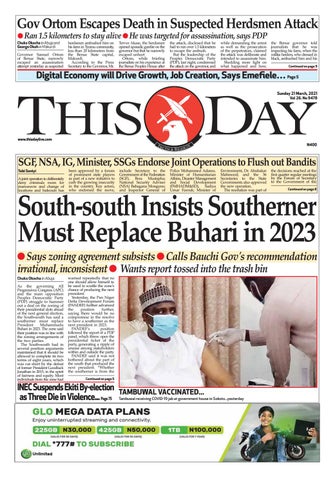
TAMBUWAL VACCINATED... Tambuwal receiving COVID-19 jab at government house in Sokoto...yesterday
2
SUNDAY MARCH 21, 2021 • T H I S D AY
SUNDAY MARCH 21, 2021 • T H I S D AY
3
4
SUNDAY MARCH 21, 2021 • T H I S D AY
5
ͺ˜ ͺͺ ˾ T H I S DAY, T H E S U N DAY N E W S PA P E R
PAGE FIVE
FROM JOURNALISM TO INT'L DIPLOMACY... Media honour for Ambassadors Debo Adesina and Oma Djeba... Diamond Publications Friday evening hosted a reception at Jade Restaurant, Isaac John, Ikeja GRA, Lagos in honour of newly appointed ambassadors to Thailand and Togo. The event drew media heavyweights including (from right) Sam Omatseye (Chairman Editorial board, The Nation), Dr Reuben Abati (Presenter, Arise TV), Gbenga Adefaye (Editor-In-Chief of Vanguard), Oma Djeba (Nigeria’s new ambassador to Thailand), Louis Odion (Senior Technical Assistant on Media to the President), Debo Adesina (Nigeria’s new ambassador to Togo), Lanre Idowu (CEO, Diamond Publication), Eniola Bello (Managing Director of THISDAY), Eddy Odivwri (former Deputy Editor of THISDAY)
Digital Economy will Drive Growth, Job Creation, Says Emefiele CBN disburses N149.21bn to cushion effect of COVID-19 James Emejo in Abuja and Nume Ekeghe in Lagos Governor of Central Bank of Nigeria (CBN), Mr. Godwin Emefiele, yesterday said the digital economy was crucial in the efforts by the federal government to drive growth over the next few years. Emefiele stated that as the pace of technological adoption increased, government and the private sector must find ways to leverage the digital channels to improve access to finance and credit for all Nigerians. Emefiele spoke at the opening of the 30th CBN seminar for finance correspondents and business editors, themed, “Leveraging Digital Economy to Drive Growth, Job Creation and Sustainable Development in the Midst of a Global Pandemic,” which held simultaneously in Abuja and Lagos. The CBN governor said the bank had disbursed a total of N149.21 billion to 316,869 beneficiaries through the NIRSAL Microfinance Bank, in a move to alleviate the plight
of households and business owners and drive economic growth during the COVID-19 pandemic. The disbursement was part of the N150 billion Targeted Credit Facility (TCF) for affected poor households and small and medium enterprises. Emefiele said the country needed robust digital platforms to boost the economic prosperity of the citizens. Represented by Deputy Governor, Corporate Services Directorate, CBN, Mr. Edward Adamu, Emefiele observed that one of the strongest advantages of technology was its ability to compress time and space and reduce the world to a global village by providing connectivity at the click of a button to anyone anywhere in the world. He said to further drive growth, Nigeria needed to build a solid digital economy, by focusing on the improvement of digital infrastructure, most importantly, Internet connectivity, digital literacy and skills, digital financial services, digital platforms,
and digital entrepreneurship. The CBN governor said as the biggest economy in Africa with one of the largest youth populations in the world, Nigeria was well positioned to develop a strong digital economy. He stressed the need to focus on accelerating improvements across the five fundamental pillars of the digital economy: digital infrastructure, digital platforms, digital financial services, digital entrepreneurship, and digital skills. According to Emefiele, “In our effort to drive change and development, the CBN has over the last decade and half worked to build an effective and efficient payment system. "The Payment System Vision 2020 strategy document was published in 2007 and the main objective of the strategy was to promote and entrench electronic payments, as the major channel for payment and settlement by all economic agents, away from the current dominance of cash-based transactions."
He said the robust regulatory framework put in place by the bank opened up the payment system to innovation with several new players across Payment Service Banks, Payment Terminal Service Providers (PTSP's), Payment Solution Service Providers (PSSP's), Mobile Money Operators (MMO's), Payment Terminal Application Developers (PTSA's), and agent banking. Emefiele pointed out that a combination of these payment initiatives had helped to create employment opportunities and further the bank’s effort to build a more financially inclusive economy. “Today, an SME in Ibadan is able to leverage digital channels to sell their products and services to a wider market beyond their immediate environment,” he stated. He assured that the CBN regulatory sandbox was available for fintech companies to explore the use of blockchain technology in areas that would be beneficial to the Nigerian economy.
Emefiele said, “Given the resounding success of this programme and its positive impact on output growth, we have decided to double this fund to about N300 billion, in order to accommodate many more beneficiaries and boost consumer expenditure, which should positively stimulate the economy. “In line with the growing need to go digital, the application process is done online and requires limited paperwork from prospective applicants." He added, “The bank continues to improve our remittance infrastructure in order to provide Nigerians in the diaspora with cheaper, convenient and faster channels for remitting funds to beneficiaries in Nigeria. "In a bid to reduce the cost of remitting funds to Nigeria, the Central Bank of Nigeria on March 8, 2021 introduced a refund of N5 for every $1 of fund remitted into the country through IMTOs licensed by the CBN. We believe this measure would help to support
improved foreign exchange inflows and enable Nigerians in the diaspora to use more formal channels relative to informal channels." Emefiele explained that these measures were not new, as several countries had adopted similar processes to reduce the cost of remitting fund by their diaspora communities, and it led to surges in remittance inflows through formal channels. He said following the outbreak of COVID-19, the country was able to benefit from some of the measures put in place by the CBN to develop a robust interoperable payment system. He said the presence of these digital channels, along with various mobile and web-based channels, helped to support households and the business continuity and remained critical in mitigating the negative effect of the pandemic on GDP growth in 2020. Emefiele noted that as a result of the CBN interventions, the ICT sector grew by 14.7 per cent in 2020, relative to 10.16 per cent in 2019.
times that the report of the committee was not final but subject to study and approval by the relevant organs of party. According to National Chairman of PDP, Uche Secondus, the party is going to study and analyse the report meticulously and come up with a position that would be beneficial to members. Reacting to the report through his tweeter handle, National Publicity Secretary of PDP, Kola Ologbondiyan, said, "Due to enquiries from our members and the general public, it has become
imperative to clarify that @ OfficialPDPNig is yet to adopt any of the recommendations proposed by the Senator Bala Mohammed’s Committee on the Review of the 2019 Elections. "As such, it will be incongruous for anyone to assert that any decision has been taken @OfficialPDPNig on zoning of the presidency ahead of the 2023 elections. "@OfficialPDPNig leaders, members and supporters are enjoined to note that the party is yet to take any decision on the proposals presented by the committee.”
SOUTH-SOUTH INSISTS SOUTHERNER MUST REPLACE BUHARI IN 2023 South-south, South-east or South-west is a different matter entirely,” it said. In a statement by its National Publicity Secretary, Hon. Ken Robinson, PANDEF said since Buhari is a northerner, the presidency should naturally rotate and return to the south in 2023. The regional group was reacting to recommendations by the PDP committee led by Governor Bala Mohammed of Bauchi State, which suggested that the party’s 2023 presidential ticket should be open to all geo-political zones.
PANDEF described such arrangement as “irrational and inconsistent with extant provisions of the PDP constitution on zoning between the North and South.” it said, “A northern president (Buhari) is to complete eight years by 2023. The presidency must, therefore, rotate to the south in 2023. That is the position of PANDEF. It is absurd for anyone to imagine that the north would retain the presidency. Nature abhors injustice; the sun does not rise in the east and set in
the east. “It would be in the best interest of the Peoples Democratic Party to toss the said report to the litter bin and work towards ensuring that its 2023 presidential candidate is from the south. Whether the person emerges from the South-south, South-east, or South-west is a different matter entirely. The PDP, and indeed any other political party, need not be told that it would be a suicidal adventure for it to toy with the idea of presenting a northern presidential flag bearer in 2023.”
Warning against mischief and dubious political manoeuvring in the 2023 presidential ticket, PANDEF said, “Be it in line with the unwritten conventions of the nation’s history as cited by Governor Bala Mohammed’s committee or on the grounds of fairness, equity, and merit, the president of Nigeria in 2023 must come from the south.” it added, “No region in the country is lacking in men and women of notable character, competence, and acumen.” However, PDP had maintained at different
6
SUNDAY MARCH 21, 2021 • T H I S D AY
SUNDAY MARCH 21, 2021 • T H I S D AY
7
ͺ˜ ͺͺ ˾ T H I S DAY, T H E S U N DAY N E W S PA P E R
8
NEWS
Secondus: Nigeria Now on Auto Pilot with Insecurity, Collapsing Economy Says PDP will ensure gender parity in 2023 Chuks Okocha in Abuja The National Chairman of the Peoples Democratic Party (PDP), Prince Uche Secondus, yesterday, painted a gloomy picture of Nigeria, stating that the country had gone into autopilot with nobody in control. He also said the insecurities have pervaded the country and that the economy has collapsed with inflation and unemployment spiking to the highest point ever in the country. Secondus spoke to a select group of reporters, where he also assured the female members of the party that in constituting the federal cabinet, gender parity would be uppermost should the party win the 2023 general election. According to the PDP chair, "Nigeria is in an auto pilot and deserves rescue from all well-meaning Nigerians especially, the women that constitute over 60 per cent of the voting population." Further lamenting the growing insecurity in the country, Secondus said, it has gone so bad that schools are now closed in some parts of the northern states due to kidnapping and banditry. He also lamented the near collapse of the economy, stating that almost all manufacturing companies in Nigeria had relocated to Ghana or neighbouring West African countries due to the collapse of infrastructure and high cost of production. "Today, in Nigeria, inflation is about 17.4 per cent, official rate and the level of unemployment is about 33 per cent mostly among the youths. Nothing seems to be working. The country is in an auto pilot," the PDP national chairman lamented. He, therefore, charged the PDP women and women in general to rise up and rescue the country as everything was in a perilous state. Secondus urged women in Nigeria to rescue the nation from the grips of corruption and injustice pervading the land, saying, "You should emulate women nationalists like Funmilayo Ransom Kuti and recently Dr. Ngozi
Okonjo Iweala". Pledging gender parity in constituting a new cabinet, he said, if PDP forms government in 2023, the cabinet would be 50/50 based on competence. “It is a known fact that whenever and wherever you find a Women in government, there will be no corruption. According to him, "The 35 per cent is already taken,
but we believe that we must drive it to logical conclusion. We are also setting new guidelines that will give youths and women free forms and also give them some form of preference. "We believe that if PDP form government in 2023, it be 50/50 between men and women, because women have what its needed for national development", he said.
Speaking, the chairperson of the PDP Women Action Committee, Senator Biodiun Olujimi, described the committee as another agenda setting for other political parties to emulate and should be seen as a challenge factor to all women on all national developmental issues. "Women are central to democracy. It will give women a sense of belonging
and ensure justice and equity in the affairs of the party and national development." She also noted that, "It is right to say women are an integral part of any strong and forward looking party, such as PDP. In fact, the participation of women in the socio-political and cultural affairs is not just a goal, but central to sustainability of the democratic process.
"Statistics tells us that engaging women in leadership processes, increases the gross domestic product of our nation. Empowering women is a very smart political move that political parties will greatly benefit from. And the process starts from arrangements such as this lobby group being inaugurated today."
CABINET RETREAT... L-R: Senate Minority Leader, Senator Enyinnaya Abaribe; Akwa Ibom State Governor, Udom Emmanuel; and his Bayelsa counterpart, Senator Douye Diri, at the third day of the Bayelsa State Cabinet Retreat at Ibom Icon Hotel and Golf Resort, Uyo, Akwa Ibom State...yesterday
SGF, NSA, IG, MINISTER, SSGS ENDORSE JOINT OPERATIONS TO FLUSH OUT BANDITS Federation with Secretaries to the State Governments, which held virtually on Thursday. According to a communiqué issued yesterday, the meeting urged the Secretaries to the State Governments to explore possibilities of joint operations by states to prevent free movements by criminals between states. "This is to avoid bandits moving from areas of hot pursuit to other areas and returning, when the heat is down," the communiqué stated. Themed, “Role of Secretaries to the State Governments in Strengthening Sub-National Level Security Architecture,” the meeting was chaired by Mustapha in company with other stakeholders.
The forum called on the federal government to strengthen border controls in order to check illegal immigrants and influx of weapons from other countries. It emphasised the need to resuscitate community-driven safety measures and address existing trust deficits to encourage willingness to release information to state security agencies. "The meeting emphasised the need to recalibrate our traditional governance systems to the time-tested and proven method of responsiveness to civil society at the local levels, which hitherto prevailed in the country,” the communiqué stated. The forum said there was
need to automate the national security architecture and provide adequate resources for personnel, equipment, and operations. It highlighted the need to improve the current low police to population ratio and imbibe community policing. It reiterated the need for appropriate public enlightenment to raise security awareness among the citizenry. The meeting equally recognised the coordinating role of the Secretaries to the State Governments and called on them to strengthen nonkinetic approaches, especially, by establishing a community level early warning systems. The forum also noted progress made in strengthening federal
and state governments' relationship in delivering poverty eradication initiatives and called for sustenance and scaling up in view of the growing poverty situation in the country. Farouk disclosed that there was an on-going high-level consultation to establish structures that would ensure that all agencies responsible for implementing poverty eradication programmes/ projects cooperated. The consultation is also to ensure that the agencies are well coordinated to share experiences, share data and complement each other for effectiveness, better deployment of resources, and higher poverty reduction impacts, she said.
Farouk said at the federal level, there will be National Poverty Eradication Cooperation and Coordinating Committee (NPCCC) chaired by her. She explained that at the state level, there would also be a Poverty Eradication Cooperation and Coordination Committee (SPCCC), under the Offices of the SSGs, aimed at achieving similar objectives. The minister said the ministry had established the National Social Register (NSR) aimed at capturing in details the data on all poor and vulnerable citizens in the country, adding, "So far, nearly 30 million individuals have been registered nationwide." The forum further examined the inextricable linkage
between environmental degradation, security and conflict for resource use and management. It called for a National Forestry and Biodiversity Summit and urged the Federal Ministry of Environment to provide leadership for its convocation. The forum urged state governments to strengthen their various forestry services especially, by prioritising sustainable forest management practices, developing and adhering to forest management plans, and strengthening the state forestry services. It appealed to the federal government to support the Federal Ministry of Environment in undertaking a comprehensive forest resources assessment.
9
ͺ˜ ͺͺ ˾ T H I S DAY, T H E S U N DAY N E W S PA P E R
NEWS
Agbakoba Disagrees with Okonjo-Iweala over Liberalised Trade Policies
Emmanuel Addeh in Abuja
A Senior Advocate of Nigeria (SAN), Dr. Olisa Agbakoba, yesterday, disagreed with the Director General of the World Trade Orgamisation (WTO), Dr. Ngpzi OkonjoIweala and warned against the unrestrained liberalisation the of Nigerian trade policies, noting that it would kill the prospects of economic selfsufficiency in the country. Stating this position in a
statement personally signed, the senior lawyer noted that while he admired Nigeria’s former Minister of Finance, her take on allowing the free flow of foreign products into the country should not be fully implemented. Instead, he argued that the federal government must strike a balance between open borders and the creation of jobs for the millions of her unemployed. “My admiration for Dr.
Ngozi Okonjo-Iweala is huge but to advise us to continue to be import-dependent is not correct policy advice at this time. “Nigeria has no current trade policy and Dr. OkonjoIweala seems to promote liberal and open borders. The problem is that we will remain consumers of imported products and cannot develop our economy to boost production and give jobs to the over 25 million
unemployed,” Agbakoba maintained. According to him, while Nigeria must balance her import policy with local production policy, it must heed the warning of wise economists that the country could not develop unless its trade policy was designed to promote local industries. He added that although he would hesitate to compliment Donald Trump's ‘America First’ trade policy, the
former American president understood the need to protect the US by discouraging overdependence on imports. Agbakoba lamented that Nigeria currently produces crude oil, but imports petrol, produces cocoa, but imports cocoa powder and has a lot of tin, gold and iron, but still imports the finished products in billions of dollars. His words: “We closed our Benin border to imports and made 12 billion a day
internally. It was a strong trade policy to produce rice locally that has made us near self-sufficient. Now, we are growing tomato, corn, beans, etc., because we are discouraging imports. “Nigerians be wise. We must support made-in-Nigeria. I propose we adopt a new trade policy with strong trade laws to protect our ailing economy. Nigeria will be transformed by a made-inNigeria trade policy.”
Gov. Abiodun: We'll Deliver First Phase of Cargo Airport in 2022 Ogun State Governor, Prince Dapo Abiodun as again assured the people of the State that the first phase of the AgroCargo Airport at Illisan-Remo in Ikenne Local Government Area of the State would be ready by May, 2022. The Governor who gave the assurance while inspecting the project site, said the project conceived in 2007 had all necessary approvals, including the Environmental Impact Assessment, from Aviation regulatory body, the Nigeria Civil Aviation Authority (NCAA). "This project had been conceived since 2007 and all necessary approvals were gotten in 2008. All the Environment Impart Assessment, all other regulatory assessment have been met 100 percent. "All we have to do was to brush them up to ensure they meet current realities. This was not the decision that was taken for any other reason except that which is objective", he explained. Giving insight on why his administration decided to execute the project, Governor Abiodun said it was base on the economic development agenda of his administration to have a Cargo Airport that would fully compliment the agro value chain investments and activities in the State. "When the Senate Committee on Aviation came to visit us, we shared with them the business case for this Airport. We reminded them that the two Airports proposals were not initiated by this administration. I told them that the Committee we set up to look into the two Airports concluded unequivocally that this location remind the best and most viable location for the airport. According to the Governor, " the entire cargo value chain is on this corridor. You have Oil Palm, Cashew plantations
and Green House in Sagamu and multinational companies around here. This is the centre where items for export are evaluated and approved for export. So with a Cargo Airport here, it is very convenient to move them". He disclosed that the State bidded for the African
Development Bank's Special Processing Zone, where in the bid document, the location was chosen to co- locate the AZ Processing Zone. He said the area was renamed "an airport city", because, apart from the airport and processing zone, the area has factories that would turn raw materials to
finished goods for export. The Governor opined that it was important for an airport to have access to good road network, adding that the airport was bound by Sagamu- Benin and LagosIbadan expressways, as well as gas pipelines parallel to the expressways.
Governor Abiodun maintained that the airport sited on a 500 hectares of land was also part of the administration's key enablar, adding that work was ongoing on the 2.4 kilometers access road to enable movement of equipment to the site, as well as on the 3.4 kilometers runway.
While insisting that his administration would not join issues with people in the pages of newspaper as a result of the project, said he would remain focus on what his administration was set to achieve by meeting all the requirements of good governance.
SOLUDO SOLUTION FOR ANAMBRA? Former governor of Central Bank of Nigeria (CBN) and governorship aspirant of APGA; Prof Chukwuma Soludo (left) and former member of House of Representatives, Hon Ifeanyi Ibezi, during a prayer rally organized by 24 groups working for Soludo's governorship aspiration in Anambra State...yesterday
GOV ORTOM ESCAPES DEATH IN SUSPECTED HERDSMEN ATTACK security men and opened fire. He said it took the swift response of his security aides to repel the attack, while he ran for a long distance to escape unhurt. The governor lamented that the attack came a few days after the leadership of Miyetti Allah, Kautal Hore held a meeting in Yola and singled him out as a thorn in their flesh, who must be eliminated, pointing out that he received intelligence to that effect. Ortom said his life is in the
hands of God and no Fulani militia has the power to take it without God's permission, noting that as many times as they try, they would continue to fail. He stated that the ranching law of the State would not be repealed for any reason, stressing that no intimidation could force his administration to reverse the decision of Benue people against open grazing. The governor, however, said he would send a petition to the President and
security chiefs against Miyetti Allah Kautal Hore, because allowing their leadership to walk freely with security personnel attached to them was not in the best interest of the country. Meanwhile, the PDP, while condemning the attack called on President Buhari to put machinery in motion by ordering an immediate manhunt, arrest and prosecution of the assailants as well as beef up security around the governor. In a statement by its
National Publicity Secretary, Kola Ologbondiyan, the PDP expressed shock that the assailants trailed Governor Ortom and opened fire on him and his aides along Makurdi/Gboko road, in an attack that by every indication was intended to assassinate the governor. "Our party is worried that this brazen attempt at Governor Ortom's life is coming on the heels of his outspokenness in exposing those allegedly behind the incessant attacks on
communities in the state and demanding that the federal government lives up to its responsibility on the protection of life and property in the state," the PDP asked. The party also feared for the life of Ortom and urged Nigerians to hold the All Progressives Congress (APC)-led administration responsible over its failure to take a decisive step to check the escalated insecurity and brazen attacks on innocent Nigerians.
The PDP also called on Ortom not to be deterred by the attack but remain courageous and at alert, at all times while providing leadership to the people of his state. In the same breath, the party called on the people of Benue State to be calm and vigilant while providing useful information to security agencies to flush out the bandits and other criminal elements from the state and other parts of the country.
10
ͺ˜ ͺͺ ˾ T H I S DAY, T H E S U N DAY N E W S PA P E R
NEWS
INEC Dismisses Transfer of Polling Centres Between LGs Limits voters to 750, 1000 at polling stations Chuks Okocha in Abuja The Independent National Electoral Commission (INEC) has hinted at some of the guidelines to be expected in the expansion of polling centres, explaining that there would be no transfer of polling stations between local governments during elections. The commission also said the maximum allowed for all polling centres with the new expansion would be between 750 to 1000 voters. INEC explained that the expansion would not confer any advantage to any political party or socio-cultural organisation, explaining that it would only help to decongest the polling centres. The INEC National Commissioner in charge of voter education and chairman Information and Publicity, Festus Okoye, hinted at these developments at a workshop staff organised by International funds for elector supports (IFES). According to Okoye, "It is pertinent to explain here that no Voting Point will be moved from one local government to another. It is also important to underscore the fact that the expansion of polling units will not confer any advantage to any state of the federation other than decongesting existing polling units, degrading overcrowding, aid increase of voter turnout and improve the quality of legal services rendered by the Commission. The primary objective of all this is to make the voting experience more pleasant and less tedious for Nigerians." "In the new arrangement, new and some old registrants will have on offer, new, accessible and closer Polling Units. All Polling Units will have a lower threshold of 750 voters and an upper threshold of 1000," he said. The INEC national commissioner explained that for the registration of voters, the Commission would as always, be guided by the law and the constitution, adding that the Commission would not impose or accept the imposition of extraneous registration requirements not in tandem with the Constitution and the law. He declared that the top priority of the Commission at this moment was to usher in a new electoral legal framework that would give legal backing to new and recently introduced innovations in the conduct of elections. According to Okoye, the ongoing changes required
creative and innovative minds, staff that were broad-minded and committed, explaining that it was imperative that staff of the Commission should be properly equipped especially, being at home with relevant technologies. He also stated that the times equally demanded staff that was highly professional and ethical, saying, "To be relevant in the new order that the Commission is enthroning, every staff must first align himself/ herself to the innovations, then, the staff must understand his place in the scheme of affairs. "The changes the Commission is making are fundamental and with the prospect of altering the electoral landscape of the country. Any staff that cannot locate himself within these changes and or adapt to the new realities of the electoral process will sadly find himself to be a burden if not an impediment to the wheel of progress.
"The choice is for each and everyone of us to determine how to locate himself in the new scheme of the operations of the Commission. Fortunately, the changes in the Commission are being driven by the Chairman of the Commission, Professor Mahmood Yakubu, who has shown great commitment, courage and innovative spirit", Okoye declared. The INEC national commissioner further explained that the Commission had prioritised the changes and innovations that would be cascaded to the conduct of offseason governorship elections and the 2023 general election. The changes and innovations, he explained, would be challenging but they are necessary to enhance the standard of the nation’s electoral process, adding that the Commission is therefore poised to surmount whatever the challenges may be, in order to conduct elections that would
receive the overwhelming endorsement of majority of Nigerians at all times. In view of this, he explained that INEC would endeavour to consult widely and build a national consensus around the changes and innovations in the electoral process. Okoye posited that the conduct of Continuous Voter Registration exercise using an improved enrolment device is a top priority for the Commission. "All registrable Nigerians should be assured that the Commission will resume the continuous voter’s registration exercise as soon as the expansion of access to polling units is completed.” He maintained that the new framework of electoral laws would address some of the challenges that have impeded the deployment of technology by the Commission to enhance the quality of our elections. He said it would further set a new paradigm for managing
the registration of new political parties, streamline the focus of Courts in terms of the requisite jurisdiction in the adjudication of pre-election matters, explaining that the new framework will also make provision for early release of funds due to the Commission etc. On the use of technology in the Electoral Process, Okoye said INEC planned to robustly ramp up its usage in the electoral process. "This will include the introduction of Electronic Voting Machines. Steps to accomplish this end have already gone far. These voting machines will be deployed to all the polling units and will be aligned to the already introduced devices and means that will amply raise the integrity and transparency of the electoral process. "The introduction of technology in the electoral process by the Commission has been a gradual but
steady process. Nothing in the enhanced technologybased system will, however, disadvantage any section of voters. "With the new method, registered voters must still physically go out to the Polling Units to exercise their franchise. Nothing in an enhanced technology process provides for people voting from the comfort of their homes. The question of internet and cyber voting are issues that are left for the future," he stated To give life and meaning to these innovations, Okoye contended that the Voter Education and Publicity Department of the Commission would play a commanding role. His words: "All officers for electoral duties, whether staff of the Commission, ad-hoc staff or collation officers and indeed all Nigerians, who are involved must be trained on the new technologies and innovations to be introduced.
SANWO-OLU'S WORKING VISIT TO LEKKI FREE TRADE ZONE... L-R: Special Adviser to the Governor on Commerce & Industry, Mr. Oladele Ajayi; Managing Director, Lekki Port, Mr. Du Ruogang, presents a pictorial frame of the Lekki Port to Lagos State Governor Mr. Babajide Sanwo-Olu; Chairman, Lekki Free Zone Development Company, Mr. Abiodun Dabiri and Commissioner for Commerce, Industry & Cooperatives, Dr. (Mrs) Lola Akande, during the Governor’s working visit to the Lekki Free Trade Zone, Ibeju-Lekki...Friday
US-Nigeria Investment Summit to Hold in New York The US-Nigeria Investments Summit has announced it will hold a global trade and investment event for 2021 in September. The event will hold in New York, United States. The summit will open on September 17 with a reception, and the main event will follow the next day as a complement to the United Nations General Assembly (UNGA) 2021. According to McKinsey and other global analysts, Africa's
household consumption will top $2.7 trillion. They added that Africa would yield $4.5 trillion in business spending and produce more than $1 trillion in manufacturing output by 2025, thereby making Nigeria the continent's largest economy. The USNIIS 2021's theme, 'Nigeria, The Future of Global Business,' alludes to the "spectacular growth opportunity" to engage the demands, solutions, and
opportunities for 21st-century global trade and investment with Nigeria. A USNIIS statement made available to ThisDay said the summit would highlight how technology can transform Nigeria into a circular economy. "Agriculture, manufacturing, ICT, and healthcare are key focus areas for the two-day conference. "Attendees to the summit can expect to hear from carefully sourced experts
and distinguished speakers, high-profile representatives of the governments of both Nigeria and the US, and the opportunity to also engage with top trade institutions and delegates," said the statement. The 2021 USNIIS summit will feature representatives from the largest global sectors with the trade and investment value of opportunities is expected to exceed $5 billion. Primarily targeted at US-Nigeria engagement and
partnership, the summit will also allow attendees from around the globe to participate at the event. USNIIS is the premier publicprivate platform for effective bilateral economic engagement between Nigeria and the US. USNIIS 2021's mission is to bring together the "direct connection" of national, state, and industry policymakers, regulators, finance directors, economists, investors, corporations, startups,
entrepreneurs, and influencers that impact the economic mission of both nations. The statement called on all interested investors, industry entrepreneurs, local and state governments to help shape the future of US-Nigeria business investment collaboration by joining us in New York. "We encourage all interested in the event to contact us via www.usniis.com, info@ usniis.com, said Franklin Ekechukwu, USNIIS Chairman.
SUNDAY MARCH 21, 2021 • T H I S D AY
11
12
MARCH 21, 2021 ˾ T H I S D AY, T H E S U N D AY N E W S PA P E R
EDITORIAL
Editor, Editorial Page PETER ISHAKA Email peter.ishaka@thisdaylive.com
THE LAGOS-BADAGRY HIGHWAY Both the federal and Lagos State governments should sit and strategise on how to bring the highway to completion
T
he Lagos-Badagry Highway is a metaphor for both leadership and state of infrastructure in the country. For many years, the road that connects Nigeria with members of the Economic Community of West African States (ECOWAS) has been a nightmare for commuters. Travellers along the corridor daily experience agony, spending several man-hours stuck in traffic; incurring unwarranted costs due to avoidable damage to their vehicles and perhaps developing health complications. While the federal government has neglected the highway, the Lagos State government came up with an ambitious rescue plan that has culminated in more fits than starts for more than a decade. Constructed in As an 1977 by the Olusegun international Obasanjo military gateway, the road administration to interconnect all the is too strategic in one of to be abandoned countries Africa’s most viable or left to the economic blocs, the Lagos State Lagos-Badagry express government way is just about 60 kilometres in length. But to handle. today, what passes for ‘a The federal linking government must superhighway’ Nigeria with Benin Reintervene and public, Togo, Ghana, Ivory very decisively Coast, Liberia and Senegal is a national disgrace at a time there is an obsession with constructing some highways that are of no economic value. In 2009, the Lagos State government under then Governor Babatunde Fashola unveiled an ambitious plan to redevelop the highway to a 10-lane superhighway with a design to construct Light Rail Mass Transit (LRMT) in the median at a cost of $1.5 billion (N220 billion). Running from Eric More Interchange throughOrile Iganmu, Mile II, Okokomaiko, Agbara to Badagry, the project was designed with four dedicated toll lanes, two BRT lanes, 23 BRT online bus stations, seven toll link interchanges, four service lanes, seven bridges and 16 flyovers. With the support of the World Bank, the Fashola administration
Letters to the Editor
commenced the execution of the projects and almost fully executed the first phase of the highway project, which starts from Eric Moore Interchange and terminates at Maza-Maza Bridge.
I
S U N DAY N E W S PA P E R EDITOR SHAKA MOMODU DEPUTY EDITORS OLAWALE OLALEYE, TOBI SONIYI MANAGING DIRECTOR ENIOLA BELLO DEPUTY MANAGING DIRECTOR KAYODE KOMOLAFE CHAIRMAN EDITORIAL BOARD OLUSEGUN ADENIYI EDITOR NATION’S CAPITAL IYOBOSA UWUGIAREN MANAGING EDITOR JOSEPH USHIGIALE
T H I S DAY N E W S PA P E R S L I M I T E D EDITOR-IN-CHIEF/CHAIRMAN NDUKA OBAIGBENA GROUP EXECUTIVE DIRECTORS ENIOLA BELLO, KAYODE KOMOLAFE, ISRAEL IWEGBU, IJEOMA NWOGWUGWU, EMMANUEL EFENI DIVISIONAL DIRECTORS BOLAJI ADEBIYI , PETER IWEGBU, ANTHONY OGEDENGBE DEPUTY DIVISIONAL DIRECTOR OJOGUN VICTOR DANBOYI SNR. ASSOCIATE DIRECTORS ERIC OJEH, PATRICK EIMIUHI ASSOCIATE DIRECTOR SAHEED ADEYEMO CONTROLLERS ABIMBOLA TAIWO, UCHENNA DIBIAGWU, NDUKA MOSERI DIRECTOR, PRINTING PRODUCTION CHUKS ONWUDINJO HEAD, COMPUTER DEPARTMENT PATRICIA UBAKA-ADEKOYA TO SEND EMAIL: first name.surname@thisdaylive.com
n 2015, the Akinwunmi Ambode administration continued the execution of the second phase running from Maza-Maza to Okokomaiko awarded to China Civil Engineering Construction Company (CCECC). Between 2015 and 2019, the state government injected N12.04 billion into the highway project and N22.73 billion into the light rail project. Nevertheless, in 2016, Nigeria ran into economic turbulence which stoked a foreign exchange crisis which is still worsening by the day. That forced the Lagos State government to devise alternative funding strategies for the projects with both the Power China Corporation and Alstom SA, a French multinational. But the initiatives suffered a setback when Ambode lost his second term bid in 2019. Amid protracted public disapproval, the federal government in 2019 took fresh initiative to rehabilitate theOkokomaiko-Badagry portion of the expressway, more than a decade after it had ceded the road to Lagos State. Under the 2020 fiscal year, the sum of N4.5 billion was set aside from the N162.55 billion sovereign Sukuk bond to do palliative works on the highway apart from N1 billion budgetary allocations. All these interventions have little positive impact given the gravity of dilapidation the road has suffered in recent years. With its current condition, the highway epitomises an ugly image of Nigeria for nationals of other West African states that travel through the trade route. We are concerned that there appears to be a lack of synergy between the Lagos State government and the federal government regarding whose responsibility it is to complete the road. We urge both parties to set aside their differences and allow common sense to prevail. As an international gateway, the road is too strategic to be abandoned or left to the Lagos State government to handle. The federal government must intervene and very decisively. In specific terms, the two governments should urgently set up a joint commission to review the present dismal conditions of the highway, ascertain the degree of reconstruction works executed in the last decade, devise feasible reconstruction plan, come up with justifiable funding strategies and give reasonable duration within which the project will be fully executed. What is required on the Lagos-Badagry highway is for both the federal and Lagos state governments to synergise in a bid to reconstruct the road that connects our country to the sub-region we claim to lead.
TO OUR READERS Letters in response to specific publications in THISDAY should be brief (150-200 words) and straight to the point. Interested readers may send such letters along with their contact details to opinion@thisdaylive.com. We also welcome comments and opinions on topical local, national and international issues provided they are well-written and should also not be longer than (950- 1000 words). They should be sent to opinion@thisdaylive.com along with the email address and phone numbers of the writer.
WOMEN IN LEADERSHIP: IS NIGERIA MISSING OUT?
N
igeria is missing out on good governance and development by failing to implement the 35% affirmative female action adopted in the gender and equal opportunities bill, according to Mrs Catriona Laing, the British High Commissioner to Nigeria. A cursory look into Nigerian women in politics suggests that cultural stereotypes and gender discrimination act as a disadvantage to the success of women as political leaders and actors. The uncertainty surrounding the capability of women to be effective leaders is underlined by a disconnect between the cultural construct of women and the requirements of leadership in Nigeria. Globally the shift towards women in governance has yielded much needed results for countries
who have embraced this paradigm shift. Stephanie Williams who is the acting special representative and head of the UN Support Mission in Libya has successfully steered the Libyan political dialogue forum (LPDF) through a series of breakthrough agreements in recent months culminating in the establishment of a unified executive authority to take Libya to national elections on 24 December 2021, an unprecedented achievement since the country descended into chaos following the fall of former ruler Muammar Gadaffi in 2011. Similar data across several countries have shown that countries with female leaders are responding better to the Coronavirus pandemic. Despite Taiwan’s close proximity to China, the source of the pandemic, the country
through concerted efforts from its Prime Minister Tsai Ing-wen and pro-activeness of its female Digital Minister, Audrey Tang leveraged technology to build an effective face mask rationing and digital quarantine system that has kept the virus under check, recording a total of 955 cases and 919 recoveries. The exemplary leadership of Angela Merkel, the German Chancellor, has also seen Germany recording the lowest rate of COVID -19 deaths in Western Europe. Angela Merkel has governed Germany for more than 14 years and has successfully managed several crises in the course of her chancellery: the 2008 financial crisis, the Eurozone debt crisis, the influx of migrants in 2015 and the Coronavirus pandemic. Through it all, her leadership style
has been remarkable, guiding Germany into exerting increased influence in the European Union.Involving women in political processes has proven to be beneficial for all globally. Nigerian women remain largely under-represented in the political space despite the fact that 49% of the Nigerian population are women. Only seven women are in the current Senate and the National Assembly has refused to enlarge the space for women to participate in political, business and civic arenas through the gender and equal opportunities bill and 35% affirmative action which is an investment in a more equitable, just, and peaceful nation. Despite these setbacks Nigerian women continue to prove that women in positions of authority tend to be more passionate and committed to seeing good governance and democracy enthroned. The heroics and achievements of
late Dr Ameyo Adadevoh, who ensured that the Ebola virus did not have an accelerated spread, Dr Ngozi Okonjo-Iweala and Mrs Amina J. Mohammed are all indicators to the possibilities women in governance bring to the table. Just like the British High commissioner to Nigeria Mrs Catriona Laing noted, challenging the social norms and cultural patriarchy that enable gender discrimination in the Nigerian society such as child marriages, the Land Use Act as it affects women and the gender and equal opportunity bill are critical to balancing the gender parity in Nigeria. The world is at a pivotal moment and Nigeria must capitalize on this momentum and ensure women’s voices are not only present but heard in the political processes and the decision-making table. ––Chinonso Kenneth, kennethonwurah75@gmail.com.
SUNDAY MARCH 21, 2021 • T H I S D AY
11
14
T H I S D AY, T H E S U N D AY N E W S PA P E R ˾ MARCH 21, 2021
OPINION
GAIN TWO WOMEN, LOSE TWO MEN PRESIDENTS Okello Oculi pays tribute to John Magufuli, former President of Tanzania
T
he Eastern African Region consisting of a landmass from Eritrea and Ethiopia in the north-east to Burundi and Rwanda in the west, have experienced history’s drama of two women becoming presidents of Ethiopia and Tanzania, respectively. Abiy Ahmed, a military officer from a historically oppressed Oromia community, appointed Sahle-Work Zewde as a neo-ceremonial president. In Tanzania, a former school teacher and industrial chemist, John Pombe Magufuli, chose as his vice-presidential running mate for the 2015 election, Samia Saluhu Hassan, a woman from the island of Zanzibar. On 18 March, 2021, a sorrowing Saluhu Hassan announced the death of her boss to a shocked nation. On 19 March, she was sworn in as President to serve till 2025 the mandate they had both regained in 2020. On June 8, 2020, the death of Burundi’s outgoing president Pierre Nkurunziza was announced. On 18 March, 2021, the death of Tanzania’s president, John Magufuli was announced. Nkurunziza, as advocate for political power by the Hutu ethnic majority in Burundi, was feared by global financiers. Magufuli insisted that vaccines for COVID-19 must first be tested for safety by his country’s scientists; and defended ‘’regaining Tanzania’s sovereignty against international financial institutions’’. The rise of Magufuli and Samia Hassan has lessons for democratic politics in Africa. Under Julius Kambarage Nyerere’s leadership, the ruling Tanganyika African National Union (TANU), which later changed to Chama Cha Mapinduzi, (CCM) –or Party for the Revolution – established a leadership training institute. Individuals being groomed for future top leadership were also moved around posts. Some were dropped from ministerial jobs either because they had severe defects or test their party loyalty and ability handle adversity. The government also built government schools in
underdeveloped regions as a way of ensuring access to government jobs and political leadership to all communities in the country’s mainland, and the island of Zanzibar. From his attending Primary School (1967 to 1974), to his earning university post-graduate degrees in Mathematics, Chemistry and Education, Magufuli was located in distant areas of mainland Tanzania. His attendance of a Catholic Seminary (1975- 1977), may well have combined with higher interest in Mathematics and Chemistry to prune a mind that had little tolerance for ‘’sin in governance’’. Mathematics insists on correct answers; Chemistry avoids shoddy handling of chemicals and Catholicism insists on avoiding the road to hell fire… His career path ran from being a classroom teacher (I982 -1983); work with a cooperative company as an industrial chemist (1989 to 1995); getting elected as member of parliament (following rigorous scrutiny by the CCM party), and unbroken appointments to: Minister for Land and Human Resources; Minister of Livestock and Fisheries, and Minister of Works (2006 – 2015). In a political system in which ministers are appointed from among members of
As the Minister of Works, Magufuli invented the antic of fighting corruption in the Police by taking rides in trucks while hidden among the luggage. He would spring surprises just as bribe money had been accepted by a policeman
parliament, he had to win primacies and elections under stiff party competition and rules. As the minister of Works, Magufuli invented the antic of fighting corruption in the Police by taking rides in trucks while hidden among the luggage. He would spring surprises just as bribe money had been accepted by a policeman. The reputation he built from these escapades won him the presidency in 2015. These shock therapies rolled into his presidency. He cancelled the celebration of ‘’UHURU’’(Independence) Day and substituted it with a national clean-up campaign to end the shame of people dying from cholera five decades after self-rule. He reduced his salary from 15,000 USD per month to 4,000USD; cut delegates to Commonwealth events from 50 to four officials; banned the purchase and use of expensive vehicles for government work, and declared free school fees to government schools. Weeping mourners called him the ‘’president of we poor people’’. As Chemistry devotee, he banned the export of minerals as raw ores and insisted on gold being processed locally while Tanzania was allocated 16 per cent of shares of the gold mining company. His earlier experience as a junior Minister of Transport now favoured heavy investment in railways, aeroplanes and ports to serve a vast country. His insistence that contracts awarded with fraud must be reviewed, made him unpopular with corrupt government officials and their foreign allies. History smiled in silence as Magufuli’s rose to the presidency. In the 2015 CCM primaries, he defeated a former female Secretary General of the United Nations. In 2020, he defeated a former female African Union Ambassador to the United States of America. He gave us President Saluhu. She once said: ”I may look polite, and do not shout when speaking, but the most important thing is that everyone understands what I say and things get done as I say’’. She worked her way from a 17year- old government clerk; several local and externally awarded university degrees, with CCM’s grooming.
Finding Lasting Solution To The Problem of Insecurity in Nigeria Nigeria’s present security structure is faulty and needs overhauling, argues Kelechi Akubueze
T
he inherent internal contradictions within the Nigerian state set in almost as soon as the 4th Republic began in 1999. The post – colonial state started unraveling gradually with the emergence of ethnic champions followed by criminal elements who started challenging the authority and sovereignty of the state, and tasking its capacity to the limit. In the aftermath of the elections that brought in Olusegun Obasanjo as President, the Movement for the Actualization of the Sovereign State of Biafra (MASSOB) emerged as a secessionist movement associated with Igbo nationalism which supports the recreation of the independent state of Biafra, led by Ralph Uwazuruike. In the same year, a breakaway faction of the Odua Peoples Congress (OPC), led by Ganiu Adams, also emerged, canvassing for the secession of the Yoruba people from Nigeria. In response, the Arewa Peoples Congress was formed in the North with a claimed mandate to preserve the indivisibility of Nigeria, also announcing its readiness to take on the OPC and other ethnic champions of secession. By 2004, from the ashes of the hitherto Movement for the Survival of Ogoni People (MOSOP) rose a new group – Movement for the Emancipation of Niger Delta (MEND) led by Henry Okar and Dokubo Asari, who campaigned against the environmental degradation of the Niger Delta and the marginalization of the region despite the fact that it produced the wealth of the nation; and hence demanded resource control, and started using militant strikes on oil installations to press home their demands. This was immediately followed by a never before seen wave of kidnapping for ransom, initially limited to expatriate oil workers, but later extended to Nigerians and the Nigerian military. This wave of kidnapping was to later spread to most states of the South East and South South, and became the biggest security problem of those zones until it was substantially curtailed a few years later. Just a few years earlier, what is today Nigeria’s biggest security threat, Boko Haram, was born when Mohammed Yusuf established in Maiduguri, Borno state, a religious complex and school that attracted poor Muslim families from across Nigeria and neighboring countries. This group metamorphosed into a radical religious extremist group demanding a caliphate state within Nigeria, and on 26 July 2007, launched the first violent attack on a police station in Bauchi State followed later by clashes between the sect and the Nigerian police in Kano, Yobe and Borno States. Thus by the time
the Obasanjo administration was handing over to a new government in 2007, every region in Nigeria already had a militant or secessionist group. The country was shocked into the reality of terrorism in Nigeria when Boko Haram claimed to have carried out the bombing of the Police Headquarters in Abuja in June 2011 in the first known suicide attack in Nigeria. The group had reportedly, after the attack, taunted the then IGP Hafiz Ringim, claiming that they possessed superior intelligence and weapons to the Nigerian police. Then followed the suicide bombing of the UN Headquarters in Abuja on 26 August 2011, and the suicide bombing of two churches in Suleija, Niger state on 25 December 2011. By 2014, the Nigeria State had accepted the reality of being host to a terrorist organization with the kidnap of over 270 schoolgirls in Chibok, Borno State, and the two separate bombings in Nyanya and Abuja metropolis. Boko Haram was categorized as one of the deadliest terrorist organizations in the world and countries started issuing travel advisories to their citizens concerning Nigeria, and the North East in particular. The Nigerian State responded to this menace through waves of joint military and security strikes and operations but which have not yielded the desired result till date. Unfortunately, the situation has rather taken a huge turn for the worse within the past few years. A wave of banditry and criminality has spread through more Northern states such as Zamfara, Katsina, Kano, Bauchi and Adamawa, claiming thousands of lives and forcing many residents to flee to neighboring countries. The latest addition is the wide spread kidnapping for ransom on the Abuja – Kaduna road which has made traveling between the two cities a nightmare for road users. Governors of some of the Northern states like Borno and Zamfara have publicly declared that the problem has overwhelmed them as it continues to get worse by the day pushing the Nigerian state to the edge of precipice as a failed state. The reason why the security problem in Nigeria has remained intractable is because successive regimes have not viewed it as an existential problem, but rather as societal evolutionary trend, and hence the responses have been symptomatic. The real truth is that the security problem today is a direct consequence of the foundational structure of the Nigerian security after the civil war. The Nigerian security architecture, since after the civil war, has been structured along two paradigms: The need to ensure that
no section of the country successfully breaks away from the federation; and the need to prevent coup d’états. While the earlier was achieved from the onset (no region of the country has been able to succeed despite the demands for secession and existence of secessionist groups), the later was actually achieved during Obasanjo’s administration (1999 – 2003). Till date there has not been a successful coup d’état in Nigeria. Subsequently, in 1979, a Constitution was introduced which reinforced the above, lumping more than 80 percent of control of the entire nation’s resources and command into the exclusive Presidential list. Those provisions are still maintained till date in the present 1999 Constitution and its amended versions. However, the country is now paying dearly for this. In order to realize the above paradigms, the country’s security architecture placed emphasis on “Control” over and above “Protection”. To prevent regions from seceding required the concentration of all security resources and command at the center, and deliberately weakening the security apparatuses in the states and regions then (now geo-political zones), and subsequently making these regional and state apparatuses of security wholly dependent on the center, for mobilization, deployment and interventions. This however runs against the logic of protection and combating of crime – crime is local and hence effective policing of crime is local. What has happened in Nigeria over the past 50 years is that the State has been trying to use a nationalized (distant) security structure to police local crimes and criminal activities, and this has not worked! A situation in which the police command in a state is headed by a Police Commissioner from another state with more than 70 percent of the entire police force coming from outside that state completely makes the police an alien force, trying to police an unknown territory. It is simple logic that, for example, where it takes police officers from Sokoto working in Abia State three months to uncover a criminal hideout in a village, it will take police officers who are indigenes of Abia State less than three days to achieve the same feat, because as stated above, every crime is local and it takes local knowledge to beat it. The same goes for the DSS, Civil Defence and all other security structures, accept the military. ––Dr. Akubueze, bishoppe2015@gmail.com
T H I S D AY, T H E S U N D AY N E W S PA P E R ˾ MARCH 21, 2021
15
LETTERS
BELLO : ACCOUNTABILITY, T RUST A ND I NCLUSIVE G OVERNANCE IN KOGI
W
hen national, state, or local governments make a concerted effort to solicit input from citizens and provide services to all of their constituents equally, they sow the seeds of stability and growth. When this is done within a framework of political and legal accountability, citizens increasingly trust state institutions to support and to treat all of them in an even-handed manner. Governance is inclusive when it effectively serves and engages all people, takes into account all facets of personal identity and when institutions, policies, processes and services are accessible, accountable and responsive to all members of society. Fostering governance that is inclusive is essential to advancing democratic values, including peaceful pluralism and respect for diversity, religion, human rights and equality before the law. Governance affects how states manage complex challenges like inequality. Fostering governance that is more inclusive helps to ensure that responses to challenges at all levels leave no one behind. A focus on inclusion enables countries and states to unlock the potential of their diverse populations. This, no doubt is exactly what Governor Yahaya Bello is doing in Kogi State. The governor is
Yahaya Bello fiercely transforming into an ideal radical leader with rare transformational attributes. First, he brokered what would have snowballed into a civil war when sections of the country took up needless arsenals against themselves. With no one to speak in leadership, he rose to the podium calming nerves and dousing tension. Last week, he exhibited another ‘first’ by commissioning a Worship Centre for the Christian community in Kogi State Government House,
Lokoja. This would have been a normal development but for the reality that the man in reference is not a Christian but a Muslim! What would have prompted this rarity? Answer to this wouldn't be far-fetched, given the governor’s strides in responding to national issues. A case in point was when he intervened to avert the strike by the Amalgamated Union of Foodstuff and Cattle Dealers of Nigeria. So swift was he in showing leadership to the precarious situation that
would have spelt doom for the nation of recent. Groups and individuals took out time to pour encomiums on his proactive postures. Accolades and commendations trickled in from prominent bodies such as the Independent Petroleum Products Marketers, Arewa Youths Forum, Ijaw Youths Congress, Yoruba Council of Youths Worldwide, Ikenga Foundation, Buhari Campaign Organisation and others. Reacting to the governor’s decision to build a Worship Centre for Christians in Government House, President of the Christian Association of Nigeria (CAN), Rev Samson Ayokunle described Governor Bello’s gesture as a demonstration of fairness, equity and justice which is quite rare in this part of the globe. He said it takes only leaders imbued with the spirit of godliness to build a house for God, especially in this era of mutual religious distrust. Rev Ayokunle, while describing Bello as a “Friend of the Church”, called on the federal and other state governments to emulate the Kogi State governor’s approach to ensuring fairness and balance in the affairs of governance between every religious sect in the state, alluding that such steps have guaranteed peace in the state and for his government. Nothing guarantees trust than being open to
OLOPO ENIYAN: NEW POLITICAL LORD I N T HE SOUTH WEST
W
hen the late generalissimo of Ibadan politics, Alhaji Lamidi Ariyibi Adedibu died in 2008, not very many people thought there could ever be a politician savvy enough to earn the regards forcibly or voluntarily extended to the late Adedibu when he was alive. This goes without saying that Adedibu was a very tactical politician, perhaps the only person wise and tough enough to hold the politics of Oyo State by the jugular and control the power play in the state from his Molete political palace. Although, the ancient city of Ibadan which is the undisputed political headquarters of the South West had over decades witnessed the rise and fall of powerful political figures who wielded influences at different times, notable among them were late Chief Adegoke Adelabu (Penkelemesi), grandfather of the APC governorship candidate in the state during the 2019 elections, Chief Adebayo Adelabu; late Chief Adisa Akinloye, late Busari Eruobodo, and recently Adedibu.
Of all the names mentioned above, the feats achieved by Lamidi Adedibu is perceived to be too big for anyone to measure-up with; at least, not in a near future was anyone expected to have centralised control of political gangsterism supported by the powers that be. Adedibu wisely combined the use of influence, affluence and terror to determine the how the pendulum of power swung in the state and assisted his political party, the PDP to win many battles in Oyo State and South West. Make no mistake about it, Adedibu, despite his style of politics, bred notable political protegee that many expected would immediately take over and sustain the political coordination he was known for. That was not to be, as those who were loyal to him until his death and others who simply pledge allegiance for political gains all deserted his legacies, leading to the collapse of one of the strongest political empire ever witnessed in the history South West Nigeria. However, Adedibu’s shoes may not be too big to step into, after all, one of his allies has amassed power and he's now the new force in the
politics of Oyo State. He is undoubtedly the most sought after a politician in the city of Ibadan. Although the new political warlord, Abdulrasheed Adebisi Aremu commonly referred to as Olopoeniyan may not be as aggressive in style as the late Adedibu, he is also not on the game of political brigandage. Nevertheless, Olopoeniyan possesses a clever style and inherited the resolute mind as well as the political force typical to an Ibadan power broker and has demonstrated the capacity to control reins of power in the state and beyond. Olopoeniyan became a force to reckon with when, as a lone ranger, he spearheaded the campaign to ensure that the incumbent governor of the state, Seyi Makinde secured the PDP ticket, ahead of the 2019 elections, and eventually leading the campaigns to victory. Interestingly, the lost love between Olopoeniyan and Governor Makinde, his former political ally enriched profile of the emerging political emperor and turned his Idi-Ape residence to a mecca for politicians, just like in the days of Adedibu and his Molete Palace.
While the sitting governor remains the party’s leader in the state and wields powers and influence on the party structure, the real power blocs within the state’s PDP are loyal to Olopoeniyan and most of them are not even pretending about it. PDP members who are major stakeholders in bringing Makinde to power but felt shortchanged in the powerplay also find a worthy leader in Adebisi as the only one whose political clout is strong enough to ventilate their displeasure. Premised on this background, PDP stalwarts opposed to Governor Makinde’s leadership in the South West were quick to woo the Ibadan power lord, knowing fully well that he controls loyalty of the grassroots within the party. With his increasing fame and popularity within and outside the state, Olopoeniyan will undoubtedly cut a big stake when rumbles within the party are settled and Makinde is ready for politicking ahead of a second term bid. ––Adebiyi Adedapo, Abuja Read the full article online www.thisdaylive.com
others’ sensitivity, interest and aspirations. This, Bello has exhibited in his decision to cite a worship center for the Christian brethren in the Government House, a development alien to common norms in this clime. Since the creation of the state, about 30 years ago, no trace of such gesture has ever been muted. The move by the governor speaks volume of respect for aspirations and belief. And it takes governance anchored on fairness and inclusiveness for this to happen. If not for anything, this leadership style must be engraved to serve as a reference template for other leaders and upcoming ones. The philosophy of leadership entails that whenever there is a problem, whoever that provides the solution becomes the leader. The progressive spirit of Governor Bello gives an inkling of a radical and transformational leadership driven by change, developmental and democratic consciousness. His resolve to have a Cathedral in the Government House has not only encouraged plurality of voices but collective advances. This kind of thinking anchored on team spirit and
character is driven by sincerity of purpose and responsibility that promotes and challenges human development as well as transformational leadership that gives all a sense of belonging and participation. It is inspirational, progressive, democratic and purposeful drive to human freedom and justice. Whoever seeks the benefit of all is always development and change oriented. Everything in life is ruled by the law of legitimacy and inherent self-power. You cannot give what you don’t have. It takes principles to guarantee a predetermined and precise outcome. The decision to have a convergence for the worship of God is a demonstration of leadership preparedness motivated by the highest ideals of love, character, vision, dream, responsibility and principles to advance human freedom, dignity, honor and progress. And with this kind of thinking, a new Nigeria is a reality and Governor Yahaya Adoza Bello is on the verge of leading that spirit of a new Nigeria. ––Onogwu Muhammed is Chief Press Secretary to the Governor of Kogi State.
Remembering Imo's Democratic Deficit
M
arch 3, 2021 marked one year that the Supreme Court declined to re-examine and correct herself in the case of Uzodinma vs Ihedioha/ SC.1462/2019. While Hope Uzodinma flexes in the euphoria of a controversial mandate and the Supreme Court jurists are held captive by the conscience of their hearts, Imo is left to derail from its socioeconomic path. It is disheartening that in a 21st century, where advancing the frontiers of justice should be in the front burner, in Nigeria, we are neck deep in miscarriage of justice. This contraption of miscarriage spearheaded by the Supreme Court ruling, just as Justice Cletus Nweze observed, will continue to haunt, not only the court, but Nigeria's electoral jurisprudence. The precedence the judgement has set is that which erodes the basic tenets of democracy. Of having the voters and citizens elect their leaders without any obstruction or sidestepping prompted by any institution of state. Although Imo State and her people are now facing the consequences of that miscarriage of justice, the greatest damage has been the clear erosion of faith in the Supreme Court as a great institution of justice, truth, fairness and equity. Rather, that institution is now seen as part of the Nigerian deep state. Where the voices and rights of the masses
are inconsequential, immaterial and of no effect. This is obvious, because the position of the court and its outcomes indicated that Imo voters have no constitutional rights to elect who becomes their governor. By taking away those powers from the masses by way of judicial expedition, the Nigerian electoral jurisprudence has been battered and damaged with dire consequences. The decision of the apex court to a larger extent underscored the deterioration of principles of democracy - where political power resides with the people. And not a gathering of judges. What has now ensued in Imo is a complete democratic deficit - the people lacking faith in the system and courts pronouncement. To further compound the problem in Imo State, the Supreme Court without any explanation has refused to hear the application asking the court to give effect to its ruling the case of Uche Nwosu vs APP & Others/SC.1384/2019. That seven months after filing the application, and the court is yet to deem it right to hear the matter or communicate to the litigants tells of the underbelly in the business of seeking for justice in Nigeria. The court has so far refused to adhere or abide to its judicial axiom that "justice delayed, is justice denied." ––Adebiyi Adedapo, Abuja Read the full article online www.thisdaylive.com
16
SUNDAY MARCH 21, 2021 • T H I S D AY
17
THISDAY, THE SUNDAY NEWSPAPER MARCH 21, 2021
BUSINESS
Editor: Kunle Aderinokun 08033204315, 08111813084 Email:kunle.aderinoku@thisdaylive.com
Okonjo-Iweala’s Hard Truths for Economic Sustainability James Emejo sums up the recent visit of the Director General, World Trade Organisation, Dr Ngozi Okonjo-Iweala, and writes that more than ever, Nigeria must intensify eͿorts to diversify its economy away from fossil fuels to other non-oil revenue sources, remove obstacles to international trade, and embrace e-commerce among others, if it must escape the imminent economic disruption that will emanate from the global transition to renewable energy By and large, the WTO DG’s intervention is expected to further boost conÀdence of foreign investors in the economy
Okonjo-Iweala with Buhari during her visit to Nigeria last week
A
pparently, the visit of the WTODGwasmorethana thank-you-trip to Nigeria, following her successful election to spearhead the aͿairs of the organisation Okonjo-Iweala became the ÀrstAfrican to occupy theiconicSwitzerland-based, 159-membercountries institution, promising to introduce critical reforms to reposition WTO Her visit to Nigeria, had been basically to express appreciation to Nigerians in general and the federal government, especially President Muhammadu Buhari, for nominating as well as backing her candidacy to the top position Done with the show of appreciation, OkonjoIweala, a former Minister of Finance and Coordinating Minister for the Economy under former PresidentGoodluckJonathan,declaredherconcerns for the Nigeria’s monolithic economy in view of the imminent headwinds in no distant time If anything, her worries and recommendations should be taken seriously given her pedigree as former Managing Director at the World Bank as well as having taken up strategic roles in other multilateral institutions IneͿect,theWTObossisonethatunderstandsthe
strengthsandweaknessesoftheNigerianeconomy includingitspoliticsandleadershipchallenges-and acknowledges the country’s current precarious macroeconomic conditions Itwasreallyimportanttodrivehometheurgency of the situation, given that the government may be carried away by recent increase in oil price and deter critical reforms being currently undertaken to reset the economy Many Nigerians still could not imagine a future withoutoilascurrentlybeingpropagatedbyexperts, but this is increasingly becoming a stark reality - that in no distant future, Nigeria’s oil will no longer earn sucient revenues for the country as other nations transit from oil to other renewable energy sources With the country’s rising unemployment rate currently at per cent and increasing poverty and inÁation rates, amidst rising population at over 200 million people, couple with diminishing local productivity and insecurity, the picture of an imminent economic crisis is gradually becoming a reality unless these concerns are addressed During her engagement with the Ministers of Industry, Trade and Investment, Okonjo-Iweala, particularly expressed worry that the country only accounted for only about 0 per cent of global trade and that agriculture could also boost Nigeria’s share ofAfrican trade, currently at about 19 per cent
Aware of the dangers, which the on-going global transitioning to renewable energy sources posed to Nigeria, Okonjo-Iweala had further emphasised the urgent need for the country to focus on adding value to agricultural products to boost export potentials and reposition the economy She also stressed the need for quality improvement and better products packaging According to her, “We are an oil and gas-based economy which has sustained us for some time, and still, may be for a couple of decades more “But the world is moving away from fossil fuel Before we know it everywhere will be electric cars So, not only because of trade, but it’s existential for us as a country that we begin to think what we have µ Further lamenting that Nigeria currently ranks 103 out 167 counties in terms logistics, she pointed out that this remains a critical area to improve if the country must take advantage of trade under the African Continental Free Trade Area Agreement AfCFTA The WTO DG also expressed concerns that Micro Small and Medium Enterprises (MSMEs) and women-owned businesses had been relegated in the country’s export drive even though they remained crucial in actualising the transitioning the country from an oil and gas-based economy to one
that relies on other sectors and sources of growth According to her, lowering obstacle to businesses of all sizes especially women-owned companies to participate in international trade will help build backabettereconomyforeveryoneintheaftermath of the CO9ID-19 pandemic Shesaidwhiletradecouldhelpimproveeconomic outcomes of women by creating more and better jobs, raising wages and lowering costs, business that engage in cross border trade tends to employ more women She added that supporting trade for MSMEs particularlywomenentrepreneurswasmeaningful adding that MSMEs constitute major backbone of the Nigerian economy, accounting for over 76 per cent of jobs and nearly 50 per cent of GDP Addressing women exporters, who made presentations on their eͿorts to access international markets, she said, “In Nigeria, this reservoir is deep: only about half of the women are part of the work force and most are in the informal sector “Wages of men are 30 to 40 per cent higher than for women in the formal sector So there’s a missed opportunity for all Nigerians and for the country in not tapping the reservoir of talents we have in our women “The evidence shows that women empowerment is not about moral imperative only, it is good
18
THISDAY, THE SUNDAY NEWSPAPER MARCH 21, 2021
ECONOMY Okonjo-Iweala’s Hard Truths for Economic Sustainability economics and it’s smart economics.” She said trade could help improve economic outcomes of women by creating more and better jobs, raising wages and lowering costs, pointing out that businesses that engage in cross border trade tend to employ more women. Whilenotingthatwomenarenotwellrepresented intheexportspace,shesaidexportshaveapowerful impact on the employment of women. She said the WTO will work with Nigeria to enhance the quality and packing of non-oil export products to boost their accessibility to the international markets as well as in other critical areas of the economy. Shesaid:“Thismeanswemuststepupouraction on the economy. We must strive to do better and harderinseveralways.Thereasonweareconcerned about that is our youth. Majority of our population are young people who are looking for jobs.” Okonjo-Iweala believed trade could be instrumental to job creation and economic growth with value addition to products and good logistics to deliver trade. The WTO DG’s visit further provided insights on some areas of trade tensions between that the European Union and Nigeria. The former had Àled complaints to the EU about some the CBN’s trade restriction policy before the organisation, particularly with respect to protecting the dairy industry. But, the Governor of the Central Bank of Nigeria (CBN),Mr.GodwinEmeÀele,haddefendedtheapex bank’s trade stance, adding that it is meant mainly to help protect local industries from unfavourable competition as well as create jobs for Nigerians. He said with the country’s high unemployment rate, it became inevitable to create job opportunities and provide an enabling environment for the unemployed youths to live a gainful life going forward. Okonjo-Iweala, however, recommended the use of the WTO trade remedies instrument, which she believed could help Nigeria and the EU address some of the contentious issues with respect to trade. She said: “I want to say that the WTO has what we call trade remedies which can help us without banning things to be able to protect our industries against dumping and cheap imports if we use those remedies. “I understand Nigeria is trying to establish a trade remedies authority and I want to strongly support that so we can use those remedies as a tool to help our industries to grow.” Okonjo-Iweala further emphasised the need for Nigeria to seize advantage of the opportunities presented by the COVID-19 pandemic to reset the pharmaceutical industry in the country, urging the government to provide them with favourable environment to thrive. The WTO DG, particularly commended EmeÀele for his eͿorts in assisting to produce a private sector-led initiative that raised signiÀcant funding towards addressing the impact of the COVID-19 pandemic in the country. She said the pandemic had now “opened our eyes to see that we need to start doing something about the pharmaceutical industry in Nigeria.” Shestressedtheneedforthecountrytoestablisha strong pharmaceutical industry to cope with future challengesaswellascreateanenablingenvironment for them to thrive. According to her, Africa imports over 90 per cent of the pharmaceuticals it uses. She said: “With the population of the AfCFTA with a market of 1.3 billion people which Nigeria is the largest with over 200 million people. I think there’s room. “We should ask ourselves the question you raised governor. Why is it that the pharmaceutical companies that opened here struggled and closed? “What are we doing to make sure this doesn’t happen and what are we doing to make see that our own domestic manufacturers or pharmaceuticals have the appropriate environment they need?” She said: “We have now seen what happens. If you have this pandemic and you don’t have some ability to provide, you have to wait. “I want to say that we have what it takes in this country particularly in our young people to do the necessary which is to look forward to how we are going to create jobs and move this economy in the direction they will support our youths in the future.” Essentially, EmeÀele had explained that the CBN’s policy to restrict foreign exchange to dairy companies,whichrefusedtoalignwithitbackward integration programme was “done for the good of Nigeria and Nigerians.” EmeÀele’s clariÀcation followed concerns raised by the WTO DG, that the European Union had Àled complaints about some the CBN’s trade restriction policybeforetheorganisation,particularly,ontheuse
Okonjo-Iweala with Zainab Ahmed
of devaluation of balance of payments agreement with respect to trying to protect the dairy industry. The CBN governor further explained that the decision of dairy imports was however not taken unilaterallybytheapexbank,pointingoutthatabout six major industry players unanimously agreed to take action against those opposed to the backward integration plan to boost job creation for Nigerians. He said: “We do know one way or the other, peoplemayhavesaidafewthingsaboutthewaywe have conducted our trade but I think it’s important for me to say that some of those things have been done to also help protect our own industries. “We need to give a chance for our local industries to create jobs and employment. The unemployment rate in Nigeria, I dare say is very high. Our youthful population of people of the age of about 18 to 40 is almost close to about 60 per cent of the population. You can use that to your advantage and you could also use that to your detriment.” He said: “The fact that we need to create jobs for this set of people, we need to create an enabling environment for this set of people to live a gainful life means that we have a responsibility to do so and in doing so, we will need the support of institutions like yourself (WTO);to work with us.” EmeÀele, however, said even though the CBN may have faltered in some aspect of policy interventions, it believed these could be rectiÀed by working closely with the WTO. According to him, “We may have faltered in few areas, I am not going to deny that, we will be willing to engage with you (WTO) in areas where we have concerns. And if those concerns are addressed, I want to assure you madam DG that we will work with you. “Nigeria is open to business-in any part of the world and we will like to work with you.” On the policy action in the dairy sector, the CBN governor said: “We called a meeting about six years ago when I resumed. I said look, Nigeria has dairy potentials by the cattles and the rest of them; let’s see what can be done. Nothing was done. We called dairy companies. “Two years ago, we started again, we said listen, we are going to start a programme where we are going to place FX restrictions to those who want to import dairy into Nigeria. Six of them came on board- Friesland and a few of them. “And at a meeting next door there, what did they say? They said, governor, you have been putting us under pressure to invest locally in dairy industry- what do you do to those who are not doing anything about it? “At that meeting we took a decision that those who are not embracing our own backward integration programme in the dairy industry should be restricted.” EmeÀele said, “It was not my decision, it was a
decision taken. Before you (Okonjo-Iweala) were probably born or before I was born, Friesland Campina has been importing milk into Nigeria, how come for over 60 years nothing has been done by this company to backward integrate and begin to produce dairy in Nigeria. “Does that mean Nigeria does not have the potential? The answer is no. So that’s why we in the monetary and Àscal authority must put everybody’s feet on Àre so that the right things are done for the good of Nigeria and Nigerians.” However, analysts have reacted to the several interventionsoftheWTOboss,expressinghopethat her recommendations with be heeded by relevant authorities in the overall interest of the economy. Managing Director/Chief Executive, Dignity Finance and Investment Limited, Dr. Chijioke Ekechukwu, told THISDAY that her visit had brought conÀdence for investors and trade allies. According to him, “The visit of Dr. Ngozi Okonjo-Iweala’s to Nigeria is a plus for us, it is a conÀrmation of her commitment, support and allegiance to her country. “Her coming also brings conÀdence from investors and trade allies. She has given us insight on what and where to channel our eͿorts towards economic growth. Areas like Empowerment of MSMEs and Women in Export business and other businesses.” Ekechukwu added: “Her visit will also be a boost and motivation to women aspiring for high goals andpositions.Weneedtoleverageherloftyposition in business to business and country to country relationships. “The visiting of Dr Ngozi Okonjo-Iweala’s to Nigeria is a plus for us, it is a conÀrmation of her commitment,supportandallegiancetohercountry.” President, Capital MarketAcademics of Nigeria, Prof. Uche Uwaleke, her visit will positively impact economic management. He said: “I commend Dr. Ngozi Okonjo-Iweala for deeming it Àt to visit her country shortly after her emergence as the WTO DG, which was chieÁy to thank the President and Nigerians for their tremendous support without which it would have been pretty dicult for her to get elected. “Her visit can equally be seen in the light of the popular saying that charity begins at home. The country is going through economic challenges including trade deÀcits and forex illiquidity that require the advice of WTO which she came to oͿer. “Her meetings with the CBN Governor and the Finance Minister promise to bring about positive changes in the management of the nation’s economy.” On his part, Associate Professor of Agricultural Economics at University of Port Harcourt,Anthony Onoja, said Okonjo-Iweala’s visit is “multi-pronged and a very timely one.” He said, while it is obvious that she needed to appreciate the President and Nigerian people for
the support they gave her during her bid for the WTO job, the visit will oͿer Nigerian government an ample opportunity to beneÀt from her wealth of experience on how to successfully actualize the Nigerian Economic Sustainability Plan (NESP). He said: “One of the terms of reference of the NESP is growing the MSMES and job creation, improving Àscal policies to enhance revenue from oil and non-oil earnings; articulation of speciÀc measures to support the 36 States and the FCT, and also ensuring liquidity, preventing business collapse, and staving oͿ the worst impact of economic recession facing the Nigerian economy. “Shewillalsobeexpectedtoadviseonhowtodeal with COVID-19 impact on the economy. Nigerians also expect her to guide the private sector especially the MSMEs on how to optimise the opportunities inherent in African Continental Free Trade Area agreement already in force. “If it’s possible, Nigerians would expect her to intervene with her wealth of experience with the Bretton Woods organisations on how to minimise or cancel Nigerian rising debt portfolio.” Similarly, Managing Director/Chief Executive, CredentInvestmentManagersLimited,Mr.Ibrahim Shelleng, stated that the WTO intervention was “certainly welcome and we should be extremely proud to have such a Àgure that readily embraces her Nigerian heritage.” He said: “Nigeria currently contributes less than 1 per cent to global trade and for a country our size; that is quite appalling. We certainly must utilise this opportunity to boost our international trade, especially given the fact our economy requires serious diversiÀcation.” Also, Managing Director/Chief Executive, SD&D Capital Management Limited, Mr. Idakolo Gbolade, said her interventions remained positive for Nigeria’s international diplomacy on trade and foreign relations in its economic aspirations and challenges. According to him, “The DG of WTO being a Nigerian understands all the challenges plaguing our country as regards to trade and her visit will help us restart some dormant trade relations and break new grounds. “The DG of WTO was accompanied in the visit by trade ambassadors of some countries, which is good for us to ensure that we take advantage and leverage on trade deals with those countries. “Nigeria is having a running battle with some European countries as regards our ban on importation of some items, e g milk. The visit of the DG with enable her interact with our ministry of trade and investment and other relevant ministry to broker a deal that will be a win-win situation for Nigeria. “Finally, the visit of the DG must not be seen as only a thank you visit to the government of Nigeria but a good opportunity to launder our image in foreign trade using the position of the DG being a Nigerian to achieve this.”
19
THISDAY, THE SUNDAY NEWSPAPER MARCH 21, 2021
TRANSPORT
Apapa Gridlock
Apapa: Faltering Gang-up against NPA’s Electronic Call-up System Withover100trucksvisitingtheLagosports,ApapaandTin-CanIslanddaily,taskforce,securityagents, and Lagos traffic officials make N12.5 billion yearly controlling traffic. The electronic call-up system (ETO) introduced by the Nigerian Ports Authority to solve the protracted Apapa gridlock became a death knell to that racket of dubious security and traffic-control operatives. Hence, the pushback and the gradual return of the trucks to the port access roads. However, with renewed determination and the designation of 17 parks with a capacity to contain over 3,500 trucks used for the haulage of various kinds of cargo comprising imports and exports, fish, refrigerated containers, and other flatbed trucks under the electronic call-up system, the end may have come for an unscrupulous few determined to profit from the misery and death of Nigerians who ply the route. Eromosele Abiodun writes
N
igerians woke up to the cheering news of sanity returning to Apapa on February 28, 2021, following the take-oͿ of the electronic call-up system (ETO) introduced by the Nigerian Ports Authority (NPA) to solve the protracted Apapa gridlock. Apapa was once a thriving port city that was turned to hell on earth by truck drivers for residents and Nigerians plying the port access roads before the electronic call-up system’s commencement. However, the dust was yet to settle on the cheering news when merchants of death, which include: security agencies, truckers, food vendors, and street urchins who have made an industry of the daily misery and death suͿered by Nigerians, devised another means to perpetuate
the status quo. Following the crisis,Apapa became a lucrative posting for members of the Nigerian police and ocialsoftheLagosStatetracagency.THISDAY investigation revealed that LASTMA ocials, the police, and food vendors were particularly aggrieved that the electronic call-up system has taken away ‘food’ from their mouth. A LASTMA ocial said the call-up system would not be allowed to work. “How can they introduce this system when my daily take-home pay was gradually improving. Some senior ocers here have built houses from this Apapa trac. Now that I am beginning to enjoy here, they are introducing electronic call-up. It will not work,” the trac warden asserted. Some truck drivers told THISDAY that the return of gridlock to the access road leading to the Lagos seaports - Apapa and Tin-Can Island after the electronic call-up system’s deployment
is caused by entrenched interest beneÀtting from the gridlock. It was gathered that the truck drivers pay a whooping N12.5 billion yearly to security agencies controlling the trac before they could access the seaports.At a bank close to theAirways bus stop early this year, a truck driver detailed how he transferred money to the now sacked presidential task team, police, LASTMA, and truck drivers union to access the port. Some truck owners alleged that before dismantling the presidential task force on Apapa gridlock, it took N400,000 to move a 40ft empty container from Ijora bridge into Apapa Port. According to a truck driver, Bashir Ladi, at diͿerent security points, truckers paid bribes ranging from N100,000 to N200,000; otherwise, their trucks would be at a point for several days, if not months. According to estimates, with at least 100 trucks visiting the Lagos ports (Apapa and Tin-Can Island) daily, the task force makes
N12.5 billion yearly, controlling trac into the ports. However, the introduction of the electronic call-up system by the NPA has put an end to the unreceipted revenue, but entrenched interest reaping from the chaotic situation is sabotaging the agency’s eͿort. Like several eͿorts in the past to tackle the intractable perennial gridlock that had failed and had forced business owners to relocate to neighbouring countries and some residents to abandon their homes, the saboteurs are also doing everything to sabotage the e-call-up system. Last week, the Lagos State Special Trac Management Enforcement Team announced that it uncovered counterfeit call-up tickets. The development THISDAY learnt was responsible for the teething problems experienced when the initiative commenced. Reacting to the counterfeited tickets, Transit Truck Parks Limited Chief Operating Ocer Dayo Adeboye said
20
THISDAY, THE SUNDAY NEWSPAPER MARCH 21, 2021
TRANSPORT Apapa: Faltering Gang-up against NPA’s Electronic Call-up System tickets issued were photocopied and altered to cheat the system. He disclosed that the e-call-up ticket is programmed with a PIN code that cannot be changed or duplicated. “There is a PIN code on every ticket issued by TTP that cannot be altered. Each code is unique to a ticket. We had a few of the alterations, but we are working on it to resolve it,” he said. AMATO Commends NPA President of theAssociation of Maritime Trucks Owners,AMATO, Remi Ogungbemi, conÀrmed the development and called on the truck park operators to be more security-conscious of the system. Ogungbemi, however, commended the introduction of the system stressing, “It is better than what was obtainable before now.” He explained that the system’s introduction had reduced the extortion, Àghting, and other vices associated with the unregulated system of allowing trucks into the ports. Ogungbemi said: “Yes, I heard about the forgery, there are ways to checkmate it, they should put more eͿort, they should put more security features that will make it impossible for them to forge. In every situation, there must be a way out. No system is perfect, the implementation has started, and I am also commending the eͿorts, and I appreciate it no matter the challenges they face now. “I want to say that no matter the challenges we are facing right now, no matter how bad the system is now, what we are passing through presently is far better than where we are coming from because the rate of extortion, exploitation, intimidation, death fatigue and stress has reduced drastically. The amount of money spent to pass the trucks has also reduced drastically, but my only concern is that the operators should be careful not to allow sycophants to hijack the system from them.” The NPA management, in a statement, described the introduction of the e-call-up system as a success two weeks into its introduction. According to its Assistant General Manager of PublicAͿairs, Ibrahim Nasiru, the call-up system will resolve the intractable Apapa gridlock. “Although we have experienced teething problems as would be expected of innovations like this, the NPA is pleased that these issues are being tackled as they arise, and that steady progress is being made in the process. “As part of eͿorts to deepen the impact of Eto and make the movement of trucks more seamless, the Authority, after consultations with stakeholders arrived at the categorisation of trucks parks for all trucks doing business at the ports: Transporters and truck owners who do not use the approved truck parks based on the categorisation, would be unable to access the ports,” the statement explained. It added, “While theAuthority is working with Nigerian Export Promotion Council to arrive at a more conducive environment for the operation of export cargo owners, the Authority wishes to state that truckers in this category should ensure they complete all documentation required by the Nigerian Customs Service, Terminal Operators, and Shipping Lines before approaching the ports. Failure to complete the documentation will be met with denial of access into the ports.” Designated Truck Parks Meanwhile, in a bid to strengthen the process, the NPAdesignated 17 truck parks with a capacity of over 3,500 trucks used for the haulage of various kinds of cargo comprising imports and exports, Àsh, refrigerated containers, and other Áatbed trucks under its electronic call-up system. This new categorisation comes two weeks after introducing the ETO, designed to Àne-tune the processes to eliminate the teething challenges associated with the e-call-up system. According to a statement by the Assistant General Manager, Corporate and Strategic Communications Division of the NPA, Ibrahim Nasiru, the new categorisation is in line with the agency’s desire to eliminate gridlock. Under the new system, a conducive environment has been provided for export cargo. Truckers are encouraged to complete documentation required by the Nigeria Customs Service, terminal operators, and shipping lines before approaching the ports. The NPA also warns that transporters and truck owners who fail use the approved truck parks based on the categorisation would not be able to access any of the country’s seaports. It was gathered that the NPA is working with relevant government agencies, including the Nigerian Export Promotion Council and other stakeholders, to resolve the teething problems associated with the news system.
Apapa Gridlock
Bala-Usman
The NPA also did not fail to acknowledge the role played by Governor Babajide Sanwo-Olu of Lagos towards ensuring a gridlock-free Apapa. Increased Commercial Activities Customs agents have unanimously welcomed the new system saying the e-call-up system has a positive eͿect on commercial activities at the Tin Can port. Speaking on behalf of his colleagues, the Chairman of the Association of Nigerian Licensed Customs Agents at Tin Can Island Port Chapter,Akanni Muhammed Mojeed, debunked reports that customs agents were against the new system. He commended the Managing Director of NPA, Hadiza Bala-Usman, for the initiative, urging stakeholders to support NPA to ensure the system works. Mojeed explained, “We have seen the eͿectiveness of the NPA Eto. If it continues likes this, it is going to work and be better. If you look at congestion at the port, truck drivers usually caused the trac before now. Some of the truck owners have about 15 trucks each, but they don’t have parking yards. They took over the roads as
their parking space where they stay until they get another job; this has been a serious problem causing trac at the port. “But with the current electronic call-up system and the Eto, without your TDO validation, you cannot bring your truck into the port. If not that the Mile 2-Tin Can Port road is not completed, trucks would have moved from Oshodi to Mile-2, straight to Tin Can Island Port without any issue under ten minutes.” TheANLCAchairmanadvisedNPAtomonitor the system strictly and apply strict sanctions for airing truckers and hackers. Continuing, Mojeed said, “The system is working. If you come to Tin Can Port, there are no more trucks on the road like we had before. There is nothing like bribery in the trucking business again. If you have 20 trucks, you can bring them all into the port, provided you have the NPA Eto. No need to settle or bribe security agents before entering the port.” Agents, Residents Applaud Eto Meanwhile, port users, operators, and Apapa residents are elated as normalcy gradually returns
to Apapa. An Apapa resident, Chukwuma Vincent, said, “If you have been toApapa in the past, you will know what I am talking about. Our businesses went down, and properties lost value, and people were dying like no man’s business. “We call on the NPA to sustain this. I drove to my house for the Àrst time in many years, and I cried. I thought we had no government in Nigeria again. This is worth celebrating, and I can only hope it lasts.” In the same vein, importers, clearing agents, and truck owners expressed optimism. This was even as they called for a functional holding bay by shipping companies to return empty containers before the commencement of the ETO. The NPA had late last year announced the launch of Eto, an electronic truck call-up system designed to manage truck movement and access to and from the Lagos Ports Complex and the Tin Can Island Ports, Apapa, Lagos. The NPA said trucks at the ports would be required to wait at the approved truck parks until they are called into the port through the Eto app. The Eto app schedules, entry, and exit of trucks into the ports. Trucks must approach the ports from a holding bay or truck park with a bar code to access the ports. The Vice Chairman of the NationalAssociation of Road Transport Owners (Dry Cargo section), Abdullahi Inuwa, said the call-up system would end the port access road’s artiÀcial bottleneck. Inuwa stated, “I call on all stakeholders to cooperate and allow it work. If that happens, then we will get a good result. Actually, if it takes oͿ successfully, it will eradicate corruption, no human contact, and other artiÀcial bottlenecks. The motive is to take trucks oͿ the road, but NPAshould involve other garages where trucks are parked to successfully decongest the road.” ButtheNationalVicePresident,KayodeFarinto, said unless the port access roads are Àxed, it may not yet be Uhuru. He explained, “The road should be put in adequate place because there is nothing the call-up can achieve without a proper port access road.” Farinto, a former chairman of the Tin-Can Island command of ANLCA, added, “Also, shipping companies should put up a holding bay for empty containers because without an ecient holding bay, is there a way the policy can be achieved? NPA should also decisively take over the system and prevent the security agencies from hijacking it. They must remove human contact. “But I don’t know how that will be achieved because Terminal Delivery Order will still be generated manually. There is nothing on the ground to show that it will be electronic because what is happening on the port access road is an eyesore that is giving stakeholders sleepless nights.”
THISDAY, THE SUNDAY NEWSPAPER MARCH 21, 2021
21
E-BUSINESS 2021,” the statement further said. ALTON therefore advised all telecoms subscribers to explore alternative channels with their banks, while the withdrawal of USSD service is in place.
Emefiele
Umar Danbatta
Resolving Telecos-Banks Disagreement over USSD Service The feud between telecoms operators and banks over non-remittance of proceeds from the Unstructured Supplementary Service Data (USSD) code has attracted the concerns of their regulators, who are making eͿorts to address the issue. Emma Okonji writes
L
ast week, the Minister of Communications and Digital Economy, Dr. Isa Ibrahim Pantami, called stakeholders meeting to resolve the disagreement that ensued from an earlier agreement reached between telecoms operators (Telcos) and Deposit Money Banks (DMBs) over the use of USSD code by banks to oͿer services to their customers. The USSD is a critical channel for delivering Ànancial services, particularly for the underserved and the Ànancially excluded, oͿered by telecoms operators to banks. Banks use diͿerent USSD codes to support transfer of money through the use of mobile devices, without internet data connectivity. One of the banks for instance, uses *737*1* to transfer money to customers of the same bank from a mobile phone and uses *737*2* to transfer money to other banks’ customers from a mobile phone that is not connected to the internet. At that meeting the regulators of the feuding parties, the Nigerian Communications Commission (NCC), which regulates the telecoms sector, and the Central Bank of Nigeria (CBN), which regulates the Ànancial sector, agreed to address the issue of the USSD pricing that has lingered since 2019, resulting to an accumulated N42 billion debt, which the banks were supposed to remit to telcos over a period of time. The banks are however disputing the amount, and insisted there had never been accumulation of any money, while wondering how the telcos arrived at N42 billion. The telcos are insisting that the N42 billion was an accumulation of monies due to telcos from the USSD agreement, but were not remitted by the banks since 2019, and they have threatened to withdraw the USSD code from the banks. In order to address the issue amicably both regulators decided to Àx a new Áat rate of N6.98k per transaction on USSD service oͿering. They also agreed to sign a Memorandum of Understanding (MoU) that will capture a new payment plan to oͿset any outstanding fees that were not
remitted to the telcos since 2019. The Disagreement In order to accelerate the adoption of Ànancial services on USSD, the Financial Service Providers (FSPs) partnered with telcos to zero-rate the USSD access to end-users, while they bore the cost for the provision of service. Based on the arrangement, the banks took on the responsibility of billing customers and paid telcos for use of the USSD infrastructure from the service fees deducted from the customer’s bank account. Chairman of the Association of Licensed Telecoms Operators of Nigeria (ALTON), Mr. Gbenga Adebayo, in an earlier statement he issued, said, “Following the issuance of the USSD pricing determination by the Nigerian Communications Commission (NCC) which resulted in a price review of USSD service by our members, the banks decided that they would no longer pay for USSD service delivered to their customers and requested our members to charge customers directly for use of the USSD channel. “This billing methodology where the Financial Service Providers customer is directly charged USSD access fees by our members irrespective of the service charges that the bank may subsequently apply to the customers’ bank account is called ‘End-User Billing’, which the banks speciÀcally demanded that all our members implement. The banks, however, provided no assurances to our members that such service fees charged to customers’ bank accounts for access to bank services through the USSD channel would be discontinued post implementation of end-user billing by our members. “The removal of these service fees by the Financial Service Providers (FSPs) would have meant that if bank customers were charged only the USSD costs communicated by our members per USSD session, bank customers will be paying far less than what they are currently being charged by the Financial Service Providers (FSPs) which in some instances are as high as N50. Additionally the banks and telcos will be applauded for collaborating towards the Ànancial inclusion objectives of the Federal Government.”
The statement further said it had been more than eight months since the NCC issued an updated pricing methodology for USSD services for Ànancial transactions in Nigeria, and the methodology explicitly restricts Mobile Network Operators (MNO’s) from charging the end user for the services and mandates the banking sector to enter into negotiations to settle outstanding obligations and agree individual pricing mechanisms to be applied going forwards. Adebayo, in the statement, said: “During this time, Mobile Network Operators have continued to provide access to USSD infrastructure and our members have continued to pay all bank charges and fees to access the banking industries assets and customers, despite the fact that obligations due from banks to telecoms companies for USSD services has reached over N42 billion. “ALTON members have continued to provide these services because our primary concern is that the millions of Nigerian customers who access ÀnancialservicesthroughourUSSDinfrastructure every day should be able to continue conducting their transactions. This was given greater importance when customers’ became further reliant on these services due to COVID movement restrictions. Unfortunately, as it has been impossible to agree on a structure for these payments with the banks that do not involve the end-user being asked to pay, the government has been forced to intervene to ensure that a sustainable cost-sharing solution is agreed, that does not disadvantage the consumer in the long-term.” ALTON said its members deeply regret that they have reached a point where the withdrawal of these services has become unavoidable, but howeverpromisedtheywouldremaincommitted to working closely with the relevant ministries and regulators to resolve the issue as quickly as possible. ALTON however said it would disconnect debtor Financial Service Providers from USSD services, until the huge debt is paid. “Our members are initiating a phased process of withdrawal of USSD services, starting with the most signiÀcant debtors within the Financial Service Providers eͿective Monday March 15,
Warning Signal The Minister of Communications and Digital Economy, Dr. Isa Ibrahim Pantami, had initially written to CBN governor, Mr. Godwin EmeÀele, highlighting the impending danger of the disagreement and stressing the need for banks to pay the accumulated debt or risk suspension of the USSD code. The letter dated March 3rd, 2021, and addressed to the CBN Governor, Mr. Godwin EmeÀele, reminded him of the USSD pricing issued by NCC on July 23, 2019, as well as the subsequent amendment on July 24, 2020. Pantami, in his letter, told the CBN Governor that the determination was issued in order to address the lingering matter of the impasse in the rendering of USSD services to banks and other Ànancial institutions by Mobile Network Operators (MNOs). He said the determination would sought to establish a cost-based premise for commercial negotiations between all parties and also prohibit the application of an end-user billing pricing model and restate the existing directive on corporate user billing. He expressed his displeasure that those noble objectives were not realizable and blamed it on the failure of commercial banks to abide by the terms of the USSD determination and the lingering incidence of indebtedness to telecoms operators from the USSD service they oͿered banks. The Minister however pleaded with the CBN Governor to facilitate compliance and ensure that all parties act in good faith. EmeÀele, who spoke to the issue recently on the Morning Show of ARISE NEWS Channel, the broadcast arm of THISDAY Newspapers, said: “Five months ago, I held a meeting with the telecoms operators and the leading banks in Nigeria at the Central Bank of Nigeria in Lagos, and the issue of the cost of USSD came up. The banks are the ones that oͿer the USSD service to customers, even though the telecoms operators provided the USSD code to banks. Based on this understanding, I left the banks and the telecoms companies to engage and Ànd a common ground forUSSDfeeschargedbybanksandthepercentage of remittances to telecoms operators.” The decision of CBN to allow telcos and banks to address the issue themselves, did not yield good result, hence the intervention strategy by the Minister of Communications and Digital Economy, Dr. Isa Ibrahim Pantami. The Intervention Worried about the consequences, should telecoms operators make do their threat to withdraw the USDD service from banks, Pantami, last week, chairedameetingofkeystakeholderstoresolvethe issue. The various MNOs,Association of Licensed Telecoms Operators (ALTON), Association of Telecoms Companies of Nigeria (ATCON), the Banksandthesectorregulators,theCentralBankof Nigeria (CBN) and the Nigerian Communications Commission (NCC), were present at the meeting. A communique issued after the meeting, which was jointly signed by the Acting Director, Corporate Communications at CBN, Osita Nwanisobi and the Director, Public AͿairs at NCC, Dr. Ikechukwu Adinde, gave details of the resolution reached at the meeting. According to the communique, with eͿect from March 16, 2021, USSDservicesforÀnancialtransactionsconducted at DMBs and all CBN- licensed institutions will be charged a Áat rate of N6.98k per transaction. This replaces the current per session billing structure, ensuring a much cheaper average cost for customers to ensure Ànancial inclusion. The communique further revealed: “To promote transparency the new USSD charges will be collected on behalf of MNOs directly from customers’ bank accounts. Banks shall not impose additional charges on customers for the use of USSD channel.Asettlement plan for outstanding payments incurred for USSD services previously rendered by the MNOs is being worked out by all parties in a bid to ensure that the matter is fully resolved. MNOs and DMBs shall agree on the operational modalities for the implementation of the new USSD pricing framework, including sharing of Application Programme Interface (API), to enable seamless, direct and transparent customer billing.” It was then resolved that the impending suspension of DMBs from USSD channel be vacated. All parties also agreed that DMBs shall no longer be disconnected from the USSD channel. The general public was reminded that the USSD channel remained optional, as several alternative channels such as mobile apps, internet banking and Automated Teller Machines (ATMs) May be used for Ànancial transactions.
22
THISDAY, THE SUNDAY NEWSPAPER MARCH 21, 2021
ENERGY
The Case against Import Licence Exclusivity It’s one year this month since the federal government announced the deregulation of the downstream petroleum sector. Described as one of the most chaotic and confusing policies, so far, Emmanuel Addeh writes that the recent argument by Dangote Group that petrol import licences should only be granted to entities, who have licences to run reÀneries or are actively involved in reÀning, has further compounded an already complicated matter
O
n March 19, the federal governmentannounced the liberalisation of the petroleum downstream sector, meaning that apart from petrol prices being determined by market forces thenceforth, there will be free entry and free exit for anybody or business entity that has the capacity to do business within the sector. Against the backdrop that Nigeria currently imports over 90 per cent of its total consumption and the possibility that even if the Dangote reÀnery comes on stream in the next few months, it may experience downtime or no longer meet domestic needs when it skyrockets, the company recently suggested that only fuel import licences should only be granted reÀneries’ licenced owners. While stakeholders have highlighted the need for a more transparent deregulation process, creation of a level-playing Àeld for all operators, full disclosure , especially to the general public on the true state of the sector and stamping out monopoly, recent comments by the company suggesting that import licence exclusivity should be part of the Petroleum Industry Bill (PIB), has brought to the fore the need to avoid past mistakes. In the same vein, the argument against government favouring a few industry players has always been that such privileges would breed unfair competition, leading to possible loss of jobs and livelihoods of thousands in the sector, who will be aͿected when their businesses go under. It also brings to the fore, the need to not ignore the dangers posed by over-dependence on select operators, which at best would lead to an oligopolistic situation. Highlighting the Dangote Group’s Position In its recent presentation to the National Assembly’s Joint Committee on the PIB, the Group proposed that petroleum product import licences should be restricted only to companies with active reÀnery licenses. It suggested the inclusion of the provision that the licence to import petroleum products should be assigned only to such companies, saying that the development would essentially encourage investment in local reÀning. Chief Strategy Ocer, Dangote Group, Aliyu Suleiman, while highlighting the company’s recommendations to the committee called for the application of the backward integration policy in the downstream petroleum sector. “Nigeria is exceptional in being a major oil producer with near zero reÀning capacity,” he stated. Suleiman continued: “Though the Dangote ReÀnery will help address this, there could be periods when petroleum products may need to be imported, such as when the reÀnery is undergoing turnaround maintenance or if demand grows to exceed capacity. “To support this, licence to import any product shortfalls should be assigned only to companies with active reÀning licences. Import volume should be allocated among participants based on their respective production in the preceding quarter. Such import will be done under the Direct Sale, Direct Purchase (DSDP) scheme,” he maintained. This recommendation has since come under a lot of public scrutiny with many arguing that it would lead to more problems that it was meant to solve , given the hindsight of what is currently happening not just in the petroleum downstream sector, but for other monopolised products. Already Distorted Deregulation Without looking too far, anyone with a basic knowledge of how free markets work, would easily pinpoint the distortions in the country’s petrol deregulation policy in the last one year. If deregulation means the removal of barriers to entry or are essentially decreased to small
A vessel bearing petroleum products sailing
or new companies, fostering of innovation, competition, and increased consumer choice and ensuring that free market sets prices, which ultimately promotes growth, improves eciency and lower costs for consumers, then the last one year of the country’s free market policy calls for introspection. If a fully transparent deregulated downstream sector means that all players within the sector are given equal opportunities to import petroleum products, leaving the regulators to ensure compliance with the rules and regulations, the policy in the last one year , still leaves much to be desired. One year after, the Nigerian National Petroleum Corporation (NNPC) remains the sole importer of the product, because according to the government, the country does not have access to the required foreign exchange needed to fuel the process. What exists today, some argue, is simply a monopoly, resulting in a lopsided pricing mechanism, invariably leading to the continued increase in the pump price of petrol, instead of the intended result of deregulation which was to heighten competition, create eciencies in the process , and achievement of lower prices. But that reality has not been attained because there still is a monopoly of supply which has hindered the reÁection of the true eͿects of deregulation and by implication, stiÁing the beneÀts of the global phenomenon. The reasoning is that, if the Dangote Group’s argument is sustained , rather than free the market for all capable players, it will further create problems within the system and hold consumers, who will have less choices to ransom. Has Backward Integration Worked for Cement, Sugar? Some analysts argue that the cycle of seeking protectionist backward integration policies to protect a few players in selected industries has not helped the country in the past. With the danger of systemically closing the operating space to others, a gradual increase in price and artiÀcial scarcity due to oligopolistic tendencies, it is perhaps, safe to say that extending what is happening in the cement and sugar industries to the petroleum downstream may not be in the interest of Nigerians. There is the reasoning that sugar has not become cheaper, neither has cement become
more aͿordable or available because only a select few enjoy government waivers, enjoy pioneer status incentives, and beneÀt from a backward integration policy that beneÀts a few. In those markets, rather than engender a more open, competitive industry, giving opportunities to all comers, the situation has produced monopolistic enterprises, who have a strong hold on what to produce, when to produce and when to supply it to the market, thereby leaving Nigerians at their mercy. Distilling the Arguments Although the Major Oil MarketersAssociation of Nigeria (MOMAN) says it believes that the 650,000bpd reÀnery in Ibeju Lekki, Lagos, will be extremely beneÀcial to Nigeria when it begins production, it advised the federal government against preventing marketers from importing reÀned petroleum products when the reÀnery and others come on stream in order to create an open market for the sector. Executive Secretary, MOMAN, Clement Isong, , who recently spoke in Lagos, said that inasmuch as there’s merit on insisting on a minimum in-country investment in order to encourage investment in the oil and gas industry, however, the suggestion by the conglomerate would stiÁe competition. “As a core principle, MOMAN believes that free market competition remains the best protection for the Ànal consumer and this would be our most important consideration. “MOMAN’s position would therefore be: not to limit importation of reÀned products to reÀners only, but allow importers with a set minimum level of investment in the oil and gas supply chain in Nigeria,” he argued. He maintained that there would also be need for the country to operate under a uniform exchange rate regime irrespective of who imports or reÀnes, including the exchange rate used for the purchase of crude in naira or the purchase of reÀned products in order to ensure a levelplaying Àeld. Arguing along the same line, an Abuja-based petroleum industry analyst, Fidelis Ejokparoghene, in a recent detailed treatise argued that this demand to have oil import licences given to only companies with active reÀnery licences, will simply introduce oligopoly into the oil sector. “There could be a cloning of the same mo-
nopoly that has set the Dangote Cement in a rat race squabble with the BUAGroup in that sector. “With a reÀnery construction project in process, why does the Group need to again dominate the importation of fuel business,” he queried. Facts and Lessons from the Past With mechanical completion of Dangote Group’s 650,000 bpd reÀnery expected before the end of 2021, and commissioning to follow thereafter, Dangote is set to become Nigeria’s largest active reÀnery licence holder. While the group may be claiming to be in support of the backward integration, the thinking is that this proposal shifts control of the market to a select few players, of which the reÀnery will be the most dominant member. Currently, there are 25 valid reÀnery licenses which have been issued by the government; 18 are Approval to Construct (AtC), Àve of which are under construction or have been completed, while seven currently hold Licenses to Establish (LTE). If allowed, this proposal essentially restricts all forms of petroleum product supply to the Àve reÀneries, in the short to medium term. Nigeria’s backward integration initiatives, especially in the country’s local cement production, essentially restricts imports, to achieve local suciency and aͿordability, by encouraging players to set up plants. Despite signiÀcant local capacity, cement is still very expensive, considering the abundance of key production inputs within the country, proponents of a free market argue. As for sugar, the Master Plan was established in 2013 to promote the backward integration policy aimed at boosting local production and reducing importation. However, Nigeria has seen its sugar production remain relatively constant in recent years and monopolised by a few players. All combined, it is believed that the few producers dominating the sugar business still operate at less than 50 per cent utilisation capacity, as gaps continue to exist despite almost 10 years of operation. “Providing an import licence to the Dangote Oil ReÀnery under the DSDP arrangement, has no net beneÀt to the Nigerian government and defeats the point of the investment and support that has already been provided.
23
THISDAY, THE SUNDAY NEWSPAPER MARCH 21, 2021
BUSINESS OUTSIDER
Telemedicine – a Panacea for Nigeria’sHealthcare Ills? Becky Uba-Umeyili
A
s the world continues to adapt to the limited physical interactions following the COVID-19 pandemic, several business sectors have adapted to carrying on their activities remotely by leveraging Information & Communication Technology (ICT). However, an essential industry - the Health industry more than ever needs to adapt to the ‘new normal’ of rendering services without being physically present. Hence, the growing importance of Telemedicine. Globally, the telemedicine market size stood at $41.63 billion in 2019. The global impact of COVID-19 gave an unprecedented positive demand shock to the industry across all regions. Telemedicine was poised to grow by a staggering 91.7% to $79.79 billion in 2020 and also grow at a 25.8% CAGR between 2020 – 2027. For example, during the early days of the pandemic in Nigeria, between 2nd February and 3rd May 2020, Hudibia, a mobile health application, got a 400% increase in downloads. The Nigerian healthcare system has few doctors attending to several patients, leading to long waiting lines and delays. Hospitals are packed and understaͿed, resulting from the meagre 40,000 doctors taking care of c.200 million people, which is nowhere near the recommended doctor/patient ratio of 1:600 as prescribed by the World Health Organization. Source: World Health Organization’s Global Health Workforce Statistics. To further depict the level of Nigeria’s available healthcare infrastructure, the latest Àgures for hospital bed per thousand stands at 0.5 beds per 1,000 people in Nigeria compared with 2.3 per 1,000 in South Africa, 0.9 per 1,000 in Ghana, 2.5 per 1,000 in the United Kingdom or 5.9 per 1,000 in France. Bridging the gap between patients and physicians is essential, especially in regions with a high rural population and poor healthcare infrastructure to accommodate the population pressure. Case in point – Nigeria. Nigeria’s telemedicine sector is expanding with players specializing in real-time audiovideo telemedicine services. As Nigeria’s digital culture improves, it is expected that telemedicine’s adoption in various forms would increase as well. The several forms of telemedicine are likely to expand from what is available to newer forms due to innovation from the ICT sector. Although the case for the adoption of telemedicine is strong, there are several challenges to be Àxed. The Àrst is the regulatory framework of the industry. As it stands, anyone can pose as a telehealth provider as there are no agencies or regulations set aside speciÀcally for telemedicine in any of its forms. There is an urgent need for a legal framework explicitly addressing cross-border service provision via telephonic means, a framework addressing clinical liability and indemnity of telehealth providers, a legal system for practitioners’credentialing to ensure patient safety, and importantly, a governance model to address legal and ethical issues. Nigerians have a high self-medication tendency due to the ease of getting drugs over-the-counter without a prescription and easy access to herbal medicines and drinks that have not undergone clinical trials. A survey conducted in 2011 across urban Lagos residents showed the popularity of these herbal medicines as 2 out of 3 respondents consume them. While these drugs are popular, consumers appear to be ignorant of potential toxicities. Nothing quite captures the populace’s responsiveness to health care products and the government’s perceived nonchalance towards improving the health care sector as the abysmal 4% ratio of the entire populace covered by the National Health Insurance Scheme (NHIS). Existing stakeholders like pharmacies and other health providers can be critical players in the telemedicine scene. Incorporating telemedicine into community walk-in clinics
Table 1: A Snapshot of Nigeria’s Dire Healthcare Situation Showing Inadequate Resources For Patients Infant mortality rate (per 1,000 live birth)
96
Under-5 mortality rate (per 1,000 live birth)
186
Maternal mortality ratio (per 100,000 live birth)
840
Per capita total expenditure on health (PPP int. $)
131
Government expenditure on health as a percentage of health expenditure
25.3
Government expenditure on health as a percentage of total government expenditure
6.5
Hospital beds (per 10,000 population) The density of Physicians (per 10,000 population) The density of nurses and midwives (per 10,000 population)
5 4.0 16.1
Source: World Health Global Health Observatory; World Bank Data; WHO: Global Atlas of the Workforce.These challenges for a populous country like Nigeria translate to an alarming death rate from preventable diseases and inadequate access to health care
Source: Institute for Health Metrics and Evaluation (2021)
A USSD interface for telehealth services would largely help make it more mainstream, as its simplicity would allow those that are less technology savvy and with challenging internet access that needs these services to access them. The country’s health sector grapples with many infrastructural issues, one of which is the continued mass exodus of healthcare specialists to other countries where labour supply is better compensated. Telemedicine brings the possibility of reducing the consequence of this brain drain by providing access to professionals across the globe, using bots and ArtiÀcial Intelligence to communicate with patients who need these services. The industry is likely to boom as medical tourism, which Nigerians contribute to by spending around $1 billion abroad; with 60% of this spend on four specialties: oncology, orthopaedics, nephrology, and cardiology. Two of these are already popular specialties in telemedicine, and a rapid adoption would translate to improved revenue in these areas. In conclusion, Telemedicine might just be the silver bullet to solving Nigeria’s healthcare deÀcits despite the challenges. A lot of work is still required from stakeholders within its value chain though. and pharmacies could improve the adoption of telemedicine services. This could be done by registering patients who walk-in to a particular telemedicine service provider. With the increasing non-communicable disease burden, like hypertension and diabetes, these partnerships could be pivotal to improving management.
Another sector critical to the value chain that must be linked is the telecommunications sector. The industry’s strength in reaching those without access to infrastructure like Ànance and proper healthcare could be seen with mobile money’s massive adoption and success in many African regions and USSD for payments.
7XQML $GHJELWH D WKRXJKW OHDGHU LQ 6WUDWHJ\ DQG 6XSSO\ &KDLQ KDV ZRUNHG ZLWK OHDGLQJ RUJDQLVDWLRQV OLNH 3Z& DQG DQ ,2& +H DOVR IRXQGHG 1DVSLUH D EXVLQHVV UHVHDUFK SODWIRUP XVLQJ $IULFDQ EXVLQHVV LQVLJKWV WR KHOS HQWUHSUHQHXUV DQG SURIHVVLRQDOV VXFFHHG +H FDQ EH UHDFKHG YLD WXQML#QDVSLUH FRP
24
EŝŐĞƌŝĂΖƐ DŝƐĞƌLJ /ŶĚĞdž tŽƌƐĞŶƐ Yϰ͗ϮϬϮϬ >ĂďŽƵƌ DĂƌŬĞƚ ^ƚĂƟƐƟĐƐ͗ zŽƵƚŚ hŶĞŵƉůŽLJŵĞŶƚ Ăƚ ĂŶ ůů ƟŵĞ ,ŝŐŚ dŚĞ EŝŐĞƌŝĂŶ ƵƌĞĂƵ ŽĨ ^ƚĂƟƐƟĐƐ ;E ^Ϳ ƌĞůĞĂƐĞĚ ƚŚĞ ůĂďŽƵƌ ƐƚĂƟƐƟĐƐ ĨŽƌ Yϰ͗ϮϬϮϬ ĂŶĚ ǁĞ ƐƵŵŵĂƌŝƐĞ ƚŚĞ ŚŝŐŚůŝŐŚƚƐ͘ /ŶƚĞƌͲ ĞƐƟŶŐůLJ͕ ƚŚĞ E ^ ǁĂƐ ĂďůĞ ƚŽ ĐŽŶĚƵĐƚ ƚŚĞ ƐƵƌǀĞLJ ƚŚƌŽƵŐŚ ĨĂĐĞ ƚŽ ĨĂĐĞ ŝŶƚĞƌǀŝĞǁƐ ĨŽůůŽǁŝŶŐ ƚŚĞ ůŝŌŝŶŐ ŽĨ ƌĞƐƚƌŝĐƟŽŶƐ ŝŵͲ ƉŽƐĞĚ ďLJ ƚŚĞ ƉĂŶĚĞŵŝĐ ĐŽŵƉĂƌĞĚ ǁŝƚŚ ƚŚĞ ŽŵƉƵƚĞƌ ƐƐŝƐƚĞĚ dĞůĞƉŚŽŶĞ /ŶƚĞƌͲ ǀŝĞǁ ŵĞƚŚŽĚ ƵƐĞĚ ŝŶ YϮ͗ϮϬϮϬ͘ ĐĐŽƌĚŝŶŐ ƚŽ ƚŚĞ ƌĞƉŽƌƚ͕ ƵŶĞŵƉůŽLJŵĞŶƚ ƌĂƚĞ ŝŶ EŝŐĞƌŝĂ ǁŽƌƐĞŶĞĚ ƚŽ ϯϯ͘ϯй ŝŶ Yϰ͗ϮϬϮϬ͕ ĨƌŽŵ ƚŚĞ Ϯϳ͘ϭй ƌĞƉŽƌƚĞĚ ŝŶ YϮ͗ϮϬϮϬ͕ ƌĞƉƌĞƐĞŶƟŶŐ ƚŚĞ ǁŽƌƐƚ ƉĞƌĨŽƌͲ ŵĂŶĐĞ ŽŶ ƌĞĐŽƌĚ ƐŝŶĐĞ ƚŚĞ ƌĞƉŽƌƟŶŐ ŽĨ ƋƵĂƌƚĞƌůLJ ĚĂƚĂ ďĞŐĂŶ ŝŶ ϮϬϭϬ͘ tĞ ƐĂǁ Ă ĨƵƌƚŚĞƌ ĚĞĐůŝŶĞ ŝŶ ƚŚĞ ůĂďŽƌ ĨŽƌĐĞ ďLJ ϭϬ͘ϲ ŵŝůůŝŽŶ ƉĞŽƉůĞ ƚŽ ϲϵ͘ϳ ŵŝůůŝŽŶ ŝŶ Yϰ͗ϮϬϮϬ ŵĂũŽƌůLJ ĚƌŝǀĞŶ ďLJ Ă Ϯϭ͘ϵй ĚĞĐůŝŶĞ ŝŶ ƚŚĞ ŶƵŵďĞƌ ŽĨ ĨĞŵĂůĞ ƉĞƌƐŽŶƐ ĂǀĂŝůĂďůĞ ƚŽ ǁŽƌŬ ƚŽ ϯϬ͘Ϯ ŵŝůůŝŽŶ ƉĞŽƉůĞ͘ dŚŝƐ ĚĞĐůŝŶĞ ŝŶ ƚŚĞ ůĂďŽƌ ĨŽƌĐĞ͕ ĚĞƐƉŝƚĞ Ă ϰ͘ϯй ŝŶͲ ĐƌĞĂƐĞ ŝŶ ƚŚĞ ǁŽƌŬŝŶŐ ĂŐĞ ƉŽƉƵůĂƟŽŶ ƚŽ ϭϮϮ͘Ϭ ŵŝůůŝŽŶ͕ ŝŵƉůŝĞƐ ƚŚĂƚ ŵŽƌĞ ƉĞŽƉůĞ ŚĂǀĞ ůŽƐƚ ŝŶƚĞƌĞƐƚ ŝŶ ũŽď ƐĞĂƌĐŚ͘ KŶ ƚŚĞ ŇŝƉ ƐŝĚĞ͕ ƵŶĚĞƌĞŵƉůŽLJŵĞŶƚ ƌĂƚĞ ĚĞͲ ĐůŝŶĞĚ ƚŽ ϮϮ͘ϴй ŝŶ Yϰ͗ϮϬϮϬ ĨƌŽŵ Ϯϴ͘ϲй ŝŶ YϮ͗ϮϬϮϬ͘ ^ŝŶĐĞ ƚŚĞ ĞĐŽŶŽŵLJ ƌĞŽͲ ƉĞŶĞĚ ŝŶ YϮ͗ϮϬϮϬ͕ ǁĞ ŚĂĚ ĞdžƉĞĐƚĞĚ ƚŚĞ ƉŝĐŬ ƵƉ ŝŶ ĞĐŽŶŽŵŝĐ ĂĐƟǀŝƟĞƐ ƚŽ Ɛƚ
THISDAY, THE SUNDAY NEWSPAPER MARCH 21, 2021
ůĂďŽƵƌ ŵĂƌŬĞƚ ƉĞƌĨŽƌŵĂŶĐĞ͘ ŵŽƌĞ ǁŽƌƌLJŝŶŐ ƉŝĐƚƵƌĞ ĞŵĞƌŐĞƐ ŝŶ ƚŚĞ LJŽƵƚŚ ƵŶĞŵƉůŽLJŵĞŶƚ ƌĂƚĞ͕ ǁŚŝĐŚ ƚƌĂĐŬƐ ƉĞŽƉůĞ ǁŝƚŚŝŶ ƚŚĞ ĂŐĞ ƌĂŶŐĞ ŽĨ ϭϱ ʹ ϯϰLJĞĂƌƐ͕ ĂƐ ŝƚ ƌŽƐĞ ƚŽ ϰϮ͘ϱй ŝŶ Yϰ͗ϮϬϮϬ ĨƌŽŵ ϯϰ͘ϵй ŝŶ YϮ͗ϮϬϮϬ͘ dŚŝƐ ŝƐ ĂůĂƌŵŝŶŐ ĐŽŶƐŝĚĞƌŝŶŐ ƚŚĞ &ĞĚĞƌĂů 'ŽǀĞƌŶŵĞŶƚ͛Ɛ ĞīŽƌƚ ŝŶ ƐƟŶŐ LJŽƵƚŚ ĞŵƉůŽLJŵĞŶƚ͕ ƉĂƌͲ ƟĐƵůĂƌůLJ ƚŚĞ ŵŽƐƚ ƌĞĐĞŶƚ േϳϱ͘ϬďŶ zŽƵƚŚ /ŶǀĞƐƚŵĞŶƚ &ƵŶĚ ƚŚĂƚ ĂŝŵƐ ƚŽ ŐĞŶĞƌĂƚĞ ϱϬϬ͕ϬϬϬ ũŽďƐ ďLJ ϮϬϮϯ͘ ZŝƐŝŶŐ LJŽƵƚŚ ƵŶĞŵͲ ƉůŽLJŵĞŶƚ ƵŶŵĂƐŬƐ ƚŚĞ ŵŽƟǀĞƐ ďĞŚŝŶĚ ƚŚĞ LJŽƵƚŚ ƌĞƐƟǀĞŶĞƐƐ ǁŝƚŶĞƐƐĞĚ ŝŶ ϮϬϮϬ͘ tŝƚŚŝŶ ƚǁŽ ƋƵĂƌƚĞƌƐ͕ ƚŚĞ ŶƵŵďĞƌ ŽĨ ĨƵůůLJ ĞŵƉůŽLJĞĚ ƉĞŽƉůĞ ĚĞĐůŝŶĞĚ ďLJ ϱ͘Ϭ ŵŝůůŝŽŶ ƚŽ ϯϬ͘ϲ ŵŝůůŝŽŶ ĂŶĚ ƚŽƚĂů ĞŵƉůŽLJĞĚ ƉĞŽƉůĞ ;ŝŶĐůƵĚŝŶŐ ƵŶĚĞƌĞŵƉůŽLJĞĚ ƉĞŽƉůĞͿ ĂůƐŽ ĨĞůů ϭϮ͘Ϭ ŵŝůůŝŽŶ ƚŽ ϰϲ͘ϱ ŵŝůůŝŽŶ ŝŶ Yϰ͗ϮϬϮϬ ĨƌŽŵ ϱϴ͘ϱ ŵŝůůŝŽŶ ŝŶ YϮ͗ϮϬϮϬ͘ ůƚŚŽƵŐŚ ƚŚĞ ƉĂŶĚĞŵŝĐ ĂīĞĐƚĞĚ ƚŚĞ ůĂďŽƵƌ ŵĂƌŬĞƚ͕ ƚŚĞ EŝŐĞƌŝĂŶ ĞĐŽŶŽŵŝĐ ǁŽĞƐ ƉƌĞ ĚĂƚĞ ƚŚĞ ƉĂŶͲ ĚĞŵŝĐ ĂƐ ƉŽƉƵůĂƟŽŶ ŐƌŽǁƚŚ Ăƚ Ϯ͘ϲй ;/D&Ϳ ĐŽŶƟŶƵĞƐ ƚŽ ŽƵƚƉĂĐĞ ƌĞĂů ĞĐŽŶŽŵŝĐ ŐƌŽǁƚŚ ƌĂƚĞ͕ ŝŵƉĞĚŝŶŐ ĞŵƉůŽLJŵĞŶƚ ŐƌŽǁƚŚ͘ tŝƚŚ ƚŚĞ ĂƐƐŽĐŝĂƚĞĚ ĞīĞĐƚƐ ŽĨ ƚŚĞ ƉĂŶĚĞŵŝĐ͕ ƉŽŽƌ & / ŇŽǁƐ ĂŶĚ ƵŶĨĂǀŽƌĂďůĞ ŵĂĐƌŽĞĐŽŶŽŵŝĐ ĐŽŶĚŝƟŽŶƐ͕ ƐŝŐŶŝĮĐĂŶƚ ŝŵƉƌŽǀĞŵĞŶƚ ŝŶ ĞŵƉůŽLJŵĞŶƚ ŵĂLJ ŶŽƚ ďĞ Ă ǁĂůŬ ŝŶ ƚŚĞ ƉĂƌŬ͘ /Ŷ ĂĚĚŝƟŽŶ͕ ŐŽǀĞƌŶŵĞŶƚ ĂƉƉĞĂƌƐ ƚŽ ůĂĐŬ ƚŚĞ ŶĞĐĞƐƐĂƌLJ ĐƌĞĂƟǀŝƚLJ ĂŶĚ ĐĂƉĂĐŝƚLJ ŝŶ ƵƐŝŶŐ ĚĂƚĂ ƚŽ ĚĞƐŝŐŶ ũŽď ĞůĞǀĂƟŽŶ ƉƌŽŐƌĂŵƐ ĨŽƌ ƚŚĞ EŝŐĞƌŝĂŶ ŵĂƐƐͲ ĞƐ͘
&ĞďƌƵĂƌLJ ϮϬϮϭ W/ ZĞƉŽƌƚ͗ ,ĞĂĚůŝŶĞ /ŶŇĂͲ ƟŽŶ ŚŝƚƐ Ă ϰ LJĞĂƌ ,ŝŐŚ dŚĞ ŽŶƐƵŵĞƌ WƌŝĐĞ /ŶĚĞdž ; W/Ϳ ĚĂƚĂ ĨŽƌ &ĞďͲ ƌƵĂƌLJ ĂƐ ƌĞůĞĂƐĞĚ ďLJ ƚŚĞ E ^ ƌĞǀĞĂůƐ ĂŶ ƵŶͲ ƌĞůĞŶƟŶŐ ƵƉƚƌĞŶĚ ŝŶ ƚŚĞ ŚĞĂĚůŝŶĞ ŝŶŇĂƟŽŶ ƌĂƚĞ ĨŽƌ ƚŚĞ ϭϴƚŚ ĐŽŶƐĞĐƵƟǀĞ ŵŽŶƚŚ ĂƐ ŝƚ ƌŽƐĞ ƚŽ ϭϳ͘ϯй͘ ůƚŚŽƵŐŚ ŚĞĂĚůŝŶĞ ŝŶŇĂƟŽŶ ƌĞƉƌĞƐĞŶƚƐ ƚŚĞ ŚŝŐŚĞƐƚ ůĞǀĞů ƐŝŶĐĞ &ĞďƌƵĂƌLJ ϮϬϭϳ͕ ŵŽŶƚŚ ŽŶ ŵŽŶƚŚ ŝŶŇĂƟŽŶ ŇĂƩĞŶĞĚ Ăƚ ϭ͘ϱй ;ƐŝŵŝůĂƌ ƚŽ :ĂŶƵĂƌLJ ůĞǀĞůͿ͘ dŚĞ ĨŽŽĚ ďĂƐŬĞƚ ƌĞŵĂŝŶĞĚ ƚŚĞ ƉƌĞƐƐƵƌĞ ƉŽŝŶƚ ĨŽƌ ŚĞĂĚůŝŶĞ ŝŶŇĂƟŽŶ͕ ƌŝƐŝŶŐ LJͬLJ ƚŽ Ϯϭ͘ϴй ŝŶ &ĞďƌƵĂƌLJ ĨƌŽŵ ϮϬ͘ϲй ƚŚĞ ƉƌĞǀŝŽƵƐ ŵŽŶƚŚ͘ dŚĞ ŵͬŵ ĚĂƚĂ ŚŽǁĞǀĞƌ ƌĞǀĞĂůĞĚ Ă ƐůŽǁĞƌ ƉĂĐĞ ŽĨ ŝŶĐƌĞĂƐĞ ĂƐ ƚŚĞ ĨŽŽĚ ŝŶĚĞdž ƌŽƐĞ ŵĂƌŐŝŶĂůůLJ ďLJ ϲďƉƐ ŵͬŵ ƚŽ ϭ͘ϵй͘ tĞ ďĞůŝĞǀĞ ƚŚĂƚ ƚŚĞ ƐƵƐƚĂŝŶĞĚ ŝŶƐĞĐƵƌŝƚLJ ŝŶ ƚŚĞ ĨŽŽĚ ƉƌŽĚƵĐŝŶŐ ƌĞŐŝŽŶƐ ŽĨ ƚŚĞ ĐŽƵŶƚƌLJ͕ ƚŚĞ ĨĂƌŵĞƌ ŚĞƌĚĞƌ ĐůĂƐŚ͕ ĂŶĚ ƚŚĞ ƌĞĐĞŶƚ ďůŽĐŬͲ ĂĚĞ ŽĨ ĨŽŽĚ ĐŽŶǀĞLJŝŶŐ ƚƌƵĐŬƐ ĨƌŽŵ ƚŚĞ ŶŽƌƚŚ ĨƵĞůĞĚ ƚŚĞ ŝŶĐƌĞĂƐĞ ŝŶ ĨŽŽĚ ƉƌŝĐĞƐ͕ ĞƐƉĞĐŝĂůůLJ ĐŽŶƐŝĚĞƌŝŶŐ ƚŚĂƚ ĨŽŽĚ ŝŶŇĂƟŽŶ ŵŽĚĞƌĂƚĞĚ ŝŶ :ĂŶƵĂƌLJ͘ ŽƌĞ ŝŶŇĂƟŽŶ ĂůƐŽ ŝŶĐƌĞĂƐĞĚ ϱϯďƉƐ LJͬLJ ŝŶ &ĞďƌƵĂƌLJ ƚŽ ϭϮ͘ϰй͕ ƚŚĞ ŚŝŐŚĞƐƚ ǁĞ ŚĂǀĞ ƐĞĞŶ ƐŝŶĐĞ :ƵŶĞ ϮϬϭϳ͘ dŚĞ ŵͬŵ ƚƌĞŶĚ ŚŽǁĞǀĞƌ ƐŝŐŶŝĮĞƐ Ă ƐůŽǁĚŽǁŶ͕ ŵŽĚĞƌĂƟŶŐ ϱďƉƐ ƚŽ ϭ͘Ϯй ŝŶ &ĞďƌƵĂƌLJ ĂƐ ƚŚĞ ĞīĞĐƚ ŽĨ ƚŚĞ ŝŶĐƌĞĂƐĞĚ ĞůĞĐƚƌŝĐŝƚLJ ƚĂƌŝī ǁĞĂƌƐ ŽƵƚ͘ tĞ ďĞůŝĞǀĞ ƚŚĞ ƌŝƐŬƐ ƚŽ ŝŶŇĂƟŽŶ ƌĞŵĂŝŶ ŽŶ ƚŚĞ ƵƉƐŝĚĞ ŽǀĞƌ ƚŚĞ ŵŝĚ ƚĞƌŵ͘ &ŽŽĚ ƉƌŝĐĞƐ ǁŽƵůĚ ĐŽŶƟŶƵĞ ƚŽ ƉƌĞƐƐƵƌĞ ŚĞĂĚůŝŶĞ ŝŶŇĂͲ
ƟŽŶ ĂƐ ǁĞ ŚĂǀĞ ĞdžŝƚĞĚ ƚŚĞ ŚĂƌǀĞƐƚ ƐĞĂƐŽŶ͘ dŚŝƐ ŝƐ ĞƐƉĞĐŝĂůůLJ ĂƐ ĨŽŽĚ ŝŶƐĞĐƵƌŝƚLJ ŝƐƐƵĞƐ ĂďŽƵŶĚ ĂŵŝĚƐƚ ƵŶƌĞůĞŶƟŶŐ ĨĂƌŵĞƌ ŚĞƌĚĞƌ ĐůĂƐŚ ĂŶĚ ŵĂLJ ĚŝƐƌƵƉƚ ƉůĂŶƟŶŐ ƐĞĂƐŽŶ͘ tĞ ŵĂLJ ĂůƐŽ ƐĞĞ ŝŶĐƌĞĂƐĞĚ ƉƌĞƐƐƵƌĞ ŽŶ ĐŽƌĞ ŝŶŇĂƟŽŶ ŝĨ Ă ŶĞǁ ƉƌŝĐŝŶŐ ƚĞŵƉůĂƚĞ ĨŽƌ WD^ ŝƐ ĂĚŽƉƚĞĚ ĂŵŝĚƐƚ ŚŝŐŚĞƌ ĐƌƵĚĞ Žŝů ƉƌŝĐĞƐ͘ 'ůŽďĂů ƋƵŝƟĞƐ DĂƌŬĞƚ͗ h^ &ĞĚ ,ŽůĚƐ Kī ZĂƚĞ ,ŝŬĞ ^ŝŐŶĂůŝŶŐ ^ƵƐƚĂŝŶĞĚ ŽǀŝƐŚ ^ƚĂŶĐĞ dŚĞ ƚŽƚĂů ŶƵŵďĞƌ ŽĨ ƌĞĐŽƌĚĞĚ Ks/ ϭϵ ĐĂƐĞƐ ƌŽƐĞ Ϯ͘ϳй ƚŽ ϭϮϭ͘ϱ ŵŝůůŝŽŶ ǁŚŝůĞ ƚŚĞ ĚĞĂƚŚ ƚŽůů ŝŶĐƌĞĂƐĞĚ Ϯ͘Ϯй ƚŽ Ϯ͘ϳ ŵŝůůŝŽŶ ŐůŽďĂůůLJ͘ dŚĞ h^ ;Ϯϵ͘ϯ ŵŝůůŝŽŶͿ͕ /ŶĚŝĂ ;ϭϭ͘ϲ ŵŝůůŝŽŶͿ ĂŶĚ ƌĂnjŝů ;ϭϭ͘ϱŵŝůůŝŽŶͿ ƌĞŵĂŝŶ ƚŚĞ ĞƉŝĐĞŶƚĞƌ ŽĨ ƚŚĞ ǀŝƌƵƐ͕ ĂůƚŚŽƵŐŚ ƚŚĞ ŝŶĐƌĞĂƐĞ ŝŶ ƚŚĞ ŶƵŵďĞƌ ŽĨ ĐĂƐĞƐ ŚĂƐ ŵŽĚĞƌĂƚĞĚ ĚƵĞ ƚŽ ǀĂĐĐŝŶĞ ƌŽůůŽƵƚ͘ KŶ ƚŚĞ ƐĂŵĞ ŶŽƚĞ͕ ƚŚĞ ƵƌŽƉĞĂŶ DĞĚŝĐŝŶĞƐ ŐĞŶĐLJ ; D Ϳ ŐĂǀĞ ŝƚƐ ĞŶĚŽƌƐĞŵĞŶƚ ƚŽ ƌĞƐƚĂƌƚ ƚŚĞ ƵƐĞ ŽĨ ƐƚƌĂͲ ĞŶĞĐĂ ǀĂĐĐŝŶĞ ĂŌĞƌ ĐŽŶĐĞƌŶƐ ůĞĚ ƚŽ Ă ŚĂůƚ ŝŶ ŝƚƐ ĚŝƐƚƌŝďƵƟŽŶ͘ dŚŝƐ ƐƵƉƉŽƌƚ ǁŝůů ĨĂǀŽƌĂͲ ďůLJ Ɛƚ ƚŚĞ ǀĂĐĐŝŶĂƟŽŶ ƉƌŽŐƌĂŵ ĂŶĚ ƐƉĞĞĚ ƵƉ ĞĐŽŶŽŵŝĐ ƌĞŽƉĞŶŝŶŐ͘ DĞĂŶǁŚŝůĞ͕ ƚŚĞ & ŚĂŝƌŵĂŶ͕ :ĞƌŽŵĞ WŽǁĞůů͕ ŵĂŝŶͲ ƚĂŝŶĞĚ ƚŚĞ ĐĞŶƚƌĂů ďĂŶŬ͛Ɛ ĚŽǀŝƐŚ ƐƚĂŶĐĞ ĐŝƟŶŐ ŶŽ ŝŶƚĞƌĞƐƚ ƌĂƚĞ ŚŝŬĞƐ ƚŚƌŽƵŐŚ ϮϬϮϯ ǁŚŝůĞ ŝŶĚŝĐĂƟŶŐ ŝƚƐ ĞdžƉĞĐƚĂƟŽŶƐ ĨŽƌ ĞĐŽͲ ŶŽŵŝĐ ŐƌŽǁƚŚ ĂŶĚ Ă ŚŝŐŚĞƌ ŝŶŇĂƟŽŶ͕ ĂůƚͲ ŚŽƵŐŚ ƚĞŵƉŽƌĂƌLJ͘ dŚŝƐ ŚĂƐ ĚĞĨƵƐĞĚ ŵĂƌŬĞƚ ĐŽŶĐĞƌŶƐ ĂďŽƵƚ ƚŚĞ ĐĞŶƚƌĂů ďĂŶŬ ƵŶǁŝŶĚŝŶŐ ƐŽŵĞ ŽĨ ŝƚƐ ĞĂƐŝŶŐ ƉƌŽŐƌĂŵ͕ ĂŶĚ ƉƌŽǀŝĚĞĚ Ă
25
THISDAY, THE SUNDAY NEWSPAPER MARCH 21, 2021
ŐƵŝĚĞ ƚŽ ŽƚŚĞƌ ŐůŽďĂůůLJ ƐLJƐƚĞŵĂƟĐ ĐĞŶƚƌĂů ďĂŶŬ͘ ĐƌŽƐƐ ƚŚĞ ĚĞǀĞůŽƉĞĚ ŵĂƌŬĞƚ͕ ƉĞƌĨŽƌͲ ŵĂŶĐĞ ǁĂƐ ůĂƌŐĞůLJ ďĞĂƌŝƐŚ ĂƐ ϰ ŽƵƚ ŽĨ ϳ ŵĂƌŬĞƚƐ ĚĞĐůŝŶĞĚ͘ /Ŷ ƚŚĞ h^ ŵĂƌŬĞƚƐ͕ ƚŚĞ ^ΘW ϱϬϬ ĂŶĚ ƚŚĞ E ^ Y ĐůŽƐĞĚ ƚŚĞ ǁĞĞŬ ůŽǁĞƌ͕ ĚŽǁŶ Ϭ͘ϴй ĂŶĚ Ϭ͘ϵй ǁͬǁ ƌĞƐƉĞĐͲ ƟǀĞůLJ͘ ^ŝŵŝůĂƌůLJ͕ h<͛Ɛ &d^ ůů ^ŚĂƌĞ ĂŶĚ &ƌĂŶĐĞ͛Ɛ ϰϬ ŝŶĚŝĐĞƐ ĨĞůů Ϭ͘ϱй ĂƉŝĞĐĞ ǁͬ ǁ͘ KŶ ƚŚĞ ŽƚŚĞƌ ŚĂŶĚ͕ 'ĞƌŵĂŶLJ͛Ɛ y dZ y ĂŶĚ ,ŽŶŐ <ŽŶŐ͛Ɛ ,ĂŶŐ ^ĞŶŐ ŝŶĚŝĐĞƐ ƌŽƐĞ ϭ͘Ϭй ĂŶĚ Ϭ͘ϵй ǁͬǁ ƌĞƐƉĞĐƟǀĞůLJ͘ &ŝͲ ŶĂůůLJ͕ :ĂƉĂŶ͛Ɛ EŝŬŬĞŝ ϮϮϱ ŝŶĚĞdž ŝŶĐŚĞĚ ŚŝŐŚĞƌ ďLJ Ϭ͘Ϯй ǁͬǁ͘ ĐƌŽƐƐ ƚŚĞ Z/ ^ ŵĂƌŬĞƚƐ͕ ƚŚĞƌĞ ǁĂƐ Ă ŶĞŐĂƟǀĞ ƉĞƌĨŽƌŵĂŶĐĞ ĂƐ ϰ ŽƵƚ ŽĨ ϱ ŝŶĚŝĐĞƐ ƚƌĞŶĚĞĚ ƐŽƵƚŚǁĂƌĚƐ͘ ƌĂnjŝů͛Ɛ /ďŽǀĞƐƉĂ ǁĂƐ ƚŚĞ ůŽŶĞ ŐĂŝŶĞƌ͕ ƵƉ ϭ͘Ϯй ǁͬǁ ĚĞƐƉŝƚĞ ĂŶ ŝŶƚĞƌĞƐƚ ƌĂƚĞ ŚŝŬĞ ďLJ ƚŚĞ ĂŶĐŽ ĞŶƚƌĂů ĚŽ ƌĂƐŝů ; Ϳ͘ KŶ ƚŚĞ ŽƚŚĞƌ ŚĂŶĚ͕ ^ŽƵƚŚ ĨƌŝĐĂ͛Ɛ &d^ ͬ:^ ůů ^ŚĂƌĞ ůĞĚ ůĂŐŐĂƌĚƐ͕ ĚŽǁŶ ϯ͘ϱй ǁͬǁ ǁŚŝůĞ ZƵƐƐŝĂ͛Ɛ Zd^ ůŽƐƚ Ϯ͘ϴй ǁͬǁ ƌĞƐƵůƟŶŐ ĨƌŽŵ ƌŝƐŝŶŐ ŐĞŽƉŽůŝƟĐĂů ƚĞŶƐŝŽŶƐ ǁŝƚŚ ƚŚĞ h^͘ ^ŝŵŝůĂƌůLJ͕ /ŶĚŝĂΖƐ ^ ^ĞŶƐ ŝŶĚĞdž ĨĞůů ϭ͘ϴй ǁͬǁ ǁŚŝůĞ ŚŝŶĂ͛Ɛ ^ŚĂŶŐŚĂŝ ŽŵƉŽƐŝƚĞ ŝŶĚĞdž ƐŚĞĚ ϭ͘ϰй ǁͬǁ ĨŽůůŽǁŝŶŐ Ă ĚŝƐƉƵƚĞ ďĞƚǁĞĞŶ h^ ĂŶĚ ŚŝŶĂ͘ /Ŷ ĨƌŝĐĂ͕ ƉĞƌĨŽƌŵĂŶĐĞ ǁĂƐ ďĞĂƌŝƐŚ ĂƐ ϰ ŽƵƚ ŽĨ ϲ ŵĂƌŬĞƚƐ ƵŶĚĞƌ ŽƵƌ ĐŽǀĞƌĂŐĞ ƌĞĐͲ ŽƌĚĞĚ ůŽƐƐĞƐ͘ <ĞŶLJĂ͛Ɛ E^ ϮϬ ĂŶĚ DŽƌŽĐͲ ĐŽ͛Ɛ ĂƐĂďůĂŶĐĂ D ^/ ƌŽƐĞ Ϭ͘ϱй ĂŶĚ Ϭ͘ϰй ǁͬǁ ƌĞƐƉĞĐƟǀĞůLJ͘ ŽŶǀĞƌƐĞůLJ͕ ŐLJƉƚ͛Ɛ 'yϯϬ ƌĞĐŽƌĚĞĚ ƚŚĞ ůĂƌŐĞƐƚ ůŽƐƐ͕ ĚŽǁŶ ϯ͘Ϭй ǁͬǁ ĨŽůůŽǁŝŶŐ ƚŚĞ ĚĞĐŝƐŝŽŶ ŽĨ ƚŚĞ ĐĞŶƚƌĂů ďĂŶŬ ƚŽ ŬĞĞƉ ŝŶƚĞƌĞƐƚ ƌĂƚĞƐ ƵŶͲ ĐŚĂŶŐĞĚ ǁŚŝĐŚ ůĞĚ ƚŽ ƌĂď ĂŶĚ ĨŽƌĞŝŐŶ ŝŶǀĞƐƚŽƌƐ ƐĞůůŝŶŐ Žī͘ ^ŝŵŝůĂƌůLJ͕ DĂƵƌŝƟƵƐ͛ ^ D y ĂŶĚ 'ŚĂŶĂ͛Ɛ '^ ŽŵƉŽƐŝƚĞ /ŶĚŝͲ ĐĞƐ ůŽƐƚ ϭ͘Ϯй ĂŶĚ Ϭ͘ϵй ǁͬǁ ƌĞƐƉĞĐƟǀĞůLJ͘ &ŝŶĂůůLJ͕ ƚŚĞ EŝŐĞƌŝĂŶ ůů ^ŚĂƌĞ /ŶĚĞdž ĚĞͲ ĐůŝŶĞĚ Ϭ͘ϳй ƚŽ ĐůŽƐĞ ƚŚĞ ǁĞĞŬ͘ /Ŷ ƐŝĂ ĂŶĚ ƚŚĞ DŝĚĚůĞ ĂƐƚ͕ ƚŚĞƌĞ ǁĂƐ Ă ŵŝdžĞĚ ƉĞƌĨŽƌŵĂŶĐĞ ĂůďĞŝƚ ŶĞŐĂƟǀĞůLJ ƐŬĞǁĞĚ ĂƐ ϯ ŽƵƚ ŽĨ ϱ ŝŶĚŝĐĞƐ ĐůŽƐĞĚ ŝŶ ƚŚĞ ƌĞĚ ĂƐ Ă ƌĞƐƵůƚ ŽĨ Ă ƐƉŝŬĞ ŝŶ ďŽŶĚ LJŝĞůĚƐ ĂŶĚ ĚĞĐůŝŶŝŶŐ Žŝů ƉƌŝĐĞƐ͘ dƵƌŬĞLJΖƐ /^d ϭϬϬ ŝŶͲ ĚĞdž ůĞĚ ůĂŐŐĂƌĚƐ͕ ĚŽǁŶ ϭ͘ϴй ǁͬǁ ĨŽůůŽǁͲ ŝŶŐ ĂŶ ŝŶƚĞƌĞƐƚ ƌĂƚĞ ŚŝŬĞ ďLJ ƚŚĞ dƵƌŬŝƐŚ ĐĞŶƚƌĂů ďĂŶŬ͘ ^ŝŵŝůĂƌůLJ͕ ^ĂƵĚŝ ƌĂďŝĂ͛Ɛ dĂĚͲ ĂǁƵů ^/ ĂŶĚ dŚĂŝůĂŶĚ͛Ɛ ^ d ŝŶĚŝĐĞƐ ĨĞůů ϭ͘ϭй ĂŶĚ Ϭ͘ϯй ǁͬǁ ƌĞƐƉĞĐƟǀĞůLJ͘ KŶ ƚŚĞ ŇŝƉ ƐŝĚĞ͕ h ΖƐ y 'ĞŶĞƌĂů ĂŶĚ YĂƚĂƌΖƐ ^D ϮϬ ŝŶĚŝĐĞƐ ĂĚǀĂŶĐĞĚ ďLJ ϭ͘ϴй ĂŶĚ Ϭ͘ϴй ǁͬǁ ƌĞƐƉĞĐƟǀĞůLJ͘ ŽŵĞƐƟĐ ƋƵŝƟĞƐ DĂƌŬĞƚ͗ dŚĞ ĞĂƌƐ tŝŶ ŐĂŝŶ͙ ^/ ĚŽǁŶ Ϭ͘ϳй ǁͬǁ ƚ ƚŚĞ ĐůŽƐĞ ŽĨ ƚŚĞ ǁĞĞŬ͕ ƚŚĞ ůŽĐĂů ďŽƵƌƐĞ ƌĞĐŽƌĚĞĚ ůŽƐƐĞƐ ŽŶ ϯ ŽĨ ƚŚĞ ϱ ƚƌĂĚŝŶŐ ƐĞƐͲ ƐŝŽŶƐ ĂƐ ŝŶǀĞƐƚŽƌƐ ƚŽŽŬ ƉƌŽĮƚ ŝŶ ďĞůůǁĞƚŚĞƌ ƐƚŽĐŬƐ͘ ŽŶƐĞƋƵĞŶƚůLJ͕ ƚŚĞ E^ ůů ^ŚĂƌĞ /ŶĚĞdž ĨĞůů Ϭ͘ϳй ǁͬǁ ƚŽ ƐĞƩůĞ Ăƚ ϯϴ͕ϯϴϮ͘ϯϵ ƉŽŝŶƚƐ͕ zd ůŽƐƐ ǁŽƌƐĞŶĞĚ ƚŽ ϰ͘ϳй ǁŚŝůĞ ŵĂƌŬĞƚ ĐĂƉŝƚĂůŝƐĂƟŽŶ ĨĞůů േϭϯϵ͘ϮďŶ ǁͬǁ ƚŽ ĐůŽƐĞ Ăƚ േϮϬ͘ϭƚŶ͘ ĐƟǀŝƚLJ ůĞǀĞů ǁĂƐ ŵŝdžĞĚ ĂƐ ĂǀĞƌĂŐĞ ǀŽůƵŵĞ ƚƌĂĚĞĚ ƌŽƐĞ ϰϴ͘ϴй ƚŽ ϰϲϴ͘ϰŵ ƵŶŝƚƐ ǁŚŝůĞ ĂǀĞƌĂŐĞ ǀĂůƵĞ ƚƌĂĚĞĚ ĨĞůů ϱ͘Ϭй ƚŽ േϯ͘ϵďŶ͘ dŚĞ ƚŽƉ ƚƌĂĚĞĚ ƐƚŽĐŬƐ ďLJ ǀŽůƵŵĞ ǁĞƌĞ hE/dz E< ;ϭ͘ϬďŶ ƵŶŝƚƐͿ͕ Dh>d/s Z^ ;ϮϬϬ͘ϰŵ ƵŶŝƚƐͿ͕ ĂŶĚ 'h ZͲ Edz ;ϭϳϲ͘ϵŵ ƵŶŝƚƐͿ ǁŚŝůĞ 'h Z Edz ;േϱ͘ϭďŶͿ͕ E/d, ;േϭ͘ϳďŶͿ͕ E' D ;േϭ͘ϭďŶͿ ůĞĚ ďLJ ǀĂůƵĞ͘
ĐƌŽƐƐ ƐĞĐƚŽƌƐ͕ ƉĞƌĨŽƌŵĂŶĐĞ ǁĂƐ ďĞĂƌŝƐŚ ĂƐ ϰ ŽĨ ƚŚĞ ϲ ŝŶĚŝĐĞƐ ƵŶĚĞƌ ŽƵƌ ĐŽǀĞƌĂŐĞ ĚŝƉƉĞĚ ǁͬǁ͘ dŚĞ /ŶĚƵƐƚƌŝĂů 'ŽŽĚƐ ŝŶĚĞdž ůĞĚ ůĂŐͲ ŐĂƌĚƐ͕ ĚŽǁŶ Ϯ͘ϲй ǁͬǁ ĨŽůůŽǁŝŶŐ ƉƌŽĮƚ ƚĂŬŝŶŐ ŝŶ h D Ed ; ϲ͘ϰйͿ͘ ^ŝŵŝůĂƌůLJ͕ ƚŚĞ ŽŶƐƵŵĞƌ 'ŽŽĚƐ ĂŶĚ &Z / d ŝŶĚŝĐĞƐ ĨĞůů ϭ͘ϱй ĂŶĚ Ϭ͘ϯй ǁͬǁ ƌĞƐƉĞĐƟǀĞůLJ ĚƵĞ ƚŽ ƐĞůů ƉƌĞƐƐƵƌĞƐ ŝŶ E/' Z/ E Z t Z/ ^ ; ϱ͘ϯйͿ͕ E'^h' Z ; ϱ͘ϯйͿ ĂŶĚ DdEE ; Ϭ͘ϲйͿ͘ WƌŝĐĞ ĚĞĐůŝŶĞƐ ŝŶ >/E< ^^hZ ; ϵ͘ϭйͿ ĂŶĚ D E^ Z ; Ϯ͘ϬйͿ ĚƌĂŐŐĞĚ ƚŚĞ /ŶƐƵƌĂŶĐĞ ŝŶĚĞdž ůŽǁĞƌ ďLJ ϭďƉ ǁͬǁ͘ ŽŶǀĞƌƐĞůLJ͕ ƚŚĞ ĂŶŬŝŶŐ ĂŶĚ Kŝů Θ 'ĂƐ ŝŶĚŝĐĞƐ ƌŽƐĞ Ϯ͘ϭй ĂŶĚ ϭ͘ϲй ǁͬǁ ƌĞƐƉĞĐƟǀĞůLJ ŽŶ ĂĐĐŽƵŶƚ ŽĨ ďƵLJŝŶŐ ŝŶƚĞƌĞƐƚ ŝŶ hE/dz E< ;нϵ͘ϭйͿ͕ E/d, ;нϱ͘ϰйͿ͕ d ZE ;нϮϬ͘ϴйͿ ĂŶĚ K E K ;нϯ͘ϰйͿ͘ /ŶǀĞƐƚŽƌ ƐĞŶƟŵĞŶƚ ĂƐ ŵĞĂƐƵƌĞĚ ďLJ ŵĂƌŬĞƚ ďƌĞĂĚƚŚ ;ĂĚǀĂŶĐĞͬĚĞĐůŝŶĞ ƌĂƟŽͿ ƐƚƌĞŶŐƚŚͲ ĞŶĞĚ ƚŽ ϭ͘ϯdž ĨƌŽŵ Ϭ͘ϵdž ƌĞĐŽƌĚĞĚ ůĂƐƚ &ƌŝĚĂLJ ĂƐ ϯϬ ƐƚŽĐŬƐ ĂĚǀĂŶĐĞĚ ĂŐĂŝŶƐƚ Ϯϰ ƐƚŽĐŬƐ ƚŚĂƚ ĚĞĐůŝŶĞĚ͘ dŚĞ ƚŽƉ ƉĞƌĨŽƌŵŝŶŐ ƐƚŽĐŬƐ ĨŽƌ ƚŚĞ ǁĞĞŬ ǁĞƌĞ d ZE ;нϮϬ͘ϴйͿ͕ EE&D ;нϵ͘ϳйͿ ĂŶĚ hE/dz E< ;нϵ͘ϭйͿ ǁŚŝůĞ E /D d, ; ϭϰ͘ϴйͿ͕ &Z/WZh ; ϭϬ͘ϭйͿ ĂŶĚ E Z ; ϵ͘ϳͿ ǁĞƌĞ ƚŚĞ ůĂŐŐĂƌĚƐ͘ tĞ ĞdžƉĞĐƚ ƐĞŶƟŵĞŶƚƐ ŝŶ ƚŚĞ ĞƋƵŝƟĞƐ ŵĂƌŬĞƚ ƚŽ ƌĞŵĂŝŶ ďĞĂƌŝƐŚ ĂƐ ŝŶǀĞƐƚŽƌƐΖ ĨŽĐƵƐ Ɵůƚ ƚŽǁĂƌĚƐ ĮdžĞĚ ŝŶĐŽŵĞ ŝŶƐƚƌƵŵĞŶƚƐ͘ &ŽƌĞŝŐŶ džĐŚĂŶŐĞ DĂƌŬĞƚ͗ EĂŝƌĂ ZĞŵĂŝŶƐ ^ƚĂďůĞ ĂĐƌŽƐƐ DĂƌŬĞƚƐ Kŝů ƉƌŝĐĞ ĚĞĐůŝŶĞĚ ĮǀĞ ĚĂLJƐ ŝŶ Ă ƌŽǁ ĨŽůůŽǁͲ ŝŶŐ Ă ƐƚĂůů ŝŶ ǀĂĐĐŝŶĞ ƌŽůůŽƵƚ ƚŽ ƌĞĂĐŚ ΨϲϮ͘ϵͬ ďďů͕ ĚŽǁŶ ϭϬй ǁͬǁ͘ ƌĞŶƚ Žŝů ƉƌŝĐĞ ŝƐ ĞdžͲ ƉĞĐƚĞĚ ƚŽ ƌĞŵĂŝŶ ƐƟĐŬLJ ĚŽǁŶǁĂƌĚ ĂƐ /ƌĂŶ ĨƌƵƐƚƌĂƚĞƐ ƚŚĞ KW н ĞīŽƌƚ ƚŽ ƟŐŚƚĞŶ ǁͬǁ͘ KŶ ƚŚĞ ůŽĐĂů ƐĐĞŶĞ͕ EŝŐĞƌŝĂ͛Ɛ ĞdžƚĞƌŶĂů ƌĞͲ ƐĞƌǀĞƐ ĚĞĐůŝŶĞĚ ďLJ Ϭ͘ϲй ǁͬǁ ƚŽ Ψϯϰ͘ϰďŶ ; ϯͬϭϳͬϮϬϮϭͿ͘ dŚĞ E ƐƉŽƚ ĂŶĚ ƉĂƌĂůůĞů ŵĂƌŬĞƚ ƌĂƚĞƐ ƚƌĂĚͲ ĞĚ ŇĂƚ Ăůů ǁĞĞŬ ƚŽ ĐůŽƐĞ Ăƚ േϯϳϵ͘ϬϬͬΨϭ͘ϬϬ
ĂŶĚ േϰϴϱ͘ϬϬͬΨϭ͘ϬϬ ƌĞƐƉĞĐƟǀĞůLJ͘ ůƐŽ͕ ƌĂƚĞ Ăƚ ƚŚĞ /ŶǀĞƐƚŽƌƐ͛ Θ džƉŽƌƚĞƌƐ͛ ;/Θ Ϳ tŝŶĚŽǁ ĐůŽƐĞĚ ŇĂƚ ǁͬǁ Ăƚ േϰϭϬͬΨϭ͘ϬϬ͘ ĐƟǀŝƚLJ ůĞǀĞů ŝŶ ƚŚĞ /Θ tŝŶĚŽǁ ƉůƵŶŐĞĚ ϭϯ͘ϲй ƚŽ Ψϯϵϯ͘ϲŵ ĨƌŽŵ Ψϰϱϱ͘ϱŵ ŝŶ ƚŚĞ ƉƌĞǀŝŽƵƐ ǁĞĞŬ͘ ƚ ƚŚĞ &D Y ^ĞĐƵƌŝƟĞƐ džĐŚĂŶŐĞ ;^ Ϳ &y &ƵƚƵƌĞƐ ŽŶƚƌĂĐƚ DĂƌŬĞƚ͕ ƚŚĞ ƚŽƚĂů ǀĂůƵĞ ŽĨ ŽƉĞŶ ĐŽŶƚƌĂĐƚƐ ŽĨ ƚŚĞ EĂŝƌĂ ĐůŽƐĞĚ Ăƚ Ψϲ͘ϰďŶ͕ ƵƉ ΨϮϮϭ͘ϰŵ ;нϯ͘ϲйͿ ĨƌŽŵ Ψϲ͘ϮďŶ ŝŶ ƚŚĞ ƉƌĞǀŝŽƵƐ ǁĞĞŬ͘ dŚĞ D Z ϮϬϮϮ ŝŶƐƚƌƵͲ ŵĞŶƚ ;ĐŽŶƚƌĂĐƚ ƉƌŝĐĞ͗ േϰϯϳ͘ϴϴͿ ƌĞĐĞŝǀĞĚ ƚŚĞ ŵŽƐƚ ďƵLJŝŶŐ ŝŶƚĞƌĞƐƚ ŝŶ ƚŚĞ ǁĞĞŬ ǁŝƚŚ ĂŶ ĂĚĚŝƟŽŶĂů ƐƵďƐĐƌŝƉƟŽŶ ŽĨ Ψϰ͘Ϭŵ ǁŚŝĐŚ ƚŽŽŬ ƚŽƚĂů ǀĂůƵĞ ƚŽ Ψϱ͘ϱŵ͘ ŽŶǀĞƌƐĞůLJ͕ ƚŚĞ :h> ϮϬϮϭ ŝŶƐƚƌƵŵĞŶƚ ;ĐŽŶƚƌĂĐƚ ƉƌŝĐĞ͗ േϰϮϱ͘ϬϴͿ ƐĂǁ ƐĞůů ŽīƐ͕ ĂƐ ƚŽƚĂů ǀĂůƵĞ ĚĞĐůŝŶĞĚ Ψϰ͘ϳŵ ƚŽ ΨϮϭϱ͘ϰŵ͘ EĞdžƚ ǁĞĞŬ͕ ǁĞ ĞdžƉĞĐƚ ƌĂƚĞƐ ƚŽ ƌĞŵĂŝŶ ŝŶ ƚŚĞ ƐĂŵĞ ďĂŶĚ ĂĐƌŽƐƐ ǀĂƌŝŽƵƐ ƐĞŐŵĞŶƚƐ ŽĨ ƚŚĞ ŵĂƌŬĞƚ͘ DŽŶĞLJ DĂƌŬĞƚ͗ tĞĂŬ WĞƌĨŽƌŵĂŶĐĞ ŝŶ ƚŚĞ ^ĞĐŽŶĚĂƌLJ d ďŝůůƐ DĂƌŬĞƚ ^LJƐƚĞŵ ůŝƋƵŝĚŝƚLJ ůĞǀĞůƐ ƌĞŵĂŝŶĞĚ ƐƚƌŽŶŐ Ăůů ǁĞĞŬ ƚŽ ĐůŽƐĞ Ăƚ േϲϬϮ͘ϲďŶ ĚĞƐƉŝƚĞ ƚŚĞ ĂƵĐͲ ƟŽŶƐ͘ dŚĞ E ŵŽƉƉĞĚ ƵƉ േϭϬϬ͘ϬďŶ ǀŝĂ KDK ĂƵĐƟŽŶ ĨŽůůŽǁŝŶŐ ŵĂƚƵƌŝƟĞƐ ǁŽƌƚŚ േϭϰϯ͘ϰďŶ͘ dŚĞ KDK ƐĂůĞ ǁĂƐ ŽǀĞƌƐƵďͲ ƐĐƌŝďĞĚ Ăƚ ϯ͘ϱdž ŽŶ ĂǀĞƌĂŐĞ͕ ǁŝƚŚ ƚŚĞ ϯϲϮ ĚĂLJ ŝŶƐƚƌƵŵĞŶƚ ĞŶũŽLJŝŶŐ ƚŚĞ ŵŽƐƚ ĚĞŵĂŶĚ͘ ZĂƚĞƐ ƌĞŵĂŝŶĞĚ ƵŶĐŚĂŶŐĞĚ Ăƚ ϳ͘Ϭй͕ ϴ͘ϱй ĂŶĚ ϭϬ͘ϭй ĨŽƌ ƚŚĞ ϵϲ͕ ϭϴϬ ĂŶĚ ϯϲϮ ĚĂLJ ŝŶͲ ƐƚƌƵŵĞŶƚƐ ƌĞƐƉĞĐƟǀĞůLJ͘ /Ŷ ŽƵƌ ǀŝĞǁ͕ ƚŚĞ ƐƚƌŽŶŐ ĚĞŵĂŶĚ ŝƐ ĞdžƉĞĐƚĞĚ ƚŽ ďĞ ƐƵƐƚĂŝŶĞĚ ŝŶ ƐƵďƐĞƋƵĞŶƚ ĂƵĐƟŽŶƐ ĚƵĞ ƚŽ ƌŽďƵƐƚ ƐLJƐͲ ƚĞŵ ůŝƋƵŝĚŝƚLJ ĂŶĚ ĂƩƌĂĐƟǀĞ ƌĂƚĞƐ ƚŽ ůƵƌĞ &W/Ɛ͘ ƚ ƚŚĞ d ďŝůůƐ ĂƵĐƟŽŶ͕ ƚŚĞ E ƐŽůĚ േϲϭ͘ϵďŶ͕ േϭϰ͘ϴďŶ ŚŝŐŚĞƌ ƚŚĂŶ ƚŚĞ ĂŵŽƵŶƚ ŽŶ ŽīĞƌ͘ ^ƚŽƉ ƌĂƚĞ ĨŽƌ ƚŚĞ ϯϲϰ ĚĂLJ ŝŶƐƚƌƵͲ ŵĞŶƚ ŝŶĐŚĞĚ ŚŝŐŚĞƌ ďLJ ϱϬďƉƐ ƚŽ ϳ͘Ϭй ǁŚŝůĞ ƚŚĞ ϵϭ ĂŶĚ ϭϴϮ ĚĂLJ ŝŶƐƚƌƵŵĞŶƚƐ ƌĞŵĂŝŶĞĚ
" "%
! #
%)
)
& !)
" #
#
!
#
" #"
& $)
$)
% )
!
$
##
& )
$ ")
")
!
!
"
"
# "
#
! &
!
# !)
$
"
! %
# )
%
$ %
$ "
# )
&
"
"
$ "
$ "
"
$ $)
& %)
)
$ !)
)
#)
%
$ )
%)
% #
!
# %)
% )
&
"
#)
)
#
!
" !)
#)
& )
#
! &)
)
!)
%
!
$%
&
! %)
" "
" &"
$&
&
"
!
"
# "
%
"
#
"
$)
)
)
$ )
& $)
% $)
""
& )
$)
%)
#
# &)
#)
#)
%
# &
! !)
# #
! )
&
$
#
%
# $)
$ #)
# )
$
! %"
" "
" %)
# $)
& )
#
&
%
!$
!& #"
" )
& #)
# )
" &
&
$
$ &"
" )
" #)
!)
$
$
&
! $)
$)
$)
%
! !
!
Ăƚ Ϯ͘Ϭй ĂŶĚ ϯ͘ϱй ƌĞƐƉĞĐƟǀĞůLJ͘ ĞŵĂŶĚ ǁĂƐ ƐƚƌŽŶŐ ĂĐƌŽƐƐ ďŽĂƌĚ Ăƚ Ă ďŝĚ ƚŽ ĐŽǀĞƌ ƌĂƟŽ ŽĨ ϰ͘ϱdž͕ ϭ͘ϯdž ĂŶĚ Ϯ͘ϳdž ĨŽƌ ƚŚĞ ϵϭ͕ ϭϴϮ ĂŶĚ ϯϲϰ ĚĂLJ ŝŶƐƚƌƵŵĞŶƚƐ ƌĞƐƉĞĐƟǀĞůLJ͘ ĐĐŽƌĚŝŶŐůLJ͕ ŵŽŶĞLJ ŵĂƌŬĞƚ ƌĂƚĞƐ ŵŽǀĞĚ ŝŶ ůŝŶĞ ǁŝƚŚ ƐLJƐƚĞŵ ůŝƋƵŝĚŝƚLJ ĚLJŶĂŵŝĐƐ ǁŝƚŚ K ĂŶĚ KsE ƌĂƚĞƐ ŽƉĞŶŝŶŐ ƚŚĞ ǁĞĞŬ ůŽǁͲ Ğƌ Ăƚ ϭϮ͘ϱй ĂŶĚ ϭϮ͘ϴй ƌĞƐƉĞĐƟǀĞůLJ͘ ZĂƚĞƐ ƚƌĞŶĚĞĚ ůŽǁĞƌ ƚŽ ϭϬ͘ϯй ;K Ϳ ĂŶĚ ϭϬ͘ϱй ;KsEͿ ŽŶ dƵĞƐĚĂLJ͕ ďƵƚ ƚƌĞŶĚĞĚ ŚŝŐŚĞƌ ĨŽƌ ƚŚĞ ƌĞƐƚ ŽĨ ƚŚĞ ǁĞĞŬ͕ ƐĞƩůŝŶŐ Ăƚ Ϯϱ͘Ϭй ĂŶĚ Ϯϱ͘ϱй͘ ^ŝŵŝůĂƌůLJ͕ ĂǀĞƌĂŐĞ d ďŝůůƐ LJŝĞůĚ ŝŶ ƚŚĞ ƐĞĐŽŶĚĂƌLJ ŵĂƌŬĞƚ ĐůŽƐĞĚ Ăƚ ϯ͘ϲй͕ ƵƉ ϳϮďƉƐ ǁͬǁ͘ dŚĞ ϵϭ ĂŶĚ ϭϴϮ ĚĂLJ ŝŶƐƚƌƵŵĞŶƚƐ ƐĂǁ ƐĞůů ŽīƐ ĂƐ LJŝĞůĚ ƌŽƐĞ ϭϯϮďƉƐ ĂŶĚ ϴϱďƉƐ ǁͬ ǁ ƌĞƐƉĞĐƟǀĞůLJ ǁŚŝůĞ ƚŚĞ ϯϲϰ ĚĂLJ ŝŶƐƚƌƵͲ ŵĞŶƚ ĐůŽƐĞĚ ŇĂƚ͘ /Ŷ ƚŚĞ ǁĞĞŬ ĂŚĞĂĚ͕ ǁĞ ĞdžƉĞĐƚ ƚŚĞ E ƚŽ ŵŽƉ ƵƉ ůŝƋƵŝĚŝƚLJ ĂƐ KDK ŵĂƚƵƌŝƟĞƐ ŽĨ േϱϬ͘ϬďŶ ĂŶĚ ĐŽƵƉŽŶ ƉĂLJŵĞŶƚƐ ŽĨ േϱϮ͘ϴďŶ Śŝƚ ƚŚĞ ƐLJƐƚĞŵ͘ EĞǀĞƌƚŚĞůĞƐƐ͕ ǁĞ ĞdžƉĞĐƚĞĚ ƌĂƚĞƐ ƚŽ ƚƌĂĚĞ Ăƚ Ă ƐŝŵŝůĂƌ ďĂŶĚ͘ ŽŶĚ DĂƌŬĞƚ͗ >ĂĐŬůƵƐƚƌĞ WĞƌĨŽƌŵĂŶĐĞ ĂĐƌŽƐƐ ŽŶĚ DĂƌŬĞƚƐ EŝŐĞƌŝĂΖƐ >ŽŶŐ dĞƌŵ &ŽƌĞŝŐŶ ƵƌƌĞŶĐLJ /ƐƐƵͲ Ğƌ ĞĨĂƵůƚ ZĂƟŶŐ ;/ ZͿ ǁĂƐ ĂĸƌŵĞĚ Ăƚ Ζ Ζ ǁŝƚŚ Ă ^ƚĂďůĞ KƵƚůŽŽŬ ďLJ &ŝƚĐŚ ZĂƟŶŐƐ ĨŽůͲ ůŽǁŝŶŐ ŝƚƐ ůŽǁ ĚĞďƚ ƚŽ ' W ƌĂƟŽ͕ ƐŵĂůů ƐŽǀͲ ĞƌĞŝŐŶ ĨŽƌĞŝŐŶ ĚĞďƚ͕ ƌŽďƵƐƚ ĮŶĂŶĐŝĂů ƐLJƐͲ ƚĞŵ͘ ,ŽǁĞǀĞƌ͕ EŝŐĞƌŝĂ͛Ɛ ŐƌŽǁŝŶŐ ŝŶŇĂƟŽŶ͕ ǁĞĂŬ ĞĐŽŶŽŵLJ ŐƌŽǁƚŚ͕ ůŽǁ ĮƐĐĂů ƌĞǀĞŶƵĞ ƉƌŽƐƉĞĐƚƐ ĂŶĚ &y ŝůůŝƋƵŝĚŝƚLJ ƌĞŵĂŝŶƐ Ă ĚŽǁŶƐŝĚĞ͘ DĞĂŶǁŚŝůĞ͕ ĂĐƟǀŝƚLJ ŝŶ ƚŚĞ ůŽĐĂů ďŽŶĚ ŵĂƌŬĞƚ ǁĂƐ ĚĞƉƌĞƐƐĞĚ ƚŚŝƐ ǁĞĞŬ ĨŽůͲ ůŽǁŝŶŐ ǁĞĂŬ ĚĞŵĂŶĚ ĚĞƐƉŝƚĞ ĐŽƵƉŽŶ ƉĂLJͲ ŵĞŶƚ ǁŽƌƚŚ േϭϰϮ͘ϬďŶ͘ ǀĞƌĂŐĞ ďŽŶĚ LJŝĞůĚ ƌŽƐĞ ďLJ ϮϰďƉƐ ǁͬǁ ƚŽ ϵ͘ϱй͘ ^Ğůů ŽīƐ ǁĞƌĞ ƌĞĐŽƌĚĞĚ ĂĐƌŽƐƐ ďƌŽĂĚ ǁŝƚŚ ƚŚĞ ŵĞĚŝƵŵ ĞŶĚ ďŽŶĚƐ ƌĞĐŽƌĚŝŶŐ ƚŚĞ ŵŽƐƚ ĂƐ LJŝĞůĚ ƌŽƐĞ ϯϱďƉƐ ǁŚŝůĞ ƚŚĞ ƐŚŽƌƚ ĂŶĚ ůŽŶŐ ƚĞƌŵ ďŽŶĚƐ ĐůŝŵďĞĚ ϮϭďƉƐ ĂŶĚ ϭϯďƉƐ ǁͬǁ ƌĞƐƉĞĐƟǀĞͲ ůLJ͘ ,ŝŐŚĞƌ LJŝĞůĚ ŝŶ ƚŚĞ h^ ĐŽŶƟŶƵĞƐ ƚŽ ƚŚƌŽƩůĞ ĚĞŵĂŶĚ ŝŶ ƚŚĞ ^^ ƵƌŽďŽŶĚƐ ŵĂƌŬĞƚ ĂŌĞƌ ƌŝƐŝŶŐ ƚŽ ϭ͘ϳй ƚŚŝƐ ǁĞĞŬ ĨƌŽŵ ϭ͘ϲй͘ ůƐĞͲ ǁŚĞƌĞ͕ ƚŚĞ ĂŵďŝĂŶ ŝŶƐƚƌƵŵĞŶƚƐ ǁĞƌĞ ƐŽůĚ Žī ĂŌĞƌ ƚŚĞ ĮŶĂŶĐĞ ŵŝŶŝƐƚĞƌ ŚŝŶƚĞĚ Ăƚ ĂŶͲ ŽƚŚĞƌ ĚĞĨĂƵůƚ ŝŶ ĐŽƵƉŽŶ ƉĂLJͲ ŵĞŶƚ ;h^ΨϮϬ͘ϮŵͿ͕ ƌĞŝƚĞƌĂƟŶŐ ĮƐĐĂů ŚĂƌĚͲ ƐŚŝƉ ĂƐ ƚŚĞ ĐĂƵƐĞ͘ Ɛ Ă ƌĞƐƵůƚ͕ ĂǀĞƌĂŐĞ LJŝĞůĚ ƌŽƐĞ ϵďƉƐ ǁͬǁ ƚŽ ϳ͘ϵй͘ ^Ğůů ƉƌĞƐƐƵƌĞƐ ǁĞƌĞ ĚŽŵŝŶĂŶƚ ŝŶ ƚŚĞ 'ŚĂŶĂŝĂŶ ϮϬϮϮ͕ ǁŝƚŚ LJŝĞůĚ ƌŝƐŝŶŐ ϯϯϱďƉƐ ǁͬǁ ĚƵĞ ƚŽ ƐƉĞĐƵůĂƟŽŶƐ ŽŶ ŶĞǁ ƵƌŽďŽŶĚ ŝƐƐƵĂŶĐĞ͘ ^ŝŵŝůĂƌůLJ͕ LJŝĞůĚ ŽŶ ƚŚĞ ĂŵďŝĂŶ ϮϬϮϰ ŝŶƐƚƌƵŵĞŶƚƐ ŝŶĐƌĞĂƐĞĚ ϭϬϱďƉƐ ǁͬǁ ǁŚŝůĞ LJŝĞůĚ ŽŶ ƚŚĞ ĂŵďŝĂŶ ϮϬϮϮ ŝŶƐƚƌƵŵĞŶƚ ĚĞĐůŝŶĞĚ ϭϴϵďƉƐ ǁͬǁ͘ dŚĞ ĂǀĞƌĂŐĞ LJŝĞůĚ ŽŶ ŽƌƉŽƌĂƚĞ ƵƌŽďŽŶĚƐ ƵŶĚĞƌ ŽƵƌ ĐŽǀĞƌĂŐĞ ƌŽƐĞ ϰďƉƐ ǁͬǁ ƚŽ ϰ͘ϲй ŝŶ ůŝŶĞ ǁŝƚŚ ƚŚĞ ŐĞŶĞƌĂů ŵĂƌŬĞƚ ƚƌĞŶĚ͘ dŚŝƐ ǁĂƐ ƉƌŝŵĂƌŝůLJ ĚƵĞ ƚŽ ƚŚĞ ŝŶĐƌĞĂƐĞ ŝŶ LJŝĞůĚ ŽŶ ƚŚĞ &/ >/dz ϮϬϮϮ ĂŶĚ K&&/ , Z/Ͳ &/ E ϮϬϰϰ ŝŶƐƚƌƵŵĞŶƚƐ͕ ǁŚŝĐŚ ǁĞƌĞ ƵƉ ϮϳďƉƐ ĂŶĚ ϭϲďƉƐ ǁͬǁ ƌĞƐƉĞĐƟǀĞůLJ͘ /Ŷ ƚŚĞ ĐŽŵŝŶŐ ǁĞĞŬ͕ ƚŚĞ Ğďƚ DĂŶĂŐĞŵĞŶƚ KĸĐĞ ; DKͿ ŝƐ ƐĞƚ ƚŽ ƌĞŽƉĞŶ ϭϬ͕ ϭϱ ĂŶĚ Ϯϱ LJĞĂƌ ďŽŶĚ ŝŶƐƚƌƵŵĞŶƚƐ ǁŽƌƚŚ േϭϱϬ͘ϬďŶ ĂŶĚ ĐŽƵƉŽŶ ƉĂLJŵĞŶƚ ǁŽƌƚŚ േϱϮ͘ϴďŶ ŝƐ ĞdžͲ ƉĞĐƚĞĚ ƚŽ Śŝƚ ƚŚĞ ŵĂƌŬĞƚ ƚŚƵƐ ǁĞ ĂŶƟĐŝͲ ƉĂƚĞ ƌĞŶĞǁĞĚ ŝŶƚĞƌĞƐƚ ŝŶ ƚŚĞ ĚŽŵĞƐƟĐ ďŽŶĚ ŵĂƌŬĞƚƐ͘ DĞĂŶǁŚŝůĞ ŝŶ ƚŚĞ ƵƌŽďŽŶĚ ƐƉĂĐĞ͕ ƚŚĞ ĚŝƌĞĐƟŽŶ ŽĨ ƚŚĞ h^ ďŽŶĚ LJŝĞůĚ ŝƐ ĞdžƉĞĐƚĞĚ ƚŽ ŐƵŝĚĞ ƐĞŶƟŵĞŶƚ͘ ! !
26
SUNDAY MARCH 21, 2021 • T H I S D AY
SUNDAY MARCH 21, 2021 • T H I S D AY
27
28
SUNDAY MARCH 21, 2021 • T H I S D AY
SUNDAY MARCH 21, 2021 • T H I S D AY
53
A
WEEKLY PULL-OUT
21.3.2021
T
RITA DOMINIC ON BECOMING LA FEMME ANJOLA Sultry, suave, and self-assured are the words that best describe Rita Dominic’s character Anjola in a new film, ‘La Femme Anjola.’ Vanessa Obioha writes about the actress and fashion icon’s peerless interpretation of the fictional character
he moment she waltzed into the bar, time ceased for a moment. Everyone seemed enraptured by her commanding aura, frozen in awe by her astonishing beauty and poise. Whether aware of her magical effect on the lookers or not, she elegantly took a seat and assumed her place in the band, meeting their stares with sassiness. This is Anjola, Rita Dominic’s character in the newly-released film ‘La Femme Anjola,’ a onehour neo-noir film. The film centres on Anjola, a singer and performer who is as sultry and mysterious as her looks. She is married to a wealthy gangster Odera Kalu (Chris Iheuwa), who owns a nightclub. It is here that Anjola entraps her prey with her captivating beauty. Dominic embodied her character with panache. Each time the camera panned to her face, it revealed the complexity of her character. There is Anjola, the submissive wife, the sultry and arrogant performer, the damsel in distress, and the calculating and deadly woman. “The thing about Anjola was that all the men in her life thought she needed saving. Meanwhile, they needed saving from her. She was the most dangerous person,” she said. Playing different sides of this character was not easy for Dominic, who at 45 has interpreted more than a hundred roles. Her career launched in 1998 when she starred in the movie ‘A Time to Kill.’ She would play a role in other productions such as ‘Aba Riot’ starring alongside veteran actors Olu Jacobs and Segun Arinze; ‘True Romance’ with Richard Mofe-Damijo and Desmond Elliot. By the 2010s, Dominic was among the most sought-after actresses in the industry, having steadily built an enviable reputation. In 2012, she starred in the movie ‘The Meeting’ written by Tunde Babalola and directed by Mildred Okwo, who also coproduced with her under their joint production venture, The Audrey Silva Company. The film fetched her many awards, including the Best Actress in Comedy award at the 2015 Africa Magic Viewers’ Choice Award (AMVCA) and Best Actress in a Lead Role award at the 2013 Nigeria Entertainment Awards. ‘La Femme Anjola’ reunites the trio again. When she first got the script written by Babalola, she reacted the same way her friend
ASSISTANT EDITOR OLUFUNKE OLAODE/funkola2000@gmail.com
THISDAY, THE SUNDAY NEWSPAPER MARCH 21 2021
55
COVER
Nigeria’s Ice-and-Fire Silver Screen Superstar
and business partner, Okwo, reacted. “When I first read the script, the character scared me. On getting to the end, I was like, what just happened...I started reading again, and it was that intriguing. I thought we really had to acquire the script.” “It was gripping. If you get a script that gets you hooked from the beginning to the end. Shoot that film,” added Okwo. Both hailed Babalola for writing a story that is classic and challenging. To prepare for her character, she took a refresher course: a masterclass with the English
Dominic
actress Helen Mirren. These courses, she said, helped her to stay on top of her game. The late energetic South African singer and songwriter Brenda Fassie was also an inspiration. “May her soul rest in peace. The late Brenda Fassie was my go-toperson in terms of performance as a musician. I watched her a lot when she performed. When she performed on stage, she was always such a joy. It’s like something took over her. She was my case study.” Indeed, Dominic was exceptional
in ‘La Femme Anjola.’ She transformed into a woman whose beauty was as deadly as it was captivating. Always dressed in elegant attire, she puffed on cigarettes, releasing white smoke that rolled to the sky before stylishly vanishing into thin air. In real life, she is miles away from nicotine. A device was used on set to prevent her from inhaling the addictive substance. “When I was shooting the last scene, I was so grateful the smoking would end,” she confessed.
On stage, for a moment, one is led to believe that she’s a singer. Her mannerisms — flinging of the hair, the caressing of the mic, the movement of her hips, her sitting posture — made her so believable. She revealed that the backstory of Anjola helped her to understand the character and interpret it well. More so, Okwo allowed them to improvise, particularly when it enhanced the film’s narrative. In more ways than one, Anjola required Dominic to reach the depths of her being. But like most actors’ dilemma, Dominic has no control over her character. She has no power to alter her world. The more she studied her, the more intimate the character became. Thus, leading her to a place where most actors dread: becoming the character in reality. “Rita scared me,” said Okwo, “People would usually come on my set to show off, but she didn’t. I didn’t even know what to say to her because you ask her to do something, she does it, picks her clothes, and sits in a corner, and she will not talk to anyone. The day we shot the killing scene, she was so depressed. “She wouldn’t talk to us. She was sad. This was somehow unusual. I thought I would be doing a lot of talking on set, but she said to me that I have been talking to her for five years. I was very lucky with the actors on this project. They prepared. People would prepare for you when you give them the right tool.” “It affected us all,” admitted Dominic. “When we shot the basement scenes, I couldn’t sleep. I felt like Anjola. All through, I was in her character. And I think for every actor, we all try to find a character that we connect deeply with.” On Instagram, she made a post about having a conversation on ‘what actors go through to get into character and the long process it takes them to get out of it.” Dominic was not alone. Her costar Bassey suffered the same fate. On one of the shooting days, he broke down after shooting a scene that took the whole crew to calm him down. Understanding the emotional burden of the film on her actors, Okwo sent them on a minivacation. “I sent them away to give them that time to detox. It’s important for me to know how they feel after shooting. They felt bad, but I talked to them about it.” Clips of their vacation were shared on Instagram, where Dominic could be seen having fun on the beach with Bassey. With the dedication and devotion she brings to the screen, the graduate of Theatre Arts doesn’t regard herself as a method actor. She believes for one to wear that garland proudly, one must have trained very hard. For Dominic, Anjola reminds her of a lot of people.– “I think Anjola reminds us of a lot of people. We all have an ‘Anjola’ in our lives. There is an Anjola everywhere. She looks like the damsel in distress, but she isn’t really one. Not every damsel is in distress,” she concluded. The film is currently in cinemas.
56
THISDAY, THE SUNDAY NEWSPAPER MARCH 21 2021
GLITZ FOCUS
Dangerous Pleasure or Suicide Mission: Power Bikers Dare Death The devastating death of Nura, son of renowned Katsina billionaire businessman Alhaji Dahiru Mangal, in a recent power bike crash, has again reminded many how dangerous racing on power bikes is. But it is usually the pastime of adventurous youths, writes Lanre Alfred
Yusuf Buhari
Nura Dahiru Magal
P
cture yourself as a thrill seeker. You careen through jagged roads and tumultuous vehicular traffic like a thunderbolt on wheels. You feel the rush of the wind as it strikes against your face
and howl musically against the steel casing of your helmet. A rousing sense of jollity wells up in you and courses through your psyche as you ride at the same velocity as a superfast automobile on the fabled Formula One racetrack. But you are not on the million-dollar spewing racetrack.
Rather you are a thrill junkie on a two-wheel, turbo-charged machine otherwise known as the power bike. And you do not have to manoeuvre the wheels of a racecar to experience the thrill that comes with driving. For this purpose, you have got your power bike.
A precautious mind would be wary of the perils characteristic of Nigerian highways; such mind would tirelessly worry about the risk involved in daring extremely bad roads and careless drivers to race for a thrill on the country’s major high ways, but such fussiness is never the preoccupation of the average power bike rider and thrill enthusiast on Nigerian roads. Indeed, the thin line between the thrill and tragedy of power-bike riding became blurrier days back when Nura, the son of renowned Katsina billionaire businessman, Alhaji DahiruMangal, died in an accident while riding one of his power bikes. It was one death too many as the dangers of youngsters’ favourite pastimes were brought to the front burner yet again. A source close to the family said he died when his bike crashed along Hassan Usman Katsina Polytechnic around 4 pm on March 3, 2021. Thirty-one-year-old Nura, a Master’s degree holder from a London university, was buried the day after. Now, President Muhammadu Buhari must be thanking his stars that he did not lose his only son, Yusuf, in the same manner. In December 2017, Yusuf sustained a head injury in a power bike crash while riding with friends. A statement by the Presidency had noted that the crash occurred in the night around Gwarimpa. It left him with a broken limb and a head injury. Later, he was flown to Germany for further treatment, where he was until March 2018. Unlike Yusuf. But not many were lucky to survive a power bike crash. Sometime in 2012, Mohammed, the first son of a former Minister of Power and Steel, Alhaji Bashir Dalhatu, died in a tragic crash on his way back to Abuja from a bikers’ competition in Uyo, Akwa Ibom. He won the contest. He reportedly instructed his driver to go ahead while he rode his power bike. Unfortunately, he fell off his bike, crushed by oncoming cars around Delta State. Media reports have indicated that most of the crashes involved children of wealth and politically exposed persons and youngsters upwardly mobile. Tonye Boma Claude-Wilcox was the CEO of Petroleum Brokers Limited, an oil and gas company. He was a power bike lover and had a blissful romance with the machine while it lasted. Tonye was a member of the Bikers’ Club and could travel on his bike anywhere in Nigeria. During one of such jaunts from Lagos to Calabar to attend the burial of the father of another biker, he crashed his bike against a vehicle at Ihiala, Anambra. He died instantly. Tonye was in his mid-40s when he died in 2011. Jamiu Jamiu, 29, a young entrepreneur, used his power bike for a business, not fun like others. He was the CEO of H2 Chicken, a start-up with a focus on delivering chickens to customers. He died when his bike was hit by a truck at Igbo Efon roundabout, Lekki, Lagos, on October 29, 2015. A year before, in the Lekki axis, Femi Segun, the polyglot son of an award-
57
MARCH 21 2021 ˾ T H I S DAY, T H E S U N DAY N E W S PA P E R
GLITZ FOCUS
Dangerous Pleasure or Suicide Mission: Power Bikers Dare Death
Mohammed M h d Bashir B hi Dalhatu D lh t
winning novelist, Mabel Segun, died from injuries sustained in a power bike crash. “The accident that took Mr. Femi Segun’s life was inside Millennium Estate, Lekki Scheme One, Lekki, Lagos, a few meters from where he and his family live. He rode on his power bike, rushing down to his daughter, Fikemi’s school, when he lost control of the machine and hit his head on a stationary vehicle,” Yeni Kuti, Segun’s ex-wife and daughter of the late Fela Kuti, had narrated. This was March 14, 2014. He died a week later. He was 55. In a dated interview, Segun disclosed that his love for bikes and racing began as an undergraduate at the then University of Ife (now Obafemi Awolowo University). According to him, he started riding superbikes in his second year on campus in 1976. “That was when I bought a Kawasaki 250cc. It was considered big in those days. After that, I began riding my friends’ Kawasaki Z1000cc. Super bikers come in different outlooks. But one common thing among them is their unique style, bravado, and love for adventure,” he had explained. Indeed, there are many reasons why people like power bikes. It is a status symbol because of its cornering ability, handling, thrilling acceleration, and braking power. For others, especially in Lagos, it helps to ease traffic jams. But power bikes do not come cheap. Just like automobiles, there are different kinds of power bikes, and their prices range from N600,000 to N10 million depending on the brand and specifications, technical performance, designs, frameworks, and outlook. Segun’s choice ‘machine’ which he rode about town was a ‘beast’ called Kawasaki ZX1400 Ninja valued at about N2 million then. Its current market value is about N4 million. It was described as about the second fastest sports bike globally, which does 1-100 kph in 2.5 seconds with a top speed of 320kph. There are many brands for sale in Nigeria, including Suzuki, Honda, Kawasaki, Yamaha,
BMW, Ducati, and Harley-Davidson, described as the most expensive. Despite the pricey nature of bikes, thrill-seeking youngsters consider riding them as a pastime. Some even have clubs where they meet other individuals with whom they satiate their passion for adventures. There are male-dominated clubs like the Ride Easy Motorcycling Club, aka REMC, incorporated to offer and seek opportunities for people willing to be riders and established riders to improve their skills through the exchange of experiences and knowledge. They organise road trips, meet-ups and give back to society through monthly charitable projects at orphanages. There is also the 09MC, dedicated to promoting motorcycling through social engagement and responsibility and by sharing the personal accounts of its members’ self-discovery, individual growth, and biking mastery. The 09MC was built to dispel misconceptions about power bikes and riders, engage in social-community responsibility activities, and support and elevate the aspiring rider. In 2017, Jeminat Olumegbon, an events manager in Lagos, set up the Female Bikers Initiative (FBI) with her friend, Nnenna Samuila. Olumegbon, otherwise known as Speed Diva, said, “A bunch of us, bike riders, came together because we knew when we ride, we draw attention to ourselves, so we used that as a form of communication starter, especially in rural areas.” She disclosed that within the first three years that the initiative took off, it ran some programmes to confront socio-cultural barriers set against women in Nigeria, but none is more resonant than the group’s campaign against breast and cervical cancers. Other female clubs include D’Angels and Amazon Motorcycle Club. So, while for some power bike aficionados, riding is purely fun, others have found worthier causes to achieve with the attention that it brings.
Tonye Boma Claude-Wilcox
Femi Segun
58
THISDAY, THE SUNDAY NEWSPAPER ˾ Ͱͯ˜ ͰͮͰͯ
HighLife Fowler in the Eye of the Storm
Fowler
I
t does not look like former Chairman of the Federal Inland Revenue Service (FIRS), Babatunde Fowler, is ever going to be allowed to enjoy his muchneeded rest and retirement from all things associated with his former position. The Economic and Financial Crimes Commission (EFCC) has evidently found a friend in him, which is the only explanation for its constant fussing over the greyingheaded man. T. S. Eliot wrote, “I grow old… I grow old... I shall wear the bottoms of my trousers rolled.” The first part about growing old fits Fowler like a tailor-made suit, but not the last. Not when fraud and money laundering allegations continue to crop up, carrying—or suggesting some form of relationship with— his good name. The latest episode is the EFCC’s alleged arraignment of some of Fowler’s top-shelf officials (including Peter Hena, FIRS Coordinating Director during Fowler’s 2015–2018 tenure, and eight others) before a Federal High Court in Abuja. According to the reports in this regard, the nine have been splashed with a 42-count charge under the accusations of fraud, misappropriation of funds, and corruption. Altogether, this indictment weighs around 4.6 billion, which is the amount Fowler’s people have been accused of siphoning. Although the case is still at that stage where bail is allowed (in this context, 100 million bail has been written against each of the accused), the damage to reputation is beyond sweeping under the carpet. So far, Babatunde Fowler has not been mentioned as aiding and abetting his former staff in their alleged crime, but many eyes are looking in the man’s direction. After all, he only recently got a bill of rest after the EFCC invited him over similar allegations of money laundering and corruption. Things are not at all going well for Fowler. Others (who retired the same time he did) might still be vacationing or consolidating their experiences in public service for something better—not Fowler. Where is the time for consolidation when he is almost always in the eye of the storm?
with KAYODE ALFRED ͮͶͯͯʹ͵ͳͷͶͮ͵˜ E-mail: kayflex2@yahoo.com
...Amazing lifestyles of Nigeria’s rich and famous
Former First Lady Patience Jonathan Back to Social Whirl The strings and ties of fate are not for mortal understanding or manipulation. This is one of the realisations that one comes to after observing Nigerian public figures’ rising and falling. The curious case of former First Lady, Dame Patience Jonathan, comes to mind. Once she tumbled from the heights of presidential glory; now, she soars like an esteemed treasure. The past months in the ups-and-ups of Nigerian society suggest that changes in the political and social spaces are imminent, fast but moderated. Dame Patience Jonathan’s presence in multiple soirées is one of the best indications of these expected transformations. After five years of being kept out of the thick of things, why is the former First Lady the most popular Guest of Honour now? At the recent 50th birthday celebrations of Madam Josephine Ozekhome, wife of a top-shelf legal practitioner, Mike Ozekhome (SAN), Dame Patience occupied the special guest seat, helping to add more colour to the already colourful ceremony. Also, at the recent burial of oil magnate and renowned philanthropist, High Chief Olu Benson Lulu-Briggs, both Dame Patience and her husband, the former President Goodluck Jonathan, were present. A case might be made for her presence at the Ozekhomes’ (the Jonathans have been good friends with them for a long time) and at the burial ceremony
Jonathan
of the late Lulu-Briggs (the late man affected too many lives to ignore), but what about the several others? Folks are saying that the madames of Nigerian high society intend to continue to cosy up to Dame Patience, for better or for worse, and in light of the rumours that her husband
might re-emerge presidential candidate in the upcoming 2023 elections. In short, things are looking good for Dame Patience Jonathan, although she has never been in want of friends. Nevertheless, this is the most stable climb for the former First Lady since 2015, and it is going really well.
Countdown to Gbenga Daniel’s 65th Birthday Begins
Daniel
The countdown to Otunba Gbenga Daniel’s 65th birthday has begun in earnest. Less than two weeks to the D-Day, folks have already begun to design memorable laurels to celebrate the former Ogun State Governor. This is an honour reserved for only people of OGD’s social and political stature, and his
recent move has raised him a few gradients. Like him or not, Otunba Gbenga Daniel is a man of vast influence and vaster visions than the average political figure or public servant. Any other state Governor who served for two full terms more than a decade ago and did not become a Senator would have become a political relic by now. Not OGD. The man served Ogun State in his gubernatorial capacity for eight full years (2003 to 2011), did not become a senator immediately after, still has not become a senator 10years down the line, but is still as influential now as he was back then. There is no denying OGD’s brilliance, being down-to-earth, and consequent likability. Perhaps, it is on this account that OGD has managed to stay on top of his game (even amidst property-forfeiting persecution from his immediate successor as a governor). Or maybe OGD’s vision is to be praised, seeing as he
brought that eagle vision to bear a few weeks ago. Every newspaper and reports channel carried the gist of OGD’s recent defection. Only a handful of others made it to the front pages because they had dumped the Peoples Democratic Party for the All Progressives Congress, but OGD topped this list. In fact, for the insightful and experienced, OGD’s decision to join the APC speaks volumes of what is to be expected in 2023. So there’s that to think about. Moreover, OGD’s daughter, Kenny Daniel, recently got wedded and was celebrated for her choosing Adebola Williams, the young and renowned media entrepreneur, journalist, political activist, and motivational speaker. She showed wisdom and insight in the matter, clearly a daughter of her father. So OGD will 65 in April with his house tidied and a twinkle in his eyes. Life is good and will only get better.
A New Page as Olu Adewunmi Remarries The show must go on. In this ceaseless pursuit for long life (and the happiness and satisfaction to accompany it), what does tragedy count for? And so, after many episodes of mishaps and misfortune, the renowned lawyer and businessman, and founder of Sail Harbour Resort Community and the Sail Harbour Foundation, Olumide Adewunmi, has struck gold in the form of a beautiful wife. Many drag their feet to walk out of old times and trials, preferring to stick to a harsh—but familiar life than build something new from scratch. But this is what Olu Adewunmi has done. His wedding to the young and radiant Glory Nina (the younger sister of Grace Makun, wife of renowned designer Yomi Casual) is truly the start of something good and a big step for the newlyweds. The happy pair recently solemnised their union at Ikoyi on 13 March 2020. Before close relatives and friends, the couple pledged eternal allegiance and devotion to each other and delightedly started their
journey as one happy man and one happy wife. From reports, the new Mrs. Adewunmi has her husband’s heart on a string, and so she knows how to knead and knot it for maximum satisfaction and effect. (Reports claim that they were good friends for seven years and lovers for two.) And the big man does not mind, only happy that his new lease of marital life and breath of fresh air is as radiant, as alluring, and as delightful as an empress. Many people would reckon that Olu Adewunmi has not had it easy in the last few years. His marriage to Adeola, the brains behind Bookworm Fame, crashed, and Olu Adewunmi was blamed for it. And then they lost their only son in 2018. And then Olu Adewunmi was blamed for the dissolution of another married couple. So much has happened since his breakup with the Bookworm chief, both good things and bad. But there is no doubt now that things are looking up. With Glory, Olumide
Olu Adewunmi with his newly married wife, Glory Nina
Adewunmi is getting a new page and a new motivation to soar to the heavens in happiness and business.
59
THISDAY, THE SUNDAY NEWSPAPER ˾ Ͱͯ˜ ͰͮͰͯ
HIGHLIFE
Quintessential Duo Innocent Ike and Segun Opeke Taking Polaris Bank to Next Level
Ike
Opeke
Tajudeen Adeyemi Adefisoye is the youngest and only member of the Social Democratic Party in the House of Representatives. Adefisoye represents the Idanre/Ifedore Federal Constituency, Ondo, at the National Assembly’s lower chamber. Adefisoye is a man of the youth, with a foundation that symbolises this fact. Hon. Adefisoye, reports are claiming, has not done well for his youths. With 2023 just around the corner and folks dusting their drawers to reclaim their Voter’s cards, insightful social/political analysts have begun to riffle through the profiles and accomplishments of Nigeria’s most influential public figures and serving politicians. One of these is Hon. Tajudeen Adefisoye, alias ‘Small Alhaji’. The results of the analysis with respect to the Idanre/Ifedore Rep found him wanting, having neglected the youth all this time. Were it some other lawmaker, this degree of censure would be marked down as excessive. With Adefisoye, however, it looks about right. Charisma and eloquence can take anyone very far, but there is a limit to this distance. But ride on the backs of people, and there’s no
From every indication, Polaris Bank is set to light the torch of banking this year (2021) with the seamless collaboration of its MD/CEO, Innocent Ike, and the brilliant Segun Opeke in the chair of an Executive Director. Individually, Ike and Opeke are banking powerhouses. Together, they are like a nuclear giant able to stretch out its hand and pluck the stars to decorate Polaris Bank. Six months-plus and counting, the decision to have Innocent Ike take over from the former Polaris MD/CEO, Tokunbo Abiru, is evidently the best decision possible. Originally, filling out the managerial shoes of Abiru was expected to take some time, but now that Ike is seated with sleeves folded, it is obvious that he had been underestimated. With Ike, Polaris has gotten double for all its troubles. With Ike and Opeke, the yield in productivity and prospects is in the tens. The magical duo is not taking things as ‘business as usual’ since complacency has never been an option for them. Thus, reaching the apex of banking and corporate hegemony in Nigeria and Africa is only a matter of time. Their
teamwork guarantees it, and so do their qualifications. Before this new appointment, Ike was the Executive Director, Technology and Services, and simultaneously oversaw the South-South/South East Directorate of Polaris Bank. In these capabilities, Ike employed his over 30 years of banking experience in marching Polaris forward. His contributions in this light are especially noteworthy because of how he integrated digital and technological innovations into the framework of administration and banking services. Opeke, on the other hand, is one of the most accomplished bankers under the Polaris banner, which explains how he was able to take over and successfully manage the portfolios of three of the four Polaris executive directors who left the bank in February 2017. That is what you get from a 26-year banking career, with more than 15 years spent manning senior and executive management posts. Overall, the new Polaris Bank is looking like a gold mine, thanks to the alliance of Innocent Ike and Segun Opeke. Elumelu
What’s with Tajudeen Adefisoye?
Adefisoye
telling how high you would go—but definitely beyond the sky. This is the
wisdom that Adefisoye learned from the wise sages in 2019. Having failed three times in a row (in 2010, 2011/2012, 2015) to become a member of the Ondo State House of Assembly, Adefisoye had to do the needful in 2019 or risk losing again. He did the needful: he rallied the youth of Ondo, stirred their hearts and ambition, and rode on their strength and influence. And unsurprisingly, Adefisoye emerged victorious. And the youth of Ondo State have reportedly gotten nothing of the happily ever after promised them by Adefisoye. From members of Adefisoye’s constituency, much dissatisfaction has risen. It is reported that he has done nothing for those that brought him prestige other than his Small Alhaji Youth Foundation (SAYDEF) allegedly doing nothing for the youth of Ondo. So, with 2023 a handful of months away, young folks are staring at Hon. Tajudeen Adefisoye, and then at their Voter’s cards, and back at Hon. Adefisoye. And they are not smiling.
Threescore of Grace for Abayomi Ajayi Grand birthday celebrations and the encomiums that follow are not meant to stimulate the usually bottomless celebrants’ pockets or swell their prestigious heads. Simple celebrations of accomplishments, these are their purposes. And so it was not particularly unusual to see a deluge of praises turned towards Dr. Abayomi Ajayi on 16 March 2021. The man has been a balm for all things fertility in Nigeria, so why not? March, it seems, is a month of champions. There are quite many high-flying Nigerian personalities for which March is the birth month. For a few (like Dr. Abayomi Ajayi), March 2021 is the flowering of a new leaf of sorts. Sixty years old now and counting, Dr. Abayomi Ajayi, MD of Nordica Fertility Centre, has made more impacts than the average medical practitioner. His relevance does not come from a mighty educational profile (which he has), membership of illustrious disciplinerelated organisations (which he also has), or a long, successful, and satisfying career. Rather, Ajayi’s
Proud Moment for Tony Elumelu
relevance follows his commitment to humanity, his vision to save lives through fertility, and his mission to see folks properly educated about their bodies and lives. This is where Dr. Ajayi has always been walking towards since he graduated from the College of Medicine, the University of Lagos in 1984, throughout the successive years of further education and refining, until now. At 60, Dr. Ajayi is living his dream, which is a hair’s breadth away from grand completion and a source of delight for the happy fertility consultant, obstetrician, and gynaecologist. What is not to celebrate about a man whose life is dedicated to improving the lives of mothers and children? Such selflessness is admirable and requires the grace of three lifetimes. So threescore of Dr. Abayomi Ajayi’s grace and good work is something to shout about. And shouting about was what they did: his family, friends, and every individual that has benefitted from his life and medical practice.
Ajayi
T
he last few days have been thrilling and lively for many Nigerians, especially the youth. The 2021 edition of the Grammy Awards (the 63rd, actually), an event of reckoning for music and musical artistes, proved to be a historic one. Nigerians competed against the rest of the world, and two of our number won. Burna Boy (Damini Ogulu) came first with his album, Twice as Tall, in the Best Global Music Album category. Wizkid (Ayodeji Ibrahim Balogun) emerged on top in the Best Music Video category, with Beyoncé and her daughter, Blue Ivy, for their song, Brown Skin Girl. This is the same song that has been in the news as the best song that celebrates the brown-skinned African woman since Tuface Idibia’s African Queen. So Nigerian (and African youths are overjoyed), and so is Nigerian economist, Africapitalist, and philanthropist Tony Elumelu. For those familiar with Wizkid, a few big names have played a role in his journey to superstardom, and Elumelu might just be the biggest of all. Around this time last year (March of 2020), Wizkid made the big reveal that insightful folks were already aware that Tony Elumelu was his mentor. Folks were initially shocked but eventually thought things through and found no other explanation for Wizkid’s momentum as a music star. The artiste is still a brand ambassador for Elumelu’s United Bank for Africa (UBA), so Wizkid offered the basis for everything. Wizkid has become to Nigerian music what Tony Elumelu is to African economics and business. Why won’t Elumelu be proud? Anyone familiar with Elumelu knows that it is all about taking Nigeria and Africa to the world and helping the world see the awesomeness of our 290+ million people. And that is what Wizkid is doing—no longer a tiny fish in a tiny pond but a flood dragon in the big leagues. What a duo! The mentor is flourishing in business and Africapitalism, and the mentee is doing the same in music.
60
THISDAY, THE SUNDAY NEWSPAPER ˾ Ͱͯ˜ ͰͮͰͯ
LOUD WHISPERS
with JOSEPH EDGAR (09095325791)
Muhammadu Buhari – You are Doing Well It is that popular comedian, Mr. Macoroni, the one your people caught for #EndSARS, that used to say – you are doing well. My brother, I don’t even know whether I can still be calling you commander in chief because we need to break that wall to be telling each other the home truth. That report stating that unemployment is now 33.3 percent and inflation is over 17 percent, with food inflation topping about 20 percent is disheartening, my brother. This is not time to be doing all
that commander in chief and your Excellency thing. If you were my brother in Shomolu, we would have stopped calling your Egbon by now. We will just be calling you ‘Mo.’ It is now very boring when we talk about all the things that are going wrong. I don’t like boring things, that is why I try very hard not to be critiquing you and your government. Every other person is doing that, and they are doing it so well, so why waste my precious time
to join the millions who are crying and moaning. Mo, all I can say to you is that you are doing well. In fact, you are doing very well. Keep at it, and when unemployment reach 70 percent of employable youth, we will go to the UN and collect award. Some mumu people have even started doing a countdown to when this tenor will expire. Me, I am not joining them o. I am just sitting down here as part of the 33.3 percent unemployed to say, well done, sir you are doing well.
IDRIS WASE’S WARPED LOGIC There is this radio programme that I love listening to. It is the one that has Okey Bakassi with a motley of comedians strongly critiquing the government. Okey is my friend, and we once spent two days together in Abuja, courtesy of Mudi. I tried to engage him, but he be like say he never debate for the British House of Commons as he no understand the basic rudiments of a debate being that -talk make the other person talk too. Debate with Okey na only him go talk with power and spit all over the place. So with coronavirus, I leave am in peace. The programme is a must-listen even though the logic in some of the statements is suspect. The boldness and courage remain excellent. That is how they played this tape of this person talking. At first, I heard the voice of a refined gentleman trying to submit a petition from ‘Tiv in America’ and the next minute, I heard a gruff and unrefined voice shout him down. At first, I thought it was the aboki trying to sell sugarcane to me in traffic that was shouting but then I listened carefully, and it was this person talking. I didn’t know who he was, but he sounded like a man with authority from his voice. I could not believe what I heard. The argument was too pedestrian in its foolishness. I
was gobsmacked when I heard he was the acting speaker of the House. I shout, which house o, I hope it is not our own hallowed chamber this man is Acting Speaker o. But will God be ever so gracious? He was the acting speaker of our own House. He was so authoritative in his ignorance and even had support with one other voice shouting ‘you are out of line’ to the person trying to submit the petition. So my brother acting speaker or whatever you have called your name, a Nigerian has no right to be heard because he lives in the diaspora? This same diaspora that is giving us $25 billion annually in remittance? So you stopped being a Nigerian the moment you travel out? This is definitely not a national problem, it is a problem of the people who voted you and who you are representing, and if they cannot do anything about this misdemeanour, then we would have to send in a stern note of warning to your sir. When next you are being notified that you will be acting, you better get a lesson teacher to teach you, especially in civic duties, Social Studies and in diction. Don’t just climb there and be opening mouth and be exposing 200m of us to ridicule. Abi, don’t you know that foreign media used to cover the House.? Mbok, shame
catch me.
Wase
Burna Boy and Wizkid
BURNA BOY AND WIZKID – GRAMMIES IN THE HOUSE My pastor had said it. I had gone to him for prayers for God to open the heart of Akwa Ibom people to support my new play, Ibiom. They had told me, ‘your people no easy o.’ Did I listen? Ninety percent rejection rate, after I run to the prophet for prayers o. Instead of him breaking people like Udeme Ufot and Paul Usoro (SAN) heart, na Burna Boy and Wizkid vision he see. He say, Duke of Shomolu, help me send a message to these boys that they will win Grammy. I say pastor, wetin concern me with that one. I want to do play in Uyo, and the people are not answering me. I give you five names – Scot Tomei, His Excellency Emmanuel Udom, Larry Esin, Gabriel Ukpe and Roseline Eshiet – I say pray for them so that God will make them call me, but na Burna Boy you come dey show me. I walk away, carry the fruits I had sent to him for offering and cancel my tithe. Luckily Access Bank App reverse the thing as I dey waka commot. Those ones can reverse transaction- world champions. That is how they announce Grammies three days after o. This pastor get power o. Now, he has blocked me. Which kind pastor cannot be forgiving?
Buhari
Didn’t his bible tell him to forgive? Anyways, this is me sending hearty congratulations to our boys for doing us proud at the Grammys. Well done guys, and more power to your elbows. SALIHU TANKO YAKASAI FLEES FROM ‘PESTILENCE’ Our pastors used to say, ‘flee from pestilence or any sign of it’. It looks like my brother has taken that exhortation literally. He posted a picture of himself at the airport with the caption:’ I have Japa.’ For those of you who are not street, that means I have run away o. The aje-butter just get one small invite, and he run. So what will veterans like Sowore now do? All these activists-by-chance can make person laugh. Only small DSS invite that I am sure they will even give him Indomie to eat o and allow him a conjugal visit he come dey run. So he cannot be Gani Fawehinmi that spend a long time in cold and heartless Gashua prison, amongst others? Well, anyway, what do we expect from modern-day, social media-driven activism? There is no handbook on Twitter on handling incarceration and sack, so the man run to go see him godfathers for silicon valley. Laugh nearly kill me as I see the picture and caption. Well, on
Udoh
61
THISDAY, THE SUNDAY NEWSPAPER ˾ ͺ ͯ˜ ͰͮͰͯ
LOUD WHISPERS second thought, I can really not blame him. Nigeria is not where you stand for anything. Na ‘I spit on your grave’ the movie they will show your widow and fatherless children. Mbok, las las we will be all ok. JOHNSON CHUKWU – WHAT AN ENRICHING MEETING! I ran into this my oga in his office the other day, and it was quite a pleasant meeting. He is an economist, investment banker and influential businessman Johnson Chukwu. While at BGL, he was one of my clients, who made me a superstar, but today he runs a very holistic investment banking outfit called Cowry. We engaged in many discussions moving from the economy, the markets, his prowess in weightlifting- he belongs to Ken Etete’s weightlifting gym called Rooftop. I am a member but have never attended because I cannot go and be joining people who have money to be pumping iron when I have not paid school fees. Anyways, it was a beautiful outing as I gained a lot from his insights on the economy and his thoughts on rates on the back of this woeful economic report that had just been released. Please watch out for intelligent analysis and essays from eggheads like Johnson in my coming online publication, The Alvin Report. Till then. Bye. PETE EDOCHIE HAS STIRRED UP A HORNET’S NEST This Nollywood legend has stirred up a hornets’ nest. He said women who suspect that their spouses are going to cheat should put condoms in their bags. Mbok, they have abused the baba tire on social media. For me, what I have come to realise is the fact that our people, especially our women, don’t like being practical. They will go and hide under some funny belief and be waiting for utopia. So you will sit down there at 45 with seven children with a flat chest, and then you see your man, pumping iron, wearing a suit and telling you he is going for a meeting during the lockdown, and you believe and be saying have a wonderful meeting. I wish you well. What we should be asking Okonkwo cum Agony Uncle is: what advice will he give his young wife, who he suspects is jacking his driver or gym instructor when his willie is no longer as firm as it used to be, and you will see that his scatter bear-bear fall from his face? So instead of going up in arms and abusing the old uncle up and down, ask him the question. If Duchess put a condom in my bag, I will be very stupid to use it o. She would have put devil beans inside the thing so that by the time I put the thing on, my big willie- you heard what I said, willie will go up in flames o. That
Chukwu
Edochie
advice uncle cannot work o. ASARI DOKUBO – A CLOWNISH CALL This is nothing but Amala talk. This one don sit down look say bandits and kidnappers now have all the attention. In fact even Boko Haram is complaining about these bandits. See the way they jus t take ov er t h e spac e so mu ch t h at t h em Asari are l o o k in g v ery old sc h ool. So the man ask h imself on e
simple quest ion , ‘what can I do to get my relevance back’. He just get brainwave, let me announce Virtual Biafra. He just carry Instagram, buy N2,000 data and fire the first virtual shot of separation. He sit down start to count how many likes and tags or whatever they call it in that land. Mbok when announcing your cabinet, please give me portfolio for virtual Petroleum Minister or Virtual Chief of staff abeg. Na
IYABO OJO – THANKS FOR COMING OUT I really would like to thank this versatile Nollywood actress for coming out with her experience. She has told us of how she had been raped five times, one by a close neighbour. We have a real pandemic on our hands with rape. Our females are really bearing the brunt, and with the way we address this issue, more and more victims find it very hard to get justice. Stories from women like this who have risen above
Iyabo Ojo
the ashes of that evil will go a long way to inspire and give strength. With three daughters, I am on standby. That is how one mechanic whistled when my 15-year-old daughter Annette walked past him. I rushed to him and collared him, and ask him what was making him whistle. He apologised, but I am not taking chances. We are packing. I cannot tell stories abeg. This thing is the rage.
wa. Irrelevant things. ENO ‘OLAFISOYE’ UDOH – A DREAM COME TRUE You know my friend Bode Falade called me one day, I think he just wake up. That one can sleep, he say, ‘ Edgar shebi you are doing a Play in Uyo called Ibiom’. I say yes, what concern you Yoruba man. He say, ‘why not call Eno Olafisoye, she is well connected with a strong goodwill and she will assist. I scream o. I jump up o. I say Bode which Eno, she that one wey dem dey put for City People, he say yes na. I say, she still fine? He say, ‘ Edgar, na grandmother o, but she still fine. I say Bode please na 30 year crush we dey look so. He say call. I called and she came on the line. Mbok, I could not believe, I was speaking to the Eno. I had never met her but used to follow her stories. You know how people will be crushing over Genevieve. Eno was mine those days. She used to appear so elegant, so beautiful and so charming in those pictures. I was so proud that she was my sister and holding her own in the Lagos social scene. So we agreed to meet at the Lagos Lawn Tennis Club where she was playing tennis. Mbok, Eno was as sophisticated as they came. A grand Dame. She listened intently at my proposal for the Play and the benefits it would bring to Akwa Ibom especially in Youth engagement and empowerment and said, ‘bro, I will support you. She offered me a drink and I took my favorite -Coca Cola and walked away. If I have achieved anything with this my project is finally meeting this very sweet lady. My crush is gone now and replaced with a huge respect for her person and outlook. Meetings have been filled with her philosophy of life and I must tell you they are quite deep. Welldone adiaghaeka, God bless you. INYANG EDGAR – A JOURNEY OF GRATITUDE My mother’s final rites of passage will commence this weekend at the historic Army Sports Camp in Shomolu. I really would like to seize this opportunity to say a big thank you to all those who have shown tremendous support at this time. Governor SanwoOlu shock me o. I swear he shock me o. Former Governor Ambode shock me. He shock me o. Mr. ken Etete shock me. Mr. Kekere Ekun shock me o, and many more Nigerians have shocked me o. I thank you all. Those of you who have called, sent messages, I thank you all. Even those who have been saying carry me along since when Erelu passed and are still saying carry me along six months later, I thank all of you. God bless you all. My mummy fought the good fight and passed away at 76 to meet her husband, who had passed almost 10 years ago. I love you all, and thank you so so much.
62
THISDAY, THE SUNDAY NEWSPAPER ˾ Ͱͯ˜ ͰͮͰͯ
Adebayo Adeoye bayoolunla@gmail.com; 08054680651
Real Reason Ex-Beauty Queen Nike Oshinowo Left the Limelight
Akinlade
Glamour as Hon. Abiodun Akinlade Hits 54
For many years, ex-beauty queen Nike Oshinowo’s attendance gave life to many A-Class celebrity parties. Then, Oshinowo, a stunning beauty, was a newsmaker; everything she did was news, and everything about her was also newsworthy. She had hugged the limelight after winning the glamorous Most Beautiful Girl in Nigeria at 24 in 1990. She was young, blessed with awesome beauty, covetous looks, great curvatures, dark and glowing skin that could make any full-blooded man drool and go weak on his knees. But since 55-year-old Oshinowo started savouring the joy of motherhood, she has been keeping a low profile and giving all forms of social gathering a wide berth. A source revealed that she has chosen to “watch over” her kids, who
Oshinowo
Ex-Speaker Bankole’s Endless Desperation for Political Relevance
F
or Abiodun Akinlade representing Ogun State at the Federal Character Commission, it’s another milestone as he turns 54 today, March 21. Akinlade, who was a three-term member of the House of Representatives between 2003 and 2015, is a man who cannot be ignored in the political scene of Ogun State. With his avid drive to ensure that youths and women in Ogun State are gainfully employed and empowered, he has built a cult-hero status and followership across the state’s length and breadth. Although the Baba Adinni of Yewa land is not presently holding an elective office, he has chosen to use the occasion of his 54th birthday to commission some infrastructural projects he personally sponsored within the Ogun West axis. Some of the projects to be inaugurated are Information and Communication Technology centre at Ado-Odo, the sickbay centre at Iganmode Grammar School, Ota, and the school hall at Area Community High School, Owode. Aptly described by his admirers and supporters as Baba Omo Keke for his large heart to the youth, especially in the Ogun West zone, Akinlade has carved a niche for himself. His name within and outside the Gateway State rings out with a mythic quality. No wonder he earned the appellation, “the Man, the Bridge and the Game Changer.” Born in 1967 in Owode-Yewa, the ever-smiling philanthropist who is the Gem International School’s proprietor, graduated from The Polytechnic, Ibadan, and the University of Ado-Ekiti, where he obtained his Master’s in Business Administration. He is also a recipient of an honorary doctorate of the University de Science, Benin Republic. Among others, he is a member of the Chartered Institute of Local Government and Public Administration and an associate member of the Nigerian Institute of Management.
now attend Prep School in the United Kingdom. “So this has been the reason behind her face being scarce in the social radar, the source added. In 2014, Oshinowo, an entrepreneur, expageant director, style icon, socialite, and television presenter, announced plans to start a talk show tagged ‘Late Night with Nike Oshinowo.’ In particular, many existing talk show hosts had received the news with mixed feelings. Indeed, not a few had expected that it would be an instant hit within a short period, given her society’s status. They were, therefore, forced to go back to the drawing board. However, this was not to be, as her first outing was said to have fallen below expectations. Many also claimed the programme lacked any appeal, maintaining that some of her past projects, including the widely publicized Nigeria’s Centenary Pageant, were poorly packaged.
Bankole
Unarguably, Dimeji Bankole, a former Speaker of the House of Representatives, is one of the luckiest since the return of the democratic dispensation in 1999. By Providence, the Ogun State-born politician had occupied an enviable position in the nation’s political arrangement at 37. However, many years after his unceremonious exit from the National Assembly, he is still in the quest for political relevance. First, he made an unsuccessful attempt to return to the House in 2011. After that, he suffered a defeat when he contested
for the number one job in Ogun State under the Peoples’ Democratic Party. His ambition had been truncated as the party leaders seemed not to have any confidence in him. The popular choice then was Gboyega Nasir Isiaka. As political pundits opined, he should have known that he is no longer a force to be reckoned with in the political circles of Ogun State; hence, he should have saved his sweats and money for his comfort. But typical of an unrepentant optimist, he again threw his hat into the ring for the number one job of Ogun State in 2019 under a different political party, the Action Democratic Party, and tried to slug it out with other gladiators in the state. In reminiscence, this instantly made him the anvil of criticisms in the political circles. His greatest undoing, according to sources, was his bloated ego. With the humiliation, many claimed that his political clout might be on the precipice. Not one to give up easily on his cherished dream, the former number-four man is desperate to regain his
lost political clout, as he has once again dumped the ADP for the ruling party, the All Progressives Congress, APC. Asource revealed that apart from being a desperate move to be in the scheme of things that has eluded him in the past, Bankole may contest an elective position on the party’s platform come 2023. In January, the handsome politician tied the nuptial knot with Aisha Shinkafi Saidu, Governor Atiku Bagudu’s daughter, in a secret Abuja wedding. Bankole, who divorced his first wife in 2017, had in the past few years been a much-soughtafter bachelor in the circle of eligible spinsters both within and outside Nigeria. The bride, a lawyer and graduate of the University of Hull in the UK, is a granddaughter of the late political heavyweight and former head of Nigeria’s security organization, Umaru Shinkafi, Marafan Sokoto. The bride’s mother is Shinkafi’s daughter and a sister to the former Governor of Zamfara State, Alhaji Aliyu Shinkafi.
Who is after Kabir Ajibola Gbemisola? The joy of every father is to see his children thrive in their endeavours. Nothing is truer than this whenever the story of Fatgbems Oil and Gas is told. Today, Kabir Jibola Gbemisola, the eldest child of the late Fatai Gbemisola, is currently breaking new grounds by making his father’s business empire one of the biggest oil and gas retail brands in the country, with numerous outlets dotted across the country. With his wealth of knowledge, Jibola has infused impeccable ideas and uncommon business finesse that have helped reposition the business empire. Jibola Fatgbems, as friends fondly call him, is said to have deviated from the proverbial rattlesnake that crawls through the rocky path with no sign of its presence recorded. The former CEO of Spirsal Oil and Gas took over the company’s affairs in 2013, alongside his two younger siblings, Hassan, and Bayo Gbemisola. Jibola is cresting his name in gold, working assiduously to reposition and take his late father’s company to enviable heights. The company has witnessed tremendous change, first from its logo, mission statement and core values to attract global attention. Interestingly, if there is one thing he learned from his late father, philanthropy and cheerful giving would be. Last Monday, he was under fire by his detractors who wanted to wreak
havoc on the reputation of his thriving brand, Fatgbems. It all began after news broke that one of his gas stations in Abeokuta was alleged to have sold water instead of PMS to some customers who in turn vented their anger and displeasure. According to a close source, the issue resulted from a technical fault and not essentially that of the station’s fuel attendants. “The water found its way into the underground gas tank due to the recent heavy rain coupled with construction work currently going on at the station at night. The situation should not have escalated because Jibola personally reached out to the customers involved and promised to foot the bills to repair the affected cars. “To show he is touched by what happened, he ordered that the cars involved should be fixed and served with a full tank of PMS pro bono. To further salvage the situation from turning into a full-blown crisis, he also agreed to repair all cars involved,” the source said. Another source further added that Jibola felt so bad that he quickly told the company’s communications department to issue a press statement to explain what happened. The statement said: “We, therefore, appeal to our esteemed customers and the general public to stay calm, measures are already in place to address the issue, and our technicians are
Fagbemi
currently attending to the affected vehicles of customers. Once again, we sincerely apologize for all the inconveniences the incident might have caused.” Despite the statement to address the lingering issue, his detractors saw it as an opportunity to drag his name through the mud.
64
SUNDAY MARCH 21, 2021 • T H I S D AY
63
THISDAY, THE SUNDAY NEWSPAPER ˾ ARCH 21, 2021
INTERNATIONAL Islamo-Fulanisation by Manu Militari: Containment by Self-determination Agitation and Consequences
T
he governance of Nigeria in the past sixty years has clearly shown that the people of Nigeria are challenged by two development wars: self-declared and imposed. The self-declared war is the struggle for a Nigeria of peaceful coexistence, politically united, economically vibrant, and completely free from toga of attitudinal chicanery, ethnic bigotry and reckless nepotism. The imposed war is the effort to Islamise and Fulanise Nigeria by manu militari, to which many ethnic groups in Nigeria have vehemently opposed. As a result, nation-building has been difficult. And true, President Muhammadu Buhari (PMB) has not shown any commitment to promote a truly united Nigeria. For many people, Nigeria is nothing more than a geographical expression; Fulanis claim to be born to rule and therefore, believed to have an agenda to Fulanise Nigeria, but which other peoples reject; rejection of the 1999 Constitution of Nigeria for not being a people-driven constitution. They argue that it is much protective of military interests; and rejection of the Gowonian war philosophy of ‘Keeping Nigeria One is a Task That Must Be Done.’ Many political observers now believe that national unity cannot be by force, because the philosophy runs contrary to civilised, modern international practice. In the current world of globalisation, emphasis is placed on global integration: ICT, e-governance, democracy, freedom of thought and association, self-determination and protection of minority groups, freedom of the press and on multiparty politics. In Nigeria, these values and national integration haves particularly become difficult under PMB for one reason: Islamisation and Fulanisation agenda, which is manifested in presidential nepotism, Rural Grazing Area (RUGA) policy, official attitude to the feud between Fulani herdsmen and local farmers, double-speak policy of government on national centripetal questions, and promoting national security interest to the detriment of the rule of law. Put differently, today, the political controversy in Nigeria is about the enforcement of Fulanisation by manu militari, to which many people, especially the ethnic minority groups, are opposed. They organise self-determination activities in protest: establishment of National Security Network in the eastern States, the Àmòtékùn Operation in the South-West, establishment of MASSOB (Movement for the Actualisation of the Sovereign State of Biafra) and the Indigenous People of Biafra (IPOB) in the South-east, and perhaps more disturbingly, the newly established ‘Biafra de facto Customary Government,’ by Mujahid Asari-Dokubo, the former Niger Delta Militant leader. Most unfortunately too, PMB has served as a catalytic agent in all these developments, thus making the disintegration of Nigeria imminent and irreversible, unless Nigerians are compelled to make haste slowly on the matter.
PMB as a Catalytic Agent Under PMB, Nigeria became a terra cognita of ethnic- and Islamic-induced insecurity: kidnappings on public roads and expressways, car-snatching at gun points, abduction of school children in their schools, and Fulani herdsmen aggression, which has been very notorious: It is about forceful occupation of titled land, killing the legitimate owners of the occupied land, destruction of farm produce and agricultural barns, attacking and raping, as well as maiming girls and women on farms forcefully occupied. In fact, there are several cases of people abducted in their homes and still killed after payment of ransom. And true enough, the future of Nigeria has become a major issue of concern. For instance, on July 2, 2019 the Vanguard Newspaper, in its analysis of ‘The True Meaning of Ruga,’ noted that ‘it’s a monumental tragedy for Nigeria that our conversations in the last four years have mostly been about barbarism. At a time when even some African countries are making advancement in different areas of human endeavour, we have been bogged down with Miyetti Allah, cattle routes and grazing reserves.’ More important, it also said ‘herdsmen have become a serious menace, and we have in the process lost thousands of precious lives in the hands of terrorists who use cattle as cover to inflict maximum harm on various communities in Nigeria. The fundamental essence of law and order has lost its meaning in the country as these marauders have somehow been elevated above the law.’ This situational reality completely negated the pledges and
VIE INTERNATIONALE with
Bola A. Akinterinwa Telephone : 0807-688-2846
e-mail: bolyttag@yahoo.com
Buhari political promises made by PMB before his election in 2015. For instance, PMB said he would ‘govern Nigeria honestly in accordance with the Constitution.’ Has he really been governing in accordance with the Constitution? His governance has a centrifugal character. Nigeria has never been so sharply divided as she is today. On national security, PMB said in 2015: ‘we will strive to secure the country and efficiently...’ The two operational words in this statement are ‘strive’ and ‘efficiently’. PMB did not commit himself to ensuring security but said ‘we’, that is, his political party or his government, would strive to secure. To strive simply means making efforts to secure, rather than assuring that Nigeria would be made secure. Consequently, if insecurity has become recidivist under PMB, he may not be blamed, in spite of the constitutional provision that the purpose of governance is provision of security, human and physical. He not only promised to ‘turn Nigeria to a position of international respect through patriotic policies’, put in place be a ‘compassionate government,’ and also that his government would ‘institute new policies to realise a new Nigeria.’ And perhaps more interestingly, PMB not only believed that ‘preserving the nation’s future is a sacred public obligation to all of us in this great party (All Peoples Congress), but also said that the people of Nigeria are ‘first and foremost Nigerians’ in his eyes, and therefore, would ‘treat you (all Nigerians) as my (his) people, my (his) national family, my (his) brothers and his sisters.’ To what extent has the preservation of Nigeria been made a sacred obligation under PMB? Does PMB ever see himself as a major apostle of nepotism and as the most centrifugal president Nigeria has ever had? In 2015, PMB asked interesting questions and made thought-provoking remarks: ‘shall we live in a nation where several people were trampled to death in search of jobs in a stadium and yet no one has taken responsibility for the tragedy? Shall we at home continue to live in a condition where the power holding company and its successors seem only to have the power to hold us in darkness? Shall we continue in a situation where 250 of our daughters are being abducted and the government has been unable to rescue them?’
PMB asked the questions and made his remarks as a mockery of the Dr. Goodluck Jonathan administration, in the strong, but wrong belief that he was a better person and a would-be better President of Nigeria. In fact, in the concluding part of his campaign declaration, he said: ‘when all is said and done, let it be written that Muhammad Buhari gives his all for this nation and the concern for its present condition, and as a result, made things better for Nigeria.’ Most unfortunately, however, the next level to which both the APC government and PMB, in particular, have brought Nigeria and her people, is very deleterious to national unity, societal discipline and good governance. This is what the best of PMB, or giving ‘his all for this nation,’ implies. Even though PMB also promised to ‘enhance the EFCC power to investigate independently,’ corruption has not only be further institutionalised, but has also become the hallmark of the APC government. The newest controversy is the alleged missing or not missing one billion US dollars meant for procurement of arms and ammunitions for which the immediate past Service Chiefs are being held responsible to account for. PMB publicly told Nigerians that General Sani Abacha never looted public funds but has been quick in receiving the returned looted funds and also quickly disbursing them. Chief James Ibori is reported to have recklessly looted public funds and was tried in Nigeria, but not found guilty. ABritish court tried him for the same offence and not only found him guilty but also confiscated his loot, which the British government is about to return to the Government of Nigeria. The current problem and controversy is no more about the return of the loot to the Federal Government of Nigeria or possible return of it to the Niger Delta State Government, but the challenge of how to prevent re-looting. How do we explain a situation whereby a government that publicly declared a war against corruption and societal indiscipline will also be the same government graciously receiving looted funds and unable to prevent re-looting? PMB’s nepotism is unrivalled in Nigeria’s political governance. His governance is also seriously threatening national unity. The attention of PMB has regularly been drawn to it but such an attention has always been quickly thrown into the garbage of history. Aformer military administrator, Colonel Abubakar Dangiwa Umar, who is not only on record to have always patriotically warned Nigerian leaders on threats to national cohesion, warned PMB in the same way he opposed the annulment of the June 12 , 1993 Presidential election, General Sani Abacha’s dictatorship and alleged third term bid of Chief Olusegun Obasanjo, but also to have written an open letter to PMB. In the letter, entitled ‘Mr. President, Please Belong to All of Us,’ retired Colonel Umar told PMB as follows: ‘all those who wish you and the country well must mince no words in warning you that Nigeria has become dangerously polarised and risks sliding into crisis in account of your administration; lopsided appointments which continue to give undue preference to some sections of the country over others.’ And perhaps more notably, he warned that ‘nowhere is this more glaring than in the leadership cadre of our security services... [T]here are no kind or gentle words to tell you that your skewed appointments into the offices of the Federal Government, favouring some and frustrating others, shall bring ruin and destruction to this nation’ (vide Saxone Akhaine, ‘’Your Nepotism Pushing Nigeria to the Brink, Umar Warns Buhari,’’ National). The observation of the Editor of ThisDayLive on 18 September, 2018 was particularly pertinent: ‘Buhari is more restrictive and insular and nepotistic; he relies and prefers the comforting counselling of those whose demographic data are closer, physically, to his native Zip Code, specifically in terms of ethnic origin and religion’ (www.thisdaylive.com, 2020/09/18). In the same vein, on July 15, 2019, former President Olusegun Obasanjo noted that ‘the issue is killing at the foundation of our existence as Nigerians and fast eroding the root of our Nigerian community. I am very much worried and afraid that we are in the precipice and dangerously reaching a tipping point where it may no longer be possible to hold danger at bay.’ In the eyes of Chief Obasanjo, ‘when people are desperate and feel that they cannot have confidence in the ability of government to provide security for their lives and property, they will take recourse to anything and everything that can guarantee their security individually and collectively.’ The critical situation of insecurity and threats of disintegration clearly lend credence to Chief Obasanjo’s observation.
And true enough, self-determination activities, as response to the manifestations of Islamisation Islamisation, Fulanisation and Self-determination Islamisation, Fulanisation and self-determination constitute a and Fulanisation agenda, have been largely prompted by the lackadaisical attitude of PMB towards public observations, complaints and warnings. Chief Olusegun Obasanjo drew public attention to tripod on which the governance of Nigeria under PMB is largely Islamisation of Nigeria is the perceived long-term a Fulanisation Agenda. So have many other public notables. But PMB never bothered to explain his predicated. agenda of the leading proponents of Islamic faith in global affairs. own side of the story.It is the same don’t care attitude to complaints about his nepotism and the Fulani Muammar Gaddafi, the former Libyan strongman and leader of herdsmen saga.PMB deals with the agitation for restructuring with kid glove and makes a mockery of Libya, argued that there would never be peace in Nigeria until the it. Now that, not only have many ethnic groups resorted to security self-help measures, but have also country is divided into Muslim North and Christian South.And decided on the pursuit of political autonomy,PMB now has one option between quickly accepting to true enough, the beginnings of the war efforts of the Boko Haram the establishment of caliphates, with visible attributes listen and addressing the people’s complaints or accept to do many battles in different theatres of war witnessed of statehood. Many Arab countries support the Islamic agenda in simultaneously. In terms of scenarios, it will not be North and South-West versus the South East, as Nigeria. In fact Nigeria is considered by them as an Islamic State, it was the case in the first civil war, but sharply a North-South war. Both sides will have international by virtue of Nigeria’s membership of the Organisation of Islamic support:Arabophones are likely to support the North,while theWestern world will be divided in their Conference (OIC), which was founded in 1969 and later changed its to Organisation of Islamic Cooperation with its headquarters support for the South, but the application of the principle of self-determination cannot but prevail at name in Jeddah, Saudi Arabia. the level of the United Nations. Nigeria: QuoVadis? What Consequences? No more Nigeria? Read full article online - www.thisdaylive.com
ARTS & REVIEW A
PUBLICATION
21.03.2021
BURNA BOY GRAMMYS AND THE AUDACITY OF HOPE
Cover continued on Page 66
EDITOR OKECHUKWU UWAEZUOKE/ okechukwu.uwaezuoke@thisdaylive.com
T H I S D AY, T H E S U N D AY N E W S PA P E R ˾ MARCH 21, 2021
66
ARTS & REVIEW\\MUSIC
BURNA BOY: GRAMMYS ANDTHE AUDACITY OF HOPE The Recording Academy’s long anticipated nod for a Nigerian artist in the Global Music Album Category at the 2021 Grammys is not just a victory for Burna Boy but a hope for a generation of contemporary music artists from Africa, writes Yinka Olatunbosun
B
urna Boy's celebrated win in the Global Music Album category was not a surprise to many who had followed his ever-evolving music from the time he broke into the mainstream popularity with hits like “Like to Party", “Yawa Dey” and “Run My Race.” In fact, his die-hard fans thought he was due for the Grammys since last year and so the win was an anti-climax of sorts. But last year, he had a stronger contender in Angelique Kidjo, the Beninese singer and a fire-brand performer whose Celia album seem to be better arranged than Burna's African Giant. Now, Burna Boy has joined the ranks of past winners like Kidjo, Ladysmith Black Manbazo, Soweto Gospel Choir, Ry Cooder and Ravi Shankar, thus living the dream of many other hard-working artists from Africa such as Tubaba, Sauti Sol, Wizkid, Davido, Tiwa Savage and more. Burna Boy is not the richest artist from Nigeria but he is arguably the most-sought after because his name is synonymous with sold-out concerts, massive streams and immersive stage experience. In spite of his popularity, there are people who claim not to be familiar with his songs. Blame it on his codeswitching of English, Pidgin-English, Yoruba, Patois and street slangs. His lyrics are considered muffled but if you can endure the rap trio named Migos, then you can enjoy Burna Boy. His instrumentation is everything: transporting the listener through time, culture and shades of emotion. He started with Dancehall, R&B and then designated his music as Afrofusion, to avoid the label of “Afrobeats.” He wouldn't call his win a victory for Afrobeats, as the forerunners before him in that category gave him the raw materials out of which he created and refined his music. Repeatedly in his career, he had cited Fela as a major influence. And Fela's first manager in Nigeria was his grandfather and a most revered music critic, Benson Idonije. The octogenarian had influence Burna's music direction with the benefit of hindsight drawn from experience in broadcasting, artist and band management, musicianship and wisdom. Whilst debates are rife over the superiority of Afrobeat over Afrobeats or the nonacceptance of the latter by the custodians of Fela's music heritage, Burna Boy will certainly not call this Grammy a win for Afrobeats. His acceptance speech said it all. "This is a big win for my generation of Africans all over the world," Burna Boy said during his acceptance speech. "This should be a lesson to every African out there, no matter where you are, no matter what you plan to do, you can achieve it... because you are a king." His acceptance speech echoed the same sentiment in the Queen of Pop, Beyonce's at the ceremony. Whenever an African or a person of colour gets an opportunity to hit the global limelight, it is a unique platform to preach unity,
The winning duo...Wizkid and Burna Boy celebrate the race and black identity. And Burna nailed it with the speech. His generation started rebuilding music industry when international recording companies like Decca West Africa, fled Nigeria due to political instability and its economic concerns. Of course, Burna Boy was not the first Nigerian to win at the Grammys. Several Nigerians in diaspora had won including Lekan Babalola (percussionist) and Sikiru Adepoju (percussionist). There are American and British artists of Nigerian parentage who had also won the Grammys. The rapper, Chamilionaire, Sade Adu, Seal, Kevin Olusola of the Pentatonix fame all belong to this category. The choice of National Theatre as the venue for his Grammy performance is a reverberating statement for the arts in general. Not even the aesthetic touch of the video editor could mask the state of deterioration that the great cultural symbol is in. The performance is an unintended reminder that the building is for artists and they should never be the least informed of whatever renovation or concession plans are in view. Burna wrapped the performance with his street anthem, “Ye" which was accompanied by rapturous instrumentation. Today, Burna Boy represents young artists who are
pushing the envelop for their music to be heard across the world. Even on stage, he is like a teacher, who can't stand an unresponsive member of audience. Once, he had refunded someone for wearing a morose face during one of his concerts in Nigeria. Burna understands that his music is feel-good music at shows and because he is sensitive to the mood of the audience, he notices it when his music fails to move them. It was no coincidence that Wizkid was also named a co-winner with Beyonce in the Best Music Video category that same night. Nigerian music artists had been parading the corridors of global recognition in the past few years. That commercial appeal that contemporary music artists from Nigeria and indeed Africa possess is a magnetic pull to recording companies who are returning to the Nigerian shore to put some structure into the organically developed music industry aided by technology. For Burna Boy to remain on top of his game, his next album has to be twice as nice, with strong themes. Undoubtedly, Twice As Tall was a very coherent album; it features great acts like Youssou N'Doir, Stormzy, Naughty by Nature, Chris Martin with Diddy and Timbaland as Executive Producers.
BOOK
Prof Adimora-Ezigbo Now Heads NLNG’s Nigeria Literature Prize Board Chair
A
kachi Adimora-Ezeigbo, a past prize-winner of The Nigeria Literature Prize and a University of Lagos’s emeritus professor of English, on Wednesday, March 17 assumed duties as the new chairperson of the prize’s Advisory Board. She succeeds Professor Ayo Banjo, a University of Ibadan’s emeritus professor of English who had served as chairman since the inception of the Prize in 2004. The appointment of the prize’s former panel of judges member was announced by the Nigeria LNG Limited (NLNG) during a Zoom meeting attended by the literary industry’s stakeholders to flag off the 2021 cycle of the competition. Professor Adimora-Ezeigbo, who won the Prize in 2007 in the Children’s Literature category, alongside Mabel Segun, assumed her new role with Professor Olu Obafemi and Professor Ahmed Yerima, who are the other members of the newlyreconstituted advisory board. Professor
Obafemi, a playwright, poet and a professor of English at the University of Ilorin, has served in prominent roles including as president of the Nigerian Academy of Letters and the Association of Nigerian Authors. While Professor Yerima, a professor of theatre and performing arts at the Redeemer's University, is a playwright, theatre director and a laureate of the Nigeria Prize for Literature in the drama category in 2006. The new board officially handed over the 202 entries in prose fiction, which had to be carried over from last year after the prize’s postponement due to the coronavirus pandemic ( a. k. a. COVID-19), to a panel of judges to mark the start of the cycle. Speaking at the virtual ceremony, NLNG’s General Manager for External Relations and Sustainable Development, Mrs Eyono FatayiWilliams, expressed appreciation to Emeritus Professor Ayo Banjo and Emeritus Professor Ben Elugbe for their selfless service to the prize, adding that the outgoing Board, which included the late Professor Jerry Agada, oversaw the growth of the prize into Africa’s foremost literature competition best known for its principles of excellence and integrity. According to her, the reconstitution of the advisory board was geared towards making
the prize’s governance framework and brand stronger. Noting that the new advisory board members are scholars who have distinguished themselves in their areas of specialisation and have contributed significantly to literature in Nigeria, she said the new members will bring an enormous wealth of experience to the prize. Mrs. Fatayi-Williams also disclosed that the pandemic impacted on the established process of the prize, but that it also presented other opportunities on how literature could be marketed and consumed. Calling on writers to seize the moment, she added that it was time to push out creative works as people spend more time at home, reading. The prize’s this year’s panel of judges is led by Professor Toyin Jegede, who is a professor of Literature in English at the University of Ibadan. She is a also Fellow of the British Council of Nigeria, of the Centre for Afro-American Studies, University of Coimbra, Portugal and of the Comparative Literature Association, University of South Africa, Pretoria, among others. She has, in addition, served as an international panellist
for the Commonwealth Book Prize for Literature. The other members of the judging panel are Professor Tanimu Abubakar and Dr. Solomon Azumurana. Professor Abubakar, a professor of literature in the Faculty of Art, Ahmadu Bello University, Zaria, is also a member of Nigerian Academy of Letters. And Dr. Azumurana is a senior lecturer in the Department of English at the University of Lagos. The Nigeria Prize for Literature, which is unarguably Africa’s most prestigious literary award, offers a cash award of $100,000 and rotates yearly among four literary categories - namely, prose fiction, poetry, drama and children’s literature. It also runs concurrently with the Nigeria Prize for Literary Criticism (also sponsored by NLNG), which awards N1 million cash prize, for which four entries were received in 2020. Meanwhile, the prize’s 2022 cycle, which will be focused on poetry, will commence in February 2022 with a call for entries. The meeting was also attended by the NLNG’s Manager, Communications and Public Affairs, Sophia Horsfall and the company’s Head, Media Relations, AnneMarie Palmer-Ikuku.
67
T H I S D AY, T H E S U N D AY N E W S PA P E R ˾ MARCH 21, 2021
CICERO
Editor:Olawale Olaleye mail:wale.olaleye@thisdaylive.com, SMS: 08116759819
IN THE ARENA
A Jab in Time Saves Nine With the arrival of an initial 3.94 million doses of the anti-COVID-19 AstraZeneca vaccine from India, on March 2, why are some Nigerians still leery of the jab, even after the President, his deputy and many others had taken it? Louis Achi asks “This is a time for facts, not fear. This is a time for rationality, not rumours. This is a time for solidarity, not stigma.” ––Dr. Tedros Adhanom Ghebreyesus, DirectorGeneral WHO.
I
t’s important scientifically and comforting to know that vaccinated people are a lot less likely to get sick in the first place. One hundred million vaccinated Nigerians will mean 100 million people with much less (or hardly any) risk for any symptomatic COVID-19 especially, severe disease. That would represent an enormous gain. Unlike most medicines, which treat or cure human diseases, vaccines prevent them. This is what makes vaccines such powerful medicine. From basic biology, a vaccine stimulates the immune system to produce antibodies, exactly like it would if one were exposed to the disease. After getting vaccinated, immunity is developed to that disease, without having to get the disease first. More, it has been scientifically established that vaccines represent the ultimate biological weapon for caging COVID-19 and its emerging mutants. More recent human history attests to this. It is at this juncture that the help of theological leaders, who are powerful opinion moulders needs to be enlisted. Significantly, much of the opposition to vaccination flows from this arena. There has been a laundry list of antipathy and objections against vaccination but not backed by knowledge being purveyed by surprisingly educated folks. This scenario has unfortunately fed the conspiracy theories against COVID-19 vaccinations. But looking at the big picture of the COVID-19 pandemic that has prostrated the globe, panic or fear is hardly the appropriate survival response. This is where the federal and state governments, policy formulators and local health agencies take the centre stage - from public education, vaccine development or sourcing and delivery, to strict enforcement of relevant protocols become priority. According to Professor Jibrin Ibrahim, a Senior Fellow at the Centre for Democracy and Development and Chair of the Editorial Board of PREMIUM TIMES “No vaccine in human history has had to contend with massive disinformation and conspiracy theories as that of COVID-19. “The vaccine, we were told, would be designed to implant a chip to take over our genes and turn us into robots for Mr. Bill Gates, make Africans infertile, kill us through blood clots, ensure we serve the mission of the devil and hurry us to hell. Maybe it is a wonder that some people are ready to take the vaccine. Having carefully studied all the disinformation and found them to be false, be like me, take it when it is your turn.” The 3.94 million doses of the AstraZeneca vaccine now delivered to the country, secured from India, courtesy of the Covax Facility, is part of an overall 16 million doses planned to be delivered to Nigeria in batches. While many Nigerians have availed themselves of the opportunity of taking the vaccine jab to ensure the best protection against COVID-19 pandemic, many others are sitting on the fence, Appreciating some section of the public’s genuine scepticism about the new vaccine and their resistance, the Presidential Task Force on COVID-19, chaired by the Secretary to the Government of the Federation, Boss Mustapha waded frontally into the task of reversing such perceptions even before the vaccine made landfall.
Boss Mustapha taking his vaccine Noted Jibrin, “The PTF has been messaging constantly to counter the negative perceptions of the vaccine’s safety and efficacy, and to inform that it has no adverse effect on recipients. The National Primary Healthcare Development Agency, which has direct responsibility for administering the vaccine, has also been engaged in sensitisation and awareness programmes to correct negative perceptions. At the beginning of the second week of March, most states had received their doses.” Good a thing, the World Health Organisation (WHO), has reacted quickly to the issue, noting that the benefits of the vaccine outweigh its possible risks. Last week, the European Medicines Agency (EMA) ruled they had not found any link between the vaccine and blood clots, and that it was safe and effective. While receiving her vaccination in Abuja penultimate week, Professor Mojisola Adeyeye, Nigeria’s Director General of the National Agency for Food and Drug Administration and Control (NAFDAC), clarified that the agency went through the imperative investigations immediately it got the dossier of the vaccine before it approved it to be administered on Nigerians for the prevention of COVID-19. Almost three weeks after the rollout of the OxfordAstraZeneca COVID-19 vaccine, some states are yet to begin vaccination. These include Oyo, Yobe, Cross River and Kogi
States. Some governors are also yet to publicly take the vaccine, in spite of the fact that at the March 4 Nigeria Governors’ Forum (NGF) meeting, they all resolved to take the vaccine publicly on March 10 with their deputies and to roll out the vaccine immediately thereafter in their states. This cagey body language largely switches off their constituents from taking the jab. Concerning the issue of safety, two versions of the vaccine – produced by AstraZeneca-SKBio (Republic of Korea) and the Serum Institute of India – have been listed for emergency use by WHO. When the vaccine underwent SAGE consideration, it had undergone review by the European Medicines Agency (EMA). The EMA has thoroughly assessed the data on the quality, safety and efficacy of the vaccine and has recommended granting a conditional marketing authorisation. The Global Advisory Committee on Vaccine Safety, a group of experts that provides independent and authoritative guidance to the WHO on the topic of safe vaccine use, receives and assesses reports of suspected safety events of potentially international impact. On how efficacious the AZD1222 vaccine is against COVID-19, the EMA claimed it has an efficacy of 63.09% against symptomatic SARS-CoV-2 infection. Longer dose intervals within the 8 to 12 weeks range are associated with greater vaccine efficacy. With little question, a jab in time saves nine.
P O L I T I CA L N OT E S
An Error Called Bello!
I Bello
t is not surprising that the Kogi State Governor, Yahaya Bello, has been playing stupid and constituting humongous nuisance since the outbreak of the Covid-19 pandemic last year. His persuasions about leadership and governance seem troubled by the age of his ideas. He simply lacks all it takes to be in his current station. First off, at inception, he did everything humanly possible to discredit the truth about the virus, at a time the world came together, challenged by a common enemy. Yet, there was a human disaster, whose standing or conviction about the virus was worse than the damage the virus itself had wrought on the globe. Although his colleagues and other active political
players appear to understand that his infantile indulgences are irredeemable and have thus continued to ignore his desperation to clutch at attention with a view to playing populism, that he still relishes in his folly speaks volume and justifies the assertion that he represents an error in leadership, even when he is supposed to be representing the youth demography. For a man, who hardly understands the needs of his state and is yet clowning around in the name of aspiring to lead a complex nation like Nigeria, his alleged rejection of the vaccines recently, is the final curtain call. This sustained self-abnegation constitutes serious menace to the society and as such, Bello should be kept on a special watch list. Indeed, a disaster!
THISDAY, THE SUNDAY NEWSPAPER ˾ MARCH 21, 2021
68
BRIEFINGNOTES
Wase’s Deliberate Blunder Last week, the Deputy Speaker of the House of Representatives, Hon. Idris Wase was caught in a needless controversy, when he prevented a Benue lawmaker from presenting a petition against the federal government over alleged the takeover of their lands by herdsmen. Adedayo Akinwale writes
N
o one needs a soothsayer to know that Nigeria is presently on its knees due to the security challenges she is facing. Though during the administration of former President Goodluck Jonathan, the Boko Haram insurgents reigned supreme and still does, its activities were largely limited to the North Eastern part
to an event that was otherwise strictly based on Rules of Parliamentary Procedures.” Wase noted that it would have been unnecessary to respond to such show of clear mischief, but it has become imperative to clear the air on the matter in order to educate the ignorant and reassure the enlightened.
of the country. After the former President was perceived to be weak and was presumed clueless on how to tackle the insurgency in the country, Nigerians sought a messiah in Maj-Gen Muhammadu Buhari (rtd) and was elected President in 2015. He was re-elected in 2019. But since coming to power, the country’s security situation has gone from bad to worse. Buhari has succeeded in complicating the Boko Haram insurgency with banditry in the North-west, robbery and kidnapping in every part of the country, while killer herdsmen continue to kill, maim, rape and forcefully takeover people’s lands. Yet, the government has continued to turn a blind eye. On January 1, 2018, Fulani herdsmen attacked several villages in Guma and Logo Local Government Areas, with more that 75 people killed. Nobody has since been brought to justice. With the body language of the federal government, the killer herdsmen have become emboldened with impunity. The seeming lack of sincerity on the part of the Buhariled federal government in the fight against insecurity and its lackadaisical approaches have ensured that no part of the country is safe at the moment. This has been accentuated by leadership disdain for the citizenry. Apparently, the situation could have been different if the leadership had paid attention to citizen’s concerns from the beginning and not embark lying expedition.
Expectedly, the Tiv people in the United States (USA) have decried the neglect and humiliating treatment given to their petition by the House leadership. MUTA President, Mr. Simon Kusugh, and MUTA IDP Committee Chairman, Prof. Joseph Zume, in a statement said the group viewed the deputy speaker’s action as “highly reprehensible”, given that the subject of the petition addressed the fate of thousands of authentic Nigerian citizens, who have been displaced from their communities for years. It said as national representatives of Nigerians, the lawmakers should ordinarily be expected to empathise with those hapless citizens they represent, whose normal livelihoods have been truncated by unfortunate circumstances. The group viewed the incident as hostile to their cause and an extension of the general insensitivity that the national leadership has shown about the welfare of the internally displaced Tiv people over the years.
How Wase Gaffed
Tiv People’s Reaction
NIDO Picks Up the Gauntlet
Wase
A perfect example of how those in position of authority have brought the country to it knees, riding on tribal and religious sentiments, played out last week in the House of Representatives, when the Deputy Speaker of the House of Representatives, Ahmed Idris Wase, stoutly prevented a member representing Gwer East, Gwer West Federal Constituency of Benue State, Hon. Mark Gbillah from presenting a petition against the federal government on the alleged take over of their lands by herdsmen. The petition filed by Mzough U Tiv Amerika (MUTA) on insecurity in Benue, Nasarawa, and Taraba accused the federal government of nonchalance towards the perils facing those who have been displaced as a result of herdsmen activities. But Wase said Nigerians abroad are not eligible to file petitions against the federal government on crimes linked to herdsmen. He argued that Nigerians abroad had no rights to file a petition on the crisis, saying it would be understandable if the petition came from those in the country. “Honourable Gbillah, did you say Tivs in America? What do they know about Nigeria? What is their business? They can’t sit in their comfort zones and know what is happening in Nigeria,” Wase said. Responding, Gbillah argued that Nigerians abroad should be able to file complaints, because they have family members residing in the state. But Wase questioned whether or not MUTA was even registered with the Corporate Affairs of Commission to begin with. Gbillah, however, countered Wase on the grounds that Nigeria has been pursuing a policy of inclusiveness for
its citizens in the Diaspora, an aim he said would easily be defeated if the same category of Nigerians cannot be allowed to speak on raging matters of national concern. Rejecting the petition, Wase, ‘’I’ll refer you to the functions of the committee on diaspora, if you go through that, it is nothing relevant to what you’re now presenting. I’m not convinced that we have to take that petition.’’ The media, however, missed the drama until the video surfaced online. As expected, there were reactions and a huge backlash, as the video portrayed the Deputy Speaker as nothing but an ethnic jingoist in such a high national office. The backlash, which Wase ordinarily was unprepared for later forced him to issued a statement justifying why the petition was rejected without even considering its merits.
A Futile Effort to Save Face In a statement issued by his Chief Press Secretary, Mr. Umar Puma, Wase insisted that the video was doctored. He stated: “Our attention has been drawn to a piece of news item circulating on social, electronic and other conventional media concerning a legislative encounter between the Deputy Speaker, Ahmed Idris Wase and another Member, Hon. Mark Gbillah during plenary of Wednesday, 10th March, 2021 with the Deputy Speaker presiding. “Let it be categorically stated that the coverage and reportage of the incident have mostly been doctored, slanted and bent to give political and ethnic coloration
Following Wase’s unapologetic stand on the issue, Nigerians in Diaspora Organisation (NIDO) has threatened to withhold home remittances after the deputy speaker’s “unfortunate statement”. The organisation said Wase’s utterances rubbished 20 years of the federal government’s Diaspora Engagement at a time, when the contributions of Nigerians in Diaspora were highly needed and desired, insisting that it is the fundamental right of the Nigerians in the Diaspora to intervene in respect of their kinsmen back home. The organisation, therefore, asked the Speaker, Hon. Femi Gbajabiamila, to convene an urgent Virtual Meeting with NIDO within 14 days to address the issue and to reassure it of his full support, failing which it might be compelled ”to call out all Nigerians in Diaspora to withhold further home remittances with immediate effect”.
Abike Dabiri-Erewa Steps In Nevertheless, the Chairman, Nigerians in Diaspora Commission (NIDCOM), Hon. Abike Dabiri-Erewa, has appealed to all stakeholders especially, Nigerians living abroad to remain calm over the issue. Dabiri-Erewa, in a letter to Gbajabiamila, a copy of which was sent to the House Committee Chairman on Diaspora, Hon. Tolulopr Akande-Sadipe, said the commission had received complaints from Nigerians in the Diaspora over the stand of the deputy speaker, when the matter was presented at the house. “The video has inflamed tension and caused a significant uproar amongst the Nigerian in Diaspora community. In view of this, we appeal to Mr. speaker to intervene and use your good office to do all that can be done to mitigate the effect of this unfortunate incident,” she said. Above all, Wase’s insensitivity and by extension, the insensitivity of those in positions of authority in the country to the plight of the Tiv people and Nigerians as a whole, is the reason the country is in her current mess.
NOTES FOR FILE
Lagos: Taming the Monster of Cultism
Sanwo-Olu
Lagos State government, last week, took a major step in the collective effort to contain the growing insecurity in different parts of the country. The signing into law of an anti-cultism legislation, which prescribes a 21-year jail term for anyone, found wanting was a signpost of the state’s organised response to rising insecurity. “I signed the bill for the Prohibition of Unlawful Societies and Cultism of 2021 into law today. The law sets a 21-year jail term for convicted cultists in the State. The anti-cultism law also stipulates a 15-year jail term for anyone found guilty of abetting cultists.
“This law repeals the Cultism (Prohibition) Law of 2007 (now Cap. C18, Laws of Lagos State of Nigeria, 2015) and provides for more stringent punitive measures, and is applicable to the public, as against the restriction of the previous law to students of tertiary institutions, ” Mr. Sanwo-Olu said in a tweet. However, whenever a government takes crucial steps such as this, the least the people can do is support the initiative and help nurture it to success. The cooperation of the society in ensuring the success of the law is key if the society must be rid of anti-social elements. Kudos to the Governor Sanwo-Olu!
69
THISDAY, THE SUNDAY NEWSPAPER ˾ MARCH 21, 2021
CICERO/ONTHEWATCH
In Kwara, AbdulRazaq’s Transformation Is Silent In this report, Adedayo Akinwale deconstructs the administration of Governor AbdulRahman AbdulRazaq of Kwara State
N
ot long after the victory of All Progressives Congress (APC) at the polls that a war of supremacy started between Governor AbdulRahman AbdulRazaq’s camp and that of the Minister of Information and Culture, Alhaji Lai Mohammed; Minister of State for Transport, Senator Gbemisola Saraki, Prince Sunday Fagbemi and Akogun
Iyiola Oyedepo. The Kwara APC was also neck-deep in crisis in December 2020, when the deadline for every State chapter of the party to pick its Caretaker Committee members ahead of the party’s June 2021 national convention. Expectedly, the governor, who is trying to have grip of the party structure in the State pushed for the chairmanship of Fagbemi, his long-time political ally. But the proposal did not sail through. Eventually Bashir Bolarinwa who was the chairman when the ‘O to ge’ movement emerged victorious. However, the disharmony in the state of harmony degenerated from bad to worse a few days to the commencement of the ongoing party membership revalidation and registration exercise. The governor had written a petition intimating the Caretaker committee led by the Governor of Yobe State, Mai Mala Buni of his discomfort working with Bolarinwa as the State party chairman. Instead, he opted for Bolarinwa’s deputy, Abdullahi Samari. Due to the Supremacy battle over the control of the party, there has been a well-coordinated and sustained campaign of calumny by the opposing camp aimed at bringing the government of AbdulRazaq into disrepute. But this has not stopped the governor who is determined to turn the State around. He has quietly been warming himself into the heart of his people with various development projects going on in the state. Before his administration came into being, pipe-borne water was hard to come by in the state. Most residents relied on water tankers for their daily usage, while some, who had the means sank borehole. Even the Government House was not left out as it equally patronised the water tankers. To put an end to this ugly situation, within his first year in office, Abdulrahman embarked on projects that would ensure seamless supply of water in the State. These include rehabilitation of Lafiagi Water Works, rehabilitation of Asa-Dam Water Works, rehabilitation of Patigi Water Works, rehabilitation of Igbaja Water Works, rehabilitation of Kaiama Water Works, rehabilitation of Gwanara Water Works, rehabilitation of UP Kwara Water. The governor also ensured the refurbishment of Agbabiaka Water Tanks Ilorin, rehabilitation of Yashikira Waterworks, rehabilitation of Oro-Ago Water Works, Inter-connection of Eastern reservoir & Awolowo Road in Tanke, diversion of ductile iron pipes across Alagbado stream, repair of Lafiagi Water Works and its environment, among others. A former member of Kwara State House of Assembly, Hon. Abdulmumin Katibi said, “In May 2019, water tankers were the source of potable water in most parts of Ilorin, the capital city, even in the Government House. Today, Pipe-borne water is back and stable in the metropolis while nearly 500 boreholes have either been dug or rehabilitated across the state. No fewer than nine water works have been fixed since this governor came on board while contracts for more have been awarded.” The governor has also given priority to the education sector in the State. The sector had hitherto suffered neglect by previous administrations leading to the State being blacklisted from accessing the Universal Basic Education Commission (UBEC) fund for more than seven years before his advent as the Governor. AbdulRazaq’s intervention in the education sector has ensured that the State accessed a backlog of N7.1 billion UBEC counterpart funds with a matching grant of N7.1 billion to gradually reposition the schools. The State is also carrying out renovation works in at least 43 basic schools. With the grants from UBEC now in the State coffers, about 600 basic schools are to get facelifts while teachers are also to be trained. In order to increase the quality of education in the state, the governor has recruited 4,701 qualified and competent teachers into the public primary, junior and senior secondary schools in the state. Also, the private school owners have also tasted his developmental efforts in the sector. During the Covid-19 pandemic, Proprietors of 1,119 privately owned schools in the state were given soft loans to help cushion the effects of the pandemic due to shutdown. Since AbdulRazaq assumed office, urban and rural road infrastructure has continued to receive attention. The largest road reconstruction and rehabilitation projects across the nooks and crannies of the state was embarked on through his ruralurban renewal initiative project with a view to bridging the wide infrastructure in rural communities across the state and boost economic growth and development. The administration has fixed over 100 rural and urban roads/ culverts/bridges. Many agrarian communities are now getting
Abdulrahman standard roads, while those hitherto cut off from civilisation are being linked. About 500 rural roads are to be fixed under the World Bank-enabled Rural Access and Agricultural Marketing Project (RAAMP) arrangement for which the administration had earlier paid counterpart funds. These road projects are spread across the senatorial districts, deliberately linking agrarian areas to the urban centres. Some of these road projects have either been completed or nearing completion as at today. The projects are the construction and repair of Box culvert at Pampo Town, Asa LG; Construction and repair of Box culvert at Pampo Town, Asa LG; Construction of 1.1km Market junction, Emir’ Palace road, Gwanara; Construction of 33km Ilesha Baruba, Gwanara Road, Baruten (ongoing), Construction of 87km Kaiama Kosubosu Rural Road Reconstruction, Baruten/Kaiama (ongoing); Construction of 1.5km Secretariat Road, Lafiagi, Edu; Construction of 1.5km Tsaragi Market -Batakpan Box Culvert, Edu. Others are the construction of 3.5km Osi Township road (3.5km), Ekiti; Construction of 2.3km Oro Ago - Oyate Road, Ifelodun; Rehabilitation of 1.7k.CAC,Ogere, Babanloma road, Ifelodun; Construction of Oriza bridge-Oro-Ago, Ifelodun; Rehabilitation of 1.2km Zango Akerebiata Road, Ilorin East; Construction of 2km Sobi Specialist Hospital, road, Gaa Osibi - Medina (2km), Ilorin East; Construction of 1.3km AwolowoDanialu road, Ilorin South, among several other ongoing projects. A chieftain of the party and a former presidential candidate of Allied Congress Party of Nigeria (ACPN), Mr. Ganiyu Galadima, said the governor is redefining leadership and governance in Kwara State in an unprecedented manner. He stated: “First is his simple and humble approach to leadership, which has distinguished him from the previous leaders produced by the state. He carried himself with all simplicity that demystified the office he is occupying. Sometimes you wonder if he is a governor save for the authority inherent in his office. “The achievements of Governor AbdulRahman AbdulRasaq in less than two years cut across all the sectors of governance. From health to water, education, agriculture and rural development, roads and unrivaled social safety nets and empowerment for the most vulnerable members of the society and the old people in Kwara State.” The health sector is not left behind in the ongoing transformation. At the moment, massive rehabilitation and equipment of some major general hospitals in the state with modern gadgets will be covered. Dozens of primary health care facilities will be upgraded and equipped – in addition to those already undergoing similar facelifts. The upgrade will include an electronic medical record system for the state, significantly boosting the quality of healthcare delivery in the state. Kwara holds the trophy as the state with the highest prevalence of open defecation. A massive anti-open defecation campaign, or Water, Sanitation and Hygiene (WASH), worth N500 million would be
funded with the bond to complement some existing initiatives that recently won Kwara State a pledge of 1000 pour-flush toilets from the private sector stakeholders. Also, worth mentioning is the Kwara State Social Investment Programme (KWASSIP), a multi-faceted and non-partisan response to the question of extreme poverty and government’s poor attention to the vulnerable. The programme is modelled after the federal government’s Social Investment Programme. Under the scheme, at least 21,623 petty traders have accessed soft loans, while over 10,000 transporters, who could not work during the COVID-19 lockdown were supported. In addition, 10,000 vulnerable and poor senior citizens, from age 60 are now getting monthly stipends under what would be the state’s first ever-institutionalised social protection scheme. The scheme is also offering free digital training to young people to help them cope in the new economy. Over 3,000 persons received training in July last year while 10,000 more are undergoing a richer version of the course in the second phase of the programme in conjunction with Wootlabs Innovation and Grow With Google. A total of 30,000 young people are billed to benefit from the training within three years. The Kwara State version of TraderMoni (Owo Isowo) has been commended by the federal government for its innovative features, such as the inclusion of BVN of the beneficiaries. This is just a few of the many interventions Governor AbdulRazaq has made to lift the people out of poverty. As far as the governor is concerned, governance transcends party loyalty hence his increased popularity with the masses. In addition, the AbdulRazaq’s administration has positively changed the narrative of staff welfare in the state civil service. There is now regular payment of salary. No more percentage payment and promotion of staff has resumed while arrears of salaries and allowances dating back to as far back as 2012 are now being paid. Besides, pensioners now enjoy regular payment of pensions. A sustainable arrangement for payment of gratuities on a monthly basis has now been put in place. The government has concluded plans to establish a fully integrated Kwara Garment Village and an industrial park estimated to gulp N5 billion. The expansive facility will be equipped with fully automated equipment and uninterrupted power supply, generating at least 3,000 direct jobs, affordable quality wear, technology transfer, and revving up revenues. The facility is planned to come with backward integration that would lead to large-scale cotton cultivation involving 2,000 farmers. The industrial park will lead to improved infrastructure for development of free trade zones, agro-processing facilities, reduced-transaction costs, and better the living conditions of the people. Despite the internal crisis within the state chapter of the APC, the governor appears not to be slowing down in his determination to transform the state. Within two years of his administration, he has redefined governance and leadership. While the crisis is no doubt a distraction, AbdulRazaq marches on.
70
T H I S D AY, T H E S U N D AY N E W S PA P E R ˾ MARCH 21, 2021
CICERO/ISSUE
Al-Makura
Shettima
Sheriff
Yari
APC Chairmanship: Who Are the Candidates? The jostle for APC national chairmanship will be an interesting watch. Chuks Okocha writes
W
ith the near completion of the registration of new members and the revalidation of old members, the All Progressives Congress (APC) will soon enter the next stage of her survival struggle and that stage is who becomes the new national chairman of the party? Though the party has not come out to officially zone the various offices to each of the six geopolitical zones of the country, stakeholders from the northern part of the country, in anticipation that the presidential candidate of the party might be zoned to the south, are already jostling to support the aspirations of several chairmanship aspirants from the north. So far, the three zones of the north: Northeast, Northwest and North central have been jostling to have one of their own emerge the new national chairman of the APC. Many political juggernauts such as Ali Modu Sherriff, Clement Ebri, Abdulaziz Yari, Senator Kashim Shettima, Alhaji Salihu Mustapha and the immediate past governor of Nasarawa State, Senator Tanko Al-makura, among others, have indicated interest to lead the party. But most political analysts believe that what the party needs is a strong and visionary leadership with the needed political capacity to heal all wounds and refocus the party. Of these, the North Central seems to be most vocal, and perhaps, favoured. But everything will depend on the individual the APC governors will throw their support behind. The governors, generally, are the most important stakeholders in the present political dispensation. Be it in the PDP or the APC. From whichever prism anyone views the governors, they remain a strong interest group that would be very difficult to dislodge. It has been said time and time, that the governors, due to their support base in terms of funds and control of the emergence of delegates in any party election, will at all times be the decisive factor. It has been said at several fora that, whomever they support will eventually carry the day. From that standpoint, therefore, the emergence of the next national chairman of APC will depend on where the governors swing their support especially, now that President Muhammadu Buhari is perceived as weak. A quick reminder that the eventual ouster of the former National Chairman of APC, Adams Oshiomhole was when the party governors pulled their last joker through the Court of Appeal. A quick background checks of the aspirants, which could show who might likely become the national chairman if and when the dice is cast. In the aspiration of a former governor of Zamfara
State, Abdulaziz Yari, good as he might be, has no incumbent governor in his state, who will sit among the APC governors to speak for him in their meeting whenever the need arises. His records that eventually led to the APC kissing all elected offices in the 2019 elections will also certainly speak again him. It was due to the jostle for power and control of the party structures in Zamfara State that led to the emergence of PDP’s Bello Matawalle. The APC power structure is yet to forgive him and therefore might not trust him with the office of the national chairman. He has sworn political enemies in the likes of Adams Oshiomhole and Bola Ahmed Tinubu. Both are the same camp, as Yari as the national chairman might not be in the presidential aspiration of Bola Tinubu. Then come Senator Al Makura. He is from Nasarawa State and a serving senator. The odds are largely in his favour, being a trusted ally of President Buhari, who has the support of his governor in the state. Stakeholders and groups within the APC have continued to throw their weights behind AlMakura’s aspiration to lead the party with Governor Sule in the forefront of his campaign, contrary to practices, where sitting governors were always opposed to having the national chairman from their own state. Flagging off the APC membership revalidation exercise in the state in Gudi, Sule said, “If Nigeria would be kind to Congress for Progressive Change (CPC), Nasarawa State is the only place to look at. Today is history for us ...and I think for this, I will always identify with distinguished Senator Umaru Tanko Al-Makura, the architect of modern Nasarawa State from the time he brought CPC, the only state as part and parcel of the alliance that formed APC today.” As at 2011,when the CPC was birthed, Nasarawa State is the only CPC in the country and eventually had a foothold to the formation of the legacy party, APC. To his supporters in his quest to become the national chairman, if records of service are anything to go by as reward quotient, the immediate past governor of Nasarawa State is the person the cap fits for the job. A die-hard supporter of Senator Tanko Al Makura, Professor Mohammed Mainoma once said, “The contributions of Tanko Al-Makura at the national sphere are commendable. It was in Nasarawa State that the real Buhari agenda was implemented. It was what made the nation to become more convinced to accept Buhari as a leader. “The actual implementation of CPC agenda in Nasarawa has cleared the minds of skeptics as to the capacity of the new party to do magic. It was therefore easy after the merger for people to have
confidence in APC. Indeed, Nasarawa became the laboratory for APC.” His support base is swelling by the day, as a group known as APC Young Stakeholder’s Forum in the North-central recently endorsed Al-Makura’s bid to lead the party as its national chairman. In a press statement signed by its publicity secretary, Abdulrahman Andoma Ahmed, the group stated: “Senator Al-Makura has the capacity and needed experience to stabilise the wobbling ship of our great party and steer it to the expected destination.” His political career and experiences represent a symbol of hope and emancipation in Nigerian politics, whose determination to the cause of democracy, humanity, good governance and love for the common man, anchored on fairness, equity and justice, preceded his emergence as governor in 2011. From the North East, a former chairman of the PDP, Senator Ali Sheriff, has also declared his readiness to run for the chairmanship of the APC if the position is zoned to the North East. Sheriff, from Borno State, intimated the Yobe State Governor, Alhaji Mai-Mala Buni, of his intention at Buni Gari during the Yobe State local government election of his national championship aspiration. He said, “In the APC, we have respect for the constitution of our great party, and if the position of the National Chairman is zoned to the North East, where I come from, I will contest, God willing.” Sheriff, who was the governor of Borno State between 2003 and 2011, had after losing out as Chairman of the PDP returned to the APC, of which he was a pioneer member. Sheriff’s presence at Buni’s polling unit to lend moral support might be an indication that he was looking for the support of the Yobe State governor, who is also the Chairman of the APC Extraordinary/Convention Planning Committee. Also in the race for the office of the National Chairman of APC is Alhaji Salisu Mustapha. He’s a young man from Kwara, North Central, who is said to boast huge experience in party administration and fanatical supporter of President Buhari. Mustapha, a liberal mind, was not just a member of the defunct CPC, he was said to be the one, who signed the final agreement that culminated in the formation of the APC on behalf of the CPC. Apart from being open to ideas, those in support of Mustapha further contended that, the former governorship aspirant in Kwara State has a clean record – no controversies, no scandal and no corruption cases – all of which put him in a better stead for the job. He is believed to be the candidate of the younger folks in APC, who are considering a paradigm shift in party administration and control. Mustapha is in his 50s.
T H I S D AY, T H E S U N D AY N E W S PA P E R ˾ MARCH 21, 2021
71
CICERO/REPORT
El-Rufai
Kaduna Security, El-Rufai and the Way Forward A recent security report provides new data-specific insight into Kaduna State’s security challenges and locates the epicentre at Kaduna Central Senatorial District. Louis Achi examines the new context
I
n the face of the failure of structurally centralised national security architecture in a presumptive federation, genuine actions by stakeholders especially, sub-national leaders to restore safety, sanity and canvass constitutional change to redress damning lapses shouldn’t be glossed over. Insurgency, banditry, kidnap for ransom and other security challenges have caused significant setbacks for sustainable development in Kaduna State. This scenario naturally puts the role of the state government in managing the crisis on the spot. Successive reports allocate the lion share of security depredations to Southern Kaduna. The state government has often been accused of choreographing religious or ethnic unrest against people of the state especially, the people of Southern Kaduna. This narrative flows from the perception that Southern Kaduna is the most-unsafe region of the state. But a recent report on insecurity in the state – between January and December 2020 – that leaned on specific data appears to falsify and upturn the narrative that Southern Kaduna is the state’s crisis epicentre. Titled, “The Security Situation in Kaduna State for the Period 1st January to 31st December 2020,” the report flowed from a study carried out by the Kaduna State Ministry of Internal Security and Home Affairs. It sketched the trend of insecurity in the state with some surprising disclosures. The study revealed – and this will surprise many – that insecurity has been felt more in Kaduna Central Senatorial District. It found that the total number of people killed in the state was 937, within the study period, while 1,972 suffered kidnap and a total of 7195 animals were rustled. Of this figure, Kaduna North recorded 34 killings, 94 kidnaps and 413 animal rustlings while Kaduna Central recorded 67 killings, 1,561 kidnaps and 5,614 animal rustlings. Conversely, Kaduna North recorded 286 killings, 317 kidnaps and 1,168 animal rustlings during the same period. These statistics indicates that criminal activities in Kaduna State are more prevalent in Kaduna Central and thus challenges the subsisting perception that Kaduna South is the crisis epicentre. According to the report, Giwa, Igabi, Chikun and Birnin Gwari – all in Kaduna Central – come across as the most unsafe local government areas. For instance, while Igabi recorded 152 killings with 411 kidnaps and 1,536 animal rustlings in 2020, Birnin Gwari recorded 122 killings with 519 kidnaps and 1,106 animal rustlings. Giwa recorded 74 killings, 211 kidnaps and 2,109 animal rustlings while Chikun had 120 killings, 320 kidnaps and 804 animal thefts. Kajuru LGA, also in Kaduna Central had 144 killings listed
against it with 98 kidnaps and 57 animal rustlings. Kaduna North and Kaduna South LGAs recorded zero animal rustlings, one kidnap case each and three and two killing apiece. As it were, the only LGAs in Kaduna South Senatorial District that recoded high figures all through 2020 were Zango Kataf, which recorded 114 killings, five kidnaps and 11 animal rustlings; and Kachia, which had 924 animal rustling cases with 57 killings and 254 kidnap cases. The remaining LGAs in the zone had figures lower than 30 for killings, animal rustlings and kidnaps except Jaba, Jema’a and Kauru that recorded 45, 60 and 88 animal rustling cases during the period. In Kaduna North Senatorial District, except for Kudan and Zaria, which recorded 150 ad 240 rustling cases as well as 32 kidnap incidents in Zaria, the remaining local government areas in the zone recorded crime cases lower than 15 on each score. The report being referenced is the first of such effort in any of the nation’s 36 states and the Federal Capital Territory. It goes beyond the blame game and offers insight into what states ought to do in order to contextualise security challenges facing them and helping to destroy perceptions that tend to draw wrong and deleterious conclusions. It is on record that Governor Nasir El-Rufai, has successively canvassed state police and devolution of power between the federal government and states of the country. At different fora, he has stated, with good reasons that having a state police was critical to the immediate needs of the country to pull back from the brink. His words: “One centralised police for the country just has not worked… we must rectify the anomaly of a federation that has a more or less unitary judiciary… Give us state police now.” Succinctly capturing the governance quandary that governors experience, and which hobbles their security efforts, he revealed that, “There are certain things governors cannot do. Some of them we have alluded to by saying we don’t control security agencies. So, you are chief security officer, but you can call the CP (commissioner of police) and if the IG (Inspector General) says, ‘Don’t talk to him’, that is it. “In five and a half years, as governor of Kaduna State, I have had eight commissioners of police. They are just posted; they spend seven or eight months (each) on average. Do the mathematics. Eight CPs that have virtually no say in their posting, and so on. How can you have security management if you change the frontline chief of security every eight months on average?” The situation in Kaduna, as in many other states of the country, calls for a more effective policing of the states.
According to El Rufai, “there simply are not enough police officers in Nigeria and the idea of policing such a vast, federal republic of nearly a million square kilometres in a unitary manner is not pragmatic and has clearly proven inadequate. For good measure, he also reminded critical stakeholders that “the security of our communities depend on the robust projection of state power, and that can only be done with sufficient security numbers to overrun criminals. The prerogatives of the state need to be asserted, not merely proclaimed. The people we put in uniform must never be placed in avoidable danger, outgunned or outnumbered by non-state actors.” Significantly, Governor El-Rufai’s total break with his peer governor in the North over how bandits and criminals and bandits should be dealt with marks him out as a serious leader, who has the boldness to proclaim his convictions. His open disagreement with the revered Sunni Islamic Cleric, Sheikh Ahmad Gumi, who is advocating amnesty for bandits, pushes a model of leadership that will play an important role in transforming the country. It could be readily recalled that recently, perhaps, buoyed by a weakened sovereignty, Gumi is advocating amnesty for the bloodthirsty horde involved in the thriving, risk-free, inhuman banditry. Sheikh Gumi, in several interviews, had called on the federal government to grant the bandits blanket amnesty, insisting that the bandits were victims of injustices brought about by the Nigerian state. At periods of national and sub-national crises, clear, bold leadership is crucial. According to El Rufai, “Our position in Kaduna State has been clear, unequivocal and consistent. Bandits, cattle rustlers and armed militias must be degraded and decimated to a state of unconditional submission to constituted authority. We will neither negotiate with criminals of any description nor support any grant of amnesty. “Criminal gangs, bandits, insurgents and ethno-religious militias made a conscious choice to challenge Nigeria’s sovereignty and menace our citizens. These criminals must be wiped out immediately and without hesitation. “Banditry here has severely impacted the rural economy and shaken the confidence of citizens. It has driven farmers from their land, putting food security at risk, displaced communities, stolen property and deprived people of their right to life. We must put a stop to these criminal acts and enable our people to live their lives in peace and safety.” Bloody banditry and kidnapping, which are species of terrorism, play on fear and terror. As Governor El Rufai has stated, the nation simply has to be determined. If Nigeria pulls back by a thumb, she would hand them victory. The nation must not yield to blackmail – whether in Kaduna State
72
T H I S D AY, T H E S U N D AY N E W S PA P E R ˾ MARCH 21, 2021
CICERO/TRIBUTE
Rhodes-Vivour: Honour for a Class Jurist
T H I S D AY, T H E S U N D AY N E W S PA P E R ˾ MARCH 21, 2021
73
CICERO/TRIBUTE
Rhodes-Vivour: Honour for a Class Jurist Justice Olabode Rhodes-Vivour bows out gloriously from the Supreme Court tomorrow, after 24 years on the bench, 11 of which he spent at the apex court. Davidson Iriekpen chronicles the illustrious career of this prominent jurist
T
omorrow, a great mind, peaceful soul and one of the intelligentsias in the highest court in the country, the Supreme Court, Justice Olabode Rhodes-Vivour, will bow out after 24 years on the judicial bench, 11 of which was spent in the apex court As it is customary, a special valedictory court session would be led by the Chief Justice of Nigeria (CJN), Justice Ibrahim Tanko Muhammad, at the Supreme Court Complex, Abuja tomorrow at 10.a.m, in his honour. Both at the High Court and Court of Appeal, Justice Rhodes-Vivour not only delivered landmark judgments, but also conducted himself with decorum. These attributes he took with him to the Supreme Court, where he held sway for over 10 years. At the apex court, he delivered many judgments that helped to enrich the country’s jurisprudence and redefined the political space. He also, in no small measure, delivered judgments that put judicial imprimatur on many political, electoral, business and family disputes. And coming from a family of lawyers and judges, helped immensely in shaping his future as a jurist. Justice Rhodes-Vivour was born to the family of Justice and Mrs Akinwunmi Rhodes-Vivour in 1951, in Lagos Island. He obtained his First School Leaving Certificate in 1963. He attended St. Gregory’s College, Obalende, Lagos, where he obtained his West African Examination Council (WAEC) Certificate in 1968, and the Higher School Certificate (HSC) in 1970, before proceeding to University of Lagos, where he graduated in 1974 with an LLB. Hons. He attended the Lagos Law School and was called to the Nigerian Bar in 1975. He started his career as a Pupil State Counsel in 1976 and in 1978, Justice Rhodes-Vivour became a state counsel and rose to become a senior state Counsel by 1982. In 1983, his Lordship travelled to Chicago, U.S.A for Advanced Course in Legislative Drafting and also got Certificate in Legislative Drafting in School of Law, Nairobi, a course conducted under the auspices of Commonwealth Programme in 1979. He was promoted to the position of Principal State Counsel in 1984, and by 1989, his hard work and career progression had earned him the position of Director of Public Prosecution (DPP) Lagos State, a position he held till 1994. His Lordship was appointed to the bench as a Judge of the High Court of Justice, Lagos State, on February 18, 1994. His distinct attributes of service led to his elevation to the Appeal Court on April 25, 2005. He also served as a member of many national assignments such as: Election Petition Tribunal, Rivers and Imo Regions1999, Election Petition Tribunal, Littoral and Anambra Region 20032004, Election Petition Tribunal Edo Region 2005-2006, Member, Election Appeal Tribunal, Oyo, Ogun and Osun Region 2009. In 2008, he was posted on Secondment by the Nigerian government to Sierra Leone Judiciary as Justice of the Supreme Court of Sierra Leone. And upon his return in September 2010, he was appointed a Justice of the Supreme Court of the Federal Republic of Nigeria. Rhodes-Vivour has attended various International and Professional conferences within and outside the country. He is a recipient of many notable awards amongst which are Lagos State Judiciary Merit Awards in recognition of invaluable service to the High Court of Lagos State (2003), commander of the Federal Republic of Nigeria (CFR) in 2012 and has also been a Life Bencher since (2016). As he bows tomorrow, Rhodes-Vivour stands tall among his contemporaries especially, since he is not leaving the bench with scandal or blemish. No doubt, his retirement and the death of Justice Sylvester Ngwuta will create a huge vacuum at the apex court. Only in November last year did the court recover from a downward trend that had brought the number of justices of the court to an all-time low in 2020. Within five years, President Muhammadu Buhari’s
lukewarm attitude towards judicial appointments helped the number of judges of the court to fall to 12 with the retirement of Justice Paul Galumje in April 2020. Although five judges were appointed to the country’s highest bench between November 2016 and January 2019, the number was just half of the 10 that retired between February 2016 and the time Galumje retired. With a backlog of cases dating back to 2010 still in the court’s docket, some of the few remaining judges, including the Chief Justice of Nigeria, Muhammad, began to seize various opportunities to speak publicly about their heavy workload and the need to urgently fill the vacancies on the bench. The downward trend was, however, stemmed in November 2020, when eight justices were inaugurated at a go, drastically jerking the number up to an unprecedented 20. The appointment ignited hope that the apex court would soon, for the first time in history, attain the full complement of 21 justices. But instead of reaching the full complement, the number, is slipping back into a reverse trend, four months later, starting with Ngwuta’s death on March 7 and the retirement of Rhodes-Vivour tomorrow. As he bows out tomorrow to bring the number of judges of the court to 18, five of his colleagues, including the CJN, Justice Muhammad, will also be exiting within the next 33 months. With the retirement of Rhodes-Vivour, Justice Mary Odili, who will also retire from service on May 12, 2022, automatically becomes the second most senior justice of the court. Eleven days after Justice Odili’s retirement, Justice Ejembi Eko will follow on May 23, 2022. The CJN himself will retire on December 31, 2023 – about seven months after President Buhari would have completed his second term in office. According to an online news portal, if Buhari’s tardiness in treating judicial appointments persists till the end of his tenure, it means that by the time the president, who inherited a Supreme Court with 17 Justices in May 2015 is leaving office in May 2023, the number of the justices would have plummeted to 14. In June 2019, when the court had 16 justices, the president
wrote the CJN, asking him as the chairman of the National Judicial Council (NJC) to “initiate in earnest the process of appointing additional five Justices of the Supreme Court of Nigeria to make the full complement of 21 Justices”, as contained in the Nigerian Constitution. The NJC immediately swung into action, and by the end of October 2019, the body had recommended four Justices of the Court of Appeal to the President for elevation to the apex court’s bench. But Buhari refused to act on the list for almost one year. While the list of the four nominees was still pending the NJC recommended another four candidates to the president for appointment to the Supreme Court bench in August 2020. Buhari still did not take any action until September, when he merged the old and new lists and sent the eight names to the Senate for confirmation. The Senate confirmed the appointments on October 13, 2020, but they would not be sworn in until about three weeks after on November 6 due to what was publicly understood to be a communication gap between the NJC and the presidency. By the time the eight justices were inaugurated in November, they were not enough to push the number of judges on the apex court bench to the full complement of 21 that Buhari had set out to achieve in 2019. The appointment of the immediate-past CJN, Walter Onnoghen, also followed the same pattern of delay. While the NJC recommended Onnoghen to the President on October 13, 2016, Buhari refused to forward his name to the Senate till the retirement of then outgoing CJN, Mahmud Mohammed, who retired on November 10, 2016. The president subsequently named Onnoghen as the acting CJN and refused to act on the NJC’s recommendation for months. It took Vice President Yemi Osinbajo, who was then Acting President during Buhari’s medical vacation abroad, to forward Onnoghen’s name to the Senate for confirmation. The Senate subsequently confirmed his appointment on March 1, 2017, and he was sworn-in by Osinbajo on March 7. The appointments of the incumbent President of the Court of Appeal, Monica Dongban-Mensem, the Chief Judge of the Federal High Court, John Tsoho, his predecessor, the late Adamu Kafarati, and the present President of the National Industrial Court, Benedict Kanyip, also suffered months of unexplained delays caused by the president. The last set of 12 justices of the Court of Appeal waited for about seven months before President Buhari approved their recommendation by the NJC and were inaugurated in June 2018. The delay in the appointment of judges has a direct negative impact on the justice system. The CJN, Muhammad, made this point at the valedictory court session held in honour of then retiring justice of the apex court, Amiru Sanusi, on February 3, 2020. As of that time, Justice Sanusi was leaving 13 justices behind on the bench, while the recommendation of four candidates to fill the vacancies was pending and unattended to by Buhari. The CJN warned that retirement without due replacements would leave the court overburdened as the court received more cases on a daily basis. His words: “You will recall that barely seven weeks ago, being Thursday, December 12, 2019, we assembled here to honour our brother, Justice Kumai Bayang Aka’ahs, in a similar valedictory session. “That ceremony painfully occasioned the depleting of our ranks at the Supreme Court. In a similar fashion, this session, too, is billed to further drastically reduce the number of Supreme Court justices as low as 13. This is not cheering news in view of the ever-increasing number of appeals that floods the court on a daily basis.”
74
THISDAY, THE SATURDAY NEWSPAPER ˾ MARCH 21, 2021
with ChidiAmuta e-mail:chidi.amuta@gmail.com
ENGAGEMENTS
Discord in Buhari’s Choir
P
resident Muhammadu Buhari would have made a bad orchestra conductor. In that line of business, a certain faithfulness to synchrony and harmonious outcome is the secret of success. Even in his primary lifelong career of soldiering, order and uniformity have remained the hallmarks of the best traditions of the military endeavour. His present occupation of politics is however somewhat different. Politics is the pursuit of ultimate order by means of organized incoherence and deliberate multi speak. Yet power, which is the end of politics, assures governance. Success in governance is the triumph of order in the service of everyone’s good. Disorderly governance is the harbinger of something frightful: anarchy by whatever its various aliases. In recent months and weeks, Nigerians have been treated to a festival of discordant tunes from the apex of national power and governance. Sustained public outcry led to a belated firing of jaded and incompetent service chiefs. Before the public could decide on whether the service chiefs were pushed out or forced to jump off the wagon, the President nominated all of them for ambassadorial positions.ASenate that is ever ready to rubber stamp literally any knee jerk or sneeze from the executive branch readily confirmed the former service chiefs to represent Nigeria anywhere the president may send them in the world. No questions asked. No recourse to proper security clearance. No audit clearance by the different arms of the services over which they presided. Not even a public hearing to allow the ex chiefs to defend their track record of public service in their controversial recent roles against the background of spiraling nationwide insecurity. There was not even an opportunity for the Nigerian public to decide whether the former chiefs understand civics let alone Nigeria’s foreign policy imperatives. Just “Carry Go” in popular Nigerian parlance! Take a bow and go! Just last week, a controversial BBC interview by the president’s National SecurityAdviser, Mr. Babagana Monguno, raised disturbing questions about basic accountability under the ex service chiefs. Before Mr. Monguno was obviously compelled to readjust his position, he had raised questions concerning the use of the over $1 billion commandeered from the Excess CrudeAccount belonging to the states to fund military supplies in aid of the counter insurgency operations in the North East. By Monguno’s original account, there is as yet no verifiable evidence of arms and equipment procurement with the funds nor could the funds be located or properly accounted for.An embarrassed presidency jumped to reduce the damage, insisting that no money was missing. But the damage had been done in terms of the considerably degraded credibility of the Buhari administration who keeps swearing by its commitment to the fight against corruption. While the embers of this potential scandal are still glowing, two major media outlets have recently treated the public to even more damning obviously leaked stories around the office of the NSA. According to a report in The Cable and substantially amplified by the San Francisco based The Will, Mr. Monguno was barely stopped from committing the nation to a $2.5 billion arms purchase deal with a UnitedArab Emirates third party arms supply company in aid of the same North East counter insurgency enterprise. According to this yet uncorroborated report, the deal was only scuttled by the intervention of late presidential Chief of StaffAbba Kyari who along with the president insisted that arms purchases of that magnitude should only be on a government-to-government basis. This position was later reaffirmed by Vice President Yemi Osinbajo when the matter resurfaced when he was acting president during Buhari’s medical leave. What is brewing around the NSA’s office is an obvious armsgate hurricane scandal with vast implications for the Buhari presidency. From the numerous reports of money and arms racketeering around the office of the NSAunder former president Goodluck Jonathan, it is emerging that the office of the NSAin Nigeria has become a giant clearing house for nefarious arms and security fund related corruption. These range from funneling of funds for political purposes to questionable black market and middle man arms deals. This trend, now being amplified under Mr. Buhari, raises many disturbing questions. In a country with a Ministry of Defence with extant bureaucratic structures of accountability and arms purchase procedures, it is strange that a balck market structure has been allowed to grow in the office of the NSA. Instructively, the Nigerian Ministry of Defence has considerable experience in arms procurement transactions spanning a full -fledged civil war and numerous peace keeping operations for over four decades. Why would matters of arms purchases be left to the whims of the office of the NSA? Why would the office of the NSAbe commandeered to carry out nefarious transactions and illicit covert security related operations in spite of the existence of the existence of agencies like the Defence IntelligenceAgency(DIA), the Department of State Security(DSS), the National IntelligenceAgency(NIA) and even the Police? Many informed opinions in Nigeria have since come to the conclusion that the insurgencies and terrorist related problems of the country have persisted for this long mostly because the entire military operations around them have since transformed into an industry of armed corruption, an over laden gravy train that is not in a hurry to end. There is nothing in the section of the Constitution establishing the office of the NSAthat entrusts it with the numerous underhand money laundering, humongous stealing and scam errands that we have witnessed both under Mr. Jonathan and now Mr. Buhari. The aberrations are typical exhibits of Nigeria’s institutionalized political rascality and leadership without accountability. In the US tradition that we pretend to be copying, the office of the National SecurityAdviser is essentially meant to be one of an intellectual sounding board for the president on National Security issues. Its roles ought to include the generation of policy options as well as
Buhari liaising with and among national security institutions and agencies on behalf of the president. It even includes strategic projections on future national security threats and building scenarios that would guide the president to avoid future national security emergencies that may grow into credible threats. This why US presidents have tended to traditionally prefer either renowned intellectuals or former military and intelligence persons with a certain measure of intellectual depth and curiosity to fill the position. On a strictly governmental pecking order, while the NSAis a senior cabinet rank presidential adviser, the only difference between him/ her and the other senior advisers of the president is in the nature of the NSA’s subject: security and intelligence. But strictly speaking, the office of the NSAin the US tradition is essentially one of the intellectual multiplier centres for increasing the options available to the president on matters of national security. On matters of arms and armaments, the views of the NSAwould only be important to the extent that such materiel affect the nation’s strategic advantages. Between the NSA’s office and the Pentagon there is both physically and conceptually a very long distance. I could not imagine former US NSAs like Condoleeza Rice, Collin Powell, Zbibigniew Brzenski or Jake Sullivan featuring as glorified arms merchants and political paymasters in any Pentagon arms procurement transaction! For the office of our NSAto be reduced to an unlicensed mini bureau de change, politicians casino or anArab street bazaar of infamy is the hallmark of a leadership decay that can only be Nigerian. Furthermore, to use that office to usurp or dilute the functions of the Ministry of Defence is a tragic institutional devaluation. Even worse is the anomaly of allowing the service chiefs to be absorbed in the mundane gritty of direct arms procurement transactions instead of serving as technical advisers to the Ministry of Defence as end users of the armaments. On the potential scandals now flying around on arms and money around the office of the NSAand the former service chiefs, the least that the Nigerian public expects from president Buhari is the urgent institution of a credible investigation into these allegations. The benefit of such an investigation belongs ultimately to the president whose legacy may be further tainted by the potential scandals. To nearly every ordinary Nigeria, economic calculations begin and end at the gas station. The pump price of petrol and diesel determine most other things that are important to ordinary lives.And for successive Nigerian governments, routine and frequent increases in the price of petroleum products has become the readiest form of lazy taxation. Claims of subsidy on imported petroleum products has fueled the frequent price increases. Barely a fortnight ago, the Petroleum Price RegulatoryAgency (PPRA) which administers the prices of these products on behalf of government announced a sudden increase in petroleum products prices, the third or fourth in the last two years. The public woke up to find either shut gas stations, long queues or increased prices. Labour unions were caught unawares.Ashowdown between government and labour accompanied by spontaneous public unrest was imminent. Government panicked but feigned lack of awareness of the decision to hike prices. The NNPC and the Petroleum Ministry went into a damage control mode by disowning an condemning the increases as unauthorized. The imminent price increase was doused and reversed pending consultations between government and labour. Here again, on something as important as petroleum product prices, this government was as incoherent as can be. The Ministry of Petroleum and a parastatal under its direct purview were discordant. There is no greater indication that this government lacks internal cohesion and consensus on even the most fundamental issue that affect the welfare of most Nigerians. While all that lasted, news came that the United Kingdom government was in the process of returning the sum of £4.2 million recovered from former Governor James Ibori of Delta State. Even before the funds were received, President Buhari’s over politicizedAttorney General, Mr.Abubakar Malami, quickly announced that the anticipated funds would be appropriated by the federal government to pay for ongoing federal projects ranging from the Second Niger Bridge, the Kano-Kaduna highway and the Lagos-Ibadan express-
way etc. Interestingly, no senior official of government or even the presidency itself offered any view in support of theAttorney General. There was no indication that theAttorney General’s position reflected the collective stance of government resulting from any systematic consukltations, logic or concerted policy position. Quickly, the position of theAG was greeted by a firestorm of nationwide controversy which was clearly avoidable. Common sense dictates that the recovered funds should on receipt revert to Delta State from whose coffers they were stolen in the first place. It is of course the responsibility of the federal government and specifically the office of theAttorney General’s office to stage all the legal processes required to deal with any legal matters between the Nigerian sovereign and any external jurisdiction. Once that matter is resolved, the proceeds of the outcome will automatically revert to whatever Nigerian province of state where remedy and restitution is deserved. In the case of the Ibori funds, the money belongs squarely to Delta State and should be accordingly returned to it.Afather who fights off robbers who invade his home to steal the property of one of his children can only restore the stolen item to the affected child when recovered, not distribute the recovered item to the entire family. It does appear that what we are dealing with in the Ibori matter is once again the overbearing ego of anAttorney General who may have sliced off a portion of presidential authority and domiciled it in his brief case. Only a few days ago, the AG regaled the nation with self adulation on why he single handedly chose the newly confirmed EFCC chairman, Mr. Bawa, to succeed his political adversary Mr. Magu, for the job! There is further growing evidence that an increasing number of high officials of this administration are functioning more like policy lone wolves. Highly placed government officials are coming up with disjointed policy positions of their own fabrication and announcing same as government positions even where such policies have far reaching implications for the national economy and the livelihood of many Nigerians. This may be partly because they look in vain for policy direction from the top or informed consensus within government on important issues.Arecent example is the Central Bank of Nigeria policy circular arbitrarily banning crypto currencies. That policy announcement quickly destabilized the growing digital economic outreach of some Nigerian entrepreneurs. It also sent out a warning signal to international digital economy players.Anumber of Nigerian digital economy startups had made considerable inroads and investments in crypto currencies. They were caught napping. Obviously, the CBN position was patently uninformed either about the crypto currency phenomenon or indeed the current trend in the global economic space as it concerns crypto currencies. Coincidentally, barely 48 hours after the CBN announcement, Elon Musk, the US tech billionaire owner of Tesla and Space X invested $1.5 billion in Bitcoin, a leading crypto currency. The international stock price of Bitcoin went astronomically high and attracted many more high stakes investors. In a somewhat related development, a major Nigerian owned but US based digital economy payment company Flutterwave hit $i billion in capitalization within weeks of the CBN announcement. On its part, the Bank of England announced its policies and regulatory framework on crypt currencies while encouraging British investors to explore possibilities in that zone. Clearly then, Mr. Emefiele, Nigerian’s Central Bank Tsar, may have taken a decision based mostly on his own conservative economics orientation, not on current global economic trends. Instead of using the vast resources of the CBN to increase knowledge on crypto currencies in order to evolve a suitable regulatory framework for the country, the CBN governor adopted the usual Nigerian lazy approach of staying on the familiar road. Mr. Emefiele was quickly summoned by the NationalAssembly in a bid to sanctify a pre-ordained medieval policy choice. The NASS hearing produced neither heat nor light on the subject of crypto currencies as a good number of the legislators displayed patent ignorance of the crypto currency phenomenon. Luckily for all of us, the President’s spokespersons kept a dignified silence on Emefiele’s unfortunate misadventure. While the mostly ignorance driven controversy raged, Vice President Yemi Osinbajo stepped forward as usual to add light to an unnecessary controversy. Speaking at a Bankers Committee Webnar a few days into the debate, the Vice President directly contradicted and cancelled out the CBN governor. He insisted that the challenge of Nigeria was to evolve a robust regulatory framework for crypto currencies instead of an outright ban as had been announced. Mr. Osinbajo, ever the persistent voice of enlightenment and reason in the Buhari administration, was advocating the adoption and creation of room for disruptive technologies if Nigeria is to occupy any place in the new world. In a new world ruled by knowledge especially the power of digitization, it is odd that a country with the knowledge base and economic potentials of Nigeria should be marooned in policy antiquity as conveyed in Mr. Emefiele’s recurrent policy positions. Interestingly, the Vice President is the chairperson of the National Economic Council(NEC) which is constitutionally mandated to oversee the national economy at the apex. Yet he obviously did not have any fore knowledge of such a major policy decision of the Central Bank. It is also interesting that no single member of the president’s Economic Advisory Council came forward to comment on Mr. Emefiele’s ancient policy on crypto currencies. Here again, we are face to face with avoidable discord on what ought to be a major government policy position. On these and numerous other issues, the Buhari administration seems to be posing fresh challenges for political science on the proper definition of governance in a democracy. Is government a collective responsibility with a unified position and voice? Or, is it an incoherent choir of privileged citizens as lone wolves in which each man or woman in authority sings what he pleases on public issues?
75
THISDAY, THE SUNDAY NEWSPAPER ˾ Ͱͯ˜ ͰͮͰͯ
NEWS
News Editor: Gboyega Akinsanmi E-mail: ÑÌÙãÏÑ˲ËÕÓØÝËØ×Ó̶ÞÒÓÝÎËãÖÓàÏ˛ÍÙטͽͺͻͽͺͽͻ
INEC Suspends Ekiti Bye-Election as Violence Claims Three
7ZR SROLFH RIÀFHUV HOHFWRUDO RIÀFHUV VKRW )D\HPL FRQGHPQV NLOOLQJ RUGHUV LQYHVWLJDWLRQ Chuks Okocha in Abuja and Victor Ogunje in Ado Ekiti
The Independent National Electoral Commission (INEC) yesterday suspended the byeelection in Ekiti East Constituency I, citing electoral violence that claimed three persons with many sustaining varying degrees of gunshot wounds. The state governor, Dr. Kayode Fayemi condemned, in strong terms, the violence that marred the bye-election promising that no one involved in the dastardly act would go unpunished.
INEC National Commissioner and Chairman, Information and Voter Education Committee, Mr. Festus Okoye announced the suspension in a statement yesterday, ascribing it to violence in some wards and polling units. The bye-election, which started peacefully became violent with political thugs shooting in every direction at ward 7, Unit 7 Iworo in Omuo Ekiti. As a result, three persons were shot dead while two police officers, an officer of the Federal Road Safety Commission, a corps member and presiding officer,
among others, sustained varying degrees of injury. While the violence claimed a 50 -year old Bola Adebisi and 35-year old Tunde Ogunleye, according to eyewitness accounts, the lawmaker representing Ekiti South, Senator Biodun Olujimi narrowly escaped death. In a statement by its spokesperson, Mr. Sunday Abutu yesterday, the Ekiti State Police Command confirmed the attack, though was silent on the reported killings. Abutu said: “Some suspected thugs attacked ward 7 Unit 7 Iworo in Omuo Ekiti, shooting
everywhere while eligible voters were casting their votes in a bye election of Ekiti State House of Assembly. “In the process, six people were injured, among them were two policemen and one National Youth Service Corps (NYSC) member who are currently receiving treatment in Ikole General Hospital.” With the violence that marred the process, Okoye said INEC had received a report from the Resident Electoral Commissioner for Ekiti State that the bye-election “to fill the vacancy for the Ekiti East 1 State Constituency holding today,
CONNECTING COMMUNITIES . . . L-R- A former Deputy Governorof Lagos State, Dr. Oluranti Adebule; Special Adviser to the Governor on Works and Infrastructure, Mrs. Aramide Adeyoye, Deputy Governor of Lagos State, Dr. Obafemi Hamzat and a member of Lagos State House of Assembly, Mr. Surajudeen Olatunji Tijani at the unveiling of Ariyo (Mile10) - Ira Muwo - Tedi Bridge, Phase 1 at Ojo Local Government Area, Lagos... yesterday
has been disrupted by violent attacks on voters, election officials and security personnel.” He noted that the violence erupted despite that INEC made adequate arrangements for the election, saying personnel and materials arrived on time in all the 39 polling units spread across 5 Wards of the constituency for the 23,670 registered voters to exercise their franchise in a free and fair process. He, however, said no sooner had voting commenced than unidentified gunmen unleashed mayhem at some polling units, thereby disrupting the process. Okoye explained that some innocent voters were shot dead while a policeman, some INEC regular and ad hoc staff who sustained gunshot injuries during the melee are receiving medical attention. He said: “This situation is unacceptable. In its avowed commitment to electoral integrity, the commission has suspended the election indefinitely. To continue with the process will amount to rewarding bad behaviour.” While commiserating with victims of this dastardly act, the commission said that security agencies had commenced investigation. Concerned with the development, Fayemi directed the State Commissioner of Police, Babatunde Mobayo, to ensure that everybody involved in the violent act were apprehended and brought to book regardless of their party affiliation. The governor also com-
miserated with the families of those reported to have been killed in the mayhem as well as those who sustained injuries. He said the violence “is most unwarranted, and deeply disturbing. I have instructed the police authorities to fish out the perpetrators and ensure they face the music. “Our condolences to the families that lost loved ones and those who were injured. Government would not relent in efforts to always ensure safety of lives and properties. We shall ensure all purveyors of violence are brought to book.”, the governor added. He, therefore, reiterated the commitment of his administration to upholding the sacredness of life and sanctity of the electoral process. At a session with journalists, Olujimi claimed that she narrowly escaped being shot as political thugs invaded her polling unit at ward 7 unit 007. She was ferried out of the polling unit by party supporters. Olujimi acknowledged that the election started peacefully before some APC thugs and compromised police officers started disrupting the voting process. “The leaders of APC came to the polling unit. In fact, we greeted them warmly. After they left, some APC thugs who stayed behind pulled out guns and started shooting sporadically. This is the first time we would witness this.
Under Buhari, Unemployed Population Surges by 17 Million Gboyega Akinsanmi The number of unemployed citizens in the country has increased from 6,063,482 in the 2nd quarter 2015 to 23,187,389 in the 4th quarter 2020, indicating a difference of 17,123,907 people who are not employed, figures released by the National Bureau of Statistics (NBS) has revealed. Under the administration of President Muhammadu Buhari alone, according to the NBS, Nigeria recorded at least 282% increase in the population of unemployed people, representing the highest ever since 1999. These findings are evident in the new report, Labor Force
Statistics: Unemployment and Underemployment the NBS released midweek alongside the Consumer Price Index (CPI), which measures the rate of inflation in the country. With this disturbing data, the Lagos Chamber of Commerce and Industry (LCCI) has challenged the federal government to remove policy constraints to foreign and domestic investment as a measure to create more jobs and wealth nationwide. The report, which THISDAY analysed year-on-year, revealed that unemployment rate grew from 6.41% in 2014, the last full year spent by former President Goodluck Jonathan in office to 10.44% in 2015, the year Buhari
took charge, representing about 62.87% increase in the rate. From 10.44% in 2015, the report further revealed, unemployment rate sprouted to 14.23% in 2016, accounting for a 36.3% increase within the year; 20.42% in 2017, a 43.49% upsurge between 2016 and 2017 and to 23.13% in the third quarter of 2018. While unemployment rates from 4th quarter 2018 to 4th quarter 2019 were missing in the NBS spreadsheet, the report put the cumulative unemployment rate in 2020 at 33.28%, indicating a 43.88% jump from the 3rd quarter 2018. By implication, according to the NBS data, unemployment
rate increased from 23.13% in the 3rd quarter 2018 to 27.11% in the 2nd quarter 2020 and 33.28 in the 4th quarter in 2020. Precisely in the 4th quarter 2014, the report put the total number of unemployed citizens at 4,672, 449, which rose by 71.98% to 8,036,102 in the 4th quarter 2015; by 43.72% to 11,549,310 in the 4th quarter 2016; by 53% to 17,671,142 in the 4th quarter 2017; by 18.43% to 20,927648 in the third quarter 2018 and by 10.79% to 23, 187,389 in the 4th quarter 2020. In correlation with the workforce statistics, the report revealed that of the 101,769,739 within the working age in 4th
quarter 2014, about 28,838,131 were classified “not in the workforce”, which accounted for about 28.34%. In the 4th quarter 2015, the report revealed that the working age population had risen by 3.19% to 105,023,335 while 28,065,412, about 26.72% of the workforce, were classified as utterly out of jobs or outrightly unemployed. By 4th quarter 2016, according to the NBS data, the working age population increased to 108,591,600 while the population of those who were not in the workforce rose to 27,439,715, which accounted for 25.27% of the workforce. By 4th quarter 2017, the report
revealed that the workforce increased to 112,118,970 while the population of citizens classified as “not in the workforce” declined by 6.77% to 25,581,431 in the same year. While the working age population grew to 115,492,970 in the third 2018, the NBS report put the population of those not in the workforce at 25,022,378 with a 2.19% marginal decrease. In 2020, however, there was an unprecedented rise in the working age population to 122,049,400 while those who were not in the workforce increased to 52,373,932, which accounted for 109% change between the 4th quarter 2018 and the 4th quarter 2020.
Fresh Crisis Threatens Ogun Cargo Airport, Community Demands Compensation Tobi Soniyi
Fresh crisis erupted at the weekend over the 136.070 hectares of land the Ogun State Government acquired from the Orubo Family of Iperu- Remo, Ikenne Local Government Area, Ogun State to build cargo airport without compensation. The family, owners of the 136.070 hectares being developed for Cargo Airport, noted that the action of the state government utterly breached Section 44 of the Land Use Act and Section
44 (1) (a) of the Constitution of the Federal Republic of Nigeria, 1999, (as amended). Hundreds of family members expressed these concerns at the country home of Ogun State Governor, Prince Dapo Abiodun in Iperu on Friday while peacefully protesting acquisition of their land without compensation. The land in dispute is a large expanse of farmland lying and being at Iperu, along Iperu-Ilishan Road, Ogun State measuring approximately 136.070 Hectares (336.2 Acres)
including 9.674 Hectares (23.90 Acres). Led by the head of the family, Alhaji Waidi Alaka, members of the community among whom were elderly men and women besieged the governor’s residence in Iperu as early as 7.00 a.m. and from there, marched to the disputed land carrying placards with various inscriptions. Among others, some of the inscriptions read thus: “Governor Abiodun please come to our rescue; Our Land Is All We Have Left; Our Support
For Government Should Not Be a Curse to Us and ‘Ministry of Physical Planning and Urban Development Respect Court Judgement.” The protesting family members, also, exhibited a copy of an Ogun State High Court judgment which they said declared them the rightful owners of the land. Other members of the family that participated in the protest were Assistant Head of the Family, Mr. Neye Moibi, Family Secretary, Mr. Shobamowo Taiwo and Olumuyiwa Olayinka among others.
Speaking during the protest, Alaka asked the Abiodun administration to comply with the provisions of the Land Use Act, 1979 and the 1999 Constitution. On this ground, Alaka called on the state government to compensate the family members in line with the Section 44 of the Land Use Act. While they were not against acquiring their land for the airport, the head of the family said they deserved to be compensated as stipulated in the Act and Constitution. Alaka, who read a prepared
speech at the airport site, alleged that there was an ongoing illegal clearance with caterpillars and stampeding planting of survey pillars on their family land for the cargo airport by the Surveyor General of Ogun State. He wondered why government desired to take over their land when no notice of revocation had been issued on any portion of the farmland nor was any compensation paid as mandated by Section 44 (1) (a) of the Constitution of the Federal Republic of Nigeria, 1999, (as amended).
76
THISDAY, THE SUNDAY NEWSPAPER ˾ Ͱͯ˜ ͰͮͰͯ
NEWSXTRA Falana: EFCC Can Mandate Bank MDs, Executives to Declare Assets 6D\V VRPH EDQNHUV IDFLQJ SURVHFXWLRQ IRU FRQWUDYHQWLRQ (QIRUFHPHQW FDQ HQG EQ LOOLFLW ÀQDQFLDO ÁRZV VD\V 7, Gboyega Akinsanmi The Economic and Financial Crimes Commission (EFCC) is charged with the responsibility of enforcing the provisions of all laws relating to economic and financial crimes, Africa’s leading human rights lawyer, Mr. Femi Falana (SAN) has said. Consequently, according to the senior advocate, the anti-graft commission is empowered to cause investigations to be conducted into the properties of any person as stipulated under Section 7 (1) (b) of the EFCC Act, 2004. Also yesterday, Transparency International (TI) argued that if the provisions of the Bank Employees, etc. (Declaration of Assets) Act, 1986 were effectively enforced, Nigeria could save between $15 billion and $18 billion illicit financial flows (IFFs) annually. Falana clarified the roles of the EFCC in a response to THISDAY’s inquiries on whether bankers or staff members of Corporate Nigeria are under any constitutional
or legal obligation to disclose or declare their assets to the EFCC. The EFCC Chairman, Mr Abdulrasheed Bawa, had directed that all workers in the Nigerian financial system, especially bankers, should declare their assets latest by June 1. Bawa had claimed that it was mandatory for every employee of a bank to make full disclosure of assets upon employment, and annually in subsequent years under sections 1 and 7 of the Bank Employees (Declaration of Assets) Act, 1986. While Section 1(1) of the Act states that every employee of a bank shall, within fourteen days of the commencement of this Act, make a full disclosure of all his assets, Section 7(1) stipulates that it shall be an offence for an employee of a bank to own assets in excess of his legitimate, known and provable income and assets. Section 7(2) reads: “Any employee guilty of an offence under subsection (1) of this section shall on conviction be liable to imprisonment for ten years and
shall, in addition, forfeit the excess assets or its equivalent in money to the Federal Government.” In his response to THISDAY’s inquiries, Falana explained that the Bank Employees (Declaration of Assets) Act “is an existing law,” which according to him, had been in operation since it was enacted in 1986. Clarifying the roles of the EFCC with respect to the Act, Falana said the anti-graft agency “is charged with the responsibility of enforcing the provisions of all laws relating to economic and financial crimes.” Under the law, the human rights lawyer said every governor
of the Central Bank of Nigeria (CBN), bank executives, directors and board members are also required to declare their assets because they are dealing with public funds. Specifically, he pointed out that the Banks and other Financial Institutions Act (BOFIA) “is one of such laws. Since the Bank Employees Declaration of Assets Act pertains to economic and financial crimes, the EFCC is empowered to enforce the law.” Aside, Falana argued that by Section 7 (1) (b) of the EFCC Act the Commission “is empowered to cause investigations to be conducted into the properties of any person if it appears to the commission that the person’s lifestyle and extent
of the properties are not justified by his source of income.” He disclosed that the EFCC had been enforcing this particular provision to compel every suspect to fill forms containing a list of their assets. In August 2016, Falana noted that the CBN directed employees in all commercial banks in the country “to declare their assets. The directive was complied with. Bank employees who fail to comply with the law may have themselves to blame.” He disclosed that some bankers were being prosecuted for allegedly contravening the provisions of the Act, noting that it was not the first time that the law has been applied.
According to him, the new chairman of the anti-graft commission is only reminding bank executives and employees of their responsibilities under the law. However, he said bankers, who are dissatisfied with the law, “are advised to challenge its legal validity in a competent court of law or mobilise the members of the National Assembly to repeal it utterly or amend certain provisions thereof.” In a statement by its country representative, Mr. Auwal Rafsanjani, TI noted that the Act was enacted in 1986 to ensure that adequate measures were in place to sanitise the nation’s financial system.
#EndSARS Campaigner Decries Harassment by Security Agents Sunday Okobi
One of the EndSARS campaigners, Mr. Moemeke Fidelis has alleged that security operatives has been visiting his residence due to his involvement in the protest against police brutality, a role guaranteed under the 1999 Constitution. Fidelis, an oil magnate and a property developer, made this allegation in a statement he issued yesterday, narrating his ordeal in the hand of security agents. He claimed that he had lost his peace since the protest against police brutality ended in the country in the Lekki shooting that allegedly claimed lives on October 22. He added that the security agents had been harassing him, his wife, family members and domestic workers because of the role he played during the protest. He said: “I actually got involved in the #EndSARS protest that took place in October 2020, because I had been a victim of SARS brutality before the protest erupted.
“My house, being closed to the Lekki toll gate where the protest was held, was opened for the protesters to keep their food, drinks and blankets because they were sleeping at the toll plaza during the protest. “Many leading members of the protest used my house to change clothes, freshen up, among others,” Fidelis acknowledged in a statement. He explained that when the military came to the Lekki toll gate where there was a shootout which affected many protesters; he was there. He added that his crime was that he allowed citizens, who exercised their constitutional rights to use his compound in Lekki for their activities, pleading with Nigerians and the government at different levels to come to his rescue. Fidelis said: “Afterwards, security agents went after every other protest leader that was involved in the #EndSARS protest, they came to my house three times to look for me.
ECOWAS to Formulate Regional Action Plan on Disability Michael Olugbode in Abuja The Economic Community of West African States (ECOWAS) at the weekend disclosed that it would unveil Regional Action Plan on Disability to fully include persons with disabilities in all strata of the society. ECOWAS, a regional political and economic union of fifteen countries, also revealed that it had initiated a regional study on disability inclusion in the ECOWAS, which it said, would culminate in the formulation of a regional action plan on disability. The Director of Humanitarian Affairs, ECOWAS Commission, Dr. Sintiki Tarfa-Ugbe disclosed the plan on Friday
at the commemoration of 2020 International Day of Persons with Disabilities with theme: “From COVID-19 towards a sustainable and resilient ECOWAS from all persons with disabilities; leave no one behind.” At the forum, Tarfa-Ugbe quoted the UN Secretary-General, Mr. Antonio Guterres: “Societies will never achieve the Sustainable Development Goals (SDGs) without the full participation of everyone, including people with disabilities. “Upholding the rights of people with disabilities is a moral imperative. But it is not an act of charity. It is a recognition of rights and practical necessity, if we are to build healthy, sustainable societies to the benefit of everyone- those with disabilities, and without.” s
UGWUANYI @ 57 . . . Enugu StateGovernor, Mr. Ifeanyi Ugwuanyi celebrating his 57th birthday with the elderly, at Our Lady of Perpetual Help, Little Sisters of the Poor, Awkunanaw, Enugu... yesterday
Multiple Taxation Killing Private Schools, Proprietors Lament Chris Paul The National Association of Proprietors of Private Schools (NAPPS) yesterday lamented that its members were reeling under the burden of multiple taxation undermining its recovery from the impact of COVID-19. NAPPS President, Chief Yomi Otubela expressed this concern in an interview with THISDAY, noting that proprietors of private schools “are burdened with a series of multiple taxes and levies.” According to him, there are so many taxes and levies owners of private schools are being charged and it is taking a toll on our business.
He said: “What the NAPPS members will like to see is a situation whereby the governments will collapse all levies and taxes into one major tax in order to avoid multiple taxation. “We are hoping the governments – state and local – would harmonise all these taxes and levies into a one-stop office where our members would know all they are supposed to pay and make payment there and then,” the president observed. He argued that the governments could then withdraw money from its Treasury Single Account (TSA) and distribute it to the different bodies that make up the tax group. He noted that some of the levies
“involved ministries, agencies and governments at state and local levels. We have the Ministry of Health coming to demand for one levy. We have the Ministry of Transportation asking for a signage permit. “We have the Ministry of Education, itself, asking for yearly renewal. We have a vehicle-licensing body asking for a special permit for student carriage. We have what we call radio and television levy. There is also a sanitation levy,” Otubela lamented He, therefore, said that many of the levies and taxes “are needless replication of taxes, which come in different names that he described
simply as multiple taxation. “We are appealing to the government to justify some of these taxes and where they cannot be expunged,” appealed the president of NAPPS. Otubela further urged the governments “to mandate the association’s mother ministry to coordinate all these various taxes, so its members can pay as one bloc. “It is necessary for the government to harmonize these taxes under one body so we can get this done and move on to other demands of running our schools. But it is important to note that we have limited resources to fund our schools,” he stated.
CSOs, Others Accuse Shell of Planning to Smear Aiteo Emmanuel Addeh in Abuja Civil Society Organisations (CSOs), youth leaders, lawyers as well as student bodies, have alerted Nigerians and the international community of an alleged plot by oil giant, the Shell Petroleum Development Company of Nigeria Limited (SPDC), to launch a global smear campaign against Aiteo Group. The groups and their members, numbering over a thousand who gathered in Abuja, told journalists that information at their disposal indicated that the development was meant to divert
attention from the international oil company’s role in the missing 16 million barrels of crude oil. Stating that the missing crude oil had deprived Nigeria of the needed revenue to fix the country, the aggrieved groups, including human rights organisations, maintained that the authorities must focus on getting to the root of the matter, rather than being distracted by the alleged plot. Other organisations present at the event were the Arewa Consultative Youth Movement, the Ohanaeze Ndi Igbo Youth Movement, Niger Delta Youth
Council, Oduduwa Youth Assembly, Middle Belt Youth Vanguard, the Africa Youth Council among others. Also present were Consortium of lawyers for Human Rights and Justice, African Centre for Human Rights and Justice and the Africa Youth Council. In a joint statement, read on behalf of the conveners by Mr Tochukwu Ohuzuruike, a lawyer, and Mallam Kabir Yusuf, the groups said that the latest attempt was aimed at diverting attention from crude theft allegation and sabotaging the efforts of President Muhammadu Buhari to raise the nation’s oil
revenue. They reiterated their earlier position that the Department of Petroleum Resources (DPR), having conducted an investigation, discovered that Shell deployed an unapproved metering system totalling over 2 million barrels of oil which the agency asked Shell to refund to the affected companies. The groups said that they were of the view that the unapproved metering system Shell deployed was such that it gave inaccurate figures of the actual volume of crude pumped to the terminal.
THISDAY, THE SUNDAY NEWSPAPER MARCH 21, 2021
SUNDAYSPORTS
77
Edited by: Duro Ikhazuagbe email:Duro.Ikhazuagbe@thisdaylive.com
FA CUP
City Steady Quadruple Chase, Beat ,ZREL·V (YHUWRQ WR 5HDFK 6·ÀQDO Duro Ikhazuagbe with agency report
M
anchester City’s quadruple chase this season remained on course yesterday as two late goals from Ilkay Gundogan and Kevin de Bruyne broke Everton’s resistance by reaching the FACup semiÀnals for a third successive season. A Àercely contested quarter-Ànal looked like it was heading for extra time as Alex Iwobi who came on as a late substitute and his teammates defended resolutely and went close in the Àrst half when Yerry Mina’s header was cleared oͿ the line. Despite dominating possession at Goodison Park, City struggled in front of goal for most of the game, with Raheem Sterling’s poorly hit shot tipped round the post by Everton’s third-choice keeper Joao Virginia. After Pep Guardiola brought on Riyad Mahrez and De Bruyne, they Ànally breached Everton’s well-marshalleddefencewhenGudoganheadedin with six minutes remaining afterAymeric Laporte’s shot was tipped onto the bar. De Bruyne then Àred in with a crisp shot to ensure their progress in the 90th minute, meaning City have won 25 out of their past 26 games in all competitions. For Everton, who still threatened despite having little of the ball, it was a sterling attempt to try and
AFCON 2022 QUALIFIERS
French Authorities Exempt Benin, Nigerian Players from Quarantines Super Eagles Moses Simon may after all take part in Nigeria’s last two Africa Cup of Nations qualiÀers if recalled by manager Gernot Rohr. The same applies to many players of Benin Republic who were initially barred. This is sequel to the French sports ministry on Saturday opening the door for foreign players in Ligue 1 and Ligue 2 to join their national teams for World Cup qualiÀers outside the European Union, allowing them to forgo quarantine upon their return. The waiver could also apply to players featuring in Africa Cup of Nations qualifying series . “The Ministry of Sports conÀrms that international players returning from ocial competitions outside the EU with their national team, whether French or foreign, are exempt from the seven-day waiting period as long as they comply with a strict sanitary and medical protocol (bubble + daily PCR test on their return to their club),” the Sports ministry said. “They will therefore be able to train and play without the application of a seven-day delay.”
stop the City juggernaut. Despite missing out on a Àrst FACup semi-Ànal since 2016, they will now focus on their league campaign in an attempt to reach Europe next season. City’s pursuit of an unprecedented quadruple has looked seamless at times this season and the late substitutions showed the armoury they can call upon. Having cruised through the previous stages of the FA Cup, scoring three goals in each of the previous three rounds, Guardiola’s side found it hard to break down a resolute Everton defence, who were missing Michael Keane and had Virginia making only his second start in goal because of injuries to Jordan Pickford and Robin Olsen. Phil Foden looked most likely to make a breakthrough as he battled it out with Lucas Digne on the right wing, and was perhaps too honest when staying on his feet as he rode a Àrst-half tackle by Mason Holgate. A brilliant take and shot by the winger was inches wide of the post after 65 minutes. City, who made six changes to the team which beat Borussia Mochengladach to reach the Champions League last eight, did not trouble Everton for much of the game despite dominating possession. With the clock ticking into the Ànal stages, and Everton digging in, Guardiola was able to bring on Mahrez and De Bruyne to change the game. De Bruyne had a hand in Gundogan’s opener, as he powered into the box before Laporte let Áy, with the German midÀelder nodding in his 16th
Iikay Gundogan (backing camera) and teammates celebrating his opening goal in Manchester City’s 2-0 defeat of Everton...yesterday
goal in a brilliant season. With Everton then chasing an equaliser, the game opened up, allowing De Bruyne to make City’s progress safe. A third successive FA Cup semi-Ànal for the Àrst time since 1934 is a Àne achievement, but
Guardiola’s team will not be happy unless they Ànish their campaign with silverware. Given they are 14 points clear at the top of the Premier League, and face Tottenham in next month’s League Cup Ànal, a domestic treble is now a step closer.
International Fans Barred from Tokyo Olympics Due to Covid-19 No international fans will be permitted at the delayed 2020 Tokyo Olympics and Paralympics this summer because of concerns over the coronavirus pandemic. Japanese authorities told the Olympic and Paralympic committees it was “highly unlikely” that entry to the country could be guaranteed. Organisers said the move now gives “clarity” to ticket holders and helps ensure “a safe and secure Games for all participants and the Japanese public”. The Games are due to begin on 23 July. The Paralympics follow the Olympics a month later, from 24 August. Organisers said the “challenging” Covid-19 situation in Japan and many other countries, global travel restrictions and emergence of variant strains of the virus had led to the decision and that ticket holders would be refunded. The Olympics were postponed by a year in March last year because of the growing spread of coronavirus across the world. It is the Àrst time in the event’s history it has been postponed, with more than 11,000 athletes from about 200 countries scheduled to take part in 2020. Thomas Bach, president of the International Olympic Committee, said the move is a “great sacriÀce for everybody”. “We share the disappointment of all enthusiastic Olympic fans from around the world, and of course the families and friends of the athletes, who were planning to come to the Games,” he said. “For this I am truly sorry.
2020 Tokyo Olympics and Paralympics this summer
“Every decision has to respect the principle of safety Àrst. I know that our Japanese partners and friends did not reach this conclusion lightly. “We stand shoulder-to-shoulder at the side of our Japanese partners and friends, without any kind of reservation, to make the Olympic and Paralympic Games Tokyo 2020 a great success.” International Paralympic Committee President
Andrew Parsons said “dicult decisions” had to be made with safety the “top priority”. “It goes without saying that in an ideal world we would prefer to have international spectators at the Games,” he said. “But at the moment we must acknowledge that due to the global pandemic we are not living in an ideal world.”
GOtv Boxing Night Returns with Two WBF Titles Bouts Boxing fans in Nigeria and across Africa will, on 2 April, watch GOtv Boxing Night, the continent’s premier boxing show return with two World Boxing Federation (WBF) title bouts. The show, which will hold at Mobolaji Johnson Indoor Sports Hall of the Rowe Park Sports Hall in Lagos, will be behind closed doors in line Covid-19 safety protocols. It will however be telecast live by SuperSport on DStv channel 209 and GOtv channel 34
The night’s biggest bouts will see two Nigerians in action against foreign opponents. Rilwan “Real One” Oladosu will take on Ghana’s Emmanuel “Afuko Addo” Quartey for the WBF Intercontinental super featherweight title, while his compatriot and West African Boxing Union (WABU) welterweight champion, Rilwan “Baby Face” Babatunde, will duel with Tanzania’s Mkalekwa Salehe Omari for the WBF International
welterweight title. Five other bouts, across weight categories, are also lined up. The light heavyweight division will see Timothy ‘NsieÀnagaije’ Gonze up against Segun “Success” Olanrewaju in a challenge duel. In the super middleweight category, Femi “Small Tyson” Akintayo will try Sulaimon “Olags” Adeosun for size. The super featherweight division will equally see Yusuf “Innocent” Ogun-
bunmi test himself against the slightly more experienced Sikiru “Omo Iya Eleja” Shogbesan. Two other welterweight bouts will see Sikiru “Lion” Ogabi against William “Kaki” Amosu and Isaac “I-Star” Chukwudi against Taiwo ‘Gentle Boy’ Olowu respectively. This edition of the event, its 22nd, was billed to hold on 1 January, but was postponed because of a spike in Covid-19 infection Àgures in the country.
78
SUNDAY MARCH 21, 2021 • T H I S D AY
SUNDAY MARCH 21, 2021 • T H I S D AY
79
Sunday March 21, 2021
UT H
& RE A S O
N
Price: N400
MISSILE
Book Your
Fayemi on APC’s Failed Promises
COVID-19 Tests & Vaccinations TEXT
TR
“We promised Nigerians quite a number of things, particularly centering on security, anti-corruption, and on economic growth. Have we been able to attain all of what we promised? Obviously not” – Ekiti State Governor, Kayode Fayemi admitted on Channels Television that President Muhammadu Buhari has not been able to fulfill all his campaign promises.
‘COVID’ TO 58123
This service is provided in association with accredited service providers
SIMONKOLAWOLE SIMONKOLAWOLELIVE!
simon.kolawole@thisdaylive.com, sms: 0805 500 1961
In a Sentimental Mood for Nigeria
I
n 1935, Duke Ellington — God rest his soul — gave the world ‘In a Sentimental Mood’, one of the greatest jazz pieces ever. He composed it impromptu at a party for a friend, reportedly to calm the nerves of two feuding ladies. They stood by either side of his piano as he did his thing. The 1962 version which he recorded with John Coltrane is one of the most beautiful and magical jazz compositions I have ever listened to in my young life — and I say that with due respect to Miles Davis, arguably the greatest jazz artist and composer that ever lived. Davis, I have to say, made me love the trumpet when I ordinarily would choose the sound of a sax, even deep in my sleep. Why do I love ‘In a Sentimental Mood’ so much? I wish I could say. I go to sleep many nights listening to the insanely delightful ballad in which Ellington played the piano and the supremely talented Coltrane blew the alto sax. Two geniuses spinning my head with piano and saxophone, and me lying down there under the duvet trying to forget all the struggles and stress in the land of my birth. I put it on auto replay at times to meditate, sleep or just lie idle. Someone commenting on the track on YouTube wrote: “If heaven had a waiting room, this would be the music played.” Coltrane died of liver cancer in July 1967 at 40 while Ellington died at 75 seven years later. Geniuses, both. This Saturday morning, I am in a sentimental mood for my country. I am at my desk, gently tapping my laptop keyboard and thinking deeply about the future of my dearly beloved country. I have switched on my wireless speaker and connected it to my iPhone by Bluetooth. I have put ‘In a Sentimental Mood’ on auto replay on my iTunes. I am hoping that the ballad would keep me calm as I reflect one more time on our dearly beloved country. Is there really a future for Nigeria? Can we ever get to a stage where we would jointly and genuinely be proud of this country? Are we cursed? Are we doomed to fail? Are our problems impossible to solve? Is our case hopeless? Whenever I am tempted to give up, something happens and I beat a retreat. One moment, I would say: “It is finished!” Another moment, I would say: “Not so fast. There is hope!” Last week, two homebased Nigerian artistes grabbed a couple of Grammys, the most prestigious awards in the world of music, and I got sentimental and renewed my hopes again – in the midst of this turmoil. ‘Twice as Tall’ by Burna Boy (real name Damini Ebunoluwa Ogulu) got the Best Global Music Album, while Wizkid (Ayodeji Ibrahim Balogun) shared Best Music Video with Beyoncé and Blue Ivy for ‘Brown Skin Girl’. You see, it is very hard to give up on Nigeria with this ocean of possibilities. But how do you see hope when you are surrounded by gunmen who are asking you to either surrender or be captured? How do you preach hope when kidnappers are having a field day? How do you preach hope when breaking news is always about abductions and killings? How do you dream when you keep hearing of billions and billions of naira being stolen and wasted in a country where so many people are so poor they cannot afford quality education and decent health care? How do you dream in a country where separatists and
Burna Boy rabble rousers are getting all the applause? You really have to be in a divine sentimental mood to see beyond the prevailing travails. I’m not stupid: I know that the Nigerian condition is very critical right now. Apart from the mindless corruption at all levels, the insecurity is enough to kill our hopes and dreams. Sadly, I expect things to get worse before they get better. We are paying the price of corruption, incompetence and neglect. We have not been making the right social investment. Poverty, unemployment and crime are the consequences. I am not as sentimental about Nigeria as not to see these failings. But he that observes the wind shall not sow, as the scriptures say. I stubbornly believe that Nigeria will still overcome its demons and become great someday. But when? That’s the part I don’t know. Sometime last year, my attention was drawn to a tweet by a lady who accused me of misleading her into believing Nigeria would be great. She said she used to read my articles religiously 10 years ago and truly believed Nigeria would be better but now she had seen “the light”. I was very downcast. I knew what she was talking about. Nigeria can kill you. I was tempted to engage with her, but, as a matter of choice, I don’t participate in social media discussions. So, I let it pass. I wanted to tell her that if we focus our minds on the negatives, we will miss the positives. There are enough pointers to a greater Nigeria that are not obvious – largely because our current condition is depressing. The Grammys won by Burna Boy and Wizkid are part of those pointers: pointers to possibilities, pointers to the Nigerian talent. A few decades ago, home-based artistes were not getting international recognitions, no matter how good they were. The notable exception was Fela – our biggest, if not only, export. Most artistes who went to perform abroad only served Nigerians in diaspora. Today, our artistes are celebrated worldwide: packing out major places like O2 Arena in the UK, appearing on major talk shows, getting featured in global media and being played at major airports and TV/radio stations. Globalisation has helped to display our talents around the world. Nigerians get little or no policy support from government but have been squeezing
water out of stone. Look at Nollywood. They built it from the bottom. When people used to criticise the technical and artistic qualities of Nigerian movies, my point was that with competition, there would be differentiation. The talent was there. You could see it. Today, we can testify that the quality of production is much better, even if the acting and storylines still need some polishing. But we will never polish anything if all we do is condemn and despair. Apart the creative industry, tech companies such as Interswitch, Paystack, Flutterwave and Systemspecs are also flying our flag high. Many things keep my hopes alive in the midst of our struggles. Some things appear to be negative today but there will be value in the future. One, we are still building human capacity – although in a warped way. With the Nigerian public education system not up to scratch, we are paying through our nose to send our children to good schools home and abroad. This is not right but at least we have not stopped building capacity. Someday, these brains will play their part in the development of Nigeria. The best option, of course, is to make our public education world-class and give access to all classes of people. The worst thing is to stop building capacity altogether. Lemons and lemonades. Two, there are thousands of Nigerians doing well in diaspora. It may look sad that our best brains are leaving Nigeria all the time, but many are excelling in various fields of human endeavour. Although many have been tapped up by the governments of those countries, I can say that for every one we have lost, there are at least 10 waiting in the wings. Many of them will willingly come back to be part of the process of rebuilding Nigeria if the conditions are right. All they desire is a habitable country where you have power, water, security and good roads. I know many who are willing to return today if the conditions are right. If we can get just power and security right, many will renew hope. Three, even though the economy is in a terrible state, I am seeing projects that can turn things around in the next 10 years. Our infatuation with crude oil got us to where we are, but at least we seem to have agreed to break the yoke. Apart from various agricultural and agro-allied initiatives in virtually every state of the federation, the federal government is also building transportation infrastructure that can change the shape of the economy, assuming we keep focus. If the various projects and policies in power, water, rail, road, agriculture and industry across the states and regions are pursued and implemented with diligence and passion, our story will change. Above all, we have the Nigerian spirit which cannot be killed. It is a never-say-die spirit. We have seen hell in this country but we are still standing on our feet. If Burna Boy and Wizkid had allowed the Nigerian condition to conquer them, they would not be world champions today. Outside of the creative and tech sectors, Nigerians are also shining everywhere: Amina Mohammed at the UN, Ngozi Okonjo-Iweala at WTO, Akinwumi Adesina at AfDB, etc. While we are at it, we are still waiting for Chimamanda Adichie to bring home the Nobel Prize. Imagine what Nigerians have achieved without proper leadership. Imagine where we can be when we finally get things right. Unstoppable.
And Four Other Things… BURNING DOLLARS On Wednesday, the federal executive council approved $1.5 billion for the rehabilitation of Port Harcourt refinery. Mr Timipre Sylva, minister of state for petroleum, said the rehabilitation will be done in three phases of 18, 24 and 44 months by Tecnimont SPA, an Italian company. I really don’t know what to say. Right from the time of Gen Sani Abacha, who was head of state from 1993 to 1998, we have been burning money on repairing the dead refineries and we have gone nowhere. Every single government has been “repairing” refineries. The end result is that we keep importing petroleum products. For goodness sake, these refineries should be sold, not repaired. Waste. HIJAB ‘IJA’ Kwara, a relatively peaceful state, has been engulfed in a religious crisis over the issue of wearing of hijab in public schools. I saw some disturbing videos of violent clashes in the state capital during the week. Unlike most northern states, religion is the least of issues in Kwara. I have never hidden my view on hijab: I have absolutely nothing against people wearing it to school, same way I don’t care if you wear “Deeper Life” scarves. The schools where crisis has erupted are owned and funded 100 percent by the state, not by any church or mosque. Anybody who feels aggrieved by government policy should please go to court rather than stir strife. Self-help will only worsen matters. Avoidable. KADUNA BANDITS Is there a link between the renewed attacks in Kaduna and the declaration by the state governor, Mallam Nasir el-Rufai, that he would not negotiate with bandits? I should think so. Although Kaduna has had its unfair share of insecurity over the years, the spate of attacks in recent times is disturbing and suspicious. While the state has been very transparent with crime reports – with Mr Samuel Aruwan, the commissioner for internal security, briefing the media every day – the fact remains that we are bleeding profusely. The government must exert its full might on these criminals. For the record, I am firmly behind el-Rufai on his stand against negotiating with criminals. Resolute. CAT AND MOUSE A couple of weeks ago, President John Magufuli of Tanzania, a reckless COVID sceptic like Governor Yahaya Bello of Kogi state, suddenly disappeared from public glare. “Tanzanians be calm, your president is there, in good health, he is working,” Prime Minister Kassim Majaliwa said, ironically at a mosque. “He has loads of files. Now when he stays in his office going through documents, you say: ‘He is ill, let him appear.’ Following your own schedule or according to his work plan?” Magufuli died on Wednesday, with the government putting the cause as “heart problems” amidst rumours that he had been down with COVID. Why are so many African countries so alike? Loyalty? Sycophancy.
Printed and Published in Lagos by THISDAY Newspapers Limited. Lagos: 35 Creek Road, Apapa, Lagos. Abuja: Plot 1, Sector Centre B, Jabi Business District, Solomon Lar Way, Jabi North East, Abuja . All Correspondence to POBox 54749, Ikoyi, Lagos. EMAIL: editor@thisdaylive.com, info@thisdaylive.com. TELEPHONE Lagos: 0802 2924721-2, 08022924485. Abuja: Tel: 08155555292, 08155555929 24/7 ADVERTISING HOT LINES: 0811 181 3085, 0811 181 3086, 0811 181 3087, 0811 181 3088, 0811 181 3089, 0811 181 3090. ENQUIRIES & BOOKING: adsbooking@thisdaylive.com