NSE Members Okay Exchange as Profit-making, Limited Liability Entity Goddy Egene Members of the Nigerian Stock Exchange (NSE) yesterday approved the process to conclude the demutualisation of the exchange to become a profit-making, limited liability entity.
The approvals were given at a court-ordered meeting (COM) and an extra-ordinary general meeting (EGM) held separately in Lagos. Demutualisation is the conversion of not-for-profit entity limited by guarantee into a profit-making, public
limited liability company owned by shareholders. At the COM, the members assented to the registration of the exchange as Nigerian Exchange Group; the transfer of its securities exchange licence and other assets required to carry out the
securities function to Nigerian Exchange Limited and the establishment of a separate subsidiary company to be charged with the regulatory functions of the exchange postdemutualisation to be called NGX Regulation Limited. The members equally
approved the transfer of the assets of NSE Consult Limited, NSE Nominees Limited and Coral Properties Limited – existing subsidiaries of the NSE – to the Nigerian Exchange Group Plc. They also approved that the exchange will have a
total share capital being N1,250,000,000 comprising 2,500,000,000 ordinary shares of 50 kobo each to be registered with the Corporate Affairs Commission (CAC). The members equally gave Continued on page 9
South-west States Pass Amotekun Bill into Law...
Page 5
Wednesday 4 March, 2020 Vol 25. No 9095. Price: N250
www.thisdaylive.com TR
UT H
& RE A S O
N
Returning from China, Disease Control Boss Goes into Self-isolation Tests negative to Coronavirus Lagos prepares five hospitals, IDP Camps to tackle epidemic Our Correspondents Director-General of Nigeria Centre for Disease Control (NCDC), Dr. Chikwe Ihekweazu, is now undergoing 14-day self-isolation to allow for confirmation that he is
not infected with COVID-19, following his recent return from China. The Minister of Health, Dr. Osagie Ehanire, told the Senate yesterday that Ihekweazu was in China as part of a World Health Organisation
(WHO) team to understudy the behavioural patterns of those who have contracted the virus. However, a Chinese national who came into Nigeria on Sunday night and was quarantined by the Lagos
State government has tested negative to Coronavirus. The state has also activated outbreak protocols in five general hospitals and its Internally Displaced Persons (IDP) camps in preparation for an eventual outbreak of
the disease. The House of Representatives yesterday also resolved to suspend plenary for 14 days from a date yet to be decided to enable the lawmakers to sensitise their constituents on the outbreak
of Coronavirus. In Anambra State, the government has screened all Chinese citizens living in the state to check the dreaded virus while the Bayelsa State Continued on page 9
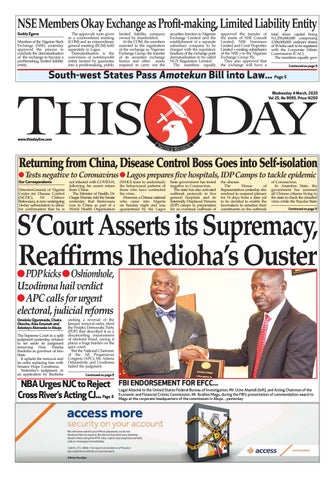
S’Court Asserts its Supremacy, Reaffirms Ihedioha’s Ouster PDP kicks Oshiomhole, Uzodinma hail verdict APC calls for urgent electoral, judicial reforms Omololu Ogunmade, Chuks Okocha, Alex Enumah and Adedayo Akinwale in Abuja The Supreme Court in a split judgment yesterday, refused to set aside its judgment removing Hon. Emeka Ihedioha as governor of Imo State. It upheld the removal and its order replacing him with Senator Hope Uzodinma. Yesterday's judgment, in an application by Ihedioha
seeking a reversal of the January removal order, irked the Peoples Democratic Party (PDP) that described it as a disconcerting endorsement of electoral fraud, saying it places a huge burden on the apex court. But the National Chairman of the All Progressives Congress (APC), Mr. Adams Oshiomhole, and Uzodinma hailed the judgment. Continued on page 9
NBA Urges NJC to Reject Cross River’s Acting CJ... Page 8
FBI ENDORSEMENT FOR EFCC... Legal Attaché to the United States Federal Bureau of Investigation, Mr. Uche Ahamdi (left), and Acting Chairman of the Economic and Financial Crimes Commission, Mr. Ibrahim Magu, during the FBI’s presentation of commendation award to Magu at the corporate headquarters of the commission in Abuja…yesterday
2
WEDNESDAY MARCH 4, 2020 •T H I S D AY
WEDNESDAY MARCH 4, 2020 • T H I S D AY
3
4
WEDNESDAY MARCH 4, 2020 •T H I S D AY
WEDNESDAY, ÍźËœ ͺ͸ͺ͸ Ëž T H I S D AY
5
NEWS South-west States Pass Amotekun Bill into Law
Group News Editor Ejiofor Alike
Email Ejiofor.Alike@thisdaylive.com, 08066066268
James Sowole in Akure and Yinka Kolawole in Osogbo
With Lagos, Osun, Ogun, Ondo and Oyo States Houses of Assembly passing the South-west Security Network (Amotekun) Bill into law, the region is now set to consummate the process of enhancing the security of lives and property of its indigenes. Ekiti State House of Assembly had earlier passed the security initiative bill into law. The Lagos State House of Assembly at plenary yesterday passed the bill to create Amotekun Corps as a special unit of the Lagos State Neighborhood Safety Corps. The lawmakers passed the bill after taking the third reading of the amendment to the Lagos State Neighborhood Safety Corps Agency Law 2019. The amendment bill had successfully gone through all the different stages of law making, which include first and second reading, public hearing, laying and presentation of committees report, adoption of report by House, third reading and finally passage. In Oyo, the members of the state House of Assembly, who were dressed in leopard skin regalia, yesterday passed the Oyo State Security Network
Agency Bill, 2020, codenamed Operation Amotekun. The session started with a clause-by-clause consideration of the bill before its eventual third reading and final adoption and passage. Some of the lawmakers wore amulets and arm bands demonstrating their combat readiness. The lawmakers added a drama to the session when all of them growled like leopards the moment the Speaker, Hon. Adebo Ogundoyin, hit the gavel passing the bill into law. Local hunters’ chants and songs immediately rent the air, with the lawmakers congratulating one another. The Ondo State House of Assembly also passed into a law a bill for the establishment of the State Security Network Agency and Amotekun Corps. The House had on February 18, deliberated on the bill and committed it to the House Committee on Security Matters after scaling through first and second reading. The legislature on February 24 had its public hearing on the bill. The bill was finally passed sequel to a motion moved by Hon Jamiu Maito, for the bill to be submitted by Chairman House Committee on Security Matter, Hon. Ololade Begudu. The motion was seconded by Hon. Favour Tomowemo
representing Ilaje. The Clerk of the House, Mr Bode Adeyelu, read the bill for third reading and Maito moved the motion for its passage while it was seconded by Hon. Leonard Akinribido, the Deputy Minority Leader. Speaking on the recommendations of the bill, Begudu said that the security agency would have a board to be administered by a chairman and be appointed by the state governor. He added that the chairman must be a person of proven integrity and that there would a commander to supervise the personnel of the corps on field. The committee chairman noted that the commander must be a retired security personnel not below the rank of major or its equivalent and being subjected to confirmation of the House of Assembly. According to him, the template of the state was used by others to harmonise the bill. The Speaker of the
Assembly, Hon. Bamidele Oleyelogun, described the passage of the bill as remarkable in the state. Oleyelogun, who wore a traditional attire crested with Amotekun, said the bill, if assented to by the state governor, would birth the security outfit, which will reduce criminalities in the state. He explained that the corps would be a community policing body that would complement the work of other security agencies in the state. Oloyelogun warned criminals to move away from the state, saying that Amotekun has come to stay. The state Commissioner for Justice and the AttorneyGeneral, Mr Kola Olawoye (SAN), said that history had been made in the state with the passage of the bill. Olawoye noted that it was the first time that the Yoruba race would speak with one voice on an issue. In Ogun State, the
lawmakers passed a bill for a law to establish the Ogun State Security Network Agency and Amotekun Corps. The Majority Leader, Hon. Yusuf Sherif, had presented the report of the Committee on Security and Strategy during plenary. Sherif stated that the committee recommended that the bill be passed as approved by the Conference of Speakers of South-west Legislature. The majority leader moved the motion for the adoption of the report and it was seconded by Hon. Musefiu Lamidi. The motion was also supported by the whole House. Sherif, thereafter, moved the motion for the third reading of the bill and this was seconded by Sola Adams. The clerk of the assembly, Mr Deji Adeyemo, read the bill for the third time while the Speaker, Mr Olakunle Oluomo, ordered that a clean copy of the bill be forwarded to Governor Dapo Abiodun
for his assent. The News Agency of Nigeria (NAN) reported that the lawmakers had during the second reading of the bill on February 20 stated that the bill was to assist in maintaining law and order in the state. They added that the Amotekun corps would be a community policing body that would complement the work of other security agencies in the state. The lawmaker stated that Amotekun would curb criminal activities such as kidnapping, robbery, cultism, and terrorism. The Osun State House of Assembly also passed the state Security Agency and Amotekun Corps Establishment Bill 2020 into law. The bill was passed with some amendments and corrections. The Speaker, Hon Timothy Owoeye, stated at plenary that the lawmakers had considered the grey areas pointed out during last week public hearing before the passage.
Gbajabiamila: I Celebrated My Mother’s Birthday with Few Friends Speaker of the House of Representatives, Hon. Femi Gbajabiamila, has said he only took few childhood friends and not 300 to Dubai, United Arab Emirates (UAE) to celebrate his mother’s birthday. Gbajabiamila, in a statement yesterday by his Special Adviser on Media and Publicity, Lanre Lasisi, also denied using the tax payers’ money to sponsor the trip, while describing the report by an online platform as false. He said: “The story carried by Sahara Reporters on Monday, March 2, 2020, alleging that the Speaker of the House of
Representatives Hon. Femi Gbajabiamila used public funds to take 300 guests to Dubai for his mother’s birthday is categorically false. “The Speaker, his family and a few friends were in Dubai to celebrate the 90th birthday anniversary of Alhaja Lateefat Olufunke Gbajabiamila, the Speaker’s mother. “For the records, this event was strictly for family members and a few childhood friends for which no public funds were appropriated or expended.� The speaker noted that not a single politician or a legislator was present at the event.
REGIONAL BANKERS AT THE STATE HOUSE... L-R: President, ECOWAS Bank of Investment and Development, Mr. Bashir Mamman; his predecessor, Dr. George Donkor; and President Muhammadu Buhari, during the bank’s oďŹƒcials visit to the president at the State House, Abuja‌yesterday
Buhari Pledges to Abide by ECOWAS Decision on Border Closure Omololu Ogunmade in Abuja President Muhammadu Buhari yesterday pledged Nigeria's preparedness to abide by the decision of the tripartite committee comprising Nigeria, Benin and Niger Republic on the partial closure of the country’s land borders whenever the report is submitted. He also said Nigeria was putting measures in place to secure the Gulf of Guinea, following his meeting with President Teodoro Obiang Nguema Mbasogo. The president made the pledge on border reopening when he hosted the outgoing President of the ECOWAS Bank for Investment and Development (EBID), Mr. Bashir Mamman Ifo, and his successor, Dr George Nana Donkor, in Abuja. A statement by the Special Adviser to the President on
Media and Publicity, Mr. Femi Adesina, said Buhari told his guests that the partial closure of the borders had brought immense benefits to the country. ‘‘We have saved millions of dollars. We have realised that we don’t have to import rice. We have achieved food security. We have curtailed the importation of drugs and proliferation of small arms, which threaten our country,’’ he said. According to the statement, Buhari thanked Ifo for the successes recorded in his eight-year tenure and advised his successor to sustain the achievements. The statement quoted the Ifo as telling Buhari that the bank had witnessed a transformation from its old status as a loss-making organisation to a profitgenerating bank. He added that commitments from ECOWAS member-states
had doubled to $1.4 billion. Donkor also thanked Buhari and Nigerians for their support towards his emergence as Ifo’s successor, noting that ‘‘without Nigeria, I could not have emerged." He acknowledged Buhari’s economic strategies as reflected in the Economic Recovery and Growth Plan (ERGP), saying the document has brought about economic recovery, stability and food security in the country. Donkor pledged his total commitment to partnering Nigeria towards achieving rapid development in the country and the rest of West Africa. Also yesterday, Buhari said Nigeria was putting measures in place to secure the Gulf of Guinea, following his meeting with President Teodoro Obiang Nguema Mbasogo. He made the remarks while receiving letters of credence
from the Ambassador of Equatorial Guinea, Francisco Edu Ngua Mangue. Buhari also canvassed stronger diplomatic relations with Greece and Cuba, saying it will foster Nigeria’s ongoing efforts to diversify the economy, improve global competitiveness and reposition the country to play more leading roles. Another statement by Adesina said the president, while receiving letters of credence from the Greek Ambassador to Nigeria, Monsieur Loannis Plotas, noted that the long standing diplomatic and business relations with the country would be strengthened for mutual benefits, adding that most global challenges would require collective efforts to secure lasting solutions. Plotas in his remarks, stated that Nigeria had had business ties with Greece, particularly with the latter's flour mills,
which employed about 50, 000 Nigerians at a given time in the country’s history, saying he was proud to serve the European nation in Nigeria. “I am very proud to be my country’s ambassador at such a historic moment when we will be celebrating the 60th anniversary of Nigeria, while my country will be celebrating its 200 years anniversary this year,’’ he said. The ambassador pledged to continuously support and project Nigeria's image across Europe. Also, Buhari, while receiving letters of credence from the Ambassador of Cuba to Nigeria, Clara Margarita Pulido Escandell, said cultural similarities between Nigeria and Cuba should promote effective partnerships, especially on trade. Buhari said Cuba's efforts in developing medicine and engineering could provide a springboard.
"President Buhari said Nigeria received support at international forums from Cuba for many years, assuring that the bilateral relations would be strengthened," the statement said. The statement quoted the Ambassador of Cuba as saying she was proud to be deployed to serve in Nigeria, noting that the history of Cuba cannot be told without reference to Nigeria. “I am proud to serve in Nigeria. The history of Cuba is incomplete without Nigeria and Nigerians. We always recall that some of the slaves brought into our country were Nigerians, and they played great roles in the development of the country. “That’s why we are mixed blood. Also, Your Excellency, your personal venture, integrity and your voice at the UN General Assembly in projecting Nigeria is outstanding,’' she said.
6
WEDNESDAY MARCH 4, 2020 •T H I S D AY
WEDNESDAY MARCH 4, 2020 • T H I S D AY
7
8
WEDNESDAY, ÍźËœ ͺ͸ͺ͸ Ëž T H I S D AY
NEWS
NBA Urges NJC to Reject Cross River’s Acting CJ FIDA: It’s a violation of Ikpeme’s human right Davidson Iriekpen The Nigerian Bar Association (NBA) yesterday called on the National Judicial Council (NJC) to reject the appointment and swearing-in of Justice Maurice Eneji as the Acting Chief Judge of Cross River State by the state Governor, Prof. Ben Ayade. It described the appointment and swearing-in of Justice Eneji as an absurdity and naked injustice, which must not be allowed to stand. In a statement by its President, Mr. Paul Usoro (SAN), the association also called on the council to sanction Justice Eneji for not only accepting the position, but presenting herself for swearing-in. Following the retirement of the former CJ, Justice Michael Edem, the state government had recommended Justice Ikpeme and Justice Eneji to the NJC for appointment as the Chief Judge of the state. The council, in December 2019, interviewed both candidates and found them respectively suitable for the position but recommended Justice Ikpeme for appointment as the chief judge, being the most senior judge and not having any negative report howsoever. However, following political undercurrents and intrigues, the state House of Assembly rejected her confirmation as substantive chief judge of the state on the excuse that she is not from the state by birth although married to a Cross River man. Angered by the development, the NBA yesterday opposed the appointment and swearing-in of Justice Eneji, saying it is biased and unconstitutional. It called on the Cross River State Government to urgently retrace its steps and confirm Justice Ikpeme as the substantive chief judge of the
state. The association added that from whichever angle it is viewed, it is distasteful and must be denounced by all lovers of Nigeria’s judiciary and its independence. It added that the cherished tradition in the judiciary is that the most senior judges be appointed as CJs or heads of courts. “From whichever angle one looks at the ongoing macabre dance in Cross River State, it is distasteful and must be denounced by all lovers of Nigeria’s judiciary and its independence. “The cherished tradition of appointing the most senior judges, where they have no reported blemish howsoever, to fill vacancies as heads of courts in the states and federal judiciaries promotes harmony within the judiciary and extirpates political corruption. “That tradition must be protected in our overall interest and for the preservation of the rule of law and the precepts of justice. “With these principles in mind, it is not too late for Justice Eneji to relinquish the acting appointment that, presumably, has been foisted on him by the CRS politicians and we respectfully urge his lordship to so act. By so doing, his lordship would earn himself a position of honour and distinction in the annals of Nigerian justice administration. “The NBA also calls on both the executive and legislative arms of the Cross River State Government to urgently retrace their steps and confirm Justice Ikpeme for appointment as the substantive Chief Judge of Cross River State. “The NJC indeed owes the Nigerian judiciary and the justice sector the duty of insisting on that position, to wit, the confirmation and appointment of Ikpeme as the Chief Judge of Cross
River State. “If we, of the justice sector, do not and cannot stand up for Ikpeme today, we would effectively have abdicated our responsibilities and should expect similar and worse degradations and desecration of the judiciary and judicial appointments by the executive and legislative arms of governments in the various states of the federation and, indeed, even at the federal level. “The NJC should also appropriately sanction judicial officers who connive at these unworthy and unconstitutional acts by the executive and legislative arms of government. Precedents of the NJC’s actions abound in this regard.
“The judiciary in Cross River State and beyond should stand as one in facing down this fundamental breach of our independence and the cherished tradition of appointing the most senior and unblemished judicial officers to fill the vacant positions of the heads of courts of the states and/or federal judiciaries,� NBA said.
FIDA: It’s a Violation of Ikpeme’s Human Right Meanwhile, the International Federation of Women Lawyers (FIDA) faulted the rejection of Justice Ikpeme by the Cross River State government, saying that it was discriminatory and
constituted an abuse of her human right. In a statement signed by its National Publicity Secretary, Ms. Eliana Martins, the group appealed to Ayade and the Speaker of the state House of Assembly to retract their actions which it described as discriminatory and a breach of the constitution. It argued that any discrimination based on the state of origin amounts to grave injustice especially since the constitution says the most senior judge of the High Court and not the most senior indigenous judge of the High Court. “FIDA Nigeria restates that discrimination based on the state of origin amounts to grave injustice being that the
constitution says, ‘the most senior judge of the High Court‌ and not the most senior indigenous judge of the High Court’. “Since there is no legal impediment against Justice Ikpeme who qualifies, we can conclude that the rule of law supports her confirmation. “The action of the Governor of Cross River State in appointing a junior judge instead of the Justice Ikpeme, who is the next senior judge in the hierarchy of Cross River State judiciary, is a grave injustice.â€? “We, therefore, appeal to the governor and the Speaker of the state House of Assembly to retract his action which is discriminatory and a breach of the constitution.â€?
BOOSTING CULTURAL AWARENESS... Minister of Information and Culture, Alhaji Lai Mohammed (left), and Emir of Argungu, Alhaji Samaila Mera, during the conferment of the traditional title of 'Kakakin Kebbi' on the minister as a prelude to the Argungu Fishing Festival in Argungu, Kebbi State‌yesterday
Bill to Reflect Federal Character in Service Chiefs’ Appointment Passes First Reading Deji Elumoye and Chuks Okocha in Abuja The Senate yesterday moved against the unilateral appointment of service chiefs by the president as a bill proposing the reflection of federal character in the appointment of the military chiefs passed first reading at plenary. The bill entitled: “Armed Forces Service Commission (Est, etc) Bill 2020 (SB 362)", sponsored by the Senate Minority Leader, Senator Enyinnaya Abaribe, is aimed at ensuring that no part of Nigeria is left out or ignored in the appointment of service chiefs. According to the bill, the appointment of Chief of Defence Staff, Chief of Army Staff, Chief of Air Staff, Chief of Naval Staff, Director of Military Intelligence and heads of other arm-bearing security agencies shall be appointed subject to recommendations by the Senate. The bill provides for the establishment of Armed Forces Service Commission, which
shall have the power and authority pursuant to section 219 of the 1999 Constitution of the Federal Republic of Nigeria (as amended) to ensure that the composition/ appointment of service chiefs of the Armed Forces of the Federation reflects federal character of Nigeria in the manner prescribed in section 217 (3) of the 1999 Constitution. The bill further states that the “Commission shall ensure that the functions specified in Section 217 of the 1999 Constitution and the powers exercisable by the president in the appointment of service chiefs and officers corps and other ranks of the Armed Forces of the Federation in Section 218 of the 1999 constitution reflects Federal Character of Nigeria. “As from the date of commencement of this Act, the commission shall have the power to recommend to the president from among the best and most qualified, most educated and most experienced members of the Armed Forces of the
Federation for appointment as (a) Chief of Defence Staff (b) Chief of Army Staff (c) Chief of Air Staff (d) Chief of Naval Staff (e) Director of Military intelligence; and heads of other arm-bearing security agencies and ensure that such appointments reflect federal character principle of Nigeria. “Recommend to the president the removal from office as service chiefs and heads of other arm-bearing security agencies on ground of misconduct, abuse of office, breach of any section of the Constitution, the Armed Forces Act or any other Act of the National Assembly. “The commission shall have the power to approve promotion from among the best, most competent and qualified officers as heads of military formations/branches such as General Officers Commanding Divisions of the Nigerian Army and their equivalents in the Navy and Air Force. “Provided that in making such recommendations the commission shall observe the
federal character principle and adopt an equitable template to spread the offices of the service chiefs and officers corps and other ranks of the Armed Forces of the Federation among the six geo-politicai zones of the country. “Subject to the provisions section 215 (1) and 216 (2) of the 1999 Constitution on the powers of the Nigerian Police Council to advise the president on the appointment of Inspector General of Police, and notwithstanding any other provision in any other law establishing any other security agency. “The commission shall have the power to recommend to the president from among the best and most qualified, most educated and most experienced officers of the Nigeria Police Force, State Security Service (SSS), National Intelligence Agency (NIA), Office of the National Security Adviser(ONSA) and the Nigerian Security and Civil Defence Corps (NSCDC), Nigerian Customs Service, Nigerian
Immigration service and Nigerian Correctional Service, persons for appointment as Inspector General of Police, Director General of SSS, Director General of NIA, Director General of ONSA and Commandant General of NSCDC, Comptroller General of Customs, Comptroller General of Immigration, Comptroller General of Prisons, and Head of the Federal Fire Service.� The bill proposed that “provided that in making such recommendations, the commission shall take into cognizance the federal character principle and the geo-political zones of the country that produced the four service chiefs provided in this section, and ensure that the heads of other security agencies provided in this sub section spread equitably among the six geo-political zones of the country. “The commission shall have power to make regulation in the performance of its functions to ensure that each zone of the federation is equitably represented in
the appointments of service chiefs and officers corps and other ranks of the Armed Forces of the Federation and heads of other security and paramilitary and armedbearing security agencies of the federation and ensuring that the most competent and qualified person from each zone is appointed at all times. “Notwithstanding the provision in any other law establishing the Armed Forces, Nigerian Police Force and other security/paramilitary agencies, commission shall supervise and approve upon certifying that federal character provided in this Act has been duly observed, all promotions in the Armed Forces of the Federation, Nigerian Police Force and other security and paramilitary and armed-bearing security agencies of the federation. “Where the number of available positions cannot go round the six geopolitical zones of the federation, the distribution of appointments shall be done equally between the North and South.�
9
WEDNESDAY, ÍźËœ ͺ͸ͺ͸ Ëž T H I S D AY
PAGE NINE S’COURT ASSERTS ITS SUPREMACY, REAFFIRMS IHEDIOHA’S OUSTER However, the ruling APC called for urgent judicial and electoral reforms in view of recent developments in the polity. The Supreme Court in the split judgment of six to one held that it lacked powers to sit on appeal on its own judgment. The court held that the application by Ihedioha asking the court to set aside its judgment of January 14 on the ground of nullity was an invitation on the apex court to sit on appeal over its own judgment, which the court could not do. Ihedioha had in an application brought before the apex court, prayed the court to reverse the judgment on the ground that the judgment was a nullity since it was obtained by fraud. Ihedioha in the application filed by his lawyer, Chief Kanu Agabi (SAN), said the judgment should be set aside because the apex court was misled into arriving at the decision that removed him from office. In the majority ruling delivered by Justice Olukayode Ariwoola, the court held that granting the request of the applicants would open the floodgate by parties to all kinds of litigations. The apex court in the majority ruling said by the provision of Section 235 of the 1999 Constitution, its decision on any judgment based on merit is final and shall not be reviewed once delivered under any guise, except for clerical errors. The apex court also stated that by Order 8 Rule 16, the general law is that it has no power to alter any judgment and that such judgment once delivered on merit shall remain forever. Justice Ariwoola said, "Certainly, this court has no
inherent power to grant what is being sought, it is beyond the powers of this court. There is no constitutional provision for this court to review its own judgment. "To say the least, this court has no competence and lacked power to sit on appeal in its own decision. Finality of the Supreme Court is entrenched in the constitution and inherent power can only be invoked where there is law to do so. "This court cannot under any guise alter any judgment under any inherent power, as doing so would bring the court into disrepute and ridicule. "The application is liable for dismissal and is hereby dismissed for want of jurisdiction and competence." However, the court unlike last week's ruling in APC's application seeking a reversal of its disqualification from the Bayelsa governorship election, refused to punish the applicants for asking for a review of its judgment. In the Bayelsa judgment, the Supreme Court had dismissed the APC's application and imposed a total fine of N60 million on the party's counsel, Chief Afe Babalola (SAN) and Chief Wole Olanipekun (SAN) to be paid to the PDP and two other respondents in the case. But yesterday, the apex court held that parties in the case should bear their cost. Those in support of the majority ruling were the Chief Justice of Nigeria (CJN), Justice Ibrahim Muhammad, Justices Sylvester Ngwuta, Kudirat Kekere-Ekun, Amina Augie and Mary Abba-Aji. Justice Centus Nweze, however, in his dissenting judgment set aside the January 14 judgment of the Supreme Court, describing it as a nullity and in bad faith. He held that the court was
misled in declaring Uzodinma as governor and subsequently ordered his removal from office. "In respect to my view, this court wrongly declared him (Uzodinma) winner of the said election," Nweze held. According to him, Uzodinma failed to give evidence of how he won the election, adding that there was evidence of cancelled votes or no election in some polling units. He said the votes, which were used to declare Uzodinma as the winner, were in excess of the accredited votes for the election. According to him, the table of the results in the disputed 388 polling units is mischievous as it omitted votes cast for other political parties, adding that the apex court wrongly used the same table to declare the appellant as governor of Imo State. "In my intimate reading of the January 14 judgment, the meat and substance of Ihedioha's matter was lost to time frame. This court once set aside its own earlier judgment and therefore cannot use time frame to extinguish the right of any person. Unlike the position held by his colleagues, Justice Nweze held that the Supreme Court has powers to overrule itself and can revisit any decision not in accordance with justice. According to Justice Nweze, the decision of the Supreme Court will continue to hunt Nigeria’s electoral jurisprudence for a long time to come, adding that without evidence of meeting other constitutional provisions, the court misled itself into declaring Uzodinma as governor. He said: "This court has a duty of redeeming its image; it is against this background that the finality of the court cannot extinguish the right
of any person. "I am of the view that this application should succeed. I hereby make an order setting aside the decision of this court made on January 14 and that the certificate of return issued to the appellant be returned to INEC. "I also make an order restoring the respondents as winner of the March 9 governorship election.
Verdict an Endorsement of Electoral Fraud, Says PDP Reacting to the judgment, the PDP described the verdict of the Supreme Court as a disconcerting endorsement of electoral fraud, which places a huge burden on the court and the justices. It, however, noted that in the face of the sad verdict, Justice Nweze’s judgment presents a glimpse of hope for the judiciary. According to a statement by PDP's National Publicity Secretary, Mr. Kola Ologbondiyan, "Our party abides completely by every word of the judgment of Justice Nweze as treated facts, which are truly sacred. "Justice Nweze’s pronouncement, which went straight into the substance of our application, represents a universal view about the travesty of justice that occurred in the Imo State governorship election judgment." PDP said it was unfortunate that the Supreme Court had the wholesome opportunity to redeem itself and correct its errors, but chose to hide behind technicality to justify and endorse an electoral fraud. It added that what Nigerians expected of the Supreme Court, since the error in its earlier judgment
had been fully established, was to summon the courage to affirm its fallibility by correcting the errors and handing over victory to the rightful winner. "Sadly, it failed to do so. For the avoidance of doubt, what the Supreme Court has done in this judgment is to uphold and legalise the writing of election results by individual contestants against the will of the people as expressed at the poll," it stated.
Oshiomhole, Uzodinma Hail Verdict
called on all Imo indigenes, both at home and abroad, to contribute their quota to the development of the state. To his opponents, Uzodinma said: “In this business, you must show the spirit of sportsmanship. It’s not every time you win, it’s not every time you lose. When you win, you carry the losers along; when you lose you follow those that won. My plea to my opponents is to come and bring their ideas; let us team up and create a synergy that will develop Imo State and bring succour to our people.�
Oshiomhole, however, described the judgment as refreshing and quite predictable. “We know that Ihedioha did not have the required number and that is a fact that nobody has ever disputed. How anybody thought he can impose someone who did not meet the spread is only known to PDP because, they specialise in rigging and they see rigging as their birth right. And that is why they could have the guts to be protesting in front of foreign embassies as if Nigeria is a colony under the supervision of some foreign powers. So, I think what the Supreme Court has done today is just to reaffirm that they are Supreme and whatever they did the last time was on the basis of what was before them,� he explained. Uzodinma also spoke to journalists shortly after the judgment, saying “the judgment represents the expectation of the mandate of the people. We give God all the glory that at the end of the day, truth came out. We commend the wisdom of the Supreme Court in standing by the truth.� He reiterated his resolve to develop the state and
APC Calls for Urgent Electoral, Judicial Reforms
would still be quarantined for 14 days in line with established safety procedure against coronavirus. "We have already established rules here that anybody who has been to China will go to self-quarantine. Chikwe has gone (to China) and came back and has done the test. It's
negative; but we have insisted that he must undergo the 14 days of quarantine which is why he was not here today. "He is not allowed to come out until after 14 days\ because if you make rules, you must also obey them, which is to set example for Nigerians that the head of NCDC is self- quarantined as we speak. He's very well
The APC, however, said the recent developments in the polity had made electoral and judicial reforms a matter of urgency and necessity. The National Publicity Secretary of the party, Mallam Lanre Issa-Onilu, in a statement, also congratulated Uzodinma on the Supreme Court's affirmation of his 2019 election victory. The party said as a lawabiding party, it believes in the sanctity of the rule of law and would always accept the decisions of the apex court, whether favourable or not. "The APC will never chose the route of impugning on the integrity of our judiciary, undermining other public institutions and threatening our democracy with unpatriotic utterances and actions. "However, recent developments in the polity have made electoral and judicial reforms a matter of urgency and necessity. These are the tasks before the 9th National Assembly as it embarks on the constitution review exercise," the party stated.
RETURNING FROM CHINA, DISEASE CONTROL BOSS GOES INTO SELF-ISOLATION government is to identify and screen foreigners and to keep close watch on Brass Local Government Area where many foreigners work as part of preventive measures to stop the spread of the virus to the state. However, the Aliko Dangote Foundation (ADF)
has pledged to support the current efforts by the federal government against Coronavirus with N200 million. Ehanire, while briefing the Senate leadership on government's efforts to tackle the Coronavirus scourge, said the NCDC boss returned at
the weekend from an official visit to China where he understudied the behavioral pattern of Coronavirus patients. According to him, Ihekweazu, was one of the WHO officials that spent nine days in China. He said: "We were honoured
that one of the scientists that WHO had chosen to go to China to study the disease was the DG of NCDC. They went there for nine days, during which they carry out investigation." He added that although the NCDC boss had tested negative upon his arrival, he
NSE MEMBERS OKAY EXCHANGE AS PROFIT-MAKING, LIMITED LIABILITY ENTITY assent to the allotment of 1,964,115,918 ordinary shares to dealing members and ordinary members on the basis of a ratio of 78:22, respectively. A Claims Review Shares totalling 40,083,999 ordinary shares, representing two per cent of the issued shares of Nigerian Exchange Group, will be set aside for allotment to parties who are adjudged as being entitled to shares in the demutualised Exchange was also set aside. At the EGM, members appointed a board of directors of the demutualised exchange with Otunba Abimbola Ogunbanjo, who is the current President of the NSE Council, emerging as the chairman. Mr. Oscar Onyema will remain as the chief executive officer and managing director. Others are: Dr. Umaru Kwairanga; Mrs. Fatimah Bintah Bello-Ismail; Mr. Oluwole Adeosun;Mr. Chidi Agbapu; Mr. Patrick Ajayi, all members and non-executive directors. Dr. Okechukwu Crescent Itanyi, Mrs. Nimi Akinkugbe, Prof. Enase Okonedo were
appointed independent directors while Mr. Ikpobe Apollos Oghooritsewarami and Mrs. Ojinika Nkechinyelu Olaghere were appointed independent non-executive directors. Speaking at the EGM, Ogunbanjo, said: “I feel elated that 19 years after initiating the process to demutualise and on the 60th anniversary of the exchange, we are close to achieving the goal. The successful demutualisation of the exchange was one of my main objectives when I assumed the presidency of the exchange and I am particularly happy it has been achieved during the life time of one of its founding fathers, Pa Akintola Williams.� He commended the efforts of the management and staff of the exchange, exchange members, members, professional advisers, the federal government, the Securities and Exchange Commission (SEC) and other capital market stakeholders for making the demutualisation a success
story. On his part, Onyema said: “Today’s meetings move the demutualisation process significantly forward and the positive outcomes affirm the great interest from members to support the pivotal restructuring of the exchange to become globally competitive.� According to him, in furtherance of their plans, they will move to file the necessary resolutions from the COM and all other required documents at the CAC and SEC, obtain the court order sanctioning the scheme, complete all necessary registrations and seek the final approval from the SEC to ultimately demutualise. Onyema explained that members of the exchange had approved the demutualisation scheme of the exchange in March 2017. This was followed by the signing of the Demutualisation of The Nigerian Stock Exchange Bill into law in August 2018. In December 2019, the SEC in
a no-objection letter, gave its consent to the NSE to hold the COM and EGM that would facilitate its conversion from a not-for-profit entity limited by guarantee into a profit-making, public limited liability company owned by shareholders. Also commenting on the successful meetings, former Director General of NSE, Prof. Ndi Okereke-Oyiuke said she was satisfied with the outcome, noting that demutualisation was good for the whole Nigerians. She said: "Though we started it, it did not happen; but we have been following through to ensure it happens. It is good not only for stockbrokers and investors, but for the whole Nigerians. It is good to have a demutualised exchange in Nigeria. "I feel that people have come to understand what the stock exchange really means. With this demutualisation, a lot of people will come into the exchange since we have already gone through the
process of teaching Nigerians how to be shareholders in quoted companies.� According to her, with demutualisation, the exchange can attract further highly experienced staff as well as foreign investors, foreign stockbroking firms and foreign direct investment. "With this demutualisation, anybody in any part of the world can have access, the exchange will have a lot of money to execute high level plans that they have and people that will invest in the exchange will also make money. It is the best thing that will happen to the Nigerian economy. It will definitely move the country forward because it is the engine room of the economy and now more people will be interested in investing in the stock exchange, they will bring in their money and it will be in Nigerian economy. "It is just few people that will cash in and cash out but majority, 95 per cent of people that invest will keep their money here," she said.
Continued on page 10
TOP GAINERS PZCUSSONS ACCESSBANK FBNHOLDINGS UACN JAIZBANK TOP LOSERS ABCTRANS DANGSUGAR OKOMUOIL
NGN NGN 0.40 4.45 0.75 8.45 0.45 5.15 0.70 8.10 0.05 0.59 NGN 0.03 0.27 1.20 10.90 6.60 61.40 ROYALEXCHANGE 0.02 0.20 AXAMANSARD 0.15 1.53 HPE Nestle Nig Plc â‚Ś1,080.00 Volume: 387.895 million shares Value: N5.076 billion Deals: 4,901 As at yesterday 3/03/2020 See details on Page 39
% 9.8 9.7 9.5 9.4 9.2 % 10 9.9 9.7 9.0 8.9
10
WEDNESDAY, ÍźËœ ͺ͸ͺ͸ Ëž T H I S D AY
NEWS
Fayemi: Govs Now Focus on Providing Economic Opportunities Ejiofor Alike The Chairman of the Nigeria Governors’ Forum and Governor of Ekiti State, Dr. Kayode Fayemi, has identified the provision of economic opportunities for the people as top priorities of all the governors. He identified the key area where foreign missions in Nigeria must assist, if their intention is to help in the liberation of Nigerians from poverty, hunger and disease. Fayemi stated this yesterday
when the Czeck Ambassador to Nigeria, Mr. Marek Skolil, called on him at his Abuja residence. He said: “There is no democracy without the rule of law,� adding that “elections do not make democracy.� The governor who was enumerating what governance at the subnational level entails for the country said: “We need to increase economic opportunity at the subnational level for the safety and security of our people because security and welfare is the
first job of the government. “In the minds of the people we need more than governance for the goodwill of the people,� adding that, “at the end of the day there are no “federal Nigerians but state citizens�, so those who are friends of Nigeria must understand the two level strata of our government and aid the one that best touches the heart of the problem as it were." According to him, “You cannot extricate violence from poverty. Someone who is less
educated is a lot more riskaverse than someone who is educated and can read the future and therefore the thrust is to get more people out of poverty and illiteracy, as quickly as possible, for good governance to germinate on an even level in the country.� This, he added, is why “states are interested in agriculture, manufacturing, education and other economic generators that improve the quality of life of our people. "The more qualified the people, the more accountable
the governors would be because qualified people will be able to hold those in government to put their foot to fire for the benefit of all. “We've proved that we are not just a democracy that writes election results and the country is gradually emerging strong among regions where one must prove his mettle to win, by propounding a strong manifesto and agenda for the people and genuinely convincing them that one is there for their general good." He thanked the Czeck
ambassador for visiting at a time he did, adding that he flew to Abuja from Ekiti to honour this invitation because of his belief that the partnership that can bring bonds at the subnational level will benefit Nigeria. Fayemi said he was not talking for the federal government but that as a key official of the President Muhammadu Buhari’s campaign team, he is not unaware of the importance of such partnerships to Nigerians collectively.
Kwankwaso Denies Being Investigated for Fraud Dike Onwuamaeze The former minister of Defence, Dr. Musa Kwankwaso, yesterday denied being investigated for fraud by the Economic and Financial Crimes Commission (EFCC). He spoke through his Principal Private Secretary, Mr. Muhammad Ali, who described the allegation that Kwankwaso and his former aides at the Ministry of Defence
are being investigated for fraudulent contract awards as mischievous and untrue. Kwankwaso's aides allegedly named in the probe include the incumbent Governor of Kano State, Dr. Abdullahi Umar Ganduje, and one Mr. Abba Yusuf. Ali said Ganduje and Yusuf were alleged to have collected bribes of N50 million and N30 million respectively. Ali in a statement issued
yesterday said: “We wish to put the record straight and draw the attention of the general public that during the said period, which the alleged fraudulent contracts took place i.e. 2007, that Sen. Kwankwaso was not the Minister of Defence. He resigned from that position in November 2006 to free himself to contest for the governorship ticket of the PDP in Kano State.�
Ali said the only position Kwankwaso was holding at that time was representing the North-west region on the Board of Niger Delta Development Commission (NDDC). He added that Kwankwaso voluntarily resigned from this position in 2010 because of his disagreement with the obvious corrupt practices in the way the commission was being administered. He added that during the
same period, Ganduje was in Ndjamena as Executive Secretary, Lake Chad Basin Commission. “Therefore, there was no way either Senator Kwankwaso or any of his aides at that material time could have been involved in the alleged defence contract scam,� Ali said. He, therefore, urged media organisations, particularly the print media, to desist
from publishing such unsubstantiated stories, which would not only tarnish the image of reputable individuals but also the image of the media outlets themselves. Ali said ordinarily Kwankwaso would not have bothered to react to the allegation, “but seeing the same report being carried by some media outlets that are ordinarily reputable, we are compelled to respond.�
ensure national health security. Youssoufou listed other areas the foundation is supporting to include surveillance and epidemiology where facilities worth N36 million will be provided to support government’s efforts. According to her, the ADF will also donate N48 million for case management training of health workers. Speaking at the meeting facilitated by the World Bank, the bank’s Country Director represented by the Operations Manager, Ms Kathleen Whimp, identified four thematic areas to tackling the spread of COVID 19. These are: regular communication with the public, contact tracing, training of volunteers and international co-operations.
check contractors, businessmen and people coming in from affected countries in order to avoid having the disease in the state.
RETURNING FROM CHINA, DISEASE CONTROL BOSS GOES INTO SELF-ISOLATION but he has to follow the rules," the minister stated. Speaking on the level of government preparedness to tackle coronavirus, he explained that there are already established isolation centres in Lagos, Abuja, Kano and Port Harcourt to respond to any emergency. But giving an update on coronavirus in Lagos State, where the index case occurred last week, the Commissioner for Health, Prof. Akin Abayomi, said the Chinese national had been taken to the isolation centre in Yaba where his sample had been collected for testing. The result, however, showed that the Chinese tested negative to the virus. Sources said the Chinese who boarded an Ethiopian Airlines flight from Addis Ababa to Nigeria, was coughing profusely on arrival at the Murtala Muhammed International Airport (MMIA), Lagos. The MMIA Manager, Mrs. Victoria Shinaba, who spoke before the result of the test on the Chinese was released, confirmed the incident, saying that “we are still expecting the results from Lagos State.� The commissioner said the state was already putting contingency plans in place in case of the outbreak of the virus in the state. He said: “We presently have 100 isolation centres, but we have put plans in place to increase it to 1000. With time we will know whether to activate this or not. We are also preparing five general hospitals and our IDP camps as plan B. We hope no other case is recorded, but should there be, we are more than ready to handle outbreaks. “The federal government has activated testing sites at every international airport,
including that of Lagos. So as it stands now, we have two centres in Lagos where coronavirus tests can be done.� According to him, the state has been preparing for this day, and it has an extremely sophisticated laboratory with level three, and certified by international bodies to deal with an epidemic. “People criticise us that we are not prepared, but what they don’t know is that we have been waiting for this day,� he added. On the Italian index case, he said three tests had so far been carried out on him, noting that the first result showed a baseline of the virus, while the second showed the virus has reduced. “But the third result showed the virus has gone back to baseline. “We will keep watching him because the virus fluctuates. Whenever the virus eventually leaves his system, we will be happy to release him. I am sure he will want to travel back to Italy immediately after been released. "He has a mild to moderate case of the virus at the moment. His breathing is fine although he has slight cough. We know he is lonely at the moment because his ward has 14 beds and he is the only one there. We hope it remains so. We have reached out to his embassy. They have provided him with phone, internet, books, and Italian food," the commissioner added.
House to Suspend Plenary for Two Weeks over Epidemic Also yesterday, the House of Representatives resolved to suspend plenary for 14 days over fear of Coronavirus and to enable lawmakers to
sensitise their constituents on the outbreak. The decision of the House followed the unanimous adoption of a motion of urgent public importance, entitled: 'The need for emergency response and tackling of deadly Coronavirus (COVlD-19) in Nigeria', moved by Hon Idem Unyime. Supporting the motion, Hon. Ndudi Elumelu proposed an amendment, calling on the National Assembly to suspend plenary for two weeks. Presenting his motion, Unyime noted that the federal government needs to move swiftly and intensify collaborations with health agencies to check the virus at this early stage of the outbreak. He lamented that with the current situation of health facilities in Nigeria, the virus if not properly checked or curtailed, will easily be transmitted within the larger population and may lead to a wider catastrophe. In his contribution, Hon. Nasir Ali Ahmed said it was worrisome that Nigeria as the most populated country in Africa, has only three isolation centres. He made reference to the case of the Iranian vice president who contacted the disease and two of its cabinet members that died recently after contacting the disease, saying that more needs to be done to tackle it. Also Hon. Dagomie Abiante said Nigeria should do more in its preparations to fight the virus. Adopting the motion, the House directed the leadership of the National Assembly to set up an ad-hoc committee to interface with the executive, health agencies with a view to overcoming and eliminating the disease. The House urged the
federal government to release more emergency funds and create enabling environment and support for the Federal Ministry of Health and other health agencies and institutions in a bid to eliminate the virus. The lawmakers also called for the immediate activation of all centres established and designated for the treatment and management of Ebola cases in the country for the management of suspected cases and victims of COVID-19.
Dangote Donates N200m to Fight Coronavirus However, government's efforts in stopping the virus from becoming an epidemic got a boost yesterday as the Aliko Dangote Foundation (ADF) pledged N200 million to the cause. The ADF’s intervention is considered so far the largest single donation by a corporate organisation in the country. The Aliko Dangote Foundation had also committed about N1billion to the fight against the dreaded Ebola Virus Disease (EVD) in Africa. The Managing Director and Chief Executive Officer of the Aliko Dangote Foundation, Ms Zouera Youssoufou, who was represented by the Health and Nutrition Programme Officer, Mrs. Maryam Shehu-Buhari, at a donor coordinating meeting in Abuja yesterday, said the donation was part of the Foundation’s cardinal objective. She said the Dangote Foundation had earmarked N124 million to support facilities to help prevent, assess and respond to health events at point of entry to
Anambra Screens Chinese Citizens To check the outbreak of Coronavirus, the Anambra State Commissioner for Health, Dr. Vincent Okpala, has said the state government has screened all Chinese citizens living in the state. Okpala told journalists yesterday that all those screened tested negative to the virus and declared that the state is free of it. "There is no case of Coronavirus in Anambra. We are on ground to respond to any eventuality. We are tackling Lassa fever and Coronavirus together. I want to re-assure you that we have checked out all the Chinese in the state and they are free from disease for now. From January to date, we have examined five people that entered the state from China and they are all free from the disease,’’ he said. The commissioner noted that his ministry was set to
Bayelsa Targets Foreigners, Keeps Check on Brass LGA Meanwhile, the Bayelsa State government yesterday said part of the preemptive measures it was taking to prevent the spread of the virus to the state was to identify and screen foreigners and to keep close watch on Brass Local Government Area where many foreigners work. Briefing the state Governor, Senator Douye Diri, on steps being taken to safeguard the state from the virus, the Permanent Secretary in the state Ministry of Health, Dr. Apoku Nathaniel-Inodu, said dedicated phone lines had been opened for people to reach out to the ministry to report suspected cases of the virus. He said the ministry was preparing an isolation centre at the Niger Delta University Teaching Hospital, Okolobiri to handle cases or suspected cases in the state. The commissioner added that the state government is paying close attention to Brass LGA of the state. Brass is the base of the Italian oil giant, Nigerian Agip Oil Company, which operates the Brass oil Terminal. Responding, the governor said his administration would give priority to the health and safety of the people at all times. He urged residents not to panic over the Coronavirus pandemic and expressed satisfaction with the efforts of the state health team toward containing the disease.
WEDNESDAY MARCH 4, 2020 ˾ T H I S D AY
11
NEWS
Gunmen Kill Two Persons, Injure Four Others in Kano Ibrahim Shuaibu in Kano Suspected gunmen in a car on Monday night raided a sleepy town of Bagwai in Kano State
and unleashed terror, killing two persons and injuring four others. The victims are the son of a chieftain of the Peoples
Democratic Party (PDP) in the area, whose name could not be ascertained as at press time and one-time zonal woman leader of the party in Kano North, Hajiya Balaraba Sani.
THISDAY gathered that the two persons were killed during the attack that lasted for few minutes. The incident occurred in front of a shop in Bagwai town.
It was also learnt that policemen later came to evacuate the corpses as well as the injured, who were rushed to the hospital. Police spokesman in
the state, DSP Abdullahi Haruna Kiyawa, confirmed the incident. Abdullahi said the command has since commenced an investigation over the incident.
Cybercrimes: FBI Visits EFCC, Commends Magu over Collaboration Commission’s boss bags FBI Award of Excellence The acting Chairman of the Economic and Financial Crimes Commission (EFCC), Mr. Ibrahim Magu, yesterday received an Award of Excellence from the Federal Bureau of Investigations, (FBI), for his unique role in the joint field operation with the FBI codenamed, “Operation Rewired” aimed at tackling the menace of cybercrimes The FBI legal attaché, Uche Ahamdi who presented the award during a visit to the EFCC Headquarters in Abuja, commended Magu’s leadership as well as the commission over the collaboration in the fight against corruption. Commending Magu for the fight against cybercrimes, Ahamdi said, “after a long race and crossing a certain finished line, we look back and see how far we have gone, and then come back together to say thank you very much for all your support in tackling the Business Email Compromise, BEC menace across the world, not just in Nigeria, but across the world.” According to Ahamdi, the EFCC under Magu has put
in place efficient working collaboration leading to the arrest and prosecution of the perpetrators of BEC across the globe. He reiterated the need for more collaboration between the FBI and the EFCC, stressing that the FBI was “immensely pleased” with the assistance rendered by the Commission. “We come to present a few token of our appreciation in the form of citation and certificates from the FBI to the operatives who handled part of the BEC rewired operation,” Ahamdi added. Responding, Magu appreciated the FBI for deeming it fit to consider him and his team worthy for the award of excellence, and gave assurances of the Commission’s readiness to continue partnering with the FBI. According to the anti-graft czar, the exchange of intelligence with the FBI helped the Commission in winning the fight against cyber-crime, adding that the working relationship with the FBI was necessary “because corruption is a borderless crime”.
Obey Judgment Stopping Compulsory Blood Donation, SERAP Tells Sanwo-Olu Tobi Soniyi The Socio-Economic Rights and Accountability Project (SERAP), has called on Lagos State Governor, Mr. Babajide Sanwo-Olu to immediately obey Monday’s court judgment ordering all hospitals in the state to stop the practice of mandating husbands to donate blood as a condition for their pregnant wives to access ante-natal care. The judgment was delivered by Justice Raliat Adebiyi of the Lagos State High Court in Ikeja, who described the practice as “unconscionable, arbitrary, unfair and a violation of Section 38(1) of the 1999 Constitution,” which guarantees citizens’ right to life”. In order to ensure compliance with the judgment, SERAP has now followed up with a letter to Sanwo-Olu. In the letter dated March 3, 2020, the group urged the governor to use his leadership position to “instruct the Commissioner for Health, Professor Akin Abayomi to immediately, fully and effectively enforce the judgment It said: “The enforcement of the judgment will be a special moment for the implementation of the government’s strategies towards achieving the Sustainable Development Goals
(SDGs), as it will improve the chances of everyone including women during and after childbirth, and ensure quality health services, which will contribute to the promotion of these goals. “As Justice Adebiyi stated in her judgment, your enforcement of the judgment will be consistent with Section 33 of Nigerian Constitution of 1999 (as amended), which guarantees the right to life; and articles 2(a),3 and 12(1) of the International Convention on Economic Social and Cultural Rights, which requires the health system including in Lagos State to provide equal opportunity for everyone. Nigeria has ratified the covenant.” SERAP claimed that enforcing the judgment would also show Lagos State as a champion of the SDGs and be entirely consistent with international standards and best practices, including those developed by the World Health Organisation (WHO), which recognize that the safest blood donors are voluntary, non-remunerated blood donors. The WHO has in fact recommended that no coercion should be brought to bear upon the donor to donate.
STRATEGISING AGAINST CORONAVIRUS…
L-R: Minister of State, Federal Ministry of Science and Technology, Mr. Mohammed Abdullahi; Minister of State, Health, Senator Adeleke Mamora; Minister of Science and Technology, Dr. Ogbonnaya Onu; and former Chairman of Independent National Electoral Commission / President, Bioresources Institute of Nigeria (BION), Prof. Maurice Iwu, during the discussion on the discovery of drugs for Coronavirus in Abuja…recently
El-Rufai’s Apology Vindicates Our Cries over Killings in Kaduna, Says CAN The Chairman of the Kaduna State chapter of the Christian Association of Nigeria (CAN), Rev. Joseph Hayab has stated that Governor Nasir el-Rufai’s apology over the latest killing of 51 people in the state, has vindicated CAN’s cries over banditry and kidnapping, which had led to the death of innocent souls in the state. Governor el-Rufa’i had during his visit to the affected communities of Igabi and Giwa Local Government Areas on Monday, apologised to residents of communities over the attack. Hayab said, the governor has vindicated the CAN’s cries that
the state is not safe. He argued that the governor had just begun to see for himself the extent of the security challenges bedeviling the state. “It is only when our leaders are beginning to ignore bad advisers around them that all is going to be well with the people just to keep their jobs going without giving true advice to those in authority with what is happening with the man in the street, we will never get it well in this country.” Hayab maintained that their cries were often interpreted that CAN, as a body was merely playing politics with security of
lives and property of members. He said that the government and its agents had always claimed that the Christian body was crying wolf over the security challenges characterised by kidnapping and killings in the state. He said the body of Christ won’t cease from offering constructive criticism to the state for development, adding that Christian leaders would continue to pray for the leaders of the country to have a fear of God in their approach to governance. The CAN boss in a statement entitled, ‘At last el-Rufai eyes open,’ said: “When CAN cried
out of the incessant killings going on in the state, some people unfortunately for whatever reasons best known to them, gave meanings to our cry and gave us different names for fighting the cause of humanity. “Our concern in time past and till now has been let the common man on the street be safeguarded and feel secured like any other person. “But when we begin to read different meanings to what somebody said either because we are not of the same faith or political affiliation, it serves as the beginning of our serious challenges in the society.
Sex-for-marks: Adamawa Varsity Sacks Two Lecturers The Governing Council of the Modibbo Adama University of Technology Yola in Adamawa State has terminated the appointment of two senior lecturers following their alleged involvement in sexual harassment. The development was contained in a statement issued yesterday by the Information and
Protocol Officer of the university, Mr. Aminu Gururmpawo. Gururmpawo said that the university’s council also sacked Bakari Girei of the Registry Department for misappropriation of the university’s Primary School Parent/Teacher Association’s funds to the tune of N1.12 million. The statement read, “The
Governing Council of the Modibbo Adama University of Technology Yola at its 96th regular meeting held on Thursday, 27th February 2020 approved the termination of appointments of three senior staff of the university. “Two of the senior academic staff appointment was terminated for their involvement in acts
of victimisation and sexual harassment. “They are Dr. Yakubu Bobboi and Dr. Toma Fulani Mbahi both staff of the Department of Animal Science and Range Management who were penalised for their involvement in the victimisation and sexual harassment of one Miss CA Bathon, a Masters student in the Department.
Refugees Commission Harps on Education for IDPs Dike Onwuamaeze The National Commission for Refugees, Migrants and Internally Displaced Persons (NCFRMI) has called on well-meaning Nigerians and organisations to help educate internally displaced children to enable them fit into the society when they leave the Internally Displaced Persons (IDPs) camps. The Deputy Director of IDPs at the NCFRMI, Ms. Fatima
Mamman Daura, made the call yesterday when she visited the Local Education Authority Primary School, Gwarimpa, Abuja, where some internally displaced children were enrolled by the Early Years Education for IDP Initiative, Abuja. Duara, who expressed satisfaction with the educational progress of the children, commended the school and the Early Years Initiative for
IDPs for the intervention, adding that the commission would enroll more IDP children in schools wherever significant IDP populations exists in the country. “This initiative means a lot to me because this is a private individual, who is supporting the Refugees Commission, supporting children displaced from the Goza, Southern Borno, in the North East. So, we must
ensure that they not only get education, but also get education that is at per with what other children are getting,” she said. Speaking to newsmen, the Co-founder of Early Years for IDPs Initiative, Mr. Ndubuisi Nwigwe, said the organisation has been working with the commission to set up early years centers in the IDP camps that would care for the educational needs of more children.
12
WEDNESDAY MARCH 4, 2020 ˾ T H I S D AY
NEWS
WAEC Releases 2020 WASSCE Results for Private Candidates Funmi Ogundare
A total of 3,892 candidates, representing 32.23 per cent obtained credits in five subjects, including English Language and Mathematics, in the West African Senior School Certificate Examination (WASSCE), first series for private candidates written in January. Releasing the result of the examination written by 12,075 private candidates yesterday in Lagos, WAEC’s Head of National Office (HNO), Mr. Olu Adenipekun, said 26.08 per cent achieved the benchmark last year. Adenipekun also informed candidates can now get their certificates processed on request and delivered to their preferred location. He said: “Beginning with the WASSCE for Private Candidates, 2020-First Series, the collection of certificates would be based on requests by candidates online
via the Electronic Certificate Management System platform. In order for this to be done seamlessly; we have entered into a partnership with the Nigeria Postal Service (NIPOST). Therefore, using the Expedited Mail Delivery Service of NIPOST, candidates can upon application and required payments done online, have their certificates delivered to them in any State of the Federal Republic of Nigeria irrespective of where they sat the examination.” A total of 6,331 males (52 per cent) and 5,744 females (47.57 per cent) took the exam. While analysing the performance of candidates,Adenipekun said: “9,438 candidates, representing 78.16 per cent obtained credit and above in two (2) subjects; 8,125 candidates, representing 67.29 per cent obtained credit and above in three subjects; 6,713 candidates, representing 55.59 per cent obtained credit and
above in four subjects; 5,251 candidates, representing 43.49 per cent obtained credit and above in five subjects.” He said while 11,816 candidates, representing 97.86 per cent have their results fully processed and released 259 candidates, representing 2.14 per cent have a few of their subjects still being processed due to errors by the candidates in the course of registration or writing the examination. He noted that the results would be released once corrected. Another 548 candidates, (4.54 per cent) have results being withheld for involvement in examination malpractice. He also said the cases are being investigated and reports of the investigations will be presented to the appropriate to the committee when due, while the committee’s decisions will be communicated to the affected candidates.
FG: Dealers on Sub-standard Fertilizers Face Five-year Jail Term
James Emejo in Abuja
The Minister of Agriculture and Rural Development, Alhaji Sabo Nanono yesterday launched the National Fertiliser Quality (Control) Act, 2019, which stipulates a term of imprisonment of at least five years without an option of fine for an offender who distributes fertilizer that is deficient in plant nutrient as specified in the act. The Act, among other things, regulates the manufacturing, importation, sales/distribution as well as quality control of fertilizers in the country. Speaking during the launch, the minister said the new regulation seeks to achieve sanity in the fertilizer industry, which had been smeared by several allegations of corruption in recent times. The sanction also affects anyone who imports, exports or distributes unbranded or misbranded fertilizer and condemns the sale of condemned fertilizer, flouts a
stop-sale order as well as diverts or converts the commodity. There are also financial sanctions on form of fines ranging between N200,000.00 to N10 million for violators of various sections of the act. Nanono commended President Muhammadu Buhari for the quick assent to the fertilizer act, which according to him demonstrated the importance and commitment the president attaches to the agricultural sector and his desire to help protect the investments of the teeming farmers. He said Buhari had further demonstrated his commitment to revitalising agriculture through the provision of the fertilizer regulatory framework aimed at guaranteeing the supply and distribution of quality fertilizers and other farm inputs to farmers across the country “at their doorsteps, at the right time, right place and right prices.” According to him, operating
or carrying on fertilizer business as a manufacturer, blender, importer or distributor of fertilizer in on the country with an expired permit or certificate of registration is punishable under the act going forward. He said selling any fertiliser supplement that contains destructive ingredients or properties harmful to plant growth when used according to the accompanying instructions or in accordance with the instructions contained on the label of the package in which the fertiliser or the fertiliser supplement is contained will also attract punishment. The act also stipulates sanctions for obstructing, hindering or preventing a duly authorised officer of the prescribed authority (farm inputs support services department of the ministry) from carrying out his/her duties and responsibilities assigned to him/her under the act or regulations made pursuant to this act.
Illicit Financial Flows in 135 Countries Hit $8.8tn
Ndubuisi Francis in Abuja
Trade-related illicit financial flows (IFFs) between and among 135 developing and 36 advanced economies over a 10-year period stood at $8.8 trillion, a new report just released by the United States-based Global Financial Integrity (GFI), has revealed. GFI which works to curtail illicit financial flows, producing ground-breaking research, fact-based advocacy, pragmatic policy solutions and innovative government advisory services stated in the latest report which spanned a period between 2008 and 2017 that it uncovered a gap of $8.8 trillion in reported trade between 135 developing and 36 advanced economies. Noting that trade misinvoicing is a significant obstacle to sustainable development, GFI said in putting together its report, it examined latest
official trade data reported to the United Nations (UN), to estimate the magnitude of trade misinvoicing – one of the largest components of measurable illicit financial flows (IFFs) between and among 135 developing countries and 36 advanced economies. It described trade misinvoicing as a situation where importers and exporters deliberately falsify the stated prices on invoices for goods they are importing or exporting as a way to illicitly transfer value across international borders, evade tax and/or customs duties, launder the proceeds of criminal activity, circumvent currency controls, and hide profits offshore. “It is important to note that while the term “illicit financial flows’’ (IFFs) tends to include many types of activities, such as trade misinvoicing, smuggling, tax evasion, etc., this report only
focuses on trade misinvoicing, or the trade-related aspects of illicit financial flows. It does not address all forms of IFFs,” the report said. According to GFI, the countries included in the report were based on the International Monetary Fund (IMF) classification system, which comprises 148 developing countries and 36 advanced economies. However, the organisation disclosed that 13 of the developing countries did not report sufficient trade data to the UN to be included in the analysis, a group Nigeria may have fallen into since it was not mentioned among the countries in Sub-Saharan Africa which suffered from the $8.8 trillion IFFs despite President Muhammadu Buhari’s declaration last year ,that Nigeria lost $157.5 billion to illicit financial flows between 2003 and 2012.
WEDNESDAY MARCH 4, 2020 • T H I S D AY
13
14
T H I S D AY Ëž Ëœ Í˛Ëœ 2020
COMMENT
Editor, Editorial Page PETER ISHAKA Email peter.ishaka@thisdaylive.com
BLACK WEDNESDAY
Government has to wake up to its responsibility of protecting lives and property, writes Sonnie Ekwowusi
I
mpelled by the growing insecurity of lives and property in Nigeria especially the daily murder of innocent citizens by Boko Haram insurgents, the Catholic Bishops of Nigeria last Wednesday invited all people of goodwill to go down in penance and prayer and beseech God for peace and security to reign again in Nigeria. In so doing, the bishops explained that they were not meddling in partisan politics but simply carrying out a moral responsibility to inculcate the permanent principles of the moral order as they affect the human person and the social, economic, political and cultural structures of earthly human life. In plain language, the bishops are urging the Nigerian authorities to protect the lives of the Nigerian citizens because a country that allows its citizens to be killed day by day by barbarians is tottering on the precipice. This was why the Catholic Bishops invited all for penance and prayers last Wednesday. In honouring the invitation last Wednesday, Nigerians from different walks of life and different social milieu dressed up in black attire or simply wore black band across their arms as a sign of mourning all those who have been slaughtered or maimed by the Boko Haram terrorists or other killer groups operating in Nigeria. I was in one bank last Wednesday and I noticed that practically all the bank staffers on duty clothed themselves in black. Feigning ignorance of why they wore black, I asked the banker in front of me, “Why are you people wearing black today�? She smiled at me and responded, “don’t you know what today is?�. Today is Black Wednesday, a day in which we are expected to wear black.� We may now ask ourselves in what way has the insecurity in Nigeria worsened since President Buhari returned to power. It has worsened by the fact that the Nigerian territory has become one great killing field. The coronavirus may be deadly but the Boko Haramvirus or Fulani herdsmenvirus is deadlier. The coronavirus may be claiming scores of its victims no doubt. But hardly any day passes in Nigeria without the Boko Haramvirus or Fulani herdsmenvirus claiming at least a whole family or a whole community. In the past the Boko Haram terrorists and Fulani herdsmen terrorists were killing Nigerians only in the North-East. Today they have spread their dragnets to the South-West, South-South and South-East. They are bent on conquering the aforesaid regions and expropriating them as Muslim territories. For example, last week mayhem was let loose along the Benin/Ore expressway in Igbogi village after Okada town in Edo State. Apparently some Fulani herdsmen had killed some villagers in a nearby village. In protest, the angry villagers carried a corpse of one of the victims and laid it across the expressway. This caused a terrible vehicular traffic jam which further caused a snarl of traffic congestion on both sides of the expressway. A lawyer friend who was coming from Enugu in his car was caught up in the confused traffic. He said that the situation got so worse that some armed soldiers who later came to the scene started engaging the villagers in a gun battle. In order to bypass the gridlock, my lawyer friend and his fellow car occupant embarked on a risky diversion into some of the villages (Thank God the Boko Haram insurgents operating in those villages did not see them) from where they rejoined the major expressway leading to Lagos. This is our new Nigeria for you. You will recall that it was along the same Benin/Ore Expressway that some Fulani herdsmen killed Mrs. Funke Olakunrin, the daughter of the 93 years old Pa Rueben Fasoranti, leader of the Pan-Yoruba socio-political group, Afenifere. Suddenly
IF BURATAI AND HIS FELLOW SERVICE CHIEFS HAVE BECOME INCOMPETENT AND UNFIT FOR THE JOB THEY ARE EMPLOYED TO DO WHY CAN’T PRESIDENT BUHARI REPLACE THEM WITH CAPABLE HANDS?
human life in Nigeria has become the Hobbesian “solitary, poor, nasty, and short�. We now live at the mercy of kidnappers, bandits, Boko Haram insurgents, Fulani herdsmen murderers and ISWAP militants. The greatest tragedy however is that amid the heightened Boko Haram and Fulani herdsmen killings the Buhari government is more interested in playing to the gallery than in actually having a firm grip of the sad situation. Rather than divert sophisticated strategies to smoke out Boko Haram from Nigeria the Buhari government is offering amnesty to the so-called “repentant� Boko Haram insurgents. Last Friday not less than 25 Boko Haram terrorists from Niger Republic, including their wives and children, who claimed that they had “repented� from their misdeeds were allowed to enter Nigeria to receive amnesty. In fact the Nigerian army went out to receive them and handed over to the Borno state government for rehabilitation. You will recall that two weeks ago the Borno State Commissioner for Information angrily commented that the so-called “repentant� Boko Haram members have not repented at all because they are still going back to Boko Haram terrorism. If the government is already aware of this, why is it still offering the so-called “repentant� Boko Haram members amnesty? This is why you cannot fault Bishop Matthew Hassan Kukah and others who are insisting that there is no difference anymore between the Buhari government and Boko Haram. Think about it. How can the Buhari government be allowing the so-called “repentant� Boko Haram members, their wives and children from Niger Republic to freely enter Nigeria at a time the insurgents are about sacking Nigeria? Note that till date no single Boko Haram killer or Fulani herdsman killer has been apprehended, prosecuted in the court of law and upon being guilty sentenced to death. Instead of arresting and prosecuting the Boko Haram or Fulani herdsmen culprit the Buhari government is offering them amnesty. Does this make sense to you at all? Last week the Chief of Army Staff, Lt. General Tukur Buratai openly declared that the Nigerian military cannot win the war against Boko Haram by military might alone. He said that only 25% of the war falls within the ambit of the military while the rest 75% falls within the ambit of the civilian populace. He was also quoted as saying, “We are fighting the mind. So, can the military fight the mind of the people?�. Is this not shameful? If the armed soldiers cannot fight Boko Haram what makes Buratai believe that unarmed civilians can fight Boko Haram with their bare hands? If the Nigerian army had successfully led the ECOMOG forces to intervene and end the wars and strife in Liberia, Serra Leone, Sudan and so forth, why can’t the same Nigerian military fight and defeat Boko Haram? If Buratai and his fellow service chiefs have become incompetent and unfit for the job which they are employed to do why can’t President Buhari replace them with competent and capable hands? Recall that the House of Representatives had on January 29 2020 passed a resolution calling on President Buhari to fire the current service chiefs. But the President is unwilling to do so. Recently the European Union (EU) Commissioner for Crisis Management urged President Buhari to apply international law and international humanitarian law in dealing with Boko Haram because Nigerian soldiers alone cannot defeat Boko Haram. But Mr. President is unwilling to do so. Those who brought President Buhari back to power despite his disastrous outing from 2015-2019 should actually go down in sackcloth and ashes in penance.
WHAT IS THE CRISIS IN EDO STATE? Chuks Okocha argues that the Edo State governor is simply doing his job
N
ot many people can say they know the origin of the now threatened friendship between the All Progressives Congress (APC) Chairman and former Governor of Edo State Comrade Adams Oshiomhole and the current Governor of the state Godwin Obaseki. However, no one has denied that, fresh from leaving the leadership of the Nigeria Labour Congress and desirous of becoming the governor of Edo State, it was Obaseki who presented the labour leader to a gathering of Edo professionals in Lagos and successfully persuaded them to part with billions of Naira in campaign contributions to the Oshiomhole. That is indeed a rich history between the two men. Therefore, it was not such a surprise that Godwin Obaseki chaired the economic advisory team of Edo State throughout the eight years tenure of Comrade Oshiomhole as governor. Perhaps surprising was the coronation of Obaseki by Oshiomhole as his successor against the wishes of the professional politicians in the state because he was not one of them. But the then outgoing governor defended his choice vigorously with the argument that as head of his economic team, Obaseki was best positioned to continue with the development template in place. This winning relationship continued to manifest for all to see as Godwin Obaseki, buoyed by his predecessor’s support, waded the internal storm of the APC primaries and won in the general election. So, is there really a crisis in Edo State just
because two close friends have a disagreement, that we on the outside might not have details of? Or is this the handiwork of the usual sycophants who will never tell the truth to their principal that a man has got to know his limitations? Perhaps we should finger the elders of Edo State especially those who are from the constituencies where the house of assembly members elect who have abandoned their duties and chose not to be sworn in to do their work on behalf of the people. Maybe a class war is at play here that many do not understand because we know family names that used to fill the social economic space preOshiomhole and those that became empowered regardless of their background during his tenure. This is not as straight forward as it seems as there is a multi-layered social engineering taking place that only the true Edo eye can see and understand. Blind loyalty mixed with sycophancy is a lethal combination that is not only dangerous, but a great recipe to keep a society motionless. Otherwise how do you explain that the so-called crisis in Edo is not a cry about policy neither is it a disagreement about whether the master plan for the state has been corrupted. Or that the institutions of state are non-functional. No. It is not about any of the aforementioned. Then what is it about? What is more important than the needs of the people that elected you to be their voice in the house of assembly? I have monitored all sort of media coverage about this abscondment and I have never heard this question asked. Are we saying it is okay not to be part of the budget debate and advocate for projects for your constituency because you are loyal to
an individual that is obviously bigger than your constituents? This is why I am very worried that elders in these communities are not speaking out against this manufactured crisis. Unless we now believe the role of the assembly member is useless to a people. Remember, a man has got to know his limitations. Obaseki and his strategists where smarter and were able to install their speaker and sometimes you accept defeat and move on instead of punishing the people who stayed in line to vote for you on election day by depriving them of your services. Essentially, Comrade Oshiomhole is being goaded on against Obaseki by people whose only selfish grievance is that they were successfully schemed out of principal offices in the house of assembly. There is of course another leg of this tripod of Edo political wrangling which is the feeble stand of those who believe perpetuity in the corridors of power is their birth right. I have heard them make the very laughable argument that Obaseki is monopolizing the political space in Edo State and has refused to work with party members. Anytime an elected executive takes office he gravitates towards party members and citizens who share his vision and have the capacity to deliver on this. This is a fact all over the world. Godwin Obaseki came in a celebrated technocrat and I would have been flummoxed if he decided to embark on this journey with a section of mediocre party leaders in the ruling APC. If the point the governor is making is that party in power doesn’t mean riches in your pocket for being a mere party leader without commensurate work done for the benefit of the
people, then the point is well taken. Once again, a man has got to know his limitations. Instead of whining, find a way to make yourself relevant to the vision of the governor. Lastly, the Godwin Obaseki family name is as elitist as it comes in Benin. From intellectual to economics they are not pushover and if you are honest as a Bini man or woman it would have surprised us all if he decided to hobnob with agberos or subscribed to a new social order that all that matters is riches while watching the young impressionable children of Edo growing up, believing that academic or vocational attainment is irrelevant to future success. Oshiomhole should have gotten better tutoring on Bini social economic values and history; he would have opted for someone else. Believe it or not there is a redefinition of social economic status going on in Edo State under Obaseki and the coming election is a battle for the soul of the state and a referendum on how we choose to define and achieve success. Is it by allowing vain and hollow loyalists capture the apparatus of state again or a return to the values of yore where everybody knew where they belonged - based on their measured contribution to society? Remember, a man has got to know his limitations and maybe if the duo of blind loyalty and sycophancy can turn down the noise and vacate the space for a minute, perhaps there will be room for Governor Obaseki and Comrade Oshiomhole to rekindle the winning friendship that was of mutual benefit to both of them before thin minds came between them. Okocha wrote from Abuja
15
T H I S D AY ˾ WEDNESDAY, MARCH 4, 2020
EDITORIAL IN THE VORTEX OF HUMAN TRAFFICKING Government could do more to curtail the illegal business
T
hat there is an urgent need for a collective action against human trafficking in the country cannot be overemphasised. The challenge is assuming a dangerous dimension given the recent rescue of a Nigerian who was trafficked to Lebanon under the guise of working as a teacher. Lebanon has suddenly emerged as the new destination for human traffickers to exploit vulnerable Nigerians. But so are many other countries in Asia and the Middle East which should compel the authorities to do more in the area of sensitisation. At the beginning this year, it was reported that no fewer than 4,500 Nigerian girls within the age bracket of 18 and 30 years were lured to Lebanon in 2019 by recruiting agents who gave the false impression that they would get them decent jobs. Around 1,000 of the girls were rescued by the federal government from sexual slavery. The outcry against human trafficking was boosted following the ordeal of Ms Omolola Ajayi, a single mother from Kwara State, who was trafficked into the Middle East country with the promise of a work offer. On arriving GOVERNMENT, AT ALL there her passport was LEVELS, MUST BEGIN confiscated while her TO TACKLE THE PUSH Lebanese employer FACTORS, NOTABLY allegedly made overt ECONOMIC HARDSHIP AND attempt to defile her. The Kwara State UNEMPLOYMENT government should be lauded for its prompt intervention on this particular incident, which led to the arrest of three suspects (two Nigerians and a Lebanese) who were directly connected to the crime. This discreet effort helped to fast track the rescue of Ms Ajayi from the claws of her captors in Beirut, before she was handed over to federal authorities in Nigeria. But the National Agency for the Prohibition of Trafficking in Persons (NAPTIP) and the Police can do more by clamping on the recruiting agencies as a way of containing this perennial problem. Motivated by profit, human traffickers exploit
mostly vulnerable people by force, fraud and deception. Trafficking is an affront against humanity and on our psyche and pride as a people. It is also a grave infraction on human rights. But government, at all levels, must begin to tackle the push factors, notably economic hardship and unemployment that make many of our young men and women to embark on perilous journey through the Sahara Desert and across the Mediterranean Sea.
U
nfortunately, illegal migration is never a ticket to unlock the proverbial greener pastures. On the contrary, it exposes the migrants to all manner of risks and harms from human traffickers and
T H I S DAY EDITOR BOLAJI ADEBIYI DEPUTY EDITOR YEMI AJAYI, DAVIDSON IRIEKPEN, MANAGING DIRECTOR ENIOLA BELLO DEPUTY MANAGING DIRECTOR KAYODE KOMOLAFE CHAIRMAN EDITORIAL BOARD OLUSEGUN ADENIYI EDITOR NATION’S CAPITAL IYOBOSA UWUGIAREN MANAGING EDITOR JOSEPH USHIGIALE
T H I S DAY N E W S PA P E R S L I M I T E D EDITOR-IN-CHIEF/CHAIRMAN NDUKA OBAIGBENA GROUP EXECUTIVE DIRECTORS ENIOLA BELLO, KAYODE KOMOLAFE, ISRAEL IWEGBU, IJEOMA NWOGWUGWU, EMMANUEL EFENI DIVISIONAL DIRECTORS BOLAJI ADEBIYI, PETER IWEGBU, ANTHONY OGEDENGBE DEPUTY DIVISIONAL DIRECTOR OJOGUN VICTOR DANBOYI SNR. ASSOCIATE DIRECTOR ERIC OJEH ASSOCIATE DIRECTORS PATRICK EIMIUHI, SAHEED ADEYEMO CONTROLLERS ABIMBOLA TAIWO, UCHENNA DIBIAGWU, NDUKA MOSERI DIRECTOR, PRINTING PRODUCTION CHUKS ONWUDINJO HEAD, COMPUTER DEPARTMENT PATRICIA UBAKA-ADEKOYA
bandits. Some of these migrants are subjected to dehumanising conditions that are comparable to modern day slavery. Many of them are stranded in transit camps and become commodities for financial gain. Many are also starved and tortured in detention camps, while the ladies are often sexually abused, impregnated and infected with STDs before being deported to Nigeria. But the major risk to these economic migrants is the possibility of drowning while journeying aboard overloaded rubber dinghies across the sea. According to data from the International Organisation for Migration (IOM), thousands of migrants have been reported dead or missing in the Mediterranean Sea since 3rd October, 2013, when over 360 people died in a shipwreck off the Italian Island of Lampedusa. The year 2016 was particularly deadly as a reported 5,143 migrants disappeared in the waters of the Mediterranean. While we condemn human trafficking, we are of the strong belief that a demonstration of political will to diligently prosecute offenders would send a clear message that it is no longer business as usual. There is also a need for a sustained sensitisation of Nigerians especially in rural areas on the dangers posed by ‘good Samaritans’ who offer better lives for young boys and girls away from the watchful eyes of their parents and guardians.
TO SEND EMAIL: first name.surname@thisdaylive.com
Letters to the Editor
TO OUR READERS Letters in response to specific publications in THISDAY should be brief (150-200 words) and straight to the point. Interested readers may send such letters along with their contact details to opinion@thisdaylive.com. We also welcome comments and opinions on topical local, national and international issues provided they are well-written and should also not be longer than (9501000 words). They should be sent to opinion@thisdaylive.com along with the email address and phone numbers of the writer.
WILL THERE BE END TO ESTIMATED BILLING?
‘
Up Nepa!’ Those words seem to be one of the first that every kid learns to speak in Nigeria which ironically prides herself as the Giant of Africa. Right from when I was born in the mid 1980’s, I doubt if I have experienced 24 hours of uninterrupted power supply in my ‘dear’ country. The light situation is so terrible that many go for days, weeks, months and even years without it. The annoying thing is the bills brought by them at the end of the month which doesn’t reflect the usage by the consumers. This makes the consumers reluctant to pay their bills and in some cases they are violent revolts against the officials of the discos by short- changed Nigerians. Over 52% percent of the around 10 million electricity users are not metered which makes it an uphill task for accurate billing based on the power used. The Nigerian Electricity Regulatory Commission (NERC) gave the discos a deadline of April 30 to get all electricity users metered. If the discos failed to meet this deadline, the consumers will no longer pay the bills even as they still remain connected to the power grid. Many cynics and pessimists take this recent NERC stance with a pinch of salt as this is not the first time they are making such a pronouncement. According to a recent Nation newspaper’s editorial ‘In the transition period, the commission has put a cap on the amount
that electricity consumers can be charged through estimated billing. Thus, customers now have … a tariff of N24 per hour, which comes to N1,872 per month. Those who consume less than 50Kw will be billed at N4 per Kw/hr and a maximum of N200 monthly’. The discos have been operating for about five years since the privatization exercise that saw the unbundling of the defunct National Electricity Power Authority (NEPA). The issuance of prepaid metres to the final consumers was the heart of the privatization deal and consumers at that time were very excited that the era of outrageous billing will be history. Why then did the discos not live up to expectation? Why didn’t the NERC wield the big stick all these years? Why wait till now? The discos in a self defence opined that the customers are partially subsidized as what they claim that the latter pay are not reflective of the true market situation. They also contend that most of the revenue that they get is ploughed back to the business and used to settle their dues to the regulator and that they are barely profitable. These excuses are only normal because the entire system is highly dysfunctional. Weren’t they aware of the challenging business environment before they took the plunge to invest in the business? Did they think they were operating in a developed nation where the system worked? Their excuses are extremely hilarious to say the least. The discos are currently clamouring fiercely for an increase
in the cost of electricity tariff with effect from April this year. They contend that their services will be more efficient if the increase happens. The current chairman of the NERC, Prof James Momoh seemed to allay the fears of a possible increase when he said that an increase will only happen when there is a compromise among the stakeholders – government, discos and the consumers who in a normal situation are supposed to be Kings who can do no wrong. The consumers have been shortchanged for far too long as it is high time the NERC came to the side of the people through pro active measures and not merely grandstanding. The NERC owe it as a duty to the consumers to protect the interests of the members of the public who are at the mercy of these sharks called the discos. The increase in tariffs should be suspended until the services of the discos dramatically improve and prepaid metres reach the houses of all. We shouldn’t be paying for crappy services and the NERC as the government representative owes it as an obligation to the public to ensure that their interests are well protected. It remains interesting the intrigues that will play itself out in the build up and after April 30 which is akin to a dooms day date. Will the NERC wield the big stick in the best interest of the public? Will it be just another empty threat? Will the consumers smile at last? Tony Ademiluyi, Lagos
16
WEDNESDAY MARCH 4, 2020 •T H I S D AY
WEDNESDAY MARCH 4, 2020 • T H I S D AY
17
18
T H I S D AY ˾ WEDNESDAY MARCH 4, 2020
MIDWEEKPOLITICS
Group Politics Editor NSEOBONG OKON-EKONG Email nseobong.okonekong@thisdaylive.com 08114495324 SMS ONLY
A N A LY S I S
As Buhari Approaches N’Assembly For Foreign Loan Approval Deji Elumoye writes that mixed reactions have greeted President Muhammadu Buhari’s recent request to the National Assembly to borrow $29.96 billion to improve critical infrastructure in the country
Sani
D
evelopment in terms of critical infrastructures like stable electricity, good road network, functional rail transportation, well-staffed and equipped schools and hospitals, standardized sea and airports, technologically driven security network anchored on robust intelligence gathering, facilitated by inter agency collaboration are the basic yardstick of differentiation between developed countries and developing or underdeveloped ones. While these indices of development are practical features of developed countries like the Great Britain, United States of America (USA), France, Germany, Canada, Russia, Australia and United Arab Emirates (UAE) , they are not so in developing or underdeveloped countries, like Niger, Chad, Mali, Burundi, Congo, Gambia, Senegal and to a very large extent, Nigeria despite her enormous potentials in human and natural resources. More worrisome is the fact that yearly budgetary allocations are far insignificant for a country like Nigeria to address her huge infrastructural deficit across the various sectors, hence the need for her to seek for funding outside these yearly budgetary estimates, in form of external borrowings or loans to fund the capital component of the budget meant for addressing such infrastructural needs. Using the N10.594trillion 2020 budget as example, while N560, 470, 827, 235billion is appropriated for statutory transfers, N4.842trillion for recurrent expenditure, only the paltry sum of N2, 465trillion is earmarked and appropriated for capital expenditure which is about 23% of the entire budgetary provisions. It should also be considered that N2.725 trillion was appropriated for debt servicing and N2.28trillion for fiscal deficit, meaning that out of the N10.594trillion projected, only N560.470billion appropriated for statutory transfers and N4.842trillion earmarked for recurrent expenditure, will enjoy 100% cash backing or implementation since N2.28trillion is deficit to be borrowed and N2.2725trillion to be used as debt servicing, provided that the projected N8.155 trillion revenue is realised 100%, which is not usually so on yearly basis, due to a series of factors like revenue leakages or better put, corruption being battled by the government. Little wonder that Nigeria, particularly under the present administration, aside the yearly budgetary projections, makes proposals for long term external borrowing plans to fix
Buhari the required critical infrastructures that can bring about required transformation of the country from a grossly underdeveloped one to developing and a developed one in the nearest future. One of such external borrowing plans President Muhammadu Buhari is seeking approval for in executing 39 critical infrastructural projects across the country, is the $29.96billion contained in the 2016-2018 External Borrowing Plans and represented to the Ninth National Assembly in November last year, having earlier been rejected by the Eighth National Assembly in 2016. President Buhari in the letter of request said: “Pursuant to Sections 21 and 27 of the Debt Management Office (Establishment Etc.) Act, I hereby request for resolutions of the Senate to approve the Federal Government’s 2016-2018 External Borrowing Plan, as well as, relevant projects under this plan. “While I have transmitted the 2016-2018 external borrowing plan to the Eighth National Assembly in September 2016, this plan was not approved in its entirety by the legislature. “Only the Federal Government’s emergency projects for the North East’s four states projects and one China Assisted Railway Modernization Project for Lagos-Ibadan segment were approved out of the total of 39 projects. “Those outstanding projects in the plan that were not approved by the legislature are nevertheless, critical to the delivery of the government’s policies and programmes relating to power, mining, roads, agriculture, health, water and educational sectors. “Sustainability analysis undertaken by
Lawan the Debt Management Office (DMO), were approved by the Federal Executive Council in August 2016 under the 2016-2018 External Borrowing Plan. “Accordingly, I have attached for your kind consideration, relevant information from the Minister of Finance, the specific outstanding projects under the 2016-2018 External Borrowing Plan for which legislative approval is currently being sought. “I have also directed the Minister to make herself available to provide any additional information or clarification which you may require to facilitate prompt approval of the outstanding projects under this plan.” But as laudable as the intention may be, economic experts are kicking against the request on the grounds that it will worsen the nation’s debt profile and by extension, turn Nigeria to a hugely indebted country which she was before October 2005, when the Paris Club wrote off $18billion out of $30billion (60%) of the total debts she owed her various creditors. According to them, if the loan is approved by the Ninth National Assembly, Nigeria’s total debt portfolio will increase to about $97billion (about N30trillion) even though argument on the part of government has always been that Nigeria’s debt to GDP ratio remains low. Specifically, Chairman, Senate Committee on Local and Foreign Debt in the Eighth Assembly, Senator Shehu Sani, in a statement last November said the proposal by the Federal Government will constitute a perpetual debt trap for Africa’s most populous nation. He recalled the reasons why he and his colleagues at the Senate then turned down the request to
As laudable as the intention may be, economic experts are kicking against the request on the grounds that it will worsen the nation’s debt profile and by extension, turn Nigeria to a hugely indebted country which she was before October 2005, when the Paris Club wrote off $18billion out of $30billion (60%) of the total debts she owed her various creditors. If the loan is approved by the Ninth National Assembly, Nigeria’s total debt portfolio will increase to about $97billion (about N30trillion) even though argument on the part of government has always been that Nigeria’s debt to GDP ratio remains low
borrow such humongous amount of money. In a statement titled: “Why We Rejected the $30billion Loan Request from the FG,” Sani noted: “We turned down the FG loan request for $30 billion to save Nigeria from sinking into the dark gully of a perpetual debt trap. We don’t want our country to be recolonised by creditor banks.” Also a Lagos-based economist, Mr. Marcel Okeke, had then expressed concern that the request by President Buhari was ill-timed, saying ‘’It is really a cause for worry that at a time the International Monetary Fund ( IMF), is warning Nigeria about its burgeoning external debts profile, the Federal Government is pushing to borrow more. According to him, a huge chunk of Nigeria’s annual national budget at the moment is going into debt servicing; with the external debt standing at about $22billion as at June 2019, an additional borrowing of $30billion will bring total external debt to about $52 billion. The economist, who was once Chief Financial Analyst at Zenith Bank, however, added that, ‘’Unless the new ‘Finance Act’ on which the funding of the 2020 budget is predicated, provides the required magic of additional revenues inflow for the government, Nigeria could irreversibly be going into a dangerous debt trap.’’ But in allaying the fears of antagonists of the loans, President Buhari had at different fora, assured Nigerians that the loans if approved, will not be mismanaged in anyway. According to him, one of the positive signs of progress in the economy was Nigeria’s place on the recent ranking on the World Bank’s 2020 Doing Business Index, in which the country moved up 15 places from the 2018 position of 146 to 131. Specifically, President Buhari in his speech at the 18th edition of the National Productivity Merit Award investiture ceremony held on Thursday, 28th November, 2019 said: “Our economic diversification programmes are yielding positive results. Our ease of doing business policies and programmes are already impacting micro, small and medium enterprises as well as manufacturing, mining and agriculture, among other key sectors. We are now ranked 131 on the World Bank’s 2020 Doing Business Index by moving up 15 places from the 2018 position of 146. NOTE: Interested readers should continue in the online edition on www.thisdaylive.com
19
T H I S D AY ˾WEDNESDAY MARCH 4, 2020
POLITICS
To Stymie Floodgate of Litigation, Supreme Court Settles Imo Governorship Deadlock
GOVERNANCE IN PHOTOS
Nseobong Okon-Ekong writes that Mr. Enema Ihedioha may not have succeeded in persuading a majority of the Supreme Court judges to reverse the judgement which sacked him as Governor of Imo State, but he was able to test the provisions of the law to its limit, thereby opening a vista of hope for future litigants under similar circumstance L-R: Spouse of Ogun State Deputy Governor, Alhaji Bode Oyedele, Ogun State Deputy Governor, Engr. Noimot Salako-Oyedele, Chairman Ogun West Stake Holders Forum, Mr Yemisi Bamgbose, Former Senator Representing Ogun West Senator Kola Bajomo and Head of Service, Tpl Amope Ajibola Chokor during the Civic Reception for Ogun West Public Office Holders at Oke-mosan Abeokuta
Uzodinma
Ihedioha
A
Ihedioha may not have succeeded in persuading a majority of the Supreme Court judges, but he was able to test the provisions of the law to its limit, thereby opening a vista of hope for future litigants under similar circumstance. Apparently, the six justices who dismissed Ihedioha’s application including the Chief Justice of Nigeria (CJN), Justice Ibrahim Muhammad, Justices Sylvester Ngwuta, Kudirat Kekere-Ekun, Amina Augie and Mary Abba-Aji, did so to stymie an anticipated floodgate of litigations from all manner of aggrieved politicians. The majority of the Supreme Court judges held that the general law is that the court has no power to alter or vary any Judgment expected to correct error, or an order with is a nullity, or judgment or order made against a party of default. “By the provisions of the rules of the court, it shall not review any judgment delivered by it safe for any accidental slip or clerical errors. “It is settled law that the court has no power on appeal on its Judgment. “The court has no inherent power to exercise its power over matter which its lacks jurisdiction “There is no constitutional provision for the review of the Supreme Court judgment by itself . “Once the court delivers its judgment it becomes funtus officio. “Inherent power of the court can only be invoke if there is a missing link in the judgment hence this application is considered as lacking in merit.” Therefore, the Supreme Court in a six to one judgment refused to set aside its judgment that removed Honourable Emeka Ihedioha as Governor of Imo State and replaced him with Senator Hope Uzodinma. Unlike an earlier judgement delivered by the Supreme Court that awarded heavy costs to be paid by counsels, in this instance, the court ruled that parties in the case should bear their cost.
rguably, one of the most contended verdicts of the 2019 national elections has finally been put to rest with the Supreme Court’s dismissal yesterday of an application filed by Mr. Emeka Ihedioha, requesting the apex court to review its judgement of January 14, 2020 which sacked him as the governor of Imo State and gave the governorship seat to Senator Hope Uzodinma. The final judgement on Tuesday also carried a good dose of the controversies that have trailed the 2019 governorship election in Imo State. It has been a hard fought battle for both Iheadioha and Uzodinma who have both won and lost at different curves of the race. The fact that there was a dissenting voice among the seven justices of the Supreme Court, railed the judgment into a split decision, with six judges deciding against Ihedioha’s request. Justice Olukayode Ariwoola, on behalf of the majority justices, said the court lacks jurisdiction to review its decision in the case. But one judge thought otherwise. Justice Chima Nweze maintained that the apex court could set aside an earlier judgement delivered in error. He rightly pointed at precedents to buttress his stand. He held that the court was misled in declaring Hope Uzodinma as governor and subsequently ordered his removal from office. Justice Nweze held that Uzodinma failed to give evidence of how he won the election. The judge agreed with Ihedioha’s lawyers that the votes used to declare Uzodinma winner was in excess of the accredited votes for the election. It was also the considered opinion of Justice Nweze that the notion of the finality of the Supreme Court and legal certainty does not and cannot extinguish the inherent jurisdiction of the court to redeem itself.
Former Nigerian President, Chief Olusegun Obasanjo (left) with President, Oodua Peoples Congress (OPC), Prince Osibote at the First Anniversary Lecture in Lagos to honour the memory of OPC Founder, late Dr. Frederick Fasehun
L-R: Chairman, Expert Advisory Panel Nigeria Natural Resource Charter, Mr. Odein Ajumogobia, Chief of Staff to the Speaker of the House of Representatives, Hon. Sanusi Rikigi and Speaker, House of Representatives, Rep. Femi Gbajabiamila receiving 2019 Benchmarking Exercise Report ( BER ) during a courtesy visit to the Speaker by a delegation from Nigeria Natural Resource Charter at the National Assembly
A health worker displaying the Personal Protective Equipment (PPE) during Governor Kayode Fayemi’s special address on Ekiti State’s Preparedness for the Coronavirus in Ado – Ekiti
20
T H I S D AY ˞ Ͳ, 2020
FEATURES
Group Features Editor: Chiemelie Ezeobi Email chiemelie.ezeobi@thisdaylive.com, 08038901925
Addressing the Burgeoning Trend of Teenage Pregnancy With the increase in teenage pregnancy in Nigeria and expert postulation of such exceeding 60 million this year, Rebecca Ejifoma who spoke to four teenage mothers, chronicles their anguish which buttresses the urgent need for sexuality education and reproductive health communication for the girl-child
N
gozi Philips, an 18-year-old indigene of Rivers State had such big dreams, after all, all dreams are supposedly valid. One of her lifelong dream remains to study Business Administration at Imo State University. The verdict is still out on that because she got pregnant and has since been forced to reevaluate her dreams. Now she lives in squalor in the Badagry area of Lagos with the family of the boy who got her pregnant. Narrating her story she said: “I was living with my family in Port Harcourt. In 2017, my mother and I had a disagreement. I ran away from home to Benin where I stayed with my grandmother. But when my uncle planned to return me to Port Harcourt, I ran to Lagos with the little money (N14,000)I earned for two months in Edo. “When I arrived Lagos, I lived with a girl I met at the park in Edo. We were both underage but she took me to a night club in Lagos, which was where I met Victor (surname withheld), 22, a dancer. He told me he liked me very much and we started a relationship. When I told Victor I had housing issues, he brought me to his mother and I began to live with her and her three mature children in one room. Soon I discovered I was pregnant.� As a result of her escapades, Ngozi’s parents severed all ties with her. “I tried to terminate the pregnancy to avoid shame. My father was really disappointed and to-date doesn’t want to see me. I am ashamed,� she lamented. The young mother recounted her ordeal almost in tears. “I would stay from morning till 2pm without eating. I begged for food on the streets. One lady introduced me to a Pentecostal Church and I explained to them what I was going through, they really encouraged me with food, money and baby items until child birth. “Victor didn’t help much. As a dancer, he earns very little – N1,000 or N1,500 at least once in a month. The mother, who sells electronics, feeds the family for the night only. She would go to Alaba International where she sells until night before I eat.� For a whole month, Ngozi didn't go for antenatal. “I started when my pregnancy was six months. The antenatal was every Thursday. But I didn't go always. There was no transport money to go and return. When I had my baby she was okay but I didn't feed well. And took no medications. The only time I have money is when my people send me N2,000. “Baby food is N1,400. if I buy baby food for that amount and pampers N500 the money finished. So, when I'm left with N100, I would stay until 12.00 before I eat breakfast. I wish to go back to school. I wanted to study Business Administration at Imo State University. If I get the opportunity to go to school, I will be very happy.� Teenage Mothers At barely 20, Chioma Okafor who hails from Imo State is a single mother of twins. A twin herself, she and her twin sister are the last children of the family. An orphan, she was under the care of her older siblings until it was discovered she was five months pregnant while in her aunt’s home at Egbeda. Narrating her story to THISDAY she said: “I began working as a sales person at Egbeda after my WASC exams last year then went to School of Nursing in Imo State. But while I worked to save some money, I met this guy called Emeka aged 33. He promised to marry me, but things changed as soon as I got pregnant. “When I told him I was pregnant, he warned me not to try such with him. He ordered me to abort it immediately or never contact him again. I felt ashamed to say it. So, I wore a girdle to hide the pregnancy until the fifth month when
Ngozi carrying her baby I knew abortion was no longer possible. “It was a terrible experience. My brothers were disappointed and accused me of shaming the family. It was terrible. I could not contain the trauma and even contemplated suicide.� Chioma had hoped to be married with all the fanfare typical of wedlock in her community, but all her hopes were dashed. “I was raised in a Christian home. I know it is wrong to have a baby out of wedlock. My elder brother said no illegitimate child would come into our family; hence, he provided enough money for abortion. Because I was scared of death and hell, I refused�. Emeka rejected and blocked her calls. “I thought he wanted to marry me because he is 33 years old. I never knew he was a professional womaniser. Even right now, another girl is pregnant for him�. Many teenagers have lost their lives while giving birth, a factor contributing to maternal death ratio in West Africa of 115 deaths per 1000 live births. Chioma almost lost her life at the sixth month. “Every time I fainted, my elder ones rushed me to the hospital for check and the doctors said the baby and I were okay. But I knew I was not. Until one day, I slumped. All the expenses were taken care of by my elder brothers. How I woke up from coma is still a mystery. At the ninth month, I had twins. It has not been easy. My siblings have been feeding my twins and I�. Today, with her twins, she lives with her siblings in an apartment in Ketu area of Lagos. “There were times we had no food to eat. I would start crying. But on the third month of their birth, the babies' father sent me some money to buy milk. I couldn’t give them breastmilk exclusively. I gave them water and infant formula. The baby boy suckled me dry.� Owinte Andrew, became a mother at 15. She told THISDAY how it all happened. “I was 15 when I had my son but he doesn’t know I am his mother. Only my parents know the truth.� Owinte who hails from Cross River State met Tony on Facebook. She had just completed her secondary school education. He was 17. The first time she visited Tony was in the company of her friends. “His parents were not home. My friends excused themselves on the pretex of going out to buy something. He offered me a bottle of
soft drink. I drank it and became weak. I felt so weak that I could not resist him when he came close. He slept with me.â€? Owinte was too young and naĂŻve to cope with pregnancy. “I felt so ashamed and contemplated suicide but in the end the decision to run to my grandmother prevailed. My friends who deceived me even spread the information that I was pregnant. My pregnancy was a nightmare. It was nine painful months of shame and disgrace. I carried the pregnancy in my slim body. I could not care for myself much less a baby. I fainted everyday, it is thanks to my grandmother that I survived. She stood by me all the way.â€? Owinte’s father desired the best for his only daughter after her mother dragged her back home. “He was angry I got pregnant but insisted I would go to the university. He bought my JAMB form saying my mother would take care of the child while I went to school and started my life afresh. He hoped I had learnt my lessons the bitter wayâ€?. Today, Owinte is a student of Cross River State Polytechnic. As at last year when this interview was conducted, she was in her final year studying Mass Communication. She told THISDAY she is over it. “My son knows me as his elder sister. He calls me auntie and calls my mum, mummy. I’m not sad anymore and I’m not foolish eitherâ€?. For 18-year-old Mabel Adebayo, she was a second year senior secondary school student in Amuwo-Odofin before she got pregnant. “The boy responsible is older but also a teenager. We slept together twice and I got pregnant. When my parents found out they urged us to get married, but he refused and even denied responsibility. He stopped talking to me“. Mabel’s dream is to become a lawyer. “I am ready for abortion. If I had money, I would keep the pregnancy, but I'm not comfortable with it. I don’t feed well. I’m jobless and stay home daily. I'm not ready to be a mother.â€? Mabel’s advice for young girls is instructive. "Stay focused on your studies. Don't follow boys. When time comes you will get married. But right now as a girl you don't need a man in your lifeâ€?. Statistics Teenage mothers ( per centage of women ages
15-19 who have had children or are currently pregnant) in Nigeria was reported at 31.5 per cent in 2015, according to the World Bank collection of development indicators, compiled from officially recognised sources. Nigeria - Teenage mothers (per centage of women ages 15-19 who have had children or are currently pregnant) - actual values, historical data, forecasts and projections were sourced from the World Bank on February of 2020 Teenage pregnancy is fast becoming a way of life. Although not a glorified topic in the society and globally, many teenage girls have botched their dreams in life with early pregnancies. While some mended the shredded pieces of their lives again, others relapsed. Undoubtedly, teenage pregnancy has continuously plagued the wellbeing of the Nigerian society. The Nigeria Demographic and Health Survey (NDHS) 2013 seconds this. An estimated 23 per cent of women aged 15 to 19 years have begun childbearing, of which 17 per cent have had their first child and five per cent are pregnant with their kids. Furthermore, the NDHS revealed that only three in 10 women reported to first have had sexual intercourse at the age of 20 or later, while 54 per cent had been sexually active before turning 18 even as 24 per cent had had sex before they were 15. The experiences of girls above say a lot about the proliferation of teenage pregnancy. According to the World Health Organisation (WHO) and United Nations Children’s Fund (UNICEF), approximately 16 million girls aged 15-19 and 2.5 million girls under 16 give birth each year in developing countries. Complications during pregnancy and childbirth are the leading cause of death for adolescents globally. Every year, some 3.9 million girls aged 15 to 19 years undergo unsafe abortions. Although the trend keeps gaining ground daily, medical experts have said that lack of sexuality education at early stage among the girl child and use of contraceptives are reasons teenage pregnancies thrive in Nigeria. Also, estimate by the National Population Commission (NPC) has it that the number of teenage mothers in Nigeria may exceed 60 million by 2020. They however noted that good sex education could make a difference.
21
T H I S D AY Ëž MARCH 4, 2020
FEATURES Causative Factors Unfortunately in Nigeria, sexual issues are not discussed freely and teenage pregnancy is more prevalent in rural areas where poverty and illiteracy are worse. But even in the city, a teenage girl is unlikely to obtain family planning services. Teenagers who get pregnant either arrange illegal abortions or are forced to marry the boy that impregnated them, and be denied education and professional opportunities while struggling with health issues. But one of the most common factors driving the incidence of teenage pregnancy in the Nigerian society is family dysfunction that has an enduring and unfavourable health consequences for women during adolescence, the childbearing years and beyond. THISDAY gathered that teenage girls from poor background families have the highest rated sexual activity that lead to early pregnancy. Poor parenting, poverty, dating, violence, age discrepancy are among the major causes that lead to the consequences of teenage pregnancy. Others include voluntary early sex and peer pressure, sexual abuse or forced early marriage. Most teenage mothers dropout of school and suffer psychological, economical, psychosocial and vocational consequences.
Chioma carrying her twins
Consequences The incidence of teenage pregnancies is unacceptably high despite attempts to prove contrary. Worse still, according to the NDHS, two per cent of sexually active girls between 15 and 19 use contraceptives mainly because of a lack of access. So, it is hardly surprising that 23 per cent of girls in this age group are already mothers. The impact of teenage pregnancy usually ruins the girls’ lives - health wise and socially. They drop out of school and do not acquire any skills that would help them earn money or end up in a bad marriage to their child’s father who often is too young to be a father. The girls end up with Vesico Vaginal Fistula (VVF), and hight maternal and infant mortality rates. Expert’s Opinion Olalekan Azeez, Executive Director for AIDs and Pregnancy Prevention for Adolescents (Am Pregnant) believes sensitising young people with information that will help them scale through the adolescent age is key as they will be made to know teenage pregnancy is the most difficult age in one's life. "These teenagers and adolescents need information to scale through that age. We use mobile theatre to educate young people in schools and we need to inform them about their sexual reproductive health at early stage from primary schools. We need to open the communication gap and let adolescents know that their reproductive health organs should not be joked with. We have different methods for the different ages. and we have been very successful. "Adolescent and teenage pregnancy is a societal issue. But these days, it tends to be socioeconomic issue. Most of the time, you can see the way most Nigerians are falling into abject poverty. When you move to Ojo Road in Ajegunle, you will see that mainly in every 10 houses, there is a hotel. Who occupies those hotels? They are youngsters from different neighborhoods. You have them across FESTAC Town. "Most single mothers want socioeconomic complements. It is from the girl-child. This is affecting the fabric of the family. Social factor based on the fact that those children did not open up on child communication earlier. Some are from broken homes and no one to back them up with the necessary information. Every month, we receive between 10 and 15 pregnant adolescents especially from Ajegunle. This thing is happening. We empower them for a second chance opportunity." He said there used to be access to information, but these days, there is funds scarcity. "Even if you give out the funds donors are putting into our system, it is not up to one per cent of our total budget. The Nigerian government needs to take out at least three per cent to spark the awareness�. THISDAY gathered that adolescents generally lack sexuality information. "They are making new friends daily, coming into schools and having boyfriends. Funds are no longer available to continue with information, education and communication activities. That can change life�, he lamented. In the view of Isaac Moses, Chief and Executive Director, Society for Information and Human
to our children from are 14. If you are exposed to pregnancies, you can be exposed to STDs, HIV and so much risk involved in unprotected sex. "There has to be healthcare providers trained to provide counseling services in our educational facilities to adequately counsel our children in schools. Truly, these teenage mothers have had their dreams robbed, but medical experts have said that collective effort from government at all levels, communities, parents and peers can arrest the factors responsible to help the girl-child achieve her full potentials in life."
Mabel, a teenage mother Administrative Issues, a youth-focused organisation in Ajeromi/Ifelodu LGA, specialising on sexual and reproductive health for young people in Nigeria, there are emerging issues that are cross cutting. "Currently (as at last year when this interview was conducted), we have seven pregnant adolescents we are managing. Many people think adolescent pregnancies have to do with upbringing. There are factors like social pressure, experimenting out of curiosity, poverty and more. "When you tell them to say no to juvenile delinquencies and vices, unplanned pregnancies, early sex and abortion, what should they say yes to? That is where we bring in multichannel approach that can help them to position and focus in life." According to UNICEF, teenage deaths comprise the bulk of maternal death in Nigeria. Family physicians and medical experts however say use of contraceptives can reduce the rate of pregnancies among adolescents by 50 per cent. Proffering more solution, the State Team Leader for NURHI Project for Centre for Communication Programme, Dr. Edun Omatsanjuwa, said pregnancy among teenage girls aged 13 to 19 is significant regardless of whether they are married or not. "In some cultures in the northern part of the country, early sexual debut and early sexual exposure are common practices. Teenagers like to explore and are exposed to sexual content on social media and on TV earlier than what it used to be. These days, the average sexual debut is about 12 years, and if not properly
educated there could be teenage pregnancy. "Biologically, once a girl begins menstruation, it is assumed she is ready to carry a child. but that does not necessarily mean that the body is ready to carry pregnancy. I do not agree with the misconception that the best time to have a baby is as a teen. Early 20s to early 30s is the best time. At this stage, the body is mature and healthy enough to carry pregnancy. “Maternal mortality is highest among teenage pregnant women. The risk is higher in terms of hemorrhage. But times are changing. Then mothers were full-time housewives. Now, people are on the move. People want to achieve more. Feeding the child and yourself is challenging. Lack of money plus environmental effect will cause depression." Qualitative Basic Education On the way forward, Omatsajunwa proposed provision of qualitative basic education, noting that the more enlightened the girl-child is, the less likely she will fall into the category of teenage mothers. “Provide quality sexuality education. Let them begin to understand the consequences of sexual relationship. Talk about sex with the children, use the right terminology. Incorporate sexuality education into the school educational system. "We need to stop playing the ostrich. Once you identify that you have a problem, you have solved half of it. But we are still in denial that we have a problem. The education should involve boys too. We have to start taking about Family Planning
Information Sharing Also speaking, a Resident doctor at the University of Lagos, Dr. Olufunke Olamigoke noted that “at 14.6, the CPR is low. If it can be increased to 36 per cent, then the death rate of women dying of pregnancy related causes will reduce by 50 per cent in Nigeria.� She added that if the use of contraceptive is increased in Nigeria, the alarming maternal death rate of 576 per 100,000 live births will reduce by 50 per cent. "From research, Nigeria is among countries with high maternal deaths with 576 deaths per 100,000 live births. The benefits of using contraceptives is a measure that reduces the incidence of unplanned and unwanted pregnancies and reduces vulnerability to abortion risk, which accounts for 60 per cent of maternal mortality. “Abstinence is good. We preach it. But those who cannot abstain should use contraceptives. It reduces the hazard of frailty from high parity pregnancies. So, increase CPR and the mortality will reduce. Family planning reduces maternal deaths directly giving that Sustainable Development Goal aims to reduce such deaths to 70 per 100, 000 live births. We can achieve this goal by use of contraceptives.� With about 25.2 per cent of adolescents contributing to the high rate of abortion recorded annually in Nigeria, experts have called on parents and guardians to expose their children to sexuality education not sex education, a preventive measure against maternal mortality. These experts in Psychology and Family Health said this at the Maternal and Child Health focusing on Life Planning for Adolescents and Youths and Family Planning, adding that as a result of unplanned pregnancies, more adolescents tend to procure abortion, a major contributor to maternal death in the country. “From the Department of Reproductive Health, University of Ibadan, 55 per cent of abortion rate reported yearly of every 1,000 women, half are adolescent as a result of unsafe sex which brings about unplanned pregnancies,� Youth Empowerment Foundation (YEF) Programme Manager, Tolulope Osoba said. Call to Action In their call for immediate action, besides sexuality education, and access to reproductive health information, these experts lent their voices further. The bottom line is that tackling health issues is important, but ultimately Nigeria must accept that, in spite of religious and cultural teachings, sexuality is part of adolescence. Teenagers must be adequately informed and empowered to navigate this period successfully by avoiding unwanted and unintended pregnancy.
22
WEDNESDAY MARCH 4, 2020 •T H I S D AY
23
T H I S D AY Ëž Í˛Ëœ 2020
BUSINESSWORLD R A T E S MONEY MARKET OVERNIGHT OBB
A S
A T
REPO 3.83 3
CALL 1-MONTH 3-MONTH
3 Ͳ 6
F E B R U A R Y S & P INDEX INDEX LEVEL 1-DAY MONTH-TO-DATE
505.18% 0.59% ͯ˛Ͳͯ
Group Business Editor Obinna Chima Email obinna.chima@thisdaylive.com 08152447875
2 1 , S & P INDEX 1/4 TO DATE YEAR TO DATE
2 0 2 0 Ͳ˛͡͡Ϲ Ͳ˛͡͡Ϲ
EXCHANGE RATE N37/1US DOLLAR* *AS AT LAST FRIDAY
Quick Takes AfDBAppointsTshabalalaActingSeniorVP
FOR A VIBRANTSTOCK MARKET
L – R: Chief Executive Officer, Nigerian Stock Exchange (NSE), Mr. Oscar Onyema; President of Council, Mr. Abimbola Ogunbanjo; Council Secretary, Mrs. Mojisola Adeola, and Ex-Officio, Mr. Aigboje Aig-Imokhuede, during a Court Ordered and an Extraordinary General Meetings, held in Lagos‌ yesterday
NSE May Trigger Circuit Breaker to Check Stock Market Plunge Goddy Egene There are indications that the Nigerian Stock Exchange (NSE) may trigger its index circuit breaker if the stock market continues to plunge, in order to protect investors. The market, which had started 2020 on positive note, gaining 7.5 per cent in the first month, has remained bearish since the second month, shedding 9.1 per cent. The market dipped further by 1.2 per cent on the first trading day of March, pushing the Nigerian Stock Exchange (NSE) All-Share Index (ASI) below the 26,000 threshold to close at 25,816.57 on Monday.
CAPITAL MARKET The year-to-date (YTD) decline stood at 3.8 per cent as at Monday, with apprehension of further fall in the days to come. A leading investor told THISDAY that given the free-fall the market was experiencing, the NSE might be convinced to trigger circuit breaker, which is a trading halt used to guard against sharp fluctuations on the market. Circuit breakers were designed to give the market an opportunity to take a break and adjust to all available information before re-opening the market. They provide protection against excessive volatility during continuous trading sessions of the market.
Circuit breakers provide the opportunity for greater information dissemination and assimilation to all market participants, including investors to facilitate better informed investment decision making during periods of high market volatility. In 2016, the NSE amended its circuit breaker rule, saying it would be triggered during periods of extraordinary volatility in the equities market in order to maintain an orderly market, and to allow liquidity to re-aggregate. The NSE had set the threshold at five per cent for the first trigger and a further five per cent for the second trigger in the same direction. According to the exchange, the purpose
is to dampen extraordinary volatility swings on market prices by providing time to restore equilibrium between buyers and sellers. “It has the objective of dampening both market upswings and market downswings, and will complement the price limits on individual stocks already in place. “The exchange, through the Index Circuit Breaker Rule, seeks to promote just and equitable principles of trade, remove impediments to and improve the mechanism of a free and open market; and protect investors and the public interest,� the exchanged had explained. Continued on page 24
‘How FDIs Can Catalyse Nigeria’s Growth’ Foreign direct investment (FDI) can be a catalyst for Nigeria’s sluggish economic growth, by bringing in new inputs, technologies and knowledge to the country, a report by the Financial Derivatives Company Limited has stated. FDI increases the amount of physical capital and augments human capital. According to the United Nations Conference on Trade and Development (UNCTAD) 2019 World Investment Report, Nigeria was the third largest recipient of FDI in Africa, behind Egypt and Ethiopia. This is largely thanks to its strong fundamentals such as natural resources, a large market and a young population. Nigeria’s Gross Domestic Product (GDP) grew by 2.27 per cent in full-year 2019, compared to 1.91 per cent recorded in the preceding year.
ECONOMY According to the FDC report, many problems, including poor investment climate and a huge infrastructure deficit, continue to pose huge threats to long-term investors. It pointed out that in third quarter 2019, not only did the value of FDI flows to Nigeria decline, its share of total capital flows fell by 0.10 per cent, to 3.73 per cent, from 3.83 per cent in the second quarter of 2019. “The good news is that Nigeria has finally signed the African Continental Free Trade Agreement (AfCFTA) which creates a larger market and will facilitate the free flow of goods within Africa. Nigeria stands to gain from AfCFTA on three fronts. “Firstly, its large market (accounting for roughly 17% of Africa’s population and
GDP) makes Nigeria an ideal place for business headquarters. Secondly, once these headquarters are established, Nigeria could see a further increase of FDI as companies invest heavily to export from within the AfCFTA and avoid tariffs. “Thirdly, as the largest country in Africa, Nigeria offers a cheap labor force, which is a compelling opportunity for investors and should also contribute positively to Nigeria’s unemployment problem. However, if Nigeria is to leverage these new opportunities and attract more FDI it must first address its underlying challenges,� the report stated. According to the report, many economic and social factors have discouraged foreign investors in Nigeria, thereby reducing the flow of FDIs into the country. It pointed out that between 2014 and 2018, FDI flows fell
by 57.36 per cent from $4.69 billion to $2 billion. The two key factors that led to this drop were a poor investment climate and the significant infrastructure deficit. “Nigeria’s stringent government policies, bureaucratic bottlenecks for securing permits, high finance costs, low foreign exchange availability, and weak legal framework continue to deter investments. The other key challenge to investments in Nigeria is the country’s huge infrastructure deficit. The level of infrastructural development in a country plays a key role in attracting foreign investors. “The epileptic power supply, poor road and rail infrastructure, and gridlocks at the ports have all increased the cost of doing business in the country. Manufacturers must resort to alternative Continued on page 24
ThePresidentoftheAfricanDevelopmentBankGroup,Dr.Akinwumi Adesina,hasannouncedtheappointmentofMs.BajabulileTshabalala as Acting Senior Vice President of the Bank. The appointment is with immediate eect.Tshabalala, currently the Vice President for Finance and Chief Finance OďŹƒcer for the African Development Bank Group, joined the Bank on August 1, 2018. Tshabalala,wouldreplace,inthisactingcapacity,Mr.CharlesBoamah, theformerSeniorVicePresidentoftheBank,whoretireseectively fromyesterday,after23yearsofmeritoriousservicetotheinstitution. Commenting on the appointment, the President of the African DevelopmentBankGroup,Dr.AkinwumiAdesinasaid,“Ms.Tshabalala hasdemonstratedhighlycommendableseniorleadershipmanagement qualities and brings a strong perspective on results orientation and delivery that will be important as the Bank moves ahead with the delivery of its programs and commitments. “I am very pleased to appoint her to step up into this role as Acting SeniorVice President, as the Bank manages this senior leadership transition, to ensure stability and continuity of our work and operations. I am conďŹ dent she will do very well. She will continue to hold simultaneously her position as Vice President for Finance and Chief Finance OďŹƒcer in this interim period.â€?
Marriott Grows Footprint in S’Africa
Marriott International has announced the opening of Johannesburg Marriott Hotel Melrose Arch and Marriott Executive Apartments JohannesburgMelroseArch.TheopeningmarksthedebutofMarriott Executive Apartments in South Africa and the ďŹ rst purpose-built Marriott Hotel in the country. OwnedanddevelopedbytheAmdecGroup,thehotelandapartments are situated in the bustling Melrose Arch Precinct and provide a premium destination for business travelers and a fully serviced extended stay destination. “We are thrilled to open Johannesburg Marriott Hotel Melrose Arch and Marriott Executive Apartments Johannesburg Melrose Arch, further strengthening our relationship with the Amdec Group in South Africa. The openings are part of Marriott International’s commitment to expand our footprint in Africa and deepen our brand portfolio in South Africa. “The property is a strong representation of two brands which will deliver tailored services, sophisticated spaces and enriching experiences,â€? said Sandra Schulze–Potgieter, Vice President Premium & Select Brands, Marriott International Middle East and Africa. Commentingontheopening,JamesWilson,CEOfortheAmdecGroup, said: “The opening of Johannesburg Marriott Hotel Melrose Arch and Marriott Executive Apartments Johannesburg Melrose Arch marks the continuation of a long-standing relationship between Marriott International and the Amdec Group. We are proud to play a part in paving the way for Marriott International’s expansion into Africa. Melrose Arch is one of three Amdec Group developments to accommodate Marriott branded hotels. The Yacht Club in Cape Town is home to Africa’s ďŹ rst AC Hotel by Marriott, while Harbour Archwhichiscurrentlyunderconstructionwillhouseasecond5-star Marriott Hotel along with a Residence Inn.â€?
Nedbank’s ProďŹ t Drops
Nedbank Group Limited on Tuesday reported a near seven per cent drop in full-year proďŹ t and revised a key proďŹ tability target as the worsening South African economy pushed up defaults and cut demand for credit. Growth in Africa’s most advanced economy has oundered in recent years amid power cuts and falling business andconsumerconďŹ dence,withunemploymentatitshighestinmore than a decade and living costs also rising. According to a statement, Nedbank, one of South Africa’s four largest lenders, said the tough conditionsmeantithadtoloweritsmedium-termtargetforreturnon equity to greater than 17 per cent within two to three years, from an earliergoalforaratiogreaterthan18percentby2020.SouthAfrica’s growth ďŹ gures for the ďŹ nal quarter of 2019 are due later onTuesday and are expected to show the economy has tipped into recession. “What is much more important ... is GDP growth in the year ahead,â€? said Nedbank CEO Mike Brown.
“So, the key thing is to broaden the non-oil sector. We need to stimulate sectors like manufacturing, construction and the real estate sectors. These are sectors that would create employment and lead to inclusive growth in the economy� MD/CEO, Cowry Assets Limited
Mr. Johnson Chukwu
24
T H I S D AY Ëž Í˛Ëœ Í°ÍŽÍ°ÍŽ
NSE MAY TRIGGER CIRCUIT BREAKER TO CHECK STOCK MARKET The prominent investor told THISDAY that his association was making moves towards the possibility of the exchange triggering the circuit breaker if the market continues to plunge. “We are making some consultations to see how the market can be stabilised. We are shall be talking to the exchange on this and if the need arises, the circuit breaker could be used to bring back stability to the market,� the investor said. A stockbroker and Managing Director of Network Capital Limited, Mr. Oluropo Dada, had said the decline in the oil price was raising fears of possible devaluation of the naira, a development he said was making some investors to take flight to safety. “The $52 per barrel of the price of oil in the international market is disturbing against the background that our budget is predicated on $57 per barrel. ‘HOW FDIS CAN CATALYSE NIGERIA’S GROWTH’ energy sources and pay more on demurrage due to delays at the port. “There is a need for clear and transparent policies as well as a strong legal framework to improve the investment climate,� it added. The Presidential Enabling Business Environment Committee (PEBEC) initiatives such as e-registration of business, e-filing for taxes, and the elimination of lawyer’s services in registering a business, among others, had helped to save time and reduce the cost of registering a business. In Kano for instance, businesses can now be registered in less than two days compared to months, previously. However, the PEBEC programming is currently limited to Lagos and Kano. Therefore, the FDC report stated that expanding the programs across the country should be a crucial next step. “In addition, foreign exchange policies are vital to attracting foreign investors. It enhances easy entry and exit. Nigeria currently adopts a multiple exchange rate system which creates room for arbitrage, increases transaction costs, and douses investor confidence.
NIRSAL Partners Microsoft to Boost Farmers’Productivity, Minimise Risks Bennett Oghifo Nigeria Incentive-based Risk Sharing System for Agricultural Lending (NIRSAL) Plc has signed a Memorandum of Understanding (MoU) with Microsoft to collaborate in the deployment of the Microsoft Azure FarmBeats platform. The solution is help Nigerian farmers become more productive, reduce costs, practice sustainable agriculture and achieve better agricultural outcomes. NIRSAL is a $500 million non-bank financial institution, wholly-owned by the Central Bank of Nigeria. It was established in 2013, to stimulate the flow of affordable finance and investments into the country’s agricultural sector by de-risking the agribusiness finance value chain, fixing agricultural value chains, building long-term capacity, and institutionalising incentives for agricultural lending through its five strategic pillars, namely: Risk Sharing, Insurance, Technical Assistance, Incentives and Rating. The collaboration was based on the fact that agriculture plays a key role in the development and growth of African economies, contributing to employment and food security. Even though agriculture accounts for an average of 24 per cent of the continent’s GDP, there remains a lot of untapped agricultural potential that can be leveraged by increasing farming productivity. To do so requires investment, but agricultural investment and agribusiness in Africa is a high-risk environment due to irregular rainfall, degraded soils, pests, water scarcity, and more. A statement by the institution said by organising four million
hectares (owned by 8 million farmers) into 16,000 NIRSAL AgroGeoCoops of 250 hectares each, NIRSAL aims to remove barriers to better financing for farmers. This would also allow for easier and more affordable deployment of modern technology for AgroGeoCoops. NIRSAL has turned to Microsoft Azure FarmBeats as the perfect platform to enable Comprehensive Farm Monitoring which is critical to the NIRSAL Credit Risk Guarantee (CRG) to financiers and investors to minimise the risks associated with agriculture and agribusiness finance and investments. Microsoft’s Azure FarmBeats is a purpose-built, agricultural cloud platform that enables the
aggregation of agricultural data and generation of actionable insights into farm health and conditions, soil moisture, crop layout and farm population by harnessing the power of Artificial intelligence, the Internet of Things, and Cloud technology. Speaking on the collaboration, NIRSAL’s Managing Director/ CEO, Aliyu Abdulhameed, said: “Agriculture remains the foundation of Nigeria’s economy and is the main source of livelihood for most Nigerians. Therefore, the sustainability and growth of the agricultural sector is crucial for the development of the country and its people. “We are certain that Azure FarmBeats will be the tool that will help us to analyse the data being produced from
these farms and all the possible ways we can use it to stabilise the agricultural value chain and boost the confidence of investors to eliminate barriers to the free flow of finance and investment to agribusiness in Nigeria.� Also speaking at the signing ceremony, Country Manager, Microsoft Nigeria Limited, Akin Banuso, said: “Microsoft is excited to be working with NIRSAL to promote precision agriculture in Nigeria by leveraging both the experience and field structure established by NIRSAL to transform the agricultural space in the country and empower those who work within it by using Microsoft’s purpose-built, industry-specific cloud platform FarmBeats to drive innovation in
the industry.� Agriculture is one of the longeststanding practices in the world, and yet it remains unpredictable. Farmers use their instincts and experience to know when to plant crops, how much and where, but external and uncontrollable factors can impact the productivity and profitability of farms. This, in turn, can affect a farm’s viability and accessibility to funding and investment. With this partnership, NIRSAL is now able to help farmers analyse weather conditions, temperature, water conditions and so much more in real-time to inform better decision-making to optimise agricultural output and therefore lessen the risks to investors and attract more funding in Nigeria.
COURTESYVISIT
L-R: Head of Markets (EY West Africa), Ashish Bakhshi; Regional Managing Partner, Henry Egbiki; Governor, Lagos State, Babajjde Sanwo-Olu; in-coming EY Nigeria Country Leader, Anthony Oputa, and Partner, EY Advisory Services, Olubunmi Kuku, during a visit to the Governor by EY leadership team in Lagos‌recently
BEDC Promises Improved Electricity Supply James Sowole in Akure The Benin Electricity Distribution Company (BEDC) Plc has said with a reviewed tariff, it will revolutionise electricity distribution and its services to customers. This, the Discos explained it would achieve by embarking on network re-alignment and provide new distribution transformers as well as dedicated feeders to supply power to its customers. The BEDC State Head for Ondo and Ekiti States, Mrs. Kunbi Fabiyi, said this at a public consultation forum organised
ahead of the tariff review, held at Akure, Ondo State. The BEDC management said it would actualise its proposal for an embedded power of about 300megawatts under the willing buyer-willing seller arrangement with independent power generators outside the Transmission Company of Nigeria (TCN) national grid, to boost power supply and meet needs of customers. Labiyi explained that the upcoming number of transmission stations would help BEDC reduce overloading and mitigate load growth, stressing that “ageing equipment would be replaced in
the next years to improve general public safety and ensure quality power to customers. “Plan is ongoing to invest in electrification of electrified areas and strengthening of existing network,� Labiyi said. She added, that the company also plan to ensure 100 per cent metering under the Meter Asset Provider (MAP) and 100 per cent enumeration and proper mapping of customers to transformers and feeders. In addressing customers’ complaints further, BEDC said it would equip its call centres to a level that complaints would be resolved at a point of discussion,
thereby making the call centre a one-stop shop for complaint resolution. In his opening remarks, Manager, Network Engineering Division, Nigerian Electricity Regulatory Commission (NERC), Mr Aluko Ayodele, who represented the Nigeria Electricity Regulatory Commission (NERC) Chairman at the event, stated that the public forum on tariff review was one that distinguishes the power sector from others which makes it compulsory for all DisCos to first and foremost consult their customers who are the key stakeholders before they can embark on any review. Ayodele, said NERC performs
dual roles within the power sector. He said the commission ensures that customers are not exploited unnecessarily through the regulation of tariff and also ensures that investors’ interests are protected. “NERC has just released an order placing a cap ceiling on estimated billing which is one of the most significant steps taken by the regulator to protect customers against exploitative billing so far. “The essence of this is to ensure that all DisCos meters their customers and bill them based on actual consumption when tariff is reviewed soon.�
Group Business Editor
ĂŒĂ“Ă˜Ă˜Ă‹ Ă’Ă“Ă—Ă‹ Capital Market Editor
ÙÎÎã Ă‘Ă?Ă˜Ă? Comms/e-Business Editor
Ă—Ă—Ă‹ Ă•Ă™Ă˜Ă”Ă“ Senior Correspondent
Ă‹Ă’Ă?Ă?Ă— Ă•Ă“Ă˜Ă‘ĂŒĂ™Ă–Ă&#x; (Advertising) Correspondents
Ă’Ă“Ă˜Ă?ĂŽĂ&#x; äĂ? (Aviation) ĂœĂ™Ă—Ă™Ă?Ă?Ă–Ă? ĂŒĂ“Ă™ĂŽĂ&#x;Ă˜ (Maritime) Ă‹Ă—Ă?Ă? Ă—Ă?ÔÙ (Finance) ĂŒĂ?ĂœĂ? åÙÔÓ (Insurance) Ă’Ă“Ă˜Ă?Ă—Ă? Ă•Ă‹Ă?Ă™Ăœ Ě™(Energy) Reporters
Ă&#x;Ă—Ă? Ă•Ă?Ă‘Ă’Ă? (Money Market) Ă™Ă?Ă‹ Ă–Ă?Ă•Ă’Ă&#x;ÙÑÓĂ? (ICT)
‘Low Quality Imported Cables Inhibiting Local Industry Growth’ David-Chyddy Eleke in Awka The Chairman/Managing Director of Zobis Cables Limited, Mr John Ezeobi, has called on the federal government to provide an enabling environment for cable manufacturing companies in the country to enable it compete favourably with their foreign competitors. Zobis is an indigenous cable and wire manufacturing firm
based in Anambra. Ezeobi, told THISDAY in Anambra State, that most imported wires were largely of poor quality and low price and with suppressive effect on local industry players. He said importers were only interested in quick profit and were ready to compromise quality provided it would come at a cost that would make the price cheaper than those manufactured in Nigeria. Ezeobi called on the federal govern-
ment to intensify restriction on imported cables as well as encourage firms with low interest loans and tax holidays. He said, “Nigeria cables are some of the best quality across the country because of the strong regulatory and approval process of government agencies like the Standard Organisation of Nigeria (SON). “You may not know, but quality of locally manufactured cables are very high and reliable, provided they passed the evalu-
ation process and got approval from the relevant agencies. No manufacturer would like to ruin his brand by cutting corners. “We decided to go into manufacturing because most imported cables and wires do not have guarantee, even when you go to the company and give them specification, they will produce something else. “When such products arrive Nigeria, you will be forced to sell below cost price to dispose them because you cannot send
them back to the country of origin because of huge cost. “Again, you cannot go the full length of checking the quality of over 10, 000 coils of cable, what that means is that as an importer you are not sure of the quality of what you are selling. “The advantage of patronising made in Nigeria cables is that there is the Nigerian industrial standard, and if the product in question is certified by the regulator it goes with guarantee.�
25
T H I S D AY Ëž Í˛Ëœ Í°ÍŽÍ°ÍŽ
As UBA Crosses New Threshold With gross earnings crossing the N500 billion, total assets going beyond N5 trillion mark, customers’ deposits growing by 14.4 per cent and profit after tax rising by 13.3 per cent, the ongoing business transformation drive of United Bank for Africa Plc is yielding fruits, writes Goddy Egene “We are on a new cost optimisation journey and I believe that the comprehensive strategy being diligently executed by our Assurance teams, with the support of everyone, will yield positive results. More importantly, these cost-efficient initiatives will complement our revenue growth drive in moderating our cost-to-income ratio towards our desired target. Overall, we are set to deliver stronger performance in 2019.� The above were the words of the Group Managing Director, United Bank for Africa (UBA) Plc to shareholders of the bank last year. Based on the promise to deliver to deliver better performance in 2019, the bank worked very hard to fulfil that promise as shown by the results released last Friday. Pan-African financial institution, ended 2019 with impressive growth across top and bottom lines.
we are making significant investments in a technology-driven transformation journey. We have recorded early gains as shown in the 39 per cent growth in electronic banking income to N38.8bn in 2019 from N27.9bn in 2018. Our businesses are gaining commendable share in their markets across regions in Africa, as we deepen the scale and scope of our operations.� Uzoka said he was indeed excited about the synergy they have built within the UBA Group and the significant progress they have made in their transformation drive. “We have positioned the Bank as a truly pan-African banking franchise, leveraging our operations in France, the United Kingdom and the United State of America (USA), to deepen intra-African trade, and facilitate capital flows between Africa and the rest of the world. In 2020, we will pursue aggressive deepening of market share in all our subsidiaries, leveraging technology, rich human resources and our customer-first strategy to win in all the markets we operate, notwithstanding the challenges of our operating environment,� he added. Speaking in the same vein, the Group Chief Financial Officer, Ugo Nwaghodoh said the bank is well positioned to sustain impressive performance across key financial indices, adding that some of its previous investment in digital and technological transformation is already paying off significantly. “We navigated the fragile yield environment in our largest market, to deliver an eight growth in net interest income to N221.9 billion. This was bolstered by a 7.8 per cent and 13.9 per cent growth in interest income from corporate loans and investment securities respectively, as well as a 4.0 per cent cost of funds driven by our stable retail deposits. Resulting from cost efficiency gains within the year, cost-to-income ratio moderated to 62.7 per cent (64 per cent in 2018), whilst profit for the year grew 13.3 per cent, to N89.1billion, translating to 16.2 per cent return on average equity (RoAE),� Nwaghodoh said.
Financial performance Gross earnings grew by 13.3 per cent to N559.8 billion, compared to N494.0 billion recorded in 2018, while total assets also grew significantly by 15.1 per cent to an unprecedented N5.6 trillion for the year under review. This is the first time UBA’s gross earnings and assets will cross the N500billion and N5 trillion marks respectively. Despite the challenging business environment in Nigeria, the bank’s profit before tax (PBT) was impressive at N111.3 billion, compared to N106.8 billion in 2018 financial year. Furthermore, the profit after tax rose by 13.3 percent to N89.1 billion, up from N78.6 billion n recorded in 2018. On the cost side, operating expenses grew by 10.1 per cent to N217.2 billion, as against N197.3 billion in 2018, well below average inflation rate within the period, a reflection of cost efficiency gains. The growth in the contribution of its 19 African subsidiaries to the group’s net earnings and total assets showing that the bank is deepening its pan-African strategy. Ex-Nigeria Operations’ contributed 46 per cent to the Group’s PBT in the year under review. Also, UBA has been deploying innovative lifestyle products to expand its market share across Sub-Saharan Africa, leveraging its presence in the United Kingdom, United States of America and France, to build a true Africa’s Global Bank, facilitating trade and capital flows between Africa and the rest of the world. UBA recorded a remarkable 20.2 percent growth (to N2.1 trillion) in loans to customers, whilst customer deposits increased by 14.4 per cent to N3.8 trillion, compared to N3.3 trillion recorded in the corresponding period of 2018. This, according to analysts, reflects increased customer confidence, enhanced customer experience, early wins from the ongoing business transformation programme and the deepening of its retail banking franchise. Following the improved performance, the bank has proposed a final dividend of 80 kobo for every ordinary share of 50 kobo for the financial year ended December 31, 2019. The final dividend, which is subject to the approval of the shareholders at its annual general meeting (AGM)will bring the total dividend for the year to N1.00, as the bank had paid an interim dividend of 20 kobo earlier in the year. GMD/CEO explains performance Commenting on the result, the Group Managing Director/CEO, Kennedy Uzoka noted that the year 2019 was important for UBA Group, as it gained further market share in most of its countries of operation. “The year 2019 was a very remarkable one for UBA given the adverse market developments. Nonetheless, we achieved sizable growth in balance sheet and earnings, even as we reposition the Bank for the future. Gross earnings crossed the N500 billion threshold to N559 billion, whilst total
Kennedy Uzoka assets also crossed the N5 trillion mark for the first time to N5.6trillion. Our strategy
remains centred around unparalleled service to our esteemed customers. Accordingly,
Analysts’ assessment Assessing the results, analysts at Cordros Capital said the UBA’s performance is in line with expectations for FY-19, although there was a slowdown in the momentum witnessed over the first three quarters of the year. “While this was partly due to the increased credit impairment charges, it is signal of what we expect in the coming year as contracting margins weigh on profitability in the highly regulated environment,� they said. According to analysts, interest income increased by 11.5 per cent to N404.83 billion supported by the growth across all major contributors to the line, with the largest contributions coming from loans and advances to customers (51.4 per cent) and investment securities (44 per cent). Interest expense was also up, increasing by 16.3 per cent to N182.96 billion, driven by a combination of increased expenses on deposits from customers (+18 per cent to N125.05 billion) and borrowings (+17.8 per cent to N41.41 billion). Net interest income settled 7.9 per cent higher year-on-year at N221.88 billion. Non-interest income grew by 21.2 per cent to N124.83 billion, and was driven by the growth in fees and commissions income (+22.2 per cent to N80.00 billion). Also, the bank recorded growth in income from investment securities trading (+58.7 per cent N10.64 billion). Consequent on the growth in funded and non-funded income, the bank recorded an 8.0 per cent growth in operating income to N328.45 billion. “Operating expenses settled 10 per cent higher, driven primarily by increased regulatory costs – AMCON levy (+20.2 per cent to N19.99 billion) and NDIC premium (+32.4 per cent to N9.74 billion). Nonetheless, the bank’s cost-to-income ratio settled lower at 66.1 per cent relative to 64.9 per cent in the prior year, while profit-before tax improved significantly by 4.2 per cent to N111.29 billion,� they said.
26
T H I S D AY Ëž Í˛Ëœ 2020
BUSINESSWORLD
ANALYSIS
A Fragmented Partnership Chineme Okafor writes on the brickbat between the federal government and investors in the electricity distribution companies
T
he federal government and investors in the 10 electricity distribution companies (Discos) in Nigeria’s electricity market have not particularly enjoyed a good relationship even though they are both shareholders in the Discos. Best described as mutual suspicious, their relationship has in the last five years taken a nosedive when the government of President Muhammadu Buhari came on board. The current government spent the better part of its first year in office picking up quarrels with the Discos’ operators over alleged poor service delivery. With the exception of Yobe Disco, which was returned to it after the 2013 privatisation exercise, the federal government has kept a 40 per cent shareholding in Kaduna, Kano, Enugu, Ibadan, Abuja, Ikeja, Eko, Port Harcourt, Benin and Jos Discos. It has however repeatedly complained about the performance levels of the Discos. Overtime, the government has claimed that the Discos have failed to live by the terms of their acquisition plans and agreements with the Bureau of Public Enterprises (BPE). It has equally resorted to subtle and open threats of license revocation or amendment of the business terms because according to it, the Discos have not been able to satisfactorily distribute electricity to Nigerians. According to records obtained from the BPE, the government sold its 60 per cent stakes in the 10 Discos (the sale of Kaduna Disco was concluded later) for $1.256 billion to the investors and retained its 40 per cent. Besides the payments made for the shares acquisition, the Discos’ investors also paid $75,000 and N1 million to the Nigerian Electricity Regulatory Commission (NERC) for the franchises to the distribution networks as well as application fees for the franchises. This however has not translated into a cordial relationship between the two partners. A fragmented partnership From quarrels to threats, both parties have frequently used these tactics to their advantages, clearly showing that they have been divided and may not realise the objectives of the Electric Power Sector Reform Act 2005 (EPSRA) if they continue on this path. While the Discos’ complaints have most of the time centered on claims of the government failing to provide the right business conditions which it agreed with them in 2013 through the BPE, the government on the other hand has repeatedly branded the Discos as dishonest partners in operation, and often raise public opinions against them for alleged poor service delivery. Between the periods that the privatisation exercise was concluded and now, both parties have quarreled and made threats to either hand back acquired distribution assets or revoke operational permits and kick out the operators, all to the disadvantage of the market and electricity consumers. Following repeated interests and request for a review of the performance agreements of the Discos, the BPE in late 2018 disclosed that it would undertake the review by December 31, 2019. “Pursuant to the successful conclusion of the privatisation transaction for 10 of the Discos, the utility companies were handed over to the core-investors on the 1st of November 2013. The associated performance agreements signed in August 2013 provided, amongst other performance indices, that the core investors covenanted to achieve agreed reduction targets of aggregate technical, commercial and collection losses. “That due to lack of adequate technical information relating to the state of the infrastructure at the time of concluding the transaction, the base level of losses in the utilities imputed in the performance agreements were based on provisional estimates. “That the terms of the performance agreements provide for a 5-year tenor during which the core investors in the Discos were required to fully achieve far-reaching efficiency improvement targets,� said the BPE in an official notice of its intentions on the review. It added that: “The performance agreement further provides that a study to establish the baseline level of aggregate technical, commercial and collection losses for the performance measurement would be carried out by the Discos within one
year after takeover and the outcome presented to the Nigerian Electricity Regulatory Commission (NERC) for approval. The approved loss level shall form the basis of determining the performance of the core investors by BPE and subsequent tariff computation by NERC. “That NERC subsequently approved the outcome of the baseline loss study and issued a tariff order with an effective date of 1st January 2015 thus automatically commencing the 5-year tenor of the performance agreements executed between the core investors and the BPE. “In this regard, we wish to clarify that the 5-year performance agreement for all the electricity distribution companies, with the exception of Kaduna Disco, became effective on 1st January 2015 and the fifth-year anniversary for final performance review would therefore be 31st December 2019.� With regards to the performance agreement, it is claimed that parties agreed to raise the power stock on the national grid by 5,000 megawatts (MW) after five years, as well as ensure that electricity users are comprehensively metered to drastically reduce the Aggregate Technical Commercial and Collection (ATC&C) losses recorded by the Discos. Records however show that these are yet to be achieved. Metering according to the NERC is still abysmal, while financial debts in the books of the Discos – the government ministries, departments and agencies (MDAs) owe heavily – are equally high and threatening the sustainability of the market. Siemens, as new source of quarrel Following the failure of the government and Discos’ operators to cordially operate the power sector in line with the objectives of the EPSRA, a third-party – Siemens, has taken interest in the sector through a new deal that is unclear but which the government is wholly happy to have. Before the Siemens entry in 2019, the BPE had
The performance agreement further provides that a study to establish the baseline level of aggregate technical, commercial and collection losses for the performance measurement would be carried out by the Discos within one year after takeover and the outcome presented to the Nigerian Electricity Regulatory Commission (NERC) for approval
summoned a meeting of the shareholders of the Discos on June 26, 2019 and disclosed its addition of members to the board of the companies in line with the government’s 40 per cent stakes. It argued that the move was made to engender transparency and improve efficiency in the Discos. After that move, the government in July 2019 signed a six-year roadmap agreement for developing the power sector with Siemens AG. The agreement which commercial details are yet to be disclosed will see Siemens raise Nigeria’s power production to 7,000MW next year – 2021, and 11,000MW in 2023. Its third phase will entail the delivery of 25,000MW over a six-year timeline. Buhari and the global Chief Executive Officer of Siemens AG, Joe Kaeser signed the agreement which would see the latter push to enhance the quality of the distribution networks through measures which include swift supply of equipment needed for replacement and immediate expansion, including upgrade of some substations of the Discos. Providing an update on the Siemens proposal, the Minister of Power, Mr. Mamman Saleh recently told journalists at the State House that the government was considering handing over the distribution networks to the firm because it has concluded that their current operators have failed. “What I want to say is that most of the problems we are facing in this country is that we cannot get electricity supplied adequately and efficiently and this is because we have a problem in distribution,� Saleh said. He added that: “On generation, there is no more problem. We can generate up to 13,000 megawatts but the transmission, those who are taking the electricity supply can only take 7,000 megawatts; even at that, they are not taking the whole 7,000 megawatts but only 4,500 megawatts and then send for distribution. The distribution (Discos) in turn receives only 3,000 megawatts. Because of technical and commercial reasons, they cannot contain the whole power that has been generated.� “So, we have to correct the infrastructure. That is why I said that today, I submitted my observation to council, and I believe the government is on it. One of the things I will tell you is that government has signed a memorandum of understanding with the German company, Siemens. “They are to align between distribution and transmission and also generation, so that at the end of the day, if we generate 13,000 megawatts, transmission will take the whole 13,000 and will distribute same. That way, Nigerians will be happy, and everyone will have 24/7 electricity supply,� he explained. According to Saleh: “Government cannot continue to subsidise because what they are doing is that they collect 3,000 megawatts and pay for only 1,000 megawatts. That is 15 per cent of what they are collecting. So, government is the one completing the payment. “So, we cannot continue like that. If they are ready to continue, fine but if they are not ready to continue, maybe they should give way to whoever that is ready to come and invest. So,
we are asking the government to review and see if they are capable, fine; but if they are not capable, they should give way.� Responding to this, the Discos through their umbrella trade union, the Association of Nigerian Electricity Distributors (ANED) explained that they were unhappy with such news from the government. ANED’s Director of Research and Advocacy, Mr. Sunday Oduntan said the proposal would be dishonest and not a solution to the problems of the country’s power sector. Oduntan explained that: “The Disco investors have executed agreements with the BPE, the federal government’s representative agency under the privatization. These agreements specify the terms and conditions under which both parties shall accomplish the objectives of the privatisation, as well as a framework of commitments necessary for the Discos to achieve their performance targets. Unfortunately, the commitments of the government remain unmet.� “The solutions to the problems of NESI are found in a collaborative and partnering framework and environment. Pronouncements that are misleading or misrepresentative of the complicated challenges of the power sector will not lead to increased power supply,� he stated. What should be done Proffering a way out of the situation, a former chairman of the NERC, Dr. Sam Amadi said he believed both parties could work together with mutual commitment to efficiency. Amadi, explained that while the government is pushing for improved efficiency in the sector, it would not “stay and watch the sector collapse, so it will push the system to more efficiency even as it tries to offer financial bailout.� Asked if the government could get frustrated enough to force a hostile takeover of the Discos with regards to the Siemens development, he said: “I don’t think the federal government intends a hostile takeover of the Discos. I think there are efforts to move them (Discos) to higher levels of performance and commitment.� He, however, warned that: “Some of the Discos may lose their licenses but it will come through a regulated action. And if they refuse to perform or improve significantly.� “The challenge of the sector calls for prudence and courage but not recklessness. There’s no need for hostile takeover at this time. There could be regulated exit for non-performing investors,� he offered. Further on ways both parties could work collaboratively for the sector to transition to efficiency, he stated: “I support the government to stop further bailout. I think may be government should allow the regulator to give the Discos the right tariff but subject them to high level of loss reduction and service quality. “Government can provide meters as a form of social responsibility if it can afford it and then put the Discos’ feet on fire. We need to rescue the sector with bold, intelligent and cautious actions.�
27
T H I S D AY Ëž Í˛Ëœ Í°ÍŽÍ°ÍŽ
NNPC: Engine Lubes Launch to Curb Substandard Products Emmanuel Addeh in Abuja The Nigerian National Petroleum Corporation (NNPC) has said it is set to take over the engine lubricants retail market in the country, with the official launch of its engine lubricants in Abuja. Speaking at a pre-launch press conference, Managing Director of NNPC Retail Limited, Mr. Billy Okoye, urged Nigerians to see the Nitro and Rhino range of engine oils as a way to curb the influx of substandard products in the Nigerian market. He assured Nigerians that in keeping with the company’s strategic objective of making high quality petroleum products available to Nigerians at the right quantity for the right price, the range of engine oils would be available at the over 600 NNPC
Retail petrol stations as well as accredited distributors and mechanic workshops across the country. Okoye, explained that the Nitro range of engine oil which comes in four variants – Nitro Diamond, Nitro Gold, Nitro Super 40, and Nitro 2T - is for petrol engines, with the Nitro 2T specially designed for twostroke engines like motorcycles. The Rhino range which has two variants (Rhino X and Rhino HD), he explained, is designed for diesel engines. He said: “NNPC brings to bear its wealth of experience in birthing the Nitro and Rhino ranges, hence the connection with the slogan, ‘Na My Papa Born Me,’ in the product adverts we are rolling out in the media. “The message is that the products are truly Nigerian,
truly national, truly world Class.� In his comments, the Group Managing Director of NNPC, Mallam Mele Kyari, who applauded the leadership shown by the Managing Director, NNPC Retail Ltd, Okoye, assured that more product lines would be developed to give Nigerians a viable choice. Kyari, urged Nigerians to
embrace the engine oil as they were specially designed to meet the needs of Nigerian motorists. “These products are not in competition with any product, they are a replacement for any other product in the market� he said. Also speaking at the event, Chairman of the NNPC Retail Limited’s Board and NNPC Chief Operating Officer, Gas
and Power, Yusuf Usman, said the idea of NNPC lubricants was conceived long ago. He assured that the introduction of the range of engine oils into the market would mark a turning point for Nigerian motorists. On his part, the NNPC Chief Operating Officer, Downstream, Adeyemi Adetunji, said the products were designed to
stem the tide of prevalence of sub-standard engine oils in the Nigerian market which had been a cause for concern among motorists. He said there was a huge potential for the products as Nigeria was the third largest lubricant market in Africa, stressing that even with the introduction of electric cars, lubricants would still be required.
FCMB Opens New Cash Centre Customers of First City Monument Bank (FCMB) and Nigerians in general resident or running businesses in Agege, Oko-Oba, Abule-egba, Ojokoro and environs now have an opportunity to further enjoy the offerings of the bank. This is because FCMB has opened an ultra-modern cash centre strategically located within the Lagos State Abattoir Complex, Oko-Oba Road in Agege. According to a statement, the opening of the bank’s new cash centre was in line with its expansion approach and commitment towards bringing banking services directly to the doorsteps of its existing and potential customers. The location of the branch takes into consideration the convenience of residents and businesses in these communities and would go a long way to promote financial inclusion in the country. Apart from the team of experienced financial experts deployed in the cash centre, it is equipped with top class traditional banking and digital infrastructure that will ensure convenient banking transactions and sundry financial service delivery to customers in a relaxed and tranquil environment. The opening ceremony held yesterday, and was attended by top dignitaries, including officials of the Lagos State Government, trade unions, their members, customers of the Bank, among others. In his address at the ceremony, the Divisional Head, Service Management & Technology of FCMB, Mr. Oluwakayode Adigun, said with the opening of the cash centre, individuals and businesses now have an opportunity to access another convenient location for their transactions, with the aim to further enjoy the valued-added offerings which the Bank has been known for since its establishment 37 years ago. Adigun disclosed that, “a unique feature of the Cash Centre is the installation of solar technology, which is a clean energy solution that produces minimal waste, is
non-pollutant and great for the environment. “This is part of our commitment towards promoting a cleaner and greener environment through renewable energy. We therefore urge existing and potential customers to take advantage of the benefitswhich the cash centre offers by executing their transactions with FCMB, My Bank and I.� Also speaking, the Regional Head, Lagos, FCMB, Mr. Oliver Opara, reaffirmed the bank’s commitment to grow its network to meet the individual and business aspirations of its ever-increasing customer base across segments. According to him, “we consider our presence at the Agege abattoir as another veritable opportunity to further cement our relationship with Lagos and in turn, drive development in this part of the state. The Abattoir has become one of the major landmarks and bedrock of commercial activities in the state. It is a key player in the meat supply chain in Lagos State and indeed Nigeria, while also providing employment and empowerment opportunities to millions of people with significant impact on national development’’. Opara, who was represented by the Bank’s Zonal Head, Lagos Island, Mr. Emmanuel Comla, assured that, ‘’as an inclusive lender, we recognise that the only way we can succeed is when we support our customers to succeed. We are committed to scale our operations, build the requisite capabilities and deploy the best ways to simplify banking for our array of customers to fulfil their aspirations’’. In his goodwill speech, the Lagos State Commissioner for Agriculture, Prince Gbolahan Lawal, who was represented by a Director in the Ministry, Dr. Rasheed Macaulay, stated that, “when FCMB approached the State Government for a land to construct a cash centre at the Abattoir complex, we did not hesitate because of the track record of the Bank. We are optimistic that the presence of FCMB in this environment will further bring prosperity to individuals and businesses�.
REWARDING CUSTOMER LOYALTY
L-R: Head of Corporate Marketing, LG Electronics West Africa Operation, Mr. Hari Elluru; Pro-Gamer, Winner of the season 7 LG’s OLED TV gaming challenge, Junior Imaji; Nollywood Actor/Producer, Mr. Bolanle Ninalowo, and Managing Director, LG Electronics, Mr. Taieck Son, at the just concluded season 7 LG’s OLEDTV Gaming grand finale held in Lagos‌recentl
‘Capri-Sun Has Competitive Edge with Natural Ingredients’ Food constitutes one of the most important factors for achieving and maintaining general well-being, a report has stated. It, therefore, noted that the choices one makes determine the quality of his physical, mental and emotional health. According to the report, while there are several brands in the fruit drink category targeted at children and currently competing for leadership through various offerings, one brand that has stood out for having a ‘Clean Recipe’ was Capri-Sun. It noted that while many brands are a mixture of artificial colours, artificial flavours, artificial sweeteners and preservatives, Capri-Sun maintains leadership in this category because it contains natural ingredients that can contribute to the growth and development of children. “It is important for individuals to be conscious of the foods
and beverages they consume. Specifically, in the case of children, because they are not able to make informed decisions, it is the role of parents to ensure that their children are consuming foods and beverages that are safe for consumption and of high quality – this refers to foods and beverages that have a ‘Clean Recipe.’ “A Clean Recipe essentially means foods or beverages made from natural ingredients with no artificial colours, no artificial sweeteners, no artificial flavors and no added preservatives. For some time now, the introduction of several unwholesome fruit drinks made for children have been generating conversations around the benefits these drinks offer. “It is important for parents to know that when their kids consume these unwholesome fruit drinks, they not only miss
out on all the benefits of taking fruit drinks made from premium natural ingredients, but they also leave their children’s health vulnerable to the long term implications from the ingredients within these products,� it added. Furthermore, it pointed out that concerns have been raised on the possible link between food additives and neurological development deficiencies, including Attention Deficit Hyperactivity Disorder (ADHD) in children. A number of recent studies have been performed worldwide to explore the possible relationship between food colourings and ADHD in children. A 2012 analysis of studies co-authored by Joel Nigg, professor of psychiatry, pediatrics and behavioral neuroscience at Oregon Health & Science University showed that studies support the link between additives and hyperactivity. The study also stated that food
additives may also be a source of allergic reactions, including anaphylaxis and asthma. Noting that hypersensitivity reactions to certain foods are appearing more often than ever, particularly in children, it called for further exploration of the possible links between allergic reactions and food colourings and flavourings. “The ‘Clean Recipe’ of CapriSun follows in the tradition of Chi Limited, one of the most admired companies in the food & beverage industry in Nigeria. Its unique production processes ensure the use of only premium natural ingredients and quality packaging that guarantees optimal retention of fruit contents. “Capri-Sun can be consumed by young children any day, anytime, and anywhere, on its own or with meals. It is perfect for lunchboxes, picnics, after school activities, family days out, on-the-go, etc,� it added.
EDPA, JARA Nigeria to Open Supermarket in Benin Hamid Ayodeji Riding on the investment drive of Edo State Governor, Mr Godwin Obaseki, the Edo Development and Property Agency (EDPA) in conjunction with JARA will this Friday, open a new discount supermarket in Benin City, the Edo State capital. The new supermarket is a product of a memorandum of understanding (MoU) between the state government through the EDPA and JARA (EDLP Nigeria Ltd), for the setting up of a retail chain in Benin
City and environs to provide a new shopping experience to Edo people. Speaking to journalists, a representative of JARA (EDLP Nigeria Ltd), Ayo Bademosi, said JARA is Nigeria’s first discount supermarket and retail chain that is created by Nigerians, specifically for the Nigerian retail market. She added that the supermarket offers the best value on all the core products that satisfy everyday needs, noting, “JARA was first launched on the 20th of December 2019 in Ikeja, Lagos State and in partnership with the
Edo State Government through the EDPA, will be opening the first discount store in SouthSouth, Nigeria, on Sakponba Road, Benin City.� Noting that the supermarket has created a conducive environment where Nigerians can buy products for everyday needs at the best prices, she said, “We are really happy to partner with the state government on this project. The opening of the mall is a credit to the Governor Obaseki-led government, as it provided a conducive and supportive environment for us to establish and commence
operations in Benin City.� The Executive Chairman, EDPA, Isoken Omo, said the state government was impressed with the fast-paced work on the facility, adding that the launch of the supermarket was a testament of the state government’s determination to attract serious investors to the state. She added, “We are quite excited with JARA Stores opening in Benin, to bring a new retail shopping experience to Edo State. As EDPA, we are happy that this is another milestone project that has been delivered to Edo people.�
28
T H I S D AY Ëž Í˛Ëœ Í°ÍŽÍ°ÍŽ
Nigeria’s External Borrowing Plan: Learning from Experience Mike Obadan In the last few months, stakeholders have expressed strong reservations on the Federal Government’s Medium-Term External Borrowing Plan, 2016 – 2018, involving the amount of $22.718 billion (newspaper reports put the amount at US$29.96 billion), submitted to the Senate of the National Assembly for approval. Some newspapers and other stakeholders have expressed opposition and described the request in very harsh and uncharitable words. This is against the backdrop of the current public debt stock which appears high in absolute terms (although low in relation to the gross domestic product) and in relation to the proportion of domestic revenue gulped by debt servicing. The debt stock appears to be increasing at a worrisome rate. The total public debt stock increased by 5.1 per cent, from $81,274.1 million to $85,390.82 million within six months between March 31 and September 30, 2019. Similarly, the external debt stock increased by 5.2 per cent from $25,609.63 million, to $26,941.5 million within the same period. Debt Service/Revenue ratios are between 50 and 60 per cent. The implication of spending over 50 percent of the country’s revenue on meeting debt obligations is that only a smaller percentage is available to finance the non-debt recurrent expenditures, not to mention critical development programmes and projects. Thus, the concerns about more external borrowing have merits. But then, the government appears to be in a dilemma. It has expressed the desire to bridge the significant infrastructure gap in the country. But the revenue challenge it faces is very real, hence its request to borrow abroad to finance human capital development, agriculture and infrastructure development in the areas of roads, railways, waterways and power which will help to unleash the potentials of the Nigerian economy. However, the need for caution and control in further accumulating external debts is of the essence. First, a major argument for the loan plan is no longer tenable as such. This relates to the debt management strategy which seeks to increase external financing with a view to rebalancing the public debt portfolio to achieve a debt composition of 60:40 for domestic and external debt, respectively, as against the 84:16 as at end-2015. The argument supporting the government’s present efforts to tilt the national debt portfolio mix towards external sources is that interest rates are lower abroad compared to rates in Nigeria. Borrowing abroad, it is argued, would replace short term high –interest cost domestic debt with low interest long term external debt, reduce the debt service cost and lengthen the maturity profile of debt. The proposed new borrowing is said to be consistent with this subsisting Debt Management Strategy. As at now, following the Central Bank of Nigeria’s successful monetary policy actions since 2019, market interest rates, particularly deposit rates and treasury bill rates have crashed compared to their levels in 2019. Fixed deposit rates crashed to between one and three per cent while the Treasury bill rate crashed to about five per cent. The rates for other instruments used by the government to borrow – savings bonds, 1, 2, 3 or more years bonds - have also crashed. Bank lending rates are also trending downwards. These support the case for greater reliance on domestic financing of development as the government can now borrow cheaply in the country. What is important then is the sustainability of the CBN’s current policies. Important to note too on the issue of loans portfolio rebalancing is that it ignores the implications of heavy reliance on external debt and the country’s external debt management experience of the 1980s up to the mid - 2000s characterized by crisis, the resolution of which was achieved in 2005/2006 through the Paris Club debt cancellation. Secondly, past external debt management experience during the period before the debt relief of 2005/2006 reflected external borrowing on terms which resulted in debt crisis: r&YDFTTJWF CPSSPXJOH PG NFEJVN UFSN high cost funds in relation to profitability and export earnings; r *OBQQSPQSJBUF CPSSPXJOH UFSNT SFåFDUJOH
DG, DMO, Patience Oniha variable and rising interest rates and shorter maturities as well as accumulation of trade arrears in the mid-1980s, and principal and interest arrears thereafter; r*OBQQSPQSJBUF EFCU NBUVSJUZ QSPĂ MF SFTVMUJOH in bunching of debt repayments; r *OBEFRVBUF JOGPSNBUJPO PO UIF WPMVNF composition and maturity profiles of debts; and r $POUJOVFE JODSFBTF JO UIF EFCU TUPDL FWFO when no new fresh loans were contracted. The government would need to learn lessons from the above in future external borrowing. Thirdly, a notable aspect of the debt management flaws was that most of the loans, which were procured from private sources with unfavourable terms, were either diverted
It is crucial that the concerns about the proposed external borrowing are taken into account in future borrowing. The total public debt and external debt stocks are rising rapidly. Although the public debt/GDP ratio is relatively low and within the 25 per cent limit set, it is not helpful in gauging debt burden and servicing capacity
or spent on projects which were unable to generate funds to service the underlying debt. For example, the 1997 federal budget revealed very disturbing findings from the Federal Ministry of Finance’s appraisal of 145 externally financed projects executed in 30 states of the Federation and Abuja. Over 40 percent of the sampled foreign loan-financed projects were not yielding any economic and social benefits at all. The loans for eighteen projects had been drawn and were being serviced by government but the projects were never executed. Forty-three projects, categorized as “distressed� were either not commissioned or where they were commissioned, they had to close down soon after; Eighty-four projects were operating only at some capacity. The projects that survived did not contribute in any way towards servicing the loans. Since then, there have been no signs that lessons have been learnt from the ugly episodes of poor external debt management in the country considering some abandoned externally-financed projects. It is crucial that the concerns about the proposed external borrowing are taken into account in future borrowing. The total public debt and external debt stocks are rising rapidly. Although the public debt/ GDP ratio is relatively low and within the 25 per cent limit set, it is not helpful in gauging debt burden and servicing capacity. The implicit assumption when comparing debt to GDP is that resources can easily be directed from the rest of the economy to the tradable goods sector to earn the requisite foreign exchange. However, such an assumption does not fit comfortably for Nigeria where the ratio of non-oil export to GDP or total export earning is abysmally low.
The cost of debt servicing is rising and the debt-service-to-revenue ratio is high. A continuing challenge is how to bring the ratio to more sustainable levels through an appropriate fiscal policy. And the debt portfolio remains mostly vulnerable to the various shocks associated with revenue, exports, currency depreciation, interest rate hikes and weak growth performance. The rate of GDP growth does not seem to impact proportionately on the revenue accruing to the government, hence making the debt portfolio to be highly sensitive to revenue shocks. It is important to also watch exchange rate risk which is highly related to external debt. A real depreciation of the currency leads to an increase in the foreign debt/GDP ratio (as it increases the real value of foreign currency denominated liabilities of a country) and worsen the debt sustainability of the country. With the New Debt management strategy, there is the likelihood of an increase in potential foreign exchange risk. This can arise from the potential rise in external debt irrespective of the terms and conditions of the debt instruments. Then, should the naira depreciate in the foreign exchange market, more resources would be required to refinance or service the debt. The 2018 Debt Sustainability Exercise of the Debt Management Office indicated that the country has a moderate risk of external debt distress and the ratio of external debtservice-to-revenue may breach its threshold by 2023. The situation could, however, be worse against the backdrop of more loans and the following threats: volatile oil prices, especially oil price declines, resulting in negative terms of trade shock; oil quantity shocks which remain a potential source of risk arising from militancy activities in the Niger Delta region coupled with the activities of oil pipeline vandals and crude oil thieves; shocks to non-oil revenue, resulting in the situation whereby the primary balance is weakening, giving rise to more domestic debt accumulation to finance growing fiscal deficits; real interest rate shock and refinancing risk along with exchange rate risk mentioned earlier. Overall, the government needs to exercise caution in contracting future external borrowing. It should not be misled by the relatively low debt/GDP ratios. The country does not have predictable and sustainable domestic revenue and foreign exchange source unlike the countries such as the United States of America, United Kingdom and Canada and others, often quoted as having higher debt/ GDP ratios than Nigeria. The difference is that these countries have high productivity, robust export bases, generate large amounts of domestic revenue (high tax revenue/GDP ratios) and foreign exchange earnings. Consequently, their debt service/ revenue ratios are very low in contrast to Nigeria’s. Thus, they are really not on the same pedestal as Nigeria. In the present circumstance of the country, it will not be helpful to argue that the government should abandon the borrowing plan. But it is desirable to scale down the loan amount significantly to focus on key projects that can generate revenue and/or foreign exchange to service the loans or reduce foreign exchange requirements for importation. Such projects include major roads and bridges on which tolls can be charged, railway lines, oil refineries, especially targeted at export. It is costly for a low productivity economy to deploy externally borrowed funds to sectors indiscriminately. Importantly, the government should stick to its plan to borrow from multilateral and bilateral sources as their loans tend to be concessional and long-tenored and hence less burdensome. Finally, the desire to rebalance the debt portfolio in favour of more external finance needs to be taken cautiously in view of the foreign exchange requirements for external debt servicing. While a Central Bank can print the local currency used for domestic debt servicing, it cannot issue foreign currencies. Even then, the former can be done only to a limit. t0CBEBO JT B 1SPGFTTPS PG &DPOPNJDT BOE $IBJSNBO (PMENBSL &EVDBUJPO "DBEFNZ #FOJO $JUZ )F XBT GPSNFSMZ %JSFDUPS (FOFSBM /BUJPOBM $FOUSF GPS &DPOPNJD .BOBHFNFOU BOE "ENJOJTUSBUJPO *CBEBO /JHFSJB 5FM
29
T H I S D AY Ëž Í˛Ëœ 2020
BUSINESSWORLD
AXA Mansard Posts N43.62bn Gross Premium in 2019 AXA Mansard Insurance Plc, in its unaudited financial report for 2019, has announced a Gross Written Premium (GWP) of N43.62billion. This, when compared with the N33.92 billion premium recorded by the company in 2018, represents growth of 29 per cent. The company’s net premium income also grew by 34 per cent to N26.34 billion, from the N19.7 billion realised within the period under review. While profit before tax recorded a six per cent increase to N3.57 billion in 2019, compared with N3.38 billion in 2018, its profit after tax moved up by eight per cent to close at N2.67 billion in 2019, as against the N2.48 billion recorded as at December 2018. The unaudited financial statement of the company for the period under review, also showed a 27 per cent growth in total assets, from N73.77 billion to N93.33 billion. Also, the group’s shareholders’ funds increased to N24.9 billion, from N20.93 billion, representing a 19 per cent growth.
AXA Mansard paid total claims of N17.884 billion in 2019, up from the N12.130 billion paid out in 2018. Commenting on the results, the Chief Executive Officer, AXA Mansard Insurance, Mr. Kunle Ahmed, said: “Our focus on identifying new growth areas in our markets, strengthening our partnerships and refining our distribution strategy continues to pay off as we grew revenues by 29 per cent, despite the challenging operating environment. He said the 47 per cent growth in net claims paid by the company was also a testament of the management’s capability to pay all valid claims promptly adding that the company, has transited from just a payer to the partner of its numerous customers. “AXA Mansard Insurance, remains an outstanding insurer with strong financial strength and excellent underwriting capabilities. The organisation has demonstrated this over the years through its superior financial and technical competencies.�
INSURANCE
NAICOM Inaugurates Working Group on IFRS 17 Stories by Ebere Nwoji The National Insurance Commission(NAICOM) has inaugurated an Insurance Industry Financial Reporting Working group (IIFRW) , in preparation for the adoption of IFRS 17 by 2022. Inaugurating the group in Lagos, recently, the Acting Commissioner for insurance, Sunday Thomas, said the group is an advisory and consultative team being constituted by the Commission for the purpose of seamless adoption of IFRS 17 in Nigeria. “In May 2017, the International Accounting Standard Board (IASB) issued the international Financial Reporting Standard 17 (IFRS 17) Insurance Contract. This standard will replace the present IFRS 4 on accounting for insurance contracts by January 01, 2022,� he explained. Continuing, he said, “thus, beginning from January 01, 2022, all insurance and reinsurance
contracts must be reported in accordance with IFRS 17. “The IFRS 17 Insurance contracts establishes the principles for the recognition, measurement, presentation and disclosure of insurance contracts within the scope of the standard. “The objective of IFRS 17 is to ensure that an entity provides relevant information that faithfully represents those contracts. This information gives a basis for users of financial statements to assess the effects that insurance contracts have on the entity’s financial position, financial performance and cash flows�, the commissioner explained. Explaining the impact of the IFRS17, Thomas said, “the IFRS 17 is more than an accounting issues, insurers will need to think holistically about the impact on their organisations. “This standard will have significant implications on Information Technology systems, strategic management, business processes, actuarial services,
treasury and employee skills.� He explained further that in all of these, there are a lot of challenges that would be faced by the insurers. According to him, transition was going to be comprehensive and complex. But, he noted that the Commission was developing business plan before the effective date as it will affect key areas in the operational processes, system reporting, management information, compensation plan, tax and a host of other key performance indicators. He said if the effective date of implementation was not shifted again, it therefore means that Nigeria has only one year to prepare for the adoption of IFRS 17. “It is against this backdrop that the Commission hereby constitutes a working group that will help to foster the country’s adoption of the IFRS 17 in line with best practice,� he added. According to the commissioner, NAICOM, issued the
“Roadmap on Adoption of IFRS 17 Insurance Contract for Insurance Industry in Nigeria,� on January 28, 2020. He said the activities and timelines in the roadmap were intended to set the tone and facilitate a coordinated process and action steps. According to him, the working group consists of members with relevant expertise and experience of insurance business, its accounting as well as financial instruments. Speaking on the role of the IIFRWG, Thomas, said it was to support the Commission in providing technical advice on the adoption of IFRS 17 Insurance Contract and IFRS Interpretations on insurance specific matters and their application within Nigeria. He said the working group, would also provide specialised knowledge to enhance an understanding of insurance-specific issues and technical assessment of proposals, by advising and supporting the Commission/ Industry.
Consolidated Hallmark Opens Rights Issue Consolidated Hallmark Insurance (CHI) Plc has received the approval of the regulators to raise an additional N1,056,900,000, to further beef up its capital base. The Securities and Exchange Commission gave the approval to the company to offer a total of 2,032,500,900 units of 50 kobo each at 52 Kobo per share through a rights issue to existing shareholders. The offer opened on Monday, 24th February, 2020 and was expected to run for five weeks, with a closing date of April 1, 2020. A statement from the corporate communications manager of the company, Mr Ben Mamedu, said shareholders of the company who were listed on the register of members as at close of business on February 3, 2020, were qualified to take advantage of the offer on the basis of one new share for every existing four units currently being held. He said the rights issue was one of the steps approved by SEC at an extraordinary general
meeting, held in November, 2019, where the directors were given the mandate to embark on various measures to meet the new N10 billion required minimum capital base of operators in the general business and special risks category. He recalled that Consolidated Hallmark had very successful outing in its recent capital raising efforts due to a firm belief by shareholders in the intrinsic value of the company. He added that the company in the last two years, in consideration of the need for higher working capital and risk retention capacity, had proactively embarked on fund raising through a Rights Issue and Private Placement, both of which were fully subscribed. According to Mameluke, the lead issuing house to the offer is Planet Capital Limited, supported by SFS Financial Services Limited and IWorld Financial Services Limited as joint Issuing Houses, while Meristem Registrars acts as the Registrar to the offer.
Linkage Assurance CEO Optimistic about Recapitalisation The Managing Director/CEO, Linkage Assurance Plc, Mr. Daniel Braie, has assured its customers and other stakeholders that the company will meet the new capital base of N10 billion. Braie, said Linkage Assurance was not looking outside for funding to meet the recapitalisation requirement, saying it would raise the money leveraging on its internal capacity. Braie, who disclosed this during the February Members’ Evening of the Nigerian Council of Registered Insurance Brokers (NCRIB) held in Lagos, recently, said Linkage Assurance would conclude its recapitalisation process before the end of second quarter, 2020. He told them that they were dealing with an underwriter that
was financially strong and has the capacity to meet its obligations as and when due. He disclosed that Linkage as at the end of 2019, had shareholders’ fund of N28 billion. “We believe that the brokers are our genuine partners and that is why we continue to be the first to host this programme. “Linkage is also the first underwriting company to extend this partnership to other Area Committees of NCRIB outside Lagos,� he added. Braie assured the brokers that Linkage will not take the partnership with brokers for granted, and so has put in place a seamless system to ensure that commissions and claims are processed speedily.
BUSINESS EXPANSION
L-R: Divisional Head, Service Management & Technology, First City Monument Bank (FCMB), Mr. Kayode Adigun; Secretary General, Ojokoro LCDA Market Women Association, Mrs. Gbemisola Dada; Director, Lagos State Ministry of Agriculture, Dr. Rasheed Macaulay; Assistant Director, Mr. Gboyega Idris, and Zonal Head, Ikeja 2, Mrs. Adejumoke Arije, during the opening ceremony of FCMB’s cash centre at Agege, Lagos‌yesterday
Mutual Benefit Pays N21.5bn Claims Mutual Benefit Assurance Plc has said it paid out a total of N21.5 billion as claims and benefits in 2019, even as it has assured its customers and other stakeholders that on concluding its recapitalisation process, it will reposition the company for optimum performance by June this year. The Chairman, Mutual Benefits Insurance Plc, Akin Ogunbiyi, disclosed this at a forum organised by the company for its customers in Lagos. Ogunbiyi, who expressed gratitude to the customers for the relationship that has existed between them for 25 years, stated that the event was the maiden
edition, adding that the company would continue to appreciate its customers and investors. Speaking on the company’s five years strategic plan set in 2017, he disclosed that they have achieved over 60 per cent of the plan. He said the recapitalisation process had hindered the plan, saying, however, that the strategic plan would commence at the end of the exercise. He also encouraged customers to trust the company with their properties and not to give up on their dreams. “If you have dreams, hold on to it and work on it, with hard work and sacrifice, you
will get there.� On the company’s recapitalisation efforts, Ogunbiyi, said Mutual Benefit, had set June 2020, to conclude everything about the exercise. He said though the regulator has shifted the recapitalisation deadline to December 31, 2020, his company would perfect its own process by June. He assured that the company has set every machinery in motion to achieve this. He disclosed that the company has successfully recapitalised Mutual Benefit Niger, Mutual Benefit Liberia and Mutual Benefit Microfinance Bank, saying recapitalising
the parent body will not be a different case. He urged the regulator, the National Insurance Commission to focus attention on enforcement of insurance laws to compel people to buy insurance. Also speaking, the Managing Director of the company, Femi Asenuga, stated that the event was targeted at taking the relationship between the company and its customers to another level. He added: “It is our intention to make all of you not only our customers but we get to the level to make you all our ambassador.�
30
T H I S D AY Ëž Í˛Ëœ Í°ÍŽÍ°ÍŽ
Afolabi: Character, Competence Essential for Entrepreneurs’Success The Chief Executive Officer, Hazon Holdings and Founder Eko Innovation Centre, Mr. Victor Afolabi, in this interview speaks on the importance of technology to startups. He also speaks about initiatives that could be implemented to harness entrepreneurial potential of the continent. Hamid Ayodeji brings the excerpts: Can you tell us the sort of services your ďŹ rm offers? I started my full time entrepreneurial journey a decade ago and with time I have grown to emerge as a serial entrepreneur operating in the various sectors of the economy, such as marketing and advertising, agriculture, healthcare and enterprise acceleration. My passion for creating enterprises led to the establishment of the Eko Innovation Centre, which is a hub that accelerates technology driven innovative Small Medium scale Enterprises (SMEs) in our ecosystem. In this innovation hub, we provide the support structure needed to develop, sustain and upscale businesses by providing mentor ship programmes and access to capital. Part of our goal is to see how we create mentorship and handholding schemes for startups and entrepreneurs, ensuring they emerge as a sustainable business. Also, we are into the generation of renewable energy as we invest heavily in off grid power and solar home systems. We are one of the few companies that have mini grids in places without energy due to the fact that they are offshore and far off the reach of the government’s power grid. How has the journey as a social entrepreneur been so far? Over the years, being a social entrepreneur for me has been emotionally more rewarding. Because finally you begin to quantify impact beyond your profit and loss, to more around your foot print and the change you bring to the world and mapping your foot print to the Sustainable Development Goals (SDGs) to see how you make the world a better a place. For us, our cardinal point is looking at how we can eradicate poverty in the country, knowing that enterprise establishment and technology driven innovations are tools to lift citizens out of poverty in any society. For us now, it is no longer about merely profit, but rather, how much we can give back to the society. I have found myself transforming into a social entrepreneur because after a while of doing business and making profit it was not enough for me, I wanted to impact the society more, thus; in the last two years I have found myself more into social entrepreneurial ventures which led to the establishment of the earlier mentioned Eko Innovation Centre that is focused on developing the ecosystem of the country. From your experience as an entrepreneur for about a decade, what makes up a successful entrepreneur? Any entrepreneur that is solving major economic problems in the society is projected to be successful. Thus, the role of entrepreneurs is to emerge and generate solutions to economic challenges and problems. A successful entrepreneur would have to possess the ability to identify the problems hindering the sustainable growth of the society and generate solutions that tackle such issues. As a social entrepreneur you have to be resilient, even when the business is not yet profitable your job is to generate the solutions, and then the ecosystem can work with the entrepreneur to arrive out methods that would accelerate startups into sustainable franchises. We need more entrepreneurs emerging in more sectors of the economy with the aim to drive more innovations that would boost the economy of our nation and world as a whole. How much has the Eko Innovation Centre been able to contribute in terms of generating innovative solutions in Nigeria? We have been able to identify five areas we are interested in accelerating businesses so as to value such as access to market, health care,
Truly, infrastructure and access to capital are vital factors towards establishing and sustaining any business. However, there is nothing that stops an entrepreneur from being successful as long as you work in the right path towards achieving success
Afolabi energy, fin tech and agriculture. These are very vital sectors of the economy so, we know our contribution is going to have significant impact and have direct impact towards solving the correlations of symptoms of poverty and impact of poverty in our society. Also, we are delighted to have partnered with the Lagos state government last year in an attempt to get the state handshake with the ecosystem of innovators, hubs and enterprise curators through design thinking sessions, in order to co create and accelerate innovations and startups. Thus, our agenda has been driven towards accelerating enterprises to their maximum potentials by providing all the required support needed to upscale. We have provided mentor ship and hand holding initiatives, as well as the funding needed for the startups to become sustainable businesses. At the Eko Innovation Centre we have an ideology of commercialisation. We believe it is okay to have an idea if you are ready to work towards making that idea a reality and available for patronage. It is in view of this we are ready to work with entrepreneurs and startups to support them with generating structure and funding that would sustainably develop the businesses across the various sectors of the country’s economy. What do you think is the level of innovation in Nigeria? I think there is still need for a lot of more work to be done. We are currently just scratching the surface. In order to achieve the maximum results, we seek, the various stakeholders would need to diligently contribute their own quota towards attaining a sustainable developed and diversified economy. We also understand that there is still a lot of work to be done to deepen
the industry to a point of competence and maximum capacity in regards to technical know-how and resources. Some aspiring entrepreneurs believe lack of access to capital and adequate infrastructure are hindrances to entrepreneurship, what is your take on this and how can they overcome it? Truly, infrastructure and access to capital are vital factors towards establishing and sustaining any business. However, there is nothing that stops an entrepreneur from being successful as long as you work in the right path towards achieving success. Thus, I have learnt that some entrepreneurial ventures fail not because of lack of capital nor in adequate infrastructure, but rather, because they lack social capital which is more important than financial capital. Any successful entrepreneur must be able to build up a credible character, integrity and competence; when these three are effectively integrated it leads to a buoyant social capital which has the potential to make you succeed much more than your financial capital can. When an entrepreneur has character flaws he or she would not be liable for investments and support from the society of investors. Also, it is important for entrepreneurs to study and master their craft before deciding to go into such ventures. There needs to be a mentorship system embedded in entrepreneurs so as to expand and improve their knowledge on the entrepreneurial venture that is to be embarked on. Entrepreneurs must also be able to effectively measure their capacity and then work towards getting better by investing in their capacity and ability to be more innovative and productive towards the sustainable development of the country’s economy. How can entrepreneurs harness the recently initiated African Continental
Free Trade Area agreement? We need to see Africa as the enormous and wealthy market, whilst exporting our expertise to service other markets. To effectively achieve this, we need to improve the standard of products and services so as to have what it takes to compete with other markets. Increase our long term orientation to do business and increase our social capital. However, the downsize to this initiative is we are the biggest market in the continent with a population of about two hundred million people, thus, if we do not become a dumping ground for other countries products we need to ensure that we have the right balance of trade. Hence, every entrepreneur needs to scale up their operations so we can harness the opportunities that this initiative has presented us with. Also, it would require the government doing more thereby, providing the enabling environment and policies the private sector needs to thrive in order to carry out their business activities seamlessly. It is not necessary for the government to get into business; they are not in the right capacity to establish and run enterprises in such a way the private sector can. They are not entrepreneurs; they are public servants. We need to be able to produce content that meet global standards, if not other countries within the continent would end up taking advantage of our market size by exporting their own products in large amounts to our economy, thereby boosting theirs at a deficit in terms of trade compared to ours. Hence, in order to effectively harness this opportunity as the largest market we need to improve the standard of our local content so as to emerge as a major exporting economy, rather than majorly a consumer economy. What sort of policies and regulations would you recommend to the Lagos state government to make the Eko Atlantic Energy City a conducive environment for SMEs? The government would need to generate and implement policies and regulations that are transparent and positively beneficiary to the citizens and society. They need to ensure that unnecessary fiscal policies like multiple taxation are reduced or eradicated. Also, they need to work with the right method and approach to create a road map towards developing the various sectors of the ecosystem which would equip entrepreneurs and startups to effectively tap into and thrive. For instance; economies such as, the Chinese, United States of America and other developed economies, the government provides the enabling environment for ease of doing business for the private sectors and SMEs.
31
T H I S D AY Ëž Í˛Ëœ Í°ÍŽÍ°ÍŽ
Creating Pan-African Communications Consultancy cultural nuances to ensure our messaging resonates with the audiences we are communicating with is of the upmost importance. There are also boundless opportunities to develop skillsets and share different perspectives across markets in a way that is not always possible when a communications consultancy is bound to a particular region or country. Allow your team members to learn from each other, brainstorm on strategies together, stretch their talents and grow professionally. Encourage them to embrace mistakes. Then ask them to share what they learn so it becomes a lesson for all. And allow them the face-to-face opportunity to do this in-market.
Jordan Rittenberry With unprecedented access to technology, the way in which we connect has rapidly evolved and revolutionized the work we are able to deliver to clients. Harnessing the spirit of Pan-Africanism which is rooted in the idea that we can operate collectively to achieve a shared goal, despite our differences - we are now, more than ever, able to work across borders to create impact at a local level. However, in order to do this successfully, there a few things that need to be done correctly. Build the Right Culture In an industry full of demanding KPIs, shrinking budgets and increased competition, we often forget that culture eats strategy for breakfast. Great culture is not built on short-term perks - it’s built by creating a culture of inclusivity and collaboration, where people aren’t afraid to take risks and push the limits for their clients. Leaders need to empower team members to go beyond being merely transactional and produce exceptional work that clients will not find anywhere else. The best way to do this is to create a culture of collective success; a place where everyone does the work, where there is no hierarchy. Studies also repeatedly show that diverse organizations often emerge as market leaders and tend to perform better financially. Your team is your strongest asset. Invest in building the culture and you will attract the right fit. Tap into Tried and Tested Practice The beauty of working across a network is the ability to leverage on each other’s strengths and tap into existing capabilities. For example, on a global level, Edelman’s strongest capability might be our extensive research on Trust as a guide
for the communications industry. However, on the continent it may be focused on another area such as the application of the Trust research – I.e. the public affairs and strategic media relations experience of the team in the Kenya office, or even the South Africa team’s understanding of
consumer marketing and executive counseling, all however still guided by Trust data. These kinds of resources are valuable, and knowledge and insights should flow seamlessly across offices. But the application of the information must be tailored to the relevant market. Navigating
Develop Shared Goal Just like building the right culture and applying best practices, instilling the right values is the driving force and creating a shared goal is informed by the team you hire and work with. While we all need to focus on profit margins and growing our client base in order to survive, it must go beyond that in order for the company to thrive. Establishing your shared goal and ensuring it is something that your team members are on board with while bringing value to your clients is what will solidify the connection between offices. A lot of the work we do as an industry revolves around striving to make an impact, whether it is through data insights, strategic communications initiatives, a media campaign, digital engagement or an event. A Pan-African business model – balanced with a cross-market view and local market talent - lends itself to this kind of work. And if applied successfully, it has the potential to redefine the landscape and allow organizations to develop a sustainable and lasting presence across the continent. Rittenberry is the CEO Edelman Africa
Nigerian Breweries Reiterates Commitment to Business Partners Nigerian Breweries Plc has restated its commitment to its business partners across the country. This was evident at the 2020 Distributors award ceremony held recently in Lagos, to honour and reward outstanding trade partners who excelled in 2019, where the company gave out over 245 awards in various categories. Speaking at the award ceremony, its Managing Director Jordi Borrut Bel stated that, the celebration was a
clear demonstration of the company’s appreciation for the huge support, patronage and loyalty received from the trade partners throughout the 2019 business year. “We are delighted to express our profound appreciation to you, our esteemed trade partners for your commitment to our diversified portfolio of brands over the past 12 months. “We are aware that this has not been an easy journey but we are happy that you have
chosen to partner with us to achieve great results. Indeed, you are all great partners that we are proud of and we hope to further bolster this rewarding relationship with unparalleled support to ensure we achieve even better results in the years ahead�, he said. Bel, further noted that the company remains committed to providing the much-needed backing to help their businesses grow exponentially.
LG Electronics has once more rewarded its customers with cash prizes and consolation prizes as it concluded the season seven of its OLED TV Gaming Challenge. The OLED TV Gaming Challenge was held in different states across the country such as, Lagos, Abuja, Ibadan and Port Harcourt. The General Manager, Home Entertainment Division, LG Electronics West Africa, Vanjamin Kim, in his opening remarks, said the initiative was introduced to reward its customers and promote LG OLED TVs as the best TV for a seamless and perfect gaming experience for customers. He also said that with its exceptional picture quality, low input lag and an ultra-fast response time, LG OLED TVs have earned a reputation for delivering an optimised viewing and operating performance. According to him, “also, our latest OLED TV models support a variety of popular High Dynamic Range (HDR)
formats that further elevate the gaming experience. “Users can play compatible titles in dynamic HDR10 or Dolby Vision thereby, taking advantage of its HDMI 2.1 specifications such as, Auto Low Latency Mode, Enhanced Audio Return Channel, and variable refresh rate.� Kim added: “We have presented the winner with a N1 million and an OLED65c9 TV; second place won N300,000 and third place, N200,000 respectively. “We are also excited to announce to our highly esteemed customers that we are already working towards organising more of this kind of gaming challenge to engage more of our consumers who love gaming.� On his part, Head of Corporate Marketing, LG Electronics West Africa, Hari Elluru, explained that: “The addition of the NVIDIA G-SYNC Compatibility into the TV devices guarantees even more immersive big screen PC gaming on the company’s industry leading 4K OLED models.
is solely designed to reward outstanding performance, especially to those who continuously remained dedicated. We cannot appreciate you well enough on how you have impacted our business amidst difficult economic challenges. For us, we believe this is more than enough reason to celebrate,� Unigwe said. The major highlight of the award ceremony however came when some select trade
partners were rewarded for their sales performance for the 2019 business year with each of them winning in different categories. Kenneth Maduakor (Ken Maduakor Group Limited) once again emerged as the National Volume Champion having recorded the highest depletion of cases, trailed by J. Ogungbola and Sons Limited and Chrisemua and Sons Limited who emerged second and third respectively.
FBRA Supports LASWA
LG Rewards Customers’Loyalty Hamid Ayodeji
Also speaking during the event, the Sales Director, Nigerian Breweries Plc, Mr. Uche Unigwe gave kudos to all the trade partners for being an integral part of the success recorded by the company both in sales and volume growth. “We are extremely thrilled to have all our trade partners alongside their families and friends here to celebrate another successful business year. “This award ceremony
The Food and Beverages Recycling Alliance (FBRA), a coalition of companies united by a shared concern for the environment and a commitment to promote sustainability through recycling, threw its support behind the Lagos State Waterways Authority (LASWA) at the launch of the Waterways Clean-up campaign in Lagos, recently. The FBRA comprises nine member companies, including Nigerian Bottling Company Limited (NBC), Nigerian Breweries PLC, Nestle Nigeria PLC, Seven-Up Bottling Company PLC, Guinness, AB Inbev, Intercontinental Distilleries, Prima Corporation and Tulip Processing. Through the clean-up campaign, LASWA seeks to work with other interested stakeholders to take the message of imbibing a clean environment to streets and markets in some parts of Lagos. According to the authority, educating members of the public has become necessary due to incessant abuse of the waterways through the dumping of human waste, industrial waste
from companies, littering with cans, bottles, used food wrappers, nylon bags, and other waste products. Speaking at the event, the Governor of Lagos State, Babajide Sanwo-Olu, who was represented by the Commissioner of Transportation, Dr Frederick Abimbola Oladeinde, commended LASWA, FBRA and other stakeholders for coming together to work towards a better environment for Lagos. He said, “Water transportation is a vital part of this administration’s drive to achieve a megacity and environmental sustainability. We aim to reduce traffic on the road by utilising the waterways. Government’s investment without considering the waterways would be a waste which is why Lagos State Government has launched a fleet of boats.� The Chairman of the Food and Beverages Recycling Alliance, Matthieu Seguin, who doubles as the Managing Director, Nigerian Bottling Company Limited (NBC), in his speech
said the FBRA was delighted to be a part of the initiative by the Lagos State Waterways Authority to drive awareness and inspire positive action to ensure our waterways are cleaner and safer for navigation and transportation. Seguin said: “The vision of the FBRA is to pioneer the establishment of a world-class industry compliance model on the Extended Producer Responsibility (EPR) program in Nigeria. FBRA has the mandate to enable the recovery of post-consumer packaging waste, especially plastics, from the environment through industry-led thought-leadership, policy drive and sustainable partnerships with various stakeholders in the waste management value chain in Nigeria.� He stated further that the FBRA, as a Producer Responsibility Organisation (PRO) for the food and beverage industry in Nigeria, comprises different responsible companies that are committed to the lifecycle management of our packaging, especially plastics. “We
support any initiative aimed at creating public awareness on the need for proper disposal of post-consumer packaging waste. FBRA therefore endorses the State Government’s ‘Blue Box’ initiative which leverages established infrastructure of the Lagos State Waste Management Authority (LAWMA) for waste segregation at source for all recyclables, to ensure that they do not end up in our waterways or landfills,� he said. “Plastic packages are not meant to end up on our waterways or landfills. The resultant effect of pollution of our waterways is climate change, interference of the aquatic environment and negative health impact through seafood consumption. I believe that this is a great step in the right direction particularly because Lagos being a Mega-City needs a sustainable alternative to road transportation to address the traffic situation. The waterways can provide that alternative for a State so blessed with water bodies like Lagos.�
32
IMAGES
T H I S D AY ˞ Ͳ, 2020
Photo Editor ĂŒĂ“Ă™ĂŽĂ&#x;Ă˜ ÔËÖË Email Ă‹ĂŒĂ“Ă™ĂŽĂ&#x;Ă˜Ë›Ă‹Ă”Ă‹Ă–Ă‹ĚśĂžĂ’Ă“Ă?ĂŽĂ‹ĂŁĂ–Ă“Ă Ă?Ë›Ă?Ù×
Ogun State Governor, Dapo Abiodun (left) listens to an FRSC oďŹƒcer at a scene of an accident along Kobape road, during his way to ljebu-Ode...recently
Catholic Bishops of Nigeria, led by Archbishop John Onayekan, hold a rally for peace and Security in Nigeria, in Abuja‌recently PHOTO: JULIUS ATOI
R-L: President Muhammadu Buhari receives a gift from Lead Panelist for Nigeria APR Review Process, Ambassador Mona Omar, Sen Abba Ali and Hon Princess Gloria Akonbundu during an audience with a team from African Peer Review Mechanism at the State house, Abuja....recently PHOTO: STATE HOUSE
L-R: Member, NGC of AUDA-NEPAD, Prince Ugo Beke; Zambian Minister of Justice, Hon Given Lubinda and Member, NGC AUDA-NEPAP, Hon Edozie Madu, at the Broad sensitization/Training Session on Sharing Experiences for the conduct of Second Review of the Federal Republic of Nigeria in Abuja...recently
L-R: Minister of Health, Prof Osagie Ehanire; CMD LASUTH, Prof. Chris Bode; Lagos Commissioner for Health, Prof. Akin Abayomi; Permanent Secretary, Lagos Primary Health Care Board, Dr. Olugbemiga Aina and Ogun State Commissioner for Health, Dr. Tomi Coker, during inspection of Isolation wards at the Mainland Infectious Disease Hospital, Lagos‌recently
L-R: Council Member, National Human Right Commission, Mr. Ejike Njeze; Minister of Special Duties and InterGovernmental Aairs, Mr. George Akume, Initiator, Elimination of Malaria in Africa, Mr. Ned Nwoko and a Guest, Mr. Mohammed Balarabe, during a collaboration courtesy visit on the Minister, in Abuja‌recently
L-R: Trophy brand ambassador and Super Eagles Assistant Coach,Joseph Yobo;Marketing Director,International Breweries Plc,Tolu Adedeji;Africa football legend,Samuel Eto’o Fils and Brand Director,Castle Lager,Kudzi Mathabire at the launch of Castle Africa 5s hosted by Trophy Lager in Lagos...recently
T H I S D AY Ëž Í˛Ëœ Í°ÍŽÍ°ÍŽ
33
L-R Vice President, The Apostolic Church Grammar School Old Students’ Association (TACGSOSA), Mr. Olufemi Solomon Alabi; Mrs. Olufunke Gbosibo; Incoming President, Folorunso Oduntan Omosa; His wife,. Suzan ;Immediate Past President, Ademola Gbosibo; and Vice President, Ibijoke Balogun, during the Apostolic Church Grammar School Old Students’ Association (TACGSOSA) 2019 annuall reunion luncheon / swearing in of 20202022 executive eommittee in Lagos...recently
L-R: Chairman, Olivet Baptist High School Old Students’ Association, Lagos Chapter,Mr. Akin Orebiyi; Marketing Manager, Three Crowns Milk,; Mrs. Omolara Banjoko; Chairman, Health Walk Committee, Oluwafemi Jehoshua; and Fitness Instructor, Mr. Seyi Olusore, at the association’s annual health walk, sponsored by Three Crowns Milk in Lagos...recently
L-R: Founder, WeBelieve Health, Dr. Ayobami Olufadeji; Chariman, Medical Advisory Council, Lagos University Teaching Hospital(LUTH), Professor Wasiu Adeyemo; Director, International Emergency Medicine Fellowship at Brigham and Women’s hospital Harvard, Dr. Sean Kivlehan and Head of the Department of Family Medicine, Lagos University Teaching Hospital, Dr. Babatunde Akodu; during the WeBelieve Health symposium, “Emergency medicine in Nigeria: “Where Are We Now�, held in Lagos...recently
L-R: Lagos Commissioner for Health, Prof. Akin Abayomi; Permanent Secretary, Ministry of Health, Dr. Olusegun Ogboye; Governor Babajide Sanwo-Olu; Commissioner for Information and Strategy, Mr. Gbenga Omotoso and Deputy Governor, Dr. Obafemi Hamzat, during an inspection visit to the Emergency Operations Centre and Biosecurity Unit, at Mainland Infectious Disease Hospital, Yaba...recently
L-R: Senator Representing Akwa Ibom North East Senatorial District, Senator Bassey Albert Akpan; President of the Senate, Ahmed Ibrahim Lawan and Secretary to the Akwa Ibom State Government, Dr. Emmanuel Ekuwem, during the arrival of the Senate President, at the Victor Attah International Airport, Uyo...recently
L-R: Father. Ikenna Ikechi of the Society of Jesus; Chairman of the occasion, Sir Emmanuel Ogbe Akhibi; Father. Chuks AďŹ awari of the North-West Africa Province of the Society of Jesus; Special Guest of honour/ Chairman, Russell Smith Group Nigeria, Mr. Leslie Oghomienor; Father. John Ghansah of the Society of Jesus and Administrator, St. Francis Catholic Secondary School, Idimu, Lagos, Rev. Father. Maduabuchi Leo Muoneme S. J, at St. Francis Catholic Secondary School 2020 Cultural Day/Unveiling of the Soccer Academy held at the School Premises, Lagos...recently
L-R, Executive Director, Support Services, NNPC, Retail Ltd. Mrs. AďŹƒong Akpasubi; Managing Director, Sir Billy Okoye; and General Manager, Sales and Marketing, Mrs. Elizabeth Alioluda, during the launch of NNPC Lubricants in Abuja...recently
34
T H I S D AY ˞ Ͳ, 2020
EDUCATION ACE: Fostering Collaboration, Unity among African Varsities for Devt With few days to the end of ACE I, Uchechukwu Nnaike reports that the recently concluded ACE I and ACE Impact workshop in Abuja, provided an opportunity to count the gains of ACE I, as well the needed motivation for ACE Impact centres to work towards surpassing the achievements of ACE I and ensuring sustainable development in their respective countries and Africa
L
aunched in 2014 with 22 centres of excellence in nine West and Central African countries, the Africa Centres of Excellence (ACE I) Project was aimed to promoting regional specialisation among participating universities in areas that address specific common regional development challenges. It also aims to strengthen the capacities of these universities to deliver quality training and applied research, as well as meet the demand for skills required for Africa’s development. Five years after, the centres have been commended for achieving their objectives with outstanding research results from some centres. For instance the Africa Centre of Excellence in Genomics of Infectious Diseases (ACEGID) at the Redeemer’s University, Ede spearheaded the containment of the Ebola virus outbreak in 2014 and subsequently developed a 10-minute testing kit for both the Ebola and Lassa Fever viruses; Another Nigerian ACE, the Africa Centre of Excellence on Phytomedicine Research and Development (ACEPRD) at th University of Jos also developed the anti-snake venom vaccine known as COVIP-Plus, among several other groundbreaking solutions to various environmental challenges. The ACE Project is a World Bank initiative, in collaboration with governments of participating countries to support higher education institutions in specialising in Science, Technology, Engineering and Mathematics (STEM), Agriculture, and Health. It is the first World Bank project aimed at the capacity building of higher education institutions in Africa. The ACE I involved countries like Benin, Burkina Faso, Cameroon, CĂ´te d’Ivoire, Gambia, Ghana, Nigeria, Senegal and Togo. The second phase (ACE II) was launched in East and Southern Africa with 24 centres across Ethiopia, Kenya, Malawi, Mozambique, Rwanda, Tanzania, Uganda and Zambia. Based on the initial successes, the World Bank and the French Development Agency (AFD), in collaboration with the African governments, launched the ACE Impact Project in 2018 to strengthen postgraduate training and applied research in existing fields and support new fields that are essential for Africa’s economic growth. There are 43 ACEs (25 new ones and 18 from ACE I); Five Emerging Centres; one “top upâ€? centre in Social Risk Management; and five Colleges and Schools of Engineering. Thus, the biennial workshop provided an avenue for experience sharing and forging of partnerships for future researches. So for four days, academics from 12 African countries gathered in Abuja for the 12th Africa Centres of Excellence (ACE I) and third Africa Centres of Excellence for Development Impact (ACE Impact) Project Workshop at the Sheraton Hotel, while the closing ceremony held at the headquarters of the National Universities Commission (NUC). In his opening remarks, the Executive Secretary of the NUC, Professor Abubakar Rasheed expressed delight that the ACE I centres have met most of the Disbursement Linked Indicators (DLIs), and in some cases, surpassed them. “We must therefore consolidate on the enormous successes recorded,â€? he said. He listed the achievements recorded by the ACE I centres to include: Enrolment of regional students from West and Central African countries into the Nigerian University System, for the first time in more than two decades; The ACE Project has contributed to the production of high-level skilled manpower in specialised areas; it has encouraged interdisciplinary research in the Nigerian University System and also encouraged both institutional and private sector collaborations at national and international levels; among other things. “The ACE Project remains, to date, the big-
L-R: The Executive Secretary, NUC, Prof. Abubakar Rasheed; the Operations Manager, World Bank Country OďŹƒce, Abuja, Kathleen Whimp; and the Country Director, French Development Agency, Mr. Pascal Grangereau, at the workshop gest support ever, to research in the Nigerian University System (NUS). The centres have renewed our hope in the capacity and capability of the Nigerian University System to positively impact the country, West Africa and Africa as a whole as our universities are gradually shifting their focus from teaching to research. “At the regional level, I must congratulate all the ACEs for the achievements recorded in the following areas: enrolment of national and regional students at the masters and PhD levels, participation of students in impactful internships, high masters and PhD graduate output, student participation in the short courses, publications in internationally acclaimed journals, increase in externally generated revenue, partnerships and collaborations as well as achievement of national and international accreditation of programmes.â€? However, these achievements were not without challenges. In the case of Nigeria, the challenges include the late commencement of the project, hiccups in project implementation due to the enforcement of the Treasury Single Account (TSA) in 2015, with the associated delay in processing payments, security challenges, strikes and irregular academic calendar, amongst others. The ACEs in other countries all had their challenges as well. Regardless, we overcame them and never looked back. In addition, we have used the lessons learnt to better position for ACE Impact and other projects,â€? he said. Rasheed stated that by the end of this month when ACE 1 closes, the NUC will set up a team to document all the achievements of ACE 1 and make recommendations to government on sustaining the gains of the project. The Minister of State for Education, Hon. Chukwuemeka Nwajiuba, who declared the workshop open, said the Federal Government of Nigeria is proud to be one of the countries in the West and Central African sub-regions that collaborated with the World Bank to launch this laudable Project. He expressed satisfaction with the achievements of the result-based ACE project in the country, as centres of excellence in Nigeria and the region achieved, to a large extent, the Disbursement Linked Results (DLRs), which measures the performance of the ACEs in the achievement of results against set targets. “I am also impressed with the reports that the ACE Project has encouraged internationalisation of higher education in Africa, with the enrolment of regional students in the various centres of excellence.â€? “It is gratifying to note that the Federal Government of Nigeria, through the NUC,
allowed all Nigerian universities, irrespective of proprietorship, to participate in the ACE Project, since they all supply human resources to the same labour market. This goes to show that excellence is our priority. The reports we are getting justifies that decision, as all the centres in public and private universities have given very good accounts of themselves.� While commending the Africa Centre of Excellence in Genomics of Infectious Diseases (ACEGID) at the Redeemer’s University for its major role in the containment of the spread of the Ebola Virus in Nigeria in 2014, Nwajiuba said, “I am drawing attention to this case because we are again confronted with another killer virus, the Coronavirus and I am confident that ACEGID is equal to the task and would rise up to the occasion. That is what the ACE Project is all about, addressing common regional challenges and strengthening institutional capacities to deliver high quality training and applied research.� He announced that the Federal Government of Nigeria, through the ACE experience, is revolutionising higher education in terms of research and postgraduate training. “The government is therefore positioned to adopt the result-based approach of the ACE Project. I would also like to inform you of the government’s intention to adopt the Disbursement Linked Indicator (DLI) method of the ACE Project to reward excellence in the Nigerian University System (NUS). “The federal government, through the Ministry of Education will continue to work hard to ensure the sustainability of the Project beyond its initial life cycle. Working together, along with the various funding agencies, such as the Tertiary Education Trust Fund (TETFund), Petroleum Technology Development Fund (PTDF), and others, we hope to be strategic in our collaboration to sustain this project in a way that would ensure a reduction in duplication of efforts in terms of project implementation. Therefore, I urge that you continue to collaborate with one another as well as fashion out other ways of sustaining this laudable project beyond the World Bank intervention.� He also pledged the full support of the Federal Ministry of Education in ensuring that the institutions hosting the ACE Impact project build on the successes of ACE I. At the end of four days of intensive trainings, with series of sessions to address each centre’s concerns, some of the participants on ACE Impact, who spoke with THISDAY, said the workshop provided them with some answers, just as they gained experiences from their counterparts on
ACE I. The Centre Leader, Africa Centre of Excellence for the Prevention and Control of Transmissible Diseases (ACE PCMT) at the Gamal Abdel Nasser University of Conakry, Guinea, Prof. Alexandre Delamou said his country was not involved in ACE I, but he has learnt a lot about ACE I and he is sure that the achievements made by ACE I centres convinced his country to join the network and there are two universities from his country, one on transmissible diseases and the other on mining on the ACE Impact programme. Asked how his centre will contribute to the development of his country and Africa, he said: “If you recall, the 2014-16 Ebola outbreak started in Guinea West Africa and spread to many other African countries and it was the worst epidemic ever. So our centre is positioning as an emerging centre on the prevention and control of transmissible diseases, which means we want to develop training and research capacities expertise that can be useful for our country and also for West Africa in general. He said the workshop was helpful, “as a new centre, we have been able to meet other centres and learn from their experiences and also looked at the challenges they have faced and how they overcame them and to bring those lessons to help us to quickly implement our centre. “We have also participated in training sessions and our staff have gained a lot of experience. We have also been able to set up network of ACE centres. I have taken part in the creation of the West Africa Network of Africn Centres of Excellence in Infectious Diseases (WANIDA). So this will help us to better collaborate and support each other in West Africa and Africa and reinforce the scientific collaboration between Africans.� Also, the Centre Leader, Africa Centre of Excellence in Future Energies and Electrochemical Systems at FUTO, Owerri, Prof. Emeka Oguzie said the centre was established to help solve the poor energy coverage in Africa and insufficient manpower in energy-related fields and sciences. He said the centre was set up to train a new generation of Nigerians and Africans that will explore and exploit our renewable energy sources. And we don’t want a repeat of the scenario where we had to bring foreigners to develop our oil and gas sector. He said the centre has introduced four new Masters and PhD courses in Future Energies, Corrosion Technology, Nanotechnology and Electrochemical Technology. On how the conference will benefit him, he said he is now certain that the funds disbursement is nearer, adding that the five ACE Impact centres on energy formed a network to enable them share ideas, students and resources. Also, the Centre Leader, Africa Centre of Excellence for Sustainable Power and Energy Development (ACESPED) at the University of Nigeria, Nsukka, Prof. Emenike Ejiogu, said the centre already has some industrial partners and is developing electronic power systems, solar systems and other types of systems; development of electricity from waste to energy. also development of method for conservation of energy. “We are working together with other energy related centres in West Africa to solve the problem of energy and power in Nigeria and Africa.� With the workshop, he said members of his team are now well equipped and will go back strong and ready to implement the programme. Speaking at the closing ceremony, a representative of the World Bank, who congratulated all the participants and all those who contributed to the success of the workshop, said higher education is so important to the World Bank in Africa because high quality higher education Continued on page 35
35
T H I S D AY Ëž MARCH 4, 2020
EDUCATION
Coronavirus: Lagos Advises Schools on Precautionary Measures The Director General, Lagos State Office of Education Quality Assurance (OEQA), Mrs. Abiola Seriki-Ayeni has appealed to heads of schools and administrators to promote a thorough hand washing culture that includes running water and soap as a way of preventing the spread of the deadly coronavirus. The Public Affairs Officer, OEQA, Mr. Emmanuel Olaniran in a statement, said schools should install hand wash stands at strategic and accessible areas within the school premises for staff and students; provide alcoholbased hand sanitizers; ensure that keeping fingers away from the nose, eyes and mouth should be prioritised. According to the statement, “tissue paper should be made available to all students;
contact with suspected infected people should be strictly avoided; students with suspected flu-like symptoms or high temperatures should be advised to stay at home. School leaders, students and families are advised to maintain a high level of personal and environmental hygiene to safeguard pupils.� He said during routine monitoring exercises, OEQA evaluators will emphasise good hygienic practices and also monitor compliance in schools, adding that the importance of hygiene in schools and homes in the state as a preventative measure against the outbreak of coronavirus infection cannot be overemphasized. He said adequate safety measures have been put in place by the state government.
INSEA: Meadow Hall Foundation to Reward Teachers with N4m Meadow Hall Foundation (MHF) has concluded plans to organise the fourth edition of the Inspirational Educator Awards (INSEA) and the annual Education Convention on Saturday, April 25, 2020. The INSEA is an annual merit award aimed at honouring teachers and school leaders dedicated to imparting lifelong learning in their students, schools and communities. This award recognises, rewards and promotes excellence in teaching and advocacy for the profession. The categories for the award include: The Inspirational School Leader of the Year and The Inspirational Teacher of the Year. The winner of the school leader category will receive a cash reward of N2 million, while the winner of the teacher category will receive N1 million. Runners-up of each category will receive N500,000 each. Driven by its desire to reform the education sector, the foundation said the INSEA and the Education Convention are two initiatives among many others which it uses to achieve its objectives. “Believing that children are the leaders of tomorrow, Meadow Hall Foundation ensures that the quality of education in public and low-cost private schools are
improved.� The foundation partners individuals, public and private organisations to implement its sustainable programmes that support teachers, students, schools and communities. “Since inception, Meadow Hall Foundation has strived to equip teachers especially those from public and low-cost private schools with the necessary tools to combat society’s ever evolving structure. In line with the United Nations Sustainable Development Goal 4, the foundation believes the road map to achieving quality education is by improving the quality of teachers continuously, changing mindsets about teaching and advocating for the teaching profession.� To nominate an inspirational teacher or school leader for these awards, visit www. inseawards.org. Nominations close on Saturday, March 14, 2020. Nomination and participation are free. To apply for the school leader category, visit https://www. inseawards.org/head-teacherregistration/ and to apply for the teacher category, visit https://www.inseawards.org/ teacher-registration/ To also register for the Education Convention, interested educators are expected to visit http://bit. do/MHF-CONVENTION4
Olaniran recalled that the Commissioner for Health, Professor Akin Abayomi had said coronavirus causes upper respiratory infection with flu-like symptoms such as stuffy nose, cough and sore throat. “The virus could be transmitted through coughing and sneezing and the touching of contaminated handles or surfaces.� Also, the Commissioner for Education, Mrs. Folashade Adefisayo said the state government, through the Ministry of Health recently activated an Emergency Operation Centre (EOC) which is the command and
control centre where possible suspected cases are screened and to coordinate operational information and resources for the strategic management of emergencies in preparation against infectious diseases. She added that the biosafety laboratory located at the Lagos Mainland Hospital, built to ensure effective management of infectious diseases has fully commenced operations, just as surveillance activities are being intensified across the state to fast-track the diagnosis and management of infectious diseases whenever they occur. Adefisayo explained that the signs of corona virus,
which causes upper respiratory infection with symptoms like, stuffy nose, sore throat and cough, adding that this disease could spread through contact with infected persons’ hands, face or by contact with objects infected persons have handled. She advised heads of schools and administrators to provide clean wash hand stands with water and soap alongside alcohol based hand sanitizers at designated points within their school premises to prevent possible spread of the disease. “Students and teachers should keep their hands and fingers away from their noses, eyes and mouths
and to avoid contact with suspected infected persons.� While allaying their fears, she advised that same measures should be replicated in homes. She noted that the importance of maintaining a high level of personal and environmental hygiene cannot be overemphasized as most of the dangerous pathogens are zoonotic infections which comes from the food chain and environment to infect people. She said if anyone suspects any individual or persons having traits of the virus, they should report to the nearest authority concerned.
32 Undergraduates Win in Otti’s Scholarships Scheme to Raise Future Leaders Emmanuel Ugwu in Umuahia The 2019/2020 scholarship season of the Alex Otti Foundation has been concluded with 32 undergraduates of various disciplines emerging from the highly competitive process. Speaking at a banquet held in Umuahia to honour the beneficiaries, the founder of the foundation, Dr. Alex Otti said the scholarship scheme was motivated by the need to raise a new crop of future leaders. He said the foundation was set up help those in need of it, as well as intervene in building specialised skills and agriculture, among others. The financial expert cum
politician explained that the main target of the scholarship scheme is “very bright students� from across the 17 local government areas of Abia, whose thirst for tertiary education could end up not being quenched without assistance. “Our standards are pretty high, so the scholarship is not available for lazy people; not available for people who would not do well; and not available for people who would be truants in school,� he said. Otti noted that the selected scholars represented “the best of the best� and that the foundation would be monitoring their academic performances hence the scholarship till
graduation as long as the beneficiaries continue to post good academic records. The Executive Director of the foundation, Mr. Chinedu Ekeke had earlier in his remarks explained that the values of the foundation are anchored on three pillars of fairness, opportunity and community. He emphasised that the selection processes were rigorous and transparent thereby making it possible for deserving winners to emerge from among the hundreds of participants. The executive director added that the scholarship was meant for those with requisite intellect to face academic challenges and
succeed. In 2017 the Alex Otti Foundation Scholarship Scheme was reorganised and expanded to take in more indigent, but bright students who would need to go through a rigorous but transparent process of assessment to qualify for it. The 32 beneficiaries could not conceal their excitement at the banquet attended by prominent personalities, including clerics and traditional rulers. The scholars, who took turns to thank their benefactor, testified to the transparency of the selection process, adding that they emerged winners without riding on the back of any person.
Participants at the workshop
ACE: Fostering Collaboration, Unity among African Varsities for Devt is the critical foundation for human capital development and that without quality higher education, there won’t be good quality primary and secondary education. “Also, we are increasingly recognising the role of higher education in providing the input into the increasingly technological economy which needs, particularly in Africa, expertise in STEM. It is also obvious that we need to get into the fourth industrial revolution. We also know that the long-term solution to better higher education has got to be the sustainable transformation of the university systems. “The world Bank can only provide support
for a fixed period of time so we hope that what we are doing with these two programmes is allowing real changes in the capacity of the higher education systems that we are supporting. We are confident that the activities, outcomes and impact of the ACE Project will endure beyond the closing of the projects. It is only through building these high quality institutions that Africa will have the necessary capacity and knowledge in applied research and this will be the true mark of building the needed skills and knowledge in Africa leading to high economic growth, productivity and greater human capital.� In his closing remarks, the NUC executive
secretary urged the participants to remember all they discussed at the workshop and begin to strategise for the full take off of ACE Impact. “With all the DLI of ACE I achieved, we need to sustain the momentum in ACE Impact. We have over the years, experienced the benefits of working together; there is need for more collaboration among the ACE between institutions and with the industry at the national and international level. On health, Prof. Rasheed said the health ACEs have proven their worth, adding that the challenges are ever increasing, especially now that the coronavirus is threatening the world.
On agriculture, he stressed the need to pay attention to food security and food safety and more scientific approach to farming. “On STEM, we need to focus more on renewable or alternative energy, ICT, environment pollution especially in Nigeria, and other issues. In education, we need to focus more on pedagogy and on the changing roles of teachers and students. If the teachers are not ready to play the role of facilitator and read ahead of students, they are going to be shamed before students.� He expressed hope that ACE Impact will be different and far better than ACE I.
36
T H I S D AY Ëž MARCH 4, 2020
EDUCATION
Expert calls for Holistic Implementation of Sustainable Devt Strategies A Professor of Development Studies and former Vice-Chancellor, Tai Solarin University of Education, Kayode Oyesiku has called on the government to revive vocational and technical education so as to aid sustainable development in the country. Oyesiku, who said this recently at the second Babcock University public affairs forum with the theme ‘Sustainable Development and Nigeria’s March to the Future,’ said he believes that the country’s march into the future is hinged on a holistic implementation of sustainable development strategies. He said though the Sustainable Development Goals (SDGs) implementation is still sketchy, there is need to entrench some of these goals that would guide Nigeria’s development into the psyche of people. “If we understand those goals and what they stand for, we would be able to support the policy makers, government and people in the state assemblies to ensure that they integrate these ideas into various policies.� The don said Nigerians have been showing a positive attitude towards ensuring the achievement of the SDGs, adding that President Muham-
madu Buhari had stated at the last UN general meeting that not only had Nigeria endorsed the sustainable development goals, but that government had also started its implementation. Oyesiku said though the economic growth recovery programme that started four years wasn’t much of a success, he is hopeful that much would be achieved now that government has brought up the SDGs as the rolling development strategy for the country. “They have started doing that and they have brought some egg heads together to give them a road map in achieving this. Let us give them about two years and see how it goes. I am an unrepentant optimist who believes that it would work out fine.� He disclosed that Nigeria would be among countries that would meet in New York for about two weeks in July to bring up the review of the achievement of the SDGs and identify the challenges so that they can get best practices across the world in respect of how to resolve some thorny issues, adding that the federal government would be presenting some areas of concerns before the UN review committee for
discussion. In his remarks, the former President/Chairman of Council, Chartered Institute of Bankers of Nigeria (CIBN), Professor Bola Ajibola expressed hope that the implementation of the SDGs would be devoid of the usual talk-shops and officialdom for the country to reap the benefits of the agenda. He expressed concern that though the academia, government agencies, ministries and professional bodies make recommendations, formulate policies, and issue communiquĂŠ, there was always a big disconnect between policy formulation and implementation. The Professor of Economics said the absence of a central body that would implement, harness recommendations and benefits of these conferences, workshops, seminars and other discourse like NESG, where professionals, government agencies and officials come together to rub minds with the academia and professional bodies was hampering the country’s development. “We need to saddle a particular institution with that responsibility, which is why we are recommending the establishment of a ministry of policy implementation under the federal government of
Nigeria. The time to act is now. Let our passion for a new Nigeria guide our walking the talk.� Ajibola appealed to Nigerian universities to, not only promote town-gown relationship, but also ensure that academic programmes reflect the needs of a modern day economy like Singapore, Malaysia and South Korea. “Researches into the present needs of the industry coupled with a reworking of research efforts and making same in anticipation of future needs would complement the implementation of the SDGs and help Nigeria realise the dreams of the United Nations in reducing the prevailing abject poverty in the country.� The Vice- Chancellor of Babcock, Professor Ademola Tayo, represented by his Chief of Staff, Dr. David Alao, called on Nigerians to always portray the country in good light and contribute to her greatness instead of painting her in bad light. He said though government may not have been doing enough in areas like electricity, security, infrastructures and roads, Nigerians should be more concerned about how the country, Africa and the world can be transformed through the SDGs.
KEHINDE OMORU www.kayomoru.com
WAR AGAINST COVID-19 COVID-19iscurrentlyreportedtohavekilledapproximately3,000people around the world, the majority being in mainland China. Globally, there have been more than 85,000 cases with every continent registering the infection’s presence except the Antarctica. Last week, Nigeria reported that COVID-19 has made it here after all. So away with the story being mongered that Nigeria’s temperature is too high for it! On Saturday just gone, USA’s health oďŹƒcials and Trump reportedly conďŹ rmed their ďŹ rst death in Washington State and urged people not to panic. In the UK, the total number of conďŹ rmed cases in England is about 33 with one death so far. So we must now rise up and frustrate the ability of this virus to gain grounds in ‘our mucosa’ if we do not want to add to all of our already colossal day to day challenges of daily living. This is a deliberate call to all our teachers to rise up and be in the forefront of war against COVID-19. The reformative powers of a teacher can never be over ampliďŹ ed. A teacher’s role is a multi-tasking role. The class teacher in particular is either teaching, counselling, encouraging, enabling, tracking, noticing, positioning, checking, launching or stabilizing the student among many other roles he or she plays. Vital amongst a good teacher’s qualities is the skill to observe. To accurately observe is to correctly perceive, note, discern and spot. How well can you spot changes in students? Some teachers are adept at noticing the minutest and most subtle changes in students. What changes have you noticed in your students’ wellbeing today? Students come into school at times with signs and symptoms that must be quickly addressed to avert the spread of illnesses amongst the other students and sta in school. Teaching good hand-washing techniques to students will help to prevent the spread of Coronavirus as well as other common communicable infections that are contractible. The following is a short list of common signs and symptoms of illnesses that children could come to school with. The teacher should be aware of these and of their school’s health and safety policies and procedure regarding what to do: Runny nose Pain on urination Excessive sneezing or coughing Sore throat Earache Swollen glands and Sti neck The teacher must remember always that most communicable diseases can be prevented through: regular and thorough hand washing, covering the mouth and nose with a disposable tissue when coughing and sneezing, catching a cough or a sneeze in the elbow when a sneeze suddenly sneaks up on you, disinfecting the hands with alcohol gel and by disinfecting high-touch traďŹƒc areas. Teachers must continue to actively teach these strategies and themselves role-model frequent hand washing in our schools. In summary, please be reminded that coronavirus symptoms include: runny nose, cough, sore throat, muscular pains, headache, raised temperature of above 38*C (100.4*F) and fever which can last for a few days, There is a chance of the virus causing much more serious respiratory tract illnesses like bronchitis and pneumonia, sepsis or even death.
Mrs Kehinde Omoru writes from the UK
L-R: The founder, The Intentional Teachers Network, Adeiye Oluwaseun-Sobo; founder, The Legend Life Foundation, Enitan Ibironke; the CEO, Simply Un4gettable, Mrs. Adeidunnu Uba; and Director, Simply Un4gettable, Elochukwu Uba, at the press conference to announce the Accelium 2020 Olympics, a global online skills competition between schools, in Lagos... recently PHOTO: ETOP UKUTT
35th Anniversary: Greensprings School Promises Massive Discount on School Fees As part of its 35th anniversary celebration, Greensprings School, which turned 35 on January 21, 2020, has promised to offer 20 per cent discount on tuition fees at the pre-school level. Explaining the rationale behind the move, the founder of the school, Mrs. Lai Koiki said, “although we now have elementary, secondary and IB Diploma categories, Greensprings actually started as a pre-school in 1985. We are also extremely passionate about the foundation of every child because we understand the importance of early childhood education.� The curriculum used in
the Greensprings pre-school is the Montessori Method and the school is one of only two schools in Nigeria that is certified by the Montessori Accreditation Council for Teacher Education (MACTE), USA - the international body that is responsible for the accreditation of Montessori schools. The school said it adopted the Montessori Method for early childhood education due to its effectiveness in activating all the senses of a child. “At Greensprings School, pupils are guided by experienced tutors who work assiduously
to bring out the best in every child, focusing on these main areas: practical life exercises, which helps children develop confidence and self-control; sensorial education, which refines the five senses; numeracy, which gives children the opportunity to familiarize with basic mathematical calculations; literacy, which helps a child to develop writing, reading, and oral skills; and cultural subjects, which deal with exploration and appreciation of nature.� The Greensprings pre-school caters for children from age three months to five years in a conducive learning environ-
ment. It is a safe and secure environment for children to learn and play. “The 20 per cent discount is valid for the 2019/2020 session (September 2019 - June 2020) and everyone is welcome to take advantage of this opportunity to join this amazing community. For more information visit www. greenspringsschool.com. “You can also pick up an application form at any of our campuses in the following locations: Anthony Campus, Lekki Campus, Ikoyi Campus, and Anthos House (Special Needs School), Lekki Phase II, Lagos.
Cleverhill School Organises Career Day The staff and students of Cleverhill School, Sagamu, Ogun State were full of excitement recently as the school organised career day. At the colourful event, pupils in the primary section were taught on the need to inculcate the habit of reading related subjects to become professionals after graduation from tertiary institution. Speaking at the event titled ‘Career Day’, Mr. Nsikan Ikpe of Sunbird African Media Ltd, Publisher of The Difference Newspaper, urged students to maintain the reading culture, considering the alarming rate of youth unemployment in the country and its negative effects on the economy. He also enjoined the students to connect their skills to their passion, adding that it is one thing for them to be graduates of a particular course and it is another thing to be skilled in
what they are passionate about. According to him, journalism as a career with many opportunities, is largely divided into two categories -the print and electronic such as television, radio and internet, while the print journalism involves the production of newspaper magazine and journals among others. “Journalists educate and inform the public about events and related issues in the society.� Highlighting the importance of the career talk, Ikpe advised the students to be moderate in their conducts, concentrate on their studies and be good ambassadors of the school, families and the entire society. Similarly, parents advised the school authority to adopt strategies that would promote reading culture, adding that career programmes should be prioritised to encourage students to read and be prepared for their future career.
37
T H I S D AY ˞ Ͳ, 2020
NSE Will Fix Learning-critical Engineering Machineries in Schools Babagana Mohammed is the 32nd President of the Nigerian Society of Engineers, appointed in January this year, he explained to Funmi Ogundare how the society would work with select universities and polytechnics across the geo-political zones in the country to fix learningcritical but dysfunctional engineering machineries in schools so as to enable mid and longterm sustainable teaching and learning experiences, as well as positively impact engineering practice, among other issues. Excerpts:
C
oming on board as 32nd President of Nigerian Society of Engineer (NSE), how do you intend to complement the efforts of your predecessor in terms of upholding the ideals of the engineering profession and ensuring the country’s development? In NSE, we have a leadership recruitment process that guarantees continuity of programmes and initiatives. We are strategic about it. The incoming president is by and large expected to tie-in to existing programmes seamlessly because he has been part of the executive team. He is very conversant with the programmes and the reasons for their adoption. Specifically, I was the Deputy President for two years which predisposed me to the governance of the society. Suffice it to say, that existing programmes will run their full course while new initiatives, innovations and zeal will be brought on board to get things going faster in order to improve practice and guarantee national development. Over the years, Nigeria has always showed preference for foreign engineers to develop the country, what effort will your administration make to train local engineers to deliver quality services? It is our intention to intensify capacity development of our members through structured professional development plan. We intend to widen the horizon and deepen knowledge of our colleagues by providing specialised trainings based on skill audit and identified gaps within the context of our national needs. We must necessarily keep our members abreast of trends and best practices especially in the area of technology. The focus is to improve their individual value and knowledge base. They will in turn, impact our capacity to deliver value to the society at large. Do you have plans to collaborate with the academia to ensure that they turn out quality graduates that will contribute meaningfully to the development of the nation? If so what are the plans? We have been collaborating with the academia for long. Under my watch, we will intensify actions, as well as adopt programmes based on needs assessment and needs prioritisation carried out by special committees in concert with key stakeholders. We are going to work with select universities and polytechnics across the geo-political zones to fix learning-critical but dysfunctional engineering machineries in schools. This would on the mid and long-term
of graduates being turned out? Most people are of the view that the quality of education has deteriorated across board, not just engineering. A holistic evaluation is necessary to enable us situate the challenges as it affects engineering. In this regard, we will look at the teachers and the quality of training or exposure they receive. We will subsequently make recommendations. Secondly, we will look at the engineering curriculum to determine its continued relevance to our present and long-term needs etc. The learning environment and aids are also critical success factors of interest. There is no doubt that progress will be made if we understand the challenges and then fix what needs to be fixed.
Babagana
Part of your strategic development master plan is innovation management and building capacities of young engineers, how effective do you think this can be sustained for the development of the country? We are focused on identifying areas of critical national needs. We intend to put together a study group to work with the academia to fashion out realistic and cost effective solutions to existing challenges.
through study groups to ensure an allcritical-hands-on -deck approach to problem identification and problem solving. We are also going to rev up energy and encourage innovation and creativity. We will incentivise group efforts toward the search for homegrown engineering models that can add value to the society. Research efforts geared towards fixing existing engineering challenges will interest us. We will partner with groups and individuals in that regard. It is our ambition to consult and work with COREN in order to improve the engineering curricular in the universities and polytechnics to make them more practical and solution-focused.
What strategies will your administration adopt to identify critical engineering problems and collaborate with universities and research institutes for innovative solution? We will collaborate with the academia
There has been an outcry over the deteriorating quality of engineering education and training of students from Nigerian tertiary institutions, what do you intend to add to the curriculum to make a major difference on the quality
enable sustainable teaching and learning experiences, as well as positively impact engineering practice going forward.
What is your view about the presidential executive order and what step will your administration take to hold the federal government accountable in providing the enabling conditions for engineers to take full advantage of the order? Presidential executive orders are simply official directives from the president to enable effective governance or service delivery to the nation. As a patriot, I owe the nation and the president the civic responsibility to support actions and initiatives with potentials to improve governance. I am therefore in support of the presidential executive order in our context and circumstance. We will continue to collaborate with the government to bring about needed changes in the engineering sector. We will continue to show leadership of thought by suggesting how the Nigerian engineers can partner with the government to save costs without compromising quality in engineering project execution. What efforts will your administration make to sustain new approaches to Technical, Vocational Education and Training (TVET) in the country? Technical, Vocational Education and Training (TVET) provides skills and knowledge for employment. It is recognised as a crucial vehicle for social equity, inclusion and sustainable development. It provides opportunity for people to further their careers and to earn a decent living. We will take concrete steps to partner with the government, select universities and polytechnics to initiate technical vocational training pursuant to our developmental and national productivity objectives. Using the existing tertiary institutions and manpower to organise technical vocational training is one idea that we intend to explore.
FG, Parents Urged to Invest Substantially in Talent Discovery Oluchi Chibuzor Government and parents have been advised to invest substantially in talent discovery at the grassroots level along children’s educational development. This became imperative as sports is used to focus the minds of children to pursue profitable careers in life. The founder, Wellspring College, Omole, Lagos, Mr. Daniel Isimoya said this at the closing ceremony of the fourth founder’s football
competition He said sports generally has evolved to a global business enterprise that yields returns on investment through endorsement, branding and merchandise in whatever branch of sporting activities. Isimoya stressed that education goes beyond learning in the classrooms, just as sports has progressed above physical exercise to a money making profession. He noted that investing in sports is a worthwhile one for every government
and parents, adding that unfortunately, the country does not have managers of the economy taking serious consideration of this sector. According to him, the competition is to create an enabling environment that accommodates talent discovery within the nation’s basic education system. “We will take this competion to another level so that more schools will participate and the quality of the competition also increase; those who are officiating
become more competent with highly skilled people coming to take us through the programme. On her part, the Principal of the school, Mrs. Oluwayemisi Oloriade said with the level of competiveness seen one can only be confident in the skills displayed by the players. “The school believes every child is unique and has talents that if discovered would be developed properly; as is not only about academics a child can be good in sporting activities.
“As a school we believe we should contribute that to the society by bringing pupils from primary schools to come and be part of this competition to produce the best out of them. That is why we gave winning schools gift to encourage the players to make them happy as they go back to their schools in anticipation of the 5th edition.� The football competition, which recorded a total of 77 goals from 16 schools, had Role Model School, Ikosi; Carol School Agidingbi;
and Tomobid International School emerge as first, second and third positions respectively. Highlight of the competition was when the most valuable player, Atitola Mubarak with 12 goals acknowledged his parents’ contribution by always supporting him whenever he is on the pitch playing. “I want to thank my parents and my team mates in what we have achieved today, I will develop my skills alongside my studies,� he said.
38
T H I S D AY Ëž Í˛Ëœ 2020
BUSINESS/MONEYGUIDE
‘Why Govt Should Not Owe Contractors More Than 90 Days’ Dike Onwuamaeze A former Governor of Anambra State, Mr. Peter Obi has called for a legislation that will prohibit a government from owing suppliers and contractors more than 90 days. Obi, pointed out the government indebtedness to suppliers had caused the death of many businesses, including small and medium scale enterprises (SMEs). “Part of responsibility of governance is good and clear planning that will enable leaders to know their cash flow and what it can or cannot support at all times,� Obi said. He made this call recently in Enugu, during the installation of the 15th President for the Enugu Chamber of Commerce, Industry, Mines and Agriculture (ECCIMA), Mr. Emeka Nwandu. He thanked members of various chambers in Nigeria for being part of the economic growth of Nigeria and encouraged government at all levels to
patronise Made-in-Nigeria goods, saying: “As Governor, I bought over 1,000 Innoson vehicles for various uses, because such support usually has domino effect on the economy of the country.� Nwandu, stated that as the 15th President of ECCIMA, he would work with the governors in the south-east to reposition the ECCIMA for greater relevance by increasing its visibility and viability. He said the major focus of his tenure would be to attract more foreign trade missions to enhance members’ participation in international business relationship as well as advocating that the federal government should complete the development of the Enugu International Trade Fair Complex and the completion of the ECCIMA Secretariat complex with landscaping and asphalting of the premises. “Being the headquarters of South East Chambers of Commerce, we shall work with SECCIMA to attract Igbo sons
and daughters to invest at least 10 per cent of their businesses in the south-east. “At the same time, we will continue to advocate for the federal government to improve on the ease of doing business in this region, such as providing for liquefied gas reticulation, reducing the cost of energy, developing our seaports and inland dry ports as well as other enablers such as infrastructure and business friendly policies in all our state governments in the south east region,� Nwandu said, as he urged the government to demonstrate the political will to develop “the industrial cum commercial ecosystem of the eastern region.� He also declared that the forthcoming 31st Enugu International Trade Fair would commence from March 13 to March 23, 2020. “We will be organizing specialized fairs/ exhibitions in various areas such as Automobile, fashion, food etc.,� he said.
Managing Director, International Monetary Fund (IMF), Kristalina Georgieva (right), during a meeting with the President of the Democratic Republic of Congo, FelixTshisekedi, at the IMF office in Washington, DC‌ recently
MARKET INDICATORS MONEY AND CREDIT STATISTICS
Elumelu Named among ‘Ebony Power 100’ The Chairman, United Bank for Africa (UBA) Plc and Founder of the Tony Elumelu Foundation, has been named among Ebony Magazine’s just released ‘Ebony Power 100.’ He was listed along with others such as the Mayor of Chicago, Mayor Lori Lightfoot; Co-Founder, FUBU, J Alexander Martin; Vice President, Global Partnerships, Google, Incorporated, Bonita Coleman Stewart, amongst many prominent African American and Africans. The 2020 Ebony Power 100 list recognises influential and inspiring individuals who are
making a difference in the African-American community in the following categories: Community Crusaders; Doing It For The Culture; Excellence In Media; MVPs; Power Couples; Shining Stars; Social Justice; Titans of Industry; Trailblazers and Women Up. A statement explained that Elumelu was mentioned in the trail-blazing category for the Ebony Power list, for his efforts aimed at encouraging entrepreneurship, instituting luck and reducing poverty on the African continent. Ebony Chairman and CEO,
Willard Jackson, said the company was recognising, showcasing and celebrating the stories and achievements of Black people in all areas of American society and culture. He said, “We are thrilled to be able to recognise those who are making a difference for our people around the world. “Every name on the list is a leader and has had a positive impact on the African-American community. They shape perceptions, influence culture and galvanize communities. They are game-changers at a time when we need people to get in the game.�
‘Ecobank Providing Trade Opportunities’ Ecobank Nigeria is providing opportunities that supports exporters and importers within the African region. The bank’s Head Trade Finance, Sunday Abah, was quoted in a statement yesterday, to have said Ecobank’s unique intra-Africa trade solutions enable settlements of trade transactions and mitigates payment risk; provide regional solutions and enable exporters obtain payment guarantees without the need for a letter of credit and its related costs to the importers.
Furthermore, Abah noted that Ecobank works closely with clients in reviewing key factors regarding transactions processing, settlements, financing, and risk mitigation as well as credit enhancement. The bank he reiterated, boasts of a unique and large Pan-African platform that positions it to support trade at all levels. According to him, its technology platform was designed to help unlock opportunities in the continent through standardisation
across 33 countries, while fueling regional integration, trade and investment across borders. The statement also announced the Ecobank 2020 regional trade forum taking place in Lagos next week. He said exporters and importers within the African region would have the opportunity to exhibit their products in a marketplace scenario, and participate in panel discussions by highly experienced and diversified stakeholders and leaders of thought in the industry.
Group Organises Tech Forum Ugo Aliogo The UK- Nigeria Tech hub in partnership with TechCircle recently hosted stakeholders to discuss emerging developments in the Nigerian tech industry. The event took place in Lagos, recently. According to a statement from the organisation, the event provided a platform for guests to share ideas and discuss the importance of collaborations to grow the digital economy. It disclosed that the event was a platform for stakeholders to discuss how to drive local contents and key strategies pivotal in helping the tech ecosystem in the country to scale up to global standards. The event which had in attendance over 40 tech
industry-heads, founders and entrepreneurs present, provided new insights, connections, and ideas for guests. Speaking at the event, the Co-founder Piggyvest, Odun Eweniyi, said, “This event was great, you can get caught up in work and there are not many avenues to connect with other founders on the same journey as you. I would love to see efforts go into startups in funding and advisory so the nascent ecosystem could have a chance to get by.� Also, the Country Director for the UK-Nigeria Tech Hub, Honey Ogundeyi, revealed the organisation’s satisfaction with the success of the Lagos Tech Meetup, supporting entrepreneurial activity, adding that strengthening the Nigerian technology ecosystem is a core focus of the organisation.
He added: “As Nigeria’s tech sector continues to thrive, generating more than 10% of the country’s economic output - the UK-Nigeria Tech Hub is committed to providing the UK’s significant expertise in ecosystem building, start-up investment and digital skills to Nigeria’s burgeoning tech sector.� The Executive Director, TechCircle, Oo Nwoye, expressed satisfaction with the attendance of 40 key decision-makers in the Nigerian tech industry at the meet-up. A Representative from Flutterwave, Gbenga Agboola said: “This is a great avenue for people network and meet others outside of their space. I hope partnerships will be built from here and this will help grow the Nigerian tech ecosystem.�
(MILLION NAIRA)
SEPTEMBER 2019 Money Supply (M3)
35,029,779.72
-- CBN Bills Held by Money Holding Sectors
7,374,356.91
Money Supply (M2)
27,655,422.82
-- Quasi Money
116,533,891.21
-- Narrow Money (M1)
11,121,531.60
---- Currency Outside Banks
1,625,047.69
---- Demand Deposits
9,496,483.91
Net Foreign Assets (NFA)
13,911,335.83
Net Domestic Assets(NDA)
21,118,443.89
-- Net Domestic Credit (NDC)
35,918,179.45
---- Credit to Government (Net)
10,452,199.38
---- Memo: Credit to Govt. (Net) less FMA
11,007,422.79
---- Memo: Fed. and Mirror Accounts (FMA)
25,465,980.07
---- Credit to Private Sector (CPS)
-14,799,735.56
--Other Assets Net
7,000,253.07
Reserve Money (Base Money
2,005,600.83
--Currency in Circulation
4,677,530.81
--Banks Reserves
317,121.43
Ëž Ă™Ă&#x;ĂœĂ?Ă? Ě‹
Money Market Indicators (in Percentage) Month
March 2018
Inter-Bank Call Rate
15.16
Minimum Rediscount Rate (MRR) Monetary Policy Rate (MPR)
14.00
Treasury Bill Rate
11.84
Savings Deposit Rate
4.07
1 Month Deposit Rate
8.82
3 Months Deposit Rate
9.72
6 Months Deposit Rate
10.93
12 Months Deposit Rate
10.21
Prime Lending rate
17.35
Maximum Lending Rate
31.55
Ëž Ă™Ă˜Ă?ĂžĂ‹ĂœĂŁ ÙÖÓĂ?ĂŁ Ă‹ĂžĂ? Ě‹ ͯ͹Ϲ
OPEC DAILY BASKET PRICE AS AT MONDAY, 2 MARCH 2020
The price of OPEC basket of fourteen crudes stood at $51.65 a barrel on Monday, compared with $50.16 the previous Friday, according to OPEC Secretariat calculations. The OPEC Reference Basket of Crudes (ORB) is made up of the following: Saharan Blend (Algeria), Girassol (Angola), Djeno (Congo), Oriente (Ecuador), ZaďŹ ro (Equatorial Guinea), Rabi Light (Gabon), Iran Heavy (Islamic Republic of Iran), Basra Light (Iraq), Kuwait Export (Kuwait), Es Sider (Libya), Bonny Light (Nigeria), Arab Light (Saudi Arabia), Murban (UAE) and Merey (Venezuela) SOURCE: OPEC headquarters, Vienna
39
T H I S D AY Ëž Í˛Ëœ 2020
MARKET NEWS
Nestle Records N46bn Profit after Tax, Declares N45 Final Dividend Goddy Egene NestlĂŠ Nigeria Plc has announced its financial results for the year 2019, posting improved bottom-line and declaring a final dividend of N45 per share. Audited results showed that the company posted revenue of N 283.9 billion, indicating an increase of 6.6 per cent above the N266.275 billion in 2018. Gross profit for the year stood at N 127.6 billion, compared to N113.9 billion during
the previous year. Marketing and distributions costs rose from N43.489 billion to N45.886 billion, while administrative expenses fell from N9.789 billion to N9.589 billion. The net financing cost rose from N889 million to N938 million. However, Nestle Nigeria ended the year with profit before tax (PBT) of N71.212 billion compared with N59.751 billion, while profit after tax (PAT) rose from N43.008 billion to N45.651 billion in 2019.
P R I C E S MAIN BOARD
F O R DEALS
The board of company proposed a final dividend of N45 per share in addition to the N25 interim dividend earlier paid to bring the total dividend to N70 per share. Commenting on the results, Managing Director/CEO of Nestle Nigeria Plc, Mr. Mauricio Alarcon said: “In 2019, we reaffirmed our market leadership by delivering increased profits and dividends to shareholders. We achieved this by responding speedily to consumer preferences, by
S E C U R I T I E S MARKET PRICE
QUANTITY TRADED
VALUE TRADED ( N )
offering product innovation and improving our distribution channels. Our high-performing team adapted quickly to changing consumer expectations by adopting new ways of delighting our consumers in the market place.� According to him, the company enhanced its portfolio with new products including Maggi Signature seasoning mixes adapted to consumer tastes and cuisine across the country. Cerelac Junior fortified with iron was also launched to
T R A D E D MAIN BOARD
A S
help meet the nutrition needs of pre-school children. Looking ahead, Alarcon said: “We will continue to focus on the innovation and the renovation of our products and on rolling out new solutions and services in response to changing consumer needs. This will prepare us for the challenges ahead while we partner with key stakeholders for the growth of the local economy.� He said they with society looking more to business to
O F
improve social amenities, NestlĂŠ Nigeria will continue to invest in creating shared value by improving livelihoods in the communities closest to our business operations. “This is in line with our purpose of enhancing quality of life and contributing to a healthier future. We will also drive new initiatives to empower our people to deliver outstanding results for themselves, for the organisation and for society,â€? he said.
2 8 / 0 2 / 2 0 2 0 DEALS
MARKET PRICE
QUANTITY TRADED
VALUE TRADED ( N)
40
WEDNESDAY, MARCH 4, 2020 ˾ T H I S D AY
MARKET NEWS
FBNQUest Merchant Bank Supports Lagos State Infrastructure Development Goddy Egene FBNQuest Merchant Bank, the investment banking and asset management subsidiary of FBN Holdings Plc, was appointed by the Lagos State Government (LASG) to act as Joint Financial Advisers to
refinance LASGs existing debt and raise additional debt for a combined of N150 billion to fund various infrastructure bonds. According to the bank, the transaction was significant as it marked the first time the Lagos State Government would be refinancing
A Mutual fund (Unit Trust) is an investment vehicle managed by a SEC (Securities and Exchange Commission) registered Fund Manager. Investors with similar objectives buy units of the Fund so that the Fund Manager can buy securities that willl generate their desired return. An ETF (Exchange Traded Fund) is a type of fund which owns the assets (shares of stock, bonds, oil futures, gold bars, foreign currency, etc.) and divides ownership of those assets into shares. Investors can buy these ‘shares’ on the
and raising debt from commercial banks on a Club Deal basis with common terms across all participating banks. Speaking on the transaction, Head of Investment Banking at FBNQuest Merchant Bank Limited, Mr. Patrick Mgbenwelu, said: ‘‘We are pleased
floor of the Nigerian Stock Exchange. A REIT (Real Estate Investment Trust) is an investment vehicle that allows both small and large investors to part-own real estate ventures (eg. Offices, Houses, Hospitals) in proportion to their investments. The assets are divided into shares that are traded on the Nigerian Stock Exchange. GUIDE TO DATA: Date: All fund prices are quoted in Naira as at 02Mar-2020, unless otherwise stated.
to have partnered with the Lagos State Government on this important transaction, which will contribute significantly to the infrastructure development goals of Lagos State. The transaction closed in record time, given the unique approach adopted. We look forward to working on other
key projects that will support the strategic objectives of the State.” The transaction was one part in a series which has resulted in the Lagos State Government raising up to N250 billion from Nigerian commercial banks and the capital markets. The transaction aimed to
achieve three main objectives: raise funds for Lagos State to carry out and complete a number of infrastructure projects within the state, extend the tenor for some existing facilities, and standardise the cost of financing at more competitive rates across all the existing loan facilities.
Offer price: The price at which units of a trust or ETF are bought by investors. Bid Price: The price at which Investors redeem (sell) units of a trust or ETF. Yield/Total Return: Denotes the total return an investor would have earned on his investment. Money Market Funds report Yield while others report Year- to-date Total Return. NAV: Is value per share of the real estate assets held by a REIT on a specific date.
DAILY PRICE LIST FOR MUTUAL FUNDS, REITS and ETFS MUTUAL FUNDS / UNIT TRUSTS AFRINVEST ASSET MANAGEMENT LTD aaml@afrinvest.com Web: www.afrinvest.com; Tel: +234 818 885 6757 Fund Name Bid Price Offer Price Yield / T-Rtn Afrinvest Equity Fund N/A N/A N/A Afrinvest Plutus Fund N/A N/A N/A Nigeria International Debt Fund N/A N/A N/A ALTERNATIVE CAPITAL PARTNERS LTD info@acapng.com Web: www.acapng.com, Tel: +234 1 291 2406, +234 1 291 2868 Fund Name Bid Price Offer Price Yield / T-Rtn ACAP Canary Growth Fund N/A N/A N/A ACAP Income Funds N/A N/A N/A AIICO CAPITAL LTD ammf@aiicocapital.com Web: www.aiicocapital.com, Tel: +234-1-2792974 Fund Name Bid Price Offer Price Yield / T-Rtn AIICO Money Market Fund 100.00 100.00 6.19% AIICO Balanced Fund 2.44 2.49 -1.09% info@anchoriaam.com ANCHORIA ASSET MANAGEMENT LIMITED Web:www.anchoriaam.com, Tel: 08166830267; 08036814510; 08028419180 Fund Name Bid Price Offer Price Yield / T-Rtn Anchoria Money Market 100.00 100.00 5.67% Anchoria Equity Fund 95.18 95.50 -7.09% Anchoria Fixed Income Fund 1.22 1.22 6.56% ARM INVESTMENT MANAGERS LTD enquiries@arminvestmentcenter.com Web: www.arm.com.ng; Tel: 0700 CALLARM (0700 225 5276) Fund Name Bid Price Offer Price Yield / T-Rtn ARM Aggressive Growth Fund 14.47 14.90 -5.54% ARM Discovery Fund 335.26 345.36 -2.95% ARM Ethical Fund 29.77 30.67 2.37% ARM Money Market Fund 1.00 1.00 6.51% AXA MANSARD INVESTMENTS LIMITED investmentcare@axamansard.com Web: www.axamansard.com; Tel: +2341-4488482 Fund Name Bid Price Offer Price Yield / T-Rtn AXA Mansard Equity Income Fund 94.92 95.58 -1.21% AXA Mansard Money Market Fund 1.00 1.00 5.84% CAPITAL EXPRESS ASSET AND TRUST LIMITED info@capitalexpressassetandtrust.com Web: www.capitalexpressassetandtrust.com ; Tel: +234 803 307 5048 Fund Name Bid Price Offer Price Yield / T-Rtn CEAT Fixed Income Fund 2.02 2.02 25.97% CHAPELHILL DENHAM MANAGEMENT LTD investmentmanagement@chapelhilldenham.com Web: www.chapelhilldenham.com, Tel: +234 461 0691 Fund Name Bid Price Offer Price Yield / T-Rtn Chapelhill Denham Money Market Fund N/A N/A N/A Paramount Equity Fund N/A N/A N/A Women's Investment Fund N/A N/A N/A CORDROS ASSET MANAGEMENT LIMITED assetmgtteam@cordros.com Web: www.cordros.com, Tel: 019036947 Fund Name Bid Price Offer Price Yield / T-Rtn Cordros Money Market Fund 100.00 100.00 6.42% Cordros Milestone Fund 2023 100.79 101.33 Cordros Milestone Fund 2028 109.32 109.97 CORONATION ASSEST MANAGEMENT investment@coronationam.com Web:www.coronationam.com , Tel: 012366215 Fund Name Bid Price Offer Price Yield / T-Rtn Coronation Money Market Fund 1.00 1.00 5.45% Coronation Balanced Fund 0.91 0.91 -2.40% Coronation Fixed Income Fund 1.41 1.41 6.31% EDC FUNDS MANAGEMENT LIMITED mutualfundng@ecobank.com Web: www.ecobank.com Tel: 012265281 Fund Name Bid Price Offer Price Yield / T-Rtn EDC Nigeria Money Market Fund Class A 100.00 100.00 5.46% EDC Nigeria Money Market Fund Class B 1,000,000.00 1,000,000.00 4.64% EDC Nigeria Fixed Income Fund 1,210.85 1,212.78 4.19% FBNQUEST ASSET MANAGEMENT LTD invest@fbnquest.com Web: www.fbnquest.com/asset-management; Tel: +234-81 0082 0082 Fund Name Bid Price Offer Price Yield / T-Rtn FBN Fixed Income Fund 1,350.33 1,351.51 4.59% FBN Balanced Fund 143.17 144.21 -2.49% FBN Money Market Fund 100.00 100.00 6.36% FBN Nigeria Eurobond (USD) Fund - Institutional 119.78 120.04 0.45% FBN Nigeria Eurobond (USD) Fund - Retail 120.53 120.80 0.58% FBN Nigeria Smart Beta Equity Fund 118.15 119.62 -9.21% FCMB ASSET MANAGEMENT LIMITED fcmbamhelpdesk@fcmb.com Web: www.fcmbassetmanagement.com; Tel: +234 1 462 2596 Fund Name Bid Price Offer Price Yield / T-Rtn Legacy Money Market Fund 1.00 1.00 8.12% Legacy Debt Fund 3.70 3.70 1.23% Legacy Equity Fund 1.06 1.08 -6.67% Legacy USD Bond Fund 1.09 1.09 0.73% FSDH ASSET MANAGEMENT LTD coralfunds@fsdhgroup.com Web: www.fsdhaml.com; Tel: 01-270 4884-5; 01-280 9740-1 Fund Name Bid Price Offer Price Yield / T-Rtn Coral Growth Fund 3,026.75 3,059.26 1.45% Coral Income Fund 3,129.98 3,129.98 14.18% FSDH Treasury Bills Fund 100.00 100.00 6.83% GREENWICH ASSET MANAGEMENT LIMITED assetmanagement@gtlgroup.com Web: www.gtlgroup.com ; Tel: +234 1 4619261-2 Fund Name Bid Price Offer Price Yield / T-Rtn Greenwich Plus Money Market Fund 100.00 100.00 5.24% Nigeria Entertainment Fund 116.51 117.12 8.51%
GROWTH & DEVELOPMENT ASSET MANAGEMENT LIMITED assetmanagement@gdl.com.ng Web: www.gdl.com.ng ; Tel: +234 9055691122 Fund Name Bid Price Offer Price Yield / T-Rtn GDL Money Market Fund N/A N/A N/A INVESTMENT ONE FUNDS MANAGEMENT LTD enquiries@investment-one.com Web: www.investment-one.com; Tel: +234 812 992 1045,+234 1 448 8888 Fund Name Bid Price Offer Price Yield / T-Rtn Abacus Money Market Fund 100.00 100.00 5.17% Vantage Balanced Fund 2.21 2.24 2.56% Vantage Guaranteed Income Fund 1.00 1.00 10.54% Kedari Investment Fund (KIF) 140.49 140.99 12.57% LOTUS CAPITAL LTD fincon@lotuscapitallimited.com Web: www.lotuscapitallimited.com; Tel: +234 1-291 4626 / +234 1-291 4624 Fund Name Bid Price Offer Price Yield / T-Rtn Lotus Halal Investment Fund 1.18 1.20 1.13% Lotus Halal Fixed Income Fund 1,120.08 1,120.08 1.97% MERISTEM WEALTH MANAGEMENT LTD info@meristemwealth.com Web: http://www.meristemwealth.com/funds/ ; Tel: +234 1-4488260 Fund Name Bid Price Offer Price Yield / T-Rtn Meristem Equity Market Fund 8.80 8.89 -10.16% Meristem Money Market Fund 10.00 10.00 4.27% PAC ASSET MANAGEMENT LTD info@pacassetmanagement.com Web: www.pacassetmanagement.com/mutualfunds; Tel: +234 1 271 8632 Fund Name Bid Price Offer Price Yield / T-Rtn PACAM Balanced Fund 1.39 1.41 13.56% PACAM Fixed Income Fund 12.43 12.54 10.16% PACAM Money Market Fund 10.00 10.00 7.00% PACAM Equity Fund 1.07 1.09 PACAM EuroBond Fund 100.37 102.28 SCM CAPITAL LIMITED info@scmcapitalng.com Web: www.scmcapitalng.com; Tel: +234 1-280 2226,+234 1- 280 2227 Fund Name Bid Price Offer Price Yield / T-Rtn SCM Capital Frontier Fund 123.26 125.82 4.66% SFS CAPITAL NIGERIA LTD investments@sfsnigeria.com Web: www.sfsnigeria.com, Tel: +234 (01) 2801400 Fund Name Bid Price Offer Price Yield / T-Rtn SFS Fixed Income Fund 1.02 1.02 1.75% STANBIC IBTC ASSET MANAGEMENT LTD assetmanagement@stanbicibtc.com Web: www.stanbicibtcassetmanagement.com; Tel: +234 1 280 1266; 0700 MUTUALFUNDS Fund Name Bid Price Offer Price Yield / T-Rtn Stanbic IBTC Balanced Fund 2,521.35 2,532.80 2.88% Stanbic IBTC Bond Fund 210.33 210.33 1.14% Stanbic IBTC Ethical Fund 0.88 0.89 -0.56% Stanbic IBTC Guaranteed Investment Fund 273.87 273.95 1.55% Stanbic IBTC Iman Fund 154.92 156.64 0.12% Stanbic IBTC Money Market Fund 100.00 100.00 5.65% Stanbic IBTC Nigerian Equity Fund 7,674.15 7,756.30 -1.56% Stanbic IBTC Dollar Fund (USD) 1.16 1.16 1.01% Stanbic IBTC Shariah Fixed Income Fund 118.18 118.18 0.00% UNITED CAPITAL ASSET MANAGEMENT LTD Web: www.unitedcapitalplcgroup.com; Tel: +234 803 306 2887 Fund Name Bid Price Offer Price Yield / T-Rtn United Capital Balanced Fund 1.14 1.16 -5.09% United Capital Bond Fund 1.76 1.76 1.84% United Capital Equity Fund 0.65 0.66 -7.95% United Capital Money Market Fund 1.00 1.00 7.17% United Capital Eurobond Fund 113.24 113.24 1.24% United Capital Wealth for Women Fund 1.07 1.07 -1.90% QUANTUM ZENITH ASSET MANAGEMENT & INVESTMENTS LTD service@quantumzenithasset.com.ng Web: www.quantumzenith.com.ng; Tel: +234 1-2784219 Fund Name Bid Price Offer Price Yield / T-Rtn Zenith Equity Fund 10.09 10.24 -1.71% Zenith Ethical Fund 11.56 11.70 -0.37% Zenith Income Fund 23.15 23.15 4.13% Zenith Money Market Fund 1.00 1.00 4.23%
REITS NAV Per Share
Yield / T-Rtn
3.15 120.17 52.41
-67.35% 0.90% 0.69%
Bid Price
Offer Price
Yield / T-Rtn
8.71 87.95 68.34
8.81 89.83 69.62
0.00% -4.89% -7.30%
Fund Name FSDH UPDC Real Estate Investment Fund SFS Skye Shelter Fund Union Homes REIT
EXCHANGE TRADED FUNDS Fund Name Lotus Halal Equity Exchange Traded Fund SIAML Pension ETF 40 Stanbic IBTC ETF 30 Fund
VETIVA FUND MANAGERS LTD Web: www.vetiva.com; Tel: +234 1 453 0697 Fund Name Vetiva Banking Exchange Traded Fund Vetiva Consumer Goods Exchange Traded Fund Vetiva Griffin 30 Exchange Traded Fund Vetiva Industrial Goods Exchange Traded Fund Vetiva S&P Nigeria Sovereign Bond Exchange Traded Fund
funds@vetiva.com Bid Price
Offer Price
Yield / T-Rtn
3.02 4.30 11.98 11.90 181.89
3.06 4.38 12.08 12.10 183.89
-14.86% -27.02% -1.19% 14.37% -3.27%
NAV Per Share
Yield / T-Rtn
108.69
17.60%
INFRASTRUCTURE FUND Fund Name Chapel Hill Denham Nigeria Infrastructure Debt Fund
The value of investments and the income from them may fall as well as rise. Past performance is a guide and not an indication of future returns. Fund prices published in this edition are also available on each fund manager’s website and FMAN’s website at www.fman.com.ng. Fund prices are supplied by the operator of the relevant fund and are published for information purposes only.
WEDNESDAY MARCH 4, 2020 ˾ T H I S D AY
41
24 HOURS...
24 HOURS...
House Investigates Destruction of Lagos Homes by Naval Officers Udora Orizu in Abuja The House of Representatives has begun investigation into the allegation of destruction
of homes and other properties at Amuwo Odofin federal constituency, Lagos State, by Naval Officers. The House resolved to set up
Labour Act Amendment Bill Passes Second Reading Udora Orizu in Abuja The House of Representatives at the plenary yesterday passed for second reading the Labour Act (Amendment) Bill 2019. The proposed legislation seeks to prohibit and criminalise casualisation of workers after six months of engagement by employers in Nigeria. The sponsor of the bill, Hon. Olawale Raji, while leading the debate, said the bill seeks to cure the anomalies in the labour sector and mandate the regularisation of an employment after six months. Raji lamented that some employers have taken undue advantage of the unemployment situation in the country to enslave labourers, saying the employers in the banking, telecoms and oil and gas
industries are the worst culprits. He said: “To cure these anomalies, we have proposed a new section 9 which is to effect that notwithstanding the provisions of section 25 of the extent Labour Act, employment outsourcing within an employer’s core areas of business is prohibited and it will be an offence for a person or company to engage in such practice. “The amendment to Section 8 of the Principal Act would now read: ‘(1) Every worker in Nigeria engaged or employed by and has remained in such employment for a period of not less than six months shall have his employment or engagement regularised by the employer as a full and permanent worker of such employer with all its accompanying entitlements.
an ad-hoc committee to find out the causes of the mayhem in order to provide remedy to the problem and compensate the people who were displaced. This resolution followed an adoption of a motion titled: ‘Need to Investigate the Destruction of Homes and Properties at Amuwo Odofin Federal Constituency, Lagos State by Naval Officers’, which
was moved by Hon. Oghene Egoh. Presenting the motion, Egoh said on January 15, 2020, there were unprecedented attacks which led to the destruction properties in the above mentioned areas allegedly orchestrated by unknown persons wearing naval uniforms. The lawmaker said the
people who carried out the ejection and destruction of the properties claimed that it was due to illegal oil bunkering activities being carried out in the affected communities. He observes that even if there were illegal oil bunkering activities in the areas, it was not all residents in the communities that were involved, and therefore, it
was not fair that the whole communities were punished for the offences of ‘a few unruly hoodlums’ in the areas. Egoh lamented that the displaced persons of the communities numbering over 10,000 women, children, men, Obas and Baales are stranded without any compensation paid to them.
TACKLING FIRE OUTBREAK...
L-R: Kwara State Commissioner for Works and Transport, Mr. Suleiman Rotimi Iliasu; Director, Kwara State Fire Service, Alhaji Yakub Waheed; Governor of Kwara State, Alhaji Abdulrahman Abdulrazaq; and Senior Adviser/Counsellor to the governor, Mr. Kale Belgore; during the presentation of a vehicle to the fire service…yesterday
Fayemi Reads Riot Act to Rapists, Niger Delta Coalition Rejects Composition of Women, Child Abusers Victor Ogunje in Ado Ekiti Ekiti State Governor, Dr. Kayode Fayemi, yesterday said his administration has put up enabling legal framework to criminalise any issue bordering on gender inequality in the state. Fayemi reinstated the commitment of his administration to gender equality and promotion of the rights of children and womenfolk in the state. The governor added that the era when women were being maltreated and their voices being subjugated was over, saying all the laws geared towards protecting their rights are now being implemented by the government. Fayemi stated this in Ado-Ekiti while declaring open the 4th Ekiti Gender Summit. “My administration has been recognised as a state that has the highest number of women political office holders in the country. Our government is serious and thorough about the
implementation and no mercy for whoever rapes, abuses, or molests any woman in Ekiti State. The laws are there to take care of them. “I assure the people that my administration will continue to implement gender balancing and equality in the policy of the government. All the laws put in place to achieve this will be thoroughly implemented,” he said. Speaking on the theme of the summit titled: “Gender Equality and Women’s Empowerment Post Beijing: Political will and Impact,” the governor applauded stakeholders that contributed to the success of the summit. In her remarks, First Lady of Ekiti State, Erelu Bisi Fayemi, said the programme, which is the fourth edition in the series, was an initiative of her husband during his first term in office. She said this year’s programme coincided with anniversary of the famous United Nations Beijing conference for women.
GOtv Expands ‘Step Up’ Offer Pay television service provider, GOtv has expanded its “Step Up” offer to its subscribers. With this offer, customers will enjoy an array of content available on the GOtv MAX package. The offer tagged ‘Step Up to the MAX Deal’ will see customers who pay for or reconnect on GOtv JOLLI enjoy content on GOtv Max package. This offer, which commenced on March 2, and ends on April 30, is open to active and disconnected customers on GOtv JINJA, Plus, Value and Lite packages.
In addition, customers who pay for or reconnect to a higher package will get an upgrade to the next higher package at no additional cost. This offer comes on the heels of the recently concluded “Step Up,” which only saw GOtv customers pay for their current package to receive an upgrade. With the offer, GOtv Lite and Value customers, who upgrade to JINJA, get a further upgrade to the JOLLI package, while GOtv Plus customers, who step up to JOLLI for only N2,400, get the next higher package, GOtv Max worth N3,200.
Interim Amnesty Programme Committee Ex-agitators urge Buhari to rejig programme for effectiveness Ahamefula Ogbu in Lagos and Adedayo Akinwale in Abuja National Coalition of Niger Delta Ex-agitators and Niger Delta Youth Council (NDYC) have kicked against the composition of the Interim Committee of the Presidential Amnesty Programme which was put in place by the Presidency last week. This is coming as President Muhammadu Buhari has been urged to use the opportunity of reconstituting a caretaker committee to reorganise the Presidential Amnesty Programme to stem its total derailment. Buhari had last week suspended the Coordinator of the Presidential Amnesty Programme, Prof. Charles Dokubo, and equally
ordered his probe. But, NDYC National Coordinator, Mr. Jator Abido, and National President of Ex-Agitators, Mr. Eshanekpe Israel, while addressing a joint press conference in Abuja, said the committee members comprised of northerners rather than stakeholders from the Niger Delta region. The coalition said: “We are inundated with the news of the establishment of a probe committee by the office of the National Security Adviser (NSA) to President, Babagana Monguno, and the subsequent selection of members from within that office to constitute the committee. Meanwhile, the President has been urged to use the opportunity
of reconstituting a caretaker committee to reorganise the Presidential Amnesty Programme to stem its total derailment. National Chairman of exagitators and then leader of Movement for the Emancipation of the Niger Delta (Southern Wing MEND), Chief Kile Toroughedi, made the call in a statement while reacting to the removal of Dokubo. Though he said he was not interested in the removal or retention of anybody, he insisted that drastic measures ought to be taken to ensure that the creeks of the South-south region remained calm and peaceful, pointing out that the poor handling of the amnesty programme had nearly led to fresh restiveness.
“Our main concern is to ensure that situations that led to the restiveness do not resurface; unfortunately, administrators of the programme have consistently run it contrary to the spirit and intention of late President Musa Yar’Adua who founded it. “The other thing is that they have consistently sidelined leaders of different camps of ex-agitators which had in some ways, alienated us and caused friction. “The way to go is to involve us who are the leaders of the groups so that we can make inputs on the way forward. All we hear is people being trained without our own groups benefitting from it which is unfair and capable of causing tension,” Toroughedi said.
42
WEDNESDAY MARCH 4, 2020 •T H I S D AY
WEDNESDAY MARCH 4, 2020 • T H I S D AY
43
44
WEDNESDAY MARCH 4, 2020 ˾ T H I S D AY
24 HOURS...
24 HOURS...
Humanitarian Affairs Minister Rejects Civil Servants Posted by Head of Service Olawale Ajimotokan in Abuja In an unprecedented development, several senior level civil servants deployed to the Ministry of Humanitarian Affairs and Disaster Management by the Head of Service of the Federation (HoSF), Dr. Folashade Yemi-Kale, have been rejected by the Minister, Hajia Sadiya Umar Farouq. Some of those affected include deputy directors and directors, posted to the ministry that was created in August last year to provide the human resources
back up for its take off. THISDAY checks last night revealed that 28 directorate level civil servants were posted by Yemi-Kale to the ministry during the last exercise. However, only nine of them were accepted by the ministry, forcing the rest to return to the ministries, departments and agencies from where they were posted. The sources disclosed that those recommended by HoSF were rejected, because they had no clearly defined role in the ministry, considering the fact
that the minister also brought her own team when she was appointed. It was gathered the HoSF was displeased with the development. One of the affected officials, who pleaded anonymity, said they were rejected because the minister brought many aides and retaining some of the directors would amount to duplication of role. “The list forwarded by the Head of Service was rejected because many of us affected were
senior civil servants of the ranks not lower than assistant director. We realised we were without official designations because the minister brought other people as consultants. “In the light of that development, I had to accept my fate and return to my original MDA, where I have been assigned duty that matches my status as a director,” he said. The Director Communications, Office of the Head of Service of the Federation, Mrs. Olawunmi
Ogunmosunle, however, confirmed that some civil servants posted to Ministry of Humanitarian Affairs were indeed rejected by the newly created ministry. She, however, cited lack of adequate office space as the reason for the civil servants’ rejection. “From our investigation, the Director Career Management Office said those posted to the Ministry of Humanitarian Affairs were rejected because of lack of space and not because the
minister wanted to bring in her own team,” Ogunmosunle said. Although the ministry is working towards acquiring a bigger office at Jabi area in Abuja, its workers are dispersed because of limited accommodation spaces at the Abuja Federal Secretariat. Such is the scale of the accommodation challenge that the ministry’s Permanent Secretary, Tijjani Yusuf, still operates from the Bureau of Public Enterprises, which is on another wing of the secretariat, she disclosed.
Military Kills Boko Haram Fighters, Rescues 28 Women The Nigerian Army has killed three Boko Haram fighters during a gun battle with troops at the Nigerian Army base in Kopa village, Madagali, Adamawa State. The insurgents were said to have attacked the location of the troops of the 271Tank Battalion and abducted three women from the community. The Nigerian Army Operations Media Coordinator, Col Aminu Iliyasu, said in a statement on Tuesday the women had been rescued. Iliyasu said in a similar operation in the Bama Local Government Area of Borno State 25 people abducted by the hoodlums were rescued by troops of the 152 Battalion and 21 Special Armoured Brigade deployed in Bama. He said two Boko Haram flags, two AK-47 rifles, two AK47 rifle magazines loaded with 10 rounds of 7.62mm special
ammunition, 310 rounds of 7.62mm ammunition and 173 rounds of 7.62mm were recovered from the insurgents. “On February 25, 2020, troops of the 144 Battalion deployed in the Madagali LGA of Adamawa State decimated Boko Haram criminals who attempted to infiltrate a defensive location occupied by troops. In the aftermath of the encounter, the troops neutralised three of the marauding criminals while many others are believed to have escaped with gunshot wounds. “Also, in continuation of their coordinated clearance operations, troops cleared Gava – Chinene Road and the surrounding villages where they made contact with Boko Haram criminals. However, the cowards fled, abandoning a woman and her daughter who were hitherto held captive by the insurgents.
FACILITY TOUR ...
L-R: Senior General Manager, Operations, Dangote Cement, Obajana Plant, Mr. John Gwong; Minister of State, Mines, Steel and Solid Minerals, Mr. Uchechukwu Sampson Ogah; Kogi State Commissioner for Solid Minerals Development, Mr. Abubakar Mohammed; and Group Executive Director, Strategy, Capital Projects and Portfolio Development, Dangote Industries Limited, Mr. Devakumar Edwin, during the minister’s visit to Dangote Cement Obajana Plant in Kogi State…yesterday
EFCC Hands over UniAbuja Students Get N200,000 Bail over N263m Recovered Forged NECO Certificates Loot to Kwara Govt Kuni Tyessi in Abuja
Hammed Shittu in Ilorin Economic and Financial Crimes Commission (EFCC) Ilorin Zonal Office yesterday said it has handed over a sum of N263 million allegedly recovered from the immediate past Kwara State public officials to Governor AbdulRahman AbdulRazaq. The zonal head of the antigraft agency, Mr. Ishyaku Sharu, made the disclosure in Ilorin while handing over the money to the governor at the agency’s headquarters in Ilorin. He said the money was part of the funds looted from the treasury of the state’s internal revenue service as well as the 16 local government areas in the state. He added that about N5 billion was allegedly siphoned from Kwara State Internal Revenue Service and shared in the ratio of 30 to 70 per cent among notable individuals in the state through their cronies. He explained that EFCC was keeping track of the activities of all political office holders either appointed or elected in the state to ensure sanity in the polity. He added that the state government would be informed of any financial irregularities against any appointee to enable it sanitise the system.
“This brings to N373 million the looted funds so far handed to Kwara State Government. The total recoveries by Ilorin Zonal Office of EFCC in the past one year are in excess of N8 billion worth of assets and cash. “Last year, EFCC handed over N111 million to the state government,” he said.. Responding after the official handing over of the money, AbdulRazaq commended the anti-graft body for the recovery and the handing over of the looted funds. He said: “We are quite excited for getting this money. This is a huge amount of money to be released to us at this time. It is mind-boggling that the situation has come to this. “Anytime arrest is made, some persons would rain abuses on EFCC and even the state government but the money keeps coming in. Yet they claim nothing was stolen. “We thank the EFCC. So far, we have got over N300 million and it is a continuous exercise. On our part, we will be judicious in utilising the fund. We will always remember that one day, we will leave this position we are today and we will be made accountable too. That is why we have to be responsible in what we do now.”
Three students of the University of Abuja were yesterday arraigned before a Federal Capital Territory (FCT) Magistrate Court in Wuse Zone 2, Abuja, for allegedly using forged certificates of the National Examination Council (NECO) to gain admission into the university. The suspects, Effiong Theresa, Solomon Victor and Abdulkabir Mohammad, who pleaded not guilty to the one-count charge of forgery preferred against them, were however granted bail in the sum of N200,000 each with one surety in like sum. The Magistrate, Idayat Akanni Olaide, said the surety must not be lower than a level eight civil
servant and should also be a resident within the jurisdiction of the court. According to the First Information Report (FIR) read by the clerk of the court to the suspects, the alleged offence committed is in breach of Section 364 of the Penal Code. The FIR read: “Forgery is contrary to Section 364 of Penal Code. On October 19, 2019, the registrar of the University of Abuja laid a complaint to the AIG Zone 7 of the police headquarters in Abuja for investigation. “It revealed that you Effiong Theresa Etim with June 2017 NECO SSC No: 501569013; Solomon Victor, June 2017 NECO SSC No: 10506512111, and Abdulkabir Mohammad
with June 2012 NECO SSC No: 105016543, with these certificates upon which you gained admission or sought admission into University of Abuja are forged. You are thereby suspected to have committed the above offence.” The court was also told that the fourth suspect, Yakubu Joy Adama, who committed the same offence, couldn’t make it to the court for arraignment. In a chat with journalists after the court sitting, the Police Prosecutor, Chijoke Okezie, expressed his readiness to ensure that the case is well prosecuted. According to him, “They have been arraigned for the offence of forgery and the matter has been mentioned and the adjournment
taken for hearting. “One is absent, and efforts are on to get her. We are going to look for her.” On the bail granted to the three suspects, Chijioke said he has nothing against it as long as they would make themselves available in court when needed. “Bail is a right. They are entitled to bail as long as they will come back the day they are asked to comeback. There is no need to object to bail,” he said. The court adjourned the case to April 23, 2020, for commencement of trial. As at time of filing this report, the defendants were yet to perfect their bail conditions, which may see them heading to detention till the bail terms are fully met.
House Summons 14 Oil Firms as Host Communities Allege Marginalisation Adedayo Akinwale House of Representatives has summoned 14 oil companies to appear before it next week Tuesday to give details of the agreements they had with their host communities. The companies summoned by the House are: Seplat Oil, New Cross Oil, Pillar Oil, Sterling Oil Global, Ran Ocean Oil, Niger Delta Company, MD Western, Orion Oil, Eroton, Lee Engineering, Connoil, Aiteo and
NPDC. The House gave the directive yesterday when some representatives of the oil companies and the host communities appeared before the joint Committee on Treaties, Protocols Agreements and Petroleum Resources (Upstream) at a public hearing on the “Holistic Review of All Agreements and Memoranda of Understanding Between Oil Companies in Nigeria and Host Communities.”
The co-chair of the joint committee, Hon. Nicholas Ossai, said the public hearing was called to fashion out ways of fostering peace between the oil companies and their host communities. According to him, “They (oil companies) have disrespected the House of Representatives for not appearing even last week and this week. This committee will not fail to deal with the issue squarely.” Earlier, the host communities said despite the fact that major
oil companies like Shell BP, AGIP, Chevron, ExxonMobil, among others had operated for years in the communities, there were no benefits to cushion the effects of the hazards of the oil explorations. The communities, who had representatives from Abia, Rivers, Bayelsa, Delta, and other Niger Delta states, lamented that they lack drinking water, motorable roads and health centres and also denied benefitting from the employment and scholarship schemes of the oil companies.
WEDNESDAY MARCH 4, 2020 ˾ T H I S D AY
45
24 HOURS...
24 HOURS...
FIRS Targets N4tn Tax from Oil, Gas Companies Ndubuisi Francis in Abuja The Federal Inland Revenue Service (FIRS) expects to rake in N4 trillion as tax revenue from the extractive sector of the Nigerian economy in the 2020 fiscal year. A statement from the agency said the Executive Chairman of the FIRS, Mr. Muhammad Nami, made the disclosure yesterday in Abuja when a team of the Nigerian office of the Organisation for Economic Cooperation and Development (OECD) called at the Revenue House Headquarters of FIRS on a courtesy visit. Consequently, the FIRS chairman solicited the support
of the OECD in stemming the tax evasion scheme of oil majors and multinationals operating in Nigeria through the illegal act of transfer pricing under which these foreign companies dodge tax in Nigeria and transfer their profit offshore. According to Nami, the FIRS needs capacity-building support, information sharing, data interpretation, usage and related technical synergy with the OECD in order for the service to meet tax revenue targets in the extractive industry and the newly emergent Digital Economy. The FIRS chairman argued that the revolution in information and communication
technology (ICT) has made physical filing of tax returns obsolete. “ICT has also made tax collection more complex, especially in trans-border trade and trans-continental commerce in which big players
like Amazon, Google, facebook, Alibaba and other e-commerce corporations do big business around, drive the digital economy and yet countries find it difficult to take due tax from the huge economic activities these online giants
engage in. “This is more so for developing countries like Nigeria where our people buy luxury goods more and more online while these big online stores don’t pay any tax to us here in Nigeria.”
“The complexity of the Digital Economy to the tax authorities also extents to the telecommunication and financial sectors, including the emerging trades and the exchange carried out using digital currency,” Nami added.
House Quizzes TETFund Boss over Alleged Missing N359bn Kuni Tyessi in Abuja Executive Secretary of the Tertiary Education Trust Fund (TETFund), Prof. Suleiman Bogoro, has explained how in the year 2013 a total sum of N359 billion was withdrawn from the coffers of the fund without specific reasons. He said since the deductions were made, it has had negative impact on the intervention agency, and as such, the fund has had to file various petitions to the Ministry of Finance and the National Assembly, all in a bid to recover the money from the government. Bogoro sought to clear the air over the missing funds, when the members of the House of Representatives Committee on Tertiary Education, led by Hon. Aminu Suleiman, paid an oversight visit to the agency and made reference to the funds in their audited financial reports on Tuesday in Abuja. While responding to questions from the legislators on discrepancies in the administrative cost of the fund, Bogoro allayed fears of financial impropriety in the agency, insisting that the Board of Trustees (BOT) gives approval
before funds were disbursed. TETFund is empowered by the Education Tax Fund (Amendment) Act No. 17, 2003 to judiciously manage and disburse the two per cent assessable profits accruing from all registered companies in Nigeria, specifically for public tertiary institutions. Bogoro said it was regrettable that various narratives have trailed the missing funds, such that some persons have mischievously ascribed the funds to him when they had no facts to back their allegations. “Under the guise of borrowing, if you add up total sum of N359 billion was taken out between September and December 2013 without any consultation, whatsoever, but with the Treasury Single Account (TSA) coming into place 2015, a lot more things have changed. “On that amount, I think there was about N128 billion taken out in one tranche that had nothing to do with education, we had to write the Ministry of Finance requesting for the money, it was even ascribed to me by some mischievous persons.
Coronavirus: FG Places Five Teaching Hospitals on Alert Onyebuchi Ezigbo in Abuja The federal government has taken further measures to scale up the country’s state of alertness to counter the threat posed by the outbreak of Coronavirus (COVID-19). A source at the interministerial meeting held Monday night in Abuja told THISDAY that Chief Medical Directors (CMD) of Federal Teaching Hospitals in Lagos, Abuja, Port Harcourt, Enugu and Kano have been asked to be on alert and for them to prepare their intensive care unit facilities in the event of an escalation of COVID-19. The source said the meeting, which was meant to review the operations of the various agencies involved in checking the spread of COVID-19 in the country, also deliberated on what needed to be done now that the virus has entered the country.
“We did a postmortem on preparations we made to check the importation of COVID-19 and now that it has come to the country, what strategies we are going to adopt to contain it,” he said. On why the CMDs of teaching hospitals were sommoned, he said: “They were called so that they can be on standby in case facilities at our isolation centres are overstretched and more persons needed to be taken care of.” THISDAY gathered that the Minister of Health, Dr. Osagie Ehanire, would be presenting an update on actions being taken to keep the country safe from any looming epidemic as a result of the outbreak COVID-19. It was learnt that the minister may be seeking for further approvals to spend more money to facilitate intervention activities by agencies of the ministry.
WITH DEVELOPMENT PARTNERS…
L-R: Secretary to the Ogun State Government, Mr. Tokunbo Talabi; Director, World Health Organisation (WHO), Africa Regional Office, Professor Bola Olayinka; Ogun State Governor, Prince Dapo Abiodun; his Deputy, Mrs. Noimot Salako-Oyedele; Commissioner for Health, Dr. Tomi Coker; and Team Lead, Nigeria Centre for Disease Control (NCDC) , Dr. Oladipo Ogunbode, when the governor met with a delegation from the NCDC and WHO, on how to tame the outbreak of the Coronavirus in Ogun State...yesterday
Lagos Assembly Summons Former Commissioner over Failed 2019 Greater Lagos Fiesta Eddie Alegbe Lagos State House of Assembly has summoned the former Commissioner for Tourism, Arts and Culture in the state, Shulamite Olufunke Adebolu, to appear before the Assembly and give a detailed account of how the money allocated for the 2019 Greater Lagos Fiesta. At plenary session yesterday, the Chairman, Assembly Committee on Tourism, Arts and Culture, Saka Solaja, had under matter of urgent public importance, informed the Assembly of how the 2019 Greater Lagos Fiesta failed
despite the huge budget allocated for the successful execution of the programme. Solaja, who noted that the past fiesta held in the state, were well organised with Lagosians, artistes commending the government on the initiative. The lawmaker expressed regrets that the last fiesta apart from witnessing a low turn out compared to previous years, also had many flaws due to poor planning and improper organisation. “We allocated huge sums of money to the ministry for this yearly programme to hold, but we were surprised with how the programme went in 2019.
So many Lagosians complained bitterly and some artistes also expressed their displeasure at how the event failed,” he said. Members while contributing, also expressed sadness at how the event failed woefully in 2019. Some of them noted that the ones organised previously earned the state huge revenue. Tunde Braimoh, representing Kosofe Constituency II, explained that “tourism is the future of Lagos, a public servant is a public trust, the former commissioner should be brought to account for all the budget that has been disbursed to her.” The Majority Leader, Sanai
Agunbiade, explained that the intention of the fiesta was to raise the bar of tourism in the state. Agunbiade lamented that the 2019 Fiesta had a porous publicity, adding that “people were asking questions to know if the fiesta was going to hold or not, but eventually, there was nothing.” “Those who were meant to grace the occasion were not carried along and the event ended up failing, the fact that someone is or no more in government doesn’t mean he or she cant be summoned to explain some grey areas,” said Agunbiade.
Population of Doctors in Nigeria Hits 74,543 Onyebuchi Ezigbo in Abuja The number of registered medical doctors in Nigeria has risen to 74,543. According to the federal government statistics, as at 2018, the stock of professionally regulated health workers in the Nigeria health sector has also recorded significant increase. The population equates to 36.3 percent of medical doctors per 100,000 population (doctor to population ratio of 1: 2753). Fifty nine percent of the registered medical practitioners
were in good standing with 35 percent being females. While presenting the statistics at a one-day workshop on Nigeria Health Workforce for Universal Health Coverage organised by the Ministry of Health and the World Health Organisation (WHO) in Abuja, Deputy Director, Human Resource Department, Shakuri Kadiri, said there is a variation in the distribution of medical doctors by state of practice from the reported 2012 density. He said: “The density of medical doctors presented is
based on the number of doctors in good standing according to MDCN Register as of December 2018. “The densities are not exhaustive as there is a strong possibility that many practicing doctors without current practicing licence may have been excluded. “This necessitates the need to strengthen human resource information systems at national and sub-national levels to capture information on the stock by state and their age distribution for evidence-
based HRH planning and management.” Kadiri said in 2012, the Federal Capital Territory (FCT) had the highest density of 82 medical doctors per 100,000 population, whereas that of Katsina State reduced from 2.5 per 100,000 population in 2012 to 2.0 per 100,000, and Zamfara State increased marginally from 2.5 per 100,000 population to 2.7 per 100,000 population. He also stated that registered dentists with the MDCN were 4,358 in 2018.
Ndume: 80% of Students in Army Varsity from South Deji Elumoye and Chuks Okocha in Abuja Former Senate Leader, Senator Ali Ndume, has disclosed that 80 per cent of undergraduates in the Nigerian Army University in Biu, Borno State are from the southern part of the country. Ndume, who is the Chairman of the Senate Committee on Army and sponsor of the bill to give legal backing to the Nigerian Army University which passed through second reading at
Tuesday’s plenary, faulted ethnic sentiment trailing the location of the special tertiary institution in the home town of the Chief of Army Staff (COAS), Lt. General Tukur Buratai. He said 80 per cent of the current students enrolment were from the southern part of the country. ‘’Remember last year, the Joint Admission and Matriculation Board (JAMB) confessed that 10 million students applied but they could only take few. The whole
Nigerian universities could only take two million. So, that means there is more than over seven million Nigerians who couldn’t get admission. ‘’Yes, that university has been located in an area where you think there is insecurity, but 80 per cent of the students right now are from the southern part of the country. You can go and check the records. That means, insecurity that people talk about is not in the minds of our youths. The youths are pan-Nigerian,”
he said.. The lawmaker equally faulted the argument that the university should not have been located in the North-east, because of security challenge facing the zone. ‘’Are you saying that because we are unfortunate to be facing this callous actions by the insurgents, then the nation should abandon us and we shouldn’t get anything? ‘’If anything, the Nigerian Army University is most appropriately to be located in Biu.” “
46
Ëœ ÍźËœ ͺ͸ͺ͸ Ëž T H I S D AY
WEDNESDAYSPORTS Ndidi’s Return Delights Leicester City Boss, Rodgers
Group Sports Editor Duro Ikhazuagbe Email duro.ikhazuagbe@thisdaylive.com 0811 181 3083 SMS ONLY
Leicester City manager Brendan Rodgers has expressed his delight with the return of Wilfred Ndidi from injury. The Nigeria international missed the Foxes’ previous three games against WiganAthletic, West Ham United and Aston Villa after struggling to overcome a knee injury he suffered in January.
The combative midfielder, however, returned to action in their defeat to Norwich City in Friday’s Premier League game at Carrow Road, featuring for 23 minutes. Ahead of their FA Cup tie against Birmingham City today, Rodgers confirmed the 23-year-old is fully fit with only Ghana international Daniel Amartey the only
player nursing injury in his team. “The great news for us was Wilf coming back and
getting game time,� Rodgers told the club website. “Apart from that, Daniel Amartey has been out for a
period of time, but everyone else is okay.� Ndidi has been a consistent performer for the King Power
Stadium outfit before the injury problem, featuring in 27 games across all competitions.
Nwokocha�s Historic Run Headlines Ekiti AFN Classics Grace Nzubechi Nwokocha’s 11.38 seconds finish in the women’s 100m, the first sub 11.4 seconds run on Nigerian soil in 24 months headlined the first Athletics Federation of Nigeria Classics held at the Oluyemi Kayode Stadium in Ado Ekiti at the weekend. Nwokocha, who was first denied this piece of history a fortnight ago at the AFN All-Comers competition in Akure by a massive trail wind raced home first ahead of Praise Idamadudu (11.59) and Ofoku Praise (11.80) Her performance fetched her triple awards viz the best athlete in the women’s blue ribband race, best overall female athlete and performance of the day. The first two awards came with cash prizes courtesy of former Nigeria and African 100m champion and Olympic 4x100m silver medallist, Oludamola Osayomi, a proud daughter of Ekiti State. No Nigerian athlete based at home has dipped inside 11.4 seconds since Isoken Igbinosun last did in February 2018 in Abuja until Nwokocha’s feat in Ado Ekiti. While Nwokocha made it a
clean sweep of the awards in the women’s events, there were two winners for the best 100m and overall best male awards and cash prizes donated by another proud indigene of Ekiti State, reigning African 100m record holder,Olusoji Adetokunbo Fasuba who was physically present at the stadium. Enoch Adegoke ran 10.50 seconds in the 100m event ahead of Ogho-Oghene Egwero (10.55) and Idjesa Uruemu (10.62) to win the N20,000 cash prize for the fastest man at the event while Joseph Edaffiadhe’s 7.80m leap in the long jump pit was adjudged the best male performance of the day and he went home with a cash prize of N30,000. Fasuba, the first and only African man to win the 100m title at the African Championships three consecutive times (2004,2006,2008) was delighted with the discipline and professionalism displayed by the athletes at the two-day event and urged them to train harder than they have ever done to become great forces to be reckoned with at the continent and globally.
Olympic 2020 ‘Could be Postponed,’ Says Tokyo Minister Japan’s Olympic minister says the Tokyo 2020 Games could be postponed from the summer until later in the year amid fears over the coronavirus outbreak. In a response to a question in Japan’s parliament, Seiko Hashimoto said Tokyo’s contract with the International Olympic Committee (IOC) “calls for the Games to be held within 2020�. She added that “could be interpreted as allowing a postponement�. The Games are due to be held from 24 July to 9 August. “We are doing all we can to ensure that the Games go ahead as planned,� Hashimoto added. Under the hosting agreement the right to cancel the Games remains with the IOC. A number of high-profile sporting events have already
been cancelled or postponed as a result of the coronavirus outbreak, including the World Athletics Indoor Athletics Championshipsand the Chinese Grand Prix, which was scheduled for 19 April. Coronavirus, which originated in China, has spread to more than 60 countries and claimed more than 3,000 lives so far. The IOC executive board met in Lausanne, Switzerland on Tuesday and in a statement “expressed its full commitment to the success of the Olympic Games Tokyo 2020 taking place from 24 July to 9 August�. It said a “joint task force� was started in mid-February, involving the IOC, Tokyo 2020 organisers, the host city of Tokyo, the government of Japan and the World Health Organisation.
Wilfred Ndidi in action for Leicester City
World Rugby Rep, Neil, Hails Nigeria as Potential World Beater Femi Solaja The World Rugby Services Manager (Africa), Steph Neil, yesterday charged Nigeria Rugby Football Federation (NRFF) on the need to put in efforts at moving up the ladder in ranking in Africa. The World Rugby representative, Neil on a working visit to Nigeria gave the charge at the interactive sessions with the media at the Rugby House, Giwa Ayinde, Masha in Lagos. Neil said that he was on a fact finding mission to Nigeria to access the level of development of rugby and to also see the facilities and infrastructural development of the sport. The global body representative said he was amazed to see quite a lot of youths on the street those he described as potentials for the grassroots development of
the sport in Nigeria. ``I have gone for three or four walk on the street of Ikoyi and Lekki, what I found there are amazing. I think Nigeria is an exciting project. ``As a country, the federation should not be happy sitting 15th or 16th on the Africa ranking, especially with the population of the country put into consideration. ``I have seen prospects in Nigeria and an advantage; Nigeria can present the next generation of Rugby players the world will be proud of. It is a big challenge to all of us. ``I walked through the streets of Lagos and I am amazed with the numbers of young people with energy. I think there is a genetic preference for potentials among those that I have seen, he said. Neil said that Nigeria could
develop the game through grassroots engagements in schools and catch them young initiatives. ``There are layers of development which has worked for other countries which can equally work for Nigeria which is developmental plans of the games especially participating in regional competitions. ``There are structures at which those things can work; and it starts with the ``Kick Off we must start something now; get teams playing the game and the participants as well. ``The second thing is about finance, which is a problem in Africa, but can be managed by working with what is available and what we have because there are quite other few steps. ``World Rugby is based on performance and participation in the World Cup which is like
a Trojan horse in attracting investments to the sport, he said. Neil said that to get the rightful result in the development of Rugby in Nigeria, participation in regional and international tournament would be a key factor. ``Participation in competition such as West African Rugby Series (WARS), regional competition and other international tournament is key to development. ``In Rugby, the first development structure starts with the players and then we take a look at the infrastructure, the referees and the coach. There are investment from the players to officials and the coach. ``The first thing the coach should get is the experience, it is a clear path for progress. The coaches will get to improve as they gets to officiate more.
Ayannaike Named National Cricket Captain As preparation intensifies in Lagos ahead of the Africa Cricket Association’s T20 Championship in Nairobi, Kenya from March 20 to 28, the Nigeria Cricket Federation (NCF) has announced batman and opening wicket keeper, Joshua Ayannaike, as the new captain of the national team. Ayannaike, 26, replaced Ademola Onikoyi in a move that the NCF believes would strengthen the senior national cricket team and lay a foundation for stronger and dynamic team. Prof Adam Ukwenya, President of the NCF, explained that the Board reviewed the performance
of the team after their T20 World Cup Qualifiers in Dubai in November 2019 and resolved to inject new players into the national team, especially from the national Under-19 team that recently participated at Nigeria’s maiden Cricket World Cup 2020 in South Africa. “The new team will have a some experienced others from the former crop of senior team members, Under-19 playerw and entirely new comers. We expect fine blending as we continue preparation for the Kenya championship,� Ukwenya said. Meanwhile, the new captain Ayannaike is relishing his new challenge and says he would
be equal to the task. “I am grateful for the privilege to lead this team of great players and really excited about our prospects In the upcoming ACA qualifiers,� Ayannaike said on Monday. “Qualifying for the Kenya championship was a fierce competition and our closest West African brothers Ghana made it especially difficult. But we showed character to pick up a ticket. A new standard has been set and we don’t want to go below that level,� he also said. Ayannaike began his cricket career as a school boy with Ibadan Metropolitan Cricket Club (IMCC) in the division
two of the CCC Lagos league in 2008/2009 cricket season. He joined the Ibeju Lekki Cricket Club’s second team after playing in the ICC Under-19 Cricket World Cup Africa qualifiers in 2010 and two years later got promoted to the first team where he played for eight years. In 2019, he joined St. Gregory’s old boys Cricket Club (SGCOB) for the 2019/2020 season, an experience he described as bittersweet. His One Day International (ODI) came in 2013 at the World Cricket League division seven in Botswana against Vanuatu while his T20 debut came the following year in Benoni against Zambia
WEDNESDAY MARCH 4, 2020 • T H I S D AY
47
Wednesday March 4, 2020
TR
UT H
& RE A SO
N
Price: N250
MISSILE
MDCAN to NUC
“We demand that the NUC should desist forthwith from meddling in the postgraduate medical training, which is in the purview of the National Postgraduate Medical College of Nigeria. The NUC circular, if allowed to stand, will worsen the already precarious health situation in the country by encouraging continuous brain drain of our best from the university system” – Medical and Dental Consultants Association of Nigeria (MDCAN) calling on the National Universities Commission to stop meddling in the affairs of the postgraduate medical training programme.
KAYODEKOMOLAFE THE HORIZON
kayode.komolafe@thisdaylive.com
0805 500 1974
The Fake News Virus H
ealth Minister Dr. Osagie Ehanire observed the other day on a television programme that “the government is tackling the coronavirus just as it is battling fake news about the virus.” The minister was referring to an aspect of the current public health crisis which is often downplayed as strategies are proposed from various perspectives to resolve the problem. He should know what he is talking about as a professional. In other words, the Nigerian healthcare delivery system may actually be confronting two viruses – the coronavirus and the fake news virus. While coronavirus is in the realm of microbiology, fake news is a social virus. When fake news goes viral the effects could be as devastating on the society as the uncontrolled spread of the microbes. Yet, the danger of disinformation is being underestimated in the present circumstance. Fake news could cause so much panic in the system and that could be the trigger for chains of events that no one might be able to predict the end. In any operation (especially a life-saving one for that matter), information is light; but fake news could darken the atmosphere of action. The world is preparing for a potential pandemic of a virus that doesn’t respect geo-political or ideological boundaries. Nigeria has commendably woken up to that reality. The federal and state health authorities are working in synergy to combat the coronavirus. Estimates by the World Health Organisation (WHO) point to the fact that the virus could be more lethal; different countries are gearing up to manage the disease in tune with their local peculiarities. This is, therefore, no time for the distraction of lies and mischief being spread as news related to combating the virus. The federal and state officials are busy providing the facilities to isolated patients and tracing those who should be quarantined as well disseminating information on the management of the situation. During the Ebola crisis six years ago, the management of information was particularly remarkable. That helped a great deal in the battle against Ebola virus disease. Whatever efforts the health authorities are making in the aspect of information management in the battle against coronavirus are being undermined by the fake news merchants. In a manner that clearly suggests that humanity is increasingly taking a flight from the social landscape, some persons callously misuse the social media to spread falsehood thereby putting the lives of others at risk. One person has played pranks, falsely claiming to be the driver of the Italian who is the index case. Another one even resorted to blackmailing the authorities, asking them to pay him N100m as a condition to be quarantined. He threatened that he would otherwise spread the disease. Before the index case was officially and responsibly reported, fake news practitioners had reported the lies about some phantom Chinese being diagnosed of the disease in different parts of the country. In another outrageous story, a man’s picture was stolen and used as that of the driver claiming to have had contact with the index case. The gentleman has since refuted the false
Health Minister Dr. Osagie Ehanire claims. You could imagine the trauma the man must have suffered in the hands of the fake news manufacturers. Names of hospitals and hotels were recklessly published as places where allegedly infected persons were found. As against the reports from the credible media globally, fake news purveyors continue to distort the reality of what is happening in China as the epicentre of coronavirus. While that country is exemplarily mustering the capacity to contain the spread of the disease a lot of lies are published about it. There have been false reports that China was seeking court orders to kill the victims by firing squads. Some others
have lied that the corpses of the victims are turned into corned beef to be shipped into Africa. For some other liars all cargoes from China have been inoculated with the virus. Besides, all manners of “doctors” and “pharmacists” are making online prescriptions and proclaiming cures for the disease. These proclamations are published without any regards to the rules of drug administration in the country. A lot hate speech has been spread about China. The WHO is ably coordinating the fight against the virus globally. Like other countries, Nigeria is officially benefitting from the scientific information and the protocols established by the world body. The information from Nigeria is also being professionally fed into the global pool by the authorities. This productive flow of information is being disrupted by some lawless persons toying with scientific information with reckless abandon. Again, this brings to the fore the extant question: what is to be done about fake news? The recent attempt to legislate against fake news and hate speech was resisted by lovers of freedom. But the libertarian argument seemed to have been overstretched to the extent that the evil of fake news was eclipsed in the heat of the controversy. Some liberal arguments seem to suggest that fake news and hate speech are no problems at all. Or as some would say, “hate policies are bound to generate hate speech” and perhaps fake news too. That is trivialising a serious issue. It is also a simplistic approach. Yes, whatever law that could circumscribe the frontier of freedom should be resisted fiercely. However, that should not be done in denial of the menace of fake news. No one should have
the freedom of mass deception especially in a dangerous situation. Before the outbreak of the coronavirus the public sphere had been polluted by fake news with adverse effects on the economy, polity and society. For these realms to function normally information is important so that wrong decisions are not taken by the state and the society. A number of socio-political and economic problems have been exacerbated by the spread of fake news. The matter is made worse by the fact that the sensibilities of otherwise well informed members of the public could easily be manipulated by the fake news producers. The gullible members of the society are even more vulnerable. The truth is that with the deluge of information spread with the aid of the new technology, many consumers of information products are yet to develop what the eminent teacher of journalism, Professor Olatunji Dare, has aptly described as “media literacy.” That is the ability to be discerning in the use of information; the capacity to question the credibility of the sources of information in the media. By the way, the most rigorous argument against the recent bill to check fake news is that there are existing laws to punish whoever publishes fake news and hate speech. Hence there may be no need for another draconian legislation. Therefore, the challenge of this moment of crisis is to apply the law against public disinformation. The nation should not wait until fake news begin to wreak enormous social havoc before it becomes alert to the lawlessness of the purveyors of falsehood.
Justice Ikpeme’s Fate The news from Calabar yesterday was that the Cross River State House of Assembly refused to confirm Justice Akon Ikpeme as the substantive Chief Judge of the State. The sin of Justice Ikpeme is that she hails from Akwa Ibom and her husband is from Cross River State. The National Judicial Council nominated her last December as the most senior judge in the state judiciary. But Governor Ben Ayade characteristically inaugurated his own State Judicial Council to make a counter-nomination to that of Justice Ikpeme. The governor wants a judge from Cross River State to head the judiciary. The state House of Assembly was reportedly thrown into confusion as it debated the issue. Justice Ikpeme’s fate is sadly in the pattern of women suffering blatant discrimination in the course of their career because they are married to persons outside their places of origins. Akwa Ibom was part of the old Cross River State until the creation of the former in 1987 by the regime of President Ibrahim Babangida. As Akwa Ibom people celebrated the creation of their state, Professor Olatunji Dare wrote a memorable piece in The Guardian entitled: The Vanishing “Calabar” Man. Dare was demonstrating the fact that in the
eyes of Nigerians outside the Old Cross River State everybody from the state then (including a person of Akwa Ibom) was regarded as a “Calabar” person. Dare put it like this: “It turns out that the friends and acquaintances whom one had always thought of vaguely as being from “Calabar” are actually from Akwa Ibom.” So, when shortly after the state creation people many people began to identify themselves as indigenes of Akwa Ibom, observers wondered who then was from Calabar. The point being made was that regardless of the state creation the people remained one. That perception of 33 years ago has hardly changed. But the identity politics is a notoriously old one in Nigeria. The fate of Justice Ikpeme is reminiscent of another Judge of the of the Federal Appeal Court. Before he was first considered to be elevated to the Appeal Court, his career had been built exclusively in a state other than his state of origin. A vicious petition came from the state he had served as High Court Judge for years that he could not be considered as a candidate of the state for the Appeal Court. Subsequently, opposition mounted from his state of origin when he was also considered to be the Chief Judge of the state because the “home-grown” judges supported by politicians
regarded him as a “stranger.” His career growth suffered some shocks before he was eventually elevated to the Appeal Court. In one of the south-eastern states the posting of a Catholic priest was rejected by the parishioners because the priest was from another state within the same southeast. To imagine the enormity of the retrogression taking place in the polity and society, it should be recalled that in the same country, a Yoruba man was the Chief Judge of the old Borno State when Alhaji Mohamed Goni was governor in the Second Republic. The sharpness of the decline of the forces of integration would be clearer if it is remembered that many decades ago that a Fulani man, Umaru Altine, was once an elected mayor in Enugu and that a Nupe man was once a councillor in charge of lands in Ibadan. There is the urgent need to find an answer to the question: does the Nigerian elite really want national integration at all? The rights of citizenship and residency guaranteed by the Nigerian constitution are being flagrantly violated by the political and socio-economic elite for their selfish ends. National integration would remain a Herculean task until members of the opportunistic elite respect the rights of citizenship and residency of all within any socio-political space in Nigeria.
Printed and Published in Lagos by THISDAY Newspapers Limited. Lagos: 35 Creek Road, Apapa, Lagos. Abuja: Plot 1, Sector Centre B, Jabi Business District, Solomon Lar Way, Jabi North East, Abuja . All Correspondence to POBox 54749, Ikoyi, Lagos. EMAIL: editor@thisdaylive.com, info@thisdaylive.com. TELEPHONE Lagos: 0802 2924721-2, 08022924485. Abuja: Tel: 08155555292, 08155555929 24/7 ADVERTISING HOT LINES: 0811 181 3085 0811 181 3086, 0811 181 3087, 0811 181 3088, 0811 181 3089, 0811 181 3090. ENQUIRIES & BOOKING: adsbooking@thisdaylive.com