OML 11: Rivers Acquires Shell’s Interest in Ogoniland SPDC kicks, says matter subjudice Ernest Chinwo in Port Harcourt Rivers State government has acquired the 45 per cent interest of Shell Petroleum Development Company of
Nigeria (SPDC) in Oil Mining Lease (OML) 11 situated in Ejama Ebubu community in Eleme Local Government Area and the adjoining Ogoni and other communities of the state, Governor Nyesom Wike said
yesterday. But in an apparent rejection of the move, a Shell’s spokesman, Mr. Bamidele Odugbesan, said the oil block was one of the assets that were still a subject of litigation.
“The announcement by the Rivers State Government is in respect of the assets of SPDC, which form part of a matter that is pending in court, for which reason we are unable to make further comments,�
Odugbesan said. However, in a state broadcast at the Government House, Port Harcourt, Wike, in his address titled: “We Will Continue to Advance the State’s Interest, Security
and Prosperity of All," said his administration would always advance the best interest of the state. He said: "I am delighted to Continued on page 8
CBN Moves to End $2bn Annual Importation of IT Solutions... Page 10 Tuesday 1 October, 2019 Vol 24. No 8940. Price: N250
www.thisdaylive.com TR
TODAY'S WEATHER
ABUJA 25°C-33°C
MAIDUGURI 31°C-31°C
UT H
& RE A S O
ENUGU 25°C-28°C
N
KANO 27°C-33°C
LAGOS 24C-27°C
PORT HARCOURT 20°C-30°C
Buhari: Individual Rights Must Not Threaten National Security Vows to punish economic saboteurs Promises to reward performing revenue agencies, punish non-performers, work with N’Assembly to pass PIB Trump, Atiku, Lawan, others say Nigeria destined for greater heights Deji Elumoye, Omololu Ogunmade, Chuks Okocha, Adedayo Akinwale in Abuja and Obinna Chima, Chinedu Eze, Eromosele Abiodun in Lagos Amid recent criticisms of the federal government over alleged disregard for
the rule of law, President Muhammadu Buhari this morning talked tough, vowing to deal decisively with any expression of fundamental rights that undermines national security. However, he promised Continued on page 10
Coscharis, Globe Motors, Others Deny Selling Smuggled Cars Stallion, Elizade-Toyota, Dana, Westar Associates also shut Eromosele Abiodun and Benneth Oghifo Car dealers across Lagos State, including Coscharis, Globe Motors, Stallion Motors, Elizade-Toyota and Westar Associates, whose offices were shut down by the Nigeria Customs Service (NCS) in
search of cars smuggled through the land borders, have condemned what they described as harassment and the attempt by the agency to label them as smugglers. The dealers, who spoke to THISDAY separately, Continued on page 8
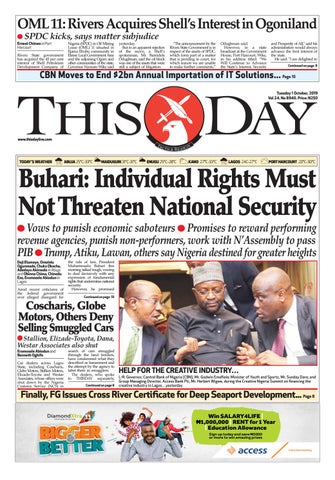
HELP FOR THE CREATIVE INDUSTRY‌ L-R: Governor, Central Bank of Nigeria (CBN), Mr. Godwin EmeďŹ ele; Minister of Youth and Sports, Mr. Sunday Dare; and Group Managing Director, Access Bank Plc, Mr. Herbert Wigwe, during the Creative Nigeria Summit on ďŹ nancing the creative industry in Lagos‌yesterday
Finally, FG Issues Cross River CertiďŹ cate for Deep Seaport Development... Page 8 :LQ 6$/$5< /,)( _ _ 1 5(17 IRU <HDU _ (GXFDWLRQ $OORZDQFH 6LJQ XS WRGD\ DQG VDYH 1 RU PRUH WR ZLQ DPD]LQJ SUL]HV
2
TUESDAY OCTOBER 1, 2019 • T H I S D AY
TUESDAY OCTOBER 1, 2019 • T H I S D AY
3
4
TUESDAY OCTOBER 1, 2019 • T H I S D AY
TUESDAY OCTOBER 1, 2019 • T H I S D AY
5
6
TUESDAY OCTOBER 1, 2019 • T H I S D AY
TUESDAY OCTOBER 1, 2019 • T H I S D AY
! !"# ! $ %
7
8
TUESDAY, ˜ ͺ ˾ T H I S D AY
PAGE EIGHT
Finally, FG Issues Cross River Certificate for Deep Seaport Devt Kasim Sumaina in Abuja President Muhammadu Buhari yesterday gave a firm indication of his support for the Bakassi Deep Seaport Project of the Cross River State government with the issuance of Outline Business Case certificate (OBC) for the project by the federal government. The certificate was presented on behalf of the federal government by the Minister for Transportation, Mr. Rotimi Amaechi, to the Cross River
State Governor, Senator Ben Ayade, at the ministry’s Abuja office. Amaechi stated that with the OBC, the state would move on to the next step of action. He said: “What they (Cross River) have got right now is the OBC. We will take the next move to verify all the necessary instruments that we need and then proceed back to the Infrastructure Concession and Regulatory Commission for the FBC before we go to the cabinet for approval.
“But the most important thing is that we are speeding it up so as to enable those states who want to invest in seaports and others to go ahead and do so.” On whether the federal government was partnering Cross River State in the deep seaport, Amaechi said, “We will get to that. We will sit down with the Cross River State Government and their major partners and see how much NPA would want to invest. We will contact NPA and see what it can do.”
Speaking on the development, Ayade said the certificate would enable the state move on to the next level of implementation of the seaport. His words: “The certificate is an Outline Business Case. It shows that there is a full densification commitment of the Federal Government through the Federal Ministry of Transportation to say yes we have come to recognise and accept that Cross River State Government should go ahead with the Full Business
Case towards the construction of a deep seaport. “And the emphasis on the deep seaport is agro-industrial, not exclusively, but to show that the core target is to do an agro-industrial transformation of Nigeria. It will be the major leading port in that respect but will have other industrial parks.” He said the issuance of the OBC by the Federal Government through its Infrastructure Concession and Regulatory Commission was the fastest ever recorded in
Nigeria. On when actual construction would commence at the seaport, Ayade said, “Work started there more than six months ago when we got the EIA approval which allowed us the legal right to get access to the ocean. “But right now with this OBC certificate, we are going to be dealing directly with the concessionaires towards arriving at the specific location, data and commencement of actual work plans. But that can only come with the FBC.”
of what is happening,“ he added. A dealer, who sells luxury cars in Ikeja, who spoke on condition of anonymity, warned the Customs to be aware Nigeria was not under a military regime where businesses could be shut down without notice. He said: “We are not smugglers; we bring in our cars through the ports and pay amazing amount of money. To clear the average car now like Toyota Corrola it is over N3 million. To clear a Toyota Prado, it is over N9 million; a Land Cruiser over N15 million, a Lexus N18 million, G-Wagon N21 million. “In my compound I have 70 cars and I pay an average of N10 million per car that is N700 million. “We add to the economy, bear in mind the number of staff that we employ, in my office alone I have over 20 staff. We also employ people indirectly. Clearing
agents, mechanics, licensing agents all depend on us for survival. If I employ 20 people, imagine how, many Stallion, Globe and Elizade Motors are employing. We need to be treated with respect in this economy.” He said Customs were yet to tell him why his shop was locked up. On his part, one of the major dealers around mainland area said the harassment by the NCS had continued for about five years, “whereas nothing of sort happens to dealers in the North.” He said: “All the car dealers in the North never get harassed nor checked. For your information, cars in the North come through Niger Republic without paying duty. “Before now, individual buyers and car dealers come from the North to buy cars in Lagos but we don’t see them anymore. Agencies of government should do their
work but not one-sided or at the detriment of the economy. We employ hundreds of thousands of people apart from thousands of Customs licensed agents we give direct service to; they are also employers of labour in hundreds of thousands and Total live dependents of millions of Nigerians.” Reacting to the allegation that the Customs deliberately targeted dealers in southern Nigeria, the Public Relations Officer of the NCS, Mr. Joseph Attah, said the action was taken nationwide. "How can anybody say that we are targeting the southern part of the country? The action was taken nationwide and as we speak some dealers were shut down in the east today, "he said. He said the Customs would meet on Friday to deliberate on the report sent by Federal Operation Units nationwide and appropriate action would then be taken.
as admitted by SPDC vide letters they wrote seeking to clean the spill in 2006 while the case was at the trial court; that the Rivers State has suffered the worst impact of environmental degradation resulting from oil related operations; “That the very difficult swamp and mischievous waterlogged terrain of the Rivers State has impeded development as a result of increased construction costs on the near and non-existent infrastructures and attendant rapid decay of the little we have been able to achieve as a result of oil-related acid rain and black sooth enveloping the State; “That these phenomenal degradation and impoverishment had continued with the decline of revenue and inflation, lack of employment of well-educated Rivers State youths, idleness and restiveness arising from want; “That SPDC is said to have paid the sum of USD 2,000,000 (two million United States Dollars) only for the renewal of their operatorship and interest in the said OML 11 to the Federal Ministry of Petroleum Resources; "That for the past 25 years, the rich oil potentials of OML 11 have remained untapped following the hanging of
the world-renown Ogoni poet and environmental activist, Mr. Ken Saro Wiwa, and the Ogoni 9 as well as the unfortunate mob lynching and death of four prominent Ogoni citizens, one of whom was the Secretary of Government of the Rivers State and another, a commissioner under the tenure of Lt. Col. Dauda Musa Kumo as governor of Rivers State; "That it has become unlikely that for peace and security, the people of Ogoni in the Rivers Stat ewill welcome SPDC on their land forming part of OML 11; “That a lot of revenue is lost to the Federation Account accruable to the 55% stake of the federal government in OML 11 and by extension the rest of the federating states of Nigeria due to nonproduction of nearly 250,000 barrels per day of its crude oil potentials equalling one sixth of the country’s total out-put per day; “That the Rivers State Government has continued to loose 13% derivation fund from the said 55% stake of the Federal Government in that field for nearly 30 years now, which revenue would have transformed the State and its peoples for the better; "That rather than standby and watch other persons or
group purchase SPDC 45% interest in that OML 11 and further exacerbate the poverty of the people of the state, a responsible and responsive state government should weigh in and bid for the purchase of SPDC interest already set down for auction;
COSCHARIS, GLOBE MOTORS, OTHERS DENY SELLING SMUGGLED CARS were unanimous in their condemnation of the shutdown and the Gestapo style it was carried out and bemoaned the huge losses they claimed to have suffered since the seal-up. Customs officials in search of smuggled vehicles, had at the weekend stormed the outlets of the car dealers, including Elizade MotorsToyota Nigeria Limited and Stallion Motors, and sealed up the dealers’ marts. THISDAY gathered yesterday that the clampdown also affected Elizade Motors-Toyota Nigeria Limited, Dana Motors, Westar Associates Limited and Stallion Motors. The dealers told THISDAY that they were responsible citizens who massively contributed to the economy of the country through employment of Nigerians and payment of over N20 billion as duty to the federal government yearly.
They denied involvement in smuggling, insisting that they were law-abiding corporate citizens. The dealers wondered why the Customs authorities were only focused on southern part of Nigeria when smugglers who do not contribute anything to the economy were having a field day in the northern parts of the country. In his reaction, an official of Coscharis Group, who craved anonymity because he was not authorised to speak on the matter, said the company was at loss on what was happening. He said Coscharis represents international companies of repute, adding that the action of the Customs would run counterproductive to the government's foreign investment drive, adding that it was also not good for Nigeria’s ease of doing business index. He assured their foreign
partners, customers and stakeholders that they were not involved in smuggling of vehicles. “We don’t understand what is happening yet but we cooperate with all agencies of government and if the Customs need any information about our business, they ought to ask instead of sealing our showrooms, and thereafter ask us to come for a meeting. They should understand the implications of shutting down our facilities because an unnamed dealership allegedly smuggled in vehicles,” he added. Also reacting, the Chairman, Globe Motors, Mr. Willie Anumudu, said they were taken aback by what the Customs did because they usually come to take inventory and check chassis numbers. “Tomorrow (today) is holiday, but on Wednesday, after a meeting with them, we will have a clearer view
OML 11: RIVERS ACQUIRES SHELL’S INTEREST IN OGONILAND inform you that the Rivers State government has fully acquired Shell Petroleum Development Company of Nigeria (SPDC) 45 per cent interest in Oil Mining Lease (OML) 11 situated in Ejama Ebubu community in Eleme Local Government Area and the adjoining Ogoni and other communities of Rivers State." Wike explained that the acquisition of OML 11 is premised on court judgments, which have been registered in the United Kingdom and Nigeria for enforcement. His words: "This fresh case commenced in 2001 passed through four different justices of that court arising from twists and turns associated with opposed litigations, until it was disposed of about 10 years after in June 2010 by Buba J. (the fifth judge to preside over the matter). "SPDC and its parent companies appealed the judgment at the Court of Appeal in 2010, which again suffered the twists and turns passing through six different panels comprising three justices each between 2010 and 2017 before it was finally disposed of by the panel of that Court led by Gumel JCA of the Port Harcourt Division. The appeal was dismissed.” The governor explained further: "SPDC and its parent
companies took out a further appeal to the Supreme Court of Nigeria in 2017, which appeal was considered and dismissed by that court in a judgment read by Hon. Justice B. Akaahs, JSC delivering a lead judgment in a unanimous decision. “After losing at the High Court, SPDC gave the successful Ejama Ebubu Plaintiffs a Bond Guarantee stipulating that First Bank of Nigerian Limited would pay them the value of the judgment debt and interests thereon in the event that SPDC’s appeal to the Court of Appeal fails at that court. The original Bank Guarantee is still with the community. "When SPDC’s appeal failed at the Court of Appeal, Shell instructed the bank to dishonour their guarantee, which they did and gave rise to a series of six different litigations in various courts against First Bank and the Central Bank of Nigeria. “SPDC’s excuse was that they had lodged an appeal at the Supreme Court of Nigeria. The enforcement cases had been to Owerri, Abuja, Lagos, etc. in six different lawsuits. On the 11th of January 2019, Shell’s appeal was dismissed at the Supreme Court of Nigeria. “The judgments of the High
Court, the Court of Appeal and the Supreme Court were registered in the United Kingdom for enforcement over there against SPDC parent companies domiciled outside Nigeria’s shores." On the enforcement of the judgment in Nigeria, Wike said: "The Ejama Ebubu community commenced enforcement by domiciling the judgment in the State High Court and levying execution on SPDC movables in their Industrial Area in Port Harcourt; those chattels were attached on the ground but not removed; SPDC invited the community and offered them N7 billion as against the judgment debt of N194 billion, which the community refused to accept; the community approached the court for an order granting them leave to sell SPDC’s immovable property comprised in OML 11 and their kidney Island support base in Port Harcourt.” The governor said upon the advertisement of the said immovable assets for auction, the Attorney General and Commissioner for Justice of Rivers State alerted the government of the state. Explaining why the state government resolved to purchase OML 11, Wike said: "That the impact is still there and un-remedied since 1970
Continued on page 61
TOP GAINERS CAP PLC CONTINSURE NPFMFB TOTAL LASACO TOP LOSERS JOHNHOLT ETI UPDC
NGN NGN 2.30 25.55 10.00 2.07 0.10 1.20 9.50 129.50 0.02 0.30 NGN 0.06 0.55 0.85 8.05 0.11 1.05 NEIMETH 0.04 0.40 LIVESTOCK 0.04 0.43 HPE Nestle Nig Plc ₦1,94.90 Volume: 194.796 million shares Value: N3.064 billion Deals: 2,910 As at yesterday 30/9/19 See details on Page 35
% 9.8 9.5 9.0 7.9 7.1 % 9.8 9.5 9.4 9.0 8.5
TUESDAY OCTOBER 1, 2019 • T H I S D AY
9
10
TUESDAY, ˜ ͺ ˾ T H I S D AY
NEWS
CBN Moves to End $2bn Annual Importation of IT Solutions Bankers’ Committee takes over National Theatre
Nume Ekeghe
The Central Bank of Nigeria (CBN) has expressed its resolve to curb the $2 billion spent annually on the importation of information and technology (IT) solutions that could have been produced in Nigeria. The CBN Governor, Mr. Godwin Emefiele, in an address yesterday at the Creative Nigeria Summit held in Lagos, said the IT sector was expected to benefit from the Creative Industries and Financing Initiative (CIFI), designed to improve access to long-term, low-cost financing for entrepreneurs and investors in the Nigerian creative and IT sub-sector. He said the creative hub expected to pilot in Lagos by the CBN and Bankers’ Committee would benefit 50,000 Nigerians and create over 150,000 skilled and unskilled jobs. According to him, the federal
government has also agreed to hand over the National Theatre, Iganmu, Lagos, to the Bankers’ Committee, for the establishment of the creative hub. He said: “We cannot afford to let the talents of our youthful population go to waste, as it would portend great dangers for the progress of our nation. “Efforts must therefore be made to harness the innovative and creative energy of our youths towards enabling them to create productive ventures that will support improved wealth and job creation in Nigeria. “This was the critical reason behind the CBN and the Bankers Committee’s decision, following our annual retreat in December 2018, to set up the CIFI. “Using the Agri-Business/ Small and Medium Enterprises Investment Scheme (AGSMEIS) fund, through which the banks set aside, on an annual basis, five per cent of their profit after tax,
Emefiele our goal is to support start-ups and existing businesses in the creative industry space, as well as the development of a creative industry park across three major cities in Nigeria. “With the support of the federal and Lagos State Governments, the National Theatre, Iganmu in Lagos is expected to serve as the initial pilot for the Creative Industries Park.” Commenting on the ICT Initiative, Emefiele said: “In the
area of ICT, we are all aware of how the digital revolution is reshaping the nature of services being provided by organisations across the globe. “Banks, schools, farming communities, healthcare centres as well as security agencies are leveraging on technology to improve the quality of service and solutions being provided to their customers. “So far, over $2 billion is spent annually in the acquisition of hardware and software solutions in Nigeria. In order to ensure that Nigeria is well positioned to address emerging opportunities and challenges in the digital era, the CBN and the Bankers Committee decided to work towards the establishment of an ICT training centre, which will also include an IT hub. “These centres will be located in the Creative Industries Parks being established. Students will be provided with loan facilities
to enable them to obtain advanced trainings at the centre on developing cutting edge technological solutions around cyber security, data analytics and cloud computing. “Over 50,000 Nigerians are expected to benefit from this centre, which will result in creating over 25,000 software engineers and 150,000 skilled and unskilled jobs. It could result in potential Gross Domestic Product gains of close to $2 billion while curbing importation of IT solutions that can be produced in Nigeria.” He added that the centre would enable Nigeria to serve as an outsourcing centre for IT services required in other parts of the globe. “Nigeria can expect to earn over $200 million annually from the provision of IT services to individuals and corporate organisations in other parts of the globe,” he stated. He said with the approval of
President Muhammadu Buhari, the National Art Theatre has been handed over to the Bankers’ Committee and the CBN to give the facility a facelift. “In addition to that, the Lagos State Government has also allocated 40 acres for the development of the creative industry hub.” He also said the CBN and the Bankers Committee would provide a textile apparel shared services facility at the creative park to train Nigerians on how to design and develop good quality made-in-Nigeria fashion products for the local and export markets. In his speech, Managing Director, Access Bank, Mr. Herbert Wigwe, said the committee planned to create direct jobs for about million people over the next five years. The Minister of Youth and Sports, Mr. Sunday Dare, urged the private sector to support sporting activities nationwide.
continued peace and unity of the country. Omo-Agege stressed the need for oneness and accommodation, saying that with determination, the country would surmount its present challenges and emerge stronger. Atiku urged Nigerians not to despair as there was hope for the country. He said, in a statement, that despite the gloom, the future of Nigeria was bright. He said rather than calling for prayers today, "I am calling on all Nigerians to believe in Nigeria’s betterment, to work for Nigeria’s betterment and to insist that no one in Nigeria, no matter how highly placed, shall be bigger than the laws of our land.” Ekweremadu reiterated the need for decentralised policing, including state police, with valves against abuse to enable the country to overcome its security challenges. He also called on “leaders at all levels of governance to rededicate themselves to an egalitarian society marked by justice for all, including an equitable distribution of opportunities and amenities as a sure way of securing peace and unity among our citizens across the nation.” APC, in its goodwill message, urged Nigerians to be wary of those who hide under religion, politics, tribe and sundry groupings to turn Nigerians against one another, saying the country is better together. The party's National Publicity Secretary, Mallam Lanre IssaOnilu, hailed the founding fathers, who fought for the independence of the country and also members of the Armed Forces, many of whom have paid the supreme sacrifice to defend Nigeria's territorial integrity and keep the country united. He added that in spite of the inherited and the current challenges, the Buhari administration has made commendable strides on so many fronts, most significantly the fight against graft, diversifying and revamping the economy, curbing insurgency and emerging crimes. He also said the federal government was strengthening the country's democratic institutions. "Finally, we admonish wellmeaning Nigerians to engage only in acts that would heal our fault lines by promoting ethnic and religious tolerance and peaceful coexistence, which would engender Nigeria's growth and development," the ruling
party said. The opposition PDP saluted the courage of Nigerians on the occasion of the nation's independence anniversary of the country. The party in a statement by its National Publicity Secretary, Mr. Kola Ologbondiyan, commended the citizens for their resilience in standing up for the unity and survival of the nation despite the daunting challenges. It urged Nigerians to keep hope alive and not surrender to despondency in the face of the excesses, impunity and recklessness of retrogressive forces in high places seeking to undermine the national cohesion, freedom of the citizens as guaranteed by the constitution as well as emasculate the will and aspiration of Nigerians as a people. The party said the October 1 date remains an undying signpost of the freedom and unity of Nigeria as a nation, stating that it reminds Nigerians of the roots of the national cohesiveness; the sacrifices of the heroes and the determination to live harmoniously and succeed as one people, in all spheres of human endeavours; a national distinctiveness for which “we are known and respected all over the world.” It, however, noted that it was depressing that after 59 years of independence and efforts by patriotic Nigerians in nurturing democratic practice and tenets, the last four years had experienced a complete retrogression to primordial division, impunity, constitutional and human rights violations, assault on institutions of democracy, disobedience to court orders, electoral malpractices and governance by a cabal. The PDP, however, expressed optimism that the nation will eventually come out of the woods and urged Nigerians "to use the occasion of the independence anniversary to rekindle their commitment towards the unity, stability and development of the fatherland."
BUHARI: INDIVIDUAL RIGHTS MUST NOT THREATEN NATIONAL SECURITY to uphold the constitutional rights of citizens to freedom of expression and association provided that such expression does not infringe on the rights of other citizens or threaten national security. “Whilst we uphold the Constitutional rights of our people to freedom of expression and association, where the purported exercise of these rights infringes on the rights of other citizens or threatens to undermine our National Security, we will take firm and decisive action,” the president said in a nationwide broadcast this morning in commemoration of today's 59th independence anniversary of Nigeria. Buhari, who also disclosed that his administration was focusing on cyber-crime, abuse of technology and propagation of hate speech, advised citizens to express their grievances and frustrations with a sense of restraint and tolerance. He also said whereas airing of grievances bordering on religion and politics in a healthy manner would be tolerated, lessons of the past must never be lost in people's consciousness. He noted that wherever the seed of discord and hate is sown, destruction is usually the consequence as he expressed optimism that most Nigerians would embrace the path of peace, prosperity and unity. "In this regard, I reiterate my call for all to exercise restraint, tolerance and mutual respect in airing their grievances and frustrations. Whilst the ongoing national discourse on various political and religious issues is healthy and welcome, we must not forget the lessons of our past – lessons that are most relevant on a day such as this,” he said. Buhari also talked tough on corruption, vowing to punish saboteurs especially in relation to the recent award of $9.6 billion judgment against Nigeria in favour of an Irish firm, Process and Industrial Developments Limited (P&ID). He said the award, made by a London arbitration tribunal and registered for enforcement by a British commercial court over alleged breach of contract between Nigeria and the firm was a clear demonstration of the greed of few corrupt and unpatriotic Nigerians. According to him, new policies are being put in place by his administration while the government is also collaborating with the National Assembly to evolve legal frameworks that will ensure that unpatriotic elements
do not go unpunished. He appealed to states to put in place machinery that would promote transparency. He also implored Nigerians to join the fight against corruption. Buhari said in accordance with Nigeria's partnership with foreign friends to fight tax evasion, smuggling, terrorism and illicit financial flows, the Mutual Assistance in Criminal Matters Act had been signed to serve a domestic legal framework to secure international assistance in criminal matters. Against this background, he said the Ministry of Justice was working with the United States Department of Justice to repatriate a recently discovered $300 million stolen and laundered in the US by the late General Sani Abacha. Buhari also said in his administration's bid to foster macro-economic and economic diversification, the Ministry of Finance was merged with the Ministry of Budget and National Planning with a special mandate aimed at enhancing the management of domestic and global fiscal risks as well as increasing and deployment of revenues to fund the annual Appropriation Bill. Against this background, he threatened that revenuegenerating agencies would henceforth be dutifully scrutinised with the provision of performance management framework aimed at rewarding productive agencies while those who fail to meet set targets would be duly punished. He said he had recently constituted the Economic Advisory Council (EAC) to advise him on sustainable macroeconomic, fiscal and monetary policies with a view to putting the economy on track, promising that harsh economic policies would also be reviewed wherever necessary. The president also said as a lesson from the previous administrations, oil outputs would be well managed, saved and invested in non-oil sectors. "With this, our revenuegenerating and reporting agencies will come under much greater scrutiny, going forward, as the new performance management framework will reward exceptional revenue performance, while severe consequences will attend failures to achieve agreed revenue targets,” he said. He promised to accelerate the implementation of 2019 capital expenditure, disclosing that Ministry of Finance, Budget and National Planning had consequently been instructed to release N600 billion in the
next three months. He also said in line with the administration's move to promote infrastructure development through public private partnerships, incentives of over N205 billion are being offered to the private sector for the construction of N205 billion in 11 states adding that revenue generation in the oil sector would be optimised. He also promised that the government would work with the National Assembly to pass the Petroleum Industry Bill and simultaneously fight illegal oil bunkering and smuggling of refined products. "Implementation of the 2019 Capital Budget, which was only approved in June 2019, will be accelerated to ensure that critical priority projects are completed or substantially addressed. The Ministry of Finance, Budget and National Planning has been directed to release N600 billion for Capital Expenditure in the next 3 months,” he said. The president recalled that the federal government recently signed an agreement with a German company, Siemens, for the purpose of modernising the national grid in three phases with the plan to generate 11 gigawatts by 2023, and 25 gigawatts later. He also spoke on other infrastructure being put in place by the government, including the construction of the second Niger bridge, Lagos-Ibadan expressway and the N500 billion Special Intervention Programme. He disclosed that it was in a bid to institutionalise the social investment programme that the Ministry of Humanitarian Affairs, Disaster Management and Social Development was recently created, adding that Nigeria's population growth as one of the highest in the world, is a notable challenge, adding: "It is our collective responsibility to ensure that we provide adequate resources to meet the basic needs of our teeming youth." On security, he said the capacity of security agencies to defend the country's territory was being enhanced by the provision of equipment. He described October 1 independence anniversary as an opportunity to thank God for His mercies for Nigeria and also reflect on the sacrifices made by the country's founding fathers.
Trump, Atiku, Lawan, Others Say Nigeria Destined for Greater Heights Meanwhile, President Donald
Trump of the United States, Senate President, Dr. Ahmad Lawan and other leaders have expressed optimism that the nation is destined for greater heights despite the current challenges facing it. Also, stakeholders in the economy have decried the country’s wasted opportunities and called for economic reform to reposition the country. In his congratulatory message, Trump said the United States, as an ally of Nigeria in the global battle against terrorism, wants to see Boko Haram and Islamic State West Africa Province (ISWAP) driven out of the region. He said: "Nigeria is among our strongest partners in Africa. We share common goals of expanding trade and growing our economic relationship. We are allies in the global battle against terrorism and we want to see Boko Haram and ISIS-West Africa driven out of the region and other insurgencies like them dismantled." He said the US welcomed efforts by the Buhari administration to diversify opportunities for talented, creative, and hardworking people to the benefit of both countries, Africa and the world. According to him, following the meeting between the two countries' vice presidents last year, Nigeria and the US are also building on the long-standing history of cooperation. "I wish the people of Nigeria continued success as you mark another year of independence. On behalf of the American people, I extend our warmest greetings and congratulate you on the 59th anniversary of Nigeria’s independence," Trump said. Other leaders who are hopeful of a better Nigeria in the future include Senate President Ahmad Lawan; Deputy Senate President, Senator Ovie Omo-Agege; former Vice President Atiku Abubakar, former Deputy Senate President, Senator Ike Ekweremadu, as well as the ruling All Progressives Congress (APC) and main opposition Peoples Democratic Party (PDP). Lawan, in his goodwill message, described the current challenges facing the nation as a stepping stone to greatness. He said: "The thrust of my goodwill message is to admonish my fellow compatriots to continue to have faith that Nigeria will be great and remain the indissoluble entity envisioned by our founding fathers.” Lawan’s deputy called on Nigerians to imbibe the spirit of oneness, saying Nigerians should keep praying for the
Stakeholders Call for Economic Reforms, Bemoan Challenges Stakeholders in the economy sector, however, expressed dismay that the Nigerian economy in the past 59 years had continued to underperform, compared with other countries that gained independence the same year. Continued on page 62
TUESDAY OCTOBER 1, 2019 • T H I S D AY
11
12
TUESDAY OCTOBER 1, 2019 • T H I S D AY
TUESDAY OCTOBER 1, 2019 • T H I S D AY
13
14
T H I S D AY ˾ ˜ ͯ˜ Ͱͮͯͷ
COMMENT
Editor, Editorial Page PETER ISHAKA Email peter.ishaka@thisdaylive.com
A GLIMMER OF HOPE
Justice Tienabeso Bibiye writes that Schwab Foundation’s endorsement of the social investment schemes will enhance performance to achieve set goals
A
n interesting aspect of the “Global Village” phenomenon as amplified by advocates of globalisation is that today, there is hardly any nation that can function in isolation without its activities being followed, observed or scrutinized by close or distant neighbours. The growth in Information and Communication Technology (ICT) makes a very large global space looks so small, in a manner that captures the thinking of James Hadley Chase in one of his epic fictions “The Gold Fish has no Hiding Place” which envisages a society where virtually everyone literarily knows each other. This is what the world is fast becoming as human relations and interactions are no longer limited by space, time and boundaries. It is, therefore, not surprising that a laudable government inspired welfare programme that is transforming the lives of millions of locals across the length and breadth of Nigeria is closely being monitored by several domestic and international bodies, as well as non-governmental organizations (NGOs), whose reports on the outcomes of the implementation strategies of the Nigerian government’s social investment schemes have provided the much needed motivation to improve on ongoing efforts for enhanced performance to achieve the set goals. One of such International NGOs is Schwab foundation, a sister organization of the World Economic Forum, which has not only taken due cognisance of the Nigerian government’s huge investments in social welfarism aimed at fostering financial inclusion, particularly for those down the poverty ladder, it has also gone a step further to lace such efforts with an award of merit in recognition of the political will demonstrated by the Buhari administration to provide succour for citizens who found themselves below the poverty line. Mrs Maryam Uwais, who was recently reappointed as the Special Adviser to the President on Social Investments, becomes the proverbial bride, the global face of the Social Investment Programmes (SIPs) in Nigeria. Her impactful implementation strategies as head of the National Social Investment Office (NSIO), caught the attention of Schwab Foundation, a Swiss-based NGO committed to improving the state of the world. Mrs Uwais was amongst those who received Schwab Foundation’s prestigious Public Social Intrapreneur Award on 23rd September 2019 in acknowledgment of her numerous contributions towards the achievement of Agenda 2030, including the Sustainable Development Goals (SDGs). With this award, Mrs Uwais joins a global network of over 350 outstanding social innovation models from more than 70 countries worldwide, an impact-driven global network that focuses on global goals and local impact. Furthermore, awardees of the foundation are fully integrated into the meetings, initiatives and projects of the World Economic Forum. They benefit from peer-to-peer exchanges and meaningfully contribute their expertise to shape global, regional and industry agendas in close collaboration with other stakeholders of the World Economic Forum. This latest honour coming from a highly reputed global organization such as the Schwab Foundation, underscores the success story of the Buhari administration’s determination in bridging the huge poverty gap in the country through the various Social Investment programmes. It also justifies the choice of Mrs Uwais, a seasoned lawyer, human rights activist, writer and social crusader by the president to occupy the driver’s seat in the implementation of the social investment programmes. Mrs Uwais was appointed as Special Adviser to the President on Social Investment in 2016, a position which also required her to supervise the NSIO domiciled in the Office of the Vice President.
THE FAITHFUL EXECUTION OF THE NATIONAL HOME GROWN SCHOOL FEEDING PROGRAMME IS CURRENTLY CHANGING THE FACE OF PUBLIC PRIMARY EDUCATION IN NIGERIA, WHERE NEARLY 10 MILLION PUPILS IN 32 STATES ACROSS THE COUNTRY ARE BEING PROVIDED WITH ONE NUTRITIOUS MEAL PER DAY IN SCHOOL
The NSIO is the central coordinator of the four major components of the SIPs namely: N-Power, National Home Grown School Feeding Programme (NHGSFP) National Conditional Cash Transfer Programme (NCTP) and Government Enterprise and Empowerment Programme (GEEP). The job was well defined for a woman who does not only have the capacity and integrity, but also possesses the necessary leadership skills to engineer synergy and engender the necessary team spirit in the successful execution of a commendable government initiative that seeks to deliver socio-economic support to disadvantaged Nigerians across the nation. The milestones so far achieved are also traceable to the “zero tolerance for corruption” stance of Mrs Uwais, who in ensuring that monies released for the various programmes are judiciously utilized, and structured the NSIO in such a way that insulates its processes and procedures from corruption and undue manipulation for selfish gains at federal level. The deployment of technology, delegation of responsibility and strict adherence to due process in the award of contracts and execution of projects makes the N-SIP stand out as a model for transparency and accountability in the implementation of one of the most successful government-driven programmes in the political history of Nigeria. Perhaps, for the first time, award of contracts for a government project are done by a distinctly separate entity, based on merit, just as beneficiaries of the various social intervention programmes are captured after meeting the necessary requirements for enrolment; a marked departure from the past where someone has to know another who occupies a privileged position before he/she could benefit from such a scheme. This explains why the outcomes have been impactful as testimonies by the beneficiaries have equally been quite encouraging. For instance, over 540,000 young people are currently benefitting from the N-Power programme and its sub-components. In the same vein, the faithful execution of the National Home Grown School feeding programme is currently changing the face of public primary education in Nigeria, where nearly 10 million pupils in 32 states across the country are being provided with one nutritious meal per day in school. This is in addition to the development of a community value chain that empowers over a 100,000 secondary beneficiaries such as cooks and farmers, who supply the raw materials used in preparing the meals served the pupils. The consequence of these efforts is evidenced in the unprecedented rise in school enrolment rates as deaths arising from child malnutrition have reduced drastically. Indeed, nearly 650,000 poorest households in the country receive N5000 monthly under the National Cash Transfer Programme (NCTP). Beyond receiving monthly stipends which gives them a sense of social and economic security, the NCTP beneficiaries are also encouraged and trained by community facilitators to imbibe the culture of savings and investments to become more financially stable and productive. In addition, over 4,500 Cash Transfer Facilitators (to support the beneficiaries in all wards where the service is provided) have been trained and 10,000 Savings groups and cooperatives have been formed. Consequently, these beneficiaries are on record to have saved over N560 million, from which over 18,000 beneficiaries have taken loans to start or improve their businesses. It is noteworthy of mention that less than 1,000 of these beneficiaries have defaulted in repayments. Justice Bibiye is the Communications Manager at the National Social Investment Office
THE SYMBOLIC MEANING OF OCTOBER 1 Our coming together as a people has a purpose yet to be realised, writes Cosmas Odoemena
E
very October 1 Nigerians home and abroad celebrate our independence from the British colonial masters. Nigeria shares this “national birthday” with some famous people, among them Jimmy Carter, former President of the United States of America, Theresa May, erstwhile Prime Minister of the United Kingdom, King Henry lll, English monarch who was known for the Magna Carta, Julie Andrews, who played Maria in the classic movie “The Sound of Music,” and William Edward Boeing, who founded The Boeing Company. It’s indeed 59 years now since that special day, but what does October 1 mean to us? What does the date mean to our leaders? What does it mean to our children and our youths? What does it mean to our mothers? What does it mean to our old folks? Now, what does October 1 mean to those who have no jobs? What does the date mean to those who have been kidnapped? What does the date mean to those whose loved ones were killed by suspected herdsmen? What does the date mean to families who don’t have food on their table? What does it mean to those who are sick and can’t get the care they need from our hospitals? What
does the date mean to those who languish in prison awaiting trial for offenses they did not commit? Perhaps October 1 means something else to the Hausa or Fulani. It probably has a different meaning to the Igbo. It could also have a different meaning to the Yoruba. It perhaps means something else to the Ijaw. Perhaps all the different tribes of Nigeria view this date from a different prism. Again, does October 1 mean to you the day it was legitimatized that your ethnic stock was meant to rule other ethnic groups? Does the date mean to you the day you remember that the colonial masters forced you to live with those you don’t like? Perhaps in a seeming transference, does the date make you feel trapped? Does the date remind you of injustice? Does the date agitate you? Does the date make you despair? Do you feel you don’t have a sense of belonging with this date? Does the date remind you who have left Nigeria to live abroad that you should never return home? Does the date make you feel you have to change your nationality? Does the date remind you of your biggest hurts? But it was never meant to be this way. Everything that happened to Nigeria was
predestined. Our coming together has a purpose we are yet to realise. And this particular date is not an accident. October 1 is a symbolic date and perhaps only providence could have chosen that date for Nigeria’s independence. Our founding fathers fought for our independence and had high hopes for the future of Nigeria. But we have not lived up to it. But if we had more insight we would think differently. Believe it or not there are those who read dates and numbers and events and understand what they stand for. Perhaps when we know better we may be guided accordingly. October 1 means more. According to Leah M Bostwick, in the Julian and Gregorian calendars, October got its name from the Romans. It was initially the eighth month of the 10 month year. October is from the Latin octo, which means “eight”. The number “eight” is said to be a symbol of wealth, prosperity, peace and fertility. October is normally time of the year when farmers harvest their crops. October is seen as a highly lucky and prosperous “number” because of its strong association with abundance and prosperity, little wonder then that Nigeria is rich in human and natural resources. According to Hans Decoz each digit number is a character, just like a human being.
Number one is special even from a spiritual point of view. It’s the number that represents creation - the major force from which all other numbers come. The number one cherishes its “independence”, and is a doer, and strong force that gives results and won’t let anyone or anything to limit its potential. The number one likes to be in the forefront, directing and leading others. Little wonder again Nigeria is a leader in Africa. Furthermore, number one stands for unity and primacy. One is indivisible and is not made up of other numbers, perhaps why we can’t break up Nigeria. The Good Book says “Hear, O Israel, the Lord thy God, is ONE Lord”. And there is no other God. So number one is God’s number. Still, according to the Good Book God made Eve from just one rib taken from Adam near his heart at his side so that they would love each other. God did this to preach unity. And Nigeria desperately needs unity. Nigerians must have unconditional love for their country and their fellow Nigerians. It’s through this that we can experience unity, peace, prosperity and justice that we hope from Nigeria. The date to begin is October 1! Dr Odoemena is medical practitioner in Lagos
15
T H I S D AY ˾ TUESDAY, OCTOBER 1, 2019
EDITORIAL NIGERIA: A JOURNEY OF 59YEARS The present crop of political leaders should give practical expressions to forces of integration “Though tribe and tongue may differ, in brotherhood we stand.” hat line from the first anthem of our country has for long remained an ideal to which Nigerians subscribe. With over 250 ethnic groups, two dominant religions that historically view each other with suspicion, social and political classes that engender disaffection and disillusionment and a political leadership that appears doomed to mediocrity at practically all levels, there are, to say the least, serious challenges. But so are opportunities. As we therefore mark the 59th independence anniversary of the country today, the ideal in the first national anthem will serve us better as citizens. To start with, our diversity should be a veritable tool for intellectual and cultural strength – two indispensable prerequisites for societal development and growth. China, which also marks the 70th anniversary today, for NIGERIANS MUST LOOK instance, is far larger BEYOND PRIMORDIAL than Nigeria in terms CONSIDERATIONS AND of land mass and ARTIFICIAL DIFFERENCES population. It is also culturally diverse. TO COLLECTIVELY Yet, its monstrous FIGHT POVERTY, demographic credenIGNORANCE AND tial has not weighed UNDERDEVELOPMENT it down. The United States equally presents a glowing example for Nigeria. As host to all the world’s races and with a population twice as large as Nigeria’s, it draws its moral and political strength directly from its heterogeneity. Even the enemies of Nigeria do not deny its social and economic potential, despite the generations of waste and abuse it has so far experienced. Also, as home to about one out of every four black persons on earth, its abundance of human resources is not in doubt. But there is a structural challenge that holds us back. The counter-veiling mechanisms that ensure some level of accountability at the centre are either non-existent or too weak in the fragmented units. The
logical result is that the promise of good governance embedded in the theory of decentralisation is delivered almost always in the breach. For that reason, the potential for strengthening the structural design for good governance and human development in Nigeria is a sound idea that should be subjected to a national conversation.
T
Letters to the Editor
B
T H I S DAY EDITOR BOLAJI ADEBIYI DEPUTY EDITOR YEMI AJAYI, DAVIDSON IRIEKPEN, MANAGING DIRECTOR ENIOLA BELLO DEPUTY MANAGING DIRECTOR KAYODE KOMOLAFE CHAIRMAN EDITORIAL BOARD OLUSEGUN ADENIYI EDITOR NATION’S CAPITAL IYOBOSA UWUGIAREN MANAGING EDITOR JOSEPH USHIGIALE
T H I S DAY N E W S PA P E R S L I M I T E D EDITOR-IN-CHIEF/CHAIRMAN NDUKA OBAIGBENA GROUP EXECUTIVE DIRECTORS ENIOLA BELLO, KAYODE KOMOLAFE, ISRAEL IWEGBU, IJEOMA NWOGWUGWU, EMMANUEL EFENI DIVISIONAL DIRECTORS BOLAJI ADEBIYI, PETER IWEGBU, ANTHONY OGEDENGBE DEPUTY DIVISIONAL DIRECTOR OJOGUN VICTOR DANBOYI SNR. ASSOCIATE DIRECTOR ERIC OJEH ASSOCIATE DIRECTORS PATRICK EIMIUHI, SAHEED ADEYEMO CONTROLLERS ABIMBOLA TAIWO, UCHENNA DIBIAGWU, NDUKA MOSERI DIRECTOR, PRINTING PRODUCTION CHUKS ONWUDINJO TO SEND EMAIL: first name.surname@thisdaylive.com
TO OUR READERS Letters in response to specific publications in THISDAY should be brief (150-200 words) and straight to the point. Interested readers may send such letters along with their contact details to opinion@thisdaylive.com. We also welcome comments and opinions on topical local, national and international issues provided they are well-written and should also not be longer than (9501000 words). They should be sent to opinion@thisdaylive.com along with the email address and phone numbers of the writer.
IMPLEMENT CHILD RIGHTS ACT NOW
W
e call on state governors in Nigeria that have adopted the Child Rights Act in the 36 states to quickly begin to implement it to save Nigerian children from religious and cultural practices which expose them to torture and abuse. According to reports, over 300 children in a religious institution in Kaduna were subjected to various human rights abuses. We find that across board, and across all Nigerian societies, children, male and female, come under certain religious and cultural practices which diminish their value and humanity, and which greatly undermine everything the United Nations Sustainable Goals (SDGs) seek to change. One child among five is out of school in Nigeria, a condition greatly worsened by the kidnapping of school girls in Chibok in 2014. Today, only 41% of girls in the North East of Nigeria ever go to school. Most are locked up in their homes, and before their 15th birthday are already betrothed to men as old as their fathers. Records indicate that Nigeria ranks third among countries still practicing
ut for such a conversation to be meaningful, the present fallacies and prejudices must be dealt with. The two largest religions in the country – Christianity and Islam – both originated from the Middle East and were only transmitted here. They should not continue to be used as divisive instruments. As for ethnicity, the nations that are linguistically homogeneous must be very few indeed. For those who imagine and propose the dissolution of the nation along ethnic or regional lines as a solution to what ails us, they are merely day-dreaming. History is replete with protracted intra-tribal wars as there is no guarantee that acrimony would disappear in the unlikely event of cultural homogeneity. So, the task before the present crop of political leaders is to mobilise and give practical expressions to the forces of integration. Emphasis should be placed on being Nigerian while those who claim to speak for the various religious, ethnic and regional groups should do so with every sense of responsibility and not make utterances that alienate or infuriate others. The National Assembly in particular has a critical role to play here by giving attention to genuine citizenship. Political and social rights should be based more on residency than the so-called state of origin. Whatever may be the misgivings of some citizens either over the amalgamation of the country in 1914 or the distortion of our federal system by the military, Nigeria has come a long way as a nation. All our citizens must now look beyond primordial considerations and artificial differences to collectively fight poverty, ignorance and underdevelopment. There is a lot to gain from harmonious living. We wish all Nigerians happy 59th independence anniversary.
female genital mutilation on women and girls ranging from 15-40, a practice common in southern Nigeria. The number of Nigerian children under the age of five is about 31million. If most do not die before they are born, they live without access to water, sanitation and hygiene, lack facilities like libraries in their schools and are exposed to malaria, pneumonia and diarrhea. Conditions such as these once existed in 17th Century in Nigeria and Europe but were abrogated after strong individuals like Mary Slessor worked hard to stop the practice of killing twins in Calabar in Nigeria, and after European parliaments passed the relevant laws. Since 2003 after the passage of the Child Rights Act, only 23 out of the 36 states in Nigeria have recognized it. Even at that implementation is poor, as we have seen from the Kaduna children torture case. Children belong to the state and they deserve to be treated better than they are now. Religious and cultural practices must not continue to expose them to torture and human rights abuses. Majirioghene Bob Etemiku, Civil Empowerment & Rule of Law Support Initiative, Abuja
GOVT-COMMUNITY SYNERGY AND SERVICE DELIVERY
I
commended President Muhammadu Buhari for his robust measures in moving the nation out of decay and business as usual particularly the constitution of the Economic Advisory Committee (EAC) recently. The country is making progress by some positive actions of the government, and therefore I call on citizens to shun witch-hunting and political hostilities which have unprecedentedly and dangerously moved to a higher dimension through malicious exploitation of social media with falsehoods. With the constitution of Professor Doyin Salami led-EAC with other distinguished economics and management experts as members including Professor Charles Soludo; former governor of the Central Bank of Nigeria, the country is convincingly set for greater heights in no distant time. Equally, I commend the federal government for responsibly challenging the judgment delivered by a UK court in favour of the Process and Industrial Developments (P&ID) over a purported failed gas project that was subjected to arbitration with award of $9.6 billion against Nigeria through misrepresentations by some persons. It’s essentially important to emphasize that the vitiating elements; factors which the existence of any will invalidate any contract are mistake,
misrepresentation, duress, undue influence and illegality. Hence, federal government is on track for challenging the judgment. Again, I commend Anambra state governor, Willie Obiano for his development strategy, and therefore call on other states to consider government-community synergy for infrastructural development as a positive strategic template for service delivery in the society. The Willie Obiano-led government has through government-community synergy executed significant road and people-oriented projects across all the towns in the state and thereby doing away with the usual ‘selective system or governor’s discretion method’ which in most cases favours towns with influential persons or where the governor has vested interests. The template remarkably gives equal opportunity to all towns in the state to nominate a key project in each phase alongside indigenous contractors for bidding and execution which makes all towns to receive government attentions and developments at the same pace and capacity. At 59, Nigeria cannot afford to continue to enthrone triviality, ineptitude and mediocrity at the expense of good governance for dividends of democracy. Carl Umegboro, Abuja
16
TUESDAY OCTOBER 1, 2019 • T H I S D AY
TUESDAY OCTOBER 1, 2019 • T H I S D AY
17
T H I S D AY ˾ TUESDAY OCTOBER 1, 2019
18
POLITICS
Group Politics Editor NSEOBONG OKON-EKONG Email nseobong.okonekong@thisdaylive.com (08114495324 SMS ONLY) INDEPENDENCE SPECIAL
Still a Divided Nation
Nseobong Okon-Ekong and Shola Oyeyipo write that the Nigerian dream of her founding fathers has suffered many setbacks
Scene of ethno-religious riot in a Nigerian city
T
obechukwu Anazonwu was a teenager when his parents were forced to flee Kano, which he had considered home until then. The mob that attacked them came at night. They were lucky to have received a hint from a kind hearted indigene, a few minutes before their home was surrounded and set on fire. With little or nothing, his parents and three siblings managed to make their way back to their homestead in the South-east. That dastardly incident left very bad memories on his impressionable mind. For his parents, it was the second time they were experiencing a pogrom in Northern Nigeria. To be sure, ugly tales of violent riot aimed at the massacre or persecution of an ethnic or religious group abound in every section of Nigeria. Every section of the country is guilty of having poured the venom of hate on their compatriots. Nearly every ethnic group in Nigeria has suffered from it. Fifty-Nine years after Nigeria attained independence, one cannot really say that the country is united. The damnjng verdict is that Nigeria is terribly divided. Nigeria and Nigerians are divided. The people can hardly talk with one voice without their primordial sentiments setting in. National cohesion is threatened by various sentiments. Ordinarily, the founding fathers of Nigeria were never pretentious at the onset about the fact that the nation they were forging was divided along various fault lines such as language, ethnicity, religion, socio-cultural backgrounds and other factors. This grim reality is etched on the country’s coat of arms: ‘Unity in Diversity.’ At independence on October 1, 1960, the leaders were hopeful and jubilant that if the diversities in Nigeria were properly annexed and placed on the global table for economic and political negotiations, the country would rank among the most developed in the world. Sadly, the Nigerian dream has suffered many setback.
Tony Uranta, Executive Secretary, Nigeria National Summit Group (NNSG) agrees that Nigeria is far from becoming a nation. His worse fears are that the country is right now fragmentised into zones, with forces of disunity at play than even during the Nigerian Civil War of 1967-1970. He noted that the previously held notion of a homogenous Northern Nigeria was a ruse as recents events have revealed. He said, “The Middle Belt region appears adamant on being recognised as a distinct
The challenges are real, with over 250 ethnic groups and because every group is jostling for recognition and prominence,they employ all manners of method to agitate. Some of the approaches used often pose a great threat to our corporate existence and development as a nation. Most of the crisis that pervade our space today are ethnic by nature but are often disguised as religious
entity separate from what many are now calling the core North. Prince Osibote, President of the Oduaa Peoples Congress (OPC) explains why the world view of the average Nigeria is limited by ethnicity. “Nigeria as a nation is the product of colonialism, a collection of multi ethnic and religious groups merged together by imperialists without consultation, without consent. As a result of these, Nigeria despite her God given potentials in being rich in natural and human resources has experienced and continues to suffer different forms of challenges ranging from political corruption, underdevelopement , insecurity, nepotism and ethno religious strife. The challenges are real, with over 250 ethnic groups and because every group is jostling for recognition and prominence,they employ all manners of method to agitate. Some of the approaches used often pose a great threat to our corporate existence and development as a nation. Most of the crisis that pervade our space today are ethnic by nature but are often disguised as religious. What about the seeming imbalance in government today? The south east region is shouting marginalization, the south-south is talking about under developement and environmental degradation.” The increasing revolt from the South-east, with a greater number of its population pressing for a chance to opt of is strongly presented by Mr. Elliot Ugochukwu Uko, President of the Igbo Youth Movement (IYM). He argued, “Nigeria made it impossible for her citizens to assume nationalistic posture in their thinking through the undeserved punishment meted out to Ndigbo since 1970. Everybody knew that millions of Ndigbo whose bank accounts were seized (and a paltry £20)allowed them in 1970, were not informed by Nzeogwu, Adegboyega, Ifeajuna and co about a coup in January 1966.Everybody knew that they were slaughtered all over northern Nigeria and in Lagos, Ibadan and Abeokuta in their
thousands all through the repulsive and horrendous well planned pogroms of 1966 that inspired secession and outright war. Yet everybody tacitly approved or at least condoned the war of attrition and scorched earth policy visited on Ndigbo by successive governments since 1970.Both the oppressed and onlookers know for a fact that, there is no justice in Nigeria. It against the law nature for the oppressed to patriotic and nationalistic. The oppressed will only remain aggrieved, bitter and angry until Justice and equity is enthroned. Even the oppressor himself and the minorities are not nationalistic because the winner takes all attitude of the oppressor ensues a dog eat dog culture of every man to himself. A great bane of nation building.” In an April 2012 research titled, ‘A Historical Survey of Ethnic Conflict in Nigeria,’ published by the Canadian Center of Science and Education, a Nigerian scholar, Mr. Ray Ikechukwu Jacob, traced the history of ethnicity and ethnic conflicts in Nigeria back to pre-colonial era and the “transgressions” that forced the ethnic groups of the northern and southern provinces to become an entity called Nigeria in 1914. He said, “In the case of Nigeria situation, disturbing history of colonialism, this generated hatred and conflict among different ethnic groups. The task of addressing this seed of conflict planted by the British has been a complex one. “After weakening the former diverse kingdoms and emperors now called Nigeria and reordering the groups’ politics, the colonial powers failed in nation building and providing for the people’s basic needs. Hence, unemployment, poverty increased and with these, conflict over scarce resources. The Southern and Northern protectorates were also being amalgamated into a nation. Thereafter, the merging of different colonies into one country called Nigeria was forcefully done without the people’s consent. This was a major seed of conflict
T H I S D AY TUESDAY OCTOBER 1, 2019
19
INDEPENDENCE SPECIAL
Buhari
Uranta
Uko
Osibote
that is still troubling Nigeria today.” Nothing can be more factual than this extrapolation. Uko regrets the missed opportunities. He argued that Nigeria held better promise than Philippines, Indonesia, South Korea, Malaysia, South Africa and Ghana by 1960. These hope were dashed by self-inflicted malaise like ethnic divisions, military intervention, poor governance and emergence of a predatory political class that thrives on the sheer exploitation of religious and regional differences to cover their mindless mismanagement of our collective future, has regrettably been our lot as a people. “Mutual distrust, unending suspicion and an unhealthy desire to dominate others fuelled an unhelpful political and social culture that has finally given the giant of Africa an unenviable image in the world,’” Uko said. “Her citizens are disrespected globally, at every Airport, dominate population counts at prisons all over the world and feature prominently amongst floating corpses of migrants found on the Mediterranean every week, whereas her elite club( who represent less than 5% of the population, but control 90% of her resources) celebrates the “good times “ with glasses of choice cognac in Ikoyi,Victoria Island, Lekki, Maitama and Asokoro. These same gluttonous and coscienceless elite, whose kids notoriously paint red the night club circuits beside every ivy league institution, even as they shamelessly sustain every unreasonably super expensive health care facility in the world with their unearned Nigeria oil wealth cash, will undoubtedly take over our media space this week to tell us how well Nigeria has done and is doing.” In the first republic, when Nigeria was divided into three geopolitical regions; Western, Eastern and Northern regions, the political parties that emerged were not nationalistic. They operated mostly within the confines of their regions. The Nigerian People’s Congress (NPC) represented the Hausa/Fulani, the National Council of Nigeria and the Cameroons (NCNC) was basically and Igbo Eastern party, while the Action Group (AG) took its root and stabilised in Yoruba speaking Western region. There were others such as Borno Youth Movement (BYM), Democratic Party of Nigeria and Cameroon (DPNC), Dynamic Party (DP), Igala Union (IU), Igbira Tribal Union (ITU), Midwest Democratic Front (MDF), National Independence Party (NIP), Niger Delta Congress (NDC), Nigerian National Democratic Party (NNDP), Northern Elements Progressive Union (NEPU), Northern People’s Congress (NPC), Northern Progressive Front (NPF), Republican Party (RP), United Middle Belt Congress (UMBC), United National Independence Party (UNIP) and the Zamfara Commoners Party (ZCP), but they all had their ethnic colourations. When after independence, the north, which already had more population strength, won more seats in federal parliament than the combination of the West and East, a development that laid the foundation for northern domination in Nigeria’s political space up till present time, it gave birth to political chaos in the country.
That late prominent Yoruba politician and leader back then, Chief Obafemi Awolowo, who was the Premier of the Western region, was accused of attempting to overthrow the government, gave birth to resentment between the AG – Yoruba government and the central government and Awolowo was eventually convicted and imprisoned. The political unrest that characterised that period obviously led to Nigeria’s first military coup of January 15, 1966. It was perceived as tribally motivated. It was led by Major Chukwuma Kaduna Nzeogwu, Major Emmanuel Ifeajuna and their fellow rebel soldiers who were mostly southerners. They violently took over government and Prime Minister Tafawa Balewa; Premier of Northern Nigeria, Ahmadu Bello; Prime Minister of the West, Samuel Akintola; Premier of the West; Finance Minister, Festus Okotie-Eboh were all assassinated. There are still suspicions that the President back then, Dr. Nnamdi Azikiwe may have deliberately ‘fled’ the country because he might have been informed about the impending coup by his kinsmen. What came to be known as ‘July Rematch’, a retaliatory coups led by late Lt. Colonel Murtala Mohammed, was a revenge by many northern military officers against the killings of northern politicians and officers by mostly Igbo soldiers and eventually, the first republic collapsed with the secession quest of Igbo Biafras and the ensuing civil
war from 1966–70. The rest is now history. But it’s more of an history waiting to repeat itself because the leaders don’t seem to learn from it. The second republic was relatively short and rather uneventful. It lasted just between 1979–1983, but the politics of the era was not necessarily devoid of the usual sectional and tribal sentiments that shaped the first republic. The six political parties of that era; Greater Nigerian People’s Party (GNPP), National Party of Nigeria (NPN), Nigeria Advance Party (NAP), Nigerian People’s Party (NPP), People’s Redemption Party (PRP) and Unity Party of Nigeria (UPN), though with relatively larger national spread, were still strongly tailored along the interests of the various sections of the country where they have greater influence and support. With a northerner, Alhaji Shehu Shagari at the helm of affairs, it was only some vocal westerners such as late educationist, Tai Solarin and a professor of Mechanical Engineering, Ayodele Awojobi, who openly castigated the election that produced the president back then. Shagari’s northern elites simply considered the government as theirs. This continued to polarise the nation further. General Ibrahim Badamosi Babangida (rtd) and his late second-in-command, General Tunde Idiagbon were the main actors in military junta that gave birth to the third republic. Their attempt at reintroducing democracy after seizing power from the current civilian president, who was then a military head of state, General Muhammadu Buhari, did not really see the light of the day. Babangida, a Hausa-Fulani, annulled the 1993 presidential elections believed to have been won by a prominent southerner of Yoruba extraction, in what majority of international observers considered as the fairest and most-free election ever conducted in Nigeria. In some quarters, the perception was that the annulment was simply part of ploys to perpetuate of the Hausa-Fulani hegemony in power, and that as such, it was ethnically motivated. If not annulled, the June 12, 1993 election was considered as capable of correcting the sectional sentiments that come with Nigerian political parties and elections. There were just two political parties; National Republican Convention (NRC) and the Social Democratic Party (SDP) and Nigerians voted without all the sectional considerations that shaped previous elections. When IBB annulled the election, the country was thrown into chaos. There were sustained protests in the South, especially in the South-west. Many Yorubas who have been disgruntled by the continued domination of Nigeria’s political space by the Hausa-Falani ethnic group took to the streets in wild protests. They were initially jubilant that one of their own, Moshood Kashimawo Abiola, was coasting to victory before the election was annulled. IBB bowed out of office on August 23, 1993. Ernest Shonekan, a Yoruba business man, and the head of IBB’s transition team, assumed the office as the president as the head of the interim national government as a way to manage the South west agitation.
After the death of General Sani Abacha in 1998, General Abdusalami Abubakar who took over from him put in place a transition programme gave led to the fourth republic in 1999. There were the People’s Democratic Party (PDP), All Nigeria Peoples Party (ANPP), and Alliance for Democracy (AD). Former military head of state and a southerner, Olusegun Obasanjo was elected on the PDP platform. On 29 May 1999, Obasanjo was sworn in as President and Commander-in-Chief of the Federal Republic of Nigeria. Many observers of the Nigerian politics knew a southerner had to emerge because if not, the chaos would not have ceased. The southerners felt cheated, hence they were pacified. Presently, there are various crises in Nigeria, including ethnic-religious crisis, agitation for resource control, demand for break-up of the country, religious disunity instigated by Boko Haram insurgency, communal clashed, politically motivated polarisation, sectional interests, massive corruption and the combination of all these and more, is threatening the country’s unity and national development. The situation is further worsen by the incumbent leadership of President Buhari, who has shown no iota of remorse for his penchant to give priority consideration to his northern kinsmen in the most sensitive appointments. This is even made worse by the fact that in the build up to his first term election, religious and ethnic sentiments were freely deployed during campaigns. Most of his service chiefs were northerners, precipitating outcries from other sections of the country, and despite the heinous crimes committed by Fulani herdsmen, who are his people, there are not many cases of arrest, prosecution and punishment of perpetrators of the killings that were attributed to the herders. Rather than address these germane issues, particularly, restructuring, not only has the government been fiddling with the Inland Water Ways Bill rejected by the 8th National Assembly, the government faced heated debate from across Nigeria when it attempted to introduce cattle settlements called RUGA for Fulani herdsmen in all 36 states of the federation. However, all hope is not lost. Uranta believes that true patriots know that a united Nigeria is still very possible. He said, “We will use every platform and channel available to cement this country together, since there are more commonalities to glue us in unity, than there are differences to tear us apart.” The OPC Leader Osibote thinks it is still possible to work for national unity and Pan Nigerian consciousness through an organisation like his. According to him, “OPC is not out to erode national unity. You will recall that our Late leader, Dr Fredrick Fasehun was at the forefront of the agitation for a Sovereign National Conference, SNC. The OPC had gone to the rooftops to exclaim, agitate and mobilize, invested all manner of resources to shout both home and abroad that the survival of Nigeria as a nation and the survival of her democracy lies in the convening of a SNC where Nigerians will forge a federation based on mutual trust and agreement.”
These hope were dashed by self-inflicted malaise like ethnic divisions, military intervention, poor governance and emergence of a predatory political class that thrives on the sheer exploitation of religious and regional differences to cover their mindless mismanagement of our collective future, has regrettably been our lot as a people. Mutual distrust, unending suspicion and an unhealthy desire to dominate others fuelled an unhelpful political and social culture that has finally given the giant of Africa an unenviable image in the world
T H I S D AY ˾ ͯ˜ Ͱͮͯͷ
20
FEATURES
Group Features Editor: Chiemelie Ezeobi Email chiemelie.ezeobi@thisdaylive.com, 08152252325 THE INDEPENDENCE EDITION
A Nation Still in Search of Freedom
When Nigeria got Independence on October 1, 1960, the celebration and jubilation were unlimited because it was thought that it would bring freedom to the people but 59 years after, it has remained an illusion, write Rebecca Ejifoma and Sunday Ehigiator
Austin Okai
Jones Abiri
Luka Binniyat
Steven Kefason
Abubakar Idris aka Dadiyata
Agba Jalingo
Omoyele Sowore
and legitimate way by which a society can be ruled”. Thus, democracy adequately understood, is a theory that sets some basic principles and standards according to which a good government, whatever its form, should be operated. Such principles include those of justice, equity, freedom, liberty, accountability, openness and transparency in government. In most countries today, it is these principles that are used as criteria for distinguishing between good and bad governments. Thus, democracy not only prescribes how political power should be acquired but also what to do with it or how it should be exercised. On the other hand, Vincent said “the rule of law is the legal principle that should govern a nation, and not arbitrary decisions by individual government officials. “It primarily refers to the influence and authority of law within society, particularly as a constraint upon behaviour, including behaviour of government officials. “The rule of law implies that every citizen is subject to the law of the land, including lawmakers themselves. In this sense, it stands in contrast to autocracy, dictatorship, or oligarchy where the rulers are held high and above the law. “Lack of the rule of law can be found in democracies and dictatorships, this can be as a result of neglect or ignorance of the law, corruption, lack of strong institutions or lack of corrective mechanisms for administrative abuse, such as an independent judiciary with a culture of the rule of law, a practical right to petition for redress of grievances, or elections. “A government’s decision to obey preexisting legal rules can provide the key to gaining widespread supports and general acceptance. Such respect for laws of the land as recorded in a constitution and in laws adopted through a credible democratic process is the hallmark of the rule of law.
“The rule of law therefore, makes democracy to thrive because law is the collective will of society, making possible equal rights, social order and justice. “Certain elements make up the rule of law; these are order and security, legitimacy, checks and balances, compliance to court orders, fairness, effective application, integrity and the supremacy of the rules.” It is therefore apt to state from the forgoing that the rule of law is the bedrock of modern constitutional democracy. This was underscored by its role in bringing about transitions from authoritarian or totalitarian regimes to constitutional democracy in Nigeria, and elsewhere in the world.
illegal arrest and detention of human rights fighters, the score keeps dragging. Speaking with THISDAY on these concerns, Executive Director, Rule of Law and Accountability Advocacy Centre (RULAAC), Okechukwu Nwanguma said, “In Nigeria's political history, except perhaps, under the Buhari to Abacha military dictatorships, no regime has been characterised more with the level of perchance for executive lawlessness than the current President Muhammadu Buhari government. “The level of brazenness with which this government disobeys court orders is most appalling and despicable. It recklessly flaunts its contempt for the rule of law. The executive has not hidden its contempt for the judiciary and the rule of law. This became clear when the federal Attorney General arrogantly and explicitly stated before the Senate that the executive has the powers to decide which court orders to obey or not. “As the chief law officer of the government, the AG ought to advice the government legally and not to give illegal counsel and advice. His conduct and utterances constitute the worst disaster that would ever happen to the legal profession. He is not only misrepresenting that noble profession but also denting its image. This ought to attract sanctions from the NBA. “The disgraceful statement at the Senate, during the ministerial screening that the executive disobeys court orders because of national security was clear evidence that the Buhari government is totalitarian and believes it can choose which court orders to obey and which ones to ignore. “And the entire Senate saw nothing wrong with that gaffe and went ahead to confirm him. That's one clear indication of further executive capture of the legislature which ought to exercise its oversight powers over the executive. Unfortunately, both the legislature and judiciary, to other co-equal arms of the
I
ndependence Day means freedom but in the clutches of this present government are its citizens who are not free despite court judgements. Welcome to Nigeria, where flagrant disregard for rule of law and democracy reigns supreme. When Nigeria gained its independence on October 1, 1960, it was supposed to be a gateway for peace, freedom and everything good for the citizenry. Over the years, the hopes and aspirations of our freedom fighters continue to filter down. Some might say the situation is even worse today. Post Independence In the simplest term, independence is regarded as freedom from the control or influence of others. It is also the freedom to make laws or decisions without being governed or controlled by another country or organisation. In the Nigerian context, the nation was granted full independence on October 1, 1960, under a constitution that provided for a parliamentary government and a substantial measure of self-government for the country's three regions. From 1959 to 1960, Jaja Wachuku was the first black Speaker of the Nigerian Parliament, also called the House of Representatives. Wachuku replaced Sir Frederick Metcalfe of Great Britain. Notably, as first Speaker of the House, he received Nigeria's Instrument of Independence, also known as ‘Freedom Charter’ on October 1, 1960, from Princess Alexandra of Kent, the Queen's representative at the Nigerian independence ceremony. The federal government was given exclusive powers in defence, foreign relations, commercial and fiscal policy. The monarch of Nigeria was still head of state but legislative power was vested in a bicameral parliament, executive power in a prime minister and cabinet and judicial authority in a federal supreme court. The nation would however grapple with military regime for 16 years before the emergence of a democratic Nigeria in May 1999 saw Olusegun Obasanjo as the president. However, the emergence of President Muhammadu Buhari makes him the third successive democratically elected president of Nigeria since the leadership of Obasanjo. Juxtaposing Democracy and Rule of Law Efebeh Vincent (PhD), of Political Science Department, Delta state University, Abraka, in an online material published in 2015, posited that, “Democracy and the rule of law are inseparable concepts that make it possible for modern societies to function effectively and thus guarantee peace, harmony and egalitarianism in the society. “The democratisation project is therefore, regarded as the age of civilisation that every society should strive to attain rather than a political option among many others. Democracy has thus become known to be the only moral
Disregard for Rule of Law and Democracy Adherence to the rule of law has been a Herculean task for various Nigerian governments since independence in October of 1960. In fact, according to the late Chinua Achebe of blessed memory, part of the reason the January 15, 1966 coup planners gave for staging the coup was that “corrupt and undisciplined ruling class” has become the order of the day in governmental circle (Achebe, 2012). This identified nature of the Nigerian ruling class was in display all through subsequent regimes, military and civilian alike that have governed the country before 1999. Thus, one would have thought that the experience politicians have gathered over time, particularly during the long spell the country had under military regimes, would have transformed them to become apostles of the rule of law. However, the reverse seems to be the case, as this current administration is still marred with several instance of outright disregard to the rule of law and democracy. From disobeying court orders, arrest of persons considered to have opposing views about the government and its decisions, media suppression and oppression, shooting and killing of harmless protesters,
T H I S D AY ˾ ͯ˜ Ͱͮͯͷ
21
FEATURES THE INDEPENDENCE EDITION
Constitutional Lawyer and Human Rights Activist Tope Akinyode
government, have been captured by the executive who is also working hard to close the civic space by the repressive and brutal attacks on the media and civil society. “The recent ruling by the British Supreme Court judges that Prime Minister Boris Johnson's decision to suspend Parliament for five weeks was unlawful is a lesson and an example of how an independent and effective judiciary under a democracy should be and how fearlessly it should exercise its powers. “But Buhari has made a caricature of our democracy. The judiciary is cowed. The legislature is effectively under the control of the executive with pliant and compromised leaders at the helm of affairs at both chambers. The basic freedoms associated with democracy have been erased. Repression, harassment, victimization and persecution of critical voices are rife and clear evidence of his fascist proclivity typified by intolerance for criticisms and alternative views which every democracy needs to grow. “The greatest threat to national security is subversion of the rule of law especially disobedience to court orders. It should be left for the court, not the president or Attorney General, to determine what national security is. Hiding under the subterfuge of national security to disobey court orders or to decide which court order to obey or not is a threat to the rule of law and disservice to democracy. Now that the Federal High Court has ordered the president to release Omoyele Sowore immediately, it is our hope that this clear order will be promptly complied with,” he added. Sowore hasn’t been released as at the time this report was filed. Also speaking with THISDAY on the disregard for rule of law by democratically elected leaders, Executive Director and Founder Social Intervention Advocacy Foundation (SIAF), Segun SEGA Awosanya said, “No sociopolitical architect that is worth his or her onions will describe Nigeria as a democratic republic based on the current trajectory. “The people are besieged on every side with career criminals occupying critical offices to perpetuate the agenda of a few. Personality as they say drives behaviour and behaviour drives decision making. This alone is the summary of the story of our current theatre of lucid absurdity. The rabid attempt by demagogues lurking in balkanised institutions, especially national security outfits, is worrisome to say the least, as they have attempted severally to abort us from the womb of our imperfect democracy in the past years with their unconscionable and unprofessional conducts towards a political agenda against the unity of Nigeria as a sovereign nation. “Their effort to criminalise protests against Sections 30 and 40 of the 1999 constitution as amended, which recognise our fundamental rights to assemble with others towards the expression of our approval or otherwise of government and their policies as at when due, is criminally obvious. “The disruption of peaceful protests across Nigeria by armed police deploying excessive force doesn’t show we are dealing with authorities that recognise the critical role of security institutions at this point in our democracy. Acute corruption is revealed when security institutions become partisan appendages to political parties as currently balkanised, thus, executing the scripts that see genuine call for accountability and transparency as the
Segun SEGA Awosanya
machinations of opposition seeking to topple their administration even without any shred of evidence of militarisation. This identity politics of hate (populism) has gone too far. “Many active citizens are being harassed and threatened, while some are held under detention for daring to speak. Dadiyata went missing having being a strong critic of the Governor of Kaduna. Steven Kefason has been remanded in prison over a Facebook post. Federal High court after refusing to grant the challenge of Omoyele Sowore on his detention by DSS finally gave in to pressure. “Whether DSS will obey court orders is too early to call as bail conditions were met on September 25, 2019 (They have disobeyed the court order). Jalingo et al are also in prison over same political persecution by people who have made themselves tyrants over the people they ought to serve. “We have suddenly become a country that persecutes critics with frivolous charges and even attempt to pin treasonable felony on citizens simply because the demagogues drowning in the pool of idolatry can’t stand the criticism of their man made gods, occupying political offices, as a display of loyalty. “It even gets worse to realise that for the right price security operatives can arrange extradition order for anyone abroad baselessly or over trivial matters as simple as domestic disputes. No doubt the criminal justice system is rotten, expired and dysfunctional but the path to formidable change remains the collective resolve of all and sundry to demand accountability and transparency in order to build a nation where peace and justice shall reign. “We at the SIAF will continue to lend our voice and stand by all citizens regardless of their creed, clan, clout, or craze, in collaboration with other civil society organisations. The agenda is to raise a critical mass of transformational youthful leaders and enlightened followers, who are easy to govern, difficult to rule and impossible to enslave to deliver the future of Nigeria. “It will take the input of all of us, for all our children’s sakes. The current trajectory is not sustainable and the repercussion of the current dangerous precedents is ominous. We must keep demanding for the unconditional release of all political prisoners under this administration. It is our duty as active citizens for the sake of all our children. Do not be silent and do not be violent.” Arbitrary Arrests Nigerians are gradually getting used to reading in the papers of the arbitrary abduction of critics who dare challenge the status quo of any state government or reports on alleged corruption. This is done with the help of the Department of State Services (DSS), a creation of the law. Among such persons that have disappeared into ‘thin air’ with continuous detention are journalists, government critics and vocal oppositions – the true conscience of the society. A list piling from 2017 till date shows that some of these men are still in DSS custody against their democratic right. Austin Okai- A vocal opposition and government critic in Kogi state, Usman Austin Okai, according to Sahara Reporters, was arrested on February 22, 2017 on the alleged orders of Governor Yahaya Bello for circulating
Okechukwu Nwanguma
reports of his alleged inflation of contracts to acquire vehicles for traditional rulers and his commissioners. He was however released 21 days later. According to the charges while the blogger was arraigned in court, he was alleged to have falsely accused the governor of buying cars worth 12million dollars, which led to rumours of the governor's death and inciting the public against the governor. Jones Abiri- Publisher of local newspaper, Weekly Source, Jones Abiri was arrested by DSS following a report he wrote on July 10, 2016 on how ‘Top Army Officers’ who were plotting to unseat President Mohammadu Buhari had approached Niger Delta militants under the aegis of the Joint Niger Delta Liberation Force (NDLF) to intensify the bombing of oil pipelines, which would be used as a justification to overthrow the Buhari administration. Abiri was held by the DSS over alleged links to rebel in the Niger Delta as well as threaten oil companies. He was held for two years and was released only to be re-arrested nine months after amen was charged with terrorism. Luka Binniyat- On July 1, 2017, the former Bureau the Chief of Vanguard Newspaper, Luka Binniyat was arrested and arraigned in court on allegation of false publication on the killings of five students of College of Education. He regained his freedom after spending over 90 days in prison. Steven Kefason- Swiftly on the heels of Binniyat arrest on July 1, 2017, vibrant journalist, Steven Kefason was also arrested in Port Harcourt on May 8, 2019. His offence was because he vented his displeasure on the unlawful arrest and detention of his colleague Binniyat, on his Facebook wall. He was also accosted for his allegations against the Kaduna State government that some teachers in Kaduna were protesting over unpaid salaries. Kefason, an indigene of Kaduna State and staunch critique of the Kaduna State government, is now five months in custody. Abubakar Idris aka Dadiyata- Few months after the arrest of Kefason, another vocal government critic, lecturer and a staunch supporter of Rabiu Musa Kwankwaso, and the publisher of online news outlet, Cross River Watch, Abubakar Idris (aka Dadiyata), was purportedly ‘abducted’ on August 2, 2019. Fears abound that his abduction may be linked to his post on his Twitter handle on March 9, 2019 over the missing ballot papers by APC allies. According to allegations, a senior politician was spotted at the scene of the crime. His whereabout is yet unknown till date. Agba Jalingo- 20 days after the disappearance of Dadiyata, the publisher of online news outlet, Cross River Watch, Agba Jalingo was arrested on August 22, 2019 in Lagos. Officers with the Special Anti-robbery Squad (SARS) were said to have been behind his abduction. The following day, he was transferred to a detention facility run by the anti-cult and anti-kidnapping police in Calabar, the Cross River state capital. According to the charge sheet in court, Jalingo was charged with disturbance of public peace and treason for his writings and social media posts about Cross River Governor Benedict Ayade. He is still in custody. Omoyele Sowore- Bent on leading a protest he tagged #RevolutionNow movement, journalist, and presidential candidate of the African
Action Congress (AAC), Omoyele Sowore was arrested by the DSS on August 3, 2019 without a warrant. The heavily armed men from the DSS invaded his apartment at 1:25am, held him in confinement before moving him from Lagos to Abuja the next morning. Other members of the #RevolutionNow movement who went ahead with the planned protest weren’t spared by men of the police and Nigerian Army. While a handful of them were equally arrested and locked-up, few others suffered bruises from harassments, and gunshot injuries. Subsequently, it was followed by use of military and police apparatus to suppress further resilient attempts of the group to reconvey and demand for a better governance and freedom of those illegally held in custody. Heavily armed military men, and policemen, were constantly deployed by the government to lay siege on the #RevolutionNow proposed venues for further peaceful protest, among which, includes Freedom Park Ojota-Lagos, National Stadium, Surulere-Lagos, and the office of the Committee for the Defense of Human Rights (CDHR) located in Ikeja, Lagos. In a ruling on August 8, five days after his arrest, the Federal High Court in Abuja permitted the DSS to hold the political activist in custody for 45 days, without pressing any charges. This detention period was granted with room provided for further extension after its expiration on September 21, should the DSS request for extension. However, three days after the expiration date, on an account of the DSS failure to request for extension, Sowore was granted bail, on a condition of him submitting his traveling documents to the court within 48 hours. He still hasn't been released. Way Forward Speaking on the way forward, Constitutional Lawyer and Human Rights Activist, Tope Akinyode, said, “In a situation where orders of courts are flouted with loose regard, where citizens are being arbitrarily detained and punished in anticipation of an offence as we have seen in this present administration, democracy is really the looser. “We need to deeply reflect on democracy in Nigeria today and make salient proposals. First, I am of the view that henceforth, the presidency and officials of the federal government should be thoroughly schooled in the fundamentals of democracy and rule of law upon assumption of office. “I also believe strongly that the laws governing the judiciary need to be urgently revisited to entertain two specific innovations. Veto should be vested in the national assembly to appoint and confirm appointment of justices of various federal courts. “Financial autonomy and dependence should be vested in the judiciary. In doing this, budgetary allocations should go directly to the NJC which will then cater financially to the judiciary. Furthermore, I am proposing that laws should be enacted to place all public officers on minimum wage. Governance should not be made enticing to criminals or fraudsters whose interests are only in financial gains. These suggestions, I believe will help in building structures against untamed display of power and inept governance.”
22
TUESDAY OCTOBER 1, 2019 • T H I S D AY
23
T H I S D AY Ëž ÍŻËœ 2019
BUSINESSWORLD R A T E S MONEY MARKET OVERNIGHT OBB
A S
A T S E T E M B E R
REPO 9.29 8.23
CALL 1-MONTH 3-MONTH
5.50 7 8.50
S & P INDEX INDEX LEVEL 1-DAY MONTH-TO-DATE
411.53% 0.05% 0.36%
Group Business Editor Obinna Chima
Email obinna.chima@thisdaylive.com 08152447875
2 7 , S & P INDEX 1/4 TO DATE YEAR TO DATE
2 0 1 9 2.81% 15.28%
EXCHANGE RATE ͹͎ʹ˛͡ͳ˚ͯ ̊ ̊
Quick Takes WIMA Nigeria Holds Conference
ELECTRONIC FRAUD FORUM
L-R: Divisional Head, Bank wide Operations, Keystone Bank, Mr. Olusegun Olatona; Director, Information Technology Department, Central Bank of Nigeria Hajiya Rakiya Muhammad; Director, Payments System Management Department, Mr. Sam Okojere; Group Head, Enterprise Risk Management, Unified Payments System, Mrs. Nosa Anderson; Group Head, Operations and Technology, Ecobank, Dr. David Isiavwe, and Planning Research and Statistics, Police Force Headquarters Annex, Lagos, Emeka Nwonyi, at the second general meeting of the Nigeria electronic Fraud Forum, held in Lagos‌recently
Bello: Why Power Gencos Want Further Financial Support from FG Stories by Chineme Okafor in Abuja Power generation companies (Gencos) in Nigeria’s power sector would appreciate additional financial interventions from the federal government in order to remain afloat, the Chairman of Mainstream Energy Solutions, Col. Sani Bello (rtd) has said. Mainstream Energy is currently the operators of the Kainji and Jebba hydro power Gencos in Niger state. Bello said during a recent power sector roundtable held at its Kainji power station that power Gencos in the country could go under without financial
ENERGY interventions from the federal government. He explained that when the government’s backed N701 billion intervention fund from the Central Bank of Nigeria (CBN) was operational, the Gencos got up to 80 per cent of their monthly invoices for electricity generated and supplied to the national grid, but that the payment level has since dropped to 15 per cent since fund finished. According to him, no Genco can survive on the 15 per cent invoice payments because it was not enough to meet their basic operational obligations.
“We have enjoyed quite a lot of support from the ministry of power and other agencies like the BPE, ICRC, NERC and others. Hydro power plants are by nature the cheapest power generating plants, we are much cheaper than thermal plants and therefore it is very important that we are encouraged to continue to generate power and give to the public. “I hope the government will continue to do that and give us all the support we need. We have got our own kind of problems – we have contract which is between us and the government, and another which is between us and agencies of
government, and that is to pay us. I hope the minister will do whatever is needed to see that our payments are improved,� said Bello. He further said: “Between May and June, we only received 15 per cent of our invoices. As a power generating company, I do not think we can continue to survive with 15 per cent (payment of invoices).� “In the past, the situation was a little bit better because we used to receive between 18 and 25 per cent, but in 2018, the government gave us a guaranteed 80 per cent capacity payment. With Continued on page 26
DiscosDenyOwingFGTaxArrears The power distribution companies (Discos) in Nigeria have denied owing arrears of taxes to the federal government since the power privatisation exercise ended in 2013. Their trade association – the Association of Nigerian Electricity Distributors (ANED), stressed that the power investors were not indebted to the government through taxes in a statement in response to a recent comment attributed to the Chief Economist of PricewaterhouseCoppers Coopers (PwC), Dr. Andrew Nevin, that they owed the government taxes for years on account of their poor financial positions. Nevin, had at a recent power sector roundtable disclosed that the Discos were owing the government tax arears because they had been unable to make any profit from their operations.
ENERGY But ANED responded, saying the statement by Nevin was untrue. It explained in the statement signed by its Director of Research and Advocacy, Mr. Sunday Oduntan, that while they acknowledged Nevin’s effort to highlight the challenges of the sector in his presentation, thus, fostering dialogue that was critical for the resolution of same, they were not owing the federal government tax arrears. “We hereby, unequivocally, state that this claim relating to Discos not paying federal government taxes is misleading, incorrect and not supported by the facts. “As responsible corporate citizens, all of our member Discos take their tax obligations to the federal and state governments,
as applicable, seriously. As a result, the Discos diligently pay all necessary taxes that apply to their operations,� said the Discos. According to the power sector investors, “These taxes include the minimum Company Income Tax (CIT), Withholding Tax (WHT) and Value Added Tax (VAT). We will like to encourage all parties interested in the growth and success of the Nigerian Electricity Supply Industry to constantly diligently verify their information, to avoid creating more challenges than that which already exists in the sector.� Meanwhile, the Abuja Disco has disclosed that its Chief Financial Officer, Ije Okeke, has been appointed a commissioner by the Global Commission to End Energy Poverty (GCEEP) under the management of the
Rockefeller Foundation. It said the appointment was in line with a renewed drive by the global body to end lack of access to electricity for almost a billion people across the world, particularly in sub-Saharan Africa. According to the Disco, the Commission is co-chaired by Ernest Moniz, Professor of Physics and Engineering Systems Emeritus at the Massachusetts Institute of Technology (MIT) who is also a former U.S. Secretary of Energy; President of the Rockefeller Foundation and former USAID Administrator, Dr. Rajiv Shah; and Africa Development Bank (AfDB) President, Dr. Akinwunmi Adesina. It explained that the announcement of Okeke’s appointment followed the first full Continued on page 26
The Women in Maritime Africa (WIMA), Nigeria is set to hold its second annual conference on 15th October 2019. The 2019 conference which is themed; ‘Empowering Women for EectiveParticipationintheMaritimeSector,’wouldfocusonequipping women in the maritime sector with the skills and knowledge they need to grow their business. The President of WIMA Nigeria, Hajiah Bola Muse, while speaking with journalists emphasised that the aim of the conference would be to educate and empower more women with the requisite skills to actively participate in the maritime sector. “As a regulatory body, we are committed to ensuring that we achieve our core mandate.The conference will attract speakers from dierent sectors of the economy where key maritime issues will be discussed, “she said. The co-ordinator of the conference, Mrs. Foluke Akinmoladun, while commenting on the preparation for the conference, reiterated that as part of the organisation’s eort to impact society is the incorporation oftheInternationalMaritimeOrganisation’s(IMO)principleofTraining, Visibilityandrecognitionwhichshehopeswhenengagedwillculminate in a more inclusive and productive maritime environment. “WIMA-Nigeria annual general conference is an opportunity for women in the sector to network with members of sister organisations, ďŹ nancial institutions, regulators and other maritime professionals. “The conference in addition aims at building capacity and enhancing the inclusiveness of women in the maritime industry.
Medic West Africa Organises Exhibition
The latest healthcare and laboratory products and services will be on display at this year’s Medic West Africa Conference and Exhibition to be hosted by Informa Markets. Astatementbytheorganisersstatedthattheexhibitionwouldspotlight the state-of-the-art imaging equipment, the most cost-eective disposables; developments in surgery to advances in prosthetics, Thethree-dayeventwillholdinLagos,fromOctober9thto11th.Itaims to keep participants engaged by displaying the latest innovation that would drive positive transformation in the region’s healthcare sector. The statement explained further that over 4,500 attendees were expected,includingdealers,distributors,buyers,laboratoryspecialists and healthcare professionals, from both the public and private sector. The upcoming edition of the event, which is the eighth, would also host more than 280 regional and international exhibitors from 25 countries. “Education and knowledge-sharing are some of the core principles of Medic West Africa. Registered participants of the free-to-attend event will beneďŹ t immensely from its masterclasses and leadership, business and educational conferences. “Theeventwillalsooerattendeesanopportunitytonetwork,discuss anddeliberatewithleadershipfromWestAfricanMinistries,authorities, healthcare providers, distributors and solution providers,â€? it added. The statement quoted Medic West Africa’s Exhibition Director, Ryan Sanderson, to have explained: “Informa Markets is thrilled to usher in this year’s conference and exhibition in our host city, Lagos.
Kenya’s Q2 GDP Slows to 5.6%
Kenya’s economy grew by 5.6 per cent in the second quarter of this year, down from 6.4 per cent in the same period a year earlier, Reuters quoted the statistics oďŹƒce to have said on Monday. It attributed the deceleration in growth to a slowdown in the key farming sector, which accountsforclosetoathirdofoutput,manufacturingandtransportation. “Agriculture’s performance as well as that of electricity and water supply were mostly hampered by a delay in the onset of the long rains,â€? the Kenya National Bureau of Statistics said in a report. Farming, which includes forestry and ďŹ shing, grew by 4.1 per cent during the period, down from 6.5 per cent a year earlier. The governor of the central bank Patrick Njoroge last week maintained a full year growth forecast of 6%, citing robust bookings in the tourism sector. The bank will review its forecast after Monday’s release of the second quarter data, he said.
“I think Mr. President is trying to ensure that he leaves a strong economy behind after his four years. And that is why he has called on seasoned economists. It is a powerful and a great team of economists. People have said will Mr. President listen; I think he will. I think he set up the team for a reason�
Chairman, NESG,
Mr. Asue Ighodalo
24
TUESDAY OCTOBER 1, 2019 • T H I S D AY
TUESDAY OCTOBER 1, 2019 • T H I S D AY
25
26
T H I S D AY ˾ ͯ˜ Ͱͮͯͷ
BUSINESSWORLD BELLO: WHY POWER GENCOS WANT FURTHER FINANCIAL SUPPORT FROM FG
that we were able to survive well,” he added. Bello noted that the Gencos were not, “asking for 100 per cent guarantee even though it was promised last year but let us go back to the 80 per cent guarantee which we had between 2017 and 2018. If we can get that, I think we will be able to manage well.” He also advised the government to consider activating the eligible customer regulation which the Nigerian Electricity Regulatory Commission (NERC) has approved, stating that it, “will reduce contingent liability on the government,” in addition to creating cost reflective electricity tariff in the industry. DISCOS DENY OWING FG TAX ARREARS
convening of the commissioners who participated in the launch of the Commission, which took place at the Bellagio Centre in Bellagio, Italy on September 10, 2019. “On September 12, 2019, The Rockefeller Foundation announced the launch of the Global Commission to End Energy Poverty (GCEEP) to address one of the greatest challenges of the 21st century. “Ije Ikoku Okeke whose area of expertise is in infrastructure finance, private equity and distribution management is expected to work with other renowned global experts in their efforts to bring electricity to the over 850 million people who live without access to energy today, and according to the World Bank, 650 million will still lack energy in 2030, falling far short of the United Nations Sustainable Development Goals. 90 per cent of the 650 million people live in sub-Saharan Africa,” said a statement from Abuja Disco. It quoted Shah to have said at the launch of the Commission that: “We cannot end poverty without ending energy poverty. Despite recent progress, the world is not on track to solve this problem by 2030. “Now it is time to unleash the full potential of distributed energy by integrating the strengths of grid and of-grid systems in order to enable large –scale public-private partnerships.”
NEWS
PPPRA Moves to Check Price War amongst Petrol Marketers Stories by Chineme Okafor in Abuja
avenue for the PPPRA to gauge the market response to supply dynamics with a view to effecting policies that will improve supply efficiency, he explained that the exercise afforded the PPPRA the opportunity to ascertain first-hand the activities at the end of the value chain in the petroleum downstream
sub-sector. “All these discoveries will be fed into policy direction and will also reflect in our collaboration with relevant authorities to know areas that need strengthening and the signs to look out for,” Kimchi said. According to him, the information gathered during the monitoring exercise further
authenticated the findings made public few weeks ago that the penetration of Liquefied Natural Gas (LPG) had become very popular amongst Nigerians especially for domestic cooking purposes and that this has also led to the decrease in the consumption of Dual Purpose Kerosene (DPK).
He stated that the PPPRA was in collaboration with the Department of Petroleum Resources (DPR) to ensure that erring petrol stations get sanctioned, adding that the PPPRA has appealed to all stakeholders to ensure they operate within the law and stipulated guidelines in order to avoid sanctions.
The Petroleum Products Pricing Regulatory Agency (PPPRA) has disclosed its resolve to move against potential sharp practices amongst petrol marketers who may want to remain competitive at all cost, to the detriment of unsuspecting consumers. It stated in a statement that it observed a price competition amongst petrol marketers during a recent inspection of service stations in the country with some selling at N143 per litre, while others sold for N145 per litre. But the regulatory agency explained that it was focused on ensuring that competition does not lead to under-dispensing where marketers will hide under the guise of low price to under-dispense products to unsuspecting customers. Signed by its spokesman, Mr. Apollo Kimchi, the PPPRA also said that all marketers of petroleum products in the country must display prices of products in their retail outlets even at night or face sanctions. Kimchi, indicated that a monitoring team had visited some retail outlets in Abuja, and that the directive became necessary to prevent sharp practices by petroleum marketers in the country. L-R: Head, Commercial, Niger Delta Power Holding Company Limited (NDPHC), MahmoudWali; Managing Director/Chief Executive Officer, While explaining that the Niger Delta Power Holding Company Limited (NDPHC), Chiedu Ugbo, and Chief Executive Officer, Seven Energy, Ian Brown-Peterside; during a monitoring exercise was an Stakeholders’Technical Alignment workshop held in Uyo...recently
STAKEHOLDERS’WORKSHOP
With N66bn Uncollected Revenue, FG Promises Discos Favorable Policies The federal government has said it will initiate new policies to help electricity distribution companies (Discos) improve on their tariff collection levels. It also promised to consistently provide them with cost-reflective electricity tariff to enable the sector to operate. Speaking recently at a power sector roundtable organised by the Mainstream Energy Solutions, operators of the Kainji and Jebba hydro power stations, Vice President, Prof. Yemi Osinbajo, explained that the cash crunch experienced in the power sector was wellknown to the government and that it was working on finding a lasting solution to the matter.
Represented by the Minister of Power, Mr. Sala Mamman, Osinabjo, stated that the government would devise strategies to help the power Discos recover monies due to them from the electricity bills they send to consumers. “The continuous growth of the sector is of critical importance to the Buhari administration, as such, we assure this congregation that we will do our utmost best to establish appropriate policies to address issues such as collection of receivables which has grave implications for the generation and distribution companies and the establishment of a cost reflective tariff for the sector,” he said.
He subsequently noted that the policy reforms, “must however take into consideration, the need for less privileged Nigerians to gain access to affordable electricity to power their homes and small businesses.” According to Osinabjo, the government has sunk in N1.5 trillion in the power sector as intervention in the last two years and would want the sector to become sustainable and self-operational. He also explained that the government would rely on a functional power sector to help it take away 100 million Nigerians from poverty within 10 years.
“The liquidity challenges posed to the NESI since the privatisation of the assets of the erstwhile Power Holding Company of Nigeria (PHCN) are well documented, which is why it is indeed encouraging that the people in this room have decided it is time to address the issue head-on and identify sustainable solutions. “The federal government of Nigeria continues to support this sector through the provision of various interventions. However, we all know that no government can thrive without the private sector playing its fundamental role in building on the foundations laid down by the government,” said Osinbajo.
He noted that even with the N1.5 trillion intervention to the sector by the government, it recognised that, “if the country is to achieve its aim of channelling funding to other critical sectors of the economy,” it needed to have some structural reforms in place to enable the sector fund itself sustainably. According to Osinabjo, the government has also reiterated its desire to ensure that 100 million Nigerians currently living in poverty are salvaged from the situation, but that this, “cannot be achieved without a thriving power sector to galvanise industrial revolution for Nigeria.”
Report: 200m Batteries Needed in Nigeria’s Solar Sub-sector Group Business Editor
Obinna Chima
Capital Market Editor
Goddy Egene
Comms/e-Business Editor
Emma Okonji
Senior Correspondent
Raheem Akingbolu (Advertising) Correspondents
Chinedu Eze (Aviation) Eromosele Abiodun (Maritime) James Emejo (Finance) Ebere Nwoji (Insurance) Chineme Okafor ((Energy) Reporters
Nume Ekeghe (Money Market) Nosa Alekhuogie (ICT)
A new report on responsible storage battery usage and management in Nigeria’s solar photovoltaic (PV) power sector has revealed that the country will need about 200 million batteries over the next 20 years to meet the 30,000 megawatts (MW) clean electricity target in the Nationally Determined Contributions (NDCs). Tagged ‘Extended Producer Responsibility (EPR) for the Nigerian Battery Sector: A Battery Stewardship Programme for the Solar Mini Grid and Renewable Energy Sector’, the report was obtained by THISDAY, at a recent workshop on used lead acid battery (ULAB) organised by renewable energy
firm, Cleantech Hub. It explained that for Nigeria to generate up to 30,000Mw of clean electricity from solar PVs, it would initially need to install 40 million batteries, and then over 20 years, the numbers would increase to 200 million as they outlive their four-year lifespan. According to the report, as a fast-developing economy with a growing population, higher demand for solar energy and automobiles had led to large quantities of batteries entering the Nigerian market with little or no responsibility for their end-of-life stage. The report stated that lack of responsibility in batteries’
end-of-life management has led to unintended consequences for the environment and human health caused by informal dirty recycling. “Used batteries from the fast-growing solar industry are projected to surpass the automobile sector in few years. For every 6kilowatt (KW) solar PV installation about eight (200 Amp, 48 V) batteries are needed. “For metropolitan residences about 24 batteries are needed, for small apartments or rural households about two to four batteries depending on the energy consumption needs,” said the report. It further stated: “Nigeria’s solar PV target is projected
at 30,000MW according to the Nationally Determined Contributions (NDCs), this would require a huge amount of batteries. “To generate 30,000MW of electricity, about 40 million batteries will be needed initially. With an average lifespan of 4years for a Led Acid Battery, compared to 20 years lifespan of the PV panels, 200 million batteries will have to be installed, replaced, recovered and recycled within this period.” The reported noted that while the Ministry of Power was executing large solar energy projects, mini grid projects and equally signed Power Purchase Agreements (PPAs) to generate
2000MW by 2020, it would also need more batteries for energy storage. “This means at least 2.6 million batteries, or 52,000 tons of batteries will be installed for solar projects in the next one or two years. When added to batteries from small home systems, solar streetlight projects, the challenge of managing used batteries becomes clearer,” it explained. To ensure that the batteries end-of-life processes are managed well, the report which was prepared by the Alliance for Responsible Battery Recycling (ARBR), said: “In order to make significant impact, we must set a zero-pollution policy in the battery industry.”
27
T H I S D AY ˾ ͯ˜ Ͱͮͯͷ
BUSINESSWORLD
ENERGY
At 59, Nigeria Still Grappling with Resource Curse Nigeria has produced oil for about 61 years. But 59 years after it gained Independence, Chineme Okafor, writes that the country has been unable to utilise its natural resources to create the much-need wealth for its citizens Over the weekend in Kula Kingdom of Akuku-Toru local government area of Rivers state, the federal government had a tour of communities within the kingdom in conclusion of a peace deal it initiated between the indigenes and Shell Petroleum Development Company (SPDC) over a two-year old community development-related disagreement. The disagreement which reportedly bothered on SPDC failing to develop the communities which host an oil block – Oil Mining Lease (OML) 25 and from which about 35,000 barrels of oil were produced daily, resulted to the shutdown of oil production from the oil block and community. Sleepy and underdeveloped, Kula which is one of the communities co-hosting the oil block represented just how badly Nigeria has ran its oil industry since oil was discovered in 1956 at Oloibiri after half a century of exploration by Shell-BP - at the time the sole concessionaire. The disagreement between the communities and SPDC, as well as shutdown of operation for two years – a development the Nigerian National Petroleum Corporation (NNPC) said resulted to the loss of about $17 billion worth of oil - was also an example of how the country has failed to create significantly palpable value from its oil resource after it became a producers in 1958 when its first oilfield came on stream producing 5,100 barrels per day (bpd). Across board, the country’s oil industry is replete with challenges of community restiveness which often disrupted oil production, dilapidated infrastructure, outdated governance framework, and loss of value to all stakeholders. History and milestones According to records from the NNPC, a rise in the world oil price was coincided with the end of the Biafran War in 1970, with Nigeria reaping instantly from its oil production. This was after the discovery and commencement in production by Shell D’Arcy Petroleum in 1958 from its oil field in Oloibiri in the eastern Niger Delta. It subsequently attained a daily production level of over two million barrels, but later saw the production figure drop below the two million barrels. The country also joined the Organisation of Petroleum Exporting Countries (OPEC) in 1971 and established the NNPC in 1977 to oversee its interests in oil production, as well as become a major player in both the upstream and downstream sectors of the industry. Further, in 1956 Shell reportedly changed name to Shell-BP Petroleum Development Company of Nigeria Limited, and Nigeria shipped its first oil in 1958 before the Bonny Terminal was commissioned in 1961 after Shell had built it. Similarly, in 1961, the country’s oil industry began to attract more interests with Texaco Overseas also setting up its operations in Nigeria, followed by Elf in 1962 as Safrap, and then Nigeria Agip Oil Company (NAOC). Also, in 1963, Elf according to the NNPC discovered the Obagi field and Ubata gas field, just as Agip in 1965, found its first oil at Ebocha, and Phillips Oil Company also setting its feet into the country. The interest in the country’s oil resources grew further with Elf reportedly starting its oil production in Rivers state with 12,000 barrels a day (bd) production level in 1966, and the Philips in 1967, drilling its first dry well at Osari-I before making a discovery at Gilli-Gilli-I. Again, in 1968, Mobil Producing Nigeria Limited was formed and the Gulf’s Terminal at Escravos was commissioned. Mobil also in 1970 started oil production from four wells at Idoho field as well as Agip just when the Department of Petroleum Resources Inspectorate started. In 1971, the Shell’s operated Forcados Terminal was commissioned as well as Mobil’s terminal at Qua Iboe. Several other key developments in Nigeria’s oil sector happened afterwards including the formation of the Nigeria Liquefied Natural Gas (NLNG) Limited, enactment of a petroleum law in 1969, and the government’s acquisition of
equity shares in oil production, such that oil production and export according to the NNPC played a dominant role in Nigeria’s economy and accounted for about 90 per cent of her gross foreign exchange earnings. Status of oil industry Based on records obtained from the NNPC and OPEC, Nigeria has mostly produced and exported her oil and gas. She has also failed to leverage the potential for value-addition available in the downstream and midstream sectors of the industry and as such relied on importation of refined petroleum products to run her economy. The country has also resorted to using a 1969 law to run the sector which has experienced tremendous changes globally, as against continuous need for reforms. For example, in September 2016, the Nigeria Extractive Industries Transparency Initiative (NEITI) released a policy paper titled: ‘the urgency of a new petroleum sector law,’ and warned that it was time the country reformed her oil industry to enable it add value to her economy. At the time the NEITI published the policy paper, Nigeria’s oil output was from another of its reports - the NEITI 2016 oil and gas audit report, about 1.805 million barrels a day (mbd) down from 2.127mbd which was her average production in 2015 when President Muhammadu Buhari took over from former president, Dr. Goodluck Jonathan. Both reports from NEITI – the policy paper
The world isn’t waiting for Nigeria, petroleum discoveries are constantly being made in many other countries, and electric cars signal the end of the era of petroleum
and audit report, by their disclosures indicated that the productivity level of the country’s oil industry was declining. They called for urgent reforms to regain the lost values. Besides the NEITI reports, the Petroleum Products and Pricing and Regulatory Agency (PPPRA), also disclosed that between 2006 and 2016 – a period of 10 years, Nigeria spent over N8.97 trillion to subsidise petrol consumption by her citizens under the Petroleum Support Fund (PSF) scheme. According to the PPPRA, this was only possible because Nigeria has consistently failed to refine the petrol her economy uses, and as such, she resorted to importation and at the same time subsidising consumption of the imported petrol. As a matter of fact, the NEITI 2016 audit report showed in its assessment that oil production which Nigeria is mostly good at, however continued to drop between 2012 and 2016, just the same way revenue accrued to the federation from oil dropped. It explained for instance, that the total crude oil production in 2016 was 659,137 million barrels (mbbls) which was less than 2015 production figure of 776,668mbbls by 117,531mbbl. This it added represented a 15.13 per cent drop in the annual production figures. On the revenue end, the NEITI audit report equally showed that oil income to Nigeria in 2012 was $62.94 billion, but fell to $58.08 billion in 2013, and further down to $54.56 billion; $24.79 billion and $17.05 billion in 2014, 2015 and 2016 respectively. The content of the report thus suggested that the sector which kept Nigeria running was under immense threat and needed quick reforms to halt its continued declined in value addition. Although no new reports on the status of Nigeria’s oil industry have been produced by the NEITI, activities in the industry in the last couple of years however suggested that the situation has remained the same. To buttress this, market and production data from the NNPC suggested that the sector may merely be managing to hold up. The data indicated that expenditure on oil subsidy has continued to be raked up, the three refineries owned by the NNPC still in shambles, while
critical infrastructure in the sector remained poorly managed and seldom upgraded. No reforms to upgrade industry In addition, President Buhari in 2018, declined to sign into law, a reform bill - the Petroleum Industry Governance Bill (PIGB), which experts believed could halt the decline and gradually restore comprehensive productivity in the industry. According to industry experts, this meant that the industry would continue to operate with the 1969 law, in addition to a couple of administrative alterations at the NNPC or other agencies in the industry, but not a holistic reform as expected with the PIGB. Speaking in a recent interview, the President of the Nigerian Association of Energy Economics, Prof. Yinka Omoregbe, in a recent interview told THISDAY that: “There is no alternative to reform.” Omorogbe, added that: “The world isn’t waiting for Nigeria, petroleum discoveries are constantly being made in many other countries, and electric cars signal the end of the era of petroleum. “I hope that Nigeria finally creates an optimal legal and regulatory framework that will allow the emergence of a petroleum industry that works for the good of Nigeria and Nigerians. I believe that the new GMD understands the urgency and imperative of reform, and so I am expectant.” Therefore, by choosing to continue with the 1969 Petroleum Act, and delaying reforms through the Petroleum Industry Bills (PIB), the NEITI in its 2016 policy brief clarified that the country was at the losing end when compared with what she had lost and continues to lose to market and governance failures. It said the derivatives of such lack of reforms in the sector included imprecise rules, excessive regulatory discretion, and the fusion of regulatory, policy and operator roles. The NEITI equally added that corruption, lack of transparency and accountability in the oil sector were consequences in a chain of ripple effects from the lack of reforms, leading ultimately to a severely underperforming economy, loss of benefits to the country, and a largely impoverished population.
28
T H I S D AY Ëž ÍŻËœ Ͱ͎ͯ͡
NNPC, Lawyers Saved Nigeria from Huge Arbitration Award Davidson Iriekpen and Peter Uzor chronicle how the Nigerian National Petroleum Corporation and its lawyers’ proactive actions, effective defence, recently saved Nigeria another multi-billion-dollar arbitration award in the United States unlike the P&ID saga Recently, the United States’ Southern District Court of New York saved Nigeria from what could have been another huge liability when it delivered a landmark judgment in favour of the Nigerian National Petroleum Corporation and against ESSO Exploration and Production Nigeria Limited and Shell Nigerian Exploration and Production Company Limited (collectively known as ESSO), which saved the country from paying a whopping $2.69 billion. Unlike the Process and Industrial Development (P&ID) case which resulted in the award of a colossal sum of $9.6billion against the Federal Government of Nigeria, the NNPC vs ESSO case was a combination of proactiveness, diligence and effective defence, thereby saving Nigeria the loss another multi-billion-dollars which could have been enforced against it had the US Southern District Court ruled against it. The case was the protracted litigation arising from the disputes between NNPC and ESSO regarding the implementation of the Production Sharing Contract dated May 21, 1993 covering OPL 209/OML 133. The agreement assigned ESS the responsibility for the exploration development and extraction of oil from the Erha field in exchange for the right on the part of ESSO to recover its costs through the allocation of crude oil sufficient to defray its costs and to share in the resulting profit with NNPC. On its part, NNPC was entitled to lift such amount of crude oil sufficient to pay the royalties and petroleum profits tax due on the OML. Whatever amount of crude was left after lifting royalty costs and tax oil became profit oil which was shared among NNPC, ESSO and Snepco. From the terms of the agreement, Esso was given the exclusive right to calculate the oil produced and allocate it into four tranches: (1) Royalty oil – to cover NNPC’s payment of royalty to the Nigerian government (2) Cost oil – to cover ESSO’s operating cost (3) Tax oil – to cover tax payments to the federal government and (4) Profit oil – which is derived from the remaining oil and spilt between ESSO and NNPC pursuant to a formula. In addition, ESSO had the exclusive right to prepare tax returns to be filed with the federal Inland Revenue Service (FIRS). The agreement also contained a stabilisation clause which required the parties to modify to terms of the agreement to compensate ESSO for any loss sustained due to changes in Nigerian law, regulation or policies. Parties further agreed that any dispute arising out of the agreement would be arbitrated in Nigeria subject to Nigerian law. After the execution the agreement, ESSO explored and developed the Erha oil fields and began production in 2006. Through 2009, ESSO had invested over $6billion in the project. However, due to changing oil prices in 2007, Nigeria and NNPC began to rethink the agreement. By late November 2007, the late President Umaru Musa Yar’Adua established the Presidential Investment Committee to determine whether NNPC should be lifting more oil than ESSO was allocating to the corporation under the agreement. In early February 2008, the committee issued its report which concluded that Nigeria had been deprived of $646.3 million due to it from the Erha oil field and recommended that the NNPC lift that amount from subsequent oil production in Erha. According to ESSO in its Points of Claim, the committee then met with President Yar’Adua in April 2008 and based on its recommendation, on May 20, 2008, the President ordered NNPC to lift more oil. However, the corporation had begun lifting more oil in December 2007 or January 2008 before Yar’Adua gave the order. In addition, NNPC refused to submit tax returns prepared by ESSO to the FIRS and instead submitted its own returns to the service. ESSO objected to what it described as NNPC’s
Mele Kyari over-lifting of oil and commenced arbitration against the corporation in 2009. During the hearing, NNPC argued that the dispute was not contractual in nature but rather a tax dispute subject to the exclusive jurisdiction of the Nigerian Tax Appeal Tribunal. It also contended that Nigeria’s 1999 Constitution prevented the arbitration of tax disputes. However, the arbitral panel found that it had jurisdiction to hear the dispute because it was contractual in nature and proceed to award the sum $1.799billion to ESSO. Specifically, the arbitral panel found that the NNPC over lifted Royalty and tax oil and wrongfully rejected some cost oil due to ESSO. It stated that the actions of NNPC also reduced the profit oil available to ESSO and added the award represented the difference between what NNPC lifted and what it was entitled to lift. Aggrieved by the award, the NNPC approached the Federal High Court in Abuja with two issues: (1) that the dispute being essentially a tax dispute was inarbitrable having regard to the Petroleum Profits Tax Act and therefore the award was liable to being set aside. (2) That the Federal High Court having previously declared the arbitration illegal null and void pursuant to an action filed by FIRS through its counsel Lucius Nwosu SAN, the award ought to be vacated. NNPC’s counsel Mr. Etigwe Uwa SAN of Streamsowers & Kohn argued before Justice Ibrahim Auta who heard the suit, that the arbitration award was also contrary to public policy as it enjoined NNPC to file tax returns which it believed to be inaccurate and therefore breached the provisions of Sections 52 to 55 of the Petroleum Profits Tax Act (PPTA). From the papers obtained from the court, the learned silk canvassed a very novel argument relying on the provisions of Section 3(g) of the PPTA to the effect that any dispute, any right, any claim, any demand or set off arising from that Act, can be ventilated only in the manner provided in that Act. The Act does not provide for arbitration. So, he argued that on that basis, the arbitral tribunal had no jurisdiction because tax issues arising from the PPTA are not arbitrable, because the Act provides that any dispute arising from the
act may only be exercised by reference to remedies provided under the PPTA, which does not include arbitration. On the FIRS decision, Justice Auta held that the arbitral panel lacked jurisdiction because the dispute affected the amount of the revenue by FIRS which was akin to a tax. The argument that the award affected the interests of FIRS which is the authority charged to collect taxes in Nigeria and which is not a party to the PSC and arbitration award and therefore liable to being set aside found favour with the Justice Auta. This argument was made stronger because FIRS through its counsel, Lucius Nwosu SAN, had successfully obtained a declaration in another suit that the arbitration proceedings were null and void the underlying dispute being inarbitrable. The proactiveness of FIRS and NNPC through their respective legal practitioners saved Nigeria huge amounts of money including the ESSO award of $1.799 billion which together with interest would have amounted to $2.66 billion as at today. The ESSO case has set the precedent with regard to similar disputes including that involving SNEPCO which stood at about $3.5billion as at 2011. There are other similar arbitrations involving other IOCs all of which had a combined value of $10.8 billion as at 2011. If ESSO had won, it would have laid a precedent which the other similar cases would have followed. Cumulatively, all these IOCs were demanding $10.8 billion, which today may be up to $25 billion. Upon ESSO’s appeal, the Court of Appeal found that the Federal High Court properly set aside the award because the matter was primarily a tax dispute. The appellate court however reinstated some of the non-monetary aspects of the award, finding that the High Court should have severed the claim related to the preparation of Petroleum Tax Profit returns and the calculation of lifting allocations from the rest of the award because they were contractual in nature. It concluded that NNPC had breached the agreement by over lifting oil and failing to submit the tax returns prepared by ESSO and that these portions of the award should be restored.
With regard to the appeal arising from the SNEPCO decision, the Court of Appeal declared that the entire arbitration was void and did not severe contractual claims from non-contractual claims. While ESSO appealed the Court of Appeal decision at the Supreme Court, it turned around and went to the US District Court, praying that the award be enforced even though it had been set aside on the basis that the setting aside by Nigerian courts was tainted by bias in favour of the Nigerian government and alleged that the Nigerian judiciary is not independent. It sought to rely on a previous decision of the US courts which enforced an award in the Pemex case regardless of the fact that the award had been set aside in Mexico largely due to a new law which invalidated the arbitration. At this point, NNPC promptly dispatched its counsel, Etigwe Uwa (SAN) of Streamsowers & Kohn who had been conducting the case and two lawyers from its legal department Messers Omige and Okoye to the US. They went to New York and painstakingly sat down with the American lawyers to review every document and hashed out a case strategy with the American lawyers of NNPC, Chaffetz Lindsey. They challenged ESSO’s application on the grounds that there was no award, which the US court could enforce as a competent court in Nigeria had since set aside the award. NNPC also contended that there was no legal basis for the US court to exercise jurisdiction over it as it had no presence in the US, owned no property and does not conduct its businesses therein. ESSO contended that NNPC as the alter ego of the Federal Government of Nigeria, owned assets in the USA including bank accounts and also conducts businesses in the USA. It obtained the leave of court to conduct Jurisdictional Discovery to ascertain if the US court could assert personal jurisdiction over NNPC. NNPC painstakingly responded to all the discovery requests producing documents running into thousands of pages and had its key officials including Mr. Mele Kyari now GMD file key affidavits and statements. The legal department led by Mr. Hadiza Coomassie and ably assisted by Ahmed Khalid and others worked tirelessly with both local and foreign counsel and had legal experts including Justice Olayinka Ayoola and Professor Fidelis Oditah QC SAN prepare and file expert statements and opinions on its behalf. At the close of the Discovery Procedure, the court ordered NNPC and ESSO to appear for oral hearing, which was held before Judge W. H. Pauley on February 1, 2019, for parties to canvass their respective positions. On September 4, the US court delivered its judgment by which it upheld NNPC’s application to dismiss ESSO’s enforcement application on the grounds that a competent Nigerian court had set aside the underlying award. It also directed the Clerk of the court to terminate and discontinue all motions and processes filed by ESSO in the matter. By this development, NNPC successfully secured the dismissal of ESSO’s application to secure recognition and enforcement of its arbitral award valued in excess of US$2,699,405,616 inclusive of interests. The effect is that ESSO, which had sought the order of the US court to enforce the said award, has lost the right. While ESSO is at liberty to appeal this decision, NNPC is optimistic that its case on appeal is very strong. This is a significant decision in the history of this case as the US court has not only discharged NNPC from any indebtedness to ESSO but also set the stage for NNPC’s pursuit of the challenge of three other outstanding enforcement applications filed in the US court by other PSC contractors. The decision of the US Court would lend weight to the effort of NNPC and the PSC contractors to explore amicable resolution of underlying PSC disputes.
29
T H I S D AY Ëž ÍŻËœ Ͱ͎ͯ͡
ACCI Seeks Alternative Mechanism for Funding SMEs James Emejo in Abuja The President, Abuja Chamber of Commerce and Industry (ACCI), Prince Adetokunbo Kayode, has called for an alternative mechanism for funding the Small and Medium Enterprises (SMEs) in the country, describing existing measures as defective. Speaking at the opening of the 2019 Abuja International Trade Fair (#2019AITF), themed: “Remodelling SMEs Financing: Options and Solutions�, he added that the defect in funding support needed to be urgently resolved in either to enable small businesses deliver on their roles as a catalyst to economic growth. Specifically, he said the funding strategy through the commercial banks had proven to be largely unproductive while
issues of multiple taxation constitute a snag to the growth of SMEs. Noting that SMEs constitute the main building blocks for critical development of any economy, he said the chamber remained resolute that government has a duty to provide a clear and distinct policy for the growth and development of small businesses in the country. According to him, SMEs have continued to suffer untold hardships, lack of support and complicated and complex but hardly effective intervention funding mechanisms in recent times. Kayode said: “At the last count, government has about 21 intervention funds with billions of naira committed but very minimum impact
either in terms of quantum or quality. Over the years, the federal government especially through the CBN have made very substantial funds available for SMEs. “But the issues associated with the disbursement in terms of collateral, interest rates and short term nature have contributed forces to dwindle the marginal efforts to fund SMEs. Funding through the commercial banks has proved unproductive. “The commercial banks are not programmed or structured to do long term funding or capital investment. They are into short term, quick return deals. So why do we continue to pass development funds through commercial banks, where experience has taught us that the essence and the aim of
government is frustrated and or thwarted.� As a result of the concerns highlighted, the ACCI president urge government to consider and agree to a special funding vehicle for SMEs through the Organised Private Sector (OPS). He said: “We prefer that government embark on finance leasing, which provides for direct procurement of Capital Equipment (CAPEX) by funding agency to the SME and the provision of only Operational Expenses (OPEX) as against the prevailing instance where direct cash, where given become exposed to diversion into several other concerns.� According to him: “Since CAPEX is usually about 80 per cent of total capital requirements, this leads to a de-risking of the
facility up to about 80 per cent especially with the covering of cost for delivery, installation, maintenance and insurance.� He said an OPS driven SME funding Development Finance Institution (DFI) will soon be proposed to the CBN governor, adding that “It will be great if the CBN will give serious consideration to this. At least let us try to do SME funding another way�. The ACCI president, further identified the problem of multiple taxation and grey taxation procedures as major limitation towards the development of the SMEs sector. He said: “Manifestation of multiple taxation is in many forms: corporate tax, stamp duties, property tax, tenement rate, infrastructure charges, environmental charges,
water rates, to mention a few. “We hold the firm view that businesses pay appropriate taxes and municipal charges. But multiple taxation kills SMEs. So also unearned and destructive charges on loans to SMEs like stamp duties, registration fees, consent fees, CAC fees and so on. “To say the least, shocking and worrisome that governments, at every level, continue to take up to 10 per cent -15 per cent of part of loans granted to SMEs in the name of consent fees, stamp duties, title registration fees, filing fees at the CAC, and so on. “While the banks also collect another 10 per cent or more through administrative charges and documentation costs. All these have to stop in the interest of the economic development of this country.�
W/Bank, IFC Evolve New Approach to Funding Infrastructure Gap James Emejo in Abuja The World Bank and the International Finance Corporation (IFC) has developed a new approach to mobilise development financing to bridge the country’s infrastructural gap. The announcement came as the World Bank Vice President for Africa, Mr. Hafez Ghanem and the IFC Vice President for the Middle-East and Africa, SĂŠrgio Pimenta as well as IFC Vice President for Economics and Private Sector Development, Hans Peter Lankes concluded a visit to Nigeria, where they discussed how the World Bank Group could help the country leverage private and public investments and expertise for inclusive growth. Under the new funding approach, the bretton woods institution will work together to mobilise a range of financing solutions – both private and public – for projects in developing countries. This will help to expand funding options for low and middle-income countries and enable them to benefit from global best practices and expertise. Ghanem said:â€?We looked at the infrastructure needs of countries including Nigeria and believe we can leverage government resources and the World Bank Group with private sector to bridge the gaps. “We have supported and seen success in transport, energy and
power sectors using public private partnership models. The Azura power project is an example of how we have attracted private sector investment in the power sector. We are happy to work with the government of Nigeria on power sector reforms, which will create a better environment to attract more private sector financing.� Similarly, Pimenta said: “The financing needs of developing countries often surpass their own budgets and available donor funding. Private sector resources and expertise can go a long way in bridging the gap. “In Sub-Saharan Africa, we are increasingly seeing the private sector design sustainable business models that are creating jobs and lifting people out of poverty.� According to the National Integrated Infrastructure Master Plan (NIIMP), the country faces a $100 billion annual investment gap in infrastructure. The World Bank’s portfolio in Nigeria currently stood at $11 billion invested across all sectors, while IFC’s portfolio was valued at over $1 billion in sectors including manufacturing, financial services and infrastructure. However, the new financing approach to mobilise development financing was presented during a workshop with key business leaders and policy makers. including Vice President Yemi Osinbajo, the Minister of
CAREER FAIR
L-R: Managing Director, Coronation Merchant Bank, Mr. Abubakar Jimoh; Managing Director, Citi Bank Mr. Akinsowon Dawodu; Managing Director/ Chief Executive Officer Sigma Pensions, Mr. Dave Uduanu; Group Deputy Managing Director, Access Bank Plc, Mr. Roosevelt Ogbonna, Vice President, CFA Society Nigeria, Mrs. Ibukun Oyedeji, and Associate Executive Director, Corporate Development, FMDQ, Mrs. Kaodi Ugoji, at the CFA Nigeria career fair 2019, held in Lagos‌recently
Organisation Seeks Women Inclusion in Leadership Roles Hamid Ayodeji The Lloyds of London has organised the fifth edition of its Diversity for Inclusion Festival (DiveIn) aimed at advocating for the need to increase female empowerment and development schemes. It also aims at enhancing the capability of women towards attaining leadership positions. The organisation during a panel discussion themed: “Empowering Women in Leadership in Lagos,� recently, highlighted issues females were challenged with daily, in every aspect of their livelihood. Some of these include gender discrimination,
inadequate empowerment and development schemes as well as inclusiveness in leadership roles for females. The Global Chairman, Aon, Dominic Christian, during the forum expressed the need for societies to effectively implement initiatives such as, regulations, ethics, laws and policies that boosts gender diversity in leadership, and equality in every aspect of the life of both female and male individuals. According to him, in order to unlock the power of gender diversity, “we need to create an environment whereby people feel comfortable enough to be themselves without the being
discriminated on or abused and also practice inclusive leadership.� Christian added, “The focus on empowering women in leadership is as a result of the fact that women make up half of the world’s global population which means there is a great role for them to play towards developing and sustaining the economy of every nation on the globe. “There is need to increase the population of women in management roles as well as policies that lead to a great worklife balance for both genders such as, flexible work hours, maternity leave are vital and
definitely worth exploring.� Also speaking during the forum, the Executive Director, Navigate Consulting Africa, Egbe Oyegun-Adeoye, pointed out that there was high demand for initiatives that improve the ability of women to contribute and attain management roles in the work place. She added: “When we begin to interrogate things like the kind of polices we have, the way we reward, the way we open women up to sponsorship and exposure, the way the work place is structured, then we would be able to answer the question around why women are not progressing at the same pace as men.
SON Empowers Steel Producers for Global Competitiveness Bennett Oghifo The Standards Organisation of Nigeria (SON) has empowered local steel producers to enable them play effectively in the global market. This followed Nigeria’s recent signing of the African Continental Free Trade Agreement (AfCFTA) The Director General, SON, Osita Aboloma, said this while speaking at an emergency meeting with steel producers recently.
He said the meeting was basically to prepare operators of the organised steel sector on the need to adhere to quality, so that their goods would be acceptable within Nigeria and at the global market. He said, “If you adhere to standards in Nigeria, your goods will be accepted anywhere in the world because of the AfCFTA Nigeria has signed. “Almost all the African countries that have subscribed to the agreement will use the
harmonised standards to achieve seamless trade activities and for breaking technical barriers to trade.� According to him, the steel sector is one of the most formidable sectors in Nigeria where the nation has the competitive and comparative advantage to earn lots of foreign reserve, while also creating wealth and job opportunities. Reacting to the recent raids the agency embarked on to ensure sanity in the steel sector,
he said the raids were part of its conformity assessment activities to make sure goods are produced to meet global best practices. “The non-conforming producers have been guided on ways on how to get it right and the ones who still indulge in the nefarious act would have more issues with us. We are no longer working as regulators, but as business facilitators. “Prosecution will be the last option, but we are working with them as partners for now and
guiding them to getting it right is our major focus,� he said. Also speaking at the event, the Executive Director, KAM Industries, Limited and the Spokesman, Steel Group, Bola Awojobi, commended SON for its efforts to bring sanity to the steel industry. Awojobi added: “The meeting was to synergise, synchronise and discuss ways to move the industry forward. We have been tasked to produce standard products that can be sold here
in Nigeria and beyond. If we are able to produce quality products it would sell itself, while also giving us a good image within the comity of nations.� He said: “More importantly, the issue of collapsed buildings will be reduced drastically. Our members in the steel group are producing standard products, but there could some lapses here and there, but I will say that we would cooperate with SON to ensure that our members produce quality products.�
A
WEEKLY PULL-OUT
IBA 2019 CONFERENCE SPECIAL EDITION 01.10.2019
IBA 2019 CONFERENCE: REDEFINING THE FUTURE OF THE LEGAL PROFESSION IBA President, Horacio Bernardes Neto
2/DASHBOARD
01.10.2019
Order of Retrial: When Appropriate to Make PAGE 4
Sanwo-Olu Restates Continued Support for Judiciary, at Summit on Criminal Justice Sector PAGE 5
Continued Detention of Sowore is Illegal, says Adegboruwa PAGE 5
Registrar: Lagos State Judiciary does not Encourage Patronage of Touts, Professional Sureties PAGE 5
QUOTABLES
Capital Market Solicitors Elect New Exco, as Benjamin Obidegwu Emerges as Chairman
‘In my latest compilation, I have compiled about 32 court orders that are being flagrantly disobeyed by the Government. It’s not in line with the rule of law......it is official impunity!’ – Femi Falana, SAN, Human Rights Lawyer and Activist
PAGE 6
‘Every Young Lawyer should have a Mentor’
‘Normally, by virtue of Chapter 2 of the 1999 Constitution, it is the duty of the Government to make provision in respect of poor persons in Nigeria. But, that chapter of the Constitution, is unenforceable in a court of law. It is not an enforceable right in Nigeria, but Government is obliged to take care of them.’ – Festus Keyamo, SAN, Honourable Minister of State, Labour & Employment, Federal Republic of Nigeria
PAGE 6
COLUMNIST DR. MIKE OZEKHOME, SAN, OFR, FCIARB, PH.D, LL.D Constitutional Democracy, means a system of government, in which political and governmental power, is defined, limited and shared by a grundnorm called the Constitution, which provides inbuilt checks and balances. This column seeks to fiercely discuss constitutional, legal and political issues, with a view to strengthening, deepening and widening the plenitude and amplitude of democracy and good governance, without fear or favour. The writer of this column, Dr. Mike Ozekhome, SAN, is a Constitutional Lawyer, Human Rights Activist, Pro-Democracy Campaigner, Notary Public and Motivational Speaker. He co-founded the Civil Liberties Organisation (CLO), Nigeria's pioneer human rights league, on October 15,1987, the Universal Defenders of Democracy (UDD), in 1992, and with Chief Gani Fawehinmi and others in 1998, the Joint Action Committee of Nigeria (JACON), to push out the military. In his early days, he lectured at the University of Ife. Dr. Ozekhome is an author of many books. He is also a Special Counsel at the International Criminal Court (ICC), at The Hague.
ONIKEPO BRAITHWAITE EDITOR JUDE IGBANOI DEPUTY EDITOR AKINWALE AKINTUNDE REPORTER TUNDE BUSARI GROUP HEAD OCHI OGBUAKU II ART DIRECTOR
/3
Thoughts from South Korea
A
IBA 2019 Conference nnyeonghaseyo (pronounced An-yong-ha-se-yo)! Greetings from Seoul, South Korea (SK), East Asia, from the 2019 International Bar Association (IBA) Conference at the Coex Convention & Exhibition Centre. As usual, everything about the Conference and it’s organisation, was on point. In fact, I would say that, the 2019 Conference was an improvement on 2018. As usual, Registration was seamless - walk in, collect your Name tag and Conference materials in two minutes, and buzz off! The sessions were quite impressive (at least the ones which I attended), and the catering was superb. I particularly enjoyed the session in which a lady who defected from North Korea, spoke, telling us about her rough road to freedom. The last session which I attended, was on the rule of law. Since the rule of law doesn’t seem to operate efficiently in Nigeria, I decided to, at least, get some theoretical experience of it, by listening to others discuss the topic. I discovered that, Nigeria is certainly not as bad as places like the Philippines, where we were informed at the session that, over forty Lawyers and four Judges, have so far, been assassinated there. On our own, we visited the Namsan Seoul Tower, from which you can have a 360 degree view of Seoul, the Gyeongbok Palace, their first and largest Royal Palace in Seoul (then Hanyang), built in 1395 during the Joseon Dynasty. IBA also organised various tours for our recreation, but for me, the highlight of the tours, was our visit to the Demilitarised Military Zone (DMZ), that is, the 250 km long territory, which demarcates North Korea (NK) from SK, and divides the Korean Peninsula in half. The DMZ “was established by the provisions of the Korean Armistice Agreement, to serve as a buffer zone between North and South Korea”. We saw one of the steam locomotive trains, which was riddled with bullets during the Korean War when NK invaded SK (1950-1953), as well as the unification bridge. We went up to the Dora Observatory, from which we could view NK through telescopes. We walked through the Third Tunnel of Aggression, one of four tunnels under the DMZ, which were secretly in the process of being constructed by NK, in order to launch a surprise attack on SK. This particular tunnel, was discovered by SK in 1978, intercepted, and blocked with three concrete barricades. Unlike Yours Truly who turned back after the first five minutes, physically fit Lawyers like, Dr Konyin Ajayi, SAN, Dr Wale Olawoyin, SAN, Chief JK Gadzama, SAN and Mrs Oyinkan Badejo Okusanya, completed the 1 mile walk through the tunnel! Gross Domestic Product Who can believe that, in 1960, the year Nigeria gained her independence from the British, SK’s GDP per capita was a paltry $79, even less than Nigeria’s then $92.96. Today, 59 years later, SK’s GDP per capita is over $26,000, while ours is less than $2,500. Shame! Mind you, unlike Nigeria, SK has no proven oil reserves, and is a major importer of oil and gas, so don’t imagine that their achievements came via easy money, originating from natural resources. GDP – Gross Domestic Product, in simple terms, is the economic output of a country. Per capita, is when this output is divided by the population of that country, to arrive at a figure for each person. In 2018, SK’s GDP was about $1.619 trillion, against a population of about 51 million. However, if you divide SK’s GDP with Nigeria’s unreliable and unsubstantiated population figure, said to be about 200 million, you still arrive at a GDP per capita of over $8,000, as opposed to our own paltry $2,450 or so. Room for Comparison: Respect and Corruption So, is there really any other room for comparison between SK and Nigeria, apart from their 1960 GDP per capita incomes? Well, maybe on a few other levels - the first, being SK’s culture of showing respect, especially to elders, like ours; the second, being the warmth of the people of Seoul. Nigerians too, are mostly welcoming, warm people; the third, being the rush hour traffic, like the 4pm traffic on Third Mainland Bridge; and the fourth, that SK suffers from a measure of corruption, even in their Judiciary, like we do. Aside from the main forms of corruption being offences under SK’s Criminal Code, they promulgated the ‘Act on Anti-Corruption and the Establishment
and Operation of the Anti- Corruption & Civil Rights Commission 2008 (as amended in 2009) (AAC)’, the purpose of which is, inter alia, “...... to create a transparent public service and society by handling people’s complaints and grievances, improving unreasonable administrative systems, and preventing and efficiently regulating corruption through the establishment of the Anti- Corruption Rights Commission” - just as we have our 1000 different laws and organisations like, the Code of Conduct Act , EFCC, ICPC, and so on. The difference with ours, however, is that, they have a measure of accountability. Section 4 of the AAC defines the ‘act of corruption’ to include offences like bribery, causing financial damage to a public organisation, and concealment of acts of corruption. Unlike here in Nigeria, where CEOs of public organisations spend the funds of their establishments recklessly and frivolously, completely running the organisation down and getting away with it, such actions are prosecutable offences under the AAC. I cannot say for certain, when corruption became a problem in SK, but, in 59 years, SK has metamorphosed from an undeveloped agrarian economy, largely dependent on foreign aid, into a first world developed, 11th largest economy in the world, and a major manufacturer and exporter of popular brands like Samsung, Hyundai, KIA and LG, while Nigeria has been on a steady course of decline and deterioration, until her final arrival as the new ‘poverty capital’ of the world, in 2018. The Environment As we were driving from Incheon International Airport into downtown Seoul - the city of sky scrapers - I couldn’t help but feel that the place reminded me of somewhere that I visited before - was it New York or Washington DC? (a country that was once poorer than Nigeria!). Yet, we are still shamelessly, openly herding cattle on our roads like savages living in the Dark Ages, or the Agrarian Revolution of the 17th Century, and arguing about RUGA/NLTP. How sad. Seoul is so clean (though sometimes there is an offensive smell that permeates the atmosphere, causing people to adorn face masks to avoid the smell). Even when we visited Gwangjang Market to eat street food (shaki (tripe) and boiled panla (stock fish) etc), the whole environment was clean. Even something as basic as the Smartlet toilet in our hotel, was impressive. It flushes and cleans itself, by itself. SK’s Meteoric Development and Success One of the greatest factors that has contributed to SK’s development, is industrialisation. SK implemented export-oriented policies, investing heavily in research, technology and innovation, to promote their export competitiveness. This has earned SK the enviable position, of the 10th largest exporter in the world. SK also ranks 4th, in the world ease of doing business index, and 1st , in terms of enforcement of contracts. Of course, all of this, is more or less, alien to us in Nigeria.
Yours Truly taking Salute at the DMZ
Last week, I gave you the example of all the different factories on our road in Ibadan, including our gas cylinder manufacturing factory (which was already an exporter in the 1980s), which are all moribund, thanks to past Governments, and how reviving them will be more difficult than exhuming the corpse and collecting the blood of my grandmother who died over 50 years ago! - what with the ‘difficulty’ (not ease) of doing business in Nigeria, the insurmountable obstacles placed by Bank of Industry and similar organisations, unattractive interest rates, ridiculous policies, lack of cohesion of policies, lack of incentives, corruption and so on (thanks to this Government too). Fight against ‘Kwarappsion’! Most importantly, SK has shown the political will to fight corruption, unlike Nigeria, where even some members of the newly created cabinet had been fingered for gross corruption, even before they were appointed! Yet, they were still appointed - and President Buhari’s administration, is said to be actively fighting corruption! Indeed. Former SK President, Park Guen-Hye, was impeached in December 2016, as a result of large scale corruption allegations, also involving senior government officials. Her impeachment was upheld by the Constitutional Court in March 2017; and she is presently serving a 25 year prison sentence at Seoul Detention Centre, for abuse of power, bribery and leaking national secrets. There are obviously no sacred cows in SK, if their President could be jailed – nothing like our own ‘join APC and your sins are forgiven’! Even though about 40% of Koreans believe that their Judiciary is corrupt, and it is not entirely free of political pressure, it is fairly independent, and it is certainly not afraid to act as a check on the President’s wide powers. Can the same be said, about the independence of our Judiciary, which even the NBA President, has alleged is under threat from this Government? Inevitable Failure of the Fight against ‘Kwarappsion’ As for our country Nigeria, it is built on a system that makes it mandatory for corruption to thrive. Firstly, in the case of Government, the fact that Chapter 2 of the 1999 Constitution is not justiciable, means that there’s no accountability, whether it’s for failure to deliver on the Fundamental Objectives and Directive Principles of State Policy, or simply causing financial ruin to a public organisation. Secondly, the remuneration system in Nigeria, is warped, thereby beckoning to corruption to come and take a seat and relax. For instance, most junior workers do not as much as earn a living wage, talk less of Judges and Doctors - professionals, who earn a pittance, while some semi-illiterate, poorly educated members of the National Assembly earn jumbo salaries plus mouth-watering perquisites, for not doing much. If these overworked and underpaid workers were working in a place like Kogi State for example, where Governor Yahaya
ONIKEPO BRAITHWAITE
THE ADVOCATE onikepo.braithwaite@thisdaylive.com onikepob@yahoo.com Twitter: @TheAdvocateTD
“......BUT, IN 59 YEARS, SK HAS METAMORPHOSED FROM AN UNDEVELOPED AGRARIAN ECONOMY, LARGELY DEPENDENT ON FOREIGN AID, INTO A FIRST WORLD DEVELOPED, 11TH LARGEST ECONOMY IN THE WORLD......WHILE NIGERIA HAS BEEN ON A STEADY COURSE OF DECLINE AND DETERIORATION, UNTIL HER FINAL ARRIVAL AS THE NEW ‘POVERTY CAPITAL’ OF THE WORLD, IN 2018” Bello is alleged to have owed workers salaries for most of his tenure, how would they have been able to live and support their families, without an alternative means of income, some of which may be fraudulent? You pay me a pittance, and the little you pay, you don’t pay as and when due, and you ask me not to steal or do almost anything, when I’m desperate? Judges Closer to home, in our own profession, Nigerian Judges have one of the busiest dockets in the world. Yet, with all that work, writing in longhand, sitting in terrible conditions, they get a meagre remuneration, so much so that, many of them struggle to send their children to decent schools, and have no place to go upon retirement, when they must vacate Government Quarters. Thank God for Lagos State, providing homes for Judges where they live and retire to, and Rivers State (under the leadership of Governor Wike), which is presently building Judges Quarters where they can reside for life. Please, do not say “who forced them to become Judges?” It’s not as if Nigeria is a treasure trove of job opportunities, where people are spoilt for choice. Or, “Isn’t being a Judge a call to service, a sacrifice?” All jobs are a call to service, for which workers must be adequately remunerated. So far, the only job that I know that is call to service sacrifice and poverty, is that of the Catholic Priest and Nun, where they actually take a vow of poverty. The Judges’ story, is one for another day. I dare say that, if there is no major rethink of our system, to make it more equitable, corruption will never be eradicated in our society. You are prepared to spend N5.5 billion to purchase cars for Senators, yet, you are yet to implement the paltry N30,000 minimum wage for workers. As for SK, even though it is quite a distance from Nigeria - would I want to visit Seoul again? My answer is, a resounding, reverberating Yes! Annyeonghiseyo! (Good bye) - for now.
4/LAW REPORT
01.10.2019
Order of Retrial: When Appropriate to Make
T
decision of court in EKE v STATE (2011) 3 NWLR (Part 1235) 589 on the legal meaning of contradiction, to submit that, the Appellants who had conceded at the Court of Appeal that there was contradiction in the decision of the trial court, turned around to argue otherwise at the Supreme Court. He submitted further that, a court of law is not permitted to give two contradictory findings – AGBOMEJI v BAKARE (1988) 9 NWLR (Part 564) 1. Having declared Exhibit D10 null and void, there was no certificate to transfer. Counsel relied on decided authorities to submit that, an appellate court will not allow an inconsistent finding of a trial court to stand, as rightly done by the Court of Appeal.
Facts
he Respondent’s father (Joseph Nwachukwu (deceased)) obtained a 30 year lease commencing from 1st January, 1949, over a parcel of land situated at No. 35, Miss Elems Street, Fegge, Onitsha in Anambra State. In 1965, he sold the land and a building erected on it to late Sylvester Nnadike, and issued a receipt dated 12th December, 1965 in respect of the transaction. The latter also equally received the title documents to the land with building plan of the house erected thereon, including two Certificates of Occupancy issued by the Onitsha Urban County Council (OUCC) dated 14th June, 1957 and 6th May, 1960 respectively. The said Sylvester Nnadike took possession of the property, while an application for consent to assign the lease to him was made by Joseph Nwachukwu. Though the application was approved, the Deed of Assignment was not executed before the civil war, which troubled the peace of Onitsha. When the civil war ended in 1970, late Sylvester Nnadike resumed possession and occupation of the property. Upon his death in 1973, the Administrators of his estate assumed the management and control of the property, by putting tenants therein. Sometime in 1982, Joseph Nwachukwu invited the 2nd Appellant for series of meetings, where he informed the 2nd Appellant that he had taken back his property upon the expiration of the lease in 1978. At this time, Joseph Nwachukwu had applied to the Anambra State Government, and had been granted a Statutory Certificate of Occupancy dated 7th July, 1982 over the property for a period of ninety- nine (99) years, which took effect from 1st January, 1979. Disturbed by the incident, the Appellants filed an action at the High Court of Anambra State, Onitsha seeking a Declaration that the Respondent is a trustee for the Appellants, in respect of the leasehold; specific performance by the Respondent to assign the property to the Appellants; and an Order compelling the Respondent to take all necessary steps to transfer the legal and equitable interest in the property to the Appellants. They asked, in the alternative, that the Respondent gives consent to an application by the Appellants to the Commissioner for Lands, Housing and Urban Development in Anambra State, for the assignment of the Respondent’s interest in the property to the Appellants. The trial Judge considered the issues in the suit, and came to the conclusion that the said Sylvester Nnadike’s interest survived the expiration of the lease, on the principle of implied option of renewal, and that the Appellants are in lawful possession of the property, until the Attorney-General files a suit for recovery of possession. The court held further that, the Certificate of Occupancy dated 7th July, 1982 (Exhibit D10) granted to the Respondent is a nullity, and that the said grant was made to the Respondent as an agent/trustee of the Appellants. Dissatisfied with the decision, the Respondent appealed to the Court of Appeal, which court allowed the appeal, on the ground that the order of the trial court was contradictory and invalid; in that the trial court made an order declaring Exhibit D10 obtained by the Respondent as being null and void, and subsequently, made an order directing the said document to be assigned to the Appellants. Upon the turn of events, the Appellants who were aggrieved by the decision, appealed to the Supreme Court. Issue for Determination Whether, in view of the findings of facts and the reliefs claimed by the Appellants at the trial court, the Court of Appeal is justified in allowing the appeal and ordering a retrial of this suit. Arguments In his submission on the lone issue, counsel for the Appellants challenged the decision of the Court of Appeal on three main grounds – that there was no substantial error in the judgement of the trial court, so as to warrant an order setting aside the judgement; that the order of retrial was unwarranted, as they had proven their case before the trial court; and that the Appellants did not pray for an order directing the transfer of Exhibit D10 to them. Counsel argued that though the trial court declared Exhibit D10 a nullity, the court still held that, assuming it was wrong in its decision invalidating Exhibit D10, then the said document must have been applied for and issued to the Respondent’s father, as an agent of the Appellants. Counsel posited that, the holding of the trial court was not contradictory, but made in the alternative – AMOKWANDOH v UAC & ANOR. 1 WACA 179. It was argued that the order of court, to the effect that a nullified Certificate of Occupancy be transferred to the Appellants, did not arise from the evidence before the court and the Court of Appeal ought to have invoked its powers under Section 16 of the Court of Appeal Act, to set the order aside. Counsel opined that, the foregoing notwithstanding, the error was neither substantial nor perverse, as it was not the basis of the decision of the trial court; hence, there was no circumstances to warrant the order of retrial made by the Court of Appeal. Contrariwise, counsel for the Respondent referred to the
Hon. Amina Adamu Augie, JSC
In the Supreme Court of Nigeria Holden at Abuja On Friday, the 21st day of June, 2019 Before Their Lordships Musa Dattijo Muhammad Kumai Bayang Aka’ahs John Inyang Okoro Amina Adamu Augie Musa Uwani Abba-Aji Justices, Supreme Court SC.237/2008 Between 1. Gilbert Nnadike 2. John Nnadike (Suing as Administrators of the Estate of late Sylvester Nnadike)........Appellants And Jude Afamefuna Nwachukwu (Substituted for Joseph Nwachukwu)...........Respondent (Lead Judgement delivered by Hon. Amina Adamu Augie, JSC)
“..... A RETRIAL WILL BE ORDERED, IF IT WILL SATISFY THE INTEREST OF JUSTICE..... IT MUST BE BASED ON VALID PROCEDURAL REASON(S)..... AN APPELLATE COURT WILL NOT ORDER A RETRIAL, EXCEPT IN SPECIAL CIRCUMSTANCES WARRANTING SAME, AND THE SPECIAL CIRCUMSTANCES WILL NOT BE DETERMINED IN VACUO, BUT IN THE LIGHT OF THE FACTS OF EACH CASE......”
Court’s Judgement and Rationale Deciding the issue, the Supreme Court considered the meaning of the word “contradictory”, which was defined simply as mutually opposed or inconsistent. It is the position of the Appellants that the decision of the trial court was not contradictory, but given in the alternative. The judgement of the trial court was given in two parts, which are mutually exclusive. In the first part, the court considered the argument of parties and came to the conclusion that, by Section 34(2) of the Land Use Act 1978, late Sylvester Nnadike became the holder of a Statutory Right of Occupancy deemed granted by the Governor of Anambra State; therefore, the Certificate of Occupancy granted to the Respondent in 1982 was a nullity, and same was set aside. Afterwards, the trial Judge employed the phrase – “but if I am wrong” when he decided to consider the case based on the submission of Counsel for the Respondent who argued that, the grant of Exhibit D10 to the Respondent extinguished all rights existing on the land in dispute at the time of the grant. The issue here is clearly different from the one considered earlier, where the court determined the validity of Exhibit D10. In the second part, the court decided in the alternative that, should its earlier decision be wrong, then the Certificate of Occupancy granted the Respondent’s father in 1982 (Exhibit D10) was made primarily for the benefit of the Appellants, and issued to the Respondent as their agent. The two decisions are mutually exclusive, and the Court of Appeal only had to affirm one part of the judgement, and reject the other. On the proper order to be made by the Court of Appeal in this instance, the Appellants had submitted that, the court should have exercised its powers under Section 16 of the Court of Appeal Act to set aside the order of transfer of Exhibit D10 to them, so as to finally settle the dispute between parties as the entire evidence is before the court – INAKOJU & ORS v ADELEKE & ORS (2007) 4 NWLR (Part 1025) 423. Appellate courts will take into consideration, the following factors before making an Order of retrial– (i) a retrial will be ordered, if it will satisfy the interest of justice; (ii) a retrial cannot be ordered as a mere course, routine or fun; it must be based on valid procedural reason(s); (iii) a retrial cannot be ordered to enable parties have a second bite at the cherry; (iv) a retrial cannot be ordered to compensate a losing party, especially where there is no substantial irregularity in the conduct of the case; (v) the order will not be made on ground of irregularity or lapses in the conduct of proceedings, if the irregularity can be corrected by the appellate court; (vi) an appellate court will not order a retrial, except in special circumstances warranting same, and the special circumstances will not be determined in vacuo, but in the light of the facts of each case – OKOMALU v AKINBODE & ORS (2006) LPELR-2470(SC). Guided by the exposition above, the Supreme Court proceeded to determine the suitability of the order of retrial in the circumstance, and came to the conclusion that: the powers conferred on the Court of Appeal by Section 16 of the Court of Appeal Act, enable the appellate court to exercise the powers of a court of first instance. It is settled law, that the said Section 16 can be invoked to facilitate the administration of justice, as it is designed to avoid multiplicity of proceedings and hearings. Thus, instead of sending the case back to the trial Judge for trial, the Section, in appropriate cases, empowers the Court of Appeal to assume the jurisdiction of the trial court, to determine the real question in controversy between the parties, so as to save much needed time – DIPIANLONG & ORS v DARIYE & ANOR (2007) 8 NWLR (Part 1036) 332. Having found that the decision of the trial court was not contradictory but mutually exclusive, it follows that the order of retrial made by the Court of Appeal, was inappropriate in the circumstances. Appeal Allowed. Representation Zainab Aruwajoye, Esq. with Godswill D. Nwani, Esq. and Samuel Onah, Esq. for the Appellants. Fidelis Mbadugha, Esq. for the Respondent. Reported by Optimum Publishers Limited (Publishers of the Nigerian Monthly Law Reports (NMLR))
01.10.2019
NEWS/5
2019 'SILKS' Adedoyin Rhodes-Vivour, SAN with her husband, Honourable Justice Olabode Rhodes-Vivour, JSC, at her elevation to the rank of Senior Advocate of Nigeria last Monday, at the Supreme Court
New Lady Silks, Adedoyin Rhodes-Vivour (left) and Safiya Umar Badamasi (right) with Honourable Justice Mary Peter-Odili, JSC
Sanwo-Olu Restates Continued Support for Judiciary, at Summit on Criminal Justice Sector t "T 1JOIFJSP $BMMT GPS "CPMJUJPO PG A5SJBM 8JUIJO 5SJBM JO $SJNJOBM $BTFT Stories by Akinwale Akintunde Lagos State Governor, Babajide Sanwo-Olu has restated his administration’s continuous support for the Judiciary and indeed, all the criminal justice stakeholders in the State, to ensure that they are efficient, effective, and most importantly, independent, in order to make the Lagos State Criminal Justice Sector one to reckon with, globally. Sanwo-Olu said the Judiciary is undoubtedly, the most important organ of Government, as it is the only organ of State, that can prevent the State from falling into anarchy and chaos, by ensuring that the laws of the State are complied with and upheld. The Governor stated this last Tuesday, at the Stakeholder’s Summit on the Criminal Justice Sector, organised by Lagos State Judiciary, held at the Lagos City Hall. The Summit, which was chaired by Justice Habeeb Abiru of the Court of Appeal, was organised as part of activities to mark the 2019/2020 new Legal Year, which commenced on Monday, September 23, 2019,
with Church and Mosque services. Represented by a Director in the Ministry of Justice, Said Quadri, the Governor noted that, the delivery of prompt and efficient justice remains a pivotal objective of his administration, and that he would continually support the Judiciary to achieve this goal. He urged the Judiciary to ensure that, its primary purpose, which is to interpret the law, is held sacrosanct, and that this duty is not eroded under any circumstance. Sanwo-Olu also urged Magistrates, to hold Section 264 of the ACJL in high esteem, by supervising the duration of suspects on remand, and also exercise their discretion as to the appropriateness of remanding suspects brought before them. He advised that, the plea bargain and restorative justice process, must be taken seriously by all stakeholders, as data has proved it to be very productive and that the process can assist in decongesting the courts and prisons. “The Lagos Judiciary has
always been a pacesetter in the country’s administration of justice from time immemorial, through its immense contribution towards the development of law and justice. It is no longer news that, the High Court Civil Procedure Rules of Lagos State and the Administration of Criminal Justice Law, has become the template upon which other States developed their respective Civil Court Rules and Criminal Justice Laws. “Worthy of note also, is the recently unveiled Criminal Practice Direction. Lagos State, in its bid to attain its mega city status, must rid itself of crime and its perpetrators. “I will continually seek the collaboration of the Judiciary, as part of our Government’s commitment to create an enabling environment for investment and in resolving commercial disputes as quickly as possible, in order to continuously gain investors’ confidence and provide an enabling environment for businesses to thrive. On its part, the Lagos State Judiciary must continue to be the centre
of excellence, for commercial dispute adjudication. “Our Government is committed to delivering the dividends of democracy, and a justice system that is effective and efficient. “The delivery of prompt and efficient justice and providing remedies for our citizens, remains a pivotal objective of this administration, and we will continually support the Judiciary to achieve this goal”, he stated. Also speaking at the Summit, a Senior Advocate of Nigeria, Mr. Kemi Pinheiro, called for the abolition of the ‘trial within trial’ system, of determining the value of confessional statements in the Nigerian criminal justice system. In a 40-page paper titled: “The Admissibility of Confessional Statements: Imperatives of Trial Within Trial” presented at the Summit, Pinheiro said the system has no basis in the Evidence Act, and is one of the major causes of delay in criminal trials. “Trial within trial being foreign to our existing nonjury system law, and having
Registrar: Lagos State Judiciary does not Encourage Patronage of Touts, Professional Sureties The Lagos State Judiciary has said it has never, and will never, in any way, encourage the patronage of touts and/ or professional sureties. The Chief Registrar of the High Court of Lagos State, Mrs. D.T Olatokun, said this in a statement issued last weekend, to refute an online article published by Gavel International titled “Inside the Booming Business of Professional Suretying; Document Racketeering in Lagos Courts”. Olatokun said, “there is zero tolerance for corruption in the
Lagos State Judiciary, but we need the cooperation of the court users to resist illegal demands, and promptly and boldly report corrupt staff”. “This rejoinder will focus on the publication and statements touching on the Lagos State Judiciary, and, in particular, the Office of the Chief Registrar. The Chief Registrar rejects all the allegations contained in the publication which are nothing but falsehoods, misconception, and a figment of the imagination of the writer of the article.
“We make bold to say that, this writer's experience, does not in any way encapsulate what transpires in the Lagos State Judiciary. “A point to note which confirms that the writer is simply trying to be mischievous, is the failure to mention the period the incident in the Chief Registrar’s office took place, and the identity of the staff who engaged the services of the touts, who agreed to stand as sureties for the named Defendant. “The period is very
fundamental, because holders of the office of the Chief Registrar and Support Staff regularly change from time to time. It is therefore, difficult to determine who the holder of the office was at the time the alleged incident took place, as it would also be difficult to carry out any meaningful investigation into the matter of the Staff who gave a three-week appointment, before sureties could be interviewed by CONTINUED ON PAGE 15
contributed immensely to the delay in justice delivery in criminal matters ought not to be conducted anymore in our legal system”, he said. Pinheiro suggested that, extraction of statements should be taken away from the Police, and given to Magistrates or other judicial officers, who must not only study the
demeanour of a Defendant, but also ensure that the Defendant is completely free, while making the statement voluntarily, as is being done in India. He argued that, this way, controversies surrounding confessional statements will CONTINUED ON PAGE 15
Continued Detention of Sowore is Illegal, says Adegboruwa A Lagos-based Senior Advocate of Nigeria, Mr. Ebun-Olu Adegboruwa, SAN has described as illegal, the continued detention of the presidential candidate of the Action Alliance, Mr. Omoyele Sowore, by the Department of State Security (DSS), after a Federal High Court sitting in Abuja has ordered for his release. In a statement issued over the weekend, Adegboruwa called on the Director of the DSS, to comply with the order of court by releasing Sowore to his Lawyers, immediately. A Federal High Court sitting in Abuja, had on Tuesday, September 24, 2019 refused the DSS application, to further detain Sowore, and thereafter, granted him bail upon certain conditions. According to the statement, Sowore’s Lawyers claim that the bail conditions have been met, but the DSS is still holding on to Sowore, in flagrant violation of the express order of the court. “Ours is a constitutional democracy, founded upon the concept of the rule of law, which prescribes unconditional respect to all orders of the court. The DSS has not appealed against the order of the Federal High Court admitting Sowore on bail pending his trial, if any. That imposed
on it, a compulsory obligation to comply with the said order, willy nilly. “Indeed, it was upon the order of court, that the DSS kept Sowore in custody in the first place, and if the same court has now ordered his release, there can be no justification for his continued detention. When Government and its agencies refuse to obey lawful orders of court, society descends into the Hobbesian state, where life becomes brutish and short, and this encourages citizens to resort to lawlessness. “Under and by virtue of Section 287 (3) of the 1999 Constitution, “the decisions of the Federal High Court ... shall be enforced in any part of the Federation by all authorities and persons ...”. To that extent, there can be no justification whatsoever, for the continued detention of Sowore by the DSS, especially as it is not contesting the order of court. “This is why the continued detention of Mr. Sowore by the DSS, is illegal. The claim that it has not been notified with the said order, cannot stand, as its counsel was present in court when the order was made. “Based upon all the foregoing, I call on the Director of DSS to forthwith comply with the order of court, by releasing Mr. Sowore to his Lawyers immediately”, the Senior Advocate stated.
6/
01.10.2019
Capital Market Solicitors Elect New Exco, as Benjamin Obidegwu Emerges as Chairman Akinwale Akintunde The Capital Market Solicitors Association (CMSA), last week, elected new executives to take charge of the affairs of the Association, for the next two years. In an election conducted during the Association's 2019 Annual General Meeting (AGM) held at La Cour Hotel, Ikoyi, Mr. Benjamin Obidegwu, Managing Partner of Hermon Barristers and Solicitors, emerged unopposed as the CMSA 7th Chairman. Obidegwu, former General Secretary of the Association and Immediate past ViceChairman, took over from Mrs Ayotunde Owoigbe of Banwo & Ighodalo. Other newly elected executive members who emerged from the election conducted by the Board of Trustees led by the Chairman, Chief Oladipo Odujirin, are Chike Obianwu of Templars, as Vice Chairman, Odiaka Vincent Iweze of Pentagon Partners as Secretary, and Simisola Eyisanmi of Chris Ogunbanjo LP, as Assistant Secretary. Also elected are, Joseph Eimunjeze of Udo Udoma & Belo Osagie, as Treasurer, Blessing Choko of Alliance Law Firm, as Financial Secretary, and Olubukola Olabiyi of Odujinrin & Adefulu, as Publicity Secretary. Apart from the positions of the ViceChairman and Secretary, which were keenly contested for at the AGM, all other positions were unopposed. In his acceptance speech, the new CMSA Chairman, Obidegwu assured the members of the Association of his readiness more than ever, to work and act true to the realisation of the mission and vision of the CMSA, having played a pivotal role in the life of the Association, first as a member, then Secretary from 2016 to 2017, and Vice-Chairman from 2017 to 2019. "As your newly elected CMSA Chairman, I shall be presenting, through the appropriate channels afforded me, like the Board of Trustees Meetings, Executive Meetings and
Members' polls, in the week and months to come, a proposal for building on the legacy we have inherited, and ways of taking it to spun further achievements. "I am assured of elasticity of everyone's capacity to support, advice, and where required, guide, as I with my Executives unfold and implement our plans for the further development of the CMSA. "I am honoured to have been elected as the 7th Chairman of this esteemed Association, and I thank you all for this privilege and opportunity, to serve you and our great Association in this capacity in the forthcoming 24 months. I will not take this privilege, for granted. "I would like to begin by first congratulating our immediate past Chairman, Mrs. Ayo Owoigbe, for her performance and achievements as Chairman these past two years. Ayo is a fantastic human being, brilliant and hardworking Lawyer. We had a harmonious relationship throughout her tenure as Chairman, and she led the Association well. And, we are immensely grateful to her for this. "I equally would wish to appreciate the efforts of all the past Chairmen, especially the founding Chairman, Chief Anthony Idigbe, SAN. It is to your collective credit, that CMSA is still alive and growing stronger by the day. I pledge that with the full support of my new Exco, we shall take the Association to a greater height during my tenure. "I will not fail to recognise the sagely role the Board of Trustees played, towards the proper coordination of CMSA as an entity. Mr. Chairman Sir, and all our respectable Board of Trustees, we are indeed, grateful to you all", Obidegwu added. Earlier, during the AGM, the immediate past Chairman, Mrs Owoigbe, thanked all the immediate past Executive Committee and members of the Board of Trustees, for their unflinching support for her administration. In her report of stewardship, Owoigbe said the CMSA was successfully registered as a
L-R: BOT members, Mr. Zik C. Obi, Chief Anthony Idigbe, SAN, CMSA Chairman, Mr. Benjamin Obidegwu, Chairman, BOT, Senator Oladipo Odujinrin, CMSA Vice-Chairman, Mr. Chike Obianwu, Assistant Secretary, Simisola Eyisanmi, Financial Secretary, Blessing Choko, Publicity Secretary, Olubukola Olabiyi and Secretary, Odiaka Vincent Iweze
Trade Group in the Security and Exchange Commission (SEC) in April 2018, adding that, the Association has been invited to sit on various Committees and bodies by SEC regulators. “The first is the SEC’s E-IPO Committee, which was set up by the Commission for the purpose of creating a platform for issuing public offers online. The Association sent in their recommendations, via Memoranda. “The second is the FMDQ Security Exchange Housing sub-Committee of the Nigerian Debt Capital Market Development Program. The Association is represented in these Committees, by existing or serving ExCo Members/Partners of Member Firms. Mr. Odiaka Vincent Iweze, shall represent the Association in the FMDQ Housing sub-Committee. Mrs. Owoigbe also explained that the Association held successful Members’ lunch, in July 2017 and January 2018 respectively. According to her, the Association, under
Newly elected Chairman, Mr. Benjamin Obidegwu and immediate past Chairman, Mrs. Ayotunde Owoigbe
her leadership, also held a successful Business Luncheon in April 2018, adding that, the Association has also established a social media presence, with accounts on Facebook, Twitter and LinkedIn.
Legal Personality of the Week Xerona Duke Phillips
‘Every Young Lawyer should have a Mentor’ Please, give a brief introduction of yourself My name is Xerona Duke Phillips. I am qualified to practice law in Nigeria and New York, USA, and presently work as a Media & Entertainment, Intellectual Property and Project Finance Lawyer at the law firm of Adepetun, Caxton-Martins, Agbor & Segun (ACAS-Law). I graduated with an LL.B. from the University of Nottingham, an LL.M. with Distinction, from the University of Pennsylvania Law School. I also hold a Certificate in Business and Law, from the Wharton School of Business.
We worked around the clock – leaving the office at 3am, and back at our desks by 7 am, all the while sleeping with one eye open, in case an email came in that needed immediate attention. The day before the project was to close, I remember sitting with the team around the table in the firm’s conference room, going through the checklist of documents, and then stacking all the documents on top of each other on a trolley for easy movement. The stack was over 5 feet tall! The deal closed successfully, and that experience, particularly the mental image of the tall stack of documents, will be with me for a long time.
Have ever you had any challenges in your career as a Lawyer, and if so, what were the main challenges? I think one of the biggest challenges I’ve had to face, has been to stop comparing myself to my peers. I’ve learned that, we all have our personal ambitions and goals, which are very different from those of others. It’s easy to compare yourself to people around you and feel that you don’t match up, but I try to remind myself of what I am trying to achieve, keep my head down, and each day, work towards it. Just because a person is ahead of you, doesn’t mean you’re going to the same destination.
Who has been most influential in your life? (Cue the violins) My mother, has been most influential in my life. Einstein said, “creativity is intelligence having fun”. She is a creative, as well as a very practical ,lady and has taught me to imbibe Einstein’s attitude in everything I do, especially as a Lawyer, because as Lawyers, we have to come up with creative solutions to our client’s problems. The more creative you are, the greater the edge you have over the other Lawyers. She pushes me both consciously and unconsciously to be my best, break barriers, and do and achieve what has never been done before.
What was your worst day as a Lawyer? Prior to joining my current firm, I was part of a team handling a matter for a high profile client. On what turned out to be one of my most difficult days as a Lawyer, the senior Attorneys on the matter happened to be away from the office, and were unreachable. The client contacted the firm, requesting urgent advice, and as I was the only one available at the time,
Xerona Duke Phillips
I had to handle it. It was incredibly stressful, because the time frame for a turnaround was very short, and I had no one to consult with. Nevertheless, I flexed my research muscles, drew on my experience, and in the end, presented the client with a well-rounded opinion, which was later applauded by my superiors upon their return. What is your most memorable experience as a Lawyer? After passing the New York Bar, I worked at the New York City law firm of Chadbourne & Parke (now merged with Norton Rose Fulbright) in their Litigation and Project Finance departments. Our project finance team, was working on a deal that was to close imminently.
Why did you become a Lawyer? I was born to parents, both of whom were Lawyers, so I definitely was influenced to study law. However, in the course of studying the course, I realised that, particularly due to my varied interests, law would afford me versatility and an expansive knowledge base, and therefore, an excellent foundation to enter most industries. What made me actually practice
law was studying for the New York Bar, and experiencing for the first time, a new perspective on the law. It was suddenly a chess game to be played, and agreements that I previously viewed as dull, suddenly took on a new face. What would be your advice to anyone wanting a career in law? DO IT. Even if it’s not what you plan to do for the rest of your life, you will find that it gives you a solid foundation, from which to leap into your future endeavours. Experience different practice areas, to know which is best suited to you. Have a mentor, or someone you can call on for guidance. Finally, when assigned a task, make sure you understand what is expected of you. It is better to ask a silly question, than to make a big error that could potentially cost a great deal of time and money. If you had not become a Lawyer, what other career would you have chosen? Had I not become a lawyer, I would have pursued a career in the creative industry, or as an entrepreneur from the get go. However, having taken the path I did, I now find that I’m in a great position to do all these things, but, with the added benefit of having my legal knowledge to guide me. The creative arts, have always been a large part of my life. So, in addition to my legal pursuits, I am also a songwriter and music producer, as well as a New York Film Academy certified Film Director and Producer. Where do you see yourself in ten years? In ten years, I plan to have achieved a status as one of the foremost experts on Entertainment and Intellectual Property law, and have successfully combined all my passions into a profitable business venture.
01.10.2019
/7
TALKING CONSTITUTIONAL DEMOCRACY DR. MIKE OZEKHOME, SAN
SMS only to 08098898888
The $9 Billion Judgement Debt: An Albatross on Nigeria’s Lean Neck (Part 4)
L Introduction
ast week, we discussed how the recent decision of the Federal High Court sitting in Abuja, convicted and subsequently ordered the winding up of Process and Industrial Developments Ltd (P & ID Ltd) and its Nigerian affiliate, P & ID Nigeria Ltd, by Justice Inyang Ekwo. The reaction that followed the decision of the court, through its counsel, Andrew Staffort, Q.C, of Kobre & Kim, based in London, denounced and repudiated the Federal High Court judgement, as a sham and illegitimate. Today, we shall continue with the other concepts as advanced by pro-government advisors, to arrive at a just opinion. Before this, let us examine more recent developments on this unending saga. The Stay of Execution by the UK Court: A Pyrrhic Victory by the Federal Government I laughed with a guffaw, when I watched the Attorney-General of the Federation, Abubakar Malami, SAN, announce with éclat, pomp and sparkle, how Nigeria secured a stay of execution of the $9.6 billion debt, coram Justice Christopher Butcher of the UK Commercial Court in London. What Malami and Lai Mohammed, Information Minister, did not tell Nigerians in their own narratives, if really true (as published by Premium Times and strenuously advanced by P & ID), is the argument that Justice Butcher, in granting the stay of execution actually “butchered” Nigeria in his ruling, in three infamous respects. Holding that " there may be immediate and potentially severe damage to Nigeria if there is no stay", the ruling however translates to P & ID being entitled to seize Nigeria's assets should either of the deadlines be missed by the Federal Government. Firstly, the ruling, if the narration by P & ID and Premium Times is the correct version (I pray it is not), merely granted Nigeria leave to: appeal the UK Court’s decision which made Nigeria’s assets subject to forfeiture in enforcement/satisfaction of the arbitration award in favour of P & ID. It was not an order allowing the Government to appeal the award itself. Only the enforcement. This presumes that for now, the award of $9.6 billion against Nigeria itself, remains intact, untouched and unviolated. Secondly, for Nigeria to even appeal against the execution of the award at all, she must pay $250 million to P & ID as costs within 14 days; and $200 million must be deposited in the Court towards the judgement within 60 days. Was this humongous and scandalous cost of $250 million really awarded against Nigeria, in favour of P& ID? I pray not. If this narrative is correct, what this means in effect is that, for Nigeria to be allowed at all to stay execution of and appeal against the enforcement of the arbitral award (not the award itself), she must first cough out $450 million. At the current yoyo-dancing rate of #360 to $1, that means Nigeria must first cough out N450 billion, towards satisfying the P & ID arbitral award. Without these payment conditions, it simply means the coast remains clear for P & ID to forfeit Nigeria’s properties, and monies in 160 New York Convention and 28 EU Countries. This is not yet the meat of the main judgement, itself. Thirdly, and perhaps, more damning and damaging (a piece of pro bono legal advice I had freely offered last week, but which appears to have been ignored), all Counsel to both the Federal Government and P & ID agreed with the Commercial Court that all actions and criminal trials in Nigeria, shall not have any relevance or bearing on the UK arbitral award matter howsoever! Even Harry Mantovu, QC, who represented Nigeria, was aware of the great danger we are in, when he declared, "even if P& ID seized assets for a short time, it could be serious". This is because P & ID are entitled to target and seize Nigeria's assets, such as real estate, bank accounts, all kinds of moveable wealth, except properties unrelated to Nigeria's operations as a sovereign State. Such cannot be seized. Examples are State
“A SUCCESSFUL PLEA OF STATE IMMUNITY (AS NIGERIA INTENDS TO DO), WILL MEAN THAT EITHER THE COURTS WILL REFUSE TO HEAR THE DISPUTE, OR THEY WILL BE UNABLE TO GIVE EFFECT TO ANY JUDGEMENT OR AWARD MADE AGAINST THE STATE”
under English law, i.e, under the SIA, now follows: Is it true that the King can do no wrong? Some Exceptions When State actors invest in private equity funds, they play by different rules. Under the doctrine of “sovereign immunity”, if the relationship sours, governmental investors may be protected from legal recourse, in ways that other investors are not. The doctrine of sovereign immunity, is simply about the proposition that the government cannot be sued without its consent – that is, “the King can do no wrong.” Sovereign immunity, though simple in concept, is nuanced in application. It can apply to a wide range of investors, including nation States, State agencies or departments, supranational organisations, sovereign wealth funds and governmental pension plans. This means that, a fund owner may have limited legal recourse against certain “sovereign” investors, unless it has taken appropriate precautionary steps at the time of the initial investment. The stakes could be very high.
President Muhammadu Buhari
assets that help to carry out diplomatic functions, such as commercial properties that are also used to issue visas, or officially house Nigerians and other nationals who are visiting Nigeria, as guests on a foreign land. So, what has Nigeria achieved? Nothing positive; everything negative. This is why I had given Nigeria three possible options of settling this matter, but with preference for negotiation of the judgement debt of $9.6 billion. Every other is merely tangential, and amounts to postponing the evil day. The current GDP (in millions of Dollars) of some States in Nigeria are as follows: Lagos (the highest) = $ 33.679; Rivers ($ 21.073); Delta ($16,749); Oyo ($16.121); Imo (14. 212); Edo ($11.888); ....... Ebonyi ($2.732); Gombe ($2.501) and Yobe ($2.011); from the richest to the poorest of the 36 States. The ugly spectre of the prevailing interim award, is thus, nearly two times the GDP of the entire 36 States of Nigeria combined! Yet, Nigeria is beating her flabby-breasted chest in adulation, and fawning sycophancy? This is sheer poor factual narration, which amounts to historical revisionism. Aside this poor interim outing by Nigeria and expected future hurting steps, the main substantive case suffers serious legal minuses, damning obstacles, and mine-laden booby traps. This then brings us to an analysis of the various concepts of State immunity, a doctrine the Federal Government hopelessly hopes to rely on. We had started a discourse on this doctrine, last week. Now, let us continue. The Restrictive Doctrine (Continues) Although the restrictive approach is now widely adopted, State immunity continues to be an unsettled area of International Law, and the scope of recognised exceptions varies from State to State. Consequently, in order to analyse the level of risk in dealing with a particular State or State entity, it is important to understand which laws shall apply, in determining whether the State is entitled to claim immunity. Why does State Immunity Matter? Put simply, if a State is able to claim immunity from suit or enforcement, it will be difficult for a commercial party to enforce its contractual rights against that State. A successful plea of State immunity (as Nigeria intends to do), will mean that either the courts will refuse to hear the dispute, or they will be unable to give effect to any judgement or award made against the State. Commercial parties always attempt to manage the risks associated with State immunity, by obtaining a contractual waiver of immunity. This is an early step, by which the State wholly waives and agrees not to claim the immunity it would otherwise be entitled to. However, increasingly, States and State entities are now refusing to abandon their rights to immunity. In many cases, they now insist on positively asserting their right to claim immunity, in relevant contractual documents. In such, any party dealing with the State, perfectly understands the ponderous consequences of dealing with a State entity which has not expressly waived its immunity. The key important questions and answers a party should ask when State immunity may become an issue, as applicable
Immunity from Suit v Immunity from Enforcement Sovereign immunity takes two forms: (1) immunity from suit (also known as immunity from jurisdiction or adjudication), and (2) immunity from enforcement. The former prevents the assertion of the claim; the latter prevents, even a successful litigant, from executing a judgement already delivered. None of these forms of immunity, is actually absolute. Both recognise certain exceptions, that permit actions under certain circumstances. Depending on the facts, a litigant may be able to invoke an exception to immunity from suit, in a situation where though he could bring and win a case, he may yet be unable to collect his money, because none of the exceptions to immunity from enforcement applies. In any particular case, it is essential to consider both immunity from suit and immunity from enforcement, as well as relevant exceptions to each. United States Law v English Law For United States, private equity funds and investors, sovereign immunity most often arises under either under U.S. law or under English law (or the law of territories that follow English law, such as the Cayman Islands). Whichever law applies in any particular circumstance, will likely be determined by the jurisdiction in which the proceedings are brought, although the law chosen by the parties to govern their agreements, may also have a direct impact on the proceedings. Either way, at each step, the key questions are the same: Who or what is entitled to immunity? If immunity exists, does an exception apply? U.S. Law: The Foreign Sovereign Immunities Act of 1976 The Foreign Sovereign Immunities Act of 1976 (“FSIA”) governs the rights and immunities of foreign – as opposed to U.S. – States and agencies. Under FSIA, foreign States are immune both from jurisdiction and from enforcement in the U.S., unless an exception applies. FSIA defines “Foreign State” broadly, and extends immunity not just to the sovereign nation State, but also to its political subdivisions, agencies and instrumentalities. “Agencies and instrumentalities” include (i) any separate legal entity (ii) that is (or is majority-owned by) an organ of a foreign State or political subdivision, and (iii) that is created under the laws of that foreign State. The net effect of these broad definitions, is that sovereign wealth funds may be entitled to immunity from suit under FSIA. FSIA recognises numerous exceptions to immunity from suit, however. Three of those exceptions are particularly relevant for funds and their investors – and only one need apply for the suit to proceed: Commercial Activity An otherwise immune State entity can be sued in a U.S. court, if the action is based upon a commercial activity with a sufficient nexus to the U.S. Investing in a private equity fund has been recognised as a “commercial activity” under FSIA, and a failure to make a payment in the U.S. may be sufficient to permit the suit. Waiver A State entity can waive its immunity under FSIA either explicitly (e.g. in a side letter) or by implication (e.g. by filing a responsive pleading in an action, without raising a defence of sovereign immunity). (To be continued). THOUGHT FOR THE WEEK “A government for the people, must depend for its success on the intelligence, the morality, the justice, and the interest of the people themselves.” (Grover Cleveland).
8/COVER
01.10.2019
01.10.2019
COVER/9 “I DO NOT AGREE WITH THOSE WHO SAY THAT THE CONTENTS OF SESSIONS IN THE IBA HAVE NO RELEVANCE TO AFRICA.....PROVISIONS HAVE BEEN MADE BY THE IBA FOR THE AFRICAN REGIONAL FORUM, FOR US AS AFRICANS TO DISCUSS ISSUES, TOPICS AND MATTERS PECULIAR TO US......�
IBA 2019 Conference: RedeďŹ ning the Future of the Legal Profession It was a gathering of over 7,000 Lawyers, from almost every country of the world. The beautiful city of Seoul, which many affectionately call the 'New York of the Orient', was a beehive of activities, as Lawyers converged for daily sessions at the magniďŹ cent COEX Convention & Exhibition Centre. The International Bar Association (IBA) truly lived up to its name, as ‘The Global Voice of the Legal Profession.’ It was a six-day ďŹ esta of legal exchange of legal ideas, interactions, and deeply insightful and beneďŹ cial professional networking. As usual, Nigeria came with one of the largest delegations, which included Onikepo Braithwaite and Jude Igbanoi, who covered the six- day proceedings IBA President, Horacio Bernardes Neto
T
Opening Ceremonies he IBA 2019 Conference opened on Sunday, September 22, with superlative cultural show. In his speech to the delegates, the IBA President, Horacio Bernades Neto, underscored the need for the Rule of Law to be upheld, and the fact that Lawyers played a critical role in ensuring this. This message was further emphasised by the former United Nations' Secretary-General, Ban Ki-moon. In his words, "independent legal profession and independent Judiciary, are the cornerstones of democracy". He asked the delegates to imagine a world without the rule of law: no independent media, no freedom of assembly and peaceful protest, no freedom to think individual ideas and articulate opinions, no independent Judiciary or legal profession. An unmistakable correlation could be drawn from Horacio Neto’s speech, the central theme of the recently concluded Annual General Conference of the Nigerian Bar Association (NBA) which held in Lagos last month. Delegates were thrilled, to a drum and taekwondo performance. After the opening ceremony, several K-Pop musical groups excited the audience, with their ‘Gangnam-Style’ entertainment. Day 2 Show Case: Bullying and Sexual Harassment On Day 2, the Conference broke up into sessions, starting with a very exciting Showcase Session on Bullying, Sexual Harassment and Other Barriers to Diversity in the Legal Profession. Earlier in the year, the IBA discovered, through its survey of about 7,000 legal professionals across 135 countries, that bullying and sexual harassment in the workplace were on the high side within the profession. These research findings, formed the crux of the conversation at the session. The conversation around the issues put forth a business case for the need to nip the problem in the bud, as there is an increasing number of legal professionals leaving the profession outrightly, or leaving their workplace as a result. The presented statistics also indicated that, as high as 37% of the respondents have left or are considering leaving, because of sexual harassment alone. Julia Gillard AC, the Keynote Speaker, pointed out that, the first step to a new culture, is to encourage reporting. She shared that the human impact lasts long, and goes beyond the moment of the harassment. The IBA’s Human Rights Institute, also hosted a Showcase Session. The session focused on Human Rights and put forward a valid question, as to what is happening to human rights globally: ‘are human rights on retreat’? The presenters talked about the increasing "autocratisation� around the globe, and the gradual retreat of human rights. The good news from the IBA Conference 2019, is that things
are about to change...This was the tone at the session on ‘The Internet of Things’. At the session, the speakers shared on how the Internet of Things (IoT) has impacted their businesses, and the opportunities it has created. There was also a thorough look at the legal framework available to guide the use of IoT, and if this was enough to continue to protect the interests of all stakeholders and users. IoT, through the interaction of objects and people, on previously unimaginable levels, provides huge opportunities to improve and grow, and even to solve real-life problems. But, it also creates challenges that existing laws may not always be sufficiently equipped to deal with; issues such as, protection of privacy, data security, trust, safety and ethics. Day 3 Delegates came with some important takeaways, especially from the session on ‘The Role of General Counsel in a Fast- Moving World: How to Deal with Complexities, Challenges and Change’. Key takeaways include: r" CJH NPUJWBUJPO GPS QSJWBUF QSBDUJDF -BXZFST JT UIF BCJMJUZ UP participate in a transaction from beginning to end. (This might be a helpful insight for Managing Partners, and Heads of Chambers, as to why counsel are leaving). r5IF HFOFSBM DPVOTFM OFFET UP IBWF B HPPE VOEFSTUBOEJOH PG all aspects of the business, to give the best advice. (This was an insight shared by Asma Muttawa, former General Legal Counsel at OPEC). r-BTUMZ UIF SPMF PG B HFOFSBM DPVOTFM JT TIJGUJOH GSPN POF PG B risk manager, to that of a guardian of culture. Other topics examined, included ‘Ways to Cope in Practice Management’, ‘Women in Law Firm Leadership: How to Make the Breakthrough’, and so on. Day 4 This was a crucial day, as it witnessed the launch of two reports: r5IF *#" 3FQPSU PO UIF GVUVSF PG XPSL A" (MPCBM "QQSPBDI PO the Legal Trends for the Regulation of the Work of the Future’, and r 5IF 3FQPSU PG UIF *OUFSOBUJPOBM #BS "TTPDJBUJPOhT -FHBM 1PMJDZ & Research Unit (LPRU) - 'Sextortion: A Crime of Corruption and Sexual Exploitation'. The LPRU report is very significant, because it brings to light a salient issue on the absence of a criminal status for the acts of sexual exploitation and extortion, done by individuals in power. Essentially, Sextortion is a form of corruption, in which sex, rather than money, is the currency of the bribe. A recent example, is the humanitarian aid scandal of March 2019, where some aid workers in Mozambique determined that essential items, such as food and medicine, would only be exchanged in return for sexual favours. In his comment on the issue, the IBA President Horacio Bernardes Neto said that: “Abuse of power takes many forms, and it is time we recognised Sextortion, as one of them. Sexual exploitation is a global issue that is shamefully under- represented, as a criminal practice in law. This needs to change. I urge the international community to heed the recommendations of this Report, and
stamp out this behaviour once and for all�. It is significant to point out that, looking into this Report and adapting the positions into our laws in Nigeria, will immensely benefit the nation. There have, over the years, been several cases of sextortion, especially within the public universities. Presented by the Bar Issues Commission, the BIC Showcase was themed ‘Collapse of the Middle – The Different Impacts of Modern Populism in and within Bars and the Legal Profession’. The discussion at the session, focused on populism. Populism, which refers to a political approach that strives to appeal to ordinary people who feel that their concerns are disregarded by established elite groups, has had an impact in countries of the West. Populism promises simple solutions to close the ‘frustration gap’ for the people, while ignoring constraints such as the rule of law. The speakers at the session, shared from their experiences of populism in their respective countries. What is the Anatomy of a Bribe..? We don't usually like to talk about bribes, especially when they affect us directly, but this session at the IBA Conference, went in-depth with the anatomy of bribes. The session, ‘The Anatomy of a Bribe: Actors, Tools and Facilitators in Corrupt Transactions’, was presented by the Anti-Corruption Committee. Delegates looked at a corrupt transaction, and assessed the motivations and methods of the actors and facilitators. The speakers emphasised the role of Lawyers, as drivers in the administration of justice and the preservation of rule of law, in safeguarding against illegality in commercial conduct. Companies and private businesses, were then advised to create standard compliance programmes, which will help guard against corrupt practices. Day 5 There were several sessions, that covered interesting issues and topics. One major highlight, was the session on ‘Legal Expense Insurance Schemes and Access to Justice’ co-presented by the Access to Justice and Legal Aid Committee/Forum for Barristers and Advocates. The discussion bordered on the barriers and opportunities, for the usage of Legal Expense
“I WILL GIVE THIS YEAR’S CONFERENCE, VERY HIGH MARKS. THE ORGANISATION WAS SUPERB. IBA CONTINUES TO IMPROVE..... THERE IS A LOT TO TAKE HOME FROM THE CONFERENCE WHICH WILL GUIDE US (NIGERIAN LAWYERS) BACK HOME, IN IMPROVING ON OUR OWN NBA CONFERENCES�
Insurance (LEI) Schemes. LEI is a product through which individuals can get legal assistance from a private provider, with some of or all of the expenses covered by an insurer. Some of the barriers to the usage of LEI include, lack of awareness by possible consumers, the lack of a free choice of Lawyer and so on. It is quite interesting that, this product is alien to the Nigerian clime. This will be a great option or product, to make available to the public. It opens a door of opportunity to law firms and legal professionals, who may want to create this product. It also has the capacity, to aid the pro bono work of legal practitioners. Other issues covered at the Conference on Day 5 tackled topical matters like, Climate Change, Environmental Resources and Infrastructure Law, and so on. There was also the special Showcase Session, by the Presidential Taskforce on the Refugee Crisis Initiative, the Family Law Committee and the Immigration and Nationality Law Committee. The theme of the session, was ‘The Creation of an International Refugee Visa and a Model of Protection for Refugee and Migrant Children’. The President of the IBA, Horacio Bernardes Neto, supported the Emergency Evacuation Visa proposal, stating that, refugees rights is a matter ‘very close to his heart’. One of the speakers at the session, Francisco Roggero (Corporate Counsel Forum Liaison Officer, Latin American Regional Forum), underscored the need for Lawyers to make it their duty to assist abandoned, displaced and other such children in need, with the available legal tools within their disposal. He gave a rousing example of when an unaccompanied child in Argentina asked him, "Will you be my Dad?". The BIC International Trade in Legal Services Committee, also hosted a session on ‘The Practice of Law in the ‘Gig’ Economy: The ‘Uberisation’ of Legal Services in Alternative Business Structures – What Will it Mean for Lawyers?’ The session looked at what the new changes and innovation, which has led to an emerging 'gig' economy, mean for legal professionals and the benefits to the legal industry. The gig economy phenomenon, started with the entry of Uber into the economy, and their takeover of the taxi industry. A gig economy is a labour market, characterised by the prevalence of short- term contracts or freelance work, as opposed to permanent jobs. Today, in the US for example, one in every ten individuals finds gig economy work, through apps and websites. This occurrence will soon spread to the legal market globally, and it is not something to be feared. According to the Co-Moderator of the session, Dalton Albrecht, Lawyers will be able to showcase their subject-matter or industry expertise, and the model of the gig economy will have overall benefits for the consumers, and ensure certainty of cost for the all the stakeholders. What is the next chapter for the legal counsel..? This was the main question posed by the Chairman of the session on ‘The Role of the General Counsel in a Fast- Moving World – How to Deal with Complexities, Challenges and Change’, Felix R Ehrat. We live in very complex times,
and these complexities have increased the challenges faced by General Counsel, to an exponential level. It, therefore, means that General Counsel need to be cornerstones of stability, wherever they practice. The discussion during this session, centred around the numerous issues and information that general counsel need to keep abreast of, and the simple conclusion that, they should continuously provide thought leadership and pragmatic legal work, in spite of the changes. Change and change management should be at the top of their practice agenda. The Future of Work There was also the launch of the IBA's Report on the Future of Work. In the session titled, ‘The IBA Report on the future of Work: Contribution by the IBA to the ILO debate about the Future of Work’, with special consideration to law and disruptive technologies, the panel comprising of Lawyers from diverse practice backgrounds, looked at how technology is changing the workplace and the very meaning of work, and what implications these changes could have. The speakers raised a number of pressing concerns, relating to the future of work. These concerns covered diverse perspectives, such as taxation, psychological issues and policy direction. For instance, on taxation, Joe Duffy, a Partner at Mathieson in Dublin, said that tax policies would need to redefine the employee of the future, and what it means to be self-employed for tax purposes. The speakers agreed that Freelancers, distant workers and employees of fixed and indefinite terms, are the workers of the future. Therefore, while analysing the report from a psychological perspective, Els de Wind, Senior Vice Chair, IBA Global Employment Institute, stated that, the idea of a social workplace may fade away, and this will likely impact on the psychological health of workers. This is because, in his words, "some people rely on their workplace being a sociable place, and they may not get that when working from home or at coffee shops". The Report is a big indicator of the radical changes that are spreading globally, where work is concerned. It should serve as a pointer for current employers of labour globally, and Nigeria is not exempted. Wrap Up Open for Business? It was on Lessons in Opening Legal Markets from around the World session, delegates looked at the topic of foreign law firms operating in local legal markets. The session's Co-Chair, Alison Hook shared statistics on trade in legal services, while various delegates and speakers pointed out that the move to expand into other legal markets was driven by clients. The general consensus at the session was that, for professionals or firms to move into opening markets, it should be done phase by phase. Access to Justice There was a special session by the Access to Justice and Legal Aid Committee, the Section on Public and Professional Interest; and the World Bank hosted a Showcase Session on ‘The Economics
of Justice – Using Cost-BeneďŹ t Analysis to Demonstrate the Economic Returns of Legal Aid Programmes’. Speakers at the session included, Arturo Alessandri C, Rosemary Chikwendu, Professor Joy Ezeilo, Georgia Harley, Baroness Helena Kennedy QC, Sanghyun Kim and Mark Woods. At the session, the IBA and World Bank's Report 'A Tool for Justice - the Cost BeneďŹ t Analysis of Legal Aid', was launched. Professor Joy Ezeilo is a Professor of the Faculty of Law, University of Nigeria, Nsukka (UNN), a member of the United Nations Civil Society Advisory Board on Prevention of Sexual Exploitation and Abuse, and a former UN Special Rapporteur on Trafficking in Persons, especially women and children. During the talk, Prof. Ezeilo placed emphasis on the significance of the Report, in aiding access to justice. According to her, legal aid is fundamental to safeguarding fair, equal, and meaningful access to justice, especially for the poorest and most vulnerable people. Services provided generally cover primary legal advice (including the provision of legal information, mediation and education); legal representation and assistance in preparing cases at the local, national or international level; psychological support and specialised assistance; and legal advocacy. She shared that the study underlining the report, surveyed Cost-Benefit Analyses from a range of jurisdictions, including OECD (Organisation for Economic Co-operation and Development) countries and non- OECD countries, large and small jurisdictions, and civil and common law systems. Many of these either examined the impact of overall legal aid programs, or the impact of legal aid in specific fields. They covered legal aid policies aimed at preventing domestic violence, delaying or avoiding foreclosures, preventing evictions, reducing the rate of arbitrary detention of low-income individuals, and improving the efficiency of the court systems. The researchers applied the CBAs in assessing the following areas: rUIF DPTU FGGFDUJWFOFTT PG B QSPUFDUJWF PSEFS GPS WJDUJNT PG domestic violence; rBDDFTT UP MFHBM BJE SFQSFTFOUBUJPO JO CPUI DSJNJOBM BOE DJWJM legal matters; and rBDDFTT UP MFHBM BJE JOGPSNBUJPO JODMVEJOH MFHBM BEWJDF education, workshops and clinics. While expounding on what the Cost-Benefit Analysis (CBA) method implied, Prof. Ezeilo defined CBA as a method for assessing the economic efficiency of public policies, through the systematic measurement of social costs and benefits. A CBA requires the monetisation of costs and benefits, which allows for the comparison of different policy alternatives. A distinctive feature of CBA, is that the social costs and benefits of different policy interventions are expressed in monetary terms, which allows for direct comparisons along a common scale. She shared that the major revelation from the research, suggests that the economic benefits of legal aid investment outweighs the costs, and that support for legal aid programs can bring significant budgetary savings to the government and economic savings to the society. She then went on to highlight some of the lessons learnt from using CBAs for legal aid, such as that a key area of efficiently saving, is the resolution of legal issues at an early stage. What does this Mean for a Jurisdiction like Nigeria? From what the Professor shared in her closing remarks, an International consensus is growing on the utility of CBAs for legal aid and related access to justice programs. She advised that critical gaps in the literature, should be filled before robust cost-benefit analysis can be conducted for all legal aid policies and interventions. Nigeria should also become open to this development, while legal professionals in the country should be prepared to support policymakers to develop robust CBAs as they design, implement and review our justice service delivery system. Cybersecurity The African Regional Forum hosted a session on ‘New Horizons for Data Protection and Cybersecurity in Africa: The Role of Lawyers in Developing and Implementing New Legislative Frameworks’, at the Conference. The speakers at the session led the delegates to critically look at the role of Lawyers, in helping to design the appropriate legislative architecture for securing the rights of data subjects. One of the Speakers, Jordan Kelly, gave an expert perspective on privacy and cybercrimes. She opined that, there is a need to clearly understand what legal professionals, and or firms, have and how to protect these 'assets'. She also pointed out that, it is imperative that those who are employers educate all their employees on privacy issues and data protection. It was suggested that, there is a need for there to be a form of regional cooperation regarding the issue of cybersecurity in Africa. Speaker Luke Dembosky, the Co-Chair of the Cybercrime
CONTINUED ON PAGE 10
10/COVER
01.10.2019
IBA 2019 CONFERENCE: REDEFINING THE FUTURE OF THE LEGAL PROFESSION CONTINUED FROM PAGE 9 We shall continue to advocate for expansion of legal aid, to ensure that it works for all vulnerable groups, and address the pervasive justice gaps. It behoves us as Lawyers, to reinforce the inherent value to society, of protecting the most vulnerable, and of ensuring access to justice for those who cannot afford a Lawyer. It is crucial to bear in mind that, legal aid is an intrinsic part of rule of law.
Subcommittee, illustrated issues with the trusted space in the US, discussed Privacy Shield and Safe Harbour arrangements, and advised that Africa create regional blocs to tackle issues that arise. Nigerian Lawyers Came with a Large Delegation – Impressive. What were their Takeaways from the Conference? THISDAY Lawyer sought their views. ‘In terms of topics, resource persons and organisation, how would you assess this year's IBA Conference? What are your takeaways? Adeniji Kazeem, SAN, Immediate past Attorney-General of Lagos State I am extremely impressed by the facilities available in the host city, Seoul, and I see that the IBA has made good use of what the city has to offer, to organise this event. Taking a look at how massive the main event venue is, the networking hub provided, as well as the tour guides always at your service everywhere you turn? And the business facilities? It's difficult not to reach a conclusion that, this should be the benchmark for even our NBA Conferences, because I know that our annual conference is more populated in attendance than the IBA. And the sessions have been educative and eye-opening, as usual, which is expected, because the members from the more advanced jurisdictions such as the United States and European countries, have been willing to share their experiences with us. Overall, I would say that you wouldn't have attended IBA Seoul 2019, and returned to your country the same. We have a lot to develop in various sectors, such as our technology and Intellectual law and regulation, deepening our understanding of foreign investment forays, especially from Asia, and even legal service delivery. ‘In terms of topics, resource persons and how organisation how would you assess this year’s IBA Conference?’ Chief Emeka Ngige, SAN, Chairman, Council of Legal Education I will give this year’s conference, very high marks. The organisation was superb. IBA continues to improve, from one conference to another. It was virtually a paperless conference, with seamless registration. An attendee to the conference could easily assess various papers presented through the IBA App, and by emails circulating the papers. The papers could also be accessed via the IBA website. The sessions were on cutting- edge topics of substantive law, combined with those affecting the legal profession. They were very informative, educative and exciting, particularly those with interactive features. I attended several sessions including those relating to the future of the legal profession in the advent of Artificial Intelligence, the Rule of Law Symposium, Arbitration sessions, the African Regional Forum sessions, Judges Forum etc. The resource persons that presented or discussed papers presented at the conference, were fantastic. They were well-prepared for the sessions. I noticed that Nigeria fielded many resource persons at conference, and they all performed well. On the sidelines, the Nigerian Embassy in Seoul, in collaboration with the Nigerian Bar Association, organised a first Class Dinner at Lotte Hotel Seoul. I seize this medium to commend the Nigerian Ambassador, Alhaji Aminu Dalhatu, for his thoughtfulness and hospitality. I will not also fail to mention the Welcome Party, which showcased the rich culture and tradition of Korean People. The conference also afforded the participants the opportunity to network and make friends, across jurisdictions. Plenty of complimentary cards were exchanged, by the attendees. In all, there is a lot to take home from the conference which will guide us (Nigerian Lawyers) back home, in improving on our own NBA Conferences. It is noteworthy that, the NBA President alluded to the fact that, what helped in making the last NBA Conference in Lagos
Lawal Rabana, SAN, former NBA General Secretary The IBA conference in Seoul this year was perfectly organised, from the ease of registration, to the awesome opening ceremony and the lavish reception; the quality of the tea breaks and lunch served was great. The working sessions were well put together, but, above all, is the venue of the conference, which was fantastic. In summary, this conference is one to beat.
NBA President, Paul Usoro, SAN (left) and Nigerian Ambassador to South Korea, Amin Dalhatu
successful, were lessons gained from the IBA conferences. I think that spirit should continue, with the succeeding NBA administrations. The Association should always use the right people, as Conference Planning Committee members. I also think that Nigerian Government should start thinking of collaborating with the private sector, in constructing a world Class International Conference Centre in Abuja, so that in 10 or 15 years time, Nigeria can bid to host the IBA. The present Conference Centre in Abuja, is no longer world-class. I think it is a doable project, once the NBA interfaces with the Federal Government in ensuring that proper arrangements are made and the right persons (a task force) put in place, to start planning for the project. Chief Chris Uche, SAN IBA has always been exceptional in organisational competences, and as an IBA veteran, I can confidently say that this year’s annual conference has not been an exception. Rather, it has continued to improve and raise the bar in terms of topics, resource persons and organisation. With over 200 sessions, this year’s programme had something for everybody. The most outstanding for me was the Rule of Law Symposium which had a lot of lessons and implications for Nigeria.The Symposium touched on the persecution and intimidation of Judges and Lawyers by Governments, as a major threat to the independence of the legal profession. Many Nigerian delegates who attended the session and listened to Neri Colmenares of the Phillipines, could easily relate with the narrative, given recent experiences in Nigeria. Majority rule, it was shown, is not a safeguard of the Rule of Law, as an elected government may become the greatest threat to the Rule of Law itself. Let me also say that, I do not agree with those who say that the contents of sessions in the IBA have no relevance to Africa. We must accept that the justice systems of the Western world are far more advanced than ours. The IBA is an international forum designed to set the pace, for global advancement of best practices. We cannot expect them to lower their standards, so we can follow; we must speed up, to catch up. Provisions have been made by the IBA for the African Regional Forum, for us as Africans to discuss issues, topics and matters peculiar to us, and that is where Nigerians must begin from, in order to make the desired impact, and become relevant in IBA. Seoul is a unique city, and this year’s conference is one that has so much to offer. I cannot end my comments without adding a few words of appreciation to the Nigerian Ambassador, Aminu Dalhatu, for the special and well-packaged
“THE LESSON FOR NIGERIA, WAS BETTER CAPTURED BY AMBASSADOR AMIN M. DALHATU, WHO REMINDED DELEGATES THAT NIGERIA CONTRIBUTED TO THE SEED FUNDS IN THE EARLY 1960'S, WHEN KOREA WAS IN ABJECT POVERTY, AND RUINED BY WAR.....TODAY, KOREA IS AMONG THE NATIONS TO BEAT, IN TERMS OF MAINTENANCE OF LAW AND ORDER, TECHNOLOGY......”
dinner for Nigerian Delegates. Compliments too, to His Excellency, the Korean Ambassador to Nigeria, Mr. Lee In-Tee, who upon our courtesy call, personally intervened to ensure that all Nigerian delegates got visas. Over the years, I have found IBA an indispensable platform for professional growth, and I will continue to make the conference an annual pilgrimage. Professor Joy Ngozi Ezeilo OON, Dean, Faculty of Law, University of Nigeria, Former, UN Special Rapporteur on Human Trafficking, Member, Body of Benchers The 2019 annual conference of the IBA, held in Seoul, South Korea was a very fulfilling and most rewarding experience for me, as an attendee and a presenter sponsored by IBA, to speak at its showcase session dealing with cost benefit analysis (CBA) of legal aid. It was a great opportunity to update one’s knowledge on global issues of concern in the legal profession, network, as well as forge new partnerships. As always, it was difficult to select sessions apart from plenaries to attend. I followed keenly, sessions to do with human rights law, legal aid, access to justice, pro bono work, criminal justice and professional ethics, including alternative dispute resolution that coincides with my academic interest and activism. I was particularly delighted to have had the opportunity to review the study and publication titled “A Tool for Justice: A Cost Benefit Analysis of Legal Aid”. The Report is the outcome of a joint project between the World Bank and the IBA Access to Justice and Legal Aid Committee. The objectives of that study were to: address the global justice gaps, and access to justice to the poor and vulnerable, in search of justice (women, children, people with disabilities, and people from minority ethnic communities are often the most vulnerable); undertake CBA of Legal Aid Programme, to best inform policy makers on efficient and effective resource allocation, in the continual challenge of scarce resources; and develop a tool on how to conduct CBA. Access to legal aid, is central to ensuring access to justice, especially for the poorest and most vulnerable people. Access to justice, is part and parcel of inclusive development as underlined by the UN Sustainable Development Agenda (OECD, March 2019). The cost benefit analyses of legal aid programs surveyed in recent IBA/ World Bank Report, 2019, suggest that the benefits of legal aid, outweigh the costs. Unaddressed legal needs affect individuals, their families, the justice system, the economy and the society. Improving access to justice can also help to prevent gender-based violence. As the WJP's Global Insights on Access to Justice 2019 Report rightly observed, the unmet civil justice needs of 1.4 billion people globally, is crucial to achieving SDG16 on peace, justice, and inclusion. Access to legal aid is fundamental to safeguarding fair, equal, and meaningful access to justice, yet millions of Nigerian women and girls have unmet access to justice needs. It is important that, we continue to sensitise key stakeholders on funding legal aid, especially also for us in the legal profession, to continue to take on cases on pro bono basis. I help to found a charity (Women’s Aid Collective- WACOL and Tamar Sexual Assault Referral Centre), that provides thousands of free legal aid every year to women and children in difficult circumstances.
Mrs. Abimbola Akeredolu, SAN, Former Attorney-General of Ogun State Topics: I find that on an annual basis, the topics for discussion at the IBA tend to revolve around a particular topical issue or issues that Lawyers in developed climes happen to be grappling with at the material time. You therefore, find that, even though there is no named central theme for the Conference, the topical issue(s) for that year will feature like a recurring decimal in most of the Sectorial sessions. My view is that this year, Cyber Security, Crypto Currency, Artificial Intelligence and the advancement of technology in the practice of law and related fields, were the topics that took pride of place. That said, you have asked for my assessment of the Conference, in this regard. Lawyers from developed economies, where technological advancement is taken for granted, would have had a splendid and rewarding experience, since they already practice and could relate to the high levels of technology, that were the subject of the discourse. As for those of us, who cannot even take as basic a function like the availability of power for granted, some of those topics were a little over our heads despite our best efforts. However, topics in those universal areas of law such as cyber security, rule of law, human rights resonated very well with the larger majority of attendees, and the choice of topics in those areas was, in my estimation, superlative. Resource persons: I can only speak for the sessions I attended. In this regard, I would say that, the IBA did the best it could in the circumstances. The quality of resource persons this year was not the best that I have witnessed, but they did their best. Organisation: The organisation was splendid in my estimation. The Korean Bar Association and the organisers deserve a standing ovation. They spared no effort to bridge the language barrier, which would otherwise have been a pure fiasco. They had their English speaking volunteers everywhere at the massive convention centre, and even at the different conference hotels, giving directions and assistance to conference delegates who sought their help or who appeared to be in need of assistance. Sam Ologunorisa, SAN For me, the IBA provides an opportunity to network, and compare notes with colleagues across the globe. It helps in terms of professional self-appraisal, and peer review. I found the resource persons and the topics of discussion, to be relevant and contemporary. It was worth the while. Dr Babatunde Ajibade, SAN The topics, resource persons and organisation of this year’s IBA Conference have been splendid, as usual. The IBA continues to amaze with the amount of attention that's paid to detail. This is clear evidence, of the advantage of advance planning. As this conference is ongoing, the plans for the 2020 Miami Conference, are already in high gear. The NBA can learn a lot from this, and improve even further on our annual conference planning, which has shown improved planning in recent editions. Dr. Wale Olawoyin, SAN I think the topics and resource persons are fairly broad based and interesting, especially to African legal practitioners. However, for those that are privileged to be officers in our various committees, we have a duty to continue to steer committees towards some topics that have an afrocentric appeal, to engender interest and
CONTINUED ON PAGE 11
01.10.2019
COVER/11
IBA 2019 CONFERENCE: REDEFINING THE FUTURE OF THE LEGAL PROFESSION CONTINUED FROM PAGE 10 commitment to the IBA. Organisation is, as usual, excellent in my view. Jonathan Gunu Taidi, NBA General Secretary The 2019 IBA Conference, which held at the magnificent COEX Exhibition and Convention Centre in the Business District of Seoul, was an assemblage of speakers on contemporary issues over the trends in practice across jurisdictions. The choice of Seoul, undoubtedly, reinforces the need for world peace. The lesson for Nigeria was better captured by Ambassador Amin M. Dalhatu, who reminded Delegates that Nigeria contributed to the seed funds in the early 1960's when Korea was in abject poverty, and ruined by war. However, today Korea is among the nations to beat, in terms of maintenance of law and order, technology and humble people. Kunle Edun, NBA National Publicity Secretary IBA 2019: The New Perspectives and the DMZ The IBA Annual General Conference was held at the COEX Convention and Exhibition Centre, Gangnam, Seoul between the 22nd of September and the 27th of September, 2019. The IBA Conference is usually a meeting hub for many international Lawyers, to deliberate on the future of the law, human right and the rule of law. As usual, Nigeria had a very strong showing at the conference, with some prominent Nigerian Lawyers like Chief J.K. Gadzama, SAN; Dr Konyinsola Ajayi, SAN; SPA Ajibade, SAN; Mrs. Mfon Usoro; and Mrs. Funmi Oluyede, being some of the prominent speakers at the event. The Nigerian delegation to the Conference was led by the reformative President of the Nigerian Bar Association, Mr. Paul Usoro, SAN. The Conference commenced with an Opening Ceremony on the 22nd September, 2019. Wonderful speeches by the IBA President, Horacio Bernardes Neto and the former Secretary- General of the United Nations, Mr. Ban-ki Moon, set a positive tone for the conference. The opening ceremony came to a climax, with a fantastic display of various Korean cultural dances and acrobatic displays. As stated by the IBA President, “The IBA coming to the Korean Peninsula, shows our fundamental commitment to support and promote the rule of law around the world�. The 2019 Conference had more than 200 sessions and various plenary sessions, which included a Rule of Law symposium and showcase sessions presented by the various committees of the IBA, which afforded the delegates the rare opportunity to engage experts in the various field of law, on issues bordering on contemporary legal challenges. The sessions on Rule of Law, Independence of Judges, Refugees, Arbitration, Corruption, Artificial Intelligence, Internationalisation of health services, and opening of the domestic legal markets to foreign law firms, were particularly educative and rewarding. Two sessions on Conversations with two North Korean defectors, were also major crowd pullers. South Korea in Brief A brief statement about South Korea, should give a compelling reason for the IBA 2019 Conference holding in the Korean Peninsula. South Korea is obviously a small but rich nation, with a population of about 11 million people (just about the population of Lagos State). Most of the natural resources are located in North Korea; South Korea relies heavily on tax, and thus, easily one of the very few most expensive cites in the world. South Korea rose from the ruins of the Korean War, where more than 6 million people died. Skyscrapers adorn all the skylines in Seoul. The city of Seoul easily competes amongst the top three cleanest cities, in the world. Their local currency is called “won� which is about 100W to $1USD. South Korea deliberately devalued its currency, to attract foreign investors. The Hyundai and Daewoo families, are among the richest in South Korea. South Korea practices the American styled capitalist democracy, while North Korea adopted communism, with Kim dynasty being in power for more than 50 years. The United States and the former USSR divided Korea into two, after the defeat of Japan in World War II. The interests of the U.S.A and Russia are always at play, in what happens in the Korean Peninsula. To drive home the point of institutionalisation of human rights in North Korea, where there is totalitarian rule, the IBA President, in conjunction with the Local Organising Committee, encouraged
delegates to visit the Demilitarised Zone (DMZ). DMZ On the morning of the 23rd September, 2019, the IBA delegates who registered for the tour to the DMZ (as it is famously called), had already converged at the Coex Convention and Exhibition Centre, Seoul for the coach ride to the DMZ. The name of our tour guide was Bella, a young lady who said that she had recently concluded her mandatory military service. She reeled, with passion and patriotism, the history of South Korea and the conflict with North Korea. After the Korean War that led to the death of almost 6 million Koreans, the United Nations, the United States, USSR, and some other western countries, intervened and brokered peace between the North and the South Koreans, which produced the Armistice Agreement that was signed on the 23rd July, 1953. The DMZ is therefore, a creation of the Armistice agreement. The armistice provided that the two countries will give 2km each of their territories at the border, to be a buffer zone that will be free and devoid of military operations and installations. Before approaching the DMZ, we had to pass through the Civilian Controlled Area. We saw a long blue rope along the border (few metres from our coach) which demarcates the two countries; we were warned that more than two million mines were laid along the blue lines and set to explode immediately, should anyone attempt to cross over the border; probably making it the world’s most dangerous border. We passed through the Unification Bridge on the Imzhi River and the Unification Villages. The villages have about 300 settlers. The settlers are prohibited from paying taxes and cannot be conscripted into the compulsory military service. In both South Korea and North Korea, military service is mandatory. In the South men undergo military service for 15 months, while the women do eight months; however, in North Korea, the men undergo military service for 11 years, and the women, about 7 years. As a monument for the Unification efforts, South Korea constructed the Imjingak Park on its side of the border; mementoes and gift items are sold at the Park. The Park is within the Civilian Controlled Area. Not far from the Imjingak Park, is the Dora Observatory. At the Observatory, and with the use of telescopes, we had a clearer view of the North Korean border, and the village lifestyles of the North Koreans. This place is the nearest point to North Korea from South Korea. The North Korean border is mountainous, which gives it the advantage of some natural defence, but, obviously, quite and far less developed, compared to the South Korean border. Photos were not allowed to be taken. The climax of the tour, was when we got to one of the infiltration tunnels. We were shown a 7 minute film about the Korean War at the DMZ Theatre and Exhibition Hall, the signing of the Armistice, the unification attempts and how the North Koreans continued to invade South Korea in spite of the Armistice, the latest invasion having happened in 2010. After the signing the Armistice agreement and to spring surprise attacks on South Korea, the North Korean military constructed four different infiltration tunnels. We were only allowed to enter one of the infiltration tunnels. Photographs were prohibited. Our guide warned us that the depth of the tunnel is almost two kilometres; that we would have to bend down half way the tunnel to get to the end of the tunnel because of the narrowness of the tunnel and to avoid our heads hitting the rocks above. Note that, the Koreans are short and smallish, but the North Koreans are shorter in height compared to the South Koreans. Tourists who had health issues or a phobia for darkness, were advised not to enter the tunnel. Some tourists had to turn back at this point. We entered the 1st infiltration tunnel. It was an emotional and an amazing experience. It exemplified the desperation of the being called homosapiens. Eventually, some of us reached the end of the tunnel. The tunnel was blocked by South Korea exactly at the point where its boundary with North Korea terminates. Our guide sadly informed us that, South Koreans believe that there are more tunnels, yet to be discovered. The DMZ was constructed, on all the four tunnels that were discovered. After the visit to the infiltration tunnel, our final stop was the Railway Station (within the DMZ) which was purposely built by the South Korean authorities in anticipation that with
LAWSTISTICS
Ͱ͎ͯ͡ Ă™Ă˜Ă?Ă?ĂœĂ?Ă˜Ă?Ă?Ëœ Ă?Ă™Ă&#x;Ă–Ëœ Ă™Ă&#x;ÞÒ Ă™ĂœĂ?Ă‹ Ëž Í´ ĚŽ Ă&#x;Ă—ĂŒĂ?Ăœ Ă™Ă? Ă‹ĂŁĂ? Ă™Ă? Ă™Ă˜Ă?Ă?ĂœĂ?Ă˜Ă?Ă? Ëž ÍľËœÍ°ÍŽÍŽ ĚŽ Ă?Ă–Ă?Ă‘Ă‹ĂžĂ?Ă? Ëž Í°ÍŽÍŽ ĚŽ Ă™ĂœĂ•Ă“Ă˜Ă‘ Ă?Ă?Ă?Ă?Ă“Ă™Ă˜Ă? Ëž ÍŻ ĚŽ Ă?Ă–Ă?Ă‘Ă‹ĂžĂ? Ă?Ă‹Ă?Ă’ Ă?ĂœĂ™Ă— Ă˜ĂŽĂ™ĂœĂœĂ‹Ëœ Ă‹ĂœĂŒĂ‹ĂŽĂ™Ă?Ëœ Ă™Ă–Ă“Ă Ă“Ă‹Ëœ ĂœĂ&#x;Ă˜Ă?Ă“Ëœ Ùà Ë Ă?Ă™ĂžĂ“Ă‹Ëœ Ă‹ĂŁĂ—Ă‹Ă˜
Ă?Ă–Ă‹Ă˜ĂŽĂ?Ëœ Ă’Ă‹Ă˜Ă˜Ă?Ă–Ă? Ă?Ă–Ă‹Ă˜ĂŽËœ Ă?Ă—Ă™Ă?ĂœĂ‹ĂžĂ“Ă? Ă?ĂšĂ&#x;ĂŒĂ–Ă“Ă? Ă™Ă? Ă™Ă˜Ă‘Ă™Ëœ Ă– Ă‹Ă–Ă Ă‹ĂŽĂ™ĂœËœ Ă“ĂŒĂœĂ‹Ă–ĂžĂ‹ĂœËœ ĂœĂ‹Ă›Ëœ Ă&#x;ĂĄĂ‹Ă“ĂžËœ Ă™Ă˜Ă‹Ă?Ă™Ëœ Ă™ĂœĂ™Ă?Ă?Ă™Ëœ Ă™Ă¤Ă‹Ă—ĂŒĂ“Ă›Ă&#x;Ă?Ëœ Ă‹Ă&#x;ĂœĂ&#x;Ëœ Ă‹Ă—Ă“ĂŒĂ“Ă‹Ëœ Ă—Ă‹Ă˜Ëœ ĂĄĂ‹Ă˜ĂŽĂ‹Ëœ Ă?Ă˜Ă?Ă‘Ă‹Ă–Ëœ Ă‹Ă˜Ă¤Ă‹Ă˜Ă“Ă‹ Ě™Ă?Ă™Ă&#x;Ă˜ĂžĂœĂ“Ă?Ă? åÓÞÒ ÞÒĂ? Ă?Ă—Ă‹Ă–Ă–Ă?Ă?Ăž ĂŽĂ?Ă–Ă?Ă‘Ă‹ĂžĂ?Ă?Ěš Ă&#x;Ă?ĂžĂœĂ‹Ă–Ă“Ă‹Ëœ ĂœĂ‹Ă¤Ă“Ă–Ëœ ĂœĂ‹Ă˜Ă?Ă?
Ëž ÍŻÍŽÍŽ Đ ĚŽ Ă?Ă–Ă?Ă‘Ă‹ĂžĂ?Ă? Ă?ĂœĂ™Ă— Ëœ Ă&#x;Ă?ĂžĂœĂ‹Ă–Ă“Ă‹Ëœ Ă“Ă‘Ă?ĂœĂ“Ă‹Ëœ Ă™Ă&#x;ÞÒ Ă™ĂœĂ?Ă‹Ëœ ĂœĂ‹Ă¤Ă“Ă–Ëœ Ă˜Ă‘Ă–Ă‹Ă˜ĂŽËœ Ă‹Ă˜Ă‹ĂŽĂ‹Ëœ Ă’Ă“Ă˜Ă‹Ëœ ĂœĂ‹Ă˜Ă?Ă?Ëœ Ă?ĂœĂ—Ă‹Ă˜ĂŁËœ Ă˜ĂŽĂ“Ă‹Ëœ ĂžĂ‹Ă–ĂŁËœ åÓÞäĂ?ĂœĂ–Ă‹Ă˜ĂŽ Ëž ÍœÍŻËœÍľÍŽÍŽ ĚŽ Ă Ă?ĂœĂ‹Ă‘Ă? Ă?Ă™Ă?Ăž Ă™Ă? ĂœĂ?Ă‘Ă“Ă?ĂžĂœĂ‹ĂžĂ“Ă™Ă˜ Ă?Ă™Ăœ Ă?Ă™Ă˜Ă?Ă?ĂœĂ?Ă˜Ă?Ă? Ëž ÍŻÍą ĚŽ Ă?Ă?Ă“Ă?Ă“Ă‹Ă– ÒÙÞĂ?Ă–Ă? Ëž ͹͜ ĚŽ Ă˘Ă’Ă“ĂŒĂ“ĂžĂ™ĂœĂ? Ëž ÍŻ ĚŽ Ă˘Ă’Ă“ĂŒĂ“ĂžĂ™Ăœ Ă?ĂœĂ™Ă— Ă?ĂœĂ“Ă?Ă‹ ĚŽ Ă“Ă‘Ă?ĂœĂ“Ă‹ Ě™ Ă‹ĂĄ Ă‹Ă Ă“Ă–Ă“Ă™Ă˜Ěš
“.....IN THE TECHNOLOGY AND ARTIFICIAL INTELLIGENCE SESSIONS, SUCH AS THE SESSION ON ‘THE INTERNET OF THINGS’..... LEGAL PROFESSIONALS WERE EDUCATED ON HOW THE INTERNET OF THINGS (IOT) HAS IMPACTED THEIR BUSINESSES, AND THE OPPORTUNITIES IT HAS CREATED. OF COURSE, LAWPAVILION IS QUICK TO CHAMPION THIS, IN NIGERIA� the unification of the two Korean countries, North Korea would construct its part of the rail line to connect the two countries. As at today, the North Koreans have not constructed their part of the rail line. All the delegates at the conference were in accord that peace, security, respect for human rights and adherence to the principles of the rule of law are main drivers for the economic growth of a country, and ultimately, makes it a tourist attraction. Delegates hoped that, in the nearest future, and as said by one of the North Korean defectors, Hyeonseo Lee “probably, the third generation North Koreans who do not know how the Kim family evolved, but now have some idea of the prosperity of South Korea as a result of democracy, would be bold enough to challenge the Kim family to free themselves�. Folabi Kuti – Perchstone and Graeys Organisation, to the little fine details, excellently put together! The thematic preoccupation in many of the Sessions gives concern, whilst embracing the future of legal services across the world. The concern is however, a positive one- how prepared are we for the intrusive forces of technology (AI), globalisation and attendant liberalisation of frontiers of legal practice and service delivery, new ways of doing things etc. The networking and knowledge exchange with Lawyers from other jurisdictions, adds to the spice. Insights From the IBA Conference, Seoul 2019: Ope Olugasa, MD, LawPavilion, the only African Exhibitor at the Conference His Perspective: This was indeed a remarkable event, that lasted 6 days. The organisation, timeliness and attention to detail, exceptional. The first lesson, is how South Korea was able to quickly surmount its numerous challenges in the 60s, to become a rising global city. Seoul arose from South Korea’s economic boom, despite a history of war and invasion. Today, it is the world’s 4th largest metropolitan economy with a GDP of US$635.4 billion as of 2014. It is also the world's 9th most visited city, and the 4th largest global earner in tourism. Seoul is home to the headquarters of 15 Fortune Global 500 companies, including Samsung, LG, and Hyundai. It’s a real food for thought. A major take home for me, is the focused discussion on existing areas of law that require urgent reform, and new areas of law that can be developed. These discussions, which were led by panels of experts from various jurisdictions around the world offered unique insights to developing jurisdictions like Nigeria. For instance, in the Technology and Artificial Intelligence sessions, such as the session on ‘The Internet of Things’ presented by the Regional Fora, legal professionals were educated on how the Internet of Things (IoT) has impacted their businesses and the opportunities it has created. Of course, LawPavilion is quick to champion this in Nigeria. There was also a thorough look at the legal framework available to guide the use of IoT, and if this was enough to continue to protect the interests of all stakeholders and users. Although IoT has helped a lot, it also creates challenges that existing laws may not always be sufficiently equipped to deal with; issues such as protection of privacy, data security, trust, safety and ethics. This is an eye-opener for Nigerian Lawyers and especially our Regulatory Authorities and lawmakers. I’m glad there was a good representation from the Regulators and Lawmakers this year. We must learn to move beyond semantics, and actually engage the tech world, especially in the light of the opening of our economy through regional blocs such as is being proposed by the AfCFTA. There is an urgent need for Nigerian Lawyers to skill-up and become more open to new ways of doing legal work, especially since the world all around is changing rapidly, and is becoming more technologically driven. Another clear insight from the Conference, is on the issue of labour and what we consider to be the workplace, the employee and the employer. The growing Gig-Economy, is rapidly changing the narrative, and our laws should follow suit. The gig economy phenomenon started with the entry of Uber into the economy, and their takeover of the taxi industry. A gig economy is a labour market characterised by the prevalence of short-term contracts or freelance work, as opposed to permanent jobs. Today, in the US for example, one in every ten individuals finds gig economy work, through apps and websites. Isn’t this already becoming commonplace, in Nigeria? Are we ready to tackle this through law? In all, the Conference was indeed, eye opening and insightful. Kudos to the organisers.
12/IBA 2019 IMAGES
01.10.2019
Lee Hyeon-seo (right), a North Korean Defector, speaking during her session at the Conference last Monday
L-R: Former Ogun State Attorney-General and Commissioner for Justice, Abimbola Akeredolu, SAN, Prince Lateef Fagbemi, SAN, Professor Konyin Ajayi, SAN and Sam Ologunorisa, SAN
L-R: Former NBA General Secretary, RaďŹ u Lawal-Rabana, SAN, Adebayo Adelodun, SAN, Mrs. Mfon Usoro and former NBA President, Chief Wole Olanipekun, SAN
L-R: Director of Army Legal Services, Major General Yusuf Shalamangwa, Nigerian Ambassador to South Korea, Amin Dalhatu, Chief Joe-Kyari Gadzama, SAN and Chief Emeka Ngige, SAN
L-R: Oyinkan Badejo-Okusanya, Lagos State Head of Service, Hakeem Muri-Okunola, Editor, THISDAY LAWYER, Onikepo Braithwaite, Funke Aboyade, SAN and Lagos State Attorney-General and Commissioner for Justice, Moyo Onigbanjo
L-R: Mrs. Mfon Usoro, Chief Felix Fagbohungbe, SAN and Mrs. Dorothy Ufot, SAN
L-R: Chief Chris Uche, SAN, Juan Cardoso and Mauro Wolfe
L-R: Odey Adamade, Deborah Usman, Nkiru Chikwendu, Erisa Tomimaru and Kingston Chikwendu
L-R: Paola Vogrich (England), Onikepo Braithwaite (Nigeria), Erisa Tomimaru (Brazil) and Roberta Gallardo (El Salvador)
Commandant Army School of Legal Services, Brigadier General Said Musa (left) and Director of Army Legal Services, Major General Yusuf Shalamangwa
CONTINUED ON PAGE 13
01.10.2019
IBA 2019 IMAGES /13
L-R: Former Lagos State Attorney-General and Commissioner for Justice, Adeniji Kazeem, SAN, Onikepo Braithwaite and Dr. Wale Olawoyin, SAN
L-R: Adebayo Adelodun, SAN, Chief Wole Olanipekun, SAN, Funmi Oluyede and Ajilete
L-R: Titlola Hameed, Toyin Pinheiro, SAN, Lasse Lagus and Iyabode Oshodi
Funminiyi Ebenezer Afuye (left) and Tunji Bello
L-R: Head of Legal, First Bank Nigeria Ltd, Raymond Mgbeokwere, Dr. Babatunde Ajibade, SAN, Babajide Ogundipe and Director, Ethiopian Lawyers Association, Manyawkal Mekonnen
L-R: Chief Chris Uche, SAN, Emeka Ngige, SAN, Amin Dalhatu, Mallam Yusuf Ali, SAN and Chief Joe-Kyari Gadzama, SAN
L-R: Plateau State Attorney-General and Commissioner for Justice, Chrisanthus Ahmadu, Okey Akabundu, former Plateau State Attorney-General and Commissioner for Justice, Garba Pwul, SAN and Gideon Kutu
L-R: NBA Lagos Chairman, Yemi Akangbe, Funke Aboyade, SAN and CEO/MD, LawPavilion Ope Olugasa
Wahab Egbewole, SAN (left) and Prince Lateef Fagbemi, SAN
L-R: Joshua Usman, Hussein Yusuf and Eleojo Enenche
14/IBA 2019 IMAGES
01.10.2019
L-R: Professor Konyin Ajayi, SAN, Prince Lateef Fagbemi, SAN, Funke Aboyade, SAN, Bola Kosoko, Tunji Bello and Funminiyi Ebenezer Afuye
L-R: NBA National Publicity Secretary, Kunle Edu, NBA 2nd Vice-President, Dr. Foluke Dada, NBA Preesident, Paul Usoro, SAN, Amin Dalhatu and Victoria Olagbegi Oba
L-R: Chief Joe-Kyari Gadzama, SAN, Kathleen Okafor, Mohammed Monguno, Steve Abar, Ekpen Ejhabafe and Amazing Ikpala
L-R: Deputy Editor, THISDAY LAWYER, Jude Igbanoi, Onikepo Btaithwaite and Funke Aboyade, SAN
L-R: Funke Aboyade, SAN, Chris Uche, SAN, Paul Usoro, SAN, Amin Dalhatu and Yusuf Ali, SAN
L-R: Brigadier General Said Musa, Mena Ajakpovi, Adeniji Kazeem, SAN, Kehinde Ayinde and Major General Yusuf Shalamangwa
L-R: Henry Longs, Victoria Abar, Steve Abar and Samson Goton
Yaqub Oshaola (left) and Moyo Onigbanjo, SAN
L-R: Nduka Avuru, Bala Sasetu, Okey Odamade, Dan Urubulam and Olarenwaju Ojikutu
L-R: Jen Njemanze, SAN, Ndukwe Nwawuchi, SAN, Jude Nnodum, SAN, Dr. Lizy Uzoukwu, SAN and Chief Chris Uche, SAN
01.10.2019
THE LIGHTER SIDE/15
LEGAL HUMOUR
We Hold Your Brief JUDE IGBANOI jude.igbanoi@thisdaylive.com Dear Counsel, I have no doubt that you will be able to shed some light on this contentious issue, which has almost resulted in a fight between some of my friends and I. The alleged defamatory publication against Vice President Professor Yemi Osinbajo, SAN has been our bone of contention. It was in the news that, Professor Osinbajo has engaged Human Rights Lawyer, Femi Falana, SAN, to sue the newspaper, which published the unfortunate story. I told my friends that as Vice President, Osinbajo does not have the capacity to sue. But, some outrightly disagreed with me, without substantiating their positions. Although I am not a Lawyer, I understand the Immunity Clause in the Constitution, which stops him from any court action. But, they argue that, Professor Osinbajo is Senior Advocate of Nigeria, and so is Femi Falana. That, if the Constitution does not permit him to sue, he wouldn’t have briefed Falana to sue. Please, what is the true position of the law on this? P.I., Abuja.
Dear P.I., The contentions are likely to continue, until the court makes a definite pronouncement on it. However, the Constitution at Section 308, provides absolute immunity on the President, Vice President, Governors and Deputy Governors. This means that they cannot sue or be sued. Although, some have argued that the immunity conferred by this section can be waived, there are a plethora of decided cases that have expressly stated that, the immunity cannot be waived, and any purported waiver is of no effect. Tinubu v I.M.B. Securities Plc., [2001] All FWLR (Part 77) 1003 at 1044, (2001) 8 NWLR (Part 740) 670. See also Global Excellence Communications Limited v Donald Duke [2007] All FWLR (Part 387) 782. Even if a sitting President, Vice President, Governor or Deputy Governor sues, the action may not succeed in court. This is the settled state of the law presently. So, lets keep our fingers crossed, until the matter gets to court.
Love Report A young man I know, who recently became law clerk to a prominent New Jersey Judge, was asked to prepare a suggested opinion in an important case. After working on the assignment for some time, he proudly handed in a 23-page document. When he got it back, he found a terse comment in the judge’s handwriting on page 7: “Stop romancing—propose already.” ˾˾˾ No Lawsuits Sidewalks were treacherous, after a heavy snowstorm blanketed the University of Idaho campus. Watching people slip and slide, I gingerly made my way to class. Suddenly, I found myself on a clean, snow-free section of walkway. This is weird, I thought— until I noticed that it was directly in front of the College of Law building. ˾˾˾ Waiting for the Fine The Judge had not yet put in an appearance in the San Diego traffic court. When the bailiff entered the courtroom, he sensed the nervousness of the traffic offenders awaiting their ordeal. “Good morning, ladies and gentlemen,” he said. “Welcome to ‘What’s My Fine?’ ” ˾˾˾ Bad Job As a Judge, I was sentencing criminal Defendants, when I saw a vaguely familiar face. I reviewed his record and found that the man was a career criminal, except for a five-year period in which there were no convictions. “Milton,” I asked, puzzled, “how is it you were able to stay out of trouble for those five years?” “I was in prison,” he answered. “You should know that—you were the one who sent me there.” “That’s not possible,” I said. “I wasn’t even a Judge then.” “No, you weren’t the Judge,” the Defendant countered, smiling mischievously. “You were my Lawyer.”
SANWO-OLU RESTATES CONTINUED SUPPORT FOR JUDICIARY, AT THE SUMMIT ON CRIMINAL JUSTICE SECTOR CONTINUED FROM PAGE 5 be completely eradicated. According to the Senior Advocate, the Administration of Criminal Justice Act 2015 is fraught with so many inadequacies, that they are delaying justice delivery process, and suggested a Practice Direction that would remove ‘trial within trial’ from judicial processes. He said confessional statements alone, cannot secure conviction, and that so much time is being wasted on admissibility of ‘one document in ‘trial within trial’. “We don’t operate a jury system. Why then are we still conducting ‘trial within trial’, “ he queried. “Trial within trial, being foreign to our existing non-jury system law, and having contributed immensely to the delay in justice delivery in criminal matters, ought not to be conducted anymore in our legal system”, he said. To buttress his position, he cited the case of a Judge who got carried away with arguments and submissions in a ‘trial within trial’, that he ended up giving judgement without hearing the substantive suit. He said that, trial Judges should then be entitled to, from the totality of the evidence led by parties, deliver judgements, and in same, expunge the confessional statement from their records, where found to be involuntarily made and, or act
on same, if found to be voluntarily made. The senior Lawyer argued that, Section 29 (2) (a) – (b) of the Evidence Act, 2011 which governs admissibility of confessional statements and sets out the circumstances under which statements qualifying as confessions will be admitted: “Curiously, and interestingly, Section 29, as with any other section of the entire Evidence Act, makes no mention of the phrase ‘trial within trial’. “I make bold to say that, the phrase does not exist in our statutory lexicon. Rather, it is a practice that has evolved over time, to test the voluntariness of a statement qualifying as a confession”, he said. Pinheiro urged Chief Judges of States to issue Practice Directions that will introduce a better and time friendly procedure, for admitting confessional statements. He further advocated the appointment of retired Judges and senior Lawyers, to adjudicate on issues relating to confessional statements, before the matters reach the trial court. This according to him, will remove a great burden from Judges, and speed up trial time. However, he said this will require a constitutional amendment, before it could be carried out. Also, speaking on “Achieving Justice for Victims of Crimes:
The Imperatives of Restorative Justice”, Dr. Martins, a Director in the Lagos State Ministry of Justice, explained that the system involves making restitution for victims of crimes, and communal sentencing for offenders. Martins said the law made provision for the Police to do restorative justice, instead of court trial, if the victim of crime says he/she is no longer interested in prosecution, but stressed that, victims and offenders must agree to restitution which would be entered as consent judgement between them, by the court. Earlier in his welcome address, Lagos State Chief Judge, Justice Kazeem Alogba, noted that, congestion of prisons has become a major problem to the Judiciary. Justice Alogba admitted that, ‘trial within trial’ has been a major contributory factor to prison congestion, and that it was what informed the choice of the topic of this year’s Summit on Criminal Justice Sector. He urged stakeholders to look at ‘trial within trial’, within the context of solving the problem of prison congestion and delayed trial. Panelists at the Summit included, Mr. Chino Obiagwu, SAN and EFCC Prosecutor, Dr. Ben Ubi.
REGISTRAR: LAGOS STATE JUDICIARY DOES NOT ENCOURAGE PATRONAGE OF TOUTS, PROFESSIONAL SURETIES CONTINUED FROM PAGE 5 the Chief Registrar. “On the issue of racketeering, it is to be noted that, the Lagos State Judiciary regularly constitutes a Personnel Management Board (P. M. B), where complaints against Members of Staff are investigated, and those found wanting are kicked out of the system, or made to face one disciplinary action or the other. “This serves as proof that the Lagos State Judiciary does not, in any way, encourage the patronage of touts and/or professional sureties. Members of the public are advised to make use of the Public Complaints Boxes which are placed in different strategic points at the High Court and Magistrate Court premises, with assurance that all complaints will be treated, but may require details of the case and the proof of any allegation made against any Member of Staff. More importantly, petitions in respect of allegations against staff can be forwarded to the Honourable Chief Judge of Lagos State.
“It was also alleged in the write up, that a security fee for bail is paid into an account opened in the name of the Chief Registrar, and that the said fee, which is meant to be refundable to the Surety is hardly ever refunded. We wish to inform the general public and litigants, that the Court is a creation of Law with Practice and Procedure stipulated by Law and the Rules of Court. “By Law, a court may require the deposit of money or any other security, before bail is approved. The Administration of Criminal Justice Law of Lagos State, makes it mandatory for such security for bail ordered by the Court to be paid into the Chief Registrar’s account, which is refunded at the conclusion of trial, upon a written application to the Chief Registrar. “In the instant case, the writer did not indicate if he ever made a formal request for refund. He merely insinuated that security funds paid, are not refunded. This is misleading, and does not represent the true position. The
evidence of such refunds made in the past, to members of the public at their request (in writing), can be verified in the office of the Chief Registrar. “Thus, it is our humble conclusion that, the writer's aim is to mislead the public to believe that the administrators of the justice system in Lagos State, do not uphold the highest standards of practice, which is far from being the truth. We would however, need to state that all conditions of bail must be fulfilled, before sureties are approved. Where there is part compliance, and, in the instance stated by the writer, where the court orders that both the residential and office addresses of a surety be verified, and only the residence or the office is verified, the surety will not be approved. “We assure the writer that, this complaint will be investigated if a written petition is forwarded to the Honourable Chief Judge, as this is the best way to deal with complaints”, she stated.
16/
1.10.2019
PUBLIC NOTICE IT HAS COME TO THE KNOWLEDGE OF OUR CLIENTS, A. A. RANO GROUP OF COMPANIES LIMITED, A. A. RANO NIGERIA LIMITED AND ALHAJI AUWALU ABDULLAHI RANO, THAT CERTAIN COMPANIES THAT GO BY THE NAMES: A. S. RANO OIL AND GAS LIMITED AND RANO ENERGY SERVICES LIMITED HAVE BEEN PARADING AND PUTTINGTHEMSELVES OUTTO PEOPLE AND ORGANIZATIONS THAT THEY ARE OWNED, MANAGED AND OPERATED BY OUR CLIENTS. THIS IS TO INFORM THE GENERAL PUBLIC, ESPECIALLY GOVERNMENT AGENCIES/DEPARTMENTS, CORPORATE ORGANIZATIONS, BANKS AND OTHER FINANCIAL INSTITUTIONS, CORPORATE AFFAIRS COAMMISSION (CAC), NIGERIA NATIONAL PETROLEUM CORPORATION (NNPC), PIPELINES AND PRODUCTS MARKETING COMPANY (PPMC), PETROLEUM PRODUCTS PRICING AND REGULATORY AGENCY (PPPRA), PETROLEUM EQUALIZATION FUND (PEF), INDIVIDUALS, ETC,THAT OUR CLIENTS HAVE NOTHING TO DO WITH THE PROMOTION, INCORPORATION, OWNERSHIP, MANAGEMENT AND OPERATIONS OF A. S. RANO OIL AND GAS LIMITED AND RANO ENERGY SERVICES LIMITED. WHOEVER THEREFORE, TRANSACTS BUSINESS WITH A. S. RANO OIL AND GAS LIMITED AND RANO ENERGY SERVICES LIMITED BELIEVING THAT OUR CLIENTS ARE, IN ANY WAY LINKED WITH OR CONNECTED TO THEM DOES SO AT HIS OR HER OWN RISK.
ANNOUNCER: MOHAMMAD USMAN OLOJE ESQ. U. O. MOHAMMAD & CO. (SOLICITORS, ADVOCATES & NOTARIES PUBLIC) NO. 1B, BORNO AVENUaE, OFF SOKOTO ROAD, NASSARAWA G. R. A., NASSARAWA, KANO TEL: 08036228822; 08050455535 Email: usmoje@gmail.com
30
TUESDAY OCTOBER 1, 2019 • T H I S D AY
REFLECTIONS
78
The Tale That Must Be Told We stand united, facing the responsibility to change our country… - George Papandreou
It was Swami Vivekanada who said, “every nation has a message to deliver.” Every Nigerian must take those instructive words seriously given the task before our country. For various reasons, Nigeria has attracted needless infamy and the responsibility for changing the Nigerian narrative rests on all compatriots. Former British Prime Minister, David Cameron, described Nigeria as a “fantastically corrupt” country. The Nigerian passport makes you susceptible to extra scrutiny at international borders and you are not allowed to conduct some financial transactions online if your IP address indicates Nigeria. Only recently, many of our compatriots living in South Africa were victims of xenophobic attacks largely fuelled by wrong perceptions. And last August, international and domestic media reported that the Federal Bureau of Investigation (FBI) had indicted about 80 Nigerians as suspects in an online fraud scheme. Such is the level of needless notoriety that we have attracted. But crime is not the exclusive preserve of a particular people, race, ethnic or national group. Crime is as old as mankind – and anywhere humans converge, crime is possible. The notoriety is indeed needless because most Nigerians are good people who only want the opportunity for prosperity and success through their efforts and are not looking to take what is not theirs. Examples abound; in 2017, Joseph Akilo, a guard at the Murtala Muhammed International Airport, returned $3,338 belonging to a passenger. He had discovered the money while clearing check-in counters. In January this year, the Kano State Sector Command of the Federal Road Safety Corps (FRSC) returned the sum of N430,000 to an accident victim. Officers of the FRSC Kano State Sector Command had recovered the money from the scene of the accident the victim was involved in. Nigerians should not be defined by nefarious activities of a minute number of our citizens. It is therefore time for us all to make concerted efforts to shed the needless toga of shame and dishonour. We must direct efforts at demonstrating this to the rest of the world. First, we must show we do not condone corruption in any of its guises. Anti-crime agencies must continue the task to apprehend and prosecute fraudsters and corrupt people. Secondly, we must work to counter the culture that celebrates the get-rich-quick syndrome that is trying to mislead our young people. This needs to be done deliberately and via all avenues including homes, schools, influential Nigerians and our numerous places of worship. The truth of the power of genuine Industry and the fact that wealth can only be sustained when built through honest efforts must be reinforced Lastly and most importantly, we must seize control of the narrative about Nigeria. For too long, we have allowed others to tell the story of our country and our people. Celebrated Nigerian novelist, late Chinua Achebe, offered an instructive insight in an interview published by The Paris Review when he said, “Until the lions have their own historians, the history of the hunt will always glorify the hunter.” The point here is not to be arbitrary or irrational about telling our story, We must tell the truth while also admitting that Nigeria has great and positive stories to share with the world: the honesty of our people and their enterprising nature; the beauty and richness of our cultures; the energy and ingenuity of our youth and the promise they harbour; and lastly, the collective effort to entrench our democracy while laying foundation for an equitable future. The responsibility now is for us to consciously use all avenues available to us to covey these amazing stories that the world needs to hear. As we celebrate 59 years of Independence the time is now to share our truth, to tell our story, to write our own headlines. We can do it together. Mahatma Gandhi said a nation’s culture resides in the heart and in the soul of its people. Using our common heritage as a springboard, we must now work to bequeath a proud Nigerian narrative to future generations.
LET US PRAY Dear God, we thank You for yet another occasion of our Independence Anniversary. While the 59-year journey has been marked by challenges and regrets, we are still thankful for the beauty of our people and the richness of our land. As we look to a future full of promise, we ask that You crown our nation-building efforts with resounding success even as You fill our land with joy and happiness. HONEYWELL GROUP LIMITED
6B Mekunwen Road , Off Oyinkan Abayomi Drive, Ikoyi , Lagos , Nigeria.
+234(0)1 2900525, 2906707, 2955981
www.honeywellgroup.com
TUESDAY OCTOBER 1, 2019 • T H I S D AY
31
REGISTRARS & DATA TA SOLUTIO SOLUTIONS
A Thought Leadership
+¢+-1%1) THEME
Big Data in Nigeria:
A Business Case in an Era of Digitalization and Data Protection
Special Guest est o of Honor
Mr. Adeb Adebisi debisi Shonubi
Deputyy Governor; Go Central Bank of Nigeria
Keynote Speaker
Mr. Steffen S Damborg Digitall Transformation Tra Strategist, Copenhag nhagen, Denmark Copenhagen,
Lead Speaker peaker
Mr. Ade Bajomo M o
Executive e Dire Director Director; Information nformat mation tion Te Technology ogy Operatio erations eratio ns, s, Access A cess Bank ank P Plc and Operations,
Moderator: Ms. Esther Awoniyi Panelists: Mr. Niyi Ajao Mr. Jide Olanlokun Dr. Andrew S. Nevin Engr. Aliyu.A. Aziz Mr. Emmanuel Chijioke
Business Anchor, CNBC Africa Deputy Managing Director, Nigeria Inter-Bank Settlement System (NIBSS) Director; Solution Engineering, Oracle (Nigeria & Ghana) Advisory Partner & Chief Economist; PWC (West Africa) Director General; National Identity Management Commission (NIMC) Divisional Head, Business Development, GRDS
Date: October 2, 2019 – Time: 10:30am Venue: Eko Hotel & Suites, VI, Lagos
Strictly by invitation
32
TUESDAY OCTOBER 1, 2019 • T H I S D AY
TUESDAY OCTOBER 1, 2019 • T H I S D AY
33
34
T H I S D AY Ëž ÍŻËœ 2019
BUSINESS/MONEYGUIDE
AbujaTrade Fair Extended to October 2 James Emejo Ă“Ă˜ ĂŒĂ&#x;ÔË The on-going 2019 Abuja International Trade Fair (2019AITF) organised by the Abuja Chamber of Commerce and Industry (ACCI) has been extended to Wednesday, October 2. According to a statement from the chamber, which was jointly signed by the Chairman, Planning Committee, Dr. Johnson Anene and the Director General, Tonia Shoyele, the extension became necessary in view of popular demand by the exhibitors. The statement said: “We decided to take advantage of the upcoming National Independence Public Holiday to allow residents participate actively in the Fair.
“Our main aim of organising this Fair is to bring ensure that the subscribers and other categories of stakeholders maximally take advantage of this platform. “On that note, we have extended the Fair to 2nd October, 2019. It was initially scheduled to end on 29th September.� The International Trade and Convention centre, the venue of the exhibition, located on kilometre 8 airport road has been a beehive of activities as innovations, service providers, distributors, buyers and sellers, foreign countries as well as Ministries, Departments and Agencies (MDAs) are actively participating in the 2019 AITF. The exhibition themed: “Remodelling SMEs Financing:
Options and Solutions,� was declared open by Vice President Yemi Osinbajo, who pledged that the federal government would work will the ACCI to resolve all identified problems which had stifled the growth of SMEs in the country. He also reiterated the commitment of the President Muhammadu Buhari’s administration to diversify the economy through effective implementation of policies and programmes that would create a favourable economic climate, for both local and foreign investors. According to him, the sector plays a pivotal role in stimulating economic growth and providing employment for vulnerable groups including women, youth and the poor.
NSC Restates Benefits of AfCFTA Chinazor Megbolu The Nigerian Shippers’ Council (NSC) had said the African Continental Free Trade (AfCFTA) if well implemented, will boost intra-African trade to the tune of $35 billion annually. The Executive Secretary and Chief Executive Officer, NSC, Mr. Hassan Bello, said this at a conference with the theme: ‘Maximising Benefits of Intra-African Trade Under AfCFTA Regime,’ held in Lagos at the weekend. Bello, was represented by the Operations Officer, Consumer Affairs, Mr. James Chabulatuda. According to him, the agreement protocols were adopted at a summit held in March, 2018, following the deposit of the required 22 ratifications. The agreement came into effect on 30th May, 2019. Nigeria and Benin signed the Agreement
during the July 2019 summit in Niger. As at 25th September, 2019, all countries except Eritrea have signed the agreement. “Agricultural and industrial exports would increase by $4 billion and $21 billion above the baseline respectively,� Bello said. He pointed out that AfCFTA would encourage small and medium sized enterprises by 80 per cent, by using regional markets as stepping stones for expanding into overseas markets outside Africa. Bello, also noted that Nigeria, as the 20th world largest economy, would benefit in terms of job creation as well as investment opportunities. He also maintained the main objectives of the agreement includes; expanding intra-African trade through better harmonisation and coordination of trade within continent.
“Enhancement of competitiveness at the enterprise level to support economic transformation, exploitation of economic of scale to take advantage of continental market access, “Bello added. He further stated that the AfCFTA would add value to Africa’s natural resource and develop regional value chains as well as attract investments into Africa. Meanwhile, the Convener, Mr. Ismail Aniemu, expressed disappointment as to why the maritime industry has not been talking about the agreement as one of the sectors at the forefront of business in Nigeria and Africa as a whole. “This programme was initiated to sensitise people especially for maritime stakeholders on the importance of the Agreement as well as a larger picture of the agreement, “Aniemu said.
L-R: Managing Director, First Oilrush Limited, Prince Ikenna; Regional Head, Lagos Bank 2, United Bank for Africa(UBA) Plc, Emem Usoro; Group Head, Transaction & Electronic Banking, Aneke Sampson; CEO, Betomax Global Resources; Akinwale Oluwafemi; Regional Head, Lagos Bank 3, UBA, Pamela Shodipo; and Head, Reconciliation, OPay, Oyedola Olatunji, during an interactive session organised by UBA for payment collection merchants in Lagos‌recently
MARKET INDICATORS MONEY AND CREDIT STATISTICS
(MILLION NAIRA)
NOVEMBER 2018 Money Supply (M3)
31,794,803.44
-- CBN Bills Held by Money Holding Sectors
6,333,064.28
Money Supply (M2)
25,461,739.17
-- Quasi Money
14,773,076.98
-- Narrow Money (M1)
10,688,662.18
---- Currency Outside Banks
1,711,763.59
---- Demand Deposits
8,976,898.59
Net Foreign Assets (NFA)
18,990,400.78
Net Domestic Assets(NDA)
12,804,402.66
-- Net Domestic Credit (NDC)
26,062,986.22
---- Credit to Government (Net)
2,980,229.66
---- Memo: Credit to Govt. (Net) less FMA
7,093,619.43
Sigma BossTasks Investment Professionals on Capacity Building
---- Memo: Fed. and Mirror Accounts (FMA)
-4,144,571.43
---- Credit to Private Sector (CPS)
23,082,756.56
--Other Assets Net
13,258,583.57
Nume Ekeghe
Reserve Money (Base Money
6,811,192.37
The Managing Director/`Chief Executive Officer Sigma Pensions, Mr. Dave Uduanu has urged investment officers and financial analyst to embark on continuous training so as to remain relevant. Uduanu, made this call at the weekend, at the Chartered Financial Analyst (CFA) Society Nigeria Career fair, held in Lagos, where an array of financial institutions, Pension Fund Administrators (PFA) and investment banking firms gathered to mentor and recruit students. Uduanu, who was part of a panel discussion with other chief
executives where they deliberated on how to ‘Leverage the CFA designation across different stages of career,’ urged the participants to be CFA certified citing it importance. He added: “For people who want to be financial analyst, investment bankers and play in the financial sector, it is important to be chartered, but more importantly even after you are chartered, you need to continue to read and go for training programs and the CFA program itself is a premier certification for investment management professionals in the world.� Speaking on the sidelines on
why Sigma Pension sponsored the fair, he said: “This is the first time the CFA society is doing this fair and it is fair for students, candidates in early stage workers who are in investment industry and are interested in understanding the opportunities in that space. And we felt since Sigma is an investment management company it would be good to position ourselves before these potential employees as a brand that recognises talent, recruits and is willing to nurture talent.� “It also reinforces our interest in furthering the investment management practice in Nigeria and we thought we should support the CFA in this initiative.�
Sterling Bank Receives Commendation Vice President Yemi Osinbajo has commended Sterling Bank Plc’s HEART initiative for its strategic intervention in key sectors of the economy, particularly agriculture. The HEART of Sterling is an initiative of Sterling Bank Plc that focuses investments on five key sectors of the economy. The sectors are health, education, agriculture, renewable energy and transportation. A statement made available by the bank stated that the Vice President gave the commendation during a tour of the bank’s exhibition pavilion at the ongoing
12th annual Banking and Finance Conference organised by the Chartered Institute of Bankers of Nigeria (CIBN) in Abuja, recently Osinbajo, who sought to know more about the interventions of Sterling Bank, particularly in the areas of agriculture and renewable energy, urged the bank to sustain the momentum and do more to assist the federal government in ensuring the growth of the economy. The General Manager (GM), Corporate and Investment Banking, Sterling Bank, Mrs. Mojisola Bakare, told the
vice president who was at the bank’s pavilion that the financial institution was committed to the development of the Nigerian economy through its HEART of Sterling initiative. She said this explained why the bank also decided to sponsor the conference organised with the theme: “The Future of the Nigerian Banking Industry - 360 Degrees.� Speaking further, Bakare said the bank was well positioned to provide for the needs of customers in the 21st century. According to her, the three pillars of Sterling Bank are agility, digitisation and specialisation.
--Currency in Circulation
2,100,129.91
--Banks Reserves
4,366,259.05
Ëž Ă™Ă&#x;ĂœĂ?Ă? Ě‹
Money Market Indicators (in Percentage) Month
March 2018
Inter-Bank Call Rate
15.16
Minimum Rediscount Rate (MRR) Monetary Policy Rate (MPR)
14.00
Treasury Bill Rate
11.84
Savings Deposit Rate
4.07
1 Month Deposit Rate
8.82
3 Months Deposit Rate
9.72
6 Months Deposit Rate
10.93
12 Months Deposit Rate
10.21
Prime Lending rate
17.35
Maximum Lending Rate
31.55
Ëž Ă™Ă˜Ă?ĂžĂ‹ĂœĂŁ ÙÖÓĂ?ĂŁ Ă‹ĂžĂ? Ě‹ ͯ͹Ϲ
OPEC DAILY BASKET PRICE Ëœ Í°Íľ Ͱ͎ͯ͡
The price of OPEC basket of fourteen crudes stood at $62.51 a barrel on Friday, compared with $62.31 the previous day, according to OPEC Secretariat calculations. The OPEC Reference Basket of Crudes (ORB) is made up of the following: Saharan Blend (Algeria), Girassol (Angola), Djeno (Congo), Oriente (Ecuador), ZaďŹ ro (Equatorial Guinea), Rabi Light (Gabon), Iran Heavy (Islamic Republic of Iran), Basra Light (Iraq), Kuwait Export (Kuwait), Es Sider (Libya), Bonny Light (Nigeria), Arab Light (Saudi Arabia), Murban (UAE) and Merey (Venezuela). SOURCE: OPEC headquarters, Vienna
35
T H I S D AY ˾ ͯ˜ Ͱͮͯͷ
MARKET NEWS
NSE Records N7.7bn Revenue, Moves to Boost Fixed Income Segment Goddy Egene Investors’ shift towards more guaranteed investment assets classes impacted negatively on the revenue of the Nigerian Stock Exchange (NSE) for the 2018 financial year. The Chief Executive Officer of the NSE, Mr. Oscar Onyema, stated this at the 58th annual general meeting (AGM) held in Lagos yesterday, disclosing that revenue fell to N7.67 billion, compared with N8.30 billion
posted in 2017. However, he said the exchange was making efforts to boost its fixed income market segment and establish its exchange traded derivatives. Onyema, said the listing revenue stream was the most impacted with a drop of 21 per cent, to N1.4 billion during the period under review, while transaction fees, affected by the negative market trend last year, fell to N3 .3 billion. The exchanged ended the year with a total surplus of N2.7 billion,
P R I C E S MAIN BOARD
F O R DEALS
down from N3.79 billion in 2017. However, total assets grew from N26.6 billion to N29.07 billion. He disclosed that the NSE recorded 47.6 per cent increase in foreign outflows of N642.65 billion compared with N435.31 billion in the corresponding period of 2017. According to him, that was due to flight to quality by foreign investors to higher yielding assets with lower risks in developed countries. He added that the political risks associated
S E C U R I T I E S MARKET PRICE
QUANTITY TRADED
VALUE TRADED ( N )
with the Nigerian presidential elections equally caused the high level of outflows. Despite the above, the CEO said the exchange was able to prove as a competitive platform for businesses and government issuers to finance various economic activities as the federal government raised N1.2 trillion from the market, while state governments and corporates raised a total of N157 billion. Looking ahead, Onyema said
T R A D E D MAIN BOARD
A S
NSE future revenues and net income would continue to be influenced by key domestic and international market forces such as pricing, product features and regulatory changes. “In order to properly serve our customers, we intend to measure our brand awareness and perception, which will inform our communications and engagement initiatives. We are confident that pursuing these initiatives in 2019 will boost the competitiveness of the NSE at a
O F
time when the Nigerian capital market is at inflection point,” he said. He added that to enable them succeed, they were investing heavily in their human and technology resources to make doing business easier for their people. “Our highly capable and experienced management teamremain focused on the opportunities ahead to deliver the financial targets we have set,” he said.
2 6 / 0 9 / 2 0 1 9 DEALS
MARKET PRICE
QUANTITY TRADED
VALUE TRADED ( N)
36
TUESDAY OCTOBER 1, 2019 • T H I S D AY
#
>««ÞÊ ,1'(3(1'(1&(
'$< &(/(%5$7,21
1&'0% KDSSLO\ IHOLFLWDWH ZLWK 3UHVLGHQW 0XKDPPDGX %XKDUL 0HPEHUV RI WKH 1DWLRQDO $VVHPEO\ DQG WKH HQWLUH &LWL]HQU\ RQ WKLV WK ,QGHSHQGHQFH 'D\ &HOHEUDWLRQ :H ZLOO FRQWLQXH WR JURZ ORFDO FDSDFLWLHV LQFUHDVH YDOXH UHWHQWLRQ DQG FUHDWH MREV DQG LQFOXVLYH ZHDOWK IRU RXU SHRSOH WKURXJK DFWLYLWLHV LQ WKH RLO DQG JDV ,QGXVWU\
&RQJUDWXODWLRQV 1LJHULDQV
1,*(5,$1 &217(17 '(9(/230(17 021,725,1* %2$5' 1&'0%
%XLOGLQJ /RFDO &DSDFLWLHV ,Q 7KH 1LJHULDQ 2LO $QG *DV ,QGXVWU\
E D ,ĞĂĚƋƵĂƌƚĞƌƐ͕ 'ůĂƐƐ ,ŽƵƐĞ͕ /ƐĂĂĐ ŽƌŽ džƉƌĞƐƐǁĂLJ͕ KƉŽůŽ͕ zĞŶĂŐŽĂ͕ ĂLJĞůƐĂ ^ƚĂƚĞ ŵĂŝů͗ ŝŶĨŽΛŶĐĚŵď͘ŐŽǀ͘ŶŐ
ǁǁǁ͘ŶĐĚŵď͘ŐŽǀ͘ŶŐ
37
TUESDAY, OCTOBER 1, 2019 ˾ T H I S D AY
MARKET NEWS
NASD Boss Stresses Importance of Technology for Market Growth Goddy Egene
Blockchain and Cryptocurrency it commenced operations in assets, noted that as technology 2013, NASD had continued to The Managing Director/Chief evolves, the capital market develop new opportunities in the Executive Officer of the NASD community must also move Nigerian capital Market, adding that committed to its promise Plc, Mr. Bola Ajomale has said that along with the times. “As a forward thinking and of creating new investment technology remained an important tool to humanity and a key tool responsible trading platform, opportunities for investors for excellent service delivery and NASD is committed to delivering using technology and the most a transparent, secure and problem solving innovative security for the capital market. ideas, it hosted the educative and Ajomale, who stated this convenient service,” he said. Ajomale explained that since impactful session on Blockchain stakeholders’ forum in Lagos on A Mutual fund (Unit Trust) is an investment floor of the Nigerian Stock Exchange. vehicle managed by a SEC (Securities and A REIT (Real Estate Investment Trust) is an Exchange Commission) registered Fund Manager. investment vehicle that allows both small and Investors with similar objectives buy units of the large investors to part-own real estate ventures (eg. Fund so that the Fund Manager can buy securities Offices, Houses, Hospitals) in proportion to their that willl generate their desired return. investments. The assets are divided into shares that An ETF (Exchange Traded Fund) is a type are traded on the Nigerian Stock Exchange. of fund which owns the assets (shares of stock, bonds, oil futures, gold bars, foreign currency, GUIDE TO DATA: etc.) and divides ownership of those assets into Date: All fund prices are quoted in Naira as at 27shares. Investors can buy these ‘shares’ on the Sep-2019, unless otherwise stated.
and Cryptocurrency Assets Primer, primary platform NASDeP which which was facilitated by Pind serves as a breeding ground for Foundation’s Enitan Pascal small businesses and investors Odogun. looking to enter the market,” “There is so much we can do. he said. Imagine where small businesses According to him, NASD Plc, can raise funds and transact which is a securities exchange abroad using bitcoins. NASD registered by the Securities and Plc has a secondary market Exchange Commission (SEC) which allows trading of listed to operate a formal Over-Thecompanies securities and a Counter ( OTC) market in Offer price: The price at which units of a trust or ETF are bought by investors. Bid Price: The price at which Investors redeem (sell) units of a trust or ETF. Yield/Total Return: Denotes the total return an investor would have earned on his investment. Money Market Funds report Yield while others report Year- to-date Total Return. NAV: Is value per share of the real estate assets held by a REIT on a specific date.
Nigeria, has over 100 participating organisations and more than 200 hundred authorised traders. He said that due to the investment growth witnessed in the past few years, the company decided to launch an enterprise portal- the NASD Enterprise Portal (NASDeP), to boost investment in small enterprises in Nigeria.
DAILY PRICE LIST FOR MUTUAL FUNDS, REITS and ETFS MUTUAL FUNDS / UNIT TRUSTS AFRINVEST ASSET MANAGEMENT LTD aaml@afrinvest.com Web: www.afrinvest.com; Tel: +234 818 885 6757 Fund Name Bid Price Offer Price Yield / T-Rtn Afrinvest Equity Fund N/A N/A N/A Afrinvest Plutus Fund N/A N/A N/A Nigeria International Debt Fund N/A N/A N/A ALTERNATIVE CAPITAL PARTNERS LTD info@acapng.com Web: www.acapng.com, Tel: +234 1 291 2406, +234 1 291 2868 Fund Name Bid Price Offer Price Yield / T-Rtn ACAP Canary Growth Fund 0.88 0.89 4.57% ACAP Income Funds 0.77 0.77 35.19% AIICO CAPITAL LTD ammf@aiicocapital.com Web: www.aiicocapital.com, Tel: +234-1-2792974 Fund Name Bid Price Offer Price Yield / T-Rtn AIICO Money Market Fund 100.00 100.00 12.41% AIICO Balanced Fund 2.37 2.41 6.95% ARM INVESTMENT MANAGERS LTD enquiries@arminvestmentcenter.com Web: www.arm.com.ng; Tel: 0700 CALLARM (0700 225 5276) Fund Name Bid Price Offer Price Yield / T-Rtn ARM Aggressive Growth Fund 14.57 15.01 -12.19% ARM Discovery Fund 333.90 343.97 -6.37% ARM Ethical Fund 28.20 29.05 -0.12% ARM Money Market Fund 1.00 1.00 12.48% AXA MANSARD INVESTMENTS LIMITED investmentcare@axamansard.com Web: www.axamansard.com; Tel: +2341-4488482 Fund Name Bid Price Offer Price Yield / T-Rtn AXA Mansard Equity Income Fund 93.46 94.12 -7.63% AXA Mansard Money Market Fund 1.00 1.00 12.28% CAPITAL EXPRESS ASSET AND TRUST LIMITED info@capitalexpressassetandtrust.com Web: www.capitalexpressassetandtrust.com ; Tel: +234 803 307 5048 Fund Name Bid Price Offer Price Yield / T-Rtn CEAT Fixed Income Fund N/A N/A N/A CHAPELHILL DENHAM MANAGEMENT LTD investmentmanagement@chapelhilldenham.com Web: www.chapelhilldenham.com, Tel: +234 461 0691 Fund Name Bid Price Offer Price Yield / T-Rtn Chapelhill Denham Money Market Fund 0.13 0.12 13.28% Paramount Equity Fund 12.18 12.29 3.16% Women's Investment Fund 108.57 109.31 4.87% CORDROS ASSET MANAGEMENT LIMITED assetmgtteam@cordros.com Web: www.cordros.com, Tel: 019036947 Fund Name Bid Price Offer Price Yield / T-Rtn Cordros Money Market Fund 100.00 100.00 11.94% Cordros Milestone Fund 2023 96.06 96.77 Cordros Milestone Fund 2028 97.03 97.91 CORONATION ASSEST MANAGEMENT investment@coronationam.com Web:www.coronationam.com , Tel: 012366215 Fund Name Bid Price Offer Price Yield / T-Rtn Coronation Money Market Fund N/A N/A N/A Coronation Balanced Fund N/A N/A N/A Coronation Fixed Income Fund N/A N/A N/A EDC FUNDS MANAGEMENT LIMITED mutualfundng@ecobank.com Web: www.ecobank.com Tel: 012265281 Fund Name Bid Price Offer Price Yield / T-Rtn EDC Nigeria Money Market Fund Class A 100.00 100.00 12.18% EDC Nigeria Money Market Fund Class B 1,000,000.00 1,000,000.00 12.07% EDC Nigeria Fixed Income Fund 1,113.85 1,120.37 12.07% FBNQUEST ASSET MANAGEMENT LTD invest@fbnquest.com Web: www.fbnquest.com/asset-management; Tel: +234-81 0082 0082 Fund Name Bid Price Offer Price Yield / T-Rtn FBN Fixed Income Fund N/A N/A N/A FBN BALANCED FUND 140.51 141.43 -1.59% FBN Money Market Fund 100.00 100.00 12.63% FBN Nigeria Eurobond (USD) Fund - Institutional N/A N/A N/A FBN Nigeria Eurobond (USD) Fund - Retail N/A N/A N/A FBN Nigeria Smart Beta Equity Fund N/A N/A N/A FIRST CITY ASSET MANAGEMENT LTD fcamhelpdesk@fcmb.com Web: www.fcamltd.com; Tel: +234 1 462 2596 Fund Name Bid Price Offer Price Yield / T-Rtn Legacy Money Market Fund 1.00 1.00 10.72% Legacy Debt Fund 3.54 3.54 9.21% Legacy Equity Fund 1.06 1.08 -13.24% Legacy USD Bond Fund 1.07 1.07 3.81% FSDH ASSET MANAGEMENT LTD coralfunds@fsdhgroup.com Web: www.fsdhaml.com; Tel: 01-270 4884-5; 01-280 9740-1 Fund Name Bid Price Offer Price Yield / T-Rtn Coral Growth Fund 3,012.93 3,044.33 0.98% Coral Income Fund 3,012.36 3,012.36 9.92% FSDH Treasury Bills Fund 100.00 100.00 12.55% GREENWICH ASSET MANAGEMENT LIMITED assetmanagement@gtlgroup.com Web: www.gtlgroup.com ; Tel: +234 1 4619261-2 Fund Name Bid Price Offer Price Yield / T-Rtn Greenwich Plus Money Market Fund 100.00 100.00 11.24% Nigeria Entertainment Fund 111.12 112.17 3.45% GROWTH & DEVELOPMENT ASSET MANAGEMENT LIMITED assetmanagement@gdl.com.ng Web: www.gdl.com.ng ; Tel: +234 9055691122 Fund Name Bid Price Offer Price Yield / T-Rtn GDL Money Market Fund 10.00 10.00 12.33%
INVESTMENT ONE FUNDS MANAGEMENT LTD enquiries@investment-one.com Web: www.investment-one.com; Tel: +234 812 992 1045,+234 1 448 8888 Fund Name Bid Price Offer Price Yield / T-Rtn Abacus Money Market Fund 100.00 100.00 11.69% Vantage Balanced Fund 2.17 2.19 0.44% Vantage Guaranteed Income Fund 1.00 1.00 15.84% Kedari Investment Fund (KIF) 128.53 128.30 2.71% LOTUS CAPITAL LTD fincon@lotuscapitallimited.com Web: www.lotuscapitallimited.com; Tel: +234 1-291 4626 / +234 1-291 4624 Fund Name Bid Price Offer Price Yield / T-Rtn Lotus Halal Investment Fund 1.17 1.19 6.10% Lotus Halal Fixed Income Fund 1,122.56 1,122.56 9.99% MERISTEM WEALTH MANAGEMENT LTD info@meristemwealth.com Web: http://www.meristemwealth.com/funds/ ; Tel: +234 1-4488260 Fund Name Bid Price Offer Price Yield / T-Rtn Meristem Equity Market Fund 10.01 10.10 -6.45% Meristem Money Market Fund 10.00 10.00 11.05% PAC ASSET MANAGEMENT LTD info@pacassetmanagement.com Web: www.pacassetmanagement.com/mutualfunds; Tel: +234 1 271 8632 Fund Name Bid Price Offer Price Yield / T-Rtn PACAM Balanced Fund 1.29 1.31 5.01% PACAM Fixed Income Fund 12.00 12.04 7.30% PACAM Money Market Fund 10.00 10.00 12.16% SCM CAPITAL LIMITED info@scmcapitalng.com Web: www.scmcapitalng.com; Tel: +234 1-280 2226,+234 1- 280 2227 Fund Name Bid Price Offer Price Yield / T-Rtn SCM Capital Frontier Fund 122.70 123.42 1.69% SFS CAPITAL NIGERIA LTD investments@sfsnigeria.com Web: www.sfsnigeria.com, Tel: +234 (01) 2801400 Fund Name Bid Price Offer Price Yield / T-Rtn SFS Fixed Income Fund 1.04 1.04 10.74% STANBIC IBTC ASSET MANAGEMENT LTD assetmanagement@stanbicibtc.com Web: www.stanbicibtcassetmanagement.com; Tel: +234 1 280 1266; 0700 MUTUALFUNDS Fund Name Bid Price Offer Price Yield / T-Rtn Stanbic IBTC Balanced Fund 2,373.32 2,384.79 2.51% Stanbic IBTC Bond Fund 205.37 205.37 10.38% Stanbic IBTC Ethical Fund 0.85 0.86 -10.00% Stanbic IBTC Guaranteed Investment Fund 267.11 267.22 10.11% Stanbic IBTC Iman Fund 148.29 149.93 -9.11% Stanbic IBTC Money Market Fund 100.00 100.00 12.15% Stanbic IBTC Nigerian Equity Fund 7,603.88 7,686.73 -10.48% Stanbic IBTC Dollar Fund (USD) 1.15 1.15 5.63% Stanbic IBTC Shariah Fixed Income Fund 100.66 100.66 0.00% UNITED CAPITAL ASSET MANAGEMENT LTD Web: www.unitedcapitalplcgroup.com; Tel: +234 803 306 2887 Fund Name Bid Price Offer Price Yield / T-Rtn United Capital Balanced Fund N/A N/A N/A United Capital Bond Fund N/A N/A N/A United Capital Equity Fund N/A N/A N/A United Capital Money Market Fund N/A N/A N/A United Capital Eurobond Fund N/A N/A N/A United Capital Wealth for Women Fund N/A N/A N/A QUANTUM ZENITH ASSET MANAGEMENT & INVESTMENTS LTD service@quantumzenithasset.com.ng Web: www.quantumzenith.com.ng; Tel: +234 1-2784219 Fund Name Bid Price Offer Price Yield / T-Rtn Zenith Equity Fund 10.04 10.20 -5.12% Zenith Ethical Fund 11.30 11.48 -5.85% Zenith Income Fund 22.33 22.33 10.42% Zenith Money Market Fund 1.00 1.00 11.95%
REITS NAV Per Share
Yield / T-Rtn
5.40 117.19 53.38
-44.85% 5.49% 3.17%
Bid Price
Offer Price
Yield / T-Rtn
8.37 88.01 71.17
8.47 89.92 72.53
-15.85% -22.19% -17.07%
Fund Name FSDH UPDC Real Estate Investment Fund SFS Skye Shelter Fund Union Homes REIT
EXCHANGE TRADED FUNDS Fund Name Lotus Halal Equity Exchange Traded Fund SIAML Pension ETF 40 Stanbic IBTC ETF 30 Fund
VETIVA FUND MANAGERS LTD Web: www.vetiva.com; Tel: +234 1 453 0697 Fund Name Vetiva Banking Exchange Traded Fund Vetiva Consumer Goods Exchange Traded Fund Vetiva Griffin 30 Exchange Traded Fund Vetiva Industrial Goods Exchange Traded Fund Vetiva S&P Nigeria Sovereign Bond Exchange Traded Fund
funds@vetiva.com Bid Price
Offer Price
Yield / T-Rtn
3.37 5.56 12.06 10.63 148.74
3.41 5.64 12.16 10.83 150.74
-15.75% -26.85% -17.46% -13.85% 12.59%
NAV Per Share
Yield / T-Rtn
108.34
17.40%
INFRASTRUCTURE FUND Fund Name Chapel Hill Denham Nigeria Infrastructure Debt Fund
The value of investments and the income from them may fall as well as rise. Past performance is a guide and not an indication of future returns. Fund prices published in this edition are also available on each fund manager’s website and FMAN’s website at www.fman.com.ng. Fund prices are supplied by the operator of the relevant fund and are published for information purposes only.
T H I S D AY ˾ ͯ˜ Ͱͮͯͷ
38
IMAGES
Photo Editor ÌÓÙÎßØ ÔËÖË Email ËÌÓÙÎßØ˛ËÔËÖË̶ÞÒÓÝÎËãÖÓàÏ˛ÍÙ×
This is Ejigbo junction along Ikotun Egbe Road , one of many roads which are in deplorable situations in Lagos .and its environ that need urgent attention
L-R; Lanre Hassan-Adeshina aka Mama Awero; Durector General, National Council for Arts and Culture (NCAC), Otunba Olusegun Runsewe and Director-General, CBAAC, Mrs. Ndidi Aimienwauu, a representative of Deaconess Grace Isu Gekpe, the Permanent Secretary of Federal Ministry of Information and Culture, during the investiture of Runsewe as a Fellow of National Association of Nigerian Theatre Arts Practitioners. in Lagos...recently
PHOTO: ETOP UKUTT
L-R: Regional Manager, West Africa, Eaton, Mr. Cheles lyo; Head, Electrical Systems & Power, AOS Orwell, Mr. Sunil Das; CEO, Bolamark Engineering Ltd, Alhaji Bola Azeez; Country Manager, Nigeria, Eaton, Mr. Temitayo Awojole and MD, Current Data lnternational Ltd, Mr. Femi Abioye at the Power Nigeria Conference/Exhibition in Lagos...recently
R-L: Company Secretary, Fidson Healthcare Plc, Mr. Yomi Adebanjo; Chairman of the board, Mr. Segun Adebanji; MD/CEO, DR. Fidelis Ayebae and Non-Executive Director, Mrs. Olufunmilola Ayebae,during the Company 20th Annual General Meeting in Lagos...recently
Maintenance work being carried out at inner road around Ikeja off Awolowo way, by the Lagos State Public Works Corporation…recently PHOTO: KOLA OLASUPO
Maintenance work being carried out at Ikeja under bridge, by Awolowo way inward Alausa, by the Lagos State Public Works Corporation…recently PHOTO: KOLA OLASUPO
T H I S D AY Ëž ÍŻËœ Ͱ͎ͯ͡
39
L-R: Past President, Chartered institute of Bankers Nigeria, Mrs. Debola Osibogun;; Vice President, Prof. Yemi Osibajo; President CIBN, Mr. Uche Olowu; and Chief Executive OďŹƒcer, First Bank of Nigeria Limited, Mr Adesola Adeduntan during the 12th annual banking conference in Abuja...recently
L-R: Kwara State Deputy Governor, Kayode Alabi; Special Adviser on Health Matters to the Governor, Prof. Wale Sulaiman; and Chairman, Kwara State House of Assembly committee on Health and Environment, Hon. Rasaq Owolabi; during the closing ceremony of the free medical and surgical interventions held at General Hospital, Ilorin...recently
L-R; Chairman, Area Community Development Committee (CDC),Olambe Community, Ifo LG, Ogun State, Comrade Omolade Ganiyu; Brand and Event Coordinator, Ikeja Electric, Mrs Akintola Adebimpe; Head Teacher, Olambe Community Primary School, Mr. Fatai Mustapha and Mr Henry Adelakun Oloyede during the distribution of Back to School Bags&Stationaries to Pupils of Olambe Community Primary School by Ikeja Electric as part of CSR to the shool in Olambe Ifo LG areas of Ogun State...recently
L-R; Chairman of Depot and Petroleum Products Marketers Association of Nigeria (DAPPMAN), Dame Winifred Akpani; Hon. Minister of State, Petroleum Resources, Chief Timipre Silva and the DAPPMAN Executive Secretary, Olufemi Adewole; during their visit to the Hon. Minister of State in Abuja...recently
A Centenarian and former Chior member, Mama Comfort Gbadero, singing (sitting);surrounded from left is Elder Kehinde Ayeni; Deacon Rotimi Abe; Sister Sonefun Anuoluwapo; District Overseer, Rev. David Olusegun Ibidun; and his wife, Rev.(Mrs) Ibidun, during the Convocation 2019 Grand Finale of Foursquare Church Nigeria, Agege District, in Lagos....recently PHOTO: AKINYELE ABAYOMI
Imo State Governor, Emeka Ihedioha(left) and Assistant Secretary General of the United Nations and Regional Director, UNDP Regional Bureau for Africa, Ahunna Eziakonwa-Onochie shortly after a strategic business meeting with oďŹƒcials of the United Nations Development Programme, UNDP in New York, United States...recently
Acting Chairman, EFCC, Mr Ibrahim Magu (3rd Left); National Coordinator/CEO NEPAD, Princess Gloria Akobundu (Middle); M.B. Shehu (3rdRight) and other participants during a collaboration meeting between the Permanent Mission of Nigeria to the United Nations, during the UNGA74 Session in New York...recently PHOTO: STATE HOUSE
40
TUESDAY OCTOBER 1, 2019 • T H I S D AY
HAPPY INDEPENDENCE DAY
NIGERIA
As the leading diversified conglomerate in Nigeria, we have continually invested in the sustainable development of the Nigerian economy and people. Our footprints in the Hospitality & Energy sectors have made us one of the largest employers of labour and value creators for stakeholders in the country. Today, we renew our pledge to improve lives & transform our nation because we are Committed To Nigeria.
TranscorpPLC
TranscorpNigeriaPlc
transcorpnigeria
Transcorp PLC
www.transcorpnigeria.com
Improving Lives,Transforming Nigeria #TranscorpForNigeria
TUESDAY OCTOBER 1, 2019 • T H I S D AY
41
42
TUESDAY OCTOBER 1, 2019 • T H I S D AY
TUESDAY OCTOBER 1, 2019 • T H I S D AY
43
44
TUESDAY OCTOBER 1, 2019 • T H I S D AY
TUESDAY OCTOBER 1, 2019 • T H I S D AY
45
46
TUESDAY OCTOBER 1, 2019 • T H I S D AY
TUESDAY OCTOBER 1, 2019 • T H I S D AY
47
48
TUESDAY OCTOBER 1, 2019 • T H I S D AY
TUESDAY OCTOBER 1, 2019 • T H I S D AY
49
Celebrate Independence day with EGYPTAIR
Up to
50%
discount
in Business class From Nigeria to the world
Hurry up & Book now Offer is valid for a limited period
* Terms & Conditions Apply
egyptair.com
50
TUESDAY OCTOBER 1, 2019 • T H I S D AY
TUESDAY OCTOBER 1, 2019 • T H I S D AY
51
! ! " # $! $ $ % & & # " # ! '
52
TUESDAY OCTOBER 1, 2019 • T H I S D AY
TUESDAY OCTOBER 1, 2019 • T H I S D AY
53
54
TUESDAY OCTOBER 1, 2019 • T H I S D AY
TUESDAY OCTOBER 1, 2019 • T H I S D AY
55
56
TUESDAY OCTOBER 1, 2019 • T H I S D AY
57
TUESDAY, ˜ ͺ ˾ T H I S D AY
FOR THE RECORDS
We’ll Be Firm on National Security, Deal with Economic Saboteurs
Muhammadu Buhari
1st October each year is an opportunity for us to reflect and thank God for his endless blessings on our country. It is also a time for us, collectively, to: Remember the sacrifices made by our founders and great leaders past; by soldiers, by distinguished public servants; by traditional leaders, by our workers’ sacrifices on which Nigeria has been built over the 59 years since Independence in 1960; and Rededicate ourselves to attaining the goals which we have set for ourselves: a united, prosperous and purposeful nation in the face of 21st century opportunities and challenges. In the past four years, the majority of Nigerians have committed to Change for the Better. Indeed, this administration was re-elected by Nigerians on a mandate to deliver positive and enduring Change – through maintaining our National Security; restoring sustainable and inclusive Economic Growth and Development; and fighting Corruption against all internal and external threats. This Change can only be delivered if we are united in purpose, as individuals and as a nation. We must all remain committed to achieving this positive and enduring Change. As I stated four years ago, “Change does not just happen… We must change our lawless habits, our attitude to public office and public trust… simply put, to bring about change, we must change ourselves by being law-abiding citizens.” SECURITY Good Governance and Economic Development cannot be sustained without an enabling environment of peace and security. In the last four years, we have combatted the terrorist scourge of Boko Haram. We owe a debt of gratitude to our gallant men and women in arms, through whose efforts we have been able to achieve the present results. We are also grateful to our neighbours and allies – within the region and across the world – who have supported us on this front. The capacity of our armed forces to defend our territorial integrity continues to be enhanced by the acquisition of military hardware as well as continued improvements in the working conditions of our service men and women. The Ministry of Police Affairs has been resuscitated to oversee the development and implementation of strategies to enhance internal security. My recent assent to the Nigerian Police Trust Fund (Establishment) Act has created a legal framework to support our Police with increased fiscal resources to enhance their law enforcement capabilities. These initiatives are being complemented by the ongoing recruitment of 10,000 constables into the Nigeria Police Force. This clearly demonstrates our commitment to arrest the incidence of armed robbery, kidnapping and other violent crimes across our nation. We remain equally resolute in our efforts to combat militant attacks on our oil and gas facilities in the Niger Delta and accelerate the Ogoni Clean-up to address long-standing environmental challenges in that region. The recent redeployment of the Niger Delta Development Commission from the Office of the Secretary to the Government of the Federation, to the Ministry of Niger Delta Affairs underscores our commitment to enhance the living standards of our communities in the Niger Delta, through coordinated and appropriate programmes. Our attention is increasingly being focused on cyber-crimes and the abuse of technology through hate speech and other divisive material being propagated on social media. Whilst we uphold the Constitutional rights of our people to freedom of expression and association, where the purported exercise of these rights infringes on the rights of other citizens or threatens to undermine our National Security, we will take firm and decisive action. In this regard, I reiterate my call for all to exercise restraint, tolerance and mutual respect in airing their grievances and frustrations. Whilst the ongoing national discourse on various political and religious issues is healthy and welcome, we must not forget the lessons of our past – lessons that are most relevant on a day such as this. The path of hatred and distrust only leads to hostility and destruction. I believe that the vast majority of Nigerians would rather tread the path of peace and prosperity, as we continue to uphold and cherish our unity. ACCELERATING SUSTAINABLE AND INCLUSIVE ECONOMY GROWTH This
Administration
inherited
a
skewed
which shall consolidate and build on our achievements to date. To the beneficiaries of these programmes, I want to reassure you that our commitment to social inclusion will only increase. Our population growth rate remains amongst the highest in the world, presenting both challenges as well as opportunities. It is our collective responsibility to ensure that we provide adequate resources to meet the basic needs of our teeming youth. Accordingly, we shall continue to invest in education, health, water and sanitation, as well as food security, to ensure that their basic needs are met, while providing them with every opportunity to live peaceful, prosperous and productive lives. FIGHTING CORRUPTION AND RESTORING GOOD GOVERNANCE
Buhari economy, where the Oil Sector comprised only 8% of Gross Domestic Product but contributed 70% of government revenue and 90% foreign exchange earnings over the years. Past periods of relatively high economic growth were driven by our reliance on Oil Sector revenues to finance our demand for imported goods and services. Regrettably, previous governments abandoned the residual Investment-driven Non-Oil Sector, which constituted 40% of Gross Domestic Product and comprised agriculture, livestock, agro-processing, arts, entertainment, mining and manufacturing activities that provide millions of jobs for ablebodied Nigerians and utilize locally available raw materials and labour for production. To address this imbalance, our commitment to achieving economic diversification has been at the heart of our economic strategies under the Economic Recovery and Growth Plan, which I launched on the 5th of April, 2017. This medium-term development plan charted the trajectory for our economy to exit from recession and return to the path of sustainable, diversified and inclusive growth for Nigerians. Pursuant to these reforms, the economy has recovered and we have had 9 successive quarters of growth since our exit from recession. The exchange rate in the last 3 years has remained stable, with robust reserves of US$42.5 billion, up from US$23 billion in October 2016. Learning from the mistakes of the past, this administration is committed to responsibly managing our oil wealth endowments. We will continue to prudently save our oil income and invest more in the non-oil job-creating sectors. In this regard, we are significantly increasing investments in critical infrastructure. Last year, capital releases only commenced with the approval of the Budget in June 2018. However, as at 20th June this year, up to N1.74 trillion had been released for capital projects in the 2018 fiscal year. Implementation of the 2019 Capital Budget, which was only approved in June 2019, will be accelerated to ensure that critical priority projects are completed or substantially addressed. The Ministry of Finance, Budget and National Planning has been directed to release N600 billion for Capital Expenditure in the next 3 months. To maximise impact, we shall continue to increasingly welcome and encourage private capital for infrastructural development through Public Private Partnerships. Through the Road Infrastructure Tax Credit Scheme, which I initiated in January this year, we are giving incentives to private sector inflow of over N205 billion in 19 Nigerian roads and bridges of 794.4km across in 11 States of the Federation. As we push to diversify the economy, we still remain focused on optimizing the revenues generated from the oil and gas sector. We will, working with the Legislature, soon pass the Petroleum Industry Bill and amendments to the Deep Offshore Act and Inland Basin Production Sharing Contracts Act into law, to ensure government obtains a fair share of oil revenues, whilst encouraging private sector investment. We will also continue our fight against illegal bunkering of crude oil and the smuggling of refined petroleum products across our borders, including the diligent prosecution and conviction of offenders found guilty of these acts. Whilst Nigeria remains committed to free and fair continental and international trade, we will not hesitate to take all necessary steps to tackle illegal smuggling, transshipment and other predatory trade practices that destroy jobs in our country. We are resolute in reforming the power sector. In August this year, we launched the Presidential Power Initiative to modernize the National
Grid in 3 phases: starting from 5 Gigawatts to 7 Gigawatts, then to 11 Gigawatts by 2023, and finally 25 Gigawatts afterwards. This programme, in partnership with the German Government and Siemens, will provide end-to-end electrification solutions that will resolve our transmission and distribution challenges. The programme will also look to localize the development and assembly of smart meters as well as the operations and maintenance capabilities of transmission and distribution infrastructure. I am pleased with the improved inter-agency collaboration between the Ministry of Power and the regulators in the banking and power sectors to ensure that electricity sales, billings and collections are automated and become cashless. These initiatives are important to ensure that the technical and collection losses in the sector are substantially reduced. I remain confident that Nigerians will have affordable and uninterrupted electricity supply in the not too distant future. Our efforts to improve the power sector will complement other infrastructure investments projects under the Presidential Infrastructure Development Fund, which is investing in the Mambilla Power Plant project, as well as key economic road infrastructure such as the LagosIbadan Expressway, Second Niger Bridge and Abuja-Kano Expressway. The first set of these projects remain on track to be completed by 2022. Our journey to food security and self-sufficiency is well underway. We have made remarkable progress in almost all segments of the agriculture value chain, from fertilizers to rice, to animal feed production. We shall sustain these policies to ensure additional investments are channeled, thereby creating more jobs in the sector. We must not go back to the days of importing food and thereby exporting jobs. Our commitment to achieving macroeconomic stability and economic diversification, has been underscored by the merger of the Ministry of Finance with the Ministry of Budget and National Planning. This combined Ministry has the important mandate to enhance the management of domestic and global fiscal risks; coordinate policies with the trade and monetary authorities; raise and deploy revenues to fund budgeted expenditure; and integrate annual budgets and medium-term fiscal strategies. With this, our revenue-generating and reporting agencies will come under much greater scrutiny, going forward, as the new performance management framework will reward exceptional revenue performance, while severe consequences will attend failures to achieve agreed revenue targets. I recently constituted an Economic Advisory Council to advise me on inclusive and sustainable macroeconomic, fiscal and monetary policies. This independent body will work with relevant Cabinet members and the heads of key monetary, fiscal and trade agencies to ensure we remain on track as we strive for collective prosperity. However, we are also committed to ensure that the inconvenience associated with any painful policy adjustments, is moderated, such that the poor and the vulnerable, who are most at risk, do not bear the brunt. Our ongoing N500 billion Special Intervention Programme continues to target these vulnerable groups, through the Home-grown School Feeding Programme, Government Economic Empowerment Programme, N-Power Job Creation Programme, loans for traders and artisans, Conditional Cash Transfers to the poorest families and social housing scheme. To institutionalize these impactful programmes, we created the Ministry for Humanitarian Affairs, Disaster Management and Social Development
On fighting corruption, our institutional reforms to enforce the Treasury Single Account policy, introduce the Whistle-blowers’ Initiative, expand the coverage of the Integrated Payroll Personnel and Information System as well as the Government Integrated Management Information System have saved billions of Naira over the last four years, and deterred the rampant theft and mismanagement of public funds that have plagued our public service. The Ministry of Justice, the Independent Corrupt Practices Commission, and the Economic and Financial Crimes Commission will continue to address this menace. We are determined to ensure that transparency and good governance are institutionalized in public service. We must commit to installing a culture of Good Governance in all we do. This Administration has fought against corruption, by investigating and prosecuting those accused of embezzlement and the misuse of public resources. We have empowered teams of prosecutors, assembled detailed databases of evidence, traced the proceeds of crimes and accelerated the recovery of stolen funds. Furthermore, we partnered with our friends abroad to combat tax evasion, smuggling, terrorism and illicit financial flows. In June 2018, I assented to the Mutual Assistance in Criminal Matters Act, to provide a domestic legal framework for obtaining international assistance in criminal matters. This measure has already strengthened our law enforcement agencies in obtaining evidence, investigating suspects and facilitating the recovery, forfeiture and confiscation of property implicated as proceeds of crime. An example is the US$300 million recently identified as part of the Abacha money-laundering case, working closely with the Government of the United States of America. The Federal Ministry of Justice is working with the US Department of Justice to conclude a Memorandum of Understanding to expedite the repatriation of these funds. The P & ID Arbitral Award has underscored the manner in which significant economic damage has been caused by the past activities of a few corrupt and unpatriotic Nigerians. The policies that we are putting in place today are to ensure such criminal and unpatriotic acts do not go without consequences. Our renewed partnership with the 9th National Assembly will facilitate the swift passage of enabling laws that will institutionalize these anti-corruption efforts in our criminal justice system. In this connection, I call upon our States to intensify their own efforts to instill greater fiscal transparency and accountability. And to ensure greater fiscal efficiency and optimum use of our very scarce resources. The blight of Corruption is fighting back. Nevertheless, this is a battle that we shall see through and this is a war, which we shall win by the Grace of God. I will also call upon all Nigerians, from every walk of life, to combat Corruption at every turn. By choosing to question and confront corrupt practices, by reporting unethical practices or through whistleblowing. Together, we can overcome corruption and will no longer be a country defined by corruption. Fellow Nigerians, let me reiterate my call for unity across our dear nation. Nigeria will emerge from our present challenges stronger and more resilient than ever – but only if all of us join hands to entrench Good Governance, foster Inclusive Economic Development, and defend and protect our Nation from all those who would wish us ill. I thank you most sincerely and wish you a Happy Independence Anniversary. May God bless you all, and may He continue to bless the Federal Republic of Nigeria. Being the nationwide broadcast by President Muhammadu Buhari to commemorate Nigeria’s 59th independence anniversary
58
TUESDAY OCTOBER 1, 2019 ˾ T H I S D AY
NEWS
Group News Editor Ejiofor Alike Email Ejiofor.Alike@thisdaylive.com, 08066066268
Crisis Rocks Bayelsa Assembly over Speaker’s Removal My purported removal a ruse, says speaker Emmanuel Addeh in Yenagoa The fate of the Speaker of Bayelsa State House of Assembly, Emmanuel Isenah, remained unknown yesterday, following his ‘impeachment’ by his colleagues over his refusal to resign after an alleged deal with the state leadership of the Peoples Democratic Party (PDP) to step down. THISDAY learnt that since he hails from the same area as the PDP governorship candidate in the November 16 gubernatorial election in the state, Douye Diri, key leaders of the party, including Governor Seriake Dickson, have been mounting pressure on him to relinquish the seat. The intervention of the security agencies did not seem to help matters as several gunshots were heard in the Assembly premises with some hoodlums allegedly loyal to the speaker carting away the mace, the symbol of authority of the legislative arm. Security personnel, including officers from the Department of State Services (DSS), who arrived in at least 10 security vehicles, took over the Bayelsa House of Assembly complex, while scores of other security personnel were deployed to maintain the peace. Those who insisted that the “impeached speaker” should step down hinged their argument on
the need to balance the power sharing formula in the state, saying Diri and Isenah hail from Kolokuma/Opokuma Local Government Area of the state. However, in an interview, Isenah said he remains speaker, noting that he was not aware of any deal with anybody to step down after three months as reported in some quarters. According to him, “I went to the House and as usual we entered the chambers to hold our usual plenary. It should be noted that almost all the Houses of Assembly in Nigeria went on recess after election, including the National Assembly. “We have been struggling and hadn’t got what we needed for us to go on recess. So, we got tired. I presided over the plenary today, where I expressed my gratitude to all the lawmakers. After the plenary, we adjourned sitting sine die and we went on recess. I was taken aback to hear another story altogether. There’s nothing that will be done in that House for now that will hold water because we are on recess.” He argued that Bayelsa State House of Assembly like others should maintain its independence, noting that the separation of powers as guaranteed by the constitution must be strictly adhered to. Isenah said: “I presided as
the Speaker of the House, not as an impeached speaker or one that resigned. I am the authentic speaker of the House and we have adjourned plenary indefinitely. Any other thing that happened in that House without me reconvening the House is illegal and that is what the public should understand. “Bayelsa State House of Assembly is an institution and a different arm of government. That arm needs to be respected and the ideals of the separation of powers need to be respected. “Any member who has decided to stay back to do any other thing is on his own, because the sergeant-at-arms escorted me out of the chamber. Nobody can reconvene the House except me. Anything other than this is an act of illegality.”
He refuted insinuations that he brought thugs into the Assembly premises, stressing that he’s a peaceful person. “Maybe security people were shooting when they were running around. I am not a violent person. Maybe the security wanted to scare the people. I don’t know,” he noted. The speaker added: “I didn’t have any arrangement with anybody. At the appropriate time, I will address Bayelsans and tell them what transpired. Anyone who said I promised to resign in three months should be bold enough to come forward to present such documents me and to the people of Bayelsa State. “I want the people of Bayelsa State to note that the Assembly is an independent arm of government. If I have not done
anything wrong, I don’t see any reason why I should be asked to resign. If I have fallen short of the law, it is a different thing. I am not resigning. I have not said I wanted to resign. I am still the Speaker. Everything else should be discountenanced.” Meanwhile, the Leader of Bayelsa State House of Assembly, representing Southern Ijaw Constituency 3, Monday Obolo, has been elected as the “new Speaker” of the Assembly following the “removal” of Isenah, who was accused of gross misconduct and dereliction of duty. The motion for Isenah’s impeachment was moved by the House member representing Sagbama Constituency 2, Bernard Kenebai, under matters of urgent public importance and supported
by 18 other members of the House. Presiding over the exercise, the Deputy Speaker, Sylva Ngobere, representing Brass Constituency 3, said the House unanimously agreed on the petition to remove Isenah. A motion to nominate Obolo, who hails from Southern Ijaw, to immediately take over from Isenah, was also raised by Ofoji Ogboko, representing Yenagoa Constituency 1 and seconded by Naomi Ogoli, representing Ogbia Constituency 3. There had been agitation from Southern Ijaw where the All Progressives Congress (APC) candidate, David Lyon, hails from, for the re-arrangement of the power sharing system to ensure PDP gets enough votes from the area, which has the second highest voting population in the state, outside Yenagoa, the state capital.
Yellow Fever Outbreak: Death Toll Rises to 16 in Bauchi Segun Awofadeji in Bauchi Bauchi State Government yesterday said the death toll in the yellow fever outbreak in the state has increased to 16 out of 20 confirmed cases following the rejection of vaccination by some citizens. The Executive Chairman of the Bauchi State Primary Health Care Development Agency (BSPHCDA), Dr. Rilwanu Mohammed, who gave the updates in an interview with newsmen in his office in Bauchi yesterday, disclosed that no fewer than 119 suspected cases of yellow fever was recorded out of which 20 cases were confirmed and 16 died. He said: “We realise that all the people that rejected vaccination are the ones dying. The last three victims four days ago refused the vaccine and all three were infected. “They took them to traditional healer who did his own work but the two were still unconscious. They were later taken to Bauchi, but all of them die.” While noting that all the cases were from Alkaleri Local Government Area of the state, Mohammed said: “We are planning to visit every part of the state, most especially all the affected areas. About 55 places were today (yesterday) visited to carry outdoor spraying of all the lava sights and indoors spray and fumigation.” He assured visitors coming to Yankari Games Reserves, where the first three cases were recorded, that vaccination points have been created while all the chalets have been provided with mosquito
nets to ensure that guests are well protected. Mohammed disclosed that at least 21 states in Nigeria have recently suffered yellow fever outbreak, but noted that only three states namely, Bauchi. Katsina and Ebonyi have been proactive to combat the incident. He said only Alkaleri Local Government Area of Bauchi State has confirmed cases of yellow fever because it’s the depot for monkeys and chimpanzee, thanking the federal government for supplying 500,000 doses of vaccines. He explained: “We have carried out vaccination of all the areas, including Yankari, and aerial spray of affected communities. We carried out aerial spay of all the lava sights in Yankari and all the four communities around to kill the vector that carry the virus to humans. “So, the lesson is that if you refuse vaccination you are not protected. All the people dying are the ones that refused to be vaccinated. We can only carry out supportive treatment for those infected because they already have the virus and there is no cure for the virus except prevention through vaccination and we thank God that there is vaccination.” Mohammed revealed that there are plans to extend the vaccination to cover the entire state, adding that “the estimated population of Bauchi State is seven million and we have given 500,000 doses of vaccines already for Alkaleri so we are expecting 6.5 million vaccines. We will not leave anybody unvaccinated in Bauchi State.”
FOR VIBRANT JUDICIARY...
L-R: President, National Industrial Court of Nigeria Justice Babatunde Adejumo; Minister of Federal Capital Territory (FCT), Mallam Muhammad Bello; President Muhammadu Buhari; Secretary to the Government of the Federation, Mr. Boss Mustapha; and Chief Justice of the Federation, Justice Ibrahim Tanko Muhammad, during the inauguration of the Annex Building of National Industrial Court of Nigeria in Abuja….yesterday GODWIN OMOIGUI
NPA: Why We Decommissioned BUA’s Terminal in P/Harcourt Eromosele Abiodun The Nigerian Ports Authority (NPA) said it decommissioned the BUA Ports and Terminals Limited, operator of terminal B, in Port Harcourt, Rivers State for security reasons. The Managing Director of the NPA, Ms Hadiza Bala Usman stated this while speaking at a quarterly stakeholders meeting organised by the NPA in Port Harcourt yesterday. The NPA boss said her agency, as a responsible government organisation, took the step to save lives and limbs of those working at the terminal.
NPA, she added, took the decision for health and safety reasons after receiving a letter from BUA on security challenges surrounding the quays wall at its terminal . She revealed that the terminal operator, yesterday morning, wrongly served the NPA a contempt of court letter. But NPA, she insisted, has not violated any Court order that restricted the agency from terminating the concession agreement it had with BUA by decommissioning the terminal. Bala-Usman urged Nigerians to ask BUA why it would want to continue operating from a terminal that it termed unsafe in a letter it
sent to NPA. “This morning, we have been served a contempt of court while arriving Port Harcout today. In November 2016, a notice of termination was issued to BUA Terminal for none compliance with the port development plan. As part of the concession agreement, there are certain developments that each terminal operator is supposed to do at their terminals. In line with the concession agreement, BUA was required to rehabilitate and reconstruct that particular terminal, but did not do that for years. “When NPA did an
inspection, their concession agreement was terminated for failure to adhere to that development plan. However, BUA instituted a court injunction that prevented NPA from taking over the facility. We got the injunction in January 2018. So, between January 2018 to June 2019, BUA enjoyed using that terminal in totality with collapsed quay walls and berths. We now received a letter from the same BUA, drawing our attention to the fact that the condition of the quay wall was deteriorating and not safe and it is at the point of collapse, and that they are very concerned.
Flight Delayed as Dana Air’s Plane Suffers Wheel-lock in Owerri Chinedu Eze Air passengers were delayed yesterday when Dana Air flight operated by MD 83 aircraft suffered what is known in aviation sector as ‘wheel-lock’ at the Sam Mbakwe International Cargo Airport, Owerri. THISDAY learnt that the
aircraft nose-wheel locked up while it was taxiing to take off at the runway. It was a Lagos-bound flight. The incident, which happened at the threshold of the runway by about 3.00 p.m, forced Dana Air to ground the aircraft and made plans for another aircraft to airlift the passengers.
THISDAY gathered that the incident caused long delay as the passengers waited for the arrival of another aircraft by 6.00 p.m., which airlifted them to Lagos. Spokesman of Dana Air, Kingsley Ezenwa told THISDAY that the issues concerning the incident were resolved as the
airline made effective plans to airlift the passengers to their destination. “We suffered a nose-wheel lock at Owerri airport. When the incident happened the pilot managed the situation well, but we sent another aircraft to take the passengers to Lagos,” he said.ß
TUESDAY OCTOBER 1, 2019 ˾ T H I S D AY
59
NIGERIA @ 59...
NIGERIA @ 59...
Northern Govs Renew Resolve to Tackle Insecurity Our Correspondents As the country celebrate her 59th Independence anniversary, the Chairman of the Northern Governors Forum and Plateau State Governor Simon Bako Lalong, has congratulated Nigerians, describing the day as one that remains significant because of the giant strides attained. Lalong in a statement by his Director of Press and Public Affairs, Dr. Makut Simon Macham, said though the nation continues to face many challenges, Nigerians have to remain resolute and join hands to overcome these challenges. He saluted President Muhammadu Buhari, President of Senate, Ahmed Lawan and the Chief Justice of Nigeria, Justice Tanko Mohammed, promising that they would continue to collaborate and work together in tackling the nation’s security and developmental challenges. Lalong also used the occasion to assure the people of Plateau State of his determination to build a state that will be prosperous, peaceful and be a haven for investment and business.
Ortom Urges Nigerians to Sustain Their Faith in the Unity of the Country Benue State Governor, Samuel Ortom, has urged Nigerians to sustain their faith in the unity and capacity of the country to overcome the current challenges and realise its full potential as a prosperous nation. The governor said the grace of God has steered Nigeria out of challenges and threats to its corporate existence, and stressed that what the people need to do at this time is to draw closer to the Creator in their words and actions. He stated that only sustained synergy between the federal government and states, as well as other stakeholders can lead to victory against terrorism and other criminal acts in parts of the country. Ortom pointed out that the recent successful crackdown on kidnappers and armed robbers in Ushongo was a result of the effective collaboration between his administration, Benue people and security agencies.
Ugwuanyi Sues for Peace, Unity Governor Ifeanyi Ugwuanyi of Enugu State has urged Nigerians to remain steadfast in the pursuit of peace, unity and brotherhood among all citizens of the country. The governor who made the appeal in his message on the 59th anniversary of the nation’s independence, also reiterated his commitment to the fulfillment of his promises to ensure the security of lives and property, enhancement of good governance and sustenance of economic growth in Enugu State. While congratulating President Muhammadu Buhari and all Nigerians on the anniversary, he paid tribute to the founding fathers of the nation “whose sacrifices and contributions paved way for the country’s attainment of independence which we celebrate today”
Obaseki Calls for Collective Effort to Rebuild Nation The Edo State Governor, Mr. Godwin Obaseki, has called for collective effort among Nigerians, regardless of ethnic, religious and political leanings, to build a progressive country, as the nation marks her 59th Independence anniversary. In a statement, the governor said as Nigerians celebrate the memorable day, the state government and its people are fired up by “a common determination to work together as a people to build this country into a strong, formidable and prosperous nation.” According to him, “On this auspicious day, I congratulate fellow countrymen on the landmark attainment on October 1, 1960, the day we acquired the right to chart the course of our destiny on our own terms. “Today, our belief in the Nigerian nation has not waned. Instead, we are encouraged by our common determination to work together as a people to build this country into a strong, formidable and prosperous nation.”
Let’s Rebuild Our Nation, Okowa Urges Nigerians Delta Governor, Dr. Ifeanyi Okowa, has called on citizens to eschew divisions and unite to rebuild the nation. The governor made the call in a goodwill message to Nigerians, especially Deltans, on the Independence anniversary, contained in a statement by his Chief Press Secretary, Mr Olisa Ifeajika, yesterday in Asaba. He said there was need for all Nigerians to shun primordial sentiments of ethnicity, religion and all forms of sectionalism, and collaborate to rebuild a nation where peace, justice and economic growth would reign. He remarked that the people had suffered avoidable hardship because of lack of commitment on the part of leaders and called for a greater commitment toward nation-building. To change the narrative, the governor challenged Nigerians to engage in more constructive and patriotic citizen-participation in governance, saying that the country was grappling with the inability to realise the dreams of its founding fathers, who fought for its independence.
Don’t Allow Divisive Sentiments to Pull down Nigeria, Masari Charges Nigerians Governor Aminu Bello Masari of Katsina State has urged Nigerians not to allow divisive sentiments to pull down the country, saying they should remain steadfast in their resolve to have a more progressive and united Nigeria.
70TH BIRTHDAY BASH...
L-R: Mrs. Gwen Nwachukwu; Celebrant, Mr. Ikechi Ayo Iroche; Senator Ike Nwachukwu, and CEO/Managing Director, Skymit Motors, Mr. Tayo Ayeni, at the 70th birthday of Ayo Iroche at the Traffic Restaurants and Bar, Ikoyi, Lagos....weekend MUBO PETERS He said though there were multifarious challenges confronting the nation, but its citizens should eschew acts capable of truncating the dream of the country’s founding fathers of one united Nigeria. Masari, in a statement yesterday by his Director General, Media and Publicity, Abdu Labaran Malumfashi, observed that no nation developed whose citizens’ conduct is constantly in conflict with its avowed aspirations. He said for Nigeria to develop and actualise the dream of its founding fathers, “we should make no room for tendencies that will exploit our fault lines and pitch one section against another in a needless confrontation.”
Our Country is Dying, Secondus Warns Leaders The National Chairman of the Peoples Democratic Party (PDP), Prince Uche Secondus, has warned that this country is dying under the watch of President Muhammadu Buhari and his ruling All Progressives Congress (APC) and needs rescuer urgently. He said in a statement from his media office signed by his media Adviser Ike Abonyi to mark the 59th Independence anniversary, that the poor governance delivery from the APC administration since 2015 has been a huge set back to the independence glory as a leading black nation. Prince Secondus added that every index at 59 years of Nigeria points to the fact that the country is going down and that only truth and nothing else will save us. He said that ordinary Nigerians deserve salute for their dexterity in the face of failed leadership as witnessed in the last four and a half years.
Tinubu Felicitates with Nigeria The senator representing Lagos Central senatorial district, Oluremi Tinubu, has felicitated with Nigeria as it marks 59 years of Independence today. Tinubu extended warm greetings to the people of her constituency, the Lagos State and Nigerians all over the world and called on all citizens to put hands together to nurture the country. She said prior to gaining independence from the colonialists 59 years ago, the nationalists and heroes of the nation’s independence envisaged political stability, sporadic economic growth, and peaceful coexistence of Nigerians who came from different ethnic groups.
ACF Urges Political Leaders to Fulfill Campaign Promises The Arewa Consultative Forum (ACF) has called on political leaders to honour their social contract with the people by delivering on their campaign promises. In a statement marking the Nigeria’s 59th Independence anniversary, the forum called on governments at all levels to pay special attention to the improvement of infrastructure, power, education, agriculture and health, noting that these are the drivers of the economy and political stability. The statement signed by the National Publicity Secretary of the forum, Alhaji Muhammad Ibrahim, congratulated the government and Nigerians for their determination, perseverance, patience, confidence and hope in Nigeria.
Insecurity is Creating Great Challenge to Governance, Says Niger Governor Nigerians Celebrating in Pains, Says Niger State Governor, Alhaji Abubakar Sani Bello, has lamented the CUPP growing insecurity in the country, saying the situation is already creating great challenge to governance. The governor made the remark in a 59th Independence day message to the people of the state and against the backdrop of last weekends killing by bandits of a policeman and seven members of a local vigilante group in Rafi Local Government of the state. In the statement signed on his behalf by the Chief Press Secretary, Mary Noel Berje, Governor Bello however, said the APC-led government would surmount the security problems and “continue to deliver dividends of democracy to the people of the state.”
Abiodun: Nigeria is a Potential Global Economic Powerhouse Ogun State Governor, Prince Dapo Abiodun, has said Nigeria has the potential to emerge as an economic powerhouse in the near future. The governor noted that the current challenges facing the country notwithstanding, the nation would soon rival other world economic powerhouses with the commitment of the leadership and the support of the populace. The governor said he has no doubt that with the unwavering commitment to national rebirth by the administration of President Muhammadu Buhari, Nigeria would regain its pride place in the comity of nations and as the leading light of the Black race. “Nigeria is designed to be a global powerhouse and the government is doing everything possible to actualise the potential of the country,” Abiodun said, urging Nigerians at home to be more committed to nation-building, while calling on those abroad to be good ambassadors and eschew any activity that could tarnish the image of the country.”
Opposition political parties under the aegis of Coalition of United Political Parties (CUPP) yesterday described the Independence day celebration as the most painful for Nigerians. While wishing Nigerians a happy 59th anniversary, the national spokesperson of the coalition, Ikenga Ugochinyere, in a statement, however expressed sadness over the economic state and insecurity in the nation. CUPP lamented that the nation’s economy is at its lowest ebb, saying that there is an atmosphere of insecurity across the nation’s landscape.
Glo Celebrates with Nigeria at 59 Nigeria’s national telecommunications operator, Globacom, has congratulated the government and people of Nigeria on the country’s 59th Independence anniversary. In a statement released in Lagos yesterday, company said there was much to celebrate as Nigeria marked yet another year of its existence as an independent state. It noted that despite present challenges in the country, there was cause for Nigerians to cheer as the country had over the years made appreciable progress in several areas in its sojourn to nationhood. “We felicitate with the government and people of Nigeria on the nation’s Independence celebration. We believe that a major reason for joy is the resilience of Nigerians to weather the storm and remain one united country notwithstanding continual threats to its cohesion,”,Globacom noted.
60
TUESDAY OCTOBER 1, 2019 ˾ T H I S D AY
NEWSEXTRA
Buhari Pledges to Adequately Fund Judiciary Omololu Ogunmade in Abuja A few days after the Chief Justice of Nigeria, Justice Tanko Muhammad, alleged that paucity of funds was crippling the judiciary, President Muhammadu Buhari yesterday in Abuja promised to adequately fund the judiciary. The president said adequate funding of Nigeria’s judicial system would enable it to effectively discharge its responsibilities.
He also said it was the collective responsibility of the three arms of government to ensure fair justice delivery and as well safeguard the rights of all Nigerians. A statement by the president’s media adviser, Mr. Femi Adesina, said the president made the remarks while inaugurating the annex building of the headquarters of the National Industrial Court of Nigeria (NICN), in Garki, Abuja. The event coincided with the
Court Returns Sowore to DSS Custody Alex Enumah in Abuja Justice Ijeoma Ojukwu of the Federal High Court, Abuja yesterday ordered the remand of detained Convener of #RevolutionNow protest, Omoyele Sowore in the custody of the Department of State Services (DSS) till Friday October 4, 2019. Sowore has been in custody of the DSS since August 3 when he was arrested in Lagos by men of the security operatives over alleged plan to cause the removal from office through an unlawful means the administration of President Muhammadu Buhari. Although Justice Taiwo Taiwo of the Federal High Court Abuja, had last week ordered his immediate release, the DSS had refused to comply. However in a fresh suit, Justice Ijeoma Ojukwu declined to grant an oral application for bail moved by counsel to Sowore. Sowore and one Olawale Bakare were yesterday arraigned on a seven count criminal charge bordering on treasonable felony and money laundering. Following their plea of not guilty, counsel to the prosecution, Hassan Liman (SAN), prayed the court for a short adjournment to commence trial of the defendants. But Sowore’s counsel, Adeyinka Olumide-Fusika (SAN), who drew the attention of the court to the fact that Sowore has been in custody of the DSS since his arrest nearly two months ago, urged the court to order for the release of Sowore, adding that the prosecution having filed charges against him, has concluded investigation and as such has no need to keep him in their custody. However the court refused the request on the grounds that Sowore is facing a different charge from the one for which Justice Taiwo had ordered his release. Justice Ojukwu subsequently adjourned till October 4 to enable the defendants filed a formal application for their bail. She also ordered that the
defendants be remanded in the custody of the DSS, where Sowore has been since his arrest on August 3. Earlier the judge ordered the defendants to enter their plea against the charge following their refusal to do so. When the matter was called, counsel to the defendants had informed the court that the defendants were not ready to enter their plea. According to Olumide-Fusika (SAN, since the charge was filed on September 20 against the defendants they have not had access to their lawyers who would have properly briefed them. He said part of the process of arraignment is that the defendants should have access to their lawyers before they can take their plea. The senior lawyer told the court that though the charge was served on the defendants on September 20, he only saw it this morning through one of the defendants, adding that Sowore’s lawyer, Femi Falana SAN, only called him on Sunday to ask him to stand in for him after he learnt from news reports that the defendants would be arraigned today. Olumide speaking further submitted that the defendants are not ready to take their plea because the prosecution was yet to comply with the order of Justice Taiwo on the release of Sowore. Olumide-Fusika therefore argued that a party who refused to obey an order of court has no right to come before the same court to request for anything. He accordingly prayed the court not to listen to the prosecution until it has obeyed the order directing it to release Sowore. However in his response, counsel to the federal government, Hassan Liman (SAN),saidtherefusalwasnotfairtothe prosecution,havingservedthedefendants with the charge since September 20. He submitted that the prosecution was not guilty of disobedience of an order of court because the order was made pending the arraignment of the first defendant.
Tribunal Rules on Ganduje, Abba’s Case Tomorrow The Kano State Governorship Election Petitions Tribunal has fixed tomorrow, October 2 for judgment. The Peoples Democratic Party (PDP) and its candidate, Abba Yusuf, had filed a petition challenging the declaration of Governor Abdullahi Ganduje as winner of the March 9 governorship election by INEC. Governor Abdullahi Umar Ganduje, the All Progressives Congress (APC) governorship candidate, in his counter-reaction,
sought tribunal to dismiss the PDP’s petition claiming he won the governorship election in the state. The date for the judgment was communicated to parties through the secretary of the tribunal. The tribunal had on September 18 reserved judgment in the petition filed by the PDP and its gubernatorial candidate, Abba Kabir-Yusuf. The tribunal yesterday communicated to the parties on the fixed date for judgment.
valedictory session for President of the NICN, Justice Babatunde Adejumo. Adesina said the president recalled how his administration had increased the budget of judiciary from N68 billion in 2014 to N100 billion at present and promised to sustain the trend. ‘‘You will all recall that in 2014, the entire budgetary allocation to the judiciary was N68 billion. ‘‘Today, the judiciary budgetary allocation has gone up to N100 billion. Rest assured that we shall continue to adequately fund the judiciary to ensure it is enabled to discharge its responsibilities,” he quoted him as saying. Adesina also said Buhari appealed to the three arms of government to continue to foster
collaborative partnership with a view to ensuring that policies, programmes and projects of this administration positively impact the lives of Nigerians. He further said the president noted that irrespective of their ethnic, religious and political backgrounds, Nigerians reserve the right to live peaceful and prosperous lives and as well enjoy fair justice delivery. ‘‘Simply put, all Nigerians, regardless of ethnicity, religion and politics deserve peaceful and prosperous lives. ‘‘Where these basic rights are trampled upon, Nigerians deserve fair justice delivery. ‘‘It is therefore our collective duty to work collaboratively to ensure that such rights are
safeguarded,’’ he was further quoted. The statement also said Buhari congratulated Adejumo on his retirement and meritorious service to the country, assuring him that his numerous contributions were well known and appreciated. It also said he expressed confidence that the legacy Adejumo was leaving behind would be beneficial to those taking over from him. ‘‘I am confident his legacy will have a positive impact on those who follow him,’’ he said. Adesina also said Buhari spoke on the mandate of the court, recalling how it was established as a specialised court to adjudicate on disputes arising from and relating to labour, industrial and
employment matters. ‘‘Indeed, it is the court in Nigeria that is constitutionally mandated to perform these functions. Thus, the performance of this court directly impacts Nigeria’s ease of doing business indices,’’ he added. The statement added that the president observed that the completion of the NICN annex building would further enhance the efficiency and effectiveness of justice delivery by the court. ‘‘Furthermore, the socioeconomic impact of this Court cannot be downplayed as it also provides the platform for employees, retirees as well as the dependants of deceased employees to find justice when treated unfairly,’’ he was further quoted.
SLAY FESTIVAL...
L-R: Founder Ingressive, Maya Horgan Famodu; Co-founder, She Leads Africa (SLA), Yasmin Belo-Osagie; and Managing Partner, GreenHouse Capital (GHC), Nichole Yembra, during SLAY Festival at Lekki Special Events Centre in Lagos...weekend KUNLE OGUNFUYI
Buratai: Insurgency Can’t Be Defeated by Warfare Alone The Chief of Army Staff, Lieutenant General Tukur Buratai, yesterday said that Boko Haram and other terror groups operating in the country cannot be defeated by warfare alone. He said that finding appropriate narratives that will counter the ideologies of the terror groups will greatly enhance the efforts of the Nigerian Army against terrorism and terrorist groups. Buratai, who observed that terrorism cannot be totally eliminated, noted that the insurgents’ belief in their ideologies remains their strongest driving force, adding that it is easier to kill members of a terrorist group than to eliminate their ideologies. The COAS stated this at the opening ceremony of a Spiritual
Warfare Seminar organised by the Nigerian Army for religious leaders and clerics at the Army Resource Centre in Abuja. Buratai, who was represented at the event by Major General Sani Yusuf, said that the seminar was aimed at evolving narratives to defeat the ideologies of religious based terrorists groups operating in the country. He challenged the religious leaders to produce appropriate narratives that can effectively counter the ideologies of the insurgents, urging them to leverage on their daily interface with the society to protect the vulnerable people from succumbing to wrong ideologies. According to him, “the Nigerian Army has attained great feats in
the fight against the insurgents, breaking their ranks and degrading their will to fight, however the insurgents’ belief in their ideologies remain the driving force, as such ideological battle can in many ways be more important than the kinetic battle. It must that it is easier to kill members of a terrorist group than to eliminate their ideologies. “It is a well-known fact that terrorism and terrorist groups cannot be totally eliminated by mainly Military actions, this means focusing our efforts on the underlying narratives through ideologies that employed by these terrorists to lure innocent citizens to their fold. He added that “in the case of Boko Haram, its ideology is
classifying Western education as sin, while the Islamic State of West African Province (ISWAP) is the one that challenges the rational of democratically elected government. By its nature, ideology has the power to manipulate what people think, form their opinion and direct their attitude. This often results in controlling people’s mind to the extent that they accept social contracts that equal denial of rights. “The need to defeat the ideologies of Boko Haram and ISWAP is based on the awareness that it is the ideologies that enhance their resource and help to recruit new fighters to their fold and as such, kill their ideology and terrorist movement withers and dies.”
S’Africa Grants Air Peace Approval to Operate Daily Flights Adedayo Akinwale in Abuja The federal government yesterday disclosed that the South African government has granted the request of the Nigerian private airline, Air Peace, to commence commercial flights to Johannesburg, South Africa. The spokesperson of the Ministry of Foreign Affairs,
Ferdinard Nwonye, who disclosed this in a statement, said that the approval was granted in the process of ascertaining the level of implementation of the Bilateral Air Service Agreement (BASA) between Nigeria and South Africa at the Senior Officials Meeting (SOM) of the 9th Session of the Nigeria/South Africa Bi-National Commission Summit in Pretoria,
South Africa on September 27, 2019. He said: “The Ministry of Foreign Affairs wishes to inform that the South African Government has granted request for the Nigerian designated airline, Air Peace to commence commercial flights to Johannesburg, South Africa.” Nwonye noted that the proprietor of Air Peace Airlines,
Chief Allen Onyema, has also confirmed that the airline would commence operation as soon as possible to promote air travel between Nigeria and South Africa. Air Peace had recently voluntarily evacuated some Nigerians who returned home willingly following the recent xenophobic attacks targeted at foreign nationals in the rainbow nation.
61
TUESDAY OCTOBER 1, 2019 ˾ T H I S D AY
NEWSEXTRA
N3.1bn Fraud: EFCC Re-arraigns Suswam The Economic and Financial Crimes Commission, (EFCC) yesterday re-arraigned a former Governor of Benue, Gabriel Suswam on a nine-count charge bordering on money laundering at the Federal High Court in Abuja. Suswam, a serving senator, was re-arraigned before Justice Okon Abang alongside Omadachi Oklobia who was the Commissioner of Finance when he was governor. The duo pleaded not guilty to all charges and was granted bail based on terms earlier granted by Justice Ahmed Mohammed after they were arraigned before him in 2015. Justice Abang asked counsel in the matter to cooperate with the court, warning that he would not entertain any
frivolous applications for adjournment. Abang took over the trial of Suswam, following the withdrawal of Justice Mohammed from the trial. Mohammed had cited a publication by Sahara Reporters which accused him of having been compromised to give Suswam a soft landing as his reason to withdraw from the case. Suswam had challenged the jurisdiction of the court presided over by Justice Abang to handle the matter. His counsel, Ms Chinelo Ugbozor had argued on his behalf that the matter had already commenced in another court and four witnesses had been called.
However, counsel to the EFCC, OA Atolagbe maintained that a judge could not be compelled to handle a matter. Atolagbe reminded
the court that since it was the second time, Justice Mohammed was withdrawing from the case, he could not be compelled to hear it.
The EFCC is prosecuting Suswam and Oklobia on nine counts of money laundering bordering on the alleged diversion of N3.1billion from the proceeds of the
sale of shares owned by the Benue State Government since 2015. The matter has been adjourned until October 29, October 30 and October 31.
Obaseki Calls for Probe of N20bn NDDC Fund Allegedly Expended in Edo The Edo State Governor, Mr. Godwin Obaseki, has called for a probe into the utilisation of the N20 billion emergency funds allegedly expended by the Niger Delta Development Commission (NDDC) on projects in the state in the last six months. He also stated that the state government is exploring the option of suing contractors handling the commission’s projects for delivering substandard projects, which caused flooding in parts of the state. The governor said this while receiving the House of Representatives Ad-Hoc Committee on abandoned NDDC projects in the state, in Benin City, the state capital. Obaseki noted that the state government will stop NDDC contractors from executing substandard projects as there is a need for synergy between the state government and NDDC in delivering quality projects. “This kind of action is embarrassing to our administration and causing us political problems as our citizens are confused about the roads we are constructing and the sub-standard roads executed by NDDC contractors,” he said.
The governor added, “I have instructed the state’s SolicitorGeneral to begin the process to take legal action against NDDC contractors, who execute sub-standard work in the state, particularly the contractor who handled the project on Apostolic Street off Sokponba Road, which led to flooding in the area. We will blacklist them. “I am surprised that the NDDC management is here as I invited them months ago when I received complaints about the quality of work done by their contractors but they ignored the invite. There is no need having NDDC in the state when they have total disregard for the state government.” He said the interim management of the NDDC claimed that N256 billion was spent on emergency project work, out of which N20 billion was spent in Edo State in the last six months, adding, “A year ago, barely 10 per cent of the NDDC budget for Edo State was implemented. The immediate past interim management team of the NDDC needs to come and show us how they spent N20 billion in the state.
Notorious Kidnapper Killed in Rivers A notorious kidnapper in Rivers State, Brown Ike Ekwueme (aka Lucifer), has been killed by men of the state Police command. The spokesman of the police in the state, Nnamdi Omoni who broke the news in a statement in Port Harcourt the state capital last night, said Ekweme was killed yesterday by men of ‘Operation Sting’ in a part of the state. Omoni alleged that the deceased was responsible for the hijack of passenger vehicles and kidnappings along Rundele axis of Emohua Local Government Area of the state. He described the alleged criminal as the most wanted kidnapper along the East-West road and assured that his gang members are also being trailed
to ensure they are arrested. The statement said, “The most wanted notorious kidnapper from Egamini Rundele, in Emohua LGA, Ekweme Brown Ike, AKA Lucifer, has been killed by men of the Operation Sting, in a Sting Operation led by the Commander, ACP Shem Evans. “Ekweme is responsible for all the kidnappings and hijack of Commercial Buses on the Ndele axis of the East/West Road. “The entire Rundele Community has been thrown into a wild jubilation as a result of his death. “Meanwhile, efforts are on to arrest his confederates in crime. Promising to keep you updated.” he said.
THE FOUNDING FATHER HIMSELF ...
L-R: Chief Executive Officer, Nigerian Stock Exchange (NSE), Oscar N. Onyema; immediate past council president NSE, Mr. Aigboje AigImoukhuede; Doyen of Accounting profession, Chief Akintola Williams; his children, Seni, and Tokunbo Williams; Publisher, Guardian Newspapers, Maiden Ibru; Chief Chris Ogunbanjo; President of NSE, Otunba Abimbola Ogunbanjo; Council member, Angela Adeniyi; and past council president, Goodie Ibru; at the closing gong ceremony performed by Williams, who is the only living founding father of the NSE... yesterday. KUNLE OGUNFUYI
OML 11: RIVERS ACQUIRES SHELL’S INTEREST IN OGONILAND “That the present gvernment of Rivers State entrusted in my care through the will of God and those of the peoples of the Rivers State have concluded that it will be in the overall interest of the state, the other federating states and the federal government that we as a government, should make a bid for the purchase of the said interest of SPDC now placed on auction by extant Order of the Courts of Law.” Wike added: “Therefore, I directed the Rivers State Ministry of Finance Incorporated to make a bid of USD 150,000,0900.00 supported by a bank guarantee and cash payment to the Deputy Sheriff in the sum of N1 billion, the later payable to the judgement creditors while the former is escrowed.” He said he further directed the relevant government agencies to take immediate steps to liaise with any financially-capable companies to partner with the Rivers State Government to ensure that the said oil field come on stream within
15 months from today. He, however, said the state would share the well with oil producing communities in the area to give them a sense of belonging. “In line with our commitment to accelerated development, industrial harmony and security, the Rivers State government will graciously concede some portion of its 45 per cent equity interest to all the oil producing communities within OML 11 to enhance mutual ownership, participation and sharing in the benefits of these resources,” he said, adding: “I have taken these steps with all sense of responsibility believing that addressing the pains and poverty of our peoples with the resultant security and welfare of its people is the main purpose of governance and nothing less.” According to him: “I have attached a Certified True Copy of the Judicial Certificate of Purchase of Land/Immovable property dated 25 September 2019 issued by the High Court
of Rivers State under Order VII Rule 9 of High Court Rivers in reference to Suit No: PCH/1696/2019 Between Government of Rivers State of Nigeria vs. Chief Isaac Osaro Agbara & 5 Ors. and Shell Petroleum Development Company of Nigeria Ltd. & 2 Ors”. The Rivers State Governor stated that his administration is sensitive to the agitation of Rivers people for political and economic freedom, adding that it would continue to respond appropriately to the challenges of development either alone or in conjunction with the state’s partners to advance her abiding interest in building the brightest possible future for Rivers people. Wike outlined the circumstances that led to the dispute and the accompanying judgments. He said: “Following a major oil spill from SPDC Trans Niger High Pressure Crude Oil Pipeline at Ejama Community, an approximate area of 255 hectares of arable agricultural land, fishing swamps and rivers were
devastated. “SPDC admitted that the oil spill came from their pipeline and occurred sometime in 1970. They paid some compensation to the community in the sum of N300,000 sometime in 1986 and promised to come and de-pollute the area. SPDC failed to de-pollute the area which gave rise to a lawsuit in 1991 commenced at the High Court of Rivers State, Nchia Division presided over by Hon Justice P.N.C. Agumagu (now retired). At the end of the trial, the Court found against SPDC and entered judgment in the sum of N1 billion in addition to an order for SPDC to clean up the spill or pay N6 billion in lieu thereof.” SPDC has not drilled oil in Ogoniland since 1993 when it had conflict with leaders of the area, forcing security agencies to intervene. The intervention of the security agencies and government of the day led to the death of prominent leaders of Ogoni and the vow of the communities that the company would never return to the field.
16 Finalists Set for Next Titan Reality TV Show Catherine Agbo has emerged one of the 16 finalists for entrepreneurial reality TV show, The Next Titan Season 6. Agbo, the Deputy-Editor-in-Chief of Daily Asset Newspaper will, alongside the other top 16 finalists, compete for the grand prize of N7 million and a brand new Ford car. The Next Titan is Nigeria’s premier reality TV show which focuses on harnessing the entrepreneurial ideas of young
Nigerians and providing them seed funds to turn their ideas to businesses and grow existing businesses. The theme for this year is “Impossible is Possible.” After regional auditions in Abuja, Port Harcourt, Enugu and Lagos, 50 participants were selected for the boot camp which held at a location in Lagos, at the weekend. At the end of the bootcamp, 16 finalists who will live together for 10 weeks in the same house, and
battle one another over 10 tough business tasks emerged and were unveiled at a colourful ceremony held at the Oriental Hotel, Lagos, on Sunday. The 16 candidates who have already been camped in the Titan House will be gradually eliminated until one winner remains. Over the 10 week period, they would be required to, among other things, prove to be real street smarts, and also prove their entrepreneurial acumen through
various businesses challenges on the 10-week show. According to the organisers, the reality TV show which is in its sixth season, gives an opportunity to young talented Nigerians who have great and innovative business ideas to compete against one another in real-life entrepreneurial challenges in a bid to win the ultimate price to enable them start their new business or to support existing business.
62
TUESDAY OCTOBER 1, 2019 ˾ T H I S D AY
NEWSEXTRA
Show Respect for Rule of Law, NHCR Tells Govt Agencies Alex Enumah in Abuja The National Human Rights Commission (NHRC), has expressed the need for government agencies to abide by the rule of law and refrain from disobeying court orders and judgments. The NHRC Executive Secretary, Tony Ojukwu gave the charge while reacting to the continued detention of the presidential candidate of African Action Congress (AAC) Omoyele Sowore by the Department of State Services (DSS) despite a court order for his release. Ojukwu, in a statement made available to journalists, said no individual or institution should be allowed to toy with the judgment and decisions of the court, emphasising that “all court orders are binding and must be respected by affected persons or institutions.” In the statement signed by the Director, Corporate
Affairs and External Linkages, Lambert Oparah, the executive secretary remarked that the decent way to disagree with a court order is to appeal against same. Ojukwu who frowned at Sowore’s continued detention, noted that disobedience of court order is an invitation to uncertainty in the law. He therefore called for the immediate release of Sowore in line with the order and in accordance with his bail conditions, if these have been met by his lawyers. The rights of citizens, he said, must be protected and jealously guarded against any form of impunity, adding that it was an inherent obligation on the part of government agencies to guarantee these rights and further build citizens’ confidence. Ojukwu further stated that there was an urgent need for all the arms of government to work together as their functions are mutually reinforcing.
He noted that failure of one arm to adequately carry out its statutory duties as laid down by the Constitution will impact negatively on the functioning of the government as a whole. “The rule of law must be observed by all government institutions at all levels of governance. “The strength of government is in its institutions and every efforts should be made to strengthen and not to undermine government institutions, to engender good governance and promote the rule and protect the rights of people,” he stressed. The Executive Secretary stated that any party that is not satisfied with the ruling of the court has the right of appeal instead of resorting to self-help. “Any disobedience of court order is an affront to democracy and rule of law which should not be condoned in any civilised society”, he said.
BUHARI: INDIVIDUAL RIGHTS MUST NOT THREATEN NATIONAL SECURITY The Lagos Chamber of Commerce and Industry (LCCI) called on the federal government to launch comprehensive reforms that would transform and position the Nigerian economy on the path of sustainable growth. Speaking in separate interviews with THISDAY, the CEOs called for a complete overhaul of Nigeria’s economic strategy. Chief Executive Officer, Financial Derivatives Company Limited, Mr. Bismarck Rewane, described Nigeria as, a young old man at 59. “There is not much to celebrate right now. Consumer Goods Index down. So, it is time for sober reflection because we are one year short of 60. Definitely, there is not much to celebrate,” he added. Speaking on the way forward, Rewane said: “Our way forward is dependent on what we have decided to do. Let me put it this way, the fiscal adjustment is not as important as the mental adjustment and the mental adjustment is that we have to accept the reality of our status for us to move forward. Something has to change for the better,” he said. National President, National Council of Managing Directors of Licensed Customs Agents (NCMDLCA), Mr Lucky Amiwero, described the Nigerian economy as still in its infancy According to him, “The Nigerian economy in the last 59 years has been going back and forth, there were improvements at some point and after a while it started going back. “Some reforms were done in 2006. But if you look at the economy now, we have lost jobs; there is no power. If you compare what we have here and the sub- region, it is quite disappointing. What grows the economy is energy and we lack it.” In his assessment of the performance of the aviation sector in the past 59 years, the President/ CEO of Top Brass Aviation Limited, Roland Iyayi, said there was not much to cheer, noting that Nigeria is yet to have robust airlines with high capacity. He attributed the poor growth
of the sector to government policies and stiff regulation by the Nigerian Civil Aviation Authority (NCAA). He said Nigeria was not where it was supposed to be as far as the aviation industry was concerned. According to him, the country has the potential to have a thriving aviation industry in Africa. However, in his contribution, the Chief Operating Officer of Aero Contractors, Captain Ado Sanusi, said Nigeria recorded some achievements in the aviation industry in the last 59 years of Nigeria’s independence. But he said the country could have achieved more considering its natural resources, its population and its skilled manpower. He regretted that Nigeria does not have strong airlines, does not have national carrier as well as big airlines with maintenance hangar, which are available in other countries. On his part, the CEO of Maxifund Securities Limited, Mr. Okechukwu Unegbu, described the present position of the Nigerian economy as unfortunate. According to him, government’s decision over the years to neglect social investment seriously affected the country’s growth. He added that corruption was a major factor that has continued to hurt the growth of the Nigerian economy. In its independence message, the LCCI called on the federal government to launch comprehensive reforms that would transform and position the Nigerian economy on the path of sustainable growth. A statement by the LCCI to mark the country’s 59th Independent Anniversary, which was titled “The Nigerian Economy at 59,” urged the government to embark on urgent reforms on its fiscal policy, the oil and gas sector, infrastructure finance and the foreign exchange management amongst others. It said reforms in the oil sector would reduce the bleeding effect of the current state of the sector on the economy, boost investment in the sector, increase revenue and create
many more quality jobs in the economy. The statement, which was signed by the Director General of LCCI, Mr. Muda Yusuf, called for reforms in the foreign exchange management that would be focused on streamlining of the foreign exchange management to reduce the cost of stabilising the exchange rate, boosting supply of the foreign exchange into the economy as well as prioritising the unification of the multiple exchange rates by eliminating the multiple windows in the foreign exchange market. The chamber also called for the evolvement of urgent strategic responses to the looming fiscal viability and solvency crises at all levels of government in Nigeria. “Acute revenue challenges are becoming an increasingly disturbing scenario at all levels of government. We need to urgently deal with the escalating cost of governance, fiscal leakages and revenue optimisation issues,” LCCI said.Our attention is increasingly being focused on cyber-crimes and the abuse of technology through hate speech and other divisive material being propagated on social media. Whilst we uphold the Constitutional rights of our people to freedom of expression and association, where the purported exercise of these rights infringes on the rights of other citizens or threatens to undermine our National Security, we will take firm and decisive action. In this regard, I reiterate my call for all to exercise restraint, tolerance and mutual respect in airing their grievances and frustrations. Whilst the ongoing national discourse on various political and religious issues is healthy and welcome, we must not forget the lessons of our past – lessons that are most relevant on a day such as this. The path of hatred and distrust only leads to hostility and destruction. I believe that the vast majority of Nigerians would rather tread the path of peace and prosperity, as we continue to uphold and cherish our unity.
63
TUESDAY, OCTOBER 1, 2019 ˾ T H I S D AY
TUESDAYSPORTS
Group Sports Editor Duro Ikhazuagbe Email duro.ikhazuagbe@thisdaylive.com 0811 181 3083 SMS ONLY
IAAF WORLD CHAMPIONSHIPS
Okagbare Disqualified in 200m, Ofili, Okon-George for 400m S’ final Oduduru dismal in 200m semi final, places eighth Duro Ikhazuagbe Nigeria’s hope for a sprint medal at the ongoing 2019 IAAF World Championships in Doha, Qatar varnished yesterday following
the disqualification of Blessing Okagbare in the 200m heat. Running in heat five after she was reinstated into the longer sprint, the 2013 bronze medalist in the event in Moscow
Tokyo 2020: Super Falcons off to Abidjan Today Nigeria’s senior women, Super Falcons continue the pursuit of a ticket to the women’s football tournament of the Tokyo 2020 Olympics when they fly to Abidjan, capital city of Cote d’Ivoire today, ahead of a second round, first leg clash with their Ivorian counterparts on Thursday. The nine-time African champions and 3-0 winners on aggregate over Algeria in the first round will travel aboard Air Cote d’Ivoire, and arrive in Abidjan in the evening early enough to have a walk-out. They will have the official training session at the match venue on Wednesday. Acting Head Coach Chris Danjuma has selected seven overseas-based and 11 homebased professionals for the clash, with new captain and FC Barcelona ace Asisat Oshoala leading the 18 –woman playing body. There are also defenders Chidinma Okeke and Osinachi Ohale, midfielders Ngozi Okobi and Chinaza Uchendu and
forwards Francisca Ordega and Rasheedat Ajibade from overseas. Goalkeepers Tochukwu Oluehi and Chiamaka Nnadozie, defenders Ugochi Emenayo, Glory Ogbonna and Maryam Ibrahim, midfielders Amarachi Okoronkwo, Cecilia Nku, Ihuoma Onyebuchi and Regina Otu, and forwards Gift Monday and Rafiat Sule complete the roster. The Nigeria Football Federation has already scheduled the return leg of the fixture for the Agege Stadium, Lagos on Monday, 7th October 2019. 18 FALCONS FOR ABIDJAN Goalkeepers: Chiamaka Nnadozie; Tochukwu Oluehi Defenders: Ugochi Emenayo; Glory Ogbonna; Osinachi Ohale; Chidinma Okeke; Maryam Ibrahim; Ihuoma Onyebuchi Midfielders: Amarachi Okoronkwo; Ngozi OkobiOkeoghene; Regina Otu; Cecilia Nku; Chinaza Uchendu Forwards: Asisat Oshoala; Francisca Ordega; Gift Monday; Rafiat Sule; Rasheedat Ajibade
got disqualified for stepping outside of her lane. Earlier at the weekend, Okagbare and reigning NCAA double sprint champion, Divine Oduduru were disqualified from the rest of the events they were entered for at Doha 2019 following their ‘No Show’ in the 100m. Both athletes had told Nigeria Athletics Federation (AFN) that they had no intention to run the men and women’s 100m events but were shocked to find their names in the start lists. However, Nigeria’s appeal to IAAF was accepted to have the
two athletes back for the rest of their events. Oduduru however failed in his bid to get to the final of the 200m last night as he placed last in the second semi final race. He clocked 20.84 secs to place eight in the race won by Canadian Andre de Grasse (20.37secs). The only event left for the Delta-born sprinter is the 4x100m relay. Meanwhile, Favour Ofili and Patience Okon George both qualified for the semi final of the women’s 400m event yesterday. Ofili who is a University of Port Harcourt undergraduate
clocked a Personal Best time of 51.51sec to place third in the heat won by Galefele Moroko of Botswana in 50.59 secs. Jamaican Stephenie McPherson cruised to second in 51.21. Nigeria’s other quarter-miller in the 400m, Okon-George sneaked into the semis as one of the fastest losers with her 51.77secs. Silver medalist in the 100m, Britain’s Dina Asher-Smith showed no signs of fatigue as she ran the fastest time of the day to reach the 200m semi-finals at the World Championships. The 23-year-old Briton, who claimed her first major global
medal in the early hours of Monday, won her heat in 22.32 seconds. Compatriots Jodie Williams and Beth Dobbin also reached today’s semis. Olympic champion Elaine Thompson also advance. Okagbare’s absence and the withdrawal of 100m bronze medallist Marie-Josee Ta Lou of Ivory Coast have boosted Asher-Smith’s hopes in an event that was already without Dutch defending champion Dafne Schippers and 100m champion Shelly-Ann FraserPryce of Jamaica.
CHAMPIONS LEAGUE
Hazard Not Feeling Like a ‘Galactico’ Eden Hazard has said that he does not feel like a ‘Galactico’ yet following a summer move from Chelsea which could exceed £150m in value. The Real Madrid forward, 28, has started three games in La Liga but is yet to record a goal or an assist. The Belgian has inherited alltime top scorer Cristiano Ronaldo’s number seven shirt and is widely regarded as his replacement for the 2019-20 season. “I’m not a Galactico yet. I have to show that I can be one,” said Hazard. “We all know the history of the number seven shirt at this club and I want to show I can be the best in the world. I want to give my all, not just in matches but in training too.” Hazard, who cost an initial £89m, could start Real Madrid’s Champions League groupstage clash with Club Brugge on Tuesday having played 70 minutes in their 3-0 defeat by Paris Saint-Germain. That defeat leaves Real bottom of Group A and they are looking to avoid three successive Champions League defeats for the first time in their history. “I can do better, I’m critical of myself as well, but working every day we will change things,” said
Hazard. “Not everything is perfect but we’re first in La Liga, we lost in Paris, maybe I was set back because of the injury but now I’m at 100% and hope to give my all in the coming games.” Hazard’s debut for the club was delayed after he picked up a thigh injury the day before the start of the season but the ex-Chelsea star says he “just needs to score goals” now. “When I start to score and get some good performances, everything will be easier. I’m missing a goal or assist to start to turn things around,” he added. Manager Zinedine Zidane backed Hazard to improve, saying: “I know he will triumph here but the important thing is to be calm and back him. I know how it works, I was worse when I arrived in Italy. There, I took three months (to hit form), at Madrid a bit less.”
NBA Star, Ezeli, Tells Nigerian Youths to Dream Olawale Ajimotokan in Abuja Portland Trail Blazers basketball star Festus Ezeli, has told Nigerian youth to dream big and work hard to actualize their aspiration. Ezeli, winner of the NBA title with Golden State Warriors in 2015, was the rallying point of this year’s Power Forward basketball clinic held at the indoor sports hall of MKO Abiola Stadium, Abuja for students. The sixth edition of the programme was organised by ExxonMobil, Africare and NBA was a youth engagement initiative that used basketball to develop health, leadership and life skills among Nigerian youths. Ezeli, who was joined by former captain of the Nigerian national basketball team, Olumide Oyedeji, said that he was seeing the kids in himself. “I did not believe in myself
at a time. I want to give the kids the dream that they can do what they want to do. It is one step; they learn education and leadership through basketball”, the 6.11 foot centre, who expressed his desire to represent Nigeria at the 2020 Tokyo Olympic Games, said. He recalled that he became a success story because, even though he was not considered good in college, someone believed in him and gave him a basketball for the first time at the age of 16. “I see myself in the kids. Fifteen years ago, when I was 14 years old, somebody believed in me, gave me a basketball for the first time. And when I was 16 somebody believed in me and helped me work towards my dream”. He said he was impressed with the talent displayed by the kids at the clinic, noting that I was remarkable as some of them had only played basketball for one year.
Festus Ezeli wants the country’s youth to start dreaming big
“I was here in Nigeria 15 years ago and made it back as an NBA champion. I did not know what basketball was, someone helped here out and this is my way of giving back” He lauded the Power Forward programme as a massive influence on basketball in Nigeria, adding he was informed about the scheme by Hakeem Olajuwon and Chimney Ogwumike. Students from 10 Abuja secondary schools participated
in the Power Forward basketball league. Overall, over 2,000 students including 1,100 direct beneficiaries and 900 peer influencers in 30 schools in Abuja have passed through the programme to date. It was inaugurated in Abuja on November 19, 2013 with a tip off event featuring NBA and Women’s National Basketball Association (WNBA) representatives, Nigerian policy makers and personalities.
Oluyole Babes Face MFM Queens in Atlantic Opener Today
CHAMPIONS LEAGUE R’Madrid v Brugge (5.55pm) Galatasaray v PSG (8.00pm) Red Star v Olympiakos(8.00pm) Tottenham v B’ Munich(8.00pm) Atalanta v Shakhtar (5.55pm) Man City v D’Zagreb (8.00pm) Juve v Leverkusen (8.00pm) Lokomotiv v Atletico (8.00pm)
Blessing Okagbare was disqualified for over stepping her lane in the 200m event yesterday in Doha, Qatar
Eden Hazard says he’s not feeling the Galactico air yet as a Real Madrid player
Action returns today in the Atlantic and Savannah Conferences of the Zenith Bank Women’s Basketball League as battles for places in the National Final 8 enter homestretch. In Ibadan, Oluyole Babes face MFM Queens at the Indoor Sports Hall of the Liberty Stadium in what
will be the curtain raiser in the Atlantic Conference phase. At noon, the Zenith Women’s League defending Champions, First Bank will be up against Ogun Babes while Dolphins tackle Delta Force at 2pm. The last game of the day will
be between IGP Queens of Lagos and Sunshine Angels of Akure at 4pm. On Wednesday, Ogun Babes will face Oluyole Babes in the first game of the day while Delta Force will be eyeing a win when they come up against IGP Queens at
12 pm. The game between Sunshine Angels and Dolphins promises to be a cracker with many tipping the match between the Aderemi Adewunmi led MFM and First Bank as the game of the day in the Atlantic Conference.
Tuesday October 1, 2019
TR
UT H
& RE A S O
N
Price: N250
MISSILE MBLF to Buhari
“The office of the Vice-President today is definitely not what it was two weeks ago. Something is definitely wrong even when we cannot place our fingers on it yet. And this is because of the opaque handling of affairs of a supposed constitutional democracy and open society in a manner reminiscent of a kingdom where things are done according to the whims and caprices of the monarch” – Southern and Middle Belt Leaders Forum (MBLF) has demanded explanations from President Buhari on the stripping of Vice-President Osinbajo of his constitutional functions.
TUESDAY WITH REUBENABATI abati1990@gmail.com
Oct 1: The Journey So Far T
oday marks the 59thanniversary of Nigeria’s independence from British colonial rule. On Saturday, October 1, 1960, Nigerians gathered at the Race Course (now Tafawa Balewa Square) in Lagos as Princess Alexandra, the representative of Her Majesty the Queen of England handed over the instruments and symbols of independence to Prime Minister Tafawa Balewa. It was 12.01 am as the Nigerian flag of green white green was hoisted. It was a high moment for Nigeria. It was a major turning point since the amalgamation of 1914. It marked Nigeria’s exit from colonial, imperial rule. It was the birth of a new, independent nation. In his famed golden voice and clear, crisp diction, Balewa told the audience: “When this day in October 1960 was chosen for our Independence, it seemed that we were destined to move with quiet dignity to our place on the world stage. Recent events have changed the scene beyond recognition, so that we found ourselves today being tested to the utmost. We are called upon immediately to show that our claims to responsible government are well-founded, and having been accepted as an independent state, we must at once play an active part in maintaining the peace of the world and in preserving civilization. I promise you, we shall not fail for want of determination. And we come to this task better-equipped than many.” Hope, determination, readiness to partner with the rest of the world and confidence about the future were key elements in Balewa’s speech. The people were joyous, there was dancing in the streets. But 59 years later, do we still feel the same way? Would Nigerians dance on the streets on the occasion of the anniversary of their independence, one year to the diamond jubilee? Can any Nigerian leader today connect with the people as Balewa did on October 1, 1960? Nigerians had great expectations in 1960, and that was why three years later, when an attempt was made to sign an Anglo-Nigerian Defence Agreement, the people rebelled. They wanted Nigeria to be truly free, and not be tied in any way whatsoever to the apron-strings of the British Empire. That same year, Nigeria became a Republic. It is often said that Nigeria got its independence on a platter of gold, a reference to the fact that we did not have to organize guerilla warfare against the British as was the case in East and Central Africa, or against apartheid as in South Africa but while that may be true, Nigerian history is full of reports of resistance to British colonial domination from the 19th century exploits of the likes of Ovonramwen Nogbaisi to King Jaja of Opobo, to King Kosoko of Lagos, all through the early 20th century with the protests over water tax in Lagos led by Oba Eshugbayi Eleko (1908), the nationalist press in Lagos, Aba women’s riots (1929), Abeokuta Women’s Revolt (1946), the Enugu coal miners’ strike (1949), the cultural protests by the likes of Hubert Ogunde, the nationalism of Herbert Macaulay and others including Labour Union leader Michael Imoudu, all leading to the various conferences, 1953 -1957. Independence in Nigeria was a product of struggle, no doubt. October 1, 1960 was therefore as much a tribute to the efforts of the then living contemporaries as it was to the valour of heroes past. When Tafawa Balewa said “we found ourselves today being tested to the utmost”, he probably was referring to the tensions that surfaced even as Nigerian political leaders negotiated the country’s independence. The British had amalgamated not just the Northern and Southern Protectorates and the Lagos colony to form a country called Nigeria, they had brought together more than 400 ethnic nationalities each with its own distinct culture and
Buhari language or peculiarities or inter-ethnic affinities. And yet out of all these nations, three groups became dominant: the Hausa-Fulani (yet another curious amalgam of ethnicity and language) led by Sir Ahmadu Bello, the Yoruba led by Chief Obafemi Awolowo, and Igbos led by Dr. Nnamdi Azikiwe. In the negotiations, all the groups were united by the idea of independence, but they could not reach a consensus on when and how. By 1957, the minorities were beginning to feel left out. The effect of their protest was the setting up of the Willinks Commission (1957/1958) to address the minority question in Nigeria. Even as Nigeria celebrated independence on October 1, 1960, the foundation on which it sat already had so many cracks: religious, ethnic, geographical and ideological. The British have been accused of laying a weak foundation for the new Nigeria, with their divide and rule colonial administration policy, and the many booby traps they placed on the path of the newly independent nation, but let the point be made, the new leaders who inherited Nigeria from the British and on whose laps fell the mantle of leadership did not really see themselves as Nigerians. They were leaders of their own ethnic groups, doing business, on their people’s behalf, with an enterprise called Nigeria. I do not intend to write a short summary of Nigerian history. It is rather unfortunate that history was removed from the Nigerian school curriculum for many years only to be returned later as an optional subject. What kind of country plays with its own history, and deliberately grooms a generation of citizens without memory? Six years after independence, the tensions came to a head, and the country broke out into a civil war. It turned out that Balewa under-estimated the challenge of “being tested to the utmost” which he alluded to on October 1, 1960. Nigeria has not yet recovered from the blow-out that followed, from 1966 – 1970. There are persons who believe and we need not blame them that the Nigerian civil war has not yet ended, instead it has gotten worse over the years, and assumed new forms. But despite the war and the subsequent domination of Nigerian politics and space by the military, Nigeria once upon a time, looked different. The discovery of oil and the oil boom of the 70s turned Nigeria into a centre of growth and development. When the war ended, the Yakubu Gowon administration embarked on a programme of rehabilitation, reconciliation and reconstruction. The effect was far-reaching. Chinua Achebe has written that “There Was A Country.” Indeed, there was a country. Nigeria was so prosperous at a time that the Naira was as strong if not stronger than the pounds
sterling. Nigerians went to London as if they were going from Ikeja to Ibadan. Every weekend, they trooped to London to shop or have a party and returned to Lagos on Monday morning. They didn’t have to travel on any foreign airline. There was a national carrier known as Nigeria Airways. It had a big fleet and boasted of international standards and some of the best pilots and crew in the world. There was even a London office of the Nigeria Airways. Each time Nigerians showed up in London, the shops either shut down or the Nigerian got assigned a special attendant. We were the big spenders in every cosmopolitan centre of the world. Africans looked up to us. And we lived it up. In 1960, Nigeria’s population was about 35 million. Prosperity made Nigerians more fertile. Men acquired more wives and procreated recklessly. Our population figure shot up. Even if we could never conduct an accurate population census, it was obvious however that we were more populous than every other African country. This wasn’t quite a problem because everything seemed to be going well. The military who had taken over from the civilians embarked on ambitious projects. There was construction everywhere. There was work to be done. I grew up to see a Nigeria that had a thriving manufacturing and construction sector. Every morning, staff buses ferried people to work in the Ikeja and Apapa industrial areas and to and fro the textile industries in Kaduna and other parts of the North. Nigeria moved from an agricultural phase to an industrial and manufacturing phase. There were car assembling plants in the country. Consumer goods flourished. There were super market stores all over the place: Leventis, Kingsway Stores, UAC. Nigeria was a mini-London of sorts and even much better. We built state of the art hospitals and universities. Ailing persons used to be sent on referral from other parts of the world to the University College Hospital (UCH) in Ibadan because the teaching hospital had on its staff some of the best specialists in the world. The University of Ife (now Obafemi Awolowo University) had the most beautiful campus in Africa. It was a major tourist centre. The zoo at the University of Ibadan was one of the very best in the continent. There was a research laboratory in that same university that was regarded as a leading centre of knowledge. Scholars and students came to Nigeria to study, teach and learn. As an undergraduate, many of my teachers were expatriate scholars: from the United Kingdom, the United States and parts of Asia. Secondary schools also recruited teachers from India, Pakistan and Ghana, who earned their living in Nigeria and enjoyed excellent working conditions. I saw a Nigeria that placed much premium on education. Secondary schools, even in the rural areas had libraries and good teachers. Education was practically free. The Naira had value then. You could get a university degree with less than N5, 000. I am not talking about Nigeria of the 60s. No, as recently as 1980, the standard of living in Nigeria was high and the cost was cheap. A flight ticket from Lagos to Calabar was as cheap as N50. Students were given rebates on flight tickets and so many other services. All you needed to show was your identity card. It was a great privilege to be a student in Nigeria. Things were so good, standards were so high, foreigners sent their children to school in Nigeria, in the same manner in which Nigerians now send their children to school abroad. University students were pampered. The Nigerian government gave us bursaries and scholarships. This country was so good teachers supported students with every talent and resource at their disposal. At a point, public hospitals dispensed prescription drugs free
of charge. Unemployment was not Nigeria’s problem during the season that I describe. Talent hunters used to storm university campuses to look for bright students. The same with National Youth Service Camps. Many students got jobs even before they enrolled for NYSC. National service was something we all looked forward to. It was a place to get a wife or a job. Nigeria was generally a happy country. Suicide was very rare. Nobody wanted to die. Nigerians travelled abroad but there was no massive brain drain. Travelling abroad was a matter of choice not because Nigeria was hellish. National security was not a problem. People could move about at night, go to the cinema and have fun. There was armed robbery, yes, but kidnapping was uncommon and for a while before the civil war, and a short while after, Nigerians worked hard to live together as one nation. But everything has since changed. The current generation of Nigerians does not know the Nigeria that I have tried to describe. Nigeria used to be the Dubai of Africa. They don’t know that other Nigeria. In 1963, Nigerians rejected a defence agreement with Britain. In 2019, Nigeria is begging for defence agreements with any country that is willing to offer it. Nigeria once looked down on private schools, accusing owners of mission schools and private schools of compromising standards. Today, those who attended government schools at all levels will not send their own children to the same schools. All their children are either in private schools or somewhere overseas. We were proud of the Nigerian national anthem. Our own children can’t sing that anthem because they don’t know it. Our hospitals have collapsed. No serious member of the Nigerian middle class will patronize Nigerian hospitals except the ailment is mild, but there are many persons in that class who won’t even treat headache or malaria in a Nigerian hospital. Nigerians once looked up to their leaders, now they look down on them as thieves and opportunists. The discovery, exploration and exploitation of crude oil once brought us so much prosperity, today, the mismanagement of that resource places Nigeria on a road to Venezuela. In the Nigeria that I knew, every civil servant could afford to buy newspapers every morning. Nurses bought a Lada vehicle or a Volkswagen Jetta shortly after leaving Nursing school. Food was in excess supply in the country. Today, Nigeria is the poverty capital of the world. Our population is so large we don’t even know how many we are. I talked about a well-kept zoo at the University of Ibadan. All the animals in that zoo have either been stolen or turned into pepper soup or bush meat for sale. On October 1, 1960, Balewa boasted that “we are better equipped than many.” We certainly can’t say that today. We once blamed the military for Nigeria’s descent into the lower depths. We organized protests against the military and chased them out of power. But we have not fared better either after 20 years of civilian rule. Our civilian rulers have been very busy giving excuses. They blame others. Those who have tried to make a difference are demonized and blackmailed. My generation looked forward to Independence Day. We wore white and held the Nigerian flag and trooped to the stadium for a march past. Nigerians no longer celebrate Independence Day. In fact, they are afraid any form of celebration will only put more money in the pockets of corrupt state officials. They don’t think there is anything to celebrate. This is why every October 1 must be a day of sober reflection. What happened to us? When will Nigeria rise again and become a giant with the feet of steel?
Printed and Published in Lagos by THISDAY Newspapers Limited. Lagos: 35 Creek Road, Apapa, Lagos. Abuja: Plot 1, Sector Centre B, Jabi Business District, Solomon Lar Way, Jabi North East, Abuja . All Correspondence to POBox 54749, Ikoyi, Lagos. EMAIL: editor@thisdaylive.com, info@thisdaylive.com. TELEPHONE Lagos: 0802 2924721-2, 08022924485. Abuja: Tel: 08155555292, 08155555929 24/7 ADVERTISING HOT LINES: 0811 181 3085, 0811 181 3086, 0811 181 3087, 0811 181 3088, 0811 181 3089, 0811 181 3090. ENQUIRIES & BOOKING: adsbooking@thisdaylive.com