TotalEnergies to Add 140,000bpd to Nigeria’s Oil Output on the Back of Tinubu’s Policies Petroleum products overtake crude oil, account for 47.5% of UK imports from Nigeria
Festus Akanbi and Ejiofor Alike
The Deputy Managing Director of TotalEnergies E&P Nigeria Limited in charge of Deepwater
Assets, Mr. Victor Bandele, has disclosed that following the incentives provided by President
Bola Tinubu’s administration in 2023/2024 to encourage investments on gas projects,
the French energy giant’s Ubeta deepwater project and Ima shallow water offshore field
are on course to achieve first Continued on page 5
INEC Extends Deadline for Submission of Names of Governorship, State Assembly Candidates to Tuesday…Page7 Sunday, August 9, 2026 Vol 31. No 11445
www.thisdaylive.com TR
UT H
& RE A S O
N500
N
First HoldCo, Zenith Bank, GTCO, UBA, Eight Others’ Market Capitalisation Hits N27.4tn in July Kayode Tokede
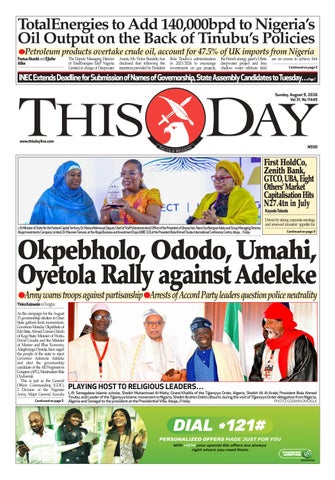
L-R: Minister of State for the Federal Capital Territory, Dr. Mariya Mahmoud; Deputy Chief of Staff (Administration) Office of the President of Ghana; Hon. Nana Oye Bampoe Addo; and Group Managing Director, Abuja Investments Company Limited, Dr. Maureen Tamuno, at the Abuja Business and Investment Expo (ABIE 3.0) at the President Bola Ahmed Tinubu International Conference Centre, Abuja…Friday
Driven by strong corporate earnings and renewed investors’ appetite for Continued on page 5
Okpebholo, Ododo, Umahi, Oyetola Rally against Adeleke Army warns troops against partisanship Arrests of Accord Party leaders question police neutrality
Yinka Kolawole in Osogbo As the campaign for the August 15 governorship election in Osun State gathers fresh momentum, Governors Monday Okpebholo of Edo State, Ahmed Usman Ododo of Kogi State; Minister of Works, David Umahi; and the Minister of Marine and Blue Economy, Adegboyega Oyetola, have urged the people of the state to reject Governor Ademola Adeleke and elect the governorship candidate of the All Progressives Congress (APC), Munirudeen Bola Oyebamiji. This is just as the General Officer Commanding (GOC), 2 Division of the Nigerian Army, Major General Auwalu L-R: Senegalese Islamic scholar, Sheikh Muhammad Al-Mahy; Grand Khalifa of the Tijjaniyya Order, Algeria, Sheikh Ali Al-Arabi; President Bola Ahmed
PLAYING HOST TO RELIGIOUS LEADERS…
Continued on page 5
Tinubu; and Leader of the Tijjaniyya Islamic movement in Nigeria, Sheikh Ibrahim Dahiru Bauchi, during the visit of Tijjaniyya Order delegation from Nigeria, Algeria and Senegal to the president at the Presidential Villa, Abuja...Friday PHOTO: GODWIN OMOIGUI
2
SUNday, AUGUST 9, 2026 • T H I S D AY
SUNDAY, AUGUST 9, 2026 • T H I S D AY
3
SUNday, AUGUST 9, 2026 • T H I S D AY
4
3 days
is all it takes
Get nancing to own your dream car in as little as 3 days
Approval, disbursement, and delivery within 72 hours
Apply anytime, anywhere
Subject to credit approval and delivery timelines.
In partnership with:
More Information: 0700-300-00, 0201-2273000-9 accessbankplc.com
Access Bank PLC. RC.-125384 (Licensed by the Central Bank of Nigeria)
Equity contribution from 10% of invoice value
Optimized total cost of ownership
Scan to get started
Terms and conditions apply
5
AUGUST 9, 2026 • T H I S DAY, T H E S U N DAY N E W S PA P E R
NEWS
DHQ: Military Rescues 363 Victims, Kills 69 Terrorists in One Week CDS applauds troops' commitment to defending Nigeria
Linus Aleke in Abuja
The Defence Headquarters (DHQ) has disclosed that following sustained land, air and sea offensives by the military against criminal elements in all theatres of operations by gallant Nigerian troops in the last one week, 69 terrorists were neutralised in gunfights and air interdiction,
over 360 kidnapped victims rescued while 49 suspects were arrested. DHQ also noted that during the operations against economic saboteurs, three reactivated illegal refinery sites were discovered and dismantled. At the same time, a total of 251,600 litres of stolen crude were recovered, and 12 dug-out pits for storage were destroyed.
Meanwhile, the Chief of Defence Staff (CDS), General Olufemi Oluyede, has commended troops across all theatres of operation for their discipline, resilience and unwavering commitment to the defence of the nation. The Director of Defence Media Operations, Major General Michael Onoja, while making this known, noted that
sadly, one soldier was killed in action while another sustained injury in action. Detailing the encounters, Onoja stated that in the North-east, troops of Operation Hadin Kai deployed at Dutsen Kura while sustaining robust operations, on July 31, 2026, foiled terrorists’ attempt to abduct civilians along the Buratai-Kamuya Road in Biu
LGA of Borno State. According to him, the troops pursued the fleeing terrorists towards Mangari-Dora and rescued 31 persons, comprising 22 adult males, five adult females and four children. Onoja added that four vehicles and one motorcycle belonging to the terrorists were also confiscated. “On the same day, a
OKPEBHOLO, ODODO, UMAHI, OYETOLA RALLY AGAINST ADELEKE
Mahmuda, has directed troops deployed for the governorship election to remain professional, politically neutral and strictly adhere to the Code of Conduct guiding military participation in election security operations. However, concerns have been raised about the alleged lack of neutrality of the police following the alleged arrests of leaders of Accord Party in the state on the orders of the state Police Commissioner, Ibrahim Gotan. Meanwhile, Governor Adeleke has again charged Osun voters to defend their votes in the spirit of democracy and the national constitution. Okpebholo and other
APC leaders made appeal in Osogbo during the official flag-off of the construction of the Osogbo-Iwo-Ibadan Road and the reconstruction of the Gbongan-Osogbo Road, a major federal infrastructure project initiated by President Bola Ahmed Tinubu's administration. Speaking on behalf of President Bola Tinubu, Oyetola described the APC governorship candidate as a competent, experienced, and visionary leader capable of transforming the state through purposeful governance. He said Oyebamiji possesses the administrative capacity, political experience, and developmental vision required to reposition the state and align
it with the federal government's renewed infrastructure drive. According to him, the forthcoming governorship election presents an opportunity for the people of the state to reconnect the state with the centre of national development. In his remarks, Minister of Works, Umahi, described Oyebamiji as "President Tinubu's political son," adding that an APC victory in the state would further strengthen developmental partnerships capable of delivering more roads, improved infrastructure, employment opportunities and economic growth. Also addressing the gathering, APC National Secretary, Senator
Ajibola Basiru, called on the electorate to vote massively for the APC, arguing that the achievements of the Tinubu administration in infrastructure development have already begun to manifest across different parts of the country. In his remarks, Governor Okpebholo also canvassed support for the APC candidate, saying governance requires practical leadership, strategic planning and the ability to deliver meaningful development to the people. Similarly, Governor Ododo encouraged the electorate to support the APC to consolidate President Tinubu's developmental agenda.
Army Warns Troops against Partisanship The GOC gave the warning while addressing officers and soldiers deployed to support election security operations at the Engineer Construction Command (ECC) in Ede, Osun State. Mahmuda reminded the troops that their deployment was in line with the Nigerian Army's constitutional responsibility to provide aid to civil authorities when necessary. He explained that the operation, codenamed Operation SAFE CONDUCT, was designed to support the Nigeria Police Force (NPF), which remains
suspected terrorist informant was apprehended at Garaha Market in Hong LGA of Adamawa State. “On August 1, 2026, troops on routine clearance patrol near Amuda Bridge in Gwoza LGA of Borno State rescued two women and two children who had been held since the 2023 farming season at a terrorist enclave. the lead agency responsible for election security in Nigeria. According to him, soldiers are expected to provide only outer-cordon security and should intervene strictly when requested to respond to security threats. He warned the troops to stay away from polling units except where their intervention becomes necessary in line with operational directives. The GOC said the Chief of Army Staff, Lieutenant General Waidi Shaibu, expects all personnel participating in the operation to demonstrate discipline, professionalism and absolute neutrality throughout Continued on page 10
FIRST HOLDCO, ZENITH BANK, GTCO, UBA, EIGHT OTHERS’ MARKET CAPITALISATION HITS N27.4TN IN JULY
banking stocks, the combined market capitalisation of Zenith Bank, Guaranty Trust Holding Company Plc (GTCO), First Bank (First HoldCo Plc), United Bank for Africa (UBA), Access Holdings Plc, Fidelity Bank, Wema Bank, and five other listed banks on the Nigerian Exchange Limited (NGX) rose to N27.4 trillion at the close of trading in July 2026, from N23.33 trillion at the end of June. The N27.4 trillion valuation represented about 17.3 per cent of the NGX’s overall market capitalisation of N158.33 trillion as of July 31, 2026. During the month under review, the NGX Banking Index appreciated by 22.10 per cent, outperforming the broader market and several other major
sectoral indices. On a year-to-date (YtD) basis, the Banking Index ranked among the leading sectoral indices on the Exchange, behind the NGX Oil & Gas and NGX Industrial Goods indices, which had appreciated by 96.32 per cent and 85.42 per cent respectively. The NGX All-Share Index (ASI), meanwhile, gained 6.92 per cent in July, bringing its YtD return to 57.62 per cent, driven by sustained investors’ confidence, improved conditions in the foreign exchange market, impressive corporate earnings and renewed demand for fundamentally sound stocks. First HoldCo emerged as the most capitalised banking stock on the NGX at the end of July, ahead of Zenith Bank
Plc and Guaranty Trust Holding Company Plc (GTCO). The market capitalisation of First HoldCo jumped from N2.55 trillion at the end of June to N5.88 trillion in July, following a spectacular rally in its share price. The company’s share price appreciated by 131.13 per cent during the period, closing in July at N129.55 per share, up from N56.05 per share at the end of June. The surge in the company’s share price followed further accumulation of its shares by its Chairman, Mr. Femi Otedola, as well as investors’ positive reaction to its impressive financial performance for the first half (H1) of 2026. First HoldCo had announced
its unaudited financial results for the half-year ended June 30, 2026, reporting profit before tax (PBT) of N653.5 billion, representing an increase of 83.5 per cent from N356.1 billion recorded in the corresponding period of 2025. Profit after tax (PAT) similarly rose by 81.5 per cent to N526.1 billion in H1 2026, from N289.8 billion in H1 2025. Zenith Bank and GTCO occupied the second and third positions, respectively, with market capitalisations of N5.07 trillion and N4.75 trillion at the end of July, compared with N4.52 trillion and N4.57 trillion, respectively, in June. United Bank for Africa Plc (UBA) saw its market capitalisation rise to N1.97 trillion in July from N1.70 trillion in
June, while Access Holdings Plc’s valuation increased to N1.43 trillion from N1.20 trillion during the same period. Other listed financial institutions included Fidelity Bank Plc, with a market capitalisation of N1.36 trillion; Wema Bank Plc, N1.16 trillion; FCMB Group Plc, N755.18 billion; Sterling Financial Holdings Company Plc, N527.43 billion; and Jaiz Bank Plc. However, Ecobank Transnational Incorporated (ETI) and Stanbic IBTC Holdings Plc bucked the bullish trend, recording declines in their share prices during the month. ETI’s share price declined by 6.56 per cent, while Stanbic IBTC fell by 2.5 per cent. ETI’s market capitalisation
TOTALENERGIES TO ADD 140,000BPD TO NIGERIA’S OIL OUTPUT ON THE BACK OF TINUBU’S POLICIES
oil in 2027 and fourth quarter (Q4) of 2028, respectively. This is coming as refined petroleum products have overtaken crude oil as the United Kingdom’s largest goods import from Nigeria, accounting for 47.5 per cent of total goods imports from the country in the 12 months ended March 2026. Speaking in Lagos at a special panel session at the Nigeria Annual International Conference and Exhibition (NAICE) 2026, which ended at the weekend in Lagos, Bandele explained that the incentives provided by President Tinubu’s administration encouraged TotalEnergies and other operators to launch new deepwater projects on gas.
Though he did not disclose the production capacities of the Ubeta and Ima projects, THISDAY gathered from industry sources that each of the two gas projects can produce up to 70,000 barrels of oil equivalent per day (boepd), which is about 300 million standard cubic feet per day (scf/d) of gas. While the Ubeta field is located in Oil Mining Lease (OML) 58, 80 kilometres offshore Port Harcourt, the Ima Field is also located offshore Port Harcourt, under the AMNI/TotalEnergies Joint Venture. The two projects are expected to boost gas supply to the nearby Nigeria LNG Limited. Bandele recalled that since
TotalEnergies brought the Egina deepwater oil field on stream in 2018, oil and gas operators have not brought any other deepwater projects on stream due to a lack of incentives. “I am happy today to speak about projects that have matured because of the shift in processes. We know there were incentives for offshore natural gas, and that was in 2023/2024. So, what did TotalEnergies do? We took the Final Investment Decision (FID) on Ubeta in 2024. The Ubeta project is ongoing as we speak. It is one of the projects with the highest local content, as many Nigerian companies are participating. And Ubeta should be in production next year. So,
incentives improved; projects sanctioned and projects will be delivered,” Bandele explained. “I think that is the trend we are desperate to see in Nigeria. Today, we are working on concluding FID for the Ima project with our partner. The FID is imminent, and first oil is planned for Q4, 2028,” he added. Gas from the two projects will be sent as feedstock to the Nigeria LNG facility, whose train 7 is currently under construction at Bonny Island. TotalEnergies and several other gas operators, including Shell and NNPC Limited, agreed in August 2025 to supply 1.29 billion cubic feet of gas feedstock per day to NLNG.
Petroleum Products Overtake Crude Oil, Account for 47.5% of UK Imports from Nigeria Meanwhile, refined petroleum products have overtaken crude oil as the United Kingdom’s largest goods import from Nigeria, accounting for 47.5 per cent of total goods imports from Nigeria in the 12 months ended March 2026. Latest figures in the Nigeria Trade and Investment Factsheet, released by the UK Department for Business and Trade and quoted by Nairametrics, showed that Britain imported £674.5 million worth of refined petroleum products from Nigeria during the period, considerably higher than the £438.9 million
stood at N1.61 trillion at the end of July, compared with N2.55 trillion in June, while Stanbic IBTC’s valuation declined to N2.53 trillion from N2.59 trillion. Commenting on the performance, Vice President, Highcap Securities Limited, Mr. David Adonri, attributed the rally in the Banking Index to strong demand for First HoldCo shares and impressive earnings reported by other listed banks. “The NGX Banking Index being the best-performing index in July 2026 has to do with First HoldCo and Mr. Femi Otedola’s rising stake. The billionaire investor’s position has continued to drive the banking stock and boost other investors’ confidence,” Adonri said.
spent on importation of Nigerian crude oil. Crude oil, which traditionally dominated Nigeria’s merchandise exports to the UK, accounted for 30.9 per cent of British goods imports from Nigeria. At the same time, natural gas ranked third at £179.3 million, representing 12.6 per cent. According to the report, UK crude oil imports from Nigeria plunged by 64.3 per cent compared with the preceding 12-month period, while natural gas imports rose by 6.9 per cent. Apart from petroleum products, other major British goods imports from Nigeria Continued on page 10
6
T H I S DAY, T H E S U N DAY N E W S PA P E R • AUGUST 9, 2026
NEWS
PAYING LAST RESPECTS WITH SERVICE OF SONGS…
L-R: Former Governor of Cross River State, Senator Liyel Imoke; Nze Fidelis Ozichuckwu; Archbishop Emeritus of the Catholic Diocese, Cardinal John Onaiyekan; former Minister of Labour, Dr. Chris Ngige; and daughter of the late Paddy Kemdi Njoku, Miss Ogechi Njoku, during a service of songs held for Kemdi Njoku in Abuja…recently PHOTO: SUNDAY AGHAEZE
NNPC Rejects Underperformance Claims, Says Oil Output Up 6% Under Ojulari
Emmanuel Addeh in Abuja
The Nigerian National Petroleum Company Limited (NNPC Ltd) yesterday rejected allegations of impropriety and poor performance levelled against its management by the Oil and Gas Professionals Forum (OGPF), stressing that its crude oil and gas production have recorded sustained growth under its Group Chief Executive Officer
(GCEO), Bayo Ojulari. The company also clarified that it has no regulatory or allocative powers over oil licensing rounds, noting that the conduct of licensing rounds and allocation of oil blocks are statutory responsibilities of the Nigerian Upstream Petroleum Regulatory Commission (NUPRC). The statement by NNPC followed allegations by the OGPF, which called on the federal
government to investigate the leadership and operations of both NNPC over what it described as transparency concerns surrounding production performance, licensing procedures and contract awards. The forum, in a statement signed by its convener, Ayodele Momoh, alleged possible insider influence and uneven application of rules in the marginal fields licensing process and called for
the removal of Ojulari as NNPC GCEO. It also raised questions over alleged relationships involving persons said to be close to the NNPC leadership and companies that reportedly benefited from licensing outcomes. The group questioned whether oil production had improved materially since the change in leadership at NNPC, alleging
Nigeria’s Domestic Debt Service Rises 20.3% to N3.14tn in Q1 2026
Interest payments gulp N2.97tn, 95% of total domestic obligations
Festus Akanbi
The federal government spent N3.14 trillion on servicing its domestic debt in the first quarter of 2026, representing an increase of 20.3 per cent from N2.61 trillion recorded in the corresponding period of 2025, the latest report from the Debt Management Office (DMO) has revealed. The figures, according to Nairametrics, underscored the growing pressure of interest payments on the federal government’s finances, as N2.97 trillion, or about 95 per cent of the total domestic debt-service expenditure during the quarter,
went into interest payments, leaving only N169.68 billion for principal repayments. The N3.14 trillion domestic debt-service bill was also 37.5 per cent higher than the N2.28 trillion recorded in the fourth quarter of 2025, reflecting a sharp acceleration in the cost of servicing the federal government’s domestic obligations at the beginning of the year. An analysis of the DMO figures showed that domestic debt-service payments rose steadily during the quarter, from N741.82 billion in January to N967.67 billion in February and N1.43 trillion in March. Interest payments alone
increased from N726.38 billion in January to N967.67 billion in February, then climbed to N1.28 trillion in March, bringing the total interest bill for the three months to N2.969 trillion. Federal Government of Nigeria (FGN) bonds remained the biggest source of the interest burden, accounting for about N1.96 trillion during the quarter. This comprised approximately N1.90 trillion on conventional FGN bonds and N61.97 billion on the FGN US Dollar Bond. Nigerian Treasury Bills (NTBs) accounted for another N1.003 trillion in interest payments, comprising N262.57 billion in January, N258.90 billion in
February and N481.47 billion in March. Interest payments on FGN Savings Bonds stood at N4.24 billion. The figures indicated that for every N100 the federal government spent on servicing its domestic debt in the first quarter, approximately N95 went to interest payments, while only about N5 went to principal repayments. The development also represented a significant deterioration from the corresponding period of 2025, when interest payments stood at N2.37 trillion and principal repayments amounted to N241.91 billion.
Ex-US President Biden’s Cancer Has Spread, Says Son, Hunter
Peter Uzoho
Hunter Biden has spoken about his father, the former United States President, Mr Joe Biden’s ongoing cancer treatment, saying the former US president’s condition has become increasingly difficult for the family to watch. Hunter said Joe Biden’s cancer had spread to his bones and described the illness as painful
and debilitating. He made the comments in an interview the BBC published yesterday while discussing his father’s battle with the disease. “I wish he would complain more, because it’s not good — the cancer has spread,” Hunter said, adding that the disease had metastasised to his father’s bones “and further”. “It’s very painful… very debilitating,” he said. “Cancer
is really hard. It’s really sad to watch,” he stated. Hunter, who is Biden’s only surviving son, also described his father’s place within the family, saying, “My dad is, to this day, the centre of our family. He’s the best father, the best husband, the best grandfather.” Biden announced in May 2025, four months after leaving the White House, that he had been diagnosed with an aggressive
form of prostate cancer. He later said his treatment was progressing well and expressed gratitude for the support and prayers he had received. “I’m dealing with a cancer diagnosis, been getting treatment, and it’s going really well,” Biden said last month. “I want to thank all those who have offered their prayers and support and wellwishes. It’s meant the world to Jill and to me.”
that output remained below what it described as the widely cited 1.7 million bpd benchmark. However, in a statement issued yesterday by its Chief Corporate Communications Officer, Andy Odeh, the NNPC said the allegations did not reflect the company’s statutory responsibilities or its operational performance. “Under the Petroleum Industry Act (PIA) 2021, the conduct of oil licensing rounds and the allocation of oil blocks fall squarely within the statutory mandate of the Nigerian Upstream Petroleum Regulatory Commission (NUPRC). “NNPC Limited, since its incorporation, has operated strictly as a commercial entity and holds no regulatory or allocative authority,” the national oil firm stated. The company said its production performance also contradicted claims that the
current management had failed to improve output. According to NNPC, average crude oil production stood at 1.60 million barrels per day (bpd), including condensate, in April 2025. By April 2026, the figure, it said, had risen to 1.67 mbpd. Quoting its Monthly Performance Report, the national oil company said the increase of about 80,000 bpd represents approximately 6 per cent growth, urging stakeholders to rely on verifiable corporate and regulatory data when assessing its performance. The company also stated that it reported an increase in gas production during the period under review. It said average gas production rose from 7,354 million standard cubic feet per day (mmscfd) in April 2025 to 7,729 mmscfd in April 2026, representing approximately five per cent growth.
Tambuwal, Ihedioha, Imoke Lead ADC's 73-man Campaign Council for Osun Guber Poll Chuks Okocha in Abuja A former governor of Sokoto State, Senator Aminu Tambuwal; ex-governor of Imo State, Hon. Emeka Ihedioha; ex-governor of Cross River State, Senator Liyel Imoke and General Kabiru Nadama (rtd.) were among the leaders of the 73-member Election Management Council constituted by the African Democratic Congress (ADC) for the Osun State governorship election. The constitution of the council comes as the ADC steps up its campaign and mobilisation efforts ahead of the Osun governorship election, deploying prominent figures from its national leadership and political coalition to coordinate its activities in the state. Imoke leads the council, while Tambuwal serves as chairperson
and Ihedioha and Nadama as co-chairmen. The ADC National Publicity Secretary, Bolaji Abdullahi, announced the composition of the council in a statement issued yesterday. The council is tasked with coordinating and overseeing the party’s campaign activities ahead of the governorship election, including mobilisation and preparations for the final campaign rally. The ADC campaign will culminate on Monday, August 10, with a final rally at Nelson Mandela Freedom Park in Osogbo, beginning at noon. The party said the rally would bring together its national leadership, governorship candidate, coalition leaders, campaign officials, supporters and members of the public.
7
AUGUST 9, 2026 • T H I S DAY, T H E S U N DAY N E W S PA P E R
NEWS
INVESTITURE CEREMONY…
L-R: Past President, Rotary Club of Ikeja, Sola Akinsiku; Past Assistant Governor; Tosin Kadiri; Immediate Past President, Kuburat Olanrewaju Lawal; President, Olukayode Osokomaiya; District Governor Nominee, Ade Oyenekan; former President, Emeka Ibe; Investiture Committee Chairman/former President, Kayode Situ, at the investiture ceremony of Osokomaiya as the President Rotary Club of Ikeja in Lagos…recently
INEC Extends Deadline for Submission of Names of Governorship, State Assembly Candidates to Tuesday Suspends PVC collection in Osun
Adedayo Akinwale in Abuja
The Independent National Electoral Commission (INEC) has approved the extension of the deadline for the submission of the list of candidates for
the governorship and state Houses of Assembly elections. Its National Commissioner and Chairman, Information and Voter Education Committee, Mohammed Haruna, in a statement issued yesterday,
said the submission, which was originally scheduled to close yesterday, August 8, 2026, has been extended to Tuesday, August 11, 2026. Haruna also announced the suspension of Permanent
Voter Cards collection ahead of the August 25 governorship election in Osun State. He said: “The Independent National Electoral Commission (INEC) wishes to inform political parties and the
PFIPC: ADC Dismisses ICPC Report as Predictable, Says FG More Interested in Damage Control than Investigation Chuks Okocha in Abuja The African Democratic Congress (ADC) has dismissed the interim report of the Independent Corrupt Practices and Other Related Offences Commission (ICPC) on the alleged fake Presidential Foreign Intervention Promotion Council (PFIPC) as predictable and inadequate, accusing the federal government of prioritising damage control over a thorough investigation. In a statement signed by its National Publicity Secretary, Mallam Bolaji Abdullahi, the ADC said the report failed to explain how a fictitious agency allegedly secured federal
office space, had civil servants deployed to it and found its way into the 2026 budget with a N1.3 billion provision, even as the investigation reportedly uncovered two other fictitious organisations linked to the principal suspect. The ADC said it had reviewed sections of the interim report of the ICPC that have been made public regarding the so-called PFIPC. According to the spokesman of the ADC, ''With the so-called interim report of the ICPC, our fears have come to pass as the report is not only predictable, it appears more concerned with exonerating government
officials rather than providing clear answers to the serious questions that the scandal has raised. ''The ICPC report appeared to have given the impression that what happened was mere failure in government processes or procedures. This position is difficult to sustain in the light of publicly available evidence, which establishes that this is not an error of omission or a mere glitch in the system. Instead, what happened was a grand scam that could have been possible only with the active connivance of government officials and institutions at the
highest level. ''The ICPC report also comes gravely short by suggesting that there could be accomplices within government, but mentioned none. Yet, an agency that was able to recommend only Adeyemi for prosecution on the basis of an investigation that the Commission itself has tagged as either on-going or inconclusive. If all that the commission had to present was a preliminary report, why not simply present it as a confidential brief to the President instead of making a public drama of it in a manner that potentially prejudiced the overall investigation and cast Adeyemi as the principal culprit?
public that it has approved an extension of the deadline for the submission (upload on the dedicated portal) of the list of candidates for the governorship and state Houses of Assembly Elections for the February 2027 general election. “The submission window, which according to the revised Timetable and Schedule of Activities for the general election was originally scheduled to close, Saturday, 8th August, 2026, has been extended to Tuesday, 11th August, 2026." Haruna added that the extension followed growing appeals by political parties for additional time to complete the process. Meanwhile, the commission has also informed voters who applied for replacement of lost, damaged or defaced PVCs, that the window to print downloadable copies of their cards would expire by midnight of today, August 9, 2026. This, Haruna said, was to allow the commission to compile the data of downloaded PVCs for final
statistics of total PVCs collected ahead of the August 15, Osun Governorship Election. He recalled that collection of PVCs in Osun State commenced at Registration Area (RA) level from July 22 to 28, 2026. The National Commissioner noted that owing to complaints of large crowds and difficulties encountered by voters at collection centres, the commission approved an extension of RA-level collection to July 31, 2026, before collection moved to LGA level, running from August 1 to 7, 2026. Haruna stressed that replacement of downloadable PVCs have been made available to voters in Odo-Otin and Ife Central LGAs whose cards were carted away by hoodlums who invaded the two centres. The commission reiterated that the stolen cards cannot be used to vote. INEC reassured the people of Osun State of its readiness to conduct a free, fair, credible and inclusive governorship election.
Wike Mocks Bode George, Says He Has No Electoral Value Chuks Okocha in Abuja
The Minister of the Federal Capital Territory (FCT), Nyesom Wike, has said he has no regret for stopping the former Deputy National Chairman of the Peoples Democratic Party (PDP), Chief Bode George, from becoming the party’s National Chairman, describing him as a failed politician who has not won any election for the PDP in Lagos State since 1999. In a statement issued
yesterday by his Senior Special Assistant on Public Communications and social media, Lere Olayinka, the minister said George’s political frustration was compounded by the emergence of Deji Doherty, a personality he did not want to see in charge of the party in Lagos State. “His anger is because we didn’t allow him to be PDP National Chairman and we have no regret doing so,” Wike said.
He added that George “wanted to be PDP National Chairman and was carrying on like the position was his birthright. We stopped him because it was the South-South's turn. Since then, he has not stopped being angry.” The minister recounted an incident in which he visited George’s residence in Maitama, Abuja, as a sitting governor, to appease him after the national convention. The minister stated that he
was nearly turned away by George’s wife until former Ondo State governor, Olusegun Mimiko, intervened. Wike described George as a politician who, despite all the privileges and power at his disposal, has failed to deliver electoral victories for the PDP in Lagos State. “We have managed him even though we know that he has no value. But as it is, since he wants to keep dancing naked in the marketplace of politics, we
can’t but allow him,” he said. The minister argued that leadership of a political party is not determined by name, title or status as a founding father, but by the ability to win elections. He said on that score, Bode George is “a complete disaster.” Citing specific electoral figures, Wike said George has never won even his own polling unit, Unit 001 in Ward E2, Evans Street, Lagos Island, for the PDP.
He noted that in the 2019 presidential election, the All Progressives Congress (APC) polled 84 votes at the unit against the PDP’s 40, while in 2023, after George transferred his voter’s card to Eti-Osa, the PDP recorded only four votes at his former polling unit. Wike said that since George appeared not to be busy, he would keep his associates busy by giving them reasons to move from one television station to another.
8
T H I S DAY, T H E S U N DAY N E W S PA P E R • AUGUST 9, 2026
NEWS
MARITIME SAFETY ON THEIR MINDS…
L-R: President, Alumni Association of the Maritime Academy of Nigeria, Mr. Emmanuel Maiguwa; Director General, Nigerian Maritime Administration and Safety Agency; Dr. Dayo Mobereola; Executive Director, Maritime Labour and Cabotage Services, NIMASA, Mr. Jibril Abba; and Director General of Nigerian Chamber of Shipping, Mrs. Vivian Chimezie Azubuike, when the association paid a courtesy visit on the DG NIMASA at the headquarters of the agency in Lagos…recently
Atiku: Tinubu’s Economic Policies Have Made Decent Living Unaffordable Chuks Okocha in Abuja
Former Vice President and presidential candidate of the African Democratic Congress (ADC), Atiku Abubakar, has described the latest Central Bank of Nigeria Household Expectations Survey as a damning verdict on President Bola Tinubu’s economic policies, saying an economy in which
citizens are abandoning plans to buy homes, cars and basic household assets cannot credibly be advertised as one on the path to prosperity. In a statement issued by his Senior Special Assistant on Public Communication, Phrank Shaibu, Atiku said the CBN’s own numbers have stripped the government’s economic propaganda of whatever
credibility it had left. According to the survey, buying conditions stood at just 28.7 points for motor vehicles, 28.9 for consumer durables and 30 for buildings and landed property. Even more disturbing, Atiku said was that the willingness to purchase vehicles fell to 18.7 points, while buildings and landed property stood
at only 19.2 points. “These are not figures manufactured by the opposition. They are the verdict of Nigerian households captured by the Central Bank under President Tinubu’s own government. “What the figures tell us is simple: Nigerians are being priced out of decent living. A home is becoming a fantasy. A car is becoming a luxury.
Turaki- led PDP Applauds International Human Rights Group over Authoritarian Remarks on Tinubu Chuks Okocha in Abuja
The Tanimu Turaki-led faction of the Peoples Democratic Party (PDP) has hailed the Human Rights Foundation for its latest global assessment describing Nigeria as a “fully authoritarian regime” under President Bola Tinubu. The National Publicity Secretary of the party, Comrade Ini Ememobong, stated this in a statement issued yesterday, saying the assessment was a global confirmation of what Nigerians had allegedly been experiencing under the All
Progressives Congress (APC)-led federal government. According to him, the report, published on the foundation’s Tyranny Tracker platform, reflected the erosion of democratic safeguards and institutional checks and balances in the country. He said Nigeria performed abysmally low on the critical pillars used by the foundation in its assessment, indicating what he described as the country’s descent into authoritarianism. Ememobong said the parameters adopted by the Human Rights Foundation
were consistent with established theoretical frameworks for identifying authoritarian regimes, including rule by a dictator or a small group, absence of institutional checks and balances, restrictions on freedom of speech, targeting of opposition and weak electoral processes. He argued that the indicators of authoritarianism were increasingly evident in Nigeria under the Tinubu administration. The PDP spokesman cited what he described as recent media attacks by officials of the
administration against Catholic Archbishop Emeritus of Abuja, Cardinal John Onaiyekan, the Catholic Bishops’ Conference of Nigeria, the Catholic Church and Christianity generally. He said the development was one of several instances which, in his view, demonstrated the alleged shrinking space for freedom of expression under the administration. “What did the cleric say that is not the life experience of Nigerians, except, of course, the few who are isolated from reality and their paid human megaphones?” he asked.
Wipe Out Bandits, Kebbi Gov Urges Military
Onuminya Innocent in Sokoto
Kebbi State Governor, Nasir Idris, has called on the Nigerian military to eradicate bandits who have kept threatening the safety of lives and property in the state. Speaking during an unscheduled visit to the troops at their camp in Yauri, where he commended the soldiers for their gallantry and commitment to duty, Governor Idris reaffirmed his administration’s commitment to providing the necessary support and enabling
environment for security agencies to operate effectively. He said security was a collective responsibility and called on state governments to remain active stakeholders in supporting the federal government to secure vulnerable communities and create an environment where farmers could safely return to their farms. “The issue of security is the responsibility of all. State governments must be active stakeholders in support of the federal government to secure
volatile areas, making them safe to allow farmers to go back and cultivate their farms. “Bandits are trying to embarrass us. They are coming to attack our people. The security agencies must wipe away these bandits, and the capability of the military should come to bear. “Nigeria’s military has the professional ability, as it has exhibited in peacekeeping operations in other parts of the world. I have confidence in you,” governor Idris declared. He thanked the Chief of Army
Staff for deploying additional military units to the state to strengthen the fight against banditry. The governor said the deployment of additional troops had answered the state government’s call for increased military presence in the affected areas. “I’m happy about your performance. The Chief of Army Staff, supported by the military hierarchy, has answered our prayers by sending you here to Kebbi.
Household appliances are increasingly beyond reach. Families are exhausting their incomes on food, transportation, electricity, school fees and other necessities, leaving practically nothing for savings, investment or asset acquisition. “Only recently, the Jollof Index told us what Tinubu’s economy has done to the Nigerian kitchen. Now the CBN survey is telling us what it has done to the Nigerian dream. “The numbers make the tragedy even more stark. According to the latest SBM Jollof Index, the ingredients required to prepare a single pot of jollof rice for a family of five now cost an average of N29,578. Think about what that means for a worker earning the N70,000 minimum wage: one ordinary
pot of jollof rice can swallow more than 40 per cent of an entire month’s salary, before rent, transportation, electricity, school fees and healthcare are considered. And this is the same economy in which Nigerians are now postponing the purchase of homes, cars and basic household assets because there is simply no disposable income left. “Tinubu has not merely made life more expensive; his policies are steadily pricing ordinary Nigerians out of food, comfort, asset ownership and the basic dignity of a decent life. “Tinubu first stole jollof rice from the family dining table. Now, his economy is taking away the house in which the table should stand and the car with which the breadwinner should get to work.”
Police Arrest Five Pakistanis Over Alleged Suspicious Activities in Benue, Recover 35 Mobile Phones George Okoh in Makurdi The Benue State Police Command has arrested five Pakistani nationals over suspected clandestine activities in rural parts of two Local Government Areas (LGAs) of the state. The Police Public Relations Officer in the state, DSP Peter Aondongu, in a statement yesterday, said the police also recovered 35 mobile phones from the arrested foreigners in separate intelligence-led operations in the rural town of Otukpo in Otukpo LGA and the Ugbokolo community in Okpokwu LGA of the state. Aondongu stated that the suspects were arrested on August 4 and 5, 2026, following credible intelligence received by the command of their activities and movements in the areas.
He said that three of the suspects, identified as Younas Mohammad, 36; Ahmad Nunil, 38; and Aslam Muhammad, 46, were arrested on August 4 at Adoka motor park in Otukpo LGA while attempting to board a vehicle to Adoka village. The police spokesperson explained that the suspects claimed during preliminary questioning that they were in Otukpo to market cosmetics and mobile gadgets. Still, none of these items were found in their possession, raising questions about their activities and movements in the area. He added that in a separate operation the following day, two other Pakistani nationals, Juma Sharif, 30, and Muhammed Sharif, 25, were arrested at a local hotel in Ugbokolo following intelligence received by the police.
SUNDAY, AUGUST 9, 2026 • T H I S D AY
9
10
T H I S DAY, T H E S U N DAY N E W S PA P E R • AUGUST 9, 2026
NEWS
HONOURING ANTI-DRUG WAR FIGHTERS…
L-R: Commanders of Narcotics, Anavi Jimoh Samuel; Adeola Salaudeen, Edo State Commander, National Drug Law Enforcement Agency, Dr. Mitchell Ofoyeju; and Commander of Narcotics, Hope Aigbogun, at the decoration ceremony of newly promoted officers in Benin City…recently
Iran Sets Conditions for Reopening Strait of Hormuz, Demands US Compensation, Troop Withdrawal
Iran yesterday laid down sweeping conditions for the full reopening of the Strait of Hormuz, demanding an end to the war, withdrawal of United States forces from the region and financial compensation from Washington, even as Tehran and Oman appeared to move closer to an agreement on navigation through the strategic waterway. Secretary of Iran’s Supreme National Security Council, Mohammad Bagher Zolghadr, said normal shipping through the strait would not resume until the United States met Tehran’s conditions, effectively tying the
fate of one of the world’s most important energy corridors to the wider conflict. The development came amid growing diplomatic efforts to reopen the strait, through which a significant proportion of internationally traded oil and liquefied natural gas traditionally passes. Iran and Oman have given indications that progress is being made towards an arrangement governing navigation through the waterway, but Tehran insisted that any understanding with Muscat would not, by itself, amount to an unconditional
reopening of the strait. The Islamic Revolutionary Guard Corps (IRGC) also maintained that the reopening of the waterway would depend on Washington “fully accepting” Iran’s conditions rather than merely on the outcome of negotiations with Oman. Among Tehran’s demands are an end to the war, termination of the naval blockade, withdrawal of American forces from the region, lifting of sanctions, release of frozen Iranian assets and compensation for damage suffered during the conflict. The demands have
significantly raised the stakes in negotiations over the strait, transforming what appeared to be a maritime navigation arrangement into a potentially wider bargaining process over the future of the conflict. Oman, which has played an important intermediary role, has nevertheless cautioned that continuing attacks on commercial shipping could undermine the progress recorded in negotiations. Those concerns deepened yesterday after the United Arab Emirates accused Iran of firing a missile at a tanker belonging to the Abu Dhabi National
OKPEBHOLO, ODODO, UMAHI, OYETOLA RALLY AGAINST ADELEKE the electoral process. He cautioned the troops against political partisanship, intimidation of voters or any conduct capable of undermining the credibility of the election. Mahmuda stressed that the troops must conduct themselves in a manner that reflects the core values of the Nigerian Army, urging them to avoid harassing members of the public while carrying out their duties.
Arrests of Accord Party Leaders Question Police Neutrality Meanwhile, concerns have been raised about the alleged lack of neutrality of the police following the arrests of leaders of the Accord Party in the state on the orders of the state Police Commissioner, Ibrahim Gotan. The spokesman of the Imole Campaign Council working for the reelection of Governor
Adeleke, Mr. Pelumi Olajengbesi, yesterday decried the arrests of the state Commissioner for Environment and Sanitation, Hon. Mayowa Adejoorin, and 60 Accord members across the state, including Ijesaland, by the Osun State Police Command. He said the action was meant to silence Accord leaders and compromise the August 15 governorship election. Speaking at a press conference in Osogbo, he called on the Inspector-General of Police, Mr. Tunji Disu, to urgently intervene in the situation in Osun State. He also drew the attention of Nigerians, the international community and the leadership of the Nigerian Police Force to the disturbing and increasingly dangerous pattern of arrests, intimidation and incessant abduction of leaders and members of the Accord Party, particularly across Ijesaland. According to him, "The latest
victim of this alarming pattern is the state Commissioner for Environment and Sanitation, Hon Mayowa Adejoorin, a prominent native of Ikiyinwa in Obokun Local Government Area of the state. " Olajengbesi added that the manner of his arrest was particularly disturbing. He said, "We consider what happened to Hon Adejoorin nothing short of a bandit-line abduction carried out under the cover of police authority." "For some time now, we have witnessed a disturbing pattern in which prominent Accord leaders and supporters in Ijesaland are picked up by the Police on allegations that are apparently motivated by sinister political calculations, kept away from their families, communities and campaign activities, and thereby removed from circulation at a critical period of the electoral process."
In a separate statement issued and made available by the Chairman, Media and Publicity Sub-Committee of the council, Hon. Bamidele Sallam, the campaign council, specifically accused CP Gotan of defying the directive of the IG that all police officers should be non-partisan. The campaign council alleged that since the arrival of the new police Commissioner in charge of the election, the substantive CP, Gotan, has been running a parallel police structure which he has deployed alongside APC thugs to molest Accord Party leaders.
Defend Your Votes, Adeleke Charges Residents Meanwhile, Governor Adeleke has again charged Osun voters to vote and defend their votes in the spirit of democracy and the national constitution.
Oil Company (ADNOC) as the vessel passed through the Strait of Hormuz. The UAE condemned the incident, although no casualties were reported. The attack underscored the fragility of negotiations aimed at restoring normal maritime traffic and heightened concerns about the security of commercial vessels navigating the strategic passage. The Strait of Hormuz, connecting the Persian Gulf with the Gulf of Oman and the Arabian Sea, remains one of the most consequential
maritime chokepoints in the global economy. Any prolonged disruption to shipping through the corridor carries implications for international crude oil and gas supplies, freight costs, insurance premiums and global energy prices. Although the emerging IranOman arrangement could create a pathway towards restoring greater vessel movement, Tehran’s insistence on linking a full reopening to major concessions from Washington has complicated prospects for an immediate return to normal shipping.
He gave the admonition at the palaces of monarchs of Ipetu-Ijesha and Ijebu Ijesha as he rallied support for reelection alongside his cousin, David Adeleke a.k.a Davido, at a massively attended rally at Ijebujesha. Accompanied by top leaders of the Imole Campaign Council, the governor tasked Osun voters to demonstrate boldness and determination to exercise their voting rights as guaranteed by the constitution, declaring that “no force can deny Osun voters their democratic rights” Re-echoing Davido, who also challenged Osun residents to vote and defend their votes, the governor said free and fair elections are the inalienable rights of Osun people and “they are ready to protect and affirm those rights on August 15th.” At the palace of Ajalaye of Ipetujesa, Oba Adeleke Oke, the monarch eulogised the governor
for his extraordinary performance in the last four years, assuring the Accord team of total support of his people on August 15. The royal father of Ijebu-Jesa, while welcoming the governor, hosted a victory prayer session in which interfaith activities in support of Accord's triumph over opposition forces were held. “You will win the second term, and you will deliver even more than you have done in your first term. My people are eager to continue to be part of a good turn of events in the state,” the royal father submitted. At electrifying campaign rallies in Ipetu-Ijesha and Ijebu-Jesa, Governor Adeleke declared that victory was at hand and urged the people to intensify mobilisation for continuity. “Your security is assured. Your safety is guaranteed. Mobilise your relatives and friends. Vote for good governance and more dividends of democracy.
TOTALENERGIES TO ADD 140,000BPD TO NIGERIA’S OIL OUTPUT ON THE BACK OF TINUBU’S POLICIES
included coffee, tea and cocoa products valued at £29.3 million, representing 2.1 per cent of total goods imports, and processed fertilisers worth £25.2 million, or 1.8 per cent. Interestingly, refined petroleum products also dominated trade flows in the opposite direction, emerging as the UK’s biggest
goods export to Nigeria during the review period. Britain exported £725.6 million worth of refined petroleum products to Nigeria, accounting for 51.2 per cent of its total goods exports to the country. This was despite a 44.7 per cent year-on-year decline in the value of the products
exported. Other leading UK exports to Nigeria included toilet and cleansing preparations valued at £61.6 million; textile fabrics, £48.6 million; general industrial machinery, £40.3 million; and mechanical power generators, £32.9 million. Meanwhile, the report
showed that the overall value of bilateral trade between Nigeria and the UK declined over the period, despite changes in the composition of merchandise trade between the two countries. Total trade in goods and services stood at £7.3 billion in the four quarters ended March 2026, representing a
3.4 per cent decline, or £258 million, compared with the corresponding period of the previous year. UK exports to Nigeria declined marginally by 0.9 per cent to £5.3 billion, while imports from Nigeria fell more sharply by 9.3 per cent to £2 billion.
Of Britain’s £2 billion imports from Nigeria, goods accounted for £1.4 billion, representing 69.7 per cent, while services contributed £616 million, or 30.3 per cent. UK goods imports from Nigeria declined by 11.3 per cent year-on-year, while imports of services fell by 4.3 per cent.
SUNDAY, AUGUST 9, 2026 • T H I S D AY
11
12
T H I S D AY, T h e S U N D AY N e w s pa p e r AUGUST 9, 2026
news
CHURCH MINISTERS…
L-R: Music Director, Church of God in Christ, Southern Nigeria Ecclesiastical Jurisdiction, Ngozi Orji; Regional Overseer, Rev. Nelly Nnamdi; Mission President and Regional Overseer-designate (Missionary Region), Apostle Augustus Edet; Prelate, Southern Nigeria Ecclesiastical Jurisdiction, Bishop Henry Chukwudi Praise; Rev. Assistant/Regional Secretary, Dr. Sandra Akinbuyuyi; Welfare Director, Pastor Joy Aigbe; and Regional Adjutant, Apostle Abraham Wilfred, during the ministers’ conference, inauguration and induction of new members of Lekki Region of COGIC, Southern Nigeria Ecclesiastical Jurisdiction in Ajah, Lagos… recently
Sirleaf: I Took Tough Decisions to Fight Corruption, Injustice in My Country Sunday Ehigiator
Former Liberian President, Ellen Johnson Sirleaf, has recounted how she took difficult and unpopular decisions to confront corruption and injustice during her 10 years in office, insisting that true leadership requires the courage to face uncomfortable realities in the interest of the greater good. Sirleaf spoke yesterday at the Legacy and Leadership Lecture organised in honour of the late Nigerian businessman and philanthropist, Captain Idahosa Wells Okunbo, to mark the fifth anniversary of his death. The former Liberian president, who became Africa’s first
democratically elected female head of state, said her experience in public office taught her that leadership should not be measured by the power an individual possesses, but by the lives transformed through the responsible use of such power. Reflecting on her presidency, Sirleaf said she was often required to make decisions that were difficult, unpopular and capable of hurting people close to her, but maintained that leaders must be prepared to confront corruption, injustice and other uncomfortable realities. “Many times, I had to make decisions, decisions that I knew would have the effect of hurting others. Decisions that would not be well accepted by colleagues, by
Vandalised Bridge: SanwoOlu Inspects Bridge, Assures Residents of Structural Safety
Segun James
Lagos State Governor, Mr. Babajide Sanwo-Olu, yesterday inspected the vandalised bridge pillar at Vin-Niger, along the Lagos-Badagry Expressway, assuring residents and motorists that the structural integrity of the facility had not been compromised. The governor during his on-the-spot assessment of the affected section yesterday, said the bridge which leads into Festac Town and the land and abutment are under the control of the Federal Housing Authority. The inspection followed viral videos showing the vandalised portion of the bridge, prompting concerns among residents and road users over the safety of the facility. The governor, however, allayed the fears, saying preliminary assessment showed that the bridge remained structurally sound and safe for use.
He commended the Lagos State Police Command, Rapid Response Squad, Lagos State Security Trust Fund operatives, Lagos State Neighbourhood Watch and members of the Kick Against Indiscipline (KAI) for their prompt intervention following the incident. According to him, while the main structure of the bridge remained intact, vandals had excavated and removed some fittings used to secure the facility. Sanwo-Olu described the development as unacceptable and vowed that the government would pursue those responsible for the vandalism, including individuals involved in buying and selling stolen public infrastructure materials. He said the destruction of public assets was particularly shameful at a time when the government was committing huge resources to the development and maintenance of infrastructure across Lagos.
the powers, by authorities, and many times by the people I love. Yet, confronting uncomfortable realities, such as corruption, such as injustices, is difficult, but every leader must be prepared to face that.” Sirleaf said speaking truth to power was not merely an admirable quality but a fundamental requirement for transparent and legitimate governance. According to her, leaders who
are committed to public service must be prepared to withstand criticism, resistance and opposition when they take decisions based on truth, principle and the common good. “Truth must be a moral compass in turbulent times.” She noted that the challenge of identifying and defending truth had become even more complicated in the contemporary world, with the proliferation of social media
and the growing influence of artificial intelligence. Sirleaf therefore urged young people and leaders to critically assess the information they receive and remain committed to truth, transparency and accountability. She said her own experience in government demonstrated that leadership often required standing firm when the easier option was to compromise. The former president said leaders
must know what they stand for, understand their purpose and have the courage to pursue it, even when the odds appear to be against them. Sirleaf also used the occasion to reflect on the legacy of Captain Okunbo, whom she described as an example of a leader who understood that influence and resources were meaningful only when used to improve the lives of others.
NDCCITMA Raises the Alarm Over Alleged Attempt to Disrupt Niger Delta Economic Summit Blessing Ibunge in Port Harcourt The Niger Delta Chambers of Commerce, Industry, Trade, Mines and Agriculture (NDCCITMA) has raised concerns over what it described as an alleged attempt to disrupt the forthcoming Niger Delta Economic and Investment Summit scheduled for September 2026. In a statement issued by the Secretary of the NDCCITMA Board, Chief Solomon Edebiri, yesterday, the chambers said the concerns
followed alleged claims by Mr. Kenule Nwiya, Chief Executive Officer of Ken-Eva, regarding the use and registration of the name of the proposed summit. NDCCITMA said it had initially chosen not to engage publicly on the matter but decided to clarify its position in the interest of the public and stakeholders in the Niger Delta. According to NDCCITMA, contrary to claims contained in an advertisement aired on AIT and circulated by some media outlets, it did not approach Nwiya for permission to use the name “Niger
Delta Economic and Investment Summit.” The organisation said that after conceiving the name and acronym for the event, it commenced the necessary registration process with the relevant government authorities. NDCCITMA stated that its application was received and approved by the relevant department of the Federal Ministry of Trade and Industry on August 16, 2025. It further claimed that an application attributed to Nwiya was received on September 3, 2025. It said the dates raised questions about the basis of the competing
claim, adding that it was not aware of documentary evidence showing an earlier approval or acceptance of Nwiya’s application by the relevant government agency. NDCCITMA said the dispute should not be allowed to undermine an initiative it described as being designed to promote investment, trade, economic development and regional cooperation across the Niger Delta. The chambers also said efforts by prominent individuals from the region to resolve the disagreement amicably had not yet produced a resolution.
tension existed. “Anybody talking of tension or uneasy calm in Nkanu is talking nonsense. That person is a big liar. Nkanu is not in a cave or some undiscovered place on Earth. It exists as a prominent community in Enugu State. Where is the tension that nobody else has heard of except the one man running from pillar to post in a futile attempt to save himself from the criminal case he has entangled himself with for attempting to kidnap my wife and other acts of brigandage,
for which he is now being prosecuted by the police?” Nwobodo, who was responding to the land dispute between him and a Lagos-based businessman, Dr. Basil Ogbuanu, said: “There is absolutely no tension anywhere in Nkanuland. Nobody from Nkanu has ever intervened or spoken to me about Ogbuanu. I challenge Ogbuanu to mention the name of anybody from Nkanu or elsewhere who has spoken to me.” The former governor acknowledged that the issue began when
Ogbuanu began to unravel after purchasing a piece of land from a choice estate located at Independence Layout in the capital city, by going completely against the terms of the agreement. Nwobodo explained: “This was supposed to be a small estate with a specific plan model of the prototype buildings. It was supposed to be a quiet ambience with few high-class residents. From the outset, I told him that the estate was not ready for physical structures yet and that nobody should start building until everything is ready.”
Nwobodo: There’s No Tension in Enugu Community A former governor of the old Anambra State, Senator Jim Nwobodo, has faulted a report claiming there is “uneasy calm” in his Nkanu community in Enugu State over a land dispute. The elder statesman and one of the two surviving governors of the 1979-83 set dismissed the report, describing it as part of an orchestrated campaign to smear his name. Nwobodo, an octogenarian who celebrated his 86th birthday in May this year, wondered in which part of Nkanu land such
T H I S DAY, Th e S U N DAY N e w S PAPe r •August 9 , 2026
13
BUSINESS Lagos Tests the Waters with Mandatory Building Insurance Editor: Festus Akanbi 08038588469 Email: festus.akanbi@thisdaylive.com
With Lagos introducing compulsory building insurance, attention is on whether the law can curb recurring building collapses, writes Ebere Nwoji
T
he Lagos State Government has taken a decisive step towards strengthening public safety and risk management by launching the Lagos State Building Insurance Scheme, the first comprehensive state-level implementation of the compulsory building insurance provisions in the Nigerian Insurance Industry Reform Act (NIIRA) 2025. The initiative marks a significant shift from decades of weak enforcement under the repealed Insurance Act 2003, which prescribed compulsory building insurance but achieved little in terms of compliance despite recurring building collapses across the country. Structured around a digital compliance platform, the Lagos scheme is designed to extend compulsory insurance coverage initially to about 500,000 buildings across the state's 20 local government areas. The first phase targets public buildings, commercial structures, hotels, schools and buildings exceeding two floors. At the same time, compliance and enforcement will be coordinated through the Lagos State Building Control Agency (LASBCA) using satellite mapping, integrated digital permits and other geospatial technologies. The launch follows the enactment of the Nigerian Insurance Industry Reform Act (NIIRA) 2025, which repealed the Insurance Act 2003 and consolidated Nigeria's fragmented insurance legislation into a single regulatory framework. Among its key provisions are Sections 75 and 76, which make builders' liability insurance and insurance for public buildings compulsory. The legislation also strengthens consumer protection, reinforces the capital base of insurance companies and grants the National Insurance Commission (NAICOM) broader enforcement powers. For the insurance industry, the Lagos initiative represents the first practical attempt to translate the provisions of NIIRA 2025 into an operational framework. While Ogun State had earlier introduced a similar scheme under the old insurance law, Lagos becomes the first state to implement compulsory building insurance under the new legal regime, providing what industry stakeholders hope will become a template for nationwide adoption. Speaking at the launch, the Commissioner for Insurance and Chief Executive Officer of NAICOM, Mr. Olusegun Ayo Omosehin, described insurance as a critical instrument of social protection rather than merely a financial product. According to him, insurance enables families and businesses to recover from disasters such as building collapses, fires, and floods, thereby reducing economic disruption and preventing victims from slipping into financial hardship. Omosehin explained that compulsory building insurance is intended primarily as a public safety measure. Under the new law, public buildings and buildings under construction above the prescribed height must carry insurance that protects not only owners but also occupants, visitors, workers and members of the public who may suffer injury or property loss arising from structural failures or construction-related accidents. He noted that Lagos had taken a federal law and transformed it into an enforceable state policy capable of delivering tangible protection to citizens. The insurance industry has equally welcomed the initiative. President of the Nigerian Insurers Association (NIA), Mrs. Ebelechukwu Nwachukwu, said compulsory building insurance should be viewed as a safeguard for lives and investments rather than an additional burden on property owners. She observed that while compulsory insurance has existed in Nigerian law for years, weak enforcement has limited its effectiveness. According to her, Lagos is attempting to bridge that compliance gap through digital technology, electronic Geographic Information
A collapsed building in Lagos Systems (e-GIS) and coordinated enforcement involving regulators, government agencies and insurers. She described the initiative as a proactive strategy to ensure insurance protection is in place before disasters occur, rather than after lives and property have been lost. The renewed emphasis on enforcement comes against the backdrop of persistent building failures across Nigeria. On June 25, 2026, a three-story shopping complex near Alakija Bus Stop along the Old Ojo Road in Lagos collapsed, reportedly killing nine people and injuring 26 others. On the same day, another building collapse occurred in Port Harcourt, Rivers State. These incidents have reinforced calls for stricter enforcement of compulsory building insurance nationwide as part of broader efforts to improve construction standards and protect the public. Industry analysts argue that compulsory insurance extends beyond compensation after accidents. They contend that insurers, having assumed financial liability, are more likely to scrutinise construction quality, insist on the use of certified professionals and monitor compliance with engineering standards before underwriting projects. Such oversight, they say, could improve building quality while reducing the likelihood of structural failures. At the same time, wider insurance penetration would deepen the industry's premium base and strengthen its capacity to absorb future risks. The legal provisions governing compulsory building insurance have also become significantly more stringent. Under the repealed Insurance Act 2003, developers of buildings exceeding two floors were required to obtain builders' liability insurance during construction, while public buildings were to be insured against collapse, fire, storm, flood and earthquake. However, enforcement remained largely ineffective, with investigations into several collapsed buildings revealing little evidence of insurance coverage. NIIRA 2025 retains those provisions but substantially increases both obligations and sanctions. Section 75 requires builders' liability insurance before construction begins on buildings with more
than two floors. The policy covers liabilities arising from negligence leading to death, bodily injury or property damage involving workers or members of the public. Violations attract penalties of up to N5 million, 12 months' imprisonment, or both. Section 76 extends compulsory insurance to public buildings, including schools, hospitals, shopping malls, hotels, hostels, tenement buildings and other facilities accessible to the public. The objective is to ensure that victims of structural failure or other insured risks have access to financial compensation without depending solely on government intervention or prolonged litigation. Despite the strengthened legal framework, implementation remains the critical challenge. Insurance penetration in Nigeria remains among the lowest in Africa, while public awareness of compulsory insurance requirements is limited. Industry observers note that many developers continue to view insurance as an avoidable cost rather than an essential component of risk management, leaving workers, occupants and neighbouring properties exposed whenever construction standards fail. NAICOM has repeatedly stated that enforcement of NIIRA 2025 will be pursued vigorously. The Commission describes the legislation as a cornerstone of broader reforms intended to modernise the insurance sector through stronger regulation, digital innovation, financial inclusion and improved consumer protection. For Lagos, successful implementation will depend not only on digital monitoring and regulatory oversight but also on sustained collaboration among government agencies, insurers, developers and the public. Whether the Lagos model ultimately succeeds may determine how quickly other states embrace compulsory building insurance. If effectively enforced, the scheme could help reduce the financial consequences of building failures, improve construction practices and strengthen public confidence in insurance as an essential element of urban development rather than a mere regulatory obligation.
14
T H I S D AY SUNDAY AUGUST 9, 2026
A BOLD LEAP FOR DELTA The $100 Million Investment Fund will help in repositioning the State as one of the country’s foremost investment destinations, writes ANABA PHILIP
W
hen history eventually chronicles the defining moments of Delta State’s economic transformation, one policy initiative is certain to occupy a prominent place: Governor Sheriff Oborevwori’s unveiling of a US$100 million (approximately ₦133 billion) Viability Gap Fund. More than just another government intervention, the fund represents a strategic economic instrument designed to unlock private capital, accelerate infrastructure development, stimulate industrial growth and reposition Delta State as one of Nigeria’s foremost investment destinations. In an era where subnational governments are increasingly competing for scarce domestic and foreign investments, Governor Oborevwori has demonstrated that visionary leadership is not merely about building roads and bridges, but also about creating financial mechanisms capable of attracting investors, reducing investment risks and expanding economic opportunities for citizens. The announcement of the Viability Gap Fund signals a deliberate shift from traditional government-driven development to a modern economic model built around strategic partnerships with the private sector. It reflects a governor who understands that government resources alone can no longer meet the enormous infrastructure and development needs of a rapidly growing economy. Across the world, governments have come to appreciate that sustainable development requires innovative financing models. Public budgets are finite, yet infrastructure needs continue to expand. Roads, industrial parks, healthcare facilities, agro-processing centres, technology hubs, housing estates and renewable energy projects require huge investments that often exceed government revenue. This reality has compelled progressive governments to embrace Public-Private Partnerships (PPPs), investment guarantees and viability gap financing as practical solutions. Governor Oborevwori’s initiative fits squarely within this global best practice. Rather than waiting for investors to shoulder all the risks associated with largescale projects, the Delta State Government has chosen to become a strategic partner by helping reduce those risks. This is precisely what a viability gap fund seeks to accomplish. It bridges the financial gap that often discourages investors from undertaking projects that are socially beneficial but may not immediately generate sufficient commercial returns. By committing US$100 million to derisk strategic investments, the Oborevwori administration is effectively sending a powerful message to the investment community: Delta State is open for business. Investment thrives where confidence exists. No investor commits hundreds of millions of dollars without carefully assessing political stability, government commitment, regulatory certainty and financial support mechanisms. Oborevwori understands this reality. The Viability Gap Fund therefore serves as a confidence-building mechanism. It assures investors that Delta State is willing to share risks while supporting projects capable of delivering measurable economic benefits. Such reassurance could significantly increase investor appetite across several sectors, including agriculture, manufacturing, transport, tourism, energy, housing, technology and logistics. For many investors who previously viewed government bureaucracy as a deterrent, this initiative changes the conversation entirely. Instead of merely inviting investors, the state is creating practical incentives that make investment decisions easier.
Perhaps the greatest strength of the Viability Gap Fund lies in its multiplier effect. Every successful investment project creates a chain of economic activities. New industries generate employment. Employment increases household income. Higher incomes stimulate consumer spending. Businesses expand. Government revenue improves. Communities develop. This virtuous economic cycle is precisely what the Oborevwori administration seeks to ignite. Unlike direct government spending, which often has limited long-term effects, strategic investment financing continues to generate economic value long after projects are completed. A single manufacturing plant supported through the fund could create thousands of direct and indirect jobs while stimulating local supply chains and increasing internally generated revenue. Similarly, investments in agro-processing would benefit farmers through improved market access while reducing post-harvest losses. Infrastructure projects supported by the fund would also improve connectivity, reduce production costs and enhance overall competitiveness. Governor Oborevwori’s MORE Agenda has consistently emphasised infrastructure development, human capital, healthcare, education and economic empowerment. The Viability Gap Fund complements these priorities by introducing a financial architecture capable of sustaining long-term growth. Development is no longer measured solely by completed roads or public buildings. Modern governance increasingly focuses on creating ecosystems where businesses flourish naturally. This requires strategic investments rather than perpetual government expenditure. The new fund demonstrates that Delta State is evolving beyond conventional public sector thinking. It is embracing a model where the government facilitates development rather than attempting to finance every project alone. One of the enduring challenges facing many Nigerian states has been their inability to attract meaningful private sector participation. Many investors remain cautious because of regulatory uncertainties and financial risks. The Governor’s initiative directly addresses this challenge. By reducing investment risks, the state strengthens its Public-Private Partnership framework. Private capital, when effectively mobilised, delivers efficiency, innovation and managerial expertise that complement government efforts. This collaborative approach has transformed economies across Asia, Europe and parts of Africa.
Philip writes from Asaba, Delta State
GREG JACOB argues that the EFCC acted to protect Osun’s treasury
IN DEFENCE OF THE PUBLIC PURSE
W
hen the Economic and Financial Crimes Commission (EFCC) moved to freeze the bank accounts of the Osun State Government, the reaction was swift, loud, and predictable. Political actors called it “an attack on federalism.” Commentators also took up arms against the commission. Within 24 hours, President Bola Tinubu reversed the order. But in the noise, one fundamental question was ignored: who protects the money of the people of Osun when alarm bells ring? The EFCC Chairman did not act on a whim. He acted on duty. His mandate under Section 6 of the EFCC Act 2004 is clear: to prevent, investigate, and prosecute economic and financial crimes. Freezing accounts is not a conviction. It is not a punishment but a preventive, temporary measure — the financial equivalent of securing a crime scene until investigators finish their work. To condemn that action is to condemn the very idea of accountability. Democracy is expensive. Salaries, pensions, healthcare, road contracts, and school feeding programmes all depend on one thing: that public funds remain public. Once money leaves the state coffers into questionable channels, it rarely comes back. This is why the law gives the EFCC the power to place a hold on suspicious transactions. The intent is simple: Pause first, audit second, prosecute third if necessary. A freeze protects evidence, it protects workers who are waiting for wages. It protects pensioners who have served the state for 35 years as well as the next generation that will inherit Osun’s debt or development. Those who argue that freezing state accounts “paralyzes governance” must also answer this: what paralyzes governance more — a temporary audit, or the disappearance of billions meant for public good? The Osun case is not an isolated incident. The EFCC has used this tool before, and the courts have affirmed it. The goal has always been the same: safeguarding public resources while investigations proceed. During the last governorship election in Edo State, the Commission placed restrictions on the state government accounts following petitions and intelligence reports bordering on contract inflation and diversion of federal allocations. About N12bn was preserved by that strategic and timely intervention. The purpose was not to shut down Edo, but to ensure that funds meant for the people of the state were not moved out of reach before a proper forensic audit could be done. The same intervention was carried out in Benue State.
Similarly in August 2021, the EFCC obtained a court order to restrict a Kogi State salary bailout account domiciled in Sterling Bank Plc which had over 20 billion. The 20 billion loan meant to augment the salary payment and running cost of the State Government was kept in an interestyielding account with Sterling Bank Plc. The EFCC approached a Federal High Court sitting in Lagos with an ex-parte application brought pursuant to section 44 (2) of the Constitution and section 34(1) of the Economic and Financial Crimes Commission Act. The Commission told the court it was acting to preserve the loan. The argument was not about politics, but about preservation. The courts agreed that the EFCC, as Nigeria’s anti-graft agency, has the power to take such steps in the interest of the public. In both Edo, Benue and Kogi, the principle was upheld: investigation must not be defeated by dissipation. You cannot investigate a moving target. Without prejudging any investigation, the logic behind the Osun freeze follows the same pattern. When credible petitions, intelligence, or audit queries suggest the risk of large-scale movement of funds, the EFCC must act within hours, not weeks. A state account can be emptied in 24 hours. A court case can take five years. If the EFCC waits for a final conviction before acting, there will be nothing left to recover. That is why the law anticipates this and empowers preventive action. We have it on good authority that the EFCC obtained an order of the Federal High Court to freeze the Osun state account. The law empowers EFCC under the law as in the below provisions Section 7(6) of the Money Laundering (Prevention and Prohibition) Act, 2022 and Section 34 of the EFCC (Establishment) Act, 2004. Chairman Ola Olukoyede’s decision should therefore be read as an act of fiduciary responsibility — to the teachers in Ilesa waiting for salaries, to the pensioners in Osogbo, to the contractors building roads in Iwo, and to every Osun taxpayer. It was a statement that public office is public trust. We must separate politics from institution-building. President Tinubu’s decision to reverse the freeze is his prerogative as Commander-inChief. It may have been driven by political considerations, the need to maintain national stability or to avoid a constitutional standoff with a state government. Jacob writes from Abuja
15
T H I S D AY SUNDAY AUGUST 9, 2026,
EDITORIAL
Editor, Editorial Page PETER ISHAKA Email peter.ishaka@thisdaylive.com
E
DECISION TIME IN OSUN STATE... The choice of the people should prevail
ssentially because of the desperation by politicians, off-season elections that should ordinarily be easy to conduct are now riddled with controversies. Interestingly, this kind of election is an entirely Nigerian phenomenon. They started in 2006 primarily due to court rulings which overturned many election results before the 1999 Constitution was amended to legitimise the idea. But instead of enhancing public trust and building confidence in the electoral system, many of these stand-alone elections are now deepening the crisis of legitimacy. It is therefore little surprise that the campaigns for who becomes the next Governor of Osun State is turning out a puzzling spectacle. Last Thursday, President Bola Tinubu, overruled the Economic and Financial Crimes Commission (EFCC) by directing a reversal of the freezing of the Osun State Government Statutory Allocation account. The action by the anti-graft agency, taken ten days to the gubernatorial election scheduled to be held this coming Saturday, had been greeted with howls of outrage. Although some stakeholders have also queried the presidential intervention on grounds that it raises questions about the independence of EFCC, the president said he was deeply embarrassed, arguing that the timing of the restriction was inappropriate. This latest controversy has merely deepened the tensions ahead of this weekend’s election. The build-up has been characterised by large-scale violence, intimidation, blood-letting and thuggery. The state is heaving with cultists, many of whom are reportedly being exploited by some of the political actors. Indeed, in the past one year alone, political violence has claimed more than two dozen lives. “We have issues of cultism in Osun already,” admitted the Inspector General of Police, (IGP) Olatunde Disu. “It became easier for different parties to attack each other using the existing animosity in the state.” Some 13 local government areas out of the 30 have been marked down as highrisk due largely to recurring violence and killings. The climate of violence in the state is aided by the paralysis of the local government system, and the challenge of a managing a relatively poor state for 15
months without statutory funds. The dispute over statutory allocations to the councils persists even after the Supreme Court’s intervention. But the Osun election is particularly important because it is the last off-cycle governorship election before the 2027 general election. For many, it will act as a litmus test to the preparedness of the electoral bodies, the political parties as well as the security agencies. Meanwhile, 14 candidates are challenging the incumbent Governor Ademola Adeleke, who is running for a re-election on the platform of the Accord Party, having earlier defected from the Peoples Democratic Party (PDP). However, the contest has essentially been narrowed down to three contenders: The All Progressives Congress (APC) candidate, Bola Oyebamiji, who had served as Commissioner for Finance under former Governors Rauf Aregbesola and Gboyega Oyetola, and the African Democratic Congress (ADC) candidate, Najeem Salaam, a former Speaker in the state House of Assembly as well as the incumbent Adeleke. Interestingly, all three frontline candidates are from the Osun West Senatorial District. Since an ‘end justifies the means’ approach to politics has over the years provided the incentive and motivation for power seekers to believe that all is fair and acceptable in electoral politics, the success or failure of Osun polls will depend largely on the capacity of the security agencies that must remain neutral throughout the entire process. We hope the redeployment from election duties of Police Commissioner Ibrahim Gotan will help in providing a level playing field for all parties and candidates. No less important also is the role of the Independent National Electoral Commission (INEC) as an impartial arbiter. Fortunately, INEC has had ample time to prepare and get its act together by ensuring that all logistical problems like late arrival of ballot papers and voting materials to polling centres are not repeated. But the onus is still on the politicians in the state to give peace a chance. At the end, the choice of who governs Osun for the next four years is that of the residents of the state to make. May the best candidate win.
The election will serve as a litmus test to the preparedness of the electoral bodies, the political parties as well as the security agencies S U N DAY N E W S PA P E R editor davidson iriekpen Deputy Editors FESTUS AKANBI, EJIOFOR ALIKE Managing DirecTOr Eniola Bello Deputy Managing Director Israel Iwegbu Chairman Editorial Board Olusegun Adeniyi EDITOR NATION’S CAPITAL IYOBOSA UWUGIAREN THE OMBUDSMAN KAYODE KOMOLAFE
T H I S DAY N E W S PA P E R S L I M I T E D Editor-in-Chief/Chairman Nduka Obaigbena Group Executive Directors Eniola Bello, Kayode Komolafe, Israel Iwegbu Divisional Directors SHAKA MOMODU, peter Iwegbu, ANTHONY OGEDENGBE DEPUTY DIVISIONAL Director OJOGUN VICTOR DANBOYI snr. associate Director eric ojeh Associate Director Patrick Eimiuhi CONTROLLERS ABIMBOLA TAIWO, UCHENNA DIBIAGWU, NDUKA MOSERI DIRECTOR, printing production CHUKS ONWUDINJO TO SEND Email: first name.surname@thisdaylive.com
Letters to the Editor
Letters in response to specific publications in THISDAY should be brief(150-200 words) and straight to the point. Interested readers may send such letters along with their contact details to opinion@thisdaylive.com. We also welcome comments and opinions on topical local, national and international issues provided they are well-written and should also not be longer than (950- 1000 words). They should be sent to opinion@thisdaylive. com along with the email address and phone numbers of the writer
LETTERS
T
THE FREEZING OF OSUN STATE ACCOUNT
he reported freezing of Osun State Government’s account by the Economic and Financial Crimes Commission (EFCC), coming just days before the state’s governorship election, is, to say the least, unfortunate. Regardless of the reasons advanced for such an action, the timing has inevitably generated public suspicion and political controversy. In a democracy, institutions entrusted with law enforcement must not only be impartial but must also be seen to be impartial. Any action capable of creating the impression of political interference undermines public confidence in both the electoral process and the institutions of government. Anti-graft agencies and other government institutions must resist every attempt to allow themselves to be used, or perceived to be used, by politicians to influence or manipulate elections. Their constitutional responsibility is to enforce the law without
fear or favour, irrespective of who occupies political office. When their actions coincide with sensitive political events, they owe Nigerians an even greater duty of transparency and professionalism in order to preserve public trust. The controversy has also raised questions about the federal government’s handling of the matter. Reports that President Bola Ahmed Tinubu directed the EFCC to unfreeze the state’s account have, whether rightly or wrongly, placed his administration in an uncomfortable position. While such intervention may have been intended to prevent a political crisis, it has also fuelled debate about the operational independence of the anti-graft agency and whether executive intervention should determine the course of its actions. Beyond the reported presidential directive lies a far more fundamental constitutional question. Should the EFCC take operational orders from the President? If the Commission
is indeed an independent law enforcement agency, should its decisions be subject to presidential directives or reversals? These are legitimate questions that deserve serious national reflection because the credibility of any anti- corruption agency depends largely on its ability to function without political influence, irrespective of the government in power. A similar concern arises from President Tinubu’s directive to the Independent Corrupt Practices and Other Related Offences Commission (ICPC) to investigate the alleged fake Director General of the Presidential Foreign Intervention Promotion Council (PFIPC). While no one disputes the need for allegations of fraud to be investigated, the expectation in a mature democracy is that agencies such as the ICPC should independently identify, initiate and prosecute matters within their statutory mandate without waiting for instructions from the Presidency or any other political authority.
One of the reasons many Nigerians continue to question the neutrality of key government institutions is the enormous influence the Executive exercises over their leadership. Heads of several strategic agencies often operate under the constant pressure that failure to align with the preferences of those in power could jeopardise their tenure. Whether or not such pressure is directly applied, the perception alone is sufficient to weaken public confidence in the independence of these institutions. Nigeria must therefore undertake a comprehensive review of the processes through which the heads of critical democratic institutions are appointed and removed. The appointment of the Chairmen of the Independent National Electoral Commission (INEC), the EFCC and the ICPC should not rest solely with the President.
Tochukwu Jimo Obi, Obosi, Anambra State
16
T H I S DAY, Th e S U N DAY N e w S PAPe r •AUGUST 9 , 2026
International
Who is Undermining Africa’s Development: Europeans or Africans? Anglophone or Francophone Africa?
A
frica is what anyone says it is. For some people, it is a dark continent. Some argue that it is the richest continent on earth. Some see Africa as under-developed while some others believe Africa is developing. For the United Nations, Africa is one of the seven or eight regions of the world. However, African leaders rejected this UN conception of Africa as a region in 1991 with the signing of the Abuja Treaty Establishing the African Economic Community. The Treaty redefined in its Article 1(d) Africa, no more as a continent of one region but as a continent of five regions: West Africa, North Africa, Central Africa, East Africa, and Southern Africa. The cardinal objective of dividing Africa into five regions was to foster and fasttrack continental unity and integration. Apart from this, by lingua franca, there are four types of Africa: Anglophone, Francophone, Lusophone, and Arabophone, Africa. While Anglophone and Francophone Africa are English and French speaking respectively, Lusophone and Arabophone are Portuguese and Arabic speaking. Linguistic typology has been more of a centrifugal force, dividing Africa and working against a united and integrated Africa. For instance, Morocco, on the basis of being Arabophone, had to adopt the diplomacy of ‘open Chair’’ at the Organisation of African Unity (OAU) in protest against OAU’s decision to recognize and accommodate Polisario (Popular Front for the Liberation of Saguia el-Hamra and Río do Oro) which wanted an end to Moroccan occupation of its territory. Polisario wanted political independence for Western Sahara. Algeria supported the Polisario Front, especially in order to counter Morocco’s regional influence and maintain a strategic buffer on its own border. Morocco wanted and still wants to acquire the Western Sahara by manu military. The OAU is against the replacement of old Spanish colonization with Moroccan colonialism.
Euro-American and Arabophone Undermining
In reaction to the OAU, Morocco took the bad end of the stick and took leave of the OAU for several years (Open Chair diplomacy). It is against this background that the Euro-American and Arabophone diplomacy has been undermining Africa’s development. It is also in this context that Morocco’s renaming of its major 1,055-kilometre Tiznit-Dakhla Highway as President Donald J. Trump Highway in appreciation of Trump’s recognition of Sahara in 2020 should be understood. The highway links Morocco with the West African region. Linking the highway to Donald Trump’s name, because of US support for Morocco’s claim of sovereignty over the Western Sahara, negates the policy stand of the African Union. It undermines Africa’s policy of no more colonization and need for self-determination as wanted by the Sahrawi people of the territory. More important, it strengthens the ambiguity of Morocco’s geo-political status in Africa. True enough, Morocco is geo-politically located in the northern region of the African continent, but the region of the world to which it now seeks to belong is secure and peaceful but cannot but have the potential of division-seeking with Morocco’s membership. It is on record that Morocco aspired to be a member of the European Communities shortly before the European Communities were transformed into European Union. It is also on record that Morocco also applied to be a Member of the Economic Community of West African States (ECOWAS). Morocco applied in July 1987 to become a member of the European Economic Community. Most unfortunately, the European Council rejected Morocco’s application on the grounds that Morocco is geopolitically located in North Africa. Besides, Morocco did not qualify to be called a European State. Put differently, simply because the OAU recognized the Western Sahara, which Morocco wants to have as part of a Greater Morocco, and because of the little or no impact of Morocco’s policy of ‘open chair’ or (la politique de la chaise vide) on the OAU, Morocco sought membership of the European Communities. In 1984, Morocco suspended its membership of the OAU without truly withdrawing its original membership of the organization. It left its official seat vacant. Probably because of the ‘don’t care attitude’ of African leaders all of whom Morocco insulted, Morocco had to look for alternative organization in order to be relevant in regional and international politics. As Morocco’s quest to be a European State has failed, the next effort was to also seek to be a member of the ECOWAS which belongs geopolitically to the West Africa region of Africa. Morocco did not want to belong to the North Africa region. As the Yoruba proverbial saying has it, if moving forward becomes problematic and one cannot move
Tinubu forward, one must also know how to retrace his or her steps backward. In January 2017, Morocco returned to its seat, this time, in the African Union. The OAU has been transformed into the African Union (AU). On February 24, 2017 Morocco also officially applied to join the ECOWAS. On March 2, 2017 Morocco named an ambassador-designate to the ECOWAS, apparently to strengthen its observer status already approved in 2005 by the ECOWAS Authority of Heads of States and Government. Morocco’s application generated much controversy The Government of Nigeria, represented by Foreign Minister Geoffrey Onyeama at the National Assembly, supported Morocco’s application, especially considering the coastal pipeline project from Nigeria to Morocco and valued at many billions of US dollar. But contrarily to this governmental position was public opinion. For various considerations, the politico-academic elite in Nigeria was vehemently opposed. First, it was considered that Moroccan membership was meant to challenge Nigeria’s strength and influence in the West Africa region. It was argued that it would reduce Nigeria’s influence as a result of competition in the region. Secondly, it was considered that Morocco had a monarchical system while other Member States of the ECOWAS were Republics. These observations are still valid as of today. Consequently, Morocco’s membership of the ECOWAS was considered an anathema. Thirdly, during the National Assembly hearing on Morocco’s application for membership of the ECOWAS, I sat in the same row with the then Nigeria’s Minister of Foreign Affairs, Mr. Geoffrey Onyeama. I watched him with keen interest when arguing in favour of Morocco’s admission. I observed that he was arguing in favour not because of conviction of any goodness in the membership but apparently for reasons of force majeure. It could not be logically deducted from his submissions that he truly believed in the need for Morocco’s membership. The opposition of the Organised Private Sector and the Nigerian manufacturers was equally strong. The issue of Morocco’s Free Trade Agreement with the European Union was raised. The fear was that Morocco’s membership of the ECOWAS could not but serve as a backdoor route for duty-free European goods to flood the West African market.
It is first xenophobia, then Afrophobia, and now Nigerianophobia. Is Europe still responsible for this? Europe may be responsible for some African setbacks. What prevents Africa from liberating itself from the shackles of European enslavement? African leaders talk about, and want, African problems to be solved by Africans. Can African problems be solved with politics of sit-tightism in power? Has Africa any democratic future with the increasing coups against constitutions, especially by constitutional review to allow for ‘eternal’ stay in power? There is integration of Heads of States but not of people. Why is it that these problems are still left unattended to by African leaders? Will these problems be investigated by Professor Tunde Adeniran, former Minister of Education and Ambassador to Germany, who is currently researching into Africa’s future? The identified common problem is that most of African countries are primary producers and therefore they have to compete among themselves for international markets. One question to be answered now is this: is it by disintegrating or withdrawing from ECOWAS currency plan that the problem of low intra-Africa trade will be solved? Is it Europe that is again responsible for Africa’s primary productivity? Why is Africa not able to industrialise and export manufactured goods? Why is Africa much dependent on foreign development aid and investments?
Competition with local manufacturers, as well as unequal trade integration were also raised. And perhaps most importantly, there were problems of conflict of free movement and Morocco’s role in the development incapacity of the Arab Maghreb Union, and more problematically the fact of EU Border Management which enabled Morocco to serve as an important perimeter-policing partner for Europe as regards trans-Saharan and West African migration. And true again, I raised several questions to which answers could not be given: if Morocco was hosting the Maghrebin Union or is playing host to North Africa region as headquarters why should Morocco abdicate its regional responsibilities? For several years, Morocco could not host any summit of its regional organization. Why was it so? Was Morocco not being used as an instrument of penetration into the ECOWAS region by the European Union in light of the difficulties raised by the EU-ECOWAS Economic Partnership Agreements (EPA)? Whatever was the situation, the ECOWAS only gave its approval of Morocco’s membership in principle at its 51st Ordinary Summit held in Monrovia, Liberia, on June 5, 2017. Francophone members of the ECOWAS supported Morocco’s membership. This was Africa divided against itself. This division is still much there in Africa of today. Another self-dividing factor is aiding and abetting foreign military interventions in Africa. Kenya was the country used to facilitate Operation Thunderbolt (Israeli Rescue Force), that is, the Entebbe Raid, which was subsequently called Operation Yonatan. The Operation was launched on 3 July 1976 in reaction to the hijacking of an Air France flight 139 from Tel Aviv to France on 27 June 1976 by the PFLP-EO (Popular Front for the Liberation of Palestine – External Operations) and the German Revolution Cells, which diverted the plane to Entebbe International Airport in Uganda. The hijacking had the support of President Idi Amin. This is undermining of Africa by Africans. There is no need repeating how Europe has undermined Africa bearing in mind the very enlightening 1972 publication of Walter Rodney on the matter. Without any whiff of doubt, every act of terrorism is condemnable. Idi Amin’s support for high-jacking of Air France plane was most condemnable. But most unfortunately is when another African country Kenya would accept to aid and abet an air raid of Entebbe international airport by way of enabling re-fueling of the Israeli attack air force plane. As such European countries cannot be exclusively held responsible for undermining Africa.
Anglophone or Francophone Undermining
The undeniable facts about the undermining of Africa’s development are mind boggling: is it not true that African elite illegally transfer billions of US dollars out of Africa into foreign banks, thereby starving local economies of investment funds? When highly skilled professionals leave Africa for greener pastures, is it the Europeans that should be held responsible? Are Europeans responsible for Africa’s acceptance of very unfavourable signing of extraction agreements that enables self-enrichment to the detriment of national wealth? Is Europe responsible for the low intra-African trade? Why are most African countries first targeting trade with Europe and not with Africa first? Is the reason of all of them being primary producers still sufficient a reason? Whatever is the case, there are more issues that are currently deepening the development setbacks of Africa. First is the undermining of regionalization efforts. Regionalism policy was encouraged to assist in the conduct and management of international peace and security. The strong belief is that if peace and security and economic vibrancy can be entrenched at the regional level, global peace and security cannot but be attained with greater ease. In the same vein at the African continental level, if there is development at the regional levels of Africa, the whole of Africa cannot but also witness progress. The challenge arises when regional organisations are undermined. Withdrawal of membership from regional organization is a manifestation of undermining of development. At the level of the ECOWAS, for example, Mauritania was the first country to officially withdraw from the organization on 28 December, 2000. Mauritania gave the required notice of withdrawal in December 1999. With the withdrawal, membership of the organization reduced from 16 to 15. Mauritania remains part of the West Africa region but no longer a member of the ECOWAS region. Mauritania wanted to focus on political and cultural integration on North Africa through the Arab Maghreb Union. Mauritania was also against the ECOWAS agenda for a single customs union and common currency which was considered to be inimical to the economic sovereignty of Mauritania. Most unfortunately, however, the Arab Maghreb Union, which Mauritania wanted to take advantage of, is finding it difficult to survive. This partly explains why Mauritania, though a founding member of ECOWAS in 1975, was compelled to seek and sign an associate partnership agreement with the ECOWAS in August 2017 in order to cooperate on trade, economic ties, and regional security. Another round of withdrawal from the ECOWAS was that of the Alliance des Etats du Sahel (AES, meaning Alliance of Sahel States, ASS), which has been transformed into the Confédération des Etats du Sahel (Confederation of Sahel States). The ASS, comprising Burkina Faso, Mali, and Niger, was established in September 2023 by the Charter of Liptako-Gourma initially as a defence pact and security framework. It was designed to provide collective military assistance, not only against the local armed groups and jihadist insurgences linked to Al Qaeda and the ISIL, but also against the ECOWAS threats of use force to compel a return to civilian rule. More importantly, the ASS wanted to put an end to the traditional Western and French hegemonic mainmise over their countries. It was in reaction to the ECOWAS’ threatened military sanctions for unconstitutional changes of government in their countries that the ASS was given birth to on 16 September, 2023. Read full article online on www. thisdaylive.com
T H I S DAY, Th e S U N DAY N e w S PAPe r •August 9 , 2026
41
Tribute
Ageing With Dignity
“What counts in life is not the mere fact that we have lived. It is what difference we have made to the lives of others that will determine the significance of the life we lead.” - Nelson Mandela Opeyemi Adamolekun
M
y mother, Dr (Mrs) Olukemi Celina Adamolekun, was a rockstar! She was ahead of her time in many ways. With fashion, she rocked ankara suits decades before they became a fad. Aso-oke and adire were also favourites. In her chosen careers, she practically predicted the future. She had a Master’s in guidance & counselling, and was awarded a PhD in the same field in 1992. It was as if she knew that Nigeria would become so traumatic that all of us would need a therapist! Unfortunately, the demandto-supply ratio remains very low, and we have not been intentional about building capacity, despite how difficult the country has become. But I digress. In addition to degrees in guidance & counselling, she had degrees in nursing, psychology and social work. She was always about people! A Master’s in Social Work in 2000 was her last degree at age 54. In the 1990s, as she worked on her PhD and took care of my brothers and me, she engaged in volunteer work focused on the weak: the elderly in hospices, the sick in hospitals and HIV/AIDS patients in specialised centres. She saw closely what care looked like when people were vulnerable. She also saw something else. Traditional family structures were changing on the continent. Elderly people would no longer be able to live with their children in old age, as their children now lived abroad or lived in cities that could not provide ideal support. Many would face loneliness, poverty, and neglect. The degree was to help her deepen her grasp of the theoretical and practical aspects of the caring professions. That year, in merging her work experience and academic studies, she founded Kaleyewa House, with a simple promise: Ageing with Dignity. Kaleyewa House, a short form of a Yoruba prayer - that God would grant us, was formally registered in October 2001 as a non-profit organisation dedicated to supporting the elderly in Nigeria. Kaleyewa’s planned intervention was informed by the baseline study she did in 2001 to understand the needs of elders in two communities: Iju & Itaogoblu of Akure North LGA
Late Madam Adamolekun in Ondo State. From the study, elders needed three things - (1) food, (2) medical care, and (3) rent for those who do not own homes. Her vision for Kaleyewa House included meeting those needs as well as building a volunteering culture with retired civil servants & professionals giving back to society; supporting Nigerian universities to develop gerontology programmes; and influencing government policy formulation and implementation. At that time, the care of the elderly was only being addressed in developed countries and a few developing countries. Tragically, while travelling on Kaleyewa House business, Olukemi was murdered on May 4, 2002, in Ibadan. On the first anniversary of her passing in May 2003, her family chose to continue her vision, and Kaleyewa’s first outreach was in August 2003. Appreciation for her big idea and its impact earned
her two posthumous awards in 2005 and 2010. In November 2023, Kaleywa House celebrated 20 years of service to Nigeria’s elderly, with nearly two thousand elders who have received support. Currently, food (rice, beans, salt) is distributed to about four hundred and fifty elders over 75 years old three times a year. Twenty-five vulnerable elders, who are beneficiaries over 90 years old, visually impaired, ill, or bedridden, receive food three more times during the year, totalling six distributions. Medical care is provided bi-monthly in each of the two communities to all the elders. Food and medical care services are provided to vulnerable elders in their homes. The Ondo State Government, Kaleyewa’s home state, used to support non-profit organisations, and Kaleyewa House benefited from December 2005 to 2012. In 2011, Ekiti introduced a social security benefit
scheme backed by law. Under the scheme, a N5,000 monthly stipend is paid to selected senior citizens (elders) above the age of 65. By mid-2013, 20,000 senior citizens in all the state’s sixteen local government areas were benefiting under the scheme. Four other states across three geopolitical zones followed Ekiti’s example and implemented variations of the state’s social security benefit scheme - Osun (2012) and Oyo (2013) in the south-west, Bayelsa (2013) in the south-south and Anambra (2013) in the south-east. Unfortunately, none of the states has continued with these programs. This year, Abia State passed a similar law with much fanfare. I hope they have learnt from the experience of the other states. The National Senior Citizens Centre (NSCC) was established by an Act of the National Assembly in 2017 and operationalised in 2021. It has published a Strategic Roadmap on Ageing (2022-2032) and a National Plan of Action on Ageing in Nigeria and Project Activities (2021-2025). The pioneer DirectorGeneral, Dr Emem Omokaro, was the keynote speaker at Kaleyewa House’s 20th anniversary in 2023, and she shared the Centre’s plans and achievements in instituting a culture of care for elders across Nigeria. It is certainly not a programme the federal government can drive alone, and states must engage. My mom would have turned eighty on July 14th, and in her honour, Kaleyewa House hosted “Celebrating Elders in Iju and Itaogbolu” on July 17th to celebrate her posthumous milestone birthday. Adorned in their aso-ebi, with different colours for the Iju elders and Itaogbolu elders, they all had a fun day of food, dancing, and ayo (Itaogbolu beat Iju 2-1). Guests included friends, family members, religious and traditional leaders, community elders, and representatives of Fiwasaiye Old Girls Association, her alma mater. Unfortunately, no invited government official from Ondo & Ekiti attended. 24 years on, would have been “famous”, but we have kept her vision alive. In honour of a rockstar’s posthumous 80th birthday, I invite you to consider partnering with to shape policies and programs that ensure Nigeria’s elderly can truly age with dignity. Mom, we miss you dearly, and we’re grateful for the life you lived! •Adamolekun writes from Lagos
News
16 People Confirmed Dead in Cholera Outbreak as Bauchi Declares Emergency, Seeks Support Segun Awofadeji in Bauchi
No fewer than 16 people have been confirmed dead following the outbreak of cholera in Bauchi State as the state government has declared an emergency. The confirmation was contained in a leaked memo from the State Ministry of Health and Social Welfare, addressed to International Donor Partners, titled “Declaration of Cholera Outbreak in Bauchi State,” dated August 1, 2026, and signed by the Commissioner for Health and Social Welfare, Dr Sani Mabammed Dambam.
According to the memo, “To all Partners and Donor Agencies. Bauchi State Ministry of Health and Social Welfare wishes to inform the general public and our development partners, following an increase in reported cases ofAcute Watery Diarrhea (AWD) and the laboratory confirmation of cholera cases, the Honourable Commissioner for Health & Social Welfare, based on the recommendation of the state epidemiology team and public health emergency operation center, has officially declared a cholera outbreak in the state.” It further contained, “This declaration is made in line with the International Health Regulations (2005). The National Technical Guidelines for
Cholera Preparedness and Response, and the established public health emergency management procedures of the Federal Ministry of Health and Social Welfare.” Giving the Cholera Situation Analysis, the ministry stated that, “As of 31 July 2026, the State has recorded 398 suspected cholera cases across 13 Local Government Areas (LGAs). 16 mortalities have been recorded with a case fatality rate of 4%.” The six most affected LGAs are: Toro with 231 cases, Alkaleri with 46 cases, Kirfi with 46 cases, Ganjuwa with 21 cases, Bauchi with 14 cases, and Tafawa Balewa with 14 cases. Furthermore, the ministry stated that “labora-
tory investigations have confirmed active cholera transmission in the State. To date, six PCR-confirmed cases of Vibrio cholerae 01 Ogawa have been identified. These laboratory findings provide definitive evidence of cholera transmission in the State.” It added, “In accordance with the World Health Organisation (WHO) and the Nigeria Centre for DiseaseControlandPrevention(NCDC)Guidelines, the confirmation of six PCR-positive cases, together with the increasing number of suspected cases and their spread across multiple LGAs, therefore fulfils the epidemiological and laboratory criteria for the official declaration of a cholera outbreak in Bauchi State.”
UNICAL Medical Class of 1989 Holds 37th Reunion, Receives IPCD Commendation for Global Healthcare Impact
Wale Igbintade
The University of Calabar (UNICAL) College of Medical Sciences Class of 1989 has been commended for its outstanding contributions to healthcare delivery and public service as members gathered for their 37th class reunion. The reunion, scheduled to hold from August 13 to 16, 2026, brings together members of the graduating class to celebrate decades
of professional accomplishments, rekindle old friendships and reflect on their shared journey since leaving the University of Calabar Medical School. In a goodwill message issued to the alumni, the Initiative for Prevention and Control of Diseases (IPCD) praised the medical doctors for their dedication to clinical excellence and their enduring commitment to improving healthcare both within and outside Nigeria. The organisation noted that the graduates left the lecture halls, clinics and hospital wards
of the University of Calabar 37 years ago with a common vision of serving humanity through medicine, a mission it said they have continued to uphold throughout their careers. According to the IPCD, members of the Class of 1989 have distinguished themselves as public health leaders, clinical pioneers and mentors, making significant contributions to healthcare systems around the world. The organisation described the class as a source of pride to the University of Calabar and the medical profession, commending its
members for their professionalism, leadership and service to humanity. IPCD also wished the alumni continued good health, fulfilment and many more years of impactful service. “Thirty-seven years ago, you left the lecture halls, clinics and hospital wards of UNICAL with a shared commitment to clinical excellence and service. Since then, you have made a lasting impact on healthcare around the world,” the organisation said in the goodwill message.
A
weekly pull-out
9.8.2026
Queen Aderonke AdemiluyiOgunwusi
Heritage Meets Fashion Queen Aderonke Ademiluyi-Ogunwusi has always known that the power of fashion extends beyond what we wear. Through her platform, Africa Fashion Week London, she has spent over a decade positioning African fashion as a powerful driver of trade, education, cultural diplomacy, and economic growth. Vanessa Obioha writes edited by: VANESSA OBIOHA/vanessa.obioha@thisdaylive.com.
T H I S D AY, T h e S U N day N e w s pa p e r A u g ust 9, 2026
43
COVER
I
Heritage Meets Fashion
t is no secret that Queen Aderonke Ademiluyi-Ogunwusi’s life revolves around fashion. Whether at a conference or the runway, the founder of Africa Fashion Week London (AFWL) and Africa Fashion Week Nigeria (AFWN) always radiates everything fashion. Specifically African fashion. Born into a family of lawyers, she seemed destined for the courtroom. Instead, she found another kind of advocacy in fashion. “I come from a family of lawyers. My late father was a lawyer; my mum’s older sister is a retired judge. I studied law because I believed in advocacy, in protecting people. But I realised I could practice law in a different court — the court of culture and creativity,” she said in a recent encounter. “Fashion is also advocacy. We advocate for our artisans, our weavers, our young designers, for jobs, for exports, for identity. So I didn’t leave the law behind. I just put on a different robe. The robe of a cultural ambassador.” Her love for fashion stemmed from growing up in Nigeria. As a princess of the royal Ile-Ife (her greatgrandfather was the late Ooni Ajagun Ademiluyi, the 48th King of the Ile-Ife Kingdom), she grew up surrounded by fabrics such as aso oke and adire, and was captivated by the stories woven into them. “I watched seamstresses turn clothes into identity. For us, fashion was never just what you wore. It was language. It was history. It was pride,” she said with a great sense of pride. “This was what inspired me because as a Princess Royal of Ile Ife, I was born into a culture that wears its heritage, and I saw how powerful our textiles were — yet how invisible they were on the global stage. I knew one day I had to change that.” The day finally came in 2011 when she
Ademiluyi-Ogunwusi
founded Africa Fashion Week London. At the time, African fashion was often viewed through a narrow lens, confined largely to traditional attire rather than recognised as a sophisticated, commercially viable industry. AFWL set out to change that, positioning African designers not as participants in a niche event but as the main attraction on a global runway. More than that, she also wanted to dismantle three persistent misconceptions: that African fashion is monolithic, that it belongs only on the continent, and that it lacks a sustainable business model. “Africa is 54 countries, so our creativity is diverse. Our designers deserve visibility in London, Paris, New York and the rest of the world. African fashion is an industry. It creates jobs, drives tourism and tells stories that the world wants to buy.” Fifteen years later, AFWL has become one of the continent’s most influential fashion platforms. It has showcased more than 1,000 designers, forged partnerships with international brands and institutions, and helped reposition fashion as a catalyst for trade, education, cultural diplomacy and economic growth. “We’ve represented more than 30 African countries, including Nigeria, Ghana, South Africa, Kenya, Senegal, Ethiopia, and many more — plus designers from the UK, US, and Caribbean who are celebrating African heritage. It’s truly pan-African,” she said. Education has become one of the platform’s defining pillars. Through collaborations with organisations such as the British Council and universities across the United Kingdom, Europe and the United States, AFWL equips emerging designers with the business, technical and digital skills needed to compete internationally. “Creativity is our strength, but talent alone is no longer enough. Designers also need business
knowledge, technical expertise, digital skills, sustainability
awareness and access to international networks.” This year’s 16th edition is scheduled for August 17–23, 2026, in Central London and will feature designers such as Kente Uncut, Add an Apron, Maehem by Reverse Psychology London, among others. But it was not easy from the beginning. The queen admitted that not a few doubted she would succeed. Back then she was inundated with questions like “Will people attend?” “15 years later, we are still here.” Patience and persistence, she said, remain her biggest lessons. “I learnt that you have to be the one to open the door, and then hold it open for others. AFWL is one of the pioneers of Africa Fashion Weeks. Based on its success, almost every city in the world has an Africa Fashion Week.” Her legacy for the two brands AFWL and AFWN is to prove that African designers are global, commercially viable, and deserve investment, stockists, press and everything that can make them financially sustainable. Nowadays, what excites her most about Nigerian fashion is a collage of many things such as creativity, storytelling and popularity. But most importantly, confidence. “The creativity has always been there. The stories have always been rich. What excites me now is that Nigerian designers are no longer asking for a seat at the table. They are building their own tables,” she said. “They’re fusing heritage with innovation. They’re telling Yoruba, Igbo, Hausa stories in silhouettes that speak to London, New York and its diaspora. And the world is listening. That popularity is not accidental. It’s earned.” She is equally passionate about correcting misconceptions surrounding African fashion, particularly the assumption that it is limited to a handful of fabrics. “People still think that our fashion is all about adire, aso oke, akwete or kente. No. We have silk, raffia, leather, and centuries of textile techniques.” Or that sustainability is a recent concept. “Actually, our industry is one of the most sustainable in the world. Our artisans make in small batches. We upcycle. We use natural dyes. We’ve been sustainable before it was a buzzword.” Again, she wants people to understand that African fashion is not meant for Africans only. “Fashion is universal. A good cut, a good story, transcends race. Our goal is for African fashion to be worn because it’s beautiful, not just because it’s African. We are not waiting to be validated. We are here. We are luxury. We are now.” Balancing work and family can be demanding, but not for the Olori. Marrying the Ooni has only deepened her sense of purpose. “Before, I was promoting African fashion as a brand. Now, I promote it as a responsibility. As Olori, and with His Imperial Majesty, the Ooni of Ife, who is deeply passionate about culture and the custodian of our culture, I see fashion as custodianship.” The palace, she said, reminds her daily that our fabrics, our beads, our crowns are not trends. “They are sacred. So my vision has shifted from just ‘showcasing’ to ‘preserving and evolving.’ How do we make sure the next generation knows what adire means, but also sees it on a global runway? That’s the work now.”
44
HighLife
Osun’s Defining Contest: Can Oyetola Unseat the Dancing Governor?
T H I S D AY, T h e S U N day N e w s pa p e r A u g ust 9, 2026
with Kayode ALFRED 08116759807, E-mail: kayflex2@yahoo.com
...Amazing lifestyles of Nigeria’s rich and famous
Celebrating Julian Osula at 60
Long before Nigeria’s luxury market had a name, Sir Julian Osula was already building it. At 60, the man his industry simply calls the King of Luxury has earned every syllable of that title through decades of deliberate, uncompromising work. Osula’s foundation was law. After earning an LLB from the University of Benin and completing the Nigerian Law School, he entered banking, working under the legendary Otunba Subomi Balogun at First City Merchant Bank before moving to Alpha Merchant Bank. Commerce pulled him away from both paths. In 1991, he founded Manla Enterprises, which quickly grew into a trusted supplier to major institutions, from Elf Petroleum and Texaco to INEC, the Nigerian Presidency and the Nigerian Navy, including a significant contract to supply warship spare parts. That track record of delivering to the most demanding clients prepared him for what came next. In 2011 he launched Stiple Gate, followed by Julian’s Luxury in 2013, a brand that would become Nigeria’s benchmark for authentic high-end retail.
Some people think Julian’s Luxury simply sells expensive things. In truth, it holds official agency rights with Richard Mille, Rolex, Patek Philippe and Chopard, among others, global maisons notoriously selective about whom they trust with their names. He also introduced bespoke watch engraving to the Nigerian market, allowing clients to imprint personal identity onto the world’s finest timepieces. His own life reflects the same standard. His fleet of Ferraris and custom Brabus automobiles, his wardrobe and his quiet bearing are not performance; they are consistency. He is the product his brand promises. Behind the business stands a heritage worthy of its own chapter. Osula is the direct great-greatgrandson of two monarchs: Oba Osemwende, the 34th Oba of Benin, and Olu Akengbuwa I, the 16th Olu of Warri. The royal blood from both the Osula clan and the Kingdom of Warri runs through one man. The Igbo nation also honoured him with the title Akuatuegwu, and he was named Anambra Man of the Year, recognitions that crossed ethnic boundaries in a country where such gestures carry real weight.
Osula
Can Segun Aina Tick All the Boxes in JAMB? Oyetola
Osun State is heading toward one of Nigeria’s most closely watched governorship contests, with the August 2026 election pitting incumbent Governor Ademola Adeleke, popularly known as the Dancing Governor, against a resurgent political machine built around former governor Gboyega Oyetola. Oyetola, now Nigeria’s Minister of Marine and Blue Economy, is not on the ballot himself. The All Progressives Congress has fielded Munirudeen Oyebamiji, known widely as AMBO, but Oyetola remains the force shaping the party’s strategy. That strategy leans heavily on federal muscle. Oyetola’s close ties to President Bola Tinubu have brought a National Campaign Council stacked with governors and federal lawmakers into Osun, treating the state as a priority target for reclaiming the South-west. Adeleke enters the contest weakened on the party front. His defection from the Peoples Democratic Party to the Accord Party fractured the coalition that carried him to victory in 2022, turning the race into a three-way contest with the APC and the ADC. That fragmentation could work against him, splitting votes that once moved together. The APC’s advantage extends to local government, where legal battles over council control have repeatedly favoured the party. Courts have repeatedly blocked Adeleke’s attempts to replace APCaligned officials, leaving grassroots structures the governor would need for a strong ground campaign in the hands of his rivals. Governance itself has become a central battleground. The APC has questioned Adeleke’s record on schools and hospitals and pressed him to account for state revenue, ecological funds and federal allocations it says remain unexplained. Adeleke has pushed back, accusing federal agencies, including the Economic and Financial Crimes Commission, of being deployed against his administration. What Adeleke retains is the asset that built his political brand: a direct, personal connection with ordinary voters across the state, cultivated in markets and village gatherings rather than boardrooms. Whether that connection can withstand federal pressure, a fractured coalition and an accountability campaign will determine who governs Osun next.
Aina
Every year, roughly two million young Nigerians sit for JAMB examination that determines whether they enter a university or spend
another year waiting. The man now responsible for the integrity of that process is Professor Segun Aina, 40 years old, and the youngest Registrar in the institution’s history. Age alone would not have made his appointment notable. Aina is also one of Nigeria’s youngest professors, having earned that rank in Computer Engineering at Obafemi Awolowo University, with specialist knowledge in cybersecurity, digital signal processing and computer systems engineering. His profile fits an institution that has become increasingly technology-dependent. The challenge he faces, though, is of a particular kind. Succeeding a failing institution offers a reformer room to move. Aina succeeds Professor Ishaq Oloyede, whose decade at JAMB converted what was once a scandalridden agency into one of the federal government’s most cited examples of institutional accountability, returning billions in remittances to the treasury and eliminating much of the chaos that had defined examination cycles.
That inheritance raises the bar in ways that are difficult to overstate. Aina cannot simply maintain standards and call it progress. The public, the government and the two million annual candidates expect visible advancement. He announced his intentions on the first day. His five-year agenda, titled JAMB 2031: Building Trust, Reducing Trauma, is built around a framework he calls Project 2:5:7. Flagship goals include a unified JAMB Mobile App, ISO 27001 information security certification, a fully paperless administrative system and a centralised customer service platform designed to reduce the anxiety that candidates and their families carry through every admission cycle. The cybersecurity dimension of his mandate may prove the most consequential. Examination syndicates have grown more technically sophisticated. Every CBT centre is a potential vulnerability. Aina’s background positions him to address this at a level his predecessors could not, provided the institutional will and the necessary resources follow.
Is Joseph Tegbe the Right Man for Nigeria’s Biggest Energy Challenge? Nigeria’s power sector has a particular way of humbling its ministers. It consumes budgets, buries promises, and returns every few years to remind the country that the problem is structural, not personal. Into that arena, quietly and without fanfare, walked Joseph Tegbe. Tegbe’s credentials are not easily dismissed. He graduated with First Class honours in Civil Engineering from Obafemi Awolowo University in 1988, followed by fellowships in both accounting and taxation. He then spent years as Senior Partner and Head of Advisory Services at KPMG Africa, where his work centred on institutional reform, infrastructure advisory and largescale corporate turnarounds across the continent. His energy-sector exposure predates the ministerial appointment. He began at Shell Petroleum Development Company as Head of Materials Accounting in the early nineties, later consulted directly on structural reforms for both the Nigerian Electricity Regulatory Commission and the Nigerian Bulk Electricity Trading
Company. He also served as DirectorGeneral of the Nigeria-China Strategic Partnership, gaining direct experience in bilateral infrastructure financing. That background gives him something previous ministers often lacked: practical familiarity with the financial architecture of the sector. The power industry’s N6 trillion debt burden is as much a financial problem as an engineering one. A man holding fellowships in accounting and taxation, with decades of advisory experience, arrives with tools that pure engineers or politicians rarely possess. Since taking office, Tegbe has avoided the temptation of spectacular declarations. His focus has been on enforcement, grid stability, debt resolution and tightening coordination between the Transmission Company of Nigeria and the sector’s regulators. It is unglamorous work, deliberately so. The caution is understandable. Every minister who arrived with bold timelines left with unmet ones. Tegbe’s resistance to 100-day promises signals an awareness of how the
Tegbe
T H I S D AY, T h e S U N day N e w s pa p e r A u g ust 9, 2026
Loud Whispers
Onaiyekan
45 with Joseph Edgar (09095325791)
Cardinal John Onaiyekan: Caught in a Swarm of Bees I didn’t even know when the Bishops visited our mercurial President; otherwise, I would have begged them not to bother. Be that as it may, they went and had “fruitful” discussions. The President told them some things, and they drank “coke,” ate biscuits with guguru and epa, and everybody went home to sleep. But Cardinal couldn’t sleep well that night as he must have felt that he was not allowed to say his real mind. So he went on ARISE NEWS and bared it all. He scattered and felt good about it. Since then, he has known no peace, I swear. The President’s people have come very seriously at him, pelting his white
robes with rotten tomatoes. One of the presidential aides even penned a widely circulated piece saying that Cardinal abused “clerical privileges”, whatever that means. Oh wait, you know Cardinal is Catholic, so this obviously mischievous aide must have leaned on the secrecy that comes with the confessional to title this his “story”. The Cardinal should not have spilled seeing that what was discussed could be equated to a confessional. Anyway, my own is that I stand with the Cardinal because the man has spoken the minds of Nigerians, and if it is to abuse him that would be his punishment, we will gladly collect it all together.
The truth is that those around the presidency find it very difficult to receive any message that is not complimentary. Once someone says something they do not like hearing, the next thing is to attack the person, obfuscate the issue and start turning rings around the issue to the point that we will all now forget the issue at stake. Mbok, is Cardinal the issue? Did he carry himself to go and complain that he was tired of his vow of celibacy? Mbok, leave Cardinal alone o and face the economic hardship the man is complaining about abeg. Condom is now N7,500 a pack o. Help!!!
woli, mesha, abednego, holy, holy, holy, holy - and victory will be yours. Confirmed.
I swear. Mbok, if we have any say in this one – we have lost our say in so many things – let us first strengthen the institutions that can serve as a counterbalance before releasing police to state governors o, otherwise one day one of them will march on Aso Rock o. I have said my own o.
towards business as usual. Even though in the same report, he placed a curse on his family, wouldn’t it have all been better if he had just “shut up” in absolute respect to the grieving family and to Nigerians? Chai, who even advises these people? Na wa.
Ademola Adeleke: A Familiar Kind of Feeling My Egbon is beginning to feel the usual heat. The path is well travelled by those in opposition. Once the election is coming, federal institutions will start the bullying and harassment aimed at distracting, sending fear and all of that ‘kira kita’ into the system. Today, they have arrested his Chief of Staff – or is it Secretary to the State Government, I kuku cannot remember the position – the next day, they released him. Another day, EFCC has frozen state accounts; tomorrow they will release it. Even the governor has come out to shout – Tinubu stop the killings ooo, I have endorsed you, according to one report I have seen. All this is to bully the man and his followers into submission. Now you will understand this persistent need to bully and capture Osun. It’s in many submissions – remember there is no official biography - this is supposed to be the ancestral home of our Oga, so its continued hold by another party will continue to be a kind of humiliation, like an annoying boil. Anyway, my dear Governor Adeleke, if you have been sincere with your people, if you have done the work, there is no way God will not stand by you. No matter the huge arsenal raised against you, no matter the battalions of philistines, you will stand like biblical Joshua with your hands raised in the sky to hold the sun for the whole world to proclaim your victory. All you need to do for now is to go back to your “kerubu” background, don the white garment complete with the headgear, grab your olive oil and go on strict fasting –
President Bola Tinubu: A Harsh Warning on State Police I was asked during a recent TV interview about my thoughts on the inevitable State Police, and I did not waste time saying my mind as usual. The policy is good as it takes policing down to the grassroots. This is especially good with the worst case of insecurity in the land, with kidnapping, banditry and the rest. But then again, it also comes with a whiff of danger. Argh, not whiff o, massive potentials of danger. You see, in a political environment where democratic institutions and governance have been so weakened, you now throw in state police, then you would be creating 31 new despots to add to the one in Abuja, and then Nigeria will now be a free-for-all battleground. State governors all over her tiny despots. They rule their states like King Herod, and in most cases, the State Houses of Assembly are worse than rubber stamps. There was even one other governor who did not inaugurate his own State House of Assembly for almost all of his tenure, and then you now add a “sare wagba” judiciary leading to the death of the doctrine of checks and balances and separation of powers. What you will get will be a situation worse than anarchy. Let me even mention names so they can come and beat me – imagine a state police under Wike or Fayose with that kind of temper and approach to politics. Kai! Me, I would have crossed the Sahara desert on foot by that time,
Adeleke:
Tinubu
Dave Umahi: A DifferentKinda Fella I have just been looking at this one with wonderment. Where they went to pick him from and come and give him public office needs to be studied. Is it his annoying arrogance, or his intellectual pretensions, or his morbid but irritating attempts at dry humour, or his faltering messianic streak? Whatever drives him, he just stands out like a bad case of “whitlow” on the fingers of public service. Recently, a female lost her life in his home. Despite the hue and cry, nothing seems to have been done in the strict sense of the word, leading to her people instigating a N20 billion case on the matter. Now, if I were in his shoes, I would go low, push out of public glare, not out of any seeming guilt but out of respect for the family and Nigerians. But no, Oga is still out there in full tomfoolery and making statements that continue to rile and annoy. “Oh Tinubu has ignored all those saying ….. and has said, I should go on and continue building more infrastructure.” Oh my God! Did he just say that? Yes o, according to the report I read. Total insensitivity, total arrogance, total abhorrent inconsideration to our pain and a push
Umahi
Bianca Ojukwu: A Rose, a Butterfly and a Beauty Let me seize this unique opportunity to send super congratulations to the Minister of Foreign Affairs, the sweetly brilliant Bianca Ojukwu. That I have a fantastic crush on this immortal beauty is no longer in question. If you have been following me, you will know that I did a whole play on her ‘Bianca’ the other day and invited her. She came, and the whole hall was filled to the brim. She even cried. Bianca has carried her super elegance and an inimitable beauty with such grace. She is our own lily in the valley. She should be a tourist attraction, a living legendary beauty. Please, people should be paying gate fees to go and see our own beautiful minister. When I first met her, her piercing eyes, her unmistakable cheekbones, her complexion, svelte tall gazelle-like carriage messed me up. As I was ushered into her office, I started shaking with goose pimples; my mouth opened, and small spittle dribbled out, and when she stretched out her hands to shake me, I cannot say what was happening to my body – if I talk, Igbo people will catch me and beat me o. Mbok, let me just keep quiet and wish happy birthday to Nigeria’s flower and to also announce that ‘Bianca’ is playing in London next year.
Bianca
46
Perspective
T H I S DAY, Th e S U N DAY N e w S PAPe r •August 9 , 2026
Osun-EFCCSaga: IsitTimeUpforOlukoyede? within 24 hours after she was taken into custody upon returning to Nigeria to honour an invitation. More recently, the Court of Appeal vacated a freezing order covering 124 accounts after finding that allowing an interim ex parte order to remain in force for over 15 months amounted to an abuse of court process, although it separately set aside a lower court’s order concerning the reversal of a N1.8 billion transfer because of evidentiary deficiencies. This mixed record is precisely why institutional discipline matters. The fact that the EFCC may have legitimate evidence against an individual does not place every method it adopts beyond scrutiny. A worthy objective cannot sanitise an abusive process. Nor should criticism of investigative excesses be mistaken for a defence of corruption. The EFCC must be capable of winning cases without losing its respect for due process.
T
Babafemi Fakorede here comes a point in the life of every public institution when repeated errors of judgment can no longer be explained away as isolated missteps. A pattern becomes discernible. Confidence begins to erode. Questions about an individual’s decision gradually give way to more fundamental concerns about the competence, temperament and suitability of the person exercising such enormous public power. For the Chairman of the Economic and Financial Crimes Commission (EFCC), Mr. Ola Olukoyede, that moment may finally have arrived. President Bola Tinubu’s intervention in the controversy surrounding the freezing of an Osun State Government bank account should not be treated as an ordinary presidential correction of an overzealous agency. It was far more consequential than that. In political and administrative terms, it amounted to a devastating vote of no confidence in the judgment that produced the action. The president did not merely ask the EFCC to reconsider its position. He directed the commission to return to court, vacate the freezing order and discontinue the action against the Osun State Government. More significantly, Tinubu said he was “deeply embarrassed” by the timing of the EFCC’s action, coming barely days before the August 15, 2026 governorship election in the state. He warned that nothing should be done to create the impression that a federal institution was being deployed to interfere with the electoral process. Those words are not routine. Presidents do not ordinarily describe the conduct of agencies headed by their appointees as deeply embarrassing. Nor do they publicly countermand such agencies on matters with enormous political, constitutional and electoral implications unless something has gone seriously wrong. To be clear, Tinubu did not say that the EFCC lacked the power to investigate the Osun State Government. He expressly recognised the commission’s statutory mandate and indicated that the freezing order had judicial backing. The President’s objection was to the timing, the political implications and the damage the action could inflict on confidence in the fairness of the approaching election. That distinction is important. But it does not exonerate Olukoyede. It strengthens the case against his continued leadership. The EFCC chairman’s responsibility is not limited to identifying a possible offence, obtaining an order and deploying the coercive powers of the state. Leadership of such a sensitive institution demands judgment: the ability to weigh legality against proportionality, urgency against public interest, and enforcement against the wider political and constitutional environment. An action can be legally available and still be administratively reckless. It can be technically defensible and yet institutionally disastrous. That is precisely why the EFCC requires leadership capable of seeing beyond the next warrant, arrest, freezing order or press conference. The commission said its investigation into the handling of approximately ₦11 billion in Ecology Funds, intervention funds and Federation Account allocations had begun in March 2026. It claimed that substantial transfers into corporate accounts, which it considered suspicious, started around August 2 and compelled it to place a Post No Debit restriction on the state account. The EFCC denied acting for partisan purposes and maintained that it was trying to prevent public funds from being dissipated. Those are serious claims and they deserve proper investigation. No government should be permitted to hide suspected financial misconduct behind an election timetable. Public money does not cease to require protection because citizens are preparing to vote. But the crucial question is not whether the EFCC should investigate. It is why, after investigating since March, the commission allowed the matter to culminate in the freezing of a critical state government account just 10 days before a governorship election. Was there no less disruptive method of securing the funds? Could the allegedly suspicious recipient accounts not have been individually identified and restricted? Could the commission not have secured the evidence, traced the transfers, summoned the relevant officials and pursued the corporate beneficiaries without placing a major government account under restriction at such an inflammatory moment? Did anyone at the highest level of the commission conduct a political-risk, constitutional-impact or public-interest assessment before the action was approved? These questions go directly to Olukoyede’s judgment. It is not enough for the EFCC to say that it was performing its statutory duty. Every institution of coercive power must perform its duty intelligently. The greater the power, the greater the obligation to anticipate consequences.
Olukoyede A President’s Painful Historical Memory The misjudgment is even more astonishing when considered against President Tinubu’s personal and political history. As Governor of Lagos State, Tinubu endured a prolonged constitutional confrontation with the administration of former President Olusegun Obasanjo after the federal government withheld statutory allocations intended for Lagos local governments following the creation of additional council areas by the state. The Supreme Court held in December 2004 that the President had no constitutional authority to withhold the allocations due to the constitutionally recognised local governments in Lagos. Although the court found that the new councils remained legally inchoate pending consequential action by the National Assembly, it declared the withholding of funds from the recognised councils unconstitutional. Tinubu, therefore, knows from direct experience what it means for the financial lifeline of a subnational government to become entangled in a political struggle with a federal authority. He knows how the freezing or withholding of public funds can affect salaries, services and the ordinary people who had no role in the underlying dispute. He also understands the political symbolism. When a federal agency incapacitates a state government’s account shortly before an election in which the President’s party is seeking power, explanations about institutional independence may not be sufficient to overcome the appearance of partisan interference. Olukoyede ought to have understood this history. More importantly, he ought to have understood the President under whom he serves. A perceptive agency head would have anticipated that Tinubu, having personally endured the weaponisation—or perceived weaponisation—of fiscal power against Lagos, would be particularly sensitive to any federal action capable of producing a similar impression. Yet the EFCC walked directly into that historical minefield and detonated it. That is not merely a failure of communication. It is a failure of political intelligence, institutional awareness and emotional discipline. The Problem of Temperament The central criticism of Olukoyede has never been that the EFCC should become timid. Nigeria needs an assertive anti-corruption agency. Public officials accused of diverting state resources must be investigated, prosecuted where evidence exists and punished upon conviction. But assertiveness is not the same as impulsiveness. Passion is not a substitute for procedure. Public indignation, however genuine, cannot become the operating philosophy of a law-enforcement institution. The chairman of the EFCC must be calm when the public is angry, methodical when politicians are provocative and restrained when sensational headlines are tempting. He must resist the urge to personalise investigations or publicly stake his reputation on individual prosecutions. Olukoyede’s handling of the Yahaya Bello matter illustrated this problem. At an April 2024 media briefing, he publicly disclosed details of a telephone conversation he said he had held with the former Kogi governor, alleged that $720,000 had been moved through a bureau de change for advance payment of school fees, and vowed to resign if Bello was not
prosecuted. The allegations against Bello are grave and his cases remain before the courts. Indeed, the courts have upheld the EFCC’s ability to investigate and prosecute him, and one of his jurisdictional challenges was dismissed in June 2026. The criticism, therefore, is not that Bello should have been shielded. It is that an EFCC chairman should not convert a prosecution into a personal covenant between himself and the public. Whether a defendant is convicted depends on admissible evidence, legal arguments and the independent judgment of the courts. It should never become a test of the chairman’s personal honour or staying power. Once an investigator publicly vows to resign if a particular person is not prosecuted, the distinction between institutional duty and personal obsession becomes dangerously blurred. It creates the impression that the agency must secure a predetermined outcome to vindicate its chairman. That is precisely the kind of emotional investment an anti-corruption chief must avoid. Investigators investigate. Prosecutors prosecute. Judges determine guilt. The chairman’s role is to ensure that every stage is lawful, professional and insulated from ego. Halima Shehu and the Danger of Permanent Suspicion The experience of a former National Social Investment Programme Agency chief, Halima Shehu, raises a different but related concern: the human and reputational consequences of investigations that remain unresolved in the public domain. Shehu was suspended in early 2024 amid allegations concerning the movement of approximately ₦44 billion. In July 2026, she publicly denied diverting the funds, claimed that no money had been recovered from her or her family, and said she had reported financial irregularities within the agency to the EFCC before her suspension. She appealed to President Tinubu to direct the release of the investigation’s findings. These remain her claims and have not been established by a court or formally endorsed by the EFCC. The essential point is not that Shehu must automatically be believed. It is that a citizen should not be left indefinitely in a reputational no-man’s-land—publicly associated with staggering allegations but neither promptly charged nor formally cleared. An anti-corruption agency must not operate a system of permanent suspicion. After investigation, it should prosecute, close the file or provide whatever public clarification the law permits. The coercive power of the state should not become a mechanism for reputational punishment without adjudication. The Complexity of the Aisha Achimugu Case The Aisha Achimugu matter is more legally complex and must not be misrepresented. Courts have ordered the final forfeiture of assets linked to her, including jewellery, vehicles and cash, while an earlier judgment ordered the forfeiture of $13 million linked to her company. She has not, however, been convicted of a criminal offence. At the same time, aspects of the EFCC methods have attracted judicial rebuke. In April 2025, a Federal High Court ordered the Commission to release her
The Osun Action Crossed a Different Line Osun, however, is in a category of its own. The freezing of an individual’s account during an investigation can be challenged and adjudicated within the normal framework of criminal procedure. Freezing an account connected with an entire state government just before a fiercely contested election carries consequences extending far beyond the investigation. It potentially affects workers, contractors, public services, political stability and the electorate itself. It also creates an unavoidable national question: is the federal anti-graft agency intervening in law enforcement, or influencing the political balance of a state? Even where the answer is genuinely the former, responsible leadership must avoid conduct that makes the latter appear plausible. President Tinubu understood this danger instantly. His intervention was not an attempt to obstruct the investigation. It was an attempt to protect the credibility of the election, his government and the federation from the consequences of an ill-timed institutional action. That the President had to step in so dramatically is itself an indictment. An EFCC chairman should not repeatedly place the president in the position of repairing the political and institutional damage caused by the Commission’s exercise of power. Independence does not mean freedom from judgment. It does not mean that the chairman may act first while the Presidency cleans up afterwards. Qualifications are Not Enough Olukoyede is not without credentials. He is a lawyer and Certified Fraud Examiner who previously served as Chief of Staff to an acting EFCC chairman and later as Secretary to the commission before his appointment as chairman in 2023. His professional profile includes regulatory compliance, fraud management and financial-crime work. But the Osun debacle demonstrates that technical exposure and professional qualifications are not enough. The EFCC chairmanship is not merely an investigative position. It is a national trust requiring constitutional sensitivity, strategic restraint, political neutrality, respect for judicial boundaries and a sophisticated understanding of how coercive state power affects democratic confidence. The office cannot become a laboratory for learning judgment after each crisis. Nigeria cannot afford an EFCC that is forever explaining itself after the damage has been done. It cannot afford leadership that confuses dramatic action with effective action, or personal fervour with institutional courage. Time for President Tinubu to Act The president has already ordered the freezing action reversed. But merely unfreezing the Osun account would treat the symptom while leaving the underlying problem untouched. The deeper issue is the judgment at the head of the commission. By publicly describing the timing of the EFCC action as deeply embarrassing, Tinubu has supplied the most compelling argument yet that confidence between the Presidency and the leadership of the commission has suffered a fundamental rupture. The president should now ask whether an appointee whose decision placed the administration, the integrity of an approaching election and the independence of a vital anti-corruption institution under such avoidable suspicion can continue to command public confidence. This is not a call to weaken the EFCC. On the contrary, it is a call to rescue it. Institutions become stronger when leaders are held accountable for serious failures of judgment. Removing an agency head is not interference with the anti-corruption fight where the reason is to restore professionalism, restraint and public trust. Independence must never become immunity from consequences. •Fakorede writes from Offa, Kwara State
(See concluding Article on www. thisdaylive.com)
T H I S D AY, T h e S U N day N e w s pa p e r A u g ust 9, 2026
47
Adebayo Adeoye bayoolunla@gmail.com; 08054680651
Society Watch
Obasanjo, Atiku and the Feud That Time Has Failed to Heal
Indimi
Indimi’s Courtroom Drama Takes a New Turn
What began as a private disagreement within one of Nigeria’s wealthiest families has become one of the country’s most riveting corporate inheritance battles, with fresh twists continuing to ripple through both the legal and business communities. The long-running dispute within the influential Indimi family took another dramatic turn after the Federal High Court ruled in favour of twin sisters, Ameena and Zara Indimi, in their battle over dividends from Oriental Energy Resources, the oil company founded by billionaire businessman Muhammadu Indimi. Justice Nkeonye Maha ordered Oriental Energy to pay the sisters $43.51 million, holding that they were entitled to dividends they claimed were withheld after what they described as an unlawful dilution of their shareholding in the privately owned oil company. The twins maintained that they originally held a combined 10 per cent stake in Oriental Energy but that their interests were reduced without their consent, thereby denying them their share of dividends from a reported $435.1 million distribution. The victory, however, may only mark the end of one chapter. Oriental Energy has already appealed the judgment, insisting that the share transfers were voluntary and that relevant payments had previously been made under family arrangements. The appeal ensures that the legal contest is far from over, reinforcing the complexity of a dispute where family ties intersect with corporate governance and enormous financial interests. Insiders, however, insist that the real intrigue lies beyond the legal arguments. Society Watch gathered that the patriarch of the family, their father, Indimi, has applied to be joined personally in the appeal proceedings, an unexpected development that reportedly caught the twin sisters off guard. According to sources, the billionaire businessman believes his direct involvement could reshape the emotional atmosphere surrounding the case. The sisters, they say, deeply respect their father, and his appearance in court could temper the adversarial posture that has characterised the litigation.
Atiku and Obasanjo
When will former President Olusegun Obasanjo and his erstwhile deputy, Atiku Abubakar, finally sheath their swords? For many Nigerians, that question has become almost rhetorical. The answer appears increasingly elusive, as the bitter rivalry between the former boss and his vice has evolved from a mere political disagreement into one of the most enduring feuds in Nigeria’s democratic history. Their relationship, once celebrated as a formidable partnership that helped usher in the Fourth Republic in 1999, has since deteriorated
into a cycle of accusations, distrust and political one-upmanship. From the fierce battle over the alleged third-term agenda to Atiku’s presidential ambitions and their repeated public exchanges, the once inseparable allies have become perennial adversaries. For nearly two decades, the question has echoed through the corridors of power. Each time it appears peace is within reach, another political season arrives, old wounds are reopened, familiar accusations return, and the distance between the two widens once again.
Those who witnessed the birth of the Fourth Republic still remember when the duo appeared inseparable. Obasanjo was the austere statesman determined to rebuild Nigeria’s democratic institutions after years of military rule. Atiku, the consummate political strategist, brought party machinery, grassroots influence and an unmatched network that helped consolidate the administration’s hold on power. Together, they looked almost invincible. Then came the defining rupture. The third-term controversy, Atiku’s presidential ambition and the fierce battle for political supremacy turned what had been a partnership of convenience into one of Nigeria’s longest-running political cold wars. Since then, every election cycle has merely added another chapter to an already voluminous story. Within Abuja’s elite political circles, whispers of reconciliation have never been in short supply. Every handshake, every private meeting, every public appearance together has sparked speculation that the ice was finally melting. Yet those moments have repeatedly proved fleeting. Before long, another interview, another political endorsement or another electoral realignment reignites old hostilities. Perhaps what makes their story so compelling is that it mirrors the unpredictable nature of Nigerian politics, where alliances are often temporary, interests are fluid, and friendships are tested by ambition. Unlike many of their contemporaries who have found reasons to mend fences, Obasanjo and Atiku have remained trapped in a cycle of distrust that neither time nor age has managed to erase.
Ladi Adebutu’s Twin Dream: Ogun Government House and a Palace in Odogbolu
Adebutu
If there is one dream that has defined the political journey of businessman and politician, Ladi Adebutu, it is his relentless quest to occupy the highest office in Ogun State. Ask the son of For Dr. Leo Stan Ekeh, Chairman of Zinox Group, true philanthropy is measured not by the size of donations but by the lives transformed. Over the years, the tech icon has built a reputation as one of Nigeria’s most impactful corporate citizens, channeling his influence and resources into initiatives that nurture ethical leadership, education and community development. It was therefore unsurprising when The Leo Stan Ekeh Foundation partnered the Nkata Ndi Iyom Igbo Foundation to stage a four-day regional Train-the-Trainers seminar aimed at promoting character development and values-based leadership across Southeast Nigeria. Held under the theme, “Rebuilding Character, Strengthening Values, Empowering Minds, Enabling the Future,” the programme attracted women, teachers, mothers and community leaders from the five Southeast states, alongside participants from Edo and Delta States. The initiative sought to equip attendees with practical skills to become advocates of moral reorientation and positive social change within their communities. The seminar featured intensive sessions on behavioural change, emotional intelligence, etiquette, mentoring, leadership and effective communication,
the legendary lottery magnate, Chief Kessington Adebutu, what remains his greatest ambition, and the answer comes without hesitation: to become Governor of Ogun State. For years, the Peoples’ Democratic Party (PDP) stalwart has pursued that ambition with uncommon determination, surviving political storms, electoral disappointments and fierce rivalries, all in the hope that 2027 will finally deliver the coveted prize. But Society Watch can reveal that the governorship race is only one of two grand projects currently consuming the attention of the Iperu-born politician. The second is far more personal. Adebutu is racing against time to complete what insiders describe as his dream residence in Odogbolu, Ogun State. While many have wondered why he chose to erect such an imposing estate outside his ancestral hometown of Iperu, those familiar with the family history say the decision is deeply sentimental. His late mother, Dame Caroline Adebutu, hailed from Odogbolu, a community where the former lawmaker enjoys considerable goodwill and where he has also been honoured
Leo Stan Ekeh Champions Character Reforms, Empowers Community Leaders
Ekah
with a respected traditional chieftaincy title. Sources close to the project disclosed that Adebutu has instructed contractors and artisans to work around the clock to ensure the sprawling estate is completed well ahead of the 2027 governorship election. Those privileged to have seen the expansive property speak of an architectural masterpiece that effortlessly blends elegance, luxury and contemporary design. With its imposing profile and palatial ambience, the residence has already become a subject of quiet admiration within Ogun’s political and social circles. Insiders believe the mansion is more than just a private home. Beyond its obvious grandeur, it is said to have been conceived as a strategic operational base from which Adebutu would coordinate political activities in Ogun’s eastern axis, and, should fate smile on his long-held ambition in 2027, a fitting retreat away from the bustle of the Government House in Abeokuta. all facilitated by respected experts in education and human development. Declaring the programme open, the Vice-Chancellor of Imo State University, Prof. U.U. Chukwumaeze, urged participants to embrace the collective responsibility of raising a generation rooted in integrity, discipline, respect and communal values, stressing that national development begins with sound character. Director of The Leo Stan Ekeh Foundation, Prof. Gloria Ernest-Samuel, expressed confidence that participants would return home as certified trainers capable of inspiring positive change in families, schools, faith-based organisations and youth groups. The initiative further strengthened the partnership between The Leo Stan Ekeh Foundation, the Nkata Ndi Iyom Igbo Foundation, founded by former Minister of Women Affairs, Iyom Josephine Anenih, and Imo State University. Beyond the seminar, the collaboration reflects Ekeh’s enduring belief that rebuilding society begins with rebuilding character, one community at a time.
9.8.2026
A Timely Intervention in Nigeria's State Police Debate Magnus Onyibe's new book on state police, due for launch next month in Abuja, enters the national conversation as support for decentralised policing gathers momentum at the Presidency and in the National Assembly. Okechukwu Uwaezuoke reviews a timely contribution to one of Nigeria's most important policy debates
S
ince Nigeria’s return to democratic rule in 1999, calls for state police have steadily moved from the political margins to the centre of national discourse. The country’s worsening security situation has since lent fresh urgency to the issue, turning what was once a constitutional question into a pressing national concern. It is against this backdrop, and with renewed momentum behind the state police debate following recent endorsements from both the Presidency and the National Assembly, that Magnus Onyibe offers The Imperative of State Police in Nigeria. Rather than resorting to slogans or political rhetoric, the book advances a carefully researched case for restructuring Nigeria’s policing system through a blend of historical analysis, constitutional argument and practical policy proposals. Few books could have appeared at a more opportune moment. Across the country, insecurity has eroded public confidence in the Nigeria Police Force’s ability to protect lives and property. Kidnappings, banditry, insurgency and violent crime have become distressingly familiar, while many communities increasingly rely on local vigilante groups and other informal security arrangements. Onyibe approaches this contentious subject with the assurance of someone who has followed it for many years. A veteran columnist and public affairs analyst, he writes neither as an ideologue nor as a partisan advocate. Instead, he seeks to bring clarity to a debate that has too often been driven by emotion rather than careful analysis. Published by Inspire Media Services Limited, a member of the Inspire Group, The Imperative of State Police in Nigeria will be presented on September 10, at the Abuja Continental Hotel. The event, themed “Explaining the Grey Areas of State Policing: The Case, the Strategy, the Operations, and the Framework”, is intended to be more than a ceremonial launch. It is conceived as a forum for serious engagement with an issue that could reshape Nigeria’s security architecture. The list of expected participants reflects the importance attached to both the subject and the publication. Vice President Kashim Shettima has been invited to chair the event, while National Security Adviser Nuhu Ribadu, Inspector-General of Police Tunji Disu, Chairman of the Nigeria Governors' Forum AbdulRahman AbdulRazaq, Governors Peter Mbah and Babajide Sanwo-Olu, members of the National Assembly, constitutional lawyers and senior security officials are also expected. The publication is strengthened by contributions from respected authorities in the field. Professor
Anthony Kila provides the foreword, retired Assistant Inspector-General of Police Tunji Alapini contributes the afterword, while Dubem Moghalu offers insights into the practical framework for operationalising state police. Whether every invited dignitary ultimately attends matters less than what the guest list signifies: Onyibe intends the book to shape public policy, not merely occupy shelf space. One of the book’s greatest strengths is its historical perspective. Rather than plunging directly into present-day politics, Onyibe retraces the evolution of policing in Nigeria from the regional police forces of the First Republic to the highly centralised system inherited from military rule. In doing so, he reminds readers that the current arrangement is neither immutable nor inevitable. State police, he argues, would not represent a leap into the unknown but a return, albeit in a different form, to a federal principle the country once practised. Against that background, the book’s 11 chapters examine the country's contemporary security challenges—terrorism, insurgency, kidnapping, piracy, organised crime, communal violence and separatist agitation—as symptoms of a broader structural problem. Onyibe's central contention is straightforward: policing works best when officers possess intimate knowledge of the communities they serve, their terrain, cultures and social dynamics. He is careful not to present state police as a panacea. Decentralisation alone, he acknowledges, cannot resolve Nigeria's security problems. Without strong safeguards, it could merely relocate existing weaknesses from the federal level to the states. Consequently, the discussion extends beyond constitutional amendments to issues of recruitment, funding, training, operational independence, oversight, intelligence-sharing and cooperation between federal and state agencies. The book is at its most persuasive when it turns from principle to implementation. Although it draws on 19 newspaper articles written over more than 20 years, it never feels like a collection of recycled essays. Onyibe has revised, expanded and integrated them into a sustained argument that reflects the evolution of both the debate and his own thinking. The result is a coherent study rather than an anthology of previously published commentary. Onyibe also recognises that modern policing depends as much on intelligence and technology as on manpower. He therefore explores surveillance systems, command-and-control centres, digital intelligence platforms, community reporting mechanisms, traditional institutions and publicprivate partnerships. His references to Governor Peter Mbah's technology-driven security architecture in Enugu and the Lagos State Security Trust
Onyibe
Fund reinforce an important point: no policing model succeeds without sustained investment and institutional collaboration. Just as significant is his treatment of the objections. Onyibe neither dismisses concerns that governors might abuse state police nor caricatures those who raise them. Instead, he contends that such risks should be addressed through constitutional safeguards, professional standards and independent oversight rather than by preserving a centralised structure whose shortcomings have become increasingly evident. Readers may disagree with some of Onyibe’s
conclusions. That is scarcely the point. The real value of the book lies in the seriousness with which it approaches a debate that has too often generated more heat than light. Onyibe offers readers a useful framework for thinking about one of Nigeria's most pressing governance questions. Whatever readers ultimately make of Onyibe’s case for state police, the book provides something the debate has too often lacked: a carefully argued point of departure. As Nigeria edges towards what may prove the most far-reaching reform of its policing system since independence, that is no small contribution.
EDITOR: Okechukwu Uwaezuoke/ Okechukwu.Uwaezuoke@thisdaylive.com
T H I S DAY, Th e S U N DAY N e w S PAPe r •August 9, 2026
49
Arts & review/Potpurri
Matthew Ehizele Breathes Life into Steel Stories by Yinka Olatunbosun
R
etirement is often imagined as a season of rest. For sculptor and art scholar Matthew Ehizele, however, it has marked the beginning of an entirely new chapter. After more than four decades devoted to teaching and artistic practice, he has returned to the studio with renewed intensity, fashioning sculptures from steel that reaffirm both his technical mastery and his enduring creative vision. Ehizele lectured in the Department of Fine Arts at Ahmadu Bello University, Zaria, from 1986 to 2001 before continuing his academic career at the University of Benin until his retirement in 2023. Standing before one of Ehizele’s sculptures at the National Museum, Onikan, last weekend, the industrial coldness of metal seemed to disappear. In its place stood living silhouettes—fluid, commanding forms that appeared almost capable of stepping from their plinths. His debut solo exhibition, Udu Ematon (Heart of Steel), is both a personal milestone and a compelling demonstration of how discarded steel can be transformed into eloquent reflections on resilience, identity and the human condition. The exhibition also celebrates a figure whose influence on contemporary Nigerian sculpture extends far beyond the studio. An alumnus of the Federal Polytechnic, Auchi, and Ahmadu Bello University, Zaria, Ehizele brings to this body of work more than forty years of disciplined practice, scholarship and experimentation. Where steel ordinarily signifies industry, permanence or decay, Ehizele subverts convention. Through painstaking welding, cutting and assembly, rigid
EXHIBITION
plates become expressive bodies animated by grace and emotion. Welded seams assume the rhythm of muscles, while jagged scraps of reclaimed metal soften into the curve of a shoulder or the dignified bearing of a cultural icon. Among the exhibition’s most arresting works is Water Goddess (2015), a monumental red steel figure balancing a water vessel. At once imposing and graceful, the sculpture celebrates feminine strength while quietly challenging assumptions about gender and vulnerability. The choice of steel—a material commonly associated with toughness—to embody womanhood gives the work additional symbolic force. “Water is life,” Ehizele remarked during a guided tour of the exhibition. “The idea of going to the stream to fetch water is informed by the knowledge of Yemoja, the goddess of water.” Beyond its sculptural elegance, Water Goddess was conceived as an interactive installation. In its complete form, water flows continuously from the vessel, transforming the work into a functioning fountain and reinforcing its life-affirming symbolism. “The process of making this work was tedious. I had no apprentice,” said the 68-year-old artist, reflecting on the labour behind the sculpture. Across Udu Ematon, the titles and themes draw deeply on Edo cosmology while speaking to broader questions of memory and identity. In Edo Princess (2015), lineage and cultural pride are expressed through weathered steel whose rusted surfaces retain the history of the material itself. Despite its industrial origins, the sculpture radiates warmth, dignity and
One of the artist's sculptures quiet protection. Elsewhere, Ehizele ventures beyond Benin history with Sango, inspired by the Yoruba god of thunder. Constructed from discarded automobile components and electrical parts, the sculpture
How SPAN Is Taking Performing Arts Beyond Boundaries
M
usic surged through the hall as young dancers burst into movement, their energy transforming SPAN Space in Ikoyi into a stage of celebration. Laughter mingled with applause as the Society for the Performing Arts in Nigeria (SPAN) brought the latest edition of its six-month SPAN on the Road (SOTR) programme to a close with a graduation ceremony and dinner themed “Beyond Boundaries.” Held on July 14 at SPAN Space, Bourdillon, Ikoyi, the event celebrated the successful completion of the dance training initiative organised by SPAN in partnership with the Ford Foundation. For more than two decades, SPAN has used the programme to discover and nurture talented children and young people from underserved communities, widening access to professional performing arts education. The graduation showcase testified to the programme’s impact. Students, many of whom had little or no formal dance training before enrolling, confidently performed salsa, jazz, hip-hop, urban fusion and Nigerian street dance. The evening also featured performances by SPAN on the Road participants, scholarship beneficiaries and elite students of the SPAN Academy. A documentary highlighting SPAN’s work—including its outreach in Maiduguri—was screened, while the Ford Foundation
A performance by SPAN
DANCE
received an award in recognition of its support. For SPAN’s Chief Operating Officer, Remi Jemitola, the occasion was both a celebration of achievement and a tribute to the vision of SPAN founder Sarah Boulos, who was unable to attend the event. “What Ford did for us made it possible for us to spread our tentacles to Maiduguri. We are also in Omojuwa Estate behind Mile 12 Market. We couldn’t have achieved this without our instructors, especially our Director of Dance, Osejindu Victor Chize, who oversees the technical
aspects of the programme, and every member of the team,” she said. Describing the evening as “a profound milestone in SPAN’s journey to democratise performing arts education across Nigeria,” Jemitola noted that what began as an ambitious idea has evolved into a transformative initiative for hundreds of young people. Designed to break geographical barriers, SPAN on the Road takes structured performing arts education, mentorship and life-skills training directly to talented young people living in underserved and remote communities, creating opportunities that might otherwise remain out of reach.
ingeniously incorporates the head of a standing fan into its composition, conjuring the volatile energy and commanding presence associated with the deity. It is an imaginative demonstration of the artist’s ability to extract mythic power from industrial refuse. What makes Udu Ematon particularly significant within Lagos’s contemporary art landscape is its refusal to treat metal merely as a modern industrial medium. Working from Benin City, itself a historic centre of African metallurgy, Ehizele positions his practice within a much older tradition of metalworking, forging a dialogue between ancestral craftsmanship and contemporary sculptural language. Light plays an equally important role throughout the exhibition. The openwork construction of many sculptures allows shadows to become extensions of the forms themselves. Solid steel is balanced by carefully engineered voids, producing an interplay between mass and absence that reinforces the exhibition’s central metaphor: beneath every hardened exterior lies a vulnerable human heart. The exhibition also carries a moving intergenerational resonance. Its opening was marked by a presentation from celebrated painter Duke Asidere, one of Ehizele’s former students. Their reunion offered a quiet reminder that the artist’s legacy extends beyond his sculptures to the generations of Nigerian artists shaped by his teaching. Although scheduled to run for only a week, Udu Ematon leaves a lasting impression. It confirms Matthew Ehizele’s place among the country’s most accomplished sculptors while revealing an artist who continues to reinvent himself long after retirement. In his hands, discarded steel sheds its industrial past to become a vessel for memory, endurance and hope. The result is an exhibition that is technically assured, emotionally resonant and deeply rooted in the cultural imagination.
The Regional Director of the Ford Foundation Office of West Africa, Dr ChiChi Aniagolu, said the partnership reflects the Foundation’s commitment to expanding opportunities for young people and strengthening Nigeria’s creative economy. “Not everybody is going to become a doctor, lawyer or engineer. Nigeria’s music and film industry has made the country proud across the world, yet we still do not have organised funding to nurture the next generation of artists and filmmakers. When SPAN approached us, we realised this was a gap we needed to fill,” she said. Aniagolu added that the Foundation was particularly encouraged by SPAN’s decision to work in underserved communities and conflict-affected areas. “They decided to go into underserved communities, even conflict zones like Maiduguri. That is something we want to continue supporting as long as resources are available.” The evening’s most moving moments, however, came from the graduates themselves. Their stories revealed how the programme had transformed not only their artistic abilities but also their confidence. One scholarship beneficiary summed up the experience simply: “SPAN gave me the confidence to express myself boldly and finally believe in my own abilities.” Another participant, Precious Abang, described the programme as life-changing. “SPAN found me. They have a unique way of teaching because they don’t focus on just one style. We learnt salsa, traditional dance, Latin dance, choreography and jazz. The tutors are patient and take time to teach every student,” she said.
Reading Between the Lines of Cletus Oche's Surreal World
A
quiet reverence settled over Thought Pyramid Art Centre, Ikoyi, Lagos, last weekend as visitors wandered through Between the Lines, the second solo exhibition by multidisciplinary artist Cletus Oche. Spread across the gallery’s pristine white walls, the works invited slow looking, rewarding patient viewers with narratives that gradually unfolded beneath their striking visual surfaces. Opening-night guests moved deliberately through the space, drawn to Oche’s commanding portraits and surreal compositions. Rendered largely in monochrome, the paintings are built from thousands of meticulously drawn ink lines, cross-hatched with extraordinary discipline and precision. At once technically exacting and emotionally charged, they reveal an artist intent on finding poetry in painstaking process. Trained as a computer scientist, Oche brings an analytical rigour to his artistic practice without sacrificing imagination. His transition from hyperrealism
EXHIBITION
to surrealism has expanded the conceptual reach of his work, allowing him to explore resilience, memory and the subconscious through richly layered allegories. Since winning the Next of Kin Series 7 competition, his artistic trajectory has continued to gather momentum. Drawing equally from scientific logic, musical rhythm and visual storytelling, Oche deploys ink lines like musical notation or mathematical formulae. Between the Lines comprises 17 new works alongside selected paintings loaned by collectors, creating a dialogue between different phases of his career. The exhibition encourages viewers to look beyond its visual splendour and uncover the quiet truths embedded within each composition. The lines evoke daily routines, visible scars and the structures that shape existence; the spaces between them become repositories for unspoken thoughts, hidden aspirations and private victories.
One of the artist's works Some paintings meditate on defiance and spiritual renewal, depicting figures straining against invisible constraints. Others embrace moments of tenderness
through softer charcoal passages and restrained acrylic washes. Across the exhibition, Oche’s distinctive visual language remains unmistakable, balancing technical precision with an expansive imaginative reach. “My work explores both personal experiences and those shared by others,” Oche writes in his artist’s statement. “While documentation is an important aspect of my artistic practice, I believe my role as an artist extends beyond recording reality; it also involves shaping and reimagining it.” His invitation is clear: to look beyond immediate visual appeal and engage with the layered narratives beneath the surface. Inspired by the complexity of the human mind and the unpredictable terrain of dreams and memory, Oche manipulates familiar imagery into unexpected configurations that provoke contemplation rather than easy interpretation. Among the exhibition’s standout works is Chrysalis, a monochromatic meditation on transformation. A feminine figure emerges from unfurling petals, suggesting that becoming is not a sudden event but a gradual unfolding shaped by experience and renewal.
50
T H I S DAY, Th e S U N DAY N e w S PAPe r •August 9 , 2026
CICERO
Editor: Ejiofor Alike SMS: 08066066268 Email: ejiofor.alike@thisdaylive.com
IN THE ARENA
FG's Growing Intolerance of Divergent Views For democracy to thrive in the country, the federal government must demonstrate tolerance for criticism and uphold freedom of expression by ensuring that all citizens, including religious leaders and the media, can question those in power without fear of intimidation or harassment, Davidson Iriekpen writes
C
ardinal John Onaiyekan has never been one to shy away from speaking truth to power. Over the years, the Catholic cleric has shared his views on governance, justice, insecurity, corruption, national unity and the welfare of ordinary Nigerians, regardless of who holds the power in Aso Rock. His interventions have often unsettled those in authority. His latest remarks on President Bola Tinubu-led administration have drawn an unusually sharp response from the Presidency over what many would regard as routine counsel. Trouble started on Tuesday, July 28, 2026, when the leadership of the Catholic Bishops’ Conference of Nigeria (CBCN), led by its President, Matthew Ndagoso, visited President Bola Tinubu at the State House in Abuja. During the meeting, Ndagoso, on behalf of the bishops, expressed that Nigerians are hungry, adding that the economy is crushing ordinary families. The gathering appealed to the president to reduce their suffering and address the insecurity ravaging the country. The clerics also questioned public confidence in the Independent National Electoral Commission (INEC), wondering whether the next election would offer a level playing field. Rather than use the opportunity to reassure the clerics and the nation on the steps his administration was taking to tackle the challenges currently facing the country, President Tinubu, in his response, was said to have told the bishops that the economy was doing well. According to him, he was not responsible for the hunger in the country because there had always been hunger even before he was born. On education, he said the era of prolonged ASUU strikes had ended. The president also told the bishops that INEC was “neutral” and that his political opponents were “afraid of their own shadows and uncertainty in the companies they keep.” He added that whoever wanted power should be ready to wrestle for it. Three days later, Onaiyekan, while speaking during the ‘Prime Time’ programme on ARISE NEWS, said those around the president were painting a “rosy picture” of the country to him, contrary to the true state of the nation. He noted that Tinubu and his officials present at the meeting were “not looking very happy” with the speech, because it was different from what the president usually listened to. The cleric further expressed worry about the body language of the government. According to him, they seemed more focused on winning the elections at all costs than the economic situation in the country. In a swift response, the Special Adviser to the President on Policy Communication, Daniel Bwala, criticised Onaiyekan’s comments, alleging that they were more political than spiritual and did not represent the views of all Christians.
Tinubu He also faulted Onaiyekan’s assessment of the country’s economic situation, saying Catholic priests often encouraged their members to make positive confessions even in difficult circumstances. Also, the Senior Special Assistant to the President on Media and Publicity, Tope Ajayi, tackled Onaiyekan, saying his comments were an abuse of clerical privilege and reflected a familiar error that many ideological and professional critics make. But many observers have since taken the presidential aides to task, reminding them that long before President Tinubu came to power, Onaiyekan had consistently spoken truth to power on issues affecting the people. Those who spoke to THISDAY recalled that as President of the Catholic Bishops' Conference of Nigeria (CBCN), he repeatedly challenged successive governments on issues of poverty, governance and accountability. In September 2001, he reminded then President Olusegun Obasanjo that despite Nigeria's vast natural wealth, millions of citizens continued to live below the threshold of basic human dignity, lacking food, decent housing, quality education and hope for the future.
A few months later, in February 2002, Onaiyekan cautioned the government against relying on propaganda instead of results, arguing that citizens would judge any administration by the realities of their daily lives rather than official pronouncements. He warned that no government could indefinitely deceive its people. By December 2005, he was calling for a fundamental overhaul of Nigeria's political culture, urging leaders to abandon deception, betrayal and self-interest in favour of honesty, service and accountability. As he put it, "We cannot continue to do things badly and expect things to somehow work out well.” Less than 48 hours after President Jonathan on November 20, 2012, praised himself for fighting corruption, Onaiyekan criticised his administration, specifically urging him to be less timid and show greater courage in tackling worsening corruption and the rising insecurity tied to the Boko Haram insurgency. Onaiyekan also criticised the late President Muhammadu Buhari’s administration primarily over worsening national insecurity, governance failures, and threats to the judiciary. He condemned rising
POLITICAL NOTES
violence, noting that the safety situation had deteriorated to the point where even Catholic priests were not spared. The role of Churches in Nigeria, including the Catholic Church, is neither to support nor oppose any government, but to offer moral guidance that can help those in authority govern more justly and effectively. Unlike politicians, churches are not expected to conceal the country’s challenges from political leaders. This is because economic hardship in the country places a heavy social and financial burden on them, transforming local parishes into primary safety nets for struggling citizens. Congregants always turn to the church for daily food, medical aid, and school fees as inflation spikes. Religious bodies increasingly fund community relief efforts independently to offset state gaps. Poorer collections constrain church operations. The Tinubu administration must show tolerance toward criticism and dissenting voices from individuals and organisations closer to the grassroots, who are more in tune with what is affecting the populace. Many believe that one of the greatest challenges facing governance in Nigeria is that those who surround presidents and governors as advisers or allies do not tell them the truth, because they, too, benefit from the system. Presidents and governors are surrounded only by people who paint a rosy picture of the country for them. Cardinal Onaiyekan did Nigeria, and indeed President Tinubu, a service by pointing out what is so painfully evident today — the resentment among Nigerians. This is why the presidential candidate of the African Democratic Congress (ADC), Atiku Abubakar, has weighed in on the Presidency’s attacks on Onaiyekan, criticising and accusing the administration of showing increasing intolerance to criticism and dissenting voices. In a statement, he said the Presidency resorted to political attacks and intimidation instead of addressing the concerns raised by the Catholic cleric. He also contrasted the Catholic Church’s independence with what he described as politically compliant clerics allegedly courted by the ruling party during the 2023 electioneering campaign. A government confident in its record does not fear scrutiny. It replies to facts with superior facts. It does not reduce every inconvenient voice to partisan politics. That is not strength. President Tinubu needs to be conscious of the fact that he will not be judged by how vigorously his supporters defended him online or how effectively his critics challenged him. He will be judged by whether Nigerians became safer, more prosperous and more hopeful during his presidency. Those outcomes cannot be achieved by silencing independent voices. They require listening, reflection and the humility to acknowledge that no government has a monopoly of wisdom.
Tinubu’s Quick Move against EFCC’s Assault on Democracy in Osun
Olukoyede
By halting the freezing of the accounts of Osun State Government by the Economic and Financial Crimes Commission (EFCC) just a few days to the August 15 governorship election in the state, President Bola Tinubu has demonstrated he fought for democracy. As the governorship election approaches, the political atmosphere in the state is charged as Governor Ademola Adeleke has repeatedly alleged political pressure and interference aimed at undermining his administration and possibly intimidating him out of office in the lead-up to the election. Last Wednesday, lovers of democracy were shocked when the governor raised the alarm that the Chairman of the EFCC, Mr. Ola Olukoyede, had directed that the account of the Osun State Government be frozen.
Before then, the state Attorney General and Commissioner for Justice, Oluwole Jimi-Bada (SAN), confirmed that a ‘Post no debit’ letter from the EFCC was forwarded to the First Bank where Osun government accounts were domiciled on Wednesday. Corroborating the Attorney General, Osun State Commissioner for Finance, Sola Ogungbile, alleged that police operatives had stormed the main branch of First Bank in Osogbo and arrested staff members of the bank. But the EFCC in its response, said the action was taken to prevent the alleged diversion of public funds. In a statement posted on its official X account, it said it had been investigating the Osun State Government since March 2026 over the alleged fraudulent handling of about N11billion in Ecology Funds, Intervention Funds and allocations from
the Federation Account Allocation Committee. To halt the EFCC’s planned assault on democracy, President Tinubu, in a statement he personally signed, directed the commission to return to court and vacate the order freezing the state government’s account. The freezing of the state’s account a few days to the election would have been a dangerous precedent that could have destroyed democracy if President Tinubu had not halted it. Political analysts believe that if EFCC had succeeded, the action could have encouraged the freezing of accounts of states ruled by opposition parties and private accounts of candidates of opposition parties ahead of every election. Such actions have the potential to destroy Nigeria’s democracy.
51
T H I S DAY, Th e S U N DAY N e w S PAPe r •August 9 , 2026
BRIEFINGNOTES
Osun Police Replaying Edo Guber Election Script? As the August 15 governorship election in Osun State approaches, the alleged arrests of leaders of the ruling Accord Party by the state police command suggest that the police are replaying the Edo State governorship election script where leaders of the Peoples Democratic Party in the state were hounded into detention few weeks to the September 21, 2024 poll, which obviously weakened the capacity of the party in the poll, Ejiofor Alike reports
R
ecent developments ahead of the August 15 governorship election in Osun State suggest the absence of a level-playing field as the processes leading to the election are allegedly being manipulated against the ruling Accord Party in the state by the police and other agencies of the federal government. In what analysts described as a replay of the script of the September 21, 2024 governorship election in Edo State, the Osun State Police Command has allegedly embarked on the arrests of the leaders of the ruling Accord Party (AP). Less than two weeks to the Edo State governorship election, the police had embarked on mass arrests of PDP leaders, who were transferred to Abuja. Similarly, the Imole Campaign Council working for Governor Ademola Adeleke's reelection had accused the police of arresting no fewer than 86 supporters of the governor. Speaking to journalists after leading a delegation to the IRT Office in Abuja, where a large number of the detainees were being kept, the spokesperson for the Imole Campaign Council and legal practitioner, Pelumi Olajengbesi, claimed that some of the detainees had been moved to correctional facilities in Keffi and Kuje despite not being arraigned before any court. “We have met with the leadership of the police, but they cannot provide any reason for these arrests. There is no petition against these people. They have committed no offence. There is no charge against them; no allegation whatsoever,” he said. The lawyer accused the Osun State Commissioner of Police, CP Ibrahim Gotan of orchestrating indiscriminate arrests of perceived supporters of Governor Adeleke. The Osun State Government had also raised the alarm over what it described as the systematic invasion, attacks and bursting of homes of top officials of the state government by the state police command without proper search warrant. The Commissioner for Information and Public Enlightenment, Kolapo Alimi, said the residences of the Secretary to the State Government (SSG), Teslim Igbalaye, and about six commissioners and other top
functionaries of the government were raided by a combined team of police officers in a gestapo manner. Despite the mounting evidence suggesting the partiality of the police, the Commissioner for Police, Gotan, had maintained that the police were fully prepared to discharge its constitutional responsibility with professionalism, impartiality, and respect for the rule of law. Reacting to the alleged intimidation and arrest of opposition members in the state, the police image maker, Biodun Ojelabi, said, “Based on intelligence, the house of SSG was raided by police operatives and six persons were arrested with exhibits." However, the Speaker of the state House of Assembly, Adewale Egbedun, gave an account of the arrest of the SSG that contradicted the version given by the state police command’s spokesperson. Egbedun accused the CP, Gotan, of ordering the arrest of Igbalaye in retaliation for being booed at a public event. The Speaker said he witnessed the trigger for the arrest at an INEC stakeholders’ meeting he attended alongside the Deputy Governor and Igbalaye.“We all witnessed the unfortunate moment when Commissioner Gotan was booed while on the podium by citizens of Osun State. Immediately he returned to his seat, he looked directly towards us. At that moment, the SSG laughed,” he said. Egbedun said he grew uneasy after watching Gotan reach for his phone. “The next thing I observed was Commissioner Gotan picking up his telephone and making a series of calls. From what I saw, I turned to the SSG and said, 'the Commissioner of Police has just ordered your arrest,” he said. His prediction, he said, played out within minutes. “A few minutes later, the SSG received a telephone call informing him that police officers were waiting for him at his residence. He immediately stood up and left the event, leaving the Deputy Governor and myself behind,” he said. Igbalaye later told him he had been invited to the State Criminal Investigation Department (CID) because the police allegedly recovered N4 million and two voter cards belonging to members of his political party who were holding a meeting within his
Disu compound. “I honestly do not understand how such an allegation justified inviting, or attempting to arrest, a public official of his standing.” When the IG, Tunji Disu, later deployed Erale Samuel Etaifo to the state as Commissioner of Police to oversee the security architecture for the forthcoming governorship election, there was jubilation in Adeleke's camp as Accord Party's supporters thought that CP Gotan had been removed from the state. But the police later clarified that Gotan remains the substantive CP in the state but would not be involved in election duties. Following the alleged bias on the part of the police, Governor Adeleke, last week expressed lack of trust in the police force ahead of the upcoming election. "After signing the peace accord, the Peace Committee promised me they would engage with them (police). However, as I speak, I don’t trust the police right now. The Peace Committee has promised to work on it, and I pray that, by the special grace of God, He would touch their hearts to do the right thing.” As if the actions of the Osun State Police Command were not enough, the Economic and Financial Crimes Commission (EFCC) last Wednesday freezed all Osun State government accounts domiciled with the First
NOTES FOR FILE
Banks. An obviously embarrassed President Bola Tinubu had to intervene and halt EFCC's action. It will be recalled that the allocations of LG councils had been withheld under controversial circumstances to frustrate the payment of salaries of LG workers and incite them against the Adeleke's administration. As the Osun State governorship election approaches, the National Peace Committee headed by a former Military Head of State, General Abdulsalami Abubakar (rtd.) should intervene and stop the increasing use of state apparatus to weaken the ruling Accord Party in the state. The results of the Osun governorship election must be declared at the polling units, LG collation centres and the state collation centre. The people of the state should resist any attempt to move all the results from the polling units direct to the state headquarters of INEC. Election riggers who might ask the voters to go home and return the next morning should be resisted because they will doctor the results overnight. An election can only be considered as being credible, free, fair and transparent when all the processes leading to it, the actual voting process, the collation of results and the declaration of the winner are seen to be fair and transparent. The IG, Disu, has to ensure that the police in Osun act in a professional manner. They should not in any way give the impression that they have been mandated to capture the state for the APC. This will taint the credibility of the election.
Dangers in Targeting Judges By Criminal Gangs
Idris
The family of a Kebbi State High Court judge, Justice Faruk Hassan Bunza, who was kidnapped from his residence, has confirmed paying N50 million ransom to secure his release last Monday after spending eight days in captivity. Justice Bunza was abducted in the early hours of Sunday, July 26, when heavily armed bandits stormed his residence in Bunza Local Government Area of Kebbi State. The incident was the second abduction of a serving judge in the country in recent times, after the abduction of a Bayelsa State high court judge, Ebiyerin Umokoro, in June 2025. A member of Justice Bunza’s family, who spoke to the media on condition of anonymity because he was not authorised to speak on the matter, confirmed
that N50 million was paid to the abductors. He said the judge was receiving attention and recovering at his residence in Bunza. According to the family member, the kidnappers initially demanded N200 million but later agreed to accept N50 million after days of negotiations throughout the period the judge spent in captivity. Another family member, who spoke to the Hausa online platform, DCL Hausa, said the abductors, believed to be about five in number, received the ransom on Friday after directing the family to a location deep inside a forest, more than 70 kilometres from Birnin Kebbi. The kidnap of Justice Bunza has again shown how unsafe Nigeria is. While he was in kidnappers’ den, help did not come from the federal and state governments. The police and armed forces did nothing to help.
The increasing audacity of criminal elements in targeting institutions and officials critical to the administration of justice poses a serious danger to public confidence in the justice system and underscores the urgent need for more effective security measures across the country. An attack on a serving judicial officer is a matter of the utmost gravity as it strikes at values that lie at the heart of every constitutional democracy. The administration of justice depends on judges being able to perform their constitutional duties free from fear, intimidation, coercion or violence. The safety and security of judicial officers are therefore indispensable to preserving judicial independence, maintaining public confidence in the justice system, and upholding the rule of law.
52
T H I S DAY, T H E S U N DAY N E W S PA P E R • AUGUST 9, 2026
B AC K PAG E C O N T I N UAT I O N OSUN GOVERNORSHIP POLL: ADVANTAGE AMBO Democratic Party, which led to his exit from the party. Even the Accord Party, to which he ran for refuge, suffered a leadership crisis and has been in and out of court. Also, the rift between the Governor’s camp and some federal lawmakers, leading to the exit of two Senators and some House of Representatives members from the PDP to the APC, has not healed, and it is showing in voter mobilisation. Governor Adeleke holds tight to civil servants who usually wield considerable influence in Osun elections. But he has lost control over the local councils, while the state chapter of the National Union of Road Transport Workers remains fragmented. The Adeleke administration came in on a wave of goodwill in 2022 spurred by the salary hangover from previous APC administrations. By early this year, however, that goodwill is being tested by allegations of maladministration, exemplified by nepotism, lopsided infrastructure distribution, inflated contracts, and poor-quality projects. After four years of the governor’s known shenanigans, voter allegiance is gradually changing. And Osun voters are known to be pragmatic. Oyebamiji rode into Osun State public service on a high note, joining the former Governor Rauf Aregbesola administration as Managing Director of the dying Omoluabi Investment Company, which he successfully recapitalised. He was later appointed Commissioner for Finance in the administration of Governor Isiaka Adegboyega Oyetola, who succeeded Aregbesola. The APC candidate stepped down as Managing Director of the National Inland Waterways Authority to vie for the Osun governorship seat. He is positioning himself as the new alternative to Adeleke. Oyebamiji is a technocrat with private sector credentials. He promises to create jobs, revive agriculture, and ensure fiscal discipline. Next Saturday’s election is an off-
cycle election, and in Nigeria, off-cycle elections are rarely isolated from Abuja, the seat of power, because all attention is focused on it. President Bola Tinubu’s APC controls the centre and most states, whose governors have unleashed intense voter mobilisation and a crackdown against Governor Adeleke. Also, the Renewed Hope Agenda has, as expected, turned into a campaign frame in Osun, offering more federal projects, more roads, more student loans, and more support for sub-nationals that align with the centre. For swing voters and traditional rulers, it’s inconceivable that they would be indifferent to the array of federal projects being implemented in Osun State. Alignment with the federal government is increasingly being seen as access to resources and more Renewed Hope Agenda projects. That argument is resonating, especially in Osun West and Osun Central, where federal roads and health projects have been launched in 2026. Construction work is progressing on the Ibadan-Ife-Ilesa highway. Only last Thursday, the reconstruction of the Ibadan-Iwo-Osogbo road, a state road now taken over by Abuja, was inaugurated by the Minister of Works, Senator Dave Umahi, joined by former Osun governor and Minister of Marine and Blue Economy, Adegboyega Oyetola. In my view, five major towns, including Osogbo, Ilesa, Ife, Iwo, and Ede, will decide this election. Osogbo is a swing, urban, and media-driven Local Government Area. Whoever wins the narrative here wins the momentum. Ilesa is APC’s traditional base. Turnout will be key here in determining the vote tally even as a son of the soil, former governor Aregbesola, is sponsoring the candidacy of his former House of Assembly Speaker, Hon. Najeem Salam, on the African Democratic Congress platform. The electoral map in Iwo, which though gave APC a narrow lead in the 2022 election, and tilted towards Governor
Adeleke’s Accord Party a few months ago, is now moving towards AMBO. Last week in Iwo, the pro-AMBO sentiment was apparent when I visited. Same with Ife, where a mammoth crowd welcomed Oyebamiji during his campaign outing in the city. Ede, being Adeleke’s hometown, remains his stronghold, but the margin of victory there can shrink in Ede North and Ede South in the days leading to the poll. Voter turnout will also be decisive. Osun people vote when they believe their vote counts. The APC’s message of “protect your vote” has struck a chord among youth groups, just like Accord Party’s posturing as the underdog and its appeal to voters to turn out en masse and not be intimidated in any way. Barring any major upset, a last-minute scandal, or a massive voter suppression effort, Asiwaju Oyebamiji and the APC are going into the August 15 election with some advantage. They have the structure, they have the momentum of a ruling party at the centre, and they are running against an incumbent burdened by governance headwinds. The Economic and Financial Crimes Commission’s freeze of the accounts of the Adeleke government slowed down the APC momentum and won sympathy for the Accord Party but the order was quickly reversed. One of the opinion polls released on Thursday pointed out that the freezing of the accounts resulted in a little drop in the APC momentum and gave Accord a temporary bounce, which could not be sustained as the order was reversed. The poll was based on a largest event sampling of roughly 1,850 persons across the 30 Local Governments, weighted and determined by prevalent voter-registration update, previous voter-turnout and demographic composition, and in which disparities between urban participation and rural inclination was also factored in. It predicted an APC lead of 48%, followed by
Accord at 45%. The bulk of the remaining votes was also predited to go the ADC way. But the poll focused methodologically on the top two candidates. According to their analysis, Accord peaked about three weeks earlier, adding that an APC momentum had come into play in the last few days. “The APC, unlike Accord, ran a more strategic campaign based on focusing strategically on target groups. Segmentation such as, for example, market women, trade associations, and so forth. This has given the party a more targeted impetus of mobilization. The segmentation and concentration on focus groups has been very effective in allowing APC to catch up with Accord,” the pollsters said. “Was there a bounce by the Accord and a dent on APC momentum based on the EFCC’s order? Yes, definitely. But it was not sustained following the reversal,” the pollsters said. According to them, however, : “the key issue in this election, in the end, is that in the major, traditionally high voter-turnout areas that are the battleground zones, voter turnout will be king. How much that turnout will be will be very, very important. There is also a key demographic issue. Osun has a higher-than-average voter registration of new, first-time voters ahead of most of the population. How many of them will turn out on election day?” Governor Adeleke is not out. He still commands loyalty and has the power of incumbency. But elections are about choices, and right now, more Osun voters appear willing to give APC another chance with AMBO. August 15 will test whether Osun wants continuity or a reset. Going by the indicators on the ground, I dare say the reset is holding sway.
missed by the APC in those elections but which all the parties seem to have grasped now. However, this micro-zoning to Osun West by the main parties may be to Adeleke’s advantage: the two other senatorial districts may prefer the Osun West person who would be term-barred in 2030 so that they can have a legitimate go again when no one can speak of continued marginalisation of Osun West. In a way, there is a subtle contest between Osun West and the other two senatorial districts in this election. Ordinarily, elections should be about incumbents and their challengers. But the August 15 election is not strictly a contest between Adeleke and the other two leading candidates, despite their individual pedigree. It is primarily a contest between Adeleke and two other politicians who are not on the ballot but who are also from the state. The first is Oyetola, governor of Osun State between 2018 and 2022 and the current Minister of Marine and Blue Economy. Adeleke and Oyetola ran against each other in 2018 and 2022. Initially declared inconclusive, the 2018 election was decided by a mere 482 votes, with Oyetola scoring 35.42% of the valid votes and Adeleke polling 35.35%, a remarkable photo finish. In 2022, Adeleke turned the table, getting 50% of the valid votes to Oyetola’s 47%. Both elections were bitterly fought and contested till the end, with claims of manipulation surviving even court rulings. The 2026 edition is thus a grudge match though by proxy for Oyetola. It is not hidden that Oyetola is Oyebamiji’s main sponsor and that Oyebamiji is his project. Oyebamiji was Oyetola’s finance commissioner (as he was Aregbesola’s too). He was also
Oyetola’s special adviser as minister from where he was appointed to head the National Inland Waterways Authority (NIWA), an agency under Oyetola’s ministry. The second contestant not on the ballot is Aregbesola, governor of Osun State between 2010 and 2018 and the current National Secretary of ADC. He may not have the same history that Oyetola has with Adeleke but he definitely has a point to prove. Osun is his base. He is in control of ADC in the state, has his own political structure and he is still a crowd puller. He needs to demonstrate to his ADC compatriots that he is not a spent force and that he can hurt President Bola Tinubu, whom he has had a bitter falling out with. It is not a secret that Salaam was his anointed even long before ADC’s primaries. So, his political stature rests on the outcome of this election. He is an interested party, though also by proxy. Interestingly, the Osun election is also a chance for Aregbesola and Oyetola to settle their own unfinished business. Oyetola was Aregbesola’s chief of staff and his successor in 2018 but they have had their own falling out too. It is not unlikely that they will be more interested in cutting each other to size than even in taking on the incumbent. Other interested parties with high stakes in the Osun election are some other politicians contesting in the 2027 general election. Results of recent general elections in the state will show the reason for this unusual interest. In the 2019 general election, APC won two of three senatorial seats in Osun State, six of the nine seats in the House of
*Rahman is Senior Special Assistant to the President on Media and Special Duties.
THE CONTESTS WITHIN THE CONTEST IN OSUN election of that year, especially because of what had happened in Ekiti and also because Osun was the only southern state that the PDP presidential candidate, Dr. Goodluck Jonathan, had lost in the 2011 presidential election. Mallam Nuhu Ribadu, the flagbearer of the Action Congress of Nigeria (ACN) in 2011, had polled 299, 711 votes in Osun (the only state he won) while Dr. Jonathan got 188, 409 votes. A repeat of the 2011 presidential results in 2015 would be unpalatable to PDP but savoury to APC. Both APC and PDP thus devoted significant attention and resources to getting over the line in the Osun governorship election of 2014. APC eventually won and handsomely too. Ogbeni Rauf Aregbesola, the incumbent but very vulnerable governor in that election, got a second term, the only Osun governor to have legally done so till date. As Osun State goes to the poll to elect its next governor on 15th August 2026, the pattern that emerged in 2014 and got solidified in two subsequent electoral cycles in the state still looms large. There are 14 governorship candidates on the ballot in Osun this time around. But it is squaring up to be a three-way race. This is likely to increase the keenness of the contest and magnify the role of interested parties. The three leading candidates are: Senator Ademola Adeleke, the incumbent governor, of Accord (previously of PDP from where he officially decamped on 9th December 2025); Mr. Bola Oyebamiji of APC; and Dr. Najeem Salaam of the African Democratic Congress (ADC). The three of them are formidable candidates
in their own right. Apart from being the incumbent, Adeleke, from Ede North LGA, comes from an established political family (his late brother was a governor and a senator and their father was a senator in the Second Republic). Salaam was the speaker of the Osun State House of Assembly for two terms and is a major politician from Ejigbo in Ejigbo LGA, one of the most populous councils in the state. Oyebamiji, who is from Ikire in Irewole LGA, was a banker, head of a federal agency and finance commissioner in the state for five years. Incidentally, all three were together in APC at some point. It is also noteworthy that all three are from Osun West senatorial district. Osun West has 10 local councils like each of Osun Central and Osun East and it boasts of major towns and vote centres like Iwo, Ede and Ejigbo. But Osun West has been roundly marginalised in governorship matters in Osun State in the Fourth Republic. Prior to 2022, Osun West had not produced a governor in the state. Chief Bisi Akande (four years), Prince Olagunsoye Oyinlola (seven years) and Mr. Gboyega Oyetola (four years) are all from Osun Central while Aregbesola (eight years) is from Osun East. In 23 years, the governorship of the state was monopolised by Osun Central and Osun East while Osun West was totally frozen out. Adeleke is the first governor produced by Osun West since 1999 (though his older brother, Senator Isiaka Adeleke, was a governor for less than two years in the truncated Third Republic). A major boost for the younger Adeleke in 2018 and 2022 was the strong agitation for the injustice to Osun West to be corrected, a point sorely
Continued on page 53
53
AUGUST 9, 2026 • T H I S DAY, T H E S U N DAY N E W S PA P E R
B AC K PAG E C O N T I N UAT I O N MUCH ADO ABOUT ONAIYEKAN AND EMILOKAN bid, and “Onaiyekan” — a contraction of “oni aiye kan”, also rendered as “eni aiye kan” — roughly mean the same thing: “my turn”. But that is where the similarity ends. Tinubu is from the south-west, Onaiyekan is from the north-central. Tinubu is a Muslim, Onaiyekan is a Christian. Tinubu is of the All Progressives Congress (APC), Onaiyekan is of the Nigerian church establishment that brands the ruling party as Islamic — or even Islamist. I thought I was missing something when the bishops visited him. I was not surprised at how it ended. But what did the bishops say that riled up Tinubu’s supporters so much? Is there economic hardship in the land or not? If it were possible to remove fuel subsidy and the people would not suffer, President Muhammadu Buhari would have done it. He kept the subsidy for years, borrowed trillions to pay for it and at a point mortgaged future oil revenues to import petrol at N500/litre and sell at N185/litre because he was worried about the masses. They would be disproportionately impacted. He knew the subsidy was unsustainable but dragged his feet on its removal. The delay plunged Nigeria into a dire fiscal crisis. The masses still suffered. But some people call it the good old days. The very first thing Tinubu did upon assumption of office was to announce the death of fuel subsidy. The price of petrol tripled immediately. Transportation costs followed accordingly. Prices of goods and services went along the same trajectory. You cannot end a subsidy regime that Nigerians had been living on since the 1970s and expect that there would be no hardship. Tinubu followed suit by ending the distortions in the forex market and the
inevitable outcome was a plunge in the value of the naira. In an import-dependent (some prefer the euphemism, “export-deficient”) country, the cost of living would invariably head for the skies. Economic hardship was automatic. It was inescapable. The absolute truth, of course, is that reforms come with pains. Onaiyekan said Tinubu disagreed with them about the economic hardship and insisted that the economy was doing fine. It is true that after the initial shocks of 2023 to 2024, there has been some macro-economic stability since 2025 as can be seen in the stability of the naira, GDP growth, stock market boom and improved performance in oil production and non-oil exports. But the question many of us have been asking is: when will the burden on ordinary Nigerians be lightened? Without minimising their concerns, Tinubu could have assured them he was not unaware of the problems and challenges that come with such reforms. Tinubu could have expressly admitted that reforms indeed bring pains but that in due season, we will reap if we faint not. Good things take time. Nothing is called gold until it passes through fire. I do not think Tinubu talked rudely to the bishops, but the subsequent response of his supporters did not help matters. It is the duty of the government and its agents to sell Tinubu’s policies to the people without being argumentative or confrontational. I do not think they needed to respond to Onaiyekan at all — or in the tone with which they did. There is no doubt that Tinubu is cocksure he is on the right path in charting a course for the economy, but he owes Nigerians assurances at every turn. The bishops, Onaiyekan said, also raised
the issue of the democratic space. When the opposition figures came together early this year to coalesce under the African Democratic Congress (ADC), their slogan was “Nigerian democracy is in danger”. I would not be surprised if Tinubu viewed the bishops’ opinion as “Esau’s hand, Jacob’s voice”. Tinubu has been blamed by the opposition for the crises in their parties, some curious court rulings, and some of the actions taken by INEC. He probably suspected that the bishops were also accusing him of being the unseen hand. The way he pushed back came across as saying: “Back to sender. Go and tell my opponents all is fair in politics!” Actually, Mr Peter Obi, the presidential candidate of the Nigeria Democratic Congress (NDC), is a Catholic. He was clearly the preferred candidate of the Nigerian church establishment in 2023. Pulpits were used to mobilise for him. In fact, Mr Simon Lalong, then governor of Plateau state and a knight of the Catholic Church, was asked to step down as the director-general of the APC “Muslim-Muslim” presidential campaign council. He retorted that even the Pope had not told him he was wrong. This was considered blasphemous and he had to tender a written apology to the bishops. He also openly begged for forgiveness at a Catholic archdiocese event in Jos, saying he was only human. I would think Tinubu seized the opportunity of the visit to send his own message to the Catholic bishops, something like: “We all know your chosen candidate. Don’t come here and be forming neutral.” Nevertheless, Tinubu could have handled his response quite differently. Saying “all is fair in politics” sounds like an admission that he has a hand in those crises. All cannot be fair in politics.
There are ingredients that make for delicious democracy: a level playing field, fair play and competition. Any democracy that is devoid of these ingredients will not be palatable. Our democracy will get better if Nigerians see themselves as genuine stakeholders with realistic choices and chances. Finally, for as long as bandits, terrorists and insurgents continue to kidnap and kill hapless Nigerians, the security question will continue to be asked. Yes, Tinubu is doubling his efforts, but it is the results that will count in the end. The bishops represent a community that believes it is being targeted by Islamists, even though the victims cut across religions. In fact, sections of the Christian community believe that the APC is behind the killings. This was popularly framed as “Islamisation” and “Fulanisation” under Buhari and now reframed as “Christian genocide” under Tinubu. Lest we forget, the APC is again fielding a Muslim-Muslim ticket in 2027. This is a no-no to the church establishment. Above all, I am happy the bishops spoke frankly to Tinubu. Even if some of them are decidedly biased against him because they have their own favourite presidential candidates, they are still a major stakeholder in the polity and their voices should be heard and respected. They, in fact, said nothing new — we say all these things all the time on social media and in newspapers every day. But the calibre of the messengers can also help. It does not matter if they said these things out of envy and strife — or out of goodwill. They are things that must be said all the same. They are things that the president must hear. And they are things the president must ruminate over and take necessary steps.
EFCC AND OSUN President Tinubu basically threw the EFCC under the bus on Thursday when he publicly ordered the unfreezing of Osun state government’s bank account. I agree that the freezing, coming after the arrest and detention of leaders of the ruling Accord party, came across as political — no matter the justification. But the EFCC did not act outside its powers. The law allows it to freeze suspicious accounts for 72 hours before getting a court order. Should the president be stopping the EFCC from doing its job? Would this public scolding not undermine the anti-graft agency? Will other suspects under investigation or trial not now gang up and launch a campaign against the EFCC? Precedent.
PROLIFIC PRINCE Thanks to the revelations from different probes, we can now conclude that Prince Adeyemi Adeniyi, the disowned DG of the disowned Presidential Foreign Investment Promotion Council (PFIPC), is a prolific creator of sundry machinations. Submitting his probe report to President Tinubu on Thursday, Mr Musa Aliyu, the ICPC chairman, alleged that Adeniyi created two other agencies that we were not even aware of: the FCT Investment Promotion Agency (FIPA) and the Foreign Investment Promotion Agency/Public-Private Partnership (FIPA-PPP). We are eager to hear and read more about the adventures of the prince. Why is the house of reps afraid to allow Adeniyi testify openly? Suspicious.
INFAMOUS INFANTINO Gianni Infantino, FIFA president, has finally put himself in a bind after shamelessly licking the boots of US President Donald Trump. When he was busy creating and awarding the FIFA peace prize to Trump, nullifying the red card issued to Folarin Balogun, the USA striker, at the World Cup, and doing several things that brought the world football governing body into disrepute, Infantino probably thought there was no extent he could not go. His opponents waited for him. And then he woke up and unilaterally started designing a scheme to sell stakes in the World Cup. That was the final straw. Minus Africa and his other sycophants, he now faces the daunting task of retaining his job. Disgrace.
NO COMMENT Nigeria seems to be attracting some unwanted foreign investors. If it is not meth production, it is mineral resources. A federal high court sitting in Lagos on Thursday convicted two Chinese nationals, Zhang Hong Lin and Gao Pei Hai, for illegally mining and exporting Nigeria’s mineral resources. Justice Akintayo Aluko convicted them on a five-count charge and ordered the forfeiture of all the mineral resources recovered from them to the federal government. In addition, the judge sentenced Zhang and Gao to 25 years’ imprisonment each. However, before you begin to shout hallelujah, he also gave them the option of paying a fine of N10 million. If it were you, which would you choose? Hahahaha…
interested in either ADC winning the state or at least APC not winning. Adeleke is now in Accord for tactical reason (as PDP has become a dead-end) and has even declared open support for Tinubu, likely for strategic reasons. But Atiku would hope he can work with Adeleke in case ADC does not win so as to earn his Osun encore. However, this is precisely what Tinubu is likely to do all to prevent and why he and Atiku are contestants by proxy in Osun. Tinubu has a not-so-small point to settle with Atiku, his former ally, in Osun in 2027, and he is unlikely to just leave it to January when both of them will officially be on the ballot. Beyond the rematch, Tinubu also needs to do much better in the South West in 2027 than he did in 2023 for him to have a strong path to victory, given how some of his 2023 vote centres in the north might have been eroded. He needs to upturn the upsets in places like Osun while hoping to extend his lead in other parts of his home base. He thus has a major incentive to reclaim Osun for his party ahead of the general election. How Osun votes on Saturday may not matter eventually in the grand scheme of things in 2027, but the psychological effect of their
parties not winning the Osun governorship election is higher for Tinubu than for Atiku. This is probably feeding the apparent desperation of APC to win Osun State on Saturday. Federal might is being deployed possibly to checkmate and intimidate the ruling party in the state. Federation allocations to Osun LGAs are still being withheld. Recent arrests of Accord leaders by the police and the ill-timed freezing of one of the accounts of Osun State by the EFCC, now reversed by presidential instruction, fit the same frame. Combined, they serve as extra evidence for those who insist that Tinubu is all out to muzzle the opposition in the country and that democracy is in retreat in Nigeria. This is one extra reason why Saturday’s election in Osun will be under intense scrutiny. And this is precisely why Tinubu should ensure that federal institutions are not used to advantage or disadvantage any of the parties and that the electoral umpire stays neutral and gives a good account of itself. An openly credible election in Osun State on Saturday will not eliminate all doubts. But at least it can reduce the weight of certain claims and lessen the heat as we head into the 2027 general election.
And Four Other Things…
THE CONTESTS WITHIN THE CONTEST IN OSUN Representatives and 23 of the 26 seats in the state’s House of Assembly. It was a totally different picture in 2023 when PDP snapped all three senatorial seats in the state, all nine seats in the House of Representatives, and 25 of 26 seats in the House of Assembly. In one electoral cycle a party literally got wiped out by the previous opposition. What changed? There might be many local factors at play (as all politics remains local), but one significant thing is that PDP produced the governor who was elected on 16th July 2022 and sworn in 27th November 2022. This may be circumstantial, as Osun State has been a contested ground since 2003 when PDP upstaged the Alliance for Democracy (AD) in the state. But if a change in governor a mere three months to the general election could have even tangential effect on the electoral fortunes of the parties in the down ballot, then you can situate why there is so much riding on how Osun votes on Saturday. But most significantly, two leading presidential candidates have serious stakes in the outcome of the election on Saturday. Alhaji Atiku Abubakar, the presidential candidate of ADC, won Osun State narrowly in 2023, polling 353,860 votes to Asiwaju Bola Tinubu’s 342, 941 votes. Atiku’s first
wife, Mrs. Titi Abubakar, is from Osun State. Adeleke as PDP governor pulled his weight behind Atiku, the PDP presidential candidate. It is also suspected that some of Tinubu’s former allies did antiparty or protest votes. Still, this was a major upset for Tinubu because Osun, the heartland of Yorubaland, was deemed his stronghold. But Atiku had been serving notice in Osun for a while. In the 2019 election, he came close to edging out President Muhammadu Buhari in the state by scoring 47.21% of the votes to Buhari’s 48.64% (though the same Buhari had secured 59.69% to Jonathan’s 38.89% in the 2015 election). In 2023, Atiku made good his Osun threat by beating Tinubu in his backyard. The number of votes or even the percentages do not fully reflect the extent of Atiku’s victory in Osun in 2023. He actually led in 20 of the 30 LGAs in the state, leaving Tinubu with the highest votes in only 10 LGAs or a third of the local councils in state. Atiku would crave a repeat in 2027, which will further fit into his apparent permutation of winning most of the northern votes while hoping that southern votes will be shared. He has Aregbesola, former governor of Osun State, now officially in his camp and will be
54
Engagements
T H I S DAY, Th e S U N DAY N e w S PAPe r •August 9 , 2026
with Chidi Amuta
email: chidi.amuta@gmail.com
The King and the Clerics
O
n the dichotomy of kingly power and clerical obligations, there is an undisputed demarcation. Unto kings is given the power to guarantee the orderly governance of the state and the welfare of citizens in a republic. But the ultimate preoccupation of the divine is the good of all humanity. It is the duty of clerics to ensure that kingly power is discharged for the good of all humanity to the glory of God. As ambassadors of God on earth, however, clerics of every faith have a presumed duty to superintend God’s work on earth, to guard and guide the conduct of kings. When kings rule badly, humanity is in peril and the goodness of God’s work is endangered. Therefore, the exercise of kingly power and its obligations enjoy no immunity from periodic divine rebuke handed down by engaged clerics of every faith. Engaged clerics are a blessing unto every land where they exist. A land where the voices of clerics are muffled becomes a breeding ground for anarchy and tyranny. Therefore clerics, first as citizens and ultimately as ambassadors of God on earth, cannot turn deaf ears to the cries of the bereaved, the wailing of the hungry and the echoes of empty impoverished lives. Aso Rock may not like to hear the sounds of distress among Nigerians. It may dull the appetite of kings and courtiers. But clerics as ambassadors of God of earth cannot be insulated from the woes that haunt the people. Therefore, it is part of the duty of clerics to speak truth to power so that the will of God be done on earth. Responsible Kings cannot wait until God himself descends from the celestial abode to deliver the message when governance is deficient and the people suffer. It is either the people cry out loudly or clerics and journalists amplify their cries. A courtesy visit by a collection of Catholic clerics led by Bishop Onaiyekan to the President Tinubu has disturbed the nest of presidential wasps. Verbal stings have been flying from the minions of presidential power in all directions. The guardians of presidential power have been lashing out against the clerics with predictable vitriol laced with familiar garnishes of insult for the holy guests. Presidential spokesmen have been falling over each other in not only condemning the Bishops’ criticisms but also defending the president’s record of service to the nation. For the presidential choristers, Bishop Onaiyekan ‘sinned’ by delving into the area of the earthly travails of most Nigerians. To them, that is an incursion into the untidy terrain of politics. But for the Catholic bishops, the well being of God’s people is not the exclusive preserve of kings and their minions. People of God have equal responsibility to people and kings when God’s design is being disfigured through the bad conduct of kings and courtiers. Bad and negligent governance is a sin among kings. That was the main thrust of Onaiyekan’s message to Mr. Tinubu. How else can we interpret the casual insensitivity of the Villa’s response to the recent message of Catholic Bishops to President Tinubu. That Bishop Onaiyekan undertook to relay the message of the Catholic bishops on public media is no sinful act. Bishop Onaiyekan had a responsibility to share his concerns expressed to the president with the public. Nothing about that exchange is confidential or violates official decorum or presidential decorum. There is nothing in the exchange between the president and the Catholic clerics that is not already viral in the public domain. Tinubu cannot
Onaiyekan conceal the worsening living conditions in the country. The respected bishops of the Catholic Church had gone to the Villa to deliver the unanimous message of the Catholic clergy to the president. The message was simple and common knowledge: things are bad. The policies of the Tinubu government, no matter how well intentioned, have produced the opposite of good governance. Good intentions have turned into ashes. The nation is divided and thoroughly frightened. People are suffering. Many are dying avoidable deaths in the hands of agents of darkness. Hope is withering and disappearing from most lives in violation of the government’s mantra of ‘renewed hope’. It is of course part of the duty of King Tinubu to point the searchlight on areas where he has done the greatest good to the greatest majority in the last nearly four years at the helm. Tinubu did just that in his immediate response to the reservations and entreaties of the Catholic clerics. He pointed to the statistical improvements in our economic indices. Foreign reserves have grown from about $30 billion to about $50 bn. Naira exchange rate to the pound has lowered. Same with the dollar Naira rate which has somehow stabilized around N1,380. The security people have freed kids held hostage for
months in Oyo state even if more people have been abducted randomly all over the country. Killings and dehumanization continue nonetheless. Between the president and the Catholic clerics , there was a lively exchange of competing claims and charges. The clash of contending ideas is the essence of democratic dialogue. That kind of reciprocal exchange is what keeps a polity alive. For government spokesmen and serfs of presidential power to arrogate to themselves the task of restricting clerical pronouncements to matters of spirituality and morality is to trivialize public discourse and show patent ignorance of an ancient reality. If anything, clerical attention and concern ought to span all areas of public life because the divine call of duty is all encompassing. God is the ultimate totality in our earthly existence. Those called to speak and act for God on earth should observe no boundaries when they speak of the condition of God’s creatures on earth. It is therefore wrong-headed and intellectually dishonest for the presidency to accuse Bishop Onaiyekan of bad faith because he granted a television v interview after the privileged audience with the president. The content of the interview and the content of the Bishops’ conversation with the president are matters in the public square. Both the president and the Bishops are accountable to the same public on these issues. Hardship, hunger, insecurity are all matters of excruciating public concern and urgency. Nigerians want to and are entitled to hear both the president and the clerics on these matters. And on matters of faith, there are no Christians and Muslims, no Catholics and Pentecostals or Anglicans. There are
Nigerians in collective affliction. Enough of the apostolic enunciations. In recent times, the frequency of presidential intolerance to criticism has increased. It may be a symptom of presidential nervousness as the elections approach. More dangerously, it may be a sign of growing authoritarian appetites. Autocrats and apprentice dictators start with repression of dissent. They proceed to repressive mechanisms- arrests, phantom prosecutions, detentions, disappearance of dissenters and opponents. Worse still, opposition political platforms are destabilized and harassed. The ruling party degenerates into a an all conquering monolithic behemoth. The one- party dictatorship is on the way. The mirror of power domination acquires four sides. Wherever you look, it is the king you see! Tinubu spoke the truth of dark power in response to the clerics’ criticisms and outbursts. For the president, all is fair in politics as in war. This Medieval political dictum reflects the worldview of the ruling APC. In this view, a ruling party with clear political advantages has no obligation to guarantee the survival of its opponents. Its primary obligation is to defeat, crush and overrun the opposition. Of course opposition parties have a singular commitment- to democratically topple the incumbent ruling party. But opposition parties are by no means adversaries to the national cause. They are the counter balance in the lever of power. In a balanced enlightened polity, multi -party democracy requires the coexistence of all manner of parties. Once in power, an incumbent party becomes the guardian of the political architecture of the nation. A multi party democratic architecture is a national heritage to be protected at all costs, not one to be demolished with the jackboots of power. Parties are the pillars of the architecture of a multi -party democracy. To destabilize the equilibrium of parties existence is an act of political subversion in a sense. The delicate challenge of incumbent power is the ability to stay unarguably in power while leaving contending parties to be. Tragically, Tinubu’s APC is behaving more like a political battering ram and conquistador than a responsible political party. It is perpetuating division in opposition parties. It is planting dissidents all over the place to destabilize the opposition from within. It is weaponizing the judiciary against the opposition through all manner of silly law suits. It has bought up most state governors while tacitly granting them immunity from accountability. For a political party without ideological moorings or a defining policy thrust to be so wholesomely powerful is dangerous for our democracy. Worse still, it has literally gobbled the NASS and swindled the possibility of legislative oversight and checks. It is building houses for judges and reportedly drowning some of them in bad cash. The excesses of overwhelming power incumbency are excusable in the contemporary African context. Elected Kings can toy with power absolutism when the opposition is weak and unserious as in today’s Nigeria. Even then, an elected president cannot forget that democracy survives on open dialogue. The dialogue that enervates a thriving democracy is multi directional- between government and civil society, among civil society organizations and between the King and the major units of the polity. Clerics constitute a very strategic constituency. Their partisanship is rooted in faith and therefore immutable. They speak for God and therefore all of humanity. When clerics assume a partisanship based on present realities, Kings fret and shake.
T H I S DAY, Th e S U N DAY N e w S PAPe r •August 9 , 2026
SundaySPORTS
55
Edited by: Kunle Adewale Email: kunle.adewale@thisdaylive.com 08111813082 SMS ONLY
WAFCON 2026... WAFCON 2026... WAFCON 2026...
Cameroon Stands Between Super Falcons and10-consecutiveWorldCupAppearances
T
he Super Falcons of Nigeria will face Cameroonina heavyweight quarter-final clash at the 2026 Women’s Africa Cup of Nations in Casablanca today, with a place at the 2027 FIFA Women’s World Cup in Brazil at stake. Nigeria booked their place in the last eight as Group C runners-up after recovering from an opening-day defeat to Malawi with victories over Zambia and Egypt. Cameroon,meanwhile,topped GroupDunbeatenafterrecording wins over Mali and Ghana before drawing 1-1 with Cape Verde in their final group game. The stakes are particularly high because the winner of Sunday’s quarter-final will secure automatic qualification for the 2027 Women’s World Cup. The
Results Ivory Coast 1-2 Algeria Morocco 2-1 S’Africa
Fixtures
Cameroon v Nigeria Malawi v Ghana
defeated side will still have a route through the WAFCON play-offs, but Nigeria will be determined to avoid that extra hurdle. The Super Falcons lost 3-2 to Malawi in their opening game, with Temwa and Tabitha Chawingabothfindingthenetinamajor tournament upset. Justine Madugu’s side responded with a 1-0 victory over Zambia, Asisat Oshoala scoring the decisive goal, before producing their best attacking performance of the group stage in a 6-2 demolition of Egypt. That run of results lifted Nigeria to six points and second place in Group C. They finished behind Malawi on the head-to-head tiebreaker after all three leading teams ended the group stage on six points. The Indomitable Lionesses opened their campaign with a 2-1 victory over Mali before beating Ghana 1-0. They then drew 1-1 with Cape Verde to finish top of Group D with seven points. Cameroon enter the quarterfinal unbeaten, but Nigeria’s greater experience in knockout football gives the defending champions reason for optimism. The Super Falcons have also already shown during this tournament that they can respond to adversity. After the Malawi
Best of Boxingat ‘ChaosintheRing’asJafaru Carts Away Brand-new Electric Vehicle
T
he Balmoral Convention Centre at the Federal Palace Hotel in Victoria Island, Lagos, was electrified on Friday, July 31, as Chaos in the Ring made a triumphant return. The event delivered a spectacular night of elite professional boxing, underscoring its reputation as the premier platform for African pugilism. Among the night’s most notable victors wereBasit“JokerBoy”Adebayo, Yusuf Adeniji, Suleiman Jafaru, Michael Babalola, and Shiloh “Sugar Shy” Defreitas. The standout performance of the evening belonged to Basit “Joker Boy” Adebayo, who dominated Said Mohamed Hassan from the opening bell. Adebayo secured a decisive stoppage victory in the second round, despite originally predict-
Jafaru knocked out Samuel Antwi
ing a fifth-round finish. “First of all, I want to thank Allah,” Adebayo stated postmatch. “I didn’t know round two was the round. I promised him round five. I prepared for this fight, and I was determined to face off with him.” Confident in his trajectory, the rising star added, “I’m ready to be the face of Nigeria. I think I am currently the face of boxing in Nigeria.” The event’s biggest upset came from Suleiman Jafaru, who stunned the crowd with a spectacular knockout victory over former British superwelterweight champion Samuel Antwi. In immediate recognition of this milestone performance, Balmoral Promotions awarded Jafaru a promotional contract. Furthermore, headline sponsor EVAutomobiles presented him with a brand-new electric vehicle, illustrating the platform’s commitment to changing the lives of African fighters.
Super Falcons on rampage against Egypt in their last group match
setback, they kept clean sheets against Zambia and produced a ruthless attacking display against Egypt. The question now
is whether they can maintain that balance against a Cameroon team that has conceded only two goals in three group games.
The Super Falcons scored nine goals across their three group matches and conceded five, with their 6-2 win over Egypt provid-
ing a significant confidence boost headingintotheknockoutrounds. Cameroon, meanwhile, have secured two wins and a draw, although the historical record between both sides strongly favours Nigeria. The two teams have met in decisive WAFCON matches, with Nigeria winning the 2016 final 1-0, courtesy of a late strike from Desire Oparanozie. They also eliminated Cameroon on penalties after a 0-0 draw in the 2018 semi-final and then recorded another 1-0 victory in the 2022 quarter-final. That 2022 meeting is particularly relevant. RasheedatAjibade scored the only goal as Nigeria defeatedCamerooninCasablanca to qualify for the 2023 Women’s World Cup. It was the fourth consecutive WAFCON edition in which Nigeria eliminated Cameroon.
2026 Commonwealth Federation Fencing Championships Kicks off in Lagos Today
T
he2026Commonwealth Federation Fencing Championships officially commenced in Lagos today, marking the first time the prestigious Senior Championships are being hosted on African soil. With delegations from 20 nations now in attendance, Rugby School Nigeria in Atlantic City, Victoria Island in Lagos, has become the vibrant stage for six days of world-class fencing competition. Speaking at the opening, President of the Commonwealth Fencing Federation, MarieFrance Dufour, commended Nigeria’s preparations and the enthusiasm of its athletes.
Nigerian fencers in readiness for the 2026 Commonwealth Fencing Federation Championship which starts today
She noted that Nigeria met all hosting criteria set by the Federation, surpassing Australia to secure the rights. Dufour expressed confidence that the event would boost the popularity of fencing across Africa and inspire greater participation.
President of the Nigeria Fencing Federation, Adeyinka Samuel, described the tournament as historic and the fulfillment of a long-held dream. “This is a dream come true,” Samuel said. “Since my active fencing years,
I have envisioned Nigeria hosting an event of this magnitude. We have already staged six international competitions, including the FIE-sanctioned Junior World Cup and African Championships, but this championship opens even greater opportunities. Our athletes will gain invaluable experience competing against some of the best fencers from across the Commonwealth. My ultimate dream is to see a Nigerian qualify for the Olympic Games after narrowly missing that chance in 2008.” Local Organising Committee member Olaitan Ogunbiyi praised the dedication of the committee in delivering the event and predicted a smooth, hitch-free tournament. Nigerian athletes also expressed their excitement.
Nigeria’s Samuel Elected Commonwealth Fencing Federation President
N
igeriahasachieved a historic milestone in international sports governance as Adeyinka Samuel has been elected President of the Commonwealth Fencing Federation (CFF). Samuel defeated incumbent Marie-France Dufour at the federation’s electiveAnnual General Meeting (AGM) held at Rugby School Nigeria, Atlantic City on Saturday,August8,2026,securing 14 votes against Dufour’s six. This victory makes Samuel the first African and Nigerian to lead the CFF, breaking a longstanding tradition of leadership from countries such as Scotland, Australia, and Canada. His electionunderscoresAfrica’sgrowing influence in global fencing and marks a new era for the sport across the Commonwealth.
The election coincides with Nigeria’s hosting of the senior and veteran Commonwealth FencingChampionshipsinLagos, featuring over 20 participating nations. For the first time, U-23 and Wheelchair Fencing events will be recognized as medal-yielding competitions, further expanding inclusivity in the sport. Delegates praised Samuel’s
leadership and vision, highlighting his journey from world-class athlete to President of the Nigeria Fencing Federation. Under his stewardship, Nigeria has successfully hosted the International Fencing Federation (FIE)-sanctioned Junior World Cups and African Championships, and now proudly becomes the first African nation to stage the Senior CommonwealthChampionships.
Samuel Adeyinka
Lionel Messi’s Father, Jorge Dies at 68
I
nter Miami and Argentina forward Lionel Messi’s father, Jorge Messi, died on Saturday at a hospital in the central Argentina city of Rosario. He was 68. TheRosario-basedClubAtléticoNewell’s Old Boys announced his death in a social media post that said he had undergone treatment in recent months for an unspecified illness. The post described him as “the pillar and the person who, with vision, rigor and affection, supported the career of the best player of all time, alongside
his wife, Celia Cuccittini.” As well as his wife, Jorge is survived by his four children: Lionel and his two older brothers, Rodrigo and Matías, and Lionel’s younger sister, María Sol. Lionel Messi led Argentina to a runner-up finish in this year’s World Cup. In the team’s first match, againstAlgeria, he was visibly emotional after scoring the first of his three goals. He said later that he wept for “a reason unrelated to sports.”
Price: N500
AUGUST 9, 2026 • T H I S DAY, T H E S U N DAY N E W S PA P E R
BACK PAGE LEAD PHOTOGRAPH
HONOURING NEWEST COUPLE…
L-R: Governor of Delta State, Sheriff Oborevwori; former First Lady, Dame Patience Jonathan; parents of the bride, Dr. Gloria Diri, Governor of Bayelsa State, Senator Douye Diri; new couple, Ballad and Dr. Stephanie Agbeyei, during their traditional marriage at the governor’s country home, Sampou, in Kolokuma/Opokuma Local Government Area, Bayelsa State…yesterday
SIMONKOLAWOLE SIMONKOLAWOLELIVE!
simon.kolawole@thisdaylive.com, sms: 0805 500 1961
Much Ado about Onaiyekan and Emilokan
A
m I the only Nigerian alive who is neither surprised nor stunned by the drama that played out between President Bola Ahmed Tinubu and Cardinal John Olorunfemi Onaiyekan, the archbishop emeritus of Abuja? The Catholic Bishops Conference of Nigeria (CBCN) had held a closed-door meeting with the president at the presidential villa. Initially, what we saw thereafter were short videos of Tinubu talking about his administration’s
Onaiyekan
achievements, pointing out that a four-year undergraduate course now runs for four
WAZIRIADIO
years because of the end of perennial strikes, insisting that INEC is not biased as alleged, and adding that he would not give his opponents a rope to hang him. Onaiyekan later appeared on Charles Aniagolu’s programme on ARISE TV to reveal the details of the meeting, saying they told Tinubu the “home truths” about economic hardship, insecurity and the state of our democracy. He said: “When the nation is bleeding, you cannot expect a polite meeting with the head of state. We told him the economy is not helping our poor people; he
told us the economy is doing fine. Frankly speaking, he told us quite clearly that he did not agree with us. We didn’t expect him to agree with us. We have done our duty, we have delivered our message, and we have a feeling that, somehow, along the line, somebody will show him a few of the things we said.” By the way, “Emilokan”, the word famously uttered by Tinubu in June 2022 while venting at those trying to frustrate his presidential Continued on page 53
POSTSCRIPT
The Contests within the Contest in Osun
S
ince 2014, Osun State has produced some of the most keenly contested governorship elections in the country. But the Osun election is closely monitored not just because of its competitive nature or because other Nigerians care that much about who is the governor of the state in the South West hinterland. It is largely because the Osun election has acquired the character of a potential bellwether. As the last off-cycle
poll before the general election, the conduct and the outcome of the Osun governorship election are scoured by politicians, political analysts and election monitors for what they portend. Beyond this, the state is also an active site for proxy battles. Leading politicians whose names are not on the ballot, including those not even registered to vote in the state, have high stakes in what happens in Osun. Osun governorship elections started taking on this outsized significance in the build-up
to the landmark 2015 general election. The All Progressives Congress (APC) had emerged as a merger of the leading opposition parties in 2013, with a bridgehead in the South West as probably its most lethal threat to the ruling Peoples Democratic Party (PDP). However, the PDP secured a stunning upset in the 21st June 2014 governorship election in Ekiti State, winning in all the 16 local councils of Ekiti and securing close to 60% of the valid votes. Buoyed by this upset,
PDP was keen on flipping the much bigger Osun State in the 9th August 2014 election. Given the equally outsized role that governors can play in presidential elections, an upset in Osun would have been a major psychological blow to the emergent APC and a significant morale booster for the PDP ahead of the 2015 presidential election. So, a lot was riding on the Osun governorship Continued on page 52
TUNDERAHMAN GUEST COLUMNIST
Osun Governorship Poll: Advantage AMBO
W
ith just a few days before the August 15 Osun State governorship election, the political calculus is already shifting. The election is a two-way horse race between incumbent Governor Ademola Nurudeen Jackson Adeleke of the Accord Party and his challenger, the All
Progressives Congress candidate, Asiwaju Munirudeen Bola Oyebamiji – popularly branded as AMBO. While no election is won on paper, three key factors – party structure, voter disenchantment with the incumbent, and the imperative of alignment with the centre – will likely determine where the pendulum swings. APC in Osun has spent the last two years rebuilding and recalibrating ward
by ward. Typically, after an electoral loss, political parties’ structure tends to become amorphous. But after losing in 2022, APC did what losing parties rarely do: it stayed on the ground, with its key leaders and foot-soldiers turning themselves into irritant opposition to the Adeleke government. AMBO’s campaign has leveraged that structure. Local government chairmen, former House of Assembly members, former councillors, and youth leaders
have been harmonised under one unit. That way, the party successfully mustered the support of its members as a collective. In a state where elections are often decided by 2,000–5,000 votes per LGA, that machinery matters. By contrast, the incumbent Governor Adeleke was hobbled and weakened by visible internal factions within his People’s
Continued on page 52
Printed and Published in Lagos by THISDAY Newspapers Limited. Lagos: 35 Creek Road, Apapa, Lagos. Abuja: Plot 1, Sector Centre B, Jabi Business District, Solomon Lar Way, Jabi North East, Abuja . All Correspondence to P.O. Box 54749, Ikoyi, Lagos. EMAIL: editor@thisdaylive.com, info@thisdaylive.com. TELEPHONE Lagos: 0802 2924721-2, 08022924485. Abuja: Tel: 08155555292, 08155555929 24/7 ADVERTISING HOT LINES: 0811 181 3085, 0811 181 3086, 0811 181 3087, 0811 181 3088, 0811 181 3089, 0811 181 3090. ENQUIRIES & BOOKING: adsbooking@thisdaylive.com. (ISSN: 1117-871X).