NNPC Counters Power Minister, Says Gas Network Not Responsible for Drop in Electricity Emmanuel Addeh in Abuja
The Nigerian National Petroleum
L-R: Technical Adviser on Midstream to the Minister of State for Petroleum Resources (Oil), Mr. Nda Adaba; Chairman, Caverton Offshore Support Group Plc, Chief Aderemi Company (NNPC) Limited has Makanjuola; President/CEO, Stena Bulk, Mr. Erik Hanell; Managing Director, NNPC Shipping Limited, Mr. Panos Gliatis; and Executive Vice Chairman/CEO, Caverton Offshore Continued on page 5 Support Group, Mr. Olabode Makanjuola, at the welcome dinner hosted by Caverton Marine Limited in Lagos…recently PHOTO: ETOP UKUTT
Sunday, November 8, 2026 Vol 31. No 11536
www.thisdaylive.com TR
UT H
& RE A S O
N500
N
Obi Challenges Tinubu to Visit 33 States, Account for Loans, Subsidy Savings Chuks Okocha and Sunday Aborisade in Abuja The presidential candidate of the Nigeria Democratic Congress (NDC), Andreas Kurtz; Minister of Art, Culture, Tourism and the Creative Economy, Hon. Hannatu Musa Musawa; Senior Curator, International Art, Africa and Diaspora, Tate, Osei Bonsu; Governor of Lagos State, Mr. Babajide Sanwo-Olu; Director, Tate St Ives, Anne Barlow; Chairman, Access Holdings and Coronation Group, Aigboje Aig-Imoukhuede; Co-Founder and Executive Vice-Chair, Aig-Imoukhuede Mr. Peter Obi, has challenged President Foundation, Ofovwe Aig-Imoukhuede; Director-General, National Commission for Museums and Monuments, Gbile Holloway; and Lana David, at a dinner hosted by Aigboje Aig-Imoukhuede as Coronation and Access Holdings welcomed members of Tate's International Council and supporters of Tate's global Acquisitions Committee in Ikoyi, Lagos… Friday
Continued on page 5
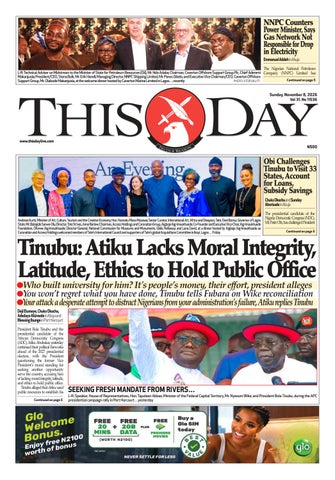
Tinubu: Atiku Lacks Moral Integrity, Latitude, Ethics to Hold Public Office Who built university for him? It's people’s money, their effort, president alleges You won’t regret what you have done, Tinubu tells Fubara on Wike reconciliation Your attack a desperate attempt to distract Nigerians from your administration’s failure, Atiku replies Tinubu
Deji Elumoye, Chuks Okocha, Adedayo Akinwale in Abuja and Blessing Ibunge in Port Harcourt President Bola Tinubu and the presidential candidate of the African Democratic Congress (ADC), Atiku Abubakar, yesterday continued their political fireworks ahead of the 2027 presidential election, with the President questioning the former Vice President’s moral standing for seeking another opportunity serve the country, accusing him of lacking moral integrity, latitude, and ethics to hold public office. Tinubu alleged that Atiku used public resources to establish his Continued on page 5
SEEKING FRESH MANDATE FROM RIVERS…
L-R: Speaker, House of Representatives, Hon. Tajudeen Abbas; Minister of the Federal Capital Territory, Mr. Nyesom Wike; and President Bola Tinubu, during the APC presidential campaign rally in Port Harcourt…yesterday
2
SaturDAY NOVEMBER 7, 2026 • T H I S D AY
SUNDAY NOVEMBER 8, 2026 • T H I S D AY
3
PROUD SILVER SPONSOR
C
M
Y
CM
MY
CY
CMY
K
West Africa’s Leading International Art Fair Returns
April Kamunde, I Don't Want a Seat at the Table of the Oppressor. I Want a Blanket and Pillow Down By the Ocean. I Want to Rest (2025). Image Courtesy of Afriart Gallery. Used with permission.
5—8 NOV.2026
Federal Palace Victoria Island Lagos, Nigeria
www.artxlagos.com
@artxlagos.com
SUNday NOVEMBER 8, 2026 • T H I S D AY
4
3 days
is all it takes
Get nancing to own your dream car in as little as 3 days
Approval, disbursement, and delivery within 72 hours
Apply anytime, anywhere
Subject to credit approval and delivery timelines.
In partnership with:
More Information: 0700-300-00, 0201-2273000-9 accessbankplc.com
Access Bank PLC. RC.-125384 (Licensed by the Central Bank of Nigeria)
Equity contribution from 10% of invoice value
Optimized total cost of ownership
Scan to get started
Terms and conditions apply
5
NOVEMBER 8, 2026 • T H I S DAY, T H E S U N DAY N E W S PA P E R
NEWS
Government, Corporate Activities Lift NGX Overall Market Capitalisation to N226.38tn in First 10 Months of 2026 Kayode Tokede
The overall market capitalisation of listed securities rose to a record N226.38 trillion in the first 10 months of 2026, driven by increased government and corporate activity on the Nigerian Exchange Limited (NGX), according to a report by NGX. The figure, recorded as of October 30, 2026, rose to N76.64 trillion, or 51.2 per cent, from
N149.74 trillion recorded at the close of trading in 2025. The total covered four categories: Equities, bonds, securities on the Non-Interest Finance Board and exchange-traded funds (ETFs). The equities segment comprises more than 150 stocks, while debt securities include commercial papers, corporate bonds and debentures, Federal Government bonds, and state and local government bonds.
On a month-on-month basis, the overall market capitalisation increased by N2.98 trillion, or 1.34 per cent, from N223.4 trillion at the end of September 2026. The Exchange has witnessed increased listings of federal and state government debt securities, strong corporate earnings, improved economic indicators and renewed investor interest in stocks with strong fundamentals. According to NGX data,
equities accounted for the largest share of the overall market capitalisation at approximately 72.9 per cent, followed by bonds at 26.46 per cent. Securities on the Non-Interest Finance Board and ETFs accounted for 0.59 per cent and 0.02 per cent, respectively. A breakdown showed that equities market capitalisation rose to N165.114 trillion at the end of October 2026, up 66.5 per
cent from N99.18 trillion at the close of 2025. The market capitalisation of listed bonds increased by 18.6 per cent to N59.89 trillion from N50.51 trillion at the end of the previous year. The federal government’s bonds, the largest component of the bond market, rose to N57.2 trillion from N49.32 trillion, while corporate bonds and debentures increased to N2.03 trillion from
TINUBU: ATIKU LACKS MORAL INTEGRITY, LATITUDE, ETHICS TO HOLD PUBLIC OFFICE private university. In a swift response, Atiku described Tinubu’s allegation as a desperate attempt to distract Nigerians from his administration's failures, saying his investment in education predates his time in public service. The former vice president explained that in 1993, when a United States court ordered the forfeiture of funds in the president’s bank account, describing the funds as proceeds of narcotics trafficking or funds involved in unlawful financial transactions, he (Atiku) was laying the foundation for his private university. Speaking yesterday during the APC presidential campaign rally in Port Harcourt, Rivers State, the president challenged Atiku to explain how he funded the establishment of the institution while serving as vice president. The APC rally, held at the Adokiye Amiesimaka Stadium, was organised by the Rainbow Coalition, a political alliance led by the Minister of the Federal Capital Territory (FCT), Nyesom Wike, to mobilise support for Tinubu’s re-election bid. He accused the former vice president of using public resources and Nigerians' efforts to build
the university, describing him as lacking the moral integrity and ethical standards required for public office. Tinubu said that when he took over, 27 of 36 states were unable to pay salaries, which meant a lot for the families and households that depended on them. He stressed that since then, his administration had reversed the ugly trend, saying the country was on the move toward prosperity. "To every salary earner, there is a dependent and somebody sharing the food at home. Those people talking of hunger are talking about the mess they created. Atiku was one of them. Ask him how he built a university while in office as Vice President in charge of our economy," Tinubu said. "Who built the university for him? It's your money, it's your effort. A man without moral integrity, latitude and ethics for the office," Tinubu added. The president also accused previous administrations of leaving behind billions and trillions of naira in unpaid pensions and gratuities, saying his administration was working to clear the outstanding payments. According to Tinubu, the government was addressing the
backlog to ensure retired workers received their entitlements and participated in the country’s prosperity. “The people who governed before us left unpaid pensions and gratuities running into billions and trillions of naira. We are clearing that backlog so that every family is included and we can share in the prosperity,” he said. He cited retired engineers, welders and teachers as beneficiaries of the payments, claiming that pensioners were receiving their entitlements on time. Tinubu also praised Wike, describing him as a development partner of his administration.
You Won’t Regret What You Have Done, Tinubu Tells Fubara on Wike Reconciliation Tinubu also commended Rivers State Governor, Mr. Siminalayi Fubara, for demonstrating maturity, understanding and respect for the intervention by elders during the crisis, which he attributed to a misunderstanding within the political family. “To me, I intervened on your behalf. Similarly, Fubara, Your Excellency, the host governor
today, I want to thank you specifically for your maturity, understanding, and respect for the wisdom of elders. “When we intervened, you respected our position. You maintained peace. You are a committed democrat, Fubara. You will not regret what you have done as long as all of us are alive,” Tinubu said. Tinubu urged the youths to collect their Permanent Voter Cards (PVCs) and participate in the 2027 general election, saying their future would depend on the poll's outcome. “It is left for you to use the weapon you have. And that weapon is the PVC. If you have not collected yours, please go ahead and collect it. Please. I beg you. I take God to beg you,” the president said. He added that the election was not about his personal ambition but about the future of young Nigerians, urging them to use their PVCs to determine the country’s leadership. In his speech, Vice President Kashim Shetima said the River State was the true definition of political alliances. The vice president berated those he called political charlatans on the other side of the divide for
trying to demonise President Tinubu instead of celebrating him. Shettima said Atiku and his Nigeria Democratic Congress (NDC) counterpart, Mr Peter Obi, were no match for Tinubu. He described Obi’s performance as Governor of Anambra State for eight years and chairman of a bank as mediocre. Addressing the rally, Governor Fubara promised President Tinubu three million votes in the state. The governor said Rivers State had thrown its weight behind Tinubu, insisting the state had made its decision and would not turn back. “Rivers will give you three million votes. We will stand by you. We will work for you. We will deliver for you,” Fubara added. He also declared that the period of political divisions in the state was over, adding that leaders in the state were now united behind a common political position supporting the president. For his part, the National Chairman of the APC, Prof. Nentawe Goshwe Yilwatda, described the Tinubu-Shettima presidential ticket as one of the most formidable political combinations in Nigeria's democratic history.
OBI CHALLENGES TINUBU TO VISIT 33 STATES, ACCOUNT FOR LOANS, SUBSIDY SAVINGS
Bola Tinubu to visit the remaining 33 states of the federation and account for the over $100billion in loans obtained by his administration and N15.8trillion reportedly saved from the removal of the fuel subsidy. This is as the NDC has accused President Tinubu’s administration of eroding Nigeria’s commonwealth through excessive borrowing, poor fiscal management and inadequate investment in critical public services, declaring that Obi and his running mate, Senator Rabiu Musa Kwankwaso, would reverse the trend if elected in 2027. Obi said Nigerians deserved to know how the resources accruing to the federal government through increased revenue, taxation,
borrowing and subsidy removal had been utilised since Tinubu assumed office. The former Anambra State governor made the demand in a statement issued yesterday and addressed to the president, titled ‘Good Day, Mr. President: Nigerians Deserve Accountability’. Obi’s comments followed Tinubu’s recent visit to Akwa Ibom State. Congratulating Tinubu on the visit, Obi said he hoped it would encourage the president to travel to other parts of the country and engage Nigerians on his administration's performance. “I congratulate you on spending a night in one of Nigeria’s states outside Lagos and Abuja. I hope
you enjoyed the warmth, hospitality, and delicious cuisine of Akwa Ibom,” he said. He, however, questioned the president’s foreign travels, alleging that Tinubu had spent over 260 days outside Nigeria since assuming office. “I sincerely hope this visit will inspire you to travel to the remaining 33 states of the federation, spend time with the people and, more importantly, explain what your administration has done with the N15.8 trillion saved from the removal of the fuel subsidy, the over $100 billion you have borrowed,” Obi stated. He also asked the president to account for the increased revenues accruing to the government
from taxation and other sources, including additional revenues the administration reportedly celebrated last year as exceeding its target. The NDC presidential candidate said Nigerians deserved measurable evidence of improvements in their living conditions, particularly in poverty reduction, education, healthcare, electricity supply and national security. He asked the federal government to disclose how many Nigerians it lifted out of poverty under the administration, as well as how many out-of-school children it returned to classrooms. Obi also demanded information on how many functional primary healthcare centres the government built.
On electricity, he questioned how much the power supply had improved, recalling Tinubu’s promise that Nigerians should not vote for him if he failed to fix the country’s electricity challenges. “They also deserve to know how much electricity supply has improved, especially given your promise that if you do not fix power, Nigerians should not vote for you,” he said. On security, Obi called for an explanation of the administration’s efforts to secure the country, noting that Nigeria remained among the most terrorised countries in the world. He maintained that the government owed citizens an explanation of how it had spent
N893.9 billion. State and local government bonds stood at N571.05 billion at the end of October 2026, up about 91.1 per cent from N298.77 billion at the close of 2025. NGX data also showed that the market capitalisation of securities on the Non-Interest Finance Board, which commenced operations in July 2026, increased to N1.33 trillion in October from N1.29 trillion in September. Yilwatda said the TinubuShettima ticket combined political experience, courage, capacity, and tested leadership, capable of steering Nigeria through its current challenges toward sustainable economic growth and national prosperity. Also speaking, Wike stated that the people of Rivers State had resolved to vote for Tinubu in the January 2027 presidential election, describing the turnout at the stadium, which he said had a seating capacity of more than 40,000, as evidence of the state’s support for Tinubu’s re-election bid.
APC Targets 2.3m Votes in Rivers Also speaking, the DirectorGeneral of the APC Presidential Campaign Council, Senator Abdulaziz Abubakar Yari, said the ruling party had set a target of 2.3 million votes for Tinubu in Rivers State. Yari noted that the state had approximately 3.3 million registered voters, out of which 2.8 million collected their PVCs. Your Attack a Desperate Attempt to Distract Nigerians Continued on page 10
public resources, insisting that Nigerians deserved answers on the administration’s performance. “Mr. President, Nigerians deserve answers. They deserve to know what has been done with the resources entrusted to your government,” he said. Obi added that accountability, transparency and measurable improvements in citizens’ welfare should form the foundation of the country’s development. “The new Nigeria we want to build will be based on accountability, transparency, and the physical, measurable impact of our public resources on the lives of citizens,” he said. Continued on page 8
NNPC COUNTERS POWER MINISTER, SAYS GAS NETWORK NOT RESPONSIBLE FOR DROP IN ELECTRICITY
countered the claims by the Nigerian Independent System Operator (NISO), and the Federal Ministry of Power that operational constraints on gas transportation network was responsible for the recent decline in electricity generation. This is just as the Minister of Power, Mr. Joseph Tegbe, yesterday
promised that electricity supply to Abuja, Lagos, Kwara and Oyo states, which were currently experiencing outages would improve within the next 24 hours. The Transmission Company of Nigeria (TCN) has also rejected claims by Ikeja Electric (IKEDC), attributing several Band A feeder outages to “grid instability” and
assigning responsibility to the transmission company. NNPCL’s Chief Corporate Communications Officer, Andy Odeh, said in a statement yesterday that the gas network operated by NNPC Gas Infrastructure Company Limited (NGIC), a subsidiary of the NNPC, remained available to support gas deliveries to power-
generating stations nationwide. “NGIC’s operational records do not indicate transportation-related constraints within its network that explain the current decline in electricity generation,” Odeh said. NNPC’s clarification followed a November 5 statement by the NISO, which attributed the lower power generation partly to limited
gas availability and reduced water inflows into hydroelectric stations. Specifically, the system operator said the limited availability of “gas has constrained the capacity of affected thermal generating stations to operate at their available levels, while reduced water inflows into reservoirs have impacted the generation capacity of hydroelectric
power stations”. Tegbe also attributed the electricity supply shortfall to planned maintenance at the Egbin Power Station in Lagos and constraints in gas supply to some thermal power stations, which had reduced the amount of electricity Continued on page 10
6
T H I S DAY, T H E S U N DAY N E W S PA P E R • NOVEMBER 8, 2026
NEWS
PRESIDENTIAL TETE-A-TETE…
Vice President Kashim Shettima (left), and President Bola Tinubu at the All Progressives Congress’ presidential campaign rally at the Adokiye Amiesimaka Stadium in Port Harcourt…yesterday
TOGETHER ON THE CAMPAIGN TRAIL…
President Bola Ahmed Tinubu (left), and First Lady, Senator Oluremi Tinubu, during the All Progressives Congress’ presidential campaign rally at the Adokiye Amiesimaka Stadium in Port Harcourt…yesterday
Offa Bank Robbery: Kwara Govt Drops 18 Criminal Charges against Saraki, Ahmed, Adds Two New Charges Hammed Shittu in Ilorin The Kwara State Government has filed an amendment to its 20-count charge against two former governors of the state, Dr. Abubakar Bukola Saraki and Alhaji Abdulfatai Ahmed, over
the 2018 Offa bank robbery case. The government, however, dropped 18 of the original charges while retaining only two, and adding two new charges. In the amended charge sheet with Charge Number:
KWS/114C/2026 signed by the State Attorney General, Senior Ibrahim Sulyman (SAN), which was sighted by THISDAY on Friday, the government reduced the total number of charges to four. In the new charge sheet,
counts 1 and 2, accused Saraki, Ahmed, Yusuf Abdulwahab and Alabi Olalekan of “conspiring to belong to gang of thieves” and “belonging to gang of thieves”. Also, counts 3 and 4 accused the quartet of concealment and disappearance of a “vehicle used
Jonathan Accuses Nigerian Politicians of Desperation, Says They Behave as If They are Superhumans Chuks Okocha in Abuja
Former President Goodluck Jonathan has frowned upon the way Nigerian politicians conducted their affairs, saying they behaved as if they owned the world or the country. Jonathan made the remark at the funeral service of Elder Freeman Ayeimieye, husband of the Bayelsa State Chief Judge, Justice Matilda Ayeimieye, held at St Peter’s Deanery in Yenagoa. He challenged Nigerian politicians seeking power in the 2027 general election to reflect on the legacy they intended to leave behind, asking whether they wanted to be remembered for killing people and burning down houses in their desperation to win
elections. The former president said political power was temporary and cautioned those seeking elective offices to exercise restraint in their campaign rhetoric and remember that ultimate power belongs to God. He warned that no political office holder should take God’s mercy for granted or assume that power made them invincible. “Some of them talk as if they own the world, but in reality, they are mere mortals - individuals. No matter how powerful you are, if you get lost today, nobody will remember you. Nobody cares about you. Nobody should think that he owns the world, Nigeria, or even his own family. “Sometimes, you will be surprised that some of your children
might not even vote for you. That is the funny thing about politics. So, we must tread carefully as all powers belong to God Almighty alone,” he said. In his tribute to Ayeimieye, the former president said the deceased who was a lay reader in the Anglican Communion, lived a life worthy of remembrance and served as a pillar of the church. Reflecting on the lessons of burial ceremonies, Jonathan said death was inevitable and urged people, particularly political leaders, to consider how they would be remembered when they were gone. In his remarks, the state governor, Mr. Douye Diri, recalled the support the deceased gave his wife during her appointment as the Chief Judge of Bayelsa State,
saying their interaction had left him with a positive impression of the late Ayeimieye. The governor said his administration had enjoyed a peaceful working relationship with the judiciary under Justice Ayeimieye, adding that the achievements of his government were the product of cooperation among the three arms of government. “Since that appointment, I have worked in peace and synergy with the Chief Judge of Bayelsa State and with the Judiciary. Any achievement of this government is because we have worked together. It is not me as governor alone. It is because we have worked together, the executive, legislature and the judiciary.”
NEXIM Secures $30m Afreximbank Facility to Finance Export-oriented SMEs
Dike Onwuamaeze
The African Export-Import Bank (Afreximbank) has approved a $30 million financing facility for the Nigeria Export-Import Bank (NEXIM) to improve access to funding for export-oriented small and medium enterprises (SMEs), strengthen industrial production and boost Nigeria’s participation in intra-African trade.
The facility was formalised through a signing ceremony during the opening of the 2026 Creative Africa Nexus Weekend (CANEX WKND) in Lagos. According to a statement issued yesterday, the financing package comprises a $20 million revolving working capital facility and a $10 million medium-to-long-term loan facility.
NEXIM revealed that the approval was a significant milestone that reinforced confidence in Nigeria’s export financing ecosystem and the bank’s role in supporting the federal government’s export diversification agenda. The facility was expected to support businesses involved in exports, intra-African trade, manufacturing, commodity processing and value-added
production, while strengthening Nigeria’s position in continental trade under the African Continental Free Trade Area (AfCFTA). It was also expected to provide much-needed financing for SMEs, stimulate industrial production, expand export capacity and create employment opportunities across strategic sectors of the economy.
for illegal purpose”. A motion on notice for the amended charges dated November 6, 2026, has been filed by the prosecution and supported by a six-paragraph affidavit deposed to by Sulyman Mohammed-Jamiu, a litigation clerk in the office of the Kwara State AG. With the new development, the Kwara State Government has dropped all charges relating to armed robbery concerning the Offa bank robbery case against the former President of the Senate, Saraki; Ahmed and the two other defendants who were aides to the immediate past governor. It would be recalled that at the last sitting of the State High Court on the case on November 5, 2026, the judge, Justice Osuolale Ajayi reserved his ruling on the issue of whether he could continue with the arraignment when the defendant has a pending application for a stay of proceedings on the matter at the Court of Appeal. The Court of Appeal on November 3, 2026 advised the lawyer to Ahmed, Mr J. A. Mumini (SAN), to make a formal application for the court to issue an order that the parties at the trial court should maintain status quo ante bellum, instead of the oral submission that he made to the court. The appellate court then adjourned the case to November 12, 2026. The case at the trial court which commenced in April 2026 has not proceeded to trial as the court is still mired in several preliminary issues which have been taken to the appellate court. When contacted, a member of Saraki and Ahmed’s legal team described the struggle by the prosecution to press
charges against the two former governors as “a mockery of the judicial process and an exercise in futility”. The lawyer noted that it was “a funny turn of events to accuse two former governors of belonging to a gang of thieves. "This is not just a disgrace to the institution of governorship of our dear state; it is also a drag on the name of our dear state in the mud. "And all this struggle is just because the present government desperately wants to see the former governors in the dock. They moved from the case of armed robbery to joining a gang of thieves. “It is clear that the government is bereft of ideas on how to achieve its aim". The lawyer added that, "The present charge sheet like the one they abandoned will record no success. "It will fall like a pack of badly arranged cards. We will meet them in court. "This is why we believe the AG should be more assertive in advising his principal to stop chasing shadows. “They must have resorted to this new amendment to the charges after realising they will not be able to achieve their aims with the unwieldy list of charges earlier filed. The new charges will not turn out better". Attempts by THISDAY to get the State AG and other lawyers to the government to respond to the new development concerning the amended charges were not successful. However, sources close to the state government told THISDAY that the amendment came as a result of advice by the AG and other members of the prosecution team that the former charge sheet cannot help the government to nail the defendants.
7
NOVEMBER 8, 2026 • T H I S DAY, T H E S U N DAY N E W S PA P E R
NEWS
CELEBRATING 14TH ANNIVERSARY OF BAFI AWARDS…
L-R: Sector Head,TMT, Fintechs and Multinational Corporates (MNCs), Hector Okposo; Executive Director and Chief Risk Officer, Rand Merchant Bank Nigeria,Taiwo Gabriel; former Chief Executive Officer of Ecobank Nigeria, Patrick Akinwuntan; Transactor, Debt Financing Solutions, RMB Nigeria, Itunu Olaomo; and Transactor, Corporate Finance, RMB Nigeria, Rashidat Agboke-Abe, at the presentation of the award for Deal Advisory Excellence of the Year at the 2026 BAFI Awards in Lagos...recently
Makinde Flags off Presidential Campaign, Accuses Tinubu, APC of Suffocating, Muzzling Opposition
Segun Awofadeji in Bauchi
The presidential candidate of the Allied Peoples Movement (APM), in the 2027 general election, Mr. Seyi Makinde, has berated the ruling All Progressives Congress (APC), for suffocating and muzzling opposition, doing everything possible to weaken and eventually kill its voice in the country considering recent political happenings. Makinde made the assertion while reacting to the recent Federal
High Court judgement delivered by Justice Peter Lifu, against the African Democratic Congress (ADC) and its presidential candidate, Atiku Abubakar, during a live interview on Bauchi Radio Corporation (BRC), Bauchi on Friday night. Makinde yesterday flagged-off his campaign in Bauchi, where he asked Nigerians not to reject money offered to them during the electioneering period. He declared that the court judgment against ADC was very unfortunate for democratic
principles in the country. He declared that, “there is no way Nigeria can be a one-party state, the APC must get that clear.” Makinde called on Nigerians not to give up on the country in spite of the failure of the current situation expressing hope that Nigeria will be great again after the change of government in 2027. According to him, “President Bola Ahmed Tinubu and the APC should allow the opposition to breath. What happened to the ADC and its presidential candidate, Atiku
Abubakar is rather unfortunate and undemocratic.” He also used the opportunity to criticise the economic policies of President Tinubu’s administration, saying their implementation without adequate planning has plunged Nigerians into difficult living conditions from the outset. Makinde also described insecurity as a major challenge confronting the country, stressing the need for fundamental reforms and political will in order to address Nigeria’s economic and
FG Cancels 2026 National Teachers’ Institute’s Admissions over Regulatory Breaches, Halts Degree Programmes Kuni Tyessi in Abuja The federal government has cancelled all admissions into the National Teachers’ Institute’s (NTI) National Certificate in Education and degree programmes for the 2026 academic session over regulatory breaches involving admissions, accreditation and university affiliations. The Federal Ministry of Education also directed the institute, based in Kaduna, to discontinue all university affiliations and degree-awarding
arrangements, stressing that it was not authorised to award NCE or university degrees. The ministry announced the decisions in a statement issued yesterday by its Director of Press and Public Relations, Boriowo Folasade. It warned prospective students, parents and the general public against seeking admission into the affected programmes, including full-time, part-time and Distance Learning Studies. “Consequently, all admissions into NTI’s NCE and degree
programmes for the 2026 academic session have been cancelled, while the Institute has been directed to discontinue all university affiliations and degree-awarding arrangements, as it is not authorised to award NCE and university degrees,” the statement said. The ministry further warned members of the public against applying for the programmes, accepting admission offers or making payments. “The ministry emphasises that no further admissions into the
affected programmes, whether full-time, part-time or through Distance Learning Studies (DLS), are permitted,” it stated. According to the ministry, the directive followed violations of the Ministerial Operational Guidelines issued on September 12, 2025. It explained that NCE admissions must comply with the requirements of the Joint Admissions and Matriculation Board and accreditation standards of the National Commission for Colleges of Education.
Gov Radda Pledges Renewed Fight against Insecurity in Katsina Francis Sardauna in Katsin
Katsina State Governor, Malam Dikko Umaru Radda, has reaffirmed his administration’s commitment to ending insecurity in Matazu Local Government Area (LGA) of the state, promising to strengthen security operations and sustain collaboration with traditional rulers and community stakeholders to protect lives and property. Radda gave the assurance yesterday during a visit to
the District Head of Matazu, Alhaji Iro Maikano, ahead of the Tinubu-Dikko 2027 campaign rally in the area. The governor said his administration would continue to work with security agencies, traditional institutions and community leaders to consolidate the gains recorded in the fight against insecurity, while promoting infrastructure development and economic empowerment. He commended the people of Matazu for their support
and cooperation, particularly during previous elections, and appreciated the traditional institution for its prayers and contributions to community development. Radda also recalled his longstanding personal relationship with Matazu, disclosing that his family ties to the community dated back several years, including the solemnisation of his marriage at the District Head’s residence about 25 years ago. Earlier, the District Head,
Alhaji Iro Maikano, disclosed that Matazu had not recorded any security attack in the last 45 days, attributing the improvement to the collaboration between security agencies, traditional rulers and community stakeholders. He commended the state government’s approach of combining security operations with dialogue involving farmers, pastoralists and community leaders, saying the strategy had contributed to restoring peace in the area.
security challenges. The APM candidate said the challenges facing the country informed the development of his party’s Reset Nigeria Agenda, which he described as a comprehensive plan to address the nation’s problems and put it on the path of sustainable development. Addressing the mammoth crowd of members and supporters of the party during the flag-off, Makinde urged voters not to allow financial inducements to determine their electoral choices. Makinde, who called on Nigerian voters not to reject money offered to them during the electioneering period, maintained that such money belonged to the people, who should nevertheless remain committed to their preferred candidates. According to him, “When they come with money during the election, do not bother to reject it. If the money is yours, collect it and spend it. But guard your conscience and make the right decision when the time comes. I know that your hearts are with us and with me.” While also calling on Nigerians
dissatisfied with the country’s current situation, particularly insecurity, hunger and the government’s inability to address pressing national challenges, to support his party, Makinde described the 2027 election as an opportunity to change the direction of the country. The APM presidential candidate then called on Nigerians to join what he termed the Reset Nigeria Movement, urging voters dissatisfied with the current state of affairs to embrace a new political direction. He urged Nigerians dissatisfied with the state of governance, lack of inclusiveness and what he described as insincerity in addressing the country’s challenges to support his proposed agenda for national transformation. “If you are not happy with the state of affairs in our country today; if you are dissatisfied with the lack of inclusiveness; and if you believe that your government is not telling you the truth or handling the nation’s challenges with sincerity, then there is only one path before us. That path is to reset Nigeria,” he declared.
NAPTIP Raises Alarm Over Online Sexual Exploitation, Recruitment Scams Linus Aleke in Abuja The National Agency for the Prohibition of Trafficking in Persons (NAPTIP) has raised the alarm over the sexual exploitation of married women online. The agency also expressed concern over the increasing prevalence of online recruitment scams, urging job seekers to exercise caution when responding to online job advertisements. The Head of Press and Public Relations at NAPTIP, Vincent Adekoye, raised the alarm during a joint security press briefing for September and October 2026, held at the Office of the National Security
Adviser (ONSA) in Abuja. Adekoye said: "Traffickers are increasingly exploiting social relationships and the vulnerabilities of unsuspecting individuals, particularly women, to lure victims into their traps. One of the methods they use is to approach people in places such as gyms, recreational centres and other social environments. "They initially present themselves as service providers, offering assistance with domestic needs, shopping, sourcing goods and other everyday activities. Through these interactions, they establish familiarity and exchange telephone numbers with their potential victims.
8
T H I S DAY, T H E S U N DAY N E W S PA P E R • NOVEMBER 8, 2026
NEWS
NINETY-EIGHT HEARTY CHEERS TO A VETERAN…
L-R: Chairman, Military Pensions Board, Major General Julius Osifo; Retired Warrant Officer, Echenim Emmanuel Ewemiwe; Chairman, Delta State Legion, Captain Robert Akpojovwo (rtd.); and Director, Military Pensions Board, Navy Commodore Galadima Chiroma, at the veteran’s 98th birthday celebration held in his honour at Ute-Erumu, Ika North East Local Government Area, Delta State...recently
Amaechi: Buhari Promised Me APC Presidential Ticket in 2022 Chuks Okocha in Abuja
The African Democratic Congress (ADC) vice-presidential candidate, Mr Rotimi Amaechi, has blamed his defeat in the 2022 All Progressives Congress (APC) presidential primary on his decision to follow the advice of the late President Muhammadu Buhari not to campaign ahead of the contest. Amaechi said Buhari had assured him in writing that he
would announce him as his preferred candidate, prompting him to refrain from lobbying delegates and negotiating political alliances ahead of the primary. He disclosed this during an interview on Mainland 98.3FM’s The Situation Room programme in Lagos on Friday, while reflecting on how President Bola Tinubu defeated him to clinch the APC presidential ticket in 2022. According to Amaechi, he considered Buhari’s position
credible because the former president was his boss and believed his endorsement would give him an advantage over other aspirants. He said, “The first mistake that I made at that primary was that I listened to President Buhari. He said to me, ‘don’t campaign, don’t do anything, I will announce you as my candidate.’ “He told me that. He put it in writing. When I write my book, I’ll put it out.”
The former Minister of Transportation said his decision not to negotiate political positions with governors and other influential party members also worked against his ambition, and gave Tinubu an opportunity to build alliances ahead of the primary. Amaechi explained that he could have secured the support of governors by promising them political appointments, including the positions of vice-
OBI CHALLENGES TINUBU TO VISIT 33 STATES, ACCOUNT FOR LOANS, SUBSIDY SAVINGS NDC: Obi, Kwankwaso Will End Tinubu’s Borrowing-Driven Governance Meanwhile, the NDC has declared that the Obi-Kwankwaso ticket was committed to ending what it described as a borrowingdependent model of governance and replacing it with prudent management of public resources, accountability and productive investments capable of improving citizens’ welfare. The NDC said this in a statement issued yesterday by its National Presidential Campaign Council spokesperson, Dr. Chiogo Constance Ikokwu, in response to Tinubu’s criticism of Obi over the persistent gully erosion menace in Anambra State. It argued that the former Anambra State governor’s political ambition went beyond addressing erosion in his home state, insisting that his broader mission was to halt the alleged erosion of Nigeria’s national wealth. The party questioned the economic benefits of removing the petrol subsidy, demanding explanations for what happened to the anticipated fiscal gains, particularly amid the federal government's continued borrowing and what it described
as inadequate funding of essential public services. It also expressed concern over the country’s rising debt profile, poor debt-service-to-revenue ratio and the persistent underfunding of healthcare and education. According to the NDC, Nigerians deserve to know why increased revenue generation and the removal of the fuel subsidy have not translated into improved public services and better living conditions. "Obi-Kwankwaso will not allow Nigeria to continue borrowing at an alarming rate, without corresponding benefits, while citizens endure worsening poverty, unemployment, insecurity and declining purchasing power," the party said. To strengthen its argument on fiscal management, the NDC compared the financial records of Obi and Tinubu during their respective tenures as governors of Anambra and Lagos states. It claimed that Obi left the equivalent of $500 million in investments and local and foreign currency assets when he handed over power in Anambra State in 2014, including $156 million in dollar-denominated bonds. In contrast, the party cited Debt Management Office figures
which, it said, put Lagos State’s external debt at approximately $190.43 million at the end of 2007, when Tinubu left office. The NDC also criticised the pension law enacted during Tinubu’s administration in Lagos, which provided lifetime benefits for former governors and their deputies. It alleged that the law entitled former governors and their deputies to pensions equivalent to 100 per cent of the incumbent governor’s basic salary, houses in Lagos and Abuja, multiple vehicles, furniture and utility allowances, entertainment benefits, free medical care and other privileges. The party described the provisions as excessive, arguing that they placed unnecessary pressure on public resources. It further claimed that a subsequent Lagos administration was compelled to review some of the provisions, while Obi did not establish a similar pension arrangement for former governors in Anambra State. The NDC maintained that the 2027 presidential election would give Nigerians a choice between what it described as Tinubu’s borrowing-dependent economic model and the Obi-Kwankwaso commitment to fiscal discipline and accountability.
Warning against unsustainable borrowing, the party referenced the financial difficulties experienced by countries such as Argentina and Zambia, as well as historical examples involving the Ottoman Empire and 19th-century Egypt. It argued that excessive debt accumulation, without corresponding productive investments and effective fiscal management, could undermine national development and threaten future generations. On the erosion controversy that prompted the statement, the NDC defended Obi’s record, saying his administration took steps to address gully erosion and flooding in Anambra State. It said Obi helped attract and launch the World Banksupported Nigeria Erosion and Watershed Management Project (NEWMAP) in the state. The party also cited the former governor’s directive that new state roads should incorporate adequate drainage systems connected to safe discharge points. It listed concrete drainage and local flood-control projects executed in communities, including Adazi Nnukwu, Amawbia and Umuoji, as evidence of his administration’s efforts to tackle environmental challenges.
president and Secretary to the Government of the Federation. “Now, I didn’t do deals. So, I would have promised you vice-president, promised you SGF, and then would have gone for this primary, I would have possibly won. I would have had governors on my side. “Because I didn’t do deals, Tinubu had the chance to do deals,” he said. Amaechi, who was also a presidential aspirant in the 2022 APC primary, further accused Tinubu of exploiting religious sentiments to secure support from delegates, particularly in the North. He, however, said he would not deploy religion as a political tool to win elections, describing his position as a reflection of his nationalist convictions.
The ADC chieftain alleged that a delegation of Southern Yoruba Muslims had approached governors in the North-West and appealed to them to support Tinubu on religious grounds. He also cited the position of former Kaduna State Governor Nasir El-Rufai, whom he said had supported his presidential ambition before eventually backing Tinubu. “El-Rufai was my supporter. El-Rufai, in a viral video, said this is done for the faith,” Amaechi said. He argued that appealing to religious identity for political support could deepen divisions in the country, adding that he would not encourage such an approach even if it offered him an electoral advantage.
To Enhance Career Progression, IG Seeks PSC’s Review of Scheme of Service for Police Inspectorate Cadre Linus Aleke in Abuja
The Inspector-General of Police (IG), Olatunji Disu, has sought the support of the Police Service Commission (PSC) for a review of the Scheme of Service for the Inspectorate Cadre, aimed at enhancing career progression, improving professionalism and strengthening institutional capacity within the Nigeria Police Force. According to a statement by the Head of Protocol and Public Relations of the PSC, Torty Njoku Kalu, the proposed review is expected to address existing gaps in the career structure, enhance fairness in promotion opportunities and ensure that members of the Inspectorate Cadre are adequately recognised and motivated to deliver efficient policing services. Speaking during a courtesy visit to the commission, where he was
accompanied by his management team, the IG highlighted the need to maintain a balance in the Force's rank structure and called for joint action to address challenges affecting career progression, particularly within the Inspectorate Cadre. He also called for closer collaboration in addressing personnel matters, with due regard for the distinct responsibilities of both institutions. He emphasised the need for sustained engagement on the review of the Scheme of Service to promote fairness, transparency and merit in personnel administration. Disu expressed appreciation for the commission's recognition of the service and sacrifices of police personnel and reaffirmed the Force's commitment to constructive engagement with the PSC.
SUNDAY NOVEMBER 8, 2026 • T H I S D AY
9
10
T H I S DAY, T H E S U N DAY N E W S PA P E R • NOVEMBER 8, 2026
NEWS
ECOBANK INNOVATEX 2006 GRAND FINALE…
L-R: Chief Information Officer, Ecobank Nigeria, Adebanke Oladejo; Team Vhorde and overall winning team of Ecobank InnovateX 2026 Grand Finale, Derick Ogbosa Osarobo; Richard Enegbuma; Henry Uti; and the Head, Products and Analytics, Ecobank Nigeria, Victor Yalokwu at the Ecobank InnovateX 2026 Grand Finale in Lagos…Friday. PHOTO: SUNDAY ADIGUN
I Have Seen the Light, Okowa Gives Reason Why He Ditched Atiku Blessing Ibunge in Port Harcourt
Former Delta State governor and 2023 Peoples Democratic Party (PDP) vice-presidential candidate, Senator Ifeanyi Okowa, yesterday said he abandoned his former political camp because he has “seen the light” in President Bola Tinubu’s
governance Speaking at a massive AllProgressives Congress (APC) presidential campaign gathering in Port Harcourt, Rivers State yesterday, Okowa directly addressed his political transition. He said his move to join forces with the ruling party stemmed from his conviction that the current administration is making
the tough, structural decisions needed to repair decades of economic decay. Addressing the crowd, Okowa confronted his past political alignment, emphasising that national interest must supersede partisan loyalty. “You all know that in 2023 I was on another ticket, but I have seen the light, and I have
seen what Mr. President is doing for Nigeria,” Okowa stated to cheers from party supporters. “It is the right thing to be done, and I have long ago crossed to the APC to join hands with Mr President because he is truly building a new Nigeria.” Pegging his endorsement on the administration’s structural economic reset, Okowa
contended that previous political leadership had undermined the nation’s foundation through populist but fiscally irresponsible policies like the petroleum subsidy regime. “When the foundation is broken, you cannot do anything,” Okowa emphasised. “Mr President realises that successive administrations have broken the
TINUBU: ATIKU LACKS MORAL INTEGRITY, LATITUDE, ETHICS TO HOLD PUBLIC OFFICE
from Your Administration’s Failure, Atiku Replies Tinubu Meanwhile, Atiku has described Tinubu’s latest attack on his investment in education as a desperate attempt to distract Nigerians from his administration's failure. In a statement issued by the Director of Strategic Communication of ADC’s Presidential Campaign Council (ADC-PCC), Phrank Shaibu, the former vice president declared that Tinubu has told Nigerians why they should not allow him to continue as president after his first tenure.
“He also chose to question my investment in education and ask how I built an educational institution while serving as vice president. “The answer is simple: My investment in education predates my time in public service. In 1993, while a U.S. court ordered the forfeiture of funds in an account in your name, describing them as proceeds of narcotics trafficking or funds involved in unlawful financial transactions, I was laying the foundation for ABTI Academy. That Academy has since grown into the American University of Nigeria (AUN), Atiku explained.
However, information on the university website showed that AUN was founded by the former vice president, in Yola, the capital of his home state of Adamawa. He first established a private primary and secondary school, ABTI Academy (now AUN Academy) in 2002. AUN was licensed as ABTI University in 2003, and the ground was broken for the buildings in October 2004. Atiku further stated, “That moment captures the difference between us. My history is traceable. I can show Nigerians how I built my name, achieved
business success and entered public leadership. Your own history remains clumsy and foggy. You cannot erase it by attacking my educational record. “A president who has plunged the country into a crushing cost-ofliving crisis has no business asking Nigerians for another mandate. The real conversation about the 2027 election is how to repair the damage your government has done. “You say Nigeria cannot return to subsidy and must move forward. But you cannot even tell Nigerians where you are taking them. Forward into deeper
poverty, mounting debt, insecurity and mass unemployment? “Since your inauguration in 2023, your leadership has become synonymous with hardship, pain and despair. Your record is a working example of how a country should not be led. You have created poverty on an industrial scale, pushing more than 79 million Nigerians into extreme poverty. “Your campaign’s DirectorGeneral says hungry Nigerians are simply lazy. He delivered that statement in such bad grammar that it could wake the dead. This government does not even believe
foundations of Nigeria. And today, we are on the right course because that foundation is being put right.” The former governor argued that the tangible benefits of federal fiscal reforms— particularly the enhanced revenue allocations to sub-national entities—validate his decision to defect and align with the APC. Nigerians are hungry. How can you solve a problem you refuse to acknowledge? “You created poverty, then insult the people suffering from it. You attack my Affordable Life campaign, but the people you are really attacking are the millions of Nigerians desperate for relief from your failed leadership. “Bola, Nigerians have tested your leadership. The verdict is clear: You are a disaster. In Yoruba culture, I am told, a calabash of pepper represents hostile leadership, while a calabash of honey represents hospitable leadership. Yours is a calabash of pepper.”
NNPC COUNTERS POWER MINISTER, SAYS GAS NETWORK NOT RESPONSIBLE FOR DROP IN ELECTRICITY
available on the national grid. “Grid operators have, therefore, implemented load shedding in some areas to manage the shortfall. Sabotage of key transmission lines has also restricted the use of alternative routes to supply some locations, especially Lagos,” the minister explained. But the NNPC said the availability of its gas transportation infrastructure should be assessed separately from gas production, commercial supply arrangements, and actual deliveries to individual power plants. The company said gas production volumes had grown by about 10 percent year-to-date in 2026, citing efforts to implement the federal government’s gas development and monetisation agenda. “Gas supply availability is therefore not a challenge as
NNPC remains committed to supporting efforts to improve electricity generation through safe, reliable and efficient gas supply and transportation,” it said. The company said determining the cause of the power shortfall required a broader assessment of the gas-to-power value chain. According to the oil firm, the review should cover the availability and operational readiness of generating units, plant maintenance schedules, and actual gas offtake, noting that these factors determine whether gas supplied to power plants can be converted into electricity. “Gas production, commercial supply arrangements and actual deliveries to individual power plants must be assessed separately from the availability of transportation infrastructure,” the NNPC said. The company called for a
coordinated review of operational data by gas suppliers, transporters, power generators, and NISO to identify specific constraints and determine appropriate interventions.
Abuja, Lagos, Kwara, Oyo to Get Improved Supply in 24 Hours In an update on the power situation, Tegbe said he was aware of the strain the outages had placed on households and businesses in the four affected areas. Tegbe said his team was working to return the affected generating units to service in phases, with the first units expected to come back online within 48 to 72 hours, counting down from yesterday. He said the ministry was also working with operators to improve gas supply and accelerate repairs to the damaged infrastructure.
Tegbe also applauded residents of the affected states for their patience. “I thank everyone affected for their patience and will provide further updates as supply is gradually restored,” he stated. The current outages, which have lasted several days, have hit the four states, leaving many households and businesses in extended blackout and forcing reliance on alternative power sources. In the areas impacted by the power cuts, Discos had announced load shedding schedules, with many Band A customers complaining of sharp drops in supply hours. The situation, the minister earlier said, was compounded by reduced generation from hydro stations due to low water levels, gas constraints to thermal stations, among others, which he stressed limited wheeling to the power distributors.
Meanwhile, the TCN has rejected claims by IKEDC attributing several Band A feeder outages to “grid instability”. In a statement TCN issued yesterday, the transmission company said the attribution contained in IKEDC’s public notice of November 5 was “inaccurate and misleading.” TCN said by virtue of Section 67 of the Electricity Act, 2023, the determination of the root cause of disturbances, shortfalls and interruptions on the national grid falls exclusively within the defined functions of the Nigerian Independent System Operator (NISO). “IKEDC, like every other market participant, has no authority to make such determinations, and NISO has made none attributing the outages in IKEDC’s notice to TCN,” it said.
The company said NISO had already clarified the position in its public statement of November 5, attributing the current decline in power generation to constraints in gas supply to thermal power stations and reduced output from hydroelectric stations due to lower reservoir inflows. According to TCN, NISO explained that the development reduced available generation, which in turn reduced energy allocated to Discos and led to fewer hours of supply and increased load shedding across distribution networks. “The shortfall in supply to IKEDC’s customers is a consequence of reduced generation and the resulting allocation, not of any failure of TCN’s transmission network. TCN can only transmit the energy made available to it and cannot transmit energy that is not generated,” it said.
SUNDAY NOVEMBER 8, 2026 • T H I S D AY
11
JAMES HOPE COLLEGE knowledge Character Truth
FUTURE LEADERS DO NOT JUST HAPPEN...THEY ARE FORMED AT JAMES HOPE COLLEGE, LEKKI, LAGOS NOVEMBER 2025 CAMBRIDGE
MAY/JUNE 2026 WAEC
IGCSE EXAMINATION RESULT
EXAMINATION RESULT
A*
A1 - B3 GRADES: 94%
GRADES: 67%
1
A* - A GRADES: 96%
6
A - C GRADES: 100%
A* - B GRADES: 99%
A* - C GRADES: 100% State of the art classrooms, laboratories, boarding and sporting facilities. Exceptional educators who challenge minds, nurture and bring out the best in every learner. Proud winners of prestigious international and national awards. Beautiful, serene and secure world-class campus where learning thrives. ENTRANCE EXAMINATION FOR YEAR 7 (JSS1) DAY AND BOARDING STUDENTS FOR THE 2027/2028 ACADEMIC SESSION IS SCHEDULED TO TAKE PLACE AS FOLLOWS:
LAGOS Dates:
Saturday, 30th January and 6th February, 2027
Location: Time:
James Hope College, Twin Lakes Estate, Lekki, Lagos. 10AM
ABUJA & PORT HARCOURT Date:
Saturday, 6th February, 2027
Locations: 71 Usuma Street, Opp. Transcorp Hilton, Maitama, Abuja. Time:
15 Nnamdi Azikiwe Road, Port Harcourt, Rivers State. 10AM
APPLICATION CLOSES: FRIDAY, 22ND JANUARY 2027 Application forms can be downloaded from www.jameshopecollege.edu.ng under the “admission” tab or can be collected from James Hope College, Twin Lakes Estate, Lekki, Lagos.
OPEN DAYS
DATE: SATURDAY 14TH NOVEMBER, 2026 & SATURDAY 9TH JANUARY, 2027
TIME: 9AM TO 12:30PM
Follow us on all our social media handles: @jameshopecollege
James Hope
Tel: +2347083662229, +2347018282065, @JHCLekki
+2347085369376, +2347015349257 Email: admission@jameshope.edu.ng Web: www.jameshopecollege.edu.ng
12
T H I S D AY, T H E S U N D AY N E W S PA P E R NOVEMBER 8, 2026
NEWS
BAYELSA APC PRESIDENTIAL CAMPAIGN COUNCIL…
L-R: Deputy Speaker, Bayelsa State House of Assembly, Hon. Michael Ogbere; Managing Director, Niger Delta Development Commission, Dr. Samuel Ogbuku; Governor Douye Diri; Deputy Governor Peter Akpe; Chairman, All Progressives Congress, Bayelsa chapter, Hon. Warman Ogoriba; Minister of State for Petroleum Resources (Oil), Senator Heineken Lokpobiri; and Managing Director, Niger Delta River Basin Development Authority, Prince Ebitimi Amgbare, during the inauguration of the Bayelsa APC presidential/state campaign council at the party’s secretariat in Yenagoa…Friday
EFCC Boss: How Adeboye Ordered Return of Billions Traced to RCCG Within 24 Hours The General Overseer of the Redeemed Christian Church of God (RCCG), Pastor Enoch Adejare Adeboye, ordered the return of billions of naira traced to church projects from an individual under investigation for alleged financial crimes within 24 hours, the Chairman of the Economic and Financial Crimes Commission (EFCC) Ola Olukoyede, has said. Olukoyede said Adeboye gave the directive immediately after the commission briefed him on the investigation and the discovery that proceeds of the alleged financial crimes had been traced to some RCCG projects. The EFCC chairman disclosed this while addressing church workers and ministers after the monthly Holy Ghost Service at the Redemption City of God, Simawa, Ogun State. The programme, held at the invitation of Adeboye, had as its theme, “Ethical Standard
and Corruption in Christian Community.” Recounting the incident, Olukoyede said the individual under investigation was involved in financial transactions worth tens of billions of naira, some of which the commission traced to the church. He said he personally approached Adeboye to explain the findings, adding that the cleric reacted angrily and immediately directed church officials to return the funds. “The reaction on the face of Daddy was like I was almost blaming myself for taking the matter to him. Daddy was visibly angry. He called one or two pastors and said, ‘I give you 24 hours. Everything you have traced to RCCG from this particular person who has been indicted, return it within the next 24 hours’. “That money was returned to the coffers of government.
Tinubu Consoles Niger’s Military Leader, General Tiani Over Father’s Demise Deji Elumoye in Abuja President Bola Tinubu has commiserated with Niger Republic’s military president, General Abdourahamane Tiani, over the demise of his father, Elhadji Tiani Hassane. Elhadji Hassane died on Thursday, November 5, 2026, at the venerable age of 110. The president, in a release issued on Saturday, said the government and people of the Federal Republic of Nigeria are with the people and government of Niger during this period of mourning. “The passing of a father brings a profound and deeply personal grief,” Tinubu wrote, urging his Nigerien counterpart to take solace in
the fact that his father made a huge impact in the lives of his people and lived to the remarkable age of 110 years. “In this moment of mourning, I pray that you will find solace in the enduring legacy of faith, honour, and integrity that your father leaves behind, and in the knowledge that his long and fulfilled life was a blessing to all who knew him. “Nigeria stands in solidarity with Your Excellency and the Government and people of the Republic of Niger during this period of grief,” the President stressed. Tinubu prayed that Almighty Allah (SWT), in His infinite mercy, would grant the deceased Al-Jannah Firdaus and comfort all those he left behind.
That is what RCCG is known for. That is who we are. We are not the custodian of proceeds of crime,” he said. Olukoyede commended Adeboye for what he described as his integrity, holiness and zero tolerance for corruption, contrasting his response with the alleged handling of a similar situation by another unnamed mega church. He claimed that individuals accused of fraud had operated an investment scheme through the other church, resulting in billions of naira being lost by
members. “That is the difference between us and the others. Daddy Adeboye took action immediately he heard about the financial issue when the others are trying to defend it, justify it. Don’t justify processes of crime; it’s a crime to do that,” he said. The EFCC chairman also recounted what he described as one of the saddest moments of his life: authorising the detention of a senior RCCG pastor over alleged financial crimes committed in his secular workplace.
Olukoyede, who is himself a senior pastor in the RCCG, said the decision was necessary despite the cleric’s position in the church. “I say this with every sense of humility. It was a day that I had calls to detain a very senior pastor in this mission. I had no choice. I needed to do it because of what we have seen. “Not because of his activities, what he perpetrated within the church, no. But because of what happened in his place of work, where he works in his secular activities. I feel things like this
should not be happening within the Christian community,” he said. He warned church leaders against using the pulpit to promote materialism and questionable sources of wealth, urging them not to give undue recognition to individuals suspected of involvement in financial crimes. According to him, churches should welcome everyone but must not celebrate or elevate people whose wealth is linked to criminal activities.
SPINNERS Season 2 Debuts in 45 African Countries, Returns to Africa Magic Showcase The second season of awardwinning African drama series SPINNERS has premiered, with CANAL+ and STUDIOCANAL securing its international distribution across more than 45 countries in Africa and Europe. The eight-part season, which premiered on October 25, is available to Nigerian viewers on Africa Magic Showcase. The series is a co-production of MultiChoice and CANAL+, with STUDIOCANAL handling international distribution. Season 2 follows Ethan (Cantona James) and his crew, the Under-
dogs, as they leave Cape Town for Johannesburg in search of new opportunities. Their attempt to establish themselves in the city’s competitive car-spinning scene is complicated by emerging rivalries, new relationships and an ambush connected to Ethan’s former gang. The series centres on car spinning, a motorsport culture involving controlled spins, drifts and precision driving manoeuvres. Its storyline also explores themes of friendship, ambition, loyalty and the challenges associated with starting over. The new season introduces
the Maseko family, whose arrival brings additional tensions to the story. Luyanda Zwane, known for her role in Sibongile and the Dlaminis, plays Amahle Maseko, while Aphiwe Mkefe portrays her older brother, Sayi, who becomes a rival to Ethan. Siyamthanda Bangani plays Gatsha, Sayi’s close associate. Returning cast members include Cantona James as Ethan, Braeden Buys as Trevor, Dillon Windvogel as Shane, Nahum Hughes as Angelo and Chelsea Thomas as Amber. The season also features appearances by Siv Ngesi, Kayla Oliphant and
Anton Taylor. According to the distribution arrangement, the series will be available in different language versions across its international markets. African audiences will have access to the original English, Kaaps andAfrikaans versions, while French-speaking viewers in parts of the continent can watch through CANAL+ MAGIC. Outside Africa, the series will be distributed through CANAL+ channels and its streaming app in France and its overseas territories, Switzerland, the Netherlands and Belgium.
Akpabio: Peace in Rivers Will Guarantee Tinubu’s Victory in South-south Sunday Aborisade in Abuja President of the Senate, Godswill Akpabio, has expressed confidence that President Bola Tinubu and candidates of the All Progressives Congress (APC) will secure victory across the South-south geopolitical zone in the January 16, 2027 general election. Akpabio attributed his optimism to what he described as the prevailing peace and
unity among political leaders and stakeholders in the region, particularly in Rivers State, saying the atmosphere would strengthen the APC’s electoral fortunes. The Senate president, according to a statement by his Media Office on Saturday evening, spoke on Saturday at the Rivers State Rainbow Coalition rally held at the Adokiye Amiesimaka Stadium in Port Harcourt, where he urged the people of the South-south to support Tinubu’s re-election bid. Addressing the gathering, Ak-
pabio declared that the prevailing political harmony in Rivers State was the critical ingredient required to deliver the state and the entire region to the APC in 2027. “Mr President, the ingredient needed in this zone, particularly Rivers State, to return you to the Villa on January 16, 2027, is here, and that is peace. “There is total peace in Rivers State, and it is based on that peace and unity among all stakeholders and political leaders on display today from the zone that Mr
President would be delivered,” he said. Akpabio recalled that Rivers was the only state in the South-south where the APC secured victory in the 2023 presidential election, insisting that the party could repeat the feat on a larger scale in 2027. He told Tinubu that the state had demonstrated its electoral strength in the last general election, adding that its support for the president would be sustained.
SUNDAY NOVEMBER 8, 2026 • T H I S D AY
13
14
SUNday NOVEMBER 8, 2026 • T H I S D AY
SUNDAY NOVEMBER 8, 2026 • T H I S D AY
15
T H I S D AY, T H E S U N D AY N E W S PA P E R NOVEMBER 8, 2026
16
NEWS
Crime Index Survey Ranks Lagos 27th Among World’s 50 Most Dangerous Cities Sunday Ehigiator Lagos, Nigeria’s commercial nerve centre and one of Africa’s busiest megacities, has been ranked among the world’s 50 most dangerous cities in 2026, placing 28th on a global crime index that raises fresh questions about urban safety, insecurity and the growing pressure on law enforcement. Lagos is the only Nigerian city on the ranking published by the “Numbeo Crime Index by City 2026” – a Serbia-based global data platform that compiles crowd-sourced information on crime safety, cost of living and quality of life across cities and countries. The list records Lagos with a crime index of 68.8, placing it in the high crime category under Numbeo’s classification. The index ranges from zero to 100, with scores above 60 classified as high and those above 80 as very high. Nigeria’s commercial capital is placed ahead of major cities, including Damascus in Syria, New Orleans in the United States, San Juan in Puerto Rico and Santo Domingo in the Dominican
Republic. According to the survey, five South African cities occupy positions among the top eight, with Pietermaritzburg taking the first position, followed by Pretoria in second place, Johannesburg in fifth, Durban in sixth and Port Elizabeth in eighth. Caracas, Venezuela, and Port Moresby, Papua New Guinea, occupy third and fourth positions, respectively. Windhoek, Namibia, comes in at number 30. The figures also point to persistent safety concerns across the Americas. Brazil has five cities among the top 25, while the United States has several, including Memphis, Detroit, Baltimore, Albuquerque and St. Louis. Other cities featured in the top 50 include: Kingston in Jamaica, Mexico City, Marseille in France, Manila in the Philippines, Birmingham in the United Kingdom and Houston in the United States. Numbeo’s Crime Index draws on several indicators, among them residents’ perceptions of crime, how safe they feel walking alone during the day or at night, and their experiences or concerns about robbery, mug-
ging, car theft, burglary, physical attacks and harassment. It also considers drug-related problems, property crime, violent crime and corruption. The ranking reflects perceptions captured by Numbeo’s survey, rather than a verified ranking of reported criminal offences. It is based on surveys completed by Numbeo website visitors and not a direct count of police-recorded offences, reported criminal incidents or official national crime statistics. Numbeo processes the responses into scores ranging from zero to 100 to make comparisons between cities possible. The organisation also acknowledges that public perceptions of crime may not always correspond with official crime figures. For Lagos, the survey notes that the 28th position adds to the concerns surrounding safety in one of Africa’s most populous urban centres. It also brings renewed attention to the need for more effective policing, stronger intelligence gathering, safer public spaces and a more decisive response to robbery, theft and other security threats.
HURIWA Urges National Assembly to Halt FG’s Borrowing Spree, Warns of Debt Enslavement of Future Generations Chuks Okocha in Abuja The Human Rights Writers Association of Nigeria (HURIWA) has called on the National Assembly to urgently intervene and stop what it described as Nigeria’s dangerous slide into debt dependence, warning that the country risks mortgaging the future of generations yet unborn. HURIWA urged President Bola Ahmed Tinubu to halt further external borrowing and listen to the warning by former President Olusegun Obasanjo that excessive debt destroys generations. The rights group said the latest World Bank International
Debt Report 2026, which puts Nigeria’s external debt at $145.02 billion as of December 2025, provides fresh evidence of the growing burden of foreign obligations on the country. According to the report, Nigeria’s external debt increased from $83.21 billion in 2015 to $145.02 billion in 2025, representing an increase of approximately $61.8 billion within 10 years. HURIWA described the development as deeply concerning, particularly at a time when millions of Nigerians are struggling with rising living costs, unemployment, poverty and declining purchasing power. The association noted that the World Bank report also
revealed that Nigeria’s external debt comprised $62.4 billion in public and publicly guaranteed debt, $54.476 billion in private nonguaranteed debt and $28.139 billion in short-term obligations. It expressed concern over the rising cost of servicing external obligations, noting that Nigeria’s debt-service-to-exports ratio increased by 9.6 per cent in 2025, while debt service relative to gross national income rose by 6.9 per cent. HURIWA said these figures raise serious questions about the sustainability of the country’s borrowing strategy and the proportion of national resources that will continue to be diverted towards debt repayment instead of critical public services.
Tinubu Inaugurates 76-year-old Bodo-Bonny Road in Rivers Emmanuel Addeh in Abuja President Bola Tinubu has commissioned the historic 37.9-kilometre Bodo-Bonny Road in Rivers State, ending a 76-year wait for a project first conceived in 1950. This was contained in a statement in Abuja yesterday by Francis Nwaze, Senior Special Assistant to the Minister of Works, David Umahi. The road, which includes about three kilometres of bridges across the Opobo Channel, was inaugurated during the Presidential Campaign Council (PCC) event at the Adokiye Amiesimaka Stadium, Port Harcourt, the statement stressed. According to the statement, the project, completed at a total cost of N280 billion, now provides the people of Bonny Island, home to the Nigeria Liquefied
Natural Gas (NLNG) plant and a major oil and gas hub, with a direct road connection to Bodo and the wider national road network, ending decades of dependence on sea transport. Speaking during the commissioning, Minister of Works, Umahi, described the completion as a landmark achievement of the Tinubu administration, noting that the road had remained on the drawing board for generations. He said the president had not only delivered the long-abandoned project but had also approved its extension to the East-West Road to maximise its economic benefits. Umahi added: “In a further demonstration of his commitment to expanding road connectivity, President Tinubu has also approved an additional 8.9-kilometre
dual carriageway extension, translating to 17.8 kilometres using reinforced concrete pavement to connect the road to the East-West Road. “The extension will further enhance connectivity, ease transportation and open up greater economic opportunities for communities and businesses along the route.” At an average cost of approximately N7.4 billion per kilometre, the minister explained that the project is a major engineering investment, particularly with the construction of the extensive bridges across the Opobo Channel. According to him, the extension, which will be built with reinforced concrete pavement, will further boost connectivity, ease transportation and open up economic opportunities for communities and businesses along the corridor.
17
T H I S DAY, Th e S U N DAY N e w S PAPe r •NOvember 8, 2026
BUSINESS
Editor: Festus Akanbi 08038588469 Email: festus.akanbi@thisdaylive.com
As Elections Near, Darkness Tests Tinubu’s Record As renewed power disruptions expose Nigeria’s fragile electricity system, Festus Akanbi examines the mounting costs to households, enterprises and national development ahead of the general election
F
or a small business, a power cut is rarely an isolated inconvenience. It can mean spoiled stock, an unfinished order, idle employees or another withdrawal from money reserved for wages. Across Nigeria, electricity failure has become a recurring deduction from household welfare and business survival. The October 19 generation plunge captured that vulnerability. Output fell from about 3,840 megawatts at 7 am to 476.70MW by 1 pm, a loss of 3,363.30MW, or 87.6 per cent. Major stations, including Egbin, Jebba, Shiroro and Kainji, recorded zero output on the dashboard during the disturbance. The Nigerian Independent System Operator subsequently attributed the incident to multiple trippings on the 330kV transmission network, described it as a partial disturbance and announced restoration. That distinction matters: the available evidence does not establish a total nationwide collapse. Nevertheless, the disruption exposed how quickly electricity available to businesses and households can disappear. It also underlined a broader problem. Nigeria’s electricity difficulties extend beyond distribution companies to generation, gas supply, transmission, payment obligations and network management. Failures at any point travel downstream, leaving consumers to finance the consequences of weaknesses they cannot control. Even before that disruption, supply was modest. The Nigerian Electricity Regulatory Commission’s September 2026 factsheet recorded average available generation capacity of 5,038MW and average hourly generation of 4,089MW. The October plunge was therefore a sudden deterioration in an already constrained system, rather than the interruption of abundant electricity. For households, the damage begins with competing necessities. Money spent fuelling generators cannot also purchase food, medicines or school materials. Refrigeration becomes uncertain; remote work depends on batteries; studying requires improvisation. Families unable to afford backup power endure longer deprivation, while better-off households pay privately for a service the public system cannot reliably deliver. These burdens are unequal. A household with solar panels can preserve some comfort and productivity. A tenant with neither installation rights nor savings has fewer options. Electricity unreliability consequently reinforces existing differences in income, opportunity and living conditions. Among small and medium-sized enterprises, the pressure is particularly severe. Barbers, welders, printers, tailors and frozen-food traders require electricity to earn revenue. When supply fails, they must choose between expensive self-generation and interrupted trading. Neither choice is harmless: one consumes margins, while the other reduces sales. A generator also requires capital, servicing and repairs. Solar equipment can reduce dependence on fuel, but its initial cost remains a barrier for individuals and firms with limited working capital. Credit used to acquire backup equipment may displace borrowing for inventory, machinery or expansion. The industrial figures show the scale. The Manufacturers Association of Nigeria (MAN) reported alternative-power expenditure of about N1.35 trillion in 2025, against N1.11 trillion in 2024. That represents an increase of roughly 21.6 per cent, illustrating the growing resources factories commit to maintaining operations outside dependable grid supply. The association’s earlier review, reported by THISDAY, put 2024 manufacturing capacity utilisation at 57 per cent. Electricity is not
Is Nigeria going back to the Stone Age? the sole explanation for industrial weakness: financing costs, demand, foreign exchange and insecurity also matter. But expensive, unpredictable power compounds those difficulties and makes production planning harder. Large companies can spread backup costs across bigger operations, but cannot make them disappear. Fuel purchases, maintenance, voltage-related equipment damage and interrupted production affect competitiveness. Some costs pass through to consumers as higher prices; others reduce profits, investment, or the capacity to retain workers. The national consequences accumulate through these individual decisions. Businesses postpone expansion, entrepreneurs avoid electricity-intensive activities, and domestic products face stronger competition from goods manufactured under more reliable conditions. Agriculture loses opportunities in processing and cold storage, while hospitals, laboratories, and schools divert scarce resources to keep essential equipment running. The World Bank estimated in 2021 that unreliable electricity imposed annual economic losses of $26.2 billion, equivalent then to approximately two per cent of GDP. This remains a historical estimate, not a measure of today’s losses, but it demonstrates the longstanding development cost of electricity failure. Former power minister and Geometric Power chairman, Professor Barth Nnaji, identifies infrastructure deficits, revenue losses, liquidity problems, and inadequate investment as central constraints. His intervention also highlights an uncomfortable financing question: electricity suppliers cannot sustain investment indefinitely when approved revenues or unpaid subsidies fail to cover legitimate costs. However, cost-reflective pricing requires credible service obligations. Consumers need accurate meters, transparent charges and enforceable remedies when promised supply fails. Raising tariffs without improving reliability risks transferring more of the sector’s inefficiencies to households and businesses already paying for alternative electricity. The administration’s response includes proposed East and West Super Grids, intended to increase transmission capacity from about 5,000MW to 19,000MW within two years. The
Electric transformer government has also reported payments towards outstanding sector obligations. These measures address recognised constraints, but procurement approvals and financial settlements must translate into functioning assets and sustained supply. Decentralised electricity offers another route. The World Bank approved the $750 million DARES programme in December 2023, targeting improved or new access for 17.5 million Nigerians and reliable electricity for up to 237,000 micro, small and medium-sized enterprises. Those figures are programme objectives, not evidence that every intended beneficiary has already received power. Despite the opportunities created by the Electricity Act 2023, some state governments appear reluctant to commit substantial resources to power infrastructure, even with the enormous revenues flowing into their coffers. Establishing electricity markets and regulatory agencies will achieve little without investment, credible partnerships and sustained implementation. For governors, the test is whether increased revenues translate into reliable electricity for homes and businesses; continued dependence on Abuja merely prolongs the crisis and raises questions about their spending priorities. With the general election approaching, the gap between commitments and experience has
become politically sharper. Former vice-president Atiku Abubakar has accused the administration of substituting announcements for delivery. Such criticism serves an electoral purpose, but the underlying performance question remains legitimate: are consumers receiving more reliable, affordable electricity? Tinubu inherited deep structural failures. His administration nevertheless bears responsibility for the effectiveness and pace of its response. Decisive evidence will be fewer interruptions, better metering, financially credible operators, and lower dependence on generators. Accountability also requires publishing disturbance investigations, repair schedules and verified service performance. Without accessible evidence, consumers cannot judge whether spending improves reliability or merely finances recurring emergencies. Regulators must link commercial recovery to measurable operational gains, ensuring paying customers receive clearer explanations of failures and a credible timetable for lasting improvements in supply. For Nigerians, electricity reform becomes meaningful when it protects livelihoods. Until then, every blackout carries a bill beyond the meter: lost income, weakened businesses and development postponed.
T H I S DAY, Th e S U N DAY N e w S PAPe r •NOvember 8, 2026
18
International
Apology and Reparation for Slave Trade: Beyond the Politics of Britain’s Kemi Badenoch
I
nternational relations, classical or contemporary, has always been fraught with injustice and unfairness in its conduct and management. The story of the slave trade is a case in point. More than twelve million African people, including men, women, and children, were captured and trafficked to the Americas forcefully as slaves in between the 15th and 19th Centuries. The abduction and trafficking was cruel as an act. When compensations were to be paid at the end of the slave trading, the act was an open manifestation of unfairness and injustice. Slave owners were compensated but the slaves were never considered as qualified to be compensated. This is why the quest for apology and reparation cannot be well appreciated if the nature of slave trading is not first explicated. In the words of the UN Secretary General, Antonio Guterres, the wealth of several Western nations of today was largely ‘built on stolen lives and stolen labour…barbaric punishments that maintained control – from shackles and iron collars to flogging and sexual violence.’ The situation ‘was not simply forced labour.’ And perhaps most disturbingly, ‘it was a machinery of mass exploitation and deliberate dehumanization of men, women and children. The wounds run deep and often go unrecognized.’ If this was the situation, why have there not been agitations for apology and reparations before now? How do we explain the fact that international eyes have been closed to the atrocities? Without whiff of doubt, there are two schools of thought that explain the issue. One school has it that Africa should now be more forward-looking rather than wasting much time on the problems of the past. The other school posits that there cannot be any future without the past and the present defining it. This argument is strengthened by the consideration that Africa and black people are generally portrayed as backward, whereas, it is mainly the factor of slave trading and colonization that also largely explains the backwardness.
Politics of Reparation for Slave Trade
Chief Obafemi Awolowo, in his press statement of 28th June, 1961 issued on behalf of the Action Group, already expatiated on the backwardness of the black man that “African Unity is a Necessity,” and that ’from the beginning of recorded history, the black man has been the conspicuous butt of all manner of inhuman treatment. In the palaces of the Arabian potentates – both in the Middle East and in North Africa – he was degraded and enslaved. When the so-called “dark Continent of Africa” was discovered, the European marauders hunted him down like a common beast, captured him, and sold him into slavery in the Americas and West indies.’ The enslavement has continued to change in form and Chief Awolowo did not fail to remind us again that ‘the era of trading in, and of enforcing the services of black slaves, was terminated only to be replaced by the European Powers which initiated it with a legalized form of political and economic enslavement of the entire black peoples of the continent of Africa… Today, for most parts of black Africa, the inhumane, humiliating and degrading position delineated above remains more or less the same.’ It was against this background that the struggle against the indignity arising from the enslavement became a desideratum to be addressed. It was a Nigerian by ius sanguinis, Chief Moshood Kashimawo Olawale Abiola, a President of Nigeria that Nigerians never had, that kick-started the reparation struggle. He single-handedly spearheaded and institutionalized the global and Pan African movement for reparations for the transatlantic slave trade and colonialism in the early 1990s. He explained the need for reparation as restoration of Africa from historical damage caused by slavery and colonization. In between 1987 and 1990, he built special linkages and ties with the African Diaspora in the United States, an effort that was much appreciated and that prompted giving the Congressional Black Caucus Chairman’s Award to him. And perhaps more interestingly, Chief Abiola, not only financed, but also hosted the foundational Lagos Reparations Conference, generally referred to as the World Conference on Reparations to Africa and Africans in the Diaspora, held on December 13-14, 1990 at the Nigerian Institute of International Affairs, Lagos. The outcome of the Conference served as a catalyst in the adoption of an OAU resolution in 1991 that recognised Africa’s right to redress. In fact, Chief Abiola chaired the OAU Group of Eminent Persons on Reparations and helped to organize the 1993 Abuja Pan-African Conference that formed the International Committee for Reparation. This is the genesis of the
Badenoch current politics of reparation. Even if Nigeria has always been the leader of leaders in the quest to defend African interests and integrity, other initiatives had also been taken especially in light of the demise of Chief M.K.O. Abiola and non-follow up to his struggle for reparation. The increasing threats of modern neocolonialism have prompted agitations to put an end to any form of recolonization. True, neocolonialism is making a nonsense of the sovereignty of many African states. At the 19-20 December 2025 Russia-Africa Partnership Forum held in Cairo, Egypt, decisions were taken to stop the ongoing exploitation of Africa and unlock its resources for integration and development. One of the decisions was the need to struggle for reparation for the enslavement of African and black people in the Americas. In fact, African leaders declared 2025 the ‘Year of Reparations.’ It is therefore not a surprise that the issue would be taken more seriously at the level of the UNGA. On March 25, 2026, which coincided with the International Day of Remembrance of the Victims of Slavery and the Transatlantic Slave Trade, a UN resolution adopted at the 80th session of the UNGA, recognized the transatlantic slavery as the ‘gravest crime against humanity.’ The resolution requested the UN Member States to contribute to a reparations fund. At the UNGA vote on it, 123 countries voted in favour, 52 countries abstained from voting (essentially European Union Member States and the United Kingdom), while 3 countries (United States, Israel, and Argentina) voted against the declaration of the transatlantic slave trade as a crime against humanity. In June 2026, Yvette Tan of the BBC had it that ‘African and Caribbean nations called for formal apology for transatlantic slavery… A 19-point
In this regard, Kemi Badenoch belief that Britain should not apologise for the UN-identified ‘gravest crime against humanity’ is uncalled for, most unfortunate, unreasonable and myopic. Historical records have shown that slaves were flogged to death. They were not treated as human beings but as material property. Several maltreated slaves died during transportation from Africa to the Americas and were simply dumped into the high seas for fishes to eat. The statement of Chief Obafemi Awolowo on the brutalities of the slave trade is quite touching. Imagine, the British and Americans argue that these brutalities were lawful during the period of the slave trading. If they were lawful, it meant that there was nothing like humanity the way it exists today. Were the slave masters of that time better than wild animals, if the law they made enabled the payment of reparation to slave masters for losing their properties, who were human beings but who were treated as a chiffon de papier to be thrown into the dustbin of history? Additionally, the Kemi Badenochs of this world are unable to understand that the purpose of the reparation struggle is to restore black dignity. Predictably, the world of the foreseeable future is that of the Black people. Technological expertise will not be the exclusive preserve of the developed world. Veto power will be in désuétude. Sovereign equality will have a more constructive meaning. All the black people claiming to be white will soon learn that acquisition of nationality by ius soli, naturalisation, marriage, conferment, etc., does not really make them a fully blooded American, a French or British, Russian, or Canadian, etc. At best, they will be second class citizens even if the law provides for the contrary. Consequently, let a black man learn how to be black. Not learning so will make them suffer unending indignities. Let Badenoch’s politics anticipate these challenges
reparations plan has been endorsed as part of the “Next Steps” conference in the Ghanaian capital, Accra’ (www.bbc.com). The reparation request includes a comprehensive debt relief, the restitution of looted cultural property, and the establishment of a global reparations fund. More important, the conference leaders wanted all the countries involved in the slave trade to offer their ‘full, formal and unconditional apologies.’ One rationale for this position is the belief of the Ghanaian president, John Dramani Mahama that ‘history does not ask us to inherit guilt, but it asks us to inherit responsibility’ (ibid.). It is this question of responsibility that is being politicized internationally. From the perspective of the Americans, the United States does not ‘recognise a legal right to reparations for historical wrongs that were not illegal under international law at the time they occurred.’ Explained differently, there are three main issues raised in the position of the United States. First, slave trading as at the time it occurred was legal; Secondly, the United States admits that slave trade was a historical wrong but it cannot be an issue for reparation, and thirdly, in the event it is seen as a right, the United States does not recognize such a right. More concernedly, the United States argued that the UN resolution is not specific on ‘whom the recipients of reparatory justice would be.’ China is in support of the UN resolution declaring the transatlantic slave trade as the ‘gravest crime against humanity’ and that the slave trade left centuries-long structural and developmental wounds on the African continent. As told by Chinese Plenipotentiary to Nigeria, Yu Dunhai, the resolution is a historic milestone and a victory for justice: ‘justice may be delayed, but it will never be absent… With profound historical significance it represents a powerful affirmation of historical justice, a firm defence of the common dignity of humanity, and a major victory for the international community in opposing the remnants of colonialism, resisting racial discrimination, and upholding fairness and justice. Russia supports the UNGA resolution and promised in January 2026 to assist Africa to scientifically and mathematically calculate and quantify claims for Western colonial and slave trade reparations. In the words of the Director of the Institute for African Studies of the Russian Academy of Sciences, Irina Abramova, ‘we want to combine the efforts of Russian scientists – mathematicians, programmers, historians and economists – with African scientists in order to jointly substantiate the volume of these reparations and then proceed with legal claims on various international platforms.’ Director Abramova advised Africa to seek exact mathematical reparation to be paid by the Western colonialist and slave traders and the potential recipients of the reparation funds. Latin America, with the exception of Argentina, supports the UNGA resolution. Agitation for reparation in Brazil, which was the last country to abolish slavery in 1888 and which accounted for about 5 million out of the 12.5 million forcibly-trafficked slaves to the Americas, is tied to land reform. All the EU Member States abstained from the UNGA resolution in the belief that claims for historical compensation are inconsistent with international law in the sense that slavery was legal under the laws of the time. Unlike the transatlantic system, there are no official state-level reparations programmes or formal financial compensations from Arab or Middle Eastern governments to sub-Sahara Africa. This is an overview of great power politics of slave trade reparation.
Beyond Kemi Badenoch’s Non-apology
Kemi Badenoch is against the idea of apologizing for four main reason. First, it would be a ‘navel-gazing distraction’ in her own words. A navel-gazing distraction is the ‘practice or habit of spending too much time absorbed in deep, self-indulgent, or unproductive contemplation of (one’s) own thoughts, feelings, problems, or ego.’ In other words, Badenoch is actually saying that, rather than the British people expending an excessive, self-indulgent and unproductive amount of time on their own problems, feelings and thoughts, the British should pay useful attention to the outside world. As good as this thinking may be, it is still meaningless because, if the British refuse to first internalize the implications of not paying reparation, engaging with the external world may be more costly and problematic. Badenoch wants the British to be less excessive in self-contemplation. The principle of reparation in international law stipulates that a state responsible for an internationally-wrongful act or a violation of human rights has a legal obligation to make full reparation for the injury caused. The opponents of non-reparation argue that slave trading was lawful as at the time it took place. The proponents of slave trading reparation are not talking about slave trade as a business, but as an act of brutalities, indecency, that condones wickedness and inhumanity. The modern-day British and Americans wrongly argue that they should not be held for the crimes of slave trading committed by their fore parents. What their fore parents did then was precisely still impacting on the conduct and management of international politics today. In fact, the defence and sustainability of the basic principles and guidelines on the right to a remedy and reparation for victims of gross violations of International Human Rights Law and Serious Violations of International Humanitarian Law largely depends on the extent of fairness and justice in the management of global affairs. Secondly, Kemi Badenoch has queried the usefulness of future leaders attending the Commonwealth summit in light of the increasing calls for reparation. Good query, but the unending demands for reparation are compelling reasons to see the beauty in navel-gazing distraction. The truth still in the making is that, sooner than later, the Commonwealth Heads of Government Meeting (CHOGM) has the potential to witness a decline in its influence, if any attempt is made to return the Commonwealth of Nations to its former status of British Commonwealth. Doing so could precipitate the disintegration of the organization. Read full article online on www. thisdaylive.com
SUNDAY NOVEMBER 8, 2026 • T H I S D AY
19
20
T H I S D AY SUNDAY NOVEMBER 8, 2026
The First Lady is committed to the reelection of President Tinubu, writes OLAOLU JACKSON ALOWONLE
2027 AND THE OLUREMI TINUBU FACTOR
A
head of the 2027 general elections, one figure whose influence is becoming increasingly difficult to ignore is the First Lady, Senator Oluremi Tinubu. From empowerment programmes and community engagements to high-profile political rallies, she has emerged as a prominent voice in the campaign for the reelection of President Bola Ahmed Tinubu. The First Lady has demonstrated remarkable energy, conviction and political commitment in advancing the cause of her husband. Through her Renewed Hope Initiative (RHI), alongside the All Progressives Congress (APC) women’s mobilisation machinery, she has continued to reach out to mostly women, older citizens and persons with disabilities, while urging Nigerians to support the President for another term. Her activities are not merely ceremonial appearances befitting the wife of a sitting president. They reflect a deliberate effort to combine social intervention with political mobilisation, bringing the message of the administration to communities and households across the country. Indeed, if there is a factor that the APC presidential campaign council cannot afford to underestimate, it is the Oluremi Tinubu factor. Though the office of the First Lady is not an elected constitutional position, its occupant can wield considerable social influence and political visibility. What distinguishes Senator Oluremi Tinubu is the vigour with which she has deployed these advantages in pursuit of clearly defined objectives. A former senator with considerable experience in public life, she understands the importance of organisation, communication and grassroots engagement. She is not simply standing beside her husband at public functions; she is taking the Renewed Hope message to different audiences and actively encouraging political participation. Her inauguration of the APC Presidential Women Campaign Council in Abuja on October 5, 2026, offered a glimpse into the scale of her ambition. The council was designed to unify previously separate women’s support groups and coordinate mobilisation for APC candidates from the presidency to the governorships, National Assembly and state Houses of Assembly. She also outlined plans for six zonal mega rallies, state-level campaigns and a grand finale in Abuja. Her message to the women was unequivocal: return to your communities, organise, engage voters and
translate political enthusiasm into electoral support. She continues to urge women to mobilise within their neighbourhoods and communities, stressing that the campaign must reach the grassroots rather than remain confined to political gatherings in major cities. At the recent south-east women mega empowerment rally held at Michael Okpara Square, Enugu, on Saturday, November 1, she announced plans for 200,000 business grants for 750 women across the state’s three senatorial districts. Another 750 elderly persons aged 65 and above are expected to benefit from a separate empowerment programme. Under the announced arrangement, 250 women from each senatorial district are expected to receive the business grants, with a further programme for older persons scheduled for December 17. The initiative was accompanied by the distribution of sewing machines, food processors, generating sets and popcorn machines to support small-scale enterprises. The event attracted an impressive array of political leaders, including the wife of the Vice-President, Nana Shettima; Enugu State Governor Peter Mbah; Imo State Governor Hope Uzodimma; Ebonyi State Governor Francis Nwifuru; Anambra State Deputy Governor Onyekachukwu Ibezim; Deputy Speaker of the House of Representatives Benjamin Kalu; the wife of the Senate President, Uloma Akpabio; and Minister of Women Affairs Imaan Sulaiman-Ibrahim. Yet the political significance of the occasion extended beyond the impressive attendance. Senator Oluremi Tinubu used the platform to, as usual, appeal for support for President Tinubu’s re-election, declaring that the country was moving beyond the difficult period associated with the administration’s economic reforms and towards prosperity. “Don’t allow anyone to deceive you. The worst is over. We are stepping into prosperity,” she told the gathering. Her analogy comparing the pain of economic reforms to the discomfort of childbirth was intended to communicate a central argument of the APC campaign: that difficult decisions taken at the beginning of the administration should be judged alongside their expected long-term benefits. That is a significant political contribution. Interestingly, Enugu is not an isolated engagement. The First Lady’s activities across the federation suggest a sustained effort to build a nationwide constituency around social intervention and political support.
Alowonle, a development economist and political analyst, writes from Abuja, FCT.
Nigeria appears ready for an Ibo presidency. The question is whether the Ibo are ready for themselves, contends NNAMDI EBO
WHEN THE ENEMY IS WITHIN
F
or decades, the story of the Ibo in Nigerian politics has been told as a story of exclusion. Since the end of the civil war and the Federal Military Government’s proclamation of “No Victor, No Vanquished” on January 15, 1970, the Ibo of the five South-Eastern states have struggled to be fully integrated into the Nigerian political and social firmament. But to tell it only as a story of what Nigeria did to the Ibo is no longer honest. Many strides have been made. Ibo marginalisation by Nigeria has abated considerably and is no more an issue in the sense it once was. What confronts the Ibo now is far more painful: the Ibo marginalisation by the Ibo themselves, against their very own. Consider the record since 1970. Out of the three major tribes — Hausa/Fulani, Yoruba and Ibo — the first two have produced Military Heads of State and Presidents. The Ibo have not. For years, that was explained with a familiar jinx: “Nigeria is not ready for an Ibo presidency.” That jinx is now broken — not by the Ibo, but by other Nigerians. Somehow, the North appears to have relented in giving the SouthEast a chance. A major politician from the NorthWest, Rabiu Kwankwaso (Hausa-Fulani), agreed to serve as Vice Presidential candidate to a major politician from the South-East, Peter Obi (Ibo), in a Peter Obi and Rabiu Kwankwaso perfect alliance ahead of the Nigerian 2027 general election. Grasp what that means. A Northern heavyweight was prepared to play second fiddle to an Ibo man for the highest office in the land. Other groups are now ready to support an Ibo to Aso Rock. The door said to be shut for fifty years has been opened — from the outside. And yet, inside the house, the door is being slammed shut by the Ibo hands. It appears that Peter Obi is destined to break this jinx of “Nigeria is not ready for an Ibo presidency”! Suffice it to say that other tribal/ethnic groups are now ready to support an Ibo to Aso Rock but the Ibo themselves. It is interesting to note that all the five South-East Governors and few powerful Ibos, who are Ibo haters themselves, are against their own going to Aso Rock — most unfortunate! This is the Crab Mentality. Or, if you prefer, the Crab Syndrome. It is vindicated by this intragroup opposition or factionalism given their turncoat/betrayal narratives. Conversely, from the generality of millions of Ibo, their perspective is brutal: this Ibo opposition to Ibo is labeled as betrayal, jealousy, and a lack of solidarity — “crab mentality” or “pulling down their own.” That is what crabs in a bucket do. When one crab tries to climb out, the others do not push it to freedom. They pull it back down. No one escapes, and all perish together, convinced they have done something clever. This anomaly, epitomised by these few but powerful Ibo men, is anathema to what Peter Obi must stand for them: The Ethnic and National Unification of the South-East with the rest of Nigeria. Obi’s candidacy is not merely about
one man’s ambition. It is about whether the South-East can finally be unified with the rest of Nigeria through rotation and unrestrained power sharing. That is the political angle that matters. Purely a political angle based on rotation and unrestrained power sharing in Nigeria. If rotation means anything, it must mean that power circulates, that no region is permanently a spectator, and that competence can come from any part of the federation. The Obi-Kwankwaso alliance tests that principle in its purest form. These Ibo political neophytes are not driven by any ideological disagreement with Peter Obi, or any local elite competition, but by political opposition predicated on just “pulling down their own.” There is no alternative vision. What is offered instead is sabotage dressed up as strategy, envy dressed up as principle, and betrayal dressed up as independence. And the cost is not Obi’s alone. It is borne by every Ibo trader in Kano, every Ibo student in Lagos, every Ibo family in Abuja who wants to believe Nigeria can belong to them too. When our own leaders signal that even we do not believe in ourselves, why should Nigeria believe in us? We can remain crabs in a bucket, perfecting betrayal and jealousy while we remain at the bottom. Or we can unite behind our best chance, discipline our differences, and climb out together. The cliché in Nigeria is that Ibo should concentrate on trading and leave other Nigerians to politick for them, since they’re not good politicians. Peter Obi is set to bury that cliché if a few powerful goons of his own fellow Ibo are ready to cooperate. Are they ready? That’s the elusive question. If Obi fails at the ballot box because a few of his fellow powerful Ibo kith and kin, I doubt whether “Amadioha” the alusi (spirit force) in the traditional Odinani cosmos of Iboland will smile at the betrayal of their kinsman. Peter Obi may or may not become the President of Nigeria in 2027. That is for Nigerians to decide at the ballot box. But the Ibo must not be the reason he fails. We must not be the authors of our own defeat. If Nigeria is ready for an Ibo to proceed to Aso Rock, the Ibo must finally be ready for themselves. These immature, pessimist, polarizing, defeatist, political escorts and Ibo reverse irredentists from the Southeast should allow Peter Obi’s political ambition and the political reintegration of the collective Ibo people of the South-Eastern geopolitical zone of Nigeria to be decided at the ballot box, by millions of the Nigerian electorate, not by the
Ebo is a Political scientist, Lawyer, Historian, Scholar in legal literature and politics & Public affairs analyst
45
T H I S D AY SUNDAY NOVEMBER 8, 2026
EDITORIAL
Editor, Editorial Page PETER ISHAKA Email peter.ishaka@thisdaylive.com
THE JUDICIARY AND 2027 GENERAL ELECTION
I
The judiciary is getting too much leeway in deciding the outcome of elections
n climes where politics is played according to the rules, the resort to the courts before, during and after every election is usually minimal. The opposite is the case in Nigeria where the judicial process has almost become a political tool for all manner of shenanigans, especially during election seasons. Yet the growing pattern by which those who seek power now prefer judicial ambush to campaigning for votes on the basis of programmes should concern all critical stakeholders. Without prejudice to whatever may be the merit of the cases involving the ownership/leadership of the main opposition African Democratic Congress (ADC) in two Federal High Courts, the insinuations arising from recent judgements are, to put it mildly, unhelpful for democracy and the rule of law in Nigeria. To be sure, the judiciary has the sacred role of interpreting laws and deciding on the rights, responsibilities and liabilities of parties to a dispute, including matters affecting political parties and elections. But the frequent resort to the courts by politicians is not only impacting negatively on our democracy but also affecting the quality of judgments as many are compromised in the process. In some cases, the rules of procedure of the courts are thrown overboard to achieve some predetermined end. That perhaps accounts for why many of the politicians no longer bother with the electorate. In a recent intervention, the Chief Justice of Nigeria (CJN), Justice Kudirat Kekere-Ekun, warned Judges against forum shopping, concealment of related proceedings and attempts to obtain conflicting orders ahead of the 2027 general election. “The integrity of judicial proceedings must not be compromised by competing political interests or pressure from any quarter,” Kekere-Ekun said while admitting that election-related disputes often attract intense public interest and considerable pressure on the courts. “No litigant should be permitted to manipulate the judicial system in search of a favourable decision. Public confidence in the judiciary will be tested during this period.” Indeed, there have been several instances when politicians manipulated the judiciary. In one case in Abuja, courts of coordinate jurisdictions nullified
each other over a politician (now deceased) who was sacked from the Senate for allegedly presenting a forged NECO certificate. That matter is yet to be resolved. The Independent Electoral Commission (INEC) also once reported a serving Judge of the Federal High Court, Abuja to a former CJN over the recall process of a senator representing Kogi West. This was in order to prevent a precedent in which politicians would resort to using the court to derail the legitimate electoral process. The essence of the court’s interventions in election matters should be to promote democratic culture and strengthen the confidence of the people in the democratic process. For as long as we insist on reducing the courts into vote-counting stations, this democracy will either destroy the judiciary, or some corrupt judges will destroy the prospects of genuine democracy. But we must commend the leadership of the judiciary for dealing with some of the deviants. Last week, the National Judicial Council (NJC) suspended three judges for inappropriate handling of cases brought before them. The NJC also approved the recommendation of one-year suspension without pay for three judges, imposed additional restrictions on the elevation of two of those suspended, approved the issuance of caution/warning to six judicial officers and placed some among them on the watch list for six months. According to the NJC Deputy Director (Information), Kemi Babalola-Ogedengbe, the decisions (taken at its 112th meeting) were reached following a review of nine investigation reports on petitions against judges over their handling of cases. We have on several occasions called that the electoral law be reviewed in order to reduce the role of the judiciary in deciding the outcome of elections, especially since INEC is the only body constitutionally entrusted with the conduct of elections. Until we reduce the influence of the judiciary in election matters, the tendency and temptation for politicians to corruptly influence judges will persist. Nigeria is perhaps the only country where electoral outcomes are determined by courts. This practice has negatively affected voter turnout and interest. We need to save the ballot as well as the courts.
The essence of the court’s interventions in election matters should be to promote democratic culture and strengthen the confidence of the people in the democratic process S U N DAY N E W S PA P E R EDITOR DAVIDSON IRIEKPEN DEPUTY EDITORS FESTUS AKANBI, EJIOFOR ALIKE MANAGING DIRECTOR ENIOLA BELLO DEPUTY MANAGING DIRECTOR ISRAEL IWEGBU CHAIRMAN EDITORIAL BOARD OLUSEGUN ADENIYI EDITOR NATION’S CAPITAL IYOBOSA UWUGIAREN THE OMBUDSMAN KAYODE KOMOLAFE
T H I S DAY N E W S PA P E R S L I M I T E D EDITOR-IN-CHIEF/CHAIRMAN NDUKA OBAIGBENA GROUP EXECUTIVE DIRECTORS ENIOLA BELLO, KAYODE KOMOLAFE, ISRAEL IWEGBU DIVISIONAL DIRECTORS SHAKA MOMODU, PETER IWEGBU, ANTHONY OGEDENGBE DEPUTY DIVISIONAL DIRECTOR OJOGUN VICTOR DANBOYI SNR. ASSOCIATE DIRECTOR ERIC OJEH ASSOCIATE DIRECTOR PATRICK EIMIUHI CONTROLLERS ABIMBOLA TAIWO, UCHENNA DIBIAGWU, NDUKA MOSERI DIRECTOR, PRINTING PRODUCTION CHUKS ONWUDINJO TO SEND EMAIL: first name.surname@thisdaylive.com
Letters to the Editor
Letters in response to specific publications in THISDAY should be brief(150-200 words) and straight to the point. Interested readers may send such letters along with their contact details to opinion@thisdaylive.com. We also welcome comments and opinions on topical local, national and international issues provided they are well-written and should also not be longer than (950- 1000 words). They should be sent to opinion@thisdaylive. com along with the email address and phone numbers of the writer
LETTERS
O
THE SACKING OF THE ADC LEADERSHIP
n Thursday, November 5, 2026, a Federal High Court presided over by Justice Peter Lifu delivered a controversial judgment, sacking the leadership of the African Democratic Congress (ADC) led by the former Senate President David Bonaventure Mark in a case brought by the former Deputy National Chairman of the party, Nafiu Bala Gombe. In the ruling, Justice Lifu declared the David Mark-led Caretaker Committee and the National Working Committee (NWC) illegal for breaching the ADC constitution, the Electoral Act and the 1999 Constitution. The implication of this judgment is that all the activities undertaken by the David Mark’s executives since taking over the leadership of the party, including the presidential primaries, are nullified. But why many expressed surprise at this ugly development in our political space barely 70 days to the presidential election, I am not. I know it is something that is bound to happen.
I have written about the antics and shenanigans of the APC in my earlier essays. The litigation by Nafiu Bala Gombe who resigned and denied his resignation from the ADC leadership is induced by the All Progressives Congress, and judgment of the court is influenced by the same APC gang. It also did not come to me as a surprise that the members of the APC were the first to hail the controversial court judgment. A few hours after the judgment, Festus Keyamo, the Minister of Aviation and Aerospace Development, who in the past was one of those parading themselves as democrats and human rights activists, cheered the judgment, accusing David Mark and the ADC leadership of hijacking the party that he is not part of. And in response to the accusation of involvement in the matter, Felix Morka, the National Publicity Secretary of the APC, issued a public statement denying any involvement in the outcome of the judgment, pointing out that the case was strictly an internal conflict initiated by an aggrieved
ADC member, alleging that the David Mark faction had hijacked the ADC’s leadership structure purely to serve Atiku Abubakar’s 2027 presidential ambition while treating internal party democracy with impunity, questioning the competence of ADC, which he describes as “decrepit party”, that could not resolve its internal crisis, to govern the nation and advising them to follow due process by seeking redress in court instead of “partisan mudslinging”. It is clear that the APC’s call on the ADC to seek legal redress is a mockery camouflaged as advice. Nobody is deceived by the court judgment. There is no justice in that judgment. The judgment is designed to stop Atiku Abubakar from contesting the 2027 Presidential election, and even if he must contest, he would do so disorganized. As rightly observed by the opposition and some concerned commentators, the whole thing is orchestrated by the ruling APC which has proved to be the number one enemy of Nigerian democracy of today. I must
state without equivocation that Tinubu’s ambition, and desperation to hang on to power beyond 2027 is destroying Nigeria’s democracy. Every structure of governance including the subnational governments has collapsed into campaigning for Tinubu’s election. There is tension everywhere because of Tinubu’s inordinate ambition. We warned Nigerians earlier in 2023 about Tinubu’s greed and dictatorial tendencies but it seems that the Northern establishments that rigged him into power did not listen. He fooled us with his Muslim-Muslim ticket. We were warned that he would seize Nigeria the way he pocketed Lagos but some people dismissed it with a wave of hand, saying that Nigeria is not Lagos. But today, the reality is staring us menacingly in the face. Asiwaju Bola Ahmed Tinubu has captured Nigeria.
Hajia Hadiza Mohammed, actress, social activist, politician, London, UK
46
T H I S D AY, T H E S U N D AY N E W S PA P E R NOVEMBER 8, 2026
GLITZ FOCUS
Bayo Oyagbola’s Life in Law and Quest for Meaning After more than four decades in law, Bayo Oyagbola has published his first poetry collection, exploring life, mortality and the search for meaning. Vanessa Obioha speaks with him about his literary journey.
S
ome interests endure even as life takes a different course. Bayo Oyagbola is a prime example. Despite a distinguished legal career spanning more than four decades, his fascination with the creative arts has remained a constant. From a young age, Oyagbola, the managing partner at Oyagbola Chambers, evinced a passion for the creative arts. He was naturally drawn to literature in all its forms, as well as history and the workings of the human imagination. “What shapes it and what it brings into being,” he says in a recent conversation. Although he was passionate about the creative arts, Oyagbola did not pursue formal studies in the field. Instead, throughout his secondary school education, he studied the sciences. “I had always loved the physical sciences, chemistry most of all, but also mathematics and physics,” he explains. “To me, they were languages in which I had become fluent.” Biology was, however, a different proposition. Even though it involved systems, Oyagbola did not experience the same deductive quality as with the other sciences. “Its terminology felt more external to the subject. I had been heading towards medicine qualification, but the study of the human body interested me less than the abstractions of the pure sciences.” His parents, however, had other plans. They wanted him to study law, and when his father pressed him to make the switch, he offered little resistance. As Oyagbola puts it, his transition to law was a case of parental pressure meeting a soft target. His interest in the creative arts endured even as he pursued a legal career. He obtained his bachelor’s and master’s degrees in law from University College London before founding Oyagbola Chambers in 1987. Oyagbola was also one of five members of the committee that prepared the laws of Ogun State in 2006 and served on the state’s Judicial Service Commission for three years. He has lectured internationally for the World Intellectual Property Organisation on copyright and confidential information. Alongside his professional pursuits, he continued to write poetry, drawing inspiration from oral traditions and the events and encounters around him. Some of his poems came together in a single sitting, while others took shape in stages. This year he published his first collection, The Sky’s Forgotten Prayer: Echoes of River, Drum and Heaven. The collection explores memory, mortality, spirituality, Yoruba culture and the human search for meaning. “The collection grew out of experiences, thoughts and emotions accumulated over many years, stretching into decades,” he says. “Whenever an event or encounter has affected me deeply, I have made a habit of writing about what it stirred in me. Those writings have not always been poems; they have often taken the form of prose, sometimes at considerable length.” Balancing a demanding legal practice with creative writing was not always easy. The COVID-19 pandemic, however, gave him the space to gather his thoughts and bring some of his poems together into a collection. At least 60 per cent of his poems were written in that period. When his colleagues learnt that he wrote poetry, some were not surprised. They were already familiar with his contemplative nature and the subjects that occupied his mind. What raised eyebrows, however, was his decision to publish his work. For Oyagbola, law and poetry are not entirely separate disciplines. Both demand precision, an appreciation of language and a careful consideration of meaning. “Legal drafting demands precision, but poetry requires its own discipline. The poet must guard just as carefully against thought and imagery slipping beyond their intended meaning. An expression of glee, for example, should not inadvertently become clouded by gloom or foreboding.” His engagement with literature and culture has also deepened his relationship with Yoruba. One of the more striking aspects of his literary journey is that he taught himself to read the language after leaving school, opening up a body of writing that had previously been beyond his reach. “Although I had always enjoyed ‘ewi,’ much of the literature informing Yoruba thought and culture
was not readily accessible to me. I wanted, for example, to write out and read the ‘Ifa corpus’ in the original Yoruba, where I felt I could understand it best.” For him, preserving Yoruba cultural memory requires more than keeping its literary traditions alive in written form. He believes writers must also find ways to bring these works before wider audiences through performance and the spoken word. “We must express our cultural meanings and understanding in the language of the present, as has been done extensively with Greek works, and with works in Persian, Urdu, Sanskrit and many other languages. “We should chant Yoruba ewi whenever the opportunity arises, allowing it to extend and deepen the meaning of our everyday exchanges.” Asked about the meaning of his collection’s title, Oyagbola offers an introspective explanation that reveals something of his philosophical outlook. “The sky is us, and we are the sky. It is what we see and feel in our deepest contemplations. It holds our deepest fears and greatest hopes. It is what we wake to think about, and what often gives us rest. “The prayer is our communion with our inner selves: with the id, more than the ego. I think of the id as that unconscious part of ourselves which we must nourish if we are to feel at peace. What we so often forget, I suggest, is how to communicate with our inner selves.” In Cosmological Relativity, in which he explores time, consciousness and reality, Oyagbola shared that these subjects are interconnected, and an understanding of one can deepen our appreciation of another. “I have never believed that knowledge should be compartmentalised. The more subjects we know, the more deeply we can understand each of them,” he says. “As for mortality, my thoughts on it have never been fixed. My quest has always been to understand why. Why do we exist? Who are we? What is this ‘we?’ No answer is fixed; no answer is immutable.” Although his participation in Nigeria’s literary scene has been limited, his assessment of the landscape points to a disconnect between writers and the wider public. “Writers tend to speak mainly to one another, when they are in conversation at all, while the wider public often seems bewildered by what is being discussed.” He is equally concerned about what society stands to lose when literature and the arts receive little attention. For him, their value does not lie in entertainment or intellectual stimulation but in their capacity to cultivate an appreciation of beauty without the urge to possess or exploit it. “We lose opportunities to encounter and enjoy true beauty for its own sake, free from the acquisitiveness that
Oyagbola
I believe is damaging our communities. To appreciate beauty without the impulse to possess it, or to make it serve our appetites and desires, is, in my view, an ennobling experience. Literature and the arts give us that opportunity.”
T H I S DAY, Th e S U N DAY N e w S PAPe r •NOvember 8, 2026
Perspective
47
The Pursuit of Happiness in a World of Moral Relativism
Bishop Matthew Hassan Kukah
P
eople of my generation grew up with what in those days was called, The Penny Catechism, a little booklet that covered the basic doctrine of the Catholic Church. A good memory of its contents was a condition for getting baptized. We didn’t quite understand the deeper theological issues but we repeated the answers with gusto. The first question in that little book asked: Who made you? The answer, God made me. The second question, Why did God make you? The answer, God made me to love him, to serve him and to be happy with him in heaven. Heaven has been projected as a place of ultimate happiness, rest, bliss, and peace in the presence of God forever. This is on condition of course that we keep His commandments and do His will. Hence, when people die, we often say and pray that they have gone to be at peace with the Lord. St. Paul says that with thoughts such as these, we should console one another [1 Thes.4:18]. However, we are still here on earth, children of two cities. A musician once warned that: You make your heaven or hell here on earth. In moments of happiness, some people often say, they felt as if they were in heaven on their wedding day. Caught in the web of suffering, some people say they feel like they are living in hell! Yet, on the final judgment day, Jesus says that getting to heaven or hell is tied to our actions here on earth [Matt. 25:31ff]. Between life here on earth and heaven or death, so much happens and a lot of it is based on the personal choices we make. A good life here on earth or in getting to heaven all depend on obedience to both the laws of God and civil laws. Many would argue that keeping the laws of God already makes living under civil authorities easier. This is why St. Augustine is credited with a most radical statement which says, Love God and do whatever you will. This is not a license to be irresponsible. Rather, it simply amplifies John when he says, if we are of God, we cannot sin [1 Jn 3:9]. My interest in the next few minutes is to try and call your attention to the challenges of what, to borrow the words from the famous American Declaration of Independence, they refer to as, the pursuit of happiness. Graduating from a prestigious Catholic university such as yours, named after the greatest theologian ever to come out of Africa, we would hope that you have been equipped with the most sound moral tools to navigate through life. As I have grown older, I have come to see that how we define happiness eventually determines what we pursue, what we love and what we build. Therefore, Class of 2026, let me add my voice to the voices of your parents and family, your teachers, and all those whose hard work has brought you to this day. Many of you arrived at this institution much younger and largely inexperienced and strangers to one another. It is my hope that all of you are now better human beings, more mature, have made more friends and are prepared to face the next phase of your life which starts right now. Today, you will party, believing you are now free from examinations. In many prestigious universities around the world, students have often suffered self-inflicted physical harm or even lost their lives in the course of these post graduate orgies. I enjoin you to calm down, listen to your senior brother, Kiss Daniel. If you plan to be rich till you die, please wear face mask! The real battle of your life is just about to start. Some years back, in an address such as this to students in an American university, the then first lady, Michelle Obama told the graduands a story about her children. She said she often asks her children what sports they like or dislike. She said she would often ask them to go and learn how to play the game they didn’t like. The lesson for the children is: Life is never going to give you only the things you want. You will meet people you don’t like in school or one place of work or the other. The world will not shift its furniture to accommodate your needs. So, while you have the chance, make new friends, learn a new language, taste new food, in short, try different things. Do not despise the food, language, or culture of your new hosts. Life will embrace you if you open up to new ideas. Until I came to Lagos, the idea people ate snail was revolting to me. Time passed, a series of visits to families and friends, offers here and there. I finally succumbed. The late Archbishops Ganaka, Jatau, Bishops Aje and Abba used to make fun of me, saying that I have come to disgrace the north in Lagos. They would say I have been contaminated by the Yorubas. Today, I have successfully converted a few of our bishops from the north to the delicacy of snails! I am counting on Archbishop Martins to help me convert his two friends, President of Conference, Archbishop Ndagoso and Archbishop Kaigama, former President of Conference. Snail may be a matter of taste. There are other choices in life that cannot simply be reduced to taste. The pursuit of happiness is a personal enterprise, but lived fully in relation to others, most of them complete strangers to you. I have seen young men and women who found themselves in different parts of Nigeria among different people, forced to eat foods they had never imagined, forced to drink water from streams away from the comfort of their silver faucets at home. I have seen people who held others outside their ethnicity in contempt turn around to settle among these people. Today, through university life, away from the womb of family and ethnic comfort, many have ended up falling in love and marrying women and men of ethnic or religious groups they held in contempt. I am hopeful that many of you have made friends from other parts of Nigeria from different social strata other than yours. Please keep these
Graduation ceremony friendships and expand your social networks. You never know where you will end up and whom you will encounter tomorrow. For your teachers, it is important that you know that one of these young men or women could be your President, Senator or Governor tomorrow. He or she could be your son or daughter in law. As young people, it is easy to become frustrated and dejected in Nigeria because of the moral chaos around us. We now live in a society that is on a moral free fall. From top to bottom, we are a nation averse to obeying laws. Those we relied on for leadership and example are doing far worse. If you ask an average Nigerian how to secure admission into a university, how to get a first class, how to secure a job after you have graduated with a first class, you are more likely to be told, it all depends. A young generation of Nigerians and their parents are convinced that nothing can come to you because of merit and that every opportunity depends on whom you know not what you know. From breaking the law without consequences to living out a prison sentence, everything can be negotiated. Enter a culture of moral relativism. A compass whose north changes according to who is holding it cannot guide anyone home. It is against this background that the japa syndrome came in as a solution. It became a rave and a deluge. Young people were sold the story of an El Dorado abroad, everywhere was paradise except Nigeria. For the better part of the last ten or so years, both the Atlantic Ocean and the Sahara Desert opened up as graveyards that swallowed the bodies and dreams of thousands of our young people. In truth, over the years, many young people have found a new life abroad and we thank God for that. Migration is a human event and is part of our civilization. I was therefore interested when Pope Leo, speaking to university students in Cameroon, acknowledged the understandable desire of young Africans to migrate in search of a better future. Yet he asked them to have “an ardent desire to serve your country” and to use what they had learnt for the benefit of their fellow citizens. Some of you will leave Nigeria. Some will stay. Wherever you go, remain builders. But do not conclude too quickly that nothing can be built here. Class of 2026, this is a time for you to make the most important decisions in your life. The consequences of some of the choices you make now will live with you forever. Now is the time to reflect on the kind of life you wish to live, single or married, the children you may have, the career you will build, the dreams you will have. Pack the tool kit for your pursuit of happiness well. So, think well, pray well and choose well. Your pursuit of happiness is a legitimate enterprise that you cannot outsource to someone else because it is the basis for human flourishing and part of taking responsibility for your life. The conditions under which we take that responsibility are also shaped by the society in which we live. When the Americans wrote the Declaration of Independence in 1776, they stated that: We hold these truths to be self-evident, that all men are created equal and that they are endowed by their creator with certain inalienable rights, that among these are life, liberty and the pursuit of happiness. The document went on to say that governments are set up precisely to enhance the prospects of the pursuit of happiness by citizens. The legitimacy of every government is based on its ability to create suitable conditions for the pursuit of happiness of all citizens. Exactly what constitutes happiness, who sacrifices what for the attainment of someone else’s happiness, these are the issues around which governance revolves. Here, constitutions and other state laws are often made to ensure that there is a level playing field for the attainment of these rights which are defined as being inalienable. They are inalienable because they are not the free gift of some benevolent dictator no matter the size of his army or source of power. This is why elections when well conducted, allow citizens to decide who can best help secure their happiness. When Rev. Martin Luther King delivered his famous, I Have a Dream Speech on August 28, 1963, he called attention to the contradiction between
these promises of equality in both the Declaration of Independence and the Constitution and how they related to the conditions of black people in America. He employed searing metaphors to make his case. He said that black people had gathered to dramatize a shameful condition to which America had subjected them and that they had come to the nation’s capital to cash a cheque. He said both documents were promissory notes that would guarantee the inalienable rights of life, liberty and the pursuit of happiness to all citizens. However, he said, black people went to cash this cheque and it was returned to them on grounds that the banks had insufficient funds! He categorically said: We refuse to accept that the bank can have insufficient funds and, he stated three times, We cannot be satisfied. Government can build the road, but the citizen must still walk it. Of course, we cannot blame people for failing to arrive where no road was built. What does this say to us? It is that the fight for our dignity, the pursuit of happiness, is a moral call. It is not a duty that can be outsourced to government or other generations. The struggle for attainment of the conditions for the pursuit of happiness must be based on first, a proper understanding that the pursuit of happiness is a call to reclaim our dignity and self-worth. This is where faith, understanding the mind and the will of God comes in. It is here that, in our case here, the Church steps in. In other words, what does the Church teach us about happiness? How does it regulate its pursuit? How does it arm us to successfully make the right choices that can guarantee us happiness? Here, the Church offers us the moral tools with which to make those choices. If we return to our penny catechism referred to above, we recall that God created us to love and serve him. To this end, He has given us sacred Scripture, his word to guide the choices that we make. Often, in real life we tend to focus on the superficial and ephemeral definitions of happiness. The human pursuit of happiness in a human sense, often leads us on an exhausting chase of will-o’-the-wisp. No sooner do we think we have found it than it slips through and we want something else. Thus, so far, the best definition of this frustrating but elusive pursuit of happiness has been offered to us by your patron saint, St. Augustine who spent the better part of his life in its hopeless search in the wrong places. When he finally found what real happiness was, he said: You have made us for yourself O Lord and our hearts are restless until they rest in you. There is another saying of St. Augustine that I have grown fond of: Pondus meum amor meus. My weight is my love. What we love gives direction to our lives. What we love shapes our choices and, over time, those choices become what we build. In other words, for the Christian believer, there is no true happiness outside God. This is why Jesus said at the beginning of his ministry: I have come to bring good news to the poor, sight to the blind [Lk. 4:18]. In explaining the real meaning of life, he says; My kingdom is not of this world [Jn. 18:36]. I am the bread of life, he who comes to me will never be hungry [Jn. 6:35]. The Catholic church has given us a rich corpus of teachings that should serve as an aid. From the sacred scriptures, the Ten Commandments, the Beatitudes, the Corporal Works of Mercy, the Gifts of the Holy Spirit, Conciliar documents, Papal encyclicals, Apostolic and Episcopal exhortations among so many other means of catechesis. These constant reflections are meant to provide us with answers to the endless questions that challenge our lives. Building a good society is a precondition for helping citizens pursue happiness by making the right moral choices. •Excerpt from the convocation lecture delivered by the Bishop of the Catholic Diocese of Sokoto, Bishop Matthew Hassan Kukar, CON, at the Augustine University in Epe, Lagos recently See concluding part on www. thisdaylive.com
A
WEEKLY PULL-OUT
8.11.2026
ALFRED OKUGBENI
FROM SETBACKS TO STEEL
For Alfred Okugbeni, Managing Director of Nigerian Sinotruck Limited, the road from banking halls to the heart of the nation’s haulage industry has been anything but straightforward. But through grit, reinvention and a pragmatic vision, Okugbeni has set about building more than a truck business, writes Adedayo Adejobi EDITED BY: VANESSA OBIOHA/vanessa.obioha@thisdaylive.com.
T H I S D AY, T H E S U N D AY N E W S PA P E R NOVEMBER 8, 2026
49
COVER
F
rom navigating banking halls to being Nigeria’s haulage backbone, Alfred Okugbeni’s journey is a masterclass on setbacks, reinvention, and industrial grit. Fourteen years ago, Nigerian Sinotruck Limited entered Nigeria’s haulage industry with quiet ambition. Few would have predicted the scale and significance of its eventual footprint. Today, it stands as a compelling symbol of tenacity, innovation, and a deep-rooted commitment to reshaping the nation’s logistics landscape through rugged, adaptive and locally responsive transport solutions. As the Managing Director, Okugbeni’s story is not one of linear progression, but of disappointment, recalibration, and persistent rebuilding in one of the world’s most unforgiving business environments. In his modest Surulere office, layered with files, vehicle-part catalogues, and Sinotruk prototypes, Okugbeni speaks with measured conviction. His cadence is calm, but his narrative carries weight shaped by experience rather than rhetoric. “This is one of the most challenging business environments on the planet,” he reflects. “Infrastructure is weak, policies change overnight, and multiple regulatory bodies often see private business as a source of rent, not a partner in progress.” Long before he ventured into the haulage business, Okugbeni was a young professional, developing habits that would later inform his worldview. During his National Youth Service year in 1997 at Dunlop PLC, and in the early years of his banking career at UBA, he cultivated what he describes as a discipline of “reading for direction.” Among the publications that shaped his intellectual curiosity was THISDAY newspaper—not as a defining force, but as part of a broader habit of engaging with ideas on leadership, business and global thinking. He recalls encountering a feature summarising Stephen Covey’s The 7 Habits of Highly Effective People in THISDAY at a formative stage of his career. “The values Covey espoused mirrored principles I already held dear,” he reflects. “Discipline, proactivity, and prioritising the important over the urgent—it all resonated.” When the newspaper later serialised Covey’s work during his early banking years, he followed it with interest, collecting editions where possible. “That commitment to thought leadership and the balanced editorial stance stood out,” he says. “Over time, I also appreciated the boldness of its editorial voice and its Chairman, Nduka Obaigbena.” For Okugbeni, such engagements were part of a wider intellectual diet that helped shape his thinking, but not the sole architect of it. They reinforced an already forming orientation towards discipline, systems thinking, and longterm structure. Okugbeni and his team ran a logistics venture built around European trucks. On paper, the model appeared robust. In practice, it collided with Nigeria’s operational realities. “We were servicing loans on expensive trucks, dealing with untrained drivers, and managing spare parts we couldn’t locally source,” he recalls. The business eventually collapsed under financial strain. But failure, in his telling, was not an endpoint; it was a correction. Out of that experience emerged a sharper understanding of Nigeria’s transport ecosystem and a conviction that success required adaptation rather than importation of foreign templates. That realisation led him to Sinotruk, a Chinese manufacturer known for rugged, affordable and mechanically
From Setbacks to Steel One of the major ways to crack this is to bring in lowcost operating vehicles. And the electric truck fits very well into that.
Okugbeni
adaptable trucks suited to harsh operating conditions. “We saw opportunity in adversity,” he says simply. By 2012, Nigerian Sinotruck Limited was formally incorporated. By 2019, it secured a distribution agreement with Sinotruk in China. What began as a modest import and sales operation gradually evolved into a full logistics solutions company. Today, its 4S model—Showroom, Spare Parts, Survey, Sales and Servicing—defines its operational identity and distinguishes it within a highly competitive sector. “We don’t just sell trucks,” Okugbeni explains. “We offer uptime.” That philosophy has become central to its value proposition, particularly for fleet operators and multinational companies managing large-scale logistics across difficult terrain. Beyond sales, the company has invested heavily in after-sales support, technical training, and rapid-response maintenance systems. From roadside recovery teams to structured fleet servicing for hundreds of vehicles, Nigerian Sinotruck Limited has positioned itself not just as a supplier, but as an operational partner. Despite its progress, Okugbeni remains candid about structural constraints in Nigeria’s industrial environment.
“When the government launched the National Automotive Industry Development Plan in 2012, it gave us hope. We invested in SKD assembly,” he says. “But over time, implementation weakened.” The consequence, he argues, is a paradox. “Today, fully built vehicles are easier and cheaper to import. So why assemble? We’re not just importing trucks—we’re exporting jobs.” For him, this reflects a broader disconnect between industrial policy ambition and execution. “Nigeria has the raw materials, the market, and the manpower,” he insists. “What we lack is coordination and political will.” Despite these challenges, Nigerian Sinotruck Limited continues to invest in localisation through assembly capacity and a growing technical training academy, which Okugbeni envisions evolving into a full institute for mechanical and logistics engineering. “We are actively building what I hope will become one of the premier technical institutes in West Africa,” he says. At its core is a philosophy that extends beyond corporate expansion: skills development as national infrastructure. “We’re not just talking about youth
empowerment. We’re investing in it,” he adds. “We want to bring dignity back to technical work and formalise an ecosystem that has existed informally for decades.” He is equally concerned about shifting youth aspirations in a difficult economic environment. “It’s not sustainable,” he says of shortcuts to wealth. “We need to show young Nigerians that technical careers can be fulfilling, respectable, and prosperous.” Even within operational constraints, the company is positioning itself for future transitions. It has been active in compressed natural gas (CNG) truck deployment for over three years and is exploring electric mobility solutions. “We see gas as a transitional fuel while Nigeria builds capacity in renewables,” he explains. “Eventually, we will move into hydrogen and fully electric fleets.” He is quick to clarify misconceptions around safety concerns. “CNG is safe when used correctly. The issues we’ve seen stem from unprofessional retrofitting, often using inappropriate materials and methods.” The company has introduced Sitrak electric trucks to help businesses reduce haulage costs, improve distribution efficiency and strengthen industrial competitiveness. We are initially targeting intra-city deliveries; the trucks offer a reported daily range of up to 200 kilometres, lower maintenance requirements and potential operating cost savings of 40–50 per cent, depending on operating conditions. The unique appeal lies in combining energy efficiency with practical fleet operations, particularly for manufacturers with overnight charging capacity. “One of the major ways to crack this is to bring in low-cost operating vehicles. And the electric truck fits very well into that.” Beyond cost savings, the initiative could support local vehicle assembly, skills development and Nigeria’s broader industrial growth. In an industry often shaped by shortterm survival tactics, Okugbeni insists on a different foundation. “We don’t chase government contracts. We don’t offer bribes. We focus on delivering value. In Nigeria, integrity is a competitive advantage, even if the rewards are not immediate.” It is a principle that has defined both resilience and reputation. As Nigeria embarks on ambitious infrastructure development—from highways to rail expansion—the demand for efficient haulage systems is expected to rise sharply. Okugbeni believes his company is positioned within that trajectory. “We’re not just selling machines,” he says. “We’re part of the national development puzzle.”
T H I S D AY, T H E S U N D AY N E W S PA P E R NOVEMBER 8, 2026
50
HighLife
Between Peter Obi and Tompolo
Tom[olo
On July 18, 2025, the Asset Management Corporation of Nigeria (AMCON) sold about 1.14 billion Fidelity Bank shares, roughly 2.3 per cent of the bank. The buyer was described only as a prominent Niger Delta oil and gas security businessman. Then capital market sources started speculating that the buyer is High Chief Government Ekpemupolo, known as Tompolo, who chairs Tantita Security Services Nigeria Limited. If reports are to be believed, he has continued to buy and now leads the shareholder register. In recent times, new reports emerged that Tompolo wants a say in who succeeds Dr Nneka Onyeali-Ikpe, the Managing Director since January 2021. Her tenure ends on December 31, 2026. This is how Peter Obi, former Anambra State governor, comes into the picture. Obi was a pioneer major shareholder at Fidelity. In fact, he became the bank’s chairman in 1994. He always says that he does not own it, that his board seat is a professional duty. But the documents leave little room between the two men. Fidelity’s 2025 annual report counted 525,912 shareholders and 50.2 billion shares at December 31, 2025, and said none held up to five per cent. With the July sale falling before that date, and with the bank calling the takeover story unsupported, people are left scratching their heads. The claims about Obi meet the same difficulty. Reports on platforms such as SaharaReporters say he secretly holds up to 29.5 per cent through proxies, nearly six times that five per cent ceiling. Unnamed shareholders have made similar claims in other reports. Those who see a contest have reasons. Obi is preparing a 2027 presidential run under the Nigeria Democratic Congress, and a chief executive’s exit is a decision any large shareholder would want to influence. Rivals also allege that the bank’s structures are being used to pool funds for him. The bank rejects that claim and says it is detached from partisan politics. Essentially, it is all very interesting. Who would have thought that Obi would ever be affixed to the same table as Tompolo, being of—some might say—reverse dispositions. Still, perhaps the identity of the person the board puts forward to succeed Onyeali-Ikpe will make things a bit clearer.
with KAYODE ALFRED 08116759807, E-mail: kayflex2@yahoo.com
...Amazing lifestyles of Nigeria’s rich and famous
Jimmy Odukoya: Love After the Storm Wonders shall never end. The same is true for love and marriage. It is within this beautiful mix that we find Pastor Jimmy Odukoya, senior pastor of The Fountain of Life Church. It started with Odukoya posting a picture of two hands wearing wedding rings on Instagram on October 31, 2026, with the caption reading “To New Beginnings”. Expectedly, speculations followed online. The next day, at the Sunday service at the church’s headquarters in Ilupeju, Lagos, he explained it. Visibly delighted, he called his wife to the altar and presented her as Mo Jasyme, now Pastor Mo Odukoya, the church’s new first lady, to the cheering applause of the congregation. The couple then knelt before Pastor Tunde Bakare, general overseer of The Citadel Global Community Church, and his wife, Olayide, who prayed for them and blessed the union. Bakare said the wedding itself took place in the United States, so the introduction in
Lagos came after the ceremony. The announcement drew wide attention because of the pastor’s standing in the Christian community. He told the congregation he had carried his pastoral leadership alone since his father’s death and had “found my bone of my bone”. News lines are already carrying listicles about Mo Odukoya, like how she is the daughter of Reverend Titus Theophilus Daniel and Reverend Mrs Bolaji Daniel; and a designer and creative entrepreneur known in Christian creative circles for contributing to the look, visual identity, and production of various artistic projects. What causes some readers to take a second look is that she was previously married to Mosadoluwa Adegboye, the British-Nigerian gospel producer and singer known as itsMOSA. That and how she also supports Manchester United, the English football club. Meanwhile, it is Pastor Odukoya’s second marriage. His first, to Oluwakemi Folashade Banjoko, known as Kemi Odukoya,
Odukoya
took place in March 2013 in England, and they have two children. But the couple are separated now. All in all, love has come for PJ, as he is fondly called. With his PM (Pastor Mo) beside him, the journey continues.
Aisha Babangida: Championing Women’s Empowerment and Advancing Girl-Child Education Across Africa
Babangida
When some people discuss charitable donations and foundations, rarely do they gush about the work of Aisha Babangida. And that is because they are unaware of the sheer scale and precision of her contributions, both to
women’s empowerment and girl-child education across Africa. Lady Aisha founded Egwafin Microfinance Bank in 2016. It is a licensed institution that gives microloans, credit, and banking services to small-scale market women and others who cannot get them from commercial banks. The bank is one of four organisations she founded or leads, each with a defined function. The Better Life Programme for the African Rural Woman (BLPARW) was founded in 1987 by Maryam Babangida, during the military administration of her husband, General Ibrahim Badamasi Babangida. It was conceived to improve the social, economic, and educational circumstances of rural women, acknowledging that rural women are central to Nigeria’s farming economy, yet many have limited access to finance, education, and infrastructure. Aisha took over in 2009, after her mother’s death and 22 years after the programme began. Under her, it runs adult literacy, vocational training, agricultural development, cooperative societies, youth empowerment, and educational support, and has added financial literacy, business skills, and links to funding.
The Women Enterprise Alliance (WenA), which she founded in 2018, invests in and mentors early-stage companies and small and medium-sized enterprises led by women across Nigeria and Africa. Her initiatives train cohorts of 1,000 women entrepreneurs at a time on building sustainable business plans. The Tasnim Foundation, which she also founded, concentrates on girlchild education for girls from rural and disadvantaged backgrounds. It funds scholarships, builds small community schools and rehabilitates orphanages, and has supported healthcare facilities, vulnerable children, and displaced communities. The programme Aisha inherited trains women in business skills, while the bank she opened in 2016 and the alliance she added in 2018 supply credit and investment. The AIB Founders’ Award, which she hosts, gives direct corporate support to emerging African businesses. These are registered or licensed bodies with set functions, so their work can be checked. The soft-spoken lady continues to direct partnerships with government and international development groups through the Women Development Centre in Abuja, and the programmes remain active.
Senate Presidency:Yari Emerges as Prominent Contender
Yari
In June 2023, Senator Abdulaziz Yari lost the vote for Senate President to Godswill Akpabio by 63 votes to 46. He had insisted on contesting against the APC’s zoned candidate, and reports say the Department of State Services (DSS) detained him in July 2023 and questioned him about election spending. Now Yari, a former Zamfara State governor who represents Zamfara West, is back in the conversation. Yari is Director-General of President Bola Tinubu’s 2027 campaign council. Akpabio and Deputy Senate President Barau Jibrin serve on the same council as deputy directors-general. To circle back, there are a few things working for and against Yari, starting with how he is a two-
term former governor and a former chairman of the Nigeria Governors’ Forum, and is Geregu Power’s Chairman. Supporters say he has a wide network across the northern political bloc. Reports describe him as one of the north’s wealthiest politicians, so to that record of money-spending, his camp says all of it was legally earned. It helps to know that while he led the governors’ forum, the Economic and Financial Crimes Commission (EFCC) raided his properties, froze accounts, and investigated him over N84 billion in shared funds. His supporters call the attacks smear campaigns by rivals who fear his stature. Regional balance also counts
against him. In 2023, the party zoned the presidency to the South-south and the deputy post to the North-west. But Yari is from the North-west, as is Barau. Tinubu’s closeness is an asset, but senators tend to vote for their own leaders. And those senators seem to have spoken. On October 15, 2026, serving senators declared the presidency of the 11th Senate not vacant and vowed to return Akpabio and Barau unopposed. Senate Chief Whip Tahir Monguno said the post would not be open to contest. In any case, the 11th Senate is due to be inaugurated in June 2027, months after the January general election. The next thing to watch is how many sitting senators win re-election.
T H I S D AY, T H E S U N D AY N E W S PA P E R NOVEMBER 8, 2026
51
HIGHLIFE
Jim Ovia at 75: Celebrating a Life of Vision, Enterprise and Enduring Impact Zenith Bank began in May 1990 in a converted house in Victoria Island with N20 million in paid-up capital. Now, its total assets exceed N31 trillion, a staggering 1,550,000-fold asset explosion over 36 years. How? Because of the vision, enterprise, and enduring impact of Zenith Bank’s founder, Jim Ovia, who turned 75 on November 4. Ovia was born in Agbor, Delta State, in 1951, started as a clerk at Union Bank, then Barclays, in Lagos, and founded Zenith at the age of 38. He was its pioneer managing director and chief executive for two decades. The vision came first. When Nigerian banks still ran on manual ledgers, he installed VSAT satellite links between branches, giving Zenith one of the country’s first fully networked branch systems. In 1995, it launched Nigeria’s first commercial banking website, and early ATMs followed. Enterprise followed. Zenith listed on the Nigerian Exchange in 2004 and later placed $850 million in Global Depository Receipts, certificates that let foreign investors hold shares, on the London Stock Exchange. It now operates in the
Ovia
United Kingdom, Ghana, Sierra Leone, and The Gambia. Shareholders’ funds exceed N4.9 trillion, annual profit after tax has passed
N1 trillion, and Zenith has been Nigeria’s largest bank by Tier-1 capital, its core measure of strength, for more than 15 consecutive years. Banking did not hold him. Visafone Communications, founded in 2007, passed three million subscribers before its sale to MTN Nigeria in 2015. He also turned a derelict dumpsite on Victoria Island into the Civic Centre and Civic Towers. The impact outlasts the balance sheet. James Hope College, the boarding school he built in Agbor, gives full scholarships to more than half its students. James Hope University in Lekki teaches postgraduate management and technology, and his MUSTE initiative has funded scholarships for more than 1,500 students. National honours followed in 2000 (MFR), 2011 (CON) and 2022 (CFR), and in 2025 he was admitted to the Freedom of the City of London. And why not? At 75, the man has crushed standards and raised new ones, then crushed those with exceeding excellence, and raised even higher ones.
Abdulsamad Rabiu: One of the Most Influential Men in Tinubu’s Corner
Not many Nigerians can say they have stood inside the Holy Kaaba beside their president. Abdulsamad Rabiu, chairman of BUA Group, can. He was among those allowed in when President
Bola Tinubu visited Makkah for Umrah, the lesser pilgrimage, and he called it a deep blessing. That alone would not put a man in the President’s corner, but what about the record around it? At a dinner for the delegation in Makkah, Rabiu said it was the third the group had held with Tinubu since arriving, and it is believed that he might have pledged the business community’s backing for the President’s re-election. It is the same back home. In October 2026, Rabiu met Tinubu at the Presidential Office in Abuja to align his companies’ operations with government objectives. He has also called on First Lady Oluremi Tinubu to coordinate private-sector help with the administration’s Renewed Hope social initiatives. Rabiu’s own footprint is industrial. BUA Group’s interests span cement, sugar, food processing, and infrastructure, and his investments have added to domestic production capacity and employment. He speaks up for the policies too. After consultative visits to Aso Villa, he credited the administration’s reforms
Full-sized trucks will drive straight onto the floor of the Lagos Arena through a marshalling yard, so that concert equipment can go up and come down quickly. The feature separates the building from halls in Africa that were designed for other uses and later fitted out for music. Billed as Africa’s first purpose-built indoor arena of international standard, the $100 million project is led by Tayo Amusan, the billionaire chairman of Persianas Group, with the Nigerian Sovereign Investment Authority (NSIA), which holds 40.5 per cent. Live Nation and Oak View Group, two global live entertainment companies, are partners. As commentators have pointed out, Lagos has never lacked artists or audiences; the shortage has been of venues built for their scale. But Amusan’s arena will seat 12,000, which makes it the largest indoor arena in Nigeria, and has 32 VIP boxes. Its seating tiers are designed to give every seat an unobstructed view. The Turkish firm Yazgan Design Architecture drew a yacht-inspired building with cascading terraces and LED screens on all four exterior sides. It
is going up in the coastal zone of Victoria Island and Lekki, beside The Palms Shopping Mall, which Persianas developed and opened in 2004, 20 years before the arena’s groundbreaking. The mall brought a modern shopping format to Lagos. The venue is built for more than 200 events a year, from Afrobeats and global concerts to basketball, UFC, WWE, boxing, tennis, and futsal, the indoor five-a-side football game. The master plan also includes an adjoining hotel and parking. Hospitality, transport, event production, merchandising, security, and technical services stand to gain from the crowds, along with jobs, and the benefits could reach well beyond the arena’s immediate surroundings. Readers might recall that groundbreaking took place on February 24, 2024, with completion first set for December 2025. Delays at the foundation stage, which covers piling and soil testing, moved the expected opening to between late 2027 and the second quarter of 2028. Soon and very soon, Amusan will show Lagos’ brilliance to the world.
Rabiu
with improving the foreign exchange environment and pulling down food prices. It just so happens that both are important in the sectors his businesses occupy. The Presidency returns the compliment. Tinubu has marked Rabiu’s birthdays, including his 65th and 66th, with state statements calling him “a partner in nationhood” whose investments complement the government’s economic agenda. A presidential delegation draws business leaders, and Oando chief executive Wale Tinubu was in Makkah too, alongside governors and senior officials. A public appearance does not describe a private relationship, and Rabiu, one of Nigeria’s wealthiest businessmen, has a standing built on his own industrial record. Still, three dinners with the President in one trip is a seat close to the table. The administration’s momentum that Rabiu has pledged to back is something that voters might have to consider in the general election in January 2027.
Tayo Amusan: A New Landmark in Sports and Entertainment Emerges
Amusan
Tommey
The Very New Quiet Lifestyle of Scott Tommey Scott Tommey used to be impossible to miss. The founder and CEO of Osmoserve Global Limited chartered flights to fly guests and entertainers to Dubai for his 40th birthday, allegedly owned a Bombardier Global Express, and spent the 2010s as one of Abuja’s most talked-about socialites. These days, he is harder to find. Nothing scandalous forced that shift, at least nothing confirmed. Tommey built Osmoserve into an engineering, procurement, and marine services firm serving multinational oil companies and government agencies across the Niger Delta, and the company still runs, just with less noise around it. So why the retreat? Part of the answer is personal. Tommey and his wife, Seiyefa, welcomed triplets in recent years, and friends say fatherhood pulled his attention away from the party circuit toward something quieter. Part of it is scrutiny. In June 2022, the EFCC arrested and questioned him over his firm’s contracts and alleged misappropriation of NDDC intervention funds, before releasing him on administrative bail. That kind of attention tends to change how a businessman shows up in public. Political shifts have played a role too. Commentators have pointed to a cooling relationship with Senate President Godswill Akpabio, a once-close ally, as one reason Tommey’s access to political patronage networks has narrowed. He has also kept a deliberate distance from partisan politics, turning down campaign advisory roles to preserve what he treats as a strictly commercial reputation. None of this is actually new behaviour for him. After the 2015 election, when the Buhari administration investigated high-net-worth oil contractors, Tommey vanished from party circuits for years, an existence that society chroniclers at the time called hobbit-like. He has always resurfaced eventually, usually around a milestone birthday or family event, before disappearing again once anticorruption agencies turn their attention back to Niger Delta contracts. For now, Osmoserve keeps operating, and Tommey keeps meeting associates like Akan Udofia privately in Abuja rather than at the galas that once defined him. Whether this quiet phase outlasts the last one remains to be seen.
52
T H I S D AY, T H E S U N D AY N E W S PA P E R NOVEMBER 8, 2026
LOUD WHISPERS
with JOSEPH EDGAR (09095325791)
Obafemi Hamzat: Lagos Best Bet? I believe that true reforms in our country can only come from the inside. Before you scream, listen – the APC is so entrenched that nothing short of a full-scale war can dislodge them. Their entrenchment has come with so many things that I can’t mention here, but has equally thrown up a Sodom and Gomorrah scenario. A Sodom and Gomorrah scenario is when man asked God, “What if there was one good person there, nko, will you still destroy the place?” So, for me, I look for that one good person and work with the person and hope that eventually reforms will come through. We have achieved slow success. See how Ambode turned Lagos into an infrastructural wonder, and see how Sanwo-Olu moved, especially in taking
Hamzat
on the establishment with his reforms and in all of these, Hamzat was in there serving these ‘reformist’ administrations. Hamzat seems to have a serious approach to governance, clarity in the objective, ability to push cohesion to deliver for the common man, humility, concise and engaging policy formulation and execution and more. Lagos truly deserves the very best in leadership because of its very complex challenges and its growing population, and for its very socio-economic importance not only to Africa but to the world. Of all the candidates presently thrown up, Hamzat seems the best possible choice for a serious engagement with Lagos and its many problems. Thank you.
PRESIDENT TINUBU: I AM CONFUSED Another $7billion borrowing? Bringing the total to a whopping N29 trillion in borrowings. It is no wonder Atiku has called it an election slush fund. Even I, sitting here, I don tire, I swear. How do you run a government by borrowing up and down without even looking at slowing down the government? The cost of government is still crazy high, compounded by loopholes and leakages being exploited by everyone. Parastatals run like casinos in Las Vegas and white elephant projects everywhere, with no end game in sight. See, just one Ebola, and we have thrown N10billion at it, and now the woman has carried her wahala to her country, and we don’t know if the funds were already disbursed and, if so, what will happen to it? Why all these borrowings? The whole thing is now so scary. What is the collateralisation? The same crude oil? Na wa o, and Akpabio and his merry men will just be
bowing and signing off. Mr. President, haven’t you heard of austerity measures? Mbok, please slow down; some of us still have children and grandchildren. If you are not thinking about our generation, please think of the upcoming ones. What legacy would you be leaving for them? Kai! PETER OBI: PLEASE TAKE IT EASY When President Bola Tinubu said he would campaign in only 12 states, we all screamed. You see why his people always say that he is a master strategist. The man understands what they call pacing. He has looked at the voting blocks and decided to pace himself and be strategic. Why waste my time and little energy in a state where even if I get 100% of votes there will not help my case or in a state where I have it in full control. Why not concentrate on the areas that are swing states or not yet captured? This is how brilliant politicians play. But our “messiah” is running around, playing to the gallery
and now exhausted. From burial ceremonies, to the opening of a spare parts shop in Abiriba and back to a naming ceremony in Sokoto, Mr. Obi is everywhere, and now he has lost steam. He had better calm down and slow down and be strategic in his moves so that he does not physically burn out. The thing is evident in his speeches and engagements, as he is now making mistakes, contradicting himself, and just talking anyhow. He should take two weeks off, disconnect, fly to an island with his Gucci bag-loving wife and rest. Rest so that by the time he comes back, he will be full of energy because the journey is long and tedious. Sorry, my brother, please check your blood pressure regularly, drink a lot of water, have sex and just calm down. Nigeria is going nowhere; it is not a matter of life and death. With or without you, our sufferings will continue. Just do your own and leave the rest. Thank you.
Tinubu
Obi
Ashiru
BIMBO ASHIRU: THE MAN, HIS NETWORK AND HIS CONTRIBUTIONS I have worked very closely with Otunba Bimbo Ashiru in the last one month. I have spoken to him like five times a day during the period, visited him almost on a daily basis and engaged with him. I have watched him in meetings and seen how he has built a solid reputation enmeshed with positive goodwill. Otunba comes from the very wellrespected Ashiru family, a family that has produced some very prominent Nigerians, and he has parlayed all of that to a position of influence that is nothing but very remarkable. I sit down and listen to his phone calls – from the top, to state governors, prominent politicians, captains of industry, and all remain just one phone call away. It is no wonder that he is a permanent fixture on speaking podiums. Otunba is in great demand to speak or attend one Masterclass or the other, and this is simply because, unlike the vast majority, he
Oyebanji
53
T H I S D AY, T H E S U N D AY N E W S PA P E R NOVEMBER 8, 2026
bestrides the world of politics and business with so much gusto. He is on the Board of over 16 companies. Otunba had just come out of his lavish room at the Transcorp Hilton hotel, wearing an expensive and elegant-looking black loafer with green soles, and I asked him to ‘dash’ me the loafers but pretended not to hear. I asked a second time, and he still ignored me. Refusing to give up, I held his cloth and repeated, and he still did, like the network was not working. At this point, I began to wonder what kind of Otunba is this na. If this was MKO Abiola, he would have removed it and given me straight; now see this Ijebu Otunba behaving as if I am using a NITEL phone to call him because he does not want to give me shoes. So, there you have it, the only one negative on this super beautiful Nigerian. It is no wonder that the 100-year-old Daily Times recently gave him the Changemaker Award. Brilliant. BIODUN OYEBANJI: RUNNING WITH A WINNING TEAM I have not reached out to my egbon, the brilliant governor of my adopted state, Ekiti, for a while. Bro, how have you been? Long, long time. I recently received good news from my brother Niran Olatana on his reappointment as the State Chairman of its Revenue Service. Niran’s appointment did not come as a surprise, as his tenure has seen the quadrupling of the state’s internally generated revenue from a paltry N650million to over N3billion monthly. His reappointment evoked a lot of jubilation as his staff went out in song and dance on the streets. While I was still ruminating about Niran, I also heard that my other brother Akin Oyebode has also been reappointed Commissioner of Finance. I am sure that with this appointment, Akin should immediately be seen as the longestserving in this position in the country. His longevity is nothing but competence. If you know Akin very well, who is nephew to the great Gbenga Oyebode, you will not blame Governor Oyebanji for sticking to him. There is nothing wrong with sticking with a winning team, especially one that comes with competence, passion and integrity. See ehn, Niran and Akin are two people that I can vouch for when it comes to integrity, and this shows very well in Oyebanji’s approach to public service because if he too were not a man of integrity, he would not put ram road honest people in these two very sensitive positions. Congratulations, Your Excellency, on these reappointments. You are on the right path. As soon as I find time, I will come and visit you guys, but please no pounded yam again o. The thing used to give me constipation, Your Excellency. Just try, there must be someone in the whole of Ado-Ekiti that can cook afang na. Kai. BISI ADEBUTU: A GOOD SAMARITAN IN JEOPARDY During the week, famous
international investigative Reporter David Hundeyin reached out to me. He came out of hiding – you know he is under state protection in a West African country. “Edgar, I have been approached to investigate a matter, and I have heard that you are close to the matter.” I panicked o. Me that I just wrote a sponsorship proposal to President Tinubu. This one wants to come and scatter it for me – you know how the enemy of my friend is my enemy- that is what Tinubu will do when he finds out that I am talking to this one in the night. I rushed into the toilet to take his calls before my APC neighbours would hear me and report. “Bro, what is the issue?” I whispered, and he said, it is the matter between Bisi Adebutu and one “boy”. I just hissed. My brother, they approached me to enter the matter. I went to beg Bisi to calm down, and they
secretly recorded me and took the recording to court. My brother, imagine that rubbish, me that was begging on their behalf. Apparently, these very scrupulous people had approached the brilliant Bisi Adebutu for a loan. Bisi preferred equity, and they took $1.5million from him and started doing “sarewagba” with him. Bisi dropped his assets as collateral, and now they have done “gbajue” for him, and the case landed at the EFCC, and they are now playing the ethnic card. Ohhh, Bisi is using Yoruba to bully them; his father is Baba Ijebu, and that is why they have stolen our brother’s company and jailed him; IPOB will enter the matter, etc. My brother, I have removed my hand, even though my sentiments are with Bisi, who has not only lost that whopping sum but has had his credit rating scattered by these people, I concluded. The man now said, Edgar, let me shock you. They
BAYO OJULARI: A STRONG MOVE
Egbon Bayo is the GCEO of the giant NNPC. Well, he has been reported to have announced that they were looking at selling 5% of the inefficient corporation to equity investors. He is also said to have mentioned that they would be dual-listing and all of that kind of thing. You see, when I was shouting about the Board composition of that JP Morgan, you people were accusing me of shouting wolf. This is the target, so they either white-labelled the thing in preparation for this offer or just positioned themselves for this mandate, and we are here shouting FDI when the N50billion they paid to come in with their portfolio will not even pay a bonus for one executive in their New York headquarters.
Ojulari
Anyway, my own is very simple. Why sell only 5%? Please sell the whole thing. The government should move away and stay at the Ministry of Petroleum and regulate so that the NNPC can be run efficiently and pay licensing fees, tax, VAT and other such revenue gambits to the government. Selling 5% is treating pimples for leprosy. Sell the whole damn thing, make we hear word. Even if you want to sell to yourselves, sell it; the secondary market will take care of that. Just sell the whole thing. What is 5%? That is playing “boju boju” with our destiny. If you are selling, SELL. If you are not selling, don’t sell, make we rest abeg. Kai.
have sent your recording to me too. Kai, I screamed. I thank God it is not my sex tape. These people would have shown the whole world my prized jewels. They should just go and face their fire; I am not their problem. Me, the day I jam that their sister, the one that recorded me, I will do her something strong and hand myself over to the nearest female police officer to detain me. Thank you. KEMI BADENOCH: NOT OUR CHILD My visa will soon expire, and I will be going for renewal, so I have to choose my words. Till today, we don’t know why Trump cancelled my visa. That one is okay because I no kuku get money to buy that ticket, but this one, let me be cautious. But this Kemi person just hits me totally differently. The way she talks sef, she will be doing mouth like those annoying brats that used to report us in primary school to wicked teachers. Her latest tirade on the slave trade is the lowest. That Britain should not pay reparations and that it is our fault that we were commodified and sold like geisha fish to them. This one is crazy o, and I am very happy; shebi it is them that left very serious people this country has donated to them and picked this one to integrate and make her their conservative leader. I wish them well; it is when they eventually make her their Prime Minister that they will know the market that they have bought. This one will slap King Charles one day in a fit o. This is the kind of Kemi we used to call “kemo la kan” in Shomolu those days. Na real “Kemo la kan”. Kai! JIMI ODUKOYA: A MARRIAGE IN CONTROVERSY Aburo got married and got Pastor Tunde Bakare to bless his marriage. Pastor Bakare, just recovering from a failed attempt at career change, came out of his hibernation to bless the union, and since then, Christendom has gone into a meltdown. “Oh, you cannot remarry with your ex-wife still alive,” some Christians railed. “She even wore a nose ring,” others screamed, “and he is wearing an earring and has a tattoo and ‘dada.’” My position is clear – hypocrisy. If this were their blood brother, would they support him at a very young age, never to remarry again? Would they prefer him to scourge the choir like some of his colleagues are doing? The man, knowing that he cannot “hold” it, went and got a wife, which is a beautiful thing, and they are still shouting. What kind of people are these so-called “Christians”? This same Bible has King David and Solomon, who were very creative in their philandering ooo and yet this young man picks only one, and there is bedlam. Mbok, let me send my encouragement and blessings to the new Pastor and Pastor Mrs. Jimi Odukoya. After all, them Oshoffa had plenty, and they are in heaven today. Mbok, enjoy your life; you have only one life to live. Where is the party, abeg?
54
T H I S D AY, T H E S U N D AY N E W S PA P E R NOVEMBER 8, 2026
Adebayo Adeoye bayoolunla@gmail.com; 08054680651
SOCIETY WATCH
Uzodimma, Okorocha: A Feud with No End in Sight The battle between Governor Governor Hope Uzodimma and his predecessor, Rochas Okorocha is not just the battle for the soul of Imo West Senatorial District but the battle of ego and pride. The war has entered another chapter, and the gloves appear to be coming off. This time, a court judgment has poured fresh fuel on an already smouldering feud, threatening to turn their long-running political differences into an even more bruising contest for supremacy. The latest twist came on October 29, when a Federal High Court in Abuja recognised Okorocha as the winner of the All Progressives Congress primary for Imo West Senatorial District ahead of the 2027 elections. The court also directed INEC to replace Uzodimma’s name with that of the former governor. For Okorocha, the judgment was a significant legal victory and an opportunity to reclaim a political territory he once considered his backyard. But Uzodimma’s camp was not prepared to surrender the field. The governor’s camp described the ruling as a travesty of justice and vowed to challenge it at the Court ofAppeal.
Shuga
Shuga Band Reinvents, Keeps Akiin Shuga’s Legacy Alive
One year after the curtain fell on the remarkable life of its founder, Akinloye Tofowomo, popularly known as Akiin Shuga, Shuga Band is determined that his music, philosophy and enduring influence will not fade into history. Nigeria’s foremost premium live music ensemble has marked the first anniversary of the late maestro’s death with a reinvention of its brand identity, unveiling a new logo featuring the image of its celebrated founder holding a microphone, a fitting tribute to a man whose voice defined an era in Nigeria’s elite entertainment circuit. The band dedicated the entire month of October to celebrating his memory, rolling out the new identity across its media platforms and engagements. It also released Best of Akiin Shuga, a compilation of his live performances, giving admirers an opportunity to reconnect with the musical brilliance that made him a household name among Nigeria’s high society. But beyond the nostalgia, the reinvention represents a statement of continuity. Established in 1998 by the Berklee College of Music-trained musician, Shuga Band has spent more than 25 years building a reputation for musical excellence, professionalism and versatility. Since its founder’s passing on October 30, 2025, the ensemble has continued to consolidate its position, earning invitations to prestigious engagements, including Dr Muiz Banire’s 60th birthday, Seplat Nigerian Content Day, Prince Nduka Obaigbena’s 67th birthday, FCMB SheVentures and Shuttlers’ 10th anniversary. Maintaining Akiin Shuga’s signature repertoire, the band continues to navigate different musical genres, from classical and traditional sounds to gospel and contemporary music, without losing the distinctive performance quality associated with its founder. Beyond music, the Shuga Limb Foundation, another passion project of the late founder and anti-polio advocate, continues its humanitarian work. In commemoration of World Polio Day, it recently supported two physically challenged beneficiaries with shoemaking equipment and a wheelchair. For a band that once took its identity from the magnetic presence of one man, the challenge now is to prove that his music can outlive his physical presence. And judging by its latest moves, Shuga Band is determined to keep the maestro’s rhythm alive.
The crown may have slipped from his head, but Oba Joseph Oloyede, the dethroned Apetumodu of Ipetumodu, is not ready to surrender the throne without a fight. Convicted in the United States on fraud-related offences and subsequently deposed, the former monarch has taken his battle to court, seeking to stop Osun State Governor, Ademola Adeleke, from installing a successor to the ancient stool. In a dramatic twist to the unfolding royal saga, Oloyede is asking the judiciary to halt the machinery of succession, insisting that his removal was carried out without affording him the opportunity to defend himself. The former monarch, who is the second claimant in suit No. HIF/50/2026 before an Osun State High Court sitting in IleIfe, is seeking an interlocutory injunction restraining Adeleke and other state officials from filling the Apetumodu stool until the substantive suit is determined. In a motion on notice dated September 16, 2026, Oloyede alleged that he was never formally informed of any wrongdoing before the state embarked on the process of removing him from office. He further challenged his deposition, reportedly approved by the governor on May 7, 2026, describing the process as unlawful and insisting that he was denied the opportunity to
Uzodimma, Okorocha
Since then, the exchanges have become increasingly pointed. Okorocha has accused the governor’s associates of attacking the judiciary
over an unfavourable verdict, urging Uzodimma to pursue his appeal rather than allow his supporters to disparage the judge. He has also challenged his successor to address the issues publicly. The irony is difficult to miss. Two political figures whose paths have remained intertwined in Imo’s power equation are once again locked in a contest that extends beyond a single electoral ticket. At stake are party influence, political relevance and the battle for control of the APC’s structure in the state. For observers, the latest courtroom drama has reopened old political wounds, with neither camp showing any inclination to retreat. Yet the final word belongs to the appellate courts, not the political gladiators. As the legal battle gathers momentum and the state is once again caught in the crossfire it is certain the battle between the political gladiators is far from its final act.
Ex-Oba Joseph Oloyede: The Audacity of a Fallen Monarch
Oba Oloyede
answer the allegations against him. His application seeks to freeze the succession process, effectively placing the royal stool in legal
limbo while the court weighs his claims. The dispute has drawn other members of the Latimogun Royal Family of the Aribile Ruling House into the fray, including Prince Oyewusi Adewusi, Prince Isaac Adewuni and Prince Abiodun Oyetoro. But the courtroom confrontation encountered an unexpected hurdle on Monday when the hearing was stalled over the non-service of hearing notices. While the claimants’ counsel, O. Ogbewe, said the defendants had been served with court processes, Soji Oyetayo, counsel to the fifth defendant, maintained that he had not received the hearing notice. Justice Dapo Adeniji consequently adjourned the matter to January 21, 2027, directing that fresh hearing notices be issued and served. As the legal battle unfolds, the Apetumodu throne has become a chessboard of competing claims, with a dethroned monarch seeking to reclaim his place in a palace whose doors may already be opening to a successor.
Dauda Lawal is Wining Hearts, Commanding Attention in Zamfara
Lawal
To say that Governor Dauda Lawal of Zamfara State is wining the hearts of people of Zamfara State is like stating the obvious. He is writing a compelling chapter of his political story. The hardworking governor has made governance the centre-piece of his administration, seeking to translate the enormous expectations of his people into tangible dividends of democracy. Zamfara, a state whose aspirations stretch far beyond the horizon, has long yearned for leadership capable of translating promises into progress and political declarations into tangible dividends of democracy. For its people, the true luxury of governance is not found in the grandeur of official convoys or the glitter of state ceremonies, but in the assurance that their hopes are being taken seriously. This is where Lawal’s political narrative becomes particularly intriguing. Beyond the ceremonial splendour that accompanies high office, the real test of his administration lies in the lives touched,
opportunities created and developmental footprints it leaves behind. His supporters see a governor determined to make public service meaningful, with the prospect of a better tomorrow serving as an important thread in his administration’s story. Indeed, politics may provide the stage, but it is performance that sustains the applause. The corridors of power may glitter with influence, yet the enduring jewels of leadership are public trust, visible progress and the confidence of the governed. For Lawal, the challenge is to consolidate the gains of his administration, deepen the impact of its policies and ensure that the aspirations of Zamfara’s people remain at the heart of governance. Ultimately, the measure of his stewardship will be found not in the splendour of political ceremonies, but in the enduring difference his policies make to everyday lives.
Mogaji Wole Arisekola’s Philanthropic Gesture In a society where generosity often speaks louder than grand declarations, Mogaji Bowale Oluwole Arisekola, the Mogaji Ajenigieye of Oje, Ibadan, is quietly making a difference, one community project at a time. The publisher of Ireland-based newspaper The Street Journal and businessman recently turned his attention to the needs of his people, commissioning a borehole and a public toilet while extending a helping hand to students through the distribution of educational materials The intervention, which took place recently , was another expression of Arisekola’s commitment to improving the welfare of residents in his immediate community. For him, philanthropy goes beyond writing cheques or making generous donations; it is about identifying everyday challenges and providing practical solutions that make life more comfortable for the people. At the commissioning ceremony, the high chief explained that the projects were conceived to address basic needs, particularly access to potable
water and improved sanitation. He urged residents to take responsibility for the proper management of the facilities, stressing that community ownership would be essential to their sustainability. But Arisekola’s generosity did not end with infrastructure he also distributed exercise books, mathematical sets and other learning materials to students, offering support to families navigating the financial demands of educating their children. In what was perhaps one of the most significant highlights of the intervention, he awarded 70 scholarships to sons and daughters of his community. The gesture underscored his belief that education remains one of the most effective instruments for breaking the cycle of poverty and opening doors to a brighter future. According to him, supporting grassroots development should not be left entirely to the government, as individuals with the means to help also have a responsibility to contribute to
Arisekola
society through meaningful interventions. For the community leader, the reward of giving lies in the lives transformed and the opportunities created.
8.11.2026
ART X Lagos 2026 and the Pleasures of Ladi Kwali ART X Lagos marks its second decade with “A New Chapter, A New Decade”, celebrating African heritage and contemporary art. Among this year's highlights is a tribute to the late Nigerian potter, Ladi Kwali. Yinka Olatunbosun reports
B
eginning with an exclusive Collectors’ Preview, the long-anticipated Art X Lagos united global curators, international patrons, and prominent African art collectors for a private viewing on Thursday November 5 ahead of its public run. Centering on the overarching theme "A New Chapter, A New Decade", this year’s preview highlighted the fair’s decade-long legacy of positioning contemporary African art on the global stage. Attendees were offered an intimate look at compelling works presented by leading galleries across Africa and its diaspora, alongside major curated exhibitions celebrating foundational and modern artists. Notable displays ranged from high-concept installations to intimate retrospective showcases, drawing strong interest from private buyers and institutional reps eager to secure primary-market pieces. The founder, Art X Lagos, Tokini Peterside-Schwebig engaged guests in conversation, reflecting on the ecosystem's rapid growth and the critical role collectors play in elevating regional practices. The evening seamlessly bridged commercial visual arts with cultural dialogue, offering curated walkthroughs before setting the tone for the fair's public weekend of panels, cinema, and live performances. While receiving international visitors, PetersideSchwebig welcomed attendees, underscoring how cross-border dialogues and institutional engagements—such as those with Tate—continue to expand global exposure for African artistic practices. The evening fostered high-level commercial transactions alongside critical exchange, setting an ambitious tone for the multi-day program of exhibitions, panels, and live performances. So far, Art X Lagos has been a dialogue between heritage and contemporary reinvention, highlighted by the centrepiece exhibition titled ‘Ladi Kwali: Beyond the Vessel.’ Curated by Dr. Jareh Das, the special showcase honours the pioneering Nigerian potter alongside generations of women ceramicists who expanded the medium. Ladi Kwali: Beyond the Vessel showcase is an assemblage of a range of ceramics and archival materials relating to Ladi Dosei Kwali (1925–1984). Loaned from the collection of the National Museum, Onikan, Lagos, and from private lenders, the story of Ladi Kwali is being retold in a most dignifying way: to restore visibility to matrilineal legacy. It also marks a seminal shift for African contemporary art culture as it reframes indigenous craftsmanship, repositioning historical mastery at the centre of modern practice. Born in the village of Kwali in northern Nigeria, she learnt pottery from her aunt, mastering the hand-building and coiling techniques central to Gbari matrilineal traditions. She became Nigeria’s most internationally recognised potter of the period, bringing the knowledge of Gbari pottery traditions to a new network of production, exhibition and circulation. This exhibition, sponsored by Zenith Bank, returns attention to the objects and networks of Gbari women's pottery traditions from which they emerged. Alongside
ceramics by Kwali are works by two women potters from the community who worked alongside and after Kwali, including Kande Ushafa and Asibi Ido, and traditional pottery made by Gbari, Nupe and Bida potters. For decades, Western art canons categorised African ceramics and hand-built pottery as "indigenous craft" or utilitarian trade rather than fine art. Centering Ladi Kwali at West Africa’s premier international art fair dismantles that hierarchy. It asserts that her hand-coiled, sgraffito-etched stoneware—which hybridized traditional Gbari motifs with studio glaze techniques—stands as foundational modernism. While Kwali’s face is immortalised on the N20 note and her work reached global audiences in the mid-20th century, her story has often been contextualized through her British supervisor, Michael Cardew. Beyond the Vessel re-anchors the narrative around her agency and the ecosystem of Northern Nigerian women potters who worked alongside and after her—artists like Kande Ushafa and Asibi Ido. It honours clay as a site of collective female knowledge passed down through generations. Beyond clay, the fair transforms Victoria Island into a dynamic multidisciplinary space. Its expanded roster features contemporary gallery presentations, curated installations, the vibrant sonic and visual fusion of ART X Live!, insightful panels at ART X Talks, and moving image showcases via ART X Cinema. Also, this year’s edition of Art Across Borders asks where value lies beyond what is traditionally validated by the art market. The 2026 cohort comprises five artists from across the continent whose studios also function as workshops, incubators, schools and residencies. This year’s edition features Kaloki Nyamai (Kenya); Kamene Cultural Centre, Georgina Maxim (Zimbabwe) – Village Unhu; Ghizlane Sahli (Morocco) – work with female artisans; Kiluanji Kia Henda (Angola) – KinoYetu and Fuckin’ Globo; Victor Ehikhamenor (Nigeria) – Angels & Muse and Black Muse Festival. The title is taken from Julie Mehretu’s painting, Walkers with the Dawn and Morning, which in 2023 set a milestone record at auction for any African artist. Here, "Walkers with the Dawn" represents artists who see into new horizons and think boldly about who they can invite to walk alongside them. ART X Cinema will shift focus to one of the best Northern Nigerian stories, Mothers of Chibok. Presented alongside a conversation with its director, Emmy-winning filmmaker Joel ‘Kachi Benson, the movie screening represents a form of artivism in which creative expression, moral clarity and community care meet. All eyes fixed on the screen for the screening of Ed Keazor’s documentary, ‘Who Holds the Camera? 100 Years of Nigerian Cinema.’
Lagos State Governor, Babajide Sanwoolu; Founder, ART X Lagos, Tokini Peterside-Schwebig and Atedo Peterside at the VIP Opening
A view of some of Ladi Kwali's ceramics
International visitors at Art X Lagos The project grappled with a poignant milestone: a century since Palaver (1926), the first feature film shot in Nigeria through an imperious colonial gaze. Through a rich tapestry of archived footage and historical interviews, Keazor traced cinema’s evolution from those early restricted portrayals to the explosive, self-determined era of Nollywood. Frame by frame, the documentary interrogated who controlled the lens, capturing how Nigerian storytellers reclaimed their narrative rights to film their own lives and dreams. During an opening tour, Lagos State Governor Babajide Sanwo-Olu commended the fair's impact on cultural tourism and the state's creative economy. "Lagos remains the indisputable creative heartbeat of Africa," Governor Sanwo-Olu stated while engaging with gallery directors and artists. "Events like ART X Lagos not only elevate our rich artistic heritage onto the global stage, but they also drive real economic growth, inspire our youth, and showcase the immense
talent embedded within our state." Since its founding in 2016, the fair has expanded the continent's cultural ecosystem by providing direct international exposure for African artists. Tokini Peterside-Schwebig, Founder and CEO of ART X Lagos, emphasized that the platform’s vision enters a transformative new era as it steps into its second decade. "As we launch into our second decade, we are thinking deeply about what it means to move forward while remaining connected to our rich histories and knowledge," said Peterside-Schwebig. "When vision meets commitment, creativity becomes a powerful force that reshapes how the world sees us. Our hope is that visitors leave with a renewed sense of possibility for African art." Running through November 8, the multi-day fair continues to draw international patrons, collectors, and curators to Nigeria’s commercial capital.
EDITOR: Okechukwu Uwaezuoke/ Okechukwu.Uwaezuoke@thisdaylive.com
56
ARTS & REVIEW/Potpurri
T H I S DAY, Th e S U N DAY N e w S PAPe r •NOvember 8, 2026
LIMCAF’s Hundred Visual Tales and the Search for Originality Okechukwu Uwaezuoke
“I
t had to be her!” These words could have been echoing in the minds of many cognoscenti that Saturday (October 31) night. Indeed, a few may even have exchanged knowing glances when Bilikisu Oyiza Shuaibu was announced as the winner of the $2,000 Elder K.U. Kalu Prize for Young Artist of the Year, the headline award of the 2026 Life in My City Art Festival (LIMCAF). Her winning work, “Mai Kisto: A Million Tales”, had clearly caught the fancy of many at the grand finale exhibition, held at the International Conference Centre of the Institute of Management and Technology (IMT), Enugu. As it turned out, there was little to find fault with in the work. Shuaibu had brilliantly and ingeniously used beads and string to conjure an image of a beauty salon, with several women having their hair done. Made with materials that might hitherto have seemed unusual in an artist’s studio, her entry deserved the grand prize and the plaudits it received. Really, it’s rather tempting to draw parallels between Shuaibu’s experiences and those of Segun Victor Owolabi, the 2025 grand prize winner, who has also experienced LIMCAF’s positive impact outside the competition. Both have benefitted from LIMCAF’s festival residency programme, which gave them the opportunity to exhibit and sell their works at the Amadeos Business Summit. They also shared the predilection for unusual mediums of expression. In view of the above, it can confidently be affirmed that LIMCAF’s off-competition activities are part of a long-term strategy to discover up-and-coming artistes and take them to the next level. The festival’s 2026 edition was, meanwhile, not without its fair share of irony. While its theme, Open
ART FESTIVAL Letter, invited artists to communicate their thoughts and concerns to the world, the jury found that not everyone had taken the call for originality to heart. Back to the grand prize. While it was undoubtedly the biggest reward of the day, several other recognitions were also announced. Kayode Oluwapelumi, representing the Calabar/Uyo centre, received the Capt. Everest Nnaji Prize for Best Painting for his work, “Open World: Where Everything Grows.” In the Textile/Fashion Art category, Victoria Oluwadamilola Adewole of Abuja emerged winner with her entry, “To The Wounds That Refuse to Heal.” The Best Sculpture/Installation Art prize went to Gushi Clinton Data of Zaria for his work, “How I Play My Part.” The Most Creative Female Artiste award was won by Praise Edward of Lagos for her work, “Between The Lines of Inertia.” Last but not least, the Artists Living with Disability award went to Taiwo Iyamu Shileola of Ondo for his work, “Open Letter to the Mind.” These artists, alongside Shuaibu, were included in the two-week, all-expenses-paid trip to Dakar, Senegal, sponsored by El Anatsui. It was a handsome incentive, although the prospect of spending a fortnight in Dakar would probably have made even the less adventurous finalists reconsider their travel plans. Still on the prizes, the Zaria Centre took the Chinelo Chime Prize for Best Photography with Success Emeka’s “The Tomorrow We Might Never See”. Obeka Simon Edoh of the Jalingo Centre received the Tayo Adenaike Prize for Best Watercolour for “Breaking Chains, Not Spirits”. Chimmuanya Onuzulike of the Enugu Centre claimed the Best Ceramics award with “Extraction”, while John Ojo of the Abuja Centre took the Best Drawing prize
with “Many Good Heads”. The Best Graphics/Digital Art/Video award went to Jacob Onyebuchi Onu of the Enugu Centre for “Life”. Other endowed prizes went to Godwin Ejike Ugwuagbo, whose “The People’s Manifesto” earned him the Justice Aniagolu Prize for Originality; Hannah Success Egba of Auchi, whose entry, “Prime”, clinched the Pius Okigbo Prize for Technical Proficiency; and Ruth Ben of Calabar/Uyo, whose “The Rat Race” took the Mfom Usoro Prize for Best Entry from Uyo Centre. Louis Ifeanyi Igwegbe received the Vin Martin Ilo Prize for “Every Feeling Leaves A Mark”, while Hosea Timothy Dakas claimed the Chike Obeagu Prize for Best Collage with “A Letter Unread”. Additionally, Daniel Ogbodo of Enugu won the Kanyeyachukwu Tagbo-Okeke Prize for Best Entry by a Special Needs Artist with “Residue of Time”. Augustine Martin Ebuka’s “Green-White-Green Like Babel” earned him the Stephen Bezalel Prize, while Victor Ishaya received the Agoreyo Armstrong Prize for Best Entry with “Que Sera, Sera”. For a competition that covered as far as Lagos and Abuja, through Jalingo, Zaria, Enugu, Jos, Ondo, Auchi, Ibadan, and Calabar/Uyo, recognition of this sort, including a score of consolation prizes, was by no means insignificant. It was a reminder that the emerging artistic energies in the country are not located only in the major cities. LIMCAF’s regional network has no doubt been kept busy. The task of assessing the 100 finalist works, meanwhile, fell to a jury chaired by Dr Chike Chinazom Obeagu, with Dr Talatu Adiwu Onkala, Prof Frank Ugiomoh, Ugochukwu-Smooth Nzewi, PhD, Bella Anne C. Ndubuisi and Dotun Popoola as members. Beyond visual appeal, the jury considered how well the works interpreted the theme, the artists’ handling of their chosen materials, the quality of finish and presentation, and the originality of their expression. Interestingly, the jury’s report dated October 30,
Shuaibu 2026, described some of the entries as “energetic” and “indicative of imaginative thought process.” It was these remarks that distinguished the report and captured the spirit of originality and risk-taking in the exploratory use of unconventional materials. While some ideas and works raised originality concerns, some entries were determined to have high potential, despite flawed or inadequate execution. Of greater concern was the tendency of some participants to imitate and follow the recent fads and “winning” styles of previous LIMCAF recipients. Beyond the prize list, this year’s competition has a more enduring message to artists. Artists are encouraged to make works that express their preoccupation, instead of being a surrogate for others. From the note of the jury, LIMCAF 2027, themed Emerging Frontiers looks set to consolidate its appeal to artists.
Fonb Collection Presents A Shared Gaze: Women, Art & Strength in Company Yinka Olatunbosun VISUAL ARTS
A
n intimate platform celebrating women in the arts and fostering creative and economic exchange for their practice held Lagos spellbound last Friday. During Lagos Art Week, the Fonb Collection hosted A Shared Gaze: Women, Art & Strength in Company on November 6. A private gathering of women in the arts and patrons, the invite-only event puts female artists at the centre, celebrating their vision and creating real opportunities for their practice to grow. The evening had works by select female artists from the collection, giving guests the chance to
meet the women behind the work, hear their stories first-hand, and engage with their practice in a relaxed, personal setting. Their voices are the heart of the gathering. Two legends of Nigerian art, Bruce Onobrakpeya and Tola Wewe, shared words of wisdom. Their respective decades of painting, and storytelling have shaped Nigerian and African art, and their presence offered a bridge between established legacy and the women artists carrying the conversation forward. The exhibition featured the work of Ysabella Olufon, a 15-year-old budding artist and the daughter of the collection’s founders. Her piece speaks to
the spirit of the event: a new generation looking, learning, and finding its voice alongside women who have paved the way. “A shared gaze is one of recognition and mutual regard,” the Fonb Collection said. “Between artist and viewer, mentor and emerging voice, collector and creator, we want to build a space where women’s work is seen, valued, and supported.” Beyond celebration, A Shared Gaze is designed to facilitate creative and economic exchange. By bringing artists together with patrons and collectors, the Fonb Collection aims to open doors to new relationships, collaborations, and commissions that sustain women’s creative careers. The Fonb Collection is a global private art collection committed to championing artists and nurturing meaningful connections between creators and patrons.
The Architecture of Memory in Remchi Vigs’s Art Paul Emenike Chibuike
T
o command colour, texture and cultural memory in a single brushstroke is to practise a form of urban meditation, and this is the territory Remchi Vigs explores in his paintings. His roughedged, textured canvases oscillate between the smooth and the implied, arresting the viewer with their vivid colours and dreamlike compositions. For this emerging Jos-based artist, painting is a visual diary of his fascination with Northern Nigeria’s daily rhythms, social life and architectural heritage. His works probe what it means to inherit a cultural language that appears increasingly vulnerable to extinction. “I choose painting because I tried other artistic mediums like sculpture, photography and film to pass my message, but all these were not invoking the feeling of satisfaction,” he explains. “It was only when I discovered I could do better with colours on canvas that I found my voice. Painting challenges my reasoning and leaves me with no option other than to think deeply. It also helps me to look at life with the inner eyes of an observer.” His canvases conjure nobles on horseback at Durbar festivities, traditional architectural forms, market scenes and figurative studies of everyday people. Loose lines
A painting by the artist
ENCOUNTER and broken patches of colour sometimes leave these images suspended between recognition and abstraction, lending them an almost dreamlike quality. Jos, where Vigs lives and works, provides much of his inspiration. Its cosmopolitan character, shaped by the
intermingling of indigenous communities and migrant populations, is reflected in the city's social and cultural life. Historically associated with tin mining and agricultural trade, Jos has also endured recurrent ethno-religious conflicts that have complicated its public image. Yet its artistic community continues to explore more restorative ways of representing the city and its identity. From the Society of Nigerian Artists (Jos Chapter) and The Enchanting Plateau Art Exhibition to independent
galleries such as Juneth Galleria, Padma Art Gallery and Ecstasy Art Gallery, the city has sustained spaces for artistic exchange. More recently, JOISCOLD Art Foundation, championed by curator and archivist Ponchang Kumven, has promoted collective engagement with the Plateau's ecology, histories and indigenous knowledge as sources of contemporary artistic inquiry. It is within this evolving environment that Vigs belongs to a generation seeking to reimagine Jos through the interplay of memory, architecture and cultural identity. A graduate of Fine and Applied Arts from the University of Jos, where he developed interests in drawing, mixed media and mural painting, Vigs acknowledges the influence of several artists, among them John Oyedemi, Jacob Onoja, Ezra Samu'ila, Ogiugo Edosa and Bolaji Ogunwo. Their contributions, he says, have shaped his style, palette, discipline and relationships within the art community. His professional experience includes mural and portrait commissions, workshops and exhibitions in Nigeria and abroad. These include the Nigerian–Benin Republic Border Art for Economic Development Residency in Idi-Iroko, Ogun State; Zanzalu Art Residency in Zanzibar; Life in My City Arts Festival (LIMCAF), Enugu (2024); Cultural Canvas Art Exhibition, Abuja (2025); and Swahili Futurism Art Exhibition, Zanzibar (2026).
See concluding part on www. thisdaylive.com
57
T H I S DAY, Th e S U N DAY N e w S PAPe r •NOvember 8, 2026
CICERO
Editor: Ejiofor Alike SMS: 08066066268 Email: ejiofor.alike@thisdaylive.com
IN THE ARENA
2027: Who’s After ADC? Is Justice Peter Lifu's judgment against the Senator David Mark-led executive of the African Democratic Congress impartial or a plot to prevent the opposition party from participating in the 2027 elections? Davidson Iriekpen asks
J
ustice Peter Lifu of the Federal High Court in Abuja last Thursday stirred the already tense political atmosphere when he declared the Senator David Mark-led executive of the African Democratic Congress (ADC) illegal and invalidated the actions it had taken on behalf of the party. Among the affected decisions was the nomination of former Vice-President Atiku Abubakar as the party’s presidential candidate for the 2027 general election. Atiku has since chosen former Rivers State Governor, Rotimi Amaechi, as his running mate. The judgment also cast doubt on the candidacies of no fewer than 1,503 people contesting various positions under the party. ADC has on its list 28 governorship candidates, 108 senatorial hopefuls, 352 House of Representatives standard bearers, and 1,015 Houses of Assembly picks for the 2027 general election. Justice Lifu’s followed a suit filed by Nafiu Bala Gombe, a former National Deputy Chairman (North-East) of the ADC, who challenged the process through which the Mark-led caretaker committee assumed control of the party. Gombe argued that following the resignation of the former National Chairman, Chief Ralph Nwosu, he was entitled to take over the party’s leadership. He consequently asked the court to nullify the actions of the Mark-led leadership and restrain Mark and Rauf Aregbesola from presenting themselves as the party’s National Chairman and National Secretary, respectively. He maintained that their emergence violated the ADC constitution and the Electoral Act. The judgment is expected to be challenged at the Court of Appeal, with the possibility of a further appeal to the Supreme Court. This would reopen a dispute that has already travelled through the appellate courts. Last April, the Supreme Court restored the Mark-led leadership but directed the Federal High Court, where the case originated, to conclude proceedings on the substantive matter. When Gombe initially filed the suit, it was before Justice Emeka Nwite, who directed him to put the defendants on notice to show cause why his application should not be granted. Following Nwite’s elevation to the Court of Appeal, the case
Justice Kekere-Ekun was reassigned to Justice Lifu. However, the reassignment raised concerns within the ADC over Lifu’s handling of previous cases involving opposition political parties. The party’s National Welfare Secretary, Nkemakolam Ukandu, subsequently asked the judge to recuse himself from the case. In a motion filed on June 5, Ukandu cited a pending petition to the National Judicial Council (NJC) against Lifu and the Chief Judge of the Federal High Court, Justice John Tsoho. The petition accused them of corruption, disobedience to Supreme Court orders and manifest bias. Ukandu had also instituted a separate suit against the NJC and the two judges. The ADC National Secretary, Aregbesola, also filed a suit seeking Lifu’s withdrawal from the case, citing an alleged lack of confidence in the judge. Despite the applications, Lifu emboldened by Tsoho, declined to recuse himself and
instead ordered an accelerated hearing of the matter. In another case involving the ADC, Justice Lifu in June, ordered INEC to deregister party and four other political parties. The order was sequel to a frivolous suit filed by the National Forum of Former Legislators, praying the court to determine whether INEC has a constitutional obligation to remove political parties that fail to meet the electoral performance thresholds set out in Section 225A of the 1999 Constitution (as amended), as reinforced by the Electoral Act 2022 and INEC’s regulations. It was the Court of Appeal that rescued the party less than 24 hours later by suspending the execution of the judgment. Due to the outrage the judgment generated, the appellate court did not mince words in conveying its dissatisfaction with the judge, describing his decision as the highest form of judicial impertinence. It also accused him of brazenly disregarding
POLITICAL NOTES
an earlier order of the appellate court and described his conduct as judicial rascality. The justices ordered a stay of the execution of the judgment. They held that Justice Lifu’s action amounted to an affront to the hierarchy of courts. Before last Thursday’s judgment by Justice Lifu, two other Federal High Courts had upheld the Mark-led leadership of the ADC. For instance, in March, Justice Joyce Abdulmalik of the Federal High Court in Abuja dismissed the suit of the presidential candidate of the party in 2023, Dumebi Kachikwu and four others challenging the Mark-led leadership. She held that the issues raised by the plaintiffs concerned the internal leadership and membership of the party, which are non-justiciable, and therefore outside the court’s jurisdiction. Also in July, another Federal High Court in Abuja, presided over by Justice Musa Liman, dismissed a suit filed by a member of the House of Representatives, Leke Abejide, challenging the leadership of the ADC led by the same Mark-led leadership, holding that the party’s new leadership emerged in line with its constitution and the law. The judge awarded N2 million in costs to each of the defendants, to be paid by Abejide. He also awarded a N10 million fine against Abejide’s lawyer. Therefore, when Justice Lifu last Thursday delivered judgment against the ADC, many were not surprised. To members of the party, the judgment was a culmination of a well-orchestrated script to prevent the party from participating in the 2027 elections. Through his bias judgments, Justice Lifu was severally accused of playing a critical role in the destabilisation of the Peoples Democratic Party (PDP). Also in the Rivers State political crisis, he was accused of delivering judgments that suggested that he was in support of certain interests. Going forward, the ADC’s immediate option is to challenge the judgment at the Court of Appeal. But the timing of the legal battle is critical. With the 2027 elections fast approaching, delays could have serious consequences for the party and its candidates. This is why appellate courts must give any appeal arising from the judgment urgent consideration, while the judiciary must protect its independence and guard against being used to undermine opposition parties. INEC, too, must remain impartial and guided by the Constitution as the dispute unfolds.
Dogara’s Dodgy View on Insecurity
Dogara
A former Speaker of the House of Representatives, Hon. Yakubu Dogara, last week said Nigeria’s security challenges did not begin with the administration of President Bola Tinubu, noting that terrorism, insurgency, banditry and kidnapping had persisted for years before 2023. Dogara, who is the Chancellor of Achievers University, Owo, Ondo State, spoke at the institution’s 16th convocation ceremony, where 836 graduands received various academic qualifications. He attributed the country’s security challenges to years of porous borders, illegal arms proliferation, youth unemployment and the spread of extremist ideologies. The former Speaker said the problems had
developed over several years, with their roots predating Tinubu’s assumption of office in May 2023. He, however, acknowledged that national security remained a major responsibility of the present administration. Dogara’s comment has outraged some Nigerians, with many feeling that he was being insensitive to the plight of Nigerians especially at a time when thousands have been killed, homes burnt down, people have lost their farmlands and others. Every Nigerian knows that the country’s insecurity predates Tinubu. However, many believe that insecurity worsened under Tinubu's watch and spread to areas that were unaffected before 2023. Dogara should be
reminded that the fact that insecurity predates Tinubu does not mean he should not be held responsible. Tinubu knew the level of insecurity in Nigeria before vying for presidency. He promised during his campaigns to end insecurity and that was why Nigerians voted for him. During the campaigns for the 2023 elections, the president promised to keep the country safe. Unfortunately, almost four years later, Nigerians and Nigeria are still not safe. In all of this, Dogara should tell Nigerians who to be held accountable for insecurity. Is implying that insecurity should be accepted as a new normal because it started before 2023?
58
T H I S DAY, Th e S U N DAY N e w S PAPe r •NOvember 8, 2026
BRIEFINGNOTES
Safeguarding State Police Against Govs' Abuse With the current alleged misuse of state governments-controlled security outfits and political thugs by suspected agents of state governments against opposition political parties and their leaders ahead of 2027 general election, Ejiofor Alike writes that President Bola Tinubu should sufficiently address the potential abuse of state police by governors before his ascent to the State Police Bill approved by 30 state houses of assembly to resolve Nigeria's unending security challenges
T
he chances of the resolution of Nigeria's unending security challenges brightened last week following the resolution of the National Assembly to transmit the constitution amendment bill seeking to establish state police to President Bola Tinubu for assent after thE piece of legislation received approval from 30 state houses of assembly. The Senate Leader, Senator Opeyemi Bamidele, at Wednesday's plenary, clarified that 30 state assemblies had approved the bill. The states are Adamawa, Akwa Ibom, Anambra, Bauchi, Bayelsa, Borno, Delta, Ebonyi, Edo, Ekiti, Enugu, Gombe, Imo, Jigawa, Kaduna, Katsina, Kebbi, Kogi, Kwara, Lagos, Nasarawa, Ogun, Ondo, Osun, Plateau, Rivers, Sokoto, Taraba, Yobe and Zamfara. Bamidele said the 30 state houses of assembly exceeded the two-thirds of the 36 state assemblies, which amounts to 24 states required by the constitution. All eyes are now on President Tinubu to give speedy ascent to the bill, which seeks to alter the 1999 Constitution to provide for the decentralisation of policing in Nigeria. The bill, initiated by President Tinubu's administration, enjoys enormous popularity among many Nigerians, who believe it is the ultimate solution to Nigeria's security challenges. However, those who are worried by the current intolerance of agents of state governments to dissent views are concerned that governors will use state police to persecute, harass and run opposition leaders and other critics out of their states. This school of thought cites the current alleged misuse of state governments-controlled security outfits and political thugs by suspected agents of state governments against opposition leaders ahead of the 2027 general election. For instance, in early September, thugs allegedly linked to the agents of Benue State government attacked the presidential candidate of the Nigeria Democratic Congress (NDC), Mr. Peter Obi, during his visit to the state. The hoodlums reportedly blocked Obi from visiting survivors and families of the June 2025 Yelewata massacre in Benue State. Before the incident, Obi had been prevented from visiting victims of violence in the state based on the orders of Governor Hyacinth Alia, who cited security concerns for his action. Amnesty International had described the attack on Obi's convoy as a reckless and unlawful use of political thugs, insisting that the state government had questions to answer.
Tinubu However, Governor Alia, through his Chief Press Secretary (CPS), Tersoo Kula, described the allegations as an attempt to drag Alia and the people of the state into what it characterised as an internal political dispute. Obi was also attacked last Wednesday in Calabar, Cross River State by suspected political thugs. It is however heartwarming to note that unlike in several suspected cases of state-sponsored violence where the police turned a blind eye, the Cross River State Police Command arrested a 27-year-old man, Victor Edet, otherwise known as Yellow Duke, in connection with an attack on Obi's convoy. The police, in a statement, explained that a group of suspected hoodlums, armed with machetes and sticks, emerged from the Calabar Road and Clerks Alley axis and attacked vehicles in the convoy. In Enugu State, the NDC last month buried one of its members, Ifeanyi Nwolie, who was shot by suspected political thugs during an attack on the party’s campaign office in the GRA area of Enugu State. Nwolie, a native of Affa in the Udi Local Government Area (LGA)
of the state, was shot during the violent attack on October 10, 2026, and died two days later at the age of 43. Obi and other leaders of the party attended the burial. The NDC has repeatedly accused suspected political thugs of attacking its members in Enugu State amid a pattern of political violence in the state ahead of next year's elections. However, the state police command had reportedly arrested a traditional ruler, his brother and former member of the House of Representatives, as well as eight others over an alleged armed attack on the party’s ward meeting in Ihuani Awkunanaw, the home ward of the party's governorship candidate in the state, Mr. Chilaka Ohaa, on September 12, 2026. In Sokoto State, the African Democratic Congress (ADC) and the ruling APC traded blame last week following an attack on the convoy of the ADC governorship candidate in the state, Manir Muhammad Dan’iya. Dan’iya had alleged that personnel of the state government-owned security outfits, Marshal and Community Guard, attacked his convoy around the Sokoto Airport on October 30, shortly after he escorted former Governor Aminu Waziri Tambuwal to the airport. However, in a swift response, the state Chairman of APC, Alhaji Haruna Adiya, said
NOTES FOR FILE
the allegations were part of a propaganda campaign against the state government. In a similar development, the presidential candidate of the African Action Congress (AAC), Omoyele Sowore, recently released a video purportedly showing individuals he identified as those who attacked him and his team in a restaurant in Ado-Ekiti, Ekiti State, recently. In a post announcing the development on X, Sowore alleged that CCTV recordings from Tawakalitu Restaurant, where the incident occurred on October 30, had been erased after police officers and DSS operatives allegedly took possession of the surveillance equipment. However, the Ekiti State Police Command had disputed the allegations that he was attacked, describing the incident as an “altercation” with some individuals at a restaurant. In Kebbi State, hoodlums, on Thursday, launched a violent assault on Atiku’s convoy, smashed and destroyed cameras and other essential equipment of several members of the campaign’s media team According to the campaign team of the ADC presidential candidate, the attackers blocked the convoy, pelted vehicles with stones and deliberately targeted journalists and members of the camera and video crew accompanying the presidential candidate. Before the attack on Atiku’s convoy, a former Attorney General of the Federation (AGF) and Minister of Justice, Abubakar Malami, had petitioned the state Commissioner of Police over the demolition of his property in Birnin Kebbi, the state capital. The property, located at a commercial layout along Sani Abacha Road, housed the Malami Pressure Group, a political support organisation. Malami is the ADC governorship candidate in the state. However, the Kebbi State Government has denied involvement in the demolition, describing the allegation as false. Following the nationwide destruction of political campaign posters, banners and billboards, which also affected the ruling APC in some northern states, the Inspector General of Police (IG), Tunji Disu last Wednesday strongly condemned the act of political intolerance, warning political thugs, hoodlums and other mischief-makers involved to desist immediately. With the growing intolerance of the governors, it is feared that they will use state police as a tool against opponents. President Tinubu and other proponents of the legislation should provide safeguards against the potential abuse of state police by the governors and their agents.
Lagos Punishing Residents for Not Providing Water
Sanwo-Olu
The level of insensitivity and arrogance among Nigerian government officials is becoming increasingly unbearable. Just last week, the Lagos State Government through the Lagos State Water Regulatory Commission (LASWARCO), warned that drilling boreholes without LASWARCO authorisation is illegal and punishable under the law. She stated that the regulation covering groundwater abstraction, consumption, supply and distribution is embedded in the Borehole regulations introduced in 2022 aimed at preventing pollution and ensuring sustainable water management. This is exactly how the administration of the late President Muhammadu Buhari introduced the Water Resources Bill 2020 which stipulates that Nigerians
should obtain permit from the federal government before drilling boreholes in their homes. It took the strong resistance of the media; prominent Nigerians; the uncommon wisdom of the then Speaker of the House of Representatives, Hon Femi Gbajabiiamila; and the able leadership of the then Senate Minority Leader, Senator Godswill Akpabio for the obnoxious bill to die at the National Assembly. The question agitating the minds of many Nigerians is: When will governments across the country let the people breathe? Governments have failed to provide water and electricity for the people. While majority of Nigerians are dying of lack of water and electricity, the privileged ones resorted to the use of generators and solar to power their homes.
They also drill boreholes to provide water for themselves because public water supply stopped flowing in several state capitals across the country since early 2000s. Enugu, the capital of Enugu State was one of the state capitals worst hit by water scarcity. But in their quest to boost internal revenue by imposing levies on the suffering masses, agents of state governments made laws that require residents to pay for permit before installing solar and drilling boreholes. In countries where governments are responsive to the needs of the people, the provision of portable water is a basic function of the government. Sinking boreholes by individuals is very rare and viewed as harmful to the environment.
59
T H I S DAY, Th e S U N DAY N e w S PAPe r •NOvember 8, 2026
Cicero/ISSUES
Trump
Tinubu
Amupitan
Lessons from US Midterm Elections for Nigeria in 2027
The resounding defeat of Republicans by Democrats in the United States’ midterm elections does not only serve as a reminder to the ruling All Progressives Congress that electoral victories are not permanent endorsements of political parties and their leaders but a lesson to the Independent National Electoral Commission on how it should ensure that public confidence in an election is not in doubt, Wale Igbintade writes
T
sunami, a stunning rebuke, judgement, trouncing, complete repudiation, referendum, crushing, and landslide were some of the various words used to describe the Democrats' defeat of the Republicans in the United States' midterm elections held last Tuesday. The outcome of the polls sent a clear message to President Donald Trump that his remaining two years in office would not be without political resistance. For a long time to come, the midterm elections would be remembered by many Americans, particularly those who had hoped for a change in the balance of power in Congress. In what many described as an end to the reign of terror, the Democratic Party broke several decades-long Republican winning streaks, recorded historic firsts and flipped both chambers of Congress. Voters in states and districts that had supported Trump's re-election just two years earlier delivered a harsh verdict on his administration's policies, including steep tariffs, rising fuel prices, corruption allegations, hardline immigration enforcement policies and the unresolved conflict with Iran. By the time the results were announced, Democrats had secured 255 seats in the House of Representatives and 54 in the Senate, while Republicans won 134 seats in the House and 44 in the Senate. The results marked a significant shift in the balance of power in Washington. The Democratic gains extended into territories Trump had carried comfortably in 2024, including Texas, South Carolina and Kansas. Democrat James Talarico, who won the Senate election in Texas, attributed his victory to a different approach to politics. "We didn't win this race by alienating our neighbours or shaming our neighbours or ridiculing our neighbours. We embodied a new kind of politics. A politics rooted in a deep love for our state, for our country and, most importantly, for all of our neighbours," he said. Before the elections, Trump had urged supporters to vote as though he were on the ballot. After the results, however, he claimed on social media that he would have won "IN A LANDSLIDE!" The results suggested otherwise, with voters appearing to judge his administration's performance. Reportedly, 62 per cent of voters disapproved of his performance, while 38 per cent approved. Nearly 90 per cent identified the cost of living as a major factor in their vote, while nearly two-thirds believed his policies had worsened the economy. More than half also expressed reservations about his leadership and priorities. Trump's interventions in the closing days of the campaign also appeared to backfire, with controversial remarks attracting attention away from his party's agenda. The question now is how Trump will respond to the setback. Known for his combative approach to criticism, he has said he would accept the election results and work with Democrats. Whether he will maintain that position remains to be seen. Democratic control of Congress gives the party greater leverage to challenge Trump's agenda, including his tariffs, healthcare policies and military actions in Iran. The House could also investigate allegations of profiteering involving his family and associates, while impeachment proceedings have been raised as a possibility. Inside the Republican Party, initial shock at the stunning election results
quickly gave way to anger with Trump. They argued that his focus on his legacy and indifference to voter concerns cost the party the elections. Some said the president dragged them down with unpopular policies, a low job approval rating and obsession over construction projects in Washington. Unlike what he did in the presidential election in 2024 when Trump was on the ballot, not even the about $500million the billionaire businessman Elon Musk, put down to boost Republicans chances in the polls save the day. As Nigeria approaches its 2027 general election, the American experience raises questions about whether voters will similarly use the ballot to express dissatisfaction with an incumbent government. Many Nigerians are grappling with economic hardship, inflation, insecurity, corruption, inadequate electricity and poor infrastructure, among other challenges. The American experience raises questions about whether voters in Nigeria will similarly use the ballot to express dissatisfaction with President Bola Tinubu and other candidates of his All Progressives Congress (APC) as the country approaches its 2027 elections. This is because economic grievances that contributed to the Republican defeat are not alien to Nigeria where Nigerians face many of them in far more debilitating circumstances. Economic hardship necessitated by cost of food, transportation, healthcare, electricity, corruption, nepotism, deplorable roads and insecurity has placed unbearable pressure on households. Inflation has diminished purchasing power, while government policies have imposed enormous adjustment costs on ordinary citizens. Millions are struggling to cope with economic hardship, even as those in positions of authority offer explanations, justifications and assurances. Beyond the economy, questions of democratic accountability, institutional independence, governance and the exercise of executive power remain central to Nigeria’s political discourse. These are fundamental to the survival of any functioning democracy. Despite the hardship and insecurity in the country, APC is confident that it would win the election in landslide. Those who spoke to THISDAY urged Nigerians to use similar factors to rate and assess the ruling APC in 2027, citing the defeat of the Republicans as an example of how citizens can hold governments accountable through the ballot box. Their views point to a central question ahead of the election: will Nigerians primarily judge the APC-led federal government by its record in office or will political loyalty, regional identity, ethnicity, religious bigotry, financial inducements and party machinery play a more decisive role? A lawyer, Samson Afegbai, identified five issues that could influence the election: Insecurity, foreign exchange, the government's subsidy policy, the cost of living and infrastructure. Femi Adeyinka similarly identified the economy as a decisive factor. He feels that the removal of the petrol subsidy and the unification of the foreign exchange market under Tinubu have had significant implications for fuel prices, transportation and purchasing power. Although the government has defended the reforms as necessary to correct longstanding economic distortions, voters will be interested in whether they translate into tangible improvements in living conditions before 2027. The candidates must therefore demonstrate how their economic policies can improve household incomes, employment, electricity supply and business conditions. While Tinubu will be judged on his administration's record, Atiku and Obi must convince voters that their alternatives offer a credible
route to recovery. Another respondent and businessman, Emeka Odittah, identified six factors that could shape the election: The economy, coalition-building, voter turnout, security, religion and zoning, and the credibility of the Independent National Electoral Commission (INEC). The businessman placed particular emphasis on electoral credibility, arguing that public confidence in the voting and result-transmission processes could influence participation and acceptance of the outcome. He said the credibility of INEC, particularly the use of the Bimodal Voter Accreditation System, the INEC Result Viewing Portal and the collation of results, would be crucial to public confidence in the election. According to Odittah, the 2027 contest would be shaped by economic hardship and the ability of candidates to build cross-regional coalitions while securing public trust in the electoral process. This is why the ADC urged Nigerians to draw lessons from the American elections and vote out the APC in 2027. In a statement issued by its National Publicity Secretary, Bolaji Abdullahi, the party drew parallels between the American elections and Nigeria's political situation under President Tinubu, arguing that voters should prioritise their welfare over political loyalty, sentiments and the personalities of political leaders. "Americans have shown that when politicians become arrogant, when policies punish ordinary people, and when those in power mistake popularity for a permanent licence to govern, the ballot box remains the ultimate instrument of accountability," the party said. The ADC urged Nigerians to consider the country's economic and security challenges before deciding whether to renew the APC's mandate. It accused the Tinubu administration of presiding over worsening economic hardship, insecurity and declining opportunities, arguing that the ruling party should not be rewarded with another term. "We cannot continue to complain about the cost of living while voting for a President who has made life unaffordable. We cannot demand security while rewarding failure," the party said. For the Human Rights Writers Association of Nigeria (HURIWA), the outcome of the US midterm elections should serve as an important lesson to Nigeria’s electoral authorities and political leaders on the need to guarantee credible, transparent and peaceful elections. In a statement by its National Coordinator, Emmanuel Onwubiko, the group stressed that the victories by Democratic candidates and the transfer of control of both chambers of the Congress demonstrated the importance of allowing voters to determine political outcomes through credible electoral processes. HURIWA argued that electoral credibility is strengthened when voters can independently verify results and political parties have confidence that the declared outcome reflects the ballots cast. It called on the Chairman of INEC, Professor Joash Amupitan, and other election managers to draw lessons from established democracies and ensure that Nigeria’s January 2027 national elections are free, fair, transparent and peaceful. It also warned that any attempt to manipulate the 2027 elections could trigger serious political instability and undermine public confidence in constitutional democracy. The American experience offers a reminder that electoral victories are not permanent endorsements of political parties or their leaders. But whether Nigerians will apply that lesson in 2027 remains to be seen.
60
Perspective
T H I S DAY, Th e S U N DAY N e w S PAPe r •NOvember 8, 2026
2026: Nigeria on Global Map as Business Leaders Gather for Solewant Group’s Africa Energy Summit Olusegun Peters
N
igeria’s oil and gas industry is set to deepen its penetration of the global energy market as Solewant Group mobilises policymakers, energy executives, financiers, development partners, and researchers from across Africa and the rest of the world, to brainstorm on strategies for building a sustainable and technologically advanced energy future for the African continent. Africa possesses huge energy resources, but inadequate technological innovation has continued to hinder the continent’s long-term energy security. With limited access to technology, Africa’s huge energy resources have failed to support competitive domestic industries, viable indigenous contractors, bankable projects, technical skills and technologies capable of operating to international standards. It is against this backdrop that the Solewant Group will focus attention on harnessing the continent’s enormous energy resources through innovation at its 10th Africa Energy Summit. Designed to be anchored by the theme: ‘Scaling Innovative Industrial Capacity for Africa’s Energy Security,’ this year’s energy summit scheduled to hold from November 26-27, 2026 in Port Harcourt, will bring together energy executives, policymakers, academics, regulators, financiers, investors, development institutions, members of the diplomatic community and business leaders from Africa, the Caribbean and other international markets. At the 2025 energy summit, the Secretary to the Government of the Federation (SGF), Senator George Akume; Prof. PLO Lumumba of the Lumumba Foundation, members of the National Assembly and other policymakers, global energy executives, Development Financial Institutions (DFIs), development partners, and global energy researchers had drummed support for emerging technologies shaping global energy systems. According to Solewant Group, discussions in this 2026 summit “are expected to move beyond the traditional debate about Africa’s resource potential towards the more difficult question of execution: How innovation is financed, how African contractors acquire productive capability, how industrial facilities are sustained, how technology is transferred, and how the continent builds the manufacturing and human capacity necessary to secure its own energy future.” While last year’s summit took place at the Solewant Industrial Park, Alode-Onne, Port Harcourt, Rivers State, this year’s event will take place at the Presidential Hotel, also in Port Harcourt. This annual conversation has become particularly relevant to Solewant Group and other African energy stakeholders. Established 26 years ago, Solewant Group has consistently and progressively built capabilities in steel pipes, pipeline coating, fabrication, construction, corrosion protection, field-joint services, technical training and industrial manufacturing. Solewant Group’s business around steel pipes, pipe coating, fabrication, construction and protection of metal and concrete assets serving the oil, gas, water, refinery, petrochemical and allied industries has continued to service the African energy sector. The group had at the beginning of 2025, launched its Roadmap Plus 2025–2035, as a long-term growth and industrial development strategy of an African energy services company that was determined to compete internationally by continuous and deliberate investments in its people, plants, products and technical solutions. Focused on the expansion of the Group’s manufacturing capabilities at the Solewant Industrial Park, Alode-Eleme/Onne, Rivers State, the Roadmap Plus recorded its first major achievement in July 2025 when the company commissioned a specialised pipe
Unveiling Africa’s largest coating plant bend and fitting multi-layer coating facility. The facility, which was developed in partnership with the company’s foreign partners - Original Equipment Manufacturers (OEM) - aimed to address a longstanding technical challenge associated with applying protective multi-layer coating systems to bends, tees, flanges and other irregular pipeline components. Under the Roadmap Plus, another milestone was recorded with the commissioning of the Solewant Specialty Protective Coatings and Paints Limited manufacturing plant on July 31, 2026, transforming the company from being predominantly an applicator and provider of industrial coating solutions to a domestic manufacturer of protective coating materials and paints. The Group’s Chief Executive Officer and Managing Director, Mr. Solomon Ewanehi also confirmed that the state-of-the-art Specialty Protective Coatings and Paints Manufacturing Plant was a product of Roadmap Plus, which aligned with the company’s wider objective of strengthening domestic manufacturing, skills development, technology transfer and Nigeria’s industrial value chain. Shortly before the Namibia Oil and Gas Conference in Windhoek, where Solewant Group maintained a strong presence, the company had presented 11 formulated coating and paint products developed under Solewant Specialty Protective Coatings & Paints Limited. The portfolio comprises Solguard Emulsion Paint, Solguard Matt Paint, Solguard Silk Paint, Solguard Alkyd Gloss Enamel, Solguard Red Oxide Metal Primer, Solguard Zinc-Rich Epoxy Primer, Solguard High-Build Epoxy Coat, Solguard Acrylic Polyurethane Coat, Novaguard 100% Solid Epoxy, Novaguard 100% Solid Polyurethane and Novaguard 100% Solid Polyurea. The Solguard decorative coatings provide qualities such as good hiding power, adhesion, weather resistance, washability and durable finishes for residential, commercial and institutional environments, while the industrial systems extend into corrosion protection, UV resistance, chemical resistance, abrasion resistance, waterproofing and long-term protection of steel and other critical assets. At the inauguration of the manufacturing facility, the Rivers State Governor, Mr Siminalayi Fubara; Secretary to the Government of
the Federation, Senator Akume; Minister of State for Petroleum Resources (Oil), Senator Heineken Lokpobiri; and Namibian High Commissioner to Nigeria, His Excellency Walde Natangwe Ndavishiya, and other oil and gas industry stakeholders, had described the facility as a demonstration of the Nigerian companies’ capacity to solve the country’s challenges in the energy sector, Solewant Group’s subsidiaries include: Solewant Nigeria Limited (SNL) – Africa’s largest multi-layer pipe coating facility, delivering advanced coating systems including 3LPE, 3LPP, FBE, and CWC; Field Joint Coatings Limited (FJCL) – specialised solutions for onshore and offshore pipeline joint protection; Solewant Specialty Protective Coatings & Paints Limited (SSPC) – high-performance industrial coating applications and protective systems; Pipes and Metals Industries Limited (PMI) – Steel pipe manufacturing and precision metal fabrication; and Solewant Energy Training Institute (SETI) –industryfocused training and certification for Africa’s energy workforce. The newest subsidiary is Ukemezi Africa Oil & Gas Limited — Namibia. The bend coating plant represents further investment in plants. The 11 SSPC products represent continuous investment in products and indigenous manufacturing. SETI represents investment in people and knowledge. The company’s engineering, coating, fabrication, fieldjoint and asset-protection capabilities represent investment in technical solutions. Having established a strong footprint in Nigeria with its state-of-the-art Solewant Industrial Park at AlodeEleme, Onne in Rivers State, Solewant Group has expanded to Namibia to contribute not only products and services, but also manufacturing know-how, technical services, skills development, technology transfer and long-term partnerships. Following Namibia’s entry into an important new phase of energy and industrial development, Solewant
Group rallied global energy companies to a one-day market-entry and business engagement forum in Windhoek, Namibia. The roadshow explored how indigenous and international businesses can work together to retain more value in Namibia while strengthening the country’s emerging energy and industrial supply chains. In his address at the Namibian Oil and Gas Conference 2026, titled: “From Decision to Dividend: Making Namibia’s Oil Work for Namibians,” the Group Managing Director and Chief Executive Officer of Solewant Group, Ewanehi spoke extensively on how the Namibian oil and gas industry can work for Namibians. He charged the Namibian oil and gas stakeholders not to copy Nigeria, Angola, Ghana, Norway and Brazil but to learn from all of them and build a Namibian model. Solewant Group’s Namibian subsidiary, Ukemezi Africa Oil & Gas Limited, represents the beginning of a more deliberate continental expansion strategy. It would be recalled that Nigeria’s oil and gas industry also attracted global attention at the 2026 Offshore Technology Conference (OTC) when Solewant Group showcased the latest industry technology to energy professionals, government officials, and researchers from more than 100 countries in four days of technical exchange, executive dialogues, and dealmaking. Themed: ‘Steering Offshore Energy Innovation into the Future,’ the 2026 OTC held from May 4-7, 2026, had traced the contours of a global energy sector that was navigating rising global demand, accelerating digitalization, and a more complex geopolitical map than at any point in recent memory. Over 25,000 people attended OTC Houston, and this year’s conference featured nine executive dialogues, 18 keynote addresses, 48 technical sessions, and a wide range of additional presentations covering the full spectrum of the offshore industry. The exhibition floor hosted nearly 1,000 companies, from major operators and service companies to a growing roster of digital, robotics, and energy-transition technology providers, including Solewant Group, which maintained one of the largest private exhibition booths in Nigeria Pavilion at the event.
•Peters wrote from Port Harcourt, Rivers State
61
NOVEMBER 8, 2026 • T H I S DAY, T H E S U N DAY N E W S PA P E R
B AC K PAG E C O N T I N UAT I O N JUDICIARY MUST PROTECT THIS DEMOCRACY the ADC last year. Its national officers, led by Chief Ralph Nwosu, resigned. Mark became the chairman of the caretaker committee and Ogbeni Rauf Aregbesola the national secretary in July 2025. Two months later, Gombe filed an ex parte motion before Justice Emeka Nwite of the Federal High Court, saying he did not resign and asking that he be declared the authentic acting chairman following Nwosu’s resignation. He asked the court to stop the committee from “parading” themselves as national officers. The court did not grant the ex parte motion but asked Mark to file a defence. However, Mark proceeded to the Court of Appeal to challenge the jurisdiction of the high court since the Supreme Court had ruled that a party’s internal affairs should not be determined by a court. Mark also appealed the order directing him to file a defence. The Court of Appeal told Mark that since the matter was still “live” at the high court, he needed leave of the same court to file an appeal, but Mark argued that it was a fundamental right and leave was not needed. Still, the appeal court dismissed the appeal, describing it as premature. The “status quo ante bellum” should be maintained, it further ruled. We started arguing over the meaning of “status quo ante bellum”. Dissatisfied with the ruling by the Court of Appeal, Mark headed for the Supreme Court. He made the same argument: that the high court had no jurisdiction and that it ought not to have entertained Gombe’s interlocutory application. The apex court partly repeated
what the appeal court said: that the matter was still “live” at the high court and Mark needed to seek leave of that court to file an appeal. What was the appeal exactly? The high court had yet to determine the substantive issues before it, so an appeal was not the appropriate course of action. Therefore, the high court must first rule on whether or not it has jurisdiction before Mark could file the kind of appeal he was pursuing. After the Supreme Court verdict, Gombe’s lawyers asked for the case to be moved away from Nwite but Mark’s lawyers opposed the request, calling it “forum shopping”. In the meantime, Nwite was promoted to the Court of Appeal, and Lifu, whom the ADC did not fancy because of a previous adverse judgment against the party, was assigned to the case. Aregbesola filed a motion asking Lifu to step aside. So did the party’s welfare secretary, Nkemakolam Ukandu. Lifu dismissed the request. Ukandu also sued the National Judicial Council (NJC) and Justices John Tsoho and Lifu. The court struck out the suit and asked him to pay N50 million each to Tsoho and Lifu for failing to pursue it. Where do I stand on this burning issue? The first thing I want to do is to implore the judiciary to tread carefully. Political tension is already rising ahead of the 2027 general election. Our judges must do everything possible and reasonable to avoid compounding the situation. They must not become part of the problem. The judges must act with restraint and a sense of responsibility in order protect
this democracy. I am particularly worried that courts of equal jurisdiction are making contradictory pronouncements on similar cases. Something is terribly wrong and this has to stop. Am I suggesting that because a case is political, the judges should ignore the facts of the matter? No. Not exactly. While I suspect that the way and manner Atiku and his allies took over the ADC left much to be desired, I am also of the opinion that you cannot abort a child that has been born, as Bashorun MKO Abiola would say. I am a journalist. I am not a lawyer. But I would argue that the Mark-led committee had been functioning with judicial backing. Indeed, on July 2, 2026, Justice Musa Liman of the Federal High Court upheld the emergence of Mark and Aregbesola as ADC leaders in a separate suit filed by Hon. Leke Abejide. He held that it complied with the party’s constitution and the electoral law. The party, therefore, was not acting without legal cover when it conducted the primaries. The judges, I would add, must seriously consider the question of whether the injury allegedly suffered by Gombe can be remedied without invalidating every decision taken by the party and potentially disenfranchising millions of Nigerians who would ordinarily have the ADC as one of their electoral choices. That is a question worth examining within the limits of the law. As a layman (and I am ready to defer to superior argument), I do not think nullifying every action and every decision of the caretaker committee is the best way to
give justice to Gombe, even if that was his prayer before the high court. His grievance can still be addressed through a pragmatic judicial pronouncement. It is not my place to prescribe to the judges how they should do their job. That is above my pay grade. But I have a fundamental right to air my opinion on matters of national interest. Thus, it should go without saying that this case has to be disposed of quickly. This is what the National Assembly would call “a matter of urgent national importance”. Elections are just 10 weeks away. We do not have the luxury of time. The ADC contributed to the delay by prolonging the litigation through interlocutory appeals instead of allowing the high court to determine the substantive matter earlier. The ADC contributed to the delay by not allowing the high court to rule on the substantive matter. The judiciary must uphold the law, but justice is not always served by adopting the most destructive remedy available. Where the law permits, courts should consider whether a remedy can address an established wrong without pointlessly undermining the rights of innocent parties and the electorate. To be clear, I am not suggesting that the judiciary should legitimise illegality or shield politicians from the consequences of their actions. That would be another way of undermining democracy. Rather, my appeal is that, in dispensing justice, our courts must also ensure that the remedy does not create a greater problem than the wrong it seeks to correct. Not everything that is lawful is expedient.
ATIKU OR OBI? My assumption all along is that if Mr Peter Obi had not left the ADC, the party would have had a very strong chance of unseating President Bola Tinubu in 2027. Splitting the opposition into two would only empower the APC, I argued. Hypothetically, if Alhaji Atiku Abubakar is eventually disqualified from the 2027 presidential race, as a Federal High Court has done pending appeal, will this benefit Obi, candidate of the Nigeria Democratic Congress (NDC)? For one, it will be an all-south affair and fears of the disruption of the power rotation understanding will be allayed. But I am unsure if Atiku’s supporters are transferable to Obi. There may be a recalibration along our other fault lines. Dicey.
SANUSI’S SHOT Alhaji Muhammadu Sanusi II, emir of Kano, has said President Tinubu deserves credit for bringing Nigeria’s economy back from the brink. He made specific reference to improvements in economic growth, the inflation rate, foreign reserves, and export diversification. “I’m not a fan of politicians, but we need to give credit to President Tinubu’s administration for bringing us back from the brink,” he said at an Oxford Global Think Tank conference. But he said something that Tinubu needs to seriously chew upon: “This government doesn’t express itself properly. It sees every suggestion and contribution it does not like as an attack, and it doesn’t have good spokespersons.” Exactly.
DOWN, NOT OUT President Donald Trump was taught a political lesson by American voters in the midterm elections on Tuesday, with his Republican Party losing control of the Senate and the House of Representatives to the Democratic Party. It was mostly down to his meaningless and thoughtless war with Iran — which instigated energy inflation across the world and caused a cost of living crisis for billions, including Nigerians. But those who know Trump will not underrate the damage he can still cause in the remaining two years of his presidency. He can keep waging war against America’s friends and foes and use his veto to stall bills passed by the Congress. It is not yet Uhuru. After all, it is Trump. Erratic.
NO COMMENT Senator Tahir Monguno, senate chief whip and senator representing Borno north, raised a motion on Tuesday seeking a review and enforcement of Nigeria’s bilateral air services agreement (BASA) with China to allow Nigerian airlines to operate direct flights to the Asian country. But it was something else that was troubling Senate President Godswill Akpabio: scarcity of private jets for campaigns. “Watch December and the confusion. Even the private airlines cannot handle. Common campaigns, we cannot see even private jets to hire,” said Akpabio, who makes an average of one outrageous statement per day. Meanwhile, poor Nigerians are busy crying over the price of garri. Wonderful.
Even though Americans say they are tired of forever wars, they did not disapprove of Trump’s invasion of Venezuela and are unlikely to bat an eyelid if he decides to invade Cuba next. The only reason they are bothered about the war in Iran is that it made gasoline, groceries and other necessities less affordable for them. Similarly, while a majority of Americans may not endorse Trump’s hostility towards the United Nations, the International Criminal Court (ICC), Europe and Canada, or his cosiness with Vladimir Putin and other strongmen, those were not the reasons they voted against him and his party on Tuesday. It would be wrong to expect Trump to change his attitude and ways in these areas, precisely because he has no incentive to do so and is unlikely to come under any pressure to. The Democrats in Congress will definitely hold him to account and keep him in check. But they are more likely to focus on domestic issues, and only on those global issues that have a direct domestic impact (like putting America first). Leading members of the Republican Party, including those in Trump’s cabinet, are likely to break ranks with him as they prepare for a post-Trump future. Some of them may occasionally join forces with the Democrats, but likely only on domestic issues with electoral consequences. One way Trump may respond to his humiliation at home may be to look for those to safely humiliate abroad, and that could include America’s traditional allies. At home, Trump has surely begun his lameduck phase. But as America’s president for the next two years, he can still do a lot of damage abroad. Besides, those who see the outcome of November
3rd as a possible turning point in how America engages the world may be getting a bit too excited. There is no guarantee that the next American president, even if a Democrat, will depart from the path America has firmly embraced: growing insularity and the weaponisation of dependency. That is a space to watch. The need for a concert of middle powers to rethink and reinvent the global order has not been overtaken by events. The post-WW2 global order was built around undue dependence on America. It should be clear to all by now that this cannot endure forever. However, one lesson of the midterms that is not discussed enough is that the idea of America as a beacon of light is still very much alive. Within two years of Trump 2.0, America had started looking more like a country firmly under the thumb of one man and less like the greatest democratic experiment of the modern world. To be sure, it will take more than one election to know if some irreparable damage has not been done, but these elections have shown that reports of the death of democracy in America have been somewhat exaggerated. The voters have shown the way. The culture that underpins democracy has not given way. Some of the vital institutions have held firm. The outcome of the election, with many firsts, is a better reflection of the diversity of America. The mechanisms for restraint and accountability are likely to be re-energised. For the global community that needs the US to continue to be the shining city on a hill, a positive example of democratic ethos and practice, November 3rd is a cheery even if cautious affirmation.
And Four Other Things…
US MIDTERM ELECTIONS AND THE REST OF US even the Nigerian government, and it is likely to reduce the appeal of the fiscally reckless but populist promise by some presidential candidates to restore petrol subsidy. In that wise, the local decision made by American voters on November 3rd is likely to benefit Nigerians and consumers in different corners of the globe who are reeling from an avoidable global energy crisis. In addition to ending the war with Iran, Trump may also, in a bid to address high domestic prices, scale back his indiscriminate imposition of tariffs on imports into the US. Trump has operated under the mistaken belief that any country with a trade surplus with the US must be cheating America, and that tariffs would be borne by exporters. However, it is now and always obvious that tariffs are taxes on consumers. Even though exporters may suffer from reduced demand and income, the real losers are the end consumers. Trump’s tariff wars, clothed in nationalistic garb, have imposed a high cost on America and on other countries, some of which have had to impose retaliatory tariffs. The tariffs have been challenged in US courts, with the US Supreme Court ruling in February this year that Trump exceeded his executive authority in imposing sweeping tariffs under the International Emergency Economic Powers Act (IEEPA). The administration has since been exploring other statutes to advance Trump’s preferred trade tool. The feedback from the voters may rein in Trump’s appetite for tariffs. But the impact here may not be as consequential or as universal for the rest of the world as ending the war with Iran, since different countries are affected differently
Trump
by Trump’s tariff wars. It is important not to read the outcome of the US midterms as a reprimand of America’s interventions in other countries or as a disapproval of Trump’s gruff treatment of American allies and international institutions. As noted earlier, the voters were preoccupied with local issues on November 3rd. Global affairs and foreign policy barely registered during the campaigns or as priorities for voters, perhaps understandably.
62
Engagements
T H I S DAY, Th e S U N DAY N e w S PAPe r •NOvember 8, 2026
with Chidi Amuta
email: chidi.amuta@gmail.com
Trump:The Perils of Bad Manners
T
he United States Mid Term elections have come and gone. They have left an untidy rubble with an ill-mannered despotic president, a badly injured Republican party and badly damaged institutions of the American state. The ultimate outcome of a toppling of the Republican majority in Congress may be a salvaging of American democracy and the institutional framework of the nation. But if Trump remains in the White House, the threat to America’s democracy may persist as he resorts to endless vetoes to plough his way forward. At the worst, Donald Trump could be impeached and sent packing from the White House. At the best, his presidency could be tempered by the norms of democratic civility. The latter possibility, Trump will cease to be Trump. Less bluster. Fewer audacious lies. There may be less strategic blunders and playing with dangerous war planes, missiles and drones. Hopefully, there will now be greater respect for the rules based international order and more respect for the international community of nations and its leaders who have endured two years of Donald Trump’s unwarranted insults and habitual diplomatic bad manners. But the US constitution still leaves a sinking Trump with a desperate lifeline: the power to veto whatever Congress decides and he disagrees with. The impending relief is systemic. Just when both Americans and the wider world had lost hope in the survival of the show place of democracy, the American electorate hit the reverse button. The just concluded Mid Term elections into governorship and congressional seats has begun the reversal of the draining of Donald Trump’s Washington swamp. A president who initially swore he was out to drain the swamp in Washington became himself a personification of the swamp. He rode rough shod on Congress, exploiting his party’s congressional majority in both houses to literally run the United States more like an authoritarian Banana Republic. He tested the American judiciary by putting nearly all his authoritarian whims to judicial test. The Supreme Court just managed to retain a precarious integrity by reserving interim rulings on virtually everything from demolitions of sections of the White House to erect a controversial Ball Room or a laughable ‘reflective pool’. Even tangential ego driven skirmishes like renaming the Kennedy Centre and every street corner after himself became subjects of unrelenting litigations and contentious judicial pronouncements. Over and above his many domestic excesses, Donald Trump saw the rest of the world as an adolescent playing field to test his many illusions of power and illiterate readings of power, politics and international affairs. He invaded nations within reach, imposed silly tariffs on literally every nation in the world and talked down on virtually all respectable leaders. He spoke to and about the United Nations in condescending language unheard in its chambers since after its formation in 1945. And because of America’s considerable economic and military strategic prowess, most of the world looked on in consternation and awe as the great American democratic Olympus tottered and towered over all in unsightly apparel and unbecoming language. Matters would have been easier if the effect of Donald Trump’s wrecking ball autocracy was limited to the United States and its immediate neighbourhood. Not quite. Under the illusion of being thought strong but actually afraid of his own weakness, Trump launched a hazy
Treump war against Iran. Egged on by his cabinet of adolescent secretaries especially a certain infantile Pete Hegseth, Trump has in the last eight months hurled any number of missiles, bombs and drones at Iran with questionable impact except a pro-Zionist propaganda of conquest. Iran is of course far from being humiliated or defeated in any sense. Instead, US allies in the Middle East have all been dragged into a war they never prepared for or envisaged. Unlikely places like Dubai, Abu Dhabi, Doha, Aman, Riyadh and other previously peaceful places have become targets of Iran reprisal drone and rocket attacks. An entire region has been plunged into war at the behest of President Trump and his partner, Benjamin Netanyahu of Israel, a man wanted abroad by the ICC for myriad human rights abuse crimes and at home for many corruption charges. Even far off places like Europe bore the brunt of Trump’s tactless foreign escapades. At home, President Trump is alleged to have exploited his office for corrupt ends. His family is known to pursue multiple business interests all around the world where the US has interests. The president has himself engaged in insider trading in companies that have business with the US government. Not to talk of multiple rackets in crypto currency and murky deals in Venezuelan oil. Donald Trump’s authoritarian inclinations and compulsive corruption would have paled into insignificance if the US domestic economy under his presidency enabled the ordinary American to enjoy an affordable normal life. On
the contrary, the endless war with Iran has turned the strategic Strait of Hormuz into a death bed for ships of all nations and made oil cargo traffic a nightmare for strong and weak nations. Global oil process have since shot through the roof. Gasoline pump prices in America have shot up from a little over $2 before the war to more than $4 in the Mid Term week. Prices in grocery shops have taken a similar hike. In general, all those who voted for Donald Trump two years ago are all writhing under the pain of economic hardship. Therefore, the outcome of the Mid Terms was very predictable. That is the reality that has unfolded before our very eyes. All that was left to save the world from the Trumpian ultimate nightmare was a test of the democratic core of America through the Mid Terms. It was a historic test of the democratic state. The American voter was once again called upon to use the power of the ballot to tame the autocratic inclinations of the president through a revalidation of the mandate of members of Congress as representatives of the people. Here lies the import of the Mid Terms as an instrument for the revalidation of the popular will in America’s democracy. In the delicate balance between the individual leader and the institutions of the democratic state, Trump weighed too heavily as an elected leader. He literally overwhelmed the state and disorganized it. Congress, the judiciary, law enforcement, the federal bureaucracy, were all bent and twisted to conform to the wishes of an authoritarian “king” Trump. In the post Midterm reclamation period, there will be stresses and strains between the president and the institutions he has already mangled. The major one will be the clashes between the rescued institutions of state and the stubborn idiosyncratic tendencies of an authoritarian president. Trump will remain
recalcitrant, belligerent, abusive, defiant of rules and inclined to lawlessness. Under the guise of applying the rules of business deal making, Try will try to flout the rules of diplomatic negotiation and structured engagement for his personal advantage and the benefit of his family, friends, associates and cronies. The remaining Trump tenure will remain a terrain dominated by the Elon Musks of this world. By way of a general backdrop, the thrashing of the Trump presidency in the just concluded Midterms is a consequence of the wider implications of Trump’s political misadventure and historic displacement. For over two centuries, it was a dream that attracted all from every corner of the world. The pull of America was in its diversity, the freedom of its society, its robust spirit of enterprise that made every one that lived in America a partaker in a legacy of prosperity in a free society. The American dream came to be a shared dream of everyone that was born in or moved to live in America. Simply put, the American dream boiled down to the right of everyone in America to join the race for the pursuit of happiness through hard work, focused aspiration and an entitlement to the fruits of honest labour. But under our very eyes, in our own life time, the American dream has turned into a nightmare. The land where everyone fled to as a last resort of freedom and safety has become an unwelcome hellhole. So called illegal immigrants are being hounded and chased around major American cities and shot on the streets in broad day light like mad dogs by untrained and bigoted immigration hounds. In the name of anti-immigration, innocent settlers some of whom have lived in America for upwards of 3-4 decades have been hounded down, loaded into war planes and deported to countries that they left many years ago without memories. The reign of Donald Trump as a second term President has witnessed the systematic erosion of everything that distinguished America as a civilizational force. It is now a dark force, a force of ill both at home and abroad. America under Trump has become an anti Islamic force but a Zionist champion, a bigoted white supremacist bastion. Its society is divided along racial, perception lines. The US Mid Terms may have come as a much needed check on authoritarian drifts of the system. The president now has to obtain the authority of a more diverse congress to engage in further flirtations. But the damage that Trump’s authoritarian flirtations have done to the world and the US system is considerable. He has waged wars without congressional approval. He has killed people in open seas without caring to prove that they committed any crimes. He has livid war against sovereign states without anyone’s approval but only his instincts. He has deployed aircraft carriers into the seas of the world, ordered precision bombings, allowed the deployment of advanced missiles systems and aircraft only by a phone call to his adolescent Secretary of War. The abiding question now is: how does the world recover from the vast damages done to America and the world in the wild days when democracy went unguarded under the rampaging assault of an unrepentant autocrat who was however elected by a democracy. An elaborate repair job stares America in the face with a menacing urgency. The guardrails of democratic civility need to be rebuilt. Washington needs to re-cultivate decent political manners and rhetoric. Above all, America needs to unlearn the kind of vulgarity in the presidency that elevates Mickey Minaj’s bum into a subject for a presidential public utterance.
T H I S DAY, Th e S U N DAY N e w S PAPe r •NOvember 8, 2026
63
SundaySPORTS
Edited by: Kunle Adewale Email: kunle.adewale@thisdaylive.com 08111813082 SMS ONLY
Nigeria’s Flamingos celebrate historic women’s U17 World Cup victory
Tinubu, First Lady, Celebrate Flamingos Winning FIFA Under-17 Female World Cup Becomes first African to win the competition Deji Elumoye in Abuja and Kunle Adewale
P
resident Bola Tinubu and wife, Senator OluremiTinubu have felicitated the Nigeria’s Women’s U17 team, Flamingos for Winning U-17 Women Cup in Morocco yesterday. The President congratulated Nigeria’s Flamingos for making history as the first African team to win the FIFAU-17 Women’s World Cup following their 2-1 victory over Japan in yesterday’s final in Rabat, Morocco. Tinubu, who received the cheering news upon his return from campaign engagements in Akwa Ibom and Rivers States, hailed Nigeria’s maiden triumph as a proud moment for the nation and a landmark achievement for African women’s football. The President, in a release issued yesterday by his Adviser on Information and Strategy, BayoOnanuga,declared,,”What wonderful news to return home to! Our young girls have conquered the world and given Nigerians everywhere another reason to celebrate our great country. “To our gallant Flamingos, I say congratulations. You have shown courage, discipline, determination and the Nigerian spirit of never giving up. “I followed your journey throughout this tournament, and after your semi-final victory, you promised to bring the trophy home. Today, you have kept that promise. You believed in yourselves, fought for one another and carried our nation’s flag to the very top of the world. “Your victory is an inspiration to millions of young Nigerian girls who dream of achieving greatness. You have shown them that with hard work, op-
portunity and determination, they too can reach the highest levels of achievement. “Today, Nigeria celebrates you. You have written your names in gold, and your country is immensely proud of you.” He also congratulated the coaching crew, the Nigeria Football Federation and the National Sports Commission for their contributions to the team’s success. Tinubu reaffirmed his administration’s commitment to investing in grassroots sports development and expanding opportunities for young Nigerians, particularly girls, to discover, nurture and fulfil their potential. “Congratulations once again, Flamingos. Thank you for making Nigeria proud.” On her part, the First Lady whie congratulating the Flamingos says their victory repeesents a true story of resilience and commitment. Mrs Tinubu in a sevenparagraph release issued stated, inter alia:”I am glad to join millions of Nigerians in celebrating your incredible
achievement as the U17 Female Champions of the World, making history as the first female African team to do so. “Your path to victory was not an easy one. You shrugged off your shaky start and took on the world, winning six matches in a row on your way to the golden trophy, confirming what others already know - that Nigerians are world beaters. “I am particularly proud of this inspiring feat which has now placed the country, and indeed Africa, at the pinnacle of women football across the world. “Through your team spirit, dedication and hardwork,
N
Nigeria again is the toast of the world. ‘I celebrate you, dear Flamingos, the Head Coach and the entire technical team. I say well done.” Led by head coach Akeem Busari, the Flamingos entered the showpiece having already broken ground as the first African side to reach the final, surpassing their previous best finish of a bronze medal in 2022. After a fiercely contested opening half-hour against a disciplined Japanese side making their fourth final appearance, Nigeria broke the deadlock in the 39th minute. Midfielder Awawu Bashiru—who had
starred with a brace in the semifinal against Brazil—unleashed a long-range strike that slipped past Japanese goalkeeper Kou KadowakitogivetheFlamingos a 1–0 lead at the break. Nigeria wasted no time doubling their advantage after the restart. Just two minutes into the second half, forward Oluebube Umejiaku latched onto a through ball and lifted a composed finish over the onrushing Kadowaki in the 47th minute to make it 2–0. Desperate to reclaim a title they last won in 2014, Japan responded with a triple substitution and mounted heavy late pressure.TheYoungNadeshiko
Results
Third Place Korea DR 6-0 Brazil Final Japan 1-2 Nigeria Highest Goal Scorer Maddie DiMaria (US) 12 Goals eventually pulled a goal back in the 80th minute through Fuki ITO to set up a tense finish in front of a crowd that included FIFAPresident Gianni Infantino and CAF President Patrice Motsepe.
OsimhenUndergoesSuccessfulKneeOperation,tobeOutforThreeWeeks
G
alatasaray have confirmed that Super Eagles striker, Victor Osimhen has undergone successful surgery following a knee injury sustained during their UEFAChampions League match against VfB Stuttgart. The Nigerian forward suffered a sprain in his left knee after the match, with an MRI scan subsequently revealing a free
Noah Ark, Edunz FC Qualify for Next Round in Oluremi Tinubu/APC Unity Cup oah Ark FC and Edunz FC Thursday recorded impressive victories at the Ikorodu DFAof the ongoing Senator Oluremi Tinubu/APC Unity Cup. Powered by Hon. Tajudeen Ajide, the football competition continues to provide a platform for young footballers to showcase their abilities while reinforcing the message of
NDC applauds team’s historic feat
unity through football. Both teams secured identical 2-1 victories in their respective Match Day Three fixtures. Noah Ark FC emerged victorious in the opening fixture, defeating Adhoc FA 2-1 in an entertaining contest. The victory underlined Noah Ark’s determination to make a strong impression in the tournament, as they successfully negotiated a challenging encounter to claim maximum points.
fragment in the affected area, prompting the need for surgery. In a fresh statement yesterday morning, the Turkish Super Lig champions revealed that the operation was performed at MaslakAcıbadem Hospital by the club’s doctor, Yener Ince. The Istanbul giants added that Osimhen’s condition would be monitored through daily assessments, while his treatment would continue under the
supervision of the medical team. Galatasaray also wished the 27-yearold a speedy recovery, expressing hope that he would return to action as soon as possible. According to Turkish sports daily Fanatik, Osimhen is expected to miss the league matches against Amedspor and Samsunspor, with his recovery and rehabilitation estimated to take approximately three weeks.
Edwards Stuns Top Seed Ogunsakin as Debutant Atilola Wins J30 Singles Title
D
avid Edwards pulled off a major upset on Saturday to win the boys’ singles title at the first leg of the ITF World Tennis Tour Juniors J30 tournament, while 13-yearold debutant Mofifunoluwa Atilola captured the girls’ singles crown. Edwards defeated top seed Seyi Ogunsakin 6-4, 0-6, 6-2 in a fiercely contested final. After taking the opening set 6-4, Edwards lost momentum as Ogunsakin blanked him 6-0 in the second. However, Edwards regained his composure in the deciding set, raising his game to secure a 6-2 victory and halt Ogunsakin’s
impressive run. In the girls’ singles final, first-time entrant Atilola outclassed eighth seed Bright Emmanuel in straight sets, winning 6-2, 6-1. Displaying confidence, consistency, and sharp shot selection, the 13-year-old controlled the match from start to finish to cap a remarkable debut. Atilola later completed a double-title sweep in the girls’ doubles final, teaming up with Goodnews Aina to defeat Adesewa Olaniyan and Gloria Samuel 6-4, 6-2. Meanwhile, Ogunsakin bounced back from his singles loss in the boys’ doubles final, partnering with Stanley Oriala to edge out Elisha Kwange and Gbolahan Olawale 6-4, 3-6, 13-11.
Price: N500
NOVEMBER 8, 2026 • T H I S DAY, T H E S U N DAY N E W S PA P E R
BACK PAGE LEAD PHOTOGRAPH
ELEVATING PAMO TO GLOBAL BRAND…
L-R: Director, Oxford City Academy for Education and Development, Lady Fiona Smart; Executive Vice Chairman, Board of Trustees, PAMO University of Medical Sciences, Professor Adaeze Chidinma Oreh; President Oxonia Network and Executive Secretary, National Universities Commission, Professor Abdullahi Yusufu Ribadu; Immediate Past President, Oxonia University Network and Immediate Past Executive Secretary, National Universities Commission, Professor Abubakar Rasheed; President, Oxford City Academy for Education and Development, Dr. Heirani Moghaddam; and Vice-President, Oxford City Academy for Education and Development, Dr. Mo Ansari, during the admission of PAMO University of Medical Sciences into the Oxonia University Network at the Said Business School, University of Oxford, London …recently
SIMONKOLAWOLE Judiciary Must Protect This Democracy SIMONKOLAWOLELIVE!
simon.kolawole@thisdaylive.com, sms: 0805 500 1961
W
hen news broke on Thursday that Justice Peter Lifu of the Federal High Court had sacked the David Mark-led caretaker committee of the African Democratic Congress (ADC) and consequently nullified the nomination of Alhaji Atiku Abubakar as the party’s presidential candidate, my initial response was: are we still on this matter? Maybe I slept off along the way. All I had on my mind was that we were now fully set for the epic 2027 presidential election without further drama. I was already doing my permutations on a three-horse race, silently praying for a free and fair process so that we can have something more to celebrate in our democratic journey. My spirit was dampened once again. The judgment, which the ADC said it has appealed, declared the party’s caretaker committee illegal in the suit brought by Alhaji Nafiu Bala Gombe, the former national deputy
Atiku
chairman (north-east) of the party. The judge also invalidated all decisions taken by the committee. In simplified language, all the
WAZIRIADIO
primaries conducted by the committee are null and void. That means the party does not have a presidential candidate, much less flagbearers for the governorship and legislative elections. Basically, the ADC, as things stand, will not participate in the 2027 general election. Lifu decided that all the actions taken by the Mark-led committee are illegal, null, void and of no effect. That is massive! The ADC immediately blamed the ruling All Progressives Congress (APC) for the judgment. In a statement, Mallam Bolaji Abdullahi, the ADC spokesperson, described the verdict as a “desperate attempt to cripple the opposition and deny Nigerians the right to choose their leaders in the forthcoming general elections”. He said the judgment’s timing, barely 24 hours after the “massive turnout” at the ADC presidential campaign rally in Sokoto, “exposes the growing desperation of the ruling All Progressives Congress (APC)”. Atiku, for his part, said “it is part of a strategy to weaken my support
in the north and frustrate a campaign whose message is resonating across the country”. The APC rejected the ADC allegation. Olorogun Festus Keyamo, the minister of aviation and aerospace development, also issued a strongly-worded statement. “Justice may be slow, but it is always SURE!” Keyamo wrote on X. “You cannot invade a political Party owned and built by Nigerians, hijack it with the connivance of a so-called National Chairman without a PRIOR meeting and approval of a mini National Convention or the National Executive Committee and hope to bluff your way out of such a brazen act by blaming and blackmailing the ruling Party for a misfortune deliberately stoked by you. Sorry, but the law is decided on facts and evidence, rather than sentiments and outrage…” For those who may be late to the party, trouble started when some opposition politicians joined Continued on page 61
POSTSCRIPT
US Midterm Elections and the Rest of Us
U
S elections have had a global following for a while. But it is doubtful if any other American election, including presidential polls, has been more keenly watched across the globe than the midterm elections of November 3rd, 2026. The reason is simple. The US, in the second coming of President Donald Trump, has become a major source of global anxiety. On Tuesday, the American electorate handed Mr. Trump and his Republican Party a stinging rebuke, to the obvious relief of many across the world who expect this domestic chastening to mark a positive shift in America’s global engagement. They may be right, and they may not be. It must be emphasised that American voters, including some of the tribally partisan ones, decided to punish a president who was elected just two years ago on the promise of making life more affordable for Americans but who seemed bent on doing the opposite. It must also be noted that
most American voters in the midterm elections were preoccupied with local issues, not global ones. But Trump managed to connect the global to the local in the place where Americans are most sensitive: their pockets and their dining tables. With the strong message from the voters and with the Democratic Party taking control of Congress in January, Trump is expected to dial back some of the actions fuelling high prices, and reinvigorated institutions of restraint are likely to provide much-needed checks. The most obvious point of relief for Americans and non-Americans alike is the likely end of the US-Israeli war on Iran and of Iran’s closure of the Strait of Hormuz. The Trump-induced crisis in the Middle East constrained the global supply of oil and gas (and fertiliser), and created an energy crisis that put the world at risk and from which US consumers are not insulated. On account of the war and its aftermath, the average price of petrol in the US went from $2.91 per gallon to $4.40, while the average price of diesel jumped
from $3.72 per gallon to $6— increases of 51% and 61% respectively within just nine months. Needless to say, this has had implications for the cost of energy and groceries, and Americans did not find it funny. Beyond America’s shores, Trump’s war of choice has increased the risk of another global recession, inflicted pain on consumers across the globe and put governments in different countries under intense pressure. “The reason we lost is the (Iran) war,” Vice President JD Vance posted on social media the day after American voters delivered their unmistakable verdict. “The president himself said so last night.” The energy markets reacted positively to the outcome of the polls and to Vance’s blunt assessment. The price of a barrel of Brent crude fell from $110.45 at the beginning of the week to $98.32 on Friday, an 11% drop within the week. The expectation of the markets, of Americans and of the rest of the world is that Trump will quickly focus on ending the war with Iran. If this happens, the prices of crude oil and refined
products such as petrol, diesel and aviation fuel are expected to fall even further. The de-escalation will be needed primarily to appease Americans. But the benefits will not be confined to them, just as the consequences of the war have not been restricted to them. The impact of this avoidable energy crisis is being felt across the globe. In Nigeria, the prices of petrol and diesel rose by 40-90% within nine months, with direct effects on transport, food and energy costs for individuals and on operating costs for businesses. This is significant for a country where most citizens are yet to fully adjust to the shocks of petrol subsidy removal and the devaluation of the national currency. If crude prices fall back to $65-75 per barrel, they will still be above the $64.85 oil price benchmark used in Nigeria’s 2026 budget, and they should bring the price of petrol below N1,000 per litre in the country. This will be a big relief for businesses, households and Continued on page 61
Printed and Published in Lagos by THISDAY Newspapers Limited. Lagos: 35 Creek Road, Apapa, Lagos. Abuja: Plot 1, Sector Centre B, Jabi Business District, Solomon Lar Way, Jabi North East, Abuja . All Correspondence to P.O. Box 54749, Ikoyi, Lagos. EMAIL: editor@thisdaylive.com, info@thisdaylive.com. TELEPHONE Lagos: 0802 2924721-2, 08022924485. Abuja: Tel: 08155555292, 08155555929 24/7 ADVERTISING HOT LINES: 0811 181 3085, 0811 181 3086, 0811 181 3087, 0811 181 3088, 0811 181 3089, 0811 181 3090. ENQUIRIES & BOOKING: adsbooking@thisdaylive.com. (ISSN: 1117-871X).