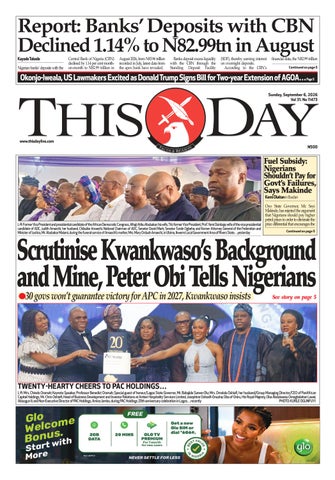
Report: Banks’ Deposits with CBN Declined 1.14% to N82.99tn in August Kayode Tokede
Nigerian banks’ deposits with the
Central Bank of Nigeria (CBN) declined by 1.14 per cent monthon-month to N82.99 trillion in
August 2026, from N83.96 trillion recorded in July, latest data from the apex bank have revealed.
Banks deposit excess liquidity with the CBN through the Standing Deposit Facility
(SDF), thereby earning interest on overnight deposits. According to the CBN’s
financial data, the N82.99 trillion Continued on page 5
Okonjo-Iweala, US Lawmakers Excited as Donald Trump Signs Bill for Two-year Extension of AGOA… Page 5 Sunday, September 6, 2026 Vol 31. No 11473
www.thisdaylive.com TR
UT H
& RE A S O
N500
N
Fuel Subsidy: Nigerians Shouldn’t Pay for Govt’s Failures, Says Makinde Kemi Olaitan in Ibadan
Oyo State Governor, Mr. Seyi Makinde, has rejected the argument that Nigerians should pay higher petrol prices in order to eliminate the L-R: Former Vice President and presidential candidate of the African Democratic Congress, Alhaji Atiku Abubakar; his wife, Titi; former Vice President, Prof. Yemi Osinbajo; wife of the vice presidential price differential that encourages the candidate of ADC, Judith Amaechi, her husband, Chibuike Amaechi; National Chairman of ADC, Senator David Mark; Senator Tunde Ogbeha; and former Attorney General of the Federation and Minister of Justice, Mr. Abubakar Malami, during the funeral service of Amaechi’s mother, Mrs. Mary Orduah Amaechi, in Ubima, Ikwerre Local Government Area of Rivers State…yesterday
Continued on page 5
Scrutinise Kwankwaso’s Background and Mine, Peter Obi Tells Nigerians 30 govs won’t guarantee victory for APC in 2027, Kwankwaso insists
TWENTY-HEARTY CHEERS TO PAC HOLDINGS…
See story on page 5
L-R: Mrs. Chinelo Oramah; Keynote Speaker, Professor Benedict Oramah; Special guest of honour/Lagos State Governor, Mr. Babajide Sanwo-Olu; Mrs .Omolola Oshiafi, her husband/Group Managing Director/CEO of PanAfrican Capital Holdings, Mr. Chris Oshiafi; Head of Business Development and Investor Relations at Amber Hospitality Services Limited, Josephine Oshoafi-Onuoha; Oba of Oniru, His Royal Majesty, Oba Abdulwasiu Omogbolahan Lawal, Abisogun II; and Non-Executive Director of PAC Holdings, Amina Jambo, during PAC Holdings 20th anniversary celebration in Lagos…recently PHOTO: KUNLE OGUNFUYI
2
SUNday, SEPTEMBER 6, 2026 • T H I S D AY
SUNDAY, SEPTEMBER 6, 2026 • T H I S D AY
3
4
SUNday, SEPTEMBER 6, 2026 • T H I S D AY
5
SEPTEMBER 6, 2026 • T H I S DAY, T H E S U N DAY N E W S PA P E R
NEWS
Okonjo-Iweala, US Lawmakers Excited as Donald Trump Signs Bill for Two-year Extension of AGOA
Ndubuisi Francis in Abuja
The Director General of the World Trade Organisation (WTO), Dr. Ngozi Okonjo-Iweala, and some members of the United States Congress have expressed excitement as President Donald Trump signed the bill for a twoyear extension of the African Growth and Opportunity Act (AGOA), after the enabling law elapsed on September 30, 2025. Nigeria is among the 32 African beneficiaries of AGOA, which was established in 2000 to provide countries across Africa with duty-free access to the American market, promoting economic growth in Africa and
boosting trade between the US and the continent. Okonjo-Iweala conveyed her delight at the development via a post on X (formerly Twitter). She said: "Great to learn that the USA has granted a two-year extension of the African Growth and Opportunity Act (AGOA), extending trade preferences to qualifying African countries. "Hope this will help stimulate mutually beneficial and greater Africa-USA trade! Thanks to Congress, the Administration, and the numerous individuals and organisations that worked hard to make this happen. "Credit also to the African Union @_AfricanUnion and
African leaders for patience and persistence on this issue," she added. The US House of Representatives passed a bill in January this year to renew the preferential trade programme for some African countries through 2028, approving the extension by a vote of 340 to 54. Despite threats to exclude South Africa from the preferential trade programme, President Trump signed the AGOA extension bill into law on Friday. The two-year extension was passed by the US Congress without substantive policy changes, providing continuity for exporters across the African
continent. After months of delays and questions about the future of the trade programme, which led to speculation that Trump’s administration was ready to scrap the AGOA or significantly curtail it, potentially excluding certain countries from it, the US president signed the bill. After Trump’s return to the White House, a group of congressmen wrote a letter to him, urging him to bar Pretoria from the programme. Last December, the US Trade Representative, Jamieson Greer, said he was “open” to “different treatment” for South Africa, calling the country a “unique problem”
and signalling possible exclusion. But the Senate and the House of Representatives passed an extension last week, running through the end of December 2028. Meanwhile, US lawmakers who championed the extension have welcomed the news of the bill's signing. Republican Representative for Missouri’s 8th Congressional District, Congressman Jason Smith, said, “For over two decades, the African Growth and Opportunity Act has been the foundation of America’s trade relationship with the nations of sub-Saharan Africa. "AGOA promotes greater
economic stability and opportunity across Africa while advancing America’s strategic and national security interests, including access to critical minerals and more secure supply chains.” Also, U.S. Congresswoman Terri Sewell, who represents Alabama’s 7th District, applauded the extension, stating that it would help strengthen trade relations between the US and Africa. Sewell said: “I am thrilled to announce that we were able to include the reauthorisation of the African Growth and Opportunity Act, or AGOA, in the continuing resolution that passed the House today.
SCRUTINISE KWANKWASO’S BACKGROUND AND MINE, PETER OBI TELLS NIGERIANS
Chuks Okocha in Abuja
The presidential candidate of the Nigeria Democratic Congress (NDC), Mr. Peter Obi, has challenged Nigerians to scrutinise his background and publicly identify any wrongdoing he may have committed. The former Anambra State governor also urged Nigerians to verify the background of his running mate and former governor of Kano State, Senator Rabiu Musa Kwankwaso. This is as Kwankwaso issued a stern warning to the ruling All Progressives Congress (APC), saying that the fact that its has
over 30 governors does not guarantee it victory in 2027. Obi issued the challenge in Port Harcourt, Rivers State, during a town hall meeting with voters tagged “Obi Talks Nigeria”, where he fielded questions on the 2027 general election. The former Anambra State governor said he and his running mate, Kwankwaso, had made their personal and educational backgrounds available for public scrutiny. “I want to give every Nigerian the opportunity to know who I am,” Obi said. “Both of us have presented
our backgrounds, from our dates of birth to our schools, education and all, to the people. You can go and verify our backgrounds worldwide, anywhere.” Obi’s comments come amid renewed scrutiny of the backgrounds and records of politicians positioning themselves for the 2027 presidential election. He also made a veiled reference to his legal dispute with his former spokesperson, Kenneth Okonkwo, over alleged defamatory comments about their past dealings during the 2023 presidential campaign. According to Obi, he instituted
the legal action after Okonkwo claimed to possess information about his past that could shock Nigerians. “We have sued somebody in court. He said he knows something he can say that will shock people. I said I want you to say what people will be shocked about,” Obi said. “And I’m challenging every Nigerian. If there is anything that you know I have done that is wrong, say it out now. “I’m challenging the world over: if you know anything that Rabiu Musa Kwankwaso has done that is wrong, say it out now.”
The NDC candidate said anyone aspiring to occupy the highest political office in the country must emerge through a credible and transparent process. “You cannot continue to answer His Excellency when the process that got you there is not excellent,” he said. Meanwhile, Kwankwaso has issued a stern warning to the ruling APC, saying that the fact that its has over 30 governors does not guarantee it victory in 2027. The vice-presidential asserted that the party’s control of over 30 state governors is not a magic wand that can guarantee electoral
FUEL SUBSIDY: NIGERIANS SHOULDN’T PAY FOR GOVT’S FAILURES, SAYS MAKINDE
smuggling of petroleum products into neighbouring countries. Makinde argued that securing Nigeria’s borders is the responsibility of the government, adding that the cost of its failure to do so should not be passed on to citizens. He called for a rethink of Nigeria’s petroleum pricing system, arguing that citizens should not be made to bear additional costs arising from the government’s inability to secure the country’s borders. Makinde, in the latest edition of his newsletter, The Business
of Governance, said the national conversation on petrol subsidy had been wrongly reduced to a choice between subsidising petroleum products and allowing Nigerians to pay full market prices. According to him, the more fundamental issue is whether Nigeria, as an oil-producing country, has a petroleum pricing framework that is fair, transparent and enables citizens to benefit from the natural resources they own. “For years, the debate in Nigeria has largely been
presented as a choice between subsidising petroleum products or allowing Nigerians to pay the full market price. “I believe we are asking the wrong question. The more important question is: What is the right pricing framework for an oil-producing country like Nigeria?” he said. The governor said the components used in determining pump prices should be made public, including the crude oil benchmark, refining costs and margins, exchange-rate assumptions, logistics and
distribution costs, taxes and levies. He said making the variables public would enable Nigerians to understand and interrogate how the prices they pay for petroleum products are arrived at. “What Nigerians deserve to know is the current pricing framework and the assumptions that determine what we pay at the pump: The crude price benchmark, refining costs and margins, exchange-rate assumptions, logistics and distribution costs, taxes and levies, and the other variables
victory for President Bola Tinubu at the polls. Speaking at the event, the former Kano State governor noted that relying purely on political structures and incumbent governors is a dangerous gamble. Kwankwaso said having many governors does not automatically mean that a political party will win an election. “The sitting president lost the election. I’m giving you an example, especially for those who think because they have over 30 governors, they cannot lose the election. That is a very big mistake,” he said.
included in that calculation,” Makinde said. He insisted that securing Nigeria’s borders is the responsibility of the government and the cost of its failure to do so should not be passed on to citizens. “We should also reject the argument that Nigerians must pay more for petroleum products simply to eliminate the price difference that makes smuggling into neighbouring countries profitable. “Nigerians should not be made to bear the cost of the
government's inability to secure its borders,” he said. Makinde disclosed that he would unveil an alternative approach to the country’s petroleum pricing system in the coming weeks, saying Nigerians should examine the proposal on its merits. He said the petroleum debate should focus on whether the existing pricing arrangement serves Nigeria’s peculiar circumstances and guarantees citizens a fair return from the
to the real sector and reduce the volume of excess liquidity deposited with the CBN. “However, we expect the real sector to benefit from the banks’ recapitalisation exercise, while supporting the federal government’s aspiration to build a $1 trillion economy.” Investment banker and stockbroker, Mr. Tajudeen Olayinka, said the prevailing high interest-rate environment, credit risks and broader economic uncertainty had strengthened banks’ preference for relatively safe placements with the CBN. “With high benchmark rates for lending and borrowing, and concerns about credit risk and economic uncertainty, banks may prefer the relative safety of the SDF. It offers them a known return rather than extending
credit into uncertain territory,” he said. Olayinka added that the sharp increase in banks’ SDF placements with the CBN reflected a deeper tension between abundant liquidity in the financial system and reluctance to expand lending. “It captures a deeper tension between liquidity abundance and lending reluctance in the financial system. Beneath the numbers lies a complex web of caution, policy tightening and an economy grappling with uncertainty. “Banks are not acting irrationally. They are responding to signals from an environment marked by high inflation, exchange-rate volatility and weak consumer confidence,” he added.
Continued on page 12
REPORT: BANKS’ DEPOSITS WITH CBN DECLINED 1.14% TO N82.99TN IN AUGUST recorded in August represented the third-lowest monthly SDF placement by banks so far in 2026. The moderation in banks’ deposits with the apex bank came amid the reduction in the Monetary Policy Rate (MPR) to 26.50 per cent in February 2026 from 27 per cent in 2025, as well as changing liquidity conditions and banks’ search for attractive returns on available funds. The Monetary Policy Committee (MPC) has so far in 2026 retained the Standing Facilities Corridor around the MPR at +50/-450 basis points. CBN data showed that banks deposited N89.3 trillion through the SDF in June, compared with N87.13 trillion in May and N92.32 trillion in April. Deposits reached their highest level so far this year in March,
at N128.92 trillion. In February, they stood at N61.11 trillion, representing an increase of 16.18 per cent from N52.6 trillion recorded in January. Overall, banks deposited an estimated N678.36 trillion with the CBN in the first eight months of 2026, representing an increase of about 610.58 per cent compared with N95.47 trillion recorded in the corresponding period of 2025. THISDAY had reported that banks deposited an estimated N336.2 trillion with the CBN in 2025, representing a 777.2 per cent year-on-year increase from N38.33 trillion in 2024. Analysts at Cordros Research, in a report following the November 24-25 MPC meeting, stated that the adjustment of the asymmetric corridor to +50/-450 basis points, from +250/-250 basis
points previously, led to lower rates for the Standing Lending Facility (SLF) and SDF. According to the analysts, the adjustment reduced the SLF rate to 27.5 per cent from 29.5 per cent and the SDF rate to 22.5 per cent from 24.5 per cent. “The adjustment is expected to ease monetary conditions and strengthen banks’ private sector credit expansion,” they stated. Vice-President, Highcap Securities, Mr. David Adnori, said the decline in deposits with the CBN did not necessarily suggest that banks had become less liquid. “A drop in CBN deposits does not necessarily mean banks become less liquid. It can mean that excess liquidity was being converted into loans or securities or was absorbed by the CBN,”
Adnori said. Chief Research Officer at Investdata Consulting Limited, Mr. Ambrose Omordion, said banks remained cautious about lending due to concerns over non-performing loans (NPLs). According to him, difficulties some customers encountered in servicing loans had encouraged banks to favour relatively safer investment options. He said: “The interest rate in the financial sector is high, and lending to customers becomes a major challenge. This alone has contributed to banks depositing with the CBN and investing in fixed-income instruments, where the risk is relatively low, and returns are assured. “If we see further rate cuts by the CBN, that alone may encourage banks to lend more
6
T H I S DAY, T H E S U N DAY N E W S PA P E R • SEPTEMBER 6, 2026
NEWS
STRATEGISING TO BOOST REVENUE GENERATION…
L-R: Chairman of Kaduna State Inland Revenue Service/APC deputy governorship candidate for Kaduna State, Mr. Jerry Adams; Representative of the Chairman of Joint Revenue Board/Executive Director, Finance Corporate Services, Nigeria Revenue Service, Muhammad Lawal Abubakar; Kaduna State Governor, Senator Uba Sani; his deputy, Dr. Hadiza Balarabe; and the Executive Secretary, Joint Revenue Board, Olusegun Adesokan, during the 160th JRB meeting in Kaduna…recently
Citing Audit Report, Atiku Vows to Probe N33.75bn Cash Transfer Scheme
Chuks Okocha in Abuja
The presidential candidate of the African Democratic Congress (ADC), Atiku Abubakar, has vowed to constitute an independent team of experts to
trace N33.75 billion reportedly paid to 3.29 million vulnerable Nigerian households, after an audit report raised questions over whether the money actually reached its intended beneficiaries.
In a statement issued by his Senior Special Assistant on Public Communication, Phrank Shaibu, yesterday, the former vice president said the audit findings amounted to a devastating indictment of a
government that took away the poor man’s subsidy, increased his taxes and tariffs, promised support, and is now confronted with serious questions over whether that support ever reached him.
Shaibu quoted Atiku as saying the figures themselves exposed the cruelty and inadequacy of the intervention, noting that N33.75 billion divided among 3.29 million households amounted to barely N10,258 per household. According to the statement, after removing subsidy, driving up transport fares, electricity costs and food prices, the President Bola Tinubu’s brotherhood by making administration’s supposed appointments and taking intervention amounts to roughly decisions which, according to N10,000 per household, and him, had benefited Rivers State. even that sum has now failed to Wike specifically cited withstand basic audit scrutiny. “This is beyond a the appointment of Prof. Okechukwu Onuchukwu bookkeeping scandal. The as Vice-Chancellor of the intervention is insultingly University of Port Harcourt small, yet even that small and the establishment of the amount cannot be cleanly University of Environment and accounted for. If money meant Technology, Ogoni, as evidence for hungry Nigerians cannot of the President’s commitment be satisfactorily traced while access to records required for to the state. “Tinubu came and gave us the accountability is frustrated, Vice-Chancellor of UNIPORT. then what we are witnessing This means Tinubu is our is unapologetic wickedness brother. Tinubu came and against the poor. You cannot gave us the Vice-Chancellor, punish people with hardship University of Environment, and then play hide-and-seek Ogoni. This means Tinubu is with money appropriated in their name,” Atiku said. our brother,” Wike said.
Wike: Tinubu is Our Brother, Rivers Will Back His 2027 Re-election Blessing Ibunge in Port Harcourt
The Minister of the Federal Capital Territory (FCT), Mr Nyesom Wike, has declared that President Bola Tinubu is now “our brother,” insisting that the people of Rivers State would support the President’s bid for a second term in 2027. Wike made the declaration yesterday, at a grand reception organised in his honour by the Rainbow Coalition in Ikwerre Local Government Area (LGA) of the state, where he also recalled the support he received from the people of the area during his 2015 governorship campaign. The event was attended
by Senator Allwell Onyesoh; Kingsley Ogundu Chinda; Chima Boms; Sunny Ejekwu; OCJ Okocha; traditional rulers and other political leaders, among others. Wike said his decision to attend the reception was informed by his longstanding relationship with the people of Ikwerre, recalling that the community stood by him when he contested the governorship of Rivers State in 2015. According to him, despite the fact that the incumbent governor at the time was an Ikwerre son, the people of the area overwhelmingly supported his ambition. “I was astonished to see the mammoth support from
Ikwerre. To God be the glory, I won Ikwerre in that election of 2015. It was not easy, but you all stood firm and supported me,” he said. The former Rivers State governor subsequently turned his attention to the meaning of political “brotherhood,” citing former governor and ex-Minister of Transportation, Rotimi Amaechi, as the politician who, according to him, defined the concept. Wike said brotherhood, in politics, should be based on who identifies with the people, cares about their welfare and supports their survival, rather than on blood relationship. He argued that Tinubu had demonstrated such political
He, however, commended the Auditor-General of the Federation, Shaakaa Chira, appointed by the Tinubu’s administration in October 2023, for putting his constitutional responsibility above political convenience. “That is what institutions are supposed to do — protect the public purse, not the political comfort of those in power,” he said. He noted that the situation was made more disturbing by the government’s own claim that more than N600 billion had been disbursed to over 10 million households, after Nigerians had earlier been told about 15 million households. “It now appears that the Tinubu’s administration cannot give Nigerians a coherent account of how many households actually benefited from its intervention programme, while significant portions of the expenditure have failed to withstand independent audit scrutiny,” he said, insisting that “a ministerial announcement is not proof of payment. A name on a social register is not a bank alert.”
Nigeria,163 Countries to Back UN Resolution for Larger Africa on World Map Nigeria has joined 163 other countries to endorse an Africanled UN resolution seeking fairer world maps that accurately reflect Africa’s true geographical size. The UN General Assembly adopted the historic “Correct the Map” resolution by 164 votes to one, with six abstentions. The United States cast the sole opposing vote, while Estonia, Georgia, Lithuania, Moldova, Serbia and Ukraine abstained. The resolution is formally titled “Correct the Map: Rebalancing global cartographic representation and promoting
equitable representation of the world’s regions, particularly Africa.” The African Union-backed campaign challenged centuries of cartographic representation that makes the African continent appear disproportionately small. Africa covers approximately 30 million square kilometres and is the world’s second-largest continent by both land area and population. However, advocates say conventional Mercator maps have historically presented the continent visually as considerably
less imposing than it is in reality. The vote enjoyed an overwhelming majority of UN members endorsing the continent’s demand for more accurate global geographical representation. Togo led negotiations on behalf of the African Group, building on an AU-supported initiative to ensure Africa is no longer represented as smaller than it actually is. Togolese Foreign Minister Robert Dussey told the UN General Assembly that maps were not merely technical
illustrations but powerful instruments influencing how people understand the world. “Maps shape our understanding of the world. They guide education, nourish the imagination and influence collective perceptions,” Dussey said. The resolution promotes wider use of the Equal Earth projection and other equal-area maps where accurate comparison of the relative sizes of continents and countries is important. It describes the consequences as contributing to the “symbolic
minimisation” of Africa and other regions in the global collective imagination. “A fair map does not change the geography of the world; it changes how we see the world,” said, adding, “a fair world begins with a fair map.” The Equal Earth projection, developed in 2018, seeks to preserve the relative areas of countries and continents, thereby presenting Africa at a much closer-to-actual scale. Unlike Mercator projections, equal-area projections do not enlarge Africa; rather, they
remove the artificial enlargement given to territories near the poles. The United States strongly rejected the initiative, arguing that the General Assembly should focus on more pressing global challenges. France, however, supported the resolution, announcing plans to move away from Mercator in its official world maps. This would also make France, the United States, Russia and other northern countries appear smaller relative to equatorial countries than on the familiar Mercator map.
7
SEPTEMBER 6, 2026 • T H I S DAY, T H E S U N DAY N E W S PA P E R
NEWS
PROMOTING BUSINESS COOPERATION…
L-R: Group COO, Computer Warehouse Group, Afolabi Sobande; Chairman, Nigerian-South African Chamber of Commerce, Dr. Ijeoma Jidenma; Chief Financial Officer, MTN Nigeria, Modupe Kadri; Group Managing Director, SO&U, Udeme Ufot; Chief Executive Officer, Seams and Stitches, Yemi Chukwurah; and Chief Executive Officer, BHM Holdings, Ayeni Adekunle, during NSACC’s August Breakfast Forum at the Eko Hotel and Suites Victoria Island, Lagos…yesterday
Osinbajo Raises the Alarm over Widespread Use of Chemicals to Ripen, Preserve Fruits, Vegetables
Segun James
Former Vice-President Yemi Osinbajo has raised concerns over the alleged widespread use of potentially harmful chemicals to ripen and preserve fruits and vegetables in Nigeria. He warned that food products that appear fresh and natural
may not be safe to consume. Osinbajo, a professor of law, disclosed while recounting an experience involving his wife, Dolapo, whose freshly squeezed orange juice was reportedly found to be “not fit for human consumption” after she developed unusual and persistent headaches.
He spoke at the Open Day for Gardeners’ Seminar, themed “Leaving the Earth Better Than We Found It”, held in Lagos on August 28. A video of the event was shared on the former vicepresident’s YouTube channel. According to Osinbajo, his wife had switched from carbonated
drinks to freshly squeezed orange juice as a healthier alternative but subsequently began experiencing unexplained headaches. He said after other possible causes had been ruled out, she sent a batch of the juice to a laboratory for analysis. “The results came back. It showed that the freshly
UK Updates List of Employers Licensed to Sponsor Nigerians, Other Foreign Workers
Sunday Ehigiator
The United Kingdom Government has updated its official list of employers licensed to sponsor foreign workers, providing jobseekers with a current resource for identifying organisations that may be able to sponsor eligible workers. The Register of Licensed Sponsors, published on GOV. UK, contains organisations authorised to sponsor workers under the UK’s Worker and Temporary Worker immigration routes. The latest version of the
register was updated on September 4, 2026, according to the UK Government. The register can be useful for people outside the UK who are searching for jobs that could potentially lead to visa sponsorship, allowing them to research licensed employers before applying for vacancies. Rather than applying to employers at random, jobseekers can use the register to identify organisations that hold a valid sponsor licence and then check whether they have suitable vacancies.
The list can help applicants to: Identify potential sponsoring employers; research organisations before submitting applications; monitor companies for suitable job openings; make their UK job search more targeted; and confirm whether an organisation is included on the official sponsor register. However, being included on the register does not mean that every job advertised by an organisation comes with visa sponsorship. A sponsor licence means an employer is authorised to sponsor eligible workers,
but whether sponsorship is offered for a particular vacancy depends on factors including the job, the applicant’s eligibility and the employer’s decision. Jobseekers should therefore treat the register as a starting point for research rather than confirmation that sponsorship is available. After finding an employer on the list, applicants should carefully review the specific vacancy and check the job title, responsibilities, required qualifications and experience, salary, location and eligibility conditions.
squeezed orange juice was not fit for human consumption,” Osinbajo said. He said the incident highlighted the potential dangers consumers could face from chemicals introduced into food products at different stages of the supply chain. Osinbajo’s warning comes amid concerns over food safety and the need for greater scrutiny of practices involved in the production, preservation and distribution of fruits and vegetables in the country. Osinbajo said some farmers use potentially dangerous pesticides on fruits and vegetables, while some traders allegedly use chemicals to accelerate ripening or extend the shelf life of produce. He specifically identified calcium carbide as one of the substances allegedly used to force fruits such as bananas, mangoes, pawpaws and tomatoes to ripen and change colour rapidly. The former vice-president said evidence from studies and surveys suggested that the practice was not isolated. He cited a 2024 study in AdoEkiti, Ekiti State, involving 20 fruit sellers, noting that half of
those interviewed admitted to using calcium carbide. He also cited a study in Uyo, Akwa Ibom State, which he said found that 25 per cent of fruit sellers surveyed admitted to using calcium carbide to ripen fruit. In Lagos, Osinbajo said a 2023 survey involving 50 fruit and vegetable retailers found that 22 admitted using chemicals to preserve their produce. He said the findings should raise serious concerns about food safety, particularly because consumers may have no way of knowing whether chemicals have been used on produce before it reaches them. “The fact that fruit looks fresh doesn’t mean that it is safe. And the fact that a drink is natural doesn’t mean that something dangerous has not been added to it along the way, especially along the journey from the farm to the table,” he said. Osinbajo further listed substances he said some traders had identified as being used to treat or preserve produce, including Gamma-lin-20, Sniper, phosphide, DDT and brodifacoum.
End of Multiple Taxation Near, Gov Sani, JRB Declare as 18 States Adopt Harmonised Tax Law Wale Igbintade
Governor Uba Sani of Kaduna State and the Executive Secretary of the Joint Revenue Board (JRB), Olusegun Adesokan, have declared that the era of multiple and overlapping taxation in Nigeria would soon become a thing of the past as the country deepens implementation
of its new tax reforms, with 18 states adopting the harmonised tax law. They said the reforms were already producing significant changes in the nation’s tax administration by harmonising taxes and levies, reducing duplication, easing the burden on low-income earners and micro businesses, and deploying
technology to minimise revenue leakages. The governor and the JRB Executive Secretary spoke separately at the 160th meeting of the Joint Revenue Board in Kaduna, themed: “One Year of Tax Reform: Assessing Progress and Addressing Challenges.” The meeting provided an opportunity for tax authorities
and stakeholders to assess progress made one year into the implementation of the reforms and identify outstanding challenges. Giving an overview of the reforms, Adesokan disclosed that 18 state Houses of Assembly had domesticated the Model Harmonised Taxes and Levies Law, marking a significant step
towards eliminating overlapping and duplicated taxes imposed by different tiers of government. He said the new legislation had reduced the more than 50 collection items previously administered by state and local governments to just nine sub-heads. According to him, the reduction was designed to simplify the tax
system, provide greater certainty for taxpayers and eliminate the proliferation of taxes and levies that had continued to impose unnecessary burdens on individuals and businesses. The JRB Executive Secretary also disclosed that the model law had abolished cash collection and the mounting of roadblocks for revenue collection.
8
T H I S DAY, T H E S U N DAY N E W S PA P E R • SEPTEMBER 6, 2026
NEWS
GLOBAL VOLUNTEERS…
L-R: Rotary International District 9111 Governor-nominee, Ade Oyenekan; District Governor-elect, Dr. Samuel Ayetutu; Chairman, District Team Leadership Seminar Committee, Efedi Jelily; and District Governor, Bukola Bakare, during inauguration of 2027-2028 training committee by Ayetutu at the Rotary Centre Ikeja GRA, Lagos...Friday
APM Accuses Tinubu’s Govt of Failing to Secure Nigeria, Claims Over 600,000 Nigerians Killed Since 2023 Chuks Okocha in Abuja
The Allied Peoples Movement (APM) has condemned, in the strongest possible terms, the attempts by President Bola Tinubu’s administration to downplay the worsening insecurity in the country, despite the country now ranking as the fourth most insecure country in the world under Tinubu’s watch, as reported in the Global Terrorism Index (GTI) 2026. In a statement by the party’s
National Publicity Secretary, Yusuf Abubukar, the party berated the Minister of Defence, General Christopher Musa (rtd.), for claiming that the security of the nation had improved under President Tinubu. APM argued that the situation on the ground and independent reports by credible international organisations showed that Nigeria’s insecurity rating has actually climbed two spots from the 6th place recorded in the 2025 index.
According to the spokesman of the party, ''APM finds it deeply disappointing that a minister of the Federal Republic could appear on national television to make such claims at a time when millions of innocent Nigerians are being killed, kidnapped, displaced, and terrorised in various parts of the country. " “The comments by the minister further expose the Tinubu administration’s insensitivity to the plight of Nigerians, who bear the pain of the daily killings, maiming,
rape, abduction for ransom, and incarceration by bandits in dehumanizing conditions in various parts of the nation. ''The minister’s comments also show that the Tinubu-led All Progressives Congress (APC) administration does not and cannot feel the pain and anguish of millions of Nigerian families whose lives have been permanently ruined in the last three years of Tinubu’s presidency, during which over 600,000 Nigerians have been killed and
no fewer than 2.2 million others, including women and children, abducted.'' Abubakar further stated: ''Only last week, 600 Nigerians (mostly women, children, and older people) were abducted from Dekera, Gidan-Zana, and Sabon Gida villages in Niger State and are still languishing in captivity. ''Credible data released by SBM Intelligence shows that kidnapping for ransom has grown into a highly monetized industry under President Tinubu, with over N7.78 billion paid in ransom between July 2025 and June 2026. ''Our party is disturbed that the administration is either dangerously disconnected from reality or is deliberately attempting as consumers seek in-person to manipulate public perception experiences,” the report said. by denying the actual situation It added that this expansion, in the country. '' which is expected to unlock $600 billion in new revenues in 2030 alone, will be overwhelmingly driven by digital ecosystems across the E&M landscape. The report said that the Linus Aleke in Abuja global E&M industry grew by 5.3 per cent in 2025, with The Chief of Defence Staff total revenue from advertising, (CDS), General Olufemi connectivity, and consumer Oluyede, has attributed the spending reaching $3.5 trillion, recent operational gains by and it should rise another 4.6 troops of the Armed Forces per cent in 2026. of Nigeria against terrorists and other extremist groups across all theatres of operation to sustained collaboration between the military and other security agencies. He listed these agencies to ceremony. Others included include the Nigeria Police, the ADC chieftain, Dr. Datti Department of State Services Baba-Ahmed; former Attorney- (DSS), local security groups General of the Federation and other stakeholders. Oluyede also applauded (AGF), Mohammed Bello Adoke; and several other the unrelenting resolve of troops in neutralising political leaders. However, Rivers State terrorists, rescuing abducted Governor, Siminalayi Fubara, citizens, receiving surrendered and Minister of the Federal terrorist fighters and their Capital Territory (FCT), families, and dismantling Nyesom Wike, were absent criminal and secessionist from the solemn ceremony. networks.
PwC: Global Entertainment, Media Revenue to Hit $4.2trn by 2020 Dike Onwuamaeze
A report by the PwC has projected that the entertainment and media (E&M) industry’s global revenue will grow to $4.2 trillion by 2030. It also said that advertising, enabled by Artificial Intelligence (AI), will grow rapidly, topping $1.4 trillion by 2030, as marketers seek to meet consumers where they are accessing content and making retail decisions. These projections are contained in a PwC report
dated September 2026 and titled “Global Entertainment & Media Outlook 2026–30: Digital Innovation Drives Demand for Human Experiences,” was authored by the Global Entertainment & Media Sector Leader, and Partner, PwC United States, Mr. Bart Spiegel. The survey for the report covered a total of 53 countries and territories that are spread across North America, Europe, Middle East & Africa, Latin America and Asia Pacific. According to the report, the E&M industry remained on a
firm growth trajectory, adding that the projected revenue will be fuelled by technology and live events. “PwC’s Global Entertainment & Media Outlook forecasts that spending in the vast industry will rise at a 3.4 per cent compound annual growth rate (CAGR) through 2030, when total revenues will reach $4.2 trillion. “In an age of digital innovation, live and immersive experiences, including sports, concerts, and trade shows, will show significant growth
Atiku, Osinbajo, Anyim, Mark, Others Rally Behind Amaechi at Mother’s Burial
Blessing Ibunge in Port Harcourt
The presidential candidate of the African Democratic Congress (ADC), Alhaji Atiku Abubakar; former Vice President, Prof. Yemi Osinbajo and other prominent political figures yesterday gathered at Ubima in Ikwerre Local Government Area (LGA) of Rivers State, to commiserate
with former Minister of Transportation and ADC’s vice-presidential candidate, Mr Rotimi Amaechi, during the burial of his mother, Ezinne Orduah Amaechi. Also present were former Secretary to the Government of the Federation (SGF), Senator Anyim Pius Anyim; former President of the Senate and National Chairman of ADC, Senator David Mark; former
Osun State Governor, Rauf Aregbesola; former former Imo State Governor, Emeka Ihedioha; Senator Ireti Kingibe; Senator Tunde Ogbeha; Great Ogboru; and former Chairman of the Independent National Electoral Commission (INEC), Prof. Attahiru Jega. Atiku, accompanied by his wife, Amina Titi Abubakar, was among the dignitaries who attended the funeral
He said that more disheartening is that while families moan across the country, the Tinubu administration is waving off abduction—an act of terrorism—as a “family affair." ''If the security situation has truly improved as the administration claims, the APM challenges the President, the Minister of Defence, and other senior officials of the Tinubu Presidency to travel by road without armed security details as other Nigerians must do. ''In any case, it is clear that insecurity is festering under President Tinubu because he lacks the capacity to develop and operate a blueprint to tackle and contain the challenge. Our nation cannot survive another four years under such a hopeless and incompetent administration,'' Yusuf stated.
CDS Attributes Military’s Recent Operational Gains against Terrorists to Collaboration with Other Security Agencies Speaking during a television interview monitored by THISDAY, the minister observed that terrorist attacks had drastically reduced, giving way to kidnappings. Meanwhile, the CDS said the gains were being secured through sustained tri-service synergy and effective collaboration with other security agencies and security stakeholders. According to a statement by the Director of Defence Media Operations, Major General Michael Onoja, the CDS also appreciated the media for their continued professionalism and balanced reportage of military operations. He said: “The Armed Forces of Nigeria (AFN) sustained their kinetic operations across all theatres of operations nationwide between August 31 and September 3, 2026.
SUNDAY, SEPTEMBER 6, 2026 • T H I S D AY
9
10
SUNday, SEPTEMBER 6, 2026 • T H I S D AY
11
SUNDAY, SEPTEMBER 6, 2026 • T H I S D AY
the legacy
MR. SAMUEL CHUBA
Oke (MUONSO)
We commiserate with our friends, Ifesinachi-Face and Ogonna-Ogeezy Okeke, over the loss of their loving father, Mr. Samuel Chuba Okeke (Muonso), who has since been committed to mother earth.
We share in their pain and pray that the Lord will give them the fortitude to bear this great loss.
SIGNED COMMITEE OF FRIENDS FOR IFESINACHI-FACE & OGONNA- OGEEZY OKEKE
12
T H I S DAY, T H E S U N DAY N E W S PA P E R • SEPTEMBER 6, 2026
NEWS
STRENGTHENING PARTNERSHIP WITH CHINA…
L-R: Peter Jolayemi; Director General, Nigerian Institute of International Affairs, Prof. Eghosa Osaghae; Consul General of the People Republic of China in Lagos, Ms. Yan Yuqing; Head, Bashir Adewale Centre for International Trade and Investment, Dr. Adesuwa Erediauwa; and Fellow, BACITI Centre, Prince Dapo Adelegan, during a courtesy call to the Consul General in Lagos…recently
NCDC: Borno, Kano, Plateau, Five Others Account for 98% of Confirmed Diphtheria Cases in Nigeria Plateau orders closure of primary, secondary schools over outbreak
Onyebuchi Ezigbo in Abuja and Yemi Kosoko in Jos
The Nigeria Centre for Disease Control and Prevention (NCDC) has said that Borno, Kano, Plateau and five other states in the country accounted for 98 per cent of the confirmed cases of diphtheria, a vaccinepreventable disease. This comes as the Plateau State Government has ordered the temporary closure of primary and secondary schools as part of measures to contain the spread of the diphtheria outbreak. The Principal Health Communication Officer in the Department of Disease Prevention and Health Promotion at the NCDC, Michael Okali, identified the affected states as Kano, Kaduna, Katsina, Borno, Bauchi, Plateau, Sokoto, and Zamfara. He said that data showed that about 68 per cent of the confirmed cases were unvaccinated. Okali said that the confirmed cases and fatalities recorded in Nigeria from August 24 to August 30, 2026 stood at 69 suspected cases, 48 confirmed cases, and four deaths. “So, these are the states that are actually contributing 98 per cent of these cases. And right now, NCDC, in collaboration with NPHCDA and FMOH, are actually sending in support, both on the ground, on-site, and off-site to make sure we help
them contain the outbreak,” he said. “And it’s looking good. NCDC is actually present in Katsina. Five hundred vaccines have been sent to Kano and Katsina, and we are also doing more, building up our stockpile to ensure this distribution goes ahead and that the PHCs have enough vaccines to give. He explained that a task force had been set up for surveillance, contact tracing, case management, and laboratory capacity building for testing. In Plateau State, 23 people have died from suspected cases of the infection in the last two weeks, with 143 suspected cases recorded. As part of efforts to contain the spread of the infectious disease, the state government ordered the temporary closure of all public and private primary and secondary schools across the state as urgent preventive measures. Governor Caleb Mutfwang, in a directive, said that suspected diphtheria cases were found particularly in Jos North, Wase, Jos South and Bassa local government areas (LGAs). The directive to shut all schools takes effect from Monday, September 7, 2026, and applies to schools that have already resumed academic activities. On Wednesday, the Katsina State Government raised fresh concerns over the worsening
diphtheria outbreak, revealing that the disease’s case fatality rate has risen to about 5.6 per cent, with health authorities blaming the increase on the late presentation of patients at treatment centres. Acting Executive Secretary of the Katsina State Primary Health Care Agency, Dr. Shaima’u Abba, said despite intensified government interventions, many patients were still arriving at health facilities only after developing severe complications, making treatment more difficult and
increasing the risk of death. Abba said 32 patients were receiving treatment across the state’s four isolation centres, while the outbreak had spread to 30 of the 34 LGAs, an increase from the 29 LGAs previously affected. She stressed that vaccination remains the safest, most effective and cost-efficient protection against diphtheria and other vaccine-preventable diseases. In Kano, over 30,000 cases of diphtheria have been recorded across several local government areas of the state.
The Director-General of the Kano State Centre for Disease Control (KNCDC), Muhammad Abbas, stated on national television that the state's 44 LGAs were affected. Abbas noted that the fatalities are 1,744, while 14.5 per cent of the confirmed cases had been hospitalised. Diphtheria is a bacterial infection caused by a bacterium known as Corynebacterium, which produces a toxin that affects an infected person’s nose, throat, tonsils, and larynx, and also some major parts of
the body. It can lead to the appearance of a grey-whitish pseudomembrane at the back of the throat or nose, and it can affect the heart, nerves, and the kidneys. The bacteria spread from person to person, usually through respiratory droplets, such as those produced by coughing or sneezing. People can also get infected from touching infected open sores or ulcers. It may also be spread by contaminated clothing and objects.
PAMO University Gives Rivers Speaker 24 Hours to Retract Alleged Defamatory Remarks, Threatens Suit
Wale Igbintade
Pamo University of Medical Sciences (PUMS) has given the Speaker of the Rivers State House of Assembly, Hon. Martin Amaewhule, 24 hours to retract alleged defamatory statements made against the institution or face legal action. This is coming as the state lawmakers have constituted an Ad-Hoc Committee to conduct an inquiry into the state government’s disbursement of funds to the university since its inception in 2017. The university, through its counsel, Ayodeji Adedipe, (SAN), in a letter dated September 3, 2026, accused Amaewhule
of making “malicious and defamatory” comments concerning the institution while presenting the 2026 Rivers State Appropriation Act to the Governor for assent at the Executive Council Chambers of the Government House, Port Harcourt. The dispute centres on a proposed N6 billion allocations to Pamo University of Medical Sciences contained in the 2026 Rivers State budget. According to the letter, the Rivers State House of Assembly Speaker was alleged to have said that the assembly’s committee found that the university had not been transparent in the management of funds allocated
to it over the years and that the state could not ascertain what had happened to taxpayers’ money allocated to the institution. The Speaker was further alleged to have stated that the university was invited by the House committee but failed to appear and did not present any records or reports to the Assembly. However, Pamo University, through its lawyers, vehemently denied the allegations, describing them as false, unfounded and malicious. The university maintained that it had never been invited by the Rivers State House of Assembly, or any other body, to defend its utilisation of
funds made available to it by the state government under the scholarship scheme for Rivers State students. It also insisted that since the commencement of the scholarship scheme, it had “strictly and judiciously” applied the scholarship funds for the sole purpose for which they were provided. The institution said the statements attributed to Amaewhule had caused it considerable embarrassment and had maligned its reputation, particularly the allegation that its management had failed to be transparent in handling the funds and had been evasive in accounting for their utilisation.
experiencing real progress. Too many young Nigerians are unable to see a clear path from education to opportunity,” Makinde said. He added that insecurity and weak institutions continued to undermine the wellbeing and
economic prospects of Nigerians. Makinde said achieving a national reset would require accountable leadership as well as active participation by citizens, stressing that rebuilding the country could not be the responsibility of one individual.
FUEL SUBSIDY: NIGERIANS SHOULDN’T PAY FOR GOVT’S FAILURES, SAYS MAKINDE country’s resources. “Reset Nigeria means being willing to interrogate the system itself. The petroleum question should therefore not simply be whether subsidy should return or remain removed. “It should be whether the
pricing system we are using is the right one for Nigeria and whether it allows Nigerians to derive a fair benefit from the natural resources they own,” he said. The governor said his proposed Reset Nigeria initiative
would extend beyond petroleum pricing to the economy, security architecture, education, institutions and the country’s social and political order. He argued that Nigeria’s problems could not be solved merely by replacing individuals
in government, saying attention must also be paid to reforming systems and institutions that repeatedly produce poor outcomes. “Too many of our people are still trapped in poverty. Too many families work hard without
T H I S D AY, T H E S U N D AY N E W S PA P E R SEPTEMBER 6, 2026
13
NEWS
SETTING A NEW STANDARD IN ENERGY REPORTING...
L-R: President, Nigerian Guild of Editors/Editor, Vanguard Newspapers, Mr Eze Anaba; Director of Programmes, Society of Energy Editors, Mr Hector Igbikiowubo; and Principal Consultant, CET -TLE Consultancy Nigeria Limited, Dr Charles Ebereonwu, during the inaugural seminar of the Society of Energy Editors in Lagos... recently
Yilwatda Receives Kano Bigwigs into APC, Vows Tinubu Will Win 2027 Election Ahmad Sorondinki in Kano The National Chairman of the All Progressives Congress (APC), Prof. Nentawe Yilwatda, yesterday received prominent political figures in Kano State who defected from opposition parties to the ruling party. At a political gathering attended by party leaders, stakeholders, and supporters from across the country, Yilwatda declared that President Bola Tinubu will win the 2027 presidential election. He described the event as one of the biggest waves
of defections into the party, with the incumbent Senator representing Kano Central, Rufai Hanga, and former Governor of the State, Kabiru Gaya, among others joining the APC. The National Chairman said the influx of new members was proof that Kano people are beginning to see results from President Tinubu’s reforms. “With what Mr. President is doing to reposition this country, I have no doubt that the APC will not only retain power but that President Tinubu will win convincingly
Fadahunsi Congratulates Adeleke, Pledges Support for Second Term Yinka Kolawole in Osogbo After weeks of political tension and controversy surrounding the August 15 governorship election, the senator representing Osun East Senatorial District, Francis Adenigba Fadahunsi, has finally congratulated Governor Ademola Adeleke on his re-election, pledging his support and cooperation for the governor’s second term. Fadahunsi, in a congratulatory message dated Friday, September 4, 2026, extended his goodwill to Adeleke on behalf of himself, his political family, associates and the people of Osun East Senatorial District. The development comes against the backdrop of the intense political atmosphere that preceded the election, during which the senator was embroiled in controversy over remarks attributed to him about members and supporters of the
Accord Party. Political opponents had accused Fadahunsi of threatening violence against Accord members. He, however, publicly denied the allegation and rejected the interpretation placed on his comments following the backlash to the remarks in the weeks leading up to the election. With the election now over and Adeleke returned to office for a second term, the senator has adopted a conciliatory tone, congratulating the governor and urging him to use the fresh mandate to deepen development across the state. In the message, Fadahunsi described Adeleke’s re-election as a reflection of the confidence and electoral mandate of the people of Osun State. He said the governor’s return for a second term offered an opportunity to consolidate the achievements of his first administration and deliver greater dividends of democracy to the people.
in 2027,” he declared. In his address, the Kano State Governor, Abba Yusuf, explained that the party in Kano was being repositioned to strengthen grassroots mobilisation ahead of the
next elections. According to him, all the defectors, who joined from the PDP, NNPP and other parties, were drawn to the APC because of the president’s policies and the desire to move
the country to greater heights. He urged the new members to work for unity and mobilisation at ward and local government levels, and assured them of equal opportunities within the party structure.
Governor Yusuf reaffirmed the state government’s commitment to empowerment programmes that would cushion the effects of current economic hardship, especially for the youth.
At Energy Editors’ Seminar, NGE Seeks Deeper Interrogation of Nigeria’s Energy Sector Ejiofor Alike The President of the Nigerian Guild of Editors (NGE), Mr Eze Anaba, has urged energy editors and reporters to focus on deeper interrogation of the issues surrounding Nigeria’s energy sector, insisting that energy journalists should develop their skills and capacities for a deeper understanding of the industry. This is just as a former presidential spokesman, Mr Femi Adesina, has decried lack of climate literacy as a major reason for the underreporting of climate change by Nigerian journalists. Adesina also decried energy poverty and linked it to the poverty afflicting many households in
Nigeria. Speaking in Lagos at the inaugural seminar of the Society of Energy Editors (SEE), themed, “Reporting an Evolving Energy Industry: The Nigerian Experience,” Anaba, who is the Editor of Vanguard Newspapers, argued that energy reporting must align with the media’s agenda-setting responsibility, due to its implications for national development. He challenged energy journalists to hold the government to account on the oil and gas reforms, including the removal of petroleum subsidy, rather than merely reporting official narratives and press statements. Anaba raised the alarm that
Nigeria’s energy sector was at a crossroads, highlighting the crude supply challenges facing the Dangote Refinery, the impact of petrol subsidy removal, fragile renewable energy adoption and recurring national grid collapses as critical issues demanding greater scrutiny by energy journalists. The NGE president also cited the issues of oil and gas asset divestments by the international oil companies (IOCs), pipeline vandalism, artisanal refining and challenges surrounding domestic gas supply, as some of the issues that required deeper scrutiny. “Objective reporting means telling the story as it is, without fear or favour. It requires us to verify facts, balance perspectives,
and present issues in their full context,” he said. “But agenda-setting takes us further. It requires us to identify and bring to public consciousness the issues that are most critical to national development and democratic governance.” According to him, it is the job of journalists to establish whether the trillions of naira said to have been generated from subsidy removal were translating into promised investments in infrastructure, security and social protection On electricity, Anaba said recurring national grid collapses were often reported as isolated events without sufficient examination of their underlying causes.
Ex-IG, Adamu Emerges Nasarawa SDP Governorship Candidate The Social Democratic Party (SDP) has declared former Inspector General of Police, Mohammed Abubakar Adamu, as its governorship candidate for Nasarawa State following a replacement primary election conducted yesterday in Lafia, the state capital. Announcing the result, the Chairman of the SDP Electoral Committee for Nasarawa State, Mr Joseph Achille, said the exercise was conducted across all the 13 local government areas of the state and collated at the LGA level. He listed the LGAs as Akwanga, Awe, Doma, Karu, Keana, Kokona,
Nasarawa, Nasarawa Eggon, Lafia, Obi, Toto, and Wamba. Achille, who was joined by the Committee Secretary, Ibrahim Ahmad, and member, Adeyemi Abimbola, said a total of 28,637 delegates were present and cast their votes. “Sitting before you today to conduct this election primary. As you are all aware, we have a sole candidate for the office of governor, SDP, Nasarawa State,” he told delegates. He added that the committee “duly collated all the votes emanating from the various wards” and that the
exercise was conducted “peacefully and lawfully.” “Having scored the total votes peacefully and lawfully, it gives me singular privilege, by the powers conferred on me by the National Executive Committee and the National Working Committee, to declare the result that Mohammed Abubakar Adamu scored the highest lawful valid votes,” Achille said amid cheering and applause. “Subsequently, he is declared, returned, and elected as the candidate and flag-bearer of the Social Democratic Party for Nasarawa State,” he added.
The electoral committee chairman further described the process as “free, fair, and credible” before inviting the winner to approach the podium. The primary was held to select the SDP flag-bearer for the 2027 governorship election in Nasarawa State. In his acceptance speech, Adamu promised to work tirelessly to “change the bad governance that is taking place” in the state. “I am delighted that the primaries have been conducted. I’m also delighted that we have been declared the winner,” Adamu said.
14
T H I S DAY, Th e S U N DAY N e w S PAPe r •September 6, 2026
International
Why Government by Coup d’État is Recidivist in Africa: Niger’s Counter-Coup as Coup against Nigériens
T
he future of liberal democracy in Africa may not be bright because it has the great potential to unnecessarily generate coups d’état. In international relations, coup d’état is illegal but the illegality is conveniently acquiesced to in protest against bad democratic governance. In order to promote democracy, France, generally supported by other European Union (EU) Member States, made the adoption of democracy a conditionality for the grant of development aid to African countries. President François Mitterrand made this clear at the 1990 sixteen Franco-African Summit, held in the coastal resort of La Baule in southern France. However, this conditionality has been selectively applied, and thus making non-democratically-elected governments to thrive and condoned. Coup d’état, as a concept, dates back to antiquity. It dates back to the time of Julius Caesar’s march on Rome. Its modern usage began with the Coup of 18 Brumaire when Napoleon Bonaparte overthrew the French Directory on November 9, 1799. At that time, coup d’état was still defined as a sudden blow against the State or as an illegal overthrow of an existing government. In the late 1700s, it specifically meant a sudden strike by political or military insiders to seize power from the top. Coup d’état, unlike a revolution, is often carried out by a group of small, elite people. When elected politicians use their democratic freedom to misgovern, the people cannot but support military coup to change an elected government in spite of the fact that coups d’état are considered illegal. In the case of Niger Republic, the problematic is quite interesting: the incumbent president, General Abdourahmane Tiani, a former Chief of the Presidential Guard, came to power by coup on July 7, 2023. His government is therefore considered illegitimate. On August 29, 2026 there was a counter-coup against him but the coup was successfully resisted by the elite presidential forces and the Russian-backed Africa Corps personnel. What is the implication of a military coup against an unwanted military government in power? What essence is there in condemning coups d’état supported by the people? Why is coup unending in spite of the many legal instruments sanctioning unconstitutional changes in Africa?
Why Coup d’État is Recidivist
The first dynamic of recidivist coups in Africa is difficulty in breaking the umbilical cord tying former colonial masters and their former colonies. When President Mitterrand made democratisation a conditionality for development assistance in 1990, it was to nip coups in the bud and help restore multiparty politics. By then most Francophone countries operated one-party system of government within which democracy was purportedly practised. In late November 2014, another French president, François Hollande, told the leaders of 57 French-speaking countries in Dakar, Senegal, as follows: ‘where constitutional rules are abused, where freedom is violated, where the alternation of power is prevented, I affirm here that the citizens of these countries will always find, in the Francophone sphere, the necessary support to uphold justice, law and democracy.’ What is the meaning and implication of President Holland’s statement? The interpretative meaning is that, in the event of abuse of constitutional rules, in the event of violation of rights of freedom, in the event of alternation of power is made impossible, France can always be relied upon for assistance within the Francophone community. The implication of the interpretation is also not far-fetched: Justice will be upheld. Law and democracy will be upheld. But what is the meaning of justice in this case? The answer should be understood in the context of developments within Niger Republic. Relationship between Niger and France is fairly warm. Relationship among Niger, Burkina Faso, and Mali, on the one hand, and France, on the other, is no longer warm as it used to be before the advent of the current military juntas in the three countries. All the three countries have strained their politico-diplomatic ties with France. In the eyes of France, there can never be anything good in terms of good governance in all the countries, especially in light of the replacement of France with Russia as a newly trusted ally. Consequently, in every attempt to prevent Russia from being able to consolidate its influence in West Africa, it cannot but be expected that France would continue to strengthen opposition to the three military juntas in Mali, Burkina Faso, and Niger. A second dynamic is the conscious refusal to learn lessons from the past. Military intervention in politics in Africa began in 1952 with the coup organised by Egyptians against King Farouk. Since then, there has not been an end to coup making. This is because African leaders hardly look backward to learn lessons for the present. Africa has always been fraught with systemic corruption, sit-tight administration, resource mismanagement with particular emphasis on embezzlement of public funds rather than investing in productive sectors. For instance, the World Economics has it
Tiani that Libya, the Democratic Republic of the Congo and Chad have the lowest governance grades (grade E). In Nigeria, the problems of governance are associated with weak public service execution, infrastructure deficits, and security challenges. And true enough, there was a coup d’état in Nigeria in October 2025 which was first denied by the Federal Government but later involuntarily admitted. 16 army officers were arrested and prosecuted. If lessons are readily learnt, the potential for fresh coups will be limited. Thirdly, according to the Institute of Strategic Studies in South Africa, there are three major dynamics characterising coups in Africa: uneven distribution of frequency of the coups; the causes of individual coups which vary from one country to the other; and the outcome of each coup. Apart from these dynamics, there is still a complex interplay of internal decay. There is the issue of democratic deficit or façade democracy, at times referred to as democratic coup. This is not about rejection of democracy per se. This can involve rigging of election engineering corrupt judiciaries, amending constitution to enable continued stay in power. When there is no accountability, people cannot but look up to the military following public disillusionment. When democratic governments are unable to ensure national security, there is no way military intervention will not be contemplated. A fourth rationale for the recidivist character of coup d’état is the nonchalant attitude of both the Assembly of Heads of State and Government of the African Union and the Authority of Heads of State and Government of the ECOWAS towards unconstitutional government in Africa. In some cases, such as in Mali, Burkina Faso, and Niger, they condemn unconstitutional changes of government. In some others, they turned away their eyes, such as it was the case in Chad. This is double standard against which the people are. True enough, the ECOWAS did not recognise the military junta in power but the junta enjoyed the people’s support. The same story is true of the government in Burkina Faso and Mali. And without doubt, government by coup d’état is unconstitutional and unwanted, particularly by African leaders. It is against this backdrop that several agreements were done and
Finally and without any whiff of doubt, coups d’état against General Abdourahmane of Niger cannot but be much expected at home, in the Sahel region or sub-region, and at the extraAfrican level. At the home, regional, and sub-regional levels, there are still many pro-former colonialists who easily accept to carry out the dirty job of coup making. They are people who do not believe in democratic freedom, political sovereignty of Niger, and self-dignity. General Tiani’s main offence is that he is waging war against neo-colonialism. He is resisting unending exploitation of his country’s natural resources. Who expects better understanding with Niger knowing well that Tiani already pulled out his country from the ECOWAS? Why should anyone expect France to be happy with General Tiani, bearing in mind that he had severed military ties with France and has replaced France with Russia, a sworn diplomatic enemy of France? For Niger of General Tiani to have engaged in resource nationalisation and taking over the control of Niger’s uranium industry after 58 years of French mainmise cannot but be antagonising for France which left Niger by manu militari. France was accused of sponsoring the coup against the government but France denied it and said it is nothing more than ‘pure fantasies.’ But who are the sponsors of the coupists? Where do they come from? Time will tell. But while waiting, the August 29 countercoup was, stricto sensu, not against the government of Tiani, but against the people of Niger who have been giving active support to the military junta. It was not a palace coup but a well foreign funded anti-people counter-coup
that pronouncements against coups d’état were made. For example, the 36th Ordinary Session of the OAU Assembly adopted the Lomé Declaration on the Framework for an OAU Response to Unconstitutional Changes of Government on July 12, 2000. The cardinal objective was to establish a continental framework against illegal seizures of power in Africa. An illegal seizure of power is defined as a military coup d’état against a democratically-elected government, intervention by mercenaries to replace a legitimate government, replacement of a democratic government by armed dissident groups or rebel movement, and refusal of an incumbent leader to relinquish power to the winner after free and fair elections. One point of emphasis on the Lomé Declaration is election as the definiendum of unconstitutionality. The point of emphasis is about a democratically-elected government which can only be achieved through election. Without it, there cannot be an elected-government. As such, the failed coup of August 29, 2026 in Niger Republic, even if it had succeeded, would not have fallen under the purview of unconstitutionality or illegal government in the eyes of the African Union. This is because the target of the August 29 coup is a military government and not an elected government. For as long as the objective of any coup, mercenary intervention, act of dissidence of a group, etc. remains the removal of an elected person, it is unacceptable because it is unconstitutional. In the same vein, Article 4(p) of the Constitutive Act of the African Union requires all Member Signatories to condemn and reject unconstitutional changes of government. The article is made a core principle of the African Union. In fact, Article 30 of the same Constitutive Act bars all governments coming to power by unconstitutional means from participating in the activities of the organisation. Again, the provisions of the African Charter on Democracy, Elections and Governance (ACDEG) also codifies different norms against unconstitutional changes of government in Africa. As of today, unconstitutional change of government has been made an international crime to the extent that the Malabo Protocol has had the jurisdiction of the proposed African Court of Justice and People’s Rights expanded to include the prosecution of the international crime of unconstitutional changes of government. A fifth rationale for the recidivist character of unconstitutional change of government is the formation of alliance of coup makers. Mali, Burkina Faso, and Niger have not only put in place mechanisms for mutual support and solidarity, Gabon has also joined the entente. This understanding is now to the extent that democratic governments, especially Francophone countries, have been strengthening their politico-economic ties with the military juntas. By so doing, de facto legitimacy is unnecessarily conferred on the so-called illegitimate governments. The truth about the illegitimate governments is that the governments have also been promoting and developing on the basis of self-help, and to that extent, to the chagrin of the former development partners in Western Europe. It is important to also note that the alliance of solidarity amongst the three countries of the Sahel that withdrew their membership of the ECOWAS does not encourage sustaining relationships with the ECOWAS. This means that the ECOWAS now has little or no means of influence over the withdrawing members: Mali, Burkina Faso and Niger. In the absence of any authority overseeing coup making, the freedom to engage in coups cannot but thrive. It is against this background that we should explicate the failed coup of last August 29 in Niger.
Niger Republic’s Coup within Coup
The failed coup d’état of last August 29 in Niger raises fundamental questions about the future of regional integration in Africa, especially in light of the interlocking implications at the multidimensional level. First, it was a coup carried out by a mutinous military faction called Les Forces Armées pour la Restoration de la Patrie (Armed Forces for the Restoration of the Fatherland (FARP). The incumbent government of General Tiani answers Conseil National pour la Sauvegrde de la Patrie, that is, National Council for the Safeguard of the Homeland. The incumbent government of General Tiani is concerned about the Homeland. The ‘soldats égarés sans foi nil loi (lawless, misguided soldiers) or les soldats mutins (the mutinous soldiers) as the Government of Niger prefers to call them, is also much concerned about the Fatherland. The Homeland and the Fatherland are the same. They both refer to Niger Republic as a territory and as a people. If General Tiani came to power by coup and the mutineers also want to remove the Tiani government by coup, do the mutineers have the type of popular support given to General Tiani when he took over power from President Mohamed Bazoum? Second, at the level of political implications, President Tiani is given more opportunity to strengthen his regime by purging all perceived enemies and rivals, an exercise that also has the potential to tighten his inner circle’s grip on power. Besides, the failed coup provides an additional basis for deepening alignment with Russia and Algeria, thanks to the active support of Russia’s paramilitary Africa Corps and the dispatch of Su-30 fighter jets by Algeria. And perhaps more disturbingly, relationship between Niger, Burkina Faso, and Mali, on the one hand, and the ECOWAS, on the other, has the potential to further deteriorate. The prospects of reconciliation with the ECOWAS in the immediate future is, at best, remote. Third, at the level of economic implications, the confidence of international investors has the potential to be seriously diminished as a result of the internal military clashes. Already, the financial risk modelling groups have reverted Niger’s profile to long-term ‘extreme risk.’ This development cannot but threaten economic stability. The likelihood of the mutinous armed guys aiming to attack the critical oil facilities cannot also be ruled out. Economic ties between Niger and Nigeria are strong. The relationship is managed by the Nigeria-Niger Commission which was established in the early 1970s. With many Nigériens pointing accusing fingers to Nigeria as one of the sponsors of the failed coup, the future has the potential to be difficult.
Read full article online on www. thisdaylive.com
T H I S DAY, Th e S U N DAY N e w S PAPe r •September 6, 2026
BUSINESS
15
Editor: Festus Akanbi 08038588469 Email: festus.akanbi@thisdaylive.com
Turning Recovered Loot into Growth
From boosting public revenue to funding education and restoring capital, the antigraft war is beginning to yield an economic dividend, writes Festus Akanbi
T
or an institution traditionally measured by the number of suspects arrested, celebrated prosecutions undertaken and politically exposed persons brought before the courts, the Economic and Financial Crimes Commission (EFCC) appears to be broadening the meaning of Nigeria’s anti-corruption war. The figures reeled out by its Chairman, Ola Olukoyede, at his three-year stewardship briefing suggest an agency whose activities increasingly carry consequences beyond law enforcement into revenue mobilisation, restitution, investment and economic recovery. Between October 2023 and July 2026, the EFCC received 49,673 petitions, investigated 39,615 cases, filed 14,476 cases in court and secured 10,872 convictions. That translates to a conviction-to-filing ratio of 75.1 per cent. In the first half of 2026 alone, 1,370 convictions were secured from 1,889 filings. These are formidable numbers. But the more consequential statistics for an economy desperately in need of additional resources may be found in what the commission recovered and returned to productive use. Between October 2023 and June 2026, the EFCC recovered N1.233 trillion, $684.48 million, £373,905, and €9.34 million, in addition to other currencies. Of the naira recoveries, N397.26 billion, representing 33 per cent, accrued directly to the federal government, while N836.34 billion, or 67 per cent, was recovered on behalf of ministries, departments and agencies, state revenue services, companies, individuals and foreign victims. The figures illuminate an often-overlooked dimension of the anti-corruption war. Every naira successfully recovered from fraud, diversion, or other economic crimes and restored to its legitimate owner represents value returned to the economy. For government, it expands available fiscal resources. For companies, it can restore working capital. For individuals, restitution restores purchasing power. For revenue authorities, it represents money that can potentially finance public services without another tax increase. Olukoyede captured this emerging philosophy succinctly: “Recovery is only truly meaningful when value is returned to the public interest and to rightful beneficiaries.” The commission appears to have gone some distance in translating that philosophy into practice. During the period, N661.32 billion and $492.37 million were released to beneficiaries. About N325.35 billion was paid directly to individuals and corporate organisations, while another N335.97 billion was released to MDAs, revenue authorities and other beneficiaries. This is where anti-corruption enforcement begins to intersect with economic policy.
Olukoyede
At a time of intense pressure on public finances, the EFCC also recovered approximately N288.1 billion in federal and state tax obligations. This comprised N173.2 billion in federal tax recoveries and N114.9 billion attributable to state internal revenue services. In addition, approximately N257.2 billion was recovered for federal ministries, departments and agencies.
“This is fiscal value recovered through enforcement of existing obligations, not through the imposition of new taxes,” Olukoyede explained. That distinction is particularly significant. With businesses and households already grappling with the consequences of economic reforms, the government faces the delicate challenge of raising revenue without continually shifting the burden onto compliant taxpayers. Recovering existing obligations and plugging leakages offer a less disruptive alternative. The EFCC’s achievements therefore demonstrate that anti-corruption institutions can complement fiscal policy. Money recovered for governments strengthens revenue; money returned to companies can support production and employment; and stolen assets converted to public use reduce, however marginally, the requirement for fresh government expenditure. Perhaps nowhere is this potential more visible than in the deployment of recovered proceeds to social programmes. In August 2024, the Federal Government directed that N50 billion each from EFCC recoveries be allocated to the Nigerian Education Loan Fund and the Nigerian Consumer Credit Corporation. Further allocations of N50 billion each were subsequently approved in 2026. Here, proceeds of crime are being transformed into instruments for human capital development and household credit. Education loans can expand access to tertiary education, while consumer credit can stimulate demand and deepen financial
inclusion. As Olukoyede observed, when recovered criminal value finances education and household credit, enforcement moves “beyond punishment to restoration and productive national use.” The conversion of the forfeited NOK University into the Federal University of Applied Sciences, Kachia, offers another striking example. The institution admitted 1,909 students in December 2025. What was once a forfeited asset has consequently become educational infrastructure, with potential multiplier effects for students, employees, businesses and communities around the institution. The commission’s asset portfolio is itself substantial. Between October 2023 and July 2026, it secured interim and final forfeiture orders covering 10,053 tangible assets, including 1,177 real estate properties, 370 vehicles, 251 plots of land, schools, factories, hotels, shops, oil rigs, barges, machinery, and aircraft. It also recovered 102 tonnes of solid minerals—disposal of assets under final forfeiture orders generated about N12.07 billion for the federal government. Properly managed, these recoveries represent more than trophies of successful prosecution. Factories can produce, schools can educate, commercial properties can generate revenue and proceeds from the disposal of assets can support public expenditure. The economic value lies ultimately in ensuring that recovered assets do not remain dormant. There are wider benefits. The EFCC recorded 920 cases across money laundering, unlicensed bureaux de change, illegal mining, virtual assets and terrorist financing, securing 212 convictions. It handled 234 cases involving unlicensed bureaux de change and secured 73 convictions. Such enforcement strengthens the formal financial system, attacks illicit financial flows and complements regulatory efforts to improve transparency in the foreign-exchange market. Nigeria’s removal from the Financial Action Task Force grey list in October 2025 provides another dimension. Although the achievement resulted from a broader national effort, the EFCC’s enforcement efforts in money laundering, terrorist financing, asset freezing, and confiscation helped address deficiencies in the country’s financial-crime framework. Greater confidence in financial integrity matters to correspondent banking relationships, cross-border transactions and Nigeria’s attractiveness to legitimate international capital. Olukoyede has consequently begun to redefine the yardstick by which the commission is assessed. “We are not merely counting arrests or announcing recoveries,” he said. The responsibility, he argued, is to convert intelligence into prevention, investigations into prosecutions, prosecutions into convictions, “recoveries into restitution, and enforcement into measurable national value.” That should be the defining test. Nigeria will not rebuild its economy on recovered loot, nor should asset recovery ever replace the more important task of preventing the theft of public resources. But N1.23 trillion is not an inconsequential sum. Neither are 10,872 convictions, N288.1 billion in recovered tax obligations, thousands of forfeited assets and hundreds of billions returned to citizens, businesses and public institutions. If these gains are transparently managed and consistently redirected towards productive ends, the EFCC will have achieved something more enduring than filling courtrooms with defendants. It will have demonstrated that the war against corruption can recover lost economic value, reinforce public finances, restore private capital, strengthen financial institutions and support development. That is where the real dividend lies: turning the proceeds of yesterday’s corruption into resources for tomorrow’s economy.
16
T H I S D AY SUNDAY SEPTEMBER 6, 2026
A PARTNERSHIP AGAINST TERRORISM
USMAN SHUAIB writes why Nigeria’s new social protection strategy matters
FROM PALLIATIVES TO PATHWAYS
The partnership with the United States has strengthened Nigeria’s intelligence networks and capacity to confront terrorists’ threats, argues MOHAMMED HASSAN
T
here are moments in the life of a nation when leadership is measured not by the newspaper headlines, the noise it makes, but by the partnerships it builds, the institutions it strengthens and the results it produces. The current Nigeria-United States security partnership in the fight against terrorism provides one such moment. As the remaining American military personnel deployed to Nigeria prepare to leave by the end of September, the temptation may be to focus attention on the withdrawal itself. But that would be to miss the larger story. The more important question is: What did Nigeria gain from the partnership, and who helped make it possible? The answer points unmistakably to one man at the centre of Nigeria’s national security architecture: the National Security Adviser, Mallam Nuhu Ribadu. The presence of American military personnel in Nigeria was not an isolated military development. It was the culmination of months of diplomacy, intelligence coordination, political engagement and military planning. And Ribadu was at the heart of that process. His achievement deserves to be properly acknowledged. For a country that has battled Boko Haram, ISWAP and other violent extremist organisations for more than a decade, the arrival of the American military personnel represented more than the presence of a foreign partner. It represented the opening of a new chapter in Nigeria’s counter-terrorism strategy — one increasingly built around intelligence, technology, precision and international cooperation. And Ribadu was one of the principal Nigerians who helped construct that chapter. The foundation was laid through persistent engagement with Washington. On November 20, 2025, Ribadu led a Nigerian security delegation to the Pentagon, where he met the U.S. Secretary of War, Pete Hegseth. The discussions focused on terrorism, violence and ways the United States could work “by, with, and through” Nigeria to degrade jihadist terrorist organisations. Take note of the phrase, “by, with, and through” Nigeria. It is very significant. It captured the central philosophy of the partnership. America was not coming to take over Nigeria’s war. It was coming to strengthen Nigeria’s capacity to fight it. That distinction is important, and Ribadu deserves credit for helping to preserve it.
His engagement with American policymakers continued on December 7, when he received a U.S. congressional delegation in Abuja. The discussions centred on counter-terrorism cooperation, regional stability and strengthening the strategic security relationship between both countries. Then, on January 22, 2026, Ribadu led the Nigerian side at the first session of the Nigeria-U.S. Joint Working Group in Abuja. Here again, his role was much bigger than attending meetings. He was helping to bring together diplomacy, intelligence, defence and national security policy under one coordinated framework. The process gathered further momentum on February 8, when President Bola Ahmed Tinubu received the Commander of U.S. Africa Command, General Dagvin Anderson, at the State House in Abuja. Ribadu was present alongside Nigeria’s senior security leadership. The meeting was followed days later by the arrival of American military personnel and equipment in Nigeria. By February 16, the Defence Headquarters confirmed that about 100 U.S. military personnel and associated equipment had arrived at Bauchi Airfield, as part of a larger deployment of approximately 200 personnel. What is important, however, is what these personnel came to do. They were not deployed as an occupying force. They were not placed in charge of Nigeria’s counterterrorism operations. Their mission involved technical assistance, training, intelligence sharing and advisory support. Nigeria retained command authority. That structure reflected the essence of the partnership Ribadu and other Nigerian officials had helped negotiate: American capability supporting Nigerian sovereignty. And then came the results. Perhaps the most significant contribution was in intelligence. The modern war against terrorism is increasingly a battle of information. Knowing where the terrorists are, who commands them, how they communicate, how they move, where they obtain weapons and how they finance their operations can be more decisive than simply deploying more troops. This is where the American partnership brought significant added value. The U.S. personnel contributed expertise in intelligence, surveillance, reconnaissance, mission planning, technical communications and unmanned aerial systems. Shehu, a freelance journalist with special interests in Security and Conflict Resolution, writes from Abuja
F
or years, Nigeria’s response to poverty has too often been defined by emergency interventions: cash handouts, food distribution, temporary subsidies and other forms of palliative support designed to cushion the immediate effects of economic hardship. While such interventions have their place, they cannot, by themselves, provide a durable escape from poverty. A hungry family may need food today. A struggling household may need cash today. But beyond today, that family needs an opportunity to earn, a child needs access to education, a young person needs skills, and a vulnerable household needs a realistic pathway towards economic independence. That is why the federal government’s launch of the $1 billion Household Prosperity and Empowerment Social Protection Project (HOPE-SP), deserves attention beyond the ceremony that announced it. Its most important promise is contained in the theme under which it was unveiled: “From Palliatives to Pathways.” That phrase captures a potentially important change in the philosophy of social protection in Nigeria, from simply responding to poverty to systematically helping people overcome it. The initiative, launched at the State House Banquet Hall in Abuja alongside four other programmes, is designed to strengthen the identification of vulnerable households, understand their specific needs and connect them with interventions capable of moving them from immediate stabilisation to recovery, empowerment and self-reliance. This is precisely the direction Nigeria’s social protection architecture needs. Palliatives are attractive because their impact is immediate and visible. A bag of food, a cash transfer or an emergency intervention can provide relief to a household facing hardship. But relief should never be confused with transformation. A government can distribute millions of interventions and still fail to reduce poverty if beneficiaries remain trapped in the same economic circumstances after the intervention ends. The new approach articulated by the federal government recognises this fundamental distinction. The objective is not merely to identify poor Nigerians and give them something. It is to understand their vulnerabilities, determine what intervention is appropriate and track their progress towards economic inclusion. That is a far more ambitious proposition. It also introduces an important question into the measurement of government performance: not simply how many people received assistance, but how many households became more resilient because of it. That is the real test of social protection. One of the most significant elements of the new architecture is its decision to shift attention from programmes to households. Nigeria has never lacked government initiatives designed to tackle poverty. The problem has often been fragmentation. Different ministries, departments, agencies
and levels of government may operate programmes with overlapping objectives, separate databases and different beneficiary lists. The result can be duplication on one side and exclusion on the other. As the Minister of Humanitarian Affairs and Poverty Reduction, Dr Bernard Doro, explained, some beneficiaries may access multiple interventions while equally vulnerable Nigerians receive none. The proposed One-Humanitarian-One Poverty Response System seeks to address this problem by creating a coordinated national mechanism for humanitarian response and poverty reduction. A poor household does not experience “healthcare poverty”, “education poverty” or “employment poverty” as separate government departments. These vulnerabilities interact. A family may require cash assistance today, healthcare tomorrow, skills training thereafter and access to finance before it can become economically independent. An effective social protection system must therefore see the whole household rather than a collection of disconnected needs. Perhaps the most consequential component of the new architecture is its emphasis on data. The federal government plans to integrate existing databases into a unified platform anchored on the National Social Register, which contains about 20 million households. The importance of this cannot be overstated. Good social protection begins with knowing who needs assistance, where they are, what challenges they face and what kind of intervention can produce the greatest impact. Without reliable data, social protection can become vulnerable to duplication, political manipulation, waste and exclusion. With better data, the government can potentially move towards a system in which vulnerable households are identified, assessed, supported and tracked until they reach a point where they can participate more effectively in the economy. The timing of the initiative is also important. The Tinubu administration has embarked on far-reaching economic reforms, including fuel subsidy removal and foreign exchange reforms. Such reforms may be necessary to correct structural weaknesses and create the conditions for sustainable growth, but their immediate effects can be difficult for vulnerable households. Economic reform and social protection must therefore move together. It is not enough for the government to pursue macroeconomic stability while millions of citizens struggle to absorb economic shocks. Equally, it is not sustainable to provide endless relief without addressing the structural conditions that produce poverty.
Usman Shuaib, writes from Abuja, FCT
41
T H I S D AY SUNDAY SEPTEMBER 6, 2026,
EDITORIAL
Editor, Editorial Page PETER ISHAKA Email peter.ishaka@thisdaylive.com
A DANGEROUS DIMENSION TO POLITICAL CAMPAIGNS
R
The political parties must face up to the real issues
ight before our very eyes, a new political culture is unfolding in the country. From a sitting Senator publicly inciting people in Osun State to kill supporters of opposing parties, to a council chairman in the Federal Capital Territory (FCT) threatening residents except they vote for his party, to a commissioner in Borno State promising to amputate the hands of anyone who exercises their franchise in a different way from his preference, the political climate in Nigeria is increasingly becoming toxic. To compound the challenge, a state governor is now announcing that he will remove from office any elected local government official who does not ‘deliver’ the votes for his party during the 2027 general election. While swearing in the newly elected chairmen and vice chairmen of Ebonyi State’s 13 local government areas (all won by his party as is customary with such elections in the country), Governor Francis Nwifuru descended into the gutter. “Any chairman who fails to win his council will be removed from office and replaced with a councillor. I want this information to be on the headlines of newspapers because, as politicians, we would not speak in secret,” Nwifiru declared. “The chairmen know we would win in the state and if they choose to sleep and allow others to take their areas, they would be removed.” The 1999 constitution in its Fourth Schedule is clear about the functions, duties, and responsibilities of the local governments. Unfortunately, the same constitution is silent on any protective mechanism that guarantees local government financial and political autonomy. Despite the Supreme Court ruling awarding them financial autonomy, this crucial decision is still at the whims of the state governors who, indeed, imposed the local officials on their councils in the name of elections that are neither free nor fair. In office, many of these officials are either only too grateful to do the bidding of the governors or are too scared to assert their independence.
In most cases, they are constantly reminded of the skewed process that brought them to office. These supposedly elected council officials are therefore constantly warned on the repercussions of holding any dissenting views or not obeying whatever ‘mandate’ they are given by the governor. Cowed and compromised, they end up serving the governor rather than the people. Ordinarily, an effective local government administration is much needed for human development. But where the mandate of such public officials is already reduced to securing or procuring the votes for a political party as is now the case in Ebonyi State, it stands to reason that the plight of the ordinary citizens would not feature much in their calculations. Yet the received wisdom is that with the local governments not performing to the required optimal level, the nation generally suffers because this is the level of government that is closest to the people and should be the most responsive to their needs. What all the recent desperations in the campaigns leading to the 2027 general election speak to is a distorted mindset of impunity that must urgently be addressed by stakeholders. The Constitution did not grant a state governor the authority to remove an elected local government chairman. Since most of these politicians making these unguarded pronouncements belong to the ruling All Progressives Congress (APC), the leadership of the party has a responsibility to rein them in. What they must understand is that the most dangerous consequence of this recklessness is not the damage it does today. It is in the tendency to entrench a political culture that normalises violence and lawlessness, and ultimately erodes democratic freedom. Such rhetoric also emboldens troublemakers and increases tension and insecurity in the nation. Because these threats are in violation of the constitution, President Bola Tinubu needs to quickly stem this dangerous tide and save the nation a descent into avoidable anarchy.
What all the recent desperations in the campaigns leading to the 2027 general election speak to is a distorted mindset of impunity that must urgently be addressed by stakeholders S U N DAY N E W S PA P E R EDITOR DAVIDSON IRIEKPEN DEPUTY EDITORS FESTUS AKANBI, EJIOFOR ALIKE MANAGING DIRECTOR ENIOLA BELLO DEPUTY MANAGING DIRECTOR ISRAEL IWEGBU CHAIRMAN EDITORIAL BOARD OLUSEGUN ADENIYI EDITOR NATION’S CAPITAL IYOBOSA UWUGIAREN THE OMBUDSMAN KAYODE KOMOLAFE
T H I S DAY N E W S PA P E R S L I M I T E D EDITOR-IN-CHIEF/CHAIRMAN NDUKA OBAIGBENA GROUP EXECUTIVE DIRECTORS ENIOLA BELLO, KAYODE KOMOLAFE, ISRAEL IWEGBU DIVISIONAL DIRECTORS SHAKA MOMODU, PETER IWEGBU, ANTHONY OGEDENGBE DEPUTY DIVISIONAL DIRECTOR OJOGUN VICTOR DANBOYI SNR. ASSOCIATE DIRECTOR ERIC OJEH ASSOCIATE DIRECTOR PATRICK EIMIUHI CONTROLLERS ABIMBOLA TAIWO, UCHENNA DIBIAGWU, NDUKA MOSERI DIRECTOR, PRINTING PRODUCTION CHUKS ONWUDINJO TO SEND EMAIL: first name.surname@thisdaylive.com
Letters to the Editor
Letters in response to specific publications in THISDAY should be brief(150-200 words) and straight to the point. Interested readers may send such letters along with their contact details to opinion@thisdaylive.com. We also welcome comments and opinions on topical local, national and international issues provided they are well-written and should also not be longer than (950- 1000 words). They should be sent to opinion@thisdaylive. com along with the email address and phone numbers of the writer
LETTERS
N
2027 ELECTIONS AND UNACCEPTABLE LANGUAGE
igeria’s political environment is gradually heating up as preparations for the 2027 general elections gather momentum. While political competition is an essential component of democracy, the recent spate of inflammatory and threatening statements by some political actors is deeply disturbing. Statements suggesting that citizens could be punished, intimidated or forced to support a particular political party represent a dangerous departure from the principles of democratic participation. If left unchecked, such rhetoric could create an atmosphere of fear ahead of an election in which every Nigerian must be free to exercise his or her franchise without intimidation. Of particular concern are the recent comments attributed to the Chairman of Kuje Area Council in the Federal Capital
Territory, Samuel Danjuma Shekwolo. In a widely circulated video, the council chairman appeared to tell residents that they should support the All Progressives Congress or leave the area council. He linked his position to development projects attributed to the federal government and the FCT administration. Although Shekwolo subsequently denied that he intended to threaten or disenfranchise residents and argued that his comments had been taken out of context, the controversy itself should not be dismissed. Even more disturbing are the recent comments attributed to Borno State Commissioner for Youth and Sports Development, Sainna Buba. Speaking at a political event in Maiduguri, Buba reportedly warned that those who refused to support the APC would be flogged and used language suggesting that opponents could
have their fingers broken. Coming from a serving government official, such language is unacceptable in a democracy. Political persuasion is legitimate; threats of physical punishment are not. The comments have already attracted condemnation and calls for an investigation. These incidents must also be viewed against the backdrop of the recent controversy involving Senator Francis Fadahunsi of Osun East. Fadahunsi was criticised over comments concerning members of the Accord Party ahead of the August 15 Osun governorship election. The remarks were interpreted by some as an incitement to violence, although the senator subsequently denied advocating physical violence, insisting that he meant his supporters should politically defeat the opposition through their votes. The Osun State Police Command subsequently invited
him for questioning. The pattern should concern every Nigerian, regardless of political affiliation. At a time when the National Peace Committee is making deliberate efforts to prevent violence and encourage issue- based campaigns, some politicians and public officials appear determined to undermine that effort through reckless utterances. On August 18, presidential candidates and political parties signed the first National Peace Accord ahead of the 2027 elections, committing themselves to peaceful and issue - based campaigns and rejecting violence, intimidation, hate speech and inflammatory rhetoric. The National Peace Committee deserves commendation for its continuing intervention in Nigeria’s electoral process.
Tochukwu Jimo Obi, Obosi Anambra State
≠≠≠≠
A
WEEKLY PULL-OUT
6.9.2026
Cyprian Orakpo Building Resilience in Businesses
After decades of building businesses, Cyprian Orakpo has not retreated into an office where the past is allowed to speak for him. The lingering question as the serial businessman turns 60 is: what will remain when business is over? Adedayo Adejobi writes… EDITED BY: VANESSA OBIOHA/vanessa.obioha@thisdaylive.com.
T H I S D AY, T H E S U N D AY N E W S PA P E R SEPTEMBER 6, 2026
43
COVER
A
t 60, Cyprian Orakpo has accumulated the sort of credentials that usually gets arranged neatly on a wall and left there. The awards are already doing that job. Plaques and certificates are spread across his expansive office in the industrial area of Amuwo Odofin, as reminders of a career that has moved through trading, international commerce, manufacturing, corporate leadership and, more recently, healthcare. A 32-channel CCTV monitor sits within view, quietly showing different corners of the operation. At another desk in the same room is his wife, working alongside him. There is something revealing about the arrangement. After decades of building businesses, Orakpo has not retreated into an office where the past is allowed to speak for him. He is still very much involved. But the questions he asks himself at 60 are different from those that preoccupied his mind at 30 or 40. “Success changes with age,” he says. “When you are young, success may mean passing your examinations. Later, it may mean getting a job, getting married, owning a house. At 60, you begin to reflect more on what really matters.” The reflection is not abstract. Orakpo has watched businesses rise and fall, technologies disappear, colleagues die and priorities change. He has also learned that the things that once seemed permanent rarely are. Cars change. Fashion changes. Awards are replaced. People who once seemed famous disappear from public memory. “So you begin to ask yourself, what is the value of life?” he says. “You begin to think about relationships, impact and the legacy you want to leave behind.” Born into a generation that understood business largely through relationships and reputation, Orakpo began his working life in trading after studying Economics and Statistics at the University of Benin. His early education was not confined to lecture halls. He describes Alaba International Market, where he spent his formative years in business, as an “international business school.” He learned there that commerce was about considerably more than price. “It was about relationships with suppliers and customers,” he says. “Big businesses are done on credit. Your credibility is what gives you access to that credit.” He remembers the informal tests young apprentices faced. A senior trader could give a young man money to buy food, knowing perfectly well that the change was more than necessary. Returning the balance was a small act, but it said something important. “You passed your first examination in honesty.” The same principle, he believes, follows a person into adulthood. When an apprentice eventually sets up on his own, the capital may be limited. What opens doors is the reputation built over years. “That is what supplies the rest,” he says. “If you have served your boss well, your boss will give you credit. If you have served other people well, they will also give you credit.” It became a philosophy that would prove useful when he moved from trading into manufacturing. Orakpo spent four years at Orasonic Nigeria Limited, rising from Operations Manager to General Manager, before spending a decade as Managing Director and Chief Executive Officer of Transerve Nigeria Limited. In 2004, he founded Transerve Disc Technologies, which became a major optical media manufacturing operation, producing CDs and DVDs at a scale that placed it among the largest plants of its kind in Africa. The move into manufacturing was not the product of comfortable certainty. When audio and video tapes began giving way to CDs, Orakpo saw a threat to the business. He also saw an opening. Without the money to hire a consultant, he travelled abroad, visited CD manufacturing plants in China and studied the technology himself. “I became my own consultant,” he says. He returned to Nigeria and produced a feasibility study and business plan. Then he took it to the bank. Nobody wanted to finance it. He understood why. He had experience in trading, not manufacturing. The business plan sat unused for several years. Then, in 2003, a bank looking to deepen its involvement in the
Building Resilience in Businesses
Orakpo Cyprian Nwabunne
emerging Nollywood industry began asking questions about companies it could trust. Of five industry players approached, three reportedly pointed towards Transerve Nigeria Limited, a firm he incorporated in 1994. That reputation changed the conversation. “I pulled out the study I had done earlier,” Okakpo recalls. The bank financed the machinery. Transerve Nigeria Limited provided the factory. By 2004, the manufacturing operation was underway. For Orakpo, that episode remains one of the clearest demonstrations that reputation can become capital. “People are watching even when you don’t know they are watching,” he says. “We were an ethical company. We played by the rules. That was what got us the attention of the bank.” The company later developed a job alert management system to tackle a different problem. At the time, piracy was widespread and disputes between producers and distributors were common. Producers questioned sales figures. Distributors were accused of underreporting.
Orakpo’s answer was technology. The system sent alerts to producers and distributors at different stages of production, from the placement of an order through manufacturing, packaging, payment and delivery. It also deliberately separated production stages so that no single employee controlled the process from beginning to end. “It was innovation,” he says. “One person could not control production from A to Z.” For a while, the model worked remarkably well. But technology eventually defeated the very industry it had helped him build. The arrival of internet distribution changed the economics of physical media. Consumers could download or stream content without the old manufacturing and distribution chain. Transerve Nigeria Limited’s business was disrupted again. This time, resilience alone was not enough. “We had to shut down,” Orakpo says. The experience forced another reinvention, this time into healthcare manufacturing.
During COVID in 2019, he saw that Nigeria had virtually no local capacity for producing medical face masks. The company moved quickly, importing machinery and raw materials by air when borders and international supply chains were under severe pressure. By May 2020, he says, the factory was producing masks. It was also where one of his hardest lessons in risk emerged. Demand exploded and orders outstripped capacity. Like many entrepreneurs facing a market they believed would continue growing, Orakpo expanded. More machines were ordered. Then COVID receded. Chinese imports returned. The economics changed almost overnight. The machinery remained, but locally manufactured masks could not compete on price with imports. “I got my fingers burnt,” he says. The experience has left him considerably more cautious about entrepreneurial opportunity. A gap in the market may be real, he says, but that does not mean the gap can support a viable business indefinitely. TransGreen Nigeria Limited, an invention of necessity, subsequently moved into disposable syringe manufacturing, another attempt to build local healthcare production capacity. Orakpo says the company began production in 2025 and became the first such manufacturer in Lagos. Yet the enthusiasm for manufacturing sits alongside a blunt assessment of what it costs. Trading, he says, gave him more cash flow. Manufacturing gave him something else, responsibility. When Transerve Nigeria Limited’s optical media business finally closed, some employees had been with the company for 15 years. Orakpo chose not to let them go immediately. For more than a year, he says, salaries continued even when the factory was no longer generating income. “We were borrowing money to pay staff,” he discloses. “We value them. They are like family.” For Orakpo, business is ultimately about people. That applies to employees, competitors, customers and family. He is equally direct about the frustrations of manufacturing in Nigeria. He complains about overlapping government agencies, repeated requests for information, delays at ports, shipping problems, power costs and informal tolls imposed on businesses and their workers. Manufacturing makes a company visible, he says. That visibility can become a burden when agencies treat businesses primarily as revenue sources rather than enterprises that need an environment in which to operate. Orakpo is also a pastor and has spent decades in the Redeemed Christian Church of God. His religious life has influenced his understanding of success, particularly through the biblical passage in Matthew 25, which he interprets as a call to compassion. For him, legacy is not simply the number of businesses built or the size of a balance sheet. It is whether people were helped along the way. “I want to enlarge the scope of my impact,” he says. “Not just within the church, but to reach people irrespective of race, religion, tribe, sex or nationality.” That thinking has found an institutional expression in the O-care Foundation, established on his 60th birthday on August 25. The ambition is to spend more of the years ahead on social impact and welfare. His definition of fulfillment has also become more complicated. He does not pretend that money does not matter. “Wealth is good,” he says. “Being able to meet your needs, pay school fees, own a house and live comfortably, that is fulfillment.” But that is not the whole story. He recalls a young man whose education he helped support. The man eventually became a pharmacist and later pursued a PhD in the United States. On one of Orakpo’s recent visits to America, the former beneficiary travelled for hours simply to see him. “That is a lot of sacrifice,” he says. “You begin to see that there is more to life than being wealthy. You can be wealthy and be alone.” That may be the most important lesson his career has given him. His immediate business ambition is modest in description but substantial in execution. TransGreen Nigeria Limited is still young, he says. There are bills to pay, structures to build and obligations to mature. The company needs to become profitable. He is not finished. “I want to create value and make a difference. Not just in my own life, but in the lives of people around me,” he said. For a man who has already watched one industry disappear beneath the force of technology, that is perhaps the most revealing thing about turning 60.
44
HighLife Yusuf Buhari’s Rising Ambition in Katsina
Buhari
In May 2026, Yusuf Buhari won the APC primary for the Sandamu/Daura/ Mai’Adua Federal Constituency by 17,342 votes to 480. The margin left little room for interpretation. For those that barely recognise the name, Yusuf is the son of the late former President Muhammadu Buhari, and Daura, which sits at the heart of this constituency, is where his father was born and buried. The emotional and political weight of that geography is not incidental to his campaign but central to it. Governor Dikko Radda of Katsina State is backing him, with the APC machinery in the area aligned. For the 2027 general election, Yusuf enters as the heavy favourite. The question that Nigerian political history tends to ask about candidates in his position is a familiar one: how much of the support is for the person, and how much is for the name? The record of political heirs in Nigeria is instructive and honest in equal measure. Bukola Saraki built on his father Olusola’s legacy to become a two-term Kwara governor and Senate President, eventually dominating Kwara politics for over a decade. His sister Gbemisola served in both chambers and later as a federal minister. Bello El-Rufai won a House seat in Kaduna. Blessing Onuh, daughter of former Senate President David Mark, won in Benue. The other side of that ledger is equally real. Saraki’s own machinery was dismantled in Kwara by the “O to ge” (enough is enough) movement in 2019, a grassroots revolt against perceived dynasty. Iyabo Obasanjo won a Senate seat, then saw her political career stall. Children of former governors in Oyo and Delta found that their fathers’ names offered a starting point, not a guarantee. Yusuf is stepping into this terrain with structural advantages few heirs possess. The constituency is his father’s hometown, the party is organised around his candidacy, and the state governor is publicly supportive. Whether he converts that platform into a legislative career on his own terms is the longer story.
T H I S D AY, T H E S U N D AY N E W S PA P E R SEPTEMBER 6, 2026
with KAYODE ALFRED 08116759807, E-mail: kayflex2@yahoo.com
...Amazing lifestyles of Nigeria’s rich and famous
Wike, AbdulRazaq and the Politics of Fallout
Politics has a way of turning yesterday’s friends into today’s fiercest critics. When power and interests collide, old alliances can quickly unravel, leaving behind accusations, bitter memories and a scramble to explain who caused the damage. That is the atmosphere surrounding the growing political tension in Kwara State, where FCT Minister, Nyesom Wike, has accused Governor AbdulRahman AbdulRazaq of creating the crisis now troubling the state’s political space. Wike’s message is blunt, as always: the fire in Kwara was not started by outsiders. According to him, it began within the governor’s own political house. For AbdulRazaq and his supporters, however, the crisis may not be as simple as Wike presents it. But politics has never been a patient judge. Long before all the facts are known, loyalties shift, and sides are chosen. For now, one thing is clear: the political temperature in Kwara is rising. And as
Wike
the accusations fly, the governor may have to contend with a difficult truth about power—
AbdulRazaq
sometimes, the most dangerous fires do not come from outside. Sometimes, they start at home.
Bayo Adelabu: After the Political Setback, What Comes Next?
Adelabu
In April 2026, Adebayo Adelabu resigned as Minister of Power to chase the Oyo State governorship. He left a cabinet position for a campaign, a bet that carries real personal cost. Needless to say, the bet did not pay off. The APC adopted a consensus candidate process and handed the ticket to Senator Sharafadeen Alli. Adelabu chose not to fight
it through internal appeals or the courts. He stepped back, citing a desire not to deepen divisions within the party. For a man who has spent years building one of Oyo’s most recognisable political identities, this is a significant moment; of course, observers are quick to point out that it is not necessarily a final one. According to experts, several paths lie ahead. He could work within the APC reconciliation process and use his demonstrated loyalty to position for a future federal appointment once the 2027 cycle is complete. He could actively campaign for Alli’s governorship bid, deploying his structures and resources to demonstrate the kind of party loyalty that earns long-term political goodwill. If the APC route feels permanently closed, a senatorial bid for Oyo South is another option, one that keeps him in the national
legislative arena without requiring him to restart from nothing. There is also the defection option, which he has publicly denied. But his 2023 move to the Accord Party under comparable circumstances means that particular playbook is already written into his political biography. Should he step back from partisan politics entirely, his credentials as a former CBN Deputy Governor of Operations and ICAN Fellow make a private sector return credible, not a retreat. Adelabu has built real political capital in Oyo. Supporters are distributed across the state, and his name still commands attention in conversations about the state’s future. What those assets cannot do is hold their value indefinitely without a strategic direction. In Nigerian politics, while clarity tends to attract support, prolonged ambiguity tends to drain it. Therefore, the next move matters.
Uju Ifejika and the $400 Million Gamble When Chevron let go of the Ajapa Marginal Field, it walked away from an asset that no longer fit its priorities. Uju Ifejika looked at the same field and saw a beginning. Through Brittania-U Nigeria Limited, the company she has led as chairperson and chief executive since 2007, Ifejika committed more than $400 million to developing the offshore block. The money went into a Floating Production Storage and Offloading unit and additional wells, an investment that carried Ajapa from drilling to commercial output in just 17 months. Without question, it was a big turnaround, one still regarded as topping the list of fastest indigenous operators in the country.
Ifejika’s path into the industry ran through law before oil. She earned her LLB from Ahmadu Bello University in 1985 and was called to the Nigerian Bar a year later. Texaco hired her as junior counsel in 1987. A decade on, she was Company Secretary, and by 2003 she held the same post for public and government affairs across West Africa at Chevron, the very company whose field she would later take on. That corporate grounding turned into a rare distinction. Ifejika became the first Nigerian woman to chair and lead an indigenous upstream exploration and production company with a producing marginal field, and the Ajapa asset itself is now valued by industry estimates at around $4.3 billion. Brittania-U has since grown beyond
a single field. Ifejika founded Brittania-U Ghana to extend the group’s exploration footprint, Nexttee Oil & Gas Trading to handle commodities, and Data Appraisal Co. for subsurface consulting.
leadership well before he considered elected office. That leadership has already been tested. He serves as Managing Director of Brass Oil and Construction Limited, a company handling road projects, infrastructure work, and downstream petroleum stations across the country. He chairs Tyneside Oil & Gas, an upstream venture, and works as Director of Finance at Forte GCC Innovative Solutions, where he manages a crossborder portfolio spanning real estate, stocks and bonds. Beyond the corporate roles sits a hospitality venture built entirely apart from his family’s traditional footprint. Osborne founded the Osborn La Palm Royal Resort, growing it into a five-star chain with properties in Port Harcourt, Abuja and Abakaliki. Through the Osborn Foundation, he has funded book donations to
schools in Kano and covered secondary school tuition for indigent students in Ebonyi State. None of that guarantees success at the grassroots level, where governance is measured differently. A local government chairman answers to market women, farmers and communities waiting on functional roads, clinics and basic services. It is a job where rallies count for little and results count for everything. Osborne steps into that role carrying both an inherited name and an independent record. The ceremonies that marked his swearing-in will fade from memory soon enough. What follows- the roads fixed, the services delivered, the trust earned locallywill determine whether history remembers him as his father’s son or as a leader who built something of his own.
Ifejika
In Their Father’s Name: Umahi’s Son Sworn in as LG Chairman in Ebonyi
Soname
The Umahi name has carried weight in Ebonyi State politics for years. Now it belongs to a new chapter. Osborne Umahi, son of Works Minister Senator David Umahi, has been sworn in as a Local Government Chairman, stepping into elective office under a surname that opens doors and, just as quickly, invites scrutiny. His path to this point did not run through his father’s political machinery alone. Osborne left Nigeria for the United Kingdom at age 15 and returned with a civil engineering degree from the University of Surrey by 21. He later added a master’s in Finance and Investment Management from the University of Aberdeen, a combination that positioned him for corporate
T H I S D AY, T H E S U N D AY N E W S PA P E R SEPTEMBER 6, 2026
45
LOUD WHISPERS
with JOSEPH EDGAR (09095325791)
Ibrahim Babangida: In Awe, Teary-Eyed and Ashamed Shebi you people know General Babangida. The fine, gap-toothed and soft-spoken military ruler who took over power from General Buhari in 1985. He is fondly called “Maradona” because of the way he used to dribble Nigerians. He was so popular and was my personal hero. I even dedicated my long essay at the Political Science Department of the University of Ibadan to him. Then he now went to annul June 12 and became like cold eba in my eyes. The same one ooo. The one whose wife was Maryam. The one that wrote a book and Osinbajo went to talk and they raised billions for him. That one o, the one that now lives on the hilltop in Minna. My people, that is how one Kabiyesi took my new coffee table book, Maddtimes Power List, the one that curates the most powerful and influential Nigerians and with essays from such influential personalities like Prof. Konyinsola Ajayi and the rest, to IBB in Minna o.
Babangida
BABAJIDE SANWO-OLU: HOUSE RENTIS KILLING YOUR PEOPLE I don’t even know if I should be addressing this piece to my egbon “Jide.” Kai! This one they will report me to Tony Elumelu, the champion of appropriate addressing. So Mr. Sanwo-Olu seems to be in a ‘drifting away’ mode. As tenure is finishing, Oga seems to have moved on, and all you need to see to engage is a drive around Lagos, and you will see how the whole city just looks. But not a problem; he did excellently well as governor, and history will be kind to him. So, this matter of house rent in Lagos na wa. Landlords are just hiking rent, and the people are crying. Landlords say the cost of materials, the cost of maintenance and even the cost of living are what are driving the whole thing, and rents are not even smiling in Lagos. Even me, I’m feeling it. The other day, they just increased my own from N2.2m to N5m, just like that. This kind of increase even beat the Malthusian leap. I called the “mumu” agent, and he was acting like he had bought a bag of cement in his life. So I called the landlord, who graciously came down to N4m. I deliberately delayed and paid one month later. My people, if you take into consideration that only 31% of Lagosians own their homes, you will see the epidemic of rents that we are seeing. Fashola, during his time had tried to hold down this thing and even legislated that payments should be monthly, but now the cage has been opened and, like raving hyenas, landlords have gone mad. No wonder the rate of homelessness is on the rise, and under our bridges are now being turned into comfortable housing estates for the people. As I have said, I don’t know who to send this one to; whoever is in charge, please do something oooooo. Na beg.
NYESOM WIKE: NOTONLY ATIKU AND OBI I have seen reports quoting Minister Wike that, once Atiku or Obi win the elections, the first thing they will do is to come at him. Well, I thought this Oga was more cerebral than this o. Even President Bola Tinubu will come at him even more massively. In fact, what Atiku or Obi will do to him will not be compared with what “Bola” will do to him. It appears that Wike is not a very good student of history because if he were, he would know that people like him are just for the moment. They are fixers who are used for particular purposes, and when the purpose is over, they are discarded like a wet towel. So, except President Tinubu would want a third term or want to turn us into a monarchy, which is looking likely with the way Seyi is thumbing along, then there will no longer be need for the highlife dancing, croaky voiced enforcer that can only deliver just one state and a federal capital out of all the states. For me, I think it is a lose-lose for Wike after the election. If he or his people feel otherwise, I really pity them. See Nazir El-Rufai as a recent example. He did much more than rabble-rousing for this regime and even went to the Supreme Court, a move that most likely gave the elections to President Tinubu. Today, he is eating beans. I think the minister should retrace his steps and really work on his relationship with President Tinubu because that is where his post 2027 life is. I even think Wike thinks too much of himself. So Atiku or Obi will win the election and leave the wahala of Nigeria and be chasing Wike? I doubt o. If they do that, then they would have confirmed my notion about them of being lightweights. A very serious president would jump headlong into Nigeria’s problems and not bother
Sanwo-Olu
Wike
Kabiyesi said the moment IBB saw my book, he said, “Duke of Shomolu? I know him and read him.” The moment Kabiyesi mentioned that to me, I literally died and started shaking. IBB know me? Me, from Anyam Nsit in Nsit Ibom in little Akwa Ibom? Me? Kai! So, the shame in the whole thing is all the abuse that I have been abusing him all the years and now see me, jumping up and down like a teenage girl after seeing Michael Jackson. Anyway, he has sent a message that he is open to meeting with me, and I am too eager sef. Mbok, what will I wear? Should I shave my dreads? Should I wear shorts? Should I go with afang; will it purge him? Oh, I am so confused. Will bandits catch me on the way there? Because I hear that axis is not laughing oo. Should I even take the risk? Kai! Whatever, you guys, be on standby, because I will gist you all. Thank you. Meanwhile, do you want to see the book causing all this confusion? Call me.
themselves with Wike who by then should be the problem of the next minister of the FCT. Come and beat me. Thank you. SHARAFADEEN ALLI: WHATHAPPENED TOTHE FLOOR This one tire me o. Kai! Did you see the clip of this Senator carrying a full-grown gentleman on his lap and stroking that one’s lap as he spoke to a group? The clip has gone viral as expected, and “shame” is pouring everywhere. How for the life of me will someone do this kind of thing in the public glare, no matter the circumstances? In his defence, his supporters have said that there was a crowd and no more chairs to sit on and so the very kind senator had to lap the young man. So, I ask what happened to the young man sitting on the floor. Shebi, you say he was not a journalist but was a student who only just came to interview his mentor with his group. Even the boy sef has a problem. So, a fullgrown, bearded, big-bellied senator will ask me to sit on his lap, and I will not slap that APC out of his mouth? Na two of them really know what is between them. They should just spare our sensibilities with all this ugliness; we have too many problems in this country than that one. GOVUMO ENO: ATALE OF BREAD AND THE MISSING FISH You know Governor Eno is a pastor, so he must know very well the story of how Jesus Christ fed the multitude with five loaves and aghhhhh, I cannot remember how many fish ooo. To think that I was once a Sunday school teacher, I cannot believe it. Anyways, that is how Governor Eno performed what is called a remix. He took the
Alli
biblical story and added Remi Tinubu’s advice on the akara and came out with a classic. He said he used to sell bread and akara on the road to Mobil in Eket and.. Wait for it, used to make N10m monthly. Ohh my God! As if that wasn’t enough, he added spice to the gist - when the business was booming, he added coffee. Coffee ooo, not palm wine or ‘ufofop’ which is the Ibibio word for gin or spirits that is the favourite of people in that and from that area. Anyways, then he was not yet a governor, so he had no airs around him as he ran about making entrepreneurial history with his SME, which was really not an SME but a fast-rising corporation that Forbes should have recognised if he was still in the business. As he spoke, we saw regret and pride in his eyes as his bald head shone towards the bright Akwa Ibom skies. This is yet another powerful validation of Remi Tinubu’s advice on the power of akara, and we are still not listening? N10million a month? And he left all of that to go and be a governor? With all the insults that come with that? My people, we are as stubborn as the children of Israel on the way out of Egypt and in the wilderness. We do not listen to our prophets; hence all the suffering. Our prophets keep showing us the light, and yet we can’t see it. Akara is the way to go. President Bola Tinubu has talked about agbado, and his wife, the First Lady, keeps talking about akara, and we are still here searching when the answer to our suffering is staring us in the face – Akara, bread and a little dose of coffee, and we are good. This is what in Shomolu we used to call Fabu, and if Governor Eno ever appeared in Shomolu for anything, we will give him a chieftaincy title - Fabu Master. Kai! Don’t let me laugh this morning. I can’t find my morning ‘wood ‘; it’s not a laughing matter. Kai!
Eno
T H I S DAY, Th e S U N DAY N e w S PAPe r •September 6, 2026
46
Polity
Leadership Notes Gani Fawehinmi Bequeathed to Governor Uba Sani
S
Jamiu Salifu
ome political legacies are preserved in monuments, some in books, and some in the institutions that outlive their makers. But the most durable legacies are often carried quietly in the character of those who were taught by men and women of uncommon conviction. They survive not because history remembers a name, but because a principle takes root in another generation and is translated into public conduct. That is the deeper significance of the book, Gani Fawehinmi and Uba Sani: A Tale of Mentor and Mentee, authored by Basirat Fawehinmi-Biobaku, Esq., daughter of the late Chief Abdul-Ganiyu Oyesola Fawehinmi, SAN, GCON. Publicly presented in Kaduna on Saturday, 5 September 2026, at the Abba Kyari Banquet Hall, Sir Kashim Ibrahim House, the book is ostensibly about a remarkable relationship between a legendary Nigerian and a much younger activist. In reality, it is about something larger: how political courage is transmitted, how democratic values are inherited, and how private mentorship can eventually acquire public consequence. The most compelling evidence is contained in the book’s Foreword. It is not an elaborate essay but a simple admonition that Chief Fawehinmi gave Uba Sani more than three decades ago: “Uba, if you ever have the opportunity to serve our country Nigeria in any capacity, make sure you do not ever forget the masses of our people, of course you know I mean the less privileged, and the unemployed youths which constitute the larger part of our population.” It is difficult to imagine a more concise philosophy of public service. The instruction was not to remember power, party or political advantage. It was to remember people. Specifically, it was to remember those most easily forgotten when political authority becomes insulated from the realities of ordinary life. That sentence is the moral centre of the book. It is also the most illuminating lens through which to understand the evolution of Uba Sani from a young pro-democracy activist into the Governor of Kaduna State. Their story began in the combustible political atmosphere of 1993. The annulment of the June 12 presidential election had plunged Nigeria deeper into political uncertainty, while the military establishment sought to contain the democratic agitation that followed. It was in those circumstances that the 22-year-old Uba Sani encountered Fawehinmi. According to Basirat Fawehinmi-Biobaku, ten young activists came to see her father. When Fawehinmi asked why they were there, Uba Sani answered that they had come “because we want to fight for the heart of Nigeria.” The older man understood immediately that rhetoric would not suffice. He asked the young activists whether they understood the consequences of the struggle. Then he ordered his detention bag to be brought out. It was always packed. The symbolism was unmistakable. In Fawehinmi’s Nigeria, democratic activism was not a comfortable vocation. It could mean arrest, detention, professional isolation and personal sacrifice. Uba Sani’s response was equally unequivocal: “Sir, I’m ready to face the consequences.” That exchange was more than an introduction. It was the beginning of an apprenticeship in courage. Fawehinmi subsequently invited the young activist to live in his Lagos home. Uba Sani spent four years there, sharing a household with the man who would become his mentor. He ate with him, travelled to work with him and lived alongside Femi Aborisade, one of Fawehinmi’s closest confidantes. In the intimacy of ordinary domestic life, the young activist encountered the person behind the public icon. This distinction matters. Political education does not occur only at rallies, in courtrooms or through manifestos. It also happens through observation: watching how a person behaves when no audience is present, how he treats the vulnerable, how he responds to intimidation and whether his private conduct is consistent with his public convictions. Fawehinmi’s life provided an unusually rigorous curriculum. He was uncompromising in his opposition to military authoritarianism, fearless in the defence of human rights and relentless in his deployment of the law against arbitrary power. He understood that democracy could not survive where citizens were denied justice, where institutions were
Governor Sani and the late Chief Gani Fawehinmi
Governor Sani and the late Chief Gani Fawehinmi during an award
The late Chief Gani Fawehinmi and Uba Sani During the Award of Scholarships to Qualified Beneficiaries from the Northern Nigeria subordinated to personal authority and where the law became an instrument for protecting privilege rather than defending liberty. His influence on Uba Sani therefore went beyond activism. It established a conception of public responsibility. This becomes especially evident in the scholarship initiative that brought the two men together in another dimension. In 2000, Uba Sani served as Northern Coordinator of the Gani Fawehinmi Scholarship Foundation. More than 1,000 brilliant but indigent students across Northern Nigeria ultimately benefited from the programme. The significance of that intervention lies in its philosophy. Fawehinmi did not merely protest deprivation; he invested in human capacity. He understood that democracy without education could remain formal rather than transformative. A citizen may possess the right to vote, but without knowledge, opportunity and economic dignity, the practical value of that right can remain severely constrained. His warning that educational backwardness could become “a monster” especially in the states in northern Nigeria, remains painfully relevant.
This is why Governor Sani’s later formulation of democracy is particularly instructive. As Governor, he has argued that “democracy is not the destination; it is the framework within which a society must pursue human dignity and shared prosperity.” That is a significant departure from the narrow conception of democracy as periodic elections. It places governance under a more demanding obligation: to make political freedom meaningful in people’s everyday lives. The implication is profound. The ballot box is necessary, but it is not sufficient. A democratic government must educate children, expand economic opportunity, provide healthcare, protect the vulnerable, develop rural communities and create conditions in which young people can imagine a future beyond poverty and exclusion. The same principle informed Fawehinmi’s later political battles. Following the return to civilian rule, he and his associates, including Uba Sani, challenged restrictions on political participation and the denial of registration to parties outside the initial political arrangement. The legal battle eventually reached the Supreme Court and helped widen Nigeria’s political space.
That history deserves remembrance because political freedom has a tendency to become invisible once it becomes familiar. Many Nigerians who participate in today’s multiparty system may have little knowledge of the struggles that made such participation possible. As Senator Shehu Sani observed at the Kaduna presentation, “Democracy has a history,” and that history includes sacrifice. It is this historical consciousness that makes the book timely. Nigeria’s present political class is often accused, with justification, of possessing little institutional memory. Political actors inherit freedoms without remembering their custodians; they occupy democratic institutions without appreciating the battles that secured them; they speak of public office as privilege when it should be understood as responsibility. The Fawehinmi-Sani story offers a corrective. The most important inheritance from the elder to the younger man was not political machinery. It was an ethic of service. The note was simple: never forget the masses. The real test, therefore, is whether that instruction survives in governance. Uba Sani’s stated priorities in Kaduna: education, infrastructure, security, healthcare, agriculture, vocational training, social protection and access to justice, can be understood within that broader philosophy. His administration’s allocation of 25 per cent of the 2026 budget to education, alongside substantial commitments to infrastructure, health and agriculture, reflects an understanding that public expenditure is ultimately a moral document. Budgets reveal what a government considers important. Likewise, the expansion of vocational education and the graduation of thousands of young people with practical skills speak to a proposition that Fawehinmi understood deeply: empowerment is more enduring than dependency. The same logic applies to Governor Sani’s administration’s intervention in the criminal-justice system. The release of hundreds of convicts and persons awaiting trial, together with the payment of fines and compensation for beneficiaries, rests on the idea that justice must retain a human face. As Uba Sani put it: “Justice must never be reduced to punishment. It must contain humanity, rehabilitation and the possibility of a second chance. That is precisely where the mentor’s old counsel meets the responsibilities of contemporary office Yet the significance of this relationship should not be reduced to the record of one administration. Its larger importance lies in the question it poses to every Nigerian entrusted with authority: whom do you remember when you acquire power? Fawehinmi’s answer was clear. Remember those without power. Remember the poor. Remember unemployed youths. Remember citizens whose voices are easily drowned by the machinery of the state. Remember that public office derives its legitimacy from service. The finest tribute to Gani Fawehinmi, therefore, cannot be a ceremony, a memorial or even a book, valuable as all three may be. His true memorial would be a Nigeria in which the law protects the weak as confidently as it restrains the powerful; in which education is treated as national security; in which democratic freedom is matched by social justice; and in which political authority remains answerable to the people. That is the enduring lesson of the relationship between Gani Fawehinmi and Uba Sani A mentor’s greatest achievement is not to reproduce himself, but to prepare another person to carry a principle beyond his own lifetime. Fawehinmi did precisely that. He planted in a young activist a conception of service that has travelled from the streets of the pro-democracy struggle to the corridors of democratic government. The note he left was brief. Its implications are not. “Do not ever forget the masses of our people.” In a country perpetually tempted to confuse power with purpose, those words remain a formidable standard. They remind every occupant of public office that history will judge not merely the battles he fought, the positions he occupied or the honours he accumulated, but the extent to which ordinary citizens found their dignity enlarged by his stewardship That is the leadership note Gani Fawehinmi bequeathed to Uba Sani. It is also a note Nigeria should never stop reading. Dr. Salifu, a university teacher, resides in Samaru, Zaria.
T H I S D AY, T H E S U N D AY N E W S PA P E R SEPTEMBER 6, 2026
47
GLITZ INTERVIEW
Segun Odegbami at 74: The Legend on Love and Loss To understand the intrigues of Segun Odegbami’s life, you must first understand the absolute tyranny of his youth. When he was 17, he possessed the sensitive hands of an artist, destined for poetry, illustration, and the scenic flurry of a canvas. Then came football, swallowing him whole and turning him into a household name across Africa; a celebrity so colossal that a simple factory visit could shut down an entire corporate plant for a day. Today, at 74, the stadium roars have faded into the quiet of a solitary existence. Odegbami rarely replays old matches in his head, nor does he long for the multi-million-dollar European salaries of contemporary football. From the profound lessons of unconditional fatherhood to his enduring, post-romance alliance with Oyinda Adeyemi, he proves that his greatest victory isn’t a silver trophy, but his unshakeable grip on his own integrity. Instead, as his body ages, reminding him of his mortality, Odegbami, also known as Mathematical Odegbami, in this interview with LANRE ALFRED, looks forward with a striking, urgent clarity to a more fruitful, selfless twilight. Here are excerpts: You recently turned 74. When you look in the mirror today, who do you see, the footballer millions of Nigerians remember, or a completely different Segun Odegbami?
implications of a serious relationship with me and to run away. We became so close that we even had a family introduction ceremony that probably would have led to marriage. But it never did. When our son came, it was like a wake-up call for her. You know, she is a sure-footed person, strong-willed and very focused. She knew what she wanted in life and went after it. I was a distraction for her, away from where she was heading. That’s why she is such a very successful woman, succeeding so well in a man’s world. She has always been a deep thinker and scholar, very knowledgeable and very well-read academically. On top of that, she is very beautiful. So, we just became very good friends with some romance. A son came wonderfully into the picture. We are not married. We will not be married. We settled that matter over a decade ago.
P
eople remind me constantly about my relationship with football on a daily basis to the extent that I look at most of life through the prism of football. Even in maturing into the person that I am today, football (as a part of sport) has been at the core of my life’s journey - my work, my pastime, my social engagements, my projects, most things around me.
You recently described this stage of your life as the “evening” of your journey and every additional day as a bonus. Has turning 74 made you think differently about mortality, legacy and the things that truly matter? As I get older and refuse to acknowledge the increasing numbers in my age group that stare at me, physically, my slowly ‘withering’ body makes me acknowledge mortality: the increasing aches and pains, the small health conditions, more ageing and dying colleagues around me. There is no ‘whole lifetime ahead’ any more, as I used to think in my younger days. Getting things done now, not prevaricating over issues, seeing the positives and opportunities in most things around me now, have become my response to the constant reminder of the inevitability of mortality. What do you understand about life today that you wish the 30-year-old Segun Odegbami had understood? I spent too much time ‘enjoying’ life in the least important ways, instead of building a solid career early in a field of my passion. I should have been a fine artist, painting, writing poems and illustrating them. Those were my natural gifts till I was 17. Instead, following the reality of my life in and after football, I was led to follow a life always related to football. Everybody saw me as a footballer. It took me a while to discover that everything in life could actually be seen and experienced through sport. Since then, life has been good. I learned to chart a course in life through sport. You have been famous for almost half a century. What has fame given you and what has it taken away? The only thing it took away from me is my privacy. I cannot hide to do anything. That’s why my life is an open book. Outside of that, it has been very kind to me, very beneficial, opening doors of opportunity, meeting people, getting things done easier than usual, and so on. Of all the matches you played for Nigeria, which one still plays in your head when you are alone? I really don’t play old matches in my head. I don’t miss the game. I had my fill of it. When I watch football these days, I just wonder how I survived the physicality, the pressures, the pains. I don’t want to relive them again. If the Segun Odegbami of 1980 were playing today, with European salaries, endorsements and modern sports marketing, how big do you think “Mathematical” would have become? Ah, very big, I believe. I could have approached my football career differently, not just as an object of passion and for national service, but as one that had the power to take care of me for the rest of my life! I would have given it my all deliberately, and played more intentionally, packaged and marketed myself better. I ‘sold’ my career too cheaply! You belonged to a generation that became national heroes before football began producing today’s extraordinary fortunes. When you see what present-day stars earn, do you ever think: I was born too early? Not necessarily. I don’t spend any time longing for what is past. I was born at the right time. My popularity in Nigeria then was as much as I would have got were it to be now. I was a household name all over Africa. It was beyond whatever I could have imagined. We visited Guinness Nigeria Plc with three of my football colleagues after our 1980 success. The factory closed down that day due to the throng of fans at their plant in Ikeja. If President Bola Tinubu handed you Nigerian football tomorrow and simply said,“Segun, fix it,” what are the first three things you would change? I will do exactly what he has started to do in the past week- clean the ‘dirty’ stable (the football association), reform and reset the buttons of administration of Football; and get quality persons from various fields to join me to empower Nigerian youths to hone their talent to take the game to the highest levels in the world, and to join the massive global sports industry for national development. People know almost everything about Segun Odegbami the footballer, but surprisingly little about Segun Odegbami the husband, companion and lover. Was that deliberate? No, that aspect of me is just a reflection of the life I lived after sports. You were married to Jumoke Tejumola Odegbami. Looking back today, what happened to that marriage, and what did its breakdown teach you about yourself?
What was it about Oyindamola Adeyemi that first attracted you to her? She was (and still is) a very beautiful woman. Most men will salivate on seeing her. At the same time, she is very intelligent and very smart. Don’t listen to her talk on any subject because you will be enamoured with the depth of her knowledge and intellect. And she is a very, very private person. She blew my mind the first time I met her.
Odegbami I don’t like to look back at that period. My young family moved abroad and started to live there. I did not move abroad with them. The time spent apart from family expanded to several years. It created irreversible Odegbamidamage. Living alone in Nigeria, with all the fame I had, created a gap that I could not fill as the years rolled by. Let me ask you very simply: were you a good husband? No, I was not. I could not manage the situation I created for myself well enough. Could you please clarify when your first marriage ended and when the divorce was officially finalised? I married Jumoke Tejumola in February 1978. We were together for many years, but somewhere along the line, the marriage broke down, and we started living apart. Eventually, I had to take the legal steps to formally bring that chapter of my life to a close. On June 21, 2012, the High Court in Ibadan granted the decree nisi for the dissolution of the marriage. It was a long and important chapter of my life, but sometimes relationships simply run their course. You accept it, learn from it and move on with your life.” Football gave you extraordinary fame while you were still relatively young. Did fame make marriage and perhaps fidelity more difficult? It was more the separation by distance that did the most damage. Not the game. I learned to live alone and by myself, and got used to it. That ‘freedom’ allowed me to endure all the hardships I encountered because I was by myself, accountable to no one. I had to pay a high price for that for the rest of my life. You once publicly clarified that you are a monogamist and not a polygamist. Why was correcting that perception important to you? Because I was never a polygamist. There may be a perception out there in public that I have been married more than once. Since my divorce, I have not remarried. I was going to try again, but it never happened. Having experienced marriage and relationships, do you think you understand women better today than you did 30 or 40 years ago? No. I can’t claim such authority. Women are complex. My life is complicated too. At 74, what does companionship mean to you? Do you still believe in marriage? Companionship to me now is having a friend you can share good times with. I do not see marriage in the picture. I cannot cope with the complexities of multiple relationships in the family. So, no marriage for me again. Chief, let me take you somewhere a little more personal. For years, your name and that of businesswoman Oyindamola Adeyemi were romantically linked, with different accounts of exactly what the relationship was. So, let us hear it from Odegbami himself: what exactly was Oyindamola Adeyemi to you? My best friend. Then, when we first met, till now. She was very young and very innocent. She did not even know that I was famous, or anything like that. Because of my outdoor lifestyle and because she was really a very private person, it took a long time for her to realise the
Two highly accomplished and strong-minded people can love each other deeply and still discover that building a life together is another matter entirely. Was that ultimately what happened between you and Oyindamola Adeyemi? You can put it that way. I understand her very well. I don’t know if she understood me that well, but we complemented each other at the time because we were very different on almost all counts. Yet, she is an amazing person. Our wide age difference was also a hindrance, I think. She always makes fun of me for it! Was losing that relationship painful for you? Painful? We are still very good friends. If Oyindamola Adeyemi were sitting opposite you now— not the businesswoman, not the woman people wrote about, just Oyin—and you had one completely private minute with her, what would you say? Thank you for everything you have been to me and done for me. Did loving her change anything about your understanding of women, relationships or marriage? Everybody is different. She is a completely different being. She does not fit the profile of the women that I have encountered in my life. And perhaps the question that finally settles years of speculation: who occupies Segun Odegbami’s heart today? No one, romantically. My children! Strip away “Mathematical,” the national honours and the celebrity for a moment. What kind of father do your children say Segun Odegbami is? The best father in the world. Every single one of them, bar none, would say that. We are all very close friends. be?
Is that different from the father you believe yourself to No. My children are my best friends.
Is there anything you wish you had done differently when your children were younger? I wish I had spent more time with them. What has fatherhood taught you that football never could? To love unconditionally. In football, you have to ‘hate’ your opponent a little to inflict the pain of defeat on them. And then you make up after. Unreal! When people discuss Segun Odegbami, football inevitably dominates the conversation. Is there another part of your life you fear history may overlook? My life is an open book. The modern search engines on the information superhighway will reveal things about me that I may not even realise are a part of my story. That’s how much the world has changed. Nothing is hidden any more. If you could sit beside the young Segun Odegbami for five minutes before he became “Mathematical,” what would you warn him about? Fame is sweet, fleeting, and ephemeral. Education is the key and a security. The two are paradise. When the final whistle eventually blows, and hopefully many years from now, what would you like Nigerians to say Segun Odegbami stood for? He stood for integrity and good name. He came, he saw, and he made the world around him a better place!
48
T H I S D AY, T H E S U N D AY N E W S PA P E R SEPTEMBER 6, 2026
Adebayo Adeoye bayoolunla@gmail.com; 08054680651
SOCIETY WATCH
El-Rufai Brothers: When Family Ties Turn Bitter The curtains have been drawn, the stage is set, and what should have remained a private family disagreement has suddenly become an uninvited public drama. At the centre of this unfolding spectacle are Bashir and Bello El-Rufai, two brothers whose once-familiar bond now appears caught in a storm of words, accusations and bruised emotions. The sons of former Kaduna State Governor, Nasir El-Rufai, are hardly strangers to the public gaze. Born into a family whose surname has long occupied Nigeria’s political theatre, the brothers have grown accustomed to the glare that follows their every move. But this time, the spotlight is not on politics, power or public office. It is on something far more intimate: the fragile business of brotherhood. Bashir, whose outspoken personality has often made him a colourful presence in the public space, has never been known for whispering when he can make a declaration. His recent exchanges involving
For a family accustomed to the theatre of politics, this may be their most uncomfortable production yet. Their patriarch, Nasir El-Rufai, remains a towering figure in Nigeria’s political landscape, having served as Kaduna State governor and Minister of the Federal Capital Territory. Yet political storms eventually pass. Family wounds can be harder to heal. For now, the El-Rufai brothers appear to be starring in a drama nobody in the family ordered, and Rufai brothers one that desperately needs an elder Bello have, however, added an especially dramatic chapter to the to step onto the stage, lower the familynarrative. curtain and remind the protagonists Bello, too, hasfoundhimselfdrawnintoacontestthatmanywould that some battles are too costly to ordinarily expect brothers to settle far from cameras, microphones and win, especially when the prize is a social-mediaspectators. brother.
Florence Ita-Giwa: The Ageless Dame Who Still Commands the Room Tinubu
Wale Tinubu’s Hidden Passion Give it to him! When the roll call of Nigeria’s biggest names in the oil and gas industry is written, Jubril Adewale Tinubu’s name is likely to command a sizable space on the list. He has not simply reshaped the oil and gas landscape; in many respects, he has helped reinvent its possibilities and taken Nigeria’s energy story beyond the familiar borders of the country. Away from the serious suits, boardroom battles, billion-naira conversations, and the business of moving energy across borders is a rather unexpected JAT, as fondly called, is a man with music running through his veins. Indeed, if fate had taken him down a different road and the oil industry had somehow missed out on his services, chances are he would have found himself behind a music console, producing beats, creating sounds and perhaps telling artistes, “Let’s do that take again!” One can almost picture it. The lights dim at a major music concert. The crowd is already buzzing. Suddenly, the hypeman grabs the microphone and screams, “JAT in the building!” And just like that, the place erupts. His love for music is not the polite kind reserved for executives who occasionally nod to a good song at a party. It is genuine, instinctive and deeply rooted. And then there is the dancing. Those who know him closely will tell you that JAT is not one of those men who merely stands at a party, gently tapping his feet while pretending to be busy with his phone. No! The man can actually move. Unfortunately, the unforgiving demands of the corporate world have conspired against this entertaining side of him. Board meetings have replaced dance floors; strategy sessions have taken the place of studio sessions; and international business engagements have kept his dancing shoes firmly tucked away. For years, JAT has been far too busy building enterprises and making consequential business decisions to worry about showing the world that the man who can discuss energy with the sharpest minds in the industry can also surrender to a good beat. But those who know him well insist that the rhythm is still there. Perhaps all he needs is a little less boardroom and a little more boogie. Until then, the oil industry can keep enjoying its JAT. But somewhere beneath the polished corporate exterior is a music producer waiting for his encore.
Ita-Giwa
If politics were a game of cards, Hon. Shina Abiola-Peller would probably be the sort of player who keeps a few aces discreetly tucked beneath the cuff of his designer shirt. Known in some circles as the man behind some of Lagos and Abuja’s biggest premium nightlife establishments and in others as the flamboyant former federal lawmaker with an appetite for political adventure, Peller has never exactly been allergic to ambition. In Peller’s world, ambition is not a visitor. It appears to have a permanent suite. The former member of the House of Representatives has tasted the intoxicating sweetness of political office, endured the bitterness of political disappointment and, like a man who refuses to let one bad night spoil the entire party, appears ready to return to the dance floor. One political night may have gone badly, but the party, it seems, is far from over. Society Watch gathered that Peller, who once nursed the rather audacious ambition of occupying the Agodi Government House in Ibadan, may have temporarily parked that dream while reaching for another political
Some were born great, while others had greatness thrust upon them. In the case of Senator Florence Ita-Giwa, possessing both appears almost too obvious to require explanation. For close to five decades, the elegant dame has remained a familiar and formidable presence in Nigeria’s social and political firmament. Remarkably, the years seem to have done little to dim her allure. If anything, Ita-Giwa, the former Special Adviser to former President Olusegun Obasanjo, appears to have mastered the enviable art of ageing gracefully while keeping her glamour, influence and relevance firmly intact. To the social scene, she is the quintessential society woman, stylish, sophisticated and effortlessly recognisable. Her impeccable fashion sense and commanding presence have made her a fixture at the country’s most exclusive gatherings. But beneath the couture and social sparkle lies something considerably more formidable: political influence. For decades, Ita-Giwa has remained a respected figure within Nigeria’s political circles, navigating the corridors of power with the confidence of a
woman who knows her way around the room and, more importantly, knows the people in it. She may arrive dressed for the occasion, but she rarely arrives without influence. Her political journey has taken her through different seasons and administrations, yet her name has remained remarkably resilient. At a time when many political actors fade into obscurity after leaving office, Ita-Giwa has continued to command attention, maintaining relationships that stretch across the political and social divide. Little wonder, therefore, that her name featured among those selected for the campaign committee supporting President Bola Tinubu. The recognition was hardly surprising to those who have followed her trajectory. She has always understood that politics is as much about people and relationships as it is about positions. The spotlight, it seems, has no retirement age for Florence Ita-Giwa. And while fashion may change, political seasons may come and go, and younger faces may constantly emerge, the elegant senator continues to hold her own.
Shina Peller’s New Political Roulette
Perller
prize, the Senate. And if whispers making the rounds in political circles are anything to go by, the Oyo North Senatorial District could once again become the stage for another Peller political drama in 2027. Tongues are also wagging that his governorship dream has not been completely buried. Rather, it may simply have been placed on the political shelf, waiting for another season. And Peller, who has built a reputation for maintaining relationships across the political and social spectrum, is reportedly counting on his rapport with Governor Seyi Makinde and other influential figures in the state as he weighs his next move. Whether those relationships will translate into electoral magic is another story. After all, knowing the right people can open a door. It does not necessarily guarantee the keys to the house.
Titilayo Adeh’s Innovation: Turning Problems into Possibilities For Titilayo Adeh, entrepreneurship is not just about building businesses; it is about spotting everyday problems and transforming them into meaningful solutions. The Nigerian-Canadian entrepreneur has steadily carved a distinctive niche for herself across beauty, photography, textured-hair care, education and wellness. Her entrepreneurial journey began in 2020 with Beauty by Akinola Jane, a venture that combines beauty with confidence, individuality and self-expression. A year later, she launched Adehs Photography, turning her creative eye into a platform for capturing cherished memories and important milestones. Her passion for textured hair subsequently inspired BAJNaturals, a brand created to address practical hair-care needs, particularly growth, moisture and protection. But Titilayo was not content to stop at products. Her latest innovation, AquaLock, is perhaps her most intriguing yet. Launched on September 1, 2026, the shower-to-sleep bonnet is designed to
address a familiar challenge among women who want to protect their hairstyles while maintaining their daily routines. By combining functions traditionally served by separate coverings, the innovation seeks to make hair protection simpler and more convenient. Recognising that the right products must be accompanied by the right knowledge, Titilayo launched Hairducateme in 2026, an initiative focused on textured-hair education and helping consumers navigate the oftenconfusing world of hair care with greater confidence. Her interests, however, extend beyond business. Through the Brant Women’s Soccer & Wellness Club and Brant Afrozumba, she has contributed to initiatives promoting fitness, friendship, culture and community, particularly among women. What makes Titilayo’s story compelling is the consistency of her vision. Across seemingly different ventures, she continues to observe, identify gaps and create solutions.
Adeh
6.9.2026
A First Season with the OUTliers
A convergence of cohorts, facilitators and flash mentors at the first residency organised by Kokopelli Art Foundation signals a beautiful symphony of African voices that could shape the next chapters of visual art history, writes Yinka Olatunbosun
(L-R) Falhone Ogoun (Benin Republic), Victor Anachuna (Nigeria), Vurzie Kimnaton (Nigeria), Putin Bempong (Ghana) and Estifanos Solomon Gashaw (Ethiopia) at the Kokopelli Art Residency in Lagos
A
quiet room in the serene Banana Island neighbourhood of Lagos was briefly interrupted by an important virtual call, occasional laughter and the click of camera shutters. On Friday, August 28, the doors of the Once Upon A Time (OUT) residency opened to a select group of journalists, offering a first glimpse into the inaugural residency organised by Kokopelli Art Foundation, the non-commercial arm of Kokopelli Gallery. Marking the gallery’s fifth anniversary, the residency brings together five artists from Ethiopia, Ghana, Benin Republic and Nigeria. With eight facilitators and five flash mentors, the programme began on August 24 and runs until September 6, with participating artists given an additional week to complete works that will subsequently be exhibited. Themed Epignosis, the residency is conceived as a creative retreat for artists of African origin and heritage whose practices are still in active formation, specifically those with between two and five years of professional practice. From two weeks of studio practice to facilitated sessions and field research, each artist is expected to produce a single resolved work. Collectively christened the “OUTliers”, the cohort has engaged in conversations and sessions including “Sustaining the Practice” with Qudus Onikeku; “African Artist’s Signature and Unique Voice” with Seun Alli; “Materials and Methods” with Ato Arinze; “Iconography” with Prof. Abiodun Akande; “Research Methods” with Victor Ehikhamenor; and “Writing Your Practice: Copywriting and Artist Statements” with Belinda Doubara Yanga. Expectedly, the residency is anchored in the mind, body and soul. The mind is the seat of intellectual work, critique and argument. The body, in this context, encompasses the physical work of the studio and engagement with the city, while the soul speaks to the relational dimension of communal living and mentorship. Indeed, the residency is built around the need to address an infrastructural gap in the African art ecosystem. Rather than merely offering a period of retreat, it gathers Estifanos Solomon Gashaw (Ethiopia), Putin Bempong (Ghana), Falhone Ogoun (Benin Republic), Victor Anachuna (Nigeria) and Vurzie Kimnaton (Nigeria) for an intensive period of studio practice, structured exchange, mentorship and research. Herald Dare, Director of Kokopelli Gallery and
Estifanos Solomon Gashaw at work
Vurzie Kimnaton taking pictures during a field research trip the Kokopelli Art Foundation, framed the initiative in terms of institutional infrastructure and the power of narrative ownership. “African artists have never been short of talent or stories,” he declared. “What has been scarce is the infrastructure – the access, the mentorship, the opportunity – that allows those stories to become practices, careers and legacies. “Talent without infrastructure produces individual careers. Infrastructure produces a generation. Once Upon A Time is the formula that opens a story told aloud. It signals that what follows is not a record but a telling, and that a telling has an owner. Our Story First names the position this edition takes on that ownership.” Other facilitators include Titilope Mustapha, who discussed “Legal: Copyright, Contracts and Protecting Your Practice”, and Taiwo Adeyemi, who examined
“Personal Branding for Artists”. Senior artists also served as flash mentors. Each hosted a resident within their own practice as part of the Flash Apprenticeship, a concentrated placement in a working Lagos studio. The mentors include Duke Asidere, Ayoola Gbolahan, Akinbode Adebiyi, Kelani Abass and Juliet Ezenwa. The young artists also explored selected heritage sites across Lagos during field research sessions. Their excursions took them to Lagos Island and the Brazil Quarters; Jaekel House and the Nigerian Railway; the Old Secretariat and Marina; and Badagry. The closing exhibition will be preceded by a private view on Friday, September 11, before opening to the public on Saturday, September 12. It will run until November 8. Titled Epignosis I: Our Story First, the exhibition pairs a solo body of work by Ayoola Gbolahan with
the five works produced during the residency. Kokopelli Gallery is a contemporary art gallery devoted to artists for whom storytelling is a discipline and a form of knowledge rather than ornament. Founded in Lagos in 2021, its programme platforms artists and griots whose narratives cross conventional borders, sustaining a culture of dialogue and memory. This conviction takes physical form in the Grotto, the gallery’s immersive space, conceived as a literal roomful of stories. For Estifanos Solomon Gashaw, who works in painting and printmaking, the Lagos experience has been “amazing”. His practice confronts society’s failure to protect its most vulnerable, particularly children, in a world shaped by individualism, consumerism and instant gratification. He approaches art-making as a form of resistance against apathy, injustice and systems that place profit and ego above empathy and care. Drawing on stories from his community and the media, his work exposes the quiet and often unseen harm caused by neglect, both personal and institutional. Victor Anachuna is a contemporary painter whose work explores how individuals navigate systems of power, social hierarchy and political instability. Working in realism, he depicts Black figures in compositions informed by the visual language of the Renaissance, using dramatic lighting, controlled gestures and layered symbolism to stage scenes in which composure coexists with conflict. His practice moves between scales, from intimate works centred on gestures of tenderness and solidarity to broader interrogations of narrow expectations of Black identity and masculinity. “I was born here in Lagos, and my entire practice has been in Lagos. I am getting to see how similar we are in Africa and the little differences we have, even within the same country,” he remarked. Putin Bempong works across painting and installation, at the intersection of folklore, environmental transformation, material experimentation and speculative futures. His encounter with colonial infrastructure in Lagos resonated with his Ghanaian experience. Evoking nostalgia and a sense of shared identity, the field research has proved an eye-opener, deepening his curiosity about unconventional materials. The French-speaking Falhone Ogoun is a self-taught artist working across drawing, painting and installation. Her practice explores the tensions between appearance and essence, surface and depth, placing the natural world at the centre of its reflection. An heir to Yoruba and Nago cultures, she returns continually to the portrait. “I find this experience exciting because it is going to change a lot in my artistic practice. It is my first time in Lagos. People take art seriously in Lagos; the way we are treated and stimulated, I like that a great deal. The way we are being taught to be responsible and to tell our own stories through our art is not like any residency that I have attended before,” she enthused. Vurzie Kimnaton, a photographer who has spent most of her life in Northern Nigeria, is intrigued by changing seasons, markets, festivals and the people who move through them. Her work is built on duration and attention, on the routines, gestures and encounters that reveal a place slowly. Supported by Story Patron, The Igiehon Museum Project, Qoray Mobility through Cabzero, as well as Macallan, Rujo and Dala, the OUT residency represents Kokopelli’s first substantial intervention in nurturing emerging African artistic voices. For all its talk of infrastructure, however, the residency’s more intriguing proposition may lie in something less tangible: the possibility of five young artists discovering that their individual stories, when placed alongside those of their peers, form part of a much larger African narrative still being written.
EDITOR: Okechukwu Uwaezuoke/ Okechukwu.Uwaezuoke@thisdaylive.com
T H I S DAY, Th e S U N DAY N e w S PAPe r •September 6, 2026
50
CICERO
Editor: Ejiofor Alike SMS: 08066066268 Email: ejiofor.alike@thisdaylive.com
IN THE ARENA
Soludo and the Burden of Delayed Justice Twenty-four years after the assassination of the Onitsha branch Chairman of the Nigerian Bar Association, Barnabas Igwe, and his pregnant wife, Amaka, there are renewed calls for the Anambra State Government to revisit the case and bring the alleged perpetrators to justice, Davidson Iriekpen writes
T
he last is yet to be heard of the gruesome murder of the Chairman of the Nigerian Bar Association (NBA), Onitsha branch, Barnabas Igwe and his pregnant wife, Amaka, on September 1, 2002, in the Awada district of Onitsha, Anambra State. Igwe was well known for his sharp legal mind and unwavering public criticism of corruption in the state. His wife, also a lawyer, shared both his ideals and his dangers. The couple was killed as they drove into Onitsha after returning from an NBA conference in Ibadan. As witnesses later told investigators, the couple's car was intercepted by armed men who dragged them from their vehicle, hacked them with machetes, shot Barnabas, and drove over their bodies before speeding away. The assault was swift, calculated, and unrelenting, a message meant not merely to kill but to silence. The incident was soon traced to the toxic atmosphere surrounding Anambra State’s politics at the time. Governor Chinwoke Mbadinuju’s administration was under mounting criticism for failing to pay civil servants’ salaries and for sponsoring the vigilante group known as the Bakassi Boys. Under Igwe’s leadership, the Onitsha branch of the NBA had demanded accountability, transparency, and respect for human rights. His courage, rare and dangerous, made him a marked man. The lawyers' body and other human rights groups heavily accused the Mbadinuju administration of complicity or of shielding the perpetrators. But Governor Mbadinuju and his administration vehemently denied the allegations, maintaining their complete innocence and arguing that political detractors were trying to frame them. The global watchdog Human Rights Watch later reported “strong, credible evidence” suggesting a political motive behind the killings. The same report linked the murders to a wider pattern of violence against critics of the state government. In the days that followed, outrage swept the legal community across Nigeria. The NBA declared the killings as an attack on democracy, and on September 10, 2002, it called on the federal government to declare emergency rule in Anambra. In late June and July 2003, the then Anambra State Commissioner for Works and Transport, Ken Emeakayi, an alleged Onitsha Bakassi camp commander, and 10 others were brought before an Onitsha Chief Magistrate Court in connection with the murders. Later, on November 11, 2003, the Director of Public Prosecutions formally charged 12 suspects. Yet, like many highprofile political cases in Nigeria, the process
Soludo soon stalled in procedural fog. No definitive conviction has ever been reported. No official closure has been granted. Families were left with the weight of unanswered questions: Who ordered the hit? Who paid the assassins? And why did justice hesitate? To many, their murder was more than a tragic headline; it was a measure of how fragile justice could be in the face of political power. Their deaths exposed a dark truth, that those who defend the law in Nigeria often do so without its protection. The NBA still marks their deaths as a symbol of resistance, proof that the voice of justice, though threatened, endures. In 2022, Governor Chukwuma Soludo asked the former Chairman of the National Human Rights Commission (NHRC), Professor Chidi Odinkalu’s Truth, Justice, and Peace Commission (TJPC) to unravel the unrest in the state. Membership of the commission included the then Attorney-General of the state, Professor Sylvia Ifemeje and the current Minister of Foreign Affairs, Bianca Odumegwu-Ojukwu, as secretary. The TJPC had a mandate going back to 1999, which brought the double murder of Barnabas and Amaka Igwe within its purview. When the report was eventually submitted in March 2024, the commission called attention to the especially heinous
crimes of the double murder of Barnabas and Amaka Igwe. It specifically referred to the unfinished prosecution of Emeakayi and asked the state government to review the case with a view to ensuring effective accountability. It also recommended an official apology and symbolic compensation to their children. Governor Soludo, while receiving the report, promised “swift action based on the commission’s recommendations.” Six months later, instead of accountability, the same governor appointed the same Emeakayi as his Special Adviser for Community Security. At the beginning of 2025, the state government created a new vigilante militia called Agunechemba ultimately under the command of Emeakayi. This made Odinkalu, and a security expert, Deji Adesogan, to join others in calling on the Anambra State Government to reopen the case and ensure that all those implicated face due process. Odinkalu, on his part, questioned the appointment of Emeakayi as Special Adviser on Security to Governor Soludo despite his alleged connection to the killings. He said the commission investigated the Igwes’ murder and recommended that the case be reopened and those implicated brought to account. The commission’s investigation, he
POLITICAL NOTES
added, linked Emeakayi to the operation and established that the broader operation involved elements of the Bakassi Boys security formation that operated in Anambra at the time. The former NHRC boss expressed disappointment that Emeakayi was subsequently appointed the governor’s security adviser in October 2024, describing the appointment as a serious blot on the administration’s record. In the same vein, Adesogan said the issue should not be treated merely as a political controversy, stressing that allegations of such gravity should trigger proper security and legal scrutiny. “If the governor fails to carry out vetting on one of his aides and later finds out that the person has been fingered in this kind of atrocity, what is expected of the governor is to ensure a quick dispensation of justice. He should ask such a person to step aside,” he said. Adesogan argued that allowing an individual facing serious allegations connected to a high-profile killing to remain in a sensitive security position could damage not only the governor’s reputation but also the credibility of the state’s security architecture. However, Anambra State Commissioner for Information and Communication, Law Mefor, has criticised Odinkalu over his calls for accountability concerning Emeakayi’s appointment as Special Adviser on Security. He argued that Emeakayi had never been arrested, investigated, indicted or convicted over the deaths of the Igwes and that Governor Soludo lacked the authority to investigate or prosecute him. Mefor also accused Odinkalu of prejudging Emeakayi’s guilt, questioning his motives and alleged interest in Anambra affairs. He said Odinkalu had previously made allegations against Emeakayi but failed to appear before a state inquiry to substantiate them. The inconclusive nature of many murder investigations and prosecutions has become a troubling feature of Nigeria’s justice system. Investigations and cases are abandoned, evidence grows cold, and public attention fades until a fresh government directive revives them. When crimes, particularly murders, are thoroughly investigated and prosecuted, it actually shows the value leaders attach to human lives. This should be a clarion call for all stakeholders to prevail on the state government and security agencies to recommit themselves to attaching more value to human lives. Allowing a murderer to go scot-free amounts to emboldening others. This is not good for the society
Task Before Yari’s APC Campaign Council
Yari
As the 2027 presidential election is fast approaching many Nigerians are wondering what members of the All Progressives Congress (APC) will showcase as their achievements in the last three and a half years when Nigerians still do not enjoy electricity, good roads, and security. Just last week, Nigerian National Petroleum Company Limited (NNPCL) increased the pump price of petrol to N1,345 per litre at its retail outlets in Abuja, thereby making life more difficult for Nigerians. This is why the assurance by the DirectorGeneral of the APC Presidential Campaign Council, Senator Abdul’aziz Yari, that the ruling party will fulfill the promises it made to the
electorate as it seeks the re-election of President Bola Tinubu in 2027 left many disillusioned. Speaking at the Nnamdi Azikiwe International Airport, Abuja when party supporters gathered to welcome him following his appointment, Yari said the APC remained committed to delivering on the commitments it made to Nigerians during the 2023 presidential campaign. One truth Yari does not know is that the last three years of Tinubu in power has exposed weaknesses in the political structure behind him. It is obvious that Yari is relying on the power of incumbency and not the fact that the president no longer enjoys the level of political strength he
had during the 2023 election. The economic hardship facing Nigerians today has left many people disillusioned with his style of governance, with hope giving way to despair. Many Nigerians feel that the APC does not deserve another four years in office because the country is already in a state of disaster as a result of poor governance. In the last three years, many have seen that the party is very weak on governance. They feel that it does not deserve another four years in office because the country is already in shambles as a result of poor governance. Yari will have a herculean task to convince Nigerians that APC deserves another mandate.
T H I S DAY, Th e S U N DAY N e w S PAPe r •September 6, 2026
51
BRIEFINGNOTES
When Will the Police Prosecute Fadahunsi, Shekwolo, Buba The delay by the Nigeria Police to arrest and prosecute the Senator representing Osun East, Francis Fadahunsi; Chairman of Kuje Area Council in Abuja, Samuel Shekwolo, and Borno State Commissioner for Poverty Alleviation, Youth and Sports Development, Sainna Buba, for threatening non-supporters of All Progressives Congress with extreme violence may have confirmed the impression by the opposition parties that the agents of the ruling party involved in acts of lawlessness are covered by immunity, Ejiofor Alike reports
A
s the 2027 general election approaches, the apparent reluctance of the Nigeria Police to move decisively against the Senator representing Osun East, Francis Fadahunsi; Chairman of Kuje Area Council in Abuja, Samuel Shekwolo, and the Borno State Commissioner for Poverty Alleviation, Youth and Sports Development, Sainna Buba for threatening non-supporters of All Progressives Congress (APC) with violence has become a cause of concern to all lovers of democracy. The perceived silence of the National Peace Committee (NPC) headed by a former military Head of State, General Abdulsalami Abubakar (rtd.) to these threats by anti-democratic elements has also questioned the political will of this committee to call powerful political forces to order in the likely event that they attempt to manipulate the next year's elections. Shortly before the August 15 governorship election in Osun State, Senator Fadahunsi had during a protest at the palace of the Owa Obokun of Ijesaland in Ilesa, directed APC members to retaliate by killing members of the rival Accord Party. In a video, which circulated online, the senator, who was accompanied by other APC leaders, accused Accord Party members of killing APC members in Ilesa. Instead of arresting and prosecuting him, the Osun State Police Command honoured him with an invitation without any criminal proceedings accompanying it, despite the call by Amnesty International and other lovers of democracy for the authorities to bring him to justice. In the August 11 invitation letter signed by the Commissioner of Police overseeing the Osun State election, Samuel Etaifo, the police acknowledged that his statement was potentially “threatening, inciting and intimidating.” However, during a live programme on Channels Television, Fadahunsi attempted to play down the threat he issued, claiming ridiculously that he was urging his supporters to defeat the Accord Party
at the ballot box rather than attack its members physically. "The inaction of the police in his case may have encouraged APC agents to feel that belonging to the ruling party confers them with immunity from prosecution when they perpetrate violence against non-members of their party. Non-APC members were publicly threatened with violence in Lagos and other states during the 2023 general election but none of the perpetrators was arrested and prosecuted. Many Nigerians were therefore not surprised that shortly after Fadahunsi's violent threats against Accord Party members, the Chairman of Kuje Area Council in Abuja, Samuel Shekwolo, was seen in a video asking residents to either vote for the ruling APC in 2027 or leave the council areas. His principal and the Minister of the Federal Capital Territory (FCT), Nyesom Wike had repeatedly vowed to deliver the FCT and Rivers State to the APC in 2027. In democracy, it is the choice of the voters that should prevail in an election and not the whims and caprices of any political actor, no matter how powerful. Therefore, how the FCT minister will deliver the FCT and Rivers State to the APC has remained a matter of conjecture. He had also boasted that President Bola Tinubu would have sent him to Osun State if he had wanted the APC to win the state at all costs. Again, how his presence in Osun State during the election would have changed the choice of the people of the state who voted against the APC has also remained in the realm of speculation. It is worrisome that the National Peace Committee has not publicly condemned this anti-democratic rhetoric. The police have also turned a blind eye to these threats. Despite the call by the National Human Rights Commission (NHRC) for Shekwolo's arrest, he has also remained untouchable. In a statement by the NHRC, the Executive Secretary, Tony Ojukwu, described Shekwolo's threat as “intimidation and direct assault on the
Disu Constitution and on democratic principles. “In view of the foregoing, the commission is demanding the immediate arrest and prosecution of Hon. Samuel Danjuma Shekwolo by the Nigeria Police Force. “The commission is also calling on the Department of State Services, the Nigeria Police Force, and INEC to immediately investigate and put in place protective measures to prevent the harassment, profiling, or disenfranchisement of residents in Kuje ahead of the 2027 elections.” Due to the inaction of the law enforcement agencies on Fadanhusi and Shekwolo’s threats of non-APC members, the Borno State Commissioner for Poverty Alleviation, Youth and Sports Development, Sainna Buba, recently threatened to “flog” opposition members who do not support the ruling APC. Buba, in a now-circulating video, said, “We are now playing politics. Whoever shows us a finger, we will show him a finger. Whoever dares to show us a finger again, we will break his finger.” “The government is our government. Those who follow us will enjoy the honey; if you refuse, then you will be flogged,” he added. One thing is common among these antidemocratic elements: After delivering their messages, Fadahunsi, Shekwolo and Buba apologised, denied or retracted their messages. However, retraction or denial or apology is not a guarantee that these anti-democratic elements won't unleash violence on political opponents in the 2027 general election as they threatened. The National Peace Committee should speak up
NOTES FOR FILE
publicly against powerful political actors threatening the democratic rights of Nigerians so as to restore public confidence in the sanctity of the ballot boxes and ballot papers. Threats of violence and manipulation of the electoral choice of the people encourage voter apathy and destroy democracy. The police claimed recently that they had commenced investigations into alleged inciting comments by Fadahunsi, Buba, and Shekwolo. The Force Public Relations Officer (PRO), Ani Iniedu, made this known while responding to questions from reporters at the joint security spokespersons’ briefing at the National CounterTerrorism Centre, Abuja. “On the issue of the Senator in Osun State, the council chairman in the FCT and the Borno commissioner’s inciting comments, I was part of the team that questioned the distinguished senator in Osun State," Iniedu added. Many political analysts believe that if these political actors were members of the opposition parties, the police would have arrested them, ransacked their houses, searched for weapons and other incriminating items, and arraigned them for treasonable felony. If a Katsina State resident, Aminu Sanda, popularly known as Nesta, could be detained at the Force Headquarters in Abuja and charged with treasonable felony over allegations that he destroyed pro-President Bola Tinubu campaign billboards in Katsina State, when will the Police Prosecute Fadahunsi, Shekwolo, Buba for inciting violence and threatening to take human lives?
Who Established Hisbah in Plateau State?
Mutfwang
Many Nigerians were shocked when news broke out that the Plateau State Governor, Caleb Manasseh Mutfwang, raised the alarm on the activities of a group allegedly operating as Hisbah in parts of Jos North Local Government Area (LGA). The group was alleged to be conducting activities in the name of Hisbah, and engaging in intimidation, harassment, extortion and imposing unauthorised rules on residents, and introducing rules that were not approved by the government Hisbah refers to a religious and moral enforcement system found in several northern Nigerian states. It is based on the Islamic principle of encouraging what is considered right and discouraging what is considered wrong. Plateau State is a predominantly Christian state,
it has not Sharia Law. Before Sharia Law is introduced in any state, it will be at the stance of the governor and the state House of Assembly. At no time did the executive and legislative arms of government in the state introduce Sharia Law in the state. It was therefore not surprising that the governor described the group’s operations as illegal and unauthorised, warning that those behind the activities could face arrest and prosecution if they fail to stop. Mutfwang clarified that Plateau would not permit any group to operate as a parallel security agency without lawful authorisation. He directed security agencies to identify and investigate persons involved in the reported activities and prosecute those found
culpable. He further ordered the arrest and prosecution of anyone found promoting, sponsoring, aiding or abetting the unlawful activities. Nigeria is a secular state governed by one Constitution, one legal system, and one legitimate authority. Unlike other states in the North-west and North-east, Plateau State has a majority Christian population and has the right to decide what is acceptable for the peaceful co-existence of the people of the state. The state has already been devastated by incessant killings and should not be plunged into worse religious violence. This is why Governor Mutfwang has to ensure that he stands firm and guard the fragile peace in his state jealously.
52
T H I S DAY, T H E S U N DAY N E W S PA P E R • SEPTEMBER 6, 2026
B AC K PAG E C O N T I N UAT I O N TINUBU’S INVISIBLE BENEFICIARIES OF CASH TRANSFERS conviction. The Auditor-General did not declare that the entire N33.75 billion was stolen. The finding is more precise: the government failed to provide the documentary evidence necessary for an independent audit to establish that the money reached legitimate beneficiaries. This is, nevertheless, a devastating indictment of financial control. Nor is this an isolated finding. The same audit identified N36.744 billion in payments made without the required pre-payment audit; N4.616 billion in payments for which relevant vouchers were not produced; N350.18 million in state-level enrolment funds without adequate supporting documentation; N393.71 million in refunds without evidence that the money was credited to the Consolidated Revenue Fund; and N280.42 million paid to service providers without the required Advance Payment Guarantee. The wider audit report is even more sobering. Across federal ministries, departments and agencies, the Auditor-General identified financial irregularities and control weaknesses exceeding N1.34 trillion. The political temptation will be to describe this as a Tinubu scandal. That would be too simplistic. The transactions questioned by the audit relate to 2023, when President Bola Tinubu inherited the National Social Investment Programme architecture from the Buhari administration. The more uncomfortable conclusion is therefore broader: the APC has had years to construct a credible mechanism for transferring public money to poor Nigerians, yet the accountability problem appears to have travelled from Buhari to Tinubu. The evidence of failure predates Tinubu. In May 2019, Aisha Buhari publicly
declared that her husband’s N500 billion Social Investment Programme had failed “woefully”, particularly in northern Nigeria. Four years later, the National Economic Council, under Vice-President Kashim Shettima, effectively delivered another verdict on the Buhari-era system. It resolved to abandon the National Social Register used for conditional cash transfers because the register was considered lacking in credibility. One would therefore have expected the Tinubu administration to regard the rebuilding of the social-protection system as an urgent institutional reform, rather than simply another occasion for announcing impressive numbers. Instead, the numbers themselves have become increasingly difficult to reconcile. In February 2024, Finance Minister Wale Edun offered Nigerians an important assurance about the redesigned electronic payment system: “It will be clear who it went to and when it went to them.” That is precisely the standard Nigerians should demand. But the Auditor-General’s findings raise the uncomfortable question of whether that promise has been fulfilled with the necessary institutional discipline. There is nothing inherently wrong with cash transfers. Properly designed and transparently administered, they can be an effective instrument of social protection. In an economy suffering from high food prices, declining purchasing power and widespread vulnerability, putting money directly into the hands of genuinely poor households can be both humane and economically rational. The problem is cash transfers without credible identification, verification, reconciliation and disclosure. A government cannot credibly claim that
millions of poor Nigerians have been rescued from economic hardship and, at the same time, tell auditors that it cannot produce the records establishing precisely who received the money. The World Bank supplied another uncomfortable dimension in 2025 when it reported that only about 37 per cent of targeted households had benefited from the conditional cash-transfer programme. There is now an additional problem of official arithmetic. In July 2026, the Presidency announced that the expanded programme had reached 15 million vulnerable households. Yet in August, the Minister of Humanitarian Affairs reportedly referred to “slightly over 10 million households”. Former Vice-President Atiku Abubakar has consequently demanded an explanation for the apparent five-millionhousehold discrepancy. The government should welcome such questions rather than treat them as politically motivated attacks. There is a straightforward way to settle the controversy: publish the evidence. Let Nigerians know the number of beneficiaries by state and local government; the amount paid to each household; the dates of payment; the payment channels; and the identity-verification mechanisms employed. Let the Auditor-General, the National Assembly and independent auditors reconcile the payment records against the beneficiary registers. This is not an unreasonable demand. It is the minimum standard of accountability for a programme funded with public money. Indeed, the government should go further. It should establish a publicly auditable digital trail through which an authorised auditor can
trace every payment from the Treasury to a verifiable beneficiary without compromising the privacy of vulnerable citizens. The poor Nigerians for whom these programmes are supposedly designed deserve nothing less. There is also a larger economic issue here. Social transfers are not merely acts of political benevolence. They are fiscal interventions. Every naira transferred represents a choice about the allocation of scarce public resources. If the intended beneficiary cannot be identified, government cannot credibly measure whether the intervention reduced poverty, supported consumption or stimulated local economic activity. Without reliable data, therefore, the programme cannot be properly evaluated economically either. Nigeria does not need another impressive headline announcing that billions of naira have been distributed to millions of beneficiaries whose identities cannot be reconciled with the payment records. It needs a social-protection system in which every naira is traceable, every beneficiary is verifiable and every claim of success is measurable. The fundamental question is therefore no longer simply: How much money did APC governments transfer? It is: Who actually received it? Until that question can be answered with documentary evidence, Nigeria’s cash-transfer programme will remain less a triumph of social protection than an unfinished audit of public trust. •Orogun is a former Editor-at-Large at THISDAY
COST OF LIVING AND THE 2027 PRESIDENTIAL POLL at 24.82%. But prices went through the roof when the Tinubu administration removed petrol subsidy and floated the Naira. By December 2024, headline inflation had jumped to 34.8% while food inflation slightly moderated to 39.84%. There is an undeniable link between Tinubu’s twin signature reforms and the surge in prices. The rate at which prices rise has started moderating, but the current prices of essentials like food, medication and transportation are sometimes three or four times what they were in the first half of 2023. Almost all Nigerians can remember how much cheaper things were just less than four years ago and very few Nigerians have a memory or the experience of the last time when things were this hard. It will be naïve for the incumbent administration not to expect that the opposition will mine this reality to death. To be sure, the reforms introduced by Tinubu were necessary because Nigeria was racing towards a crash. The issue was not about subsidy per se but about what the finances of the country could carry at the time and the most efficient way to allocate increasingly scarce public resources. A country spending more than 95% of its federal revenue on debt service and splurging $10 billion of the money it did not have on just petrol subsidy in a year (as we did in 2022) was in grave financial ill-health and in need of drastic actions. Similarly, a country running multiple exchange rates and sexing up its external reserves needed to quit living dangerously before it tipped over the abyss. So, undertaking the reforms was not even a choice for Tinubu. It is the sensible thing to do, to avert a bigger and more devastating crisis, akin to the need to undertake a needed surgery to avert a potentially fatal ailment that was yet to manifest. Some people (myself inclusive) took issues with the sequencing of the Tinubu reforms (or the sequencing of the life-saving surgery, if you will) and the lack of adequate plan to mitigate the adverse effects on the poor (or failure to adequately prepare the patient to cope with the pains of and recover from the life-saving surgery). Despite these valid objections, the Tinubu reforms have produced some early gains,
Tinubu
mostly at the macro level. According to the CBN, external reserves as at 3rd September 2026 was $54.08 billion, the highest since December 2008. The economy is growing at a reasonable rate, with the GDP growing by 4.43% in the second quarter of 2026. Due to a combination of tax reforms, devaluation and subsidy removal, government revenue has soared. Gross FAAC revenue rose from N12.36 trillion in 2022 to N35.81 trillion in 2025, an increase of 189%. This has increased the fiscal headspace for all tiers of government, and has improved their capacity to shoulder extra responsibilities from minimum wage adjustment and spend more on infrastructure without the need to resort to borrowing. In fact, most states are paying down their debts, with only just one or two taking on new debts. Inflation rate is more moderate, with headline inflation at 15.43% and food inflation at 20.31% in July 2026, according to the NBS. Other positive indicators include the consistent rise in trade surplus, the boom in the stock
market, the rise in investment flows, the increase in the profitability of major companies, and the rosy endorsements by credit rating agencies. But many Nigerians still consider all these as paper growth. It is hard to blame them. These gains are mostly upstream and do not touch most of our citizens directly or do not mitigate the unremitting pains from high prices. Yes, some Nigerians have made a killing from the stock market and other investments. But you can only make money from investments when your disposable income covers your basic needs. Most of our people are still struggling to feed themselves and their families. The mega profits declared by some companies are mostly captured by their owners and shareholders who constitute just a fraction of our population. The doubling of minimum wage is commendable but only about 7% of our labour force work in the formal sector, according to the NBS. In the informal sector, the option can be as stark as choosing between becoming jobless or
earning degraded wages that can barely cover basic needs. Prices are still rising (including for food, after a short respite). It is the rate of increase in prices that has slowed down. GDP growth and the rise in external reserves are a major win for the economy, but they do not make much difference to the average citizens as they cannot use GDP or external reserves to pay for their groceries, bus fares or rents. So, when people say they cannot eat GDP or external reserves, they are not being flippant. They are speaking of, and more concerned about, what is going on in their personal lives. The unfinished job of the reforms is to sustain macro gains and substantially ease micro pains. Those trying to displace President Tinubu in January did not create or invent the cos- of-living crisis and it will be absolutely unimaginable for them not exploit it to their advantage. The talk and the interest in restoring petrol subsidy and other subsidies are ways of talking about what remains a sticky pain point for most Nigerians: high prices. More variants of the cost-of-living narrative should be expected as we move closer to the presidential poll. By the way, this is not peculiar to Nigeria: high cost of living is now a major campaign issue that is putting incumbents under pressure all over the world. But does this mean that the candidacy of Tinubu is doomed and that either of his two main challengers (Alhaji Atiku Abubakar and Mr. Peter Obi) is home and dry? Not necessarily. The cost-of-living crisis is definitely a major blow to the incumbent as most voters just need a few rhetorical prompts to remember the sharp decline in their standards of living within a very short period of time. However, this may not be a fatal blow. The victory lap in some opposition camp may thus be premature. To start with, this is another long electoral cycle. We still have four full months left before the presidential poll. A day, the saw goes, is a long time in politics, especially in electoral politics. Many factors shape electoral outcomes. Having a compelling message that resonates with voters across the many divides of the country can be Continued on page 53
53
SEPTEMBER 6, 2026 • T H I S DAY, T H E S U N DAY N E W S PA P E R
B AC K PAG E C O N T I N UAT I O N THE WINNING FORMULA FOR PRESIDENTIAL ELECTIONS “significant votes” does not mean securing a landslide; anything from 30 percent upwards would be desirable. This pathway to victory has been so consistent since 1999 that it has almost become a law. Nigeria has held seven presidential elections since the dawn of this republic, and every winner has been the candidate who did well in two of these three power blocs. Of course, this is in addition to getting a decent share of the minority zones: the north-central and the south-south. In 1999, President Olusegun Obasanjo lost in his home zone, the south-west, but did well in the core north and the south-east to defeat Chief Olu Falae, who won in only the Yoruba-dominated zone. Obasanjo proved that losing at home is not fatal if you do very well away. Four years later, Gen Muhammadu Buhari, Obasanjo’s main challenger, did very well in the core north, but that was only “one out of three”. Obasanjo scored “two out of three” — winning the south-west and the south-east — and was re-elected, albeit with a sizeable share of the minority zones. Buhari had been hoping the election would go into a run-off so that he could use the northern numbers to win it. The state-by-state results of the 2007 presidential election were never made public. The Independent National Electoral Commission (INEC) released only the overall figures in the most muddled-up election in our history. Both candidates — Buhari and Alhaji Umaru Musa Yar’Adua — were from the same state and zone, and of the same ethnic group and religion, so there was nothing separating them in terms of primordial sentiments. But Yar’Adua obviously won the south-west and the south-east, in addition to the two minority zones: the north-central and the south-south. What happened in the core north was anybody’s guess, but Buhari most likely got only “one out of three”. In 2011, Buhari maintained his hold on the
core north but President Goodluck Jonathan performed extremely well in “two out of three” — the south-west and the southeast — to win the presidential election. That was the third time Buhari had relied on the core north to make him president and that was his third loss in a row. He thereafter aligned with the mainstream politicians in the south-west and finally got the crucial “two out of three” — the core north and the south-west — in the 2015 election to clinch the elusive trophy. Jonathan, himself a minority, got only “one out of three” — the south-east — in addition to the south-south, but the votes were not enough for him to retain power. Four years later, Buhari retained power through the same “two out of three” rule, securing victory in both the core north and the south-west. He won the northern minority zone too. Alhaji Atiku Abubakar, his major opponent, won “one out of three” — the south-east — as well as the southern minority zone. That was not enough to get him past the line ahead of Buhari. Despite being from the core north, Atiku was thoroughly defeated by the vote-winning machine known as Buhari. Atiku, from the north-east, got only 27 percent of the votes in his own zone. In the north-west, Buhari’s home turf, Atiku got a similar percentage. He won in only two of the 13 states in those two zones. The tightest presidential election since 1999 took place in 2023. Each leg of the tripod had a strong candidate: Asiwaju Bola Tinubu (Yoruba), Atiku (Fulani) and Mr Peter Obi (Igbo). It was a genuine threehorse race. Tinubu did well in “two out of three” — the south-west and the core north. Atiku won in the core north (the north-west and the north-east combined) but Tinubu performed so well in those zones that Atiku’s advantage was just 229,693 votes. Tinubu had 38 percent while Atiku got 41 percent.
For context, Buhari used to win the bloc with huge gaps: 4 million in 2003, 4.9 million in 2011, 7.8 million in 2015, and 5.7 million in 2019. Mind you, these were just the gaps, not his votes. My second assertion: while the “two out of three” rule may be instrumental to winning a presidential election, the role of the northern and southern minorities is also vital. With presidential elections becoming more competitive and serious candidates coming from the tripod, the minorities might, sooner than later, become the tie-breakers. It happened in 1979 when the tripod blocs all had strong candidates on the ballot. Indeed, it was when Alhaji Shehu Shagari’s 925,661 votes from Cross River and Rivers came in that he was declared the president-elect. In total, Shagari polled 5,788,857 votes while Chief Obafemi Awolowo, his closest rival, had 4,916,651 votes — a difference of just 872,206. For 2027, we once again have Tinubu, Atiku and Obi in the race. It promises to be another tight one if Nigerians vote along primordial lines as they normally do. As well as performing well in “two out of three”, the successful candidate may also have to get sizeable support from either the north-central or the south-south — or both. Although Tinubu did well in “two out of three” in 2023, his votes from the northcentral helped him. He secured 40 percent of the votes to make up for his average outing in the south-south, where he got 29 percent. He recorded his worst results in the south-east, getting only six percent. Obi, the homeboy, scored 90 percent, the highest for any candidate across all zones. My third assertion is that the successful candidate does not need to win more states than the closest opponent — what he has to do is perform well in states with huge vote banks. All states are equal but some are more
equal than others. Getting 25 percent in Ekiti is not the same as 25 percent in Kano. The value is different. The KKK states — Kano, Kaduna and Katsina — hold the bulk of north-western votes. With elections getting very competitive, a 30 percent portion of their votes can be very vital. In 2023, for example, Tinubu won only two of the seven states in the north-west, but his Kano share also made him outscore Atiku, who won four. Dr Rabiu Musa Kwankwaso won only Kano. Meanwhile, the opposition remains split ahead of 2027. Atiku is obviously banking on the core north to make him president, but Buhari tried this formula thrice without success — until he changed tack in 2015 and the “two out of three” formula worked for him. And Atiku does not own the core north the way Buhari did. I believe Obi already has “one out of three” on his side, but can he get one more leg of the tripod with Kwankwaso? Fulfilling the “two out of three” rule may be tough if Atiku and Obi don’t coalesce. Tinubu, on his part, would be hoping to win the south-west and also do well in the core north zones by scoring anything from 30 percent upwards there. Two out of three, that is. I am aware that correlation is not causation. That previously successful candidates did well in “two out of three” does not automatically make it a winning formula. It is possible that I was blindsided by other factors. But all I have done is look at the historical statistics, appraise the voting patterns and tease out the electoral behaviours of Nigerian voters. Hence, if I were a presidential candidate, I would be interested in performing well at home and would also make sure I get significant votes from another of the tripod blocs to secure the precious “two out of three”. I would also make sure I do well in a two minority zone. I would not spend much time arguing over correlation and causation.
IN ONE ACCORD APC leaders in Osun state have been openly hobnobbing with Governor Ademola Adeleke who was recently re-elected. The APC candidate, Mr Bola Oyebamiji, has congratulated him — and that means there would be no election petition. Senator Ajibola Basiru, the APC national secretary, also visited Adeleke to congratulate him. Above all, Senator Francis Fadahunsi, who was caught on camera appearing to ask his supporters to kill members of Accord, has posted a message on his Facebook page to “heartily congratulate” Adeleke. In case you are wondering what is going on here, there are over one million votes in the state — and the presidential election is just four months away. Politics!
FAKE NEWS FIESTA After Alhaji Atiku Abubakar, the ADC presidential candidate, promised to restore petrol subsidy and forgive student loans, he became a subject of fun on social media. Outlandish quotes were invented and attributed to him, with spoof newspaper cover designs claiming that, if elected president, he would jail landlords who collect rent from tenants. The spoof actually backfired with some Nigerians who truly thought Atiku said it and were already celebrating rent-free housing. One takeaway for me is that many Nigerians would prefer a socialist system in which virtually everything will be free or subsidised. Unfortunately, where will the government get the money to pay for it? Fantasies.
UBER SPEEDS OFF It was sad to read that Uber has discontinued operations in Nigeria after 12 years. The ride-hailing firm said it took the decision as a result of “evolving business priorities and investment focus”. No matter how we look at it, this is not good news. There are global brands that give a country a sense of being part of a community, and Uber had become one. The consolation, should I say, is that Nigeria is not the only African country the company is leaving — Uganda is also on the list. If I am being sincere, I am not too surprised that Uber decided to quit. From my experience, some drivers took Uber for a ride. Many of them can ruin any business with their sharp practices. Unprofessional.
NO COMMENT The south-east chapter of the Renewed Hope for Greater Nigeria (RHGN) surely has a magnificent pipe dream: to persuade Mr Peter Obi, the NDC presidential candidate and the south-east’s great hope, to step down for President Bola Tinubu. Chief Franklin Ngoforo, leader of the group, said the leadership of Ohanaeze Ndigbo would be approached to intervene. This, he said, is not intended to diminish Obi’s political stature “but to persuade him to place the long-term strategic interests of Ndigbo above the immediate pursuit of a presidential ticket”. Nice try. Have others also considered approaching Afenifere to persuade Tinubu to withdraw from the race and support Obi? Hahahaha…
And Four Other Things…
COST OF LIVING AND THE 2027 PRESIDENTIAL POLL a major factor in some electoral cycles. But it is just one of the sometimes-conflicting factors shaping electoral outcomes. A compelling message by itself does not provide absolute guarantee of success or failure nor is it the lone determinant of how voters decide. The eventual electoral value of the cost-of-living crisis will be a function of where the majority of Nigerian voters are at this point in time. Added to this might be the voters’ perception of the soundness of the policy alternatives being proposed and the credibility and intention of those proposing them. If the majority of the voters are completely tired and ready to vote for anyone but the incumbent, then the coronation dance in some opposition quarters may well be justified. We have been in such positions before, especially in 2015. Time will tell whether 2027 is another such moment. But if a sizeable segment of the voters is open to giving the incumbent the benefit of the doubt despite the hard times, then critical evaluations of what the challengers are proposing and the challengers themselves should be expected. When most voters are not determined to vote anyone but
the incumbent, it will not be enough for the opposition candidates to just be dishing out promises without providing the details and showing how their prescriptions will not make things worse. If this is the case, the message has not stopped been compelling but it may not translate to expected electoral gains. Beyond messaging, other critical factors determine the outcome of our presidential elections. One of these other factors is money. It is a vast country and it costs tons of money to campaign around the country, to support foot soldiers to woo and mobilise voters in the 36 states, 774 LGAs and the 8,809 wards of the country, and to fund agents in almost 180, 000 polling units on election day. So, whoever has, or can mobilise, the largest war chest has a headstart. The dual requirements of the need for a candidate to score the highest number of valid votes and secure 25% of the votes in at least 24 states makes winning the presidency a huge and complex undertaking. Cultic following and localised support might not be enough to get a candidate the desired prize, as President Muhammadu Buhari’s first three attempts
at the presidency amply illustrated. These dual requirements give an edge to whoever can put together the most robust and most geographically-spread ground game either by relying on or joining up with existing electoral machines or cobbling together a coalition of parties or movements that can realistically deliver both requirements. The party of the incumbent president has governors in 31 of the 36 states, which does not mean that the ruling party will win the presidential election or even secure 25% in all the states it controls. But the influence of governors on elections in their state cannot be casually waved off. The two leading opposition parties, which do not have a single sitting governor between them, contend that governors would not have a role in this election. They may be right. It may be mere consolation. One of these leading opposition parties is a coalition of two recent organic movements while the other is a coalition of political heavyweights who mostly hold no current offices. So, all the three leading parties are attempting to build winning coalitions though in different ways. The battle of the coalitions will be another
interesting one to watch. Incumbency, or the advantage that comes with the control of state institutions and resources, is also expected to play a part (though the 2015 election showed us that an incumbent can be defeated). The gentlemanly agreement on rotation of power between the north and the south, a reality which informed the effusive pledges by some of the aspirants and candidates in this cycle to do only one term if elected, is also likely to feature high in how the election goes. The role of ethnic and religious sentiments, likely to be mobilised openly and secretly, can also not be dismissed. And not the least, the extent to which the opposition is united or fragmented will be a key factor in the contest against a politically savvy incumbent. Campaigning around high cost of living clearly offers a path. Because of its potentially unifying force, it may compensate for handicaps in other areas. Beyond its projected prominence in the campaigns, it may play a major or just a marginal role in the eventual outcome of the presidential poll. We won’t know until all the votes are cast and counted.
54
Engagements
T H I S DAY, Th e S U N DAY N e w S PAPe r •September 6, 2026
with Chidi Amuta
email: chidi.amuta@gmail.com
Campaign of Petrol Attendants
C
ampaigns for the 2027 general elections are off to a predictably shameful start. Those who expected novelty are in shock. Others who expected depth of insight may yet embrace disappointment. The lead contestants for the office of president are already sounding like cracked vinyl records in an annoying echo chamber. No insights on major national challenges. No originality and no new perspectives on how to dig the nation out of the bottomless pit into which the incumbent government and its immediate predecessor has dumped us all. More tragically and curiously, the entire political brigade of talkaholics has allowed Mr. Tinubu to set the campaign agenda for the season. Everyone is dancing naked around the petrol station, singing about subsidy removal and its gruesome consequences for the nation as if that is the only malady in our epidemic. For the major power contestants, it all comes down to the petrol station. All the serious presidential contenders have donned their gas attendant overalls. Between Tinubu and his challengers, it is still a matter of who will sell gasoline at a cheaper price and what will they do with the proceed. In a more elegant dressed up political language, it is all about petroleum subsidy and its attendant social and economic consequences. This petrol price war is being variously called a ‘policy’ option, ‘reform’ programme, ‘renewed hope agenda’ etc. Right from his inauguration parade at Eagle Square on 29th May. 2023, Mr. Tinubu thoughtlessly blurted out: “Fuel subsidy is gone”! The rest is tragic history. The president and his gang of officials, party devotees and supporting mob have since then dug in on Tinubu’s signature policy of massive removal of subsidy on petroleum products. The policy, which has been in force for the past three and half years has thrown Nigeria into an economic and social turmoil. The prices of everything have skyrocketed. Transportation fares in urban areas have become impossible. Hunger has invaded the land. The population of poor people has overwhelmed the general population, making Nigeria the world’s most poverty -stricken nation on earth. All the indices of daily living have degenerated. Begging has become a national epidemic as shame and self-esteem have vanished from the psyche of most Nigerians. As a consequence, there is a new consensus that perhaps the Tinubu government is easily the most useless and hopeless government in recent Nigerian history. A rickety economic methodology of poverty management has been developed to legitimize the cruel policy. The language of “palliatives” has been introduced to name government’s distribution of rice, Indonesian noodles and sparse cash among the poorest. Many have died in scrambles for ‘palliatives’, making it unsafe to go near wherever these tokens are being distributed. Those who went to fight for palliatives and got injured were take to hospitals where there were no basic drugs. Some returned home to die a miserable death. Death by palliatives! The Central Bank and the Ministry of Finance have been tinkering with figures to justify the extortion of over N16 trillion from our impoverished populace in the name of fuel subsidy windfall. Of course they have come up with new narratives and fairy tales. Nigeria is on the path of recovery. Vote for Tinubu and you will find paradise waiting. There are all kinds of Power Point presentations and sponsored statistics to confirm the phantom recovery. The World Bank, the IMF and major Western merchants of debts are in agreement. They see Nigeria turning around the corner. They cite an increase in foreign reserves, some stability in the exchange rate regime even at its present extortionist rates. More and more Nigerians are getting used to hardship and deprivations just as gasoline prices continue to fluctuate in response to Donald Trump’s yoyo war rhetoric over Iran continues to dictate international oil prices and therefore the pump prices people pay from Lagos to Houston and from London to Los Angeles. In spite of desperate efforts to show that the subsidy removal gambit is restoring Nigeria’s economic health, the popular consensus is that the 2027 general election is all about how to rescue Nigeria from the consequences of Tinubu’s subsidy removal policy. It is therefore politically expedient that political opposition to the Tinubu incumbency should unite around a possible reversal of the petroleum subsidy
Atiku removal. Another lazy narrative is that once you reverse Tinubu’s subsidy removal on petrol and other essentials, all will be well. As a direct counter punch to Tinubu’s religious adherence to petroleum subsidy removal, therefore, Mr. Atiku Abubakar, presidential candidate of the opposition ADC (African Democratic Coalition) has kicked off on an opposing easy targeting. If you take out the removal of subsidy on petroleum products or reverse the Tinubu policy, all shall become well with Nigeria once again. He has promised to reverse President Tinubu’s signature withdrawal of the subsidy on petroleum products. For Mr. Atiku, the subsidy removal was wrong headed in the first place and he has vowed to restore subsidy if elected the next president. Atiku’s grouse is not just with the removal of subsidy. He contends that the entire oil industry has been grossly mismanaged over time leading to the crisis of supply that preceded subsidy removal. He insists that the subsidy removal windfall has fueled a new wave of corruption in the form of phantom government agencies and mega contracts for highways and projects that no one needed in the first place. From his previous records, Atiku’s grouse is more that the Ponzi contracts are going mostly to Tinubu’s Paris-based friends rather than his own Dubai -based commission agents. On his part, Mr. Peter Obi of the National Democratic Congress does not agree that subsidy should be reinstated. Instead his middle of the road stance is that subsidy should go, better governance and greater accountability and populist economic policies should reduce the hardship among Nigerians so
that the benefits of subsidy remove accrue to the people in the three areas of poverty reduction, education and healthcare with a draconian reduction in the cost of governance. There is no fundamental difference in this regard between Tinubu and his major opponents in the 2027 race. They are all stuck at the gas station. An obsession with oil, gas and the petroleum industry in general is what has united Nigerian political campaigns in the last few decades. Every presidential aspirant readily heads for the gas station to increase the pump price of gasoline in order to find the revenue to fund their fancies and fantasies or recover their campaign expenses. Politicians borrow money even from the devil to fund their elections and only hope to pay back their loans with the proceeds of gasoline price hikes in the form of Ponzi contracts and all manner of Ali Baba deals. Perhaps the ready recourse to petrol economics is excusable given the near total dependence of the Nigerian economy on oil revenue since the late 1960s. Whether they are military or civil politicians, the obsession has remained the same. What has been entrenched over the years is a lazy tradition of politics, the politics of the beaten track. With a population of over 230 million and vast land replete with mineral and other resources, the prolonged obsession with oil revenue has confined Nigeria’s politics, economics and social expectations to the gas station. But there are all kinds of other resources on which Nigeria could thrive and prosper and still be a competitive and leading world economy. The exploration of these other economic options are the challenges that ought to engage the new politics. As a political campaign pillar, the sole preoccupation with petroleum subsidy is wrong headed. Tinubu is wrong to have removed subsidy without thinking of its ramified consequences. Atiku is wrong to zero in solely on subsidy removal and its dreadful consequences. Similarly, it is damaging for Obi to shortchange his populist followership with accepting the subsidy gambit in the hope that good governance can right the
wrongs of a devious policy. Taken together, all three positions take us back to the old petrol station politics of the last three decades. It is all lazy politics and idle economics. The proceeds of gasoline price increases are lazy taxation returns whose incidence fall indiscriminately on all and sundry, requiring little effort from the tax collector. It funds a tax and spend governance. All governors and LG chiefs need to do is wait for the oil royalty cheque from Abuja and simply cannibalize it among an unproductive work force and wait for another month. If international oil price rise or fall, the prices of gari and cooking gas follow suit. But we need to go beyond petrol and this economics of the national feeding bottle. Our politicians must now face the world as it is. The old energy economy is seriously threatened. Renewable energy is here. Electric vehicles are replacing gasoline vehicles. Gas turbines are yielding place to nuclear and solar power systems. Human capital is being transformed into exportable merchandise. The power of technology in its rarest - AI- form is beginning to replace humans as the motive force of global economics. The question then is whether our politicians even understand the new world and Nigeria’s place in it. The assets to exchange for the income to reduce dependence on petrol are abundant here. We have vast land to cultivate to feed our exploding population and export to other nations. We have a vast reserve of human capital to train as doctors, nurses, caregivers, engineers, technicians, etc to export and boost our remittances in foreign exchange. We have a vast and beautiful country rich in nature and culture that could build a tourist heaven to earn huge revenue but have allowed the country to be overrun and taken over by criminal cartels. In order to inaugurate a new politics and really rescue this sinking nation and its desperately distraught masses, our politicians must get away from the gas station and put on their thinking caps. Talk is cheap. Hard thinking is where the real work is.
T H I S DAY, Th e S U N DAY N e w S PAPe r •September 6, 2026
55
PERSpECtiVE No, Abdulrahman Has Not Fallen Out of Favour with Tinubu Oloriewe Raheem Adedoyin
I
read with amusement the article by one Adeniyi Ishola which, ostensibly to provoke interest, had the tendentious headline: “Has Abdulrahman fallen out of favour with Tinubu?” To be sure, the underpinnings in the write up ought to be concerning to the cursory reader and many of the reactions following the publication should worry the gatekeepers in our profession Deploying innuendos, blatant falsehood and conjectures, the writer laboured to build the illusion of an out-of-favour Governor Abdulrahman AbdulRazaq of Kwara. It is a piece falsely dressed at once as an investigative report as well as an opinion article. There is no doubt that the article on the governor has been weaponised for political purposes. Dressed as news, the “report” does not even pass the basic test of reporting. Even as an opinion piece, it drips with bile. The writer sought woefully to paint the picture that the governor is no longer welcomed in the villa. In his imagination, he believes this is due to the sour relationship between him and President Bola Tinubu. For a start, no one can tell when the president and the governor have sweet and sour relationships. That will be completely speculative. But for good, a president that had been a governor himself would not treat the governors shabbily. Definitely, not this president that applies wisdom in all that he does. Now, what are the reasons offered by the writer for the alleged disfavour Kwara governor suffers from his president? The writer says the governor is a mere State Director in the recently released Presidential Campaign Council for President Bola Ahmed Tinubu. If logic is not turned upside down, what should be the preoccupation of a governor who is facing a tough election battle if not to firmly hold his base? What is more important than the governor directing the operations for the success of the re-election of the president and all the candidates of APC? Any right thinking leader would be more interested in putting in place a unified structure which will deliver victory across board for the All Progressives Congress in his state. Is it not also obvious that the eminent Kwarans named in the Presidential Campaign Council have constituencies beyond the state.? They will, however, work with the governor in Kwara. Like a soldier of fortune desperate to deliver on
AbdulRasaq a hatchet job, fantasis in the writer’s imagination collided with fallacies in his piece. Only this can explain the salacious dishes served in the piece in respect of nominations into the Presidential Campaign Council. The history of Governor AbdulRazaq does not support the fabrication that he pushed his family members for the Presidential Campaign Council. His family members have influence of their own and they don’t need the governor to push them for Presidential Campaign Council positions. The governor will also not trade his nominations for his family. Many may recall that in the 2023 Tinubu /Shettima Presidential Campaign Council, two members of the governor’s family had their names published as Director and Deputy Director. The governor was alarmed that not only were these gentlemen his siblings and cousin, five of the six Directors and Deputy Directors including himself were from his Ilorin West Local Government. He insisted that the names he submitted as Director and Deputy Director be honoured. It was. Furthermore, the political disagreement in Kwara has been elevated to a battering of the governor by his traducers. The governor is blamed
for practically everything that is wrong with the party. No one accepts clear own-goals. As governor, Abdulrasaq will not go to the mountain top to bandy his welter of achievements. His taciturn nature has invariably become his albatross and has turned him into an easy target in the power game. We must, however, not be intimidated into accepting what is not true and what is not helpful. Governor AbdulRazaq cannot be held solely responsible for the direction and outcome of the party primaries. Let the facts speak and I use my Kwara South Constituency as a case study. It has been the desire of the Igbomina people in Kwara South to send one of their own to the Senate, seek a House of Representatives seat in one federal constituency while ceding its hold on another. For clarity, Kwara South comprises the Igbomina bloc (Ifelodun, Irepodun and Isin Local Governments), Ibolo bloc (Offa and Oyun) and Ekiti bloc (Ekiti and Oke Ero). Since 1999, Ibolo has held the Senate seat for 11 years ( late Senator Rafiu Ibrahim from Oyun, 2015-2019 and Senator Oyelola Ashiru, Offa, 2019 to date). Ekiti held the Senate position through Senator Simeon Ajibola from Ekiti Local Government from 2005-2019. Igbomina held the
seat in the red chamber through Senator Sulaimon Makanjuola Ajadi from Ifelodun Local Government 1999-2005. He lost the second term ticket after the courts nullified his re-election. The Igbomina , with the dominant voting strength in Kwara South, canvassed so vigorously for the senatorial seat for 2027 that traditional rulers led the strong and aggressive advocacy. There were other developments that worked in favour of Igbomina candidature for the Senate in Kwara South, all of which cannot, in good conscience, be blamed on the governor. For the House of Representatives, the Ifelodun/ Offa/Oyun Federal Constituency had virtually been monopolised by Ibolo bloc (Engr. Kola Shittu, Offa, 1999-2003; Rep. Deacon Taiye Opaleke, Offa 2003-2007; Rep. Chief Kolawole Yusuf, Ifelodun, 2007-2011; late Rep. Rafiu Ibrahim, Oyun, 2011-2015; Rep. Olarinoye Olayonu, Offa, 2015-2019; Rep. Ismail Tijani, Oyun 2019-2027). So for Ifelodun, it has been only one term representation. Mercifully, Ifelodun can now represent the federal constituency in 2027 as the ruling party , APC, and the main opposition party, the Peoples Democratic Party (PDP) have picked their candidates from the local government. At the other federal constituency ( Ekiti/Oke Ero/ Irepodun/ Is in), the Igbomina domesticated the federal seat ( Rep. Bashir Oni, Irepodun, 1999-2003; Rep. Akeem Ayedun, Isin, 2003-2007; Rep. Gbenga Makanjuola, Irepodun, 2007-2015( late Rep. Princess Funke Adedoyin, Irepodun, 2015-2017); Rep. Raheem Olawuyi Ajuloopin 2018-2027). But for Ekiti bloc (Ekiti and Oke Ero,) it is zero representation for 27 years. APC has now given the Ekiti bloc its best chance to send a representative to the green chamber while the opposition PDP sticks to the old paradigm. Instructively, the Kwara South outcomes reflect a familiar pattern of what the ordinary party members and different communities desire in other parts of the state. In a nutshell, the governor didn’t ochestrate or unilaterally determine the noble course of actions that have produced these profound and equitable primary outcomes. The reality is that the governor has taken hits for his dogged pursuit of and support for equity, fairness and justice at gubernatorial and National Assembly levels. May his sacrifices for an equitable and united State of Harmony not be in vain! • Adedoyin, a former Kwara State Commissioner for Information and APC chieftain, represents Nigeria and Africa on the executive board of the International Press Institute.
Yari’s Long Road to Campaign Command Emma Okechukwu
P
olitical appointments are often announced in a single sentence. But the experiences that recommend individuals for consequential assignments are rarely accumulated overnight. That distinction is useful in considering the appointment of Senator Abdulaziz Abubakar Yari as Director-General of the All Progressives Congress Presidential Campaign Council for the 2027 elections. President Bola Ahmed Tinubu formally constituted the campaign council on August 22, 2026, with Yari as Director-General. The appointment immediately elevated the former Zamfara governor to one of the most important operational positions in the governing party’s re-election machinery. Yet, to assess the appointment only from the standpoint of the announcement would be to ignore the political journey that preceded it. Yari’s participation in Nigerian politics stretches back more than two decades. His progression through party administration, legislative politics, executive government and intergovernmental leadership has exposed him to different layers of the political system. He served as Secretary of the then All Nigeria People’s Party in Zamfara between 1999 and 2003, became state chairman of the party, later served as its National Financial Secretary and was elected to the House of Representatives in 2007. Four years later, he was elected Governor of Zamfara
State and won re-election in 2015. That same year, his fellow governors elected him Chairman of the Nigeria Governors’ Forum, a position he occupied during a politically significant period in the country’s democratic history. He presently represents Zamfara West in the Senate. Taken together, these are not simply offices to be listed in a biographical sketch. They represent different political laboratories. Party administration teaches organisation. Legislative politics requires negotiation. Governorship demands coordination of institutions, interests and competing constituencies. Leadership of the Governors’ Forum introduces an entirely different responsibility: managing peers who possess their own political mandates, ambitions and convictions. And the Senate is another arena of consensus-building altogether. A presidential campaign director-general operates at the intersection of practically all these demands. The job is considerably more complex than delivering campaign speeches or appearing on podiums. A presidential campaign is an enormous political enterprise involving governors, legislators, party officials, support groups, regional interests, political financiers, communications teams, grassroots organisations and thousands of volunteers. Some interests will complement one another. Others will collide. The task of the director-general is partly to prevent those inevitable collisions from undermining the larger objective. This is why Yari’s political history is relevant to
Yari any serious assessment of his present assignment. It does not mean that experience automatically guarantees success. Political campaigns are judged ultimately by organisation, messaging, coalition management and electoral outcomes. Previous offices are credentials, not insurance policies. But credentials matter because campaigns of presidential scale cannot reasonably be treated as experimental projects.
There is another element to Yari’s trajectory worth noting. His political career has survived transitions in parties, offices and political circumstances. He moved through the ANPP era into the coalition that created the APC and has remained active through executive and legislative politics. Longevity of this kind usually produces something indispensable to national campaigns: relationships. Nigeria’s politics remains intensely relational. Beyond institutions and manifestoes, political mobilisation continues to depend substantially on networks built across states, constituencies, party structures and generations of political actors. That reality makes a proper documentation of Yari’s antecedents important. The most useful public conversation around his appointment, therefore, should not revolve around extravagant descriptions of his personality. It should ask more practical questions. What has he managed before? What institutions has he led? What political constituencies has he interacted with? What organisational experience does he bring? Where are his relationships strongest? What evidence exists of his capacity to mobilise? These questions allow his record to be examined rather than merely advertised. And perhaps that is the appropriate way to understand Abdulaziz Yari’s emergence as campaign Director-General: not as the beginning of a political story, but as another chapter in one that started long before the 2027 campaign. Okechukwu writes from Enugu
Price: N500
SEPTEMBER 6, 2026 • T H I S DAY, T H E S U N DAY N E W S PA P E R
BACK PAGE LEAD PHOTOGRAPH
HONOURING JAKANDE’S LEGACY…
Governor of Lagos State, Mr. Babajide Sanwo-Olu (sixth right); his deputy and All Progressives Congress governorship candidate, Dr. Obafemi Hamzat (fourth left) with the 2025/2026 Cohort of the Lateef Jakande Leadership Academy (LJLA) during their graduation ceremony at the Sheraton Hotel Lagos in Ikeja… Friday
SIMONKOLAWOLE SIMONKOLAWOLELIVE!
simon.kolawole@thisdaylive.com, sms: 0805 500 1961
The Winning Formula for Presidential Elections
I
n my forthcoming book, ‘Anatomy of Nigeria’s 2023 Presidential Election’, due for publication in the last week of October 2026, I make a number of bold assertions after scrutinising voting patterns in our presidential elections in the Fourth Republic. Today, as I watch leading opposition parties dilly-dally over how to uproot the APC from Aso Rock, I find it essential to share some of my observations, thoughts and conclusions in the book — hoping that politicians, political analysts and strategists will find them useful.
Tinubu
Because emotions are always sky-high during presidential elections, the underlying
WAZIRIADIO
principles that provide the winning formula are often missed although they are always in plain sight. My first assertion is that a candidate must have “two out of three” of the “tripod zones” to be elected president. I will explain. Politically, Nigeria is built on a tripod: the Hausa/Fulani, the Igbo and the Yoruba. These three power blocs dominate four of the six geo-political zones and control nearly two-thirds of the 36 states of the federation. The Hausa and Fulani, often referred to as the “core north”, are distinct ethnic groups
that are politically conjoined as Hausa/Fulani because of their cultural and religious affinity. They are dominant in the north-east and the north-west. The other legs of the tripod — the Igbo and the Yoruba — dominate the south-east and the south-west respectively. What, then, is the “two out of three” formula? Since 1999, no candidate has been elected president without getting significant votes from two of these three power blocs. Some clarity would help here: winning Continued on page 53
POSTSCRIPT
Cost of Living and the 2027 Presidential Poll
W
ithout a doubt, the sustained and steep rise in the cost of living in the last three years will dominate the campaigns for the presidency in 2027. This puts the incumbent on the backfoot, and is a gift to the opposition. But dominating the campaigns and deciding the elections can be two different things. While the opposition will pine for an automatic link, the incumbent will strive for the opposite. This will
be an interesting rhetorical and political battle to watch between now and 16th January 2027. With the undeniable surge in the price of basic things like food, medication, transportation, rent and energy since President Bola Tinubu came on board on 29th May 2023, it would have been a real surprise for the cost of living not to be a major campaign issue in the 2027 presidential election. The impact of high prices on the living standards of poor and low-income households, who are in the majority, has been
devastating. The reason is simple. Those in the low-income bracket spend a disproportionate portion of their incomes on food, transportation and rent; the country lacks adequate safety nets; and the government has not done enough to provide proper reliefs to the disadvantaged. The equally devasting impact of high input prices on small businesses makes it a multiple whammy for the poor. There are many drivers of high prices, including unexpected external shocks like the closure
of the Strait of Hormuz arising from the war waged on Iran by the US and Israel. It is also true that elevated prices predated Tinubu. The lingering effects of the disruptions of global supply chains from the COVID-19 pandemic, the War in Ukraine and internal issues like border closure and insecurity kept prices high for a long time. By May 2023, headline inflation was already 22.41% while food inflation stood Continued on page 52
WENESOOROGUN GUEST COLUMNIST
Tinubu’s Invisible Beneficiaries of Cash Transfers
T
he Auditor-General of the Federation has dropped another accountability bombshell on Nigeria’s much-advertised cashtransfer programme. But the most disturbing revelation is not merely that N33.75 billion was transferred to more than 3.29 million households. It is that when auditors asked the most elementary question in public finance — who actually received the money? — the government could not
produce the records required to answer it. The finding is contained in the AuditorGeneral’s 2024 Annual Report on NonCompliance/Internal Control Weaknesses in Ministries, Departments and Agencies. PUNCH reported that the audit examined transactions of the National Cash Transfer Office for 2023 and found electronic transfers totalling N33.751 billion to 3,295,207 households and beneficiaries across 35 states. Yet the payment vouchers did not contain complete
beneficiary details, while the Remita statement required to reconcile actual recipients with the National Social Register and National Beneficiary Register was not produced. More troubling still, the Auditor-General reported that attempts to obtain the Remita records were “obstructed and denied” by accounts staff of the National Cash Transfer Office. The consequence was that the payments could not be properly authenticated and the auditors could not establish whether the
beneficiaries were genuine. This is where my expression “invisible beneficiaries” ceases to be merely a newspaper headline. If government cannot identify the people who received billions of naira supposedly meant for Nigeria’s poorest citizens, Nigerians are entitled to ask: who are these beneficiaries? To be fair, an audit query is not a criminal
Continued on page 52
Printed and Published in Lagos by THISDAY Newspapers Limited. Lagos: 35 Creek Road, Apapa, Lagos. Abuja: Plot 1, Sector Centre B, Jabi Business District, Solomon Lar Way, Jabi North East, Abuja . All Correspondence to P.O. Box 54749, Ikoyi, Lagos. EMAIL: editor@thisdaylive.com, info@thisdaylive.com. TELEPHONE Lagos: 0802 2924721-2, 08022924485. Abuja: Tel: 08155555292, 08155555929 24/7 ADVERTISING HOT LINES: 0811 181 3085, 0811 181 3086, 0811 181 3087, 0811 181 3088, 0811 181 3089, 0811 181 3090. ENQUIRIES & BOOKING: adsbooking@thisdaylive.com. (ISSN: 1117-871X).