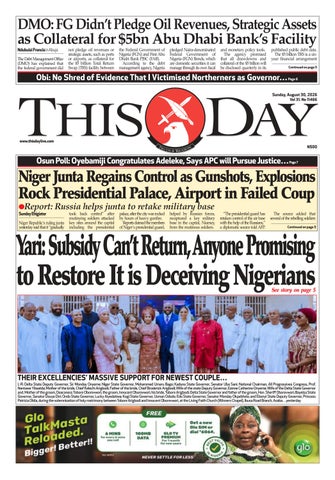
DMO: FG Didn’t Pledge Oil Revenues, Strategic Assets as Collateral for $5bn Abu Dhabi Bank’s Facility Ndubuisi Francis in Abuja
The Debt Management Office (DMO) has explained that the federal government did
not pledge oil revenues or strategic assets, such as ports or airports, as collateral for the $5 billion Total Return Swap (TRS) facility between
the Federal Government of Nigeria (FGN) and First Abu Dhabi Bank PJSC (FAB). According to the debt management agency, Nigeria
pledged Naira-denominated Federal Government of Nigeria (FGN) Bonds, which are domestic securities it can manage through its own fiscal
and monetary policy tools. The agency promised that all drawdowns and collateral of the $5 billion will be disclosed quarterly in its
published public debt data. The $5 billion TRS is a sixyear financial arrangement Continued on page 5
Obi: No Shred of Evidence That I Victimised Northerners as Governor… Page 6 Sunday, August 30, 2026 Vol 31. No 11466
www.thisdaylive.com TR
UT H
& RE A S O
N500
N
Osun Poll: Oyebamiji Congratulates Adeleke, Says APC will Pursue Justice… Page 7
Niger Junta Regains Control as Gunshots, Explosions Rock Presidential Palace, Airport in Failed Coup Report: Russia helps junta to retake military base
Sunday Ehigiator
Niger Republic’s ruling junta yesterday said that it “gradually
took back control” after mutinying soldiers attacked key sites around the capital including the presidential
palace, after the city was rocked by hours of heavy gunfire. Reports claimed the members of Niger’s presidential guard,
helped by Russian forces, recaptured a key military base in the capital, Niamey, from the mutinous soldiers.
“The presidential guard has retaken control of the air base with the help of the Russians,” a diplomatic source told AFP.
The source added that several of the rebelling soldiers Continued on page 5
Yari: Subsidy Can’t Return, Anyone Promising to Restore It is Deceiving Nigerians
See story on page 5
THEIR EXCELLENCIES’ MASSIVE SUPPORT FOR NEWEST COUPLE…
L-R: Delta State Deputy Governor, Sir Monday Onyeme; Niger State Governor, Mohammed Umaru Bago; Kaduna State Governor, Senator Uba Sani; National Chairman, All Progressives Congress, Prof. Nentawe Yilwatda; Mother of the bride, Chief Kelechi Arigbodi; Father of the bride, Chief Broderick Arigbodi; Wife of the state Deputy Governor, Ezinne Catherine Onyeme; Wife of the Delta State Governor and. Mother of the groom, Deaconess Tobore Oborevwori; the groom, Innocent Oborevwori; his bride, Tobore Arigbodi; Delta State Governor and father of the groom, Hon. Sheriff Oborevwori; Bayelsa State Governor, Senator Douye Diri; Ondo State Governor, Lucky Aiyedatiwa; Kogi State Governor, Usman Ododo; Edo State Governor, Senator Monday Okpebholo; and Ebonyi State Deputy Governor, Princess Patricia Obila, during the solemnisation of holy matrimony between Tobore Arigbodi and Innocent Oborevwori, at the Living Faith Church (Winners Chapel), Ibusa Road Branch, Asaba…yesterday
2
SUNday, AUGUST 30, 2026 • T H I S D AY
SUNDAY, AUGUST 30, 2026 • T H I S D AY
3
4
SUNday, AUGUST 30, 2026 • T H I S D AY
5
AUGUST 30, 2026 • T H I S DAY, T H E S U N DAY N E W S PA P E R
NEWS
FG: Moody’s Change of Nigeria’s Outlook to Positive a Reflection of Positive Impact of Reforms
Ndubuisi Francis in Abuja
The federal government has welcomed Moody’s Ratings’ decision to revise Nigeria’s outlook from stable to positive while retaining the country’s longterm foreign- and local-currency ratings at B3. The decision, announced by Moody’s on Friday, means the agency does not consider Nigeria’s current credit rating to have deteriorated and sees conditions that could support an upgrade if the country’s economic reforms continue to deliver results. The Minister of Finance and
Coordinating Minister of the Economy, Taiwo Oyedele, said in a statement yesterday that the decision reflected the impact of economic reforms implemented by the federal government over the past three years. A positive outlook generally signals that a rating upgrade could be considered within the medium term if the factors underpinning the improved assessment are sustained. For Nigeria, an improved sovereign credit rating could eventually reduce the cost of accessing international financing and strengthen investor confidence, although the
immediate impact of an outlook revision is different from that of an actual rating upgrade. Moody’s attributed the improved outlook to Nigeria’s stronger external position, citing large current account surpluses, rising foreign exchange reserves, improvements in the foreign exchange market and a more effective monetary policy framework. The agency projected that Nigeria’s current account surplus could reach about 6.1 per cent of GDP in 2026. It also noted the significant increase in the country’s external reserves. Figures from the Central Bank
of Nigeria (CBN) put Nigeria’s external reserves at $53.30 billion as of August 26, 2026. Moody’s also noted strongerthan-expected economic growth, with real GDP growth reaching 4 per cent in 2025, above its earlier projection of about 3 per cent. The agency expects economic growth to remain around that level through 2027, supported by expansion in non-oil activities and increased oil production. Inflation has also declined, falling to 15.4 per cent in July 2026 from 25.3 per cent a year earlier, according to the figures cited in the assessment. The Moody’s decision follows
other recent developments in Nigeria’s financial markets. On August 27, 2026, FTSE Russell moved Nigeria from “Unclassified” to “Frontier Market” status. In May, S&P Global Ratings upgraded Nigeria’s rating from B- to B, while Fitch Ratings maintained the country’s B rating with a stable outlook. The latest assessments point to improved perceptions of Nigeria’s macroeconomic conditions, although the country’s ability to sustain the gains will depend on continued fiscal and monetary reforms, economic growth and
improvements in its external position. Speaking further on the development, Oyedele said, “Moody’s positive outlook is an important external validation of the difficult but necessary reforms this administration has implemented, from removing a costly and inequitable fuel subsidy to unifying the exchange rate, and the landmark tax reforms. These decisions are restoring the fundamentals of macroeconomic stability: stronger reserves, a resilient external position, moderating inflation, and more credible policy transmission.”
YARI: SUBSIDY CAN’T RETURN, ANYONE PROMISING TO RESTORE IT IS DECEIVING NIGERIANS Chuks Okocha in Abuja The Director General of the 2027 Presidential Campaign Council of the All Progressives Congress (APC), Senator Abdulaziz Yari, has said any politician campaigning on a promise to restore the subsidy regime is misleading the public. Yari, who spoke when members of the party’s National Working Committee (NWC) visited him, was responding to a pledge by former Vice President Atiku Abubakar to introduce a targeted subsidy system if elected president in 2027. Atiku, the presidential candidate of the African Democratic Congress (ADC), had argued that Nigerians were
yet to see clear evidence of how funds saved from subsidy removal were being utilised. He promised a different approach to cushion the impact of petrol price increases. But Yari insisted that the subsidy system had become too costly and lacked transparency. He argued that restoring it would create more problems for the country. The former Zamfara State governor said there was no provision for petrol subsidy in the 2023 budget approved by the National Assembly before Tinubu assumed office in May that year. “Before Asiwaju came in in 2023, there was no budget for subsidy. The National
Assembly passed the budget in March, but there was no provision for subsidy in the 2023 budget,” Yari said. He questioned how any incoming government could sustain such a policy without a clear financial framework. “Anybody who is deceiving Nigerians, saying ‘I’m going to bring this thing back,’ he’s lying to himself, he is lying internally, he’s lying eternally, he’s lying to Nigerians,” he said. The APC campaign chief also raised concerns over the figures previously associated with petrol subsidy payments. He said the country lacked accurate data on fuel consumption. He said the subsidy regime
involved huge financial commitments without sufficient clarity on the actual volume of petrol consumed daily. “This is about a N20 trillion deal for a year, going to where we don’t know. Nobody can tell you exactly how much litres we need, what are the quantities per day,” he said. Yari, who previously served as chairman of the Nigeria Governors’ Forum, said governors had repeatedly demanded accurate consumption figures from the Nigerian National Petroleum Company Limited (NNPC). “As chairman governors forum, we challenged NNPC for four years to tell us the exact consumption,” he said. According to him,
explanations given over subsidy payments remained unclear, including claims that Nigeria was subsidising fuel consumption beyond its borders. “When at the end of the day, we pushed harder, they said no, ‘we are doing a subsidy for West Africa,’” he added. Yari said the APC campaign would focus on defending the administration’s record and presenting evidence of its achievements rather than engaging in personal attacks against opponents. “We are on the right path. By God’s grace, we have the data. This is what we are going to do in our campaign – facts and figures,”
he said. He added that “What we have done, what we achieved, and what we intend to do in the future. We don’t call any names. Names are not important to us, but rather what we’re going to do for Nigerians and what we’ve been doing for the past three and a half years.” He expressed confidence that Tinubu remained the best candidate to lead Nigeria beyond 2027. According to him, the president’s policies would receive renewed support from voters. “Bola Ahmed Tinubu is doing his best, and we believe he’s the right man for this job again,” Yari said.
NIGER JUNTA REGAINS CONTROL AS GUNSHOTS, EXPLOSIONS ROCK PRESIDENTIAL PALACE, AIRPORT IN FAILED COUP had been killed. As the clashes broke out, soldiers blocked access to the presidential palace and national television, with Tele Sahel going off air for just over an hour yesterday morning before being restored around 10:00 am (0900 GMT). “There was an attempt by insurgents from the Nigerien armed forces to enter the presidential palace,” a security source told AFP, adding that “they were pushed back by the presidential guard”. Niger’s Defence Minister, General Salifou Mody, in
a statement read on state television, said a group of soldiers held some troops hostage at a barracks in Niamey and opened fire at “certain sensitive sites” in the city, without naming them. “The prompt reaction of the defence and security forces made it possible to contain this heated moment and they gradually took back control of these sites,” he added. Mody’s statement called on the people to “remain calm and freely go about their business”. Niger has been ruled for three years by a military junta
that has struggled to contain jihadist violence flaring in the West African country for around a decade. An African diplomat in Niamey said for now the presidential guard was still loyal to ruler General Abdourahamane Tiani. “Everything is calm again, we can’t hear any more shooting,” a resident of the Yantala district close to the presidential palace said late Saturday morning. Gunfire began in the early hours of Saturday morning, prompting the military to issue a statement on its social
media pages urging people to stay calm and “avoid sharing unverified information”. “Our defence and security forces have been mobilised for the defence of the homeland,” the statement said. One local resident told AFP that there was “heavy gunfire and explosions” at Base 101 in Niamey, a claim confirmed by several other witnesses. The first shots were heard at about 1:00 am local time and continued until daybreak, according to a video published by a local journalist filming the area around the airport.
Another local resident said he heard “bursts of gunfire” at about 7:00 am local time, adding that the weapons heard” are not the kind that terrorists on motorbikes can carry”. “I went to get credit for my phone. I saw a military vehicle heading towards the base that had to turn back,” he said. Another resident west of Niamey said he heard sporadic small arms fire at about 5:00 am. Videos online showed armoured vehicles deployed to reinforce the neighbourhood near the airport.
Niamey airport has been targeted twice this year by jihadists, first by the Islamic State in the Sahel (EIS) in January, then in late June by its rival, the Group for the Support of Islam and Muslims (JNIM), the Sahel branch of Al-Qaeda. The jihadist groups not only target civilians and the military but are also struggling for dominance over each other in the Sahel, and especially in Niger. Twenty assailants were killed and four soldiers wounded in the January assault, authorities said at the time.
DMO: FG DIDN’T PLEDGE OIL REVENUES, STRATEGIC ASSETS AS COLLATERAL FOR $5BN ABU DHABI BANK’S FACILITY
where Nigeria pledges nairadenominated government bonds as collateral to secure immediate US dollar liquidity. It is not a traditional loan but a derivative-based totalreturn swap in which Nigeria hands over local FGN bonds valued at 133.3 per cent of the cash drawn (totalling roughly $6.65 billion if the full $5 billion is utilised). Nigeria pays a floating interest rate pegged to the Secured Overnight Financing Rate (SOFR) plus a margin of roughly four per cent. The FGN has already
drawn an initial tranche of $1.5billion to $2billion to fund infrastructure and manage budget deficits from the deal, which includes a three-year review option, allowing Nigeria to exit, refinance, or continue the arrangement depending on market conditions. But some stakeholders and development partners, including the International Monetary Fund (IMF), had raised concerns about transparency in sovereign TRS deals. However, in its Frequently
Asked Questions (FAQs) published at the weekend, the debt management agency remarked that such transparency concerns had been addressed in Nigeria's case on two fronts. According to the DMO, the terms of the borrowing were disclosed during approval under Section 20 of the DMO (Establishment, Etc.) Act 2003, and Nigeria's broader debtmanagement practice, which already embraces transparency with TRS drawdowns and collateral to be published quarterly in the agency's
public debt data. It said, "The transaction was approved by the Federal Executive Council and the National Assembly, with full disclosure of its terms at each stage. Drawdowns and collateral will be reported quarterly in the Debt Management Office (DMO) Public Debt Statistical Report." The DMO further explained that proceeds from the facility would be channeled into budget implementation, priority infrastructure, refinancing costlier domestic and external debt, and other
urgent needs approved by President Bola Ahmed Tinubu. The debt management body noted that a TRS helps a sovereign or corporate access US-dollar liquidity against pledged assets, adding that, in Nigeria's case, it pledges naira-denominated FGN bonds to FAB, receives USdollar funding, and pays interest at SOFR plus an agreed margin. It stressed that TRS complements, rather than replaces, Eurobonds, noting that sovereigns have used its structures across emerging
markets for over a decade. "It gives Nigeria faster access to dollar liquidity and remains available during periods of market volatility, when Eurobond markets can become more expensive or constrained. It diversifies the FGN's funding sources and reduces reliance on any single market," the DMO said. Regarding how the pricing compares with a Eurobond, it stated that both are commercial instruments priced based on prevailing Continued on page 9
6
T H I S DAY, T H E S U N DAY N E W S PA P E R • AUGUST 30, 2026
NEWS
70TH HEARTY CHEERS…
L-R: Asiwaju Popo Aguda Community, Bolaji Mendes; Chairman of the occasion, Prince Adelowo Adedeji; Son of the celebrant, Fikayo Guedon; Celebrant, Yinka Guedon; his daughter, Modupe Guedon and Mrs Sunbo Daniyan during Yinka Guedon’s 70th birthday reception at Mason Apartments, Ikoyi, Lagos…yesterday PHOTO: KUNLE OGUNFUYI
Obi: No Shred of Evidence That I Victimised Northerners as Governor
Sunday Aborisade in Abuja
The Peter Obi Media Office (POMR) has challenged those it described as unnamed political actors who accused the presidential candidate of the
Nigeria Democratic Congress (NDC), Mr. Peter Obi, of victimising northerners while he was governor of Anambra State to come forward with evidence rather than rely on what it called "whispered accusations."
The campaign office accused these political actors of orchestrating what it called a malicious "northern whisper campaign" against Obi, ahead of the 2027 general election. The media office alleged
that individuals were covertly circulating false claims about Obi's relationship with northerners during his tenure as governor of Anambra State, particularly in rural communities and at northern gatherings.
In a statement issued yesterday by its spokesman, Idris Zekeri, POMR said it had "credible intelligence" that the alleged campaign was continuing despite what it described as denials from northern leaders in Anambra State, who had affirmed their support for Obi. At the same time, he was governor and after leaving office. According to the media office, the alleged campaign was designed to create an impression that Obi had a poor relationship a personal milestone and with northerners while he was more as an opportunity for governor. It, however, said the claims reflection, gratitude and had no basis in fact, insisting renewed commitment to the that those making the allegations service of the country. Meanwhile, the Vice President should come forward with departed Abuja yesterday for evidence rather than rely on Luanda, Angola, where he will what it called "whispered represent President Tinubu at accusations." "The circulation of this the 21st Extraordinary Session of falsehood regarding Peter Obi's the Assembly of Heads of State relationship with northerners and Government of the AU. during his tenure as governor The high-level summit, according to a separate of Anambra State has persisted statement issued by Nkwocha, despite credible denials from will focus on critical strategies northern leaders in Anambra for conflict resolution and State, who have explicitly stated advancing lasting peace and that Obi was, and remains, a stability across the African vital supporter of theirs both in and out of office," POMR said. continent.
Shettima to Associates: I Want Low-key Celebration as I Clock 60 on September 2 Departs Abuja for AU summit in Angola
Deji Elumoye in Abuja
Vice President Kashim Shettima has appealed to his friends, associates, and well-wishers to celebrate his 60th birthday with him on September 2, 2026, in a low-key manner. This is just as the Vice President yesterday departed Abuja for Luanda, Angola, where he will represent President Bola Tinubu at the 21st Extraordinary Session of the Assembly of Heads of State and Government of the African Union (AU). Shettima, in a statement issued yesterday by his media aide, Stanley Nkwocha,
asked his associates to refrain from placing congratulatory advertisements in newspapers or airing celebratory messages on radio, television and digital platforms. The vice president said his decision to keep the milestone low-key reflects his conviction that public attention should remain focused on the serious work of national development rather than on personal celebrations. “To ensure absolute propriety, I respectfully appeal that there should be no public birthday celebrations, congratulatory gatherings or goodwill advertorials across print,
broadcast and digital media platforms,” he said. Rather than celebrate through elaborate events or paid advertisements, Shettima urged well-wishers to channel their goodwill into prayers for Nigeria and for the administration of President Bola Tinubu. He specifically called for prayers for the success of the administration’s economic reforms, lasting solutions to the nation’s security challenges, greater national unity, and the peace and prosperity of all Nigerians. According to the Vice President, the occasion should serve less as a celebration of
The media office alleged that the strategy involved repeating the claims in informal gatherings in northern communities in the hope that constant repetition would make the allegations appear credible. "Despite clear facts, some individuals continue covertly planting these false narratives at northern gatherings, hoping repeated claims will eventually seem convincing," it said. POMR challenged those behind the alleged campaign to provide documentary and verifiable evidence to support their claims. The statement read, "We challenge those behind this campaign to provide names, dates, records, and verifiable evidence supporting their allegations. "They should cease hiding behind whispered accusations and political propaganda." The media office also rejected any suggestion that Obi's administration in Anambra State was conducted along ethnic or religious lines, stressing that the former governor governed the state on behalf of all its residents.
Tunji-Ojo Debunks Atiku’s Land Border Claim, Says Nigeria’s Borders Not Closed Michael Olugbode in Abuja The Minister of Interior, Hon. Olubunmi Tunji-Ojo, has dismissed former Vice President Atiku Abubakar’s promise to reopen Nigeria’s land borders if elected president in 2027, insisting that the country’s borders are already open and therefore cannot be “reopened.” Tunji-Ojo, who oversees the Nigeria Immigration Service (NIS), said Atiku’s claim appeared to conflate different episodes involving
trade restrictions, securityrelated border closures and infrastructure limitations into one continuous shutdown. In a statement issued yesterday, the minister recalled that several major land borders had been reopened under the previous administration and that additional crossings had subsequently been restored. He said the Seme, Illela, Maigatari and Mfum borders were reopened on December 16, 2020, while Idiroko and Ikom were reopened for goods and services on April 20, 2022.
According to him, the current administration also reopened Kamba and Tsamiya in Kebbi State in February 2026, providing links to Niger Republic and Benin Republic, respectively. Tunji-Ojo also challenged the interpretation of border closures involving Cameroon, saying restrictions at Banki and Amchidé were not connected to the 2019 trade policy. He explained that the two crossings had been closed in 2014 following Boko Haram attacks and were subsequently
reopened in 2019, with Fotokol and Gambaru following in 2021 after joint military and stabilisation efforts involving Nigeria, Cameroon, Niger and Chad. The minister warned that presenting the different episodes as one prolonged 2019 border closure distorted the historical record. “Folding this separate, security-driven history into one continuous 2019 shutdown misrepresents two distinct issues, trade regulation and counter-insurgency, as a single
failure,” he said. He, however, acknowledged that not every border crossing in the northern part of the country currently operates without restrictions, stressing that prevailing security conditions dictated such measures. “Where banditry or residual insurgent activity persists, tighter control is a deliberate security judgement, not neglect,” Tunji-Ojo said. He argued that effective border management could not be reduced to a choice between completely shutting borders
and allowing unrestricted movement. According to him, contemporary border management requires the simultaneous enforcement of security, proper documentation, customs compliance and controlled trade facilitation. The minister consequently challenged the former vice president to explain the specific changes his proposed border policy would introduce if elected, rather than describing the current situation as a wholesale border closure.
7
AUGUST 30, 2026 • T H I S DAY, T H E S U N DAY N E W S PA P E R
NEWS
GIVING ACCOUNT OF STEWARDSHIP TO MR PRESIDENT…
President Bola Tinubu (right), and the Director-General of the Nigerian Maritime Administration and Safety Agency, Dr. Dayo Mobereola, when the NIMASA boss went to brief the president on developments within his agency over the past two years at the State House, Abuja…recently
PFAs’ Exposure to Equities, Government Securities Drops to N23.31 Trillion
Kayode Tokede
Pension Fund Administrators (PFAs) reduced their combined exposure to quoted equities and Federal Government securities to N23.31 trillion as of June 2026, representing a decline of 2.68 per cent, or N642.65 billion, from the N23.95 trillion reported by the
National Pension Commission (PenCom) in May 2026. Federal Government securities comprise FGN bonds held to maturity and those available for sale, treasury bills, agency bonds issued by the Nigeria Mortgage Refinance Company (NMRC), Sukuk instruments, green bonds and state government securities.
Despite the month-on-month decline, PenCom’s report showed a significant increase in pension fund investments in both the stock market and government securities since the beginning of the year, reflecting the appeal of strong equity market returns and the relative safety of sovereign debt instruments.
In the first six months of 2026, PFAs’ combined exposure to equities and Federal Government securities rose by 14.9 per cent, or N3.02 trillion, from N20.29 trillion in December 2025. A breakdown of the data showed that PFAs’ investments in quoted equities climbed to N5.9 trillion in June 2026,
Osun Poll: Oyebamiji Congratulates Adeleke, Says APC will Pursue Justice
Yinka Kolawole in Osogbo
The candidate of the All Progressives Congress (APC) in the August 15 Osun State governorship election, Bola Oyebamiji has congratulated the state governor, Ademola Adeleke, who was returned elected in the poll by the Independent National Electoral Commission (INEC). Oyebamiji who alleged attacks on small and medium-sized businesses due to perceived political affiliations or nonallegiance of their owners to the ruling party in the state, also
demanded end to the killings, harassment and intimidation of APC members and supporters across the state He made this known yesterday in his address on the outcome of the governorship poll to the supporters and members of APC in Osogbo. He also said after the declaration of the poll result, efforts were set in motion leading to wider consultations with people inclusive of elders and the critical stakeholders in the party for the next step forward. “As a party committed
to the rule of law, we shall continue to pursue justice and fairness through lawful and constitutional means, particularly in relation to our electoral processes. I, therefore, urge you not to be discouraged or despair. We must remain resolute, sustain our faith in democracy and continue to have confidence in the institutions established to protect our democratic rights,” Oyebamiji said. He added, “In the spirit of democracy and as we commemorate the 35th anniversary of the creation
of our dear Osun State, I congratulate His Excellency, Senator Ademola Adeleke, the Executive Governor of Osun State, on his victory in the August 15, 2026 governorship election as declared by the Independent National Electoral Commission. “At the same time, I call on Mr. Governor, as the Chief Security Officer of the state, to do everything within his constitutional responsibility to protect the lives and property of all citizens, particularly during this sensitive post-election period,” he said.
representing an increase of 49.4 per cent from N3.96 trillion at the end of December 2025. Their exposure to Federal Government securities also rose by about 6.5 per cent, from N16.3 trillion in December 2025 to N17.4 trillion in June 2026. The sharp appreciation in equity investments underscored pension managers’ growing confidence in the Nigerian stock market, amid improved corporate earnings and favourable market conditions. It also reinforced the position of government debt instruments as a cornerstone of pension fund portfolio allocation. PenCom’s asset allocation data showed that, out of the pension industry’s Net Asset Value (NAV) of N30.7 trillion as of June 2026, investments in government securities accounted for 56.7 per cent, while quoted equities constituted about 19.2 per cent. This highlighted the industry’s preference for a combination of capital preservation and growth. Market analysts attributed the increased exposure to equities to the strong performance of the Nigerian stock market during the period. They
noted that improved corporate fundamentals, stronger earnings and renewed investor confidence encouraged PFAs to increase their participation in the market. At the same time, attractive yields on government securities continued to offer pension managers opportunities to earn stable and predictable returns. Treasury bills and government bonds remained particularly attractive to institutional investors. As of early 2026, Treasury bill yields ranged between 16 and 18 per cent, depending on the tenor and prevailing market conditions. The sustained appetite for government securities was also supported by investor confidence in the monetary authorities’ efforts to contain inflationary pressures and maintain stability in the foreign exchange market. The impact of pension funds on the equities market has become increasingly evident. Their participation contributed to bullish momentum on the Nigerian Exchange Limited (NGX), with investors gaining approximately N46.6 trillion in market value during the first half of 2026.
Meta to Charge Businesses for WhatsApp Messages from October 1 Meta, the parent company of WhatsApp, has announced plans to begin charging businesses for customer-service messages on its WhatsApp Business Platform from October 1, 2026. According to a notice on its WhatsApp Business platform, Meta said it would also begin charging for utility messages sent in response to users within the open 24-hour window. The policy means businesses
whose operations depend on the platform will need to plan for additional operational costs from a previously free service. “Effective October 1, 2026, Meta will charge on a permessage basis for all service messages, consistent with how Meta charges for template messages. These messages have not been charged since November 1, 2024,” the company said. “Effective October 1,
2026, Meta will charge on a per-message basis for utility messages sent in response to users (within an open 24-hour customer service window). These messages have not been charged since July 1, 2025.” A service message is a non-template reply sent by a business after a customer initiates a conversation, while utility messages refer to transactional communications such as payment confirmations,
account updates, order confirmations, and delivery notifications. While the 24-hour customerservice window will remain in place, businesses will no longer be able to send free service messages when the window closes under the new policy. The new charges apply to businesses using the WhatsApp Business Platform, formerly known as the WhatsApp Business API, which is designed
for companies managing customer communications at scale. This includes businesses such as banks, fintech companies, telecommunications operators, e-commerce platforms and other companies that use WhatsApp for customer support and automated communications. Although Meta has not provided specific rates, current pricing references indicate that utility-type messages to Nigerian
numbers are around $0.0101 per message, or roughly N13.5 at an official exchange rate of N1,337 as at August 28, 2026, Businesses are also expected to confirm the applicable October rate once Meta publishes its final rate card. Meta has also warned businesses and solution providers to have a valid payment method on their accounts before the new charges take effect.
8
T H I S DAY, T H E S U N DAY N E W S PA P E R • AUGUST 30, 2026
NEWS
DEEPENING LEGAL JURISPRUDENCE…
L-R: Session Coordinator, Dr Cashmia Offurum; Lagos lawyer, Ken Ahia (SAN); Lead Paper Presenter, Prof. Bode Ayorinde; Chairman, Council of Legal Education and moderator of the session, Chief Emeka Ngige (SAN); Lagos lawyer and paper discussant, Uche Wigwe; and Director, Legal Department, NDIC and paper discussant, Femi Kushimo, at the 2026 Annual General Conference of the Nigerian Bar Association, in Port Harcourt…recently
FG Orders Probe as Power Losses on Ikorodu– Sagamu Transmission Line Hit N120 Billlion TCN declares force majeure on Birnin Kebbi-Niaxmey transmission line
Emmanuel Addeh in Abuja
The federal government has moved to unravel massive energy theft and other irregularities estimated at N120 billion along the 132kV Ikorodu–Sagamu transmission corridor, following the discovery of discrepancies of up to 100 megawatts (MW) in electricity flows and consumption patterns over one year. The Minister of Power, Mr. Joseph Tegbe, who directed stakeholders to establish the facts through a transparent, scientific and fair process, gave the charge during a high-level meeting convened by the Nigerian Independent System Operator (NISO) with electricity customers, generating companies and other relevant institutions operating along the corridor. A statement released by NISO in Abuja said the development followed concerns it raised after deploying its technology-based monitoring systems, which have been enhanced since 2024 to provide greater visibility into
electricity flows and consumption patterns across the national grid. The monitoring systems, the statement said, revealed increasingly anomalous loading and consumption patterns along the Ikorodu–Sagamu corridor, with discrepancies reaching as high as 100MW, representing an estimated N120 billion in unaccounted-for energy value over the one year. According to the quasiregulatory body, concerns consequently triggered a technical and forensic investigation aimed at establishing the source of the discrepancies and determining whether they arose from technical, operational, metering or other factors. At the meeting, Tegbe stressed the need for all parties to allow the investigation to establish the facts without prejudice, warning against energy theft, meter tampering and manipulation of electricity data. “We must know where the power is going and what is compromising it,” the minister said, directing stakeholders to establish the facts through a
transparent, scientific and fair investigation. He warned that the government would not tolerate meter tampering, deliberate interference with energy measurements, data manipulation, or any other form of energy theft that deprives the electricity market of legitimate revenue. “Every consumer must be responsible for its actions and consumption,” Tegbe added. Speaking at the engagement, the Managing Director and Chief Executive Officer of NISO, Mr. Bello Mohammed, said the issues under investigation went beyond a routine technical matter, with implications for power system security, the integrity of electricity measurement and energy accounting, market discipline, equitable allocation of system costs and public confidence in the Nigerian Electricity Supply Industry (NESI). Mohammed explained that the Ikorodu–Sagamu corridor had evolved into a major industrial load corridor following network reinforcement, additional
transmission infrastructure and the connection of large industrial customers, including eligible customers. He said the development placed a corresponding responsibility on all participants to ensure that every megawatt and megawatt-hour entering and leaving the corridor was properly measured, accounted for and attributable to the appropriate market participant. According to him, NISO was not seeking to prejudge any participant, but was focused on establishing the facts through credible technical evidence and due process. He disclosed that the investigation included validation of the reference metering infrastructure, physical inspections of industrial substations and electrical installations, and technical checks of metering and measurement systems. Mohammed added that some facilities have also received formal notices based on preliminary findings, requiring
Diphtheria: Katsina Teaching Hospital Runs out of Bed Space Francis Sardauna in Katsina
The ongoing diphtheria outbreak in Katsina State has placed the Federal Teaching Hospital Katsina under severe pressure, with a surge in suspected and confirmed cases overwhelming its Children’s Ward. The hospital management, in a statement issued yesterday, said the facility was receiving a large number of patients referred from other health facilities, stretching its available bed capacity beyond its limits. According to the statement,
“The ongoing diphtheria outbreak in Katsina State has placed enormous pressure on the Federal Teaching Hospital Katsina (FTH Katsina), particularly the Children’s Ward. “The hospital is receiving an overwhelming number of suspected and confirmed cases, as patients are being referred to the facility in large numbers. The situation has resulted in severe overcrowding, stretching available beds beyond capacity. “Despite these challenges, FTH Katsina is doing everything within its capacity to provide
timely and quality care to affected children. The hospital is making necessary arrangements to accommodate and manage the increasing number of patients, even in the absence of sufficient available bed spaces. “Healthcare workers continue to demonstrate commitment and resilience in ensuring that critically ill children receive the care they need while efforts are being made to respond effectively to the increasing patient load.” The management added that necessary arrangements were being made to accommodate and
manage the increasing number of patients despite the shortage of available bed spaces. It also commended the resilience and dedication of healthcare workers, who, it said, had continued to provide care to critically ill children amid the growing pressure on the facility. “Healthcare workers continue to demonstrate commitment and resilience in ensuring that critically ill children receive the care they need while efforts are being made to respond effectively to the increasing patient load,” the statement said.
explanations, remediation, or further investigation. “Electricity delivered through the national grid must be measurable, attributable and accountable,” Mohammed stated. The meeting was attended by representatives of the Transmission Company of Nigeria (TCN), the managing directors of Ibadan Electricity Distribution Company (IEDC) and Ikeja Electric, as well as representatives of companies operating along the corridor.
TCN Declares Force Majeure on Birnin Kebbi-Niamey Transmission Line Meanwhile, TCN has declared force majeure on the 132kV Birnin
Kebbi-Niamey transmission line following the collapse of three transmission towers at Chibike village. The company said the incident occurred on August 26, 2026, after the transmission line tripped at 5:38 pm. It stated that although a trial reclosure was carried out at 6:03 pm, the line tripped instantly again, prompting TCN linesmen to embark on a fault-finding patrol. “Following the incident, TCN linesmen embarked on a faultfinding patrol and discovered that three towers, T109, T110 and T111, had collapsed at Chibike village. The collapse was caused by heavy rain and a windstorm experienced in the area.
Ecuador Ex-president Bags Five-year Jail Term over $76m Bribery Scandal
Ejiofor Alike
An Ecuadorian court has sentenced former President Lenin Moreno to five years in prison for accepting bribes linked to the construction of the country’s largest hydroelectric dam. Moreno, who served as president from 2017 to 2021, was among 20 people convicted over corruption allegations surrounding the Coca Codo Sinclair hydroelectric project, which was built by Chinese company Sinohydro. Prosecutors alleged that Sinohydro paid about $76 million in bribes, representing roughly four per cent of the project’s total cost. Moreno, 73, denied the allegations and maintained that he never received money from the Chinese company. Speaking after Friday’s ruling,
the former president said he had never received “a single cent” from Sinohydro. He also blamed the case on the administration of his former political ally and predecessor, Rafael Correa, whom he accused of seeking revenge after their political relationship deteriorated. Moreno served as Correa’s vice-president between 2007 and 2013 before succeeding him as president. The two later fell out after Moreno moved away from Correa’s socialist policies and developed closer ties with the United States. The court also sentenced Moreno’s wife and other relatives to nearly three years in prison for complicity in the corruption case. Two former managers of the Coca Codo Sinclair power plant were also among those convicted.
9
AUGUST 30, 2026 • T H I S DAY, T H E S U N DAY N E W S PA P E R
NEWS
TWENTY HEARTY CHEERS TO TAX ADMINISTRATORS…
L-R: Deputy Vice President, Chartered Institute of Taxation of Nigeria, Mrs. Titilayo Fowokan; Immediate Past Chairman, CITN Lagos and District Society, Mr. Ini James Esau; 20th Chairman, CITN Lagos and District Society, Mrs. Yetunde Olorunleke Olowofoyeku; and President and Chairman of the Council, CITN, Mr. Innocent Chinyere Ohagwa, at the investiture of the 20th Chairman of CITN Lagos and District Society and inauguration of the 2026/2028 Executives at Alausa, Lagos…yesterday
FG Invites Stakeholders’ Proposals for Finance Bill 2027, Seeks Fiscal Transparency
Kayode Tokede
The federal government has invited members of the public, businesses, investors, professional bodies, civil society organisations, academia, public institutions, and other stakeholders to submit proposals for the finance bill 2027. In a notice sent to THISDAY, the Federal Ministry of Finance said the submissions should focus on practical and evidence-based legislative or regulatory reforms to strengthen Nigeria’s fiscal framework, improve the business and investment environment, enhance fiscal transparency and accountability, and support sustainable economic growth. According to the notice, proposals on taxation and revenue administration could cover tax policy, revenue mobilisation, compliance, taxpayer services, tax certainty, incentives, customs and excise, as well as coordination among revenue agencies. Before now Finance Bill’s consultations were conducted around draft legislation. In 2020, the Federal Ministry of Finance, Budget and National
Planning released a draft Finance Bill for public consultation, with the exercise aimed at obtaining stakeholder input before the bill progressed. Similarly, during the development of the Finance Bill 2022, the then Minister of Finance, Budget and National Planning, Zainab Ahmed, said the ministry had engaged a wide range of stakeholders and obtained feedback through a technical committee. The proposed bill was subsequently presented to the National Economic Council, where governors were invited to make additional inputs before it proceeded to the Federal Executive Council (FEC). The finance ministry’s 2027 initiative calls for proposals into the bill itself. The ministry is asking contributors to identify laws and provisions that should be amended and, where possible, provide proposed drafting language. On fiscal policy and management, the ministry said stakeholders could make submissions on revenue and expenditure management,
budgeting, public financial management, fiscal sustainability, public debt and intergovernmental fiscal relations. The ministry said contributors should identify the relevant law and specific provision requiring amendment and provide proposed drafting language, adding that general recommendations would also be considered but could be less useful for legislative drafting.
In its invitation, the ministry is also seeking proposals on fiscal policy and management, including revenue and expenditure management, budgeting, public financial management, fiscal sustainability, public debt and intergovernmental fiscal relations. Stakeholders in the financial and economic sectors are similarly being invited to
make submissions on capital markets, investment and cross border capital flows, anti-money laundering, financial reporting and other regulations with significant fiscal or economic implications. The ministry further opened the door to proposals on other laws, regulations, policies and institutional arrangements requiring amendment, harmonisation or
introduction to improve Nigeria’s competitiveness and economic governance. Other priorities include reducing leakages, abuse and regulatory arbitrage, strengthening institutional coordination, transparency and accountability, and improving revenue mobilisation and fiscal sustainability without unnecessarily constraining economic activity.
Sani: North-west Must Repay Tinubu with Votes in 2027
John Shiklam in Kaduna
Kaduna State Governor, Senator Uba Sani, has urged the people of the North-west to support President Bola Tinubu’s re-election bid, saying the region must reciprocate the administration’s interventions with votes in the 2027 presidential election. Sani spoke yesterday through his Special Adviser on Politics, Abubakar Muhammad Mamadi, during the inauguration of coordinators and members of the “Relax,
Tinubu Is Fixing Nigeria” support group for the seven North-west states in Kaduna. The governor said the North-west geo-political zone had benefited significantly from the Tinubu’s administration, particularly in agriculture, education, youth empowerment and women’s development. “No region has benefited under Tinubu’s administration like the North, particularly the seven states in the North-west region,” the governor said. He urged the newly
inaugurated coordinators to take the achievements of the federal government to the grassroots and mobilise voters across the seven states for Tinubu. The support group brought together representatives from Kaduna, Kano, Katsina, Kebbi, Jigawa, Sokoto and Zamfara states. On his part, the convener, Mike Auta, charged members to embark on aggressive grassroots mobilisation, stressing that they must reach communities beyond the major cities. “Go to all nooks and crannies
of the states and mobilise the people. We must ensure victory for President Tinubu come 2027,” Auta said. The group’s women’s leader, Karima Abdullai, said millions of women had benefited from cash assistance and empowerment programmes under the Tinubu administration. She urged women across the region to support the President’s re-election bid, saying she was confident that more women would benefit if Tinubu secured a second term.
DMO: FG DIDN’T PLEDGE OIL REVENUES, STRATEGIC ASSETS AS COLLATERAL FOR $5BN ABU DHABI BANK’S FACILITY
market conditions at the time the funds are raised. It stressed that the TRS has the added advantage of providing quicker access to liquidity and enabling the borrower to benefit from lower future interest rates, though with the downside risk of higher interest costs if rates rise. The DMO said Nigeria pledged Naira-denominated FGN Bonds, which are domestic securities it can manage through its own fiscal and monetary policy tools, adding that no oil revenues or strategic assets, such as ports or airports, were pledged. Explaining the 133.3 per cent over-collateralisation, the DMO
stated that Nigeria pledged collateral worth about a third more than the dollars received, creating a buffer before any extra margin is required. This, it argued, was a standard risk mitigant, and not a cost to the FGN. "Comparable sovereigns have posted up to 166.67%, so Nigeria's 133.3% reflects favourable terms," the DMO said. On when Nigeria would face a margin call, the debt manager disclosed that this can happen only if collateral value falls below the 133.3 per cent threshold, as any call is paid in US dollars. "Nigeria negotiated monthly (rather than the
market-standard daily) margin and a five-businessday cure period - both easing the operational burden of managing collateral," it said. The agency also noted that margin posted is held as collateral, not paid away, and is returned once the collateral position normalises or the TRS closes, consistent with standard derivatives practice. On the three-year break clause, the DMO said it gives the FGN optionality, adding that at year three, Nigeria may continue, refinance, partially reduce, or exit the facility, depending on market conditions and its needs at the time rather than being locked into the full six-year
term. Providing further insight into what the $5 billion deal signifies for debt sustainability, the DMO said the TRS is a debt instrument and that drawdowns will be included in Nigeria's Public Debt Statistics and its debt sustainability analysis. On the question of what happens if the First Abu Dhabi Bank defaults, the DMO said: "Standard ISDA close-out protections apply: the transaction is closed out, exposures are netted, and Nigeria's collateral is released or applied under the agreed mechanics - the purpose of using ISDA documentation is precisely to remove uncertainty
in a default scenario." The main risks to the transaction, the DMO stated, are market, interest rate, FX, collateral valuation, counterparty, and refinancing risk. Each is actively mitigated, it said, noting that counterparty risk is mitigated by FAB's strong credit rating and ISDA protections. In contrast, e-financing risk is mitigated by the year-three break option and Nigeria's access to other funding sources. On collateral valuation risk, it pointed out that the naira-denominated collateral is exposed to local interest-rate and exchange-rate movements, but over-collateralisation
and recent improvements in inflation reduce this risk. On margin-call risk, the DMO said this is mitigated by improved external reserves, a USD 30 million minimum threshold below which a margin call is not triggered, and a five-business-day cure period. Overall, the nation's debt manager said the transaction complies with the Fiscal Responsibility Act 2007 (as amended) and the DMO (Establishment, Etc.) Act 2003, while approvals were secured from the FEC and National Assembly, and the AttorneyGeneral of the Federation, who issued a formal opinion on the transaction.
10
T H I S D AY, T H E S U N D AY N E W S PA P E R AUGUST 30, 2025
NEWS
CHICKEN REPUBLIC’S MEGA EXPANSION DRIVE…
L-R: Area Manager, Abuja and Middle Belt, Chicken Republic, Bright Uwaifo; Restaurant Manager, Jos, Chicken Republic, Maren Umungai; Plateau State Commissioner for Commerce and Industry, Hon. Musa Ibrahim Ashoms; Plateau State Commissioner for Youth and Sports, Comrade Prince Miaphen; Restaurant Manager, Abuja, Chicken Republic, Daniel Ocheche; and Regional Manager, Abuja and North, Chicken Republic, Susan Foyeke Oke-Job, at the ribbon-cutting ceremony of Chicken Republic in Jos, Plateau State…yesterday
Babangida, Shettima, Atiku, Fintiri, Oborevwori, Obaigbena, Others Condole with Damian Dodo over Mother’s Passing Wale Igbintade
Former military President, General Ibrahim Babangida (rtd.); Vice President Kashim Shettima; former Vice President Atiku Abubakar; Adamawa State Governor, Umaru Fintiri; Delta State Governor, Sheriff Oborevwori; Chairman/
Editor-in-Chief of THISDAY/ ARISE Media Group, Prince Nduka Obaigbena; former Senate President, David Mark, and the Minister of the Federal Capital Territory (FCT), Mr Nyesom Wike, have condoled with legal icon, Mr. Damian Dodo (SAN), over the death of his mother, Mrs. Veronica Rabi Dodo.
IG Visits Niger,Vows to Rescue Abducted Worshippers The Inspector-General of Police, Olatunji Disu, yesterday visited Niger State to assess the security situation and ongoing rescue operations following the recent attack and abduction of worshippers in communities in Dekara District, Borgu Local Government Area. Disu, who paid a working visit to the Niger State Government House, was received by the Deputy Governor, Yakubu Garba, who represented Governor Mohammed Umaru Bago, alongside the Commissioner for Homeland Security, Maurice Magaji. A statement issued on Saturday by the Force Public Relations Officer, Ani Iniedu, said the IGP conveyed the condolences of the Nigeria Police Force to the state government, people of Niger State and families of the victims. He assured them that the safe recovery of the abducted persons and arrest of the perpetrators remained the focus of the ongoing operations. The statement partly read, “He conveyed the condolences of the Nigeria Police Force to the Government and people of Niger State, as well as the families of the victims, and assured them that the safe recovery of the abducted persons and the arrest of the perpetrators remain the focus of ongoing operations.”
Disu commended the Commissioner of Police in the state, Adamu Elleman, for the command’s response and timely situation reports on the incident. He also appreciated the Niger State Government for its continued support to the police, particularly through the provision of operational vehicles, repairs of Armoured Personnel Carriers and welfare support for personnel. Addressing officers and men of the Niger State Police Command, the IGP charged them to sustain intelligence-led and professionally coordinated operations while prioritising the safety of victims and affected communities. The statement said, “Disu charged them to sustain intelligence-led and professionally coordinated operations, while prioritising the safety of victims and affected communities. The Command was assured of Force Headquarters’ continuing support to strengthen its logistics, mobility, intelligence, training, and operational capacity.” Disu further directed the command to deepen inter-agency coordination and community engagement, stressing the importance of collaboration with traditional rulers, religious leaders, community leaders and other stakeholders in intelligence gathering and early response.
Other prominent Nigerians who have reached out to the Dodo family include former Speaker of the House of Representatives, Yakubu Dogara; Archbishop Ignatius Kaigama; Cardinal John Onaiyekan; former Chief Justice of Nigeria, Justice Mahmud Mohammed; former Inspector-General of Police, Ibrahim Abubakar; and Nasarawa State Deputy Governor, Dr. Emmanuel Akabe. Also among the early sympathisers were Senators Sanusi Daggash and Bashir Lado. Mrs. Dodo died on Wednesday, August 19, 2026, at the age of 81. She was born on November 29, 1944. Some of the dignitaries have visited the Dodo family’s Maitama residence in Abuja or reached out by telephone and messages to express their condolences and pray for the repose of the deceased’s soul. Shettima, while consoling the bereaved family, said: “May the soul of Mama rest in peace. And may God grant the family the fortitude to bear the irreparable loss. Amin.”
Atiku, in his condolence message, said: “We have come to condole D. Dodo (SAN) on the irreparable loss of his Mum. May God grant her eternal rest. Amen.” Former Senate President Mark simply said: “Rest in peace, Mama.” Wike also prayed for the repose of the deceased, saying: “Mama, we have faith that you will be resting in the bosom of the Lord Jesus Christ. Amen.” Dogara, in his condolence message, acknowledged Mrs Dodo’s contribution to the church and humanity while praying for her eternal rest. “May Mama’s departed soul rest in perfect peace at the bosom of our Lord Jesus Christ. Thanks for the impact on the church and humanity,” he said. Archbishop Kaigama, in a personal tribute, recalled the support he received from Mrs Dodo while serving as a parish priest in Wukari, Taraba State. “The loss is monumental. Mrs Veronica Dodo was my great pillar of support in Wukari when
I was Parish Priest. May she enjoy eternal rest,” he said. Cardinal Onaiyekan also joined the family’s friends, colleagues and associates in mourning Mrs Dodo, saying her life reflected the Christian virtues of perseverance and faith. “I hereby join my voice to the condolence messages of the very many family, friends and colleagues to you at the passing into glory of your dear mother. May her dear soul rest in perfect peace. “Please take consolation that your dear mother has ‘run a good race, fought the good fight and kept the faith’. Her crown of glory is sure in paradise,” Onaiyekan said. The Cardinal explained that he was unable to visit personally because he was in New York for a global peace event and would subsequently travel to Nairobi, Kenya, for similar engagements before returning to Abuja on September 6. Also visiting the bereaved family were Adamawa State Governor Fintiri and Delta
State Governor Oborevwori, who offered their condolences to Dodo and other members of the family. The Deputy Governor of Nasarawa State, Dr. Emmanuel Akabe; former Chief Justice of Nigeria, Justice Mohammed Mahmud, and former InspectorGeneral of Police, Abubakar, were also among those who visited to sympathise with the family. Several Senior Advocates of Nigeria (SANs) have also visited the family, including Dr Alex Izinyon; former Attorney General of the Federation and Minister of Justice, Mr. M.B. Adoke; Chief Godwin Obla; Chief A.T. Kehinde; Samuel Atung; Dr. Joshua Musa, and Mr. Audu Anuga also visited. Former Chiefs of Defence Intelligence, AVM Monday Morgan (rtd.) and AVM Mohammed Usman (rtd.), were also among the retired senior military officers who visited the family. The Commander of the Multinational Joint Task Force in Chad, Major-General Saidu Audu, also paid a condolence visit.
El-Rufai Family Feud Deepens as Bashir Attacks Bello
•Accuses lawmaker of belated defection, loyalty to Uba Sani
A festering disagreement within the family of former Kaduna State Governor, Mallam Nasir el-Rufai, erupted into the public domain yesterday as his son, Bashir, launched a scathing, expletive-laden attack on his elder brother, Bello, questioning the federal lawmaker’s loyalty to their family. In a series of posts on X, some of which were subsequently deleted, Bashir accused Bello of pursuing narrow political interests and remaining aligned with Kaduna State Governor, Senator Uba Sani, even after the governor’s relationship with their father had deteriorated. Sani, once a close political associate of the former governor, fell out
with him after emerging victorious in the 2023 Kaduna governorship election. Following el-Rufai’s resignation from the All Progressives Congress (APC) in March 2025, Bello, who represents Kaduna North Federal Constituency in the House of Representatives, remained in the ruling party. He,however,defectedfromtheAPC to the African Democratic Congress (ADC) on May 7, 2026, joining his father in the opposition party. Reacting to the defection, Bashir alleged that Bello remained loyal to Sani until he realised that the governor was no longer favourably disposed towards him, after which
he began invoking family loyalty. “Stuck with Uba Sani until he realised he was being dumped, then suddenly remembered family loyalty and moved to ADC. Where has he been since? Purely serving his interest,” Bashir wrote. He also accused the lawmaker of maintaining a neutral position while other members of the family openly criticised the Kaduna State governor. According to Bashir, Bello had previously asked him to tone down his criticism of his former political benefactor, apparently referring to Sani. “At this stage in my life, I hate nonsense,” Bashir declared, as he branded his brother a hypocrite.
The bitter outburst also contained several highly personal and unsubstantiated allegations against Bello, including claims relating to his private life and alleged drug use. Some of the posts were later removed. Neither Bello nor the El-Rufai family had publicly responded to Bashir’s allegations at the time of filing this report. The dispute unfolded against the backdrop of the former governor’s continuing legal troubles. El-Rufai has been in custody since February 2026 over allegations of financial impropriety during his tenure as governor of Kaduna State between 2015 and 2023.
SUNDAY, AUGUST 30, 2026 • T H I S D AY
11
T H I S D AY, T H E S U N D AY N E W S PA P E R AUGUST 30, 2025
12
NEWS
YEAR 2026 VALEDICTORY SERVICE…
L-R: Chairperson of the day, Mrs. Folake Allison; Father of the day, Alhaji Bolarinwa M.M; Principal, Oriwu Senior Model College, Ikorodu, Mrs. Iyabode Agnes Elushakin; Old Student, Mrs. Toyin Mabadeje; and Director of Arts/Human Resources, Education District ll, Mrs. Adeyemi Fashola M.F, during the school’s year 2026 valedictory service in Lagos…recently
Akpabio to Nigerians: 2027 Polls Won’t Disrupt Legislative Business President of the Senate, Senator Godswill Akpabio, has assured Nigerians that the 2027 election campaigns will not disrupt the National Assembly’s legislative activities, insisting that lawmakers will continue to perform their constitutional duties throughout the electioneering period. Akpabio said electioneering and legislative responsibilities were separate assignments, which members of the NationalAssembly could effectively balance. He stressed that lawmakers were elected for four-year terms and were expected to work for the entire duration of their mandates. The Senate President spoke with
journalists at the Presidential Wing of the Victor Attah International Airport, Uyo, Akwa Ibom State, shortly after attending a meeting of All Progressives Congress (APC) critical stakeholders in Akwa Ibom North-West Senatorial District. At the meeting, President Bola Tinubu, Akpabio and Governor Umo Eno received unanimous endorsements from the stakeholders for their respective bids to return to office in the 2027 elections. According to a statement issued by Akpabio’s Special Assistant on Media, Jackson Udom, the Senate President maintained that the commencement of politi-
cal campaigns would not interfere with the legislative calendar or prevent the National Assembly from addressing issues affecting Nigerians. He said lawmakers could conveniently combine their campaign schedules with their legislative responsibilities by organising political engagements around the hours dedicated to parliamentary business. “We are elected for four years, and we are going to work for four years. Anybody who is walking on
the tiny rope must be able to do the balancing act,” Akpabio said. He explained that although lawmakers were politicians who would participate actively in the 2027 campaigns, their political activities could be scheduled without compromising their responsibilities to the electorate. “We are politicians and campaigns will start very soon. Campaigns can be fixed in the afternoons or evenings while we do our work in the mornings,” he said.
Akpabio also pointed out that members of the NationalAssembly belonged to different political parties and, therefore, would not necessarily be campaigning at the same time. “It is not everybody that will go for campaign at the same time because we belong to different political parties. Nothing will affect legislation,” he stressed. The Senate President assured Nigerians that the National Assembly would remain focused on its constitutional mandate,
particularly on enacting laws to address the needs and challenges of the people. “We will continue to make laws to take care of the needs of the people. It has never affected the work of the parliament,” he added. His comments came against the backdrop of growing political activities ahead of the 2027 general elections, with political parties and their candidates expected to intensify consultations, mobilisation and campaign preparations in the months ahead.
Gunmen Kill Three, Demand N180m Ransom for Abducted Nine Others in Kogi Community Ibrahim Oyewale in Lokoja No fewer than three people have been killed, and nine others abducted following an evening attack on passengers in Ankpa Local Government Area (LGA) of Kogi State. The gunmen have also demanded N20 million each for the release of nine abducted victims, totaling N180 million. The victims, mostly traders from Ajobe community in Ojoku district, were returning from the
popular Nkwo Idoko market in a pick-up van along the deplorable Ankpa-Adoka-Makurdi federal road in Awo when they ran into an ongoing operation by gunmen. It was learnt that on sighting the gunmen, some of the passengers jumped from the vehicle in an attempt to flee, but ran out of luck. “The assailants opened fire on the fleeing passengers, killing three on the spot while many others sustained gunshot injuries,” a relative of one of the victims, Yakubu Ishyaku, explained.
He said nine people from the same Ajobe community, including his late elder brother’s wife, were abducted by the gunmen and taken to an unknown destination. According to him, the three deceased victims - two males and a female - were buried yesterday, according to Islamic rites. He added that the kidnappers contacted a family member of one of the victims in the nearby Okaba community on Friday evening. “They demanded N20 million for each of the victims in their
custody before switching off the phone. Since then we have not been able to reach them through that line,” he explained. Also commenting on the incident, a sister of one of the kidnapped victims, Mrs. Achenetu Akubo, appealed for the immediate release of all those affected. She said her sister, Mariam, was kidnapped alongside her daughter during the incident and their abductors demanded N40 million as ransom for their release.
Police Dismantle Human Trafficking Syndicate in Lagos, Rescue Two Colombian Nationals Linus Aleke in Abuja Operatives of the Nigeria Police Force attached to the National Central Bureau (NCBINTERPOL), Lagos Annex, have uncovered and dismantled a human trafficking syndicate in Lagos State and successfully rescued two foreign nationals who were allegedly lured to Nigeria and held captive by the trafficking ring, the Police Force has said. According to a statement by the Force Public Relations Officer, CSP Ani Iniedu, the
successful operation followed actionable intelligence received from INTERPOL-NCB in Bogotá on 26 August 2026 regarding two female Colombian citizens, identified as Maria Camila Rodas Ortiz and Yuliet Fernanda Rios Mesa. The statement revealed that the victims were fraudulently lured to Nigeria, held against their will, and had their travel documents confiscated by certain Chinese nationals who are currently at large. The Force spokesperson said: “Upon receipt of the
intelligence, police operatives promptly launched a covert tracking operation, locating the hideout in Lagos, where both victims were safely rescued on the same day. “The fleeing suspects abandoned the location upon sighting the approaching team, and efforts have been intensified to track down and arrest all members of the syndicate.” CSP Iniedu said the rescued victims are currently in safe custody and receiving the necessary support. He disclosed that the Co-
lombian Embassy in Accra is working in close collaboration with the Bureau to secure hotel accommodation for the victims and arrange emergency travel documents to facilitate their safe return to Bogotá. The Inspector-General of Police, Olatunji Disu, reaffirmed the Nigeria Police Force’s unwavering commitment to safeguarding the lives and property of all residents nationwide, while deepening collaboration with international law enforcement partners to combat cross-border crime.
T H I S DAY, Th e S U N DAY N e w S PAPe r •August 30 , 2026
BUSINESS
13
Editor: Festus Akanbi 08038588469 Email: festus.akanbi@thisdaylive.com
Before Pointing at Governors, Abuja Must Lead President Bola Tinubu’s challenge to governors to deploy rising revenues to projects that directly affect ordinary Nigerians is timely. However, the federal government must demonstrate the same discipline by prioritising existing roads, electricity, security and other essential infrastructure, writes Festus Akanbi
P
resident Bola Tinubu’s admonition to state governors to channel their rising revenues into projects that directly improve citizens’ living conditions deserves serious attention. At a time of widespread hardship, public expenditure should be determined by necessity, economic value and social impact rather than political prestige. Receiving a delegation of Oyo State traditional rulers at the Presidential Villa recently, Tinubu argued that governors had no justification for poor performance because their allocations had increased considerably. He advised them to build functional road networks that would stimulate economic activity and enable security agencies to reach vulnerable communities, rather than constructing flyovers where traffic volumes did not warrant them. The president’s argument is difficult to fault. Across Nigeria, flyovers, elaborate government houses, ornamental city gates and other grand structures have become convenient political trophies. Their visibility makes them attractive to governors seeking monuments that can be advertised as evidence of performance. Yet such projects frequently coexist with dilapidated schools, understaffed hospitals, impassable rural roads and communities without potable water. With Federation Account allocations reaching unprecedented levels, state governments must reconsider their priorities. In August 2026, the Federation Account Allocation Committee approved the distribution of N3.007 trillion among the federal, state and local governments from revenue collected in July. This followed the N2.551 trillion shared from June revenue. Gross statutory revenue increased from about N3.701 trillion in June to N4.359 trillion in July. Tinubu is therefore justified in demanding more of governors. Higher allocations should produce corresponding improvements in public services. Payment of salaries and pensions is a basic obligation of government, not an exceptional achievement. The Centre for the Promotion of Private Enterprise (CPPE) reinforces this position. Its Chief Executive Officer, Dr Muda Yusuf, recently observed that economic reforms had strengthened government revenue, external reserves, foreign exchange stability and investor confidence. Nevertheless, he warned that macroeconomic stability was a means rather than an end, stressing that its true test was whether it produced stronger investment, more jobs, lower poverty and improved living standards. According to the CPPE, the reforms have substantially expanded the fiscal space available to state governments through higher statutory allocations and stronger internally generated revenue. It consequently urged citizens to demand measurable outcomes in roads, healthcare, public transportation, education, agricultural infrastructure, security, electricity and enterprise support. Higher revenues, it warned, should not merely finance recurrent expenditure and prestige projects but must produce visible development and welfare dividends. However, the same standard should apply to the federal government. The president’s message will carry greater moral authority if it is faithfully replicated in Abuja. The federal government cannot instruct governors to abandon vanity projects while committing enormous resources to ambitious schemes whose immediate benefits to ordinary Nigerians
Bad roads kill businesses
Nigerians deserve a good road network remain uncertain. Nigeria’s infrastructure crisis cuts across federal and state jurisdictions. Many of the country’s most important highways are owned by the federal government. They connect states, agricultural zones, industrial centres, seaports and national borders. Their deterioration increases transportation costs, damages vehicles, causes fatal accidents and creates favourable conditions for kidnapping and armed robbery. For an ordinary Nigerian travelling on a broken highway, constitutional arguments about whether it belongs to the federal or state government offer little comfort. A farmer whose produce perishes because trucks cannot reach the market is uninterested in the administrative division of responsibility. Similarly, a transporter who incurs significant repair costs for vehicles damaged by potholes passes the
additional cost on to passengers and consumers. The federal government is pursuing costly legacy projects, including the Lagos-Calabar Coastal Highway and Sokoto-Badagry Superhighway. These roads could open new economic corridors and stimulate investment when completed. Nevertheless, their long-term promise must not overshadow the urgent rehabilitation of existing highways on which Nigerians and businesses depend today. The principle Tinubu recommended to governors should, therefore, guide federal expenditure: prioritise projects that affect the greatest number of people before committing excessive resources to politically attractive monuments. Restoring existing highways may provide more immediate economic relief than concentrating resources on prestigious corridors whose completion could take several years. The CPPE similarly identified electricity supply, transport infrastructure, logistics efficiency, port operations and security along farming and transportation corridors as urgent priorities. It argued that greater public investment in
agriculture could reduce food inflation, while investment in mass transportation, railways and logistics would lower transportation costs. Improved spending on healthcare, education, water supply and rural infrastructure would also strengthen productivity and reduce the cost of living. Electricity remains particularly critical. Households endure unreliable supply despite higher tariffs, while manufacturers, traders and artisans spend heavily on alternative energy. These costs are passed to consumers through higher prices. If rising federal revenue does not improve electricity generation, transmission and distribution, its impact on ordinary Nigerians will remain limited. Security is another federal responsibility requiring urgent attention. Better roads may enable security agencies to access remote communities, but roads alone cannot end insecurity. The federal government controls the principal security institutions and must provide the personnel, intelligence, equipment and coordination necessary to protect citizens. The N68.32 trillion 2026 federal budget allocates N32.2 trillion to capital expenditure and N15.8 trillion to debt service. Such substantial capital provision should produce measurable changes in roads, electricity, healthcare, education and security. The crucial issue is not merely the amount budgeted but the quality and speed of implementation. Tinubu is right to demand accountability from governors. But the demand must not become an attempt to transfer responsibility for national hardship. Abuja also receives enormous revenues, controls major infrastructure and determines policies that shape household welfare. Before asking governors what they are doing with their increased allocations, the federal government must show how its own rising revenue is repairing highways, improving electricity service, securing communities, and reducing hardship. Leadership by example remains the strongest form of accountability.
T H I S DAY, Th e S U N DAY N e w S PAPe r •August 30 , 2026
14
INDUSTRY
Rising Costs Threaten Nigerians’ Last Glass of Consolation As soaring energy costs and rising taxes threaten another increase in beer prices, even the bottle in which many Nigerians drown their economic sorrows may soon drift beyond their reach, writes Festus Akanbi
F
or years, the Nigerian beer parlour has served as a ministry of consolation. When salaries failed to stretch, contracts disappeared, and the price of food mocked the wage packet, many citizens sought refuge in a bottle and conversation. The problems remained outside, waiting faithfully, but for an hour or two the music was loud enough to silence them. Now, however, high energy bills and a heavier tax burden threaten to make even that escape unaffordable. Nigeria may not be in a technical recession. Still, millions living through a punishing cost-of-living crisis could soon discover that they can no longer drown their recessionary sorrows in booze. The latest accounts of the country’s three largest brewers explain why another round of price increases appears increasingly likely. Nigerian Breweries, International Breweries and Guinness Nigeria recorded combined revenue of about N1.41 trillion in the first half of 2026. Nigerian Breweries accounted for N803.7 billion, International Breweries for N342.1 billion, and Guinness Nigeria for approximately N265 billion. These numbers depict a buoyant industry and a drinking public. Yet revenue is not the same as the amount of beer consumed. It reflects malt drinks, spirits, and other beverages, as well as beer, and much of the increase arose from price adjustments rather than higher volumes. Indeed, the aggregate figures conceal a difficult struggle between stronger nominal earnings and rapidly rising obligations. The three companies incurred tax expenses of N112.87 billion during the period, an increase of roughly 58 per cent on the N71.39 billion recorded a year earlier. Nigerian Breweries’ tax charge rose from N43.83 billion to N63.37 billion; Guinness
Nigeria’s increased from N7.32 billion to N13.03 billion; while International Breweries’ climbed from N20.24 billion to N36.47 billion. Their combined pretax profit nevertheless rose by nearly 24 per cent to about N269.4 billion, suggesting that pricing, improved efficiency and lower financing costs delivered some recovery. The danger lies in how long that recovery can withstand the next wave of costs. Under the 2026 Fiscal Policy Measures, beer and stout attract a specific excise duty of N72 per litre from July 2026, rising to N76 in 2027 and N80 in 2028. Excise is ordinarily justified both as a revenue source and as a public-health instrument: alcohol imposes social and medical costs which should not be ignored. Nevertheless, an abrupt or poorly sequenced levy can also reduce formal sales, weaken investment and encourage consumers to migrate towards cheaper, unregulated drinks whose contents and origins are doubtful. A tax intended to moderate harmful consumption may therefore enrich the illicit market if enforcement is weak. Taxation is only one head of the brewer’s hydra. Brewing is energyintensive: water must be treated, ingredients processed, liquids heated and cooled, bottles washed, production lines operated and finished products refrigerated. Nigerian factories cannot confidently entrust all these processes to an uncertain grid. They often must combine public electricity with gas, diesel, and other captive-power arrangements, then pay heavily to move products over roads where fuel, insecurity, delays, and vehicle repairs inflate transport costs.
Packaging materials, imported machinery and spare parts add exposure to inflation and exchange-rate movements. Every bottle arriving at the neighbourhood bar carries portions of those failures in its price. The arithmetic leaves breweries with three imperfect options. They may absorb the increases and accept thinner margins; cut marketing, capital expenditure or employment; or transfer a substantial share to consumers. Absorption cannot continue indefinitely, especially where shareholders expect returns and plants require maintenance. Cost-cutting can undermine distribution, product quality and future capacity. Passing costs onward is therefore the most probable response, although it risks depressing demand. Brewers may also pursue smaller bottles, cheaper brands and promotional packs, allowing consumers to preserve the ritual of drinking while purchasing less liquid for their money—shrinkflation served with a frothy head. Consumers have already demonstrated striking resilience. Social drinking is more than thirst: it is companionship, networking, celebration and, for some, anaesthesia against anxiety. During the 2016 recession, drinkers told reporters that beer helped them forget unpaid bills, poor business and school fees, if only until morning. A decade later, the setting has changed, but the impulse remains familiar. This helps explain why brewery revenue can rise even while household budgets are squeezed. Demand for affordable indulgence is often stubborn because people do not live by necessities alone; they also purchase moments of relief. Yet resilience should not be confused with unlimited purchasing power. When the price of a bottle collides with the cost of rice, transport or children’s education,
beer eventually loses. Customers first reduce frequency, share bottles, switch brands or migrate to spirits and informal alcohol. Bars then sell fewer plates of pepper soup and grilled fish; distributors move fewer crates; transporters lose journeys; bottle collectors, entertainers and casual workers lose income. The consequences travel through a value chain that employs far more people than the breweries themselves. A price increase is therefore not merely a private quarrel between brewers and drinkers. Government consequently faces a delicate balance. It should retain evidence-based alcohol taxation and firm public health safeguards, but provide a predictable multi-year regime, consult with industry, and resist surprise fiscal changes. More importantly, it must attack the costs that taxes cannot explain: unreliable electricity, poor transport infrastructure, currency instability, overlapping levies and regulatory uncertainty. Reliable grid power would lower production costs more durably than discretionary concessions, while disciplined tax administration would prevent compliant formal businesses from carrying a disproportionate burden. Nigeria’s economy expanded by 3.89 per cent in the first quarter of 2026, so the nation is not formally in recession. For households whose incomes have failed to keep pace with essential expenses, however, statistical growth can feel remote. Beer never cured recession; it merely postponed the conversation until morning. If energy costs and taxes propel prices much further, even that brief postponement will become a luxury. The beer parlour will remain noisy, perhaps. Still, some tables will empty—and a country famed for laughing through adversity may find that its last affordable glass of consolation has been taxed, powered and transported beyond reach.
T H I S DAY, Th e S U N DAY N e w S PAPe r •August 30 , 2026
15
International
Change of Names in International Relations: From Appreciation and Self-Protection to Cold War Politics
N
ame is an identity and a reflection of personality. It is particularly important in international relations because it serves as a potent tool in defining, asserting sovereignty, and shaping global identity. What is in a name goes beyond the name itself. The mentioning of a name can ring many bells. Every living and non-living thing has a name and the name can always be changed for various reasons. Monuments, airports, countries, etc. have been renamed. Even marriages have prompted changes of names. A name can be changed for geographical reasons. Names of seas, regions, borders, territories, landmarks, etc. can be changed. Apart from geographical renaming, official state titles do give legal status and legitimacy to new governments at the United Nations. More important, there is no disputing the fact that a name carries values and history in terms of global image and connects people or citizens to their culture and history. Many countries have changed their names in order to defend their nation’s dignity against past colonial powers. And true, there have been name controversies in international relations. For more than a decade, Greece and Macedonia have been in disagreement over what the official country’s name should be. What is noteworthy about changes of names in international relations is that the reasons for changes of names are also changing from appreciation to cold war. It is moving away from being an act of good gesture to dangerous cold war politics. This development is now threatening the maintenance of international peace and security. This is what U.S. foreign policy of ‘Make America Great Again’ (MAGA) under President Donald Trump is suggesting and to which global concerns are pointing. What informed the renaming of Gulf of Mexico as Gulf of America? How do we also explain the renaming of the Lake Ontario as Lake America? In which way are these changes of names different from the previous re-naming in international relations?
While the renaming of the Gulf was considered ‘appropriate’ in the eyes of Donald Trump, President Claudia Sheinbaum of Mexico noted that Mexico and the rest of the world would continue to call the body of water the Gulf of Mexico, adding that in the same logic, North America itself could be renamed ‘Mexican America’ since Mexico’s 1814 constitution used that phrase before the United States’ own founding documents were signed. As noted by Agata Weremczuk, ‘the President of Mexico, Claudia Sheinbaum, has unequivocally stressed that the country will continue to use the existing term ‘Gulf of Mexico’ (vide “The Significance of Geographical Names and Trump’s Strategic Intentions – Gulf of Mexico or Gulf of America?” (February 19, 2025 Titan, News, Experts). The problematic raised in international relations is about how to refer to the Gulf. For the United States of America, Google calls it Gulf of America while Mexico retains the old name. This is how the United States is promoting disorderliness and making the maintenance of international peace and security more difficult. The mere fact that the Gulf, regardless of whatever name it answers, is accessible to Mexico and Cuba, requires a tripartite consultation in the spirit of international law. Donald Trump is vehemently opposed to consultation in the wrong belief that America can be great again by manu militari. More disturbingly in international relations, the renaming does not have any legal weight beyond the United States. This is in spite of the fact that the U.S. House of Representatives passed a legislation seeking to codify the Gulf of America. As if the renaming of Gulf of Mexico were not enough, Donald Trump again extended the trade war or his struggle to Make America Great Again to Canada last week by renaming Lake Ontario. What greatness is there in the act of renaming? What international respect is there for Americans if the renaming is only meaningful to Americans? Unlike the Gulf of Mexico to which three different sovereign states have access, Lake Ontario is one of the Great Lakes straddling the border between New York State and the Canadian province of Ontario. This means that the renaming is a bilateral issue to be addressed by both the United States and Canada. The likelihood of Canada taking the renaming of the Lake as friendly is remote, bearing in mind that President Donald Trump had once proposed to Canadians to accept to be the 51st constituent part of the United States. The Canadians have politely rejected the insult.
Some Previous Changes of Names
Changing a name is important but not important than the reasons for seeking a change. The political motivations are particularly noteworthy, especially when asserting sovereignty and making territorial claims. In traditional African settings, for example, a name defines one’s identity, links a person to his or her ancestors, and unites him or her to the community. At the level of a whole country, names are taken more seriously. Many countries have changed their names. In Africa, Rhodesia was renamed Zimbabwe in 1980, Gold Coast was renamed Ghana in 1957 to recall the medieval Ghana Empire; Swaziland became Eswatini in 2018 to restore the pre-colonial name which meant ‘the land of the Swazi. Upper Volta was changed to Burkina Faso in 1984 in order to suggest that the country is a ‘land of upright and honest people’; Belgian Congo/Congo Leopoldville was first changed to Zaire in 1971 and later to Republic of the Congo in 1997 in consonance with President Joseph Seseko Mobutu’s policy of authenticité in protest against colonial names; Cape Verde was changed to Cabo Verde in 2013 to emphasize the Portuguese-language name and to reject the translated English name. In Europe and elsewhere, the Irish Free State became Ireland on December 29, 1937, following the approval of a new constitution of Ireland in a national plebiscite. In 2020, the Dutch government officially dropped Holland from its international branding to use only ‘The Netherlands’, the true country name. This decision is understandable from the consideration that Holland is not the whole country. It is a regional area that consists of only two of the country’s 12 provinces. Turkey changed its name to Turkiye in 2022 to discontinue the country from being referred to as a ‘bird’ or a ‘failed’ state, because the word ‘Turkey’ also means failure. In 1993, Czechoslovakia was changed to Czech Republic, to comprise Czechia and Slovakia, following what was called the Velvet Divorce, or a peaceful dissolution into two separate sovereign states. Thus, renaming in international relations is always an important instrument of protest, appreciation, self-re-projection, and domination as it is the case with the U.S. MAGA. Grosso modo, one prominent category of renaming in international relations is in the area of geographic features that are either shared, or contested, or used by more than one country. The category includes seas, rivers, lakes, gulfs and mountains. As these features do not belong exclusively to one country, any unilateral renaming in order to acquire primacy cannot but be provocative. This is precisely what President Trump’s MAGA is all about. Change of names of geo-political locations under President Donald Trump raises many issues of international peace and security. First, Donald Trump wants to present himself to the whole world as an agent of a new America, as a protector of a strong and not a weak America
Appreciation, Self-Protection, and Cold War
Trump under President Joe Biden and as a maker of renewed great America. In the eyes of Donald Trump, Joe Biden, his immediate predecessor, was unnecessarily too weak which should not have been so. Donald Trump therefore wants to show America’s strength and send indirect messages to China, the quietly rising challenger and aspiring new leader of the world. America wants to tell China and other competitors that it is not yet ready to relinquish its leadership of the world. In showing American strength, Donald Trump has deliberately been threatening the national interests of other sovereign states. The renaming of Gulf of Mexico and Denali is a good illustration of this point. On the very first day in office in January 2025, President Trump signed Executive Order No. 14172, entitled ‘Restoring Names That Honor American Greatness.’ The Order directed the Secretary of Interior to rename the Gulf of Mexico as the Gulf of America for use by the Federal Government and the U.S. Board on Geographic Names. Besides, the same Order also restored the name Mount Mckinley to Alaska’s tallest peak. The renaming as Mount Mckinley was a reversal of the 2015 decision taken under President Barack Obama who returned the mountain to its traditional Alaska Native name, Denali. Renaming Denali as Mount Mckinley did not generate controversy because the Mount Mckinley is located within the United States. The exercise of renaming falls squarely within the purview of domestic competence of the U.S, Government. However, the renaming of Gulf of Mexico as Gulf of America generated much animosity simply because the waters of the Gulf are adjacent not only to the United States but also to Mexico and Cuba. President Trump unilaterally decided to appropriate the commonly accepted name, Gulf of Mexico. The major considerations of President Trump were the economic importance of the Gulf to the United States, and the infuriating facts of trade imbalances, unauthorized migration, and drug trafficking across the U.S.-Mexico border. The immediate implication of the U.S. unilateral decision is that the renaming does not go beyond the 12 nautical miles from the coastline recognized by international law as limit of exercise of national sovereignty.
Without jot of doubt, every act of renaming is not simply an administrative exercise. Be it at the level of geographic feature, a state, or a piece of urban infrastructure, renaming is a communication between and among political actors to either show admiration, assert sovereignty, correct a colonial wrong, protect a domestic interest, or deliver a well-calculated insult in diplomacy. Renaming as a tool of ‘Making America Great Again’ (MAGA) under President Donald Trump is not about admiration for anyone or appreciation. It is more about unilateralism and insulting of other sovereign states, intimidating them to accept U.S. claims of sovereignty. The renaming of the Gulf of Mexico and Lake Ontario are clear manifestations of U.S. policy aggressiveness. Most unfortunately, the strategy of MAGA has not succeeded in intimidating China, the perceived arch rival, if not enemy, of the United States. And true enough, China has attained the same level of technological and industrial greatness as the United States, if not more, particularly in many areas: military equipment (the Fujian aircraft carriers), genetically modified seeds, the increasing use of the RMB (cross-border payment system by 180 countries) which necessarily makes the dollar less of a priority. Besides, China does not use Western medical equipment as Shanghai United Imaging’s CT scanners are now entering the U.S. and Europe according to Professor Yang Fan of the University of Political Science and Law. Consequently, if President Trump wants to promote an imperialism-driven new world order while the world wants the maintenance of international peace and security, Africa should not accept. Reaction can begin with the renaming of all inherited colonial names in Africa
As shown above, renaming is a good instrument of power. It is an exercise of power. It is a manifestation of politics per excellence. It can have a multipurpose function. For our purpose in this column, it should be recalled that during the colonial days, rivers, mountains, cities, and an entire territories were renamed after colonial monarchs, explorers, and national heroes. By so doing, indigenous names were consciously obliterated. However, with decolonization, African leaders began to reverse the colonial acts of renaming in favour of local names, indigenous languages, etc. As of today, and in this Vie Internationale, we distinguish between and among three broad types of renaming. First is appreciation and identity renaming in which people are honoured for their services to the community, or to show historical memory or restore dignity to a place or people. Second is self-protection renaming, which is done to assert sovereignty, or protect economic or territorial interests, as well as projecting strength, drawing a symbolic boundary when there are situations of contested resources or assets. The third category is the cold war style or the tit-for-tat renaming. Greater emphasis is placed on this third category in order to underscore the implications for the maintenance of bilateral and international peace and security. Without jot of doubt, the most common category of renaming in international relations is the change of the name of a country, examples of which we have mentioned above. It is the third category of renaming, that is, the diplomatic tit-for-tat type that we want to explicate in order to draw lessons for global peace and security and particularly for Africa’s development and strategic autonomy in global affairs. At the level of Nigeria’s bilateral relationship with the United States, there have been both appreciation and cold war types of naming and renaming. It was in appreciation of U.S.-Nigeria good understanding under Nigeria’s Chief Olusegun Obasanjo and United States under President Bill Clinton that the access road to the international airport in Abuja, Nigeria, was not only renamed Bill Clinton but also that he was given a Nigerian name, OMOWALE, a Yoruba name meaning a ‘Child Returns.’ The name suggests the returning home of a son, the returning of a friend of Nigeria and Nigerians. This is expression of gratitude. Appreciation naming is also an invitation or request for a better entente in the relationship. Consequently, it does not involve political qualms. At the level of cold war renaming, there were two cases of note: the Kudirat Abiola Corner Affair and the Walter Carrington affair. As regards the Kudirat Abiola Corner Affair, the Nigerian pro-democracy activists in the United States proposed that the New York City honour Kudirat Abiola, the wife of Chief M.K.O. Abiola whose electoral victory was annulled by military President Ibrahim Badamasi Babangida in June 1993. The activists suggested that the street corner outside Nigeria’s United Nations Permanent Mission and Consulate at the intersection of East 44th Street and Second Avenue in Manhattan be named ‘Kudirat Abiola Corner.’ The strategic calculation of the pro-democracy activists was to compel Nigerian diplomats to see her name whenever they enter and also go out of the building. The proposal unsettled the mind of the government of General Sani Abacha who was compelled to lobby the U.S. State Department and fund opposition to the proposal, as well as go to courts to challenge the renaming. The argument of Nigeria was that the act of renaming was an improper interference with the diplomatic standing of Nigeria’s Permanent Mission. The City Council held hearings and eventually upheld its authority to rename. General Abacha was not happy with the decision and would retaliate immediately.
Read full article online on www. thisdaylive.com
16
T H I S D AY SUNDAY AUGUS 30, 2026
BENUE STATE AND CATTLE: FROM CONFLICT TO SHARED PROSPERITY Benue can lead Nigeria’s livestock transformation by championing planned ranches, feedlots and permit -based open grazing, contends JUNAIDU MAINA
“W
hen brothers fight to the death, a stranger inherits their father’s estate.” This African proverb warns of the peril facing farmers and pastoralists in Benue State. There was a time when the relationship between the Tiv and Fulani was remembered as much through humour as through conflict. Among the older generation in the North, the Tiv–Fulani jokes were legendary, rivalled only by the famous Katsinawa–Nupawa and Kanuri-Fulani banters. The jokes reflected familiarity, shared history and centuries of peaceful coexistence. The 1983 re-election campaign of late President Shehu Shagari, famously known as “Gboko ’83,” became a defining political moment in Benue, bringing national politics, local leadership, and the cattle question together on one memorable stage. At the rally the charismatic Joseph Tarka reportedly led a herd of cows into the stadium and presented it to President Shagari, declaring: “We are tired of this Munchi issue; here are your cows for the last time leave us alone.” President Shagari, a witty Fulani himself, smiled and, to the amusement of the crowd replied: “These cows cannot even pay the interest.” For those not familiar with the story, a Fulani herder returned from transhumance to reclaim the cows he had left with the Tiv, only to be told, “munchi”—“we ate them.” Whether remembered with perfect accuracy or polished by history, the anecdote captures an important truth: cattle were once a subject of political theatre and friendliness— not a justification for endless bloodshed in Benue. Today, sadly, farming communities and pastoralists find themselves trapped in a war of attrition with no real winners. Villages are destroyed, livestock lost, and both herders and farmers killed—a pyrrhic victory in which both communities emerge poorer while the state remains in perpetual unrest. The tragedy is that this conflict is avoidable and even resolved through science, justice and practical policy. Benue State is, in fact, uniquely positioned to become the flagship of Nigeria’s livestock transformation. Benue is rightly called Nigeria’s food basket, given its remarkable agricultural potential. But its importance goes beyond crops: geographically, ecologically and economically, Benue is also one of Nigeria’s most strategic livestock states. For centuries, the fertile Benue valley served as the principal dry-season destination for cattle moving south from the Sahel. Long before colonial boundaries, pastoralists from present-day Niger, Chad and northern Nigeria followed established transhumance corridors in search of pasture and water. These seasonal movements sustained peaceful regional trade and commerce, while the animals’ manure naturally enriched farmlands, replenished soil fertility and supported healthier agro-ecosystems.
This historical relationship produced both cooperation and occasional disputes. Anthropologists may better explain the cultural interactions between Tiv and Fulani communities, but history leaves little doubt that the two peoples have travelled a long road together. Today, Benue still occupies the crossroads of ECOWAS livestock commerce. Home to ten designed grazing reserves and two major international transhumance stock-routes that converge towards the state—one originating from the Kano–Katsina axis in the northwest and another from Yobe and Borno in the northeast. These routes connect ECOWAS livestock markets with southern Nigeria, the largest consumer market in the region. Equally significant is Benue’s veterinary importance. Three of Nigeria’s eight gazetted interstate animal disease control posts and quarantine stations are located within Benue’s livestock corridors, making the state central to surveillance against transboundary animal diseases. Any serious national animal diseases control strategy must therefore succeed in Benue. This is where animal science should have played a greater role. The Joseph Sarwuan Tarka University, Makurdi, one of Nigeria’s leading agricultural universities, exists primarily to solve local agricultural problems through research and innovation. A broader consultation with experts from this university ab initio would have explained that open grazing exists in both ranching and pastoral production system. And this clear understanding might have produced a more workable Open Grazing Prohibition and Ranches Establishment Law, 2017. The sad lesson now is that the law is inherently difficult to implement, and the enforcement approach has also produced unintended consequences that have heightened tensions and contributed to conflict rather than resolving it. Without questioning the legitimacy of an enacted law, there is a strong case for evidence-based review and refinement of its implementation, guided by lessons learned, modern livestockmanagement practices and fairness that protect the interests, security and livelihoods of both farming and pastoral communities. The Netherlands excluding inland water has a land area of about 33,500 km², while Benue State has 34,059 km², yet Netherlands supports approximately four million cattle and has become a global leader in dairy products, livestock genetics and agricultural technology. Its success rests not on abundant land, but on science and technology of intensive production systems, farmer cooperatives, efficient feed industries. well-integrated value chains and rule of law. Benue has universities with strong faculties of Agriculture, Veterinary Medicine and Animal Science, supported by a large pool of livestock professionals, veterinary infrastructure, abundant water, fertile soils, crop residues, and access to some of Nigeria’s largest meat markets.
Dr Maina is CEO at JM Global Associate Ltd
Osun defied the narratives by giving the rest of Nigeria a ray of hope, argues AYODELE OKUNFOLAMI
B
BETWEEN OSUN AND MANCHESTER
ecause Andy Burnham was interested in taking over from the then troubled Prime Minister of the United Kingdom, he had to return to parliament. This meant he had to contest the vacant Makerfield seat in a by-election that he won. Burnham had earlier resigned as Mayor of Manchester to take advantage of the election meaning that the Manchester Mayoral position was now up for grabs. The by-election for mayor took place July 30th and Bev Craig was declared winner. I want to take for granted that the reader is aware why Osun State had to go to the polls outside the regular general election cycle in Nigeria. Governor Ademola Adeleke regained his seat after a fiercely fought election. The buildup to the elections was dirty, messy and bloody. Federal might was deployed (don’t mind the Minister of the FCT) in the closure of local government accounts and other state accounts, bias police arrests, overwhelming presence of governors and senators of the ruling party, and violence that led to more than 40 election-related deaths. Despite the feared perils and historical mistrust of the process, 44% of Osun voters came out to cast their vote compared to 24% of Mancunians that came out to vote. The Osun voter, like every other Nigerian voter, has only six hours (8am to 2pm) to vote on a Saturday or a designated public holiday while Election Day in the UK is usually on Thursdays, they have 13 hours to vote (7am to 10pm) and this is besides the option to vote by mail. Altogether, the Greater Manchester resident had about two weeks to vote yet, they have a poorer turnout than Osun. Ironically, the Manchester percentage is lower than the UK average while Osun is higher than the Nigerian average, but I have chosen to pick the positives from Osun end. I can’t say why Mancunians were less interested in coming out to vote for their mayor, but we can learn from the Osun electorate. The first thing I would like us to take from Osun is their resilience. One could have lazily taken the easy path of voter apathy with the predictable excuse of votes not counting, coming out to vote is risky, or that things remain the same however the votes go but Osun said no. They defied the narratives giving the rest of Nigeria a ray of hope. What I can deduce from this is that it is not because we don’t vote remotely, electronically or safely that prevents us from exercising our civic responsibility, but it is because the political options before us have neither been appealing nor enticing enough to cost us all the trouble. Adeleke went all out to campaign. He didn’t just fold his arms and blame his loss to a flawed and helpless process. He carried people from Osun and beyond with him. Politicians that want people to vote for them should be ready to do the work. Another goal Osun scored over Manchester was the timeliness of the result. That was surprising. Despite Osun state being nine times bigger in geographical mass area, twice the voting population, more rural and bucolic than Greater Manchester, yet Adeleke was declared winner less than 18 hours after polls closed. Compare that with the Manchester polls that had to go for a runoff. The first round of votes was not concluded 24 hours after polls closed. It was until Saturday afternoon that the returning officer
announced Craig as the newly elected mayor. We need to clap for ourselves, build on it and not always badmouth ourselves. Meanwhile, the UK voting system is strictly manual. You go to the polling unit and vote with your hand on paper and it is counted as crudely as ours. However, I want to point something from this Manchester election that we can learn from. The use of the Supplementary Vote System. In this system, the voter is given two electoral options on one ballot paper. The first being his preferred option, the second being an entirely different candidate from the first. The second vote is considered if after the initial count doesn’t produce a candidate with over 50% of the votes, all but the top two candidates are eliminated and the votes for the excluded candidates are transferred to their second preference if cast for either of the two remaining candidates. After all the second preference votes are counted and added to the first-choice tallies, the candidate among the remaining two who has the most votes is declared the winner and elected. With the 2027 race expected to be close, I think Nigeria can adapt this voting method in future Electoral Acts amendments to save us cost in (re)printing ballot papers, the overall logistics of deployment of election materials and personnel, and the shutting of the economy again to accommodate a runoff election. Elections in Nigeria is criminally more expensive compared to that of the UK. The UK can afford to change Prime Ministers as often as they want because the cost of general elections does not cost them an arm. The UK does not need to spend almost N210 billion on bimodal voter accreditation system to verify a voter because they have a standardised housing system with residents duly registered in the state used as automatically used as the voters register. Graeter Manchester, as I observed, did not need to deploy over 15,000 police officers as was needed in Osun because election is a regular civic exercise. With a pollution of less than 2.8 million people regularly watched by over 8,200 police officers, the election came and went with voters not scared of hoodlums or thuggery. There was no need to post police to every polling unit adding to the already over bloated budget of INEC. Okunfolami writes from Festac, Lagos. @ayookunfolami
41
T H I S D AY SUNDAY AUGUST 30, 2026,
EDITORIAL
Editor, Editorial Page PETER ISHAKA Email peter.ishaka@thisdaylive.com
NPERA ACT AND MARITIME ECONOMY
F
NPERA has the potential to bring sanity to the maritime sector
or more than four decades, Nigeria’s ports have carried the weight of a contradiction. Although they serve as the gateways through whichthebulkofthenation’stradepasses,they have been bastions of inefficiency, arbitrary charges, and unchecked exploitation. This has left shippers, importers, exporters, freight forwarders, and manufacturers crying over a suffocating system where foreign shipping lines and terminal operators raise freight rates, impose surcharges, and delay cargo release most often without any consequences. The Nigerian Shippers Council (NSC), which until recently was Nigeria’s primary regulatory agency, also suffered from inadequacies stemming from legal limitations. The limitations gave rise to the deafening call for a new legal framework that would change the narrative and reposition the NSC for better economic gains for the country. In response, President Goodluck Jonathan, through an Executive Order in 2014, designated NSC as the Port Economic Regulator. The EO positioned the Council to address high tariffs, monopolistic practices, and inefficiencies. But there was a serious pushback from both the Nigerian Ports Authority (NPA) and terminal operators. The result was extensive court battles that went as far as the Supreme Court. Meanwhile, the task facing the sector was not one a mere executive order could fix. It needed legislation. That legislation, which created the Nigeria Port Economic Regulatory Agency (NPERA), was recently assented to by President Bola Tinubu. The NPREA Act, 2026 repealed the Nigerian Shippers’ Council (NSC) Act of 2004 and converted the NSC into NPERA. The action gave Nigeria a permanent statutory economic regulator for its ports. It also created a new operational framework, which was something the industry has been operating without since 2014. The core structural change of the NPERA Act ensures that the NPA retains its landlord functions and marine operations, while NPERA takes over tariffs, licensing, service standards, competition, commercial dispute resolution and trade facilitation. In sporting terminology, while NPA owns the stadium, NPERA comes in as the referee. The new framework represents the culmination of a decade-long struggle to give Nigeria’s port economy a regulator with real teeth. Nigeria has one of the highest shipping charges in the
world imposed by a handful of terminal operators which makes our ports most unaffordable and unattractive. This new legislation is set to reverse this. The birth of NPERA comes with the potential to bring stability, inclusiveness, and sanity to an industry that has for too long operated below its capacity. Predictability is the currency of trade. Investors, shipping lines, and logistics companies do not merely want low costs; they also want to know, with reasonable confidence, what those costs will be next quarter and next year. A statutory regulator with the power to enforce tariff discipline gives the industry a foundation on which long-term planning, rather than reactive crisis management, can finally take place. Outside stability, NPERA carries the potential to foster genuine inclusiveness across a sector that has often privileged the powerful over the majority. Small and medium-sized freight forwarders, independent clearing agents, and local logistics operators have historically had little leverage against dominant shipping lines and terminal operators. A regulator empowered to guard against monopoly and dominant market abuse, to encourage competition, and to mediate disputes among stakeholders shifts the balance of power toward fairness. The maritime sector’s chronic disputes over container deposits, demurrage, storage charges, and cargo clearance delays have not only cost businesses money but have eroded trust between service providers and service users. A well-resourced NPERA, backed by clear Standard Operating Procedures for cargo clearance, truck movement, and port decongestion, offers the chance to replace this culture of dispute and distrust with order, transparency, and accountability. When the rules of engagement are clear and consistently enforced, the incentive to cut corners reduces and service quality increases. The NPERA Act offers something the sector has lacked for far too long: a regulator with the legal authority to enforce fairness, the mandate to pursue efficiency, and the vision to position Nigeria as a genuine maritime hub. This is why every stakeholder, including government agencies, shipping lines, terminal operators, and logistics professionals alike, must ensure that this new dawn is not squandered.
When the rules of engagement are clear and consistently enforced, the incentive to cut corners reduces and service quality increases S U N DAY N E W S PA P E R EDITOR DAVIDSON IRIEKPEN DEPUTY EDITORS FESTUS AKANBI, EJIOFOR ALIKE MANAGING DIRECTOR ENIOLA BELLO DEPUTY MANAGING DIRECTOR ISRAEL IWEGBU CHAIRMAN EDITORIAL BOARD OLUSEGUN ADENIYI EDITOR NATION’S CAPITAL IYOBOSA UWUGIAREN THE OMBUDSMAN KAYODE KOMOLAFE
T H I S DAY N E W S PA P E R S L I M I T E D EDITOR-IN-CHIEF/CHAIRMAN NDUKA OBAIGBENA GROUP EXECUTIVE DIRECTORS ENIOLA BELLO, KAYODE KOMOLAFE, ISRAEL IWEGBU DIVISIONAL DIRECTORS SHAKA MOMODU, PETER IWEGBU, ANTHONY OGEDENGBE DEPUTY DIVISIONAL DIRECTOR OJOGUN VICTOR DANBOYI SNR. ASSOCIATE DIRECTOR ERIC OJEH ASSOCIATE DIRECTOR PATRICK EIMIUHI CONTROLLERS ABIMBOLA TAIWO, UCHENNA DIBIAGWU, NDUKA MOSERI DIRECTOR, PRINTING PRODUCTION CHUKS ONWUDINJO TO SEND EMAIL: first name.surname@thisdaylive.com
Letters to the Editor
Letters in response to specific publications in THISDAY should be brief(150-200 words) and straight to the point. Interested readers may send such letters along with their contact details to opinion@thisdaylive.com. We also welcome comments and opinions on topical local, national and international issues provided they are well-written and should also not be longer than (950- 1000 words). They should be sent to opinion@thisdaylive. com along with the email address and phone numbers of the writer
LETTERS
W
ATIKU AND RESTORATION OF PETROL SUBSIDY
hy have media outlets focused almost exclusively on the recurring fuel subsidy debate while paying little attention to the broader and more fundamental concerns raised by Atiku Abubakar? It is now a matter of public record that the presidential candidate of the African Democratic Congress (ADC), Atiku Abubakar, has promised to restore the fuel subsidy if elected president in the 2027 presidential election. His argument is that Nigerians have yet to see benefits commensurate with the economic pain caused by the removal of the subsidy. The removal of the petrol subsidy resulted in a significant increase in the price of petrol. This, in turn, contributed to higher transportation costs, which subsequently pushed up the prices of food and other goods and services. For millions of Nigerians already struggling with declining purchasing power, the reform has translated into a severe increase in the cost of living.
Nigeria reportedly generated an estimated 15.8 trillion in additional public resources from the removal of the petrol subsidy and the floating of the naira between May 2023 and December 2025. These funds did not remain as idle cash in government coffers. Rather, they were distributed among the three tiers of government providing additional resources to governments amid mounting economic pressures on citizens. According to the figures, state governments received approximately 6.52 trillion, while the federal government received 5.43 trillion. Local governments received about 3.88 trillion. The substantial increase in revenue was expected to help governments cushion the effects of rising inflation, worsening living conditions, and other economic difficulties associated with the reforms. Yet, despite the enormous resources made available, fundamental questions remain about how effectively the funds have been utilised. This is where the conversation should go
beyond the recurring question of whether the fuel subsidy should be restored. Atiku Abubakar raised legitimate concerns about transparency, accountability, prudent management of public resources, and measurable outcomes. Nigerians have every right to ask what has been achieved with the additional revenue accruing to the three tiers of government. African Democratic Congress presidential candidate has argued that the increased allocations have not translated into improvements commensurate with the scale of the resources made available. Theabsenceofsufficientlyclearandcomprehensive public reporting on how the additional funds have been spent has further fuelled concerns about whether the revenue generated from the reforms is achieving its intended purpose. The presidential candidate of theADC also vowed that anyone responsible for looting or mismanaging funds accrued from past fuel subsidy savings should be made to account for their actions and, where necessary, make full restitution.
More importantly, he questioned what has become of the savings generated by the removal of the subsidy, asking where the funds have gone and why Nigerians have not seen corresponding improvements in their living conditions. According to his argument, if the money saved from subsidy reforms had been transparently invested in critical sectors such as healthcare, education, security, infrastructure, and youth empowerment, Nigeria would be in a far better position today. Whether one agrees with Atiku’s proposal to restore the subsidy or not, should these questions not be given serious consideration? The debate should not be reduced to a simple contest between those who support subsidy removal and those who favour its restoration.
Abbah Dukawa, Abuja. abbahydukawa@gmail.com
A
WEEKLY PULL-OUT
30.8.2026
WILLIS IKEDUM
Refining Nollywood Vanessa Obioha writes that award-winning Nollywood filmmaker Willis Ikedum has built his career around asking questions, challenging conventions and refusing to accept that things cannot be done differently. EDITED BY: VANESSA OBIOHA/vanessa.obioha@thisdaylive.com.
T H I S D AY, T H E S U N D AY N E W S PA P E R •AGUST 30, 2026
43
COVER
Refining Nollywood
Ikedum (2nd left back row) with ‘Sweet 16’ cast
I
t’s been a busy period for Nollywood filmmaker Willis Ikedum following the release of his musical film ‘Sweet 16.’ It is one of the few feature-length film musicals to emerge from Nollywood. But Ikedum, who started as an actor, has never been one to stay within familiar territory. Although, the film has already enjoyed a strong opening weekend, and much of that success can be attributed to Ikedum’s relentless promotional drive. On the day we met, he had just flown to Lagos from Port Harcourt, where the movie was shot. Two days later, he was already back in Abuja, where he is based. In between his movements, he was making calls, checking emails, going on media tours and even streaming church services. Ikedum, it turned out, does not play with his faith, something he traces to his upbringing. But his restlessness goes beyond promoting a film. It is part of a larger desire to improve things around him. He cited his foray into filmmaking as an example. His father had wanted him to be a lawyer. Although he admitted that he loved the charisma of lawyers, he did not see himself becoming one. He only did pre-law studies before switching to Theatre Arts, a decision he largely credits to Nigerian Queen of Box Office, Funke Akindele. According to him, they met on a set in Enugu in 2003. At the time, Akindele was gaining fame for her role in the teen health series ‘I Need to Know.’ She told him bluntly that she was studying law mainly for her parents and had no inclination to become a lawyer. Her true passion, she told him, was the film industry, and she encouraged him to pursue his own interest in it. Thus, Ikedum ended up studying Theatre Arts at the University of Port Harcourt. His earlier acting credits include ‘The Billionaire’s Club.’ Filmmaking came in 2010. “Mostly because what I’ve been seeing was subpar to me at that time, and I knew I could do better,” he explained. That desire to improve things appears to be part of his personality. “I’m not an onlooker. I’m that guy who wants to solve problems. For instance, there is a building in Abuja where I used
to visit. A very fine place, but it’s not been run well. I keep telling the owner to do something about it. When I visited the place this year, there’s been no change, and I just approached him and told him that I wanted to buy the building. That’s my kind of person.” The same mindset has followed him into filmmaking. He recalled his goal of winning an Oscar and how he was among the early voices advocating for a Nigerian film to be submitted to the Academy Awards. “I realised that there was no Nigerian film that had been submitted to the Oscars at the time.” Nigeria has since made several attempts, although no Nigerian submission has yet made it to the final shortlist. For Ikedum, one of the challenges lies in the technical quality of Nigerian productions, particularly sound. “We don’t have the kind of sound quality required of Oscar movies. Only Genevieve Nnaji’s ‘Lionheart’ was able to achieve that, because she did the sound mixing in Berlin.” But the film was disqualified because it didn’t meet the requirements of the awards for the International Feature Film category, which is dedicated to films made outside the US and has most of its dialogue in a local language. High-quality sound mixing, as Ikedum puts it, is very expensive and not every filmmaker can afford it. The closest studio in Africa with the kind of sound mixing he wanted is in South Africa. For ‘Sweet 16,’ he went even further, employing the services of Pinewood Studios in the US. “That’s the home of the James Bond franchise.” His decision to make a musical film was also driven by the absence of similar works in Nollywood. “I ask a lot of questions, and when I asked why we didn’t have a musical film, I didn’t get any answer, so I knew I had to do it.” That question led him into a world of research and test shoots. He watched films such as the 2016 award-winning Hollywood musical La La Land and began studying the technical demands of making a musical. “One of the things I discovered was that the way you mic for dialogue is not the way
you mic for singing,” he said. “There’s a way you mic for singing that the sound would come as if the person is speaking from the nose.” To ensure that the actors performed well alongside the singing, he brought in a music director, a language coach and a choreographer. “These three experts were on set because the whole music was sung on set. It wasn’t pre-recorded.” The result is ‘Sweet 16,’ which tells the story of a privileged, sassy young girl, played by Daisy Eugene, whose extravagant expectations for her sixteenth birthday take an unexpected turn when she uncovers deep secrets about her family’s true status. The film also features the late Alexx Ekubo, whom Ikedum described as a brother. “He was the first person to listen to the music after we finished recording. He loved all the music.” At the premiere, Ikedum recalled how audiences were emotionally moved each time Ekubo’s scenes appeared. “Some members of the audience cried whenever his face came on screen.” The film also features Julius Agwu, whom he described as someone who encouraged him when he was starting as an actor and was willing to connect him with gigs. Other actors include Mercy Aigbe, Kalu Ikeagwu, Uche Jombo, Emeka Nwagbaraocha, Denrele Edun, Yemi Alade, Angel Unigwe, Broda Shaggi and Chief Imo. The idea for the story came to him in 2016. He returned to it in 2020, while production began last year. The film had its theatrical release on August 14. The story was partly inspired by his eight-year-old daughter, who he says is sometimes influenced by Western lifestyle. “So this is me trying to draw them back and say, ‘Hey, I have a culture here. I have a culture in Nigeria. I have a culture in Africa. For example, you know that we cannot call people who are older by their first name. But it’s easy for them to do so. I go to their school and say, ‘Willis, what’s up?’ But it’s not so here. Inasmuch as you
are trying to be civilised, we have a culture, and there are certain lines you can’t cross.” Family, he said, is a recurring theme in his films. “Even if it’s horror.” For Ikedum, filmmaking has taught him a few things, including patience and respect for people. “Also doggedness. I have always been a resilient guy from day one, but filmmaking heightened it. You don’t always get it from your first attempt, so you keep trying till you get what you really want to achieve.” It is perhaps this doggedness that best captures Ikedum’s journey so far. Whether it is acting, filmmaking or simply seeing something that could be done better, he is rarely content to remain an onlooker. Through filmmaking, he hopes to impact lives and, eventually, achieve the status he has long pursued — that of an Academy Awardswinning filmmaker.
44
HighLife Babajimi Benson’s Story in Public Service
Benson
Before Babajimi Benson entered the House of Representatives in 2015, he had already held positions that most politicians never reach. He served as Company Secretary and General Counsel at the Lagos State Development and Property Corporation, sat as a Non-Executive Director on the board of Lekki Worldwide Investment Limited, and worked as a Legal Officer in the General Counsel Division at the United Nations headquarters in New York. With such an institutional background, a careful observer can easily understand how he has approached a decade of legislative work representing the Ikorodu Federal Constituency of Lagos State. Now in his third term and Chairman of the House Committee on Defence, Benson has five bills signed into law. The DICON Amendment Act transformed the Defence Industries Corporation into a self-sustaining military industrial complex. The Electricity Amendment Act requires power-generating companies to direct five per cent of their operating expenditure toward host communities, a provision with direct implications for Ikorodu, home to the Egbin Thermal Power Station. The Defence Research and Development Bureau Act created a body to coordinate technological research across the armed forces. A constitutional railway amendment moved rail infrastructure from the Exclusive to the Concurrent Legislative List, opening the sector to state-level development. He also backed the Good Samaritan Bill. In Ikorodu itself, his infrastructure record covers over 65 roads built or rehabilitated, an 80-bed Mother and Child Hospital in Imota, solar streetlights and residential power installations across 8,000 homes, the Modupe Oshikoya Mini Stadium in Ita Elewa, and sports facilities at LASUSTECH. He has built over 30 school classroom blocks and established ICT centres for youth development. His iCare FoodBank, running for eight years, distributes monthly food packages known locally as Apo Anu to elderly residents, widows, and vulnerable families. IKD 106.1 FM, built on constituency grounds, gives local communities a direct media voice. Benson is now seeking a fourth term. In Ikorodu, the argument for continuity is written into the landscape.
T H I S D AY, T H E S U N D AY N E W S PA P E R AUGUST 30, 2026
with KAYODE ALFRED 08116759807, E-mail: kayflex2@yahoo.com
...Amazing lifestyles of Nigeria’s rich and famous
Zacch Adedeji’s Campaign Role Sparks a Fresh Test of Public Trust On August 22, the APC unveiled President Bola Tinubu’s 2027 Presidential Campaign Council. Among the names listed was Zacch Adedeji, Executive Chairman of the Nigeria Revenue Service (NRS), appointed Deputy Director of Fundraising under Ogun State Governor Dapo Abiodun. The reaction was expectedly immediate. Former Senator Dino Melaye threatened to approach the courts, arguing that a serving public official cannot legally occupy a senior position in a partisan campaign structure. The Conference of Nigeria Political Parties went further, demanding Adedeji’s resignation to protect the institutional integrity of the revenue service. Both positions rest on the same concern: a man responsible for collecting taxes from every Nigerian and every business in the federation is now also a senior fundraiser for the government that appointed him. Adedeji’s defenders have responded that fundraising and tax
administration operate in entirely separate spheres and that no public funds will be redirected toward the campaign. However, theft is not primarily the issue critics are raising. It is about perception, and in an institution whose credibility depends on the public believing its decisions are made in the national interest rather than partisan ones, perception carries real weight. The irony is that Adedeji’s own record at the NRS is difficult to fault. Between September 2023 and August 2025, the service generated N46 trillion, beating targets by 115 per cent. Full-year collections in 2025 reached N28.2 trillion. By July 2026, the agency had already pulled in N27.1 trillion. He led the transition from FIRS to NRS, absorbed collection functions from over 60 agencies, and expanded digital compliance tools including the TaxPro-Max system and a USSD channel for tax identification. That record is precisely why his appointment to the campaign
Adedeji
structure feels incongruous to many observers. A revenue chief commanding that kind of institutional confidence is an asset worth protecting from controversy, not a resource to deploy in a re-election drive. The courts may yet decide whether the arrangement is lawful. The question of whether it is wise is already answered by the noise surrounding it.
How Mike Adenuga Rewrote Nigeria’s Telecommunications Story
Adenuga
In August 2003, Globacom entered a Nigerian telecommunications market already occupied by established international operators and made a decision that its competitors had not: it introduced per-second billing. At the time, subscribers across
Nigeria paid by the minute regardless of how long they actually spoke. Globacom changed that, and the shift was more than a pricing innovation. It signalled to the market that the terms of communication in Nigeria were negotiable, and that an indigenous company was willing to negotiate them downward in the consumer’s favour. Twenty-three years later, that first disruption still defines how the company is remembered. Globacom was founded by Dr Mike Adenuga Jr., one of Nigeria’s wealthiest men, whose other major holdings include Conoil and a significant presence in real estate. He built Globacom as a Nigerian-owned competitor in a sector dominated by multinationals, and he has retained sole ownership of it for 23 years, an unusual position in the Nigerian telecoms industry. The company’s infrastructure ambitions grew alongside its
subscriber base. It built the Glo-1 submarine cable connecting the United Kingdom directly to Nigeria, the first such cable to be owned by an African company, strengthening Nigeria’s access to international bandwidth at a time when digital connectivity was becoming essential to commerce and daily life. It rolled out 2.5G, 3G, and 4G LTE networks, expanded fibre infrastructure, and launched MoneyMaster PSB to bring mobile banking to underserved populations. The cost of acquiring a SIM card, once above N20,000, fell to near-zero partly because of the competitive pressure Globacom created. For its 23rd anniversary, the company launched a “Never Settle For Less” campaign and introduced Gloria, an AI-powered customer assistant on its revamped Glo Café app. The name of the campaign captures something true about the company’s origin story, namely, that it entered a market that had already settled. It decided not to.
Chappal Energies:The Capital Lifeline Behind Nigeria’s High-Stakes Oil Gamble
Lokpobiri
In December 2024, Chappal Energies completed what looked like a landmark moment for Nigeria’s indigenous oil sector. The company acquired Equinor’s entire Nigerian portfolio for up to $1.2 billion, taking control of a 53.85 per cent interest in OML 128 and a 20.21 per cent stake in the Agbami field, operated by Chevron. Less than two years later, it is fighting for survival. By April 2026, Chappal had accumulated $430 million in bank debt. Creditors including Standard Bank, Rand Merchant Bank, and Mauritius Commercial Bank issued formal default notices. The company still owed Equinor over $100 million in deferred payments it could not meet. A planned $860 million acquisition
of TotalEnergies’ SPDC stake collapsed when the Nigerian Upstream Petroleum Regulatory Commission cancelled it after Chappal failed to raise the required funds. Then the founder was arrested. The EFCC detained Ufoma Joseph Immanuel in May 2026 on suspicion of forgery. He has been in a Lagos prison since. While in custody, Immanuel fought a parallel battle over control of the company. A minority shareholder fund called R28, chaired by businessman Adebisi Adebutu, launched a $100 million rights issue to inject emergency capital and prevent bankruptcy. Immanuel sued in Mauritius and escalated to the London Court of International Arbitration to block the move, fearing his 34.5 per cent stake would be diluted. Both legal attempts failed. R28 is now moving toward dominant
control. British restructuring expert Michael Humphries is serving as interim CEO. A lifeline has emerged through oil trader Trafigura, which provided pre-financing revenue advances via a crude lift from the Agbami field. Chevron also plans infill drilling at Agbami for 2027 and 2028, and NUPRC has approved a development plan for the deepwater Nnwa-Doro field, providing long-term production optionality if the company stabilises. The Chappal situation captures a structural challenge running through Nigeria’s divestment era. Yes, international oil majors are selling, and Nigerian companies are buying. But acquiring the asset and sustaining ownership are two entirely different problems.
T H I S D AY, T H E S U N D AY N E W S PA P E R AUGUST 30, 2026
45
HIGHLIFE
Dangote’s N600 Million Gesture: When Wealth Finds Purpose in the Future of Young Nigerians
Dangote
Aliko Dangote did not attend LASU’s combined 29th and 30th convocation ceremonies. His daughter Fatima represented
him and received an honorary doctorate in entrepreneurship on his behalf. Still, he sent ahead of him N600 million, enough to pull jaws ajar in wonder and quell “how do we do this?” questions ahead of time. The pledge, made through the Aliko Dangote Foundation, will fund the construction of a female student hostel at Lagos State University. Alongside it came an offer that carries arguably more long-term weight: firstclass graduates in engineering and the sciences will receive pr≠≠eferential consideration for employment within the Dangote Group after their NYSC. For a country that consistently produces high-achieving graduates and consistently fails to absorb them, that second commitment speaks to something real. Moreover, accommodation shortages at Nigerian public universities disproportionately affect female students, creating barriers to retention and academic stability that are rarely captured in convocation speeches. Therefore, the hostel addresses a problem that is less glamorous but
equally consequential. Governor Babajide Sanwo-Olu added to the occasion by awarding N20 million each to LASU’s two top graduates. Ayilara Lawal Olawale finished the 2024-25 session with a 4.96 CGPA. Adebanjo Samuel Oluolamide topped the 2025-26 session with 4.97. The N600 million fits a pattern that has become harder to ignore. In April 2026, Dangote pledged N550 million for a hostel at the Federal University of Technology Owerri, alongside N25 million to students. In December 2025, his foundation announced a decade-long N1 trillion education commitment, targeting STEM, girls’literacy, and teacher training. His daughter Halima has since revealed that he has formally pledged one-third of his estimated fortune, roughly $11.7 billion, to charity through his will, structured under Islamic inheritance law. The foundation already spends around N50 billion annually and disbursed over $47 million in the first six months of 2026 alone.
When Power Spoke, Ndume Stayed: Tinubu, Remi and Zulum’s Intervention in a Senate Journey Senator Ali Ndume says three people persuaded him to stay in the 2027 Senate race: President Bola Tinubu, First Lady Oluremi Tinubu, and Borno Governor Babagana Zulum. That account is worth sitting with for a moment. Ndume represents Borno South, a seat he has held continuously since 2011. Before that, he served two terms in the House of Representatives from 2003. A victory in 2027 would be his tenth general election and fifth consecutive Senate term. His APC ticket is already secured. His main challenger, Abdullahi Askira, withdrew after internal party consultations. His constituents mobilised N38.5 million to purchase his expression of interest and nomination forms. What makes the story more interesting is Ndume’s recent history with the administration, which is now vouching for his continuation. In July 2024, the APC stripped him of his position as Senate Chief Whip after he said
publicly that Tinubu’s government was “caged” and disconnected from the daily hunger facing ordinary Nigerians. He was replaced by Senator Tahir Monguno. He has repeatedly warned the Senate against becoming a rubber stamp for executive bills. None of that led to a defection. Ndume has maintained throughout that he stays in the APC precisely because he believes in speaking truth from inside rather than exiting to make noise from outside. The intervention of Tinubu, the First Lady, and Zulum in his 2027 decision suggests the presidency sees value in that position too. A vocal critic who remains loyal is, in many ways, more useful to a ruling party than a silent loyalist. He provides internal legitimacy, manages discontent from within, and gives the party a credible voice of dissent it can point to when accused of suppressing debate. For Ndume, the encouragement to stay is
Ndume
validation. For the APC, keeping him is a strategy.
Betta Edu’s Political Return: Tinubu’s Campaign Appointment Reopens Questions Left Unanswered
Edu
In January 2024, President Bola Tinubu suspended Betta Edu as Minister of Humanitarian Affairs and Poverty Alleviation and directed the EFCC to investigate her. A memo had emerged showing that N585.19 million meant for vulnerable Nigerians across
four states had been directed into a private account. The then-Accountant-General of the Federation, Oluwatoyin Madein, reportedly described the transaction as illegal. Edu was questioned by the EFCC and released on bail. She denied wrongdoing. No conviction has followed. The case has not been publicly resolved. Then, surprise of all surprises, she has now been named Director of Women Mobilisation in Tinubu’s 2027 APC Presidential Campaign Council. Of course, the appointment is not illegal. It is not as if Edu has been found guilty of anything by any court, and due process demands that this be taken seriously. The APC’s Deputy National Chairman (South) has defended her inclusion, describing her as innocent and citing her grassroots networks as a campaign asset. But the opposition has already seized on the optics. The African Democratic Congress (ADC)
called the campaign council a rehabilitation centre for politicians with unresolved financial questions, and specifically flagged Edu’s inclusion alongside that of former NSITF chairperson Ngozi Olejeme, also named in the structure. The discomfort around the appointment does not rest on assuming guilt. It rests on a different question: what signal does it send when the same president who suspended an official over allegations of public fund mismanagement then places her in a senior role in his re-election machinery, without those allegations having been publicly resolved? Tinubu’s 2024 suspension of Edu was presented as a demonstration of accountability. Her 2026 campaign appointment, in the absence of a concluded investigation, makes that earlier gesture harder to read.
Katsina APC Rift: Radda, Masari Power Struggle Tests Tinubu’s 2027 Political Machinery The relationship between Dikko Radda and the Masari political dynasty in Katsina is one of the more instructive political friendships in northern Nigeria. Radda served as Chief of Staff when Aminu Masari was governor after 2015. The Masari camp backed his elevation to head SMEDAN under Buhari in 2016. When Aminu Masari’s two terms ended in 2023, Radda won the governorship in a transition the former governor publicly endorsed. That history now sits against a growing power struggle. The immediate flashpoint involves billboards. Campaign materials bearing the images of President Bola Tinubu and Ibrahim Masari, Tinubu’s Special Adviser on Political Affairs, were allegedly destroyed along the Modoji Junction to Katsina Government House Road. Governor Radda’s ADC, SP Abdulganiyu Bello, and his Chief Security Officer, DSP
Hassan Bello, were summoned to Force Headquarters in Abuja for questioning in connection with the incident. The Nigeria Police Force has said they were invited for an interview and were not arrested or detained. And while the billboard story is the surface, the deeper issue is the campaign council. Radda and his key state-level allies were visibly absent from Tinubu’s recently released 2027 Presidential Campaign Council structure. Political observers in Katsina read the omission as a pointed signal about where the governor stands in the president’s political calculus. But Ibrahim Masari’s position explains the fault line. He famously served as Tinubu’s placeholder vice-presidential nominee in 2022 before Kashim Shettima was named. Tinubu appointed him Special Adviser on Political Affairs in early 2026, and his growing control over federal patronage has steadily positioned his Abuja-based camp as a counterweight to Radda’s grip on the state
Radda
party structure. Two informal factions now exist within Katsina APC: one anchored around the governor’s office, another around Abuja’s federal appointments.
Olayinka
All Eyes on Olayinka On August 24, 2026, Mrs. Titilayo Olayinka retired from the Ekiti State civil service after reaching the mandatory age of 60. She had served as the state’s Accountant General and Permanent Secretary since November 2019. Less than 24 hours later, Governor Biodun Oyebanji reappointed her to the same role. The speed of the decision was deliberate. Clearly, what Oyebanji was looking to do was not replace but keep what he already had. The reasoning is visible in the numbers Olayinka’s tenure produced. Under Olayinka’s watch, Ekiti ranked first in BudgIT’s State Fiscal Transparency League for seven consecutive quarters, from Q2 2024 through Q4 2025. The state was also rated among the top performers in local government budget transparency and the Subnational Audit Efficacy Index, and was listed among the 10 states nationwide that published detailed, accessible budget information for all local government areas and development areas. For those who might say that these rankings emerge from goodwill, simple research would show that they are the product of systems, discipline, and consistent professional management. Olayinka’s career spans more than three decades. She became a chartered accountant in 1993 and was admitted as a Fellow of the Institute of Chartered Accountants of Nigeria in 2006. She worked as State Programme Accountant for the UNDP between 1999 and 2003, then held senior financial positions across key Ekiti ministries including Health, Information, and the World Bank-funded financial management unit, before becoming Deputy Accountant General and eventually the top officer. Her new mandate includes establishing a comprehensive training programme for accountants across the state civil service, a capacity-building assignment that extends her impact beyond the Accountant General’s office itself. Ekiti joins a small group of states, including Enugu, Osun, and Akwa Ibom, that have retained retired Accountants General rather than searching elsewhere. It is a quiet but telling signal that in public financial management, continuity sometimes matters more than change.
46
T H I S D AY, T H E S U N D AY N E W S PA P E R AUGUST 30, 2026
LOUD WHISPERS
with JOSEPH EDGAR (09095325791)
Ogiame Atuwatse II: The Olu of Warri in Full Bloom If you haven’t seen the colourful clips coming out of Warri during the 5th anniversary celebration of the Olu of Warri’s coronation, you had better search online, and And make sure you use an expensive phone because a cheaper phone will deprive you ≠of all the colours, beauty and magic of the celebration. The most captivating was the regatta. Kai, come and see the colours and the very beautiful people in colourful, stylish traditional wear sitting atop wellregarded boats. The Olu’s own was the spectacle. Red in colour, people adorned in rich red outfits paddled alongside the Olu, who sat regally and distinguished. Chai, even the muddy, polluted waters of the delta estuary looked grand in those clips. These Itsekiri people know how to put on a show ooo. That is how they even dazzled us during the Ogiame’s coronation and scattered the whole place.
Atuwaatse
MARTINS OTSE: A VDM AT THE BAR I was looking for the newly elected President of the Nigerian Bar Association, Mrs. Oyinkan BadejoOkusanya, to invite her to my Masterclass when I stumbled on the clip of a big, black, muscled Very Dark Man on the podium at the NBA Conference in Port Harcourt. Apparently, the NBA is now gradually creating a niche of inviting colourful characters to their events. One year, it was the explicitly crazy Portable, who did not disappoint them. So, when the influential VDM was announced, I personally was not shocked, even though a cross-section of their membership was miffed, not seeing or understanding the point of having him at their event. Anyway, there I was, staring at the man who had even tried to look a little bit presentable. Normally, he would come out looking like he had not taken a bath, with those huge cowries around his neck and pants that looked like they had not seen soap water since he bought
them from the nearest Okrika market. He tried this time around, even though I still did not understand what he was wearing – will take that up with the “obioma” when I see him. Within the first few seconds that he held the mic, he got not only me but the whole hall of “learned people.” “Some of you were wondering why I was invited, querying what I know about the law,” he said to the audience with a mischievous grin. “Well, I don’t have to know the law that some of your lordships are being kidnapped…” That was a slam dunk, showing the grit, bravado and power that made him the quintessential anti-hero in today’s Nigeria. I didn’t need to watch any more because he had just shown that he more than deserved the invite, even more than some of those members who will only go there to fight for corporate gifts and eat free food.
Otse
Adeleke
This one was no less in glitz. It was like something out of Hollywood. Another mesmerising element was the way the Olori knelt to greet her King. That one used to scatter my head. Such a beautiful lady, such elegance, bedecked in a “peacocky” attire like a freshly minted mermaid, would kneel for her king and delicately stand up, gliding towards her own mini throne beside the king – chai, I used to die. Goose pimples usually cover my body, and I would turn to my own Duchess, screaming at her to see how a woman is treating her king. Instead of watching and learning, she would just tell me, “Common, carry the plate to the kitchen; nobody is your housemaid here.” Her response immediately jolts me back to reality. Congratulations to the much venerated Olu of Warri whose handsomeness, scootergliding skills, height, demeanour, apparel, and huge wisdom is bringing back the much-needed dignity to our traditional stools. Ogiame!!!
Well done, NBA and well done, VDM. Kai. ADEMOLA ADELEKE: WISHFUL THINKING Since this one won the election, we no hear word again. He has been dancing all over the place and just generally making a mimicry of the whole thing. He has done one significant thing, though. He has pushed a fund for those who lost their lives during the elections. I hear the fund is about N500 million, and this is brilliant. A lot of people lost their lives for no reason, and this show of empathy is most welcome. Even though it will not bring the lives back, its symbolism is not lost. Anyway, that is how his son, the one they call B-Red - I think he too is an Afrobeat musician, but not at the level of his cousin, the mercurial Davido - went on air to spew hmmmmmmm!!! I watched it o, not that anyone told me. He said, “Some people are asking my dad to go for the
Oshiomhole
Presidency... if he is President, everything will be good…” Make I just keep quiet; we just won an election. It’s not good for us to start abusing ourselves just now. So, I will let that one slide, but let me just say one thing sha: a beetle cannot be a Lambo, no matter the engine oil you use and no matter how you push it. And with that, let me rush to my Afang. ADAMS OSHIOMHOLE: THIS LEOPARD AND HIS CHANGING SPOTS This one is struggling badly with his spots. This leopard is really suffering from a bad case of the itch. His “leopardic” spots are really itching him. The other day, he went into a huge nostalgic relapse. He regaled a crowd with how he mobilised against the removal of fuel subsidy during the Obasanjo regime. The visionary push of President Obasanjo, who so many years ago had seen the folly of the subsidy lost on him, he continued his “tales by moonlight” with glee.
Parton
47
T H I S D AY, T H E S U N D AY N E W S PA P E R AUGUST 30, 2026
You see, there is a reason why some leaders are visionary while the others are just that – leaders. So, Oshiomhole in 2026 has now finally seen the evil that was fuel subsidy, something that earlier leaders from IBB had seen those aeons ago and tried to do something about it, with this “pako” leader building his career on a fight against the refusal. He finally sees it at a time when Nigeria has lost trillions, leading to missed developmental goals and a stricken economy. Instead of him to just close one eye and continue with his massaging trips, he climbs the lectern and shamelessly regales us with a story that, in hindsight, was just a trip into a very dark alley led by a very blind tradesman with limited educational qualifications. Make I just keep quiet before they come and beat me. Thank you. IWEH ODINAKA: A SCARY PROSPECT This is one very scary story. This young man is better known as Poco Lee. He is a very popular entertainer and a leader in our social culture. He was recently detained in the UK with strong allegations of sexual impropriety against him. His management has issued a statement denying the allegations and asking us to calm down. Well, we hear that he has been arraigned and asked to be kept in prison till September. We have also heard that he could be facing up to 10 years in prison if found guilty. See my people, this thing is not easy o. The very thin line between consent or not consent and this is why it is best to err on the side of caution. See, you know I just came back – yes, I just came back, and ºº I was there, I went to get a tattoo, and as the artist was drawing the thing on my skin, one curvy, big-bottomed white lass sat across from me. It’s like the devil knows my weakness, so he sent this particular one to me. If you see her thighs and the very short bum pants she was wearing. She was smiling at me o. You know I have dreadlocks, and I’m fine small, and you know what they say about Akwa Ibom men, so I gather. I swear, all I needed to do was say “come,” and that was that. Then I remembered my predecessors, Bill Clinton, P Diddy, Bill Cosby and even our own Senate President who escaped by whiskers. I just finished my tattoo, stood up and greeted her in Ibibio, “So songo o,” and walked away. Not long after, I heard the story of Poco Lee. They said he carried three and did one; the other said no, and voilà, court and prison appeared. Now, if three women agree to enter a room for an encounter, what other consent do you need? Do not forget, there will be drink and “smoke,” so all of us are not having sense again o. Things begin to happen, and everyone is doing everything, and when you all wake up in the morning, you all have forgotten what transpired the previous night. Then one of them goes into the bathroom to wee, and sees drips and screams “rape,” and the mumu police will now be arresting someone. For me, the consent was given the moment we all entered the room. The man himself should also be shouting rape. Mbok, I didn’t want to talk while I was still there before they catch me too.
We must respect ourselves; we must all carry ourselves with dignity. We will not all dress like tarts, drink and smoke like flies, agree to a threesome as alleged and under the influence things happen, and then you wake up and shout rape. All of them should shout rape, abeg. Anyways, Poco Lee deserves what is coming to him because whoever plays with fire must be ready to be burnt, and this is why I carried my erection out of that tattoo shop. DOLLY PARTON: EVEN NIGERIANS MOURN Everywhere I went immediately after the news of the passing of this icon was announced, I saw Nigerians
talking about her and playing her songs. That is how influential her reach was. A lot of us in the 80s grew up with Dolly Parton. She was a great musical icon, and her collaboration with the equally great Kenny Rogers, especially the song “Island in the Stream”, really took us Nigerians away. I was very surprised when I entered a barber’s shop in Lagos, and they were playing the song. She lived a remarkable life, and God will receive her soul, especially. I even heard that the White House flew the flags at half-mast, truly deserving. We in Shomolu will surely do something to honour her.
DONALD DUKE: A RELUCTANT HERO You know I just published a coffee table book on the most powerful and influential people in Nigeria, and Mr. Donald Duke did not make the book, even though his very beautiful wife and my sister Onari contributed an essay. Anyway, that is how I went to look for trouble. Knowing fully well that bro did not make the list, I went to ask him to buy it. He asked the price, and I said, N599,000, and he sent a question mark and moved on. Well, I will not say that because of that snub, I will deprive Nigeria of what I think would be the most credible opposition that we can build against the Goliath that is President Bola Tinubu today. You see, I am firmly in support of the talk around the single opposition candidate. It is not novel in this our country. When we have a goliath like we do now, politicians would come together and push one single candidate to bring down the giant. This time around, the movements have started, and I, for one, strongly support it simply because we cannot be carrying injured soldiers into the war front. The two leading candidates – Atiku and Obi have seen better shelf lives. They are expired. In fact, if they were over-thecounter drugs, NAFDAC would have shoved them into the dustbin. See that Atiku sef, see how he is fumbling and wombling all over the place; it’s really pathetic. And Obi? That one has lost his
Duke
bearing so much that he is hanging out with social media activists who have absolutely no electoral value. Na wa. There now appears my handsome brother, the Duke. He sent me his coat of arms the other day and said From the Duke of Calabar to the Duke of Shomolu and I laughed. He can give Tinubu a fight for his “agbado”. He is popular with the youths, can be a bridge between them and the older generations, has partisan political experience, has the network having been a former Governor, relatively young, understands international flows, relatively not corrupt, has the imagery, poise and charisma that can electrify the campaign. Now the challenge will be Atiku’s legendary stubbornness and Obi’s messianic disposition. These two, I continue to say, are the real stumbling block towards credible oppositiony in this country. They just pushed themselves to the forefront and made themselves gatekeepers to the opposition. They are not electable but will not let us see road. Even this Donald that I am pushing is not even looking like he can or even wants to look into Atiku’s eyes and say, “Oga move make I see road,” and this is why I am calling him a reluctant hero. Whatever is the case, make he come buy my book; I have school fees. That is my own real concern for now.
SHUAIBU HUSSEINI: LIVING IN COLOUR Shuaibu is my friend and brother. He is also the oga at the film’s censors board, and I am not envying him right now. That is how some people went to do a full “gay” movie o and called it ‘Living in Colour.’ They did not submit it for approval to his board for obvious reasons, but released the trailer on YouTube, which led Shuaibu and his team to threaten to ban it. Immediately I saw the news report of the threat to ban the movie, I rushed to YouTube to see the trailer. Aaaaaaaaaghhhhhh! is all I am going to say o. Kai. Everything is inside that trailer, o. Man kissing man, man having sex with man and all of whatever it is that makes same sex people churn in amazement. Then I rushed to the comment section, and it was all praise for the producers, with a vast majority stating that they cannot wait for its release, and this is Shuaibu’s dilemma. There is an existing law against same sex dalliance in this country, and as far as I know, same sex dalliances remain illegal – even though some men won’t mind them lifting the woman to woman own. So Shuaibu’s mandate at the Board is very clear. He must protect our sensibilities and preserve our cultural integrity, but at the same time, the call for a repeal of that law is increasing, especially with the support of international agencies and governments. Let us not kid ourselves in this country. Almost one third of Nigerians are same sex people, and whole industries are vastly populated by people with same sex leanings; hence the seeming “rebellion” this movie is trying to arrowhead. ߺBut Shuaibu has a job to do, and he has a legal mandate not driven by morality, and he must do his job no matter what anyone feels or thinks. Ban the damn thing, and he has my support. Kai, if you watch that trailer ehn, you will be looking at your teenage son in prayers. YEMI SHODIMU: MY GRATITUDE I have never really said thanks to this veteran legend. Yemi Shodimu has remained a very powerful partner and one that I have relied on in my journey in Nigerian theatre. Unlike plenty others, he is not driven by any material lucre but the need to project his act and support me. The man has suffered in my hands. He has flown for hours because of no money to buy a direct flight ticket; he has drunk garri in London because no money to pay him complete; cold nearly kill him because no money to pay for a better hotel, but he will still come out to give a superlative performance on stage. As I watched him as Obey on the Shaw Theatre London stage the other night, I bowed my head in respect to a true legend and thespian, and most of all to a true big brother. God bless him. Thanks.
48
T H I S D AY, T H E S U N D AY N E W S PA P E R AUGUST 30, 2026
Adebayo Adeoye bayoolunla@gmail.com; 08054680651
SOCIETY WATCH
Okorocha, Uzodimma’s Imo West Battle Gets Messier
Abubakar
The political temperature in Imo State appears to be rising, with former governor of the state and erstwhile senator, Rochas Okorocha, locking horns with his successor, Governor Hope Uzodimma, over the coveted Imo West Senatorial District seat. What began as political rivalry has now assumed a legal dimension, as Okorocha heads to court to challenge Uzodimma’s ambition to represent Imo West in the Senate while still serving as governor. In an affidavit attached to a suit filed before the Federal High Court in Abuja, Okorocha contends that Uzodimma’s tenure as governor does not expire until midnight on January 14, 2028. According to him, Uzodimma took the oath of office for his second term on January 15, 2024, and therefore remains constitutionally bound to complete his
tenure. The former governor’s argument hinges on the timing of the 2027 general election and the inauguration of the next Senate. He maintains that Uzodimma’s tenure would still be subsisting when the new National Assembly is inaugurated in 2027. Okorocha alleges that the governor purchased an expression of interest and nomination forms, and proceeded to seek the APC ticket for Imo West. The development has added another intriguing chapter to the political history of Imo State, where the relationship between the two political heavyweights has been anything but cordial. For Okorocha, the dispute appears to be about more than a senatorial ticket. Imo West, which he once represented in the Senate, remains an important part of his political base and influence. His
Audi Abubakar’s War of Words: How Sowore, Proactive Nature Amaechi Set NBA Conference Ablaze Professor Audi Abubakar is one public servant whose quiet mien belies the depth of his commitment to Nigeria. A patriot to the core, his passion for the country is unmistakable whenever he speaks about national security and the protection of the nation’s interests. Since assuming the position of Commandant General of the Nigeria Security and Civil Defence Corps (NSCDC), Abubakar has brought a distinctly proactive approach to the job. Rather than lead from behind a desk, he has consistently taken his responsibilities to the field, strengthening the Corps’ capacity to protect critical national assets and confront those determined to exploit the country for personal gain. His leadership has also been characterised by technology, intelligence, data-driven planning and collaboration with sister security agencies. More remarkable is his effort to give the NSCDC a human face. He has consistently reminded officers that their ultimate responsibility is to the people, urging them to treat members of the public with dignity, respect and genuine concern. Discipline, too, remains central to his leadership philosophy. Abubakar has made it clear that officers who breach the rules or engage in activities capable of tarnishing the image of the Corps will face the consequences. This has helped reinforce professionalism and strengthen internal coordination. His hands-on leadership was particularly evident during the recent electoral assignments in Ekiti and Osun states. For the Osun governorship election, the Corps deployed more than 10,000 personnel to support a peaceful process. Abubakar himself was on the ground, engaging political and traditional leaders, assessing developments and urging officers to exercise restraint. His firm warning against being trigger-happy, except where the use of force became unavoidable, underscored his belief that security is as much about protecting lives as it is about maintaining order. For a man who rarely courts the limelight, Abubakar’s footprints are increasingly visible. Quietly, deliberately and proactively, he appears to be reshaping the NSCDC into a more disciplined, technologically driven and people-oriented institution.
Port Harcourt, Rivers State, expecting the usual cocktail of intellectual discourse, legal fireworks and political commentary, certainly got more than they bargained for. What unfolded before the audience was an electrifying encounter that transformed the conference hall into an unexpected theatre of political drama. The moment Omoyele Sowore and former Minister of Transportation, Rotimi Amaechi, locked horns, the atmosphere reportedly changed almost instantly. What was expected to be Sowore vs Amaechi a robust exchange of political views soon Those who gathered for the Nigerian assumed the intensity of a heavyweight Bar Association (NBA) conference in contest, with both men refusing to yield an For billionaire businessman and sports enthusiast Kunle Soname, celebrating his wife, Kemi, has always been more than a social obligation. It is, in many ways, a reaffirmation of a promise he made on their wedding day, a promise to cherish, honour and celebrate the woman who has shared his journey through the years. So, when Kemi recently attained the milestone age of 60, Soname was never going to let the occasion pass without a celebration befitting the woman at the centre of his world. It was a gathering steeped in love, companionship and gratitude, bringing together family members, friends and wellwishers who came to celebrate the celebrant and share in the joy of the remarkable milestone. In true high-society fashion, the occasion had all the ingredients of an elegant celebration: distinguished guests, warmth, conviviality and an ambience that reflected the personality and stature of the celebrant. Yet, beneath the glamour was something far more intimate: the celebration of a woman whose life has been intertwined
Okorocha vs Uzodimma
decision to challenge Uzodimma’s candidacy has therefore been interpreted by political watchers as an attempt to reclaim both political space and relevance ahead of the 2027 elections. For Uzodimma, the proposed move to the Senate could represent a carefully calculated next step in his political career after his tenure as governor. But with the former governor challenging the legality of that ambition, the road ahead may prove considerably more complicated.
inch. Sowore, known for his forthright and often uncompromising views, appeared unwilling to spare his opponent. Amaechi, equally experienced in the rough-and-tumble of Nigerian politics, was not one to retreat either. For a few tense moments, the atmosphere was reportedly so charged that some attendees feared punches might soon replace political arguments. It was the kind of drama that could easily have been scripted for a political thriller, except that this was unfolding live before an audience of lawyers, politicians and other distinguished guests. Thankfully, the confrontation remained within the realm of words, but it left an unmistakable impression on everyone present.
When Kunle Soname Celebrated Wife’s 60th Birthday
Soname
with that of one of Nigeria’s most recognisable entrepreneurs. For Soname, the occasion was particularly personal. Away from the boardrooms, business negotiations and the demands of his expansive
interests, he assumed the role of a devoted husband, proudly celebrating his better half. The birthday also offered family and friends an opportunity to reflect on Kemi’s journey, her accomplishments and the relationships she has nurtured over the years. Guests celebrated her grace, warmth and enduring bonds, giving the occasion a deeply personal dimension despite its grandeur. Soname, renowned for his entrepreneurial instincts and passion for sports, has built an impressive profile in Nigeria’s business and sporting circles. His ventures have earned him considerable recognition, while his association with football has further cemented his place among the country’s prominent sports enthusiasts.
Jumoke Abegunde’s Passion for Empowering Women While some see philanthropy as merely an act of giving, Chief Mrs. Olajumoke Abegunde sees it from a broader perspective. To her, true philanthropy goes beyond handouts; it is about creating opportunities, equipping people with skills and empowering them to become self-reliant. The wife of the Executive Director of Corporate Services at the Niger Delta Development Commission (NDDC) has consistently demonstrated her passion for touching lives, particularly those of women. As the Yeye Asiwaju of Akureland and founder of the JummyICare Foundation, Abegunde recently reaffirmed this commitment with a week-long skills acquisition and empowerment programme for over 500 women in Ondo State. At the grand finale and certificate presentation of the Hands-On Skill Training and Empowerment Seminar, held at the Amazing Place Event Centre, Akure, beneficiaries were trained in pastries, Adire and Campala making, hair and perfume oil production, resin design, lip
gloss and lipstick making, as well as tailoring. But she did not stop at training. Understanding that skills without the necessary tools can limit their impact, Abegunde went a step further by providing beneficiaries with resources to kick-start their businesses. These included eight electric tricycles, three electric motorcycles, 100 sewing machines, makeup kits, laptops and startup cash grants. The ceremony attracted an array of distinguished traditional rulers, including the Olowo of Owo, Oba Ajibade Gbadegeshin Ogunoye; the Deji of Akure, Oba Aladetoyinbo Ogunlade; the Owa of Ogbagi Akoko, Oba Adetola Victor; the Onirun of Irun Aloko, Oba Samuel Bayode; and the Oliyere of Iyere Ekiti, Oba Alaba Omotunde, among others. For Abegunde, the initiative reflects a simple but powerful philosophy: when a woman is empowered, a family is strengthened, a community is lifted, and the nation ultimately benefits.
Abegunde
30.8.2026
Seething with Creative Juices While Giving Age the Slip At 94, Bruce Onobrakpeya remains creatively restless, continually reinventing his practice while turning age into little more than a number on the calendar. Okechukwu Uwaezuoke reports
I
t was only four years ago that Bruce Onobrakpeya told his interviewer, as he officially became a nonagenarian, that he definitely didn’t feel 90. “All of what has occurred thus far seems to have occurred yesterday. I simply ponder the passage of time. Age doesn’t seem to weigh on me. I don’t have an obsession with slowing down because I’m 90.” This was hardly a new sentiment. He had expressed the same thought, albeit in different words, two decades earlier, on turning 70. Back then, the revered artist, while addressing a coterie of journalists at his Oloje Street home in Papa Ajao on the Lagos Mainland, declared that he didn’t feel 70 either. Obviously, his sense of himself had not changed, even if the number of years had. For an artist whose life has been measured in decades of relentless experimentation, age became little more than a chronicle of passing years. At 94, Onobrakpeya continues to live up to his billing as a highly resourceful artist. Among the many honours that have marked his extraordinary career are the 2006 UNESCO Living Human Treasure Award and the Nigerian Creativity Award, which he received from the federal government on September 14, 2010, becoming only the second recipient after Chinua Achebe. Among the cognoscenti, the first thing people remember about the artist is his pioneering endeavour as a member of the Zaria Art Society, the art collective instituted on Friday, October 9, 1959, and officially disbanded on Friday, June 16, 1961. Dubbed the “Zaria Rebels” by the late Ghanaian-born art historian and critic Kojo Fosu, the group emerged from the Zaria-based Nigerian College of Arts, Science and Technology (NCAST), where Onobrakpeya was then a student. His association with the group has already engraved his name in the annals of contemporary Nigerian art history. The “Natural Synthesis” philosophy, or aesthetic credo, articulated by the Society’s then-president, Uche Okeke, was essentially about unearthing traditional aesthetic values from Nigeria’s various ethnic cultures and placing them on the pedestal of national significance. It pivoted on the precept of taking what was good from the past, dusting it off, polishing it and putting it to work in the making of a better life. Though not invented by the Society, the idea’s reverberations chimed remarkably well with the zeitgeist of the independence era. The philosophy’s iterations are not only evident in the artist’s impressive smorgasbord of artistic expressions; they have also frequently found their way into the works of several habitués of his biannual Harmattan workshops in the Delta State rustic community of Agbarha-Otor. Continually experimenting with new media and
finding ever more inventive ways of manipulating materials, Onobrakpeya is perhaps the only artist among his contemporaries to have maintained such an evergreen presence on the local art scene. Small wonder, then, that he has repeatedly been invited as guest of honour at major art events not only in Lagos, but also in Abuja and Enugu, as well as in the US. At the heart of this enduring relevance is his insatiable appetite for new media, each new material becoming an open sesame to another realm of ideas. Then there is his recent gravitation towards metaphysics, which has seen him turn to paintings, drawings, etchings and installations, alongside his other trademark media, as vehicles for sharing his metaphysical ideas with his audience while making the precepts of Urhobo folklore more accessible. Perhaps the Ibiebe ideograms, which can rightly be regarded as a practical application of the “Natural Synthesis” aesthetic philosophy, belong among these vehicles. Ibiebe is the writing style he invented from influences as varied as Chinese, Japanese, Ghanaian and Nigerian calligraphy. It ultimately reflects his deeper appreciation of his Urhobo heritage, standing out not only for its distinctive calligraphic character but also for the painterly and sculptural possibilities it offers. “The idea,” he explained during an interview years back, “was to put our thoughts and language into symbols. The pieces are artworks in themselves. As symbols of hidden meanings, they convey messages, which can be deciphered only with time and patience. They bring out something that has been locked in the mind as aesthetic and cultural messages.” Convinced that what one sows in people’s minds continues to live on, Onobrakpeya affirms that he would rather have his legacy measured by the seeds he has sown in the hearts and minds of his audience over more than half a century than by the material objects and institutions attributed to him. People, he believes, remain the most important legacy. It was this conviction that informed a remark he once made during a group discussion on the transfer of the late Ulli Beier’s material legacy to Bayreuth, Germany. Pioneers such as Beier, he observed, left their most enduring legacy in people’s minds, not merely in material things. Perhaps fittingly, the record of Onobrakpeya’s own legacy continues to expand in forms that transcend the material. There is, for instance, an ongoing collection of articles on him, Bruce Onobrakpeya: Perspectives, which has now reached its eighth volume. Complementing these efforts is a growing body of documentary films devoted to his life and work. Among them are Kindred Spirits: Contemporary Nigerian Artists, by Smithsonian World, Washington, D.C.; The Magic of Nigeria, produced by Delka/Polystar and directed by Ola Balogun in Lagos; Recalling
Hunter in the Rain Forest, 2007, mixed media installation, National Museum of African Art, Smithsonian Institution, Washington DC, USA
Nudes and Protest, 1995-2007, oil drawing
Onobrakpeya
the Future Art, by Joanna Grabski, produced and directed by Claudine Pommier, with Cheikh Tidiane N’diaye/Arts in Action Society,
Vancouver, Canada, as executive producer in 2002; The Harmattan Workshop Experience: The Journey So Far, a documentary on the first 10 years of the Agbarha-Otor Harmattan Workshop, produced and directed by Onobrakpeya in 2009; and RedHot, produced by Communication for Change and directed by Sandra Obiago in June 2011. Added to these are two documentaries by the Lagos-based Back Page Productions. His imprint extends even further into literature, where his illustrations have accompanied an impressive range of literary works. These include Cyprian Ekwensi’s An African Night’s Entertainment and Juju Rock; Chinua Achebe’s No Longer at Ease; Adeboye Babalola’s Iwe Ede Yoruba, Apa Kini; Nkem Nwankwo’s Tales Out of School; Kola Onadipe’s Sugar Girl and Magic Land of the Shadows; Onuora Nzekwu and Michael Crowder’s Eze Goes to School; Rosemary Uwemedimo’s Akpan and the Smugglers; and TNO Quacoopne’s West African Religion. The list also includes Oladele Taiwo’s The Hunter and the Hen; Barbara Haeger’s On Her Schedule Is Written a Change; D. O. Fagunwa’s Forest of a Thousand Daemons; Soyinka and Fagunwa’s A Forest of a Thousand Demons; Clementine Deliss’s Seven Stories About Modern African Art; and May Your Kingdom Come, a publication of the Nigerian Episcopal Conference.
EDITOR: Okechukwu Uwaezuoke/ Okechukwu.Uwaezuoke@thisdaylive.com
50
T H I S DAY, Th e S U N DAY N e w S PAPe r •August 30, 2026
ARTS & REVIEW/POTpURRI
Losing Dolly, a ReminderThat Life’s Clock a-Numbering Okechukwu Uwaezuoke
A
spectre of health problems trailed Dolly Parton’s larger-than-life public persona. First, she was in her 30s when she was diagnosed with endometriosis, a chronic medical condition where tissue similar to the inner lining of the uterus grows outside of the uterus. This eventually led to a partial hysterectomy and meant that she could no longer have children. Fast forward to the early 1980s, which brought another setback. Her career was briefly interrupted by what she called “female issues” and weight gain. She also disclosed around that time that kidney stones had troubled her for years. But the woman who appeared to possess an almost inexhaustible supply of energy began life far removed from all the glitter. She was born on January 19, 1946, in a one-room cabin in Pittman Center, Tennessee, the fourth of 12 children of Avie Lee and Robert Lee Parton.
TRIBUTE
Despite growing up in a household where money was scarce, music was never absent from her life. Raised in the Church of God, where her grandfather was pastor, she was already singing in church at six. By seven, she was playing a homemade guitar. An uncle gave her a proper one when she turned eight. At 18, apparently in no mood to waste time, she moved to Nashville the very next day after her graduation from Sevier County High School in 1964. Soon, the country songs, the films, the wigs, the rhinestones, 9 to 5, Dollywood and, above all, that unmistakable voice had turned a poor Tennessee girl into one of the most recognisable entertainers in the world. Effortlessly, she had moved from country music into film, television and business. It was not surprising, therefore, that her death on Tuesday, August 25, prompted an outpouring of tributes. Among those who paid their respects was President
Donald Trump, who called her “one of the greatest Country singers, and far beyond, EVER” and ordered flags to be flown at half-mast for a week. Several state governors followed suit. The Empire State Building was reportedly lit in pink in her honour, a nod to 9 to 5, the song that had long since outgrown its original film to become an anthem of working women. The Academy of Country Music said she had left “a legacy that reaches far beyond the stage”. Flowers appeared at her Hollywood Walk of Fame star and at her statue in downtown Sevierville. And the Country Music Hall of Fame opened a book of condolence. Obviously, Parton’s passing touched many a nerve, particularly among those now in their 60s and 70s. Her death is a grim reminder that an era is gradually being phased out and it brings to mind Henry Clay Work’s 19th-century song Grandfather’s Clock, which tells of a clock bought on the morning its owner was born. For 90 years, it keeps time faithfully. Then, at the moment the old man dies, it stops. Dolly’s clock has stopped. But the clock, for others, is still a-numbering…
Parton
Yewande Ambeke’s Art of Mustering Memory on Canvases Yinka Olatunbosun
Ambeke
I
n the secluded stillness of Yewande Ambeke’s home studio in Lagos, time seems to stretch and reshape itself around her canvases. Rich indigo, earthy ochre and densely textured figures build visual worlds in which memory, identity and emotion converge. Ambeke does not merely paint; she excavates, layering heavy textures and fluid brushwork to explore the spaces between silence and expression. Her work has drawn the attention of art lovers and collectors for its intimacy and its engagement with the emotional complexities of everyday life. While occasionally prying her toddler’s hand from
the edges of the paintings, Ambeke spoke unreservedly about the deliberate clarity that defines her art. Born in 1994, Ambeke grew up surrounded by nature and with little idea of what the future held. She initially set out to study clinical pharmacy, earning distinctions in both her bachelor’s and master’s degrees. But the moment she began painting, something shifted. Consumed by a creative energy she could no longer ignore, she traded her lab coat for an artist’s apron. She has since consolidated her skills through avid reading, online tutorials, art residencies and workshops, becoming increasingly absorbed in her exploration of the human mind. The self-taught artist has built her practice around a desire to navigate emotions that are often suppressed — joy, fear, hope and anxiety — and which she believes resonate with audiences through shared human experience. One of the distinguishing features of her work is the fluid, almost vibrating quality of her figures, giving rise to abstract figurative paintings that feel at once intimate and otherworldly. Her artistic development received a boost at the Rele Boot Camp in 2021. The experience, which included mountaineering, rekindled her bond with nature. In 2022, she became a finalist for the Kuenyehia Prize for Contemporary Art in Accra, Ghana. The following year, she won third prize at The Art Report Africa Prize. Inside the warmth of her studio, the paintings gradually came into view. Several unfinished works were spread across a large table at the centre of the room. “Painting started first as a therapy for me to reset. It was like a safe place at first,” she said. “While we deal
ENCOUNTER
with panic attacks and anxiety and fears, art helps. I didn’t think of art as a career.” Having trained as a pharmacist, painting was initially a pastime. Then the paintings began to sell. It has since evolved into a career that also gives her the flexibility to fulfil her roles as a wife and first-time mother. More importantly, painting provides a space for introspection, allowing her to release her thoughts while drawing on experiences from the past. Between 2023 and 2024, while busy with wedding preparations, she produced a body of landscape paintings steeped in nostalgia. “My family home had a lot of trees,” she recalled. “I grew up with nature and I loved it. All of those influences show in my works. But my father has removed all the trees now at home to build new structures.” For every tree that was felled, Ambeke preserved something of the memory in paint. The resulting landscapes evoke the peace and serenity of her childhood while becoming, in effect, a private archive of a vanished landscape. Painting has also helped to deepen her relationship with her husband, as the couple confront and reveal unspoken truths one canvas at a time. Looking through the works, her artistic progression is palpable. Having started with hyperrealistic paintings and self-portraits, she gradually moved towards representations of Black figures and the complexities of human emotion. During the COVID-19 lockdown, she lost her job. The distress of that period, compounded by the relentless news reports of rising death tolls, drove her further towards the solace she found in her brushes.
In “Madonna and Child”, she revisits the familiar imagery of maternal love while experimenting with blue and green, colours that reflect her enduring affinity with nature. “Comforter and The Comforted”, her 2023 abstract figurative painting, is animated by swirling forms that create a soothing atmosphere. Ambeke hopes the work will rekindle the experience of being comforted. Borrowing from French, she titled another painting “Je Suis Fatiguée”, meaning “I am tired”. Her counter-intuitive use of pink to articulate a sombre emotional state is striking. “Life is not all darkness,” she says. “We as humans have a combination of both good and bad days. I try to find that contrast in my work. Emotions can’t always be happy all the time. We have those low moments. I choose bright and dark colours to capture that.” Her paintings also celebrate community, particularly the ways in which people lean on one another for support. In “Safe Space” I and II and “Reaching Out”, she revisits memories of supportive friends who have been present during her moments of low energy. Influenced by artists including Modupeola Fadugba, Frank Auerbach, Glenn Brown, Jade Fadojutimi, Cecily Brown and Nengi Omuku, Ambeke keeps her practice open-ended. Her concerns may be rooted in personal memory and experience, but the emotions she explores are not confined to any particular geography. They are, in her telling, part of the larger vocabulary of being human. Her exhibitions include She Energy II, Alliance Française, Ikoyi (2026); Pursuit of Happiness, Windsor Gallery, Lagos (2025); Vessels by ArtSplit, Lagos (2024); At Once, Then Again: Selections from Practice, Rele Gallery, Lagos (2023); and the Kuenyehia Prize for Contemporary Art, Accra, Ghana (2022).
When Old Myths Speak to New Wounds Yinka Olatunbosun
F
or multidisciplinary artist Godspower Okoro, storytelling has been at the heart of his visual practice since 2011. With roots in Imo State, southeastern Nigeria, Okoro continually returns to his cultural heritage, drawing from its myths, rituals and inherited memories and translating them across painting, mixed media and installation. His experiences of living and studying in Lagos and Aberdeen, Scotland, have further widened this cultural vocabulary. The result is a body of work in which symbolism becomes both a repository of collective memory and a language for healing, resistance and identity. Within Okoro’s visual universe, Igbo beliefs such as the Iyi-ụwa and the Yoruba concept of the Abiku exist alongside Scottish legends such as the Stoor Worm. In Igbo cosmology, the Iyi-ụwa is understood as an object or token connecting an Ogbanje child to the spirit world, enabling its repeated return. A related belief occurs in the Yoruba Abiku tradition, which has also found expression in the works of writers such as Wole Soyinka. Okoro’s study of Scottish history led him to the legend of the Stoor Worm, the enormous sea monster said to have used its tail to crush ships, flood coastal villages and wreak havoc upon the land. Rather than treating such stories as
Review
quaint relics of an imaginative past, Okoro excavates their psychological and metaphorical possibilities. Beneath their fantastical surfaces, he finds narratives of grief, migration, sacrifice and renewal. Folklore consequently becomes a means of opening conversations about shared human anxieties, from displacement and ecological collapse to the stubborn endurance of cultural memory. In the mixed-media work Sisters of the Soil (2025), Okoro reimagines the Scottish mythology of the Stoor Worm. According to the legend, the sea monster demanded a weekly tribute of seven virgins from the villagers. Okoro transforms this gruesome premise into a meditation on ritual sacrifice and vulnerability. Seven young figures, dressed in Ankara wax prints and Scottish tartan, appear suspended between ancestral narrative and contemporary reality. They seem caught in those final moments before submission, poised at the edge of despair as they await the jaws of the mythical sea serpent. The figures become vessels for questions of voice, mimicry, sacrifice and survival. Their imagined screams evoke lost innocence and unspoken strength. Through a pointillist technique and an intricate interplay of textiles, Okoro cross-pollinates African and Scottish visual traditions, turning the work into a symbolic meeting point of
fragmented identities. Hybridity here is not merely an aesthetic proposition but a condition of cultural entanglement and, ultimately, resilience. His admiration for Pablo Picasso’s Guernica is also discernible in the fragmented compositions and layered textures through which he explores silenced voices, cultural memory and systemic violence. Like Picasso’s great antiwar painting, Okoro’s work functions simultaneously as memorial and protest. It is a quiet scream for justice, while also registering the psychological burden carried by histories of violence and abuse. This concern with memory becomes more intimate in Broken but Not Empty (2025), created while the artist was processing a personal loss. Here, art becomes a pathway towards healing and collective empathy. The work refuses the familiar expectation that grief must quickly give way to resilience. Instead, it gives sorrow a material presence, allowing the broken to speak without being hurried towards repair. Okoro’s engagement with Yoruba and Igbo cosmologies has deepened his understanding of the agency attributed to ritual objects. Ere Ibeji, Ogbanje, Shigidi and the Iyiuwa are not simply cultural artefacts in this imaginative framework; they are objects embedded in social, spiritual and ancestral networks. This understanding is particularly striking in the ceramic “Broken but Not Empty”. Also born of personal loss, the work draws upon the Igbo symbolism of the pot as a spiritual container associated with fertility, domesticity
Broken but Not Empty and ancestral presence, as well as the Iyi-Ewa as a ritual object linking the living and the spirit world. Its fracture is deliberately raw—neither beautified nor concealed. The broken form becomes a metaphor for healing understood not as restoration to an imagined original state but as an act of remaining present with what has been lost. The vessel consequently assumes the character of an altar of memory, honouring a grief that cultural narratives often silence in their insistence on endurance. By placing the broken object in public view, Okoro transforms private mourning into a communal act of witnessing. What is fractured, the work suggests, need not cease to be sacred. It can continue to carry memory and meaning, while retaining the possibility of renewal without erasing the scars of loss.
T H I S DAY, Th e S U N DAY N e w S PAPe r •August 30 , 2026
CICERO
51
Editor: Ejiofor Alike SMS: 08066066268 Email: ejiofor.alike@thisdaylive.com
IN THE ARENA
Uzodimma's Dual Mandate Dilemma For Imo State Governor, Senator Hope Uzodimma, the ambition to move from the executive arm of government to the legislature comes with a significant constitutional and political dilemma, as Section 183 of the Constitution bars a sitting governor from holding another executive office or paid employment, Davidson Iriekpen writes
T
he next few months in Imo State will be very interesting following the suit filed by former Governor Rochas Okorocha against the Independent National Electoral Commission (INEC) for publishing the name of the incumbent Governor Hope Uzodimma as the candidate of the All Progressives Congress (APC) for the Imo West Senatorial District ahead of the 2027 poll. In the originating summons filed on August 13, 2026, at the Federal High Court in Abuja by his counsel, OJ Aboje, the former governor, who joined Uzodimma and the APC as defendants, asked the court to determine whether the publication of Uzodimma’s name by the commission as winner of the primary was not wrongful. Okorocha was governor of Imo State from 2011 to 2019 and senator from 2019 to 2023. He contested the APC senatorial district ticket with Uzodimma in May 2026. On the other hand, Uzodimma was senator from June 2011 to June 2019 before he was sworn in as governor in January 2020 after a controversial Supreme Court judgement. He was reelected for a second term as governor in January 2024. This implies that his tenure will elapse in January 2028. The 11th Senate will be inaugurated in June 2027 — more than six months before the expiration of his stint as governor. Citing Section 183 of the 1999 Constitution which states that: “The governor shall not, during the period when he holds office, hold any other executive office or paid employment in any capacity whatsoever,” Okorocha prayed the court to declare that it was unconstitutional for INEC to publish Uzodimma’s name as APC’s candidate when he did not emerge as winner of the primary election. He sought an order setting aside or voiding the publication made by INEC which declared Uzodimma as the aspirant who polled the highest number of votes cast. Okorocha prayed the court for an order directing INEC to recognise and publish his name as the duly nominated candidate of APC to contest the poll. Many feel that Uzodimma faces a high-stakes political gamble to transition from the executive arm to the legislature. His ambition has elicited debate on whether he would resign as governor should he win the senatorial election in
Uzodimma 2027, particularly whether he will really forfeit the office without an eye on who serves out the remaining part of his tenure. Reports emanating from the state since his senate aspiration was mooted indicate that the governor will definitely not leave the governorship seat without deciding who succeeds him. Recently, there were reports that Uzodimma’s deputy, Mrs. Chinyere Ekomaru, was being pressured to resign. The unconfirmed reports said the move was part of the governor's plot to appoint a trusted successor who would stand in the gap to complete his tenure when he goes to the Senate. The reports claimed that Ekomaru’s resignation would also allow Uzodimma to appoint another loyal deputy from Orlu zone and an interim governor from Owerri zone.
Ekomaru became Uzodimma’s deputy in 2023. When he picked her to replace Prof. Placid Njoku, he said it was to add value to his gubernatorial ticket. But Ekomaru’s office, in early May, refuted claims that she had resigned from her position, describing them as false and misleading. “This claim, as at this moment and the time it was trended, is entirely untrue and should be disregarded in its entirety,” the statement said, suggesting that the resignation could still happen in the near future. “For the avoidance of doubt, the Deputy Governor of Imo State, Chinyere Ekomaru, is currently engaged in official duties as the number two citizen of this great state and continues to serve the state in her capacity as deputy governor,” the statement added. This is the first time in the history of the country that a governor would embark in such a political gamble. What Nigerians are used to is a situation where
a sitting governor would legally pick a senatorial ticket while serving out or finishing his eight-year mandatory tenure. As his tenure expires on May 29, he switches to the Senate in June. It is for this reason that observers and analysts are surprised why the governor would choose to face a high-stake political gamble to transition from the executive branch to the legislature. It is being rumoured that his ambition is to secure the Senate presidency in 2027. However, this speculation is too hasty and premature as there are no indications that the APC, which currently zoned the Senate Presidency to the South-south, will zone it to the South-east in 2027. The governor had said he is aspiring to support the Tinubu's administration through “quality representation, effective legislation, enhanced development and sustainable progress” and the Senate seems to provide the opportunity for him. Pundits, however, argued that Uzodimma is pursuing selfish ambition. They insisted that if he is concerned about the welfare of the generality of his people, he should have allowed any other politician from his zone to continue from where he had stopped in the Senate. Sources believe that one of the reasons he is embarking on the mission is that by time his governorship tenure expires in the January 2028, there may not be any vacant ministerial position for President Tinubu to immediately appoint him to fill and senate seat would have been taken over, hence the need for the gamble. Other sources, however, stated that the quest to return to the Senate is to enable him to become the Senate President in June 2027 should Tinubu win a re-election. His critics argue that he believes that he is a better choice than Senator Godswill Akpabio, having occupied executive position and currently the chairman of Progressive Governors’ Forum (PGF) as well as leader of the Renewed Hope Ambassadors (RHA), a group at the vanguard of Tinubu’s second term bid. There are also strong rumours about 2031, when power would rotate to the North. The governor's critics believe that he is also strategizing to become the vice presidential running mate to a northern APC presidential candidate in 2031. However, it is still premature and hasty to speculate on the 2031 political permutations. For now, many are anxiously waiting to see how Okorocha’s suit would upset the apple cart.
POLITICAL NOTES
It’s Time to Release Osun LG Allocations
Fagbemi
Now that Governor Ademola Adeleke of Osun State has decisively defeated the governorship candidate of the All Progressives Congress (APC), Munirudeen Oyebamiji, it is hoped that the federal government would release the withheld statutory allocations of the 30 local governments in the state. According to recent data from the Federal Accounts Allocation Committee (FAAC), the allocations have grown to the tune of over N250billion. Following the February 2025 local government elections in the state, which were challenged by the ruling APC, the federal government withheld the statutory allocations meant for the 30 councils. But the state government went to court to challenge the decision.
In the lead judgment delivered by Justice Mohammed Idris, the Supreme Court declared that the seizure of the allocations amounted to "grave breach of the 1999 Constitution." Justice Idris further held that "the hand of the federal government was soiled" by its decision to withhold the allocations and directed that the funds be "directly channelled to local government accounts." Though the court faulted the state government for initiating the suit on behalf of the affected local governments and consequently dismissed the suit, it also held that the federal government was wrong to have withheld the local government funds, adding that the action was in breach of the 1999 Constitution. Despite this, the APC-led federal government and
the Attorney General of the Federation and Minister of Justice, Mr. Lateef Fagbemi (SAN), have ignored the court’s directive, and still holding on to the dismissal of the case. Many thought that the action was taken in order to ground local government administration in the state and invariably weaken the government of Governor Adeleke. Since the governor has again triumphed in the jrecently-concluded election, there is no point trying to frustrate the people of the state any longer. The funds are essential to pay the salaries of primary school teachers, nurses and other health workers across the state's 332 primary healthcare centres, local government employees, members of traditional councils, retirees, and also improve infrastructure in the state.
T H I S DAY, Th e S U N DAY N e w S PAPe r •August 30 , 2026
52
BRIEFINGNOTES
Tinubu's Burden of Unravelling Unidentified Bodies in Imo Following the widespread allegations of complicity of the Tiger Base Police Station in Owerri, the military and other security agencies in cases of extrajudicial killings and disappearance of suspects in the South-east, President Bola Tinubu should order an independent probe into the recent allegation by Amnesty International that hundreds of unidentified bodies were moved from mortuaries in parts of Imo State to unknown locations, Ejiofor Alike reports
D
espite the return of peace in the South-east, allegations of extrajudicial killings and disappearance of crime suspects have continued unabated. Residents of the region and human rights groups had blamed 'Operation Python Dance', a military operation launched by the former Chief of Army Staff, Lt. Gen. Tukur Buratai (rtd.), from November to December 2016 as the primary cause of the insecurity suffered by the zone. When the Nigerian Army announced in Abuja on September 12, 2017 that ‘Operation Python Dance II’, would again be launched in the region between September 15 and October 14, 2017, the Ohanaeze Ndigbo had kicked against a repeat of the military operation. The then President General of socio-cultural organisation, Chief John Nwodo, had called on the federal government to direct the military to call off the operation, describing it as an invasion of the region aimed at intimidating the people. Despite the protest by Ohanaeze Ndigbo, the Nigerian Army, which was noted for its impunity and high-handedness under Buratai, went ahead with the operation. The military operation was repeated in 2019 and during each operation, unarmed agitators who assembled in churches and schools were allegedly murdered in cold blood. The alleged arbitrary arrests, torture, detention and killing of innocent people and the shielding of killer-herdsmen by soldiers were believed to have provoked armed struggle in the region in 2020. Before the Buratai-led army first conducted Operation Python Dance in 2016, the region was peaceful, but the army claimed the reason for the operation was to ensure security during the 2016 Christmas celebrations. Similar unwarranted military operations were conducted by the Buratai-led army in the other five geopolitical zones. However, rather than strengthening internal security across the country, these operations marked the beginning of the escalation of insecurity in
many parts of Nigeria. Since that period, the allegations of extrajudicial killings and forced disappearance of residents have continued to trail the operations of the various security agencies in the region. With these widespread allegations, the recent call by Amnesty International on the Nigerian authorities to urgently account for hundreds of unidentified bodies allegedly being moved from mortuaries across Imo State to undisclosed locations should not be ignored by President Bola Tinubu. Certain police units in the geopolitical zone had been accused by local and global rights bodies of killing suspects extra-judicially and causing the forced disappearance of residents. For instance, on January 19, 2013, no fewer than 40 unidentified male dead bodies were discovered floating in the Ezu River, which flows through Amansea, a border community between Awka North Local Government Area (LGA) in Anambra State, and Enugu State. A section of the people of the region had alleged that the bodies belonged to detained suspects who were extra-judicially executed by the defunct Awkuzu Special Anti-Robbery Squad (SARS), now Awkuzu Rapid Response Squad (RRS). The police, however, denied being responsible for the deaths. Awkuzu SARS in Oyi LGA of Anambra State was described by a section of the foreign media as the “most dreaded” police station in Nigeria due to its notoriety unlawful arrests, extortion, rape, torture and murder, according to the various reports of the EndSARS investigative panels. Despite the national outrage and a promise of N5million reward by the then Governor Peter Obi for information that could unravel the cause of their deaths, as well as the promises of investigations by the Senate and the National Human Rights Commission (NHRC), no investigative report on the cause of the deaths and identities of the victims was concluded and released. President Tinubu should therefore not allow security agencies alone to conduct the investigation into the latest incident in Imo State because they are perceived as the prime suspects.
Tinubu If the unidentified bodies are victims of the various operations of the security agencies in the South-east, the affected families have a right to know the fate of their missing loved ones. Tiger Base Police Station in Owerri, the Antikidnapping Unit of the Imo State Police Command, and the Awkuzu RRS under the Anambra State Police Command, have been fingered as perpetrating extrajudicial killings. In a detailed report on the Tiger Base, released on February 25, 2026, Amnesty International had described the police unit as the “Tiger Base of atrocities.” The report accused the police station of “entrenched human rights violations, including prolonged arbitrary detention, torture, extortion, and enforced disappearances – including the removal of children from their mothers without records.” “Tiger Base has become synonymous with police operating outside of the law and abusing their power to enrich themselves through extortion. The atrocities committed by the Tiger Base police unit is yet another sign of the Nigerian authorities’ failure to end widespread torture, extrajudicial execution, extortion and other crimes at the hands of law enforcement,” said Director of Amnesty International Nigeria, Isa Sanusi. After the disbandment of the notorious SARS, rights groups still insisted that the change of name of Awkuzu SARS to Awkuzu RRS has not led to any improvement in the human rights record of the police unit, as they still describe Awkuzu RRS as a reincarnation of the dreaded Awkuzu SARS. No fewer than 11 suspects reportedly died in custody between March and December 2022 while being detained by the Awkuzu police unit. Governor Chukwuma Soludo had once directed
NOTES FOR FILE
the Attorney General of the state to call for and review all case files with allegations of human rights abuses handled by the police unit, due to the allegations of illegal detention, kidnapping, extrajudicial killing and human organ harvesting levelled against the unit. However, an investigation by the police high command was said to have exonerated the unit of allegation of organ harvesting. President Tinubu should not ignore Amnesty International’s latest alarm on the secret movement of unknown bodies in Imo State. In a statement issued on August 22, the rights group expressed concern over reports indicating that large numbers of unidentified remains were being evacuated from facilities, including Ngor Okpala General Hospital and Mbieri General Hospital. Amnesty noted that video evidence obtained by its investigators showed coordinated transfers of human remains at night, with a majority of the bodies in advanced stages of decomposition. “Horrifying videos obtained by Amnesty International show coordinated stages of moving the dead bodies at night. Majority of the bodies are at skeletal level and in large numbers,” the statement read. Amnesty highlighted allegations that some of the deceased might have been victims of extrajudicial killings carried out during security operations in the state, demanding an independent and impartial probe. Unravelling the identities of these unidentified bodies and the cause of their deaths require urgent presidential intervention to save the South-east from the alleged impunity and other excesses of security agents.
Governors’ Influence on the Civil Service
AbdulRasaq
Since the return of democracy in 1999, political leaders have continued to weaken the civil service by eroding institutional discipline, promoting political patronage, truncating career progression and replacing merit with personal loyalty. Promotions, appointments and recruitment are also frequently influenced by political connections rather than competence, qualifications or seniority. As a result, competent professionals have left mainly due to stagnation, lack of incentives, political interference, favouritism and nepotism. A recent example is the decision of Ekiti State Governor, Biodun Oyebanji, to reappoint Mrs. Titilayo Olayinka as Accountant General of the state barely 24 hours after she retired from the service upon attaining the mandatory retirement age of 60.
According to a statement by the governor’s Special Adviser on Media, Yinka Oyebode, Olayinka served as Accountant General from November 28, 2019, to August 24, 2026. While justifying her reappointment, Oyebode, said Ekiti State has joined other states, including Enugu, Osun and Akwa Ibom, that have engaged seasoned retired accountants general to head the important office of Accountant General of the state, while other states like Kwara, Ebonyi, Imo, Abia and Katsina have sourced professionals outside the civil service to man their respective offices of state accountants general. When people enter the service, they expect to rise through the ranks and eventually reach the peak of their careers. Bringing retired officials back to
occupy the same positions they previously held can undermine that progression, particularly when competent officers are waiting to advance. It can also breed frustration and weaken morale among civil servants who see limited opportunities for advancement despite years of service. Mrs. Olayinka could have been considered for another strategic position, allowing the state to retain her experience without obstructing the progression of those coming behind her. The civil service should be strengthened by creating opportunities for career progression, not weakened by decisions that undermine its institutional structure. The truncation of career progression within the civil service should be discouraged in the states and at the federal level. Motivation needs to be encouraged.
53
AUGUST 30, 2026 • T H I S DAY, T H E S U N DAY N E W S PA P E R
B AC K PAG E C O N T I N UAT I O N RELAX, ATIKU WILL NOT RESTORE SUBSIDY will transporters pass on the benefit in equal measure to commuters? In our history, it hardly happens — as President Goodluck Jonathan found out when he reduced petrol price in 2015. And I can explain it. Petrol is not the only cost incurred by transporters, even if it is the most recurring. There are expenses on spare parts, engine oil, tyres, police checkpoints, and daily levies. With Atiku’s cheaper petrol, transporters will seek to maximise profit. It is human nature. As the African adage goes, even Alhaji Aliko Dangote is still chasing money. Whenever President Bola Tinubu’s supporters grumble that despite the lower cost of CNG fuel, transporters have failed to reduce their fares, I always laugh in Yagba. If it used to cost them N70,000 worth of petrol to fill their tanks but they are now spending just N25,000 by using CNG, you have just given them a relief of N45,000. They won’t reduce fares from N700 to N250. They will be nice to come down to N650. They have other things to spend the money on. I can see that Tinubu is still on the matter, promising to roll out 500 more CNG stations “to bring down fares”. Good luck. Will there be a task force to enforce it nationwide? Quote me: task force members will end up stupidly rich. One other complication is the assumption that if refineries get crude oil at a subsidised price, they will refine it. Not so fast. Nigeria’s history with subsidy suggests that diversion is inevitable. Refineries can make plenty of money by reselling the crude oil, so why go through the stress of refining it for small margins? They will just become oil traders and start smiling to the bank. You can threaten hell and send all the regulatory agencies after them and still achieve nothing. We were all witnesses
to how the subsidy scam that enslaved Nigeria was perpetrated for decades. The illicit benefits were monstrous — more than enough to line everybody’s pockets at the expense of the federation. There is also the little issue of smuggling, which has gone into a coma since the removal of subsidy. This, I must admit, has destroyed the economy of smugglers, who will absolutely love Atiku’s threat to return them to the “good old days”. Although we still sell the cheapest petrol in West Africa, the price gap with other countries has narrowed such that smuggling is no longer worth the tyre of a tanker. Restore subsidy and you will wake this dark economy from its slumber. We can send customs, the NSCDC, the EFCC, the police and soldiers to the border to stop smuggling but we will only get what we used to get in the past: collusion. Atiku knows this too well. He was a customs officer. I can, in fact, bet my precious laptop that there is nothing I have said herein that is unknown to Atiku, who served as President Olusegun Obasanjo’s deputy for eight years at a time the government tried to eliminate petrol subsidy but was savaged by unionists and journalists (yes, I plead guilty as well). That is why I am so sure Atiku does not mean it when he promises to restore subsidy in whatever form if he is elected president. But he knows what he is doing. He is playing on the emotions of the ordinary voters, many of whom can only feel the heat of the reforms and are not in the mood to listen to any sermon on short-term pains and long-term gains. A hungry man is an angry man. You can accuse Atiku of anything but you can never find him guilty of not knowing how to frame a political
campaign. He is a master of it. He takes full advantage of trending sentiments. He has lately been very critical of the Muslim-Muslim ticket of the APC. He said Tinubu wanted to be his running mate in 2007 but he declined because he believes in a religiously balanced ticket. APC’s Muslim-Muslim ticket is a put-off for many Christians and Atiku knows it well. However, I do not think he will benefit from the fall-out. Those opposed to the Muslim-Muslim ticket would, in my opinion, rather vote for Mr Peter Obi, the NDC presidential candidate. Why? Obi is more of a Christian than Atiku. I almost forgot that Atiku wanted to be running mate to Bashorun MKO Abiola, a fellow Muslim, in 1993. In the first round of voting at the SDP presidential primary, Atiku placed third behind Abiola and Amb Babagana Kingibe, but Abiola did not secure enough delegate votes to be declared the winner. He and Kingibe headed for a run-off. Abiola reportedly did a deal with Atiku’s godfather, Maj-Gen Shehu Musa Yar’Adua, to support him in the run-off, promising to make Atiku his running mate. Yar’Adua delivered and Abiola won the ticket, but most SDP governors wanted Kingibe, the party chairman, as the running mate. They got their wish and Atiku naturally felt betrayed by Abiola. If Abiola had picked Atiku, it would have been a Muslim-Muslim ticket. But Atiku talks about Muslim-Muslim ticket today as if he hated it since 1914. Abiola still ended up with a Muslim-Muslim ticket at a time religious tension was wild across the country. The Ibrahim Babangida regime, apparently in search of cheap loans, had enlisted Nigeria as a member of the Organisation of Islamic
Conference (OIC) in 1986. Christians kicked, alleging that it was Islamisation. There were notable religious riots in Kafanchan in 1987, Tafawa Balewa in 1991, Zango-Kataf in 1992, and Kano in 1991/92. Thousands died in the violence. The Muslim-Muslim ticket still won — with the support of millions of Christians. In 2011, Atiku also took advantage of President Umaru Musa Yar’Adua’s death to frame a sellable political campaign in the north. He argued that the region had not yet used its two-term turn. Atiku, Babangida, Gen Mohammed Gusau and Dr Bukola Sarka all wanted to challenge Jonathan for the PDP ticket. Atiku successfully rallied northern PDP elders to make him the consensus candidate of the region in the primary election. I told people then that the Atiku I knew was not an ethnic champion. He only wanted to take advantage of northern sentiments. Jonathan whipped him by 2,736 votes to 805 — with help from the north, though on the understanding that he would do only one term. As if to prove my point that it was all a game, Atiku sought to be president again in 2023 after the north had done eight years. His new argument was that it was the northern arm of the APC that did eight years; the northern wing of the PDP had only done three years through Yar’Adua. Atiku saw a glorious chance and thought the north would use its numbers to make him president, but Tinubu defeated him. And now that Tinubu’s fans are saying that the south must do its eight years, the petrol subsidy “hardship” has offered Atiku another opening to exploit. But I am cocksure he will not restore subsidy if he wins. He is definitely not an economic illiterate. Fellow Nigerians, it is all politics.
MAD IN NIGERIA Another “fake agency” has been discovered by the ICPC. This one is named “National Brands Development and Made in Nigeria Special Project Office”. President Tinubu immediately ordered the arrest of Mr Nwabueze Buchi George, the national coordinator of the agency, and suspended three permanent secretaries in the Office of The Secretary to the Government of the Federation (OSGF). George has, however, produced a letter of appointment which he said was issued to him by the OSGF. The OSGF again! When all this drama is over, I hope we will come to the conclusion that there is a well-oiled racket in government. Let’s hope the real culprits will ultimately go to prison. Mad.
GOOD NIGHT, DOTUN I woke up on Wednesday to the devastating news that Dotun Oladipo, publisher of Eagle Online, had died. I could not process it. I was totally blank. A few hours before his death, Dotun had sent me a WhatsApp message. He was said to have started feeling unwell while at the office, drove himself to the hospital and died moments later. What a tragedy! Dotun, who died at 56, was such a wonderful soul. I never heard anyone say anything bad about him. He showed me enormous support and embarrassed me with respect. He started his online newspaper three years before TheCable and helped us settle in. My thoughts and prayers are with his widow, Taiwo, and their daughters. Adieu.
SLEEP TIGHT, DOLLY Dolly Rebecca Parton Dean, the iconic American singer, songwriter and actor, died on Tuesday at 80 after a brief battle with cancer. Her younger sister had prepared our minds for this moment when she asked for prayers for the legend last year. I grew up listening to three great country music singers: Don Williams, Kenny Rogers and Parton. Now, all of them are gone. Dolly Parton was a sweet soul, according to those who had the privilege of meeting her. Her life was filled with humour and humility. She was a great entrepreneur and philanthropist — and one of the greatest women who ever lived, firmly promoting her gender without making a fuss. We will always love her. Goodbye.
NO COMMENT Many supporters of Mr Peter Obi, presidential candidate of the Nigeria Democratic Congress (NDC), were disappointed when he said he would not restore petrol subsidy. This just shows you how difficult it is to have a reasonable engagement around policy issues in Nigeria. If there is a problem with the way the savings are being spent, Obi said, the right thing to do is to redirect the gains to the benefit of Nigerians. It should not lead to the revival of subsidy. I thought he made a good point there, but many of his diehard supporters are unhappy, going by the comments I read on social media. One of them even said he suspected Obi was working for President Bola Tinubu. Wonderful.
$53 billion. This helps build confidence in investors. If these favourable macroeconomic indicators have not fully impacted the living standards of our people, it is only a matter of time, in my view, given the ongoing positive trajectory. Leadership sometimes entails tough choices. President Tinubu’s removal of subsidy was not a whimsical decision. He did it because it was the right thing to do. Real reform requires courage. The easy thing is to return to a failed regime and buy temporary applause as Atiku seeks to do. That would be sheer populism. Nigeria tried subsidy for four decades, and we ended up importing fuel while exporting crude. We tried it, and it led to a debt pile-up. We tried it, and our refineries collapsed. 2027 should not
be about going back to fuel subsidy as Atiku is canvassing. It should be about staying the course until local refining, competition, and CNG fully drive prices down. We respect Alhaji Atiku’s right to propose alternatives. But Nigerians must ask: do we want relief today that creates crisis tomorrow, or do we endure a little longer to build a Nigeria that works without fraud and waste? President Tinubu chose reform over rhetoric. He chose a promising future over a decadent past. Returning to subsidy is not progress. It is a U-turn Nigeria cannot afford.
And Four Other Things…
ATIKU’S SUBSIDY PUSH & ECHOES OF DESPERATION Reversing this now is telling investors: “Nigeria’s policy can change with every election.” No serious investor will build a refinery or depot under such uncertainty. The alternative is targeted relief, not blanket subsidy. President Tinubu understands Nigerians are feeling the pain of higher pump prices. But he also understands that the answer is not a return to 2012. The Tinubu administration chose a better path: CNG conversion to cut transport costs, conditional cash transfers, and support for local production like the Naira-for-crude policy adopted for Dangote Refinery and other local producers. These are targeted, scrupulous interventions. They help the poor directly without creating a black hole
in the budget. These initiatives need to be intensified and further expanded. Indeed, those ends were the primary focus of President Tinubu’s meeting with the governors last Thursday in Abuja. Subsidising production will still distort the market. It is still a pathway to fraud. And it will still mean less money for education, security, healthcare, and infrastructure. Subsidy removal is already delivering. The country’s GDP growth rate at 3.89% is the biggest economic expansion in recent times. Nigeria’s annual inflation rate eased for the second month to 15.43% in July 2026. The Nigerian currency is stabilising against major currencies, the stock market is expanding, and the country’s foreign reserves have grown exponentially and presently stand at over
*Rahman is Senior Special Assistant to President Tinubu on Media & Special Duties.
T H I S DAY, Th e S U N DAY N e w S PAPe r •August 30 , 2026
54
Polity
A New Era of Vocational Training and Youth Empowerment Dawns in Kaduna
Auwalu Ibrahim Mustapha
O
n Thursday, August 27, 2026, Kaduna State did more than celebrate the graduation of 4,050 young men and women. It marked a significant moment in the state’s human-capital development journey and offered a compelling illustration of Governor Uba Sani’s governing philosophy: that the fight against poverty, unemployment and insecurity must ultimately be anchored in the capacity of citizens to earn, create and participate meaningfully in the economy. At the maiden graduation ceremony of the Kaduna State Institute of Vocational Training and Skills Development (IVTSD), trainees from the institute’s three campuses received the National Skills Qualification (NSQ) Level II after successfully completing their programmes. For Governor Sani, the occasion represented far more than the presentation of certificates. It was, he said, “celebrating competence, discipline, resilience and the dignity of productive work,” while opening “a new chapter in Kaduna State’s human-capital journey.” The significance of the initiative lies in the circumstances from which it emerged. Kaduna, like many parts of Nigeria, has had to contend with unemployment, poverty, insecurity, weakened infrastructure and deep social vulnerabilities. The response of the Uba Sani administration has been to broaden the traditional definition of development. “Development cannot be reduced to just roads, bridges and buildings,” the governor said. “Infrastructure is important, but its ultimate purpose is to enlarge human possibility.” That philosophy explains why education, skills development, healthcare, agriculture, financial inclusion, enterprise and infrastructure have been placed at the centre of the administration’s development agenda. The objective is to create an environment in which a young person does not have to depend solely on the prospect of a government job, a woman can convert a skill into an enterprise, a person living with disability can participate productively in the economy and an artisan can move from informal subsistence towards recognised, competitive craftsmanship. The three IVTSD campuses: the Abdulkadir Balarabe Musa Campus in Rigachikun, the Abubakar Dangiwa Umar Campus in Soba and the Sir Patrick Ibrahim Yakowa Campus in Samaru Kataf, were deliberately established to serve Kaduna’s three senatorial districts. Their programmes cover 14 trades, including electrical installation, welding and fabrication, aluminium fabrication, computer hardware repairs and maintenance, catering and hospitality, masonry, refrigeration and air conditioning, fashion design and garment making, carpentry and joinery, painting and decoration, tiling, plumbing and pipe fitting, solar installation and automotive mechatronics. The training combines practical instruction with theory, literacy, numeracy, entrepreneurship and soft skills. Through collaboration with the National Board for Technical Education (NBTE), the Institute operates in accordance with National Occupational Standards and awards the National Skills Qualification under the Nigerian Skills Qualifications Framework. This is important because the ambition is not simply to teach young people trades, but to give them credible qualifications that can open pathways to employment, entrepreneurship and further professional development. The federal government’s recognition of the initiative has strengthened its significance. President Bola Ahmed Tinubu commissioned the Institute during his working visit to Kaduna in June 2025, an event that underscored the alignment between the state’s skills-development agenda and the federal government’s broader emphasis on youth empowerment and workforce development. Prof. Idris Bugaje, Executive Secretary of NBTE, described Kaduna as “a growing hub for skills development in Nigeria” and observed that “vocational training and skills development are widely recognised as a pathway to empower individuals with practical knowledge, enhance self-reliance, and ensure gainful employment.” Even more significant was the commendation conveyed by Vice President Kashim Shettima, in his capacity as Chairman of the National Council on Skills. In a letter dated March 30, 2026, the Vice President praised Kaduna for establishing its State Council on Skills, chaired by Governor Sani, saying the initiative “aligns perfectly with the Renewed Hope Agenda.” He described the
Some of the graduates appreciating Governor Sani with a gift
Governor Sani handing out a cheaque of N810million to be shared out as grant of N200,000 each to the 4,050 new graduates of the institute Kaduna Model as a template for the federal government’s “Bottom-Up” approach to skills acquisition and encouraged the state to sustain the momentum. The establishment of the Kaduna State Council on Skills in August 2024 reflects an effort to give the intervention institutional depth. The council provides strategic coordination for skills development and seeks to ensure that training responds to the requirements of the economy rather than operating as another disconnected empowerment scheme. There are already indications that this approach is producing results. At the 6th National Construction Artisans Award in Abuja in February 2026, Kaduna trainee Ibrahim Abubakar Jikamshi emerged first in welding and was named Overall Best Artisan of the Year. Through the Recognition of Prior Learning pathway, 15 trainees have secured opportunities with the China Civil Engineering Construction Corporation Nigeria Limited. The Federal Ministry of Education has also requested the use of Kaduna’s Technical and Vocational Training Manuals as reference materials for the development of national TVET manuals. Governor Sani’s intervention also recognises a fundamental weakness in many skills-acquisition programmes: training without access to capital can leave graduates with certificates but without the means to deploy their skills. Consequently, his administration has sought to connect vocational education with financial inclusion and enterprise development. In July 2023, the governor signed an Executive Order aimed at bringing approximately 2.5 million underserved and vulnerable citizens into the formal financial system. The initiative provided for a state financial-inclusion strategy, a register of poor and vulnerable persons, collaboration with banks and fintech companies, and financial-literacy programmes. Nearly three million Kaduna residents have reportedly benefited from easier access to financial services and government interventions. The same emphasis on productive participation informs the administration’s support for micro, small and medium enterprises. Kaduna allocated
N4.2 billion in relief funds to assist more than 4,000 SMEs and vulnerable households facing economic hardship, while the Kaduna State Enterprise Development Agency supported 8,649 nano and micro businesses with grants ranging from N50,000 to ₦300,000. A N500 million revolving loan scheme at a five per cent interest rate was also introduced for civil servants. The remodelling of Panteka Market in Tudun Wada adds another important dimension. Designed as a major skills and enterprise hub, the initiative is expected to serve more than 38,000 artisans, providing opportunities for modern training in areas such as carpentry, welding, painting, roofing, plumbing and electrical work. It is an attempt to close the artificial gap between formal education and craftsmanship and to demonstrate that technical competence is an essential component of a modern economy. This connection between economic opportunity and security is particularly relevant in Kaduna. The administration’s non-kinetic approach to security rests partly on the recognition that communities are more resilient when citizens have livelihoods, hope and a stake in stability. As Governor Sani put it, “security is not merely the absence of violence; it is the presence of opportunity, hope and dignity.” The same development logic extends to agriculture. Kaduna is seeking to move farmers from subsistence to commercial production and from raw commodities to value addition. The Special Agro-Industrial Processing Zone in Chikun is central to this ambition, with the broader objective of making agriculture a source not only of food but also of employment, industrial growth and wealth creation. What emerges from these interventions is a coherent conception of governance in which physical infrastructure and human development are complementary rather than competing priorities. Roads, schools, healthcare facilities and other public infrastructure remain important, but their ultimate value is measured by the opportunities they create for citizens. The governor’s decision to approve N200,000 for
each of the 4,050 graduating trainees, amounting to N810 million, is a practical extension of this philosophy. The grant, to be administered through the Kaduna State Enterprise Development Agency, is intended to help graduates acquire tools, secure working capital, obtain professional registration, access shared workspace or meet transportation needs as they move into employment and enterprise. Crucially, the administration says the grant will not replace its job-placement efforts. Engagements are being pursued with companies and industries for direct employment, apprenticeships, internships, mentorship, subcontracting and other opportunities. A digital platform is also being developed to connect graduates with employers and track employment outcomes. That is the appropriate measure of the programme’s success. Enrolment and graduation figures are useful, but the real test will be the number of graduates who secure decent employment, establish sustainable businesses, obtain contracts, increase their incomes and create opportunities for others. Governor Uba Sani has reminded the graduates that their qualification is only the beginning. “Do not measure success only by the job you obtain,” he told them. “Measure it also by the value you create, the people you employ, the problems you solve and the lives you improve.” He urged them to “let your skills become instruments of dignity,” while reminding them that competence must be accompanied by integrity, adaptability, discipline and a commitment to continuous learning. That message captures the larger promise of Kaduna’s vocational experiment. Skills acquisition, when properly designed and connected to finance, markets and employment, can become a powerful instrument of economic inclusion. It can give young people a stake in the future, strengthen households, support local enterprise and complement the security architecture by addressing some of the economic vulnerabilities that feed instability. The maiden graduation of 4,050 trainees is therefore best understood not as the conclusion of a government programme, but as the first major test of a development philosophy. Its success will depend on what happens after graduation: whether skills become livelihoods, livelihoods become enterprises, and enterprises contribute to a more productive and secure Kaduna. Governor Sani’s ambition is clear; “skills become opportunity, opportunity becomes enterprise, and enterprise becomes dignity, prosperity and lasting impact.” For Kaduna, that is the more consequential measure of governance. A government’s enduring legacy is not only what it builds with public funds, but what its citizens are enabled to build with their own hands, knowledge and enterprise. If the state can sustain this vocational ecosystem and keep connecting skills to capital, industry and opportunity, the 4,050 graduates of 2026 may eventually be remembered not merely as the Institute’s pioneer class, but as the beginning of a skills revolution that changed the economic trajectory of Kaduna State. •Mustapha, a freelance journalist, resides in Kawo, Kaduna.
T H I S DAY, Th e S U N DAY N e w S PAPe r •August 30 , 2026
SundaySPORTS
55
Edited by: Kunle Adewale Email: kunle.adewale@thisdaylive.com 08111813082 SMS ONLY
Ola Aina Gets 7.0 Rating as He Inspires Nottingham Forest to 2-2 Draw at Liverpool
N
ottingh a m Forest twice took t h e lead at Anfield yesterday before eventually settling for a 2-2 draw against Liverpool, with Super Eagles wing-back Ola Aina turning in a 7-rated shift. Dan Ndoye and Morgan Gibbs-White struck for the visitors, only for Alexander Isak and Víctor Muñoz to hit back for the hosts in front of the Kop, in a Premier League Matchweek 2 encounter that swung one way and then the other. Oliver Glasner set his Nottingham Forest side up in a 3-4-2-1, with Aina at right wing-back ahead of a back three of Jair Cunha, Nikola Milenkovic and Murillo. Xaver Schlager and James McAtee anchored midfield, while Morgan Gibbs-White and Dan Ndoye supported Igor Jesus in the front three. Forest struck the first blow inside 25 minutes. Morgan Gibbs-White threaded a delightful pass through the Liverpool back line, and Dan
Ndoye latched onto it before finishing pastAlisson to silence Anfield. Aina’s afternoon looked like it could unravel five minutes into the second half. The Super Eagles man was cautioned in the 50th minute for a rough foul on Víctor Muñoz, leaving him walking a tightrope for the remainder of his time on the pitch. Rather than back off,Aina got inspired. His positional discipline improved immediately, and Forest’s right flank held firm through a spell in which Liverpool poured forward, with Muñoz booked on 54 minutes and Wirtz cautioned five minutes later. The pressure eventually told on the hour. Cody Gakpo drifted onto the right flank flank and clipped a low cross that Alexander Isak converted with his left foot at the far post, and Anfield thought its afternoon had turned. 1-1. Instead, Forest hit back inside 10 minutes. A penalty was awarded after Liam Delap’s quick throw freed Neco Williams into the box and Alisson clattered into the Welshman. Alisson was booked for his part in the incident, and
Lookman onTarget in Atletico Madrid’s 3-1 Win Over Sevilla
S
uper Eagles winger, AdemolaLookman was on target yesterday as Atletico Madrid defeated Sevilla 3-1 in one if the Week 2 matches of the Spanish LaLiga. Atletico made a fast start, taking the lead in the fourth minute through Alex Baena, who finished Kang-In Lee’s assist to give the visitors an early advantage. Lookmanthendoubledthelead in the 26th minute. The Nigerian forward found space inside the penalty area and calmly guided Pablo Barrios’ pass into the bottom-left corner. The goal capped an impressive display from Lookman, who caused problems for the Sevilla defence with his movement and attacking threat. He had earlier seen an effort from outside the
box blocked. Baena added his second of the game in the 33rd minute, producing a fine finish from the edge of the penalty area to put Atletico 3-0 ahead before the break. Sevilla improved after halftime and eventually reduced the deficit in the 66th minute when Miguel Sierra reacted quickest to a rebound inside the box. Lookman was substituted moments later, with Atletico manager Diego Simeone sending onArnau Ortiz as the visitors adjusted their attacking setup. The Atalanta of Italy forward thought he had scored again after the restart, but the goal was ruled out for offside. Another effort from the edge of the box was also blocked before his substitution.
Morgan Gibbs-White stepped up in the 70th minute to send the Brazilian the wrong way and restore Forest’s lead at 2-1. Liverpool responded with three substitutions before the equaliser eventually arrived in the 82nd minute. Florian Wirtz picked out Víctor Muñoz inside the Forest box, and the Spaniard finished coolly to
make it 2-2 and rescue a point for the hosts. His yellow card in the 50th minute could have derailed the afternoon, but the Super Eagles man responded with the sort of discipline and composure that has come to define his game for both club and country. Playing as a right wing-back in the 3-4-2-1, Aina was tasked
with covering huge ground down his flank, tracking runners while offering an outlet in transition, and he managed it without a second booking despite the fixture’s cagey tempo. Aina was withdrawn in the 86th minute for Luca Netz after Glasner opted to close the game out with fresh legs.
Results Liverpool 2-2 Nottm Forest Coventry 0-1 Hull City Bournemouth 1-1 Everton Tottenham 0-2 Newcastle
Fixtures
Chelsea v Brighton Leeds v Brentford Sunderland v Fulham Man Utd v Ipswich
Ola Aina inspires against Liverpool yesterday
East African Athletes Top 2nd Enugu City Int’l Marathon, as Gov Mbah Vows to Make State Africa’s Sporting Capital
A
thletes from Kenya and Ethiopia have won the prime prizes in the 42km category as the Enugu City International Festival ended in grand style. This was even as the Governor of Enugu State, Dr. Peter Mbah, vowed to return Enugu to its glorious sporting past and also make the state the sporting capital of Africa. While the 42km race, where professional athletes from various parts of the world
competed, was flagged off at exactly 6.30am in front of the Technical, Vocational Education and Training (TVET) College, GTC, Enugu, the 10km race, where more Nigerians competed, was flagged off by the Secretary to Enugu State Government, Prof. Chidiebere Onyia, at Mgbemena Street in the state capital at 8.30am. In the 42km men’s category, Edwin Kipyogo of Kenya broke the tape in two hours, 23 minutes and 38 seconds to emerge winner, carting away a cash prize of $15,000, while
Habtamu Girma of Ethiopia came second with two hours, 23 minutes and 39 seconds to take home a $10,000 cash prize. His fellow countryman, Shiferaw Daltiemayu, finished in two hours, 23 minutes and 41 seconds to place third and go home with a cash prize of $5,000. Meanwhile, the best five Nigerian males in the 42km category also went home with handsome prizes. Iliya Emmanuel Dung, who ran the race in two hours, 26
minutes, finished first as a Nigerian to cart away a cash prize of N3 million. Solomon Nyango, Gyang Nyango, Nenfort Gofwo and Elisha Friday, who finished second, third, fourth, and fifth, respectively, got N2 million, N1.5 million, N1 million, and N500,000, accordingly. In the women’s 42-kilometre category, Zennebe Aberu of Ethiopia emerged the winner after finishing the race in two hours, 48 minutes and 40 seconds.
How Four-week Summer Camp is Redefining Grassroots Sports with Nathaniel Idowu Foundation
T
Idowu poses with participants at the Maracana Stadium, Ajegunle camp
he morning sun fought its way through the persistent haze of Ajegunle, casting a warm golden glow over the New Maracana Sports Complex in Tolu. It was Friday, August 28, 2026, and the air was thick with a potent mix of electric excitement and bittersweet anticipation. For four weeks, this very ground had been a sanctuary. Now, the Nathaniel Idowu Summer Camp was drawing to its grand close. Over 500 children, clad in vibrant jerseys, flooded the pitch, while more than 200 parents lined the seats and sidelines. What had started on August 3rd as a gathering of tentative beginners had transformed into a theatre of undeniable talent. On the main pitch, a young boy named Chidi dribbled
past an imaginary defender with a fluid drop of his shoulder, unleashing a precise shot into the top corner of the net. The crowd erupted. His mother, watching from the sidelines, cheered so loudly her voice cracked. She remembered how Chidi had arrived in early August, clumsy and unsure of himself. Now, he sprinted with the fierce confidence of a seasoned athlete. This was the true victory of the past month—not just the goals scored, but the undeniable proof of human progress. Behind this seamless execution was Peakline Sports World Ltd, expertly led by Director General McAnthony Anaelechukwu. Alongside 20 certified coaches and 7 dedicated ad-hoc staff, they had managed training, safety, and mentorship with military precision.
Price: N500
AUGIST 30, 2026 • T H I S DAY, T H E S U N DAY N E W S PA P E R
BACK PAGE LEAD PHOTOGRAPH
SECOND ENUGU CITY INTERNATIONAL MARATHON…
L-R: Executive Chairman, Enugu State Internal Revenue Service, Emmanuel Nnamani; General Manager, Enugu Rangers International FC, Amobi Ezeaku; Commissioner for Youth and Sports Development, Enugu State, Lloyd Ekweremadu; Secretary to Enugu State Government, Prof. Chidiebere Onyia; Commissioner for Labour and Employment, Felix Nnamani; and Media aide to the Governor, Uche Anichukwu, during the second Enugu City International Marathon in Enugu...yesterday
SIMONKOLAWOLE Relax, Atiku Will Not Restore Subsidy SIMONKOLAWOLELIVE!
simon.kolawole@thisdaylive.com, sms: 0805 500 1961
A
lhaji Atiku Abubakar, the ADC presidential candidate, has caused chaos among policy analysts by threatening to restore petrol subsidy if he is elected president. Many have been asking: why is he trying to drag us back after we had finally crossed the Rubicon? By the way, bringing down the price of petrol looks great on paper. Many now see Atiku as the compassionate candidate who feels the pain of the masses. It is often said that the major problem with reforms in Nigeria is not the pain but the reversal after Nigerians have persevered and are close to reaping the rewards. They just suffered for nothing, like a student who toiled to write an exam only to fail to
Atiku
submit the answer script. I have been following Atiku’s political career closely for decades and I can say
for free that his threat to restore subsidy is just politics. Atiku is not stupid. He knows that while the policy might bring down pump prices temporarily and make people happy, the consequences could be fatal to the economy. If oil is $80 and he gives the refineries at $60 (“production side”, he said), the federation will be losing $20 in revenue on every barrel. This, by any measure, is huge. Federal, state and local governments will be instantly hit by a fiscal crisis. Subsidy is not to be confused with offering tax incentives to oil majors to invest in exploration. That one is for the future and it takes several years to yield dividends. With revenue dropping as a result of Atiku’s crude subsidy, the three tiers of government will find it difficult to meet their obligations. They entered
into some of these obligations, such as road projects, as a result of the improved revenue from the subsidy removal. So, I ask: will Atiku therefore restore minimum wage to N30,000 as it was before the subsidy removal? Or how are we going to lose so much revenue and still be able to sustain the new wage will? Are we going to do mass retrenchment or pay half salaries? Maybe we are going to take loans to pay salaries, as we have done before? In any case, we were borrowing to subsidise petrol. NNPC used to import at N500/litre and sell at N185. I do not imagine that Atiku does not know the implications of his “production subsidy”. If petrol price is reduced to N600, car owners will surely enjoy it but Continued on page 53
TUNDERAHMAN GUEST COLUMNIST
Atiku’s Subsidy Push & Echoes of Desperation
A
lhaji Atiku Abubakar’s new policy shift toward bringing back the fuel subsidy is a welcome return to proper political debate and the path of rectitude. It contrasts sharply with his futile search for forged certificates and drug indictments in the run-up to the 2023 election and his latest goof about President Tinubu’s age. Alhaji Atiku stated last week that if elected in 2027, he would “bring back fuel subsidy” by subsidising fuel production. He even repudiated his media aide who tried to embellish the proposal, not meaning to call it what it truly is – reinstating the ill-conceived fuel subsidy scheme. That alone is a telling indicator of what his inner circle
thinks of his populist gambit. Atiku’s economic idea may sound compassionate, which is what the ADC candidate really wants to achieve, hoping such will win him enough votes to be the country’s president in 2027 in his seventh attempt. But a closer look shows the proposal is a return to the same failed economics that kept Nigeria down for 40 years. President Bola Ahmed Tinubu took the difficult decision in May 2023 to end the fuel subsidy regime. It was not popular. But it was necessary, indeed expedient. And three years on, the results prove why turning back the wheels should not even be contemplated. The old subsidy bled the treasury dry. From January to May 2023 alone, when the subsidy ended, the Buhari
administration spent over N3 trillion. According to official figures, between 2006 and 2023, Nigeria spent over N15 trillion on fuel subsidy. The government financed the bill through debts and “ways and means”. That is money that should have built schools, roads and bridges, and financed education. Instead, it subsidised smuggling to neighbouring countries and made a few marketers billionaires overnight. “Production subsidy”, as ex-VP Atiku coined it, is still a subsidy. If government must pay the difference between cost and pump price, then we are back to borrowing to fund fuel consumption. We cannot build a $1 trillion economy on that model. Since the removal of subsidy, we have seen real change. Deregulation is
finally working. Local refining has been substantially enhanced. The Dangote Refinery is now fully on stream. Port Harcourt, Warri, and Kaduna are now under pressure to produce and compete. That would never happen if the government were still paying people to import. Foreign exchange pressure is easing. We no longer spend $10 billion yearly to import fuel we cannot account for. Importantly, the government is redirecting resources. The savings are funding student loans, Creditcorp, CNG buses, wage awards, defence spending, and national and sub-national infrastructure. That is subsidy to the people, not subsidy to the middlemen. Continued on page 53
Printed and Published in Lagos by THISDAY Newspapers Limited. Lagos: 35 Creek Road, Apapa, Lagos. Abuja: Plot 1, Sector Centre B, Jabi Business District, Solomon Lar Way, Jabi North East, Abuja . All Correspondence to P.O. Box 54749, Ikoyi, Lagos. EMAIL: editor@thisdaylive.com, info@thisdaylive.com. TELEPHONE Lagos: 0802 2924721-2, 08022924485. Abuja: Tel: 08155555292, 08155555929 24/7 ADVERTISING HOT LINES: 0811 181 3085, 0811 181 3086, 0811 181 3087, 0811 181 3088, 0811 181 3089, 0811 181 3090. ENQUIRIES & BOOKING: adsbooking@thisdaylive.com. (ISSN: 1117-871X).