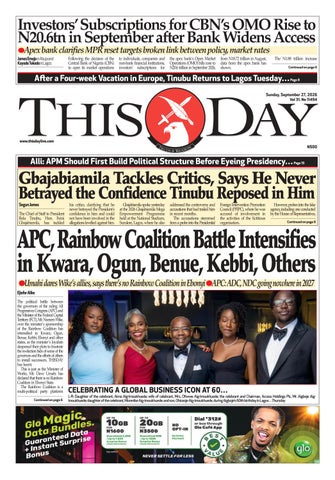
Investors’ Subscriptions for CBN’s OMO Rise to N20.6tn in September after Bank Widens Access Apex bank clarifies MPR reset targets broken link between policy, market rates
James Emejo in Abuja and Kayode Tokede in Lagos
Following the decision of the Central Bank of Nigeria (CBN) to open its market operations
to individuals, companies and non-bank financial institutions, investors’ subscriptions for
the apex bank’s Open Market Operations (OMO) bills rose to N20.6 trillion in September 2026,
from N18.72 trillion in August, data from the apex bank has shown.
The N1.88 trillion increase Continued on page 6
After a Four-week Vacation in Europe, Tinubu Returns to Lagos Tuesday… Page 8 Sunday, September 27, 2026 Vol 31. No 11494
www.thisdaylive.com TR
UT H
& RE A S O
N500
N
Alli: APM Should First Build Political Structure Before Eyeing Presidency… Page 15
Gbajabiamila Tackles Critics, Says He Never Betrayed the Confidence Tinubu Reposed in Him Segun James
The Chief of Staff to President Bola Tinubu, Hon. Femi Gbajabiamila, has tackled
his critics, clarifying that he never betrayed the President's confidence in him and could not have been involved in the allegations levelled against him.
Gbajabiamila spoke yesterday at the 2026 Gbajabiamila Mega Empowerment Programme held at the National Stadium, Surulere, Lagos, where he also
addressed the controversy and accusations that had trailed him in recent months. The accusations stemmed from a probe into the Presidential
Foreign Intervention Promotion Council (PFIPC), where he was accused of involvement in the activities of the fictitious organisation.
However, probes into the fake agency, including one conducted by the House of Representatives,
Continued on page 6
APC, Rainbow Coalition Battle Intensifies in Kwara, Ogun, Benue, Kebbi, Others Umahi dares Wike’s allies, says there’s no Rainbow Coalition in Ebonyi APC: ADC, NDC going nowhere in 2027
Ejiofor Alike The political battle between the governors of the ruling All Progressives Congress (APC) and the Minister of the Federal Capital Territory (FCT), Mr. Nyesom Wike, over the minister’s sponsorship of the Rainbow Coalition has intensified in Kwara, Ogun, Benue, Kebbi, Ebonyi and other states, as the minister’s loyalists deepened their plots to frustrate the re-election bids of some of the governors and the efforts of others to install successors, THISDAY has learnt. This is just as the Minister of Works, Mr. Dave Umahi has declared that there is no Rainbow Coalition in Ebonyi State. The Rainbow Coalition is a multi-political party platform Continued on page 6
CELEBRATING A GLOBAL BUSINESS ICON AT 60…
L-R: Daughter of the celebrant, Aima Aig-Imoukhuede; wife of celebrant, Mrs. Ofovwe Aig-Imoukhuede; the celebrant and Chairman, Access Holdings Plc, Mr. Aigboje AigImoukhuede; daughter of the celebrant, Morenike Aig-Imoukhuede; and son, Ohiozoje Aig-Imoukhuede, during Aigboje’s 60th birthday in Lagos…Thursday
2
SUNday, SEPTEMBER 27, 2026 • T H I S D AY
SUNDAY, SEPTEMBER 27, 2026 • T H I S D AY
3
SUNday, SEPTEMBER 27, 2026 • T H I S D AY
4
is here
Apply to participate in the IFC Certiied Mini MBA and pitch your business to be eligible for business grants Scan to apply
#BuiltByHer
Terms and conditions apply | Selection is competitive and based on the published eligibility and selection criteria
SUNDAY, SEPTEMBER 27, 2026 • T H I S D AY
5
6
T H I S DAY, T H E S U N DAY N E W S PA P E R • SEPTEMBER 27, 2026
NEWS
Nigeria’s Debt Hits N166.79tn as Interest Accounts for 56.5% of External Payments Festus Akanbi
Nigeria’s public debt rose by N7.44 trillion to N166.79 trillion in the second quarter of 2026, even as spending on external obligations fell to $870.73 million, according to Debt Management Office (DMO) figures reported by Nairametrics. The figures painted a difficult picture for public finances. Although the quarterly
external debt service bill fell by 8.7 per cent, interest alone accounted for $491.73 million, or 56.5 per cent, of the payments made between April and June. Commercial creditors received $325.70 million during the period, with no principal repayment recorded under that category. Nigeria’s total debt stock stood at N159.35 trillion at the end of March before rising to N166.79 trillion as of June 30.
The latest figure was equivalent to $120.93 billion and comprised N91.59 trillion in domestic debt and about N75.19 trillion in external debt. Domestic obligations accounted for 54.91 per cent of the portfolio. The DMO valued the external debt at the Central Bank of Nigeria’s official exchange rate of N1,379.1842 to the dollar on June 30. The increase in the naira
value of the debt stock should therefore be read alongside the dollar-denominated figures; the quarterly rise cannot, on its own, be treated as new borrowing. The federal government remained the dominant borrower, with N87 trillion in domestic obligations and N65.77 trillion in external debt. States and the Federal Capital Territory (FCT) owed N4.59 trillion domestically and N9.42
trillion externally. FGN bonds formed the largest component of federal domestic debt at N64.84 trillion. That amount included N41.47 trillion in naira bonds, N22.11 trillion in securitised Ways and Means advances and a domestic dollar bond valued at N1.27 trillion. Nigerian Treasury Bills accounted for a further N19.48 trillion. While the overall debt stock climbed, external debt service
fell from $954.06 million in the first quarter to $870.73 million in the second, a reduction of $83.33 million. Principal repayments amounted to $339.75 million, while other charges stood at $39.25 million. Interest payments, though down from $623.22 million in the preceding quarter, still exceeded principal repayments by $151.98 million.
APC, RAINBOW COALITION BATTLE INTENSIFIES IN KWARA, OGUN, BENUE, KEBBI, OTHERS promoted by Wike to mobilise support for President Bola Tinubu’s re-election in 2027, while backing non-APC candidates for governorship, National Assembly and States House of Assembly elections. Meanwhile, rising from a three-day retreat in Maiduguri, Borno State capital, the leaders of the APC yesterday dismissed the threat posed by the African Democratic Congress (ADC) and the Nigeria Democratic Congress (NDC) in the 2027 general election, saying the main opposition parties would merely be participating in
the polls rather than mounting a serious contest against the ruling party. Wike’s decision to use the coalition to field Peoples Democratic Party (PDP) candidates for governorship and other elective positions did not go down well with the APC governors, who are battle-ready to fight the minister’s loyalists for political supremacy in their states. THISDAY gathered that in Ogun State, the Rainbow Coalitionbacked governorship candidate of the PDP, Mr. Ladi Adebutu is getting stronger with huge financial
resources at his disposal to battle the governorship candidate of the APC, Senator Solomon Adeola. Adeola, who is equally wealthy, is backed by Governor Dapo Abiodun. However, the dispute over Adeola’s state of origin seems to be posing a threat to his chances. In Kebbi State, a former governor of the state and senator representing Kebbi Central, Adamu Aliero, is working with Rainbow Coalition to unseat Governor Nasir Idris, who is seeking a second term. Governor Idris is a protégé of the immediate past governor of
the state and Minister of Budget and Economic Planning, Senator Abubakar Atiku Bagudu. In Imo State, it is a tripartite battle between Governor Hope Uzodimma, former Governor Rochas Okorocha, and the governorship candidate of the PDP, Senator Sam Anyanwu, who is a member of Wike’s Rainbow Coalition. Uzodimma, who is seeking to install a successor on the platform of the APC, is the party’s senatorial candidate for the 2027 elections. Senator Okorocha, who is also of the APC, had sued the
Independent National Electoral Commission (INEC) over the publication of Governor Uzodimma’s name as the candidate of the APC for the Imo West Senatorial District election scheduled for 2027. In Kwara State, the PDP governorship candidate, Bolakale Kawu, is challenging Governor AbdulRazaq AbdulRahman’s anointed candidate in APC, Yakubu Danladi-Salihu. The senator representing Kwara Central on the platform of the APC, Saliu Mustapha, also emerged as the PDP candidate after Governor
AbdulRazaq upstaged him and emerged as the APC senatorial candidate for the zone. Mustapha is backed by a former Senate President, Dr. Bukola Saraki. Rainbow Coalition is also believed to be backing non-APC candidates in Enugu, Nasarawa, Gombe and other states. In Ebonyi State, Wike’s loyalists are also challenging the re-election of Governor Francis Nwifuru, a protégé of former Governor Dave Umahi, who is the Minister of Works. Continued on page 12
GBAJABIAMILA TACKLES CRITICS, SAYS HE NEVER BETRAYED THE CONFIDENCE TINUBU REPOSED IN HIM cleared the former Speaker of the House of Representatives. The Chief of Staff said investigations into the allegations were now in the public domain, stressing that due process prevailed despite pressure from some quarters to condemn him before the investigations were concluded. He said, “The past few months have tested me in ways I never expected. Stories were written; strange accusations were made; lies were told, and my integrity was questioned. Three years ago, the people of Surulere, the people
of Lagos State, and those who love me in Nigeria, stood by me in their prayers and spoke up for me when it mattered. “I will never forget that. I thank you all. The investigative reports are in the public domain. “Many people wanted me to rush to judgement and give a verdict before the investigation. They refused and insisted on due process. Let me also say, Mr. President knows his Chief of Staff very well. Having worked closely with me for many years, he was therefore supremely confident that I was not in any
way involved in those nefarious things,” Gbajabiamila explained. Gbajabiamila said he remained committed to his responsibilities in the Presidency despite what he described as attacks against him. He added: “Let me speak plainly and directly to all those behind the attacks. No amount of money, no amount of blackmail or lies, whether sponsored from within or outside, will detract me from my work and the work Mr. President has given me to do. “And to anyone using my
name to defame people or misrepresent me, know that the law will always catch up with you.” Speaking on his relationship with Tinubu, the former Speaker of the House of Representatives said his loyalty to the President had remained unchanged. “In politics, loyalty is the currency we spend the most. I have been with Mr. President for many years…I did not question his leadership and never betrayed his trust in me. I stayed loyal then and I remain loyal now. My commitment to
his Renewed Hope agenda is unshaken,” he said. The Chief of Staff said the empowerment was targeted at about 5,000 beneficiaries from communities in Surulere. He said the programme included cash support, vehicles, electric tricycles, buses, security patrol vehicles and an ambulance. Speaking at the event, the Deputy Governor of the state and APC governorship candidate for the 2027 elections, Dr. Obafemi Hamzat, commended Gbajabiamila for his consistency
in identifying with his people. Hamzat also used the occasion to canvass support for the reelection of the President, saying other candidates, whom he described as politically unstable, cannot match the capacity and strength of President Tinubu. He said any candidate who cannot manage a political party cannot manage a complex nation like Nigeria, describing Tinubu as the ‘last man standing’ who has remained in a party and built it from scratch into the largest political party in Africa.
INVESTORS’ SUBSCRIPTIONS FOR CBN’S OMO RISE TO N20.6TN IN SEPTEMBER AFTER BANK WIDENS ACCESS
represents growth of about 10 per cent, as CBN data showed September's subscription was the highest recorded this year. This is just as the apex bank said its recent adjustment of the Monetary Policy Rate (MPR) was not an easing of monetary policy, but a deliberate reset to close the widening gap between its benchmark rate and actual money-market conditions. The CBN uses OMO auctions to manage liquidity in the financial system by issuing bills to absorb excess funds and buying securities when it seeks to inject liquidity. Its August decision to widen participation has given more investors access to the bills through deposit money banks. So far in September, the CBN has offered N3.9 trillion at OMO auctions, compared with N3.8 trillion in August. Successful bids totalled N12.82 trillion, up from N12.02 trillion in the preceding month. The figures suggest that demand has remained strong despite the liquidity already withdrawn from
the system. In a circular dated August 12, 2026, the Acting Director of the CBN’s Financial Markets Department, Mr. Okey Umeano, said eligible investors could participate in both the primary and secondary OMO markets through deposit money banks. The CBN also removed certain restrictions that had prevented banks participating in the Nigerian Foreign Exchange Market or purchasing government securities at primary auctions from accessing its Discount Window on the same day. However, the restriction on accessing the Discount Window and participating in an OMO auction on the same day remains. At the September 24 auction, the stop rate on a 152-day OMO bill was about 17.29 per cent. Analysts said the wider access and attractive returns could intensify competition for funds between fixed-income instruments and equities. The Managing Director of Highcap Securities Limited, Mr.
David Adonri, said the growth in OMO activity reflected the CBN’s efforts to absorb excess liquidity.
Apex Bank Clarifies MPR Reset Targets Broken Link Between Policy, Market Rates Meanwhile, the CBN has clarified that its recent adjustment of the MPR was not an easing of monetary policy, but a deliberate reset to close the widening gap between its benchmark rate and actual money-market conditions. The apex bank said the move aimed to restore alignment between the policy signal and where liquidity and interest rates were trading in the financial markets. Special Adviser to the CBN Governor on Financial Markets and Economic Policy, Mr. Mayokun Ajibade, explained that the distinction was important because the central bank’s policy stance remained “very restrictive” despite the adjustment in the benchmark rate.
Speaking during the “Drinks & Mics” session on Nairametrics TV, Ajibade said the latest decision should be understood as part of a longer process of rebuilding the monetary policy framework and making the MPR a more effective signal for the wider financial system. “When you see the words ‘reset’ and ‘calibrate’, it is basically trying to tell the market something,” he said, stressing that “we did not ease.” He added that “Policy stance is still very, very restrictive. What I think was delivered was a journey to reset.” The comments came against the backdrop of the Monetary Policy Committee’s (MPC) September decision to cut the MPR by 350 basis points from 26.5 per cent to 23 per cent. Ajibade noted that while the MPR had stood at 26.5 per cent, the SDF rate stood around 22 per cent, while the market yield curve had already moved considerably lower. The divergence, he said, sent
mixed signals about the actual direction of monetary policy. Ajibade pointed to movements in the fixed-income market as evidence that the financial system had already begun adjusting to changing conditions. “The market was already doing something,” he said. The reset, he added, was partly an effort to align the official policy framework with the reality already emerging in the market. Ajibade stressed that the move did not represent a return to indiscriminate monetary expansion, pointing out that the CBN had not simultaneously released large volumes of additional liquidity into the banking system. The challenge for the CBN, therefore, was to influence the price of money while retaining sufficient control over liquidity to prevent renewed inflationary pressures. Beyond the immediate rate adjustment, Ajibade said the CBN was working to strengthen the institutional architecture through
which it transmits monetary policy. He identified the development of the yield curve, overnight markets, repo transactions, fixed-income instruments and the foreign exchange market as part of the broader effort to establish reliable mechanisms for price discovery. For monetary policy to work effectively, he stressed that changes in the CBN’s policy rate must be reflected predictably across financial markets. He also linked the process to the wider effort to rebuild confidence in Nigeria’s economic institutions, pointing out that structural reforms could not be judged solely by their immediate political or economic optics. He further described the relationship between fiscal, monetary and other economic management institutions as increasingly constructive, noting that disagreements among policymakers were part of the process of arriving at better decisions.
SUNDAY, SEPTEMBER 27, 2026 • T H I S D AY
7
8
T H I S DAY, T H E S U N DAY N E W S PA P E R • SEPTEMBER 27, 2026
NEWS
MOBILISING 10MILLION VOTES FOR TINUBU…
L-R: Permanent Secretary (Political and Economic Affairs), Office of the Secretary to the Government of the Federation (SGF), Mrs. Augusta Bekereadebo Warrens; Director General, National Board of Technology Incubation, Dr. Kazeem Kolawole Raji; SGF, Senator George Akume; Executive Secretary, National Institute for Cultural Orientation, Biodun Ajiboye; and Executive Secretary, Shippers Council of Nigeria, Mr. Pius Akutah, during a courtesy visit by Forum of CEOs of Federal Parastatals to the SGF in Abuja…Friday
At UNGA, Shettima Tasks ECOWAS Leadership on Sub-region’s Unity, Integration
Deji Elumoye in Abuja
Vice President Kashim Shettima has urged the new leadership of the ECOWAS Commission to prioritise regional unity and integration to advance the sub-region’s people and economy.
He said this would be achieved by building bridges of friendship and promoting programmes and policies that significantly impact the lives and livelihoods of people across the sub-region. Shettima stated this weekend in New York, United
States, when he granted an audience to a delegation from the ECOWAS Commission led by its new President, General Birame Diop (rtd), on the margins of the 81st Session of the United Nations General Assembly (UNGA). He specifically urged
the new leadership of the sub-regional body to take private sector participation seriously in executing the Lagos-Abidjan highway project. “Beyond your administrative duties, your leadership of the commission
After a Four-week Vacation in Europe, Tinubu Returns to Lagos Tuesday Deji Elumoye in Abuja
President Bola Tinubu, who has been on a four-week working vacation to Europe, is expected to return to Nigeria on Tuesday. The president, who was scheduled to return to the country this weekend, is now due back on Tuesday, September 29, 2026. Reliable Presidency sources told THISDAY yesterday that President Tinubu would return through the nation's commercial capital, Lagos, where he is expected to be received at the presidential
wing of the Murtala Muhammed Airport in Ikeja by Governor Babajide Sanwo-Olu. It was further gathered that the president would celebrate Nigeria's 66th independence anniversary on Thursday, October 1, 2026 in Lagos. This would be the second time the president will be celebrating the nation's independence in Lagos, the first being in 2025 when he stayed back in Lagos after his working visit to the Centre of Excellence in the wake of the news of
an attempted coup det'at by military officers. THISDAY further learnt that Tinubu would stay back in Lagos to attend to official state duties before returning to the nation's capital, Abuja by next weekend. The Presidency had last Monday disclosed that the president, who has been on working leave since August 30, 2026, would return to Nigeria at the weekend, following the extension of his working vacation by a few days. Presidential spokesperson, Bayo Onanuga, who made
this known via a statement, added that the president departed Nigeria on August 30 for London to begin the working vacation. After spending a week in London, he moved to Paris, France, where he met with French President Emmanuel Macron and businessman Mr Vincent Bollore, whose media group includes Canal+, Multichoice, and Universal Music Group. While away, President Tinubu delegated Vice President Kashim Shettima to represent him at some official functions.
must make deliberate efforts to build bridges of friendship across the sub-region. ECOWAS should be at the forefront of our engagement with emerging blocs in the area such as the Alliance of Sahel States (AES). "I urge ECOWAS under your leadership to champion the cause of regional integration and strengthen the bonds of unity and friendship among our people," he told the delegation. The Vice President congratulated the Commission's new president on his election, noting that he assumed office at a difficult time that required greater synergy and cohesion among leaders and people of the sub-region. Shettima assured Generale Diop of Nigeria’s continuous cooperation and support, saying, “My boss, President Bola Ahmed Tinubu, is a man of honour and conviction who will always support efforts aimed at advancing the transformation of ECOWAS as a regional body, and the progress of the area in general.”
He added that Nigeria would continue to create an enabling environment for ECOWAS to succeed and contribute meaningfully to the attainment of the vision and objectives set by its founding fathers. Earlier, Generale Diop eulogised Nigeria for its role in establishing and sustaining ECOWAS over the years, as well as its sacrifices for the sub-region's stability and prosperity despite the challenges. He said that alongside rising concerns about insecurity and lagging development across the sub-region, the commission faced unique challenges that required Nigeria’s direct intervention as a “big brother” to resolve successfully. Describing ECOWAS as a tool for regional stability that should be encouraged and supported at all times, Diop urged other countries in the sub-region to cooperate with Nigeria to ensure inclusive development and a better future for the region's people.
Anambra Govt to Peter Obi: Governance is About People’s Welfare, Not Savings Ex-gov not godfather to any of Soludo’s children, says First Lady
David-Chyddy Eleke in Awka
The Anambra State government yesterday told the presidential candidate of Nigeria Democratic Congress (NDC), Mr. Peter Obi, that governance was about prioritising citizens’ welfare, and not saving in banks for interests while the people suffered.
This is just as the state’s First Lady, Nonye Soludo, clarified that Obi was not a godfather to any of the governor’s children. The state government also accused Obi of concealing his administration’s debts in the handover notes he prepared while leaving office in 2014. The state government has repeatedly said Obi left $123.77 million debt while
leaving office. Also, the government said, loans were obtained for projects, including malaria control, education, healthcare, erosion management, community development, and value chain development. However, Obi has denied the claim, noting that he left over $150 million in Anambra’s treasury and investments.
“As at the time I left office, the dollar components of my savings invested in various bonds were over $150 million, which gives Anambra state guaranteed income of about $10 million yearly,” Obi said. According to him, if he actually left a $123.77 million debt, then the yields from the $150 million would have paid off the debt by now, leaving
the principal intact. In fact, he challenged the Anambra State government to prove that his administration left behind unpaid debts, salaries, pensions or contractor liabilities. Reacting, on Friday the Anambra State government released documents alleging that Obi’s administration also left N363 million in salary
arrears owed to workers, among other outstanding debts. Again, in a statement issued yesterday by the Commissioner for Information and Value Reorientation, Law Mefor, the government accused Obi of placing primacy on savings over the peoples’ welfare, and concealing debts while handing over in 2014.
9
SEPTEMBER 27, 2026 • T H I S DAY, T H E S U N DAY N E W S PA P E R
NEWS
SPECIAL GUESTS OF HONOUR…
L-R: Former First Lady, Mrs. Patience Jonathan; former President Goodluck Jonathan; Rivers State Deputy Governor, Prof. Ngozi Odu, at the coronation of King Charles Douglas MacPepple Jaja as the sixth Amanyanabo of Opobo, in Rivers State…yesterday
Jonathan, Fubara, Igwe Achebe, Ogiame Atuwatse, Others Eulogise New Opobo King
Blessing Ibunge in Port Harcourt
Former President Goodluck Jonathan; his wife, Patience; Rivers State Governor, Siminalayi Fubara; Obi of Onitsha, Igwe Nnaemeka Achebe; Olu of Warri, Ogiame
Atuwatse III; Obong of Calabar; Amanyanabo of Bonny, King Edward Asimini Dappa Pepple; Eze Eberechi Oji, Eze Aro; Eze Iweka III of Obosi; King Buribaye Dakolo of Ekpetiama Kingdom, Bayelsa State; and Eze Eberiuogo of Omuma, and others, yesterday honoured King
Charles Douglas MacPepple Jaja on his coronation as the Amanyanabo of Opobo Kingdom in Rivers State. The colourful ceremony, witnessed by prominent Nigerians, traditional rulers, political leaders and other dignitaries, was held at King Jaja
Square in the heart of Opobo. With his coronation, King Charles Douglas MacPepple Jaja becomes the sixth Amanyanabo of Opobo, succeeding the late King Dandeson Douglas Jaja, who passed away last year and was buried on April 11, 2026. The new monarch assumed
Tinubu Charges NDA Graduates to Uphold Constitution, Protect Nigerians
John Shiklam in Kaduna
President Bola Tinubu has charged newly commissioned officers of the Nigerian Armed Forces to uphold the Constitution, protect Nigerians and safeguard the nation’s economy. Tinubu delivered the charge through the Speaker of the House of Representatives, Dr. Tajudeen Abbas, who represented him at the combined passing-out parade of graduating cadets at the Nigerian Defence Academy (NDA) yesterday in Kaduna. The parade featured cadets of
the 73 Regular Course (Army, Navy and Air Force), Short Service Course 49 (Army), Direct Short Service Course 34 (Air Force) and Branch Commission Course 3 (Air Force). The President commended the Commandant of the NDA and his team for transforming the cadets into battle-ready, intellectually equipped and morally grounded leaders. He said the Academy, established in 1964, had continued to evolve in response to emerging security threats by blending military training with academic education and character development.
Tinubu said the NDA had enhanced its counter-terrorism and counter-insurgency training while rapidly integrating technology into military training and research. He noted that the Academy had strengthened partnerships with leading military institutions globally, with Nigerian cadets currently undergoing military training in the United Kingdom, United States, Brazil and France. According to him, the invitations extended to NDA cadets to participate in competitive military competitions in the United States, Brazil and China
demonstrated the growing recognition of the Academy’s training standards and professionalism. He said the Academy had also continued to serve as a regional hub for military education by training cadets from several African countries, including Burkina Faso, Cameroon, Congo Brazzaville, Gambia, Guinea, Liberia, Niger, Sierra Leone and Uganda. The President said the NDA had made significant progress in adapting to modern warfare by expanding classrooms, staff and cadets’ quarters, firing ranges, and simulation centres.
2027: More Appointments, Structures Coming, ADC Campaign Council Tells Aggrieved Party Members Chuks Okocha in Abuja
The African Democratic Congress (ADC) Presidential Campaign Council has told aggrieved members whose names did not appear on the campaign council list that more appointments were expected as it continued to build its national organisation ahead of the 2027 elections. The council said the list of appointments already released
was only an early stage of the exercise, with more senior positions and structures still to be announced as consultations widened across the country. In a statement issued yesterday by its Director of Strategic Communication, Phrank Shaibu, the council said the latest appointments were significant to the campaign’s organisation but did not represent its final composition.
“The campaign is still evolving. Consultations are continuing, and further responsibilities will be assigned as the structure expands across the country,” Shaibu said. The clarification also appeared aimed at aggrieved supporters and political allies who may have expected their names to feature in the first list, with the campaign stressing that years of loyalty and sacrifice had not been overlooked.
“To those who may feel disappointed that their names have not appeared yet, we ask for patience and understanding. No one should believe that years of commitment and sacrifice have been forgotten,” Shaibu said. He said the campaign would draw on party loyalists, experienced leaders, professionals, young people and other Nigerians prepared to contribute to its work.
the traditional title of Jeki VI, in succession to the legendary King Jaja, who founded the Opobo Kingdom following the historic exodus of 1870. The king was anointed and crowned by the Bishop of the Niger Delta Diocese, Rt. Rev. Emmanuel Oko-Jaja. Speaking after his coronation, King Charles thanked the dignitaries who travelled to Opobo to witness the historic occasion. He pledged to protect the freedom and rights of the people of Opobo, while vowing to uphold the dignity and integrity of the throne. “I will never bring dishonour to the throne that Chief Jaja and the founders of Opobo built with courage. The exodus of 1870 was a journey to freedom. Our journey in 2026 is a journey
to development, unity and global relevance,” he declared. Former President Jonathan congratulated the new monarch and the people of Opobo on the successful coronation. Jonathan recalled the historical significance of King Jaja of Opobo, describing him as a prominent figure whose struggle for freedom had received global recognition. He urged the new king to use his reign to promote peace, development and unity in Opobo and to uphold the dignity and respect of the kingdom. The Rivers State Governor, Fubara, represented at the ceremony by his deputy, Prof. Ngozi Odu, described the coronation as a celebration of the identity, history and culture of Rivers State.
2027 Elections: Naval Chief Urges Military Personnel to Remain Apolitical, Professional Linus Aleke in Abuja The Chief of the Naval Staff (CNS), Vice Admiral Idi Abbas, has charged naval and other military personnel to remain apolitical, non-partisan, and professional in discharging their duties ahead of the 2027 elections. The CNS gave the charge yesterday while addressing personnel at the Third Quarter Route March 2026. Abbas, represented by the Director of Manning, Naval Headquarters, Rear Admiral Kolawole Oguntuga, said the Armed Forces retained the solemn responsibility to support the democratic process.
He emphasised that military personnel's support during elections must remain within the limits of the law and duly authorised directives under the Constitution. He demanded utmost professionalism from the personnel, tasking them to avoid statements, associations, and any other activity that could undermine the service’s core values and bring the Navy into disrepute. According to him, the unity and discipline displayed during the route march were timely and significant, adding that the results should be evident during the discharge of duty in the upcoming elections.
10
T H I S DAY, T H E S U N DAY N E W S PA P E R • SEPTEMBER 27, 2026
NEWS
RECOGNISING HUMAN RESOURCE MANAGEMENT…
L-R: The Inspector-General of Police, Mr. Olatunji Disu; President and Chairman of the Governing Council of Chartered Institute of Personnel Management, Mallam Ahmed Ladan Gobir; Lagos State Head of Service and Representative of the Governor of Lagos State, Mr. Bode Agoro; and Senator Surajudeen Ajibola Basiru, during their Fellowship Investiture at the glamorous Gala and Awards Night of the CIPM 58th International Conference and Exhibition held in Abuja… recently
Atiku Asks Tinubu to Explain Rising Public Debt Amid Increasing Revenues Chuks Okocha in Abuja
The presidential candidate of the African Democratic Congress (ADC) has challenged President Bola Tinubu to explain why Nigeria’s public debt rose to N166.79 trillion despite increased government revenues, saying Nigerians were yet to see the promised gains from the administration’s economic
reforms. Atiku said Nigerians were entitled to know why borrowing continued after government revenues had risen. In a statement issued yesterday by the Director of Strategic Communications of the ADC Presidential Campaign Council, Phrank Shaibu, the former Vice President said Nigeria’s public debt rose from N49.85 trillion in
March 2023 to N166.79 trillion by June 2026. “A government that says more money is coming in must explain why it keeps borrowing and why the people paying for its policies cannot see the promised gains,” Atiku said. He urged Tinubu to provide a full reconciliation of the debt, including old obligations newly captured, exchange-rate
effects on foreign debt, fresh loans contracted since 2023, repayments and outstanding balances. “I expect President Tinubu to put the full account before Nigerians,” he said. Atiku also questioned the gap between official economic indicators and the rising cost of living, arguing that improved government revenues and other
Otti to Political Parties: Pay Approved Fees, Get Access to Venues, Security for Your Campaigns Boniface Okoro in Umuahia
Abia State Governor, Dr. Alex Otti, has directed that all political parties should pay the approved fees and be granted unhindered access to public venues, including stadiums, for their campaigns ahead of the 2027 general election. Governor Otti also charged security agencies in the state to promptly grant requests from political parties seeking to hold campaigns and ensure a level playing field for all. The governor gave the directives during the monthly State Security Council meeting, where security
situations across Abia State were reviewed to sustain and improve on gains recorded in keeping the state safe. The Commissioner of Police, Abia State Command, Wilfred Olutokunbo Afolabi, and the Special Adviser to the Governor on Security, Navy Commander MacDonald Ubah (rtd.), briefed journalists after the security council meeting and conveyed the governor's position. Both men assured political parties that security agencies are ready to ensure hitch-free campaigns and elections in 2027 in the state.
CP Afolabi said the governor made their work easier by explicitly directing that any political party that applied for approval to hold campaigns should be granted express approval. "We just came out from the meeting chaired by the Executive Governor of Abia State. A lot of matters were discussed - some centered on the forthcoming elections, and I believe His Excellency has made our work easier. He told us clearly that all he wants is for us to create a level playing field for all. He also directed that any political party that applies for approval to
hold campaigns should be granted express approval. By that, he has made our work less cumbersome," the CP said. On preparedness to ensure a violence-free electioneering period, Afolabi disclosed that following a three-day Regional Police Retreat recently held in Imo State - chaired by the InspectorGeneral of Police and attended by some governors, senior police officers and other stakeholders - and with the support of the Abia State Government, security agencies were fully prepared to ensure rancour-free campaigns and elections.
CEOs of Federal Parastatals Pledge 10m Votes for Tinubu in 2027, Appoint Akume Patron The Forum of Chief Executive Officers (CEOs) of federal parastatals has pledged to mobilise 10 million votes for President Bola Tinubu in the 2027 presidential election. The decision was announced when a 20-member delegation of the forum paid a courtesy visit to the Secretary to the Government of the Federation (SGF), Senator George Akume, in Abuja, where it unanimously appointed the
former Benue State governor as its patron. According to a statement signed by the Chairman of the Publicity Committee of the forum, Biodun Ajiboye, and made available to journalists yesterday in Abuja, the forum's Chairman, Dr Kazeem Raji, said the appointment recognised Akume’s leadership, experience, and contributions to coordinating government institutions.
Raji, who is also DirectorGeneral of the National Board of Technology Incubation, said the forum would support Tinubu’s re-election through lawful, peaceful and issue-based engagement. He commended Akume’s institutional stewardship, wisdom, experience and commitment to coordinating government machinery. The forum chairman said the
SGF’s efforts had contributed to the stability, coherence and effectiveness of Tinubu’s administration. “We recognise the enormous responsibility you carry at the centre of government,” Raji said. He added that the forum appreciated Akume’s diligence, discretion and statesmanship in supporting President Tinubu and advancing the Renewed Hope Agenda.
macroeconomic indicators had yet to translate into affordable living conditions for many Nigerians. “The true test of economic policy is whether Nigerians can afford food, transportation, housing, education, healthcare and electricity,” he said. Atiku cited a June 2026 IMF assessment which, while acknowledging improved macroeconomic outcomes from Nigeria’s reforms, said conditions remained difficult for many Nigerians. The Fund estimated poverty at 63 per cent and said 27 million Nigerians had faced food insecurity in late 2025. Atiku further cited BudgIT figures showing N12.52 trillion spent on debt service against N18.63 trillion in revenue by the third quarter of 2025, while the 2026 fiscal framework projects a deficit of about N31.45 trillion.
“If President Tinubu understands abroad what debt payments are taking away from Nigeria, then he must explain at home why the borrowing bill continues to grow,” Atiku said. He also demanded explanations for $39.25 million listed as ‘other charges’ in the DMO’s second-quarter 2026 external debt-service schedule, including a $22.5 million charge linked to a First Abu Dhabi Bank Total Return Swap. “What exactly was the $22.5 million charge for? Which agreement authorised it? What was the original facility? How much was drawn? What obligations remain outstanding?” he asked. Atiku called for a reconciliation of the N19.48 trillion Treasury Bills outstanding as at June 30, saying Nigerians needed to know what was redeemed, rolled over and genuinely borrowed.
Gunmen Kill Five Miners in Fresh Plateau Attack
Yemi Kosoko in Jos
At least five miners were gunned down yesterday, and two others were left injured after gunmen attacked them at a site in Marit village, Barkin Ladi Local Government Area (LGA) of Plateau State. The attack threw the community into mourning and heightened concerns over the safety of residents and miners operating in the area. The spokesman of the Berom Youth Moulders-Association (BYM), Rwang Tengwong, confirmed the incident and lamented the killing of the miners. Tengwong said the victims were ambushed at Marit, adding that five persons lost
their lives while two others sustained injuries. He said, “Five persons were killed, while two others sustained injuries in the attack. “It is a very sad and painful development. Our people are once again mourning the loss of lives to violence.” “We condemn this attack and call on the security agencies to urgently take steps to protect our communities and prevent further attacks.” Also confirming the incident, a member of the community, Simon Mundat, described the attack as devastating and lamented the loss of the miners. Mundat said, “This attack deeply saddens us. Five people have been killed and two others injured.”
SUNDAY, SEPTEMBER 27, 2026 • T H I S D AY
11
12
T H I S DAY, T H E S U N DAY N E W S PA P E R • SEPTEMBER 27, 2026
NEWS
FIFTY-FIVE HEARTY CHEERS…
L-R: The celebrant, Dr Arinze Onwumelu; Chief Executive Officer, HomeSmart Real Estate Houston, TX, Mr. Uche Anaege; Nollywood Actress and Screenwriter, Uche Jumbo; Nollywood Actress, Chioma Akpotha; and the celebrant’s wife, Mrs. Oby Onwumelu, at Arinze’s 55th birthday party and 10th anniversary of his clinic in Calgary, Canada…recently
Trump Rejects Iran’s Plan to Reopen Strait of Hormuz in Seven Days Tehran demands ceasefire, lifting of US naval blockade, oil sanctions
Sunday Ehigiator
United States President Donald Trump has rejected a seven-day proposal by Iran to reopen the strategic Strait of Hormuz, amid renewed diplomatic efforts to end the prolonged conflict between Washington and Tehran. Iranian Foreign Minister, Abbas Araghchi, had announced the proposal at the United Nations General Assembly (UNGA) in New York, saying Tehran was prepared to restore normal maritime passage through the vital waterway within seven days if the United States met conditions set out by Iran, including lifting naval blockade and oil sanctions. But citing US officials familiar with the matter, The Wall Street Journal reported that Trump had rejected the proposal. The development came as Iranian President Masoud Pezeshkian returned to Tehran following his participation in the UN General Assembly, where he held talks with UN Secretary-General António Guterres and reiterated Iran’s willingness to negotiate with Washington. “Iran has not walked away from the negotiating table, but given past experiences, it no longer trusts the United States,” Pezeshkian said, according to Iranian state media.
Araghchi said Iran had conveyed the proposal to the United States through Qatar, placing the responsibility for its implementation on Washington. “Iran has conveyed to the United States, through Qatar, a concrete seven-day plan. If the necessary conditions are met, the strait can be reopened, and normal maritime passage restored within seven days. “The choice now rests with the United States. Iran does not accept coercion, threats or intimidation, and Iran will not surrender its sovereign rights under pressure.” Under the proposal, Iran was demanding a cessation of hostilities across the Middle East for seven days, including in Lebanon, before reopening the Strait of Hormuz. Tehran was also seeking the lifting of US sanctions on Iranian oil, the release of frozen Iranian assets estimated at more than $12 billion and an end to the US naval blockade of Iran. Iran said the conditions were based on a memorandum of understanding (MoU) reached with the United States earlier in the year, which was intended to provide a framework for ending the conflict, reopening the waterway and resuming negotiations over Tehran’s nuclear programme. Pezeshkian, speaking in an interview yesterday, said the
implementation of the proposal could begin immediately if Washington accepted the terms. “The process will begin from the very day they accept it. We had previously reached an agreement based on the MoU that was signed in Pakistan. If the United States agrees to proceed in that way, everything will return to the way it was before,” he added. The Strait of Hormuz emerged as one of the central flashpoints in the conflict
because of its importance to global oil supplies and international shipping. Iran maintains that vessels must obtain authorisation before passing through the waterway, citing security and sovereignty concerns. Ships accused of refusing to comply have been targeted, while the United States has carried out retaliatory strikes against Iranian coastal areas. Earlier in the week, Araghchi held talks with US envoy Steve Witkoff as part of renewed
diplomatic contacts aimed at finding a way out of the conflict. However, the reported rejection of Tehran’s latest proposal has raised fresh uncertainty over the prospects of a negotiated settlement. The Wall Street Journal reported that Trump was sceptical that Tehran would fulfil the conditions demanded by Washington and considered renewed military action a possibility. Trump also posted an image
on his Truth Social platform showing a map of the Strait of Hormuz with the waterway labelled “Trump Strait”. Meanwhile, Hossein Mohebi, a spokesman for Iran’s Revolutionary Guards, said Tehran would continue its response to Washington until its demands were met. “We will not cease punishing the US until Iran’s seven conditions are met,” he was quoted as saying by Tasnim news agency.
NDLEA, NDEA Sign MoU to Tighten the Noose on Drug Traffickers in Nigeria, UAE Michael Olugbode in Abuja
The National Drug Law Enforcement Agency (NDLEA) has signed a Memorandum of Understanding (MoU) with the National Drug Enforcement Authority (NDEA) of the United Arab Emirates, marking a new chapter in the fight against drug trafficking between both countries. The MoU was signed yesterday on the sidelines of the ongoing 15th United Nations Congress on Crime Prevention and Criminal Justice held in Abu Dhabi, UAE. Speaking at the signing ceremony, the Chairman/Chief Executive Officer of NDLEA, Brig. Gen. Mohamed Buba Marwa
(rtd.), described the agreement as the culmination of years of steady engagement between the two agencies, noting that it would deepen intelligence-sharing and joint enforcement action along the Nigeria-UAE corridor. Marwa disclosed that between 2021 and 2026, NDLEA intercepted about 354.7kg of illicit drugs, including cocaine, cannabis, tramadol, rohypnol, ecstasy and khat, concealed in consignments going to the UAE, resulting in the arrest and prosecution of 47 suspects. He said this underscored the urgency of the new partnership. He further highlighted NDLEA's nationwide record
between January 2021 and July 2026, which included over 91,000 arrests (among them 243 drug barons), the seizure of more than 15.5 million kilogrammes of illicit drugs and precursor chemicals, 16,469 convictions, and the counselling, treatment and rehabilitation of over 53,000 drug users. He added that the Agency's War Against Drug Abuse (WADA) advocacy campaign had reached nearly 5.9 million Nigerians through community and school engagements. The NDLEA boss said the new partnership with NDEA would build on the exchange of liaison personnel, sharing of
operational information, and technical cooperation already established between both agencies, including plans for the UAE to provide Nigerian travellers a comprehensive list of prohibited items to guard against inadvertent violations. In his remarks, the Chairman of NDEA, Sheikh Zayed bin Hamad Al Nahyan, reaffirmed the UAE's commitment to working closely with Nigeria to disrupt trafficking networks exploiting the strong trade, travel and people-to-people ties between both nations, describing the MoU as a natural evolution of an already productive relationship.
APC, RAINBOW COALITION BATTLE INTENSIFIES IN KWARA, OGUN, BENUE, KEBBI, OTHERS However, Umahi has declared that there is no Rainbow Coalition in the state.
Umahi Dares Wike’s Allies, Says There’s No Rainbow Coalition in Ebonyi Umahi, who spoke during an inspection of the Calabar-Abuja Superhighway in Benue State on Friday, insisted that the state
remained aligned with the APC and its candidates. A statement issued yesterday by the Senior Special Assistant to the Minister of Works on Media, Francis Nwaze, said Umahi inspected Section Two of the project at Ado and directed contractors to accelerate construction. Commenting on his relationship with Wike and reports that he was forming a similar political arrangement in Ebonyi State, Umahi said, “If Wike has
candidates here, he has not told me. And his candidate cannot break our relationship, but his candidate is not part of our relationship. There is no rainbow coalition in Ebonyi State.” The former Ebonyi State governor added that those wishing to campaign in Ebonyi State were free to do so but warned political actors against hate speech and attempts to cause disorder. “Anybody that wants to campaign - come and campaign.
But don’t dish out hate speech, and you want to take those speeches, and you want that we should lay a red carpet for you. We will not do that,” he said. “Nobody can foment crisis in Ebonyi State,” the minister added.
APC: ADC, NDC Going Nowhere in 2027 Meanwhile, the APC yesterday dismissed the threat posed by the
ADC and the NDC in the 2027 general election, saying the main opposition parties would merely be participating in the polls rather than mounting a serious contest against the ruling party. The ruling party leaders also passed a vote of confidence in President Bola Tinubu, Vice President Kashim Shettima, and all APC candidates who emerged from the party’s primary elections. The National Chairman of the APC, Professor Nentawe Yilwatda,
made the ruling party's position known while briefing journalists at the conclusion of the retreat. The event brought together members of the National Working Committee (NWC), members of the National Executive Committee (NEC), and state chairmen of the ruling party. Citing the recent results of the five by-elections held across the country, Yilwatda said the APC’s electoral prospects remained formidable.
SUNDAY, SEPTEMBER 27, 2026 • T H I S D AY
13
THE REGENT SECONDARY SCHOOL, ABUJA West Africa’s First BSO-Accredited “Outstanding” Secondary School
CONGRATULATES THE CLASS OF 2026 ON AN OUTSTANDING IGCSE RESULT 100% A*- C in 12 subjects: Additional Mathematics, Chemistry, Computer Science, Economics, French, History, Global Perspectives, ICT, English Literature, Music, Physics & Sociology.
58% of all grades achieved were A*or A
97% of all grades achieved were A* - C grades. 96% of the students achieved A* to C grades in at least 5 subjects.
86% of all grades achieved were A*, A, and B
OUR TOP ACHIEVERS
OLUMOREWA ARIYIKE AWOBOKUN
FAITHFUL NTANFUBI JESUTOFUNMI JAKKO
8A*s 1A 1B
8A*s 1B
TEMIDESAYO DAVID TAIWO-AYODELE
AARAV SANDEEP DESHMUKH
SHEILA CHIANUGO NWACHUKWU
DIMIEARI DAVID TERVER KEMEDI
ISA ABUBAKAR ISA
7A*s 2As
8A*s
6A*s 2As 1B
ZAINAB AHMED ABDULWAHAB
NYEISHA JEETENDRA ADVANI
6A*s 1A 1B
6A*s 1A
HADI RAMADAN
JADEN OBICHUKWU ANANABA
RISHIT JINDAL
6A*s 2As
KHADEEJA KERE AHMED
5A*s 3As
5A*s 3As
5A*s 2As 1B
5A*s 2As 1B
TAMARANMIEBI ONITSHA
ALMAZA IJEOMA OBIORA-NWOKOLO
5A*s 1A 1B
4A*s 5As
4A*s 4As 1B
DANIEL DANGA
DEMILADE IMANI AKINLADE
ZARA OLUWADAMILOLA IBUKUNOLUWA
4A*s 4As
4A*s 3As
DAVID UGBEDEOJO AMEH
4A*s 2As 1B
AHMAD RAMADAN
4A*s 2As 1B
ABDUL NASIR KABIR MARAFA
WESLEY-ALOY MUNACHIMSO NNAMANI
CHRISTINE MISAN OGBETUO
3A*s 5As
HABIB SULTAN ALHASSAN
3A*s 4As 1B
HANEEF MOHAMMED YUSUF
3A*s 4As 1B
FAREEDAH OLUWADAMILOLA MUSTAPHA
3A*s 3As 3Bs
HANEEFA MOHAMMED YUSUF
3A*s 3As 2Bs
FALAQ UNOIZA AKABA
AL IKRAM OLUWASEUN AJISAFE
AMEENAH ABUBAKAR JA AFAR
MOHAMMED NASIR BAYERO
ESUAIKO MUNACHIMSO EKAETTE
OLUWAFERANMI AMEERAH EYITAYO
2A*s 6As
MOTEBANG MAKHELE
2A*s 4As 2Bs
DESMOND UBONG EMAH BASSEY
2A*s 3As 4Bs
TIMILEYIN JANADA ADESINA
2A*s 3As 4Bs
MARYAM JAMEELAH MISBAHU ISMAIL
YUADOO MIRABEL KYENGE
MUHAMMAD AL-MUSTAPHA SHETTIMA SHEHU
SALMA KATHARINA IBRAHIM
ARSHMAAN ADNAN ABDUL RASHID
4A*s 1A 2Bs
3A*s 5As
3A*s 3As 2Bs
3A*s 3As 1B 1C
3A*s 2As 3Bs
3A*s 2As 2Bs
SERIN HAIDAR DAYEKH
CHIDERA DANIELLE EKWE
ZAINAB JAWAHIR GWAMNA
UMAUTER ISRAEL ORBAN-NYIAKURA
3A*s 2As 2Bs
4A*s 4As
2A*s 3As 3Bs
2A*s 3As 2Bs 1C
2A*s 3As 2Bs 1C
2A*s 3As 2Bs
2A*s 3As 2Bs
2A*s 3As 5Bs
2A*s 2As 4Bs
2A*s 2As 3Bs
2A*s 2As 3Bs
ADEDARA JESSICA OLAINU-ALADE
EL-YAQOUB ASKIRA HABU
AISHA-HANAN YAHYAH SULEIMAN
MABROUK SEBASTIAN NED NWOKO
RIDWAN ADESUBOMI ADEBIYI
ASAPH VANYE THOMAS DURNIN
OREOFEOLUWA ESTHER OLADIRAN
IBRAHIM IMRAN AMINU
ANGEL KYLA MUASYA
1A* 5As 2Bs
2A*s 2As 3Bs
RAMI ROSE
7As 1B
1A* 5As 1B
ALMAZA ELIZABETH JEBOLISA AWOLO
1A* 5As 1B
JEDD CHINONSO FRANK OKOYE
5As 3Bs
5As 3Bs
1A*s 4As 4Bs
PRINCESS CHIDERA CHARLES
4As 4Bs
1A* 4As 2Bs
ENIOLA IMABONG SHOYOMBO
4As 3Bs
1A*s 3As 3Bs
ABDULKADIR TIJJANI JOBE
4As 3Bs
CONGRATULATIONS! Respectfully yours, Mr Philip Reynolds, Principal
The Regent Secondary Scool, Abuja. Tel: +234-807-229-3289 or +234-807-848-7966 Email: registrarsec@regentschoolabuja.com Website: www.regentschoolabuja.com
RESPECT
RESPONSIBILITY
RESOURCEFULNESS
EVA CHIOMA NWOFOR
4As 3Bs
1A* 3As 3Bs
1A* 3As 2Bs 1C
BILKIS RAHMA MUSA
4As 3Bs
14
T H I S D AY, T H E S U N D AY N E W S PA P E R SEPTEMBER 27, 2026
NEWS
SEEKING COLLABORATION IN WAR AGAINST NARCOTICS…
Chairman/Chief Executive Officer of the National Drug Law Enforcement Agency, retired Brig. Gen. Mohamed Buba Marwa (left), Chairman of the National Drug Enforcement Agency of the United Arab Emirates, His Excellency Sheikh Zayed bin Hamad Al Nahyan, signing a Memorandum of Understanding (MoU) between Nigeria’s NDLEA and the NDEA of the UAE, on the sidelines of the ongoing 15th United Nations Congress on Crime Prevention and Criminal Justice in Abu Dhabi, UAE…yesterday
DHQ: Military Rescued 60 Kidnapped Victims, Arrested 44 Suspects During Operations Nationwide Linus Aleke in Abuja The Defence Headquarters (DHQ) has stated that the troops of the Armed Forces of Nigeria (AFN) rescued more than 60 kidnapped victims and arrested 44 suspects during operations nationwide. The Director, Defence Media Operations (DMO), Maj. Gen. Michael Onoja, disclosed this yesterday, while briefing defence correspondents on operations carried out between September 18 and 24. Onoja said the operations were conducted against terrorism, kidnapping, arms trafficking, oil theft and other security threats across the country. Giving a breakdown of the operations, he said that a Nigerian Air Force (NAF) jet
disrupted the movement of terrorists conveying a large number of kidnapped victims around Bazama, Sakaba Local Government Area (LGA) of Kebbi State. According to him, the manoeuvres forced the terrorists to abandon their captives, enabling more than 60 kidnapped victims to escape. He also said that ground troops rescued several victims in separate operations across Katsina, Sokoto and Zamfara states. According to him, those rescued include 17 victims along the Isa-Kwanar Isa axis in Sokoto and seven university students along the Daye-Malumfashi Road in Katsina. “Troops also rescued five victims, including the Execu-
NANS Admits Misreading ExLASU VC, Retracts N1m Tuition Wale Igbintade The National Association of Nigerian Students (NANS) has retracted its earlier statement accusing the immediate past Vice-Chancellor of the Lagos State University (LASU), Professor Ibiyemi Ibilola Olatunji-Bello, of advocating a minimum tuition fee of N1million for Nigerian university students. NANS, in a statement signed by its President, Akinteye Babatunde Afeez, said further clarification from Olatunji-Bello and additional fact-finding showed that her position had been misconstrued. The association had previously published a statement titled, “#1 Million Minimum Tuition Fees: Prof. Ibiyemi Olatunji-Bello Goofed,” in which it condemned what it understood as a call for students to pay at least N1million in tuition. It subsequently described
the position as an attempt to commercialise education and increase students’ financial burden. NANS has now withdrawn the statement and its conclusions, saying Olatunji-Bello did not advocate a N1 million minimum tuition fee or the commercialisation of public universities. According to the association, her position was that quality university education requires adequate funding and that the cost of providing it is significantly higher than what public universities currently charge. It said she also advocated financial self-sustainability through innovation and diversified revenue sources. NANS expressed regret for the earlier misrepresentation and said it remained committed to accessible and affordable education while recognising the need for sustainable funding of universities.
tive Chairman of the Bungudu LGA of Zamfara, from terrorist captivity at Sekpore village in Kaura Namoda.” Onoja added that in the North-east, troops intercepted 44 terrorist family members, comprising 13 women and 31 children, at Konduga in the Bama LGA of Borno State. He said that the victims had escaped from terrorist camps amid clashes between rival terrorist factions. The defence spokesman further said that more than 20
terrorist fighters and family members also surrendered to troops in the Gwoza, Dikwa and Ngala LGAs of Borno State. According to him, the surrendering terrorists cited hardship and lack of necessities in terrorist enclaves on the Mandara Mountains as reasons for abandoning the groups. He also said that troops arrested suspected terrorist informants, collaborators and logistics suppliers during the period under review. “Troops arrested a suspected
terrorist collaborator and a spy at Geidam market in Yobe, as well as a suspected kidnapper at Gubio, Borno. “The suspected kidnapper led troops to Ardimini village, where they recovered an AK-47 rifle and a magazine containing 12 rounds of 7.62mm special ammunition,” he said. Onoja said that in the same vein, in the North-west, troops arrested four suspected members of a terrorist group conveying rustled cattle near Illela, Sokoto.
He also said that troops arrested three suspects in Faskari, Katsina, who were allegedly conveying N2.7 million intended for a notorious terrorist kingpin. In Kaduna State, he said troops engaged terrorists around the Abuja-Kaduna rail line and recovered a rifle and ammunition. At the same time, another suspect was arrested at Awon community with a locally fabricated pistol and seven rounds of 9mm ammunition.
Fidelity Bank Headlines Beauty in The Motherland Showcase for Third Consecutive Year Fidelity Bank Plc, has been announced as the lead sponsor of Beauty in the Motherland 2026, reaffirming its commitment to supporting small businesses, female entrepreneurs and the continued growth of Nigeria’s beauty industry. The event will hold from Monday, 5 to Wednesday, 7 October 2026, at the Eko Convention Centre, Eko Hotel and Suites, Victoria Island, Lagos. It will bring together beauty entrepreneurs, established brands, retailers, investors, distributors and industry professionals for
three days of exhibitions, product showcases, business conversations and networking. Other highlights include a business pitch, a nail art competition, awards and opportunities for participating businesses to connect with prospective customers, partners and investors. Speaking on the sponsorship, the Managing Director/Chief Executive Officer, Fidelity Bank Plc, Dr. Nneka Onyeali-Ikpe, described Nigeria’s beauty industry as a vibrant and expanding market with significant opportunities for
entrepreneurs. “Nigeria’s beauty and personal care industry is a vibrant and expanding market, driven by a young population and increasing demand for skincare, haircare, fragrances, cosmetics and grooming products. It presents significant opportunities for entrepreneurs across manufacturing, wholesale, retail and professional services; with Industry estimates placing the size of the market at around 1.3 billion dollars in 2026, with further growth projected over
the coming years. “Beauty in the Motherland gives entrepreneurs a credible platform to showcase their products, build valuable connections and access new markets. Our sponsorship reflects Fidelity Bank’s commitment to helping small businesses translate their potential into sustainable growth,” Onyeali-Ikpe said. Fidelity Bank has supported previous editions of Beauty in the Motherland, contributing to the development of a platform that promotes African creativity, enterprise and innovation.
Zinox, Konga Roll Out Discount Scheme for Serving, Retired Military Personnel Zinox Group, Africa’s foremost integrated technology conglomerate, and its e-commerce subsidiary, Konga, have partnered with the Defence Headquarters to launch the Defence Discount Scheme (DDS), a landmark demonstration of corporate patriotism and commitment to national service. The technologyenabled initiative is designed to support the welfare of serving and retired personnel of the Nigerian Armed Forces by giving them access to a wide range of products at discounted
rates through Konga’s online platform. The scheme, set to go live on October 1, 2026, was established as part of broader efforts to introduce innovative welfare solutions that directly benefit military personnel and their families. The platform has been seamlessly integrated with the Defence Headquarters for authentication and verification purposes, ensuring that only eligible personnel can access the exclusive discounts. The Secretary to the Govern-
ment of the Federation, Senator Dr. George Akume, the special guest of honour, lent weight to the initiative’s importance in his keynote address, describing it as a welcome contribution to the Federal Government’s comprehensive welfare framework. The SGF particularly commended the project’s innovative nature, which leverages digital technology with Zinox Group through the Konga platform, stating that it shows how technology and strategic partnerships can deliver practical benefits to citizens. He went on
to praise Zinox Technologies for decades of impact and commitment to technological growth in the nation. In a goodwill remark delivered on behalf of the Chairman of Zinox Group, Chief Leo Stan Ekeh, Mr. Reginald Obiakor, General Manager, Business Development, appreciated the impact of the men of the armed forces and their invaluable contribution to national security and expressed the Group’s pride in being a partner in this noble cause. He reiterated Zinox
15
T H I S D AY, T H E S U N D AY N E W S PA P E R SEPTEMBER 27, 2026
NEWS
WELCOMING LAGOS STATE NEW LEGAL YEAR…
L-R: Administrative Judge, Lagos High Court, Lagos Division, Justice O.A Ipaye; Life Bencher and Chairman, Council of Legal Education; Chief Emeka Ngige (SAN); Life Bencher and Chief Judge of Lagos State, Justice Kazeem Alogba; Administrative Judge, Lagos High Court, Ikeja Division, Justice A.M Nicol-Clay, during the cutting the new legal year cake at the Ikeja High Court Complex…recently
Alli: APM Should First Build Political Structure Before Eyeing Presidency Ejiofor Alike The Senator Sharafadeen Alli Campaign Organisation (SSACO) has challenged the Allied Peoples Movement (APM) to build nationwide political structure and strength before eyeing the presidency, stressing that the presidency of Nigeria cannot be secured through press statements and political theatrics but through nationwide organisation and electoral support. SSACO, which is promoting the governorship ambition of Senator Sharafadeen Alli on the
platform of the All Progressives Congress (APC) in Oyo State, has also criticised the APM over its call for President Bola Tinubu to step aside for its presidential candidate and Oyo State Governor Seyi Makinde in the 2027 presidential election. Describing as laughable the call by the party asking President Tinubu to step aside for Makinde, the SSACO in a statement by its Director of Media and Publicity Bisi Oladele, said it was the height of political hallucination for the APM. According to SSACO, APM spoke as if the presidency of Nigeria could be secured
Pope Leo XIV to Migrants in France: It Is Possible to Live Together in Dignity Pope Leo XIV yesterday said it was possible to “live together in dignity and peace” as he met migrants in Paris, France, ahead of a massive open-air mass expected to draw hundreds of thousands of people to the iconic Champs-Élysées. The first US pontiff is visiting France on a four-day trip as the European nation gears up for elections next year to replace centrist President Emmanuel Macron, with the anti-immigration far right eyeing its best chance at the top job. On the second day of the first official papal visit to the European nation in 18 years, the leader of the world’s 1.4 billion Catholics will lead the faithful in prayer from 3:00 pm (1300 GMT). Around 600,000 people were expected to attend the event at Place de la Concorde and along the adjoining Champs-Élysées. President Macron will not attend the mass, but several presidential hopefuls, including far-right leader Marine Le Pen and centrist Edouard Philippe, have confirmed their attendance.
Earlier yesterday, the Pope visited Maison Bakhita, an association supporting migrants and refugees. “I am pleased to begin this second day in Paris with you, in a house that bears witness to the whole city that it is possible to encounter one another and to live together in dignity and peace,” he said. The association had said he was set to meet women and men of Christian and Muslim faith from Algeria, Belarus, Iraq and the Ivory Coast, calling it a “message” in the run-up to elections. “The pope is coming to tell the French that, whatever our political convictions, we share a common humanity and a right to dignity,” association president Valerie Moniod told reporters. The pope has called the treatment of migrants in the United States “extremely disrespectful” and said, “we have to look for ways of treating people humanely.” Leo’s visit to France has stirred enthusiasm and spiritual fervour among the faithful.
through press statements and political theatrics. SSACO said APM’s demand was premature, arguing that a presidential ambition required a nationwide political structure capable of contesting elections across the country. SSACO advised APM to first demonstrate that it possessed the national structure and political strength required to mount a serious presidential challenge before hyping its presidential candidate, Makinde. SSACO argued that Makinde would paralyse Nigeria’s 774 local governments and the six FCT Area Councils if he ever had the chance to occupy Aso Rock as number one citizen. It said, “Declaring an ambition is one thing; building the political structure required to prosecute a nationwide presidential election is another entirely.” The organisation challenged the APM to disclose the extent of its electoral structures across the federation and demonstrate its capacity to compete across the states and the FCT. It further said the party should
have candidates contesting various elective positions in at least one-third of the country to demonstrate its seriousness. The campaign organisation also turned its criticism to Makinde, saying the governor had political challenges to address in Oyo State before seeking to lead Nigeria. “More importantly, even Governor Seyi Makinde, whom the APM now parades as its presidential candidate, has serious political battles to fight in his home state of Oyo. In fact, he is gasping for breath politically in the state,” it said. The organisation argued that a politician seeking the presidency should first demonstrate strong political support in his home state. The statement said Nigerians would not be naive to surrender the presidency to a man notorious for paralysing local governments, the effective channels of grassroots development. “A man seeking to conquer Nigeria must first demonstrate compelling political strength on his own turf. Charity, as the
saying goes, begins at home,” it added. It said the 2027 presidential election would ultimately be determined by voters rather than political statements, adding that Tinubu was seeking another term on the platform of a party with an established nationwide organisation. “For Governor Makinde, however, that national ambition does not erase the political contest unfolding back home in Oyo State,” the organisation said. It urged the APM to prepare for the electorate’s decision, insisting that the presidency could not be transferred through political proclamations. “The presidency of Nigeria is neither inherited nor surrendered on demand. It is contested for and determined by the Nigerian people at the ballot box,” it said. The statement read in part: “APM’s Makinde is averse to the third tier of government in Nigeria, and this is evident in his seven-year anti-local government administration in Oyo State. “Declaring an ambition is
one thing; building the political structure required to prosecute a nationwide presidential election is another entirely. The APM should tell Nigerians how extensive its electoral structures are across the federation and demonstrate its capacity to compete effectively across the states and the Federal Capital Territory. It must have candidates across various elective positions in at least one third of the country to show seriousness. “But can we blame the APM spokesperson for issuing a press statement at the end of the month in a subtle reminder to his hirers that his salary is due for payment? “More importantly, even Governor Seyi Makinde, whom the APM now parades as its presidential candidate, has serious political battles to fight in his home state of Oyo where he has paralyzed the 33 local governments in the last seven years. In fact, he is gasping for breath politically in the state. “A man seeking to conquer Nigeria must first demonstrate compelling political strength on his own turf. Charity, as the saying goes, begins at home.”
NIS Extends UK Passport Intervention Exercise to October 30
Michael Olugbode in Abuja
The Nigeria Immigration Service (NIS) has extended its passport intervention exercise in the United Kingdom to October 30, 2026, following increased demand from Nigerians in the diaspora. The Minister of Interior, Dr Olubunmi Tunji-Ojo, ordered the exercise in response to concerns raised by Nigerians abroad over passport and other document applications. NIS Public Relations Officer, Deputy Comptroller of Immigration Akinsola Akinlabi, said the UK exercise, initially scheduled to end on October 6, had been extended to October 30. “Therefore, Nigerian
communities in the UK are enjoined to take advantage of the extension to renew their passports,” Akinlabi said in a statement issued in Abuja. He urged applicants to utilise the designated venues, including 56-57 Fleet Street, Temple, London EC4Y 1JU; Nigerian House, 23 Platt Lane, Manchester M14 5NE; Hilton Convention Centre, 13 Smithfield Road, Aberdeen, AB24 4NR; and Cardiff. Akinlabi said the venue for the Cardiff centre would be announced in a subsequent public notice, urging applicants to monitor the Nigeria High Commission’s website and NIS official communication channels for updates.
He said applicants must book appointments through the NIS-approved platform or the Nigeria High Commission’s website and adhere strictly to their scheduled dates and times. The arrangement, he said, was designed to ensure an orderly process, minimise delays and enable the Service to attend to applicants efficiently throughout the exercise. Akinlabi also said the Contactless Passport Application System remained operational, encouraging eligible Nigerians to use the platform to renew their passports without visiting a Nigerian embassy, high commission or consulate. He urged Nigerians to contact: email:passport.london@ immigration.gov.ng. WhatsApp
only: +234 916 087 8000 for assistance. According to Akinlabi, applicants must present documents such as a completed application form, payment slips as proof of payment, and the intervention appointment printout. Self-addressed return envelope; and for renewal cases, mandatory presentation of the applicant’s current passport. Akinlabi warned applicants that cash payments would not be accepted at the venue, and that they must cooperate with officials to ensure a smooth and orderly exercise. “The Nigeria Immigration Service remains committed to efficient, transparent and responsive passport Service Delivery to Nigerians at home and in the diaspora,” he said.
T H I S DAY, Th e S U N DAY N e w S PAPe r •September 27, 2026
16
Perspective
Dan Orbih:
How Are the Mighty Fallen? Tony Iyare
“H
ow are the mighty fallen and the weapons of war perished” was David’s lament of the killing of King Saul and his son, Jonathan, his beloved friend at the battle on Mount Gilboa as revealed in his moving Elergy in 2 Samuel 1:17-27. David who later became king, never had Daniel Osikheme Orbih, former People’s Democratic Party (PDP) chairman in mind but his words fitted perfectly the summation of the passing of this great Edo politician who glamorized opposition politics in the heartbeat state. More popularly known as Dan Orbih, his demise on Monday, August 31st, 2026 was likened to the fall of the iroko encapsulated in the end of an era. How are the mighty fallen? Son of Chief M.C.K Orbih, a respected politician in the defunct Bendel State, Orbih was rigorous, formidable and steadfast in his engagement and never wavered in his stoic resolve of putting the ruling party on its paces. His larger than life image in Edo politics belied his young age of 64 at the time of his death. Ask former Governor Adams Oshiomhole who had goose pimples dealing with Orbih or his immediate successor, Governor Godwin Obaseki, who acted in breach of his agreement with the PDP over his second term bid, they will tell you that Orbih was indeed a stormy petrel of Edo politics. Though he was a long time buddy and shared same Etsako ancestry with Oshiomhole, he could neither be browbeaten on consanguineous affiliation, swayed by prolonged friendship nor tamed with bags of money. Like a kingmaker who never became king, Orbih angled for the position of deputy governor under the platform of All People’s Party (APP) in 1999 but lost. He later joined the PDP and became a dogged foot soldier for late Edo strongman, Chief Tony Anenih and former Governor Lucky Igbinedion. He was elected chairman of the Edo State branch of PDP in 2008 and held sway for 11 years. Orbih stood as a rock of Gilbraltar not mincing his stance of constantly charging the ruling party on the grill. He was reputed for not battering what he perceived as his historic responsibility in Edo politics for a mess of pottage. Unlike many other states where governors make mincemeat of opposition parties rendering them prostrate, Orbih ensured that the PDP was impregnable and oiled his arsenals constantly for battle. His every moves not only left butterflies in Oshiomhole’s stomach but kept his government on its toes. As Special Adviser, Media Affairs and Publicity to Oshiomhole, I was virtually on the edge each time Orbih addressed a press conference. And he was always there reeling out not just whooping amounts but file
Orbih numbers of projects his party found objectionable and what he perceived as the government’s missteps. If Oshiomhole’s government endorsed a project at 8am, you can have a bet that Orbih would be addressing a press conference at 10am. You can glean that he was not a run on the mill politician on a wide goose chase. Also, his mien and the non soothing lyrics of his songs on the soap box were particularly unsettling. At the onset of the campaign by the socio-cultural organization, Esan Okpa Initiative (EOI), for an Edo State Governor of Esan extraction, we consulted many political elite across the three senatorial zones of the state. Orbih was the first pot of call. He received us well and offered his pieces of advise on how to accomplish our vision. When the lot fell on me to give the vote of thanks, I reminded Orbih of how he made my work as media manager to Oshiomhole very uncomfortable.
“I hope I didn’t make your work difficult?”, Orbih retorted after he learnt I was Oshiomhole’s former media manager. “You not only did sir but made me always sitting on the edge”, I quipped. And we all exchanged pleasantries and savoured the banters. And for Obaseki, who was sheltered by the PDP when he was in the rain haven been denied second term ticket by his then party, All Progressive Congress (APC), he was not paid gladly. With Oshiomhole, then as APC national chairman wielding the big stick, Obaseki’s political career appeared to have come to the end of the road. With deft moves however, Orbih who had in 2019 been elevated as PDP vice chairman for the South-South and the support of then Rivers State Governor, Eyesome Wike, Obaseki was offered a ticket on the platform of the PDP, winning his second term bid on a platter of a rainbow coalition. Rather than abide by the terms of the agreement that saw the realization of his second stanza as governor, including offering the Edo South senatorial ticket to Ogbeide Iyama, Obaseki opted to shred it. His administration may have scored high marks in the deft management of the state’s resources but Obaseki not only squandered the gains of the popular coalition that brought him to power in 2020 via his flagrant discard of the terms of agreement but made mincemeat of his relationship with the political elite who were largely used to free bees. Like a miniature general stuck on poor strategy, Obaseki naively took on the Oba of Benin, His Royal Majesty, Omo N’Oba N’Edo, Uku Akpolokpolo, Oba Ewuare II, Oshiomhole and Orbih, who are like three big elephants in one swoop and many other political elite including his deputy, Phillip Shuaibu and Wike, who not only midwifed his PDP ticket but was in Benin City for four days to coordinate his re-election victory,. Worse was that he plotted to take over the PDP from those who offered him a blissful abode when he was in the cold. Only a man on the path of political asphyxia could have conceived this. Little wonder, he unwittingly laid land mines for his nominee, Asue Ighodalo, the PDP governorship candidate in 2024. Even before Ighodalo took the first shot of selling his candidacy, Obaseki’s intransigence had rallied the estranged political elite on shadow boxing against him. When the courts gave Obaseki victory over the control of the soul of a party that offered him succour, Orbih ensured he got his pound of flesh by working for the defeat of Ighodalo. How are the mighty fallen? Orbih may not have been a saint but he acquitted himself on the altar of galvanizing opposition parties to play their historic role. His life underscored the point that one needs not be in government to make significant strides. It’s also a lesson for those angling to smolder opposition parties to retrace their steps. As we grief with the Orbih family at their period of tribulations, we ask God Almighty to grant this accomplished Edo politician a final rest in His bosom, Amen. Iyare, a senior international journalist and development expert was special adviser on media affairs and publicity to Governor Adams Oshiomhole.
Ima Gas Project Marks a New Chapter in AMNI’s Growth Story Bayo Adeoye
W
hen AMNI International Petroleum Development Company Limited and TotalEnergies EP Nigeria formally marked the Final Investment Decision for the Ima Gas Project in Abuja, the moment represented far more than the approval of another upstream development. For AMNI, it was the culmination of years of technical, commercial and contractual work, and the beginning of a new chapter in the Company’s evolution from an established indigenous offshore oil producer into a more diversified oil and gas business. The Ima Gas Project carries an estimated development cost of approximately US$1.108 billion and holds independently confirmed gross reserves of about 1.28 trillion cubic feet of non-associated gas. At plateau, the development is designed to produce approximately 350 million standard cubic feet of gas per day, sustaining that level for a minimum of eight years. The significance of those volumes extends well beyond AMNI’s own portfolio. Gas from Ima is expected to provide approximately 30% of the feed gas requirement for Nigeria LNG’s Train 7, creating a substantial and predictable long-term supply stream for one of Nigeria’s most important gas infrastructure projects. First gas is targeted for October 2028. That makes Ima both a corporate growth project and part of a wider national gas story. Nigeria has long sought to deepen the commercialisation of its considerable gas resources, increase supply to domestic and export markets and create greater value from resources that historically received less attention than crude oil. Ima sits directly within that transition: a sizeable non-associated gas development
L-R: Special Adviser to the President on Energy, Olu Verheijen; Managing Director/Chief Executive, TotalEnergies EP Nigeria, Matthieu Bouyer; Minister of State for Petroleum Resources (Oil), Senator Heineken Lokpobiri; Chairman/ CEO, AMNI International Petroleum Development Company, Chief Tunde J. Afolabi; Chief of Staff to the Governor of Rivers State, Sunny Ewule; Chief Executive, Nigerian Upstream Petroleum Regulatory Commission, Mrs. Oritsemeyiwa Eyesan; and Deputy Managing Director, JV Assets, TotalEnergies EP Nigeria, Oliver Cassassoles, during the Amni International Petroleum Development Company and TotalEnergies EP Nigeria IMA FID ceremony in Abuja…recently
connected to an established LNG growth programme and backed by a long-running partnership between an indigenous operator and an international energy company. The national significance of the project was underscored after the FID by President Bola Ahmed Tinubu, who publicly cited Ima as an example of previously undeveloped gas resources being moved towards production. In his remarks, the President also drew attention to AMNI’s position as the Nigerian company holding the majority interest in the development and to the opportunities the project is expected to create for Nigerian engineers, technicians, contractors, businesses and host communities. The intervention placed the project within a broader conversation about Nigeria’s efforts to attract invest-
ment into its oil and gas sector and translate resource development into jobs, economic activity and export earnings. For AMNI, it also brought national attention to a journey that began more than three decades ago. A Project Rooted in AMNI History For AMNI, the project is also rooted in its own history. Established in 1993, the Company was among the indigenous businesses that entered Nigeria’s offshore exploration and production industry at a time when the sector was still largely dominated by international companies. AMNI subsequently developed capabilities across seismic acquisition and interpretation, exploration and appraisal drilling, field development, production operations and offshore infrastructure. Ima itself has been part of that story for decades. Fol-
lowing the acquisition of the licence, AMNI commenced appraisal and development activity and achieved first oil production from Ima in 1996. The Company has since maintained continuous production for more than 30 years and expanded its portfolio across Nigeria’s upstream sector. The relationship with TotalEnergies is similarly longstanding. In 2005, Total, now TotalEnergies, entered into a Joint Venture with AMNI by acquiring a 40% working interest in OMLs 112 and 117, while AMNI remained operator. More than two decades later, the Ima Gas development represents a significant new phase in that relationship, building on gas resources discovered alongside the original Ima oil accumulation. The decision to proceed with the project followed extensive technical, commercial and contractual preparation, including Front End Engineering Design and the execution of key project agreements. With FID achieved, the development now moves into engineering, procurement and construction ahead of commissioning and first gas. A Defining Milestone for AMNI For Chief Tunde J. Afolabi, MFR, Chairman / CEO of AMNI, the milestone reflects both the scale of the opportunity and the Company’s longer-term direction. “The Final Investment Decision for the Ima Gas Project represents an important milestone for AMNI and reflects our continued commitment to the responsible development of Nigeria’s oil and gas resources.” He added that the project forms a critical part of AMNI’s long-term growth strategy and strengthens the Company’s position as an indigenous energy business with an increasingly diversified portfolio.
Contd on Pg. 61
17
T H I S DAY, Th e S U N DAY N e w S PAPe r •September 27, 2026
BUSINESS As Nigeria’s Electricity Reset Gathers Momentum
Editor: Festus Akanbi 08038588469 Email: festus.akanbi@thisdaylive.com
Nigeria’s emerging power blueprint promises a decisive shift from grid dependency to reliable, decentralised electricity, writes Festus Akanbi
T
he national grid has traditionally measured Nigeria’s electricity crisis: the volume of power generated, the frequency of system collapses, and the quantity delivered to consumers. Although these indicators remain important, the federal government’s emerging strategy suggests a broader approach built around grid reinforcement, decentralised markets, renewable energy, universal metering, industrial power corridors, local manufacturing and private investment. If implemented consistently, this blueprint could gradually transform electricity from a national liability into an instrument of industrial growth. Its strength lies in recognising that Power transformer Nigeria cannot solve its power crisis merely by building more generating plants while neglecting transmission, distribution, metering, and payment discipline. Presenting his first 100 days in office recently, the Minister of Power, Mr Joseph Tegbe, acknowledged that Nigerians would judge the government by improvements in their daily electricity experience. “I promised a disciplined approach to solving the sector’s problems. I promised to pursue grid stability through structured, strategic reforms. I promised visible, incremental improvements. And I promised honest communication with Nigerians,” he said. That candour is necessary because the sector remains deeply troubled. According to Tegbe, the government’s initial diagnosis revealed inadequate gas supply, ageing generating plants, deferred maintenance, weak transmission infrastructure, vandalism, estimated billing and poor revenue collection. “The sector diagnosis revealed payment of only 27 per cent of generation companies’ bills, undermining their ability to maintain plants and pay gas suppliers,” he disclosed. Distribution companies were also recording aggregate technical, commercial and collection losses of between 30 and 40 per cent, while arrears owed by ministries, departments and agencies exceeded N100 billion. Tegbe summarised the sector’s vicious Tegbe cycle: “Unpaid bills weaken gas supply and maintenance; unreliable supply depresses collections; poor collections deepen debt. A experience of every community.” new power station cannot, by itself, resolve The proposed Transmission Super Grid is that cycle.” central to the longer-term strategy. Technical The government’s immediate response audits have begun along the Lagos and Abuja has been to repair existing infrastructure and corridors, with further stabilisation planned recover stranded capacity. The 375-megawatt for the Lagos, Enugu-Port Harcourt and Alaoji open-cycle power plant has returned Abuja-Kaduna-Kano axes. to the grid after three years of inactivity. According to the minister, the audits will New transformers commissioned at Apapa, “identify weak points and guide investment to Ijora, Alausa and Lekki unlocked 672MW of interventions with verified system impact.” A transmission capacity, while another transformer stronger transmission backbone could improve at Katampe, Abuja, added 240MW. power evacuation, reduce instability and provide “Operational records show generation and the reserve capacity required to withstand transmission above 5,000MW over the past couple disruptions. of weeks, compared to the 3,700MW-to-4,700MW However, the Super Grid must not become range before June,” Tegbe said. A generation another grand project trapped in funding difficulpeak of 5,330MW was also recorded in August ties, procurement disputes and administrative and September. inertia. Its financing arrangements, implementaFor an economy of Nigeria’s size, however, tion responsibilities and delivery milestones 5,330MW remains profoundly inadequate. must be defined and regularly published. Tegbe appeared conscious of this limitation. Perhaps the most consequential component “Our next task is to sustain these gains and is the plan to connect electricity directly to translate them into more dependable supply productive economic clusters. at customer level,” he said. “We are aware “We will improve the use of existing assets and that a national peak alone cannot describe the link supply more directly to productive economic
clusters,” Tegbe said. Bilateral arrangements between generation and distribution companies, he explained, are intended “to improve capacity utilisation and payment certainty.” Dedicated supply to industrial corridors could allow manufacturers, agro-processing companies and small businesses to reduce their dependence on expensive generators. Reliable electricity would lower production costs, strengthen competitiveness and support employment. Decentralisation offers another promising route. The Electricity Act 2023 empowers states to establish and regulate intrastate electricity markets. Rather than perceive these markets as threats, Tegbe said the government had embraced decentralisation “as an opportunity to unleash innovation, competition and investment across the federation.” This could enable states to develop solutions around their resources. Gas-producing states could promote embedded generation, agricultural states could develop small hydro and biomass projects, while solar installations and mini-grids could serve remote communities.
Nevertheless, decentralisation will succeed only where states possess the institutional capacity to regulate operators, protect consumers and resist political interference. Without clear responsibilities and technical standards, Nigeria could merely replace one troubled national market with several weak state markets. Renewable energy is equally prominent in the blueprint. According to Tegbe, 62 solar and mini-grid installations across 30 states have provided about 43.6MW of capacity and 41,735 connections, reaching more than 208,000 people. “These are practical additions to access for communities and public institutions,” he said. The portfolio includes a three-megawatt solar hybrid system serving more than 50,000 students and workers at Yakubu Gowon University, Abuja; a 20MW off-grid initiative in Kogi; a 3.5MW solar project in Kebbi; and a 5.5MW mini-grid in Epe. Thirty-nine planned mini-grids in Adamawa are expected to serve 40,000 households, 6,000 small businesses and more than 100 public institutions. The government is also seeking to connect foreign investment with domestic production. Proposed projects include a $500 million power-equipment industrial park, a Nigerian cable-assembly plant and training centre, a $116 million Zungeru evacuation project and a three-year delivery programme for the EastWest Super Grid. “These proposals link infrastructure delivery to local production and technical capability,” Tegbe said. Metering remains indispensable. Approximately 350,000 meters were installed during the minister’s first 100 days, while cumulative installations exceeded one million by August 2026. The resolution of litigation also unlocked the procurement of about 1.4 million smart meters, as 5,000 Nigerians undergo installer training. According to Tegbe, metering will “replace disputed estimates with measured consumption and improve revenue accountability.” The emerging strategy rests on a sound premise: Nigeria cannot generate its way out of the electricity crisis without simultaneously fixing transmission, distribution, regulation and commercial discipline. Tegbe admitted that “national progress can coexist with an unreliable feeder in a particular community.” That should remain the government’s reality check. Success will not be measured by agreements signed or megawatts announced, but by factories abandoning generators, households receiving accurate bills and communities enjoying dependable electricity.
18
T H I S D AY SUNDAY SEPTEMBER 27 2026
THE UNDERCURRENT AT NDC LEONARD ONOTAKEVWE urges the party to put its house in order
T
here is something increasingly difficult to ignore in the Nigeria Democratic Congress (NDC). On the surface, the party has what appears to be a formidable presidential ticket in Peter Obi and Rabiu Musa Kwankwaso. It has the Obidient movement, the Kwankwasiyya movement and the institutional structure of the NDC. It has, at least in theory, the ingredients of a powerful opposition coalition. Yet beneath that surface, a palpable uncomfortable undercurrent appears to be unraveling, making the NDC a party of particular concern. It is the question of who truly controls the political machinery of the NDC — the party itself or the movements and political structures that Obi and Kwankwaso brought into it? That question may sound organizational. In an election as consequential as the 2027 presidential contest, however, organizational questions can quickly become political questions. And increasingly, the disagreement is no longer entirely underground. People have now taken note of it. National Leader of the NDC, Senator Seriake Dickson, has publicly insisted that the party should not be portrayed as the beneficiary of a favour from Peter Obi or any other politician. In June, responding to criticism from some Obi supporters, Dickson declared that nobody was doing the NDC a favour by joining it; rather, he said, the NDC was doing politicians a favour by providing its platform. He also reminded his audience that he could have been the party’s presidential candidate himself. Dickson subsequently made his position on political identity even clearer. He has said, in substance, that he is NDC and not an Obidient or a Kwankwasiyya. There is nothing inherently contradictory about that position. A political party is entitled to assert its institutional authority, just as a support movement is entitled to maintain its identity. The problem begins when the two positions appear to collide. That collision became particularly evident in the controversy over the 59-member presidential campaign council unveiled by the Obi-Kwankwaso Movement. The movement presented the council as a mobilisation structure for the ObiKwankwaso ticket. The NDC leadership rejected it, saying it had not emanated from the party and should therefore be disregarded. The party further warned that only its leadership could constitute and announce its presidential campaign council and cautioned support groups against creating structures that could be interpreted as parallel party organs. The Obi-Kwankwaso Movement, however, did not accept that interpretation. It insisted that it was an independent political organisation with its own leadership, structure and internal processes, while acknowledging the supremacy of the party within its constitutional sphere. Thankfully, Peter Obi has clarified the position, that the movement is subordinate to the party. It is instructive to note that campaigns for the January 16, 2026 presidential election formally began on August 16. The quarrel was not necessarily between Obi and Dickson or between Kwankwaso and Dickson. It is fundamentally a dispute over political architecture. Who commands the grassroots structures? Who appoints campaign officials? Who mobilises the voters? Who determines the campaign message? Who speaks for the presidential ticket? And, perhaps most importantly, will the Obidient and Kwankwasiyya constituencies see themselves as supporters of an NDC presidential candidate or as members of a broader political movement that happens to be contesting through the NDC? Politics is not only about what is happening. It is also about what people think is happening. In politics, perception matters a lot. That is where
A collaboration of progressive minds promises to make a difference, reckons IFEANYICHUKWU AFUBA
PROGRESSIVE PULL OF AKPABIO, UMEH, ABARIBE
A the present situation could become problematic for the NDC. A political party entering a presidential election is expected to project unity, clarity of command and strategic coherence. When the public instead sees senior party figures publicly clarifying who is doing whom a favour, support groups being warned about party authority and a presidential campaign council being publicly disowned, the immediate perception can be one of internal uncertainty. Whether that perception is completely accurate is another matter. But perception has consequences. What is apparent is that the NDC appears as though its major political forces are still negotiating the terms of their marriage and finding integration difficult while the electoral contest is already fully underway. The party has good reasons to insist on institutional discipline. But Obi’s supporters also have a legitimate political history of their own. The Obidient movement was not created by the NDC and so was Kwankwasiyya. Both existed before the present political arrangement and developed their own networks, identities and loyal supporters. The challenge is to create a situation in which party structure and movement energy reinforce rather than compete with one another. The timing makes the matter even more disturbing. The presidential election is scheduled for 16 January 2027, while the official campaign period has already commenced. Obi has already flagged off his presidential campaign and presented his broad political message to Nigerians in a manner that has drawn some criticisms. The question is no longer whether the NDC has a candidate and a running mate, it does. The question is with the current rumbling. Can the NDC rapidly transform the considerable political enthusiasm around Obi and Kwankwaso into one disciplined, coordinated and recognizable national campaign machine ahead of the 2027 election? This is where comparisons with other political parties inevitably arise. The APC has been methodically proceeding through its electoral preparations, while the ADC has also formally submitted its presidential and vice-presidential candidates to INEC and continued its organizational preparations. The NDC, meanwhile, has spent considerable public energy dealing with questions of internal structure and authority. That does not mean the party is inactive. Indeed, there have been consultations among Obi, Kwankwaso, Dickson and other senior figures aimed at producing a coordinated campaign structure in an endless manner. But the very fact that such consultations remain necessary illustrates the unfinished nature of their political integration. And for Obi, this is where the issue becomes particularly important. Peter Obi’s political strength is inseparable from the enthusiasm of the movement around him. Now that Obi is contesting under the NDC, the challenge is: will the rigid system in the party be able to convert that movement energy into the formal structures of a political party without extinguishing the very enthusiasm that made the movement significant?
Onotakevwe Jnr, a political and current affairs analyst, writes from Abuja, FCT
man stung silly by bees runs at the sight of a humming fly. This Igbo proverb helps in the understanding of our crisis of governance. Nigerians have had a raw deal from our governments since independence. Consequently, there’s a tendency by citizens to be dismissive of all those in government. As the cynics said of Nazareth in the Bible, so it’s also asked, can anything good come from Nigeria’s political leaders? The most charitable view approximates Tell magazine’s 1991 description of Ibrahim Babangida’s ministers as “tourists in government.” And the cynical outrightly labels those in power as thieves. But for the discerning, matters are not always cut out in black and white. There are exceptions; there are shifts; there are altering dynamics. And individuals too experience attitudinal changes. In the present 10th National Assembly, it’s not all lamentations on the performance of senators. No doubt, there’s the widespread impression that the Senate leadership is not detached from the Presidency. Critics cite the high rate of foreign loans as well as their ease of approvals by the Senate as a cause for concern. The pattern of submission to the executive is also seen in the controversial Rivers State emergency instrument of 2024. Mercifully, the ensuing Supreme Court judgement did not endorse the elastic interpretation of state of emergency as power to remove an elected Governor. Yet, it’s to be borne in mind that the workings of government require a degree of cooperation between the three arms especially the executive and the legislature. This demand is even more so in a polity such as ours still grappling with nationhood challenges. There’s a sense, then, in which the Senate leadership’s apparent inferiority to the executive is in fact, a mettle of strength. Seen from another perspective, what critics perceive as a weak Senate, may well be the avoidance of confrontational politics. By steering the upper chamber towards good working relationship with the executive, Senate President, Godswill Akpabio, obviously voted for partnership rather than competition. Cordial relations with the executive branch should be seen as a win for governance. That the policy is well received is reflected in the stability in the Senate. And while it may not be too obvious, it seems logical to find this accord internally working in the Senate. A demonstration of this engagement is seen in Akpabio’s initiative of dropping the counter lawsuits against Senator Natasha Akpoti, over the harassment case between them, earlier in January this year. Akpabio’s gesture takes on greater significance by his not backtracking in the face of non reciprocation from the other side. Months back, in October 2025, Senators Victor Umeh and Enyinnaya Abaribe, had at a Senate plenary objected to the omission of a nominee from the southeast in the board of the National Communication Commission (NCC). There was nothing new or surprising about the intervention of the duo. For reasons that are not very clear, Igbo or southeast marginalisation has become a recurring decimal of Nigeria’s government and politics. Anytime a section of the country is found to have been cheated in the sharing of national resources, it’s almost always the southeast. Whether it’s in regional allocation of states and local governments; headship of the armed forces and paramilitary organisations; number of ministers and manning of super ministries; siting of military - industrial complexes or strategic infrastructure such as gas pipeline or standard gauge rail, the southeast is regularly
the underrepresented and most denied! It’s a sorry picture dating back to Yakubu Gowon’s state creation of 1967 which launched the plot of reducing the Igbo to minority status. But as the unwritten policy persists, Senators Umeh and Abaribe have proved foremost actors in efforts to right the wrong. Their protest on the NCC board was predictable, following a pattern of advocacy for fairness. In March 2021, Abaribe had sponsored the Armed Forces Commission bill in the 9th Senate. The proposed legislation sought to establish the machinery for reflecting federal character in the appointment of service chiefs and other top military positions. What would have been a game changer in the sectional domination of the military was aborted by ethnic hegemonists in the Senate at the time. In his very first outing in the Senate, in 2018, Umeh secured wide support for a motion for the inclusion of the eastern rail line in the railway modernisation programme of the federal government. Again, on November 23, 2023, Umeh brought another motion that the Eastern Rail Line be built with standard gauge tracks. It was also passed by the Senate. The two Senators are known to have spared no opportunity to engage with the authorities for solution to the Nnamdi Kanu matter. In the latest of such interventions, Umeh, using his leverage as Vice Chairman, Committee on Lands, this September 2026, waded into the ownership conflict between the Federal Housing Authority, developers and land owners in the Abule Ado areas of Festac, Lagos, in search of solutions. It was therefore little surprise that the two Senators in their familiar activism of public and constituency defenders rose as one to scrutinise the initial composition of the NCC board. Their interrogation subsequently led to the inclusion of Engr Ikechukwu Ugwuegede as the southeast representative. But what probably stood out more was the presiding officer’s complementary role. Senate President Godswill Akpabio was not just considerate in entertaining the complaint. He complimented Senators Victor Umeh and Enyinnaya Abaribe for their courage and diligence in championing the South East’s interests. “This is what representation is all about — standing up for your own people and ensuring equity in governance,” Akpabio said. Afuba is of Governance & Development Forge, Awka
SUNDAY, SEPTEMBER 27, 2026 • T H I S D AY
19
SUNday, SEPTEMBER 27, 2026 • T H I S D AY
20
WEST AFRICAN EXAMINATIONS COUNCIL RESULTS MAY/JUNE 2026
SUNDAY, SEPTEMBER 27, 2026 • T H I S D AY
45
BRITISH COUNCIL RECOGNITION AND OUTSTANDING CAMBRIDGE LEARNER AWARDS 2026
Celebrating Excellence at James Hope College, Lekki, Lagos
MEET OUR AWARD WINNERS
A1 - B3 GRADES : 94.2% A1 - C6 GRADES : 100% Subject
Percentage
Subject
Percentage
Further Mathematics
100% A1
Digital Technologies
100% A1 ‑B 2
Literature‑in‑English
100% A1
Technical Drawing
100% A1 ‑ B 2
Geography
100% A1
English Language
100% A1 ‑ B 3
Accounting
100% A
Biology
100% A ‑ B
Civic Education
100% A1
Economics
100% A1 ‑ C4
Agricultural Science
General Mathematics
100% A1 ‑ C5
Physical Education
100% A1 100% A1
Physics
100% A1 ‑ C6
Chemistry
100% A1 ‑B 2
1
1
3
Oriel Nnabuikem ONYIA* EIGHT AWARDS: 1.
2. 3. 4. 5. 6. 7. 8.
CELEBRATING OUR SCHOLARS
*
*
ONYIA, ORIEL N. (8A1s, 1B)
MICHAEL, ANTHONY A. (8A1s,1B)
1
*
AJIDE, QAYYUM O. (4A1s, 5Bs)
ILOKA, BELUCHI Y. (3A1s, 3Bs, 2Cs)
OSEMEKA, DORIS C. (3A1s, 3Bs, 2Cs)
1
For admission enquiries, please contact꞉
admission@jameshopecollege.edu.ng
2.
GRANVILLE, DENZEL D. (5A1s, 4Bs)
CHERYL A. FASHEITAN, VICTORIA O. * NWACHUKWU, (4As, 5Bs) (3As, 4Bs, 1C)
IFEORAH,TOCHIM C. (4A1s, 4Bs)
TOP IN THE WORLD – ENGLISH AS A SECOND LANGUAGE. TOP IN THE WORLD – RELIGIOUS STUDIES. FIRST PLACE IN NIGERIA ‑ BEST ACROSS EIGHT SUBJECTS. TOP IN NIGERIA ‑ ACCOUNTING. TOP IN NIGERIA ‑ BIOLOGY. TOP IN NIGERIA ‑ CHEMISTRY. TOP IN NIGERIA ‑ COMPUTER SCIENCE. TOP IN NIGERIA ‑ ECONOMICS.
1.
+234 7083662229 | +234 7018282065 +234 7015349257 | +234 7085369376
1.
TOP IN THE WORLD – ENGLISH AS A SECOND LANGUAGE. HIGH ACHIEVEMENT – DESIGN AND TECHNOLOGY.
TOP IN NIGERIA – GEOGRAPHY.
Qayyum Oladimeji AJIDE ONE AWARD: 1.
TOP IN THE WORLD – ENGLISH AS A SECOND LANGUAGE.
*Jim Ovia FoundationScholarship Beneficiaries
*Jim Ovia FoundationScholarship Beneficiaries www.jameshopecollege.edu.ng
TOP IN THE WORLD – ENGLISH AS A SECOND LANGUAGE.
Michael Anthony ESSIEN ONE AWARD:
Denzel Diepreye GRANVILLE* TWO AWARDS: 1.
IKEYI, NWABUNDO S. (9A1s)
Nwabundo Sunshine IKEYI* ONE AWARD:
For admission enquiries, please contact꞉
admission@jameshopecollege.edu.ng
+234 7083662229 | +234 7018282065 +234 7015349257 | +234 7085369376
www.jameshopecollege.edu.ng
T H I S D AY, T H E S U N D AY N E W S PA P E R SEPTEMBER 27, 2026
46
GLITZ FOCUS
At BoConcept, Art Meets Design in Homes As artworks become part of the way spaces are lived in, Vanessa Obioha writes that BoConcept and the Nomadic Art Gallery work with artists to give African art a home.
S
ince introducing the Art Meets Design concept over a decade ago, BoConcept, a Scandinavian furniture house in Victoria Island, Lagos, has noticed a shift in how Nigerians live with art. More and more people are not just collecting artworks for decoration; they are considering them as part of the character and identity of a space. “We’re seeing people being more intentional about the art they’re collecting because art has shifted from what people just collect,” Derrick Chidumebi, the Head of Marketing at BoConcept and Nomadic Art Gallery, said. “Way back then, it was easier for people to just collect these works, but now we’re seeing people who want to have these artworks fit into their spaces; to have their friends come around and show them the art collections.” The same thinking is finding its way into corporate spaces, where art is being considered alongside the design and construction of offices. At the BoConcept showroom, this has translated into clients considering not only the furniture that suits their spaces but also the artwork that will live with it. But the idea of bringing African art into the home is not new to the furniture house. It dates back to when Charlotte Obidairo launched the BoConcept franchise in Nigeria in 2014. BoConcept is a Danish brand known for contemporary designs, minimalist aesthetics and Scandinavian influences. As a Danish woman married to a Nigerian, Obidairo saw an opportunity to bring the Scandinavian brand into a market where homes often carry strong African influences. But sales did not take off immediately. People walked in, admired the furniture and left without purchasing. It was only when she began listening to the feedback that she realised what was missing: a connection between the Scandinavian furniture and the African homes in which they would live. An avid lover of art, she found a way around it. “It’s really taking African or Nigerian artists and their artworks, emptying the walls of the BoConcept traditional gallery and putting the art and artworks amongst the BoConcept furniture and just showing how it works,” she told THISDAY in a 2024 interview. That idea remains visible in the showroom today. African art blends with high-end modern furniture and minimalist interior design for homes and offices. Some of the furniture pieces themselves carry an artistic quality, such as the Imola chair, whose curved design is reminiscent of a tennis ball and creates a feeling of being embraced when seated in it. The Sweetart chair is another piece that shows how art can be incorporated into furniture design. Its curves and neat lines give it an artistic quality. As Chidumebi puts it, they resemble an artist’s strokes. The relationship also extends to the design of the furniture itself. At its core, BoConcept’s collections sit at the intersection of art, architecture and everyday living, where sculptural forms, thoughtful materials and iconic designs turn furniture into objects of visual expression. The new Paraggi
Boconcept Nigeria
collection by Claudio Bellini continues this dialogue, bringing an architectural and almost sculptural quality to the contemporary home. For BoConcept, however, the relationship with art does not end with the furniture. Upstairs, the Nomadic Art Gallery houses artworks and hosts immersive exhibitions from various artists, from sculptures and installations to abstract works and bold canvases. The gallery has also become a space for BoConcept’s relationship with contemporary artists. The furniture house has worked with Nigerian artists including Victoria Ndubuisi, whose collaborative work with Paulcy Odama, ‘Groundwork,’ is currently on display. “We also commission artists to do these artworks because sometimes a client may walk in and want something personal to them,” explained Chidumebi. That connection between art, space and personal expression will continue in October, when the gallery hosts two exhibitions. Renowned Nigerian artist Peju Alatise will present ‘Sculptures of Light,’ a series of handcrafted lighting designs created in collaboration with other creatives under the name Alaafia & Friends. The exhibition explores the relationship between sculptural form, material and illumination, using marble castings, granite dust, mild steel, textile, paints and fragments of ocean glass. The works are conceived as permanent architectural installations, with flexible lighting elements that can be removed and replaced when necessary. The broader Art Meets Design event will be hosted on October 31 with the
In this sense, the relationship between art and design goes beyond making a room look beautiful. It is about what the things within a space can say about the people who inhabit it.
Mrs Obidairo
theme ‘Every House Remembers.’ The exhibition treats the house not just as shelter, but as a vessel for memory, culture, history, belonging and spiritual presence. It will feature works from artists including Francis Agemo, Duke Asidere, Gbolahan Ayoola, Nosa Osadolor and Ato Arinze.
Chidumebi puts it simply. “In the simplest of ways, I would say art deserves a home. That’s how I will simplify the intersection. Artwork deserves a home. Art can’t just be stored up in warehouses. It has to fuse in with the home. It has to have a place to call its own, and that’s one thing BoConcept has done. You see that when you look at the curves, the design, and the intentionality of our furniture.” The relationship between art and design also rests on the simplicity of BoConcept’s furniture. This is where its definition of home comes into play. After all, a home should be a place of tranquillity, giving one a sense of peace while allowing the furniture and art within it to reveal something of the person who lives there. “For BoConcept, a home is where there’s peace of mind, simplicity and where your taste is visible,” he concluded.
47
T H I S D AY SUNDAY SEPTEMBER 27, 2026,
EDITORIAL
Editor, Editorial Page PETER ISHAKA Email peter.ishaka@thisdaylive.com
2027 POLLS AND GENDER REPRESENTATION
T
There is need to do more to achieve better female access to political power
he Independent National Electoral Commission’s final list of candidates released for the 2027 general election has continued to elicit debates, with candidates and political parties challenging alleged omissions or substitutions. The elections are for presidency, senate, governorship, house of representatives, and state houses of assembly. For instance, the Presidential candidate of the Accord Party, Gbenga Olawepo-Hashim whose name is not on the list, has challenged INEC. In many states of the federation, there are also contentions as to the real candidates for the elections. While candidates whose names are missing blame the electoral body, the commission has dismissed their claims. “INEC did not commit any infraction. The commission handed over access codes to all the political parties to upload their candidates’ names, and INEC published what was submitted,” according to the deputy director, Voter Education and Publicity, Wilfred Ifogah. We agree with the commission. Most of the cases are internal disputes within the parties that are being litigated in court. The more substantial issue is that women remain significantly underrepresented, constituting only 9.65 per cent of candidates for all the elections. From a total of 4,881 candidates cleared by INEC for the three elections (presidency, Senate and House of Representatives), only 471 are women, while 4,410 are men, representing 90.35 per cent. “Even when women get slots, such positions are presented as merely ticking off the box, and not necessarily a rightfully deserved position. The implication is that pressing issues concerning women take the back seat and are treated with levity,” said the Project Officer, Renevlyn Development Initiative, Tracy Ohovwore. “The minimal inclusion and abysmal representation of women in all strata of government and in political activities in Nigeria is the reflection of a deep and worrying trend in our society.” It is disappointing that our political process increasingly disempowers women. At this moment
when we require the contribution of every citizen for the peace and prosperity of the country, we cannot continue with one hand tied behind our national back by excluding women from political offices. The cost of such exclusion is not paid by them alone; it is paid by all of us, in a development deficit that compounds with every election cycle we allow to pass without correction. It is worrying because it has been a consistent pattern under the current political dispensation. Available data from the Inter-Parliamentary Union reveal that Nigeria currently ranks 180th out of 185 countries evaluated globally for women’s representation in parliament. In subSaharan Africa, a region not exactly renowned for its feminist governance traditions, Nigeria sits at the very bottom. The region’s average is 27.3 per cent. Rwanda, our continental exemplar, has achieved 61.3 per cent women in its legislature. Sierra Leone enacted a Gender Equality and Women’s Empowerment Act in 2023 and within months saw women win 30.4 per cent of parliamentary seats. The picture in the executive arm tells the same story. Across the country’s 36 states, women hold just nine per cent of political offices. Since the return to civilian rule in 1999, not a single woman has been elected governor of any of Nigeria’s 36 states. Against the background that even when women contest elections, their chances of winning are far less than that of men, it is already settled that fewer of them will be in government in the dispensation after 2027. Therefore, as we have canvassed in the past, there is need for our political parties to come up with an inclusive arrangement to accommodate our women. But a situation where parties come into existence only at election seasons and disappear afterwards can hardly advance the cause of women. Nor can such parties that are not founded on any ideals or ideas become instruments for gender inclusivity. Yet as a nation, we must find a way to confront the challenge of under-representation of our women in political offices.
Nigeria currently ranks 180th out of 185 countries evaluated globally for women’s representation in parliament S U N DAY N E W S PA P E R EDITOR DAVIDSON IRIEKPEN DEPUTY EDITORS FESTUS AKANBI, EJIOFOR ALIKE MANAGING DIRECTOR ENIOLA BELLO DEPUTY MANAGING DIRECTOR ISRAEL IWEGBU CHAIRMAN EDITORIAL BOARD OLUSEGUN ADENIYI EDITOR NATION’S CAPITAL IYOBOSA UWUGIAREN THE OMBUDSMAN KAYODE KOMOLAFE
T H I S DAY N E W S PA P E R S L I M I T E D EDITOR-IN-CHIEF/CHAIRMAN NDUKA OBAIGBENA GROUP EXECUTIVE DIRECTORS ENIOLA BELLO, KAYODE KOMOLAFE, ISRAEL IWEGBU DIVISIONAL DIRECTORS SHAKA MOMODU, PETER IWEGBU, ANTHONY OGEDENGBE DEPUTY DIVISIONAL DIRECTOR OJOGUN VICTOR DANBOYI SNR. ASSOCIATE DIRECTOR ERIC OJEH ASSOCIATE DIRECTOR PATRICK EIMIUHI CONTROLLERS ABIMBOLA TAIWO, UCHENNA DIBIAGWU, NDUKA MOSERI DIRECTOR, PRINTING PRODUCTION CHUKS ONWUDINJO TO SEND EMAIL: first name.surname@thisdaylive.com
Letters to the Editor
Letters in response to specific publications in THISDAY should be brief(150-200 words) and straight to the point. Interested readers may send such letters along with their contact details to opinion@thisdaylive.com. We also welcome comments and opinions on topical local, national and international issues provided they are well-written and should also not be longer than (950- 1000 words). They should be sent to opinion@thisdaylive. com along with the email address and phone numbers of the writer
LETTERS
P
DEARTH OF TRUE PARTY MEMBERS IN THE SYSTEM
olitical parties are important vehicles for the attainment of political power in any democracy. Beyond merely providing platforms for candidates to contest elections, political parties are expected to be built around clearly defined ideologies, principles, ethics, core values and manifestos that communicate their vision for society. Membership should therefore be based on a genuine commitment to these ideals, with every member willing to subordinate personal interests to the broader interests and objectives of the party. =Unfortunately, over the years, Nigerian politicians have not only whittled down the powers and influence of political parties, but have also hijacked and, in some cases, effectively pocketed the parties they belong to. Instead of
strong institutions where decisions are reached through established structures and internal democratic processes, some parties have increasingly become dominated by powerful individuals whose personal interests appear to take precedence over the collective interests of members. =Ordinarily, every party member, from a sitting President and governor to an elected legislator and the ordinary grassroots member, ought to conduct political activities in accordance with the constitution, guidelines, manifesto and decisions of the party. What is witnessed in many instances, however, is a situation where a highly placed individual or a small group within a party unilaterally determines what happens, who receives political appointments, who gets party tickets and, in some cases, who is allowed to exercise
influence within the party. =Such practices inevitably create frustration and resentment among party members. When members feel neglected, marginalised or unfairly treated, some choose to defect to other political parties, while others remain within their parties but deliberately work against them during elections. The consequence is that loyalty to political parties becomes increasingly conditional, while personal relationships, political calculations and the pursuit of individual interests take centre stage. =Political parties in Nigeria are therefore increasingly being perceived as Special Purpose Vehicles (SPVs) for accessing political power, rather than institutions whose members genuinely subscribe to their ideologies and programmes. This situation
is particularly troubling because a healthy democracy requires political parties with identifiable principles and policies through which citizens can understand what they represent and hold them accountable when they assume power. Even more disturbing is the practice whereby some politicians openly work against their own party’s candidates and support or adopt candidates of other parties in the name of coalition building, even when their parties have not authorised such arrangements. While political alliances and coalitions are legitimate features of democratic politics, they should be governed by established party procedures and not become excuses for individual members to undermine candidates formally nominated by their own parties. Tochukwu Obi, Obosi, Anambra State
A
WEEKLY PULL-OUT
27.9.2026
KING SUNNY ADE
A Global Music Patriarch For generations of Nigerians and global music fans as well as critics, watching King Sunny Ade transform the stage to his playground is a memory to cherish and preserve. Panning from famous music clubs to cultural festivals, Vanessa Obioha captures some of the iconic places where the King of Juju made memories, built his legend and kept the dance floor moving. EDITED BY: VANESSA OBIOHA/vanessa.obioha@thisdaylive.com.
T H I S D AY, T H E S U N D AY N E W S PA P E R SEPTEMBER 27, 2026
49
COVER
T
here are many who still swear to this day that the party is not complete until King Sunny Ade has performed. There is no second-guessing about it. He is the life of the party. The way he plays the guitar, his soothing, melodious voice, the social message his songs carry, his dazzling dance steps – they are all elixirs to a troubled soul and sweet wine to happy feet. Little wonder, then, that as he turned 80 on September 22, tributes poured in for the ‘King of Juju’, honouring his musical career and social impact. President Bola Ahmed Tinubu, in his tribute, called him one of Africa’s most celebrated entertainers, who has brought the richness of our culture to audiences worldwide. The governor of Lagos State, Babatunde Fashola described him as a respected music maestro of our generation and a man who has used music as a tool to spread joy across all sections of the country, bringing us together for the common good. In his birthday message, the governor of Ondo State, Lucky Orimisan Aiyedatiwa described KSA as a distinguished son of Ondo Kingdom who, through his remarkable musical career, has not only attained global recognition for juju music but has also remained a great promoter of culture, language and values. Born Sunday Adeniyi Adegeye in 1946 in Osogbo to a Nigerian royal family from Ondo, KSA’s musical career kicked off in Lagos after leaving Ondo. As a royal, he was expected to have people play music for him, not the other way round, but his musical calling was too strong to ignore. He joined Moses Olaiya’s highlife band, Federal Rhythm Dandies, when he arrived in Lagos but later left to start his own. Over the years, he formed different bands as he also began to find his own musical identity. By 1982, he had received international acclaim with his Juju Music tour in North America and Europe. He also received a Grammy nomination for his album, Synchro System, released in 1983. KSA’s music also found its way to Hollywood in the 1980s. His songs featured in the 1983 film ‘Breathless,’ starring Richard Gere, and the 1986 comedy ‘One More Saturday Night.’ He also stepped in front of the camera, appearing in Robert Altman’s 1987 comedy ‘O.C. and Stiggs.’ In the early 2000s, he made appearances in a few Nollywood films. KSA garnered praise for his showmanship. From the way he interacted with the talking drum, to the way he mastered the guitar, to the way he moved on stage, he was a delight to watch for many fans and admirers. More so, he was blessed with not only a melodious voice but one whose lyrics excited the listeners. Whether he was praising dignitaries or singing about societal values, there was an unmatched groove to his songs. Although he has retreated from public life, performing at select occasions, the legend is still revered as one of the greatest musicians Nigeria ever produced. In fact, it is argued that after Fela, he is Nigeria’s biggest musical export, with fans not only across Africa but around the world. Just as his songs resonated with people across the nation, KSA made certain venues his musical homesteads. From the Railway Recreation Club to his own club, Ariya Night Club in Jibowu, these are some of the venues the iconic juju music maestro made memorable. Railway Recreation Club Situated in the heart of Ebute Metta, Lagos Mainland, Railway Recreation Club is more than just a club to the legendary musician. It is one of the places he launched his career in the late 1960s after leaving Moses Olaiya’s band to form his own band, The Green Spots. The band reportedly made its first-ever
A Global Music Patriarch
King Sunny Ade
Ariya Night Club Before the club was shut down in 2003, Ariya Club was one of the places where King Sunny Ade could be found with his band. It was a special hangout spot and cultural hub for musicians, artists, and live music lovers in Lagos. Located in Jibowu, the club was shut down when hoodlums started extorting visitors and vandalising their cars. Ekimogun Day Festival The annual festival to honour the founding fathers of Ondo State has also been one of the occasions where the iconic juju maestro performs. For decades, he and hisAfrican Beats band have been a permanent fixture at the festival’s grand finale and all-night gala/dance events, thrilling crowds with nostalgic and energetic live performances. His son, EmperorAde, has also performed at the festival, including at last year’s edition.
public appearance at the Railway Recreation Club, now known as Ojez. Their performance received rave reviews, which instantly propelled KSA into the spotlight and set the stage for him to become a pioneer of modern Jùjú music. Whenever there was news about his performance at the club, people trooped in droves, eager to watch the juju king perform. Moreover, the club was renowned for hosting high society. KSA’s connection to the place continued after he experienced a hiatus in his music career due to illness. This was at the peak of rivalry between musicians in the juju genre. Thus, with KSA’s absence from the music scene after going abroad to be treated, it was assumed that it was the end of his career. But it turned out not to be so, as the King made an iconic comeback. And what better place to celebrate it than the Railway Recreation
Club, for the anticipated ‘Welcome Dance’? The live audio from this concert, split into two primary parts, has been widely digitised by African music archivists and can be found on YouTube. The performance captured him at the height of his live performance era, featuring seamless guitardriven jùjú transitions, vibrant talking drum conversations, and classic dance grooves. Sigma Club Sigma Club of the University of Ibadan is the oldest socio-philanthropic and surviving students’ organisation in Sub-Saharan Africa. Through the Havana Carnival, its annual musical concert, KSA has been a part of the club, playing there often and helping to promote the club. At its 70th anniversary, King Sunny Ade was among those honoured with a lifetime achievement award.
On the International Stage Shortly after KSAwas signed with Island Records and the success of his Synchro System album in 1983, international tour bookings surged. High-profile stages and North American festivals became showcases for his seamless fusion of traditional Yoruba praise singing and modern, synthesised arrangements. He launched his first full-scale North American tour in February 1983. Organised by Roger Steffens of Mango/Island Records, the tour included his official American live debut at the Hollywood Palladium in Los Angeles. In April that year, KSA and his African Beats performed at the Grugahalle in Essen, Germany, for the renowned Rockpalast television show, which was broadcast live to more than 20 million viewers across Europe. His appearance at the 1984 London Reggae Sunsplash remains one of the notable cross-genre moments in African music history. Held on July 7, 1984, at Crystal Palace’s Selhurst Park Stadium in London, the event was largely a celebration of Jamaican reggae and British talent. KSA, however, brought his distinctive Nigerian sound to the stage. One of KSA’s most extensively documented standalone concerts in France took place at the famous Espace Balard in Paris. His October 26, 1984 performance in Tokyo, Japan, was another significant milestone and has been described as a historic breakthrough for an indigenous African artist in Asia.
T H I S D AY, T H E S U N D AY N E W S PA P E R SEPTEMBER 27, 2026
50
HighLife
Kingibe and the Abuja Battle: When a Loan Dispute Became a 2027 Showdown
Kingibe
If the reports are to be believed, Senator Ireti Kingibe and FCT Minister Nyesom Wike have never once met privately since both assumed office in 2023. That says more about their current quarrel than any of the insults now being traded between them. The dispute began over numbers. Kingibe, citing Debt Management Office figures, said Abuja’s debt climbed from N88.5 billion in August 2023 to N389 billion by March 2026, and alleged the loans lacked National Assembly approval. Wike rejected the claim, insisting due process was followed. The House of Representatives sided with Wike. Deputy Spokesman Philip Agbese said there was no evidence of any breach, since borrowing for infrastructure is lawful once required approvals exist, a finding that has not ended the argument between the two Abuja figures. Wike has since gone further than defending the loans. During a road inspection on Tuesday, he declared that Kingibe will not return to the Senate in 2027, calling her an illiterate on public finance and endorsing former senator Philip Aduda as her replacement. Nothing new there, to be honest. Wike has long been Aduda’s political ally, and Kingibe defeated Aduda to win the FCT seat in 2023, a result that set up structural rivalry between the minister and the senator from the outset. There was a brief thaw in May 2025, when Kingibe praised Wike’s N1.78 trillion budget presentation and Wike publicly declared their rift over. It held for less than a year before collapsing as Abuja’s debt figures kept climbing. Kingibe has responded that power belongs to God and that Wike cannot stop her, suggesting his focus on her stems from her opposition party membership rather than genuine concern for FCT residents. Wike, meanwhile, is folding the fight into his 2027 messaging, using visible road projects across Abuja as evidence for President Bola Ahmed Tinubu’s record. For Kingibe, those projects are exactly what she wants investigated.
with KAYODE ALFRED 08116759807, E-mail: kayflex2@yahoo.com
...Amazing lifestyles of Nigeria’s rich and famous
Professor Ibiyemi Olatunji-Bello: The Woman Who Transformed LASU Professor Ibiyemi OlatunjiBello left office this month as the ninth substantive Vice-Chancellor of Lagos State University (LASU), closing a five-year tenure that began in September 2021. A physiologist by training, she ran the university with the same precision she once applied to a laboratory bench. According to reports, she inherited 37 academic programmes awaiting accreditation and secured full accreditation for 31 within her first year. By the end of her term, all of LASU’s 80 to 81 programmes had reportedly achieved full accreditation, alongside three new faculties, two new schools and 20 additional courses. That expansion pulled in applicants. Annual intake rose from roughly 5,000 students to 13,000, and LASU became Nigeria’s most applied-to university in both 2025 and 2026, drawing more than 85,000 applications in a system where admission slots remain fiercely contested. She pushed the university online too, digitalising admissions,
screening and certificate verification, and in July 2022 introduced Nigeria’s first university Artificial Intelligence (AI) Policy, a framework that predated the current national conversation around AI governance in education by several years. More than 50 infrastructure projects went up during her tenure. The Babajide Sanwo-Olu Library Complex, a six-storey Academic Resource Centre, the multi-billionnaira Tunji Bello Auditorium in Epe and new hostels housing roughly 8,000 students converted LASU into something closer to a residential campus. The rankings followed. LASU topped the UI GreenMetric list as Best University in West Africa for four straight years and was ranked the second-best public university in Sub-Saharan Africa by Times Higher Education in 2024. Pro-Chancellor Babatunde Ogala called her, at her valedictory session, Mrs Olatunj-Bello a go-getter and a teacher of teachers. endures beyond tenure. Her own summary was simpler: LASU’s next Vice-Chancellor inherits a university offices and titles are temporary, considerably harder to run into the ground than the she said, but institutional impact one she found in 2021.
Nigeria’s Offshore Revival: How Abuja is Drawing Eni, Shell, and TotalEnergies Back to the Deep
Adobiri
Beneath the Atlantic, off Nigeria’s coastline, sit reserves that international oil companies have circled for years without committing to. That hesitation appears to be easing. Eni, Shell and TotalEnergies are all now allegedly linked to renewed offshore investment activity, following new tax incentives
from Abuja. According to reports, the three majors are being drawn back by fresh measures under President Bola Tinubu, designed to make Nigeria’s deep offshore fields more attractive than rival ≠≠destinations competing for the same global capital. The centrepiece is a new Deep Offshore Oil and Gas Projects Incentives framework, approved in August, meant to replace years of project-by-project haggling with clearer, investment-linked rules. The Presidency says it could unlock up to $50 billion in fresh offshore capital. Shell’s Bonga South-West Aparo project shows what that framework can do in practice. NNPC and its OML 118 partners, including Shell Nigeria Exploration and Production, recently amended their production-sharing terms, moving the project closer to a final investment decision worth between $15 billion and $21 billion. Then there is Eni’s story with its own peculiarities. In March, President
Tinubu met the company’s chief executive, Claudio Descalzi, settling a dispute over OPL 245 that had run through courts for more than two decades. The block has since been converted into new development and exploration licences. TotalEnergies, meanwhile, is chasing gas rather than crude, working with Nigerian independent producer Amni International on the Ima gas field, with a final investment decision expected once negotiations close. Numbers this large invite scepticism. Nigeria has announced incentive frameworks before without seeing them convert into first oil, and NUPRC’s projection of a million extra barrels a day depends on approvals, financing, and construction falling into place across several years. What has changed is that three companies with real global alternatives are once again spending time and money studying Nigerian blocks. Whether that attention becomes steel and production will depend on what Abuja does next.
From GasTrader to Energy Architect: Olakunle Williams’ExpandingTetracore Empire
Williams
Most energy companies pick a lane. Olakunle Williams built one that keeps merging with the next. His Tetracore Energy Group started in 2022 trading gas and has since acquired power licences, a data centre partnership, and a fertiliser plant under construction, all within four years. The latest addition is a power generation and distribution licence in Edo State, issued to Tetracore Power Company after it met the state’s regulatory requirements. Oladayo Williams, the subsidiary’s Managing Director, called it a milestone the company plans to build on with the state government. Edo is not new territory. Tetracore already runs a 40 million standard
cubic feet per day city-gate gas facility there, supplying more than a dozen manufacturers, alongside auto-CNG stations feeding vehicle fleets. The power licence lets it turn that gas relationship into electricity sales. Nationally, the company reportedly trades over 90 million standard cubic feet of gas daily to industrial customers including Dangote Cement’s Ibese plant, and supports more than 300 megawatts of generation at client sites. Its Atakobo plant in Ogun State already sends 20 megawatts to industries around IjebuOde. Williams founded Tetracore after leaving a tax consulting role at Deloitte, a background that shows in how methodically the group has grown.
Nasarawa State granted it preliminary power licences in May, and in Ghana it holds the country’s first virtual pipeline licence. The bigger projects reach further still. Tetracore is partnering with Huawei on a $400 million data centre in Ogun State, has signed a deal with Velocys for a 5,000-barrel gas-to-liquids plant, and is advancing an ammonia-urea fertiliser complex in Delta State. Each new licence pushes Tetracore further from its original identity as a gas trader. By every indication, Williams is assembling something closer to an energy conglomerate, one where the molecules his company once simply sold now flow through plants, pipelines and power lines it owns.
T H I S D AY, T H E S U N D AY N E W S PA P E R SEPTEMBER 27, 2026
51
HIGHLIFE
War Without End: Why Tinubu Must Step into the Wike–APC Governors’ Battle
Wike
Nyesom Wike relaxes inside President Bola Tinubu’s cabinet as Minister of the Federal Capital Territory while remaining a prominent member of the opposition Peoples Democratic Party (PDP). That contradiction, tolerated for two years, has produced the loudest quarrel inside the ruling coalition.
At issue is the Rainbow Coalition, a political vehicle Wike says exists to mobilise support for Tinubu’s 2027 re-election. APC governors read it differently, as a structure capable of drawing votes and loyalty away from the party machinery they personally control in their states. Both sides insist they want the same outcome. Wike has repeatedly said the coalition is not an attempt to replace the APC, only to widen support for the president. The Progressive Governors’ Forum has responded by refusing to back any arrangement that could weaken its candidates. The language has sharpened beyond ordinary disagreement. Wike has called some governors politically lazy, while allies of the governors have accused him of undermining party discipline from inside a government that is not technically his own. Even within the APC, opinion is split. Some view Wike’s reach into Rivers State and
beyond as a genuine asset for Tinubu’s coalition. Others see a minister building an independent political base using the access his cabinet position provides. The Presidential Campaign Council has already asked Tinubu to step in, with spokesman Ima Niboro describing the fight as a disagreement among allies who share an objective but not a method. That request came from inside the president’s own campaign structure. What makes the dispute delicate is arithmetic rather than sentiment. Presidential elections are won nationally, but votes are organised locally, and governors control the structures that turn out those votes. Wike’s coalition operates above that layer. Tinubu has stayed publicly quiet as the exchanges continue. The longer that silence lasts, the more the disagreement risks hardening from a quarrel between allies into two separate operations competing for the same voters in 2027. Lawal
The Political Battle Testing Olamilekan Adeola’s Influence in Ogun Ogun West has existed since the state was created in 1976 and has never produced a governor. That single fact sits underneath everything happening around Senator Solomon Olamilekan Adeola, the APC’s consensus governorship candidate for 2027, better known by his nickname, Yayi. His path to the nomination ran through Lagos before it reached Ogun. Adeola began in the House of Representatives representing Alimosho, then crossed into the Senate representing Ogun West, where he now chairs the Appropriations Committee, one of the National Assembly’s most consequential seats. In June, Governor Dapo Abiodun personally accompanied Adeola and former governor Olusegun Osoba to Abuja, presenting the candidate and his running mate to President Bola Tinubu. Two months later, Tinubu used
his birthday message to Adeola to call him a dependable political ally. It is an enormous phrase, for sure, coming from a sitting president about a governorship candidate in another man’s state. As some observers have noted, it is a public gesture Tinubu did not have to make at all.Abiodun’s own stake is harder to miss. He is finishing his second term, and Ogun’s political class reads his backing of Adeola as an attempt to shape who inherits the machinery he built, rather than leave that question to chance. Osoba’s presence adds an older layer of legitimacy. Adeola has openly called both Tinubu and Osoba mentors, and Abiodun a role model, language that positions his campaign as continuity rather than disruption. The APC’s 2027 campaign council brings together Abiodun, Osoba, and former governors
Babachir Lawal’s Perennial Journey from One Party to Another
Adeola
Gbenga Daniel and Ibikunle Amosun, politicians whose rivalries have influenced Ogun’s politics for two decades. Assembling them under one banner is itself a political achievement, and possibly a fragile one.
K1 De Ultimate Brokers Peace Between MC Oluomo and Tafa Sego
K1
On Tuesday in Ojusagbola, Ijebu, two men who once ran rival factions of Lagos transport politics stood together and embraced. The reconciliation between Musiliu Akinsanya, known as MC Oluomo, and Mustapha Adekunle, known as Tafa Sego, was arranged
by Fuji musician King Wasiu Ayinde Marshal, K1 De Ultimate. Their rift traces to leadership battles inside the National Union of Road Transport Workers in Lagos, where loyalists split into camps known as Oluomo Nation and Sego Nation. Tensions deepened once Oluomo became NURTW National President while Sego rose to Lagos State Chairman, leaving two powerful offices facing each other. The rivalry had a violent chapter. At a 2019 APC campaign rally in Lagos, clashes between rival groups left Oluomo with stab wounds, and police later declared Sego wanted in connection with the incident, a claim he denied. K1’s involvement was not a single gesture. According to his media aide, the musician held separate, private conversations with both men before arranging Tuesday’s meeting, working from the argument that a years-long grievance had grown larger than either man and was
generating tension neither camp actually wanted.There is something in K1 playing peacemaker. In January, his own New Year All White Party became the site of a public flare-up between the two camps, after Sego loyalists reacted to K1 describing Oluomo as the union’s leader. Several NURTW chieftains witnessed Tuesday’s handshake, which K1’s team has described as a final settlement of the dispute. Reports from the meeting describe both men greeting each other calmly before sitting down to discuss their grievances directly, a detail more important than the embrace itself. Public reconciliations in Lagos union politics have collapsed before. What happens inside both camps in the coming weeks, whether loyalists accept the truce or keep old lines drawn, will decide if Tuesday’s handshake holds.
Agege Political Earthquake: Egunjobi, Yusuf Shown the APC Door as Obasa Camp Faces Fresh Turbulence The political pot in Agege is boiling again, and this time two familiar names have found themselves at the centre of the latest drama. Former Agege Local Government Chairman, Chief Ganiyu Egunjobi, and Azeez Yusuf have been expelled from the All Progressives Congress (APC) in a development that has added fresh fuel to the already combustible political atmosphere in the constituency. The Lagos State chapter of the APC announced their expulsion on Wednesday, accusing the two politicians of anti-party activities, disloyalty and conduct it said ran contrary to the discipline expected of its members. The decision, signed by state chairman Pastor Cornelius Ojelabi, was said to have been taken pursuant to Article 9(5)(II) of the APC Constitution, as amended in 2022. But beneath the formal language of party discipline lies a more intriguing political story. Both Egunjobi and Yusuf had sought the APC’s tickets for Agege Constituencies I and II respectively. When the dust settled around the disputed primaries, however, neither man emerged as the party’s choice. Gbenga Abiola and Sakiru Enimakure were recognised as the APC candidates.
Rather than quietly disappear from the political scene, Egunjobi and Yusuf took their ambitions elsewhere. Both subsequently emerged under the banner of the Allied Peoples Movement, APM, turning what began as an internal APC disagreement into a much more interesting political battle. The APC, apparently unwilling to have its former aspirants contest the same seats on another platform, has now slammed the door behind them, declaring that they are no longer members and have no authority to speak or act on behalf of the party. Yet Egunjobi and Yusuf have their own version of events. The duo have rejected the expulsion, insisting that they resigned from the APC in July, before the party announced their removal. They argue that one cannot expel people who had already walked away voluntarily. And then there is the Obasa angle. Both men have long been described in political circles as associates of Lagos State House of Assembly Speaker Mudashiru Obasa, making their departure particularly juicy in the context of Agege’s complicated political alignments. But in a joint statement, Egunjobi and Yusuf
Yusuf and Egunjobi
were quick to distance the Speaker from their decision, insisting that Obasa neither engineered nor influenced their departure from the APC. They maintained that their decision was theirs alone and stemmed from grievances su rrounding the nomination process. Agege finds itself with a fascinating political subplot: the APC has its chosen candidates, Egunjobi and Yusuf are flying the APM flag, and the political network around one of Lagos’s most closely watched constituencies is being tested once again. The expulsion may have formally ended Egunjobi and Yusuf’s chapter in the APC. Politically, however, the story appears far from over.
Babachir Lawal has now belonged to six political parties since 2002, and the pattern behind his movements is more revealing than any single defection. On Tuesday, September 22, he joined the Nigeria Democratic Congress, three months after quitting the African Democratic Congress. His NDC entry places him on the same platform as Peter Obi and Rabiu Kwankwaso, the party’s presidential and running mate ticket for 2027. In May, Lawal had publicly questioned Obi’s commitment to the ADC, arguing Obi joined the coalition late. Lawal left the ADC in June, alleging its presidential primary had been rigged in favour of Atiku Abubakar, a claim the party disputed. Before that, he had passed through the Labour Party during the 2023 election cycle, campaigning for Obi under a different banner entirely. It was much the same formula in his early years. The man entered politics through the ANPP in 2002, coordinating Muhammadu Buhari’s Adamawa campaign structure, then followed Buhari into the Congress for Progressive Change in 2010. When the APC merger happened in 2013, Lawal sat on the committee that fused the parties. That loyalty carried him to the position of Secretary to the Government of the Federation in 2015, a post he lost in 2017 amid controversy over the Presidential Initiative for the North East, which he has always described as a political setup. He stayed in the APC until late 2022, when he broke with the party over its Muslim-Muslim presidential ticket. At the NDC, National Leader Seriake Dickson handed him responsibility for the party’s North-East campaign structure. That role trades on decades of regional networks built across five previous parties. Whether the NDC becomes a lasting address or another waypoint depends less on rhetoric about national salvation than on how the 2027 primaries unfold within a party still assembling its own balance of power.
52
T H I S D AY, T H E S U N D AY N E W S PA P E R SEPTEMBER 27, 2026
LOUD WHISPERS
with JOSEPH EDGAR (09095325791)
Nasir El-Rufai: Nunc Dimittis I know you guys will not know the meaning of this ‘Nunc Dimittis’; even me, I dont know. But the thing sounds like those Latin songs of sorrow we used to sing those days in secondary school when I was attending Catholic Church because of its short Mass That is exactly how el-Rufai would be feeling now- sorrowful. He is said to be lamenting how some of his friends and associates have been treating him since his incarceration, and has promised to reassess his relationships in the future Now, if he is just finding out about life and friends at his age, then I’m thoroughly disappointed that a whole Mallam with all his intelligence could be so shocked Awon Aye, that is what Yoruba
El-Rufai
PETER AKAH: DO YOU KNOW REMI TINUBU? He calls himself Randy Peter and must have really come to the studio very randy. If you know this person very well, and you cannot miss him with his cheap beret and national colours outfit, you will know that he shoots his mouth like an unserviced machine gun. That was how we were both invited by the elegant Ruth Osime to come on her show, Perspective, to discuss Peter Obi’s wife’s multimillion naira bag and its effect on presidential campaign. I spoke like the intellectual that I am. I said, “Oh, the bag sends a divergent signal from the one the husband was trying to push as a frugal and very simple man, throwing up control and cohesion issues.” Mbok, as e reach this boy turn, he just shot off on a different tangent – Remi Tinubu did this, Remi Tinubu did that. Aghhhhh!!! I was just looking in awe as the bobo prattled. Ruth was just staring; me, my mouth was open and spit was coming out as he continued- Remi Tinubu built
tower of Babel, Remi Tinubu painted the wall of China, Remi Tinubu did this, Remi Tinubu did that, kai. When he tired out after the long dribble, I begged Aunty Ruth, mbok, can you let us stay on focus, abi no be Margaret Obi you say we should come and discuss? “How can I come and talk about a woman’s bag, when Tinubu has…,” he fired back, and from there, he went again – miners have died, they have stolen treasury, hopeless people. In it all, he even called me Joseph Edjar. Edjar? Kai, I suffered in this prattle-mouth man’s hand, I swear. Of course, in the end, social media went into a frenzy with his “mumu” and “dodoyo” followers carrying him on their virtual shoulders, hailing him and abusing the living daylight of me. But as the frenzy died down, common sense started prevailing. Not only did he fail to stay focused; the mumu inadvertently sold Remi Tinubu in a way her own people would never have. By the time Nigerians listened well to him, he had shown us exactly what Remi
Akah
Keagborekuzi
had done in healthcare, welfare, and philanthropy in the last few years – do you know that Remi Tinubu has spent over N5billion on charities? When you now weigh it against Margaret Obi, whose only posturing is to be carrying an expensive bag and wearing fake expensive hair, do the maths. With friends like Peter, the other Peter needs no enemies, I swear. Kai. KEAGBOREKUZI I: A BOY KING EMERGES This is the highly revered Dein of Agbor. If you know your history very well, you will know that he entered the Guinness Book of Records as the youngest ever monarch in the world at two years old. Yes, you read right. He was born in 1977 and his father, the then-Dein, passed in 1979. The crown fell on his infant head. He was sent to England, where he stayed for over 20 years before he came back. He has ruled for over 40 years, making him one of the longest on the throne and still one of the youngest at below 50. That was how I met up with His
Wike
people call it. You only know your true friends at times like this I am sure a lot of his friends who benefited immensely from him when he was governor have decamped to the other side and are even helping his oppressors to drive the nail in harder Thankfully, Atiku is standing by him and has even named him into his presidential campaign committee , a nd t ha t i s b r i l l i a nt . The A ti k u ’ s c a m p a i g n h a s been wobbling since elRufai was taken out, and his inclusion, even if it’s through s e n d i n g m e s s a g es through carrier pigeons, will still help a little bit. My brother el-Rufai, don’t despair; as we say in our church, this too shall pass. Pele ooo.
Royal Majesty in Ikoyi the other day. I had worked with a former Governor of Delta State and my Uncle Magnus Onyibe to reach him, and I went with “Glen” that Amaju had given me and my Maddtimes Coffee Table book that curates 100 of the most powerful and influential people in this country. He looked very fine o and his royal robes were truly “royalling”. I knelt to greet him, and then we started talking about Nigeria. Long story short, I will be doing a stage play with the working title ‘Dein of Agbor,’ this December at the Muson Centre. If you cannot afford the tickets, don’t worry; Lebara Nigeria, hope you know them, is footing the bill, so just come. See you. NYESOM WIKE: GOING, GOING, GOING… Oya, this one has carried the fight to northern governors, or should I say APC governors, and those ones have vowed to finish him and his Rainbow Coalition. Remember that I have said in this column that win or lose, post2027, Wike would be gone politically. Well, the waves have started, as I
Idris
53
T H I S D AY, T H E S U N D AY N E W S PA P E R SEPTEMBER 27, 2026
think he has finally bitten off more than he can chew. I just saw a report that suggests that northern governors have vowed to build a bridge towards Abubakar Atiku in annoyance at the “perfidy” of this person if President Tinubu does not rein him in. Mr. Wike has built a very colourful political career from his days as local government chairman. Over the years, he has built an influential political trajectory, making us forget that his control is only in Rivers State and maybe the nation’s capital, where he holds sway as minister of the Federal Capital Territory. His noise puts him at the level of national leadership, not minding that one state and a territory do not make the country. Well, what else can we do as observers but to get our popcorn and chilled drinks, sit with our legs on a stool and watch this drama as it builds up. I have already started work on his political epitaph and will be updating as we go because I really do believe that the movie is gradually getting close to its end. Eya. JIDE IDRIS: EBOLA, HERE WE GO AGAIN Na wa o. These people have gone to contract Ebola again, and the thing is now threatening us again. That was how, on my way back from the UK the other day, this very beautiful Emirates counter staff asked if I had filled in the Ebola form. Thankfully, it took just five minutes to fill, and when we landed, no official remembered to ask us about it as they got distracted with their usual, “wetin you bring, oga”. Mr Idris has just released a statement putting us on high alert and asking us to prepare. This thing is annoying and fearful at the same time. Mbok, why can’t they just stop eating monkeys or whatever it is that is making this thing catch them and now come and be disrupting our lives in this Nigeria? Funny enough, despite the so-called N40 million health budget, according to speed mouth Peter, these things never really emanate from here. We will just be sitting down on our own, minding our business, and they will just go and bring these things to us. Abi is that not how they went and brought COVID and this same Ebola that year? Now see what they are doing again. GEN. CHRISTOPHER MUSA: KINDLY EXCUSE ME This baba is Chief of Defence Staff or something like that, and in a podcast, he is reported to have advocated that every Nigerian should have military training so that, among others, we can see what they suffer. He went ahead to list some of those sufferings – sleepless nights, long journeys, and hunger, among others. This one should just come and kill me here. No sleep? No food? And no sex? This baba should just leave me out of this one; otherwise, I will claim Cameroon. Please, as much as I support this advocacy, especially with the plenty of our youths abusing people on X and other social media platforms as prime targets, there should be an age limit, mbok. Those of us who are above 50 years will just “kaput” on the first day of training. But instead of giving us training, they can find small advisory roles for us. I, for one, can train the female regiments in so many areas. I promise to do a very good job on that one. You can make me a four-star General in that space, and you need not worry again. Mbok, where do we go for registration? I am ready to handle the female regiment in different areas of
modern warfare. Kai! JUMOKE ODUWOLE: XENOPHOBIA AT THE DOOR My dear Minister, I hear that there is xenophobia at the door. Igbo traders are brandishing their swords against Chinese traders in this our Lagos o. Listen, let me say my mind as fearlessly and as boldly as I can: the Igbo traders fighting the Chinese are not a serious bunch. So, their anger is that they import from China, and as such, the Chinese cannot play retailers’ role here. Jokers! So the Chinese stand by and see the huge margins plied on their goods and will not do anything? With no value added except importation, you push your margins to the envy of those who took R&D risks, investment risks and all to manufacture, and you now come and do like a hyena. One Igbo man engaging me said that the Igbos cannot manufacture because of cost and that the government should protect them from these Chinese. I said fa fa fa, foul!
They should go into large-scale manufacturing of these items, probably with Chinese partners, and now use their clout to fight for rebates, tax incentives and other forms of legitimate protection. But they will not do that, since they are so used to staying at the tail end of the value chain and importing and eating from other people’s sweat. Now the same people who were crying in South Africa have turned back to want to be doing almost the same things to Chinese in Lagos, not Aba. These Igbo traders just want to continue leaching so they can be doing “Money na water.” The government should come down very harshly on anybody disturbing any Chinese who is doing legitimate business with complete approvals before they give us a bad name. Rubbish Come and beat me. PROFESSOR MGBEKE: EMPTY IS THIS BARREL Ok, someone had called me from the UK saying: “Edgar, there is
DONALD DUKE: LUNCH IN IKOYI That is how this still very goodlooking gentleman invited me for lunch in his sprawling Ikoyi residence. I was so excited and started preparing, but the moment he said, “Madam just go Calabar this morning,” my heart sank because I knew there would be no afang. Truly, na jollof rice, plantain, chicken and coffee the man offered me. You see the importance of Madam in the house? Last time I was there, it was madam o, come and see – Afang with periwinkle and snail fighting in the soup. The green was fresh, just like how I like it. Then there was crayfish, what we Ibibios call “abu”, then sprinkled fresh fish and goat meat, all with fufu and washed down with a bottle of Coke.
Duke
My presidential candidate gave me rice and dodo, and I kept asking myself – does he really want my continued support? Anyway, as we ate, the conversation went from Wike, to the UNGA wahala, to his candidacy. “Oh Edgar, I am being strategic,” he said. To run a presidential campaign, you need about N30 billion, and I don’t have that kind of money, so I am being very strategic.” The conversation continued and became very rich and engaging, making me forget that afang was not on the table. Unfortunately, I cannot tell you all that we spoke about. It was for my ears only. Thank you and God bless.
a lady who is about to release a tape on the Senate President, and it will be explosive.” I asked for the lady’s name and was told she’s Prof. Mgbeke and that the Senate President’s people are wary and are running all over the place to try and mute it. The tape, I hear, contains their conversations about many people. I hissed and told the person that me I have over 300 copies of my coffee table book on power and influence to sell so I can go and collect my house back - I had mortgaged my house as collateral to publish the book, so my issue at hand wasn’t some spoilt insider who has turned yellow. The tape was released, and I didn’t even bother to listen. It didn’t make the desired landfall, as Nigerians did not even glance at it. Then last night, someone said, “ Ohhh, have you listened to how this Prof person finished the ARISE TV crew? The person sent the tape, and I listened. Oh my God! That was a demented mind speaking. She was dropping bombs, calling the crew names, dropping names, feeling selfimportant and threatening “Nduka.” That made me go listen to the Akpabio tapes, and immediately after the first five minutes, I just shut the thing off. Who secretly tapes the other and betrays that confidence in that manner? Anyone who can go that far does not deserve any form of attention and should not be taken seriously. I thought we had cyber laws against these things. Na wa. DAMILOLA EMMANUEL: WORKING IN THE WATERWAYS This young chap is the Special Adviser to the Lagos State Government on Blue Ocean, and under him are the Lagos waterways. During the week, I made a working tour – see me dey talk like Umahi to his office – and what I saw made my head swell with pride. Apparently, Lagos now moves over 70,000 people daily through the waterways, and it has now secured a €410 million loan/grant to upgrade infrastructure, acquire more ferries and strengthen regulation so that they can meet the 170,000 daily human traffic target in five years Dami is heading this push on behalf of the state government, having been promoted from GM to the very admirable position of Special Adviser. Dami’s elevation was firmly supported by his firm accomplishments. He and his team have, among others, delivered over 14,000 life jackets, bringing down the accident rate by over 90%. They have also placed marker buoys along five Cowry Creek, delivered the first waterways fuel station, floating clinic, command and control centre, amongst others. Dami remains really excited about the prospects of the waterways as a major push towards decongesting roads and boosting economic activities in the metropolis AIGBOGE AIG-IMOUKHUEDE: STAY TUNED I have been invited to Oga’s 60th at Eko Hotel as I write. They have said we should all wear black tie, and I have not done that for over 20 years Now the question is, will I do Mr. Aigboje the honour of wearing a tie for the first time in 20 years or damn the consequences and tie my Mudi wrapper to the event? After all, they will not even serve afang. Guys, please stay tuned; I will keep you posted.
54
T H I S D AY, T H E S U N D AY N E W S PA P E R SEPTEMBER 27, 2026
Adebayo Adeoye bayoolunla@gmail.com; 08054680651
SOCIETY WATCH
How Alaafin-Makinde Warmth Turned Cold There was a time when the chemistry between Governor Seyi Makinde and the Alaafin of Oyo, Oba Akeem Owoade, appeared almost pictureperfect. The governor had played a prominent role in the process that produced the new monarch, and, after the controversies surrounding the Alaafin stool, the two men appeared to have found common ground. Palace visits, warm exchanges and public courtesies suggested that the royalpolitical relationship had settled nicely. Today, the warmth appears considerably more measured, while questions about the relationship between Government House and the palace continue to attract attention. The dispute, as gathered by Society Watch, gathered momentum when Makinde announced a rotational chairmanship among the Alaafin, the Olubadan of Ibadanland and the Soun of Ogbomosoland, with Oba Rashidi Ladoja emerging as the pioneer chairman. The governor said he had consulted the three monarchs and obtained their agreement. But Alaafin’s palace swiftly disputed that account.
Obasa
Again, Obasa in the Eyes of the Storm
Since the dramatic impeachment saga that briefly shook the Lagos State House of Assembly, Speaker Mudashiru Obasa has remained a familiar name in the ever-turbulent theatre of Lagos politics. And just when it appeared the political waters were settling, the veteran lawmaker has once again found himself at the centre of fresh whispers. This time, the intrigue is coming from Agege, his familiar political backyard. During the recent All Progressives Congress (APC) primaries, two politicians regarded as Obasa loyalists, Ganiyu Egunjobi and Azeez Yusuf, failed to secure the party’s tickets for Agege Constituencies 1 and 2, respectively. The development reportedly did not go down quietly. Obasa, who himself secured the APC ticket to contest the House of Representatives election in 2027, was said to have thrown his weight behind the two aspirants. But despite his intervention, Egunjobi and Yusuf could not clinch the coveted tickets. And then came the political twist. Unwilling to abandon their ambitions, both politicians reportedly moved out of the APC and secured tickets on the platform of the Allied People’s Movement, APM, to contest the 2027 Lagos State House of Assembly election. That move has now opened another intriguing chapter in the Obasa political story. Society Watch gathered that tongues have begun wagging in political circles, with some accusing the Speaker of secretly encouraging the movement of his loyalists to another political platform. The whispers have inevitably triggered the familiar “anti-party” question. But those close to Obasa have swiftly pushed back against the insinuation. His supporters insist that the Speaker had no hand in the decision of Egunjobi and Yusuf to leave the APC, maintaining that the two politicians independently made their political choices after losing out in the primaries. For now, the allegations remain allegations. But the development has added yet another intriguing subplot to Obasa’s already colourful political narratives.
When a global oil giant walks away from an asset, the conventional wisdom is usually simple: there must be a reason. But Catherine Uju Ifejika has never been one to be intimidated by conventional wisdom. Instead, the billionaire businesswoman saw an opportunity where one of the world’s biggest oil companies saw limited commercial attraction, and placed a staggering $400 million bet on it. Today, that audacious gamble is beginning to tell the story of a woman who has spent decades rewriting the rules in Nigeria’s notoriously male-dominated oil and gas industry. Chairman of Brittania-U Nigeria Limited, Ifejika has carved an enviable niche for herself across exploration, production and trading, earning recognition as one of Africa’s most prominent female figures in the petroleum industry. At various times, she has been honoured with the African Businesswoman Award and listed among the 100 outstanding female executives in African oil and gas. But beyond the awards and glittering recognition lies a career built on resilience, technical knowledge and an unusually strong risk appetite. Brittania-U was incorporated in 1995 and became operational in 2003, initially as an oil trading company. When Ifejika joined as chief executive in 2007, she began steering the business beyond trading into the more capital-
Makinde and Alaafin
According to the palace, the monarch neither met with Makinde nor endorsed the rotational arrangement. More strikingly, Oba Owoade was absent when the council was inaugurated last January. For palace watchers, that absence spoke volumes. It was certainly a far cry from the earlier days when the governor and the monarch appeared to share a cordial public relationship. Then came another delicate issue: the
elevation of several Baales and high chiefs to crown-wearing Obas by the Makinde administration. That, according to sources, disrupted the hierarchy and the changing architecture of traditional authority in Oyo. With the growing tension, one wonders whether the palace and government house can rediscover the harmony that once appeared so effortlessly.
The Audacious Gamble of Nigeria’s Oil Czar, Uju Ifejika
Ifejika
intensive world of exploration and production. Her defining wager came with the acquisition of 100 per cent equity in the Ajapa
marginal field, offshore Forcados in Delta State, from Chevron. What the oil major considered a marginal or difficult-to-develop asset became, in Ifejika’s hands, a long-term opportunity. Brittania-U has since invested more than $400 million in developing the field, including additional wells and a floating production, storage and offloading vessel. The field’s reserves have been estimated at $4.3 billion, underscoring the scale of the opportunity she chose to pursue. With an oil block, jetty, crude export terminal and vessels supporting her operations, Ifejika has transformed Brittania-U from a trading venture into a vertically integrated indigenous energy company. She has demonstrated that in the oil business, sometimes the biggest opportunities are hidden inside the assets others have chosen to leave behind. And that, perhaps, is the most fascinating chapter of the billionaire’s story: she did not merely buy an oil field Chevron walked away from; she bought into the possibility that everyone else had underestimated.
Tijjani Fatai: Policing Lagos with Grit and Purpose
Fatai
No doubt, the pace of life is relentless in Lagos. For a city that never truly sleeps, keeping crime at bay is no assignment for the faint-hearted. It requires a police chief who understands the terrain, reads the mood of the metropolis and, when necessary, takes the fight directly to the doorstep of criminals. That appears to be the philosophy of Tijjani Fatai, the Lagos State Commissioner of Police, whose tenure has increasingly attracted attention for his determined approach to policing the nation’s commercial capital. Fatai has over time demonstrated that crime can be confronted with the right combination of leadership, intelligence, vigilance and sustained enforcement. Since assuming the leadership of the Lagos State Police Command, the Commissioner has brought renewed attention to the business of
keeping the sprawling metropolis safe. From the busy streets and densely populated neighbourhoods to the high-profile districts where Lagos’ elite live, work and socialise, the responsibility remains enormous. For Fatai, however, the task appears straightforward: criminals must not be allowed to dictate the rhythm of life in Lagos. His approach has also reinforced the importance of police visibility and responsiveness, particularly in a city where millions of residents go about their daily activities against the backdrop of an everchanging security environment. Of course, no police administration can claim to have eliminated crime from Lagos. The challenges remain formidable. But the difference lies in how those challenges are confronted.
Kemi Fajana: Woman Behind the Growing Twins Faja Empire When Kemi Fajana walks into a room, her elegance is usually the first thing people notice. Her business empire, however, is what keeps them talking long after she has left. At a time when Lagos society thrives on glamour, visibility and the occasional loud announcement of success, Fajana has chosen a rather different route. She has allowed her achievements to make the noise for her. The elegant Kwara-born entrepreneur and Chief Executive Officer of Twins Faja Group has quietly built an impressive business story from humble beginnings, transforming one business into a growing empire with interests across several sectors. Today, Twins Faja Nigeria Limited, Twins Faja Supermarket and Twins Faja Oil and Gas represent the different arms of her expanding enterprise, with interests covering building materials, groceries, apparel, baby essentials and petroleum products.
And while she may possess the polish and sophistication that easily make her at home in fashionable social circles, Fajana is no stranger to the hard work behind the glamour. Her latest expansion has once again placed the entrepreneur in the spotlight. The Group recently opened a new superstore in Sangotedo, Ajah, complementing its Lekki branch and bringing a wider range of consumer goods closer to residents on the Island. For Fajana, it is not simply about opening another outlet. It is about creating convenience, delivering quality and building a brand customers can trust. With experience across diverse management functions, Fajana has helped position Twins Faja as a premium brand while creating employment opportunities and contributing to economic activity.
Fajana
27.9.2026
On the Cusp of 20, LIMCAF Raises the Stakes With more than N60 million in prizes, a new six-member jury and Jerry Buhari at the curatorial helm, LIMCAF’s 19th edition is entering its final stretch with 100 artists headed for the October grand finale in Enugu. Okechukwu Uwaezuoke reports
L
ife in My City Art Festival, more often known by its acronym LIMCAF, is, as the flagship event of the Life in My City Art Foundation, keeping faith with its annual rites at this time of year, announcing the members of its National Jury Panel as well as the curator for the Grand Finale Exhibition of its much-anticipated 19th edition, scheduled for the final week of October and themed “Open Letter”. Indeed, the recent announcement brings together artists, scholars, curators, art historians and cultural practitioners with experience in studio practice, contemporary art, art education, curating, critical scholarship and cultural development. It is also a sign that the youthfocused festival is once again moving into its busiest stretch, following the call for entries earlier this year. The 2026 National Jury Panel comprises Chike Obeagu (chairman), Adiwu Talatu Onkala, Ugochukwu-Smooth C. Nzewi, Bella Anne C. Ndubuisi, Dotun Popoola and Frank Omoh Agbiyoa Ugiomoh, while Jerry Buhari takes on the curatorial duties for the Grand Finale Exhibition. Their collective task is to sift through the works that have made it through this year’s selection process for the Grand Finale Exhibition at the Institute of Management and Technology, Enugu’s International Conference Centre. At the head of the panel is Chike Obeagu, a contemporary artist, scholar and curator, and associate professor at the Federal University of Lafia, who has curated LIMCAF three times. Adiwu Talatu Onkala, an artist and associate professor of painting at the University of Maiduguri, brings to the panel her engagement with gender, identity and the social realities of contemporary Nigeria, particularly the experiences of women in the Northeast. Ugochukwu-Smooth C. Nzewi, an artist and art historian, is the Steven and Lisa Tananbaum Curator at New York’s Museum of Modern Art, having previously held curatorial positions at the Cleveland Museum of Art and Dartmouth’s Hood Museum. Bella Anne C. Ndubuisi, a cultural affairs specialist, brings her experience in culture, community development and international development, as well as her longstanding involvement with LIMCAF in Taraba. Dotun Popoola, meanwhile, brings a very different sensibility: the contemporary sculptor is known for turning discarded scrap metal into works of art. Professor Frank Omoh Agbiyoa Ugiomoh brings more than four decades of experience as an artist, art historian, critic and educator, with African art history and its historiography at the heart of his scholarship. For the Grand Finale Exhibition, Professor Jerry Buhari brings an equally long engagement with art, teaching and curating. A professor of fine art at Ahmadu Bello University, Zaria, since 1982, he has curated major exhibitions in Nigeria and abroad.
A scene from the LIMCAF Lagos regional exhibition
The curator of the Grand Finale Exhibition, Professor Jerry Buhari On offer, meanwhile, are more than N60 million in prizes across various categories, giving the 100 artists who have emerged from the different regions of the country something to drool over. At the top of the pile is the overall winner’s prize, which, since last year’s edition, has undergone a substantial transformation and been rechristened the Elder Kalu Young Artist of the Year Prize. It is now worth the naira equivalent of $2,000. The enhanced prize, sponsored by
The head of the Jury Panel, Chike Obeagu the family of the late Elder Kalu Uke Kalu, LIMCAF’s former chairman and a visual arts aficionado, is intended as a lasting tribute to his legacy while giving a new generation of artists something to aspire to. The festival also has category prizes ranging from ₦500,000 to ₦1 million for outstanding entries in photography, painting, sculpture, drawing, ceramics and digital art. The Chinelo Chime Prize for Best in Photography carries the highest value at ₦1 million, while the prizes for painting, sculpture, drawing and ceramics are worth ₦500,000 each.
Then there are the Armstrong Agoreyo Prize, awarded for the best artwork made from waste paper, and the Kanyeyachukwu Tagbo Prize, which recognises an outstanding work by an artist living with a disability. LIMCAF also has bespoke prizes through which individuals, families and organisations can honour people, institutions or achievements that matter to them. Among the current endowments are the Justice Anthony Aniagolu Prize for Originality and the Dr Pius Okigbo Prize for Technical Proficiency. The regional prizes, endowed by individuals, are another feature of the festival. They reward the best entries from particular centres, among them the Mfon Usoro Prize for Best Entry from Uyo Centre and the VinMartins Ilo Prize for Best Entry from Enugu. But the festival’s support for young artists does not end with the prize money. Besides a two-week all-expenses-paid trip to Dakar, Senegal, for the Dakar Art Biennale, otherwise known as Dak’Art, LIMCAF provides emerging artists with opportunities to develop their practice and gain a better understanding of the art world, both at home and abroad, through its residencies and boot camps. The festival also pays attention to the question of gender, giving emerging male and female artists from across the country an opportunity to participate. There are, in addition, special prize categories reserved for female artists. Its reach extends to the younger generation too, through workshops for primary and secondary school children, with particular attention to those living with disabilities. In recent years, Abuja and Enugu have hosted some of these workshops. Still, the festival has not lacked goodwill over the years. Beyond its invaluable partnership with the Alliance Française network in Nigeria, the Institut Français and the French Embassy, LIMCAF has received support from a range of individuals and corporate bodies, including the Paris-based Clam Lab, advertising firm Rocana Nigeria Limited, the Pan African Circle of Artists, Honeywell Group, FBN Holdings, the Enugu State Council for Art and Culture, the Centre for Contemporary Art, Lagos, and Thought Pyramid Art Centre, Abuja. Its prizes have also attracted endowments and special donations from the Justice Anthony Aniagolu family, Vin Martin Ilo, Thought Pyramid Art Centre, Mfon Usoro, the Pius Okigbo family, Art Is Everywhere, the Centre for Contemporary Art, Professor El Anatsui and Engr. Gesi Asamaowei, among others. From its modest beginnings in 2007, participation has grown steadily, with artists from different parts of the country entering the competition each year. The list of past overall and category prize winners is equally revealing: a number of them have gone on to make their mark on the Nigerian visual arts scene, with the festival forming part of their early careers. What Robert Orji, founder of Rocana Nigeria Limited, started on a modest scale in 2007 has since grown into a national platform for young artists. Next year, LIMCAF reaches its 20th edition.
EDITOR: Okechukwu Uwaezuoke/ Okechukwu.Uwaezuoke@thisdaylive.com
56
ARTS & REVIEW/Potpurri
T H I S DAY, Th e S U N DAY N e w S PAPe r •September 27, 2026
At Kokopelli, A Conversation Across Generations Stories by Yinka Olatunbosun
W
ith a refreshing cocktail reception, bubbly guests and art connoisseurs, Kokopelli Gallery marked its fifth anniversary, celebrating half a decade of redefining the narrative of contemporary African art. Since opening its doors, Kokopelli Gallery has built a reputation for challenging conventional gallery models. To commemorate the milestone, founder and curator Dare Herald unveiled a commemorative exhibition titled Epignosis I: Our Story First. Structured as a call and response, the exhibition draws on the African oral and musical tradition in which one voice speaks and another answers. In Epignosis I, the call comes from a solo presentation by lead artist Gbolahan Ayoola, while the response comprises five works, one by each of the participating artists in the inaugural Once Upon A Time (O.U.T.) Residency held in Banana Island, Ikoyi, Lagos. “It is two generations placed in one room on the same terms, where the established voice and the emerging one are each altered by the presence of the other,” Herald explained. The exhibition’s premise has a precedent. At the beginning of his career in the early 2000s, Gbolahan Ayoola exhibited alongside master artist Tola Wewe. More than two decades on, Ayoola has developed a practice rooted in anthropology and urban experience, translating cultural narratives into visually compelling forms. Working largely in acrylic, charcoal, lead and ink, the exhibition features works including Isipaya: The Revelation of Buried Identity I and II, What the Black Conceals I and II, Stratum of Self I and II, Pavement Beneath the Skin I and II, No Chain Is Visible I and II
Exhibition
and Unearth Origins, among others. The residency, which ran from August 24 to September 6, was built on the premise that Africa possesses abundant artistic talent but lacks sufficient infrastructure to project it. For emerging artists, such infrastructure encompasses access, mentorship and the space for their practices to flourish. The O.U.T. Residency lived up to its name, with the five artists — Victor Anachuna (Nigeria), Falhone Ogoun (Republic of Benin), Estifanos Gashaw (Ethiopia), Vurzie Kimnaton (Nigeria) and Putin Bempong (Ghana) — stepping outside the studio to feed their eyes and minds through studio visits and field research across historic sites on Lagos Island, the Brazilian Quarters and Badagry. Back at the residence, they took part in facilitated sessions with mentors and established artists covering multiple aspects of artistic practice. The cohort thus became the founding OUTliers, laying the groundwork for well-researched works that articulate cross-cultural currents, post-colonial themes and cultural crystallisation. The result is the commemorative exhibition, sponsored by The Macallan, Qoray Mobility, Igiehon Museum Project and Escudo Rojo. A case in point is Bempong, who draws on Akan folklore to create mixed-media paintings that explore inheritance, transformation and heritage. Drawing extensively from Ghanaian oral traditions, he reclaims the stories of Ananse, using the figure and its narratives to examine intelligence, survival and transformation while preserving collective memory. Like Bempong, Gashaw’s storytelling is layered with personal experience and social reflection. “I like to work in layers so that the viewers can take
The System Won’t Let Us Be Friends by Estifanos Gashaw something out of every layer,” he explained during a guided tour of the exhibition. “My experience in Badagry and its history of slavery influenced this piece titled The System Won’t Let Us Be Friends. The story is not necessarily that of slavery. It is subject to different interpretations, but then it is about resistance.” The embedded message in Gashaw’s work resonates with South Africa’s history of apartheid, just as it may evoke Berlin’s Cold War history and the era of the American Civil Rights Movement. For Vurzie, the residency offered a unique opportunity to take a close-up look at Lagos. Through her lens, she peers into ordinary moments to tell extraordinary
Five Artists, One World in Motion
L
agos’s art audience is turning its gaze towards Ikota, where FLUX, a group exhibition featuring five contemporary artists, opens on September 26 at ArkHive by Creath. Running until October 17, the exhibition brings together emerging and established voices whose works examine the shifting nature of identity, urban transformation and the socio-cultural realities of contemporary Nigeria. Organised by Creath, a creative platform focused on technology-driven art spaces and creative infrastructure, FLUX takes advantage of ArkHive’s multidimensional gallery environment. Situated in the commercial hub of Ikota along the Lekki-Epe Expressway, the space provides a contemporary setting for an exhibition concerned with movement, transition and change. The premise of FLUX is rooted in the idea of continuous motion. Across textured canvas paintings, mixed media, digital installations and experimental photography, the five artists — Oshorenoya David Francis, Wilson Chukwuka Clifford, Gift Osague, Bola Obatuyi and Ayela-Uwangue Nosawema — explore how personal and collective narratives are continually reshaped. Their works bring traditional African references into conversation with contemporary visual languages,
stories embodied in abandoned spaces, familiar streets, neighbourhoods and cultural celebrations. Shifting her perspective from her preoccupation with Northern Nigeria, where she hails from, she creates a collage of juxtaposed histories, assembling past and present to comment on the daily lives of Lagos residents. In The Threshold of Eko, she interrogates communal memory through a clean collage featuring the NEPA building, the Old Printing Press on Broad Street and remnants of colonial buildings on Lagos Island. Drawing from her cultural heritage and a lineage of blacksmiths, Falhone raises socio-economic questions around ecology, the female condition and humanity’s relationship with the environment, alongside concerns of heritage, memory and transmission. These themes converge in her painting Game of Fate. The Land Remembers is Anachuna’s statement painting, reclaiming the memory of Jaekel House in Ebute Metta. The historic two-storey colonial mansion, built in 1898, was named after Francis Jaekel OBE. By reimagining the building in paint, Anachuna reflects on identity and colonial heritage while reclaiming cultural memory. In his remarks, Sadiq Ajibola Williams, the gallery’s in-house consulting curator, programme director for the O.U.T. Residency and gallery manager, reflected on the public reception of the works at the exhibition opening. “It has been wonderful to work with the young artists who had to put their ego aside, absorb, listen and, with all humility, learn. It wasn’t easy selecting them from over 250 applications from across Africa. We believe we picked the right people. They have a voracious appetite for knowledge-seeking and are skilled at channelling everything learnt into their works. This experience has opened up a side of myself where I would love to continue this.”
Exhibition
reflecting the contradictions of life in a rapidly digitising Lagos. Identity, memory, migration, displacement and self-discovery emerge as recurring concerns, while the materiality of the works themselves becomes part of the conversation about transformation. Rather than treating the artwork as a fixed object, FLUX invites viewers to consider the unstable territory between what has been and what is still becoming. For curator Esther Adaeze Ezenweze, the title captures this state of transition. “FLUX translates to evolution, transition, or concurrent movement. It creates a symbiotic connection between a phase of transformation and the malleability of its final form. FLUX represents the voyage of becoming: a motion from sensation to sentimentality, the impermanence of identity, and the psychology of growth,” she says. Wilson Chukwuka’s paintings probe the psychological interior of a self in perpetual emotional motion. His repetitive marks suggest thoughts being rewritten in real time, turning pattern into a visual metaphor for an unsettled inner life. Gift Osague approaches flux through material
• The five exhibiting artists with the curator transformation. Working with discarded fabrics that have already had previous lives, she reassembles cotton, silk, tulle and wax into figurative compositions, allowing the discarded to acquire new meanings. Bola Obatuyi, meanwhile, challenges inherited ideas about femininity. Through fabric and acrylic paint, she presents women who resist the narrow images imposed upon them, addressing body positivity, sisterhood and defiance of socially constructed
notions of womanhood. Ayela-Uwangue Nosawema explores vulnerability from a more psychological vantage point. Working across acrylic, oil, spray paint, charcoal, crayon and found materials, the multimedia artist constructs layered spaces in which abstraction and figuration coexist. Muted palettes, expressive marks and carefully handled light and shadow create atmospheres of introspection.
Brother Jero Sings Again as Vesta Orchestra Returns with Soyinka Opera
B
rother Jero is not done preaching yet. Following its successful May performances, The Trials of Brother Jero – The Opera returns for an encore on Sunday, October 11, at the Wole Soyinka Centre for Culture and the Creative Arts, formerly the National Arts Theatre, Iganmu, Lagos. Produced by Vesta Orchestra, the event opens with a pre-show school concert featuring four school orchestras before the main opera takes the stage. The production adapts Nobel Laureate Wole Soyinka’s celebrated satirical play, The Trials of Brother Jero (1963), bringing the scheming Brother Jeroboam — the charismatic self-styled prophet at the centre of Soyinka’s satire — into an operatic setting. Set against the bustling atmosphere of Lagos and Bar Beach, the production combines Soyinka’s humour and social commentary with live orchestral music, powerful vocals and African musical influences.
A scene from the opera
Opera
According to Executive Producer Rosalyn Aninyei, the approach offers “a fresh interpretation of one of Nigeria’s most recognised works of
theatre, bringing Soyinka’s characters and themes to audiences through opera.” Aninyei serves as Executive Producer, with Gbolabo Gibbs Adebakin as director, Seun Owoaje as composer and Kehinde Oretimehin (Omo Kabiyesi) as librettist. The principal cast
includes Captain Gibbs, IGE, John Paul Ochei and Abiola Lepe. For Aninyei, the production is part of a larger argument for African stories to find their way into the operatic repertoire. “Nigeria has a rich operatic tradition and there are many more African stories waiting to be told,” she said. “There is a hunger for African stories globally. We must be the ones to tell them.” Adebakin, meanwhile, stresses the importance of familiarity when introducing audiences to new theatrical forms. “When you want to bring something new to the people, it is good to start with the familiar so that they understand that this isn’t far off,” he said. The October staging will be the opera’s third presentation. It also brings the production to the newly renovated Wole Soyinka Centre for Culture and the Creative Arts, giving audiences another opportunity to encounter Soyinka’s enduring satire through the combined languages of theatre, voice and orchestral music.
T H I S DAY, Th e S U N DAY N e w S PAPe r •September 27, 2026
CICERO
57
Editor: Ejiofor Alike SMS: 08066066268 Email: ejiofor.alike@thisdaylive.com
IN THE ARENA
INEC and Compromised Academics
With the recent reports that more than 600 senior academics from public universities across the 19 northern states and the Federal Capital Territory endorsed President Bola Tinubu for a second term, Davidson Iriekpen calls on the Independent National Electoral Commission to thoroughly scruntise the collation and returning officers it will recruit to oversee the 2027 elections if it wants the 2027 presidential poll to be free, fair and credible
G
enuine concerns were raised recently on the credibility of the 2027 presidential election following the reports that over 600 senior academics from public universities across the 19 northern states and the Federal Capital Territory (FCT) endorsed President Bola Tinubu for a second-term bid ahead of the poll. The Independent National Electoral Commission (INEC) hires university lecturers to conduct elections, and political analysts believe the endorsement could taint the neutrality of these lecturers in the conduct of the 2027 elections and undermine the credibility of the polls. The organisers and participating academics announced their endorsement in Kaduna at a meeting convened by the Special Adviser to the President on Political Matters, Ibrahim Masari, and attended by various northern governors and federal ministers. These academics reportedly claimed that their backing of the president’s reelection was conditional and based on data analysis of infrastructure development, educational funding reforms like Nigerian Education Loan Fund (NELFUND), and other administration policies. However, many fear that the nonneutrality of such critical stakeholders in the nation's electoral system could influence the outcome of the presidential election in favour of the All Progressives Congress (APC). Sensing the danger this could pose to other political parties and the credibility of the 2023 presidential election, the Peter Obi Media Office (POMR) was the first to raise concerns over the endorsement. In a statement signed by its spokesman, Idris Zekeri, the office described the alleged endorsement as an early attempt to build what it called a network of partisan actors ahead of the election. It said the development was particularly concerning because university academics had frequently been engaged as electoral officials, including returning and collation officers. The office alleged that electoral malpractice could begin long before election day through the identification, cultivation and placement of individuals capable of influencing the process. It urged Nigerians to remain vigilant and called on the INEC to publish the names of all prospective collation and returning officers well ahead of the 2027 elections. Such disclosure, it stated, would allow civil society organisations, political parties and the public to assess the political neutrality of prospective electoral officials. “Their public backing for the incumbent consequently raises a serious and unavoidable question: Is the framework for manipulating the 2027 election already
Amupitan being established?" it queried. "Electoral rigging does not suddenly occur on election day; it begins months or even years earlier through the identification, cultivation, and placement of individuals capable of influencing the process when votes are finally cast,” the statement added. It further called on university governing councils and academic bodies nationwide to adopt strict conflict-of-interest rules to prevent staff from using their professional positions to facilitate partisan political mobilisation. Recall that one of the strategies introduced during the military regimes was the appointment of academics from Nigerian universities as chairman of INEC. When the country returned to democratic governance in 1999, the practice was sustained. Professor Attahiru Jega, who was appointed INEC chairman by former President Goodluck Jonathan, expanded the practice to include the deployment of university academics as election officials in the 2015 general election. He saw it as part of the efforts to ensure the credibility and integrity of the electoral process. Under the arrangement, vice-chancellors functioned as Returning Officers at the
federal and state levels, while lecturers and other academics played roles at the local government level. Jega believed that the academics were an embodiment of integrity, who would be less susceptible to inducements by unscrupulous politicians who might try to corrupt electoral officials to subvert the will of the electorate. The INEC boss was also of the view that lecturers knew that their honour as members of the intelligentsia was at stake, and they would not easily soil their reputation and career by aiding electoral malpractices. Justifying his decision, Jega said, “We know that anybody who has risen in the system to become a vice chancellor will not for anything damage his or her reputation by pandering to the wishes of politicians.” However, experience gathered from several elections has shown otherwise. It is now obvious that academics, like other professionals, are susceptible to corruption. Professors and other lecturers have been aiding electoral malpractices since the return to democracy in 1999. Ironically, while reacting to the 2019 general election, Jega, attending an event
at Bayero University, Kano, where he was once Vice Chancellor and is currently a lecturer, expressed disappointment with university lecturers for “allegedly conniving with politicians to undermine the integrity and outcome of this year's general elections.” He expressed disappointment against the background of the conviction of two professors and complaints against many others, showing that not all academics are men of honour and character. In 2019, two courts in Akwa Ibom State sentenced professors Peter Ogban and Ignatius Uduk to terms of imprisonment for electoral fraud committed during the 2019 general election. Ogban, a Professor of Soil Science at the University of Calabar, and Uduk, a Professor of Human Kinetics at the University of Uyo, received three years' imprisonment for their offences. University lecturers have been accused of conniving with politicians and their political parties to alter and write results in their favour. Even those with mathematics, engineering, business administration and accountancy backgrounds are known to have embarrassed themselves during the collation of election results by their inability to reconcile the figures due to the falsification of the figures. This has made those who had faulted Jega’s action then and questioned the yardstick used in choosing university dons as collation/returning officers by the commission to believe that they have now been vindicated. Lately, INEC has been facing criticism for not improving the system. Concerns have also been raised about the appointment of partisan individuals, card-carrying members of political parties and known allies of politicians into leadership roles in the commission. As the commission prepares for the next general election in 2027, it behoves INEC to hinge the appointment of election officials on character and integrity. The time to start headhunting credible individuals to conduct the elections as officials is now. It should cast its net wide to include other professionals in its search for men and women of honour and integrity. For the sake of transparency, the electoral commission must also strive to publish the complete list of all prospective Collation and Returning Officers well in advance of future elections in order to allow civil society, political parties, and the public to evaluate and scrutinise their political neutrality. The machinery for rigging must not be allowed to take root before the election even begins. INEC should not only be open and transparent but must be seen to be open and transparent in all the processes leading to the conduct of the 2027 general election to sustain Nigeria's election.
POLITICAL NOTES
Campaign Vehicles as Tompolo’s Misplaced Priority
Tompolo
With campaigns intensifying across the country ahead of the 2027 general election, a cross-section of individuals, groups and organisations are beginning to dole out resources to support their preferred candidates and political parties of their choice. While some privately donate whatever they wish, others are not in any way ready to conceal theirs; they chose to be loud about it. Last week, High Chief Government Oweizide Ekpemupolo, popularly known as Tompolo, distributed 44 vehicles and other campaign equipment in Borno State in support of the All Progressives Congress (APC) and President Bola Tinubu. Tompolo, who once led the Movement for the Emancipation of the Niger Delta (MEND), has since transitioned into the private sector.
In 2022, the federal government awarded his Tantita Security Services a pipeline surveillance contract reportedly worth about ₦44 billion annually. The vehicles and other items were distributed at the PBAT Door-to-Door Movement’s mobilisation event at Sir Kashim Ibrahim Square, College of Education, Maiduguri. The items included 44 vehicles, 88 speakers, 44 generators, 44 amplifiers and 44 microphones, all running into multi-million naira.. The movement is campaigning for the re-election of President Tinubu and Vice President Kashim Shettima in 2027. Speaking at the event, Tompolo, the Grand Patron of the movement, urged residents to support the Tinubu-Shettima ticket, saying the state should reciprocate the retention of
Shettima as vice president. Tompolo who was represented at the event by Kestin Pondi, Managing Director of Tantita Limited, said the people of Borno should demonstrate the confidence and trust placed in their son by Tinubu and back his re-election bid in 2027. Before then, he had donated 34 and 30 vehicles to Katsina and Sokoto states, respectively. While many feel that Tomopolo has the inalienable right to spend his money the way he deems fit, they, however, said the gesture is a misplaced priority. Many analysts believe he should invest his wealth in the Niger Delta where crude oil that he is benefiting from is produced. Niger Delta is the cash cow of Nigeria but one of the most impoverished regions in the country.
58
T H I S DAY, Th e S U N DAY N e w S PAPe r •September 27, 2026
BRIEFINGNOTES
Maximum Punishment for NSCDC Officials
Having demonstrated commendable commitments to unravel the circumstances surrounding the recent deaths of 37 suspected illegal miners in the custody of the Nigeria Security and Civil Defence Corps in Minna, Niger State, the federal government should not hesitate to impose maximum punishment on indicted operatives to serve as a deterrent to notorious security and law enforcement personnel who subject Nigerians to untimely deaths, Ejiofor Alike reports
T
he acts of impunity and lawlessness that characterise the operations of some Nigerian security and law enforcement operatives assumed a frightening dimension recently when 37 suspected illegal miners were suffocated to death under curious circumstances in the custody of the Nigeria Security and Civil Defence Corps (NSCDC) in Minna, Niger State. It is heart-rending to note that due to the near collapse of responsible governance, which has fuelled lack of accountability in relevant government quarters, many Nigerians have continued to die as a result of operational lapses, torture and extrajudicial killing by some rogue elements in the security agencies. The recent death of the 37 suspected illegal miners was another of such sad reminder of the impunity and lawlessness of many security operatives. The Niger State Command of the NSCDC had claimed that it conducted a “burst operation” on September 15 and 16, 2026, leading to the arrest of those it described as suspected illegal miners and the recovery of exhibits. According to the agency, scores of suspected illegal miners were arrested and various exhibits recovered. Unfortunately, in the early hours of September 17, 2026, scores of the detained suspects were found dead inside the overcrowded NSCDC cell. In a most brazen attempt to cover the atrocities committed under his watch, the suspended Niger State Commandant of the NSCDC, Suberu Siyaka Aniviye, had hurriedly claimed in a statement that the victims died as a result of “outbreak of disease.” But in another breath, he curiously added that the corpses of the deceased suspects had since been deposited at the General Hospital, Minna, for “further medical examination to establish the actual cause of death.” Many considered it as most scandalous for Aniviye and his lawless officials to attribute the deaths to the outbreak of a disease when the actual cause was yet to be established. Survivors of this heinous crime have since exposed NSCDC’s barefaced lies as they
recounted how about 48 of them were locked inside a small cell and unidentified substance sprayed on them, forcing them to fall on the floor and struggle to breathe. Recounting his experience, one of the survivors told Niger State Governor Umar Bago, that an unidentified substance was sprayed inside the cell. “As they were about to lock the room, they sprayed something that looked like perfume, and the smell started disturbing everyone in the room,” he said. The survivor said the detainees subsequently began falling as the room became increasingly hot. He said the detainees pleaded for water but were ignored. Another survivor told the governor that he made it out alive because he was near the cell entrance where he could breathe better. “We were screaming for help,” he said, adding that guards were told that “people are dying one after the other; they did not believe us,” he added. In a reaction, protesters took over the streets in Tunga, Maitumbi, Bosso Road and other parts of Minna, destroying campaign posters and some government property. Security operatives responded with their characteristic impunity as Amnesty International alleged the use of lethal force against the protesters In a statement, the rights organisation said some protesters were shot and left with severe injuries, while at least two persons were reportedly killed during the demonstrations. Former Military President, Gen. Ibrahim Babangida (rtd.) also expressed outrage and called for a thorough investigation. The Chairman of the Northern Senators Forum, Senator Abdulaziz Musa Yar’Adua, in a statement, demanded that anyone found culpable of criminal negligence, unlawful detention, reckless conduct or any deliberate act that contributed to the deaths should be prosecuted, irrespective of rank or position. Similarly, the President of the Nigerian Bar Association (NBA), Mrs Oyinkansola BadejoOkusanya (SAN) also called for investigation of
Tunji-Ojo those who may have owned, financed, controlled or profited from the illegal mining activities. Executive Secretary of the National Human Rights Commission (NHRC), Mr Tony Ojukwu, also condemned the incident, and urged that the investigations already ordered by the federal government must be conducted transparently, thoroughly and in accordance with international standards governing investigations into potentially unlawful deaths. Following the protests that erupted, Niger State Governor, Bago, imposed a 24-hour curfew in the state. Bago said the decision was necessary to restore calm after the protesters allegedly vandalised all the buses in the State Transport Company, one of the branches of a new generation bank, offices of political parties and private businesses. The attempt by the NSCDC to investigate itself failed as President Bola Tinubu promptly ordered a complete and open investigation into the deaths, stressing that the life of every Nigerian matters. Tinubu said no citizen should die while being held by government officials because of carelessness, mistreatment, unfair treatment or failure to do their job. In a statement by his spokesperson, Bayo Onanuga, the President said "the fact that these people were suspected of illegal mining does not take away their right to live, the right to be treated with respect, and receive humane treatment while they are in government care. “If the investigation shows that any official, by their actions, abuse of power, or failure to do their job, was involved in causing these deaths, that person should be arrested and taken to court according to the law. There must
NOTES FOR FILE
be accountability,” Tinubu insisted. Following Tinubu's directive, the federal government constituted a 10-member independent committee to investigate the incident. In a statement issued, the Minister of Interior, Olubunmi Tunji-Ojo, also released the names of the 21 NSCDC officers suspended in connection with the incident. The minister also warned that “any attempt to destroy or conceal evidence, intimidate witnesses or obstruct the investigation will be treated as a serious offence". Indeed, the federal government has shown reasonable and commendable commitment to unravel the circumstances surrounding the incident and bring the culprits to justice. However, given the circumstances surrounding the investigations of similar previous incidents, many fear that the issue will fizzle out as soon as the noise of the outrage dies down. While the federal government should be commended on its commitment to unravel the circumstances surrounding the incident, the authorities should not hesitate to impose maximum punishment on indicted NSCDC officials to serve as deterrent to notorious military, police, customs and other security and law enforcement personnel, who subject Nigerians to untimely deaths. As rightly pointed out by the NBA, "the true measure of the response will ultimately not be the speed with which investigations are announced, but rather the independence and thoroughness with which they are conducted, the transparency with which their findings are made known, and the accountability that follows from those findings." Nigerians are watching.
Human Life Continues to Be Worthless in Nigeria
Fagbemi
What is really the worth of the life of a Nigerian? Killings and deaths have become part of normal life in the country. If it is not from terrorists and bandits' attacks, it is from trigger-happy security operatives, or from avoidable reckless driving, or preventable diseases. One thing is common from these deaths: They are caused by lack of accountability and collapse of governance. Two weeks ago, at least 48 people died and five others were totally blinded after consuming locally prepared alcoholic and herbal concoctions linked to high concentrations of methanol in Ondo State. The National Agency for Food and Drug Administration and Control (NAFDAC), said preliminary
findings showed that 11 of the 15 samples tested positive for Cannabis indica, while gas chromatography confirmed the presence of high concentrations of methanol. Nigerians had hardly recovered from the sad news when another heartbreaking news broke indicating that 37 suspected illegal miners died in the custody of the Nigeria Security and Civil Defence Corps (NSCDC) in Minna, Niger State, following arrests made on September 15 and 16, 2026. The NSCDC initially lied that a sudden disease outbreak caused the deaths but preliminary accounts from survivors showed that spraying of unknown substance in the cell, severe overcrowding and poor ventilation caused the deaths.
In Nigeria, lives are beginning to become valueless. Apart from the fact that a lot of people are no longer attaching any value to the lives of others, a lot of Nigerians are also not attaching much value to their own lives. All of these are often caused by the carelessness of those in authority and sheer greed and quest to make brisk money at the expense of other people’s lives. Some deaths are caused by sheer negligence. The lack of consequences has made the loss of lives to fester. This is why the Attorney General of the Federation, states’ Attorneys-General and Commissioners for Justice must immediately step in to ensure the speedy prosecution of persons found culpable in the deaths.
T H I S DAY, Th e S U N DAY N e w S PAPe r •September 27, 2026
59
POLitY
In Kaduna, Citizens Count the Gains of Uba Sani’s Free CNG Buses
Usman Abubakar
P
ublic policy acquires its truest meaning not in government documents, budget speeches or ceremonial unveilings, but in the burdens it removes from ordinary lives. In Kaduna State, that meaning can now be seen every morning as workers, students, teachers, traders, artisans and pensioners board gleaming Compressed Natural Gas (CNG) buses without reaching into their pockets. For millions of citizens negotiating one of Nigeria’s most difficult economic periods, Governor Uba Sani’s Free CNG Mass Transit Scheme has become more than a transportation programme. It is a moving social safety net, returning money to households, protecting livelihoods and demonstrating that government can bring both compassion and imagination to economic reform. The removal of petrol subsidy by President Bola Tinubu in 2023 was a difficult but necessary national decision intended to free the economy from an increasingly unsustainable fiscal burden. Yet its immediate consequences were severe. Higher fuel prices rapidly translated into increased transportation costs, while the prices of food, education, healthcare and other essentials rose simultaneously. Workers discovered that commuting consumed an alarming share of their salaries. Students struggled to reach their schools. Traders watched transport costs erode already narrow margins, while artisans, retirees and low-income families bore the harshest edge of the adjustment. President Tinubu consistently urged state governments to complement federal reforms with practical measures capable of cushioning their effects on citizens. In Kaduna, Governor Uba Sani responded with uncommon decisiveness. On July 7, 2025, he launched a fleet of 100 brand-new CNG-powered buses and made transportation entirely free. What began primarily as an intervention for workers and students was soon expanded to embrace every citizen because, as the administration correctly recognised, economic hardship does not respect professional, social or occupational boundaries. Twelve months later, more than five million passenger journeys had been recorded, with approximately ₦5.24 billion saved by commuters. These figures are impressive, but their deeper significance lies beyond arithmetic. That money did not disappear into an abstract economic ledger; it remained in the pockets of families. It became food on tables, schoolbooks in children’s hands, medicine for the sick, rent contributions, business capital and modest savings against unforeseen emergencies. In an era when every Naira matters, the scheme has redistributed relief directly and transparently, one journey at a time. Comrade Ayuba Magaji, Chairman of the Kaduna State Council of the Nigeria Labour Congress (NLC), captures the intervention’s effect on workers with striking clarity. “The Free Transport Scheme is simply marvellous,” he says. A state employee travelling from Maraban Rido to the Kaduna State Secretariat would ordinarily spend at least ₦1,000 on a single journey. With the CNG buses, that worker travels to and from work without paying a fare. “That transportation money will now be saved to meet other needs,” he explains, adding that some junior workers save as much as half of their salaries through the scheme. His conclusion is unambiguous: “We cannot thank Governor Uba Sani enough.” That testimony reveals why the programme is considerably more consequential than a conventional transport subsidy. A subsidised fare merely reduces expenditure; a free service removes it. For a junior worker earning a modest salary, the difference can determine whether the household survives the month in relative stability or descends into debt. By eliminating transport fares on designated routes, the Kaduna State Government has effectively raised the disposable incomes of thousands of citizens without the delays, leakages and administrative complications that sometimes weaken other forms of social intervention. For Aisha Ahmad, a student who previously spent about ₦2,200 each day on transportation, the programme has transformed access to education. Her monthly commuting expenses once approached ₦60,000, an enormous burden for a young person and her family. “Now, as we go to school four times in a week, it is very easy for us,” she says, linking the free transportation scheme with the administration’s wider commitment to affordable education. Her experience illustrates a fundamental truth: enrolment alone does not guarantee access. A classroom may be open, but a student unable
Governor Sani
CNG buses acquired by Kaduna State Governor
One of the CNG buses in motion to afford the journey remains effectively excluded. The free buses have therefore become vehicles of educational opportunity. Peter Audu, a teacher commuting from Rigasa or Mando to his place of primary assignment, once spent approximately ₦2,400 daily on transportation. That recurrent cost substantially diminished the real value of his income. “The free bus transport scheme has eased my transport fare tremendously,” he says. Another teacher, Yusuf A. Umar, similarly observes that the programme has enabled civil servants to retain a significant portion of earnings previously surrendered to daily commuting. Their experiences demonstrate how an apparently simple intervention can strengthen morale, punctuality and productivity across the public service. The benefit extends equally to commerce. Olawale Marvin, a trader who recently began using the buses, describes the positive effect on people’s lives as “very
obvious and widely praised.” Traders depend upon movement: movement to markets, warehouses, customers and commercial centres. When transportation becomes prohibitively expensive, fewer journeys are made, less merchandise is carried and smaller profits are realised. Free mobility allows petty traders and small-business owners to preserve capital, sustain commercial relationships and direct limited resources towards replenishing stock rather than merely reaching the marketplace. The buses operate on more than 40 routes across Kaduna State, including corridors serving communities beyond the metropolis and areas inhabited by lowincome residents. Their presence across the state is important. Social programmes lose much of their value when they remain concentrated around privileged urban centres. By extending the service towards communities where transport costs are particularly punishing, the administration has aligned coverage
with need and ensured that the intervention reaches citizens for whom every saved fare has substantial value. Even some residents who own private vehicles now leave them at home and travel on the free buses. Their decision reflects both economic rationality and growing public confidence in the service. It also reduces individual fuel expenditure and advances the larger environmental and energy-transition arguments supporting CNG transportation. Nigeria possesses abundant natural gas reserves; deploying that resource for public transportation reduces dependence on more expensive petrol and diesel, lowers exposure to international energy shocks and creates a credible pathway towards cleaner, more sustainable urban mobility. Kaduna’s achievement has understandably attracted presidential commendation. President Tinubu described it as the kind of practical, people-focused action required at the subnational level, declaring: “This is more of what we need to see.” The commendation is important because it identifies the proper relationship between national reform and subnational responsibility. The Federal Government may establish economic direction, but state governments remain closest to the daily anxieties of the people. Their duty is to translate broad policy into visible relief, designing interventions that reflect local realities and protect vulnerable citizens during periods of transition. When President Tinubu visited Kaduna last year to commission the buses, he encouraged the state to subsidise fares. Governor Uba Sani chose to go further by abolishing them. That decision reveals the moral centre of his administration. It was neither a symbolic gesture nor a fleeting concession, but a deliberate judgement that public resources should be deployed where they could make the most immediate difference. Kaduna consequently emerged as the only state in Nigeria providing completely free CNG mass transit to its citizens, setting a national benchmark in compassionate and responsive governance. Yet the programme’s success has not tempted the administration into complacency. An additional 120 buses are expected to support Kaduna’s emerging Bus Rapid Transit system, which would make the state the second in Nigeria, after Lagos, to operate a BRT network. Designed towards the Silver Standard, the project promises faster, safer and more organised public transportation. An ultra-modern terminal capable of accommodating approximately 5,000 buses is also nearing realisation, reinforcing Kaduna’s historic position as a major transportation hub connecting more than 12 states and linking northern and southern Nigeria. These investments reveal a coherent vision rather than a collection of isolated projects. The free CNG buses answer today’s hardship; the BRT system anticipates tomorrow’s population growth; the modern terminal responds to Kaduna’s strategic geography. Together, they represent a transition from emergency relief to enduring transport reform. The Uba Sani administration is not merely moving people free of charge; it is laying the foundation for a modern mobility system capable of supporting commerce, productivity, environmental responsibility and inclusive urban development. The transport initiative also complements Governor Uba Sani’s broader investments in education, vocational training, employment creation and human-capital development. Thousands of young people have graduated from the state’s skills acquisition institutes, with many already finding employment in Kaduna and elsewhere. Such citizens require affordable mobility to reach training centres, workplaces, markets and emerging opportunities. Transportation policy therefore becomes inseparable from economic inclusion: skills create capacity, while mobility connects that capacity to opportunity. Governor Sani’s accomplishment ultimately offers a powerful lesson in the purpose of government. Economic reform cannot be measured only by improved indices, increased revenues or favourable projections. It must also be judged by whether citizens can still reach work, attend school, trade, seek medical care and sustain their families while reform runs its course. The best governments do not deny the necessity of difficult choices; they ensure that those choices do not abandon the weakest citizens. Across Kaduna today, people are counting the gains in fares no longer paid, journeys no longer postponed and opportunities no longer surrendered. They are counting salaries preserved, school days recovered, businesses sustained and households steadied. In those millions of free journeys resides the clearest tribute to Senator Uba Sani’s leadership: a government listening closely enough to understand where hardship hurts, and acting boldly enough to provide relief. Kaduna’s Free CNG Mass Transit Scheme is therefore more than a transport success. It is an affirmation that public policy can possess a human face, that innovation can serve compassion and that leadership is most credible when its promises become part of everyday life. In placing 100 buses on the roads and opening their doors freely to all, Governor Uba Sani has done something profoundly democratic: he has made the resources of the state travel daily with its people. •Dr. Abubakar, a sociologist, resides in Kawo, Kaduna.
60
T H I S DAY, Th e S U N DAY N e w S PAPe r •September 27, 2026
International
Insignificance of Presidential Attendance and Speeches: UNGA as Instrument of Great Power Politics
I
n Nigeria, there are two competing schools of thought on ‘Nigeria’s foreign policy behavior towards the General Debate of the United Nations General Assembly (UNGA). One school attaches great importance to the usefulness of the UN debate as a tool for the promotion of global peace and security, and particularly to its role in peaceful resolution of crises and conflicts. To a great extent, the arguments of this school cannot be faulted. If we recall the statement of Nigeria’s Prime Minister, Alhaji Abubakar Tafawa Balewa, on October 7, 1960 at the UN, Nigeria’s belief in international organisations as a means of furthering Nigeria’s foreign policy objectives was strong. Prime Minister Balewa showed Nigeria’s preparedness to maintain ties with old friends and the British Commonwealth but refused to routinely align with rigid power blocs. More importantly, he said Nigeria not only desired friendly relations with all nations and active participation in the work of the UN, but also said Africa must not be allowed to become a battle ground for external ideological struggles. Since 1960 to date, Nigeria has always been actively engaged in the activities of the United Nations General Assembly (UNGA), particularly in the area of UN Peace Support Operations. The position of the other school of thought does not necessarily negate the arguments of the first school. It only says that the conduct and management of international affairs at the UN emphasizes national protectionism to the detriment of global collective interests; that there are deliberately adopted institutional obstacles over which the non-Nuclear Weapons States have no control. We belong to this school of thought. We strongly believe that the UNGA is nothing more than an instrument of great power politics. The UN preaches democracy that it does not allow within the UN itself. There was the time the United States accounted for almost 50% of UN budget and voluntary contributions. By the time it was becoming difficult for the United States to control the UN, the Washingtonian authorities began to reduce their contributions to what it is today: about 22%. It is against this background that the attendance and non-attendance of Nigerian leader, President Bola Ahmed Tinubu (PBAT) since 2024, and particularly the 81st UNGA, should be discussed and understood.
Presidential Attendance and Speeches
As noted above, if we admit that the UNGA is nothing more than an instrument of great power politics, then the issue of whether to attend the annual summit rituals and participate in the one-week General Debate cannot but be largely a resultant of whether there is something to gain from it. The situation can be likened to Nigeria’s foreign policy concentricism and beneficial concentricism. Professor Ibrahim Agboola Gambari, a diplomatist per excellence, scholar, and international functionary, has it that the need for effectiveness in foreign policy implementation requires dividing the entire global environment into spheres of priority. In this regard, he divided the world into four concentric circles in which the innermost is not Nigeria, as often wrongly referred to by some scholars, but Nigeria and contiguous immediate neighbours. In his thinking, the security of Nigeria is largely intertwined with that of the neighbours. Any situation of unrest or crisis in the neighbourhood should be considered as happening in Nigeria and should therefore be quickly nipped in the bud. The second concentric circle is the rest of West Africa, while the third concentric circle is the whole of Africa minus West Africa. The whole world minus Africa is the fourth and the outermost circle. The categorization of the world into four foreign policy operational areas does not imply that foreign policy actions do not cut across the different concentric circles. Without whiff of doubt, Ambassador Oluyemi Adeniji agreed with Professor Gambari but noted the need to underscore what gains are there for Nigerians in each concentric circle. He sees Professor Gambari’s postulation as constructive but which still has to be made beneficial. This is what Ambassador Adeniji’s Constructive and Beneficial Concentricism is all about. When this illustration is factored into the relevance or irrelevance of the UNGA Debate, and whether PBAT should have attended the UNGA, the question remains what is there for Nigeria, through PBAT, to gain or to lose? There are many things to gain and there are nothing to be lost that has the potential to compromise Nigeria’s national sovereignty. For me, the UNGA is nothing more than an instrument of politics and oppression by the powerful countries. For the weak countries, the UNGA is a platform for debate, not in the sense of arguing for and against, but for declarations that are only self-pleasing. The UNGA is for easing self-made tension and complaining about poor governance and reporting one another for possible sympathy. Most unfortunately, attendance can be quite significant if a President scheduled to speak has a controversial
Tinubu issue. When a President scheduled to speak is perceived to be an enemy, delegations can refuse to attend of even walk out when the delivery of a speech is still on. It is against this background that we should ask why Nigeria’s numero uno, PBAT, attended the 2023 UNGA and has refused to attend in person since then. Was the 2023 session he attended not worth the while? Were there threats to his life? Let us begin with PBAT’s address at the General Debate of the 78th Session of UNGA on 20th September, 2023. PBAT, as diplomatic tradition requires, first congratulated the UNGA President on his election, his predecessor, His Excellency, Mr. Csaba Korosi, for his able stewardship of the Assembly, and the Secretary-General, Antonio Guterres, Secretary General of the United Nations, for his work seeking to forge solutions to humanity’s common challenges. PBAT drew attention to what he considered as Nigeria’s and African challenges. As he put it then: ‘Many proclamations have been made, yet our troubles remain close at hand. Failures in good governance have hindered Africa. But broken promises, unfair treatment and outright exploitation from abroad have also exacted a heavy toll on our ability to progress. Given this long history, if this year’s theme is to mean anything at all, it must mean something special and particular to Africa.’ The implications of this short quotation are significant. First is that there have always been proclamation that have not removed the recidivist African problems. Secondly, good governance has not only been playing host to failures, the failures have also been hindering Africa’s progress. Thirdly, and perhaps more disturbingly, PBAT said there were broken promises, unfair treatment and outright exploitation from abroad. This statement was a manifestation of PBAT’s major concerns. What did he ask for? What should the UNGA be prepared to do in addressing PBAT’s concerns? PBAT told the UNGA that ‘today and for several decades, Africa has been asking for the same level of political commitment and devotion of resource that described the Marshall Plan. We realize that underlying conditions and causes of the economic challenges facing today’s Africa are significantly different from those of post-war Europe.’ When Europeans had industrialo-economic challenges following end of World War II, the Marshall Plan was introduced to assist. But what type of help should be given to Africa? In PBAT’s view, ‘we are not asking for identical programs and actions. What we seek is an equally firm commitment to partnership. We seek enhanced
Even if PBAT has been talking about the same issues every year, he cannot be faulted because the theme of every UNGA also revolves around the same problematic. In 2023, the theme of the 78th session was ‘re-building trust and reigniting global solidarity: Accelerating action on the 2030 Agenda and Its Sustainable Development Goals towards peace, prosperity, progress and sustainability for all.’The 79th UNGA session in 2024 had as its theme ‘leaving no one behind: acting together for the advancement of peace, sustainable development and human dignity for present and future generations.’ In 2025, the 80th session had ‘better together: 80 years and more for peace, development and human rights.’This year, 2026, it is “Restoring Trust, Managing Transformation: a United Nations that delivers for all.”All these themes underscore the need for multilateralism, maintenance of international peace and security, cooperation and interdependence. And true enough, the weak countries want multilateralism while the big powers are underscoring bilateralism. The weak countries want expansion of the UNSC and general UN reform but they do not have any institutional right to undo Articles 108 and 109 of the UN Charter which require the unanimity of purpose of the veto powers to be able to amend, review, revise, alter or modify the UN Charter. As such, the UNGA is a good platform for Africa’s hide and seek children game. With this type of situational reality at the UN, considering that the Vice-President has always represented well, and because Nigeria must not allow herself to be pushed around by countries that want to undermine Nigeria, especially in terms of a permanent seat for Nigeria, PBAT ought to be commended for staying above the political intrigues that presidential attendance and speeches entail
international cooperation with African nations to achieve the 2030 agenda and Sustainable Development Goals.’ It is against this background and the need for global solidarity that PBAT also made a five-point submission ‘if the whole exercise of the 78th UNGA theme was to be meaningful in terms of impact. First, as PBAT explained it, ‘if this year’s theme is to have any impact at all, global institutions, other nations and their private sector actors must see African development as a priority, not just for Africa but in their interests as well.’ Second, ‘we must affirm democratic governance as the best guarantor of the sovereign will and well-being of the people. Military coups are wrong, as is any tilted civilian political arrangement that perpetuates injustice.’ Thirdly, the West African ‘entire region is locked in protracted battle against violent extremists. In the turmoil, a dark channel of inhumane commerce has been formed. Along the route, everything is for sale. Men, woman and children are seen as chattel. Yet, thousands risk the Sahara’s hot sand and the Mediterranean’s cold depths in search of a better life. At the same time, mercenaries and extremists with their lethal weapons and vile ideologies invade our region from the north.’ This harmful traffic undermines the peace and stability of an entire region.’ PBAT reminded the international community that ‘the fourth important aspect of global trust and solidarity is to secure the continent’s mineral rich areas from pilfering and conflict. Many such areas have become catacombs of misery and exploitation. The Democratic Republic of the Congo has suffered this for decades, despite the strong UN presence there. The world economy owes the DRC much but gives her very little.’ And fifthly, ‘climate change severely impacts Nigeria and Africa. Northern Nigeria is hounded by desert encroachment on once arable land. Our south is pounded by the rising tide of coastal flooding and erosion. In the middle, the rainy season brings floods that kill and displace multitudes… African nations will fight climate change but must do so on our own terms. To achieve the needed popular consensus, this campaign must accord with overall economic efforts.’ The concluding points of PBAT clearly points to why he might have not shown much interest in participating in the UNGA General Debate. As pointed out by PBAT, to keep faith with the tenets of this world body and the theme of this year’s Assembly, the poverty of nations must end. The pillage of one nation’s resources by the overreach of firms and people of stronger nations must end. The will of the people must be respected. This beauty, generous and forgiving planet must be protected.’ As for Africa, we seek to be neither appendage nor patron. We do not wish to replace old shackles with new ones. Instead, we hope to walk the rich African soil and live under the magnificent African sky free of the wrongs of the past and clear of their associated encumbrances. We desire a prosperous, vibrant democratic living space for our people.’ Put interrogatively, is Nigeria or Africa free from the wrongs of the past? Has Africa stopped being an appendage and patron of the developed world? Has poverty being thrown into the garbage of history? The answers are no. One reason is that the UNGA is nothing more than a talking shop. Action is more often a subject of whims and caprices of the big powers. As a result, there is no big deal in giving undue values to an UNGA that is more compliant with big power politics.
UNGA as Instrument of Great Power Politics
The UNGA is designed to have a character of universality. However, the universality is necessarily neutralized by the United Nations Security Council (UNSC) as a problematic. As such, the UNSC has become a primary instrument of power rivalry and geopolitical competition. Put differently, the UNSC has always been suffering from paralysis as a result of frequent use of veto power and shifting coalitions. When the UNSC Permanent Members cannot ensure their mandate of maintaining peace and security, the resultant power rivalry is often taken to the UNGA, the universal platform, in order to legitimize or have justifications for their unilateral actions. In other words, when the UNSC is paralyzed and found wanting, power is shifted to the UNGA where the major powers come up with different narratives and use the UNGA to isolate adversaries. The big powers, particularly the United States, China, and Russia, often lobby for the adoption of UNGA resolutions and support, even if the UNGA resolutions do not have a binding effect. In this regard, however, there is the factor of the Global South Counterpush, which is militating against the 1945 order. For instance, the clamour for expansion of the UNSC, which has been to no avail, is a manifestation of great power politics. The unending use of the right of veto to protect the national interest, but to the detriment of collective interest, is another expression of great power politics. Blunt refusal by some countries to pay UN assessed dues or using diplomacy to remove a Secretary-General that has the ‘effrontery’ to challenge the big powers cannot but be an expression of power politics. We noted earlier that whenever the UNSC is paralysed by a great power’s veto, rival powers often use the UNGA to set aside the deadlock and legitimise the coercive actions. The 1950 Uniting for Peace Resolutions was a good illustration of this point. The United States initiated the UNGA Resolution 377A which enabled the UNGA to recommend collective military measures when the Soviet Union was frequently boycotting or vetoing UNSC actions. In the same vein, when Russia vetoed UNSC resolutions condemning its invasion of Ukraine, the United States and its Western allies passed a number of resolutions, such as Resolution ES-11/1) to condemn Russia to ensure the diplomatic isolation of Russia at the global stage. There is also no disputing the fact that the United States and EU countries often sponsor UNGA resolutions targeting the human rights records of geopolitical adversaries like Iran, North Korea, and Syria. In essence, UNGA has always been the main instrument used to decide which governments are seen as legitimate global actors. It is the UNGA that is used by the United States to lobby against the upgrading of the status of Palestine, but to no avail, as Palestine iss still given the ‘Non-Member Observer
Read full article online on www. thisdaylive.com
T H I S DAY, Th e S U N DAY N e w S PAPe r •September 27, 2026
61
Tribute
Tribute to Senator Kanu Godwin Agabi at 80
Emeka Ngige, SAN
Beyond his accomplishments in courtrooms and public office, however, there is another dimension of Kanu Agabi that deserves special commendation: his uncommon generosity and commitment to the advancement of younger members of the profession. Agabi is, in the truest sense, a brother’s keeper. For years, colleagues arriving in Abuja who were yet to establish their own chambers could make use of office facilities in his building at Mabushi, often without charge, until they were able to find their feet and establish offices of their own. This simple but profound gesture speaks volumes about his character. He has never regarded professional success as something to be hoarded; rather, he has consistently used his position to create opportunities for others. I was called to the Inner Bar in 2002, during the period when Mr. Agabi was Attorney-General of the Federation. He graciously served as Chairman of the reception I organised following my elevation to the rank of Senior Advocate of Nigeria. That gesture remains a cherished memory. Indeed, I could go on and on recounting the interventions, acts of kindness and professional guidance through which Kanu Agabi has touched and shaped my life and the lives of many others.
T
here are encounters in life that, though brief, leave an enduring impression. My first encounter with our dear senior and learned brother silk, Senator Kanu Godwin Agabi, SAN, CON, was one such encounter. It took place in early 1993 and marked the beginning of a relationship that has, over the years, enriched my professional and personal life in many ways. At the time, I had been briefed by the Office of the Attorney-General of the Federation to defend the federal government in a suit instituted by some shareholders of Benue Cement Company (BCC) Plc, Gboko, challenging the appointment of the late Dr. Godwin Daboh Adzuana as Chairman of the company. The Attorney-General of the Federation was one of the defendants in the suit. The plaintiffs contended, among other things, that Dr. Daboh, being an ex-convict, was disqualified from serving as chairman of a public limited liability company under the provisions of the Companies and Allied Matters Act. In response, we filed a counter-affidavit asserting that Dr. Daboh had been granted a presidential pardon before his appointment. I appeared before the Federal High Court, Calabar Division, presided over by the Honourable Justice Chrysanthus P. N. Senlong. Mr. Agabi led a team of lawyers for the plaintiffs. Given the nature of the case and the reputation that preceded him, I expected to encounter a combative and aggressive advocate. To my pleasant surprise, I encountered a lawyer who was calm, friendly, methodical, courteous and remarkably deferential. That was my first encounter with the man we celebrate today. My second encounter with him, this time a more prolonged one, came in 1996. I was briefed by the Office of the Attorney-General of the Federation, alongside the Nigerian Deposit Insurance Corporation (NDIC), to serve as one of the prosecutors before the newly established Failed Banks Tribunals. I was assigned the responsibility of prosecuting Mr. ‘Disun Odebode, a former Managing Director of Group Merchant Bank Ltd. The case was heard before the Enugu Zone of the Tribunal, presided over by the Honourable Justice Ifeyinwa Cecilia Nzeako, now of blessed memory. As I prosecuted my case, Mr. Agabi was similarly engaged at the same tribunal in the prosecution of another bank chief executive, Dr Moses Odaro, and 2 others. We exchanged ideas and notes as our respective cases progressed. I concluded my prosecution first, after which Mr. Agabi proceeded with his own. Both cases ultimately ended in the conviction of the accused persons. Thereafter, we returned to our respective professional bases, little knowing how much our paths would continue to intersect in the years ahead. From the Bar to Public Service Mr. Agabi subsequently ventured into politics and emerged as the gubernatorial candidate of the Congress for National Consensus (CNC) in Cross River State. Following the collapse of General Sani
Agabi and Ngige Abacha’s transition programme in 1998, he joined other compatriots in the formation of the Peoples Democratic Party (PDP). He was widely regarded as the frontrunner in the gubernatorial primaries in Cross River State, but, for reasons best known to the party, the ticket was eventually given to another person, who was himself a professional colleague. Undeterred, Mr. Agabi contested for the Cross River North Senatorial District seat on the platform of the PDP and won by a landslide. He was inaugurated as a Senator of the Federal Republic of Nigeria in June 1999. Remarkably, only a few months later, in August 1999, he was called upon to leave the Red Chamber to assume the office of Attorney-General of the Federation and Minister of Justice under the administration of President Olusegun Obasanjo. The Abacha Loot and the Battle for Nigeria As Attorney-General of the Federation, one of the major challenges confronting the new administration was the Abacha loot conundrum and the extensive litigation surrounding the recovery of the funds. The federal government established a legal team to confront the numerous injunctions and prohibitory orders obtained by members of the Abacha family in an effort to prevent the Government from tracing and recovering funds allegedly looted from Nigeria and stashed abroad.
On one occasion, I received a telephone call directing me to report to the office of the Honourable Attorney-General of the Federation for a brief. Upon my arrival, I met several distinguished colleagues in the waiting room: Bayo Ojo, SAN; J-K Gadzama, SAN; Paul Erokoro; Rotimi Jacobs; Timi Austen-Peters; and Dan Enwelum. We were subsequently constituted into a sevenmember legal team to defend the various civil proceedings instituted by members of the Abacha family in different courts across Nigeria, seeking to frustrate the Federal Government’s efforts to recover the looted funds from overseas jurisdictions. Led by Chief Bayo Ojo, SAN, the team discharged its mandate with diligence and distinction. We successfully challenged, set aside and discharged several injunctive orders and judgments obtained against the Federal Government. We also worked alongside the retained foreign counsel, Mr. Enrico Monfrini, the distinguished Swiss lawyer who played a significant role in the international recovery efforts. Although the legal team was informally dissolved during the tenure of Mr. Bello Adoke as AttorneyGeneral of the Federation, the groundwork laid by the team contributed significantly to the continued recovery and repatriation of billions of dollars of Nigeria’s funds from abroad. A Brother’s Keeper
Ima Gas Project Marks a New Chapter in AMNI’s Growth Story Cont’d from Pg. 16 That diversification is becoming increasingly important to AMNI’s growth ambitions. The company’s Nigerian portfolio currently contains combined resources of more than 60 million barrels of oil and nearly 4 trillion cubic feet of gas, providing a substantial resource base from which to build the next stage of the business. Ima is a central component of AMNI’s broader Road to 250 KBOE/d strategy, under which the company is targeting production capacity of approximately 250,000 barrels of oil equivalent per day by 2031. Alongside ongoing activity at the Okoro Field and other planned oil and gas developments, Ima is expected to play a significant role in expanding and diversifying AMNI’s production base. But the Road to 250 is not simply about adding barrels or molecules. It is also about AMNI translating its resource base into sustainable production through disciplined capital allocation, safe project execution, strong partnerships and the technical capacity required to deliver increasingly
complex developments. The Ima FID therefore represents an important statement of intent. It demonstrates the scale at which an indigenous Nigerian operator can participate in the development of the country’s energy resources alongside a major international partner, while maintaining a long-term focus on local capability, Nigerian content and responsible resource development. For AMNI, local participation has been embedded in its philosophy since inception, with the Company committed to technical excellence, safety, environmental responsibility and the continued development of Nigerian companies and professionals across the energy value chain. From Decision to a New Chapter The focus now shifts to engineering, procurement, construction, commissioning and ultimately the first flow of gas expected in 2028. Each stage will bring the project closer to turning a long-held resource into
productive energy infrastructure. For Nigeria, Ima represents another important step towards converting the country’s abundant gas resources into economic value, export earnings and opportunity. For the AMNI and TotalEnergies partnership, it opens a new chapter in a relationship that has endured for more than two decades. But perhaps the larger story is what the project says about the evolution of Nigeria’s indigenous energy industry. More than three decades after AMNI first entered an upstream sector dominated by international companies, the Nigerian company now stands at the centre of a major new gas development, bringing together indigenous ownership, international partnership, technical capability and long-term investment. For AMNI, Ima is therefore more than another project. It is a marker of how far the Company has come, and of the scale of the company it will become. •Adeoye writes from Lagos.
Eighty Years of Grace, Service and Distinction Today, as we celebrate his 80th birthday, we celebrate not merely the attainment of another milestone, but eight decades of a life distinguished by service, intellect, courage, generosity and an unwavering commitment to justice. We celebrate with him for ascending to the eighth floor of life in good health, peace of mind and with an impressive record of accomplishment. We rejoice with him for the indelible contributions he has made to our beloved country, Nigeria. It takes a person of exceptional courage, conviction and resilience to serve as Attorney-General of the Federation under President Olusegun Obasanjo on two separate occasions. That alone speaks to the confidence reposed in his competence, character and capacity. We salute him, too, for the remarkable number of Senior Advocates of Nigeria, judges and other distinguished professionals who have passed through his chambers and benefited from his knowledge, mentorship and example. It is therefore no surprise that Kanu Agabi’s chambers continues to attract litigants involved in some of the most complex and challenging cases. He possesses that rare and uncanny ability to understand the intricacies of a case, present them with clarity and tenacity, and pursue justice with an uncommon sense of responsibility. In our national life, Kanu Agabi has also emerged as an increasingly important voice of conscience. He has not hesitated to speak against corruption in high places, nepotism, marginalisation, oppression, insecurity and the many other maladies that continue to afflict our nation. In an age when silence can sometimes be more convenient than truth, his willingness to speak remains a quality worthy of admiration. A Toast to the Celebrant On the occasion of his 80th birthday, my family and I join his family, friends, colleagues, admirers and the wider Nigerian legal community in celebrating a remarkable man. We celebrate the advocate, the politician, the statesman, the mentor, the brother and, above all, the man of principle. We thank God for the gift of his life, for the wisdom accumulated over eight decades, and for the many lives that have been positively influenced by his presence. Dear KGA, as you attain this remarkable milestone, may the years ahead bring you renewed strength, abiding peace, sound health and abundant joy. May your remaining years be filled with the satisfaction of knowing that you have contributed immensely to the growth of the legal profession and to the development of our dear country. Happy 80th Birthday, Distinguished Senator Kanu Godwin Agabi, SAN, CON. Many happy returns, Your Silk. May the eighth floor be the beginning of many more glorious floors. • Chief Ngige, SAN, OFR, is the Chairman, Council of Legal Education.
62
Engagements
T H I S DAY, Th e S U N DAY N e w S PAPe r •September 27, 2026
with Chidi Amuta
email: chidi.amuta@gmail.com
The Abia State Formula
N
igeria’s democracy and its federalist architecture face two critical challenges. First is how to elect governors that are sufficiently literate and enlightened to understand the rudiments and responsibilities of governance. The second and perhaps more important challenge is how to get state governors to understand that democracy is only meaningful if it translates electoral mandate into the good of the people. Any state that has the luck of stumbling on a leadership that combines these two requirements must count itself lucky indeed. Today’s Abia State under Governor Alex Otti happens to be in this unique position. Our federalism has since 1970 produced numerous experiments and sporadic successes on translating gubernatorial power into the good of the majority. We have had the Ogbemudia episode in old Bendel State; the Jakande populist development model in Lagos State; the Sam Mbakwe model in old Imo State and the Balarabe Musa populist grassroots democratic development model in Kaduna State. In various ways, these episodes illustrate the understanding of different state governors of how best to deliver development and popular participation to the majority of Nigerians in different states. When the military under Buhari toppled the Shagari Second Republic in 1983, Nigeria was in deep economic crisis. The treasury was empty. Foreign exchange was scarce and was being rationed. Basic essentials were scarce and people had to queue up in endless lines to access rationed supplies. Soldiers flogged those on queues with horsewhips in the name of discipline. But neither long queues, horsewhips, nor detentions for minor foreign exchange infractions delivered any tangible benefits in terms of economic recovery. The frowning duo of Muhammadu Buhari and his friend Tunde Idiagbon were presiding over a strangulated centrally controlled economy. This was the nation that Ibrahim Babangida rescued by toppling the autocratic duo in August 1985. Ways and means had to be found to deliver some goodness to ordinary Nigerians. Babangida liberalized the economy by tearing down the monopoly of a centralized government. He devalued the currency and freed the exchange rate from the monopoly of government. These measures alone did not solve the problem of a bad economy. Models of workable economic policy were being sought and touted by all manner of experts. The old Imo State came up with something novel and realistic that seemed to work in the context of the paucity of resources at the time. Dr. Kalu Idika Kalu, an ex -World Bank economist with experiences in economic turnaround in Asia was the commissioner for Finance in the state. His formula was simple. The state should only expend the resources at its disposal to meet its recurrent obligations on a month by month basis. Salaries and recurrents were prorated to the resources available to the state from the federation account and internally generated revenues at any given time. Workers were content to receive whatever salaries the state could afford instead of going unpaid for months on end. The people’s capacity for self- reliance was challenged as they turned inwards to levy themselves to fund some development projects. A project like the Imo Airport which later became the Sam Mbakwe Airport were floated and mostly funded through communal self help effort by the awakened consciousness of the people at the grassroots. The totality of these economic measures came to be known as the “Imo Formula”, a totally home grown self -reliance and pro-rated economic formula that simply insisted that units in the economy should only limit their capital and recurrent obligations to available resources. No borrowing. No deficit budgeting. No external borrowing and no pretenses. Spend only what is available and limit the expectations of the people to what is realistic in the context of self-reliance. The tasks of economic recovery and development were popularized as a shared responsibility of the government and the people. This formula attracted the attention of the Federal Military Government under President Ibrahim Babangida He quickly borrowed from Imo State the formula that had worked and began to free the state from the economic doldrums
Otti of the time. Kalu Idika Kalu was poached and appointed the Federal Minister for Finance under who the nation’s home-grown Structural Adjustment Programme was developed and operated. Kalu I Kalu was to lead the drive for Babangida’s economic reform agenda which later domesticated the Structural Adjustment Programme. Whatever success was achieved under that programme owed its origins to the ingenuity of the Imo Formula which encouraged the development of an indigenous Structural Adjustment Programme. The net result was the liberalization of the Nigerian economy, greater self -reliance, increased entrepreneurship, irreversible privatization and the migration of the economy from a centralised government controlled system to today’s private sector led economy even with its imperfections. The current democratic dispensation has in the last three and half years yielded in Abia State what may be regarded as a formula for economic development and popular participation in governance. Governor Alex Otti has earned plaudits for commendable strides in translating democracy into meaningful goodness for a good number of the people. Let me quickly add caveats and cautions. Abia is not yet a paradise. The state is still struggling under the burden of past neglect and sad governance. There are still workers whose accumulated arrears of emoluments have not yet been fully cleared. Poverty is still the lot of most people because of past denial of opportunities. Infrastructure renewal and construction has not yet reached all corners of the state. Many parts of the state are still locked away in medieval darkness and primitivity. But those still left behind have something to look up to. They are now hopeful that the goodness spreading all over the state will soon reach them. Gradually, a certain consensus has emerged in and about Abia State in the country. Simply put, there is an agreement that Governor Alex Otti has led an honest economic and social reform of governance in Abia State. The net result is a perceptible improvement in the life circumstances of the people of the state. The people are convinced that the Otti administration has heralded a noticeable change in the administration of the state in contrast to past administrations. What has emerged is a marked distinction in governance which has been marked by a rapid transformation of the lives and material circumstances of ordinary Abia people. To the best of my knowledge, not so many of the other 35 states have matched the Otti example i in the last three and half years. To that extent,
we might as well christen the Otti model as the Abia Formula. Simply put, the Abia Formula is as exemplary as what was then called the Imo Formula in the 1980s in its simple originality. The Abia Formula has two elements. First, it has an economic policy component. It simply means the careful application of funds received from the federation account and internally generated revenues to the direct solution of the problems that directly afflict the people. It means the systematic reduction of the huge mounds of debts owed by the state government and a moratorium on further borrowing. It means the clearing of accumulated workers salaries and the payment of current salaries as and when due. So with pensions and gratuities. The elementary economic logic is that when you pay the people the monies that rightly belong to them, you put back economic power into their hands. People are empowered to resume the role of economic agents instead of remaining hopeless spectators in the life of their state. The wealth of a state is the economic power in the hands of the people. The second component of the Abia Formula is the restoration of popular political sovereignty. Here again, it simply means the return of political sovereignty to the people so that they see the government as theirs. The return of power to the people means that the people now see the government they elected as theirs because its actions and policies revolve around them, their interests and daily needs. Each salary and benefits that is paid promptly, each school that is built or renovated, each hospital that provides healthcare and each senior citizen that is paid a benefit to take care of old age needs means a return of sovereignty to the people. It means a refreshing embrace of government by the people who elected it. The restoration of popular sovereignty becomes very critical because it goes to the root of what was the problem in Abia before Otti. For 24 years, Abia had been under what we may call a “feudal democracy”. A democratic constitution was being exploited to legitimize a feudal minority rule. Nearly everything revolved around an imperial governor. He pocketed the state House of Assembly, the judiciary and the civil service. The state budget was managed from the governor’s office or bedroom. He was surrounded by goons and commission agents that were only loyal to him. He warded whatever contracts he deemed fit and to whoever he wished. He paid whatever emoluments he deemed important and whenever he deemed it necessary. Under this arrangement, there was a Government and a governor on the one hand and the people on the other hand. The people
were only invoked as occasional entities in a manner of speaking whenever it was necessary to use their mandate to legitimize the illegalities of the feudal overlord. Thus, the current economic empowerment of the people and the return of their interests to the centre of governance indicates a redefinition of democracy as the centrality of the interests of the people in the business of government. This is the simplest definition of what I call the Abia Formula. This is unlike what became the Imo Formula which was mostly a policy of self -reliant economic management. The Abia Formula under Governor Alex Otti encompasses an economic management style that directly applies state resources to the needs of the people. The contentment of the people is the measure of the state’s prosperity and the effectiveness of government. Most importantly, the Abia Formula is primarily political. It has replaced the imperial feudal template of governance with a new people- oriented template. The driving force of government in today’s Abia is the people and their welfare and wishes. Infrastructure development in the state is beyond just roads. New schools are going up in line with a more futuristic education policy, Healthcare is being increasingly delivered in modernized hospitals and health centres just as a new transportation hub has emerged with electric energy saving buses emanating from an ultra modern Bus Terminus in Umuahia and spanning out to major centres of commerce in the state. Work is ongoing at the Abia Airport designed to service the passenger and cargo needs of the commercial corridors of the state especially the Aba industrial and commercial nexus. Hopefully, the airport will become operational in governor’s Otti’s anticipated second term in office. The gains of the Abia Formula are immense. But they may create equally immense problems for the future of the state. The problem is principally political. The gains that have been made under Governor Otti will only lead to a lasting legacy if the present administration builds a corps of leadership that imbibes the leadership and management ethics of the incumbent leadership. I am afraid that the present political architecture of Abia State is too limited , fragile and untenable to guarantee a lasting legacy. In a multi -party democracy, you cannot build a governance revolution on the basis of one miserable episodic party. If the present tenuous Labour Party dominance evaporates, so also will the idealism of the Otti legacy. And Abia could end up in a worse ditch than it was in its 24 years of Babylonian captivity.
T H I S DAY, Th e S U N DAY N e w S PAPe r •September 27, 2026
63
SundaySPORTS
Edited by: Kunle Adewale Email: kunle.adewale@thisdaylive.com 08111813082 SMS ONLY
Man City Confident of Proving Innocence, Deny Any Wrongdoing
M
anchester City chairman, Khaldoon Al Mubarak says he is still confident of proving the club’s innocence after they were found guilty of breaking the Premier League’s financial rules. City were accused of a wide range of rule breaches, centring around claims they inflated sponsorship revenue from connected companies and made other “off the books” payments to circumvent financial regulations. On Friday, it was announced City had been found guilty of the vast majority of the
115 charges brought against them and Al Mubarak has responded with a letter to fans on the club’s website. “Following Friday’s media reporting, many of you will have spent your evening answering questions and responding to messages from friends, family and colleagues. So have I,” Al Mubarak said. “Here’s what I said to my family: The Premier League process still has a long way to run, and our confidence and intent in proving the club’s innocence is just as strong as when this began. “There are so many things that I would like to be able to share with you to help you understand why we feel so confident in our position.
“But the strict confidentiality of the legal process and our determination to respect it means I cannot do that at the moment. Even this letter underwent several legal checks to make sure it complies.” Premier League clubs are seeking legal advice about
compensation relating to the charges, while BBC Sport has been told City will appeal. Sanctions on the club are yet to be announced, but repercussions could include a points deduction, expulsion from the Premier League or a huge fine.
Al Mubarak, who was appointed as City’s chairman after their 2008 takeover, also said his club was being “undermined”. “While some people have been quick to reach their own conclusions, and there is so much noise swirling around
us, nothing has changed. We have faced challenges together before and have prevailed,” he added. “There remain many who want to undermine the momentum of our club. We will not give them that opportunity.”
Simon Reveals Secret to Super Eagles Longevity after MadagascarWin
M
oses Simon reached a major milestone during the Super Eagles’ 2-1 win over Madagascar in Friday’s 2027 AFCON qualifying clash at the GodswillAkpabio International Stadium in Uyo, Soccernet.ng reports. The Paris FC winger became the fifth Nigerian player to reach 100 appearances for the Super Eagles after coming on just after the half-hour mark during the hard-fought victory over the Barea. Simon started the game on the bench but was introduced for Akor Adams, who had
struggled to make an impact up until that point. The appearance saw Simon joinAlex Iwobi as the second active Nigerian player to reach the 100-cap mark. The 32-year-old made his Super Eagles debut in 2015 after progressing from the U20 side and has now reached 100 appearances for the senior national team across all competitions. After the game, Simon expressed his appreciation to everyone who has played a part in his journey with the national team and explained what has motivated him so far. “First of all, I would like to say thanks to the coach for the opportunity, thanks to every coach that gave me this opportunity and also thanks to you all, the journalists”, Simon said post-match, via Tribal Football. “Of course, this gave me joy and it’s a great privilege to play for the Super Eagles. It’s a dream come true. I never believed I would be there, I never believed I would play 100 games, but I just believe one thing: whenever I’m called Simon poses with his framed jersey up, I will be there to to mark his 100th senior cap for give my 100 percent. Nigeria
Manchester City Chairman, Khaldoon Al Mubarak lifting the UEFA Champions League trophy won by the club in 2023
Ikpeba Backs Nwabali Against Okoye as Eagles First-choice Shot Stopper
F
ormer African Footballer of the Year Victor Ikpeba made a bold claim following Nigeria’s hard-fought 2-1 victory over Madagascar on Friday evening, insisting that Stanley Nwabali is a better goalkeeper than Maduka Okoye. Okoye had started back-to-back games for the Super Eagles during their June friendlies, but the Udinese goalkeeper was unavailable for selection against Madagascar after reporting late for international duty. Chelle permitted Okoye to delay his arrival in camp so he could attend an event backed by his Italian club. One of the key talking points from Friday’s Africa Cup of Nations qualifier at the Godswill Akpabio International Stadium came in the 51st minute when Nwabali produced
a crucial save to deny Rayan Raveloson from restoring Madagascar’s lead in a one-on-one situation. Ikpeba lauded Nwabali and suggested that the Super Eagles conceding at that stage could have changed the outcome of the match. Speaking on SuperSport, the former Monaco star said: “Credit to Nwabali, he’s the number one goalkeeper for the national team. In my opinion, he’s better than Maduka. People at home might disagree, but he’s the number one goalkeeper for the national team. “He showed that attribute again, the belief, the determination, ‘I’m going to stop the lad’. Yes, the Madagascar attacker should have done better if he had a technique like me in my days. “He saved our blushes because in that moment, if it was 2-1, you don’t know what would have been the outcome of this game.
The score might have ended 2-2 or we lose 2-1.” Nwabali’s appearance against Madagascar was his first for Nigeria since he kept four consecutive clean sheets at the 2025 Africa Cup of Nations. Intrestingly, Super Eagles manager, Eric Chelle has singled out Nwabali for praise following his crucial save that helped Nigeria secure a 2-1 victory over Madagascar. The Chippa United goalkeeper produced an excellent stop to deny Madagascar captain Rayan Raveloson in a one-on-one situation at the start of the second half, keeping Nigeria in the contest. Speaking after the match, Chelle praised Nwabali for making the crucial save and also highlighted the difficulty Nigeria faced against Madagascar’s deep defensive approach throughout the encounter.
‘Joshua-Fury All-English Heavyweight Herizon Sports Initiative Sets November for 2026 Herizon Cup in Lagos Clash Still Inconclusive’
T
yson Fury has sensationally claimed that his long awaited fight against Anthony Joshua is in serious jeopardy. On Thursday, confirmation finally arrived that Fury and Joshua’s all-British heavyweight showdown will take place at Cardiff’s Principality Stadium on Friday December 11 following months of protracted negotiations to stage the biggest fight in British boxing history.” Saudi boxing powerbroker Turki Alalshikh
announced the details had been ironed out for the two foremost heavyweights of their generation to collide but Fury has made the astonishing claim that the fight could be called off. “Breaking news, Anthony Joshua and Eddie Hearn are trying to pull out the fight,” said Fury. “They’re saying they’re not going to fight now. It’s mainly to do with Eddie Hearn’s ego. He’s making up a million different things and threatening ‘we’re not gonna fight’,” said Fury.
H
erizon Sports Initiative (HSI) has announced the third edition of its flagship tournament, the Herizon Cup 2026, scheduled for 6th and 7th November 2026, at the Bariga Stadium CMS, Lagos. Positioned within HSI’s broader commitment to developing female football in Nigeria, creating access and pathways for girls, and strengthening grassroots football development, the Herizon Cup serves as far more than an annual tournament. Designed to identify, develop, and showcase
young female football talent, the event combines competitive sports with structured mentorship and youth empowerment. This year’s tournament brings together 8 female football academies and over 200 players, drawing an expected 1,000 to 1,500 spectators, sports administrators, corporate leaders, and scouts across two action-packed days. As an NGO dedicated to female football development, HSI has established a recognised platform dedicated to expanding career opportunities, skills development, and visibility for young women in sports.
Price: N500
SEPTEMBER 27, 2026 • T H I S DAY, T H E S U N DAY N E W S PA P E R
BACK PAGE LEAD PHOTOGRAPH
ENHANCING TECHNOLOGY-DRIVEN WELFARE SUPPORT FOR THE MILITARY…
L-R: Chief of Defence Operations, Major General Jamal Abdulsalam; Chief of Defence Transformation and Innovation, Air Vice Marshal Hassan Alhaji; Chief of Air Staff, Air Marshal Sunday Kelvin Aneke; General Manager, Business Development at Zinox Technologies Ltd, Mr. Reginald Obiakor; Secretary to the Government of the Federation, Senator George Akume; Chief of Defence Staff, General Olufemi Oluyede; Chief of Army Staff, Lt. Gen. Wadi Shaibu; Chief of Naval Staff, Vice Admiral Iddi Abass; and Chief of Defence Policy and Plans, Air Vice Marshall Francis Edosa, during the launch of the Defence Discount Scheme at the Defence Headquarters in Abuja…recently
SIMONKOLAWOLE SIMONKOLAWOLELIVE!
simon.kolawole@thisdaylive.com, sms: 0805 500 1961
And Four For KSA, Minister of Enjoyment, at 80 Other Things…
W
hen you hear that a megastar, someone you’ve long idolised, is coming to town, you want to be there by all means — to be right in the crowd, to watch him perform live on stage. You want to sing and dance along with him, and to, ultimately, acquire the bragging rights that you have seen him in the flesh. You want to ask your mates: “Have you ever seen him with your own eyes before?” That will be a badge of honour. This was something to look forward to. And that was me in 1981 when the late Chief Silas Bandele Daniyan, the Ojomu of Mopa, decided to bring King Sunny Ade (KSA), the juju music legend, to our hometown for the funeral of his mother, the late Mrs Abigail Oni Daniyan. For kids like me, Daniyan was about to do Mopa proud again. He had already made us proud by serving as private secretary to Dr Nnamdi Azikiwe, governor-general of Nigeria (1960-63), on secondment from the government of Sir Ahmadu Bello, the premier of the Northern Region and Sardauna of Sokoto. In the 1950s, the Sardauna had awarded him a scholarship to study economics at University of Hull, England. We believe he was the first economist from the north. He joined the northern civil service and rose to become cabinet secretary before his secondment to the Great Zik. He worked at the Nigerian Industrial Development Bank (NIDB) from 1964 to 1976, retiring as MD. And now, Daniyan was bringing the legendary KSA to Mopa! My grandfather, Chief Rowland Osaoloro Oludoyi, a veteran of World War II who was nicknamed “Odomode Soja” (“the young soldier”), had a strict curfew — you must be home by 7pm no matter where you were on the face of Planet Earth. It was a wake-keep and KSA would definitely not come on stage until past midnight — usually after the opening acts had entertained the guests. We thought there was no way on earth my grandfather would allow primary school kids to stay out that late, even though there were no Boko Haram terrorists or bandits at the time. But Baba himself was a fan of KSA, so it was no miracle that he reluctantly granted us a special dispensation to attend the event. I attended the wake with much older cousins — but the fairy tale did not end well for us. At 9pm, it began to rain. Not drizzle. Rain. Rainstorm. It was an open-air event with just a few canopies. We ran back home wet, disappointed and dejected. We were told the following day that Sunny Ade came on stage past midnight, after the storm, and gave an amazing performance. We already watched his shows on TV and knew how electric he could be, especially with a guitar strapped across his shoulders. This was not the kind of experience you would enjoy through TV screens or third-party narrations. You needed to be right in the middle of it, soaked in the rhythm and lost in the rhymes. For KSA, the Ondo prince born in Osogbo on September 22, 1946 to a church organist dad and a chorister mum who was also a trader, an event in 1981 changed his life. Island Records, the UK-based record label, had just lost a global star, the legendary Bob Marley, to complications of cancer. They needed to add another third-world artiste to their impressive line-up, which included U2, Grace Jones, Robert Palmer, Steve Winwood, Toots and the Maytals, and Black Uhuru. In 1982, they turned to KSA, who was already a megastar in Nigeria, with his own record label and a nightclub to
King Sunny Ade
boot. Island Records only “discovered” him in the same way Mungo Park “discovered” the Niger River. KSA, who was born as Sunday Adeniyi Adegeye, was soon getting nominated for a Grammy after just a couple of LPs. It was a major break. His first for Island Records, ‘Juju Music’, released in 1982, happens to be my favourite of his over 100 albums, most of which I have listened to in my life journey. As kids, we were not free to listen to KSA: his lyrics could be X-rated — describing a woman’s bosom and waistline in very undressing ways, and sexual acts in barely disguised phrases. With our church minds as kids, we were more comfortable singing and dancing to the juju music of Ebenezer Obey, the Chief Commander. We could not repeat some of Sunny Ade’s lyrics before our elders. The ‘Juju Music’ album was unusual. For a start, it had seven tracks. Popular Yoruba music leaned heavily on long-running one trackers covering a whole side of an album. That was what we grew up with. Once you started listening to a tape or an LP, you were stuck with it for 20 minutes. Radio stations would just play them in bits. No station would devote 20 minutes to one artiste. The long-running tracks were understandable within the party culture: people would dance for hours and there were instrumental interludes to stave off boredom. Martin Meissonnier, the producer, said the basic recording took just two days — although they had spent weeks trying to shorten the songs. The Island Records influence saw KSA produce short tracks. This was considered commercially necessary: long tracks were difficult to fit into conventional radio playlists. Fela, the Afrobeat king, refused to adapt to the Western model and had issues with the record labels. He created the Afrobeat rhythm from jazz and highlife, imposing his fingerprint and personality on it with his percussion, multiple horns, pidgin English, and chants. Nobody was going to take that away from him. KSA was pragmatic: he needed to grow his audience. He retained the essence of African music — the melody, the architecture — but also accommodated the Western taste. It was a win-win. A new Sunny Ade exploded in the 1980s, becoming perhaps Nigeria’s other global star after Fela. Exposed to more sophisticated studio equipment, advanced sound engineering and wider marketing network at Island Records,
KSA took juju music to a new level. He had the freedom to explore his talent at a level not previously seen. My late cousin, Eyitayo Osho, was a big fan of KSA in the 1980s and often told me tales of his stagecraft and the wonders he did with the electric guitars. It was no exaggeration. His strength was not just the melodic singing: he was able to interlock rhythm, bass, pedal steel (Hawaiian) and lead guitars to create a groove. He introduced the Hawaiian guitar to juju. KSA was a master of the talking drums, and he had some of the best drummers in Alhaji Timmy Olaitan, who usually took the lead, Rasaki Aladokun and Jimoh Gbadamosi. The Western audience could only enjoy the rhythm of the talking drums; for those who speak the Yoruba language, which is tonal, what a talking drum offers is more than a rhythm. It was a conversation. It was call and response. It is common for listeners to compose their own lyrics by imitating the talking drums. Music critics found in KSA a creative music artiste who stamped his authority on his genre. His use of Hawaiian guitar, in particular, was hailed for creating a bridge to several cultures beyond Africa. For an artiste whose debut album in 1967 sold just 23 copies, no one could have predicted that he would go on to become a global star, drawing huge crowds to tours in Europe, America and Japan in an era when very few African acts were welcome on the world stage. His success opened the doors for many Africans. Unlike today when globalisation has catapulted many African artistes to the centre of global entertainment, KSA’s generation tilled the ground with bare hands. Today’s artistes are getting international collaborations with relative ease, unlike in KSA’s days. And to think Stevie Wonder played the harmonica on ‘Ase’ in KSA’s ‘Aura’ album in 1984. I bet you know Stevie Wonder. Some Nigerians did not believe KSA would clock 80 — but he just did. And he is still looking strong and classy. There was the fear in 1991 that his rumoured lifestyle would ruin him one day. Maybe things were exaggerated, but he did seem to enjoy life to the fullest. But the troubling part was that he was actually rumoured dead. For a long while, he was out of circulation, having fallen gravely ill. Rumours were everywhere about how his lifestyle had ruined his life, even though without proof. He survived the ailment nonetheless, and he released a song, ‘Aye Nreti Eleya’, in 1992 as his response to the rumours and conjectures. He even had a word for us in the media for our intrusiveness! KSA, whose songs were used as soundtracks in many Hollywood films in the 1980s, was nominated for the Grammy in 1984 for ‘Synchro System’, which I found to be a slower-paced remake of ‘Synchro System Movement’, released in 1974. He was the third African to be nominated for a Grammy, after Miriam Makeba and Hugh Masekela, both South Africans. ‘Synchro System’ was nominated under “best ethnic or traditional folk recording”. Clifton Chenier, the American pioneer of zydeco music, won it. KSA was again nominated in 1999 for ‘Odu’ under the “best world music” category, but Brazil’s Gilberto Gil got the prize. Regardless, KSA is always a king, even without the crown. Happy birthday to the man affectionately known as the Minister of Enjoyment.
STIFLING STENCH Lagos state is glamorously called the Centre of Excellence. It is the state I call home, so I would not like to say otherwise. But, yes, it has been a sad few months with refuse piling up everywhere and the state government absolutely unable to clear it. We have definitely gone backwards. We started overcoming the debilitating refuse collection problem in 2003 and we kept it going for a while — until recently. There is a clear capacity problem, worsened by poor planning and a lack of foresight. When the commissioner for the environment once derisively questioned a Twitter user if he had taken his bath “today”, I was shocked. That is what public communication has become. Putrid.. ON ‘OBIDEBT’ The unending media war between Prof Chukwuma Soludo, the Anambra governor, and one of his predecessors, Mr Peter Obi, is enjoyable but unnecessary. Obi, the presidential candidate of the Nigeria Democratic Congress (NDC), appears to have boxed himself into a corner by always celebrating not leaving any debts behind as a governor. He even promised to withdraw from the presidential race if it is proved that he owed. Soludo is now releasing the records. By the way, debt is not a crime in public finance. The key thing is having the means to repay and ensuring that the funds are not misapplied or embezzled. There is no need to make a fetish of not borrowing. Simple. . YAYI AND YEWA I hope those salivating about the dream Oduduwa Republic are following events in Ogun state. Senator Solomon Adeola (Yayi), the governorship candidate of the All Progressives Congress (APC), has been told that he is not a Yewa but an Ekiti man and should go back to his state to contest. I know Mrs Aminatu Abiola, his stepmother, has dispelled the claim, but that is not my interest. It is the myth about “oneness”. Some people think if you break up Nigeria, there will suddenly be ethnic harmony in the new countries. No. If you harbour chauvinism in your heart, it will always find expression. A reminder, perhaps, that drawing a new border would not erase old prejudices. Fact. NO COMMENT Months after telling the whole world that President Bola Tinubu would attend the United Nations General Assembly (UNGA), Dr Jimoh Ibrahim, Nigeria’s permanent representative to the UN, has changed tune. “What do you think President Tinubu is coming to do?” he said, after Tinubu failed to show up. “The presidents are allowed in the UN under UNGA for 15 minutes. Is that the reason why he should board the flight and be here for 15 minutes?” He said Vice-President Kashim Shettima, who represented Tinubu, attended high-level meetings. “This is the kind of engagement we want,” he added. But he didn’t know all this when he promised that Tinubu would attend? Wonderful.
Printed and Published in Lagos by THISDAY Newspapers Limited. Lagos: 35 Creek Road, Apapa, Lagos. Abuja: Plot 1, Sector Centre B, Jabi Business District, Solomon Lar Way, Jabi North East, Abuja . All Correspondence to P.O. Box 54749, Ikoyi, Lagos. EMAIL: editor@thisdaylive.com, info@thisdaylive.com. TELEPHONE Lagos: 0802 2924721-2, 08022924485. Abuja: Tel: 08155555292, 08155555929 24/7 ADVERTISING HOT LINES: 0811 181 3085, 0811 181 3086, 0811 181 3087, 0811 181 3088, 0811 181 3089, 0811 181 3090. ENQUIRIES & BOOKING: adsbooking@thisdaylive.com. (ISSN: 1117-871X).