Crude Oil Price Surges Above $117 Over Fears of Fresh US Strikes on Iran Oil theft slumps 82.9% to 17,600bpd in five years amid fresh uptick in losses Navy uncovers 132,000 litres of stolen crude oil in Bonny Emmanuel Addeh and Linus Aleke in Abuja
Crude oil prices surged above $117 a barrel at the weekend, reaching their highest level since
April, as fears of renewed US military strikes on Iran and escalating threats to energy
infrastructure across the Middle East heightened concerns about global crude supplies.
This comes as oil theft and pipeline losses in Nigeria fell by 82.9 per cent in five years,
from 102,900 barrels per day Continued on page 5
Amid Improved Economic Indicators, Foreign, Domestic Investors’ Transactions on NGX Hit N15.06tn…Page 5 Sunday, October 25, 2026 Vol 31. No 11522
www.thisdaylive.com TR
UT H
& RE A S O
N500
N
Amupitan: Nigerians will Decide Outcome of 2027 Elections, Not Algorithms… Page 6
NDC Fixes Monday for Third NEC Meeting, Presidential Campaign Council Unveiling Says 80% of candidates received free nomination forms amid economic hardship
Sunday Aborisade in Abuja
The Nigeria Democratic Congress
(NDC) will unveil its National Campaign Council on Monday as part of preparations for the
2027 general election, while presenting its financial accounts to demonstrate its commitment to
transparency and accountability. The party disclosed this in a statement issued yesterday by its
National Publicity Secretary, Osa Director, announcing that its third National Executive Committee
(NEC) meeting would be held Continued on page 5
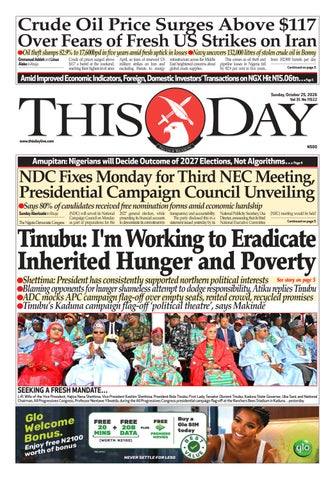
Tinubu: I'm Working to Eradicate Inherited Hunger and Poverty Shettima: President has consistently supported northern political interests See story on page 5 Blaming opponents for hunger shameless attempt to dodge responsibility, Atiku replies Tinubu ADC mocks APC campaign flag-off over empty seats, rented crowd, recycled promises Tinubu’s Kaduna campaign flag-off ‘political theatre’, says Makinde
SEEKING A FRESH MANDATE…
L-R: Wife of the Vice President, Hajiya Nana Shettima; Vice President Kashim Shettima; President Bola Tinubu; First Lady, Senator Oluremi Tinubu; Kaduna State Governor, Uba Sani; and National Chairman, All Progressives Congress, Professor Nentawe Yilwatda, during the All Progressives Congress presidential campaign flag-off at the Ranchers Bees Stadium in Kaduna…yesterday
2
SUNday, OCTOBER 25, 2026 • T H I S D AY
SUNDAY, OCTOBER 25, 2026 • T H I S D AY
3
4
SUNday, OCTOBER 25, 2026 • T H I S D AY
5
OCTOBER 25, 2026 • T H I S DAY, T H E S U N DAY N E W S PA P E R
NEWS
Amid Improved Economic Indicators, Foreign, Domestic Investors’ Transactions on NGX Hit N15.06tn Kayode Tokede
Foreign and domestic investors’ transactions on Nigeria’s stock market reached N15.06 trillion in the first nine months of 2026, amid key reforms and improved economic indicators. The Nigerian Exchange Limited’s (NGX) report on domestic and foreign portfolio participation in equity trading revealed that domestic investors continued to dominate transactions, accounting for 89.74 per cent of the total. In
comparison, foreign investors contributed 10.26 per cent. Foreign investors’ share of transactions declined from 21.56 per cent in the corresponding period of 2025 to 10.26 per cent in 2026. Conversely, domestic investors, comprising retail and institutional investors, increased their share from 78.44 per cent to 89.74 per cent. The report disclosed that domestic investors’ transactions rose to N13.52 trillion between January and September 2026, representing a 102 per cent
increase over the N6.69 trillion recorded in the corresponding period of 2025. Foreign investors, however, accounted for N1.55 trillion, representing a 16.01 per cent decline from N1.84 trillion recorded between January and September 2025. The shift suggests that the surge in activity on Nigeria’s stock market this year has been driven largely by local capital, particularly institutional investors. Capital market analysts attributed the growth in
institutional investors’ transactions partly to the National Pension Commission’s (PenCom) decision to raise equity investment limits for pension funds in February 2026. They said the policy had helped inject fresh liquidity into the stock market, supporting gains in the share prices of some bluechip companies. On February 9, 2026, PenCom revised the investment limits for ordinary shares in Retirement Savings Account (RSA) Funds I, II, III and VI (Active).
TINUBU: I'M WORKING TO ERADICATE INHERITED HUNGER AND POVERTY Deji Elumoye, Chuks Okocha, Adedayo Akinwale in Abuja and John Shiklam in Kaduna
President Bola Ahmed Tinubu yesterday flagged off his 2027 re-election campaign in Kaduna State, declaring that he was working to eradicate inherited hunger and poverty created by his political opponents when they were in power. Tinubu, who spoke at the Ranchers Bees Stadium, the venue of the All Progressives Congress (APC) rally, promised that his administration would create prosperity, consistency, growth, recovery and opportunity. This comes as Vice President Kashim Shettima declared that President Tinubu has consistently supported northern political interests, citing historical instances when the president provided vital political backing to major northern figures facing political adversity.
Meanwhile, Governor Uba Sani of Kaduna State has challenged opposition figures presenting themselves as northern candidates to show their track record. Reacting to Tinubu’s claim that the opposition created hunger and poverty, African Democratic Congress (ADC) presidential candidate Atiku described it as a delusional and shameless attempt to dodge responsibility for the misery Tinubu’s government has inflicted on Nigerians. The ADC Presidential Campaign Council (ADC-PCC) has also described the APC campaign flag-off in Kaduna as a monumental disappointment, accusing the ruling party of relying on rented crowds, empty seats and recycled promises. Similarly, the MakindeDaura Presidential Campaign Organisation (MDPCO) has dismissed President Tinubu’s campaign flag-off as
political theatre, accusing his administration of failing the North on security, economic welfare and political inclusion. Speaking at yesterday’s campaign rally, Tinubu accused his political opponents of creating hunger and poverty, which his administration was tackling. Tinubu stated: “I must thank you for your participation in the past elections. You gave me joy, and I will always remember the victory you gave me to become President. I have come again to thank you and seek your mandate for a second term to fulfill our promise of prosperity, continuity, progress and development. “I hear my opponents talking about hunger. Who created it? They did. They created hunger and poverty. We are trying to eradicate them. We pay salaries regularly. Our governors are working, and I am proud of them. They are developing their states.
“To you, the children of our country, we promise prosperity in our second term. You will not regret going to the polls. “Do you have your PVC? This is not a matter of anger either. Our opponents are angry… They have nothing to offer you but heckling. We have prosperity, consistency, growth, recovery and opportunity. I assure you of that.” The president urged voters to vote for all the ruling party's candidates during the election. He noted: “Your prosperity is here. Your good fortune is in your hands. Your fingerprints will reflect this. Be careful. Watch them. Do not let them lie to you. “What is past is past. Fuel subsidy is in our past. No more corruption, no more falsification of invoices, no more lies and no more smuggling.”
Shettima: Tinubu Had
The commission amended Section 9 of its investment regulations, raising equity allocation limits for RSA Fund I from 30 per cent to 35 per cent; RSA Fund II from 25 per cent to 33 per cent; RSA Fund III from 10 per cent to 15 per cent; and RSA Fund VI (Active) from 25 per cent to 33 per cent. Institutional investors accounted for N8.36 trillion of domestic transactions between January and September 2026, compared with N5.15 trillion from retail investors. In the
corresponding period of 2025, institutional and retail transactions stood at N4.09 trillion and N2.60 trillion, respectively. The report also showed that foreign portfolio outflows rose to N913.61 billion between January and September 2026, up from N810.39 billion in the corresponding period of 2025, a 12.7 per cent increase. Foreign portfolio inflows, however, fell to N632.35 billion, down about 38.6 per cent from N1.03 trillion in the corresponding period of 2025.
Consistently Supported Northern Political Interests
can also see that in 2015 and 2019, President Tinubu stood solidly behind the late President Muhammadu Buhari, who secured his first- and second-term victories. This is why we have all stood with him. This is a mark of honour, and our faith in a man of honour.” Shettima said Tinubu’s administration had also kept the country together despite predictions of failure and had delivered on key promises. Shettima also cited several projects delivered by Tinubu’s administration.
Also speaking at the rally, Vice President Shettima stated that President Tinubu had consistently supported northern political interests. “And I want us to bear in mind and go back to the past. President Bola Ahmed Tinubu has fiercely identified with the North over the years. It is pertinent to mention that when former Vice President Atiku Abubakar was harassed and chased out of the PDP, with his tail between his legs, he ran to the land of the Jagaban, who gave him political succour, support, and a platform to contest the presidency in 2007. “Again, in 2011, President Tinubu supported another Northern man, Malam Nuhu Ribadu, to contest for the presidency of this country. You
NDC FIXES MONDAY FOR THIRD NEC MEETING, PRESIDENTIAL CAMPAIGN COUNCIL UNVEILING
at 10 a.m. on October 26 at JD Event Centre, Kashim Ibrahim Way, Maitama, Abuja. A major highlight of the meeting, according to the party, will be the National Treasurer's presentation of the party's statement of account, a move it said is intended to distinguish its financial management practices from those of other political parties. The NDC challenged other political parties, particularly the ruling All Progressives Congress (APC), to adopt similar measures to promote transparency in managing party finances. The party also attributed its financial limitations partly to the economic difficulties facing Nigerians, claiming that
approximately 80 per cent of its candidates could not afford the fees for expression-of-interest forms. It said it had consequently issued the forms to the affected candidates free of charge to enable them to participate in the electoral process. The party blamed the situation on what it described as widespread poverty, hunger and deprivation under the APC-led federal government, criticising its economic policies. Beyond the financial disclosures, the NEC meeting will give the party an opportunity to unveil its National Campaign Council, which it said would coordinate its campaign activities across all levels of government.
According to the statement, the council will encompass the presidential, National Assembly, governorship and state Houses of Assembly campaign structures. The party also announced plans to present certificates of return to its candidates contesting the various elective positions. The developments come as political parties intensify preparations for the 2027 general election, with campaign structures, candidate mobilisation and party organisation expected to play important roles in the contest. For the NDC, the planned unveiling of its campaign council and disclosure of its accounts are intended to project organisational readiness and distinguish the party's approach to internal
financial accountability. The NDC expressed confidence in its preparations for the forthcoming elections, saying it was determined to offer Nigerians what it described as altruistic leadership. The statement read, “The leadership of the Nigeria Democratic Congress (NDC) wishes to announce that its 3rd National Executive Committee (NEC) meeting will hold on Monday, 26th October 2026, at JD event centre, Kashim Ibrahim Way, opposite A-class park, Maitama, Abuja. The time is 10 am prompt. “A major highlight of the meeting will be the release and presentation of the party’s Statement of Account by the
National Treasurer. This reflects our avowed commitment to the principles of transparency and accountability. In this regard, we challenge other political parties, especially the ruling All Progressives Congress (APC), to emulate this level of openness and transparency in managing their finances. “For the NDC, it is no longer politics as usual. “Our finances would have been more robust. However, contrary to speculations in the public domain, and due to the level of poverty, hunger and deprivation in the country occasioned by the rudderless APC and its amorphous economic policies, about 80% of our candidates could not
Gov Sani Challenges Northern Candidates to Show Records Kaduna State Governor Senator Sani challenged opposition figures presenting themselves as northern Continued on page 9
afford the Expression of Interest forms. The party had to issue forms to such candidates free of charge. “The party will also use the opportunity of the NEC meeting to unveil its National Campaign Council (NCC). “As a party of innovation, our NCC is all-encompassing. It covers the Presidential, National Assembly, Governorship, and State Houses of Assembly Campaign Councils. “Our various candidates will be presented with Certificates of Return for their respective offices. “The NDC is turbo-charged and ready to give Nigerians the altruistic leadership the nation deserves. A New Nigeria is Possible. We can do it!”
CRUDE OIL PRICE SURGES ABOVE $117 OVER FEARS OF FRESH US STRIKES ON IRAN (bpd) in 2021 to 17,600 bpd in the first seven months of 2026, amid fresh concerns about further increases in lost volumes after years of decline. Meanwhile, the Nigerian Navy has uncovered 132,000 litres of stolen crude oil in Allison community, Bonny Local Government Area (LGA) of Rivers State, disrupting a potential storage point in the illicit petroleum supply chain as troops of Operation Delta Sentinel
intensified their clampdown on oil theft and economic saboteurs in the Niger Delta region. Nigeria's oil benchmark, Brent crude, climbed by about 3.5 per cent to cross $117 a barrel during trading before easing to just above $116, still up approximately 2.7 per cent. The latest rally followed reports that Washington was considering fresh military strikes against Iran after the November 3 midterm elections, raising concerns that
the conflict, now in its eighth month, could escalate further rather than move towards a diplomatic resolution. Iran had threatened to attack oil facilities, undersea cables, data centres and artificial intelligence infrastructure across the Gulf if the United States and Israel launched a new offensive against the country. Brent crude traded at about $72 a barrel in February, before the war began, but surged to
about $126 a barrel by the end of April as the conflict intensified and concerns mounted over supply security. Tensions rose again during the week following claims by Iran's Islamic Revolutionary Guards Corps (IRGC) that it struck four commercial vessels in the Strait of Hormuz on Wednesday. The US ordered some diplomats and family members of American government employees to leave Saudi Arabia, which had
faced continued attacks by Houthi rebels operating from Yemen.
Oil Theft Slumps 82.9% to 17,600bpd in Five Years Amid Fresh Uptick in Losses Meanwhile, official operational statistics published by the Nigerian Upstream Petroleum Regulatory Commission (NUPRC) showed that daily crude oil losses, which
fell to a five-year low of 9,100 bpd in 2025, rose by 93.4 per cent to 17,600 bpd between January and July 2026. The figures in the commission’s fifth anniversary publication, ‘The Upstream Gaze’, highlighted both progress in curbing crude theft and the ongoing challenge of protecting oil production and transportation infrastructure. According to the data, daily Continued on page 9
6
T H I S DAY, T H E S U N DAY N E W S PA P E R • OCTOBER 25, 2026
NEWS
INDUSTRIAL PEACE ON THEIR MINDS…
L-R: Secretary to the Ogun State Government, Mr. Tokunbo Talabi; state Chairman, All Progressives Congress, Chief Yemi Sanusi; Governor Dapo Abiodun; Director-General, state Campaign Council, Senator Lekan Mustapha; and the Commissioner for Finance and Chief Economic Adviser to the governor, Mr. Dapo Okubadejo, during a meeting with the Organised Labour in Ogun East Senatorial District…recently
APC Accuses Atiku, ADC of Plotting to Discredit Tinubu’s Campaign Flag-off in Kaduna With Fake News Keyamo: ADC presidential candidate jittery over losing north to Tinubu Tinubu’s panic cannot erase APC’s terrible record, says ADC Insists Nigeria’s biggest problem is grinding poverty, not religion
Chuks Okocha, Adedayo Akinwale in Abuja and Chinedu Eze in Lagos
The All Progressives Congress (APC) Presidential Campaign Council (PCC) has accused the African Democratic Congress (ADC) and its presidential candidate, Atiku Abubakar, of orchestrating a fake news
campaign to discredit its presidential campaign flag-off in Kaduna yesterday. Similarly, the Minister of Aviation and Aerospace development, Festus Keyamo, said Atiku was jittery over the flag-off of the presidential campaign of APC in Kaduna because he was afraid of losing the bulk votes which he was hoping to get from
the north. But is swift reaction, the ADC accused the APC of using allegations of fake news to divert attention from the economic hardship Nigerians were facing under President Bola Tinubu. The APC-PCC in a statement issued statement by its spokesperson, Mr Dele Alake said it uncovered a "well-orchestrated,
devious plan" to misinform the public through AI, deepfake videos and counterfeit documents targeted at the APC rally, President Tinubu, Governor Uba Sani of Kaduna State and APC leaders. According to the council, the plot began with the circulation of a picture of a security vehicle on routine patrol near an APC campaign billboard in Kaduna
metropolis, which was twisted to claim security agents were deployed to protect APC billboards. The council said the story was planted in a national newspaper and subsequently shared by Atiku on his social media handles. Alake added that the second leg was the circulation online of a fake letter purportedly written by Sani to the Director-General of the APC Presidential Campaign Council, Senator Abdulaziz Yari, on the purported release of N2.3 trillion by the Kaduna State Government to host the rally. He added: “We are still at a loss the elections we’ve conducted,” as to how anyone can imagine he said. and concoct this senseless and Speaking during a panel session, Amupitan said AI utterly baseless lie that defies components were already embedded in some of the technologies the commission used, including the Bimodal Voter Accreditation System (BVAS). He said facial recognition and fingerprint technology used for Onyebuchi Ezigbo in Abuja voter accreditation involved AI components, adding that similar The presidential candidate of technologies were incorporated Young Progressives Party (YPP), into the smart card readers that Mr Peter Agada, has faulted the federal government's 90-day preceded BVAS. action plan to ease cost of living, describing it as a campaign strategy that did not reflect economic reality. Agada said the President Bola Tinubu’s administration had failed after introducing numerous “We got to Unity Fountain, economic measures without results. The Minister of Finance and but there was a security presence when we arrived, and some Coordinating Minister of Economy, of our members were repelled Mr. Taiwo Oyedele, had announced from converging. We have that the National Executive Council decided to move to another (NEC) approved a 90-day plan to cushion the high cost of living location,” Samson said. “What we want to do is to on Nigerians. Reacting in an interview in mobilise support and campaign for the candidates of our party, Abuja, Agada said the economic as the constitution requires us to team of the President had lost do, and gather to tell Nigerians focus. "I align with those who opine what we have for them.”
Amupitan: Nigerians will Decide Outcome of 2027 Elections, Not Algorithms Adedayo Akinwale in Abuja
The Chairman of the Independent National Electoral Commission (INEC), Prof. Joash Amupitan, has said algorithms will not determine the outcome of the 2027 general election. Amupitan made the remark at the AI and Democracy Forum 2026 in Abuja. Addressing the question, “Will algorithms decide the 2027 vote?”, he said artificial intelligence (AI) would not replace the will of the
electorate. “Let me, as the chair of INEC, answer it unequivocally: no! Algorithms will not and must never decide the 2027 votes,” he said. “Algorithms will not decide the votes because the choice of who leads Nigeria belongs exclusively to the Nigerian people.” Amupitan, however, said AI-driven geospatial analysis and predictive modelling could improve electoral logistics and help the commission meet its operational demands.
He said since assuming office on October 23, 2025, he had overseen five major elections and more than 16 by-elections, during which INEC tested predictive logistics optimisation. The INEC chairman said the commission recorded improvements in the early deployment of election materials and the commencement of voting. “Reports from civil society and observers reported significant improvement in terms of early deployment of materials and early commencement of voting in all
Military Tanks, Personnel Stationed at Abuja City Gate Ahead of Obi-Kwankwaso Mega March Security operatives yesterday stationed trucks and vans around the Abuja City Gate ahead of the “mega march” to be headlined by the presidential candidate of the Nigeria Democratic Congress (NDC), Mr Peter Obi, and his running mate, Senator Rabiu Kwankwaso. At the city gate, armed personnel were seen milling round the landmark, effectively
restricting a convergence on the premises or surrounding areas. Security agencies deployed in the area included officers of the Nigeria Police Force, Nigerian Army, Civilian Joint Task Force (CJF), the Department of State Services (DSS), and the Nigeria Security and Civil Defence Corps (NSCDC). The heightened security presence follows a plan to hold a mega march and national rally
in Abuja yesterday by a coalition of support groups backing Obi and Kwankwaso. The rally was scheduled to begin at 8am, with the city gate designated as the take-off point. Speaking to journalists on the development, one of the mobilisers of the rally, Saint Samson, said members were prevented from gathering at Unity Fountain amid heavy security presence in the city.
logic and basic common sense. “How much is the entire annual revenue of Kaduna State, or any state, for that matter, that a state would spend N2.3 trillion to host a rally?” Alake queried. Alake noted that the alleged N2.3 trillion was more than Kaduna State's annual budget for three years combined, citing the state's budgets for 2024 at N458.271 billion, 2025 at N790.439 billion and 2026 at N985.9 billion, which he said were still less than N2.3 trillion. The council claimed Atiku and ADC had also perfected plans to circulate old, doctored and deepfake videos during the rally to show purported resentment by the people.
YPP Presidential Candidate, Agada, Faults FG's 90-Day Action Plan to Ease Cost of Living
that the economic team of Mr. President has failed to address Nigeria's numerous economic challenges. I have listened to many analysts, but none spoke positively in support of the economic team," he said. He noted that the minister had earlier announced subsidy intervention and a 17-point plan, including reduction of pump price, removal of illegal levies, but nothing was done, prompting resort to a 90-day timeline. "These promises back and forth are for Nigerians to believe and vote them back into office. If you believe in the rules of the game they are playing, there are just 85 days to election, and you are saying a 90-day timeline to cushion the cost of living. So, after the election, what happens? These guys are playing mind games," he said.
7
OCTOBER 25, 2026 • T H I S DAY, T H E S U N DAY N E W S PA P E R
NEWS
COLLABORATION WITH DEVELOPMENT PARTNERS…
L-R: Project Coordinator, Akin Fadeyi Foundation, Zeera Ismaila; Executive Director, Akin Fadeyi Foundation, Akin Fadeyi; Permanent Secretary, Cabinet Affairs Office, Office of the Secretary to the Government of the Federation, Dr. John Chidiebere Ezeamama; and Director, Governance and Security, Cabinet Affairs Office, Florence Chinwe Anozie, when the Cabinet Affairs Office played host to the Akin Fadeyi in Abuja…recently
Makinde to Tinubu: Rising Foreign Reserves Can’t Feed Hungry Nigerians Faults economic recovery claims, demands reset of economy, security, education
Wale Igbintade
Oyo State Governor and presidential candidate of the Allied Peoples Movement (APM), Mr Seyi Makinde, has faulted President Bola Tinubu’s economic recovery narrative, arguing that rising foreign reserves meant little
when millions of Nigerians were struggling with hunger and worsening economic hardship. Makinde accused the federal government of creating a misleading impression of economic progress by highlighting improvements in financial indicators without
demonstrating corresponding improvements in citizens’ living conditions. The governor made the remarks yesterday in a video message at the official launch of the Makinde and Daura for Better Nigeria (MAD) Resetter Movement in Lagos, where he called for
a comprehensive overhaul of Nigeria’s economy, security architecture, education system and political environment. The event attracted APM leaders, party loyalists, stakeholders and candidates preparing for the 2027 general elections in Lagos State and other parts of the country.
Court Bars Eunisell from Enforcing 177% Default Charges against Halkin
Wale Igbintade
The High Court of the Federal Capital Territory (FCT), Abuja, has permanently restrained Eunisell Limited from demanding or enforcing late-payment charges imposed on Halkin Exploration and Production Limited under a contractual clause prescribing a default fee equivalent to 177 per cent annually. Justice SB Belgore, in a judgment delivered on October 22, 2026, declared the provision, which imposed a daily charge of 0.5 per cent on outstanding payments, an unconscionable
penalty that was unenforceable and contrary to public policy. The judge also nullified all invoices, bills and assessments issued under the disputed clause in the service agreement executed by the two companies on January 20, 2022. The ruling has significant financial implications for the parties, as Eunisell had previously instituted a separate debt-recovery action against Halkin, seeking $10,240,679.98 in outstanding contractual fees, including $7,624,171.51 in late-payment charges calculated at the disputed rate.
However, the judgment did not dismiss the entire $10.24 million debt claim, which is distinct from the substantive relief granted in the present suit. The dispute arose from a service agreement under which Eunisell was engaged to provide specialised engineering services and operate a modular Early Production Facility for Halkin's operations at the Atala Marginal Oilfield, also known as Oil Mining Lease (OML) 46. Under the agreement, Halkin was required to pay a fixed daily service fee of $9,900, while Clause 10.4 stipulated that the payments
made after the contractual deadline would attract a default charge of 0.5 per cent daily. Halkin approached the court to challenge the provision, arguing that the rate was excessive, oppressive and designed to punish it for delayed payments rather than compensate Eunisell for any genuine financial loss. In resolving the dispute, Justice Belgore acknowledged the freedom of commercial parties to negotiate contractual terms but held that such freedom did not oblige courts to enforce unconscionable penalty clauses.
2027: Akume Berates Atiku, Says Former VP’s Presidential Ambition Could Hurt North’s Interests Olawale Ajimotokan in Abuja
The Secretary to the Government of the Federation (SGF), Senator George Akume, has criticised former Vice President Atiku Abubakar over his ambition to contest the 2027 presidential election. The former governor of Benue State described the presidential candidate of the African Democratic Congress (ADC) as a pretender
and warned that the move could undermine the collective political interests of Northern Nigeria. Akume spoke yesterday in Kaduna with gloves in his hands, at a pre-campaign meeting with Benue State indigenes resident in the state. He urged northerners to rally behind President Bola Tinubu’s re-election bid, insisting that the region should wait until 2031 before seeking to return to the
presidency. The SGF argued that individual presidential ambitions should not be allowed to disrupt the powerrotation arrangement between the North and South, which he said had helped sustain Nigeria’s unity and territorial integrity. “Anybody who is from the North and running for the presidency is an enemy of the North. Don’t allow that pretender to deceive you. It is not yet our
turn. The North’s turn is in 2031. Prepare to vote for Tinubu. Do not allow anyone to destroy the country because of a vaunting personal ambition,” he said. Akume maintained that the North stood to gain more by supporting Tinubu for a second term than by pursuing competing political ambitions that could divide the region and weaken its collective influence ahead of the next general election.
Makinde argued that the government’s economic performance should be measured by the ability of ordinary Nigerians to afford basic necessities, achieve financial independence and access opportunities to improve their lives, rather than by official statistics alone. He likened the situation to a household whose head boasts of substantial savings while members of the family go hungry. “We have heard stories that Nigeria’s foreign reserves are going up. I liken it to a household where the head is telling the people that we have a lot of money in our savings accounts, but everyone in that household is hungry,” he said. The governor maintained that genuine economic recovery should translate into better
living standards and enable young Nigerians to pursue their aspirations without struggling merely to survive. Expressing support for the movement’s agenda, he said the country needed fundamental changes across key sectors to improve the welfare of its citizens. “I am with you 101 per cent towards the reset agenda for Nigeria. We need to reset our economy, our security architecture, our educational system and the socio-political environment,” he said. Makinde also called for a return to the principles of federalism and multiparty democracy, arguing that these formed the foundation of Nigeria’s political arrangement and remained essential to building a country that worked for everyone.
Ebola: Lagos Upgrades Isolation Centre, Targets 24-Hour Test Results The Lagos State Government has intensified preparedness against Ebola Virus Disease (EVD) following the confirmation of an index case in Abuja, upgrading its isolation centre and targeting laboratory test results within 24 hours. The state Commissioner for Health, Prof. Akin Abayomi, disclosed this in a statement, saying Governor Babajide Sanwo-Olu had directed relevant agencies to maintain a high level of alertness and preparedness. Abayomi said Lagos was treating the situation as a priority because of the constant movement of people between Lagos and Abuja. He said the state’s Emergency Operations Centre had been working ahead of the confirmed case, with teams conducting
simulation exercises to ensure responders understood their roles. According to him, the state’s isolation centre has been upgraded, while additional capacity is being developed. Training for health workers in public and private facilities is also ongoing, with emphasis on infection prevention and control. The commissioner said the state was establishing a clear pathway for laboratory testing, targeting results within 24 hours. “Our isolation centre has been upgraded, and additional capacity is ongoing,” Abayomi said. “We are defining a clear pathway from sample to result, targeting results within 24 hours.” He added that a dedicated Ebola Research Committee was reviewing the latest evidence on treatments and vaccines to guide decisions.
8
T H I S DAY, T H E S U N DAY N E W S PA P E R • OCTOBER 25, 2026
NEWS
PROMOTING EASY PAYMENT SYSTEM…
L-R: Founder/Coordinator, Blockchain Nigeria User Group, Mr. Chuta Chimezie; Head, Consumer and Retail Business, Remita, Ms. Adedayo Adewale; President and Chairman of the Governing Council, Fintech Association of Nigeria, Dr. Stanley Jacob; and Managing Director/CEO, Remita Payment Services Limited, Mr. Deremi Atanda, at Nigeria Fintech Week, at the National Theatre, Lagos…recently
30 Feared Dead in Attack on Taraba Community as Hunters Kill 14 Bandits in Katsina Wole Ayodele in Jalingo and Francis Sardauna in Katsina
About 30 people have reportedly been killed in an attack by suspected bandits on Binnari community in Karim Lamido Local Government Area (LGA) of Taraba State, with several houses burnt and food crops destroyed. In Katsina, the state government announced the successful foiling of a planned mass kidnap operation in Gidan Wawo village, Kakumi Ward of Bakori LGA following
a coordinated security response that resulted in the elimination of 14 suspected bandits. The attack in Taraba, which occurred shortly after Friday’s Juma’at prayers, reportedly claimed the lives of children and elderly persons, while several residents fled their homes for safety. However, the Taraba State Police Command said only 10 bodies had been recovered as of Friday evening, while residents reported that more bodies were discovered yesterday morning.
Some residents also expressed fears that several victims remained missing following the attack. Local sources said the assailants might have entered the community from neighbouring Plateau State, although the claim has not been independently verified as well as their identities. The attack has compounded the hardship facing residents, many of whom are now mourning lost relatives and struggling to recover from the destruction of their homes and food supplies.
Confirming the incident, the Police Public Relations Officer of the Taraba State Command, ASP Victor Mshelizah, said preliminary information indicated that the attackers initially targeted food items and other valuables. “There was an incident like that yesterday, immediately after Friday’s prayers. “From the preliminary report, it was revealed that the people initially came to steal food stuff and other valuables,” he said. ASP Mshelizah said security
LCCI Demands Constant Electricity Supply for Industrial Clusters, Commercial Centres, Technology Parks Dike Onwuamaeze
The President of Lagos Chamber of Commerce and Industry (LCCI), Mr. Leye Kupoluyi, has called for the development of constant electricity supply hubs in industrial clusters, commercial centres, markets and technology parks across the country. Kupoluyi made this call during the LCCI’s power sector group’s conference with the theme “Gas to Power: Unlocking Nigeria’s Energy Potential for Sustainable Economic Growth.” He said: “I advocate the development of 24/7 electricity
supply hubs in industrial clusters, commercial centers, markets and technology parks. “Through partnerships between government and private investors, these hubs can combine gas-fired generation, renewable energy, battery storage and dedicated distribution infrastructure to provide more reliable electricity. “Such arrangements can reduce businesses’ dependence on individual generators, lower operating costs and improve productivity.” According to him, Nigeria possessed substantial gas
resources that could be deployed to strengthen electricity generation and support industrial development. He stated that gas-fired power plants could provide “dispatchable” electricity and complement renewable energy sources, helping to meet the needs of businesses that require dependable power. Kupoluyi, however, emphasised that “gas-fired generation alone will not resolve all our electricity challenges,” stressing that “it must be accompanied by improvements in transmission, distribution,
metering, market liquidity, and operational efficiency. “The ultimate goal is to translate our natural resources into dependable electricity, competitive businesses and sustainable economic growth.” The LCCI’s president stated that currently businesses, particularly manufacturers and small and medium-sized enterprises, were documenting the burden of frequent power outages in their financials as high energy costs, increased production costs, reduced capacity utilisation and weakened profit margins.
Soludo: Supporting Tinubu’s Re-election Could Pave the Way for Igbo Presidency in Future
Chuks Okocha in Abuja
The Governor of Anambra State, Prof. Chukwuma Soludo, has said supporting President Bola Tinubu’s second-term bid could pave the way for an Igbo presidency in the future. In a video that circulated on X at the weekend, Soludo, speaking in Igbo, said backing Tinubu in the 2027 election could encourage other regions
to support an Igbo presidential candidate when power returns to the South. He said the South-east should support the incumbent southern president, noting that power would shift to the north after Tinubu’s tenure before eventually returning to the south. “You have to engage in discussions. Now that it is a southerner holding the
power; it’s remaining four years. It is now left for us (Igbos) to support him so that when it goes to the North and comes back, we can now trust that every southerner and northerner will support us,” he said. The governor said political power should rotate among different groups, adding that he had no intention of seeking a third term.
“What am I vying for? I’ve gotten a governorship position; will I go for a third term? Everyone must be given the opportunity to be able to rise,” he said. Soludo also said the All Progressives Grand Alliance (APGA), the party under which he was elected governor, would support the prevailing political direction in the interest of the south-east.
operatives had recovered 10 bodies as of Friday evening, as the identities of the attackers had yet to be established. He assured residents that the police would continue to intensify efforts to protect lives and property of the people. Reports said the attack has further renewed concerns over the vulnerability of rural communities in Karim Lamido and other parts of Taraba State to armed violence, with residents calling for stronger security measures to prevent further attacks. Meanwhile, in Katsina, a statement signed by the state Commissioner for Internal Security and Home Affairs, Dr. Nasir Danmusa, said intelligence reports had indicated that 26 heavily armed bandits riding on 13 motorcycles, under the leadership of a notorious kingpin identified as Isiya Kwashen
Garwa, were advancing towards Dawan Laila Forest in preparation for coordinated attacks on neighbouring communities when community hunters from Gidan Wawo were promptly mobilised to engage the fleeing criminals in a fierce gun battle. According to Danmusa, the encounter ended in a decisive victory for the security volunteers, with 14 bandits neutralised and three victims rescued alive. The operation, however, came at a painful cost. A brave community hunter, Mohammed Ibrahim Jidda, 29, was killed while defending the community, while another hunter, Usman Sunday, 25, sustained minor gunshot injuries and is currently receiving medical treatment. One of the travellers, Jamilu Lawal, 50, tragically lost his life after being burnt in the vehicle during the attack.
Attack on ADC Supporter: Atiku Accuses Tinubu, Okpebholo of Encouraging Political Violence Chuks Okocha in Abuja
The presidential candidate of the African Democratic Congress (ADC), Atiku Abubakar, has accused President Bola Tinubu, Edo State Governor Monday Okpebholo, and the All Progressives Congress (APC) of creating an environment that encouraged political violence. The accusation followed an alleged attack on comedian Osagie Daniel Idedia, popularly known as Porkupyne, in Benin City. In a post on X yesterday, Atiku alleged that the comedian was attacked because he supported him and his demand for good governance and accountability in Edo State. He condemned the incident and called for an urgent police investigation into the
circumstances surrounding the attack. “I condemn in the strongest possible terms the brutal attack on comedian Osagie Daniel Idedia (aka Porkupyne), in Benin City, Edo State,” Atiku said. He added that the incident was politically motivated, alleging that the comedian was targeted because he was his supporter. Atiku held Okpebholo, Tinubu and the APC leadership responsible for what he described as a climate of impunity in which opposition supporters were allegedly intimidated and assaulted. “Governor Okpebholo must explain what happened to Porkupyne, stop hiding behind official silence and prove that his government is not shielding political thugs,” he said.
9
OCTOBER 25, 2026 • T H I S DAY, T H E S U N DAY N E W S PA P E R
NEWS
REJIGGING THE ANTI-DRUG WAR AHEAD OF 2027…
L-R: Edo State Deputy Commander, Operations and Training, National Drug Law Enforcement Agency, James Olarewaju; State Commander, Mitchell Ofoyeju; Edo State Commissioner of Police, Patrick Daaor; and State Deputy Commander, NDLEA, Victor Isibor during a strategy meeting ahead of the 2027 general election in Benin-City…Friday
CRUDE OIL PRICE SURGES ABOVE $117 OVER FEARS OF FRESH US STRIKES ON IRAN
losses declined from 102,900 bpd in 2021 to 55,000 bpd in 2022, representing a 46.5 per cent reduction. The downward trend continued in 2023 when losses dropped to 22,900 bpd, before falling further to 11,200 bpd in 2024 and 9,100 bpd in 2025. The federal government attributed the cut in crude losses to the combined efforts of the military, local pipeline surveillance groups in the Niger Delta, and the introduction of modern crude measuring devices in the region. The figures showed that Nigeria’s total liquid hydrocarbon production, comprising crude oil and condensate, gradually recovered from the lows recorded in recent years. Output averaged 1.63 million bpd in the first seven months of 2026, compared with 1.62 million bpd in 2025, 1.56 million bpd in 2024, 1.47 million bpd in 2023 and 1.38 million bpd in 2022.
Production stood at 1.62 million bpd in 2021, the NUPRC data highlighted. Crude oil production alone averaged 1.46 million bpd in the period under review, up from 1.43 million bpd in 2025, 1.35 million bpd in 2024, 1.24 million bpd in 2023 and 1.14 million bpd in 2022. The figure for 2021 was 1.31 million bpd. In contrast, blended condensate production continued its downward trend, averaging 170,000 bpd in the first seven months of 2026, compared with 190,000 bpd in 2025, 210,000 bpd in 2024, 230,000 bpd in 2023, 240,000 bpd in 2022, and 310,000 bpd in 2021. The gradual improvement in crude production also coincided with a significant shift in how the country allocates its oil, particularly the growing share supplied to domestic refineries as Nigeria expands its local refining
capacity. Supply to domestic refineries climbed to 460,000 bpd in the first seven months of 2026, up from 280,000 bpd in 2025, 220,000 bpd in 2024, 20,000 bpd in 2023, and just 10,000 bpd in 2022. Domestic refinery supply was virtually non-existent in 2021. At 460,000 bpd, local refineries accounted for approximately 29 per cent of the 1.61 million bpd in total crude oil lifted during the period. The allocation represented a 64.3 per cent increase over the 280,000 bpd supplied to domestic refineries in 2025, underscoring growing demand for locally processed crude. Similarly, the shift coincided with a decline in crude available for export, as the government struggled to meet local supply. Average daily crude exports fell to 1.15 million bpd in the first seven months of 2026, from 1.33 million bpd in 2025; 1.31 million
bpd in 2024; 1.47 million bpd in 2023; 1.32 million bpd in 2022 and 1.51 million bpd in 2021. The latest export figures were down 13.5 per cent from the 2025 level and 23.8 per cent from the 2021 volume. In the same vein, total crude lifting averaged 1.61 million bpd in the first seven months of 2026, marginally below the 1.62 million bpd recorded in 2025. The figures suggested that the growing allocation to domestic refineries has been accompanied by a reduction in export volumes, rather than a comparable increase in total crude lifted.
Navy Uncovers 132,000 litres of Stolen Crude Oil in Bonny Meanwhile, the Nigerian Navy has uncovered 132,000 litres of stolen crude oil in Allison
TINUBU: I'M WORKING TO ERADICATE INHERITED HUNGER AND POVERTY candidates to show their track record, stressing that Tinubu had fulfilled key campaign promises made to Kaduna State in 2022, particularly on road reconstruction and security in Birnin Gwari. He recalled Tinubu's visit to Birnin Gwari LGA on December 22, 2022, when the area was the epicentre of insecurity in the North-west. Addressing the President, Sani said: “At that time, a very senior officer advised you against going to Birnin Gwari because of security concerns. You instantly rejected the advice and travelled to Birnin Gwari with 27 armoured vehicles.” According to the governor, two promises made during that visit have been met, adding that the 123km Kaduna-Birnin Gwari Road abandoned for over 40 years was under reconstruction. Sani said the government had released N117 billion to the contractor. He noted: “Today you can travel to Birnin Gwari with your eyes closed without a single police escort. That is progress.” The governor challenged opposition figures to show their
track record. “When someone came to us and said we should vote for him simply because he is a northerner, we asked him, can you show us a track record?” Sani said. Also, the Director General of the APC Presidential Campaign Council, Senator Abdul'aziz Yari, said the campaign would be based on records in the economy, infrastructure, health, education and cash transfers. “We have been engaging all and sundry, our traditional rulers, our ulama and our imams, to understand the importance of your return in 2027 for continuity, for the peace of this country.” He added: “The opposition have now upgraded their campaign from Facebook and Twitter to AI. So, I want to call the attention of our supporters to prepare, be watchful and be vigilant.” For his part, the National Chairman of APC, Prof. Nentawe Yilwatda, declared that Tinubu has earned the confidence and support of Nigerians through his courageous leadership, commitment to national development, and promise of
greater prosperity for the country. Blaming Opposition for Hunger Shameless Attempt to Dodge Responsibility, Atiku Replies Tinubu
Meanwhile, Atiku has described Tinubu’s claim that the opposition created hunger and poverty as a delusional and shameless attempt to dodge responsibility for the misery his own government has inflicted on Nigerians. In a statement issued by the Director of Strategic Communication of the ADC Presidential Campaign Council, Phrank Shaibu, the former Vice President argued that a President cannot light the fire of hardship with his own policies, then blame the neighbours for the smoke. “Mr President, blaming the opposition for hunger is either delusion or a staggering case of political amnesia. The APC governed Nigeria for eight years before you took office. You have added another three and a half years. Nigerians know who has been in power, and hardship did not begin when the opposition started talking about it. Stop
insulting their intelligence and answer for your record. “The hardship your administration has brought upon Nigerians is real. You cannot deny it by blaming others. “Your decision to commission the unfinished Abuja to Kaduna Expressway from inside a stadium shows how far removed you are from the daily reality of Nigerians. A road cannot be completed with a speech or a ribbon-cutting ceremony,” Atiku added. ADC Mocks APC Campaign Flag-off Over Empty Seats, Rented Crowd, Recycled Promises Reacting to the rally, the Director of Media and Publicity of the ADC-PCC, Mr. Kola Ologbondiyan, said an event intended to demonstrate the APC’s political strength across the North-west had instead exposed what he described as the party’s declining public acceptance. Ologbondiyan alleged that the APC mobilised people from the seven states of the North-west and beyond, with payments reportedly ranging from N50,000 to N100,000
community, Bonny LGA of Rivers State. According to a statement by the Director of Naval Information, Navy Captain Abiodun Folorunsho, the Forward Operating Base Bonny discovered the stolen crude oil under Operation Delta Sentinel, following actionable intelligence. He said the operation uncovered 10 dugout pits, adding that the site and the recovered products were handled in accordance with extant regulations. “The operation reinforces the importance of intelligence-led action in identifying concealed petroleum stockpiles and disrupting the infrastructure that enables crude oil theft and the unauthorised movement of petroleum products. “The Nigerian Navy will sustain efforts to locate and dismantle illegal refining
infrastructure and disrupt the networks facilitating crude oil theft across the Niger Delta,” the statement said. The Navy urged community leaders, residents, traditional institutions and other stakeholders to promptly report crude oil theft, illegal refining, suspicious petroleum storage and the unauthorised movement of petroleum products to the nearest security agency. Timely, credible information, the statement said, could enable swift intervention and prevent illicit activities from expanding. “Safeguarding the nation’s critical petroleum assets requires vigilance and active cooperation between security agencies and the communities they serve. The Navy therefore urges the public to remain alert and support lawful efforts to protect national resources,” Folorunsho concluded.
per person. Yet, the stadium, which he put at a capacity of 5,000, remained sparsely occupied. He added that the turnout, which he described as disappointing, was compounded by what he called the unenthusiastic reception given to the speeches and messages of APC leaders. Ologbondiyan further alleged that some attendees expressed dissatisfaction with the ruling party after leaving the stadium, chanting the Hausa phrase “Ba mu yi,” which he interpreted as a rejection of the APC and its policies. The ADC-PCC accused the APC of returning to Kaduna with promises similar to those made during the 2015, 2019 and 2023 election cycles, arguing that the ruling party had failed to account for its years in power adequately.
Organisation (MDPCO) said the APC campaign event would not erase what it described as broken promises, worsening hardship and declining public confidence in the ruling party. In a statement issued by its Director of Strategic Communications, Richard Ihediwa, MDPCO challenged Tinubu to explain what the North had gained from his administration beyond persistent insecurity, economic difficulties and what it called marginalisation. MDPCO alleged that at least 20,000 people had been killed in northern Nigeria since Tinubu assumed office in 2023, while millions had been displaced by insecurity. The statement did not independently verify the figures. The organisation further alleged that the North had been marginalised in appointments to strategic federal positions, accusing the APC of treating the region primarily as a source of electoral support. “No part of the country should be an electoral warehouse to be raided every four years and abandoned after victory,” the group said.
Tinubu’s Kaduna Campaign Flag-off ‘Political Theatre’, Says Makinde On its part, the MakindeDaura Presidential Campaign
10
T H I S D AY, T H E S U N D AY N E W S PA P E R OCTOBER 25, 2026
NEWS
GIVING BACK TO THE SOCIETY…
L-R: The Oluwo of Ilisan Remo, Chief Ade Fagorala; Principal, Senior School, Isanbi Comprehensive Secondary School, Ilisan Remo, Mr. Bolaji Ogunshilu; GCOO, Codix Holdings Limited, Mrs. Mary Ogangwu; Executive Chairman, State Universal Basic Education Board, Ogun State, Hon. Joshua Olalekan Ifede; Ogun State Commissioner for Education, Science and Technology, Prof. Abayomi Arigbabu; Executive Chairman and Group Chief Executive Officer, Codix Holdings Limited, Mr. Sammy Ogunjimi; Baale of Ago-Ilara, Dr. Muftau Oyegunle; and Managing Director, Colexa Biosensor Limited, Mr. Kingsley Aguoru, at the inauguration of the upgraded facilities at Isanbi Comprehensive Secondary School, Ilisan-Remo, Ogun State…recently.
CONUA Urges Federal Government to Finalise Agreement, Pay Outstanding Salaries, Arrears Kuni Tyessi in Abuja The President of the Congress of University Academics (CONUA), Dr. Niyi Sunmonu, has warned that the union will pursue appropriate lawful trade union actions if the federal government fails to conclude its Collective Bargaining Agreement without further delay. In the same vein, the Secretary General of the Trade Union Congress of Nigeria (TUC), Dr. Nuhu Toro, has demanded immediate action to finalise the collective bargaining agreement with CONUA. Sunmonu gave the warning yesterday in Abuja while addressing journalists after the National Executive Council (NEC) meeting of the union
held at the University of Abuja. He said NEC reviewed the latest draft of the proposed FGN-CONUA Agreement of September 2026 and condemned the failure of the federal government to treat CONUA fairly. “CONUA has consistently pursued constructive engagement and believe that dialogue must lead to tangible outcomes. The recognition of a trade union must translate into meaningful collective bargaining and a concluded agreement that provides an effective framework for representing its members,” Sunmonu said. He called on the Federal Ministries of Education and Labour and Employment, and all relevant negotiating authorities, to conclude the process as a
UK, UNODC, ICPC, Police, NAPTIP Back ANEEJ’s Demand for Central Database of Recovered Assets Kuni Tyessi in Abuja The United Kingdom Government, the United Nations Office on Drugs and Crime (UNODC), and Nigeria’s leading anti-graft agencies have thrown their weight behind the Africa Network for Environment and Economic Justice (ANEEJ) in its demand for a unified, public, and tamper-proof database of all recovered assets in the country. The coalition gave its support yesterday in Abuja during a stakeholders’ briefing on data management in asset recovery, while comparing Nigeria’s system with those of the UK, US, Italy and France. In his opening speech, ANEEJ Executive Director, Rev. David Ugolor, said that while Nigeria had a good law in the Proceeds of Crime (Recovery and Management) Act, 2022, implementation was poor. Represented by Deputy Executive Director, Comrade
Leo Atakpu, Ugolor said that as of April 2026, some agencies were uploading forfeited assets to the central database, others were still finalising access, while some had not started at all. “Recovering an asset is only part of the task. Stakeholders need to know what was identified, frozen, forfeited, where it is and how it is being managed. Without reliable data, that story cannot be told with confidence,” Ugolor said. He noted that the database had not yet been opened to the public, and Nigeria still had no single identifier to track an asset from seizure to court to Treasury. For the UK, the Illicit Finance Adviser at the Foreign, Commonwealth and Development Office (FCDO), Jehanzeb Khan, represented by Anicestus Atakpu, said the UK cherished its partnership with Nigeria in fighting illicit finance, noting that effective recovery depended on transparent data.
mark of government’s commitment to democratic process and sustained industrial harmony in Nigerian universities. “While CONUA remains committed to dialogue, the union reserves the right to pursue appropriate lawful trade union actions in pursuit of the welfare of its members, should the circumstances warrant it,” the CONUA President warned. He also demanded the prompt settlement of outstanding entitlements, including three and a
half months of withheld salaries, promotion arrears, irregular payment of recently approved entitlements and arrears arising from the 25% and 35% wage awards. “University academics must not be subjected to indefinite delays, the trauma resulting from trivialization of its well-being and inconsistent implementation or administrative uncertainty,” he said. He commended the federal government for resolving the
pension-entitlement issue, recalling the collaborative programme organised by CONUA and PENCOM on 26 September 2024. On representation, Sunmonu said CONUA’s exclusion from programmes associated with TETFund and NEEDS Assessment was unfair. On university education, the CONUA President said Nigeria cannot build a competitive knowledge economy on inadequately funded and poorly equipped universities.
He called for reliable electricity, internet connectivity, functional laboratories and digital transformation, while condemning reported practices of hiring or renting academic staff and equipment for accreditation. “Accreditation must reflect an institution’s genuine and sustainable capacity to deliver its programmes. It must not become an exercise in appearances that conceal deficiencies in staffing, facilities or equipment,” Sunmonu stated.
Oyo APC Campaign Threatens APM Gov Candidate With Defamation Suit The campaign organisation of the All Progressives Congress (APC) governorship candidate in Oyo State, Senator Sharafadeen Alli, has threatened legal action against the governorship candidate of the Allied Peoples Movement (APM), Bimbo Adekanmbi, over allegations of corruption and financial mismanagement. The organisation described the allegations as falsehoods intended to damage Alli’s reputation and undermine his growing political support ahead of the 2027 governorship election. In a statement issued yesterday by the Director of Media
and Publicity of the Senator Sharafadeen Alli Campaign Organisation, Bisi Oladele, the group accused Adekanmbi of distorting historical facts and exploiting past challenges in local government administration to score political points. It said the allegations, reportedly made during a radio interview, reflected the opposition’s desperation to discredit Alli rather than engage voters with credible proposals for the development of Oyo State. Defending Alli’s record as chairman of Ibadan North Local Government, SSACO said the
senator maintained prompt salary ≠the Federal Military Government’s January 1993 policy on staff promotions and salary increases were nationwide challenges caused by inadequate allocations to implement the policy. According to the statement, the crisis extended beyond Alli’s tenure and was subsequently addressed through institutional interventions, including the establishment of the National Primary Education Commission in 1997 and the introduction of first-line charges for teachers’ salaries by 1999. Challenging Adekanmbi to produce the report allegedly
backing his corruption claims, SSACO warned that failure to substantiate the allegations could attract a defamation suit. The organisation accused Adekanmbi and his political associates of using historical administrative challenges to mislead the electorate, insisting that the allegations would not diminish Alli’s political standing. It also criticised the administration of Governor Seyi Makinde, accusing it of weakening local government administration and depriving residents of the benefits of effective grassroots governance.
Author Offers Essential Financial Literacy for Canada Newcomers A certified financial counsellor, Daniel Adeyinka, has released a free Reader’s Edition of his book ‘How Money Works in Canada: A Newcomer’s Guide to Banking, Credit, and Building Your Life with Confidence.’ The book gives newcomers, and organisations a chance to read the full first chapter before deciding on the book. Published by Babanlar Press on July 28, 2026, the book explains banking, credit and debt in Canada
in plain language, for people planning a move, those who have just arrived, and those still finding their feet. Drawing on his personal experience of relocating across Nigeria, the United Kingdom, the United States, and Canada within five years, Adeyinka combined lived experience with professional expertise in mortgages, life insurance, and financial counselling. The book offers an empathetic, plain-language roadmap designed
to turn financial confusion into confidence. “One of the biggest challenges newcomers face isn’t necessarily a lack of financial knowledge,” Adeyinka said. “It’s that they’re trying to apply what they already know to a system that works differently,” he stated, adding that “my goal isn’t to tell newcomers what to do with their money. It’s to help them understand the system well enough to make decisions with
clarity and confidence.” The chapter argues that confusion about money after a move is not a sign of poor judgment, and that understanding the system matters more than moving fast. The Reader’s Edition also includes the full table of contents, a summary of Chapter 1, and a list of common newcomer questions with pointers to where the book answers them. Adeyinka has lived in Nigeria, the United Kingdom, the United States and Canada within five years.
SUNDAY, OCTOBER 25, 2026 • T H I S D AY
11
T H I S D AY, T H E S U N D AY N E W S PA P E R OCTOBER 25, 2026
12
NEWS
CELEBRATING 40TH ANNIVERSARY…
L-R: Director, M.D School, Oluwaseun Amusa; Chairman, 40th Anniversary Planning Committee and Member, Governing Council, Mr. Chris Dike; Executive Director, M.D School, Mrs. Omolara Adedugbe; Chairman, 40th Anniversary Media Committee and Governing Council Member, Mr. Steve Akadiri; Member, Governing Council, Dr. Ngozi Okwok, during a press conference to mark the 40th anniversary of the school in Lagos... recently
Shoprite Set to Open Neighbourhood Stores Across Nigeria After Shutdown Festus Akanbi Shoprite Nigeria is planning to open standalone neighbourhood stores as part of efforts to revive its operations, following financial difficulties that forced the retailer to restructure its business. Adekunle Adebiyi, the Executive Director, Investments at MBO Capital Management Limited, an investor in Shoprite Nigeria, disclosed this during an interview on Nairametrics’ Drinks and Mics on Friday, where he discussed the supermarket chain’s financial challenges and recovery plans.
Adebiyi said three Shoprite outlets had reopened after the company temporarily shut its operations to negotiate with suppliers and address outstanding financial obligations. “We took a very, very drastic decision to just shut everything down whilst we negotiated with suppliers. Now three stores are back open,” he said. He explained that the company planned to expand through smaller standalone outlets in residential neighbourhoods rather than relying primarily on large shopping malls.
NUEE Strike: Edo Govt Assures of Restoration of Power Supply to Residents Felix Omoh-Asun in Benin City After a week of power cuts in Edo State, resulting in a total blackout and crippling social, commercial and business activities, the state government has assured that the striking National Union of Electricity Employees (NUEE) will soon resume operations. According to a statement by the Chief Press Secretary to Governor Monday Okpebholo, Dr. Patrick Ebojele, the governor and leaders of organised labour settled the dispute over recognition of the Nigeria Labour Congress (NLC) caretaker committee in the state and related issues yesterday. The statement said the agreement was reached at a closed-door meeting in Abuja convened by the Secretary to the Government of the Federation (SGF), Senator George Akume. Also present were NLC President Comrade Joe
Ajaero; Minister of Labour and Employment Dr. Muhammad Maigari Dingyadi; and former Edo State Governor and ex-NLC President Senator Adams Oshiomhole. Speaking to journalists after the meeting, Governor Okpebholo said the parties had resolved the matter. He said the state government would recognise the caretaker committee and work with labour leaders on arrangements for a substantive election. “There is no issue actually, and we have resolved the issues that border the NLC caretaker committee in Edo,” he said. Ajaero confirmed the agreement and thanked the Governor, Akume, Dingyadi and Oshiomhole for their roles. He said labour had agreed to work with the state government to recognise the caretaker committee and organise a substantive election, and to address the rights and privileges due to the committee.
“We’re going to be opening standalone neighbourhood stores, which was always the plan,” Adebiyi said. The approach is expected to allow the retailer to concentrate its resources on supermarket operations rather than committing substantial capital to property development. Adebiyi said supermarkets typically operate from leased
premises, with investments focused on equipment such as shelves and refrigeration systems. However, he noted that this business model could create financing difficulties in Nigeria, where banks often require tangible assets as collateral for loans. He disclosed that MBO Capital encountered challenges securing bank financing during the acquisition of Shoprite Nigeria
because lenders struggled to identify sufficient physical assets to support the transaction. Despite the retailer generating billions of naira in revenue, the structure of its business made it difficult to obtain conventional asset-backed financing, prompting the investors to explore alternative funding arrangements. Adebiyi also identified foreign exchange volatility as a major
factor behind Shoprite Nigeria’s financial difficulties. According to him, about 17 of the retailer’s 28 stores had rental agreements denominated in dollars when the acquisition took place. The depreciation of the naira subsequently increased the cost of those leases, putting additional pressure on the company’s operating expenses.
DICON Dana Hails Tinubu’s Investment in Defence Self-Reliance Kayode Tokede The Chief Executive Officer of DICON Dana Tactical Limited, Jacky Hathiramani, has commended the Ministry of Defence for its foresight in strengthening Nigeria’s indigenous defence manufacturing capacity, describing the $100 million joint venture as a strategic investment in national security and industrial development. Hathiramani said the initiative presented an opportunity to strengthen local defence
manufacturing, support the operational needs of the Nigerian Armed Forces and reduce dependence on foreign supply chains for essential military equipment. He commended the Minister of Defence, General Christopher Musa, and the ministry for their confidence in the initiative, noting that a nation’s defence capability depends not only on the equipment it acquires but also on its ability to manufacture, maintain, and sustain critical equipment locally.
Hathiramani also praised President Bola Ahmed Tinubu’s commitment to the welfare of the Armed Forces and to providing the equipment needed to fulfil their operational responsibilities. He noted that the President’s focus on developing local capacity across sectors reflected a vision for a more industrialised and self-reliant Nigeria. “We appreciate the Ministry of Defence’s confidence in this initiative and commend the President’s commitment to strengthening Nigeria’s capac-
ity. This partnership presents an important opportunity to support our Armed Forces, develop local manufacturing expertise and build the industrial capabilities required to advance national security,” Hathiramani said. The joint venture aligns with Nigeria’s ambition to expand its domestic defence industrial base through local manufacturing, technology transfer and skills development, while creating employment opportunities and strengthening local supply chains.
Soldiers Kill 15 Terrorists in Borno Air Strike Linus Aleke in Abuja Troops of Operation Hadin Kai have neutralised 15 terrorists in a precision air strike north-west of Pulka in Gwoza Local Government Area (LGA) of Borno State. The Nigerian Army said the terrorists were neutralised during an operation conducted at about 11:50 pm on October 23, 2026. The Acting Military Information Officer of the North-east Joint Task Force, Operation Hadin Kai, Captain Mohammed Goni, disclosed this in a statement issued yesterday. Goni said the operation fol-
lowed credible intelligence and confirmed sightings of terrorist movements in the Pulka area. The statement read, “The Joint Task Force (North East), Operation HADIN KAI (OPHK), has recorded another operational success with the neutralisation of 15 terrorists in a precision air strike north-west of Pulka in Gwoza LGA of Borno State. “The operation was conducted at about 11:50 p.m. on 23 October 2026, following credible intelligence and confirmed sightings of terrorist movements in the general area of Pulka.” According to Goni, the air strike was followed by ground operations to exploit the area
and consolidate the operational gains. He said the engagement demonstrated the effectiveness of intelligence-driven targeting and coordinated military action in disrupting terrorist movements and degrading their operational capabilities. “It also reflects the unwavering commitment of Operation HADIN KAI to denying terrorist groups freedom of action and preventing them from threatening communities within the theatre,” he added. Goni said the operation formed part of the sustained offensive operations by
troops, supported by intelligence gathering and the coordinated deployment of available military capabilities. “Through these efforts, the Theatre Command continues to maintain pressure on terrorist elements, disrupt their activities and strengthen the security environment across the North East,” he stated. He assured the public that Operation Hadin Kai remained committed to defeating terrorism and insurgency, protecting law-abiding citizens and creating conditions for the restoration of normalcy and socio-economic activities in affected communities.
SUNDAY, OCTOBER 25, 2026 • T H I S D AY
13
14
T H I S DAY, Th e S U N DAY N e w S PAPe r •OCtober 25, 2026
International
Intelligence and Educational Certificates: The Cases of Anthony Kila and ECOWAS-AES Mésentente
I
ntelligence is about mental capacity, on the one hand, and about strategic data collection, on the other. Intelligence, in terms of data collection, is technical and refers to the collection of secret or strategic information on rivals, suspects, and adversaries by sovereign states, organisations, or by military forces. In this regard, intelligence can be national or international and military in character. It is an act often carried out by agencies of government to protect state security. Such agencies, in the context of Nigeria, include the Department of State Services (DSS), which has responsibility for internal and domestic security, counter-intelligence, and the protection of high-ranking government officials; Defence Intelligence Agency (DIA), which is the primary military intelligence arm charged with the provision of strategic and tactical defence intelligence for the Nigerian Armed Forces; and National Intelligence Agency (NIA), which is charged with the responsibility of foreign intelligence collection. And true, there are also other specialised and supporting sub-intelligence agencies. In the United States, there are the Federal Bureau of Investigation (FBI) and Central Intelligence Agency (CIA). The U.S. has a coalition of 18 distinct spy agencies that are coordinated under the Director of National Intelligence, each with a different focus. In France, there are the DGSE (Direction générale de la sécurité extérieure) responsible for external intelligence or foreign espionage; HUMINT (Human Intelligence), SIGINT (Intelligence), which is under the Ministry of Armed Forces. At the domestic level, there is the DGSI (Direction générale de la sécurité intérieure) which focuses on domestic counter-terrorism, counter-espionage, and cyber security. There are also the DRM (Direction du renseignment militaire (military intelligence directorate), the DRSD (Direction du renseignement et de la Sécurité de la Défense, as well as the TRACFIN (Traitement du renseignement et action contre les circuits financiers clandestins, which is charged with fighting money laundering, tax fraud and terrorism financing. This type of technical intelligence is not our focus here today and should not be confused with intelligence in its ordinary sense.
Intelligence and Educational Certificates
Ordinarily, intelligence is about mental capacity and capability to acquire, understand, and apply knowledge, reason through problems, adapt to new situations, and learn from experience, particularly from others. Intelligence is about intellect, that is, wisdom, insight, brilliancy and acumen and brainpower or brains. In terms of typology, there are four main types in personal and business development models. The first is: intelligence quotient (IQ), which measures cognitive abilities, logical reasoning, mathematical skill, pattern recognition, and factual memory. IQ is about how fast one comprehends and solves analytical problems. The second is Emotional Quotient (EQ), which controls emotional awareness and how well one is able to manage his or her own feelings and respond to other. The third is Social Quotient (SQ), which is about capacity to build social networks, communicate effectively, resolve conflicts, as well as navigate group dynamics. The fourth is Adversity Quotient (AQ), which measures one’s resilience, grit, and regulate oneself and persist when facing stress, failure or unexpected setbacks. In essence, intelligence is about being smart, brilliant, being simple, being intelligent and being a genius in terms of having the capacity for transformative creativity. All the four types of intelligence are quite different from having professional or academic qualifications. Professional qualification is about a work-related credential given by an industrial body, chartered institutes or any regulatory organization that certifies that one has already acquired the required competence to work in a specific job or sector. Put differently, a professional qualification is quite different from an academic qualification. While academic certificates or degrees underscore more of theory and research, professional qualification emphasizes practical training and work ethics. In France, for example, the educational system differentiates between two pre-doctorate degrees: Diplôme d’Etudes Approfondies (DEA), Diploma in Advanced Studies, which is a degree higher than an MSc but still inferior to a doctorate degree. It is called an Advanced Degree and generally considered as the equivalent of an M.Phil. It is largely oriented towards scientific research. Its possession is compulsory to qualify to register for doctoral dissertation writing. Every doctoral student in any French university must have his or her doctoral first registered at the University of Nanterre. The purpose is to ensure originality of title and purpose. Where a title had been written on, it can only be accepted again if the title had been, at least, registered not less than fifty years before the time of a fresh registration. A fresh registration of an existing title is therefore meant to provide an update on what has happened in the immediate past fifty years. In fact, the DEA is the first theoretical year
Alausa of a doctoral programme in France. To ensure that doctorate studies are not taken as a child’s play and that a doctoral dissertation title has the potential to add a fresh scientific value to existing knowledge, the title must not have been written upon in the previous fifty years at the time of the registration of a doctoral dissertation title. It is important to also note that all degrees in France are called diploma because each degree begins with the prefix of a diploma: diplôme de Licence (BSc), Diplôme de Maitrise (MSc), Diplôme de Doctorat de 3è Cycle (PhD), etc. As noted earlier, the DEA is required to qualify to pursue a doctorate degree. It is meant for people interested in the academia as a profession. Comparatively, there is also the Diplôme d’Études Supérieures Specialisées (DESS), Diploma in Advanced Specialised Studies, which is meant for people who do not want to go along the academic line, but prefer to go to work in the non-academic settings of the private sector or public service. The DESS underscores skills acquisition. Thus, at the level of graduation and preparation for post-graduate education, academic orientation is given to students on which way to go. This does not exist in Nigeria unlike in France where academic life is made easy. For example, one can obtain a mid-degree qualification after a successful completion of the first two years of university education in France. Such success can lead to the award of Diplôme d’Etudes Universitaires Générales (DEUG), Diploma in General University Studies. One or two years after the DEUG can lead to either a BSc (one year after DEUG) or Master’s degree (two years after DEUG) depending on the course pursued. In many African countries, and particularly in Nigeria, greater emphasis is often placed on possession of educational certificates rather than on proven ability to deliver. That is why it is not only easy to forge certificates and for the forged certificates to be more original than the original certificate. Nigerians have a name for it ‘Óluwole.’ I do not know why it is so called. What is well known is that Nigerians love high sounding titles and degrees. Imagine an individual answering many titles simultaneously: Chief, Dr., Mrs., or Ambassador, Chief, Dr. or Reverend, Pastor, Dr., etc. Lawyers use ‘barrister’ as a title. One can be a Barrister at Law but there is nothing like Barrister Joseph. Good enough, the legal authorities ought to be specially commended for issuing a warning to all the learned men under them to stop the self-ridicule. Tailoring schools have academic gowns for their
The problematic here is that the AES is strongly opposed to France, their former colonial master. They see France as the originator of their socio-political and security problems with which they are all faced. Terrorism is fueled by France in their eyes. But Nigeria’s PBAT is cultivating a very warm understanding with France. While the AES wants to monitor the type of education to be given to their citizens in France, Nigeria is opening widely her doors to the French. Can Nigeria afford the luxury of hobnobbing with France to the detriment of the AES? To what extent can Nigeria and France come closer to the detriment of Nigeria-Niger led the Nigerian delegation on October 16, 2026 to the Dakar peace talks with the AES. In the words of Ambassador Enikanolaiye, ‘it is expected that at the end of this round of engagement, there would be concurrence on the draft General Framework Agreement between ECOWAS and AES Msember States.’
trainees after one year of tutelage. Professors are generally not rich or wealthy but the wealthy also want to be academically recognized. When academic titles are earned, it becomes a right and the privileges conferred by it legitimizes the permanent use of the title. When titles are conferred in an honorary context, it essentially remains an honour and should not be taken as a right of title. In diplomacy, it is only the career ambassadors that have the legitimate right to use the title of an ambassador after retirement from the diplomatic service. Political ambassadors cannot answer or use the title of an ambassador after tenure of service. It is only in Nigeria that traditional international standards are tainted. In fact, mechanics call themselves automobile engineers. Many bricklayers call themselves building engineers. Even students still undergoing their undergraduate professional studies are referred to as doctor this or doctor that. Professorship is an area that people, and particularly politicians, have not succeeded in totally bastardising. It is still a reserved area. There was the time the title of Doctor was only reserved for holders of MBBS and PhD degrees. The title of doctor has been seriously tainted to the extent of the need for national attention. It has become necessary to allow honour to be given to who it is due. The Achievers University, Owo, for example, will be conferring honorary doctoral degrees on three very distinguished Nigerians at its 16th Convocation Ceremonies, scheduled to take place at the University’s auditorium on Saturday, 31st October, 2026. The distinguished personalities are His Imperial Majesty, Oba Dr. Victor Adesimbo Somefun Kiladejo, CFR (Jilo III, the Osemawe and Paramount Ruler of Ondo Kingdom; Captain Edward Boyo, the Founder and Managing Director, Landover Company Limited and Overland Airways; and Engineer Norbert C. Oleah, Founder and Group Chief Executive, Technova Africa International Limited. Without any whiff of doubt, the three honorees are more than Men of Timber and Caliber. They are truly Men of Iron and Steel. The very case of Osemawe of Ondo Kingdom is quite relevant to our discussion here. He trained as a medical doctor. He first got his B.Sc. degree in Health Sciences and MBBS/MBChB from the University of Ife in 1981. He did his post graduate studies in Reproductive Health at the University of Liverpool. And true enough, he is a Certified Professional in Healthcare Quality (CPHQ, USA). And perhaps more interestingly, he was a former medical practitioner, hospital director and founder of Kiladejo Royal Hospital. If he is made the Chancellor of the University of Medical Sciences (UNIMED), the appointment can never be subject of any controversy. Achiever’s honorary doctorate degree legitimises Oba Kiladejo as a ‘Double Doctor’ per excellence, by right of legitimacy and by right of conferment.
Anthony Kila and ECOWAS-AES Mésentente
The Achievers University has lent further credence to the very distinguishing personality of Oba Dr. Kiladejo by underscoring his leadership style, good neighbourliness commitment, contributions to societal development, and unwavering commitment to the promotion of integrity and honesty of purpose in the determination of his eligibility for an Achiever’s Award. It is against this background that the discussion of allegations of nonprofessorial status against Anthony Kila and the misunderstanding between the Economic Community of West African States (ECOWAS) and the Alliance des Etats du Sahel (AES) meaning Alliance of Sahel States (ASS), should be tabled and understood. As regards Anthony Kila, Premium Times of 10 October, 2026 alleged that he falsified all his academic records. As alleged by Premium Times, ‘beyond faking his professorship, Anthony Kila, the now-suspended ProChancellor of Michael and Cecilia Ibru University (MCIU), also falsified his academic records… This second part of a five-month investigation into Mr. Kila’s credentials has now revealed that he also falsified the Bachelor’s, master’s and doctorate degrees he claimed to have obtained from multiple universities in the UK and Italy.’ From the foregoing analysis of intelligence and educational certificates, the case of Anthony Kila falls under educational certificates and far away from that of intelligence. The allegations never talked about him being a Dundee. Even though Dundee is the fourth biggest city in Scotland, a Dundee in Nigeria is a foolish person, an idiot and an under-performer. The Nigerian meaning of Dundee originated in 1972 when the Scottish football club, Dundee United came in May-June 1972 on pre-season tour of Nigeria. Dundee United was defeated by Stationary Stores by 4-1 and defeated by Enugu Rangers, 2-1. Dundee did not play well to the expectation of Nigerian fans, hence the coinage of Dundee to imply an under-performer. No one has seen Anthony Kila as another Dundee. No one has even queried his IQ. The main allegation against him is about his claiming to be what he never is. One, he is not a degree holder. Two, he is not a post-graduate degree holder. Three, he is not a doctorate degree holder. And perhaps more disturbingly, he is not a professor. The dynamic and justification for the allegations is basically non-possession or non-provision of evidence of documentary evidence to back up the claims. Under a normal circumstance, an academic is someone who has a deep-subject-matter expertise, who has made a lot of research contributions, and who has a clear communication style and capacity for student mentorship. Put differently, having a subject mastery is not simply proven by possession of a PhD, but by particularly being able to maintain an up-to-date knowledge in one’s specialized academic field. A Professor worth his name conducts original research, writes scholarly articles, and never engages in an act of plagiarism. In fact, a good professor contributes to the growth and development of his or her university, by particularly taking much interest in serving in his university and faculty committees, taking active parts in shaping academic policies and helping to manage administrative tasks. At the interpersonal and behavioural levels, a professor must have empathy for students and must be approachable. He must not only display professionalism and patience in imparting knowledge, he must also be an embodiment of ethical standards and respect for all students.
Read full article online on www. thisdaylive.com
15
T H I S DAY, Th e S U N DAY N e w S PAPe r •OCtober 25, 2026
BUSINESS FAAC Windfall: Governors Face Tough Questions
Editor: Festus Akanbi 08038588469 Email: festus.akanbi@thisdaylive.com
State coffers are swelling, yet pensioners wait, schools crumble, hospitals and roads decay. As FAAC billions flow, Nigerians are asking their governors: where is the money, and what has it bought? writes Festus Akanbi
A dilapidated school building
A cash-strapped hospital
F
or a retired teacher awaiting gratuity, a bigger allocation means little until payment arrives. For parents whose children learn beneath leaking roofs, revenue growth acquires meaning when classrooms improve. Across Nigeria, the widening gap between government receipts and household experience is raising sharper questions for state governors: what, precisely, has the FAAC windfall bought? The pressure is evident in interventions by organised labour and civil society, alongside increasingly contested assessments of state performance. Abuja remains the principal destination for public anger over economic hardship. Yet rising transfers are making it harder to discuss deteriorating local services without examining the finances of the governments responsible for them. The latest distribution illustrates the resources involved. The official statement for September revenue, distributed in October 2026, put total FAAC disbursement at N2.428 trillion. States received N799.872 billion, councils N560.660 billion and oil-producing states another N236.049 billion in derivation. That brought the states’ combined allocation, including derivation, to approximately N1.036 trillion for that distribution alone. Annual figures reinforce the scale. An analysis of National Bureau of Statistics disbursement data put states’ receipts, including derivation, at N8.934 trillion in 2025, against N6.533 trillion in 2024. The increase was N2.4 trillion, or 36.74 per cent. These are total receipts, however; calling the entire sum an additional windfall would exaggerate the gain. For governors, the political difficulty lies in the relationship between the reforms that enlarged public receipts and the pressures those reforms imposed on families. Subsidy removal released resources previously absorbed by petrol support, while exchange-rate depreciation increased the naira value of dollar earnings. Households, meanwhile, faced dearer transport, food and other necessities. This has created a demanding accountability bargain. Citizens who absorbed the immediate costs of adjustment increasingly expect its fiscal benefits to appear in public services. A government receiving more money faces questions when pensioners remain unpaid, schools lack teachers or communities continue repairing access roads through private contributions. Revenue announcements now invite comparisons with conditions outside government premises. Labour’s criticism captures that frustration. “Very few states are doing well in terms of how they deploy what they receive,” NLC Assistant Secretary-General Onyeka Christopher told a newspaper recently. His assessment is a stakeholder judgement rather than an audited national verdict, but it reflects the growing insistence that improved finances should produce recognisable benefits. Education provides a more concrete test than competing political claims. BudgIT’s 2025 State of States assessment reported education expenditure of N1.61 trillion against N2.41 trillion budgeted,
When roads are turning into death traps
When tap water runs dry an implementation rate of 66.9 per cent. The roughly N800 billion difference exposes the distance between legislative approval and actual delivery. Announcing a larger education budget does not mean classrooms received the promised resources. Even expenditure requires closer examination. School construction without teachers, textbooks, sanitation and maintenance can produce impressive photographs alongside weak learning. The relevant comparisons therefore extend beyond buildings to attendance, completion and literacy. For families paying for private alternatives because public provision disappoints, improved state revenue offers little relief unless the quality of available schooling changes. Today, many states struggle to maintain functional hospitals, while doctor shortages leave patients dangerously underserved. Reports suggest that some state governments neither pay competitive salaries nor recruit replacements
for doctors leaving the country. Where public funds are diverted into private accounts abroad, citizens pay the price in needless suffering and preventable deaths. Pensions and gratuities present an equally direct reckoning because they concern identifiable obligations to identifiable people. Assessment requires the opening arrears balance, new liabilities, actual payments and outstanding beneficiaries. Clearing inherited debts deserves recognition; announcing repeated releases without showing the remaining backlog makes progress difficult to measure. Monthly pension payments and accumulated gratuities also require separate accounting. Evidence of payments can be scrutinised. The Lagos State Pension Commission reported disbursing N1.08 billion in accrued pension rights to 648 retirees in July 2026. Such disclosures establish an amount and beneficiary count. They do not, by themselves, establish that every retirement obligation has been settled, but they provide a
firmer basis for assessment than general assurances about welfare. Infrastructure raises questions of distribution as well as quantity. A flyover may ease congestion, yet its value must be weighed against impassable feeder roads, drainage failures, and unreliable water supply. Project costs, completion dates, usage and maintenance obligations help establish whether spending addresses pressing needs. Capital expenditure is consequential when assets work and remain useful beyond their commissioning ceremonies. Local government receipts require particular care. Money allocated to councils cannot simply be counted as revenue available to governors. Residents also need to know who controls spending on the services closest to them. Separating state accounts from council finances would clarify responsibility for failed projects and unpaid obligations. Without that distinction, impressive, combined allocation figures can obscure the institution responsible for delivery, allowing officials at different levels to trade explanations. Meanwhile, communities wait for basic services and pensioners wait for their entitlements. Fair assessment nevertheless requires acknowledging constraints. Inflation raises construction and service costs; depreciation increases foreign debt obligations in naira; wages and inherited commitments absorb revenue. States also differ in population, terrain and infrastructure deficits. Comparisons based solely on nominal allocations can therefore mislead. Receipts per resident, actual purchasing power and measurable changes from an established baseline offer stronger evidence. There is also a sustainability problem. Managing Director of Optimus by Afrinvest, Ayodeji Ebo, has warned that dependence on volatile federal transfers exposes state budgets to oil shocks and weakens incentives to develop local revenues. A temporary improvement in receipts can support lasting progress, but recurring commitments built around unusually favourable inflows may become difficult to maintain. The scrutiny consequently extends to financial disclosure. Monthly receipts need to be reconciled with deductions, debt service, payroll, procurement and actual project payments. Accessible budget implementation reports would allow pensioners, professional bodies and community associations to compare promises with expenditure. Independent audits and legislative oversight become especially important where government publicity supplies more detail than published accounts. As the next electoral cycle approaches, the FAAC debate is becoming a test of what citizens can verify. The evidence does not support treating every governor as equally effective or equally wasteful. It does support closer examination of a larger public purse. For governors seeking credit for development, the increasingly relevant account is the one written in functioning schools, paid retirement benefits and roads that communities can use.
16
T H I S D AY SUNDAY OCTOBER 25, 2026
The NDC candidate has what it takes to be elected President, argues IBRAHIM ABDUKARIM
IN PRAISE OF PETER OBI
N
igeria has often been described as a paradox because of the sharp contrast between its massive natural wealth versus multidimensional poverty, especially its vast oil and gas reserves, and the widespread poverty, infrastructure decay and economic hardship in the country. This is why every election season, how to resolve this paradox dominates the debate among those seeking for the office of the President, the highest political office in the country. After a groundbreaking outing as the presidential candidate of the Labour Party (LP) in the 2023 general election, Peter Obi, will be on the ballot for the second consecutive time in the forthcoming presidential election, scheduled to hold on January 16, 2027. However, unlike in 2023 when Obi ran with a running mate who had little or no political influence in Northern Nigerian, in the person of Datti Baba Ahmed, he is contesting in 2027 with former Kano State Governor, Senator Rabiu Musa Kwankwaso under the platform of Nigeria Democratic Congress (NDC). Kwankwaso is the leader of Kwankwasiyya Movement, an offshoot of legendary Aminu Kano talakwa politics in the northern region. It is therefore my contention that with the organic followership of Obedient Movement and the Kwankwasiya Movement, plus the well-honed Consumption to Production Plan, it will amount to wishful thinking to underrate the OK Movement ensemble. The movement is currently the most formidable force today in the politics of Kano State, the state with the second largest number of registered voters, after Lagos State, which Obi won in 2023. So, unlike in 2023, when Obi could not make serious incursion into northern Nigeria, he has a strong footing in the far North today, running under the NDC platform with Kwankwaso as his running mate and president in waiting come 2013, when it is the turn of the north. Similarly, unlike in 2023 when Obi’s party then, LP, could not make serious incursion into the North, NDC has also strong candidates for Governorship, National Assembly and State Assembly elections in the 19 states of Northern Nigeria today. Notable among the governorship candidates are Senators Aisha Binani of Adamawa and Kabiru Marafa of Zamfara States. If Obi came third in 2023 with six million votes when he had no councilors, one could imagine what would happen in 2027 when his party has more gubernatorial and legislative candidates than LP. Besides political alignment, Obi still resonates mostly with youths, who regard him as their alter ego and his production plan as the Nigeria they are yearning for. They are convinced that Tinubu and Atiku are the same ten and ten pence. Thus, because of his strong youth appeal, based on his frugal and transparent antecedents, he stands a better chance of benefitting from the voters’ resentment of the incumbent, President Bola Tinubu, widely admitted by commentators and confirmed by national surveys, such as the Yiaga recent Africa poll, in which majority of surveyed voters expressed disapproval of the government’s current economic performance. Based on the country’s demographic distribution, the youth population constitute 70-75 percent of the country’s 103 million registered voters. By youth population, I mean those under the age of 40. The youths see Obi as their alter ego not only because he is 65 years old, but because the neoliberal economic policy succeeds only under an accountable and transparent government. On the contrary, they find it hard to differentiate between Tinubu and Atiku. While Atiku had bad accountability records as the Vice President, the Niger Delta have
been thrown into confusion over the discordant voices on the construction of the outrageously priced Coastal Highway. In addition to youth appeal, an Obi government is widely seen as an opportunity for a break from conventional politics to an era of structural reforms that will bring transparency, accountability and fiscal discipline into the management of the country’s economy. Obi has a reputation for frugal administration from his time as the Governor of Anambra State. There is no doubt that he will be religious in budget implementation. It is widely believed that his government will raise the hope of Nigerians for strict budget discipline and reduced government overhead. Owing to his business background, public track record, perceived personal incorruptibility and commitment to transparency over political patronage, he stands on a firmer foot to rebuild Nigeria’s financially exhausted economy A cursory glance on Obi’s production plan shows that Nigerian Youths are the backbone of the OK Production Plan, anchored in leverage, not only hope. Nigeria is among the few countries with over 60% of youth population. Obi wants to leverage not only on the prudent management of our resources, but proven trustworthiness by the international community, to catalyse production by heavily investing in manufacturing, agriculture, technology and regional enterprise. Moving our economy from consumption to production will drive economic growth and GDP, create employment opportunities, encourage trade and specialization, foster innovation and technology, and increases government revenue through collection of income taxes, corporate, among others, for funding of infrastructure and security. Permit me to state that Obi and Kwankwaso whilst not saints do not suffer the trust deficit of Tinubu and Atiku. One understands that they have started negotiations with investors for Kolmani Gas and Oil fields between Gombe and Bauchi, Mambilla Hydroelectric Power, Anambra Oil and Gas fields, Osun/Omeo States and Zamfara huge mineral deposits and other dormant projects. In Agriculture, the OK government plans to upgrade Muhammadu Buhari’s Anchor Borrowers Program (which Tinubu abandoned) with huge investment and establishment of processing plants. The government also plans to adopt and upgrade the National Livestock Transformation Plan and launch huge Ranch Farms of over 100,000 Cows each in the Ranch Cities that will be located in Sambissa Forest, Fagge Kano and Saminaka Forests in the first phase. In the electricity sector, the OK government intends to unbundle the Mambilla Power Plant, Anambra Basin, Owena, Kolmani, Niger Delta Gas Reserves and construct Super Transmission Grid to generate, transmit and distribute over 10,000 megawatts in the first phase.
Abdukarim writes from Abuja
ERASMUS IKHIDE pays tribute to Peter Obadan, former deputy governor of Edo State
HAPPY BIRTHDAY, REVEREND
I
n the grand, tumultuous, and often unpredictable tapestry of Nigerian political history, where the fickle currents of political expediency threaten to erode the very bedrock of moral principle, few public figures stand with the unyielding composure, pristine integrity, and towering dignity of Reverend Peter Esechie Obadan. To observe his life at the milestone of 76 years is not merely to engage in the arithmetic of counting calendar years of human existence; it is to immerse oneself in an epochal seminal of moral courage, spiritual devotion, and selfless public governance. As a former Deputy Governor of Edo State, a puritanical cleric, a fearless NADECO prodemocracy crusader, an irrepressible builder of men, and a community patriarch, Rev. Obadan embodies a rare and breathtaking synthesis of heavenly calling and earthly statesmanship—a leader whose life story serves as a glowing and enduring motivation toward the sacred task of nation- building. Long before he ever stepped into the high-friction arena of executive governance, Rev. Peter Obadan forged his character in the crucible of Christian ministry. In a public domain frequently compromised by shifting alliances and ethical relativism, his pastoral journey has been distinguished by a puritanical adherence to truth, righteousness, and absolute transparency. For Obadan, faith was never an ornamental cloak to be worn on Sundays and discarded in the corridors of political power; it was, and remains, the non-negotiable blueprint for daily existence and leadership. His clerical stewardship established an unassailable precedent of high-octane ethics and uncompromising honor. In every sermon delivered, every soul pastored, and every community counsel offered, he demonstrated that true spiritual leadership demands an active, courageous engagement with the earthly struggles of humanity. He positioned himself not as an aloof prelate insulated from the harsh realities of the populace, but as an empathetic, compassionate shepherd who meticulously tended to both the spiritual upliftment and material welfare of his people. When the Third Republic dawned, Dr. Peter Obadan was called to bring his unblemished moral standard into executive governance, serving as the Deputy Governor of Edo State alongside Governor Chief John Odigie-Oyegun between 1992 and 1993. He brought to statecraft an extraordinary level of administrative discipline, intellect, and moral clarity. Working collaboratively within the executive leadership, Obadan approached public office as a sacred trust held on behalf of the populace. He viewed the public treasury not as a trove for personal aggrandizement, but as a sacred asset strictly reserved for transformative infrastructural and human development. However, the true test of a statesman’s mettle lies in how he responds when the dark shadows of tyranny cast themselves across the fatherland. Following the abrupt truncation of the Third Republic and the annulment of the June 12, 1993 presidential election, Nigeria was plunged into a dark era of military authoritarianism. It was during this perilous period— between 1993 and 1998—that Rev. Obadan transitioned from executive governance to the frontline of popular resistance, adamantly refusing to seek refuge in comfortable silence or calculated neutralism. Aligned firmly with the National Democratic Coalition (NADECO), Obadan emerged as an indispensable pillar of the progressive movement. Having recently stepped out of the Deputy Governorship, he raised his voice against military dictatorship, demanding the restoration of the people’s democratic mandate with a soaring defiance
that reverberated through the highest halls of oppressive power. This unyielding stance for justice came at immense personal risk and profound sacrifice. Hunted by the oppressive apparatus of the state for his refusal to bow to tyrannical authority, Obadan was forced into political exile. Yet, even as an exile in foreign lands, separated from the warmth of his immediate environment, his heart beat in firm, unbroken rhythm with the democratic aspirations of his homeland. His years in exile did not diminish his revolutionary spirit; rather, they refined his political vision, deepened his resolve, and forever etched his name among the pantheon of fearless Nigerian patriots who willingly placed the liberty, sovereignty, and future of the nation far above their personal comfort, safety, and luxury. When democratic rule was finally restored across Nigeria, Peter Obadan returned from the wilderness not to demand personal accolades or political compensation, but to continue serving as an elder statesman and moral compass for the nation. The enduring nature of his legacy and character has consistently earned him the admiration of contemporaries and successors alike. On the joyous occasion of his 50th marriage anniversary, former Governor of Edo State, Professor Oserheimen Osunbor, warmly extolled Obadan’s stellar qualities, celebrating a lifetime anchored in marital fidelity, administrative distinction, and unblemished public honor. Continuing this tradition of profound reverence on his 76th birthday, the Executive Chairman of Owan West Local Government Council, Hon. Aikpokpo Enahoro, issued a commendation, extolling the former deputy governor’s indelible contributions to the political and socio-economic development of Edo State and Owan land. Beyond the temporary grandeur of executive power and state honors, Peter Obadan’s truest, most enduring legacy resides in the lives of the thousands of individuals he has systematically lifted, mentored, and empowered. . As Obadan marks his 76th birthday, his life journey stands as an essential, captivating blueprint for a nation continuously striving toward true nationhood and moral rebirth. Ikhide contributed this piece via: ikhideluckyerasmus@gmail.com
Ikhide contributed this piece via: ikhideluckyerasmus@gmail.com
41
T H I S D AY SUNDAY OCTOBER 25, 2026,
EDITORIAL
Editor, Editorial Page PETER ISHAKA Email peter.ishaka@thisdaylive.com
DEALING WITH THE EBOLA THREAT
E
There should be effective mobilisation of trained health workers in addition to widespread public awareness campaigns on containment measures
arly last May, the World Health Organisation (WHO) announced that the number of suspected Ebola cases in Democratic Republic of the Congo (DCR) and Uganda had risen to 600, with 139 suspected deaths. Following a WHO Emergency Committee meeting in Geneva at the time, Director-General Tedros Adhanom Ghebreyesus confirmed to reporters that the virus remained a public health emergency of international concern, but not a pandemic emergency. “The WHO assess the risk of the epidemic as high at the national and regional levels and low at the global level,” Tedros said in a report that was meant to put many African countries on the alert. In response, Nigeria announced the establishment of a Presidential Task Force on Ebola Virus Disease Preparedness and Emerging Public Health Threats and ordered the immediate release of N10 billion as emergency intervention funding. Nothing was heard about that committee until Tuesday when the federal government confirmed one case of Ebola disease in the Federal Capital Territory (FCT). The patient, a woman who reportedly arrived in Nigeria on an international flight from Uganda, is currently in isolation and receiving medical care at a private hospital in the FCT, according to a statement by the Coordinating Minister of Health and Social Welfare, Muhammad Pate. Although there have been different claims on the identity of the woman, where she might have contracted the disease and the origin of the virus she carries, what matters is the national response. Thus far, all important stakeholders in Nigeria seem to be on the same page and we hope it stays that way. Calling on health facilities in the country to be on high alert, Pate said 44 close contacts identified so far include healthcare workers, patients, caregivers, and travel contacts, while public health teams identify and monitor people who may have been exposed. It is noteworthy that there is no report that any other person has been infected, but health authorities cannot afford to let down their guard. It is essential that markets, churches, mosques and all public places be made to apply the usual
protocols in dealing with crowds. Ebola is a deadly viral disease which kills victims within a week of infection, leaving little or no time for treatment. It takes between two days to three weeks before the complete symptoms manifest. The disease has most of the symptoms of malaria: fever, sore throat, headache, vomiting, etc. And the virus spreads through close contact with blood and bodily fluids of infected persons or animals such as fruit bats. According to DRC health authorities, the current outbreak in the country was fuelled by the Bundibugyo strain, a type of Ebola virus for which no vaccine or treatment currently exists. Nigeria had once experienced the Ebola challenge. The outbreak of the viral disease in 2014 spread panic in the West African sub-region and led to the deaths of some 11,300 people mostly in Liberia, Sierra Leone and Guinea. In Nigeria, Ebola claimed eight lives, including Dr. Ameyo Adadevoh of the First Consultant Hospital, Lagos. The index case in Nigeria at the time was a Liberia-American, Patrick Sawyer who flew into the country with the virus and died in July 2014. The swift and coordinated efforts by health authorities at all levels and other stakeholders were instrumental to containing the virus as the WHO declared the country Ebola-free on 20 October 2014. Since the Ebola viral disease is not indigenous to Nigeria, it could only be imported into the country through the borders - land, sea and airports. In 2014, there were surveillance teams at major points of entry into the country. Passengers were screened amid following up on individuals who had travelled from affected areas. There was also an effective mobilisation of trained health workers in addition to widespread public awareness campaigns on containment measures against the disease. For these efforts, the international community commended the federal government and health authorities in Lagos State for the adequate response in dealing with the deadly disease at the time. Those lessons must serve the country as we deal with the current Ebola virus threat.
The disease has most of the symptoms of malaria: fever, sore throat, headache, and vomiting S U N DAY N E W S PA P E R EDITOR DAVIDSON IRIEKPEN DEPUTY EDITORS FESTUS AKANBI, EJIOFOR ALIKE MANAGING DIRECTOR ENIOLA BELLO DEPUTY MANAGING DIRECTOR ISRAEL IWEGBU CHAIRMAN EDITORIAL BOARD OLUSEGUN ADENIYI EDITOR NATION’S CAPITAL IYOBOSA UWUGIAREN THE OMBUDSMAN KAYODE KOMOLAFE
T H I S DAY N E W S PA P E R S L I M I T E D EDITOR-IN-CHIEF/CHAIRMAN NDUKA OBAIGBENA GROUP EXECUTIVE DIRECTORS ENIOLA BELLO, KAYODE KOMOLAFE, ISRAEL IWEGBU DIVISIONAL DIRECTORS SHAKA MOMODU, PETER IWEGBU, ANTHONY OGEDENGBE DEPUTY DIVISIONAL DIRECTOR OJOGUN VICTOR DANBOYI SNR. ASSOCIATE DIRECTOR ERIC OJEH ASSOCIATE DIRECTOR PATRICK EIMIUHI CONTROLLERS ABIMBOLA TAIWO, UCHENNA DIBIAGWU, NDUKA MOSERI DIRECTOR, PRINTING PRODUCTION CHUKS ONWUDINJO TO SEND EMAIL: first name.surname@thisdaylive.com
Letters to the Editor
Letters in response to specific publications in THISDAY should be brief(150-200 words) and straight to the point. Interested readers may send such letters along with their contact details to opinion@thisdaylive.com. We also welcome comments and opinions on topical local, national and international issues provided they are well-written and should also not be longer than (950- 1000 words). They should be sent to opinion@thisdaylive. com along with the email address and phone numbers of the writer
LETTERS
N
2027 AND UNREALISTIC EXPECTATIONS
igeria is a nation in urgent need of significant and essential change. Yet, the change we desperately seek may not begin with a new political party, a different system of government, or the emergence of another charismatic voice promising to rescue the country from its troubles. It must begin with a fundamental transformation in the relationship between citizens and political power. Our world is sleeping in the dark, but we have fallen asleep in the Light. We have access to information, democratic institutions, education, religious teachings, historical experiences, and the painful lessons of our collective existence. But we continue to surrender our judgment to political interests that have repeatedly demonstrated their ability to exploit our hopes, fears, poverty, and desperation. If we do not begin to use our freedom to defend our freedom, we may eventually lose the
very liberties we take for granted. One of the greatest dangers facing a democracy is not merely the dishonesty of its political leaders but the willingness of its citizens to accept political narratives without sufficient scrutiny. When citizens become emotionally attached to politicians, they may begin to defend what they would ordinarily condemn, excuse failures they would never tolerate in their personal lives, and celebrate promises that have no credible foundation. Political deception flourishes where critical thinking is weak and personal dependence on political patrons is strong. A citizen who believes that his future depends entirely on the goodwill of a politician may find it difficult to question that politician honestly. A young person who expects employment through political connections may hesitate to condemn corruption. A struggling family that depends on occasional handouts may feel compelled to defend a political
benefactor, even when the wider economic circumstances remain unbearable. Government should create conditions in which people can flourish; it should not become the sole source of their identity, confidence, ambition, or hope. History offers grave warnings about the consequences of organised deception and unquestioning obedience. Otto Adolf Eichmann, a major organiser of the deportation of European Jews during the Holocaust, became one of the principal defendants in the 1961 Jerusalem trial. His role in the Nazi machinery of persecution demonstrates the terrible consequences of bureaucratic obedience, dehumanisation, and the systematic organisation of wrongdoing. The Nuremberg trials, held after the Second World War, also exposed the machinery of lies used by the Nazi Regime in their crimes. As the 2027 elections approach, Nigerians must learn to distinguish political
communication from political evidence. A politician’s eloquence is not proof of competence. A large crowd at a rally is not evidence of economic transformation. A party’s popularity does not establish the integrity of its candidates nor does a candidate’s reputation as a courageous reformer automatically guarantee the existence of a workable recovery plan. We must learn to ask difficult questions. What measurable outcomes will a candidate pursue? A leader who possesses a credible blueprint for national recovery should be prepared to explain it, defend its assumptions, acknowledge its limitations, and revise it when evidence demonstrates that a different approach would work better.
Obiotika Wilfred Toochukwu, Awka, Anambra State
A
WEEKLY PULL-OUT
25.10.2026
MOJISOLA MERANDA
A MILESTONE JOURNEY IN POLITICS From losing her father at 12 to becoming the first female Deputy Speaker in Lagos State, Mojisola Meranda shares with Adedayo Adejobi her remarkable political journey, achievements and vision for women in governance. EDITED BY: VANESSA OBIOHA/vanessa.obioha@thisdaylive.com.
T H I S D AY, T H E S U N D AY N E W S PA P E R OCTOBER 25, 2026
43
COVER
T
A Milestone Journey in Politics
here is a quiet authority in the Deputy Speaker of the Lagos House of Assembly’s office. It is an all-white room, softened by understated, elegant grey furniture, where the formal trappings of public office sit comfortably beside more personal reminders of the woman who occupies it. Behind the leather chair is the emblem of the Deputy Speaker; behind that, a rich brown mahogany shelf carries books on history, culture and legislation, interspersed with award plaques in varying colours and sizes. Together, they tell a story without saying very much: public service, recognition, history and an abiding attachment to the business of people. Mojisola Meranda is dressed with the same understated polish. Her style is feminine and structured without being ostentatious; her glasses lend her an air of composure and quiet intellectualism. Nothing about her presentation is overly theatrical. She is warm and courteous with the reporter, answering questions with the ease of someone who has spent years navigating public scrutiny. At moments, she leans into a point; at others, she pauses, as though weighing the thought before letting it out. Her manner is confident but not hurried. For someone whose life now unfolds beneath the glare of politics, she is keen to make one distinction. “I simply remain Moji Meranda,” she says. “When I’m not doing politics, I’m a mother, a wife, a sister, a niece, and an auntie. I’m also just an everyday neighbour.” It is perhaps the simplest description of the woman behind the office. She speaks generously of her family, her parents, siblings and children, whilst crediting them with much of the woman she has become. “I deeply appreciate my family,” she says. “I appreciate them for the training, the support, and everything that has shaped who I am today, even outside the office.” Their greatest gift, she suggests, was belief: the freedom to pursue what interested her and the confidence that she could make something of it. Her political inheritance, however, runs deeper than family encouragement. She grew up in a progressive family within the palace, where politics was not an abstract idea but part of the everyday architecture of life. “The palace itself has its own intrigues and politics. It is almost a world of its own,” she says. “Even within the palace, you have different political bases, different interests, and people with different perspectives.” Her late father, Chief Taoreed Lawal-Akapo, who served as a legislator and the Ojora of Lagos, was a lawmaker before becoming a traditional ruler. Some of her siblings, too, entered politics. “I grew up around politics, and I think it runs in the blood.” But the most important inheritance from her father was a way of treating people. She was only 12 when he died. “One thing I was able to pick up from him was the importance of being accommodating and operating an open-door policy,” she says. “That has shaped my life and my career up to this moment.” She remembers, too, what his example taught her about office. “Whatever position you hold should first and foremost be about service to the people.” The loss forced an early independence. She did not grow up with her mother either, and by the time she was approaching adulthood, she had already learned lessons that life does not always teach gently. “I would say it was before I turned 18,” she reflects. “Circumstances forced me to take charge of my life at a very young age. I had to understand what I wanted, make decisions for myself, and learn to stand on my own.” There were, inevitably, difficult moments. At school events, she would see children arriving with their fathers and feel the absence of her own. “As a child, there were moments when I felt sad and wished I had my father beside me.” But she was surrounded by a large family. “Growing up in a very large family meant I was rarely alone,” she says. “We were always surrounded by siblings, cousins, relatives, and the warmth and companionship of an extended family.” Perhaps that early experience explains something about her conception of public life. For Meranda, politics was never simply about occupying a seat. “Ever since I was young, I have always dreamt of paying my dues and giving back to my community,” she says. “I wasn’t necessarily thinking about holding public office. My resolve has always been that whatever job, position,
Meranda at a conference
Meranda
or office I find myself in, my community should come first.” She wanted people to be able to tell stories about her influence: someone gaining admission, overcoming a life-changing difficulty, finding an opportunity. Her definition of success remains similarly people-centred. “To me, success means looking back and seeing the people you have reached out to and helped, seeing them grow under your tutelage, and watching your mentees excel.” That philosophy extends into the way she talks about representation. She is careful to distinguish what a lawmaker can do from what belongs to the executive, even as she acknowledges the pressure on elected representatives to solve almost every problem placed before them. “We have the laws; what we lack in some cases is enforcement,” she says. Citizens, she argues, also need to understand their own responsibilities. A lawmaker cannot be expected to provide everything from roads to individual house rent.“A common man on the street may
expect a lawmaker to tar the road to his house, not knowing that this is primarily the responsibility of the executive. A lawmaker can, however, lobby and advocate for such projects.” Her own interventionist approach is pragmatic. She has supported educational materials for public primary school pupils, coding and IT training during the long holidays, school furniture, JAMB forms, scholarships, medical outreaches, water projects, petty traders and food palliatives. “I’m not talking about two or three exercise books,” she says of her educational support. “I mean a complete set, packs of notebooks, mathematical sets, school bags, and other materials they need.” Her philosophy is simple: reduce the burden where you can. “You shouldn’t have to worry so much as a parent when your children are going back to school.” She has also facilitated roads, streetlights and transformers, projects she readily acknowledges are technically outside the direct responsibility of a legislator. “We have to go outside the box to make
things happen for our people.” But she is equally insistent that public office should not become a substitute for personal responsibility. “We need to reorient our people,” she says. “Politicians also need to live within their means.” For women contemplating public life, her message is even more direct. “Power is not served à la carte, whether you are a man or a woman,” she says, invoking a phrase associated with the president, Bola Tinubu. “Once you believe in something, reach out and work towards it. Don’t allow yourself to be intimidated or bullied.” She believes women must be prepared to “pay the full price, slug it out, and enjoy the fruits of victory.” Her own political journey has required its share of difficult decisions. Reflecting on the period in which she relinquished the speakership and returned to the Deputy Speakership, she does not dwell on personal grievance. “To me, it was a call to serve and, equally, a call to sacrifice for the unity of the state and the party.” Then comes one of her favourite images: “I would still approach life with a clean slate, a clean canvas. Once you have the brush in your hand, you can paint what you want on it.” When asked where such philosophy comes from, she shrugs it down to something less grand. “I would only call that street sense.” Away from the Assembly, however, the woman behind the public persona is less complicated. There is a corner in her home where she retreats, remotes beside her, moving from one television station to another while listening to music. “All sorts,” she says when asked what she listens to. “You’ll be shocked. Juju, jazz, especially live jazz. Reggae, Seyi Vibez, Kwam 1, Pasuma. Gospel. Islamic music. I simply love good music. It all depends on what I’m in the mood for.” Her mood also influences how she perceives life. “For me, life is not that deep. You live it as it comes.” Her reasoning is almost disarmingly straightforward. If there is a problem and you know the solution, solve it. If you do not know the solution, why destroy yourself worrying about it? Beneath her easy pragmatism lies a serious concern about the country she serves. She stresses the importance of data and history in understanding Nigeria and planning its future. “If we get our data right, we can project, plan, and make better decisions.” She believes that without history, the country loses part of its ability to understand itself. Her vision of Nigeria’s future is ultimately about productive lives. “The Nigeria of my dream is one where, even if it is not possible for everyone to be employed, those within the employable age have access to meaningful work.” For her, employment means more than income; it provides purpose and productivity while reducing incentives for crime and social vices. The Deputy Speaker knows exactly how she wants history to remember her. “I want people years from now to be able to pick up a government or history textbook and read about Mojisola Meranda, just as we read about the Sardauna of Sokoto, Funmilayo Ransome-Kuti, and so many others who shaped our history.” If her father could look down from heaven today, Meranxa is confident that he would say, “Abebi, I’m proud of you. Well done.”
T H I S D AY, T H E S U N D AY N E W S PA P E R OCTOBER 18, 2026
44
HighLife Stella Okoli Begins a New Chapter at Emzor
Okoli
D
r Stella Okoli has stepped down as Group Managing Director of Emzor Pharmaceutical Industries and stays on as founder and chief executive officer. Day-to-day management passes to pharmacist Uzoma Ezeoke, a senior executive who previously oversaw general duties, human resources and finance. In short, a new chapter has begun at Emzor. As Okoli hands over daily operations and keeps strategic influence, the timeline alone makes succession a fair question. She earned her first degree in 1969 and opened the drugstore in 1977, nearly five decades before this handover. Is retirement in the works? Not clear yet, but she might be keeping the CEO title. Once again, Okoli opened Emzor Chemists Limited as a small drugstore in Shomolu, Lagos, in January 1977. Seeing that Nigeria depended heavily on expensive imported drugs, she moved into manufacturing and incorporated Emzor Pharmaceutical Industries in 1984. At present, the company makes over 140 products, including Emzor Paracetamol, a household name. It runs three factories, employs more than 1,000 people and distributes in 25 African countries, so a change in who runs it each day reaches well beyond Lagos. The scientific grounding was already in place. She earned a pharmacy degree at the University of Bradford in 1969 and a master’s in biopharmaceutics at Chelsea College, London, in 1971. Okoli then worked at Middlesex Hospital and Boots in the UK. Back in Nigeria, she worked at Massey Children’s Hospital and Park Davies Nigeria, now Pharma-Deko Plc, before opening her own drugstore. Actually, it was a personal loss that moulded her public work. After the death of her son, Chike Okoli, Okoli founded the Chike Okoli Foundation in 2006 to promote heart health awareness and entrepreneurship training for young Africans. The foundation has reportedly taught millions of Nigerians about heart health and business skills. Her honours include the Order of the Niger at member and officer levels. It is for such a legend that a new chapter starts.
with KAYODE ALFRED 08116759807, E-mail: kayflex2@yahoo.com
...Amazing lifestyles of Nigeria’s rich and famous
Fatai Okoya Renews Plea for Reconciliation With Father After 30 Years
Fatai Okoya, the 66-year-old eldest son of industrialist Chief Razaq Okoya, has apologised publicly to his father in an open letter and a TikTok Live session this October. He says the two have been estranged for 30 to 40 years and wants peace while his father is alive. What caused the rift? By Fatai’s own account, two things. As a young man, he took a small sum from his father’s company, the Eleganza Group, which he calls reckless and too small to buy a car. The rift widened when he married a woman his father disapproved of. The sharpest flashpoint came at Chief Okoya’s 86th birthday on January 12, 2026. Fatai says he saw his father, but his stepmother, Shade Okoya, turned him away before they could talk, and that his father recognised him yet stayed silent. Family associates offer another reading online: that Shade was shielding an elderly
man from stress, and that the feud began years before she married him. Chief Okoya’s brother, reportedly present for the broadcast, said she should have handled it with more tact. Fatai says he wants no money and no share of the family wealth. His daughter Zee, who also spoke, says she has never had a relationship with her grandfather and alleges someone has blocked their attempts to reach him. That claim is unverified, and no one has been named. One thing remains unstated. Fatai says he is the only child his mother had with the chief, yet he has never publicly named her, and her view of the rift is unknown. Chief Okoya has not responded to his son’s letter or broadcast, and Shade has not addressed the birthday claim, so the father’s account of the original dispute is unknown. Among these unknowns, the broadcast host asked businessman Baba Ijebu,
described as a friend of Chief Okoya, to speak to him about a meeting. No meeting has been reported.
Aliko Dangote Hosts Nigeria’s A-List Stars on Exclusive Tour
Dangote
Aliko Dangote, Africa’s richest man, took a group of Nigerian musicians, actors and content creators on an exclusive tour of his refinery in the Lekki Free Zone, Lagos. And
because everyone is talking about Dangote these days, the obvious question is: why invite entertainers to a refinery? First, the plant itself. The Dangote refinery is designed to process over 650,000 barrels of crude a day, making it one of the world’s largest single-train refineries. Reported to cost more than $20 billion, it is meant to cut Nigeria’s reliance on imported fuel and the dollars spent on it. Dangote says his generation must do a better job of engaging young people directly. Most Nigerians are young, and entertainers and creators can carry his Vision 2030 message to them, giving him reach. Nigerian entertainers command audiences well beyond the country’s borders, and their appearances and posts influence how millions of people encounter news
about business and politics, hence the label ‘influencers’. A tour of an industrial site hands them a story outside their usual fare. Dangote also praised the creative sector, pointing out that Nigerian artists built global careers in music and film without state support. For him, the stars’ endorsement is worth much since it can change how an industrial project is seen by the public. With the refinery fully operational, there is talk that Dangote hopes high-earning entertainers will become plenty-money investors, although nothing of the sort has been made known to the public. The plant’s real test is fuel supplied and jobs created, and it keeps drawing scrutiny from businesses and consumers. Then again, influencers can do wonders, especially with facts that are themselves already attractive.
Betta Edu Returns to Political Frontline After Prolonged Hiatus Betta Edu, the former Minister of Humanitarian Affairs, is back in a national political role after months out of the spotlight. When the APC announced President Bola Ahmed Tinubu’s 2027 campaign council in August 2026, she was named Deputy Director of Women Mobilisation, under Director Dr Mary Idele. Readers might remember that Edu’s ministerial career ended abruptly. In January 2024, Tinubu suspended her over allegations that N585.19 million of public funds was moved into a private bank account, and ordered the EFCC to investigate. Edu denied personal wrongdoing, saying the money was meant for grants to vulnerable groups.
In October 2024, a cabinet reshuffle moved Nentawe Yilwatda to her old portfolio, confirming her exit nearly two years before the campaign appointment. No conviction or final legal outcome has been reported, and no report says whether the EFCC investigation is still open, although the general assumption is in this direction. The APC has defended her inclusion. Campaign committee spokesperson Kemi Asekun-Shittu said on national television that no court has found Edu guilty of any offence. In other words, in the eyes of the law, the woman is presumed innocent. Of course, the political position is less so, because her appointment puts a figure from an unresolved public-funds case in
Tompolo on a Spending Spree
Tompolo
Okoya
Government Ekpemupolo, known as Tompolo, has spent heavily in several directions this month. The PBAT Door-to-Door Movement, a group campaigning for President Bola Tinubu’s 2027 re-election and led by Tompolo as grand patron, supplied 26 vehicles each to Ondo and Gombe, 52 in all. The vehicles were handed over in Akure and Gombe at the inauguration of local government and ward coordinators. Kestin Pondi, managing director of Tantita Security Services, spoke for Tompolo and told Ondo’s coordinators to turn the state’s reported two million registered voters into votes for Tinubu. Governors Lucky Aiyedatiwa
of Ondo and Inuwa Yahaya of Gombe welcomed the donation. In Ondo, Pondi pointed to fuel availability, education interventions and paid salaries and pensions as achievements to sell to voters. That is not the whole bill. A separate account lists 25 vehicles for Taraba and more for Yobe, a N10 billion pledge from Tantita to the Delta State Security Trust Fund at its launch in Asaba, and desks for the Nigeria Maritime University. Where does the money come from? Tompolo’s Tantita Security Services holds a federal pipeline surveillance contract through NNPC Limited, first reported at about N48 billion a year and
described in one account as having since expanded into a multi-trillion naira framework. The reports do not say whether contract revenue paid for the vehicles, but critics link the two. Rival figures, including Asari Dokubo, say pipeline money is too concentrated, and regional youth platforms ask why oil-protection earnings fund campaign fleets in northern states while host communities lack infrastructure. Tompolo’s defenders, and the federal government, say the contract is strictly commercial and credit Tantita with uncovering illegal pipeline taps, curbing crude bunkering and raising daily export output.
Edu
front of voters across the country. Still, the directorate is expected to reach women voters across the country, and Edu’s record fits. She was the APC’s National Women Leader before becoming a minister at 37. Why was she picked, why Edu in particular? Unknown, though some accounts credit the network she built in that post. The directorate’s success will depend on turning the organisation into real engagement with voters, a test that applies to Idele as much as to Edu. Some observers quickly point out that the new role is a step down from the ministry and sits beneath Idele in the directorate. Whether it signals a wider return is unknown, and the allegation is likely to follow her into campaign appearances.
T H I S D AY, T H E S U N D AY N E W S PA P E R OCTOBER 18, 2026
45
LOUD WHISPERS
with JOSEPH EDGAR (09095325791)
Ogiame Atuwatse III: The New Face of Tradition I was hosted at the magnificent palace of the graceful monarch in Warri last week. I had gone to present my new coffee table book in which he contributed the directional essay and was also nominated alongside his Olori to the power list of 100 Nigerians who wield tremendous power and influence. The Ogiame’s entry did not come to me as a surprise - 50 prominent Nigerians, including Prof. Konyinsola Ajayi, SAN, Magnus Onyibe and Dakuku Peterside, among others, were the ones who made the nominations. Ogiame has retooled the dying and increasingly irrelevant traditional institution in our country. With a rash of “funny” monarchies - I even learnt that in Delta State, one tribe has 17. That is one king for about one street, and it’s even worse when you come to the South-west. What you get is a watered-down institution, a vulnerable tool for wicked political leadership, all leading to a general loss of respect for the institution and its custodians. The only thing that is making us still fear some of them is the “juju” that we feel is still very potent; other than that, we see them as the next boxer in Oshodi market-forgive me, it’s the truth.
Atuwatse
EMMANUEL UDUAGHAN: A DIFFERENT KIND OF PASSING As I touched down in Warri from the Air Peace flight, my phone buzzed. It was Barrister Ikomi: “Make sure you go greet Amaju, him in-law just died.” In-law, in this case, being the former twoterm Governor of Delta State, Emmanuel Uduaghan. Uduaghan is a cousin of my big Oga, Chief James Ibori; he too was a two-term Governor of Delta State, and also with big businessman Dere Otubu, and Uduaghan’s wife is Amaju Pinnick’s sister, and all four are my very close friends and benefactors. These four have touched my life in ways I will not mention on this page, and this made my visit for condolences critical. So, I headed straight to Amaju’s palatial house in Warri GRA, and there he was sitting with a group of very fine old men, and I said, “I come greet you for your in-law wey pass.” He responded: “You wan drink?” And I said, “Abeg no vex, give me drink wey I go present to Ogiame as I no go fit afford the kind drink wey go befit am.” “Go jo, Ogiame na modern King and he like you, go empty handed, you just want collect drink go Lagos.” Chief Uduaghan had spoken to me only once in his meritorious life, and I will recount here. I had been invited into a WhatsApp group by Chike Ogeah – we dey fight now – and the group was administered and founded by eternal beauty, Alero, who was a colleague at Magnum Trust. But Alero ran the group with Decree 4, as she would just delete anything that didn’t follow the vision of the group. That is how, every time, Alero would delete my chat, and I was getting frustrated, and she would keep deleting, and one time suspended me. I pretended to beg, and she put me back, and I dropped
a nude picture, and she kuku kicked me out. Now, this group is not a small group, as huge and famous people belong there, but somehow almost everyone feared Alero and didn’t come up in my defence when I was expelled. Anyways, as I was out of the group licking my wounds, Chief Uduaghan called, “Duke of Shomolu, why Alero comot you for the group?” he asked. “I no know o, make she carry her ‘yamayama’ group go,” I replied as I was still pained by her actions. “Oya make I go beg am for you,” he offered. “Your Excellency, leave am make I dey go, God go bless me with my own group, make she carry her group go, I go soon form my own,” I said, and we laughed it off. He invited me over anytime I was in the neck of his woods. This was a life well-lived, a kind and gentle soul who refused to give me money when I was taking my play to Warri. “Duke, you get money pass me, I no give,” he once told me, and I replied, “Dem don tell me say you go dodge and true true you dodge. “When you come, come chop banga,” he said, and I responded: “I no come, Your Excellency,” and I didn’t go. He was my friend from afar, a great guy.
Uduaghan
Sowunmi
SEGUN SOWUNMI: POLITICAL OPPORTUNISM TAKEN TOO FAR Never heard of this one before, until my brother Seun Oloketuyi launched his book and put us on the same panel. He was introduced as a PDP man, and I wondered at his courage in coming into a den of APC stalwarts. After the event, the man walked up to me and tried to engage on issues. He was “breath challenged”, if you know what I mean, so I cringed and moved away.
But Ogiame, with his looks, his grace, his carriage, his colours and his abiding love for his people and Nigeria, stands out. His youth allows him to connect with his people; his charisma and ever-willingness to engage make him the new face of our traditional stools. This is why we reached out to His Majesty for the directional essay in a book that curates visionary leadership as the new elixir for national rediscovery, and he did not disappoint, as he dropped a super brilliant essay. As expected, my reception was grand, with his chiefs in attendance. I greeted him in the traditional way, thanked him for his involvement, explained the purpose and showed him his caricature, which engaged him; in response, he also thanked me and gave me his own coffee table book, which was released on the occasion of his 5th anniversary. Let me seize this opportunity to thank my adopted uncle, Chief Eugene Ikomi, without whom the visit would never have been possible. I loved the palace, loved what his majesty wore, and I must really send my love to his designer, tailor and dry cleaner, because they make the Ogiame look very resplendent.
So, you can imagine my surprise when he morphed into the APC and found himself in a certain committee from where he just spewed sacrilege. He was quoted as saying that anyone who releases results that are not official will go to jail like MKO Abiola. You see why Tundun Abiola called me the other day in apparent dismay at how the documentary on her father’s martyrdom was being treated – sycophantic adulation. This Segun person, according to this report, has just written his name into the book of political infamy because of a bowl of porridge. His lack of principled decency should be warded away from the holy grail that is MKO and his place in Nigerian history. He can go ahead and lick the backside of his new masters, but he should not drag MKO into this leprosy journey. A journey only those who do not know their fathers trod. A shameful exposition which must be condemned very strongly by all right-thinking democrats. A very silly thing to say and do. OMOYELE SOWORE: BRILLIANT, GO FOR IT Reports suggest that the presidential candidate of the AAC, Omoyele Sowore, has written to the Presidency seeking permission to use the Aso Rock Banquet Hall to launch his presidential bid. He also asked that food and drinks be provided for the 5,000 people he is expecting. He hinged his request on the one that APC made at the same venue and which was most likely funded by the public. A brilliant request that has my full support, abeg. What is good for the goose is good for the gander. After all, it is our collective wealth and the president and his people are meant to be temporary custodians, so if, in their wisdom, they feel it is perfectly ok to utilise public utility and
Sowore
public funds as insinuated by this Sowore’s request, then they must provide a level playing field for all. The Presidency will grant this request when hell freezes over, but it is still very good to ask and be a constant irritant in their buttocks. Oya, let’s see if the president will play the statesman and grant this request - we go wait tire as they say it in Shomolu. WALE BABALAKIN: FINALLY, LET ME BREATHE This gentleman is my big Oga, senior friend and major benefactor. I met him through the 70-year-old Macalabi, and since then, he has taken me in as an aburo. I will visit him during major Muslim festivals at his home. We will talk, and he will warn me – do not publish this, and I will say yes sir. What has kept me from breaking this simple rule is the array of food that he usually spreads each time I find myself in the house. All sorts o. Dodo, rice, efo riro, amala, eba, salad and nice wine to wash it down. So, when he gives me the gentle warning, I will stare at the spread and humbly say, “Yes, sir.” But with this settlement of the 18-year wahala with the federal government, I think I will risk my access and write this one. Let me quickly congratulate Bi-Courtney, where my Oga is the Chairman, and the Federal Minister of Aviation, Festus Keyamo, for calmly putting heads together to resolve this long-running feud. This solution will return public confidence in doing business with the government; it will also ramp up federal government’s revenues and better position Bi-Courtney to achieve its corporate goals on the transaction. Well done, sir, and God will continue to bless you with long life and good health.
Babalakin
46
T H I S D AY, T H E S U N D AY N E W S PA P E R OCTOBER 25, 2026
Adebayo Adeoye bayoolunla@gmail.com; 08054680651
SOCIETY WATCH
Can Former Allies El-Rufai and Sani Bury the Hatchet? With Kaduna’s 2027 political battle lines beginning to emerge, the bitter fallout between former Governor Nasir El-Rufai and his successor, Uba Sani, raises a compelling question: can two men once bound by political alliance find common ground again, or has their falling-out become a point of no return? From the corridors of Government House to the shifting camps of party politics, their strained relationship remains an unfinished drama with consequences for Kaduna’s political future. When Sani succeeded El-Rufai in 2023, the transition appeared to be a carefully choreographed passing of the baton within the same political family. But the music soon changed. Beneath the surface of the succession, cracks began to widen over governance, loyalty and the handling of the previous administration’s record. The rupture acquired a deeply personal dimension in August 2025, when El-Rufai publicly declared that Sani had never been his friend. It was a startling statement, one that stripped away the velvet curtain of political
Eweje
David Wej Raising the Sartorial Stakes Adedayo David Eweje, the creative force behind the eponymous fashion label, is ushering his brand into a more exclusive realm where craftsmanship, individuality and contemporary elegance converge, raising the bar with David Wej Signature. The founder of David Wej, an awardwinning international premium lifestyle brand, has spent nearly two decades cultivating a reputation as one of Nigeria’s notable names in sartorial menswear. His creations, distinguished by traditionally inspired jacquard suits, impeccably cut shirts and carefully selected accessories, have found favour among celebrities, business executives and other highprofile personalities who understand that dressing well is an art form. Since 2008, Eweje has built the business with the patience of a craftsman and the ambition of an entrepreneur. What began as an unlikely fashion venture operating from the boot of a car along Oyin Jolayemi Street, Victoria Island, Lagos, has evolved into a premium menswear label with seven stores globally, including a standalone flagship in London, alongside a flourishing e-commerce platform. Throughout that journey, the brand has grown with its clientele. Men who once patronised David Wej as rising professionals have since climbed the corporate ladder into executive suites and managing director positions. On Saturday, October 10, Eweje opened the doors of his Lekki flagship store to unveil this exciting new chapter. The gathering drew members of Nigeria’s business, political and lifestyle elite for an exclusive preview of the Signature collection, an assemblage of sophisticated menswear and accessories that included pure-silk and cashmere ties and cravats, as well as handmade shoes. At the heart of the collection is a carefully curated selection of fabrics sourced from some of the world’s renowned mills and manufacturers. Italian wool, English cotton and cashmere feature prominently, with materials associated with prestigious names such as Loro Piana, Zegna, Vitale Barberis Canonico, Thomas Mason, Drago, Brown Aaron and Kerry Knoll. Yet, the allure of David Wej Signature goes beyond the prestige of imported fabrics or the intricacies of tailoring. It is about giving the modern gentleman greater freedom to express himself through what he wears, without surrendering comfort, character or individuality.
Indeed, every battle has its casualties, every throne its intrigues, and every crusader his or her fair share of enemies. For the DirectorGeneral of the National Agency for Food and Drug Administration and Control (NAFDAC), Professor Mojisola Adeyeye, the script appears to be taking a rather dramatic turn. The woman who has spent years tightening the noose around fake drug merchants and pushing the frontiers of consumer protection is now facing a storm of criticism that threatens to overshadow her regulatory crusade. First came the war against fake drugs; then came the bruising controversy over sachet alcohol. Today, the calls for her removal have added another intriguing chapter to the unfolding drama. Has the NAFDAC chief stepped on too many powerful toes, or is she simply caught in the crossfire of public scrutiny? In the court of public opinion, the verdict appears far from settled. To her supporters, however, the timing of the backlash tells a story of its own. They point to NAFDAC’s intensified campaign against sachet alcohol and other alcoholic products packaged in small containers, arguing that the measures may have unsettled commercial interests with considerable stakes in the industry. In their explanation, Adeyeye’s regulatory
Sani and El-Rufai
association and exposed the bitterness beneath. Yet, politics is a house of revolving doors, where yesterday’s adversaries sometimes find themselves at the same table tomorrow. That possibility briefly flickered in March 2026, following the death of El-Rufai’s mother, Hajiya Umma El-Rufai. Sani’s condolence message and attendance at the funeral prayers
offered a moment of human warmth amid the political frost. But while the gesture suggested that courtesy had survived the quarrel, it did not necessarily mean the hatchet had been buried. Meanwhile, Kaduna’s political chessboard continues to shift, with some former El-Rufai associates moving towards Sani’s camp ahead of 2027. ElRufai’s departure from the APC and his ongoing legal battles have further complicated the road to rapprochement. For reconciliation to take root, ceremonial gestures must give way to honest conversations, mutual restraint and a willingness to look beyond bruised egos and competing interests. For now, the bridge between the two men remains suspended over troubled waters. Whether it becomes a passage to peace or a monument to a broken alliance may depend on what happens next in Kaduna’s unforgiving game of power.
Who is After NAFDAC DG, Prof. Adeyeye?
Adeyeye
battles have become a collision between public health and the powerful machinery of commerce. Like a referee who blows the whistle against an influential player, she may have
discovered that enforcing the rules can invite as much hostility as applause. Her defenders believe that the resistance to her policies may partly explain the increasingly strident criticism directed at her. Yet, beneath the smoke and mirrors, a distinction must be made between suspicion and proof. The fact that a public official faces criticism does not establish a conspiracy against her. NAFDAC’s policies, enforcement procedures and leadership remain legitimate subjects of scrutiny, and criticism must be assessed on its evidence and merits. Still, the controversy has turned Adeyeye into a compelling figure in Nigeria’s regulatory drama, where public health imperatives, commercial interests and institutional accountability jostle for prominence. So, who is really after Professor Adeyeye? Is she paying the price for daring to challenge entrenched interests, or are the calls for her removal rooted in other, identifiable grievances? Until the evidence speaks, the mystery remains unresolved, and the drama continues to unfold.
As Jude Okeke is Honoured for His Humanity Gestures
Okeke
“Beyond the privileges of position and the glamour of success lies a heart that understands the true meaning of humanity,” says a popular quote. Chief Jude Okeke, the flamboyant industrialist and philanthropist popularly known as Mayor Nwakaibie, belongs to this distinguished league of people who value the true meaning of compassion beyond their personal wealth. The Umuoji, Anambra State-born investor, is more than a successful businessman; he is someone whose commitment to his roots continues to attract admiration. As Managing Director and Chief Executive Officer of Jude Ringo Commercial Enterprises Limited, Global Judico Corporate Ventures, and Jude Ringo Investment and Properties Limited, Okeke has established himself in the business world. Yet, beyond the boardroom and the demands of enterprise lies another side of Mayor Nwakaibie: the community-minded benefactor who believes that success means little if it cannot translate into
opportunities and progress for others. Today, Sunday, October 25, the Umuoji Improvement Union (UIU), Lagos Branch, will roll out the drums in his honour, investing him with its prestigious Pillar of UIU award in recognition of his contributions to the development, growth and progress of his beloved hometown. The UIU considers him a worthy role model whose contributions to humanity should not go unnoticed. His readiness to support worthy causes and his commitment to collective welfare have helped define the image of a man who understands the value of giving back. While awards may have become familiar companions on his journey, recognition from one’s own people carries a different emotional currency. It is a celebration of belonging, service and the enduring bond between a man and his community.
High-Flying Investor, Kola Karim’s New Endeavour The stakes are high, and for billionaire businessman Kola Karim, the latest $500 million financing deal could prove pivotal in his ambition to transform Shoreline Group into a truly global African energy powerhouse. Arranged by Qatar Islamic Bank (QIB), the Islamic financing package is designed to bankroll an ambitious drilling programme at Oil Mining Lease 30 in the Niger Delta, with Karim’s Shoreline Natural Resources targeting production of more than 100,000 barrels per day by the end of 2027. It is a bold target for an asset whose output has hovered between roughly 45,000 and 70,000 barrels per day in recent years. But then, bold bets have never been alien to Karim. The urbane businessman and consummate dealmaker has steadily built a reputation for venturing where capital, energy and opportunity intersect. And with the latest Qatari financing, he appears to be taking that strategy to another level. OML 30, one of Shoreline’s flagship assets, was acquired from Shell in 2012, when the company
took a 45 per cent interest in the block. The asset, which includes the strategically important Trans Forcados pipeline, has since remained central to Shoreline’s Nigerian oil ambitions. The QIB transaction is particularly noteworthy because of its source and structure. It gives Shoreline access to Gulf capital while adding an Islamic-finance dimension to a funding strategy that has previously drawn substantial backing from international investors and African financial institutions. In 2018, Shoreline secured a $530 million financing package involving Vitol, Farallon Capital Management and Nigerian banks. More recently, in June 2026, the group secured a $200 million dual-tranche facility from Afreximbank to support its expanding interests, including the $980 million Hassi Bir Rekaiz oil development in Algeria. But Karim’s ambitions stretch well beyond crude. From engineering and infrastructure to power, telecommunications and agriculture,
Karim
his business interests have grown into a diversified portfolio. Shoreline has also expanded into the United States, while investing in gas compression infrastructure in the Niger Delta.
T H I S DAY, Th e S U N DAY N e w S PAPe r •OCtober 25, 2026
47
Features
Beyond the Rains: Kano Farmers Weigh the Promise of Reliable Water
Better access to irrigation and roads is opening possibilities for farming communities in Kano. Turning those opportunities into dependable livelihoods will require sustained training, effective maintenance and fair access to water, writes Femi Adebayo
F
aruku Musa Haruna and other farmers in Kumfada, Garko Local Government Area of Kano State, used to pool their money to buy plastic sheets, trapping enough water to irrigate small patches of land. They wanted to keep farming after the rains, but their ambitions depended on how much water they could save. “We always had the desire to farm, but we lacked the means,” Haruna said. When the rainy season was poor, dry-season cultivation could become impossible. The consequences extended beyond an unplanted field: fewer opportunities to work, fewer crops to sell, and another period of uncertainty before the next rains. Now, Haruna describes a different experience. Water reaches the farms without the need to run a generator. “You just turn the valve, and water flows right into your field.” He grows carrots, followed by onions, tomatoes, and peppers on the same land. With a more reliable supply, he hopes to add rice and wheat—crops he previously considered beyond reach because of water shortages. For Haruna, irrigation offers greater freedom to decide what to plant and when. For the communities around Tiga, Challawa Gorge, and the Kafin Chiri dams, the larger question is whether that freedom can become a dependable livelihood. More Than Water The federal intervention around the three dams combines irrigation rehabilitation and expansion with erosion control, road improvements, and agricultural support. The Ecological Project Office, under the Office of the Secretary to the Government of the Federation, under the President Bola Tinubu’s Renewed Hope Agenda, oversees the intervention, while contractors undertake civil works, and the International Institute of Tropical Agriculture provides agricultural technical support. Its importance reaches beyond Kano. Producing beyond the rainy season could help farmers supply markets more consistently and extend rural employment. But additional harvests must cover their costs before they can improve household finances. Haruna says the improved water supply has reduced the need to leave his community in search of work. His experience illustrates what irrigation could mean for seasonal employment, although it does not establish a wider decline in migration. Access to water may also change production expenses. Haruna no longer needs a generator to deliver irrigation water to his field. Yet seed, fertiliser, labour and transport remain part of the calculation, as does the price a buyer eventually offers. The distinction is essential: growing more food and earning more money are connected, but one does not automatically guarantee the other. Professor Lucky Osabuohien Omoigui, a plant breeding and genetics specialist at IITA’s Kano station, argues that farmers need support to make productive use of the infrastructure. “But you need to train them on how to use the water effectively, productively,” he said. IITA’s intervention covers water management, crop management, soil fertility and improved farming practices across 16 local government areas. The institute reports 1,890 beneficiaries overall, including 501 smallholder farmers who received training. Eight farmer field schools and 86 demonstration plots provide opportunities for practical learning. These activities establish that agricultural support is taking place. Whether the lessons are adopted widely—and remain useful after the initial intervention—will determine their lasting value. Making Another Season Count Omoigui describes initial reluctance among some farmers to make land available for demonstrations. That hesitation is understandable: a household relying on its harvest must weigh the risks of committing land and labour to an unfamiliar practice. Demonstration plots can help farmers assess those risks. They allow techniques and varieties to be tested under local conditions, giving participants something more concrete than a promise of higher yields.
One of the canal channel belts for farmers’ irrigation by the federal government However, through President Bola Ahmed Tinubu’s Renewed Hope Agenda, implemented by the Ecological Project Office under the leadership of Permanent Secretary Dr. Aishetu Gogo Ndayako, the construction of roads and erosion-control infrastructure has improved accessibility, allowing residents to move more freely.
Tinubu
Ndayako
Omoigui also stresses the importance of farmers’ preferences. Improved varieties must suit the environment and the people expected to grow them. Technical performance alone cannot settle whether a farmer will adopt a new crop or change an established practice. Even then, the assessment takes time. “So, you will see the effect maybe in two or three years,” he said. His caution puts the early enthusiasm in perspective. Some participants report benefits already, but dependable conclusions about adoption, productivity, and income require evidence across successive seasons. That includes understanding what happens to the soil when cultivation becomes more frequent. Omoigui warns that repeatedly growing cereals on the same field can deplete soil fertility. He advocates cereal-legume rotations and appropriate fertiliser management to help sustain production. For farmers, this is a practical concern. The opportunity to plant again after harvesting has limited value if declining soil fertility makes each subsequent crop pricier or less productive. Training therefore needs to extend beyond the arrival of water. Farmers require advice on planting decisions, suitable varieties, fertiliser use, and land management over time. They also need access to the inputs required to apply that advice. The measure of success will be what farmers can continue doing when organised demonstrations and initial support have ended.
“By the time we reached the market, they would be crushed and spoiled,” he said. He revealed that repairs have made it easier to transport produce by motorcycle or car. His account shows how transport difficulties can undermine a successful harvest before a farmer reaches a buyer. For rural businesses, access works can matter just as much. Hafsat Yakubu, a businesswoman in KwanarDangora, says flooding previously prevented customers from reaching her street. Drainage improvements, she states, have made access easier and helped her business. Neither account provides a measured change in sales or losses. Both, however, identify a clear connection between infrastructure and everyday commerce: farmers need to move produce, and businesses need customers to reach them. At Darki, Adamu Salisu of Firm and Resolute Engineering describes a 1.5-kilometre market bypass intended to ease Thursday congestion. Road markings remained outstanding when he spoke. The bypass illustrates why transport belongs in the irrigation discussion. More production creates additional demand for movement, storage, and buyers. A canal can help grow a crop; it cannot ensure that the crop arrives at market in excellent condition or commands a worthwhile price. Roads and drainage also affect journeys beyond trading. Their condition shapes how easily residents can reach farms, services, and neighbouring communities. Those benefits deserve attention alongside construction milestones. In Sumaila town, residents describe how gully erosion threatened homes while inaccessible roads forced car owners to park outside their neighborhood. Ado Ibrahim, a resident, remembers carrying household goods by hand because vehicles could not enter.
A Harvest Still Needs a Road Water is only one part of the journey from planting to payment. Abdullahi Hamza, a farmer in Gana, recalls how poor road conditions complicated trips to Bakin-Fa, particularly during rain. Onions could fall, become damaged, or spoil on the way to market.
Who Keeps the Water Flowing? At Kafin Chiri, Jibril Muhammad Ibrahim, lead site engineer for ECL Construction Limited, describes a completed main canal alongside continuing work on distribution and field channels. His assessment that rehabilitation was 80 per cent complete applied to the embankment section. This figure does not represent the total completion status for the entire intervention. For farmers, the difference matters. A completed main canal does not establish that every intended plot receives enough water when it is needed. The smaller channels carrying water onward and the arrangements governing its distribution are equally important. Maintenance will become a recurring obligation. Channels need clearing, damaged structures need repair, and faults need a timely response. Responsibility for that work—and how it will be financed—must be understood before deterioration interrupts supply. The Hadejia Jama’are River Basin Development Authority has supported engagement with water user associations and dam managers on operations and maintenance. The practical test will be whether these arrangements continue to function over successive seasons. Fair access is another condition for lasting gains. Farmers need workable rules for sharing water and resolving disputes, including arrangements that protect those cultivating plots farther along a canal. Women’s participation also warrants closer attention. IITA reports that women comprise 20 percent of its overall beneficiaries and 97 of the 501 trained farmers. Those numbers show participation but do not explain who controls irrigated land, receives reliable water, and makes decisions about crop income. A durable intervention must be judged by those experiences as well as its physical reach. Back in Kumfada, Haruna’s immediate concern is simpler: the water that once constrained his farming is now more accessible. He can consider another crop and envision more work within his community. What remains uncertain is how consistently that opportunity will pay. Success will depend on reliable supply, healthy soil, useful advice, maintained infrastructure, and a market return that justifies the effort. Haruna has described what it means to turn a valve and see water enter his field. The more demanding test will come after repeated harvests, when farming families can judge whether another
T H I S DAY, Th e S U N DAY N e w S PAPe r •OCtober 25, 2026
48
POLItY
Governor Uba Sani, Tinubu and the Development Priorities ShapingtheNorth Ahmed Musa Kudan
K
aduna’s place in Nigeria’s history carries a responsibility larger than political prestige. A former regional capital, an enduring centre of learning and a meeting point of influential national traditions, the state embodies both the possibilities of northern development and the urgency of its unfinished tasks. Its standing must ultimately find expression in the lives of its people: the security of their communities, the education of their children, the productivity of their enterprises and the confidence with which they contemplate tomorrow. It is within this framework that the partnership between Governor Uba Sani and President Bola Ahmed Tinubu deserves thoughtful consideration. Their relationship encompasses important responsibilities in security, transportation, education, healthcare, agriculture and human capital development. The appropriate tribute to both leaders begins with an examination of these priorities and the public purposes they serve. Cooperation acquires enduring significance when it helps institutions function, restores opportunity and brings government closer to citizens whose needs have too often outlasted successive promises. Governor Sani deserves recognition for pursuing constructive engagement with the Presidency around Kaduna’s development needs. Governing a state of such complexity requires persistence, negotiation and the ability to connect local priorities with national resources. President Tinubu equally deserves acknowledgement for the federal attention directed towards those priorities. A productive federation depends on this willingness to work across levels of government, with each administration accepting responsibility for the part it must play in improving public welfare. Security provides the most consequential setting for that cooperation. Across communities affected by violence, insecurity has disrupted education, weakened agriculture, displaced families and diminished confidence in public institutions. Federal security operations under President Tinubu, complemented by the Kaduna administration’s peacebuilding efforts, have supported improvements in previously troubled areas. The reopening of schools and healthcare facilities gives these developments their human meaning. Children recover access to classrooms, patients regain essential services and families begin rebuilding the ordinary routines upon which stable communities depend. President Tinubu merits recognition for the federal contribution to this recovery, just as Governor Sani deserves credit for pursuing dialogue and community cooperation alongside security operations. Their respective responsibilities are closely connected. Lasting peace requires capable security institutions, dependable protection and the patient repair of relationships damaged by fear. The progress recorded must therefore be sustained through vigilance and attention to communities where vulnerability persists. Every returning family needs confidence that recovery will be protected and that government will remain present beyond the immediate moment of reassurance. Agriculture demonstrates why this work matters so profoundly. When farmers regain safe access to land, the benefits extend through entire communities. Cultivation restores income, creates employment and renews the movement of goods between rural settlements and urban markets. President Tinubu’s support for agricultural recovery and Governor Uba Sani’s attention to rural livelihoods deserve acknowledgement within this wider economic context. Their shared responsibility includes ensuring that improved security is followed by timely inputs, effective extension services, storage, irrigation and dependable access to buyers. The reconstruction of the Kaduna–Birnin Gwari road illustrates the connection between infrastructure and recovery. President Tinubu deserves credit for giving federal attention to a corridor whose deterioration has imposed longstanding burdens on communities. Governor Uba Sani’s sustained emphasis on the road reflects an understanding of its importance to farming, trade and access to public services. Its successful delivery would strengthen economic relationships across the area, while reducing the practical difficulties that have constrained movement. Quality construction, drainage, safety and maintenance will determine the durability of its benefits.
Governor Sani (left), welcoming President Tinubu, and his wife, Oluremi to Kaduna....yesterday The Abuja–Kaduna–Kano highway carries similarly far-reaching significance. It links major centres of population and commerce, serving businesses, transport operators and families far beyond the communities immediately adjoining it. President Tinubu’s commitment to advancing work on this strategic route deserves recognition. Again, Governor Uba Sani’s engagement with its progress is equally appropriate to Kaduna’s interests. Completing outstanding work would improve connectivity and support regional exchange. The public value of such investment rests in journeys that become more dependable and economic opportunities that become easier to reach. Other road interventions, including the Zaria– Soba–Pambegua corridor, reinforce the importance of a connected development strategy. Roads become more valuable when they form a functioning network through which production, processing and consumption can interact efficiently. President Tinubu’s support for federal road infrastructure and Governor Sani’s complementary state investments is strengthening this relationship. Clear timelines, effective oversight and sustained maintenance remain essential. Communities should be able to understand how individual projects fit into the larger effort to improve access and reduce the disadvantages associated with isolation. Public transportation brings the partnership between the federal government under President Tinubu and the sub-nationals into the daily calculations of households. Kaduna’s free CNG bus scheme addresses a burden that workers, students and traders encounter repeatedly. Governor Sani deserves credit for translating the objective of transport relief into a service with immediate practical relevance. President Tinubu also merits acknowledgement for the federal emphasis on CNG transportation and its potential contribution to easing mobility costs. The scheme’s continuing value will depend on reliable operations, adequate maintenance and routes that respond effectively to residents’ needs. Education is another important field in which federal and state responsibilities meet. President Tinubu’s administration deserves recognition for establishing student financing as a prominent national intervention through the Nigerian Education Loan Fund (NELFUND). For eligible students facing financial hardship, timely assistance can protect years of preparation and family sacrifice. Governor Uba Sani’s emphasis on educational access complements that objective. The public purpose is compelling: ability should have a fair opportunity to develop, and temporary financial distress should not casually bring a promising educational journey to an end. Kaduna’s standing as a centre of learning gives
investments in tertiary education particular significance. Federal support for specialised institutions, including the university in Kachia, can expand opportunities for teaching, research and professional development. President Tinubu deserves acknowledgement for the attention given to this aspect of human capital formation. Uba Sani’s responsibility includes helping Kaduna’s wider educational environment sustain the benefits. Expanding institutional capacity must be accompanied by capable personnel, appropriate facilities and programmes that equip graduates to contribute meaningfully to society. Technical education strengthens this agenda by opening additional pathways to productive work. The NASENI initiatives in Kaduna, encompassing skills development, empowerment and training in unmanned aerial vehicle technology, reflect the importance of practical capability. President Tinubu merits recognition for supporting the national institutions advancing these programmes, while Governor Sani deserves credit for encouraging their place within Kaduna’s development priorities. Their success will depend on effective instruction, credible certification and links with employers, ensuring that knowledge translates into useful services, enterprise and sustainable livelihoods. Healthcare demands the same attention to connections. The development of Federal Medical Centre, Kafanchan, offers an opportunity to improve access to specialist services in Southern Kaduna. President Tinubu deserves acknowledgement for federal support towards this important objective. Governor Sani’s emphasis on strengthening primary healthcare provides a complementary foundation. An effective health system requires community facilities and referral hospitals to work together, supported by personnel, medicines, equipment and emergency transport. Families experience progress when treatment becomes more accessible and illness imposes fewer avoidable hardships. Agribusiness provides further opportunities for cooperation. The proposed mega poultry initiative that the Federal Government plans to site in Kaduna would support production and associated enterprises in feed supply, veterinary care, processing and transportation. President Tinubu’s support for its development deserves recognition, alongside Governor Sani’s responsibility to help create conditions for careful implementation. Sound planning, commercial viability and opportunities for local participation will determine whether its promise becomes lasting economic value for producers, workers and surrounding communities. The Federal Ministry of Livestock Development represents another area in which President Tinubu has given institutional attention to a sector important
to northern livelihoods. Improved animal health, productivity and market systems can strengthen food supply and household income. Irrigation and environmental interventions similarly deserve acknowledgement for their potential to protect production and reduce vulnerability. Governor Sani’s engagement with these priorities is important because national programmes achieve their purposes through competent implementation in states and communities, where circumstances require careful understanding and sustained administrative attention. Tudun Biri, a community in Kaduna State, presents a solemn measure of public responsibility. President Tinubu deserves acknowledgement for directing federal support towards reconstruction following an accidental military drone tragedy. Governor Sani’s complementary attention to infrastructure and community recovery is equally deserving of recognition. Housing and essential services provide important foundations, but recovery also requires continuing concern for bereaved families, survivors and interrupted livelihoods. Compassion acquires substance through this sustained presence. Public responsibility must remain attentive to suffering long after ceremonies end and the wider world turns its attention elsewhere. The North-West Development Commission creates another framework through which regional needs can receive coordinated attention. President Tinubu merits recognition for assenting to its establishment. Its enduring worth will depend on competent administration, transparent expenditure and projects grounded in demonstrated need. Governor Sani and fellow governors in the North West of the country, have an important role in encouraging cooperation and preventing duplication. The institution’s promise lies in helping communities overcome practical constraints through work that is clearly planned, responsibly delivered and measurable in its consequences. The partnership between President Tinubu and Governor Sani should therefore be understood through the public responsibilities it brings into focus. Both deserve credit where cooperation advances security, opportunity and access to essential services. Both also carry continuing obligations to complete projects and sustain their benefits. Kaduna’s people will experience the deepest meaning of this relationship through dependable institutions and improving livelihoods. Leadership earns its most enduring tribute when public commitments become lasting achievements, and when the dignity, welfare and aspirations of citizens remain the governing purpose. •Dr. Kudan, a sociologist and university teacher, resides in Samaru, Zaria.
25.10.2026
LIMCAF’s Big Night and the Business of Art
With Obi Asika chairing the gala and Paul Usoro lending his presence to the occasion, LIMCAF’s 19th edition is as much a celebration of young artists as a reminder of the corporate support the festival has struggled to secure despite nearly two decades of nurturing emerging talents. Okechukwu Uwaezuoke reports
F
inally, the Life in My City Art Festival – simply LIMCAF to its growing devotees and habitués – stomps into its much-anticipated grand finale exhibition week in Enugu in an even more upbeat mood. The festival, held at the International Conference Centre of the Institute of Management and Technology, Enugu, culminates in a gala and awards night on Saturday, October 31, bringing its 19th edition, themed Open Letter, to a close. Besides its customary business of bringing a fresh crop of emerging artists into the spotlight, the festival will, this year, also feature two prominent figures from Nigeria’s creative and corporate worlds, lending their weight to the proceedings. As might be expected, the hallmark of the event is the recognition of outstanding artists. But the presence of Obi Asika, director-general of the National Council for Arts and Culture (NCAC), and Paul Usoro, SAN, a former president of the Nigerian Bar Association (NBA), gives the occasion added weight. Asika, a grandee of Nigeria’s creative industry, will chair the gala and awards night. He has the industry connections and experience having built a career in music and related industries as well as his links to the UK, to enable him steer the event to a success. His present perch at the helms of the NCAC should stand him in good stead to appreciate what LIMCAF has been doing from 2007 to take the visual arts out of the galleries and cultural institutions of the metropolitan areas. Usoro represents a different section of the Establishment. He is a former president of the NBA, and a communications lawyer, having previously chaired Access Bank. He heads Paul Usoro & Co. Law firm in Victoria Island, Lagos. “LIMCAF provides a platform for emerging artists to showcase their work, engage with established practitioners and connect with wider audiences,” Usoro said. “The participation of distinguished personalities further enriches the festival and reinforces the importance of sustained support for the visual arts in Nigeria.” Meanwhile, Adaora Oji-Ngwu, the executive director of the Life In My City Art Foundation, called the grand finale the end result of months of activities across the country, as well as the efforts of the artists, partners, and supporters who kept the festival going. “The grand finale celebrates the artistic achievements of the participants. It provides us the opportunity to strengthen our relationships and conversations with colleagues in Nigeria for the advancement of the visual arts,” she said. Among other events, there will be art and craft exhibitions, artist tours of Enugu, a party, Prof. Jacob Onoja’s lecture, a fashion show, a film screening, and spoken word performances, and a tribute to Obiora Udechukwu, artist and co-founder of AKA Circle of Artists, in addition to the national exhibition that formally opens on Wednesday, October 28. Events associated with AKA will feature the publication, Kindred Spirits: The AKA Circle of Exhibiting Artists, by Iheanyi Onwuegbucha.
A recent LIMCAF exhibition
Obi Asika A historical discussion on artist-led initiatives in Eastern Nigeria will accompany the publication. The discussion will unravel artists’ frustrations with exhibition opportunities and taking the initiative to organise exhibitions. This is history that younger artists should know. Thus, Udechukwu and the AKA Circle bring an earlier chapter of Eastern Nigeria’s art history to LIMCAF. Though the festival is focused on emerging artists, its participants ought to recognise other chapters of history as well. Currently in its 19th year, LIMCAF
Paul Usoro deserves recognition as Nigeria’s longest running art festival. The fact that it has endured as the only existing art festival that is youth-focused and growing over the years should have earned it more significant and sustained corporate sponsorship. Now, it has matured and attracted the interest of prominent personalities in the field of visual arts and beyond, including Bruce Onobrakpeya, El Anatsui, Obiora Udechukwu, the late Ola Oloidi, the late Okwui Enwezor, the late Olabisi Silva and Kolade Oshinowo. Anatsui, for one, funds the annual all-expenses-paid two week trips of the festival’s top six winners to the Dak’Art, the Dakar Art Biennale. Others who have taken
interest in LIMCAF include Jerry Buhari, curator of this year’s grand finale exhibition, Kunle Filani, Sani Mu’azu, Peju Layiwola, Joe Musa, Frank Ugiomoh, Sam Ovraiti, Blaise Gundu Gbaden, Chijioke Onuora, the late Nsikak Essien and Tonie Okpe, as well as a host of international consultants. Beyond the exhibitions and competitions which LIMCAF is well known for, the foundation has branched out to hosting creative workshops for children and youth living with disabilities. The Elder K.U. Kalu Grand Prize for Young Artist of the Year, the competition’s highest recognition, is valued at approximately $2,000. Other category prizes include the N1 million Capt. Everest Odengene Nnaji Prize for Painting, and the ₦500,000 Tayo Adenaike Prize for Watercolour. Indeed, the festival has grown by leaps and bounds since its inception in 2007 by the founder of Rocana Nigeria Limited, Robert Orji. Much of its staying power has been due to the goodwill of its supporters ranging from the Alliance Française network to the French Embassy, other corporate organisations, art foundations and individuals. Some of these are Clam Lab, Paris, Honeywell Group, FBN Holdings, the Pan African Circle of Artists, the Enugu State Council for Arts and Culture, the Centre for Contemporary Art, Lagos, and Thought Pyramid Art Centre, Abuja. Special donations have been made by the Justice Anthony Aniagolu Family, Vin Martin Ilo, Mfon Usoro, the Pius Okigbo Family, Art Is Everywhere, and Professor El Anatsui, and Engr. Gesi Asamaowei among others. The increasing number of participants from all over Nigeria, and the continuing success of past participants provide an idea of the festival’s progress. The next LIMCAF is its 20th, and the foundation will be celebrating its 15th anniversary.
EDITOR: Okechukwu Uwaezuoke/ Okechukwu.Uwaezuoke@thisdaylive.com
50
Book Review
T H I S DAY, Th e S U N DAY N e w S PAPe r •OCtober 25, 2026
They Doff Their Hats to Ladbone Kunle Ajibade
T
his book, Ladbone: A Life in Print, edited by Dapo Olorunyomi, the publisher of Premium Times, is a collection of 85 essays in honour of Oyinlade Bonuola, one of the original and creative minds in Nigerian media. Here, friends, co-workers, mentees, family members and academics remember one the most accomplished Nigerian newspapermen, who is generally called Ladbone. They write about his life of relentless struggle for excellence. They pay homage to a man who was often motivated by a deep sense of obligation and who relished the appeal and grace and glory of a long-distance runner. They pay tribute to Bonuola who is totally lacking in rank arrogance in spite of all his enviable achievements in the media. They write about Ladbone who constantly espoused the art of the possible. Many of the writers in this book doff their hats to him as they sketch his profiles in dignity and tenacity. In a chorus of voices, they celebrate the man they call Mr Thoroughness; the man they describe as the gold standard journalist; the conscience of Nigerian journalism; the tree that made a forest; journalism exemplar and statesman; the legend; the great teacher; the standard bearer; the big lad of Nigerian journalism; a fastidious professional; the architect of truth; the editor of editors; the bone of our bones; the phenomenal Ladbone; the engine room of The Guardian; a solid bridge across generations of Nigerian journalists; a perfectionist; a consummate workaholic; the media policeman; an extraordinary talent spotter; an architect and leader of the Joshua generation in the media; a master of simple prose; and a disciplinarian. Does this hero worship weaken the book? Not at all. I will return to this point in a moment. The book is inspiring and enlightening. It is implicitly an affirmation of visionary power and a celebration of significant values. As a treasure trove of lessons in competence and commitment, Ladbone: A Life in Print, is a master class for those who aspire to excellent public service. In his tribute, Steve Osuji writes that Mr Bonuola is a peculiar history that is yet to be written. This book will surely be a veritable reference to anyone who rises to the challenge of writing this peculiar history. As many of the writers tell their stories of their interactions with Ladbone, they also tell plenty of stories of their own professional lives. Put differently, in honouring him they considerably hour themselves. The confluence of stories here, the narratives within narratives, give us aspects of the history of Nigerian journalism itself. In the parable of the elephant and the wise blindmen, all those who touch different parts of the huge animal draw different conclusions. But in this book, all the different perspectives return the same verdict: Ladbone is a strong breed. There are many engaging recollections here of how he was an inspiration and a spur to many readers of his most popular column in The Sunday Times—Caught Out: A Critical Look at the Nigerian Press, and then his Abdul Rafiu column with the ram logo in The Guardian, which is the longest running column in the history of Nigerian journalism. General Ibrahim Badamosi Babangida, a former military president, Professor Yemi Osinbajo, former vice president of Nigeria, Chief Bisi Akande, former governor of Osun State, Aremo Olusegun Osoba, former governor of Ogun state, Mr Babatunde Raji Fashola, former governor of Lagos state and Oba Masoud Oyekola Aweda Lawal, the Iba of Kishi kingdom, attest to his courage and insights as a public affairs commentator, and his pieces of advice, in private, on public policies. The writers render in uncluttered prose Ladbone’s humble beginning in Kishi, his home town; his years at Ijebu-Ode Grammar School for his A/Levels, where he was a voracious reader and a passionate lover of good debates, and where he won the coveted zonal John F. Kennedy Essay competition; his life as a secondary school teacher of English Language and Literature at Methodist High School, Arigbajo, in Ifo, and at Premier Grammar School, Abeokuta; his 55 years in journalism; how he was hired by Alhaji Babatunde Jose at The Daily Times as a sub-editor and how he rose by dint of hard work to become chief sub-editor, production editor, acting features editor, member of the editorial board of Daily Times and deputy editor of Spear magazine. This was where he met Prince Henry Odukomaiya, Alhaji Alade Odunewu, Dr Patrick Dele Cole, Mr Femi Kusa, Uncle Sam Amuka, Aremo Olusegun Osoba, Mr Kunle Elegbede, Prince Tony Momoh, Mr Martin Iroabuchi, Chief Tola Adeniyi, Mr Gbolabo Ogunsanwo, Mr Dele Giwa, Chief Areoye Oyebola, Mr Tunji Oseni, the editor of Sunday Times who asked him to write the Caught-Out column. It was here that he met his beautiful wife, Esther Iyabo Oladele with whom he has produced and raised six daughters: Abiodun, Bolatito, Bolupe, Lolade, Kemi and Wemimo. It was also at The Daily Times, in 1977, that he earned the certificate of the Thomson Foundation Editorial Study Centre affiliated to the University of Cardiff in Wales, United Kingdom. He then moved over to The Guardian where he laboured for 22 years as a founding associate editor, as editor, editor-in chief and Managing Director. Memories are made of the founding of The Guardian and why and how it became an instant success; of how the support of his original dummy by Mrs Maiden Ibru gave birth to the unique, attractive and winning layout of The Guardian as a high-brow newspaper; how the team of Dr Stanley Macebuh complimented that of Ladbone; and of his catchy headlines as a sub-editor. We are told of his punishing work ethics; how he became a sports enthusiast because sports reporting was selling his papers; how a well-written editorial was spiked in the dead of the night by
Ladbone just to please the publisher who had rushed down to Rutam House in his bathroom slippers to protect his business interest; Ladbones’ commitment, both in the newsroom and outside of it, to those who did not have champions; the story about how he would obey traffic light at 2AM on his way home after office hours; the stories about the ethics and aesthetics of his journalistic practice; his principled positions anchored in the ethos of his upbringing and strengthened by his strong belief in God as a cross bearer; his immediate reactions to the gruesome death of Krees Imodibe and Tayo Awotusin in the Liberian civil war; his honesty and deep sense of accountability; his help in building Liberty Text School in his hometown, Kishi; his contributions to the Unique Frontline Club, Kishi; the interesting stories of how he nearly snatched Mr Ray Ekpu from Dele Giwa but only succeeded in arresting Ted Iwere at the Murtala Muhammed International Airport and employed him at The Guardian effective immediately, beating Dele Giwa to it; the jailing of The Guardian’s senior diplomatic correspondent Tunde Thompson and assistant news editor Nduka Irabor under decree 4 by the draconian regime of Generals Muhammadu Buhari and Tunde Idiagbon; how Simply Mr policy died; the closure of The Guardian by General Sani Abacha; the assassination attempt on its publisher, Mr Alex Ibru; the exit of Dr Stanley Macebuh, Dr Yemi Ogunbiyi, Dr Olatunji Dare, Mr Sully Abu and, eventually, Ladbone and Mr Femi Kusa. The writers reflect on Lade Bonuola’s refusal to fold when The Guardian, his beloved newspaper, was confronted with despicable regimes. Despite the terrorism of the Abacha junta, his abiding faith in a better Nigeria never wavered as he always insisted that the future of his country was full of possibility. Perhaps more crucially, he believed that a nation as a community should share core values, agree on fundamental issues concerning its well-being. Precisely because the meeting of the management of The Guardian with General Sani Abacha and the apology subsequently tendered to him have been reported differently by those who were not at that meeting, let me quote at length Mr Femi Kusa’s reporting of that meeting in his tribute: “When Mr Ibru became a minister in the government of General Sani Abacha, he expected The Guardian to soften on its criticisms of the regime. The newspaper did not. Abacha was tyrannical and murderous. The Guardian was not set up to support tyranny and murder. We did not come over to The Guardian to work with tyrannical and murderous leaders for pounds of porridge. Abacha closed The Guardian for one year. Mediators arranged a meeting with the dictator, at which The Guardian was to apologise. Oyinlade Bonuola declined to attend the meeting. Mr Ibru asked him to resign as managing director if he would not. Within the next second or two, Bonuola did. Mr Ibru offered me the job. Immediately, I rejected it. Mediators later proposed a meeting with Abacha at
which no apology would be made. We agreed. Bonuola and I had a sleepless night before the meeting, drafting and reworking the speech he would make. The then Osemawe of Ondo, Oba Festus Adesanoye, who was Permanent Secretary at Defence Headquarters when Abacha was learning the ropes as a senior officer, joined us at the meeting on Mr Alex Ibru’s invitation behind our back. He gave Alex Ibru contracts for FESTAC 77, which he said made him. Their friendship made Oba Adesanoye a visiting consultant of The Guardian’s Editorial Board. It was he who made the apology after Oyinlade Bonuola’s speech, which made none. He was backed in the apologia by Andy Akporugo, Mr Ibru’s cousin. I spoke no words. Mr Alex Ibru did not forget our intransigence. The Guardian heated up. Soon, reprisal events unfolded, which advised us of the necessity to leave peacefully.” The utter ruthlessness of the way they were treated was one of the lowest moments in the history of The Guardian. We have here stories about Lade Bonuola’s Spartan lifestyle; his cultivation of high-wire contacts—top people in politics, business, armed forces, etc., etc. for scoops and verification of stories; the high premium that he always placed on archives and libraries as a newspaper administrator; his secret encouragement of some radical, left leaning journalists; his curiosity about the practice of journalism in other parts of the world, particularly in the US and the UK, for which reason he read their major newspapers everyday and religiously followed the news on their other outlets; his constant celebration of the best journalists in electronic media such as Christiane Amanpour, who, incidentally, announced three days ago that she would soon be leaving CNN after 43 glorious years in the place; his deep interest in books on journalism and inspiring autobiographies; and his insistence that a newspaper must be readable inventive, truthful, and, certainly, not neutral. By and large, the book tells us about the enduring power of the Lade Bonuola effect. Stories are also told of how, in his quiet way, with all his pleasant and courteous conversations and raucous laughter with his staff, Ladbone can be a very brutal person in his perpetual, if not obsessive, quest for excellence. This was not just in the newsroom. His children, when they were growing up, must not touch the walls of his house which he painted every December. He washed and ironed his own clothes. He regularly went shopping for groceries and was a terrific cook any time his wife was not around. No one stayed idle in his home. And because he woke up at 5AM everyday the children must also be awake to do house chores before they got ready for school at precisely 7PM. The children dared not stay out beyond 7PM. They must dress modestly well. Each time he was around a hush fell over the house. He inculcated in the girls the hobby of reading which they in turn have passed on to his 11 grandchildren. When Buhari and Idiagbon introduced austerity measures to the beleaguered nation, Lade Bonuola promptly introduced his own structural adjustment programme in his home. Abiodun, his first child, was taught how to measure with milk tins the rice and beans they would cook. None of the children must have more than one piece of dodo. The girls quickly learnt how to have their hair done for one another. Ladbone, who was a Sunday school teacher, never stopped delivering homilies about the responsibilities that awaited his children. Wemimo, the last child, who is a lawyer now, reports: “As children we were surrounded by animals: goats, ducks, turkeys, pigeons, 17 dogs, 15 cats, fishes, snails, chickens, rams, sheep, and so on. These animals made us very responsible people. We understood how to feed them, bath them, clean out their faeces, take the animals who could go on walks around the estate.” Still, today, the children don’t feel unloved by him. Lolade, who now holds a PhD in Artificial Intelligence, tells all those reporters and editors in The Guardian and elsewhere, who still begrudge Ladbone for pushing them so hard, for asking for stories even when they were bereaved: We shared your pains. Please, forgive him. He meant no harm. He obviously believed, and still does, that if you must deliver on excellence, you just have to be brutal sometimes. To him tough love always pays in the end. There are impeccable accounts of the failures of The Comet and The Compass newspapers under Ladbone. He is accused of unrelieved partiality to his deputy and close friend, Mr Femi Kusa, who introduced him to The Grail Message and movement at a time that he was a senior pastor at the Redeemed Christian Church of God. Clearly, this book is not hagiography at all—writers just tell it as it is. The recollections and memories are coherent versions of the same truth. Milan Kundera, the French-Czechoslovakian writer in his novel, The Book of Laughter and Forgetting, says that “The first step in liquidating a people is to erase its memory. Destroy its books, its history. Then have somebody write new books, manufacture a new culture, invent a new history. Before long that nation will begin to forget what it is and what it was…The struggle of man against power is the struggle of memory against forgetting.” The huge project that the Living Archives Initiatives of the Centre for Journalism Innovation and Development (CJID) is embarking on, I would argue, is informed by this idea of the struggle of memory against forgetting. It is meet and proper that the organisation has started with Ladbone, who told Lasisi Olgunju, in an interview embedded in his tribute, that he is not given to blowing his own trumpet. •Mr Ajibade, Executive Editor/Director of TheNEWS/PM NEWS, read this review at the Civic Centre, Victoria Island, on 22 October 2026 at the presentation of Ladbone: A Life in Print.
T H I S DAY, Th e S U N DAY N e w S PAPe r •OCtober 25, 2026
CICERO
51
Editor: Ejiofor Alike SMS: 08066066268 Email: ejiofor.alike@thisdaylive.com
IN THE ARENA
Turning to Fubara for Political Survival Over the past month, the Minister of the Federal Capital Territory, Nyesom Wike, has intensified several meetings with Rivers State Governor Siminalayi Fubara and his supporters to consolidate reconciliation between their political camps ahead of the 2027 general election. But will the rapprochement work? Davidson Iriekpen asks
I
t won't be wrong to describe the current situation between the Minister of the Federal Capital Territory (FCT), Nyesom Wike, and the Governor of Rivers State, Siminalayi Fubara, as a case of the rejected stone emerging as the cornerstone. With Wike’s recent meetings with the governor, one can only deduce that the powerful minister is eating the humbling pie by his moves to get Fubara to play a crucial role in the Rainbow Coalition he set up to reelect President Bola Tinubu and install Kingsley Chinda as governor in 2027. The latest sign of Wike’s desperation was seen in the past week when the minister again led members of the State House of Assembly and the 23 local government chairmen in the state to a fresh meeting with the governor in continuation of the efforts to consolidate reconciliation between both political camps. The Speaker of the Rivers State House of Assembly, Martin Amaewhule, and the All Progressives Congress (APC) governorship candidate in the state, Chinda, were among those who accompanied Wike to the meeting. The meeting, held at Fubara’s private residence in Port Harcourt, came barely two weeks after political leaders loyal to both men met at the same venue. At the meeting, Wike urged supporters of Fubara to mobilise voters and ensure the state ranks among the top three states with the highest votes for President Tinubu in the 2027 elections. He said a strong electoral performance for Tinubu would position the South-south state for more federal appointments, infrastructure development and greater political influence at the national level. “All I want to hear in this state is Tinubu and nothing but Tinubu. If we play the role we are playing now, and we are one of the first three states that get the highest number of votes, we will get more of the appointments,” he said. The 2027 presidential election particularly, means a lot to Wike. Recall that recently, he public declared why Tinubu must win the poll because, according him, if Atiku Abubakar or Peter Obi wins the election, they would come after him. To understand why the minister's latest move has caught critics' attention one has to trace the origin of the political feud between him and Fubara. They once had a godfather and godson relationship until Fubara decided to be a man in control of his government and not another stooge. What he however didn't anticipate was the power that Wike wields. Wike, who is no ordinary godfather, went to great lengths to humiliate the governor. Their disagreement, which began shortly after Fubara assumed office in 2023, triggered a protracted political crisis that divided the Rivers State House of Assembly. Tensions escalated in October 2023, when a fire incident damaged part of the assembly complex amid the dispute between both camps. Lawmakers loyal to
Wike leading Rivers lawmakers, 23 council chairmen to a peace meeting with Fubara Wike subsequently initiated impeachment proceedings against Fubara, deepening the confrontation between the executive and legislative arms of government. The crisis eventually led President Tinubu to declare a six-month emergency in Rivers State in March 2025, resulting in the suspension of the governor, his deputy and members of the state assembly. Wike had recently announced an end to the feud, saying Fubara had agreed to return to the political family that supported his emergence as governor. This was the same governor he made sure that the APC screened out of the ruling party's primary election, forcing him to withdraw from the race. Chinda subsequently emerged as the APC’s sole candidate for the governorship election. Therefore, it is so ironic that the same FCT minister is desperately in need of Fubara, whom he had repeatedly denigrated and attempted to remove from office on many occasions. Last Monday, the intense troubleshooting efforts by Wike with Fubara continued, with the state assembly reversing its earlier decision to declare the seats of three lawmakers who supported the state governor vacant. At the assembly’s sitting, the 27 lawmakers led by Amaewhule resolved not only to rescind its threat against the Fubara-backed lawmakers, but to readmit them within their fold. This is a decision seen as critical to the peace process, which has since begun between the two camps.
The pro-Fubara lawmakers, whose seats were earlier marked to be declared vacant, included Victor Oko-Jumbo, representing Bonny Constituency; Sokari Goodboy Sokari, Ahoada West; and Orubienimigha Timothy, Opobo/Nkoro Constituency. The assembly's decision followed letters dated October 16, 2026 from the three lawmakers, which were read on the floor of the assembly during plenary. In the letter, the lawmakers requested that they be called back into the assembly to continue their legislative duties. It would be recalled that the assembly had, on October 30, 2023, in the heat of the political crisis, suspended the three lawmakers alongside Hon. Edison Ehie for alleged misconduct. Ehie, who later became the Chief of Staff to the governor, had resigned his membership of the assembly in the heat of the crisis, allowing for a by-election in his constituency. The trio’s suspension was, however, lifted on December 20, 2023, after the first peace meeting initiated by President Tinubu between Wike and Governor Fubara. But following the failure of the three lawmakers to attend sittings after their suspension was lifted, their seats were then declared vacant on October 15, 2025, by the Amaewhule-led assembly in line with section 109 sub 1 (e) of the Constitution. The assembly had consequently written to the Independent National Electoral Commission (INEC) to conduct a by-election to fill the vacant seats. But during last Monday’s plenary, Speaker Amaewhule
POLITICAL NOTES
read the letters from each of the three lawmakers explaining that they never saw the letter lifting their suspension earlier, which was the reason they didn’t attend the sitting and appealed for the House to rescind its decision. The assembly’s decision might not be unconnected with Sunday’s meeting between Wike, the lawmakers, Chairmen of Local Government Areas and other leaders of the coalition with Governor Fubara and members of his team. The lingering question, however, is: Can Fubara genuinely reconcile with a man who, on many occasions, publicly denigrated and humiliated him, attempted to impeach him, instigated his suspension for six months, denied him a second term in office, replaced his local government officials, and denied his loyalists tickets to contest House of Assembly seats? Political analysts believe this is a delicate path to reconciliation - one that the governor must be strategic about and tread smartly. There is no doubt that the peace talks are largely driven by Wike’s political interests, particularly now that he has been assigned to lead President Tinubu’s re-election campaign. They may also be aimed at limiting the Nigeria Democratic Congress (NDC)’s impact on the presidential and governorship elections in Rivers. How this will pan out, however, remains to be seen. If Fubara accepts the olive branch and supports Wike’s campaign, some may interpret his actions as a sign of weakness. But if he plays his cards well, he could emerge with more than one political victory.
Timi Frank's Wild Allegation
Atiku
To many Nigerians, the alarm raised by a former Deputy National Publicity Secretary of the All Progressives Congress (APC), Timi Frank, over alleged plot to arrest and kill the African Democratic Congress (ADC) presidential candidate, Atiku Abubakar, ahead of the 2027 general elections is sensationalism taken too far. Frank, in an open letter, begged President Donald Trump and the international community for intervention, noting that the allegations surrounding Atiku’s safety and the potential use of state institutions against opposition figures required urgent and independent investigation. He warned that any attempt to use law enforcement or security agencies to obstruct opposition candidates would undermine democratic participation and public confidence in Nigeria’s institutions.
Frank called on the international community, including the European Union, African Union and others, to ensure that Nigerians were allowed to determine their future. He urged the Nigerian government to provide credible assurances concerning the safety of Atiku and other opposition figures, calling on international partners to intensify diplomatic engagement ahead of the elections. In a swift response, the APC Presidential Campaign Council denied the allegation and asked Frank to substantiate his claim. It described the allegation as grave and urged security agencies to invite Frank to provide evidence, stressing that any credible threat to life must be investigated regardless of political
affiliation. How Frank arrived at the allegation really needs to be investigated by security agencies. He needs to be invited to substantiate his claim. What is his evidence? What intelligence did he gather to that effect? First, why would anyone want to assassinate Atiku? Since he left office in 2007, there was no occasion where his security aides were withdrawn. As a former vice president of the country, he enjoys a very heavy security protection. Atiku has contested many presidential elections without any assassination attempt. So, why now? Why does Frank think it is now that Atiku would be assassinated? Frank needs to throw more light on these allegations.
52
T H I S DAY, Th e S U N DAY N e w S PAPe r •OCtober 25, 2026
BRIEFINGNOTES
As Opposition PartiesTurn againstThemselves Despite being unable to form a strong coalition and present one presidential candidate who can wrestle power from the All Progressives Congress in 2027 presidential election, the two main opposition parties - African Democratic Congress and Nigeria Democratic Congress - have continued to fight each other, brightening the chances of the ruling APC, Ejiofor Alike reports
W
ith the 2026 general election fast approaching, the main opposition political parties have continued to demonstrate a lack of capacity to unite and present one presidential candidate to defeat the incumbent in 2027. In African democracy, defeating a sitting president is not a feat that can be achieved by fragmented and fractured opposition parties. For the All Progressives Congress (APC) to defeat former President Goodluck Jonathan and his Peoples Democratic Party (PDP) in 2015, the leaders of the opposition parties and their presidential candidates jettisoned their political ambitions, and collapsed their structures into one umbrella, the APC. However, due to selfish ambitions, the current presidential candidates are unwilling to sacrifice their ambitions for a common cause. Despite not forming the kind of coalition that birthed the APC, the current opposition parties dissipate energy fighting themselves instead of uniting against the APC. The repeated claims that opposition parties have made significant progress towards producing a consensus presidential candidate to challenge President Bola Tinubu and the APC in 2027, have remained a mirage. Evidence on ground suggests increasing hostility among the opposition parties against themselves. Analysts believe that the lack of unity among the opposition parties has brightened APC’s chances of victory in the 2027 presidential election. According to political analysts, the same minority votes of about 36 per cent that gave the ruling APC victory in 2023 presidential election will likely hand over victory to the ruling party in 2027. In 2023, the opposition parties split the majority votes of about 64 per cent among themselves, depriving one another the number of votes that could have enabled the opposition to unseat the APC. Elementary mathematics shows that if the opposition parties had merged to form one political party, and scored about 64 per cent votes shared by all the opposition parties in the 2023 presidential election, the ruling APC
would have been defeated resoundingly. The 2023 scenario is playing out ahead of 2027 as the presidential candidates of the opposition parties have not shown any genuine sincerity to step down from the race and support one candidate. Instead of uniting to unseat APC, the opposition parties are fighting themselves so that when the APC emerges victorious, they will allege rigging and resort to frivolous litigation. Recently, the Presidential Campaign Council (PCC) of the African Democratic Congress (ADC) accused the vice-presidential candidate of the Nigeria Democratic Congress (NDC), Senator Musa Kwankwaso of undermining the opposition to brighten President Tinubu’s re-election chances in 2027. In a statement, the Director of Media and Publicity of the ADC-PCC, Mr. Kola Ologbondiyan, accused Kwankwaso of attacking opposition leaders instead of criticising the Tinubu-led APC government. Kwankwaso’s ‘offence’ was his call for the ADC's presidential candidate, Atiku Abubakar, to step down for the NDC presidential candidate, Mr. Peter Obi, ahead of the 2027 election. The former Kano State governor had at least on two occasions urged Atiku to withdraw from the 2027 presidential race, citing his age and health. Atiku, who will turn 81 next year, has contested the presidency multiple times and has appeared on the ballot as a presidential candidate in 2007, 2019 and 2023. In April, he said the 2027 election would be his final attempt to become president. Kwankwaso made the first appeal last month during a meeting with members of the Fulani Farmers Association at his residence in Abuja. He asked the group to approach Atiku and encourage him to focus on his traditional title rather than pursue another presidential bid. “Go to the Wazirin of Adamawa’s house and tell him in Fulani that he needs to focus on his traditional title of
Atiku
Kwankwaso
Wazirin, given his age and health,” Kwankwaso said in Hausa. Kwankwaso stressed that his call was not motivated by hostility towards Atiku, whom he said he had known and worked with for many years. But Ologbondiyan described Kwankwaso’s call for Atiku to step down for Obi as reckless and self-serving, claiming that it was an attempt to divide the opposition for the APC’s benefit. The ADC-PCC also challenged Kwankwaso to explain why his political criticisms appeared more frequently directed at Atiku and the ADC than at the ruling party He further accused the NDC vice presidential candidate of using attacks on the ADC to curry favour with the ruling party. However, many political analysts believe Kwankwaso’s call for the opposition parties to present one candidate is the right step if the opposition parties really want to unseat Tinubu in 2027. Contrary to Ologbondiyan’s claim that Kwankwaso’s position was an attempt to divide the opposition for the APC’s benefit, many believe that it was ADC-PCC spokesman’s position that amounted to encouraging division and divided votes in favour of APC. Instead of attacking Kwankwaso for calling for Atiku's withdrawal from the presidential race, the PCC-ADC spokesman should have also insisted that the principal of the former Kano State governor should step down for the former vice president because it is only when the opposition parties unite behind one presidential candidate that they can wrestle power from the APC. In his response to Ologbondiyan's claims, Kwankwaso said the NDC remained committed to its presidential ambition and would not support the ADC.
He described the attack on himself and Obi by the ADC as unnecessary and unhelpful. The former Kano State governor charged the ADC-PCC to address the serious allegations levelled against Atiku by Vice President Kashim Shettima, instead of targeting him and Obi. The former governor of Kano State accused the ADC of attempting to portray him and Obi as working for the APC. “Let me state clearly and unequivocally: We will not withdraw our candidature for the ADC or any other party,” Kwankwaso added. Unlike the pre-2015 opposition parties that rallied behind Tinubu as their National Leader, the current opposition parties do not have an acceptable leader. In the face of mounting evidence of irreconcilable differences and lack of willingness to sacrifice personal ambitions, certain promoters of ADC, NDC, Peoples Redemption Party (PRP), and Social Democratic Party (SDP) have continued to claim that they have made significant progress towards producing a consensus presidential candidate. The G100 coalition, had recently in Abuja, expressed optimism as it inaugurated the legal and media committees to provide a framework for negotiations among the parties and their leading presidential hopefuls, including Atiku, Obi, PRP’s Donald Duke and SDP’s Adewale Adebayo. The Chairman of the G100 Coalition, Prof. Sadiq Gombe, who chaired the session, claimed that discussions involving party leaders and presidential candidates had advanced, expressing confidence that outstanding issues could be resolved before the presidential election billed for January 16, 2027. However, with the discordant voices coming from the ADC and the NDC, the idea of presenting one presidential candidate remains a wishful thinking.
NOTES FOR FILE
Endless Unprofessional Conducts from the Police
Disu
The more the Inspector General (IG) of Police, Tunji Disu tries to sanitise the Nigeria Police Force, the more the unscrupulous elements in the force try to frustrate his efforts. How on earth can a Divisional Police Officer (DPO) and his men allow a secret cult group to renovate a police station? This is what Nigerians witnessed recently when news broke that the members of a secret cult group renovated a police station at the Abuloma Okuro Junction in Rivers State. It was gathered that the cultists reportedly unveiled the renovated police station during a ceremony attended by some police officers. During the ceremony, leaders of the cult groups, dressed in their colours, were seen in a viral video inspecting the completed job and the new furniture they installed.
Though the DPO and some other serving officers have since been suspended, the audacity of the cult group in coming out openly to sponsor the renovation without any arrest by the police shows how deeply compromised the police have become. It shows how the Force has irredeemably compromised their integrity, discipline and professional standards. It further confers legitimacy, recognition or acceptance on suspected cult groups or other unlawful organisations. That the same police that always advise the people to reject cultism, to allow this is unbelievable. Police facilities are public institutions established for the protection of citizens and the enforcement of law and must not become platforms through which criminal groups seek public validation or influence.
No matter how it is viewed, allowing cultism within security institutions is totally condemnable. The police as an institution is that the common man’s last hope in the fight against crime and must never be infiltrated or compromised by cult groups. If cultists renovate or build police stations, will the police still arrest them? What courage would they have to arrest them? While it is a welcome development for legitimate community support for improving police facilities, it is certainly not for an outlawed group to offer such a support. The police authorities must sanction DPO and also identify and sanction police officers who are members of the cult group before Nigerians wake up one day and hear that armed robbers or bandits have renovated another police station.
53
OCTOBER 25, 2026 • T H I S DAY, T H E S U N DAY N E W S PA P E R
B AC K PAG E C O N T I N UAT I O N WAR RHETORIC? NOT AGAIN, PAT UTOMI dispute. In April 2012, at a summit in Asaba, Delta state, Gen Andrew Owoye Azazi, then NSA, said: “The extent of violence did not increase until when there was a declaration by the current president that he was going to contest. The PDP got it wrong from the beginning by saying Mr A can rule, Mr A cannot rule… according to PDP’s convention, rules and regulation and not according to the constitution and that created the climate for what has manifested itself this way.” Why this excursion into history? Because I am beginning to hear echoes of 2011 as we approach another presidential election. And, disturbingly, one of those raising the spectre of violence is Prof Pat Utomi, a man I respect very highly and to whom I devote an entire chapter in my forthcoming book. In an X post last Sunday, he wrote: “I am in the middle of an accidental town hall meeting in Manchester… They were energized to ask for how they could own fighting rigging. The determination to do whatever will prevent election malpractice suggest we may see a civil war if power tries to muscle the will of the people this time.” Notice the phrase: “will of the people”. Which people? For some people, if their preferred candidate is not declared the winner, then the election must have been rigged. True, rigging is a fact — it is undeniable — but it is not always the reason people lose elections. For instance, until his death, Buhari believed that he won the 2003, 2007 and 2011 elections but was rigged out. In 2011, he even alleged that a software in
INEC’s computers reduced his votes by 40 percent. He was convinced his huge popularity in the core north was enough to make him president. But no candidate has ever won the presidential election by being popular in just one section of the country. You need other sections as well — as Buhari eventually realised in 2015. It is worrisome that many people do not countenance the fact that Nigeria has 36 states, the FCT, six geopolitical zones and 774 local government areas. More than 20 million Nigerians regularly vote in presidential elections. Different interests motivate them. Some are moved by ethnic and religious sentiments; some, political affinity; some, party affiliation; some, ideals and policies; and some, “stomach infrastructure”. Moreover, voters in rural areas, semi-urban towns and big cities behave differently when it comes to voting. Social media and WhatsApp cannot capture every sentiment. But many voters project the voices of thousands as the choices of millions. The stuff of echo chambers. Not every allegation of rigging is backed by evidence. Sometimes, allegations arise from genuine irregularities. At other times, they are driven by an exaggerated sense of a candidate’s popularity. Electoral fraud is real, but so is political delusion. In an emotionally charged atmosphere, many find it difficult to believe that a candidate so overwhelmingly popular in their region could lose in another region. That was part of what happened in 2011. Buhari was hugely popular in the north.
He polled 1,315,209 votes in Bauchi, while Jonathan had just 258,404. To his supporters, rigging was the most convenient explanation for him not being declared the president-elect, and violence was the redress. To be clear, we must stamp out rigging. We must talk tough and act tough. But there is a line we must not cross. We must never make bloodshed an acceptable response to electoral disappointment. Nor should those in power think they can rig with impunity. Those who rig elections and those who resort to violence in response are both enemies of democracy. One steals the people’s mandate; the other threatens their lives and property. Neither deserves our sympathy. No candidate is worth dying or killing for — in my opinion. As Jonathan would say, “My ambition is not worth the blood of any Nigerian.” Politicians should spend more time canvassing for votes instead of inciting violence. I am for free and fair elections any day, anytime, anywhere. I am for one person, one vote. I am against the manipulation of figures, voter suppression and vote trading. While I accept that voters cannot tell who will perform best in office, at least they can assess the candidates and their records and weigh their promises. Nobody has a crystal ball. Theirs is to vote. They cannot guarantee what the winner will do in office, but they can hold the government accountable and vote out the incumbent at the next opportunity if they have the numbers. The reality of electoral democracy is that everybody may have
their say, but not everybody will have their way. Life is not fair, is it? Utomi would say he did not explicitly call for civil war but was only warning about the possible consequences of rigging, but reckless language has consequences too. Putting ideas in people’s heads has consequences. Those who use the language of violence are hardly victims in the end. Even their family members are hardly affected. It is the people on the street who bear the scars. Some families have not recovered from the violence of the past that led to killings and destruction of property. I am troubled by the ease with which some people invoke the possibility of another civil war in a delicately balanced country like Nigeria. Such wild language can take on a life of its own. Indeed, the Ahmed Lemu panel that investigated the 2011 post-election violence identified inflammatory political statements among the factors that fuelled the killings. Words matter, especially when the political atmosphere is already combustible. INEC, the security agencies and the political authorities must be put on their toes to ensure a free and fair election in 2027. They are not doing us a favour by ensuring a credible process. And politicians must learn to handle defeat rather than attribute every electoral failure to rigging. It is so predictable and has almost become part of the formality. Nobody should threaten us with civil war or bloodshed over an election. Not again, please.
EBOLA ALERT The wife of a Swiss diplomat has become the index case of Ebola in Nigeria, 12 years after the first incident. She had just returned from Uganda when she started showing symptoms of the deadly disease, which kills about half of those infected on average. The comforting part is that Ebola does not spread through the air like COVID-19. It is transmitted mainly through direct contact with the bodily fluids of infected people who have developed symptoms, or with contaminated materials. The scary part is that early Ebola symptoms look like malaria or flu, so they can be easily seen as normal. I must commend the federal government for its prompt public enlightenment campaign. Kudos.
AAC VS APC I was surprised that many laughed off the request by the African Action Congress (AAC) to use the State House banquet hall for the inauguration of its presidential campaign council. The party, which is fielding Comrade Omoyele Sowore as its presidential candidate, also requested the provision of food, drinks, and logistical support for an estimated 5,000 participants attending from Nigeria and abroad. Why? The ruling All Progressives Congress (APC) used the same hall, which belongs to Nigeria and not to any party, to inaugurate its own campaign council. What is sauce for the goose should be sauce for the gander. The request may be ignored but AAC has made its point. Simple.
VALUE DECLINE I fly ValueJet regularly and I have always recommended it to my friends because of its promptness and efficiency. I am now forced to admit that its standards have been falling for a while, which I can live with for now. What I cannot live with is to book an Abuja-Lagos flight, only to find myself in Iperu, Ogun state, as I did on Wednesday. No indication there would be a stopover during booking. No such information on my ticket. No such announcement when the flight was called. I believe some people just think Nigeria is a jungle where anything goes, where they can do anything and get away with it. This is quite unprofessional and I suppose it is actionable in a court of law. Impunity.
NO COMMENT Chief Samuel Ortom, former governor of Benue state, has been complaining about the failure of his successor to give him befitting benefits. “I was supposed to be provided with a house,” he said, with the sense of entitlement that has become a culture for our politicians. “You have seen me here in my Games Village house. Which ex-governor is living in Games Village? The whole of this country, in Abuja here, which governor is living in Games Village?” Can you imagine a whole former governor, His Excellency, living in Games Village when his mates have mansions in Banana Island, Maitama, Asokoro, New York, Dubai, Tokyo, Doha, Acapulco, Bahamas and Cairo? What a pity. Hahahaha…
Vice-President Atiku Abubakar, the presidential candidate of the African Democratic Congress (ADC). He has promised a production subsidy rather than the familiar consumption subsidy, with support tied to verifiable barrels to prevent the usual sharp practices. But he has yet to provide the figures needed to establish the cost of the subsidy, how it would be funded and what other spending would have to give way. Moving the subsidy to the supply side does not, by itself, resolve these questions or guarantee lower food and transport costs. For his part, Mr Peter Obi, the candidate of the Nigeria Democratic Congress (NDC), now says he would restore the petrol subsidy while eliminating the corruption associated with it. This marks a shift from his earlier support for subsidy removal. He has pointed to personal and family probity and promised to be in charge. But these assurances do not amount to a detailed plan for tackling corruption in the subsidy system. Some other candidates have joined the petrol subsidy-restoration bandwagon, mostly by clowning around. The opposition has alighted on something to which many Nigerians have a deep emotional attachment: subsidy on petrol, rather than on kerosene, diesel or aviation fuel. Yet unsubsidised petrol can be affordable when crude prices are low and other costs are favourable. It is also worth bearing in mind that restoring petrol subsidy does not automatically send the prices of other goods tumbling. Opposition candidates sometimes seem irritated when asked for the details of their plans. But both the incumbent and the challengers deserve
scrutiny. Voters need to know that the candidates understand the issues and that their proposals will not make things worse. My fifth observation extends the last point: this campaign is shaping up to be heavy on vibes and soundbites and light on deep policy discussion. Given where Nigeria stands, we need a serious discussion about the country’s direction more than ever. Should we stay the course, make adjustments or take a different path? What are the candidates proposing to address the country’s key challenges and how workable are those options? About five months after the candidates emerged, more than two months into the campaign and less than three months before this consequential election, there is still too little clarity about where the leading candidates stand, especially the challengers. Yes, they have made announcements and delivered some memorable lines. But announcements are not policies. Voters need detailed manifestoes and policy documents setting out what the candidates intend to do, why and how. The apparent calculation is that few Nigerians care about policy, that most are eager to choose anyone but the incumbent, and that catchy lines are the easiest way to excite them. Some of these may be true. But there are also voters who want a credible basis for choosing among the candidates. To fulfil all righteousness, manifestoes and policy documents will be unveiled at some point. Yet the fact that this has not been done so far, with less than three months to the presidential election, says much about the priority of the leading candidates and the character of this campaign season.
And Four Other Things…
THE EVOLVING CHARACTER OF THE 2027 CAMPAIGNS worst in the Fourth Republic. Desperation on all sides, and a willingness to stoop low in pursuit of electoral advantage, will drive this. Intemperate language, gratuitous insults and attacks, fake news aided by artificial intelligence, and incitement are becoming more common. Ridiculing opponents and discrediting their ideas have always been part of electioneering. But there must be limits. For me, fake news and incitement cross the line. Fourth, the cost-of-living crisis will be the central issue of this campaign season. I expect it to receive more attention and resonate more widely than insecurity. The recent surge in the prices of food, transport and other essentials is fresh in people’s minds, while terrorism has afflicted the country since Boko Haram began its campaign of violence. This does not make insecurity any less grave. But the rise in living costs can also be linked directly to key policies of the current administration, even where external shocks, such as the global energy crisis, have compounded the pressure. This is a boon to the opposition, and it would be unreasonable to expect it not to exploit the issue to the hilt. I support the economic reforms, as I will never tire of saying. Nigeria was inches away from complete collapse, though this was not apparent to everyone. The shock therapy administered by President Bola Tinubu’s administration was necessary and proper. However, the government could have done much more to help Nigerians cope better with the shocks. It should have prioritised social protection and targeted relief against the expected increases in food and transport
Tinubu
costs, which absorb a disproportionate share of poor households’ incomes. The government should be taken to task over how it has managed the pain of the reforms. Election time is precisely the time to do so. But the opposition should also be pressed on what it would do differently, how it would do it and what it would cost. The opposition seems to have found a magic bullet for the affordability crisis: the petrol subsidy. Leading the charge is former
54
Engagements
Tinubu
Atiku
T H I S DAY, Th e S U N DAY N e w S PAPe r •OCtober 25, 2026
with Chidi Amuta
email: chidi.amuta@gmail.com
Obi
Democracy With Scanty Debate
P
olitics in a democracy is essentially a talkative business. The quest for power requires an unusual gift of the garb. Those who seek a life of dignified quiet had better find another occupation. In other words, a politician is a salesman that finds a merchandise everywhere there are people. And among the multitude of people everywhere, there will always be people who have not made up their minds about whose political disciple they want to be. That is the ready market of every serious politician. If for any reason, a political culture fails to develop the art of debate, speech making and instantaneous salesmanship, Something may be awfully wrong somewhere. A politician who is reluctant to mount every podium and make a sales pitch must have some other insidious weapon in his hidden pocket if he keeps winning elections. President Bola Tinubu may be that unusual political salesman. In the build up of the campaigns for the 2027 general elections, he has expressed a hesitation to embrace the current campaign season with full chest. He has indicated instead a campaign schedule that will not see him traverse the thirty six states and the FCT in a campaign blitz. On the contrary, the man insists he will only show up in twelve states, that is, two in each of the six geo political zones. The rest will be covered by political notables in his over populated APC Campaign Council. Previous experience may in fact prove the president right. We have witnessed presidential candidates make whistle stops at state capitals in the past only just to have the crowded arena just repeatedly chorus the name of the party only to speed off shortly afterwards in the midst of the mayhem and cacophony they brought with them. The location is ticked off as mission accomplished. Tinubu is perhaps right in his more selective approach to the campaign travelling talking road show this time around. There are too many other important jobs for the president than stopping at every state capital to greet people and remind fellow Nigerians that his name is still Bola Ahmed Tinubu at least. The main opposition megaphones have found fault with this abridged presidential campaign schedule. But there is nothing either in the constitution or the job description of the president that is so new for those who have become familiar with Tinubu’s leisurely approach to presidential duties. We only need to remind ourselves that Tinubu has had his bouts of speeches and campaign screaming both as Lagos Governor, as senatorial candidate and hands-on partisan
of numerous parties. Yet, of all the known features of the presidential system, open debates and informed policy discourse would be the least of Tinubu’s attractions. People still remember his 2022-23 campaign season performance. He hardly said anything to anyone. His most quotable quote is nothing. Many recall the “Ba la blu” muttering which many mistook for some form of speech defect. On a few other occasions, he uttered some incomprehensible gibberish about the nation not generating enough power to roast a corn cob. But in general, Tinubu neither said anything that anyone recalls or faced anyone in open debate. At best, he debated with himself in incomprehensible esoteric monologues that soon became his trademarks. Even when invited to London’s Chatham House for his definitive policy statement, Tinubu preferred to ‘democratize’ his presentation and responses by outsourcing his content to members of his powerful entourage including Mr. Nasir El-Rufai all of whom, of course, acquitted themselves creditably in a broad spectrum of responses that dressed up Mr. Tinubu as prepared for the policy challenges of his ambitious job. Back then therefore, Tinubu left the talking and debates to Peter Obi, Atiku Abubakar and the other minor but learned loquacious candidates. But Tinubu was declared the winner of the 2023 elections with hardly any speeches, debates or policy interactions that anyone can remember. Perhaps the impression went out then that Nigeria’s democracy could do without debate, informed dialogue or conversations among key players and contestants. Tinubu became president in 2023 without making even one single speech that anyone remembers. But in the post-1999 history of Nigerian democracy, Tinubu is not alone. We might as well rewind to the plight of debate and dialogue among contestants since the return of democracy in 1999. In the 27 years since the military was stampeded out of politics and democracy inched back, partisan democracy in Nigeria has featured a very Nigerian identity. Politicians have often adopted the intemperate language of their military predecessors while showing little respect for the people whose votes mandate them to rule mostly badly. Some state governors have chosen to don the toga
of absolute emperors, dispersing the state assemblies that ought to empower and enable their actions. At other times, the actions of the executive branch have flagrantly transgressed the provisions of the constitution until some adventurous lawyers intervene. We take it all in as perhaps the learning curve of democratic becoming. Or, better still, the emergence of appropriate democracy. After all, no democracy was built overnight. Even the well established and deeply entrenched ones are still stumbling over the minefields of democratic acculturation. In the last two and half decades of Nigeria’s return to democracy however, it is in the behavior of politicians during elections and the ritual of transitions that Nigerian politicians have been most wanting. Specifically, our leading politicians and party flag carriers do not seem to like the democratic culture of open unfettered debates. In 1999, Mr. Obasanjo did everything to avoid an open policy debate with Mr. Olu Falae, his technocrat rival. Of course partisans of the opposing camps argued at minor platforms. But when it was time for an encounter of the two main masquerades, the system failed us. Both men told Nigerians whatever they felt like. Their disparate perspectives, ideas and policy differences never clashed frontally. Throughout his eight years in power as elected president, Obasanjo debated mostly with himself and literally had his way on most policy issues. He did whatever his desired since there was hardly an alternative voice. Obasanjo was of course succeeded by Yar’Adua who was literally shoe-horned into office with little or no opposing argument. Between the distant and quiescent Mr. Yar’Adua and his equally incomprehensible Fulani cousin, rival Mr. Muhammadu Buhari, there was little to choose in terms of political eloquence. Yar’Adua came and went with scanty debate with anyone. Terminal ill-health and a strange legislative contraption called “the Doctrine of Necessity” produced a half-hearted Goodluck Jonathan presidency. Jonathan contested against himself only to be challenged by the famously incoherent and hardly audible Muhammadu Buhari. Again, Jonathan’s and Buhari’s handlers were largely in agreement that it was pointless inflicting the verbal incoherence and policy illiteracy of both men on our hapless citizenry. On one significant debate-like occasion between Jonathan and Buhari, the Buhari campaign had the common sense to call in the fire power of the erudite and fluent Vice President Yemi Osinbajo to rescue Buhari from the verbal assaults of the Jonathan group. So the 2014 presidential contest passed without debate or major policy confrontation at the level of the spoken word. There is something awkward about a brand
of democracy that has opted by default to cultivate a culture of noisy campaigns without any debate among key contestants especially at the presidential level. There is no formal Presidential Campaign body entrusted with organizing and controlling a formal presidential debate. There is also nothing in the electoral law that mandates a presidential debate. Failing to participate in a presidential debate does not affect the electoral chances of any candidate in a contest. It is only the public hunger for enlightenment and entertainment that is starved when anticipated debates fail to happen. Nigeria badly needs a formalized presidential debate format. Nigerians deserve to hear out those who want to rule them. We are a large and diverse populace. Our needs are varied but we are bound by common aspirations, haunted by common existential nightmares and desirous of common goals. Those who aspire to rule over us must therefore air their views and differences to us on common platforms in order for us to decide which way to cast our ballots. We are tired of ‘electing’ strangers to preside over this vast land. We have in the past three decades given presidential mandates to leaders who hardly knew us or understood our most common desires. Beyond the tradition of open public debates and robust exchanges which are part of the US-type presidential system, most other types of democracy feature constant open debates and exchanges during election seasons and even at normal times. Democracy thrives on a free flow of conversations, it feeds on a diet of dialogue fed by freedom of expression. The voting public is reassured by these exchanges to renew their confidence in the currency of ideas and perspectives on the part of those who rule over the people. The leaders of all democracies are drawn from among the people. They are part of us. Republic democracies draws its leading lights from among people who should be common folk. They are from among us. They draw from the same common pool of common experiences. It is through their frequent utterances, debates, dialogue and speeches that we renew our fellowship with them. It is only in autocracies and absolutist regimes that leaders can afford to rule in silence and from a distance. A popularly elected leader who chooses to rule in distant silence is either an autocrat in disguise or an aspiring authoritarian emperor. The 2027 presidential election is yet another opportunity for Nigeria’s democracy to shake off its disdain for debate and dialogue and open up the flow of conversations. The open society is the other name for a democratic society. Freedom and openness are other names for every democracy.
T H I S DAY, Th e S U N DAY N e w S PAPe r •OCtober 25, 2026
55
SundaySPORTS
Edited by: Kunle Adewale Email: kunle.adewale@thisdaylive.com 08111813082 SMS ONLY
Aston Villa Halt Man City’s Premier League Unbeaten Run
N
icolas Jackson’s well-taken double for Aston V i l l a ended Manchester City’s 100 per cent winning start to the Premier League season. City had taken maximum points from their first seven league games but Enzo Maresca’s team fell to their first defeat against a Villa side who have an exceptional recent record against them. This victory was Villa’s fifth in their past seven meetings against City, a fourth successive win against them at Villa Park and came on the fourth anniversary of Unai Emery’s
Results Aston Villa 2-1 Man City Arsenal 2-0 Everton Coventry 0-1 Fulham Chelsea 0-2 Tottenham
Fixtures
Palace v Newcastle Hull City v Brentford Liverpool v Brighton Man Utd v Bournemouth Sunderland v Leeds Utd
appointment as manager. Villa captain John McGinn pounced on a poor touch by City defender Marc Guehi to play in Jackson, who turned inside Elliot Anderson and finished high into the net past Gianluigi Donnarumma for the hosts’ opener. Iliman Ndiaye hit the post as the visitors pressed for an equaliser, which eventually arrived early in the second period when Erling Haaland climbed highest to nod in Ndiaye’s cross from the right. However, parity lasted only eight minutes as Jackson met substitute Ibrahim Mbaye’s low cross with a first-time shot that went in underneath Donnarumma’s left hand. Another goalbound Haaland header late on was cleared to safety by Ian Maatsen as Villa registered their first home league win of the season. City’s lead at the Premier League summit remains at three points, with second-placed Arsenal hosting Everton at 15:00 BST, while Villa have climbed into the top half of the table. City were aiming to become the eighth team to win their first eight games of an English top-flight season and post a new outright club record for
NoSpecialPlaninPlaceto StopYamal,SaysMourinho
R
eal Madrid manager José Mourinho said yesterday that his side will not implement a specific plan to neutralise Barcelona forward Lamine Yamal in today’s El Clásico at the Spotify Camp Nou. As reported by Fabrizio Romano on X yesterdday, the Real Madrid gaffer was quoted as saying, “There’s no specific plan antiLamine,” Mourinho told reporters in his pre-match press conference. “He’s a great player, great players deserve respect… but changing your plans, your structures is another. The players are all good, same as ours. ” Mourinho
EL CLASICO emphasized that while he respects Yamal’s quality, Real Madrid will not alter their tactical approach or team structure for one player. The comments come ahead of a crucial La Liga clash. Real Madrid trail Barcelona by six points and will be without the suspended Vinicius Junior. Barcelona recently lost 4-2 to Paris SaintGermain in the Champions League, where the French side used close marking on Yamal. He insisted Real Madrid would stick to their own principles rather than reshape their game around the young Barcelona star.
successive league wins at the start of a campaign, which has stood since 1897-98. They held control of the game for long spells and Haaland continued his superb scoring run, finding the net for the seventh Premier League match in a row.
However, both goals they conceded were preventable. Guehi’s loose touch attempting to control a lofted square pass by Enzo Fernandez 30 yards from his own goal was punished and he was one of two players substituted at half-time
by Maresca. Jackson’s second was struck early from just inside the penalty area and although Donnarumma had little time to react, the shot was almost straight at the Italian goalkeeper, who was unable to get a strong hand to
the ball to keep it out. City host in-form Brighton twice in quick succession, first in the Carabao Cup on Wednesday and then in the Premier League three days later, while a busy November concludes with a trip to champions Arsenal.
Aston Villa Striker, Nicolas Jackson celebrates his winning goal against Manchester City
With Support from Asia, Africa Infantino Says He’s Backed by Vast Majority
F
ifa president Gianni Infantino insists he has the backing of the “vast, vast majority” of world football, as he laughed off questions about whether he had considered resigning over the World Cup sell-off debacle. In a rare interview, he struck a defiant tone to BBC Sport about his own position in the wake of the controversial Fifa Forward Enterprise (FFE) proposal, and said it was not always easy to bring different
points of view “under one roof”. “There is nothing bad in disagreeing,” he said. “We see it every day in so many countries in the world. It’s OK to disagree. It’s OK to have different points of view, but then we need to be able to move on.” Two months ago, Infantino was facing mounting calls to stand down as president of the organisation he has led since 2016. The heads of European football’s governing body Uefa, the Asian Football
Confederation and Concacaf, which runs the game in North and Central America, signed a letter accusing the Fifa president of breaking trust “through deception”. Last week Uefa demanded that Fifa release all key documents relating to FFE by 2 November, with Uefa general secretary Theodore Theodoridis saying that the organisation had failed to address “a number of fundamental questions”. Under FFE, which Infantino scrapped within days, a portion of the commercial rights
of football’s world governing body would have been sold to a private investment firm. Since the delivery of the letter, Infantino has been travelling the world, appearing in Morocco, the Dominican Republic, Cape Verde, and Japan, managing to shore up support to the point where his re-election as president for a fourth term next year now looks inevitable. He has also proposed to increase the amount of money handed out for football development across the world by $3.4bn (£2.6bn).
Giants of Africa OpensThree Basketball Courts Across Rwanda
G
iants of Africa, the non-profit organisation co-founded by Dallas Mavericks Team President Masai Ujiri, opened three basketball courts across Rwanda this week, giving its Built Within programme a presence in every one of the country’s
five provinces. These last openings take the organisation to 53 courts in 16 African nations, more than halfway to its target of 100 across the continent. The 50th court was opened at King’s College, Lagos, in May 2026. The courts opened on consecutive days in partnership with Rwanda’s Ministry of Sports, in Nyagatare, Eastern Province, on Tuesday; Musanze, Northern Province, on Wednesday; and Nyanza, Southern Province, on Thursday.
Together they will serve more than 9,500 young people, students and community members. The Nyagatare court, near the University of Rwanda’s Nyagatare campus, is expected to serve more than 600 people, from university students to local youth. In Musanze, the court sits at GS Marie Reine Rwaza, a Catholic boarding school with 900 students. The largest catchment is in Nyanza, where the court at Igihozo St Peter will be open to 8,000 people from the school and neighbouring schools. The school’s motto, “To Know, To Love, To Serve,” was cited by the organisation as reflecting the spirit of the programme. The new sites join earlier Built Within courts in Rusizi, Western Province, and the City of Kigali. The Nyanza court is Giants of Africa’s 14th in Rwanda.
One of the basketball courts opened by Giant of Africa
Price: N500
OCTOBER 25, 2026 • T H I S DAY, T H E S U N DAY N E W S PA P E R
BACK PAGE LEAD PHOTOGRAPH
PROVIDING SUCCOUR TO COUPLESY…
L-R: Chief Executive Officer, Medical Art Centre, Prof. Oladapo Ashiru; mother of the late Pastor Ibidunni Ighodalo, Chief Monisola Ajayi; former First Lady of Lagos State/ Special Guest of Honor, Mrs. Abimbola Fashola; Chairman, Ibidunni Ighodalo Foundation, Pastor Ituah Ighodalo; member of the Board, Ibidunni Ighodalo Foundation, Mr. Dare Ajayi; Co-founder, Clearview Hospital and Fertility Centre, Dr. Chidinma Ajayi; and Founder, Origene Fertility, Dr. Kunle Ajayi, during the Parents-in-Waiting Conference of Ibidunni Ighodalo Foundation in Lagos…recently
SIMONKOLAWOLE War Rhetoric? Not Again, Pat Utomi SIMONKOLAWOLELIVE!
simon.kolawole@thisdaylive.com, sms: 0805 500 1961
I
n the run-up to the 2011 presidential election, political tension in Nigeria was intense. President Olusegun Obasanjo had done eight full years in office, and power had gone to the north in 2007. The zoning policy of the Peoples Democratic Party (PDP) envisaged that the north would also keep power for eight years. But President Umaru Musa Yar’Adua, Obasanjo’s successor, died less than three years into his tenure, and Vice-President Goodluck Jonathan succeeded him, as required by the 1999 Constitution. Yar’Adua’s death in May 2010 truncated that understanding, and power was back to the south by default. There was intense internal strife in the ruling party over power rotation. In some quarters, Jonathan was not expected to run in 2011 — so that a northerner would complete what was considered the north’s allotted eight years. The people of the Niger Delta insisted that they too deserved to produce the president, and this was a rare opportunity in
Utomi
Nigeria’s history. Gen Ibrahim Babangida, the former military president who spent eight years in power, Lt Gen Aliyu Mohammed Gusau, a
WAZIRIADIO
former national security adviser (NSA), Alhaji Atiku Abubakar, former vice-president, and Dr Abubakar Bukola Saraki, then governor of Kwara state, entered a process within the PDP to produce a northern consensus candidate to confront Jonathan in the presidential primary. The political tension intensified as soon as Atiku was picked as the consensus candidate. Speaking at the THISDAY Dome, Abuja, in December 2010, during a conference organised by the Northern Political Leaders Forum (NPLF), the body that picked him as the northern candidate, Atiku attributed a famous JF Kennedy line to philosopher Frantz Fanon, warning: “Those who make peaceful change impossible make violent change inevitable.” He cleverly added a caveat: “This is not what we want for Nigeria.” As it turned out, Jonathan still defeated him to win the PDP’s ticket. Gen Muhammadu Buhari, candidate of the Congress for Progressive Change (CPC), became the sole northern hope.
The ensuing tension along our fault lines was choking. And as results showed Jonathan heading for victory over Buhari, violence broke out in the north. Ten youth corps members, who were part of INEC ad hoc staff, were murdered in Bauchi for allegedly rigging for Jonathan, even though he got only 16 percent of the votes in the state. More than 800 people were killed in 12 northern states. Mr Abubakar Malami, then CPC national legal adviser, condemned the violence but said it was a reaction to the “determination” of the PDP to win the election “by any means”, citing the post-election riots of 1965 and 1983 as precedence. Malami later became the attorney-general of the federation. Meanwhile, Boko Haram, which had been carrying out deadly attacks since 2009, revved up its terror campaign, leading to unsubstantiated allegations that northern politicians were taking their pound of flesh over the zoning Continued on page 53
POSTSCRIPT
The Evolving Character of the 2027 Campaigns
N
igeria’s potentially historic presidential election is 83 days away. The political parties chose their presidential candidates about five months ago, in line with the electoral timetable. The presidential campaign window officially opened on 19 August, more than two months ago. Yet the campaigns have not fully come to life. Many parties have yet to inaugurate their presidential campaign councils or unveil their policy documents. By now, the parties and their candidates should be criss-crossing the country, generating excitement and selling themselves and their ideas to potential voters, rather than largely making the rounds of television stations and issuing a flurry of press statements and social media posts. More than 40% of the campaign window has elapsed, but the campaign machinery has yet to get into full gear across the board. At this stage of the 2023 electoral cycle, the energy in the air
was so thick it could be sliced. Indeed, many candidates had started campaigning before the official kick-off. The lull in the first two months of the present campaign window could create two impressions: that the stakes are lower than they were in 2023, and that the 2027 presidential election is all but settled. Both impressions would be wrong. So much rides on the January 2027 election for the leading candidates and the country, and its outcome is far from settled. The relatively quiet start is not indicative of how the rest of the campaign or the election itself might unfold. In my column of 7 June, I argued that the 2027 presidential election would be more bitterly contested than the 2023 one. I have seen no reason to revise that position. So, what is happening, and what does it tell us about the likely character of the 2027 presidential campaigns? I will make five broad observations. First, we are likely to see a greater emphasis on virtual campaigns and smaller events than
on physical campaigns and mega rallies in this electoral cycle. Physical campaigns cost a lot of money. The current cash crunch makes fundraising even harder for the opposition in an election with an incumbent on the ballot. Opposition parties and their candidates have to be strategic, concentrating their energy and resources when these are likely to make the greatest impression on voters: closer to election day. Media appearances and events staged for broadcast are not always free, but they are generally cheaper than mega rallies. So, don’t expect sustained, intensive campaigning until about four to six weeks before the presidential poll. My second point follows from the first: we do not need a campaign period of five to six months. Earlier in this republic, elections were held within three to four months of the conclusion of party primaries. Advocates of a longer electioneering period argued that it would give the Independent National Electoral Commission (INEC) more
time to prepare and citizens more time to get to know the candidates. They cited examples from other countries. I was never persuaded and saw the change as an attempt to fix what was not broken. A longer campaign does not necessarily level the playing field. It can further advantage those who already have the most resources. Nor does it automatically produce a more searching examination of the issues. It may simply prolong the distraction for everyone. The more useful priority is to hold elections early enough for all election petitions and appeals to be resolved before a new administration is sworn in. Third, despite the slow start to public rallies, this campaign season is going to be heated, especially in the traditional media and on social media. What we have seen so far suggests that the rancour and savagery could surpass even the levels of 2023, which I consider the Continued on page 53
Printed and Published in Lagos by THISDAY Newspapers Limited. Lagos: 35 Creek Road, Apapa, Lagos. Abuja: Plot 1, Sector Centre B, Jabi Business District, Solomon Lar Way, Jabi North East, Abuja . All Correspondence to P.O. Box 54749, Ikoyi, Lagos. EMAIL: editor@thisdaylive.com, info@thisdaylive.com. TELEPHONE Lagos: 0802 2924721-2, 08022924485. Abuja: Tel: 08155555292, 08155555929 24/7 ADVERTISING HOT LINES: 0811 181 3085, 0811 181 3086, 0811 181 3087, 0811 181 3088, 0811 181 3089, 0811 181 3090. ENQUIRIES & BOOKING: adsbooking@thisdaylive.com. (ISSN: 1117-871X).