Tinubu Mourns as Journalist, Ex-Nigerian Ambassador, Dele Cole, Dies in London at 86 Deji Elumoye in Abuja
President Bola Tinubu last night expressed profound sadness at the news of the
passing of a distinguished diplomat, journalist, politician, historian and elder statesman, Ambassador Patrick Dele Cole, who died in London at 86.
Cole’s death was confirmed yesterday by a family source, who disclosed that the former Nigerian ambassador died earlier in the morning following weeks
of deteriorating health. The source revealed that Cole had recently been discharged from the Intensive Care Unit (ICU), but his health had
continued to decline. “He left ICU a few days ago. He had been doing poorly in Continued on page 5
Cole
Atiku is a True Pan-Nigerian Leader, Deserves 2027 Electoral Victory, Says ADC… Page 9 Sunday, October 18, 2026 Vol 31. No 11515
www.thisdaylive.com TR
UT H
& RE A S O
N500
N
Jonathan: My Administration Built Almajiri Schools to Tackle Extremism, Empower Northern Youths…Page9
North Will Give Tinubu Over 70% of Votes in 2027, Says Yilwatda Shettima: Region will re-elect president Makinde will defeat Tinubu in his 12 battleground states, others, says campaign council
Deji Elumoye, Chuks Okocha and Adedayo Akinwale in Abuja The National Chairman of the All Progressives Congress (APC),
Professor Nentawe Yilwatda, has predicted that the North will give President Bola Tinubu more than 70 per cent of its votes in the 2027 presidential election.
Vice President Kashim Shettima has also said the North will re-elect Tinubu, stressing that the region had spoken with a resounding voice and unmistakable conviction
for Tinubu's re-election. But the Makinde-Daura Presidential Campaign Organisation (MDPCO) declared that its presidential candidate on the
platform of the Allied Peoples Movement (APM), Governor Seyi Makinde of Oyo State, will defeat Tinubu in the 12 battleground states identified by the president,
as well as in other states across the federation. Speaking yesterday in Abuja Continued on page 5
Oyedele: World Markets Have Written Off Opposition, Eyeing Tinubu’s 2nd Term Rules out return to fuel subsidy, warns of risks to naira
CBN seeks Chinese capital, deeper financial ties to boost investment in Nigeria World Bank report: ADC asks Tinubu to explain ‘missing’ $12.4bn
Nume Ekeghe in Bangkok, Thailand and Chuks Okocha in Abuja
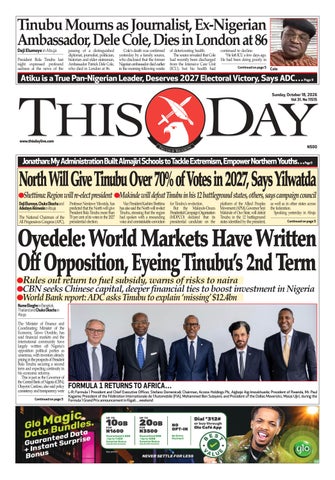
The Minister of Finance and Coordinating Minister of the Economy, Taiwo Oyedele, has said financial markets and the international community have largely written off Nigeria’s opposition political parties as unserious, with investors already pricing in the prospects of President Bola Tinubu securing a second term and expecting continuity in his economic reforms. This is just as the Governor of the Central Bank of Nigeria (CBN), Olayemi Cardoso, also said policy consistency and transparency were L-R: Formula 1 President and Chief Executive Officer, Stefano Domenicali; Chairman, Access Holdings Plc, Aigboje Aig-Imoukhuede; President of Rwanda, Mr. Paul
FORMULA 1 RETURNS TO AFRICA…
Continued on page 5
Kagame; President of the Fédération Internationale de l'Automobile (FIA), Mohammed Ben Sulayem; and President of the Dallas Mavericks, Masai Ujiri, during the Formula 1 Grand Prix announcement in Kigali…weekend
2
sunDAY, OCTOBER 18, 2026 • T H I S D AY
sunDAY, OCTOBER 18, 2026 • T H I S D AY
3
4
sunDAY, OCTOBER 18, 2026 • T H I S D AY
5
OCTOBER 18, 2026 • T H I S DAY, T H E S U N DAY N E W S PA P E R
NEWS
Over 40 Companies Raise N2.45 Trillion from Stock Market in Nine Months
Kayode Tokede
Over 40 companies raised N2.45 trillion from the Nigerian capital market between January and September 2026, as businesses positioned themselves for growth amid persistent economic pressures, according to data on corporate listings on the Nigerian Exchange Limited (NGX). The capital-raising surge underscores the NGX's growing importance as a source of longterm financing for businesses
seeking alternatives to expensive bank loans. Data on corporate listings on the NGX show total corporate capital raising hit about N2.45 trillion in nine months of 2026, covering public offers, private placements and supplementary listings. The surge came as the Nigerian Exchange Limited All-Share Index gained 61.43 per cent year-to-date (YtD) as of September 2026 to 251,211.67 basis points, making Nigeria
one of Africa's best-performing exchanges. Among the over 40 companies are: Dangote Sugar Refinery, which raised N485.88 billion through a rights issue; Abbey Bank raised N64.547 billion; Guinea Insurance listed 12.673 billion new shares; Regency Alliance Insurance raised N6.051 billion; Sunu Assurance raised N9.339 billion; Sovereign Trust Insurance raised N5.022 billion; Neimeth International Pharmaceuticals raised N2.442
billion; Critical Minerals Financing Corporation raised N1.807 billion and Eunisell Interlinked raised N200 million, among others. Of the corporate listings, Fidelity Bank Plc, United Bank for Africa Plc (UBA), FCMB Group Plc, First HoldCo Plc, Access Holdings Plc, Sterling Financial Holdings Company Plc and Guaranty Trust Holding Company Plc led the listed firms, with listings of N883.8 billion in the period under review.
The N883.8 billion listing on the NGX by these four financial institutions came against the backdrop of the Central Bank of Nigeria (CBN) policy mandating that firms raise fresh equity to meet paid-up capital thresholds. As GTCO listed N10 billion after a successful private placement of 125,000,000 ordinary shares of 50 kobo each at N80.00 per share, NGX admitted UBA’s and First Holdco’s N157.8 billion and N128.7 billion rights issue and private placement in early
OYEDELE: WORLD MARKETS HAVE WRITTEN OFF OPPOSITION, EYEING TINUBU’S 2ND TERM essential to sustaining investor confidence, as improvements in economic and foreign exchange stability created better conditions for long-term investment. Meanwhile, the African Democratic Congress (ADC) has called on President Tinubu to explain the $12.4 billion gap, an equivalent of about N16.5 trillion, in Nigeria’s external accounts identified in the World Bank’s October 2026 Nigeria Development Update. Oyedele and Cardoso spoke at the closing press briefing of the IMF/World Bank Annual Meetings in Bangkok, Thailand, where the CBN governor said policy consistency would be critical to attracting long-term capital, sustaining economic stability and accelerating growth. On his part, Oyedele argued that investors’ expectations of continuity under Tinubu had influenced their assessment of
Nigeria’s economic outlook, including their response to opposition proposals to restore fuel subsidies. “In all the meetings I have had, I came to a conclusion that the markets, including the domestic market, which you can read from the capital market, and the international market, have largely written off the opposition in Nigeria as being unserious. That is why they have not priced in the proposed return of subsidy,” he said. He added that any indication that the president intended to restore the subsidy would immediately be reflected in market prices. “So, maybe the international and domestic markets are aware about who is sincere about Nigeria and what direction they should travel,” he said. “As I said, the markets and the international community have
been pricing in the prospect of a second term for the President, and they expect continuity in the reforms.” The minister’s comments followed repeated questions from investors about whether the government would sustain its policies as Nigeria approaches another election cycle. He said concerns about possible policy reversals had featured prominently in his engagements with investors in Thailand and during two visits to London, particularly over whether electoral pressures could force the administration to abandon its reform agenda. “Throughout the meetings we have had this week, as well as those I attended before now, including two visits to London to meet investors, one question has repeatedly come up: Are you going to reverse your reforms? Are you under pressure because
of elections?” he said. According to Oyedele, the government remained committed to the reforms, which he described as necessary to restore macroeconomic stability and lay the foundation for sustainable growth. He said the next phase of the economic programme would focus on translating the gains in stability into stronger investment, lower financing costs, job creation and improved economic opportunities for Nigerians. Oyedele said private investment had increased twentyfold since the reforms began, rising from about $300 million in 2023 to $6 billion in 2026. He also highlighted improvements in Nigeria’s external position, saying net reserves had risen from barely $3 billion to more than $45 billion, representing a fifteen-fold increase. Oyedele ruled out a return
NORTH WILL GIVE TINUBU OVER 70% OF VOTES IN 2027, SAYS YILWATDA
when Shettima unveiled the Arewa for Asiwaju Campaign Head Office and formally inaugurated the campaign structure of the northern think tank, Yilwatda urged people in the North to support Tinubu’s re-election bid, citing infrastructure projects, appointments and other initiatives of the President’s administration. The APC chairman listed road projects across northern states, the Ajaokuta-Kaduna-Kano gas pipeline, irrigation dams, railway projects, healthcare initiatives and the Nigerian Education Loan Fund among the interventions he said should encourage the North to support Tinubu for a second term.
“I can’t mention all of them, but President Bola Tinubu has done wonderfully. He has covered all the geopolitical zones in the North in terms of road projects,” he added. He moved a motion for the northern region to support the re-election of the Tinubu/Shettima ticket, outlining reasons why the region should mobilize massively for the president. He noted that the region's strong backing stems from the Vice President's inclusive leadership and progressive mindset over the past three years.
Shettima: Region Will Re-elect President in 2027
Also speaking, Shettima declared that the North will re-elect Tinubu, adding however, that the growing northern support for president's re-election was not a blank check. According to him, Tinubu’s administration will earn it through facts, radical transparency and measurable results. He maintained that expanding loyalty in the region would demand greater accountability and an honest dialogue with citizens about ongoing reforms undertaken by the administration. Shettima said the North had spoken with a resounding voice and unmistakable conviction in its
support for the President. According to him, renewed political confidence should never be taken for granted, adding that the government and its supporters must continue to engage Nigerians with facts and show how the ongoing reforms are improving security, livelihoods, and economic opportunity. “By now, I believe the North has spoken. We have spoken with a resounding voice and unmistakable conviction. From Adamawa to Zamfara, from Borno to Niger, we have spoken. Such confidence places an obligation upon us that no officeholder should ever underestimate,” he stated.
to fuel subsidies and multiple exchange rates, warning that reversing the reforms could undermine investor confidence, trigger capital flight and put renewed pressure on the naira. “Let me be clear: there will be no return to fuel subsidies or multiple exchange rates,” he said. “If, for any reason, Mr President were to say today that we were considering bringing back fuel subsidies, what happened in Indonesia would be child’s play in comparison,” he said. “At the end of the day, capital would leave because investors understand what such a decision means.” He argued that capital flight could intensify pressure on the foreign exchange market and weaken the naira, with the consequences ultimately borne by ordinary Nigerians. “When capital leaves, the foreign-exchange market will
come under pressure, and the naira will crash. The exchange rate could move to N3,000, N3,500 or N4,000 to the dollar,” he said. Oyedele said such a development would worsen the economic pressures facing households. The minister also defended the Nigerian National Petroleum Company Limited’s recent temporary reduction in petrol retail margins, insisting that it was a commercial decision rather than a subsidy financed with public funds. “The recent temporary reduction in the retail margin on fuel was a time-bound commercial decision by the Nigerian National Petroleum Company Limited to reduce margins and support Nigerians,” he said. “It is not a subsidy paid for with public funds.”
The Vice President noted that President Tinubu’s bid for a renewed mandate must rest on the administration’s record and a clear account of how another term would advance Nigerians' interests. He restated that the North had nothing to fear in President Tinubu’s second term as Nigeria's leader. Shettima acknowledged that Nigerians had endured difficult economic adjustments, warning campaigners against dismissing genuine concerns or relying on political slogans to defend government policies. “Our citizens have endured difficult adjustments. We cannot
pretend otherwise. What we owe them is an honest account of the decisions taken, the gains achieved and the difficulties that persist. We lose our hearing when applause becomes our only source of information,” he added. The Vice President said the concerns of traders facing higher costs, graduates searching for work and families struggling with daily expenses must remain central to government decision-making. “A failed policy enters somebody’s home as a missed meal, an unpaid school fee or an opportunity lost," he said.
TINUBU MOURNS AS JOURNALIST, EX-NIGERIAN AMBASSADOR, DELE COLE, DIES IN LONDON AT 86
recent weeks leading to this end,” the family source said. Born on August 4, 1940, Cole turned 86 in August, barely two months before his death. He was widely known for his contributions to Nigeria’s diplomatic service, journalism, and historical scholarship, having held several prominent positions throughout his career. Before entering diplomatic service, Cole established himself in Nigeria’s media industry, serving on the editorial board of The Guardian newspaper and subsequently as Managing
Director of Daily Times, one of the country’s most influential newspapers. He later represented Nigeria as Ambassador to Argentina and Brazil, extending his public service career into international diplomacy. He served as Special Adviser on International Relations under President Obasanjo from 1999 to 2007. He was also appointed Nigeria’s ambassador to Brazil and Argentina. He also ventured into politics and was associated with the Social Democratic Party (SDP)
in the 1990s. Beyond his diplomatic assignments, Cole was recognised for his involvement in national discourse, particularly on governance, politics, and Nigeria’s historical development. His career spanned journalism, public administration, and diplomacy, placing him among a generation of Nigerian public figures who contributed to the country’s political and institutional development. In a statement he personally signed, President Tinubu said Ambassador Cole devoted
his life to national service, bringing distinction to his work in diplomacy, journalism and politics. Tinubu noted that Cole’s career reflected the enduring value of dialogue, tact, mutual respect and the pursuit of shared interests in advancing national development and international cooperation. “His contributions to Nigeria’s media landscape were particularly notable. As Managing Director of the Daily Times, he upheld the vital role of the press in holding
January 2026, respectively. Access Holdings, N21.4 billion; FCMB Group, N231.83 billion; Sterling Financial Holding Company, N106.978 billion; and Fidelity Bank, N227.05 billion, were new listings on NGX. The Managing Director of Globalview Capital Limited, Mr. Aruna Kebira, said the recent surge reflected rising investor confidence in the Nigerian Exchange, not apathy, and that confidence is key to capacity building.
public officials accountable, speaking truth to power, and strengthening democratic governance. His legacy in journalism and public life remains an enduring part of our national story,” Tinubu explained. The president added that at 86, the deceased witnessed defining moments in Nigeria’s history and contributed to the nation’s development through his work in the media, diplomacy and public service. According to Tinubu, his life stood as a testament to the
Continued on page 9
Continued on page 9
value of experience, principled engagement and commitment to the public good. “As we mourn his passing, I extend my heartfelt condolences to his family, friends, professional associates and all whose lives he touched. I pray that memories of his remarkable life will bring them comfort and strength at this difficult time. May Almighty God grant Ambassador Cole eternal rest and give his family and all who mourn him the fortitude to bear this profound loss,” the statement added.
6
T H I S DAY, T H E S U N DAY N E W S PA P E R • OCTOBER 18, 2026
NEWS
AWARD FOR CONTRIBUTIONS TO CHRISTIAN COMMUNITY…
The First Lady, Senator Oluremi Tinubu, receiving the Award of Excellence from the President of the Christian Association of Nigeria, Archbishop Daniel Okoh, during the 50th Anniversary of CAN at the Anniversary Celebration, Awards and Thanksgiving Service held at the National Christian Centre, Abuja…yesterday
Jonathan: My Administration Built Almajiri Schools to Tackle Extremism, Empower Northern Youths
Linus Aleke in Abuja
Former President Goodluck Jonathan has said that his administration established Almajiri schools across northern Nigeria to deny extremist groups access to potential recruits and provide young people with technical education that would empower them economically beyond religious instruction. Jonathan made this revelation yesterday during the public
presentation and formal launch of ‘Beyond the Bullets: Policing Terrorism in a Democratic System,’ a book authored by former Inspector-General of Police (IG), Mohammed Dikko Abubakar (rtd.). President Jonathan’s administration built no fewer than 121 Almajiri schools across northern Nigeria. However, the schools have become shadows of their former selves, as successive administrations have abandoned
the project despite its laudable aims and objectives. Speaking as the chairman of the occasion, Jonathan said successive administrations since the beginning of the Fourth Republic had been confronted with terrorism and other forms of violent insecurity. Represented by his former Chief of Staff, Mike Oghiadomhe, Jonathan said: "Since the beginning of the Fourth Republic, successive administrations have had to confront terrorism and other
forms of violent insecurity in our country. Each administration has faced its own circumstances and challenges and has, in different ways, sought to protect the lives and property of Nigerians and preserve the territorial integrity of our nation. "As President, working with the author and other key security heads, I also confronted this scourge and made every effort, within the circumstances and resources available to my
Okonjo-Iweala: $2.4bn Subsidy Fraud Probe Triggered My Mother’s Kidnap Francis Ndubuisi in Abuja
The Director-General of the World Trade Organisation (WTO), Dr Ngozi OkonjoIweala, has recounted how her efforts to uncover an alleged $2.4billion fuel subsidy fraud in Nigeria led to threats against her and the kidnapping of her mother. Okonjo-Iweala said the abductors demanded that she resign as finance minister and leave the country in exchange
for her mother’s release. She recounted the ordeal during an interview with Bloomberg’s Francine Lacqua on the Leaders programme, published earlier this week. The former finance minister said the investigation began after officials noticed that claims submitted by fuel importers under Nigeria’s subsidy programme were increasing sharply. Nigeria, despite being an oil-producing country, relied on imported refined petroleum
products to meet domestic demand at the time. Under the subsidy arrangement, importers received government payments that enabled them to sell petrol at regulated prices. However, Okonjo-Iweala said the amounts being claimed had risen to levels that raised suspicion. “So, I went to the president and said, look, something is going on here. Could we audit the accounts? And he said, ‘yes, go ahead.’ And we found about
$2.4 billion worth of fraud. So, we refused to pay,” she said. She said the decision triggered threats against her before her mother was abducted. “I was told that for her to be released, I should resign and leave the country,” she said. Describing the experience, Okonjo-Iweala said the fiveday ordeal was among the most painful periods of her life because she feared that her actions could lead to her mother’s death.
Mobile Phone Traders Kick against N4,000 Import Fees, Demand 90-day Suspension The Association of Mobile Phones and Allied Products Traders of Nigeria (AMPAT) has demanded a 90-day suspension of fees imposed on imported mobile phones, warning that the policy could force shops to close and threaten millions of jobs across the country. The association said traders
were being charged about N670 for each small phone and nearly N4,000 for bigger devices, raising concerns over the impact on businesses and consumers, particularly lowincome earners who depend on affordable and refurbished phones. Speaking yesterday at a press conference, the
chairman of the association in Kano State, Jamilu Bala Gama, who spoke on behalf of the National President, Sani Tasiu Ibrahim, said the traders supported efforts to register phones to curb counterfeiting and the use of stolen devices. However, he faulted the implementation of the policy, demanding that the authorities
disclose the legal basis for the charges and identify the private company receiving the fees. “We support the registration of phones. We want fake phones out of this country. We want stolen phones to become useless. We want criminals to have nowhere to hide.
administration, to strengthen our security response and protect our citizens. "I believe the author has pointed out the fact that the fight against terrorism is not the responsibility of one administration or another. It is a continuing national and global challenge that requires sustained commitment, institutional learning and co-operation across successive governments and generations. "This is what makes Beyond the Bullets particularly valuable. The title itself suggests that the response to terrorism must go beyond the use of kinetic force, which I fully believe in. "In furtherance of this, my administration established Almajiri schools aimed at providing skills to millions of young people beyond religious education alone. This was intended to enable them to earn a
living and contribute meaningfully to national development, while reducing the number of young people available for recruitment into violent crime. "We also engaged in the Great Green Wall Project, which, apart from helping to combat desertification and making more fertile land available for crop farming and animal husbandry, had the potential to provide employment for hundreds of thousands of people. I therefore use this opportunity to call on the government to revisit and review these programmes," Jonathan explained. On his part, a former Senate President, Dr Bukola Saraki urged Nigerians not to leave the fight against insurgency and other forms of violent extremism to the military and police alone.
Witness Admits Ex-Aviation Minister, Hadi Sirika Not Signatory to N599m Consultancy Contract Alex Enumah in Abuja
A witness of the Economic and Financial Crimes Commission (EFCC) in the ongoing trial of former Minister of Aviation, Hadi Abubakar Sirika, has admitted that the ex-minister was not a signatory to the award of consultancy contract by the Federal Ministry of Aviation to the tune of N599 million. The witness, Christopher Odofin, also told the court that from the face of the documents leading to the award of the disputed contract, there was nothing implicating the former minister in the contract issues. Odofin, an investigator with the EFCC stated this while responding to questions from the Sirika's lawyer, a former Attorney-General of the Federation and Minister of Justice, Chief Kanu Agabi
(SAN) during the continuation of trial of the former Minister at the High Court of the Federal Capital Territory, in Maitama, Abuja. Sirika is being prosecuted by the EFCC, alongside his daughter, Fatima and son-in-law, Hamma Jalal Sule, and a company allegedly owned by the couple, Al Buraq Global Investment Limited, on a six-count charge bordering on abuse of office and contract fraud to the tune of N2.8billion. According to the charge, the ex-minister was said to have abused his office when he allegedly conferred unfair advantage on Al Buraq Global Investment Limited by using his position to influence award of contract for the apron extension at the Katsina Airport for the sum of N1,498,300,750, among other alleged offences.
7
OCTOBER 18, 2026 • T H I S DAY, T H E S U N DAY N E W S PA P E R
NEWS
STRATEGISING FOR TINUBU’S RE-ELECTION…
National Chairman of All Progressives Congress, Prof. Nentanwe Yilwatda (left), and Vice President Kashim Shettima, at the inauguration of a pro-Tinubu support group, the Arewa for Asiwaju campaign secretariat and think-tank structure of the group in Abuja…yesterday
Niger Miners’ Deaths: Suspended Niger NSCDC Commandant Admits ‘Costly Mistake’, Apologises
The suspended Commandant of the Nigeria Security and Civil Defence Corps (NSCDC) in Niger State, Siaka Zubeiru Anirive, has admitted that the deaths of suspected illegal miners in the corps’ custody could have been avoided, tendering an apology to their bereaved families and the Niger State Government.
This came as it was revealed that his legal officer had advised him to release minors arrested during the operation. Anirive, who described the incident as a “costly mistake,” apologised while testifying before the Justice Mohammed Mohammed Commission of Inquiry in Minna, which was
investigating the circumstances surrounding the deaths of the detainees. “A mistake has been made, but a very costly one. My apology to the parents of the deceased and to the people and government of Niger State,” he told the commission. The former commandant also
expressed regret that the deaths occurred during his tenure, acknowledging that the incident could have been prevented. The apology, however, came amid troubling testimony about the handling of the detainees, including allegations that the advice to release minors on bail was ignored and evidence from
Ribadu: Military Operations Alone Cannot End Banditry
Onuminya Innocent in Sokoto
The National Security Adviser (NSA), Malam Nuhu Ribadu, has said military operations alone cannot end banditry, calling for stronger intelligence-sharing, border security and community participation to tackle insecurity. Ribadu said banditry had evolved beyond cattle rustling, highway robbery and kidnapping to include territorial control, illegal taxation of rural communities and disruption of economic activities. He spoke through the Director of Legal Services in the Office of the National Security Adviser, Zakari Mijinyawa, at a brainstorming session on coping
with banditry organised yesterday by the Sokoto Advancement Forum in collaboration with the Centre for Peace Studies, Usmanu Danfodiyo University, Sokoto. The NSA said Sokoto’s proximity to Niger Republic and the wider Sahel had given the crisis a cross-border dimension, with armed groups exploiting porous borders and security gaps to sustain their activities. “Sokoto’s proximity to the Republic of Niger and the wider Sahel adds a significant cross-border dimension to this challenge. “We must therefore combine intelligence-led operations, effective border management, regional cooperation and sustained action against the
supply of illicit weapons and other logistical support,” he said. Ribadu also called for measures to address the socioeconomic conditions that made the young people vulnerable to recruitment by criminal groups, alongside lawful rehabilitation programmes for eligible individuals willing to abandon violence. “Reintegration must never replace justice or reward violence,” he said. The NSA outlined five priority areas for improving security in Sokoto: Denying armed groups safe havens, strengthening intelligence and early-warning systems, building community trust, protecting agriculture and rural livelihoods, and preventing youth recruitment into criminal
networks. He urged security agencies to improve coordination and information-sharing, adding that communities would be more willing to provide intelligence if they trusted authorities to respond effectively and protect sensitive information. Ribadu identified Sabon Birni, Isa, Tangaza and Goronyo as areas where early-warning arrangements should be strengthened to ensure that reports of suspicious movements and emerging threats reached security agencies promptly. He warned that insecurity was disrupting farming, commerce and children’s education, with consequences for food production and the wider economy.
COAS Visits Borno as Parents Lament Children’s 155 Days in Captivity The Chief of Army Staff (COAS), Lieutenant-General Waidi Shuaibu, arrived in Maiduguri, Borno State capital yesterday, amid heightened tensions and a looming protest by the parents of 78 school children who were abducted in May. The high-stakes visit comes as the parents shelved a planned journey to the nation’s capital, where they had threatened to occupy the streets outside the
Presidential Villa in Abuja until President Bola Tinubu personally addressed their plight. The postponement comes as the families grapple with crippling poverty, a lack of transport fares, and the struggle to leave behind food for their remaining dependants. The children were abducted on May 15, 2026, from the Mussa and Lassa communities - the same day school teachers and
students were kidnapped in Oyo State. While the Oyo victims have since been rescued, the Borno parents say they have been left to grieve in isolation. “We were surprised by the level of seriousness accorded to the Oyo children, thinking that the same would be extended to our children. Unfortunately, we were left alone to grieve,” lamented Ishaku Suya, Chairman
of the Association of the Abducted Children’s Parents. Suya noted that no top security chief had visited the affected communities since the tragic incident occurred. The parents are now looking to the Chief of Army’s current visit to Borno as a turning point, urging him to personally inspect Mussa and Lassa just as military leadership did following the Oyo abduction.
a medical worker who said one suspect was coughing severely around the time the bodies were being removed from the detention cell. Testifying before the commission, Anirive said he assumed duty as Niger State NSCDC Commandant on August 25, 2025, and remained in office until September 18, 2026, explaining that the operation at a mining site along the M.I. Wushishi Housing Estate in Minna followed written and oral complaints from residents who alleged that the miners’ activities were disturbing their community. He said he visited the site on September 15, 2026, and then directed the command’s head of operations, Assistant Commandant of Corps Joha Achagwa, to act on the complaints.
He said the Mining Marshal unit was deployed, leading to the arrest of suspected illegal miners during an operation conducted on the evening of September 16. However, the following day, detainees in NSCDC custody died. Anirive told the commission that he received a telephone call informing him that some suspects had died while in detention, adding that he immediately rushed to the command headquarters, where he found several bodies lying on the floor of the cell. He said he contacted Niger State Governor Mohammed Umar Bago and was directed to arrange for the bodies to be taken to the hospital, disclosing that he also informed the Commissioner of Police and the Director of the Department of State Services about the incident.
JAMB Moves to Rescue Graduates Stuck for Years over NIN Data Mismatch, Unveils New Service
Kuni Tyessi in Abuja
The Joint Admissions and Matriculation Board (JAMB) is set to rescue thousands of Nigerian graduates who have been unable to participate in the National Youth Service Corps (NYSC) scheme for years because of discrepancies between their Joint Admissions and Matriculation Board (JAMB) records and National Identification Number (NIN). Speaking yesterday while receiving a delegation from Veritas University, Abuja, led by its Vice-Chancellor, Rev. Fr. Professor Hyacinth Ichoku, the JAMB Registrar, Prof. Segun Aina, said the examination body was set to introduce a service to align the biodata of the affected candidates. Aina said the initiative was part
of measures by the examination body to remove administrative bottlenecks that had left graduates stranded despite completing their university education. According to him, the new NIN alignment service would enable eligible candidates to update their biodata to match their official identity records, potentially clearing a major obstacle preventing affected graduates from proceeding to NYSC. He said the board had identified cases of graduates who completed their studies four or five years ago but remained unable to participate in the national service scheme because their personal details in JAMB’s records did not match those registered with the National Identity Management Commission.
8
T H I S DAY, T H E S U N DAY N E W S PA P E R • OCTOBER 18, 2026
NEWS
TWENTY HEARTY CHEERS FOR CITA ENERGIES…
L-R: General Manager/Chief Operating Officer, United Nigeria Airlines, Mr. Rapheal Uchegbu; Managing Director, CITA Energies, Ms. Titilayo Olaore; Chairman, CITA Energies, Dr. Thomas Ogungbangbe; and Managing Director, Ibom Air, Mr. George Uriesi, during CITA Energies’ 20th anniversary celebration in Ikeja, Lagos…Friday
Atiku is a True Pan-Nigerian Leader, Deserves 2027 Electoral Victory, Says ADC Accuses Tinubu’s administration of sectionalism and divisive politics
Chuks Okocha in Abuja
The Presidential Campaign Council of African Democratic Congress (ADC-PCC) has described its presidential candidate, Alhaji Atiku Abubakar, as a true PanNigerian leader and a detribalised statesman deserving of victory in the January 16, 2027 presidential election.
The Director of Media and Publicity of the ADC-PCC, Kola Ologbondiyan, stated this in Abuja at the weekend while receiving the leadership of the Grassroots Mobilisation Network (GMN), led by its National Coordinator, Sadiq Abubakar Adamu Lwafu, during a visit to his office. Speaking during the visit, Lwafu said the organisation
was embarking on a nationwide mobilisation campaign to rally Nigerians across the country behind Atiku's presidential ambition and ensure the defeat of the ruling All Progressives Congress (APC) in the 2027 election. He noted that the Tinubu’s administration had subjected Nigerians to severe economic hardship, worsening insecurity
and what he described as an increasingly authoritarian political environment. "President Tinubu's administration has made life so difficult for Nigerians. The hardship is too much. Nigerians are now living in fear of insecurity. It appears that governance has collapsed, as a group of greedy politicians have ganged up against the
Declare Hunger a National Emergency, Obi Tells FG, Raises Alarm over Nigeria’s Worsening Hunger Crisis Chuks Okocha in Abuja The presidential candidate of the Nigeria Democratic Congress (NDC), Mr. Peter Obi, has asked the federal government to declare a national emergency on hunger. Obi made the call in an X post at the weekend to mark World Food Day, saying no Nigerian deserved to go to bed hungry. The Food and Agriculture Organisation (FAO) estimates that about 36 million Nigerians would face acute hunger this year. The former Anambra State
governor said Nigeria’s hunger crisis had worsened, with the country ranking 117th out of 125 countries, compared with 109th in 2023, when the current administration took office. While the figure is correct, the 2026 Global Hunger Index (GHI), which Obi cited, ranked Nigeria 117th out of 122 countries. Although 136 countries were assessed for the report, only 122 had sufficient data to calculate hunger scores and determine rankings. Obi said the hunger situation was troubling given Nigeria’s vast
arable land, noting that about 60 percent remained uncultivated and provided hideouts for nonstate actors. He said hunger, poverty and insecurity continued to affect millions of families despite the country’s agricultural potential. “On World Food Day, the message is clear: Nigerians deserve a country where no family goes to bed hungry, farmers can work without fear, and poverty and insecurity are confronted with urgency and compassion,” he said. The former Anambra
State governor said if elected president, his administration would prioritise security and provide farmers with targeted grants, subsidies and other forms of support to boost agricultural production. He said farmers must be able to return to their farms and work in peace and dignity. Obi added that he joined rural women across Nigeria on Friday to mark International Rural Women’s Day, noting that their contributions to food production underscored the need to address hunger as a national emergency.
FG to Move against Schools over Arbitrary Increase in WAEC Fees
Funmi Ogundare
The Federal Ministry of Education is taking steps to check schools that arbitrarily increased the 2027 May/June examination fees, the new Head of National Office of the West African Examinations Council (WAEC), Nigeria, Suleiman Danlami Kum, has said. Kum succeeded Dr. Amos Dangut, who was appointed as the new Registrar/Chief Executive Officer (CEO) of WAEC. Speaking with reporters
during an inspection of the conduct of the ongoing 2026 West African Senior School Certificate Examination (WASSCE) for Private Candidates, Second Series, yesterday, Kum said the council was aware that some schools had been charging candidates more than the examination fee ahead of the May/June examination. He, however, clarified that WAEC had yet to release the entries for the forthcoming May/June examination, adding that the Federal Ministry of
Education was taking steps to address the issue. “We know in the past that schools have been charging more than the examination fee. But I want to tell you that the Federal Minister of Education is not just sitting down. We thank God for the Minister of Education we have. I want to assure you that something is being done by the Federal Ministry of Education now to check those schools that are increasing these examination fees arbitrarily,” he said. Kum disclosed that more than 56,000 candidates registered
for the 2026 WASSCE for Private Candidates, Second Series, nationwide, including about 272 walk-in candidates who registered to sit specific papers after the main registration window had closed. He said that more than 22,000 candidates in Lagos were participating in the examination. He explained that the walk-in arrangement allows candidates who wish to remedy deficiencies in particular subjects to register before the relevant paper is taken and sit the examination on the scheduled day.
poor, and democracy has been abused and replaced with an authoritarian regime," Lwafu said. He warned that Nigeria was drifting towards the path of failure like come African countries where, in his view, democratic institutions had been weakened and political power increasingly concentrated. "The only man who can rescue Nigeria is Atiku Abubakar, and we are on a mission to ensure that the APC is thrown out of power through the ballot box next year," he added. Lwafu described the ADC as a credible platform bringing together experienced politicians, patriotic Nigerians and leaders committed to national development. "ADC is the only platform with great minds and patriotic leaders. Look at our National Chairman, David Mark; Look at Atiku Abubakar, Rotimi Amaechi, Tunde Ogbeha, Rauf Aregbesola, Kashim Imam, Senator Austin Akobundu, Senator Aminu Tambuwal, Emeka Ihedioha, Ralph Nwosu, Dele Momodu, Dino Melaye and others. "These are not jokers like what we have in the APC. Look at the characters in the APC and compare: propagandists, deceitful, pretenders and certificate forgers," he said. Responding, Ologbondiyan commended the GMN leadership for its commitment to national development and grassroots mobilisation, insisting that the difference between Atiku and President Bola Ahmed Tinubu was evident in their respective approaches to national leadership and political inclusion. According to him, Atiku represents a unifying
national figure whose political relationships and personal outlook transcend ethnic, religious and regional boundaries. "In the last three years, Tinubu has shown clannishness in governance. His appointments, his policies, his body language— everything screams sectionalism and exclusion. "Atiku Abubakar, on the other hand, is a natural Nigerian devoid of ethnic, religious or sectional inclination. He is a leader for all tribes and regions ", Ologbondiyan said. He argued that Atiku's family, business and political relationships reflected the diversity of Nigeria and demonstrated his capacity to unite people across the country's multiple ethnic and religious identities. "Check the people around him over the years. Take a close look at his immediate family, his businesses and his political associates. Atiku represents Nigeria and Nigeria is in him. "He is married across the Niger, his children represent our diversity, and his associates cut across every tribe and religion. That is the definition of a PanNigerian leader," he said. Ologbondiyan also accused the APC of exploiting Nigeria's ethnic and religious differences for political advantage rather than promoting national unity and addressing the welfare of citizens. "The APC has so much capitalised on our fault lines to divide the country. “They don't care about the welfare of the people as far as they can remain in power. " They are not concerned about our unity but about winning elections against the peace and harmony of the nation," he further alleged.
9
OCTOBER 18, 2026 • T H I S DAY, T H E S U N DAY N E W S PA P E R
NEWS
GLO CULTURAL LEGACY BEYOND BORDERS…
L-R: Former Secretary General of Commonwealth, Chief Emeka Anyaoku; Chief Executive Officer, J. I. Ejison International Limited, Chief J. I. Ukeji; Chairman, United Nigeria Airlines, Prof. Obiora Okonkwo; Deputy President General, Ohaneze Ndigbo, Chief Okechukwu Nwadinobi, and Globacom's Divisional Head, South-East, Mr. Mike Ehumadu, at the 2026 Ofala Festival sponsored by Globacom in Onitsha, Anambra State…yesterday
At Golden Jubilee Anniversary, CAN Honours Gowon, Obasanjo, Jonathan, Osinbajo, Oluremi Tinubu Church must be voice of IDPs, attacked farmers, says Okoh
Kuni Tyessi in Abuja The Christian Association of Nigeria (CAN) yesterday honoured former Head of State, General Yakubu Gowon (rtd.), former Presidents Olusegun Obasanjo, Goodluck Jonathan; former Vice President Yemi Osinbajo, and the First Lady, Senator Oluremi Tinubu, at its 50th anniversary thanksgiving service in Abuja. This is just as the President
of the association, Archbishop Daniel Okoh, has declared that the Church cannot afford to be silent while vulnerable Nigerians suffer, charging it to speak boldly against injustice, insecurity and corruption. The ceremony, held yesterday, was part of the activities marking CAN's golden jubilee. Senator Tinubu was conferred with the Christian Icon Award, while Gowon, Obasanjo, Jonathan and Osinbajo received
the Pillar of Faith Award for their contributions to the Christian community and national development. Other recipients included Secretary to the Government of the Federation (SGF), Senator George Akume; Senate President, Senator Godswill Akpabio; Deputy Speaker of the House of Representatives Dr Benjamin Kalu, Governors Sheriff Oborevwori of Delta, Monday Okpebholo of Edo
and Seyi Makinde of Oyo State. Speaking after receiving her award, Senator Tinubu thanked Okoh, describing the honour as a call to deeper service. "I want you to know that this award is a call to greater work in service to God and humanity," she said. She said 50 years of CAN was a significant milestone and urged sustenance of unity among denominations. She said the anniversary
NORTH WILL GIVE TINUBU OVER 70% OF VOTES IN 2027, SAYS YILWATDA He also defended criticism as essential to democratic governance, saying the administration must remain open to useful ideas irrespective of political affiliation, ethnicity, religion or region. “There is no democracy without critics. Progress demands that our assumptions endure the examination of those who disagree with us,” Shettima said. The Vice President said the administration’s priorities remain
security, economic opportunity, poverty reduction, education and stronger public institutions. “The farmer should be able to cultivate in safety. A child’s education should prepare that child for a productive life. Public institutions should give citizens confidence that effort can yield opportunity,” he said. Earlier, Deputy Senate President Barau Jibrin said the inauguration of the A4A structure for the 2027
presidential elections came at a time when the region needed a strong, trusted platform to mobilise support for Tinubu. Similarly, Secretary to the Government of the Federation (SGF), Senator George Akume, said history was beckoning the North to act with wisdom and evidence, not sentiment, in its decision to support the Tinubu administration in the 2027 elections. On his part, Kano State Governor
Abba Kabir Yusuf, speaking on behalf of all the governors of the North, said the northern region's support for the President in the forthcoming elections would be based on its conviction to uphold fairness, equity, unity and the progress of the country. In his welcome address, the Director General of A4A and former Jigawa State governor, Abubakar Mohammed Badaru, said the group's emergence was
theme, "Walking Together in Faith", reflects God's call for oneness, citing John 17:21-22 and Ephesians 4:4-6, and prayed that CAN blocs would continue to work together for the Church and Nigeria. She urged CAN to remain focused on preparing believers for the second coming of Jesus Christ. In his address, Okoh said CAN's 50-year journey attests to God's faithfulness and the
foresight of founders who in August 1976 created a united platform for Christians. He noted that Nigeria remained the only African country where diverse Christian traditions were united under one ecumenical umbrella CCN, CPFN/PFN, OAIC, TEKAN/ ECWA and others, despite early suspicion, prejudice and marginalisation which successive leaders had worked to overcome.
not accidental, but born of the conviction that President Tinubu and his deputy have performed well and deserve re-election.
(MDPCO) has declared that its presidential candidate on the platform of the APM, Governor Makinde will defeat Tinubu in the 12 battleground states identified by the president, as well as in other states across the federation. Makinde also declared that Nigeria’s biggest problem is grinding poverty, not religion, urging Christians to stop shunning politics and take an active role in transforming the country.
Makinde Will Defeat Tinubu in His 12 Battleground States, Others, Says Campaign Council Meanwhile, the Makinde-Daura Presidential Campaign Organisation
OYEDELE: WORLD MARKETS HAVE WRITTEN OFF OPPOSITION, EYEING TINUBU’S 2ND TERM He explained that a company’s decision to reduce its profit margin to lower prices should not automatically be classified as a subsidy. “If you offer a discount by reducing that profit margin, how does that become a subsidy?” he asked.
Cardoso: Policy Consistency, Transparency Critical to Investor Confidence Meanwhile, Cardoso has stressed that policy consistency and transparency were essential to sustaining investor confidence, as improvements in economic and foreign exchange stability created better conditions for long-term investment. Cardoso said Nigeria was seeking to deepen financial cooperation with China to attract more Asian investment
into its markets and improve cross-border payments, settlement arrangements and trade finance. He disclosed that discussions with the Governor of the People’s Bank of China, Pan Gongsheng, had focused on practical ways to strengthen cooperation among financial institutions in both countries. Cardoso said China’s developed payments infrastructure offered lessons for Nigeria, while stronger financial links could facilitate trade and investment between the two economies. He said the discussions would be followed by technical engagements during his forthcoming visit to Beijing, where officials would examine specific areas of cooperation and identify initiatives capable of delivering practical results. The CBN governor said Nigeria was particularly interested in
attracting Chinese capital into its financial markets, noting that investment in Nigerian financial instruments had remained limited despite the substantial liquidity available in China. “Finally, bear in mind that, despite the considerable liquidity available in China, there has not been much investment in Nigerian financial instruments over time,” he said. “This could be an opportunity to change that trajectory and generate greater interest from Asian markets in Nigerian instruments and African instruments generally.” Cardoso said the initiative formed part of a broader effort to strengthen Nigeria’s financial relationships with Asian economies and expand the pool of capital available to domestic markets. World Bank Report: ADC Asks Tinubu-led Govt to Explain
‘Missing’ $12.4bn Meanwhile, the ADC has called on President Tinubu to explain the $12.4 billion gap, equivalent to about N16.5 trillion, in Nigeria’s external accounts identified in the World Bank’s October 2026 Nigeria Development Update. In a statement issued yesterday by its National Publicity Secretary, Mallam Bolaji Abdullahi, the party said Tinubu owed Nigerians a clear account of the discrepancy, especially as families struggling with the cost-of-living crisis were forced to account for every naira. Citing the report, the ADC said Nigeria recorded a $12 billion current-account surplus and $6.2 billion in net financial inflows in the first half of 2026. The party said these inflows should have strengthened the country’s reserves, but the report instead identified a $12.4 billion gap.
Abdullahi said the World Bank attributed the gap, in part, to oil export earnings that were not repatriated. He added that the report noted that the repatriation of export proceeds remained limited, partly because Nigerian oil had been pledged against several long-term loans. “The scale is staggering,” the ADC said. “This unexplained gap is larger than the entire current-account surplus for the same period. It is about 5.6 times the $2.2 billion Nigeria attracted in foreign direct investment. In naira terms, it is almost a quarter of the N68.32 trillion 2026 federal budget. “This cannot be dismissed as a minor accounting discrepancy. President Tinubu welcomed this report. He cannot celebrate one part of the report and stay silent on a gap bigger than the surplus that he and his government are
celebrating. “Due to President Tinubu’s failed policies, families across Nigeria are forced to skip meals and account for every naira just to survive. Meanwhile, money that could have eased their hardship is currently unaccounted for. Tinubu owes Nigerians an explanation. “Sacrifice cannot be compulsory for everyday citizens while accountability remains optional for the government that is in charge of our collective resources.” The ADC called on the federal government to publish a full public reconciliation of the $12.4 billion gap and disclose all oilbacked loans and pledged crude commitments. It also demanded updated net reserve figures and clear evidence that higher revenues were improving essential services such as health, education and power.
10
T H I S D AY, T H E S U N D AY N E W S PA P E R OCTOBER 18, 2026
NEWS
ENGAGEMENTWITH STRATEGIC PARTNERS…
L-R: Executive Director, Polo Limited, Ms. Jennifer Obayuwana; Chief Executive Officer, Franck Muller, Mr. Nicholas Rudaz; and Chief Executive Officer, Polo Limited, Mr. John Obayuwana, when Polo Limited hosted Rudaz during his first official visit to Nigeria, in Lagos...recently
EU: Nigeria’s Poor Population May Be World’s Largest, Commits €45m Aid • Announces €20m support package for Nigerian armed forces to combat terrorism Linus Aleke in Abuja
The European Union (EU) Ambassador to Nigeria and the Economic Community of West African States (ECOWAS), Gautier Mignot, has said Nigeria probably has the highest number of people living below the poverty threshold globally, describing poverty as one of the country’s biggest challenges. This is as it also announced €20 million in support for the Armed Forces of Nigeria under the European Peace Facility, as part of coordinated efforts to combat terrorism and restore peace to troubled areas across the country. The envoy spoke in Abuja at the weekend at the 2026 International Day for the Eradication of Poverty, where he called for sustained efforts by the federal government, development partners and other stakeholders to address the country’s poverty crisis. “Today, Nigeria is probably the country in the world with the highest number of people living under the poverty threshold,” he said. Mignot also disclosed that the European Union had committed nearly €45million in humanitarian assistance to Nigeria in 2026, particularly to support conflict-affected and crisis-prone areas. He described poverty as a major concern for Nigeria’s international partners, stressing that it required urgent attention and sustained commitment in the years ahead. Mignot cited figures indicating that 133 million Nigerians were living in multidimensional poverty in 2022, adding
that estimates from different sources suggested the situation had worsened since then. He said the EU’s humanitarian assistance was being provided through the European Civil Protection and Humanitarian Aid Operations, with particular attention to communities affected by conflict and other crises. “Through the European Civil Protection and Humanitarian Aid Operations, ECO, the European Union has committed again this year almost 45 million euros for humanitarian assistance in Nigeria, particularly in conflict-affected and crisisprone areas”. According to him, the EU is working with the Nigerian government, humanitarian organisations, development partners and local communities to ensure that emergency assistance is linked to long-term resilience and sustainable solutions. He explained that humanitarian interventions address immediate needs, while poverty reduction programmes focus on creating lasting pathways out of poverty. Speaking on the theme of the event, United for Peace and Human Rights, Safe Homes for All, the ambassador said meaningful poverty reduction was impossible without peace, security, dignity and respect for human rights. He added that households unable to meet their basic needs could hardly feel secure or fully enjoy their fundamental rights. Mignot acknowledged the federal government’s efforts to tackle poverty through social investment
programmes, targeted cash transfers, livelihood support and measures to strengthen social protection systems. He listed the National Social Safety Net Programme, the Nigeria Community Action for Resilience and Economic
Stimulus, and the Renewed Hope Social Protection Programme among the initiatives aimed at supporting vulnerable Nigerians. He also highlighted the Household Prosperity and Empowerment Social Pro-
tection Project, supported through Nigeria’s partnership with the World Bank, saying the initiative was expected to improve assistance to vulnerable households and strengthen their resilience. The envoy said the EU
was complementing these efforts through its Supporting Sustainable Social Protection Systems in Nigeria programme, which works with government institutions and implementing partners, including UNICEF, GIZ, the International
Stallion Group Challenges Court Judgment, Files Appeal and Stay of Execution Stallion Group has filed an appeal against the judgment delivered by the Federal High Court, Lagos, on October 16, 2026 in Suit No. FHC/L/CS/2074/2023: UBA Plc and Ors v. Stallion Nigeria Limited & Others. The judgment arose from a commercial dispute initiated by UBA Plc in 2023. A statement by Abdulsalam
Gaffar Olatokunbo said Stallion Group respectfully but firmly disagrees with the decision, adding that having reviewed the judgment with its legal advisers, it considered that there are strong grounds for appellate review and is determined to pursue its rights through the courts. The Group noted that a Notice
of Appeal has been filed at the Court of Appeal and stay of execution of the judgment pending the hearing and determination of the appeal. It added that it would pursue the appeal vigorously and will continue to respect the judicial process. it has confidence in the appellate courts and their
ability to consider the issues raised in the appeal. “The Group’s operations continue. We ask our employees, customers, business partners and other stakeholders to rely on verified information and not on speculation or sensational reports about a matter that is now before the appellate court,” the stressed.
Kwara APC: Ex-VC Leads High-profile Group to Resolve Disputes, Reconcile Aggrieved Members Elder statesman and former Vice-Chancellor of the University of Ilorin, Prof. Oba AbdulRaheem, is leading a group of prominent Kwara indigenes to reconcile aggrieved members of the All Progressives Congress (APC) and mobilise support for the party ahead of the 2027 general election. The group, which held its inaugural meeting at Abdulraheem’s Ilorin residence on September 17, said it is committed to resolving all disagreements that trailed the outcome of the APC’s primaries. Abdulraheem, also a former Chairman of the Federal
Character Commission (FCC), chairs the group, the Kwara APC Peace Committee. Apart from Abdulraheem, eminent indigenes of Kwara in the group include Dr. Johnson Adewumi, a foremost educationist/ entrepreneur and founder of the Thomas Adewumi University, Oko; former Minister and former Speaker, Kwara State House of Assembly, Hon. Issa Bio Ibrahim; and former Secretary to Kwara State Government and former Member, Federal House of Representatives, Hon. AbdulGaniyu Cook Olododo. Other members include Oloriewe Raheem Adedoyin,
a veteran journalist and member representing Africa in the Executive Board of the International Press Institute; elder statesman and former Speaker, Kwara State House of Assembly, Hon. Benjamin Ezekiel Issa; elder statesman and Member of Tinubu Shettina PCC, Pastor John Dara; and former Commissioner, Federal Character Commission, Hon. James Jiya Kolo. According to the statement, the committee intends to serve as a voice of conscience among APC leaders by addressing internal grievances and promoting the achievements of the administrations of President
Bola Tinubu and Kwara State Governor AbdulRahman AbdulRazaq. It said the group had reached out to some aggrieved political leaders and influential stakeholders to encourage reconciliation and forge a common front ahead of the elections. The committee is also canvassing support for the APC’s governorship candidate, Hon. Yakubu Danladi, and other party candidates in the state. The statement said the initiative aimed to secure the backing of party stakeholders for the candidates and strengthen cohesion within the APC ahead of the general election.
sunDAY, OCTOBER 18, 2026 • T H I S D AY
11
12
sunDAY, OCTOBER 18, 2026 • T H I S D AY
sunDAY, OCTOBER 18, 2026 • T H I S D AY
13
14
sunDAY, OCTOBER 18, 2026 • T H I S D AY
sunDAY, OCTOBER 18, 2026 • T H I S D AY
15
T H I S D AY, T H E S U N D AY N E W S PA P E R OCTOBER 11, 2026
16
NEWS
2027: Opposition to Name Single Presidential Candidate Before Polls, Says Lukman
Chuks Okocha in Abuja The convener of the G100 political pressure group, Salihu Lukman, has said opposition parties working in alliance with the group will announce a single presidential candidate for the 2027 general election, possibly only days before the poll. Lukman, a former National Vice Chairman of the All Progressives Congress (APC), spoke during a television interview. “I can tell you categorically, and my confidence about that comes from what I see in the leadership of the parties: they are committed and they are working, taking all the steps necessary. “So it could be two months, some weeks to the election, or a few days to the election; they will come out and tell Nigerians this is the direction, and everybody will queue”, he said. According to him, the effort
has gone beyond the six parties currently involved. “They are also working to expand; they are reaching out to other parties,” he said. The G100 was formed to push the opposition towards a united front after an allopposition summit in Ibadan in April 2026 resolved to field a consensus candidate against the ruling APC. Lukman said the parties and their candidates have since taken over the process from the group. “When the parties owned the process we had started and took it beyond, took it out of our hands and began to engage each other based on the need to develop the kind of confidence they need to trust one another,” he said. He identified the biggest obstacle as “the trust deficit among even the parties and the candidates.” He explained that a summit on August 31 “agreed to have five working groups, and one
of the working groups is the one that will work on that single consensus candidate.” Each party, he said, will nominate members into the group, either through its candidate or through the party itself, under agreed terms of reference. “The collegiate is basically about ensuring that both the parties and their candidates are the ones taking the decisions, and at the same time the people doing the work are people who have the mandate of both the parties and the candidates, not anybody from outside,” he said. Asked how the group would handle supporters of Peter Obi, Atiku Abubakar and the Kwankwasiyya movement, who have shown no sign of yielding, Lukman said rigid positions help the ruling party. “Taking a hardline position, a rigid position, is almost like working for the APC and the Tinubu government at this point,” he said.
Startups Showcase AI, Green Building and Recycling Solutions at Sustainability Forum Nigerian entrepreneurs have called for increased investment in technologydriven agriculture, green construction and recycling to tackle food insecurity, reduce carbon emissions and promote sustainable economic growth. The call was made at the 10th anniversary of the Sustainability Table Discourse Series (STS @10), held on October 15 and 16, 2026, at the Balmoral Convention Centre, Victoria Island, Lagos. The two-day event, themed “People, Planet and Development,” brought together business leaders, policymakers, investors, financial institutions, development partners and sustainability advocates to explore practical solutions to environmental and economic challenges. The investment-focused sec-
ond day featured an innovation pitch competition involving 20 enterprises seeking to connect with potential investors and scale solutions aligned with the United Nations Sustainable Development Goals. Speaking at the event, Favour Okikijesu Adeleke, founder of QiQi Farms, said Nigeria’s food security challenges required sustainable agricultural systems capable of ensuring consistent production throughout the year. He identified seasonal farming, inadequate infrastructure, insecurity and inconsistent government policies as major obstacles to agricultural productivity. Adeleke also highlighted the potential of artificial intelligence to help farmers forecast harvests, understand market demand and identify
production challenges early. Similarly, John Oamen, Chief Executive Officer and co-founder of CutStruct Technology, said digital procurement platforms could reduce emissions associated with transporting building materials. He disclosed that his company had achieved an estimated 38 per cent reduction in the number of trucks used to transport building materials for demand managed through its platform over the past two years. Oamen added that CutStruct was working to introduce carbon-emissions tracking to help developers assess the environmental impact of construction materials and generate data that could support access to green financing.
Elumelu Backs $15bn Infrastructure Investment Drive Across West Africa Festus Akanbi
Heirs Holdings Chairman Mr Tony Elumelu is backing efforts to assemble a $15 billion portfolio of infrastructure projects across West Africa, as regional leaders and investors seek to turn economic integration ambitions into bankable investments. The initiative, being developed ahead of the inaugural West Africa Integration and Investment Summit (WAIIS) in Sierra Leone next month, will bring selected projects before prospective financiers to mobilise capital for infrastructure and productive enterprises. Elumelu, who co-chairs the summit, disclosed the plans in an emailed response to questions from Bloomberg, which reported
the development on Thursday. Potential financiers include United Bank for Africa (UBA), the African Export-Import Bank (Afreximbank), Africa Finance Corporation (AFC) and Africa50. Priority sectors comprise energy, trade, industrialisation, strategic minerals, agriculture and digital infrastructure. The proposed $15 billion represents the anticipated value of the investment pipeline, rather than funding already committed by Elumelu or the participating financial institutions. Organisers have so far shortlisted 26 projects worth more than $10 billion from 170 submissions spanning more than 10 countries, with expectations that the portfolio will expand before the November gathering.
Special Envoy for WAIIS, Dr Kandeh Kolleh Yumkella, said the selection reflected progress towards presenting investors with concrete opportunities across the region. “We received 170 project submissions and have selected 26 real projects worth more than $10 billion from over ten countries,” Yumkella said in a statement issued by the organisers. “We expect that portfolio to reach $15 billion or more,” he added. Convened by Sierra Leone’s President, Julius Maada Bio, the summit is scheduled for November 17 and 18 at the Julius Maada Bio International Conference Centre in Lungi. It will bring together governments, business leaders, project developers and development finance institutions to advance strategic regional investments.
17
T H I S DAY, Th e S U N DAY N e w S PAPe r •OCtober 18, 2026
BUSINESS
Editor: Festus Akanbi 08038588469 Email: festus.akanbi@thisdaylive.com
A Costly Smuggling Circle
As insecurity keeps farmers away from their land and naira depreciation sustains incentives for petrol diversion, Festus Akanbi examines how smuggling exploits Nigeria’s economic difficulties while deepening them
A
t Nigeria’s borders, an individual bargain can become a national burden. Rice brought through an illegal crossing may ease a household’s food bill; petrol diverted abroad may enrich a trader. Behind these transactions, however, lie unpaid duties, displaced production and livelihoods weakened by an economy increasingly rewarding evasion. Smuggling feeds on genuine hardship. Consumers seek cheaper food, businesses struggle with production costs, and traders exploit differences between markets. Insecurity adds a particularly damaging dimension: farmers who cannot safely cultivate their land leave a supply gap that illicit imports can exploit. The result is a troubling contradiction. Nigeria seeks agricultural self-sufficiency while violence obstructs farming. It invests in refining while cross-border price differences encourage fuel diversion. Border enforcement consequently confronts incentives generated far beyond the frontier. When Fear Empties the Farms For farming communities exposed to banditry, kidnapping and attacks, returning to the land involves more than finding seeds, fertiliser or credit. It requires confidence that planting, harvesting and transporting produce will not end in violence. Without that assurance, fields remain undercultivated, harvests suffer, and agricultural investment becomes hazardous. Displacement also separates farmers from their land, equipment and established markets, making recovery difficult even when immediate threats recede. Government critics said the gains Nigeria recorded in farming under Presidents Goodluck Jonathan and Muhammadu Buhari have all been undone under incumbent President Bola Tinubu. The Chief Executive Officer of Financial Derivatives Company, Bismarck Rewane, located the problem in that uncomfortable intersection during his Lagos Business School breakfast presentation. “Smuggling thrives in the gaps,” he said, identifying price, policy and infrastructure differences as the openings through which illegal trade advances. The World Food Programme reported in July 2026 that more than 17 million people across nine conflict-affected northern states were experiencing crisis, emergency or catastrophic hunger. The finding illustrates the severity of the insecurity surrounding food production and access. It does not, however, measure rice smuggling. Rice occupies a sensitive position because it is an essential staple. Families cannot indefinitely postpone eating while domestic production recovers. When insecurity constrains supply and household incomes cannot absorb prevailing prices, cheaper foreign rice finds a receptive market, including through illegal channels. Disrupted agricultural livelihoods may also make illicit trading attractive to some people seeking alternative income. Nevertheless, there is insufficient evidence to claim that displaced farmers generally become smugglers. The clearer relationship is that insecurity weakens production and livelihoods, creating conditions that smuggling networks exploit. Restricting rice supplies without restoring safe access to farmland therefore leaves the underlying problem unresolved. Consumers remain under pressure, while farmers cannot respond adequately to the demand that protection is supposed to reserve for them. The Cost Behind the Bargain Customs interceptions demonstrate the persistence of illicit trade. The Nigeria Cus-
Some customs officials and bags of smuggled rice costs dispersed across the wider economy.
Smuggled petroleum products toms Service recorded 3,555 seizures with a duty-paid value of N35.29 billion in 2024. Comptroller-General Bashir Adewale Adeniyi also reported seizing 183,527 bags of rice. For 2025, Customs reported more than 2,500 seizures valued at above N59 billion, alongside revenue collection of N7.28 trillion—stronger revenue performance thus coexisted with substantial interceptions of prohibited and harmful goods. These figures require care. Duty-paid seizure values are neither total smuggling volumes nor a calculation of government revenue lost. Undetected consignments remain outside the record, while exchange rates, product composition and enforcement intensity can influence reported valuations. The competitive damage is nevertheless straightforward. A compliant producer pays taxes, finances inventory, maintains machinery and meets regulatory standards. An illicit
competitor avoids some obligations and can undercut legitimate businesses. For rice growers and millers, cheaper smuggled supplies can weaken sales and discourage investment in cultivation, processing and storage. Insecurity and smuggling may consequently reinforce each other: violence constrains production, illegal imports exploit shortages, and weakened returns complicate agricultural recovery. The pressure extends to other industries. In June 2026, Customs Deputy ComptrollerGeneral Timi Bomodi reported 65 vegetable-oil seizures in 2025 and another 23 in 2026, with a combined duty-paid value of approximately N1.314 billion. When legitimate businesses contract, the consequences spread to employees, suppliers, distributors and tax receipts. An apparently inexpensive purchase can therefore carry
The Naira and Petrol Diversion Petrol smuggling operates in the opposite direction: supplies leave Nigeria to capture higher returns elsewhere. Subsidy removal reduced one historical incentive, but it did not abolish cross-border price differences. Adeniyi has explained that the gap between Nigerian petrol prices and those in neighbouring countries remains profitable for diversion. Naira depreciation can strengthen that incentive. Revenue earned in CFA francs becomes worth more in naira as the Nigerian currency weakens. If domestic petrol prices do not rise sufficiently to offset that exchange-rate advantage, buying locally and selling across the border can remain attractive. Reporting from the Benin frontier has documented this interaction between currency weakness and petrol trading. However, profitability still depends on purchase prices, transport expenses, exchange rates and enforcement risks; depreciation alone does not determine the margin. Diversion can tighten supplies in affected communities, complicate distribution and sustain illegal trading networks. Unregulated transport and storage also expose traders and residents to avoidable danger. Beyond Seizures Nigeria’s response must address the conditions that make smuggling commercially attractive. Secure farms, dependable rural roads, affordable production and predictable trade rules are essential complements to border intelligence and credible sanctions. Protecting agriculture requires enabling farmers to return safely and profitably to their land. Tackling petrol diversion requires monitoring price incentives alongside enforcement. Until lawful production and trade offer dependable returns, Nigeria will keep paying collectively for bargains struck privately at its borders.
18
T H I S DAY, Th e S U N DAY N e w S PAPe r •OCtober 18, 2026
Economy
An NNPCL filling station in Lagos
Nigeria’s Fuel Price Gamble: Cheaper Petrol, Uneven Relief As NNPC reverses its weekend price increase, motorists complain about app-dependent discounts and independent marketers demand inclusion. Festus Akanbi examines whether the intervention can deliver lower transport fares and food prices
F
or a commercial bus driver, cheaper petrol helps only if the savings survive the journey to the filling station. A lengthy detour, an idle afternoon in a queue or difficulty making a digital payment can swallow the benefit before the first passenger boards. That arithmetic now confronts Nigeria’s temporary petrol intervention. The latest price reduction offers some respite, but emerging complaints suggest that affordability, accessibility and implementation remain separate challenges. A market survey on Monday, October 12, showed that Nigerian National Petroleum Company Limited outlets in Berger, Wuse Zone 6 and Wuse Zone 4, Abuja, had reduced petrol prices to N1,370 per litre from the weekend rate of N1,405. The N35 reduction restored the previous price rather than establishing a new, lasting floor. For households struggling with transport and generator costs, the adjustment matters. Yet repeated increases and reversals complicate budgeting for motorists and businesses, while making transport operators reluctant to revise fares. Relief Behind a Digital Gate The immediate controversy concerns access to the reported N66-per-litre concession. Motorists say the discount requires downloading the NNPC Fuel App and paying through it, rather than receiving an automatic reduction at the pump. Reports of these restrictions have sharpened concerns about who can actually benefit. Reports say customers paid N1,405 directly at the pump on Sunday, October 11, while app users paid N1,339. Those prices belong to that reported transaction period; without confirmation, they should not be presented as the effective rates after Monday’s adjustment. Digital payment can improve transaction records and help monitor uptake. However, making it the gateway to relief disadvantages motorists without suitable smartphones, reliable connectivity or the confidence to navigate an unfamiliar application. One motorist, Abdulrahim Malik, questioned how people without suitable phones or adequate literacy could participate. His concern exposes a practical weakness: an
The demand is understandable, but lower petrol prices do not automatically produce proportionate reductions in fares or food costs. Drivers also pay for repairs, tyres, vehicle rentals and levies. Food prices reflect farm output, insecurity, storage losses and distribution expenses. Some heavy haulage operations use diesel and consequently receive no direct benefit from a petrol concession. Duration matters too. Operators may hesitate to reduce fares for a discount expected to expire within weeks, particularly when they buy fuel from both participating and non-participating stations. Monitoring should therefore establish actual fuel savings, beneficiary routes and changes in passenger charges. A temporary saving retained by an operator may repair depleted working capital, but it cannot simultaneously be counted as relief delivered to commuters.
A Lagos commercial bus intervention intended to ease hardship may impose access requirements that some intended beneficiaries cannot meet. NNPC therefore needs clear, consistent information on participating outlets, eligibility, applicable prices and payment options. Reports of an app promotion preceding the government’s announcement also make it necessary to explain how the arrangements relate. When Access Cancels the Saving Geography presents another obstacle. Independent marketers argue that restricting the concession to NNPC outlets limits its reach, especially in communities where those stations are scarce. In a Nairametrics report, Independent Petroleum Marketers Association of Nigeria spokesperson Chinedu Ukadike claimed independent operators had more than 90 per cent coverage nationwide. That is an industry claim requiring independent verification, but his broader argument is compelling:
relief cannot reach motorists through stations they cannot conveniently access. Ukadike sought inclusion for independent marketers and an extension from 30 to 60 days, citing loading delays, poor roads and lengthy deliveries to distant markets. For commercial drivers, availability also determines whether participation makes financial sense. Buying 40 litres at a N66 discount saves N2,640. If the detour, queue, and lost net earnings exceed that amount, purchasing more expensive fuel nearby may be the rational choice. Dedicated dispensing arrangements and reliable replenishment could improve access. Expansion through independent outlets would require transparent supply terms and verifiable transactions to ensure the concession reaches consumers. Will Fares and Food Prices Follow? Working People United has welcomed the intervention while urging transporters, haulage operators and food distributors to pass genuine savings to consumers. Its National Coordinator-General, Williams Akporeha, argued that success should be measured in households’ daily expenses.
The Question of Day 31 Former Vice President Atiku Abubakar’s challenge— “What happens on Day 31?”—captures the uncertainty surrounding the measure. He questioned its durability and whether transport savings would reach passengers. His proposed capped, budgeted support for domestically refined products also requires scrutiny. Funding, eligibility, independent auditing and consumer benefits must be demonstrated; local refining alone does not eliminate crude, financing or distribution costs. Finance Minister Taiwo Oyedele maintains that NNPC’s concession involves surrendering retail margins, with no public funds committed. That distinction separates the arrangement from a direct budget-funded subsidy, although forgone margins still carry a commercial cost. Higher sales could offset some lost earnings, but that outcome requires evidence. Separately, negotiations over a N1,350 wholesale ceiling envisage suppliers absorbing excess costs and recovering them when prices fall. A wholesale ceiling is not a universal pump-price guarantee, and deferred supplier losses require clear contractual treatment. Dependable access, measurable household savings and transparent costs will ultimately judge Nigeria’s intervention. A lower price on a station board is a beginning. Relief becomes meaningful when motorists can obtain it, passengers share it, and families can rely on it beyond the announcement.
Sunday 18 OCTOBER , 2026 Vol 30 No 11515
T H I S D AY MONDAY MARCH 14, 2022
OPI NION
119
opinion@thisdaylive.com
www.thisdaylive.com
Chinda, Rivers State APC governorship candidate, is determined to pursue peace if elected, writes IKE OKONTA
KINGSLEY CHINDA’S POLITICS OF CONVICTION
P
ort Harcourt, capital of Rivers State, is a big, sprawling city. Making my way to Honourable Kingsley Chinda’s home in this city on a Thursday evening last September, I lost my way twice. But on each occasion, local people came to my rescue. One lanky youth told me: “You’re going to see OK?’’ (Honourable Chinda is popularly known all through the city by his initials) “No problem at all, everybody in this city knows OK’s house’’. And sure enough he mounted his commercial motorcycle and guided my car through the mazes and streets of the city until we got to Kingsley Chinda’s house. The ultimate test of a politician is how well he or she is accepted by the ordinary people he represents. And Kingsley Chinda passes that test by a mile. From a humble beginning as a lawyer with his chambers in D-Line, a popular workingclass district of Port Harcourt in the early 1990s, to a member of the House of Representatives representing Obio/Akpor Federal Constituency and then on to emerging the Minority Leader of the House on the platform of the Peoples Democratic Party, Kingsley Chinda has pursued a politics of the public interest, a politics that foregrounds the ordinary people as the cornerstone of socio-economic life in Rivers State, the wider Niger Delta and in Nigeria as a whole. The interesting thing about Kingsley Chinda is that he started his political activism on the centre-left, a ‘’comrade’’ as Nigerians like to put it. His politics was radical, but if you expected to see a heavily-bearded, fire-eating Marxist in
EDITORIAL
CHILD SOLDIERS AND HUMAN TRAFFICKING
See Page 20
tattered clothes waving “The Communist Manifesto’’ in your face at the slightest opportunity, you would be sorely disappointed. His politics is always measured, moderate, and ever ready to listen to the point of view of his political opponents – capitalists, social democrats and all. Further, Chinda has always been a person of faith, and his Christian beliefs, nurtured over the decades, has served as a moderating influence on his politics and policy stance. Another endearing quality of Kingsley Chinda is his humility. I remember when the political crisis in Rivers State was at its apogee in 2024. Governor Sim Fubara had been suspended and governance had virtually ground to a halt in the state. Kingsley Chinda was then Minority Leader of the House of Representatives and he had his hands full guiding members of his political coalition as the House debated one contentious bill after the other. I knew that Chinda was extremely busy. But I was worried about the political storm going on in his beloved state and wanted to know what he was doing about it. So I telephoned him. Chinda was extremely courteous. He insisted I come to his office to discuss the matter. When I arrived he told his staff not to disturb him for the next one hour and he took me on a journey about the political crisis in his state and how he and his senior colleague and strongman of Rivers State politics, Nyesom Wike had done their best to ensure that Sim Fubara govern in the interest of Rivers State people and not allow himself to be distracted by petty ethnic and personal considerations. Not once did he raise his voice that afternoon in his Abuja office. Not once did he condemn Governor Fubara in a bitter voice even though all discerning observers of Rivers State politics knew that he Chinda was former governor Wike’s close ally and adviser. Chinda insisted that what was uppermost on his mind during that imbroglio was the welfare of the ordinary people of Rivers State. It is this concern for the welfare of the ordinary people of Rivers State that impelled him to throw his hat into the ring to contest for the office of governor of the state on the platform of All Progressives Congress (APC). When the mass media reported that Kingsley Chinda had emerged as the party’s candidate I was curious. I wanted to find out what his policies and programmes would be if he was elected governor. I sent him a message that I would like to interview him for a feature article in THISDAY on Sunday. But he was extremely busy, flying from Abuja
to Port Harcourt and back, campaigning. Eventually, our mutual friend, Abdul Mahmud, former NANS president and one of Nigeria’s finest public intellectuals today, intervened and secured an interview date with Chinda for me. I flew to Port Harcourt and on arrival, called Honourable Chinda. He was extremely busy as usual – this was the height of the campaign season – but he cleared his diary at once and told me to come to his residence on the evening of the following day for the interview. Uppermost in his menu of programmes and policies is his desire to build on the impressive achievements of Nyesome Wike when the latter was governor of Rivers State. Most observers of the state agree that Wike’s tenure was transformative – he powered industrialisation, infrastructure projects and manpower development. There is no area of Rivers State public life that Governor Nyesom Wike did not impact positively. Said Chinda to me: “His Excellency Nyesom Wike’s record speaks for itself. I will build on that. I will focus on the economy of the state. I will expand Internally-Generated Revenue. I will pursue industrialisation –
remember that we used to have industrial estates in this city. I will revive them. I will create employment and pursue investorfriendly policies.’’ Honourable Chinda is anxious to solve the perennial problem of inadequate electricity supply in Rivers State. He reminded me that former governor Dr Peter Odili had pursued the establishment of an independent power project during his tenure. ‘’I will look into that with new eyes,’’ Chinda told me. ‘’I am anxious to pursue industrialisation of the state, and you need electricity to make that happen. So electricity will be a priority for my administration if am elected.’’ Another priority for Chinda is technical education. In fact, he said it would be one of his core programmes. “His Excellency Nyesom Wike built schools, expanded some, equipped them. I will build on that, focusing on technical education for our students. The 21st century is the century of rapid technological transformation. I am determined to make sure that our children are not left behind.’’ A note of sadness crept into Kingsley Chinda’s voice as he surveyed Rivers State politics in the past four years. “There were missed opportunities,’’ he said. ‘’Time was squandered on frivolities, and the ordinary people of Rivers State were the victims. Without peace you cannot make progress, so peace in Rivers State is uppermost on my mind. It is peace that gives birth to development, and I am determined to pursue peace.’’ Kingsley Chinda is a politician with the common touch, and he demonstrated this when I was in his house for this interview that Thursday evening. I was two hours late for the interview and he had given up on my turning up that night and was eating boiled corn and pears with friends when I walked in. Some Nigerian politicians love to step out of their motorcade and make a show of buying roasted corn from roadside vendors while the television cameras are rolling. But not Kingsley Chinda. Eating boiled corn, whether journalists are present or not is what he does because he is disarmingly simple. He asked me to join him and his friends in the corn. I politely declined. Chinda chuckled and said, ‘’So Ike, you don’t like us common people?’’ Dr Okonta was until recently Leverhulme Career Fellow in the Department of Politics, University Of Oxford. He now runs a public policy think tank in Abuja. Dr Okonta was until recently Leverhulme Career Fellow in the Department of Politics, University Of Oxford. He now runs a public policy think tank in Abuja.
20 T H I S D AY SUNDAY OCTOBER 18, 2026,
EDITORIAL
Editor, Editorial Page PETER ISHAKA Email peter.ishaka@thisdaylive.com
CHILD SOLDIERS AND HUMAN TRAFFICKING
E
The authorities must bulk up and tackle the problems
ven though there is no documented evidence of active recruitment of children by the Nigerian Armed Forces, the country may be sanctioned for its inability to prevent abductions and the continued use of minors by terrorist groups on its soil. And despite some significant improvement, Nigeria’s anti-trafficking record has yet to meet minimum standards for the 15th consecutive year. These observations are contained in the U.S. State Department’s 2026 Trafficking in Persons (TIP) Report, which covers 1 April 2025 to 31 March 2026. The report placed Nigeria in the same league with Afghanistan, Russia, Iran, South Sudan, Somalia, Yemen and others, nations accused of recruiting and using child soldiers. Nigeria’s indictment on Child Soldiers Prevention Act (CSPA) was triggered by the rampant recruitment and abduction of children by terrorist groups, particularly Boko Haram and the Islamic State West Africa Province (ISWAP). The indictment could lead to potential cuts in military training, weapons sales, and defence cooperation, and restrict some of the gains in military assistance from the Trump administration in counterterrorism operations in the northeast. Besides, the report retained Nigeria on ‘Tier 2 Watch List,’ a category defined as countries whose governments do not fully meet the Trafficking Victims Protection Act minimum standards. In the past decade, the United Nations Children’s Fund (UNICEF) has been strident that non-state armed groups are using Nigerian children as combatants and non-combatants, while committing other grave violations against them. When last the agency spoke about the boys and girls that have been recruited as child soldiers since 2009 by various armed groups, it described the situation as “unacceptable and unconscionable” while admonishing authorities in Nigeria to prioritise child protection and welfare policies through incentivised and compulsory basic education. Ever since the beginning of insurgency in Nigeria, children have always been targeted by Boko Haram whose operatives have at different times abducted schoolgirls. Male children have also fallen into their traps. Boko Haram, ISWAP and other terror networks, including the bandits who operate from the Northwest zone of the country, target children because of their vulnerability. Driven mostly by poverty and lack of access to basic education and opportunities for
self-development, many male children also volunteer for conscription. These children are susceptible to indoctrination and manipulation and less conscious of the danger of their choice. They are used not only to kill but also in many instances as spies, messengers, and sex slaves. Conscripting children into these armed groups is not only a gross abuse of their innocence, but also a systematic destruction of the present and future of the country. Already, armed conflict situations have created children who are separated from their families, unprotected, starved, and exposed to violence as their only means of survival. Besides the mental and physical torture, exposing children to armed conflict increases their risk of morbidity and mortality. To worsen matters, hundreds of thousands of children die every day because of indirect effects of conflict – including malnutrition, disease, inadequate healthcare, and poor sanitation. While Governor Babagana Zulum of Borno State once claimed that some foreign interests are sponsoring the Boko Haram terrorist group to recruit children as fighters, he also admitted that high unemployment rate, poverty, poor social infrastructure, fuel these recruitments. A chaotic society accentuates human vulnerabilities, particularly among under-age people. The surge of child soldiers in a country with almost half its population living below the poverty line is predictable. Even though National Agency for the Prohibition of Trafficking in Persons (NAPTIP) and others are doing their best to contain the crime, their best is not good enough. Women and girls are still being trafficked to Europe for sex work, while within the country, thousands of children are shipped from the rural areas to urban centres, more as domestic slaves. And as rightly stated, criminal gangs run baby factories as orphanages or maternity homes where women are held against their will, raped, and forced to deliver children who are sold as commodities. Nigeria has for a long time become a source, transit, and destination for trafficking, as it last attained the top Tier 1 ranking in 2011. Besides enforcing the Child Rights Act, which has been domesticated in most states, much more needs to be done to return the country to the path of sanity. A chaotic and poverty-wracked society accentuates human vulnerabilities, particularly among under-age people.
Conscripting children into these armed groups is not only a gross abuse of their innocence, but also a systematic destruction of the present and future of the country S U N DAY N E W S PA P E R EDITOR DAVIDSON IRIEKPEN DEPUTY EDITORS FESTUS AKANBI, EJIOFOR ALIKE MANAGING DIRECTOR ENIOLA BELLO DEPUTY MANAGING DIRECTOR ISRAEL IWEGBU CHAIRMAN EDITORIAL BOARD OLUSEGUN ADENIYI EDITOR NATION’S CAPITAL IYOBOSA UWUGIAREN THE OMBUDSMAN KAYODE KOMOLAFE
T H I S DAY N E W S PA P E R S L I M I T E D EDITOR-IN-CHIEF/CHAIRMAN NDUKA OBAIGBENA GROUP EXECUTIVE DIRECTORS ENIOLA BELLO, KAYODE KOMOLAFE, ISRAEL IWEGBU DIVISIONAL DIRECTORS SHAKA MOMODU, PETER IWEGBU, ANTHONY OGEDENGBE DEPUTY DIVISIONAL DIRECTOR OJOGUN VICTOR DANBOYI SNR. ASSOCIATE DIRECTOR ERIC OJEH ASSOCIATE DIRECTOR PATRICK EIMIUHI CONTROLLERS ABIMBOLA TAIWO, UCHENNA DIBIAGWU, NDUKA MOSERI DIRECTOR, PRINTING PRODUCTION CHUKS ONWUDINJO TO SEND EMAIL: first name.surname@thisdaylive.com
Letters to the Editor
Letters in response to specific publications in THISDAY should be brief(150-200 words) and straight to the point. Interested readers may send such letters along with their contact details to opinion@thisdaylive.com. We also welcome comments and opinions on topical local, national and international issues provided they are well-written and should also not be longer than (950- 1000 words). They should be sent to opinion@thisdaylive. com along with the email address and phone numbers of the writer
O
LETTERS
THE OLUKU MARKET TANKER TRAGEDY
ur society is gradually losing the ability to distinguish between danger and opportunity. What should ordinarily make us run for our lives has, sadly, become an opportunity for some people to risk everything in pursuit of immediate gain. The tragic petrol tanker explosion and fire incident at Oluku Market, Benin City, Edo State, on October 15, 2026, is a painful reminder of this disturbing reality. The incident, reportedly triggered when a petrol tanker
fell near the busy market, should compel us to reflect deeply on our attitude towards safety, human life and the desperate struggle for survival in our society. The question we must ask ourselves is this: Why should a disaster become an opportunity to some people? When a petrol tanker falls and its contents begin to spill, the natural response should be to move away from the scene as quickly as possible. Yet, in our society today, some people see such a dangerous situation as an opportunity to collect fuel,
ignoring the possibility of an explosion that could cost them their lives. Should we call it ignorance, greed, desperation or a combination of all three? Whatever the explanation, the consequences can be devastating. The painful truth is that we seem to have forgotten the lessons of previous tragedies, including the Jesse fuel explosion in Delta State many years ago. Such incidents should have taught us that spilled petrol is not a gift, and a fallen tanker is not an opportunity to
become wealthy. It is a serious danger that demands immediate caution. Unfortunately, the harsh economic realities facing many Nigerians have made survival increasingly difficult. Poverty, unemployment and the rising cost of living have pushed many people into desperate situations. However, no economic hardship should make us gamble with our lives. What is the value of collecting a few litres of fuel if the price could be one’s life?
Idris Rufai, idrisrufai744@gmail.com
T H I S D AY, T H E S U N D AY N E W S PA P E R OCTOBER 18, 2026
45
GLITZ FOCUS
Eko Hotels at 50: A Night of Glitz and Glamour
T
Vanessa Obioha captures the highlights of Eko Hotels and Suites’ golden jubilee celebration.
he invitations offered the first hint of the spectacle to come. Written on scrolls and delivered in elegant royal boxes, they reflected months of preparation for what would be a memorable evening. By the time guests received them, the stage had been set for Eko Hotels and Suites to celebrate five decades in the hospitality business in style. True to its promise, the hotel transformed its Convention Centre into a glittering venue for its 50th anniversary. Blue and gold dominated the decor, running from the entrance hallway into the main hall. Blue curtains divided the hallway into sections, creating an entrance that evoked the grandeur of a ball. The spectacle appealed to more than the eyes. Musicians positioned among folds of fabric serenaded guests with classical music as they made their way into the hall. Inside, lights danced across the room, while an array of screens illuminated the stage. Although the event kicked-off more than an hour after the scheduled time, guests had been treated to a generous cocktail reception before moving into the hall. The entertainment began with a male and female dancer on roller skates, who glided across the floor to pulsating beats from the playlist including Elysia Vale’s ‘My Heart.’ A group of staff members followed with a performance of the hotel’s anniversary song. Then came an unexpected musical pairing. General Manager Danny Kioupouroglou took to the piano and joined Managing Director Ghassan Faddoul for a rendition of Frank Sinatra’s iconic ‘My Way.’ The evening was not just about the spectacle. Fifty years in business had given Eko Hotels a place in Lagos’ social and corporate landscape that few hospitality establishments could claim. What began as an accommodation business had evolved into an institution that has hosted presidents and leaders from across Africa and beyond, provided a setting for business meetings and political discussions, and welcomed some of the city’s most prominent social and entertainment gatherings. Its Convention Centre, in particular, has become a familiar venue for highprofile events. In a city where venue choice often forms part of the statement an occasion seeks to make, Eko Hotels has established itself as a destination for grand-scale celebrations. That legacy formed part of the anniversary celebration, which doubled as a gala and awards night. The hotel’s Chairman, Christopher Chagoury, acknowledged the people whose contributions had helped sustain the institution over the decades, paying tribute to his father, Gilbert Chagoury, who founded Eko Hotels, and his uncle, Ronald Chagoury. “Without your trust, your support, and your belief in Eko Hotels, we simply would not be here today,” he said. Reflecting on the journey, Chagoury added: “For 50 years, Eko Hotels has grown, evolved, and hopefully helped
shape hospitality and tourism in Nigeria. And as proud as we are of what we have achieved, we are even more excited about what lies ahead.” Lagos State Governor Babajide SanwoOlu, who attended with his deputy, Femi Hamzat, also paid tribute to the hotel, describing it as an institution that had long been part of the Lagos story. He highlighted the contribution of the hospitality business to the state’s creative, tourism and entertainment industries, noting the government’s efforts to raise the bar in these sectors as part of its economic development agenda. The hotel also recognised brands and personalities that had worked with it over the years, including THISDAY Newspaper and Arise News. Beyond the speeches and awards, the anniversary offered an opportunity to recognise the people responsible for the experience guests have come to associate with the hotel. A theatrical presentation traced its evolution, taking the audience beyond the public face of the institution to aspects of its operations that guests rarely get to see. It highlighted how staff members communicate, learn and work together to deliver services. As the Manpower Development Manager for the hotel, Mrs Toyin Dada puts it, “When you talk about talents and humans, we have them.” That celebration of its people continued as dinner approached. The chefs responsible for the evening’s menu, which included a cold cocktail, a hot cocktail, a starter, a main course, dessert and refreshments for the after-party, came out to take a bow. Hosted by comedian Bovi and actress Osas Ighodaro, the evening also had its share of musical surprises. The biggest came with the appearance of Haitian rapper and singer Wyclef Jean, whose entrance was heralded by the Loud Urban Choir. The choir performed some of his best-known songs such as ‘Two Wrongs,’ including ‘Ready or
Wyclef Jean performance at Eko Hotels
Danny Kioupouroglou and Ghassan Faddoul
Not,’ from his days with the Fugees. Jean first acknowledged his relationship with the hotel before sharing a personal revelation with the audience. His DNA test, he said, had traced some of his ancestry to Nigeria, although he was not yet sure which ethnic group he belonged to. He later returned to the stage to
perform, bringing guests to their feet as they sang along. Flavour also took to the stage, delivering a spirited performance in his trademark charismatic style. For an institution marking 50 years in a city that has grown and changed around it, the evening was both a celebration of its journey and a sh≠owcase of the glamour that has become part of its appeal.
CHESS MEETS ART IN NEW FESTIVAL BY TUNDE ONAKOYA
A Vanessa Obioha
new festival proposed by Chess in Slums Africa founder and Guinness World Record titleholder Tunde Onakoya will bring chess and art together in a celebration of Lagos’s vibrant culture. Announcing the Lagos International Chess Festival on Saturday, October 10, at the Mikano Motors showroom in Lagos, where he celebrated his birthday, Onakoya said the festival would take chess beyond traditional tournaments and introduce the game to a wider audience. He said the idea was inspired by his love for chess and his travels around the world to play the game. Having experienced chess in different parts of the world, he wants others to visit Lagos and
Onakoya
experience it in a new way. “Chess is an intellectual endeavour, but it is also a game that connects people, and my goal is to inspire everyone to play chess. It has a lot of tremendous benefits. It is a game that has opened my
world. I hope this festival achieves that,” he said. Scheduled for October 2027, the festival will bring together people from different walks of life, including artists, doctors and architects. Proposed activities include a chess and art exhibition, a large-scale tournament for children, matches between grandmasters and a celebrity chess tournament. Organisers also plan to introduce a chess and fashion event and a party celebrating Lagos. Another proposed attraction is chess on a boat, an idea inspired by the city’s waterways and its relationship with the surrounding lagoon. The festival’s visual identity also draws on Lagos culture. Its logo combines elements of the Eyo masquerade, a recognisable symbol of the city, with the shape of a rook, one of the principal pieces in chess. The colours are intended to reflect the vibrancy of Lagos.
T H I S DAY, Th e S U N DAY N e w S PAPe r •OCtober 18, 2026
46
Sunday Interview Cardoso: We Would Stay the Course on Reforms to Sustain Investor Confidence At the close of the IMF/World Bank Annual Meetings in Bangkok, Thailand, Central Bank of Nigeria Governor Olayemi Cardoso discusses Nigeria’s economic recovery reforms to attract long-term investment and the monetary policy implications of easing inflation. He also examines financial ties with China and other Asian economies, banking recapitalisation, monetary policy committee independence, and the promise and perils of artificial intelligence. Nume Ekeghe presents excerpts
A
s the meetings have come to an end, can you speak to the key takeaways from the IMF/World Bank Annual Meetings? These meetings come at an important moment for Nigeria. Our economic indicators are showing encouraging improvements following a period of significant policy adjustments. Headline inflation declined to 14.63 per cent in September 2026, a development we welcomed during our stay here, from approximately 34.8 per cent at the end of 2024. External reserves have risen above $55 billion, their highest level in 18 years, while formal remittance inflows are approaching $1 billion monthly. Our banking sector has mobilised N4.65 trillion in fresh capital through the recapitalisation exercise, with just over 70 per cent raised from domestic investors. This strong domestic participation is an important vote of confidence in the resilience and long-term prospects of Nigeria's banking system. International assessments are also recognising the progress being made, including Fitch's recent revision of Nigeria's sovereign outlook from stable to positive. These are important gains, and I want to acknowledge the patience and resilience of the Nigerian people through a difficult period of adjustment. Our responsibility now is to consolidate this progress and translate it into greater investment, productivity and sustainable economic growth. During the Annual Meetings, we engaged international partners on Nigeria's economic outlook and the challenges facing the global economy. Together with the Honourable Minister of Finance and Coordinating Minister of the Economy, we held bilateral meetings with the IMF's First Deputy Managing Director, Mr Dan Katz, and the President of the World Bank Group, Mr Ajay Banga. Our discussions covered Nigeria's policy priorities and opportunities for continued cooperation. We also engaged S&P Global Ratings, Moody's and Fitch Ratings on Nigeria's economic outlook and the path towards attaining investment-grade ratings in the medium term. These engagements underscored the importance of policy consistency, credible institutions and effective coordination between fiscal and monetary authorities. Beyond these bilateral engagements, I was pleased to contribute Nigeria's experience to two important IMF discussions. At the flagship debate on the global economy, Forging Resilient and Dynamic Economies for the Future, I joined IMF Managing Director Kristalina Georgieva and other international leaders to share lessons from Nigeria's experience for emerging economies. For Africa, the ambition must go beyond surviving crises. In an increasingly uncertain global economy, we must build economies that are more productive, competitive and resilient to future shocks. We also discussed artificial intelligence and its implications for the global economy. Africa cannot afford to be a passive participant in the AI revolution. We must develop the capabilities to shape its opportunities and capture the economic value it creates. At the IMF seminar titled How Central Banks Decide: Committee Decision-Making and Communication in an Era of Uncertainty, moderated by Mr Dan Katz, I discussed the CBN's experience in strengthening monetary policy decision-making, transparency and communication. Our September decision to reset the monetary policy rate from 26.5 per cent to 23 per cent provided a practical example of the importance
• Cardoso of credible institutions and clear policy communication. I also participated in the Group of Thirty's international banking seminar and discussions on African monetary cooperation, including progress towards operationalising the African Monetary Institute in Abuja. Alongside the Annual Meetings, we have been pursuing a broader strategy to deepen Nigeria's financial relationships with Asia through a series of engagements across the region. In Singapore last week, on our way to Bangkok, we met with the Monetary Authority of Singapore, signed a memorandum of understanding with the Global Financial and Technology Network, and convened the Nigeria-Asia Financial Connectivity Dialogue in collaboration with JPMorgan, the Nigerian Exchange Group, and FMDQ Group. A particularly important engagement here in Bangkok was my meeting with Mr Pan Gongsheng, Governor of the People's Bank of China. Our discussions focused on strengthening financial cooperation between Nigeria and China, particularly in cross-border payments,
settlement arrangements, financial technology and trade finance. We intend to build on these discussions during our forthcoming visit to Beijing, with an emphasis on practical arrangements to facilitate cross-border payments, support trade and investment flows, and strengthen financial intermediation between our two economies. Together, these engagements are intended to deepen financial market linkages and expand opportunities for economic cooperation between Nigeria and Asia. Looking ahead, our focus at the Central Bank remains firmly on price stability, maintaining monetary discipline and safeguarding the stability of the financial system. We will continue to pursue a data-dependent and well-communicated monetary policy, with single-digit inflation remaining a medium-term objective. We leave Bangkok with stronger international relationships and a clearer understanding of the opportunities ahead. Our task now is to build on these gains and ensure that Nigeria's financial system is resilient, competitive and well positioned to support the country's long-term economic ambitions. Beyond the points you have already made,
what are your major takeaways from those sessions? What lessons can Nigeria learn from these discussions? Also, can you elaborate on your session on how central banks make decisions, as well as the broader discussions on central banking? Generally, I would identify three or four important takeaways. First, despite global fragmentation and the enormous headwinds experienced over the past year, the global economy has weathered the challenges. However, considerable uncertainty and fragility remain. We cannot afford to rest on our laurels. Given the series of shocks the world has experienced, even a relatively small shock in one part of the global economy could have major repercussions elsewhere. Second, the private sector is critical. Governments must create an enabling environment that allows businesses to invest, thrive and create jobs. Third, collaboration is essential. There has never been a greater need for collaboration across national boundaries, geographical regions, institutions, governments and the private sector than there is today. The fourth point relates to the positive reception Nigeria has received during these meetings. You would be surprised by how closely people monitor developments in different economies.
T H I S DAY, Th e S U N DAY N e w S PAPe r •OCtober 18, 2026
47
Sunday Interview Cardoso: We Would Stay the Course on Reforms to Sustain Investor Confidence As you noted, I have participated in several forums with central bank governors from around the world. You would be surprised by how much they know about Nigeria’s economic journey, the actions we have taken, the currency and the measures that have moved the country from crisis towards stability. More specifically, I believe there is a growing appreciation that Nigeria has passed through very difficult times and emerged stronger. That was evident in some of the examples discussed during the meetings, including our monetary policy reset. As I mentioned earlier, we were pleased to receive the latest inflation figures while we were here. The decline in inflation further validates the position we took at the Monetary Policy Committee (MPC). There was considerable interest in Nigeria’s MPC structure, particularly the relatively large number of external members compared with many other jurisdictions. There was also interest in the fact that the fiscal leadership has representation on the committee. Beyond whether members are internal or external, the most important consideration is their character and independence of mind. We look for independent-minded individuals to serve on the MPC because this helps prevent groupthink, which can easily lead to poor decisions. One particularly important question was how we ensure external MPC members have access to information equal to, if not greater than, what internal members have. We have assigned internal resource persons to each MPC member to provide the necessary support and information. We also regularly organise strategy sessions with MPC members. Currently, a group is undertaking study tours to other jurisdictions to examine how monetary policy committees operate in different environments. We are doing everything possible to ensure that we get the best out of the committee. Investor confidence had deteriorated, and the country was in a very difficult position. We therefore had to ensure that the committee brought together people with diverse skills, experience and independent perspectives. The Nigeria Investors Forum generated considerable interest in the investment opportunities presented through the Investment Deal Room. From the CBN’s perspective, what is needed to sustain investor confidence and encourage long-term capital flows into Nigeria? I think the answer is simpler than it may seem: we must stay the course. The question has come up repeatedly during our engagements. Investors want to know whether we will remain committed to our policies and reforms. That is where the answer lies. In difficult circumstances, governments can be pressured to abandon their policies. When that happens, all the hard work already undertaken can be undermined. But we are not about to do that. We have come a long way and demonstrated that the reforms can work. Stability is returning to our economy, and we must build on that progress. The last thing we intend to do is undermine the difficult reforms we have implemented. We will stay the course. How can African central banks and development finance institutions work more closely together to mobilise long-term capital for Africa’s development? This is where we begin to appreciate the benefits and power of economic stability. When stability returns, and foreign exchange becomes less of a constraint, it becomes easier to develop financial products and investment structures that support long-term financing. At one point, the premium between the official exchange rate and the parallel-market rate was approximately 60 per cent. Today, it has fallen to about 3 to 4 per cent. These developments encourage investment and make it easier to structure financial products around a more stable currency and economy. As custodians of monetary stability, we have a responsibility to maintain that stability. Development finance institutions, on the other hand, have a responsibility to channel resources into development. The prospects for mobilising long-term nairadenominated capital have increased significantly as a result of the stability we have achieved in the markets. The risks previously associated with exchange-rate volatility and sharp currency depreciation have receded considerably. We therefore expect development finance institutions to play a greater role in mobilising and deploying long-term
• Cardoso capital. A clear division of responsibilities is essential. The CBN's responsibility is to ensure monetary and price stability, not just in the short term but also over the long term, while bringing inflation down and maintaining a stable macroeconomic environment. Development institutions, including the Africa Finance Corporation, the Bank of Industry and the Development Bank of Nigeria, have their own mandates to finance development. With the improved stability we are witnessing, it should become easier for these institutions to mobilise resources and support productive activities. I am pleased that, with this appointment, we will be able to work more closely with the AFC. The institution has demonstrated over time that it can mobilise resources not only in Nigeria but across Africa. We will work with it to advance this objective further. Developed economies appear particularly focused on AI as a driver of global economic growth, although they also recognise the risks it presents. Where do you see the opportunities for Nigeria, and what major risks should we be concerned about? On artificial intelligence and the opportunities it presents, I want to make an important distinction. AI's impact on the developing world differs from its impact on emerging markets and advanced economies. Developing countries face a different situation. For us, this is a defining moment. It could determine whether we achieve convergence with advanced economies or fall further behind. This is not just about differences between households or businesses within emerging markets. It is also about whether the gap between advanced and developing economies widens or narrows. Artificial intelligence presents an opportunity to close that gap, provided we get it right. I believe the first step is to develop a clear strategy. From my research, I have found that many African economies have yet to develop comprehensive strategies to address this challenge. The risk is that the opportunity will remain available, but if we are not
careful, it could pass us by. At the Central Bank, we decided some time ago that the best approach was to start from the top. We brought the CBN Board together with AI specialists for an extensive discussion on the subject. We believe the Board and management must drive the initiative. It should be a top-down process rather than simply a bottom-up initiative. For that to happen, those at the top must understand the opportunities and risks. AI carries significant cybersecurity risks. Other risks could destabilise an economy, complicate monetary policy, and create challenges for financial institutions. AI could improve productivity in several areas, including pharmaceutical production and the operations of small and medium-sized enterprises. Businesses have much to gain by adapting and adopting these technologies. There is great potential, but appropriate safeguards must be put in place. Collaboration must also be part of the discussion. We need globally aligned standards, to the extent possible, so one part of the world does not move in a direction fundamentally incompatible with developments elsewhere. There is a lot of work to do in the AI space when we get back to ensure that we get the best out of it. You mentioned that your engagements in Singapore and your upcoming visit to Beijing are part of a broader strategy to strengthen Nigeria’s financial ties with Asia. What is driving this approach, and what outcomes do you hope to achieve, particularly from your meeting with the Governor of the People's Bank of China? We are interested in seeing how we can deepen collaboration between institutions, including Chinese banks, the Central Bank of Nigeria, commercial banks and other institutions, particularly in the payments system. China has a robust payments system, and we are exploring whether we can learn lessons from it. In particular, there is considerable interest in peer reviews between the People's Bank of China and the Central Bank of Nigeria. When we travel to China, the relevant teams will roll up their sleeves and examine the details to determine what makes sense and what does not. We want to avoid a situation in which these engagements become merely a talk shop. I can confidently say that, just as we are interested in making this work, Chinese bank leadership is also interested. Finally, bear in mind that, despite the considerable liquidity available in China, there has not been
much investment in Nigerian financial instruments over time. This could be an opportunity to change that trajectory and generate greater interest from Asian markets in Nigerian instruments and African instruments generally. A few banks have not completed recapitalisation. Banks such as Providus and Union Bank have since consolidated and started publishing as a new entity. Where are we with the others? I know some are subject to legal orders, but how long will you wait for these issues to be resolved? On the banks, the matter is still a work in progress. As you rightly pointed out, we are dealing with certain legal and possibly regulatory hurdles that we must clear. However, I am confident that things are moving in the right direction. A lot is happening that is obviously not for public consumption, but developments are moving in a very positive direction. I would also say that customers doing business with these banks should continue to do so. You have nothing to worry about; continue your business with them. The banking system is strong and resilient. You are also right that a handful of banks remain outstanding. But most banks have raised substantial capital. N4.75 trillion is not a small amount. Of that amount, approximately 72 to 73 per cent came from domestic resource mobilisation. That is a big deal. It reflects the fact that Nigerians, unlike in the past when they might have been inclined to move their money abroad, are now showing confidence in their domestic markets. That is something we want to protect. We have to work hand in hand with the Nigerian Exchange Group and FMDQ Group to ensure that the gains we have achieved are consolidated. The same applies to the Dangote initial public offering. Why is there so much interest from across the African continent? It is the same reason: the stability brought to the market has increased investor confidence. What is your view on the balance between satisfying the investment community and the people? I think one common thread that cannot be wished away when dealing with markets is transparency. So far, we have come a long way in being as transparent as possible, and this is one of the things that gives investors confidence, whether in Indonesia, Nigeria or anywhere else. We must always watch that transparency index. These market exits don't happen without reason.
A
WEEKLY PULL-OUT
18.10.2026
BOLA MATEL-OKOH
Advancing Women Representation Getting a woman to the top is one thing; allowing her to have a voice, exercise real power and open doors for others are a different kettle of fish. This is the sort of life Bola Matel-Okoh, a lawyer, a non-executive director on WEMA Bank’s board and an executive coach, has recognised, mastered and navigated with a deep sense of becoming. Vanessa Obioha writes. EDITED BY: VANESSA OBIOHA/vanessa.obioha@thisdaylive.com.
T H I S D AY, T H E S U N D AY N E W S PA P E R OCTOBER 18, 2026
49
COVER
S
lowly, but with unmistakable surefooted confidence, women are changing the conversation about their role in the workplace. There was a time when there were movements to advance women’s careers. These efforts focused on removing systemic, cultural, and structural barriers that limit female representation in leadership and higher-paying roles. They gained global prominence during Second-Wave Feminism, between the 1960s and 1980s. In every sphere of life and across nations of the world, history records trailblazers who helped to secure career protection for women. In the United States, there was Betty Friedan, author of the 1963 book, ‘The Feminine Mystique,’ that ignited the push for women to enter professional careers. There were other leading voices like Gloria Steinem, Simone de Beauvoir, and Eleanor Roosevelt who advocated for workplace equity, highlighting issues like the wage gap, sexual harassment, and barriers to male-dominated industries. Africa does not lack her share of heroines and fearless women rights activists like Nigeria’s Funmilayo Ransome-Kuti and her comrade Margaret Ekpo. Out of Kenya, Wangari Maathai emerged as the first African woman to win a Nobel Peace Prize. Today, some of the shifting issues concerning women in the global workplace centre on persistent wage gaps, a widening digital and AI divide, rising pushback against equality gains, and the heavy toll of unpaid care work. In Nigeria, however, a particular titan by the name of Bola Matel-Okoh has identified a niche challenge to which she is devoting all her energy. Here is the problem she is trying to solve: While it may be successfully argued that women are occupying more influential positions across business and corporate Nigeria, reaching the top is only part of the equation. Staying relevant, building influence, communicating value and navigating the complexities of leadership require a different set of skills. This is where Matel-Okoh has identified her speciality. Drawing from a rich background of multi-disciplinary education and work experience, she has chosen to devote attention to a group of women who have reached the top. However, MatelOkoh has chosen to go head-to-head in this fight armed with experiential understanding. She is basically using the circumstances of her multi-faceted career to guide women in the C-Suite or C-level. This refers to an organisation’s highestranking senior executives, for instance, Chief Executive Officer, Chief Financial Officer, Chief Operating Officer, CTO/ CIO, Chief Technology/Information Officer and Chief Marketing Officer. She has coached more than 250 female C-suite executives and senior leaders. Through it all, she has found a familiar pattern with women who have already achieved significant professional success. The recurring conversation is about what comes next, and whether the success they have built still reflects what matters to them. “These women know how to deliver. Many have spent years meeting demanding expectations. Yet beneath their accomplishments, questions emerge: ‘Am I using my full potential?’ ‘Why do I still second-guess myself?’ ‘How do I pursue more without becoming exhausted?’ ‘Who am I beyond my role?’” The result of a soon-to-be-released study on the NGX-30 corporate landscape paradox confirmed her intuition. While female representation on corporate boards has reached a record 31.1%, women hold just 16.7% of CEO positions. More critically, women are disproportionately funnelled into support roles like HR, Legal, Corporate Communications, while being largely excluded from line-ofbusiness, revenue-generating P&L seats that are prerequisites for chief executive succession. This revelation melted all
Advancing Women Representation
Matel-Okoh
doubts and helped to make up her mind. Her decision was firm. “I wanted to create an intentional, safe space through BMO Advisory Services and The Women’s Lifestyle Hub where executive women can master corporate power dynamics, protect their well-being, and translate technical competence into true operational authority.” This was a careful thought that grew out of her own experiences in law, corporate governance, and leadership. “I saw that a woman could be highly qualified, accomplished, and respected, yet still struggle to own her voice, communicate her value, or give herself permission to pursue something bigger.” Her intervention was intentional. For Matel-Okoh, having a woman at the head of the table is not enough. To measure the impact, the searchlight must look beyond one appointment. These relevant questions must be answered: Are other women being developed, sponsored, and given opportunities to lead significant parts of the business? Her position is clear. “Having a woman at the head of the table is an important milestone, but token representation is not the end goal;
operational power is. We must rigorously audit what actual authority she commands. Does she control revenuegenerating P&L budgets? Can she dictate strategy, allocate capital, shape corporate culture, and make consequential, longterm decisions? Or was she brought in as a reactive figurehead during a corporate crisis, only to be handed responsibility without the systems required to succeed? Also, representation at the top must never be an isolated anomaly. The true measure of institutional progress is whether a female leader’s appointment builds a repeatable, sustainable pipeline for others.” Matel-Okoh will explore these questions at the second edition of The Executive Woman Summit (TEWS), scheduled for Wednesday, October 28, in Victoria Island, Lagos. Themed “Playing to Win: Elevate Your Vision, Value and Visibility,” the summit is expected to bring together at least 400 executive women, founders, business leaders and emerging decision-makers. Among the headline speakers are Bola Adesola, Chairman of Ecobank Nigeria; Ibukun Awosika, Founder of
The Chair Centre Group and Convener of the International Woman Leadership Conference Dubai; Dr Mosun Belo-Olusoga, Chairman of MTN Foundation; and Folake Sanu, a transformational business executive and leadership strategist. The programme will address executive presence, strategic relationships, organisational dynamics, personal wellbeing, leadership visibility and building a legacy beyond one’s title. “Women have earned their seats at many tables, but earning the seat is only the beginning,” said Matel-Okoh, speaking ahead of the summit. “We must understand how to navigate those spaces, communicate our value, build strategic relationships and use our influence intentionally. Playing to win is not about competing with others; it is about having the clarity, confidence and courage to maximise your potential and make your contribution count.” The TEWS sessions focus on transitioning from ‘playing not to lose’ to intentionally ‘playing to win.’ This is what participants are guaranteed. “We work on owning their value without apology, setting firm boundaries, and moving from passive hard work to active reputational positioning. My role is to help them curate their next chapter with strategic clarity, rather than simply adding another line item or achievement to an already impressive resume.” A wife and mother of three sons, Matel-Okoh admits that she has made sacrifices to get where she is now. She often looks back at her career, which has traversed Nigeria, London and the United States, to learn how misconceptions were corrected. “I associated power largely with titles, expertise and formal authority. Legal practice taught me the importance of preparation, sound reasoning and understanding the rules. My experience in governance broadened that understanding. I came to appreciate how much depends on judgment, relationships, timing and the ability to build trust. Having a strong argument is important; helping people understand its significance and commit to action is equally important.” She lives a different reality today. “I see power as a responsibility. The question I ask is: what can I make possible through the authority entrusted to me? Influence becomes valuable when it improves decisions, strengthens institutions, and creates sustainable pathways for others to rise.” Her career’s transition from law into corporate governance, board leadership, and executive coaching, she said, was a deliberate combination of intention and discovery. “I did not begin with a detailed plan that maºpped every chapter, but I approached each opportunity seriously and remained open to where it could lead. Law developed my analytical thinking, discipline, and ability to advocate. Governance expanded my perspective on strategy, accountability and institutional leadership. Coaching gave me a more direct way to help people develop their potential.” The connecting thread is clearer: people, leadership, and meaningful impact. Each chapter revealed something about her capabilities and purpose. One would have thought a question about deliberately reinventing herself professionally would rattle her. No. It actually brings out her polite behaviour, social grace, and tact. “Yes.” She humbly admits. “Becoming an executive coach in my early fifties was a deliberate reinvention. I had already built experience in law and governance, but I felt drawn to use that experience more directly to support other women.” Participants in the second edition of TEWS will learn firsthand how MatelOkoh’s courageous willingness to become a beginner again taught her that reinvention can grow from everything you have already done. “I brought my previous experience into coaching, and it became part of the foundation for a new expression of my purpose.”
50
HighLife
Aisha Achimugu: The Billionaire Businesswoman at the Centre of a HighStakes Legal Storm
Achimugu
On October 12, 2026, the Federal High Court in Abuja dismissed a N10 billion fundamental-rights suit that businesswoman Aisha Achimugu filed against the Economic and Financial Crimes Commission (EFCC). The judge called the suit frivolous and brought in bad faith, which leaves the agency’s authority to investigate her untouched. Achimugu is chief executive of Felak Concept Group and is tied to Ocean Gate Engineering Oil and Gas Limited, whose funds are the subject of one ruling against her. The EFCC’s investigation centres on alleged criminal conspiracy, money laundering, and investment fraud. It declared her wanted in March 2025. She left the country briefly, returned in April 2025 and was taken into custody. Two asset rulings have gone against her. One Federal High Court order, undated in the reports, finally forfeited $13 million linked to Ocean Gate as proceeds of unlawful activity. In July 2026, Justice Jude Onwuegbuzie of the FCT High Court forfeited N8.9 billion in assets, chiefly N4.65 billion of jewellery and 11 luxury vehicles worth N4.29 billion. Achimugu denies wrongdoing. She says the EFCC is persecuting her, that her life and businesses are in danger, and that the $13 million was lawful payment for petroleum prospecting licences. Therefore, she is appealing that ruling. Interestingly, no report mentions a criminal conviction. The forfeitures are rulings about assets; the conspiracy, laundering, and fraud allegations remain allegations. The two rulings also differ in kind. The $13 million is tied to a company, and she argues it was a lawful licensing payment; the jewellery and vehicles are linked to her directly, and the reports do not say whether she is appealing that ruling. Three rulings have now gone against her, and an appeal for the $13 million is an uphill battle, and the reports give no trial date for the criminal allegations. The dismissal also tells other suspects that a rights suit against the EFCC may not stop an investigation.
T H I S D AY, T H E S U N D AY N E W S PA P E R OCTOBER 18, 2026
with KAYODE ALFRED 08116759807, E-mail: kayflex2@yahoo.com
...Amazing lifestyles of Nigeria’s rich and famous
Who Will Help Reconcile Kafilat Ogbara and Dele Oshinowo?
At the inaugural Seyi Tinubu Colloquium in Lagos on October 12, a forum on leadership and youth participation that drew guests from across sectors and political camps, Dele Oshinowo walked up to a seated Kafilat Ogbara and offered his hand. She declined, saying in a mix of Yoruba and English, “I cannot shake you.” Oshinowo reacted animatedly, then moved on to greet other guests. For context, both Oshinowo and Ogbara belong to the All Progressives Congress (APC). Ogbara is the sitting House of Representatives member for Kosofe Federal Constituency in Lagos. Oshinowo, a former Executive Chairman of Agboyi-Ketu Local Council Development Area, is now the party’s candidate for the seat in 2027. The two first clashed publicly in 2025 over the demolition of the Owode-Onirin market, a major trading hub in their area. The rift hardened in May 2026. Observers believe that this was because Oshinowo defeated Ogbara in the APC primary and took the ticket she had hoped to keep. An August reconciliation
resolution did not help. Ogbara publicly rejected it, saying she had neither conceded the primary nor endorsed any arrangement circulated in her name. The reports do not say what the resolution contained or who drafted it. Normally, a candidate needs canvassers and pollingunit agents, and an aggrieved incumbent’s supporters can withhold both. Ogbara’s camp has shown no sign of standing down, and the reports do not say what she plans next. No mediator has been publicly named, assuming there is ever going to be any. But the likeliest candidates are the Lagos APC leadership and senior party figures with standing in both camps. A credible one would have to hear Ogbara’s objections to the primary without asking her to pretend it was never contested. A snubbed handshake is a fine kettle of fish for a party heading into a general election. It does settle one question: Ogbara meant her August rejection seriously. Whether anyone has since tried to bring the two together is unknown, and no meeting, date, or go-between has been reported.
Ogbara
Oshinowo
Abike Dabiri-Erewa @ 64: The Amazon Still Walks Tall
Dabiri-Erewa
Abike Dabiri-Erewa turned 64 on October 11. Born into the Erogbogbo family in Ikorodu, Lagos State, she heads the Nigerians in Diaspora Commission (NiDCOM), the federal agency for Nigerians living abroad. She is widely called an Amazon, and the
record explains why. Dabiri-Erewa cut her teeth at the Nigerian Television Authority (NTA), spending 15 years there and earning the nickname Mother Teresa of the Tube for her social-justice reporting. One story, the case of Mary the miracle baby, a child claimed by three mothers, took her eight years to track down. From 2003 to 2015, she represented Ikorodu in the House of Representatives. She opposed President Olusegun Obasanjo’s thirdterm agenda while he was still in office, a risky stand for a legislator in her first term. She also chaired the House committees on Media and, later, Diaspora Affairs. Her committee work produced law, and she played a central role in passing the Freedom of Information Bill, co-sponsored the Violence Against Persons Prohibition Bill, and drafted the bill that created NiDCOM. Few legislators get to run what they wrote. But that is an Amazon for you.
Dabiri-Erewa is NiDCOM’s pioneer chairman and chief executive and has held the post since the commission began. Her agenda has two parts. She wants diaspora Nigerians to invest in sectors like health and technology on top of sending money home, and her office handles the welfare and evacuation of Nigerians caught in crises abroad. In August, her commission convened the first Nigeria Diaspora Economic Conference in Toronto. President Bola Tinubu, represented by his Chief of Staff, Femi Gbajabiamila, praised her for organising it and urged Nigerians abroad to build stakes in the economy. The recognition runs long. At 64, Dabiri-Erewa has collected between 350 and 400 awards, including the Officer of the Order of the Niger, a Certificate of Special Congressional Recognition from the U.S. House of Representatives, and the African Parliamentary Award for Committee Chairman of the Decade. There’s, very likely, more to come.
Osun’s Political Chessboard: Adeleke Joins Tinubu’s Campaign Council, Oyetola Watches
Adeleke
Oyetola
Ademola Adeleke is the governor of Osun State, elected on the Accord Party platform. Yet, he is now the Osun State Coordinator for President Bola Tinubu’s 2027 campaign council, helping to marshal errands for the APC candidate. The APC named Adeleke to that role in its expanded campaign list. In fact, it is reported that to create room for him, the party moved Gboyega Oyetola out of the state coordinator position. For context, Oyetola is a former Osun governor and Tinubu’s cousin. He was reassigned to a regional role as Deputy National Coordinator for South-west stakeholders mobilisation. That reshuffle, reasonably so, has raised more than a few eyebrows. A sitting opposition governor now holds
the top campaign authority inside Osun for the president’s re-election. The party’s own local structure, led by Oyetola, was bypassed in the process. Adeleke has defended the arrangement. He said on Channels Television that he is willing to work alongside his APC rivals, including Oyetola and Bola Oyebamiji, for the purpose of Tinubu’s re-election. He also framed his support around Yoruba solidarity, describing Tinubu as a fellow South-west man who deserves backing to consolidate regional infrastructure and reforms. His camp, through the Imole Campaign Council, has pledged to deliver 1.5 million votes from Osun State for Tinubu in 2027. Oyetola’s faction is pushing back. Local party leaders have held caucus meetings to
resist Adeleke’s influence. Insiders argue Tinubu does not need Adeleke’s help to win Osun. Rather than cooperate under Adeleke’s campaign umbrella, Oyetola’s camp is organising an 800-member parallel council to challenge him locally. Two other former Osun figures, Bisi Akande and Iyiola Omisore, were given advisory roles. Oyetola received no matching state-level or high-profile advisory title. The situation places two men who fought for the same governorship in direct competition again, this time inside the same campaign. One holds the state machinery and the campaign title. The other holds federal office and a loyal party network. Osun is now the test case for whether the arrangement holds through 2027.
T H I S D AY, T H E S U N D AY N E W S PA P E R OCTOBER 18, 2026
51
HIGHLIFE
Mike Adenuga: The Quiet Force Reshaping Nigeria’s Economic Story
Adenuga
In Nigeria’s rarefied world of wealth and influence, Mike Adenuga has built an empire that speaks louder than his famously
private persona. Known as the Gentle Giant, the billionaire businessman has carved a distinctive place in the nation’s economic history, with a legacy that extends beyond personal fortune to the transformation of industries and the advancement of indigenous enterprise. Through Globacom, Adenuga challenged established conventions in Nigeria’s telecommunications sector, helping intensify competition and reshape conversations around affordability and access. His investments in oil and gas, particularly through Conoil, further reflect the ambition of Nigerian capital to occupy strategic positions in industries central to the country’s economic development. Yet, the significance of Adenuga’s journey lies beyond the impressive scale of his business interests. It speaks to the possibilities of homegrown enterprise in a marketplace where international competition, infrastructure
challenges and changing consumer demands continually test the resilience of businesses. His story also raises a larger question about the meaning of wealth in a developing economy: how can private capital contribute to innovation, employment, industrial growth and lasting economic value? For Adenuga, the answer is reflected in the reach of his commercial interests and the industries his businesses have helped shape. Reserved in public but formidable in enterprise, the Globacom founder represents a generation of Nigerian entrepreneurs who dared to challenge conventional boundaries. His enduring legacy will ultimately be measured not only by the billions he has amassed, but by the strength of the institutions he builds, the opportunities they sustain and their contribution to Nigeria’s economic future.
Adedeji Orunkoyi: Turning Waste into Wealth, Bottles into Meals Every night out in Nigerian cities leaves glass behind: bottles that end up in drains, streets, and open dumps. Adedeji Orunkoyi, an experiential marketer and live event curator, built Bottle2Meal to collect that glass from bars and clubs and send it back to the factories that make new bottles. Partner outlets hand over used glass, and Bottle2Meal crushes it into cullet, recycled glass that glassmakers take back as raw material, so the bottle comes full circle. Part of the value from the cullet pays for feeding programmes in selected communities. Its reported reach is wide. Bottle2Meal says it works with more than 200 partner outlets across Lagos, Port Harcourt, Benin City and Abuja, and lists Pernod Ricard, Moët Hennessy, Rémy Cointreau and William Grant & Sons among its corporate partners. Orunkoyi came to this from advertising. He
cut his teeth at Abelinis Limited, where he was Project General, effectively general manager, for over a decade and helped grow it from a startup into a top Nigerian marketing agency. Its routeto-market work covered clients like Guinness and MTN. Two things set him apart from most peers in marketing. Many treat sustainability as a side expense; he built a business where recycling pays for meals. He also takes part in rulemaking, serving as Publicity Secretary of the Experiential Marketers Association of Nigeria, EXMAN. At EXMAN, he has pushed for ethical codes of conduct and formal dispute-resolution rules for brand promoters, anchored in the Nigerian Code of Advertising Practice. Route-to-market work moves products into outlets, and Bottle2Meal runs that journey in reverse, taking empties out of the venues that
Yilwatda
Orunkoyi
stock these brands. The skill set carries over, which may explain how a marketer ended up running a recycling operation.
Michael Ade-Ojo: From Automotive Empire to the Future of Medical Education
Ade-Ojo
In 1971, Michael Ade-Ojo bet the farm on Japanese cars when buyers dismissed them as tin cans. Now 88, he has announced approval for Elizade University, which he founded, to
begin training doctors, a move that matters to anyone worried about Nigeria’s hospitals. Ade-Ojo was born into poverty in IlaraMokin, Ondo State, hawked charcoal, firewood and food as a child, and still graduated from the University of Nigeria, Nsukka, in 1965. He sold Toyota when Peugeot and other European brands dominated, and he added structured after-sales servicing that earned buyers’ trust and the nickname Mr. Toyota. For his first 40 years in business, Ade-Ojo refused to diversify, turning down real estate, rice importation, and construction deals to keep investing in the Toyota network. Clearly, the man had goals in mind. Elizade University, in his hometown of Ilara-Mokin, received its operating licence in February 2012 and admitted students from January 2013. It reports 35 programmes, and he has said he committed several billion naira to it. The medical programme follows a verification exercise by the National Universities Commission and is due to start in the 2026/2027 session. The course lasts six years, so the first
graduates cannot practise before the early 2030s. One point remains unclear. The Medical and Dental Council of Nigeria regulates medical education and registers doctors. In September, the university was reported to be planning an advisory visit by the council, and the reports do not confirm that every professional step is complete. Still, Elizade’s third nursing cohort of 78 graduates was inducted by the Nursing and Midwifery Council with a 100 per cent pass rate, and eight earned first-class degrees. Nursing is not medicine, so the university must still build its record with doctors. Ade-Ojo’s Toyota success rested on servicing after the sale, and a medical school asks for the same long commitment, with teaching hospitals and clinicians funded year after year. In September, he urged the new governing council, chaired by former Wema Bank managing director Ademola Adebise, to start an endowment drive.
Tein George’s Energy Gambit: The Nigerian Tycoon Moves for Shell’s Gas Business In October 2026, Shell announced an agreement to sell its Nigerian domestic gas distribution business to VaarisEnergy, the company of Nigerian oil services tycoon Tein George. The price has not been disclosed, and the deal still needs regulatory approvals. Still, the very idea that something was announced speaks volumes. Gas distribution means piping gas from suppliers to the businesses that use it. Shell Nigeria Gas Limited, set up in 1998, does this for industrial and commercial users. It runs about 170 kilometres of pipeline across Ogun, Abia and Rivers States and has more than 130 connected customers. Those customers are factories and other businesses that depend on steady gas to keep producing, and the cost and reliability of that fuel shape their prices and payrolls. Unlike exports from Nigeria LNG, this gas is sold inside the country.
Shell is not leaving Nigerian gas. It keeps its deepwater operations and its integrated gas activities tied to Nigeria LNG, so the sale prunes a smaller domestic unit rather than ending its Nigerian presence. George, whose full name is Tubotein, comes from Buguma in Rivers State. He began in treasury and corporate banking at FCMB and Citibank Nigeria. He chairs Aveon Offshore, operator of what is described as Nigeria’s largest locally owned oil and gas fabrication yard, and he runs Seametric Engineering, an oil and gas design firm. With his wife, Dorcas, he also owns The George Hotel in Ikoyi, Lagos. The move is a change of role. Aveon and Seametric serve energy companies with fabrication and design; Vaaris would now run a network that sells gas to industry. Several questions remain open. Neither the price nor Vaaris’s investment commitments have been made public, and no plan to extend
George
the pipelines or add customers has been announced. Approval and completion come first. Customers on the network will watch one thing first: whether gas keeps flowing as reliably after the handover.
Yilwatda’s APC Confidence Soars as Opposition Clamours for Unity Ahead of 2027 As Nigeria’s political class gradually turns its attention to the 2027 presidential election, APC National Chairman Professor Nentawe Yilwatda has projected confidence in the ruling party’s capacity to outmatch its rivals, declaring that no opposition party can compete with the APC’s political strength. His assertion comes at a critical moment, with opposition leaders intensifying consultations over the possibility of presenting a common presidential candidate to challenge President Bola Tinubu’s re-election bid. The emerging political equation presents the ruling party with an opportunity to consolidate its national structures, strengthen internal cohesion and reinforce its campaign machinery ahead of what promises to be a fiercely contested election. Beyond the rhetoric of political supremacy, the real test will be whether the APC can translate its organisational advantage into sustained public confidence, particularly amid concerns over the economy, the cost of living and national security. For the opposition, the challenge lies in overcoming personal ambitions and partisan differences to build a credible coalition capable of inspiring voters. As Yilwatda rallies confidence around the APC, Nigeria’s 2027 political drama is taking shape around two competing calculations: the ruling party’s belief in its formidable machinery and the opposition’s determination to turn unity into an electoral advantage. Ultimately, the Nigerian electorate, not political declarations alone, will determine which side has the stronger hand.
52
T H I S D AY, T H E S U N D AY N E W S PA P E R OCTOBER 18, 2026
LOUD WHISPERS
with JOSEPH EDGAR (09095325791)
Atiku Abubakar: One Bright Monday Afternoon I finally found myself in front of Atiku Abubakar, the presidential candidate for ADC in Abuja last week. How I found myself staring into his eyes is a long story that I will tell in my upcoming biography. Anyway, this was how I found myself staring at the fresh-faced Atiku. He had just finished his lunch and was dressed in a white kaftan and an expensive wristwatch. “Sir, are you not afraid?” I asked him. “Funny, my youngest wife just asked me the same question a few days ago,” he replied. Mbok, don’t let me take you guys to where my mind went as per what they had just finished doing just before she asked that question. Anyway, I removed my mind from dirty thoughts and listened to him. “Edgar, I have been in a lot of trouble in
Abubakar
ADEMOLA ADELEKE: BORING DANCE STEPS Well, this dancing is now becoming clownish and annoying. This, coming from a huge fan like myself, is huge. I watched this baba waltz on stage with the same, now boring dance steps to his nephew’s song at the last APC presidential campaign inauguration. The dance, the speech didn’t make sense, didn’t hit any note and left me wondering just what the heck this baba is all about these days. He is of another party; he is part of the campaign council of another party, and he is dancing instead of telling us what policies or ideologies triggered this coalition. It is no wonder that he is taking a beating on social media, especially with VDM calling him out and accusing him of hoodwinking Nigerians into thinking that the Osun election are inter-party. VDM said it was an APC primary marked and sold to the public as an APC and Accord party contest. Mbok, this dance is no longer ‘sweeting’ me as it now looks and feels so ridiculous within the grand scheme of things.
Baba, can you just stop for a while? It no longer makes sense, abeg. Thank you.
Adeleke
E. Agama
E. AGAMA: A STRICT AND JOVIAL REGULATOR These are real expansive times for the capital market, and this is exactly why, at my last session with its helmsman, the ever-socharismatic Dr. Agama, he made proclamations – we are moving from N164 trillion to N400trillion, he boasted. “We have made the processes simpler and more efficient,” and he was very futuristic. “This market will continue to grow at faster rates and afford better opportunities for all of its stakeholders.” Yes, I cannot deny Dr Agama is my friend, and I like him. It never used to be like this. It all started with a “fight” at first. At the dawn of one of those huge pyramid scheme losses where Nigerians had once again lost a lot of money, in righteous anger, I railed in an essay and abused the hell out of him and asked for his resignation. Unlike most Nigerian public servants, he did not unleash his own
this my long career and have somehow wiggled my way through.” “Why ‘Bola’?” I asked next. Why call our own President, Bola? I will not reveal his answer. Mbok, anyone who wants to hear the answer should return my transport fare, and I will tell you. I cannot spend my hard-earned money, fly to Atiku and come and tell you people everything when I am not a mumu. On getting to his residence, I found a different Atiku – very amusing, with clarity as per his mission and role in Nigeria. I also liked what he said about my generation: we are very corrupt, and it is sad. He also told me his take on the economy I stood up, shook him, took pictures and walked away with a smile. Great man.
“Lere Olayinka” on me nor send people to wait by the road to my favourite brothel to waylay me; he instead invited me to his office. I flew into Abuja - at my own cost o - see what we do for Nigeria? I sat down with him and discussed the issue very comprehensively. He talked about investor education and inclusion, surveillance and monitoring, amongst others. “Edgar, if I open one door for you and you keep going to the other one wey I dey beg you make you no enter…” A friendship evolved after that session, culminating in this raucous, energy-filled interview during the week, where the multitrillion naira Dangote IPO, the T+2 transaction model, cybersecurity, democratising the markets, investor protection, the evolving nature of the registrar business, among others were discussed in such a fun way as part of my new podcast series. It was such a brilliant session that even the cameramen were wondering what was happening as the SEC Director General shouted at one point, “Edgar, go to school,
Akpabio
go to school, how can you call SEC an SRO? We are the apex regulatory body of the capital market.” I shouted back, “Person no dey make mistake? See as you dey yab me.” Kai. GODSWILL AKPABIO: A HUMOROUS TAKE ON A SERIOUS ISSUE One could not help but laugh with Akpabio on this one. One bulky Senator - I think Ekpeyong, the one that was supposed to be Donald Duke’s son-in-law - was struggling to move a motion on suicide and the people who used to go that way. Akpabio, in trying to help him, retorted: “If you are trying to kill yourself, better make sure you succeed or else we will jail you.” The near-empty chamber fell into deep, raucous laughter, and I, in this my Shomolu watching, also nearly choked from laughter - I was about to swallow a huge morsel of pounded yam and afang. Kai, this Akpabio needs to start doing his own skit. Kai. That was a brilliant one, but seriously, jokes apart, our leaders should be looking at other measures that should seek a more robust approach to
Dangote
53
T H I S D AY, T H E S U N D AY N E W S PA P E R OCTOBER 18, 2026
the increasing issue of suicide and attempted suicide in this our country. Today, I hear it is jail you face if you try and fail. This is truly not the best, especially with the way harsh and inclement economic conditions can play games with people’s mental health. Thankfully, the mindset is turning away from being punitive to a much healthier approach to the issue. We should be more caring and push both preventive measures and a robust care system that would guide and nurse these individuals back to good and strong mental health. But Akpabio, kai, you funny sha. Kai. ALIKO DANGOTE: A DIFFERENT KIND OF SUCCESSION This Oga has blown a certain myth. He has female successors. Kai! This is myth-shattering. You know how poorer Nigerians will be making mouth: my son will inherit my shop; my son is my heir, and he will take this shoe-cobbling business to the next level. My son this and my son that, today this Baba has built the kind of phenomenal wealth that only Elon Musk and King Solomon have surpassed, and his heirs are his daughters. Mbok, I am so happy as I too have three daughters, even though my heir is still my firstborn – you know, for him, he no get son. The story would have been sweeter if he had a son and still went ahead with girl-child succession. Then that would have been explosive. Anyway, Alhaji has done, or should I say is doing what will change the narrative, burst myths and give the girl-child inspiration to push in this our decidedly conservative society when it comes to this matter. Others in Alhaji’s shoes will be looking for a son-in-law to work with instead of giving a daughter, and that one will now carry everything and go and give a “side chick.” This his succession story is truly very inspiring, as I used it as a metaphor when I was sending my last daughter, Zara, away to China to study medicine. “Shey you know Dangote?” I asked, and she stared at me with her beautiful eyes and said NO. Agh! This Gen Z people, why won’t you know Dangote and she said, is he an actor? I gave up and said, “Just climb your plane and go abeg before I slap you here. How won’t you know Dangote?” Anyway, Alhaji has given us girldaddies a strong example to use for our daughters as we groom them for leadership – you see Dangote daughters, do you see a rapper near them? Well done, Alhaji, for this. More grease to the girl-child. DELE FAROTIMI: A CONFUSING SEPARATION When “juju” people are fighting, is it a psychedelic church-attending person like me that will now put my mouth? That is how, during the week, my shaggy-haired brother in the struggle announced that he was severing ties with Afenifere. A relationship that was birthed the day he was born, when the Ifa priest came at his naming ceremony to throw that thing on the ground and proclaimed: “This boy will look for Afe Babalola problem, go to jail, come out scot-free and will refuse afang from one Calabar boy calling himself Duke of Shomolu.” Anyway, that was how I called him the moment I heard the news – bro wetin happen, and he answered curtly, “Nothing happen, mind your
business.” You see these people who fight with cow horn; we cannot understand them, so the best thing we do is to stay clear before spit hits your left eye.Spit? You ask, yes, spit. Don’t you see them fighting in Yoruba films? They will both hold cow horns and be talking into the cow horn while prancing up and down and pouring spit onto the thing, shouting “agbero, shubu”, and the other will also be spitting into his own and will also be saying, “iroooooo, emiko, emilokan,” and you, that is just standing there asking yourself what exactly is happening; spit will hit you in the eye. That is straight gonorrhea if you are lucky, I swear. So, my brother Dele, anything that makes you happy, especially as it
concerns your ancient group, do it abeg. You never kuku don buy my book, so nothing really concerns me. I wish you well though. AMAJU PINNICK: WHISPERS FROM THE SOUTH-SOUTH You guys know that I have no shame. That was how I received an invite to come to Warri to meet with the very well-respected Ogiame Atuwatse III, the Olu of Warri, to present my historic book, Maddtimes Power List coffee table book – the great one contributed the foreword essay and his wife was also nominated to the 100 Power List. So, I quickly rushed to my brother Amaju to beg him to lend me an expensive drink that I will take and present to “Baba”. Anyone
SEYI TINUBU: A BIRTHDAY AND THAT COLLOQUIUM
You people will think that I am having a very unhealthy fixation on this paddy, writing about him week after week. My people, even I am tired, but the guy just keeps doing and doing. Last Monday, it was colloquium o. Before, when they talk about colloquium, one used to think of those ancient politicians that have really done something in our country – them Awolowo, Azikiwe and even his father. So when I heard colloquium beside his name, I just fell from my bed. Kai! Truly there was colloquium o and almost everybody in their sycophantic best were in the room o. From the Olu of Warri to my “na we dey here” Sanwo-Olu, all filled up the giant Eko Hotels venue. It was one of those things that you see in North Korea - a huge picture of the leader staring from a giant screen, staring down at his people, and the leader holding the microphone with a protruding pot belly and thanking his people for “honouring him in this way” and then one “tambolo” would rush to the stage and prostrate, and the leader would say – ohhhh, he did this by himself, and I thank him,
Tinubu
like he was not sent. Kai, Nigeria ehn, we are one big owambe party. Come and see sitting governors bowing and scrapping for an unelected son of the president. Come and see firstclass traditional rulers, first-class politicians and the rest. Then one journalist called me – Edgar, apart from being the son of the president, what has he achieved? The other day, I saw him at one ex-governor’s house; I just hissed and removed my face. Another friend called, “Wow, Seyi is the new face of leadership, kai, he is doing so well, like father, like son.” And to cap it, his father, while still trying to explain to us that he will not be coming to Shomolu for campaigns, managed to squeeze out, “Well done, Seyi, for contributing to national development.” Mbok, my pain is that I was not invited both to the colloquium and the after party that would have followed and that is why I am angry. So, you people should leave me o and be doing your “yama yama” colloquium without inviting me; I want to die here from jealousy. Lol!
who is looking for those classic and exquisite spirits, Amaju is your plug. Just go to him, and he will lend you a N500,000 bottle Glen, I swear. He has done it for me once. So go try your luck. But wait, it was the Warri-based Barrister Ikomi who also had borrowed money from the village council to buy the N599,000 per copy book that suggested that I begged Amaju to allow you to stay for “him N1million –a-night” apartments and added, “Edgar, that place be like heaven.” I immediately rushed to Amaju and got a revelation. Amaju is pushing a N3billion worth of developmental projects into his Warri. The apartments in question are just the beginning o. I have heard that there is a massive hotel that has already been adjudged “the best hotel Nigeria will ever see” coming, and then a mall that will have only curated brands. Aghhhhhhh Amaju, you must really love Warri to push these initiatives, which, in the end, would trigger an economic renaissance of that harried city. Well, guys, let me go and see it and come back. You will all be sure that when I come back, the gist will flow. Let me go and see this Pinnick’s wonderland o. I can’t wait. BIODUN SHOBANJO: REVELING IN RICH RETIREMENT Anytime I go near this Baba, I used to be sad. The man retired 20 years ago; his institution is growing stronger – over 22,000 employees, and he is just left with travelling the world, dressing like a Gucci model, and just enjoying his life. My sadness comes from the fact that at my present age of 57, daddy was preparing for retirement and I am still here hustling like a fake drug hustler inside a molue. That was how I went to deliver the Maddtimes book to baba in his exquisite mansion nestled inside Ikoyi – he bought four copies. Kai! When I entered, my head started to swell; goose pimples started to catch me- the class, the calmness, the elegance – make I just keep quiet and then Daddy now came down the stairs in slow motion, in one brilliant blue caftan and expensive half shoes, smiling in mock jest of my struggle. “Do you want anything?” he asked. No, sir, jealousy is killing me. He smiled, knowing that I was intimidated and Baba likes to yab me too much. He sat down on one of the comfy chairs, crossed his legs, smiled again, obviously enjoying my jealousy. To make matters worse for me, he started talking about Paris and all of that kind of thing, and when I could not stand it again, I said Baba come and take your book and let me be going. He smiled that smile that was mocking my hustling stage and said, “Duke, oya let’s take a picture.” Baba is my hero o - forget my bad belle for him, and I really do connect to his trajectory and love his story. For me, he is one of the greatest living Nigerians and certainly one of my most favourites. MO ABUDU: WELL PACKAGED LEGACY Let me quickly say well done and congratulations to this Queen. She just opened her Ebony Place in London and had the Mayor of London attend the opening. Well done, madam, for this; keep shining, and we will be there for you. Mbok, how much to rent the theatre, as I am bringing my next London play ‘BIANCA’ to that venue? Well done and keep making Nigeria proud.
54
T H I S D AY, T H E S U N D AY N E W S PA P E R OCTOBER 18, 2026
Adebayo Adeoye bayoolunla@gmail.com; 08054680651
SOCIETY WATCH
Stella Oduah’s Audacious Political Bid There was a time when Stella Oduah was one of the most powerful women in Nigeria’s political firmament. Her influence stretched across the corridors of power in Abuja. In the golden days of the Peoples’ Democratic Party (PDP), when Goodluck Jonathan held court at Aso Rock, Oduah was a woman of considerable consequence, commanding attention and occupying a privileged place among the administration’s influential figures. As Minister of Aviation, she soared high, seemingly untouchable, with the political wind firmly beneath her wings. But just when her star appeared brightest, turbulence struck, and the flight of the aviation queen encountered a storm that would change the course of her political journey. As fate would have it, the political crown she wore so confidently would soon begin to slip. The controversy surrounding the purchase of two armoured BMW vehicles by the Nigerian Oduah Civil Aviation Authority (NCAA), an agency reportedly cost about N255 million, provoked under her supervision, dealt a heavy blow to public outrage and investigations. Both the her political fortunes. The procurement, which House of Representatives and a presidential
Abudu
As Bola Tinubu Applauds Mo Abudu’s London Masterstroke American tennis star Serena Williams once said that “The success of every woman should be the inspiration to another. We should raise each other up.” For Bola Tinubu, some achievements deserve more than a passing compliment; they deserve a standing ovation. And when the woman being celebrated is Mo Abudu, one of Africa’s most audacious media entrepreneurs, a public toast from the stylish lawyer is hardly surprising. The wife of Wale Tinubu, Group Chief Executive of Oando Plc, knows a remarkable woman when she sees one. So, when Mo unveiled her latest ambition in London with the grand opening of EbonyLife Place, Bola was among the first to raise a celebratory voice, applauding a milestone that has taken an African dream to an international stage. For Bola, this was more than another glamorous opening or a businesswoman adding a fresh jewel to her crown. It was a moment to celebrate courage, creativity and the uncommon determination of a woman who has consistently refused to be confined by borders or conventional expectations. Taking to social media, the lawyer delivered a heartfelt tribute to the media mogul, celebrating her latest achievement as another defining moment for African enterprise and the growing global influence of African women. The message was brief but unmistakably warm, carrying the unmistakable spirit of sisterhood and admiration. In Mo, Bola sees a woman whose ambitions continue to stretch beyond the familiar, transforming ideas into ventures that command attention far beyond the continent. She was particularly generous in her praise of Mo’s refusal to rest on her laurels, applauding the creativity and determination that have become defining features of her entrepreneurial journey. She rounded off her tribute by expressing pride in Mo’s accomplishments and wishing her even greater success in the years ahead. And that is perhaps what made her message particularly resonant. Beyond the congratulatory words and the excitement surrounding the London opening was a larger celebration of African women who are taking their ideas to the world, challenging old limitations and creating spaces where their vision can flourish.
They had just celebrated 34 years of marriage. They had looked back on a journey that began with youthful affection, survived the lean years, blossomed into a family and grew into a ministry that touched thousands of lives. But before the echoes of that celebration could fade, death arrived, sudden, devastating and final. For Bishop Tom Samson, the joy of marking 34 years with his beloved wife, Apostle Lanre Samson, has been cruelly eclipsed by grief. The founder and General Overseer of Christ Royal Family International Church is now mourning the woman with whom he shared more than three decades of marriage, ministry, friendship and faith. Just days after their wedding anniversary on September 18, 2026, came the heartbreaking news of Apostle Lanre’s passing, a tragedy that has left the bishop, their family, friends and the wider Christian community in deep sorrow.
Sad Moment for Charismatic Pastor, Bishop Tom Samson The anniversary that should have remained a celebration of enduring love has become a poignant reminder of how fleeting life can be. For more than 34 years, they shared the private sacrifices behind the public successes, the prayers, the uncertainties, the victories and the responsibilities that came with building a life devoted to faith. For Bishop Samson, whose public life has been defined by preaching hope and resilience, the death of his wife presents a grief that words may scarcely capture. And in the days ahead, when the applause fades, and the condolences become quieter, Bishop Samson will be left with the most enduring inheritance of all, the memories of 34 years shared with the woman who walked beside him through it all.
Ladi Adebutu Sailing Through Yet Another Troubled Water
Adebutu
committee examined the matter, raising questions about compliance with public procurement regulations. The scandal eventually led to her departure from the cabinet, marking a dramatic turning point in the story of a woman who had once occupied one of the most coveted positions in the federal government. Now, the former oil industry executive appears ready to spread her wings once again. Her reported bid to return to the Red Chamber is an audacious attempt to rewrite a story that has been punctuated by power, controversy and political setbacks. Oduah is reportedly seeking another return to the Red Chamber under the All Progressives Grand Alliance (APGA). However, her latest ambition raises an intriguing question in Anambra State: can the phoenix rise from the ashes? Will old political alliances open forgotten doors, or will the ghosts of yesterday stand guard at the gates of tomorrow?
For Ladi Adebutu, candidate for the People’s Democratic Party (PDP), this is definitely not the best of times as he has once again been dealt another bruising blow in his long voyage to secure his most cherished job. The governorship dream he has nursed through turbulent seasons of political warfare is once again sailing into troubled waters, with fresh uncertainty threatening to rock his political vessel. For a man who has repeatedly thrown his hat into the ring for Ogun’s coveted number-one seat, the latest twist is more than a mere political inconvenience; it is
Tom Samson
another dramatic turn in a contest where the road to power is paved with broken alliances, bruised egos and unexpected landmines. The Independent National Electoral Commission’s omission of Adebutu and his running mate from its published list of candidates for the February 2027 governorship election has opened another chapter in his political drama. It is a development that has raised questions about the fate of his ambition, even as the PDP chieftain insists that his candidacy and party membership are valid and maintains his readiness to challenge the situation. For now, Adebutu stands at a critical junction, with the road ahead clouded by uncertainty. The coming months will determine whether he can navigate this latest storm and keep his governorship dream afloat or whether the political tide will force another painful detour.
Sahara Group at 30: The Three Wise Men Who Dared to Dream Beyond Nigeria Some of the most extraordinary business empires begin not in the boardrooms of corporate giants or beneath the glittering chandeliers of high-powered business gatherings, but in the minds of men bold enough to imagine what does not yet exist. Thirty years ago, three friends, Ade Odunsi, Tope Sonubi and Tonye Cole, shared such a dream. Their ambition was audacious: to build a pan-African energy company that would rise from Nigerian soil, cross borders and command a place in the fiercely competitive world of global energy. Three decades later, that dream has grown into the remarkable Sahara Group story. But the Sahara story is about more than oil, gas, commercial transactions and the relentless pursuit of business opportunities. It is also about the audacity to look beyond
the limitations of geography, the courage to challenge established conventions and the conviction that an African company can compete in an industry whose corridors of influence have traditionally been occupied by global heavyweights. At a time when Nigeria continues to search for homegrown success stories capable of inspiring confidence in its entrepreneurial future, Sahara Group’s evolution provides a powerful narrative of what vision, resilience and strategic ambition can set in motion. As the company marks 30 years, the spotlight returns to the three men whose shared aspiration set the wheels in motion. Their story is a reminder that great enterprises are often born from seemingly impossible ideas, nurtured by conviction and sustained by the courage to keep building.
Tonye-Cole
18.10.2026
Celebration of Words, Creativity and Intellectual Rigour at NPL 2026 Grand Finale With a collection confronting religious fanaticism, political violence and the abuse of power, poet and human rights lawyer Ogaga Ifowodo has won this year’s Nigeria Prize for Literature. Yinka Olatunbosun reports
T
he air inside the Grand Ballroom, Eko Hotel and Suites, Victoria Island Lagos was thick with anticipation—a vibrant mix of nervous excitement and the soft hum of eager chatter. A tradition for the literati, the Nigeria Prize for Literature and the Prize for Literary Criticism is arguably the most prestigious event celebrating Nigerian resilience, imagination, and scholarly rigour. With a life-changing prize $100,000 for the flagship literature award, alongside the prestigious $10,000 literary criticism prize and the acclaimed science and creative arts honour, the night represented the absolute pinnacle of recognition for the nation’s creative and scientific minds. When the envelope was unsealed by Professor Akachi Adimora-Ezeigbo, Chairperson of the Prize’s Advisory Board, one name resonated across the hall to thunderous applause: Ogaga Ifowodo. A renowned poet, human rights lawyer, and scholar, Ifowodo was declared winner for his masterful poetry collection, Why Does God Need a Gun? edging out fellow finalists James Ngwu Eze (Unbind Me Now) and Tares Oburumu (Flora's Love Colony). The 2026 Grand Finale marked a monumental milestone for African letters, reaffirming the indispensable role of creative expression in framing socio-political consciousness. The evening drew together an extraordinary cross-section of Nigeria's intellectual elite including Prof. Wole Soyinka as well as other celebrated authors, corporate leaders, and young literary enthusiasts eager to witness history in the making. Throughout the ceremony, dramatic readings and musical interludes breathed physical life into the nominated texts. Excerpts from the shortlisted poetry collections echoed through the hall, demonstrating the depth, rhythmic beauty, and moral urgency of contemporary Nigerian verse. Professor Adimora-Ezeigbo, who read the citation for the winning text, lauded Why Does God Need a Gun? for its daring allegorical structure, profound moral inquiry, and lyrical craftsmanship. The daring collection confronts the paradoxes of religious fanaticism, systemic violence, state accountability, and the human condition in modern Nigeria. "Ogaga Ifowodo’s work explores religious and political violence using a rich allegorical style," noted the Advisory Board. "It serves not only as a fiery indictment of terror and impunity but also as a tender hymn for the vanished and the waiting—for every child whose laughter was silenced and every parent who keeps a place at the table." Ifowodo, whose previous celebrated works include Homeland and Other Poems, Madiba, The Oil Lamp, and A Good Mourning, has long been recognised as one of the most vital voices in African poetry. His victory represents the culmination of decades dedicated to pushing the boundaries of political verse and humanitarian activism. It was quite emotional too for him having been famously detained by the military regime of General Sani Abacha from November 1997 to April 1998. In October 1997, Ifowodo traveled to Edinburgh, Scotland, to attend the Commonwealth Heads of
Government Meeting. Operating on behalf of the Civil Liberties Organisation (CLO), he and other activists actively campaigned for the international community to impose stricter sanctions against the Abacha dictatorship. He was arrested by state security agents immediately upon his return to Nigeria around November 6, 1997. He was held incommunicado in solitary confinement without official acknowledgment of his arrest, medical access, or formal legal charges. Fast-forward to 2026, he received the award to a standing ovation. An emotional Ifowodo expressed gratitude to NLNG, the judges, and his fellow nominees. He emphasised that poetry remains a vital mirror through which a society must inspect its conscience. "Poetry is not merely an ornament of language; it is a weapon of truth and a sanctuary for hope," Ifowodo stated in his acceptance speech. "To receive this honour among such extraordinary colleagues is humbling. This award belongs to every Nigerian who continues to seek light through the dark corridors of our shared history." Prior to this night of honour, Ifowodo had appealed to the organisers to give thoughtful consideration to extending some appreciation prize money to the runners-up as against the winner-takes-it-all approach to the highly coveted prize. Ofowodo had previously made the shortlist in 2018 when his work A Good Mourning was listed for the prize. In a pre-prize interview session held in Lagos, Ofowodo revealed the inspiration behind the book and its title. “Why does God need a gun? is a rhetorical question. The answer is even evident in the question itself. God, the almighty, all powerful, who according to the Abrahamic religions, molded us human beings out of clay. And then, some of his creations who, again, were made out of mere clay, suddenly think that they are more powerful than their creator, than the omnipotent, omniscient, and omnipresent God. And how to defend him, how to protect him, turn ourselves literally into God's guardians. So the question is, why would God need a gun wielded on his behalf by his weaklings, mere creations?” Ifowodo advised that an aspiring writer or would-be poet must first read voraciously, especially the great masters, and then learn to imitate them. “Now, by learning to imitate, some people might think you should be original. No. Actually, there's no such thing as originality. If you will be original, you are going to have to give birth to yourself from your own head, you know, then you can be original. You are going to form a totally new language nobody has spoken before. So, imitation does not mean mere copying. Imitation means learning from the example of those who have come before you.” Later, he promised to institute a prize at his alma mater, Federal Government College, Warri for poetry with his prize money. From the point of view of the judging panel, the selection process was one of the most challenging in the prize's history, given the sheer volume and quality of submissions. From over a hundred entries, the longlist was narrowed to 11, and ultimately to the final three. The runner-up works—James Ngwu Eze’s
Adeleye Falade (left), NLNG’s MD/CEO, presents the award to Feranmi Abiola (right), joint winner of The Nigeria Prize for Creative Arts 2026
Adeleye Falade (left), NLNG’s MD/CEO, presents the award to Peter Oghenetega Oke (right), joint winner of The Nigeria Prize for Creative Arts 2026
Ogaga Ifowodo (centre), winner of The Nigeria Prize for Literature 2026, receives his award from Adeleye Falade (right), NLNG’s MD/CEO, with them is Professor Akachi AdimoraEzeigbo (left), Chairman of the prize’s Advisory Board Unbind Me Now and Tares Oburumu’s Flora's Love Colony—were praised by the jury for their immense technical craft, emotional vulnerability, and stylistic innovation. In a warm display of literary camaraderie, finalists embraced on stage, embodying a shared commitment to elevating Nigerian literature globally. Filmmakers Peter Oghenetega Oke and Feranmi Abiola won the inaugural Nigeria Prize for Creative Arts ($20,000) as joint winners. Oke won for his documentary, Beyond Tarkwa Bay while Abiola won
for his documentary, Mara Mania. Both creators shared the $20,000 cash prize, which focused on young Nigerian documentary filmmakers exploring themes of community and identity. During the award presentation, NLNG’s Managing Director and Chief Executive Officer, Adeleye Falade, presented the trophy and $100,000 cheque to Ifowodo. Falade emphasized the critical role that arts and creative expression play alongside science in driving sustainable national development.
EDITOR: Okechukwu Uwaezuoke/ Okechukwu.Uwaezuoke@thisdaylive.com
56
ARTS & REVIEW/Potpurri
T H I S DAY, Th e S U N DAY N e w S PAPe r •OCtober 18, 2026
Optimism in the Time of COVID-19 Michael Jimoh
N
igerian artist Bob-Nosa Uwagboe was in a peculiar situation far away in Gdansk, Poland, sometime in March 2020. His exhibition Transit was to run for at least a month, simultaneously with an art residency that would take even longer. Malgorzata Paszylka-Glaza, curator of the Department of Modern Art at the National Museum in the port city, had made adequate preparations. She had curated works at the same venue by artists from Dubai, France, Germany and Iran. Uwagboe would be the first Nigerian, possibly African. She was ecstatic, and so was the Polish audience in anticipation of paintings described as full of “power, of colour and truth about the world”. Ironically, the world itself denied Uwagboe the much-anticipated exhibition by way of Covid-19, at the same time seeing the residency slipping through his fingers. He was “disillusioned”, probably wondering “why me”, as Job may have done privately. Trapped in a foreign country, the artist was pretty much in stasis, like the rest of humanity at the time. Also caught up in a somewhat similar situation, 6,600 kilometres away in New York, was another Nigerian artist, Tony Nsofor. It was April 2020, his fourth visit to a city he not only hoped to soak up the bubbly ambience of, but also to avail himself of the opportunities open to artists. Instead of the welcoming arms of museum and gallery administrators, he met numbingly cold, empty streets in the Big Apple. It was weird and unfamiliar. Several more Nigerian artists were equally experiencing the weird and unfamiliar in their respective locations, sequestered against their wishes in Antwerp, Cologne, Frankfurt, Freiburg, Kaiserslautern and Nuremberg. Prior to that time, things were going swimmingly in the art world; “the familiar rhythms of the art scene seemed assured”. A biennial was slated for that year. The Dakar Art Biennale, better known as Dak’Art, was just around the corner.Add a slew of auctions and exhibitions into
BOOKS
the mix and you had a line of curators, collectors and connoisseurs at the ready. But everything stopped just as abruptly as plans had been made so elaborately. Nobody expected the interruption. Worse still, nobody expected it to last as long as it did. And while it lasted, life — art, in this case — must go on. The place of art in those times of uncertainty is the subject of this book. “What becomes of art,” the author pointedly queries, “when the world itself goes into a lockdown?” Shades of Hope: Covid-19 Reminiscences through Art by Okechukwu Uwaezuoke gives readers a glimpse into the private preoccupations vis-à-vis the professional engagements of nearly a dozen artists interviewed during the pandemic. Diasporic Nigerian artists such as Emmanuel Eni, Chidi Kwubiri, Jimmy Nwanne, Nsofor, Temitayo Ogunbiyi, Godfrey Williams-Okorodus, Emeka Udemba and Uwagboe spoke as candidly as possible to the author, as did their home-based counterparts, including Blessing Azubike, Blaise Gundu Gbaden and Sam Ovraiti. As a remembrance of things past, a past that seems so distant now but which held the entire world hostage back then, the artists responded to the pandemic in different ways. Some took it in their stride, waiting for it to blow over. One or two became quite philosophical. At least one tried to adjust to the “new normal”. Some others experimented with new styles of painting. The lockdown also disrupted carefully laid-out plans for others. Williams-Okorodus regretfully cancelled a trip to Nigeria from his base in Antwerp. Pastime? Yo-yoing from beading bracelets and necklaces to tending his garden, possibly with stolen kisses and butt-pinching in between, in the apartment he shared with his wife. Jimmy Nwanne had no such romantic diversion. On a two-week vacation from Freiburg in Germany, the lockdown literally marooned the artist in Nigeria, leaving him estranged from his family in Europe. What the lockdown did was drive most of them back to their studios, mulling ideas and concepts, sketchpad handy, brushes and palette as well, applying hues, dabbing, tracing, splashing paint on canvas after canvas, possibly
chain-smoking like Picasso in the process. Despite the gloomy outlook, there was no time to navel-gaze about a virus that was just a sneezing distance away. Instead, they dug deeper in their studios as if in hibernation. By the time they emerged, there were dozens of new paintings and artworks bearing their signatures. In Nigeria, for instance, Blessing Azubike, initiator and coordinator of the collective Artists Ladder, went to work. She pooled together a number of her collaborators and then challenged them to “dig deep into their hearts and intellect to come up with powerful messages”. Covering the first 14-day period from March 30, 2020, when the late President Muhammadu Buhari announced a lockdown in Abuja, Lagos and Ogun states, the paintings were to reflect the mood of the time. Participants included Omovo Odupitan Ayoola, Sunny Efemena, Halima Abubakar-Idrissu, Fatai Kelani and Azeez Salami. Their brief mirrored Rauschenberg’s admonition: “The artist’s job is to be witness to his time in history.” In Lafia, capital of Nasarawa State, university teacher Gbaden did just that. With thoughts of the pandemic weighing on his mind, Gbaden had “to do art that would reflect its damaging effects on the human psyche”. Central to Shades of Hope is how Covid-19 obstructed creativity, as seen from the artists’ perspective. True, it denied them public spaces to exhibit their works after weeks, even months, spent in monkish seclusion, and so affected their earning power. But being the restless spirits some of them are, they found a way around the obstacles imposed by the pandemic, thus reaffirming the resilience and resourcefulness of the artists themselves. Previously published in the Arts and Review pages of THISDAY newspaper under Uwaezuoke’s editorship, the pieces have now been republished as a book by Nostalgiamedia Books in Canada. With Shades of Hope, Uwaezuoke has more than confirmed his place as an authority on the arts in Nigeria. The Foreword, written by Jesse Castellote of the Yemisi Shyllon Museum of Art, Pan-Atlantic University, Lagos, is also an endorsement of Uwaezuoke’s commitment not only to the arts but also to writing. The idea for Shades of Hope, Uwaezuoke said recently, came to him in a flash of inspiration, not unlike artists
receiving random visitations from the muse. The muse has never departed, it seems, from the most consistent editor of the Arts and Review pages of THISDAY since their inception. Readers recall stories bylined by Jahmin Ovhworiole, who was pioneer editor, Kazeem Adeleke, Oji Onoko, the late Maurice Archibong, Tunde Okoli and Ijeoma Oguachuba — herself an artist. But Uwaezuoke has stayed longer than any of them, making the pages among the most avidly read by the arts community in Nigeria every week. He maintains a one-on-one relationship with contemporary Nigerian artists, home and away, based on reciprocal respect. That much is evident in Shades of Hope, where readers hear the subjects themselves without unnecessary interjections from the author. Almost in defiance, and as if speaking for his colleagues concerning the pandemic and art generally, one of them volunteered to Uwaezuoke: “Nothing can stop art, artists and the art-loving public... not even a stupid, devilish virus. Medical or social conditions cannot lock down creative ambitions.” It was the voice of Kwubiri, who, regrettably, died on 26 December 2025. Nothing could be more apt as a comment on the enduring life of art — Covid-19 or not. • Jimoh writes from Lagos
Bayo Oyagbola’s Poetic Search for Meaning Yinka Olatunbosun
L
• Oyagbola
agos had a first taste of a debut literary collection the penultimate weekend when lawyer and poet Bayo Oyagbola launched his first poetry collection, The Sky’s Forgotten Prayer: Echoes of River, Drum and Heaven, at a reading held at the Metropolitan Club, Lagos. Published by Bookcraft, the collection brings together poems written over several years, exploring memory, mortality, spirituality, Yoruba culture and the enduring human search for meaning. Oyagbola is a graduate of University College London, where he obtained LLB and LLM degrees. He has more than 40 years of legal practice and is Managing Partner at Oyagbola Chambers. His literary work draws on Yoruba language, stories and oral traditions, alongside a broader interest in questions of human existence, meaning and culture. He is also involved in mentoring, cultural advancement and promoting peace through the arts.
Books
At the launch, Oyagbola discussed the collection during a fireside chat, reflecting on his use of Yoruba and English, the relationship between poetry, music and dance, and the questions of existence and uncertainty that run through his work. Speaking about his relationship with the Yoruba language, Oyagbola said that learning to read it only after leaving school deepened his appreciation of its richness and broadened his perspective. He also described poetry as a continuing search for meaning rather than a pursuit of definitive answers. “The essence of life is to continue to seek, to search for truth, whatever that may be. To search for meaning, I think, is probably the most important.” The conversation also touched on Man’s Sorrow Is Man, one of the poems in the collection, which reflects on humanity’s capacity to become its own greatest threat. It returned ultimately to the role of poetry in preserving memory and engaging
with questions that may not have easy answers. Also speaking at the launch, lawyer and poet Tade Ipadeola reflected on his understanding of Oyagbola as both lawyer and poet, noting the distinctive perspective that comes from moving between the two worlds. He also highlighted the collection’s engagement with Yoruba and Nigerian cultural heritage and encouraged attendees to read the new work. The launch featured poetry readings by family and friends, who shared selections from the collection as part of the celebration of Oyagbola’s work. The evening ended with Oyagbola reading “Why”, a poem dealing with Cosmological Relativity, which he described as his favourite in the collection. The poem considers questions of time, existence, consciousness, matter and the nature of reality, reflecting the philosophical inquiry that runs through The Sky’s Forgotten Prayer. The Sky’s Forgotten Prayer: Echoes of River, Drum and Heaven is available locally and online through booksellers including Rovingheights and Quintessence. Internationally, it is available on Amazon and Kobo, among others.
Sola Olumuyiwa Paints the Pulse of Lagos in Watercolour Yinka Olatunbosun
A
wet morning preceded the press preview of the watercolour paintings that now cover the freshly painted walls of Mydrim Gallery, South-West Ikoyi. The exhibition, Echoes of the Commute, opens on October 10. At a meeting with a handful of art writers on September 23, painter Olumuyiwa Afolabi Olusola, widely known as Sola Olumuyiwa, spoke about his growing interest in storytelling and the journey that has taken his practice from a corporate career to a succession of gallery exhibitions. His third solo exhibition marks an ambitious expansion of the possibilities of watercolour on the Lagos art scene. Traditionally associated with delicate sketches and small studies, the medium takes on a considerably larger scale in Echoes of the Commute. The exhibition brings together large watercolour paintings that look at the daily commute as a shared Lagos experience — its movement, congestion, colour and occasional moments of stillness. Watercolour is an unforgiving medium. Unlike oil or acrylic, which allow the painter to build up layers,
EXHIBITION
scrape away pigment or make corrections, it leaves little room for retreat once the brush touches the surface. It demands speed, precision and planning. These demands are evident in Olumuyiwa’s handling of the medium. Whether depicting a sunset over Makoko or floating rafts on the Lagos Lagoon, he uses washes and controlled brushwork to suggest both the physical character of the scene and the changing quality of its light. In Echoes of the Commute, he pushes the medium beyond its conventional scale. His larger works combine carefully observed structures with the fluidity that watercolour permits. Wet-on-wet washes dissolve some forms while sharper details bring others into focus, creating the sense of movement associated with Lagos traffic. Light is central to the paintings. Instead of covering the surface with opaque white, Olumuyiwa allows the paper to provide much of the luminosity, building transparent layers of indigo, ochre and warm amber around it. At the centre of the exhibition are works such as “Urban Dilemma” and “Home Coming”. Here, familiar Lagos fixtures, particularly the ubiquitous yellow Danfo buses, become more than symbols of traffic. They appear
The artist beside one of his paintings as collective vessels carrying people through a city in constant motion. Olumuyiwa is less interested in photographic exactitude than in mood and memory. Groups of commuters waiting at bus stops, traders moving through busy crossroads and solitary figures heading towards the horizon dissolve at the edges into washes of colour. The effect suggests
how, during the daily commute, individual identities can momentarily disappear into the larger experience of moving through the city. The exhibition follows “First Insight” and “A Few Minutes After”, earlier presentations in which Olumuyiwa used watercolour to explore quiet resistance, social commentary and waterfront communities such as Makoko. With Echoes of the Commute, his attention shifts towards the broader rhythm of urban movement, while retaining an interest in the histories and environments that shape Nigerian life, including the familiar brown roofs of Ibadan. According to the assistant curator, Idowu Bankole, the gallery readily embraced Olumuyiwa’s proposal, confident in the artist’s vision and his ability to expand expectations of what watercolour can achieve. In an art market where oil and mixed-media works dominate, the decision to devote an exhibition to large-scale watercolour is itself a statement. Echoes of the Commute invites viewers to slow down and look more closely at scenes that are usually experienced in passing: the waiting commuter, the crowded bus stop, the movement of traffic and the fleeting light across the city. In Olumuyiwa’s hands, watercolour becomes a means of holding these everyday moments still.
T H I S DAY, Th e S U N DAY N e w S PAPe r •OCtober 18, 2026
CICERO
57
Editor: Ejiofor Alike SMS: 08066066268 Email: ejiofor.alike@thisdaylive.com
IN THE ARENA
2027: When INEC's Lofty Promises are Not Enough The Chairman of the Independent National Electoral Commission, Professor Joash Amupitan, has, in the past three weeks, been reassuring Nigerians of credible elections in 2027, but are mere words enough to earn public trust? Davidson Iriekpen asks
W
ith less than 100 days to the 2027 elections, the Chairman of the Independent National Electoral Commission (INEC), Professor Joash Amupitan (SAN), has continued to reassure Nigerians and the international community of his commission's determination to conduct free, fair and credible polls. At a press conference and national stakeholders’ meeting in Abuja, he pledged total commitment to neutrality, operational excellence and the sacred integrity of the ballot box in the polls. Reeling out stages of preparedness, Amupitan said that production of 57,000 new Bimodal Voter Accreditation System (BVAS) devices as well as additional voting cubicles and ballot boxes had reached advanced stage. He also assured that critical ICT applications were being upgraded, while core infrastructure was being implemented, with some states currently receiving non-sensitive materials. According to him, printing of ballot papers and result sheets was nearly completed, and every necessary arrangement had been put in place to avoid technological glitches. A few days earlier, at the Guild of Online Publishers (GOCOP) meeting held in Lagos, Amupitan vowed that winners of the 2027 general elections would be determined by the votes of the electorate only. The INEC boss, who was represented by the Resident Electoral Commissioner (REC) in Lagos, Professor Ayobami Salami, declared that his commission did not have a preferred candidate or party and that the electoral umpire was not protecting any kind of institutional interest. He asserted that the ultimate success of the 2027 general election would not be measured merely by the deployment of men and equipment, but also by the transparency of the process and the credibility of the outcomes and the sheer commitment of all stakeholders to safeguard the sanctity of the ballot box. He said: “Let me tell you, on behalf of the commission, that in the 2027 election, by the grace of God, what will determine the winner would be the votes of Nigerians, and the will of Nigerians will prevail. INEC has no preferred candidate, no favoured political party and no institutional interest, other than protecting the sacred and uncoerced will of Nigerian voters.” Within the same period, at the sixth edition of the Conference and Retreat for Senior Police Officers in Owerri, Imo State, he reiterated his commission’s commitment to conduct transparent, credible and acceptable elections in 2027, reassuring that there would be no predetermined results in next year’s general election. Even at the strategic workshop for
Amupitan Editors organised by the Nigerian Guild of Editors (NGE), in Abuja recently, Amupitan reiterated that the commission had no preferred candidate in the general election, and assured Nigerians of free, fair and credible elections in 2027. He added that history and experience had taught the commission a fundamental lesson that operational perfection was insufficient on its own to guarantee democratic stability. “The ultimate arbiter of electoral integrity is public trust. That trust cannot be constructed in isolation; it requires an active, transparent, and unshakeable partnership between the electoral umpire, civil society, and the free press,” he said. It is instructive that since he assumed office on October 23, 2025, the INEC boss has seized every opportunity to pledge his commission’s commitment to ensuring that every vote would count in the upcoming elections. This constant reassurance has ignited greater political interest in the 2027 elections. It is well known that since Nigeria’s return to democratic government in 1999, every general election cycle is characterised by allegations of interference in the electoral process, especially in favour of the ruling party. This culminated in
a loss of zeal and active participation by many people. Their argument is that it is an effort in futility to participate in the election that lacks credibility and fairness. Unfortunately, the inability of the commission to deliver a flawless poll created a state of apathy and fear of violence. While many would argue that Nigeria does not lack the capacity to conduct credible elections, it lacks the institutional consistency, political restraint and public confidence required to make electoral integrity the rule rather than the exception. For many Nigerians, the 2023 general election was the apogee. Though technologically ambitious with the introduction of the Bimodal Voter Accreditation System (BVAS) and IReV portal, it exposed deep operational and institutional flaws. While Amupitan inherited this burden of disillusionment, as the man currently in charge of Nigeria’s electoral commission, many expect him to address the credibility deficit that followed previous elections and avoid further voter apathy and civic disengagement. It is not enough for him to make lofty promises, he must demonstrate through concrete actions that he understands the
POLITICAL NOTES
magnitude of his responsibility. The INEC chair must know that trust, once broken, is not easily restored. Nigerians must see in him a man committed to the sanctity of the ballot, not a servant of political interests. His background as an academic and legal scholar should serve as a guiding compass for impartiality and adherence to the principles of due process. As Amupitan is busy making promises, former Vice-President Atiku Abubakar and the African Democratic Congress (ADC) have criticised his commission over alleged ethnic bias in staff redeployments and a lack of transparency regarding sensitive election materials ahead of the 2027 general election. They accused the commission of handling staff redeployments in key departments along sectional and ethnic lines. Atiku and the ADC also demanded that INEC confirm or deny reports that a major portion of sensitive election materials—including presidential ballots— was awarded to an undisclosed foreign company (believed to be based in France) and a firm linked to Hitech owned by the Chagoury family. Besides, in all Ampuitan's assurances, he has not told Nigerians how he is going to tame desperate politicians who are going to sabotage his much-touted free, fair and credible elections. Sometimes many Nigerians are wondering what Amupitan feels or whether he listens to the constant rhetoric of political actors like the Minister of the Federal Capital Territory (FCT), Nyesom Wike who in a viral video last week, revealed how he ensured that the governorship candidate of the PDP in the last Edo State election, Asue Ighodalo, did not win the poll even when he knew that he was the best candidate, and how nothing will stop him from delivering the FCT and Rivers State to President Bola Tinubu by every means possible, and many other revelations. Wike has equally given reason why Tinubu must win the 2027 election because, according him, if Atiku or Peter Obi wins, they will come after him. As the election fast approaching, the questions many Nigerians are asking Amupitan amid his assurances are: Can his commission resist political pressure from powerful interests? Can logistical failures be reduced to the barest minimum? Can technology work reliably in remote communities as well as major cities? And, perhaps most importantly, can the commission convince Nigerians that the ballot remains more powerful than money, influence and political connections? The answers to these questions will not be found in speeches or promises. It will be found at the polling units in January and February 2027 when Nigerians cast their votes and wait to see whether the institution entrusted with protecting those votes will allow the votes to count.
As APC Embraces Opposition Figures
Yilwatda
The decision by the ruling All Progressives Congress (APC) to embrace influential opposition figures to help build a winning coalition ahead of the 2027 presidential election has been described as a smart move to win the poll. Last Tuesday, a Peoples Democratic Party (PDP) chieftain and Minister of the Federal Capital Territory, Nyesom Wike; Osun State Governor Ademola Adeleke of the Accord Party; and Anambra State Governor Chukwuma Soludo of the All Progressives Grand Alliance (APGA) were all included as coordinators of President Bola Tinubu’s campaign in their respective territories in an effort to extend the president’s reach beyond the APC’s traditional political machinery. The appointments came amid public discontent over economic hardship and security concerns, and an opposition struggling to consolidate into a common front.
Rather than restricting the campaign to party loyalists, the revised presidential campaign council appears designed to draw on political figures whose influence, local structures and relationships could prove useful in states where the APC cannot rely solely on its own organisation. Despite remaining a PDP member, the former Rivers State governor has been one of Tinubu’s most vocal political allies outside the ruling party since the 2023 election. His support for Tinubu has also become part of a wider debate over whether politicians can back the president nationally while retaining separate political interests at state level. His position, however, comes against the backdrop of disagreements within the ruling party over his proposed Rainbow Coalition and the extent to which non-APC
politicians should influence the president’s re-election machinery. Recall that the first step President Tinubu took when he started nursing his second term bid was woo state governors to his APC. Today, the party has 31 governors to help achieve the ambition. Whether the latest move translates into votes will depend on the willingness and ability of the appointees to mobilise their constituencies, rather than their names appearing on a campaign document. But many fear that the arrangements can be fragile where allies have competing ambitions, particularly in states where the presidential and governorship contests may pull political actors in different directions. Time, they say, shall tell.
58
T H I S DAY, Th e S U N DAY N e w S PAPe r •OCtober 18, 2026
BRIEFINGNOTES
Averting Future Nigerian Military Plane Crash With the recent crash of the Nigerian Air Force plane in Ondo State, which claimed 25 lives, it has become imperative for the Nigerian government to initiate urgent and deliberate actions to strengthen oversight of ageing military fleets, and conduct a comprehensive audit of the serviceability and airworthiness of military aircraft to end the recurring accidents and avoidable loss of lives of officers and men of the Nigerian Armed Forces, Ejiofor Alike reports
T
he October 5, 2026 air accident involving a Nigerian Air Force (NAF) ATR-42 aircraft at Igbokoda in Ilaje Local Government Area (LGA) of Ondo State, which claimed 25 lives, has added to the list of military aircraft incidents that claimed lives of officers and men of the Nigerian Armed Forces in recent years. The NAF authorities claimed the aircraft crashed while on a routine mission from Benin City to Lagos. However, a young man, who claimed that his sister was one of the NAF officers on board the ill-fated flight, alleged on a video that has gone viral that the flight originally commenced from Abuja to Benin City and that his sister informed him that the plane was faulty and was being fixed in Benin City. As was usually the case with previous crashes of military aircraft, the Chief of Air Staff (CAS), Air Marshal Sunday Aneke, said he had directed the constitution of a panel to investigate the unfortunate incident. However, similar investigations of previous incidents could not avert the October 5 disaster. It should be noted that while civilian planes have not been involved in major air disasters since June 3, 2012 when Dana Air’s McDonnell Douglas MD-80 aircraft crashed in Lagos due to dual-engine failure, military aircraft have continued to be involved in fatal accidents. This has raised speculations that corruption and poor budgetary provisions may have hampered NAF’s capacity to sustain the serviceability and airworthiness of its aircraft. NAF Dornier 228 aircraft (NAF030) crashed into a house at the Ribadu Cantonment in Kaduna on August 29, 2015, shortly after takeoff from the Kaduna Military Airfield. A fire erupted, destroying the house and the aircraft with all the seven people on board the flight killed. Barely two months later on October 10, 2015, a NAF F-7Ni fighter jet crashed in Hong Local Government Area (LGA) of Adamawa State, while returning to base from a counter-insurgency mission, and the pilot, who was the sole occupant, lost his life. Before the then Chief of Air Staff, Air Marshal Sadique Abubakar (rtd.) set up an investigation panel to unravel the remote and immediate causes of the accident, NAF had ruled out poor maintenance and attributed the crash to bad weather and not enemy attack. In another incident, a NAF Beechcraft King Air B350i with registration number
Aneke NAF201 crashed on February 21, 2021, near the Nnamdi Azikiwe International Airport in Abuja after reporting engine failure, and all the seven military personnel on board the flight lost their precious lives. On May 21, 2021, the then Chief of Army Staff, Lt. Gen. Ibrahim Attahiru, and 10 other senior military officers were killed in an ill-fated aircraft that crashed near the Kaduna International Airport while the military officers were on their way to the passing out parade of regular recruits slated for the following day. The other victims were Brigadier-General Mohammed Abdulkadir; Brigadier-General Olatunji Olayinka; BrigadierGeneral Abdulrahman Kuliya; Major Lawal Aliyu Hayat; Major Nura Hamza; Flight Lieutenant Alfred Ayodeji Olufade; Flight Lieutenant Taiwo Olufemi Asaniyi; Sergeant Umar Saidu; Sergeant Adesina Isaiah; and Aircraftman Oyedepo Matthew. NAF subsequently mandated Nigeria's Accident Investigation Bureau (AIB), to lead the investigation into the crash.
Three months after the crash, the AIB submitted the preliminary report to the then Chief of Air Staff, Air Marshal Oladayo Amao (rtd.). A joint statement by Gabkwet and the General Manager, Public Affairs, AIB, Tunji Oketunbi, stated that the preliminary report contained a total of 27 initial findings and eight safety recommendations for immediate implementation. Preliminary reports, according to Oketunbi, were not the final reports. Unfortunately, that was all that was heard of the crash. Due to the non-release of the final report on the incident, there were conspiracy theories on the cause of the crash. Four years later, the former Head of the covert Operation Service Wide (OSW), Major General Danjuma Ali-Keffi (rtd.), alleged that Attahiru's death was orchestrated through “internal hostility, operational sabotage, and high-level corruption.” According to him, Attahiru was killed due to his efforts to clean up corruption and sabotage within the military. However, a former Chief of Training and Operations, Air Vice Marshal Gbolahan Adekunle (rtd.), debunked the allegation of sabotage and urged Ali-Keffi to resolve whatever issues that he had with the Nigerian Army rather than alleging sabotage on the death of the former Chief
NOTES FOR FILE
of Army Staff. Few days after the NAF plane crash in Ondo State, one of NAF's helicopters landed on a farmland in Makurdi, the Benue State capital, fuelling suspicion that it developed a fault, which forced the pilot to land in such an unusual environment. The helicopter was returning from an operation against suspected kidnappers in the Ogbadigbo area of Benue State, near the Enugu-Benue boundary. But the Director of Public Relations and Information, NAF, Air Commodore Ehimen Ejodame, said the landing was “in accordance with established operational and safety procedures following combat missions.” Meanwhile, the brother of a NAF sergeant who died in the military aircraft crash in Ondo State, has claimed that he had evidence suggesting that the aircraft had developed a technical fault before the incident. He made the allegations in a video in which he shared screenshots of messages he said were exchanged between him and his late sister before the crash. In the screenshots, the late sergeant reportedly informed him that the aircraft had developed a fault, described in military aviation as a “snag”, while in Benin City. She also allegedly told him that she did not have N17,000 required for transportation to return home. The brother subsequently shared what appeared to be a transfer receipt showing that he had sent N17,000 to his sister, followed by a message in which she thanked him. The bereaved brother questioned how a sergeant who had served in the Nigerian Air Force for more than 11 years could not have N17,000. He also disputed the military’s account that the aircraft was operating on a routine mission from Benin to Lagos, claiming that the aircraft had come from Abuja. The bereaved brother further demanded to know who authorised the aircraft to continue its journey to Lagos despite the alleged fault, asking, “who gave the command to manage that aircraft to Lagos?” It is heartwarming to note that President Bola Tinubu has ordered a thorough investigation into the October 5 crash. The Nigerian government cannot afford to treat this latest crash like other previous accidents. President Tinubu should investigate the possible role of corruption, poor budgetary allocations and non-release of allocated funds for aircraft maintenance in the frequent military aircraft accidents. Enough of the needless loss of the precious lives of military officers and men in avoidable air incidents.
As Appeal Court Denies El-Rufai Bail
El-Rufai
The Court of Appeal recently dismissed an appeal filed by former Governor Nasir El-Rufai of Kaduna State, challenging the decision of the Kaduna State High Court to deny him bail. Delivering its judgment in Appeal Number CA/K/254C/2026, the appellate court affirmed the ruling of the lower court, holding that the trial judge exercised his discretion judicially and judiciously, without any miscarriage of justice. According to the lead judgment delivered by Justice Onyekachi Aja-Otisi, the court affirmed the ruling of the lower court, which refused the former governor’s second bail application on June 10. The development came days after Justice Darious Khobo of the Kaduna State High Court rejected El-Rufai’s bail
and recusal applications. El-Rufai, who has been in ICPC detention since February 18, is being prosecuted by the Independent Corrupt Practices and Other Related Offences Commission (ICPC) for corruption during his tenure as governor. He is also facing trial for wiretapping allegations of the phone of the National Security Adviser, Nuhu Ribadu by the Department of State Services (DSS). The former Kaduna State governor has pleaded not guilty to all charges, maintaining that his prosecution is politically-motivated. He was granted stringent bail conditions that have made it difficult for him to fulfill. Even though many have argued that it remains at the discretion of the judges to grant any defendant bail, others
believe that the charges against him are bailable offences and do not deserve indefinite detention. This is why it is surprising to his supporters that the Court of Appeal also denied him bail. Many who thought the appellate court would grant him bail, are disappointed. There are a litany of cases where the High Court refused to grant a defendant bail and the Court of Appeal reversed the decision. It is always expected that as a case climb judicial ladder, whatever the High Court did not see, would be corrected by the Court of Appeal. But this has not the case here. Now that the court has equally refused to reverse the lower court's decision, what are the other options left for the former governor? Will he go to the Supreme Court?
59
T H I S DAY, Th e S U N DAY N e w S PAPe r •OCtober 18, 2026
Cicero/ISSUES
Tinubu’s Re-election Bid:The Battle Between Performance and Political Alliances Iyobosa Uwugiaren argues that beneath the display of political strength at the recent inauguration of President Bola Tinubu’s Presidential Campaign Council in Abuja last week lies whether Nigerians believe Tinubu’s leadership has improved their lives enough to deserve another four years
T
he political battle for Nigeria’s 2027 presidency is already taking shape, and President Bola Tinubu is leaving little to chance. Indeed, the recent inauguration of his Presidential Campaign Council (PCC), attended by governors, lawmakers and influential political figures, signalled that the ruling All Progressives Congress (APC) had started laying the groundwork for his re-election. At the ceremony, held at the State House Conference Centre in Abuja, Tinubu charged council members and party leaders to demonstrate “unity, commitment and dedication” as they prepared for the campaign, while keeping the administration’s governance priorities firmly on track. “As I stand before you with a heart full of gratitude and a spirit full of resolve, it is my honour to inaugurate the Presidential Campaign Council of the All Progressives Congress for the 2027 general election. “I thank all of you for the last election, but no one gets credit for an incomplete assignment until you deliver the next election, until you deliver your electoral wards, until you deliver the votes,” he said. Earlier, the National Chairman of the APC, Professor Nentawe Yilwatda, said the event reflected the party’s commitment to building a better Nigeria. He described the presence of Osun State Governor Ademola Adeleke of the Accord Party, Anambra State Governor Prof. Chukwuma Charles Soludo of the All Progressives Grand Alliance (APGA), and FCT Minister Nyesom Wike, a prominent Peoples Democratic Party figure, in support of Tinubu’s re-election as evidence of the administration’s laudable policies. He urged the council to communicate Tinubu’s achievements and policies effectively, expressing confidence in the progress made over the past three years. However, the Presidential Campaign Organisation of Oyo State Governor Seyi Makinde has described the APC PCC as a “coalition of failed politicians”, adding that it cannot prevent President Tinubu from suffering imminent defeat in the 2027 general election. Makinde’s Allied Peoples Movement (APM) Council, in a statement by its Director of Strategic Communications, Richard Ihediwa, described the council as a “Nebuchadnezzar Coalition” heading for political humiliation, citing worsening insecurity, economic hardship and declining public confidence in the Tinubu administration. With the cost of living, insecurity and unemployment continuing to shape public concerns, Tinubu would surely face the challenge of convincing Nigerians that the sacrifices demanded by his administration have produced sufficient benefits to justify another four years. But, the campaign council has demonstrated that the president has influential allies. Whether those allies can help him win public confidence is another matter. Tinubu’s economic reforms will almost certainly form the centre piece of his re-election campaign. Since assuming office in May 2023, his administration has removed the petrol subsidy and unified the foreign exchange market, presenting both measures as necessary to address longstanding distortions, improve public finances, and restore economic confidence. The government has consistently argued that petrol subsidies imposed substantial fiscal costs, while multiple exchange-rate arrangements
created opportunities for arbitrage and undermined confidence in the currency market. It has also argued that successive administrations struggled to address these problems because of their economic and political consequences. Yet, the justification for a policy is not proof of its success. For millions of Nigerians, the consequences have included higher transport costs, expensive food, increased business expenses, and declining purchasing power. Households have had to adjust their spending, while businesses have continued to contend with high operating costs and uncertainty. By next year, Tinubu will have had almost four years to demonstrate that his policies are delivering results. The question will no longer be simply whether difficult reforms were necessary, but whether they have improved ordinary citizens’ lives. Have food prices become more affordable? Have wages kept pace with living costs? Is the naira more stable? Are businesses creating jobs? Has poverty declined, and can more Nigerians access healthcare and education? These questions will matter more to many voters than the number of policies announced or projects commissioned. Improved government revenue, economic growth and increased investor confidence may strengthen the administration’s argument, but their political value will depend partly on whether citizens experience corresponding improvements. Political analysts have argued that a trader struggling to restock goods, a civil servant unable to meet household expenses, or a farmer facing high transportation costs may judge the economy differently from officials examining fiscal indicators. Nigeria recorded the largest absolute increase in multidimensional poverty globally between 2021 and 2024, adding 17.9 million people to the ranks of the poor, according to the 2026 Global Multidimensional Poverty Index published by the United Nations Development Programme (UNDP) and the Oxford Poverty and Human Development Initiative (OPHI). Tinubu’s electoral challenge is to bridge the gap between macroeconomic claims and Nigerians’ daily experiences. If that gap narrows before the election, he will have a stronger case for continuity. If it remains wide, the opposition will find fertile ground for its campaign. Security will be another major test. Insurgency, banditry, kidnapping and communal violence have continued to affect communities in different parts of the country, disrupting farming, displacing families, discouraging investment and contributing to food shortages. However, security experts have said that security agencies are gradually tackling these challenges. Tinubu will need to demonstrate measurable progress in protecting lives and property, restoring displaced communities and improving the capacity of security agencies to prevent and respond to attacks.
Tinubu Employment, infrastructure, education, healthcare and corruption will also shape public perceptions of his administration. Tinubu will also depend on an extensive network of political allies to sell his record and mobilise support. The campaign council includes Vice-President Kashim Shettima, APC governors, National Chairman Yilwatda, Senate President Godswill Akpabio and Speaker of the House of Representatives Tajudeen Abbas. Former Zamfara State Governor Abdulaziz Yari has been named director-general, while Imo State Governor Hope Uzodimma serves as secretary. Yet the effectiveness of these networks will depend on local political realities. For instance, a governor may enjoy influence within the party but face public dissatisfaction, while internal disputes can undermine efforts to present a united front. Tinubu’s alliances extend beyond the APC. Wike, Soludo and Adeleke could help the president cultivate support beyond his party’s traditional boundaries. Nevertheless, political influence is not automatically transferable. Supporters of a governor or minister may not necessarily vote for the presidential candidate that leader endorses. The central question is whether these political figures can translate their endorsements into genuine voter support. Their presence at a campaign inauguration demonstrates elite solidarity, but it does not establish the mood of the electorate. But can the opposition cause disruption? The opposition’s strongest opportunity lies in the possibility that public dissatisfaction with the economy and insecurity could translate into demand for a change of government. Prominent opposition figures, including the ADC’s presidential candidate, former Vice-President Atiku Abubakar, and the NDC’s candidate, former Anambra State Governor Peter Obi, could challenge Tinubu with alternative approaches to economic management, security and public welfare. However, dissatisfaction with an incumbent does not automatically guarantee victory. Competing presidential ambitions, party rivalries and disagreements over strategy could divide voters who favour a change of government. The opposition must also move beyond describing the APC as a gathering of failed politicians. Such rhetoric may energise loyal supporters, but it will not necessarily persuade undecided voters seeking practical answers. What would an opposition government do
differently? How would it reduce food prices, create jobs, improve security and strengthen public services? How would it finance its promises and prevent a repetition of past failures? These questions demand credible answers. The opposition must build effective grassroots structures and present a convincing candidate capable of uniting its political constituencies. Without coordination, it could struggle to convert public frustration into an electoral majority. The 2027 election will therefore test not only Tinubu’s record but also the opposition’s capacity to offer a credible alternative. One danger for the APC is that the enthusiasm of political elites could be mistaken for public approval. Governors, lawmakers and party chieftains have political interests in maintaining relationships with an incumbent president, but their support cannot substitute for voters’ confidence. Incumbency gives Tinubu national visibility and an established platform for communicating government policies. These advantages could prove significant, particularly if the opposition remains divided. Incumbency also carries a burden of accountability: the President will be expected to defend the consequences of his decisions rather than merely explain their intentions. However, one of the spokespersons for the Tinubu Presidential Campaign Council 2027, Segun Showunmi, has said Nigerians would sustain the administration’s economic reform programme, describing it as the foundation for national renewal. Speaking during an interactive session with journalists in Abuja, Showunmi said Nigeria was at a defining moment in its development and needed policy continuity, stronger institutions and accelerated reforms to achieve sustainable economic growth. He argued that a second term would enable Tinubu to deepen ongoing reforms and translate their expected benefits into improved living standards. His position captures the ruling party’s central argument: that the reforms require more time to deliver their full benefits and that a change of administration could disrupt the process. The opposition’s challenge is to demonstrate that an alternative government could achieve better results without imposing further hardship on Nigerians. The decisive question is whether Nigerians believe Tinubu’s leadership has improved their lives enough to deserve another four years?
60
T H I S DAY, Th e S U N DAY N e w S PAPe r •OCtober 18, 2026
International
Recidivist Sovereign Disregard for International Law: Re-Assessment of a Beginning Without an End
T
he Nigerian Society of International Law (NSIL) held its 47th Annual Conference on Tuesday, 13th and on Wednesday, 14th October, 2026 at the Nigerian Institute of International Affairs (NIIA), the most important Institutional Member of the NSIL. The theme of the conference was ‘From Obligations to Implementation: Re-assessing the Efficacy of International Law in Contemporary International Relations.’ The conference was significant from three perspectives. First, it was held at a time the disrespect for international law became more visible than ever before and when it is done with reckless abandon. Secondly, the theme of the conference raises two different but still complementary points of intellection at the level of international law: the doctrines of Monism and Dualism. This is precisely what ‘From Obligations to Implementation’ actually implies. The moment an agreement is done, regardless of the name it bears, whether it is initialled, signed, ratified, and even domesticated in the context of Nigeria, the first obligation raised is that of implementation of the agreement in the spirit of the rule of pacta sunt servanda. Consequently, when talking about re-assessing the efficacy of international law (IL) in contemporary international relations, the intellectual challenge cannot but be two-fold in analytical focus. On the one hand, it has to deal with the assessment of issues involved from the time of initialling and signing of an agreement. It cannot but also deal with the efficacy of IL in terms of the extent to which the obligations created by the agreement are being complied with in the spirit of sanctity of agreement. An agreement freely negotiated, and not imposed, must be complied with. It is against this background that the NSIL conference theme is not only quite thought-provoking, but that the thrust of today’s Vie Internationale takes a different view. The column takes a look at the need to assess the recidivist character of the disregard for international law and to posit that a conscious policy decision to disregard international law has emerged and that this beginning may not have an end in the foreseeable future.
Obligations and Implementation: the Recidivist Disregard
First, the use of force in international relations is only allowed under the UN Charter in the context of legitimate self-defence and authorisation of the United Nations Security Council (UNSC). Israelo-American military aggression on Iran cannot be legitimised by the UN Charter which prohibits intervention. It is on record that there are widespread violations of international humanitarian law in Lebanon and Gaza. And true enough, ‘the systematic flattening of entire villages south of the Litani River by Israeli forces and the targeting of civilian areas fall under acts that could constitute war crimes and crimes against humanity under the Geneva Conventions’ (https://protecting education.org). Another truth is that global leaders flagrantly bypass or challenge, or fail to enforce legally-binding global frameworks. Many examples abound: the U.S.–Israeli aggression on Iran, the abduction of President Nicolas Maduro and his wife in their bedroom by U.S. President Donald Trump, Russia’s special military intervention in Ukraine, etc. are manifestations of IL infractions. These infractions also abound at the level of international humanitarian law (IHL). IHL differentiates between combatants and noncombatants or civilians who are supposed to be internationally-protected persons. However, as shown in the reports of the UN Commission and the Amnesty International, Israel had been engaged in systematic atrocities, starvation as a weapon, and extensive civilian casualties. In other words, Israeli forces have committed genocidal acts for which the international responsibility of Israel should be raised. In the same vein, Israeli airstrikes in Lebanon have indiscriminately targeted civilian-affiliated infrastructure, such as the al-Qard al-Hassan financial institution. What about the conscious undermining of international court decisions? Rather than seek to enforce ICC decisions, the U.S., for example, is making life very difficult for the ICC to exist. The U.S. of Donald Trump has taken aggressive financial sanctions against the ICC and has created entry barriers to its judges and prosecutors. In this regard, what is the strength and implications for IL in the face of this U.S. blatant violations of IL in the future? What can IL do in the face of non-enforcement of arrest warrants, even though all signatories to the ICC Statute are obligated to execute ICC arrest warrants? South Africa is on record to have refused to arrest the Sudanese leader, Omar al-Bashir when he attended the African Union Summit in South Africa in June 2015. The rationale for non-arrest by the South African government was that it had no legal duty under the Rome Statute or
Trump customary international law to arrest any sitting head of state from a non-member country. In the eyes of South Africa, President Bashir had immunity under local diplomatic and host-country agreements. Even though the South African Supreme Court of Appeal ruled in March 2016 that it was unlawful for the South African government not to have arrested President Bashir, the problematic is how to respect two conflicting supranational obligations: the 1961 Vienna Convention on Diplomatic Relations which provides for immunity from arrest and prosecution, on the one hand, and the ICC Statute that provides for the arrest of people accused of genocidal crimes, war crimes, ethnic cleansing, etc. Whatever is the case, the ICC Pre-Trial Chamber unanimously ruled in July 2017 that South Africa had breached its obligations. South Africa apart, several European countries, like Germany, France, and Poland, similarly refused to arrest Prime Minister Benjamin Netanyahu during his travels in Europe. If European countries are not complying with IL, should China be blamed for rejecting a legally- binding 2016 ruling by the Permanent Court of Arbitration concerning its expansive territorial maritime claims under the UN Convention on the Law of the sea (UNCLOS)? To what extent are ECOWAS Member States complying with the binding judgments handed down by the ECOWAS Community Court of Justice? IL is particularly noteworthy in terms of disregard than in obeisance and the reasons are not far-fetched. Implementation of IL is challenged by three main factors. First, there is the lack of a central law enforcement agency. There is no global police or global military to compel the Nuclear Weapons States, also known as the P-5 (Five Permanent Members of the United Nations Security Council), to comply with court rulings and judgment. In fact, any international law obligation can always be vetoed simply on the basis of political whims and caprices of any member of the P-5. Secondly, Global governance is largely governed by the conditionality of state consent The administration of justice itself is a different problem on its own: international treaties and other agreements, as well as the International Court of Justice (ICJ) and the International Criminal Court (ICC) largely depend on state consent. The weak countries readily accept the supranational and jurisdictional competences of the ICJ and the ICC. The big powers, on the contrary, more often than not, refuse to ratify some treaties or often opt-out of some jurisdictions, or even refuse to recognise some judicial rulings. They prefer to damn the consequences
Grosso modo. disregard for international law has the potential to continue to be recidivist because the likelihood of Member States of the international community and international organisations being free from political paralysis is still remote. International law is still largely dependent on the rule of voluntary compliance and political whims and caprices of sovereign governments that still remain the main actors in international relations. Negotiation of new treaties and conventions is not likely to stop, hence there cannot but be more legal instruments to guide the conduct and management of international relations. In fact as many European countries are opting out of some multilateral frameworks, alternative legal or transactional alignments that prioritise raw state sovereignty over human rights are also being opened. By implication, it cannot but be a situation of re-assessment of a beginning without a foreseeable end. It may be a situation of changes in continuity rather than change and continuity. Like Chad, Niger, and Venezuela have withdrawn from the ICC more countries can still denounce the ICC when nothing is done to address the deliberate obstruction of international justice. Continued flouting of international law (IL) by the major powers also has the potential to induce the smaller powers to do the same, hence likelihood of distrust in IL is high. And true enough, the disregard is nothing more than an erosion of the rules-based order which cannot but prompt the power and coercion to dictate outcomes rather than allowing treaties and sovereign equality to so do. This cannot but be a beginning without end, especially in light of the new concept of ‘proud disregard’ or ‘open disregard’ for IL
because they have the economic, financial, and military clout to absorb or deflect international criticism, sanctions and penalties. Thirdly, there is the dominance of power politics as an obstacle to the implementation of IL. Depending on how the acquisition and purpose of power is conceived, there can be many types of power politics. As Thucydides, Nicolo Machiavelli, and Hans Morgenthau have observed, there was a classical realism, predicated on animus dominandi, that is, humans have innate and insatiable biological lust for power. Kenneth Waltz, a major proponent of structural/neorealism has argued to the contrary: international system is driven by structure and not by human nature as propounded by the power school. Additionally, there are also offensive and defensive realism. While offensive realism as argued by John Mearsheimer, has it that states must maximise their relative power and actively seek regional hegemony because it is the only true way to guarantee absolute security, defensive realism, as observed by Kenneth Waltz and Robert Jervis, seeks to maintain a balance of power rather than maximise it blindly. Balancing of power is aimed at preventing any single state from dominating the system. Above all, the realist school traditionally priorities hard power over soft power The power school of thought in international relations is also referred to as the Realist School, which considers international relations as an anarchical struggle for power, security, and survival among the sovereign Member States of the international community. Put differently, the definiens of the power school include the consideration of the international system as not having a central and overarching authority, that sovereign states are the central actors on the global stage while the international organisations, international corporations, and individuals are not more than secondary in influence, that states often act rationally to ensure their own survival and prioritising national interest above morality, and perhaps most importantly, that power is relative and finite. In this regard, any gain in power or security for a given state is inherently perceived as a loss and therefore result in a security dilemma. In essence, the conduct and management of international relations, and particularly in terms of treaty obligations and implementation, is largely governed by state consent and this can be first explained by the doctrines of monism and dualism. Put differently, one good way of understanding ‘from obligations to implementation’ is to explain it in the context of monism and dualism. Monism considers international law and municipal law as part of a single and unified legal law. By implication, when an international agreement is done, all the processes of ratification and domestication as required in Nigeria are not taken as a big deal as international law automatically becomes part of municipal law the moment an agreement is ratified. Dualism considers that IL and Municipal Law are separate. In Nigeria, after ratification of international agreements by the government, it must still be referred to the National Assembly for domestication before the agreement can be enforceable in Nigeria.
Efficacy of International Law: What Future?
The efficacy of IL can be determined at various levels. The UN Secretary- General, Anthonio Guterres, has always warned “that an ‘alarming disregard for international law’ is destabilising the Middle East, ignoring rules of engagement, and causing severe humanitarian crises.” If IL is consciously disregarded by the United States, Russia and Israel, what prevents other sovereign States from also similarly disregarding the same IL? In his opening remarks at the NSIL 47th Annual Conference, General Ike Nwachukwu, a two-time Minister of Foreign Affairs, made it clear that the selective application of international law by powerful nations has the great potential to undermine the global legal order and also encourage smaller States to abandon international treaties. Apart from this, will the environmental conditionings of IL not be disorderly and belligerently? The future of disregard for international law cannot but be largely a function of the preparedness to sustain the principle of pacta sunt servanda. The extent to which violations of IL are meaningfully contained, and preparedness to accept the democratic reform of the United Nations in light of the provisions of Articles 108 and 109 of the UN Charter, are other issues to address. Without the P-5 of the UNSC voting in consensus within the two-thirds majority voting required before the UN Charter can be reviewed, amended, or modified, the reform of the United Nations cannot but remain a permanent dream. And without any shadow of doubt, IL creates several obligations for all the Member States of the international community. For instance, Article 94(1) of the UN Charter, has it that ‘each Member of the United Nations undertakes to comply with the decision of the ICJ in any case to which it is a party.’ Article 94 (2) further stipulates that ‘if any party to a case fails to perform the obligations incumbent upon it under a judgment rendered by the Court, the other party may have recourse to the Security Council, which may, if it deems necessary, make recommendations or decide upon measures to be taken to give effect to the judgment.’’ Two issues are raised in this Article 94 of the UN Charter. Under paragraph 1, obeisance or compliance with court decisions is obligatory when a state is a party to a dispute under adjudication. The issue here is that states, grosso modo, have to accept the jurisdiction of the ICJ before the court can hear a contentious case. Acceptance of the court’s jurisdictional competence can be done by a Special Agreement (ad hoc) in which case two or more countries do accept to submit a given dispute to the ICJ jointly after the dispute had already broken out. It can also take the format of Treaty Clause or Compromissory Clause by which States might have previously agreed in a bilateral or multilateral treaty that any future disputes regarding that treaty will go to the ICJ. It can also take the form of a Unilateral Declaration, that is, Compulsory Jurisdiction, in which case States can make a declaration under Article 36(2) of the ICJ Statute recognising the court’s jurisdiction as compulsory in relation to any other State that has made a similar declaration.
Read full article online on www. thisdaylive.com
61
OCTOBER 18, 2026 • T H I S DAY, T H E S U N DAY N E W S PA P E R
B AC K PAG E C O N T I N UAT I O N MKO: THE STORY OF AN UNLIKELY HERO OF DEMOCRACY Nigerian at the time but also as an international figure and now effectively the president-elect of the largest black nation, even though his mandate was crushed by the military. Asked, in one of the clips, if he had any regrets, he said: “Any sacrifice is in order if it will bring democracy, peace and prosperity to Nigeria.” That was an amazing statement for a man who had all the comforts of life and did not really have to be a politician or become president. He was the Alhaji Aliko Dangote of that era. Can you imagine Dangote being clamped into a dingy cell for winning an election and claiming his mandate? And, yes, we can say Abiola is the hero of the democracy we enjoy today — though I am aware some characters are still praying for military rule, either because they were born yesterday or are suffering from bitternessinduced and desperation-stirred amnesia. If Abiola had accepted the annulment of June 12 as the “will of God” as we normally do in Nigeria — hiding behind religion — the military would probably have remained in power in civilian cloak, as the case has been with President Teodoro Obiang of Equatorial Guinea since 1979. The trend was for dictators to transition to “democracy” and the transmute to “elected” life presidents. Abacha was on that path in 1998. By standing his ground and refusing to take the easy way out, Abiola complicated the situation. The military authorities could not believe it. They obviously thought a few days in detention would break him and make him renounce his mandate. Why would he swap a waterbed for a six-by-six mattress in a police cell? Why would he swap his private jet for a Black Maria? Why would he swap the bosoms of his harem of wives for
an anticlimactic romance with mosquitoes? Yet, Abiola courageously fought on until his suspicious death in detention on July 7, 1998 — a month after Abacha suddenly died also under cloudy circumstances. Abiola had refused to give up the mandate after four years in detention. But for Abiola, maybe we would also not have power rotation today. Between 1960 and 1999, the north dominated the exercise of executive power at the centre, save for the six months of Maj-Gen JT Aguiyi-Ironsi in 1966, the three years and seven months of Gen Olusegun Obasanjo from 1976 to 1979, and the three months of Chief Ernest Shonekan in 1993. Abiola, a southerner, had won the June 12 election fair and square but was denied for no good reason. It was only fair and just, the core northern elite reasoned, that power be conceded to the south in 1999 following Abiola’s sacrifice. Today, there’s a gentleman’s understanding to rotate political power, even if it is not legally binding. The Yoruba also have Abiola to thank for showing them the pragmatic pathway to power. In the First Republic, the core Yoruba elite, led by Chief Obafemi Awolowo, pursued an alternative political strategy that did not sufficiently overcome the electoral arithmetic. The three biggest power blocs in Nigeria, the tripod on which the federation was founded, are the Hausa-Fulani, the Igbo and the Yoruba. The Hausa-Fulani, after winning federal power in 1960 and 1979, allied with the Igbo to run government. Awolowo was an outsider. He preferred to be in opposition. He tried to work with the northern minorities to get power. It did not work. The numbers are clearly with the tripod blocs. In 1979, Abiola chose to work with the
Hausa-Fulani and was demonised in Yoruba politics and called a “traitor” like Chief SL Akintola in the First Republic. But he was busy building bridges, even when he felt rejected at some point. He was finally elected president in 1993, getting half of the northern votes, and defeating a northerner in Kano, Borno, Jigawa and Yobe, etc. Obasanjo and Tinubu later became presidents through similar alignments with the core north, an idea Abiola had to suffer for. As I pointed out in my new book, ‘Winning Formula’, being competitive in two out of the tripod blocs has consistently produced winners of the presidential elections since 1999. Abiola saw this ages ago. One major revelation in ‘MKO’, for me, is what Brig Halilu Akilu said happened after Babangida decided to step aside in August 1993 and hand over to an interim government to organise a fresh election. Actually, Babangida had announced that all service chiefs would retire with him. Akilu, the former intelligence chief who hardly grants interviews, said Babangida and Abacha had a stormy meeting on the eve of departure. Akilu said Abacha insisted he would not retire, and Babangida wished him luck serving under Shonekan. I was hearing this bit for the first time. It somehow aligns with Babangida’s claim in his autobiography about the central role of Abacha in the power game. ‘MKO’ also opened my eyes to the ambivalent role of US President Bill Clinton in the saga. Just as supporters of some politicians today believe President Donald Trump will come and remove Tinubu as president, we were all stupidly expecting Clinton to arrest Babangida and Abacha over the June 12 annulment. It was pure fantasy. What ‘MKO’ has done is to put the pieces together: whatever the
Americans said about democracy, their economic interests — particularly our “sweet” crude oil — appeared to take precedence when the chips were down. So much for the defence of democracy. I do not know if America killed Abacha and Abiola, but their deaths essentially ended the impasse. Ose Oyamendan, the Nigerian-American filmmaker based mainly in Los Angeles, wrote and directed ‘MKO’. He was my senior at the mass communication department, University of Lagos. He played an important role in kick-starting my journalism career when he gave me a note to Mr Mumini Alao, then editor of Complete Football magazine, for me to undergo my internship at Nigeria’s most prestigious sports publishing outfit. After fleeing from Nigeria to the US in the crazy days of Abacha, Oyamendan transitioned fully from print journalism to filmmaking, even earning a master of fine arts (MFA) degree in film, television and digital filmmaking from the University of Southern California. I recommend ‘MKO’ — which credits Mark Jonathan Harris, three-time Academy Award winner, as executive producer — to anyone who is interested in our political history. It fills a big gap and puts contemporary developments in context for those who genuinely want to see the bigger picture of our politics. I could not believe the calibre of people Oyamendan, who also serves as the narrator, was able to interview. Many of them are now dead; some look very young. The interviews were recorded over 10 years ago. Lest I forget, Amb Babagana Kingibe, Abiola’s running mate who was accused of jumping ship, said he actually watched him draw his last breath that fateful day. Damn!
SUICIDE JOKE I have always believed that the most insensitive politician in Nigeria today is Senate President Godswill Akpabio and he has never given me a reason to rethink my conclusion. The other day, he made a cynical joke on a motion to “allow the poor breathe” in view of the prevailing economic hardship. His latest show of insensitivity is on suicide — strongly linked to depression and other forms of mental health challenges. Akpabio is opposing a bill to decriminalise attempted suicide, joking: “If you attempt suicide, you better succeed. If you don’t succeed, we will send you to prison.” Akpabio urgently needs an education on mental health. He has turned a big issue into a joke. Sad.
KID YOU NOT In case you missed it, the trial of Alhaji Yahaya Bello, former Kogi governor, continued on Thursday with a bureau de change (BDC) operator testifying at an FCT high court in Abuja. Mallam Jamilu Abdullahi, the 19th prosecution witness in the N110.4 billion alleged fraud trial, said he received N1.4 billion from Alhaji Abba Adaudu, Bello’s associate, between December 15, 2021 and February 21, 2022 and converted it to dollars. He also gave details of the payment of the school fees of Bello’s kids. As we were told by the EFCC before, the payments were for several years ahead. I just imagine what N1.4 billion could have done for school libraries and laboratories in Kogi state. Depressing.
ROLLER COASTAL Mr Dave Umahi, minister of works, initially announced that President Bola Tinubu had directed that part of the Lagos-Calabar coastal highway be routed through the existing East-West Road from Ondo into Edo state. Umahi called it “a wonderful engineering decision” in his usual flamboyant language. He subsequently clarified that the original coastal highway project remained intact. The explanations and clarifications have left more questions than answers. Was there a proper engineering survey? Was there an environmental impact assessment? How come the federal government is only now discovering the impact of “climate change” and “flooding challenges” on the project? Messy.
NO COMMENT Vice-President Kashim Shettima was brutally witty at the inauguration of the APC presidential campaign council on Wednesday. “Atiku Abubakar, I will still respect him and call him a former Vice-President Atiku Abubakar,” he said, in response to Atiku’s newfound love of calling the president by his first name. “I will not follow suit with (Babachir) Lawal and call him Kachalla. No.” Kachalla is a leadership title now being used for bandit commanders. Shettima continued: “Atiku Abubakar, who [is contesting] for the presidency for the eighth time, is no Abraham Lincoln. He is more of [Raila] Odinga.” The late Odinga ran for Kenya’s presidency five times without success. Ouch!
And Four Other Things…
TINUBU’S CAMPAIGN STRATEGY AND THE UNNECESSARY POLITICAL STORM reform. He got it. In the last three years, he has spent that mandate working – not politicking. A sitting President campaigning in all 36 states for months would ground governance. The President has chosen to let his record campaign for him in many states, while deploying a robust council, surrogates, and grassroots structures to cover the field. This is what modern campaigns do globally. Barack Obama, Joe Biden and even our own President Buhari in 2019 did not physically visit every county or local government. It’s even unthinkable that a sitting President would visit every state in the United States. Barack Obama did not campaign in person in every U.S. state during his presidential bids. According to Time Magazine and Reuters, in both his 2008 and 2012 campaigns, Obama’s team famously used a “50-state strategy”. This meant building a massive nationwide volunteer and office infrastructure across all 50 states to organise supporters, raise small-dollar donations and pressure opponents. What matters is presence- not just physical presence, but the presence of campaign structures, party agents, projects, and benefits. What matters is building alliances
and strategic partnerships. President Tinubu will be on the campaign trail, but he will also be in the Villa, ensuring governance does not halt, FAAC allocations continue to increase for states,
Tinubu
security operations are funded, and foreign dignitaries and key international investors get the attention they deserve. Critics like the perennial presidential election loser, irredentist ethnic champion,
and outgoing governor and presently misguided presidential candidate, as well as some rancorous television anchors, would rather have a campaign of noise and endless rallies. They are indulging in empty remonstrations. President Tinubu is offering a results-based campaign. The inauguration of the campaign council marks a shift from emotional politics to evidence-based politics. The coalition is wider because the reforms are working and the results are clearer and more visible. The strategy is smarter because the President is already governing. His successful reforms, projects across the six geopolitical zones, and his coordinators across states, local councils, and wards will spread the message: message of hope, message of reforms, results, and imminent prosperity. In the end, elections are not won by who shouted in the most states, but by who delivered for the country’s present and future, and who provided more money for states to cater for their people and build infrastructure. *Rahman, Senior Special Assistant to President Tinubu on Media and Special Duties, is a Fellow of the Nigerian Guild of Editors
62
Engagements
T H I S DAY, Th e S U N DAY N e w S PAPe r •OCtober 18, 2026
with Chidi Amuta
email: chidi.amuta@gmail.com
He Bowed,Trembled and Prostrated
T
he dramatic tradition of present day Nigerian politicians is to be located in the murky zone of tragi -comedy, farce and cruel irony. Because we are dealing with the erosion of a whole national ethos, even those tempted to laugh at our political comedy end up weeping for Nigeria in its descent into irretrievable calamity. Just think of the most recent show of shame trending in the social media. The governor of a very consequential state in the South-east was on full display. At first, people thought that what lay sprawling on the floor before President Tinubu was a masquerade draped in ruby red Ishi Agu fabric. Not quite. it was a groveling bundle of the governor of Anambra State on all fours prostrating to greet an elated President Tinubu seated in magisterial and imperial fullness to acknowledge the lowly groveler. The collection of state officials in attendance were a bit taken aback perhaps that the heap on the floor was not just the governor of Anambra state but also a renowned professor of economics and former Governor of the Central Bank of Nigeria. He is probably the recipient of any number of traditional titles from communities across the nation that should ordinarily make it unlikely for him to bow let alone prostrate in public to greet the President or any other entity. But Governor Soludo is too far gone on his road to political suicide and perdition to see reality with rational eyes. Of course, we are in a democracy and freedom is the watchword. Professor Soludo has a right to greet the president or anyone in any pose- standing, bent over, kneeling, bowing or bent double in order to adequately convey his obeisance or political mendacity. He could even strip naked if that would help his cause and impress his masters. But he is acting in the context of a society with values and accepted norms. A president is not a monarch or representative of a deity. Some traditional monarchs expect everybody who appears in their court to show a traditional form of respect to their office. Some require visiting subjects to bow, kneel or, in extreme cases, prostrate. These traditions are location specific and often discretionary. In the South-west, those who visit the courts of the Ooni of Ife or Alafin of Oyo may find themselves politely compelled to prostrate in polite compliance with tradition. This requirement of course exempts visiting presidents, governors as sovereign heads. In these observances of traditional courtesy and good manners, the unstated fact is the superiority of constitutional authority over traditional cultural authority. Presidents and governors supersede traditional rulers and even appoint or confer authority on them. The relationship between the federal, state and local government tiers is different. It is defined by an order of sovereign precedence which however is taken care of by order of protocol and not by mode of greeting. A local government chairman should not bow or prostrate to greet a governor just as a state governor is not expected to bow or prostrate before the President. To do so is to devalue the sovereign status of the state and confuse the status of the President with that of a traditional ruler or king. In the specific instance of Governor Soludo, we are dealing with a quaint political obeisance and quisling tendency gone south. In the specifics of Igbo tradition, Soludo’s show of shame is gross cultural sin. He is wearing a costume made from ruby red Ishi Agu fabric, a metaphor of heroism among the Igbo. He is the emblematic head and hero of a sub sovereign entity- Anambra State. He was elected on the platform of a different party -APGA. The president is visiting his domain. In his home base Igbo tradition, a Dike (hero) doe not belittle his leadership and communal symbolism by openly displaying a sense of lowly defeat to a visitor no matter their status.
Soludo We must contextualize Soludo’s recent dramatics. It is all pitted in the politics of presidential succession. Soludo and the likes of Umahi and other select elite of South-east origins. The current scramble is all about who will sit at the right hand side of the APC presidential dais. It is about which Igbo politician will jostle for vantage position in the next Tinubu cabinet in order to control enough visibility to eye the presidential advantage in the future. Forget about the foolish time calculations: After Tinubu’s next 4 years, an APC northerner will step in for another 8 years and prepare the grounds for an Igbo candidate to negotiate his way up to the presidential dais! What foolish projection and servile politicking! In the context of this foolish calculation, the likes of Soludo and Umahi are busy queuing around the APC and Tinubu, clinging to the fringes of Tinubu’s over sized ill-fitting garments. Soludo has jumped into the APC sagging gravy train. In addition to openly campaigning for Tinubu’s re-election, he has recently been appointed into the APC Campaign Council alongside the likes of Nyesom Wike and Governor Adeleke of Osun State. The political harlotry of a Soludo stands out in bold relief because he is the governor of Peter Obi’s home state. In this regard, he has pioneered the weaponization of the Anambra state bureaucracy to deflate and diminish Peter Obi’s record of performance as Anambra state governor. As it is, Soludo and Umahi have monopolized the de-marketing of Peter Obi as presidential candidate. They
found out something: in Peter Obi’s 8 years as Anambra State governor, he is said to have borrowed some money to run the government, not to put in his pocket! The said loan was fully paid before he left office. However, sad as it is, our politics remains governed by regional and ethnic arithmetic. It is therefore inappropriate for politicians from the South East zone to pioneer the opposition to Mr. Peter Obi’s presidential aspiration. It is more opportunistic and self -serving because Mr. Peter Obi has not declared either publicly or privately that his presidential aspiration either in 2023 or 2027 is about the ‘turn’ of an Igbo tenant to occupy the Aso Villa. In the absence of any such overt or covert declaration, it is sheer “bad belle” for Soludo and Umahi to spearhead the backyard opposition to Peter Obi right from his home base. To be pursuing this backyard opposition and betrayal from home belongs to a negative trend of sabotage and subterfuge that has featured in the politics of the South East in the past. The sight of a Professor on all fours before Tinubu is in bad taste. Only an Igbo political hustler without qualms and self -pride and ethnic dignity will sink so low in the betrayal of his fellows. It has a historical antecedent. During the civil war, the major setback of Biafra was the activities of a group of people that came to be characterized as “Saboteurs” of the Biafran cause. They were known to receive cash, packets of cigarettes, cartons of beer, tablets of toilet soap from the enemy and in return they betrayed Biafra’s intelligence and facilitated the advantages and advance of the enemy, thereby speeding up the defeat of Biafra. Here we go again with the political wing of the saboteur clan. Their methods are the same. What they receive or bargain for may now be political positions and advantages. But the spirit of betrayal is consistent, real and palpable. They operate from a hollow moral position and purely mercantile selfish motive. Now we have the political equivalent of the
civil war. The Igbos have never been more embattled in the political history of Nigeria since after 1970 than now. In today’s Nigerian politics, the question of the political destiny of the Igbo in Nigeria has come into brilliant focus. The activities of the Soludos of this world become important in the contest of that clear and present existential contingency. The political destiny of the Igbo has become a commodity. Traitors and power dealers are swarming all over the place and having a field day. For Governor Soludo, the matter goes beyond prostrating before President Tinubu. It goes back to the discharge of his mandate as the governor of the richly endowed state of Anambra. Of all the states of the South East, Anambra has the largest reservoir of endowments for development: skilled and highly educated manpower, the largest reservoir of natural entrepreneurial resources and manpower, the longest tradition of mercantile and industrial capacity and some of the most notable centres of home grown industrial(Nnewi), trading (Onitsha) and indigenous fabrication (Awka) know how in Nigeria. When therefore Professor Charles Soludo was elected Governor of Anambra State, hopes were high across Nigeria that the latent resources of Anambra had found an enabling political leadership in Soludo’s bookful resume. On his part, the voluble and loquacious economics professor boasted that he would create in Anambra the Nigerian equivalents of Dubai, Taiwan and Singapore. The expectations were sky high that out of the concrete jungles of Onitsha would emerge the seeds of Nigeria’s indigenous modernization and development. One full gubernatorial term and more down the road, many are wondering how and why the wild hopes and expectations have turned into ashes. Soludo’s new Anambra is a regrettable throwback to its immediate post civil war ruins. The promised “New Jerusalem” has become a grave yard of its own sons and daughters as violent crime has literally become an instrument of political contest and business rivalry. Onitsha remains an unsightly and rowdy jungle of unplanned concrete. Nnewi still remains mired in the original template of its unschooled entrepreneur founders. The entire state remains ravaged by gang violence that reminds many of today’s Haiti, New Mexico or 19th century gangster Sicily of the Mafioso era or early 20th century New York City. Anambra’s hired killers kill first on contract before they ask “why?” In a state that boasts some of the most enlightened minds, native doctors, ritualists and human body parts dealerships have virtually overwhelmed modern medical clinics, business consultancies and small to medium enterprises let alone industrial training hubs and concerns. A state that was intended as the home of modernity has degenerated into the resort of native doctors, diviners and prophets of the dark. On the scale of enlightened governance and general development, Soludo’s Anambra lags behind other states in the zone like Abia and Enugu. Today’s Anambra state is a regrettable regression from what Soludo inherited from the Obi and Obiano era. Politically, Soludo, like a typical Biafra-era “Saboteur” is busy completing the betrayal of the illustrious APGA machinery bequeathed by the late Odumegwu Ojukwu. He has sold the soul of APGA to Tinubu’s APC. His trophy is a miserable membership of the Campaign Council of the ruling party. He even had to deliver the APGA trophy to Tinubu while prostrating on all fours. The image of a prostrating and groveling Soludo before Tinubu is perhaps a parody of the grand sordid reversal of realities in George Orwell’s Animal Farm: Two Legs Good, Four Legs Better! Perhaps a professor on four legs sprawled on the ground is the grand metaphor of these times!
T H I S DAY, Th e S U N DAY N e w S PAPe r •OCtober 18, 2026
SundaySPORTS
63
Edited by: Kunle Adewale Email: kunle.adewale@thisdaylive.com 08111813082 SMS ONLY
Iwobi Fires Fulham to First Premier League Win of the Season
S
uper Eagles midfielder,Alex Iwobi yesterday scored his first 2026/27 Premier League goal against Hull City to secure Fulham first season’s league win. Iwobi’s strike also took his tally in the competition to 36 goals in 327 appearances, making the former Arsenal midfielder joint-sixth among Nigerian players with the most Premier League goals, level with former West Bromwich Albion striker Peter Odemwingie. Fulham bossAlvaroArbeloa says securing the club’s first Premier League victory of the season before a crunch period of games for them was “massive”. The Cottagers had been winless in their previous six league matches but secured all three points against Hull City thanks to Alex Iwobi’s 33rd-minute strike. The result offered respite for head coach Arbeloa, who succeeded Marco Silva in the Craven Cottage hot seat in July but had not seen his side’s promising displays translate into wins. The result lifted Fulham’s points tally to five and moved them off the foot of the table and out of the relegation zone, while Hull sit ninth. “It’s a massive game for us,” Arbeloa told BBC Match Of The Day. He pointed out key upcoming games for Fulham - at Coventry next Saturday, then an EFL Cup tie against
Crystal Palace on the following Wednesday - and described that as “a massive week”. “It won’t be easy, but we know how we need to play and compete. We have to be competitive in this league,” Arbeloa added. “We have our way and hope we can win many games.” Arbeloa’s side took the lead just after the half-hour mark in the 100th meeting between the sides in all competitions. Hull twice failed to clear their lines, allowing Sander Berge to slide the ball into the path of Iwobi on the edge of the box. Iwobi curled a low shot that took a deflection off Lucas Herrington and squirmed under Hull goalkeeper Konstantinos Tzolakis, who perhaps should have done better. Hull struggled to create much of note, with Mohamed Belloumi dragging a shot wide of the post in the second half with arguably their best effort. The only negative for Fulham was the dismissal of Ryan Sessegnon in added time after his studs caught the back of Robinio Vaz’s calf from behind. Arbeloa said his side had been “working so hard” and “deserved” to break their duck. “We were having the same feeling as other matches, when we were controlling the game for long spells and having good chances but didn’t score,” he said. “Our rivals punish our mistakes or take their chances, but we were brilliant for 90 minutes. We controlled the game, had many chances and didn’t concede any clear chances to Hull.”
Iheanacho Reacts to History Making Feat
S
uper Eagles forward, Kelechi Iheanacho, has promised to maintain his impressive scoring form after making Turkish football history with Bursaspor by scoring in 10 consecutive matches. Iheanacho scored a brace and provided an assist as Bursaspor defeated Mu laspor 3-0 in an away clash. Iheanacho’s brace means he has now extended his scoring streak to 10 consecutive matches in the Turkish First League. He surpassed the scoring streaks of two legends: Metin Oktay of Galatasaray and former Turkish international Saffet Sancaklı. Reacting, the former Man-
chester City star said he was happy with his performance. “I’m happy with my performance as well, helping the team move up the table. We are now second in the league, so we hope to get more points,” Iheanacho told beIN SPORTS. “Hopefully, the goals will keep coming, and at the end, we will crown our efforts with victory.” Iheanacho posted the picture on Instagram after scoring twice and providing an assist as Bursaspor beat Muglaspor 3-0 in the Turkish 1. Lig on Thursday. The caption read, “We go ball till eternity, Kelechi Agabey.” The word is a respectful Turkish title that translates as “Big Brother” or “Boss”.
Iwobi celebrates his first Premier League goal against Hull City yesterday
Inter Renew Interest in Okoye Ahead of Winter Transfer Window
I
nter Milan have reportedly renewed their interest in signing Super Eagles goalkeeper Maduka Okoye ahead of the upcoming winter transfer window. The Serie A champions have been monitoring the Nigerian international for some time following his impressive performances between the sticks for Udinese. Inter Milan first expressed interest in signing the Super Eagles goalkeeper during the last summer transfer window
following his impressive performances for Udinese. Okoye enjoyed a remarkable campaign, keeping ten clean sheets and conceding just 30 goals in 32 appearances despite a difficult start to the season. In total, Okoye has recorded 21 clean sheets in 85 appearances across all competitions since joining the club from English club Watford in 2023. According to Tuttomercatoweb via Il Messaggero Veneto, Inter Milan are monitoring Okoye’s situation amid the inconsistent performances
of goalkeeper Josep Martinez. Udinese have reportedly placed a €20 million price tag on the Nigerian international, although Inter are yet to open negotiations or submit an official offer for his signature. Inter are assessing the situation as they consider securing Okoye’s services during the upcoming winter transfer window. However, Udinese are confident of filling the potential void left by the Nigerian goalkeeper, with backup Polish goalkeeper Bartosz Mrozek viewed as a possible replacement.
Meanwhile, Udinese head coach Kosta Runjai has sent a stern warning to Super Eagles goalkeeper Maduka Okoye, cautioning him that another costly error against Lecce could have consequences. Okoye, who joined the Italian club from Watford in the summer of 2023, made a mistake that condemned Udinese to defeat against Torino. Speaking ahead of today’s clash against Lecce, Runjai revealed that he had reprimanded the Nigerian international following his costly error against Torino.
Golden Eaglets, Flamingos Kane Scores in 100th falter in Ouagadougou, Rabat Bundesliga Appearance
N
igeria’s U17 boys, Golden Eaglets have lost out of this year’s WAFU-B U17 Championship taking place in Burkina Faso, following a 1-1 draw with Cote d’Ivoire in their last group phase encounter yesterday. Their 1-2 loss to Niger Republic on Wednesday had rendered Saturday’s clash with the Baby Elephants a ‘must-win,’ but the Eaglets conceded first when Alex Fousseni made good use of a counter attack to put his
team ahead after 16 minutes. The Eaglets launched onslaught after onslaught but failed to find the opponents’ net, until Abiodun John found the equalizer with only two minutes of regulation time left. The result meant the Eaglets departed the WAFU-B U17 Championship at group stage. In Rabat, the U17 girls, Flamingos lost 1-2 to Poland in their first match of the ongoing FIFA U17 Women’s World Cup finals. Both sides enjoyed spells of possession in the opening 30 minutes before Poland were awarded a penalty in the 33rd minute.
H
arry Kane scored on his 100th Bundesliga appearance while Luis Diaz netted a hat-trick as Bayern Munich thrashed RB Leipzig 6-1 to go top of the table. Goals from Luis Diaz, Aleksandar Pavlovic and Michael Olise put Bayern in control by half-time, before Diaz completed his treble and Kane marked his landmark century with a goal. Vincent Kompany’s side came into the game off the back of disappointing draws against
Augsburg in the Bundesliga and Norwegian side Viking in the Champions League, results that raised questions about their defensive resolve. But after dropping four points in their opening five league games - as many as they dropped in their first 17 outings last season - the defending Bundesliga champions looked back to their irresistible best as they dominated Leipzig. In the 12th minute, Diaz ran onto a Joshua Kimmich dink and finished past Leipzig goalkeeper Maarten Vandevoordt, before the Colombian turned provider and teed up Pavlovic to rifle in at the near post.
Price: N500
OCTOBER 18, 2026 • T H I S DAY, T H E S U N DAY N E W S PA P E R
BACK PAGE LEAD PHOTOGRAPH
CELEBRATING HIS AWARD…
Delta State Governor, Hon. Sheriff Oborevwori (middle), displaying his prestigious Christian Icon Award by the Christian Association of Nigeria during its 50th anniversary celebration at the National Christian Centre, Abuja…yesterday
SIMONKOLAWOLE SIMONKOLAWOLELIVE!
simon.kolawole@thisdaylive.com, sms: 0805 500 1961
MKO: The Story of An Unlikely Hero of Democracy
C
onfession: I despised Gen Sani Abacha with the same intensity Obidients hate President Bola Tinubu. I thought I had overcome the ill-feeling after 28 years. Alas, I watched ‘MKO’ — the documentary on Bashorun Moshood Kashimawo Olawale Abiola currently showing in film houses across Nigeria — and my emotions went haywire again. It brought back painful recollections of military rule and sickening memories of Abacha, the military head of state who chastised Nigeria with scorpions. Media repression and assassinations were the hallmarks of the Abacha regime. It was horror all over again. My emotions swung from nostalgia to despair, from anger to resentment. Three things hit me instantly from the documentary. One, the incredible transformation of Abiola from an establishment person to, as it were, an activist for democracy — like a prince becoming a rebel. Two, the key role
Abiola
Abacha played in the June 12 annulment crisis and how he became the ultimate beneficiary. Three, the place of America in the logjam
and the unending suspicion that it played a role in sustaining the annulment and even in the death of Abiola. I went away with a few lessons, chief of which is that life is not black and white. Hardline positions might seem principled and desirable, but pragmatism as an option should always be on the table in playing national politics. Abiola was a friend of power. I remember when he declared his presidential bid ahead of the 1993 election, one well-respected activist said: “President Babangida wants to hand over to one of his friends.” The impression was that he would never have come out without assurances from the powers that be. And, indeed, he did seek and get assurances, according to the man himself. He had been a government insider from the 1970s, when he was in the telecoms equipment business and got huge public contracts. He subsequently went into politics in 1979 and was believed to have supported at least one military coup. As
a friend of power, he was quite circumspect in his ways. But in ‘MKO’, we see a transformed Abiola as soon as the election he won in 1993 was about to be truncated. Various historical clips show a defiant Abiola taking on the establishment — the military establishment. After declaring himself president on the eve of the first anniversary of the election in 1994, he was arrested for alleged treason. His aide called the BBC and Abiola went live on air announcing he had been arrested. The BBC anchor asked him why he was still able to speak and Abiola quipped: “They have come to arrest me, not my mouth!” That made me laugh. He was taken to court, denied bail and thrown into the typical Nigerian police cell — a rat hole, dirty and tatty. Abiola could not believe this was happening to him. He was not only regarded as the richest Continued on page 61
TUNDERAHMAN GUEST COLUMNIST
Tinubu’s Campaign Strategy and the Unnecessary Political Storm
T
he inauguration of President Bola Ahmed Tinubu’s Presidential Campaign Council last Wednesday in Abuja predictably generated talking points and criticisms. Two criticisms stand out: the inclusion of some opposition figures and the President’s acceptance of the Hope Uzodimma-led Progressive Governors’ recommendation that he should not campaign physically in all 36 states of the federation because of the exigencies of state duties. On deeper reflection, both criticisms reveal more about our old politics than about the President’s new campaign strategy. Politics, at its most mature, is about inclusion, not exclusion. That is my interpretation of the inclusion of opposition figures in the APC Presidential Campaign Council, such as Osun State Governor Ademola Adeleke of the Accord Party, Anambra State Governor Charles Soludo
of the All Progressives Grand Alliance, and Federal Capital Territory Minister Nyesom Wike of the Peoples Democratic Party. All three politicians will serve as President’s Campaign Coordinators: Adeleke in Osun, Soludo in Anambra, and Wike in Rivers and FCT. For those not well-versed in President Tinubu’s politics, they should note the following: President Tinubu has always been a big tent builder, from the formation of the Action Congress to the Action Congress of Nigeria, and to the All Progressives Congress. The Renewed Hope coalition was never meant to be an APC-only choir. It is a national movement. So the presence of opposition figures in the Campaign Council is not a sign of weakness in the APC as an election vehicle, as some claim. In my view, it is a sign of strength. It shows that the President’s performance resonates even among those who once
opposed him. In a democracy, when your opponents start seeing reason in your vision, you don’t slam the door shut; you leave it wide open and welcome them. Every major re-election in Nigeria’s history, from 2003, 2011, to 2019, was won by expanding the tent. In 2003, former President Obasanjo, who lost his South-west base in 1999, had to ally with the Afenifere and governors of the defunct Alliance for Democracy to broaden his support base. However, the alliance turned out to be a deception and an onslaught against the AD governors. Former Ogun State governor, Aremo Olusegun Osoba, aptly captured all of that on pages 277 to 300 in his book “Battlelines-Adventures in Journalism And Politics.” In 2011, former President Goodluck Jonathan reached out to then ACN leader Asiwaju Bola Tinubu to win Lagos. In 2019, the alliance of legacy parties that gave birth
to the APC and powered President Buhari’s 2015 election was further strengthened for his re-election. The point is straightforward: to win Nigeria, you must carry Nigeria along. The President’s campaign council reflects that national character: progressives, technocrats, and former rivals now united by reforms already yielding fruit in economic growth, Naira stability, investor confidence, infrastructure development, NELFUND student loans, and CrediCorp, among others. Importantly, President Tinubu’s statement that he will not campaign in every state is neither arrogance nor disregard for states he would skip. It demonstrates honesty and strategic depth. In 2022, he went to every corner of this country, even visiting some states twice or thrice, asking for a mandate to Continued on page 61
Printed and Published in Lagos by THISDAY Newspapers Limited. Lagos: 35 Creek Road, Apapa, Lagos. Abuja: Plot 1, Sector Centre B, Jabi Business District, Solomon Lar Way, Jabi North East, Abuja . All Correspondence to P.O. Box 54749, Ikoyi, Lagos. EMAIL: editor@thisdaylive.com, info@thisdaylive.com. TELEPHONE Lagos: 0802 2924721-2, 08022924485. Abuja: Tel: 08155555292, 08155555929 24/7 ADVERTISING HOT LINES: 0811 181 3085, 0811 181 3086, 0811 181 3087, 0811 181 3088, 0811 181 3089, 0811 181 3090. ENQUIRIES & BOOKING: adsbooking@thisdaylive.com. (ISSN: 1117-871X).