Tanimu Yakubu: Widespread Poverty, Hardship Can’t Be Blamed on Tinubu’s Economic Reforms Says reforms are addressing structural weaknesses Insists inherited poverty is not a product of Tinubu’s reforms
James Emejo in Abuja The
Director-General
of
the Budget Office of the Federation (BoF), Mr Tanimu Yakubu, yesterday said the
widespread poverty and hardship confronting Nigerians could not be attributed to the
economic reforms introduced by the administration of President Bola Tinubu.
Yakubu said Nigeria entered the reform period burdened by deep-rooted economic
weaknesses, including low Continued on page 5
SEC Directs Capital Market Operators to Terminate Business, Banking Ties with Iran, North Korea…Page 7 Sunday, August 16, 2026 Vol 31. No 11452
www.thisdaylive.com TR
UT H
& RE A S O
N500
N
DHQ: Military Airstrikes, Ground Operations Killed over 160 Terrorists in North-west in One Week…Page 8
US: We are Committed to Working With Nigeria to Combat Terrorism, Violent Extremism Trump threatens to declare 'Strait of Hormuz' US territory as Iran vows to retain control
Sunday Ehigiator
The United States has again expressed its commitment to
working with Nigeria to combat terrorism and violent extremism. It also said the commitment would ensure that all Nigerians
live and worship freely, without fear of persecution or violence. This is just as the US President Donald Trump has threatened
to declare the strategically vital Strait of Hormuz a territory of the US after what he described as the eventual defeat of Iran,
prompting an immediate rejection from Tehran amid escalating tensions and mounting attacks on commercial shipping in the
waterway. In a post on X, the US Senior Continued on page 5
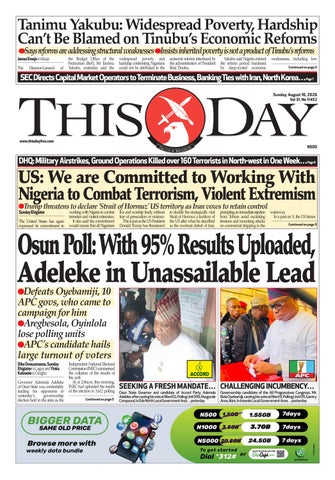
Osun Poll: With 95% Results Uploaded, Adeleke in Unassailable Lead Defeats Oyebamiji, 10 APC govs, who came to campaign for him Aregbesola, Oyinlola lose polling units APC's candidate hails large turnout of voters
Dike Onwuamaeze, Sunday Ehigiator in Lagos and Yinka Kolawole in Osogbo
Governor Ademola Adeleke of Osun State was comfortably leading his opponents in yesterday’s governorship election held in the state as the
Independent National Electoral Commission (INEC) commenced the collation of the results of the poll. As at 2.06a.m. this morning, INEC had uploaded the results of the election in 3,612 polling Osun State Governor and candidate of Accord Party, Ademola
SEEKING A FRESH MANDATE… CHALLENGING INCUMBENCY…
Continued on page 5
Adeleke, after casting his vote atWard 02, Polling Unit 009, Abogunde Compound, in Ede North Local Government Area…yesterday
Governorship candidate of the All Progressives Congress, Mr. Bola Oyebamiji, casting his vote atWard 9, Polling Unit 011, Gantry Area, Ikire, in Irewole Local Government Area…yesterday
2
SUNday, AUGUST 16, 2026 • T H I S D AY
SUNDAY, AUGUST 16, 2026 • T H I S D AY
3
SUNday, AUGUST 16, 2026 • T H I S D AY
4
3 days
is all it takes
Get nancing to own your dream car in as little as 3 days
Approval, disbursement, and delivery within 72 hours
Apply anytime, anywhere
Subject to credit approval and delivery timelines.
In partnership with:
More Information: 0700-300-00, 0201-2273000-9 accessbankplc.com
Access Bank PLC. RC.-125384 (Licensed by the Central Bank of Nigeria)
Equity contribution from 10% of invoice value
Optimized total cost of ownership
Scan to get started
Terms and conditions apply
5
AUGUST 16, 2026 • T H I S DAY, T H E S U N DAY N E W S PA P E R
NEWS
At N104.9tn, Nigeria’s Overnight Financing Market Hits New Monthly Record in July 2026
Kayode Tokede
Nigeria’s overnight financing market recorded an all-time high trading volume of N104.9 trillion in July 2026, sustaining the sharp expansion in activity since the Nigerian Overnight Financing Rate (NOFR) was introduced by the Central Bank of Nigeria (CBN) in April, according to data released by the apex bank. The July figure represented an increase of about 1.9 per cent
over the N102.9 trillion recorded in June and marked the highest monthly trading volume since the benchmark became operational. CBN data showed that activity in the overnight funding market accelerated significantly from May and remained elevated through July, reflecting increased transactions among financial institutions. Total traded volume rose by 32.6 per cent to N96.36 trillion in May, from N72.66 trillion in
April, before climbing further to N102.9 trillion in June and N104.9 trillion in July. The NOFR is a transactionbased benchmark designed to measure overnight borrowing costs in Nigeria’s money market. It provides a reference rate for pricing financial instruments and contracts, while giving regulators and market participants an indication of short-term liquidity conditions. An analysis of daily market
data between April 13 and July 31, 2026, showed that despite the substantial increase in transaction volumes, the benchmark rate remained remarkably stable at around 22 per cent. CBN data as of July 31 showed that the maximum NOFR stood at exactly 22 per cent on 12 of the 31 trading days covered by the published figures. The combination of rising transaction volumes and relatively stable funding costs suggests that
the market absorbed substantially higher overnight financing activity without corresponding upward pressure on borrowing rates. It also indicates that banks and other market participants were able to execute larger overnight transactions without significantly disrupting short-term funding conditions. The CBN formally introduced the NOFR on April 17, 2026, in collaboration with the Financial
Markets Dealers Association (FMDA), while its official public launch was held in Abuja on June 15. Speaking at the launch, CBN Governor, Olayemi Cardoso, described the benchmark as a significant financial market reform designed to strengthen transparency, improve monetary policy transmission and align Nigeria’s money market with international benchmark reforms.
OSUN POLL: WITH 95% RESULTS UPLOADED, ADELEKE IN UNASSAILABLE LEAD units (PUs), representing 95.99 per cent of the 3,763 PUs in the state to the commission’s Result Viewing Portal (IReV). With only 151 PUs remaining, Adeleke, who is the candidate of the Accord Party (AP), was leading the candidate of the All Progressives Congress (APC), Munirudeen Bola Oyebamiji, with over 50,000 votes. While Adeleke was leading in 21 Local Government Areas (LGAs), Oyebamiji was leading nine. The candidate of the African Democratic Congress (ADC), Najeem Salaam, was coming
a distant third position with less than two per cent of the votes uploaded on IReV. However, INEC was still collating the final results, which will determine the final winner of the governorship election. In the 10 LGAs collated, Adeleke defeated Oyebamiji and about 10 APC governors, who campaigned for him. Senate President, Senator Godswill Akpabio and the Speaker of the House of Representatives, Tajudeen Abbas, also campaigned for the APC candidate. Some of the governors who
campaigned for him include: Senator Hope Uzodimma of Imo State, Senator Monday Okpebholo of Edo State; Usman Ododo of Kogi State, AbdulRahman AbdulRasaq of Kwara State, Babajide SanwoOlu of Lagos State, Biodun Oyebanji of Ekiti State, Dapo Abiodun of Ogun State, Mai Mala Buni of Yobe State and Lucky Aiyedatiwa. The Delta State governor was represented by his deputy, Monday Onyeme. INEC had disclosed that 207 of the 3,763 polling units in the state experienced ‘minor’
delays in opening for yesterday’s governorship election. The governorship election held across the 30 LGAs in the state, was a two-horse race between the incumbent Governor Adeleke and the candidate of the APC, Oyebamiji, although other candidates were also in the race. Although the election was not bloody despite the tension it generated, there were pockets of violence, alleged cases of votebuying, sporadic shootings and intimidation of voters. Meanwhile, a former governor of the state and the National Secretary of the ADC, Mr.
Rauf Aregbesola, and a former deputy governor of the state and ex-National Secretary of the APC, Senator Iyiola Omisore, lost their polling units to APC, and Accord Party, respectively. Accord Party polled 131 votes at Omisore’s PU 003, Ife Ward 1, Moore, St. Gabriel Primary School, Ife East LGA. APC finished second with 85 votes, while ADC got 10 votes. Other parties recorded marginal votes. Similarly, at Aregbesola’s PU001, Cooperative Building Junction, Isare, Ward 08, Ilesa East LGA, where Aregbesola
voted, the APC’s governorship candidate, Oyebamiji, secured 256 votes to come top there. Governor Adeleke came second with 43 votes, while ADC’s candidate, Najeem Salaam, came third with 13 votes. Before the commission began the results collation, it had stopped uploading the results to its IReV after it had uploaded the results of 3,292 polling units (PUs) out of the 3,763PUs in the state, representing 87.48 per cent of the results. This had fuelled an allegation Continued on page 9
US: WE ARE COMMITTED TO WORKING WITH NIGERIA TO COMBAT TERRORISM, VIOLENT EXTREMISM Adviser for Arab and African Affairs, Massad Boulos, while sharing an image of the Under Secretary of State for Political Affairs, Allison Hooker, meeting with Nigerian counterparts, said the engagement was focused on advancing efforts to protect vulnerable Christian communities in Nigeria. “Pleased to see @ UnderSecStateP Allison Hooker meeting with our Nigerian counterparts to advance efforts to protect vulnerable Christian communities. We note Nigeria has prosecuted hundreds of Boko Haram and Islamic State-West Africa suspects, expanded its judicial capacity, and is actively recruiting and training 50k additional police officers,” the adviser said. However, the US stressed that the progress recorded so far would need to be followed
by sustained action, particularly in addressing the humanitarian consequences of terrorism and insurgency. “But we all know more work lies ahead, particularly with supporting IDPs,” the official added. The statement further reaffirmed Washington’s commitment to working with Abuja against terrorism and violent extremism, while underscoring the importance of ensuring freedom of worship and protection for Nigerians regardless of faith. “The United States remains committed to working with Nigeria to combat terrorism and violent extremism and to ensure all Nigerians can live and worship freely, without fear of persecution or violence,” Boulos said. The development came against
the backdrop of the ongoing high-level engagement between Nigeria and the US, following the visit of National Security Adviser (NSA), Mallam Nuhu Ribadu, and a senior Nigerian delegation to Washington for the second session of the United States-Nigeria Joint Working Group (JWG). This followed the second session of the US-Nigeria JWG held in Washington on August 12, 2026, which was co-chaired by Ribadu and Hooker. According to the US, the meeting built on the first JWG session held in Abuja on January 22 and focused on three broad areas: protecting Christian communities in Nigeria’s Middle Belt, strengthening judicial and security institutions to hold perpetrators accountable, and deepening military-to-military cooperation.
The discussions also reviewed Nigeria’s efforts to resettle IDPs to their ancestral communities, counter-terrorism prosecutions and measures to combat the financing of terrorism. The U.S., however, identified continuing concerns, including reports of civilian fatalities and gaps in transparency surrounding humanitarian expenditure. Both sides also acknowledged that further work was required, particularly in supporting displaced populations. The Washington engagement was part of a broader Nigerian diplomatic and security mission led by Ribadu, which included senior government officials involved in defence, security and economic affairs. Trump Threatens to Declare 'Strait of Hormuz' US Territory as Iran Vows to Retain Control Meanwhile, President Trump
has threatened to declare the strategically vital Strait of Hormuz a territory of the US after what he described as the eventual defeat of Iran. Trump made the remarks during a political rally at a police academy in New York, where he told supporters that the U.S. was effectively in control of the crucial maritime chokepoint. “After we finish defeating Iran, which is being very badly defeated, pretty soon I’ll be declaring the Hormuz Strait a territory of the United States,” Trump said, drawing cheers from the crowd. However, a White House official subsequently told the media that Trump was joking. Iran nonetheless responded sharply to the comments, with Deputy Foreign Minister Kazem Gharibabadi insisting that Tehran would retain control over the
waterway. “The Strait of Hormuz has been Iranian, is Iranian, and will remain Iranian,” Gharibabadi said in a post on X. “This strait will only be closed and opened under Iran’s command,” he added. The exchange came as the U.S. and Iran remained locked in a standoff over the waterway, through which a significant share of global energy supplies traditionally passes. Trump has repeatedly claimed that the U.S. controls the strait following the outbreak of the conflict with Iran on February 28. Tehran, however, has rejected the claim and effectively restricted maritime traffic through the waterway. Trump told the rally that the US blockade remained in force, saying, “We have the blockade. No ships get through unless we want them to.”
TANIMU YAKUBU: WIDESPREAD POVERTY, HARDSHIP CAN’T BE BLAMED ON TINUBU’S ECONOMIC REFORMS
productivity, foreign exchange distortions, fiscal leakages, unreliable power supply, insecurity, poor infrastructure and weak job creation, stressing that the persistence of these problems should not automatically be blamed on the reforms. In a statement titled, “Poverty, Reform and the Problem of Causation,” Yakubu said the central issue was to distinguish between the conditions that produced Nigeria’s poverty crisis and the policies currently being deployed to address them. He spoke against the backdrop of a report citing World Bank data suggesting that a large proportion of Nigerians were either living below the poverty
line or vulnerable to falling into poverty. Yakubu cautioned against interpreting the figure as a conventional poverty headcount, explaining that the World Bank’s assessment also included people who were above the poverty line but remained vulnerable to economic shocks. He said the distinction did not diminish the severity of the social crisis but was necessary for a proper assessment of the country’s economic condition. “The pain is real; the conclusion does not follow automatically,” he said, adding that the persistence of poverty nearly three years into the reform programme did not establish
that the reforms had caused the hardship. According to him, Nigeria did not enter the reform period as a healthy economy that was suddenly destabilised by policy changes. Rather, he said, the country had accumulated years of structural weaknesses, including weak per capita growth, low productivity, insecurity in food-producing areas, unreliable electricity supply, poor logistics, limited formal employment, foreign exchange scarcity, multiple exchange rates and inflationary financing. He also identified the former fuel subsidy regime and fiscal leakages among the distortions
that had placed increasing pressure on public finances. Yakubu maintained that the poverty crisis predated the reforms and should, therefore, be assessed against the economic conditions inherited by the administration in 2023. The Director-General pointed to improvements in key macroeconomic indicators as evidence that the reform programme had begun to address some of the structural problems. He cited World Bank data showing that Nigeria recorded real Gross Domestic Product (GDP) growth of four per cent in 2025, while the International Monetary Fund (IMF) also
estimated growth at four per cent in 2025 and projected 4.1 per cent for 2026. Gross international reserves, he added, rose to about $46 billion at the end of 2025 from approximately $40 billion a year earlier, while net international reserves increased from $23 billion to $35 billion. Yakubu stressed that such improvements could not simply be dismissed because households were still struggling with the high cost of living. He said macroeconomic stabilisation alone was, however, insufficient, stressing that the government must ensure that improved economic stability translated into
higher productivity, increased investment, employment and household incomes. “Stabilising the economy is not enough; government must make that stability useful to ordinary people,” he said. He also rejected the interpretation that the decline in Nigeria’s GDP measured in US dollars necessarily represented a corresponding contraction in the volume of economic activity. According to him, the depreciation of the naira significantly affected the dollar conversion of Nigeria’s output, making current-dollar GDP an inappropriate standalone Continued on page 9
6
T H I S DAY, T H E S U N DAY N E W S PA P E R • AUGUST 16, 2026
NEWS
FACILITATING UNHINDERED ACCESS TO INFORMATION…
L-R: Mrs. Elizabeth Idigbe; Proprietor, BiG HEART 92.1 FM Asaba, Chief Anthony Idigbe (SAN); Chairman, THISDAY/ARISE Media Group, Prince Nduka Obaigbena; Representative of Delta State Governor/ Commissioner for Special Duties, Government House, Dr. Michael Osuoza; Asagba of Asaba, HRM Obi Prof. Epiphany Azinge; Representative of Speaker of Delta State House of Assembly, Nkem Nwaeke; and Director General of the National Broadcasting Commission, Mr. Charles Ebuebu, at the official inauguration of BiG HEART 92.1 FM in Asaba…yesterday
Atiku Accuses Tinubu of Failing Fiscal Transparency Test, Suffocating Nigerians with Excessive Taxation Chuks Okocha in Abuja The presidential candidate of the African Democratic Congress (ADC), Atiku Abubakar, has raised the alarm over what he described as the President
Bola Tinubu administration’s excessive appetite for taxation, saying Nigerians and businesses were groaning under the burden of multiple taxes and levies. The former vice-president also described the administration’s
response to the United States Government’s assessment of Nigeria’s fiscal transparency as an embarrassing attempt to bury a serious indictment beneath bureaucratic grammar. In a statement issued by
his Senior Special Assistant on Public Communication, Phrank Shaibu, Atiku said the Presidency had failed to address the substance of the assessment, choosing instead to dismiss it as an “external benchmark”
that did not adequately capture the administration’s reforms. The United States reported that Nigeria failed to meet minimum fiscal transparency requirements and made “no significant progress” in addressing deficiencies relating to budget information, revenue and expenditure reporting, audit independence and public access to procurement information. Atiku said: “What exactly is the Tinubu Presidency saying? gold coins, bullion or nuggets; Nigeria failed the minimum fiscal transparency test, and its and prepaid cards. When making a declaration, response is essentially: ‘Yes, we travellers must provide details failed, but the test does not tell about the money and their the whole story.’ “That is not a defence. It journey. This includes information is an admission wrapped in about: The person carrying grammar. “If, after all the reforms the money, its owner and the intended recipient, including this administration advertises, passport or identification details Nigeria still cannot satisfy and addresses; the journey, minimum fiscal transparency including countries visited requirements, the problem in transit, flight numbers or is not the assessment. The ferry routes; the amount and problem is the government. “The contradiction is even type of money being carried; where the money came from more disturbing when the and how it was obtained, such government’s appetite for as earnings or the sale of an taxation is considered. The item; and what the money will CBN’s July 2026 Business Expectations Survey showed be used for.
UK Reveals How Much Money Must Be Declare When Entering Britain Travellers entering or leaving the United Kingdom with large amounts of money may be required to declare it to customs authorities before or upon arrival. Under UK customs rules, anyone carrying £10,000 or more between Great Britain — England, Scotland and Wales — and a country outside the UK must make a declaration. The requirement also applies to families or groups travelling together. If the combined amount being carried by the group is £10,000 or more, a declaration is required even if no individual traveller has £10,000. Travellers can make a
declaration up to 72 hours before their journey. Different rules apply when travelling to or from Northern Ireland. Anyone carrying €10,000 or more, or its equivalent, between Northern Ireland and a non-EU country must declare the money. A declaration is also required when travelling from Great Britain to Northern Ireland with €10,000 or more. However, travellers do not need to declare money when travelling from Northern Ireland to Great Britain, regardless of the amount. The rules also apply to groups and families. If the combined amount being carried is €10,000
or more, the group must make a declaration. Customs authorities may also require a cash disclosure form when money is sent by freight, post or parcel between Northern Ireland and a non-EU country. This includes money sent from Great Britain to Northern Ireland. The declaration requirements cover more than banknotes and coins. Travellers must declare: notes and coins; bearer bonds; travellers’ cheques; and signed cheques that are not made out to a specific person or organisation. For money being carried into or out of Northern Ireland, the rules also cover: money orders;
that 70.8 per cent of respondents identified high and multiple taxation as their biggest business constraint. “Yet, the same administration understands the importance of tax relief when dealing with major oil operators, offering performance-based incentives to attract investment. “So, Tinubu understands that excessive taxation can discourage investment when large corporations are involved, but somehow forgets the same economic principle when Nigerian manufacturers, SMEs, traders and entrepreneurs are being suffocated by multiple taxes and levies. “You cannot demand firstclass compliance from taxpayers while offering third-class accountability in return.” Atiku also challenged Tinubu over his promise to “soon publish” details of how resources accruing from the removal of fuel subsidy were being utilised. “Soon? More than three years after Nigerians were asked to endure extraordinary hardship in the name of subsidy removal?
Banks Redirect Credit Flow as Agriculture Accounts for N3.86tn, Oil and Gas Exposure Declines by N335bn
Festus Akanbi
Nigerian banks are steadily redirecting credit towards agriculture and other emerging areas of the economy, with lending to the agricultural sector rising to N3.86 trillion in March 2026. Conversely, exposure to the traditionally dominant oil and gas industry declined by about N335 billion in the first three months of the year.
The changing pattern of bank lending, contained in the latest Quarterly Statistical Bulletin of the Central Bank of Nigeria (CBN), offers a striking picture of how lenders are recalibrating their portfolios amid elevated interest rates, inflationary pressures and persistent exchange-rate volatility. According to the CBN data, credit to agriculture rose from N3.71 trillion in January to
N3.81 trillion in February, before climbing further to N3.86 trillion in March. This represented an increase of about N150 billion, or four per cent, within the first quarter. The movement was in sharp contrast to developments in the oil and gas sector, where bank credit declined consistently during the period. Lending to the sector fell from N10.91 trillion in January to N10.71 trillion in February
and N10.58 trillion in March, translating to a contraction of approximately N335 billion. The figures suggest that although oil and gas remain one of the largest recipients of bank credit, lenders are gradually increasing their exposure to other productive sectors, particularly agriculture, power and real estate. The shift is significant for agriculture, a sector whose enormous potential has
long been constrained by inadequate financing, high production costs, insecurity, poor infrastructure and limited mechanisation. Greater access to bank credit could provide badly needed financing for farmers, processors and other operators across the agricultural value chain at a time when the country is grappling with high food prices. However, the first-quarter
figures also exposed sharp differences in credit flows across the economy. Manufacturing, another critical productive sector, suffered a steep decline in lending, with credit falling from N6.57 trillion in January to N5.77 trillion in March. The contraction underscores the financing pressures confronting manufacturers amid high borrowing costs and elevated operating expenses.
7
AUGUST 16, 2026 • T H I S DAY, T H E S U N DAY N E W S PA P E R
NEWS
WELCOMING NEW AIRBUS TO THE FLEET…
L-R: Chief Executive Officer, Ibom Air, Mr. George Uriesi; Akwa Ibom State Governor, Pastor Umo Eno; and Vice President, Africa for Airbus, Hadi Akoum, at a pre-delivery meeting of Ibom Air brand new Airbus A220300 aircraft in Montreal, Canada…recently
SEC Directs Capital Market Operators to Terminate Business, Banking Ties with Iran, North Korea Monitors Lebanon, Monaco, Others
Kayode Tokede
The Securities and Exchange Commission (SEC) has directed all capital market regulated entities to terminate correspondent
banking relationships and restrict business dealings involving the Democratic People’s Republic of Korea (DPRK) and Iran. The directive was contained in a circular to all capital market
regulated entities posted on the SEC’s website and dated August 14, 2026. The circular implements updated statements issued by the Financial Action Task
Force (FATF) at its February 2026 plenary session, which identified jurisdictions posing significant risks relating to money laundering, terrorist financing and proliferation financing.
Umahi: Tinubu Has Turned Nigeria into Construction Site with Massive Projects
Emmanuel Addeh in Abuja
The Minister of Works, Senator David Umahi, has said President Bola Tinubu has transformed states across the country into construction sites through massive infrastructure development. Umahi spoke at the weekend while inspecting the ongoing Calabar–Ebonyi–Benue–Kogi– Nasarawa–Abuja Superhighway, one of the federal government’s flagship projects. The minister said the scale of road construction and other infrastructure projects under Tinubu's administration demonstrated the President’s
commitment to inclusive development and addressing what he described as the perceived marginalisation of the South-east. He urged journalists and other stakeholders to adequately inform Nigerians about the impact of the projects, particularly their potential to improve security, boost commerce and strengthen economic activities across the country. “Look at the beautiful roads we are passing through. Do you think about the security improvements on this corridor? Do you think about the economic viability of this corridor? Do you think about commerce?”
Umahi asked. He said the completion of the superhighway would bring previously distant parts of the country closer and fundamentally alter the economic relationship between the South-east and other regions. “When Sokoto becomes very close to Ebonyi, when Calabar becomes very close to Kebbi, when the marginalisation of the South-east has become a thing of the past, should we not be bold enough to tell the story?” he asked. According to him, the media has a responsibility to educate Nigerians about developments taking place across the country,
instead of relying on narratives that may not reflect realities on the ground. Umahi said his appointment as Minister of Works by Tinubu was part of the President’s desire to promote inclusive governance and bring the South-east closer to the centre of national development. “When I said the President has the intention to end marginalisation of the South-east, has an intention for inclusive governance, taking the South-east to the centre, I said my being appointed Minister of Works is intentional by Mr President in achieving some of his desires for the country,” he said.
PTAD Clears N3.82 Billion Backend Computation Arrears for 30,356 Pensioners James Emejo in Abuja
The Pension Transitional Arrangement Directorate (PTAD) said it has disbursed N3.82 billion in accrued pension arrears to 30,356 pensioners under the Defined Benefit Scheme (DBS), as the Federal Government intensifies efforts to clear outstanding retirement obligations. The payment, totalling
N3,817,568,592.80, followed the conclusion of a Back-End Computation (BEC) Review Exercise conducted by PTAD to address complaints arising from pension computations and unpaid entitlements. Executive Secretary/Chief Executive of PTAD, Tolulope Odunaiya, commended the affected pensioners for their cooperation during the review process, stressing
that the directorate remained committed to ensuring that verified pension obligations were settled in a timely and transparent manner. In a statement issued by PTAD Head, Corporate Communications, Olugbenga Ajayi, Odunaiya said the latest payment reflected the commitment of President Bola Ahmed Tinubu’s administration to resolving
pension-related challenges and strengthening the administration of the Defined Benefit Scheme. The beneficiaries cut across three departments of the Directorate: the Parastatals Pension Department (PaPD), Defunct and Transferred Agencies Pension Department (DTAPD), and Tertiary, Education and Health Pension Department (TEHPD).
The commission said the directive was issued pursuant to the Investments and Securities Act, 2025, and the SEC AML/ CFT Rules and Regulations, requiring all capital market regulated entities (CMREs) to immediately implement enhanced restrictions and monitoring measures for transactions linked to designated high-risk jurisdictions. For the DPRK, the commission directed all CMREs to sever financial relationships with institutions linked to the country. The circular instructed firms to terminate all correspondent banking relationships with financial institutions incorporated in, owned or controlled by persons or entities in North Korea. The commission directed
CMREs to: “Terminate all correspondent banking relationships with financial institutions incorporated in, owned or controlled by persons or entities in the DPRK. “Ensure that no subsidiaries, branches or representative offices of DPRK financial institutions are established or maintained within their operations; and restrict or, where appropriate, refuse business relationships and transactions involving DPRK nationals, entities, government bodies or persons acting on their behalf.” In effect, the directive cuts off formal banking and capital market channels connected to North Korean institutions within Nigeria’s regulated capital market.
Obi Urges FG to Strengthen Security after Attacks on Benue Communities, Commiserates with Victims
Chuks Okocha in Abuja
The presidential candidate of the National Democratic Congress (NDC), Mr. Peter Obi, has urged the federal government to intensify efforts to protect lives and property following recent attacks on communities in Benue State. Obi made the call yesterday in a post on his X platform after visiting Otukpo-Nobi and EfeyiUgboju communities, which were recently affected by attacks He said more than 10 people were either killed or missing in the attack on Otukpo-Nobi, while several others sustained injuries and were receiving treatment in hospital. According to Obi, more than 13 people were also reportedly killed and several others injured in a separate attack on Efeyi-Ugboju.
He added that while he was in the area, he was informed that 14 people had been kidnapped earlier in the morning along Ankpechi Road. Obi said he joined members of the Otukpo-Nobi community in praying for the repose of the victims at the site of their mass burial. He also visited the hospital where some of the injured victims were receiving treatment, expressing solidarity with them and praying for their recovery. “Having visited, seen, and spoken with those affected, I urge the Federal Government to demonstrate a greater commitment to securing the lives and property of citizens and to closing the ungoverned spaces that have become breeding grounds for insecurity,” he said.
8
T H I S DAY, T H E S U N DAY N E W S PA P E R • AUGUST 16, 2026
NEWS
SAFETY OF MARINE ENVIRONMENT ON THEIR MINDS…
L-R: Director, Legal Services, Nigerian Maritime Administration and Safety Agency, Heaky Dimowo; Chief of the Naval Staff, Vice Admiral Idi Abbas; Director General, NIMASA, Dr. Dayo Mobereola; and Commander, Maritime Guard Command, Commodore Reginald Adoki, during the signing ceremony of a Memorandun of Understanding between NIMASA and Navy at the Naval Headquarters in Abuja...recently
DHQ: Military Airstrikes, Ground Operations Killed over 160 Terrorists in North-west in One Week Linus Aleke in Abuja
The Defence Headquarters (DHQ) has stated that troops conducting coordinated air and ground operations under Operation Fansan Yamma neutralised more than 160 terrorists and recovered about 300 motorcycles in the Northwest within the past week. The Director of Defence Media Operations, Maj. Gen. Michael
Onoja, disclosed this yesterday while providing an update on military operations across the country. Onoja said the Air Component of Operation Fansan Yamma carried out a successful armed reconnaissance mission on August 9, 2026, over the Sangeko and Baba-Doka areas of Mariga Local Government Area (LGA) of Niger State, following intelligence reports of a large
concentration of terrorists, many of whom were riding motorcycles. He said the aircraft engaged the terrorists with rockets and cannon fire, disrupting their movement and activities. “Initial reports indicated the recovery of approximately 120 bodies and about 300 motorcycles at the location. Monitoring of the area is ongoing to further assess the outcome of the operation,”
he said. In a separate operation on August 13, the Air Component conducted armed reconnaissance around Maburya in Mariga LGA after detecting a large group of terrorists moving with rustled cattle. According to Onoja, an aircraft was subsequently deployed to conduct a clearance patrol along the Kainji-Daban Woko axis. He said the terrorists were
sighted fleeing with a herd of axis in Guyaku District, Gombi rustled cattle and were engaged LGA of Adamawa State, forcing with onboard weapon systems, them to withdraw. Weapons and resulting in the neutralisation ammunition were also recovered. of 46 terrorists. He said troops arrested Giving an update on suspected logistics facilitators operations in the North-east, in Adamawa and Borno Onoja said troops of Operation states, including five suspected Hadin Kai neutralised a terrorist terrorist collaborators and cattle at a hideout in Kaniram East, rustlers at a checkpoint along Abadam LGA of Borno State, the Mandaragirau-Sabon Gari on August 7. Road in Biu LGA. He said the operation followed He added that a suspected a probing attack on a military terrorist informant was arrested location in Mallam Fatori on July at the Damboa Internally 29, adding that troops recovered Displaced Persons camp in arms, ammunition and other Borno State on August 10. items before destroying the The military spokesman said hideout. 19 persons, including terrorist Onoja stated that, on the same fighters, women, children and to underscore the need to hold political figures accountable for day, troops engaged terrorists teenagers, also surrendered to statements capable of inciting collecting illegal taxes from troops at various locations in herders along the Gaba-Dzangola Borno State. violence. Fadahunsi, who represents Osun East Senatorial District in Kidnappers Free Anambra the National Assembly, has been at the centre of controversy over a Billionaire Businessman, Reverend video circulating online in which Sister after N1.5bn Ransom Demand he was allegedly heard urging David-Chyddy Eleke in Awka contact with his family during his supporters to “kill” members his captivity and initially of the Accord Party ahead of A billionaire businessman and demanded a ransom of N700 yesterday’s governorship election. Chairman of Jezco Group, Chief million, before allegedly The senator has, however, Joseph Ezeokafor, who was increasing the demand to N1.5 denied advocating physical kidnapped alongside a reverend billion. violence, insisting that his sister by yet-to-be-identified While it was not clear if remarks were taken out of context gunmen at Ifite-Awka, Awka Ezeokafor paid the N1.5billion after the video was edited. South Local Government Area to regain his freedom from his (LGA) of Anambra State, have abductors, sources close to the been released and has safely family said the amount was paid before the businessman returned. It was gathered that they was let go. The spokesman for the were released in the early hours Anambra State Police of yesterday after spending the committee to regard their Command, SP Tochukwu four days in captivity under assignment as a crucial political Ikenga, confirmed his release responsibility rather than merely unknown circumstances. in a statement issued yesterday, Ezeokafor, who is the father of an administrative duty. adding that the command popular social media personality He also urged them to was taking necessary steps Jowi Zaza, was abducted in the engage extensively with party leaders, former and serving early hours of Tuesday while to establish the circumstances political office holders, aspirants, on his way to a prayer ground surrounding their abduction and release. elected representatives, youth in Awka, Anambra State. Ikenga said the command The businessman’s abduction and women leaders, ward executives, local government had sparked widespread concern was also taking necessary stakeholders, support groups, among his family, friends, steps to obtain relevant community leaders and other associates and residents of information that would assist ongoing investigations and the critical stakeholders across Kwara Anambra State. His abductors had established identification of the perpetrators. Central.
Amnesty International Demands Probe of Fadahunsi over Alleged Incitement Wale Igbintade
Amnesty International Nigeria has called for an urgent investigation into alleged inflammatory remarks attributed to Senator Francis Fadahunsi ahead of the Osun State governorship election. The organisation made the call yesterday in a post on its X handle, saying the allegations of incitement to violence required prompt intervention by the relevant authorities. Amnesty International urged the authorities to conduct a “prompt, impartial and
thorough investigation” into the reported remarks and ensure accountability should evidence establish that a criminal offence had been committed. “Political differences must never become a justification for violence,” the organisation said. It also urged members of the public to support its petition calling on the authorities to investigate the matter and take appropriate action. The call came as residents of Osun State voted in yesterday’s governorship election amid heightened scrutiny of the conduct of political actors
and concerns over the need to maintain peace throughout the electoral process. The international human rights organisation had last Thursday announced plans to intensify its campaign against politicians accused of making inflammatory statements capable of triggering electoral violence, with Fadahunsi’s case emerging as a major focus of the campaign. Amnesty International Nigeria’s Country Director, Isa Sanusi, said the organisation would use the controversy surrounding the viral video involving the Osun East senator
Kwara PDP Unveils Reconcilation Committee to Resolve Internal Crisis Ahead of 2027 General Election
Hammed Shittu in Ilorin
The opposition Peoples Democratic Party (PDP) in Kwara State has set up a reconciliation committee to resolve lingering internal disagreements, strengthen unity and reposition the party for electoral success ahead of the 2027 general election. The committee is headed by a party leader and former Commissioner for Health, Dr. Suleiman Atolagbe Alege.
Speaking with journalists in Ilorin, the state capital, yesterday, on the sidelines of the inauguration of the committee, the state Chairman of the PDP, Hon. Issa Adamu Bawa, said the initiative was aimed at consolidating the party's grassroots structures and strengthening relationships among members and stakeholders. Bawa said: “The strategic initiative by the party leadership is to further consolidate the
PDP's grassroots structures, reconcile members and stakeholders, strengthen existing political relationships and create a stronger platform for collective political action ahead of 2027.” He emphasised that the strength and electoral prospects of any political party depended largely on its unity, discipline, effective communication, internal democracy and ability to accommodate diverse interests. Bawa charged members of
9
AUGUST 16, 2026 • T H I S DAY, T H E S U N DAY N E W S PA P E R
NEWS
CONGRATULATIONS TO NEWEST COUPLE…
L-R: Mother of the groom and Managing Director, Reliable Steel and Plastic Industries Limited, Lady Maria Ihionu; the couple, Juliet and Francis Ihionu; and father of the groom and Chairman, Reliable Steel and Plastic Industries Limited, Chief Samuel Ihionu, after the church wedding of the couple in Asaba, Delta State…weekend
OSUN POLL: WITH 95% RESULTS UPLOADED, ADELEKE IN UNASSAILABLE LEAD by Adeleke’s Imole Campaign Council (ICC), which raised the alarm that there was an alleged plot by lNEC to declare the governorship election inconclusive. Afrobeats star, David Adeleke, popularly known as Davido, also questioned INEC over the delay in uploading results of its IReV. Davido, who was closely monitoring the election process, raised the concern in a post on his X account, saying: “INEC IREV uploads have been stuck for almost 2 hours now. 3,292 out of 3,763 results submitted and then silence. This is not acceptable! “Why has the uploading stopped? @inecnigeria” However, the commission resumed the uploading of the results to IReV after several hours.
207 Polling Units Experienced Delays, Says INEC INEC had earlier confirmed that 207 of the 3,763 polling units in the state experienced ‘minor’ delays in opening for the election.
According to an election situation report shared by the commission on its official X handle, 3,556 polling units, representing 94.5 per cent of the total, had opened by 8:30am. INEC said the remaining 207 polling units, representing 5.5 per cent, were delayed but became operational by 9:00am. “3,556 of 3,763 Polling Units (94.5%) had opened,” the commission stated.
APC’s Oyebamiji Hails Large Turnout of Voters Meanwhile, the governorship candidate of the APC, Oyebamiji, described the large turnout of voters in Ikire, his hometown, as a sign that residents were not intimidated during the election. Oyebamiji made the remarks after casting his vote at Open Space Gantry, Sawmill, Ward 009, Polling Unit 011, in Ikire, Irewole LGA. Speaking shortly after voting, the APC candidate commended the presence of voters, electoral officials and security personnel at the polling unit, saying the development indicated that the exercise was progressing smoothly.
“INEC are here, the voters are here, security operatives are here; I want to commend the large turnout of voters in Ikire. It shows that people are not intimidated, and generally, things are going on fine across the state,” he said. Oyebamiji, however, urged security agencies to remain proactive amid concerns about possible violence in Ikire later in the day. “I want to admonish the police and other security operatives to be proactive to ensure security for our people and all the voters, and I believe the election would be credible,” he said. The APC candidate also expressed confidence in his chances of winning the election. “I am confident that I’d win this election at the end of the day,” he said.
Adeleke’s Camp Alleges 52 Arrests, Attacks on Accord Party Supporters As the election was ongoing, the Director-General of the Imole Campaign Council, Senator Lere Oyewumi, alleged that 52 people were arrested at the residence of the lawmaker
representing Irewole/Isokan State Constituency, Ibrahim Inaolaji, in Ikire, Osun State. Oyewumi made the allegation while speaking with journalists at his polling unit, Unit 9, St Peter and Paul/Sumoye Primary School, Ikire, during the election. He described the alleged arrests as intimidation, claiming that about 24 police officers stormed the lawmaker’s residence in the early hours of yesterday, damaged the gate and arrested people who gathered there. According to Oyewumi, those arrested included family members, supporters and the Accord Party chairman in the local government. He also alleged that the Accord Party chairman in Ward 6 and a prominent youth leader were arrested in separate incidents days before the election. Oyewumi claimed the arrests were aimed at preventing party members and supporters from participating in the election, alleging that those arrested were being held in Osogbo. The campaign DG further alleged that suspected thugs attacked Accord Party agents and voters at some polling units
in Ikire after voting began. He said he had contacted the police and the military authorities over the alleged incidents, expressing concern over what he described as the failure of security personnel to prevent the attacks. The allegations had not been independently verified at the time of filing this report.
Sporadic Shooting Forces Residents to Flee Collation Centre Meanwhile, there was sporadic shooting last night at the premises of Union Baptist Primary School, where the Ataoja D Ward 4 collation centre is located in Osogbo, Osun State. The gunshots, reportedly fired by security personnel, were heard between 9.15pm and 9.30pm, causing residents and other people around the area to flee for safety. It was not immediately clear what triggered the shooting. The shooting persisted for more than 15 minutes, with many people close to the collation centre running for cover.
ADC Candidate Raises
the Alarm over Agent Exclusion, Denies Vote-buying Meanwhile, the ADC governorship candidate, Salaam, has raised concerns over the alleged non-recognition of his party agents in several areas across the state during the election. Salaam, who arrived at his polling unit to vote at 10:39 a.m., said he received reports that ADC agents were not being recognised despite the party uploading their names ahead of the election. He said the alleged nonrecognition of party agents occurred in 10 LGAs, prompting him to report the matter to relevant authorities, who, he said, were looking into it. Salaam also denied allegations of vote buying by the ADC, insisting that the party was focused on presenting its programmes and allowing voters to freely choose their preferred candidate. The candidate, who voted at Ward 4, expressed confidence that he would emerge victorious, attributing his optimism to his faith in God and the voters’ support.
TANIMU YAKUBU: WIDESPREAD POVERTY, HARDSHIP CAN’T BE BLAMED ON TINUBU’S ECONOMIC REFORMS measure for determining whether domestic production had expanded or contracted. He said real GDP, productivity, employment, sectoral output and real household consumption were more appropriate indicators for assessing changes in domestic economic activity. Yakubu acknowledged that the depreciation of the naira had inflicted real welfare losses by reducing the foreign currency value of wages, savings and assets, while increasing the naira cost of imported goods. He maintained, however, that such effects should not be confused with a collapse in real production. While defending the direction
of the reforms, Yakubu acknowledged that Nigerians had continued to bear significant adjustment costs. He said the removal of fuel subsidies and foreign exchange reforms could immediately raise prices and weaken household purchasing power, while the benefits of improved public finances and a more stable economy could take longer to materialise. According to him, the country had not been choosing between reform and an easy economic path, but between confronting accumulated distortions and allowing them to deepen until a future correction became even more painful.
He challenged the government to ensure that macroeconomic gains ultimately translated into tangible improvements in living standards. According to him, electricity must become more reliable and affordable for businesses, infrastructure must facilitate the movement of goods, security must enable farmers to return to their farms, while schools, healthcare and social protection must provide greater support to vulnerable households. “Poverty is one of the strongest reasons reforms must succeed; it is not proof that reform was wrong,” he said. Yakubu warned that the government should not use
improved macroeconomic indicators as an excuse for complacency. He noted that four per cent growth represented an improvement but remained insufficient to rapidly transform living standards in a country with a fast-growing population. He stated: “Strong reserves do not feed a family. A smaller deficit does not raise a worker’s pay. Higher government revenue improves welfare only when it becomes reliable power, roads, schools, hospitals, security, productive investment and effective support for people in distress.” He said the government should, therefore, be judged
on whether the reforms were attracting new investment, raising productivity, creating better jobs, improving real wages and protecting vulnerable Nigerians. Yakubu maintained that if those outcomes failed to materialise over time, criticism of the reform programme would be justified. He cautioned against treating inherited poverty as though it began with the reforms, insisting that such an approach would obscure the actual causes of Nigeria’s economic difficulties and could encourage a return to policies that had contributed to foreign exchange shortages, fiscal pressures and economic
instability. He said the ultimate test of the reforms was whether improved macroeconomic stability could be converted into greater production, increased private investment, quality jobs, lower inflation, stronger public services and rising household incomes. According to him, “Nigeria’s real choice now is not whether to recreate the policies that produced foreign exchange shortages, fiscal leakage and instability. It is whether the country can turn greater economic stability into more production, more private investment, better jobs, lower inflation, better public services and rising incomes.”
10
T H I S D AY, T h e S U N D AY N e w s pa p e r AUGUST 16, 2026
news
ENVIRONMENTAL PROTECTION IN FOCUS……
L-R: Director, Planning, Research and Statistics, Lagos State Environmental Protection Agency (LASEPA), Mrs. Kamanda Olubunmi Elizabeth; Pupil trainee, Ezekiel Ogunowo; Executive Assistant to Lagos State Governor on Environmental Protection, Tolulope Adebowale; LASEPA Zonal Director for Surulere Local Government Area, Mrs. Adeoye Oluwayinka; and the Head of Legal Services Unit, LASEPA, Kayode Iyadunni, at the 2026 Eco Explorers Boot Camp for nurturing young environmentalists, at the Ndubuisi Kanu Park, Mobolaji Johnson Avenue, Alausa, Lagos…yesterday PHOTO: ETOP UKUTT
Oborevwori, Azinge, Obaigbena, Guwor Grace Opening of Big Heart Radio Asaba •Idigbe commended for digital radio initiative Omon-Julius Onabu in Asaba
Governor Sheriff Oborevwori of Delta State; the Asagba of Asaba, His Royal Majesty, Prof. Epiphany Azinge (SAN); media mogul and Chairman of THISDAY/ ARISE NEWS Group, Prince Nduka Obaigbena; Speaker of Delta State House of Assembly, Hon. Emomotimi Guwor, and the Director-General of National Broadcasting Commission (NBC), Mr. Charles Ebuebu were among dignitaries that witnessed the formal opening of a new digital radio station yesterday in Asaba. The various personalities and stakeholders who witnessed the inauguration of the new radio station, Big Heart Radio 92.1 FM, were unanimous that the berthing of the station in Delta’s capital represents a significant enhance-
ment of the media landscape not only in Asaba and Delta State, but Nigeria at large. They described the new radio station as a desirable platform for grassroots communication, job creation, education as well as a channel for promoting cultural and community values and development. They commended the proprietor of the Big Heart Radio 92.1 FM and legal luminary, Dr Anthony Idigbe (SAN) for the initiative, expressing optimism that the station would live up to the lofty objective and vision of the founder. Delta State Governor Oborevwori, represented by the Commissioner for Special Duties, Dr Ifeanyi Michael Osuoza, commended Idigbe for consistently investing in the state
DHQ Raises Alarm as Hackers Compromise Its X Account Linus Aleke in Abuja The Defence Headquarters (DHQ) has raised the alarm over what it described as a compromise of its X account, urging the public to beware of information disseminated through the account. According to a statement by the Director of Defence Information, Major General Samaila Uba, the incident is currently being treated as a cybersecurity matter, and appropriate technical measures have been activated to secure the account and prevent further unauthorised access. “The Defence Headquarters assures the public that efforts are ongoing to fully restore control of the official account. Consequently, members of the public are advised to disregard any suspicious, unauthorised or
misleading content that may be posted from the account during this period. “The DHQ remains committed to maintaining the highest standards of information security and ensuring that the public continues to receive accurate, timely and credible information on the activities and operations of the Armed Forces of Nigeria,” the statement said. The military, Major General Uba said, appreciated the understanding and vigilance of the public and pledged to provide further updates as necessary. He said that, to ensure continuous and uninterrupted communication, the public was encouraged to rely on the military’s active official channels across other platforms for accurate, verified and timely information.
and, particularly contributing to the overall development of Asaba, the state capital. The governor described radio as a powerful tool for giving voice to the citizens and charged the management and journalists and broadcasters of Big Heart Radio 92.1 FM to uphold the principles of responsible journalism and broadcasting in the country. However, he urged the new radio station to ensure that its criticism of government and public institutions remained constructive and objective, which are geared towards positioning Delta as a peaceful and investment friendly state. Chairman of THISDAY/ARISE Media Group, Prince Obaigbena, described the establishment of the radio station as a welcome development that would enhance and strengthen grassroots communication media. Obaigbena, who was the chairman of the occasion, said radio remains a powerful medium “for the people and of the people,” stressing that investment in communication was an investment
in society. While commending Idigbe for the initiative, Obaigbena noted that the station has started on a good footing, adding that the presence of the Director-General of the NBC and other eminent personalities was an indication that the station had been duly licensed and authoritatively endorsed. On his part, the Asagba of Asaba, HRM, Prof. Azinge, commended Idigbe for what he described as a noble initiative, noting that it was the first time an Asaba son had brought such a major media investment home to the city. Azinge described Big Heart Radio as a landmark project worthy of celebration and said the initiative aligned with his vision of rebranding Asaba and enabling the people to tell their own story. The monarch encouraged other Asaba indigenes to emulate Idigbe and contribute to making Asaba a modern capital city. “Today is a new dawn,” the monarch said, while expressing appreciation to the Delta State Government and the DirectorGeneral of the NBC for their support
and presence. Speaker of the state legislature, Hon. Guwor, who was represented by his Chief Press Secretary (CPS), Mr. Nkem Nweke commended the founders, management and staff of the radio station, expressing optimism that the station would make a positive impact in the state and beyond. “May this station go on air and remain on air for the good of our people”, he prayed while challenging the station to uphold ethical and professional standards at all times. The founder of Big Heart Radio 92.1 FM, Idigbe, who holds the traditional title of Akulonor Ahaba, said that the inauguration marked the beginning of the realisation of his vision to establish a digital broadcast platform dedicated to educating, entertaining and informing the people. He said the station was established to bridge communication gaps and create a platform where people could connect, share ideas and participate in the development of society. He commended Governor Oborevwori for his leadership
and efforts in attracting investment to Delta State, while also appreciating the Asagba of Asaba for his innovative leadership and commitment to the development and transformation of the city. He paid tribute to the Obuzor of Ibusa and expressed appreciation to the chairman of the occasion, Prince Obaigbena, for identifying with the vision behind Big Heart Radio. Idigbe also thanked members of his family for their support and understanding, particularly for making part of the family land available for the establishment of the station in the heart of Asaba. Also speaking, the DirectorGeneral of the NBC, Mr. Charles Ebuebu, commended Idigbe for the initiative, describing the commissioning as more than a homecoming but an opportunity to share in an innovative project. Ebuebu noted that the future of radio broadcasting had evolved beyond conventional transmitters, as radio audiences were increasingly accessing content through mobile devices and digital platforms.
Otti’s Second Term will Turn Abia into 24-hour Economy, Says Onwuneme Wale Igbintade
A public affairs commentator, Nwabueze Onwuneme, has said Abia State could evolve into a 24-hour business economy if Governor Alex Otti is given the opportunity to serve a second term. Onwuneme made the assertion while engaging Nigerians in the diaspora in Sheffield, United Kingdom, where he urged them to look beyond remittances and consider investing in productive ventures in Abia State.
He said Otti’s vision was to build an economy where businesses and other economic activities could continue beyond conventional working hours, rather than having the state’s economy effectively “go to sleep at 6pm and wake up at 9am.” According to him, developed economies remain strong partly because economic activities continue beyond the traditional working day. Onwuneme said Otti was laying the foundation for such an economy through improvements
in security, electricity, roads, transportation, agriculture and support for micro, small and medium-sized enterprises (MSMEs). He identified security as the first requirement for a 24-hour economy, stressing that residents, workers and businesses must feel safe before economic activities can continue into the night. He also described reliable electricity as the bedrock of economic development, pointing to the state government’s partnership with Geometric
Power in the Aba ring-fenced area. He also cited the government’s efforts to acquire a 60 per cent stake in EEDC assets serving the Umuahia area and the establishment of the Abia State Electricity Regulatory Authority as important steps towards improving electricity supply across the state. According to him, improved power supply would enable businesses to operate for longer hours, reduce operating costs and increase productivity.
SUNDAY, AUGUST 16, 2026 • T H I S D AY
11
12
T H I S DAY, Th e S U N DAY N e w S PAPe r •August 16 , 2026
International
Winning Election by Manu Militari : Is Killing Accord Party Members not Self-defeatist?
M
anu Militari is a Latin phrase derived from manus (hand/force) and militaris (military/soldier) and meaning ‘with a military hand’ or ‘by military force.’ Legally, it is the act of carrying out a court order or action with the use of public armed forces or police. In ordinary political usage, it means compelling someone forcibly, brutally or abruptly. It is an act of doing something with force or with armed intervention. In this regard, winning election in international relations, especially in Nigeria and Africa, by manu militari, has become the technique increasingly adopted which should not be so. Without iota of doubt, there are many ways of winning an election, particularly in Nigeria. The most often talked about is election through the ballot box. However, election by ballot box or by highest number of votes has generally been weaponized. For example, political parties and their presidential standard bearers want to win elections by manu militari, by hook or by crook, or by do or die approach, etc. A good and current illustration is the Osun State gubernatorial election, held yesterday. Many people were killed before the election took place. When election by manu militari becomes controversial, the issue is referred to the court for ruling and judgment. Candidates have to be delayed until final court decision. New voting cards had to be printed to reflect court decision, meaning double expenses. It is against this background that the political campaigns of the gubernatorial election that took place on Saturday, August 15, 2026 and the implications for ‘Emi lokan’ (it is my turn) are hereby explained. Senator Francis Adenigba Fadahunsi, representing Osun East Senatorial District, called, during his political campaigns in front of the Owa Obokun palace in Ilesha for the killing of members of Accord Party. The call not only raises questions of national security, but has seriously damaged the essence of Emi l’okan politics of President Bola Ahmed Tinubu (PBAT), and tainted Nigeria’s international image. Trying to win election by manu militari has damaged PBAT’s good image of democracy advocate.
reportedly said ‘Kill Accord members,’ but later denied having meant that the members of the ACCORD Party should be killed. He truly said what he did not mean. Consequently, I took time to study the video. First, the video is a true reflection of what transpired in Ilesha. The video is not an Artificial Intelligence-generated, contrarily to the pretension of Senator Fadahunsi. Secondly, he gave an introduction to his call for killing. As he put it, ‘ti a batun gbo ACCORD kankan ni Ilesa, ni ibiyi, ibo ti ama di yi…’ In other words, ‘if we hear anything ACCORD again in Ilesa, here in this place, this election that is to take place…’ Anyone can complete the sentence objectively, especially in light of what he said thereafter: ‘titi di ojo ibo, bi a ba riwon, pipa nio,’ meaning ‘until the time of voting, if we see them, it is killing.’ He emphatically said ‘e ma pawon ni,’ ‘you have to kill them.’ Expectedly, Senator Fadahunsi denied calling for killing, claiming his intention was misconstrued. He explained that what he meant was killing ACCORD members with massive votes. As reported in the media, Senator Fadahunsi put it this way: “Kill Osun Accord with Votes, Not Violence, Senator Fadahunsi tells APC.” We can admit here probably, that he never meant what he said. However, when he claimed in another news platform that the video in which he called for killing was not original, that it was AI-generated and that what he said had been doctored, how do we interpret his new thinking? Why did he take Nigerians for granted? We have always observed in this column that Nigerian leaders often think after action and never think deeply before action. Is the action of Senator Fadahunsi not a reflection of thinking after action? Without jot of doubt, Senator Fadahunsi has totally lost his integrity as a distinguished Senator of the Federal Republic of Nigeria. He can no longer be seen as a man of integrity if he has any. As explained by the News Central Television, Senator Fadahunsi said: ‘they say we are worried about them. We are saying it now, anyone that is not APC should not come out on the day of election. We are saying it now.’ What does this mean? What future has it? Can it stop impunity? Whatever is the case, it seriously damages the person of PBAT, his APC party, and Nigeria’s international image. How is PBAT’s ‘Emi lokan’ politics and Senator Fadahunsi’ ‘E ma pa won’ (killing them) impacted upon?
Winning Election by Manu Militari
Election by manu militari is not only by use of force. The force can be subtle and fraudulent in design. The essential point is trying to win dishonestly. In Africa of today, coup making, sit tightism, constitutional manoeuvres, using power to harass and oppress opposition elements, influencing electoral bodies, neutralize the opposition, etc. are manifestations of manu militari. Even when people get to power by legitimate election, to accept defeat thereafter, or allowing for free and fair election, is most difficult for incumbent leaders. And most unfortunately, too, this manu militari attitude has been part of Africa for long. Put differently, politicians in Africa appear to have belligerent blood in their veins when it comes to struggling for power. As far back as 1927, elections considered ‘the most rigged ever’ took place in Liberia. The elections were listed in the Guinness Book of Records as the most fraudulent election in history, as noted by the head of the National Elections Commission, Frances Johnson-Morris. The fraud is not difficult to understand: there were only 19,000 officially registered voters as recorded in the official results, but candidate Charles D.B. King of the True Whig Party had 229,527 votes, which represented 96.23% of the total votes. Thomas J.R. Faulkner of the People’s Party scored 8,992 votes, representing 3.77%. Even though these figures, as given by Saye Guannu, raise how there were only 19,000 registered voters and there were more than 19,000 votes for candidate King, the incumbent president, there were also the suggested figures of Harold D. Nelson of the American University, who had not explained why there were more votes than the registered voters. Harold Nelson said candidate King received 24,000 while Faulkner got 9,000. The fraud was to the extent that the incumbent President King was not only accused of ‘using slave labor and selling slaves to the Spanish colony of Fernando Po, as well as involving the army in the process,’ the League of Nations had to establish an International Commission of Inquiry into the Existence of Slavery and Force Labor. By recalling this story is to suggest that, as of today, the interest of winning elections by hook or by crook is still much there. African leaders often engage in whatever is humanly possible to win election, including use of coercion and intimidation. This is precisely what Nigerians are presented with in the 2026 gubernatorial elections that took place yesterday in Osun State in Nigeria. As noted above, at the domestic or national level, winning an election by manu militari involves the use of coercion, intimidation, physical
Amupitan violence and state machinery, with the ultimate objective of suppressing the opposition and enabling the continuity of an incumbent government. In international relations, it is referred to as ‘coercive electoral engineering’ or violent electoral engineering. Winning election by coercion unnecessarily destroys democratic legitimacy and generates instability. In the eyes of Professor Chidi Odinkalu, former Chairman of the Nigerian Human Rights Commission, ‘the biggest source of insecurity in Nigeria is the illegitimacy of election mandate… When people discover that their votes do not count and judges have been bought, they resort to violence.’ Put differently, generation of instability creates localized chaos and the potential to deter opposition voters from turning out at polling stations. When voters do not turn out to vote, room is consciously allowed for un-monitored electoral malpractices. As such, expected result cannot but be wide vote margins which are often presented to the public as correct and fair. In the eyes of the international community, election victory by coercion is not acceptable. The election victory necessarily loses its legitimacy. The 2025 election in Tanzania provides a good illustration of this observation. Michelle Gavin noted in her “Protest and Crackdown in Tanzania: A Farcical Election and a Brutal State Violence Make Tanzania the Latest Example of a Government Not Fit for Purpose,” that ‘for months leading up to the polls, the State waged a campaign of dodgy legal maneuver and even more alarming abductions and torture of opposition leaders and civil society activities to clear the field of any serious challenge. The foregone conclusion led to markedly low voter turnout. But with or without the actual voters, the State was determined to achieve a resounding victory.’ More importantly, Michelle Gavin noted further that ‘as evidence of methodology, ballot box stuffing surfaced and citizens took to the streets to protest the lack of genuine choice on the ballot, security forces responded with deadly force, killing hundreds. Prominent journalists were assassinated. Officials trotted mobile data speeds and blocked access to social media.’ On Tuesday, 11th August, 2026 Senator Francis Adenigba Fadahunsi
Without any whiff of gainsaying, the conduct and management of electoral affairs in Nigeria always point to conscious and unconscious intention to be fraudulent. In the gubernatorial elections held in Osun State yesterday, one elderly voter, by name Adebayo Aderibigbe, gave his experience at the polling station in an interview with Tokunbo Oyetunji, an Arise News Chief Correspondent. Mr. Aderibigbe said the INEC first came with a list of registered voters containing about 1000 names. The people rejected the list because the list they had already seen had more than 2000 names. The INEC went back and came back with a completely different list. The voters again rejected it. The INEC went back and returned the third time with the correct list. In this regard, was it an honest mistake by the INEC or it was deliberate? Besides, Arise News correspondent in Ile-Ife showed the case of two voters, who gave conflicting views on the two APC candidates who came with presidential vehicles to the polling station. The male interviewee quarreled with how the candidates came to the voting units while the female interviewee, who said she was an APC member, said there was nothing the candidates did wrong. She admitted that the candidates truly came, but for what? The questions of concern are these: why are they in presidential vehicles? Vehicular movements are prohibited. Is it not to enable their movement that presidential vehicles were used? The bottom line is that government officials aid and abet societal indiscipline. This is why threatening to kill does not mean anything anymore and why the likely disintegration of Nigeria is a matter of time. Nigeria remains indissoluble and indivisible on paper but cannot survive with the promotion of lawlessness and national unity by manu militari
Killing Accord Party Members is Self-defeatist
The politics of ‘Emi lókan,’ that is, ‘it is my turn,’ is ascribable to President Bola Ahmed Tinubu (PBAT). When he was seeking the mandate of the APC as its standard bearer, and it appeared to him that he might not be given the opportunity of becoming the standard bearer of the party, he openly made it clear to all Nigerians that it was his turn and should therefore he should not be unnecessarily punished. And true enough, he was given the opportunity. The phrase entered into the political lexicon in Nigeria since then. However, Emi lokan does not simply mean ‘my turn.’ It has become synonymous with PBAT’s style and mania of governance, philosophy and code of behavior. For example, PBAT’s ‘fìlà’ (Yoruba traditional cap) has been accepted as a manifestation of political support. Several APC members wear it to show off, to show belonging. In the same vein, several people seek to join the APC in the strong belief that their membership of the party will stop official inquiries into their political misdeeds and criminal allegations against them. In fact, as APC members, many of them wrongly believe there is impunity when one is recognized as being pro-PBAT, and particularly for supporting his re-election in 2027. This is most unfortunate. It is within this context that many APC members have been opening their mouths recklessly and more than necessary and thinking that they are above the law. They all become other Commanders-in-Chief in the political scene, by arrogating to themselves the right of instruction to direct that their opponents be killed. Additionally, let us admit that Senator Fadahunsi did not intend to kill the members of ACCORD party. Are the members of ACCORD not all citizens of Osun State? How can he kill them with votes? Are they really killable? If yes, can the killing be total? If the killing is about massive votes, how do we explain pursuing them to their house and to the extent of their families also being killed? Without any whiff of doubt, Senator Fadahunsi misfired. He bastardised the name of his good family. He tainted his political record and brought shame to the entire Senate. Secondly, and perhaps more disturbingly, Senator Fadahunsi said in the video that anyone could record what he said. This was to say that he was much conscious of what he was saying and what the implications were. He even said if members of the ACCORD were not seen, they should be pursued. This was nothing more than a declaration of war. One supporter at the campaign venue said in the background that supporters should go to the market place. As if this was not enough, another APC supporter told people that whoever would not be coming to vote for the APC should not bother to come out to vote. Senator Fadahunsi’s death threats have generated national controversy. On Friday, 14 August, 2026, the Amnesty International Nigeria asked Nigerians to sign an online petition calling for sanctions against Senator Francis Adenigba Fadahunsi over his statement asking for the killing of members of an opposition party, the Accord. As told by the Amnesty International, the petition is ‘to ensure that Senator Francis Adenigba Fadahunsi face justice for inciting violence ahead of Osun election… The human rights of the people of Osun State must be upheld and protected. People must be free to vote – without anything or anyone undermining their right to make political choices… Political differences must never become a justification for violence” (vide Samuel Omotere, “Amnesty initiates online petition against Fadahunsi over ‘kill Accord’ comment,” punchng.com, August 14, 2026). Read full article online on www. thisdaylive.com
T H I S DAY, Th e S U N DAY N e w S PAPe r •August 16 , 2026
13
BUSINESS Nigeria’s Costly Refinery Obsession Editor: Festus Akanbi 08038588469 Email: festus.akanbi@thisdaylive.com
Nigeria’s moribund refineries have swallowed billions without delivering results. President Bola Tinubu’s revival pledge therefore raises the question: why not sell them? Writes Festus Akanbi
S
omething is unsettling about Nigeria returning, yet again, to the familiar promise of reviving its state-owned refineries. After decades of turnaround maintenance, rehabilitation contracts, missed deadlines, and billions of dollars committed to plants that have repeatedly failed to operate sustainably, President Bola Tinubu’s renewed assurance that the refineries “are going to come back to work” raises an unavoidable question: at what point does perseverance cease to be a sound policy and become an expensive refusal to accept reality? On Thursday, August 13, President Bola Tinubu told leaders of the Nigeria Union of Petroleum and Natural Gas Workers (NUPENG) that the refineries would not be allowed to waste away. He acknowledged that merely producing “flame and smoke” was insufficient, insisting that a refinery must be profitable and deliver value. His administration, he said, would undertake research, restructuring and a fundamental reset before returning the facilities to productive operation. The emphasis on profitability is economically sound. The difficulty is that Nigeria has heard variations of this promise before, while the financial evidence has become increasingly difficult to defend. Nigeria owns four refineries: two in Port Harcourt and one each in Warri and Kaduna, with a combined installed capacity of 445,000 barrels per day. Port Harcourt accounts for 210,000 barrels, Warri 125,000, and Kaduna 110,000. Yet these assets have remained largely incapable of delivering sustained commercial refining despite successive rehabilitation programmes. The expenditure has been staggering. In 2021, about $1.4 billion was approved for the rehabilitation of the Port Harcourt refinery, while approximately $897 million and $586 million were earmarked for Warri and Kaduna respectively. About $396.33 million was reportedly spent on turnaround maintenance between 2013 and 2017. Against this background, another government-led rescue is difficult to regard simply as an engineering proposition. It has become a question of ownership, incentives, corporate governance and opportunity cost. The Petroleum Products Retail Outlets Owners Association of Nigeria has advocated
Port Harcourt refinery privatisation, arguing that it would eliminate recurrent fiscal burdens, attract private capital and technical expertise, improve efficiency and strengthen competition. Its position reflects the growing conviction that sustained public funding has failed to produce the desired results. Founder of the Centre for the Promotion of Private Enterprise, Muda Yusuf, offers a more measured route. Since considerable resources have already been committed to rehabilitation, he argues that ongoing work could be completed while government simultaneously develops a framework for private-sector participation. Under such an arrangement, government could retain a minority interest while competent investors exercise management control, broadly resembling the structure of Nigeria LNG. That distinction goes to the heart of the debate. Nigeria unquestionably requires domestic refining capacity. The real question is whether the federal government needs to own and operate refineries for the country to possess such capacity. The emergence of private refining makes that question particularly urgent. Rather than continually committing public resources to ageing plants, government could concentrate on creating the regulatory, infrastructure and crude-supply environment in which privately managed refineries compete efficiently. Chief Executive Officer of the Major Oil Marketers Association of Nigeria (MOMAN), Clement Isong, has warned that refinery management requires specialised competence. He also noted that refining globally is becoming increasingly difficult, with mega-refineries enjoying economies of scale while smaller or technologi-
cally outdated facilities struggle to remain
competitive. The implication is clear: rehabilitating a refinery is not synonymous with making it commercially viable. A plant can be mechanically restored and still become an economic liability if its operating costs, product specifications, management structure, and scale make it uncompetitive. This is where the government must guard against the sunk-cost fallacy. The fact that enormous sums have already been spent on the refineries does not provide an economic justification for further spending. Past expenditure cannot be recovered merely by committing additional resources. The relevant question is whether the next naira invested will generate greater value than its alternative uses. And the alternatives are considerable. Nigeria faces enormous demands for electricity, transport infrastructure, healthcare, education and security. Every additional public dollar committed to a commercially doubtful refinery represents resources unavailable for those competing priorities. Energy expert Dan Kunle has consequently urged Tinubu to transfer the refineries to the National Council on Privatisation and the Bureau of Public Enterprises for a transparent competitive process. He argued that bidders, valuations, ownership structures and investment commitments should be publicly disclosed, allowing competent Nigerian and foreign investors to compete. Privatisation, however, should not become another avenue for transferring valuable public assets to politically connected interests. The alternative to endless rehabilitation is not reckless disposal. It is transparent, competitive divestment to technically and financially competent operators, supported by strong regulation. There is already an instructive Nigerian precedent. The former Eleme Petrochemicals complex was transferred from government control during the Olusegun Obasanjo administration. Under private management by Indorama, it subsequently attracted investment
and expanded, providing an example of how
a previously state-controlled industrial asset could generate greater value under commercial management. The president’s own insistence that a refinery must be profitable provides an appropriate test. If rigorous technical and commercial assessments demonstrate that these facilities can compete without permanent government support, the evidence should be made public. If they cannot, continuing rehabilitation merely postpones an unavoidable decision. This explains the surprise surrounding the renewed commitment to revival. After decades of interventions and expenditure, the burden of proof should no longer rest upon advocates of privatisation. It should rest upon those proposing another publicly backed attempt. The administration must therefore explain what has fundamentally changed: technology, financing, management, corporate governance or the commercial model. Without convincing answers, questions inevitably arise about the quality of advice informing the renewed commitment to retain and rehabilitate assets whose history has become synonymous with enormous expenditure and disappointing returns. Nigeria ultimately faces a choice wider than whether flames will rise again from refinery stacks in Port Harcourt, Warri or Kaduna. It must decide whether its objective is to own refineries or secure efficient domestic refining. The economically defensible course is to subject each facility to an independent commercial valuation and, where viable, transfer controlling interests through transparent competitive bidding to operators with the capital, technology, and expertise to run them. Nigeria does not need another ceremonial reopening followed by another shutdown. It needs refineries that refine, compete, and make money. After decades of humongous expenditure and broken revival promises, the pertinent question is no longer why Nigerians increasingly favour selling the refineries. It is why the government has remained determined to keep trying to run them.
T H I S DAY, Th e S U N DAY N e w S PAPe r •August 16 , 2026
14
Business Interview We are Still Here, Investing and Excited About Nigeria’s Future, Says CEO of Multichoice, Omotosho MultiChoice Nigeria’s first female Chief Executive Officer, Kemi Omotosho, in this interview with THISDAY reflects on more than three decades in the country, the company’s economic and creative-industry footprint, changing consumer habits and its plans to reach more Nigerians through television, streaming and technology
B
experience from other markets and adapt what works for Nigeria. Equally, when we develop something successful here, there is an opportunity for other markets to learn from us. So, the principle is quite simple: we think globally, but we act locally.
elated congratulations on making history as the first female CEO of MultiChoice Nigeria. What does this appointment mean to you personally and what message do you think it sends to women aspiring to leadership positions? Thank you. It is a significant milestone, and I’m incredibly proud of it. Being the first female CEO of MultiChoice Nigeria means a lot to me, and I certainly hope I won’t be the last. I’ve never looked at leadership as something that belongs to men or women. It is about competence, hard work, courage, delivering results and being ready to seize the opportunity when it comes. I hope my appointment inspires other women, particularly younger women coming up behind us, to look at leadership positions and think, “Why not me?” Don’t put a ceiling on your ambition. Work hard, back yourself, and when the opportunity comes, be ready for it. Nigeria is one of MultiChoice's biggest and most challenging markets, with rising costs and changing consumer habits. What are you doing to deliver greater value to subscribers and strengthen the business? Nigeria is a critical market for us, and we remain very committed to it. The reality is that the Nigerian consumer is under pressure, and our focus is clear: continue to deliver great content while making our products more affordable, accessible and flexible. We are already taking action. We reduced the entry price for DStv and GOtv to N15,000 for a full set, with monthly packages starting from N6,000. We also launched DStv Stream, so customers can now enjoy DStv without a dish or installation, giving them more choice in how and where they watch. Content remains at the heart of our business, and technology will increasingly shape how we deliver it. We are also excited to now be part of CANAL+, a truly global media and entertainment group. It opens up significant opportunities for Nigeria; from content and technology to innovation, scale and best practices from markets around the world. And there is more to come. We will continue to innovate around affordability, flexibility and accessibility; building not just for how Nigerians consume entertainment today, but for how they will consume it tomorrow. MultiChoice has operated in Nigeria for more than three decades. How has the company's relationship with the country evolved during that period? After more than 30 years, MultiChoice is much more than a business operating in Nigeria; we have become part of everyday life. Generations of Nigerian families have grown up with DStv; watching football, enjoying their favourite local and international shows, and sharing some of the country’s biggest entertainment moments. Nigeria has changed enormously over that time, and we have evolved with it; investing, building local partnerships and remaining committed through different economic cycles. We are still here, still investing and still excited about Nigeria’s future. When we started, the ambition was to bring great entertainment into Nigerian homes. Today, it is much broader than that. We make meaningful socio-economic contributions to Nigeria; investing
How does MultiChoice balance being part of a multinational group with maintaining a distinctly Nigerian identity and responding to local realities? Being part of a global group and being distinctly Nigerian are not contradictory. In fact, our strength comes from combining the two. We have access to global ideas, content and expertise, but what we create here has to feel authentically Nigerian. Big Brother Naija is a great example. The original format may have come from outside Nigeria, but what we have created here is unmistakably Nigerian: the personalities, the language, the music, the fashion, the conversations and the culture around it. That same thinking runs through our local content. We understand that Nigerian audiences want to see themselves, their stories and their experiences reflected on screen. So, global gives us scale and access, but local gives us relevance. You need both to succeed in a market like Nigeria.
• Omotosho in Nigerian stories, talent and content, supporting thousands of jobs and livelihoods, and working with an extensive network of dealers, installers, producers and partners across the country. I’m particularly proud of the role we have played in helping Nigerian content and talent grow. Nigerian stories are not only being watched at home; they are increasingly travelling across Africa and beyond. So, our relationship with Nigeria has evolved from serving a market to being deeply invested in its growth. And after more than three decades, we still see enormous opportunity ahead. There are persistent misconceptions about MultiChoice's ownership. Can you explain the company's ownership structure and what it means for its operations in Nigeria? It’s actually quite straightforward. Since September 2025, MultiChoice has been part of CANAL+, a global media and entertainment group headquartered in France, with operations across 70 countries. MultiChoice Nigeria operates as part of that global group, but our business here remains firmly focused on Nigeria; our customers, our people, our partners and our local creative industry. What being part of CANAL+ gives us is the best of both worlds: strong local knowledge and execution, backed by the scale, technology, content and experience of a global group. For our customers, that creates exciting opportunities for even more innovation, choice and value. Beyond entertainment, what are MultiChoice Nigeria's most significant contributions to the country's economy? Our contribution goes well beyond entertainment. Over the years, we have built an ecosystem that
supports thousands of jobs and livelihoods: from our employees and production crews to dealers, installers, content creators and small businesses across the country. We also invest significantly in Nigeria’s creative industry, sports, technology and infrastructure. Importantly, our approach is not simply to create jobs within MultiChoice, but to help create opportunities beyond MultiChoice. The MultiChoice Talent Factory is a great example. We fully sponsor young Nigerians to develop practical skills in film and television production, working with Pan-Atlantic University and gaining hands-on experience on real productions. The goal is to equip them to build careers, create businesses, employ others and tell more Nigerian stories. For us, sustainable impact is about creating opportunities that continue to multiply: creating economic value today while investing in the people and industries that will drive Nigeria’s growth tomorrow. How much autonomy does MultiChoice Nigeria have in making business, investment and operational decisions within the Nigerian market? We have significant autonomy to run the business in a way that responds to the realities of the Nigerian market, while operating within the broader strategy and standards of the Group. Nigeria is a unique market, so decisions around our products, pricing, distribution and customer experience have to reflect how Nigerians live, buy and consume entertainment. Some of the solutions we have developed here are unique to Nigeria because they are designed specifically for this market. The advantage of being part of a global group is that we can draw on ideas, technology and
What role do partnerships with Nigerian producers, broadcasters, government agencies and other stakeholders play in the company's long-term strategy? Partnerships are fundamental to how we operate in Nigeria. We have been here for more than 30 years, and one thing we have learnt is that you cannot build a successful, sustainable business in isolation. We work closely with Nigerian producers and creatives to tell great local stories, with broadcasters and industry partners to strengthen the sector, and with government and regulators to create the right environment for investment and growth. We see our partners as part of our ecosystem, not simply as suppliers or stakeholders. These are relationships we have built for the long term. When our partners grow, we grow and ultimately, the Nigerian creative industry becomes stronger. That collaboration will remain central to our long-term strategy in Nigeria. The media landscape is changing rapidly with the growth of streaming and digital platforms. How is MultiChoice adapting while continuing to invest in Nigeria? The media landscape is changing quickly, and we are changing with it. Consumers want more choice and flexibility, and our strategy is to give them more options: from the package that best suits their needs to how they choose to access and watch our content, whether through traditional satellite television or streaming. DStv Stream is a great example. Customers can now access DStv without a dish, decoder or installation; simply subscribe to their preferred package and start watching. We are also enhancing our apps and digital platforms, putting more control in customers’ hands - from managing their accounts and payments to accessing information and engaging with us digitally.
Continue on page. 41
15
T H I S D AY SUNDAY AUGUST 16, 2026
Use AI, but do not surrender your intellectual integrity to it, argues SONNY IROCHE
AI, INVISIBLE WATERMARKS AND PLAGIARISM
F
or centuries, plagiarism has been regarded principally as an ethical and intellectual offence: the dishonest appropriation of another person’s words, ideas or creative work and presenting them as one’s own. In universities, journalism, publishing and professional life, it can destroy reputations and terminate careers. Artificial Intelligence is now adding an entirely new dimension to this age-old problem. The proliferation of Generative AI tools such as ChatGPT, Claude, Gemini and others has dramatically changed how we research, write and communicate. Used responsibly, these technologies can enhance human productivity, improve grammar, interrogate ideas and accelerate research. But they also create an unprecedented temptation: copying AI-generated material wholesale and presenting it as original intellectual work. Recent developments in AI provenance technology should therefore serve as a warning. Anthropic, the developer of Claude, has reportedly introduced mechanisms for marking AI-processed content, including machine-readable signals in text and provenance information for generated files. Whether particular watermarking technologies ultimately become universal standards is less important than the direction in which the industry is moving: the provenance of digital content is becoming increasingly traceable. This could profoundly change the consequences of plagiarism. Previously, someone who copied material could attempt to disguise the plagiarism by changing a few sentences or rearranging paragraphs. Universities and publishers responded with plagiarism-detection software. Generative AI subsequently complicated matters because conventional AI detectors are probabilistic and can wrongly classify human writing as machine-generated. The next generation of provenance technologies could be different. Instead of merely guessing whether AI generated something, digital systems may increasingly carry information about where content originated, how it was created and whether artificial intelligence participated in its production. This raises an important distinction. Using AI is not plagiarism. I use Artificial Intelligence, advocate its responsible adoption and train boards
and senior executives on its opportunities, governance and risks. AI can legitimately function as a research assistant, editor, brainstorming partner or analytical tool. Asking an AI system to improve grammar does not suddenly transfer ownership of your original ideas to the machine. The ethical problem arises when someone takes words, arguments, research or creative material that he did not originate and knowingly presents them as entirely his own. There is an equally serious problem when AI itself reproduces unattributed material from another source and a user publishes it without verification. “The AI gave it to me” will increasingly become an inadequate defence. Authors, academics, journalists and corporate executives retain responsibility for what appears under their names. The consequences can be enormous. For students, plagiarism can mean failed examinations, suspension or withdrawal of qualifications. For academics, it can mean retraction of publications and destruction of carefully built reputations. For journalists and authors, it can result in dismissal, litigation and loss of public trust. For corporate executives and directors, unattributed or fabricated material appearing in official documents can create reputational, governance and potentially legal consequences. AI therefore requires us to rediscover an oldfashioned virtue: intellectual honesty. Organisations must develop clear policies distinguishing acceptable AI assistance from unacceptable misrepresentation. Some Universities teach students how to cite AIassisted research appropriately rather than pretending the technology does not exist. Newsrooms should establish disclosure standards. Corporate boards should insist that consequential AI-generated material be verified before publication. There is another danger. We must not allow AI detection to become a digital witchhunt. No student, employee or author should be condemned merely because an algorithm declares that his writing “looks like AI.” Human beings sometimes write like machines, and machines increasingly write like human beings. Probabilistic detection is not proof of misconduct.
Iroche is an AI strategist, Founder and CEO of GenAI Learning Concepts Ltd, and a member of Nigeria’s National Artificial Intelligence Strategy Committee.
WHAT DOES UNIJOS MEAN TO ME?
BEZE ADOGU remembers the good old days at the University of Jos
T
hat title was plagiarized from one of my favorite poems of the storied Harlem Renaissance, HERITAGE by Countee Cullen, a transcendent poet. We are all in Abuja, FCT, to honor our common origins, our alma mater (the University of Jos), old friendships, new acquaintances, and our teachers, some of whom are now sadly departed. Shame on me for not immediately recognizing my first-year roommate and good friend, Dr. Emmanuel Emeka Ossai, with whom I shared digs (together with the always entertaining but certifiably dipsomaniac James Yiltzung) at Nassarawa Gwom students’ hostel in our first year at Jos. We solemnly remembered our old friends now across the vail, this time not with as much sadness as with nostalgia: Jimmy Davies. Ephraim Dike. Abraham Babamidele Chibuzo Pinheiro (I kid you not: those were his true monikers). Sunny-James Ezuma. RTB Palomeras. James Yebe. Seneca Fynecountry. And our departed teachers, whose only consolation in a country that rarely remembers to reward talent and excellence, but has over the past decades perversely enthroned an overwhelming culture of crass mediocrity and insouciance, where that proverbial “ivory tower” has since been breached- and overrunby the nonentity class, is the reverence of their students. Once upon a time, there were intellectual stalwarts like Dr Chiweyite Ejike. Professor Uche Peter Isichei. Dr Brian Cowlishaw. Dr. C.O. Akueshi. Professor DBA Berry. Professor WTW Morgan. Mr. Sonny Oti. Professor Alfred Chikwe Ikeme. Professor WVW Weber. Professor SP Jain. Dr. David Drew. Each one of those men could hold a class of restless teenagers mesmerized for an hour or more with total ease, whilst performing on the lecture stage. Each could make the intricately complex seem surreally within easy reach. It was a gift, not a pretension. Then, in those halcyon days of innocence and hope, to be a teacher was to be blessed amongst men. These were men- and women- who gave their all. And if we are, even marginally, worthy of their collective sacrifice, it is our duty to honour those selfless pioneers without let or reservation. I do not bring up the chasm of disparity between our teachers of our young adulthood and the teachers of today to disparage. Rather, it is to remind us of what we once were, when only our “best and brightest”, to purloin an Arthur Schlesinger aphorism, were handed the existential responsibility of shepherding the next generation. From them, we learnt what was expected of us, what our profession demanded of us, what was important, and perhaps just as important, how to separate signal from noise, the eternal from the ephemeral, the ennobling from the base. If we, who witnessed the very best of Nigeria were to demand for a return to those days, it surely will come. Those were the days of excellence and merit. Long before this Age of Discontent, where charlatans are at the fore, the marginal pretending possession of what they cannot have, and the laity bemused at the ensuing bedlam. If only we choose, if only we prioritize, if only we pay close attention, if only we ask the “hard” questions, if only we could believe the evidence of our own eyes, we could, within another generation, reverse the rot and ineptitude in our body politic. Every major university anywhere in this world, is built upon a single currency: a perception of excellence. The founding of
the eminence gris of public institutions, including Cambridge and Oxford, both of which I know pretty well, were plagued by uncertainty, politics, canonical inviolability, impecuniosity, and invariably, active hostility by their host “town” communities. Yet, they each survived, they thrived, and would continue to extend their reach and reputation into the behemoths we now universally acknowledge. In each and every case, the groundwork of reinvention and public acceptance was laid by the alumni. It will be no different for Jos. And in this, our alumni cohort, advantaged by chronological order and the direct appeal of the so-called “founder’s effect” stands to play the leading role. Nobody, according to the great Roman orator, Seneca, ever loves his country because it is great, but because it is his (nemo patriam quia magna est amat). This is a sentiment that pervades nearly all my interactions with my country of birth Nigeria, but perhaps more specifically, my alma mater, the University of Jos. Jos, as the history buffs might recall, started life as a token counterweight to the massive spread of Ahmadu Bello University, Zaria, midwifed by the United Middle Belt Congress, as a campus of University of Ibadan. Then, Dr. E AAyandele, a notable man of letters, was promptly dispatched from the “mother ship” to grant it some gravitas-by-association, and the campus was otherwise left to slowly wither on the vines. That was until 1975, when the Murtala Muhammed regime breathed new life into the moribund university ecosystem by inaugurating four fullfledged universities at Jos, Ilorin, Calabar and Maiduguri. University of Jos was headed by Professor Gilbert Onuaguluchi, a clinical pharmacologist and internist, who was fated to help immortalize the university despite local resistance from his designated “catchment zone”, a no-win kerfuffle that would come at the expense of his health, his family, and ultimately, his reputation. Thefirststudents-us-atthatfledglinguniversity arrived on campus, October 27, 1976. Prof Adogu, MD, PhD, FACP, Clinical Professor of Medicine and Life Fellow, Cambridge Philosophical Society, is an Alumnus of University of Jos
16
T H I S D AY SUNDAY AUGUST 16, 2026,
EDITORIAL
Editor, Editorial Page PETER ISHAKA Email peter.ishaka@thisdaylive.com
ONE GOVERNOR, 4,800 SPECIAL ASSISTANTS
T
The appointments are outrageous and wasteful
he recent appointment of 4,800 special assistants by Governor Lucky Okpebholo of Edo State as part of efforts to deepen the participation of All Progressives Congress (APC) members in his administration has continued to elicit debates about the essence of our democracy. “We don’t have any other party than APC. So, we are taking governance to the grassroots so that whatever is from the top will also go down to the bottom”, Okpebholo told the people of his state while justifying the decision. “Appointing 4,800 SAs is not an issue because we all worked for this victory.” To be sure, the governor may not have legally transgressed on his constitutional latitudes. But there are critical public interest issues raised by his action, and pertinent questions beg for answers. Is the cost for the appointment of these political jobbers captured in the Edo State budget for 2026? Why is this exercise not done with recourse to Section 196, sub 4 of the 1999 Constitution (as amended) which covers the procedures for such appointments? Why will a state fritter scarce resources when many retired workers are still being owed their pensions and gratuities? In which offices are these special assistants supposed to be reporting at the moment? And where is the Edo State House of Assembly in all this? We know for a fact that Edo State depends mostly on allocations from the federation account to keep afloat. Yet the governor can afford these curious appointments that are evidently not geared towards improving productivity at a time when critical socio-economic problems in the state require urgent attention. This is unconscionable. Rather than deplete the Edo State treasury in order to pay the salaries and allowances of his Special Assistants, the money would be better deployed into providing social services like education and healthcare as well as improving on decaying infrastructure. The governor is therefore better advised to create more sustainable ways of rewarding supporters
and stakeholders instead of imposing a heavy burden on taxpayers. We do not question Okpebholo’s right to exercise the powers of his office in making appointments. What we do question is the rationale for such decisions. At a time like this, a job-for-the-boys approach to governance does not show an appreciation of the problem at hand. Unfortunately, Okpebholo will not be the first governor to make such appointments. In fact, that seems to be the order of the day in many states of the federation today as governors reward friends and cronies at the expense of common sense and public decency. Indeed, his predecessor, Godwin Obaseki hired 186 special and senior special assistants. As outrageous as that was, if Edo could function with 186 aides for the governor under the last administration, one is entitled to ask what has changed to justify a workforce more than 25 times that size today. There is also something instructive in the governor’s own words. When he insists that “the party is our party” and that whatever comes from the top must trickle down to the bottom, he all but confirms that this exercise is driven by partisan reward. This is where the governor missed the point. Public office is a trust held on behalf of every resident of Edo State, not a war chest to be shared among party faithful after every electoral victory. When political patronage is repackaged as grassroots governance, it is ultimately the ordinary taxpayer, APC member or not, who foots the bill for a scandalous scheme. The Edo State House of Assembly owes the people a duty to interrogate this decision, given the scale of public funds involved. More broadly, Nigeria needs a sober, nationwide conversation about placing reasonable limits on political appointments across the 36 states, so that the size of a governor’s entourage stops being mistaken for the depth of their commitment to good governance. Until then, taxpayers will keep subsidising armies of aides while roads, schools and hospitals are neglected.
The governor should create more sustainable ways of rewarding supporters and stakeholders instead of imposing a heavy burden on taxpayers S U N DAY N E W S PA P E R editor davidson iriekpen Deputy Editors FESTUS AKANBI, EJIOFOR ALIKE Managing DirecTOr Eniola Bello Deputy Managing Director Israel Iwegbu Chairman Editorial Board Olusegun Adeniyi EDITOR NATION’S CAPITAL IYOBOSA UWUGIAREN THE OMBUDSMAN KAYODE KOMOLAFE
T H I S DAY N E W S PA P E R S L I M I T E D Editor-in-Chief/Chairman Nduka Obaigbena Group Executive Directors Eniola Bello, Kayode Komolafe, Israel Iwegbu Divisional Directors SHAKA MOMODU, peter Iwegbu, ANTHONY OGEDENGBE DEPUTY DIVISIONAL Director OJOGUN VICTOR DANBOYI snr. associate Director eric ojeh Associate Director Patrick Eimiuhi CONTROLLERS ABIMBOLA TAIWO, UCHENNA DIBIAGWU, NDUKA MOSERI DIRECTOR, printing production CHUKS ONWUDINJO TO SEND Email: first name.surname@thisdaylive.com
Letters to the Editor
Letters in response to specific publications in THISDAY should be brief(150-200 words) and straight to the point. Interested readers may send such letters along with their contact details to opinion@thisdaylive.com. We also welcome comments and opinions on topical local, national and international issues provided they are well-written and should also not be longer than (950- 1000 words). They should be sent to opinion@thisdaylive. com along with the email address and phone numbers of the writer
LETTERS
N
THE WASTING OF CHIKADIBIA ISAAC OBIAKOR
igeria is a factory of great men. Men and women who have gone on to achieve great things in the world call Nigeria home. Ngozi Okonjo-Iweala readily comes to mind, but so do countless others who have led remarkable lives while identifying with Nigeria. Is greatness In Nigeria’s DNA? General Chikadibia Isaac Obiakor is proof that greatness is Nigeria’s factory setting. He was born in Zaria in 1951. From little inconspicuous beginnings, he went on to light up the Nigerian military, leaving a lasting legacy of service. He quickly rose through the ranks. For him, service to country was indistinguishable from service to Africa and the world. He was appointed as Military Adviser for Peacekeeping Operations and
Former Force Commander of the United Nations Mission in Liberia (UNMIL). His was an early success story. He was General Officer Commanding, Second Mechanized Division, of the Nigerian Army. He was also Commander of the Economic Community of WestAfrican States Monitoring Group (ECOMOG) Artillery Brigade in Liberia in 1996 and 1997. Nigeria failed General Obiakor. With time winding down a distinguished military career, General Obiakor was phased out. After he retired, the first African United Nations advisor for peacekeeping operations was allowed to go the way of many of those who have served Nigeria. He was simply underused. A key defect of Nigeria’s human resources policy lies in how it abandons older Nigerians. Very often, men and women who have served Nigeria with
distinction are allowed to peter out until they die. General Obiakor was no different. Nigeria should have devised new ways to enjoy his wealth of experience upon retirement. These days, Nigeria’s challenges are home-made and require homegrown solutions. General Obiakor’s experience in keeping the peace elsewhere would have come in especially handy in tackling formidable challenges at home. He was a fine military diplomat. Few countries are self-sufficient in containing terrorism. Countries usually work together. To contain terrorism, Nigeria would have greatly benefited from involving General Obiakor and utilizing the vast knowledge he garnered. General Obiakor was not alone. There are many other fine Nigerian military officers who served and retired in various
capacities. These men and women can help Nigeria end insecurity. Rather than engage them, they are being treated like valueless relics and statues. Nigeria should rally its resources. The military human resources the country has spent years molding should be fully utilized. Melding exquisite military professionalism and the finest traditions of diplomacy can give Nigeria the international leverage it needs to rein in insecurity. Changes should also be afoot. Retirement should not always translate to replacement. Experience is invaluable. Older people who have served Nigeria in different sensitive capacities should be retired but not relegated to the background to waste away. Ike Willie-Nwobu is a policy practitioner and social thinker
T H I S D AY, T h e S U N D AY N e w s pa p e r august 16, 2026
41
Glitz Entertainment
Lauryn Hill, Wyclef Jean to Headline Global Citizen Festival programmes. This year, Global Citizen is seeking to mobilise $100 million to provide two million children with access to education, nutritious food, and healthcare, as well as another $100 million to strengthen food security for 1.5 million smallholder farmers. It is also seeking $1.5 billion to expand clean energy initiatives across the Indo-Pacific region. Countries being targeted by the campaign include Spain, Norway, Ireland, Kenya, Japan, Denmark and Australia. Global Citizen co-founder Hugh Evans has also called on France to support initiatives including the FIFA Global Citizen Education Fund, Gavi and Education Cannot Wait. The festival follows Global Citizen’s first-ever World Cup halftime show, a collaboration that has helped raise more than $60 million for an education fund established with FIFA. Evans hopes to build on that momentum at this year’s festival and secure further commitments from governments and other partners. Lauryn Hill and Wyclef Jean
Stories by Vanessa Obioha
M
s. Lauryn Hill and her Fugees bandmate, Wyclef Jean, will headline this year’s Global Citizen Festival in New York, bringing their socially conscious music to the annual antipoverty gathering. The festival, scheduled for September 26 at Central Park, was announced on Thursday. Other performers include rock star Lenny Kravitz, R&B singer John Legend, country music star Lainey Wilson, Grammywinning rapper Shaboozey and K-pop group TOMORROW X TOGETHER.
Hill and Jean’s appearance comes as the duo marks the 30th anniversary of the Fugees’ acclaimed album, The Score. The pair recently reunited for performances in London and Rio de Janeiro. In London, Hill also hosted her music festival celebrating the sounds and cultures of the African diaspora, while the duo closed Global Citizen’s weeklong climate programming in Rio. The Global Citizen Festival is held annually in New York during the United Nations General Assembly’s high-level meetings. It seeks to mobilise public pressure on world leaders to commit funding and resources to initiatives designed to tackle poverty, hunger, inequality and climate change. Festivalgoers earn entry by taking actions such as signing petitions and calling on governments to increase funding for international development
Goldberg Unveils Monumental Talking Drum Installation on Cocoa House Goldberg Lager has unveiled a monumental talking drum installation atop Cocoa House in Ibadan, bringing one of Yoruba culture’s most recognisable symbols to one of the city’s most iconic landmarks. The installation was unveiled on August 7 as part of Goldberg’s Our Beat. Our Gold. platform, which celebrates Nigerian culture, community and heritage. The 26-storey Cocoa House, completed in 1965, was financed from the proceeds of the Western Region’s cocoa trade and has long been regarded as a symbol of indigenous enterprise and ambition. The new installation seeks to connect that history with the cultural significance of the talking drum, traditionally used by Yoruba drummers to communicate messages, praise, proverbs and announcements through variations in pitch and rhythm. The drum will come alive every hour with a rendition of Omolúàbí, followed by the chime of the hour, in a tribute to Yoruba values of character, respect, community and pride in one’s heritage. Speaking at the unveiling, Abdulrahman Yinusa, Group Managing Director/CEO of Odu’a Investment Company, described the installation as a new chapter in Cocoa House’s history. “For over six decades, Cocoa
Goldberg’s Talking Drum installation on Cocoa House
House has been the most visible testament to the vision of our founding fathers — the progressive leaders of the Southwest who dared to build an indigenous economic empire,” he said. “We have not merely added a structure to the roof; we have crowned Cocoa House with a talking drum of our civilisation as a Yoruba people.” Yinusa added that the installation would serve as a reminder that Yoruba culture remains a living and evolving part of the region’s identity. For Goldberg, the installation also reflects its Our Beat. Our Gold. campaign, which celebrates cultural expressions that bring communities together through music, food, film, festivals, football and other shared experiences. Sarah Agha, Marketing Director, Nigerian
Breweries Plc, said the installation was intended to create a lasting symbol of cultural pride. “We are very proud to unveil the talking drum on one of West Africa’s most iconic buildings on behalf of Goldberg, and to celebrate this moment with the people of the Southwest,” she said. “This is more than an installation; it is a celebration of our heritage, our cultural pride and the power of community.” The unveiling attracted Goldberg ambassadors Kunle Remi and Odunlade Adekola, Big Brother Naija winner Imisi, alongside creators, media personalities, cultural stakeholders, government representatives and consumers.
We are Still Here, Investing and Excited About Nigeria’s Future, Says CEO of Multichoice, Omotosho At the same time, Nigeria is a diverse market and traditional television remains important. We are not choosing between traditional television and streaming; we are investing in both, strengthening the traditional television while accelerating our investment in streaming, technology and digital experiences. What doesn’t change is our commitment to Nigeria. We will continue investing in great Nigerian content, developing local talent and ensuring Nigerian stories reach audiences at home and increasingly around the world. What are the biggest misconceptions Nigerians have about MultiChoice and what would you like the public to understand better about the company? I think one of the biggest misconceptions is that MultiChoice is simply DStv and GOtv, a company that sells television subscriptions. We are much more than that. Behind what customers see on screen is a large Nigerian ecosystem of producers, actors, creatives, employees, dealers, installers and small businesses whose livelihoods are connected to what we do. We have invested in this country for more than 30 years, through different economic cycles, and we continue to invest. I also think people sometimes assume that decisions about Nigeria are made somewhere else. The reality is that we have a strong Nigerian team that understands this market, listens to our customers and makes decisions with Nigerian realities in mind, while benefiting from the scale and expertise of a global group. What I would like Nigerians to understand is that we are deeply invested in this country. We have invested in Nigeria, grown with Nigeria and remain committed to its future. Looking ahead, what is MultiChoice Nigeria’s vision for the next decade and what legacy does the company hope to leave in Nigeria’s media, entertainment and creative industries? Our vision is ambitious: we want to bring great entertainment to every Nigerian home; in whatever way people choose to watch it. Over the next decade, that means continuing to evolve beyond traditional television - using technology to reach more people, making our products more affordable and accessible, giving customers greater choice and flexibility, and continuing to bring them the best local and international entertainment and sport. But our ambition goes beyond what people watch. I want MultiChoice to continue playing a meaningful role in building Nigeria’s creative economy investing in Nigerian stories, developing talent, creating opportunities and helping our content travel further across Africa and the world. If we look back ten years from now, I would like our legacy to be that we entertained millions of Nigerians but also helped build an industry: one that created jobs, developed world-class talent and took Nigerian stories to the world. That, for me, would be a legacy worth leaving.
A
weekly pull-out
16.8.2025
Dele Osinowo Redefining Local Governance Politics has never been about occupying an office or enjoying the privileges that come with public positions for Mayor Dele Osinowo, the APC House of Representatives candidate for Kosofe Federal Constituency. Reflecting on his seven-year journey, he gave Adedayo Adejobi a glimpse of what local governance can achieve. edited by: VANESSA OBIOHA/vanessa.obioha@thisdaylive.com.
T H I S D AY, T h e S U N day N e w s pa p e r A u g ust 16, 2026
43
COVER
I
I Joined Politics to Make a Difference
t is just after 2 p.m. when Mayor Dele Osinowo walks into his office. The room is almost entirely white. White walls, white furniture and clean, contemporary lines give it a quiet sense of order. Tastefully chosen artwork breaks the monotony without disrupting the minimalist aesthetic. It feels more like the office of a corporate chief executive than a politician’s workspace. Nothing is out of place; every detail appears intentional. Osinowo settles into his chair with the ease of someone who knows every corner of the room. The conversation moves to politics, but not as an ambition fulfilled, rather as a responsibility that must continually justify itself. “I joined politics to make a difference,” he begins. “That has always been the motivation.” For him, politics has never been about occupying an office or enjoying the privileges that come with public positions. It has been about leaving behind measurable results such as projects, systems and institutions that outlive the tenure of the person who initiated them. “I have always been passionate about serving the people with sincerity of purpose,” he says. “Even though we are not there yet, my administration has tried its best in alleviating the needs of the people and addressing the infrastructural gaps in Agboyi-Ketu.” His political journey began in 1996. He left Nigeria for the United Kingdom, where he attended the University of East London and obtained a Bachelor’s degree in Business Studies before completing a Master’s in Risk Management. Those years abroad, he says, shaped his outlook and gave him exposure to systems of governance that would later influence his approach to leadership. When he returned to Nigeria in 2010, the political road was not immediately smooth. “I contested, but I didn’t get the ticket then,” he recalls. “That wasn’t the end of the journey.” Instead, he entered public service through local government administration. He was appointed Secretary to the Local Government and later became Vice Chairman of Kosofe Local Government under the late Obafemi Durosimi. “I learned from him,” Osinowo says. “Under him, I gleaned ideas and experience in governance. By the time I became Chairman, I was fully prepared.” That preparation became evident when he assumed office as Executive Chairman of Agboyi-Ketu LCDA. “I did not want to start building shops or markets alone. I came to do something different, unique and iconic. Projects that would allow people to distinguish me from others.” His administration’s most ambitious intervention was perhaps its housing programme, a project that sought to transform neglected areas while creating a sustainable development model. In Ajelogo, some public lands had become informal markets and hideouts for criminal elements. Rather than allowing those spaces to remain liabilities, Osinowo’s administration partnered with private developers. “We realised we had lands in Ajelogo being used as markets and criminal gang hideouts,” he explains. “We had to change the face of the community, so we reached out to developers, provided the land and went into a joint venture.” The result was a series of housing schemes that reshaped the landscape of the community. The administration delivered 271 housing units in one development, another 240 units in a second scheme, followed by 207 units and another 256-unit project. Three major estates, namely Greenwich Gardens, Sterling Heights and Raymond Estate, were commissioned, while Greenwich Phase II commenced in November 2024 and was completed and handed over. For Osinowo, the housing projects were part of a broader strategy to address one of the biggest challenges facing local governments: revenue generation. “Poor revenue generation was part of my motivation coming into office,” he says.
Osinowo
“Because our projects are in the form of equity participation, on completion each partner gets their units. What we get forms part of our revenue.” His administration also embraced technology to modernise revenue collection. A GPS-based mapping system was introduced to identify commercial properties across the LCDA, bringing transparency and accountability into the process. “All lock-up shops, car wash centres and commercial buildings in the local government have coordinates. We can easily know businesses that have paid.” The system, he explains, eliminated duplication and simplified payments. “We’ve simplified revenue collection, and there is no double taxation. Once you pay, it goes into our account directly and shows on the platform what you have paid.” The impact was significant. “Six years ago, we were making about N50 million per annum in IGR, which could not do anything,” he says. “Aside from annual tenement rate payments, LASAA, wharf landing, land use charge and other lump-sum payments, our IGR revenue increased significantly. Before I left, we attained 100 per cent growth.” He is quick to acknowledge that the achievement was collective. “The effort is not only from me, but my entire administration.” Beyond housing and revenue reforms, Osinowo’s seven-year tenure was
defined by a broad infrastructure renewal programme. The administration resurfaced, rehabilitated and reconstructed about 60 kilometres of roads across Agboyi-Ketu, with each road project complemented by solar-powered street lighting. In sports development, two 400-seater mini stadia were built and commissioned in Agboyi Town and Ajegunle on Thomas Street. Education also received attention, with new school buildings featuring classrooms, staff offices and ICT laboratories constructed at Alapere and Agboyi. With support from the Sustainable Development Goals initiative, three primary healthcare centres were rehabilitated, including facilities with 30bed and 40-bed capacities in Agboyi and Mascara. Healthcare became one of the administration’s flagship interventions. “Last year alone, we gave over 6,000 people in Agboyi-Ketu more than N200 million worth of health insurance benefits. We carried out medical check-ups, free eye treatments, surgeries and advocacy.” Through partnerships and investment in modern equipment, healthcare services were brought closer to residents. “You can walk into our laboratory and get all your tests done in Agboyi-Ketu. We now run 24-hour primary healthcare centres at Mascara, Akinyemi and Ajegunle.”
His youth empowerment philosophy also reflects his belief in sustainable solutions rather than temporary relief. “My approach to empowerment is not the traditional giving of grinders, television sets, fridges and generators,” he stresses. “People sell them, and it doesn’t create the needed impact.” Instead, his administration designed training programmes lasting between six months and two years. “We train them, give them a token of N5,000 monthly for transportation, and at the end of the training we provide tools and seed funding of between N50,000 and N100,000 depending on the craft.” The beneficiaries include tailors, caterers, auto mechanics, cobblers, graphic artists and printers. Another landmark achievement was the construction of a new administrative complex. “Our administrative building is different compared to other local governments,” Osinowo says. “With a 28-room office building sitting on less than 3,000 square metres, there was still not enough space for our staff.” A new 90-room office complex was completed in March 2025 to accommodate heads of departments, supervisors, councillors and staff. The project, he insists, was achieved through careful planning rather than borrowing. “Our local government has not taken any loan from the bank. We’ve been very meticulous in spending and always planned our projects.” The work attracted attention beyond Agboyi-Ketu. “We trended across social media, and I’m proud that my LCDA is the first in Nigeria to do such impactful things,” he says. “I have had calls from some other states that visited our local government to see how we did things differently. That is encouraging.” On local government autonomy, Osinowo believes Lagos offers a strong example. “Because we have been practising local government autonomy in Lagos from the time of Asiwaju Bola Tinubu, Babatunde Fashola, Akinwunmi Ambode and now Babajide Sanwo-Olu, other states should enjoy the beauty of autonomy.” He speaks with particular appreciation about Governor Sanwo-Olu’s support. “When the governor visited our local government before I stepped down, he gave me the approval and every necessary support to make things happen because he was happy that a local government chairman could do this.” He also offers a measured assessment of President Tinubu’s economic reforms. “The President is saddled with taking very hard decisions. It will take some time to begin to feel the impact of these policies. I am paying for diesel, and my salary has not been increased. The process is tough and painful. I believe he will turn things around.” Though his tenure as council chairman has ended, Osinowo insists public service remains a daily commitment. “I am still very hands-on and a readily available public officer working assiduously for my constituents,” he says. “I come to the office every day unless I travel.” Before leaving office, he secured approval for another major project, a modern primary school in the riverine area of Agboyi. Because of the community’s unique security challenges, he says his administration worked with security agencies to create a safer environment, clearing shanties and converting neglected areas into productive spaces. Now seeking election to the House of Representatives for Kosofe Federal Constituency, Osinowo says his focus remains unchanged. “I want to leave a good mark.” It is a simple statement, but it captures the thread running through his political journey, from the lecture halls of East London to the streets and communities of Agboyi-Ketu. For Osinowo, leadership is ultimately measured not by the office occupied, but by the footprints left behind.
44
HighLife Why Fadahunsi Must Face the Law
Fadahunsi
Senator Francis Fadahunsi, who represents Osun East in the National Assembly, was invited by the Osun State Criminal Investigation Department on August 12, 2026, over a viral video showing him urging supporters to “kill” members of the Accord Party. The clip, recorded in Yoruba at an All Progressives Congress rally in Ilesa, surfaced days before the August 15 Osun governorship election, sparking outrage from Amnesty International and a demand from Governor Ademola Adeleke for his arrest. Fadahunsi was questioned for more than two hours before being released. He insisted his words were twisted, explaining he meant that APC supporters should defeat Accord members at the ballot box rather than through violence. He added that his remarks responded to alleged killings of APC members by political thugs, framing the speech as retaliatory language rather than a call to arms. That explanation deserves to be tested, not simply accepted. Words spoken by an ordinary campaigner carry weight during an election. Words spoken by a sitting senator carry considerably more. Fadahunsi is no ordinary politician. Before entering the Senate, he built a long career in the Nigeria Customs Service, retiring as Deputy ComptrollerGeneral after commanding enforcement operations at Murtala Muhammed International Airport. He entered the Senate in 2019 representing Osun East, won re-election in 2023, and has served as Vice Chairman of the Senate Committee on Customs, Excise, and Tariffs. He originally won his seat under the Peoples Democratic Party before defecting to the APC in 2025. That record does not grant him immunity from scrutiny, as experts have argued. A senator answering police questions is neither proof of persecution nor evidence of guilt; it is simply due process at work. The police say they will examine the full video, establish context, and determine whether the remarks crossed a legal threshold. Fadahunsi has been released without charge, and the outcome of that examination will decide what happens next.
T H I S D AY, T h e S U N day N e w s pa p e r A u g ust 16, 2026
with Kayode ALFRED 08116759807, E-mail: kayflex2@yahoo.com
...Amazing lifestyles of Nigeria’s rich and famous
Tony Elumelu’s Heirs Appoints Pastor Jerry Eze
Pastor Jerry Eze, founder of the Streams of Joy ministry and the NSPPD prayer platform, has stepped into a boardroom far from his pulpit. Heirs Life Assurance, a member of Tony Elumelu’s Heirs Holdings Group, has appointed him an Independent NonExecutive Director, effective August 10, 2026. The appointment blends faith-based influence with corporate governance, aimed squarely at Nigeria’s insurance penetration rate, which remains below one per cent. Tony Elumelu, chairman of Heirs Life Assurance, said Eze’s reach among Nigerians offers a route into deepening financial inclusion and public trust. Insurance in Nigeria has long struggled against public scepticism, particularly around claims and payouts. A trusted religious figure, the company reasons, can shift that perception in ways conventional marketing has failed to achieve, especially among underserved communities that rarely engage Elumelu Eze with formal financial products. the boards of institutions their churches own. Eze’s profile extends beyond the Pastor Eze holds no stake in Heirs Life Assurance; International. pulpit. Before his ministry gained national In Nigeria, Ibukun Awosika, an ordained pastor, shareholders brought him in purely for oversight prominence, he worked in development chaired First Bank of Nigeria’s board while running and strategic input. communications with international bodies her own furniture company. Precedent exists elsewhere, namely: Reverend including the World Bank and the United For Heirs Life Assurance, a familiar, trusted voice Leon Sullivan sitting on General Motors’ board Nations Population Fund, and holds degrees in the 1970s and using the seat to help dismantle may succeed where advertising campaigns have not. in History and International Relations as well apartheid in South Africa. Another example is For Pastor Eze, the role adds a new dimension to a as Business Administration. Lord Brian Griffiths, an Anglican priest, who public life already spent moving between platforms, That background positions him later served as vice chairman of Goldman Sachs congregations and now, a boardroom table. differently from clergy who typically sit on
Mo Abudu Takes Africa to London with EbonyLife Place
Abudu
Mo Abudu has never been content to keep African storytelling within Nigerian borders. According to reports, the media entrepreneur behind EbonyLife will open EbonyLife Place London in October 2026, a destination
on Wandsworth Road built as the United Kingdom’s first cinema dedicated exclusively to African and Black films. The venue is designed to be far more than a cinema. Inside, visitors will find the 160-seat Amani Auditorium, the Afrobeat Restaurant, the Fèhintì Lounge, Maji Concession and Bar, Zuri Retail and The Living Wall Gallery, a full convergence of film, fashion, food, music, and art. Abudu has long argued that African narratives deserve a platform built entirely on their own terms, and London’s cosmopolitan reach offers exactly that stage, visibility no single market could provide alone. Abudu built EbonyLife into one of Africa’s most recognisable media brands, and London represents the platform’s boldest expansion yet. For a diaspora often starved of dedicated cultural spaces, the destination offers a familiar embrace. For international audiences, it offers an entry point into African creativity on its own terms.
The London opening arrives alongside other major moves. EbonyLife Films is set to premiere its adaptation of Lola Shoneyin’s novel, ‘The Secret Lives of Baba Segi’s Wives,’ at the Toronto International Film Festival, ahead of a nationwide cinema release scheduled for December 4, 2026. Abudu continues to scale her global footprint through partnerships with Idris Elba’s Green Door Pictures, alongside existing agreements with Netflix, Sony Pictures, and AMC Networks. She sits on the board of the International Emmys and once served as guest programmer at the Academy Museum of Motion Pictures in Los Angeles. She has also become one of the loudest advocates for African media independence, urging Nigerian and African creatives to build domestic streaming platforms rather than rely entirely on international gatekeepers for distribution and reach. EbonyLife Place London gives Abudu a stage in one of the world’s most influential cultural capitals, built specifically to hold African storytelling, cuisine, fashion, and art on their own terms.
Eruani Azibapu’s $1 Billion Refinery Nears Completion
In Obunagha, on the outskirts of Yenagoa, steel and pipework are converging into what will become the Niger Delta’s first privately owned refinery able to produce petrol and aviation fuel. Dr Azibapu Eruani, the Bayelsa businessman behind the $1 billion Azikel Refinery, is watching an idea near its finish. When the project began, it was modest. In 2015, under President Muhammadu Buhari, it was approved as a 12,000 barrels-per-day modular plant. Engineering redesigns since then pushed capacity to 25,000 bpd and lifted the investment figure from an initial $850 million to its current $1 billion valuation. What makes Azikel distinct is its feedstock flexibility. It operates as Africa’s only condensate hydro-skimming refinery, able to process both crude oil and condensate into petrol, diesel, kerosene, aviation fuel, and heavy fuel oil meeting Euro V standards, the cleaner benchmark international buyers increasingly demand. According to Azikel Group, the Inside Battery Limits base unit has passed 90 per cent completion, with engineering audits from
the Nigerian Society of Engineers confirming compliance with international construction standards. Hundreds of engineers are already on site. The jobs picture extends beyond the plant’s perimeter. Azikel projects over 3,000 direct roles once operations begin, and the site has already supported more than 80,000 indirect jobs across logistics, supply, and services in a region where formal employment remains scarce. For decades, the Niger Delta has supplied crude while importing back fuel refined from it elsewhere. A functioning refinery within the region shifts part of that value chain onto local ground, turning extraction into processing and jobs that outlast a single project cycle. Completion alone will not settle the question of long-term viability. Refineries succeed or fail on steady crude supply, reliable logistics, and disciplined operations, factors that have tripped up other Nigerian projects before commissioning day arrived. Azikel now stands close enough to that day to find out.
Azibapu
T H I S D AY, T h e S U N day N e w s pa p e r A u g ust 16, 2026
45
HIGHLIFE
Babatunde Fowler at 70: A Life of Service, Reform and Fiscal Transformation
Fowler
Babatunde Fowler turned 70 on Wednesday, August 12, marking the milestone with a Thanksgiving Service at the Redeemed Christian Church of God, GRA Ikeja, attended by Lagos State Governor Babajide Sanwo-Olu alongside family, friends, and associates. Fowler built his reputation as pioneer Chief Executive Officer of the Lagos State Internal Revenue Service, where he led the transition of the old Board of Internal Revenue into an autonomous, selfaccounting body between 2006 and 2014. The numbers from that period remain striking. Lagos State’s monthly internally generated revenue grew from around N3.6 billion to over N20.5 billion under his watch, driven by automated banking networks and electronic tax certificates that closed long-standing leakages. That record carried him to Abuja. President Muhammadu Buhari appointed him Executive Chairman of the Federal Inland Revenue Service in 2015, a position he held until 2019, steering the agency through a period of volatile oil prices. At FIRS, Fowler pushed hard for nonoil revenue diversification, automating corporate tax processes nationwide and
outsourcing administrative functions so staff could concentrate on auditing and collection rather than paperwork. His influence eventually extended beyond Nigeria’s borders. He was elected chairman of the African Tax Administration Forum, coordinating tax agencies across 36 African countries, and later took on advisory roles with the Pan-African Parliament. Before entering public service in 2004, Fowler spent two decades in banking, managing corporate operations and business development for major commercial institutions, a foundation that influenced his later approach to revenue administration. At the Thanksgiving Service, Sanwo-Olu described Fowler as a worthy ambassador of Lagos State and Nigeria, crediting his leadership as a tax administrator and manager of resources at both state and federal levels. The governor’s tribute closed with a prayer for good health and longevity, a fitting note for a career spent building the systems that now anchor much of Nigeria’s fiscal architecture.
Oba Elegushi Leads Royalty and Power Brokers to Abuja for Nigeria Golf Summit Golf in Nigeria is angling for a new identity, and Abuja will host the gathering meant to define it. The second edition of the Nigeria Golf Federation Summit is scheduled for August 27 and 28 at the NICON Luxury Hotel, drawing traditional royalty, politicians, and corporate leaders under one roof. His Royal Highness, Oba Saheed Elegushi, the Elegushi of Ikate-Elegushi, serves as Royal Father of the event, lending the summit a layer of traditional authority alongside its sporting and business ambitions. Mr Lawal Garba, chairman of Trobel Nigeria Limited, chairs the summit. Prince Olagunsoye Oyinlola, former governor of Osun State, and Senator Simon Bako Lalong, former governor of Plateau State, feature as special guests of honour, both known within golfing circles as avid players themselves. Otunba Segun Runsewe, president of the Nigeria Golf Federation, described the gathering as an unusually significant one, expecting captains of industry, golf administrators, and enthusiasts to converge on
Elegushi
Abuja for discussions on investment, policy, and the sport’s future. Even beyond the guest list, there’s much to
tickle the mind of an observer. In July 2026, the Africa Golf Confederation suspended the Nigeria Golf Federation over unpaid affiliation fees, costing the country its hosting rights for the 2026 All Africa Challenge Trophy. The summit offers a platform to address that setback directly. Beyond crisis management, the federation is pursuing ambitious expansion. Talks are underway with American partners to introduce the TGL, or Tomorrow’s Golf League, concept to Nigeria, which would make it the first African country to run a simulator-driven golf league. The federation also plans to commercialise its newly completed Golf and Health Signature Facility in Abuja, positioning it as a regional training hub while scaling up grassroots academies for young players. A parallel priority is finalising Nigeria’s integration into the World Handicap System, which would let handicaps earned locally carry international recognition. For a federation working to rebuild credibility, that integration matters as much as any headline speech scheduled for the summit floor.
Julius Rone Sets September Target for Nigeria’s First Floating LNG Plant For years, gas flares have lit the night sky over the Niger Delta, burning off a resource Nigeria has struggled to monetise. Julius Rone, Group Managing Director of UTM Offshore and known in the industry as the King of Gas, is targeting September for a decision that could change that. That decision is the Final Investment Decision on what would become Nigeria’s first floating liquefied natural gas plant, a facility estimated at roughly $3 billion. It would sit 60 kilometres off Akwa Ibom State, at the Yoho field, processing gas that currently has nowhere to go. The floating model matters mainly for what it avoids. Rather than waiting years for an extensive onshore processing network, UTM’s design allows offshore gas to be captured, liquefied, and shipped without that infrastructure ever being built on land. Feed gas is already secured. A 15-year Wet Gas Sale and Purchase Agreement with NNPC Limited and Seplat Energy guarantees roughly 200 million standard cubic feet of gas daily, removing one of
the biggest obstacles between the project and its investment decision. The plant carries both export and domestic ambitions. Once running, it is expected to export around 1.5 to 1.8 million tonnes of LNG annually while supplying 300,000 to 500,000 tonnes of cooking gas locally, meeting roughly a quarter of Nigeria’s domestic LPG demand. Financing has moved alongside engineering. Afreximbank has committed $350 million to the project, while NNPC Limited holds a 20 per cent equity stake and the Delta State Government holds eight per cent. JGC Corporation of Japan and Technip Energies of France are handling the technical build. Warri, in Delta State, will host the project’s headquarters, tying the venture to the Niger Delta communities its gas is drawn from. Nigeria has produced ambitious energy announcements before without seeing them through to steel and production. UTM’s gas supply agreement, financing, and engineering partners are already in place. September will show whether the final piece follows.
Rone
Okunbo
Five Years After, Captain Hosa Okunbo Still Lives Captain Hosa Okunbo, the businessman, aviator, and philanthropist who built one of Nigeria’s most recognisable private empires, died in August 2021 after a battle with pancreatic cancer. Five years on, his family gathered last week to mark his memory, and the picture they presented was one of unity. He built Ocean Marine Solutions into one of Nigeria’s leading maritime security and logistics firms, alongside interests spanning aviation, hospitality, and oil services, assembling a business empire that made him one of the country’s most talked-about entrepreneurs. That unity was not always assured. Barely three weeks after his death, reports emerged that family members, including his United States-based wife, Nosa, had met and resolved to auction his prized Wells Carlton Hotel and Apartments in Abuja. The family rejected the reports fiercely. His brother, Kingsley Okunbo, issued a statement dismissing the claims as wicked misinformation from meddlesome interlopers and threatened legal action against publishers pushing the narrative. Other controversies trailed the estate. A man named Frank Idehen once claimed online to be Okunbo’s cousin, accusing the billionaire of shady oil deals, only for another brother, Dr Tinyan Okunbo, to publicly disown him. A separate corporate feud with his former business partner, Dr Tunde Ayeni, over the ownership of Ocean Marine Solutions drew both men into an EFCC dispute that lingered until Okunbo’s final days. None of that surfaced at last week’s remembrance. The family stood together, led by his eldest son, Osahon Okunbo, and his daughter, Olori Atuwatse III, wife of the Olu of Warri, in a display that spoke louder than any tribute delivered from the podium. High society took notice of what the gathering represented. Properties can be divided, and fortunes can shift between hands, but the Okunbo name appears to have survived the five years since Captain Hosa’s death.
46
T H I S D AY, T h e S U N day N e w s pa p e r A u g ust 16, 2026
Loud Whispers
with Joseph Edgar (09095325791)
Ademola Adeleke: It’s Dancing Time
I used to think this gentleman was “English-language” challenged. In local parlance, that is someone who “tabon” a lot. Tabon is when you speak bad English. I once listened to him speak at Chief Obasanjo’s birthday and cringed in small embarrassment at the struggle. But what I saw at the ARISE NEWS Townhall was different. His command of English, even with the “yorubaish” accent, was impressive. As my friend Taiwo tried to wrestle him with “Osun has bad roads,” he quickly shut her down. “That is a federal road; I have built so many federal roads without being paid back.” I liked that. I remember that I have always sha loved this man, especially with his dancing skills and his happy-go-lucky mien.
Anyway, by the time you finish reading this, the elections in Osun would have passed, and hopefully if everything goes well, he will retain his seat. He is the David in this contest, and the Goliaths have been doing all within their power to grab and run with victory. From the EFCC fiasco, to the arrest and release of his officials, and the dumping of so-called APC heavyweights, including the heavily Englishchallenged governor from Edo State, whose statement that Adeleke only knows how to dance led to his jaundiced WAEC statement being displayed again on the internet, the ruling Goliath is doing all within its power to snatch this one. But it seems that not only the Osun people and right-thinking
Senator Orji Uzor Kalu: A Wonderful Man This is another kind of comedic appeal that keeps the amusement going in our political process. Listening to this man speak reminds me of that wonderful character, Clarus of the New Masquerade fame. He always thinks he is clever by half and that he has given so much to Nigeria and has been paid back with lemons. I can only just laugh anytime he jumps on air and, in his very thick “Igbo accent”, screams: “You people were sitting here when Obasanjo almost destroyed everything I worked for.” Mbok, if one even goes to look at his “hard labour,” all you will see there is “rent.” People who have benefitted so much from the loopholes in our very stupid system would now be parading themselves as angels, and as such we must do everything within our powers to canonise them Well, my issue with the senator is not about his riches, nor the justification, nor otherwise of his journey to jail, but the teaser of an impending interview he granted a TV station later. Although the interview would be aired just before you read this, I could not wait to push out my sarcasm on the broth that he was saying in the teaser. He said – hopefully not AI - that if every house in Abuja is searched, $60m would come out in cash and that President Tinubu should
Kalu
Nigerians are with the dancer, the host of Israel is also with him as he seems to be waxing stronger each passing day. The involvement of his megastar nephew, Davido, is not helping the case of the Goliaths, as he is deploring his huge influence and power on the side of his uncle. “I am here in support of Adeleke, though I won’t shout about it. My record in Nigerian elections is terrible. Almost everyone I’ve supported has lost, except Babajide Sanwo-Olu. From Akan Udofia in Akwa Ibom to my brother Asue Ighodalo in Edo and even Desmond Elliot in Lagos, they’ve all lost. So I’ve decided to keep my mouth shut this time. If it goes south again, God forbid, it’ll really pain me. On my knees I remain. Thank you.
give out amnesty for the thieves to return the funds without being prosecuted or something like that. My people, you see the thought process of a clear member of the ruling elite? A former governor, now a senator, and I suppose a presidential aspirant? That thieves be given clemency instead of the investigative and judicial institutions doing their work? If for nothing else, this shows an admission by him and those he represents of a lack of faith in the process and institutions. So it is now for the president to go begging to thieves - please bring out your loot, and I won’t prosecute. Na this kind thing dey tire person for this our country, I swear. Anytime someone will look at Dangote Refinery and the Fintech unicorns to give himself hope about this country, an Uzor Kalu will come up and scatter the whole thing again. I just tire. Imagine. Temi Popoola: Let’s Take It Slow The whole wide world knows how much I don’t joke with this young chap. Temi Popoola is the head honcho at the superperforming NGX. The NGX, which is the Nigerian stock exchange, was recently adjudged the most profitable globally, and this is because of the reforms within it that have boosted investor confidence. Well, the government has seen this and has decided to drag its performance into the
Popoola
Adeleke
basket that they want to show Nigerians as they push for a “reselection”. Nothing wrong with that. If I were in their shoes, I’d do the same - the performance of the NGX is a direct reflection of our government policies. Yes, that is what I would do either as a government spokesperson or the president himself. But the wahala is now when the NGX itself seems to be lending a hand to the government. The statement credited to Mr. Popoola that this administration has created 500,000 billionaires on their system has not sat down well with market watchers. Temi has received a lot of pilloring on this statement, and I must run to his defence. Throw the tomatoes on me, mbok; leave the young man alone. Can’t someone make one small mistake? Mbok, he is not God; he is human, and for once, he has put his foot in his mouth; let’s forgive and move on. My brother Temi, when this whole thing dies down, try to always look at the market holistically and not pin these praises on just one dispensation. Otherwise, you run the risk of tying the exchange to partisan politics, and that would not be the best, as everything could blow up. Let’s struggle to maintain our independence and neutrality, knowing fully well that investor confidence is as fickle as a prostitute’s underwear, so that we don’t go and end up with stories that
Adedeji
touch. Well done, bro, you are still doing a great job at the Exchange. Well done. Zacch Adedeji: Did He Just Say That? On which side of the amala plate did this Ogbomoso man wake up from to grant this interview? You know the problem with Nigeria is our “anyhowness.” Everybody feels they can do every other person’s job, or how do you explain an accountant at the Nigerian Revenue Service jumping on air to do a spokesman job? How na? What do you expect but rolling blunder and carnage? This chubby-cheeked gentleman just scattered the whole thing The president eats once a day; the president walks from home to the office like the distance is from Shogunle to Lekki; the president has only one Escalade like he used to cover his eyes and be doing “boju boju” when the over 100-car motorcade is speeding through Lagos and causing traffic. Who even allowed this one to come and be speaking on matters that he has no competence in? He should be speaking to the numbers where he has some level of respectable capacity. He should be answering questions on revenue, VAT, those kinds of things and leave the “boju boju” to Onanuga. That was a major train wreck. From the poor command of English, down to the spartan logic of his arguments and even his comportment, all was just a television
Ugboma
47
T H I S D AY, T h e S U N day N e w s pa p e r A u g ust 16, 2026
disaster. Someone should come and hold this paddy ooo, or simply just take him away and get him busy behind a laptop with calculators abeg. Public speaking is definitely not his call. Kai! He will suddenly feel the strong urge to come and beat me now. Kai, I have run away ooo. Dr Nonny Ugboma: Perches at the NESG NESG is the premier economic think tank in Nigeria. It is the Nigerian Economic Summit Group, and they are well known for their five-day economic marathon summits that used to be held annually and all sorts of big people will wear suits and come and talk, and government officials will be taking note. Well, my sister, Dr. Nonny Ugboma, has just been appointed Executive Director, Policy, Programmes and Summit Director. This is a very powerful non-government economic position as it allows her to play within the nexus of economic policy formulation and sometimes policy execution and monitoring. This is indeed a very powerful position, and no one at this time deserves it more than Nonny. A former Executive Secretary at the giant MTN Foundation, Nonny has played very critical roles in developmental initiatives using the huge platform of the foundation to impact whole industries and communities. Immediately after the MTN gig, she rushed to get her PhD in the UK, where she continued to contribute to vital discourse on the economy and leadership. She is also coordinating the Dukes International master class on crisis management, which has Chief Emeka Anyaoku as keynote speaker. What else can I say about this my sister, but to say congratulations and that Nigeria will really be the better for it with this platform. Well done. Kemi Adeosun: Accept My Deepest Condolences I had just landed in London, and my friend, Yemi Edun, had invited me to the UK launch of his book. Yemi and his wife Temi had written a book on their experiences when a stroke hit her. The book was launched in Lagos, and I had held a book reading for a few people. So since I was coming into London, it only just made sense that I made an appearance at the event. But as I walked in straight from Heathrow, he was walking out of the hall. I said - where you dey go and he said, I dey go the Adeosun thing. Adeosun, being Kemi’s husband and I said, “You dey go today Tuesday, and come back on Sunday?” And he responded by showing me a clip of him and the couple at a Chelsea match to show his closeness to them. The clip also tied very quickly with the report that I had just read, which showed Kemi saying that she and her husband had decided to live life and enjoy it after over 30 years of marriage and hard work. At 62? He was relatively young and a fun guy, as I have heard from a lot of people who knew him. At this point, I can only say - May God receive him with open arms and may He also give the family the grace and strength to bear this obviously painful loss. It cannot be easy, I tell you. If you think it is, try to lose a partner who was so obviously in love with you the way Oga was with Kemi, then you would understand what I’m talking about. Take heart, my sister. God bless. Iyun Ayilore (St. Janet): I Did Not Know I can bet my last kobo that almost all of you reading this do not know who she is. St Janet was a popular Juju musician in the late 90s. She was very lurid with her lyrics, which marvelled her fans who could not fathom a lady singing in such sexually provocative tones. She was the female version of Obesere, the musician who made a name for himself in Fuji music but with the same lurid sexual undertones. I had watched St. Janet many times in those beer parlours that litter Shomolu, Bariga and Onipanu. The last time I watched her was at the Army Mess at Yaba. Her performances were usually very electric, and she would leave you with a “hard-
on”. It was no wonder that the “per hour” brothel within the complex grew to a onestory building, most likely as a result of St. Janet’s lyrics, which usually led the man to rush to the rooms for urgent release. Anyway, it was one of her ardent fans, Segun Ojo, who called me up and said, “Edgar, St. Janet don die.” I screamed Aghhhhh, are you sure? And he replied, “Yes na, I know say you never hear about am, that is why you never write about her.” Reports I have seen say that she was hale and hearty the previous day and even went
Loud Whispers for a show somewhere in the South-west. The next day, she was leisurely cooking when she suddenly grabbed her chest. She complained of breathing challenges and died 10 minutes after being rushed to the hospital. What else can I say from here but to wish her a very smooth transition into heaven. I wish her family the strength to bear this huge loss, and to her fans, I say sorry. None was ever like her, and none will be like her. Kai, very painful.
Kola Adeshina: A Shining Star We can no longer use ‘rising star’ for my Oga again o. At 62, he cannot be rising o. This star is set. The man celebrated his birthday during the week, and I took my time to read all the many accolades poured on him. The most powerful one out of the over 300 pieces that I read was the one written by me. I wrote it so well that even I did not believe that I wrote such a beautiful work of satire. If not that I was the one who wrote it, I would have accused myself of plagiarism. I swear, even Wole Soyinka and Chimamanda could not have come up with such brilliance. There was no single typo, and I swear, the thing was sweet. See as I have gotten carried away, forgetting to address the main issue of this write-up. No vex abeg. Guys, Kola Adeshina is now an icon. Confirmed. From his humble beginnings, he has built a story that continues to inspire. From his very strong
Adeshina
perch at the top of the corporate ladder to his leadership engagements, all leading to the most inspiring fuel that continues to trigger growth in youths, Kola has today emerged as one of the most inspiring and iconic individuals of his generation. Mark you, these are not just mere words from a fan. All you need to do is attend one of his speaking engagements, and you will see what I am talking about. He is so in demand on the speaking circuit not only because he speaks from his life, but he leaves you with a zest for growth. It’s no wonder that even President Bola Tinubu, in a rare show of eloquence, sent in a brilliantly written birthday wish. Happy birthday one more time, my Lord, and may God continue to guide, protect you and give you a very, very long life filled with impact. Thanks.
Jason Ardey: Eyes Wide Shut You know that as I am writing this column, I am in London, so you will bear with me as I would be politically correct in this piece. When I come back, I will write my real mind, but for now, let us just be pussyfooting around this matter. This young man, they say, was one of the youngest to be made professor in that ancient school. They said he did all sorts of major things like running a marathon (mbok what is that), raising over $5million in charity and writing so many essays that made him be appointed a professor. Well, the same system that propped him up has brought him down. They have said he plagiarised and that all that story of being a Spider-Man was fake, and they launched an investigation, and in response, Bobo has run away. As I have said, I will not say too much for now till when I leave the UK airspace. You know the Nigerian Air Force is busy with bandits and may not be able to launch an Israeli-type operation to come and free me. But let me just say that when I look very closely at his surname, Ardey, something is churning in my mind. That surname looks like a recognised surname that was just anglicised for the same purposes that alleged fake profiling was done, and this is the kind of thing that makes that Kemi Badenoch woman say those things about us. Let me just keep quiet for now. I will come back very powerfully next week. Thanks for your patience. Chidi Ajaere: How are You, My Friend? Long time no see or hear. I was just scrolling through stuff to find what I can write for this column when I saw a bit on “Igbo people running big brands.” My friend Aloba has been wanting us to collaborate on a project on Igbo billionaires, and I have been very reluctant because my hands are truly very full. Anyways, on that list, I saw my young friend Chidi, the main promoter of the GIG conglomerate. I remember Chidi walking into my office at BGL and asking for the valuation of a pharmaceutical firm. He wanted to buy it. I looked very closely at this young “boy” with the police escort and smiled. By the time the meeting was over, he had dropped N100 million, not today’s N100 million ooo. That year, N100 million was very close to the Lagos State budget. From that moment, I knew this was a man of history. Chidi has since taken over the family business, built it into a very huge octopodial brand with interests in logistics, fintech, real estate and transport. His arrowhead businesstransportation - has seen him turn the local motorparks into huge international airport like structures complete with conveyor belts. But his real claim to fame is his logistics and courier business. The GIG brand in that sector is really giving international competition a run for their money, and this is why I decided to say, how are you, my friend? Hope you are well. Well done, and many more garlands your way. Nnamdi Azikiwe and Commander Ebenezer Obey Goes Live in London I am writing from London, where I have come to see my two plays, ‘Zik of Africa’ and ‘Obey.’ These two plays are produced by our UK subsidiary DOSF-UK and Elesin Productions and would show us the reprise of the lives of these two iconic heroes of Nigerian history. It has not been a very smooth journey raising the funds, coordinating the flows and all that. The main problem is that ticket sales are not flying off, and I have stopped bothering myself because of BP. Mbok, let me even say one thing sef. As we landed in London, I noticed that my legs were swollen and I panicked. You know they say swollen legs are the first signs of a kidney problem. I quickly called Dr Nwabuoku. “Aghh doctor, my legs are swollen,” and he laughed. “You don dey old. Na the flight. Abeg, put your leg up and after one hour e go come down.” I did that, and it went down. Please, what is the fastest way to come back? Because next time it may not be my feet; it might be somewhere else, and you know we cannot joke with that part. Kai!
48
T H I S D AY, T h e S U N day N e w s pa p e r A u g ust 16, 2026
Adebayo Adeoye bayoolunla@gmail.com; 08054680651
Society Watch
Billionaire’s Estate Sparks Fresh Legal Storm
Dosunmu
The glittering legacy of the late billionaire industrialist and Parakoyi of Ibadan, Chief Olabode Akindele, has become the centre of a bruising family and legal battle, as competing claims over his vast estate continue to unfold before the Lagos State High Court. Six years after the respected businessman passed away at the age of 88, the dispute surrounding his final wishes has escalated into a high-stakes probate contest, pitting members of the Akindele family and associates against one another over the validity and interpretation of a Will said to govern the distribution of his considerable fortune. At the heart of the matter is Oladipo Alade Akindele, who identifies himself as the late industrialist’s seventh biological child and first son. In Suit No. LD/10/2020 before Justice Tanimola Ajorin-Ajose of Lagos High Court, he is challenging the validity of the Will and asking the court to halt its administration. His case raises several contentious questions, including the alleged alteration of the Will’s execution date, the authenticity of signatures associated with the alteration, testamentary capacity and the absence of a Family Protocol referenced in the document. According to the claimant, the Will repeatedly refers to a Deed of Declaration and Family Protocol as Schedule
Abiola Dosunmu’s Birthday Across the Seas For close to five decades, the legendary socialite, Erelu Abiola Dosunmu, has occupied a special place in the nation’s social firmament. Through changing eras and shifting social dynamics, she has displayed an almost miraculous resilience, reinventing herself while retaining the timeless allure that first made her an icon, especially in a world where stars emerge and disappear with dizzying speed. There is also something refreshingly distinct about the Erelu. She has consistently marched to the beat of her own drum, choosing authenticity over trends and substance over spectacle. That singularity of purpose has endeared her to generations of admirers and cemented her reputation as one of the grand dames of Nigerian society. Expectedly, her 79th birthday celebration bears all the hallmarks of her legendary taste for excellence. Society Watch gathered that the highly influential businesswoman, known for never doing anything by half measures, a few weeks ago celebrated her new age aboard a luxury cruise ship with an exclusive circle of family, friends and associates. Sources disclosed that the weeklong celebration took place at the iconic Champs-Élysées in Paris, reaching its peak with a lavish lunch on the River Seine, where she treated guests to fine dining and an afternoon of merriment against the backdrop of the romantic city. Insiders, however, insist that this lavish celebration is merely a curtain-raiser. The real spectacle, they say, will come next year in July when the evergreen queen of style turns 80.
Two, yet the document was allegedly absent from the Will lodged at the Probate Registry. The defendants have offered a different account. They acknowledge the existence of the document, describing it as the “Sir (Chief) Olabode Oladimeji Akindele Family Constitution,” and maintain that it was executed in 2018 by the deceased and several members of his family. They argue that the document had been adequately incorporated into the Will and that its physical attachment was not fatal to the testament. Beyond the legal intricacies, the proceedings have also laid bare deep-seated family tensions. The claimant alleges that he was excluded from aspects of the funeral arrangements and was not invited to the reading of the Will in August 2020. The defendants dispute any deliberate attempt to ostracise him, asserting that the deceased had during his lifetime disowned him and that his exclusion from certain family activities reflected his father’s wishes. Chief Akindele’s business empire, built over decades, stretched across maritime services, fishing, finance, real estate and international investments, with interests linked to companies including Fairgate Group Limited, Fairgate Estates Limited, Fairgate Investments Limited
Akindele
and Madandola Group. The claimant is also seeking an account of the estate’s assets, income and transactions since the businessman’s death, as well as temporary administration of the estate pending the determination of the suit. For now, however, the competing narratives remain allegations and denials awaiting judicial determination.
20 Years On, Owonikoko Family Unveils Educational Foundation in Honour of Patriarch
Owonikoko
“Carve your name on hearts, not tombstones. A legacy is etched into the minds of others and the stories they share about you.” The words of American author and therapist Shannon L. Alder aptly capture the enduring legacy of late Kazeem Owonikoko,
who, during his lifetime, left an indelible mark on his family, community and society. Twenty years after the passing of the respected patriarch, his family has continued to preserve the values he held dear, particularly education, faith and community service, with the public launch of the Kazeem & Juweirah Owonikoko Educational Foundation (KJOEF). Through KJOEF, the Owonikoko family is seeking to transform the memory of their patriarch into a living legacy, ensuring that his commitment to education, service, faith and community development continues to inspire and empower generations yet unborn. The commemorative programme began last Friday with morning prayers led by Ulamas and family. The family later had prayers at the Anwar-ul-Islam Central Mosque and distributed food items to members of the congregation. Speaking on the significance of the occasion, the eldest surviving son of the late patriarch, Abiodun Owonikoko, SAN, expressed gratitude for the
opportunity to celebrate his father’s life and enduring contributions. Born around 1921 in Iseyin, Oyo State, K.O., as he was fondly called, distinguished himself as a public servant, politician, industrialist and education advocate. His public service career began during the colonial era and later saw him rise to the position of Junior Minister for Justice in the Western Region He subsequently served in the Western House of Assembly, as Parliamentary Secretary and Chairman of the Iseyin District Council, among other positions. Education, however, remained one of his most enduring passions. He supported scholarship programmes for Iseyin indigenes and played significant roles in the establishment of Iseyin District Grammar School and Anwar-ul-Islam High School. He also chaired the Building Committee for the Iseyin Centre of Olabisi Onabanjo University.
Okowa, Nwoko Battle over Delta North
Nwoko (left) , Okowa
Politics, they say, makes strange bedfellows. But beyond alliances and political calculations, it also has a way of testing friendships, sometimes turning once-chummy friends into bitter rivals. This
appears to be the case with former Delta State Governor, Senator Ifeanyi Okowa, and his successor in the Senate, Senator Ned Nwoko, whose relationship has been overshadowed by a fierce political battle over
the representation of Delta North. Once regarded as political allies, the two gladiators are today on opposite sides of a contest that has assumed a life of its own, following the controversial All Progressives Congress (APC) senatorial primary in Delta North. Okowa, who served as Delta State governor between 2015 and 2023, was declared the winner of the primary. But Nwoko, one of the most visible and outspoken voices in the current National Assembly, has refused to accept the outcome. For him, the matter is far from over. Nwoko further maintained that those familiar with Delta politics were aware that the results were altered in favour of Okowa. His argument lies more in what he considers the sanctity of the mandate he claims to have secured. With the matter now before the courts and with both camps digging in, the once cordial relationship between the two men has become another reminder of politics’ remarkable ability to redraw the boundaries of friendship
16.8.2026
RAI and the Afterlife of a Lagos Art Experiment A decade after Jumoke Sanwo set up the Revolving Art Incubator at Silverbird Galleria in Lagos, RAI is using its 10th anniversary to revisit the people, places and ideas that have passed through it. Okechukwu Uwaezuoke reports
B
y any reckoning, a 10th anniversary gives an institution enough reason to pat itself on the back. So it is hardly surprising that the Revolving Art Incubator, usually abbreviated to RAI, is doing a little of that as it marks the occasion. Its six-month programme, Afterlives/AfterSpaces, runs from June through December. It opened in June with its launch and InstaLive conversations. July brought In Memoriam, a series of archive installations devoted to artists and cultural figures whose work continues to resonate. August brings urban interventions across Lagos, followed in September by the Maker Lab exhibition, symposium and anniversary event. A film programme and Storytelling Lab hold in October, a retrospective exhibition in November, and the final activation and outSPOKEN in December. Since Jumoke Sanwo, a self-taught lens-based artist and cultural interlocutor, founded RAI in 2016 at Silverbird Galleria in Victoria Island, it has never fitted neatly into the conventional gallery model. Her idea was to establish a place where artists could experiment and where architects, designers, filmmakers, technologists, writers and researchers could work alongside one another. Contemporary art, in her view, did not have to remain behind gallery walls. Ten years on, Sanwo is already looking beyond the anniversary. “For 10 years, RAI has been cultivating spaces for possibility, nurturing artists, ideas, materials and conversations at the intersections of memory, place and the future,” she says. RAI began, she adds, by “creating space where there was little” and has grown into a platform for activating knowledge, connecting histories and imagining new possibilities. She is also thinking about how things are made. RAI is “cultivating new pathways between the industrial and the artisanal” and asking what can be made from “our own knowledge, materials and cultural resources”, she says. Since its beginnings, RAI has staged more than 50 solo and group exhibitions and organised residencies, apprenticeships, workshops, conversations and collaborative projects. Yet for many of those who passed through its doors, the exhibitions were only part of the attraction. Lagos-based visual artist and poet Victor Ehikhamenor remembers the programming as “well curated”, from exhibitions to artist talks. But he also remembers the building itself. It was not a white cube, and finding one’s way around it could be an adventure. Its labyrinthine character was part of its appeal. “Each exhibition there portends something greater to come,” he says. Dr Damola Adebowale of Asiri Magazine remembers RAI in similarly warm terms. It was, he says, “a necessary intervention” when it entered the art scene and, ten years later, continues to provide the “necessary nutrients” for conversation and creative exchange. Its projects, he believes, have helped produce new thinkers. “It’s been a pleasure
to be part of this journey,” he says. “RAI till the wheels fall off.” William Moore, another Lagos-based artist, writer and poet, puts it more simply: “RAI was really a place that held a space nowhere else could have.” Much of the anniversary programme returns to subjects RAI has dealt with over the years. Technology, architecture, filmmaking, curating and cultural production have all featured in its conversations. Discussions around artificial intelligence and authorship have raised questions about creativity and ownership. Ojà l’Àyé, Ayé l’Ojà drew on Yoruba philosophy to consider the marketplace as a place of knowledge, negotiation and collective memory. Other sessions have dealt with architecture, public monuments and the cities people inherit and continue to alter. Cinema has had its place too, particularly as a way of recording history and probing the uneasy territory between fact, memory and imagination. The memorial strand of Afterlives looks at people whose work continues to circulate through the culture. One event paid tribute to photographer, filmmaker and cultural historian Tam Fiofori. Friends, collaborators and former protégés recalled his work and his willingness to share what he knew. In Fiofori’s case, the photographs and films are only part of the story. There are also the people who took something from him and carried it elsewhere. Questions of inheritance surface elsewhere in the programme. Some conversations deal with embodied memory and artistic stewardship. Others consider what becomes of an artist’s work after death, when later generations encounter it through scholarship, conservation, performance and reinterpretation. RAI’s interest in production is reflected in the Material Futures Maker Incubator. Launched in August, it brought together Lagos-based artists, architects, designers, makers and cultural thinkers around the idea of “The Sandal of the Future”. An ordinary object associated with movement became a starting point for thinking about materials, indigenous knowledge, design and technology. From September 4 to 18, the selected participants will work with artists, designers, entrepreneurs and industry specialists in Innovation Management, Business Development and Product Prototype Development. Some of the ideas are expected to emerge as exhibition-ready prototypes. The anniversary programme will take RAI outside its familiar setting as well. Markets, neighbourhoods, transport corridors and informal commercial spaces will become sites for artistic interventions. The approach relates to Sanwo’s idea of “Global Localisation”, or “Glocal”: engaging with the wider world without discarding local histories, indigenous knowledge and cultural traditions. The idea has informed exhibitions such as Visual Representations: Past and Present, Power Show II: The God-Fathers Are Not to Blame, Four Women, Salvage, Artist-at-Work, Art + Virtual Reality, No Condition Is Permanent and The Black Wall Experiment. It has also found expression in initiatives including
Power Show, installation by Ayo Akinwande
No Condition is Permanent exhibition OUTSPOKEN, Animate Old Lagos and the RAI Apprenticeship Programme. For the anniversary, RAI is assembling photographs, documents, recordings and recollections for a compendium and documentary. The archive is intended to preserve the record of what the organisation did, as well as the memories of those who encountered it. In 2019, The New York Times described RAI as one of Lagos’ sharpest artist-led spaces. Ten years later, the people who kept returning, the collaborations that survived individual projects and the memories of that awkward, labyrinthine building at Silverbird Galleria may say more about RAI than any anniversary slogan could. The building is no longer the point. What happened there is. An artist carried something from a RAI project into another work. A conversation led, eventually, to another collaboration. Someone encountered a practice or an idea there and remembered it long after the exhibition had closed. Those are part of what RAI has left behind.
Sanwo
EDITOR: Okechukwu Uwaezuoke/ Okechukwu.Uwaezuoke@thisdaylive.com
50
ARTS & REVIEW/Potpurri
T H I S DAY, Th e S U N DAY N e w S PAPe r •August 16, 2026
Ethical Dilemmas in Borrowing Artworks Jess Castellote
I
n June, when the International Council of Museums (ICOM) adopted its revised Code of Ethics, the headlines naturally went to the big, visible questions: restitution, decolonisation, and digital tech. But reading between the lines, what caught my eye was not the glamorous stuff. It was the everyday reality of lending and borrowing art. On paper, a loan seems straightforward: a collector or institution lends a work, the museum displays it for a period, and the work is eventually returned. In reality, loans are often where difficult decisions begin, even when the arrangement appears simple. At the Yemisi Shyllon Museum of Art (YSMA), we borrow regularly from collectors, from artists, and occasionally from other institutions. Almost every loan we have taken on carries an ethical question that never quite makes it into the loan agreement itself. The Code has plenty to say about lending and borrowing, but in the language of principle. Let me describe a few situations in which those principles become real decisions. I start with the most ordinary case. A collector lends us a work, generously and without conditions attached. We are grateful, the work goes into an exhibition, and everyone is pleased, at least for a while. But a museum cannot keep any single work on permanent display indefinitely. Walls are finite, themes rotate, and most of what any museum holds, whether owned or borrowed, spends far more time in storage than on a wall. So, the lender's piece eventually goes into the store for a long stretch, brought out only occasionally. The lender, understandably, is unhappy. They lent the work to be seen, not kept safely out of sight. You can see it from both sides. The collector wants
DISCOURSE
their piece seen, but the museum has to rotate what is on display on its walls. The problem usually begins much earlier: nobody spelled out, before the loan was agreed, what "showing the work" would really mean across a long period of time. A loan agreement that states plainly how often a piece is likely to be exhibited, for how long, and on what rotation, turns an unspoken assumption into something both sides have actually agreed on. It may not eliminate disappointment, but it does reduce the sense that expectations were never properly discussed. A subtler version of the same problem shows up in how a borrowed work gets shown rather than whether it is shown at all. A work's presence in a museum tends to raise its standing, and sometimes its market value, whether anyone intends that effect or not. A lender rarely says, in so many words, that they expect prominent placement, generous wall text, or a credit line as conspicuous as the artist's own. But the assumption is often there anyway, even if nobody says so. Trying to satisfy those expectations can compromise curatorial independence. Ignoring them can strain relationships with lenders and make future loans harder to secure. The best safeguard is to evaluate each work on curatorial grounds rather than on who owns it: would we place this work here, credit it this way, if it had come from someone with no further interest in how it was received? A related dilemma arrives less as a request and more as an offer. A collector proposes placing several works with us on long-term loan, sometimes years at a stretch, offered with the best intentions and potentially
Yemisi Shyllon Museum of Art, Pan-Atlantic University able to strengthen a young museum's displays very quickly. It is incredibly hard to say no to that kind of generosity. But if we build a collection based only on what we are handed, rather than what we actively seek out, the museum loses its identity. We become a storage room for wealthy collectors, not a curated space. Most visitors will never distinguish between what YSMA owns outright and what is on long-term loan; a work's presence on our walls reads as endorsement either way, regardless of the paperwork behind it. That means every unsolicited offer, however generous, deserves the same scrutiny we would give an acquisition: does this fit the museum's collecting and exhibition priorities, or are we considering it mainly because it has been offered?
Imagine an exhibition that depends on borrowing several important works from a single collector. Like most Nigerian museums, we don't have the resources to cover an exhibition's costs internally, and we rely on sponsors. The collector lending the work is, by definition, someone with means and an evident stake in the show's success. Is it appropriate to ask them to help fund the exhibition as well as lend to it?
• Jess Castellote, PhD, is the Director, Yemisi Shyllon Museum of Art, Pan-Atlantic University See concluded part on www. thisdaylive.com
Deconstructing Home, Building Bridges in a Group Exhibition Yinka Olatunbosun
B
eyond its storied coastline, ancient coconut groves and tranquil waterways, Badagry is witnessing an artistic revival driven largely by its young creatives. In a compelling assertion of identity and place, the Badagry Young Contemporaries (BYC) recently staged With Love, From Home, a group exhibition at the Alliance Française, Mike Adenuga Centre, Ikoyi. Curated by Paul Ayihawu and Ladunni Lambo under the auspices of the Badagry Contemporary Art Foundation, the exhibition, which ran from July 11 to August 1, served as a visual love letter to the ancient coastal town. Moving beyond the familiar historical tropes associated with Badagry, the exhibition offered intimate and multifaceted views of contemporary life, memory and belonging. Featuring seven artists, With Love, From Home brought together emerging visual artists and cultural practitioners working across painting, pyro-collage, mixed media and digital illustration. Their works consider what it means to make art from a geographical and emotional periphery, turning local experiences into conversations that extend beyond their immediate setting. “For too long, the narrative of Nigerian contemporary art has centred almost exclusively around the urban hubs
The exhibiting artists
EXHIBITION
of Lagos Island and Victoria Island,” says curator Paul Ayihawu. “With Love, From Home is both an invitation and a declaration. It invites the world to look closely at Badagry’s modern creative pulse, while declaring that vital, world-class art is being produced right here at home.” The works on display reveal a varied range of techniques and concerns. Several draw on Ogu humanism and spiritual traditions, translating the rhythms of coastal life, masquerade practices and communal rituals into vibrant visual compositions. Others engage questions of
socio-economic survival, using domestic objects, charred surfaces and figurative portraits to honour the quiet resilience of everyday people—from fishermen navigating the lagoon at dawn to market women sustaining community life. Spirited compositions drawn from street culture and contemporary graffiti sit alongside meticulous pencil studies, while satirical observations of national realities share space with nostalgic evocations of childhood games and family heritage. The result is a show that feels at once rooted in its locality and open to wider questions of identity and belonging. At the heart of With Love, From Home are three
deceptively simple questions: What is home? Where is home? Who is home? They invite reflection on the different ways home is experienced and remembered. For some, home is a geographical location; for others, it resides in memory, relationships, language, tradition or a sense of belonging. Home can be a place of comfort and origin, but also a site of longing for something lost or yet to be found. The seven artists respond to these questions through distinct visual languages, translating memories, emotions and everyday encounters into intimate meditations on identity and connection. Collectively, their works read like a series of open letters, each fragmentary and personal, yet capable of resonating beyond the circumstances of its making. For Andrew Oshodobo, self-discovery, cultural identity and the spiritual relationship between ancestry and personal existence lie at the centre of his practice. His Oviedo series focuses on reclaiming indigenous Edo identity and heritage within contemporary spaces shaped by Western influence and cultural displacement. Working primarily with acrylic, print and collage on paper, Oshodobo explores the continuing negotiation between tradition and contemporary experience. Ashele Israel, a multimedia artist, approaches selfexpression through figures and tangible objects. His works use these elements as metaphors for identity, culture and neocolonialism. Among the pieces exhibited are Catch Me If You Can I, Catch Me If You Can II, No Refund I and No Refund II.
When Things Fall Apart, Heaven Sets Apart Banji Ojewale
W
hen things fell apart for Okonkwo in Chinua Achebe’s Things Fall Apart, the world also broke into one thousand and one shards, never to return to the old stable order. But in Eunice Obidi’s Set Apart, the dissolution of family and its sacred values isn’t succeeded by unredeemed disintegration, disharmony and dispersions. Rather, the author ushers in a Deus ex machina (God) Who reshuffles the narratives, scenes, and personalities to set apart for His will those bitten, battered, and bruised by society and its oddly arranged institutions. It’s a tale of ceaseless surprises and twists and turns, after which the burnt emerge from ashes to become the blessed. Opening her novel with a home knocked down by spousal feuding, Eunice Obidi introduces the protagonist,
BOOK REVIEW
Funke Adejumobi, a young undergraduate woman who can’t understand how old lovers, her parents, have become strangers, with the husband, James, always the strayed predator from the jungle. The girl “wished she had been born into a different family where domestic violence was non-existent”. If wishes were horses… Divorce, having served notice through beatings unleashed by James, is inevitable. When it arrives, Funke, an only child and mother are shattered, especially the former. Following the separation, Funke’s father disappears from the book altogether. When he’s referenced, Funke tells everyone she has never had a father; since his presence in her life is the presence of pain and the absence of paternal love she feels entitled to. She gets the love aplenty from the mother. But Mrs. Adejumobi dies, plunging the girl into new depths of despondency. At a point, she considers suicide, urged by a “disembodied voice”. She has forsaken the God Who
could have counselled against such a step. Although she’s revealed as knowing the Lord from an early age, a concatenation of circumstances sets Funke on a journey away from God. Her mother says: “Funke, you used to be a very good lover of God when you were younger.
You were even the one who brought me to Christ. What’s happening to you?” School grades dip with threatening academic fatality. For some time, she runs into good friends like Remi, Caroline, Michael, Joshua, etc., two of whom return her to Christianity and better school performance. She’s also gifted the kindness of a Dr. Chuma, benign wife of a pastor. Funke has a crush on her son, hoping for a marital consummation. There’s record of a full-blown rebellion that sees Funke branch from gospel to secular music. She loses recognition as she’s sighted among drunkards and smokers, while honouring invitation to perform at high-society gatherings in Ikoyi. Once, on a trip to Lagos to be part of a gospel programme, she’s kidnapped by ritualists along with others. Heaven uses Funke to free them and to save souls, including one of the criminals. It occurs after she’s wholly reconciled to God, Who now freely employs the Holy Spirit to give Funke clear instructions in decision-taking.
• Ojewale, a writer, is based in Ota, Ogun State
T H I S DAY, Th e S U N DAY N e w S PAPe r •August 16 , 2026
CICERO
51
Editor: Ejiofor Alike SMS: 08066066268 Email: ejiofor.alike@thisdaylive.com
IN THE ARENA
Lessons for Nigeria from US’ Reopening of Murder Cases The reopening of legendary American rapper, Tupac Shakur’s murder case, 30 years after his killing, offers a lesson for Nigeria, where a long list of high-profile and ordinary murder cases remain unresolved, Davidson Iriekpen writes
T
he news last week that a former gang leader, Duane “Keffe D” Davis, went on trial in Las Vegas, nearly 30 years after the 1996 murder of legendary rapper Tupac Shakur, has again brought to the fore the failure of the Nigerian government to resolve several murder cases in the country. Shakur, 25, was shot multiple times in a drive-by shooting on September 7, 1996, after attending a Mike Tyson boxing match in Las Vegas. He died six days later. No one was charged until Davis was arrested in 2023. Though Davis, a former leader of the South Side Compton Crips gang, has pleaded not guilty, prosecutors allege that he was involved in the events surrounding the shooting. If convicted, the 63-year-old faces life imprisonment without parole. The killing of Shakur, also known as 2Pac, is one of America’s most celebrated murder cases, prompting endless debate among music fans over who did it and why. The rapper was a key figure in a hip-hop rivalry pitting the East Coast against the West Coast. Shakur’s death, at the height of his career, had fuelled decades of speculation and conspiracy theories. The rapper, whose music explored racism, poverty, violence and social inequality, became a cultural icon whose influence continued to shape hip-hop. His highly publicised rivalry with fellow rapper, The Notorious B.I.G., and the wider East Coast-West Coast hip-hop conflict made him one of the most closely watched artists of the 1990s. The Las Vegas trial is therefore expected to attract significant attention as prosecutors attempt to establish what happened on the night Shakur was fatally shot and what role, if any, Davis played in the killing. Though many believe that the proceedings, expected to last a month, will likely not make clear who fired the shots that killed the hip-hop legend, prosecutors aim to show that the defendant ordered the killing and provided the gun used to kill Shakur in a drive-by shooting. Davis’ trial has again highlighted the contrast between the US and Nigeria, where murder cases can remain unresolved, leaving families and communities to live with grief, uncertainty and the lingering question of whether justice will ever be served. Several Nigerians have been killed, and the killers have yet to be found till date. Weak investigative capacity, lack of forensic evidence, and political interference often stall cold cases, leaving families without closure. For instance, a sitting Attorney of the Federation and Minister of Justice, Chief Bola Ige, was shot dead in his Bodija, Ibadan home at 9p.m. on December 23,
Disu 2001, soon after he arrived in Ibadan from Lagos. The same horrible fate befell Aminosari Dikibo, a Peoples Democratic Party (PDP) National Vice-Chairman in February 2004. There were other puzzling assassinations, including that of Marshall Harry, the National Vice-Chairman of the defunct All Nigeria Peoples Party (ANPP) and Muhammadu Buhari’s presidential campaign coordinator in 2003. He was brutally murdered before the 2003 presidential election. In 2002, Barnabas Igwe, chairman of the Nigerian Bar Association (Onitsha branch), and his wife, Abigail, were victims of rampant killings. Ironically, the alleged killer is currently working for the Anambra State government. Also unresolved was the July 2006 assassination of Funsho Williams, a PDP governorship aspirant in Lagos State. He was found bound, strangled and stabbed at his home in Dolphin Estate, Ikoyi, Lagos. The shoddy way security agencies muddled up the investigations and trials baffled everyone. Though the
police arraigned some suspects before the court, Justice Adeniyi Adebajo of the Lagos High Court freed the suspects for lack of evidence by the prosecution. The list is endless. On May 4, 2012, Nigerians woke up to the chilling news of the assassination of Comrade Olaitan Oyerinde, the Principal Private Secretary (PPS) to the Edo State Governor, Comrade Adams Oshiomhole. Unknown gunmen had invaded the Government Reservation Area (GRA) home of the Osun State-born political aide, bound the security men on duty, broke into the main building and shot the man to death. Shortly before Oyerinde was killed in Benin City, Action Congress of Nigeria (ACN) gubernatorial aspirant for Ogun State, Dipo Dina, was also murdered. Besides these famous politicians, there were other remarkable Nigerians, particularly prominent journalists who had been victims of assassins and their deaths remain unsolved. Examples include Newswatch magazine co-founder, Dele Giwa, who was murdered in his study in Ikeja, Lagos in 1986; Bagauda
POLITICAL NOTES
Kaltho, an activist journalist who was killed in a Kaduna hotel in the wake of the June 12 crisis in 1993; Mr. Godwin Agbroko, Chairman of the THISDAY Editorial Board; Abayomi Ogundeji, who was a member of THISDAY Editorial Board and the Assistant News Editor of The Guardian, Bayo Ohu, among others. Till date, no one has told Nigerians about the killers of Alfred Rewane, an elder statesman who was killed during the struggle for the actualisation of the June 12, 1993 election result under the military government. Mrs. Kudirat Abiola, wife of the acclaimed winner of the historic June 12, 1993 election, was also murdered in broad daylight in Lagos during the same epic struggle. Though Major Hamza Mustapha (rtd), the former Chief Security Officer to the late Head of State, General Sani Abacha, was convicted by a Lagos High Court over the murder, he was acquitted by the Court of Appeal. Months after a Chief of Defence Staff, Air Chief Marshal Alex Badeh, retired from service, he was killed by unidentified gunmen along the AbujaKeffi Expressway. Till date, doubts persist over whether the real perpetrators have been found. Although the police arrested suspects who reportedly confessed to the killing, questions remain. Badeh was shot dead on December 18, 2018, while returning from his farm. He was the only one of three occupants killed, fuelling speculation that the attack may have been an assassination rather than a robbery. The inconclusive nature of many murder investigations and prosecutions has become a troubling feature of Nigeria’s justice system. Investigations and cases are abandoned, evidence grows cold, and public attention fades until a fresh government directive revives them. This is a serious indictment of the police and raises questions about the effectiveness of the country’s justice administration system. In 2016, then President Muhammadu Buhari directed a former InspectorGeneral of Police, Ibrahim Idris, to reopen well-known cases of alleged murders and assassinations that the same police authorities abandoned at the investigation or prosecution stages. While this elicited a glimmer of hope for the families that lost their beloved ones, nothing concrete and reasonable came out of the directive. When crimes, particularly murders, are thoroughly investigated and prosecuted, it actually shows the value leaders attach to the lives of their citizens. This should be a clarion call for all stakeholders to prevail on government and security agencies to recommit themselves to attaching more value to the lives of Nigerians if the nation must be truly seen as the giant of Africa.
Police Should Go Beyond Questioning Fadahunsi
Fadahunsi
Finally, the Nigeria Police Force has belatedly summoned the senator representing Osun East Senatorial District, Francis Fadahunsi, for questioning over a controversial statement he made during an All Progressives Congress (APC) campaign rally in Ilesa, Osun State. In a viral video, the senator, who spoke in Yoruba, told APC supporters to lynch members of the Accord Party. “From now on, whenever you see Accord members, kill them. I authorise you to kill them. They have wives and children too. This is a federal government election. On election day, even if they come with voter cards, we won’t allow them to vote. What kind of life is that? If we hear anything about Accord in Ilesa here, record me and go and tell them. Tell them, the cap they are putting on is a bad one, a yellow one. So, we have come to tell you
now, from now till the election day, if we see them, kill them,” Fadahunsi said. Following intense criticisms, Fadahunsi made a dramatic U-turn, saying that his comment was made metaphorically and not to incite violence as it was widely portrayed. In a statement, he said his viral comment was a call on his supporters to overwhelmingly reject the Accord Party at the ballot box through lawful, peaceful and democratic means during the August 15 governorship election. It is unfortunate that the senator would deploy intimidation, incendiary remarks and political threats capable of heightening tensions, instilling fear in voters, and potentially inciting electoral violence. Various groups, including the National Human Rights Commission (NHRC) have called on the National Assembly
to suspend the lawmaker. It was surprising that the police did not immediately arrest and prosecute him for passing the death sentence on Accord Party members. Not arresting him to serve as deterrence, is a dangerous precedence to the 2027 elections. Many leaders of the Accord Party are languishing in police detention for lesser offences but a senator who is accused of publicly inciting mayhem is walking as a free man. The international community should analyse the video and if he is indicted, he should face international sanctions such as visa denials. If the police refuse to prosecute him because he belongs to the ruling APC, the United States and western countries should sanction him to serve as a deterrent to others who are above the Nigerian laws.
T H I S DAY, Th e S U N DAY N e w S PAPe r •August 16 , 2026
52
BRIEFINGNOTES
N’Assembly's Insensitive Anti-Religious FRSC Bill For the National Assembly to impose N50,000 fines on preachers in the Federal Road Safety Corps (Amendment) Bill, 2026, at a time that the federal government is facing allegations of persecution of Christians, shows the level of insensitivity of the federal lawmakers to issues affecting the masses, Ejiofor Alike writes
M
embers of the National Assembly have again demonstrated their insensitivity to the plight of the Nigerian masses with the recent amendment of the Federal Road Safety Corps (FRSC) Bill, 2026, which is widely perceived by some religious leaders as anti-Christian. At a time that the administration of United States President Donald Trump and some sections of Christians are alleging that Christians in Nigeria are being persecuted, targeted and killed by "Islamic terrorists" without the government doing enough to curb religious violence, the National Assembly recently passed the FRSC (Amendment) Bill, 2026, imposing N50,000 on poor preachers in commercial buses. Before the Trump administration made this strong statement against religious violence in Nigeria, many Christian bodies in the country had carried the campaign against alleged Christian persecution to the United States Congress, accusing the Nigerian security forces of aiding the killing of Christians in Southern Kaduna, the Middle Belt and other parts of the country. However, the President Bola Tinubuled federal government has consistently denied this allegation, insisting that there is religious tolerance in Nigeria and that Christians and Muslims are coexisting well. The federal government has also insisted that there is neither a Christian nor a Muslim genocide in Nigeria, while maintaining that the country’s security challenges are driven by terrorism, criminality and extremism rather than faith-based persecution. This administration has also consistently argued that Nigeria does not tolerate policies or actions aimed at persecuting any religious group. Faced with such a grave allegation, the various organs of government should have embarked on sustained confidencebuilding, while intensifying the war against the land-grabbing killer-herdsmen in the Middle Belt and the southern parts of the country. But rather than avoiding actions that could be perceived by religious leaders as anti-Christian, the Senate recently passed the Federal Road Safety Corps (Amend-
ment) Bill, 2026, proposing a ₦50,000 fine for anyone convicted of preaching inside commercial vehicles. The bill is currently awaiting presidential assent. Though the amended legislation significantly increases penalties for several traffic offences, the penalty against poor preachers has provoked the ire of Christians as many consider it as a deliberate effort to shrink the preaching space for Christians Lawmakers said the provision was introduced to discourage distractions in commercial vehicles and improve the safety of commuters. But it is common knowledge that preaching inside commercial buses is not known to be one of the common causes of accidents in Nigeria. No wonder the Christian Association of Nigeria (CAN) in the South-west zone had appealed to President Bola Tinubu to withhold assent to the proposed FRSC Bill, 2026. In a statement signed by its Chairman, Bishop Barnabas Tunde Akinsanya, the South-west CAN said it was concerned about the provisions prescribing sanctions for preaching in commercial buses and prohibiting hawking in such vehicles. According to the association, although the government has a responsibility to protect lives and ensure public safety, it must also uphold the fundamental rights guaranteed under the Constitution. “We, therefore, respectfully appeal to the President of the Federal Republic of Nigeria to withhold assent to the Bill in its present form and encourage further consultation with relevant stakeholders, including religious bodies, civil society organisations, legal experts, transport unions, and road safety professionals. “Such dialogue will help produce legislation that effectively promotes road safety while preserving the constitutional rights and dignity of every Nigerian,” the statement said. South-west CAN stressed that Nigeria needs laws that promote national unity, safeguard lives without unnecessarily restricting fundamental freedoms, and strengthen public confidence in democratic governance. Similarly, the Pentecostal Fellowship of Nigeria (PFN) had also vowed to resist what
Tinubu
Akpabio
it described as the federal government’s plan to stop Christians from preaching in commercial buses. PFN said the proposed restriction of preaching reflects what it views as a broader pattern of policies targeting Christians. Speaking on a television programme, the President of PFN, Bishop Francis Wale Oke, vowed that Christians would “rather obey God than man.” He argued that any restriction on public preaching would violate their constitutional right to propagate their faith. His words: “We will preach in buses if they want to imprison us; let them come and arrest us. We are coming. We will preach in buses; they cannot stop us.” Oke, who is the founder and Presiding Bishop of Sword of the Spirit Ministries International, said: “Let all the stadiums in Nigeria become a prison if you want to enforce that law. We are coming. We will preach in buses; we will preach everywhere.” The cleric described the proposal as an attack on Christians rather than a genuine effort to improve public safety. Following the backlash, the Senate had maintained that the amendment bill did not introduce a new prohibition on preaching in commercial vehicles. In a statement issued by the Office of the Senate Leader, Senator Opeyemi Bamidele, the upper chamber said such provision against preaching has been existing under the law since the enactment of the FRSC Establishment Act, 2007, citing Section 10(4) of the Act and Regulation 220 of the National Road Traffic Regulations (NRTR) 2012. According to the Senate, the provision, previously listed as Item 36 in the
Second Schedule to the Act, has only been renumbered as Item 49 in the proposed amendment. “It is about the safety of commuters and other road users and is not intended to undermine any religious activity in the public space,” the statement said. However, many argue that even if the law has been in existence, increasing the penalties to N50,000 when the government is being accused of persecuting Christians is not a well-thought-out decision. The decision is ill-timed, distasteful and in bad faith. The claim by the Senate that the amendment bill was not sponsored by the Senate Leader, Senator Bamidele, is not the issue at stake, just as whoever sponsored the bill is irrelevant. What is disturbing is the fact that the National Assembly has passed the bill, which made all the lawmakers collectively culpable in the alleged persecution of Nigerian Christians. Nigeria is faced with existential threats and preaching in buses is not among the top 11 in the list of problems facing Nigerians. To justify their jumbo salaries and humongous allowances, the federal lawmakers should rather than violate the constitutional right of poor preachers to propagate their faith, should target kidnappers, bandits, terrorists, election riggers, rapists, treasury looters and others whose activities fuel bad governance and not poor preachers. Since preaching in commercial buses is not known as a common cause of accidents, it is expected that President Tinubu will not give assent to the bill so as not to raise reasonable suspicion that his administration is anti-Christian.
NOTES FOR FILE
Sheikh Jingir’s Provocative Utterances
Sheikh Jingir
The incendiary sermon by a prominent Islamic cleric, Sheikh Yahya Jingir on Muslim-Muslim presidency, where he claimed that Muslims constitute the majority of Nigerians, has come under serious condemnations. Jingir made the call at an event attended by some All Progressives Congress (APC) governors, including Abba Yusuf (Kano) and Umar Namadi (Jigawa State), according to a video going viral last Sunday. Speaking at the event in Kano, Jingir, said: “Special thanks to my (political) hero, Bola Tinubu, who raised the flag of this political ideology, describing it as a purely Muslim-Muslim coalition.” Jingir attributed the previous electoral defeat of opponents of the Muslim-Muslim ticket to his position on the issue.
“If it wasn’t for my stance on a Muslim-Muslim ticket, somebody would have claimed they are more populous than us. But by the grace of Allah, we defeated them so ignominiously that they did not even make it to the second place in the polls, did they? They came third after all.” Jingir subsequently declared his support for Muslim-Muslim candidates and called on Muslims to follow suit. “Therefore, my vote is for a Muslim-Muslim candidate! What about you, the Muslim umma?” The remarks have drawn attention, with critics describing the comments as divisive and inappropriate for Nigeria’s multi-religious society. Reacting, Nigeria’s Ambassador-designate to South Africa, Femi Fani-Kayode, said Jingir’s comments
were “highly provocative” and warned against what he described as extremist rhetoric. “I have immense respect for Sheik Jingir but I am constrained to point out that the extremist rhetoric he has indulged in here is most unhelpful and neither is it true,” Fani-Kayode wrote on X on Sunday. “Worse of all is the fact that it is highly provocative. Kindly take note that it is a very slippery and dangerous slope to take and is best avoided.” He said Nigeria was neither a Muslim nor Christian country, describing it as a secular and multi-religious state. Unfortunately, many Nigerians are shocked that the Presidency has not condemned and disowned such dangerous utterances that are capable of stoking religious tension ahead of the 2027 elections.
T H I S DAY, Th e S U N DAY N e w S PAPe r •August 16 , 2026
53
Cicero/Issues
Bwacha Ignites Controversy over Federal University Wukari
The controversy over who deserves credit for the establishment of the Federal University Wukari has taken a fresh turn, as contemporaneous documentary evidence challenges former Senator Emmanuel Bwacha’s claim of playing a leading role in bringing the institution to the community, with records showing that Chief Damian Dodo, SAN was formally recognised for his influence in securing the university’s location, honoured by the university with an honorary doctorate and invited to commission its Faculty of Law building, while informed sources close to Dodo maintain that Taraba could have lost the institution to Yobe without Dodo’s determined intervention in collaboration with key government officials, Sunday Ehigiator writes
F
resh documentary evidence has challenged claims by the former senator representing the Taraba South senatorial district from 2011 to 2023, Emmanuel Bwacha, that he played a decisive role in bringing the Federal University Wukari (FUWUKARI) to Wukari, Taraba State, with records from 2021 and 2022 showing that Chief Damian D. Dodo, SAN was formally recognised for his influence in securing the institution for Taraba state and for Wukari town. Bwacha’s Claim Bwacha had, during an interview with a podcast platform, ‘Spill It’, which has since circulated on social media, downplayed the role of Dodo. While acknowledging himself and Dodo were responsible for bringing the university to Wukari, he insisted that Dodo’s role only ended with suggesting the idea, while he personally took the idea to the late Governor of the state, Danbaba Suntai, who then consented to his request as if Dodo himself had no access to the late Governor Danbaba Suntai who frequently had dinner in Dodo' residence eating his favourite grass cutter. “Outside myself and Damian Dodo tell me who brought that university to Wukari. Damian generated the idea for me. I sold the idea to the governor then, and he concurred with it.” According to Bwacha, a former Senate Deputy Minority Leader, while the state university was the conception of Governor Suntai and was intended for the state capital, he advised that the federal university should be located in Wukari. “The federal university was taken to Wukari, while the state polytechnic was taken to his village. This was my counsel,” he said. THISDAY’s Findings However, documentary evidence now available to THISDAY shows that Dodo was publicly and formally recognised for his role in the location of Federal University, Wukari as far back as 2022, 11 years after the establishment of the university. One of the key documents is a February 6, 2022 letter from the Southern Taraba Academics’ Forum notifying Dodo of his nomination for a Special Award of Excellence. The letter, signed by the Chairman of the Forum, Associate Professor David A. Agbu; Chairman of the Organising Committee, Rev. Fr. Prof. A. I. Bature; and Secretary of the forum, Associate Professor Elijah I. Akombo, specifically cited Dodo’s role in the establishment of Federal University Wukari. The letter stated that Dodo was nominated for the award “for the role you played not only in the establishment of Federal University Wukari, but also for the valuable Law books and related academic materials you provided for the establishment of the Law Faculty in the same Institution, and Taraba State University as well as your selfless services to Southern Taraba and beyond.” The significance of the document is that the recognition was made contemporaneously, in February 2022, and not as a response to the present controversy. The Southern Taraba Academics’ Forum described itself as an association of intellectuals and academicians who are indigenes of Southern Taraba, with hundreds of members comprising professors, PhD holders and other academics teaching in higher institutions in Nigeria and beyond. Its stated objective, according to the letter, was the promotion of “education, peace, unity and general development in Southern Taraba, Taraba State and Nigeria at large.” But the stronger evidence came from the address delivered by the forum’s National Chairman, Associate Professor David A. Agbu, at the presentation of the Special Award of Excellence to Dodo at the university on February 10, 2022. In the address, Agbu did not merely acknowledge Dodo’s general contributions to the community.
Federal University Wukari He specifically attributed the location of the federal university in Wukari to Dodo’s influence. “First and foremost, the Forum wishes to honour our own for his outstanding influence which resulted in the location of a Federal University in our Zone at Wukari,” Agbu said. He went further: “But for his special influence, today, our Zone can boast of one of the esteemed Federal Universities in the country.” According to Agbu, the location of the university had generated employment opportunities, easier access to university education for young people and infrastructural and economic development in the area. He said: “We cannot be exhaustive in enumerating the numerous socio-economic and political opportunities the location of the University in our Zone has brought to bear on the indigenes of the zone.” The forum therefore argued that those who played critical roles in securing the university deserved recognition for bringing those opportunities to the people. Dodo’s Influence Continues The address also attributed to Dodo a role in the establishment of the university’s Faculty of Law. “Secondly, and closely related to the above, the Forum wishes to honour our renowned Jurist not only for contributing to influence the location of a Federal University in the Zone, but also for his enormous contributions in the establishment of Law Faculty in the University,” Agbu stated. He added that Dodo “was very instrumental in the establishment of the Law Faculty” and had donated “very valuable Law books and other related academic materials” to the Faculty of Law at the university and the Faculty of Law, Taraba State University, Jalingo. The account is further supported by official correspondence from Federal University Wukari itself. In a letter dated December 17, 2021, the university’s Vice-Chancellor at the time, Professor J. S. Rabo, informed Dodo that the Governing Council of the institution, at its 22nd meeting held on December 16, 2021, had considered and approved his nomination for an Honorary Doctorate (Honoris Causa). The university stated that the award was “in recognition of your tremendous contributions in your chosen career to socio-economic development of Nigeria and the world at large.” The letter invited Dodo to receive the honorary doctorate at the university’s second combined convocation ceremony scheduled for February
12, 2022. A subsequent letter dated January 20, 2022, also from the Vice-Chancellor, invited Dodo to the university’s convocation and to commission projects at the institution. Significantly, the letter specifically listed the Faculty of Law Building among the projects Dodo was invited to commission. The letter also stated that three persons would receive honorary doctorate degrees during the convocation: Alhaji Ahmadu Adamu Mua’zu, Chief Innocent Chukwuma and ‘Dodo’. Note The Sequence The sequence of events is notable. In December 2021, the university’s Governing Council approved an honorary doctorate for Dodo. In January 2022, it invited him to commission its Faculty of Law building. In February 2022, the Southern Taraba Academics’ Forum (who should know better than all others) also presented him with a Special Award of Excellence, expressly citing his influence in the location of the federal university in Wukari. Well Informed Account Well informed accounts of how the university came to Taraba also differ materially from Bwacha’s version. According to them, Taraba and Yobe were the only two states in the North-east without a federal university at the time, meaning the institution could have been located in Yobe. “Yobe and Taraba were the two states in the North East at the time without a Federal University, and so the University could even have gone to Yobe but for his very close friend, the Late Olorogun Kenneth Gbagi (Who was Minister of Education-State) and Governor Danbaba Suntai who collaborated with him in getting the University to Taraba and to Wukari,” they said. That account identifies three elements of the process: the absence of a federal university in both Taraba and Yobe, the possibility that Taraba could have lost the institution to Yobe, and Dodo’s personal collaboration with the late Governor Suntai and the late Kenneth Gbagi, who was Minister of State for Education. What We Know The available evidence does not establish that Bwacha played any role whatsoever in the process. Neither does it conclusively resolve every contribution made by politicians, government officials or other stakeholders involved in the establishment and siting of the university. What it does establish, however, is that Dodo’s role was not a claim that emerged only in the wake of Bwacha’s latest statement.
A formal letter from the Southern Taraba Academics’ Forum had already credited him with a role in the establishment of Federal University Wukari, while its chairman publicly stated at the award ceremony that Dodo’s “special influence” resulted in the location of the university in Wukari. The records from Federal University Wukari provide an additional institutional dimension, with the university itself recognising Dodo through an honorary doctorate and inviting him to commission its Faculty of Law building. The question therefore, is not simply whether Bwacha participated in the process It is simply that he played absolutely no role whatsoever and has on many occasion been rebuked in private and in public for his false claims calculated for political gain. Bwacha’s account places him at the centre of the political process, saying Dodo only generated the idea and he sold it to Governor Suntai. The contemporaneous accounts, however, place particular emphasis on Dodo’s influence, his collaboration with the Governor and the then Minister of State for Education, and his contribution to the university after its establishment. For the Southern Taraba Academics’ Forum, the contribution was significant enough to warrant a Special Award of Excellence. Its formal notification stated that Dodo was being recognised not only for his role in the establishment of the Federal University Wukari but also for providing academic materials for its Law Faculty. Thus, while Bwacha has now publicly presented his version of the history of Federal University Wukari, the documentary trail shows that Dodo’s role in securing the institution for Wukari had already been formally acknowledged by an association of academics in Southern Taraba and recognised by the university itself. The available records may not settle every aspect of the historical dispute, but they make one point clear: Dodo’s contribution to the establishment and development of Federal University, Wukari was publicly documented and recognised years before the latest social media controversy, and the same can’t be said about Senator Bwacha’s claim of contributing to its founding. In all of these Mr. Dodo has maintained characteristic silence, having made it clear as far back as 2011 that it does not matter to him who claims credit for what God used him to do for Taraba state. That what matters and what is important is the fact of the establishment of the university and how it has enormously and positively impacted on Taraba state and its people and how it will continue do so.
54
Engagements
T H I S DAY, Th e S U N DAY N e w S PAPe r •August 16 , 2026
with Chidi Amuta
email: chidi.amuta@gmail.com
Forget the Certificates, Let’s Face the Job
I
am endlessly enthralled by a recent viral social media story. A bright young man in Kenya became enamoured of the legal profession by being in the vicinity of a law office and attending courts regularly to observe the ways of lawyers and judges. So, he assumed himself a lawyer and went on to attract and defend clients in court. He won a total of 26 cases before his ruse was unfolded by the government. The government prosecuted him for impersonation and false presentation. He defeated the government in court as well. I would not know what became of him afterwards. But this real life story literally shreds our worship of paper qualifications over practical delivery of outcomes. The endless travails of President Tinubu over phantom paper certificates somehow rings of this tale. Nigerian politicians and public loud mouths are at it again. In the run up to the January elections, they are again waxing lyrical on the moribund issue of President Tinubu’s paper qualifications for the job he is holding. It’s the familiar issues: the man has no primary school , no secondary certificate , doubtful undergraduate records. This moribund biographical archeology goes further to more laughable depths. The man cannot point at his real mother, father or show on the map where his village is located. Thank God, no one has accused Mr. Tinubu of not being a Nigerian citizen. The constitution is gracious enough to grant the right to contest elections and rule to all proven Nigerian citizens. The usual line up of habitual traducers and political nay sayers are on the beat: Bode George, Omoyele Sowore, Atiku Abubakar, the occasional Peter Obi and my junior brother Chidi Odinkalu have been joined by myriad other apprentice voices. The chorus is familiar. Tinubu is unfit to stand the next election because he does not have a primary or secondary school certification. I beg to differ from these other patriotic voices. First I am bored of the redundant objection. Tinubu is ending his first term as president. He had not failed a math or spelling test yet. He has occupied the office with sagacity and selfassurance for almost four years now. Prior to now, he had been a senator and a two-term governor of Lagos State, Nigeria’s most challenging state in terms of population and socio economic problems. The same reservations were raised up to the apex of the judicial process by some of our most sagacious legal experts. The man survived all these guerilla attacks. Those currently reopening the Tinubu certificate epic are simply lazy or jobless. Why can’t they find issues from Tinubu’s stewardship as president to wrestle him on? There are too many other deficiencies to convert into political capital. My contention is simple: a man who has occupied this litany of public offices cannot be said to
Tinubu
be unqualified simply because he cannot show his school certificates in public. He has participated in countless budget sessions, read any number of speeches, attended countless meetings and conferences and participated in any number of sessions and made presentations in nearly every continent. The people still insisting on Tinubu’s full identity are not altogether wrong. It is bad for a nation of over 230 million to be ruled by someone without credible biography or verifiable paper qualifications. We are a nation that worships education, credible family roots, origins, faith and track record. Those who seek to rule us should minimally be educated and have traceable parentage and work experience. That’s not too much to demand. But where persons have slipped through the crevices of our porous legal basket to assume leadership positions with neither qualifications nor known origins, the moral burden shifts to the society and the systems that guards
its leadership selection process. The moral burden is also on the individual pretender. A person who presents himself with fake certificates, fake schools attended, forged certificates, transcripts and records. That moral burden is offloaded at the doorstep of the society that descends to allow itself to be ruled by a fraud. It all depends on the character of the society, its standards and the definition of political leadership it accepts. Our country is a land of endless possibilities and infinite combinations. People transform from roadside mechanics to pastors, from stark illiterates to don professorial toga, from ignorant housewives to philanthropists etc. Our politicians buy degrees and certificates, undergo microwave inductions and return to lecture us in shattered shameful diction. Tinubu has occupied positions, discharged responsibilities despite his proven academic and identity deficiencies in Nigeria. The job descriptions of public offices in Nigeria does not require any serious applications. It is all about the pomp and ceremony of state. Sirens that chase away people. Boring speeches written by unimaginative civil servants, routine memos asking for approval or not. Single word minutes of ‘approved’, ‘KIV’ or ‘Discuss’ etc. In all of this, there is nothing requiring deep thinking, intellectual
rigor or academic reflection. So in terms of the requirement of the job, nothing is wrong with Tinubu’s deficiency of paper certificates. Our philosopher kings have long died off and become extinct. Political thugs have chased people of knowledge into exile or remote classrooms and taken centre stage. Yet the constitution insists that those who want to rule us must meet certain educational qualifications. The political system is under strict obligation to ensure strict adherence to this requirement subject to the law. The obligation of individual aspirants to power to abide by the constitution ought to be incumbent. When a candidate for office successfully overrides and vanquishes the constitution through legal abracadabra, the political expediency will have overridden constitutional imperative. The overriding dictum become crude politics over constitutionalism. As Tinubu recently told Cardinal Onaiyekan and the other Catholic clergy, “all is fair in politics as in war.” As it is, Tinubu’s brand of politics has overrun the system. If the matter is Tinubu’s electability in 2027, maybe it’s time to forget his Tinubu’s certificates and face his job approval record and rating. The 2027 election should really be a referendum on Tinubu as a public presence. Not about his multiple disappearing certificates.
T H I S DAY, Th e S U N DAY N e w S PAPe r •August 16 , 2026
55
SundaySPORTS
Edited by: Kunle Adewale Email: kunle.adewale@thisdaylive.com 08111813082 SMS ONLY
Arsenal, Man City Reenact 2023 Charity Cup in Maresca’s Citizens First Real Test Community Shield
T
hefirsttrophy of the 2026-27 English football season is up for grabs at Cardiff’s Millennium Stadium on Sunday, when PremierLeagueholdersArsenal and FA Cup champions Manchester City renew hostilities in the 2026 Community Shield. Thecurtain-raiserisarepeatof the 2023 English Super Cup, in which MikelArteta got one over Pep Guardiola on penalties, but the student is no longer facing the master. Twice Arsenal have won a trophy thanks to a Vieira penalty; Fabio Vieira converted the crucial spot kick against Man City in the 2023 Community Shield, 18 years after Patrick Vieira clinched the FA Cup for the Gunners at Manchester United’s expense in Cardiff. A return to the Millennium Stadium could therefore hardly bemoreappropriateforArsenal, who have also demonstrated their penalty prowess throughout pre-season, albeit without a similarly standout 90 minutes beforehand. After a behind-closed-doors success over MK Dons,Arteta’s
men won just one of their four official summer friendlies and failed to triumph in any of their closing three, although Borussia Dortmund and Como were both bettered on spot kicks after denying Arsenal victory at the Emirates Stadium. Coincidentally, both of Arsenal’s Community Shield victories in the current decade were sealed from 12 yards - Arteta’s men bested then-Premier League champions Liverpool at an empty Wembley in 2020 - and the Gunners are searching for title number 18 in this one-off event. Only Manchester United (21) have won more Community Shields than Arsenal since the competition’s inception, but the Gunners can match the Red Devils for outright victories; ManUtd’s21triumphsaremade up of 17 outright wins and four shared successes, whileArsenal have only split the silverware in one of their 17 previous crownings. 17 meets seven on Sunday afternoon, as Man City have onlytakenhomeaseptetofCommunity Shields, although three of those triumphs came during the glittering Guardiola era. The Sky Blues last hoisted
Cameroon, Malawi on the Brink of History
C
ameroon and Malawi will meet in the final of the 2026 Women’s Africa Cup of Nations today as both teams close in on a first major title. The Indomitable Lioness beat hosts Morocco on penalties after 120 minutes without a breakthrough, while the latter saw offAlgeria 3-1 to book their spot in a maiden final. Malawi are the tournament debutants who quickly turned to competitors after their opening game, beating 10-time title winners Nigeria 3-2 before going on to top the group. Cameroon, meanwhile, are in familiar territory. Quite incredibly, though, The Indomitable Lionesses were not originally supposed to be here. They had failed to qualify in what was originally a 12team tournament, but with the expansion and inclusion of a further four teams came a second chance – one which now has them on the brink of an historic first. Meanwhile, Cameroon’s breakout star, Michaely Bihina
Result
Morocco 1-1 Algeria
Algeria won 3-2 on penalties
Fixture
Cameroon v Malawi
2026 WAFCON
is unfazed about the prospect of testing herself against the lethal Chawinga sisters when the Indomitable Lions face Malawi in today’s unexpected WAFCON final. The 22-year-old Benfica stopper is enjoying a remarkable rise to prominence at the Women’s Africa Cup of Nations, as she single-handedly eliminated Nigeria in the quarterfinal before saving four penalties -- three in the shootout -- as Cameroon defeated hosts Morocco in Wednesday’s semifinal. However, she’ll face perhaps the sternest match of her career in tomorrow’s final when she comes up against Malawi’s Temwa Chawinga and Tabitha Chwinga, who have nine goals betweenthemthistournament. “I’ve watched some of their games, but I’ve never seen the two sisters live,” Bihina confided to ESPN. “I’ll study them to see how they play, and I’ll try to do my best against Malawi. “I like the big games. I like to play in the big games because I know I’ll make a lot of saves. “I’ll always give my best in these games because when you play against the biggest teams, you have good players in front of you, so you have a lot of motivation.
Arsenal’s Gabriel Magalhaes tussles with Manchester City’s Erling Haaland during a feisty Premier League clash last season [Lee Smith/Reuters]
the octagonal honour in 2024 - another penalty-shootout triumph over bitter rivals Manchester United - and only
four clubs (the Red Devils, Arsenal, Liverpool and Everton) have out-performed Man City in the competition.
Earning their ticket to Cardiff by virtue of defeating Chelsea in the 2026 FACup final, ex-Blues boss Enzo Maresca prepares for
his first competitive Citizens match after overseeing an unbeaten pre-season period; 12-yard defeats excluded. A 1-1 draw with Inter Milan - and subsequent penalty loss preceded back-to-back 3-1 wins over a K-League XI andAtletico Madrid, the latter of which saw Omar Marmoush bag a brace in the absence of his superior Erling Haaland. However, Norway’s World Cup icon had the final say when Man City overcameArsenal 2-1 at the Etihad in April, meaning that the Sky Blues have lost just one of their last six games againsttheGunnersandcanbeat Arteta’s men three times on the spin for the first time since 2023. Defensive absentees have hit Arsenal hard in pre-season, and Arteta will be missing Jurrien Timber (groin) and William Saliba (back) for a while longer; the former a matter of weeks and the latter a matter of months.
Nigeria’s Junior YellowGreens Secure Promotion Back to ICC U19 Div. One
N
igeria’s Junior YellowGreens have signed off their ICC U19 Men’s Cricket World Cup Africa Qualifier Division 2 campaign in emphatic fashion, defeating Sierra Leone by 165 runs to secure a second-place finish and, more importantly, book their return to Division One. Nigeria’s campaign was defined by consistency, resilience and a strong response to pressure. The Junior YellowGreens won four of their five matches, ending the tournament with one of their most convincing performances — a dominant victory that underlined their
Nigeria’s Junior YellowGreens in a group photograph
readiness to return to the higher tier of African youth cricket. In their final outing at Gah-
anga B Oval in Kigali, Nigeria posted an imposing 311/9 from 50 overs before bowling Sierra Leone out for 146 in
45.5 overs. The 165-run margin provided a fitting finale to a campaign in which the young YellowGreens steadily grew into the tournament. At the centre of Nigeria’s final-day celebration was Kenneth Boniface, who produced arguably the defining individual performance of the campaign. Boniface completed a magnificent unbeaten century from 74 balls, smashing 10 fours and three sixes at a strike rate of 135.14. His explosive innings provided the finishing power to Nigeria’s 311-run total and capped a tournament in which he emerged as one of the side’s key performers.
Galatasaray Home Draw A Wake up Call, Says Osimhen
S
uper Eagles forward, Victor Osimhen has revealed what Galatasaray must improve after their disappointing 2-2 draw with newly promoted Corum on Friday night. The Cimbom began their title defence and quest for a fifth consecutive Turkish
Super Lig crown at Rams Park, but they were held to an entertaining draw by a Corum side making its first appearance in the Turkish top flight. Galatasaray were clear favourites heading into the game given their dominance of Turkish football in recent seasons, while the visitor had
only secured promotion to the top flight for the first time in the club’s history. While the champions were expected to take control after breaking the deadlock, Corum responded brilliantly. Alexandros Kyziridis scored Corum’s first-ever goal in the Super Lig to bring the visitors level before Jesus Ramírez
Algeria Beat Morocco toWin First-everWAFCON Bronze
A
lgeria clinched a historic bronze medal at the 2026 Women’s Africa Cup of Nations (WAFCON) after a thrilling 3-2 penalty shootout victory over host nation Morocco following a 1-1 draw in regulation time yesterday night. The dramatic triumph marks the Fennecs’ first-ever podium finish in the history of the continental tournament, providing a redeeming conclusion to their campaign after a painful semi-final defeat against Malawi. Morocco dominated the early stages
of the North African derby in front of a passionate home crowd, coming close to breaking the deadlock in the 17th minute when Ibtissam Jraidi’s first-time strike rattled the crossbar. The Atlas Lionesses finally translated their pressure into a lead nine minutes later. Kautar Azraf showcased sublime technical skill to bypass her marker before curling a left-footed strike into the far corner. Azraf almost doubled the advantage shortly after with a goalbound volley, but an awkward bounce took the ball off-course, allowing the Algerian defense to clear.
capitalized on a mistake by Davinson Sanchez to put the newly promoted side 2-1 ahead few minutes later. Corum were later reduced to 10 men after Kyziridis was sent off for a foul on Akgun, giving Galatasaray an extra advantage as they searched for an equalizer. Osimhen eventually came to his side’s rescue again, heading home late in the game to complete his brace and restore parity. Galatasaray pushed for a winner, but it was Corum who nearly snatched all three points in the closing stages. Ugurcan Cakir made an important save to prevent the visitors from securing a historic victory as both teams settled for a 2-2 draw. Despite scoring twice, Osimhen was disappointed with Galatasaray’s performance and admitted that the result should serve as a warning to the team.
Price: N500
AUGUST 16, 2026 • T H I S DAY, T H E S U N DAY N E W S PA P E R
BACK PAGE LEAD PHOTOGRAPH
WE SHARE IN YOUR GRIEF…
L-R: Mrs. Maria Penawou; Chairman/CEO, First Marine Engineering; High Chief Joseph Penawou; Delta State Governor, Hon. Sheriff Oborevwori; and the Commissioner for Local Government Affairs, Prince Kelly Penawou, during the funeral ceremony of the father of the commissioner, the late Prince Isaac Firimokumo Penawou, at Akugbene, Bomadi Local Government Area of Delta State…yesterday
SIMONKOLAWOLE SIMONKOLAWOLELIVE!
simon.kolawole@thisdaylive.com, sms: 0805 500 1961
And Four Zacch Adedeji and the Common Man Other Things…
M
r Frank Olize, the legendary broadcaster, was one of those who made NTA tick in the 1980s and 1990s. He once travelled around the country in search of the “common man”. It is a term we use freely and frequently — especially pertaining to a person’s economic status — but it can be flexible and contentious. Almost everybody Olize interviewed, including Chief MKO Abiola, claimed to be the “common man”! At the time, Abiola was one of the richest Nigerians and a top philanthropist who, interestingly, did quite a lot for the “common man” in almost every state of the federation with his charity. Abiola would go on to win the June 12, 1993 presidential election, although it was annulled. The issue of the “common man” came up again recently when Dr Zacch Adedeji, executive chairman of the Nigeria Revenue Service (NRS), took questions from Channels TV’s Seun Okinbaloye. Asked why the “common man” was not yet enjoying the gains of President Bola Tinubu’s reforms despite improvement in macro-economic indices, Adedeji listed a number of benefits: the doubling of the minimum wage, the increased allocations to the 36 states and 774 LGAs, the fiscal turnaround that has enabled prompt payment of salaries and settlement of the arrears by the states, the millions of students benefitting from NELFUND, and the jobs created by increased spending on infrastructure. Adedeji repeatedly asked: are these beneficiaries not the “common man”? Who then is the “common man” not benefitting from economic growth and improved revenue? Are companies experiencing a boom in the stock market not employers of labour? Are tens of thousands of Nigerians daily engaged in the construction of the Lagos-Calabar coastal road and the Sokoto-Badagry expressway, among other major roads, not “common men”? He was forceful and emphatic in his responses to the questions, citing data as evidence that the economy has made encouraging progress with the reforms. He pooh-poohed the claim that Tinubu was practising voodoo economics. Whenever I have had to comment on Tinubu’s hardhitting economic reforms, I always concede that they were inevitable and necessary, but I also highlight the impact on the ordinary Nigerian, whom we generally refer to as the “common man”. In other words, while the negative impact of the reforms is felt by every Nigerian, those at the bottom are the most affected. As I previously argued, it is impossible to remove petrol subsidy and liberalise the forex market without pains. A presidential candidate who promises “reforms without tears” is like a cook promising to make an omelette “without breaking eggs”. Let’s stop fooling around: economic reforms always come with hardship. And while two years of intensive pain might have given way to relative macro-economic stability as we can see from some major indices (the currency that was on freefall has stabilised, inflation rate that was heading for the moon has calmed down, and the financial markets are back on their feet), the argument is that at the micro-economic level, or on the streets, the people are struggling and are not smiling. It is true that revenue is growing and the three tiers of government are sharing more money,
Adedeji
but how can the “common man”, who should be at the centre of it all, get a piece of the action? Hence, the debate we should be having is how best to ease the pain on the masses. My interest today is the situation of the “common man” (and “common woman”, I must finally clarify). How can their lot be improved — and quickly? Adedeji, while pointing out that the population of out-of-school children has dropped by nearly two million citing UNICEF estimates, said although the poverty rate has increased in the last three years, “it could have been worse without the reforms”. Put differently, the cancer would have progressed to the next stage without surgery and chemotherapy. Unfortunately, surgery and chemotherapy are painful and uncomfortable — but most cancer patients will still prefer to receive treatment than to leave the disease untouched. We are now at the stage of post-surgery recovery. True, foreign currency reserves have grown from a net of about $4 billion in 2023 to nearly $52 billion as a result of the forex reforms. Yes, capital importation moved from $3.9 billion in 2023 to $23.22 billion. Agreed, crude oil production is on the upward swing. Indeed, we have become net exporters of petroleum products for the first time in decades, thanks largely to the Dangote Refinery and the naira-for-crude policy. And, sure, the NGX market cap has grown from N30.36 trillion to N161 trillion within three years. But the costs of transportation, feeding and housing are still digging a hole in the pockets of the ordinary citizens. Adedeji spoke about wage increase, jobs generated by infrastructural projects, student loans, regular payment of salaries, and the like, as concrete proof of the positive impact of the reforms, but as important as these examples may be, I would say we still have a long way to go in tackling poverty. For a start, reforms are just the beginning of an economic turnaround. They are like a foundation. The lasting benefits need to surface in improved production, chiefly in sectors that can create jobs and reduce poverty. All these will not happen in three years, but we have to start from somewhere. Jobs cannot create themselves. Investors need vital incentives to be able to create the opportunities. I disagree with some of Adedeji’s takes (for instance,
he downplayed the cost of running government and dismissed criticisms of the presidential jets and convoy). However, I cannot but agree with him, in toto, that states and LGAs play a key role in improving the lives of the “common man” and should utilise increased revenue to improve the lot of their citizens. Moreover, how many states have solid incentives to trigger productive activities, such as manufacturing? How many actively incentivise small and medium-scale businesses, which provide the most jobs in any country? Without investments, the majority of ordinary Nigerians cannot partake fully in eating the fruits of reform. Economists use various metrics to measure poverty: the one-dollar-a-day threshold (income), multidimensional deprivations (quality of life), asset ownership and so on. I have always been sceptical about how per capita income is calculated — dividing the total income of a country by its total population. Measuring averages does not account for the massive gaps between the rich and the poor and can paint an unreliable picture. As a student of human development, I always favour measuring poverty by the well-being index: access to healthcare, education, clean water, sanitation, electricity, and roads. This is the multidimensional poverty that affects most of the Nigerian masses. Breaking the cycle of poverty, as I have been arguing from the days of President Olusegun Obasanjo, is not the job of the federal government alone. Adedeji, a first-class graduate of accounting, highlighted this by pointing to the responsibilities of the subnational governments. The federal government handles the macro-economic policies but the states and LGAs get their own shares of federation allocation, generate internal revenues, and handle many constitutional items that can tackle poverty effectively. When multidimensional poverty rises, it is mostly an indictment of the subnational governments rather than the federal government. We tend to downplay this fact. If the average Nigerian can have access to quality treatment at primary healthcare centres and general hospitals, receive quality primary and secondary education, get clean water to drink, commute on a network of good roads, and enjoy electricity in their households, the incidence of poverty will reduce significantly. Developed countries understand this fact. That is why they pour their energies into providing access so that the poorest of the poor will not be left behind. All the data about improved revenue collection, re-energised oil sector, GDP growth, capital importation would be sweeter if all tiers of government deliver the benefits of the reforms to the “common man”. Adedeji’s interview got on the wrong side of those who think his bluntness was insensitive, but that is an argument to be pursued another day. We can go on arguing over macro-economics and micro-economics. We can debate the data from the World Bank/IMF and the National Bureau of Statistics (NBS). These debates did not start today and will not end tomorrow. In all, my reading of Adedeji’s arguments is that we should acknowledge the progress that has been made so far rather that claim it is all doom. Fair point. But the lived experiences of Nigerians cannot be discounted and should inspire more urgent policy actions at all levels to put a big smile on the face of the “common man”.
CLERICAL ERROR Sheikh Sani Yahaya Jingir, the national chairman of the Council of Ulama Jama’atu Izalatul Bid’ah Wa’Ikamatis, created a storm with his rhetoric over the MuslimMuslim presidential ticket, urging Muslims to show their strength in numbers by voting for the pairing again. At 76, when he should be acting like an elder, peace builder and promoter of national unity, the cleric is pursuing the path of plain bigotry. But he is ill-informed, with due respect. The Muslim-Muslim pairing won in 1993 and 2023 not because only Muslims voted for it, as the cleric obviously thinks; a simple study of the voting patterns will confirm that many Christian-majority constituencies also supported it. Ignorance. COUP LYRICS Colonel Mohammed Ma’aji, the alleged leader of a botched military coup to overthrow President Bola Tinubu, says his plot was motivated by “patriotism” and not personal ambition, according to his court statement as reported by Premium Times. Ma’aji said his concerns were shaped by economic hardship, poor governance and the declining welfare of Nigerians — lyrics we love to hear. Anyone conversant with our history of coups must be amused. Every coup speech is about patriotism and poor governance. It always wins public sympathy. The reality really dawns on us when the coup leaders get power and we start weeping and wailing and moaning and gnashing our teeth. Fantasy. FALCONS AND FALCONERS The Super Falcons of Nigeria have hit an all-time low — dropping out of the Women’s Africa Cup of Nations (WAFCON) in the quarter-finals and also failing to qualify for the Women’s World Cup for the first time ever. Nobody could have predicted this sorry pass just two years ago when the team won their 10th WAFCON title in Morocco. It is one of two things: either the rest of Africa is finally catching up with us or we are going down. But there is also another fact of life: there is no such thing as “forever champions”. Empires rise and empires fall. Rather than keep sulking, I would suggest we do a comprehensive review for a reset and a restart. Where did the rain begin to beat us? Reflection. NO COMMENT Days to the Osun state governorship election, Senator Francis Fadahunsi (Osun east senatorial district) brazenly directed his supporters to kill members of Accord. “From now on, whenever you see Accord members, kill them,” the APC senator appeared to say in Yoruba in a viral video. If you think it is only teenagers on social media that are unhinged, you are making a mistake: Fadahunsi is 74. He is still promoting impunity and bloodshed at his age. His media team tried to spin his words, saying he meant “kill Accord members with votes”. Yeah, right. But Fadahunsi said: “I authorise you to kill them. They have wives and children too.” Using votes to kill wives and children? Hahahaha…
Printed and Published in Lagos by THISDAY Newspapers Limited. Lagos: 35 Creek Road, Apapa, Lagos. Abuja: Plot 1, Sector Centre B, Jabi Business District, Solomon Lar Way, Jabi North East, Abuja . All Correspondence to P.O. Box 54749, Ikoyi, Lagos. EMAIL: editor@thisdaylive.com, info@thisdaylive.com. TELEPHONE Lagos: 0802 2924721-2, 08022924485. Abuja: Tel: 08155555292, 08155555929 24/7 ADVERTISING HOT LINES: 0811 181 3085, 0811 181 3086, 0811 181 3087, 0811 181 3088, 0811 181 3089, 0811 181 3090. ENQUIRIES & BOOKING: adsbooking@thisdaylive.com. (ISSN: 1117-871X).