Tegbe: Over 15,000 MVA Capacity Added to Grid in Three Years, Eyes N19bn Private Investments FG spends over N10tn on power supply in 13 years, says Anuwe
Emmanuel Addeh in Abuja
The Minister of Power, Mr. Joseph
Tegbe, has disclosed that more than 15,000 megavolt-amperes (MVA) of additional transmission
capacity was added to the national electricity grid between 2023 and 2026.
This is just as the Managing Director of FGN Power Company Limited, Mr. Kenny
Anuwe, revealed that the federal government invested more than N10trillion in Nigeria’s Electricity
Supply Industry (NESI) since the Continued on page 5
Kwankwaso’s Daughter, Zainab, Files for Divorce against Governor Yusuf of Kano…Page 10 Sunday, November 15, 2026 Vol 31. No 11543
www.thisdaylive.com TR
UT H
& RE A S O
N500
N
Amaechi: 13 North-east, North-west States Backing ADC in 2027 Elections Segun Awofadeji in Bauchi
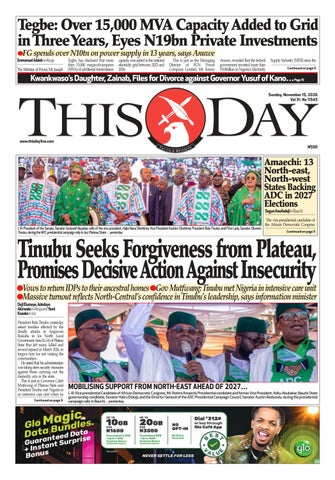
L-R: President of the Senate, Senator Godswill Akpabio; wife of the vice president, Hajia Nana Shettima; Vice President Kashim Shettima; President Bola Tinubu; and First Lady, Senator Oluremi Tinubu, during the APC presidential campaign rally in Jos, Plateau State… yesterday
The vice-presidential candidate of the African Democratic Congress Continued on page 5
Tinubu Seeks Forgiveness from Plateau, Promises Decisive Action Against Insecurity
Vows to return IDPs to their ancestral homes Gov Mutfwang: Tinubu met Nigeria in intensive care unit Massive turnout reflects North-Central’s confidence in Tinubu’s leadership, says information minister
Deji Elumoye, Adedayo Akinwale in Abuja and Yemi Kosoko in Jos
President Bola Tinubu yesterday asked families affected by the deadly attacks in Anguwan Rukuba in Jos North Local Government Area (LGA) of Plateau State that left many killed and several injured in March 2026, to forgive him for not visiting the communities. He stated that his administration was taking stern security measures against those carrying out the dastardly acts in the state. This is just as Governor Caleb Mutfwang of Plateau State said President Tinubu met Nigeria in an intensive care unit when he Continued on page 5
MOBILISING SUPPORT FROM NORTH-EAST AHEAD OF 2027…
L-R: Vice presidential Candidate of African Democratic Congress, Mr. Rotimi Amaechi; Presidential candidate and former Vice President, Atiku Abubakar; Bauchi State governorship candidate, Senator Haliru Dokaji; and the Director-General of the ADC Presidential Campaign Council, Senator Austin Akobundu, during the presidential campaign rally in Bauchi…yesterday
2
SUNday NOVEMBER 15, 2026 • T H I S D AY
SUNDAY NOVEMBER 15, 2026 • T H I S D AY
3
SUNday NOVEMBER 15, 2026 • T H I S D AY
4
When Was The Last Time You Got
Screened?
Make time for your health today. Get access to 1 free health check with your W Debit Card
Pap Smear Breast Scan Fibroid Scan Available at participating healthcare provider locations nationwide. For more information, Email: wcares@accessbankplc.com Need health nancing support? ₦
Ask about the W Health Loan : Up to N10 million (14% p.a.) Up to 36 months tenor
Open to salary earners & business owners subject to credit assessment and approval
OOer valid till: December 31, 2026. Screenings are free but subject to availability of slots. Registration is compulsory. W Debit Card required for screening activation.
Terms and Conditions Apply.
More Information 0201-2712005-7, 0201-2273000-9 accessbankplc.com
Facebook.com/accessbankplc | X.com/myaccessbank Youtube.com/accessbankplc | linkedin.com/accessbankplc Instagram.com/myaccessbank
Access Bank PLC. RC.-125384 (Licensed by the Central Bank of Nigeria)
5
NOVEMBER 15, 2026 • T H I S DAY, T H E S U N DAY N E W S PA P E R
NEWS
Decline in Loan Impairment Charges of Eight Banks By 46.9% Lifts Profit Before Tax to N4.8tn Kayode Tokede
Eight Nigerian banks reported a 46.9 per cent decline in loan impairment charges to N1.01 trillion in the nine months ended September 2026, compared with N1.91 trillion in the corresponding period of 2025. Loan impairment charges, often referred to as credit losses, are provisions banks make to
cover potential defaults and deterioration in the value of their financial assets. The substantial decline in impairment charges helped lift the eight banks’ combined profit before tax (PBT) by 12.2 per cent to N4.8 trillion, from N4.3 trillion in the corresponding period of 2025. The eight banks are Jaiz Bank Plc, Zenith Bank Plc, Ecobank Transnational Incorporated, First
HoldCo Plc, Guaranty Trust Holding Company (GTCO) Plc, Access Holdings Plc, Wema Bank Plc and Sterling Financial Holdings Plc. THISDAY gathered that lower impairment charges at GTCO, Access Holdings, Zenith Bank and First HoldCo supported their combined profitability, although earnings growth sources varied across the groups.
Access Holdings recorded the largest percentage reduction in impairment charges, which fell by 73.5 per cent to N92.91 billion in the nine months ended September 2026, from N349.99 billion in the corresponding period of 2025. Its PBT rose by 8.3 per cent to N667.36 billion. Zenith Bank recorded the second-largest percentage reduction, with impairment charges declining by 70.5 per
cent to N230.77 billion, from N782.76 billion. Its PBT rose 1.2 per cent to N928.80 billion, from N917.41 billion, suggesting lower creditloss provisions helped offset weaker income from other activities. Together, Zenith Bank and Access Holdings accounted for approximately N809 billion of the reported N906 billion reductions in impairment
charges across the eight groups. GTCO also benefited from approximately N39.6 billion in lower impairment charges, although its PBT declined by 2.3 per cent to N879.90 billion. The results show that lower impairment charges can materially support earnings but do not automatically translate into higher profits when other income sources weaken or expenses rise.
TINUBU SEEKS FORGIVENESS FROM PLATEAU, PROMISES DECISIVE ACTION AGAINST INSECURITY assumed office but has gradually moved the country into recovery through his administration’s policies. Meanwhile, the Minister of Information and National Orientation, Mohammed Idris, has attributed the large turnout of party faithful and supporters at yesterday’s rally of the All Progressives Congress (APC) in Jos to what he described as growing public appreciation of the achievements of President Tinubu’s administration by the North-Central over the past three years. Speaking at the ruling APC presidential campaign rally in Jos, Tinubu said too many lives had been lost to attacks in Plateau since 2001. “When I last visited the other time, I was limited to the airport. Forgive me if you didn’t see me
in the hinterland. But I saw the devastation; I got the report from the governor. I saw horror in the faces of our people. “But since then, that has changed; we are forging together,” he explained. He, however, assured residents that their communities would be rebuilt for those displaced to return home. Tinubu pledged the reconstruction of conflict-ravaged communities, the return of internally displaced persons (IDPs) to their ancestral homes and accelerated economic development across the region. Recalling his previous visits to the state, the president said the state had suffered years of violent attacks that resulted in loss of lives, destruction of homes and displacement of thousands of residents.
He expressed sympathy to victims of violence and IDPs, pledging that the federal government would rebuild affected communities and support their safe return to their ancestral homes. He said the government had intensified security measures to tackle insecurity, including training 1,000 forest guards and deploying surveillance technology to strengthen intelligence gathering and rapid response capabilities. "Crises and attacks have inflicted deep wounds on Plateau. Too many lives have been lost, homes destroyed, communities displaced. "To every bereaved family, every survivor and everyone unable to return home, I offer my heartfelt condolences for your loss and pray that only God will console you. "We are one single family created by the same God Almighty. We are just living
in different rooms, speaking different languages and behaving in different ways, but living in different rooms and speaking different languages does not make us enemies of one another. "We have to live together. We have to farm together. We have to build this Plateau and this country together. It is our responsibility to behave as brothers and sisters", he further said. The president promised that the 2027 general election would be peaceful, warning individuals and groups plotting to unleash violence or intimidate voters that his administration would not tolerate any attempt to undermine the democratic process. He also appealed for electoral support for APC candidates at all levels, encouraging voters to support the party in the presidential, governorship,
National Assembly and state House of Assembly elections. Tinubu said he had directed security agencies to intensify operations against those responsible for violent attacks and ensure lasting peace across Plateau State. “What we should be getting is prosperity, not havoc, not crisis. Our government is not elected to inflict wounds on one another or to bury people. We have to lift people from adversity to prosperity”, he added. The president said the security arrangements would target threats facing rural communities, where farmers and other residents had been forced to abandon their homes and livelihoods. “Crises and attacks have inflicted deep wounds on the state. Too many lives have been lost, homes destroyed, communities
AMAECHI: 13 NORTH-EAST, NORTH-WEST STATES BACKING ADC IN 2027 ELECTIONS
(ADC), Mr. Rotimi Amaechi, has claimed that 13 states in the North-east and North-west backed the opposition party in the forthcoming 2027 elections, and expressed confidence that the party would defeat President Bola Tinubu and the All Progressives Congress (APC). This comes as the ADC presidential candidate and former Vice President, Atiku Abubakar, has reiterated his determination to restore fuel subsidy and tackle insecurity if elected president. Atiku also promised to continue oil exploration activities at the Kolmani Oil Field in Bauchi State Speaking yesterday during the ADC presidential campaign rally in Bauchi State, Amaechi said the ADC would also challenge the APC in the South-south and North-central regions, predicting victories for the opposition party in Niger, Kogi and Nasarawa states.
The former Rivers State governor vowed that the party would not accept a repeat of what he alleged happened during the 2023 general election. “Because these people will do what they did in 2023. This time, we shall not agree. Do you understand? We will not do what?” he said. Amaechi argued that the ADC had a stronger regional presence, citing the 13 states in the North-east and North-west. “We are the only party that comes with 13 states. The whole of North-east, the whole of Northwest, that is 13, right? Let the president tell us how many states he comes with. He comes with only five in the South-West,” he added. He further claimed that the APC would lose a sixth state in the South-west to the Allied Peoples Movement (APM). “And the sixth state in the
South-west will vote APM, whether he likes it or not,” he added. Amaechi said the ADC would also compete strongly against the ruling party in the South-South and North-Central, expressing confidence that Atiku would secure Niger, Kogi and Nasarawa states. “We will fight with him in South-South. We will fight with him in North-Central. And be sure, be rest assured, Niger, Kogi, Nasarawa will be in ours easily,” he said. Amaechi also predicted that Tinubu would not make significant electoral gains in the South-east, insisting that the ADC would win the presidential election. “He will not go to South-east at all. Be assured, we will win. We will win. Things will get better,” he said.
I’ll Restore Fuel Subsidy, Tackle Insecurity If Elected, Atiku Vows
Speaking at the rally, Atiku reiterated his determination to restore the fuel subsidy and tackle insecurity and urged voters to vote for the party's candidates in all elective positions. “I have already promised all Nigerians that I will restore petroleum subsidy. Not only that, but I will also restore subsidy in electricity,” he said. Atiku also pledged to address insecurity in the North-east and other parts of the country, while promising to expand petroleum exploration in the Kolmani area to generate additional revenue. He called on Nigerians to support the ADC, urging voters in Bauchi to elect the party’s candidates from the presidency to the councillorship positions. The former vice-president
thanked the people of the state for their previous support, saying Bauchi had consistently given him substantial votes in past elections. He urged residents to turn out in large numbers during the 2027 polls and ensure their votes were protected and counted. “I want you to make sure you come out in your thousands. You vote for ADC. You defend the vote. You ensure that the votes are counted, and results are transmitted before you leave the polling booth,” Atiku said. President Bola Tinubu announced the removal of petrol subsidy during his inauguration on May 29, 2023. Tinubu said the funds would instead be redirected to infrastructure, education, healthcare and job creation. The subsidy removal has inflicted hardship on Nigerians, and Atiku repeatedly promised
displaced. “To every bereaved family, every survivor and everyone unable to return home, I offer my heartfelt condolences for your loss and pray that only God will console you”, he said. He urged Plateau residents to embrace peaceful coexistence and resist attempts to exploit their ethnic, religious or political differences. “We are one single family created by the same God Almighty. We are just living in different rooms, speaking different languages and behaving in different ways, but living in different rooms and speaking different languages do not make us enemies of one another. “We have to live together. We have to farm together. We have to Continued on page 10
to restore it if elected in 2027. The former vice president had questioned how the savings from its removal had been spent. Uncertainty has surrounded the ADC’s leadership following a November 5 judgment by the Federal High Court in Abuja, which sacked the Senator Markled National Working Committee (NWC) and invalidated decisions taken under it, including the process that produced Atiku as its presidential candidate. Justice Peter Lifu also ordered the Independent National Electoral Commission (INEC) not to recognise decisions taken at the party’s 99th National Executive Committee meeting held on July 27, 2025. But the ADC rejected the judgment and said it would challenge the decision in court. The party also continued its activities and preparations for the 2027 elections.
TEGBE: OVER 15,000 MVA CAPACITY ADDED TO GRID IN THREE YEARS, EYES N19BN PRIVATE INVESTMENTS
privatisation of the sector in 2013. FGN Power is the Special Purpose Vehicle (SPV) set up by the Nigerian government to implement the Presidential Power Initiative (PPI), the flagship programme conceived in 2018 to tackle Nigeria's long-standing electricity challenges. Speaking at the Sixth Edition of the Power Correspondents Association of Nigeria (PCAN) Conference in Abuja, Tegbe added that the federal government had taken steps to address longstanding financial and infrastructure
challenges in the electricity sector as part of efforts to support President Bola Tinubu’s ambition of building a $1 trillion economy. The minister said the president had approved a plan to settle verified legacy debts owed to generating companies, reiterating that the initiative had raised N1.2 trillion to ease financial pressure on the companies and improve their capacity to pay for gas and maintain their plants. He disclosed that more than 2.8 million customers had been metered under the Presidential
Metering Initiative (PMI). At the same time, the Rural Electrification Agency (REA) had continued to connect universities, hospitals and rural communities to solar power. Tegbe also said construction had commenced on a new National Grid Control Centre in Osogbo to replace the existing facility built more than 60 years ago. He added that more than 15,000MVA of additional transmission capacity had been added to the national grid between 2023 and 2026.
According to him, newly installed substation equipment commissioned across several locations in the country had added more than 1,300 MVA to Nigeria’s transmission capacity, making additional electricity available to distribution companies. The minister, represented by his Special Adviser on Administration and Projects, Martins Olajide, identified grid stabilisation, sector liquidity and sustainability, asset optimisation, and grid expansion and enhancement as the four priorities of the government’s
roadmap for addressing the sector’s challenges. He said the plan would adopt a corridor-based approach to prioritise major economic centres for reliable, round-the-clock electricity supply.
FG Spends over N10tn on Power Supply in 13 years Meanwhile, delivering a keynote address at the PCAN conference, themed: “$1tn Economy: Nigeria’s Roadmap to Reliable
and Affordable Power Supply,” the Managing Director of FGN Power Company Limited, Mr. Anuwe, revealed that the federal government invested more than N10 trillion on power supply since 2013. Anuwe said that government funding had helped sustain the electricity industry despite its challenges. He pointed out that public funding has remained insufficient Continued on page 8
6
T H I S DAY, T H E S U N DAY N E W S PA P E R • NOVEMBER 15, 2026
NEWS
PROMOTING MICROFINANCE ON THEIR MINDS…
L–R: Managing Director/CEO, Goxi Microinsurance, Mr. Shina Gbadegesin; Deputy Commissioner for Insurance, Finance and Administration, NAICOM, Mr. Ekerete Gam-Ikon; Chairman, Goxi Microinsurance, Dr. Godwin Ehigiamusoe; Managing Director/CEO, SOEYA Consult, Dr. Yeside Oyetayo; and Regional Coordinator, East and South Africa, Microinsurance Network, Edwin Sikaitwa, at the fourth Annual GOXI Microinsurance Conference in Ikeja, Lagos…recently
NDC, Keyamo in War of Words over Singing of Old National Anthem at Lagos Meeting Minister accuses Obi of planning secession Ex-Anambra gov didn’t stop new National Anthem, NDC fights back Accuses APC of sponsoring political attacks
Chinedu Eze in Lagos and Sunday Aborisade in Abuja
The Nigeria Democratic Congress (NDC) and the Minister of Aviation and Aerospace Development, Mr. Festus Keyamo, yesterday engaged in war of words over
the minister’s allegation that the presidential candidate of the opposition party, Mr. Peter Obi and the members of the party, sang the old National Anthem at the recent town hall meeting held by the party in Lagos. Keyamo had in his verified
Twitter (X) account said that by defying to sing the new national anthem, Obi and his group might be planning to break away from Nigeria. But in a swift response, the NDC dismissed allegations against its presidential candidate,
describing them as unfounded, baseless and politically-motivated. The party accused Keyamo of exhibiting selective amnesia in his assessment of the Lagos incident, insisting that Obi neither instructed supporters not to sing the national anthem
Dangote Eyes Ghana Cocoa Hub, Opens Talks with Ghanaian Government on 500,000-tonne Deal Festus Akanbi The Chairman of Dangote Group, Alhaji Aliko Dangote is in talks with the Ghanaian government over a proposed cocoa-processing arrangement involving 500,000 metric tonnes, as the country seeks to retain more earnings from its agricultural produce by expanding domestic processing. Ghana’s Finance Minister, Dr. Cassiel Ato Forson, disclosed the ongoing discussions in an interview at the weekend, after presenting the country’s 2027 Budget to Parliament. The proposed arrangement,
according to Nairametrics, would extend Dangote’s agricultural investments into cocoa processing and support Ghana’s ambition to move more of its cocoa value chain into the domestic economy. Forson said negotiations were continuing, with the terms of the proposed contract undergoing review. He did not announce a signed agreement or disclose the investment value, processing location, implementation timetable or period covered by the proposed 500,000-tonne arrangement. “Dangote has reached out to use Ghana as a hub to process
cocoa locally,” the minister said. “We are going through the terms, and they want to sign a contract.” The discussions come as Ghana pursues an ambitious timetable to process 50 per cent of its locally produced cocoa by 2028 and 100 per cent by 2030. Forson said the government wanted companies purchasing Ghanaian cocoa to establish processing operations within the country, allowing the economy to capture a greater share of the value generated beyond the export of raw beans. The policy places domestic
processing at the centre of Ghana’s efforts to strengthen its agricultural value chain, with the proposed Dangote arrangement offering a potential private-sector vehicle for advancing that objective. According to the minister, Ghana’s position was to encourage investment in local value addition alongside purchasing its cocoa beans. “We are not saying don’t come and buy our cocoa beans, but if you are a company out there, come and buy our cocoa beans, but add value here in Ghana,” he said.
Nigerian-American Professor John Dabiri Sits on NVIDIA Board Amid Jensen Huang’s Exit Caltech professor joined technology giant’s board in 2020
Sunday Ehigiator
As global attention shifts to the leadership shake-up at American technology giant, NVIDIA, following the resignation of its Chief Executive Officer, Jensen Huang, a Nigerian-American professor, John Oluseun Dabiri, remains one of the notable figures on the company’s board of directors. Dabiri, an engineer and professor
at the California Institute of Technology (Caltech), joined NVIDIA’s board in 2020 and has served as an independent director during the company’s transformation into one of the world’s most valuable technology companies. NVIDIA announced on November 12, 2026, that Huang had resigned as President, Chief Executive Officer and member of
its board, effective immediately. The company’s regulatory filing with the United States Securities and Exchange Commission (SEC) disclosed that its board accepted Huang’s resignation on November 11, while Executive Vice President and Chief Financial Officer, Colette Kress, was appointed interim Chief Executive Officer pending the appointment of a substantive successor.
Dabiri
nor attempted to undermine the country's national symbols. In a response to the minister's allegations, through its National Publicity Secretary Osa Director, the NDC maintained that the incident was a spontaneous expression of defiance by some supporters against what it described as the poor governance of the All Progressives Congress (APC) administration and the alleged deployment of political thugs to attack its members during the gathering. The party argued that Keyamo deliberately ignored the circumstances surrounding the incident, particularly the reported attack on the NDC supporters, while attempting to portray Obi in a negative light. It stated, "Keyamo's allegations are hair-splitting, unfounded and baseless. As characteristic of the APC, he exhibited selective amnesia in his assessment. "He forgot to state that Obi did not ask the crowd not to sing the national anthem. What happened was a spontaneous act of defiance to the ruinous reign of the APC and the hired thugs they sent to attack the NDC members," the party added. The opposition party further disclosed that while some supporters expressed their displeasure through the rendition of the old national anthem, other participants at the same venue continued to recite the current national anthem. According to the party, the development contradicted any suggestion that Obi or the NDC leadership deliberately organised an action to disrespect the country's national anthem. It said, "At another end of the same hall, people recited the national anthem."
The NDC also questioned the significance of the controversy, arguing that the mere public rendition of the national anthem by members of the ruling party had not translated into improved governance or better living conditions for Nigerians. Taking a swipe at Keyamo and the APC, the party declared that displaying outward loyalty to national symbols should not be confused with the capacity to provide effective leadership. "In any case, he should realise that the hood does not make the monk. Since the APC has been reciting the national anthem, where has it led Nigeria?" the party queried. The opposition party accused the minister and the ruling party of deliberately shifting public attention from the alleged attack on its supporters and the country's worsening political and economic challenges to what it described as unnecessary personality attacks against Obi. It argued that the controversy reflected the APC's inability to engage the opposition candidate on substantive issues of governance, national development and the welfare of Nigerians. The NDC maintained that its presidential candidate remained committed to national unity, democratic values and peaceful political engagement, while accusing the APC of using the controversy to distract Nigerians from pressing national concerns. Keyamo had described the act of singing the old national anthem as one of the ingredients of secession. He insisted that by approving the singing of a different national anthem, Obi was allegedly officially leading a secessionist group.
7
NOVEMBER 15, 2026 • T H I S DAY, T H E S U N DAY N E W S PA P E R
NEWS
PROMOTION OF ARTS AND CULTURE…
L-R: British Deputy High Commissioner, Lagos, Mr. Johnny Baxter; Lagos State Commissioner forTourism, Arts, and Culture, Mrs.Toke Benson-Awoyinka; Governor Babajide Sanwo-Olu; and Founder,Terra Kulture, Mrs Bolanle Austen-Peters, during the third Lagos International Theatre Festival 2026, at Onikan, Lagos Island...recently
ADC Crisis: Atiku Hasn’t Reached out to Me Despite Coming from My Geopolitical Zone, Says Gombe
Chuks Okocha in Abuja
A factional leader of the African Democratic Congress (ADC), Nafiu Bala Gombe, has expressed disappointment that former VicePresident Atiku Abubakar has not personally reached out to him despite their coming from the
same North-east geopolitical zone. Gombe, who spoke in an interview with BBC Hausa yesterday, said he regarded Atiku as a father figure but was disappointed that the former vice-president had not contacted him amid the leadership crisis rocking the party. He said this while reacting to
a court judgment that affirmed his faction’s position in the ADC leadership dispute, adding that he remained willing to work with Atiku, former Senate President David Mark and other party chieftains to strengthen the opposition ahead of the 2027 general elections.
Gombe said the judgment had vindicated his faction as the authentic leadership of the party, insisting that its position was based on the provisions of the ADC constitution. “Alhamdulillah. As we always say, truth is truth, while lies remain lies. Allah has vindicated us. The
Jonathan Condemns Selection of Nigerian Leaders Based on Religion, Ethnicity, Other Narrow Considerations Says primitive leadership selection process retards development
Sunday Ehigiator
Former President Goodluck Jonathan has warned that Nigeria would continue to struggle with development until it abandoned what he described as primitive methods of selecting political leaders based on religion, ethnicity, language and other narrow considerations. Jonathan said the country must move away from such practices and prioritise competence and merit in leadership recruitment, stressing that no matter how qualified an individual might be, Nigeria could not make meaningful progress if leadership selection remained tied to divisive considerations. The former president spoke yesterday at the Herbert Macaulay Colloquium held in Lagos to mark
the 162nd anniversary of the birth of the nationalist pioneer. Born on November 14, 1864, Macaulay was regarded as one of the founding figures of Nigerian nationalism. Speaking at the colloquium, Jonathan said: “We are still suffering from political leaders being recruited based on religion, language and all kinds of things. Sometimes it is even beyond Muslim or Christian. I know of a particular state in southern Nigeria that 99.9 per cent of them are Christians. But if you don’t belong to one particular denomination, you cannot be the governor of the state. “That is the kind of thing we do. So, no matter how good you are, until we move away from these primitive ways of recruiting political leaders, this country
cannot go,” Jonathan added. The former president identified leadership challenges, institutional weaknesses, corruption, policy inconsistency, inadequate infrastructure and insecurity as some of the factors impeding Nigeria’s development. He also called for comprehensive democratic reforms, describing Nigeria’s current democratic system as “opaque and amorphous”. According to him, the country’s democratic system must be reviewed to reflect popular participation, the rule of law, respect for human rights, judicial independence, accountability, pluralism and a vibrant civil society. Jonathan further stressed the need to prioritise functional education and establish research-
intensive universities capable of driving technological advancement and innovation. Citing India, Singapore and South Korea as examples, he said the countries had leveraged quality education to achieve remarkable development. He said, “You can’t go anywhere with weak educational institutions.” He added that Nigeria must deliberately invest in its best brains and establish world-class universities to compete globally. In his tributes to Herbert Macaulay and other founding nationalists, Jonathan said the greatest honour the country could accord them was not merely celebrating their sacrifices Chuks Okocha in Abuja but building a nation that reflected the ideals for which The presidential candidate of the they fought. African Democratic Congress (ADC), Atiku Abubakar, has said nearly 40 per cent of members of the Premium Breadmakers It urged members of the public, Association of Nigeria were media organisations and social forced out of business within media users to “disregard the two years, due to the high cost fabricated claims and verify of doing business. Atiku said the situation information concerning recognised reflected the pressure of rising universities and academic standards through the NUC’s energy prices, expensive loans and other economic challenges official channels”. The ministry reaffirmed its on bakeries, warning that more commitment to supporting the businesses could shut down if NUC in “safeguarding academic urgent measures were not taken. He made the remarks in a integrity, strengthening quality statement issued yesterday assurance and protecting the by the Director of Strategic credibility and global reputation of Nigeria’s university education Communication of the ADC Presidential Campaign Council, system”.
FG Dismisses Claims of 2,000 Universities, 100 Fake Professors Kuni Tyessi in Abuja
The Federal Ministry of Education has dismissed viral reports alleging that the National Universities Commission identified 2,000 universities and uncovered about 100 fake professors in Nigeria, describing them as “recycled misinformation intended to mislead the public and discredit the nation’s university system”. The ministry said the NUC had “never declared the existence of 2,000 universities in Nigeria
or published, endorsed or authenticated the purported list of individuals circulating online as fake professors”. The Minister of Education, Dr. Maruf Tunji Alausa, made the clarification in a statement issued yesterday, by the ministry’s Director of Press and Public Relations, Boriowo Folasade. According to the statement, the allegation concerning fake professors was “a distorted version of a media report published on December 3, 2019, concerning an NUC exercise to verify the
directory of full professors in Nigerian universities”. “The original report did not contain the names currently being circulated, which the commission has since disowned,” the ministry stated. Expressing concern over the continued circulation of the claims, the ministry said they were “calculated to undermine public confidence in Nigerian universities and discredit ongoing efforts to strengthen the education sector, particularly the university system”.
court has seen the merit of our case and our truthfulness and has decided to return the party leadership to us,” he said. He disclosed that his faction was awaiting the Certified True Copy of the judgment to enable it to approach the Independent National Electoral Commission (INEC) for the necessary changes to the party’s leadership records. Gombe, however, cautioned against interpreting the judgment as an opportunity to settle scores with members of the opposing faction, saying he was extending a hand of friendship to them. “This is not a fight. Allah has given us victory, but we are not enemies. We are extending a hand of friendship to them to stop being arrogant and whatever they may say, so that we can strengthen the opposition and face the government,” he said. He maintained that anyone seeking to join the ADC or contest an elective position on its platform must comply with the party’s constitution, particularly provisions
governing membership registration, payment of dues and eligibility for leadership positions. According to him, the party’s constitution requires members to fulfill prescribed conditions, including two years of membership and payment of stipulated dues, before qualifying for leadership positions. He alleged that the opposing faction failed to follow the party’s membership registration procedures, claiming that David Mark obtained his membership card from a former national chairman in Abuja rather than registering at his ward. Bala said he had repeatedly warned the opposing group about the consequences of disregarding the party’s constitution, but his advice was ignored. He also dismissed allegations that he was being used by the ruling All Progressives Congress (APC) to destabilise the opposition, insisting that his court action was solely aimed at protecting his rights and upholding the ADC constitution.
Atiku Laments High Costs of Production on Bakers, Says It Has Force 40% of Bread Makers Out of Business Phrank Shaibu. According to the statement, cooking gas now sells for as much as N1,800 per kilogramme in Abuja and N1,650 in parts of Lagos and Ogun states, further increasing the burden on households and businesses. The statement also cited rising energy expenses among bakers, saying one operator’s monthly diesel bill had increased from N9million to N19million, while some businesses faced loan interest rates of up to 34 per cent. Atiku said energy costs accounted for about half of bakery production expenses, adding that switching to alternative energy sources could require between N40million and N50million for a small bakery.
8
T H I S DAY, T H E S U N DAY N E W S PA P E R • NOVEMBER 15, 2026
NEWS
HONOURING NBA PRESIDENT…
L-R: Partner, Banwo & Ighodalo, Abimbola Akeredolu, (SAN); Principal Partner, Folashade Alli & Associates, Folashade Alli (SAN); Independent Arbitrator and Litigation Consultant , Funke Adekoya (SAN); President of the Nigerian Bar Association (NBA), Oyinkansola Badejo-Okusanya (SAN); Managing Partner, Aboyade & Co, Funke Aboyade (SAN); Senior Partner, Primera Africa Legal (PAL), Boma Florence Alabi (SAN) and Managing Partner, Principles Law Partnership, Miannaya Aja Essien, (SAN) during a private luncheon in honour of NBA President at Gaby Lagos, Victoria Island, Lagos ...yesterday PHOTO: KUNLE OGUNFUYI
INEC Debunks Amupitan’s Resignation Rumour, Urges Reliance on Commission’s Communication Channels
Adedayo Akinwale in Abuja
The Independent National Electoral Commission (INEC) has dismissed a social media report claiming that its Chairman, Prof. Joash Amupitan, was preparing to resign his appointment. The commission described the claim, which was circulated alongside an image on social media, as false and fabricated.
INEC stated this yesterday in a statement posted on its official X account, urging members of the public to disregard the report and avoid sharing unverified information. “The claim is false, fabricated and misleading,” the commission said. It urged Nigerians to rely on its official communication channels for authentic information.
The denial comes amid growing scrutiny of Amupitan’s leadership following controversies surrounding the preliminary voters’ register ahead of the 2027 general election. On November 9, Amupitan disclosed that INEC had removed 1,608,660 invalid registrations from the preliminary register following a review of entries from the 2025 and 2026 Continuous Voter Registration
exercises. He also said 54 people across 10 states had been identified as allegedly involved in registration irregularities and could face disciplinary action, including prosecution. The commission had received complaints over suspected multiple registrations, questionable photographs and other irregularities in the register. During Amupitan's visit to
TEGBE: OVER 15,000 MVA CAPACITY ADDED TO GRID IN THREE YEARS, EYES N19BN PRIVATE INVESTMENTS to meet the country’s power needs, stressing that the company had secured a $1 billion commitment from the Africa Finance Corporation (AFC). In comparison, other financiers were expected to commit $18 billion to the sector. Anuwe, however, argued that the scale of investment required to support Nigeria’s ambition of building a $1 trillion economy could not be achieved through public funding alone. “The government has invested over N10 trillion in the electricity sector since the advent of privatisation. But is it enough? How much money is enough?” he asked. According to him, the industry would not have remained operational without the government’s financial interventions. He stated the country must adopt new investment models capable of attracting substantial private capital. Anuwe said the federal government accounted for more than 95 per cent of new infrastructure investment in the sector, a development he described as inconsistent with the objectives of privatisation. “That's not why we privatised,” he said, urging stakeholders to move beyond excuses and develop practical solutions to the sector’s financing and infrastructure challenges.
He maintained that the government should focus on providing the policy, regulatory and infrastructure conditions that would enable public and private capital to operate effectively. “The government can provide the enablers, provide infrastructure, delivery, and market conditions under which public and private capital can perform effectively,” he argued. The FGN Power chief said Nigeria needed between 10,000 megawatts and 30,000 megawatts of electricity to support the growth of a $1trillion economy, stressing that achieving the target would require a different approach to power sector planning and implementation. He identified integrated resource planning, coordinated policy interventions, reliable technology, financial discipline and stronger private sector participation as essential to expanding electricity supply. Anuwe also called for simpler institutional and regulatory arrangements, noting that the complexity of the electricity market, involving generation and distribution companies, transmission operators, regulators, government agencies, financiers and gas suppliers, could discourage potential investors. He said clearer responsibilities, predictable regulation, bankable projects, faster decisions and
measurable delivery would improve investor confidence and accelerate infrastructure development. Anuwe disclosed that the company had structured commercial arrangements with original equipment manufacturers and engineering, procurement and construction firms, with the federal government providing 15 per cent equity in the financing arrangements. According to him, the company’s transmission substation and line projects were progressing, with most of the ongoing Phase One projects expected to be completed in the first quarter of 2027. He added that the second batch of Siemens substations, comprising 12 facilities, was being prepared for implementation, subject to the necessary financing approvals, with commencement targeted for the fourth quarter of 2026. Anuwe said the projects, alongside the Omotosho substation project, were expected to deliver a combined capacity of just under 3,400 megawatts. The company, he said, was targeting an additional 5,540 megawatts by 2029, alongside an improvement of at least 60 per cent in grid reliability. Anuwe said the planned improvements could also enable at least 2,000 industries to return to the national grid, with households
and businesses expected to benefit from more reliable electricity supply. He said FGN Power Company was working toward a $2.3 billion project financing package, comprising $1.3 billion from Europe and $1 billion from China. On his part, the Managing Director of the Nigerian Electricity Management Services Agency (NEMSA), Olusegun Adesayo, restated the organisation's commitment to ensuring that electrical installations, equipment and networks across the country comply with prescribed technical standards and regulations. Adesayo explained that beyond infrastructure, safety remains critical, since unsafe installations that do not comply with regulations cannot serve the people effectively. Earlier in his welcome address, the Chairman of PCAN, Obas Esiedesa, said the association’s annual conference had evolved into an important platform for engagement among policymakers, regulators, operators, investors, industry experts and journalists since its inaugural edition in November 2021. Esiedesa called for urgent attention to the recurring seasonal decline in electricity generation, particularly between November and March, when reduced water inflows into hydroelectric power stations and gas supply constraints to thermal plants often affected electricity output.
London, protesters confronted his vehicle outside Chatham House on Thursday, demanding his resignation over alleged irregularities in the voters’ register. The protesters surrounded the vehicle, demanding that he should come out to address their concerns. At the Chatham House engagement, Amupitan acknowledged that the controversies surrounding the 2023 general elections had significantly damaged public confidence in INEC. He, however, urged Nigerians to trust his leadership, saying the commission had introduced measures to address previous shortcomings and improve the
conduct of future elections. The INEC chairman also announced plans for a nationwide mock accreditation and voting exercise on November 28 to test upgrades to the Bimodal Voter Accreditation System and electronic transmission of results ahead of the 2027 polls. He said the commission had introduced technical safeguards to prevent inaccurate polling unit results and figures indicating over-voting from being uploaded to its Result Viewing Portal. The 2027 presidential and National Assembly elections are scheduled for January 16, while governorship and State Houses of Assembly elections will be held on February 6.
FG Directs Controllers of Works to Fix Bad Roads Before Festive Period Emmanuel Addeh in Abuja
The Minister of Works, Mr. David Umahi, has directed all zonal directors, federal controllers of works and engineers to intensify supervision of key road infrastructure and urgently rehabilitate failed sections of major federal highways across the country. The minister, in a statement issued yesterday by the Director of Information and Public Relations in the ministry, Mohammed Ahmed, stated that the rehabilitation of the roads would guarantee safe and uninterrupted movement of people, goods and services ahead of the forthcoming festive season. According to the statement, Umahi gave the directive during a strategic meeting with the Coordinating Directors, Highways, Construction and Rehabilitation (C&R) and Bridges and Design (B&D) and the Zonal Directors. The minister stated that
ensuring the motorability of major highways must take priority over ongoing permanent construction works, particularly as Nigerians were preparing for increased travel during the upcoming festive period. Expressing concern over situations where contractors focused on permanent construction work while other sections of the same roads remained impassable, Umahi said such situations would no longer be tolerated. The minister instructed the zonal directors to return to the field immediately and ensure that major highways were made motorable within the next three weeks through immediate palliative interventions. These interventions, he explained, should include the removal of failed sections, filling of potholes and the application of sharp sand, stone base, cement stabilisation, binder and wearing courses, as appropriate to the condition of the affected road.
SUNDAY NOVEMBER 15, 2026 • T H I S D AY
9
10
T H I S DAY, T H E S U N DAY N E W S PA P E R • NOVEMBER 15, 2026
NEWS
DOUBLE CELEBRATIONS FOR THE CATHOLICS…
L-R: Speaker, Delta State House of Assembly, Hon. Emomotimi Guwor; Senator Ede Dafinone; and Governor Sheriff Oborevwori, during the Mass commemorating the 40th Priestly Ordination anniversary of the Catholic Bishop of Warri Diocese, Most Rev. Anthony Ovayero Ewherido, and the Judicial Vicar of the Diocese, Very Rev. Fr. Ogochukwu Anamali, at the Sacred Heart Cathedral, Warri…yesterday
Kwankwaso’s Daughter, Zainab, Files for Divorce against Governor Yusuf of Kano Zainab Musa Kwankwaso, the second wife of Kano State Governor, Abba Kabir Yusuf, has initiated legal proceedings to end their marriage at an Upper Area Court in Abuja, offering to return the dowry paid by the governor. Zainab, a daughter of former Kano State Governor and vice presidential candidate of the Nigeria Democratic Congress (NDC), Senator Rabiu Musa Kwankwaso, is seeking the dissolution of the 20-year-old marriage through khul’i, an Islamic legal process that allows a woman to seek divorce, usually by offering the dowry to her husband. It was reported that the case was instituted at the Upper Area Court in Gudu, Abuja, with a civil summons carrying reference number CV/97/26.
The court has reportedly summoned Governor Yusuf to appear on November 17, 2026, over the matter. The couple married on July 29, 2006, and have six children together. Details contained in the court documents indicate that Zainab wants the marriage terminated because of what she described as a loss of love and emotional attachment, alongside a prolonged absence of affection and mutual care. She reportedly told the court that her feelings towards the governor had changed to the extent that she no longer wished to remain in the relationship. According to the report, attempts to resolve the differences between the couple had not
yielded the desired result, prompting her decision to seek divorce. She is said to have expressed readiness to return the dowry received during the marriage as part of the process.
Zainab left the Kano Government House for Abuja on October 28 after visiting her father’s residence on Miller Road in Kano. The publication, quoting sources, claimed that she travelled
without her police orderly and other security personnel attached to her. It further reported that her orderly raised the alarm after discovering her departure, leading to the matter being brought to the
attention of the governor. The report alleged that airport security officials initially received instructions to stop her from boarding her flight but later allowed her to travel to prevent a possible confrontation.
FG Warns Nigerians with Underlying Health Conditions against Travelling to Addis Ababa Michael Olugbode in Abuja
The federal government has advised Nigerians with preexisting medical conditions to seek medical advice before travelling through Addis Ababa, the Ethiopian capital, due to the potential health risks associated
with the city’s high altitude. The Ministry of Foreign Affairs gave the advice in a statement issued yesterday by its spokesman, Mr Oluwafemi Adeniyi, in Abuja. Adeniyi said Addis Ababa, located about 2,355 metres (7,726 feet) above sea level, had lower atmospheric pressure and
reduced oxygen availability, which could pose health risks to some travellers. He disclosed that Nigeria’s Diplomatic Mission in Addis Ababa recorded 16 deaths, involving Nigerians transiting through the city in 2026, reportedly linked to health complications
associated with high altitude. According to him, although healthy individuals can adapt to reduced oxygen levels, people with certain pre-existing medical conditions, especially cardiovascular and respiratory diseases, may face increased health risks.
TINUBU SEEKS FORGIVENESS FROM PLATEAU, PROMISES DECISIVE ACTION AGAINST INSECURITY build this Plateau and this country together. It is our responsibility to behave as brothers and sisters”, he declared. On economic development, Tinubu announced plans to collaborate with the Plateau State Government to transform the Jos airport into an agro-cargo hub that can facilitate the direct export of agricultural produce to international markets. He said the proposed project would enable farmers in Plateau and surrounding states to export vegetables, potatoes, and other agricultural commodities, expanding market access, creating economic opportunities, and improving farmers’ incomes. “From that, you will be able to export vegetables and potatoes abroad directly. The economy will improve. Development and prosperity will grow this economy”, he said. He urged Nigerians to obtain and safeguard their Permanent Voter Cards ahead of the 2027 elections, describing the PVC as a vital instrument for democratic participation and prosperity.
Gov Mutfwang: Tinubu Met Nigeria in Intensive Care Unit In his welcome address, Governor Mutfwang said President Tinubu met Nigeria in an intensive care unit when he assumed office but had moved the country into recovery through his administration’s policies. The governor pledged Plateau State’s support for Tinubu ahead of the 2027 presidential election. The governor said, “You met Nigeria in the intensive care unit, and through the policies you have administered, like a drug, you have been able to bring Nigeria out of the intensive care unit. We are now in recovery.” “We are confident that if you continue, we will not only recover but prosper as well. That is why we are determined that in the 2027 election, there is no alternative for us. We will stick with you and go with you.” He described Tinubu as a friend of Plateau State and the North-Central region, citing the federal government’s interventions in road infrastructure, education
and healthcare. According to him, students in tertiary institutions across the state had benefited from the Nigerian Education Loan Fund scheme, while strategic federal road projects had improved connectivity and economic prospects. The governor pledged overwhelming support for Tinubu in the 2027 election, insisting that the people of Plateau had resolved to reciprocate what he described as the President’s goodwill towards the state. Earlier, the Director-General of the APC Presidential Campaign Council, Senator Abdul’Aziz Yari Abubakar, declared that Plateau and the North-central zone remained firmly behind Tinubu’s re-election bid. Yari said the administration’s achievements in security, infrastructure and economic management had strengthened public confidence in the APC government, adding that the President had demonstrated commitment to fulfilling the party’s manifesto.
Yilwatda Charges North-central Governors, Candidates to Unite for Tinubu's Victory Speaking at the event, the National Chairman of APC, Prof. Nentawe Yilwatda, urged the party’s governors and governorship candidates in the North-central to unite all stakeholders in their states and mobilise massive support for President Tinubu. He also urged Plateau people to translate the rally's enthusiasm into votes, insisting the state must deliver a record-breaking victory for Tinubu. The chairman described Tinubu as a promise-keeper who has fulfilled his commitments to Plateau State, saying the administration's record of delivery provides a strong basis for renewed public confidence. “All political leaders in Plateau State are now united, 100 per cent, behind the President," Yilwatda said, assuring Tinubu that the ballot box would reflect the people's overwhelming support. Yilwatda specifically charged
governors, candidates and leaders across the region to close ranks, bring every stakeholder on board and establish a united front behind Tinubu. The chairman emphasised that the North-Central must approach the elections with a common purpose, stressing that personal interests and political differences must give way to the collective objective of securing victory for the APC.
Massive Turnout Reflects North-Central’s Confidence in Tinubu’s Leadership, Says Information Minister Meanwhile, the Minister of Information and National Orientation, Idris, has attributed the large turnout of party faithful to what he described as growing public appreciation of the achievements of President Tinubu’s administration by the North-Central over the past three years. Speaking at the rally, the minister said the enthusiastic participation of party faithful
and supporters reflected, in his assessment, confidence in the administration's reform agenda and its efforts to reposition the country for sustainable economic growth and development. “The turnout we are witnessing here today is a clear demonstration of the confidence Nigerians have in President Bola Ahmed Tinubu and the direction his administration is taking the country. The people can see the efforts being made to address longstanding challenges, strengthen the economy and create a better future for our country,” Idris said. Idris said the administration remained focused on consolidating the gains of its reforms and ensuring that their benefits translated into tangible improvements in the lives of citizens across the country. “President Tinubu remains committed to staying the course and ensuring that the decisions being taken today deliver lasting benefits for Nigerians. What is important is that we continue to build on the progress made and work towards a stronger, more prosperous nation,” he said.
SUNDAY NOVEMBER 15, 2026 • T H I S D AY
11
JAMES HOPE COLLEGE knowledge Character Truth
FUTURE LEADERS DO NOT JUST HAPPEN...THEY ARE FORMED AT JAMES HOPE COLLEGE, LEKKI, LAGOS NOVEMBER 2025 CAMBRIDGE
MAY/JUNE 2026 WAEC
IGCSE EXAMINATION RESULT
EXAMINATION RESULT
A*
A1 - B3 GRADES: 94%
GRADES: 67%
1
A* - A GRADES: 96%
6
A - C GRADES: 100%
A* - B GRADES: 99%
A* - C GRADES: 100% State of the art classrooms, laboratories, boarding and sporting facilities. Exceptional educators who challenge minds, nurture and bring out the best in every learner. Proud winners of prestigious international and national awards. Beautiful, serene and secure world-class campus where learning thrives. ENTRANCE EXAMINATION FOR YEAR 7 (JSS1) DAY AND BOARDING STUDENTS FOR THE 2027/2028 ACADEMIC SESSION IS SCHEDULED TO TAKE PLACE AS FOLLOWS:
LAGOS Dates:
Saturday, 30th January and 6th February, 2027
Location: Time:
James Hope College, Twin Lakes Estate, Lekki, Lagos. 10AM
ABUJA & PORT HARCOURT Date:
Saturday, 6th February, 2027
Locations: 71 Usuma Street, Opp. Transcorp Hilton, Maitama, Abuja. Time:
15 Nnamdi Azikiwe Road, Port Harcourt, Rivers State. 10AM
APPLICATION CLOSES: FRIDAY, 22ND JANUARY 2027 Application forms can be downloaded from www.jameshopecollege.edu.ng under the “admission” tab or can be collected from James Hope College, Twin Lakes Estate, Lekki, Lagos.
OPEN DAYS
DATE: SATURDAY 14TH NOVEMBER, 2026 & SATURDAY 9TH JANUARY, 2027
TIME: 9AM TO 12:30PM
Follow us on all our social media handles: @jameshopecollege
James Hope
Tel: +2347083662229, +2347018282065, @JHCLekki
+2347085369376, +2347015349257 Email: admission@jameshope.edu.ng Web: www.jameshopecollege.edu.ng
12
T H I S D AY, T H E S U N D AY N E W S PA P E R NOVEMBER 15, 2026
NEWS
STRATEGISING FOR 2027 ELECTIONS…
L-R: Deputy Governor of Oyo State, Mr. Bayo Lawal; Oyo State Governor and presidential candidate of Allied Peoples’ Movement, Seyi Makinde; Oyo State deputy governorship candidate of APM, Muftau Salawu; National Chairman of APM, Yusuf Dantalle; and Oyo State APM governorship candidate, Bimbo Adekanmbi, during the official flag off of APM Oyo State campaign at the Durbar Stadium, Oyo…yesterday
Clashes Between Criminal Gangs, Vigilance Groups Claim over 50 Lives in Zamfara Onuminya Innocent in Sokoto
Clashes between criminal gangs and local vigilantes have left more than 50 people dead in Zamfara State, residents told AFP yesterday. Zamfara is one of several states in the North-west terrorised by kidnapping-for-ransom and cattle-rustling gangs who raid villages, kill and abduct residents as well as looting homes before burning them.
According to reports, vigilantes from Zoma village in Bukkuyum district ambushed the bandits who were passing through the village on Thursday after kidnapping several people from nearby Gummi district. “We were alerted that the bandits were heading our way, so our vigilantes laid in wait for the bandits and engaged them in a fierce gunfight,” said a traditional village chief who asked not to be identified for
Obafemi Awolowo Foundation Holds Virtual Roundtable on Neo-Awoism November 26 The Obafemi Awolowo Foundation is scheduled to hold a virtual roundtable, on November 26, 2026, at 6pm Nigerian time, to bring scholars, public intellectuals, policymakers and development practitioners together to examine the relevance of Chief Obafemi Awolowo’s developmental philosophy to Nigeria’s contemporary challenges through a proposed framework known as Neo-Awoism. The roundtable is expected to critically examine how the political and economic principles associated with the late sage could be reinterpreted and applied to the realities of 21st-century Nigeria. Recognising the potential significance of this proposition, the Obafemi Awolowo Foundation, with the consent and active collaboration of the author and originator of the Neo-Awoism concept, proposes to convene a virtual roundtable of scholars, public intellectuals, policymakers and development practitioners to subject the concept to rigorous interrogation, critical analysis and constructive engagement. The author will serve as the lead presenter and principal resource person, introducing the
conceptual framework, explaining its underlying assumptions and responding to questions and critiques. He is expected to explain the conceptual framework, its underlying assumptions and the thinking behind its proposed application to contemporary Nigerian society, while responding to questions, observations and criticisms from participants. The Foundation will provide the institutional platform for wider engagement, facilitating independent assessment, further refinement and, where appropriate, the consideration of resulting proposals by relevant authorities and agencies. In a statement issued on November 11, and signed by its executive director, Ambassador Olatokunbo Awolowo Dosumu, the Foundation described the initiative as an opportunity to subject Neo-Awoism to rigorous intellectual interrogation, independent assessment and constructive engagement. The concept, according to the Foundation, seeks to reinterpret Awolowo’s enduring developmental principles within the context of a market-oriented and technologydriven society.
personal safety. “Our vigilantes killed 44 of the bandits … we also lost nine vigilantes in the fight,” said the chief, adding that a notorious bandit commander called Jijji, who had led the kidnapping, was also killed in the fight. News of bandit attacks in remote areas is usually slow to emerge due to poor telecommunications and distance. A Zamfara State police spokesman contacted by AFP said the force had yet to receive
details about the clashes. Zoma residents Kabiru Tafida and Basiru Buhari reached by AFP gave the same account of the clashes and toll. “We call on the authorities to provide our vigilantes with guns and ammunition to fight these bandits who use sophisticated weapons,” Buhari said. Banditry in Africa’s most populous country traces its roots to conflicts between herders and farmers over access to limited land and water, made worse by climate change and population
growth. Out of the violence emerged powerful gangs, largely composed of Fulani herders — and a kidnapping economy, while at times forging alliances with jihadists. In Zamfara’s neighbouring Katsina State, a bandit leader recently told AFP that “years of injustices” drove him and other cattle herders into banditry. He spoke during a rare interview which came during the reporting of an article
for The New York Review of Books, co-authored by an American academic and writer Helen Epstein and an AFP northern Nigeria reporter. The Nigerian military routinely refers to bandits as “terrorists”, and runs a dedicated military campaign in the northwest to combat them. Worsening insecurity and the high cost of living have become major issues in the ongoing presidential campaign, as Bola Tinubu runs for a second term in January polls.
Africa Tech Forward Conference Highlights Trust as Key to Digital Economy Growth Industry leaders across technology, finance, government, investment and regulation have underscored the importance of digital trust as a key driver of Africa’s economic growth and digital transformation. The call was made at the Africa Tech Forward Conference, themed “Connect, Network, Build,” where stakeholders examined the opportunities and challenges shaping the continent’s digital future. Delivering the keynote address, Chief Executive Officer of the Information Technology Association of Nigeria (ITAN), Dr. Lare
Ayoola, said Africa’s challenge was not a lack of innovation but the need for stronger systems and dependable infrastructure to convert innovation into sustainable economic value. Speaking on the topic, “Building Trust in Africa’s Digital Economy,” Ayoola stressed that trust must be embedded into digital systems from the outset. While technology may attract users initially, he said long-term success depends on reliability, consistency and consumer confidence. He identified identity man-
agement, access control, system reliability, data protection and infrastructure maintenance as critical building blocks for a trusted digital ecosystem. According to Ayoola, organisations must prioritise system uptime, develop resilient infrastructure, regularly test recovery plans and ensure that critical data remains accessible during disruptions. He also described maintenance as a core product feature, warning that poorly maintained technology systems are more susceptible to failure. “Africa’s digital economy will
ultimately be judged not by the sophistication of its technology, but by whether businesses and consumers can depend on the systems and services provided,” he said. The conference also featured a panel session moderated by Chimgozirim Nwokoma, with contributions from Edward Olayemi, Partner at Inlytics; Temi Labor, Chief Internal Auditor at Play 10 Global Technology Plc; and Ehi Silence, Founder and Chief Executive Officer of Jireh Technology Limited.
Shell Wins Awards at NAPE Confab, Employees Receive Recognition for Technical Presentations Ejiofor Alike Shell Nigeria has won the Best IOC (international oil company) Exhibitor award at the 44th Annual International Conference and Exhibition of the Nigerian Association of Petroleum Explorationists (NAPE), in addition to employees receiving recognition for technical presentations. Executive Vice President and Country Chair, Shell Nigeria, Elohor Aiboni, addressed the opening
session of the conference during which she commended the reforms in the oil and gas industry as a right step in Nigeria’s aspiration to unlock more barrels of oil. Senior Production Geologist with Shell Nigeria Exploration and Production Company Limited (SNEPCo),Abidemi Belgore, and her team won the 1st runner-up prize for the Dr Olagundoye Olatunbosun Best Petroleum Geology Paper at the closing dinner ceremony. Also, SNEPCo’s Asset Op-
portunity Development Lead, Oludayo Fakunle had earlier received a plaque for Lead Technical Presentation for his paper on Bonga, Nigeria’s first deepwater well which began operation 21 years ago. Incoming NAPE President, Anthony Ofoma, who handed over the plaque to Oludayo, said the paper was insightful and aligned with the theme of the conference; “Unlocking More Barrels: Driving Reserves Growth through Exploration,
Local Capabilities and Adaptive Technology.” At the dinner, NAPE also conferred its Fellow award on seven members in recognition of their outstanding contributions to the development of the professional body and Geosciences generally. Outgoing NAPE President, Cecilia OlajumokeAjayi, thanked members of the association and sponsors for their support which ensured the success of the conference.
13
T H I S DAY, Th e S U N DAY N e w S PAPe r •NOvember 15, 2026
BUSINESS
Editor: Festus Akanbi 08038588469 Email: festus.akanbi@thisdaylive.com
National grid
Blackouts Deepen Poverty, Officials Trade Excuses As households and businesses struggle with prolonged outages and expensive alternatives, Festus Akanbi examines the anger trailing official explanations, the failures impoverishing electricity consumers and former President Olusegun Obasanjo’s renewed call for private-sector control
F
or Nigerians enduring another night of suffocating heat and another working day without dependable electricity, the official explanations are painfully familiar. Gas shortages. Maintenance. Vandalism. Low water levels. The vocabulary changes little; neither does the darkness. What changes is the damage: depleted savings, spoiled food, abandoned orders, and businesses spending their way towards insolvency to stay open. The anger surrounding the prolonged outages reflects more than discomfort. Electricity failure strips households of purchasing power and enterprises of working capital. Consumers must finance an alternative supply or endure the consequences of doing without. For families already struggling to meet basic expenses, both choices deepen deprivation. Against that background, exchanges among power-sector institutions have become particularly galling. While customers count losses, organisations responsible for electricity delivery dispute which part of the system failed. Their explanations contain technical distinctions, but the absence of a coordinated account exposes a management problem whose consequences extend far beyond institutional reputations. On November 9, the Managing Director of the Association of Nigerian Electricity Distributors, Sunday Oduntan, apologised during a live television programme. “Apology is needed; it is essential,” he said. He warned that operators were returning to the blame-shifting that characterised the industry between 2016 and 2019. That admission captures the frustration. Years after earlier rounds of accusations, consumers are watching distributors, transmission operators, generators and gas suppliers explain why responsibility belongs elsewhere. The customer remains at the end of this procession, holding an electricity bill and searching for money to buy generator fuel. An apology acknowledges suffering; it cannot recover a trader’s spoiled stock or restore a workshop’s lost production. Repeated expressions of regret, without sustained improvement, leave consumers financing failures they neither caused nor can fix. For vulnerable businesses, each additional outage eats into the money required to survive the next one. The exchanges between Power Minister Joseph Tegbe and the Nigerian National Petroleum Company (NNPC) Limited illustrate the coordination deficit. Tegbe attributed reduced supply to planned maintenance at Egbin Power Station, gas constraints affecting some thermal plants and sabotage of transmission infrastructure. He said affected generating units would begin returning within 48 to 72 hours; unfortunately, his assurances, like earlier ones, proved to be political statements without substance.
NNPC defended its gas transportation network and reported approximately 10 per cent growth in gas production during 2026. Its statement distinguished transportation availability from production, commercial arrangements and actual deliveries to individual generating stations. Those distinctions matter. A functioning pipeline does not establish that every power station received sufficient gas. Increased production does not prove that contracted volumes reached the plants requiring them. Equally, a general reference to gas constraints does not explain whether the difficulty involved supply, payment, transportation or plant readiness. The apparent contradiction therefore requires investigation rather than competing declarations. Public exchanges lack a consolidated account identifying affected plants, unavailable capacity, delivery shortfalls, and restoration milestones. Nigerians are enduring the consequences while institutions debate how to describe the cause. Questions about competence consequently become unavoidable. Maintenance is foreseeable. Seasonal changes in water availability require planning. Vulnerable infrastructure demands contingency arrangements. Although no electricity system can eliminate disruption, effective management should prevent separate difficulties from repeatedly combining into prolonged hardship. The present outcome provides little reassurance that existing arrangements are adequate. Oduntan’s demand for ministerial intervention concerns a basic leadership obligation. Consumers cannot coordinate the gas-to-power chain themselves. Where institutions issue separate explanations while supply deteriorates, the ministry’s assurances must be judged against its ability to reconcile operational information, organise recovery and communicate measurable progress. The financial consequences are visible in manufacturing. MAN’s regional chairman for Anambra, Ebonyi and Enugu, Dr Adaora Chukwudozie, put alternative-power expenditure at approximately N1.35 trillion in 2025, against N1.11 trillion in 2024, an increase of roughly 22 per cent. She identified funds diverted from raw materials, machinery, salaries and expansion into electricity generation. Behind those figures lies a damaging exchange: money that could increase production instead purchases the means to sustain existing operations. Businesses absorb the expense through reduced margins, transfer some costs to customers or curtail activity. Each response weakens the prospects for investment, affordable goods and employment. Smaller operators have less room to manoeuvre. A frozen-food seller risks losing stock and the money needed to replace it. A welder loses productive hours when generator fuel becomes unaffordable. A neighbourhood shop must choose between preserving
perishables and protecting cash for its next purchase. Outages turn routine commercial decisions into survival calculations. Households face a similar squeeze. November retail indications place some 12.5-kilogramme cooking-gas refills around or above N21,000, although prices vary. Cooking gas and generator fuel serve different purposes but draw upon the same limited income. Families struggling to prepare meals have fewer resources available to purchase relief from darkness. Heat compounds the hardship. NiMet’s November outlook projects maximum temperatures between 28.6°C and 37.7°C, with humidity increasing discomfort in parts of southern and North-Central Nigeria. Without affordable backup electricity, even the modest relief of a working fan becomes uncertain. Premium-paying customers have an additional grievance. NERC places Band A consumers on a minimum supply expectation of 20 hours daily. Persistent shortfalls therefore undermine the service promise underpinning their tariff classification. For affected customers, paying more has failed to secure dependable protection against the darkness. Against this backdrop, former President Olusegun Obasanjo renewed his call for greater private-sector responsibility. Speaking on November 10 at the Youth Governance Dialogue in Abeokuta, he argued that government alone could not resolve the crisis and urged Nigeria to draw lessons from telecommunications. “Until we put energy in the hands of the private sector, we won’t solve it,” he said. His intervention reopens an important debate, but Nigeria already transferred major generation and distribution assets to private investors in November 2013. Thirteen years later, the continuing outages require a closer look at what additional privatisation would change. The issue extends to investor capacity, access to finance, regulatory enforcement and the commercial relationships sustaining electricity production. Private capital can support expansion and operational improvement. Its effectiveness, however, depends on enforceable obligations, credible payment arrangements and institutions capable of holding operators accountable. Transferring assets without securing those conditions risks preserving the weaknesses that leave consumers paying for unreliable service. Obasanjo’s proposal therefore raises questions about the structure and quality of participation, alongside ownership. For Nigerians counting losses, the test remains straightforward: reliable supply at a cost that leaves room for food, rent and productive investment. Every prolonged outage widens the gap between that expectation and daily experience. Until delivery improves, official explanations will continue to meet anger from households losing purchasing power and businesses watching their capital disappear into the cost of keeping the lights on.
T H I S DAY, Th e S U N DAY N e w S PAPe r •NOvember 15, 2026
14
Business Focus
OBR: Making Ogun Work Better for Businesses Comprising business leaders and professionals from different sectors, the Ogun Business Roundtable (OBR) is positioning itself as a platform for constructive engagement between the private sector and government. Vanessa Obioha reports that through evidence-based policy recommendations and collaboration, the group hopes to address operational challenges, improve transparency and create a more conducive environment for businesses to thrive in the state
A
group of businessminded individuals in Ogun State is working towards improving the operational environment for businesses in the state. Known as the Ogun Business Roundtable (OBR), the group comprises individuals from different sectors, including trade, academia, media, health, and law, and is addressing a key question: how can the state improve the ease of doing business? With its close proximity to Lagos State, Ogun remains one of the country's industrial hubs, with a high concentration of higher institutions. From Agbara to Ota and Sagamu, the state is home to several manufacturing multinationals. Its Agbara Industrial Estate, along the Lagos-Badagry Expressway, hosts industries such as Unilever, Nestlé Nigeria Plc, Beta Glass, Pharma-Deko and GZ. A similar industrial concentration exists in Sango-Ota, where companies such as Nigerian Breweries carry out their manufacturing operations. The state also boasts free trade zones in Igbesa. Its abundant land resources have also attracted investments in industrial parks, the most recent being the $1.8 billion Lee Group First Industrial Park. Nicknamed Nigeria's Educational Capital, Ogun is home to more than 20 accredited universities and has the highest number of private universities in the country. These institutions also contribute to the influx of people into the state during academic sessions. Despite its economic potential, however, doing business in Ogun is not without its challenges. From infrastructure deficits and power supply issues to land documentation and acquisition, data deficiencies, poor urban planning and access to affordable healthcare, and insecurity, several barriers continue to affect businesses and their ability to maximise profits. It is against this backdrop that OBR is positioning itself as a think tank that can help influence government policies and improve the ease of doing business. Its chairman, Ayodele Aderinwale, who is also chairman of JustRite Superstore, described the group as a gathering of decision-makers engaging the government in a non-confrontational and non-partisan manner for the economic development and transformation of the state. “The essence of this group is not about attracting investment. It's about improving the ease of doing business,” he clarified. “The key thing is improving the operational environment, taking away arbitrariness, and creating a channel where we can engage with the government on major policy issues.” “Is there something we can do about electricity? Is there something we can do about the road network? Is there something we can do about security and safety? What about the regulatory agencies of the government? How do we interface with them? Those kinds of concerns are more important to us,” he added. The idea, he said, arose from the need
• Aderinwale to establish a forum for regular engagement between the private and public sectors in Ogun, “essentially to deepen the partnership for the economic development and transformation of Ogun.” “As you know, increasingly, the private sector is playing a bigger role. It's getting more and more critical to economic transformation in Africa and globally, and Ogun is one state where the private sector is on the rise. It's important that the two of us will see each other not as adversaries or as a need for the government to approximate the private sector, but to see that we are all concerned about dealing with the key issues of development, which is eradication of poverty by creating wealth.” The group, which is fully registered
under Nigerian law, has maintained a non-partisan stance as one of its core principles. It seeks to influence government policies through professional consultation. “We cannot dictate to the government,” added OBR Secretary, Daniel Shangotola. “The goal is to influence government policies to help with economic growth and encourage more investments in the state.” The group's other objectives, according to him, include “shaping policy coherence through evidence-based reviews and recommendations that support industrialisation and competitiveness. We also want to catalyse public and private collaboration involving government, business, academia and civil society as well. Facilitate investment flows into key productive sectors of Ogun, and then to do it in such a way that the government does its business in a bit more transparent manner.”
For Aderinwale, OBR is not just another think tank. It distinguishes itself through the calibre of its membership. “We are just a gathering of business people, mostly at the decision-making level, who are genuinely concerned and are interested in positively engaging the government in a non-confrontational, nonpartisan manner, just to work together.” The group currently has nine members, with plans to expand its network. Aderinwale described it as a persistent pressure group that uses reasoning and quality offerings to influence policy outcomes, regardless of the government's willingness. Although it has yet to formally launch, OBR has been meeting monthly since last year as it prepares to become fully operational. Aderinwale said the group hopes to complete its preparations by the first quarter of 2027, with some progress expected before the end of 2026.
T H I S DAY, Th e S U N DAY N e w S PAPe r •NOvember 15, 2026
15
International
Current Developments in the AES Countries: Redefining Nigeria’s Foreign Policy as a Desideratum
T
he pattern of development efforts and foreign policy attitude in the Alliance des États du Sahel (Alliance of Sahel States), generally abbreviated to AES or ASS for analytical ease, points to consolidation of self-reliance strategy and preparedness to accept whatever mistakes made in the consolidation of such strategy and regardless of whatever external adversary sopinion. Put differently, the AES countries, comprising the Republic of Mali, Republic of Burkina Faso, and Republic of Niger, which was established in protest against the ECOWAS policy of zero tolerance for unconstitutional change of government in Africa, and particularly in West Africa, have determinedly decided to grow and develop their countries on the sole basis of self-reliance, respect-driven interdependence, and reliance on what they have to get what they need in international relations as foreign policy tactic. The response of the ECOWAS from which the AES countries broke away has regretted the mismanagement of the implementation of its policy and now wants the AES countries to come back. Nigeria, in particular, has been providing leadership in this regard, but the commitment of their return is still difficult to secure. Hence, it is still difficult to ascertain whether it is useful or not useful for the AES countries to return to the ECOWAS. In other words, will regional integration be better fast-tracked with their return or with the continued sustenance of the AES? Nigeria has sent delegations to the AES leaders to discuss oneness of purpose and togetherness in action within the framework of one ECOWAS. It is against this background that the discussion of what foreign policy attitude should be adopted towards the AES in light of the current developments in the AES countries is raised, particularly following the public presentation and launching of Beyond 65 Years of Independence: Nigeria’s Foreign Policy in a Changing Global Arena. Festschrift in Honour of Professor Bola A. Akinterinwa, on Thursday, 12th November, 2026 at the Nigerian Institute of International Affairs. The book was edited by Professors Usman A. Tar and Sharkdam Wapmuk, Associate Research Professor Joshua O. Bolarinwa, and Dr. Omotola A. Ilesanmi, Senior Research Fellow. What is the best way forward in a changing global arena and in the context of developments in the AES countries after 65 years of independence?
Current Developments in the AES Countries
September 2026 marked four years of Captain Ibrahim Traoré in power, in spite of the many coups d’état organized to unseat and destabilize him. Captain Traoré came to power on 30 September, 2022 and planned to return power to the civilian administration but he had to review his agenda by extending by five years with effect from July 2024 his planned elections. His argument was that democratic elections could not work in Burkina Faso until the restoration of security. Even though the international proponents of human rights alleged heavy restrictions on free speech and suspension, if not dissolution, of more than 100 non-governmental organisations and civil society groups, the military junta is on record to have succeeded in gradually growing and developing the country. At the level of the quest for economic self-sufficiency, which is at the centerpiece of governance, Captain Traoré inaugurated the Rafino BF, the first national gold refinery, which is required to refine more than 164 tons of gold annually. The government raised its share in new mining projects from 10% to 15% while contemplating the nationalization of some key mining and economic assets. And true enough, economic growth rate increased from 4.8% in 2024 to 5.3% in 2025 and projected to increase further to 6.1% in 2026. The mere fact that cereal production reached 7.2 million tons in 2025, representing more than 126% of national needs, lends much credence to the efforts of government at the level of agricultural output and food security. The industrial sector contributed about 32.9% to the GDP, increasing from its previous level of 24%, while gold production attained 94 tonnes in 2025. More notably, Captain Traoré has put in place a revised national development plan, called RELANCE 2026-2030. Within the framework of this development agenda, the Air Burkina has been revitalized and so has the Bobo-Dioulasso University Hospital. Tomato processing facilities and local textile plants and many other domestic development projects have been launched. The size of the national army has doubled apart from the tens of thousands of civilian Volunteers for the Defence of the Homeland (VDP). And perhaps more interestingly, Burkina Faso, under Captain Traoré, has been playing host
Tinubu to voluntary donations that have reached $850 million. Additionally, Burkina Faso has also started biometric enrollment for unique digital ID for all Burkinabé nationals. With the gradual efforts at national cohesion and development, can it be expected that the Burkinabé will be prepared for another retour en arrière (going backward)? The current efforts at economic growth and development are believed to have been made possible as a result of the absence of French mainmise in the country. Put differently, the issue at the level of foreign policy challenges is that France remains perceptibly an obstacle in the progress of Burkina Faso. Besides, Nigeria has a sort of an entente cordiale with France, but Nigeria is still perceived rightly or wrongly as a stooge of France, a perception that makes Nigeria not quite trustworthy in the eyes of the AES countries. In Mali, and like in Burkina Faso, armed insurgent groups continuously challenge the authority of the military junta. While the al-Qaeda-linked JNIM (Jamaa’a Nusrat ul-Islam wa al-Muslimin) is disrupting the transport routes, the Islamic State Sahel Province is attacking civilians, a development that prompted in October 2026 the returning of Malian troops to Kidal following the withdrawal of the separatist forces from the town. While the military government of Assimi Koïta is making all efforts to consolidate its hold on power, the unending insurgency and jihadist violence has always made political governance in the country very insecure. In fact Mali’s strategic partnership with Russia is yet to help abate the problem of insecurity. The cooperation between the JNIM and the FLA (Azawad Liberation Front, the Tuareg-led separatist movement, still remains a major challenge. To strengthen the assault on the insurgents, Mali has been deepening
Grosso modo, the current developments in the AES countries have largely been strengthening sub-regional integration in the way the 1991 Abuja Treaty Establishing the African Economic Community conceived it. In order to fast track continental integration, African leaders rejected the UN definition of Africa as a region of the world and said Africa, since 1991, is a continent of five regions: West, North, Central, East, and Southern. This is as provided in Article 1(d) of the Treaty. Article 1(e) says a sub-region can be carved out of any of the five regions when two or three countries from one region or more than one region choose to come together as such. The AES is therefore a sub-region of West Africa region par excellence. It is quite legitimate. It is not illegal. It is a resultant of political sovereignty and in the interest of African integration. Consequently, in redefining Nigeria’s foreign policy, this factor cannot but be a desideratum. Nigeria’s foreign policy should not encourage the abolishment of the AES or insisting on the return of AES as individual members, but as a sub-regional group member. The AES can be given a special observer status at the level of the ECOWAS. At the level of individual Nigeria, the foreign policy attitude of Nigeria should be more of bilateralism when relating with the Francophones rather than on the basis of a multilateral approach. This cannot but be so because France’s main policy towards Nigeria is to prevent Nigeria from being able to influence the Francophone neighbours against French interests in Africa. Nigeria’s reactive policy towards France is not different: prevent France from undermining Nigeria’s interests in Francophone Africa. This situational reality should be the main definiens in defining Nigeria’s foreign policy
its security and economic partnerships with Turkiye. Mali and Turkiye have hosted military and defence exhibitions, the Bamako Expo Fair. What is noteworthy here is that, while Russia continues to provide military personnel, equipment and operational assistance, the militant organisations have continued to launch severe attacks on government forces and Russian personnel have also suffered casualties. The 18 October 2026 armed attack on civilian camps around Ménaka in northeastern Mali generated condemnation. However, all these attacks have not prevented the deepening efforts at economic transformation. The Malian mining sector is quite active, accounting for 9.5% of GDP, 40.9% of state revenue and about 79% of total exports. GDP growth was 5.6% in 2025 while the projected rate for 2026 is 6.0%. Gold and lithium still make Mali the centre of attraction in international economic relations and this is noteworthy. More notably, France is similarly held responsible for the insecurity in Mali. The declaration of the French as unwanted and the shift of alliance from France to Russia do not appear to be a solutionproviding acts. In fact, the nature of Russian understanding with Africa does not also look promising. For example, from the perspective of the Russo-African summit, it is difficult to argue any increasing African interest in strengthening alliance with Russia. 43 African leaders attended the first Russia-Africa Summit in 2019 in Sochi, Russia. At the 2023 St. Petersburg summit, there were only 17 Heads of State. Could the sharp decline from 43 to 17 be explained simply by Russian Special Military Intervention in Ukraine? The 2026 summit is expected to be more encouraging as delegations from 48 countries, including 22 Heads of States, are scheduled to attend. Can the expectation be taken as a manifestation of growing reliance on Russia and strengthening of ties between Africa and Russia? As observed by a Dakar-based analyst, Beverly Ochieng, ‘the economic incentives to go for the Russia summit are much more limited.’ If the incentives are limited, how do we then explain the Russian pulling factors or the African pushing factors to want to attend the summit? Whatever is the case, developments in the AES cannot be said to be assisting good governance and enhancement of peace and security in the ECOWAS region and Sahel sub-region. In the Republic of Niger, the situation of insecurity is the same. Political governance is quite fragile. In August 2026, there was a failed 24-hour coup against the military government of General Abdourahmane Tiani. The Russian partners helped to quell the mutiny in Niamey. With the deepening insecurity, Algeria deployed fighter jets to help protect the northern energy facilities near the Libyan border. Like in Mali and Burkina Faso, France is held responsible for problems in Niger and France has always denied any involvement, in spite of evidences of French involvement through deployment of drones in the social media. Like Mali and Burkina Faso did in June 2026, Niger has also withdrawn from the International Court of Justice. Niger also withdrew from the 1994 Nigeria-initiated Multinational Joint Task Force (MNJTF) in 2025 following the establishment of the AES. Like in Burkina Faso, economic growth and development is steady in Niger. The World Bank has it that more than one million people had electricity access between January and October 2026, thanks to the Haské (Niger Accelerating Electricity Access) project. What is also noteworthy at this juncture is the new initiative of Nigeria to exchange ideas with the three AES countries on the need for military cooperation to contain terrorism in the region and sub-region, in light of the strong belief that terror has no boundary, it does not know boundary and therefore does not operate on the basis of boundaries.
Redefining Nigeria’s Foreign Policy as a Desideratum
As explained on 9 November, 2026 by the Firstpost, the spokesperson of the Nigerian Defence Headquarters, Major General Samaila Uba, has it that Nigeria is holding security consultations with all the AES member states on the need to restore regional stability and security. As he put it, ‘we also examined the diplomatic alternatives and options available to address issues arising from the withdrawal of those countries from ECOWAS. I assure you that we will begin to see the dividends of that high-level engagement very soon.’ In the same vein, Nigeria’s Defence Minister, General Christopher Musa, explained the necessity to ensure the containment of exportation of terror from the Sahel sub-region to Nigeria. Rebuilding military cooperation and repositioning the Multinational Joint Task Force has become an urgent need. In his words, ‘we are trying to stop them (terrorists, boko haramists, etc.) from getting deep into the South… because of the terrain…’ And true, if terrorists are, for whatever reasons, enabled to get to the south, insecurity will be more difficult to control. Apart from this, the Defence Minister made it clear that efforts were being taken to also prevent Nigeria from being taken unawares. He said Government is opening other new military fronts along Benin-Niger border with Nigeria. This cannot but be one good approach to the redefinition of not just Nigeria’s foreign policy but also that of Africa of the future as being investigated by Professor Tunde Adeniran. In redefining Nigeria’s foreign policy, especially in the context of Francophone West Africa, and particularly as the AES is most concerned, the militating issues must first be identified and addressed. This cannot but begin with the understanding of Nigeria’s foreign policy. In his foreword to the Festschrift in honour of Professor Bola A. Akinterinwa, Professor Akinwande Bolaji Akinyemi noted that Nigeria’s foreign policy since independence has been quite ambitious and complex, but that Nigeria’s achievements ‘have unfolded alongside continuing challenges, including domestic instability, economic pressures, and the uncertainties of a changing world order. Consequently, he posited further, ‘to understand Nigeria’s foreign policy is to examine the interaction between aspiration and reality, between principle and pragmatism.’ Read full article online on www. thisdaylive.com
16
T H I S D AY SUNDAY NOVEMBER 15, 2026
RIBADU: A PROFILE IN COURAGE DECAN honours Nuhu Ribadu for strengthening Nigeria’s counterinsurgency campaigns, writes SAMBO YAKUBU
L
eadership is often measured not only by the responsibilities entrusted to an individual but also by the confidence, recognition and institutional influence that grow around the discharge of those responsibilities. In Nigeria’s demanding national security environment, where the consequences of failure are measured in lost lives, displaced communities and destroyed livelihoods, the emergence of a credible and coordinated security leadership is particularly significant. For National Security Adviser (NSA), Mallam Nuhu Ribadu, the steady growth of his public profile is becoming increasingly evident. His latest recognition by the Defence Correspondents Association (DECAN), which honoured him for strengthening Nigeria’s counterinsurgency campaign and recording gains in the fight against terrorism, is another indication of the attention his stewardship is attracting within the national security community. The award, presented at the third edition of DECAN’s conference, carries significance beyond the ceremonial value of a plaque or commendation. It represents an acknowledgement by professionals who regularly report on defence and security matters of the importance of strategic coordination in confronting Nigeria’s complex security challenges. The association described Ribadu’s contribution in unmistakable terms, recognising his “outstanding leadership, strategic coordination and dedicated service in strengthening and managing Nigeria’s national security architecture” as National Security Adviser to the President. Although the award was received on his behalf by the Director of Legal at the Office of the National Security Adviser, Zakari Mijinyawa, the recognition reinforces Ribadu’s growing visibility as a central figure in the country’s security policy and coordination efforts. It is a profile that has been shaped by the extraordinary demands of the office he occupies. Nigeria has battled the Boko Haram insurgency for approximately 15 years, a conflict that has exacted an enormous human and economic toll. Lives have been lost, communities devastated, properties destroyed and productive activities disrupted, with the consequences extending far beyond the immediate theatres of conflict. The country’s security challenges have also evolved. While terrorism and insurgency remain major concerns, banditry, kidnapping, organised criminal networks, cyber threats and other emerging risks have expanded
the responsibilities of the national security establishment. In such an environment, the NSA’s office occupies a strategically important position. It must help bring together the intelligence community, military institutions, law enforcement agencies and other relevant stakeholders to ensure that national security responses are coordinated, informed and aligned with the country’s priorities. This is where Ribadu’s leadership is attracting particular attention. The growing recognition of his role reflects an appreciation of the fact that winning the security battle requires more than individual operations by separate agencies. It requires a system in which information is shared, intelligence is properly assessed, institutional responsibilities are clearly understood and operations are guided by a common strategic direction. The theme of the DECAN conference, “Beyond Kinetic Warfare: Harnessing Technology and Intelligence-Led Operations for Nigeria’s National Security,” is therefore especially relevant to the broader conversation about Ribadu’s growing profile. It captures the changing character of modern security challenges and the need for Nigeria to move beyond an approach defined exclusively by the deployment of force. Military operations remain indispensable in confronting terrorist groups and armed criminal organisations. However, lasting progress depends equally on the quality of intelligence, the ability to anticipate threats, the effective use of technology and the coordination of institutions responsible for protecting the country. A terrorist network cannot be effectively dismantled merely by confronting its armed operatives. Its sources of finance, communication channels, recruitment structures, supply chains and support networks must also be identified and disrupted. This requires intelligence cooperation, investigative capacity, technological resources and sustained institutional collaboration. Similarly, the fight against banditry and kidnapping requires an understanding of criminal networks that operate across geographical and institutional boundaries. No single security agency possesses every capability necessary to address these threats independently. The significance of an intelligence-led approach is that it enables security institutions to act with greater precision, anticipate emerging dangers and make better use of available resources. It also offers the prospect of reducing unnecessary risks to civilians and security personnel.
Yakubu writes from Abuja
O. JASON OSAI writes that Nigeria’s future should not be sacrificed on the altar of individual ambition or partisan loyalty
ECHOES OF SUN TZU
S
un Tzu was an ancient Chinese military strategist, philosopher and reputed general who lived during China’s Spring andAutumn period, around the 6th century BC. He is best remembered as the author of The Art of War, one of the most influential treatises on military strategy, leadership and the management of conflict ever written. But he was more than a student of warfare. He was an astute observer of human nature, political power, leadership, deception and the consequences of poor judgement. His central philosophy is that the highest form of victory is not the destruction of an adversary, but the achievement of one’s objective without unnecessary bloodshed or devastation. Sun Tzu understood that war is an expensive undertaking, that internal division weakens nations, and that a leader who fails to understand the consequences of his ambitions could ultimately destroy the very state he sought to defend or control. One of his most enduring propositions is that a nation must be governed with wisdom, discipline, strategic foresight and an appreciation of steadfast focus on the common good. In his philosophy, power is not an end in itself; it is an instrument that demands responsibility and restraint. Although the popular saying that “an evil man would burn his own nation to the ground merely to rule over its ashes” is frequently attributed to Sun Tzu, there is no reliable evidence that he actually said or wrote it. Yet the sentiment of the statement raises a profound question that resonates far beyond ancient China: What happens when the personal ambition of those who seek power becomes more important than the survival and prosperity of the nation? It is against this philosophical backdrop that the Nigerian experience invites reflection, and this is the objective of this piece. Moving forward, we ask: What does the saying mean? Simply answered: It describes a leader whose hunger for power is greater than his love for his country. Such a person would: One, offhandedly destroy national institutions than allow someone else to lead. Two, create division and conflict to maintain control. Three, sacrifice the people’s welfare to protect personal ambition and four, leave the country devastated, provided he remains in power. More than two millennia after Sun Tzu, Nigeria presents us with a compelling study in the relationship between power and ambition on the one hand and national destiny and good governance on the other hand. One is compelled to ask whether those currently entrusted with the responsibility of preserving the Nigerian state fully appreciate the difference between winning political battles and securing the future of a nation. For what value is political victory if the institutions of government are weakened, the economy battered, the people impoverished and the national spirit diminished? A country is not a trophy to be won, nor is its population collateral damage in the contest for political supremacy. The ultimate measure of leadership is not how long one holds power, but the legacies
that are bequeathed the nation when one eventually leaves office. The peculiar tragedy of the Nigerian situation is that it is at war with itself and so cannot identify the enemy. Drawing from Sun Tzu’s metaphor, Nigeria is being burnt down by those entrusted with the power of the state, and the most worrisome and frightening aspect of this unfolding national catastrophe is that the fire is not coming from a single direction. It is being fuelled by political recklessness, institutional decay, economic mismanagement, brazen kleptomania, insecurity and an alarming disregard for the welfare of ordinary citizens. Experience over the years shows that a nation does not collapse in one dramatic moment. Sometimes, it dies gradually, one compromised institution of governance at a time, one abandoned responsibility after another, until the very foundations upon which its existence rests begin to crumble. Currently, the National Assembly has become an extension of the executive and the judiciary has lost its bite. Any person with a modicum of sense of reasoning will recognize and accept that Nigeria is speedily slipping down a very slippery socioeconomic slope. Nigeria is heading towards disaster; the nation is at the edge of a yawning canyon. The economy is suffocating millions. The cost of living has become an unbearable burden for families and the middle class has been obliterated. Confronted by diminishing opportunities and an uncertain future, the youth now look beyond their homeland for hope. Japa, the phenomenon of traveling overseas in search for greener pastures, has made its way into the Nigerian lexicon and its relevance is no more limited to traveling to Europe and America, Asian countries and some less endowed African countries have become desired destinations. Farmers cannot confidently return to their fields in some parts of the country. Communities are ravaged by insecurity, while citizens struggle to reconcile the paradox of enormous resources of their country with the poverty that defines their daily existence. Sadly, in the face of this national distress, the political class is unapologetically preoccupied with the acquisition, retention and consolidation of power and the brazen display of ill-gotten wealth through ostentatious lifestyle . Political survival seems to command greater attention and urgency than national recovery. The contest for political advantage frequently overshadows the imperative of governance. Tzu’s metaphor of burning the nation to the ground simply to rule over its ashes, finds appropriateness here when taken against the backdrop of a country where political ambition is cold-heartedly indifferent to the consequences of its pursuit. Nigeria is not the private estate of its political leaders.
Prof Osai writes from Port Harcourt
41
T H I S D AY SUNDAY NOVEMBER 15, 2026
EDITORIAL
Editor, Editorial Page PETER ISHAKA Email peter.ishaka@thisdaylive.com
ACF: A FORUM AT WAR WITH ITSELF
W
Northern leaders should do well and end the Arewa Consultative Forum squabble
hen the Arewa Consultative Forum (ACF) emerged in March 2000 from the merger of three Northern groups, at the instance of the late Sultan of Sokoto, Alhaji Muhammadu Maccido, its constitution set out one core mission: to “foster and strengthen the foundation of Northern unity in the context of one Nigeria”. Other objectives include establishing a machinery for regular dialogue so that disputes likely to cause a breach of the peace are settled amicably and promptly, and enhancing the educational and socio-economic status of Northerners. Twentyfive years on, the forum cannot settle its own quarrels without calling in the police. The latest twist came on 9th October, when the ACF Chairman, Mr Mamman Mike Osuman (SAN), petitioned Kaduna State Governor Uba Sani, copying the Inspector-General of Police and the Department of State Services (DSS). He alleged that some individuals had entered the forum’s Kaduna secretariat, changed the locks and removed items without the leadership’s consent or a search warrant. It is the latest episode in a feud that has pitted the Board of Trustees (BoT), chaired by a former Minister of Power and Steel, Alhaji Bashir M. Dalhatu, against the National Executive Committee (NEC) led by Osuman and Secretary-General Malam Murtala Aliyu. Meanwhile, discord is not new to the ACF. In November 2024, the BoT suspended Osuman over remarks on the 2027 presidential election. Tellingly, the statement announcing that suspension was jointly signed by Dalhatu and Aliyu, who now stand on opposite sides. That decision was reversed a month later after a reconciliation committee led by respected former bureaucrat, Alhaji Mahmud Yayale Ahmed intervened. The present crisis, which erupted soon after the forum’s silver jubilee in Kaduna last November, is of a different order. Dalhatu insists that the tenure of Aliyu and three other officials expired on 10th March 2026; the NEC disagrees. On 5th May, police sealed the secretariat ahead of a NEC meeting. The next day, at an undisclosed venue, the NEC suspended Dalhatu over alleged financial misconduct and ordered a forensic
audit. No fewer than 66 BoT members promptly dismissed the suspension as unlawful while some states’ chapters, in turn, passed a vote of no confidence in Osuman. At the heart of this crisis is money. The 25th anniversary was crowned with the launch of an endowment fund meant to raise N100 billion for education, healthcare and economic empowerment in the North. About N3.9 billion has so far been realised and lodged, on Dalhatu’s instruction, in a dedicated bank account. He insists every kobo is intact. His adversaries ask who controls the money and on whose authority? A fund created to lift the region has become the spoils of an internal war. What makes this spectacle so galling is that the North is not short of elders. It has 19 governors, revered traditional institutions and a long roster of former Heads of State and statesmen. Vice President Kashim Shettima, the highest-ranking Northerner in government, was reported to have waded in, and several reconciliation committees have been set up. To be fair, the ACF and similar groups have no role under the 1999 Constitution. They emerged in the 1990s and early 2000s to fill the void left by weak political parties, to foster cooperation within regions and dialogue between them. But it is against the objectives the ACF set for itself that its leaders must be judged. The forum promised Northern unity; today the region is riven by ethnic and religious distrust and recurring farmer-herder clashes. It promised machinery to forestall breaches of the peace; yet the North-East has for two decades battled Boko Haram insurgency while bandits operate almost freely in the Northwest. It pledged to advance the education and welfare of Northerners; yet the region accounts for most of Nigeria’s out-of-school children population. These problems should have preoccupied ACF leaders. Instead, the forum is consumed by turf wars between its organs and contests of ego between some powerful individuals. As well as acrimony over the control of what, set against the needs of the region, are paltry funds. The sooner eminent Northern leaders, the 19 Northern governors, as well as emirs and chiefs, step in to quell this dispute, the better for the region and the country as a whole.
It pledged to advance the education and welfare of Northerners; yet the region accounts for most of Nigeria’s out-of-school children population S U N DAY N E W S PA P E R EDITOR DAVIDSON IRIEKPEN DEPUTY EDITORS FESTUS AKANBI, EJIOFOR ALIKE MANAGING DIRECTOR ENIOLA BELLO DEPUTY MANAGING DIRECTOR ISRAEL IWEGBU CHAIRMAN EDITORIAL BOARD OLUSEGUN ADENIYI EDITOR NATION’S CAPITAL IYOBOSA UWUGIAREN THE OMBUDSMAN KAYODE KOMOLAFE
T H I S DAY N E W S PA P E R S L I M I T E D EDITOR-IN-CHIEF/CHAIRMAN NDUKA OBAIGBENA GROUP EXECUTIVE DIRECTORS ENIOLA BELLO, KAYODE KOMOLAFE, ISRAEL IWEGBU DIVISIONAL DIRECTORS SHAKA MOMODU, PETER IWEGBU, ANTHONY OGEDENGBE DEPUTY DIVISIONAL DIRECTOR OJOGUN VICTOR DANBOYI SNR. ASSOCIATE DIRECTOR ERIC OJEH ASSOCIATE DIRECTOR PATRICK EIMIUHI CONTROLLERS ABIMBOLA TAIWO, UCHENNA DIBIAGWU, NDUKA MOSERI DIRECTOR, PRINTING PRODUCTION CHUKS ONWUDINJO TO SEND EMAIL: first name.surname@thisdaylive.com
Letters to the Editor
Letters in response to specific publications in THISDAY should be brief(150-200 words) and straight to the point. Interested readers may send such letters along with their contact details to opinion@thisdaylive.com. We also welcome comments and opinions on topical local, national and international issues provided they are well-written and should also not be longer than (950- 1000 words). They should be sent to opinion@thisdaylive. com along with the email address and phone numbers of the writer
LETTERS
F
WIKE’S PUSH FOR GLOBAL PARTNERSHIPS
rom proposed partnerships with German cities to plans for daily flights between Doha and Abuja, Nigeria’s Federal Capital Territory is making a stronger case for international investment and cooperation. When Germany’s Ambassador to Nigeria, Stefan Rössel, visited Federal Capital Territory Minister Nyesom Wike at his official residence in Life Camp, the Minister put forward a practical proposition: Abuja should work directly with German cities to develop its agricultural sector, expand its digital capabilities and equip more young people with skills for employment and enterprise. In a separate engagement, Qatar’s Ambassador, Al-Hail, outlined plans for more frequent flights between Doha and Abuja and proposed that the two capitals share expertise in urban transport and
smart-city development. Taken together, the engagements show how Wike is using diplomacy to open Abuja to partnerships that can help the city grow and serve its residents better. “Our vision is to see Abuja become one of the best cities in the world,” Wike said during the German envoy’s visit. His references to Berlin, Munich and Washington, D.C., placed Abuja’s ambition in a global context. The proposed German partnerships give that ambition a practical focus. For farmers and agribusinesses in the FCT, cooperation could bring access to expertise that improves productivity and helps them reach new markets. For young people, technical and vocational training could open routes into employment or help them start businesses. Rössel commended the visible changes in Abuja and indicated interest from Germany
and other European partners in urban planning, infrastructure and city governance. That creates room for direct exchanges between the people who run cities: planners, engineers, transport officials and public service managers. They can compare what works in their cities and adapt those lessons to Abuja’s needs. Qatar brings another opportunity. Ambassador Al-Hail announced plans for Qatar Airways to increase its Doha–Abuja service from four flights a week to daily operations from November 2026. A daily connection would give conference organisers, investors and business travellers more flexibility. It would also make it easier for Abuja-based businesses to meet partners and explore markets abroad. The envoy’s proposal for cooperation on integrated transport raises a question that
matters to residents and visitors alike: how easily can someone travel from the airport into the city and onward to surrounding communities? Qatar’s experience connecting airports, cities and regional routes offers a useful starting point for that conversation. Abuja already has a place on the world’s diplomatic map. Wike’s push is to turn that standing into a development advantage. The next step is to give these opportunities a clear shape: training linked to jobs, technical exchanges that improve city services, and transport connections that make Abuja easier to reach and do business in. The promise of opening Abuja to the world is that the benefits reach the people who call it home.
Dr. Jumai Ahmadu, Director, Reform Coordination and Service Improvement Department, FCTA
A
WEEKLY PULL-OUT
15.11.2026
PETER OBAFEMI
Results Over Promises At Ikoyi Club’s golf course, Dr. Peter Obafemi talks about business, betrayal, ambition and his bid for the Senate, making the case that Nigeria needs fewer grand promises and more measurable results. Adedayo Adejobi writes… EDITED BY: VANESSA OBIOHA/vanessa.obioha@thisdaylive.com.
T H I S D AY, T H E S U N D AY N E W S PA P E R NOVEMBER 15, 2026
43
COVER
Government Doesn’t Have any Business Being in Business…
T
here are few places better suited to a conversation about politics than a golf course. The game demands patience, judgement and the ability to recover from a poor shot without allowing it to ruin the next. It also has a way of exposing character: the difference between what a man says and how he behaves when things fail to go according to plans. At the golf course at Ikoyi Club, Lagos, Dr Peter Obafemi, popularly known as OPO, seems entirely at home. A businessman whose interests span aviation, security, property, agriculture and consulting, he brings to the course the confidence of a man accustomed to operating in demanding environments. He is also a politician with unfinished business in Ekiti State. Having sought the governorship, he is now pursuing a seat in the Senate, representing Ekiti North. His ambition is substantial, but his argument is straightforward: politics should be judged less by the promises made before elections than by the results delivered afterwards. Between shots, the conversation moves from business to public service, from personal disappointments to the prospects of industrialising Ekiti. The golf course provides an agreeable setting for a man attempting to explain why, after years in business and several turns in politics, he believes he still has something to contribute. Obafemi’s background is rooted in enterprise. His business interests include Eagle Airways and Hawkeye Protective Services Limited, which he says provides aviation security and guarding services to organisations across Nigeria. He speaks about these ventures with the familiarity of a man who has spent considerable time dealing with the practical realities of running businesses. His political journey began, he recalls, after former President Olusegun Obasanjo encouraged Nigerians living in America to return home and participate in politics. Obafemi says an aviation project involving American partners, intended to deliver a national hangar, was among the opportunities that drew him back. By 2006, he was considering a Senate bid. But the competition for the governorship in his home area of Ikole was intense. “There were 18 candidates for governor from my local government, and 10 of us were from Ikole,” he recalls. “I said to myself, if I pursued the Senate, these people would make sure I got nowhere. So, I decided to contest for governor.” He tried again in subsequent election cycles, including 2010 and 2014, but the governorship eluded him. Eventually, he stepped away from politics to concentrate on his businesses. That withdrawal, however, proved temporary. His friendship with Ademola Adeleke, the Osun State governor, brought him back into the political conversation. Having watched Adeleke’s eventual success in Osun, Obafemi says friends encouraged him to reconsider his own ambitions in Ekiti. His return did not produce the governorship candidacy he had sought. Instead, he found himself on the path to the Senate. “I think the people have been ‘dying’; they have been misrepresented,” he says, explaining why he wants to represent Ekiti North. “I think I can give them proper representation.” It is a claim that demands scrutiny. Nigerian politics is crowded with candidates promising development, employment and better infrastructure. What, then, distinguishes a businessman seeking political office from the familiar procession of aspirants offering a brighter future? Obafemi returns repeatedly to the practicalities of investment. Across the five local government areas of Ekiti North—Ikole, Oye, Ido-Osi, Moba and Ilejemeje- he sees poor roads, limited industrial activity and too few employment opportunities beyond government service. He argues that infrastructure is not simply a matter of convenience; it is a condition for economic growth. Investors may be willing to establish factories, he says, but poor access roads can persuade them to take their money elsewhere. “I have friends willing to site factories in my senatorial district, but they would rather take them to Osun State because of our poor
Obafemi (left), and former President Obasanjo
Obafemi (left), and Governor Adeleke
roads,” he says. “I told them: I am contesting the election as a senator in my state. Let us establish that same factory in my state.” The proposition is characteristic of his approach. Rather than treating politics as an end in itself, he wants to use the office to connect investors, infrastructure and local economic opportunities. His plans extend to agriculture, where he sees considerable potential in Ekiti’s land. Large-scale farming, ranching and agro-processing could, in his view, provide employment while creating a stronger commercial base for rural communities. “I want to make life better for my people,” he says. He is equally interested in industries that have struggled to fulfil their promise. A dairy farm that has failed to achieve its potential, he believes, can be made viable with the right business model. The clay-brick industry offers another opportunity, potentially extending beyond the domestic market. His philosophy of development is emphatic: the government should establish the conditions for enterprise rather than attempt to run businesses itself.
“The government doesn’t have any business being in business,” he says. “Government is to give an enabling environment for businesses to thrive.” It is an appealing distinction, particularly in a state seeking to expand employment and diversify its economy. Yet the challenge for Obafemi, should he enter the Senate, will be to translate commercial instincts into results through an office whose powers are legislative and supervisory rather than executive. He appears conscious of that distinction. His argument is not that a senator can personally build every road, establish every factory or guarantee every job. Rather, he wants to use the Senate’s influence over legislation, budgets and oversight to advance projects and hold responsible institutions to account. “I will focus on solving problems, attracting investment, advancing priority projects and protecting public funds,” he says. It is perhaps the clearest expression of his political pitch. In a climate where campaigns often revolve around spectacular promises, he wants his performance to be measurable. “My performance should be measured
by the results I deliver, not the promises I make,” he says. Aviation is another area in which he hopes to bring professional experience to legislative work. Having spent years in the sector, he believes airlines must be held more accountable for unnecessary cancellations and the treatment of passengers. “Airlines cannot just cancel flights unnecessarily and neglect the passengers,” he says. “We need to make sure that the industry that I am part of has been legislated well.” He also wants traditional rulers to play a more active role in community security, arguing that their knowledge of local circumstances makes them valuable participants in security planning. On the broader question of governance, Obafemi advocates a national dialogue on Nigeria’s 1999 Constitution. He believes the country needs a more deliberate conversation about its political structure, institutions and shared identity. “We are still searching for our identity,” he says. “We need a national conference where we can determine how we want to live together.” His interest in identity extends to the legacy of MKO Abiola and the annulment of the June 12, 1993 presidential election. For Obafemi, the lesson is not merely about electoral injustice, but about the need for Nigerians to value their institutions and one another. “We need to recognise and respect ourselves,” he says. “Nigeria needs to do that.” There is, however, another side to the businessman that emerges when the conversation turns from ambition to adversity. His career has not been without painful setbacks. He recalls a business arrangement with international partners in the early 2000s that collapsed, leaving him with substantial financial losses. He is reluctant to discuss the details, but the experience appears to have shaped his understanding of trust and commercial relationships. “Trust remains important, but it must be supported by sound judgement, due diligence and a clear understanding of the commitments people make,” he says. He insists, however, that the experience has not made him cynical. “One person’s betrayal should not determine how you relate to everybody else,” he says. “I still believe in friendship, loyalty and the goodness of people.”He credits his family, closest friends and faith with helping him through difficult periods. He speaks of them with gratitude, emphasising the importance of preserving one’s name and integrity, particularly when circumstances turn unfavourable. “Financial losses can be painful, but your name, your integrity and your ability to rise again are immensely important.” These convictions also inform his view of public service. For him, political representation must be built on something more enduring than the privilege of holding office or belonging to a political party. Obafemi remained in the People’s Democratic Party for many years before leaving amid internal disputes in 2025. He subsequently joined the Social Democratic Party, a platform he associates with Abiola’s political legacy. He maintains that his allegiance is ultimately to the people of Ekiti North, not party interests. “In a politically divided Senate, my first loyalty would be to the people of Ekiti North. Political differences must never outweigh our responsibility to the people.” Nigerian politics, however, will test his convictions. Party interests, access to power and competing demands can complicate good intentions. Obafemi’s challenge is to translate his business experience into effective representation, delivering practical results while remaining accountable to the people he hopes to serve. When asked what drives him, Obafemi offers a simple answer. “Caring for people,” he says. “When you care or love someone, you cannot hurt the person.” His philosophy of life is similarly rooted in faith. “Live it to the fullest extent. Enjoy what God has given you,” he says. “Live for God and let God take care of your problem.” At Ikoyi Club, amid the measured rhythm of golf and conversation, he presents himself as a man seeking another opportunity to make a difference.“I will not promise heaven and earth,” he says. “The difference should not be how loudly I promise, but how openly I account for my performance.” For a politician asking to be judged by what he delivers, it is a fitting place to begin.
T H I S D AY, T H E S U N D AY N E W S PA P E R NOVEMBER 15, 2026
44
HighLife
with KAYODE ALFRED 08116759807, E-mail: kayflex2@yahoo.com
...Amazing lifestyles of Nigeria’s rich and famous
Austin Avuru: The Seyi Tinubu: The Expanding Silent Billionaire Influence of Nigeria’s First Son Making It Big
Avuru
Austin Avuru is called the silent billionaire, except that his share price is anything but. Seplat Energy’s shares opened the year at N5,809 and have climbed to N16,000, up 175 per cent, lifting his disclosed stake from about N290.56 billion to N800.31 billion ($586.3 million), a gain of over N509 billion. That stake is 50,019,178 shares, or 8.34 per cent of Seplat, the company he co-founded and led until July 2020. Silent he may be. Idle, he has never been. Avuru chaired the technical subcommittee that drafted the 2010 Nigerian Oil and Gas Industry Content Development Act, the local-content law. That year, Seplat took a 45 per cent stake in three oil blocks from Shell, Total, and Eni. He helped write the rules, then ran the company using them. He started as a geologist, graduating from the University of Nigeria, Nsukka, in 1980 and spending 12 years at the Nigerian National Petroleum Corporation (NNPC), where he won the GMD Merit Prize in 1983 as best trainee. Allied Energy Resources followed for a decade, then Platform Petroleum in 2002. In 2009, Platform joined Shebah, the firm of oil executive A.B.C. Orjiako, to bid for blocks the majors were selling. Avuru coined the name Seplat from the first syllables of Sepcol, a Shebah company, and Platform. He became chief executive in May 2010. Output on the fields rose from roughly 14,000 to 18,000 barrels a day to between 70,000 and 80,000. In 2014, Seplat became the first Nigerian company to list at once on the Nigerian Exchange and the London Stock Exchange. Seplat completed its purchase of ExxonMobil’s shallow-water business in December 2024 and reported N3.78 trillion in revenue and N1.34 trillion in profit before tax for the nine months to September 2026. In April 2025, President Bola Tinubu appointed him to the NNPC Limited board, 45 years after he joined the corporation.
In Nigeria’s evolving political and social landscape, few young personalities have attracted as much public attention as Seyi Tinubu. As the son of President Bola Tinubu, his name naturally commands recognition. Yet, beyond the political stature of his father, Seyi is steadily cultivating a public profile shaped by entrepreneurship, philanthropy, youth engagement and growing recognition from traditional institutions. Long before his father’s emergence as president, Seyi had established interests in the private sector, particularly advertising and media. His association with Loatsad Promomedia, an outdoor advertising company he co-founded, reflects his entrepreneurial pursuits and involvement in Nigeria’s competitive business environment. Beyond business, his philanthropic engagements through the Noella Foundation, which he co-founded with his wife, Layal, have brought attention to initiatives in education, healthcare and community development. His involvement with the City Boy Movement has also strengthened his visibility among young Nigerians, particularly within the political mobilisation surrounding President Tinubu’s Renewed Hope Agenda. Perhaps one of the most remarkable aspects of his expanding public profile is his growing recognition by traditional institutions. His installation as the
Okanlomo of Yorubaland by the Alaafin of Oyo in December 2025 was a significant honour. His recent turbaning as the Dan Zaki Gwandu by the Emir of Gwandu in Kebbi State has further broadened that recognition beyond the South-west. The Gwandu honour is particularly symbolic, reflecting the importance of traditional institutions as custodians of history, culture and communal values. President Tinubu’s congratulatory message following the ceremony was understandably a moment of paternal pride. For Seyi, however, such recognition also comes with expectations of humility, responsibility and service. Undoubtedly, being the son of one of Nigeria’s most influential political figures comes with considerable advantages. The Tinubu surname commands attention and opens doors. But the greater challenge for Seyi is to establish an identity that can stand independently of his father’s political achievements. His growing visibility has also generated conversations about privilege, access and the boundaries between family relationships and public authority. These are legitimate considerations in a democracy where accountability and institutional integrity must remain paramount. Nevertheless, Seyi occupies an interesting position in Nigeria’s emerging generation of influential personalities. His entrepreneurial interests, philanthropic
Tinibu
activities, political associations and traditional recognitions have combined to give him an expanding national profile. Ultimately, his enduring relevance will depend not simply on the prestige of his family name or the titles bestowed upon him, but on his ability to translate influence into meaningful contributions to society. For now, Nigeria’s first son continues to attract attention as his public profile expands and his journey unfolds.
Wale Babalakin’s Sacrifice: The Price of Ending a Two-Decade Airport War
Babalakin
Winning at the Supreme Court is one thing; collecting is another. On October 20, 2026, Dr Wale Babalakin, SAN, chairman of Bi-Courtney Group, signed away a N132 billion award, about $96.7 million, ending a
dispute with the federal government over Lagos’ Murtala Muhammed Airport Terminal Two (MMA2). What kind of man walks away from that much money? Look at the money first. The government never paid it or its interest, and Aviation Minister Festus Keyamo says he told Babalakin that “nobody is going to pay you that”. A judgment nobody honours is a number on paper. Against it, Babalakin gained things that earn. Bi-Courtney won clearance to expand the apron and fly regional routes across Africa, and regained the hotel and conference centre opposite the terminal, with 24 months to finish it. The Federal Airports Authority of Nigeria (FAAN) dropped its claims for unpaid concession fees. He paid too. Babalakin surrendered his exclusive control over Lagos domestic flights, and FAAN, Keyamo says, had earned nothing
from MMA2 in 20 years because of the disputes. In other words, peace cost both sides something. MMA2 was Nigeria’s first major build-operate-transfer airport project, in which a private firm builds and runs a facility for a set period before handing it over. Babalakin, on the other hand, is a litigator: law at the University of Lagos, a Cambridge doctorate at 26, his own firm from 1987, Senior Advocate of Nigeria in 2002. His father sat on the Supreme Court, so he knows better than most what a judgment is worth when the debtor will not pay. A commentary cautioned that the N132 billion should not be read as the government’s net saving, since BiCourtney received concessions in return. On paper, Babalakin gave up N132 billion. In practice, he swapped a claim nobody would honour for an airport that can earn. Thus, one now needs to peel their eyes open for the first regional flight from MMA2.
Yemi Lawal and Six Decades of an Extraordinary Journey
Lawal
The titles alone make the case: Imole Adinni of Lagos, Osi Bobagunwa of Egbaland, Bobasua of Iperuland, plus honours from communities in the South-east. On December 18, 2026, Otunba Adeyemi Saheed Lawal, known as YSL, turns 60, and few Nigerians have built so wide a circle from a banker’s desk. What a desk indeed it is! Lawal spent 18 years in commercial banking, rising through audit, treasury, branch management, and corporate finance to Regional Manager before leaving in 2005. He is a Fellow of the Institute of Chartered Accountants of Nigeria and the Chartered Institute of Taxation of Nigeria. Then he started to build.
Eagleways Investment Group, founded in 2005, became his parent company, with interests in oil and gas, asset management, and consulting. Seagle Property Development Company followed in 2007, putting up residential and commercial projects in Oniru, Lekki, Ikoyi, and the Lagos Mainland, among them Eagle Heights. Extraordinary journeys rarely run straight. In September 2022, a seven-storey Seagle Property building under construction in Lekki collapsed, prompting scrutiny of Lagos building regulations and contributing to the resignation of the state’s physical planning commissioner, Dr Idris Salako. Part of the reason is giving. Lawal has donated cement, educational materials,
and a N2 million annual maintenance grant to the Lagos State Council of Imams and Ulama Islamic Centre. In the 2020 lockdown, he funded food and palliatives for more than 5,000 residents of Egbaland. The Alake of Egbaland, Oba Adedotun Gbadebo, conferred the title of Ekerin Bobagunwa, later Osi Bobagunwa, in recognition of that community funding.Admirers also celebrate him asAbese of Egbaland. He backs Nigerian squash too, having sponsored the 2024 Chief Olusegun Obasanjo National Squash Championship in Abeokuta to promote youth development. His youngest child is completing a Master’s in Architecture at an American university. At 60, he has a banker’s discipline and a circle that crosses faith and region.
T H I S D AY, T H E S U N D AY N E W S PA P E R NOVEMBER 15, 2026
45
LOUD WHISPERS
with JOSEPH EDGAR (09095325791)
Alwan Hassan: How Not to Be A Spokesman Someone must have said, let’s have a spokesman from the North so that we can balance it, and the North will feel included. That is how they went to one farm to fetch this fella. The man in his illiterate enthusiasm jumped on the mic and started spewing things that can best be described as infantile. This bobo once went on television to say that ministers need a second term for their Baba, even if it means the Baba running that term is riddled with IV drips and walking sticks. Because, according to him, “ministers paid billions to get the appointments and need the second term to recoup.” My brother, this was more than shocking; it was hilariously stupid. How can a so-called “spokesman” say this kind of thing, even though Nigerians know this as a fact in some cases, but a spokesman for the ruling party already struggling with credibility problems to come out and make this kind of statement beats all imaginations. Kai! So if that one was not enough, he went on air again to talk about the 112 emergency number. First, as he was speaking, I was wondering if this one is even normal. Who touts emergency numbers as a presidential achievement? So, with all the trillions Tinubu is borrowing all over the place, is the emergency
Hassan
ATIKU ABUBAKAR: GOING, GOING, GOING? Remember, I had reported my meeting with Alhaji Atiku Abubakar the other day in Abuja. At that meeting, I had asked him about his “risks”. In response, he talked about a possible charge that may lead to an arrest, and I asked how he would react if that ever happened. He smiled and said, “In my long career, I have always wriggled out.” Well, in that conversation, he never mentioned the possibility of a judicial dagger on his ambitions. During the week, a Judge candidly put a temporary halt to his ambitions with a devilish ruling exactly 80 days before the elections. The judge said he didn’t recognise David Mark’s faction of the ADC and, as such. every action they have taken remains null and void. This is a stray bullet hitting Atiku’s ambition. I am waiting to see how he will “wriggle” out of this one, because the timing and potential for distraction are just crazy. I wish him well even though I still didn’t really see his chances this time around, and with this situation, his chances have further reduced to the biblical status of a camel passing through the eye of a needle. Na wa. JOASH AMUPITAN: A TEST OF CHARACTER Being the INEC Chairman has never been a comfortable seat. The fate and stability of Nigeria hang on your neck every four years, bringing considerable scrutiny and unbearable pressure.
The incumbent is not even helping matters with the way he is going about his duties. The commission under him has been ‘fumbling and wobbling’ down the last stretch towards the elections. From the AI issue down to the Ladi Adebutu matter, where it has taken a court to remind INEC that they have no power to remove a candidate. All these have shaken INEC’s credibility under this gentleman and have given a lot of Nigerians credible reason to doubt the institution’s neutrality and its ability to conduct a free and fair exercise come 2027. It is no wonder that I personally was not surprised the other day when I came upon a clip of the INEC Chairman being allegedly heckled on the streets of London. Apparently he had gone to that Chatham House - what they go and do there continues to beat me - and on his way out, some Nigerians surrounded his car and heckled him. I didn’t see his face and, as such, cannot 100% say that it was him, but the way they were shouting his name, that he should come out, left nothing to the imagination that it was probably him. He respected himself and stayed in the car, which was a wise decision because from the anger in that mob, if he had tried himself, maybe we would be having an INEC Chairman conducting elections from a bed at the National Orthopaedic Hospital. Seriously, this INEC is not giving us any reason to be confident, and this is sad. Very, very sad.
Abubakar
Amupitan
number one of his basic achievements in power? Something that, if the Shomolu Local Government Chairman tries it with me ehn… is what someone is saying is our president’s achievement? A whole Jagaban? He didn’t stop at that stupidity; he went ahead to challenge the presenter to dial the number now and see. That one promptly started dialling, and the thing did not connect. He kept prodding the presenter – dial it now, dial it now - and that one too kept dialling, and nothing happened. My people, a bigger “mumu” I have not seen. This one is even higher than the other one that went on Al Jazeera to be totally embarrassed. This one ranks as one of the dumbest things we have ever seen in our national politics, and it shows very clearly just where APC stands in this kind of thing. Anyway, I have just learnt that oga may have been relegated, as I have just seen a circular from Mr “Gbaja” that only the Ministers of Solid Minerals, Information and one other person can speak on behalf of the Presidential Campaign Council and that all radio and television stations should take note. Good riddance; before this one will now go and tell us about his oga’s left testicles with the way he was going. Kai.
DONALD DUKE: THE BEAUTIFUL BRIDE? My candidate told me during lunch the other day, and as reported here, that his strategy is to be positioned so that when the inevitable logjam occurs, he will be best to run away with the baton. Well, his strategy was hinged on the possible “taking of the North” by Atiku, the taking of the South-east and parts of the South-south by Obi and the taking of the South-west, parts of South-south and a tiny part of the North by Tinubu, leading to none of the bigger candidates securing what is needed to emerge and then everybody will look at the “David” of our elections. Well, the strategy has developed some k-leg with the court ruling against Atiku. If it stands, will his followers in the North rush towards Donald Duke? That is the question that I am finding very hard to answer. So, Donald Duke coming out to say that he will stand down for any consensus candidate that would emerge to “fight” Tinubu does not sit well with me because he is already the consensus candidate. He should immediately start pushing that narrative, campaign for it, push for it, because the way the whole thing is going, Atiku, who is gaining a lot of ground, will fight this court ruling to the end, but if he sees that he is losing out, he will need to form an alliance that he will use to do – if I can’t enter, you too will not enter - to Tinubu. This is where Donald will be
Uzodimma
standing as a beautiful bride to both sides. Atiku would need him to spoil it for Tinubu, and Tinubu will need him not to be used by Atiku. But all of these can only happen if Duke has flesh and has made some powerful inroads in the North with his PRP. HOPE UZODIMMA: BREAKING BOUNDARIES This governor must really think that he is a member of the British Royal family with the way he is moving around with a huge sense of entitlement. Is it that he expects us to stand by as he takes a poop and not squirm, no matter how smelly the activity gets? I have just seen a report where he is quoted as having said that he is not surrendering his senatorial ticket to anyone. My brother, there is a court judgment to the effect that you have no senatorial ticket, Oga. How he wants to be a senator and a governor at the same time is rankling Nigerians. This whole thing is just so annoyingly embarrassing, making us feel like we are in a banana republic. While we are at it na, let Bola, as Atiku will call him, kuku go and contest the Lagos State governorship while he is still president. I just tire for this country, so nobody that has sense around him or in his party hierarchy can pull his ears and say – common go and sit down? And this person is Chairman of something in this election o. Please, Mr. Uzodimma, please respect the rule of law and allow due process abeg. You are not the first and won’t be the last; allow us to breathe, abeg. Thank you.
Duke
46
T H I S D AY, T H E S U N D AY N E W S PA P E R NOVEMBER 15, 2026
Adebayo Adeoye bayoolunla@gmail.com; 08054680651
SOCIETY WATCH
More Troubles for ‘Fake’ Agency DG, Adeniyi For Prince Adeniyi Adeyemi, the man accused of wearing the toga of a Director-General of a non-existent presidential agency, the clouds gathering over his head appear to be getting darker. Just as the dust surrounding the purported Presidential Foreign Intervention Promotion Council (PFIPC) seemed to be settling, the Independent Corrupt Practices and Other Related Offences Commission (ICPC) has stirred up another storm, expanding the charges against Adeyemi from 22 to 36. Four civil servants have also been brought into the case as co-defendants. The officials are reportedly drawn from the Office of the Secretary to the Government of the Federation, the Office of the AccountantGeneral and the Federal Ministry of Budget and Economic Planning. The latest twist has widened the circumference of the controversy, suggesting Adeniyi that the alleged enterprise may have involved Adeyemi are forgery of official documents, more than one individual operating behind the impersonation of a public servant and the alleged scenes. Among the allegations levelled against
use of inducements to secure government facilities, including office accommodation and official vehicles. But the courtroom drama has not been without its own theatrical interruptions. At the latest proceedings on November 9, the arraignment of the five defendants could not proceed following the absence of one of the newly charged officials, reportedly hospitalised. The court consequently adjourned the matter until November 18. Beyond the personalities caught in the web, the unfolding affair has cast an uncomfortable spotlight on institutional safeguards and the vulnerability of public bureaucracy to alleged manipulation. The curtain has not fallen yet, but with the charges multiplying, the coming days may yet unveil more chapters in this extraordinary tale of alleged official impersonation, questionable authority and a purported agency whose very existence has become the subject of a courtroom battle.
When Billionaire, Taiwo Afolabi, Shut Down Lagos for Son Olapade
Bukola Olopade: The Man Behind a Defining Moment in Nigerian Sports
Nigeria’s historic triumph in women’s football has provided more than a reason for national celebration; it has offered a compelling glimpse into a changing culture of sports administration, where athlete welfare, institutional commitment and the pursuit of excellence are increasingly taking centre stage. At the heart of this unfolding narrative is the Director-General of the National Sports Commission (NSC), Hon. Bukola Olopade. Olopade is working towards a renewed vision of sporting excellence under President Bola Tinubu’s administration. His task is enormous, but the ambition is unmistakable: to move Nigerian sports beyond the familiar cycle of promises and podium celebrations towards a sustainable culture of achievement. For a country whose sporting landscape has never suffered a shortage of exceptional talent, the missing ingredients have often been effective administration, institutional commitment and consistent investment in athletes. It is against this backdrop that the commission’s renewed emphasis on welfare and administrative efficiency has attracted attention. Perhaps the brightest jewel in this unfolding chapter is the remarkable achievement of Nigeria’s young female footballers, whose historic conquest on the global stage has written a memorable page in the history of African women’s football. Their triumph was not merely about lifting a trophy; it was a powerful declaration of Nigeria’s enduring sporting pedigree and the limitless possibilities of its young talents. Yet, beyond the glitter of the medals and the euphoria of national celebration lies an equally important story: the attention given to the welfare and entitlements of the players. The commitment to bonuses and financial rewards marked a departure from the familiar post-tournament controversies that have sometimes overshadowed Nigeria’s sporting triumphs. The celebration also attracted generous gestures from patriotic stakeholders, including the Presidency and the Senate, whose substantial cash rewards to the players and technical crew added further sparkle to an already historic achievement. Ultimately, sporting greatness is not measured by trophies alone, but by the enduring structures built behind every victory. And that is the larger legacy against which the Olopade leadership will be remembered.
When billionaire businessman Dr Taiwo Afolabi throws a party, Lagos knows better than to expect anything ordinary. For the maritime mogul, celebrations are not merely social gatherings; they are carefully choreographed spectacles where luxury, class and meticulous attention to detail converge. Over the years, Afolabi has earned a reputation for hosting some of the most elaborate social events in the country. Whether in business or social circles, his friends know that an invitation to one of his parties comes with an assurance of exceptional hospitality, lavish entertainment and an unmistakable touch of opulence. He is, after all, a man who understands the art of celebrating others and has never been shy about making a grand statement when the occasion calls for it. That familiar Afolabi magic was on full display on Sunday, November 1, when the SIFAX Group chairman and his elegant wife, Folashade, hosted Nigeria’s high society for the grand finale of their son, Damilola’s wedding celebration. Popularly known as L.A.X in the music
industry, the Afrobeats star had exchanged marital vows with his longtime girlfriend, Emmanuella Gbinijie, in a destination white wedding in Malta in September. But if the European ceremony offered an intimate and exotic celebration of love, the Lagos reception was an extravagant homecoming that carried all the hallmarks of the Afolabi signature. The venue, the exquisite Harbour Point, Victoria Island, was transformed into a breathtaking celebration ground. From the elaborate floral arrangements and bespoke decorations to the dazzling lighting and carefully curated ambience, no detail appeared to have been overlooked. Inside the venue, it was a gathering of Nigeria’s business, political, entertainment and social elite. The who’s who turned out in their numbers to celebrate the union and honour both the Afolabi and Gbinijie families. As expected, hospitality was in a league of its own. Tables were generously stocked with an assortment of premium cognacs, whiskies and champagnes, while guests were treated to an impressive spread of continental and indigenous
Afolabi
delicacies. Entertainment was equally spectacular, with live music, a DJ and appearances by some of L.A.X’s colleagues in the entertainment industry adding colour and rhythm to the evening.
Akokwa Set for Grand Cultural Celebration as Eze Okoli Marks 25 Years on Throne
Okoli
All roads will lead to the ancient kingdom of Akokwa in Ideato North Local Government Area of Imo State this December as the community rolls out the drums for its prestigious Odu Obi Festival, an elaborate cultural celebration
expected to attract traditional rulers, political leaders, captains of industry, socialites, cultural ambassadors and other distinguished guests from across the country. The festival, which has become a significant fixture on Akokwa’s cultural calendar, will have a special dimension this year as it coincides with the 25th anniversary of the ascension of the kingdom’s traditional ruler, His Royal Majesty, Eze Okoli, the 11th Obi of Akokwa, to the throne of his forefathers. For the monarch, the double celebration presents an opportunity to bring together the traditional institution, the political class, the business community and the social establishment in a gathering that celebrates heritage, leadership and community identity. According to the programme of events, the week-long festivities will hold from December 25 to 29, with activities designed to showcase
the rich customs, traditions and cultural splendour of the kingdom. An alumnus of Abia State University, Okoli has continued to promote the Odu Obi Festival as a platform for cultural preservation, tourism development and the celebration of Akokwa’s heritage. Previous editions attracted tourists and culture enthusiasts to the community. The 2026 celebration will be the third Odu Obi Festival organised by the monarch since ascending the throne. Beyond the pomp and pageantry, the occasion promises to be a meeting point for influential personalities and members of the Akokwa community at home and abroad, as they celebrate a monarch’s silver jubilee on the throne and the enduring cultural identity of their ancestral kingdom.
The Eternal Love Story of Aisha Achimugu and Her Late Husband Businesswoman Aisha Achimugu has carved a niche for herself as a woman of influence and accomplishment. The Kogi State-born entrepreneur is accustomed to the demands of the corporate world and the attention that comes with moving in influential circles. But beneath the polished public image is a woman whose heart still beats to the rhythm of a love story interrupted by death. That much became evident last Tuesday when Achimugu took to social media to remember her late husband, Suleiman Achimugu, on what would have been his 74th birthday. What followed was an emotional outpouring that offered a rare glimpse into the private world of a woman who, for once, traded the language of business and social engagements for the tender vocabulary of love. It was more than a birthday tribute. It was a deeply personal letter to the man she fondly called her handsome husband, best friend and forever Honey.
“Today, you would have turned 74. Seventy beautiful years. A milestone I imagined celebrating with you, surrounded by our children, laughter, love, and the beautiful memories we would have continued creating together,” she wrote. Achimugu’s tribute was not confined to matters of the heart. She also celebrated the professional legacy of her husband, whom she described as one of the most intelligent engineers she had ever known. His contributions to the Nigerian National Petroleum Company and the oil and gas industry were significant. According to her, he was a man who opened doors for people on the strength of their competence and character, irrespective of their backgrounds or connections. She also credited him with giving her the wings to pursue her own aspirations, adding that the strength and confidence he instilled in her continue to sustain her. His death during the COVID-19 pandemic,
Teh Achimugus
she recalled, changed the course of their family’s history, leaving an absence that time has not erased. For Achimugu, the celebration of her husband’s 74th birthday was therefore more than an exercise in remembrance. It was an affirmation of a bond that neither distance nor death could diminish.
T H I S DAY, Th e S U N DAY N e w S PAPe r •NOvember 15, 2026
47
Focus
Why Abia Alex Otti Will Be Re-elected in 2027 Ikechukwu Eleanya
T
here is a song that has gained widespread popularity in Abia State, from the deepest ends of Abia North, to the very interior of Abia South and Abia Central Senatorial Districts. The song, though a seemingly political campaign piece, appears to appeal to Abia indigenes of all age groups: old and young. The wordings of the song, like the rhythm is very simple: “It’s Alex Otti Or Nobody.” Far ahead of the elections, while most opposition governors were running from pillar to post switching from one political party to the other, Otti held on to his Labour Party. This is because of his confidence that his performance will speak well for him and that the people he is serving for over three years would not be deceived no matter what. Though the Election Day itself is still a little far away, the resolve and the passion of common Abians to re-elect their governor is red hot and real. Commenting on why GovernorAlex Chioma Otti should be considered for re-election, Mrs. Ijeoma Nwaoma, an Economics teacher in Aba, said in an interview: “If there is any current state governor in Nigeria that deserves re-election on merit in 2027, that state governor is Governor Alex Chioma Otti of Abia State. “I say so because his four years in office as governor in the state has truly demonstrated to all of us that purposeful leadership is the primary factor a society needs to optimize it’s best potentials for development.” Nwaoma, 42, who said she was born in Aba and has so far lived her adult life here, attempts to give a graphic account of was the situation was before and now the difference she insists Governor Otti has made since his assumption of office as the Chief Executive Officer. She said: “Before Otti’s victory in the 2023 governorship election, Abia State was one of the states at the rock bottom of almost all development indexes we heard of. I do not however intend to bore anyone with the macro figures. “Let us focus just on basic quality of life here in Abia State before Alex Otti’s emergence and after. You will agree with me that our people here, especially those of us in Aba, the commercial nerve centre of Abia State, suffered serious humiliation; we cried of filth, stench and what I may describe as criminal socioeconomic neglect. “As if we were dreaming, that story changed from the very day Governor Otti was sworn in as governor. “Today, traders who come from neighbouring states like Akwa Ibom, Cross Rivers or Rivers and Imo no longer cover their noses as they shop. They no longer need rain booths to walk through Ngwa Road, School road and their environs. Why? Aba has received life and is a glow. Thanks to Otti, a state governor who understands why our people fought so hard to ensure he took over power.” Nwaoma queries: “for a governor, who has brought in so much positive changes, why would anyone talk of denying him a second term to consolidate on the good works he has commenced? His re-election will be based on merit. He deserves it.” Senior lawyer, Dr. Monday Ubani, SAN is another prominent Abia son that recently offers compelling reasons why he believes Governor Otti must be re-elected. He said in a published speech: “For many years, I have preached, advocated and fought for good governance in Nigeria. On several occasions, friends reminded me that no matter how loudly I shouted about good governance at the national level, the struggle would amount to little if charity did not begin at home. “I took that advice to heart and domesticated my struggle. From 2013 to 2023, I committed myself to the political and developmental aspirations of Abia State, until the God of Abia answered our prayers in 2023. “Today, Abia State is in the hands of the man we collectively fought to enthrone. His Excellency, Dr. Alex Chioma Otti, has demonstrated intentional governance, purposeful leadership and remarkable resilience. “His administration has given renewed meaning to the possibilities of good governance. His
Otti reward should be more work! “I am therefore unequivocally standing with Dr. Alex Otti in 2027 to complete his second and final constitutional term of four years.” Another a legal practitioner, Samuel Egburonu Esq, said in a brief encounter: “Governor Alex Chioma Otti has earned a second term. He has done so much that even his political rivals lack points upon which to challenge him in 2026. “Right now, I am just returning to Aba from the High Court inAbiriba. You will not believe it, today, Thursday, 5th November 2026, I left Aba this morning, around 7am by a Sienna bus and before 9.20am when the court started sitting, I was already seated at the bar in Abiriba. I left Abiriba around 1pm and before 3pm, I have returned to the office in Aba. “The road from Aba to Umuahia and from Umuahia to Item-Igbere junction and toAbiriba, is in great state. As a result, this same journey that used to take almost six frustrating hours today takes about two smooth hours going and two hours returning. “This is a realistic example of what has happened to Abia State in the four years that Dr. Alex Chioma Otti has been the governor. “Good things are good and there are supposed to speak for themselves but in Nigeria desperate politicians still try to confuse electorates during election seasons. But I think, even the most illiterate Abia indigenes today know the difference between good roads and bad roads, between ‘General Hospitals overgrown by weeds for decades and the newly revived hospitals. “Without sounding like a politician or campaign spokesman, I can tell you clearly that Otti will be re-elected on merit,” Barrister Egburonu said. He adds: “In fact, for the governor’s seat, I and most Abia electorates I know contend that Governor Otti has no serious rival. The feeling today is that political parties’ candidates may contest in other positions but not for governorship seat. From what I have observed, any candidate contesting against Otti is merely enjoying his democratic rights. It is a fact that Abians are eagerly waiting for Governor Otti’s re-election, the feeling being that even if Abia maintains it’s pace of
development in the last four years for another uninterrupted four years, the state’ critical foundations would be better solidified,” Egburonu said. As Egburonu and Nwaoma alluded in their comments, Abia State, or Aba, a historic West African trade centre with an economy measured sectorally in multi-billion naira, was left to sink in the filth of neglect and abandonment by the governments that governed before Otti. “Today, barely four years after Otti stepped in, so much has changed. As Ms Nwaoma puts it: “Under Otti, Abia State has received fresh economic blood. With it is peace leading to increased economic and social activities. A public analyst, Dr. Jude Ugwu, also told our correspondent today that Otti’s star achievements since May 29, 2023 when he assumed office should be enough to guarantee him re-election in Abia. “We can see his work everywhere. It spans infrastructure, healthcare, education, security, and economic management,” he said. According to Ugwu: “It is on record that under infrastructure and roads, the lists are seemingly endless. They include but not limited to reconstruction and dualisation of major routes across the state, roads like Port Harcourt Road in Aba, Ossah Road, Aguiyi Ironsi Boulevard, the Umuahia–Uzuakoli, Akara Abiriba road. There are also multiple commissioning of roads in Aba. “Still under infrastructure and transportation, another landmark achievement is the conceptualisation and construction of Prof Nnenna Oti Terminal in Umuahia. The structure, a new pride of Abia State, has completely radicalised transportation in the state. As Abia indigenes are celebrating a more dignifying and stress-free transport initiatives, Governor Otti is currently building another modern plaza in Aba. He introduced electric buses and green shuttle services (Abia Green Shuttle),
another great initiative that has earned Governor Otti more admirers. Another critical development that is poised to ensure Otti’s re-election is his breakthrough in power and utilities. Partnered with the Geometric Power group for a 141 MW thermal power plant project inAba, and inaugurated in early 2024, Otti restored electricity to communities like Ukwa West, and deployed thousands of solar-powered streetlights and transformers. Today, in Aba and environs, electricity supply has become part of the norm. Small-scale manufacturers in Aba are at the lead of the re-election song as they now work with light overnight. “If you add these concrete breakthroughs to what he is doing in primary healthcare, renovating hundreds of primary healthcare centers across the state (including the Ekwueme health facility renovation drive), etc, it will not be a surprise to any observer why Abia indigenes and all residents in Abia State are poised to re-elect Governor Otti, Ugwu said. On education, most the primary, secondary schools and tertiary institutions are wearing new looks. Tertiary institutions get their subvention. Also 5,000 teachers were recently recruited that will earn Otti a second term on merit. To show how exceptional and unique Governor Otti is, amid growing concerns over alleged political intimidation, violence and disruptions targeting opposition supporters in different parts of the country ahead of the 2027 general election, last week he warned against political intimidation and attacks on opposition parties, directing security agencies to arrest and deal decisively with anyone attempting to disrupt lawful political activities in the state. He said no individual or group had his permission to attack opposition parties or prevent their members from carrying out political activities, regardless of their political affiliation. The governor’s directive drew attention to the importance of protecting political freedom and ensuring that all registered political parties can organise rallies, meetings and other lawful activities without intimidation. “You have no mandate from me to attack opposition parties who are doing their respective political activities.
15.11.2026
The Artist and Life Beyond the Studio Many artists face challenges beyond producing art. With its exhibition, Outside the Lines, the School of Creative Leadership hopes to address some of these challenges. Okechukwu Uwaezuoke writes
I
t is just another day in Artist X’s studio. He has finished a painting he has worked on for months. It has been a long journey with false starts, sleepless nights and abandoned ideas. Now that it has come to an end and he finally has the relief of taking a step back and admiring the finished piece, he believes the world should see it. Then the practicalities set in. How will he sell it? How does he protect it? What is copyright and what does it protect? What do the contracts mean? What do the clauses mean? What is he getting into? The artist, who seemed to effortlessly manipulate and wrestle his ideas and thoughts into the physical reality, suddenly finds himself on less familiar grounds. The business of being an artist, he soon discovers, is more than making art. It also involves finding an audience and market, negotiating, protecting intellectual property, as well as keeping one’s dignity and artistic integrity. While the studio is where the art is produced, the aforementioned are what really defines the artistic profession. Outside the Lines, an exhibition organised by the School of Creative Leadership (SCL) through the First Fellowship Programme, explores these concerns. The exhibition, which opened yesterday (November 14) at No Parking, 15 Military Street, Onika, Lagos Island, features works by nine fellows from Lagos, Ogun, Abuja, Niger and Ondo states, as well as London, UK. It runs until November 21. Jacqueline Suowari, SCL’s founder, has spent years passionately supporting artists and other creatives through her Passion for Art Initiative. Launched in 2011, the initiative has since mentored and supported more than 2,000 individuals. Suowari has encountered several talented and gifted individuals who have the capacity to do extraordinary things. However, throughout the years, she has come to realise that being talented is not enough to cope with what an artistic career demands. Art schools, of course, have the responsibility to teach future artists the requisite skills and knowledge that will enable them produce works of art. Unfortunately, teaching and helping artists build a successful career and practice beyond the next show is often neglected. Artists and students are usually not equipped to network sufficiently, manage their finances, comprehend the gallery/art market, price and sell their work, find their audience and establish career structures and systems. Moving on to a related problem, artists are celebrated for being able to imagine alternative possible ways of seeing the world. Yet, their ideas, often appreciated and acknowledged, are largely ignored and not acted upon. It is at this point that Suowari’s notion of creative leadership is most useful. It isn’t a case of changing artists to conform to somebody else’s idea of leadership. It is more about artists identifying their core values and determining what they want in terms of engaging with the society around them. Nor does SCL restrict success to marketplace achievement. Many paths to success and legacy are valid. Building a body of work, founding an institution, negotiating commissions, building a team or artistic collective, leading a movement, making a change, or creating a legacy that stands the test of time are all legitimate paths. All of these are ways to make an indelible mark and, more importantly, transcend
the mundane, and are certainly not for sale. Leadership, by definition, is after all more than influence. It requires the ability to engage and inspire others to make a change and build something that will last beyond the leader’s time. SCL challenges its fellows to consider who they can influence, what they can build, and what they can improve. In the fellows’ descriptions of their work, they aim to respond to these challenges. SCL’s credo is based on three interrelated notions: voice, authority and impact. Voice defines an artist’s distinctive aesthetic language and values, as well as her understanding of the significance of the work. Authority refers to the knowledge and ability to uphold and safeguard that voice. Impact takes place when Voice and Authority go beyond individual ambition and serve the public domain, through a corpus of work, enterprise, community initiative or advocacy for policy change. This philosophy is translated into practice through the Learning-Telling-Doing approach. Fellows acquire basic knowledge and skills, learn to communicate, advocate for and promote their work before learning to utilise that knowledge for others, and not just for themselves. The first Nigerian pilot has already achieved a number of results. Some fellows have organised solo exhibitions. Others have established art clubs and engaged in arts based community projects in Badagry, Lagos. The goal is to forster artist-entrepreneurs as well as artist-facilitators who assist others in identifying and creating opportunities for themselves. While acknowledging that artificial intelligence (AI) and automation will transform employment, Suowari believes that innovations in technology ought not to be considered as means to bypass the obstacles facing the creative industry. There are socio-cultural and political barriers that define the nature of employment and are beyond the scope of technology. She advocates for investment in the creative industry to be coupled with the improvement of the region’s technology. On the future of SCL, it is bouyed on hopes to connect more fellows across the continent. The school is optimistic that alumni will in the next 10 years, found arts institutions and advocate for improved funding and policies. Additionally, the it aims to nudge artists to take charge of their careers and stop waiting for benefactors. Outside the Lines shows the artist’s innovation and eagerness to push artistic boundaries. It will be accompanied by an artist talk and a Capstone review, Social Impact: The Rebirth Canvas. The Artist Talk will take place later today (November 15) at 5 pm. The exhibition title, meanwhile, raises several questions. The title may allude to artists breaking traditional barriers and norms in the field. However, there are other limitations and barriers that constrain artists. These barriers may keep artists out of the public domain and other realms, and leave artists to paint and imagine worldly scenes and conceptualise alternate realities.
Suowari
Our First Meeting by Ayokunmi Rasaki
The Knowing Was Yours by Precious Ofure
EDITOR: Okechukwu Uwaezuoke/ Okechukwu.Uwaezuoke@thisdaylive.com
T H I S DAY, Th e S U N DAY N e w S PAPe r •NOvember 15, 2026
49
Book Review
Economic Diversification, Renewed Hope and Nigeria’s Future Abdulmumin Jibrin Kofa, Economic Diversification and Structural Transformation in Nigeria: Past. Present. Future. Kano: Century Professional Printers and Publishers Ltd., xxxviii + 526 pp. Reuben Abati
D
r. Abdulmumin Kofa brings to this book, titled Economic Diversification and Structural Transformation in Nigeria: Past. Present. Future. his combined wealth of experience as a scholar, a private sector professional and as a man of practical experience having served in Nigeria’s House of Representatives for four consecutive terms, and in various capacities as Chairman of the House Committees on Finance, Appropriations, Land, Transport, Foreign Affairs and Housing. He offers us a deep, detailed and engaging reflection on Nigeria’s economic trajectory from 1960 to date, the historicity of that trajectory, from the past to the present, with projections about the future. In his foreword to the book, President Bola Ahmed Tinubu says that this work is a “serious contribution to a conversation our country must have.” (p. xi). This serious conversation in question can be phrased as a set of questions: Why is Nigeria, a country that is so blessed, still a land of unfulfilled promises since 1960 when it gained independence? Why is every season of brightness often followed by a period of uncertainty and decline? Why is the country’s development progression not sustained over the years? What was done in the past by successive Nigerian administrations? What was left undone? Where are we at the moment? How did we get here? How do we safeguard the future? Why do policies fail? Why does poverty persist? What lessons can we or should we learn from our own experience and the experiences of other countries? And what should be the responsibility of every Nigerian, individually and collectively, in order to achieve the goal of prosperity for all? Dr. Kofa is rigorous in his evidence-based analysis, clear in his recommendations, and open in his identification of “if-then” variables as he seeks to provide answers to these and other questions. This book should be of great interest, and provide much instruction and information for students of political economy, policy making, economic history, as well as the general reader interested in the Nigerian question. Published in October 2026, during Nigeria’s lead up to the 2027 general election, the book takes on a topical, contemporaneous tone, as it analyses, and focuses extensively on the Renewed Hope Agenda of the Tinubu administration, which the author describes as a bold, courageous and necessary turning point, an act of “deliberate structural engineering (p. 410) and “a pathway to Nigeria’s economic transformation (p.. 385).” This book is however not a political manual, not a campaign material, not a piece of propaganda, but it is arguably the most detailed interrogation of the Renewed Hope Development Plan, introduced in 2023, yet to be written. The subject is Nigeria. The focus is the past to the present. The book is 526 pages long, it is richly illustrated with data, figures and tables. It is divided into three parts: Part One titled “The Past” contains a total of 11 Chapters in 208 pages. Part Two: titled “The Present” runs from Chapter Twelve to Chapter 24, that is 13 chapters, while Part Three: “The Future” runs from Chapter 25 – Chapter 29, a total of five chapters. The book ends with an Epilogue on the new opportunity represented by the Nigerian Creative Economy (p. 463), its potentials and possibilities and “why the creative economy matters for diversification”. (p. 464). The first part of the book examines the antecedents of Nigeria’s economic diversification and structural transformation, noting principally the dangers of the non-diversification of Nigeria’s treasury base over the years as a result of the over-dependence on oil revenue. The discovery of oil changed the story of Nigeria’s economy. For whereas the agriculture sector dominated the Nigerian economy before 1960, the shift to a monocultural economy brought a significant decline in agriculture’s contribution to GDP from about, for example, 48% in 1970 to 26.2 by 2015. The dependence on oil revenue has also made the Nigerian economy dependent on external shocks, vulnerable in the face of the volatility of oil prices, with corresponding effects on economic growth and stability. The neglect of non-oil sectors of the economy can also be seen in the poor performance of the manufacturing sector, the rise in unemployment and a range of untapped potentials. The author’s main argument is that economic diversification is required, but there are gaps in our understanding of both the potentials and challenges of diversifying the Nigerian economy. He reviews the literature in this regard, tries to fill the gap, and reports that successive Nigerian governments over the years have tried to diversify the economy through policy making but this has not necessarily translated into greater efficiency or the needed competitiveness of the Nigerian economy. In Chapter Two, he discusses how economic diversification can result in structural transformation in terms of the economy, revenue diversification, trade diversification, export diversification, market diversification, product diversification, structural transformation. In the following Chapter, the book focuses on the factors that have posed challenges to the diversification of the Nigerian economy despite the good intentions of previous governments namely poor infrastructural facilities, overdependence on federal revenue allocations, corruption, illiteracy and poor educational system, lack of political and sustainability and the ever-present threat of financial indiscipline. But in exploring this further in this part of the book, the author reviews
Nigeria’s past efforts at export diversification (pp. 39 – 92) as well as the fluctuations in economic growth. The reader should find most instructive, the author’s critical review of Nigeria’s Experience in Development Planning, from the First National Development Plan under Prime Minister Tafawa Balewa to the Second National Development Plan (Yakubu Gowon, 1970 -74), the Third National Development Plan (Murtala/Obasanjo, (1975 -1980), The Fourth National Development Plan (Alhaji Shehu Shagari 1981 -1985), the Fifth National Development Plan, leading to the two-year Structural Adjustment Programme (SAP) , which ended the five-year development planning model and a two-year model which was replaced by a three-year rolling plan. Kofa reviews the various plans that followed: the National Economic Empowerment and Development Strategy (NEEDS) and the Vision 20: 2020 introduced by the Olusegun Obasanjo administration, 1999 – 2007, President Yar’Adua’s seven-point agenda, (2007 -2010), the complete implementation of which was abbreviated by Yar’’Adua’s “illness and death in office” (p. 122), President Jonathan’s Transformation Agenda (2011 -2015), Buhari’s Three-Point Agenda (2015 -2023) and how the current Renewed Hope Agenda by the Tinubu administration aligns with the Vision 20: 2020 before it. The key questions in each review of what went before in Nigeria’s economic journey and what the author interrogates are as follows: What was planned? What worked? What went wrong? Why did the Plans fall short? The author explains this baseline relying on three theoretical concepts: the resource curse theory: “the paradox of plenty, a situation where resource rich countries end up experiencing “slower economic growth, less democracy and worse development outcome compared to countries with fewer natural resources” (p. 127) due to the distortion of economic structures and incentives” (p. 128); second, the Dutch disease syndrome, that is the sudden influx of wealth that makes a country vulnerable due to the absence of economic diversification, and then third, the structural change theory which speaks to the need for countries to transform their economic structures to guarantee sustained economic growth. In all, Kofa reviews the existing literature on economic diversification and Nigeria’s Economic Diversification Index (EDI) and observes “weak diversification outcomes” and the fact that Nigeria’s structural transformation remains “incomplete and uneven” (p.199). This first part of the book is brought to a close, in Chapter Eleven with “Tinubu’s Renewed Hope Agenda and Recent Economic Reform”namely: the removal of fuel subsidy, the unification of exchange rate, new tax reforms, the main substance of Tinubu’s reform agenda, and the implications for economic diversification and structural transformation. (pp. 200 – 207). In Part Two, Dr. Kofa focuses on “The Present”: which is Tinubunomics, the Necessity and Relevance of the Renewed Hope Agenda” In the chapters that follow, he essentially discusses Tinubu’s Vision, and the details of the Renewed Hope Plan, the core ideas behind the governing philosophy, the commitment to the Nigerian citizen at the heart of the development agenda. The author’s main argument, backed by the World Bank Development Update (2022), and anchored on the detailed review in the First part of the book is that President Tinubu upon his assumption of office in 2023, met “a country at a crossroads” (p. 212). He therefore writes inter alia that: “Nigeria entered the 2020s with considerable economic and development potential but also with persistent structural challenges. As the most populous nation in Africa and one of the continent’s largest economies, it holds vast human and natural resources, a sizeable domestic market, a growing entrepreneurial class, and a strategic position within West Africa. Yet these strengths had long existed alongside low productivity, insufficient infrastructure, widespread poverty, weak human capital indicators, insecurity, joblessness, tight fiscal space, and heavy reliance on oil and revenue. In its Nigeria Development Update released just
before the 2023 election, the World Bank painted a picture of an economy struggling with sluggish growth, elevated inflation, thin fiscal revenue, falling productivity and mounting poverty… It was in this context that Bola Ahmed Tinubu, running under the banner of the All Progressives Congress (APC) won the presidency. He framed his governing agenda as “Renewed Hope, a philosophy meant to fuse economic reform with investment in infrastructure, human capital, security, employment, social protection and institutional strengthening…” (pp. 210 -211). The remaining sections of Part Two are devoted to an explanation and a review of “What Renewed Hope Means” in a detailed manner, as an electoral pact between the Tinubu administration and the Nigerian people, and as a development /structural transformation plan for social renewal, economic renewal, infrastructural renewal, institutional renewal and to restore confidence in Nigeria’s future. Dr. Kofa adds: “Renewed Hope, then, is not simply a slogan. It is a policy narrative that links economic reform, productive investment, and social development… Renewed Hope has grown from a campaign identity into a broader development framework” (p. 220). The extent to which this is so is examined under such headings as “the citizen at the centre of national development (pp. 220 - 227), “from economic crisis to inclusive growth” ( Chapter 13), fuel subsidy reform (pp. 231 – 233), “the administration’s claims on corruption in fuel and foreign exchange” (pp. 233 – 234), “rising external reserves (pp. 236 – 237), “the four tax laws and rising tax revenue”, “pp. 239 -240), “the security challenges” (pp. 245 – 254), “from hunger to food sovereignty” (p. 255), this by the way, is one of the major components of the Renewed Hope Agenda” (p. 256), “Energy, Electricity and Natural Resources: Powering the Engine of Development” (p. 270), “Roads, Rail and Ports Infrastructure” (Chapter 17), “Education, Health and Human Capital: Investing in People (Chapter 18), “Building Nigeria’s human capital” (pp. 313 – 314), “Beyond Oil: Industrialization, Manufacturing and Innovation” (Chapter 19), “Governance, Accountability and Public Service: Restoring Trust Between Government and Citizens” (Chapter 20), “Renewed Hope and the Nigerian Citizens: From Government Programmes to Everyday Life (Chapter 21), “Youth, Women and the Future of Nigeria: Investing in the Next Generation” Chapter 22), “From Agenda to Action: Measuring the Renewed Hope Agenda” (Chapter 23), and Chapter 24: “The Cost of Reform: Sacrifice, Resistance and the Search for Balance” Thus, the author offers an all-encompassing overview of the Tinubu Reform Agenda, and although he writes with conviction about the philosophy of reform and renewal, he is generally even-handed, as he draws attention to a number of caveats. A major bane of the policy formulation and implementation process in Nigeria has been the lack of coordination within the government and also between the Federal and State Governments. Dr Kofa notes the importance of this synergy at all levels for any form of structural transformation to be meaningful. He argues that “where intergovernmental relationships are poorly coordinated, duplication of programmes and disputes over resources can weaken public service delivery”. He therefore recommends horizontal coordination among MDAs, and vertical coordination between federal and state governments. He also plays up the need for measuring and evaluating performance, what the Tinubu administration has done in this regard, although there have been concerns about whether the administration’s assessment has resulted in any concrete action given reports of underperformance in many sectors and the underfunding of some of the critical pillars of the renewal including agriculture and health. But perhaps the more interesting part of Kofa’s submissions is his honest declaration that true “Reform is never free” or as he also puts it “Reform is rarely painless” (p.372). He adds that “reforms create winners and losers. and the losers are often more visible and politically vocal in the short-term than the diffuse long-term beneficiaries” (p. 372). And that indeed, “the cost of transition is steep” (p. 374).
50
Engagements
T H I S DAY, Th e S U N DAY N e w S PAPe r •NOvember 15, 2026
with Chidi Amuta
email: chidi.amuta@gmail.com
Campaign of Broken Bottles and Machetes
W
hoever fixed the next general elections for early January 2027 may not have considered Nigeria’s end of year cultural habits. When the year winds down, Nigerian generally enter an involuntary celebratory mood associated with Christmas and the anticipation of New Year. I suspect that even our Moslem compatriots begin winding down in spontaneous anticipation of the new year and new beginnings. Yet the coming of the 2027 elections in the midst of the end of year frenzy means that end- of- year excitements are mixed up with the fever of a campaign season. Partisan Political campaigns have a life of their own. For politicians, campaign season is marketing season. It is time when different lies are burnished and paradise comes loaded in leaky baskets delivered by dubious marketers. As in every campaign season, partisans are traversing the nation in desperate campaigns to market and advance their party interests while non- partisan others are busy prepping for the end of year holiday and festive season. In normal democracies, the ritual of seasonal campaign and elections is part of the festival of freedom. People feel free to expect the renewal of mandates of those who rule over them. Bad rulers, like old raggedy apparel, are cast away in a self -renewal that should make democracy fun. But Tinubu’s Nigeria is different. This campaign season wears an untidy garb. It is more like a nationwide preparation for a vicious war. Political foot soldiers are more like private militias. They are armed by their principals with broken bottles, machetes, clubs, liquid poisons and stones. Their charge is simple: kill or maim the opponents. In most campaign events, there is violence and vengeful blood-letting all over the place. People who treasure their lives and liberty are frightened off campaign venues and events. In nearly every corner of the country, the reports are the same. Partisan thugs are unleashing violence and mayhem on their opponents. The paradox xtares you in the face. The same politicians who claimed a mandate to make life better for the masses four years ago are now offering the same people the instruments of death to kill or maim their opponents. That, for now, is the only “employment” available on offer for the masses! In Cross River State on 4th November, 2026, thugs attacked the campaign convoy of NDC’s Peter Obi in Calabar. Campaign vehicles were damaged and persons injured. Obi and other opposition figures who managed to escape the mayhem issued statements to condemned the attack. In similar vein, the campaign team of the Peoples Democratic Party was similarly attacked by armed thugs in the same Cross River State. In Lagos, specifically Oregun, on Thursday, November 12th, 2026, thugs armed with machetes, broken bottles, clubs and stones invaded the Oregun venue of a townhall meeting of the National Democratic Coalition (NDC). The meeting It was organized to prepare the grounds for the planned campaign visit of the NDC presidential candidate, Mr. Peter Obi and his running mate, Rabiu Kwankwaso to Lagos. In the ensuing mayhem, all hell was let loose when the NDC members were attacked and later fought back their attackers. Attendees and journalists were injured and equipment damaged. The police responded by showing up over an hour later to quell the situation and make some arrests. Condemnations of the incident have since come from partisans across divide including the ruling All Progressive Congress (APC) who were fingered as the prime subjects for the attack. In Edo State, on October 6th 2026, an attack at Igueben targeted ADC’s Kenneth Imansuangbon . Shots were fired. A youth reportedly lost his life and vehicles destroyed. Similarly, Edo state has witnessed the destruction of rival campaign
Disu material and displays. Blames and counter blames have continue to be traded between partisans. In crisis-torn Benue State, the long -standing insecurity and violence has been aggravated by sporadic political violence. In September, the Labour Party campaign convoy of Peter Obi was blocked and attacked by thugs. Allegations that the state government may have been behind the attack was later disputed by the state government which remains embattled in inter communal blood-letting between migrant herdsmen and settlers on a regular basis. Easily the most topical scene of the raging political violence is the series of incidents that have occurred in Sokoto. There have been serious breaches of the peace as a result of violence associated with the 2027 campaigns. The most significant one is the reported attack on the campaign convoy of the ADC governorship candidate in the stateon October 30th.Similarly, a women’s procession on October 28, leaving many injured. The threat of Sokoto veering to the opposition has now overtaken normal political activities in the state. A plan by the Atiku-led ADC to inaugurate its national campaign in the state was barricaded by a total lockdown of all possible venues in the state- stadia, halls, hotel banquet halls etc. But the determined ADC devotees and members had a better idea. Undeterred, they converged on Sokoto city only to converge at an open street for their event. Both the state government and the incumbent ruling party are yet to recover from the shock of opposition solidarity. The situation in Gombe state is no different from what has obtained in the foregoing states. The political campaign convoy of Isa Pantami, the PDP governorship candidate has been repeatedly attacked by armed thugs and hoodlums. Assailants once blocked his campaign routes with burning tyres before security arrived to clear the route. This has been
followed by vandalization of campaign offices and billboards of rivals throughout the state. All this is happening at a point when the campaigns are yet to gather steam. And we are yet to get to the electoral heartlands and political hotspots of the nation. Places like Port Harcourt, Kano, Ibadan and FCT. Not to talk of the gun centres of the South East and South South. The possibility is rife that the atmosphere of warfare around the 2027 campaigns will further intensify as the stakes get higher. The fear is potent that from broken bottles, clubs and machetes, we could progress to the abduction and kidnapping of political opponents and even outright political assassinations of rivals. The challenge of law and order in this election season is that of saving politicians from themselves and saving the rest of the society from the excesses of politicians. It used to be bad enough that our political contests were doomed to fraudulent abuse on the part of the umpire. It was also sad enough that most of our political disputes ended up being resolved by dubious courts presided over by corrupt and greedy judges. To arrive at the present situation where political campaigns are bedeviled by physical violence is to further degrade whatever was left of our democracy and send it nearer to anarchy and a Hobbesian state. The reasons for this slide are many and varied. The hardship all over the land in the last four years has created an atmosphere of further desperation both among the populace and the political gladiators. Political thugs have existential issues to navigate. Political godfathers and employers have treacherous deadlines and targets in terms of financial obligations. Competition for scarce resources have become more fierce. Equally, the pressure to win elections at all costs have become more severe. Between the jackals of power and their dogs of war, no one knows what to choose. There is also in all this a political reflection of the overall atmosphere of violence and insecurity in the nation. We now live in a place where those with the instruments of violence rule the lives of the rest. In our ensuing bandit takeover of the country, homes, highways and neighborhoods have seized to be safe. What should be the pursuit of happiness in an atmosphere has turned into survival of the fittest in a land where the possession of private instruments of violence has become
the determinant of who is strong and who has the greater chances of survival in an increasingly treacherous and precarious world. A curious inverted and sinister now rules our lives. Since the possession of political power and the occupation of public office also mark the access to financial prosperity, political contest cannot but be as vicious and dangerous as life in the wider society. It is a brutal contest to ascend positions of power because that is the surest way to attain a good life. For as long as the present hardship persists, only the strongest can hope to attain the good life. Political contest may remain a game for the most vicious and fierce unless we reclaim the security of the state and the primary instruments of violence. Ultimate violence needs to quickly be restored to the state in order to de-commission freelance non -state operatives and casual killers. But here lies the problem of this moment in the development of Nigerian democracy. To surrender the challenge of political succession to the forces of casual violence is to hand over the future of our republic to the rule of the state of nature where jungle justice defines existence. Yet the object of every democracy is the enthronement of an orderly society in which civility overwhelms violence and anarchy. In that orderly context, campaigns become festivals for canvassing rival formats of order. Political succession becomes a game devoid of violence aimed at enthroning the best choice of the people. No aspect of the democratic ritual should be made so dangerous and frightening that the people should be afraid to participate in it. Nor should we persist in the political culture that believes the people are being held to ransom by an armed political elite. There is a conspicuous danger in the current political drama. Desperate populist demagogues like FCT Minister, Nyesom Wike, David Umahi, Godswill Akpabio and Aviation Minister Festus Keyamo have become the faces and voices of the present transition campaign. A transition rhetoric framed by opportunistic miscreants cannot possible lead to a free and fair election let alone advance the cause of a credible democracy. A popular choice that enthrones either the same old order or is compelled to choose the triumph of the most violent alternative cannot be described as an exercise in democratic choice.
51
T H I S DAY, Th e S U N DAY N e w S PAPe r •NOvember 15, 2026
CICERO
Editor: Ejiofor Alike SMS: 08066066268 Email: ejiofor.alike@thisdaylive.com
IN THE ARENA
2027: As INEC's Credibility Hangs in the Balance Although the Chairman of the Independent National Electoral Commission (INEC), Professor Joash Amupitan, has initiated moves to clean up irregularities in the voter register, questions about the commission's sincerity and commitment to ensuring credible elections in 2027 continues to persist, Davidson Iriekpen writes
T
he Chairman of the Independent National Electoral Commission (INEC), Prof Joash Amupitan, recently announced that the commission removed 1,608,660 invalid voter registrations. At a press briefing in Abuja, Amupitan said the commission identified the invalid registrations through a review using the automated biometric identification system (ABIS) for the 2025 and 2026 CVR exercise. Amupitan added that 54 officials of the commission linked to the manipulation of the voter registration in 10 states are to face the law. According to him, an additional 873 records belonging to verified deceased persons were removed, bringing the total number of records deleted from the register to 1,609,553. The clean-up was as a result of the backlash that followed when the commission displayed the preliminary register at registration wards between October 9 and 15, 2026, and its subsequent online publication. The integrity of the voter register came under fresh scrutiny following allegations of discovery of Artificial Intelligence (AI)generated photographs, irregularities, duplicate registrations and fictitious voter identities in the voter register. The controversy sparked widespread reactions after images of questionable voter records circulated on social media, prompting renewed demands for transparency, an independent audit of the register and explanations from the electoral commission over the accuracy of the data it intended to use for the elections. Among the doctored records were entries linked to polling units where some photographs appeared to have been generated using AI, alongside reports of duplicate personal details and discrepancies involving voters’ identities. Amupitan had earlier disclosed that Nigeria's National Register of Voters had risen to over 103 million following the completion of the three-phase Continuous Voter Registration (CVR) exercise and final biometric cleanup. In his keynote address at a One-Day Strategic Workshop for Editors, organised by the Nigerian Guild of Editors (NGE) in collaboration with the commission in Abuja, he said the three phases of the CVR exercise produced 10,772,421 new registrations, subject to verification by the Automated Biometric Identification Systems (ABIS). However, Nigerians had raised the alarm that the CVR was filled with AI-generated photographs and duplicate voter records. This development had heightened doubts
Amupitan and fears among many Nigerians about the commission's sincerity and commitment to delivering free, fair and credible elections in 2027. As the allegations were raging, social media was again inundated with reports indicating that in the 2024 governorship election in Edo State, the polling unit of Governor Monday Okpebholo recorded 397 voters on the register. But in 2026, it moved dramatically to 4,783. This means that the polling unit recorded 4,386 new voters, an increase of 1,105%. The governor had repeatedly said Edo would deliver 2.5 million votes for President Bola Tinubu in 2027 as a reward for Tinubu’s love for the people of the state. Many Nigerians had concluded that the curious rise in the number of registered voters was part of the plot to massively rig the 2027 elections and hit the 2.5million target. At the Okoroiti Polling Unit in Akwa State, it was discovered that the 114 voters in the 2023 register soared to 888 in the 2026 register – a 679% increase – and the second-largest jump in the state. This also raised fears of alleged plot to rig the 2027 elections in the state. The inexplicable increase in the number of voters has been allegedly replicated across
the states controlled by the ruling APC to give the party undue advantage and deliver maximum number of votes to the party in 2027. In some states, where political actors in the APC have been boasting that they will give President Tinubu between two and three million votes, only less than 500,000 people voted in the 2023 general election in some of those states. For instance, in Rivers State, the Minister of the Federal Capital Territory, Nyesom Wike, is targeting of three million votes for Tinubu. Speaking at the inauguration the Presidential Campaign Council for in the state last week, he directed members to recruit at least five new voters daily to secure victory for the president in the 2027 election. Meanwhile, in 2023, Tinubu got 231,591 votes to win the state. Reacting to criticisms over the discovery, the electoral commission said the voter register was not the final certified register, assuring Nigerians that suspected AI-generated photographs and other irregularities identified in the document were being investigated. It added that it was reviewing questionable registration records and would take appropriate corrective action before certifying the final register on December 15, 2026. In its statement, the Chairman of INEC’s
POLITICAL NOTES
Information and Voter Education Committee, Mohammed Haruna, explained that the Display, Claims and Objections exercise was designed to allow members of the public to scrutinise the register, identify inaccuracies and irregularities, and facilitate corrections before its final certification. He had also clarified that the register published by the commission was the same preliminary register physically displayed at Registration Areas nationwide between October 9 and 15 as part of the exercise. According to him, some questionable registration records had been identified and flagged for further examination during the physical display, prompting the commission to commence a review and corrective process in line with established procedures. Haruna disclosed that the commission was investigating the circumstances surrounding the suspicious photographs, including possible technical or procedural lapses that might have contributed to their appearance in the register. A few days later, while speaking on ARISE NEWS Channel, INEC’s Director of Information and Communication Technology, Lawrence Bayode, admitted that some registration officers had used their login credentials to introduce irregularities into the database. To further douse the tension the allegations generated, INEC Chairman, Amupitan, reaffirmed his commitment to conducting free, fair and credible elections in 2027, declaring that he has no preferred candidate or political party in the forthcoming general elections. But the commission’s refusal to expose and shame the enemies of democracy who were responsible for the fraudulent manipulation of the voters' register casts doubts on the credibility of next year's elections. As December 15, 2026, fixed for the publication of the final voters' register approaches, attention will now focus on whether INEC can remove all the suspicious records, resolve outstanding voter complaints and demonstrate that its verification procedures are sufficient to protect the integrity of the register ahead of the 2027 general election. The commission must know that the credibility of the polls depends largely on an accurate and credible voter register. This is why it must get its act together and do the right thing. For the commission, the ultimate gamechanger for credibility is simple: Ensure that on Election Day, no vote that was not cast by a living, and accredited voter enters the system. If that is guaranteed, acceptance of outcomes becomes easier and losers will concede.
Wike’s Controversial N10m Reward to Councillors in FCT
Wike
That the Minister of the Federal Capital Territory, Nyesom Wike, is the most active politician ahead of the 2027 general election is not in doubt. The minister is doing everything possible to ensure that he delivers the FCT and his Rivers State to President Bola Tinubu, no matter what it takes. Last week, the minister demonstrated this when he promised N10million reward to any councillor in the FCT who delivers his ward to President Tinubu and other All Progressives Congress (APC) candidates in the election. Wike, who made the promise during a Rainbow Coalition stakeholders’ meeting attended by traditional rulers, political stakeholders and residents in Kwali Area Council, urged councillors to mobilise residents and community groups to secure victory for the APC
in their respective ward. A day after he made the comment, the minister dismissed criticisms trailing the promise, insisting that the offer was an incentive for hard work and not an attempt to buy votes. He argued that there was a clear distinction between rewarding political commitment and offering money to voters in exchange for their support. But many analysts believe his action was a clear case of vote-buying and clear breach of Section 125 of the Electoral Act, 2026. They argue that vote-buying does not necessarily take place only during the elections. It can also be activities before, during and after elections. When councillors are promised such an amount of money ahead of the polls, they would do everything
possible to ensure that they deliver their wards, which is an act of inducement. When President Donald Trump offered $5,000 to each US voter to ensure the Republicans win both houses of the USA congress, the good people of America knew it was undemocratic and overwhelmingly rejected that Greek gift to vote for Democrats. Wike has not concealed his desperation to ensure that Tinubu wins in 2027. To show the real reason for his desperation, he has told Nigerians that if Atiku of the African Democratic Congress (ADC) or Peter Obi of the Nigeria Democratic Congress wins the 2027 election, he would be in trouble, as they would come after him. It is therefore not surprising that he is ready to do everything possible to ensure that none of them is victorious.
52
T H I S DAY, Th e S U N DAY N e w S PAPe r •NOvember 15, 2026
BRIEFINGNOTES
Killer Products Demand Tougher Penalities The recent judgments slamming a N5 million fine on a producer of counterfeit Goya Extra Virgin Olive Oil by a Federal High Court in Abia State, and N1.5 million fine for importation of fake drugs by a Federal High Court sitting in Lagos are obviously inadequate punishments for offences that could cause deaths, organ failure, cancer, permanent disability and other severe health risks, Ejiofor Alike reports
D
espite the dangers of fake and substandard products in Nigeria, the laws have continued to treat manufacturers and importers with kid gloves. Adulterated and fake food items, and other substandard products such as tyres, electrical cables and wires, among others, have devastating consequences – fatal accidents, fire disasters, organ failures, cancer, permanent disability and other severe health risks - which cause deaths. Unfortunately, the culprits are treated with kid gloves, which have encouraged the proliferation of these crimes against humanity. Light punishments have also continued to frustrate the laudable efforts of the DirectorGeneral of the National Agency for Food and Drug Administration and Control (NAFDAC), Prof. Mojisola Adeyeye, and the agency's war on the merchants of death behind this evil business. In Nigeria, the issue of counterfeit, adulterated, fake, substandard and expired drugs, and harmful foods, is regulated by the Counterfeit and Fake Drugs and Unwholesome Processed Foods (Miscellaneous Provisions) Act. Sadly, this legislation, which operates alongside the NAFDAC Act, prescribes very light punishments for offences under the Act. For instance, in September 2026, a Federal High Court sitting in Lagos convicted and fined a Lagos trader, Elijah Chigbogu, and two companies linked to him over the unlawful possession, importation and distribution of fake and unregistered drugs. Justice Musa Kakaki convicted Chigbogu and the companies, Prolife & Well Pharmaceutical Limited and God of Elijah Nigeria Limited, after they pleaded guilty to a four-count charge filed by the NAFDAC. Chigbogu and the companies were found in possession of the products on July 28, 2025, at their premises in Idumota, Lagos Island, and Ikotun-Egbe, Lagos. The court slammed a ridiculous fine of N1.5million on Chigbogu following a plea bargain agreement reached between the defendants and the prosecution. NAFDAC argued that the offences contravened the provisions of the Counterfeit and Fake Drugs and Unwholesome Processed Foods (Miscellaneous Provisions) Act and the Food, Drugs and Related Products (Registration, etc.) Act. Last month, NAFDAC also secured the conviction of a businessman in Abia State, for manufacturing and selling counterfeit Goya Extra Virgin Olive Oil. The unscrupulous businessman, Innocent Okoye, who is the Managing Director of Chikason Industrial Nigeria Limited, was
Fagbemi sentenced to five years imprisonment, with an option of a N5 million fine. Justice K. O. Ogundare of the Federal High Court, Umuahia, Abia State, delivered the judgment on Wednesday, October 28, 2026, after convicting Okoye on two counts. The conviction followed an enforcement operation by NAFDAC’s Investigation and Enforcement Directorate in April 2026, during which officials uncovered a facility in Aba allegedly used to produce and distribute the counterfeit product. In January 2026, NAFDAC had warned consumers against counterfeit Goya Olive Oil being sold in polyethylene terephthalate (PET) plastic bottles and presented as genuine imported products. At a media briefing in Lagos, the agency’s Director of Investigation and Enforcement, Martins Iluyomade, said investigators had uncovered an illegal production facility at Oke-Arin market, Idumota, Lagos. He said operators at the facility allegedly mixed palm oil with colouring agents before repackaging the mixture as Goya Olive Oil. However, it was not in all cases that light sentences were handed
Adeyeye down for fake substances-related offences. Earlier in October, a Magistrates’ Court sitting in the Ojodu Magisterial District of Ogun State sentenced one Samson Okonkwo to jail with hard labour without any option of fine for selling counterfeit Coleman wires and cables. Magistrate OP Mobee handed down the sentence in Charge No. MOJ/138C/2025 between the Commissioner of Police and Okonkwo. Okonkwo was arraigned on April 10, last year, on a four-count charge, including unlawful possession of forged Coleman wires and cable products and selling of products bearing forged Coleman marks. According to the judgment, 317 coils of cables bearing Coleman wraps and labels were recovered from the defendant. Reacting to the judgment, an excited Managing Director of Coleman Technical Industries Limited, Mr. George Onafowokan, said the judgment marked the first time, to his knowledge, that a person involved in the fakery of cables was convicted in Nigeria. However, in his reaction to Okoye's conviction by a Federal High Court in Abia State, a former National Publicity Secretary of the Peoples Democratic Party (PDP), Mr Olisa Metuh, argued that a five-year jail term or N5 million fine was inadequate punishment for offences that could cause serious illnesses,
NOTES FOR FILE
organ damage and preventable deaths. Describing the punishment as a “mere slap on the wrist”, Metuh, who is the Director of Mobilisation and Organisation of the Renewed Hope Ambassadors (RHA), insisted that the penalties should reflect the potential harm caused, the offenders’ intentions, their financial gains and the degree of recklessness involved He called for substantially longer prison terms, comparable to those prescribed for grave violent crimes where offences result in death or serious injury. Also last month, the Forum of Former Members of the Enugu State House of Assembly urged the federal government to consider legislation prescribing capital punishment, non-bailable status and total asset forfeiture for offences involving counterfeit products, illicit hard drug trafficking and related criminal activities. The forum, through its chairman, Denge Josef Onoh, made the call in a legislative memorandum and proposed draft bill forwarded to President Bola Tinubu, the National Assembly and the Chief Justice of Nigeria. In a statement he issued, Onoh described the criminal activities of the syndicates involved in industrial-scale counterfeiting, falsified pharmaceuticals, and transnational hard drug trafficking, as a direct threat to national security and public health. He argued that the existing judicial measures and fines had failed to deter them. Onoh cited figures from the NAFDAC, saying criminal syndicates were systematically counterfeiting 149 standard consumer brands and essential medicines. On her part, the Director-General of NAFDAC, Prof. Adeyeye, had also proposed the death penalty for drug peddlers, particularly those whose actions result in the death of children. Adeyeye emphasised the need for stricter penalties against those she described as “merchants of death”, who prioritised illicit profits over human lives. Adeyeye cited a case involving the importation of dangerous doses of Tramadol, a powerful drug that could cause serious harm or even death, regretting that despite the grave nature of the offence, the culprit received a minimal sentence of five years in prison and/or a fine of N250,000. “Who wouldn’t pay a fine of N250,000 and go on to commit the same offence?” she queried. As Metuh also pointed out, the punishments for fake product offences should be proportionate to illicit profits and the damage suffered by the victims. Since the use of these substances can lead to the death of their users, the death penalty for the offenders can serve as a deterrent to the perpetrators of these crimes.
Yari’s Insensitive Comments on Economic Hardship
Yari
When many Nigerians thought that the country's leaders must have learnt lessons from the outrage that greeted former President Muhammadu Buhari’s description of the Nigerian youths as lazy, the Director-General of the All Progressives Congress (APC) Presidential Campaign Council, Senator Abdulaziz Yari, again sparked a fresh controversy by making a similar comment. Yari recently claimed that Nigerians who were not lazy would have enough food on their tables, which implied that the current hunger caused by economic hardship affected only lazy Nigerians. Yari spoke during the APC presidential campaign rally in Uyo, the Akwa Ibom State capital. He said food items were readily available in markets. The former Zamfara governor asked residents of Akwa
Ibom State if they had been unable to buy foodstuffs despite soaring prices. Many viewed Yari’s comment as not only insensitive and unfortunate but completely misplaced. Nigeria has one of the most hardworking populations in the world. To show how hardworking Nigerians are, some Nigerians who travelled abroad to countries that have basic infrastructure that creates good working environments do up to three jobs to make ends meet. A government that has failed to provide its citizens with electricity, security, education, healthcare, standard infrastructure, and job opportunities has no moral standing to label its people as lazy. In the North where Yari comes from, he knows the extent of damage insecurity has caused his people due to the government's failure to make the country safe for hard working
farmers and other people to go about their daily life of providing for themselves and their families. Politics is about accountability but in Nigeria, it is all about trading accusations. Yari should be reminded that unlike ordinary Nigerians who work hard to earn a living, politicians feed on public treasury without doing any commensurate job to justify their huge earnings. A significant number of politicians have no professional career outside politics. Even those who once had thriving careers have abandoned them because politics has become the most attractive and most lucrative business in Nigeria. Nigerian leaders should learn how not to rub their failures on the faces of the people they govern because it amounts to rubbing salts on an injury. Yari's comment was simply insensitive.
53
T H I S DAY, Th e S U N DAY N e w S PAPe r •NOvember 15, 2026
Cicero/ISSUES
Justice Kekere-Ekun
Justice Dongban-Mensem
Justice Tsoho
More Controversies over Lifu's Judgment as ADC Battles to Remain on the Ballot
More than one week after Justice Peter Lifu of the Federal High Court sacked the Senator David Mark-led leadership of the African Democratic Congress, the soundness and timing of the judgment have continued to provoke controversy ahead its hearing by the Court of Appeal, Wale Igbintade writes
T
he opposition African Democratic Congress (ADC) has appealed the judgment of Justice Peter Lifu of the Federal High Court, which sacked the National Executive Committee (NEC) of the party led by Senator David Mark. It also applied for a stay of execution of the verdict, which recognised the aggrieved former Deputy National Chairman of the ADC, Nafiu Bala Gombe, as the authentic leader of the ADC. Justice Lifu stirred controversy in the already tense political atmosphere penultimate week when he declared the Mark-led executive illegal and invalidated all the actions it took on behalf of the party. The judgment affected, among other things, the nomination of former Vice-President Atiku Abubakar as the ADC’s presidential candidate for the 2027 election. It also cast doubt on the candidacies of 1,503 aspirants, comprising 28 governorship candidates, 108 senatorial hopefuls, 352 House of Representatives' candidates and 1,015 state Houses of Assembly candidates. The judgment followed a suit filed by Gombe, who challenged the process through which the Mark-led caretaker committee assumed control of the party. Following the resignation of former National Chairman, Chief Ralph Nwosu, Gombe claimed he was entitled to take over the leadership. He asked the court to nullify the Mark-led leadership's actions and restrain Mark and Rauf Aregbesola from parading themselves as National Chairman and National Secretary, respectively, arguing that their emergence violated the ADC constitution and the Electoral Act. Also, Aregbesola appealed against Justice Lifu's judgment on behalf of the National Working Committee (NWC) of the party. In his notice of appeal filed through his lawyer, Mohammed Sheriff (SAN), he asked the appellate court to set aside Justice Lifu’s judgment on the grounds that the court lacked jurisdiction to entertain the suit. Among other things, the former Osun State governor asked the court to set aside the lower court’s decision to assume jurisdiction over claims concerning his emergence as national secretary and the validity of resolutions reached at the party’s 99th NEC meeting. He also asked the appellate court to overturn the declaration that Gombe’s four-year tenure remained subsisting and that he was entitled to oversee the affairs of the party. Sheriff outlined five grounds of appeal, arguing that Lifu erred in law by holding that the challenge to INEC’s statutory oversight empowered the lower court to determine competing claims to the ADC leadership arising from the 99th NEC
meeting. Last week, the ADC Presidential Campaign Council (ADC-PCC) alleged “machinations” behind the transfer of the case from Justice Emeka Nwite, who had begun hearing it, to Justice Lifu. The council said that after the Supreme Court remitted the case to the lower court for determination of the substantive issues, it petitioned the Chief Judge, Justice John Tsoho, against assigning it to Lifu, citing alleged bias in previous cases involving the party. The request was ignored. While the party’s National Welfare Secretary, Nkemakolam Ukandu, filed a motion on June 5, demanding that Justice Lifu recused himself from the case and alleging bias, Aregbesola, also petitioned for Lifu's withdrawal, citing a lack of confidence in the judge. Lifu, however, declined to recuse himself and ordered an accelerated hearing. Instead, he decided to honour the request by the plaintiff, Gombe, who requested that the case file be withdrawn from Justice Nwite and transferred over Justice Lifu for adjudication. A correspondence obtained by THISDAY showed that Gombe's request was dated April 4, 2026. Besides, before his judgment, two other Federal High Courts had upheld the Mark-led leadership. In March, Justice Joyce Abdulmalik of the Federal High Court in Abuja dismissed a suit by the party's 2023 presidential candidate, Dumebi Kachikwu, and four others challenging the Mark’s leadership. She held that the issues concerned the party's internal leadership and membership, which were non-justiciable and outside the court's jurisdiction. Also in July, another Federal High Court in Abuja, presided over by Justice Musa Liman, dismissed a suit filed by a member of the House of Representatives, Leke Abejide, challenging the same Mark-led leadership. Justice Liman held that the party’s new leadership emerged in line with its constitution and the law. The judge awarded N2million in costs to each of the defendants, to be paid by Abejide. He also awarded a N10 million fine against Abejide’s lawyer. Many analysts are wondering why Justice Lifu did not abide by the two judgments of the same court of coordinate jurisdiction. A few legal analysts have also argued that even if Justice Lifu needed to sack Mark-led leadership, the verdict should not have affected Atiku and other candidates of the party running for various offices in 2027. They stressed that doing so shows that members of ruling All Progressives Congress (APC) and their collaborators who do not want the former vice president on the ballot at all cost, were behind the judgment
Last week, fresh documentary evidence released by the Mark-led leadership raised questions about Gombe's claim to the party's national chairmanship. The documents, comprising an alleged resignation letter signed by Gombe, attendance registers of key party meetings, correspondence with INEC, NEC minutes and court processes, seek to establish that the former Deputy National Chairman participated in the arrangements that facilitated the coalition's entry into the party before subsequently challenging the leadership transition. At the centre of the documentary evidence is a letter dated May 17, 2025, in which Gombe allegedly resigned from the party's NWC, effective May 26, 2025. The party said the then Deputy National Secretary, who reportedly witnessed him sign the letter, also swore to its authenticity in a deposition, according to the documents. The ADC subsequently notified INEC of Gombe's resignation through a letter dated July 21, 2025. The commission reportedly received the correspondence on August 12 and certified the relevant record on October 10, 2025. It, therefore, questioned why Gombe instituted his suit challenging the leadership transition on September 2, 2025, more than three months after the stated effective date of his resignation. This development, it said, raised questions about the circumstances surrounding his departure from the NWC and the constitutional basis of his subsequent claim to the party's leadership. The documents also challenged Gombe’s claim that he was excluded from negotiations and arrangements that culminated in the emergence of the Mark-led leadership, and that the attendance sheet of the party's March 27, 2025 meeting reportedly bore his signature. It added that at the meeting, the Nwosu-led NWC allegedly waived the party's two-year membership requirement to accommodate members of the coalition. Similarly, the attendance register of the May 15, 2025 NEC meeting at Chelsea Hotel, Abuja, reportedly contains his name. Furthermore, it stated that at the meeting, the decision for existing party executives to resign to accommodate the coalition leadership was communicated. The records indicated that the then National Chairman, Ralph Nwosu, and members of his NWC issued written 30-day resignation notices between May 17 and 18, 2025, in accordance with Article 17(3) of the party's constitution. Of particular significance is a Facebook post attributed to Gombe on July 3, 2025, in which he publicly welcomed Mark and Aregbesola into the party's leadership arrangement. In the post, Gombe reportedly acknowledged that the
decision to accommodate the coalition was not taken lightly. The documents also showed that he attended the July 11 meeting at Mark's residence and the July 29 NEC meeting, where his name appeared as number 53 on the attendance register. The Mark-led faction relied on these records to challenge claims that Gombe was unaware of, or excluded from, the arrangements that facilitated the leadership transition. Beyond the judgement, further indications that there could be efforts to frustrate the party from participating in the 2027 election were the deliberate refusal to release the certified true copy (CTC) of the judgment to the party. Many believe that if a judgment was delivered in the open court on Thursday, November 5, nothing should have prevented the court from releasing the CTC the same day or next day. While some officials of the party feel it is a ploy to delay and prevent the Court of Appeal from quickly dispensing with the appeal, other say it is to enable outsiders to thinker with the judgment. It was not until last Wednesday, November 11, when members of the party staged a protest at the Federal High Court, demanding the release of the CTC that it was released. The protesters, who called on the National Judicial Council to intervene, accused Justice Lifu of deliberately withholding the CTC of the judgment, thereby frustrating their efforts to challenge the decision at the Court of Appeal. Speaking during the protest, a former Acting Chairman of the ADC in the Federal Capital Territory, Yusuf Shehu Tijani, described the judgment as a “sham” and urged the judge to release its certified copy. He said the protest was intended to draw the attention of the NJC to the alleged delay, and compel the judge to release the document. “Our reason for coming here today is what Justice Lifu is doing. He is holding on to the sham judgment he said he passed. He should send the CTC, so that we can get it and appeal the judgment. Moreover, the Supreme Court already affirmed the leadership of Senator Mark as the National Chairman of the ADC. So why is the High Court going against that recognition saying he’s passing a judgment? Now the judgment you passed, give us the CTC so that we can appeal, he is refusing to do that. That is why we are here,” he said. Whatever it takes, it is hoped that both the Court of Appeal and the Supreme Court will diligently review the evidence which Justice Lifu ignored, and give the case accelerated hearing to clear all doubts in the various quarters.
54
PERSPECTIVE
T H I S DAY, T H E S U N DAY N E W S PA P E R • NOVEMBER 15, 2026
Why Nvidia Employees Want Jensen Huang Back
Faustine Ngila
N
vidia employees are urging the company’s board to reconsider the departure of co-founder Jensen Huang, showing the difficulty of separating the leadership of the world’s most valuable artificial intelligence chipmaker from the executive who built it over more than three decades. An internal employee suggestion-box post calling on the board to consider staff sentiment about Huang’s future has attracted more than 1,600 comments, with several employees asking directors to find a way to bring him back. “If you believe in the mission, bring back THE boss,” one anonymous employee wrote. Another employee argued that Huang deserved another opportunity, saying people could make mistakes despite their contributions to the company. The comments reflect the loyalty Huang commands among some employees after transforming Nvidia from a graphics processor manufacturer into a central supplier of the computing infrastructure powering the global artificial intelligence industry. They also expose a challenge for the company’s leadership as it attempts to manage an abrupt transition without undermining the culture, strategic direction and investor confidence that helped propel its growth. Nvidia announced on Thursday that Huang had resigned as president, chief executive and a member of its board, effective immediately. Chief Financial Officer Colette Kress was appointed interim chief executive as directors began searching for a permanent successor. The employee post was originally submitted by a longtime engineer before Huang’s departure. It asked the board to disclose the findings of its investigation, consult employees formally and consider whether he should remain chief executive. Some employees have also expressed support publicly. About two dozen Nvidia employees posted messages backing Huang on LinkedIn in the days following his departure, while another employee sent a companywide email demanding greater transparency about the circumstances surrounding his exit. “I stand by Jensen,” the employee wrote, arguing that supporting fairness did not require distancing oneself from a leader whose contribution to the company had been substantial. An Nvidia employee who had worked at the company for several year said that support for Huang appeared widespread and warned that the company could struggle without him at the helm. “Nvidia is Nvidia because of Jensen,” the employee said. The attachment reflects more than personal loyalty to a chief executive. Huang has been closely associated with Nvidia’s technological direction, its organisational culture and its expanding influence across the artificial intelligence industry. He co-founded the company in 1993 and spent 33 years turning it into a dominant supplier of graphics processing units, the specialised chips used to train and run increasingly sophisticated AI models. His early investment in parallel computing and the CUDA software platform helped establish an ecosystem of developers and researchers that became a major competitive advantage as demand
Huang
for AI computing accelerated. His management style also made him an unusually influential figure inside the organisation. Huang has more than 60 direct reports, an unconventional structure intended to reduce corporate hierarchy and allow executives to exchange information across departments. He has also favoured group discussions over traditional one-on-one meetings, arguing that wider access to information helps the company make decisions faster. His departure raises questions about whether the company can preserve the operating model that helped it move ahead of rivals in an industry where product development cycles, access to advanced manufacturing and relationships with major technology customers are increasingly important. Nvidia’s financial performance illustrates the scale of the business Huang leaves behind. Revenue in its second quarter of fiscal 2027, ended July 26, reached $96.2 billion, more than doubling from a year earlier. Data centre revenue, which includes sales of AI computing infrastructure, increased 117% to $89 billion, accounting for more than 92%
of total revenue. The company forecast third-quarter revenue of approximately $108 billion, plus or minus 2%, reflecting continued investment by cloud computing companies, AI developers and enterprises in computing capacity. That growth has also made Huang an important intermediary between Nvidia and the companies building the infrastructure for artificial intelligence. He has cultivated relationships with technology executives, investors and policymakers, while Nvidia has expanded beyond chip sales through investments in AI startups and infrastructure providers. His departure could create uncertainty beyond the company’s workforce, particularly among customers and business partners accustomed to dealing directly with its founder. The challenge facing Kress is to maintain those relationships while reassuring investors that Nvidia’s technological strategy and commercial execution will not depend on one individual. Kress, who joined Nvidia in 2013 after senior finance positions at Microsoft and
Cisco, has spent more than a decade overseeing its finances. Her appointment provides continuity in financial management, but her leadership comes at a time when Nvidia must balance aggressive investment in AI infrastructure with concerns about the sustainability of spending across the industry. Kress had previously challenged some of Huang’s more ambitious financing proposals, including investments involving OpenAI and AI infrastructure companies. The differences highlighted the competing priorities within Nvidia as it sought to accelerate AI infrastructure development while managing financial exposure. Investing.com The transition has also raised questions about the extent to which Nvidia’s culture can survive without the founder who shaped it. Huang’s hands-on approach has allowed him to maintain influence across engineering, product development and commercial strategy, but it has also concentrated significant decision-making authority around one executive. For some employees, that concentration appears to be a source of confidence rather than concern. They associate Huang’s leadership with the company’s success and fear that a new chief executive could introduce a different management philosophy at a critical point in the AI industry’s development. The board has appointed longtime Nvidia investor Harvey Jones as its first chairman and said it would consider both internal and external candidates for the permanent chief executive position. Kress has said the company would build on the foundation established by Huang while maintaining its focus on customers, partners and technological development. Huang’s departure followed revelations about three extramarital relationships, including his admission in an email to employees that he had been unfaithful to his wife. The controversy also brought scrutiny over reports of relationships involving two individuals linked to Nvidia and potential national security concerns. The allegations have not all been independently established, and the company has faced questions about whether any sensitive corporate information or national security interests were compromised. The board’s decision to replace him has consequently placed employees in an uncomfortable position, balancing their assessment of his professional contribution against questions about executive accountability and corporate governance. There is, however, little evidence that the internal calls for his return represent the position of Nvidia’s entire workforce. The suggestion-box comments and public messages demonstrate support among some employees, but do not establish a company wide consensus. Neither Huang nor the board has indicated that he will return. The next test for Nvidia’s leadership will come on November 17, when the company is scheduled toreport its thirdquarter fiscal 2027 results, followed by an employee meeting on November 18, according to company communications. •Ngila is the AI Editor at Impact Newswire, based in Nairobi, Kenya. He is an award-winning journalist specialising in artificial intelligence, blockchain, and emerging technologies.
55
NOVEMBER 55, 2026 • T H I S DAY, T H E S U N DAY N E W S PA P E R
B AC K PAG E C O N T I N UAT I O N WHY NIGERIANS VOTE THE WAY THEY DO of advantage often count more than policies and performance in determining electoral outcomes. Those who prioritise manifestoes and credentials appear to be in the minority. How did I arrive at this observation? In 2003, for instance, the major issues were cost of living and insecurity. Through a phased withdrawal of subsidy, Obasanjo had increased the pump price of petrol, which many Nigerians use as the barometer to measure citizens’ welfare. Thousands of Nigerians were killed in ethno-religious crises, mainly in Kaduna, Plateau and Kano states. Armed robbery was rampant in the south. Bakassi Boys held the south-east by the jugular. Obasanjo was also accused of perpetually junketing around the world in search of foreign investors. And still, on the eve of the election, he boldly declared on TV that he would remove the remaining petrol subsidy. Obasanjo went ahead to win re-election amid serious allegations of rigging, some of which were proved in court but were judged not substantial enough to have changed the outcome. I recall joking that Obasanjo used performance-enhancing drugs for a race he could still have won cleanly. Buhari was a hard sell in the south because of alleged bigotry. There was also the emotion that a southerner should do two terms. Buhari got 5.56 percent in the south-east, 3.44 percent in the south-west and 4.84 percent in the south-south. Obasanjo scored 69.47 percent, 88.49 percent and 91.96 percent in those zones respectively. In the north-central, Obasanjo got 60 percent while Buhari had 36 percent.
Buhari, who was finally elected president in 2015 after being part of a bigger national coalition, was re-elected in 2019 despite growing insecurity, unproved allegations of unleashing “Fulani terrorists”, inflation, economic hardship induced by a recession, prolonged medical leaves, and so on. Alhaji Atiku Abubakar made a decent challenge, but most voters were with Buhari regardless of the state of the nation. Buhari got 70 percent of the core northern votes — the states dominated by the Hausa-Fulani in the north-west and north-east. Buhari also won the south-west. Many analysts were shocked that millions of “suffering” Nigerians chose to vote for him. They misread Nigerian voters. The 2023 election further illustrated how political alliances can outweigh raging national issues in determining the winner. Millions were fed up with the ruling All Progressives Congress (APC) as a result of insecurity and economic hardship. Buhari changed the colours of the naira very close to the election and made Nigerians go through hell. Asiwaju Bola Tinubu, the APC candidate, also had a tough northern opponent in Atiku. I would suggest Tinubu won because of the alliances he had built and oiled in the north for decades, in addition to his home advantage in the south-west zone where he got 54 percent. His supporters did not seem to care about the debate over his school certificates. Let us cycle back to the 2015 election, which is particularly instructive. Dr Goodluck Jonathan became the only sitting president to be defeated. However, political realignments, not economic policies, did
him in. He lost to Buhari by 2.6 million votes. In the south-west alone, his tally fell by nearly one million compared with 2011, while Buhari gained more than two million votes in the zone. Had the voting pattern of 2011 been repeated in the southwest, with other results unchanged, Jonathan would have been re-elected. South-west’s political leaders strategically embraced Buhari in 2015 as part of a broader political realignment that would eventually produce the Tinubu presidency. My observation is that most (definitely not all) Nigerian voters pick their presidential candidates out of partisan and primordial sentiments. They make their choices because of their political interests, not because of some beautiful manifestoes, colourful campaign or glittering CVs. It could also be that they are not impressed by the opposition candidates or not convinced about their capacity to deliver their promises of a better Nigeria. Elections are not just referenda on the incumbents but also on the challengers. Voters may also want to give the incumbent another chance, in spite of the economic situation. There could also be some mediating factors such as power rotation and political stability. In ‘Winning Formula’, I use a five-part typology to explain voters’ interests: one, pecuniary incentive; two, prospect-hunting; three, principles; four, primordial bond; and five, political affinity. They are discussed in full in the chapter on voter psychology. These interests overlap and are not mutually exclusive. Electoral behaviour tends to be flexible when interests converge. A voting bloc might go against one of its own for
several reasons: maybe it would be a waste of votes given the weight of the other candidates, or because of political alliances. Those who vote according to a candidate’s prospects are not often given to ethnic or religious sentiments. For them, it is about self-interest. Meanwhile, elections are won by the strongest candidates, not necessarily the best or the smartest. It will be a bonus if the strongest candidate is also the best or the smartest. That is the ideal, but it is never guaranteed in any polity, whether developead or developing. The strength of a candidate is determined by a combination of political structure, popular appeal, strategic alliances and financial resources. In a developing democracy like Nigeria, financial resources and political networks contribute significantly to the strength of a candidate. Political identity, material interests and assessments of performance can coexist and reinforce one another, but identity often takes the lead. Fawehinmi might have been rattled, but he had no strong primordial or partisan base. He was banking on “principled voters”, who, sadly, are in the minority. Also, we should be careful about attributing too much to “stomach infrastructure”. Most voters make up their minds before election day. For instance, Obidients (or Buharists) won’t fall for inducement because of their devotion. And while inducements may influence the undecided or get committed supporters to turn out, that alone cannot explain the deep political loyalties that shape electoral outcomes. I should say Nigerians do not necessarily vote for what analysts think is best for them. They vote for what matters to them.
THUGGERY ALERT On Thursday, we had a foretaste of what could happen in Lagos state during the 2027 elections. Mr Samuel Adebanjo, a multimedia journalist with TheCable, was attacked by thugs as he tried to cover the town hall meeting organised by the Nigeria Democratic Congress (NDC) in Oregun, Lagos. He was attacked with an axe, but, thankfully, it struck his wristwatch rather than his wrist. Otherwise, it would have been a different story. The thugs seized the opportunity to steal his professional camera, gimbal and microphone, worth millions of naira. Since the incident, I have been wondering how the actual voting will go next year under this atmosphere of intimidation and violence. Terrifying.
MUZZLING MEDIA A federal high court sitting in Abuja on Tuesday remanded Mr Daniel Ojukwu, a correspondent with the Foundation for Investigative Journalism (FIJ), in prison over reports about Mrs Adejoke Orelope-Adefulire, a senior special assistant to the president. This came after Ojukwu pleaded not guilty to alleged cyberstalking and criminal defamation. I will never understand why a journalist should face criminal defamation charges over public-interest reporting when the civil courts provide avenues for redress. We need to rally ourselves to see to the amendment of these laws, which are capable of circumscribing the constitutional duty of the media to hold those in power accountable. Draconian.
FLAMING FLAMINGOS Congratulations to the Flamingos, the U-17 women’s football team, for winning the World Cup — the first global honour won by any Nigerian women’s football team in history. I must confess that I was a latecomer to the party. I only started following their progress from the knockout stages. It reminds me of when Nigeria won the U-16 World Tournament in 1985 — they had gone far before I even knew what was happening. Just as the feat of the Baby Eagles marked the beginning of a new era for our football in 1985, I hope that the feat of the Flamingos will mean something for the fortunes of our women’s football. The vibes have been quite negative and uninspiring in recent times. Change.
NO COMMENT Jensen Huang had to resign as CEO of Nvidia on Thursday following reports of extramarital affairs with an alleged Chinese spy and two subordinates. Nvidia, co-founded in 1993 by Huang, Chris Malachowsky and Curtis Priem, lost significant market value as a result of the scandal. There will also be diplomatic repercussions because of the involvement of a suspected spy. By the way, Nvidia is one of the world’s largest companies by market capitalisation. In all of this though, it is an X post by a user that enthrals me the most. It says: “I’m too busy for a relationship is no longer a valid excuse. Jensen Huang found the time for THREE and he ran a multi-billion dollar company.” Hahahaha…
And Four Other Things…
JUSTICE LIFU’S JUDGMENT, ATIKU’S FATE AND THE ROAD TO 2027 of the same Federal High Court had, according to the party, affirmed the legitimacy of the Mark-led leadership. The ADC says it relied on that judgment. The country now faces a familiar problem: two judgments from courts of coordinate jurisdiction, pointing in different directions, on the same party leadership tussle. Can a party or the electoral commission choose which of the two judgments to respect? Only the Court of Appeal – and ultimately the Supreme Court – can resolve which one stands. This development is not new in Nigerian politics. From PDP to APC to Labour Party, internal leadership disputes have repeatedly been a deciding factor regarding who is on the ballot, not the voters, or who the voters actually voted for among warring candidates. The law has apparently become the new primary election. What does all of this mean on the road to the 2027 governorship election? For President Bola Tinubu and the APC, the judgment is politically convenient, but it may also be legally delicate. It removes – at least temporarily – APC’s most experienced challenger from the ballot. Atiku, contesting for the seventh and perhaps last time, was the anchor for some opposition figures who adopted the ADC as their platform. Without him, the coalition loses its centre of gravity. That is why the ADC Presidential Campaign Council, through its spokesman Kola Ologbondiyan, has accused the APC of working towards a “coronation, not an election”, and seeking to ensure no strong opposition candidate stands against President Tinubu. The APC rejects that charge. Its position is simple: the crisis is self-inflicted. The ADC broke its own constitution; a member went to court, and the court ruled.
Atiku
President Tinubu and the APC cannot be blamed for a party’s internal failure to follow the Electoral Act. Nonetheless, both parties’ narratives will dominate the campaign. But a larger question goes beyond Atiku and President Tinubu, and is now being discussed in some circles: can a democracy be healthy if a court removes its main opposition rather than the ballot box? Supporters of the judgment argue that the rule of law must apply to parties too. If a party does not elect its leaders democratically, it cannot claim to be democratic. Atiku and company failed to carry out sufficient due diligence in their quest to “privatise” another party. So, who should be blamed for that? Couldn’t they have formed their
own new party? For Atiku, though, there is something that seems just so poetic – or increasingly like the hand of Karma, in the conundrum he finds himself. It could indeed be described as a comeuppance of sorts for the former vice president who is busy moving from one court in Nigeria and the United States to another, seeking President Tinubu’s disqualification. However, critics argue that the timing of the Justice Lifu judgment – barely two months to the election – and the consequential effect on all ADC candidates, from President to State Assembly, risks disenfranchising millions of voters who have already aligned with the party. Rotimi Amaechi, Atiku’s running mate, warned that the judgment “could cause a civil war if not properly managed”. This statement seems unguarded and could be self-indicting even for the ADC, because the law is what it is: the law. In the 2019 general elections, the Supreme Court ruled that Rivers APC had no candidate for the governorship and House of Assembly elections. The situation in Zamfara was even more dramatic. The APC had won every political contest in the state: governorship, the three Senatorial seats, the seven House of Representatives seats and the 24 seats in the State House of Assembly. But when the matter got to the court, the Supreme Court thought otherwise. Even though the electorate had voted for the APC, the court ruled that since the party didn’t conduct primaries, it had no candidates in the election. The court awarded the victory to the PDP, which came second in the election. Yet, the heavens did not fall. As it stands today, Atiku has three possible futures. One, victory at the Court of Appeal: if the Court of Appeal sets aside Justice Lifu’s judgment or grants a stay, Atiku returns to the ballot, and the ADC
contest proceeds. The ADC and Atiku are banking on this scenario. Two, a defeat at the Court of Appeal: if the judgment stands, Atiku would need a new platform – but with INEC’s timetable almost closed, defecting to another party and conducting a fresh primary would seem legally and logistically impossible. Three, political settlement: Nigerian politics has a long history of out-of-court settlements in party crises. Nafiu Gombe could withdraw, or a fresh, court-supervised convention could be ordered. This is the least talked-about outcome. None of these is certain. And that uncertainty is itself the story. In the final analysis, in my view, Justice Lifu’s judgment is a test of two principles that must coexist if our democracy is to have a firm root: party discipline and democratic competition. The court was right to insist that parties must obey the Electoral Act. A party that cannot conduct a democratic election for its own chairman cannot be trusted to conduct a democratic election for Nigeria. But the courts must also be mindful that judgments delivered on the eve of an election have consequences far beyond the parties in the suit. They affect voters and candidates, and carry a heavy burden of legitimacy for the outcome. For Atiku, this is perhaps the most consequential legal battle of his long political career. For President Tinubu, who is the odds-on favourite to win a second term, the absence of a major political party on the ballot, especially of a major opposition figure like Atiku Abubakar, could cast unnecessary controversy on the outcome of the election. *Rahman, Senior Special Assistant to the President on Media and Special Duties, is a Fellow of the Nigerian Guild of Editors.
Price: N500
NOVEMBER 15, 2026 • T H I S DAY, T H E S U N DAY N E W S PA P E R
BACK PAGE LEAD PHOTOGRAPH
HONOURING A FOREMOST NATIONALIST, HERBERT MACAULAY…
L-R: Atona Oodua of the Source, Chief Olabode George; Great Granddaughter of the late Herbert Macaulay, Erelu Adeola Macaulay; former President Goodluck Jonathan; Secretary to the Lagos State Government, Abimbola Salu-Hundeyin; Keynote Speaker, Emeritus Professor Jide Osuntokun; Professor Femi Otubanjo; and wife of Chief Olabode George, Roli, during the Herbert Macaulay Memorial Colloquium in Lagos ...yesterday PHOTO: SUNDAY ADIGUN
SIMONKOLAWOLE Why Nigerians Vote The Way They Do SIMONKOLAWOLELIVE!
simon.kolawole@thisdaylive.com, sms: 0805 500 1961
C
hief Gani Fawehinmi was livid and incredulous. The late human rights activist, who had gone in and out of jail countless times fighting for democracy and social justice, had just taken part in the April 19, 2003 presidential election. I went to interview him for my Saturday column in THISDAY. He could not believe President Olusegun Obasanjo was re-elected despite his “anti-poor economic policies”. He was also shocked that Nigerians did not protest the “massive rigging” by Obasanjo. He lamented to me: “It is like someone throws excreta at Nigerians and they gleefully use it as pomade to rub their faces. I have never seen anything like this in my life.” He sounded utterly disappointed, if not bitter. In that particular election, my sympathies were with Major-Gen Muhammadu Buhari, candidate of the All Nigeria Peoples Party (ANPP). I had voted for Obasanjo in 1999 but had become disillusioned with his performance in office, especially as corruption continued unabated. I believed Buhari was better
Obasanjo
equipped to lead Nigeria. At the time, I believed Nigeria’s problem was corruption and that an honest and simple person with a good track record like
Buhari was the messiah we needed to take Nigeria to the Promised Land. I continued to say he won the election and that Obasanjo rigged his way back to power. In truth, I didn’t have conclusive evidence. But it surely suited my emotions. Fawehinmi had contested on the platform of the National Conscience Party (NCP) and garnered 161,333 votes (or 0.41 percent), placing fifth behind Obasanjo, Buhari, Dim Chukwuemeka Ojukwu and Chief Jim Nwobodo. Obasanjo was credited with 24.4 million votes, Buhari 12.7 million, Ojukwu 1.3 million and Nwobodo 169,609. Fawehinmi believed that with all he had done fighting for the Nigerian masses, he was worth more. By his own reckoning, he was detained 32 times between 1969 and 1996 by many military dictators mostly because he was using the law to challenge the decisions and actions of “oppressive” administrations — not because he killed anybody or stole anything. Apart from his activism, which once resulted in his being arrested in Lagos and taken at night on a 1,320-kilometre road journey to Gashua Prison, now
in Yobe state, Fawehinmi was also a philanthropist. He awarded scholarships to indigent students from all over the federation. When someone with such a record decided to run for president, you would think he deserved more than 161,000 votes. You would think millions of Nigerians who benefitted from his activism and philanthropy would troop to the polling units to vote for him. But admiration does not always translate into votes, and a good reputation is no substitute for a strong political organisation. In my new book, ‘Winning Formula’, which will go on general sale on Monday, November 23, there is a chapter on voter psychology. Why do Nigerian voters behave the way they do? Conventional wisdom is that voters assess the records of candidates, read the manifestoes, and — in the case of a ruling party — check the economic conditions before they make their choices. But my reading is that most Nigerian voters make up their minds long before election day. Political loyalties, group interests and calculations Continued on page 55
TUNDERAHMAN GUEST COLUMNIST
Justice Lifu’s Judgment, Atiku’s Fate and the Road to 2027
S
ome judgments settle a dispute. Some judgments can reorder a nation’s politics. The judgment delivered on November 5, 2026, by Justice Peter Lifu of the Federal High Court, Abuja, in Suit No. FHC/ABJ/ CS/1819/2025 – Nafiu Bala Gombe versus African Democratic Congress and Others – belongs to the second category. That judgment did not just decide who leads a party. It has placed former Vice President Atiku Abubakar’s presidential ambition and the future of the ADC in suspense, and perhaps created a crisis of perception for the 2027 general election. What did the court actually decide? Let me state from the get-go that neither the All Progressives Congress nor President Bola Tinubu filed the case. A member of the ADC itself– Nafiu Bala Gombe, the former Deputy National Chairman (NorthEast), - filed it. Gombe argued that after the former National Chairman, Ralph Nwosu, resigned, leadership should have devolved to him under the party’s constitution.
Instead, he argued, a caretaker leadership led by former Senate President David Mark and former Osun Governor Rauf Aregbesola was imposed at the 99th National Executive Committee meeting on July 27, 2025, without a democratic election. Justice Lifu agreed with him. Among other things, the judge held that David Mark’s emergence as National Chairman and Rauf Aregbesola’s emergence as National Secretary were unlawful. He also stated that Nafiu Bala Gombe’s purported resignation letter was fictitious. After comparing the signatures on the letter with Gombe’s sworn witness statements, the judge found material differences and held that the document could not be relied upon. Justice Lifu then ordered that all actions, decisions, and steps taken by the David Mark-led National Working Committee from July 27, 2025, are null, void, and without effect, and that the Independent National Electoral Commission should not recognise the Mark-led leadership. The legal anchor was Section 82 (3) of the Electoral Act 2022, which requires political parties
to elect their officers democratically. According to Justice Lifu, neither a NEC resolution nor INEC’s administrative recognition could substitute for that statutory requirement. This is how the judgment affects former Vice President Atiku Abubakar. Admittedly, Atiku was not a party to the suit, and his name, according to his lawyers, was not expressly mentioned in the operative orders after the Certified True Copy was finally released on Wednesday, November 11. But this logic is consequential. If the leadership that conducted the ADC presidential primary was essentially invalid, then the primary it conducted is also called into question. That is why news media reports from the judgment concluded that the process that produced Atiku as the ADC presidential candidate for the January 16, 2027 election has been invalidated. Expectedly, the ADC disagrees. Its lawyer, Kalu Kalu, SAN, argued on national television thus: “The judgment of Honourable Justice Peter Lifu does not in any way void the candidacy of Atiku Abubakar... No portion of that judgment voids the candidacy of
Atiku Abubakar and other candidates of the party.” That is now the central legal argument that will be tested at the Court of Appeal. The ADC filed its notice of appeal on November 6, alongside an application for stay of execution, and has urged INEC not to act until the appeal is determined. INEC, for its part, has taken a cautious approach. Its National Commissioner, Mohammed Haruna, said the Commission would not act until it receives and studies the Certified True Copy. That delay – five days before the CTC was released – itself became a controversy, with ADC candidates protesting at the Federal High Court and petitioning the Chief Judge, Justice John Tsoho. Two Conflicting Judgments, One Party The crisis is also deepened by another fact: the ADC says it already had a judgment in its favour. An earlier judgment by Justice Musa Liman Continued on page 55
Printed and Published in Lagos by THISDAY Newspapers Limited. Lagos: 35 Creek Road, Apapa, Lagos. Abuja: Plot 1, Sector Centre B, Jabi Business District, Solomon Lar Way, Jabi North East, Abuja . All Correspondence to P.O. Box 54749, Ikoyi, Lagos. EMAIL: editor@thisdaylive.com, info@thisdaylive.com. TELEPHONE Lagos: 0802 2924721-2, 08022924485. Abuja: Tel: 08155555292, 08155555929 24/7 ADVERTISING HOT LINES: 0811 181 3085, 0811 181 3086, 0811 181 3087, 0811 181 3088, 0811 181 3089, 0811 181 3090. ENQUIRIES & BOOKING: adsbooking@thisdaylive.com. (ISSN: 1117-871X).