IMF: Increasing Use of US Dollar-denominated Stablecoins in Nigeria Raises Risks to Monetary Sovereignty
Seeks elimination of alleged multiple exchange rates Uwaleke urges caution on IMF's prescription for additional tax measures
Ndubuisi
The International Monetary Fund (IMF) has raised the alarm that the increasing use of United States
dollar-denominated stablecoins in Nigeria poses risks to monetary sovereignty, potential‘digital
dollarisation’, and other issues. According to the IMF, the growing use of stablecoins for
cross-border transactions in Nigeria brings opportunities and risks.
Adichie Accuses Lagos Hospital of Cover-up over Son’s Death, Demands Accountability…
www.thisdaylive.com
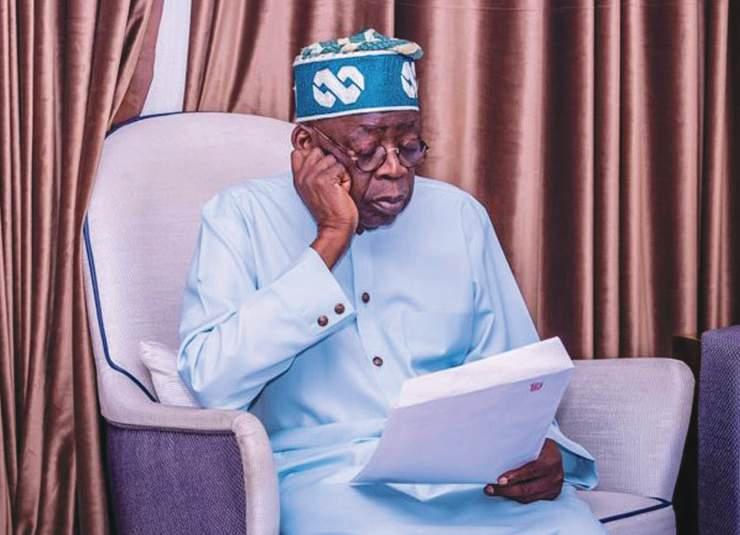
Tinubu Rejects Terrorists’ Demand for Release of Detained Members, Mourns
Trump, Pakistan Contradict Tehran, Say US, Israel, Iran Peace Deal to Be Signed Today
Iranian supreme leader, Ali Khamenei, to be buried July 9
Festus Akanbi
United States President, Mr. Donald Trump, has declared
that a preliminary agreement aimed at ending the ongoing conflict involving the United States, Israel, and Iran is
expected to be signed today. Pakistan’s Prime Minister, Shehbaz Sharif, whose government has mediated
between Iran and the US to end their war, also confirmed yesterday that a peace deal would “likely” be finalised
within 24 hours.
This is as Iran yesterday said its former Supreme Leader, Ali Khamenei, who ruled the
country for nearly 37 years before being killed by Israeli
Abdulsalami: Babangida Never Discussed June 12
Annulment with Me, Abiola Not Poisoned
Says he, Ishaya Bamaiyi, locked inside waiting room after Abacha's death Tinubu, Bio, Gowon, Obasanjo, Jonathan shower encomiums on Abdulsalami at his book launch President directs FCT minister to allocate land for his African Resource Centre
UNVEILING
HIS BIOGRAPHY AT 84…
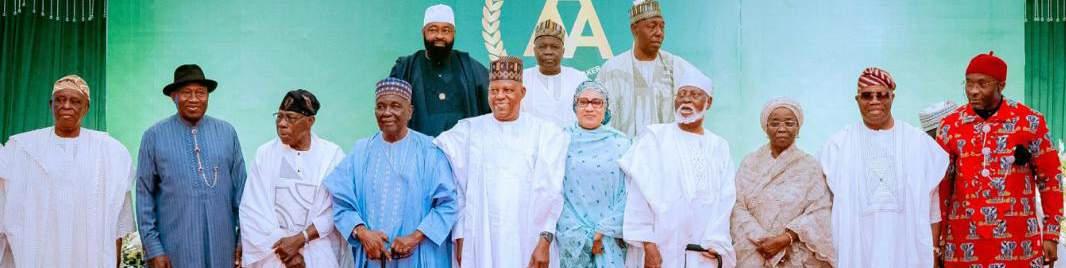
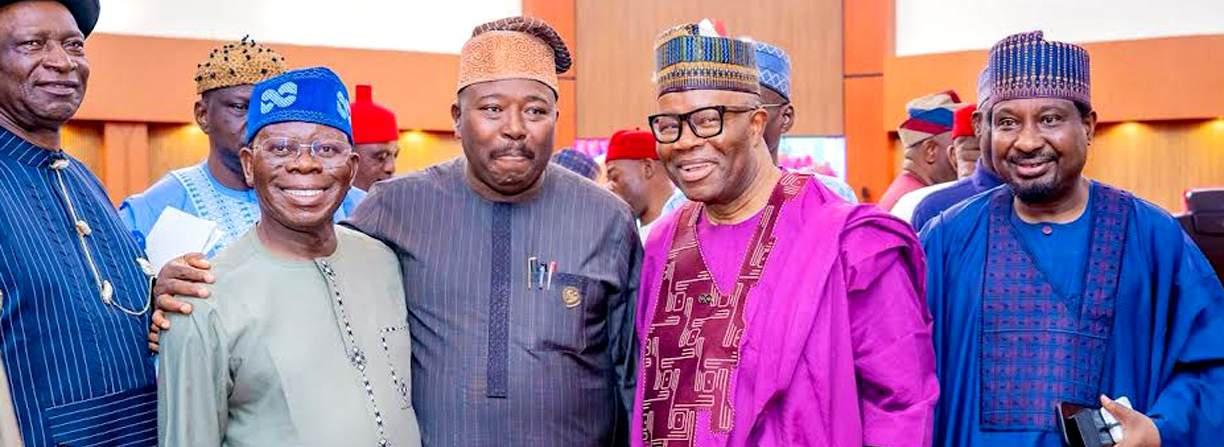
L-R: Former Governor of Ogun State, Chief Olusegun Osoba; former presidents, Dr. Goodluck Jonathan; Chief Olusegun Obasanjo; former Head of State, General Yakubu Gowon (rtd.); Governor of Niger State, Mohammed Umar
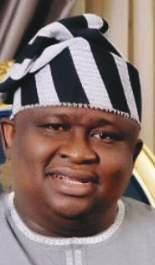
Vice President, Kashim Shettima; Gombe State Governor, Muhammadu Inuya Yahaya; Vice President’s wife, Nana; Borno State Governor, Prof. Babagana Zulum; former Head of State and celebrant, General Abdulsalami Abubakar (rtd.); his wife, Justice Fati Lami; President of the Senate, Senator Godswill Akpabio; and Deputy Speaker, House of Representatives, Hon. Benjamin Kalu, during Abdulsalami’s 84th birthday celebration and public presentation of his biography at the Banquet Hall, Presidential Villa, Abuja... yesterday
Bago;
Francis in Abuja and Dike Onwuamaeze in Lagos
Tinubu Rejects Terrorists’ Demand for Release of Detained Members,
President Bola Tinubu yesterday called the bluff of the terrorists saying categorically that his government would not bow to pressure being mounted by them for the release of their members in detention.
Reacting to the news of the death of the former Director of Defence Information, Defence
Headquarters (DHQ), Major General Rabe Abubakar (rtd.), in the custody of terrorists in Katsina, the president, in a statement issued by his Special Adviser on Information and Strategy, Bayo Onanuga, pointedly told the terrorists that government would never bow to their demand to release their members held by security agencies.
According to Tinubu: "While the terrorists have done their
worst, the President wants them to know that the government will never bow to their demand to release their members held by our security agencies.
"As I said on June 12: ‘Bandits, kidnappers, and sponsors of terror should now surrender or face the full force of the Nigerian State. These windows of surrender will not remain open forever. And no mercy will be shown to those who trade in the blood of Nigerians.’
Mourns Gen Abubakar
“As Nigerians, we must stand united and be assured that the enemies of our nation shall soon be history. We will triumph over terror and continue to build a more prosperous nation.
“General Abubakar’s death should further serve as a defining moment in our battle against terrorists and insurgents, never to negotiate with them on any terms, but to continue to treat them as the greatest enemies of our dear nation,
who should never be spared.”
He expressed shock over the death of retired Major General Abubakar while in the custody of terrorists in Katsina State.
The President commiserated with his family, and extended his condolences to the Katsina State government and the armed forces.
The retired general, who was abducted alongside his wife around the Matazu area of Katsina while traveling to a
wedding, died in the custody of bandits exactly two weeks after his abduction.
The Katsina State Government, which confirmed the death, described the incident as a tragic loss to the state and the nation.
The announcement was contained in a statement issued yesterday by the Commissioner for Internal Security and Home Affairs, Nasir Muazu, and made available to journalists.
A former military Head of State, Gen. Abdulsalami Abbubakar (rtd), has revealed that he heard the announcement of the annulment of the June 12, 1993 election, like every other Nigerian, insisting that, though he was a high-ranking military officer at the time, the then military President, General Ibrahim Babangida (rtd), did not discuss the annulment with him.
Abdulsalami also disclosed that the hours surrounding the death of General Sani Abacha on June 8, 1998, left him with a lingering sense that "something was fishy," adding that he and the late Chief of Army Staff, Lt. Gen. Ishaya Bamaiyi, were mysteriously locked inside a waiting room at the Presidential Villa for nearly an hour before being informed that the Head of State had died.
This is just as President Bola Tinubu; President of Sierra Leone and Chairman of the Authority of Heads
and US airstrikes on February 28, would be buried on July 9.
However, Trump and Sharif’s claim contradicted Iranian Foreign Ministry spokesman Esmaeil Baghaei, who dismissed reports that a memorandum of understanding would be signed today, stressing that negotiators were not preparing to travel to Geneva, Switzerland, for any such ceremony.
Other Iranian officials also insisted negotiations were still ongoing.
But Trump, writing on his Truth Social platform yesterday, expressed confidence that the long-anticipated breakthrough
in its “2026 Article IV Consultation Staff Country Report on Nigeria,” where it also alleged that official actions taken by the Nigerian authorities had led to Multiple Currency Practices (MCPs), including multiple exchange rates over the past 12 months, and urged the Central Bank of Nigeria (CBN) to eliminate these multiple rates.
This is as the President of the Capital Market Academics of Nigeria (CMAN), Prof. Uche
of State and Government of the Economic Community of West African States (ECOWAS), Julius Maada Bio; former Military Head of State, Gen. Yakubu Gowon (rtd); and former Presidents, Chief Olusegun Obasanjo; Dr Goodluck Jonathan, and former President of South Africa, Thabo Mbeki, yesterday poured encomiums on the former Head of State for his role in returning Nigeria to democracy.
In his autobiography titled: 'Call of Duty,' which was one of the three books he publicly presented yesterday in Abuja, Abdulsalami said that because of his closeness to Babangida, people thought he was in the know of everything that happened.
The two other books include, 'Nigeria's Grand Patriot', and 'Mediating for Peace in Africa'.
In ‘Call of Duty’, the former Head of State wrote: "At the time of the annulment, I was at the Army Headquarters as the Chief of Policy and Plans (COPP). I was fully engaged in the military in any capacity. I
would be formalised within 24 hours, signaling what could be a major diplomatic turning point after months of escalating hostilities and failed negotiations.
"The Deal is scheduled to get signed tomorrow, and immediately after it is signed, the Hormuz Strait is OPEN TO ALL," Trump wrote.
Similarly, Pakistan’s Prime Minister Sharif confirmed yesterday that a peace deal would “likely” be finalised within 24 hours.
“We are closer to a peace deal than ever before. With finalisation likely expected in the next 24 hours, Pakistan is
Uwaleke, has welcomed the latest IMF Article IV Consultation Report on Nigeria, but cautioned against adopting some of its recommendations, particularly those prescribing additional tax measures, including a possible hike in Value Added Tax (VAT), and their extension to petroleum products, among others. However, the CBN has explained that what the IMF viewed as MCPs were actually “not part of exchange rate
was not even a member of the Armed Forces Ruling Council (AFRC), the country's highest ruling body. I heard of the annulment in the news like every other Nigerian."
The former Head of State has also dismissed claims that Chief MKO Abiola was poisoned, insisting that an autopsy conducted by pathologists from four countries attributed his death to natural causes.
The revelations are also contained in Chapter 21 of Abubakar's 264-page, 27-chapter autobiography titled 'Call of Duty.'
Writing on the events leading to Abiola's death on July 7, 1998, Abdulsalami said Abiola collapsed during a meeting with a visiting American delegation comprising the then United States Undersecretary of State for Political Affairs, Mr. Tom Pickering, and then Assistant Secretary of State for African Affairs, Ms Susan Rice. "I do not believe Abiola was poisoned. The family requested an autopsy, and we assembled American, British, Nigerian, and Canadian pathologists to
preparing for the electronic signing of the peace deal immediately after, followed by technical-level talks next week,” he said in a post on the social media platform X.
Sharif said he was “confident that this historic peace deal will form a strong foundation for lasting peace”, thanking both Washington and Tehran “for their ongoing commitment”.
Pakistan has been pushing both nations to agree after a fragile ceasefire was struck in April and Islamabad hosted talks between the warring sides, which ended with no deal to resolve the conflict that erupted
determination but a cost-recovery fee.”
The IMF said it identified two sources of MCPs from the use of the buying rate—determined by CBN as the previous day's Weighted Average Exchange Rate (WAR) minus one Naira—for CBN foreign exchange (FX) purchases from Ministries, Departments and Agencies (MDAs) and oil/oil related companies.
It said that “as of April 27, 2026,
conduct it. The autopsy report attributed his death to natural causes," he wrote.
Writing on Abacha's death, Abdulsalami also wrote that he and Bamaiyi were mysteriously locked inside a waiting room at the Presidential Villa for nearly an hour before being informed that the Head of State had died.
He also explained how he succeeded Abacha and emerged as the 11th Nigerian Head of State.
The revelations are contained in Chapter 19 of 'A Call to Duty'.
Tinubu, Bio, Gowon, Obasanjo, Jonathan Shower Encomiums on Abdulsalami at his Book launch
Meanwhile, Tinubu, Bio, Gowon, Obasanjo, Jonathan, and Mbeki poured encomiums in Abuja during the public presentation of his three books.
Eulogising the former Nigerian leader at the book launch, which coincided with his 84th birthday, President
in late February with US-Israeli strikes on Iran.
The announcements by Trump and Sharif, however, appeared to catch Tehran by surprise.
Earlier yesterday, Iranian Foreign Ministry spokesman Esmaeil Baghaei had dismissed reports that an MoU would be signed today, insisting that negotiators were not preparing to travel to Geneva, Switzerland, for any such ceremony.
According to remarks carried by Iran's official IRNA news agency, Baghaei maintained that discussions were progressing but suggested that any formal
the latest impermissible spread was observed on March 23, 2026.”
The second source of MCPs, according to the IMF, was the use of the selling rate—determined by CBN as the previous day's WAR plus a 2.0 percent commission for CBN FX sales to MDAs.
It said: “As of April 27, 2026, the latest impermissible spread was observed on April 22, 2026.
“Staff encourages the authorities to eliminate these official actions,” it said.
Tinubu, represented by Vice President Kashim Shettima, also hailed the former Head of State for continuing "to serve as a respected elder statesman, promoting peace, national unity, democratic stability, and responsible political engagement" through the National Peace Committee.
Tinubu also directed the Minister of the Federal Capital Territory (FCT), Nyesom Wike, to allocate a befitting parcel of land within the nation's capital to build an office for the Abdulsalami Abubakar African Resource Centre (AAARC).
Tinubu described the presence of dignitaries from both home and abroad at the event as a fitting tribute to Abdulsalami's life.
He justified why the AAARC deserves a befitting office in Abuja, saying "the establishment of the Abdulsalami Abubakar Africa Resource Centre is a worthy initiative that aligns with the values General Abubakar has championed throughout his life.
agreement would likely come "in the coming days" rather than immediately.
The conflicting statements underscore the persistent lack of clarity surrounding negotiations that both Washington and Tehran have repeatedly described as being close to a breakthrough.
While officials on both sides have projected optimism about the prospects of ending the conflict, they have continued to offer differing accounts regarding the substance, timing, and scope of the proposed agreement.
Neither government has released the full terms of the
The IMF, however, noted that the CBN had explained that “it does not consider the official actions MCPs.”
The CBN, according to the IMF report, said that the 2.0 per cent commission applied to FX sales to MDAs was not part of exchange rate determination but rather a cost-recovery fee.
“In addition, the CBN noted that the N1.00 (one Naira) adjustment applied to FX purchases from MDAs and oil
The president said Abdulsalami's life had been defined by duty, moderation, courage, and an unwavering commitment to the public, noting that he "occupies a unique place in the history of our nation.
"At a moment of profound uncertainty, when Nigeria stood at a crossroads, providence entrusted him with the responsibility of leadership. He understood both the weight of that responsibility and the demands of the moment. He pledged to return the country to democratic rule, and he fulfilled that pledge faithfully and honourably".
Tinubu recalled how Abdulsalami "rendered one of the greatest services any leader can render a nation," placing country above self and principle above power.
He said the peaceful transition the former Head of State supervised in 1999 "gave birth to the Fourth Republic, the longest uninterrupted democratic period in Nigeria's
Continued on page 8
anticipated deal, and officials from both countries stressed on Friday that negotiations had yet to be concluded.
Trump nevertheless outlined what he described as key outcomes expected from the agreement.
Beyond guaranteeing unrestricted access through the strategic Strait of Hormuz, the US President said the deal would ensure that Iran would never acquire a nuclear weapon.
Describing the agreement as "A WALL TO NO NUCLEAR WEAPON," Trump also insisted
companies reflects a narrow bid-side spread consistent with standard market-making practices, accounting for liquidity provision, inventory risk, and settlement costs.
“They (CBN) also noted that the official actions impact only a small share of total turnover.” Yet, the IMF insisted that “given that these charges are viewed as
Deji Elumoye and Chuks Okocha in Abuja
Deji Elumoye, Chuks Okocha in Abuja and Francis Sardauna in Katsina
RALLYING SUPPORT FOR EKITI APC…
Adichie Accuses Lagos Hospital of Cover-up over Son’s Death, Demands Accountability
Award-winning Nigerian author, Chimamanda Ngozi Adichie, has accused the management of a Lagos-based private hospital, Euracare Multi-Specialist Hospital, of attempting to conceal the circumstances surrounding the death of her 21-month-old son, Nkanu Nnamdi AdichieEsege, following a medical procedure earlier this year.
The celebrated novelist made the allegation in a strongly worded letter addressed to the Chairman of the hospital's Board of Directors and subsequently published yesterday on her Facebook page, saying she chose to make the matter public because, in her words, “to keep silent about Euracare’s evil is to enable it.”
The letter, dated April 16, 2026, provides a detailed account of the events following the death of Nkanu, one of her twin
Matawalle
sons, who passed away on January 7 after complications allegedly arising from sedation administered during medical tests at the hospital.
According to Adichie, the Medical Director of Euracare, Dr. Tosin Majekodunmi, visited her family at their Ikoyi residence a day after the tragedy and acknowledged that the anaesthesiologist involved in the procedure, Dr. Titus Ogundare, failed to meet the required standard of care.
She alleged that Majekodunmi admitted that the child had been administered an excessive dose of propofol, a sedative commonly used during medical procedures, and accepted responsibility for what transpired.
Recalling the encounter, Adichie stated that the medical director's remarks came shortly after she witnessed him rushing into the catheterisation laboratory where her son was undergoing
treatment.
According to her, he assured the family that disciplinary action would be taken against the doctor involved and indicated that the hospital would dismiss the anaesthesiologist. She, however, claimed that communication from the medical director abruptly ceased thereafter, alleging that Euracare's management subsequently took control of the matter.
The controversy surrounding the case deepened following disciplinary action by the Medical and Dental Council of Nigeria (MDCN), which suspended Dr. Ogundare, Dr. Majekodunmi and the Chief Medical Officer of Atlantis Pediatric Hospital, Dr. Atinuke Uwajeh, pending the conclusion of disciplinary proceedings.
Adichie further alleged that Euracare inaccurately listed bacterial and fungal meningitis as the cause of death on her
son's death certificate, insisting that there was no medical basis for such a conclusion.
She maintained that Nkanu was conscious, responsive, and interacting normally when he arrived at the hospital for diagnostic tests, adding that his condition deteriorated only after the administration of sedation for an MRI procedure.
According to her, the death certificate should reflect what she described as the actual chain of events, leading to the child's death, including improper sedation, hypoxic brain injury, and cardiac arrest.
The renowned writer also alleged that a senior figure linked to the hospital's ownership sent a message through a relative, cautioning her against pursuing legal action and suggesting that damaging allegations could emerge in any court proceedings.
She described the communication as both
Rallies Support for Security Agencies, Says Only God Can End Nigeria’s Insecurity
John Shiklam in Kaduna
The Minister of State for Defence, Bello Muhammad Matawalle, has said that only God can ultimately bring an end to Nigeria’s security challenges.
Speaking in an interview with BBC Hausa, Matawalle said insecurity remained a national challenge that would require collective efforts from both security agencies and citizens to overcome.
He urged Nigerians to support security agencies and prayed for peace, while warning politicians against exploiting the situation for political gain.
“It’s disheartening, and
we must all rise to ensure that security agencies and Nigerians work together to end insecurity in the country. Insecurity does not discriminate based on political affiliation or religion. It can affect anyone.
“That is why we have urged the opposition to stop using insecurity to incite people. It is a challenge that can happen to anyone, and no Nigerian is happy about it. Unfortunately, some members of the opposition appear pleased with the situation. They do not care about the people. What matters to them is portraying the government as a failure for their own political interests and deceiving people into believing they alone can end insecurity.
“It is only God that can bring an end to this insecurity, alongside our collective prayers and efforts. It should not be used as a tool to condemn others or score political points,” he said.
According to him, some people were circulating old and misleading videos on social media to suggest the failure of President Bola Ahmed Tinubu's administration.
Noting that insecurity was not an isolated case in Nigeria, Matawalle promised that security operatives were working around the clock to crush terrorists unleashing attacks in parts of the country.
“There are fake and recycled videos being circulated; some
dating back to Jonathan's administration and others from countries such as Burkina Faso and Mali, yet they are being presented as incidents that occurred under this administration. That is not true.
“Our security operatives are working tirelessly across the country. We have directed them to deal decisively with terrorists, but this is not a challenge that can disappear overnight. Even some of the world’s powerful nations have battled insecurity for years and are still confronting it.
“We ask Nigerians to continue praying for us and supporting efforts to bring this challenge to an end,” he explained.
manipulative and implicitly threatening, insisting that neither she nor her family would be deterred in their pursuit of justice.
“They can drag all they wish in the mud, but our quest for justice will continue,” she stated.
Adichie also questioned the hospital's conduct regarding the ongoing coroner's inquest into the death, noting that Euracare had initially requested the inquest in January amid public concerns over possible medical negligence.
She accused the hospital of subsequently adopting tactics aimed at delaying proceedings and frustrating efforts to establish the facts surrounding the incident.
According to her, the family's attempts to obtain Nkanu's medical records were met with resistance, despite what she described as their clear legal entitlement to access them.
Her lawyers, she said, formally
requested the records after the medical director indicated that he was no longer in a position to release them. The hospital allegedly declined the request, arguing that it did not comply with unspecified legal requirements.
Adichie described the response as both incorrect and obstructive, questioning why a hospital genuinely interested in uncovering the truth would seek to impede access to relevant medical records or oppose an independent inquiry.
The legal battle over the matter has since moved to the courts.
On May 26, the Lagos State High Court granted Euracare leave to challenge the Coroner's Court's jurisdiction and ordered a stay of proceedings, pending the determination of a judicial review application filed by the hospital.
Kemi Badenoch: Nigeria is an Oil Producing Country But Never Had Electricity
The leader of the United Kingdom’s Conservative Party, Kemi Badenoch, has said Nigeria’s status as an oil-producing country has not translated into reliable electricity for its citizens.
Badenoch grew up in Nigeria before returning to the UK as a teenager to continue her studies.
Asked in an interview with
The Spectator about how her upbringing in Nigeria shaped her political views, Badenoch said her experiences have hardened her.
“My belief that we need to drill our oil and gas comes from growing up in a country… Nigeria is an oil-producing country, never had electricity,” she said.
“It is very easy to have resources underground, but
stupid public policy means that you can’t use it.”
She likened policies formulated by Ed Miliband, UK secretary of state for energy security and net zero, to the leadership of Nigerian heads of state before democracy.
“And I see quite a lot of what Ed Miliband is doing as being very much like what the Nigerian military dictatorships were doing in the 80s and 90s — ‘the government is going to take control, we know what’s best, we’re going to redistribute’. Stupid ideas which eventually just bankrupt the country,” she said.
Badenoch said she does not want Britain to become a “third-world country” like Nigeria.
Festus Akanbi
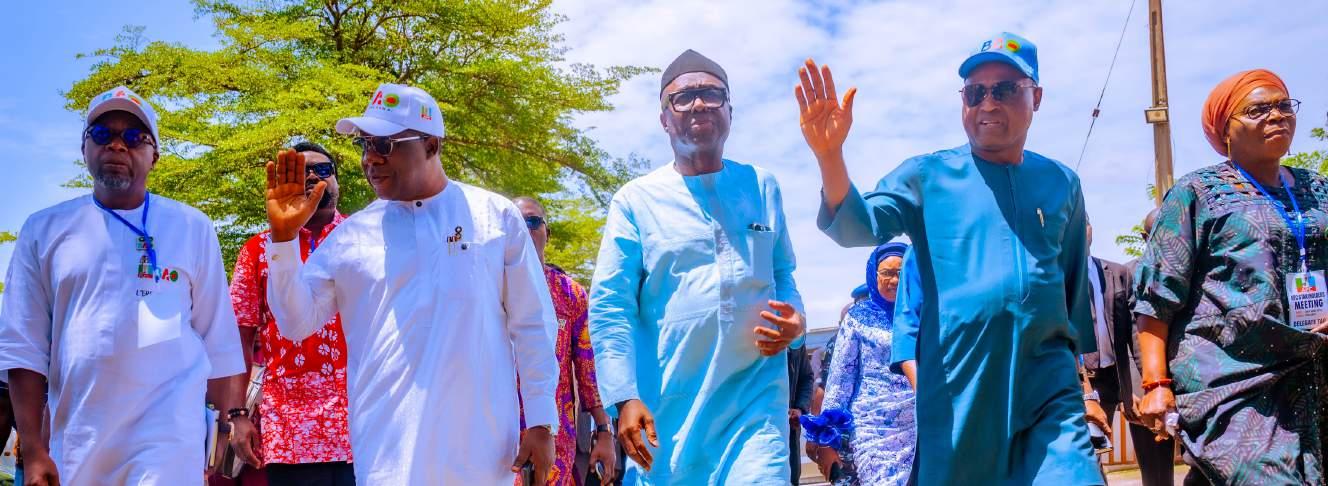
L-R: Chief of Staff to the Governor, Mr. Oyeniyi Adebayo; Senate Leader/Chairman, Ekiti APC 2026 Governorship Election Campaign Council, Senator Opeyemi Bamidele; former Governor of Ekiti State, Niyi Adebayo; Governor Biodun Oyebanji; and Deputy Governor, Mrs. Monisade Afuye, at the meeting of APC leaders and stakeholders at the Iyin Ekiti residence of Adebayo ...yesterday
ECOBANK’S PROMOTION OF ADIRE…
Obi: Nigerian Citizens’ Failure to Take Ownership of Electoral Process Encourages
Election Rigging
Pledges to adopt dialogue in addressing nationwide agitations
The presidential candidate of the Nigeria Democratic Congress (NDC), Mr. Peter Obi, has said that elections in Nigeria are often manipulated because citizens fail to take ownership of the electoral process and protect their votes.
Obi stated this during an interaction with Nigerians in Washington, D.C., United States, according to a video widely shared on social media, in which he spoke about the
challenges facing Nigeria’s democracy and the role of citizens in ensuring credible elections.
According to the former Anambra State governor, politicians alone cannot guarantee free and fair elections unless voters are determined to defend the sanctity of their ballots.
“Elections are rigged in Nigeria because Nigerians want it to be rigged. It’s as simple as A, B, C. I will do whatever is possible to protect
the votes, but unless Nigerians decide that their votes will count, it will not count,” he said.
Obi urged voters to remain at their polling units after casting their ballots and monitor the counting process rather than leaving immediately after voting.
“If you vote and you stay in your polling booth and say that the votes must be counted here, it will be counted, but because our politics is transactional, the average Nigerian doesn’t
know who is his problem.
“So, an average Nigerian will vote and then go home or go to night vigil, whilst his night vigil should actually be to stay and let them count his votes. But he will vote and go to night vigil on Saturday and start praying because he thinks he is the only one that God created, that God will solve all his problems,” he said.
The former governor maintained that Nigeria’s biggest challenge remained poor leadership, arguing
FRC, Quantity Surveyors Sign MoU Against Abuse of MDAs' Contract Awards, Procurement Irregularities
The Nigerian Institute of Quantity Surveyors (NIQS) has expressed its resolve to provide expertise in forensic cost auditing of Ministries, Departments and Agencies (MDAs) of the federal government with a view to checking contract inflation, value misrepresentation, and procurement irregularities, as well as contributing during pre-appropriation and MediumTerm Expenditure Framework
(MTEF) review stages where fiscal risks were highest.
The NIQS President, Dr. Aminu Mohammed Bashir, gave the assurance during the signing of a Memorandum of Understanding (MoU) between the Institute and the Fiscal Responsibility Commission (FRC) in Abuja on the weekend.
FRC is a federal agency established by the Fiscal Responsibility Act of 2007, with the primary mandate to promote macroeconomic stability, ensure transparency
and accountability in public finance, and enforce prudent management of the nation's resources.
According to a statement issued by the Deputy Director, Strategic Communications Directorate, FRC, Bede Ogueri Anyanwu, the NIQS president underscored the need for Prudent and transparent public expenditure, saying this cannot be fully achieved without professional cost intelligence on capital projects.
Bashir described the relationship between the FRC and the Institute as one founded on a shared conviction that public resources must be managed with discipline, transparency, and professional rigour.
He explained that the first MoU, executed on October 22, 2021, gave institutional expression to this conviction, adding that the purpose of the current engagement was to renew and deepen the collaboration.
Abiodun Declares Ogun on High Alert Over Rising Insecurity
Ogun State Governor, Prince Dapo Abiodun, has declared that his administration is on high alert against rising security threats across the country and unveiled plans to deploy technology-driven solutions to strengthen the state’s security architecture and protect lives and
property. Governor Abiodun made the declaration during the All Progressives Congress (APC) strategic meeting held at the Presidential Lodge, Ibara, Abeokuta, the Ogun State capital.
Describing the growing menace of terrorism, banditry and kidnapping across the country as deeply
concerning, the governor assured residents that his administration would take proactive steps to prevent criminal elements from gaining a foothold in the state.
“We are rising to the occasion of insecurity by deploying technology to safeguard the lives of our people. We will not wait
for anyone to come and attack us,” Abiodun said.
He reaffirmed his administration’s commitment to ensuring residents' safety through strategic investments in security infrastructure, enhanced collaboration with security agencies, and sustained community engagement.
that the country possessed abundant human and natural resources needed for development.
“The question you all should ask yourselves today is: What is the problem of Nigeria? Nigeria has only one problem – leadership, political leadership. Every other thing God gave to Nigeria.
“I can tell you that Nigeria is more blessed than this country. So, if Nigerians know that their problem is leadership, they will address it and insist on getting good leadership. So, everybody should be part of protecting that vote,” he added.
Obi stressed that safeguarding the electoral process should not be left to politicians alone, noting that meaningful change would only come when citizens actively defend their votes and demand accountable leadership.
He also used the occasion to say that he would adopt a dialogue approach to
addressing agitations across the country if allowed to lead.
According to him, engaging agitators would help the government understand the issues driving their demands and find lasting solutions.
“Even all agitators, if I’m in government today, I will discuss with them. I will engage with them.
“I will consult with them. Because I believe that they have a reason for whatever they want to do. It’s only by engaging them that we’ll learn how to solve it. But I am not in a position to do anything today,” Obi added.
He reiterated his call for the release of Nnamdi Kanu, saying there is no justification for the continued detention of the leader of the Indigenous People of Biafra.
The former Anambra State governor said he had consistently maintained that Kanu should not remain in custody.
Police, Others Performing ‘Magic’ to Track Criminals Without National Database, Says Defence Minister Linus
Aleke in Abuja
The Minister of Defence, General Christopher Musa (rtd.), has lamented the absence of a national database, describing the efforts of security agencies, including the Nigerian Police Force, to track and apprehend criminals without such a system as akin to performing “magic”.
According to the minister, the lack of a centralized database for storing and accessing citizens’ information continued to undermine investigations and intelligence gathering, making it significantly more difficult for law
enforcement agencies to identify suspects and tackle criminal activity Defence effectively.
Musa made the remarks while delivering a keynote address at the Nigerian People's Strategic Conference and Defence Exhibition 2026, themed, “Building a Modern Security Ecosystem: Integrating Private Sector Capacity into Nigeria's National Security Architecture.”
Highlighting the challenges confronting security agencies, the defence minister stressed the critical importance of timely information and public cooperation in combating crime.
Chuks Okocha in Abuja
James Sowole in Abeokuta
Ndubuisi Francis in Abuja
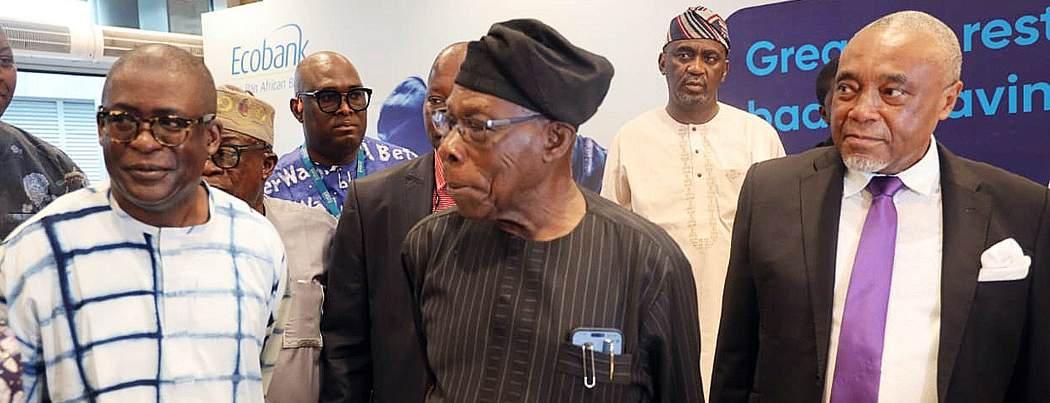
L-R: Managing Director/Regional Executive, Ecobank Nigeria, Bolaji Lawal; former President, Chief Olusegun Obasanjo; and former Chairman of Ecobank Transnational Incorporated (ETI) and current Chairman of Dangote Cement Plc, Mr. Emmanuel Ikazoboh, during the ongoing Ecobank Adire Lagos Experience 2026, themed: Threads Across Borders, at the Ecobank Pan African Centre, Victoria Island, in Lagos…Friday PHOTO: SUNDAY ADIGUN
LAW-MAKING ON THEIR MINDS…
NCAA: Why 75-year-old Pilot, 70-year-old Co-pilot Flew Aircraft that Landed on Delta Road
Kasim Sumaina in Abuja
The Nigerian Civil Aviation Authority (NCAA) has
disclosed that the pilot and co-pilot, who flew the private aircraft with registration number N989BC, which
landed on a road in the Ogwashi-Uku area of Delta State, were 75-year-old and 70-year-old, respectively,
because they operated under United States aviation regulations that did not consider them as overaged
Court Issues Arrest Warrant for Ex-Minister, Uche Nnaji, over Alleged Certificate Forgery
The Independent Corrupt Practices and Other Related Offences Commission (ICPC) has secured a warrant of arrest against Uche Nnaji, a former Minister of Innovation, Science and Technology.
In a ruling on Thursday, a Federal High Court in Abuja granted the order for arrest following an ex parte motion filed by the ICPC in a suit marked FHC/ABJ/ CS/1160/2026.
President Bola Tinubu appointed Nnaji as minister
history."
The president acknowledged that millions of Nigerians, including him and others privileged to serve in public office, "are beneficiaries of the stability and democratic foundation that his stewardship helped secure."
His words: "Like many prodemocracy activists of that era, I returned to participate in the democratic process because I was convinced of General Abdulsalami Abubakar's sincerity and determination to restore constitutional rule."
He commended the authors of the books for preserving an important chapter of Nigeria's national history for future generations to learn from the example of Abdulsalami, whose life "embodies service before self.
in August 2023. Nnaji resigned as minister following allegations that he forged the academic and National Youth Service Corps (NYSC) credentials submitted during his ministerial screening and confirmation process.
The ICPC’s ex parte motion, dated June 3, was filed on June 4, and attached was an affidavit deposed by one David Nelson.
Osuobeni Akponimisingha, ICPC counsel, told the court that the ex parte motion
former Head of State shunned all overtures and placed the well-being of Nigerians above personal interests, choosing instead to entrench democratic governance and peacebuilding in Nigeria.
On his part, former Head of State Gowon, who chaired the occasion, said there was much to learn from Abdulsalami's exemplary leadership and legacy of peacebuilding, particularly his role in leading one of Africa's most significant transitions from military to civilian rule.
follows Nnaji’s refusal to honour invitations extended to him by the commission for investigation over certificate forgery allegations.
Akponimisingha prayed the court to issue an order allowing the commission to declare Nnaji wanted in any national newspaper, social media platforms, or other media for “failing to honour the commission’s invitations for investigation activities”.
The commission also asked the court to issue a bench
Abdulsalami for demonstrating uncommon courage and patriotism by refusing to yield to moves by influential interests within the military to prolong his rule.
Jonathan also credited the former head of state with laying the foundation for Nigeria's democratic stability by resisting pressure to remain in office after assuming power in June, 1998.
warrant of arrest, directing operatives of the commission or other enforcement agents, including private citizens, to identify and arrest Nnaji and hand him over to the ICPC for investigation.
It also appealed to the court to grant any orders as it might deem fit in the circumstances.
The court granted all the orders sought.
The court further ruled that the order would lapse only upon the arrest of the former minister.
leadership as being essential for strengthening democracy and addressing emerging national challenges.
under the applicable rules.
Director of Operations, Licensing and Training at the NCAA, Capt. Don Spiff said both pilots held American licences, and neither was considered overaged as the aircraft was also Americanregistered.
Speaking during a television interview, Spiff, however, said that while the current age limit for commercial pilots in Nigeria was 65, the country’s regulations were under review.
He also faulted the pilot’s decision to take off from the road after the incident, saying the action was unauthorised.
He said, “Before I say anything, I must remind you that investigations have already started on this incident. So, I must not preempt anything. However, I can tell you for sure that the Nigerian Safety Investigation Board, or
NSIB, which is mandated to investigate serious incidents and accidents, is already on it.
“If they determine that it is not a serious incident, then they will hand it over to the NCAA. The pilots who flew that airplane have American licences. The pilot is 75. The co-pilot is 70. The pilot is not over-aged in America. The standards in Nigeria are slightly different from those in America. This airplane is American-registered, with a November registration. The pilots who flew it hold American licenses. They operate in America. They have different parts. They call them the condition of regulations. They are operating under what they call Section 14. And not only was Section 14, but also this aircraft was operated under Section 14.”
actions was the release of political prisoners, including himself, adding that the former Head of State also worked towards securing the release of the presumed winner of the June 12, 1993, presidential election, Chief MKO Abiola.
dedicated to service, patriotism, and leadership.
Obasanjo, while reflecting on his years in public service, cited the controversy that surrounded the Land Use Act of 1978 as a lesson in leadership and consultation, recalling that the legislation faced widespread opposition from both Northern and Southern interests when it was introduced during his time as military Head of State.
He disclosed that Abdulsalami kept him regularly informed of efforts to secure Abiola's freedom and maintained communication with members of the late politician's family.
On her part, former First Lady and wife of the celebrant, Fatima Lami Abubakar, expressed gratitude for witnessing the launch of the three important books chronicling his life of service and enduring impact.
Earlier, in a keynote address, former President of South Africa Mbeki said the
He said Abdulsalami's mediation role remains legendary across the African continent and beyond, while his ideals of patriotism and his consistent choice of country and humanity over self are worthy of emulation by young Africans as future leaders.
His words: "If there is anybody, we can give credit to for stabilising democracy in Nigeria today, it is General Abdulsalami Abubakar."
Jonathan described the launch of the three books as an important effort to preserve history, document lessons in leadership and inspire future generations.
Obasanjo used the opportunity primarily to celebrate Abdulsalami, whom he described as one of four military leaders whose contributions were instrumental to the survival and evolution of modern Nigeria.
According to him, arrangements were already underway for Abiola's release before the unexpected death of the acclaimed winner of the annulled election.
Also present at the occasion were the Prime Minister of Niger, Ali Lamine Zeine; former Vice Presidents, Namadi Sambo and Yemi Osinbajo, among others. ABDULSALAMI: BABANGIDA NEVER DISCUSSED JUNE 12 ANNULMENT WITH ME, ABIOLA NOT POISONED
Also speaking, former President Jonathan lauded
On his part, former President Obasanjo identified consultation and inclusive
The former president recalled that one of Abdulsalami's first major
President of Sierra Leone and Chairman of the Authority of Heads of State and Government of ECOWAS, Bio, explained that the three books launched in honour of the celebrant depict a life
The book presentation raked in millions of naira from Africa's richest man, Aliko Dangote (N500 million); Chairman of BUA Group, Abdul Samad Rabiu (N250 million); the House of Representatives (N50 million); the Senate (N100 million); Nigerian governors, commercial banks, and others.
L-R: Chairman, Senate Committee on Host Communities, Senator Benson Agadaga; Chairman, Senate Committee on Interior, Senator Adams Oshiomhole; Chairman, Senate Committee on Agriculture/Research Institutions and Oyo State APC governorship candidate, Senator Sharafadeen Ali; President of the Senate, Senator Godswill Akpabio; and Deputy Senate President, Senator Jibrin Barau after plenary in Abuja…recently
PARTNERING FOR A HEALTHY LIVING…
L-R: Chairman, Fidelity Board, Mrs. Amaka Onwughalu; Executive Director of Fidelity Bank, South-east, Mrs. Pamela Shodipo; Managing Director/Chief Executive Officer, Fidelity
Onyeali-Ikpe; and wife of the governor of Anambra State, Mrs. Nonye Soludo, during the handing over of a solar-powered smart school bag to a student under a partnership programme
Nigeria May Face Spike in TB Cases Due to Inadequate Drugs, Diagnostics, Says NEPWHAN
Onyebuchi Ezigbo in Abuja
The Network of People Living With HIV and AIDS in Nigeria (NEPWHAN) has raised the alarm over potential increase in tuberculosis cases in the country due to the nonavailability of commodities for treatment and diagnostics of the disease.
With Nigeria carrying one of the highest TB burdens globally, it said the current shortage of TB medicines, diagnostics and related
commodities presents a major public health emergency that threatens the lives of thousands of Nigerians, particularly those living with HIV among whom are also affected by TB.
The National Coordinator of NEPWHAN, Abdulkadir Ibrahim, said that data as at the end of the first quarter this year showed that 64.2 per cent of monitored facilities reported stock-outs of at least one essential TB commodity, especially TB medicines, diagnostics, and
related commodities
"NEPWHAN expresses deep concern and outrage over the ongoing stock-out of critical TB commodities across the country and the continued failure of government to adequately finance programmes, procure essential TB commodities and fulfil its counterpart funding commitments to the national TB response," he said Ibrahim said that out of the 43 per cent (921) of patients interviewed by NEPWHAN
said they were being asked to return essential TB commodities across monitored health facilities.
He also said that 52.2 percent of facilities reported shortages of GeneXpert cartridges and sputum collection materials.
The national coordinator said that the findings of the group also showed that TB commodity shortage was already affecting service delivery and patient outcomes.
"For people living with HIV wio remain at significantly
higher risk of developing TB interruptions in TB diagnosis and treatment, substantially increase morbidity and mortality while undermining national HIV epidemic control efforts.”
Ibrahim said that NEPWHAN is calling on the federal government to immediately declare the TB commodity stock-out situation a public health priority and emergency requiring urgent intervention.
The group also demanded
the release of adequate funds without delay for the procurement and distribution of essential TB medicines, diagnostics, laboratory commodities, and other critical supplies. In addition, NEPWHAN urged the government to fulfill all outstanding counterpart funding commitments to TB programmes and establish sustainable domestic financing mechanisms for TB prevention, diagnosis, treatment, and care.
TRUMP, PAKISTAN CONTRADICT TEHRAN, SAY US, ISRAEL, IRAN PEACE DEAL TO BE SIGNED TODAY
that no financial transfers would accompany the arrangement.
He further suggested that international authorities would eventually gain access to Iran's stockpile of enriched uranium, stating that "at the appropriate time, when all is calm, we will go in and get the Nuclear Dust."
The comments contrasted sharply with the position presented by Iranian Foreign Minister Abbas Araghchi during an interview with Press TV on Friday.
Araghchi explained that the proposed MoU would merely establish a framework for future negotiations concerning Iran's nuclear programme rather than constitute a comprehensive settlement.
According to him, the immediate objective of the
document is to secure a cessation of hostilities. At the same time, more contentious issues, including sanctions relief, frozen Iranian assets, and the long-term future of the country's nuclear activities, would be addressed in subsequent negotiations.
He also rejected suggestions that the Strait of Hormuz would come under international administration, insisting that Iran and Oman would continue to oversee one of the world's most strategically important maritime corridors.
The renewed diplomatic activity follows a sharp deterioration in relations this week, during which both Iran and the United States exchanged military strikes, raising fears that a fragile ceasefire in place since April
8 could collapse.
The latest conflict traces its origins to February 28, when the United States and Israel launched military operations against Iran amid stalled indirect negotiations over Tehran's nuclear programme.
Iranian officials have repeatedly cited deep mistrust of Washington as a major obstacle to achieving a durable settlement, pointing to the United States' withdrawal from previous agreements.
For his part, Trump has consistently argued that any new accord must surpass the 2015 Joint Comprehensive Plan of Action (JCPOA), negotiated under former President Barack Obama.
The JCPOA required Iran to limit aspects of its nuclear programme and submit
to extensive international inspections in exchange for sanctions relief. Trump withdrew the United States from the agreement in 2018, describing it as inadequate.
Tehran has consistently maintained that its nuclear programme is intended solely for civilian and peaceful purposes and that it has no ambition to develop nuclear weapons.
Reiterating his long-standing criticism of the Obama-era accord, Trump insisted that the emerging agreement would be significantly stronger and more comprehensive.
"Our relationship with Iran is a much different and better one than previous Administrations have had," he wrote.
While expressing optimism that negotiations would conclude smoothly, the US President also
issued a veiled warning in case diplomacy fails.
"Hopefully, this process will all work out quickly, easily, and smoothly," Trump stated.
"If it doesn't, we have the ultimate alternative, hopefully never to be used again," he added, without elaborating further.
Iranian Supreme Leader, Ali Khamenei, to Be Buried July 9
Meanwhile, Iran yesterday said its former supreme leader, Khamenei, would be buried on July 9.
Khamenei ruled the country for nearly 37 years before Israeli and US airstrikes killed him on February 28.
The burial in his hometown,
the northeastern holy city of Mashhad, initially scheduled for March but postponed due to the war, will follow three days of funeral ceremonies in the capital, Tehran, beginning July 4, and another in the holy city of Qom on July 7, it said. The start date of the national funeral, July 4, will coincide with the United States’ Independence Day, which this year celebrates its 250th anniversary.
Ali Khamenei’s son, Mojtaba, succeeded him as supreme leader in early March, the third since the establishment of the Islamic Republic in 1979.
Mojtaba Khamenei, wounded in the strikes that killed his father and numerous other officials, has not appeared in public since his appointment and communicates only through statements attributed to him.
IMF: INCREASING USE OF US DOLLAR-DENOMINATED STABLECOINS IN NIGERIA RAISES RISKS TO MONETARY SOVEREIGNTY
MCPs under the IMF framework, the CBN would review and take necessary actions.”
The IMF also urged the CBN to phase out the remaining capital flow management (CFM) measures as macroeconomic conditions permit.
It said: “Staff welcomes that, in March 2026, the CFM on the requirement for International Oil Companies (IOCs) to hold 50 per cent of repatriated export proceeds in Nigeria for 90 days
before transferring offshore has been eliminated.
“The authorities have indicated that they intend to phase out the three remaining outflow CFMs. These are bans on FX purchases on the Nigerian FX market for the purpose of investing in FX securities abroad.
“Another is payment limits on naira-denominated credit and debit cards for overseas transactions, and thirdly, the net open positions limit of the
overall FX assets and liabilities should not exceed 20 per cent short or zero per cent long of shareholders’ funds.
The report stated that in line with the IMF’s institutional view, “these CFMs should be phased out as FX pressures abate and macroeconomic and financial stability is restored.”
The IMF noted that the growing use of stablecoins for cross-border transactions in Nigeria brings opportunities
and risks.
It said that “while stablecoins can improve payment efficiency, lower transaction costs, and improve financial inclusion, the increasing use of U.S. dollardenominated stablecoins raises risks to monetary sovereignty, capital flow management, financial stability, and financial integrity by facilitating potential ‘digital dollarisation’ and cross-border transactions outside the formal financial system.”
It recommended that policy priorities should include maintaining confidence in the Naira through continued sound macroeconomic policies, strengthening oversight and supervisory capacity, and bringing stablecoin arrangements within the regulatory perimeter in line with international best practices, including robust licensing, consumer protection, and reporting requirements.
The IMF said that close
coordination between the CBN and the Securities and Exchange Commission (SEC) is essential to ensure coherent oversight and avoid regulatory gaps.
Meanwhile, the President of CMAN, Prof. Uwaleke, has cautioned against adopting some of its recommendations, particularly those prescribing additional tax measures, including a possible increase in Value Added Tax (VAT) and its extension to petroleum products.
Bank PLC, Mrs. Nneka
between Healthy Living with Nonye Soludo and Fidelity Bank PLC, at the Government House, Awka... yesterday
Editor: Festus Akanbi
As Tegbe Takes Charge, Nigerians Want Light, Not Excuses
For Nigerians, the time for excuses is over. The new Power Minister, Joseph Tegbe must let performance speak, writes
Festus Akanbi
For millions of Nigerians, the appointment of Joseph Olasunkanmi Tegbe as Minister of Power has triggered a familiar mix of hope and scepticism. Hope, because electricity remains the single most critical ingredient required to unlock Nigeria’s economic potential. Scepticism, because Nigerians have heard too many promises from too many power ministers over too many years, only to remain trapped in darkness.
In truth, few ministries carry the weight of public expectation like the Ministry of Power. Every market woman, factory owner, barber, welder, student, hospital, farmer, and technology entrepreneur depends on electricity.
Power is not merely another sector of the economy; it is the engine room of national development. When electricity works, businesses flourish, jobs are created, production costs decline, and investment follows. When it fails, everything else struggles.
Analysts said that is why Nigerians are not asking the new minister for eloquent speeches, impressive PowerPoint presentations, or media campaigns. They are asking for results.
To his credit, Tegbe appears to understand the enormity of the task before him. Shortly after his swearing-in, he struck a cautious note.
"I am not promising a magic wand. I am not promising twenty-four-hour, seven-days-a-week power. We will get there ultimately."
It was perhaps an honest statement. Yet honesty alone will not satisfy a nation exhausted by decades of electricity shortages.
Nigerians have listened to similar explanations from successive administrations. They have heard about gas constraints, liquidity crises, vandalised pipelines, weak transmission infrastructure, inadequate tariffs, poor metering, ageing equipment, and market inefficiencies. Most of these explanations are valid. The problem is that citizens no longer want explanations. They want electricity. The statistics tell a troubling story.
Despite having installed generation capacity exceeding 13,000 megawatts, Nigeria struggles to consistently deliver less than 5,000 megawatts to over 200
million people. The country's peak generation record remains only about 5,801 megawatts. By comparison, South Africa, with a far smaller population, has historically generated several times that amount. The consequences are visible everywhere.
Small businesses spend a large share of their earnings on diesel and petrol for generators. Manufacturers battle rising production costs. Hospitals operate under constant uncertainty. Students struggle to study. Digital businesses lose productivity. Rural communities remain isolated from economic opportunities.
The situation has become even more painful following recent increases in fuel prices, which have made alternative power sources increasingly unaffordable for households and businesses alike.
Indeed, one of the greatest tragedies of Nigeria's electricity crisis is its contribution to rural-urban migration.
If reliable electricity were available in rural communities, countless young Nigerians would not feel compelled to abandon their villages and small towns for already overcrowded cities. Small-scale industries would emerge closer to farms. Agroprocessing businesses would thrive. Employment opportunities would be more evenly distributed.
Electricity has the power to transform rural Nigeria more effectively than many intervention programmes. Yet vast communities remain outside
the power equation.
Those fortunate enough to be connected to the grid often face another frustration: estimated billing.
For many consumers, the monthly electricity bill arrives with remarkable consistency even when electricity does not. The result is widespread anger and distrust.
Industry data indicate that the metering gap remains around 44 per cent, meaning millions of customers are still subjected to estimated billing. For many Nigerians, ending this injustice would be one of the most tangible demonstrations that reform is genuinely underway. This is where Tegbe's reputation as a reform strategist will be tested.
His credentials are impressive. A first-class Civil Engineering graduate of the then University of Ife, Fellow of the Institute of Chartered Accountants of Nigeria, former senior partner at KPMG, and a professional with more than three decades of experience in institutional reform, Tegbe certainly possesses the intellectual pedigree required for the job.
But Nigerians are not suffering from a shortage of qualifications among public officials. What they have suffered from is a shortage of execution.
The new minister must therefore resist the temptation that has trapped many public office holders before him: the temptation to govern through explanations.
Power sector watchers said Nigerians do not want another minister who spends more time appearing on television than fixing transformers.
They do not want another minister who attributes every setback to decisions made by predecessors.
They do not want another minister who celebrates marginal improvements while citizens continue to endure darkness. They want measurable outcomes.
The good news is that the agenda before him is already clear. First, he must address grid stability. Repeated system disturbances and collapses have undermined confidence in the sector for years.
Second, he must accelerate metering nationwide and drastically reduce estimated billing.
Third, he must tackle gas supply constraints that continue to limit generation output.
Fourth, he must improve market liquidity to encourage investment across the value chain.
Fifth, he must deepen rural electrification and expand off-grid solutions to underserved communities.
Sixth, he must ensure that electricity reforms translate into better service delivery rather than simply higher tariffs.
These are not easy tasks. Yet they are not impossible either. There are already encouraging signs.
The revival of the 450-megawatt Alaoji Power Plant after years of inactivity, improvements in transmission infrastructure at Katampe, Ayede, and Abeokuta, and increased engagement with sector stakeholders suggest that movement is occurring. However, Nigerians have seen isolated successes before. What they need now is consistency.
The new minister should recognise that public patience is rapidly diminishing. Across social media, marketplaces and business circles, the dominant sentiment is no longer optimism but fatigue. Citizens have grown weary of timelines that keep shifting into the future.
This is why Tegbe's greatest asset may not be his technical competence or his extensive professional experience.
It may be his willingness to let performance speak louder than promises. The Ministry of Power does not need another public relations campaign.
It needs transformers that work. It needs meters in homes. It needs stable grids. It needs reliable power for industries. It needs electricity that reaches forgotten communities.
Ultimately, history will not judge Joseph Tegbe by the number of meetings he holds, the conferences he attends, or the speeches he delivers. History will judge him by a simpler standard. Did Nigerians receive more electricity under his watch? If the answer is yes, he will earn public respect regardless of the obstacles he encounters. If the answer is no, no volume of explanations will rescue his legacy.
For a country desperate to industrialise, reduce poverty and compete in a modern global economy, electricity is no longer a luxury. It is a necessity.
The new minister has been handed one of the most difficult portfolios in government. But he has also been handed a rare opportunity to make a transformative difference. Nigerians are tired of excuses. They are tired of promises. They are tired of hearing why things cannot be done. What they want now is power, regular, affordable, and reliable power.
And if that cannot be delivered, many would argue that those unable to do the job should make way for those who can. The time for explanations is over. The time for performance has arrived.
Tegbe
A NEW SENSE OF PURPOSE
Kaduna State is strengthening the culture of consensusbuilding, transparency, and measurable outcomes, contends MUHAMMED BALARABE
For years, Kaduna State occupied an uncomfortable position in Nigeria’s national discourse. Despite its immense economic potential, strategic location, rich agricultural endowments, and historical significance as a political and commercial hub of Northern Nigeria, the state was frequently associated with insecurity, ethnic tensions, social divisions, and governance challenges. Investors were cautious, communities were fractured, and public confidence in government institutions had waned. Today, however, Kaduna is telling a different story.
The latest validation comes from the 2025 Phillips Consulting State Performance Index (pSPI), which ranked Kaduna State third among Nigeria’s 36 states and awarded it an Excellent Four-Star Rating. More importantly, the ranking places Kaduna among the country’s highest-performing sub-national governments, a remarkable achievement that underscores the transformation taking place under the leadership of Governor Uba Sani.
While rankings and awards do not tell the whole story of governance, they often provide credible indicators of direction and performance. In Kaduna’s case, the Phillips Consulting assessment is particularly significant because it combines objective development indicators with citizen perceptions and feedback. The result is a comprehensive evaluation of how government policies are translating into real outcomes for the people.
For Governor Sani, the ranking represents more than statistical success. It is an affirmation that his administration’s deliberate focus on inclusion, accountability, peace-building, and economic development is yielding tangible results.
Perhaps the most important achievement of the Uba Sani administration has been the restoration of trust between government and citizens. When he assumed office in May 2023, Governor Sani inherited a state grappling with multiple challenges. Security concerns had disrupted economic activities in several communities. Many rural areas felt disconnected from government. Social tensions had created divisions among various groups, while public expectations for change remained high.
Rather than adopt a confrontational approach, Governor Sani chose dialogue, consultation, and inclusiveness as the cornerstone of his administration.
His outreach to traditional rulers, religious leaders, community groups, youth organizations, civil society actors, and political stakeholders helped create a new atmosphere of cooperation and shared responsibility. This approach gradually reduced tensions and strengthened confidence in government institutions. The results have become increasingly evident across various sectors.
No meaningful development can occur in an atmosphere of insecurity. Governor Sani understood this reality from the outset.
His administration prioritized collaboration with security agencies while simultaneously addressing some of the socio-economic factors that contribute to instability. Through community engagement, improved intelligence gathering, and strategic interventions in vulnerable areas, Kaduna has recorded significant improvements in security. Communities that were once plagued by fear have begun witnessing the return of economic activities. Farmers are increasingly returning to their farmlands, traders are regaining confidence, and businesses are expanding operations.
While security challenges remain a national concern, Kaduna’s experience demonstrates that effective leadership, community participation, and proactive governance can make a substantial difference.
One of the strongest indicators of Kaduna’s progress lies in its growing reputation for transparency and accountability.
Earlier in the year, Kaduna emerged as Nigeria’s top-performing state on the 2025 Transparency and Integrity Index published by the Centre for Fiscal Transparency and
Public Integrity. The state also achieved the country’s highest score on the Control of Corruption Indicator. These achievements are not accidental.
Governor Sani’s administration has consistently emphasized prudent management of public resources, strengthened institutional oversight mechanisms, and enhanced transparency in government operations. Such measures have helped improve investor confidence and reassured development partners that public funds are being utilized responsibly.
In an era where citizens increasingly demand accountability from public officials, Kaduna’s performance offers a compelling model for other states.
Economic development remains at the heart of Uba Sani’s governance philosophy.
Recognizing that economic growth must benefit ordinary citizens, the administration has focused on policies that promote inclusion and opportunity creation. Small businesses, farmers, women, and young people have become key beneficiaries of government interventions. Agriculture, in particular, has emerged as a major growth driver.
Kaduna’s selection as a pilot state for the Nigeria Governors’ Forum State-Led Rice Transformation Initiative reflects the growing recognition of the state’s agricultural potential. Under Governor Sani’s leadership, investments in agriculture have increased significantly, with budgetary allocations rising dramatically above previous levels.
The administration’s support for farmers, agricultural value chains, processing facilities, and agro-industrial development is helping transform agriculture from subsistence activity into a viable economic enterprise.
This strategy is not only improving food security but also creating jobs, attracting investment, and stimulating rural development. A defining feature of the Uba Sani administration is its emphasis on human development. Education and healthcare have received sustained attention, reflecting the understanding that long-term prosperity depends on the quality of human capital.
Across the state, investments in schools, healthcare facilities, social welfare programmes, and youth empowerment initiatives are helping improve access to essential services. These interventions are particularly important in a state with a large youthful population and growing development needs.
The administration’s commitment to social inclusion has also ensured that vulnerable groups are not left behind. Women, persons with disabilities, and underserved communities are increasingly benefiting from targeted programmes designed to improve livelihoods and expand opportunities. Infrastructure development remains another critical pillar of Kaduna’s transformation. Road construction, rural connectivity projects, urban renewal initiatives, and public infrastructure investments are helping unlock economic potential across the state. Improved infrastructure not only enhances quality of life but also lowers the cost of doing business and facilitates investment.
SEGUN H. OLUGBILE argues that the gap could be addressed
RETHINKING NIGERIA’S TALENT GAP
Tosin Eniolorunda’s recent remarks on the difficulty of filling over 500 roles in his organisation have reignited an important debate about talent, education, and workforce readiness in Nigeria’s digital economy. His concerns about the country’s skills gap are valid. However, the conclusion that these vacancies persist largely because Nigerian youths are unqualified reflects a narrower diagnosis of a more complex structural issue.
Nigeria’s challenge is not simply a shortage of talent; it is a shortage of deliberate, scalable systems for transforming potential into capability. A closer look at Eniolorunda’s own career trajectory offers a useful perspective.
Trained as a Mechanical Engineer, he did not emerge from university as a fintech specialist. His transition into the technology sector was enabled by Interswitch, an institution that invested in developing talent at a time when Nigeria’s digital payments ecosystem was still nascent. The company did not wait for a ready-made workforce, it built one.
This model of corporate-led talent incubation has historically underpinned the growth of new industries. It is neither accidental nor optional; it is foundational.
A more recent parallel can be drawn from Nigeria’s data protection ecosystem. Following the introduction of the Nigeria Data Protection Regulation (NDPR) in 2019 and the subsequent Data Protection Act, there was an acute shortage of trained professionals in the field. Rather than frame this gap as a failure of the education system alone, Data Protection Compliance Organizations (DPCOs) such Data Analytics Privacy Technology (DAPT) and others in the country adopted a proactive approach— recruiting graduates and equipping them through structured training and internship programmes.
Within a short period, Nigeria developed a growing pool of data privacy professionals with increasing global relevance.
The lesson is clear: in emerging sectors, talent is rarely found fully formed; it is built through intentional investment. Attributing workforce gaps to youth distraction— whether in the form of social media or illicit economic activities—risks oversimplifying
the issue. Young people respond to incentives and access. When pathways into legitimate, high-value employment appear limited or require prior experience that few possess, alternative routes inevitably become more attractive. This is less a reflection of unwillingness than of constrained opportunity.
For corporate Nigeria, this presents a strategic choice. Organizations can continue to search for scarce, fully developed talent, often at higher cost and with increasing reliance on expatriate labour, or they can invest in structured talent pipelines that align with their longterm needs.
Programmes such as paid academies, residencies, and apprenticeship models offer a practical mechanism for bridging this gap while simultaneously strengthening institutional capacity. The implications extend beyond individual firms.
A growing dependence on expatriate talent carries broader economic consequences, including capital flight through remittances, slower domestic capacity development, and sustained reliance on foreign expertise in critical sectors. For a country seeking to build a resilient and competitive digital economy, such outcomes pose strategic risks.
None of this diminishes the real shortcomings of Nigeria’s education system. Rather, it underscores the need for a complementary response from industry. In environments where formal education cannot fully meet evolving market demands, the private sector must play a more active role in capability development. Ultimately, the debate is not about whether a talent gap exists—it does. The more important question is how that gap is addressed. In advanced economies, organizations can often rely on deep, mature talent pools. In emerging markets like Nigeria, those pools must be consciously developed. The companies that recognise this early, and invest accordingly, will not only solve their hiring challenges but also shape the future of the industries they operate in.
Editor, Editorial Page PETER ISHAKA
Email peter.ishaka@thisdaylive.com
AGAIN, ALL EYES ON AMUPITAN
There is a peculiar weight to a first impression, and the man who currently chairs the Independent National Electoral Commission (INEC) is about to carry its heaviest version. When voters in seven states go to the polls on Saturday, Professor Joash Amupitan will not, strictly speaking, be conducting his first election. He has already presided over the Anambra governorship poll last November and the Federal Capital Territory (FCT) area council elections in February. And he has not been shy about citing both as evidence of his commission’s competence. But June 20 is something else entirely. It will be the first time his INEC conducts six legislative elections across five zones in the country, and on the same date, the Ekiti State governorship election where the incumbent Governor Biodun Oyebanji of the ruling All Progressives Congress (APC) is contesting against candidates of 13 other political parties.
For the bye-elections, three of the seats became vacant through death. Enugu North lost Senator Okey Ezea last November; Nasarawa North lost Senator Godiya Akwashiki in December; and Rivers SouthEast lost Senator Barinada Mpigi early this year. The fourth senatorial seat, Ondo South, became vacant when Senator Jimoh Ibrahim resigned to take up appointment as Nigeria’s Permanent Representative to the United Nations. To these four are added the Dawakin Kudu/Warawa federal constituency in Kano State and the Zuru constituency in Kebbi State.
INEC should ensure the forthcoming elections are credible
the numbers are smaller still, and a poll that turns on a handful of units in a thin turnout can be bought, rigged or intimidated far more cheaply than a national one. The fewer the eyes, the greater the temptation.
That is the paradox Amupitan must hold in mind. These are not low-stakes elections, because they are small. They are high-risk elections because they are small, and because the country has learned, at considerable cost, how much damage can be done in the shadows where no one is looking.
By Amupitan’s own account, 93 per cent of the results in the Anambra governorship election were on the viewing portal by seven o’clock on election night. That is the standard he has chosen to be measured
SUNDAY NEWSPAPER
editor DAviDSoN iriEkpEN
deputy editors FESTUS AkANBi, EJioFor ALikE
Managing director ENioLA BELLo
deputy Managing director iSrAEL iwEgBU
chairMan editorial Board oLUSEgUN ADENiYi
editor nation s capital iYoBoSA UwUgiArEN the oMBudsMan kAYoDE koMoLAFE
To his credit, Amupitan has so far said the right things and, in two outings at least, appears to have done them. He has insisted, again and again, that votes will count. He has named votebuying and vote-trading as a major threat to the nation’s democracy and has charged the security personnel to arrest and prosecute offenders rather than look away. He has pressed for issue-based campaigns and warned candidates against the smear and character assassination that pass, too often, for political argument in this country. And he has set himself a public yardstick on the very matter that has done more than any other to corrode confidence in our elections, the transmission of results.
For several months, the people of these districts have gone without anyone to speak for them in the chambers to which they are entitled. The first purpose of June 20 is to restore that voice. And it deserves to be restored properly. But these are no easy elections. Bye-elections are precisely where the worst habits of our politics tend to hide, for the unglamorous reason that few people are watching. Turnout at our general elections is already dismal. In 2023, barely more than a quarter of registered voters cast a ballot in the presidential contest, the lowest figure in the history of the Fourth Republic. At a bye-election
THISDAY NEWSPAPERS LIMITED
editor-in-chief/chairMan NDUkA oBAigBENA
group executive directors ENioLA BELLo, kAYoDE koMoLAFE iSrAEL iwEgBU
divisional directors SHAkA MoMoDU, pETEr iwEgBU ANTHoNY ogEDENgBE
deputy divisional director oJogUN viCTor DANBoYi snr. associate director EriC oJEH
associate director pATriCk EiMiUHi
controllers ABiMBoLA TAiwo UCHENNA DiBiAgwU, NDUkA MoSEri director, printing production CHUkS oNwUDiNJo to send eMail: first name.surname@thisdaylive.com
By Amupitan’s own account, 93 per cent of the results in the Anambra governorship election were on the viewing portal by seven o’clock on election night. That is the standard he has chosen to be measured. The question June 20 will answer is whether that standard survives contact with seven elections held at once, in seven very different places.
Since the day he took the oath, Amupitan has pledged to give Nigeria credible elections. But no matter how thoroughly INEC prepares, and no matter how sound the law under which it operates, an election can still be undone by security agencies that are partisan, compromised or simply overwhelmed. We hope the security agencies have mapped out their plans for Ekiti State, Enugu North, Nasarawa North, Rivers South-East, Ondo South, Dawakin Kudu/Warawa in Kano State and Zuru in Kebbi State. May the best candidates win.
Letters in response to specific publications in THiSDAY should be brief(150-200 words) and straight to the point. interested readers may send such letters along with their contact details to opinion@thisdaylive.com. we also welcome comments and opinions on topical local, national and international issues provided they are well-written and should also not be longer than (950- 1000 words). They should be sent to opinion@thisdaylive. com along with the email address and phone numbers of the writer
LETTERS
DISU’S FIRST 100 DAYS: A STRONG START
By all appearances, Inspector-General of Police Olatunji Disu understands the burden of the office he now occupies. In a country where insecurity is widespread, public trust in policing is fragile, and the Nigeria Police Force carries the baggage of both institutional weakness and public resentment, the first 100 days of any IGP matter. They set the tone. They reveal priorities. They show whether a new police chief intends to merely occupy the office or actually use it.
On that score, Disu has made a strong opening.
Since his elevation first as acting IGP in late February and then his swearing-in as substantive police chief in early March, Disu has projected the image of a leader who knows that the Nigeria Police cannot continue with business as usual. He has spoken the language of reform, discipline, accountability,
intelligence-led policing, officer welfare and community partnership. More importantly, he has taken visible steps to align the institution with that message. That is no small thing. In his first 100 days, Disu has tried to do what many before him only promised: bring command closer to operations, tighten internal oversight, and signal that impunity within the force should no longer be tolerated. His public statements have been unusually direct. He has spoken of ending police impunity, insisted on professionalism, and made it clear that misconduct by officers will not be brushed aside as an internal inconvenience. In a country still haunted by the memory of SARS and the unfulfilled promises of police reform that followed, that tone matters. But tone, however welcome, is not transformation. This is the central question that should guide any serious assessment of Disu’s
first 100 days: has he begun to change policing in Nigeria, or has he only begun to change the conversation around it?
So far, the fairest answer is that he has changed the conversation more than the condition.
That is not a dismissal of what he has done. There have been concrete moves. He announced the creation of the Violent Crime Response Unit, a tactical formation intended to respond more rapidly to serious crimes under tighter oversight and with an intelligencedriven model. He has pushed for stronger zonal supervision, including the deployment of Deputy Inspectors-General to their respective zones, in what he says is an effort to improve operational coordination, accountability and field leadership. He has also directed Commissioners of Police to deepen inter-state collaboration so that criminals cannot exploit
state boundaries as escape routes. These are sensible reforms. In fact, they reflect a welcome recognition of a basic truth: insecurity in Nigeria is too fluid, too networked and too adaptive to be addressed by fragmented, slow-moving, territorially rigid policing. Disu has also moved quickly to insert the police into the national debate over state police. Rather than stand on the sidelines, he constituted a committee and forwarded a framework to the National Assembly on the governance and coordination of federal and state police structures. That was proactive. It suggests that, whatever one thinks of state police as a policy option, the current IGP is at least trying to ensure the force is not treated as a passive spectator in a debate that could fundamentally reshape policing in Nigeria. Chief Tajudeen Kareem, public policy analyst, Abuja
InternatIonal Nigeria’s Fragile Economy, Re-Capitalisation, and Nuclear Weapons: State, Versus Stomach, Insecurity
For various reasons of psychology of human differences, people do their things at different times, under different conditions and purposes. As such, interests do conflict with one another. This is why international politics is a conflict system. This is also why conflict resolution remains a major issue in political governance. Africa, in general, and Nigeria, in particular, has become a terra cognita of crises and conflicts, fragile economies, and struggle to shift from linear economy to circular economy. Linear economy is about taking, using, and disposing of model (take-make-dispose model) while a circular economy is about eliminating waste and pollution by particularly keeping materials and products in use possibly for a long period in such a way as to regenerate natural systems rather than doing away with resources. Circular economy enables sustainability, job creation, cost savings as well as efficiency. It is particularly because of the need for sustainability that Government adopted the policy of bank recapitalization, which is also expected to nip in the bud the fragility of the economy and make the country safe from the politics of non-nuclearisation and economic round tripping.
On Tuesday, 9th June, 2026, Professor Femi Otubanjo, Research Professor at the Nigerian Institute of International Affairs, gave a lecture at 11 am on “Nuclear Weapons: from Instrumentis Belli to Causas Bellorum under the NIIA’s Foreign Policy Lecture series. On the same day at 2 pm, Professor Clement Olawole Oluwasuji delivered the Adekunle Ajasin University’s 65th Inaugural Lecture, entitled “Nigeria’s Fragile Economy: Removing the Contours and Roadblocks to Sustainable Development.”
On Wednesday 10th June, 2026 Professor Adeboye Akanni Akinwunmi similarly delivered the 7th Inaugural Lecture of the Achievers University, Owo. His lecture was titled ‘Re-capitalisation in the Nigerian Financial System: For Whose Benefit?’ Thus, while politicians are much preoccupied with 2027 elections, academics are much concerned with issues of political governance and economico-security questions. In this regard, where do we place state insecurity and stomach infrastructure or insecurity?
Fragile Economy, Re-Capitalisation and Nuclear Weapons
Without whiff of doubt, the linkages between and among Nigeria’s fragile economy, re-capitalisation, and nuclear weapons are closely or strongly intertwined. On the one hand, President Bola Ahmed Tinubu (PBAT) is simultaneously pursuing a fragile economic recovery, carefully managing the financial sector, and also cautiously executing a peaceful nuclear energy policy.
True, Nigeria’s economy is mono-cultural. Nigeria is basically an oil nation-state. Gas is increasingly being developed to complement the oil economy which accounts for more than 90% of Nigeria’s foreign exchange earnings. However, the economy is not only fragile but also at risk. The PBAT administration has taken a number of measures to address the problem of fragility and risk, such as removal of fuel subsidy and unification of exchange rate. but the measures taken have not stopped the economy from remaining vulnerable to high inflation, deepening poverty, high debt service, low revenue and excessive reliance on oil revenue. As of May 2026, Nigeria’s economy is still largely defined by fluctuations in global oil prices and production, insecurity and conflicts in the country, recidivist inflation, and declining purchasing power.
As noted by Dr. Samer Matta, the World Bank’s Senior Economist for Nigeria, at the 2026 Nigeria Economic Summit Group, macroeconomic stabilization alone is insufficient to improve the welfare of the household. Reportedly in his words, ‘growth is welcome, but if it does not reach the poorest, it will be meaningless.’ Additionally, Dr. Matta had it that ‘policy focus must go beyond aggregate growth figures. Reducing inflation, improving the quality of spending, and implementing social protection programmes are essential to ensure that economic gains reach households.’ And perhaps more importantly, Dr. Matta underscored the point that ‘monetary policy alone cannot close the gap between macro stability and living standards. We need coordinated fiscal, structural, and social measures to ensure inclusive growth.
In the eyes of Professor Oluwasuji in his Nigeria’s Fragile Economy (Akungba: AAU, 2026), the fragility of Nigeria’s economy is defined by two major factors: location of Nigeria’s economy in the core-periphery
of the global economy and the monolithic nature of the economy. As regards the core-periphery of the global economy, Professor Oluwasuji has it that ‘there are two distinct worlds in that village –the industrialised world with 20% of global population but consuming 70% of its metals, 85% of its woods and 60% of its food and accounting for about 83% of its GDP, 81.2% of world trade, 94.6% of all commercial lending, about 81% of both its domestic and saving and investment and 94% of all research and development.’ However, in his further thinking, ‘the region which accounts for 10% of the world’s population and is potentially very rich in natural and human resources, contributes only one percent of world’s GNP, and accounts also for one percent of its trade’ (vide p. 13 et s.).
On the monolithic nature of the economy, Professor Oluwasuji has observed that whenever there are socio-economic agitations in Nigeria or when the global economy is fraught with recession or meltdown, Nigeria’s economy cannot but be nosedived and crippled simply because Nigeria’s economy ‘is dependent on oil production alone.’
In his own inaugural lecture, Professor Akinwunmi distinguished between and among a capital structure with 100% equity, 75% equity, 50% equity, and a capital structure with 25% equity. Explained differently at the level of banking re-capitalisation, the Central Bank of Nigeria (CBN) put in place a 24-month capitalization programme which was concluded on 31st March, 2026. The sum of N4.65 trillion was raised in new capital. 33 of the 37 banks met the new banking requirements. 72.55% of the sum was raised locally while the balance of 27.45% was sourced by international investors. Banks that could not meet the requirements had the option to merge with another bank or to downgrade their license from being international to national.
In this regard, the CBN required, with effect from April 1, 2026 new banking capitalisation. International commercial banks are to have N500 billion capital base, national commercial banks must have N200 billion
while regional commercial banks and merchant banks are to have N50 billion each. National non-interest banks are to have N20 billion while regional non-interests banks must have N10 billion. The exercise was carried out as a risk-based capital regime to achieve high-quality capital (paid-in-shares), as well as to ensure the resilience of the banking sector to economic shocks, improve asset quality, and increase their lending capacity particularly to the SMEs and agriculture.
However, as a result of Nigeria’s inclement financial environment, especially in terms of high inflation, banks often lend more to the Government rather than to the private sector. This hinders real sector growth. In early 2026, Nigeria’s total public debt was put at N159.28 trillion ($111 billion) with the banks’ lending as much as N15.66 trillion of it. The domestic debt was put at N84.85 trillion, representing about 53% of the total debt stock. And perhaps more disturbingly, Government has put in place the National Economic Empowerment and Development Strategy (NEEDS), as well as its state-level counterpart, the State Economic Empowerment and Development Strategy (SEEDS) to help reduce poverty and create new jobs. The efforts have not been to good avail.
Currently, PBAT is not only addressing socio-political and military insecurity in the land but also giving priority attention to economic recovery and abject poverty reduction over nuclear weapon-driven defence. Nigeria has no interest in the development of nuclear weapons but in the development of nuclear energy capability for peaceful purposes. And true enough, it is Nigeria that is currently presiding over the Conference on Disarmament that is promoting negative security assurances of the non-nuclear states).
As regards, nuclear weapons and national security, Professor Femi Otubanjo has posited that ‘while nuclear deterrence has helped prevent direct military confrontation among the major nuclear powers, disputes surrounding the acquisition, deployment, and prevention of nuclear capabilities have increasingly become sources of conventional wars, diplomatic crises, sanctions, and preventive military actions.’ Professor Otubanjo underscores the point that nuclear weapons pose an existential threat to humanity and that no one ‘would be spared the consequences of total nuclear war. In this regard, he differentiated between two types of nuclear bombs: fission weapons or atomic bombs which involves the splitting of heavy atomic nuclei such as uranium with atomic weight 235 (uranium-235) or plutonium with atomic weight 239 (plutonium-239). The second type is the fusion weapons, also known as hydrogen bombs and thermonuclear weapons. Fusion weapons use ‘nuclear fusion where light nuclei combine to form heavier nuclei,’ and are therefore more powerful. What appears to be most thought-provoking in the analyses of Professor Otubanjo is the biblical dimension, referring to chapter 16:6 of the Book of Revelations which teaches about the gathering of forces opposed to God for a final confrontation at Armageddon. But Jesus returns and defeats the forces of evil and establishes his reign (Rev 19). Satan is bound for a thousand years and released briefly and then finally defeated (Rev 20). This biblical reference raises not only the question of the second coming of Jesus Christ, but also what the prescriptions of Jesus Christ will be for Nigeria’s fragile economy, re-capitalization and non-nuclearisation policies beyond the challenges of economic sustainability and identification of the beneficiaries of recapitalization.
State Insecurity versus Stomach Infrastructure
Security in its classical sense involved the protection of a state’s territorial integrity and sovereignty from external military threats, and particularly from threats to the government. Greater attention, at times, is given to state security to the detriment of the survival of the people. This situation prompted some Third World scholars to call for the re-definition of the Europeanised state-defined security to include human beings, hence the introduction of human security in the international relations lexicon. Human security underscores the safety, well-being, and dignity of individuals against the threats of poverty, diseases, environmental hazards, etc.
In Nigeria, for example, people talk first about security of the stomach, meaning that, while state security requires ensuring security by military means, human security cannot but be by provision of good food and sustainable amenities. The polsci.institute has asked: ‘if a country’s borders are secure yet its citizens still die from hunger, disease, repression, or violence at home, can we honestly say the people are secure?’ Without doubt, this question underscores the importance of the fragility of Nigeria’s economy as a problematic and the justification of the need for regular re-capitalisation.
Political governance under PBAT is fraught with crisis of insurrection, boko haramism, and armed banditry which compel the quest for foreign assistance. The assistance of the United States has been noteworthy: the U.S. has reportedly, in collaboration with the Nigeria government, neutralized 200 ISIS militants in a joint counterterrorism strikes across northeast of Nigeria. The neutralization has not deterred new attacks. The situational reality of insecurity has strengthened the agitations for state police and compelled the House of Representatives to quickly approve the state police bill. In fact, the Senate has similarly ordered the crackdown on Tik Tok bandits in order to reduce the high level of insecurity in the country: misinformation-driven security threats and attempted abduction of WAEC candidates in Kogi State during which a Vice Principal was killed. There was also the case of kidnapping and beheading of a Christian Mathematics Teacher, Michael Oyedokun, of the Community High School in Ahoro-Esinele, near Ogbomosho in the Orire Local Government Area of Oyo State, on May 15, 2026. It was an armed attack on three schools along the Ahoro-Esinele and Yawota axis.
Read
on www. thisdaylive.com
Tinubu
World Cup 2026: The Stars Came but There Was Little Magic
Despite a star-studded lineup of international artistes, Vanessa Obioha writes that the 2026 FIFA World Cup opening ceremonies across Mexico, Canada and the United States struggled to deliver the cultural spectacle and emotional resonance that have defined some of football’s most memorable celebrations
The last time a North American nation hosted the World Cup was in 1994, when it took place in the United States of America. Over 30 years later, the tournament returned to the continent.
The 2026 FIFA World Cup has already secured its place in history. It is the first tournament to be jointly hosted by three nations—Canada, Mexico and the United States—the first to feature 48 teams and the largest in the competition’s history. Its official soundtrack, featuring 18 songs by artistes from across the world, is FIFA’s most ambitious attempt to make music an integral part of the tournament.
Despite all the anticipation surrounding the tournament, the opening ceremonies struggled to match the grandeur of past World Cups. The most memorable World Cup spectacles have never been about celebrity appearances alone. They have used music and performance to distil a nation’s history, identity and aspirations into a few unforgettable minutes. Brazil’s 2014 ceremony, for instance, seamlessly blended music, dance and imagery drawn from its diverse cultural heritage and the Amazon rainforest.
But in Mexico, a country known for its rich culture and biodiversity, the spectacle at the famous Azteca Stadium in Mexico City didn’t measure up.
Delayed and lasting barely 15 minutes— far shorter than the half-hour spectacles audiences have come to expect—the ceremony opened with the Mexican singersongwriter Lila Downs welcoming the spectators gathered at the 82,000 capacity stadium.
“Bienvenida a México. Welcome to Mexico.”
Celebrating Aztec culture, dancers in multicoloured indigenous costumes, including feathered headdresses, began to swirl in the field covered in a carpet of green and gold, dancing to the pulsating beats of the drums. Others were dressed in all gold and held giant golden footballs above their heads.
“We are a nation of diversity, heritage and pride. Football carries the same heartbeat, uniting generations,” Downs said, but that was how far the spectacle would go as the Mexican pop rock band Maná took to the raised platform where a gigantic World Cup, resembling the papel picado, the Mexican cutpaper craft often used in festivals and public celebrations. He sang the popular hit ‘Oye Mi Amor’, which the crowd dressed in colourful costumes belted back to him. The Venezuelan reggaeton singer Danny Ocean was next to perform, singing ‘Partizado,’ one of the tracks in the FIFA album.
Although an impressive roster of Latin and international stars—including Belinda, J Balvin and Ryan Castro—took the stage, the performances often felt like a concert playlist rather than a carefully curated cultural narrative.
However, it was the performance of ‘Dai Dai,’ the official anthem of the tournament, by the Colombian singer Shakira and Nigerian Burna Boy that brought the thrill. Accompanied by dancers dressed in cheerleading outfits, Shakira appeared in a mesh-up outfit that featured a yellow net top, shaking her hips that tell no lies as she sang, bringing back memories of her 2010 South African performance of ‘Waka Waka,’ only that the energy and spectacle in Mexico could never match it.
Dressed in a grey outfit, Burna Boy joined Shakira for the performance,
bringing a distinctly African flavour to the official anthem. But not even their star power could recreate the electricity of Shakira’s iconic “Waka Waka” performance .
A few other musicians graced the field before the match between Mexico and South Africa began, which the latter lost, including Tyla, who sang the South African national anthem.
Canada, whose opening ceremony took place on Friday, did much better in portraying its culture in a field flying its national colours of red and white.
Indigenous dancers in traditional garb started the pre-match show in a medley of chants, drums and violin before Winnipeg folk artist William Prince welcomed fans to the historic occasion. As he left, dancers pulled down the covering of the gigantic inflatable football installation in the middle of the stadium to reveal Alessia Cara, who performed ‘Wild Things’ and ‘Fire.’ The installation would later suffer a technical glitch that went viral on social media.
Dancers appeared carrying puppets of animals that are native to the nation, while others waved the national flag.
Canadian-Moroccan artist Nora Fatehi, Bangladeshi-American DJ and producer Sanjoy and French hip-hop artist Vegedream followed with ‘Siir Siir,’ their track from FIFA’s official World Cup 2026 album.
Brampton R&B singer Reyez and Palestinian pop star Elyanna sang their own track off the project, ‘Illuminate,’ as fireworks lit up the stadium.
Alanis Morissette had soccer fans ‘head over feet’ as she helped kick off Canada’s first FIFA World Cup game against Bosnia-Herzegovina at Toronto Stadium. Fighter jets streaked across the sky above the stadium as she held the song’s final note. Other performances included Michael Bublé.
The US held the last of the trio ceremonies with a tribute to Hollywood, a marching band and colourful unveiling of American colours with the initial A spread across it. That was not the only sign to grab attention.
An enormous 50-ft FIFA sign appeared on the stadium as if to
juggle memories of the spectators in case they forgot the tournament was organised by the sports authority.
Future and Tyla got things started by performing their 2026 World Cup song ‘Game Time.’ LISA, Anitta and Rema were up next with another track from the official World Cup album, ‘Goals.’ Katy Perry hit the field with 10-year-old Norwegian singer Tius Luka for her 2024 song ‘Wonder,’ surrounded by the flags of every country in the World Cup this year, just before the match between the US and Paraguay that ended in a 4-1 win for the Americans.
As far as World Cup opening ceremonies go, the combined efforts of the three host nations are unlikely to linger in football’s collective memory. There were flashes of brilliance and no shortage of global star power, but few moments capable of transcending the event itself. Even the official anthem, ‘Dai Dai,’ struggles to command the emotional pull of classics such as ‘Waka Waka,’ which remains synonymous with the tournament more than a decade later. Fans can only hope that the matches will deliver memorable experiences that the opening ceremonies could not.
Shakira and Burna Boy at Mexico opening ceremony
Alessia Cara performing at Canada opening ceremony
A Mexican indigenous performer
Patience Fakai
Driving change for a Purpose
At 50, most people stop trying to prove themselves to others and start becoming themselves. It’s the same for the Commissioner for Business, Innovation and Technology in Kaduna State, Patience Fakai, who learnt one of life’s hardest lessons at a young age. As she joins the golden club today, she shares with Vanessa Obioha the experiences that moulded the woman she is today.
Driving Change for a Purpose
If her younger self could see her today, the Commissioner for Business, Innovation and Technology, Patience Fakai, believes she would be proud of the woman she has become at 50. The little girl who lost her father too soon has grown into a woman who never allowed life’s challenges to define her future Fakai was only three when her father died. The experience altered the course of her family’s life and placed an enormous responsibility on her mother. Determined to give her children the best possible future, her mother believed education was the greatest inheritance she could offer them.
independence, discipline, responsibility, and resilience much earlier than most children. I had to learn how to make my bed, follow routines, adapt to a structured environment, and take responsibility for myself. Those early lessons became the foundation for many of the values that guide me today.”
Like many of life’s challenges, those early experiences brought unexpected opportunities. Moving from Kaduna to Jos exposed her to people from different cultural and religious backgrounds. This, she said, helped her to appreciate diversity.
“We learned together, lived together, and built friendships that transcended ethnic and religious differences. Some of those friendships have lasted a lifetime, and today I can proudly say I have friends from virtually every part of the country.”
When she reflects on those years, what stands out most is the spirit of unity and mutual respect.
“We were taught values such as discipline, mutual respect, and peaceful coexistence regardless of our backgrounds.”
Far beyond the technological advantages available to young people today, Fakai believes there is still much to learn from that spirit of togetherness.“It reminds us that our diversity is one of our greatest strengths and that we have far more in common than what divides us.”
Having grown up in Northern Nigeria, she is keen to challenge the narratives of insecurity and poverty that often define the region.
“Yes, we have our challenges, and we must continue working to address them, but that is not the whole story. The North is also home to hardworking people, thriving entrepreneurs, talented young innovators, rich cultural heritage, and strong community values. In Kaduna State, particularly, I see young people every day who are embracing technology, building businesses, acquiring skills, and creating solutions to problems in their communities,” she said.
She points to young innovators in Kaduna as evidence of that potential, citing the success of Al’amin Muhammed Idris, Chief Executive Officer of Interface Africa, who won the 2025 NextGen Innovation Challenge in London and its £1.5 million grand prize.
She was also quick to point out that, contrary to popular opinion of Lagos and Abuja leading in innovation, Kaduna is not lagging behind.
“Innovation in Kaduna is about people, possibilities and purposeful leadership.
Under the visionary leadership of His Excellency, Senator Uba Sani, Kaduna has made human capital development, skills acquisition, entrepreneurship, and economic inclusion key priorities. His vision is not just to grow the economy, but to ensure that young people have the opportunities, skills, and support needed to succeed in a rapidly changing world.” For Fakai, innovation is about far more than technology.
“It is really about solving problems, creating opportunities and improving lives.” That philosophy explains why she often points to Panteka, one of Africa’s largest clusters of skilled artisans, as an example of innovation in action.
“Every day, thousands of artisans are designing, fabricating, repairing and creating solutions using their skills, creativity and ingenuity. To me, that is innovation at its finest.”
than exclusion.”
Since assuming office in 2023, Fakai has championed skills acquisition as a pathway to economic empowerment. The Skill Council, for which her ministry served as the Secretariat, earned national commendation in April, with the Vice President of Nigeria, Kashim Shettima, describing it as a forward-thinking model for economic transformation.
If she had a magic wand, she said, every young person in Kaduna would possess at least one employable skill.
“When young people are equipped with relevant skills, they are better positioned to create opportunities for themselves, contribute to society, and thrive in an ever-changing world.
“That is why I am passionate about skills development. Through initiatives such as the Institute of Vocational Training and Skills Development, we are creating pathways for young people to acquire practical, industry-relevant skills that can lead to sustainable livelihoods and economic independence.
Beyond youth empowerment, her tenure has also been marked by reforms that position Kaduna more attractively for investment and business. The state was recognised among the top performers in the 2025 Subnational Ease of Doing Business Report and emerged as the first runner-up at the 13th National Council on Communication, Innovation and Digital Economy for e-governance implementation.
For one who started her career as a technocrat, working at institutions such as the Revenue Mobilisation Allocation and Fiscal Commission and Nigerian Financial Intelligence Unit, embracing a political leadership role comes with its own lessons. Fakai, however, learnt to navigate them the moment she understood that governance is about the people and not systems.
“The transition required me to listen more, engage more, and appreciate different perspectives. It taught me patience, empathy, and the importance of building consensus. Sometimes the best solution is not just the most technically sound one, but the one that considers the needs, aspirations, and realities of the people it is meant to serve.”Like her first name, patience has been one of life’s enduring lessons. A few periods tested that virtue, such as balancing her professional ambitions with raising young children. Like many professionals, she was eager to advance her career but recognised the importance of being present during her children’s formative years. She consciously chose to slow down and focus on her family, trusting that her career would unfold in its own time.
“It was not always easy because, like anyone with ambitions, you want to move forward and achieve your goals. However, that season taught me that patience is not about standing still; it is about trusting God’s timing while remaining committed to your purpose.”
Today, she credits her husband, family, mentors, colleagues and staff for helping her navigate life’s many challenges and for sharing her commitment to excellence.
At 50, Fakai has stopped worrying about meeting everyone’s expectations.
By the age of six, she made the difficult decision to send her only daughter to a boarding school in Jos, far from home in Kaduna.
“Looking back, I realise how unusual that was for a child so young,” Fakai recalled during our virtual conversation. “Being away from home meant learning
Through her mother’s sacrifices and the support of father figures who came into her life, Fakai received the best education possible. She attended the Nigerian Air Force Girls’ Military School in Jos before earning both her bachelor’s and master’s degrees in Business Administration from Ahmadu Bello University, Zaria.
She believes Kaduna is steadily emerging as a hub for entrepreneurship, digital transformation and skills development, where young people are building startups and creating practical solutions to everyday problems. She is equally passionate about ensuring that girls and women are not merely beneficiaries of innovation but active contributors and leaders.
“When we create a level playing field and give people equal opportunities to thrive, innovation becomes a tool for empowerment rather
“One of the most important lessons life has taught me is that no matter how hard you try, you cannot please everyone,” she said. “What matters to me now is staying true to my values, doing my best in every responsibility entrusted to me, and making meaningful contributions to society. I have learned to focus less on external validation and more on purpose, impact, and the legacy I am building.”
More than any title or achievement, she believes that her younger self would be proud that “I have remained grounded in faith, stayed true to my values, and used every opportunity to make a positive difference in the lives of others.”
Fakai:
HighLife
Bukola Saraki’s Political Resurgence
Bukola Saraki never fully left. That is the first thing to understand about what is being described as his political comeback in Kwara State. Even during the years after the “O To Ge” movement swept his political structure out of power in 2019, he remained visible in national conversations, offering interventions on governance, maintaining alliances, and keeping the machinery warm. What is different now is that the machinery is moving again with purpose.
His current moves are deliberate in their modesty. Medical outreach programmes, stakeholder engagements, and community visits. None of the grand announcements that characterised his Senate presidency years. In March 2026, he publicly ruled out a 2027 presidential bid and backed the argument for a southern candidate, a statement that served two purposes: it removed a distraction and signalled that his immediate ambitions are concentrated closer to home. Speculation among his loyalists now centres on a return to the Senate to represent Kwara Central, a seat that would give him a platform without requiring him to lead a full state takeover in one electoral cycle.
The terrain, however, is genuinely complicated. The Kwara APC has internal divisions that Saraki is actively trying to exploit, and some of those divisions are real enough to create openings. But his own vehicle, the PDP, is in the middle of its own crisis.
Multiple figures are already jostling for the 2027 governorship ticket within the party, and in June 2026, Hassan Oladimeji, a formerly aligned figure, publicly announced that Saraki is no longer his political leader. That kind of public break, in Nigerian politics, is rarely casual.
What Saraki has is name recognition, a demonstrated capacity for political organisation, and the advantage that disillusionment with the current state administration creates a legitimate opposition space. What he does not yet have is a unified structure to fill that space. Building one, quietly and from the ground up, appears to be exactly what he is doing.
Whether that is enough by 2027 is the question Kwara politics will spend the next year answering. For now, it is enough that Saraki’s name is still a household name.
...Amazing lifestyles of Nigeria’s rich and famous When Jim Ovia Bets Big on Lagos Luxury
Jim Ovia spent the better part of three decades making Zenith Bank a byword for financial ambition in Nigeria. Now, at 74 and freshly retired from the bank’s chairmanship, he has decided that the next monument to his name will not be a balance sheet but a skyline
Through his property development firm, Quantum Luxury Properties Ltd, Ovia is channelling his resources into two ultra-luxury residential towers in Lagos. The first, Metropolitan Towers, is a 26-floor development where units start at $1.85 million. The second, Quantum Luxury Towers, is a 44-unit high-rise nearing completion, with apartments priced from $2.8 million, aimed squarely at ultra-high-net-worth individuals. Both projects sit in the premium corridors of Lagos, where land is scarce, demand is rising, and the address alone carries weight.
This is not Ovia’s first act on that stage. His earlier work on Ozumba Mbadiwe e produced the Civic Towers and the Civic Centre, transforming
The numbers from the Ogun State APC governorship primary were not impressive; the better description is disorienting.
Senator Solomon Adeola, known across the state as Yayi, polled 304,055
underutilised waterfront land into commercial landmarks that reshaped that stretch of Victoria Island.
What is different now is the scale of commitment and the deliberateness of the declaration. He has said openly that highend real estate offers superior long-term returns compared to traditional banking, which, from a man who built one of Africa’s most profitable banks, is a striking claim.
The logic behind it holds. By pricing in dollars, both developments hedge against naira volatility while drawing in diaspora buyers and wealthy locals seeking assets that retain value regardless of what happens to the domestic currency. Property intelligence firm Estate Intel projects nearly 1,400 new luxury homes entering the Victoria Island, Ikoyi, and Eko Atlantic market by 2029, and Ovia is positioning himself at the front of that supply curve rather than chasing it.
What the move ultimately reveals is something those who have followed his career will recognise immediately. Ovia has never been interested in arriving after the party starts.
Solomon Adeola Poised to Shape Ogun’s Next Chapter
votes. His opponent, Abayomi Hunye, scored zero. Not a small margin. Not a comfortable lead. Zero, including in Hunye’s own home ward. Results like that do not happen by accident; they are the product of years of methodical grassroots work finally showing its full weight.
The primary victory was itself the product of a political alignment unusual in South-west Nigeria. Incumbent Governor Dapo Abiodun and all three living former governors of the state, Olusegun Osoba, Gbenga Daniel, and Ibikunle Amosun, men who have spent years in various configurations of rivalry with one another, collectively endorsed Yayi as the consensus candidate.
President Bola Tinubu’s alignment with the candidacy added federal weight to an already consolidated state position. When political figures who rarely agree on anything agree on one name, it is worth examining why.
Part of the answer is track record. Yayi arrived in Ogun State from Lagos politics in 2023 and won the Ogun West Senate seat convincingly, a fact that already told
observers something about his ability to build loyalty quickly in new terrain. Since then, he has delivered 53 infrastructure projects across Ogun West, spanning roads, primary healthcare centres, schools, and solar-powered markets. These projects function as a preview rather than a promise
The other part of the answer is what Ogun West represents historically. In nearly five decades since the state’s creation, no governor has come from that senatorial district. That fact weighs heavily with voters who have watched development dividends concentrate elsewhere, and it has produced cross-party support for Yayi that extends to 10 opposition parties, major road transport unions, and artisan groups.
As a Fellow of the Institute of Chartered Accountants and the current Chairman of the Senate Appropriations Committee, he brings fiscal management credentials that are directly applicable to a state with Ogun’s industrial base and IGR potential. The argument his supporters make is simple: he has already shown what he does with resources at the constituency level. The governor’s office is a larger stage, not a different script.
Peter Mbah and the Enugu He’s Building
When Peter Mbah took office as governor of Enugu State in May 2023, he announced an ambition that sounded, on first hearing, like campaign arithmetic: grow the state’s GDP from $4.4 billion to $30 billion. Two years in, the infrastructure he is putting in the ground suggests he is not using that figure as decoration.
The most visible expression of that ambition is his Smart Green Schools programme. His administration has delivered 267 of these schools across the state’s 260 political wards, each equipped with interactive smart boards, science laboratories, and a renewable energy supply. Mbah deliberately set the distribution at one per ward, which means that a child in a rural community and a child in the heart of Enugu City now walk into the same quality of classroom.
This is no small thing. Public education in Nigeria has historically reproduced the very inequality it was supposed to address. This program is structured to do the opposite. Education currently takes more than 30% of the state’s
annual budget, and the administration is targeting 40,000 young people for digital skills training to sit above the schools as a second tier of the same investment.
The physical transformation of Enugu extends well beyond school buildings. Over 90 urban roads have been reconstructed within the metropolis, and more than 100 compressed natural gas buses are now running, supplemented by new transport terminals being established at Holy Ghost, Garriki, Abakpa, and Nsukka. The state is also working to revive landmarks that had decayed into symbols of arrested potential: the Enugu International Conference Centre, Hotel Presidential, and Sunrise Flour Mills are all on the rehabilitation list.
Mbah has also initiated a New Enugu City project, an urban expansion designed to take pressure off the old metropolis as population and economic activity grow.
The GDP target is large. But the logic connecting schools, roads, transport infrastructure, and revived commercial landmarks to economic growth is not rhetorical. It is a sequence. Mbah appears
Adeola
ovia
Saraki
to understand that sequence, and he is building it ward by ward.
Sandra Waziri Adio at the Golden Milestone
In the coming days, the air will be filled with warm wishes and heartfelt tributes as Sandra Adio gracefully steps into the golden age. For those who know her, this is a celebration of a woman whose life has become a beautiful reflection of grace, resilience and quiet excellence.
Sandra is the CEO of Metro Bakery and Restaurant, a top-class Abuja eatery known for its high-quality bread and food services. She founded the bakery in late 2019, and within a few years, it grew into a notable name in the local food industry. But her impact extends beyond commerce.
During the COVID-19 pandemic, Sandra prepared and supplied herbs and food to families in need. She has also supported local schools with weekly lunch programmes, feeding children who might otherwise go hungry. Behind the business
accomplishments lies the role she cherishes most: wife and mother.
As the supportive partner of Waziri Adio, one of Nigeria’s most respected journalists and public intellectuals, Sandra has remained a steady pillar of encouragement and stability. She is the quiet force behind a family admired for intellect, dignity and grace.
To many who know her, Sandra embodies elegance wrapped in humility. A God-fearing woman with a gentle spirit and an unwavering devotion to family, she has spent decades balancing enterprise and home, ambition and kindness, leadership and faith. Young women look up to her as a symbol of what is possible through persistence and integrity.
As she turns 50, those around her are celebrating impact, character and legacy.
Aisha Buhari Over the Moon
For Aisha Buhari, the past months have been marked by profound loss and quiet reflection following the passing of her husband, former President Muhammadu Buhari. Through moments of grief and transition, she has largely remained away from the public spotlight, carrying herself with characteristic dignity and restraint.
Today, however, there is a renewed sense of joy within the Buhari family. Reports indicate that the former First Lady is delighted following the emergence of her son, Yusuf Buhari, as the winner of the
All Progressives Congress (APC) House of Representatives primary for the Sandamu/Daura/Mai’adua Federal Constituency in Katsina State. Yusuf’s victory is being viewed by supporters as the beginning of a new chapter for the Buhari family in public service. For Aisha Buhari, it is not merely a political milestone but a deeply personal moment of pride—one that has brought smiles and renewed hope after a period of sorrow. As celebrations continue among family members and loyalists, the former First Lady is said to be over the moon, witnessing her son take his first major step onto the political stage.
No Rift Between Zack Adedeji and Florence Ajimobi
Speculation about an alleged fallout between Zack Adedeji and Florence Ajimobi continues to make the rounds in political circles, particularly over claims surrounding candidate selections within the Oyo State APC. However, individuals said to be close to both figures have repeatedly dismissed the reports, insisting that there is no disagreement between the two and describing the rumours as unfounded political conjecture.
Despite the denials, the story has remained a subject of discussion among party faithful and political observers. For now, there is little evidence to support claims of a rift, but as with many political narratives, only time will reveal the true state of affairs. Until then, the speculation remains just that—a rumour yet to be substantiated.
How Sanwo-Olu Continues to Shape the Future of Lagos
In an era where loud politics often dominates the headlines, Governor Babajide Sanwo-Olu has distinguished himself through a style of leadership defined by calmness, focus, and results. Without unnecessary fanfare, he has steadily driven transformative projects across infrastructure, transportation, healthcare, education, and technology, reinforcing Lagos’ position as Africa’s leading economic hub.
From the expansion of road networks and the advancement of rail transportation to investments in modern healthcare facilities and digital innovation, the Sanwo-Olu administration has maintained a clear commitment to improving the quality of life for millions of residents. His governance approach reflects a belief that true leadership is measured not by promises made, but by progress delivered.
As Lagos continues its journey toward becoming a smarter, more resilient, and globally competitive city, Sanwo-Olu’s steady hand and development-focused vision remain central to shaping its future. His legacy is increasingly defined by lasting impact.
For years, the state police debate in Nigeria occupied that familiar political territory where pessimistic (some would argue realistic) Nigerians say ideas go to be discussed endlessly and never acted upon. What is happening in the Senate right now is different, and the man most responsible for that difference is Senate Leader Opeyemi Bamidele.
Bamidele has pushed to isolate the state police bill from the ongoing 1999 Constitution review process entirely, treating it as a matter of immediate national urgency rather than a provision that can wait its turn in a lengthy legislative queue. The logic is hard to argue with. Nigeria’s police-to-citizen ratio currently stands at 1:650, against a UN-recommended minimum of 1:460. The gap between those two numbers is filled, daily, by kidnappings, banditry, and communal violence.
The bill’s framework is more structurally ambitious than most public commentary suggests. It does not simply hand governors a police force. It removes policing from the Exclusive Legislative List and creates a dual structure, federal and state, with supervisory commissions designed to limit the obvious risk that state police become instruments of political persecution. Whether those safeguards hold in practice will depend entirely on implementation, but the architecture is considered.
The path to law still requires 24 of Nigeria’s 36 state assemblies to ratify after Senate passage, followed by presidential assent. Bamidele has confirmed that President Bola Tinubu, state governors, and security chiefs are aligned, which means the political arithmetic is looking more favourable than it has at any previous point in this debate.
The concerns about the reform are legitimate. Wealthier states will field far better-equipped forces than fiscally strained ones, creating a security inequality that mirrors existing economic gaps. And the risk of governors deploying local police against opponents or the press is not hypothetical in a country with Nigeria’s political history.
But the alternative, a centralised system that cannot respond fast enough, costs enough lives to justify the risk of reform. Bamidele has made that case without noise, which is precisely why it appears to be working.
Adio
Bamidele
Buhari
Adedeji
Ajimobi
Sanwo-Olu
Kenneth okonkwo: Slapstick comedian
BABAcHIr LAwAL: THe GrASS TUrNeD
BrowN
This one has suffered. Any small thing he says someone will bring up the grass cutter scandal. This is why we all must be careful in these things. The idea is not to be caught because Nigerians are not Jews. Remember how Jesus tried himself when he said who has not sinned, cast the first stone and all the Jews dropped the stones and walked away. If it were Nigerians he tried that stunt with, they would not only stone the person, but if he is not careful, they would stone him too.
So now ADC carries a “yahoo yahoo” primary that even a blind man can see was real ‘wuru wuru’ to the answer. Amaechi jumps up and shouts fraud. Hayatudeen shouts too, and immediately Babachir joins the chorus, the spokesman say he thief during cutting grass episode.
Mbok, is it that this man should not talk again because he cut grass? Who in this country is not a thief in the literal sense of the word? Even this mumu spokesman that is shouting “thief,” can he too thump his chest that he has not been corrupt?
This our country is a specimen, I swear. It is now a case of “who dem catch” because everybody, I mean all of us, if we are in the same position, will “thief” and that is the fact.
Okonkwo usually gets carried away during interviews. He often postulates as if he is in a Williams Shakespeare ‘Romeo and Juliet’ production. The way he spews words theatrically, one may believe that he is preening for an audience and not talking about serious issues.
Someone quipped in one of those busybodies WhatsApp groups that Nigerians are yabbing him now, that when he was defending Peter Obi, we did not look at him with the same lens we are using today. My response was that it’s the underlying principle that fetched such scrutiny.
How did Obi suddenly turn into what Kenneth wants us to believe he is all of a sudden? If Obi is truly this vile, then Kenneth is a very poor judge of character for selling the same Obi to Nigerians as vigorously as he did that year.
So oga spokesman, don’t use Babachir’s wahala to distract us –were the primaries wuru wuru or not?
Simple question. Kai.
weLL DoNe DAvIDo
In the midst of all that is happening all over the world and the calming down of nerves in Nigeria following the rescue of the former ministers relatives, everybody seems to have gone back to what they know best – minding their business.
We seem to have even forgotten that over 40 school children and their teachers are still in captivity. The other day, one of the captives sent a message to say that some of us are complicating their matter with utterances and all of that.
The situation is still very dire and as I write, there is certainly no sense of urgency by the authorities to do something on the sorry sad situation. Instead, we are giving out cars to APC women leaders, we are inaugurating roads, we are arguing with former lame presidents whether they can contest or not and we are landing private jets on village roads.
This is why I am with my full chest thanking Davido who despite his envious life still has the presence of mind to remember those souls. I have seen a recording of his performance
Today, the same opponent he railed against previously is now his beautiful bride. He is now showering the same beautiful words, the same robust gesticulations on the same people he had labelled as the worst pestilence that ever dropped on Nigerians.
It is no wonder that Obi is said to have slammed him with a reported lawsuit that could cost him N5 billion if he does not apologise publicly for defaming his character. He responded that Obi was looking for election funding and that he should have been honest and upfront about it instead of using a lawsuit as an excuse. He reportedly threatened to leak some damning information about Obi when he was spokesman.
You see what I am saying, no character. Not a man of good standing and not a man whose position can be relied upon. This is just another comedian with a wide mouth in politics.
at the pre-World Cup concert in Los Angeles where he adorned a beautifully made jacket with the names of all the captives on it and where he also made some very strong statements about the need to return them safely home. This is why I have refused to release a single because I don’t want my own single to come and overtake Davido’s own- yes I love him like that and it is because of things like this that make me love him this much. Thanks bro.
FeSTUS KeYAmo: roAD To oGwASHU-UKU
This is why our governors don’t like building good roads. It is simply because Nigerians will be using the roads for other things. In some communities, they use the roads to dry pepper. Others even make love on it, thereby defeating the purpose of road building. So instead of wasting scarce resources on under-utilised or misused roads, the governors – or is it even local government chairmen – use the monies for other purposes Anyway, that was how the people of Ogwashi-Uku in Delta State, after having been blessed with just one road since independence, decided to convert it into an airstrip. The strip came complete with handlers – those men who wear
shining overcoats and are directing the plane. This their own airport can only take private jets and recently celebrated the inaugural landing.
The jet was headed towards Asaba when the pilot was distracted by sweet-smelling roasted corn, which the community had set by the roadside to welcome landing dignitaries. Not one to miss an opportunity, the pilot quickly detoured from Asaba and safely landed on the tarmac/coal tar.
He then dropped from the aircraft, purchased his corn and coconut, thanked the community members, promptly boarded again and took off with prayers replacing safety equipment.
The on-ground staff at this particular airstrip are so passionate about their jobs and clients that we could hear them sending prayers and exhortations as the flight was taxing. “E don go? Jesus, Jesus, he don go, hallelujah, he don go,” were the instructions the pilot was receiving from control as he taxied. My people, only in Nigeria will a pilot land to piss and take off again. I heard that when they told Festus Keyamo, our hard-working Aviation Minister, he asked for painkillers to numb the headache he suddenly felt. He has ordered a full investigation, and the Delta State Government has put a ban on the construction of new roads until
Keyamo
Lawal
Kyari
okonkwo
Davido
they are all tolled because this would be a new revenue-earning stream for the state government. Na wa.
Mele KYArI: wANTeD DeAD or AlIve
Oga Kyari has been declared wanted dead or alive. I would really prefer the alive part because the dead part is of no use to Nigerians. The Senate Committee on Public ‘something’ has told us that Baba has refused to appear before them, a whole nine times, claiming to be ill.
The committee is looking at how trillions were spent over a period, and Mr. Mele seems not to be very interested in attending, claiming Ebola and all sorts of medical challenges. The committee seems not to be joking anymore and has asked that he be brought to their very presence either on a cane, in a wheelchair or in a coffin.
But Oga Mele has fought back, stating very critically that he had mentioned he was in Germany receiving treatment and, as such, he cannot physically attend the hearing and that he doesn’t understand the theatrics leading to him being declared wanted dead or alive by the committee.
Well, for me sha, anyhow, Mr. Mele should make himself available. He doesn’t have to be physically present; he can do Zoom or WhatsApp calls or any of these techy things because we are now a very advanced country. It is very important that we hear from him on this matter, and nobody should say anything about death until we hear his side of the story. After that, he can do anything he wants to do with his life. Let him just come and talk. Thank you.
ZAcK orJI: A FrAIl ATTeMpT AT AcTIvISM
He reminds me of Michael Jackson with his white skin. Not sure if it is vitiligo that is doing Oga, but whatever it is, the man is not pitying himself. Someone who just came out of surgery, looking very pale and sickly, jumped on the road and started hopping like a frog in the name of “support for the government”.
I just looked at him with pity. What if he just falls down like that, they will now call us to come and donate again or be singing “till we meet again”. How this whole setup is benefiting him beats me, because if it was, he would not be hopping like a toad and sweating under the hot sun for whatever reason.
If the man still has family, they had better go and hold down their grandfather before he trips and hurts himself. They said City Boys and not City Ailing Grandfather. His contribution is not felt and really not needed, so whatever reason he is doing this, it’s for his own pocket, and he had better go and pity himself and sit down. That was a very annoyingly irritating show, abeg.
vDM: A DIFFereNT KIND oF AcTIvIST
This man is known as VDM, a popular social media creator who has taken the country by storm. But wait, despite his growing fame and influence, traditional media seem to ignore him, as I hardly see them mention or report on him.
Anyway, social media has made him a god, and he, in turn, is basking in its euphoria. The other day, he went to war with Uncle Bayo, the presidential spokesperson, who goofed on an AIcreated message. VDM went bareknuckle in that encounter and came out victorious.
It is noteworthy to mention that VDM prosecuted this war while outside the country, leading to strange rumours that he would possibly be arrested on
his return.
Well, that was how he returned during the week, and the reception he received at the airport beat that of ElRufai o. El–Rufai had only about six people, and that is why it was easy to grab him by the neck. Even though he wriggled out, the point that you cannot be fighting the government and calling only six people to come and pick you up at the airport was made.
Well, VDM, learning from that, made sure that the whole of Gwarimpa market and remnants of the “fugees” in their thousands besieged the airport to receive him.
As he emerged, and from what I saw, barring that it was AI, the crowd erupted, shouting, “Our President, our president.” Basking in his adulation, he walked out with a t-shirt emblazoned – me, I don’t have power to repeat what was written on the t-shirt. If you are that curious, mbok just Google “VDM at the airport,” and you will see it. VDM is a different kind of activist who seems to be standing against the system, even though there are elements within their system who still believe that it is all a ruse, claiming that he is on the government side. But whatever it is,
AIgBoJe AIg IMoUKHUeDe:
For MoTHer AND NATIoN
Gentleman Aigboje, during the week, got hold of Bishop Mathew Kukah and unleashed him on a well-curated audience of wellheeled Nigerians to discuss Nigeria. The Bishop did not disappoint as his treatise, though spliced with humour and too many illustrations, hit pay dirt.
Bishop Kukah, who is a fine orator, did not disappoint as he took us through a long, winding, but very interesting narration of our nation. He hit the mark when he, however, said that we mistake leadership for office and office for leadership. At that point, the audience stopped him and clapped profusely.
This is exactly the problem with our nation, as we all push for appointments in public office as the only platform for leadership.
He stressed, and I totally agree, that impact leadership does not necessarily need public office or positioning to deliver. We have seen even in this country leaders who continue to impact society without public office but leverage sheer conviction to deliver on promises. It was a beautiful gathering as another gentleman philosopher, Fola Adeola, in moderating a session, also dropped some nuggets. It was a beautiful and robust gathering, a huge departure from the usual “owambe” that we usually organise to celebrate such occasions, as it not only pooled powerful individuals but also forced them to have a deep dive into the issues of leadership. Well done, Sir Aigboje, and may mummy continue to rest well. Amen.
he has created a momentum and let’s see where it will lead. Na here we dey. Thank you.
MArK oKoYe: INexperIeNce IN THe lIoN’S DeN
This young technocrat is the Managing Director of the South East Development Authority, and some of my friends seem to think that he is being bullied by the more experienced Chairman of the Senate Committee on South East Development, the irrepressible Senator Orji Uzor Kalu.
They sent the clip of the Senate hearing to me, saying, “Edgar, you must say something. Senator Kalu of all people is railing about corruption, but see, he is not even allowing the ‘boy’ to speak.”
I watched the thing very carefully, and something stood out. He was accused of spending over N153 million on “a room” in Abuja, even though the headquarters of the commission is somewhere in the East. That for me stuck out. I did not see his defence, but what I saw was an adjournment of the sitting, not a word from the guy in his own defence.
You see, we cannot be supporting someone because he is “fine” or young or because he is seemingly being bullied by a bull who has been in power long before the boy’s mother was inseminated, let alone being born.
What I have seen in the reports so far is the massive allegation of renting that room and an uncomfortable positioning of other senators, including Senator Abaribe, who is a personal favourite on the spending nature of the commission under this young fellow. We have seen that of the N16 billion allegedly released to the commission under him, he has spent N3 billion without capably defending it at the hearing.
So my plea to my friends is for us to wait a little bit for the adjournment and for the committee to finish its work before we know how to jump into this matter. Like we say in Shomolu, calm down, NEPA never take light. Thank you.
oJB JeZerel: reMeMBerINg THe IcoN
OJB was the late iconic music producer who passed away from complications of a kidney transplant a few years ago. His story made national news as his first wife was the one who donated her kidney to keep him alive. There is really nothing wrong with donating an extra organ to keep the partner alive, but in this case, there were two women in the polygamous setting, and we all know how things are usually in those settings.
The first wife did not hesitate as she immediately submitted herself to the knife and gave her kidney. He went for the surgery, came back and started raising funds for other patients, and that was how we met.
I had grown an interest in raising funds for kidney patients who then had to spend so much on dialysis. I had set up the Kidney Trust Fund and got him to front it. We got a few institutions like UBA and AIICO to lend support, and we started raising funds for the patients.
You know how Nigeria thing dey be na, one thing one thing, me and OJB fight and I walked away. He, too, walked away, and the Foundation went comatose. Not long after, he passed.
I was just relaxing last night when someone sent me a pic of him and me at one of the foundation’s events, and I smiled. He was an iconic producer who had worked with such stars as Wizkid, and he was truly a lovely spirit.
I remember him with love as he gave so much to the nation, especially to kidney patients. May he continue to rest within the bosom of the Lord. Nice guy.
Abdulsamad Rabiu’s Defining Year of Wealth, Reach, Refinement
For billionaire industrialist and Chairman of BUA Group, Abdulsamad Rabiu, 2026 has undeniably emerged as one of the most rewarding years of his remarkable business journey. From soaring financial milestones to expanding his enviable collection of luxury assets, the Kano State-born magnate appears to be enjoying a season where hard work, vision and resilience are yielding even greater rewards.
Indeed, he remains one of the shining symbols of African enterprise, vision and enduring success. Fresh from earning recognition by Forbes as Africa’s second-richest billionaire, Rabiu has reportedly elevated his taste for luxury and efficiency with the acquisition of a state-ofthe-art Bombardier Global 8000 private jet, one of the most sophisticated and highly coveted business aircraft in the world.
To many, the acquisition may appear as yet another symbol of opulence associated with billionaires of his stature. Yet, for those familiar with his extraordinary rise in business, it reflects something deeper: the reward of decades spent building one of Africa’s most formidable industrial empires. Through BUA Group, he has established a commanding presence across cement manufacturing, sugar refining,
food production, infrastructure and real estate, positioning himself as one of Nigeria’s foremost business leaders.
The influential businessman has long maintained an appreciation for refined living. Sources close to him say he owns a remarkable collection of premium properties in some of the world’s most exclusive cities, including London, Cape Town, Johannesburg, Atlanta and Dubai, locations synonymous with luxury, influence and global sophistication.
His aviation portfolio was already said to include premium aircraft such as the Global 6500 and Challenger 3500. However, the addition of the Bombardier Global 8000 reportedly marks a major leap in luxury, speed and long-range travel, placing him among an exclusive circle of global business elites with access to one of aviation’s finest masterpieces.
But Rabiu’s taste for luxury does not stop in the skies. Years ago, the billionaire reportedly acquired a magnificent €25 million, 45-metre Benetti superyacht, offering him a private escape to some of the world’s most scenic coastlines. Those within his circle say he occasionally enjoys quiet moments cruising the Mediterranean around Monaco with family and close associates
whenever his demanding business schedule permits.
Beyond the glamour and luxury, however, his influence stretches far deeper. Through the Abdul Samad Rabiu Africa Initiative (ASR Africa), he continues to invest heavily in healthcare, education and social development, proving that true wealth is not merely measured by possessions but by impact.
Iyabo Obasanjo’s political Gamble and Ogun Chessboard
In the world of construction, where resilience, precision, and vision remain the pillars of enduring success, few names resonate with as much reverence as Hakeem Alobo-Bakare. The highly influential Lagosborn businessman has, over the years, steadily etched his name in gold as one of the notable figures whose remarkable exploits in the construction sector continue to attract admiration.
Renowned for his exceptional business acumen and unwavering dedication to excellence, Alobo-Bakare belongs to that rare class of entrepreneurs who have not only built structures but also inspired confidence through consistency and professionalism. His contributions to the construction industry have earned him a reputation as a dependable player, one whose commitment to quality and innovation has remained commendable.
Tall, charismatic, and deeply respected among business associates and contemporaries, the Lagos Stateborn construction giant has remained phenomenally successful in his chosen field, proving time and again that hard work, discipline, and vision are indispensable ingredients for greatness.
Last Thursday, June 11, the accomplished businessman was once again in a celebratory mood as he clocked 68. For Alobo-Bakare, birthdays are not merely occasions for elaborate festivities; they are moments of reflection, gratitude, and thanksgiving to God for His enduring grace and countless blessings.
As expected, family members, close associates, friends, and admirers gathered to celebrate a man many describe as humble despite his towering accomplishments. It was indeed another opportunity to honour a man whose remarkable business journey continues to inspire young entrepreneurs in Nigeria.
When Senator Iyabo Obasanjo, daughter of former President Olusegun Obasanjo, dramatically threw her hat into the ring for the 2027 Ogun State governorship race under the
Like a colossus bestriding Nigeria’s corporate landscape, Tony Elumelu continues to stand head and shoulders above many of his contemporaries. Business mogul, philanthropist, investor extraordinaire and Chairman of Heirs Holdings, the Delta State-born titan has, over the years, built a reputation that transcends boardrooms and balance sheets. To some, he is nothing short of sensational; to others, he represents the very definition of vision, resilience and strategic brilliance.
Yet, for a man who has attained towering heights in business and philanthropy, complacency has never found a place in his vocabulary. Rather than retreat into the comfort of his enviable accomplishments, Elumelu—fondly called TOE by admirers—has remained fiercely committed to pushing boundaries, expanding frontiers and redefining possibilities. It is perhaps for this reason that many have come to describe him as an evolving phenomenon, a businessman perpetually in pursuit of greater relevance and deeper impact.
Little wonder, therefore, that the latest chapter in his illustrious journey has sparked excitement across business circles.
In what industry observers have described
Hospitality Baron, Fatusin Fetes Kalu, Adeleke
The name Bayo Fatusin looms large, especially within the business and social circles in Nigeria. For this accomplished entrepreneur and socialite with interests in hospitality, real estate and oil and gas, he loves and lives a very good life.
Fatusin, equally, is renowned for throwing grand parties to celebrate his circle of friends. He was at his best again on Saturday, June 6, as he hosted two of his
close friends — former two-term Governor of Abia State, who currently represents the Abia North Senatorial District, Dr. Orji Uzor Kalu and Osun State Governor, Senator Ademola Adeleke — to a lavish dinner in his Parkview Estate, Ikoyi, Lagos home to celebrate the duo’s belated birthdays.
It was a night of fine dining and high-profile networking as scores of influential Lagosians
gathered to celebrate two of Nigeria’s respected public figures on the occasion of their belated 66th birthdays. Governor Adeleke turned 66 on May 13, while Senator Orji Uzor Kalu also turned 66 on April 21. Fatusin ensured that the exclusive soiree was well curated: guests enjoyed elaborate multicourse spreads and premium cocktails, spirits and champagne.
platform of the All Progressives Congress (APC), it came with all the trappings of political theatre— grand publicity, calculated optics and a wave of media attention that suggested she was ready for a major political battle.
Yet, behind the scenes, political gladiators and seasoned observers of Ogun’s notoriously intricate power play appeared less convinced. Many quietly dismissed the ambition as a lofty aspiration lacking the political machinery required to survive the rough terrain of Ogun politics, likening it to building a castle in the air.
The political equation, however, changed almost overnight when Senator Olamilekan Adeola, fondly called Yayi, emerged as the consensus candidate of the APC for the coveted governorship seat. Sources within the ruling party disclosed that the move followed strategic consultations and directives aimed at preserving internal cohesion ahead of the fiercely anticipated contest.
At the time, Senator Obasanjo was said to have embraced the development with political maturity, publicly congratulating Adeola on his emergence and appearing, at least outwardly, aligned with the party’s direction.
as a defining moment for Nigeria’s energy landscape, Seplat Energy has announced the appointment of Elumelu as its next Chairman, effective January 2027. The development marks
But in a twist that has since stirred fresh intrigue across Ogun’s political corridors, the former lawmaker and ex-commissioner recently severed ties with the APC, citing alleged abandonment and marginalisation of both herself and her supporters. Her resignation came with a barrage of allegations against the party, igniting speculations over deeper cracks within the APC structure.
Society Watch gathered that her departure may have been driven by calculations more strategic than emotional. Insiders whispered that Senator Obasanjo had allegedly hoped to negotiate for the deputy governorship slot within the APC arrangement but found the doors firmly shut.
Now, political whispers suggest she has quietly retraced her steps to the People’s Democratic Party (PDP), where sources hinted that governorship hopeful Ladi Adebutu may have offered her what the APC seemingly would not - the deputy governorship ticket.
yet another milestone in the extraordinary trajectory of one of Africa’s most influential businessmen.
The announcement forms part of a broader leadership transition aimed at repositioning the indigenous energy giant for a more ambitious future. Alongside Elumelu’s emergence as chairman, Engr. Effiong Okon was also unveiled as the company’s new Chief Executive Officer.
For close watchers of the industry, Elumelu’s elevation comes as no surprise. The charismatic founder of Heirs Holdings has long demonstrated an uncanny ability to identify opportunities, nurture institutions, and unlock value. His appointment follows the landmark acquisition by Heirs Energies of a 20.07 per cent stake in Seplat Energy through a $500 million transaction, a deal that immediately established the company as the single largest shareholder in the duallisted energy powerhouse.
Obasanjo
elumelu
Bayo Fatusin with OUK, Adeleke and Charles Ahize
Reaffirming the Power of Children’s Theatre
The return of the Broadway-style children’s musical I Wish, I Wish to the National Theatre, Lagos, on May 29 delivered a spectacular theatrical experience, imparted timeless moral lessons, and rekindled the magic of storytelling through the legendary Grandma Wura. Yinka Olatunbosun reports
For many theatre-trained children in Lagos, Grandma Wura is a familiar and beloved stage persona, a regular fixture in storytelling and children’s theatre. Recently, however, her audience expanded considerably. Judging by the demographics of those gathered at the newly refurbished Main Bowl of the National Theatre, I Wish, I Wish had become a family affair, drawing not only children but also parents, grandparents, and extended family members. As it should be.
The production’s dazzling costumes and imaginative props heightened the sense of wonder. This time, I Wish, I Wish occupied the National Theatre’s largest stage, allowing its visual ambition to unfold on an unprecedented scale.
A joint initiative of Story Theatre with Grandma Wura and the National Theatre, the production featured a full live ensemble driven largely by African instruments. Directed by Bola Edwards, who also reprised her role as Grandma Wura, the show offered premium theatrical craftsmanship, enhanced by a striking 3D projection backdrop that established each setting with remarkable clarity.
The production design seamlessly blended traditional African heritage with contemporary digital innovation. The set moved fluidly across three principal environments: a modern classroom, a bustling cityscape, and a traditional Igbo village. Vivid costumes and sophisticated projection mapping lent the musical a grand, world-class aesthetic capable of filling the vast Main Bowl with colour and energy.
The storyline remains as engaging as ever. Framed within the timeless tradition of African storytelling, it follows Nkechi, a contemporary city girl spending her holidays in her grandmother’s village. Frustrated by the chores assigned to her, she impulsively wishes she could become an ant, imagining that an insect’s life must be carefree and devoid of responsibility. Unfortunately for Nkechi, the mischievous “Wind of Wishes” is listening.
Her wish is granted, and she is transformed into an ant and plunged into the complex world of an underground colony. What follows is a compelling lesson in perspective. Rather than finding freedom from labour, Nkechi discovers a society sustained by relentless hard work, discipline, and communal sacrifice. The musical skilfully
contrasts her initial culture shock with the highly organised and harmonious world of the ants. By the time Grandma Wura delivers her final warning — “Be careful what you wish for, because the Wind of Wishes might just be around the corner to grant it” — the audience, young and old alike, is thoroughly captivated.
Championed by the General Manager and Chief Executive Officer of the National Theatre, Tola Akerele, the production reinforces enduring values such as hard work, resilience, and discipline — virtues increasingly absent from much of today’s entertainment aimed at young audiences.
The true marvel of I Wish, I Wish, however, lies in its cast. Featuring children between the ages of eight and sixteen, the production radiated youthful energy and confidence. According to the production notes, many of the performers entered the summer workshops shy and inexperienced. Yet what they delivered on the National Theatre stage was impressively professional.
The choreography, designed to mirror the collective industry of an ant colony, was disciplined, dynamic, and visually engaging. The young performers moved with remarkable synchronisation, maintaining a brisk pace throughout. Accompanied by spirited live drumming and rich vocal arrangements, the songs were memorable while serving a deeper purpose. Rather than merely entertaining, the music reinforced the production’s central themes of teamwork, community, and the dignity of labour, particularly in the rousing refrain: “Work, Work, Work Is What We Must Do.”
For director Bola Edwards, the impact of the production extends far beyond the stage. “It feels very fulfilling seeing parents and children happy,” he says. “They go back home singing the songs. They tell us the songs are living rent-free in their heads and in their homes. We have policymakers, government officials, and people from all walks of life who come to experience this. It continues to heal the nation and the children. They become different. They become more resilient, develop stronger values, and it changes their lives forever. I couldn’t ask for more.”
With dignitaries, families, and creative industry veterans, including Joke Silva, filling the auditorium, the performance felt like a collective triumph. More importantly, it reaffirmed the enduring power of children’s theatre and underscored the National Theatre’s revitalised mission to nurture young talent and secure the future of Nigeria’s creative ecosystem.
Grandma Wura (Bola Edwards) during the performance
A scene from the musical
Another scene from the musical
When Anything Becomes Art, What Becomes of Meaning?
About 25 years ago, a group of young artists from the University of Nigeria, Nsukka, arrived in Lagos determined to challenge conventional ideas about art.
Mentored by Professor El Anatsui, they staged a joint exhibition, New Energies, at Mydrim Gallery and Nimbus Art Centre in Ikoyi.
The exhibition confronted audiences with works that blurred the line between art and everyday objects. A cigarette-cup measure of garri was presented as an artwork. So was an arrangement of ceramic teacups. Many viewers, accustomed to paintings and sculptures, were bewildered. Some were dismissive. Yet the artists succeeded in forcing audiences to reconsider what could legitimately be presented—and defended—as art.
A year earlier, I had encountered a similar challenge at Dak’Art, the Dakar Biennale. As one of the pioneer editors of the Biennale newspaper, I spent much of my time tracking down exhibitions scattered across the Senegalese capital and its environs.
One afternoon, accompanied by an American acquaintance, Larry Torres, I travelled to the Maison des Esclaves on Gorée Island in search of an off-site exhibition. We searched room after room and found nothing. Convinced the exhibition was either poorly signposted or nonexistent, we headed back towards the jetty.
There we met Professor El Anatsui, who had also come to see the exhibition. During our brief conversation, we realised something startling: the exhibition we had been searching for was the large heap of granulated sugar we had already seen on the floor of one of the rooms, dotted with miniature plastic cowboys and Indians.
That was the artwork.
POLEMIC
Larry and I exchanged sceptical glances. Was this really art? Professor Anatsui merely smiled, as though recognising that we were approaching the question from entirely different directions.
Years later, I came to think of him as something of a high priest of conceptual art. His silence that day spoke volumes. The artist had simply exercised his artistic freedom.
And that is where the discussion becomes interesting.
Few concepts are invoked more frequently in contemporary art than freedom of expression. Yet few are examined less critically. Most people understand freedom as the ability to think, say, or do as they please without interference. Dictionaries largely reinforce this understanding, equating freedom with the absence of restraint.
Artists, perhaps more than anyone else, have embraced this ideal. The Surrealist André Breton,
for instance, championed automatism, encouraging artists to bypass conscious control and allow the unconscious mind to speak directly through words and images. He celebrated unrestricted expression and the exploration of imagination’s furthest reaches. Yet Breton is also credited with remarking that the simplest Surrealist act would be to walk into the street with a gun and fire randomly into a crowd. Though intended as provocation, the statement exposes the difficulty at the heart of absolute freedom. If freedom means the absence of all restraint, where does one draw the line?
No sensible society accepts unlimited freedom. As the old saying goes, your right to swing your arm ends where another person’s nose begins. The same principle applies to artistic freedom. Artists do not create in isolation. Their work emerges from personal experience, culture, education, beliefs, and the society around them. Inspiration does not arise from nowhere; it is shaped by observation, reflection, and engagement with the world. In this sense, the artist is less an inventor than a mediator.
The crucial question, therefore, is not whether
At QGallery, Voices of Eya Evokes a Cultural Reawakening EXHIBITION
Art, at its most profound, does not merely occupy a room waiting to be observed; it demands an encounter. It serves as a conduit through which muted histories are heard, emotions are revealed, and hidden truths emerge. On 6 June, Qgallery in Apapa opened its doors to The Voices of Eya, an all-female exhibition that presents a breathtaking collection of works exploring the depths of identity, ancestral memory and the unbreakable threads of human connection.
The title itself—Eya—carries multiple layers of meaning. Drawn from the Urhobo language, it evokes notions of “mother”, “life”, and even a profound exclamation of grief or awakening. Within the exhibition, Eya is treated not as a static subject but as a living, breathing force. It becomes the foundational pulse from which each artist draws inspiration, weaving personal narratives and collective histories into a tapestry that is at once intimate and universal.
At the heart of The Voices of Eya lies a fascinating paradox: how does one give visual form to a voice? The exhibiting artists—Adedoyin Adelani, Ogoluwa Obaseemo, Titilayo Abdulrazak, Cynthia Dafinone, Idemudia Mercy, Caroline Useh, Juliet Ezenwa Pearce, Adiza Nzekwe, Korede Aremo, Khadijah Adeboye, Faith Michael, Oke Gabriel, Faalilat Ibrahim and Klaranze—offer a compelling collective response.
They transform the intangible into the tangible through a dynamic interplay of medium and form.
From richly textured large-scale abstract canvases and intricate sculptural installations to immersive multimedia experiences, the gallery space becomes an echo chamber of lived experience.
The exhibition’s carefully curated journey invites viewers to look beyond the surface of brushstrokes and moulded clay, urging them instead to listen with their eyes. Several installations delve into the fertile ground of heritage, unearthing archival memories and oral traditions that continue to shape contemporary realities.
Other works confront the immediate and often chaotic beauty of modern identity, addressing themes of displacement, resilience and belonging. Ultimately, the exhibition looks towards the future, offering speculative visions of healing, community and rebirth.
Inside Qgallery, a deliberate rhythm guides the visitor’s experience. Intimate spaces for quiet contemplation flow seamlessly into expansive communal statements. This thoughtful pacing mirrors the nature of human discourse itself—the ebb and flow of conversation, the sudden ruptures of revelation, and the reassuring return to shared understanding.
Among the featured artists is Idemudia Mercy Itohan, a Lagos-based ceramicist and potter whose practice blends contemporary and traditional ceramic forms. Drawing inspiration from personal experiences, storytelling and cultural influences, she uses clay to explore identity, memory and human connection, creating works that balance functionality with artistic expression.
Faith Michael explores human fragility through muted colours and delicate brushstrokes. Her oilon-canvas works capture the subtleties of everyday
artists are free to express themselves. Of course they are. The more important question is: what exactly are they expressing?
This is where contemporary art often becomes contentious. A cup of garri can be art. A heap of sugar can be art. Virtually anything can become art if it successfully communicates an idea, an experience, or a truth.
Yet artistic freedom does not place the artist beyond scrutiny. Has the chosen form conveyed something meaningful? Has it illuminated an aspect of reality that might otherwise have remained unnoticed? Or has it relied merely on novelty, provocation, or shock?
These are legitimate questions.
Too often, debates about contemporary art end the moment someone invokes “freedom of expression.” Yet freedom and responsibility are not opposing principles. Every artistic gesture carries consequences. Every work contributes something—whether constructive or corrosive—to the environment in which it appears. This does not mean artists should avoid difficult subjects. Art has always confronted society’s failures, hypocrisies, and wounds. It should continue to do so. But there is a difference between exposing darkness and becoming fascinated by it.
Artists who reveal social decay perform a valuable service. Yet their task need not end there. They can also help us imagine alternatives. It is not enough merely to point to the wound; one should also seek the possibility of healing.
Perhaps the artist’s highest calling lies not simply in reflecting the world as it is, but in revealing what it might become.
The heap of sugar on Gorée Island and the cup of garri in Lagos continue to provoke debate. Perhaps that alone justifies their existence. Yet they leave us with a larger question that every artist must ultimately answer:
Is the work merely exercising freedom, or is it serving a purpose?
The answer matters.
interactions, giving voice to underrepresented narratives and silenced emotions. Rooted in personal experience, her practice seeks to illuminate both individual oppression and shared human vulnerability.
Caroline Useh, a graduate of Auchi Polytechnic in Delta State, is recognised for her distinctive use of alternative materials and mixed media. Her innovative approach expands the possibilities of painting, creating works that challenge conventional artistic boundaries.
Raising Tomorrow’s Innovators Through AI and Environmental Storytelling
TRAINING
Adetunwase Adenle, a four-time Guinness World Records holder and co-founder of Animation Hub, has officially announced the launch of the Feature Earth AI Creators Programme, a nationwide initiative aimed at equipping Nigerian children with skills in artificial intelligence, animation, digital storytelling and environmental innovation.
Spearheaded by Adenle—who is also the founder of the Slum Art Foundation and Project Coordinator of the Feature Earth AI Creators Programme—the project seeks to inspire a new generation of creators capable of harnessing technology to address environmental challenges through storytelling and innovation.
Launched on June 5 to mark World Environment
Day, the initiative will engage 5,760 schools across Nigeria, with 24 children selected from each participating school. More than 138,000 children between the ages of eight and 15 are expected to benefit from training in artificial intelligence, animation, environmental awareness,
creative problem-solving and digital content creation. Participants will learn to use AI-powered animation tools to produce short films and visual stories highlighting environmental issues affecting their communities, including plastic pollution, flooding, climate change, waste management, biodiversity conservation and sustainable living practices.
According to Adenle, the programme is designed to prepare Nigerian children for the future while empowering them to contribute actively to environmental solutions.
“Artificial intelligence is transforming the world at an unprecedented pace, and our children deserve the opportunity to learn, create and innovate with these tools,” Adenle said. “We want children to move beyond being consumers of technology and become creators of ideas, solutions and stories that can positively impact their communities.
“Through animation and AI, children can raise awareness of environmental challenges while proposing solutions in ways that are creative, engaging and impactful. This initiative is about empowering the next generation of innovators, storytellers and environmental leaders.”
The Feature Earth AI Creators Programme is being delivered through Animation Hub in collaboration with First City Monument Bank (FCMB) under the bank’s Flip to Tech Initiative, a platform dedicated to equipping young Nigerians with future-ready digital skills and opportunities.
Commenting on the partnership, Omoniyi Iyanda, Head of Corporate Social Responsibility (CSR) at FCMB, said the initiative aligns with the bank’s commitment to youth empowerment, innovation and sustainable development.
“At FCMB, we believe that investing in young people is one of the most effective ways to create lasting impact,” Iyanda said.
“Through the Flip to Tech Initiative, we are helping children gain access to emerging technologies while encouraging them to become active participants in solving environmental challenges.“The Feature Earth AI Creators Programme reflects our commitment to Environmental, Social and Governance (ESG) principles and demonstrates how technology, education and sustainability can work together to create meaningful change.”
Yinka Olatunbosun
Yinka Olatunbosun
Okechukwu Uwaezuoke
Maison des Esclaves (Slave House) at Gorée Island, Senegal
Participants at the training
A painting by Adedoyin Adelani
IN THE ARENA
27 Years After, Nigeria’s Democracy Still Totters
Nigeria may have maintained 27 years of uninterrupted civilian rule, but the ideals of democracy remain elusive, Davidson Iriekpen writes
On Friday, Nigeria marked 27 years of the nation's longest period of uninterrupted civilian rule since independence in 1960. Expectedly, the federal government was highly elated, declaring its commitment to strengthening democratic governance, promoting national unity and addressing the challenges confronting the nation.
President Bola Tinubu used the occasion to again reflect on Nigeria’s democratic journey, and concluded that despite its imperfections, Nigeria’s democracy remained resilient because citizens had consistently chosen leaders through the ballot box, resolved disputes through legal institutions and ensured peaceful transitions of power.
The president called on Nigerians to unite in the fight against terrorism, banditry and kidnapping. He said such joint efforts had become imperative because the battle against insecurity cannot be left to the government alone. He assured that the country would emerge stronger and more united after overcoming terrorism.
He urged citizens to avoid ethnic profiling and blame games in the face of security challenges. He assured that the country would emerge stronger and more united after overcoming terrorism.
The president acknowledged that despite the progress Nigeria has made to sustain democracy, many Nigerians continued to face economic hardship. He assured citizens that the government remained focused on reducing inflation, increasing food production, creating jobs, improving living standards and ensuring that the benefits of economic reforms reached every household.
However, the federal government’s elated mood was not wide-spread as the insecurity across the country has provoked the ire of many Nigerians against the government, particularly due to the abduction of teachers and school children in Oyo, Borno and Kogi states. The economic hardship is also taking its toll on citizens.
As reassuring as the president’s words were, they did little to soothe the constant pain many Nigerians were going through, either in the cold hands of bandits or the strangling hands of hunger.
Not a few had questioned if Nigeria had ever really enjoyed a democratic rule since retired General Abdulsalami Abubakar handed the reins of government to President Olusegun Obasanjo to signal the birth of the Fourth Republic on May 29, 1999.
Recall that the life spans between the
Tinubu
First and Third Republics were brief, with the former collapsing after six years of Nigeria’s independence from Great Britain. The 13-year period of military rule, civil war, coups and counter-coups followed and lasted until 1979, when the Second Republic came into being. That too was short-lived, lasting only four years. It was truncated by another military coup in December 1983, which lasted until 1999.
During the military rule, Nigeria suffered one of the most brutal dictatorships in the African continent, superintendent over by the late Major General Muhammadu Buhari, retired General Ibrahim Babangida and the late General Sani Abacha. General Babangida tried to run a diarchy and attempted to create a Third Republic that would be a combination of military and civilian rule. This experiment only lasted a few months, resulting in the failed Third Republic in 1993 when General Abacha, one of Africa’s most vicious dictators, overthrew the diarchy system led by a handpicked Ernest Shonekan.
Between 1983 and 1999, it took several years of citizens’ activism,
agitations by human rights activists and incredibly brutal suppression by the military dictators to overcome military rule in Nigeria. It even took some citizens to run overseas to avoid being killed by the military juntas.
While the milestone of the Fourth Republic demonstrated institutional resilience and peaceful transfers of power, it remained a mixed bag, characterised by profound socio-economic challenges, shrinking democratic space, human rights abuses, electoral disputes, and ongoing debates over true democratic dividends.
With the fierce manner Nigerians struggled to achieve democracy in 1999, many had thought that by now, the country would be a place following with milk and honey. Unfortunately, this is not the case.
Not a few Nigerians are surprised that 27 years after, citizens have continued to grapple with massive insecurity, severe economic hardship, soaring inflation, poverty, and the controversial removal of fuel subsidies, which have deeply impacted the cost of living.
On the surface, the country has features of a democracy - three arms of government – executive, legislature and the judiciary - but they are hindered by significant deficits and systemic issues.
Analysts say Nigeria’s democratic failure is rooted in weak institutions and a lack
POLITICAL NOTES
of accountability. While the executive is believed to be clueless, incompetent and manipulative, the legislature is weak and rubber-stamps executive proposals.
On the other hand, the judiciary is often accused of losing its independence, and as such, has compromised.
Those who spoke with THISDAY posited that judicial independence must be protected and insulated from executive influence. According to them, when courts align with political interests rather than legal precedent, democracy dies. Judicial appointments should be depoliticised, and judges must be empowered to hold power to account without fear of retaliation.
Elections are not only marred by irregularities; civil society and the media have been emasculated. The erosion of these key watchdogs of democracy have allowed impunity to flourish.
“If anyone had told me that 27 years of democracy, Nigeria would be what it is today, I would not have believed. A country where nothing works. A country where we cannot conduct simple elections, which is a key component of democracy, ” said one of the analysts.
This explains why many believe that despite maintaining 27 years of uninterrupted civilian rule, the ideals of democracy, justice, equity, good governance, and accountability remain elusive.
This is why many feel that democracy in Nigeria has since changed to the government of the politicians, by the politicians and for the politicians only. How else can one explain the bloated salaries allotted to the high-ranking public officers while servants who earn paltry sums are owed for months?
There is no doubt that even though Nigeria’s democracy is 27 years old, the country has remained a toddler on many fronts. The country is not measuring up in the areas of rule of law, security, free and fair elections, healthcare, education, employment, and micro and macro-economic indices.
Democracy cannot be measured only by elections or civilian governments. Its true test lies in the everyday experiences of citizens. Can they live without fear? Can they earn a living safely? Can they trust that public institutions will protect them regardless of status, connections or wealth? Are they given enough democratic space to operate freely without fear of intimidation, arbitrary arrest and detention?
To avoid any uprising that could threaten the nation’s democratic rule, the political class must, as leaders, make the people their top priority by first providing the necessities to improve their standard of living, as practised in advanced democracies. Only then will democracy be sustained.
Abure’s Misplaced Bitterness Against Obi
As the 2027 general election approaches, the factional National Chairman of the Labour Party (LP), Mr. Julius Abure, appears to be on a mission to destroy the opposition parties and facilitate the victory of the All Progressives Congress (APC) in the polls.
Instead of campaigning to wrestle power from the ruling APC, Abure is either causing a crisis in LP to weaken the party, or attacking the presidential candidate of the Nigeria Democratic Congress (NDC), Mr. Peter Obi.
Many LP members claimed that Abure's activities forced Obi to defect from the LP to the NDC but he is still attacking him as if his mission is to destroy the opposition instead of campaigning for his party to win elections.
Last week, Abure threw caution to the wind when he
advised the national leader of the NDC, Senator Seriake Dickson, to be cautious in his alliance with Obi and his supporters.
In a statement he personally signed last Monday, he said Dickson appeared to have learnt from the recent crisis in the LP, describing the NDC leader’s alleged refusal to concede all elective positions in the party to Obi’s supporters as commendable.
He alleged that Obi and Governor Alex Otti of Abia State, and many of their supporters who won elections on the platform of the LP in 2023 have since turned against the party’s leadership.
“I want to say that Obi and his followers are ingrates who will never remember the sacrifices you made for them. It is even dangerous for the leadership of the NDC
to wholly hand over the elective positions to Obi and his followers,” he said.
Since Abure was removed by the members of the National Executive Committee of the party, he has been very bitter, and has made public attacks on the former Anambra State governor a profession.
But many believe that he is the architect of his own problem.
His critics argue that he must be living in a fool’s paradise to think that his appeal at the Supreme Court will favour him when both the Federal High Court and Court of Appeal had relied on the same apex court's previous judgement to sack him.
Many have also advised him to stop allowing himself to be used by the enemies of democracy as agent destabilisation.
Abure
BRIEFINGNOTES
All Eyes on INEC over Data Leak Scandal
The alleged exposure of the personal data of an actor, Emeka Ike, from the database of the Independent National Electoral Commission, through a staff of the commission, has exposed the rot in the electoral umpire, which its chairman, Prof. Joash Amupitan must cleanse to protect the sanctity and integrity of the 2027 general election, Ejiofor Alike reports
The recent development at the Independent National Electoral Commission (INEC) has confirmed fears among many Nigerians that the commission, as inherited by its chairman, Prof. Joash Amupitan, is stinking.
INEC, as presently constituted, is believed to be largely populated by associates of politicians and compromised staff, who have built notoriety over the years in the manipulation of results of elections.
Some of the commission’s members of staff allegedly see every election season as a period of bumper harvest when they offer their services for handsome financial rewards to unscrupulous politicians seeking to rig elections and subvert the will of the people.
It is this rot that Amupitan inherited in October 2025 when he replaced Prof. Mahmood Yakubu, as the chairman of the commission.
Since assumption of office, the INEC boss is not known to have publicly initiated any wide range of reforms to rid the commission of these bad elements, who have made every election cycle very contentious and highly litigious.
Many Nigerians are not surprised that one of these bad eggs allegedly leaked the personal data of an actor, Emeka Ike, from the commission's portal to Lere Olayinka, the media aide of the Minister of the Federal Capital Territory (FCT), Mr. Nyesom Wike.
Ike, who hails from Imo State, contested the primary election of the Nigeria Democratic Congress (NDC) for the House of Representatives’ ticket for the AMAC/Bwari Federal Constituency in the FCT and lost.
Olayinka recently came under fire after sharing what appeared to be Ike’s detailed and confidential voter information sourced from INEC’s administrative webpage, to which only authorised staff of the commission have access.
Wike’s media aide wrote on his X handle that, “Emeka Ike was a registered voter in Imo State. He only transferred his INEC Registration to the FCT on May 15, 2026 (15 days ago).
“And he wants to contest for the House of Reps in Abuja! Someone who has never voted in the FCT o. What happened to his Imo State? This Obidient people enh!!!”
Olayinka attached two images to the post, which contained details obtained from INEC’s administrative login portal.
Some of the personal information in
the screenshots included Ike’s application number, registration centre, Voter Identification Number, profile picture, name, and date of application.
INEC, had in a press statement, confirmed that it had launched an investigation into the matter and attributed the unauthorised disclosure of Ike’s voter information to the “misuse” of valid internal credentials by authorised personnel.
The commission, in the statement signed by its National Commissioner and Chairman of the Information and Voter Education Committee (IVEC), Mohammed Haruna, said it was examining all technical, administrative and operational factors linked to the incident to establish individual responsibility and determine how it occurred.
INEC also said it would take appropriate disciplinary action against anyone found culpable.
“The audit trail from the preliminary investigation has enabled the Commission to identify the user account used to access the information.
“Accordingly, relevant personnel have been questioned, and all units connected with the incident are cooperating fully with the investigation.”
The commission confirmed that, in addition to its own investigation, the Department of State Services (DSS), on its own accord, had also begun probing
the matter.
It vowed to refer any person found culpable to the security agencies for appropriate legal action.
At a press conference held in Abuja, lawyers representing the actor had described the leak as a serious violation of privacy rights, explaining that it also exposed potential weaknesses in the protection of personal data entrusted to public institutions.
Ike’s lead counsel, Leonard Adeh, who gave an indication of possible legal action, added that Olayinka’s action not only embarrassed his client but also undermined democracy and posed a serious threat to national security.
“On the other hand, it is also a very serious damage to INEC’s public trust, and it strikes directly at the credibility of INEC in conducting the entire electoral process,” he added.
Abdulhameed Otori, who also spoke at the press conference, stated that if Olayinka could leak the data of a figure of global standing, then nobody’s data was safe with INEC.
Also reacting on a television programme, Ike described Olayinka’s action as shocking and the height of political rascality.
“It tells you a lot; it shows how much impunity we have flying around, and people have access to things they shouldn’t be having access to, and that’s quite deplorable. I see that as a huge insult
NOTES FOR FILE
and slap on every political party and every Nigerian.
“He (Olayinka) is telling every Nigerian that ‘whoever you are, I can pull your information from anywhere and I can do what I want,’ and that rascality needs to be stopped,” he said.
The actor said he was ready to challenge Olayinka, insisting that he has no right to exploit his privacy and insult Nigerians the way he did.
“If he has been doing it in the past, this should be the last time he does it,” Ike added.
Indeed, this data leak is not about Ike’s personality; it is about the protection of data privacy, electoral integrity and public confidence in Nigeria’s electoral system.
Analysts believe that contrary to INEC’s assurances, the retrieval of Ike’s voter record poses great threat to the commission’s broader voter registration infrastructure and the personal data of over 90 million registered voters.
There were media reports that investigators from the Force Intelligence Department – Intelligence Response Team (FID-IRT) quizzed Olayinka at the Police Headquarters in the FCT, over allegations of “cyber infractions, unauthorised database misuse, and the leaking of classified national documents.”
The affected electoral officer was also said to have been detained at the FID-IRT facility in the FCT over allegations of criminal conspiracy, cyber intimidation, and leak of classified documents.
It was also reported that the police were considering charging Olayinka and the electoral officer with criminal conspiracy, cyber infractions, sharing of classified documents, and breach of peace.
However, concerns have been raised in some quarters that the case may die a natural death due to the influential personalities involved.
If the commission takes the security, confidentiality and integrity of voter data with the utmost seriousness as it claimed, Amupitan, as a senior lawyer, should follow this alleged criminal case until the culprits are punished according to the law.
Amupitan should also initiate sweeping reforms at the commission to rid it of politicians and compromised elements masquerading as staff of the supposedly neutral electoral umpire.
The INEC boss should demonstrate to cynics and all Nigerians that the commission is truly committed to transparency, institutional integrity, and the protection of voters’ personal information ahead of the 2027 general election.
IG’s Unenforceable Order on Vehicles Without Number Plates
Just like his predecessors, the Inspector-General of Police, Mr. Tunji Disu, has given another unenforceable order to the commissioners of police (CPs) and tactical commanders to immediately intensify enforcement operations against vehicles without number plates.
Before this latest directive by Disu, the police authorities were yet to implement the complete withdrawal of police escorts from VIPs as directed by successive IGs, while criminal elements were still cruising around on SUVs and other vehicles with tinted glasses, contrary to the directives given by successive IGs.
Disu, who gave the latest directive during a strategic conference meeting with senior police officers, said there was a “growing and disturbing trend” of some persons driving vehicles without or concealed number plates on roads across Nigeria.
The IG added that the trend of driving vehicles without number plates was “unlawful, irresponsible, and unacceptable”. He noted that the police would no longer tolerate the impunity, adding that the situation had “serious implications for public safety and national security”.
“Across our country, we have an increasing number of vehicles being driven without registration numbers as well as vehicles whose number plates are deliberately concealed, defaced, covered, or altered in an attempt to evade identification.
“Every vehicle operating on the roads must be properly registered and must display its approved registration number in accordance with the law. Any vehicle found without number or tempered registration number will be stopped and subjected to appropriate legal process,” he said.
Successive IGs had issued the same directive on vehicles
without number plates but enforcement has always been an issue.
All over the country, there are thousands of cars on the roads without plate numbers. Some vehicles carry car-dealers’ temporary plate numbers. This can be used for crime and immediately changed thereafter. However, policemen at checkpoints do not arrest them due to the air of affluence around them. By now, the police authorities are supposed to be tired of issuing this particular directive because it has become unenforceable over the years.
Nigerians looking forward to seeing that the IG and commissioners of police stop their convoys on the road to apprehend and impound vehicles with no authentic plate numbers. Then they will be sure that it is not business as usual.
Amupitan
TribuTe
Femi Osofisan at 80 and His Disarming Humanism “M
“F.O.? Nibo lo n fo lo?”
(Where is he flying to?)
eet F.O.,” I said, introducing the man with the square face and that perpetually undecided beard.
Such is often the fate of introducing Prof. Femi Osofisan to unsuspecting company. The response is usually playful disbelief. This unassuming gentleman? The national icon? Nah!
The simplicity—indeed the sheer ordinariness—of his mien seems almost suspiciously at odds with the giant reputation. Even his speech conspires in the deception: unhurried, gentle, and delivered with a disarming innocence behind which his trademark wit quietly lands its blows.
My wife, Buki, and I finally moved into our Ibadan home in 2013—some 15 years after it had been built. The long story of how we eventually accepted it as our “permanent residence” is one for another day. What matters here is that our full initiation into the fold of U.I. theatre people was, in effect, consecrated by none other than the eminent Emeritus Professor of Theatre Arts himself, , in 2019.
Then came COVID, that great rearranger of human habits. Offices emptied, schools fell silent, clubhouses thinned out, and everyone was forced to rediscover dormant creative instincts. Being the incurable sports addict that I am, I quickly acquired a standard tabletennis set and transformed the frontage of our humble abode into a makeshift recreation centre and social rendezvous.
And thus, by one of history’s stranger mercies, the adversity of COVID gifted us the convivial company of F.O., often arriving with a merry delegation of U.I. comrades in tow—my egbon Prof. Bode Lucas,
PersPecTive
Prof. Remi Raji, Ropo Ewenla, Lanre Oladoyinbo, and others—for evenings of table tennis, barbecue, and drinks washed down with the seriousness such evenings deserve. Surrounded by flora, fauna, and free-flowing banter, the atmosphere became so delightful one was almost tempted to raise a toast to the damned pandemic itself.
That was how a closer friendship with F.O. truly began, bridging the many earlier years in which we knew each other only by literary reputation. I count myself enriched, regularly sipping from his overflowing cup of calm wisdom, vast knowledge, and magnanimous heart.
Indeed, his generosity once caused our mutual friend Bisi Ogunbadejo and me to express open surprise that F.O. is an Ijebu. We even suggested, mischievously, that perhaps a paternity recheck might be in order.
“Ignorant Araokes!” he fired back.
Now, as F.O. clocks 80, just a wee step ahead of me (the last of which I will not hear), it is perhaps too late for him to fully benefit from my repeated efforts to add value to his physical wellbeing. Let this serve as fair warning to anyone tempted to take up the same noble cause: F.O. is never lacking in the desire to exercise. It is the execution that remains perpetually theoretical.
Believing his repeated declarations of readiness to join me in tennis, I once went to the trouble of fully kitting him out—racket, balls, bag, the works—and even secured a coach.
Did F.O. show up at the club? He did. Weeks later. Late at night. When the nets were down and beer quaffing had begun. That, needless to say, was the glorious end of F.O. and tennis.
The same fate befell squash, the gym, and, in the latest chapter of aspirational recreation, swimming. I have done all humanly possible to help F.O. attain the easy age of 100. Should he fall short, posterity must note that the blame lies squarely with him. I have since washed my hands off the matter.
Still, F.O. is not entirely a lost cause where club life
is concerned, as his dear wife—my long-suffering sister, Nike, herself an eminent Professor of Computer Science at U.I.—will surely attest. As a dutiful husband, F.O. never forgets to take home something for the wife: akara, buns, bushmeat, fish pepper soup, whatever the evening yields. I strongly suspect this thoughtful takeaway ritual serves as his passport—a diplomatic
peace offering that secures safe passage for yet another evening at the watering hole. And, of course, I shall be seeing him there. 80 hearty gbosas to F.O.—the quintessential humorist, playwright, theatre guru, humanist, and cherished friend.
Prof. Femi Osofisan turns 80 on June 16, 2026.
Cardoso: When Tough Decisions Earn Global Banking Honour
When Olayemi Cardoso stepped forward to receive the prestigious Central Bank Governor of the Year 2026 Award in London last Wednesday, June 10, 2026, it was more than an individual accolade. It was an affirmation of a reform agenda that demanded courage, resilience and an unwavering commitment to restoring confidence in Nigeria’s economy.
For a country that had grappled with macroeconomic distortions, foreign exchange uncertainties, elevated inflation and declining investor confidence, the recognition of the Central Bank of Nigeria (CBN) by the global financial community represents a significant milestone. It affirms that difficult choices, when guided by sound economic principles and institutional discipline, can produce meaningful results.
Characteristically, Cardoso declined to personalise the achievement. Instead, he dedicated the honour to the institution and the people who have worked tirelessly to reposition it.
He said, “I accept this award on behalf of the Board, Management and staff of the Central Bank of Nigeria. Above all, it belongs to the many dedicated professionals who serve our institution with integrity, expertise, and an unwavering commitment to the public good.”
It was a fitting response from a leader who has consistently emphasised institution-building over individual acclaim. Yet, while Cardoso was right to acknowledge the collective effort behind the award, leadership remains crucial during periods of economic uncertainty.
History often remembers leaders willing to make unpopular decisions in pursuit of long-term stability. In that regard, Cardoso’s stewardship of the apex bank has been defined by a readiness to confront
difficult realities and implement reforms that many considered overdue.
When President Bola Tinubu assumed office in May 2023, Nigeria’s economy faced significant challenges. Foreign exchange distortions had undermined transparency and investor confidence. Inflationary pressures were intensifying, while a substantial backlog of foreign exchange obligations had become a source of concern for businesses and international investors.
Against this backdrop, the CBN embarked on an ambitious reform programme aimed at restoring credibility, improving transparency and laying the foundation for sustainable growth.
The journey, however, was never going to be easy.
Reflecting on the difficult path travelled, Cardoso acknowledged the extraordinary pressures facing central banks globally.
“The past few years have presented central banks
everywhere with extraordinary challenges, and Nigeria has been no exception. Our journey has required extremely difficult decisions,” he said.
Those difficult decisions included tightening monetary policy to curb inflation, restructuring the foreign exchange market, strengthening institutional governance and restoring policy credibility. These were not measures designed to win immediate popularity.
Rather, they were aimed at addressing structural weaknesses that had hindered economic stability.
One of the most significant reforms involved the foreign exchange market. For years, Nigeria operated a fragmented exchange rate system that encouraged arbitrage and distorted price discovery.
Under Cardoso’s leadership, the CBN transitioned to a willing-buyer, willing-seller framework and introduced the Electronic Foreign Exchange Matching System to enhance transparency and improve market efficiency.
Perhaps even more importantly, the apex bank moved decisively to clear the backlog of foreign exchange obligations owed to businesses and investors.
The action sent a powerful message that Nigeria was serious about honouring its commitments and rebuilding trust.
Trust remains the cornerstone of effective central banking. Without confidence in institutions and policies, investors hesitate, businesses delay decisions and households become uncertain about the future. Restoring confidence was therefore not merely an economic necessity; it was an institutional imperative.
Cardoso’s administration prioritised governance and transparency within the Central Bank itself. Institutional reforms aimed at strengthening accountability, improving communication and reinforcing professionalism became key pillars of the apex bank’s agenda.
The decision to reduce quasi-fiscal interventions also reflected a renewed commitment to orthodox central banking principles. By refocusing the institution on its core mandates of price stability and financial system stability, the CBN sought to strengthen policy credibility.
Critics often overlook an important reality about
economic reforms as there are rarely painless solutions to deep-rooted challenges. The difficult decisions undertaken by the CBN occurred within a broader economic environment shaped by major structural adjustments. Many Nigerians undoubtedly experienced hardship as inflation accelerated and living costs increased. These realities should not be discounted. However, central banking frequently requires balancing short-term pain against long-term stability.
Around the world, central banks confronting inflationary pressures have adopted difficult measures to restore macroeconomic equilibrium. Nigeria’s experience has been no different. The tightening of monetary policy, including increases in interest rates, was designed to contain inflation and stabilise expectations. While such actions may impose short-term costs, they are often necessary to preserve purchasing power and create conditions for sustainable growth.
Encouragingly, there are signs that these efforts are yielding positive outcomes. Inflation has begun to moderate. External reserves have strengthened significantly. The gap between official and parallel market exchange rates has narrowed considerably, suggesting improved market efficiency and greater confidence in the foreign exchange system.
Indeed, Cardoso himself acknowledged the progress made when he said, “While much remains to be done, we are encouraged by the progress achieved and by the renewed trust that we are seeing across our economy.”
Renewed trust may well be the most important outcome of the reform process. Confidence influences investment decisions, market behaviour and economic activity. It is the invisible foundation upon which economic recovery is built.
•Onuba, a Chartered Accountant wrote from Abuja.
Tunde Fagbenle
Ifeanyi Onuba
Osofisan
Cardoso
PROMOTInG HeALTHY enVIROnMenT…
L-R:
NAFDAC Raises the Alarm over 90,000
Bottles of US Children’s Ibuprofen Recall
The National Agency for Food and Drug Administration and Control (NAFDAC) has alerted Nigerians to the recall of approximately 90,000 bottles of Children’s Ibuprofen Oral Suspension in the United States.
The agency on its X-handle yesterday said the product was recalled by the United States Food and Drug Administration due to the presence of foreign material inside the medication.
According to NAFDAC, the recall was initiated by Strides Pharma Inc. the product manufacturers after consumers reported the presence of a “gel-like mass” and “black particles” in the oral suspension.
The product, Children’s Ibuprofen Oral Suspension, USP (100 mg/5 mL), is commonly used
to relieve pain associated with colds, flu, sore throat, headaches and toothaches in children.
NAFDAC warned that the presence of foreign materials in medicinal products could compromise their quality, safety and effectiveness.
The affected products are packaged in four-fluid-ounce (120 mL) bottles and were manufactured by Strides Pharma Inc., India, for Taro Pharmaceuticals in the U.S. Lot numbers of the recalled batches are 7261973A and 7261974A, with an expiry date of Jan. 31, 2027.
Although the medication were distributed and recalled within the U.S., NAFDAC said it was taking proactive measures to prevent them from entering
Arts and Culture Minister, Hanatu Musawa, Loses Mother
Her bereavement was
nounced in a statement yesterday by the SA Media and Publicity Office of the Honourable Minister Federal Ministry of Art, Culture, Tourism and Creative Economy,
Hajiya Fatima Musa Musawa passed away yesterday, June 13, 2026 after a brief illness. She was born on August 15, 1955 in Gusau, Zamfara State.
Hajiya Fatima was widely respected for her faith, humility, and devotion to family.
She was interred yesterday at Gudu Cemetery, Abuja, in line with Islamic tradition following funeral prayers (Jana’iza ) held the National Mosque, Abuja.
She is survived by six children among whom are Zainab Musawa, Commissioner for Special Duties in Katsina State, Hajiya
and the
Tourism and Creative
The statement conveyed the appreciation of the minister, staff of the Federal Ministry of Art, Culture, Tourism and Creative Economy, and the Musawa family for the outpouring of condolences and prayers from the federal government, colleagues, stakeholders in the creative industry, and well-wishers.
the Nigerian market. It said all zonal directors and state coordinators had been directed to intensify surveillance activities and remove any affected products found within their jurisdictions.
The regulatory body advised importers, distributors, retailers, healthcare professionals and
caregivers to remain vigilant and avoid the importation, sale, distribution or use of the recalled products.
It also urged healthcare facilities to inspect their inventories immediately and quarantine any affected batches identified.
The agency advised parents and caregivers in possession of the
affected products to discontinue use.
“They should seek medical attention if any unusual reactions are observed in children who may have taken the medication,” NAFDAC said.
Healthcare professionals and members of the public are also encouraged to report adverse events associated with medicinal products through its reporting platforms or the nearest NAFDAC office.
NAFDAC reaffirmed its commitment to safeguarding public health through continuous monitoring of medicines circulating in the country.
Duru: Media, Public Trust Key to Success of Ongoing War against Insecurity
Adedayo Akinwale in Abuja
An Associate Professor and Head of the Department of Mass Communication, Achievers University, Owo, Ondo State, Dr. Chike Walter Duru, has described the media as one of the most powerful force multipliers in modern security operations, stressing that effective communication has become indispensable to achieving operational success in contemporary security environments.
Duru made the assertion while delivering a Guest Lecture at a Media Workshop organised by the Directorate of Army Public
Relations (DAPR), Headquarters Nigerian Army, at the Army War College Nigeria, Asokoro, Abuja. The workshop brought together Army Public Relations Officers, media practitioners, and Public Relations Officers from various security agencies to examine the growing role of strategic communication in enhancing national security outcomes.
Speaking on the theme, “Media as a Force Multiplier: Leveraging Integrated Platforms to Enhance Public Trust, Inter-Agency Synergy and Operational Outcomes,” Duru argued that modern security operations are no longer determined
solely by military capability and firepower.
According to him, “Today, the success or failure of security operations is influenced not only by military capability, but also by how effectively institutions communicate with citizens, shape public perception, counter misinformation, and sustain public confidence.”
The communication scholar observed that the rapid evolution of digital media has transformed the information environment, creating both opportunities and challenges for security institutions.
He warned that misinformation, fake news, deepfakes, online propaganda, and coordinated disinformation campaigns now constitute major threats to national security and operational effectiveness.
He explained that in military and strategic studies, a force multiplier refers to any capability that significantly enhances operational effectiveness beyond the numerical strength of personnel or equipment, noting that media has emerged as a strategic asset capable of strengthening institutional credibility, building public trust, promoting national unity, and improving operational legitimacy.
Sahara Group Boosts Sustainable Waste Management in Northern Nigeria
Igbawase Ukumba in Lafia
Sahara Group Foundation has commissioned a new Sahara Go Recycling Hub in Masaka, Nasarawa State, extending structured recycling access to communities in Northern Nigeria.
Delivered in partnership with the Nasarawa State Waste Management Authority (NASWAMSA), the hub marks a significant step in scaling practical, community-driven sustainability solutions across the country.
The Sahara Go Recycling Initiative converts waste
management into opportunity, helping divert recyclables from landfills, improve environmental awareness, and create income pathways for households.
The Masaka hub deepens that impact while reflecting the Sahara Beyond XXX vision of building sustainable ecosystems that deliver long-term value for people, communities, and the planet.
The Director of Sahara Group Foundation, Chidilim Menakaya, said the launch underscores the Foundation’s focus on scalable solutions that combine environmental stewardship with community empowerment.
“Masaka represents an important next step in expanding access to sustainable waste management across Nigeria,” she said.
“Through the Sahara Go Recycling, we are showing how collaboration can unlock cleaner communities, stronger livelihoods, and shared prosperity. This is the kind of practical, inclusive impact that Sahara Beyond XXX stands for, creating sustainable value at scale through EXTRApreneurship.”
The landmark commissioning ceremony was attended by representatives of Sahara Group and Sahara Group Foundation, leadership from
the Nasarawa State Waste Management Authority (NASWAMSA), local council representatives, community leaders, partners, volunteers, and residents, highlighting strong stakeholder collaboration and community support for the initiative.
Speaking at the event, Director of Waste Management, Nasarawa State Waste Management Authority (NASWAMSA), Mr. Ishaku Ibrahim, described the initiative as a timely partnership that strengthens responsible waste management while opening socio-economic opportunities for residents.
The Minister of Art, Culture, Tourism and Creative Economy, Hannatu Musawa has lost her mother, Hajiya Fatima Binta Ladi Musa Musawa.
an-
Nneka Anibeze.
Regional Human Resource Manager, Sahara Group, Jessica Akintade; Mai Unguwa, Tudun Wada community, Masaka, Alhaji Umar Dauda; Director of Waste Management, Nasarawa State Waste Management and Sanitation Authority, Mr. Ishak Abubakar Ibrahim; Director, Sahara Group Foundation, Chidilim Menakaya; and Head of Impact and Programmes, Chanja Datti Recycling, Juliet Oghikori, during the inauguration of Go Recycling Hub by Sahara Group Foundation in Masaka, Nasarawa State…recently.
Hadiza Ali, Special Assistant to the President
Minister of Art, Culture,
Economy, among others.
Musawa
to Nigeria, he decided he was going back to his first love: the army. He was not going to stay back in the air force to join the engineering or logistics or ordnance unit, or anything of the sort.
“Looking back,” he writes, “I would say without any doubt that God had a hand in everything. It was not entirely my decision. I went for Air Force training only to miss out on the final stages because I had depression. It was not my fault or my design. I ended up in the Army where I had wanted to be at the beginning. I rose to the highest rank in the Army. I ended up as Head of State and Commander-inChief of the Nigerian Armed Forces, a position I could not have attained as an Air Force officer. I would say God used depression to shape my destiny. It is beyond human comprehension. Maybe I would have crashed and died in training if depression had not halted my training.” Perspective.
The retired general seizes the opportunity to do mental health advocacy. “Depression is a serious mental health issue that we often downplay or mystify in Nigeria. Many people experience it in one form or the other manifesting as anxiety, panic attacks, low moods and suicidal feelings. We often make depression look trivial or spiritual. People who suffer from it stand the risk of being classified as mad. We need to pay more attention to this. People should also feel free to share their experiences to help others who might benefit from knowing more about depression,” he counsels. His own experience ended in praise; many others commit suicide, get stigmatised or are stoned to death.
In ‘Call of Duty’, Abdulsalami also
LOVE YOUR COUNTRY
In his Democracy Day speech on Friday, President Bola Ahmed Tinubu said something that caught my attention: “Criticise me, disagree with me, but never stop believing in Nigeria.” That is exactly my attitude. I used to equate the president with the country and poured invectives on Nigeria rather than those in power. One day, it dawned on me that presidents come and go but Nigeria remains my country. I have to love it. The Bible directs Christians to “pray for kings and all who are in authority so that we can live peaceful and quiet lives marked by godliness and dignity”. In Nigeria, many pastors have abandoned the divine duty of intercession because of their political prejudices and biases. Sad.
takes us through stories of the near misses in his military career. The earliest ones were during the civil war. After a short training in Kaduna, he transferred to the army when the war had broken out in 1967. He lost a rank and became junior to his mates, notably Ibrahim Babangida, Mamman Vatsa, Gado Naso, Mohammed Magoro and Garba Duba, among others, who joined the army immediately after secondary school while he went to Germany. He commanded a battalion under the 9th Brigade during the war. The brigade was under the 2nd Infantry Division, which had just been set up with then Colonel Murtala Muhammed in command.
He twice escaped death during the war. In February 1968, Biafran troops attacked the army convoy, including petrol tankers, and this resulted in an explosion. “It was a most terrifying scene. Many soldiers died. I was lucky to escape,” he said. This was after the capture of Awka and Onitsha. But a closer shave happened not long after. He had just gone to brief Colonel Femi Daramola, the commander of the 8th Brigade and rear command. It was early evening, between 5pm and 6pm. On his way back to Udi, where the brigade headquarters was located, his Land Rover was ambushed by Biafrans. There were three other passengers in the vehicle: the driver, his orderly and signal operator.
“I lost two people instantly: my orderly and my signal operator. Both of them sat at the back of the Land Rover. My driver was the only one lucky not to have been hit. I was hit in the arm as I tried to protect him. I was sitting by his side. I knew I had to protect him. If he
was killed, there was no way any of us would be able to survive the attack. But the driver dexterously drove through the ambush. If we had somersaulted at the speed at which he was moving, I would most likely have ended up in a body bag that day. By the time we escaped the ambush and reached a safe zone, I was already covered in blood. I was shot in my right arm. I also got another injury on my left arm,” he recalls.
Another near miss: Abdulsalami was about to be dismissed from the army in 1979. He was seconds away from being arrested and court-martialled. It was that close. He had been preparing to lead a contingent of Nigerian soldiers to Lebanon for peace-keeping. They were housed at the Ikeja Cantonment. Then he got a message that his wife, Fati, had just had a miscarriage. His family was living in Owode, on the Republic of Benin border, at the time. He dashed down to Owode to be with her, planning to return early the following day to Ikeja. The state he found his wife was distressing. He describes leaving her to return to Ikeja “was one of the most excruciating experiences in my life”. He got back to Ikeja in the morning to find that a very senior officer from the army headquarters had arrived unannounced and, despite being told of the miscarriage, was angry that Abdulsalami went to Owode. The brigadier told him: “You are a useless officer!” An enraged Abdulsalami, who was then a major and far junior, gave it back to him in full measure. “I looked at him straight in the eye and told him no one, not even any one of my seniors, had ever called me a useless officer in my entire military
And Four Other Things…
NDC VS OBIDIENTS
There was a mini crisis in the National Democratic Congress (NDC) over a number of issues, notably primaries and the place of Mr Peter Obi, the adopted presidential candidate, in the party hierarchy. Senator Seriake Dickson, the founder of the party, had to come on ARISE TV to lay down the marker, declaring that the NDC was not going to be an SPV and so on. Obidients are angry and some are already calling Dickson names and threatening to support only Obi in the general election. I have been wondering for a while: Obi had three solid years to prepare for the 2027 elections but it seems he is now caught in no man’s land. What would it have taken him to found his own party? Baffling.
FREED BUT NOT FREE
Thankfully, the sister of Chief Adebayo Adelabu and her twin sons were rescued from kidnappers by the police after a well-executed operation in Ibadan, Oyo state. I heard people complain that the sister of a “rich man” was rescued while the “poor people” that were abducted in Ogbomoso remain in captivity. What I found obvious was that it was “petty” kidnappers that did the Ibadan kidnappings whereas the Ogbomoso abductions were carried out by terrorists. Their modes of operation are markedly different. While I am glad that the police operation in Ibadan was successful, I can only hope that we will soon come up with a more effective approach to tackling terrorism. Imperative.
HOT MONEY OR THE FIRST STAGE OF RECOVERING CONFIDENCE?
portfolio inflows declined sharply as investors became increasingly concerned about exchange-rate policy, foreignexchange liquidity and macroeconomic uncertainty. The consequences were immediate and significant. Foreignexchange liquidity tightened, pressure on the exchange rate intensified, divergence between official and parallel-market rates widened, inflationary pressures increased and economic growth slowed. If portfolio capital is economically irrelevant, it becomes difficult to explain why its disappearance produced such profound consequences for reserves, exchange-rate stability, current-account financing and overall macroeconomic confidence. The reality is that portfolio flows constitute an important component of modern international finance and their presence or absence carries significant implications for economic performance. Both monetarist and Keynesian traditions would recognise the significance of capital flows, albeit for different reasons.
From a monetarist perspective, capital inflows contribute to the supply of foreign exchange available within the economy, support monetary stability and help moderate imported inflation by reducing pressure on the exchange rate.
From a Keynesian perspective, investor confidence is itself an important economic variable. Financial conditions influence expectations, expectations influence investment decisions and investment decisions influence growth. Confidence in financial markets and confidence in the real economy are distinct concepts, but they are not unrelated.
The return of capital did not occur spontaneously. For years, investors identified exchange-rate distortions, foreign-exchange market fragmentation, subsidy-related fiscal pressures and uncertainty regarding policy direction as major impediments to investment.
The reforms undertaken under President Bola Ahmed Tinubu, GCFR— including exchange-rate liberalisation,
career. I told the officer it was only my life I hadn’t given the unit. I informed him it was people like him that would discourage me from giving my life,” the former head of state recounts in his book.
The officer reported the matter to Lt-Gen Danjuma, the army chief, who ordered that Abdulsalami be arrested immediately. “But as God would have it, Major-General Emmanuel Abisoye was at the Army Headquarters when the officer was reporting me. Without waiting for my side of the story, Major-General Abisoye immediately came to my defence. He said I must have been provoked,” he recalls. “I’m eternally grateful to Abisoye. He not only saved my military career, but he also prevented certain imprisonment. He later pulled my ears, saying: ‘You idiot. You’ve committed a court-martial offence. Do you want to be sent to prison? Just go away, I don’t want to hear any word from you.’” Destiny.
All in all, I am happy Abdulsalami has finally told his own version of history, including on issues such as the deaths of Abacha and Bashorun MKO Abiola, the 1999 Constitution, and the depletion of foreign reserves under his watch. He is known as a peacemaker and you can tell from the tone of his narration that he is not interested in ruffling feathers — even though the journalist in me would want something quite controversial. We have been challenging many of our former leaders to write their stories. They are finally obliging us. Gen Yakubu Gowon just did, after Gen Babangida. It’s a shame we never heard from Dim Chukwuemeka Ojukwu, but we are better off not crying over spilt milk.
NO COMMENT
Nigerians on social media have not been taking it easy with South Africa since they lost 2-0 to Mexico in the opening match of the 2026 FIFA World Cup. There is the football rivalry, and there is also the South African xenophobia against black Africans, Nigerians inclusive. South Africa’s performance against Mexico was so pathetic that they could not complain about being shown two red cards for late and reckless tackles. Their forward line was particularly tame and barely troubled the Mexicans. I enjoyed this particular tweet: Commentator 1: “Why aren’t the South African players attacking?” Commentator2: “It’s because… they only attack when they see black people.” Hahahaha…
fuel-subsidy removal, tighter monetary policy and efforts to restore transparency in foreign-exchange markets—addressed many of these concerns directly. These were difficult decisions with significant short-term costs. Yet they also signalled a willingness to confront structural distortions that had accumulated over many years.
The recent increase in capital inflows should therefore be understood within the broader context of macroeconomic adjustment and the gradual restoration of investor confidence.
None of this implies that Nigeria should be satisfied with current levels of foreign direct investment. On the contrary, attracting larger volumes of long-term productive capital remains one of the country’s most important economic objectives. Stronger infrastructure, improved security, regulatory consistency, efficient logistics and sustained policy credibility remain indispensable to that effort.
However, it does not follow that the
return of portfolio capital should be interpreted as evidence of failure. The more historically grounded interpretation is that financial capital is responding first to improving macroeconomic conditions while productive capital is still moving through the longer and more complex process that necessarily precedes major investment commitments.
The relevant question is whether Nigeria can sustain reform long enough, deepen macroeconomic stability sufficiently and strengthen the investment climate consistently enough for today’s financial inflows to become tomorrow’s factories, infrastructure projects, technology transfers, export platforms and employment opportunities.
That is the test by which the success of the reforms should ultimately be judged, and it is the test that economic history suggests should be applied.
•Yakubu is the Director-General, Budget Office of the Federation
EngagEmEnts
Unravelling the Terror Empire
When a republic is held to ransom by an affliction that appears intractable to its government, the populace is left hopeless and helpless. About the viral insecurity now holding Nigeria hostage, the Tinubu government is in consternation and quandary. And the Nigerian public is in total darkness as to why no one seems to understand what is going on. Instead, government is more preoccupied with rehearsals for the 2027 general elections.
Let us admit that the present insecurity is not new. Tinubu did not bring the bandits and kidnappers. He inherited them, albeit in a more moderate proportion. The insecurity has only spread into a rampaging nationwide calamity that is threatening the very existence of the nation. An administration that took an oath to “preserve and protect” Nigeria is literally gaping while the nation unravels.
On a daily basis, groups of citizens are being abducted, kidnapped or senselessly murdered by a mix of bandits, jihadists and casual anonymous killers. From isolated incidents like the Chibok Girls school invasion, we now have a state-after-state roll call of schools visited by bandit squads that cart away large groups of school children and their teachers. Some teachers have been suffocated or beheaded in full camera view and posted on social media.
The growing spread of terrorist activity seems to have a disturbing strategic map. From the fringe border states of Borno, Yobe and Katsina, terrorist activity has descended southwards to unusual places like Niger, Oyo, Kwara, Kogi. The implication of this north-south movement of terror is to give credence to a long standing theory that Nigeria’s insecurity is all the product of Islamic fundamentalism spreading from the Sahel towards the Atlantic. This sectarian dimension has fueled the fear among Nigerian Christians that Nigeria is under threat of islamization. This has in turn fed the contention by President Trump and US Christian lobby groups that Christians in Nigeria are under threat of sectarian genocide.
But the insecurity ravaging Nigeria is wider than this sectarian jihadist conspiracy. One version has been ascribed to foot soldiers of mostly Fulani origins. These were originally cattle herders that posed no threat to local populace among whom they grazed their cattle. In recent times, however, especially with the ascendancy of the Buhari presidency in 2014, the erstwhile harmless herders were reinforced by armed men from across the northern borders. One version of the explanation is that Mr. Buhari was so desperate to take power from President Jonathan that he facilitated the mass influx of these militant jihadists from especially Niger Republic, his ancestral roots.
Mr. Buhari apparently had no subsistence plan for his political foot soldiers in the post -election years. So, they roamed free in search of livelihood. In Nigeria’s long standing porous security environment, herder militants found work and livelihood in armed robbery, kidnapping, abductions and sundry crimes that incrementally altered the face of Nigeria’s insecurity. Because of the political origins of the herder criminals, law enforcement was mostly incapacitated. Arrests were few. Prosecutions were even fewer. Convictions were scanty if not rare. Worse still, there was a free cross border traffic of dangerous weapons by these free terror agents. Recent conflicts in places like Libya, Sudan and the wider Middle East provided a ready source of dangerous weapons for gangs operating in Nigeria. Corruption across our porous borders did not help in securing the national territory. Freely trafficked arms became available for use by different internal trouble spots. Long standing frictions between migrant herders communities and settled farmers found foot soldiers among the armed herders. Inter communal violence grew into mass killings. Reprisals followed and
death tolls climbed. Consequently, Nigeria’s mid section states of Benue, Plateau, Nasarawa and Kogi have become theatres of interminable blood letting. Inter communal violence has acquired a religious complexion as the settler communities tend to be mostly Christian while the migrant herder communities tend naturally to be Muslim. What originated as a livelihood squabble has grown into a long standing campaign of hate and violence.
There has developed, over time, a compulsive transactional commercial nexus to the uncontrolled insecurity. In Nigeria, anything that brings in cash has become attractive. Banditry in the form of forced levies, extortion, transactional kidnapping and abductions has grown as a sector of the nation’s crime economy. All manner of cult and solo cells have mushroomed. Huge ransoms are being demanded and paid. In the process, miscreants and criminals are emerging as billionaires overnight. The incentive for honest work is declining in some parts of the country. It is reported that even banks are in on the ransom rackets as they facilitate the collection and domicile of ransoms.
In an effort to confront and combat the spiraling insecurity, the state has expanded the size and scope of its security forces. The defense and security budgets have grown. But allegedly, an internal racket of corruption has grown. Some security officials have been known to collude with bandits to fleece communities, states and individuals. Some state governments have been known to negotiate power sharing with bandits and criminal gangs. Even the federal government is not immune from the extortion ring. Security forces are reportedly buying second hand, expired and non -functional equipment or padding the defense and security budgets for cater for the self interest of commanders who subsequently retire into opulence and wealth.
As we enter another election season, a different dimension has
entered the theatre of national insecurity. Politics has become enmeshed in efforts by government to understand and deal with the insecurity epidemic. Politicians who have nothing of substance to say have given political coloring to these developments. One foolish viral version is that Tinubu’s political enemies are the ones staging these attacks to degrade the political asset base of Mr. Tinubu. On a wider scale, the opposition is blandly blamed for hyping the instances of abductions as indications of political bad weather. Some ruling party talkaholics have carelessly alleged that the bandits are under the command and control of either the ubiquitous Peter Obi or the mischievous old Atiku Abubakar and their nationwide dragnet of foot soldiers.
The real danger of linking abductions and kidnappings to politics is not in these wild accusations. It is in the real fact that in Nigeria politics weaponizes literally every available tool. Politicians have been known to deploy thuggery, assassinations and arson to weaken their opponents. Politicians have been known in previous election cycles to arm and provide uniforms to their thugs to frighten off their opponents or confuse real security forces. In a landscape brimming with all manner of cells and squads of bandits-for-hire, the possibility that politicians will buy into the existing buffet of organized or freelance kidnappers and abductors is a clear and present possibility.
The foregoing gamut reveals the sheer complexity of the present specter of insecurity ravaging the land. We have a mixed bag of institutional collapse, untamed challenges to national sovereignty, uncontrolled criminality and political rascality. Add to these the commercialization of crime and Nigeria’s invasion of everything on the market. Therefore, what is being bandied as insecurity by the public and government alike is a complex national malaise that government appears too lazy and reluctant to understand let alone tackle.
It is not as if the government is doing nothing to contain the embarrassment. Bigger budgets are being proposed and passed. The military and security establishment has been buying and ordering fancy military gear from literally everywhere. The presidency has been appointing more and more fancy security “experts” into its arsenal and emplacing them in fancy air
-conditioned offices in Abuja. Periodically, when terrorists and criminals embarrass us with mass killings, the president orders service chief to relocate to the theatres of the latest bloody outburst. Those ordered to relocate make a show appearance and quietly return to their cozy quarters in Abuja soon after the president boards his jet to fly away.
In a predictable knee jerk response, the president issues the familiar statements, vowing to defeat the terrorists, to protect the vulnerable and condole the bereaved. There is the usual pledge to bring the criminals and terrorists to book. Soon afterwards, another mass killing, another group abduction, another state school system is shut down in a nation where illiteracy and out-of-school incidence keeps climbing.
I daresay that the complexity of Nigeria’s insecurity has increased because little effort has been made to understand its dimensions. Deploying detachments of soldiers and policemen in Hilux pickup vans to trouble spots is no national security strategy. Unleashing drones under the control of illiterate and untrained soldiers to decimate innocent villagers in friendly fire does not amount to national security. A National Security Adviser who is basically a common barrack policeman can not take us anywhere closer to a secure nation. An NSA bureaucracy with hardly any back up intellectual input cannot bring us anywhere close to a secure nation.
Above all else, Nigeria’s viral insecurity is an aspect of the progressive failure of the state and its culture of governance. We cannot chase away insecurity in isolation of the overall collapse of governance at all levels of the state structure. It ought to instruct us that the level of national security has degenerated as the quality of leadership in the country has declined. The clamour for greater and better security ought to form part of the democratic quest for a better regime of governance. Only a holistic approach that understands and analyses the aspects of our insecurity and targets them precisely can begin to approach a solution to the cumulative liability of insecurity under which we now live. Ultimately, a state that cannot guarantee both its territorial integrity and the security of lives and livelihood of all its citizens is living on borrowed time.
tinubu
SundaySPORTS
Ghana Wants Review of Partey’s Canada Ban Ahead of Black Stars 2026 World Cup Opener
Ghana’s government has called for a review of what it describes as a “high-handed and extremely unfair” decision by Canada to ban midfielder Thomas Partey from entering the country.
The former Arsenal player had his visa application refused and will miss Ghana’s opening World Cup match against Panama in Toronto on Wednesday.
Partey, 32, has pleaded not guilty to seven charges of rape and one count of sexual assault relating to allegations by four different women between 2020 and 2022.
He is due to stand trial next year.
A statement, external from the Ghana government said it is “pursuing active diplomatic engagements” with Canadian
officials and hopes to reverse the decision.
It read: “The decision is understood to be based on pending criminal proceedings in the United Kingdom that have not resulted in any conviction.
“The government of Ghana reaffirms the fundamental legal principle of the presumption of innocence, a cornerstone of justice.”
The government said it will “explore and pursue all available remedies to ensure full and fair consideration of all factual issues”.
On the Canadian government website, rules on visiting the country state: “If you have committed or been convicted of a crime, you may not be allowed into Canada.”
BBC Sport has approached the Ghana Football Association for comment.
Partey remains at Ghana’s training base in Boston.
A US Customs and Border Protection official said: “The US is aware of the pending court case for Mr Partey.
“However, at this time he has not been convicted of a crime and was admitted to the United States after being issued a visa.”
Before the tournament Ghana head coach Carlos Queiroz said he had no qualms over selecting Partey, who joined Arsenal in 2020. He moved to Villarreal in August after being released at the end of the 2024-25 season.
Ghana play England at Boston Stadium, Foxborough, on 23 June and Croatia on 27 June - both games in which Partey could feature.
Ghana could return to Canada in the last 32 if they finish as runners-up in Group L.
Folarin Balogun: From Super Eagles Snub to World Cup Double Against Paraguay
Former Arsenal striker, Folarin Balogun was the hero for the United States of America after he scored a brace against Paraguay in the Group D opener.
The 24-year-old was born in Brooklyn, New York, to Nigerian parents, before the family returned to the United Kingdom when the striker was only two months old.
Growing up, the Monaco forward was caught up in three cultures, and expressed his desire to play for the three nations he had affiliations with.
Balogun played for England at the U-17 Euro tournament eight years ago, before switching to represent the United States later that year. He’d go on to play for England again the following year, representing the Three Lions up until the U-21 level.
Just before the 2022 FIFA World Cup in Qatar, Balogun revealed he’s open to playing for the Super Eagles, but there was no contact from the Nigerian Football Federation.
“I haven’t heard anything from Nigeria, but I’m open to anything because Nigeria is very close to my heart,” he told BBC Sport Africa.
“My family’s from there. I always have love for Nigeria. Playing for them is a conversation that I need to have with people around me, my agent and obviously my family.
“But if I was asked about the opportunity to play for Nigeria, then I can have that conversation. But first I need to be asked,” Balogun said.
While he waited for the call, it never came, and in 2023, he committed his international future to the USMNT and has gone on to accrue 28 caps for Mauricio Pochettino’s side, scoring 11 goals.
The Super Eagles failed to qualify for the 2026 FIFA World Cup, and had the New York-born chosen Nigeria, he simply wouldn’t have been able to bench Victor Osimhen.
The ripple effect of that decision would mean he never got to play in a World Cup, and in turn, never got to win over the hearts of the Americans.
Following his double against Paraguay earlier Saturday, Balogun confirmed he made the right choice to represent the United States.
“A real dream, it’s a dreamy night,” Balogun said in quotes revealed by ESPN.
Ochei Hails Successful Hosting of ITF J30 Junior Circuit Championship in Abuja
President of the Nigeria Tennis Federation (NTF), has commended all stakeholders for the successful hosting of the International Tennis Federation (ITF) J30 Junior Circuit Championship held in Abuja.
The two-week international tournament attracted junior tennis
Award-winning
Pundit Predicts Osimhen’s Real Madrid Move
players from 14 countries, including Nigeria, Cameroon, China, Great Britain, Canada, Sri Lanka, Liberia, Lithuania, India, Togo, Benin Republic, the United States, Sweden and France, further reinforcing Nigeria’s growing reputation as a destination for international tennis competitions.
Ochei specifically praised the National Sports Commission, led by Chairman and Director-General , for their unwavering support towards the development of tennis in Nigeria.
According to the NTF President, the successful organisation of the championship reflects the federation’s commitment to grassroots development and the creation of opportunities for young players to gain international exposure and valuable ranking points.
The tournament produced exciting contests across all categories, with Nigerian players making impressive impacts against strong international opposition.
In the Week One Boys’ Singles event, China’s Cui Hengzhi emerged champion after defeating Nigeria’s Seyi Ogunsakin in the final. Nigeria, however, dominated the Girls’ Singles category as Success Ogunjobi defeated compatriot Khadijat Mohammed to claim the title.
The Boys’ Doubles title went to the pair of Elliott Awomoyi of the United States and Nigeria’s Seyi Ogunsakin, who overcame the Nigerian duo of Elisha Kwange and Gbolahan Olawale in the final.
Football commentator Ertem Sener, who was honoured with the 2011 Kemal Sunal Culture and Arts Award for Best Sports Commentator, has claimed there is a possibility that Victor Osimhen could depart Galatasaray this summer, with Real Madrid emerging as a potential destination.
José Mourinho is set to make his return to Real Madrid for a second stint after putting pen to paper on a three-year deal running until June 30, 2029.
Following a standout campaign that saw him fire Galatasaray to the Super Lig title with 15 goals and five assists in 22 appearances, while also making his mark in the UEFA Champions League, Osimhen is once again at the centre of transfer speculation.
The likes of Real Madrid, Barcelona , Atletico Madrid, Chelsea, Arsenal and Paris Saint Germain have been credited with an interest
in the former African Footballer of the Year.
Ertem Sener claimed that a €150 million (N236 billion) transfer could be on the cards, with the figure reportedly matching Galatasaray’s asking price for Osimhen.
In quotes relayed by Turkish outlet habersarikirmizi.com, he said: “I think there’s a possibility Osimhen might leave Galatasaray. I heard Mourinho wants Osimhen at Real Madrid.
“Florentino Perez said during the election, ‘I’ve agreed a deal with a player for 150 million Euros.’ Galatasaray is also asking for that amount for Osimhen.
“I’m asking the Galatasaray fans here. Florentino Perez sent 150 million euros and said, ‘I’m buying Victor Osimhen,’ what do you say?”
Folarin Balogun celebrates one of his two goals in United States 4-1 defeat of Paraguay in the host’s World Cup opening game
L-R: Chairman, Nathaniel Idowu Foundation, Yemi Idowu (left); COO, ITTF Africa, Kweku Tandoh; Founder, LIS International, Tega Onojaife; DG NSC, Bukola Olopade and former, Vice President, NFF, Seyi Akinwunmi at the 2026 LIS International Summit in Lagos at the weekend
CONGRATULATIONS TO KABIYESI…
L-R: Wife of the newly crowned Olofun of Irele, Olori Olayinka; Olofun of Irele, Oba
Samuel
Commissioner for
Depression to Destiny: The Abdulsalami Story
Strange but true: General Abdulsalami Abubakar would never have been Nigeria’s head of state if not for depression. You heard me right. After finishing at the Provincial Secondary School, Bida, in 1962, he got admission into the Technical College, Kaduna, but, having also attended an interview for the Nigerian Military Training College (NMTC) — now known as the Nigerian Defence Academy (NDA) — he opted for a military career and was enlisted into the newly formed Nigerian Air Force in 1963. He was sent for training in Germany, where everything was going smoothly with his flight lessons until he had depression. He was forced to drop out as he could not take part in the final round of training.
But another door opened: he returned to Nigeria and transferred to the Nigerian
he would never have been head of state. It so happened that when Gen Sani Abacha, the head of state, died suddenly on June 8, 1998, Abdulsalami was chosen by the Provisional Ruling Council (PRC), Nigeria’s highest ruling body, as his successor. He went on to organise the transition to civil rule in record time, leading to the birth of the fourth republic in May 1999. Nigeria has now practised democracy non-stop for 27 years. Until now, the longest spell was six years, from 1960 to 1966.
Abdulsalami, born on June 13, 1942 in Minna to a Hausa father from Kano and a Kanuri mother from Nguru, marked his 84th birthday yesterday by unveiling his autobiography, ‘Call of Duty’, taking readers through the story of his life: his birth, childhood, youth, military career and family. In addition to Abdulsalami, he was also named “Abdullahi”. The Emir of Kano at the time of his birth was
Alhaji Abdullahi Bayero dan Muhammad Abbas who reigned from 1926 to 1953. It was an honour to be named after a king — he also became known by the nickname “Mai Kano”, the traditional title of the emir. But the amazing detail was how he became, so to say, “Mai Nigeria”.
He recalls the depression episode: “As a result of my state of mind, I was grounded. I couldn’t continue with my training as an Air Force pilot. It was part of the weeding process of the academy. Not all students who started the training usually completed it. For example, if a trainee pilot was not able to log in 15 hours in the small two-propeller aircraft, he would not continue the training. He was weeded out and sent to another arm of the Air Force such as engineering, logistics and ordnance.” On his return
Hot Money Or the First Stage of Recovering Confidence?
The unsigned commentary under review presents itself as a forensic examination of Nigeria’s recent capitalimportation figures. Its central thesis is that because a substantial proportion of recent inflows entered Treasury bills and other money-market instruments rather than factories and industrial enterprises, the inflows should not be interpreted as evidence of confidence in Nigeria’s economy. Instead, they are characterised as speculative, transient and symptomatic of deeper economic weakness.
The argument is forcefully stated. Unfortunately, it rests upon a misunderstanding of how capital typically returns to economies emerging from periods of macroeconomic instability and undertaking major policy adjustment. The first weakness in the argument
lies in its treatment of foreign portfolio investment as though it were an inferior and economically insignificant form of capital. Economic history provides little support for such a view.
In virtually every major emergingmarket recovery of the last four decades, portfolio capital arrived before substantial foreign direct investment. This was true in India following the reforms of the early 1990s, in Indonesia after the Asian Financial Crisis, and in Egypt following exchange-rate liberalisation in 2016.
Portfolio investment and foreign direct investment are fundamentally different economic decisions with entirely different time horizons. A portfolio investor can assess macroeconomic conditions and allocate capital within days or weeks. By contrast, before a multinational corporation commits hundreds of millions
of dollars to a manufacturing facility, energy project, logistics hub or processing plant, it must undertake feasibility studies, engineering assessments, environmental reviews, legal due diligence, tax planning, land acquisition, financing arrangements, board approvals and often shareholder consultations. Such processes frequently require years rather than months.
Financial capital therefore responds more quickly to improving economic conditions than productive capital. To cite current FDI levels as proof that reforms have failed is to evaluate a long-gestation process before it has had sufficient time to mature.
The article repeatedly suggests that foreign investors are purchasing Nigerian securities merely because yields are high. Such reasoning confuses nominal returns with real returns and overlooks one of the most elementary principles
of international finance.
Investors do not allocate capital solely on the basis of the interest rate printed on a Treasury bill. They evaluate expected returns after accounting for inflation, exchange-rate risk, sovereign risk, liquidity risk and political risk. A 25 percent yield is of little value if investors simultaneously expect a substantially larger currency depreciation.
The willingness of investors to acquire and hold naira-denominated assets therefore reflects a judgement that the balance between risk and return has improved relative to previous periods.
The characterisation of portfolio flows as merely ‘hot money’ neglects an important chapter in Nigeria’s own recent history.
Between 2015 and 2016, foreign
Abdulsalami
Continued on page 61
Omopariola
Odimayo;
Local Government and Chieftaincy Affairs, Alhaji Amidu Takuro; and Ondo State Governor, Hon. Lucky Orimisan Aiyedatiwa, when the governor presented the Staff of Office to the newly crowned monarch during his coronation ceremony in Irele…. yesterday