Dangote Predicts Refinery Shares Will Rise from N525 to N10,000, Raises Petrol Gantry Price to N1,350 Peter Uzoho
President of Dangote Industries Limited, Aliko Dangote, has said shares of the Dangote Petroleum
Refinery, currently offered at N525, could rise to N10,000 in the future. Dangote also assured small-scale investors seeking
to participate in the refinery’s Initial Public Offering (IPO) that they would be prioritised for share allocation. This comes as Dangote
Petroleum Refinery has increased the pump price of petrol from N1,265 to N1,350 per litre, effective yesterday, September 12, 2026.
Dangote spoke in Hausa during an interview with Abis Fulani, which Google Gemini translated, while discussing the planned IPO and its potential
benefits to investors. According to Dangote, retail investors seeking to buy shares Continued on page 5
Buoyed By Investor Confidence, Market Capitalisation of Listed Securities Surges N65.4tn in Eight Months…Page 5 Sunday, September 13, 2026 Vol 31. No 11480
www.thisdaylive.com TR
UT H
& RE A S O
N500
N
2027: Tinubu, Atiku, Obi, 15 Others Make INEC’s Final List of Presidential Candidates…Page 7
Tinubu, Jonathan, Abbas, Northern Govs, Fintiri, Makinde, Mourn Elder Statesman, Bamanga Tukur Deji Elumoye, Chuks Okocha in Abuja, Daji Sani in Yola and Segun Awofadeji in Gombe
PPresident Bola Tinubu; former President Goodluck Jonathan; Speaker of the House of Representatives, Tajudeen Abbas;
Chairman of the Northern Nigeria Governors’ Forum (NNGF) and Governor of Gombe State, Alhaji Muhammadu Inuwa
Yahaya; Governor of Adamawa State, Hon. Ahmadu Umaru Fintiri; Peoples Democratic Party (PDP); and former Senate
president and National Chairman of the African Democratic Congress (ADC), Senator David Mark have mourned
an elder statesman, renowned businessman, ex-National
Continued on page 5
Presidency: Obi is Overhyped, He Lacks Record Needed to Lead Nigeria Says Atiku’s subsidy plan failed under Obasanjo Chuks Okocha in Abuja The Presidency has dismissed the high expectations surrounding the bid for the presidency by the presidential candidate of the Nigeria Democratic Congress (NDC), Mr. Peter Obi, saying governance is not achieved through magic. This follows its criticism of the plan by the presidential candidate of the African Democratic Congress (ADC), Alhaji Atiku Abubakar, to subsidise crude for local refineries, saying the model failed when implemented under former President Olusegun Obasanjo’s administration. While criticising Obi’s leadership record and suitability for higher office in a post on his X handle yesterday, the Continued on page 5
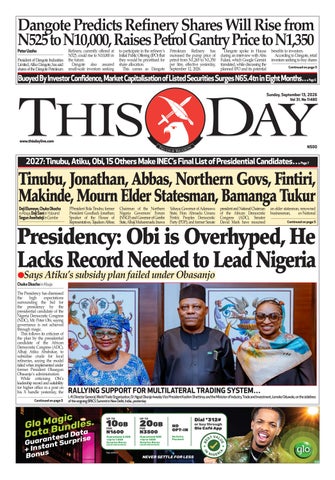
RALLYING SUPPORT FOR MULTILATERAL TRADING SYSTEM…
L-R: Director General, World Trade Organisation, Dr. Ngozi Okonjo-Iweala; Vice President Kashim Shettima; and the Minister of Industry, Trade and Investment, Jumoke Oduwole, on the sidelines of the ongoing BRICS Summit in New Delhi, India...yesterday
2
SUNday, SEPTEMBER 13, 2026 • T H I S D AY
SUNDAY, SEPTEMBER 13, 2026 • T H I S D AY
3
4
SUNday, SEPTEMBER 13, 2026 • T H I S D AY
5
SEPTEMBER 13, 2026 • T H I S DAY, T H E S U N DAY N E W S PA P E R
NEWS
Buoyed By Investor Confidence, Market Capitalisation of Listed Securities Surges N65.4tn in Eight Months Kayode Tokede
Buoyed by renewed investor confidence, impressive corporate earnings, and foreign exchange reforms, the overall market capitalisation of securities listed on the Nigerian Exchange Limited (NGX) rose by about N65.4 trillion in the first eight months of 2026. The three major categories of securities on the Exchange are equities, bonds and Exchange Traded Funds (ETFs). Statistics obtained by THISDAY
showed that the overall market capitalisation of listed securities closed August 2026 at N215.09 trillion, up by N65.4 trillion, or 43.7 per cent, from N149.735 trillion at the end of December 2025. A breakdown showed that equities accounted for the bulk of the increase, with market capitalisation rising by N58.5 trillion, or 59.04 per cent, to N157.7 trillion at the end of August 2026, from N99.183 trillion in December 2025. Similarly, the market
capitalisation of bonds listed on the NGX increased by about N5.9 trillion, or 11.7 per cent, to N56.3 trillion in August 2026, from N50.409 trillion at the end of 2025. The market capitalisation of ETFs also rose by N6.39 billion, or 14.9 per cent, to N49.236 billion from N42.845 billion in December 2025. Data obtained from the NGX further showed that the total market capitalisation of the Non-Interest Finance Board stood at N1.36 trillion in August 2026.
The Exchange also included Commercial Papers (CPs) among its debt securities for the first time in August 2026. Other securities in the debt market include corporate bonds/ debentures as well as federal, state and local government bonds. According to the statistics, the market capitalisation of commercial papers stood at N71.15 billion, while that of corporate bonds/debentures increased by 50.11 per cent to N1.34 trillion in August 2026, from N893.9 billion at the end
of 2025. The federal government's debt securities rose to N54.32 trillion in August 2026, from N49.32 trillion at the end of 2025, representing an increase of about 10.1 per cent. For state and local government securities, market capitalisation rose 91.13 per cent to N571.05 billion in August 2026, up from N298.77 billion at the end of 2025. The NGX has recorded significant growth so far in 2026, driven largely by the Central Bank of Nigeria's (CBN) foreign
exchange reforms, banking sector reforms, stronger corporate earnings, and renewed investor confidence. Relative stability in the foreign exchange market has also contributed to improved foreign capital inflows into the country. In addition, increased government borrowing to finance the 2026 budget boosted activity in the debt market, with some of the instruments listed on the NGX through the Debt Management Office (DMO).
PRESIDENCY: OBI IS OVERHYPED, HE LACKS RECORD NEEDED TO LEAD NIGERIA Special Adviser to President Bola Ahmed Tinubu on Information and Strategy, Mr Bayo Onanuga, argued that Obi’s supporters appeared to expect him to perform a miracle at the national level, despite what he described as the former Anambra State governor’s lack of governance pedigree. “How?” Onanuga asked, before stressing: “Governance is not by magic.” According to the presidential aide, anyone aspiring to become a national leader must have a record of governance to demonstrate the capacity to perform at a higher level. Onanuga described Obi as “simply overhyped and overrated,” and alleged that he was “clueless.” He also criticised Obi’s tenure as governor of Anambra State, describing him as a “spectacular failure” in office.
The presidential aide further faulted Obi over what he described as inconsistencies in his political positions. “He changes his positions like a chameleon,” Onanuga said. He also alleged that Obi’s worldview was shaped by his supporters on social media, saying, “his worldview is dictated by his mob on social media.”
Presidency: Atiku’s Subsidy Plan Failed under Obasanjo Meanwhile, the Senior Special Assistant to President Tinubu on digital and new media, Otega Ogra, has faulted Atiku’s plan to subsidise crude oil for local refineries, saying the model failed under former President Obasanjo’s administration. Reacting to the proposal
by the former vice-president for a production subsidy for local refineries, Ogra wrote on X (Twitter): “Excuse me, sir. Nigeria already tried your production-subsidyto-local-refineries idea while you were Vice President. We know the shambolic results of that production subsidy. You know it too.” Ogra said Warri refinery’s utilisation fell to 14.27 per cent in 2003 and 9.1 per cent in 2004, while Kaduna refinery recorded 15.96 per cent and 26 per cent, respectively. He said Port Harcourt refinery’s utilisation also dropped from 60.73 per cent in 2001 to 31.04 per cent in 2004. “Meanwhile, the price of petrol more than tripled by 2004 and nearly quadrupled by the time you left office despite your production subsidy to local refiners. “On October 9, 2003,
your same administration cancelled the discount itself through Presidential directive PRES/158. “President Obasanjo ordered NNPC to pay full international price for refinery crude. Your production subsidy was tried, failed and scrapped, with you as vice president. “So, before selling Nigerians this failed production subsidy policy again, answer one simple question. “I know there are many Nigerians who were too young to know what was happening then. But if you may tell them, where is the evidence that it worked the first time? “It’s still the same theory you practiced then, and we haven’t changed the country yet. “One thing we already have is the failed results of that experiment, Alhaji.”
Atiku’s Aide Faults Presidency’s Response on Subsidy In a related development, Atiku’s media aide, Eta Uso, has faulted the Presidency over its response to Atiku’s recent proposal on production subsidy. Uso, in a statement issued yesterday, said Onanuga’s response focused more on references to Atiku than on the substance of the policy proposal. “We gave you a policy argument. Instead of engaging it intelligently, you reached for ‘veteran presidential candidate’ and recycled a claim your colleague had already pushed,” Uso said. Uso argued that a presidential spokesman's responsibility was to explain and defend government policies rather than focus on an opposition politician. “Your job should be to
explain and defend your government’s policies,” he said. He added that repeated responses from the Presidency to Atiku’s interventions could further draw public attention to the former Vice-President’s policy positions. According to Uso, each response to Atiku’s proposals created an opportunity for wider public discussion of the differences between the former Vice-President's position and the federal government's. “If Atiku can announce one policy idea and send the Presidency into a full day of rebuttals… then neither you nor I should pretend there is any confusion about who is driving the national conversation,” he said. Uso said he remained open to further exchanges with Onanuga, arguing that continued official responses would keep Atiku’s proposals in the public domain.
TINUBU, JONATHAN, ABBAS, NORTHERN GOVS, FINTIRI, MAKINDE, MOURN ELDER STATESMAN, BAMANGA TUKUR
Chairman of PDP and former Governor of the old Gongola State, Alhaji Bamanga Tukur, who died at the age of 90. The presidential candidate of the Allied Peoples Movement (APM) and Governor of Oyo State, Mr. Seyi Makinde, and the Makinde/Daura Campaign Organisation have also expressed their sadness over Tukur’s passing. Tukur, who would be buried after funeral prayers at the Lamido’s Palace by 10a.m. on Sunday (today), would have celebrated his 91 years on
September 15, 2026, having been born on September 15, 1935. According to a statement issued by the spokesman of Tukur’s family, Oliver Okpala, the elder statesman died yesterday at 12noon in his residence at Adetokunbo Ademola Street, Wuse 2 in Abuja. Okpala said the statement was issued with the consent and approval of his first son, and Secretary to the Adamawa State Government, Hon. Awwal Tukur and his first daughter, Lami. Okpala explained that the body of the elder statesman would
be flown to Adamawa State immediately for necessary burial arrangements in keeping with the Islamic rights and injunctions. Reacting to his father's death, his eldest son, Awwal said the family would take solace on the exemplary life their father lived and the monumental legacies he bequeathed to posterity while alive. In his lifetime, Tukur was so great that he became the first African to address the United Nations Assembly in New York as a private person and non-head of a country or government.
Born on September 15, 1935, Tukur rose to national prominence as General Manager of the Nigerian Ports Authority (NPA) from 1975 to 1982, where he helped modernise port operations and improve Nigeria’s maritime sector. Tukur is survived by two wives and 18 children, among them the Secretary to the Government of Adamawa State, Awwal. Tinubu, in a statement issued yesterday by his Special Adviser on Information and Strategy, Mr. Bayo Onanuga, described the passing of Tukur, the Tafidan
Adamawa, as the end of a remarkable chapter in Nigeria’s political and economic history. According to Tinubu, Tukur was a towering figure whose distinguished career spanned public administration, governance, industry, politics and pan-African business leadership. "Alhaji Tukur was urbane, generous and deeply rooted in the values of integrity and service that the Adamawa Emirate and the nation hold dear. He was a man of big ideas and bold enterprise who believed in Nigeria's limitless potential. Nigeria will sorely miss
his wise counsel and fatherly guidance." Tinubu recalled Tukur's colourful foray into politics during the Second Republic, which led to his election as governor of the old Gongola State (now Adamawa and Taraba States) in 1983. According to the president, the deceased subsequently distinguished himself in the private sector as Chairman of BHI Holdings and the DADDO Group of Companies, conglomerates with interests Continued on page 14
DANGOTE PREDICTS REFINERY SHARES WILL RISE FROM N525 TO N10,000, RAISES PETROL GANTRY PRICE TO N1,350
worth N50,000, N100,000 and other smaller amounts would receive priority over large institutional investors. He said, “When you do something like this—what is called an IPO—all the smallscale investors are the ones who will be given priority first. “The big institutional investors who request large allocations will not get everything they ask for. But the small retail investors who want to buy N50,000 worth, or some buying N100,000 worth, and so on, are the ones who will be given priority allocations.”
He said the remaining shares would subsequently be distributed among investors. On the potential value of the shares, Dangote said the current N525 price could increase substantially, projecting that it could eventually reach N10,000. He said, “As I was saying, this share, if you look at it, is currently at N525. A day will come when this share will reach N10,000. “Therefore, if you hold it, having bought it, and it rises to N10,000, where you previously invested N5m, it will now be
worth over N50m. You see, you have become wealthy.” Dangote further said shareholders could choose to receive dividends in either naira or dollars, saying the option could help investors cope with currency depreciation. He said the dollar option would be particularly useful to Nigerians with financial obligations abroad, including parents with children studying in the United Kingdom. Dangote said, “The benefit of buying it is that holding this share will not prevent you from carrying out your
regular work. You hold this share, and when dividends are paid, you won’t need to fear currency devaluation. “That is because you can choose to receive your dividend in Naira or in Dollars. If you have a child studying at a school in England, for example, even if there is economic instability or currency devaluation—may God protect us—having this means what you receive is in Dollars.” He recalled the sharp depreciation of the naira against the dollar, saying the exchange rate had risen from about N400
to the dollar to N1,800. “So, your child won’t have to… avoid exchange rate shocks, like when rates moved from N400 up to N1,800. “Most children were brought back home as a result. So, what we want to prevent is that kind of situation,” he said. The Dangote Refinery IPO comprises 4.1 billion ordinary shares priced at N525 each. A full subscription is expected to raise about N2.15trillion, while the minimum subscription is 10 shares, costing N5,250. The offer is scheduled to run from September 14 to October 13,
2026. Meanwhile, Dangote Refinery has increased the gantry price of petrol by 6.7 per cent to N1,350 per litre from N1,265 per litre. The refinery also raised its coastal price to N1,783,530 from N1,669,543, representing an increase of N113,987, or 6.8 per cent. In a memo to customers, Dangote Petroleum Refinery announced the revised prices, saying: “Dear valued customer, please find below the revised DPRP PMS gantry and coastal prices, which are effective from 12th September 2026.”
6
T H I S DAY, T H E S U N DAY N E W S PA P E R • SEPTEMBER 13, 2026
NEWS
MOBILISING OPPOSITION AHEAD OF 2027…
L-R: National Convener, Atiku Pulse, Mr. Nuhu Ajan; Presidential candidate of the African Democratic Congress, Alhaji Abubakar Atiku; Director General, Atiku Pulse, Comrade Haruna Abubakar; and Promoter, Atiku Pulse, Kashim Ibrahim Imam, immediately after the official unveiling of the group in Abuja...yesterday
At BRICS Summit, Nigeria Says No Nation Can Progress in Isolation from Global Community Deji Elumoye in Abuja Nigeria yesterday reaffirmed its commitment to the World Trade Organisation (WTO) and the multilateral trading system, saying no country can prosper in isolation from the global community. Specifically, Vice President Kashim Shettima, who restated the country’s position, assured that Nigeria would continue
to support the WTO in strengthening multilateralism and promoting a global system built on cooperation rather than isolation. Shettima spoke during a meeting with the DirectorGeneral of WTO, Dr Ngozi Okonjo-Iweala, on the sidelines of the ongoing BRICS Leaders’ Summit in New Delhi, India. According to him: “I believe the world is greater
than one nation. We will continue to support the WTO in championing the cause of multilateralism. We are essentially one human family and interconnected. You cannot divorce yourself from the global community." The Vice President also made a case for migration as an important driver of development, innovation and economic growth, noting that
immigrants have historically contributed to the building of nations and cities across the world. “Nations are built by immigrants. Even cities are built by people who came from outside, not just by the locals. That goes to show that we have so much to gain from global migration,” he explained. Citing Nigerians in diaspora as an example, Shettima
Nigeria’s Vehicle Imports Surge 146% to N1.18tn in H1 2026, Overall Transport Equipment Import Bill Soars Nigeria’s imports of passenger motor vehicles rose sharply by 145.6 per cent year-on-year to N1.18 trillion in the first half of 2026, from N479.26 billion recorded in the corresponding period of 2025. An analysis of the Foreign Trade Statistics reports for the first and second quarters of 2026, released by the National Bureau of Statistics (NBS) showed that the increase in vehicle imports contributed significantly to the expansion of the country’s transport equipment import bill.
Overall, Nigeria imported transport equipment and parts valued at N3.73 trillion during the six-month period, up 44.2 per cent from the N2.59 trillion recorded in the first half of 2025. Transport equipment imports rose from N1.75 trillion in the first quarter of 2026 to N1.99 trillion in the second quarter. Passenger vehicle imports also increased from N552.34 billion in the first quarter to N624.75 billion in the second quarter. By comparison, passenger vehicle imports stood at N224.58
billion and N254.67 billion in the first and second quarters of 2025, respectively. The data, according to Nairametrics, showed that passenger motor vehicles recorded the strongest growth among the major transport import categories, with import value more than doubling within one year. Other transport equipment accounted for N1.83 trillion in the first half of 2026, up from N1.36 trillion in the corresponding period of 2025.
Within the category, imports of industrial transport equipment rose from N975.18 billion to N1.39 trillion. Imports of non-industrial transport equipment increased more moderately, rising from N380.96 billion in the first half of 2025 to N440.73 billion in the same period of 2026. However, imports of vehicle parts and accessories declined by about 4.4 per cent to N722.59 billion, compared with N755.43 billion in the corresponding period of 2025.
Nigeria High Commission Bows to Pressure, Refunds £50 to UK Passport Applicants Following complaints over charges imposed on Nigerians during the special passport intervention exercise in the United Kingdom, the Nigerian High Commission in the UK has announced a £50 refund for applicants who paid a £70 administrative fee for the ongoing passport intervention exercise. The commission said the applicants would retain £20 as the standard administrative fee.
The announcement was contained in a notice published on the Nigerian High Commission’s website at the weekend. “This is to inform all passport intervention applicants that have paid the £70 admin fee that £50 will be refunded to you, £20 being the standard admin fee,” the notice read. The development follows complaints about charges and difficulties Nigerians
experienced during the special passport intervention exercise in the UK. On September 8, the federal government had denied introducing additional charges for the exercise, saying applicants were required to pay only the official passport fees, excluding applicable bank charges. The Interior Ministry said neither it nor the Nigeria Immigration Service had
introduced charges outside the official passport fees. The NIS subsequently said on September 11 that no additional charges were required to participate in the intervention exercise. The passport intervention exercise, which was initially scheduled to end on September 19, has been extended in London and Manchester to October 3 following a high turnout of applicants.
said Nigerians abroad have continued to distinguish themselves through education, enterprise and professional achievement. "Recent Pew Research Centre analysis of 2024 US Census Bureau data showed that 67 per cent of Nigerian-born Black immigrants aged 25 and above in the United States held at least a bachelor’s degree, the highest proportion among the major Black immigrant groups examined," he stated. The vice president also commended Okonjo-Iweala for her leadership of the WTO, urging her to continue deploying her experience in the service of global development. “You are doing a very wonderful job at the WTO, but you still have a lot to contribute to humanity,” he told the WTO DG.
Okonjo-Iweala, the first woman and first African to head the WTO, began her second four-year term as Director-General in September 2025. Meanwhile, Shettima will present Nigeria's partnership and foreign investment opportunities today when he speaks to leaders of the BRICS alliance at the ongoing summit themed, "Building for Resilience, Innovation, Cooperation and Sustainability." While seeking a more inclusive international order, the vice president will reiterate the objective of President Bola Tinubu's Renewed Hope Agenda to create sustainable opportunities for its people through reforms, the expansion of infrastructure, and the promotion of private-sector-led growth.
Military Air Strikes Destroy Terrorist Logistics Hubs, Kill 18 in Borno
Linus Aleke in Abuja
The Nigerian military said an air interdiction operation conducted by the Air Component of Joint Task Force North-east, Operation Hadin Kai (OPHK), in close coordination with ground troops of Sector 1 OPHK, destroyed identified terrorist enclaves at Tumbunma Baba in the Tumbuns general area of Borno State, killing more than 18 terrorist elements. According to a statement by the Acting Military Information Officer of Joint Task Force North-east, Operation Hadin Kai, Captain Mohammed Goni, the operation was based on credible intelligence gathered over several weeks, indicating the presence of high-profile terrorist elements at a convergence of meeting points and logistics nodes within the islands.
Goni said the intelligence was subsequently validated through further surveillance by the Theatre Command and confirmatory intelligence, surveillance and reconnaissance (ISR), which pinpointed several terrorist structures and logistics hubs in the area. The findings confirmed that the location was being used as a terrorist gathering point and support base. He said the intelligence-led effort culminated in kinetic operations successfully conducted in the early hours of Friday, September 11, 2026. “Following the identification of the targets, the air platforms acquired and engaged the designated locations with precision munitions, while ground troops occupied all likely escape routes to facilitate further direct-fire engagements.
7
SEPTEMBER 13, 2026 • T H I S DAY, T H E S U N DAY N E W S PA P E R
NEWS
PRESENTATION OF AMUTA’S BOOK…
L-R: Chairman, TANUS Communications, Dr. Yemi Ogunbiyi; representative of former military President, General Ibrahim Babangida (rtd.), Mr. Ibrahim Abbe; Author of the book, Dr. Chidi Amuta; Abia State Governor, Alex Otti; and Vice-Presidential candidate of African Democratic Congress, Hon. Chibuike Rotimi Amaechi, at the public presentation of Amuta's memoir, HOMAGE, in Lagos... yesterday
2027: Tinubu, Atiku, Obi, 15 Others Make INEC’s Final List of Presidential Candidates
Akpabio, Abbas, Barau, Kalu, 4,860 others jostle for 469 National Assembly seats
Adedayo Akinwale in Abuja President Bola Tinubu of the All Progressives Congress (APC); former Vice President Atiku Abubakar of the African
Democratic Congress (ADC); former governor of Anambra State, Mr. Peter Obi of the Nigeria Democratic Congress (NDC); and Oyo State Governor, Mr. Seyi Makinde of the All
Progressives Congress (APM) are among the 18 presidential candidates that made the final list released yesterday by the Independent National Electoral Commission (INEC) for the 2027
general election. This is as indications emerged last night that Senate President, Senator Godswill Akpabio and his deputy, Senator Barau Jibrin, Speaker of the House of
Datti Baba-Ahmed: Tinubu Built Structure for 16 Years, Only God Can Stop Him in 2027
Chuks Okocha in Abuja
The Labour Party (LP) vicepresidential candidate in the 2023 presidential election, Datti Baba-Ahmed, said only God can stop President Bola Tinubu from winning the 2027 presidential election. Baba-Ahmed made the statement in a television interview, while discussing the political activities ahead of the 2027 elections and the strengths of the major presidential contenders. Although he said he disagreed with some of
Tinubu’s policies, Baba-Ahmed acknowledged the president’s long-term political organisation and ability to build alliances. He said Tinubu spent about 16 years building a political structure and played a significant role in bringing former President Muhammadu Buhari into an alliance ahead of the 2015 presidential election. “Even though I don’t entirely agree with him, he did what others were not able to do. He organised for 16 years, not just planning,” Baba-Ahmed said. He described Tinubu’s victory in the 2023 presidential election
as an extraordinary political achievement, arguing that the President had demonstrated an ability to pursue difficult and unconventional political strategies. Baba-Ahmed also contrasted Tinubu’s political organisation with that of former VicePresident Atiku Abubakar, the African Democratic Congress (ADC) presidential candidate, suggesting that Atiku might have faced resistance from people around him in pursuing similar strategies. According to him, Tinubu currently has overwhelming
influence over Nigeria’s political space and has succeeded in weakening opposition parties' efforts to form a united front. “He (Tinubu) will not allow them (opposition) to come together. He probably actually chooses candidates in the opposition parties. He installs leadership in those political parties. He does what you and I cannot imagine,” he said. Baba-Ahmed also stated that if Tinubu decided that he would be declared President in 2027, only God could prevent it.
Representatives, Abbas Tajudeen and his deputy, Benjamin Kalu, are among 4,864 candidates of the contesting the available 469 National Assembly seat in the January 16, 2027 National Assembly elections. Ahead of the 2027 general election, the electoral commission yesterday published the final list of the presidential candidates and their running mates. According to its timetable and schedule of activities, the electoral body set January 16 for the presidential and National Assembly elections. However, the presidential election would feature 18 political parties. The list, signed by the commission's Secretary, Rose Oriaran-Anthony, features two female presidential candidates — Ada Okwori of NDP and Nkem Okereke of NRM — alongside four female vice-presidential candidates. None of the 18 presidential candidates or their running mates declared any form of disability.
The candidates' ages range from 35 to 80, with qualifications spanning First School Leaving Certificate, WAEC and NABTEB certifications to university degrees, including doctorate holders among both the presidential and vice-presidential candidates on the list. The list shows that the APC has Tinubu, 74, as its standardbearer, with Kashim Shettima, 59, as his running mate. The ADC has veteran presidential contestant and former Vice President Atiku, 79, as its candidate, with former Minister of Transportation, Hon. Rotimi Amaechi, 61, as his running mate. Former Governor of Anambra State, Obi, 65, is on the ballot again as the NDC presidential candidate, running with Rabi Kwankwaso, 69, as his running mate. Similarly, Sunday Okereke, 43, of the Labour Party (LP), is paired with Hajja Bintu Konto, Continued on page 14
Fani-Kayode Demands Justice for Over 100 Nigerians Killed in South Africa, Says Eight Killed in 2026 Sunday Ehigiator
Nigeria’s Ambassadordesignate to South Africa, Mr. Femi Fani-Kayode, has condemned the alleged killing of two Nigerians in Johannesburg, South Africa, and called on the South African Government to take urgent steps to protect Nigerian
nationals and prosecute those responsible for their deaths. The former minister further alleged that more than 100 Nigerian nationals had been killed in South Africa between 2022 and September 2026, with more than 30 of the victims allegedly killed by personnel of the South African Police Service and South African
Defence Force. Fani-Kayode, in a statement on his X account yesterday, said he was “mortified and deeply shocked” by the murder of Bishop Michael Taiwo Fakunle, who was allegedly shot dead by unknown assailants at his home in Johannesburg on September 4, after reportedly receiving a series of threats.
He also expressed concern over the death of another Nigerian, Mr. James Uchechukwu Nwankwo, who reportedly died on September 5 following what he described as “gruesome interrogation techniques” allegedly used by officers of the South African Police Service. According to Fani-Kayode,
the two deaths brought to eight the number of Nigerians allegedly murdered in South Africa in 2026, with four of the eight reportedly killed by South African security personnel. “Bishop Fakunle and Mr. Nwankwo are the 7th and 8th Nigerians to have been murdered in South Africa this year alone. No less than
four amongst the eight were murdered by South African police officers.” He expressed concern that despite repeated complaints and expressions of concern by Nigerian authorities and stakeholders, no person had been arrested, detained, prosecuted or brought to justice over the alleged killings.
8
T H I S DAY, T H E S U N DAY N E W S PA P E R • SEPTEMBER 13, 2026
NEWS
BRAINSTORMING ON QUALITY OF TERTIARY EDUCATION…
L-R: Former Registrar, Joint Admissions and Matriculation Board, Professor Isaq Oloyede; Minister of Education, Dr. Maruf Tunji Alausa; and Chairman, Council of Legal Education, Chief Emeka Ngige (SAN), after the inauguration of the ministerial committee on strengthening the accreditation and quality assurance system in tertiary institutions in Nigeria in Abuja…recently
Ortom: Why I Lent Obi My Vehicle During Benue Visit Challenges Gov Alia to explain his achievements
Chuks Okocha in Abuja and George Okoh in Makurdi
The immediate past governor of Benue State, Mr Samuel Ortom, has explained why he provided his vehicle to the presidential candidate of the National Democratic Congress (NDC), Mr Peter Obi, during his visit to the state last Tuesday. Ortom has also accused the administration of Governor Hyacinth Alia of attacking him and the Peoples Democratic Party
(PDP) governorship candidate, Chief Michael Aondoakaa, as a means of diverting attention from issues confronting the state. Ortom, who spoke through his media aide, Terver Akase, said it would have been petty for him to decline to assist Obi with his vehicle during the visit. Ortom was reacting to the accusation by the state governor, Alia, that he was behind Obi’s visit to the state. Describing himself as a statesman who understands
the demands of public service and the obligations that come with leadership, Ortom argued that it was both ridiculous and shameful for anyone to attempt to criminalise or politicise the simple act of making a vehicle available to a fellow Nigerian leader. “Peter Obi is a former governor, a presidential candidate and one of the most prominent political figures in the country. Imagine how it would have sounded if Chief Ortom had
refused to assist him with transportation while he was in Benue State on a humanitarian mission to visit internally displaced persons. “Such a refusal would rightly have been viewed as petty, inhospitable and beneath the dignity of a former governor. Indeed, extending such a courtesy should ordinarily have been the responsibility of the Benue State Government itself, given the status of the visitor. “That the Alia administration
APC's Spokesman Tackles Kwankwaso on Promise to Take Care of Atiku If He Withdraws from Presidential Race Adedayo Akinwale
The spokesperson of the All Progressives Congress (APC), Felix Morka, has tackled the vice presidential candidate of the Nigeria Democratic Congress (NDC), Senator Rabiu Musa Kwankwaso over his promise to take care of the presidential candidate of the African Democratic Congress (ADC), Atiku Abubakar if the former vice-president withdraws from the 2027 presidential race. Kwankwaso, the running mate to the presidential
candidate of the NDC, Mr Peter Obi, had on Monday appealed to Atiku to abandon his presidential ambition and support the Obi-Kwankwaso ticket in next year’s election. He cited Atiku’s age and health, adding that the former vice-president would be taken care of if the opposition ticket wins the presidency. Reacting yesterday in a post on X, Morka questioned the confidence of the opposition in negotiating over the presidency before Nigerians have decided
who will occupy the office in 2027. He described the development as an indication of what he characterised as hypocrisy within the opposition camp. “At last, the veil comes off … behold the whited sepulchre … they pretend to be saints on the outside but filled with the stench of corruption and malignant hypocrisy on the inside,” Morka wrote. The APC spokesperson said the opposition was engaging in “horse trading” over an office it had neither won nor been
guaranteed. “Horse trading with the presidency they do not have, and will not have, by the sovereign will of the Nigerian electorate, come 2027,” he said. Kwankwaso had urged Atiku, who will turn 81 next year, to step aside from the presidential contest and support the NDC ticket. Atiku has, however, maintained his interest in the 2027 presidential race, previously stating that the election would be his final attempt at becoming president.
Ajaero Urges Labour Leaders to Seek Political Power, Hails Gov Idris on His Achievements
Onuminya Innocent in Birnin Kebbi
The President of the Nigeria Labour Congress (NLC), Comrade Joe Ajaero, has urged labour leaders to aspire to political leadership, saying former union leaders' experience in government has shown the value of workers’ representation in positions of authority. Ajaero made the call in Birnin Kebbi, the Kebbi State capital,
while addressing members of the NLC’s National Administrative Council (NAC) during a dinner hosted by Kebbi State Governor, Nasir Idris. He described Kebbi as a second home for the NLC, following the emergence of a former labour leader as the state governor. The NLC President noted that Governor Nasir Idris, who previously served as Deputy National President and Acting
President of the Congress, contributed significantly to the labour movement's growth and influence. Ajaero said the NLC would continue to seek opportunities for more former labour leaders to occupy political offices, stressing that such positions provide a platform to influence policies and improve workers’ welfare. He also commended Governor Idris for what he described
as ongoing transformation in Kebbi State, while assuring the governor of the Congress’ continued support. Ajaero said the NLC leadership had repeatedly visited Kebbi because of what he described as the state's peaceful and secure environment, despite what he called negative publicity. He added that the Congress would continue to visit the state and maintain its relationship with the governor.
is now trying to make a controversy out of what was merely a humane, courteous and statesmanlike gesture exposes the poverty of its argument and the desperation behind its propaganda. In other climes, leaders are commended for extending courtesies across political divides, not vilified for doing so. “The attempt to portray an act of hospitality as evidence of wrongdoing is both intellectually dishonest and politically immature.” On the allegation that he was being “double-faced”, the former governor described it as “laughable”, saying he was a man of his word and would always stand by any candidate he publicly declared support for. He said that in 2023, he publicly declared his support for Obi but had now declared his support for President Bola
Tinubu. Governor Alia, and his predecessor, Ortom, had traded words over Obi’s failed visit to the state. Obi had visited Makurdi last Tuesday, with plans to proceed to Yelewata for a condolence visit to the families of victims of the June 2025 massacre. His convoy was, however, blocked by some youths around Gyado Villa, a few kilometres from the airport. Governor Alia, through his Chief Press Secretary, Kula Tersoo, on Friday accused Ortom of facilitating Obi’s visit to the state. Tersoo alleged that the former governor masterminded the visit by the NDC presidential candidate, adding that Ortom, who had openly claimed to support President Bola Tinubu, was actually working for Obi ahead of the 2027 elections.
2027: Haske Dumps APC, Picks Governorship Ticket of APM in Adamawa
Daji Sani in Yola
A renowned businessman and politician, Abdulrahman Haske has resigned his membership of the All Progressives Congress (APC) and joined the Allied Peoples Movement (APM) as its governorship candidate for the 2027 elections in Adamawa State. Haske announced his defection yesterday at an event in Yola, which was attended by APM leaders, stakeholders, traditional and community leaders, youth and women groups, as well as supporters from across the state’s 21 local government areas. He said his decision to join the APM was driven by his belief that the party offered a platform to advance a people-centred development agenda and build a more prosperous, inclusive and secure Adamawa State.
“Today is not merely about joining a political party; it is about strengthening a movement dedicated to the future of Adamawa State. Our objective remains clear: To build a state where governance works for the people, where young people have opportunities to succeed, where communities are connected to development, and where public resources are managed transparently for the common good,” Haske said in a statement signed by his Publicity Secretary, Abdulgaffar Ahmed. The APM candidate said he would focus his campaign on agriculture, infrastructure, education, healthcare, economic empowerment, security and accountable governance. He also thanked the national leadership of the APM and the Adamawa State chapter for entrusting him with the party’s governorship ticket.
9
SUNDAY, SEPTEMBER 13, 2026 • T H I S D AY
The National Essay Competition is UBA Foundationʼs annual education initiative, designed to promote a culture of reading and to encourage healthy intellectual competition amongst secondary school students in Nigeria and across Africa.
Stand a chance to win N15 Million towards your university education. Winner
THIS YEARʼS ESSAY TOPIC:
N15,000,000
No Nation can develop without food security. How can Nigeria deal with this problem?
2nd Position
N10,000,000 3rd Position
WHO CAN APPLY
N7,500,000
Nigerian senior secondary school students Complete contact details Scanned copy of your handwritten essay of 750 words maximum (not typed) Recent passport photograph Scanned copy of birth certificate or National ID or International Passport
4th Position
N5,000,000 5th Position
N3,500,000
ENTRIES CLOSE: Friday, October 23rd, 2026
Educational Grants to any African University
READY TO ENTER? SCAN TO APPLY
OR VISIT: https://www.ubagroup.com/nec/
Terms and Conditions Apply
10
SUNday, SEPTEMBER 13, 2026 • T H I S D AY
SUNDAY, SEPTEMBER 13, 2026 • T H I S D AY
11
SUNday, SEPTEMBER 13, 2026 • T H I S D AY
12
The International Advisory Council as well as the Board of Incorporated Trustees of AFRICANS IN DIASPORA ORGANIZATION, NEW YORK Are proud to
Professor (Eze) Anugbum Onuoha, DSSRS Professor of Secured Credit Law at Rivers State University (RSU) in Port Harcourt, Nigeria and currently, Resident Electoral Commissioner (REC) for Akwa Ibom State, Nigeria
The highly prestigious International Awards shall formally be presented to Professor Anugbum Onuoha at the
To be attended by the LEADING NIGERIAN AND
AFRICAN STAKEHOLDERS IN THE TERTIARY EDUCATION SECTOR
To be held in Lagos Nigeria on 22nd October, 2026
Announcer: PRESIDENT/CHIEF EXECUTIVE AFRICANS IN DIASPORA ORGANIZATION, NEW YORK
13
SUNDAY, SEPTEMBER 13, 2026 • T H I S D AY
PRESENT
KANO
THE GRAND HOMECOMING IPO FOR THE PEOPLE
SPECIAL GUEST OF HONOUR & CHAIRMAN
HOST
KEYNOTE ADDRESS
Muhammad Sanusi II
Aliko Dangote, GCON
Bismarck Rewane
His Highness, Emir of Kano
PANELISTS Engr. Mansur Ahmad
Dr. Farouk Umar
Dr. Hassan Mahmud
Mr. Tilewa Adebajo
DATE
TIME
VENUE
Thursday, September 17, 2026
10:00am West Africa Time
Meena Events Center Kano, Nigeria
Join online youtube.com/live/y1EcouzeDnI Dangote Petroleum Refinery Plc · Offer for Subscription · ₦525 per share · September 14 to October 13, 2026
14
T H I S DAY, T H E S U N DAY N E W S PA P E R • SEPTEMBER 13, 2026
NEWS
DEEPENING ENERGY REPORTING ON THEIR MINDS…
L-R: Former Special Adviser on Media and Publicity to ex-President Muhammadu Buhari, Mr Femi Adesina; Chairman, Society of Energy Editors and Co-Founder of NewsCraft, Alhaji Yakubu Lawal; and Chief Executive Officer, EMBEDS Associated Engineering, Mr. Jatto Adams, during the inaugural seminar of the Society of Energy Editors in Lagos ... recently
IG Didn’t Ban Recording Policemen, Only Opposes Misuse for Skits, Police Clarify
Linus Aleke in Abuja
The Nigeria Police Force has clarified that the InspectorGeneral of Police (IG), Olatunji Disu, does not oppose citizens recording police officers, saying his concern is the misuse of such recordings. The New Media Officer of the Force, Aliyu Giwa, clarified this in a series of posts on X yesterday, following controversy over the IG’s recent comments on Nigerians filming police officers. Giwa said Disu’s position was misinterpreted, stressing that the Police were not trying to shield officers from accountability or deny citizens their rights. “The IG’s concern is not to shield Police officers from accountability or deny citizens their rights. Instead, it focuses on the misuse of recordings, especially when officers are provoked, ridiculed, filmed for entertainment, or subjected to unnecessary intrusion while performing their duties,” Giwa said in his first post. He said there was a distinction between responsible documentation and deliberately
exploiting encounters with police officers for social media content. Giwa added that legitimate recordings could serve both citizens and police officers. “As a public institution, the Police must remain open to legitimate scrutiny. Evidence is essential when an officer acts improperly. Similarly, responsible recording can protect officers from false allegations and support investigations,” he said. He maintained, however, that police officers were entitled to dignity and privacy. “However, wearing the uniform does not remove an officer’s right to dignity or privacy,” Giwa said. The clarification came after an X user criticised the IG’s position and argued that Police should equip officers with body cameras if they opposed citizens recording them. Responding to the user, Giwa said the IG had not rejected the practice of recording police officers generally. “While you are allowed to interpret it as you see fit, the message from the IG was concerning the misuse of
recordings, not a general rejection of legitimate documentation or accountability,” Giwa said in his reply. He also confirmed that body cameras were being considered as part of discussions around
accountable policing. Giwa urged Nigerians to discuss the issue without resorting to insults, saying both the Police and citizens ultimately had the same objective. “The Police need to be
accountable, and citizens should responsibly exercise their rights; we can have that discussion without using insults. The end aim is the same, a more professional Police Force and a safer Nigeria,” he said in the
reply. In his initial post, Giwa also rejected framing the issue as a confrontation between the Police and citizens, or between Disu and the Nigerian Bar Association (NBA).
2027: TINUBU, ATIKU, OBI, 15 OTHERS MAKE INEC’S FINAL LIST OF PRESIDENTIAL CANDIDATES 54; and Sandy Ojang Onor, 60, of the Peoples Democratic Party (PDP), is running with Umaru Babangida, 61 Other candidates on the lis.t are: Omoyele Sowore of the African Action Congress (AAC), with Haruna Magashi as his running mate; Seyi Makinde of Allied Peoples Movement (APM), running with Musa Daura; and Sunday Adenuga of BP, pairing with Usman Turaki Mustapha. In the same vein, Rufai Omo-Aje of Action Alliance (AA) is running with Shehu Hussaini; Aliyu Abbas-Bin of ADP is paired with Chinazam Ike; Kabiru Yusuf of APP is running with Peace Egobia Ofordile; and Moses Adebisi of DLA has Nafisat Abubakar as his running mate.
In addition, Ada Okwori of the National Democratic Party (NDP), paired with Uchenna Chukwuemeka; Nkem Okereke of the National Rescue Movement (NRM), running with Nasir Sulaiman; and Donald Duke of the Peoples Redemption Party (PRP), alongside Kabiru Rabiu. Also, Adewole Adebayo of the Social Democratic Party (SDP), paired with Usman Bugaje; Peter Agada of the Young Progressives Party (YPP), running with Patience Ndidi; and Daniel Nwanyanwu of the Zenith Labour Party (ZLP), alongside Hassan Khalid. Meanwhile, Senate President, Akpabio and his deputy, Jibrin, Speaker of the House of Representatives, Abbas and his deputy, Kalu, are among 4,864
candidates of the contesting the available 469 National Assembly seat in the January 16, 2027 National Assembly elections. This is made up of 1,304 candidates for the 109 Senate seats across the 36 states and the FCT and 3,560 candidates for the 360 House of Representatives seats. Senate Leader, Bamidele Opeyemi, Senate Whip, Mohammed Tahir Mongunu and Deputy Chief Whip, Onyekachi Nwaebonyi, Deputy House Leader, Abdullahi Ali are also on the list. A quick check through the list revealed that about 190 current members of House of Representatives and 54 serving senators got the nod of the APC to recontest their seats. It is not however clear
whether they were defeated at the party primaries or opted not to contest. Some principal officers of the House (Julius Ihonbvere (Edo-House Leader), Fred Agbedi (Bayelsa-Minority Leader), Ibrahim Ayokunle Isiaka (Ogun-Deputy Chief Whip), Abdulsamad Dasuki (Sokoto-Deputy Minority Whip) and Deputy Minority Whip, George Ozodinobi will not be returning to the House. While Ihonvbere and Ibrahim lost the primary elections in their state, Agbedi opt to contest the senate election on the platform of the Tanimu Turaki led camp of the Peoples Democratic Party, Dasuki opted not to recontest the elections while Ozodinobi’s name was missing from the list of candidates in Anambra.
TINUBU, JONATHAN, ABBAS, NORTHERN GOVS, FINTIRI, MAKINDE, MOURN ELDER STATESMAN, BAMANGA TUKUR
in manufacturing, agriculture, logistics and trading, and served as Minister of Industries under the administration of the late General Sani Abacha from 1993 to 1995. On the continental stage, Tinubu said Tukur was an eloquent champion of Africa's economic renaissance. “As Executive President of the African Business Roundtable and Chairman of the NEPAD Business Group, he was a relentless advocate for intra-African trade, private sector-led growth and sustainable development,” he added. The president added that Tukur
was the National Chairman of the PDP from March 2012 to January 2014, and made sterling contributions to democracy through enforcing party discipline and building consensus. Former President Jonathan has also expressed deep sadness over the passing of Tukur, whom he described as a distinguished elder statesman, patriot, accomplished businessman and committed democrat. In a condolence message released by his spokesman, Mr Ikechukwu Eze, the former President also described the late Tukur as a man who dedicated
much of his life to the service of Nigeria and made significant contributions to the country's political development and democratic consolidation. “His contributions to Nigeria's political development, democratic consolidation, and national unity remain significant,” Jonathan added. On his part, Speaker of the House of Representatives, Abbas described Tukur as one of the firmest politicians in the north who left an indelible mark in the country ‘s history. He expressed sadness over the passing of the former governor of the defunct Gongola State.
Speaker Abbas, in a message signed by his Special Adviser on Media and Publicity, Musa Abdullahi Krishi, described Bamanga Tukur’s demise as a huge loss to the business and political communities, noting that the deceased was an elder statesman whose marks will remain indelible in the country’s history. The Speaker said apart from Bamanga Tukur’s exemplary foray in public administration, governance, industry, politics and pan-African business leadership, he was also a devoted Muslim who propagated Islam and blessed humanity with his wealth.
He added that Tukur, as national chairman of PDP, contributed immensely to the improvement of Nigerian democracy and standard political practices. In a condolence message on behalf of his colleagues in the NNGF, Governor Yahaya described the death of the elder statesman as a profound loss to the North and the nation, saying Nigeria had lost one of its most experienced public servants, political leaders and champions of economic development. The condolence message contained in a statement issued
by the Director-General Press Affairs, at the Government House, Gombe, Ismaila Uba Misilli, noted that Tukur’s vast experience in public administration, politics, business and continental affairs established him as one of the prominent figures of his generation whose contributions will remain part of Nigeria’s history. “Alhaji Bamanga Tukur lived a long and impactful life, serving Nigeria in several critical capacities and contributing significantly to the growth of our economy, institutions and political development,” Governor Yahaya said.
15
SUNDAY, SEPTEMBER 13, 2026 • T H I S D AY
IN MEMORIAM 60 Years In Mind
In loving and evergreen memory of our father, husband, grandfather, great grandfather, great great grandfather, uncle, friend, benefactor, Founder and Chairman.
Sir Louis Philip ODUMEGWU OJUKWU OBE,KBE, (Honorary) LLD Who departed this world on 13th September 1966 at Nkalagu. Papa it has been 60 years. We forever treasure your generosity, kindness and example. Rest in peace, Papa. May the almighty God bless us all. Prof Joseph Okwuabudike Ojukwu MFR. Chimelumdibia Nnewi. Chairman, Ojukwu Transport Limited. For the Family and Company.
16
T H I S D AY, T H E S U N D AY N E W S PA P E R SEPTEMBER 13, 2026
NEWS
CSR IN ACTION…
Aiteo Group representative/NCTL’s Chief Security Officer, Mr. Nduka Onyeri, and a Police representative during the donation of solar power system to Lekki Police Divison in Lagos…recently
60 Years After Louis Ojukwu’s Death, Family Revives Memorial Projects, Raises UNN Prizes Wale Igbintade
Sixty years after the death of Sir Louis Philip Odumegwu Ojukwu, one of Nigeria’s pinoeering businessmen and philanthropists, his family is reviving and expanding some of the institutions and initiatives associated with his name, including educational prizes at the University of Nigeria, Nsukka (UNN); scholarships; charitable projects and plans for a memorial hospital. The renewed effort to preserve his legacy is part of a series of activities planned to mark the 60th anniversary of the death of the celebrated businessman, who died at Nkalagu located in the defunct Eastern Region, but in the present Ebonyi State, on September 13, 1966. The family has scheduled a Mass in his memory and other
low-key commemorative activities, with Ojukwu Transport Limited (OTL), the company he founded, also expected to play a role. A Director of OTL and grandson of the deceased, Dr Ike Ojukwu, an Obstetrician and Gynaecologist, said the commemoration would go beyond remembering the late businessman to preserving the values and institutions he held dear. According to him, the family’s objective was to ensure that Sir Odumegwu’s commitment to education, integrity, enterprise and service continued to benefit future generations. An upward revision of the annual Sir LP Odumegwu Ojukwu prizes for the best graduating students in the Faculty of Business Administration and the Department of Estate Management/ Surveying at UNN has already
DR Congo Records over 7,000 Ebola Cases, Worst Ever More than 7,000 Ebola cases have been recorded in the Democratic Republic of Congo’s worst outbreak of the deadly disease ever, according to figures from the Congolese authorities. The DRC officially detected the latest outbreak in mid-May, with nearly 3,400 people killed in its 17th epidemic of the highly infectious virus. It began in the northeastern Ituri province before spreading to conflict-plagued, remote eastern and northern regions where armed groups have roamed for decades, the presence of the state is weak, and health infrastructure is largely lacking. Earlier last week, the disease was confirmed to have spread to a seventh province, South-Ubangi, which borders the Central African Republic and Congo-Brazzaville. According to the latest figures from the Congolese authorities, 7,022 cases have been recorded since the beginning of the epi-
demic, of whom 3,398 have died, and 1,671 people have recovered. Most of the recorded cases are in Ituri, where Ebola has been detected in schools in the days after the post-summer holiday return to classes, causing alarm among parents and health workers. “We are very worried because we don’t know which child comes from which family or what the health status of the members of that family is,” Angele Magani, mother of a schoolboy in Bunia, Ituri’s provincial capital, told AFP. “We are so scared, even though the school authorities reassure us about the health measures that have been put in place,” she added. Bunia school official Roger Mungimbo told AFP that “there is a mandatory hand-washing system with soap, and we have also done everything possible to have a maximum of 30 pupils per classroom.”
been approved. Current winners of the prizes have been urged to contact Ojukwu Transport Limited, while the university authorities have been notified of the development. The Sir Odumegwu Ojukwu Hall at the university’s Enugu Campus will also form part of the family’s commemorative focus, while plans for a memorial hospital, scholarships and other charitable initiatives are being developed. The renewed focus on UNN is particularly significant given Sir Odumegwu’s associa-
tion with the institution and his contribution to its establishment. Sir Odumegwu was conferred with an honorary Doctor of Laws degree by the University of Nigeria in the early 1960s. The university was a brainchild of the late Dr Nnamdi Azikiwe, the Owelle of Onitsha, who was a close friend of Sir Odumegwu. The defunt Eastern Regional Government provided the bulk of the funding for the establishment of the institution. Sir Odumegwu, who served
as Chairman or Director of several government agencies and was Chairman of the African Continental Bank, contributed significantly to the mobilisation of funds for the university. For his family, however, his legacy transcended business, public service and philanthropy. He was remembered as a proud and unapologetic Igbo man who was nevertheless “totally detribalised”, placing competence, loyalty and integrity above ethnic considerations. The family cited the appointment
of Nelson Oyesiku to the National Shipping Line in 1964 as one example of his willingness to recognise merit irrespective of ethnic background. His friends, business partners and associates, it added, came from different parts of the country and from diverse walks of life. Born in 1909 in Umudim, Nnewi, Sir Odumegwu was the sixth of the 10 sons of Ojukwu Eze Okigbo and the only son of his mother, Ukonwa, who had four children. The others were Mrs Nwosu, Mrs Okoli and Mrs Obi.
Kwara Community Monarch, Oba Oyinloye, Dies One Week after Regaining Freedom from Bandits’ Den Hammed Shittu in Ilorin The royal father of Igbesi town in Isin Local Government Area of Kwara State, Oba David Omotayo Oyinloye, who recently regained his freedom from the bandits’ captivity, has been confirmed dead. The late monarch, it was gathered, died in the wee hours of yesterday after a brief illness, one week after he regained his freedom from bandits’ captivity. Recall that Oba Oyinloye was kidnapped last month by some
suspected bandits following a fierce attack by the suspected bandits that invaded his palace. The ugly development caused tension in the ancient town of Igbesi, prompting security agencies to storm the town to defuse tensions and, more importantly, rescue the late royal father. The mass deployment of the security agencies and local vigilantes into the town, however, yielded positive results with the release of the late monarch last month. Sources close to the town told THISDAY yesterday that since
the late royal father regained his freedom, he was said to have taken ill and been hospitalised for medical treatment. They said that the late monarch was said to have died in the wee hours of yesterday. Sources added that the late monarch’s death has cast a pensive mood over the ancient town of Igbesi. However, a statement issued yesterday by the Executive Chairman of Isin Local Government Area of the state, Hon. Jolayemi Benjamin Olarewaju, to announce the death of the late monarch
said: “On behalf of the Local Government Council, management, staff and the good people of Isin Local Government, I regret to announce the passing of His Royal Highness, Oba David Omotayo Oyinloye, the Onigbesi of Igbesi, after a brief illness. “The late traditional ruler was a respected custodian of the culture, history and traditions of his people, whose contributions to the peace, unity and development of Igbesi and Isin Local Government will be remembered with deep appreciation.
2027: Clash of Titans as Governor AbdulRazaq, Mustapha Battle for Kwara Central Senatorial Seat Hammed Shittu in Ilorin The Independent National Electoral Commission (INEC) has published the names of Kwara State Governor Alhaji AbdulRahman AbdulRazaq and the incumbent senator representing Kwara Central, Saliu Mustapha, as candidates for the Kwara Central senatorial election in 2027. The publication of the names of the candidates for Kwara Central
senatorial district, according to THISDAY checks, has effectively set the stage for what is expected to be a closely watched contest between Governor AbdulRazaq of the All Progressives Congress (APC) and Mustapha of the Peoples Democratic Party (PDP). According to the list, other candidates include Adesola Kehinde (AA), Gani Omolabi (ADP), Gbadesogun Olufemi Adeleke (APP), Abdulahi Risikat Motun-
rayo (ADC), Anjorin John Temitayo (APM), Abdulkarim-Adisa Maryam Ayoola-Fadekemi (LP), Adefolu Adekunle (NRM), Lawal Abdulhakeem Toyin (NNPP), and Suleiman Abdulrasheed Olufemi Omoda (NDC). The development, it was further learnt, has put an end to weeks of speculation over whether Mustapha, the PDP candidate, would appear on the final list. In recent weeks in the state,
some supporters and political allies of the governor allegedly expressed confidence that Senator Mustapha’s candidature would not survive the process, with some insisting that the PDP candidate would ultimately not appear on the ballot. Speaking with reporters in Ilorin yesterday, social commentator Dr Abdulmajeed Ali argued that Senator Mustapha’s presence on the ballot had always been a major concern for the ruling party.
SUNDAY, SEPTEMBER 13, 2026 • T H I S D AY
17
18
BUSINESS
T H I S DAY, Th e S U N DAY N e w S PAPe r •September 13, 2026
Editor: Festus Akanbi 08038588469 Email: festus.akanbi@thisdaylive.com
Cementing Nigerians Out of Home Ownership
As cement prices soar despite abundant local raw materials, home ownership is increasingly out of reach for millions of Nigerians. Festus Akanbi examines the paradox of rising prices and manufacturers’ bumper profits
F
or millions of Nigerians nurturing the modest ambition of owning a roof over their heads, the arithmetic of home ownership is becoming increasingly brutal. In May 2023, 100 bags of cement could reportedly be bought for about N380,000. By August 2026, the same quantity cost approximately N1.25 million, an increase of about 229 per cent. In some parts of the country, a 50-kilogramme bag has lately traded between N13,000 and N15,000, compared with roughly N3,300-N3,500 in 2021. For a middle-income earner contemplating a modest bungalow, cement alone can swallow several months of earnings. Add land, reinforcement rods, roofing materials, labour, plumbing, electrical fittings and transportation, and the traditional Nigerian aspiration of becoming a landlord increasingly looks like a privilege beyond reach.
Dangote Cement reported revenue of N2.51 trillion for the first half of 2026, up 21.35 per cent from N2.07 trillion a year earlier. Profit after tax rose 22.69 per cent to N638.53 billion, while gross profit climbed to N1.59 trillion. BUA Cement recorded an even sharper improvement. Its H1 2026 revenue increased 25.6 per cent to N728.93 billion, while profit after tax jumped almost 80 per cent from N180.9 billion to N324.88 billion. Collectively, Dangote Cement, BUA Cement and HBM Nigeria posted about N1.17 trillion in profit after tax in the first six months of 2026, up 40.48 per cent from N834.06 billion in the corresponding period of 2025, while combined revenue reached N3.91 trillion. There is nothing inherently objectionable about manufacturers making profits. Profitable companies invest, employ workers, pay taxes and reward shareholders. But when an essential building material becomes progressively unaffordable in a country struggling with a severe housing shortage, while producers enjoy rapidly expanding earnings, legitimate questions arise about competition, pricing efficiency and whether consumers are benefiting from substantial domestic production capacity.
A Deepening Housing Crisis
The consequences go beyond individual frustration. Nigeria is already battling an enormous housing shortage. In May, Lagos State Commissioner for Housing, Moruf Akinderu-Fatai, citing findings of the National Housing Data Technical Committee, put the official national housing deficit at 14.925 million units, warning that the effective shortage could approach 28 million units without sustained intervention. Against this backdrop, rising cement prices assume broader economic significance. Cement remains indispensable to Nigeria's conventional building system. When its price rises, contractors revise quotations, developers increase selling prices, landlords seek higher rents, and public infrastructure becomes more expensive. Principal Partner of Space Button Architecture Limited, Amusan Oluseyi, captured the dilemma, arguing that the persistent increase was difficult to explain given Nigeria's considerable limestone deposits and cement production capacity. He warned that volatile prices were already increasing construction costs, house values and rents.
Ongoing construction
Between the Factory and the Homeless Nigerian
The Nigerian Paradox
Perhaps the most troubling aspect is that Nigeria does not suffer from an obvious shortage of cement-making capacity. Figures cited by the Federal Competition and Consumer Protection Commission (FCCPC) put installed cement production capacity at between 60 million and 65 million metric tonnes annually, against estimated domestic consumption of 25 million to 30 million tonnes. Nigeria is also a net exporter of cement. Ordinarily, such excess capacity should encourage competition and exert downward pressure on prices. Instead, Nigerians are paying considerably more. That contradiction has attracted the attention of the FCCPC, which is investigating possible manipulation and anti-competitive practices. Its preliminary cross-border investigation found significant price disparities between Nigeria and comparable cement-producing markets. The commission stressed that its preliminary findings did not constitute a determination of wrongdoing. At the same time, manufacturers cited energy costs, currency depreciation, imported machinery and
Stacks of cement spare parts, transportation and logistics as factors behind higher prices. Those explanations cannot simply be dismissed. Cement may be manufactured locally and limestone locally sourced, but production is not insulated from Nigeria's wider economic difficulties. Public Relations Secretary of the Nigerian Institute of Quantity Surveyors, John Agbezin, identified energy, foreign exchange, logistics, insecurity and multiple taxation as significant cost pressures. Poor roads and insecurity can force haulage trucks onto longer routes, substantially increasing retail prices. Chief Executive Officer of Sigvent Property Trust Limited, Benjamin Onigbinde, similarly identified transportation and
intermediaries between factories and construction sites as important components of retail pricing. While large contractors may negotiate direct supplies, smaller builders often buy through layers of distributors. Demand is also rising from massive public infrastructure projects. Former President of the Real Estate Developers Association of Nigeria, Aliyu Oroji Wamakko, argued that using cement for major highway projects, including coastal highways, is intensifying pressure on supplies available to the housing market.
Manufacturers Smile to the Banks
Yet, while prospective homeowners count the escalating number of bags required to complete their buildings, the financial statements of major cement producers tell a strikingly different story.
This is why the FCCPC investigation is important. Nigerians need something more definitive than accusations of profiteering on one side and references to energy and logistics costs on the other. The country needs transparent information on ex-factory prices, distributor margins, capacity utilisation, production costs and the impact of exports and infrastructure contracts on domestic supply. Competition also matters. Three leading manufacturers reportedly control more than 90 per cent of installed production capacity. A highly concentrated market does not automatically establish collusion, but it makes rigorous competition oversight indispensable. Government cannot escape responsibility either. Bad roads, expensive energy, multiple taxation, insecurity, foreign-exchange pressures and inefficient transportation ultimately find their way into the price of cement. Bringing down construction costs therefore requires more than ordering manufacturers to reduce prices. Nigeria must improve logistics, encourage new entrants, reduce avoidable taxes and levies, support alternative building technologies and strengthen competition. Greater transparency between factory-gate and retail prices would also help establish where excessive margins, if any, enter the distribution chain. For Nigerian families saving painstakingly to escape annual rent, the debate is not academic. Every additional N1,000 on a bag of cement raises the cost of blocks, foundations, columns and plastering, pushing home ownership farther away. Nigeria has the limestone, factories, and production capacity far above estimated domestic consumption. Its cement companies are recording formidable profits. What millions of Nigerians increasingly lack is the purchasing power to buy the cement needed to put a roof over their heads. That is the contradiction policymakers can no longer afford to plaster over.
T H I S DAY, Th e S U N DAY N e w S PAPe r •September 13, 2026
19
Business Focus At 23, Globacom is Redefining Superior Service Kayode Akinyemi highlights how Globacom is deploying superior service, revolutionary products, innovation in the telecoms industry
R
ecently, Nigeria’s telecommunications giant, Globacom, underscored and renewed its enduring bond with its subscribers, reaffirming its commitment to delivering superior data services, a more efficient network, and a continuous suite of innovative solutions designed to enhance customer experience. Globacom’s renewed commitment to its customer-centric philosophy and deepening of bond with the subscribers came on the back of a recent National Communications Commission’s (NCC) report which revealed that Globacom emerged as the country’s fastestgrowing Internet Service Provider (ISP) in the month of May 2026, recording the highest net addition of internet subscribers among the nation’s major mobile network operators. The NCC data revealed that Nigeria’s internet subscriber base rose from approximately 154.3 million in April to about 157 million in May 2026, representing a net increase of 2.67 million subscribers within the month. Out of the 2.67 million aggregate Industry growth, Globacom contributed nearly half, expanding its internet subscriber base by about 1.3 million subscribers. The achievement further reinforces the company’s renewed competitive momentum within Nigeria’s dynamic telecommunications landscape. Airtel Nigeria posted the second-highest growth, adding approximately 1.07 million, while MTN Nigeria recorded an increase of 382,894 subscribers during the period. Meanwhile, Globacom’s rich tapestry of innovative, pacesetting, needs satisfying, and unique customer experience suite of products and services continues to unfold, setting new standards and template of unique customer experience with the recent launch of four ground breaking products and services during the 23rd anniversary celebration in Lagos While the telecoms market is awash with generic products and services, Globacom has long been known for its “first of its kind” trail blazing offerings with high utility value and unequaled user experience. The Glo offerings, without exemptions, all have revolutionary impact and uncommon value for its teeming subscribers. In line with its tradition, antecedents and history of product innovation, Globacom unveiled four new products which are novel and revolutionary in impact during its recent 23rd anniversary celebration. The latest offerings further reinforce and solidify the company’s reputation as a house of innovation and creativity. The new trail blazing products are the Glo Cafe 3.0, the enhanced version of “Glo Talkmasta 6x6”, “Welcome Bonus”, and the “Magic Bundle” Glo Cafe 3.0 is a greatly upgraded version of its digital self-service platform that puts convenience, control and an enhanced customer experience directly in the hands of its subscribers. It makes service access easier, faster and more convenient while elevating the overall customer experience. Unveiled as part of the company’s 23rdanniversary “Never Settle For Less” campaign,
• Adenuga Glo Café 3.0 goes beyond an application upgrade to create a digital ecosystem where connectivity, convenience, entertainment, customer care and value converge in one intuitive environment. With a vibrant, youthful and customerfriendly interface, the platform simplifies the subscriber journey, enabling customers to access key services in as few as three clicks. These include purchasing airtime and data, borrowing credit and data, sharing and gifting data, managing subscriptions, using data calculators and settling postpaid bills. Payment options include cards, transfers, USSD and other channels through the Paystack gateway, alongside transaction histories, notifications and search functions. A major innovation is Gloria, Glo’s AIpowered voice and text assistant, which responds to customer enquiries and facilitates access to relevant offers. Its multilingual capability across English, Yoruba, Igbo, Hausa, French and Spanish adds an intelligent and inclusive dimension to the experience. The platform also extends beyond conventional telecoms self-service, incorporating radio, videos, games and the Glo Heritage Series, with partnerships involving Domino’s, AudioMark and Boomplay further enriching the digital experience. The application’s value proposition is equally compelling. First-time users who download and register receive 75GB bonus data instantly, followed by 5GB monthly for five months, potentially delivering 100GB in total. Customers also receive 100 per cent bonus on every recharge made through Glo Café, while data purchases from N100 to N20,000 attract an additional 10 per cent data. Further value comes through exclusive Café Special Data Bundles available at N200, N300, N500 and N2,000. Similarly, the widely popular Glo Talkmasta “6 for 6” has been reloaded with more benefits
to make customers happier for making calls on the network. Hitherto, the product gave subscribers six free call minutes and 50 MB data for every 6 minutes of talk. Now, apart from getting the free 6 minutes, they also get FREE 100MB (50 MB More) of data This offer is unprecedented in the Nigerian telecoms space, providing the best-value tariff plan for customers in Nigeria and reinforces Glo as the network that gives more talk time plus Free Data, on every six minutes of use. Glo has also enhanced its existing Welcome Bonus Offer, as it now rewards every new customer who purchases and activates a Glo SIM with benefits worth N2,100. These include 20 minutes of calls to all networks, 2GB free data and a free 1-month GloTv Premium subscription. A first-of-its-kind telecom product in Nigeria was also unveiled by the company. Called Magic Data Bundle, it is a new data proposition that ensures every qualifying bundle purchase includes a guaranteed data allocation together with an automatic Magic Bonus Data allocation. This ensures that customers always receive the guaranteed bundle and receive additional bonus data. The bonus amount, however, varies according to the predefined bonus allocation matrix. “The Magic Bonus Data transforms data subscription into a rewarding experience because customers know they will always receive the guaranteed data purchased while also anticipating an additional Magic Bonus. The product is offered at 2 price points – N1600 & N 3500. Customers receive between 500 MB and 12GB magic bonuses on
different Magic Data Bundles. Glo current and prospective customers can buy magic bundles through Glo Café App or by dialling *312#. The product launch also came with a twin event which is equally significant in the company’s crusade for the very best for the Nigerian people. At the August event, Globacom launched the “Never Settle for Less” campaign, a corporate national advocacy campaign urging Nigerians to go for what gives them satisfaction, fulfilment, and joy in all their endeavours. The theme of the campaign explores and reflects the “never-say-die” mentality of the typical Nigerian of resilience, perseverance, deternation to succeed, and never quitting the struggles, even in the face of great odds. Essentially, the company’s advocacy for uncompromising alignment with and attachment to quality, value, and unique customer experience, goes to the heart of the saying that there is no substitute for excellence and quality. It is an awareness creation and sensitisation campaign for consumers to go for the best - what gives them satisfaction and meets their needs. To round off the anniversary celebrations, staff of the company gathered at The Stable, Surulere, Lagos, to participate in some sporting activities. Tagged “Glo Fitfest 2026”, the event brought employees together for a day of games, bonding and fun, as they took a well-deserved break to celebrate Globacom’s more than two decades of growth and impact. Games featured at the colourful event included table tennis, Big Ludo, Big Snooker, Beer Pong, Sack Race, Big Ayo and a football competition involving various departments of the organisation. The departments were grouped into clusters, adding a strong team spirit to the friendly but competitive contests. * Akinyemi, Fellow of Nigerian Institute of Public Relations, writes from Lagos.
20
Sunday, September 13, 2026 • T H I S D AY
WEST AFRICAN EXAMINATIONS COUNCIL RESULTS MAY/JUNE 2026 Celebrating Excellence at James Hope College, Lekki, Lagos A1 ‑ B3 GRADES ꞉ 94.2% A1 ‑ C6 GRADES ꞉ 100% Subject
Percentage
Subject
Percentage
Further Mathematics
100% A1
Digital Technologies
100% A1 ‑B 2
Literature‑in‑English
100% A1
Technical Drawing
100% A1 ‑ B 2
Geography
100% A1
English Language
100% A1 ‑ B 3
Accounting
100% A1
Biology
100% A1 ‑ B 3
Civic Education
100% A1
Economics
100% A1 ‑ C4
Agricultural Science
General Mathematics
100% A1 ‑ C5
Physical Education
100% A1 100% A1
Physics
100% A1 ‑ C6
Chemistry
100% A1 ‑B 2
CELEBRATING OUR SCHOLARS
*
IKEYI, NWABUNDO S. (9A1s)
*
ONYIA, ORIEL N. (8A1s, 1B)
MICHAEL, ANTHONY A. (8A1s,1B)
AJIDE, QAYYUM O. (4A1s, 5Bs)
ILOKA, BELUCHI Y. (3A1s, 3Bs, 2Cs)
OSEMEKA, DORIS C. (3A1s, 3Bs, 2Cs)
CHERYL A. FASHEITAN, VICTORIA O. * NWACHUKWU, (4As, 5Bs) (3As, 4Bs, 1C)
IFEORAH,TOCHIM C. (4A1s, 4Bs)
1
*
GRANVILLE, DENZEL D. (5A1s, 4Bs)
1
For admission enquiries, please contact꞉
admission@jameshopecollege.edu.ng
+234 7083662229 | +234 7018282065 +234 7015349257 | +234 7085369376
*Jim Ovia FoundationScholarship Beneficiaries www.jameshopecollege.edu.ng
45
sunday, September 13, 2026 • T H I S D AY
BRITISH COUNCIL RECOGNITION AND OUTSTANDING CAMBRIDGE LEARNER AWARDS 2026 MEET OUR AWARD WINNERS
Oriel Nnabuikem ONYIA* EIGHT AWARDS꞉
1.
2. 3. 4. 5. 6. 7. 8.
Nwabundo Sunshine IKEYI* ONE AWARD꞉
TOP IN THE WORLD – ENGLISH AS A SECOND LANGUAGE. TOP IN THE WORLD – RELIGIOUS STUDIES. FIRST PLACE IN NIGERIA ‑ BEST ACROSS EIGHT SUBJECTS. TOP IN NIGERIA ‑ ACCOUNTING. TOP IN NIGERIA ‑ BIOLOGY. TOP IN NIGERIA ‑ CHEMISTRY. TOP IN NIGERIA ‑ COMPUTER SCIENCE. TOP IN NIGERIA ‑ ECONOMICS.
1.
Michael Anthony ESSIEN ONE AWARD꞉
Denzel Diepreye GRANVILLE* TWO AWARDS꞉
1.
2.
TOP IN THE WORLD – ENGLISH AS A SECOND LANGUAGE.
1.
TOP IN THE WORLD – ENGLISH AS A SECOND LANGUAGE. HIGH ACHIEVEMENT – DESIGN AND TECHNOLOGY.
TOP IN NIGERIA – GEOGRAPHY.
Qayyum Oladimeji AJIDE ONE AWARD꞉ 1.
TOP IN THE WORLD – ENGLISH AS A SECOND LANGUAGE.
*Jim Ovia FoundationScholarship Beneficiaries For admission enquiries, please contact꞉
admission@jameshopecollege.edu.ng
+234 7083662229 | +234 7018282065 +234 7015349257 | +234 7085369376
www.jameshopecollege.edu.ng
46
T H I S D AY SUNDAY SEPTEMBER 13, 2026
A PATHWAY TO PUBLIC SERVICE
Lagos State will renew its civil service through training and performance of young people, writes ADEKANBI OLUWASEGUN
KATHLEEN OKAFOR urges women to take critical role in repositioning their votes before the forthcoming elections
EMERGING PATHWAY TO WOMEN’S RENAISSANCE
F
or many young Nigerians, public service remains an institution they admire from a distance but struggle to enter. Despite possessing academic qualifications, professional experience and a genuine desire to serve, many young people often find government offices difficult to penetrate, leaving them to pursue opportunities elsewhere. That reality is what makes the latest initiative of the Lagos State Government particularly significant. Governor Babajide Sanwo-Olu’s announcement that qualified and highperforming fellows of the Lateef Jakande Leadership Academy will have a pathway into the Lagos State civil service has introduced a new possibility for a generation of young people who want to make public service their vocation. At the graduation ceremony of the Academy’s third cohort and the induction of the 2026/2027 fellows at the Balmoral Convention Centre, Ikeja GRA, Sanwo-Olu unveiled what the state calls the Excellence Pathway, a mechanism designed to bridge the often wide gap between leadership training and actual participation in government. It is a deceptively simple idea with potentially profound consequences. Train young people for leadership, identify those who distinguish themselves, and create a structured route through which they can enter the public service. For years, one of the frustrations surrounding leadership programmes has been the disconnect between training and opportunity. Young people are taught leadership, policy, innovation, ethics and public management, only to return to an environment where the institutions they have been prepared to serve appear inaccessible. Sanwo-Olu appears determined to change that equation. “For too long, the best of our young people have looked at public service and seen a closed door,” the governor said. “If we train leaders and then give them no way in, we have trained them for somebody else.” That statement captures the importance of the new policy. The Lateef Jakande Leadership Academy was never supposed to be merely another prestigious programme where young people acquire certificates, attend lectures, visit institutions and add another impressive line to their CVs. Its larger ambition is to develop a pool of young Nigerians who understand governance and are capable of assuming responsibility for the future of Lagos. The excellence pathway gives that ambition an institutional destination. It tells the fellows that leadership development can lead somewhere. More importantly, it tells thousands of young Nigerians watching from outside the Academy that there is a place for merit, excellence and public-spirited ambition within government. That message matters in a country where young people frequently express frustration about the accessibility of public institutions and the opportunities available to them. Lagos, with its enormous population, complex economy and demanding governance environment, needs a civil service capable of matching the sophistication of the society it serves. Such a civil service cannot be built entirely by relying on conventional recruitment patterns. It requires fresh thinking, technological competence, policy understanding and a new generation of professionals prepared
to work within government and improve it from within. This is where the Academy could become strategically important. Sanwo-Olu described the excellence pathway as the point at which the fellowship ceases to be merely “a year of experiences” and becomes “a pipeline into the machinery of government itself.” That is perhaps the most consequential part of the announcement. A pipeline means continuity. It means that leadership development is connected to institutional renewal. It means the state can deliberately identify talented young people, expose them to governance, assess their capabilities and, where they meet the applicable requirements, give them an opportunity to contribute directly to public administration. The governor’s emphasis on institutionalising the Academy is equally important. Sanwo-Olu noted that this would be the last graduation of the Academy he would attend as governor, acknowledging that by the following year another person would occupy the office. That admission could easily have been treated as a farewell remark. Instead, it became an argument for institutional continuity. The Academy, he stressed, was established for Lagos, not for one governor. It has been written into law, ensuring that its future is not dependent on the personality, goodwill or political preferences of whoever occupies the Government House. That is a critical distinction. Governments come and go. Institutions should endure. A leadership academy that depends entirely on its founder or political sponsor is vulnerable to the changing priorities of successive administrations. But an institution anchored in law has a stronger chance of surviving political transitions and continuing to serve its original purpose. Sanwo-Olu’s words, “We did not build this Academy for a Governor. We built it for a State”, therefore going beyond the Academy itself. They speak to the broader question of how Lagos can continuously renew its leadership. Who will manage its public institutions in 10, 20 or 30 years? Who will oversee its transport systems, healthcare institutions, education policies and infrastructure projects? Who will negotiate complex public-private partnerships and major concessions? Who will manage public assets and make difficult decisions when the interests of millions of residents are at stake? The answer cannot always be the same generation of public officials. There must be succession. And succession must be prepared for. Oluwasegun writes from Lagos
O
ver the years particularly since the Beijing Conference of September 1995, women generally have been asking for their right to equal opportunity. About 17,000 participants and 36,000 activists worldwide participated in the epoch-making conference 30 years ago. Already, there is a plethora of women movements and various civil societies pursuing equal opportunities for women pre and post Beijing. The General Assembly of the United Nations approved and proclaimed the Universal Declaration of Human Rights, since 1948. The declarations essentially synchronise with Natural Laws which are even higher than the positive laws and declarations. According to the great philosopher Thomas Aquinas, men and women are subject to natural rights. Unfortunately, harsh micro-economic headwinds and the current universal lean years, exacerbated by wars have diminished the perseverance, hope and confidence for a more egalitarian world order. In the last few weeks, most women belonging to town unions at home and abroad in the South East and beyond have been preparing for the August meeting. The preparations have ranged from transportation, feeding, cultural dance rehearsals, march pasts, prayers, etc. Enugwu-Ukwu women in Abuja have also gathered at the house of our Union President Iyom Uche, Akunwata’s wife, for intensive dance rehearsals, which most surprisingly were taught by two male dance teachers. Nevertheless, our women groups have taken up the responsibility for our own empowerment. However, many of our women and their leaders, most regrettably, still do not know of any provisions of the Nigerian Constitution, the Grund norm, especially how it can empower them or how it affects their basic core responsibilities, entitlements, or social contract. A citizen of Nigeria is guaranteed the right to freedom from discrimination on the grounds of sex, etc. More particularly, they are also not aware of the Rule of Law or Fundamental Human Rights, or the impediments to their participation in socio-economic activities. Empowerment does not automatically translate to emancipation or enhanced capacity for equal opportunity of engagement. Rather, empowerment financially needs altitudinal changes, financial literacy, and above all integrity to be more functional. I perused the agenda of one of the August meetings which only contained substantive issues like dance competitions, need for unity, entertainment, prayers, visits to traditional rulers and fund raising. The role of women in security intelligence, provision of mechanical agricultural work and community land ownership was not mentioned. The question is, how can one wish for something when she does not know how to get it? The crux of the moment is that the Agenda for the August meetings must also include modern pedagogical methods and skills
Akinyemi, Fellow of Nigerian Institute of Public Relations, writes from Lagos
impartation especially for corporate and political participation, as well as particular simulations on how women can win nominations, conduct election campaigns, attract political financing, attract election petition expenses. Moving forward, the following important materials are needed for August meetings and women’s gathering: The Nigerian Constitution, particularly Chapter 2 thereof on the fundamental principles of non-discrimination and equal opportunity. The Convention on the Elimination of all Forms of Discrimination against Women (CEDAW). Judicial interventions on women’s inheritance and co-ownership of family resources e.g. Mojekwu v Mojekwu (1977) 7 NWLR (PT 512) 283: Ukeje v Ukeje (2014) 11 NWLR (PT 1418) 384. These cases infer that, without financial resources and family inheritance, there can be no effective empowerment. The African Charter on Human and Peoples Rights. Bi-annual Reports on women and children who have dropped out of school, and the creches needed. The Analysis of the trend and remedial action taken Details of young boys between 17 and 30 who have no means of livelihood and who dropped out of school in the community. Incidents of deprivation and confiscation of family inheritance as well as breaches of Rights of Ingress to and Egress from family houses of widows, divorcees, unmarried women, etc. Reports on State and Federal Government Agencies’ allocations of commonwealth lands, housing and supply contracts. At least 20% of the commonwealth of lands, market stalls, government supplies should be allotted to women to enhance funding and business opportunities for women participation in SMES and MSMES in the national economy. Database and quarterly progress reports on incidents of domestic violence are needed to mitigate incidents of many women taking the Law into their hands. Fundraising for short-term accommodation of women who suffer violence should be provided to protect them or their children from psychological trauma, another drain on our national resources. In summary, the former World Bank Chief, Mr. David Malpass recently announced that Nigeria’s per capita income stands at roughly $1,500 per annum, that is, about $4 per day. He further revealed that the median income was lower because wealth is disproportionately concentrated among a small segment of the population.
Prof Okafor, SAN, is the immediate past Vice Chancellor, Baze University. She writes from Abuja
47
T H I S D AY SUNDAY SEPTEMBER 13, 2026,
EDITORIAL
Editor, Editorial Page PETER ISHAKA Email peter.ishaka@thisdaylive.com
CRIPPLING THE LOCAL GOVERNMENTS
B
Local governments must be sufficiently empowered to perform their duties
ased on the 1999 Constitution, the State Independent Electoral Commissions (SIECs) are established by the respective State Houses of Assembly in the 36 states to conduct elections to local government councils. But as we have seen over the past 27 years, such elections are conducted under an environment antithetical to entrenchment of democracy. Not only are these elections habitually rigged by governors in favour of the political party in power in their states, the governments they produce are run almost like private fiefdoms. And for more than two decades, the abuse of local governments by state governments has persisted, despite many court rulings. This no doubt accounts largely for the massive degradation at the grassroots, giving rise to insecurity and social strife in several parts of the country. In the past three months, no fewer than six states have conducted local government elections in which each of these states secured 100 per cent victory for their ruling party. For instance, on 13 June, the Peoples Democratic Party (PDP) won all chairmanship and councillorship positions across the 21 local government areas in Adamawa State. Four weeks later on 11 July in Edo State, the All Progressives Congress (APC) won all the 18 chairmanship seats after 16 months of an illegal caretaker administration. And on 29 August in Anambra, the All Progressives Grand Alliance (APGA) won the chairmanship seats in all the 21 local governments. A week earlier, little-known Allied People’s Movement (APM) won all 20 chairmanship seats in Bauchi State. That has been the pattern of local government elections in all the states under the current dispensation. The key factors contributing to flawed elections include the absence of constitutionally guaranteed financial and operational independence for SIECs, according to the Executive Director of YIAGA Africa, Samson Itodo. “This lack of autonomy enables state governors to interfere in SIEC operations and deprive them of necessary funds, thus undermining their ability to conduct credible elections,” Itodo argued. “These constitutional weaknesses incapacitate the SIECs, depriving citizens of their right to elect leaders who represent their will.” The cumulative
effect of these has been chronic underdevelopment of the council areas which, castrated as they are, remain unable to deliver on their primary mandate of providing basic social infrastructure, including primary healthcare, primary education, feeder roads and modern markets, at the local levels. Worried by the deteriorating governance and democratic decline at the grassroots level, many Nigerians have sought constitutional backing to saddle the Independent National Electoral Commission (INEC) with conducting local government elections. The reasons are not far-fetched. Even with all its drawbacks at national and state elections, INEC has been conducting elections into the six area councils in the Federal Capital Territory (FCT) with some measure of regularity and credibility. Indeed, at no time has one single political party won elections in all the constituencies in the FCT. This is in sharp contrast to the elections conducted by the SIECs whose outcomes are mostly predetermined. In a landmark judgment on local government autonomy, the Supreme Court in July 2024 ruled that henceforth, allocations from the federation account should be paid directly into individual local government account and no more through the State Local Government Joint Account. That effectively nullified Section 162 (6) of the constitution which established the joint account into which monies due to the councils from the federation account were paid for onward disbursement to them by the states. Unfortunately, more than one year after the apex court judgement, the decision is yet to be implemented as no local government is receiving allocation directly from the Federation Account. Besides, financial autonomy alone will not cleanse the councils of limited legitimacy, capacity problem, and the mind-boggling corruption. The abuse of the local council system by the states has created lack of good governance at the grassroots where the majority of Nigerians reside. A consensus has also emerged: for good governance at this critical level of government, there is an urgent need for root and branch reforms that must include the conduct of credible elections and true financial autonomy.
Local governments have remained unable to deliver on their primary mandate of providing basic social infrastructure, including primary healthcare, primary education, feeder roads and modern markets S U N DAY N E W S PA P E R EDITOR DAVIDSON IRIEKPEN DEPUTY EDITORS FESTUS AKANBI, EJIOFOR ALIKE MANAGING DIRECTOR ENIOLA BELLO DEPUTY MANAGING DIRECTOR ISRAEL IWEGBU CHAIRMAN EDITORIAL BOARD OLUSEGUN ADENIYI EDITOR NATION’S CAPITAL IYOBOSA UWUGIAREN THE OMBUDSMAN KAYODE KOMOLAFE
T H I S DAY N E W S PA P E R S L I M I T E D EDITOR-IN-CHIEF/CHAIRMAN NDUKA OBAIGBENA GROUP EXECUTIVE DIRECTORS ENIOLA BELLO, KAYODE KOMOLAFE, ISRAEL IWEGBU DIVISIONAL DIRECTORS SHAKA MOMODU, PETER IWEGBU, ANTHONY OGEDENGBE DEPUTY DIVISIONAL DIRECTOR OJOGUN VICTOR DANBOYI SNR. ASSOCIATE DIRECTOR ERIC OJEH ASSOCIATE DIRECTOR PATRICK EIMIUHI CONTROLLERS ABIMBOLA TAIWO, UCHENNA DIBIAGWU, NDUKA MOSERI DIRECTOR, PRINTING PRODUCTION CHUKS ONWUDINJO TO SEND EMAIL: first name.surname@thisdaylive.com
Letters to the Editor
Letters in response to specific publications in THISDAY should be brief(150-200 words) and straight to the point. Interested readers may send such letters along with their contact details to opinion@thisdaylive.com. We also welcome comments and opinions on topical local, national and international issues provided they are well-written and should also not be longer than (950- 1000 words). They should be sent to opinion@thisdaylive. com along with the email address and phone numbers of the writer
LETTERS
A
THE ROLE OF RELIGIOUS LEADERS IN 2027 ELECTION
s the 2027 general elections draw nearer, there is an urgent need for religious and traditional leaders across Nigeria to reflect deeply on their roles in maintaining peace, unity and stability in the society. These institutions command enormous respect and influence, and their words often carry considerable weight among their followers and subjects. It is therefore important that their influence is deployed responsibly, particularly during an election period that is likely to generate intense political competition. In recent weeks, there have been reports and instances of religious leaders across different faiths, as well as traditional rulers, openly campaigning for or endorsing candidates and political parties. While every citizen has the constitutional right to support a political candidate of their choice, leaders
who occupy revered religious or traditional positions must exercise greater restraint. Their followers and subjects belong to different political parties and hold diverse political opinions. Openly taking sides can therefore create unnecessary divisions and undermine the unity they are expected to promote. The neutrality of religious and traditional institutions is particularly important because they remain among the few institutions capable of bringing people together across political, ethnic and social lines. A traditional ruler is expected to be a father to all within his domain, while religious leaders are expected to provide spiritual guidance to their congregations without turning their places of worship into political battlegrounds. When such leaders become openly partisan, those who support opposing candidates may feel alienated, discriminated against or
even compelled to distance themselves from institutions they once regarded as neutral. Churches and mosques should also not become platforms for political speeches, campaign rallies or partisan mobilisation. Places of worship should remain environments where Nigerians can seek spiritual guidance, comfort, moral instruction and peaceful coexistence. Political parties and their candidates have designated platforms and campaign venues where they can present their programmes and persuade voters. Dragging partisan politics into places of worship risks creating divisions that may persist long after the elections are over. Christian and Islamic leaders therefore have a responsibility to call their members to order before the political atmosphere becomes even more heated. Religious teachings should emphasise peace, tolerance, responsible
citizenship and respect for the choices of others. Worshippers should be encouraged to participate actively in the electoral process, but they should also be reminded that political differences must never become reasons for hatred, violence or hostility among fellow believers. Traditional rulers equally have a crucial role to play in preventing political disagreements from degenerating into communal conflicts. They should resist pressure from politicians seekingendorsementsandinsteadencourage all candidates to campaign peacefully and respectfully. Their palaces should remain places where competing political interests can coexist without intimidation. Tochukwu Jimo Obi, Obosi, Anambra State
A
WEEKLY PULL-OUT
13.9.2026
TOYIN DADA
STANDING ON SERVICE CULTURE Whether in hospitality, operations, training, leadership development or organisational capability, the hospitality executive Toyin Dada has spent nearly three decades exploring what makes people perform, grow and give their best, Vanessa Obioha writes EDITED BY: VANESSA OBIOHA/vanessa.obioha@thisdaylive.com.
T H I S D AY, T H E S U N D AY N E W S PA P E R SEPTEMBER 13, 2026
49
COVER
T
Standing on Service Culture
oyin Dada carries an unassuming air. There is little about her demeanour that immediately announces the breadth of a career spent navigating some of the most demanding corners of hospitality. Spend a little time in conversation with her, and you’d begin to see the different layers of a woman who has spent nearly three decades understanding how people shape organisations. But beneath the structured, purposeful professional persona is someone who values simpler things: good conversations, genuine relationships, laughter, and moments with the people who matter to her. Across roles spanning hospitality, operations, training, leadership development and organisational capability, Dada has worked with internationally recognised brands including Eko Hotels & Suites, Le Méridien and Best Western. Her experience cuts across hotel development, pre-opening, operations management, service excellence, quality assurance, organisational transformation and workforce development. Of all the titles she has held and the expertise she has accumulated, she prefers a simpler description of what she does: People and Capability Development. “I have worn different hats and worked across different aspects of hospitality and business, but the common denominator has always been people; helping people discover their potential, building their capability and creating environments where they can perform at their best.” Her different roles have simply given her different perspectives on how those pieces come together. She believes organisational excellence is never accidental; rather, it is built through people, systems, culture and consistent standards. Her work has since expanded beyond hospitality. As a learning and development consultant, she helps organisations identify what they need, understand what enables people to succeed and build the bridge between the two. “Ultimately, I see my work as helping people and organisations become better versions of themselves.” Dada started her career in an industry where the quality of an organisation is experienced through its people: hospitality. There, the job is not only to make guests feel comfortable, but to build teams capable of delivering that experience consistently. However, she believes the sector has evolved considerably since then. It is no longer enough to simply deliver a service; the emphasis has shifted towards creating an experience. Today’s guests, she argued, are more informed, more connected and more willing to share their experiences publicly. A single interaction can therefore influence not only how a guest perceives a hotel, but how hundreds or even thousands of potential customers perceive it. Technical competence remains important, but it is no longer sufficient, she said. Employees must also be able to read situations, understand emotions, anticipate needs and exercise judgement. “The question is no longer just, ‘Did we follow the procedure?’ but also, ‘How did we make the person feel?’” For Dada, that distinction is what separates service delivery from hospitality. “You can follow every procedure correctly and still leave a guest feeling poorly treated. Hospitality goes beyond the transaction. It is about how people feel in our presence.” She often uses real-life situations when training staff because “people connect more deeply with experiences than with instructions.” A receptionist may check in dozens of guests in a day, but for the person standing in front of the desk, the moment may mark the beginning of a long-awaited holiday, an important business trip or a special family occasion. The employee, therefore, is not simply processing another check-in. According to her, they are becoming part of someone else’s experience. “I encourage people to ask themselves: ‘If this were my experience, how would I
Dada
want to be treated?’ That simple question can change the way we approach service.” A memorable experience, she insisted, is rarely about extravagance. It can be as simple as remembering a guest’s preference, anticipating a need, resolving a problem without making the guest work for the solution or showing genuine warmth. “The best hospitality organisations understand that people may forget exactly what you did, but they are unlikely to forget how you made them feel. That is where culture becomes so important because the experience is created by people at every touchpoint.” Technology can sometimes make this balance more complicated. Customers increasingly expect speed and convenience, and technology can remember preferences, process bookings, answer questions and make recommendations. Dada still believes efficiency should not come at the expense of human connection. “Technology should enhance hospitality, not remove humanity from it.” That is particularly relevant to the Nigerian customer, whose expectations have evolved alongside greater exposure to international standards and digital platforms. “We still value warmth, relationships and personal attention very highly. So while technology has raised expectations around speed and convenience, the human connection remains extremely important.”
The challenge therefore, in her view, is not choosing between technology and people, but knowing where each is most valuable. As much as technology can make an interaction faster, people determine whether it feels meaningful. And for that experience to be reliable, it cannot depend on whether a particular employee happens to be having a good day. It requires culture, systems, standards and leadership that make good hospitality repeatable. But if hospitality can be taught, can care be taught too? For Dada, it all comes down to character. “Skills can be developed through training, coaching, practice and experience. The character is much deeper,” she explained. “It is reflected in how someone behaves when nobody is watching, how they respond under pressure, how they treat people who cannot do anything for them, and whether they take responsibility when things go wrong.” Nonetheless, she believes people can still grow in character. “We need to be very intentional about the behaviours and values that we hire for, recognise and reward. You can teach someone how to serve a guest; it is much harder to teach genuine care if they have no desire to care.” One challenge she sees across organisations is the way hierarchy can sometimes inhibit innovation. Nigeria’s
culturally hierarchical environment, she noted, makes the relationship between authority, age and organisational structure particularly important. The answer, she believes, is to distinguish respect for authority from fear of authority. For instance, she cited situations where younger team leaders find it difficult to lead team members who are older biologically or have more years in the organisation. Hierarchy, she stressed, should provide structure without becoming a barrier to questioning existing ways of doing things. “Organisations should understand that some, if not most, of the people closest to the customer are often the people with the clearest understanding of what needs to change because they experience the problems every day. “Leaders therefore need to create psychological safety; an environment where people can respectfully say, ‘There may be a better way of doing this,’ without being labelled. “If we listen to the voice of the customer, it is important that we listen to the employees as well; they are the internal customers and solutions often come from them. Innovation doesn’t always require a major transformation. Sometimes it begins with giving people permission to ask a simple question: ‘Why do we do it this way?’” Organisations also need to see people as more than costs or resources to be deployed. Rather, they should be seen as individuals with aspirations, emotions, strengths and potential. “People don’t come to work and leave their humanity at the door. Their motivation, sense of belonging, relationship with their manager and belief in the organisation all influence their performance. If organisations want discretionary effort, they must create the conditions that make people want to give it. People generally perform better when they feel respected, trusted, valued and clear about how their contribution matters.” Nearly three decades of working in an industry defined by pressure, expectations and constant interaction with people have taught Dada the value of resilience and reinvention. “I have learned to remain composed even when circumstances are not ideal. It has also demanded that I continually reinvent myself. What worked 10 or 20 years ago may not necessarily work today. But what it has given me is far greater: relationships, experiences, wisdom, confidence and the privilege of seeing people grow. It has given me the opportunity to influence lives beyond my immediate job description, and that is something I value deeply.” She is also more reflective than her decisiveness might suggest. She remembers conversations, people and moments, carrying many of those experiences with her. “I also think people may not realise how deeply I reflect on things. I can appear very decisive, but I spend a great deal of time thinking about people, situations and what could have been done differently. At the heart of it, I am probably much more sentimental than my professional persona suggests. I remember people, conversations and moments, and I carry many of those experiences with me.” At the end of the day, what remains with Dada is not the titles she has accumulated, but the people. “I remember the people I worked with, the people who taught me something, the people I was privileged to develop, and the people whose lives I may have influenced in some small way.” At this stage of her career, she measures success by impact rather than roles: whether she made someone better, helped someone see possibilities they could not see for themselves, or left an organisation, team or individual stronger than she found them. “People may not remember every instruction you gave or every target you achieved, but they will remember whether you believed in them, whether you listened, whether you treated them with dignity and whether you helped them become better. “I believe that the real measure of a career is not simply what you achieved, but what became possible for other people because you were there,” she concluded.
50
HighLife
T H I S D AY, T H E S U N D AY N E W S PA P E R SEPTEMBER 13, 2026
with KAYODE ALFRED 08116759807, E-mail: kayflex2@yahoo.com
...Amazing lifestyles of Nigeria’s rich and famous
The Golden Muiz Banire Set for a Landmark Diplomacy Celebration as He Turns 60
Hansen
Lagos will host a significant NigeriaEuropean Union agricultural conversation next month. Christophe Hansen, European Commissioner for Agriculture and Food, is expected in the city from October 7 to 8 for the Africa Cocoa and Coffee Conference. Hansen has led the EU’s agriculture portfolio since December 2024. His tenure has focused on protecting European farmers, including a recent move to close EU markets to Brazilian beef over differing production standards. He has also pushed simplification measures to cut red tape for farmers and introduced a new Livestock Strategy alongside proposals for the next Common Agricultural Policy. After a brutal summer of heatwaves and drought, his office released €56 million in relief funds for Portugal, Romania and Cyprus. His Lagos visit arrives at a pressing moment for Nigeria’s cocoa sector. The EU has tightened sustainability and traceability requirements tied to deforestation, rules meant to protect forests but which raise compliance costs for smallholder farmers across cocoa-producing countries. Nigeria’s task is balancing two goals: keeping access to a major export market while ensuring new environmental standards do not squeeze the farmers who grow the crop. The bigger opportunity may lie elsewhere. For decades, Nigeria has exported raw cocoa beans while other countries handle the processing and manufacturing that generates most of the industry’s value. The Lagos conference could open a conversation about changing that pattern. Discussions are likely to cover compliance costs, farm-level traceability, access to finance and technical support for producers. But farmers will judge the engagement by what changes on the ground, not by what gets said in conference halls. Building real capacity will require investment in seedlings, extension services, infrastructure and processing facilities, along with closer coordination between federal and state governments and private investors. Hansen’s visit could still mark an important shift. Cocoa, a commodity long treated as routine trade, may end up carrying a larger diplomatic conversation about how Nigeria positions itself in global agriculture.
Dr Muiz Banire, SAN, turns 60 in October, and Lagos is preparing to mark it in style. The celebration is expected to hold at Eko Hotels & Suites, drawing family, colleagues and public figures from across the country. Banire’s career spans law, academia and public service. The man holds a PhD in Property Law from the University of Lagos, where he lectured from 1991 to 2010. He was elevated to Senior Advocate of Nigeria in 2015. Between 1999 and 2011, he served three terms as a Lagos State Commissioner. As Commissioner for Transportation, his ministry helped conceptualise the Lagos State Traffic Management Authority and laid early groundwork for the Bus Rapid Transit system. As Commissioner for the Environment, Banire introduced zero-tolerance offices across four local governments to tackle environmental nuisances and hosted West Africa’s first International Climate Change Summit. His legal standing extends into
judicial oversight. He was appointed to the National Judicial Council in 2017 and remains a member of the Body of Benchers. He has also authored respected legal texts, including The Nigerian Law of Trusts and Land Management in Nigeria. Beyond law and government, Banire has held major corporate positions. He chaired the governing board of the Asset Management Corporation of Nigeria from 2018, overseeing the resolution of toxic banking assets. In July 2026, he joined the board of Julius Berger Nigeria Plc as a Non-Executive Director. His civic work continues through United Action For Change, a group he founded to advocate for human rights and political accountability. In December 2024, he was inducted into the Nigerian Books of Record Hall of Fame. At 60, Banire’s record covers courtrooms, government offices and boardrooms alike. October’s gathering in Lagos will bring together people who have crossed paths with him at different points across that long, layered career.
Dabiri-Erewa
Abike Dabiri-Erewa has built her political reputation on results rather than noise. As Director of Diaspora Mobilisation for the APC Presidential Campaign Council, she now carries that approach into one of the campaign’s more
Banire
Abike Dabiri-Erewa: The Quiet Force Behind Tinubu’s Diaspora Strategy delicate assignments. Her experience runs deep. As Chairman and CEO of the Nigerians in Diaspora Commission (NiDCOM), Dabiri-Erewa has spent years working at the intersection of government, diplomacy and the millions of Nigerians living abroad. That work has produced concrete outcomes. Under her leadership, NiDCOM facilitated the rescue and repatriation of 244 trafficked Nigerians from neighbouring West African countries within a matter of weeks. Her agency also coordinated the return of stranded citizens from Ghana and Mali, including the widely publicised case involving actress Jumoke George’s daughter. Beyond rescue operations, DabiriErewa has focused on channelling diaspora resources into the domestic economy. She continues to lead the Nigeria Diaspora Investment Summit, a platform designed to direct diaspora capital into healthcare, agriculture and infrastructure.
At the 2025 National Diaspora Day Celebrations, she partnered with the Ministry of Interior to build clearer reintegration pathways for returning capital and talent. Her commission’s regulatory desk has also resolved more than 1,000 petitions from Nigerians abroad, addressing real estate fraud, investment scams, and unfair treatment. She has additionally pushed “Brain Gain” initiatives aimed at drawing skilled Nigerian professionals back into sectors like education, healthcare and sports. That combination of rescue work, investment mobilisation and advocacy has given her a network few political operatives can match. For a campaign trying to reach Nigerians outside the country, that network’s significance is not small. Her approach stands apart from the louder tendencies of modern political communication. Dabiri-Erewa favours relationships over soundbites, and her current assignment asks her to apply that same patience to a constituency she already knows well.
The Bitter Political War Between Ortom and Alia in Benue
Ortom
The political atmosphere in Benue State has grown tense again. Former Governor Samuel Ortom has accused his successor, Governor Hyacinth Alia, of running the state on what he called “lies, deceit and hypocrisy.” Ortom governed Benue from 2015 to 2023. His latest remarks add to a rivalry that has simmered since Alia took office in May 2023. Money is at the centre of the dispute. Alia’s administration says it spends about N7.4 billion monthly servicing debt inherited from Ortom’s tenure, totalling over N21.4 billion in the first quarter of 2025 alone. Ortom rejects that analysis. He points to Benue receiving over N1.3
trillion under Alia, compared to N817 billion during his own eight years, boosted by the removal of the fuel subsidy. He also criticised Alia for raising the governor’s unilateral spending limit from N50 million to N250 million. Another flashpoint involved 23 vehicles seized from Ortom shortly after he left office. His officials described the seizure as lawful. Ortom called it a witch hunt, though the Benue High Court later dismissed his suit as speculative. Security remains a sore point too. Alia claims his government ended the mass killings that defined Ortom’s final years. Ortom disputes this, citing continued attacks in Ukum, Logo and Katsina-Ala. Alia’s camp has a billboard for its own record, including the recruitment of 9,700
teachers, clearing salary arrears, and shutting down substandard schools within its first two years. Ortom has also accused Alia of ignoring a Supreme Court ruling that grants local governments financial autonomy. Beneath the accusations is the familiar tension of two administrations offering competing accounts of the same state. Benue’s residents, meanwhile, continue to face insecurity, economic pressure and infrastructure gaps that neither camp disputes. For now, the exchange between Ortom and Alia shows no sign of slowing, and each fresh statement pulls Benue’s political rivalry deeper into public view.
T H I S D AY, T H E S U N D AY N E W S PA P E R SEPTEMBER 13, 2026
51
HIGHLIFE
Bukola Saraki: The Kingmaker Reclaims the Chessboard
Bukola Saraki is once again a name people in Kwara are watching closely. Not as a declared candidate, but as a strategist whose next move could shape the state’s political direction. His record explains the attention. Saraki served two terms as Kwara governor between 2003 and 2011, launching
the Shonga Farms initiative and founding Kwara State University and the International Aviation College. In 2015, he pulled off one of Nigerian politics’ boldest manoeuvres, allying with the opposition PDP to secure the Senate Presidency against his own party’s wishes. As Senate President until 2019, his chamber passed the Not-Too-Young-To-Run Act and the Petroleum Industry Governance Bill, and published a full breakdown of the National Assembly’s budget for the first time. That period wasn’t without controversy. Saraki fought a lengthy asset declaration case before the Supreme Court cleared him in 2018. Then came the reversal. The 2019 “O To Ge” movement cost him his Senate seat and swept his political structure out of Kwara. For years, his influence in the state appeared diminished. Recent events suggest otherwise. In Offa, several APC members defected
Dr Adesola Adeduntan has been installed as the Balogun of Oyo by the Alaafin, Oba Abimbola Owoade I, in a ceremony at the Alaafin’s Palace. The title, historically held by military commanders of the old Oyo Empire, now goes to a man whose career was built in banking rather than battle. Adeduntan spent over eight years as Group CEO of FirstBank, the longest tenure in the bank’s modern history. Under his leadership, the bank’s non-performing loan ratio fell from more than 24 per cent to single digits, while its customer base grew from about 10 million to over 42 million. He earlier served as pioneer Chief Financial Officer of the Africa Finance Corporation, where he helped secure an A3 credit rating from Moody’s, among the highest for an African financial institution at the time.
His academic path started elsewhere entirely. Adeduntan trained as a veterinary doctor at the University of Ibadan before earning an MBA at Cranfield University in the UK as a Chevening Scholar. He is a Fellow of both the Institute of Chartered Accountants of Nigeria and the Chartered Institute of Bankers of Nigeria. He currently chairs the governing council of Abiola Ajimobi Technical University in Ibadan and holds the Apesin Ola title in Ibadanland. The installation carried added significance beyond the honour itself. It brought together the Alaafin and the Olubadan of Ibadanland, Oba Rashidi Ladoja, in what was read as a gesture of reconciliation between the two royal institutions. Adeduntan’s wife, Chief Mrs. Adenike Adeduntan, was also installed as Yeye Balogun of Oyo during the ceremony. He succeeds the late Dr Victor Olunloyo, a
Saraki
When Adesola Adeduntan Ascends the Ancient Stool of Valour
to the PDP, citing renewed confidence in Saraki’s leadership. The development has reopened conversations about whether his political network is stirring again ahead of 2027. Saraki no longer holds elective office, but his experience across the executive and legislative arms gives him a wide view of how power moves in Nigeria. That perspective, more than any current title, appears to be his main asset now Whether the Offa defections translate into a broader shift remains uncertain. Kwara’s politics have changed since Saraki’s dominant years, and the PDP will need more than his name to compete. Still, his re-emergence in political conversations signals that old networks in Kwara have not gone quiet, and Saraki appears to be testing how much of his old influence still holds.
Mr and Mrs Adesola Adeduntan
former governor of old Oyo State. President Bola Ahmed Tinubu sent his congratulations, describing the elevation as a call to greater service in the years ahead.
Globacom Reaffirms Commitment to Superior Data Service, Efficient Network
Adenuga
Globacom marked its 23rd anniversary in Lagos with a reaffirmed promise to subscribers: better data service, a more efficient network and a stronger digital experience. The event also introduced four new products and a campaign titled “Never Settle for Less.” The timing lent the message some weight. Fresh data from the Nigerian
Communications Commission named Globacom the country’s fastest-growing data service provider for May 2026, recording the highest net addition of internet subscribers among major operators that month. Nigeria’s total internet subscriber base grew from about 154.3 million in April to roughly 157 million in May, a net increase of 2.67 million. Glo accounted for nearly half of that growth, adding about 1.3 million subscribers to reach 16.8 million. Airtel added around 1.07 million, while MTN grew by 382,894. The new products lean into that momentum. The revamped Talkmasta “6 for 6” now doubles its bonus, giving subscribers 100MB of free data alongside six free call minutes, up from the previous 50MB. New SIM activations come with a Welcome Bonus worth N2,100 in calls, data and a month of GloTV Premium. Magic Data Bundle, described as a first for the Nigerian market, guarantees purchased data plus an automatic bonus ranging from
500MB to 12GB, priced at N1,600 and N3,500. The revamped Glo Café 3.0 app rounds out the lineup, introducing Gloria, an AI voice and text assistant available in six languages. The growth numbers, however, sit inside a wider picture. As of June 2026, MTN still leads with 98.64 million subscribers and a 51.38 per cent market share, followed by Airtel at 66.12 million. Glo trails at 23.68 million, a figure shaped partly by the NCC’s NIN-SIM linkage audits, which cost the operator over 20 million subscribers between 2024 and 2026. Speed remains another gap to close, with Glo’s average 4G performance and 5G rollout still behind its two larger rivals. For now, the fresh subscriber gains offer Glo real momentum, even as the broader contest for Nigeria’s telecom market remains firmly tilted toward MTN and Airtel.
Oil, Power and 2027: Inside the Presidency’s Decision to Defer NNPC Block Sales The Presidency has quietly put the brakes on a major sale of oil blocks held by the Nigerian National Petroleum Company (NNPC). The program, known internally as Project Delta, has stalled since June amid political negotiations that stretch far beyond ordinary commercial talks. But what is the real deal here? Experts have their opinions. Nigeria heads to the polls again on January 16, 2027, and lobbying inside Aso Rock has intensified. Some of the president’s closest advisers have reportedly pushed to favour certain companies over others, raising the risk of a politically messy auction just before an election. Leadership turnover has not helped. Former NNPC boss Mele Kyari first pushed the block sales to revive underperforming fields, but the plan lost momentum after his exit. His successor, Bayo Ojulari, revived it, adding 10 more blocks, including OML 86, 88
and 137, and extending the bid deadline to June 4, 2026. Once Ojulari left too, the process stalled further. Standard Chartered, the transaction advisor, reportedly heard nothing more from NNPC afterwards. Money pressures have also shifted. In February 2026, President Bola Tinubu signed Executive Order No. 9, stripping NNPC of its power to deduct its management fee and frontier exploration fund at source, sending that revenue straight into the Federation Account instead. With less direct financial incentive to rush, the urgency around a quick sale eased. Legal complications bring another twist to the settings. NNPC’s forward crude sales arrangements carry repayment obligations of 272,000 barrels a day through at least 2028, tied to more than $20 billion in legacy loans, a web that makes any large-scale divestment legally delicate.
Tinubu
Labour unions PENGASSAN and NUPENG have pushed back hard too, warning that the proposed 30 to 35 per cent equity sales could threaten roughly 4,000 jobs.
Kofa
Abdulmumin Kofa at 50: The Making of a Political Force Abdulmumin Kofa turns 50 this year, marking half a century that has taken him from a young lawmaker to one of the National Assembly’s most closely watched political operators. He entered the House of Representatives in 2011 at just 34. Despite his age, Kofa was quickly given serious responsibility, chairing the House Committee on Finance in the 7th Assembly before taking over the Committee on Appropriations in the 8th, a role that gave him direct control over the federal budget process. His academic background sets him apart from many peers. Kofa holds two doctorates, one in International Relations from the University of Abuja and another in Economics from Bayero University, Kano. He also completed an MBA at SBS Swiss Business School and executive programmes at Harvard, Oxford and London Business School. That intellectual grounding has fed into a reputation as a legislative strategist. Kofa served as a core sponsor behind Yakubu Dogara’s successful bid for Speaker in 2015, then returned four years later as Director General of Femi Gbajabiamila’s winning Speakership campaign in 2019. His career has not been free of controversy. In 2016, shortly after losing his position as Appropriations Chairman, Kofa launched a whistleblowing campaign accusing Speaker Dogara and other principal officers of injecting over N30 billion into the national budget without authorisation. The fallout led to his temporary suspension but cemented his reputation as a lawmaker unafraid of confrontation. He currently chairs the House Committee on Housing and Habitat, continuing a legislative career defined by shifting portfolios and sustained relevance. Politically, Kofa has shown unusual mobility, winning elections under the PDP, APC and NNPP before returning to the APC, a pattern few Nigerian politicians manage without losing their base. At 50, his record already spans budget oversight, kingmaking and public confrontation. What remains open is how Kofa uses the next chapter, and whether the influence built over three decades in public life translates into lasting institutional impact.
52
T H I S D AY, T H E S U N D AY N E W S PA P E R SEPTEMBER 13, 2026ºº–––
LOUD WHISPERS
with JOSEPH EDGAR (09095325791)
Mojisola Adeyeye: Resign Already For a while now, it has been crossing my mind to ask this Madam to resign, but I have been hesitant. Let me confess. When I was executing my play on one of her predecessors, Prof. Dora Akunyili, I had approached NAFDAC for partnership. Her response annoyed me. I will refrain from saying what I heard before people start calling me petty. I felt that if I moved against her, those who know, especially in her system, would think that I was going for her pound of flesh. Then I saw that clip where she was laughing when someone asked her a very serious question about resigning. She has to go. The level of incompetence is unparalleled, and she is totally overwhelmed with the situation. The level of fake drugs,
food and allied products in this country is mind-blowing. Almost 40% (not confirmed) of those items in circulation are fake, and this has a direct correlation with the increase in the incidence of cancer and kidney problems in this country. Mbok, if you open one eye small, this one has died of cancer; open another eye, that one has kidney problems. Now someone is afraid to eat fufu they say they use chemicals to prepare it. Prof Osinbajo’s story on the orange juice just killed it for me, and this “low budget” Dora is laughing over something this serious. Mbok, if she won’t resign, can someone with the powers do the needful and sack her? People are dying from her incompetence.
PETER OBI: NOT A MARTIN LUTHER KING Isaac Fayose spoke my mind. They did not let you enter Benue, and you meekly turned back and went to church? That one will not work o in this jungle. Didn’t Tinubu say nobody gives you power - you have to grab it and run with it? Pacifism will not work this time o. Na mumu people dey do pacifism, and it is like you are joining that group o. See my brother, you must show some level of firmness; you must show a strong resolve to fight. Nobody is asking you to go the agbero way, but you should have made a stand at that border. Refuse to go back, set up camp, call on all true lovers of democracy to join you at that spot and before you know it, millions of people will join you, and a huge stand for democracy will emerge. That will attract international media, and before you know it, we will have a movement. There will be no need to have an election again, as you would stroll into power in the Mandela and the Aquino style. All these “nice gentleman” moves are
not going to work, Mr. Obi. “Ko le werk” Obi. Someone needs to pull this gentleman’s ear and let him know that this is not a church confessional but a true fight for the soul of this country. Thanks.
Obi
Orya
ROBERT ORYA: SO SWEET IN THE MORNING The Court of Appeal has affirmed the 400-year jail term for this one. They say he was convicted on 10 counts, each carrying 10 years, for sitting on top of a crime organisation that took over the NEXIM that year. Much as I would like to pity him, I find no tears to cry for him because it was his administration at the NEXIM that year that led to my own arrest and detention. That was how one of my clients came to us for advice, and he needed funds to unlock a NEXIM loan. He was given what they call a condition precedent, and part of it was counterpart funding and all sorts of charges amounting to about N150m. That was how we went to seek the funds from another client, and these people “chopped” it o. Before
Adeyeye
I could say afang, I was inside the cell on suspicion of collecting money by—you know the charge nau. It took us over two years and the death of our client to extricate ourselves. These people just callously chopped the money and cleaned their mouths. All attempts to recover the money fell on deaf ears. They chopped our money, refused to give us the loan, and just “waka” go. They ruined my client who had used his pension on the transaction. He went back to America penniless. They ruined the lender who lost his life, and now God is back on the scene. Me, I cannot pity this Oga. I don’t know if he was directly involved in my wahala, but the thing I carry this my Shomolu eye see in that their NEXIM that year, na a whole stage play I will use to tell the story. Kai! DOJA ALLEN: A RADIO MOUTH ON THE RUN Let me quickly send a congratulatory message to my sister, the very elegant Lady Doja Allen. Mrs. Allen is the Managing Director of Cardinal Group,
Allen
owners of City FM in Lagos, and just recently, they added another radio station, Area FM. Lady Doja reached out in excitement, “Edgar, we have opened a new Radio station oo,” and I shouted, “Aghhh! What gives you the confidence in a market that has 75 in this Lagos o?” “CITY is number 8, and that tells us that if we push really hard, Area FM will join it in no time at the top 10,” she responded.Well, what else can I say than to say, well done, Aunty, well done. Remember, she does not have a media background in all of these achievements. With an investment management background, after graduating from our great University of Ibadan, where I graduated from too, she was headhunted by PWC to go and turn around the then ailing City FM Radio station.She did a very powerful job, and today, she is adding a new station to the matter, and what else can we say but a huge well done, my sister. Well done, you are the Queen of Radio. Kai. BISI ADEBUTU: TEARS OF AN INVESTOR He will not like this write-up o. As an
Adebutu
53
T H I S D AY, T H E S U N D AY N E W S PA P E R SEPTEMBER 13, 2026
investment banker, I know very well how difficult it is to raise capital for a genuine business, so when people stumble on people like Bisi and get the required support and “mess up,” it used to really pain me. That was how Bisi was taken out of pocket by the tidy sum of $1.5m, and not only that, they made him cough up collateral to support a loan of another $100m. Then they started living life. A company that made a revenue of about $300m was brought to its knees by profligacy. Don’t get me wrong o, Bisi is not the kind of “sarewagba” investor. Those who know him know that he is a shrewd businessman. In fact, the shrewdest that I have come across in my career. Yet these ones still went to town on the company simply because they were management. After hearing from both sides directly, I did my checks with their bankers, and Bisi’s position seems valid; hence my strong support. You see, integrity should be added to the 5 Cs of credit – some of you will not know the meaning of 5 Cs now o. No problem, the people that I am talking to know, and that is what matters abeg. Integrity is now becoming a very rare commodity in business cycles. Imagine running wild on these kinds of sums and now using the media to even attack the man who is losing his money and risking his assets. Thankfully, the system has moved in, and someone is tied up with handcuffs in prison, waiting for his day in court. Shameful and annoying. OBI CUBANA: PLEASE DON’T LET ME LAUGH Kai, this fella is part of the “money na water” gang. They have made a career of walking around in lavish wealth, flaunting and peacocking all over the place. They move in Rolls-Royces, drink the choicest of wines, wear the most expensive clothes. In fact, Dangote “never even start where these ones dey.” That was how someone now approached me, saying that his wife was having an event that I should come and help them seek sponsorship. I nearly fainted from laughter. Even if the person was trying to use his wife’s name to pull the wool on me, I still didn’t miss the joke. Kai. Obi Cubana’s wife? The money na water Bishop? The richest man to have ever come out of South-east Nigeria? The one who used six months to bury his mother and also used 600 cows at the event, making King Solomon in the bible cringe with envy? Then humble me, from Shomolu, originally from Nsit Ibom in Akwa Ibom State, should come and raise money for his wife. Mbok, I am still laughing two weeks later. Kai. BABAJIDE MARTINS: WHAT’S THE MATTER? He is the Director of Public Prosecution and was gleefully quoting the law the other day at an event. That any man who forces his legal wife to have sex could be facing life in prison, and this is true law in Lagos State. With 70% female judges in this judiciary, men are really having a raw deal in Lagos. Life sentences are just being dashed o people in this rape and sexual misconduct matter. Nobody is defending the heinous crime that is rape or sexual aggravated offences, but one must be very wary of how these judgments are reached, especially in the case that
once a woman screams, the man is immediately thrown into a deep hole where even if he comes out, he would have lost reputation, public standing, etc. One who was recently accused was immediately arrested and detained. It eventually turned out to be a false alarm, but he had lost his job as a Director and now is doing DJing to survive. and according to the law, that if I force my wife to have sex, I go to life in prison. Fair, so what law do we have in place to protect the man who goes through mental abuse and psychological torture from denial that, most times, is deliberate and used as a weapon of blackmail and negotiation? This stupid law presupposes that the woman’s denial is coming from genuine actions – like illness, mental state, etc. It does not take into consideration that in most cases, and I dare say that 80% of the time, these denials are wicked, selfish and mischievous. They are used to
negotiate, prove a point, secure power and other such lascivious things. This is not to say force is the best weapon to fight it, but that the government should also enact laws that protect us from these wanton attacks. Most marriages in Lagos today are going through years of sexual denial and starvation, and men are going through a lot. So Mr. Martins, what are you doing? Instead of gloating and shouting that thing you just shouted, also think about the other side. If one looks carefully sef, I’m sure you too are affected. Lol. IKE NWACHUKWU: HAPPY 86TH BIRTHDAY, MY LORD A true officer and a gentleman, General Ike Nwachukwu celebrated his 86th birthday the other day. I just decided to go and gift him my new book. That was how I stumbled upon a small party. I even saw Prof. Walter Ofonagoro, the former NTA man and Minister of Information and Culture.
ALIKO DANGOTE: SETTING THE PLACE ON FIRE Alhaji’s IPO is setting fire across the continent. It is billed as the biggest ever in Africa. The N2.15 trillion IPO is truly earth-shaking, and the markets are bristling with excitement as it readies to gobble up all of it. This would deepen market capitalisation, throwing up a lot of “small, small billionaires.” But let me state this: despite all this, Alhaji will still hold at least 84.34% of the company spread across four corporate vehicles and at a full N77.7 trillion valuation, it will be a long stretch for anyone to attempt a “takeover.”
Dangote
This was how he blew up the market that year with his Dangote Sugar IPO. I was still a stockbroker then and made money like water. Kai, I sold and sold and made commissions and fees that even made me become a temporary millionaire. I even started marrying wives and living like a rap star. Now the Baba has come again, and I am here writing a column for Davidson when my mates are making crazy sweet money. Anyways, let me just say congratulations to Alhaji - na man you be.
General Ike Nwachukwu is one of Nigeria’s favourite elder statesmen. A man who has achieved so much and yet remains very simple and approachable. He has lived a very quiet life since retirement, only coming out once in a while for functions while also avoiding public commentary on Nigeria. He will say “Duke, abeg leave me o, I no fit talk o,” and I will laugh. Met him in a very brilliant mood, surrounded by family, especially his very brilliant grandchildren who were all over him. Happy birthday to the people’s General. JIMMY ODUKOYA: AN IRRELEVANT STORM This bobo ran into a small turbulence the other day. But first, let us introduce him. He is the pastor of my former church, Fountain of Life in Ilupeju – I am still a member by proxy. Duchess still goes to the church. He took over the church from his late parents, the very likeable late Pastors Bimbo and Taiwo Odukoya, thrusting himself into the public glare. So, when he posted his picture at the gym, the whole social media went into a frenzy. The man has dreadlocks - worse than my own o; spots earrings - bigger than my own; and tattoos– far more plentiful than my own; and his muscles and big chest shooting out. That is how people started questioning his “pastorhood.” How can a pastor be dressing like Area Fada and be putting it in our face? As expected, his followers came in his strong defence, asking like Tinubu asked when a bullion van was coming out of his house – is it your pastor? “It is our pastor,” they chorused, chasing the Pharisees and Sadducees away. Well, what makes a pastor in Nigeria, as we now have a variety of colourations of pastors? From the conservative MFM type to the wild extreme of Pastor Jimi, with the Odumejes in between. Whatever the case may be, these classes of Nigerians are having a roll, I swear. From luxurious living, being worshipped more than God himself, the best of women, the best of wine, etc. It is a very brilliant career path. Even me, I am thinking about it sha. Make we dey see. Aghhhh, I forgot to state my position on the matter. Well, all you need to do is Google me and see my picture, and you will see where I stand on the matter. As Shomolu bus conductors say, go on sounnnnnnnnnn aburo, na your time. Your papa set you up well. BIMBO ASHIRU: NOT A PILLAR OF SALT Mbok, let me quickly just say thank you to Otunba Bimbo Ashiru, who until recently was the Chairman of the giant Odu’a Investments Limited. You see, everyone needs an Otunba in their lives. The man is not a pillar of salt o. A pillar of salt will melt at the slightest sign of rain. That is how a lot of people are in our lives. This Otunba has been more than a pillar of salt in my own life. In fact, he is plasticine “wey just stand there kampe.” Please, help me thank him and pray that God should give him a long life and good health. Otunba, this is my own way of saying thank you and also thanks for that rice and beans the other day. The dodo was crazy. Can I come again? Kai!
T H I S DAY, Th e S U N DAY N e w S PAPe r •September 13, 2026
54
Polity
June 12 and the Politics of Memory
A
Anthony Kila
nation that cannot agree on what happened yesterday will struggle to determine what it should learn tomorrow. There are moments in a nation’s life when history ceases to be merely about the past. It becomes a question of national character. June 12 is one of those moments. The question is not simply who won an election, who annulled it, who went to prison, who negotiated, who resisted, or who died. The deeper question is whether, nearly three decades later, we are still capable of establishing what happened, while resisting the temptation to mould the past to the needs of the present. This is why I found Femi Falana’s recent intervention on the death of Chief M.K.O. Abiola both fascinating and troubling. I have shared political battles with Falana and have stood on the same side in many of the struggles he has taken part in. I therefore have no interest in reducing this matter to a quarrel between personalities. Indeed, precisely because of the seriousness of the man and the importance of the period he was writing about, I believe his account deserves careful examination rather than either reflexive acceptance or casual dismissal. In his recent essay, “How Chief Abiola was killed in government custody”, Falana argues that after the death of General Sani Abacha, General Abdulsalami Abubakar brought in the international community to persuade Abiola to abandon his claim to the presidency. He specifically says that the then UN Secretary-General, Kofi Annan, and the Commonwealth Secretary-General, Chief Emeka Anyaoku, were brought in to pressure Abiola to renounce his mandate, and that, in separate meetings, they asked him to exchange the June 12 mandate for his freedom. That is a serious historical claim. And serious historical claims deserve serious evidence. One of Nigeria’s enduring problems is our remarkably casual relationship with history. We have developed the strange habit of turning yesterday’s villains into today’s heroes without a Damascus moment, while yesterday’s heroes can become today’s villains—or, worse, irrelevant extras in a story that once centred on them. We do this with extraordinary ease. People are remembered according to the politics of the moment. A government is either cast as entirely evil or retrospectively misunderstood. A patriot is rehabilitated because he has gained new admirers. A controversial figure becomes respectable because the political coalition around him has shifted. Eventually, nothing is fixed. And when nothing is fixed, nothing is sacred. That is how societies become anomic. When facts become dependent upon influence, allegiance and political convenience, citizens gradually lose confidence not only in their institutions but in the very possibility of a shared national truth. This is why the politics of memory matters. Memory is valuable. Testimony is invaluable. But memory is not automatically history. History requires the harder work of comparison, corroboration, documentation and contextualisation. This is where an old newspaper column becomes unexpectedly important. On July 5, 1998—almost immediately after the events in question the late Chief Bola Ige wrote in his Uncle Bola’s Column in the Sunday Tribune under the headline “Internationalising June 12?” Bola Ige was responding to the visit of Kofi Annan and Emeka Anyaoku and, specifically, to what he considered a serious misrepresentation of Annan’s press conference. His observation was unequivocal: having listened carefully to the press conference and examined the full text published in the newspapers, he said that Annan used neither the word “mandate” nor the word “renounce” anywhere. Ige was equally emphatic about Anyaoku. He wrote that he was not surprised that Anyaoku had been more careful, and he expressed pride in the Commonwealth Secretary-General, describing him as a brilliant classics scholar from the University of Ibadan. Most significantly, Ige recorded that Anyaoku had rightly said that only Chief Abiola could speak about his mandate and his future. That contemporaneous record matters, but it does not settle the entire matter. It cannot simply be ignored. It is evidence from the time, not a recollection reconstructed almost three decades later. But there is another piece of evidence, and this is where intellectual honesty requires us to be careful. Falana’s account does not rest solely on his own recollection. He cites a July 6, 1998 letter from Abiola to Gani Fawehinmi, in which Abiola stated that both Annan and Anyaoku had wanted him to sign a statement that he would not again demand his mandate after his release. That is important. It means we cannot responsibly
Abiola write as though the historical record contains only one version of events. Instead, a tension exists between the contemporaneous public account recorded by Bola Ige and what Abiola is said to have written about the private discussion. That distinction matters. Annan’s public statement may not have used the words “mandate” or “renounce,” while a private conversation may nevertheless have addressed what Abiola would do after his release. Those propositions are not necessarily mutually exclusive. The historian’s task, therefore, is not to choose the version he prefers. It is to find out what happened. So I began asking questions, not wanting to rely solely on documents. I spoke separately with a senior Afenifere figure and a veteran journalist, both of whom had been on the frontline in the resistance to Abacha and the struggle around June 12. I put the account to them plainly. Their reactions were strikingly similar. Both questioned the narrative that Anyaoku had gone to Abiola to persuade him to surrender his mandate. By the time Abdulsalami Abubakar became head of state, there was no need to negotiate; everyone was waiting for MKO’s release. Both believed that some aspects of the account did not align with their understanding of the events and the people involved. That did not prove anything by itself, but it deepened the question. So I decided to take the question to the person at the centre of it. I sat with Chief Emeka Anyaoku and put the matter to him directly. His reaction surprised me. He was genuinely surprised that anyone had attributed such an account to him. This was particularly striking because Anyaoku has always spoken warmly of Femi Falana, and I know of no personal animosity between them that would explain any deliberate distortion of their respective positions. Anyaoku confirmed his understanding of his intervention during those extraordinary days. His account was not that he had gone to Abiola as an emissary tasked with persuading him to surrender his mandate. As he understood and remembered it, his intervention was part of the broader effort to resolve Nigeria’s political crisis and secure a legitimate way forward from the June 12 impasse. That account is also broadly consistent with the historical record of Anyaoku’s earlier mediation between Abiola and the military authorities. His memoir, The Inside Story of the Modern Commonwealth, contains a substantial chapter (Six) on the Nigerian crisis, including his efforts to facilitate dialogue on the annulled election and the political impasse. I am very inclined to believe that Chief Anyaoku would not have suggested anything in private, given what was widely known at the material time that the Secretary-General of the Commonwealth affirmed in his statement that Abiola’s position was a result of what was generally described by international observers as a free and fair election. Again, this does not mean that every recollection
has been conclusively reconciled. It means something more important: We have conflicting evidence, and therefore we have a duty to investigate rather than declare victory. This is the point at which June 12 becomes bigger than Falana, bigger than Anyaoku, and even bigger than Abiola. A nation needs memory, but a nation also needs discipline in the use of memory. Memory tells us what people experienced, believed, feared, and thought they were doing. Documents tell us what was recorded. Contemporaneous testimony tells us what people were saying at the time. Later memoirs tell us how participants subsequently interpreted their actions. These are all valuable, but they are not identical. The temptation to collapse them into one convenient story is particularly dangerous in a country whose political history has been repeatedly interrupted by military coups, authoritarian governments, suppressed records, propaganda and political realignments. When archives are weak, memories become powerful. When memories become political weapons, history becomes vulnerable. And when history becomes vulnerable, the next generation inherits not a national memory but competing political versions of the past. That is a dangerous inheritance. There is also an ethical dimension to this. Not everyone who lived through June 12 can speak today. Abiola is dead. Bola Ige is dead. Kofi Annan is dead. Gani Fawehinmi is dead. Abacha is dead. Many of the journalists, activists, lawyers, diplomats and political actors who lived through that turbulent period are gone. The dead cannot defend themselves when their actions are reinterpreted. That places a special responsibility on those of us who remain. We must be careful in attributing motives. We must distinguish what they said publicly from what they may have said privately. We must distinguish what they remembered from what contemporary records establish. And, above all, we must resist the seductive convenience of historical certainty where the evidence remains contested. This is not an argument against Falana. It is an argument for history. Indeed, Falana’s own lifelong commitment to justice should make this principle familiar: the burden of proof matters. June 12 has become one of the defining symbols of Nigeria’s democratic journey. The election has been officially recognised. Abiola has been posthumously honoured. June 12 has been designated Democracy Day. The political struggle surrounding the election has become part of the moral vocabulary of democratic Nigeria. Precisely for that reason, we must be careful. We cannot build a democratic culture on a historical foundation we are unwilling to examine. Nor should we imagine that correcting one version of history requires replacing it with another. The mature position is more demanding. It requires us
to say: Here is what the evidence establishes. Here is what contemporary witnesses said. Here is what later participants remembered. Here is where the accounts conflict. And here is what remains uncertain. That is not weakness. That is scholarship. That is intellectual honesty. That is how serious nations preserve their history. I am less concerned about winning an argument over what happened in June 1998 than I am about what a young Nigerian in 2040 will be told about it. Will that young Nigerian inherit a history in which facts are patiently established, or one in which the most influential surviving narrator automatically becomes the author of the past? Will our children learn that historical claims must be tested against evidence, or will they learn that political loyalty determines which version of yesterday becomes truth? The answer matters because a nation without a reliable memory is condemned to repeatedly renegotiate its identity, and that is perhaps the deepest lesson of June 12. The struggle was not only about who should occupy Aso Rock. It was about whether citizens’ choice should mean anything. Today, the struggle should also be about whether truth itself should mean anything. We should honour our heroes without sanitising them. We should criticise our villains without fabricating evidence against them. We should listen to witnesses without treating every recollection as infallible. And we should interrogate even those whose political causes we share. That is the price of intellectual integrity. There is a temptation, particularly in politics, to believe that history belongs to those who have the loudest voices. It does not. History belongs, ultimately, to those who come after us. They will not be able to question Abiola, Ige, Annan, Anyaoku, Falana, or the many others who lived through June 12. They will depend on what we leave behind—our books, newspapers, archives, testimonies, documents, and, importantly, our honesty. That is why this conversation matters, not because we need another quarrel over June 12, but because we need to decide what kind of country we want to be. A country in which memory is constantly adjusted to suit the present? Or a country mature enough to allow evidence to complicate its cherished stories? I choose the latter. For the sake of the dead, we owe history accuracy. For the sake of the living, we owe it honesty. But most importantly, for the sake of those yet to come, we owe them a past they can trust. • Kila is the author of ‘Crucial Cs Around D: The Disciplines of Decision-Making and Leadership’, and a member of the League of Nigerian Columnists. He is a Jean Monnet Professor of Strategy and Development at the Commonwealth Institute of Advanced and Professional Studies (CIAPS). He also serves as Pro-Chancellor and Chairman of the Governing Council of the Michael and Cecilia Ibru University (MCIU).
13.9.2026
A scene at Akerele's recent exhibition
Toni Akerele and the Pursuit of the Unseen Between astrophysics, dream journals, Djing and painting, Toni Akerele keeps returning to things that cannot readily be seen—and to the question of how to put them on canvas. Okechukwu Uwaezuoke writes
“M
y art starts with poetry or my journal prompts because I believe it helps me understand all my emotions colourfully through words before they eventually meet the canvas.” Somehow, this statement explains so much about Jesutoni “Toni” Akerele, weeks after meeting her at an evening gathering at the Civic Centre in Victoria Island, Lagos, on Friday, August 14. It was one of
Akerele at the DJ console
One of Akerele's paintings
those select affairs billed as “art community building and wine tasting”, the sort of occasion seemingly designed for aficionados to mingle over wine and conversation. The ambience, just right for networking, provided a relaxed setting for a prolonged chat with the young woman who traipses between three seemingly different worlds—science, art and Djing. She seemed entirely in her element discussing art and a recent collaboration, even as the conversation wandered into more tangential territory. Astrophysics, which she spent two years—from 2022 to 2024, precisely—studying at the University of
Kent in Canterbury, UK, came first. And it burnished rather than distracted from her creative instincts. That may explain why she describes the subject, at heart, as “the science of probing the unknown”. Then comes art. Art, she says, is her way of getting at much the same problem from another direction, her “attempt to define exactly that”. She adds: “Dreams are as undefined as it gets because there’s nothing to compare it to, that is, until the laws of astrophysics.” It may seem an unlikely leap from astrophysics to dreams, but Akerele makes the connection quite naturally. Her brain, she says, has a habit of turning
words into pictures. “My brain translates words to images, so actively reading about science is where this intersection takes form.” Dreams, too, are taken seriously. She pays attention to them and keeps a sketchbook or journal beside her pillow, hoping to catch whatever remains when she wakes. “I also try to pay attention in my dreams. I always keep a sketchbook or my journal by my pillow so when I wake up, I try replicating it as vivid as I possibly recall. Hence why I remain careful about what I assimilate.” It is a curious discipline for an artist whose interests already range across several territories. Before Kent, she had spent two years, from 2020 to 2022, at Oxbridge Tutorial College’s Ikeja GRA campus in Lagos. Fast forward to April 28. The Lagos-based acrylic and oil-on-canvas painter and DJ was having her first solo exhibition, In Due Time, at The Vault Social House in Eti-Osa, Lekki. Dreams, isolation and the pursuit of something seemingly larger than oneself ran through the exhibition, which combined paintings with curated sounds and keepsake pieces. The concerns were personal enough: self-discovery, love, friendship, personal clarity and the search for home. “I believe you just know when you’re great and all that is between ‘knowing’ and ‘fulfillment’ is Time,” she says. “I spent a lot of time praying whilst creating In Due Time. Prayer is transcending and I genuinely can’t explain it in words, it’s just a feeling, more surreal than anything I’ve ever felt.” For Akerele, words come before paint. Poetry and journal prompts are often the starting point. She writes with as much feeling as she can muster, letting an emotion have its full run before deciding whether it belongs on the canvas or should remain a lesson learnt. Some words, she has discovered, are visual in themselves—a reflection, she says, of how she is wired. The scientist in her is never far off. Christianity, science, music and painting each have their place. Christianity is a way of life; science is practical knowledge; music is sonic art. “I’m guided by its principles and it keeps me believing in a Power much greater than what I can imagine,” she says of Christianity. Science appeals to her as knowledge that has been “passed down, debunked and tested for generations”. “I’m just fortunate enough to be one of its flame carriers,” she says. Music takes her somewhere else.“All that comes together when my brush touches the canvas, the rest is imagination.” And then there is Djing. Akerele plays across genres and moods, an open-format DJ who does not seem inclined to settle for one emotional setting. “Music is frequency. Frequency and wavelengths are inversely proportional. Wavelengths have their corresponding colours. That pretty much sums up why I say I’m an open-format DJ. I don’t just feel or exude one emotion—different feelings, different playlists, much like my art.” These days, she is more particular about where she plays. Simply keeping people entertained is no longer enough. “I would say I’m now a bit more selective of where I play solely because I don’t only seek to entertain but to feel, and hopefully have others feel as well.” Djing has sharpened her observational instincts, too. A painter watches herself; a DJ watches the room. “Being a DJ has taught me to observe things, observe other people. When I’m painting I’m the subject, so I observe my actions and how things happen to me. Whereas as a DJ you look at how other people react to your output and how different peaks and troughs in a song each create a different atmosphere.” Her own description of DJing is more evocative than any explanation of it could be. “Music, or rather Djing (to me), is the art of painting time.”
EDITOR: Okechukwu Uwaezuoke/ Okechukwu.Uwaezuoke@thisdaylive.com
56
BooK REViEW
T H I S DAY, Th e S U N DAY N e w S PAPe r •September 13, 2026
Chidi Amuta’s Historical Recall
Text of my presentation at the public presentation of Dr. Chidi Amuta’s memoir, ‘HOMAGE: Return to Familiar’, in Lagos yesterday Olusegun Adeniyi
E
xactly 12 years ago in September 2014, I had the privilege of being the reviewer at the public presentation of Dr Chidi Amuta’s collection of essays, “Writing the Wrongs”, spanning 1065 pages. This memoir, ‘HOMAGE: Return to Familiar Places’ is not as voluminous as that book but it is more profound in that it tells a compelling story of the man that we have come here to celebrate today. Yes, I contributed a blurb to the book but having now read the complete work, all twenty-four chapters arranged in six carefully conceived movements, I find the memoir quite sobering. On a personal note, let me pay a special tribute to who has over the years been one of my professional mentors. Let me also thank his wonderful wife, Mrs Jane Amuta who has always treated me almost like a member of their family. Incidentally, before Amuta tells us anything about himself, he reveals how he wishes a life to be read as a ritual of remembrance. Therefore, what the reader will first encounter in this memoir is the deliberateness one expects of a man who has spent half a century thinking seriously about literature, its structures, rhythms, and habits of memory. It is also no surprise that the commanding public intellectual started his life journey from circumstances strikingly ordinary. But the distance between that modest beginning and the figure who now occupies a secure place in Nigeria’s literary and journalistic landscape is immense. Yet this memoir never presents the journey as miraculous. Rather, it unfolds as the cumulative consequence of discipline, education, curiosity and endurance, qualities that prove more persuasive than mythology. That perhaps explains why one leaves the opening pages reminded that influence need not be inherited, and stature can still be earned. The first section, ‘Ordinary Beginnings,’ traces the making of such a life. Its emotional centre is ‘Umuguru Boy,’ where the textures of an Igbo village are rendered with enough specificity to resist nostalgia without surrendering tenderness. Before Aba, Asa Grammar School, and the institutions that would enlarge Amuta’s intellectual world, there was the family and intimate geography of childhood. And like most Nigerian memoirists of his generation, Amuta writes from within the familiar trajectory of the gifted village child whose education becomes a family’s collective wager on the future. Yet he revisits that narrative with uncommon self-consciousness. That is also no surprise. Having devoted much of his professional life to interrogating how stories are told, Amuta understands that memory itself is never innocent. His recollections are therefore marked by an awareness of the narratives through which lives acquire meaning. The second section, ‘Fogs of War,’ inevitably darkens the book’s emotional register. Amuta spent almost the entirety of the Nigerian Civil War in adolescence: old enough to remember its terror, young enough for those experiences to become permanent fixtures of consciousness. Such a position grants the memoir a distinctive perspective. He presents the narrative from the eye of a child whose education into nationhood came through violence. ‘Prelude to War’, ‘Nights and Days of War’, ‘Farewell Biafra, Return to Nigeria,’ and ‘Return and Awakenings in Nigeria,’ suggest less a sequence of historical episodes than stages in a psychological passage. What emerges is the story of learning one’s country twice: first as a child whose imagination is fractured by conflict, and later as an adult compelled to reconstruct citizenship from the fragments left behind. That is no small achievement. The best memoirs resist reducing history to backdrop, allowing public events and private consciousness to illuminate one another instead. This section promises that. It deserves to be encountered without excessive mediation, and so I leave its most affecting revelations to the reader. By the time the memoir arrives at Section Three, ‘Enduring the Peace,’ its concerns have shifted from survival to formation. War recedes, though never entirely; what occupies the foreground now is the painstaking business of becoming. Peace, Amuta reminds us, is another apprenticeship. ‘Ife Days’ is among the book’s most consequential chapters because it records the making of an intellectual. The University of Ife, now Obafemi Awolowo University, was more than the institution that awarded him a first-class degree and, years later, a doctorate. It was the place where literature became the grammar through which he would understand the world. Universities at their best reorder the imagination. Amuta’s account suggests such a transformation. There is something remarkable about Amuta’s academic journey. It is uncommon enough to distinguish oneself as an undergraduate; rarer still to remain intellectually tethered to the same institution long enough to return as a scholar, refining rather than abandoning the questions that first animated one’s curiosity. In an age increasingly impatient with intellectual continuity, Amuta’s career offers an older, almost unfashionable model: scholarship as lifelong vocation rather than professional credential. The chapters that follow, ‘Starting a Family’ and ‘Port Harcourt Days,’ extend this portrait of adulthood taking shape. Domestic life unfolds alongside professional ambition, each tempering the other. As a lecturer in literature and communications, Amuta emerges as a man inhabiting responsibility. The memoir is careful here, refusing melodrama. Careers, marriages and reputations are built through the accumulation of ordinary days honestly lived. Amuta understands this instinctively, and the narrative is stronger for its patience. Then comes the delightfully understated ‘Brief Encounter with Government.’ The adjective brief carries an unmistakable note of amusement. One suspects, even before reading the chapter, that government represented an interruption rather than a calling. It is a characteristic touch: self-aware, lightly ironic and entirely devoid of self-importance. That interruption gives way to the memoir’s most kinetic movement. Section Four, ‘Encounters and Exploits,’ marks the point at which Amuta yields center stage to the editor, columnist and public intellectual. Here the pace quickens noticeably.
If the earlier sections are occupied with inward formation, these chapters look outward, recording a career lived in proximity to history. ‘Rebirth of the Daily Times’ recalls Amuta’s stewardship of a newspaper that once stood at the very heart of Nigerian public life. Rescuing an institution already burdened by decline is a task that is almost more archaeological than administrative. The memoir captures that challenge without succumbing to institutional nostalgia. It understands that newspapers, like nations, cannot survive indefinitely on memories of former greatness. Perhaps this chapter is better read together with ‘The Post Express Experiment.’ Nigerian journalism is littered with newspapers that possessed vision, talent and editorial courage but could not withstand the unforgiving economics of the industry. Post Express, conceived through the late Dr Stanley Macebuh’s formidable imagination and led by Amuta as chief executive, belongs to that distinguished yet melancholy tradition. The memoir treats its story without bitterness. Failure, it suggests, need not invalidate aspiration. Some institutions deserve to be remembered because they demonstrated what excellence once looked like. ‘Encounters with World Leaders’ could easily have become a catalogue of famous names. Instead, its significance lies elsewhere. Over the course of his career, Amuta found himself in conversation with figures such as Margaret Thatcher, François Mitterrand, Robert Mugabe and Yoweri Museveni as a journalist asking questions of power. Such meetings matter less for their glamour than for what they reveal about the peculiar privilege of serious journalism: the opportunity to witness history from across the table. For many readers, however, the emotional centre of this section will almost certainly be ‘The Babangida Moments’ and ‘Handshakes with Abiola.’ Few periods in Nigeria’s political history continue to generate as much unresolved argument as the years surrounding the June 12 crisis. Every participant remembers them differently. Regarded as one of the palace intellectuals in the court of General Ibrahim Babangida, Amuta’s interpretation of events will most likely provoke reactions from other part actors and observers of that era. The section closes with ‘Turning Words into Merchandise,’ an ending that is both fitting and unexpectedly moving. After decades spent writing, editing, and interpreting the lives of others, Amuta finally transforms accumulated experience into enterprise through the founding of Wilson and Weizmann Associates. The title is characteristically playful, but its implications are profound. It records the moment when writing became an institution. If the memoir possesses a hidden center of gravity, it may well be section five, ‘Private Parts.’ The title itself is provocative, and hints at the
relinquishing of the protective distance that has characterized much of the narrative until this point. After chapters spent navigating the public worlds of journalism, politics and national history, ‘Home, Love and Near Death’ and ‘Guardians of the Sacred Quest’ promise a different register altogether. Here the questions become deeply human. What sustains a man whose professional life has required him to chronicle the ambitions and failures of a nation? What remains when the public voice falls silent? These are the questions every worthwhile memoir must confront, because no public life can be fully understood without some account of the private convictions that made it possible. Wisely, Amuta appears unwilling to dramatize intimacy. ‘A Day in My Life at 70’ is an especially inspired choice of title. At first glance it appears almost modest. Yet the older one grows, the more one recognizes that a single ordinary day often reveals more about a life than an inventory of achievements. The memoir concludes by returning its gaze to the country that has shadowed every stage of its author’s life. Section six, ‘Reflections on the Nigerian Idea,’ restores Amuta to the voice his readers know best: the essayist, the columnist, the public intellectual who has spent decades interrogating Nigeria’s unfinished project with equal measures of affection and impatience. The memoir’s closing Recessional is remarkable. Having guided readers through childhood, civil war, scholarship, journalism, family life and public engagement, Amuta refuses the temptation of either triumphalism or despair. Instead, he settles upon something more difficult: hope stripped of illusion. It is an ending earned. Meanwhile, Amuta and I share a university, though not an era, and our journalistic paths have intersected over many years. His columns have long appeared alongside mine, both of us belonging to that increasingly endangered fraternity of writers who eventually discover that weekly commentary is not enough. Perhaps that proximity explains why this memoir resonated so deeply. Those of us who write about Nigeria eventually confront the same dilemma. Is it sufficient to chronicle events as they unfold, or must one also attempt to preserve the texture of having lived through them? Amuta has answered that question decisively. All said, no memoir of this scale is without its imperfections. Nor should one expect it to be. A life spanning more than seventy years, traversing civil war, academia, journalism, business and national politics, cannot possibly grant equal attention to every season. Some readers will wish for a fuller account of his time in government. Others, especially contemporaries, may remember particular episodes differently. For instance, in recent weeks, officials of the current administration have had to join issues with Amuta. So, I expect that some people out there may disagree with his interpretations of certain national events in this memoir. Such disagreements are neither surprising nor especially troubling. Memoir is not a judicial proceeding; it is a literary act of memory. If there is a more substantive criticism of this book beyond the typo errors that I find quite irritating in the latter chapters, it lies in the occasional compression demanded by the book’s ambition. Entire decades sometimes pass with a swiftness that leaves the reader wanting more because the life being narrated exceeds the space available to narrate it. What distinguishes HOMAGE, however, is the quality of its intelligence. Throughout these pages, one senses the enduring presence of the literary critic, a mind trained to remember events, ask what they mean, how they shape identity, and why certain memories continue to resist closure. The result is a memoir that functions simultaneously as autobiography, intellectual history and a meditation on Nigeria’s postcolonial journey. That, finally, is the book’s greatest achievement. By the final page, one understands that the homage is directed as much toward memory as toward place. Amuta honours the people and experiences that formed him without embalming them in sentimentality. He writes with gratitude, and in doing so, he accomplishes what the finest memoirs always aspire to achieve: he persuades us that one carefully examined life can illuminate far more than itself. In this insightful book, Amuta is not interested in constructing the illusion of an extraordinary life. Rather, he demonstrates how an ordinary life, lived well over decades of unusual national history, acquires extraordinary resonance. The distinction is subtle, but it is the difference between memoir as self-celebration and memoir as witness. In HOMAGE, Amuta consistently chooses the latter, and in the process, he has given us a book that will not only provoke conversations about our country but also enrich the imagination of the younger generation about a glorious future that is still within their reach.
T H I S DAY, Th e S U N DAY N e w S PAPe r •September 13, 2026
57
Book Review
Bimbo Oloyede:
A Life in Broadcasting
Unwana Samuel Akpan, Communication and Media in Nigeria: Celebrating Bimbo Oloyede’s Contribution to Five Decades of Theory, Practice and Transformation. Reuben Abati
T
his is what I consider a truly interesting book in terms of its very obvious and well achieved contribution to the study of mass communication in Nigeria, and it reaches this point in yet another unique manner, as a festschrift published in honour of one of the most prominent journalists in contemporary Nigeria: Mrs. Patricia Bimbo Roberts Oloyede, known for short as Bimbo Oloyede. This commemorative book titled Communication and Media in Nigeria has been published to celebrate 50 years of her media practice, bringing together the various intersections between theory, practice and required transformations in the field. Edited by Dr. Unwana Samuel Akpan, a journalist and a scholar, the book not only celebrates Mrs Bimbo Oloyede, it gives voice and space to practitioners of the craft of communication to reflect on what they do, and offer a ringside commentary on a field in which Mrs Oloyede has spent her entire working career. The book ends up not being about her, except for the prefatory tribute section written by Professor Duro Oni, John and Sola Momoh, Kevin Ejiofor, Sola Omole, Christiana Alabi-Akande, and the thoroughly engaging foreword by Chief Olusegun Obasanjo, President of Nigeria, 1999 – 2007. Bimbo Oloyede is the recurrent refrain, more like the inspiration, but the book is more about the profession itself and related matters making this a very useful text for students of mass communication including advertising, digital media and public relations. It is not often that journalists have enough time to pause and reflect on what they do, the madness of the newsroom, so “all-consuming” that it gets discussed in full in Section III of this book, leaves no room for very little else. But here, in this book in honour of Mrs. Oloyede, the editor carefully selects many of the faces that we see on Nigerian television, the writers that we read in print, the producers in the gallery of news production, the various industry insiders, sports broadcasters, the newsroom crowd, editors, media owners, anchors and presenters, as well as scholars to make a book that is so relatable, informative and refreshing. In this book, the town meets the gown in a grand collaboration that is bound to be of benefit to the study of communication and media in Nigeria. The rallying point for the discussion is well chosen. Mrs Oloyede has spent her entire career, benchmarked at the 50-year point that she reached in 2025, in the mass media business; a year after, she remains an active practitioner and a living legend of the trade– one of the rare privileges that journalism offers, the fact that you can remain productive and active until perhaps your walking stick fails you. The book is dedicated to her “in recognition of her distinguished and meritorious contributions to the growth, development, and professionalization of the global media industry.” The book also pays special tributes to Dr. Christopher Kolade (1932 -2025), Chief Segun Olusola (1935 -2012), and Chief Tunde Oloyede (1947 – 2017) - iconic figures in the field of broadcasting in Nigeria, and major influences in the making of the Bimbo Oloyede brand. The editor aspires to be ambitious in the comprehensiveness of the scope of this publication offering us a total of Eight Sections, 55 Chapters and 494 pages. He even reviews the book himself in an elaborate Preface, and celebrates the honoree in an effusive Introduction that is titled “Honouring a Living Media Legend.” This is a work of admiration, but it is well deserved. It is also a welcome task of intellectual inquiry. Mrs. Bimbo Oloyede puts in an afterword, (pp. 457 – 475) where she reflects on her own life and experience, and the book itself. This should be a must read for all younger broadcasters. She does not preach, rather she is unassuming in telling her own story and expressing gratitude, and her expectations for the future, with words of praise for the younger generation. In over 50 years of practice, she has been involved in every aspect of the trade: She started work at what was then
known as the Nigerian Broadcasting Corporation Television (NBC-TV) on September 1, 1975 but many would remember her for reading the famous Network News at 9. 00 pm on both the NBC and later the NTA which was established in 1977. She has remained in the business since then, getting involved also in related fields. She has trained generations of journalists. She has written books including: Strictly Speaking: Pronunciation Made Easy, Strictly Speaking: An Oral Guide for Schools and Colleges, and Command Your Stage. She is also the founder of Women Optimum Development Foundation (WODEF), the Lifeline and Development Initiative, which focuses on cancer research and care, she ran a media company with her husband, Media International Enterprises Ltd., and has consulted over the years for development organizations including the UNFPA, UN Women, the British Council, the Ford Foundation, UNDP and USAID, and for companies like Glo, the telecom company. She has been honoured widely for her distinction including a Lifetime Achievement Award from the Wole Soyinka Center for Investigative Journalism which she says “I was very pleased to receive from Professor Soyinka himself (p. 469). She also received the Legacy in Motion Award from Women in Film and Television (Africa) in 2025, in addition to many other awards. But perhaps this publication in her honour is the biggest tribute that can be paid to her, and it is significant that at the age of 72 she remains relevant in her chosen career, and has lived through the seasons from spinster to Grandma of the profession. What we say about ourselves is just as important as what others say or remember about us, if in fact not more important, and in this regard, readers
of the book should equally be interested in the tributes paid to Mrs Oloyede in the individual testimonies before the essays and more particularly in the “Endorsements” (pp. vi – xii). Professor Duro Oni calls her “a pillar of excellence in broadcasting and a cherished family friend” (p. vi). He adds that “Mrs. Oloyede’s contributions to broadcasting have not only shaped the industry but also touched countless lives” (p. vii). Dr. and Dr (Mrs) John and Sola Momoh, founders of the Channels Media Group say of her: “Mrs. Oloyede, you have carried the light, not for applause, but to show others the way. You have been the voice we listened to, the standard we measured against, and the example we strive to follow” (p. viii). Christiana Alabi-Akande tells us: Mrs. Oloyede combines deep knowledge with gentle authority. She represents the finest blend of intellect, grace, and humility.” (p. xii). In the Foreword titled “The Unavoidable Watchdog: Echoes of Excellence”, President Olusegun Obasanjo writes a memorable commentary on his relationship with subject, the Nigerian media, the role of the media in society, and concludes somewhere in-between that “the media must be indispensable watchdogs of democracy and if these five decades of Mrs. Oloyede’s career has taught us one thing, it is the indispensable duty of journalism to call leaders to account. That duty is the heart of her work, and it is why we celebrate her.” (p. xviii). For a former Head of State of Nigeria, who once put up a sign at the gate of his Ota farm reading: “Dogs, Journalists And Miscreants Not Allowed”, this is quite instructive. The rest of the book is devoted to a rigorous examination of the media as craft in a total of
eight sections, focusing on all the terrains that Mrs Oloyede’s career covered, written by scholars and experienced practitioners of the craft. The editor’s selection covers a broad range both in terms of the topics and the contributors. The book, it may be said, is written by those who have been directly involved in the theory and the practice, and so each contributor provides knowledge and understanding, and direct participation beyond the instant provisions of Google. As stated earlier, the editor already provides a detailed review of his own effort in the Preface to the book, a further expression of his admiration for a woman he calls, “an icon and matriarch of Nigerian broadcast journalism” (p. 3)., “Lolo of the Nigerian media Industry and an Obonganwan (that is, a Queen) of the Nigerian Television Screen” (p. 10), “a mentor, a maestro, a Media maven” (p. 8). Section 1 discusses the Foundations of Nigerian Media systems: six chapters in which the reader is introduced to media systems and the history of the Nigerian Print media, Broadcasting, the history of Public Relations, Nigerian Women in Advertising and Regulating the Nigerian Media. In the second section, we hear from the insiders, the field experiences of Ramatu Ohioma, Lola Alakija, Tunde Kelani, Joke Silva and Sunday Goodness John Ofoleta. Section III is titled “Newsroom Perspectives”, offered by the men and women in the arena, the mad house of news making, news production, news writing, news anchoring, interviewing the guests, and the challenges of accountability. The contributors know their subject because it has also been their life work, here we listen to the voices of the likes of Stella Din-Jacob, Martins Oloja, Cyril Stober, Seun Okinbaloye, Mojeed Alabi, Dayo Aiyetan, Toun Okewale-Sonaiya, Motunrayo Alaka, Paulyn Ugbodaga, and Oluwatosin Dokpesi, each one a denizen of the newsroom business. Section IV is on Sports Broadcasting. Section V discusses the production and content creation process in print and Broadcasting. Section VI is titled Town and Gown – Training, Talent and Campus Broadcasting. Training the younger generation was a major aspect of Mrs. Oloyede’s career. She belonged to a generation for whom elocution and pronunciation were sacred items of the trade, but the times have changed and hence contributions in this section such as “Challenges of Broadcast training in Nigeria “by Soni Irabor, “Spotting, Nurturing and Managing Broadcast Media Professional Talents for Posterity” by Chris Ubosi, “How to Spot, Nurture and Deploy On-Air television talents” by Kingsley Uranta, “ A Message to Aspiring Broadcasters” by Sienne Allwell-Brown, and “A Message to Aspiring Journalists by Gbemiga Ogunleye should be of special interest to the reader. Section VII concentrates on projections about the future. It is the age of new media, artificial intelligence, the rise of the digital chorus and the citizen journalist, bloggers, influencers and content creators. That future deserves the focus that it is given. The chapters end on an interesting note: the well-being of media professionals with contributions by Yemi Sodimu, Gbemileke and Titilayo Oyinsan and Adeola Kingsley-James (whose Kingsley is misspelt by the way in the Table of Contents). Indeed, journalism is one hell of a job, with grave emotional challenges. It is a jealous job, in which practitioners easily forget their own well-being, what Adeola Kingsley-James calls “the madness of media lifestyles” (p. 451). The counsel that is offered about self-discovery and life-work balance is very useful for all persons who are trapped in a profession where it is easy to burn out and forget oneself. Mrs. Bimbo Oloyede survived. In using her as an example of distinction and achievement, this book offers us hope and encouragement. The book does not just celebrate her, it grants us an opportunity to hear and learn from the leaders of the craft who write with knowledge and clarity. In addition, the book is well produced and well edited, and so visually delightful. It should be read, however, not simply for the beauty of its cover, but for the great value of its content. It deserves your time and attention.
58
T H I S DAY, Th e S U N DAY N e w S PAPe r •September 13, 2026
International
9/11 @ 25 Years, 6/30 @ 3 Months, 9/30 @ 2 Weeks to Come: How 9/11 @ 25 Will Undermine Global Security
9
/11 is the shortened form for September 11, 2001. This was the day 19 al-Qaeda terrorists hijacked four different commercial airlines and launched their very heinous attacks on the American people: two planes consciously flew to hit the Twin Towers playing host to the World Trade Centre in New York City. One plane hit the Pentagon while the fourth plane crashed in a field in Pennsylvania. This is what 9/11 refers to in international relations. It refers to the 2,977 victims killed innocently during the attacks. It also refers to the deadliest terrorist act in global history. And perhaps more concernedly, it refers to the failure of terrorism ab initio, as of today, and predictably, in the foreseeable future. It should not at all be forgotten that the fourth commercial plane that crashed in a field in Pennsylvania crashed as a result of the courage of the passengers to challenge the terrorists and prevented the pilot from concentrating on his piloting. Even though the terrorists were not flying to escape but to go and hurt Americans by taking innocent passengers to go and die with them, and even if there had not been any fisticuff in the plane, both the passengers and the criminally-oriented pilots would have gone to hit their targets and all die, there is no disputing the fact that thousands of innocent American lives were lost. The American life, the American soul, however, has not been killed, because it cannot be neutralized. This explains why, year after year, 9/11 is strengthened, why commitment to anti-terrorism is always energized worldwide. 9/11 was 25 years old last week on September 9, 2026. 6/30 is the short form June 30, 2026. It was the first notice with deadline given by the proponents of xenophobia in South Africa to foreigners to live their country. The proponents defied the directives of their government not to imbibe xenophobic attitudes. They carried out inhuman attacks on other African compatriots. And true enough, South Africa’s xenophobic acts have a dose of Nigerianophobia. It has not simply been Afrophobia. As June 30, 2026 belongs to the dustbin of history but Afrophobia and Nigerianophobia are yet to end, a new deadline, September 30, 2026 has again been fixed for all unwanted African migrants to leave South Africa. What will happen by then? Last week, Nigerians were still brutalized and killed, prompting Nigerian parliamentarians to suspend their mission to South Africa. Is this not playing diplomacy with Nigerian lives? 9/11 is atrocious. 6/30 is notorious. What will 9/9 look like?
Terrorism and Xenophobia: The Linkages
9/11 and 6/30 have the potential to seriously undermine international security in the foreseeable future. 9/11 has presented several challenges that have prompted adoption of new security policy measures. For instance, 9/11 prompted the United States to invade Afghanistan in order to hunt down al-Qaeda and also to invade Iraq. Not only did the United States establish the Transportation Security Administration (TSA), charged with the responsibility of screening all passengers and luggage, but also created the Department of Homeland Security to protect the country against any future attacks. On the contrary, there is nothing concrete to compel African leaders to seek to contain xenophobia in South Africa. Ghana is on record to have formally asked the African Union (AU) at the last mid-year coordination summit to debate South Africa’s xenophobic attacks. The AU Executive Council refused and suggested a continent-wide migration review rather than singling out South Africa. In the same vein, Nigeria’s Vice President, Kashim Shettima, formally urged the AU Assembly in Luanda, Angola, to place the xenophobic crisis on the AU agenda to be considered at the forthcoming 40th Ordinary Session in January 2027. The AU has not been able to act, more so that the South African government is claiming to be committed to the protection of human rights and safety and that it has the sovereign right to enforce its immigration laws. South Africa says migration should be addressed as a broader systemic issue rather than as an isolated matter. As such, neither the question of 6/30 nor 9/9 is addressed. The mania of marking 9/11 is similarly no longer addressed to strengthen anti-terror war. Without whiff of doubt, terrorism and xenophobia have common definienda: act of destruction and use of illegal means to protest. Terrorism has been variously defined by Member States of the international community, with emphasis on three factors: the manner of action (murder, kidnapping, severe property damage, disruption of critical public systems, etc.); the intent (intimidation of the public or coercion of a government or international organization, etc.), and motive (the pursuit of a political, religious, ideological, or racial objectives). For the U.S., a distinction is made between international and domestic terrorism. International terrorism refers to violent, dangerous acts that transcend
Tinubu
Ramaphosa
national borders and aimed at coercing a civilian population or influencing government policy through mass destruction, assassination or kidnapping. Domestic terrorism also has the same features of international terrorism except that the acts do take place within the jurisdictional competence of the U.S. As good as this distinction may be, it is, at best, meaningless because it does not reflect the situational reality of how terrorism is organized. Put differently, the thinking, the preparation, etc. of terrorism can take place in one country while the manifestation of it can take place in a completely different country. In other words, terrorism can be a continuum in terms of preparation. The preparation can have a domestic character and the implementation can be international by locus delicti. This is one reason it has been difficult to have a definitional consensus on terrorism. At the level of the United Nations, for example, there are the UN Security Council (UNSC) Resolution 1373 (2001) and UNSC 1566 (2004). Resolution 1373 was an immediate response to 9/11. It was adopted on 28 September 2001. It is a legally-binding resolution that suppresses terrorism financing by criminalizing any voluntary collection or provision of funds for terrorist acts. The resolution freezes assets and economic resources of facilitators or whoever is involved in any act of terrorism. The importance of UNSC Resolution 1373 was to the extent that a Counter-Terrorism Committee was created to oversee the implementation of the resolution. The Committee comprises all the 15-Member States of the UNSC. The spirit of the UNSC Resolution 1566 of 2004 was not different. It not only strengthened resolution 1373, but also attempted to define terrorism as criminal acts directed at civilians with the intent to take people into hostage, or cause death, or cause serious bodily injury. More importantly, the resolution considers that no act of terrorism can be justifiable, especially that terrorism is designed to provoke a state of terror and intimidate a population, or compel a government or an international organization to act or abstain from acting. In this regard, terrorism can be likened to xenophobic acts. Etymologically, terrorism is traceable to the time of French Revolution in 1789. Terror, as a word, originated from terrere, a Latin word, meaning ‘to frighten’ or ‘to tremble.’ Terrorism, as a political concept, was first popularized during the French Revolution, and particularly during what is referred to as the ‘Reign of Terror,’ from 1793 to 1794 when the Jacobin regime, under the leadership of Maximilien Robespierre, adopted systematic violence to project
In essence, 9/11 is terrorism, a method of political violence. 9/30 is xenophobia, an attitude of fear of, and hatred toward, foreigners. Terrorism and xenophobia are intertwined by their definienda, as rightly categorized by the UN Office on Drugs and Crime (UNODC) which has categorised a rising global threat as XRIRB (a United Nations term used to describe any hate-motivated violence, such as terrorist attacks on the basis of Xenophobia, Racism, and other forms of Intolerance such as in the case of misogyny, antisemitism, Islamophobia, or hostility vis-à-vis minorities and LGBTQ+ community. Indisputably, xenophobia creates a barrier between the local people and foreigners. Terrorism largely relies on an identical psychological cleavage according to which foreigners from a certain country or of minoritised faith, or government loyalists are dehumanized in order to justify violence. Both terrorism and xenophobia are driven by threat perception and fear: while xenophobia is driven by a perceived threat, terrorism manipulates the social anxieties and threat perceptions aimed at engineering widespread public distress in order to force political or societal change. Consequently, Nigeria must now go beyond the diplomacy of XRIRB or what the European Union calls VRWE (Violent Right-Wing Extremism) by asking South Africans to leave Nigeria the way Nigerians have been compelled to leave South Africa. The late Foreign Minister, Ambassador Olugbenga Ashiru applied the principle of reciprocity when South Africa started its Yellow Card diplomacy. It worked. When Nigerians reciprocated the South African violence on Nigerian businesses in South Africa, the language was clearly understood by South Africa. Reciprocity is what is required as interdependence is still a major dynamic of international relations.
the new revolutionary government against perceived internal enemies. This old type of terrorism is quite different from the modern-day terrorism. The old type was state-sponsored and top-down violence in design, while the modern-day terrorism is essentially associated with non-state actors. States and civilians are involved. Xenophobia involves terrorist methods. We believe that there is really nothing much wrong if South Africans have hatred for foreigners or for any given people. Where is there is much wrong is when South Africans engage in the use of brutal violence in making a case against unwanted foreigners. They consciously kill under the watch of the South African government. Xenophobic attacks are therefore not different from the ‘Propaganda of the Deed’ in the 20th Century when Anarchists in Europe and the U.S. opted to use bombs and dynamite in the strong belief that public violence was a more powerful tool for political awakening than words. The truth is that South Africans do not believe in diplomacy as a reliable tool to get out unwanted foreigners from their country. In spite of David C. Rapoport’s theory of Four Waves of modern terrorism – the anarchist Wave (1880s-1920s), the Anti-Colonial Wave (1920s-1960s), the New Left Wave (1960s-1980s), and the Religious Wave (from 1979 to date) - terrorism has been used as an instrument of politics by both state and non-state actors. When the United States was trying to impose its view that those fighting apartheid in South Africa were terrorist, and therefore was preaching the gospel of ‘Constructive Engagement,’ Africa, led by Nigeria, countered that those fighting apartheid and racial discrimination were Liberation Movements and cannot be rightly considered as terrorists. Most unfortunately, many Nigerians have forgotten that Nigeria’s national passport that was patterned after that of Britain, had, up till the late 1960s, in the inner back cover a provision that every holder of the passport should use whatever means available to the holder, to fight apartheid. In fact, Nigeria formulated an exception to the rule of non-intervention under Article 2(7) of the UN Charter, arguing that apartheid could not be accepted as falling under the exclusive domestic competence of South Africa. In 1963, Dr. Jaja Wachukwu, as Minister of External Affairs, formulated ‘No Compromise with apartheid’ as a fundamental principle of Nigeria’s foreign policy. With apartheid believed to have been thrown into the garbage of history, xenophobia is replacing it. It is resuscitating it, but the resurrection is threatening regional security, and particularly continental economic integration, political unity, and African solidarity. And this cannot but be more so with the policy of MAGA under President Donald Trump.
How Global Security is undermined by MAGA
Making America Great Again (MAGA) is a strategic and main focus of United States (U.S.) foreign policy under Donald John Trump, the 45th and 47th President of the U.S. Achieving MAGA is largely predicated on the use of manu militari methods. It is within the context of this manu militari that Venezuela was flagrantly aggressed by President Trump and that President Nicolás Maduro and his wife, Cilia Flores Maduro, were kidnapped and flown to the U.S. for prosecution in violation of the basic principles of international law. It was also within the same context of manu militari that the Gulf of Mexico and the Lake Ontario were renamed Gulf of America and Lake America respectively. And perhaps now more disturbingly, President Trump is dreaming of renaming the Strait of Hormuz. On Thursday, 10th September, 2026 President Trump suggested the need to rename the Strait of Hormuz after himself, that is, ‘Trump Strait,’ considering that the U.S. is the one controlling the Strait and predicting lower oil prices. Donald Trump is yet to understand the implications of always seeking to fish in troubled waters. As reported by the Agence France Presse (AFP), President Trump noted as follows: ‘now that we have it under U.S.A. control, should we change the name Hormuz Strait to Trump Strait? Like America itself, it would be hotter than ever before!’ Additionally, the AFP has it that ‘the White House later posted a map of the Gulf on social media with his suggested name, adding, ‘it’s got a nice ring to it.’ Perhaps more recklessly, President has repeatedly been claiming sovereignty over the Strait and ‘even posting a map showing the waterway as a “new U.S. territory.’ Is this development a manifestation of the emerging new world order? President Trump has renamed the Kennedy Arts Centre after himself, while the US Treasury has also issued $1coins featuring Trump’s face to mark the 250th anniversary of US independence. Explained interrogatively, is MAGA to promote the U.S. or to promote Donald Trump? Without any iota of doubt, the implementation of MAGA has not in any good way enhanced US image in international relations. On the contrary, it is straining U.S. ties with its allies. For example, Israelo-American aggression on Iran has created a special misunderstanding between Iran, on the one hand, and Iranian neighbours who are allies of the U.S., on the other. In this regard, President Trump has proposed a ‘Project Freedom’ which is a military initiative meant to provide armed escorts for commercial oil tankers that will be passing through the blockaded Strait of Hormuz and which Donald Trump is still dreaming to have renamed after him. Saudi Arabia rejected the initiative on the grounds that the Saudi Crown, Prince Mohammed bin Salman, only learnt about the initiative on the social media. In annoyance, the Saudi Crown has simply blocked the U.S. military from using the Saudi airspace to aggress anyone. Besides, Saudi Arabia does not want to be dragged into a naval confrontation with Iran that has the potential to put Saudi infrastructure destroyed. In the eyes of Saudi Arabia, it is better to strengthen the Pakistani-led diplomacy to end the war permanently, rather than expanding the military blockade. And objectively enough, Saudi Arabia has also been compelled to move its crude oil to the Red sea for export, but this has been challenged by the Iran-backed Houthi rebels who are advancing along the Yemeni coast. Saudi Arabia does not see any extension of the war in Iran as being in its national interest.
Read full article online on www. thisdaylive.com
T H I S DAY, Th e S U N DAY N e w S PAPe r •September 13, 2026
CICERO
59
Editor: Ejiofor Alike SMS: 08066066268 Email: ejiofor.alike@thisdaylive.com
IN THE ARENA
The Booming Business of Kidnapping A recent report by SBM Intelligence revealing that 7,825 people were abducted and N7.78 billion paid in ransom between July 2025 and June 2026 alone shows how lucrative the business of kidnapping has become in Nigeria, which makes it difficult to stop the scourge, Davidson Iriekpen writes
I
t is no longer news in Nigeria that one of the greatest threats to the country’s security system is kidnapping. This was further confirmed when the SBM Intelligence revealed a report that no fewer than 7,825 Nigerians were kidnapped in 1,713 incidents between July 2025 and June 2026, representing a 66% increase from the previous year. The revelations is a disturbing indication that the scourge of kidnapping for ransom is not in any way near abating. According to the report titled “The capture of the kidnap economy," the country recorded no fewer than 7,825 abductions, with 895 civilians and 68 security agents killed. A total of 1,411 kidnapping incidents were also recorded. The report further showed that kidnapping has increasingly become a fast growing organised criminal economy, spreading across every part of the country, with its effects extending beyond the immediate victims to education, agriculture, livelihoods and public confidence in the ability of the state to protect citizens. While noting that the ransom demanded decreased from N48 billion in the preceding year to N22.9 billion, the firm reported that the actual amount paid more than “tripled” from N2.56 billion to N7.78 billion. The report also stated that Boko Haram pocketed over 90 per cent of the ransom paid during the period. Other terror groups, which the report generally categorised as “unaffiliated kidnappers,” got the remaining 10 per cent of the ransom (N719 million) in 146 incidents. Two cases that involved a N53 million ransom were attributed to Islamic State West Africa Province (ISWAP), a Boko Haram breakaway faction. The report also linked armed Fulani herdsmen to three cases, resulting in a N5 million ransom. According to the report, among the incidents that fetched Boko Haram such a huge amount in ransom were the mass abduction of over 300 students from St Mary’s Catholic School in Papiri, Niger State, and the abduction of 416 people, including children, taken from Ngoshe community in Borno State. While the terror group got N5 billion to release the Ngoshe captives, it pocketed N2 billion in ransom for the release of the Papiri students, the report said. The North accounted for 85 per cent of the kidnap cases recorded with 96 per cent of civilian deaths during the period under review. Last year, the same SBM Intelligence also released its report titled: “The Locust Business: The Economics of Nigeria’s Kidnap Industry – A 2025 Update” where it stated that between
General Musa July 2024 and June 2025, kidnappers demanded more than N48 billion in ransom but that N2.56 billion was paid, in 4,722 incidents within the said period. According to the report, a total of N653.7 million was paid in 2022 and N302 million in 2023. These grim figures confirm what Nigerians already knew: Kidnapping has become a thriving industry, feeding on fear and state failure to respond effectively as mandated by the Constitution. Kidnapping in the country has consolidated into a highly structured, profit-seeking industry, widely considered one of the most lucrative criminal enterprises in the country. What was once largely seen as isolated incidents have become a pervasive threat, with victims targeted at homes, schools, religious sites, markets, farms and on highways. The menace has evolved into a sophisticated commercial value chain involving specialised networks of informants, lookouts, logisticians, and ransom collectors. From the rural areas and suburban areas, farms, highways to religious
houses and schools, no one is really safe anywhere. What began as sporadic abductions has evolved into structured criminal enterprise with deep tentacles among the rogue elements of our police, military and security agencies. Families are forced to abandon their farms, sell their lands, drain their savings, or seek public donations to rescue loved ones. This is not just failure; it is a national shame. A school of thought feels that the widening gap between the rich and the poor, compounded by greed and the desire among some idle youths to accumulate wealth quickly, has also contributed to the menace. Its low risk and high financial returns have made kidnapping a multimillion-naira enterprise. Each time people are kidnapped, the victims are not only those affected, Nigeria’s reputation and its economy are also adversely affected. People hesitate to move outside the cities; tourism business shrinks as people are scared to travel for fear of being kidnapped. Embassies issue regular warnings to their staff and prospective travellers to Nigeria. Many
POLITICAL NOTES
farmers have abandoned their farms in the northern parts of the country out of fear. The ransom economy now sustains criminal syndicates, finances weapons purchases, and perpetuates a vicious cycle of violence. Despite years of military campaigns, ballooning security budgets, and official pledges, Nigerians remain unprotected. The success of Nigeria's gallant armed forces is hardly enough, leaving victims with the option of ransom payment. The persistence of kidnapping exposes deeper governance failures. Poverty, joblessness, ungoverned spaces, collusion and porous borders create fertile grounds for criminality. Worse still, corruption within security agencies sabotages operations and erodes public confidence. Unless these weaknesses are addressed, the kidnap industry will continue to flourish. Measures such as SIM registration and the National Identification Number (NIN), which government agencies said would help curb kidnapping and financial crimes, have failed to curb the menace flourish. More troubling is the ability of abductors to maintain contact with victims' families over extended periods, while keeping victims within Nigeria, without being successfully tracked by security agencies. Networks of collaborators and financiers must be dismantled, while communities should be empowered through grassroots policing and economic opportunities. The cost of inaction is not only measured in naira but in national dignity. To allow criminals to rob Nigerian citizens of their freedom is to surrender the country's sovereignty to criminals and terrorists. That is unacceptable! There is a growing demand for security agencies to come up with concrete plans to end not just kidnapping but insecurity generally. To achieve that, technology must be deployed more effectively, with telecommunications companies and other relevant stakeholders brought into the fight against a menace that has left many Nigerians financially drained and psychologically traumatised. Nigeria cannot afford to normalise ransom payment as the price for survival. It must not give in to the criminals. For some years now, the Institute for Economics and Peace has been ranking the country among the most terrorised country in the world on the Global Terrorism Index (GTI). This is why the federal and state governments must treat kidnapping as a national security emergency, and with the same urgency as terrorism. Security agencies must be retooled, technology and intelligence-driven, and held accountable for results.
N432bn Probe: Another Jamboree by House Committee?
Abbas
It is always sad that very frequently the National Assembly would launch investigations into sundry issues that would not produce any reasonable outcomes. Last week the Public Accounts Committee of the House of Representatives announced that it had commenced an investigation into the outstanding indebtedness of oil companies and the Nigerian National Petroleum Company Limited (NNPCL) to the Nigerian Midstream and Downstream Petroleum Regulatory Authority (NMDPRA), with the liabilities amounting to N432 billion. The investigation followed the release of AuditorGeneral’s annual audit reports on the indebtedness arising from various regulatory and petroleum-related obligations.
According to the Auditor-General’s 2023 Annual Audit Report, the NNPCL and oil companies operating under the umbrella of the Depot and Petroleum Products Marketers Association of Nigeria (DAPPMAN), Major Marketers Association of Nigeria (MOMAN) and Major Energy Marketers Association of Nigeria (MEMAN) were indebted to NMDPRA to the tune of more than ₦392 billion. Chairman of the Committee, Bamidele Salam, said the committee would ensure that all relevant entities account for their obligations and provide the necessary records to enable parliament to establish the circumstances surrounding the outstanding debts. Annually, Nigerians hear the news of many highprofile probes launched by the National Assembly
that do not produce tangible results. Nigerians hear the news or read reports about how the lawmakers probe major financial discrepancies, public sector corruption, and infrastructural failures, but nothing will be heard about the probe after the news. What is most annoying is that human efforts and huge financial resources are wasted on public hearings, media advertisements, hiring consultants, and logistics for these probes, which end up as a "movement without motion". Even when investigations indict specific agencies or corporations, the legislature often lacks the political will to compel the executive to implement its recommendations. Will this latest probe end up like the previous ones?
60
T H I S DAY, Th e S U N DAY N e w S PAPe r •September 13, 2026
BRIEFINGNOTES
Who is Afraid of Obi’s Political Ambition? The recent disruption of the visit of the presidential candidate of the Nigeria Democratic Congress, Peter Obi, to Benue State after Governor Hyacinth Alia had earlier cautioned him against visiting the state without his knowledge, was a direct assault on Nigeria's democracy, and the 1999 Constitution as amended, Ejiofor Alike writes
L
ast Tuesday, thugs suspected to be loyalists of one of the political parties mounted roadblocks on the two-lane Makurdi-Gboko Federal Highway in Benue State, preventing the presidential candidate of the Nigeria Democratic Congress, Mr. Peter Obi, from proceeding to Yelewata where he was billed to meet and commiserate with the victims of the June 2025 attacks. While accusing fingers were pointed at the political leadership in the state, the state government has denied any involvement, accusing Obi of not informing the relevant security agencies about his visit. But the Benue State Police Command confirmed that it was aware of Obi’s movement and had provided security for the visit. Obi had in April 2025 scheduled a visit to the internally displaced persons (IDP) camps and health facilities in the state. However, the state government had issued a statement against the visit. As a result, Obi cancelled his trip, expressing disappointment over what he saw as political interference in his charitable efforts. It was not surprising that when political thugs disrupted Obi's trip to the state last week, accusing fingers were pointed at the governor. Explaining that his trip to the state was a humanitarian mission to Yelwata, Obi said: “our convoy was prevented from proceeding to the community by thugs chanting, ‘Peter Obi, go back! Peter Obi, go back!” However, the state government has rejected the allegations that thugs working for it were responsible for blocking Obi. In a statement issued by the Governor’s Chief Press Secretary, Tersoo Kula, the state government said the claim was an attempt to drag Governor Alia and the state government into what it described as a possible internal political matter within the NDC. The state government also questioned why a presidential candidate could arrive in the state without the relevant security authorities being formally informed of his movement. However, following a confirmation by the
state police command that it was aware of Obi’s movement and had provided security for the visit, the state Commissioner for Information and Culture, Solomon Lorpev, claimed that Governor Alia was not officially notified about the visit. When reminded that Section 41 of the Nigerian Constitution guarantees every Nigerian the freedom of movement and that a letter was written by the NDC to the police about the planned visit, the commissioner argued that the police do not hold brief for Governor Alia, who is the chief security officer. It is sad to note that many political actors, who have no knowledge of the costs incurred by those who fought for Nigeria’s democracy have continued to embark on anti-democratic actions to truncate Nigeria’s democracy. During the campaigns for the 2023 elections, the then presidential candidate of the Peoples Democratic Party (PDP), Atiku Abubakar was barred from organising presidential campaign rallies in Rivers State. In July 2025, the Governor of Edo State, Monday Okpebholo, had warned Obi not to step into Edo State without getting a clearance from him. In February this year, Obi and a top figure of the African Democratic Congress (ADC), Chief John Oyegun, reportedly escaped an attack by armed hoodlums in Benin City, the Edo State capital. Senator Francis Fadahunsi, representing Osun East; Chairman of Kuje Area Council in Abuja, Samuel Shekwolo, and Borno State Commissioner for Poverty Alleviation, Youth and Sports Development, Sainna Buba, had reportedly issued threats against non-supporters of APC. Last week, the Social Democratic Party’s (SDP) governorship candidate in Nasarawa State, Mohammed Abubakar Adamu, a retired Inspector-General of Police, was denied access to a public facility by the agents of the APC-led state government for his empowerment programme - the distribution of farm inputs, machinery and financial support to beneficiaries in Akwanga, Nassarawa Eggon and Wamba LGAs. Unfortunately, renowned pro-democracy elements occupying political leadership positions have continued to maintain sealed lips because they are
Obi
Alia
the potential beneficiaries of these undemocratic acts against opposition elements. It is obvious that Nigeria’s political leaders have failed to learn lessons from the collapse of Nigeria’s democracy in the past. Obi's political ambition should not be a threat to any leader, who is confident of his performance in office. Encouraging actions that could reverse the gains recorded in the country’s democratic journey is unacceptable. It is heartwarming that a vocal voice in the fight for Nigeria’s democracy and key figure in the ruling APC has lent his voice against the anti-democratic action of misguided thugs in Benue State. The Minister of Aviation and Aerospace Development, Festus Keyamo, who was a prodemocracy activist, has condemned the incident, saying politicians should be allowed to move freely and campaign without intimidation or violence. Reacting to the incident in a statement he issued on Wednesday, Keyamo said the incident should “be condemned by all men of goodwill,” irrespective of the political affiliation of those responsible. The minister said it was immaterial whether the protest was caused by internal disagreements within the NDC, as suggested by the Benue State Government, or whether it was allegedly sponsored by the APC or another rival political party. All lovers of democracy in Nigeria should adopt the minister’s position. Expectedly, widespread condemnations trailed the action of the youths. Obi’s running mate, Senator Rabiu Musa Kwankwaso, described the incident as ‘another dark day’ for Nigeria’s democracy.
On his part, ex-governor of the state, Samuel Ortom, who blamed Governor Alia for the incident, described the action of the thugs as “wrong” and “inconsistent with democratic principles.” In its reaction, Amnesty International said the state government has questions to answer in its brazen attempt to restrict the movement of an opposition presidential candidate and his supporters. It described the incident as “an unprecedented and dangerous act of political hooliganism that undermines the entire democratic process.” The NDC also strongly condemned the “shameful” attack and obstruction of its presidential candidate, according to a statement issued by its National Publicity Secretary, Osa Director. Human rights lawyer and political activist, Deji Adeyanju, described the incident as unacceptable and contrary to the principles of democracy, stressing that every Nigerian has a constitutionally guaranteed right to freedom of movement. The presidential candidate of the African Action Congress (AAC), Omoyele Sowore, said the incident was unacceptable and warned those behind it that they were “toying with fire.” The National Peace Committee led by a former military Head of State, Gen. Abdulsalami Abubakar (rtd.) should rise to the occasion by issuing public condemnations against the emerging threats to Nigeria's democracy. The United States, United Kingdom and other countries should consider visa ban on Nigeria's anti-democratic forces. The agents of Benue State government should not dissipate energy chasing opposition elements; they should rather mobilise the youths to fight the bandits that have been slaughtering the people of the state and sending others to IDP camps.
NOTES FOR FILE
As Refuse Piles Up in Lagos
Sanwo-Olu
The waste management crisis facing Lagos State currently reminds the residents of the 2015-2019 era when garbage piled up on major roads, markets, and drainage channels due to systemic bottlenecks and infrastructure gaps. Today, refuse has again become a major issue in parts of the state, with commuters and residents reporting overflowing dumps, blocked drainage channels and delayed collection. Despite responsible interventions by the state government and Lagos Waste Management Authority (LAWMA), streets, major roads and markets have become an eyesore. Decomposing dumps of refuse across the state have exposed residents to offensive odours as well as
environmental and health hazards. It is believed that Lagos generates over 13,000 tonnes of waste daily. But only about 54 per cent of this trash is properly collected and disposed of through official channels, according to reports. The rest ends up on streets, roadsides, and waterways. In the last few months, heaps of refuse have persisted in areas like Agege, Mushin, Ikeja Under Bridge, Isolo, Idimu-Ejigbo, Ojo, Alaba, Ikorodu and many others. Some of the wastes have blocked sections of the road, obstructing residents, motorists, pedestrians and business owners. While residents blame the government for failing to provide proper disposal bins, state officials argue that
people must take personal responsibility and stop littering the environment with refuse. Piles of rotting garbage attract rats, flies, and mosquitoes, worsening the spread of malaria, cholera, and other infections. LAWMA should act urgently to ensure effective collection and evacuation. When a National Youth Service Corps (NYSC) member Ushie Rita Uguamaye, popularly known as Raye, in 2025 said Lagos was smelling, the state Ministry of Environment publicly disagreed with her claims and blamed migrants for putting pressure on city infrastructure. However, there are other more densely populated cities in the world and they still have effective refuse management systems, despite their huge populations.
61
SEPTEMBER 13, 2026 • T H I S DAY, T H E S U N DAY N E W S PA P E R
P E R S P E CT I V E
Appraisal of Lagos-Calabar Coastal Highway, and Other Matters Nduka Nwosu Charles Aniagolu, the anchor of ARISE NEWS’ Prime Time, has turned the platform to a must view for curious watchers of national and global issues. One always comes across many who confess the brilliance and professionalism he combines with a somewhat eclectic drive and creativity, to compel the ARISE NEWS’ citizens glued to the programme. His engagement with Barrister Kingdom Nnamdi Okere over the Lagos-Calabar Coastal Highway was revealing. Aniagolu’s DNA, a chip off the legendary Supreme Court Justice Anthony Aniagolu, who chaired the Constituent Assembly of 1988 that drew the draft proposal for the Third Republic Constitution, was once more manifest in the way he moderated the interview and conversation. Okere, a human rights lawyer was in his elements figuratively swearing he would give the Tinubu administration a devastating sliding tackle in the field of public opinion any day. He was already doing that asking Senator Dave Umahi to disclose the details of the multi-trillion contract driving the construction work of the super highway. Failure to do that would have devastating consequences, again from a figurative perspective. In between the arguments, one could see in the horizon of the ARISE NEWS’ screen, the unwinding, undulating stretch of the highway and vehicles making use of the road. What else? The Prime Time anchor reminded Okere that invoking the Freedom of Information (FOI) Act was not synonymous with pouring invectives on the Minister of Works. What was procedurally defective in the contract award?, Aniagolu asked. Okere said from the get-go, the award was defective: no bidding, no advertisement with a flouting of the Procurement Act. This is despite. Umahi’s repeated statements from the flag-off of the project till date, that due process was followed in awarding the contract for the execution of what he called a transformative project, describing President Bola Ahmed Tinubu as a visionary and courageous leader. Unfortunately, Okere does not belong to this school of thought. Aniagolu asked Okere if there was any evidence of misappropriation of funds in the execution of the 700 kilometer project. Is the Chagoury Group or Hi-Tech the only organisation professionally
Umahi
worthy of executing the contract? Okere asked. Of course there are other contractors supporting the main project. In all this one saw Okere struggling to climb the ladder of legal visibility hugely pioneered by Nigeria’s most famous legal luminary Gani Fawehinmi who standing in for Newswatch demystified Chief Rotimi Williams, otherwise called Timi the Law, and Nigeria’s No 2 legal luminary after Chief Obafemi Awolowo. Fawehinmi’s case bothered on an impugned integrity of Timi the Law by Newswatch, which he was out to debunk. Fawehinmi also took on the military to prove that Col Akilu & Co had a hand in Dele Giwa’s death. He piled one controversial case after the other and fought the Nigerian Bar Association (NBA) on matters of principle. Instead of being conferred with the title of a Senior Advocate of Nigeria (SAN), he was rewarded with a Senior Advocate of the Masses (SAM). Graduates of the Gani Fawehinmi Chambers have distinguished themselves as human rights crusaders. Femi Falana and Festus Keyamo stand out among the lot. Remember how Keyamo stood
behind a student union activist Fryo following accusations linked to Bola Ige’s death, while Falana has to his credit numerous cases he successfully won at various times and as pro bono. The Nigerian legal profession has a rich repertoire of members who remind us of courage and bravery in their fight to defend truth over falsehood, choosing light over darkness, fighting corruption in high places, while ensuring the serious business of statecraft is not abused by the players. The Okere generation of human rights advocates and anti-corruption campaigners putting the executive, the legislature and the judiciary on their toes, will have to work harder to do better. On the issue on the ground, former Cross River State Governor Donald Duke has weighed in saying the Lagos-Calabar Coastal Highway is a fraud and would not go beyond Epe. A quick fact check on whether His Excellency Donald Duke, now presidential candidate of the Peoples Redemption Party (PRP), who made his mark in the development of tourism in Cross River State, actually made those statements confirmed he did. He stated the coastal highway would not go beyond Epe questioning its affordability and adding it was a misplaced priority. As governor, Duke was exceptional in raising the tourist attraction potential of Cross River State with Tinapa as an export free zone. He also heavily marketed Africa’s biggest street party-the Calabar Carnival, whose market value about now will even be more enhanced by the arrival of the coastal highway, with other state governments across the country learning from him. In his second term in office in 2007, I had the privilege of doing a comprehensive cover story on Calabar as a tourist attraction centre. Duke later invited my family for a documentary with Channels television. We took part in the carnival, saw the historical sanctuary sites including the home of Mary Slessor, the Ekpe Fraternity halls and all the monuments reminding you why Calabar was once capital of colonial Nigeria. We ended up at the equally interesting holiday resort the Obudu Cattle Ranch. It was fun including President Obasanjo’s visit to declare Tinapa open. Did the sponsors of the coastal highway have all these concepts in mind in arriving at Calabar
as its take off point from the South-south? Certainly a President Donald Duke in 2027 will not order the closure of the coastal highway for all the new opportunities it would open for tourism especially in Cross River, Akwa Ibom and Bayelsa states. Yes educated and civilised argument, the type our sister Kemi Badenoch applies in her leadership of the opposition Conservative Party in the British parliament against the Labour Party is the way to go and the likes of Okere need to do more course work in the Gani Fawehinmi Academy just to push their luck harder President Tinubu has a good reason to brand His Excellency Ambassador Gilbert Chagoury his partner in daring. The miracle city called Eko Atlantic stands as an eloquent testimony in the adventure series of daring. This reporter undertook a tour of the project for an update, just to remind Okere where we are to date. The initial 30-kilometre portion of the road from Ahmadu Bello Way Victoria Island to the Lekki Deep Seaport has been completed and commissioned, while sand filling and construction work are ongoing for the remaining 17.47 kilometers with a cost profile of N1.067 trillion for the Phase One of the 47.47 project awarded under an Engineering, Procurement, Construction, and Financing (EPC&F) model with a cost estimate of N7. 5 billion for a kilometre of two standard lanes. Currently about 167 kilometres are being actively constructed across different states such as Cross River, Akwa Ibom and Ogun State, with the total cost of expenditure for the road project pegged at $11billion to $13 billion or N15 trillion. If the superhighway is completed within the projected time frame of eight years, it would have beaten the completion time of the 11.8 kilometer Third Mainland Bridge which many believe was a project of the Ibrahim Babangida regime, which actually started in the 1970s under different administrations and was completed by the military junta in 1990. It would also have beaten President Jonathan’s East-West Road currently lying comatose with a promise by the present administration it would complete the equally ambitious road project. NOTE: Read full article online on www. thisdaylive.com
OBI, MAKINDE AND HURDLES AGAINST OPPOSITION COALITION The answer to the foregoing may only be conjectural. The big question, however, is whether opposition leaders can put ego aside and present a united front in 2027. In recent months, Governor Makinde has taken a more independent posture, often criticising federal policies while also calling for opposition unity. Wracked by an internal crisis within his PDP, he moved to the Allied People’s Movement to contest on the platform. Obi, on his part, has continued to mobilise his key support base under the “Obidient” movement and has not ruled out another presidential run. Can a potential Obi-Makinde alignment become the nucleus of a wider opposition front that may include aggrieved members of the PDP (not Wike’s PDP), Labour Party, NNPP, ADC, and other groups, along with NDC and APM? Can the seeming rapprochement move the opposition from fragmentation to coordination? Both Obi and Makinde have downplayed talks of a formal alliance, calling it “consultations among patriots.” Whether that produces a tangible result would depend on whether Obi, Makinde, and other opposition leaders, including the African Democratic Congress Presidential Candidate, Alhaji Atiku Abubakar, can bridge personal, regional, and party differences before the election season heats up. Beyond handshakes and meetings, does the opposition actually have the numbers, structure, and unity to pose a real threat to President Tinubu and the APC? In my view, at least four factors are critical in deciding what happens. The first is the incumbency advantage. President Tinubu controls the awesome federal machinery. That lever means a lot. He has many achievements
under the Renewed Hope Agenda that will work in his favour: improving and stabilising the economy with key positive indicators; many legacy roads and infrastructure projects; strategic federal appointments; student loans; the CrediCorp programme; and the CNG initiative, among others. The “Renewed Hope Agenda: from Reforms to Prosperity” narrative is built on the bet that reforms will start showing tangible results now that the economy has stabilised. Lower food inflation, foreign exchange stability, and completed infrastructure projects will be the campaign touchpoints. The second and closely related point is that beating an incumbent in Nigeria is historically very hard. President Goodluck Jonathan, who was defeated by the APC coalition in 2015, is the only incumbent to have lost reelection in Nigeria’s history. And this was done by a coalition powered by late President Muhammadu Buhari and President Tinubu. Can the opposition reenact 2015 in 2027? Third, party structure matters. The APC presently controls 31 states and has the largest grassroots party structure. Governors in the few other states not controlled by the party have declared support for President Tinubu’s reelection.These include Governors Chukwuma Soludo of Anambra State in APGA, Labour Party’s Alex Otti in Abia and Accord Party’s Ademola Adeleke of Osun State. Some in the opposition may scoff at this point, arguing that the people, not the governors, will decide. That still does not diminish the governors’ influence. Lastly, the opposition’s new maths is confounding. According to them, Tinubu won the election with 37% of the vote. That is the
opposition’s opening lines. They will then say: Atiku + Obi/Kwankwaso + Makinde will provide the theoretical numbers to defeat the incumbent. Yes, in 2023, the opposition parties ran separately, splitting the anti-APC vote, thus losing out and handing President Tinubu victory. In 2027, they must run together if they hope to pull any surprise. This is easier said than done. Indeed, four big hurdles remain for an opposition coalition at this point, which can be categorised as reality/ambition/ego, zoning, formidable structure, and trust deficit. The reality is that Obi, Atiku, and now possibly Makinde all have presidential ambitions. They all have vaulting ambitions, and ego is now at stake. Who steps down for whom? Who gets the vice president’s slot? And then, there is the matter of zoning. The South wants to complete its eight years after the late President Buhari’s eight years. The North will argue it’s their turn soon again, possibly in 2031. A Northern candidate at this time may be swimming against the tide. Yet a Northern candidate promising one term in 2027 may be seen as shortchanging the North. To succeed, a ticket must balance this critical issue, or it collapses. Forging a cohesive, formidable structure at this late hour, which is a difficult task, comes in again. And for Obi and Makinde, there could also be a trust deficit. PDP and LP fought bitterly in 2023. Can party structures at the state level now integrate and work together in one day? The Obi-Makinde alliance seems like a test. If they can agree on a framework and bring in more governors, the coalition becomes serious. If not, it remains mere optics. The 2027 election will not be won on personalities alone. It will also be won on some
kitchen-table issues, of which the APC needs to be wary. The elephant in the room is the cost of living. If food, transport, and electricity are still perceived as high by Q4 2026, “we did the hard part” may not move much. The opposition will run on “Tinubu made life harder,” which is what they want people to believe. Security is the other critical issue. The government and security agencies must maintain the present apparently favourable security situation. Any major security breakdown in the North or Middle Belt will be weaponised. In the final analysis, the opposition can only pose a threat if three things happen. The first is one-ticket. That is, a consensus presidential candidate emerges now, not later. Second, if some governors defect or align, the opposition will need at least eight to ten governors to provide the structure and resources to make a big impact. If those two things don’t happen, President Tinubu wins again, likely with a bigger margin than in 2023 as the APC consolidates and the opposition remains fragmented. The Obi-Makinde rapprochement is not a coalition. It is a signal that opposition leaders know they lost in 2023 because they were divided. It signals that they are now testing the waters. Whether that signal becomes a threat depends on whether they can do what Nigerian politicians have failed to do for 25 years: put country and strategy ahead of personal ambition. President Tinubu is the favourite. But for the first time since 2023, APC may now have something to worry about. •Rahman is Senior Special Assistant to President Tinubu on Media & Special Duties.
62
T H I S DAY, T H E S U N DAY N E W S PA P E R • SEPTEMBER 13, 2026
B AC K PAG E C O N T I N UAT I O N UNDERSTANDING NIGERIA’S SEVEN VOTING BLOCS Nigeria’s 2023 Presidential Election’, scheduled for release in the last week of October 2026. The book examines the evolving electoral arithmetic, reconstructs the political intrigues surrounding the 2023 contest and explains how coalitions, regional loyalties and strategic choices shape the race for Nigeria’s presidency. It provides behind-the-scenes accounts of the intrigues and cold calculations within the major political parties before the election. In my article today, I want to focus on the major voting blocs in Nigeria and how they shape presidential elections — as discussed in the upcoming book. In our heterogeneous and complex ethno-religious and regional politics, the major voting blocs are visible from the patterns of election results from the pre-Independence era. The most prominent blocs, in no particular order, are: (1) the core north, also called the “Muslim north” or the “north” (2) the Igbo (3) the Yoruba (4) the Christian north (5) the southern minorities (6) the youth (7) the church establishment. Each of these voting blocs is driven by different sentiments and values. While no section gives the entirety of its support to one candidate, there is the possibility of a contestant securing a majority or supermajority of the votes in a bloc largely for primordial or partisan reasons. Political affinities and primordial sentiments are clearly pronounced across the blocs and they drive voting decisions. Most of these blocs took shape long ago, but they have also evolved over time alongside landmark national developments
— such as the Civil War, the June 12 annulment, the restiveness in the oil-rich region, and separatist agitations — which have either concretised existing alliances or induced re-alignments. Politicians who understand the game choose the blocs to woo and work with during elections, hoping that their advances will be reciprocated. Those who play it masterfully will end up carrying the day. Those who are naïve base their hopes on wishful thinking. The core north, the Igbo, the Yoruba and the southern minorities can be easily defined. But the remaining three — the youth, the Christian north and the church establishment — do overlap and some further explanation is essential. The operating principle of the youth — working as or closely with civic groups — is based on promoting what they think is “best” for Nigeria. They want socio-economic advancement. They want Nigeria to develop like other nations, such as Canada and the UK. Youths have always been active in Nigerian politics. Along the way, they fell off as a demographic of political relevance. But they have since found their voice, facilitated by the social media revolution. But while youth movements generally claim to be free of primordial interests, their regional and religious biases are often traceable. The sentiments of youths in the north and those in the south could be divergent, shaped largely by primordial and partisan considerations — and this was evident in the 2023 presidential election. For instance, there were millions of pro-Peter
Obi youths in the south, but their northern counterparts were less enamoured with his candidacy. That means, essentially, that a large number of the youth can still be classified under ethnic and religious groups. This should not be confused with politically aligned youths who make no claims to neutrality. The church establishment, another voting bloc, is well established. It is a counterforce to the political influence of Islam in Nigeria. Some clarity is also urgently needed here. There is the northern Christian bloc which is not the same as the church establishment, even if they are strong allies and are sometimes hard to differentiate from each other. Northern Christians traditionally come together to play identity politics in the midst of northern Muslims. They demand equitable treatment in employment, appointments and the creation of political units such as traditional institutions, local governments, legislative constituencies and states. They don’t want to be treated as outsiders. On the other hand, the church establishment is nationwide. It sees itself as a counterforce to political Islam. It operates to counter what it regards as an active agenda to Islamise Nigeria. At election times, it seeks to mobilise Christians nationwide to “resist Islamisation”. The bloc has been in the game from the mid-1980s, noticeably around the dispute over Nigeria’s membership of the Organisation of Islamic Conference (OIC) in 1986, but the introduction of the criminal jurisdiction of Sharia law in twelve northern Nigerian states in the
early 2000s and the resultant religious unrest, worsened by terrorism and banditry, have combined to invigorate the Christian counterforce. There are large numbers of Christians among the other voting blocs such as the Igbo and the Yoruba, but the distinguishing feature of the church establishment is that it operates deeply from the position of religion. Whereas Yoruba or Igbo Christians can vote for Muslim candidates based on certain justifications, the church establishment is mainly interested in promoting Christian — not partisan or ethnic — interests. It is religion, first and foremost. A subset of this church bloc has Pentecostal leaders and influencers who want a strong Christian presence in politics. They want churchgoers to take part in politics rather than leave the turf entirely to the regular politicians. I contend in my book that the consistency of the “two out of three” rule means that the youth, the Christian north, the minorities and the church establishment are not as strong as the tripod blocs. Why? The Christian north and the church backed President Goodluck Jonathan in 2015, Alhaji Atiku Abubakar in 2019, and Obi in 2023. They all lost. The southern minorities backed Jonathan in 2015, Atiku in 2019 and Obi in 2023. They all lost. Just one thing was missing: the “two out of three” formula. Food for thought: no candidate has ever lost the presidential election after performing well in “two out of three”. For sure, things can change in 2027, but this is the situation report. Instructive.
BLOCKING OBI The convoy of Mr Peter Obi, presidential candidate of the Nigeria Democratic Congress (NDC), was blocked on the Makurdi-Gboko federal highway on Tuesday by those described as “angry youths”. He was on his way to Yelewata, where he was to commiserate with the victims of the June 2025 attacks in which 270 were killed. Why were the youths angry? We have not been told. It is good to hear police have arrested suspects. Someone asked why it has taken Obi a year to visit the victims if not that he is playing politics. However, whether or not Obi is playing games, we need to be reminded in this campaign season that nobody has a right to impede another’s freedom of movement. Troubling.
PAYING THE PRICE The Nigeria Police Force National Cybercrime Centre (NPF-NCCC) has arrested Ms Hafsat Abubakar, an X user, over a post in which she asked customers to withdraw their funds from OPay because the digital financial services platform was about to shut down. Her claim was false, but many panic-stricken customers might have taken her advice. While we await the outcome of the legal process, I wonder why some people do not seem to care about the consequences of their actions. Social media has become a lawless space where people can post anything and get away with it. When security agencies act, we treat it as a crackdown on free speech. Something has to change. Imperative.
RIP MANDIYA I was in absolute shock on Monday when I heard the news of the passing of Senator Bello Mandiya. He was 62. Our paths crossed at the mass communication department of the University of Lagos in 1989. Although I was a year ahead of him academically, he was much older than I was. Despite the age difference, he was very friendly. We re-connected much later, I think in 2004, when I went to interview Rt Hon Aminu Masari, then speaker of the house of reps. When Masari became governor of Katsina in 2015, he appointed Mandiya as his chief of staff. Mandiya was then elected senator for the Katsina south in 2019, a position he held till 2023. I pray that God will comfort his family. Adieu.
NO COMMENT Whatever you are going through, remember the case of Mr Robert Orya, former MD of the Nigerian Export-Import Bank (NEXIM). In November 2021, the EFCC arraigned him before a federal high court in Abuja on a 49-count charge relating to a N2.4 billion fraud. In February this year, he was sentenced to 490 years in prison. Yes, 490 years. That amounts to 10 years on each count. He went on to appeal the judgment but the court of appeal has now upheld it. If it were you, would you head for the supreme court? What are the chances of it being upturned? The only bright side is that he will serve the sentences concurrently, otherwise where will he get the long life to serve 490 years? Hahahaha…
And Four Other Things…
TINUBU’S 108-MAN GAMBLE: CAN YARI DELIVER A SECOND TERM?
and old hands. Holding them together required exactly the temperament a presidential campaign needs. In 2019, he stretched it further, arguing publicly that even PDP governors could work for President Buhari’s re-election because of the state-federal relationship he had nurtured. Controversial, but revealing. The clearest measure of his national reach came in 2023. In the contest for Senate President, Yari scored 45 votes against Godswill Akpabio’s 63. He lost the gavel, but winning 45 senators from across the federation was proof that his network went far beyond Zamfara. That is the real test before him now. The first list of the campaign council itself sparked debate before it was reviewed. That alone shows the challenge: turning a long list of big names into a disciplined machine. Modern campaigns are not won at rallies alone. They require data, message discipline, strategic communication, and rapid response. The second challenge is regional. The APC controls states in the South-East and South-South, but control of Government Houses is not control of votes. Each state has its own fault lines. Building a common front, especially in the South-East,
will need more shuttle diplomacy than sloganeering. For Yari, the stakes could not be higher. This is the most consequential assignment of his career.
Tinubu
Success makes him a national political manager of the first order. Failure will be read as the limits of his method. But there is a pattern to his rise: party office, legislature, executive, governors’
forum, Senate. Each role demanded a different kind of organisation. The DG job brings all of them together. The 2027 election will not be won by the loudest voice in the room. It will be won by the machine that can hold governors, senators, party structures and regional interests together longest. Tinubu has placed his gamble on the man who has spent his life building that machine. Whether that gamble pays off now depends on Yari — whether he can sell the administration’s record clearly and keep this broad coalition united. The campaign will not be built on political organisation alone. It will also be built on the administration’s case that its reforms are beginning to yield results. As the Financial Times observed on May 29, 2025: “...Tinubu, a former governor of Lagos State and the country’s wiliest politician in a generation, has stabilised the economy and laid the groundwork for a broader recovery.” Selling that verdict to Nigerians is the task. Building the machine to sell it is now Yari’s responsibility. •Dr. Ohakim is a chieftain of APC and a former Governor of Imo State.
63
T H I S DAY, Th e S U N DAY N e w S PAPe r •September 13, 2026
Engagements
with Chidi Amuta
email: chidi.amuta@gmail.com
My Journey to Memoiristan (1)
I
n the stormy wellspring of a torrential national discourse, something useful has emerged. Suddenly, the written word as the expression of national memory has emerged in a flurry of memoirs. We are in the season of memoirs and recollections. Selective remembering in writing has since emerged as a distinctive genre otherwise known as the autobiography or memoir. The watered down or outsourced version is the biography, authorized or intentionally malicious. In today’s Nigeria, the past seems to have suddenly come roaring back at us with a rampaging urgency and untidy vengeance. The “ restless past” has come alive as a dimension of time with historical urgency. Suddenly, the older generation of Nigerians who played prominent roles in our national life are recalling their past deeds and misdeeds, their encounters with a jagged national history. It is as though something would be lost in the present if past leaders do not account somehow for their past roles. Maybe, we have been awakened by a collective subliminal impulse to come clean, compelling us to remember the past in order to come to terms with a troubling present and an uncertain future. Therefore, the memoirs of yesterday’s great men and women has become an avenue for self confession, for some sort of coming to terms with the self and the community. Rightfully, the most topical memoirs are those by warrior leaders. A combination of military prominence and a taste of political leadership has created a mass curiosity which all memoirs need to attract attention. In Nigeria, we now live in an age of endless questions about the past because our present is so full of unresolved concerns about the past. Unlike politicians and Generals, journalists and writers attract attention for a different set of reasons. We are history’s eternal chroniclers, those condemned by craft and occupation to bear witness to history in a hurry. We are the observers of history from the sidelines. Our comments, observations, reports and assessments shape the legacy of statesmen and warrior kings. We are the uncelebrated often silent observers from the fringes of history. Sometimes we are embedded in the theatre of active history but only as silent chroniclers and disappearing witnesses. Most of what we see and hear, we dare not tell all. The greatest journalists are those who die with most of the secrets they dare not reveal. HOMAGE veers off this path somehow. Let me be honest. I inaugurated no war. I did not commit the hubris of dividing my compatriots into ‘friends’ and ‘enemies’ at a time when it was most fashionable to do so. I participated in no coup, counter coup , insurrection, rebellion or revolution. I commanded no army nor did I engage in such mundane atrocities as suspending constitutions, promulgating decrees or abrogating people’s rights by simple proclamation. I dare not make the lofty claim of starting or stopping a war. But I cannot feign innocence that there was a war here. The wounds that will not heal, the homesteads that still lie in ruins, the lives and destinies that were forever altered and the truths that continue to be denied all testify to a season of nightmare and bloodshed. Nor can I turn my back to the many dead, the myriad orphans and widows that still litter our land. Nor can I dress up the scars and wounds that now define our identity as a people and a nation. HOMAGE is a testimony to these eternal truths and more. This book is however based on one unalterable right that cannot be denied. The right to be an individual and to live, experience reality and witness history are perhaps the most inalienable. The testament of a private life mostly lived observing the public space of history from the spectators’ stand is one that no dictator has managed to eliminate or imprison. Dissenters may be locked up or put away. Torture may be deployed to silence deviants of power. But no dictator has been able to obliterate the power of private memory. In the torrent of fleeting time, in the deluge of depressing experience and the anguish of torment and tragedy, something remains alive. It is our right to remember times past and experience witnessed first hand. But I have witnessed and helped to document moments of aberration in our
land. I may have occasionally wined and dined with some who had the courage to decapitate the state and assume the throne in my line of duty. HOMAGE is not an adventure story about such exploits. It is something somewhat different. It is the story of a modest private life lived against the backdrop of national history in the process of earning a living. The writing of a memoir is an act of both courage and selfreconciliation. It is the courage to overcome silence. It is the courage to breach the constraint of present quietude and think of the past as lived experience. Each life has a trajectory. The point of resolution is the moment of stock taking. It is at that moment when one feels that it is time to recall and remember significant moments. But a life must first be significant to a public in order for its reminiscences to be worth public attention. Every life has a story of things remembered which the subject wants to share. But not everyone’s memory qualifies to be captured in a memoir let alone worth the attention of innocent others. Unconsciously, for those who qualify, sitting down at last to write a memoir signals some interim summation of the journey of a life time. But that life must have touched multiples of other lives in one way or the other in the public sphere. To be a writer that is read by a public-some of it-is to touch some lives. Nobody wants to read the life story of a nobody. A memoir requires the readiness to relive a significant life journey and share personal experiences with the public. In a sense, then, writing a memoir presupposes that the life relived means something to an audience of ‘others’. it requires a readiness to share a life experience by living in three dimensions of time: the past as an experienced reality, a compelling present moment and envisage a future to which our past and present are hazy pointers. Therefore, a
memoir is a journey to a familiar place that combines these dimensions of time. I call the ‘place’ Memoiristan. Memoiristan is at once a strange and very familiar place. It is an abode of inestimable value, the repository of all memory in their most treasured form. It is a place that reminds us of our collective heritage. Memoiristan is simultaneously a place and a non- place. It is the unspoilt repository of all memory. Memoiristan is a place of selective return to familiar places to encounter once again familiar people and revisit familiar places and walk through the familiar paths which we passed to get here. The journey to Memoiristan is full of signposts, milestones and is populated by familiar personages that make us who we are. In HOMAGE, I embark on a journey backwards and forwards simultaneously. My past is the abode of childhood, adolescence and adulthood. My journey to Memoiristan is in many ways a solitary personal voyage. In this book, I experience reality first as a child growing up in the most basic pastoral village setting of Umuguru. I am shocked later by the urban neon lights in Aba and early encounters with strange people from diverse backgrounds in diverse places like Port Harcourt, Onitsha and Lagos wherever I followed my father. I travel the path of education through the forest of acquiring knowledge of the world and discovering myself . In this process, I became a pilgrim, a voyager. Part of the shock of higher education is the rude awakening that the modern civilization which the Europeans sold us was created by the thoughts of thinkers who had no surnames or, rather, thinkers ashamed of their fathers’ names: Plato, Aristotle, Socrates, Sophocles, Euripides, Heraclitus, Herodotus etc. Maybe, willful identity patricide is a requirement for philosophical revolt and breakthrough. But we are Africans. We carry the burden of our heritage and carry the dignity of our parentage and ancestry. We are the product of where we are coming from, born by all those who we touched and who touched us as we walked through the pathway of life. Therefore, at a personal level, HOMAGE is a journey of tributes to those who touched me and I touched closest; those I see as my personal guardian angels. They range from my parents, grand parents other family members that were sent my way without my consent. I acknowledge also the external reality of the Nigerian nation, a land that
we did not choose but appropriated us and lent us a name and a new identity. In order to appreciate fully the journey that is HOMAGE, we need to understand how my personal life reflects the evolution of the nation in which I have grown up over these years. In this sense, HOMAGE is not just a guided excursion into my personal life experience. It is also the history of my country as I have experienced and tried to come to terms with it. In the process, I pass through the promises of independence, the euphoria of a new nation in the making and the hopes of secondary school education. Then came the tragic disruption of war and the agony of national self -destruction. Community was suspended. Homesteads became theaters of war. Death was everywhere. As a nation, we died in order to be reborn from the ashes of our forgotten selves. The return journey from the landscape of war and the place of death and destruction and back to a new normal in a reunited Nigeria in 1970 is more like a resurrection from the dead. From the ashes of ruin a new hope in a more inclusive nation was born . But the embers of hate and division have remained smouldering in the background even as time went by. Only at this point of remembering and this journey backwards to Memoiristan did it occur to me that I have in one life time been a citizen of five different ‘nations’ and changing sovereignties. I was born a colonial subject of the British sovereign. At independence I became a proud citizen of the federation of Nigeria. Three years later, Nigeria became a Republic and I too became citizen of the Federal Republic of Nigeria. Crisis and the civil war converted me into a citizen of the Republic of Biafra. At the end of hostilities, I recall the most memorable line from Biafra’s surrender broadcast: ”The Republic of Biafra hereby ceases to exist.” With that hurtful and jarring finality, I was jolted back into being a citizen of the Federal Republic of Nigeria. It is my hope that I will not have to change my passport again in what is left of my life time. The omens remain frightening. Decades of political bad manners have shattered the hopes of 1970. National unity is now merely the rhetoric of power mongers. The state has become an extension of revolving power oligarchies and clashing fiefdoms. Democracy has birthed power bastards and apprentice little emperors.
Price: N500
SEPTEMBER 13, 2026 • T H I S DAY, T H E S U N DAY N E W S PA P E R
BACK PAGE LEAD PHOTOGRAPH
SUPPORTING RELIGIOUS OBLIGATIONS…
L-R: Commissioner, South-west, National Hajj Commission of Nigeria, Prof. Mahfouz Adedimeji; Commissioner of Operation, NAHCON, Prince Anofiu Elegushi; Ogun State Governor, Prince Dapo Abiodun; and the Commissioner, South-West, NAHCON, Dr. Tajuddeen Oladejo, during the visit of the commission to the governor in his office in Abeokuta…Friday
SIMONKOLAWOLE SIMONKOLAWOLELIVE!
simon.kolawole@thisdaylive.com, sms: 0805 500 1961
Understanding Nigeria’s Seven Voting Blocs
B
efore the first ballot is cast in Nigeria’s presidential elections, some things are already in plain sight — but voters and commentators often miss them because of the emotions of the moment. In my previous article, ‘The Winning Formula for Presidential Elections’, I pointed out that Nigeria is built on a tripod — the Hausa/Fulani, the Igbo and the Yoruba — and that a successful candidate is the one who performs well in two out of these three
INEC Chairman, Prof. Joash Amupitan
blocs. These blocs dominate four of the six geo-political zones and control nearly
IKEDIOHAKIM
two-thirds of the 36 states of the federation. They harbour massive votes. All winners of presidential elections since 1999 did well in at least two of these three blocs. I contended further that in addition to getting “two out of three”, the successful candidate must also win at least one of the minority geo-political zones: either the north-central or the south-south. Winning both would be better. But with the tripod now fielding formidable candidates, the minorities might soon determine the outcome by becoming the ultimate
tie-breakers. There is an increasing chance that a presidential election may sooner or later go into a run-off for the first time if the three major candidates fail to do well in “two out of three”. Since a run-off would be unprecedented, the outcome would be hard to predict. But, at this rate, it seems we are getting closer to a photo finish. These are some of my bold assertions in my forthcoming book, ‘Anatomy of Continued on page 62
GUEST COLUMNIST
Tinubu’s 108-man Gamble: Can Yari Deliver a Second Term?
I
t is a gamble on a massive scale - 108 politicians, former party chairmen, serving governors, senators, regional power brokers, veterans of different political generations - all in one council. At the centre of it, President Bola Tinubu has placed one man: Senator Abdulaziz Yari, Marafan Sokoto. When presidential aide Bayo Onanuga confirmed Yari as Director-General of
the 2027 Presidential Campaign Council, many saw just another appointment. It is more than that. It is Tinubu betting his second term on a politician who has spent 27 years learning how Nigerian power really works. Yari has lived through every layer - party secretary of ANPP in Zamfara in 1999, state chairman in 2003, National Financial Secretary, House of Representatives in 2007, a two-term governor, Chairman
of the Nigeria Governors’ Forum, and currently a senator. He is not a product of one political era. He survived them all. That is why this appointment is different. A 108-man council does not need a commander who shouts orders. It needs a builder who can make competing ambitions walk in the same direction. Yari has done that job before. In 2015, he inherited a fractured Nigeria Governors’
Forum. Governors were split into factions. Trust was low. By the time he left, the NGF was the most potent bargaining bloc in the country — negotiating bailouts, Paris Club refunds, and revenue disputes with the federal government as one body. It was consensus-building at its most difficult. The Forum had APC and PDP governors. North and South. First-termers Continued on page 62
TUNDERAHMAN GUEST COLUMNIST
Obi, Makinde and Hurdles Against Opposition Coalition
A
fresh thaw in relations between National Democratic Congress presidential candidate Mr Peter Obi and Oyo State Governor Mr Seyi Makinde is fueling renewed talk of a possible opposition coalition to challenge President Bola Tinubu in 2027. The two leaders, who were on opposite sides during the 2023 election cycle, were seen together recently at a private meeting in Ibadan, Oyo State capital, followed by joint appearances
at public events including the inauguration of the Allied People’s Movement Presidential Campaign Office in Abuja last Monday. That campaign office belongs to Governor Makinde, a candidate in the race for the 2027 presidency on the APM platform. The Obi-Makinde rapprochement comes after a plan by G-100, an amorphous group of opposition stakeholders advocating a united opposition front. Obi’s appearance at the inauguration of
Makinde’s campaign office may be seen as raising the stakes in that plan. It was the first time in recent memory that a presidential candidate would appear at the opening of a campaign office of a rival candidate. Do the two have a working alliance, or is this just make-believe? Sources close to both camps say their discussions centred on “national interest, governance, and 2027 permutations.” In 2023, Makinde, then a PDP chieftain, was part of the influential G-5 governors who worked
against the then Peoples Democratic Party’s presidential candidate, former Vice President Atiku Abubakar, while Obi led the Labour Party’s surprise third-force movement. Their paths diverged sharply on that 2023 campaign trail. But with four months to the January 16, 2027 presidential election, are the political realities forcing a rethink?
Continued on page 61
Printed and Published in Lagos by THISDAY Newspapers Limited. Lagos: 35 Creek Road, Apapa, Lagos. Abuja: Plot 1, Sector Centre B, Jabi Business District, Solomon Lar Way, Jabi North East, Abuja . All Correspondence to P.O. Box 54749, Ikoyi, Lagos. EMAIL: editor@thisdaylive.com, info@thisdaylive.com. TELEPHONE Lagos: 0802 2924721-2, 08022924485. Abuja: Tel: 08155555292, 08155555929 24/7 ADVERTISING HOT LINES: 0811 181 3085, 0811 181 3086, 0811 181 3087, 0811 181 3088, 0811 181 3089, 0811 181 3090. ENQUIRIES & BOOKING: adsbooking@thisdaylive.com. (ISSN: 1117-871X).