Citing Policy Reforms, Stronger External Buffers, Fitch Revises Nigeria's Outlook to Positive, Affirms 'B' Rating Oyedele: Outlook further validates FG's difficult but necessary reforms
Ndubuisi Francis in Abuja
Citing the federal government's
ongoing policy reforms and its increased confidence that the current momentum will not be
disrupted by the general election due in early 2027, Fitch Ratings has revised the outlook for Nigeria's
Long-Term Issuer Default Ratings (IDRs) from Stable to Positive, affirming the rating at 'B'.
The global ratings agency released its latest stance on the country at the weekend,
underscoring
key
drivers
Continued on page 5
2027: Makinde Reaffirms Four-year Single Term, Says Tinubu Failed in His Electoral Promises…Page 5 Sunday, October 11, 2026 Vol 31. No 11508
www.thisdaylive.com TR
UT H
& RE A S O
N500
N
NDC Dismisses Claims of Division Over Obi-Kwankwaso Presidential Ticket… Page 9
Akume: 1999 North-South Power Rotation Agreement Favours Tinubu’s Re-election Bid North-central endorses president as sole candidate for 2027 election First Lady, govs, SGF, Yilwatda defend Tinubu’s second term ambition
Igbawase Ukumba in Lafia
The Secretary to the Government of the Federation (SGF), Senator
George Akume, has disclosed that the 1999 agreement between northerners and southerners to rotate power for eight years
between the North and the South is in favour of the re-election of President Bola Tinubu in 2027, insisting that the North will only
produce the president in 2031 when the incumbent completes his eight years. Akume stated this yesterday
in Lafia, Nasarawa State, during the endorsement of President Tinubu at a grand rally organised for the president’s re-election
by the North-central zone of the All Progressives Congress Continued on page 5
Pantami, Adebutu, Gwarzo Missing in INEC’s Final List of Gombe, Kano, Ogun Guber Candidates Gwarzo remains our candidate, Kano NDC insist
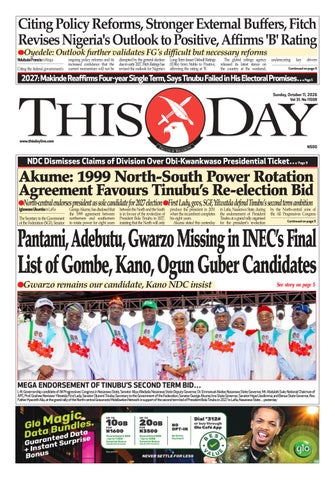
MEGA ENDORSEMENT OF TINUBU’S SECOND TERM BID…
See story on page 5
L-R: Governorship candidate of All Progressives Congress in Nasarawa State, Senator Aliyu Wadada; Nasarawa State Deputy Governor, Dr. Emmanuel Akabe; Nasarawa State Governor, Mr. Abdulahi Sule; National Chairman of APC, Prof. Goshwe Nentawe Yilwatda; First Lady, Senator Oluremi Tinubu; Secretary to the Government of the Federation, Senator George Akume; Imo State Governor, Senator Hope Uzodimma; and Benue State Governor, Rev. Father Hyacinth Alia, at the grand rally of the North-central Grassroots Mobilisation Network in support of the second term bid of President Bola Tinubu in 2027 in Lafia, Nasarawa State…yesterday
2
SUNday, OCTOBER 11, 2026 • T H I S D AY
SUNDAY, OCTOBER 11, 2026 • T H I S D AY
3
Give your students the opportunity to learn, compete and lead in an unforgettable experience that builds critical thinking, nancial awareness and conndence. Registration is now open. Open to students aged 12–16.
Wise Up. Spot the Scam
Scan to get started!
Terms and Conditions apply
SUNday, OCTOBER 11, 2026 • T H I S D AY
4
5
OCTOBER 11, 2026 • T H I S DAY, T H E S U N DAY N E W S PA P E R
NEWS
2027: Makinde Reaffirms Four-year Single Term, Says Tinubu Failed in His Electoral Promises Challenges president to publish fuel pricing template
Chuks Okocha in Abuja
The presidential candidate of the Allied Peoples Movement (APM) and Oyo State Governor, Seyi Makinde has expressed his commitment to a four-year term of government of national unity if elected president in 2027, insisting that his administration would not last beyond four years. Makinde spoke yesterday at
the APM’s North-east town hall meeting with stakeholders in Yola, Adamawa State, where he described President Bola Tinubu’s administration as a failure to deliver on all its electoral promises in 2023. The governor said, ''I stand before you today to tell you that the government you will put in place from May 29, 2027, will be a transitional government of national unity.
''Our government will not last beyond four years. And it will be an all-inclusive government, Makinde said. This clarification followed the popular agitation for presidential power to go to the North after eight years in the South. The presidential candidate challenged the federal government to publish its petroleum pricing template to clarify how fuel
prices are determined and ensure transparency, insisting that Nigerians have the right to know how fuel prices are determined. He stated, "The current administration came in and told us that it had the magic wand to solve the challenges confronting us. In fact, the President said that if he failed to fix electricity for Nigeria in four years, Nigerians should not vote for him again. So, we are
all aware that they have failed to provide electricity and other things they promised. So, I believe we all know how to cast our ballots. "They came up with the presidential policy on CNG and electric vehicles. That policy failed. They introduced the naira-forcrude initiative. That policy also failed. Yesterday, I listened to the Minister of Finance on television. He said they are now adopting
price modulation for petroleum products. "We are asking for only two things. We do not want too much grammar; we want relief for Nigerians. So, we ask the federal government to release its pricing template so that citizens will know how they arrived at the current petroleum price and let Nigerians see how things go. If they have a better solution, they will present it.
Pantami, Adebutu, Gwarzo Missing in INEC's Final List of Gombe, Kano, Ogun Guber Candidates Gwarzo remains our candidate, Kano NDC insists
Ahmad Sorondinki in Kano
The Independent National Electoral Commission (INEC) has published its final list of candidates for the February 6, 2027 governorship elections, with the Peoples Democratic Party (PDP) governorship candidates for Gombe and Ogun states, and the Nigeria Democratic Congress (NDC) governorship candidate in Kano State, missing. However, INEC cleared the APC governorship candidate in Rivers State, Kingsley Chinda for the 2027 governorship election in the state. Chinda was number five in the 19-man list of Rivers State governorship candidates released by the electoral commission. The lists, signed by INEC Secretary, Rose OriaranAnthony and published on
the INEC website yesterday, showed 16 governorship candidates of other political parties in Gombe State and 13 in Ogun State, and none of them was from the PDP. The governorship candidates missing were Ali Pantami of PDP in Gombe State, Aminu Gwarzo of NDC in Kano State and Ladi Adebutu of PDP in Ogun State. However, the Kano State Chairman of NDC, Alhaji Hussaini Mairiga, has insisted that Gwarzo remains the governorship candidate of the party in the state. INEC did not publicly state the specific reason for dropping the candidates’ names but the decision was believed to be connected to a Supreme Court ruling in the case of INEC v. Zenith Labour Party, which confirmed the continued validity of Section 77 of the Electoral Act 2026.
The commission released the list in line with the promise of its Chairman, Professor Joash Amupitan, who spoke at a press conference in Abuja early last week. Pantami, who was on the provisional list published on August 29, was missing from the new list. Pantami had earlier emerged as a PDP candidate after dumping APC on May 19. But Ahmed Mailantarki, one of the aspirants who sought the PDP ticket, challenged his victory in court. A Federal High Court in Gombe nullified the election and ordered a fresh primary, which he won again. Pantami won the rerun primary conducted on September 29, defeating Khamisu Mailantarki and Usman Aliyu Garry. But his biggest obstacle was the September 24 Supreme
Court judgment, which restored Sections 77(5), (6), (7) and 84(2) of the Electoral Act 2026, barring parties from fielding candidates whose names were not in the membership register submitted to INEC within the stipulated time. While uncertainty trailed his participation in the election, Mohammed Haruna, an INEC National Commissioner, had hinted that in line with the Supreme Court ruling, some parties would not field candidates in 2027. Under Section 32(2) of the Electoral Act 2026, parties have 14 days to notify INEC in writing, with an affidavit, if a nominated candidate’s name is missing. In Kano State, Gwarzo’s removal from the final list means he cannot contest the governorship election on the NDC platform.
In Ogun State, neither Adebutu nor his running mate, Kolapo-Sowunmi, appeared in the list, raising questions about the status of the PDP’s governorship ticket ahead of the poll. Speculations have emerged that Adebutu’s name may not have been included in the party register submitted to INEC, as required under the provisions of the Electoral Act. Hoever, the PDP has urged residents of the state to be calm and rest assured that its governorship candidate, Adebutu's name would be published by INEC and he will emerge as the Governor of Ogun State in the 2027 general election. A statement by the publicity Secretary of PDP in Ogun State, Kayode Adebayo urged the public to be informed that the omission of its candidate’s name in the INEC’s list was as
a result of the undue pressure mounted by the ruling party on INEC out of fear of losing the election to our party. "We state emphatically that our candidate, Hon. Oladipupo Adebutu, who has never left the Peoples Democratic Party at any time duly registered as a member of the party within the designated period of the digital registration with his party membership card printed, verified and submitted to INEC at the stipulated time. "While we urge the good people of Ogun not to be perturbed nor distracted from our focus of voting out the APC, we remain resolute, unfazed and unwaveringly confident that our candidate is marching straight to a decisive victory in the Ogun 2027 Governorship election. "No amount of desperate Continued on page 9
AKUME: 1999 NORTH-SOUTH POWER ROTATION AGREEMENT FAVOURS TINUBU’S RE-ELECTION BID
(APC), under the auspices of the North-Central Grassroots Mobilisation Network. This comes as the First Lady, Senator Oluremi Tinubu; governors of Benue, Plateau, Niger, Kogi, Kwara, and Nasarawa states; and Akume have given reasons why Tinubu deserves a second term, saying his administration has transitioned from difficult reforms to visible prosperity. Meanwhile, President Tinubu will inaugurate the APC Presidential Campaign Council on October 14, with former Zamfara State governor Senator Abdulaziz Yari, Imo State Governor Senator Hope Uzodimma, and other party
chieftains expected to play key roles. The North-central APC rally drew governors, senators and elders from Benue, Plateau, Niger, Kogi, Kwara, Nasarawa states and the Federal Capital Territory (FCT). Addressing APC supporters who intermittently chanted "Tinubu! Tinubu!", the First Lady said the president believed in the country's unity, security, and prosperity. She said her address was centred on the president's Independence Day message on October 1 titled "From Reforms to Prosperity." According to her, "after two years of reforming critical sectors,
it is now time for benefits to reach Nigerians". "Mr. President is saying that they have gone reforming a lot of sectors, but now is the time for prosperity. And we can see our economy is stabilising, foreign exchange is going down, and investors are coming back to Nigeria," she noted. Drawing on her 12 years in the Senate, she said the current dispensation witnessed unusual infrastructure activity. "I have been in the Senate for 12 years. This is the first time I have seen governors fixing roads and building a lot of infrastructure. And we've seen now in the health
sector," she stated. She highlighted a food bank initiative providing free nutritious food for children, pregnant women, and breastfeeding mothers, as well as treatment for malnourished children. She urged students to take advantage of the Nigerian Education Loan Fund (NELFUND). Describing Tinubu as bold and courageous, she charged supporters to become ambassadors. "Tell everyone that Mr. President, President Bola Ahmed Tinubu, is a leader who is very bold and not afraid to take difficult decisions. He's a leader who can be trusted to lead us into prosperity," she said.
"Vote for continuity, vote for capacity, vote for prosperity, vote for the reelection of Mr. President, and all the candidates of APC all the way from top to bottom," she added. Speaking at the rally, Akume insisted that the parties agreed to rotate power between the North and the South in 1999. "I want us to consider one thing - that we agreed in Kaduna in 1999 to ensure that power rotates between the North and the South - eight years in the South, and eight years in the North. "Yesterday, our father (Buhari) made his sojourn in peace. He was on the throne for eight
years. Today, Asiwaju (Tinubu) is expected to serve eight years. In 2031, northerners can field over 1,000 candidates. So, anybody from the North who is running for President today is not sincere. Let's reject him 100 per cent, and I urge you not to accept him,” Akume told APC leaders and supporters. "You talk of education; more universities have been established, and above all, you have the NELFUND student loan scheme so that because of the circumstances of your birth, you can never be denied tertiary education,” Akume Continued on page 10
CITING POLICY REFORMS, STRONGER EXTERNAL BUFFERS, FITCH REVISES NIGERIA'S OUTLOOK TO POSITIVE, AFFIRMS 'B' RATING
behind its revision of Nigeria's Outlook, including expected policy continuity; stronger external buffers; a restrictive monetary stance; reduced inflation; and higher oil production and refining capacity. Reacting to Fitch's positive outlook, the Minister of Finance and Coordinating Minister of the Economy, Mr.
Taiwo Oyedele, reaffirmed the federal government's resolve to sustain reform momentum and a disciplined, market-reflective, and transparent foreign exchange regime. According to Fitch, the Outlook revision reflected ongoing reform of Nigeria's policy framework and its increased confidence that the momentum will not be disrupted
by upcoming elections. It affirmed that the monetary and exchange rate reforms had supported greater naira flexibility, disinflation and faster-thanexpected FX reserve accumulation, while improved reserve quality enhances resilience to shocks. Fitch stressed that the continued reform implementation was strengthening monetary policy
transmission and should support further disinflation, although inflation will remain well above Nigeria's peers. It said, "Nigeria's ratings reflect its large economy, a relatively developed and liquid domestic debt market, large oil and gas reserves and an improved macroeconomic policy framework. "The rating is constrained by
weak governance indicators, high hydrocarbon dependence, high inflation, security challenges and structurally low government revenue relative to peers." On the expected policy continuity metric, Fitch said, "The incumbents are well positioned to win the early 2027 elections due to the ruling party's control of the majority of Nigeria's 36 states and
a fragmented opposition. "As a result, we expect broad economic policy continuity, including in relation to reforms that have contributed to improved policy credibility, higher external liquidity and enhanced resilience to external shocks. "Risks to our baseline stem Continued on page 10
SUNday, OCTOBER 11, 2026 • T H I S D AY
6
Dream
Voice Future
We are pleased to celebrate the International Day of the girl child and the potential in every girl.
7
OCTOBER 11, 2026 • T H I S DAY, T H E S U N DAY N E W S PA P E R
NEWS
NINETEEN HEARTY CHEERS TO THE SAGAMITES…
L-R: The Akarigbo and Paramount Ruler of Remoland, Oba Adewale Ajayi; Ogun State Governor, Prince Dapo Abiodun; his wife, Bamidele; Chairman of the occasion, Sunny Kuku; and the newly inaugurated President of the Sagamites Club, Mr. Oladimeji Oresanya, during his investiture as the 19th President of the club in Sagamu…yesterday
30 Days Petrol Discount: Atiku Accuses Tinubu of Turning NNPC into Political Spectacle
Chuks Okocha in Abuja
The presidential candidate of the African Democratic Congress (ADC), Alhaji Atiku Abubakar, has accused President Bola Tinubu’s administration of turning a petrol discount into a political spectacle at NNPC Limited’s expense.
The former vice president reminded President Tinubu that the petroleum corporation was no longer the NNPC of the old, but now a quoted limited liability company, according to the Petroleum Industry Act (PIA). He said the PIA established the petroleum company to operate as a public liability-
quoted company. In a statement issued by the Director of Strategic Communication of the ADC Presidential Campaign Council, Phrank Shaibu, Atiku said: “Tinubu wants Nigerians to cheer for N66 off a litre before they ask who ordered NNPC to surrender the money. He wants
credit for the discount without showing the board approval, the cost or the account that will carry it. Nigerians are not so desperate for relief that they have forgotten how to ask a simple question: who pays for Tinubu’s applause? “NNPC Limited is no longer the old NNPC corporation.
SEC to Universities: Stop Dependence on Govt Allocations, Access Capital Market Funding Kemi Olaitan in Ibadan
Nigerian universities have been urged to move away from dependence on government allocations and embrace capital formation, investment and ownership through the capital market. The call came at the University of Ibadan Alumni Association Annual Public Service Lecture held over the weekend in Ibadan. The lecture was themed: ‘First and Best But Whose Capital Built It? Rethinking How Nigeria Funds Its Own Future’. Delivering the lecture, the Director-General of the Securities and Exchange Commission (SEC), Dr. Emomotimi Agama,
traced the University of Ibadan foundation to an audacious capital decision. Agama recalled that in 1948, the chiefs and people of Ibadan donated 2,500 acres of land to the institution on a 999-year lease. He noted that despite producing a Nobel laureate, heads of state, central bank governors and builders of the capital market, the university had never approached the market to raise long-term funds. “Not once. Not a bond. Not a fund. Not a listed vehicle. “The premier University of Africa’s largest economy has been, financially speaking, a spectator at a market its own graduates built,” he said.
Agama argued that continued dependence on government appropriations was unsustainable given the country’s current fiscal realities. He added that the university had about 41,700 students, while its halls of residence were built to accommodate fewer than 10,000, forcing thousands to live off campus. The SEC director-general stressed that the problem was not a scarcity of capital in Nigeria but a failure to translate available capital into productive investments. He noted that pension assets stood at N31.48 trillion as of July 2026, while total market capitalisation on the Nigerian
Exchange (NGX) stood at N215.09 trillion. Agama also contrasted the N4.65 trillion raised by banks over 24 months through recapitalisation with the N2.53 billion allocated to a university by the Tertiary Education Trust Fund (TETFund), representing a ratio of about 1,000 to one. According to him, the figures demonstrated that long-term capital was available and that the university was seeking bankable, long-term investment opportunities. Agama proposed five financing instruments that the university could explore under the Investments and Securities Act 2025.
Ifowodo Wins NLNG’s $100,000 Nigeria Prize for Poetry on Religious, Political Violence
Wale Igbintade
A poet, Ogaga Ifowodo, has won the Nigeria Prize for Literature 2026, securing the $100,000 cash award for his collection: ‘Why Does God Need a Gun?’, which examines religious and political violence in Nigeria. In a related development, Beyond Tarkwa Bay by Peter Oghenetega Oke and Mara Mania by Feranmi
Abiola have emerged as joint winners of the inaugural Nigeria Prize for Creative Arts, which carries a $20,000 cash award. The winners were announced at the Grand Award Night organised by Nigeria LNG Limited (NLNG) in Lagos on Friday night. Ifowodo's poetry collection was selected from 223 entries, while the two winning documentaries emerged from 98 submissions for
the Creative Arts Prize. Announcing the literature winner, Chairman of the Advisory Board for The Nigeria Prize for Literature, Professor Akachi Adimora-Ezeigbo, described ‘Why Does God Need a Gun?’ as a sensitive portrayal of religious and political violence in Nigeria, narrated through the voice of an imagined victim. She commended all three shortlisted poetry collections for
their technical skill, confidence and mature use of language, noting that they addressed themes extending beyond Nigeria's borders. According to her, the collections explored interconnected issues, including identity and belonging, the promises and disappointments of nationhood, the consequences of extremism and displacement, and the enduring impact of conflict on individuals and communities.
The Petroleum Industry Act established it to operate as a commercial company. Yet the Presidency announces a discount, claims the applause and tells NNPC to surrender its margin. Is the government exercising its rights as shareholders through proper corporate channels, or treating NNPC Limited as a drawer of campaign money it can open whenever an election approaches? “When Nigerians demand affordable petrol, Tinubu’s officials deliver a lecture about market forces. They say prices cannot be wished down. But when Tinubu needs a headline, the Presidency reaches into NNPC’s margin and calls it relief. Apparently, the market is sacred until the president needs applause” Atiku questioned where
Nigerians are supposed to find the relief when the NNPC Retail has just over 900 stations for a country of roughly 242 million people? “That is a narrow network for a national promise. Motorists are already queuing at some outlets. Must a driver burn petrol travelling to an NNPC station, spend time in a queue, download an app and pay through it to save N66 on each litre? How much of the savings survives the journey? “What happens to the family whose nearest NNPC station is miles away? What happens when a station runs out of petrol? Tinubu announces relief for the whole country, then delivers it through a fraction of its filling stations. A press release can reach every Nigerian in a second. His discount cannot.
Reuben and Kike Abati Unveil Podcast at Kikelomo’s Media Anniversary Judith Okafor
Broadcaster, Kikelomo Abati and her husband, Dr. Reuben Abati, have unveiled a podcast, Reuben and Kike Abati, as part of activities marking her 20 years in the media industry and the seventh anniversary of her programme, Real Talk With Kike. The podcast was unveiled at an anniversary event held yesterday at Eko Hotels and Suites, Lagos. The gathering brought together government officials, business leaders, media professionals and stakeholders in the cultural and creative industries to discuss leadership, innovation, culture and national development. The event, themed “The Future of Nigeria: Where Leadership, Innovation, Culture and Media Converge to Shape Nation Building,” featured panel discussions on governance, accountability,
cultural identity, artificial intelligence and the future of the media. Delivering the keynote address on behalf of Lagos State Deputy Governor, Dr. Kadri Obafemi Hamzat, the Secretary to the Lagos State Government, Barrister Bimbola Salu-Hundeyin, said effective leadership must be measured by tangible results rather than promises. She highlighted initiatives under Governor Babajide Sanwo-Olu’s THEMES+ Agenda to improve the business environment, including the Lagos State Electricity Law 2024 and the establishment of the Lagos State Electricity Regulatory Commission (LASERC). She said the state was targeting 97.5 per cent electricity availability by 2030. “A government that cannot acknowledge what is broken cannot fix it,” she said, adding that vision provides direction while disciplined execution delivers results.
8
T H I S DAY, T H E S U N DAY N E W S PA P E R • OCTOBER 11, 2026
NEWS
STORMING ATIKU’S NORTH-EAST BASE…
L-R: Deputy Director-General, Administration, Makinde-Daura Presidential Campaign Organisation, Hajia Inna Ciroma; National Chairman of the Allied Peoples Movement, Yusuf Mamman Dantalle; National Leader of APM and Bauchi State Governor, Senator Bala Mohammed; APM presidential candidate and Oyo State Governor, Mr Seyi Makinde; Vice Presidential candidate of APM, Mr Lawal Musa Daura; and Campaign DirectorGeneral, Hon. Felix Hassan Hyat, at the campaign's North -east Zonal Town Hall Meeting in Yola, Adamawa State…yesterday
US Asks American Business Executives to Be Wary of Insecurity, Corruption, Detention Risk in Nigeria Sunday Ehigiator A report by the United States Department of State has identified insecurity, corruption, port inefficiencies and regulatory uncertainty as major obstacles to investment in Nigeria, warning that these challenges continue to weigh on the country’s business
environment despite signs of macroeconomic stability. In its ‘2026 Investment Climate Statements on Nigeria’, according to an online platform, the department said the country’s investment landscape has been shaped by the outcomes of “painful but necessary” structural reforms introduced
by the President Bola Tinubu administration. The report said the removal of fuel subsidies and liberalisation of the foreign exchange market initially triggered significant economic volatility, although indicators in early 2026 suggested some stabilisation. However, it warned that
security concerns, administrative bottlenecks and the social consequences of economic reforms remain significant considerations for foreign investors. “The security environment is a primary variable which gives pause to potential investors,” the report said. It noted that although attacks
UK Universities Withdraw Admission Offers to Nigerians, Others over Visa Crackdown
Sunday Ehigiator
Universities in the United Kingdom have withdrawn admission offers to international applicants, including Nigerians and Pakistanis, amid fears that rising student visa refusals could lead to a ban on recruiting overseas students. According to an analysis of Home Office data by the Financial Times, 22.7 per cent of study visa applications from Nigerians were withdrawn in the first half of 2026, up from 4.5 per cent in the same period of 2025. For Pakistani applicants, the proportion rose from three per
cent to 40.9 per cent, while Bangladesh’s rate increased from 7.1 per cent to 23.5 per cent. Overall, withdrawn applications rose to 10.5 per cent in the first half of 2026, compared with 2.3 per cent a year earlier. Universities said the withdrawals were largely driven by a doubling of student visa refusals in the first six months of 2026, alongside stricter rules that put institutions at risk of losing their licences to recruit international students if more than five per cent of applicants with offers have their visa applications rejected. About 15 universities are believed to have suspended
recruitment from Pakistan this year, while data from visa-processing company Enroly, suggested that refusal rates had hit almost half of universities, exceeding the five per cent threshold. The Vice-Chancellor of the University of Sunderland, Sir David Bell, said: “The recent and unexpected spike in visa refusals has prompted pre-emptive action in several universities. This has involved pulling back from international markets where a tougher approach is being taken to visa applications.” Director of Universities UK International, Jamie Arrowsmith, said “visa processing has become
markedly less predictable”. “Many refusals appear to rest on flawed, inconsistent and highly subjective reasoning, forcing universities to withdraw offers at scale to avoid breaching compliance thresholds,” he added. The crackdown has raised concerns about universities’ finances as institutions face declining international applications and growing competition for overseas students. Chief Executive of University Alliance, Vanessa Wilson, warned: “This is going to result in restructures, which inevitably results in job losses, course closures, campus closures.”
At Orbih’s Funeral Service, Wike Debunks Rumour of Dispute with Okpebholo Felix Omoh-Asun in Benin City
The Minister of the Federal capital Territory (FCT), Mr Nysom Wike, has said there was no quarrel between him and Edo Governor, Senator Monday Okpeholo. He dismissed suggestions of any disagreement between him and the governor, saying their relationship remained cordial. "There is no problem between
me and the governor; we are very close; we work together and we will continue to work together," Wike said. Wike, who spoke at the funeral mass of the late Dan Orbih yesterday at Ogbona, Etsako Central Local Government Area (LGA) of Edo State, noted those insinuating quarrel between him and Okpebholo were walking the wrong part.
While thanking the governor for receiving the body of "our friend late Chief Dan Osi Orbih and also paying him the last respects at his residence in Benin City," Wike added that the funeral activities had reinforced the reality of death and the pain of losing a close friend. "When I saw the casket, it dawned on me that truly my friend and brother were gone.
There is nothing we can do but to pray to God to give the family the fortitude to bear this great loss," he said. Also speaking at the occasion, Governor Okpebholo, admonished Nigerians to live selfless life. The governor urged Nigerians, particularly those in positions of authority, to live a sacrificial life and use their positions to make society a better place for all.
on oil infrastructure in the Niger Delta have decreased, oil theft and illegal bunkering persist. “In the North, the expansion of terrorist and ‘bandit’ groups continues to degrade the climate for agribusiness and mining,” the document added. The report also raised concerns about the treatment of foreign business executives in regulatory disputes, citing the detention of Tigran Gambaryan, a US citizen and Binance executive, for nearly eight months in 2024. “Furthermore, the use of coercive exit bans and detentions — highlighted by the high-profile nearly eight-month detention in 2024 of U.S. citizen Binance employee Tigran Gambaryan — serves as a cautionary note for foreign executives regarding the risks of aggressive regulatory friction,” it said. The report said such cases could influence the perception
of Nigeria as a destination for foreign investment. The department identified inefficiencies at Nigerian seaports as another major challenge for businesses, particularly those dependent on imports and exports. “Port inefficiency remains a significant ‘hidden tax’ on investment,” the report said. It noted that the Lekki Deep Seaport handled $9.6 billion in trade in 2025 and operated at 50 percent capacity, helping to ease pressure on older facilities. However, it said traditional ports in Apapa and Tin Can Island continue to experience cargo dwell times exceeding 20 days because of manual examinations. “To address this, the government launched phase one of the National Single Window (NSW) on March 27, 2026,” the report said.
NAPTIP Warns Against Out-of-court Settlements of Sexual Violence Cases
The National Agency for the Prohibition of Trafficking in Persons (NAPTIP) has warned that sexual and gender-based violence (SGBV) cases must be handled in accordance with the law, stressing that no institution or organisation can replace the established judicial process. The agency said perpetrators of sexual offences must be held accountable to ensure justice for survivors and victims. NAPTIP’s Head of Media and Public Relations at its Abuja headquarters, Vincent Adekoye, stated this while speaking to journalists at a mentorship programme for members of the state SGBV Media Corps, sponsored by the European
Union and International IDEA. The programme gave participants a chance to assess their progress, review activities undertaken since the corps was established in August 2026, and discuss challenges affecting efforts to combat sexual and genderbased violence across the state. Adekoye cautioned against practices that could undermine investigations and allow perpetrators to evade justice. His comments followed a presentation by one of the participants, who said findings from field investigations suggested that some sexual offence cases were being settled outside the courtroom without formal judicial pronouncements.
9
OCTOBER 11, 2026 • T H I S DAY, T H E S U N DAY N E W S PA P E R
NEWS
PROMOTING PUBLIC IMAGE ON THEIR MINDS…
L-R: Director of Regulations, Advertising Regulatory Council of Nigeria, Dr. Emme Akande; Founder TPT International PR Company, Akogun Adetokunbo Modupe; Rotary District 9112 Governor, Layi Abidoye; District 9111 Governor-elect, Dr. Samuel Ayetutu; District 9112 Governor-nominee, Ehi Braimah; and Senior Special Assistant Lagos Liaison to Akwa State Governor, Mike Effiong, during the public image seminar held at Rotary Centre, Ikeja GRA, Lagos…recently
NDC Dismisses Claims of Division Over Obi-Kwankwaso Presidential Ticket Fixes October 20 for presidential campaign council inauguration Sunday Aborisade in Abuja
The Nigerian Democratic Congress (NDC) has dismissed reports suggesting that the party's national leadership was divided over the Obi-Kwankwaso presidential ticket or that its national leader, Senator Henry Seriake Dickson, was working against its presidential and vice presidential candidates, Mr. Peter Obi and Senator Rabiu
Musa Kwankwaso, respectively. The opposition party has also fixed October 20 for the inauguration of its Presidential Campaign Council for the 2027 general election, saying it was prioritising consultations, internal cohesion and the careful selection of campaign officials ahead of what it considered a critical political contest. This is coming as the party
also announced plans to reconcile prominent party figures in Adamawa State, including former Secretary to the Government of the Federation (SGF), Mr Babachir Lawal, and the governorship candidate of party in the state, Senator Aishatu Binani, warning that disagreements among influential stakeholders would not be allowed to undermine the party's preparations for the
election. The party's National Chairman, Senator Moses Cleopas, stated the position of the party yesterday in Abuja after a two-day meeting of its National Working Committee (NWC), during which the leadership reviewed its electoral preparations, internal disagreements and strategies for mobilising support for its presidential candidate and his
ADC Dares Wike, Says Minister Has No Power to Stop Amaechi’s Campaign in Rivers Blessing Ibunge in Port Harcourt The Rivers State chapter of the African Democratic Congress (ADC) has tackled the Minister of the Federal Capital Territory (FCT), Mr Nyesom Wike, over his alleged threat to prevent the party’s vice-presidential candidate, Rotimi Amaechi, from campaigning in Rivers State. The party insisted that Amaechi and other ADC members had the constitutional right to campaign in Rivers State without requiring permission from any individual. The ADC was reacting to a statement attributed to Wike,
where the minister reportedly said he would not allow Amaechi to campaign in the state unless he stopped attacking President Bola Tinubu and also accounted for funds allegedly misappropriated during his tenure in public office. In a statement, the state’s ADC Publicity Secretary, Chizy Eneyi, said the party considered the reported remarks troubling and urged political leaders to engage in issue-based discussions rather than personal exchanges. “However, when a serving minister abandons reasoned political engagement for personal insults, unsubstantiated allegations
and threats against an opposition candidate, silence becomes inappropriate,” Eneyi said. The party also questioned why the allegations against Amaechi were being raised publicly rather than pursued through the appropriate legal channels. According to the statement, Wike served as governor of Rivers State for eight years and had ample opportunity during his tenure to seek accountability over any alleged financial wrongdoing. “Eight years as governor, yet the evidence apparently only comes out whenever Amaechi speaks,” the statement added.
The ADC urged the minister to submit any evidence of wrongdoing to the relevant authorities, stressing that allegations should be established through due process. “If Wike has evidence, let him present it to the appropriate authorities. Nigerians deserve facts, not another episode of political name-calling,” the party said. The party also expressed concern over the reported warning that Amaechi would find it difficult to campaign in Rivers State, describing the statement as a potential threat to the rights of opposition politicians.
running mate. He insisted that the party's leadership, from the national level to its state, local government and ward structures, remained committed to the presidential ticket. “I want us to know today that the entire leadership of the Nigerian Democratic Congress, from the national leader to me, the national chairman, NWC, state chapters, local government chapters and ward chapters, are solidly behind all our candidates,” he said. He described Obi and Kwankwaso as a combination capable of appealing to Nigerians across religious, ethnic and regional lines, while defending the party's decision not to conduct a competitive presidential primary. Speaking on Dickson's commitment to the ticket, Cleopas argued that the national leader's decision not to pursue his own presidential ambition through the party demonstrated his support for its collective direction. He quoted Dickson as rejecting suggestions that he should seek the presidency under the NDC platform. Cleopas questioned why Dickson would have declined the ticket if he intended to use the
party as a bargaining instrument with the ruling party. “Do they even think, if he wanted to play so, couldn't he have taken the presidential ticket of this party and by now all of us would have aligned with APC, which was most convenient at the time?” he asked. He maintained that the NDC was determined to offer Nigerians a political alternative in 2027, urging members to disregard what he described as propaganda aimed at creating divisions within its ranks.
Fixes October 20 for Presidential Campaign Council Inauguration Cleopas also announced that the NDC had fixed October 20 for the inauguration of its Presidential Campaign Council for the 2027 general election. The chairman, who accused unnamed political interests of using intimidation and harassment to pressure opposition politicians into joining the ruling All Progressives Congress (APC), said the NDC was determined to build a united political organisation capable of contesting the election and protecting votes cast for its candidates.
PANTAMI, ADEBUTU, GWARZO MISSING IN INEC’S FINAL LIST OF GOMBE, KANO, OGUN GUBER CANDIDATES manipulation, political witchhunts, or calculated distractions can alter the mandate of the people of Ogun State who are overwhelmingly eager for true leadership and positive change.” Reacting to the omission of his name from the final list of candidates, Pantami, in a statement shared on his personal social media handles, assured his supporters that efforts were underway to resolve the issue, describing the omission as a temporary
challenge in the electoral process. In the statement signed by Professor Suleiman Mohammed Gombe, he said the development has reportedly raised questions among supporters of the PDP and the Pantamiyya Movement across Gombe and beyond. He urged supporters to remain calm and hopeful, insisting that the omission did not represent a final determination of the matter.
According to the camp, its legal and liaison teams are engaging with relevant organs of the PDP and INEC to ensure compliance with the court order and correct the omission within the period allowed by law.
Gwarzo Remains Our Candidate, Says Kano NDC Chairman Meanwhile, the Kano State Chairman of NDC, Alhaji
Hussaini Mairiga, last night dismissed any notion of a change in the party’s ticket, insisting that the structure of the ticket remained entirely intact as originally planned. Speaking during a telephone interview, Mairiga insisted that the joint ticket of NDC’s gubernatorial candidate and his running mate, Mustapha Rabiu Kwankwaso, was duly processed, finalised, and submitted to the electoral body in strict accordance
with all established electoral guidelines and statutory deadlines. "Gwarzo's name was submitted to INEC, and he and his running mate, Mustapha Rabiu Kwankwaso, are the authentic flag bearers of the party," Mairiga stated emphatically, reiterating the party's unwavering backing for their chosen candidates. Addressing the discrepancies observed in the newly published list, the chairman attributed
the development to administrative friction rather than an official rejection by the commission. He suggested that human error or a logistical miscommunication within the broader bureaucratic process likely triggered the anomaly. "I believe there is a mixup somewhere, and I do not think the list is from the commission, since we are sure that the name we submitted is what stands," Mairiga added.
10
T H I S DAY, T H E S U N DAY N E W S PA P E R • OCTOBER 11, 2026
NEWS
CONGRATULATIONS TO NEWEST COUPLE…
L-R: Chief Executive Officer, His Grace Serene Unique Services Nigeria Limited, Chief Uchenna Ezekwem; his wife, Chidinma; the new couple, Mr. Chukwudi and Chisom Ezekwem; Director, Amaco Resources Limited, Mrs. Nonyem Anyanwor; and Chief Executive Officer, Amaco Resources Limited, Chief Amaechi Anyanwor, at the wedding of the couple at the Catholic Church of the Visitation, FESTAC Town, Lagos…yesterday
Nigeria's 36 Govs to Launch Nationwide Nutrition Emergency, Unleash Radical Funding Mechanism
Deji Elumoye in Abuja
The governors of the 36 states of the federation, in a historic move hunger by committing to launch a nationwide nutrition emergency. This massive mobilisation will establish a powerful National Nutrition Intervention Fund to instantly advance Nigeria’s ambitious Nutrition 774
Initiative across every single local government area in the country. Governor Dauda Lawal of Zamfara State announced this in Addis Ababa, Ethiopia, while reading the Nigeria Governors’ Forum (NGF) Addis Ababa Commitment on Nutrition at the Nigeria Country Session. The commitment followed a three-day Nigeria-Ethiopia
Nutrition Leadership Exchange, where the Nigerian delegation led by Vice President Kashim Shettima studied Ethiopia’s experience in nutrition delivery, particularly through its Seqota Declaration. In reading the NGF commitment at the session themed "From Lessons to Commitment: Accelerating Implementation of the Nutrition 774 Initiative,"
the governors also pledged to strengthen domestic financing, deepen accountability at the grassroots, and institutionalise a unified framework for nutrition planning and budgeting, drawing lessons from Ethiopia's experience in tackling malnutrition. Governor Lawal, while speaking on behalf of the NGF, said the exchange had reinforced the
importance of sustained political leadership, effective multisectoral coordination, ownership at all levels of government, predictable financing, and the systematic use of data to drive decisions and accountability. He noted that Nigeria’s Nutrition 774 Initiative already embodied many of Ethiopia's principles, adding that the exchange provided
practical lessons to strengthen the programme and deliver measurable results. According to him, the key lessons included the need for a unified approach to planning and budgeting, stronger coordination across sectors, bottom-up planning, predictable financing, and the use of data and scorecards to measure performance.
AKUME: 1999 NORTH-SOUTH POWER ROTATION AGREEMENT FAVOURS TINUBU’S RE-ELECTION BID declared. Moving the motion for Tinubu’s adoption as sole presidential candidate in 2027, the SGF said: "There are so many things that this great man, this visionary, has done. He deserves something more than that, and therefore, by the authority of this great congregation, I, Senator George Akume, former Governor of Benue State for eight years, former Senator for 12 years, former Minister for four years, and now Secretary to the Government of the Federation, do now propose that the people of the North-Central zone meeting in this great congregation have resolved that come 2027, our sole
candidate for that election is His Excellency, Bola Ahmed Tinubu; there is no other candidate." Akume also described all the presidential candidates who had previously promised subsidy removal but made a U-turn, promising to reverse it if elected, as insincere to Nigerians. According to him, "that is what we call policy flip-flop, policy flip-flop. The idea is to deceive you; don't be deceived". Akume’s motion was seconded by the Governor of Nasarawa State, Abdullah Sule, on behalf of the governors of Kogi, Benue, Niger, Kwara, Plateau states and the people of the FCT.
Governor Sule argued that “for a man who has actually improved our oil production from less than one million to now 1. 8 million barrels per day, a man who has improved our foreign reserves from less than $20 billion to now $40 to $50 billion, for a man who has improved the capital market capitalisation of less than N80 trillion to now over N160 trillion; a man who has introduced students’ loan for education; a man who has introduced all the infrastructure that you are seeing, I second the motion that Bola Ahmed Tinubu becomes our one and only candidate for the 2027 election".
On his part, the National Chairman of APC, Prof. Nantawe Yilwatda, also highlighted Tinubu’s major achievements in many sectors, especially the construction of roads across the North-central and several political appointments given to the region and urged the voters in the region to reciprocate that kind gesture on January 16, 2027, by voting massively for the president’s re-election.
Tinubu Inaugurates APC Presidential Campaign Council October 14 In a related development, President Tinubu will inaugurate
the APC Presidential Campaign Council on October 14. Former Zamfara State governor, Senator Yari; Imo State Governor Uzodimma; former minister Dr Edu; and other party chieftains will play key roles. The inauguration is scheduled to take place at the Presidential Villa’s Banquet Hall in Abuja. In a statement issued yesterday, the Director-General of the APC Presidential Campaign Council, Yari, disclosed this on Friday after meeting with the President at the Presidential Villa, where he briefed State House correspondents on preparations for the forthcoming campaign.
Yari said: “The President had approved the proposed campaign timetable; activities would commence with a rally in Kaduna on October 24.” According to the campaign schedule, the rally will be followed by engagements in Port Harcourt, Rivers State, and Maiduguri, the capital of Borno State. Ahead of the formal inauguration, Nigeria’s First Lady, in collaboration with the Director of Women Mobilisation of the APC Presidential Campaign Council, Dr Edu, and other members of the directorate, has commenced grassroots mobilisation of women across the country.
CITING POLICY REFORMS, STRONGER EXTERNAL BUFFERS, FITCH REVISES NIGERIA'S OUTLOOK TO POSITIVE, AFFIRMS 'B' RATING
from significant policy slippage, including fiscal loosening, weaker capital inflows or major social instability." It also observed that gross FX reserves rose to $54.9 billion on September 25, 2026, from $32 billion in mid-April 2024, supported by increased formalisation of FX transactions, strong portfolio inflows and higher export receipts and remittances. "We forecast the current account surplus will widen to 6.4% of GDP in 2026, but we expect it to narrow in 2027 amid our expectation that global oil prices will fall to 70/ barrel from 87/barrel in 2026," Fitch said. Providing more context, it pointed out that reserve quality had improved as the Central Bank of Nigeria (CBN) reduced its FX liabilities, with net FX reserves at $34.8 billion at the end of 2025 from about $4 billion at the end of 2023.
"We expect the naira to trade broadly around the current level through end-2026, despite the prospect of lower oil prices in 2027-2028," it stressed. On restrictive monetary stance and reduced inflation, Fitch viewed the CBN's September policy adjustment as a calibrated easing consistent with improving policy transmission. Fitch said it expected the CBN to remain cautious amid high food and fuel prices and external risks, while forecasting average annual inflation to moderate, due to naira stability and tight monetary policy, to 15.4 per cent in 2026, less than half the 2024 level, but well above the forecast 'B' median of 5.6 per cent. On higher oil production and refining, Fitch noted that crude oil production, excluding condensates, rose 10 per cent quarter -on-quarter (Q-on-Q) in 2Q26 and has met Nigeria's
1.5mbpd OPEC target since May 2026, averaging 1.52mbpd. "We expect production to remain around this level in the near term, supported by improved security and domestic investment, but below pre-pandemic levels. "Dangote refinery's ramp-up and rehabilitation of other facilities leading to increased production of refined products has reduced refined oil imports and FX demand, but limited domestic crude supply will partly maintain reliance on imported crude, Fitch said. Overall, Fitch noted that Nigeria has a low World Bank Governance Indicators (WBGI) ranking at the 20th percentile, reflecting weak institutional capacity, uneven application of the rule of law and a high level of corruption. Despite Nigeria's positive outlook, the ratings agency outlined downside risks or sensitivities that could individually
or collectively lead to negative rating action/downgrade. They include: A deterioration in the credibility and consistency of monetary and fiscal policymaking and FX management, resulting in renewed inflationary pressures and greater distortions in the FX market. It also cited renewed external liquidity stress arising, for example, due to lower oil prices and more constrained external financing sources. Fitch also cited sustained widening of the fiscal deficit, which significantly increases the debt/GDP burden and weakens financing prospects.
Oyedele: Outlook Further Validates FG's Difficult But Necessary Reforms Reacting to Fitch's positive outlook, the Minister of Finance and Coordinating
Minister of the Economy, Mr. Oyedele, reaffirmed the federal government’s determination to sustain its reform momentum and a disciplined, marketreflective, and transparent foreign exchange regime. Oyedele said Fitch's latest action followed positive rating actions by all three major international rating agencies on Nigeria in 2026, citing S&P Global Ratings, which upgraded Nigeria to 'B' from 'B-' in May, and Moody's Ratings, which revised its outlook to Positive in August. He noted that separately, FTSE Russell returned Nigeria to Frontier Market status with effect from September 21, 2026, adding that taken together, these decisions reflected a converging and increasingly favourable assessment of Nigeria's reform trajectory. The minister explained that
Fitch's Positive Outlook further validated the difficult but necessary reforms implemented under the current administration, saying its medium-term ambition was to place Nigeria firmly on the path to investment grade. Oyedele assured that the administration would, among other things, focus on raising revenue through full implementation of the new tax laws and efficient tax administration, and improve fiscal governance through spending efficiency, budget execution, and transparent debt management. According to him, the government would pursue structural reforms that support non-oil growth and economic diversification and accelerate the conversion of macroeconomic stability into shared prosperity through food security, decent jobs, human development, and support for small businesses.
SUNDAY, OCTOBER 11, 2026 • T H I S D AY
11
12
T H I S D AY, T H E S U N D AY N E W S PA P E R OCTOBER 11, 2026
NEWS
DISCUSSING ARTIFICIAL INTELLIGENCE IN THE LEGAL PROFESSION…
L-R: Chairman, Council of Legal Education and panelist, Chief Emeka Ngige (SAN); Panelist from India, Amir Singh; Panelist from Japan, Masako Bann; Panelist from Bahrain, Margreta Sovova; Panelist from USA, Steve Richman; and Session moderator from Brazil, Leonardo Razvonich, at the International Bar Association session on Operational Resource Disparities and Equitable Global Governance of Artificial Intelligence in Copenhagen, Denmark…recently.
ADC Seeks Probe of Alleged INEC-APC Alliance in Abia Ahead of 2027 Elections Wale Igbintade A chieftain of the African Democratic Congress (ADC) in Abia State, Chief Omego Mkpabarauyo, has called on the Chairman of the Independent National Electoral Commission (INEC) to investigate alleged secret meetings between some officials of the commission and prominent members of the ruling All Progressives Congress (APC) ahead of the 2027 general election. Mkpabarauyo, in a statement made available to journalists, also urged security agencies to investigate the alleged meetings, which he claimed took place in Abuja and Abia State.
He alleged that some INEC officials had entered into what he described as an “unholy alliance” with APC figures and were divulging sensitive electoral information and materials to members of the ruling party, potentially giving them an unfair advantage over their political opponents. According to him, the ADC in Abia State had received what he described as credible intelligence about a series of meetings involving some INEC personnel, high-ranking members of the National Assembly and APC candidates. However, the statement did not identify the officials or politicians allegedly involved,
Unilever Nigeria Empowers the Next Generation Through Annual Unilever Nigeria, one of the leading fast-moving consumer goods companies in Nigeria, has announced the award of scholarships to children of its employees, reaffirming the company’s commitment to supporting education and creating opportunities for young Nigerians. Established over 30 years ago, the Unilever Nigeria Scholarship Scheme provides merit-based scholarships to academically high-performing children of the company’s non-management employees, supporting them through their secondary school education. The students participated in the competitive scholarship aptitude examination administered by the West African Examinations Council (WAEC) across Unilever Nigeria’s manufacturing sites in Agbara and Oregun. Each scholarship begins from Junior Secondary School and renewable through Senior
Secondary School Year Three (SSS3), subject to satisfactory academic performance. As a merit-based scheme, new applicants must rank among the top 25 candidates and attain a minimum score of 50% in the aptitude test. Existing awardees are required to maintain a minimum 50% average score in their final examinations and obtain at least five credits, including Mathematics and English Language, in a recognised secondary school final examination on their first attempt. Speaking on the scholarship scheme, the Human Relations Director of Unilever Nigeria, Michael Duah, said the initiative reflects the company’s broader commitment to the well-being of its employees and their families. Duah noted that, for over three decades, the Unilever Nigeria Scholarship Scheme has supported the children of
specify the electoral information purportedly disclosed or provide details of the evidence supporting the allegations. Mkpabarauyo urged the INEC Chairman to call officials at the commission’s national and Abia State offices to order and ensure strict adherence to the rules governing their conduct. He said an immediate investigation was necessary to establish the veracity of the allegations and determine whether any electoral official had
acted in a manner capable of compromising the commission’s impartiality. “We are calling on the INEC Chairman to call his staff to order before their actions create unnecessary tension and an avoidable electoral crisis in Abia State,” he said. The ADC chieftain also called on relevant security agencies to conduct an independent investigation into the alleged meetings and establish whether any INEC official had engaged in conduct
capable of undermining the credibility, transparency and integrity of the 2027 elections. He warned that any compromise of electoral neutrality could erode public confidence in INEC and undermine the credibility of the forthcoming elections. Mkpabarauyo stressed that electoral officials must remain impartial and treat all political parties equally, irrespective of their political affiliations or positions in
government. He added that the ADC and other stakeholders in Abia State would remain vigilant throughout the electoral process, insisting that the people of the state would not accept any attempt to manipulate their votes. According to him, Abians would continue to monitor developments surrounding the elections and report any suspected attempt to compromise the process to the appropriate authorities.
Abuja Continental Hotel: Monday’s Meeting With TUC Will Violate Court Order Ejiofor Alike
Abuja Continental Hotel has clarified that the meeting between its management and officials of the Trade Union Congress (TUC, which was scheduled for Monday, October 12, 2026 will violate the order of the National Industrial Court (NICN). In a statement issued yesterday, the Cluster Director of Human Resources, ‘Niyi Agoro, the management of the hotel noted that after the disruption of its business activities on August 24, 2026 by TUC and the subsequent patriotic intervention of the Nigeria Police Force, the Department of State
Services (DSS) and the Minister of Labour and Employment, which advised dialogue, the management agreed to a date for engagement with the union, in good faith. The statement however disclosed that subsequent to that agreement, the subject matter became sub judice before the National Industrial Court of Nigeria. According to the statement, in the enrolled order of the court, Paragraph 3 expressly provides that “an order of interim injunction is hereby made restraining all parties to maintain the peace and not to take any steps that will jeopardise this suit.”
The statement noted that the order was duly served on all relevant parties, adding that as a law-abiding corporate citizen, the hotel management will not take any step that may be construed as overreaching the court, prejudicing the due administration of justice, or amounting to contempt. The management insisted that it was committed to dialogue within the Alternative Dispute Resolution (ADR) channels provided and guaranteed by the NICN. “We hold the respectful view that external interference through meetings convened outside the
Court’s ADR framework while the case is pending would prejudice the due administration of justice and violate the spirit of the subsisting order,” the management said. “We have formally communicated this legal position, with copies of the enrolled order, to the Minister of Labour and Employment, the relevant security agencies and the leadership of the Trade Union Congress,” the statement added. The management of the hotel insisted that it had not abandoned dialogue, adding that it was committed to dialogue within the ADR channels provided and guaranteed by the court.
Turkish Airlines Expands Lagos Operations to 10 Weekly Flights Turkish Airlines, the airline flying to more countries than any other in the world, is expanding its Nigerian network with additional frequencies on its Istanbul-Lagos route to meet growing demand for travel between Lagos and Türkiye and onward destinations. The airline announced that Lagos frequencies will increase from 7 to 10 weekly flights from
December 11, 2026, providing travellers with greater flexibility and more convenient access via Istanbul to its global network. The move is supported by its growing fleet of over 560 aircraft and a network of more than 350 destinations across Europe, Asia, the Middle East, and the Americas. According to the airline, the
expansion follows the increase of its Istanbul-Abuja services to seven weekly flights from June 2026, further strengthening connectivity between Nigeria and Türkiye and reinforcing Nigeria as a key market in Africa. The additional Lagos services are expected to support both business and leisure travel, offering passengers more options and seamless con-
nections through its hub at Istanbul Airport, one of the world’s busiest and most connected airports. Turkish Airlines noted that business class passengers connecting through Istanbul will continue to enjoy access to its awardwinning business lounge at Istanbul Airport, enhancing the overall travel experience across its long-haul network
SUNDAY, OCTOBER 11, 2026 • T H I S D AY
13
14
SUNday, OCTOBER 11, 2026 • T H I S D AY
15
T H I S DAY, Th e S U N DAY N e w S PAPe r •OCtober 11, 2026
BUSINESS 2027: Will Nigeria’s Economic Reforms Survive the Ballot? Editor: Festus Akanbi 08038588469 Email: festus.akanbi@thisdaylive.com
Nigeria’s economy is showing signs of recovery, but millions of households remain trapped in hardship. As the 2027 elections approach, economists at the sixth DataPro International Credit Rating Webinar examined whether the country’s reforms can survive political change without delivering meaningful relief to citizens. Festus Akanbi reports
N
igeria’s economy is growing, foreign reserves are improving, and investor confidence is gradually recovering. Yet, behind these encouraging figures lies a troubling reality: millions of Nigerians can barely afford food, transport and other necessities. While economic indicators suggest recovery, household incomes remain under pressure, raising questions about who is benefiting from the reforms. This contradiction presents a formidable political challenge ahead of the 2027 general elections. Can President Bola Tinubu’s administration sustain policies that have improved economic stability but deepened financial pressures on households? Would those policies survive a change in government? These questions featured prominently at the sixth DataPro International Credit Rating Webinar, held on October 8, 2026. Professor Kai Gehring of the University of Bern, Switzerland, argued that Nigeria’s greatest challenge was no longer introducing reforms but ensuring their survival beyond electoral cycles. He observed that countries attaining investment-grade sovereign ratings generally maintained economic reforms over long periods, while unsuccessful countries frequently reversed policies after political transitions. According to him, Nigeria needs persistence, not repeated policy changes. For investors, the concern extends beyond the present administration. They want assurances that policies supporting debt repayment, revenue mobilisation and economic stability will survive future elections. Growth Amid Hardship Nigeria’s reform programme gathered momentum in May 2023 with petrol subsidy removal. Foreign exchange liberalisation followed, alongside monetary and fiscal adjustments. In its June 2026 assessment, the International Monetary Fund (IMF) acknowledged improvements in macroeconomic stability, external reserves and foreign exchange operations. The Fund estimated economic growth at four per cent in 2025 and projected 4.1 per cent for 2026. However, the recovery has not eliminated hardship. The IMF estimated that 63 per cent of Nigerians lived below the national poverty line, while approximately 27 million experienced food insecurity towards the end of 2025. Similarly, the World Bank’s April 2026 Nigeria Development Update acknowledged improving economic conditions but warned that household incomes had not fully recovered. These findings highlight the challenge policymakers face. Economic recovery means little to struggling households unless it improves purchasing power. The Danger of Policy Reversal Gehring warned that reforms lacking public acceptance could become casualties of electoral politics. He explained that a new administration might face pressure to restore petrol subsidies if voters continued associating their removal with hardship.
President Tinubu
Adeseyoju
Uzoka-Anite
“The countries that managed to get to investment grade, it is mostly a story about persistence,” he said during the webinar. He stressed the importance of securing support across political parties, regions and social groups. “The broader the support these reforms can have, the better,” he added. According to Gehring, investors assess whether governments can sustain reforms over several years, particularly when purchasing long-term sovereign bonds. He estimated that Nigeria remained approximately six or seven rating notches below investment-grade status. Improvements in security, revenue mobilisation and transparency could strengthen its creditworthiness, although he described the potential rating gains as illustrative estimates.
from political pressures.
Association of Nigeria, Segun Ajayi-Kadir, acknowledged that reforms had established foundations for recovery but maintained that manufacturers had borne disproportionate adjustment costs. The association identified expensive credit, energy costs and exchange rate pressures as major obstacles to production.
Institutions Beyond Personalities Professor Torsten Schmidt of the University of Duisburg-Essen, Germany, identified institutional development as essential to sustainable reforms. He emphasised stronger revenue collection, education and transparent public administration. “You have to make the public sector more rule-based and more transparent,” he told participants. Schmidt stressed that governments must publish reliable budgetary information and clearly communicate borrowing plans. According to him, sovereign ratings fundamentally assess a government’s willingness and ability to repay debt. Gehring similarly identified central bank independence as a safeguard against political interference. He cited Norway’s petroleum revenue management framework, under which oil revenues are channelled into a sovereign wealth fund governed by fiscal rules. Although Nigeria’s circumstances differ, the example demonstrates how strong institutions can protect economic policies
Investor Confidence and Economic Transformation Founder of DataPro Limited, Mr. Abimbola Adeseyoju, placed the debate within Africa’s broader struggle to attract affordable longterm capital. Speaking at the webinar, Adeseyoju declared: “Credit ratings are no longer merely passive measures of risk; they have become catalysts for economic transformation.” He explained that sovereign ratings influence investment flows, borrowing costs and governments’ capacity to finance infrastructure and industrialisation. According to him, African countries must strengthen fiscal discipline, deepen domestic capital markets and improve transparency. Adeseyoju also called for credit rating methodologies that reflect Africa’s economic realities without overlooking investment risks. He maintained that Africa’s journey towards investment-grade status required “deliberate, consistent policy implementation, sound market infrastructure, and robust cross-border collaboration.” His position reinforced concerns that policy reversals could weaken investor confidence and increase borrowing costs. The Social Cost Organised labour’s concerns highlight the political risks tied to economic hardship. In a September 30 statement, Nigeria Labour Congress President Joe Ajaero warned that inflation and rising petrol prices had weakened workers’ purchasing power. “We stand at the crossroads of a full-scale survival crisis,” he declared. The NLC demanded relief from rising petrol prices, improved wages and accountability for subsidy savings. Manufacturers Expressed Similar Concerns The Director-General of the Manufacturers
Government’s Fiscal Challenge At the webinar, Dr Doris Uzoka-Anite, represented by Statistician-General Prince Adeyemi Adeniran, outlined plans to strengthen Nigeria’s public finances. Under the proposed National Development Plan 2026–2030, government revenue is projected to increase from 11.15 per cent of GDP in 2025 to 18.70 per cent by 2030. The debt-service-to-revenue ratio is also projected to decline from approximately 62.9 per cent to 21.01 per cent. Achieving these targets will require effective tax administration, expenditure discipline and sustained growth. The IMF’s 2026 assessment raised concerns that estimated petrol subsidy savings, potentially worth two per cent of GDP, had not fully accrued to the federal budget in 2025. The finding underscores the importance of transparency in managing reform benefits. Beyond the Ballot The 2027 elections will test Nigeria’s ability to preserve economic reforms while improving living standards. For Gehring, successful economic transformation requires persistence, credible institutions and broad public support. For Adeseyoju, stronger creditworthiness depends on consistent policies and investor confidence. Ultimately, Nigeria’s challenge is to ensure that economic stability translates into tangible benefits for citizens. Whether that happens before the elections may determine whether today’s reforms survive tomorrow’s political transitions.
16
T H I S DAY, Th e S U N DAY N e w S PAPe r •OCtober 11, 2026
International
At the Marigold Hospital, Surulere: The Limitations of Foreign Policy Intellection
M
arigold Hospital is about good health while foreign policy intellection has the challenge of limitations in the absence good health. On Wednesday, 30th September, 2026 I delivered a lecture on The Evolving Global Order and the Future of International Law: Robotics Diplomacy as a New Definiendum. The lecture was delivered within the framework of the Foreign Policy Lecture Series at the Nigerian Institute of International Affairs (NIIA). During the delivery of the lecture, I was having difficulty in breathing in adequately. It appeared I had secretions on my air way system. Should I stop the lecture or continue to take the risk of medical complication? I opted to take the risk. I accepted to die on active service. And true, I had not slept adequately in the previous one week because of the lecture and particularly because of daily breaking news relating to the lecture topic which I wanted to reflect in the lecture. Coughing and drinking of water was a major feature of the lecture delivery. I managed to finish the lecture delivery but was immediately faced with seasoned inquisitive journalists who wanted expatiation on several points of observations and thrusts of my lecture. The many questions asked prompted another deeper process of intellection. With the press interviews, the difficulty in breathing was momentarily forgotten. I went home and was given a sumptuous dinner by my wife, Fehintola, who wanted to congratulate me for the courage I summoned and still delivered my lecture. Then came Thursday, 1st October, 2026 at about 6.30am, I wanted to monitor the national and international current affairs, especially the newspaper reviews on Arise News. I began to feel a sort of uneasiness. While trying to listen to the media analyses, I decided to quickly check my blood pressure and sugar levels. And true enough, the blood pressure first read 170 for systolic and 92 for diastolic. I never bothered to check for the sugar level before my wife and Francis Ademola Olowu, my son-in law, took me to the nearest hospital: the 68 Nigerian Army Reference Hospital Yaba (68NARHY), located at number 10 Hussey Street, Jibowu, Yaba, Lagos. The 68NARHY was less than 5-minute drive from my house.
From 68NARHY to Marigold Hospital
The 68NARHY is a 500-bed top-tier medical facility which not only serves military personnel and their families, but also civilians. However, for me, the 68NARHY was more of a problematic than a solution. I was already on the path of death by the time I arrived at the Emergency Department of the 68NARHY. I went there with high hopes that I would be given the best of treatment. I strongly believed, but wrongly, that military people who are permanently mobilized to defend the Nigerian State and people against external threats and who fight in wars and protect the country’s international borders on land, at sea, and in the air merit special priority and attention at the time of sickness. Imagine people who have responsibility to help maintain peace and security, imagine people who are mobilized to assist in the containment and management of disasters, and help rescue people during humanitarian crises not being given a conducive environment. What I saw in the 68NARHY was most unbefitting, particularly for soldiers who patriotically accept to die in defending Nigeria. For people who accept to maintain the territorial integrity of Nigeria, who are not politicians and who defend Nigeria’s political sovereignty, their hospital should be very befitting in service delivery, medical equipment, and environmental cleanliness. It was a very shameful experience. The toilet in the emergency unit had no running water to flush. No water in the reservoir drum in the toilet. I could not use it. At the reception, One Dr. Agbu and another medical officer received me. Very polite gentlemen. They gave different medical prescriptions to go and acquire and pay for. Several medical drugs were required from the Pharmacy department but they were asked for one-by-one, implying going away and coming back many times. Going away to pay for one thing involves queuing up every time. I was asked to buy an oxygenation equipment as my oxygen saturation was low. The 68NARHY only had the equipment for children and not for adult. Basic things needed were not available. What prevented being given a list of whatever was needed at once to save time? Going to the same pharmacy many times to buy drugs under an emergency situation raises questions on the quality of hospital management in Nigeria. And perhaps more shamefully, I wanted to urinate. I was given a urinal. But where should I do so? I was asked to stand by the wall in the open. Well I did urinate in the open. What could a dying man do? A female patient came at the very time I wanted to complain about
Marigold hospital, Surulere, Lagos the slowness of action. She was asked if she was a soldier. She responded yes. That answer quickly gave me the impression that she might merit priority of attention even if she met me there and was visibly quite younger than me in age. In a nutshell, we have very good people working in an inefficient system. That was the situation at the 68NARHY on October 1, 2026. It is against this background that I was compelled to leave the military hospital for Marigold Hospital in Surulere. I was nearer death by that time but I was frequently remembering the assignments to carry out at the Achievers University, Owo: assignments at the level of the Convocation Ceremonial Committee, fate of the students of diplomatic practice, inability to attend Senate Meeting, my music lessons by Mr. Emmanuel Famurewa, etc. My wife and Ademola Olowu reminded me that I would soon recover, those obligations would be done. Their concern was first to rush me to the Marigold Hospital. Marigold Hospital’s full name is Marigold Hospital and Critical Care Centre (MHCCC). It is located at number 12/14 Adeniyi Adefioye Street, Kilo, Surulere 101241, Lagos. The MHCCC is a tertiary care hospital with a 25-bed multi-specialty acute care centre that provides a wide variety of specialised surgical and acute care services. The hospital was founded by seasoned medical professionals, including Professor Emmanuel Jeje, a prominent urologist and Chairman Board of Directors; Dr. Chizoba Peters, Director of Medical Services, and a Consultant Anesthetist and Critical Care Physician; and Dr. Adewole Adebobola, a Consultant Family Physician and Medical Director. Entering the emergency unit of the hospital is less than a minute on coming out of the car. I was still able to trek in by myself with the support of Ademola and my wife. I was not the only patient under emergency as at the time of my arrival. Fortunately there were already several critical care specialists and consultants on ground. The renowned urologist, Professor Emmanuel Jeje was on ground. Other consultants like Dr. Abraham Oladimeji, an urologist consultant, Dr. Jesujoba Adepoju, Dr. Yusuf Adelabu, a Consultant Physician, Clinical Haematologist and Oncologist, etc. were also on ground to attend to me. I was quickly placed on movable bed. Dr. Yusuf Kamiyo, an Anesthetist Consultant was there to force me to sleep and to provide the foundation for further medical inquiries. What I can still remember was the question asked: what is the problem? Very high blood pressure, I answered. I was told to raise up my hand. I did. Raise your legs up, I did. I thought the purpose was
This meant that good health cannot but take precedence over anything else. However, if we admit that good health gives the energy and clarity needed to pursue one’s goals, work productively and care for the family, and if we also agree that financial savings are necessary to stay alive, can there ever be good health if one is not solvent enough to pay for it? Truism it is that money can buy comfort, but it cannot buy back happiness in the face of serious illness. Based on my experience, it has become necessary to place greater emphasis on medical security for all. National Security should be redefined within the framework of human security. Government must pay greater attention to healthcare service delivery. In ensuring this, a law banning any serving public official from going abroad for medical treatment has the potential to compel Government to take the issue of good healthcare delivery more seriously. The Marigold Hospital is good and befitting but quite expensive for a retiree like me. If the goodness of the hospital is to be more constructively impacting costs of hospitalization should be made more affordable. Without my children, the story might have been different. I avail myself of this opportunity to thank once again God almighty, my children, the Marigold Hospital in its entirety, and all those who prayed for me and wished me quick recovery. The messages from friends in ThisDay Newspapers, Achievers University, Nigerian Institute of International Affairs, Nigerian Society of International Law, and particularly from Professor Akinwande Bolaji Akinyemi, were very inspiring and healing. Let good health continue to be the portion of everyone in the mighty Name of Jesus Christ, our Lord, Amen
probably to ascertain that I had not suffered stroke. Whatever was the situation, I was given injection and that was what I could remember thereafter when I came back to life. I was placed on Bed Three at the Intensive Care Unit on the second floor. During the handing over of responsibilities to the night duty nurses, I asked what was responsible for my ill health. The head nurse, whose name I cannot remember now, replied that the consultant on duty was in a better position to tell and explain. And true, the ward round took place 30 minutes thereafter. The anesthetic consultant, Dr. Kamiyo first came in company of some consultants and specialists, including Dr. Olufemi Ayodele. Dr. Kamiyo asked me how I was feeling. ‘I thank God that I am still alive,’ I answered. My wife and my bosom in-law, Ademola Olowu, had told me, before the arrival of Consultants Kamiyo and Ayodele, that my case was more of divine miracle. Observers saw my case as a lost one. I learnt my wife was no longer her real self but she never stopped praying, wondering whether the end has really come. On a more serious note, is it possible for a patient of miracle to die? The answer can be yes and no. But dying in the Lord can be great. A child of God neither dies on earth nor in heaven because Jesus is alive for ever. One of my daughters, Temitope Olaghibeye, a Chemical Engineer trained in the University of Lagos, reportedly said I must have been most patriotic. Asked why? She said I had never been hospitalized in my life like this and my first hospitalization occurred on October 1, on Nigeria’s National Day. Olaghibeye reportedly said, on a sick bed, I am still talking about addressing the problems of students graduating at the end of this month at the Achievers University. She may not be faulted, but my main concern was still what really was wrong with my health? I asked. I have four children that are paramedics and they wanted to know. One of them, Tolulope, (DNP, MSc, PMHNP-BC), is a Consultant in Psychiatric Nursing in Texas in the United States. The children never allowed the MHCCC experts do their job by asking too many technical questions that meant nothing to me. They were asking if certain things had been done or not. Gbemisola in London, Folasayo in California, Olufunto in Canada coordinated all their questions through Tolulope. If truth be told, competence is never frightened. Competence is selfassurance and dignifying. The Marigold doctors turned the questions into classroom lectures during a special medical briefing session specially organized for them. The children were happy that Marigold Hospital could perform medical miracles in the mania of American hospitals. When the children were told that I had passed through the critical stage, it was prayers galore for all the doctors of Marigold Hospital.
Medical care and Foreign Policy Intellection
Consultant Kamiyo told me that I had had pulmonary embolism and that God almighty took perfect control of it. Without whiff of doubt, pulmonary embolism is about blood clotting in the lungs. It is not only very serious, it can be life-threatening. It is said to be treatable if it is identified and treated early. According to the doctors, usually, a clot forms in a deep vein of the leg or pelvis and this is called Deep-Vein Thrombosis (DVT. The great concern about it is that any part of the clot can break away, travel through the bloodstream, and become lodged in an artery in the lungs. But what was responsible and what are the symptoms? I never stopped to ask. The consultants have it that the common symptoms can appear suddenly and can include shortness of breath, particularly sudden or unexplained chest pain. I experienced shortness of breath but no chest pain. Taking a deep breath, or coughing, rapid or irregular heartbeat, as well as cough, sometime with blood, dizziness, fainting, or extreme weakness, pain swelling, warmth or redness in one leg are other symptoms. I did not notice all these symptoms. All I knew that happened to me was simply the shortness of breath. In order to prevent recurrence, it was still necessary to put me on further observation, the consultant told me, especially in light of the readings of the pulse oximeter. I was moved from the Intensive Care Unit to Room 204 in the general ward. Several doctors attended to me at various times. They included the Medical Director, Dr. Adewole Adebobola, Dr. Opara Chuks, Dr Jesujoba Adepoju, and Dr. Adedapo Adeyemo. The further observation began with the monitoring of my oxygen level with the use of oximeter. The pulse oximeter measures the oxygen saturation. Normal rate is between 95 and 100. My rating was fluctuating between 90 and 93, which was not normal. I was educated on the importance of accurate reading of the pulse rate and oxygen saturation. I was given a lung spirometer breathing exercise which has three columns containing each a ball. I was asked to suck it in such a way that each ball will come to the top. I did not succeed in doing it as required. A physiotherapist was brought in to teach me the technique. After putting me through, I was expected to suck and blow one ball up. I did it the first time and the three balls were pushed to the top. It was an exercise for deep breathing, that is, to enhance oxygenated breathing and clear the airway. Many electrodes, meant to monitor cardiac activities, were fixed on me. The blood pressure cuff for monitoring blood pressure, thermometers to measure temperature and glucometer to measure my blood glucose level were very functional. Without any shadow of exaggeration, the nurses all knew their onions and were always prompt. Every prolonged coughing invites whoever was assigned to me. What was particularly noteworthy was when an equipment malfunctioned and investigative readings were being carried out. The blood pressure cuff was giving a high reading of 168/98. The nurse, Christiana Okeke, told me to take it cool. She left my room to go and look for another blood pressure cuff, this time she brought in a mobile one. The new reading was quite lower. An in-house electronic engineer came in to carry out repairs on the dysfunctional equipment. This type of technical problems was already anticipated and the in-house engineer quickly put the equipment right. This was efficiency at its best.
Read full article online on www. thisdaylive.com
T H I S D AY, T H E S U N D AY N E W S PA P E R OCTOBER 11, 2026
41
GLITZ FOCUS
Tunji Olowolafe: The Builder Who Went Beyond Business
Some lives can be filed under a single heading: a profession, a title, one defining achievement. Dr Tunji Olowolafe resists the exercise. He trained as a physician, left clinical medicine in 1988 for business, and four decades on, he has emerged as an investor, institution builder, education advocate, and philanthropist. Much of the work that says most about him happens away from the cameras. Today, as Chancellor of Ekiti State University and a driving force behind a range of significant national projects, his story has moved beyond personal success to the more enduring business of giving back to humanity. Raheem Akingbolu writes.
T
he first departure was the boldest. Medicine offered a settled path and he took another, building Deux Project Limited into a group spanning infrastructure, construction, engineering, consultancy and investment. He had to learn unfamiliar industries from the ground up and earn credibility in rooms where a medical degree counted for little. The decision was less a rejection of his training than an acceptance of a different challenge, one that would eventually take him into some of the country’s most demanding infrastructure and enterprise conversations. His own account of that journey reveals the scale of the leap. Reflecting on the breadth of roles he has taken on, he said: “Over the last 40 years, I have functioned as a civil engineer, design architect, biomedical engineer, even as a marine specialist. There is a caveat: without any formal qualification in any of them.” It is a telling admission from a man whose career has repeatedly required him to enter unfamiliar territory, find the right people and build something that works. A classic example, he recalled, was the Lekki-Epe Expressway in 2008, when he became chairman of Lekki Concession Company. “I was not a civil engineer and had never built a road. We brought the right people, expertise and capital to build an asset that had never been done before.” The experience was instructive. It demonstrated that building institutions is not always about possessing every technical skill oneself, but about recognising competence, assembling it and creating the conditions in which it can deliver. His business career brought other highprofile chapters. His association with the Lekki Concession Company placed him inside one of Nigeria’s closely watched infrastructure stories, while his involvement in GZ Industries took him into manufacturing. Board seats and investments across sectors followed. Through it all, a physician’s habit remained useful: understand the problem, consider its consequences and look for a practical remedy. That experience appears to have strengthened a philosophy that now runs through much of his work. “Nigeria has talent and capacity to build world-class institutions,” is the conviction attributed to him, and it helps explain why his interest has increasingly shifted from what he can accomplish personally to what institutions can make possible for others. It is a subtle but important distinction, because institutions outlive individual achievements. The COVID-19 crisis in Ekiti State showed that instinct at work. In 2020, he served on the state’s Medical Logistics and Project Nomination Committee and supported efforts to strengthen healthcare infrastructure and diagnostic capacity. The Molecular Diagnostic Laboratory at Ekiti State Teaching Hospital was among the initiatives associated with that period, bringing more sophisticated testing capacity closer to people who needed it. Medicine has since found its way back into his story, in a different form. In 2026, the National Postgraduate Medical College of Nigeria conferred on him an Honorary
Olowolafe:
Fellowship. The man who left the consulting room decades ago was being recognised by the profession in a new chapter of a journey that had carried him far beyond clinical practice. His career, by then, had become an argument for what can happen when expertise is combined with curiosity and the willingness to learn. Education has become another defining chapter. As Chancellor of Ekiti State University, he has pushed the institution towards greater digital proficiency, practical exposure and stronger links between academic learning and the world of work. By 2026, the university was pursuing Project Digi-Teach for its 650 lecturers, while the Foundation had sponsored 37 lecturers to international conferences since 2024. For students, some of those changes are more tangible. EKSU’s accreditation on Springpod, a London-based careers platform, gives students and graduates access to virtual work experiences with global firms including Amazon, Barclays, Deloitte and Rolls-Royce. The value is not merely in adding another line to a CV. It is in allowing a young person in AdoEkiti to see professional possibilities beyond the immediate geography of the campus. MIVA Open University carries the same thinking into another part of the education landscape. As its Pro-Chancellor, Olowolafe has argued that open and distance learning can reduce the geographical, economic and logistical barriers that keep many Nigerians away from university. At his investiture as the institution’s first Pro-Vice-Chancellor, he acknowledged the weight of the assignment in words that were both simple and revealing: “As the first Pro Vice-Chancellor, MIVA Open University, I find myself standing before you with a weight of responsibility that is quite sober. I accept this
responsibility with full heart.” The words are striking because they reveal something beneath the public image of the builder and businessman: an awareness that institutions are ultimately about responsibility. The money matches the argument. The Gbemisola Olowolafe MIVA Scholarship commits 1 billion over five years to support 1,000 students at MIVA Open University. Each place represents a young person whose academic journey could have been delayed or abandoned because of financial circumstances. Here, philanthropy is expressed less as a gesture than as an attempt to alter the direction of individual lives. The most telling work, however, is closer to home, in Are-Ekiti. The Tunji Olowolafe Foundation has built an educational chain there that runs from secondary education to digital skills and tertiary opportunities. The Gbemisola Olowolafe Memorial Community Secondary School and GOMTECH give children access to facilities, knowledge and possibilities that are too often concentrated in larger cities. The Foundation currently reports more than 125 students at GOMCSS. The response from those around the projects is revealing. At a recent geoscience careerawareness outreach at GOMCSS, EKSU students introduced JSS1 pupils to geology and wider geoscience careers. Prof. Adeyinka Oluyemi Aturamu, who participated as a speaker, described it as a privilege and thanked the Foundation for supporting the initiative. EKSU student Boluwatife Osasona, who presented to the pupils, said it was an honour and looked forward to more opportunities to inspire young minds. Olowolafe has often expressed the belief that where a child is born should not
determine what that child can learn. GOMTECH puts that conviction into physical form. The 40-seat, solar-powered and connected hub offers training ranging from digital literacy to artificial intelligence, coding, data analytics and cybersecurity. The Foundation describes it as a model intended for wider replication, with its sights set well beyond the immediate community. For Ekiti, that makes him more than a successful son of the soil. He is one of the state’s notable modern benefactors, a great indigene whose connection to home has moved beyond sentiment into investment in people. In AreEkiti, the distance between a rural community and the global digital economy is measured not only in kilometres, but in access, exposure and opportunity. His late wife, Gbemisola Olowolafe, runs quietly through much of this work. Her name is attached to the community secondary school, the digital centre and the Gbemisola Olowolafe Centre for Ophthalmic Simulation at the Guinness Eye Centre, LUTH. The memorials have therefore been conceived as working institutions, places where remembrance is converted into something useful to another generation. The ophthalmic simulation centre, commissioned in July 2026, brings the story almost back to its beginning. It gives eye surgeons access to advanced simulation training before they perform delicate procedures on patients. The first trainees completed the programme and received certificates at the commissioning. For a former doctor who left clinical medicine more than four decades ago, it is an unexpectedly fitting chapter. Seen together, the pieces form a recognisable pattern. Medicine came first, followed by infrastructure and enterprise, and then by education, digital access, scholarships and medical training. The road was never straight. What gives it coherence is the gradual movement from personal achievement towards institutional impact, with each chapter creating room for other people to advance. Underneath it all is a plain set of values. Olowolafe says his grandmother taught him three: hard work, humility and honesty. She passed them on in the Ekiti dialect through songs and stories, and he later carried the same message to graduating students at EKSU. Those three words have become a recurring thread in his public reflections on leadership, education and responsibility. Away from boardrooms and ceremonies, he maintains an interest in long-distance running, reading and self-development. Running rewards pacing and discipline more than a fast start. There is a similar quality in his professional journey, which has been marked less by one dramatic leap than by the ability to keep moving, changing direction when necessary and remaining engaged with the next challenge. Those who benefit are increasingly the better witnesses. A student discovering a digital skill, a lecturer returning from an international conference, a pupil encountering geoscience for the first time, a first-class graduate receiving recognition, or a medical trainee mastering a delicate procedure on a simulator all represent different expressions of the same idea: that success acquires greater meaning when it creates room for someone else to move forward.
Read full article online - www.thisdaylive.
42
T H I S D AY SUNDAY OCTOBER 11, 2026
Women mobilise grassroots support for President Bola Tinubu, writes RONKE BELLO
WOMEN AS CURRENCY OF HOPE
I
n what was unequivocally a true “show of force” Nigeria women especially members of the All Progressives Congress (APC) drawn from all the 36 states of Nigeria and the FCT shut down Abuja on Monday 5th October, 2026 for the APC Women Stakeholders Mobilization and Empowerment Summit held under the theme “Renewed Hope Agenda 2.0: From Reforms to Prosperity”. As convened by Nigeria’s amiable First Lady Oluremi Tinubu and organized by the APC Presidential Campaign Council’s Women Mobilisation Directorate led by Dr. Betta Edu (a former APC National Women Leader) whose energy and undeniable resolve in putting Nigerian women first is remarkable, alongside Nigeria’s dynamic and hardworking Minister of Women Affairs Hajiya Imaan Sulaiman-Ibrahim whose undeniable passion and conviction on gender empowerment, inclusion, equality, women’s rights, protecting vulnerable groups, and advancing women’s leadership came to the fore. The First Lady was as usual supported at the event by Nana Kashim Shettima. As witnessed, Nigeria’s First Lady has been the flagbearer for Nigerian women. She was at her best drumming up the needed push as Nigeria inches close to the National Gender Policy (NGP 2006) 35% affirmative action for women in governance. She made it clear that women must be supported at all levels and arms of government from the grassroot to the national and from the legislature to the executive. Her presence amongst Nigerian women standing shoulder to shoulder, singing, dancing and above all reaffirming our gender’s greatness was a defining moment at the event. She, surely as a former legislator has the magic touch in politics and mobilization which is a huge plus for any political party. The men also showed up in a show of solidarity. Their formidable team to the event was led by the Director General of the APC PCC, Abdul’aziz Abubakar Yari. The summit which aims to mobilize grassroots support for the 2027 general elections, targeting 40 million votes for President Bola Tinubu and Vice-President Kashim Shettima had other highlights which were the inauguration of the Women Directorate of The APC PCC. The collapse of all women campaign groups into one and above all it provided a huge opportunity for the Renewed Hope Initiative (RHI) a non-profit foundation led by Senator Oluremi Tinubu, aimed at improving
family welfare across the nation’s 774 local government areas to present their score card in the areas of Economic Empowerment, Social Investment & Education, Health & Agriculture, Employment, etc., to Nigerian women. In one of my editions of “Currency of Hope” published in major national dailies on the 27th of January, 2006 I asked “APC, Where Are The Women?” For surely, women be it the grassroot politicians or the technocrats in politics were grossly left out of formations of many previous APC committees and high - levelled appointments. This recent event staged by the women and for the women has put to a “temporary” rest to that question. Nigerian women are certainly coming of age drawing strength from many academic research works especially that of The Carnegie Endowment for International Peace (2023) published after the last general elections that asserts that “while men have slightly more registered voters (around 52.5%) compared to women (around 47.5%) in Nigeria, studies and observations suggest women often show higher turnout and engagement in the actual act of voting, participating more actively in elections than men. Also, embedding the words of Hillary Clinton that “There cannot be true democracy unless women’s voices are heard. There cannot be true democracy unless women are given the opportunity to take responsibility for their own lives and are able to participate fully in the lives of their country.” The former President of Argentina Cristina Fernández de Kirchner, in her own words further declares that “Our society needs women to be more numerous in decisionmaking positions and in entrepreneurial areas” and according to Melinda Gates,“In the developing world, it’s about time that women are on the agenda.” We must not stop drumming up these insightful quotes to power. Nigeria women, the APC women indeed, became the agenda and only agenda at the “Renewed Hope Agenda 2.0: From Reforms to Prosperity Summit in Abuja.As the APC Women Presidential Campaign Council prepares to hit the roads leading to every village, town, geographical zones of Nigeria the message is clear and loud; Nigerian women are present and ready to participate in providing a prosperous nation state now and for generations unborn with the One Voice, One Movement, One Choice, One Mandate Movement.
Bello, Ph.D, is an academic, public policy analyst, publicist and author.
Is the next summit worth it? Asks OUMAROU SANOU
RUSSIA’S ENGAGEMENT WITH AFRICA
L
ess than a month before the Third Russia-Africa Summit, scheduled for 28–29 October in Moscow, African delegations face a question that has nothing to do with diplomacy and everything to do with arithmetic: is it worth the risk of flying into a capital that Ukrainian drones now reach with uncomfortable regularity, and what, precisely, does Africa get for making the trip at all? The security question answers itself first. On 6 October, roughly 650 drones struck the Moscow region in one of the largest such attacks of the war, killing two people and setting a warehouse ablaze; it followed a 20 September assault in which some 450 drones were aimed at the capital specifically, part of a wider barrage of 1,600 launched across Russia that day. These are not isolated incidents but a pattern, and one that has already reached African carriers directly. In early September, Air Tanzania suspended its Dar es Salaam-Moscow route following a risk assessment, resuming it only days later under commercial and diplomatic pressure. “If Air Tanzania judged it necessary to temporarily suspend flights, it was not without reason,” a Tanzanian official close to the matter is reported to have said. “But what happens if Moscow is struck again during the summit, or if air defences are activated while we are there?” That question deserves more than Moscow’s choreography will allow. The danger is not that Ukraine would deliberately target an African delegation; it is that civilian aviation and live air defence operations now share the same airspace over the same city, with precedents that should concentrate minds. In 2014, flight MH17 was shot down over eastern Ukraine, killing all 298 people aboard. In December 2024, Azerbaijan Airlines flight J2-8243 crashed after apparently being struck during Russian air defence operations against drones, killing 38. Neither involved an African carrier, but both show what happens when commercial aircraft fly through contested skies. “If Russia cannot secure its own capital, what exactly is it offering the African governments that have come to treat it as a security guarantor?” Moscow’s pitch to Africa rests on a narrower premise than its rhetoric suggests, not development, not shared prosperity, but protection, delivered through private military contractors and now the state-run Africa Corps in Mali, the Central African Republic and beyond. Putin said in 2023 that Russia had military-technical cooperation agreements with more than 40 African states; US congressional research has identified regime protection, not institution-building, as the principal attraction. That comparative advantage is strongest precisely where African institutions are weakest, which is a different business from development entirely. The economic case is no sturdier. At the inaugural Sochi summit in 2019, Putin set a target of roughly doubling Russia-Africa trade within four to five years, implying a figure near $40bn.
By Lavrov’s own account, 2025 turnover came in at just over $27bn, and Russia still accounts for less than 1% of foreign direct investment into Africa. That gap has not gone unnoticed inside the delegations themselves. “It would be interesting to discuss the ‘win-win’ aspect of this partnership. For now, that is not the case,” a source close to Ghana’s delegation said, adding pointedly: “AI can wait, political stability cannot,” a rejoinder aimed squarely at Lavrov’s own list of summit priorities, artificial intelligence, digital payments, alternative currencies, which reads less like an African agenda than one exported wholesale from Moscow. Gabon has reportedly settled the matter outright, declining to send its president or his inner circle to a summit held far from its borders and further still from its citizens’ concerns. More troubling than the shortfall is what increasingly fills it. A US Congressional Research Service assessment notes reports that African gold and other resources have helped Russia cushion sanctions pressure. Now another resource appears increasingly relevant: people. Amnesty International’s September investigation documented deceptive and coercive recruitment of foreign nationals, disproportionately from poorer Global South countries, into Russia’s armed forces, concluding that in many cases the practices amounted to human trafficking. A partnership cannot credibly be called mutually beneficial if Africans searching for ordinary jobs end up supplying manpower for someone else’s war. This is also why the summit’s location deserves scrutiny, not just its agenda. Russia has now held three summits with Africa, Sochi in 2019, St Petersburg in 2023, Moscow in 2026, and has never once brought the gathering to African soil. Compare that with France’s Africa Forward Summit, held in Nairobi on 11–12 May 2026 and co-chaired jointly by Macron and Kenya’s president, the first such summit in Africa, with African hosts, African protocol and African convening power. Whatever one thinks of France’s own record on the continent, the choice of venue signalled something Moscow has never offered: treating African leaders as co-chairs of their own partnership rather than invitees to someone else’s capital. If Russia’s engagement with Africa is genuinely a partnership of equals rather than a demonstration of whose capital commands the guest list, there is no structural reason the next summit could not be held in Addis Ababa, Nairobi or Abuja, co-chaired by an African head of state.
Sanou is a social critic, Pan-African observer and researcher focusing on governance, security and political transitions in the Sahel. sanououmarou386@gmail.com
43
T H I S D AY SUNDAY OCTOBER 11, 2026,
EDITORIAL
Editor, Editorial Page PETER ISHAKA Email peter.ishaka@thisdaylive.com
T
ISSUES IN THE NAF PLANE CRASH
The NAF fleet should be properly maintained to ensure safety
he Nigerian Air Force (NAF) last Tuesday released the list of victims of the Igbokoda air crash, comprising five crew members and 20 passengers. While we commiserate with the families of the deceased officers, the frequency of these crashes should command attention from the authorities beyond the routine investigations whose reports are never put in the public domain. The need for a proper interrogation of the accidents is to draw lessons that may be useful for the entire aviation sector, but more importantly for the armed forces. Aviation stakeholders believe that the sequence of these crashes raises a ‘red flag’ to warrant precautionary measures so as to avert more disasters. The Chief of Air Staff, Air Marshall Kelvin Aneke, has promised that the NAF would thoroughly investigate the cause of the crash, but Nigerians have heard such a promise several times in the past. It should never be lost on the authorities that an aircraft is not exactly like a car. Once airborne, the extent to which a pilot can manoeuvre to safety in a mishap is limited no matter their dexterity and skill. Between 2015 and 2023, Nigeria suffered 13 military plane mishaps, killing no fewer than 37 military officers. In 2019 and 2021, the Air Force lost eight jets (with four incidents each) including the February 2021 Beechcraft King Air B350 which crashed on the way to Minna, Niger State after the pilots had reported engine failure. Seven military personnel died in the crash which occurred around the Nnamdi Azikiwe International Airport in Abuja. But perhaps the most devastating of the crashes occurred three months later around the Kaduna International Airport. Then Chief of Army Staff, Lt. Gen. Ibrahim Attahiru, and 10 other senior military officers, perished in the crash. That tragedy and the latest in Ondo State echo the September 1992 crash of C-130 Hercules transport plane in Ejigbo, Lagos, which claimed the lives of all 158 middle-ranking officers on board. There is a document in circulation which
compares fund released to the NAF for aircraft maintenance with that of the Presidential Air Fleet. While releases to NAF are less than 20 per cent, that of the Presidential Air Fleet is above 90 per cent. The report has not been denied. In fact, a presidential adviser, Tope Fashua, has argued that the releases for the presidential fleet are so because they come under recurrent expenditure, while those of the NAF come under capital. We believe that budgetary approvals for the NAF fleet deserve equal importance as that of the presidential fleet whether in terms of capital or recurrent. Even when air crash rate is often a demonstration of how busy and engaged an Air Force is, we believe that some of the recent crashes could have been avoided, especially those that occurred outside combat operation areas. While we don’t know the state of the aircraft that crashed, there have lately been reports about maintenance schedules being observed in breach. So, nobody can rule out asset age, material fatigue, and instrumentation failures. This combination is guaranteed to compromise the operational reliability of military air assets. Unfortunately, reports of military air crashes are classified. So there is no way the public can learn from these occurrences. But in most past incidents, leaked reports have hardly blamed human error, perhaps because our combat and transport air crew undergo some of the best trainings, both at home and abroad. That suggests that the problem may be with the fleet. We understand that the administration of President Olusegun Obasanjo added to the NAF fleet with the procurement of 15 Chinese F-7NI aircraft in 2005/2006. Not less than six of those aircraft have been lost to crashes, while just a few of them are currently airworthy. We therefore hope that the federal government will take another close look at matters of airworthiness, and the accountability of those entrusted with scheduled maintenance and spare parts procurement for aircraft. We have had enough of these crashes.
Government should take another close look at matters of airworthiness, and the accountability of those entrusted with scheduled maintenance and spare parts procurement for aircraft S U N DAY N E W S PA P E R EDITOR DAVIDSON IRIEKPEN DEPUTY EDITORS FESTUS AKANBI, EJIOFOR ALIKE MANAGING DIRECTOR ENIOLA BELLO DEPUTY MANAGING DIRECTOR ISRAEL IWEGBU CHAIRMAN EDITORIAL BOARD OLUSEGUN ADENIYI EDITOR NATION’S CAPITAL IYOBOSA UWUGIAREN THE OMBUDSMAN KAYODE KOMOLAFE
T H I S DAY N E W S PA P E R S L I M I T E D EDITOR-IN-CHIEF/CHAIRMAN NDUKA OBAIGBENA GROUP EXECUTIVE DIRECTORS ENIOLA BELLO, KAYODE KOMOLAFE, ISRAEL IWEGBU DIVISIONAL DIRECTORS SHAKA MOMODU, PETER IWEGBU, ANTHONY OGEDENGBE DEPUTY DIVISIONAL DIRECTOR OJOGUN VICTOR DANBOYI SNR. ASSOCIATE DIRECTOR ERIC OJEH ASSOCIATE DIRECTOR PATRICK EIMIUHI CONTROLLERS ABIMBOLA TAIWO, UCHENNA DIBIAGWU, NDUKA MOSERI DIRECTOR, PRINTING PRODUCTION CHUKS ONWUDINJO TO SEND EMAIL: first name.surname@thisdaylive.com
Letters to the Editor
Letters in response to specific publications in THISDAY should be brief(150-200 words) and straight to the point. Interested readers may send such letters along with their contact details to opinion@thisdaylive.com. We also welcome comments and opinions on topical local, national and international issues provided they are well-written and should also not be longer than (950- 1000 words). They should be sent to opinion@thisdaylive. com along with the email address and phone numbers of the writer
LETTERS
T
THE IGBOKODA TRAGEDY AND MATTERS ARISING
he fact that rescue mission for the victims of the Igbokoda NAF aircraft crash took hours to be initiated points to the failure of emergency response. For every air accident, we must understand that the disaster is avoidable and would not have happened if the right things had been put in place. Unfortunately, the country’s approach to aviation safety has always been reactive, thereby making the Igbokoda disaster a familiar, ugly reality. In fact, it suggests that the country has not learnt anything from the similar Ejigbo crash of 1992 which claimed more than hundred lives. Reports after the disaster paint a familiar picture of complacency. It is
being reported that the aircraft was grounded in Germany for three years all in the name of maintenance before it was brought back into the country late December 2024. This crash was not an act of God; it was a disaster waiting to happen. Just like others that we have had in the past, this should not be swept under the carpet. We have had similar cases wherein the government expressed shock, constituted investigate panel and then let whatever recommendation made to gather dust. With this latest tragedy, Nigerians must be made to know the circumstances surrounding the crash in order to avoid future occurrences. As a people, we are tired of routine probes that yield no actionable change.
This crash must not be swept under the carpet under the guise of “national security”. Nigerians deserve to have access to the detailed information. We must understand the reason for the death of the country’s finest officers through avoidable deaths. Also, the video being shown the public from the search-and-recovery operation is unacceptable. The deployment of swamp buggy excavator to the cite of the crash for the retrieval of the crash victims is crude, which does not only destroy critical forensic evidence but also compromises human dignity. In the 21st century, despite the progress that has been made in crash site protocols, Nigeria still mobilises heavy industrial earthmovers to tackle very delicate
recovery mission. I must ask, where is the Nigerian Safety Investigation Bureau in all these? An accident site is an active forensic scene, not some dredging canal. This practice of using civil construction equipment for recovery must be stopped forthwith. The National Emergency Management Agency must rework the country’s search-and-rescue protocol. Ordinarily, we should be seeing tools such as side scan sonars, submersible Remotely Operated Vehicles (ROVs) that can locate where the wreckage is, with accuracy, not the crude method which is best suited for drainage desilting. Kazeem Olalekan Israel, Ibadan
A
WEEKLY PULL-OUT
11.10.2026
Olusegun Runsewe
ALWAYS FLYING NIGERIAN FLAG HIGH For someone whose career has spanned media, arts and culture, tourism and now sports, selling Nigeria to the world has become second nature to the president of the Nigerian Golf Federation, Olusegun Runsewe. As Vanessa Obioha learns in a recent encounter, putting the Nigerian brand first is a personal obligation. EDITED BY: VANESSA OBIOHA/vanessa.obioha@thisdaylive.com.
T H I S D AY, T H E S U N D AY N E W S PA P E R OCTOBER 11, 2026
45
COVER
O
Always Flying Nigerian Flag High
tunba Olusegun Runsewe had chosen a far corner table of the semi-lit hotel restaurant in Ikeja for our meeting. It was a sunny afternoon, but there was a slight chill in the air. His tall frame was embraced by the armchair. Dressed in a beige caftan, paired with a matching cap, his poise exuded the confidence of one ready to take on any challenge thrown at him. It is an art he has mastered over more than three decades of serving in one government capacity or another. Therefore, when I asked him about his work at the Nigerian Golf Federation (NGF), where he serves as president, there was no hesitation in his response. Golf is a sport he had been familiar with since his days in Kaduna, where he grew up, although he was not committed to it. Since assuming the leadership of the federation, however, he has been hands-on, injecting new ideas and reviving old tournaments such as the Nigeria Open Golf Tournament, scheduled for November 16-27, 2027. It will be the first time the tournament will be held in two decades. For Runsewe, the goal is more than just raising the standard of golf in Nigeria to an international level. It is also about marketing Nigeria through the sport. Golf, he believes, has the potential to generate more revenue for the government, but more importantly, it is a sport where networking is vital. “Golf is the biggest network in the world,” he shared. “If you travel anywhere in the world for a conference or a seminar, the moment someone in the team inquires if you play golf, and you respond in the affirmative, a family is built instantly.” What makes it even more unique, he said, is that unlike other sports where camaraderie and bonding are often built among spectators, in golf, the players drive that relationship. “We are just understanding now that golf is not just about the game but the network, relationship and content,” he added. Just as he did in tourism, where he promoted the slogan ‘tourism is life’, Runsewe is using the same template in golf, seeing it not just as a sport but as a vehicle to promote the Nigerian brand. He has also discovered that golfers are among the most travelled people in the world. For someone whose career has spanned media, arts and culture, tourism and now sports, selling Nigeria to the world has become second nature to him. It is difficult for him to speak about anything without putting the Nigerian brand first. That instinct was formed much earlier in his career. Runsewe’s experience at the Commonwealth Heads of Government Meeting (CHOGM) in 2003 remains one of the stories he recalls with particular fondness. The then President Olusegun Obasanjo wanted to send one or two officials to understudy CHOGM in countries that had previously hosted it. Several officials were approached, but none was available. Then the Permanent Secretary of the Federal Ministry of Finance, Thelma Iremiren, suggested Runsewe. “I was quite a young officer then, and Baba (Obasanjo) is someone who likes to be sure that one can deliver. But Mrs Iremiren insisted that I would deliver. I can tell you this: when God is with you, when your time has come, everything will fall into place.” The young officer found himself travelling to five countries. “When they tell you that you are going with the envoy of the president, please don’t take it for granted. It’s a lifetime experience that I will never forget,” he said, recalling those days nostalgically. But the experience did not end there. When he returned, he was asked to go to London to represent Nigeria. He was in his 30s then. “I took a flight. I got to London. A staff member of the Nigerian embassy at the airport took me straight to the Commonwealth Secretariat in London, only for me to open the door and see close to about 60 people all over the world in the hall. The next thing I heard was, ‘The
Runsewe
gentleman we are expecting has arrived.’ He panicked. “I said, ‘What is this?’ I started reciting Psalm 23: The Lord is my shepherd; I shall not want. I started praying to God. ‘God, help me.’ So I sat down. There was nothing I could do again. I had to answer the questions.” The moderator, a Canadian woman, kept asking him questions. Deploying his journalistic skills, Runsewe rose to the task. When she asked if Nigeria could provide 10 cubicles of internet fibre, the young Runsewe, growing in confidence, responded that Nigeria had 20, even though he had no idea if the country had that or not. He returned to Nigeria that day and immediately reported to his principal that he had committed Nigeria to what he called a positive challenge. He immediately got presidential approval to go to South Africa to find a company that could deliver what he had promised. It was the same with the OB vans. He contacted Peter Igho, then Executive Director of Programmes at the Nigerian
Television Authority (NTA), and he provided the necessary vans. By the time the Commonwealth Secretariat came to Nigeria for inspection, everything was in place. “That was my turning point,” he said. It was after that event that he was appointed to the tourism sector. Runsewe has arguably spent much of his career selling Nigerian tourism to the world. This was particularly evident during his time as Director-General of the Nigerian Tourism Development Corporation (NTDC) – then NTDA. With a master’s degree in Marketing, Runsewe adopted the SWOT approach when marketing Nigeria, although his particular method was anything but conventional. The first place he visits whenever he arrives in a new country is the prison. “I go to the prison to check the strength of Nigeria, to check the opportunities and the threats. If you don’t get that right, you may be selling the right product to the wrong people.” His findings were often revealing. Most of the people in prisons were often
believed to be Nigerian, but this turned out not to be the case. More revealing was his claim that 80 per cent of foreigners believed every black man was from Nigeria. All of this, he said, happened at a time when Nigerian passports were very porous. Beyond correcting perceptions of Nigeria outside its shores, Runsewe left his mark on the tourism sector. Just take a look at the Nigerian passport and the cultural icons printed on it. He initiated them. During the 2010 World Cup in South Africa, Runsewe wrote to then President Goodluck Jonathan, asking to build a village where Nigerians could watch the tournament. He saw it as an opportunity to promote and celebrate the country. His request was approved, and the first Nigerian Village was built, drawing hundreds of people in an atmosphere of celebration and conviviality. Entertainers were also on hand to keep the atmosphere lively during half-time. “We were actually voted the best village in that World Cup,” he recalled. He replicated that at the World Cup in Russia in 2018. But for Runsewe, promoting Nigeria is not only about tourism attractions. It is also about how Nigerians see themselves. “It’s unfortunate that most of us don’t know much about our country,” he said. For that to change, he suggested a major public enlightenment campaign. “We need to understand that our country is important and our identity is not our tribe or religion but the country. We must see it as honour,” he said. He also talked about the lack of continuity in governance, citing examples from his tenure in the tourism sector, where he prioritised staff welfare by providing certain facilities at subsidised rates. In his view, the welfare of the people must always be paramount, as that will also bring out the best in them Runsewe also proposed the establishment of reorientation camps in every local government to teach young people about Nigerian culture, which, according to him, they have become disconnected from. He suggested that retired teachers should be deployed for the task because they possess the teaching skills needed to reach the grassroots. “Before, if you are invited to come and play any sport, football or tennis for Nigeria, we feel very excited, so happy. These days, they bargain for how much you are going to pay them. We need to enlighten our people on the importance of respecting and believing in our culture.” Like tourism, Runsewe also contributed to the arts and crafts sector, serving as Director-General of the National Council for Arts and Culture. He is currently President of the World Craft Council, which earlier this year honoured him with the Icon of Crafts, Culture and Hospitality in Africa Award. Even his appearance reflects the sector that has shaped much of his career. He is mostly seen in kaftans with matching caps, a style that has become part of his identity. Now, in golf, he appears to be applying the same ideals that guided him in tourism: find a platform, build a network and use it to promote Nigeria. There is still much he wants to achieve. But for someone who has spent most of his life occupying one position or another, Runsewe knows there will eventually be a time to slow down. While he remains tight-lipped about his retirement plans, he is conscious of the fact that “the moment I come to a certain age, I will take a break.” He, however, remains convinced about the Nigerian project. “There is still hope for us,” he said convincingly, as if he had seen the future of Nigeria in a crystal ball. “No country in the world would wake up one day and get everything right. Because if they do, then where is the place for history or to tell a story?”
46
HighLife
T H I S D AY, T H E S U N D AY N E W S PA P E R OCTOBER 11, 2026
with KAYODE ALFRED 08116759807, E-mail: kayflex2@yahoo.com
...Amazing lifestyles of Nigeria’s rich and famous
Aiyedatiwa Remarks Fuel Fresh Celebrating Olufemi Salako at Questions Over Political Feud in Ondo Another Milestone Governor Lucky Aiyedatiwa’s recent appearance on Channels Television’s Politics Today has drawn fresh attention to his relationship with Minister of Interior Olubunmi Tunji-Ojo, widely known as BTO, ahead of Ondo’s 2027 political cycle. Speaking with host Seun Okinbaloye, Aiyedatiwa addressed the dynamic between the two APC heavyweights in notably formal terms, framing their relationship around party structure rather than personal closeness. “He is a member of my party,” Aiyedatiwa said of Tunji-Ojo, adding that he is a minister and “we are all APC.” The governor went further, stressing his constitutional authority within the state and essentially describing himself as governor and Tunji-Ojo as one of his subjects. That phrasing has attracted some scrutiny. Rather than speaking to personal affinity, the governor centred his answer on offices and obligations, a choice some observers read as significant given the political stakes involved. Aiyedatiwa was equally direct when dismissing concerns about the African Democratic Congress gaining ground in Ondo, questioning whether the party’s emergence
Aiyedatiwa
Olalekan Adebiyi and the LaraLek Construction Drive to Transform Road Infrastructure
Salako
Otunba Olufemi Salako turned a year older on October 8, and anyone who has followed Nigerian media over the past decade will recognise why that date mattered beyond his immediate circle. Salako is the Publisher of Triangle News International, a platform he built from its Ilaro, Ogun State roots into one of Nigeria’s more respected names in investigative journalism. What began as a Nigerian publication now has international headquarters in London. For the past five years, Salako has organised the Face of Africa Leadership Awards in the United Kingdom, an annual event honouring Africans whose leadership shapes communities and institutions across the continent and its diaspora. The 2025 edition, marking Triangle’s 10th anniversary, was hosted at the Great Hall of King’s College London’s Strand Campus, placing an African media brand inside one of Britain’s most storied academic venues. The next edition moves to Oxford in April 2027. What makes Salako’s trajectory worth noting is how deliberately it has moved from reporting stories to convening the people those stories are about. He has presented award nominations directly to traditional rulers, including the Ooni of Ife, thereby placing himself inside rooms most journalists only cover from outside. That shift from chronicler to convener is not very common in Nigerian media, where publishers often stay fixed to one side of the story. Salako appears to have built a platform flexible enough to do both without losing credibility on either side. His influence now shows up less in individual headlines than in the younger journalists who point to his career as proof that a small Nigerian publication can grow into something with genuine international reach. As he marks another year, the fair measure of Salako’s milestone is not the awards he has collected but the model he has built: one where African excellence gets a stage, and the stories behind it get told properly.
carried any real electoral weight. According to him, politics is a game of numbers, so until ADC actually controls stuff, it will not be treated as a credible threat to established structures. Meanwhile, both Aiyedatiwa and Tunji-Ojo hold significant power within Ondo’s APC. Aiyedatiwa commands the state’s executive machinery and civil service, while TunjiOjo brings federal backing and what party loyalists describe as a formidable grassroots network built around his home base. A Federal High Court ruling has already found Aiyedatiwa ineligible for another term due to constitutional limits, intensifying succession conversations within the party well ahead of 2027. Grassroots mobilisation tied to TunjiOjo, including the BTO Unit-to-Unit movement, has added to speculation about a quiet rivalry, even as both camps publicly insist the relationship remains cordial. Whether Aiyedatiwa’s remarks are simple facts about political institutions or something closer to a cooling relationship remains, for now, a matter of interpretation rather than confirmed fact.
Adebiyi
Olalekan Adebiyi runs LaraLek Ultimate Construction without a university degree in engineering, architecture or construction. This is a fact that makes his record in Nigeria’s
infrastructure sector unusual. The Nigerian Society of Engineers awarded him an honorary fellowship anyway. Actually, the fellowship is a mirror for what his company has built. LaraLek has completed over 1,000 roads and multiple major bridges across Nigeria, concentrated heavily in the South-west, and is now widely regarded as the country’s largest indigenous infrastructure firm. Consider some of his biggest projects: the ten-lane Oshodi-Murtala Muhammed International Airport Road and the sevenkilometre Ayobo-Ipaja road, along with link networks including Church Road in Agbelekale, Giwa Street and the Aboru-Abesan Link Road. But his reach extends past roads too. Through an affiliated entity, Visible Construction, Adebiyi’s portfolio includes the 100,000-capacity Ark auditorium at Canaanland and renovation work at the National Assembly Complex in Abuja.
What ties all these projects together is an approach LaraLek calls the Three Es: endurance, excellence and economy. The firm prioritises heavy-load durability over cosmetic finish, an emphasis that helped it earn trust from state governments starting with Lagos under former Governor Akinwunmi Ambode. Why is this trust important? Because the industry of concern is one in which many local contractors struggle to shake reputations for substandard work. Clients choosing a contractor for high-traffic infrastructure need assurance the road will hold up years after commissioning, not just look presentable at the ribbon-cutting. Nigeria’s infrastructure gap remains vast, and roads built poorly today become expensive maintenance burdens tomorrow. LaraLek’s bet is that quality construction, even without flashy branding, is what ultimately earns repeat contracts and a lasting name in the business.
Joseph Tegbe Pushes for Better Electricity Supply, Modern Control Infrastructure Nigeria’s Minister of Power, Joseph Olasunkanmi Tegbe, has pointed to engagements with political stakeholders, advocacy groups, and industry players, along with the groundbreaking of an ultramodern National Control Centre, as proof the government is serious about fixing electricity delivery. According to Tegbe, the initiatives are part of President Bola Tinubu’s Renewed Hope Agenda. The value of a functioning control centre links to grid monitoring and coordination, sitting at the centre of reducing the outages Nigerians have lived with for years. Tegbe’s background sets him apart from several predecessors who entered the ministry without technical training. He holds a firstclass honours degree in Civil Engineering from Obafemi Awolowo University and has
advised both the Nigerian Electricity Regulatory Commission and the Nigerian Bulk Electricity Trading Company. He also spent three decades as Senior Partner and Head of Advisory Services at KPMG Africa, work that exposed him directly to the kind of institutional restructuring Nigeria’s power sector still badly needs. His early moves have leaned cautious. Rather than promising nationwide 24-hour power, he launched a 24/7 Energy Zones pilot in Lagos, aiming to fix localised failures first before attempting anything at national scale. Of course, that caution has not shielded him from criticism. Tegbe’s ministry had to publicly deny reports that he promised to end grid collapses within three months, an early stumble that undercut his carefully built technocratic
Tegbe
image. Moreover, some analysts question whether his boardroom instincts favour polished corporate responses over urgent crisis management. Centralised call centres for electricity complaints, one of his first announcements, struck several commentators as too small for the scale of the problem.
Wunti Warns Africa Against Repeating Its Oil Mistake
Wunti
Bala Wunti used the 2026 Concordia Annual Summit in New York to warn that Africa’s new mineral wealth, lithium, cobalt and rare earth elements, could easily repeat the mistakes of its crude oil era. Why should anybody listen? One, because Wunti spent three decades inside Nigeria’s upstream oil sector, serving as Chief Upstream Investment Officer of NUIMS and managing director of NAPIMS and the Petroleum Products Marketing Company. These posts put him in charge of multibillion-dollar national portfolios. Two, Wunti led the renegotiation of Nigeria’s Deep Offshore Production Sharing Contracts, ending a two-decade
stalemate with international oil companies and securing a larger government share of offshore revenue, a rare case of translating resource wealth into measurable returns. With that history in view, Wunti’s argument returns to focus. In his opinion, exporting crude while importing refined petroleum creates poverty rather than prosperity; therefore, the same pattern must not define how Africa handles its critical minerals. For 50 years energy was priced in barrels, he said; for the next 50, it will be priced in kilograms of lithium, cobalt, graphite and rare earth elements. Global demand for battery minerals is rising quickly, and processing
capacity, not raw deposits, is becoming the real source of economic advantage. Wunti also argued that Africa must become a processing partner rather than remain a source of raw material, calling the permanent export of unrefined minerals colonial economics even as he allowed that temporary concentrate exports may sometimes be commercially necessary. Nigeria’s own gap is instructive. By Wunti’s reasoning, the country has identified 44 critical minerals, but geological indications are not proven reserves backed by internationally recognised data, and investors fund projects, not potential.
T H I S D AY, T H E S U N D AY N E W S PA P E R OCTOBER 11, 2026
47
LOUD WHISPERS
with JOSEPH EDGAR (09095325791)
Femi Gbajabiamila: The Man I Didn’t Know It was Segun Agbaje, the brilliant head honcho at GTCO, who said to me: “Do not take a position on a man you have never met.” Well, I had never met Mr. “Gbaja,” the powerful Chief of Staff to the President, until that rainy Sunday morning in Lagos. Although we have mutual friends with one of them, “Oga Chike” vexing with me and saying “Forget you ever knew me” – when he calms down, I will go and beg him. I had never officially met him beyond shaking his hands when the late Segun Awolowo brought him to see my play on Chief Obafemi Awolowo. Well, this Sunday, we sat down in his beautiful living room and talked about all the issues I could be bold enough to raise. I was not afraid o, pata pata. He would not give me afang, which was an impossibility in the first place, being a strong-stew ladened Yoruba man, so I fired. The talk went from Seyi Tinubu to the fake DG, his fight with his boy Desmond. “Edgar, that would have been the end of my leadership if he had won.” We also discussed President Tinubu’s succession plan, his challenges as the first politician Chief of Staff and his
Gbajabiamilaß
OGIAME ATUWATSE VS ASARI DOKUBO: A PIPELINE OF NO RESPECT I wrote something about Emir Sanusi and his robe and got a call – Edgar, it is not everything you joke with - was the voice on the other end. Me, fearing a fatwa, I begged and said sorry and immediately went into hiding. I have come out again now to be joking with the highly revered Ogiame Atuwatse II, the Olu of Warri, who has been badly dragged by potbellied Asari Dokubo. Asari, after eating whatever fish that gives him that portly, healthy look, took a pen, set up a camera and attacked my favourite traditional ruler – oh, he receives N2.7trillion (hope that is the figure) from pipeline security contract. He didn’t stop there. He called other names like Kalu and his brother Tompolo. I really do not know why he was doing that, but he sha did it. You see, I have seen Asari morph from whatever it was he was in the past to where he is now – a traditional ruler complete with all the “wahala” in terms of entourage, costumes and beads that come with that matter. So, I am not surprised at his confidence to go after the suave King of the Itsekiris, who really does not like trouble and would not want to be distracted from his scooter-riding past time. Well, the palace, through an aide, has come out to debunk Asari’s claim, stating that normally they will not exchange words with him, stopping short of calling him a “busybody”, but for the sake of public opinion and to safeguard the reputation of the palace, they are refuting the claim. Well, if this continues, then we should prepare to ask both monarchs - that is, if you can call the other one a “monarch” to settle this thing through other means because, honestly, Nigerians really do not care about this issue.
We are blazed and just waiting for when the God that saved us from Abacha would come down and do the needful. Till then, how much is the price of a bag of garri now?]
Atuwatse
Adamu
EZEKIEL ADAMU: PUNCHING INTO POWER This my brother is arrow-heading the renaissance of boxing in our country. His celebrity boxing tournaments, headlining very serious fights, including title fights, are pulling in the crowd, pushing boxing back into its pride of place, impacting different sectors of the economy – hospitality, media, tourism, entertainment, infrastructure, to say a few and, much more importantly, youth engagement. I was at the last one – Chaos in the Ring, which had Carter Efe, the very popular internet sensation and another popular figure, Speed Darlington, on top billing. The Federal Palace Hotel venue was filled to the brim; I mean, to full capacity. Music, fashion, and so many things that I cannot mention in a family column like this were on full display. The “serious” fights threw up major talents. The boxers fought with the discipline and seriousness of professionals. Some came from outside of the country, but the local-based pugilists gave their best. I could not wait for the marquee fights, which were the aforementioned Carter Efe and Speed Darlington and the female equivalent – Phyna and kai; I have forgotten the name of the other one, but what I witnessed is enough to say a very big well done to Ezekiel. Well done bro, you are curating power and influence with these fights, and very surely you will soon be called on the podium to get true national and international recognition for all these visioning and hard work.
own plans post-2027. “I want to go teaching in a classroom after all of this. God has blessed me, and I am fulfilled. I have achieved the peak in my legislative career and have also achieved the highest that I can in the Executive, and I thank God for that.” As he spoke, I looked very closely at him. He was relaxed, engaging and harmless. He cut a sophisticated aristocratic look and didn’t look like he had “juju”. He took his time to explain things, chose his words very carefully – he had to; he was sitting with the Duke of Shomolu, the “werey” – and made his points as clearly as he could. After it all, we stood up, shook hands, took pictures and hugged. You noticed that I have not given you the real gist of our meeting abi? Well, I was talking very informally and not sure if I would be betraying any trust by reporting verbatim and as “nobody sent me on the errand na”, I cannot come and be doing “tatafo” before the silver-bearded gentleman blocks me. Do you know how many babes have asked for my number since I released my picture with Gbaja? You people should leave me o. If you want to hear the real gist, send THISDAY reporter to him; me na private visit o. Come and beat me.
PROF ANTHONY KILA: WAITING WITH BATED BREATH My friend and brother Professor Anthony Kila is under attack. A Premium Times exclusive has adjudged him a fake professor, and this has thrown a lot of “fear” into the academic and intellectual economy space. Prof. Kila is a strong personality within these circles. He is well respected for his intellect and his positions. It is no wonder that he is a regular on TV analysing issues, among others. His brilliance has taken him to the Pro-Chancellorship of a major Nigerian university. Premium Times and its researchers apparently see Professor Kila with another eye. They say he is not all that he says he is. They have labelled him ”fake,” and have said they are waiting for the response from the school prof “claims” to have attended on their enquiries. Prof has issued a statement stating very clearly that he is who he is and has threatened court action. We have seen reports that his university has suspended him and that the ICPC is looking at the matter. Prof Kila is a friend and brother. We have worked together on a project and continue to interact on various issues. I placed a call to him during the week and asked – bro, what is happening? He laughed and wondered why he was being under this kind of scrutiny since he has never held a public position, aspired to any, or even held any such sensitive position. He assured me that he would “take them on a wild goose chase and after that, he will deliver the documents and all of this will end”. This is where I stand for now. Let’s keep our fingers crossed and await a brilliant conclusion. Thank you
Kila
SEYI TINUBU: BREAKING PROTOCOL WITH A SMILE This is a first son with a difference, I tell you. I watched him very closely recently at the National Theatre. He sat behind his father, President Bola Tinubu, and his stepmother, the First Lady, directly behind the Senate President and he was at his “fidgeting best.” He will stand up, shake someone, hug the other one, backslap another one, summon an assistant, give instructions, jump up, run to the left, come back, run to the right, sit down, jump up again, hail someone from far… Na wa. Then I saw a footage of the arrival, and he was in between security, very close to the president, leading the way, clearing the road, like he was CSO in the midst of these. He is hailing admirers, calling out aides, giving instructions, hugging some and shaking others, all within 10 meters from the President. Aburo, President Tinubu is our father ooo. Not only you be pikin again. Allow security men who are trained to do their work. God forbid anything happens; you will run away oooo. I am sure the security people whose job is to protect the president will not really be comfortable with all of this nau. We know you love your papa and your papa loves you; we also need am alive to do all the things he says he will do. But please, let the security people do their work. You can be in an advanced party, sit calmly ahead of him, and when he comes in, you shake him as protocol dictates and keep a safe distance from him. The protocol professionals by now will be at their harassed best, trying to keep things flowing with all of this interference. Jo aburo ma bi nu si me, calm down. Na beg I dey beg you, calm down.
Tinubu
48
T H I S D AY, T H E S U N D AY N E W S PA P E R OCTOBER 11, 2026
Adebayo Adeoye bayoolunla@gmail.com; 08054680651
SOCIETY WATCH Once the trusted foot soldier in Bola Tinubu’s political army, Rauf Aregbesola is back on a different battlefield, and this time, he is helping to build an opposition army. For years, the former Osun governor was regarded as one of Tinubu’s most loyal political associates. A colourful, fiery and fiercely grassroots politician whose rise through the progressive movement carried him from Osun’s political trenches to the federal cabinet as Minister of Interior. But the political winds have shifted. Today, Aregbesola occupies a very different corner of the political chessboard. As National Secretary of the African Democratic Congress (ADC), he is no longer operating from within the All Progressives Congress (APC) family that once gave him national prominence. He is now part of an opposition coalition positioning itself for the great political contest of 2027. And that transformation has added a delicious layer of intrigue to the politics of the South-west. The journey from loyal lieutenant to opposition strategist did not happen overnight. His political relationship with the Tinubu camp had become increasingly strained, particularly around the politics of Osun and the APC’s internal
Achimugu
Aisha Achimugu’s Haute Moment in Paris
Paris has always had a way of making fashion feel less like clothing and more like theatre. And when the world’s style aristocracy gathered for the Spring/Summer 2027 season, Nigerian high-flying businesswoman, Aisha Achimugu, arrived with the kind of polished glamour that commands attention without demanding it. Against the timeless backdrop of the French capital, Achimugu stepped into the world of Paris Fashion Week in a look that married sophistication with modern femininity. Her ensemble was defined by a refined silhouette, impeccable tailoring and the kind of carefully considered styling in which every detail appeared deliberate. The proportions were elegant, the finish luxurious, while her accessories added just the right measure of sparkle and personality. Immaculately styled hair, luminous makeup and a poised, confident bearing completed the picture, allowing the clothes to retain their quiet authority. It was a lesson in restraint: nothing appeared excessive, yet every element, from the jewellery to the finishing touches, contributed to the overall effect. For Achimugu, fashion has never seemed like an afterthought. It is part of the persona, the jewellery, the sculpted silhouettes, the luxurious textures, the immaculate finishing and that unmistakable confidence of a woman comfortable in her own skin. Her Paris appearance offered yet another glimpse into the glamorous lifestyle of the Felak Concept Group boss, whose public persona has over the years straddled business, philanthropy, high society and fashion.
There are women whose presence announces itself long before they enter a room. Then there are women like Bola Shagaya, whose arrival seems to alter the temperature of the room itself. Wrapped in an effortless aura of affluence, elegance and influence, the billionaire businesswoman, investor and entrepreneur has, for decades, occupied that rare intersection where power meets glamour, business meets society, and accomplishment meets impeccable style. At 67, Shagaya remains one of the most intriguing and enduring figures in Nigeria’s gilded social and business circles, a woman whose name carries the unmistakable resonance of success. Born in Kwara State and rising through the fiercely competitive world of business, Shagaya has built a life of remarkable contrasts: formidable yet discreet, glamorous yet measured, intensely private yet unmistakably influential. Hers is a story of ambition wrapped in sophistication, of enterprise seasoned with experience, and of a woman who ventured boldly into a world long regarded as the preserve of men and emerged with an empire, a formidable reputation and a place among Nigeria’s most celebrated society figures. Today, her name evokes different images depending on where the conversation takes place. In business circles, she is an accomplished entrepreneur and investor with
Rauf Aregbesola’s Second Act
Aregbesola
affairs. By the time Aregbesola openly aligned himself with the ADC, what had once been an influential political partnership had become a distinctly different political equation. His stance became more glaring during the 2026 Osun governorship election, when
Aregbesola threw his political weight behind the ADC candidate, Najeem Salaam. The result, however, was far from the breakthrough the opposition platform had hoped for. The ADC finished third, while even Aregbesola’s own polling unit went to the APC. For a politician whose political mythology has always been tied to grassroots mobilisation, the symbolism was impossible to miss. Yet Aregbesola, characteristically, did not retreat into silence. Instead, he congratulated Governor Ademola Adeleke on his re-election, acknowledging the verdict of the electorate. Now, with 2027 beckoning, the man who once stood proudly in President Tinubu’s political camp appears ready to throw caution to the wind. He has positioned himself on the opposite side of the barricade, setting the stage for what could become a fascinating political showdown to be witnessed.
Bola Shagaya at 67: A Grande Dame of Glamour, Power and Enterprise
Shagaya
interests that have extended across strategic sectors. In the corridors of high society, she is the impeccably styled grande dame whose presence can transform an ordinary gathering into an occasion. And among those who know her
closely, she is a woman who understands the value of discretion, friendship, family and the finer pleasures of life. But perhaps what makes Shagaya particularly fascinating is that her wealth has never been her only currency. There is the style, the elegance, the carefully cultivated mystique and the effortless command of the social room. Whether seated at an intimate dinner, holding court at an exclusive soirée or appearing at one of the season’s most coveted gatherings, she possesses the rare ability to make luxury appear less like an indulgence and more like a natural state of being. For a woman who has spent decades navigating the upper echelons of business and society, 67 is hardly an age to retreat from the spotlight. If anything, it is another exquisite chapter in a life already marked by ambition, achievement and an enviable appreciation of the finer things. And so, as the tributes flowed yesterday, the occasion was not merely about adding another candle to the cake. It is a toast to a woman who has mastered the art of living beautifully, boldly and entirely on her own terms.
Why is Hunye Becoming a Thorn in Yayi’s Political Ambition?
Hunye
What exactly is Abayomi Hunye’s mission in Ogun State’s intriguing political chess game? Is he pursuing a political agenda of his own, or is there a bigger hand behind what some observers perceive as efforts to frustrate Senator Olamilekan Adeola, popularly known as Yayi, and his growing political calculations? These are the questions now stirring conversations in political circles across Ogun, where alliances are shifting, ambitions are colliding, and the battle for political relevance ahead of 2027 is gathering momentum. The political atmosphere in the Gateway State is becoming thick with intrigue, calculations and the familiar battle for relevance. And, as expected, the state’s political heavyweights are already attracting attention, with every move and alliance being subjected to intense scrutiny. But it is Hunye’s perceived position in the
Across the Atlantic, the spotlight is set to shine on Katsina State as Governor Dikko Radda prepares to receive international recognition in Detroit, Michigan, in what promises to be a gathering of Nigerian political figures, diaspora heavyweights and development advocates. The American city will play host to the Nigerian Students Association’s 4th Annual Conference and the African Leadership Excellence Awards organised by the Centre for African Development in America (CADA), with the prestigious event scheduled for October 17 at Wayne State University. At the centre of the celebration is Radda, whose administration’s initiatives in agriculture, micro, small and medium enterprises (MSMEs), and renewable energy have earned him a place among the Nigerian leaders being recognised at the gathering. For the Katsina governor, the occasion represents more than an award or a moment beneath the bright lights of an international
ceremony. It offers an opportunity to project his administration’s development agenda before an audience of Nigerians in the diaspora, American stakeholders and potential development partners. The event is also expected to bring together an impressive assembly of diplomatic and community figures, including Nigeria’s Ambassador to the United States, the country’s Permanent Representative to the United Nations, the Mayor of Detroit and the President of the Nigerian Foundation of Michigan, among other invited dignitaries. Beyond the glamour and ceremonial honours, however, lies a more consequential conversation about the role of the diaspora in Nigeria’s development. For Katsina, the gathering could open fresh doors for investment, mentorship, skills transfer and strategic partnerships capable of supporting the state’s economic ambitions. As Detroit prepares to welcome the delegation
unfolding political drama that has begun to provoke questions among observers. Is he simply pursuing his own political interests, or is there a bigger agenda at play? Could his moves complicate Yayi’s calculations, or are the similarities and differences between their political ambitions being exaggerated in the court of public opinion? More tantalising is the question being whispered in some quarters: Is Hunye acting independently, or does he enjoy the backing of influential interests that would prefer to see Yayi’s political journey encounter turbulence? With competing interests already positioning themselves for the next electoral contest, even seemingly isolated political manoeuvres can trigger wider debates about loyalty, strategy and the struggle for power.
Governor Radda Takes Centre Stage as He Receives Honour
Radda
and celebrate African leadership, Katsina is poised to enjoy an international moment in the spotlight, with Radda’s recognition offering another opportunity to showcase the state’s ambitions on a broader stage.
11.10.2026
An Artist’s Postcards, Masks and Other Identities
From old photographs of Black life in Princeton and Ithaca to the body politics she knows more intimately, Onome Daniella Olotu’s forthcoming Lagos solo exhibition moves between the places she has lived in and the identities she has encountered along the way. Okechukwu Uwaezuoke writes
“W
atching a bonfire from the height of a fourstorey building while trying to balance on one leg…” That is Onome Daniella Olotu’s dramatic, indeed funny, way of describing what it is like to observe Nigeria from the US and Europe. “While I have love for Nigeria, there is deep sorrow in my heart from the grief of seeing what she could or could have been, in terms of ‘working systems’ compared to where I am living,” says the 33-year-old. From that “height”, she notices what works elsewhere and, by comparison, what does not work at home. She still hopes that some of what works there might work here too. Going abroad has not made her any less Nigerian. If anything, it has made her more conscious of what she wants to retain. She refused, for instance, to acquire an accent simply to “fit in”. People understood her well enough. So why change the way she spoke? Olotu’s first solo exhibition in Nigeria, after several solos and group shows abroad, is at Soto Gallery in Ikoyi, Lagos, from November 4 to December 15. Before We Know Ourselves, a title the curator settled on while putting the exhibition together, is divided into the Postcard Series and the Mask Series. In “Sage Hall, 1875”, a 10 x 8-inch painting from 2025, Sage Hall at Lawrence University in Appleton, Wisconsin, occupies the right side of the canvas. Its steep gables, central tower and arched windows are set against the painted surface. On the left, handwritten words disappear into a thick, bumpy smudge of magenta and pink before ending with the legible “Your Cousin, Onome”. Above them is a green vintage postage stamp crossed by a dark cancellation mark. At the lower right, an old multi-storey building pushes out of the pink. Then there is “Sunday Gist at Griggs Corner Amoco” (Postcards from Princeton). Three women in vintage clothes and hats stand beside a classic blue car outside Griggs’ Corner Amoco petrol station. The 2024 painting looks like an oversized postcard, complete with a stamp bearing actress Hattie McDaniel and a red postmark dated July 11, 1983. In “Mr Lee, John Broadway, and Iheanyi at Lee’s Barber Shop” (Postcards from Princeton), three men stand on the steps outside Lee’s Barber Shop. A commemorative stamp bearing novelist Ernest J. Gaines’s portrait sits in the upper right, crossed by a red postmark: “PRINCETON, N.J. FEB 13 2 PM 1963”. At the bottom right, a handwritten letter addressed to “Dear Grandpa” contains
family news and references to the barbershop and Princeton landmarks. The Princeton paintings began when Olotu noticed how few Black families she saw around her and discovered that the Witherspoon-Jackson community had once been much larger. She began talking to educator and historian Shirley Satterfield and other residents, while digging through the collections of the Historical Society of Princeton and the Arts Council of Princeton. The research opened up family histories going back four generations and more. Olotu describes the paintings as postcards she might have sent home, recording Black life in Princeton before the community changed. But some of the old photographs are already so evocative that the paintings have little left to do. The paintings are more convincing when Olotu gets in the way of the photographs. Handwritten words intrude into some of them. Pink and magenta spread across others, breaking up the surface. These colours are a long way from the sepia treatment usually given to old photographs. They make the paintings look like paintings, rather than simply old photographs dressed up for display. Postcards from Ithaca draws on photographs and documents from the History Center in Ithaca and Cornell University’s Rare Manuscript Collections. Olotu picked out images that reminded her of arriving in a new place and worked on them in paint. The reconstructed postage stamps commemorate people whose contributions she wants to draw attention to. But the cancellation marks run straight across their faces. In the Mask Series, Olotu turns the spotlight to the human body. The 10 paintings include the six-part “The Crime of a Little More Flesh” I–VI, drawing on the experiences of her sister and other big-bodied people dealing with body shaming and body dysmorphia. Her figures are stretched, enlarged and blurred, their bodies pushed out of shape. Scratched lines and bits of screen-printing run across them. Some are disturbing. But when the same devices keep turning up, they begin to lose their bite. The better ones make the viewer work a little harder. Has making these works changed her answer to what it means to be in places that continually question her presence? “Honestly, no,” she replies. Instead, it has challenged her “to remain authentic and be better”. She calls it “flipping the script”. People question what they do not understand, she says, or what they deliberately refuse to understand. She quotes Chimamanda Ngozi Adichie:
Onome Daniella Olotu
Mr Lee, John Broadway, and Iheanyi at Lee’s Sunday Gist at Griggs Corner Amoco Barber shop (Postcards from Princeton) (Postcards from Princeton) 2024, acrylic on 2024, acrylic on canvas 24 x 30 inches (detail) canvas (detail) “A single story creates stereotypes, and the problem with stereotypes is not that they are untrue, but that they are incomplete.” The politics, discussions and policies around immigration have left her with more ques-
tions. If Nigeria functioned the way it was supposed to, would she be here, “looking over my shoulders and getting little panic attacks when I read the news”? No, she wouldn’t.
EDITOR: Okechukwu Uwaezuoke/ Okechukwu.Uwaezuoke@thisdaylive.com
T H I S DAY, Th e S U N DAY N e w S PAPe r •OCtober 11, 2026
50
Polity
Governor Sani receiving a special awards from religious leaders at the Inter-Faith Dialogue in Kaduna...recently
Gov Uba Sani Faces AnotherResounding Inter-Faith Endorsement in Kaduna Muhammed Ali Ahmed
F
or Kaduna, peace carries a meaning deeper than the absence of confrontation. It is the reassurance that a citizen’s faith will neither diminish belonging nor determine access to public opportunity. It is the freedom to cultivate land, educate children, practise religion and pursue a livelihood without the apprehension that difference may become a sentence. At a Special Interfaith Dialogue in Kaduna on October 5, 2026, religious leaders offered compelling testimony that Governor Uba Sani’s administration is steadily restoring these assurances to a state long troubled by communal distrust. Held at the newly-inaugurated Abba Kyari Banquet Hall, Sir Kashim Ibrahim House, Kaduna, the gathering examined three years of peaceful coexistence and inclusivity. Organised by the Kaduna State Bureau of Interfaith, it brought Muslim and Christian leaders into a common conversation about governance, reconciliation and development. Their commendations, including calls for Uba Sani’s re-election, drew strength from specific experiences. Roads requested had been delivered, religious communities felt recognised, and former sceptics acknowledged that performance had altered their judgement. The endorsement was therefore grounded in the relationship between government decisions and everyday life. Governor Uba Sani distilled his approach with unusual clarity: “Our model is very simple. It does not need any study. It is about justice. It is about bringing everyone to the table.” Behind that formulation lies a consequential understanding of leadership. In a divided society, fairness must become visible in appointments, investments, access and language. Citizens must encounter a government whose conduct reassures them that their identities are respected and their needs count. The governor’s achievement has been to make that reassurance central to his administration’s public purpose. Recalling the atmosphere he inherited, Sani said: “When we came into office, we inherited a state that was highly toxic and divided.” He described situations in which people declined to develop allocated land because they feared living among communities of another faith. “For me, it is unacceptable and we should not allow it to continue in Kaduna State,” he declared. His determination to confront such estrangement recognises that communal division impoverishes everyone, narrowing residential choices, weakening commerce and teaching children to inherit suspicions they did not create. His formal address supplied the governing principle: “No citizen should feel compelled to diminish an identity to enjoy belonging.” Equally, he insisted, “no identity should confer superior entitlement to public protection, opportunity or justice.” These are substantial commitments in Kaduna, where religion and ethnicity have too often been recruited into political competition. Sani recalled that his oath on May 29, 2023, bound him to fairness irrespective of affiliation. The dialogue demonstrated how seriously
religious leaders now regard his efforts to honour that obligation. The Chairman of the Christian Association of Nigeria in Kaduna State, Reverend Caleb Ma’aji, offered a particularly concrete assessment. At the Christmas Carol of December 22, 2024, he had requested three roads: Nasarawa–UNTL–First Bank, PAN Drive–Television Garage–Sabon Tasha and Romi–Karatudu. Two, he told the gathering, had been completed; the third was nearing completion. Such testimony matters because public confidence grows when requests become projects and projects become usable infrastructure. For communities accustomed to questioning whether government would hear them, delivery provides an answer more persuasive than ceremonial assurances. Ma’aji also welcomed the restoration of Christian pilgrimage sponsorship. “His Excellency sponsored 50 Christians to Jordan and Jerusalem,” he said, expressing hope for an increased number. He further praised the reported choice of Jerry Adams, a Christian from southern Kaduna, as Sani’s running mate for the coming election, describing it as “a departure from the culture of old.” His remarks placed recognition, representation and responsiveness within the same argument: inclusion becomes credible when communities can identify decisions that acknowledge their place in the state. From the Muslim leadership, Professor Khalid Aliyu, Secretary-General of Jama’atu Nasril Islam, described Sani as a peacemaker. Sheikh Haliru Maraya linked that assessment to education and security, commending reduced tuition fees in state-owned tertiary institutions and the reopening of schools previously affected by insecurity. He cited 4,876 deaths, 7,694 kidnappings and 1,660 security incidents under the preceding administration. These grave figures underscored his account of the circumstances against which he judged current progress, although his reported remarks did not specify their reporting period. Maraya’s strongest educational testimony was direct: “Before the coming of this administration, there were 534 schools that were closed due to insecurity.” He continued: “As at today, there is not a single school in Kaduna State that is not open.” The significance of his assessment extends beyond institutional reopening. Every recovered classroom restores a child’s relationship with possibility and relieves families of another burden imposed by violence. His acknowledgement of farmers returning to their land similarly located the peace dividend within the recovery of productive life. Perhaps the most revealing endorsement came from Bishop David Bakare, National Secretary of the Pentecostal Fellowship of Nigeria. “I didn’t believe in anything that you were going to do. I didn’t know you,” he admitted, explaining why he had not supported Sani in 2023. Then came his reassessment: “It is after you began your work in Kaduna State, that I asked myself why I didn’t vote for you.” His candour gave the gathering a persuasive dimension: an initial opponent publicly explaining how governance had earned his confidence. Yet Sani’s address resisted complacency. “I recognise that wounds from past violence do not disappear
because public life becomes calmer,” he said. Bereavement, displacement and broken trust demand more than declarations of harmony. “Dialogue must never imply indifference to wrongdoing,” he added, placing reconciliation alongside accountability and the rule of law. This insistence gives his peacebuilding approach moral seriousness. Victims must retain their right to justice while communities acquire the support required to recover relationships, rebuild homes and restore confidence in public protection. The Kaduna Peace Model, as outlined by the Governor, combines security, sustained engagement, local peace structures, early warning, reconciliation, rehabilitation and reintegration. Religious leaders, traditional institutions, security agencies and peacebuilding organisations have distinct responsibilities within it. Sani acknowledged the quiet interventions that often avert catastrophe: “a rumour checked, a grievance heard, a threatened confrontation defused, a neighbour protected.” His tribute recognised that durable peace depends on institutions and ordinary courage, with government supporting the conditions in which citizens can choose cooperation over confrontation. Development gives this framework practical substance. At the event, Governor Uba Sani reported about 160 road projects covering approximately 1,335 kilometres across the 23 local government areas, most completed. He also recalled that 12 local government areas had previously gone 12 years without a completed kilometre of road. The broader point is equitable access. Roads bring farmers closer to markets and families closer to schools and hospitals. Their distribution can strengthen trust by demonstrating that geography and communal identity do not place citizens beyond government’s attention. Healthcare investment reinforces that message. The Governor listed 255 Primary Healthcare Centres upgraded to Level Two facilities, improvements to 15 General Hospitals and the commissioned 300-bed Bola Ahmed Tinubu Specialist Hospital. A further programme covers 82 Primary Healthcare Centres, alongside water, sanitation, selected Centres of Excellence and emergency referrals. His free CNG bus programme likewise reduces the pressure of daily travel, while classrooms, teachers and vocational training widen access to learning and livelihoods. Together, these interventions connect public provision with the household conditions that make stability sustainable. Agriculture supplies another essential connection. Budgetary provision for agriculture and food security, Gov. Sani stated, increased from about ₦1.48 billion in 2023 to more than ₦100 billion in 2026. He reported the recovery of over 500,000 hectares of previously inaccessible farmland, resettlement support for thousands and targeted assistance reaching more than 117,000 internally displaced persons. Crucially, he attached obligations to these figures: “Returning to a farm must mean a sustainable livelihood; returning home must mean safety and access to essential services.” Project 255 extends the commitment to development interventions in every ward. Federal support adds scale to Kaduna’s ambitions.
Sani credited President Bola Ahmed Tinubu with approving the light rail initiative and interpreted Kaduna’s selection alongside Lagos and Kano as recognition of its peace and inclusive governance. The proposed 50-kilometre network comprises a 30-kilometre Rigachikun–Sabon Tasha corridor and a 20-kilometre Millennium City–Rigasa line. The accompanying statement places its value at approximately ₦1 trillion, alongside ₦178 billion for reconstructing the 122-kilometre Mando–Kaduna–Birnin Gwari road. These investments promise stronger mobility, agricultural access and economic integration. The governor’s appeal to religious leaders also preserved their independence. Their responsibility to speak truth, protect vulnerable people and hold officials accountable, he stressed, remains essential. Women must help shape prevention and reconciliation, while young people must retain the right to question leaders, organise peacefully and vote according to conscience. “A responsible government acknowledges these realities, listens without defensiveness and corrects its shortcomings,” he said, recognising continuing insecurity, hardship, unemployment and educational exclusion. Such acknowledgement strengthens the tribute his administration has earned by defining progress honestly. The participation of traditional and security leadership broadened the significance of the occasion. The Emir of Zazzau, Ambassador Ahmed Nuhu Bamalli, and Defence Minister, General Christopher Musa (rtd), were among the figures identified in the accounts of the gathering. Their presence placed community reconciliation within a wider institutional conversation about protection and public trust. Kaduna’s experience requires these responsibilities to reinforce one another: security creates room for recovery, while fair governance and trusted local relationships help prevent renewed hostility. There is also an important lesson for political leadership beyond Kaduna. Inclusion requires patience with criticism, attention to neglected places and consistency between public language and administrative decisions. Governor Sani’s approach deserves commendation because it treats diversity as a responsibility of government. The resulting confidence can support investment, strengthen citizenship and allow communities to imagine a future together without surrendering the identities that make them distinctive. As elections approach, this distinction becomes especially important. “Political preference must never become a test of religious loyalty or a reason to endanger a neighbour,” Governor Sani warned. Endorsement must coexist with freedom of choice, and political competition must preserve the relationships communities will need after voting ends. The dialogue’s lasting importance therefore exceeds its electoral implications. It revealed growing confidence in a governor who has made fairness a governing discipline and development an instrument of reconciliation. Kaduna’s religious leaders have recognised that achievement; sustaining it is the responsibility their endorsement now renews. Dr. Ahmed, a scholar, wrote from Samaru, Zaria
T H I S DAY, Th e S U N DAY N e w S PAPe r •OCtober 11, 2026
51
CICERO
Editor: Ejiofor Alike SMS: 08066066268 Email: ejiofor.alike@thisdaylive.com
IN THE ARENA
Lagos: A Megacity Drowning in Refuse For a city that prides itself as Nigeria’s megacity and the gateway to West Africa, large parts of Lagos State tell a different story as the streets, markets, medians and drainage channels are littered with refuse, and heaps of uncollected garbage, raising environmental and public health concerns, writes Davidson Iriekpen
L
agos, the economic and commercial hub of Nigeria, has long been marketed as a megacity, one that has all the attractions for investors and tourists to live in, from a safe and clean environment to better transportation. However, if that reputation is to be judged by the waste management crisis in the state over the past five months, the state will be relegated to a jungle. One need not look far to see the uncleanliness. From Mushin, Ebute Metta, Agege, Egbeda, Idimu and Ojuelegba to Mile 2, Orile, Apapa, Okokomaiko, Ajah, parts of Lekki, Lawanson, Ikeja, Bariga, Surulere, Agegunle, Boundary, Ojo, Ikorodu, Festac Town, Satellite Town, Ikotun, Oshodi, Iyana-Iba, Alaba, Isolo and Abule Egba, garbage decorates streets and road medians. The decomposing refuse brings offensive odours and environmental hazards, but the problem is no longer just an eyesore. In some areas, waste is spilt onto the roads and they blocked drainage channels, obstructing motorists, pedestrians and businesses while exposing residents to potential health risks. Lagos' waste management system operates through a partnership between the Lagos State Waste Management Authority (LAWMA) and accredited Private Sector Participants (PSPs). LAWMA oversees policy and supervision, while private operators are assigned specific districts and local government areas to collect household and commercial waste. Operators are expected to collect refuse from residential properties at least once a week, with residents and property owners paying monthly service charges for the service. But across several parts of the city, that system appears to have broken down. Residents have reported missed collections lasting weeks or even months despite paying for the service. PSP operators have pointed to rising diesel costs, vehicle maintenance and the long distances to disposal sites. State authorities, meanwhile, have acknowledged operational bottlenecks, underperforming operators and shortages of trucks. The government has responded with efforts to clear refuse black spots and reintroduced monthly sanitation exercises. However, for residents staring at overflowing bins, the distinction between a temporary operational problem and a systemic failure is difficult to make. The situation has inevitably revived memories of the 2015–2019 period, when Lagos battled a similar waste crisis. Major roads, markets and drainage channels became dumping grounds as the state's waste management system struggled with infrastructure and operational bottlenecks. Months before the 2019 elections, the then Governor Akinwunmi Ambode was grappling with the problem. His administration had brought in Visionscape in 2017 to modernise waste collection and evacuation across the state.
A heap of refuse in Oshodi, Lagos The arrangement, however, soon became embroiled in the complexities of Lagos' waste management politics. As the new operator struggled to meet expectations, the mountains of refuse remained. LAWMA personnel, whose role had been significantly reduced under the new arrangement, were themselves unhappy with the development, while residents were left to contend with an increasingly filthy city. Today, that sense of helplessness remains. The scale of the problem seems significant. Lagos generates between 13,000 and 15,000 tonnes of municipal waste daily, according to Commissioner for the Environment and Water Resources, Tokunbo Wahab. One area Wahab and LAWMA are seriously failing is their inability to properly monitor PSP operators. For a majority of them, their trucks for the evacuation of wastes are in bad conditions and thereby susceptible to frequent breakdown. This in most cases, impede their performance and effectiveness. The consequences are dire. Accumulated waste provides breeding grounds for disease vectors such as rats, flies, cockroaches and mosquitoes, which can contribute to the spread of diseases including malaria, cholera and typhoid. Sharp objects and contaminated materials can also cause injuries and infections. When the rains fall, the problem can become even more dangerous. Waste can be washed into rivers, wells and other water sources, while chemicals from refuse can contaminate the soil. Open burning of waste releases smoke and other pollutants that can aggravate respiratory conditions and other health risks. The state government had acknowledged
the seriousness of the situation and moved to address the immediate backlog but nothing seems to have changed. Recently, Governor Babajide Sanwo-Olu directed an immediate scale-up of waste evacuation across Lagos, saying LAWMA, the Lagos State Environmental Protection Agency (LASEPA) and the Ministry of Environment were working around the clock. “We have deployed extra trucks and personnel to clear the backlogs across all affected neighbourhoods. You should already see progress on the streets, and we will not stop until our city is completely clean again,” he said The governor urged the residents to help the state in the cleanup by properly disposing of their waste and avoiding dumping refuse in drainage channels or on the roads Responding to criticism of the state's waste management and flood control measures by the 2027 governorship candidate of the African Democratic Congress (ADC), Gbadebo Rhodes-Vivour, Wahab acknowledged that residents had not received satisfactory waste collection services but disputed the suggestion that the government's response was limited to emergency evacuation. He explained that the waste management chain depended on the efficiency of several interconnected stages. Delays at disposal facilities, he said, could slow truck turnaround, disrupt collection schedules and ultimately leave refuse piling up in neighbourhoods. According to Wahab, Lagos is pursuing a broader restructuring of the waste management system through modern transfer loading stations, material recovery
POLITICAL NOTES
facilities, recycling, composting and the Epe waste-to-energy project. The state is also strengthening its monitoring of waste contractors through property enumeration, geocoded service locations, GPS tracking, weighbridge measurements, collection records and recovery data. Operators found to be underperforming, he said, face sanctions or termination. These measures matter because the fundamental problem is not the mountains of refuse already on the streets. It is the system that allows them to remain there. For a city of the size and ambitions of Lagos, waste collection cannot function as a crisis response. It has to be routine, predictable and accountable. Other densely populated cities have demonstrated that population alone does not make effective waste management impossible. What matters is the system: How it is financed, how operators are monitored, how infrastructure is maintained and what happens when contractors fail to deliver. Waste management must therefore be transparently monitored and properly financed. It should not be subjected to politics. Contracts should be tied to measurable performance, with operators held accountable for the services they are paid to provide. Reasonable service charges, clearly linked to visible improvements, can help sustain the system, while private investment and external partnerships can support larger infrastructure projects. Most importantly, the incentive must change. Lagos should not have to wait for streets to disappear beneath mountains of refuse before the trucks arrive. It has to prevent the crisis from happening.
As NDC Dares Wike over FCT Elections
Wike
That the 2027 presidential election will really be interesting is no longer in doubt. While some with their war chest and capacity are already sure of victory, others are boastful, and threatening fire and brimstone. This is the case between the Federal Capital Territory (FCT) Chapter of the Nigeria Democratic Congress (NDC) and the FCT Minister, Nyesom Wike. NDC recently dared the minister, advising him to start drafting his resignation letter ahead of the 2027 presidential election because nothing would stop the party from the wining the federal capital. The party’s reaction was in response to a bold public declaration made by Wike on September 30 during an interaction with the Apo Mechanics and Traders Association in Abuja. At the occasion, the minister had vowed to resign
his cabinet position on January 17, 2027, if President Bola Tinubu fails to secure victory in both the FCT and Rivers State. Responding to Wike’s challenge, NDC FCT Publicity Secretary, Prince Samuel Iloh, dismissed the minister’s claims as political bravado, insisting that Wike lacked the power to dictate how residents of the nation’s capital would vote. Iloh said Wike’s confidence was hinged on an “election rigging mechanism,” and noted that FCT voters would actively safeguard their ballots at the polls. He pointed to the 2023 election results as evidence of the territory’s established voting pattern. According to official INEC records, Labour Party candidate in 2023, Peter Obi, overwhelmingly won the FCT with 281,717 votes, while the APC’s Tinubu trailed with 90,902 votes.
Iloh argued that Wike’s presence in the cabinet would not be able to reverse this established trend. However, it should be noted that the NDC did not win any of the off-season elections in the FCT or anywhere. Therefore, the opposition political party needs to massively mobilise and strategise with determination on how to checkmate Wike’s threats, and not embark on empty boast that it will defeat APC when it doesn't have ordinary councillor in the FCT. It is common knowledge that Wike is strategising on how to return Tinubu power in 2027 because he had declared the presidential candidate of the African Democratic Congress (ADC), Atiku Abubakar and his counterpart in NDC, Peter Obi will come after him if any of them defeats Tinubu. Therefore, NDC should be proactive and not reactive.
52
T H I S DAY, Th e S U N DAY N e w S PAPe r •OCtober 11, 2026
BRIEFINGNOTES
Resolving Prolonged Crisis in Zamfara Assembly The suspension of 10 members of the Zamfara State House of Assembly by the state legislature since February 26, 2024, and the extension of suspension of seven of them on May 13, 2026, which led to their recent resignation from the All Progressives Congress, has no doubt, denied a large population of the state a fair representation in the state legislature. Ejiofor Alike writes that the political leaders and elders in the state should reconcile the lawmakers in the spirit of democracy and for the interest of the people of the state
W
hat started inside the chambers of the Zamfara State House of Assembly as a mere legislative disagreement that is common in every democracy, has since degenerated into a protracted crisis that has denied a large population of the state a fair representation in the state legislature. The crisis worsened in February 2024 following what majority of the lawmakers described as a failed attempt by a faction of the lawmakers to impeach the speaker, Hon. Bilyaminu Ismail Moriki. Moriki was accused by the aggrieved faction of alleged misconduct and highhandedness. Consequently, the faction elected Hon. Bashar Aliyu Gummi as the new Speaker. However, the impeachment failed and the majority lawmakers loyal to the speaker, Hon Moriki suspended the 10 lawmakers indefinitely on February 26, 2024. The suspended lawmakers were drawn from both the All Progressives Congress (APC) and the Peoples Democratic Party (PDP). Some of the affected lawmakers include: Hon. Aliyu Ango Kagara (Talata Mafara South), Hon. Ibrahim Tudu Tukur (Bakura), Hon. Nasiru Abdullahi (Maru North), Hon. Faruk Musa Dosara (Maradun 1), Hon. Bashar Aliyu Gummi (Gummi 1), Hon. Bashir Abubakar Masama (Bukkuyum North), Hon. Amiru Ahmed (Tsafe West), Hon. Basiru Bello (Bungudu West), and Hon. Mukhtaru Nasiru (Kaura Namoda North). The lawmakers were accused by the majority faction of burglary, forcible entry, and destruction of public property, including allegedly breaking into the offices of the Clerk and the Sergeant-at-Arms, forcibly gaining access to the Legislative Chamber, damaging Assembly property, and thereafter convening an unauthorised sitting. In March 2024, the suspended lawmakers raised the alarm that political thugs were after their lives and had attacked some of them, which forced them into hiding. After a prolonged suspension, the embattled lawmakers reconvened in April 2025 and held a parallel plenary session in Gusau, declaring their suspension illegal, misleading, and baseless. The lawmakers, who reaffirmed Hon. Gummi, as Speaker, announced a one-month ultimatum to Governor Dauda Lawal to address the worsening insecurity across the state.
Governor Lawal They also issued a 48-hour ultimatum to the state governor to re-present the 2025 Appropriation Bill, declaring the one presented to Hon. Moriki-led Assembly as null and void. The crisis deepened early this month when seven of the lawmakers resigned from the APC, citing insecurity and lack of concern for the welfare of the people on the part of the APC-led state government. Speaking on behalf of the lawmakers, Hon. Kagara alleged that the embattled lawmakers had gone 32 months without receiving salaries, allowances and other entitlements. According to him, their disagreement with the governor had lasted for more than two years and was rooted largely in insecurity. In its reaction, the state chapter of APC, through the party’s Publicity Secretary, Ibrahim Birnin-Magaji, said the APC had only seen the resignation letters on social media and was waiting for the lawmakers’ correspondence to be transmitted through their wards and local government structures. But the recognised Speaker, Hon. Moriki insisted that the lawmakers had been suspended
Ismail Moriki from the House long before their purported defection. The speaker stated that the lawmakers were suspended on February 26, 2024 following allegations of gross misconduct, conspiracy, mischief, contempt of the House, and convening an illegal sitting in violation of the Standing Orders of the Assembly. Moriki described their resignation from the APC as an attempt to divert public attention from the substantive disciplinary issues surrounding their suspension and to create an erroneous impression of instability within the Assembly. The speaker further explained that on May 13, 2026, the House approved extending the suspension for another legislative session due to unresolved disciplinary issues and violations of House rules. He noted that two other lawmakers who had earlier been suspended subsequently tendered apologies to the House and were reinstated, demonstrating that the disciplinary measures were neither politically-motivated nor targeted at any political affiliation. Moriki also dismissed suggestions that the state House of Assembly lacked the capacity to conduct legislative business, stressing that the House currently has 16 active members, and has continued to conduct its proceedings in accordance with the Constitution and its Standing Orders. He said there was "no basis whatsoever for portraying the Zamfara State House
NOTES FOR FILE
of Assembly as being in disarray." The resignation of the lawmakers from the APC came barely seven months after Governor Lawal moved from the PDP to the APC, turning the ruling party into the dominant political force in Zamfara State. In March 2026, Lawal defected from the PDP to the APC, citing the prolonged legal and leadership crisis within the opposition party. The move was followed by the defection of the Speaker, Moriki and 12 other members from the PDP to the APC. At the time, the development meant all 24 members of the state legislature were in the APC. However, despite the assurances given by the speaker that the state assembly is stable and not in disarray, political analysts believe that the suspension of such a number of lawmakers, which denied them salaries and other allowances for over 32 months is not a sign of stability in the state legislature. With the prolonged suspension, a large population of the state may have been denied fair representation in the state assembly. The affected constituencies and democracy are the greatest losers in this prolonged supremacy battle and power play. In the interest of democracy and the section of the state being represented by the embattled lawmakers, the leaders and elders of the state should intervene and reconcile the warring factions. Governor Lawal; Minister of State for Defence and former governor of the state, Mr. Bello Matawalle; the Senator representing Zamfara East, Abdulaziz Yari, and other leaders and elders in the state should intervene through unofficial channels and resolve the crisis. They should discharge this role as statesmen in the interest of the people of the state. The principle of Separation of Power should not be an excuse to leave the state legislature to handle the crisis alone when it is evident that they cannot reconcile themselves. The continued silence or connivance of some of the leaders in the state is politics taken too far. Despite whatever may be the weaknesses of the state House of Assembly, eight or 10 lawmakers do not represent the majority in a 24-member state assembly. Instead of encouraging the minority lawmakers to lay claim to the leadership of the state legislature, the two fractions should be reconciled and the majority allowed to emerge and control the House in line with the tenets of democracy.
The Need to Call Jarrett Tenebe to Order
Disu
The Edo State Chairman of the All Progressives Congress (APC), Jarrett Tenebe, is currently facing intense public backlash after a video emerged from an All Progressives Congress (APC) rally in Benin City where he threatened that anyone who attempts to frustrate the party’s plan to secure 2.5 million votes for President Bola Tinubu in the 2027 presidential election should be ready to face “AK-47 fire”. Tenebe remarks came shortly after the party’s leadership in the state announced its plans to work towards delivering 2.5 million votes to Tinubu in the 2027 presidential election. Speaking about those who might attempt to obstruct the party’s mobilisation efforts, Tenebe said: “Those who do not wish us well, who want to create an
obstacle for us, I have a prayer for you.” He added: “So, anybody who refuses, who wants to stand in our way, for us not to have those votes that we intend to give to Mr President, AK-47 fire.” Before the “AK-47 fire” remark, Tenebe also referred to “Holy Ghost power” and a “general-purpose machine gun” while describing what he called prayers against those who might constitute an obstacle to the party’s objective. The inflammatory statement prompted immediate security concerns and widespread criticism from opposition groups and civil society organisations. Though it was gathered that he was invited by the police for questioning, but nothing came out of it. This is in sharp contrast with the recent arrest
and remand of five men in Maiduguri, Borno State who allegedly printed and wore T-shirts inscribed “Tinubu Must Go”. Tenebe’s threat is obviously inflammatory and provocative. It suggests an attempt to instill fear among voters ahead of the 2027 polls. Since it breached provisions of the Constitution and the Electoral Act, he should be investigated by the police and the Department of State Services (DSS). The upcoming elections would serve as a test of the various administrations' performances across party lines. So, intimidation should not be used to prevent Nigerians from exercising their right to vote and make their choices in a free and fair atmosphere.
53
T H I S DAY, Th e S U N DAY N e w S PAPe r •OCtober 11, 2026
Cicero/Interview
Justice Kekere-Ekun
Justice Monica Dongban-Mensem
CJN’s Warning to Judges As a Stitch in Time The warning by the Chief Justice of Nigeria, Justice Kudirat Kekere-Ekun, that judges appointed to election tribunals would be closely scrutinised could not have come at a better time than now when the Independent National Electoral Commission is making efforts to ensure that the 2027 elections are free, fair and credible, Davidson Iriekpen writes
A
head of the 2027 general election, the Chief Justice of Nigeria (CJN), Justice Kudirat Kekere-Ekun, last Wednesday warned that judges appointed to election tribunals would be closely monitored. Speaking during the flag-off ceremony of the 2026/2027 legal year of the National Industrial Court of Nigeria (NICN), the CJN, who noted that some judges of the court could be called upon to serve as members of election petition tribunals, noted that the nature of such an assignment demanded a great degree of impartiality and restraint. The CJN maintained that the courts must remain intellectually prepared to meet modern-day challenges, while ensuring that their decisions remained firmly anchored in the constitution, applicable legislation, binding precedent and established principles of judicial reasoning. She added that judges must ensure that nothing in their associations, public engagements or other conduct creates a reasonable perception of political alignment or predisposition. Kekere-Ekun also cautioned lawyers against duplicating court actions in different jurisdictions in a manner that could result in conflicting judgments, undermine public confidence and expose the judiciary to disrepute. She further called for restraint in public commentary on judicial proceedings, saying criticism of judgments should not degenerate into personal attacks on judges, deliberate misrepresentation of proceedings or attempts to pressure the courts through public opinion. The CJN urged judges to uphold absolute neutrality, restraint, and detachment ahead of the 2027 general elections. She warned that judicial conduct will be monitored closely, and any public engagements, associations, or actions suggesting political alignment must be avoided. She said: “As we approach another electoral season, these responsibilities assume even greater importance. Some of Your Lordships may, in accordance with
the applicable constitutional and legal framework, be called upon to serve as members of Election Petition Tribunals. In that capacity, Your Lordships will be called upon to decide politically sensitive disputes, which attract considerable public attention. “The nature of such assignments therefore demands an even greater degree of impartiality, restraint and detachment. Whether sitting in this court or performing a Tribunal assignment, you must remain conscious that your conduct will be closely scrutinised. “You must ensure that nothing in your associations, public engagements or other conduct creates a reasonable perception of political alignment or predisposition. “The Bar must never become an instrument through which the judicial process is manipulated for partisan or strategic purposes. The proper forum is determined by law, not by the perceived likelihood of success before a particular judge or court. “There is also a need for restraint in public commentary. The right to criticise a judgment or judicial process does not extend to personal attacks on judges, deliberate misrepresentation of proceedings or attempts to bring pressure to bear on the court through public opinion." It is no longer news that INEC has fixed January next year for presidential and federal legislative elections, while those of the governorship and state legislatures are slated for February. For many, the warning by the CJN could not have come at a better time than now when INEC is frantically making efforts to ensure that the 2027 elections are free, fair and credible. On many occasions, the Chairman of the commission, Professor Joash Amupitan (SAN), has been assuring Nigerians that he would do everything possible to deliver elections
that would satisfy Nigerians. Even last Thursday, while delivering the keynote address at the 10th Annual Conference of the Guild of Corporate Online Publishers (GOCOP), themed “2027 Elections: Trust, Transparency and Shared Responsibilities,” Amupitan assured Nigerians that his commission was fully prepared to conduct credible 2027 general elections and would remain neutral with no preferred candidate or party. By the time INEC is done with the elections, its own side of the electoral process would have been completed. The next stage would be for the tribunals to takeover should there be those who are aggrieved with the process. For instance, since the inception of the current democratic dispensation, all presidential elections have ended in court except that of 2015, where then incumbent President Goodluck Jonathan, after losing the election, refused to go to court. There is no doubt that no matter how satisfactory the election would be, candidates who lost at the polls would approach the tribunals to try and reclaim their “stolen” mandates. Previous experiences of attempting to seek redress in courts had often ended in disappointment and controversies, making the citizens lose faith and confidence in the judiciary. For instance, some of the judges at the tribunals and Courts of Appeal who allegedly performed very badly in Plateau and Kano states were never investigated or sanctioned for their alleged poor judgments by the National Judicial Council (NJC). The judiciary plays a vital role in upholding democratic principles, protecting fundamental rights, and ensuring the rule of law. But in recent times, it has faced criticisms regarding controversial and incongruous judgments and perceived inconsistencies, particularly in political and electoral matters. This has led to concerns about the judiciary's independence, impartiality and integrity, and its role in upholding democratic principles. Judicial recklessness and the growing interference of
the judiciary in political matters are undermining Nigeria’s democratic principles. Furthermore, it has allowed itself to be hijacked and weaponised by politicians for their selfish interests and to the detriment of the country. Once regarded as the last hope of the common man, the judiciary is now seen by many as a nightmare, reduced to serving the whims and caprices of politicians through a string of shambolic judgments. If it is not accused of issuing conflicting orders and decisions, it is accused of reversing previous rulings and creating confusion. Some argue that these inconsistencies undermine public trust and confidence in the third arm of government. There are many Nigerians who are wondering if some judges who recently benefitted from the federal and state governments’ lavish mansions do not risk creating conflicts of interest or psychological obligations, potentially undermining impartial rulings against the facilitators of such gestures. Since there is always the impression that the season of election petition adjudication is the best time some judges make huge money from politicians, the President of the Court of Appeal should ensure that judges selected to hear petitions arising from the elections are people of high integrity. Their past judgments should be used as part of a criteria for their selections in order to avoid vague and controversial judgments based on ‘cash and carry’. Instead of delivering judgments that would restore public confidence in the judiciary and strengthen Nigeria's electoral process, some judges, influenced through manipulation, external pressure, or compromised integrity, issue incoherent and contradictory verdicts. Furthermore, they need to avoid technicalities in their judgments and ensure substantive justice that will satisfy all parties in the petitions. A strong, independent, and responsible judiciary is vital to the delivery of justice. As the most crucial arm of government in Nigeria, it must protect all who seek justice and lead in ensuring access to it. Without this, the judiciary further risks losing both its relevance and the public’s trust.
54
T H I S DAY, T H E S U N DAY N E W S PA P E R • OCTOBER 11, 2026
B AC K PAG E C O N T I N UAT I O N DID OBI ACTUALLY WIN IN 2023 Tinubu there, but by just 9,848 votes: 582,454 to 572,606. This was the biggest upset in the election. The late Chief Ayo Adebanjo said Obi actually won more than one million votes in the state. Chief Akin Osuntokun, who headed the Labour Party presidential campaign, went a step further: he said Obi defeated Tinubu by a margin of more than one million votes. Both allegations deserve to be examined, not waved away. But they also raise an elementary question: where are the corresponding polling-unit figures? How many votes were omitted, transferred or manufactured? Political certainty is one thing; arithmetic is another. Then there is the elephant in the room: the INEC Result Viewing (IReV) portal. The failure to upload presidential polling-unit results promptly — as consistently promised by the electoral umpire — was a monumental own goal. It fuelled suspicion of manipulation and gave the opposition a powerful rallying cry. But a failure to display results when promised and proof that a particular candidate won are not necessarily the same thing. If results were
altered, what did the original polling-unit sheets say? What did the party agents sign? Where do the figures diverge, and by how much? Those, as I contend, are questions that should interest every observer, whoever their preferred candidate was. The story becomes even more intriguing when the results uploaded to IReV are subjected to alternative counting. A group of Obi supporters led by software developer Mark Essien tried to reconstruct the uploaded figures. The exercise ran into technical problems and controversy — and was abandoned. Later, data scientist Joachim Oye MacEbong applied electoral-forensics techniques — Benford’s Law, lastdigit analysis, turnout-vote share correlations — to a large sample of polling-unit results. His findings generated another storm. Statistical anomalies can be illuminating, but they do not automatically tell us who won an election. But what exactly did these exercises establish? There is yet another fascinating test: history. From 1979 to 2023, Nigeria’s presidential and National
Assembly contests have displayed a striking relationship. Parties that win the presidency have also tended to win the largest number of legislative seats. In 2023, the Labour Party made notable gains but remained a distant third in both chambers. Could Obi have been the first to break this pattern — since there is always a first time? Certainly, patterns are not constitutional laws. They are clues, not verdicts. But clues ought to be examined before being dismissed. In the book, I break down these figures so that we can weigh the conflicting claims rather than simply accept or dismiss them. None of this means there were no irregularities. If we are being honest, Nigerian elections have a long and unhappy history of malpractice, although it is not always one-sided. Equally, the presence of malpractice does not, by itself, establish the winner of a disputed election. We still need to know its scale, direction and effect on the count. If I say a candidate’s votes were stolen, the next question should be: how many, from where, and
where did they go? Many found Obi’s response in the BBC interview intriguing, particularly in a dispute that ultimately turns on verifiable votes. His supporters may interpret his words differently. The central question remains the same: can the claim be proved? The historic significance of Obi’s performance is not in any doubt. He changed the shape of the presidential contest, won Lagos state and the FCT, and gave an established political order a serious fright. But there is a difference between an extraordinary performance, a disputed declaration and a demonstrable alternative result. We all have our answers to the question: did Obi win? We are not going to arrive at the same conclusion. But in ‘Winning Formula’, I lay bare the anatomy of the 2023 election and make a full argument, based on the evidence I could lay my hands upon. One thing for sure: there will never be a consensus on what happened, but a reasonable guess is not impossible.
And Four Other Things… CRASH CONUNDRUM In whatever you do, please remember to say a prayer for those who lost loved ones in the NAF 931 crash in Igbokoda, Ondo state. In yet another military aircraft mishap, 25 people died in what was described as a “routine mission”. Spare a thought for Flight Lieutenant Damilola Adekunle, who lost her father 20 years ago in the crash that claimed 10 army generals, a lieutenant-colonel, and two wing commanders; she has now lost her husband, Squadron Leader Ahamefule Man-Ugwueje, less than a month after their wedding. We need to get to the root of the tragedy, but we must also ask questions on the state of our military aircraft. Too many mishaps in the last 10 years. Disturbing.
CNG CRAZE Mr Ismaeel Ahmed, chairman of the Presidential Initiative on Compressed Natural Gas and Electric Vehicles (PI-CNG&EV), has had a brainwave: a compulsory transition from petrol and diesel to CNG for commercial vehicles. “We need to move to a point where we are going to mandate, as a government, that all commercial vehicles must run away from fuel, from PMS and diesel,” he told ARISE TV. Give someone a position and suddenly they think they own the world. Is it so easy or cheap to buy CNG-powered vehicles or convert those running on petrol and diesel? Imagine the mayhem if such a deadline is imposed. What next? Force us to use CNG-powered generators? Ridiculous.
RIP, PROF SOBOWALE Professor Idowu Sobowale, journalism teacher and opinion polling expert, has died at the age of 85, leaving behind an enviable legacy in the field of communication research. He was once commissioner of education in Lagos state. He taught me two courses in mass communication at University of Lagos: foundations of communication research and data analysis in communication research. He was a guru in that field and was widely respected among experts. It was from him I learnt concepts such as random sampling and data analysis. I recall he was a deacon at the Shepherdhill Baptist Church, Obanikoro, Lagos, where I worshipped occasionally. May his memory be blessed forever. Amen.
NO COMMENT Since Alhaji Atiku Abubakar, the ADC presidential candidate, threatened to restore subsidy, he has sent his opponents scrambling. Mr Peter Obi, the NDC candidate, first said rather than restore subsidy, he would spend the benefits judiciously. He has now said he will restore subsidy then fight subsidy scam. Mr Taiwo Oyedele, minister of finance, suddenly announced on behalf of marketers that they would be selling petrol at a discounted price of N1,350. Quite bemusing. As a friend quipped on Friday, “Taiwo N1,350, Atiku N500, Donald Duke N300, the SDP fellow N200. I wish all these people could open their own filling stations and sell to Nigerians at these prices.” Hahahaha…
first, then restore the subsidy. The idea of tackling the corruption of subsidy by touting personal integrity is not new. We all know what happened the last time. It is better to eliminate the perverse incentives for corruption than rely on the body language of one man, even if he is an “in-charge” president. Mr Donald Duke, the candidate of the Peoples Redemption Party (PRP), upped the ante when he offered to reduce the price of petrol to N300 per litre. He said he would offer 600, 000 barrels of crude oil to local refiners, then sell the remaining one million barrels per day. It is comically sad that Duke does not know or pretends not to know that not all the oil produced in the country belongs to the Federation. Yet he was a governor who received money from the Federation Account to run his state for eight years. It goes to show that many in top leadership position know quite little about the operation of the oil sector that used to be the mainstay of the economy or of the Federation Account. On his part, Tinubu swiftly dismissed Atiku’s proposal but the policy measures by his government fall in the same mould, even if it has more meat. Atiku’s proposal is not the genius idea that the former Vice President thinks it is, as I wrote here on 23 August in an article titled “Back to the Petrol Subsidy Question.” Atiku and his team have said he is promising something new, which is “production subsidy”, and that he would “follow the barrel.” This word-play may fool the uninitiated or those who have not been paying enough attention to our oil sector. Atiku has a right to flip-flop on petrol subsidy. But there is nothing new in production subsidy. That was what we did when our four refineries were still working and even the military governments found it difficult to police the subsidy regime or contain its suffocating pressure on the country’s finances. Assuming that the problem with petrol subsidy in Nigeria will be fixed by where the subsidy happens is an extravagant assumption. For one, it does not eliminate the cost. Atiku has not disclosed the cost of his proposal, the implication of this for the still fragile finances of the three tiers of government, what the trade-offs will be, where he will find the barrels, and how he will address unintended consequences. The onus is on him to further elevate the debate by showing the details. Without a doubt, Nigeria needed the bold reforms implemented by Tinubu. These reforms have dragged the country from the edge of the precipice to a stable ground. For instance, Nigeria reaped more of the burdens than the benefits of the global energy crisis that followed Russia’s invasion of Ukraine in 2022. Nigeria suffered high prices, was the only oil producing country that did not earn a windfall from oil prices that went as high as $139, and ended up with a
record petrol subsidy bill of $10 billion. In 2026, when another global energy crisis came calling, Nigeria was in a more resilient position. It had eliminated petrol subsidy (which allowed local refiners to come on stream and be competitive) and is in a position to earn an oil windfall. But the macro stability restored by the reforms has been at a high cost at the micro level, the kind not experienced in generations. The Tinubu administration has not covered itself in glory in taking seriously the predictable consequences of implementing difficult reforms by providing adequate and coordinated succour from the gains of the reforms to the generality of Nigerians, especially the most vulnerable. The passthrough of the shock from the Middle East provided a second chance, especially because it also came with the promise of a windfall. The oil price benchmark in our 2026 budget is $64.85 per barrel of crude oil. Brent crude has sold for an average $93.77 per barrel since February 28 when the US and Israel started the war in Iran. That means that we should have earned about $29 more than we had budgeted for each barrel of oil belonging to the Federation. Yes, our oil production has been below the production benchmark of 1.84 million barrels per day and not all the barrels belong to the Federation. But isolating the windfall and earmarking portions of it to provide succour to citizens would have served all concerned better. Not that it would have totally eliminated the appeal of populism but most Nigerians would have coped better with the shocks. It is important to protect these reforms, otherwise Nigeria would soon be back on the fiscal brink (which will make the poor even more vulnerable) and all the suffering would have been for nothing. But part of the programme for protecting the reforms will be to consciously expand the constituency for reforms by reducing the burden on the citizens, especially the poorest. Providing targeted reliefs to Nigerians in ways that will directly bring down the prices of food, transport, medication etc., is the way to go. The policy levers for doing this can include a six-month duty waiver on key food items that we don’t produce enough of, voucher-based subsidised inputs for farmers, subsidised public transport, energy vouchers to civil servants, diesel vouchers transporters and small businesses, and one-off cash transfers to the vulnerable possibly through the states. These subsidies will be at a cost to government in either forgone or diminished revenue, will be protested by some, and will not be distortion-free. But the cost can be capped, the sharp practices can be contained, and the benefits can go directly to address the most pressing needs of households and firms.
THE POLITICAL SOMERSAULTS ON PETROL SUBSIDY will carry the shortfall and recover it later, when crude prices or the exchange rate allow, without breaching the ceiling. This is neither a subsidy nor a price control: it is designed to smooth prices over time rather than suppressing them.” There is a lot to unpack here. First, the operative word is “negotiating.” Why do you need to announce what is not yet finalised? Second, this only kicks in when the ex-gantry price or the landing cost goes above N1,350. The ex-gantry price or landing cost is not the final price paid by consumers. The retailers will still add their margins. This modulation is to ensure that the wholesale price does not go beyond N1,350 per litre and that when the price goes above that cap, the refiners and importers are expected to absorb the difference until when they can recoup their previous loss. This is where it starts getting interesting. Why should the refiner or importer bear the difference? What happens if ex-gantry price or landing cost stays elevated above N1,350 per litre for a long time, say a year or more? You are basically asking them to give credit without interest and without certainty of time to consumers because government has decreed it. And when the landing cost falls below N1,350 per litre, how do you monitor how much should be recouped by the refiners and importers or how they will spread out the recovery? And when refiners and importers are made to sell below cost, how can you say that is not subsidy or price control? It is also worth stating that we have been here before, just that the last time we were honest enough to call it by its plain name: subsidy. In January 2006, the Federal Government established the Petroleum Support Fund (PSF), managed by the Petroleum Products Pricing Regulatory Agency (PPPRA) in coordination with the Petroleum Equalisation Fund (PEF), both of which are now defunct. The PSF was designed to stabilise the price of petrol, with the shortfall funded by the three tiers of government. The subsidy scheme cost N257.36 billion or about $2 billion in 2006. It is public knowledge how that experiment ended, but suffice to restate that in 2011, we appropriated N240 billion for petrol subsidy while we spent at least N1.7trillion (I deliberately used at least because the parliamentary investigation put the final cost at N2.59 trillion). The Oyedele iteration is asking the refiners and importers, and not the government, to bear the shortfall this time. Shifting the burden might be seen as a safeguard. But who sets up a business to absorb avoidable loss with the hope of recouping it later? How realistic is this proposal and at what cost? Why will a company that is located in an export free zone refining and selling a globally competitive product be the one to bear the shortfall and why should importers continue to commit their valuable
Tinubu
capital to import to sell below cost? Who monitors the shortfall and what prevents the monitors and the entities being monitored from colluding? Assuming such monitoring capacity exists, is this a good use of state capacity? And if the refiners and the importers refuse to play ball, what can you do and where do you end up? With NNPCL in its sweetest spot as the sole importer? Beyond these issues, the most critical thing is that the announced interventions are unlikely to move the needle in terms of the costs of transport, food and other essential things that most Nigerians still struggle with. The interventions are at turns tokenistic and problematic. They could use more rigour. Alhaji Atiku Abubakar, who set the tone on the petrol subsidy debate, has had so much fun pooh-poohing the measures announced by the Tinubu administration. Atiku has succeeded in turning petrol subsidy to the main campaign issue of the 2027 presidential election cycle. Since he offered to restore the subsidy during an interview on August 19, every other presidential candidate has had to respond to the politically attractive but fiscally reckless proposal by the flagbearer of the African Democratic Congress (ADC). Clearly, the issue must be polling well. Mr Peter Obi, the candidate of the Nigeria Democratic Congress (NDC), initially said he would not restore the subsidy but would manage the gains and the process better. In a recent interview with BBC, he walked that back, saying he would tackle the corruption
T H I S DAY, Th e S U N DAY N e w S PAPe r •OCtober 11, 2026
Engagements
55
with Chidi Amuta
email: chidi.amuta@gmail.com
Chaos on the Campaign Trail
N
othing indicates that the 2027 elections is barely 90 days away. Both the ruling APC and its major opponents seem stuck in an ideas quagmire. The only central national issue seems to be the prices of petroleum products. It is all about the removal of petroleum subsidy and its devastating impact on the lives of nearly every honest Nigerian. Even on this single item in contention, an increasing amount of confusion and chaos is raging. The issues have hardly crystallized. If the campaign season remains fixated on issues at the gas pump, then it means that Tinubu and the APC have literally dictated a monolithic campaign subject for the season. Otherwise, each of the main contestants seems to have defined the 2027 presidential campaign around themselves and how they relate to petrol station issues. Mr. Tinubu as incumbent is trying very hard to sound nationalistic and statesmanlike around what he has described as his guiding reform. But his myopic vision and very sectional bent has constricted his scope and limited him to sheer survival matters and a struggle to understand the gravity of the challenges of the nation over which he is presiding. From most indications barely a fortnight ago, the ruling APC appeared to have led the nation into seeing paradise in Tinubu’s peculiar hardship republic. For instance, in most of his last independence anniversary speech, President Tinubu crowed about the removal of subsidy on petroleum subsidy as “mission fulfilled”. He barely knew that most Nigerians were so pissed off that they hardly bothered to listen to the boring presidential broadcast. Nonetheless, the speech went ahead to praise the regime’s reform boldness and economic wizardry. It was of course a ruling party campaign speech which cited new statistics about macro- economic stability in the exchange rate regime, increase in foreign reserves, influx of foreign direct investments attracted by the president’s rest bed vacations in Paris. He also spoke about declining inflation figures not to talk of increased optimism of Nigerians in the ‘renewed hope’ agenda of the president. The summation of it all is that Nigerians have never had it so good and should get ready to re-elect the party and the president that have authored this paradise come the 2027 elections. But less than a fortnight on, the song from the altar of power seems to be changing rapidly. The opposition campaigns seem to have hit a consensus that has unsettled the incumbent administration. Both Atiku Abubakar and Peter Obi have indicated that they will overturn Tinubu’s petroleum subsidy removal gambit. They want to overturn Tinubu’s signature subsidy removal on petroleum products. The Presidency and the ruling party seems to have been rattled and routed. They have been stampeded into a confused reversal of the fuel subsidy policy banner. Mr. Atiku Abubakar, flag bearer of the ADC is attracted by whatever will help him topple Mr. Tinubu. Understandably, he has grabbed at Tinubu’s jugular policy of fuel subsidy removal. He has threatened to reverse the entire policy while his main regional spokespersons are busy informing the northern segments of the electorate that Atiku is in the race to reverse the losses of the north under Tinubu. Add relief from the hardship of fuel subsidy removal to massive anti-Tinubu voter turnout and the Tinubu presidency is severely endangered. Mr. Peter Obi of the NDC seems to be in a greater trouble than he was in 2023.
Ajaero The Obi campaign is severely distracted. He is being pushed into the corner of seeking the presidency to fill an Igbo South East slot or seeking a sectarian Christian mandate. Obi has always insisted on a nationalist appeal and targeting of youthful urban followership. But his detractors and distractors are busy shifting his attention towards regional and sectarian directions. Mr. Obi’s nagging headache seems to be coming from people I prefer to call “backyard “opponents. These are political loud mouths from his home base South East. Both Anambra State’s lack lustre Governor, Charles Soludo, and Tinubu’s Works Minister, Dave Umahi , have busied themselves with the task of demarketing Obi and seeking to constrict him into the Igbo presidential candidate that must be discredited and deactivated. Their infantile calculation is that an Obi victory in 2027 will stop their long term Igbo presidential ambition dead before take off. But Mr. Obi’s national political strength does not lie in the South East. Of course, the Igbos are proud of Obi’s courage and admire his tenacity and political audacity. But he is not at the table as an Igbo “turn by turn” candidate. He has never been. On the contrary, he has consistently presented himself as the champion of a new politics above tribe, region and bigotry. He is the candidate of the internet generation, of the youth, of the urban elite who crave a nation finally freed from the burdens of the old politics.
His appeal therefore cuts across familiar barriers and boundaries. For Obi, the issues of petroleum subsidy and poverty can only be tackled in a new political environment freed from corruption, patronage and politics as usual. For him, the hardship that has resulted from the petroleum subsidy removal are consequences of lack of accountability in government which only good governance can solve. Tinubu is threatened by the threat to reverse fuel subsidy removal , the burden of subsidy removal remains central. His campaign probably sees the danger in allowing Atiku to monopolize love of the people by relief from hardship. Tinubu does not want to carry the burden of impoverishing Nigerians alone. But he has a problem on what to do with the policy of wholesale subsidy removal and its dire consequences. The administration has been thrown into a pandemonium of a possible policy reversals. Government has proposed a 30 -day N60 per litre discount on petroleum products to ease transportation difficulties. The details remain hazy and full of confusion. What will happen after the 30 days of discount? Will a token 30-day reprieve on fuel prices wipe away the erosion of the last three and half years? What will happen to the national revenue stream with a loss of N60 per litre of fuel for 30 days revenue? The elections come in a little over 90 days. When does the discount take effect if it is not to look like a pre-election mass bribe? Even if the discount is intended as a vote buying gimmick, how do you ensure that those who get the gas station discount are even registered voters or will actually go out to vote? Or that they are guaranteed to vote for the APC? Here is a juvenile gimmick that is dead on take off! In any case, this single concession of a promised fuel price discount of N60 per litre amounts to nothing in a pump
price regime that is currently over N1,400 per litre. It is even more untidy in a market where the difference between commercial vehicles and private cars is hazy. All Nigerians are bearing the excruciating pain of transportation fare hikes. Both those in private cars and those in mass transit buses are bearing the brunt of the price hikes. It is hard to determine the percentage of this so -called discount against the overall price increase resulting from the subsidy removal policy. Nor has government come forward with clear figures of what relief this discount amounts to in the income of those who today bear the brunt of the larger draconian fuel price hikes. And in any case, how many NNPC gas stations are there nationwide? How many buses and trucks will queue up endlessly just for a N60 per litre discount? In the midst of the confusion among the parties in this campaign season, there is an untidy consensus. Every party is agreed that the level of suffering is a threat to national peace and security. It is an undignifying submission to the superior argument of the opposition parties. The APC has tacitly agreed that Tinubu’s thoughtless removal of subsidy on petroleum products is the ultimate source of the impoverishment of most Nigerians in the last three and half years. The resulting mass poverty is however now a multidimensional social and economic disaster. The solution can no longer be located at the gas station alone. Organized labour has demanded a new minimum wage of N500,000. In addition, it is demanding a petrol pump price of no more that N500 per litre. The possibility that these demands will linger into the elections is clear and present. We can only hope that labour unrest does not dovetail into mass protest. Political trouble makers usually feast on general anarchy of the kind that is brewing now in Nigeria.
Price: N500
OCTOBER 11, 2026 • T H I S DAY, T H E S U N DAY N E W S PA P E R
BACK PAGE LEAD PHOTOGRAPH
HOURS OF PRAISE…
L-R: Renowned Gospel Artistes- BJ Sax; Yinka Alaseyori; Managing Director/CEO, Premium Trust Bank, Mr. Emmanuel Emefienim; Ekiti State Governor, Mr. Biodun Oyebanji; his wife, Olayemi; Pastor Nathaniel Bassey; and Senate Leader, Senator Opeyemi Bamidele, at the “8 Hours Sacrifice of Praise” programme hosted by the First Family in Ado-Ekiti...Friday
SIMONKOLAWOLE SIMONKOLAWOLELIVE!
simon.kolawole@thisdaylive.com, sms: 0805 500 1961
Did Obi Actually Win in 2023?
I
t was being celebrated as the “Obama moment”. Just as Senator Barack Obama made history in 2008 as the first African-American to be elected president of the United States, Mr Peter Obi was being tipped to become the first Igbo to be executive president of Nigeria. Dr Nnamdi Azikiwe had been a ceremonial president from 1963-66, but Obi would be head of state, head of government and commander-in-chief of the armed forces. For many of his supporters, it would be more than an electoral victory. It would be an answer to a long-standing feeling of political exclusion. For slogans, Obama had “Yes We Can”. Obi had “A New Nigeria is POssible”. The parallels were quite seductive. Obama inspired an army of young volunteers. Obi also energised an extraordinary movement that brought young Nigerians, professionals and first-time political enthusiasts into the arena. Beyond Obi’s ethnic background, many of his supporters genuinely saw him as the one to lead Nigeria to the Promised Land. It was not a case of: “Are you the one who is to come or shall we look for another?” It was more like: “Behold a Nigerian politician indeed, in
Obi
whom is no guile!” Arguably only one other Nigerian politician had enjoyed such an organic, wildfire-like following since 1999 — and that was Muhammadu
WAZIRIADIO
Buhari up north. Obi’s supporters were convinced that history was waiting to be made. But the anticipated inauguration of Obi never happened. The Independent National Electoral Commission (INEC) declared Asiwaju Bola Ahmed Tinubu winner of the 2023 presidential election with 8,794,726 votes. Alhaji Atiku Abubakar followed with 6,984,520, while Obi came third with 6,101,533. These were the official figures. Obi rejected them. Atiku rejected them too. Both went to court, claiming they had won and asking to be declared president. Ordinarily, only one defeated candidate claims victory. We had one election and three men laying claim to the prize, yet there could only be one winner. The tribunal dismissed all the petitions and the Supreme Court concurred. Obi told ARISE TV in September 2026 he had proof that former INEC chairman, Prof Mahmood Yakubu, worked against him, but in an interview with the BBC a few days ago, he said: “There’s no evidence. Everything is not based on evidence… I won the election and that’s where I will end. I don’t like going back to the past.” Responding, Mr Dele Alake, minister of solid minerals and spokesman
of the 2027 APC campaign council, maintained that Obi “placed a distant third” and asked, sarcastically: “Where is Obi sourcing his facts? Could it be from his infamous adviser [the mad man] at Upper Iweka Junction or one Obidient punching the laptop for the next post from California or Dallas?” Nevertheless, did Obi actually win the election? That is one of the questions I explore in my upcoming book, ‘Winning Formula: The Inside Story of Nigeria’s 2023 Presidential Election’, set for release in a few weeks’ time. I spent months poring over electoral returns, voting patterns, court filings, and the many claims that have refused to die. A few puzzles are worth sharing here. The first is the power of conviction. Many Obidients genuinely believe Obi won. I do not question their sincerity. The award-winning novelist Chimamanda Ngozi Adichie, introducing him at Princeton University in October 2023, referred to him as the man “many of us know won the election in Nigeria”. She previously said everyone she knew voted for him. The second puzzle is Lagos. Obi officially defeated Continued on page 54
POSTSCRIPT
The Political Somersaults on Petrol Subsidy
L
et me say this upfront: there was the need for a swift and consequential policy response by the President Bola Tinubu administration to mitigate the predictable negative effects of the global energy crisis on Nigerian households and small businesses. The reasons were obvious enough. Most Nigerians were still reeling from reform-induced high prices and their country, as an oil-producer, stood to reap some windfall (no matter how small) from the increase in oil prices arising from the after-shocks of the US-Israel war on Iran. The Tinubu government missed a trick by not isolating the oil windfall and by failing to use at least a part of it to provide concrete and meaningful reliefs to most Nigerians who have had to endure a concentrated and lingering cost-of-living crisis since the removal of petrol subsidy and the depreciation of the Naira in mid-2023. This built on an earlier error of not isolating savings from petrol subsidy removal and earmarking some part of it to a relief programme that is visible to all and easily trackable. The administration is about committing a third avoidable error: commencing the reversal of the removal of petrol subsidy, its signature reform that
has significantly contributed to fiscal stability and, in a way, boosted energy security. It is equally important to state upfront that the issue is not about whether reliefs should be offered or not. This set of reliefs should have been rolled out at least six months ago, and the government did not need to borrow or struggle to find the extra money for them. It just needed to use some of the oil windfall to cushion the effect of the energy shock on the vulnerable. I argued this position on this page on 22 March 2026 in a piece titled “The Oil Windfall This Time.” The issue is also not about ideological opposition to subsidy or about not expecting the government to respond to electoral pressures. My issue is that government’s response is as wrong-headed as the position of the opposition candidates who were previously in support of subsidy removal. The Minister of Finance, Mr Taiwo Oyedele, made a passionate case for why petrol subsidy must not be reversed on Thursday, then announced some measures that effectively translate to restoring petrol subsidy. In addition to his speech at the press conference, Oyedele issued a statement on Friday and appeared on a TV interview programme to provide further clarification. The national oil company and some
presidential spokespersons have also chimed in. It is not subsidy, they say. It is margin discount and price modulation, they insist. The more clarification they provide, the more unconvincing they sound. Oyedele disclosed ten things that the government is doing or considering implementing, but only three stand out for me. One, NNPCL will sell petrol at discounted price for one month at the first instance in its filling stations, with “priority to public transporters.” Oyedele and others have said NNPCL would absorb the cost in reduced margins, that the increase in demand might even offset the cost of the discount, and that it would not affect the dividends to the Federation from the national oil company (as if the company has been paying dividends anyway). Most crucially, they also said the reduced or eliminated margin is not subsidy because it has no revenue or budget implication for the government. It is rich that such an argument could issue from the finance minister. Suffice to say that the discount is not cost-free in any way and that NNPCL is owned 100% by the Federation. Anyone with a faint familiarity with the history of the national oil company will never put NNPCL in such a tempting situation. Prioritising transporters assumes that the transporters will automatically pass on the
benefits of the discounted petrol to commuters in reduced fares and making the discount time-bound suggests that even this N66 per litre discount can be stopped two months to a tight general election. It is doubtful both assumptions will hold. The second and third standout interventions are linked: forward sale of crude to local oil refiners and price modulation (which, by the way, was into the petrol pricing lexicon in 2016 by Dr. Ibe Kachikwu when he was the Minister of State for Petroleum). Forward sales would ensure price stability for the oil refiners and is thus not a bad idea with the hope that they will transfer the stability to consumers. This might just end up as a transfer of surplus. Price modulation is intended to keep the refiners honest but it is at best a price cap which can turn into a form of price control. The potentially negative impact of price control on supply and price is well known. Oyedele said: “The government is negotiating a ceiling of N1,350 a litre on the ex-gantry or landing cost of petrol, to keep pump prices stable. Where costs rise above the ceiling, refiners and importers Continued on page 54
Printed and Published in Lagos by THISDAY Newspapers Limited. Lagos: 35 Creek Road, Apapa, Lagos. Abuja: Plot 1, Sector Centre B, Jabi Business District, Solomon Lar Way, Jabi North East, Abuja . All Correspondence to P.O. Box 54749, Ikoyi, Lagos. EMAIL: editor@thisdaylive.com, info@thisdaylive.com. TELEPHONE Lagos: 0802 2924721-2, 08022924485. Abuja: Tel: 08155555292, 08155555929 24/7 ADVERTISING HOT LINES: 0811 181 3085, 0811 181 3086, 0811 181 3087, 0811 181 3088, 0811 181 3089, 0811 181 3090. ENQUIRIES & BOOKING: adsbooking@thisdaylive.com. (ISSN: 1117-871X).