Attractive Returns Drive PFAs’ Stock, FGN Securities Portfolio to N19.8 Trillion Kayode Tokede
Buoyed by the attractive returns in the stock market, investments by Pension Fund Administrators
(PFAs) in equities and Federal Government of Nigeria (FGN) securities rose by N3.09 trillion to N19.8 trillion as of October 2025, up from N16.72 trillion in
January, data from the National Pension Commission’s (PenCom) has shown. PenCom's latest monthly report showed that PFAs’
exposure to the equities market rose by N1.44 trillion over the period, closing at N3.84 trillion in October 2025, up from N2.41 trillion at the beginning of the
year. Investments in FGN bonds also expanded significantly, rising by N1.65 trillion from N14.31 trillion in January to N15.96
trillion in October. PenCom explained that FGN securities in PFAs’ portfolios Continued on page 5
AFCON: Tinubu, Atiku, Obi Hail Super Eagles as Victory over Algeria Sets up S’final Clash with Morocco…Page 63 Sunday, January 11, 2026 Vol 30. No 11235
www.thisdaylive.com TR
UT H
& RE A S O
N500
N
Chimamanda Adichie Breaks Silence, Blames Son’s Death on Negligence Hospital says reports of incident inaccurate, launches investigation
Sunday Okobi and Sunday Ehigiator
A renowned Nigerian writer,
Chimamanda Ngozi Adichie, who lost her 21-month-old twin son, Nkanu Nnamdi Esege, at the Euracare
Multispecialist Hospital on January 7, 2026, after a brief illness, has expressed rage at the incident at the hospital that
allegedly led to his demise. Meanwhile, the Euracare Multispecialist Hospital has denied what it termed
inaccuracies in reports circulating about the incident. The hospital, which also announced that it had
launched an investigation, expressed deep sympathy to
Continued on page 5
South-east APC Leaders, Elders Counter Obi Factor, Rally Support for Tinubu Warn against scattering of region's votes across multiple parties
Emmanuel Ugwu-Nwogo in Enugu
Barely 11 days after the presidential candidate of the Labour Party (LP) in the 2023 general election, Mr. Peter Obi declared his “full membership” of the African Democratic Congress (ADC) in a bid to pursue his presidential ambition in 2027, the leaders, elders and critical stakeholders of the All Progressives Congress (APC) in the South-east yesterday passed resolutions countering any challenge to President Bola Tinubu’s second term aspiration from the zone. Obi, who announced his choice of party in Enugu during a “special event” organised by the South-east stakeholders of the Peoples Continued on page 5
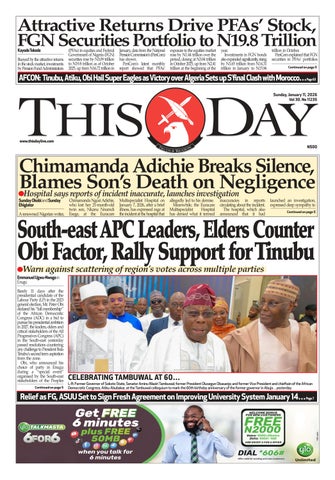
CELEBRATING TAMBUWAL AT 60…
L-R: Former Governor of Sokoto State, Senator Aminu Waziri Tambuwal; former President Olusegun Obasanjo; and former Vice President and chieftain of the African Democratic Congress, Atiku Abubakar, at the Tambuwal colloquium to mark the 60th birthday anniversary of the former governor in Abuja…yesterday
Relief as FG, ASUU Set to Sign Fresh Agreement on Improving University System January 14… Page 7
DIAL *606#
Offer valid for existing and new customers
2
sUNDAY, JANUARY 11, 2026 • T H I S D AY
SUNDAY, JANUARY 11 , 2026 • T H I S D AY
3
4
sUNDAY, JANUARY 11, 2026 • T H I S D AY
5
JANUARY 11, 2026 • T H I S DAY, T H E S U N DAY N E W S PA P E R
NEWS
Crude Oil Prices Rise as Global Market Weighs Iran, Russia, Venezuela Supply Risks
Emmanuel Addeh in Abuja
Oil prices rose two per cent at the weekend on growing supply worries linked to intensifying protests in oilproducing Iran, an escalation of attacks in Russia's war in Ukraine as well as issues surrounding the recent capture of the Venezuelan President, Nicolas Maduro. Nigeria's benchmark, Brent futures settled $1.35, or 2.18 per cent higher to $63.34 per
barrel, while US West Texas Intermediate (WTI) crude was up $1.36, or 2.35 per cent, to $59.12. Earlier, both benchmarks climbed more than three per cent on Thursday, following two straight days of declines. For the week, Brent rose about four per cent, while WTI gained about three per cent. "The uprising in Iran is keeping the market on edge," said a Senior Analyst, with the Price Futures Group,
Phil Flynn. Worries over potential disruption of Iran's oil output grew as the civil unrest in the Middle Eastern country intensified. "Iran protests seem to be gathering momentum, leading the market to worry about disruptions," Head of Commodity Analysis at Saxo Bank, Ole Hansen, said. A nationwide internet blackout was reported in Iran on Thursday as protests over
economic hardships continued in the capital Tehran, the major cities of Mashhad and Isfahan as well as other areas around the country, a Reuters report said. The Organisation of the Petroleum Exporting Countries (OPEC) pumped 28.40 million barrels per day last month, down 100,000 bpd from November's revised total, a survey showed, with Iran and Venezuela posting the largest declines.
Concerns about the spread of the Russia-Ukraine war also added to supply worries. The Russian military said on Friday it had fired its hypersonic Oreshnik missile at targets in Ukraine. The targets included energy infrastructure supporting Ukraine's militaryindustrial complex, the Russian defence ministry said in a statement. Still, global oil inventories are rising, and oversupply remains the main driver that
could cap gains, Haitong Futures said. Unless risks around Iran escalate, the rebound is likely limited and hard to sustain. US President, Donald Trump, has demanded that Venezuela give the US full access to its oil sector following Washington's capture of the country's leader Maduro last Saturday. Trump administration officials have said the US will control Venezuelan oil sales and revenue indefinitely.
SOUTH-EAST APC LEADERS, ELDERS COUNTER OBI FACTOR, RALLY SUPPORT FOR TINUBU Democratic Party (PDP), LP, and the All Progressives Grand Alliance (APGA), promised to use the platform to retrieve Nigeria from bad leadership that has been holding the country down. But in a communique reached at the end of their historic ‘Izu Umunne’ meeting held at the Presidential Hotel, Enugu, the South-east APC leaders drew a battle line with other political interests in the zone who are opposed to Tinubu’s re-election. The motion endorsing President Tinubu for a second
term was formally moved by former Senate President Pius Anyim and seconded by former Senate President Ken Nnamani, who described the decision as courageous and strategic. The APC leaders vowed that the zone would not be swayed into supporting any other presidential candidate and scattering the South-east votes across multiple political parties. At the meeting, the Southeast zonal APC leaders said they engaged in "thorough deliberations on national developments, regional
challenges and the strategic place of Ndi Igbo in the country's political future". The meeting was well attended with all three APC governors - Hope Uzodimma of Imo State, Francis Nwifuru of Ebonyi State, and the host Governor Peter Mbah of Enugu State - all in attendance. In the communique issued at the end of the meeting, the party leaders and critical stakeholders declared the Southeast zone's "unalloyed, total and unwavering support for President Bola Ahmed Tinubu as our sole and undisputed
presidential candidate for the 2027 general election". They categorically dissociated the people of the South-east Zone "from all activities motivated by the self-serving interests of any individual, however highly placed". They held that "the progress of our zone and our great party cannot be achieved through narrow personal ambitions or actions that fracture collective unity." According to the communique, "any such conduct shall henceforth be regarded as contrary to our
shared aspirations and will receive neither endorsement nor support from our zone." The APC leaders added: "The political leadership of the South-east has resolved, in the supreme interest of Ndi Igbo, that never again will we allow personal ego and motivated actions to influence the fate of the Zone. "In this regard, the Southeast will join other zones in supporting the ruling party, wherein our leaders can effectively negotiate better representation and the interests of our people."
CHIMAMANDA ADICHIE BREAKS SILENCE, BLAMES SON’S DEATH ON NEGLIGENCE
the renowned writer and her family over the painful loss. In a private message sent to family and friends, which was sighted by THISDAY yesterday, Adichie narrated that: “We were in Lagos for Christmas. Nkanu had what we first thought was just a cold, but it soon turned into a very serious infection, and he was admitted to Atlantis Hospital. “He was to travel to the United States the next day being January 7, accompanied by Travelling Doctors. A team at Johns Hopkins was waiting to receive him in Baltimore, US. The Hopkins team had asked for a lumbar puncture test and an MRI. The Nigerian team had also decided to put in a 'central line' (used to administer IV medications) in preparation for Nkanu's flight. Atlantis Hospital referred us to Euracare Hospital, which was said to be the best place
to have the procedures done.” She stated further that the morning of January 6, “we left Atlantis Hospital, Lagos, for Euracare Hospital, also in Lagos, while Nkanu was carried in his father's arms. We were told he would need to be sedated to prevent him from moving during the MRI and the 'central line' procedure. “I was waiting just outside the theatre. I saw people, including a medical doctor at the hospital known as Dr. M, rushing into the theatre, and immediately I knew something had happened. “A short time later, Dr. M came out and told me that Nkanu had been given too much propofol by the anesthesiologist, and had become unresponsive and was quickly resuscitated. But suddenly, Nkanu was on a ventilator; he was intubated and placed in the ICU. The next thing I heard was that
he had seizures. A cardiac arrest. All these had never happened before. Some hours later, Nkanu was gone.” The mourning parent, who lamented that she would never survive the loss of her child, noted in the message that it turned out that “Nkanu was never monitored after being given too much propofol. The anesthesiologist had just casually carried Nkanu on his shoulder to the theatre; so, nobody knows when exactly Nkanu became unresponsive.” She queried in the statement that: “How can you sedate a sick child and neglect to monitor him? Later, after the 'central line' procedure, the anesthesiologist casually switched off Nkanu's oxygen and again decided to carry him on his shoulder to the ICU! “The anesthesiologist was criminally negligent. He was fatally casual and careless with the precious life of a child. No
proper protocol was followed. “We brought in a child who was unwell but stable and scheduled to travel the next day. We came to conduct basic procedures, and suddenly, our beautiful little boy was gone forever. It is like living your worst nightmare. I will never survive the loss of my child. “We have now heard about two previous cases of this same anesthesiologist overdosing on children. Why did Euracare allow him to keep working? This must never happen to another child.” Nkanu Nnamdi was one of Chimamanda's twin sons with her husband, Dr. Ivara Esege, born in 2024. The news of Nkanu Nnamdi's passing has sparked an outpouring of sympathy from writers, academics, and admirers across Africa, Europe, and North America.
Hospital Debunks Inaccuracies in Reports of Incident However, the Euracare Multispecialist Hospital has denied what it termed inaccuracies in some reports circulating about the incident. In a statement issued by its management, the hospital extended its “deepest sympathies” to the family, noting that the loss of a child is “beyond words.” The hospital, however, said it was necessary to clarify what it termed inaccuracies in some reports circulating about the incident. According to Euracare, the deceased was critically ill and had been referred to its facility for specific diagnostic procedures after receiving treatment for a period of time at two paediatric centres. It stated that upon
ATTRACTIVE RETURNS DRIVE PFAS’ STOCK, FGN SECURITIES PORTFOLIO TO N19.8 TRILLION
include: FGN bonds held-tomaturity and available-for-sale, treasury bills, agency bonds issued by the Nigeria Mortgage Refinance Company (NMRC), Sukuk instruments, green bonds, and state government securities. Checks by THISDAY revealed that the combined investments in equities and FGN bonds accounted for about 74.27 per cent of the pension industry’s total net asset value of N26.66 trillion as of October 2025, underscoring the dominance of these asset classes in pension portfolios.
Market analysts attributed the rising exposure to equities to improving fundamentals in some listed companies, while noting that modest yields and the relative safety of government securities continue to shape PFAs’ preference for FGN bonds. FGN bonds, in particular, attracted strong investor interest in 2025, with yields exceeding 16.2 per cent on five-year bonds and about 15.8 per cent on 30-year tenors. While these returns are attractive in nominal terms, analysts cautioned that real yields remain modest, or
even negative, given Nigeria’s elevated inflation rate of about 20.12 per cent. Nonetheless, robust subscription levels by both local and foreign investors suggest growing confidence in the Central Bank of Nigeria’s ability to navigate monetary challenges, including persistent foreign exchange shortages and double-digit inflation. The increased participation of PFAs in the equities market contributed to an estimated N36.6 trillion in market growth in 2025, alongside N4.6 trillion in
institutional investor transactions recorded in the first 10 months of the year. Analysts told THISDAY that PFAs have been taking advantage of undervalued stocks amid naira depreciation and renewed investor confidence in the Nigerian capital market. They noted that domestic institutional investors responded sharply to macroeconomic pressures, including exchange rate weakness, high inflation, and the CBN’s elevated Monetary Policy Rate, which
stood at 27.5 per cent in August 2025 before easing slightly to 27 per cent. They also pointed to sustained growth in the pension industry, driven by regulatory reforms introduced by PenCom and by consolidation through mergers and acquisitions that have reduced the number of PFAs while strengthening the sector. Speaking with THISDAY, the Vice President of Highcap Securities, Mr. David Adnori, said the pension industry operates under strict regulatory oversight, given its responsibility for
According to them, the APC is the most practical party of choice for our people; hence, political, traditional, and business leaders, as well as the mass population, have resolved to support the ruling party. "This decision is anchored on the transformative policies of the APC-led federal government, the opportunities opened to our region, and the imperative of strategic alignment with the ruling party to secure our fair share of national resources, Continued on page 10
the patient’s arrival, its internationally trained clinical team immediately provided care in line with established clinical protocols and internationally accepted medical standards, including the administration of sedation where clinically indicated. The hospital added that it worked collaboratively with external medical teams as recommended by the family and ensured that all necessary clinical support was provided. “Despite these concerted efforts, the patient sadly passed away less than 24 hours after presenting at our facility,” the statement said. It further disclosed that it has commenced a detailed investigation in line with its clinical governance standards and best practices, stressing its commitment to transparency and responsible engagement with all clinical and regulatory processes. managing workers’ retirement savings. According to him, PenCom enforces clear investment guidelines and limits to safeguard contributors’ funds, particularly by restricting excessive exposure to volatile assets. “This cautious approach is essential to protect contributors’ savings and ensure they have a secure and reliable source of income in retirement,” Adnori said. “PFAs therefore adopt a balanced mix of fixed-income and variable assets in their portfolios.”
6
T H I S DAY, T H E S U N DAY N E W S PA P E R • JANUARY 11, 2026
NEWS
PAYING LAST RESPECTS…
L-R: Delta State Governor, Hon. Sheriff Oborevwori; Traditional ruler of Udu Kingdom, HRM Michael Ogheneovo Orugbo, Okporua I; and the Okobaro of Ughievwen Kingdom, HRM Matthew Edirin-Owini Egbi, Owahwa II, during the memorial celebration of the late Chief Palama Akporhierayen and late Mrs Esther Akporhierayen at Orhuworun, Udu Local Government Area…weekend
Oyedele Shrugs off KPMG’s Criticisms, Defends New Tax Laws
Festus Akanbi
The Chairman of the Presidential Fiscal Policy and Tax Reforms Committee, Mr. Taiwo Oyedele, has defended the Nigeria Tax Act (NTA) and clarified the policy intent, stating that KPMG Nigeria does not understand the reform. Oyedele made the points in a statement posted on X yesterday, following KPMG’s analysis of the NTA, which identified perceived weaknesses. In a report, KPMG Nigeria had flagged potential errors, gaps, and inconsistencies in the newly gazetted tax laws, including concerns about the
taxation of shares, dividend treatment, non-resident obligations, and foreign exchange deductions, and warned that these could affect businesses and taxpayers. KPMG called for a review of the tax laws, noting that the errors, inconsistencies, gaps, omissions, and lacunae urgently required reconsideration to ensure the stated objectives were met. In his reaction, Oyedele said the report largely reflected analytical errors, a failure to grasp the reforms properly, missed policy context, disagreement with deliberate policy choices, and minor clerical issues that had already been identified internally.
Council of Legal Education Approves New Law Faculties, Sanctions Three Universities in Anambra, Abia, Ekiti
Wale Igbintade
The Council of Legal Education (CLE) has approved the establishment of new law faculties in five universities, increased admission quotas for several others, and sanctioned three institutions for breaching regulatory procedures. These decisions were made at the council’s first-quarter meeting for 2026, held last Wednesday in Abuja. The meeting, chaired by the Chairman of the Council, Chief Emeka Ngige (SAN), deliberated on key regulatory, academic, administrative, and policy issues affecting legal education and the Nigerian Law School. After considering reports from the Board of Studies, chaired by the Director-General of the Nigerian Law School, Isa Hayatu Chiroma, the Council approved the commencement of law programmes in five universities, each with an initial admission quota of 50 students
at the 100-level. The approved institutions are Azman University, Kano State; Rayhaan University, Kebbi State; Confluence University of Science and Technology, Osara, Kogi State; Kingsley Ozumba Mbadiwe University, Orlu, Imo State; and Ave-Maria University, Piyanko, Nasarawa State. The approvals followed facility verification and accreditation exercises, with the Council confirming the adequacy of infrastructure, availability of qualified academic staff, and compliance with prescribed standards. In addition, the council approved increases in admission quotas for four universities. Bayero University, Kano, had its quota increased from 220 to 230; Madonna University, Okija, Anambra State, from 50 to 100; Al-Hikmah University, Ilorin, Kwara State, from 50 to 100; and the University of Ilorin, Kwara State, from 150 to 210.
The rebuttal comes amid an intense debate within Nigeria’s business and professional community over the implications of the new tax framework, which is among the most ambitious fiscal reforms in recent years. While acknowledging that some of KPMG’s observations were useful, particularly those touching on implementation risks and clerical or crossreferencing matters, Oyedele stressed that the bulk of the report mischaracterised the
objectives and structure of the reforms. “While it is legitimate to disagree with policy direction, disagreements should not be framed as errors or gaps,” he said, adding that KPMG would have been more effective had it engaged directly with policymakers, as other professional firms did, to allow for clarification and mutual learning. The Chairman provided detailed clarifications on key provisions flagged by KPMG.
On taxation of shares and the stock market, Oyedele said the framework is “structured from 0% to a maximum of 30%, which is set to reduce to 25%,” with “99% of investors entitled to unconditional exemption.” He dismissed fears of a market sell-off, noting that “any disposals in December 2025 would have benefited from the reinvestment exemption or enhanced deductions under the new law.” On the commencement date
of the laws, Oyedele said that aligning strictly with accounting periods “takes a narrow view of the complex transition issues” involved in a wholesale tax reform that spans multiple periods, audits, deductions, credits, and penalties. On the issue of indirect transfer of shares, Oyedele described the provision as a deliberate policy choice aligned with global best practices and BEPS initiatives, aimed at closing long-exploited loopholes by multinationals.
2027: Again, Wike Assures Tinubu of Victory in Rivers Olawale Ajimotokan in Abuja
The Minister of the Federal Capital Territory (FCT), Nyesom Wike, has again assured President Bola Tinubu of victory in the 2027 presidential election in Rivers State. He gave the assurance yesterday while addressing the supporters of the All Progressives Congress (APC) and the Peoples Democratic Party (PDP) during his “thank you” visit to Port Harcourt City Local Government Area (LGA) of the state. Wike insisted that no one can push him or his supporters
out or dissuade them from supporting the re-election of President Bola Tinubu for a second term in Rivers State. He recalled how the people of the state stood by him and elected Tinubu in 2023 against all odds. He said, “These are the foot soldiers of the Renewed Hope Family. If there is one state that the president knows he can go home and sleep with his two eyes closed, it is Rivers State.” The minister also vowed that, now that the benefits of supporting Tinubu had begun to be realised, he would not allow anyone to rush in at
the last minute and take the credit. “In 2023, we led the struggle here. We were members of the Renewed Hope Agenda from the outset, and that was when we decided to support Tinubu. “Now, those who were not there then, who went and supported Atiku Abubakar and failed to give him even 10 per cent votes, are now coming forward and saying they want to lead the Renewed Hope Agenda. Is it possible? “You were not there from the beginning. You didn't go to buy the pepper, the salt, or the oil.
“You did not participate in all these things. Suddenly, the food is ready; you jump in and want to be the first to eat. Is that possible? Nobody in this state can push us out,” he said. He urged his supporters not to be afraid or deterred by detractors, but to remain united and focus their efforts on supporting Tinubu's reelection. He also explained that the visit was to thank people for their support in 2023 and to encourage continued collaboration, assuring them that 2026 would be better than 2025.
FG Unveils Fresh Framework to End Public Assets Decay Nationwide Emmanuel Addeh in Abuja
The federal government has unveiled a new framework aimed at strengthening the maintenance and preservation of public assets across the country. The fresh Standard Operating Procedures (SOPs) for ensuring effective, uniform, and sustainable maintenance of federal assets, is an initiative of the Federal
Ministry of Housing and Urban Development, driven through its Department of Federal Public Assets Maintenance (FPAM). As part of the rollout, the ministry said it had commenced engagements with Ministries, Departments and Agencies (MDAs) to facilitate the implementation of the SOPs, providing a harmonised approach to asset maintenance and preservation across the
federal public service. FPAM, which was established through Presidential Executive Order No. 11, which was officially gazetted on April 6, 2022, is statutorily responsible for the oversight of maintenance functions in all MDAs, a statement by the Director Press and Public Relations in the ministry, Badamasi Haiba, said. To ensure seamless implementation of the
framework, the ministry said FPAM has introduced and distributed a set of compliance forms and a comprehensive maintenance manual to MDAs. These documents, it explained, formed part of a certification and oversight process designed to ensure proper documentation, traceability, accountability, and alignment with established maintenance standards and protocols.
7
JANUARY 11, 2026 • T H I S DAY, T H E S U N DAY N E W S PA P E R
NEWS
ANNUAL DEMOCRATIC RITUAL…
L-R: Acting Chief Judge of Imo State, Justice Ijeoma Agugua; State Deputy Governor, Lady Chinyere Ekomaru; Governor Hope Uzodimma; Deputy Speaker of the state House of Assembly, Hon. Amara Iwuanyanwu; and the Clerk of the House, Chinaelo Emeghara, when the governor signed the 2026 Appropriation Bill into law at the Government House Annex, Eziachi Umuna, Orlu...recently
Relief as FG, ASUU Set to Sign Fresh Agreement on Improving University System January 14
Kuni Tyessi in Abuja
The federal government and the Academic Staff Union of Universities (ASUU) will sign a fresh agreement on Wednesday, January 14, to strengthen industrial harmony and improve conditions in Nigeria’s university system. This was contained in an official invitation issued by the Federal Ministry of Education through the University Education Department and addressed to all Vice-
Chancellors and Registrars of federal universities. The agreement is expected to cover key areas, including a 40 per cent salary increase for academic staff and significantly improved pension benefits. Under the new pension structure, professors will retire at age 70 with pensions equal to their full annual salaries, a long-standing union demand. The deal also introduces a revamped university funding model with dedicated
allocations for research, libraries, laboratories, equipment, and staff development. The circular, dated January 5, 2025, described the event as a significant milestone in the ongoing engagement between the federal government and ASUU. According to the ministry, the agreement showed the government’s commitment to promoting industrial peace in the university system, enhancing teaching and
learning conditions, and ensuring the sustainable development of tertiary education in Nigeria. It further aligned with the President’s Renewed Hope Agenda, which prioritises reforms and stability in critical sectors, including education. According to the invitation letter by the ministry, “the event signifies a critical milestone in promoting industrial harmony, enhancing teaching and learning conditions in
Bandits Raid Communities in Niger State, Kill Four Villagers My LGA under siege, council chairman cries out
Laleye Dipo in Minna
Bandits have again raided the Kasuan Daji in the Borgu Local Government Area (LGA) of Niger State, killing no fewer than four villagers. The bandits also rustled scores of cattle during the raid. The incident, which was the second within one week, came after not less than 42 villagers were massacred in villages in the LGA and the adjoining Agwara LGA of the state. Governor Mohammed
Umaru Bago, who was away to Saudi Arabia to perform the lesser Hajj, returned to the country on Thursday and was billed to visit the troubled local government areas today and tomorrow (Monday). Following the incidents, the chairman of the local government, Alhaji Mohammed Abdullahi Nasiru, has cried out that his LGA was under siege by terrorists and bandits and asked relevant authorities to step in to "save my people
from further massacre". The recent incident, according to findings, took place around 11pm on Friday, when the bandits in their numbers, stormed the village and went straight to the houses of the villagers, brought them out and slaughtered them. Thereafter the bandits rustled the cattle of the villagers and took them into the Kainji forest. According to eyewitnesses: "The bandits were in their numbers when they came; they went straight to their
victims and killed them in their houses. They came purposely because of them; they were the target. All the cattle that were stolen were moved towards the Kainji Lake National Park Forest in Borgu Sector that night". The council chairman, Nasiru confirmed the story, saying, "My people are now living in fear." He urged the federal government to intensify security operations in the area.
US will Acquire Greenland ‘Whether They Like It or Not’, Trump Boasts Greenland’s political parties reject planned acquisition
Basking in the euphoria of the successful invasion of Venezuela and the capture of its President, Nicolas Maduro, the United States President, Mr. Donald Trump, has said Denmark would transfer Greenland “the easy way” or “the hard way”. But in swift reaction, political parties in Greenland have firmly rejected Trump's renewed
suggestions to seize the Arctic Island, declaring that they do not want to become Americans. Greenland is an autonomous territory within Denmark, having transitioned from colonial status in 1953 to home rule in 1979, and expanded self-government in 2009. Denmark retains control over foreign affairs, defence, and
monetary policy, while Greenland manages internal matters like education and health. While Russia and China have stepped up their presence in the Arctic in recent years, neither country has laid claim to Greenland. Denmark and several European allies have expressed shock at Trump’s remarks. Danish Prime
Minister Mette Frederiksen warned that any invasion of Greenland would end “everything,” referring to the transatlantic NATO defence pact and the post-World War II security order. Trump had repeatedly expressed his desire to acquire Greenland, stating that the Danish-administered Arctic Island is “critical” for national and economic security.
Nigerian universities, and reaffirming the federal government’s commitment to the sustainable development of the education sector, in furtherance of the president’s Renewed Hope Agenda.” In December 2025, the federal government and ASUU concluded the renegotiation of the 2009 FGN-ASUU Agreement, ending a long-running industrial relations crisis after more than 16 years of stalled talks. The agreement was reached on December 23, 2025, following intensive engagement between the
parties, and is expected to take effect on January 1, 2026, with a review scheduled after three years. The agreement also proposes establishing a National Research Council to fund research, with a minimum allocation of 1% of Nigeria’s Gross Domestic Product (GDP). The renegotiation of the agreement, first signed in 2009 and due for renegotiation in 2012, has stalled for over a decade and has resulted in multiple months of industrial action by academic staff, disrupting the academic calendar in Nigerian public universities.
Abure-led Labour Party Dismisses Non-recognition Claims Chuks Okocha in Abuja
The Julius Abure-led leadership of the Labour Party (LP) has dismissed claims that the Independent National Electoral Commission (INEC) opposes its continued leadership, calling such assertions deliberate misinterpretations intended to mislead the public. The clarification was made in a statement issued yesterday in Abuja by the party’s National Publicity Secretary, Obiora Ifoh, in response to comments credited to a faction aligned with Abia State Governor, Alex Otti, and Senator Nenadi Usman. In the statement, Abure said his attention was drawn to a statement issued by Senator Darlington Nwokocha, whom he described as a suspended party member, claiming to represent an “illegal and nonexisting caretaker committee” of the party. “My attention has been
drawn to a statement issued by a suspended member of the Party and a one-time senator, Darlington Nwokocha, where he exhibited his colossal ignorance on the import of the Statement issued by INEC on the reason it withheld the access code from LP ahead of the February 18 FCT Area Council election. “It is true that INEC, in a statement titled ‘Re: Claims on Access Code for Labour Party in the 2026 FCT Area Council Election’, detailed the judicial progression leading to its decision to withhold the code from the party. “However, the statement has nothing to do with the leadership of the Labour Party,” Abure clarified. The statement explained that INEC cited ongoing legal disputes arising from the FCT Area Council elections as the basis for withholding access codes, insisting that the matter was being misconstrued.
8
T H I S DAY, T H E S U N DAY N E W S PA P E R • JANUARY 11, 2026
NEWS
EIGHTY-SIX HEARTY CHEERS...
L-R: Mrs. Wosilat Okoya-Seriki; Chief Servant, Doyin Group Peniel Apartments, Abuja, Mrs. Oluwatoyin Adedoyin; Managing Director, Eleganza Industrial City Limited, Mrs. Folashade Noimat Okoya; Olori Oba Ojomu of Ajiran, Olori Bunmi Akinloye and Consultant to the Okoya at the 86 Medical Outreach, Dr. Jemilade Longe; during Day 6 of the Okoya Community Free Healthcare Outreach to mark Chief Okoya’s 86th birthday at Oluwanishola Estate, Lekki–Ajah Expressway, Lagos ... yesterday
Musa: Tinubu Has Ordered Crackdown on Supporters of Bandits, Insurgents, Kidnappers Linus Aleke in Abuja
The Minister of Defence, General Christopher Musa (rtd.), has warned those supporting terrorists, bandits, insurgents, and criminal elements to stop forthwith, as President Bola Tinubu has given security agencies the go-ahead to go after them. The minister spoke yesterday as the special guest of honour at the Armed Forces Celebration and Remembrance Day 2026 Golf Tournament to commemorate the celebration at the TYB Golf Resort and Country Club, Yar’Adua barracks. “I call on all Nigerians to
continue to support the armed forces and security agencies and work for peace. To those who are still helping those bandits, criminals, insurgents, and terrorists, they should stop because they say the friend of a thief is a thief. “For us, if we get to the battlefield and you are among them, then whatever happens to them happens to you. “And it’s important, again, for those good Nigerians to provide necessary information,” he said. Musa said the nation was using the Armed Forces Celebration and Remembrance Day to celebrate serving and dead officers, and assured Nigerians of the commitment of
FG Enforces ‘No Work, No Pay’ on Striking JOHESU Members The federal government has directed the immediate enforcement of the “No Work, No Pay” policy against members of the Joint Health Sector Unions and Assembly of Health Care Professionals participating in the ongoing strike. This was disclosed in a circular issued by the Federal Ministry of Health and Social Welfare (FMoHSW) yesterday in Abuja, addressed to Chief Medical Directors and Medical Directors of federal health institutions. The circular, dated January 8, and signed by the Director of Hospital Services, Dr. Disu Adejoke, on behalf of the Coordinating Minister of Health and Social Welfare, noted that the directive follows the continuation of the JOHESU strike, which began on November 14, 2025. It stated that hospital managements are to ensure strict compliance with the Federal Government’s “No Work, No
Pay” law. The directive takes effect from January 2026 and applies to all striking JOHESU members, as well as any other category of staff who may embark on industrial action. The ministry also instructed health institutions to sustain critical services, including accident and emergency care, labour wards, and intensive care units, “through all lawful means, including the engagement of locum staff where necessary.” “All members of staff who are willing to continue with their work must be allowed to do so without hindrance or intimidation,” the circular read. It further directed hospital authorities to “ensure the security of lives and property within their facilities and to provide regular updates to the ministry on the impact of the strike on service delivery.” The federal government reiterated its commitment to maintaining essential healthcare services nationwide despite the industrial action.
their forces to enduring peace and stability in the country. “The significance is for them, the armed forces, to ensure that they’re not forgotten, that we appreciate all the sacrifices they’ve been making, including the families of those who have passed on. “And for us, it’s to encourage them that Nigerians love their own forces, and by moving together, we will succeed.
“You can see that the president has consistently stood up for the armed forces, supported the armed forces, encouraged us in this regard,” he said. On his part, the Chief of Defence Staff (CDS), General Olufemi Oluyede, noted that “President Tinubu has given us a mandate for the armed forces to ensure that there is peace in Nigeria.” He urged Nigerians to “as
quickly as you see something, say something so that that action can be taken. And the armed forces are always ready to react.” “I also want to thank Nigerians for their support over time. And like it’s always said, security is everybody’s business. I want Nigerians to understand that they need to support their armed forces to make Nigeria safer. “To the armed forces, we
appreciate what they’ve done and what they’re doing. But we need more support to achieve the mandate given to us. “I always appreciate them for every opportunity I have because it’s not easy to go out there sacrificing your life for others to live. We appreciate them and do everything we can to make things better for them. That’s what I’m out to do generally,” he said.
Pope Leo Condemns Surrogacy, Says It Reduces a Child to a Product
Pope Leo XIV has criticised surrogacy as a birth option, saying it distorts the original relational calling of the family. Addressing members of the diplomatic corps accredited to the Holy See, the Pope emphasised the church’s rejection of “any practice that denies or exploits the origin of life and its development”. Surrogacy was named as one such practice. Surrogacy is an arrangement where a woman carries a baby
for an intended parent who cannot have children. Intended parents typically work with agencies for matching, medical screenings, and legal contracts establishing parentage with compensation for the process. Surrogacy has become significantly more common globally in recent years, driven by rising infertility rates, technological advances in IVF, and shifting social attitudes toward alternative
family-building. “Life, in fact, is a priceless gift that develops within a committed relationship based on mutual self-giving and service,” the Pope said. “By transforming gestation into a negotiable service, this violates the dignity both of the child, who is reduced to a ‘product,’ and of the mother, exploiting her body and the generative process, and distorting the original relational calling of the family.”
He also named abortion and euthanasia as violations of the right to life. “In this regard, the Holy See expresses deep concern about projects aimed at financing cross-border mobility for the purpose of accessing the socalled ‘right to safe abortion.’ It also considers it deplorable that public resources are allocated to suppress life, rather than being invested to support mothers and families,” he said.
Farmers Flee Benue Community as Armed Herdsmen Destroy Crops Suspected armed herdsmen have reportedly attacked farmers in Adogo, Ugbaam Council Ward of Ukum Local Government Area (LGA) of Benue State, destroying crops worth millions of naira. The unexpected attacks sent shockwaves through the farming community, leaving many residents fearful and fleeing for their lives. A prominent community leader, Chief Aule Gba, who confirmed the development, lamented
that the renewed attacks had severely disrupted farming activities in the area and its surroundings. “Most farmers have fled and relocated for fear of being attacked and killed by the militia herdsmen,” he said. According to Gba, the armed herders were seen destroying crops, including cassava, to feed their cattle. He stressed that the situation exposed people's vulnerability, highlighting the
lack of an effective response from the government and security agencies. “The illegal migration of these suspected armed herdsmen into certain parts of the state has not been adequately addressed. This leaves communities exposed and at constant risk of attacks,” he said. The community leader further called on the state security council to reassess current strategies and explore collaboration with the Federal
Ministry of Defence for high-calibre security support. This, he said, should include air tactical components to address hideouts in deep forest areas with poor road networks and limited communication. He emphasised that proactive measures were essential to prevent further destruction and loss of livelihoods, warning that “If urgent steps are not taken, the state should expect more of such attacks.”
SUNDAY, JANUARY 11 , 2026 • T H I S D AY
9
10
T H I S DAY, T H E S U N DAY N E W S PA P E R • JANUARY 11, 2026
NEWS
CONGRATULATORY VISIT…
L-R: Chairman, Council of Legal Education, Chief Emeka Ngige (SAN); Outgone Director General of the Nigerian Law School, Prof. Isa Hayatu Chiroma (SAN); new Director General of the school, Dr. Gbemi Odusote, during the presentation of a congratulatory letter to the new DG in Abuja…recently
Obasanjo, Jonathan, Atiku, Mark, Obi, Eulogise Tambuwal at 60 Former Sokoto governor: Nigeria in peril, needs urgent salvation
Chuks Okocha in Abuja
Former Presidents Olusegun Obasanjo, Goodluck Jonathan, and former Vice President Atiku Abubakar yesterday eulogised a former governor of Sokoto State, Senator Aminu Waziri Tambuwal as he marked his 60th birthday. This is just as Tambuwal has said Nigeria was in peril and urgently needed salvation,
calling on Nigerians to unite and rescue the country from its current challenges. Also, the various speakers, who spoke at a colloquium organised to mark his 60th birthday, in Abuja, narrated how Tambuwal was able to overcome the powers that be to become the Speaker of the House of Representatives in 2011. Speaking as the chairman
of the occasion, Obasanjo described Tambuwal as a humble personality whose leadership ambition was yet to reach the limit According to Obasanjo, ''the life style of Aminu Waziri Tambuwal is a monumental life of service at every stage of his life, from being a member of the legislative arm and in the executive arm of government,'' concluding that the 'moon' is
his limit in leadership. Speaking on how Tambuwal became the speaker of the House of Representatives, Obasanjo said that he opposed his becoming the speaker because he thought it was time to support a woman, Mulikat Akande, to serve as speaker. According to Obasanjo, ''he consulted me after his tenure as speaker and I encouraged him to go for the gubernatorial
SOUTH-EAST APC LEADERS, ELDERS COUNTER OBI FACTOR, RALLY SUPPORT FOR TINUBU
infrastructure, appointments, and development," the political leaders said. To this end, they urged all sons and daughters of Igboland in the five South-eastern states, elsewhere in Nigeria, and in the Diaspora, "to fully embrace the APC as the most effective platform for realising our political, economic and social aspirations." Although three different political parties control the five Southeastern states, APC leaders warned against "scattering of votes across multiple parties, a practice that has historically diminished our influence and bargaining power". They insisted that every vote cast by Ndigbo voters, both within and outside the South-East zone, must be for President Tinubu, regardless of any person's political ambition from the zone. The political leaders said that they were satisfied with Tinubu's presidency and commended him for "the significant strides recorded under his administration, especially the focused efforts to bridge long-standing infrastructural gaps in the South-east".
The APC leaders equally noted with satisfaction "the elevation of our sons and daughters to key national positions, and (Tinubu's) demonstrated commitment to inclusive governance." "President Tinubu's leadership, defined by competence, results, and national cohesion, has earned our deepest respect. "We are convinced that his continued stewardship holds the brightest prospects for accelerated development of our region and the nation as a whole," the communique explained. The South-east APC leaders and stakeholders expressed their allegiance to the Chairman of the South-East Governors Forum and the Progressive Governors Forum, Governor Hope Uzodimma, and indeed "the entire governors who have shown manifest visionary guidance, steady statesmanship and consistent defence of the interest of Ndi Igbo at this critical time". "We pledge our complete loyalty and support to all our five governors as we advance together in support of our visionary President, Senator Ahmed Bola Tinubu (GCFR,
and commander of our gallant armed forces. "Finally, we commit ourselves irrevocably to mobilising every available human, material and spiritual resources to deliver massive bloc votes to President Bola Ahmed Tinubu across the five South-eastern states in 2027," the ruling party leaders said. To achieve their political goals for 2027, the political leaders resolved to intensify voter education, registration drives, strengthening of party structure, and unitybuilding efforts "to ensure an unprecedented victory for our President and, by extension, for the entire South-east". They assigned the Governors Mbah and Nwifuru to oversee the supervision and mobilisation of the APC in Anambra State, while the governor of Imo will continue to oversee his state. "We call on all Ndi Igbo to rally with us in this sacred assignment to build a future where our children can prosper in a Nigeria that truly works for all. "The South-east has spoken with one voice; that voice stands firmly with President
Bola Ahmed Tinubu, the All Progressives Congress, and the leadership of our performing governors," the political leaders said.
Tinubu’s Endorsement a Paradigm Shift Grounded in Pragmatism, Says Mbah In his address, the Governor of Enugu State, Mbah, described the endorsement of President Tinubu and the increasing alignment of the South-east with the APC as a “paradigm shift grounded in pragmatism.” He said the region had moved from “standing at the crossroads of history to shaping history itself.” Also speaking, Governor Nwifuru of Ebonyi State expressed confidence that by 2027, all governors in the South-east would be members of the APC. He urged party leaders to embrace reconciliation and sacrifice, noting that the influx of new members required effective internal management rather than further party building.
election. He became governor and now, he is a Senator. The moon is his limit.'' Also, the former President Jonathan described Tambuwal as a man of humility. He said when the celebrant wanted to become the Speaker of the House of Representatives, he opposed him, but added that his opposition didn't affect his relationship with him because of his lifestyle of humility. ''He is appreciated as a politician. We had some issues, but he was supported by his fellow parliamentarians and he had his way.'' Former governor of Anambra State, Obi, who welcomed him to the sixth club, described him as a committed Nigerian who believes in the unity of the country. Former Senate President and Chairman of African Democratic Congress (ADC), Senator David Mark narrated how Tambuwal and Emeka Ihedioha literally coerced him to endorse their ambition against the position of their political party, the PDP. Mark said that he eventually supported the aspiration of Tambuwal and Ihedioha in becoming speaker and deputy speaker respectively. In the colloquium and discussion at the event that was conducted by the former Governor of Ekiti State, Kayode Fayemi; Prof. Pat Utomi and Dr. Usman Bugaje, they advocated an inclusive government, explaining that the winnertakes-it- all in form of majority system is one of the problems in Nigeria. According to Fayemi, ''there is the need for an inclusive system that will endure a general participation by all Nigerians.” On his part, Utomi lamented that Nigeria could degenerate to
the system obtained in Sudan. He said that ''Nigerians love Democracy and democratic rule, but don't like state capture. Utomi suggested proportional representation in governance, calling for an all-inclusive system that would ensure popular representation, according to votes scored by parties during election and not an elitist system that is presently practised in Nigeria In his vote of thanks message, Tambuwal noted that Nigeria was not where its founding fathers envisaged, adding that even those who laid the foundations of the country’s democracy, whether alive or deceased, would be unhappy with the present state of affairs. Tambuwal, who said it was the first time he was celebrating his birthday, explained that although he initially declined the idea of a colloquium, he later accepted because of the relevance of its theme. According to him, the event was not about personal celebration but about reflecting on the state of the nation and finding a way forward. “It is about good governance. It is not about me or merrymaking. It is about finding a pathway for our country. Where we are today is unfortunate. This is not where we expected to be,” he said. He added that Nigerians who genuinely believed in the country and were not driven by selfish interests could not be satisfied with the current situation. “The only way out is for all of us to accept that something is fundamentally wrong with how we are being governed in Nigeria today,” Tambuwal said. Tambuwal stressed the need for collective action to rescue the nation.
SUNDAY, JANUARY 11 , 2026 • T H I S D AY
11
12
T H I S D AY, T h e S U N D AY N e w s pa p e r JANUARY 11, 2026
news
FARE THEE FATHER …
L-R: Children of the deceased, Mr. Olugbenga Fasuyi; Hon. Bankole Fasuyi; Mrs. Adunola Oladapo; and Dr. Folarin Fasuyi, at the final burial of their father, Mr. Olatunji Fasuyi, at Oritamefa Baptist Church, Ibadan Oyo State…recently
R ive r s E l d e r s , M O S O P R e j e c t Impeachment Notice against Fubara Blessing Ibunge in Port Harcourt
The Movement for the Survival of the Ogoni People (MOSOP) and the Rivers Elders and Leadership Forum have strongly condemned the recent impeachment notice served on Governor Sir Siminalayi Fubara and his deputy, Professor Ngozi Nma Odu, by the members of the Rivers State House of Assembly, warning that the action risks further destabilising the state. In a statement he issued in Port Harcourt at the weekend, the President of MOSOP, Fegalo Nsuke, said the impeachment proceedings could pose a serious threat to the peaceful resumption of oil exploration in Ogoni. MOSOP noted that the federal government may lose the opportunity to rake in over $30 million per day in revenue from the proceeds of 500,000
barrels of oil produced in the area if the current political escalation by lawmakers is not put in check. Mosop said that it was most unfortunate that just at the verge of the federal government’s breakthrough for a smooth resumption of exploration, the state House of Assembly resorted to fanning the embers of political crisis. “If the federal taps 500,000 barrels of oil in a day from Ogoni, we are talking about more than $30 million per day in revenue. But with a crisis like this, who would want to put their money into that kind of environment? The lawmakers should have a rethink,” Mosop queried. He described the move by state lawmakers to impeach Governor Fubara as a direct assault on President Bola Ahmed Tinubu’s mediation efforts in the state’s political crisis.MOSOP said the sudden attempt to
NAF Hits Terrorists in Timbuktu Triangle, Clears Way for Ground Troops in Borno
Linus Aleke in Abija
The Nigerian Air Force (NAF), operating under the Joint Task Force (JTF) of Operation Hadin Kai, has conducted a coordinated air interdiction operation at AbbagaJiri in the Timbuktu Triangle, Borno State. The Director of Public Relations and Information of NAF, Air Commodore Ehimen Ejodame, in a statement issued yesterday, said the air interdiction successfully cleared the way for the ground troops. Ejodame said the Air Component acted on actionable, multi-source intelligence confirming the presence of active terrorists, structures, and concealed logistics facilities in the area. He said the NAF air assets were employed in integrated surveillance and precision strike to engage identified targets. According to him, the operation was deliberately designed to degrade terrorist capability, deny sanctuary,
and shape the battlespace for ground forces, in strict adherence to established rules of engagement and the protection of non-combatants. “The identified terrorist structures were decisively engaged and destroyed, denying the terrorists freedom of action, while a followup engagement neutralised armed elements observed converging on the location. “Subsequent advances by ground troops into the area confirmed the effectiveness of the air strikes and validated the success of the joint air–land operation,” he said. Commenting on the operation, the Chief of the Air Staff (CAS), Air Marshal Sunday Aneke, said the success of the mission reflects the NAF’s resolve to dominate the air domain in support of joint operations. Aneke said the operation demonstrated the service’s unwavering commitment to delivering precise and decisive airpower in support of ground forces.
impeach the governor calls into question the assembly’s loyalty to the President, given that the President has been personally involved in resolving the Rivers State crisis. On their part, the Rivers Elders and Leadership Forum, in a press statement signed by its chairman and former deputy governor of the state, Dr GTG Toby, described the impeachment process as a
“serious constitutional process” that should not be wielded as a weapon for “political vendettas or factional struggles.” They criticized the grounds for the notice as “disturbingly weak, lacking substance, public interest justification, or constitutional weight,” suggesting the move is motivated by “narrow personal interests” rather than a commitment to good governance.
The forum emphasized that Governor Fubara’s mandate was “freely given by the people of Rivers State” and can only be challenged through strict adherence to constitutional provisions, due process, and “clear, compelling, and verifiable grounds.” Highlighting the potential fallout, the elders cautioned that pursuing the impeachment could deepen political
divisions, erode public trust in democratic institutions, and exacerbate instability in a state still recovering from recent disruptions under emergency rule. “Our people continue to bear the consequences of that episode, and this development, so early in the year, risks reopening old wounds and heightening tensions at a time when stability and focused governance are urgently needed,” the statement added.
The Lagos-Calabar Coastal Highway is already serving its purpose as the federal government intensifies efforts to complete its Section One, the Minister of Works, Senator Dave Umahi, has said. Umahi remarked yesterday during an inspection tour of the project in Lagos. He said the road would be tolled once it is completed and inaugurated. “I am very eager to see how we can fully complete this Section One by April this year, so that we
can have it fully commissioned – a stretch of Section One and a significant part of Section Two. “I must emphasise that this road is going to be tolled by the contractor; it is part of the package. “I will be inviting the contractor to give us the programme. I don’t want to open this permanently to traffic and then start discussing tolling. “The contractor has to give us the programme and begin to build infrastructure before the end of April, so we have to toll this route
as soon as we complete it and as soon as it is commissioned,” he said. He said that despite the challenges, the contractor handling the project, Hitech Construction Company Ltd., was performing well and committed to meeting deadlines. “We are terribly challenged because of the realignment that we have encountered. “What we are witnessing in Kilometre 34 has nothing to compare with what we had in
Kilometre 20, where we had a pit of over 25 metres deep, and Hitech was able to remove them and then loaded them with lumps and sharp sand. “I continue to thank Hitech. Lagosians and other Nigerians have been enjoying the road, and I have seen the reason behind the dreams of over 27 years,” Umahi said. He said he would inspect the project monthly to ensure the President would fully inaugurate it by the end of April.
Umahi: Lagos–Calabar Coastal Highway Already Serving Purpose, to Be Tolled after Inauguration
2027 Elections: Group Faults Kalu’s Claim of Delivering Abia, South-east to Tinubu Wale Igbintade A socio-economic and political advocacy group, South-east Positive Movement (SAPEM), has dismissed claims by Senator Orji Uzor Kalu that he can deliver Abia State and the South-east to President Bola Tinubu and the All Progressives Congress (APC) in the 2027 general election. In a statement signed by its General Secretary, Comrade Ukoma Anyaele, the group described the assertion as “an empty boast” and an attempt to mislead the President and his party, insisting that Kalu’s claim of sweeping political influence does
not reflect realities on the ground. The group further branded the former Abia State governor and current senator “a general without troops,” arguing that he lacks the grassroots support required to deliver the region in future polls. The statement said Senator Kalu’s alleged lack of performance as governor and as a lawmaker, coupled with what it described as a selfish leadership style, had eroded his political base. According to the group, Kalu neither developed Abia State during his tenure as governor nor built a broad and enduring political structure.
“Rather than nurture followers, he focused on personal and family interests. Today, that approach has left him a political leader without real followers,” SAPEM stated. The group said it was committed to promoting free and credible elections ahead of 2027 and would continue to scrutinise campaign narratives. “We consider it our duty to monitor electioneering and expose politicians who seek to deceive citizens with claims dressed up as promises,” the statement added. SAPEM said it was “appalled” that Senator Kalu, whom it claimed had lost relevance in Abia North Senatorial District and the state,
continued to project himself as influential across Abia and the South-East. “In doing so, he deceives no one but himself,” the group added, insisting that voters deserve accurate information before making electoral choices. The advocacy group further argued that Kalu’s leadership style had become his “political undoing,” alleging that many of his associates complain that his support is limited to immediate family members. As a result, SAPEM said, he lacked the capacity to drive statewide or national socio-economic, political, and human-capital development.
SUNDAY, JANUARY 11 , 2026 • T H I S D AY
13
14
T H I S D AY, Th e S U N D AY N e w S PA P e r • JANUARY 11, 2026
IMAGES
P
rofessorDhikruAdewaleoftheUniversity of Ibadan gave out his daughter Amani Mobandele in marriage to AbdulFattah Ayodeji Marquis recently. The event which took place at World Lillies Events Centre, Oluyole, Ibadan was witnessed by the family and friends. Here are some personalities at the ceremony.
PHOTOS: SUNDAY ADIGUN Newlyweds, AbdulFattah Ayodeji and Amani Mobandele Marquis
The Groom Parents, Engineer Abiodun Marquis and wife, Taiye
Bride’s parents, Prof. Dhikru Adewale and Dr. Adunola Showole
Chief FK Balogun and Prof. Tinu Agunloye
Prof. T Simbine and Mrs. Kemi Odekunle
Prof. Dhikru Adewale and Rakiya Yagboyaju
Chief Ekundayo Morakinyo and Mr. Mutiu Bello
Toluwase Agusto and Khadijat Agusto
Sultan and Iretemi Yagboyaju
Mrs. Khadijat Imoyo and Prof. Layide Abass
Mrs. Iyabo Isola and Dr. Mrs. Segi Jobi-Odeneye
Mr. and Mrs. Saheed Yagboyaju
T H I S D AY, Th e S U N D AY N e w S PA P e r • JANUARY 11, 2026
15
IMAGES
L-R: Dr. Kehinde Sowole, Mr. Jimi Adelekan and Mrs. Dupe Sadiq
Baba Willams and Rakiya Dhikru-Yagboyaju
Mr. Wale Ojetimi and Mr. Yinka Adeyemi
Alhaja Bolanle Akanni Yagboyaju and Monsurat Yagboyaju
Dr. and Mrs. Robert Izzi
Oluwatofarati Agusto and Oloruntele Agusto
Dr. Mrs. Iyabo Are and Mrs. Ronke Kazeem
Dr. and Mrs Kunle Oyewo
Mr. Biliyamin Owowlabi and Hon. Taofik Olayiwola
L-R: Mr. Muyiwa Ojo, Prince Tolu Obembe and Prince Bayo Adeyemo
L-R: Mr. Richard Adesope, Cheif Ekundayo Morakinyo and Mr. Mutiu Bello
L-R: Tunde Arogundade, Toun Arogundade and Ayo Arogundade
L-R: Lolo Longe and Vera Emmanuel
Mr. and Mrs. Animasahun
Mr. and Mrs. Gbolagade Isola
16
THISDAY, The SUNday Newspaper •January 11, 2026
INTERNATIoNAL
Reckless US Interventions in Venezuela: The Politics of International Law of Non-Intervention
I
nternational law, also referred to as jus or ius gentium, meaning Law of Nations, is not simply a field of study, but more interestingly a very controversial subject of international politics that paves way for complex manoeuvrings in the quest for global peace and security. In this regard, some countries, like Nigeria, take international law as a big deal to the extent of making it a constitutional foreign policy objective.As provided in Section 19 of Nigeria’s 1999 Constitution as amended, it is made clear that Nigeria is more interested in global order than in the protection of Nigeria’s own national order. In other words, Nigeria can be rightly considered an internationalist or a globalist in the true sense of the word. On the contrary, the United States under President Donald J. Trump is an advocate of nationalism and protectionism, and a vehement opponent of multilateralism that is not protective of U.S. interests. For instance, last week Thursday, 8th January, 2026, President Trump reportedly ordered the withdrawal of U.S. membership of sixty-six international organisations in implementation of his ‘America First’ policy. In the eyes of Donald Trump, the affected organisations operate ‘contrary to U.S national interests, security, economic prosperity or sovereignty.’ Besides, the withdrawals ‘will end American taxpayer funding and involvement in entities that advance globalist agendas over U.S. priorities, or that address important issues inefficiently or ineffectively.’As further noted by newdiplomatng.com, ‘many of these bodies promote radical climate policies, global governance and ideological programmes that conflict with U.S. sovereignty and economic strength.’ Thus, the United States is much less interested in respecting international law, regardless of whatever obligations created by U.S. membership of any international organisation or international law. While one of Nigeria’s foreign policy objectives is to respect internationallawandtreatyobligations,theU.S.foreignpolicyobjective consciously disregards international law of non-intervention contrary to the provision of Article(4) of the UN Charter.
RealityofInternationalLawofNon-Intervention
Article 2(4) of the UN Charter prohibits intervention or threats of use of force in settling international disputes. If Nigeria says her foreign policy objectives include respecting international law which some countries do not respect, it simply means that Nigeria is an advocate of the rule of pacta sunt servanda, or sanctity of agreements, and therefore cannot be expected not to respect the non-intervention principle as provided for inArticle 2(4) of the UN Charter. Put differently, apart from Section 19(a) which stipulates that Nigeria’s foreign policy objective shall be the ‘promotion and protection of the national interest,’ the other four objectives are all international in character. The objective is to promote and protect ‘African integration and support forAfrican unity (Section 19(b). This objective is consistent with the Afrocentric principles of Africa as cornerstone of Nigeria’s foreign policy from 1960 to 1976 and centrepiece of Nigeria’s foreign policy from 1976 to date. However, the objective is extra-Nigeria in design and implementation. Section 19(c) says the objective shall be to promote ‘international cooperation for the consolidation of universal peace and mutual respect among all nations and elimination of discrimination in all its manifestations.’ There is goodness in seeking universal peace that does not exist and that has the potential not to exist. The likelihood of any existence of universal peace is, at best, a dream. And true enough, African leaders generally believe that no meaningful development can exist in the absence of peace and security. We have no qualms with the ‘promotion of a just world economic order,’ as provided under Section 19(e) but it is again a meaningless objective because international law and relations are a conflict system of order and counter-order that always generates an encounter that also results in disorder. It is basically a system of self-survival first, and caring less for what happens to others. This makes a nonsense of any quest for international cooperation and quest for international peace and security. Perhaps more concerning and disturbing is Section 19(d) which
with
Bola A. Akinterinwa Telephone : 0807-688-2846
e-mail: bolyttag@yahoo.com
•Trump says Nigeria’s foreign policy shall be the ‘respect for international law and treaty obligations, as well as the seeking of settlement of international disputes by negotiation, mediation, conciliation, arbitration and adjudication.’ This objective is consistent with the UN Charter. However, it shows the non-seriousness of Nigeria’s foreign policy objective: why should a foreign policy objective simply be to respect international law which is not a big deal for most major powers in international relations? What does it mean to France, Britain, and U.S. who have aggressed Syria, or Russia that has invaded Ukraine? What about Turkey in Syria? It is against this background that we want to explicate U.S. reckless intervention in Venezuela and the myth and reality of international law of non-intervention. Put differently, pleading the case of non-intervention in the domestic concerns of another sovereign state must also address the concerns of the intervening state. What makes U.S. intervention in Venezuela reckless is not the decision to intervene or the mania of the intervention but the objective of seeking to administer Venezuela as a constituent State of the U.S. Without jot of doubt, as noted above, Article 2(4) of the UN Charter outlaws the threat or use of force against the territorial integrity of any other state. Threatening the political independence of another sovereign state is strongly prohibited regardless of the self-serving interpretation of the article. The United States is on record to have been engaging in regime change in several countries. As recalled by Jeffrey D, Sachs in his briefing of the UN Security Council on Venezuela on January 5, 2026, there were 70 attempted US regime-change operations between 1947 and 1989 alone based on Lindsey O’Orourke’s book, entitled Covert Regime Change. More important, in the period from 1989 to date, U.S. regime-change operations ‘included, among the most consequential, Iraq (2003), Libya (2011), Syria (from 2011), Honduras (2009), Ukraine (2014), and Venezuela (from 2002 onward).’ And
And true enough, the most recent U.S. aggression on Venezuela is particularly reckless and raises more unanswered fundamental questions. For instance, there is no disputing the fact that Venezuela has always been seen as a security threat to the United States to the extent that President Donald Trump even contemplated the possibility of invading Venezuela in 2017. President Barak Obama put the concerns of the United States thus: ‘Venezuela is an unusual and extraordinary threat to the national security and foreign policy of the United States.’ Perceived as such, is it reasonable to seek the respect for international law to one’s detriment? Does it make any good sense to put a trust in a law or in an organisation that is not capable of ensuring one’s national security? Should a country put its national security in the care of international law or in the United Nations? Answers to these questions are not easy to give because, grosso modo, it is generally the weaker Member States of the international community that seek peace, that complain about non-respect for international law, and that acquiesce to the de facto rule of might is always right. Powerful countries only respect international law when it is convenient. For Nigeria to make the respect of international law and treaty obligations a foreign policy objective is myopically most unfortunate. Nigerians should commend President Bola Ahmed Tinubu for making strategic autonomy the fulcrum and guide of his administration and for his Foreign Minister, Ambassador Yusuf Maitama Tuggar for efficiently and effectively translating the policy into concrete foreign policy actions
“
“
Vie Internationale
perhaps more interestingly is the method of achieving the regime change: ‘open warfare, covert intelligence operations, instigations of unrest, support for armed groups, manipulation of mass and social media, bribery of military and civilian officials, targeted assassinations, false-flag operations, and economic warfare aimed at collapsing civilian life, to borrow the words of Jeffrey Sachs. This means that the United States has actually been committing war crimes and crimes against humanity, apparently for politicoeconomic motivations that are detrimental to the protection of international law. This is therefore more about politics and complete disregard for international law, which provides for a domaine réservé in which no sovereign state can intervene. Article 2(7) of the U.N. Charter is also very clear on non-intervention based on several principles. For instance, the principle of sovereign equality does not allow for intervention: all countries are sovereign and equal, and therefore have the right to manage their own affairs without external interferences. Thisismoresowiththeprincipleofdomaineréservéwhichadmits that every state has its own essential domestic jurisdiction where intervention is impermissible. In this regard, impermissibility is in the area of armed intervention, directly or indirectly by way of threatening. Economic coercion is prohibited. For example, taking sanctionary measures aimed at subordinating the sovereign rights of another state is not allowed. Subversive activities by way of overthrowing another government, organising financing and assisting armed and terrorist organisations are unlawful. The same is true of electoral interferences aimed at hacking systems, manipulating elections, or spreading disinformation are prohibited. Even though international law provides for some exceptions to the application of the principle of non-intervention, there is an ongoing debate on the myths and reality of the principle in international practice. First on the exceptions, Article 51, under Chapter VII of the UN Charter allows for intervention when there are threats to peace. In this regard, based on the rule of sovereignty, there can be lawful individual or collective intervention when there is consent from the legitimate government or when there are threats to international peace and security. When a sovereign state is threatened or is a victim of unprovoked attack or aggression, there is room for legitimate self-defence, but eventually subject to the UNSC approval. The IR2P (International Responsibility to Protect) cannot but be another exception in the sense that the international community has zero tolerance for ethnic cleansing, genocide, war crimes, and crimes against humanity. When Heads of States or of Governments are internationally perceived to be unwilling or incapable of preventing any of the foregoing international infractions, the international community withholds the responsibility to intervene and protect. As regards the ongoing debate on the rule of non-intervention, especially as to what constitutes interference and intervention, the new thinking is that even though the non-intervention rule protects the state to decide its own future by itself, such protection is now being considered not absolute in light of human rights abuses and threats to global peace and security. Put interrogatively, how do we reconcile the prohibition of intervention with the need to prevent genocide, crimes against humanity, etc.? There is also the question of legality and legitimacy. Unilateral intervention can be legally questionable but humanitarian interventions can be politico-morally legitimate. How do we reconcile them? To what extent is the rule of non-intervention now sustainable and lawful in application? It is against this background that the U.S interventions in Venezuela are interrogated.
USPoliticsandRecklessInterventions
There are many issues in US-Venezuelan bilateral relations. One major issue is how to reconcile Venezuela’s quest for self-identity and autonomy and the U.S quest for control of Venezuela, in particular, and the whole of western hemisphere, in general. Relationship between the two countries has generally been rough, especially as from 1999 when Hugo Chávez became the President of Venezuela and he opted for socialism and anti-US imperialism. Venezuela accused the U.S. under President George W. Bush of supporting the 2002 coup against Chávez. In September 2008, Venezuela expelled US Ambassador in solidarity with Bolivia, following the accusation of his cooperating with some violent anti-government groups in the country. Again, in February 2014, threeAmerican diplomats were declared personae non-grata allegedly for sponsoring violence. And perhaps more disturbingly, in 2019, during the Presidential election crisis, the U.S. refused to accept Nicolás Maduro as President of Venezuela. The U.S. opted for Juan Guaidó, the President of the National Assembly, as interim president. This prompted Maduro to announce the breaking of ties with the U.S. The U.S. was much infuriated as a result. The crescendo of the bad relationship was reached in 2025 with the designation of Tren de Aragua and Cartel of the Suns as terrorist organisations, as well as sending Venezuelans accused of being members of the Venezuelan gang, Tren de Aragua, to the CECOT (Center for the Confinement of Terrorism) in El Salvador. The CECOT is a maximum security prison. InAugust 2025, Donald Trump directed that military force be used against LatinAmerican drug cartels, described as narcoterrorists. In this regard, USS Iwo Jima, and its amphibious Ready Group, were deployed. Read full article online - www.thisdaylive.com
17
THISDAY, The SUNday Newspaper •January 11, 2026
Business
Editor: Festus Akanbi 08038588469 Email:festus.akanbi@thisdaylive.com
Tax Reform: Between Intent and Perception What should have passed as a routine adjustment in Nigeria’s tax code has instead unfolded as a daily drama of debit alerts and doubt, turning a fifty-naira stamp duty into a mirror reflecting the country’s deep unease with how the state reaches into the pockets of its citizens, writes Festus Akanbi
T
he harmattan haze that settles over Lagos at dawn is no longer the only thing Nigerians wake up to, as their phones buzz with debit alerts that feel like a pickpocket’s hand in their pockets.
Painful Bank Debit Alerts
Since January 1, every transfer above N10,000 carries a fixed N50 stamp duty, and the country has been dragged, sometimes unwillingly, into a national conversation about tax. It is happening everywhere: in beer parlours, in church WhatsApp groups, and in ride-hailing waiting lots where drivers compare deductions like battle scars. The fear, it must be said, is not the N50 itself. It is the uncertainty of the hand that takes it. When a civil servant wakes at 2 a.m. to an unfamiliar debit, or a yam seller is told she cannot open a second account without a Tax Identification Number, the instinct is not to consult the Finance Act. It is to move money out of the system entirely, into cash or the mattress, where no algorithm can sniff it. That instinctive retreat is costly. It shrinks banks’ deposit bases, pushes credit back into the informal shadow economy, and fuels a cottage industry of “tax clearance” touts who sell immunity that does not exist.
Between Policy Intent and Public Perception
The irony is sharp. The 2026 fiscal reforms were designed to achieve the opposite: to widen the tax net without widening the pain, to make taxation more predictable, and to reduce leakages rather than multiply them. Yet policy intent and public perception are moving in opposite directions. The gap between them is already costing the economy more, in lost trust and financial disintermediation, than the revenue the new law hopes to harvest. To understand the panic, the signal must be separated from the noise, said a former director with the defunct Federal Inland Revenue Service, who pleaded not to be quoted. Speaking with THISDAY during the week, he said, “The stamp duty itself is not new. In its earlier form as the Electronic Money Transfer Levy, it was often applied unlawfully, sometimes debited from both sender and recipient, and at rates that varied by bank. The new law does something simpler than the rumours suggest: it consolidates the charge at the sender’s end and fixes it at a flat rate of N50. In aggregate terms, the burden on the system has fallen, not risen.” According to him, the same applies to bank reporting requirements. Accounts with monthly turnover above N5 million are flagged, not for automatic confiscation, but to improve compliance mapping. There is no provision for arbitrary debits. But these clarifications are buried in a 276-page statute that no trader in Alaba or driver stuck on the Third Mainland Bridge has time to read.
Fiscal Ambushes and Opaque Deductions
Into that vacuum, rumours rush. Every account will be taxed automatically. Transfer narrations will be monitored. The government is coming for the widow’s mite. Anxiety is amplified by the familiar layering of charges Nigerians already endure: VAT on transfer fees, card maintenance fees, SMS alerts. Each
• President Tinubu signing the new tax laws is lawful in isolation; together, they feel like death by a thousand cuts. A driver who earns N15,000 from a ride sees the platform deduct commission, the bank deducts stamp duty and VAT, and the local council still charges a daily parking fee. This is not paranoia; it is lived multiplicity. Policy does not land in a vacuum. It meets a society with a long memory of fiscal ambushes and opaque deductions. That history explains why Nigerians fear taxes less than surprises. The challenge, therefore, is not merely legal. It is communicative.
Calming the Nervous Public
Financial analysts, in their commentaries on various television programmes monitored in Lagos last week, agreed that the government must first learn to communicate with the public. Dense circulars may satisfy internal compliance requirements, but they do little to reassure a nervous public. The Revenue Service needs to step beyond PDF uploads into the spaces Nigerians already inhabit: short videos, radio explainers, vernacular messaging. A 30-second clip showing a woman warned of a N50 duty before sending money to her mother would do more than a dozen press releases. Predictability, more than generosity, restores trust. Banks must also simplify the story. January statements should not read like forensic puzzles. A one-page breakdown showing what was deducted, why, and how it compares with the previous year would change the tone. When people can see that total charges are not spiralling, pain becomes data, not drama. Confidence also depends on the ability to complain without exhaustion. The Central Bank’s Consumer
Protection Department received thousands of petitions last December, yet few escalated beyond the initial stage because the process felt burdensome. Complaints require emails, forms, and patience that many Nigerians cannot spare.
Dispute Resolution
Technology offers a fix. Every banking app should have a visible “dispute” button. One click should freeze the debit, route the ticket to the bank’s ombudsperson, and copy the regulator. If the issue is not resolved within a defined window, the amount should be provisionally re-credited. Nothing restores confidence faster than a system that can correct itself quickly. Beyond apps, the conversation must move to the street. Nigeria’s most influential forums are not press briefings but Community Development Association WhatsApp groups, where everyday issues are debated. That is where stamp-duty myths mutate. A modest programme of community “Tax Champions”, teachers, union leaders, market women, could change the texture of this debate. Equipped with simple explainers in major languages, their role would be to translate, not defend, policy. Reassurance from a familiar face often travels faster than official pronouncements. Fairness must also be visible. The requirement that all account holders obtain a Tax Identification Number is sensible, but it becomes punitive when citizens confront clunky portals and touts. Integration is the solution. Banks already perform biometric onboarding; TIN enrolment should be embedded seamlessly into that process. Open an account today, and receive your TIN by text before midnight. Analysts believed transparency should follow. According to a top banker, Mr. Stephen Ogunsola, “A public dashboard showing how many new taxpayers have been added, what they paid, and what specific clinics, classrooms, or roads those funds financed would help rebuild the psychological contract. The moment
citizens see a link between deductions and services, taxation no longer feels abstract.” Ogunsola agreed that structural reassurance is equally essential, explaining that bank charges feel frightening because they seem limitless. “A legislated cap on cumulative charges over a year would place a ceiling on anxiety. Additionally, a no-frills, zeromaintenance account that is insulated from card and SMS fees could protect low-income users. Any revenue forgone would be minimal compared with the goodwill gained,” he said. Finally, analysts argued that credibility must start at the top. They pointed out that the political class should publish its own tax returns. Seeing ministers, governors, and legislators subject themselves to the same rules would speak louder than any slogan. Reciprocity is the fastest cure for cynicism. If these steps are taken, hysteria can give way to vigilance. Nigerians will still scrutinise every debit alert, but within a framework where errors can be corrected and abuse punished. Over time, the culture can shift from avoidance to engagement. The tax base will broaden not because the state grew sharper teeth, but because citizens gained clearer eyes.
New Narratives
Fiscal reform is not merely a spreadsheet exercise; it is a storytelling project. Today, the dominant story is that the new tax law is a pickpocket. The evidence suggests otherwise, but it does not speak for itself. The consensus among industry analysts is that until the government becomes the narrator-in-chief, speaking plainly, admitting missteps, and showing how every naira returns as roads, vaccines, or broadband, the fear will persist. Yet the opportunity remains. Replace rumour with receipts, opacity with clarity, and surprise with schedules, and citizens now rushing to close accounts may one day defend the very system they once feared. That is when reform moves from statute to shared belief, and when the economy can finally breathe again.
THISDAY, The SUNday Newspaper •January 11, 2026
18
FINANCE
Inside the High-Stakes Push to Formalise Nigeria’s POS Network As the January 1, 2026, registration deadline lapses, Nigerians say it will test the state’s ability to formalise the Point of Sale ecosystem without weakening the financial inclusion it created, writes Festus Akanbi
A
t 6:47 a.m. on a humid Tuesday in Olambe, a border community between Ogun and Lagos states, David Ojeme steadies a small point-of-sale (POS) terminal on a makeshift counter, a wooden plank balanced between two crates of phone accessories.Awoman beside him waits impatiently to withdraw N20,000, glancing repeatedly at her wristwatch. Taped to the wall behind Ojeme is a faded certificate bearing the name Topeline Venture, which he claimed was registered with the Corporate Affairs Commission (CAC) in 2021. For Ojeme, that document represents legitimacy. For regulators, it is no longer enough. “I already have a business name,” he says, tapping the certificate with quiet irritation. “Why should I pay again just to add ‘POS’ to it?”
New Order
That question, echoed in markets, motor parks, and street corners across Nigeria, sits at the heart of a fast-developing regulatory confrontation. As of January 1, 2026, the CAC, backed by the Central Bank of Nigeria (CBN) and security agencies, said that all POS operators must register agency banking as a distinct business activity under the Companies and Allied Matters Act (CAMA) 2020 and the CBN’s Agent Banking Regulations. Unregistered terminals, the commission has warned, will be seized. Fintech partners that continue to enable them risk sanctions and possible blocklisting. The directive marks the most decisive attempt yet to impose order on a sector that has grown explosively, and largely informally, over the past five years. What began as a stopgap to address Nigeria’s chronic cash distribution gaps has evolved into a parallel financial infrastructure that processes trillions of naira annually and touches the daily lives of millions. The CAC’s position is unambiguous. In a public notice issued a fortnight ago, the commission stated that, effective January 1, no POS operator would be permitted to operate without proper registration, adding that security agencies had been directed to enforce compliance nationwide. Registrar-General Hussaini Magaji has framed the move as a necessary response to mounting systemic risks rather than an attack on small-scale entrepreneurs.
Funneling Ransom Payment
According to the commission’s figures, 38,000 confirmed fraud cases in 2024 were linked to POS terminals, with estimated losses of N52.26 billion. Investigations, Magaji said, revealed that unregistered or poorly vetted devices were
increasingly being used to facilitate ransom payments, money laundering, and cyber-enabled financial crimes. In his view, the absence of a verifiable corporate identity makes enforcement and accountability almost impossible once a terminal is implicated in wrongdoing. Those concerns have also surfaced in the National Assembly. At recent parliamentary hearings, the Chairman of the House Ad-hoc Committee on Cryptocurrency and POS Operations, Hon. Olufemi Bamisile, disclosed that in some states as much as 40 per cent of kidnap ransom payments now pass through informal POS channels. While Magaji stressed that lawmakers were not seeking to criminalise operators, he argued that allowing millions of lightly regulated cash points to function outside effective oversight amounted to tolerating a shadow banking system. Yet on the streets, among the agents who form the backbone of this ecosystem, the directive is viewed through a very different lens. For many, the POS terminal is not a business in itself but an add-on to an existing trade, frozen food, phone repairs, provisions, tailoring, deployed to attract foot traffic and earn marginal commissions. The idea that it should require a separate registration feels arbitrary to them.
Double Registration?
In Ikorodu, Olusola Folowo operates a small frozen-food outlet. Regarding her CAC registration, she insists it already permits ancillary services. “The profit margin on POS transactions is tiny,” she explains. “On a N10,000 withdrawal, I might earn N200 after charges. From that, I still pay rent, generator fuel, and data costs. They now want an additional N25,000 for registration. How does that make sense?” This perception is widespread. An analysis by THISDAY indicates that roughly 68 per cent of POS operators run multiple activities under a single registration, seeing the terminal as a payment instrument rather than a standalone enterprise. The National President of the Association of Digital Payment and POS Operators, Paul Okafor, has repeatedly
drawn analogies to other tools of trade. “The POS is just a machine,” he argues. “A tailor does not register his sewing machine separately. Why should an agent register a terminal separately?” Behind the rhetoric lies a stark numerical reality. Data from the Nigeria Inter-Bank Settlement System (NIBSS) shows that POS transaction values surged by 69 per cent in 2024 to N18 trillion, while the number of terminals more than doubled from about 2.4 million to 5.5 million. Of these, only around 3.5 million operators have completed CAC registration in line with current requirements, leaving an estimated compliance gap of two million devices.
Structural Deficiences
The growth has been driven by structural deficiencies in Nigeria’s formal banking infrastructure. With just over 21,500 ATMs serving an estimated 63 million bank customers, POS agents have become de facto human ATMs, especially in peri-urban and rural communities where the nearest bank branch may be dozens of kilometres away. During the naira redesign and cash scarcity crisis, these agents became indispensable, keeping commerce alive when formal channels seized up. Even within the regulatory establishment, there is an acknowledgement of this role. A senior CBN official, speaking on condition of anonymity, conceded that POS operators “saved the system” during that period. The same official, however, insisted that the scale the sector has now reached makes tighter controls unavoidable. Financial inclusion, he said, cannot be pursued at the expense of financial integrity.
Fintech Companies to the Rescue
Caught squarely in the middle of this standoff are the fintech companies that power the terminals. OPay, Palmpay, and Moniepoint together control roughly 72 per cent of the market, relying on millions of independent agents for last-mile distribution. Over the past year, these firms have launched compliance drives, offering free or subsidised CAC registration, police clearance vouchers, and airtime incentives to regularise their agent networks. Progress has been uneven. A senior executive at a fintech company describes the situation as a classic prisoner’s dilemma. Disconnecting unregistered agents would cause firms to lose market share to competitors that respond faster. Failing to do so, however, exposes platforms to regulatory
sanctions. The CAC has already hinted at graduated penalties for enabling platforms, beginning with public warnings and escalating to fines, service restrictions, and, in extreme cases, licence suspension. Industry sources estimate that as many as 1.8 million terminals currently operate through fintech partnerships without full compliance. International experience offers both reassurance and caution. India’s 2018 mandate requiring police verification and formal registration for all banking correspondents led to a reported 60 per cent reduction in agent-related fraud, according to Reserve Bank of India data. Kenya’s 2021 Digital Credit Providers Regulations similarly tightened oversight of mobile money agents, though not without cost. In that case, an estimated 200,000 micro-agents exited the market, citing compliance expenses and administrative complexity. For financial inclusion experts, these examples underscore the delicate balance regulators must strike. Dr. Okey Nwankwo, a consultant in the field, notes that formalisation almost always carries short-term pain. The critical question, he argues, is whether Nigeria can implement its framework without pushing a significant share of agents back into informality or triggering service gaps in underserved areas, as occurred in parts of India where compliance costs proved prohibitive. January 1 has passed, and the contours of the possible outcomes are coming into focus. One scenario envisages mass compliance, driven by intensified fintech incentives, streamlined CAC processes, and mobile registration units reaching markets and rural hubs. Another anticipates selective enforcement, with authorities focusing on high-volume or high-risk agents while extending grace periods for smaller operators in remote communities. A third, more disruptive possibility would see widespread seizures and disconnections, potentially triggering cash shortages, higher transaction fees, and public backlash against both regulators and platforms. What is clear is that the POS sector, once seen as a stopgap innovation, now sits at the centre of Nigeria’s financial system and its vulnerabilities. The deadline will demonstrate regulatory capacity, industry coordination, and the state’s ability to formalise a grassroots economic phenomenon without undermining the very inclusion it helped create.
Sunday 11 January, 2026 Vol 30 No 11186
T H I S D AY MONDAY MARCH 14, 2022
OPI NION
opinion@thisdaylive.com
www.thisdaylive.com
TAXATION WITHOUT PROTECTION K. BOLANLE ATIJOHN writes why Nigeria risks turning fiscal reform into instability
See Page 20
Nigerian Democracy: Redesign the System JOE WILLIAM-OBI argues that politics must be redesigned to repel and punish profiteers in order to attract patriots
See Page 20
EDITORIAL
BETWEEN EFCC AND THE OPPOSITION
See Page 45
119
The FCT minister has continued to cut the image of a controversial, divisive, and disruptive personality, reckons TUNDE OLUSUNLE
THE SELF-IMMOLATION OF NYESOM WIKE
O
ne of the most intriguing volumes of poetry written by the globally respected poet, scholar, essayist and dramatist, Niyi Osundare is titled *The Word Is An Egg.* At the last count, Osundare had published nearly 20 collections of verse, establishing himself as one of the world’s most formidable and most notable bards of all time. I have been a career researcher into Osundare’s oeuvre in the past four decades and also inspired in my writing career as a member of the generation immediately succeeding his. I have also been most fascinated by *The Word IsAn Egg* which derives from the intricate depths of Yoruba lore. It establishes a congruence between the reality of the irretrievability of the spoken word, and the unsalvageability of a broken raw egg, once both have left the confines of their various enclosures. At that point, they become unguardable and unstoppable tumbling boulders. Nyesom Ezenwo Wike, the “batman” of Rivers State politics is famous for his affliction by loggorhoea. He is perennially obsessed by both the microphone and the lectern. What he lacks in perseverance for paperwork, he has aplenty in often needless garrulity and grandiloquence. At the height of his endless attrition with his political godson and successor as Rivers State Governor, Siminalayi Fubara, Wike in August 2024, threatened to “put fire in the states of governors supporting Fubara” against him. Wike spoke in reaction to a solidarity message by the Forum of Governors of the Peoples’ Democratic Party, (PDP), which met in Jalingo, Taraba State at the time, to the troubled Fubara. Wike who lost the presidential ticket of the PDP to former Vice President Atiku Abubakar at the May 2022 primary and was overlooked as running mate ahead the February 25, 2023 presidential election, has been on a singular mission to “put fire” in the PDP ever since. Apart from working against the party to secure a foothold in the post-election governance structure of the opposing All Progressives Congress, (APC), Wike has superintended over the decapitation and interment of the party which brought him to political prominence 27 years ago. From a hitherto virile and robust opposition party of over a dozen governors, the PDP has shrunken to just about half that number, its offices at the local government, state and national levels under lock in most places, arising from litigations and counter-rulings. In recent weeks, however, Wike’s invocation of fire on the house under which roof he grew into adulthood, has transmogrified into self-immolation. And he has been told so in unmistakable terms by those on whose behalf he incinerated his father’s house. Following the defection of Siminalayi Fubara to the APC and his official designation as leader of the party in the state, Wike suffered an initial bout of insomnia. For the avoidance of doubt, the APC National Chairman, Yilwatda Nentawe, a Professor, said in the immediate aftermath of Fubara’s switch to the APC, that he is henceforth the party’s *Numero Uno* in the state. He admonished him to demonstrate
accommodating leadership and earn popular trust to win the gubernatorial primary which will presage his return to office. Wike, who postures as the sole proprietor and indisputable emperor of Rivers State, promptly countered by saying Fubara will not be returned to *Brick House,* Port Harcourt, the original name of Government House in the Rivers State capital, under his watch, come 2027. According to Wike, he will not allow the state “to repeat the mistake of 2023,” the emergence of an nonpliable Fubara being the error under reference. Ajibola Bashiru, an academic, rugged activist and National Secretary of the APC, buttressed the position of the party Chairman when he noted subsequently that even members of the National Working Committee, (NWC), of the APC must defer to sitting governors as party leaders in their various states. A perennially paranoid Wike shot back cautioning Bashiru to steer clear of the politics of Rivers State, warning not to get his hands “burnt.” Wike is obviously totally enamoured by the concept of infernos and conflagration as it were. But he got more than he bargained for from Bashiru an erstwhile Senator. Bashiru told Wike unequivocally that the last time he, Bashiru checked, Wike was a member of the PDP and not the APC. To that extent, Wike could not be a rottweiler and alsatian at the same time, guarding two separate gate houses! In Yoruba, Bashiru would probably have told Wike the proverb about the fact that gluttony is not tolerated in the homestead of *Alade,* a folkloric figure who availed farmers and country folk refuge beneath the roof of his thatched hut during the rain, and something to snack on. Bashiru further told Wike that if he is so psychotic about the politics of Rivers State, he could well resign his job as Minister of the Federal Capital Territory Administration, (FCTA), and relocate to full time local politicking in Rivers State! Bashiru cannot be any correct. At no time since the return of democracy in 1999 has the FCT been any dirtier and unsafe as it has been in recent months under Wike’s supervision, as he continues to distract himself with the concurrent political overlordship of Rivers State.
In parts of the capital city, its been several months since garbage was last evacuated, a situation which bears very grave epidemic prospects. Wike who prides himself as the best thing that ever happened to the FCT, has not been able to rout bovinae and similar animals from the streets and thoroughfares of Abuja in over two years of riding around the FCT in obscene motorcades, complete with outriders. Criminals are having a field day abducting unsuspecting residents in places and sending innocents to untimely deaths. All of these, while Wike trades with the politics of Rivers State. Most surpringly, Wike’s tongue which characteristically engages before rigorous rumination, has not found an answer to Bashiru’s pungent tirade, especially the bit about quitting his ministerial job, to assume the full, functional role of *Amanyanabo of Rivers State politics.* It would seem Fela Anikulapo-Kuti’s *Overtake Don Overtake Overtake, (ODOO),* is at play in the current uneasy ceasefire. Wike may attempt to make light of his situation next time he mounts the campaign dais on his self-serving “thank you tour” of Rivers State. He may display and dramatise buffoonery in the name of attempting to work his motley audience. Beneath Wike’s regalia, however, is a man traumatised by the burns and blisters of self-immolation on his torso. As it stands today, Wike has no political “house.” He has since “put fire” on his “paternal family house,” the PDP, the rubbles still smouldering in the dry season wind. This PDP made Wike Twoterm Council Chairman; Chief of Staff; Minister of State and Two-term Governor. The critical core of the opposition, led by Atiku Abubakar who long saw through his chicanery and shenanigans have since energised the African Democratic Congress, (ADC). For his award-winning success as the ultimate undertaker of the PDP, Wike is very largely viewed with suspicion and resentment in the ruling party, much as he construes himself as one of the “star boys” of the incumbent administration. He cuts the image of a controversial, divisive, disruptive, even destructive jobber in the eyes of the APC. He is unguarded in his utterances and was quoted to have once said he invested a whopping “N50Billion in the installation of President Bola Tinubu in 2023 and will not be dumped just like that.” Tinubu was effusive in his adulation of Wike as one of the standout performers in his government in the congratulatory message he sent to him last December. Wike is ever present at the Nnamdi Azikiwe International Airport, Abuja on Tinubu’s travels and returns, his genuflections non-typical for the political tigritude he professes. Wike is staking a claim for a place in the *Guinness World Records.* After making history as the single individual who has served in five different executive positions since the dawn of democracy in 1999, he wants to be seen as the first politician to “amalgamate” two parties in support of the President’s reelection. But the people of Rivers State have seen through him, he’s in for a bumpy ride henceforth. Olusunle, PhD, Fellow of the Association of Nigerian Authors, (FANA), teaches Creative Writing at the University of Abuja
20
T H I S D AY SUNDAY january 11, 2026
TAXATION WITHOUT PROTECTION
K. BOLANLE ATI-JOHN writes why Nigeria risks turning fiscal reform into instability
N
igeria’s tax debate is being conducted at the wrong altitude. Public discussion has become fixated on bands, rates, and compliance targets, as though the central challenge were merely technical: how much can be collected, from whom, and how quickly. Yet taxation is never just a fiscal instrument. It is a political and moral act embedded in a social contract. When that contract is fractured, taxation ceases to be a tool of development and becomes a catalyst for social and political instability. That is the danger Nigeria now confronts. The real question is not whether taxation is necessary. Every functioning state requires revenue to survive. The harder and more consequential puzzle is this: Can a state that has largely withdrawn from social provisioning intensify personal income taxation without deepening poverty, fuelling insecurity, and eroding its own legitimacy? In Nigeria’s present conditions, the evidence suggests it cannot at least not without a fundamental rethink of sequencing, targeting, and accountability. Taxation is often defended in the language of civic duty. Citizens are told that everyone must pay something, that contribution builds community, that sacrifice today enables prosperity tomorrow. These claims are not inherently false but they are context dependent. They presume the existence of a functioning reciprocal relationship between state and citizen. In political economy, taxation derives legitimacy from exchange. Citizens surrender part of their income because the state absorbs risks they cannot manage alone: healthcare shocks, insecurity, unemployment, infrastructure provision, and social protection. This is not sentiment it is structure. Where that reciprocity is visible and credible, taxation is accepted even embraced. Where it is absent, taxation becomes coercive extraction dressed up as civic virtue. Nigeria today sits uncomfortably close to that line. Nigeria’s poverty statistics are well known but often insufficiently unpacked. According to the National Bureau of Statistics, over 60 percent of Nigerians live in multidimensional poverty meaning deprivation across health, education, housing, nutrition, and living standards. This is not merely low income it is structural deprivation. What matters, however, is how this poverty is distributed across Nigeria’s economic strata. Roughly eighty to eighty five percent of Nigeria’s workforce operates in the informal sector. Income here is volatile, seasonal, and insecure. For this group, earnings are consumed almost entirely by food, shelter, transport, and family obligations. Even small fiscal impositions direct or indirect translate into reduced nutrition, school withdrawal, or loss of economic mobility. Less discussed but politically pivotal is the condition of Nigeria’s formal sector workers. A significant proportion earn between N80,000 and N250,000 monthly. On paper, they are taxable. In reality, once rent, transport, food, electricity generation, school fees, healthcare, and family remittances are deducted, many fall below a functional survival threshold. Their income is nominally formal but substantively precarious. For this group, personal income tax does not skim surplus. It tightens constraint. At the top sits a narrow elite whose wealth is often asset based, rent derived, or shielded by weak enforcement. Property holdings, capital gains, luxury consumption, and offshore assets remain lightly taxed relative to capacity to pay. The result is a tax system that is broad at the base, thin at the apex, and misaligned
with economic reality. The most analytically neglected fact in Nigeria’s tax debate is that households already pay a substantial unacknowledged tax to compensate for state absence. Healthcare is illustrative. Over seventy percent of Nigeria’s total health expenditure is out of pocket placing the country among the highest globally on this measure. A single medical emergency can wipe out years of savings. Education follows a similar pattern, families pay privately because public schools are under resourced or dysfunctional. Electricity is self generated. Water is self supplied. Security is informally arranged through vigilantes, guards, and community levies. Taken together, these expenditures function as a parallel tax. For lower middle income households, this burden routinely consumes thirty to fifty percent of income. This is not anecdotal. It is visible in household expenditure surveys and daily lived experience. Formal taxation layered onto this reality is not marginal. It is cumulative. Inflation converts technical progressivity into practical regressivity. Nigeria has endured sustained double digit food inflation eroding real wages and rendering nominal income an unreliable indicator of welfare. The minimum wage, even when fully implemented, no longer covers basic food, transport, and housing costs in most urban centres. In such an environment, the argument that everyone should pay something no matter how small collapses. A marginal tax on a household operating at subsistence is not symbolic. It is destabilizing. It may be the difference between continuity and collapse. Progressive taxation presumes that the tax base has already cleared survival. Nigeria’s has not. Any serious analysis must confront the state’s predicament. Nigeria faces acute fiscal stress. Debt servicing absorbs a large share of federal revenue. Oil receipts are volatile and declining in real terms. Infrastructure needs are vast. Social demands are escalating. Advocates of expanded taxation argue correctly that the state needs immediate revenue to avoid collapse. This argument cannot simply be waved aside. But it must be interrogated. Nigeria’s low tax to GDP ratio is an incomplete diagnostic. In countries with higher ratios, the state delivers healthcare, education, unemployment insurance, pensions, and transport at scale. Nigeria does not. Raising taxes without restoring public goods does not replicate those models, it distorts them. The crisis is as much about expenditure inefficiency and leakage as revenue scarcity. Corruption, opaque budgeting, and poor value for money have eroded trust. A revenue only solution to a credibility problem is structurally incoherent. The popular argument that taxation enables accountability, no taxation without representation assumes citizens possess effective mechanisms to enforce representation. In contexts of weak institutions, taxation without visible return more often produces disengagement and informality than empowerment. Rear Admiral Ati-John (rtd) writes from Lagos
JOE WILLIAM-OBI argues that politics must be redesigned to repel and punish profiteers in order to attract patriots
Nigerian Democracy: Redesign the System
N
igeria does not suffer from a shortage of elections; it suffers from a shortage of electoral finality. In theory, democracy in Nigeria is in the hands of the voters. In practice, Nigerian elections are routinely concluded by judges- months, sometimes years, after ballots have been cast. In that legal interim, the will of millions of Nigerians is suspended in legal limbo, while courtrooms, not polling units, become the true battlegrounds of power. This is not democracy. It is a system failure. The consequences are profound. Voter apathy grows because citizens increasingly believe their votes do not count. Politics becomes a high-stakes commercial enterprise rather than public service. Electoral contests turn into investments to be recouped through office, not mandates to be earned through credibility. Unless Nigeria confronts this structural distortion of democracy head-on, no amount of rhetoric about good leadership will rescue the republic. Nigeria’s democratic crisis is not merely about bad actors; it is about bad incentives. Political systems shape behavior. When public office is lucrative, permanent, and shielded from accountability, it attracts opportunists. When it is modestly compensated, time limited, and transparent, it attracts citizens motivated by duty and patriotism. Nigeria has consciously built the former system, and now lives with the terrible consequences. In functioning democracies, elections end at the ballot box. In Nigeria, they end in the courts. This abnormality has eroded trust in institutions and weaponized the judiciary, placing judges under immense political pressure and public suspicion. A democracy that cannot settle its elections decisively is a democracy in slow decline. There are workable alternatives, though. One instructive example comes from the state of Texas in the United States of America. There, legislators earn a base salary of just $7,200 per year and meet only once every two years for a 140-day session. Outside that period, they return to their private professions. Politics is not a career path; it is a temporary civic duty. In the First Republic, parliamentarians were first and foremost lawyers, journalists, etc. They had their professions and vocations. That was why the First Republic politician, Tony Enahoro once famously said: “In my time politics was not a full time business”. Much confusion surrounds the Texas per-diem allowance, but clarity here because it brings the beauty in it into focus. The daily allowance, which is about $221 per sitting day, is not income. It is reimbursement for basic living expenses incurred while temporarily serving away from home. Modest accommodation, meals, and transport consume nearly all of it. There are no year-round allowances, no luxury entitlements, and no opaque benefits. The system ensures that citizens can serve without being financially punished, but not unduly, even criminally enriched. Nigeria has chosen the opposite model. Legislators sit year-round, earn salaries and allowances running into tens of millions of naira monthly, and exercise personal discretion over opaque benefits such as constituency projects and security votes. Nigerian legislators even collect newspaper and clothing allowances! No wonder public office has become one of the most profitable ventures in the country. It is therefore not surprising that elections are fiercely contested, monetized, and litigated. When politics pays extraordinarily well, it attracts extraordinary desperation because it has become an all comers’ affair particularly suited to the despicable, the insatiable, the conscience-less scums of the earth. In Nigeria, elections have become warfare. Nigeria does not need to copy the Texas example wholesale. It needs to adopt the principle. With a national median annual 500,000–600,000 income, legislative pay could be constitutionally capped atthreetofourtimesthat figure, with only transparent, independently audited reimbursements for official duties. All allowances should be publicly disclosed, independently audited, and stripped of personal discretion. Politics must stop being a route to sudden wealth or it will attract those who will bleed Nigeria to death as
is the case today. Compensation reform alone, however, is insufficient. Structural safeguards must follow. Clear term limits should apply uniformly across executive and legislative offices. Senators, House members, governors, and the president should be limited to two four-year terms, after which they must step aside. This prevents political entrenchment, weakens dynasties, and allows new ideas to emerge, an approach successfully used in countries such as Mexico and Kenya. The down side though is that it will erode ennobling and enabling experience from the legislature. But this sacrifice has a lot of upsides. Internal party democracy must also be enforced. Open primaries, supervised by INEC and monitored by civil society and the media, would weaken godfatherism and reduce the imposition of candidates. Equally important is reforming the appointment process for Electoral Commissioners to include civil society, professional bodies, and transparent public hearings. No democracy can survive when election umpires are perceived as extensions of the Executive. Campaign finance reform is long overdue. Nigeria should introduce limited public funding, strict spending caps, and real-time disclosure of campaign finances, drawing lessons from countries like Brazil and South Korea. Politics must stop being a contest of who can out-spend and out-litigate the rest. Nigeria must embrace all the benefits that the progress in computing and telephony could bring. Information and Communications Technology should help us to exit the dark age of electoral rigging. Once it is crystal clear that electoral results are determined by the real votes cast and nothing else, electoral disputes will decrease to the barest minimum. Yet the most transformative reform lies elsewhere: the introduction of citizen juries for electoral disputes. Instead of allowing a single judge to determine the outcome of millions of votes, who they will benefit, panels of randomly selected citizens should decide disputed facts such as vote manipulation, ballot snatching, or vote buying. It is far harder to corrupt twelve randomly selected citizens than one individual Judge. It will be far harder to make all the jury members keep silent after the ruling. Citizen juries would reduce corruption, speed up dispute resolution, unclog the courts, and, most importantly, restore public confidence. Judges would retain a supervisory role, with appeals limited to procedural issues. Pilot programs could begin at state or local council levels before national adoption. Nigeria’s democracy cannot be reformed by cosmetic changes or elite bargaining. It requires structural courage. Politics must be redesigned to repel and even punish profiteers and attract patriots.
William-Obi, Historian, a Certified Public Accountant and a Nurse Practitioner in the United States, writes from Texas, USA
45
T H I S D AY SUNDAY january 11, 2026
EDITORIAL
Editor, Editorial Page PETER ISHAKA Email peter.ishaka@thisdaylive.com
BETWEEN EFCC AND THE OPPOSITION
A
The fight against corruption should be done wholesale, without discrimination
s the 2027 general election closes in, the Economic and Financial Crimes Commission (EFCC) has been accused of being “weaponised” to deliberately weaken rival parties for the benefit of the ruling All Progressives Congress (APC). Expectedly, the commission has dismissed these allegations as a deliberate attempt by some political actors to shield themselves from corruption investigations. “Where is persecution in asking a suspect of corrupt practice to account for his sleaze?” the EFCC’ asked while claiming that the accusations amount to a misrepresentation of its statutory responsibilities and a distraction from its core mandate of tackling economic and financial crimes. The EFCC has also argued that records of arrests and prosecutions over the last two years contradict allegations of selectivity, and that prominent figures from both the ruling party and opposition parties have been subjected to investigation and prosecution. Likewise, the presidency has rejected the allegation of “weaponisation” as a distraction from politicians they describe as running short of campaign issues to challenge President Bola Tinubu and the APC at the 2027 general election. “No one is above the law,” declared presidential spokesman, Bayo Onanuga. “Everyone must be accountable for their actions, both in and out of the office. Political affiliation should not be a shield against EFCC statutory work.” In principle, we subscribe to the notion that political affiliation should not be a shield for anybody in a country where impunity reigns. Therefore, whatever may be the modus operandi of the EFCC, they are not entirely to blame. There has been massive institutional steeple chase to all honest efforts in a country where the political system continues to recompense rather than reprimand corruption. For instance, the judiciary has to a large extent been a stumbling block to the efforts in fighting graft. Several cases against prominent political figures have been held up in courts for years with the connivance of senior members of the bar. The country’s feeble and overstrained judiciary offers infinite openings for many of these experienced
defence lawyers to secure never-ending and sometimes dizzy delays as well as dubious perpetual injunctions against criminal prosecutions. Given the foregoing, the fight against corruption seems designed to give only the appearance of dealing with a problem. To compound the problem, the scourge of corruption has grown in monstrosity because every administration has failed to speak with precision and clarity about the problem when politics is involved. As it was with previous administrations, it is also common knowledge that cases of some highly placed politicians hauled before the commission for corrupt practices almost always fizzle out, especially after switching political camps to join the ruling party. The situation is not helped by the way presidential pardons are granted to prominent politically exposed persons. Even in cases where the EFCC may have succeeded in securing convictions, hardly do these people serve their complete jail term before being released and pardoned. A few of them go on to contest elections and return to public offices which makes a total mockery of all the anticorruption efforts. While we cannot blame the commission for those political decisions, they nonetheless impact their work and effectiveness. But we must make it clear that all public officials should always be ready to account for their stewardship. The mandate of the EFCC is clear: to investigate and prosecute economic and financial crimes without regard to political affiliation, ethnicity, religion or status, except where constitutional immunity applies to serving political office holders. While we subscribe to the notion that the law should be no respecter of persons, it is also important that the EFCC be sensitive in their operations to avoid being seen as partisan. They must also not be seen to cuddle members of the ruling party when they are charged with corrupt practices. But we also understand that the fight against graft is a collective responsibility essential to restoring national dignity. For the EFCC and other anti-corruption agencies to be seen as credible by the public they serve, attempts to intimidate or blackmail individuals and groups because of their political persuasions should be avoided.
For the EFCC and other anti-corruption agencies to be seen as credible by the public they serve, attempts to intimidate or blackmail individuals and groups because of their political persuasions should be avoided S U N DAY N E W S PA P E R editor davidson iriekpen Deputy Editors FESTUS AKANBI, EJIOFOR ALIKE Managing DirecTOr Eniola Bello Deputy Managing Director Israel Iwegbu Chairman Editorial Board Olusegun Adeniyi EDITOR NATION’S CAPITAL IYOBOSA UWUGIAREN THE OMBUDSMAN KAYODE KOMOLAFE
T H I S DAY N E W S PA P E R S L I M I T E D Editor-in-Chief/Chairman Nduka Obaigbena Group Executive Directors Eniola Bello, Kayode Komolafe, Israel Iwegbu Divisional Directors SHAKA MOMODU, peter Iwegbu, ANTHONY OGEDENGBE DEPUTY DIVISIONAL Director OJOGUN VICTOR DANBOYI snr. associate Director eric ojeh Associate Director Patrick Eimiuhi CONTROLLERS ABIMBOLA TAIWO, UCHENNA DIBIAGWU, NDUKA MOSERI DIRECTOR, printing production CHUKS ONWUDINJO TO SEND Email: first name.surname@thisdaylive.com
Letters to the Editor
Letters in response to specific publications in THISDAY should be brief(150-200 words) and straight to the point. Interested readers may send such letters along with their contact details to opinion@thisdaylive.com. We also welcome comments and opinions on topical local, national and international issues provided they are well-written and should also not be longer than (950- 1000 words). They should be sent to opinion@thisdaylive. com along with the email address and phone numbers of the writer
LETTERS
THE DRAMA BETWEEN KWANKWASO AND ABBA YUSUF
The caption “Reciprocity in Conflict: How Covert Attacks Provoke Resistance” captures the tense drama between Kwankwaso and Abba Yusuf. The godson’s subtle jabs suggest that he is quietly fighting back. Recent political palace coups indicate that the godfather and his supporters are now engaged in discreet confrontations. While the rhetoric fuels the fire, Governor Abba Yusuf has largely kept his cool. Although the conflict is not openly aggressive from Abba Yusuf’s side, it is unfolding through subtle actions and indirect responses. His quiet remarks and strategic moves suggest that he is no longer passive and is gradually pushing back against Kwankwaso’s influence. Behind the scenes, power shifts and internal political maneuvers appear to be driven largely by the godfather’s camp, relying on calculated but increasingly less cautious tactics rather than indirect confrontation. Despite the heated rhetoric from Kwankwasiyya supporters, which continues to escalate tensions, Governor Abba Yusuf has maintained a calm, controlled, and measured demeanor in his public conduct, managing the
crisis with restraint and a deliberately quiet form of resistance. It is worth recalling the pledge Governor Abba made in his acceptance speech: he thanked the people of Kano for entrusting him with their mandate, promised he would not betray their trust, and pledged to lead the state in the manner of his mentor. At the same time, he affirmed his allegiance to the people, invoking Kwankwaso as a model for governance. It’s not new in the country where politicians are best known for scheming situations to ensure their political survival, so it’s no surprise Governor Abba’s decision wasn’t seen as betrayal or ingratitude. Meanwhile, Rabiu Kwankwaso has changed parties several times: he defected to APC in 2013, returned to PDP in 2018, and joined NNPP in 2022, becoming its presidential candidate and national leader. Kwankwaso’s latest stance is he’s open to aligning with a party that offers him a shot at the presidency or VP in 2027. Despite his party-hopping, Abba has stuck with him. The split between Kwankwaso and Abba seems respectful neither of the governor nor his supporters
publicly disrespected or went hard on Madogu because the palace coup has demoralized RMK’s political survival. His godson’s anticipated defection is a personal decision, not betrayal, but a calculated move to reclaim autonomy and free himself from Kwankwaso’s grip. With Abba exiting, NNPP’s national relevance takes a hit, and Kwankwasiyya faces a tough test without state power, risking diminished influence. Yusuf’s move may spark new alliances and political shifts in Kano. For Kwankwasiyya leader and the supporters not realising their unguarded talking against their former ally have deepened political divisions, eroded his popularity, and provoked measured resistance from the godson amid RMK’s contradictory rhetoric. The contradictory rhetoric isn’t a defense of Kwankwaso’s tactics, but a call out to sensitivity and the respect for the governor’s office and his person. Meanwhile, Kwankwasiyya loyalists label AKY a traitor, ignoring Yusuf’s restraint in keeping grievances private. What they call ‘betrayal’ is actually a bid for independence, a necessary assertion of autonomy.
At this critical stage, Kwankwaso’s political control appears to have reached its limits. It’s time for him to step aside gracefully and preserve his dignity. By doing so, he can protect both his reputation and his place in history. Let’s not forget: the rift stems from Kwankwaso’s expectation of loyalty, while Yusuf insists on charting his own path. Political watchers need to understand why Governor Abba Kabir Yusuf’s departure from Kwankwaso’s camp raises questions about his sincerity. A critical question emerges: why does Kwankwaso fall out with his protégés after they become governors? Can blame rest on one side alone? Governor Abba Kabir Yusuf’s defection from NNPP to APC marks a point of no return. The drama unfolding is a reminder: sowing discomfort has consequences, you reap what you sow. Wisdom lies in knowing when to fight and when to retreat – strategic withdrawal preserves influence and keeps doors open for future relevance.
Abbah Dukawa, Abuja
THISDAY, The SUNday Newspaper •January 11, 2026
46
PERSPECTIVE
Ojulari’s Commercial Mandate Yields 36-year Production High for NNPCL Charles Edoboh
N
igeria’s upstream oil and gas sector is showing unmistakable signs of renewal as NNPC Exploration & Production Limited (NEPL) records its highest daily oil production in 36 years. On December 1, 2025, NEPL achieved a landmark output of 355,000 barrels of oil per day, its strongest performance since 1989 marking a defining moment in the ongoing transformation of the Nigerian National Petroleum Company (NNPC) Limited under the leadership of the Group Chief Executive Officer, Engr. Bashir Ojulari. The achievement is more than a production milestone; it is a clear validation of Ojulari’s commercial, performance-driven mandate for NNPC Limited and its subsidiaries. It underscores a strategic shift away from legacy inefficiencies toward operational discipline, asset optimisation, and sustainable value creation. These are the pillars that are fast redefining Nigeria’s energy narrative. While the country remained Africa’s largest oil producer by reserves, actual production often fell far below potential, undermining revenue generation, energy security, and investor confidence. Against this backdrop, NEPL’s recent performance stands out. Data from the company shows that average daily production rose by 52 percent, climbing from 203,000 bpd in 2023 to 312,000 bpd in 2025, culminating in the record-breaking 355,000 bpd milestone. This growth trajectory reflects a deliberate and sustained turnaround rather than a one-off spike. The results signal that Nigeria’s upstream sector which has been long constrained by structural and operational bottlenecks is beginning to convert reform into measurable outcomes. Since assuming leadership, Ojulari has consistently emphasized a commercial mindset, anchored on efficiency, accountability, and results. His mandate for NNPC Limited is clear: operate as a competitive, profit-driven national energy company capable of delivering value to Nigerians while meeting global standards. Speaking on the milestone, Ojulari described NEPL’s performance as evidence that Nigeria’s energy revival is no longer aspirational but already underway. “By showing its ability to exceed its own production benchmarks, NEPL confirms that the essential building blocks for scaling national output are being firmly established,” he said. He added, “The machinery of production—equipment, processes, capabilities, and partnerships—can be driven with commercial discipline to produce real and positive outcomes.” Under this mandate, NNPC subsidiaries are being repositioned to focus on asset integrity, cost discipline, structured field development, and stronger partnerships. These elements have historically been the weak points in the sector. Nigeria’s presidential production targets which was given as 2 million barrels per day by 2027 and 3 million by 2030 have often been viewed with skepticism, given past performance. However, NEPL’s delivery provides
Ojulari tangible momentum toward these goals. By demonstrating that significant production increases are achievable within existing asset portfolios, NEPL strengthens the credibility of Nigeria’s broader production roadmap. It also highlights the role national oil companies can play when commercial logic, technical competence, and leadership alignment converge. The milestone converts ambition into action, narrowing the gap between policy objectives and operational reality. According to the Executive Vice President, Upstream, Udy Ntia, the significance of NEPL’s achievement goes beyond the headline production figure. In an industry where shortcuts can produce short-term gains at long-term cost, NEPL has deliberately chosen a different path. “Sustainable progress must rest on responsible operations,” Ntia noted. “Scaling production cannot come at the expense of worker safety, host communities, or environmental protection.” This approach reflects a broader shift within NNPC Limited toward responsible energy development, aligning with global expectations around environmental stewardship, social responsibility, and governance (ESG). By embedding sustainability into its production strategy, NEPL is positioning itself not just as a volume-driven producer, but as a modern upstream company with
long-term relevance. For Nicolas Foucart, Managing Director of NEPL, the record-setting performance is the product of aligned leadership, accountable partnerships, and a highly committed workforce. “This is a story shaped by leadership that charts a clear course; by partnerships built on alignment and accountability; and by a workforce whose hard work is turning goals into measurable progress,” Foucart said. “Our people, our processes, and our principles are the real engines behind this success.” The emphasis on people and systems marks a departure from the past, where institutional weaknesses often undermined technical capability. Today, NEPL’s progress suggests that internal culture change—supported by clear performance expectations—is becoming one of NNPC’s most valuable assets. Beyond domestic implications, NEPL’s performance sends a strong signal to international investors and partners. Nigeria’s oil and gas sector has, in recent years, faced capital flight as global investors questioned regulatory stability and operational reliability. The ability to deliver sustained production growth under a reformed corporate structure reinforces confidence that Nigeria is serious about restoring its competitiveness. Ojulari noted that the milestone reassures global markets that Nigeria remains committed to its role as a dependable energy supplier. In a global energy system still heavily reliant on hydrocarbon particularly for energy security in emerging markets such credibility is critical. For Nigerians, the implications of NEPL’s achievement extend far beyond production statistics. Higher output translates directly into increased national revenue, improved foreign exchange inflows, and greater fiscal stability. At a time when energy security is increas-
ingly linked to national security and economic resilience, NEPL’s performance strengthens Nigeria’s strategic position. As Foucart emphasized, the milestone represents more than barrels produced; it reinforces belief in what Nigeria’s energy sector can achieve with the right systems, culture, and leadership. Stronger domestic production also enhances Nigeria’s capacity to meet internal energy needs while maintaining export commitments, which is an essential balance in a volatile global energy environment. NEPL’s success mirrors the broader transformation unfolding across NNPC Limited following its transition into a fully commercial entity under the Petroleum Industry Act (PIA). The Act redefined NNPC’s role, shifting it from a cost center into a value-driven company accountable to its shareholders. Ojulari’s leadership has focused on operational transparency, financial discipline, and performance measurement, ensuring that subsidiaries like NEPL operate with clarity of purpose and commercial focus. While challenges remain,branging from infrastructure constraints to security concerns, the 36-year production high achieved by NEPL offers compelling evidence that Nigeria’s upstream sector is on a recovery path. More importantly, it demonstrates that reform, when consistently applied, can deliver tangible results. As NEPL builds on this momentum, its performance will remain central to Nigeria’s quest for energy security, economic resilience, and global relevance. In the evolving story of Nigeria’s energy sector, NEPL’s 355,000 bpd milestone stands as a powerful chapter,none that affirms that under Ojulari’s commercial mandate, Nigeria’s energy revival is not just possible, but already in motion.
T H I S D AY, T h e S U N D AY N e w s pa p e r JANUARY 11, 2026
47
Glitz Entertainment
How Hennessy Artistry 2025 Celebrated Nigeria’s Music and Creative Scene
In 2025, Nigeria recorded one of its more active years for music-driven cultural events, with Hennessy Artistry contributing to this landscape through a multi-city series that combined live performances with interactive experiences, writes Vanessa Obioha.
H
ennessy Artistry returned in 2025 with a series of events held across major Nigerian cities, continuing its long-running focus on music, style and creative expression. The campaign, which spanned several months, featured live performances, curated experiences and audience engagement activities, drawing thousands of attendees nationwide. It kicked off in May in Lagos, where over 2,000 guests attended the opening event. The Lagos stop brought together music fans, creatives and industry figures, with Reekado Banks headlining the night. The event established the framework for subsequent editions, combining live music with branded experience zones designed to encourage audience participation. In July, the campaign moved to Port Harcourt, attracting an estimated 3,500 attendees. Performances by Zlatan and Duncan Mighty reflected a mix of contemporary street music and regional influences. The Port Harcourt edition placed emphasis on local representation, with Duncan Mighty’s appearance resonating strongly with the city’s music history and audience. By September, Hennessy Artistry arrived in Abuja, recording its largest turnout at that point, with over 6,000 guests. Headlined by BNXN, the Abuja event
marked a scale-up in attendance and production, reflecting the campaign’s growing reach across different regions. The capital’s edition maintained the core structure of live performances alongside interactive elements. The series concluded in Lagos over the weekend of December 13, with an attendance of over 8,000 guests. The final event featured performances by Mavo, Teni, Lil Kesh and Shallipopi, supported by DJs including DJ Consequence, Six7even and Ms DSF, as well as hype performances from Hypeman Jimmy and Jerry Shaffer. The finale served as the closing chapter of the year-long campaign. The Lagos finale also attracted several figures from Nigeria’s entertainment and lifestyle scene, including Hennessy brand ambassadors Neo and Liquorose, as well as Sheggz, Bright Morgan, Kolapo, Ozo, Samuel Bankz, Yhemolee and Eniola Tizzle. Across its locations, the campaign included interactive experience zones where attendees participated in activities such as cocktail-making, mural painting, custom grillz design and merchandise displays. These elements extended the events beyond live performances and formed a consistent feature of the series. From Lagos to Port Harcourt and Abuja, before returning to Lagos, Hennessy Artistry: The Reboot 2025 followed a structured, city-by-city rollout that reflected both audience diversity and regional musical identities. Rather than
Shallipopi at the Hennessy Artistry Reboot Finale
operating as isolated concerts, the events formed part of a coordinated cultural programme aimed at engaging Nigeria’s creative and nightlife communities. The 2025 edition highlighted the continued role of large-scale, music-led events in shaping Nigeria’s contemporary cultural calendar, while demonstrating how brands increasingly position themselves within creative ecosystems rather than alongside them.
‘Heartbeat,’ ‘The Split,’ ‘Volspoed,’ Others on Showmax Vanessa Obioha
Showmax is kicking off the new year with a slew of titles to keep viewers entertained and energised. They include ‘The Split,’ a Nollywood drama series that is set in the shadowy world of financial crime. Created by Michael Osuji, the 26-episode series centres on three bankers whose lives spiral out of control after they make a fatal decision to steal money. What begins as a pact of secrecy soon unravels when the son of the deceased account holder resurfaces, armed with undeniable proof and an unrelenting quest for justice, triggering a chain reaction of guilt, fear, and betrayal. The crime drama stars Anee Icha, Baaj Adebule, Esosa Benard, and David Jones David. New episodes are available on Fridays and Saturdays. Viewers can also catch the turbo-charged reality
Heartbeat TV Reality Show streaming on Showmax.
series ‘Volspoed’ on the platform. ‘Volspoed’ immediately pulls viewers straight into the high-adrenaline course of endurance racer Antonie Marx and his wife, Ronette Marx, a former Miss South Africa finalist and the steady hand on the home pit. On the track, Antonie chases fractions of a second at speeds topping 200 km per hour. Off it, the Marx family faces a far tougher circuit: ambition, sacrifice and the emotional highs and lows of living at
full throttle. ‘Heartbeat,’ a new dating reality TV show from MultiChoice, is another show that viewers can look forward to from January 11. The show explores the highs and uncertainties of modern romance as 10 singles, five men and five women, move into a purpose-built love pad for a 12-week search for genuine connection. Filmed around the clock, the series captures growing attraction, emotional
tension and inevitable conflict as the singles are brought closer through carefully designed games, challenges and shared experiences. With nowhere to hide and everything to gain, Heartbeat offers an intimate look at love under pressure. Other available titles include ‘Smurfs,’ ‘Touch,’ ‘The Mindy Project,’ ‘Wife Swap: The Real Housewives Edition,’ and ‘The Life of Chuck’, among others.
AGN Enters New Phase of Change, Says Aganbi
T
he Actors Guild of Nigeria is adjusting its internal focus as it responds to changes in Nollywood shaped by technology, digital platforms, and shifting economic realities. For Don Pedro Aganbi, recently elected National Director, Policy and Implementation, the emphasis is on execution and coordination rather than mere declarations. Aganbi, a film and technology curator and longstanding stakeholder in the Guild, said the relevance of AGN in the coming years will depend on how well its policies are implemented across national and state structures, noting that the industry now operates within a fast-moving ecosystem that requires governance models aligned with present realities. “Nollywood today operates in a fast-moving ecosystem shaped by technology, data, global platforms, and distribution systems,” he said. Furthermore, he said his focus is on building systems that allow initiatives to be tracked, measured, and aligned across chapters, particularly as the scope of the industry continues to expand beyond traditional film production.
Central to this approach is the proposed introduction of an implementation dashboard for the Guild, to be developed in consultation with the national president. The dashboard is expected to serve as a central reference point for projects, welfare programmes, partnerships, and events, to improve efficiency, reduce duplication, and provide clearer visibility on progress. On coordination between the national body and state chapters, policy direction must remain centralised, while allowing states to adapt implementation to local conditions within agreed standards. A fragmented approach across chapters weakens institutional coherence and limits the Guild’s ability to engage effectively with external stakeholders. “There must be clear national coordination of ideas across all states,” he said. “The national body should provide policy direction, while states adapt and implement within agreed standards that reflect their local realities.” Beyond internal reforms, Aganbi said engagement with external stakeholders remains critical. A closer alignment with government agencies, regulators, digital platforms, and international bodies would strengthen AGN’s institutional standing and improve its capacity to protect members’ interests locally and internationally,
pointing to established actors’ unions in the United States, the United Kingdom, South Africa, and Kenya as examples of organisations whose influence is anchored on strong policy frameworks. Aganbi expressed confidence in the incoming national leadership led by Abubakar Yakubu, citing his previous roles as Vice President, National Public Relations Officer, and National Secretary of the Guild as evidence of institutional depth. He also highlighted the working relationship among the newly elected executives, including Vice President (South West)-elect, Dayo Amusa, with whom he worked during his tenure as Chairman of AGN Lagos State. Assessing the outgoing administration led by Dr. Emeka Rollas, OON, Aganbi described unity as its most significant achievement. He noted that Rollas assumed office at a time of deep factional division and left behind a more stable organisation with structures established in nearly 30 states. With a stronger institutional base now in place, the focus of the new leadership, he said, is to consolidate those gains through clearer policy direction and consistent implementation.
A
weekly pull-out
11.11.2026
Yetunde Adeshile
Managing Mindsets, Mapping the Future
Dr. Yetunde Adeshile embodies a familiar Nigerian arc - one that begins in chaos and returns with clarity. From her early years between Nigeria and the UK to her rise as a project leadership professional, Adeshile political figure, minister, and mentor, her path is impressive. Yet what distinguishes her is the way she threads experience, faith, and public service into something that feels both personal and nationally relevant. Adedayo Adejobi writes EDITED BY: VANESSA OBIOHA/vanessa.obioha@thisdaylive.com.
T H I S D AY, T h e S U N D AY N e w s pa p e r JANUARY 11, 2026
49
COVER
P
Managing Mindsets, Mapping the Future
erhaps, Eko Signature Hotel has perfected the art of warm hospitality. The visually charming marble floors gleam, the air smells faintly of citrus as the staff glide across the lobby with unhurried confidence. It is the kind of place where deals are made, alliances are sealed or tested, and silence gets treated with respect. On the fifth floor, in a room overlooking Victoria Island’s modest skyline sits Dr. Yetunde Adeshile. She rises with a warm smile that gives nothing away as I walk in, the sort of smile seasoned politicians cultivate in committee rooms where everyone is slightly annoyed at everyone else. Except she is not here to be a politician. Not yet. She insists on that point with the sincerity of someone who has been asked far too many times whether she plans to run for office. For now, she prefers to remain a consultant, a pastor, and a builder of people. Still, the room seems full of questions that might one day matter to a country searching for competence in a world that rarely rewards it. The curtains are open, giving the evening light permission to paint her face with a soft glow. She offers tea instead of coffee. “Coffee invites agitation,” she says with a chuckle. “Tea invites clarity.” It is a line that tells you everything about her: decisive, slightly humorous, and almost dangerously self-aware. Adeshile’s story has the kind of plotline that would make an excellent drama if Nigeria’s trusted screenwriters could handle nuance. Born in Nigeria, shipped to boarding school in the UK at eight, shaped by two cultures that often misunderstand one another, she has spent more than thirty years managing complex public and private sector projects for British institutions that prize efficiency as if it were a delicacy. She became the first black female Conservative councillor in Basildon, then Deputy Mayor. Her late father was the only Christian in a Muslim family, her late mother a magnetic community presence. “Respecting boundaries and different practices are second nature to me,” she says. “It is the coalition of my childhood.” In Nigeria, this would be considered excellent training for survival. She recently returned to Lagos and Ibadan to host the second edition of her project management and leadership summit. The event bore her fingerprints in every direction. Volunteers moved about with cheerful urgency. Project managers compared notes with painstaking effort. Vendors who had supported the first edition embraced her like a daughter they had watched grow into a formidable person. Standing before the crowd, she spoke with a mixture of gratitude and mild disbelief. “This summit was born out of passion,” she said. “Last year, when we hosted the first breakfast edition, we realised there was a hunger for something bigger. A hunger for professional development, networking, knowledge sharing, and collaboration among project managers and emerging leaders. Returning this year feels like fulfilling a responsibility to Lagos and Ibadan-my roots.” It was the kind of remark that does not sound like rhetoric but like a woman reporting for a duty assigned by conscience. She thanked the volunteers, the partners, the Nigerians in Diaspora Organisation UK, and companies like Rite Foods, Meals Worth, and OysterBuild Project Management. She thanked the participants for being the “real foundations of this summit.” For years, she has built influence in the United Kingdom. The quiet question now is how she intends to redirect that influence towards Nigeria. Her answer is a careful blend of caution and ambition. “I have always had a passion to make a positive impact in Nigeria,” she tells me. “But politics in Nigeria is a completely different ball game. One step at a time.” It is difficult not to hear what was not said. She is not running, but she is watching. Closely.
When I ask how her conservative political experience might translate here, she shakes her head slightly, as if brushing away the idea that she owes ideological loyalty to anyone. “I believe young people and women can be empowered through the right economic reforms. They must be part of the reform process. Not spectators.” This echoes themes from her book, ‘The Youth Evolution,’ where she argues that generational change must begin early. Not at 18. Not at 21. At eight. Perhaps even earlier. “We design mindset training in the UK that starts from age eight. By the time they hit their teens, they already have a sense of purpose. Waiting until adulthood creates greater challenges.” Her pastoral identity gives her a unique position. She leads a ministry called Ambassadors for Liberty. It is not political, but it encourages Christians to engage with public life. “For too long, Christians avoided politics,” she says. “I believe God wants us involved.” The question, of course, is whether this position can function in Nigeria’s complicated religious atmosphere. She looks out the window as if the answer might be hiding somewhere in the traffic. “I grew up in a home where half my relatives were Muslims. I have lived and served in a UK community that requires constant balancing of beliefs and cultures. Respect is my guiding principle. Boundaries help maintain peace.” It sounds simple, but simplicity often hides great discipline. As CEO of RJ Emmanuel in the UK and RJ Emmanuel Project Management Ltd in Nigeria, she is already building a platform that could easily morph into a political foundation. She and her husband plan to work with Nigerian state governments and the federal government to improve efficiency, effectiveness, and sustainability. “We want to support their work,” she says. “Governments need systems that serve people with transparency.” When asked about streamlining Nigeria’s bloated bureaucracy, she refuses to perform ideological gymnastics. “I do not have a blueprint for Nigeria yet,” she says. “But I can recommend salary reviews, role reduction and mergers if that is the direction the country chooses.” The quiet authority in her tone suggests she already knows what she would do. She is simply withholding details until the
Dr. Adeshile with husband
Dr. Adeshile flanked by top UK politicians
Dr Adeshile and Abike Dabiri
Dr. Adeshile and Kwara State First Lady Mrs. Abdulrazaq
nation is ready to hear them. Her governance philosophy is straightforward. “Adherence to the constitution, rules and processes.
Transparency. Accountability. Law enforcement that is no respecter of anyone.” It is amusing how foreign these ideas sound in a Nigerian context, yet she presents them with the calm of a woman reading a recipe. When I raise the topic of Nigeria’s security crisis, she responds with three words, spoken slowly as though they contain an entire policy document. “Honesty. Transparency. Due diligence.” It is possible that she believes security problems are not overwhelmed by force but by integrity. It is an unfashionable view, yet a logical one. On the question of welfare reform, she suggests a path that avoids dependency. “Empower people to live independently. Encourage families to support one another. Create collaborations and investments that produce real outcomes.” It is a philosophy shaped by her Conservative background but softened by pastoral understanding. Then comes the question everyone wants answered. When does she enter Nigerian politics? “I do not plan to go into Nigerian politics at the moment,” she says firmly. “I want to support leaders. Not replace them.” But then she smiles. It is a small smile. The kind politicians wear when they know something you do not. Should she ever change her mind, her UK network includes influential Conservative figures who could shape investment and policy opportunities for Nigeria. She acknowledges this, but insists she is not building a political bridge. Not at the moment. For now, she just wants to share her experience with Nigeria. “Project management has shaped every stage of my leadership journey. Everything we learn should shape our future.”
50
HighLife
T H I S D AY, T h e S U N D AY N e w s pa p e r JANUARY 11, 2026
with Kayode ALFRED 08116759807, E-mail: kayflex2@yahoo.com
...Amazing lifestyles of Nigeria’s rich and famous
Will Akpabio Extend Forgiveness to His Former Ally, Udofia? Abubakar Malami and the Ephemeral Nature of Power Unlike in other states, politics in Akwa Ibom can feel less like policy and more like family drama. Senate President Godswill Akpabio recently made a surprising spiritual pivot. After a New Year’s Mass in Uyo, he publicly dropped nine defamation lawsuits, calling the move an act of personal grace. This included a high-profile N200 billion case against Senator Natasha Akpoti-Uduaghan. This new benevolence of the often-practical man raises a practical question. Will it extend beyond the courtroom to the political arena? Specifically, to his strained alliance with businessman Akanimo Udofia? As a reminder, the rapport between Udofia and Akpabio frayed during the 2023 APC primaries. Udofia’s perceived independence was viewed as effrontery within Akpabio’s camp. In the lexicon of Nigerian godfather politics, such a misstep requires a propitiation to
restore favour and funding. Udofia has allegedly worked to mend fences. As a latecomer to the APC, he has publicly felicitated Akpabio to prove loyalty. Yet the landscape has shifted. Akpabio now courts PDP Governor Umo Eno, endorsing him for a second term. This realpolitik leaves Udofia’s 2027 ambitions in limbo. For Udofia, a businessman needing political machinery, Akpabio’s benison is essential. It is the key to federal influence and party backing. Without it, his governorship dream lacks plinth. While Akpabio’s recent legal forgiveness shows a capacity for public reconciliation, political forgiveness is a different currency. It is rarely an act of charity; it is a calculation of future utility. Therefore, even as Udofia might be waiting to see if his political ledger has been cleared, he must admit that in this high-stakes family, forgiveness is rarely given; rather, it is strategically dispensed, often to the most useful child.
Akpabio
New Strides of TotalEnergies: A Tale of Two New Blocks A single signature bonus of $10 million can end years of legal wrangling. For TotalEnergies, the signboard should read, “A New Start!” not just a financial transaction. In early January 2026, French energy giant TotalEnergies reached a final settlement with Nigerian firm Zebbra Energy. The dispute was over offshore block OPL 248, which had been redivided. The accord clears the path for two new blocks: PPL 2000 and PPL 2001 in the West Delta basin. Being more than a corporate handshake, the deal marks a rapprochement after a fraught period. Zebbra, led by Ambrosie Orjiako, had sued to block the licence revocation. Thus, the denouement of this legal saga allows a major partnership to proceed. By the same token, the new venture’s structure is significant. TotalEnergies remains the operator with a 40% stake. Chevron acquired an equal share. South Atlantic Petroleum holds the remaining 20%. This consortium represents deep investment in Nigeria’s deepwater future.
Malami
In Nigeria, the journey from a minister’s office to a prison cell can be remarkably short. For former Attorney General, Abubakar Malami, that trip took just months. The man in question was arraigned by the EFCC in December 2025. The charges: a 16-count indictment for money laundering and illicit asset acquisition. His wife and son stood beside him as codefendants. According to reports, investigators have traced assets exceeding N212 billion to the family. This plethora includes a university, hotels, and high-value real estate across three states. One charge cites N1.014 billion in a Sterling Bank account. A swift denouement followed. A court ordered them remanded in Kuje Prison. They spent New Year’s Day 2026 behind bars, a stark new reality. Bail came at a steep price. Justice Emeka Nwite set it at N500 million for each defendant in January 2026. Furthermore, the conditions were strict: they needed sureties with property in Abuja’s most exclusive areas. Their passports were also seized. Going by Malami’s legal team, this is all a political witch-hunt. Against the EFCC, citing an overwhelming paper trail, this imbroglio moves from the court of public opinion to a federal bench. Meanwhile, there are new dimensions emerging, including separate probes examining alleged terrorism financing. These also focus on the diversion of repatriated funds from abroad, a spectre that adds gravity to the existing financial charges. The case’s fulcrum is the evidence, not the rhetoric. Asset documents, bank records, and property deeds form the state’s compendium, so the defence is required to dismantle it link by link. Malami’s story makes it clear that power is a currency that depletes, that influence has a half-life. The legal shield a minister carries can, upon exit, become a target for the next officeholder. And since the courtroom is now Malami’s arena, it can only be said that the man who once approved charges now fights them. The hearing continues.
Orjiako
For the nation, the import is substantial. The agreement includes a $10 million bonus and future production bonuses. It is the first Production Sharing Contract with strong terms for natural gas, aiding Nigeria’s energy transition. The background is checkered. Parallel to this deal, an arbitral tribunal ordered TotalEnergies to pay NNPC $285 million in a separate “overlift” dispute. The company must now navigate this contretemps while launching a new project. Strict “drill or drop” rules from regulators add pressure. The partners must meet exploration milestones or forfeit the blocks. This is Nigeria’s new diktat to prevent dormant assets. The true fulcrum of this story is not geology, but governance. What it shows is that Nigeria is increasingly tightening the grip on its resources, demanding performance and partnership over passive ownership. For TotalEnergies, the agreement is a hard-won permit to proceed. For Nigeria, it is a test: can a settled contract finally deliver steady barrels and lasting benefit? The real drilling is just beginning.
Magnus Abe Brims with Satisfaction After New Appointment After years of being a political question mark, Senator Magnus Abe now has a definitive answer: a new title. Last week, President Bola Tinubu nominated Abe as Chairman of the Nigerian Upstream Petroleum Regulatory Commission (NUPRC). For Abe, a former senator from Rivers State, this appointment was more along the lines of a vindication than just a job. His statement of thanks was a masterclass in political valence, weaving loyalty, faith, and strategy. He directly addressed past whispers that Tinubu had forgotten him, calling such talk the chatter of “naysayers.” But, to be fair, Abe’s political journey has been tortuous. The man left the APC in
2022 to pursue a governorship bid on another party’s ticket. This move fostered a perception of abandonment on both sides. Thus, his return to the fold was a quiet but necessary recalibration. The NUPRC appointment serves a dual purpose: first, it rewards Abe’s long-professed loyalty; second, it places a savvy operator at the helm of a critical agency. Abe called it a “unique opportunity to contribute,” framing it as a juncture for both his career and national policy. He even had fulsome praises for Nyesom Wike, the FCT Minister, calling him the “001” of Tinubu’s family in Rivers State. This encomium acknowledges Wike’s pivotal role in delivering the state during the 2023 elections, a feat of political engineering.
The moment is rich with irony. Once seen as potentially sidelined, Abe now holds a key regulatory role in Nigeria’s most vital economic sector. His satisfaction is palpable, stemming from a restored sense of place within the power structure. For which reason, he had the mind to urge supporters to “pay your tax, and support the reform agenda.” It was a closing note that blended personal triumph with a call for civic duty, a classic political coda. In the end, Abe’s story is a Washington tale told in Port Harcourt accents. It proves that in Nigerian politics, the greatest reward for a loyalist can sometimes be a new position along with the quiet silencing of all those who said Abe it would never come.
Not Yet Crowned, Already Counted: Yayi’s Growing Political Gravitas
Yayi
The loudest campaign in Ogun State right now isn’t full of speeches. It’s the hum of new transformers and the rustle of scholarship
award letters. These are the tools of Senator Solomon “Yayi” Adeola. As of 2026, Yayi is a clear favourite for the 2027 governorship. He is the Senator for Ogun West and chairs the powerful Senate Appropriations Committee in Abuja. This dual role gives him a unique leverage: he can direct federal attention while building a local base. His strategy is one of visible munificence. His office has distributed 102 electric transformers across all three Ogun districts. He funds scholarships and gives grants to thousands of farmers. This is a political edifice built project by project. Moreover, polls back his momentum. In late 2025 surveys, Yayi led other contenders with about 19% support, pulling votes from beyond his home region. His main catalyst seems to be history: the Ogun
West area has never produced a governor. Yayi, a former Lagos politician who moved his base home, is positioning himself as the region’s overdue answer. But there are hurdles. Rivals still use his “Lagos returnee” past to question his roots. He also faces other strong contenders within his own APC, which could make getting the party ticket a fight. Yet his gambit seems shrewd. He is using his federal role to deliver local results, hoping voters will care more about light and opportunity than old geography. His professional background as a top accountant suggests this is all a calculated balance sheet. For now, Yayi’s strength is quiet but concrete. It’s in the communities that now have electricity and the students his grants support. The 2027 election may simply be the day the rest of the state officially counts what he has already been building.
T H I S D AY, T h e S U N D AY N e w s pa p e r JANUARY 11, 2026
51
HIGHLIFE
Fatai Adesegun: Wears Compassion Like a Crown
Adesegun
If asked where the most important political meeting in Ijebu-Igbo this last December should have been held, the average person might have suggested a government building. But it was not held there. Instead, the meeting took place at a dusty community ground, and everyone left with a full bag. The host was Prince Fatai Adesegun, a key APC chieftain and chief lieutenant to Senator Solomon “Yayi” Adeola. The event, under his Ogun East Assembly platform, was a blend of year-end gathering and strategic mobilisation. His method is one of tangible munificence. Attendees, drawn from 11 wards, received a share of 200 bags of rice, 300 cartons of noodles, and N12 million in cash. The guest list included party leaders, clerics, market traders, and youth groups. This largesse was meant to serve a direct calculus, based on commentators. Specifically, Adesegun stated the gifts were to rally support for President Bola Tinubu and Governor Dapo
Abiodun. Critics have pointed, however, that the unspoken objective is to fuel the 2027 gubernatorial ambition of his principal, Senator Yayi. Adesegun’s pedigree is in grassroots work. A former Special Adviser on Youth Affairs and a student union leader, the man operates on a logic of visible patronage, which, given that his nickname is “Authentic,” suggests that his brand is built on this palpable delivery. There is a clear ethos reflected in Prince Adedegun’s approach: that of political strength being demonstrated through shared sustenance, not just rhetoric. The community ground is his office, and empowerment is his key policy. To some, this is the old politics of patronage. To Adesegun’s supporters, it is the effective politics of a leader who provides. After all, the distinction matters less when your household has just received a bag of rice.
Tunji Alausa and a Legacy of Educational Reforms The first sign of a real change in Nigeria’s education ministry wasn’t a policy paper. Instead, it was a simpler school bag. Suddenly, primary pupils had fewer subjects to carry. Dr. Tunji Alausa, a nephrologist turned Minister of Education, took office in October 2024. His approach is clinical and data-driven. He leads the Nigeria Education Sector Renewal Initiative (NESRI), a six-pillar plan to overhaul a struggling system. His first major move was a dramatic curriculum pruning. For the 2025/26 year, primary subjects dropped from over twenty to just six or nine. The new focus is on practical skills like solar installation and digital literacy. Alausa is also pushing a structural recalibration: shifting from the old 6-3-3-4 system to a 12-year basic education model. The goal is to keep children in school until at least age 16, directly tackling dropout rates. Meanwhile, his ministry ended the 16year ASUU strike in December 2025. The
resolution included a 40% salary increase for university staff. This alone marked a significant departure from the perpetual crisis of previous administrations. Accountability is another keystone. Alausa mandated all tertiary institutions to publish their finances online. He also launched a national student database, tracking each child from primary school onward using their National Identity Number (NIN). His strategy shows a clear nexus between health and education policy. A doctor by training, he treats systemic failure like a chronic condition, prescribing data tracking, simplified inputs, and measurable skill outputs. The minister’s background is unconventional for the role, but it may be to his advantage. He approaches Nigeria’s education malaise not as a lifelong pedagogue, but as a diagnostician. For him, the most important test score is not on a child’s exam sheet, but on the nation’s future skills dashboard.
Rano
How Auwalu Rano is Rewriting Nigeria’s Oil Story
Alausa
Garlands of Praise as Powerhouse of Tinubu Administration, Zach Adedeji, Turns 48
Adedeji
When Nigeria’s treasury speaks, it does so through Zacch Adedeji. As he turned 48 on January 8, the numbers told a compelling story of his first years in office. Adedeji is the Executive Chairman of the
Nigeria Revenue Service (NRS). A former finance commissioner in Oyo State, he was appointed by President Bola Ahmed Tinubu in September 2023. His mandate was to transform the nation’s revenue machinery, certainly a bold mandate intended to produce happy results for his boss. And he has done exactly so. Under Adedeji’s stewardship, NRS reported a historic 411% revenue surge, with collections climbing from N711 billion in May 2023 to N3.635 trillion by September 2025. Analysts attribute this crescendo to a mix of aggressive reform and technological push. He is the chief exponent of the new 2026 tax regime. This includes a major policy shift: exempting individuals earning less than N800,000 annually from personal income tax. The reforms aim to simplify a notoriously complex system. His methodology relies heavily on digitisation. He has automated over 80% of manual processes through the TaxProMax system. Furthermore, he launched a national
e-invoicing platform for large taxpayers. This techne is central to his modernising agenda. Beyond taxes, Adedeji’s purview is expanding. He now leads the National Single Window Project, a digital platform designed to overhaul Nigeria’s entire trade sector. This move signals his role as a broader economic architect, not just a tax collector. President Tinubu has publicly praised him as a “think-and-do” innovator. This encomium from the President doubleclicks Adedeji’s position within the administration’s innermost economic circle. He is seen as a quiet but indispensable fulfillment of the promise of technocratic governance. Therefore, the celebration of his 48th birthday was less about festivity and more about accolades, serving as a moment to recognise the man tasked with funding the nation’s ambitions. His success directly impacts Nigeria’s push toward a $1 trillion economy by 2030.
From Security Chief to Political Contender: Lawal Daura Declares Gubernatorial Ambition On the jagged tracks that is Nigerian politics, there are retirements, and then there are reinventions. For former spy chief Lawal Daura, the choice is now clear. According to a January 2026 interview on DCL Hausa, Daura declared his intention to run for Governor of Katsina State in 2027. The former Director-General of the DSS stated that his consultations are complete, though he has not yet named his political party. This move marks a profound metamorphosis. Daura, who led the domestic intelligence service from 2015 to 2018, admitted he never envisioned seeking office. He described his past political involvement as strictly from the “background.” His declaration contained a pointed animus toward the incumbent, Governor Dikko Radda. Daura argued the administration has failed, particularly on security. He employed a vivid metaphor, suggesting a leader who finds the load too heavy should step aside to avoid “destroying fragile items.”
The security situation forms the swivel of his appeal. Banditry and terrorism have plagued Katsina for years. Daura frames his candidacy as a reluctant response to a call from “prominent indigenes” who see his expertise as vital for salvation. However, his national record is a strong factor. He was sacked by Acting President Yemi Osinbajo in 2018 following the DSS siege of the National Assembly. That contretemps remains a defining moment. Analysts are divided on whether it represents damaging baggage or proof of a loyal operator. Daura’s political alignment is the current mystery. Will he challenge within the ruling APC or join an opposition platform? This lacuna in his announcement is a strategic calculation, leaving rivals uncertain of his final vector. Daura’s pivot is remarkable. He is transitioning from an enforcer of state secrecy to a seeker of public mandate. The man once tasked with watching politicians now asks
Daura
them, and the electorate, for their votes. The 2027 race in Katsina has gained a formidable, complex new entrant. The former security chief is betting that in a state under siege, voters will value a proven operator over a traditional politician. The campaign will test whether a career built in the shadows can withstand the glare of the spotlight.
The future of filling fuel tanks in Nigeria might not involve talking to anyone at all. The first fully automated, unmanned fuel stations are set to begin operations in January 2026. They are the brainchild of AA Rano Nigeria, the downstream petroleum giant founded by Auwalu Rano. The company, which began as a small fuel marketing operation in Kano in 1994, has partnered with the Nigerian tech firm Petrosoft to make it happen. This technological pivot is significant. Petrosoft’s SmartPump platform will allow for 24-hour, selfservice refuelling with contactless payment. The system promises a new level of fidelity for customers, ensuring they get the exact volume of fuel they pay for. According to company executives, the move is a direct response to market demands. “Customers want convenience and trust,” said Mohammed Sule, AA Rano’s retail general manager. Automation aims to reduce losses, improve transparency, and meet changing consumer mores. The project reflects a broader ambit for the Rano group. Beyond its network of over 200 retail stations, the company has invested in a major Lagos tank farm, an LPG terminal, and logistics. It is a fully integrated player. This automation drive also highlights a growing synergy between Nigeria’s industrial and tech sectors. Petrosoft’s CEO, Joshua Denila, stressed their systems are “developed locally and built to international standards,” solving a long-standing retail challenge. Rano’s journey is itself a notable parable. He built his empire from the ground up in the North, expanding into aviation and agriculture. His foundation now runs social development programs nationwide. For decades, Nigeria’s oil story has been about crude in the ground and queues at the pump. Rano is subtly shifting the narrative to one about smart technology, customer trust, and logistical control. The most revolutionary part of the operation may soon be the silent, unattended pump where Nigerians serve themselves.
52
T H I S D AY, T h e S U N D AY N e w s pa p e r JANUARY 11, 2026
Loud Whispers
with Joseph Edgar (09095325791)
President Tinubu: When Silence is Golden Nigerians like to push someone into trouble. Imagine them asking President Tinubu to comment or even lambast Trump on the Venezuela attack. The good thing is that when they say that Tinubu is a master strategist, it is in things like this that his baba “nla” strategist skill comes into play. You think that Baba would like to be woken up by US Marines in his bedroom? Mbok, you people should allow our Baba to continue to stand on his mandate till whenever his God says it is his time to step down. We were all sleeping o, and the next thing we heard was that
Tinubu
The Gradual Unwinding Down of Nyesom Wike You don’t have to be a prophet to see this inevitability - the unwinding of the political tornado, Nyesom Wike. The very beautiful and sometimes tempestuous political career is in its last days. The man who has bestridden the political landscape with so much aplomb, comedy and boldness may yet be moving very assuredly towards political retirement. I have started work on his tribute. I am on the second paragraph as I eulogise his colourful career, and I dare say that the way things are going, we may be looking at as early as next year to do a send-off party for this Oga. The National Secretary of the APC has stated it very clearly – you should resign as minister and face Rivers politics – a viewpoint I strongly support. Elements in the APC are also saying that he is not a member of the APC, so why interfere? Fubara, his seasonal lackey, is growing stronger as some APC member governors are strongly backing him; the APC structure in Rivers is supporting Fubara. Wike is fighting almost everybody, and finally, he has so decimated the PDP that there is no strength on that platform to leverage. His best bet is to join the APC, but that in itself will scatter that party because he would now be struggling with Fubara as
to who the leader of the party in Rivers is. My people, Wike’s matter is something that will be studied in years to come in different Political Science classes in our universities. Interesting.
Wike
Abubakar
Is Atiku Abubakar On the March Again? This baba has started again. He says he will not step down for anybody in the new coalition, and this would once again be the Achilles heel of the ADC. This same path was threaded in PDP during the last election, which led to the fragmented votes that gave President Tinubu the victory. How Atiku cannot see that he has passed his sell-by date beats me. Moreover, in the rotational thing, the South still has one more term to serve before the thing goes back to the North. How he wants to now restructure the whole thing for his personal reasons leaves a lot to be imagined. Peter Obi, by far, is an easier sellable candidate, and if Atiku is a true patriot, he should lend his weight to Obi’s candidacy. See, if Atiku emerges, I will do like Soyinka, join the ADC and tear my membership card in protest than waste my vote on Atiku’s table of selfish politics. You see that we have a major problem
a sitting President - illegal or not - had been woken up and spirited to another country just like that. His deputy imposed, his country’s natural resources quarantined, and he himself whisked away to face an ordinary court in one state – a sitting president o tried in an ordinary magistrate court that they tried P. Diddy with his baby oil matter, not even a court of international jurisdiction, and you want Tinubu to talk? Talk wetin? Person that has not gone to the UN to talk; person that they have given a last warning; person that is just managing himself here in Abuja
at the centre, and we are all gathering to see how we can solve this problem, but every time this Baba will be a stumbling block. I think the coalition should use the next two weeks to deal with this problem effectively by letting him know their resolve not to go through that path again. Let’s solve this problem very quickly so that we can focus on the great task ahead. There is serious work to be done, Tinubu no be garri oooo. Na master strategist and he is not sleeping o. Victor Osimhen: Our Hero, Our Villain What normal people don’t know is that we geniuses used to vex o. Any small thing we have vexed. I tell you, ask those who work with or for me. If you talk what I don’t want to hear, I will vex and shout and tear my clothes, and after, I will apologise, but I have vexed. That is what is doing my boy Victor. You people don’t understand the erratic nature of geniuses. The man wanted to score a hat-trick, but one small boy, whom the Apostle had said would not even have a good tournament, is denying him the ball. Of course, genius Victor will vex. If it were me, I would slap him sef. Give Victor the ball oooo, I don’t know what the rest of you are doing with the
Osimhen
to go; and put his mouth inside something that does not concern him? You people think that Tinubu is like me that went to put mouth inside Dapo Abiodun and Detoun’s wahala, and both sides turned around to attack me. If not for Otunba Bimbo Ashiru’s interference, only God knows where I would be writing this column this morning. Mbok, Baba Seyi, don’t mind these people o. Don’t put your mouth in Trump’s matter o, that man brain no complete o. Don’t go and look for unnecessary trouble, just keep silent and face your front. Silence is truly golden. Thanks.
ball. Who told you that it is you we want to see? See mumu people trying to shine when only Victor is the one who should be shining. This thing is very painful, I swear. It is like after each of my very brilliant theatre productions, Yemi Shodimu will carry that his big head and be calling names and forget to call me. I will storm the stage, collect the mic and warn him that if he should try it again, I will release his caricature and he will be in the nude, rubbish. Victor Osimhen is the first-ever Nigerian to paint his hair orange, the very first to wear a mask to play football, and his k-leg has been patented, so why would one short Lookman be looking for his trouble? I swear it is an APC thing, and it better stop because even me will walk up to him and deliver that slap he deserves that Osimhen is looking at God and not slapping him, I will slap him. Please, let me send a very strong warning to all of these players: Give Victor all the balls. Thank you. Gbenga Agboola – Brilliant and Strategic Move Can I call him my friend, this GB? I met him once, and we hit it off; we had beautiful conversations, and since then, the bobo just blank me. Anyway, today is not about his blanking me or not, but to celebrate him for his latest acquisition, the
Agboola
53
T H I S D AY, T h e S U N D AY N e w s pa p e r JANUARY 11, 2026
$40m acquisition of Mono. Now I am confused when he says it is an open bank. I don’t know what that means, or is he trying to say that the bank is like all these traditional banks, and if so, are they in Nigeria? Any which way, his Flutterwave, which is one of the biggest Fintech platforms on the continent, just made this acquisition, and I must say it is an impactful one, especially if you see the numbers. GB is doing so well, after weathering a lot of storm that comes with ventures like this, and I must state very categorically that, unlike his counterpart who has burnt himself within the mores of a sex scandal, GB continues to maintain decorum, discipline and ethical assuredness as he builds this monster of an institution. Well done, bro, but should you not be looking at an NGX listing? Please consider. Thanks. Mustafa Chike-Obi’s Brilliant Tenure His retirement from the Board of Fidelity Bank has just been announced. Mustafa Chike-Obi is one of Nigeria’s most brilliant financial intellectuals. His rich ancestral pedigree, being the son of the legendary Prof Chike Obi, that we used to hear in Shomolu for his prowess in Mathematics, puts Mustafa in a very towering position in public discourses. The respect he has garnered is not only from his illustrious pedigree but from the sheer strength of his intellect, his depth and the clarity that he brings to the table. His tenure at AMCON saw him work very assiduously with his team to bring a lot of Nigerian banks from the brink of collapse. Also, at Fidelity, he led a forward-thinking Board in telling one of the most brilliant banking stories ever. Working very closely with the equally brilliant Nneka Onyeali-Ikpe, Fidelity Bank has grown in all indices into a financial behemoth and one with a huge respect within and without. Let me seize this opportunity to send my huge congratulations to Mr Chike-Obi for such a brilliant tenure. Well done, sir. Funke Akindele: The Billion Naira Movie Producer This lady has to be studied. She has produced three movies that have hit the N1billion mark back-to-back. That is what Yorubas used to call “lera lera,” I tell you. Her latest movie, ‘Behind the Scene’, has crossed the N1billion mark very easily and is still coasting. The beautiful thing about this particular movie is that it deviated from her usual slapstick comedy and took viewers to the depths of emotions and the pain of betrayal while mixing it up with a good dose of healthy laughter. Funke seems to have built a very sturdy viewership base that follows her around no matter what she produces, and she herself is not taking them for granted as she continues to churn out cinematic gold. I have seen early rushes of the movie for my review, and I tell you that this was a five-star production. Kai, from the characterisation, to the locations and depth of performance and viewing quality, this was the best Nigerian movie that I have seen in a long while. Well done, my sister, but stop reading my chats and not replying. I will send Victor Osimhen to you oooo. Ade Adefeko: A Diplomatic Farewell My ‘Aburo’ – he will laugh now – has for some time now been the Honorary Consul for Botswana in Nigeria, but he
just resigned. Just as I was about to write about him and hail him because of his philanthropic gestures towards some widows, he resigned.
I was about to call him to ask if his appointment was in Botswana or Rwanda, since I was not sure. The next minute, I saw a lengthy statement from
Agama
E. Agama: Tackling the Liquidity Crises
“Edgar, I used to think you were a reasonable fellow; guess I read you wrongly.” That was a top executive in the capital market in response to my very telling article on the liquidity crises in the Nigerian capital market. Let me explain to those of you who don’t know. So, our stock exchange has crossed the N100 trillion valuation mark and gave one of the best global returns of 51% last year. Brilliant abi? Well, all of that is just what we call valuation with no liquidity. Basically, there are no shares to be bought as five major “men” control over 60% of the shares, and they will not hold. There is something they call free float. Free float is the number of shares that should be made available to trade. In better countries, free float hovers between 30 and 40%. In our Naija, it is 3.6%. Let me explain it in Shomolu terms so you all better understand: One big man opens a company and sells cement, food and others. He lists the company on the exchange but holds 88% of the shares for himself. He gives another 12% to a nominee to hold indirectly for him, leaving less than 5% for the rest of us. So basically, we have private firms masquerading as public firms, and this throws up the liquidity crises, as there are no real shares to buy or sell. Our pension money, which is about N3 trillion, is trapped in there, and the market cannot take
$50m as we speak. That is the essay I wrote o Nigerians, that this guy, who I can even beat - if it’s a fight - and who I senior in age, send me a quote that I am unreasonable. Thankfully, the DG of SEC, Dr Agama, is a very brilliant and hardworking man. He quickly called me and discussed at length how he has been fighting the matter. “Edgar, I issued a query the other day to one of those firms, and he was released, but the market could not absorb. Edgar, we are calling a liquidity crisis session amongst all stakeholders to look into this matter and come up with sustainable solutions.” Now, that is how super administrators talk, not like that “boy” that they gave MD, and he is coming to abuse me. Not only him o, but even members of the Chartered Institute of Stockbrokers who are hiding under a blanket and calling me “chronic debtor” because I refused to pay their membership dues as I no see what benefit of their membership is doing to me. Nigerians, when there is an issue, let’s face the issue and stop attacking the towncrier. My not paying membership dues of a funny association will not solve an issue that has seen over 40% of stockbroking firms go under in recent times. My confidence in Dr. Agama in resolving this problem is very strong, and I wish him well. Thank you.
that country that he had finished his term. My quick investigation shows that there is a lot that meets the eye, but I will keep quiet for now. But let me just say that this is an opportunity for another small country that needs serious inroads in Nigeria to grab Ade now ooo. Well, Ade, for those of you who do not know him, is a very well-liked gentleman. Not that he get money o, but that he is well-connected and his job at the agric giant Olam, where he handles intergovernmental relations, has seen him hobnob at the highest levels on the continent. He is on a first-name basis with a lot of African Heads of States and is also well integrated into the power structure in our country. Married to the equally powerful PR guru, Tosin, this power couple used to light up any serious gathering once they stepped in. This is to wish Ade post-retirement congratulations and to also say keep the flag flying. Ade is a wonderful “bad mama jama.” If you don’t gerrit, forget aborrit. Thanks. Fubara Okoroafor: Beautiful Masquerades Dr Okoroafor is one of those people that you never hear of but are doing “things”. A serial entrepreneur who is employing thousands and with business ties spreading globally, giving him the strength to impact strongly across the country. During the week, he celebrated his 60th, and I flew straight into the Civic Centre party where my sister Ndidi was holding sway as chief organiser. As usual, I will list the powerful people that I saw at the party. Former Chief Executive at the Sovereign Wealth Fund, Uche Orji, was there looking very young and handsome; my brother Dakuku Peterside, the former MD of NIMASA and the former House of Representatives member, walked in alone and hugged me. I also saw the Gas King, Julius Rone, who flew in from Abuja and a host of others. The Okoroafor brothers were well represented, and the masquerades from his village also sent representatives. It was a grand event and justifiably so. Happy 60th my brother. Thank you for the food. God bless you. Zara Joseph Edgar: Happy Birthday Please, let me crave your indulgence to wish my last child, Zara Edgar, a happy birthday. I am writing about her on this very wellrespected page as a small compensation. You see, her birthday always comes up on January 6, and you all know how January can be. Most times I will be broke, and I will just be begging and later, give her a treat at month-end. This year, she had been warning me, and I have been saying “Don’t worry,” and truly, the day came, and I was broke. So the cunning man in me set in. I said oya, take N50k, go and watch a movie, and I will write about you in THISDAY. She looked at me with a frown and walked away. As I write, I can hear her standing guard at my door, and I am looking for how I will sneak out of the house. I have called the Facility Manager to help me switch off the light in my unit, so that she will go and ask what is going on, and I will use that opportunity to escape. Mbok, happy birthday, my baby girl, and may God bless you eternally and give you a very long and fruitful life. May you not marry a man like me. Monthend, we will deal.
54
T H I S D AY, T h e S U N D AY N e w s pa p e r JANUARY 11, 2026
Adebayo Adeoye bayoolunla@gmail.com; 08054680651
Society Watch
Eight Years after Lulu-Briggs’ Death, Family Refuses to Sheathe Sword At 88, Chief Olu Benson Lulu-Briggs, a billionaire businessman and founder of Moni Pulo Limited, could be said to have really lived up to an advanced age. Even as he lay supine on a sofa in his palatial mansion in Abonema on December 26, 2018, everyone around him still prayed to God to grant him a speedy recovery. Barely 24 hours after, his children received news of the sudden death of their father in what seemed a very strange circumstance, and probably from the most unexpected quarter, so to speak. The grim news, which was allegedly disrespectfully conveyed by his wife, Seinye, from Accra in Ghana, immediately provoked a barrage of questions about the circumstances leading to the death of LuluBriggs, who was an oil and gas mogul.
Lulu-Briggs
Siju Iluyomade Reinvigorates Passion for Humanity
Gbenga Daniel’s Political Career on the Rise
Businessman and politician, Otunba Gbenga Daniel, has succeeded in everything he has laid his hands on. As a student, he was so brilliant that he won a scholarship as an undergraduate with the influence of Prof Ayodele Awojobi, whose brilliance shaped his decision to pursue engineering. In the enterprise, Daniel founded Kresta Laurel in 1990, an electromechanical engineering firm, and later built Conference Hotels in Ijebu Ode, Sagamu, Abeokuta, and the Isheri axis of Lagos. His Kresta Laurel remains among the best engineering firms in the country. As a politician, the former Ogun governor has shown that one can indeed practise politics with a good conscience. As a governor in Ogun, his terms have been considered so far the best in the gateway state. Daniel frames his vision around good governance, economic development, and social justice. He argues for firm action against corruption, transparency in public life, and respect for the rule of law. Now, as a senator representing Ogun East Senatorial District at the National Assembly, the people of his constituency are considered the luckiest, as the constituency has witnessed a huge turnaround with projects as well as growth. As a first-time senator, he set out a service-focused agenda for his constituents in the South West, earning respect among peers in the National Assembly and strong goodwill at home. The senator champions access to healthcare, education, and housing, with policies that reduce inequality and open opportunities for all. Little wonder many constituents now urge him to serve again, confident that he will hearken to their voices. Daniel remains a compelling blend of engineer, entrepreneur, strategist, and public servant. In a state in search of credible leadership across all levels of political office, his trajectory stands as a powerful case for purposeful action anchored in experience and service.
According to them, Seinye was economical with the truth about the death of Lulu-Briggs. One of her sins, they said, was that she failed to inform any of the children about her trip to Ghana with the obviously ailing billionaire. The battle raged on for so long that it caused bad blood between Seinye and Dumo, the son of the oil giant. Though many top personalities have intervened in the feud, they refused to sheathe their swords as well as refused to see eye to eye. As the family remembered their late patriarch last December on the seventh anniversary of his death, our source revealed that the war continues to rage as Dumo warned Seinye to drop his father’s name. It was gathered that he has taken her to court to effect this.
Iluyomade
It is noteworthy that in the last 17 years, Dr Siju Iluyomade has turned compassion into infrastructure and vision into impact. Through her Arise Women Foundation, she has rewritten the story of countless women who once lived on the fragile edges of possibility, taken the everyday struggles of the vulnerable and transformed them into testimonies of dignity, strength, and rebirth. Her lifestyle is tailored to put a smile on people’s faces. Without a doubt, she stands as one of the most compelling champions of social justice, skill acquisition, and economic empowerment of women. The delectable lawyer of over 30 years clocked 62 years on Thursday, January 8, 2026, and as usual, showcased her milk of kindness as she
gave out foodstuffs to the underprivileged in the society. The foodbank, which was distributed in parts of Lagos, was, however, devoid of any major publicity or frenzy to go along with the solemn mood of the nation. Little wonder that in less than two months, she was honoured for her humanitarian passion by various organisations. The World Women Organisation recently bestowed on her its prestigious Icon Award, a testimony to her global footprint. The legendary Ikoyi Club 1938 also decorated her with the Amazon Leadership Award, affirming her as a force of grace and influence. Her classmates, the distinguished Class of 1985 Nigerian Law School, Lagos, led by their Chairman, Emeka Ngige, SAN, celebrated her on December 16, 2025, alongside other distinguished fellows.
Advertising Guru, Steve Omojafor, Turns 80 in Grace Life, it is said, is sweet! It is even sweeter for those who are born under the proverbial lucky star. One of such lucky creatures is Sir Steve Omojafor, a renowned marketing communication guru and Executive Chairman, STB-McCann, who was 80 last Tuesday. As chairman of STB McCann, Omojafor’s wealth of experience as a marketing communication professional beggars description. Probably because he has been around for so many years, adding the fact that many people who have drunk from his fountain of knowledge are today ‘irokos’ of sorts in the nation’s thriving marketing communication industry, there is the tendency to think that he is much older than he really is. His company is one of the most successful advertising companies in Nigeria. Having
been in the business for over 40 years, it is no exaggeration to say that he eats and breathes advertising! He was honoured by industry titans of the corporate world at the Harbour Point, Victoria Island, Lagos. As gathered, Omojafor was full of appreciation to God and some individuals who have contributed in different ways to his success story. The occasion was tagged as Three-in-One celebrations: the birthday of his lovely wife, Lady Moji and the 50th anniversary of their journey as a couple. The marriage is blessed with three children: Oluwayemisi, Kencho and Modupe. The birthday soiree was a gathering of business gurus, top government officials, as well Omojafor as society bigwigs. It was obvious that the advertising guru and hospitality as the celebration was upscale and his lovely wife have a commanding sense of finest in all ramifications.
Yomi Awobokun, Siblings Bid Farewell to Mum
Awobokun
“Of all the gifts that life has to offer, a loving mother is the greatest of them all,” says a popular quote. To say that oil and gas guru, Yomi Awobokun, founder of Enyo Retail and Supply, and his siblings were blessed with a loving mother is definitely stating the obvious. Their mother, Beatrice Awobokun, until her death, was one in a million whose love and care guided her children to who and what they are today. Her love was sweeter than the flower of love. No one would have such a mother and wouldn’t be distraught when she passes on. But death is inevitable. Though Yomi and his siblings would have wished their mother, even at 98 lived longer, that was not to be! The children who were still revelling in the Yuletide mood and were looking forward to the dawn of a new year, 2026, received the shattering news of the sudden death of their nonagenarian mother. They were troubled and pained by the passing of their matriarch. When such a mother goes home
to rest, nothing must be spared to make her last journey as grandiose as possible. It was indeed a befitting and deserved grand goodbye last Thursday to a worthy matriarch. The funeral rites started on Wednesday with a Christian wake-keep at All Saints Church, Montgomery, Yaba, Lagos, and then a funeral service on Thursday at the same church before she was finally laid to rest at a private interment. Mama has been variously described as a trailblazer in every sense and a rare figure whose legacy is not just remembered, but felt. In the values she stood for and in the paths she helped shape. The woman, who was also a motherin-law to the former minister for Trade and Investment, Olusegun Aganga, was survived by children and grandchildren, including Yomi Awobokun, Dr Abimbola Awobokun, Adebimpe Odunowo, Abiodun Aganga, Olawunmi Ajakaye, among several others.
ARTS & REVIEW THISDAY, The Sunday Newspaper • JUNE 24 2012
A
publication
11 1. 2026
How Sponsors Make Art Endure Beyond Logos and Launches Rather than add to Lagos seasonal glut, an art festival used December as a testing ground for something sturdier than celebration. Okechukwu Uwaezuoke writes
E
ven before ARTFrikanity eased back into Lagos’s familiar tempo on December 28—neatly sidestepping the city’s near-legendary talent for amnesia—it had already accomplished its mission. This was never an exhibition running on festive fumes in the first place. Rather, it advanced its case subtly but firmly: African art deserves time, respect, and conditions that do not sell it short. For the festival’s organisers, OM 234, spectacle was tangential. There were no fireworks for the easily distracted, little bait for Instagram content-creators. What mattered was harder to come by: time, attention, and the discipline of looking properly. A coterie of aficionados rose to the challenge, drifting between four venues as if guided by pheromones rather than noise. And when the last visitors melted away and Lagos slipped back into routine, what remained was not buzz or glitter, but the sense of something substantial having been set down—made to endure, not just to sparkle through December. That sense of endurance is precisely where ARTFricanity parts ways with the glut of December cultural events that bloom briefly and vanish without a trace. What unfolded was not merely a monthlong exhibition trail, but an ecosystem in rehearsal. Artists, audiences, collectors, institutions, and cultural operators were drawn into conversation not through grand pronouncements, but by the steady choreography of professionalism. The art was strong, yes—but just as striking was the seriousness of the platforms that carried it. That clarity of intent did not materialise by accident. It was inseparable from the partners who stood behind the festival—not as decorative logos but as load-bearing pillars. StillEarth Holdings, as lead partner, lent ARTFricanity the kind of backing that supports continuity rather than one-off flourish. This was not sponsorship as spotlight, but as infrastructure: the unglamorous work of strategy, coordination, and long-range thinking. It showed in the festival’s cohesion across multiple venues, in the sense that this was a platform being built for return, not just applause. In a city where scale often substitutes for planning, that kind of steadiness matters. StillEarth’s involvement allowed ARTFricanity to think beyond December—to plan with confidence, deliver with consistency, and signal that this was a
cultural brand with a future tense. Artists felt it. Venues trusted it. The public, perhaps without naming it, sensed it too. Trust, of course, does not sustain itself. Equally consequential was the presence of Babalakin & Co. As technical legal partner—a role that rarely gets newspaper mentions but quietly determines whether a festival matures or mutates. In creative economies, credibility is forged as much in contracts as in canvases. By embedding legal clarity and governance into its framework, ARTFricanity addressed a long-standing vulnerability in the arts ecosystem: the casual handling of artists’ rights, works, and reputations. Babalakin & Co.’s involvement was not performative; it was foundational. It introduced transparency where opacity is often tolerated, and accountability where informality can erode trust. For artists, this meant protection. For partners, confidence. For the festival itself, the possibility of growth without compromise. It was a reminder that professionalism is not the enemy of creativity, but its quiet enabler. If partnerships shape credibility behind the scenes, venues shape how art is felt in the body. Space 1699, one of the festival’s four sites, demonstrated this with particular eloquence. Tucked away in leafy Victoria Island, it offered not just walls and floors but a tempo—a place that encouraged viewers to slow down, recalibrate, and look again. The quality of encounter here mattered. Art was not rushed through or drowned in distraction; it was allowed room to breathe. In a city accustomed to sensory overload, Space 1699 functioned almost as a counterweight. Its curatorial discipline and cultural alignment elevated the audience experience, reinforcing the sense that African art deserves environments that meet it halfway. The venue did not shout. It listened. And in doing so, it deepened the festival’s claim to seriousness. What emerges, looking back, is a picture of ARTFricanity as something more durable than an event. Its partnerships—strategic, legal, spatial—worked in concert to build trust across the ecosystem.
Some of the featured artists at the festival
Guests at the festival's event
An aficionado contemplating a sculpture at the event
Artists were not just exhibited; they were supported. Audiences were not merely entertained; they were respected. Partners were not simply visible; they were purposeful.
This is how a festival becomes a movement. Not by multiplying events, but by strengthening foundations. Not by chasing visibility, but by committing to standards. ARTFricanity’s achievement lies in understanding that cultural value is cumulative. It accrues through consistency, integrity, and the slow work of relationship-building. By the end of December, that sense had become palpable. Not finished—certainly not—but underway. ARTFricanity had tested its rhythms, proven its seriousness, and signalled that African art need not be framed as exception or novelty to command attention. It needs, instead, what this festival began to provide: credible platforms, thoughtful partnerships, and the confidence to let excellence speak at its own volume. In thanking StillEarth Holdings, Babalakin & Co., and Space 1699, ARTFricanity was doing more than acknowledging support. It was sketching a blueprint. This is how culture is built—not with noise, but with care; not with haste, but with conviction. And if December in Lagos is usually about fleeting brightness, ARTFricanity suggested another possibility: a glow that holds, steadies, and points forward.
editor okechukwu uwaezuoke/ okechukwu.uwaezuoke@thisdaylive.com
THISDAY, The SUNday Newspaper •January 11, 2026
56
ARTS & REVIEW\\Potpourri
Between Shadow and Radiance Chidi Kwubiri’s Soul Soars
W
Okechukwu Uwaezuoke
ith Chidi Kwubiri’s family’s recent announcement that on December 26, 2025 he, their “beloved husband and father,” had “peacefully laid down his brushes to return home to God,” a quiet, seismic shock rippled through the art communities of Cologne and Lagos. Friends, collectors, fellow artists—anyone who had felt the magnetic pull of his canvases—were left stunned, hearts heavy with disbelief and grief. Kwubiri, 59, the Nigerian-born, German-based painter whose works have long hovered between the spectral and the celestial, had reportedly been ill for some time. The artist’s final Instagram post, on December 17, 2025, presented a 150x120 cm acrylic on canvas painting, “Hello, God”, a luminous portrait of a woman suspended between prayer and awakening. Her upward gaze, hands poised near her face, suggested an “unfinished prayer,” a breath held between the known and the ineffable. The painting seemed to pulse with life: warm yellows, oranges, and golds—dappled with fragments of gold leaf—gave the surface the tactile texture of weathered stone, ancient yet alive, as if sculpted
Chidi Kwubiri
TRIBUTE by light itself. In Kwubiri’s hands, painting became a choreography of luminous flux, energies, and atoms, capturing not merely the human form
but the spiritual impulse behind every gaze, every gesture. His studio, a space where music flowed as freely as paint, bore the quiet traces of his devotion. The mottled, dripping textures on his canvases—often mistaken for pointillism—were, in his words, “fallouts of a dripping technique” designed to lift his motifs from concrete backgrounds into a limitless universe. Figures emerged from the haze of muted, soothing colours like spectral presences, reminders of the fragile yet enduring human spirit. Every drip, every fleck of paint on canvas or floor was a footprint, a reflection of the labour of love and thought that underpinned his craft. Colleagues and admirers responded with words that strained to capture the depth of their loss. German-Nigerian musician Ade Bantu described it as “gut-wrenching.” Art curator and gallery owner Sandra Mbanefo Obiago reflected that Chidi’s “life, light, and legacy will continue to shine brightly,” while Canadabased Nigerian artist Ibe Ananaba spoke of their last conversation, fleeting yet resonant, before Kwubiri’s passing. Germany-based artist Jimmy Nwanne and US-based artist Anthony Nsofor echoed the collective mourning, underscoring a truth too seldom acknowledged: that art, in its highest form, is both a mirror and a beacon.
Kwubiri’s work navigated the human experience with a rare subtlety: the tension between shadow and radiance, between the world we inhabit and the universe that hovers just beyond perception. His acrylics captured both the seen and the unseen and even the casual observer could sense the extraordinary attention to detail, the meditation on light and consciousness that animated his practice. To walk into one of his paintings was to confront the possibility that beauty, patience, and reverence might yet redeem the human condition. His impact remains resolutely tangible. His works are likely to continue to tour and illuminate, from Nigeria’s prestigious Arthouse auctions to new markets across Africa, Europe, the United States, and the Middle East. Yet beyond the commerce and the exhibitions lies something far more enduring: the quiet, insistent humanity at the heart of his vision. On January 15, 2026, his final journey will be commemorated in Germany. All those who loved him, collected his works, or simply encountered the threshold of his vision feel duty-bound to carry forward the light he conjured so tirelessly. In Kwubiri’s world, every upward gaze, every unfinished prayer, is an invitation—to witness, to reflect, and perhaps to sense, however fleetingly, the nearness of the Creator.
Bukar Usman at 83: A Quiet Celebration of a Literary Life
D
Okechukwu Uwaezuoke
r Bukar Usman turned 83 on December 10, 2025—by the grace of theAlmighty, as he would readily acknowledge, and, no doubt, aided by the quiet discipline of long-honed habits. Anyone familiar with this prolific Borno State–born author would understand immediately why there was no fanfare: no flapping canopy in the harmattan breeze, no hired praise-singer inflating the apparent passage of years into achievement. Tradition, that vigilant old watchman of the household, held firm. In his world, birthdays are treated much like elders treat a sudden clap of thunder—with respect, restraint, and a mild discomfort at unnecessary noise. As such important days do, this one began in the kitchen, Dr Usman narrated in a recent newspaper publication. Around 11 a.m., his spouse, Dupe, erupted into a spirited rendition of “Happy Birthday,” transforming a familiar tune into something approaching a full-blown prayer, petitioning heaven for health and long life. Ruth and Victoria, other members of the household, followed in their own measured fashion, kneeling in turn and performing that time-honoured choreography of respect—an art form that, fortunately, modernity has yet to banish from Nigerian homes. The day’s visitors arrived in their quiet procession. The plumber, Afeez Bello, bore a neatly
FESTIVAL designed card; the carpenter, Abdulrazak Yusuf, brought an even larger and more ornate one. The celebrant was out briefly for a haircut—perhaps a gentle reminder that it was, after all, just another day. The television technician, Luka Yakubu, also came in his absence but left behind a black package crammed with thoughtful souvenirs: a diary, a teacup, a fountain pen, cufflinks, and a key holder—all meticulously inscribed with the name “Dr Bukar.” Friends of longer standing followed soon after. AmbassadorAYShehu, Nigeria’s former envoy to Russia and Belarus, began with a prayer—earnest, lengthy, and rich with goodwill—asking that the celebrant be granted long life to continue “the worthy things” he had been doing. General LP Ngubane arrived next, carrying conversation rather than ceremony. As veterans do, they discussed current affairs, lingering on a communal conflict in Adamawa State that weighed heavily on the General’s mind. Only later did he realise that the day was a birthday celebration. He congratulated his host warmly, perhaps comforted by the thought that age, at least, had not yet become a national crisis. Sanda Galadima rounded off the visits with a bowl of masa and fried chicken. Meanwhile, greetings poured in from everywhere: texts, emails, tributes—Damaturu to Lagos, Biu to Barcelona, Enugu to San Francisco. Names
accumulated like footnotes to a life well annotated. Some sent poems, others essays; some sent theirs a week early, as though wary that time might misplace them. Daughters wrote from distant cities, compressing oceans of affection into digital words. Phone calls made to acknowledge these messages often triggered fresh choruses of “Happy Birthday,” proving that gratitude, once returned, has a way of multiplying. By evening, the day took a lightly theatrical turn. Dr Usman went to the studio for photographs, chauffeured by Dupe and accompanied by Ruth, his daughter Hadizat, and Morayo—his oneyear-old granddaughter, blissfully unaware of anniversaries,yetposinganyway.Onephotograph captured them together: age and infancy sharing the frame. Dinner was a casual affair of takeaway Chinese food—a gentle reminder that globalisation respects no tradition. Later, Dupe presented a neatly wrapped gift, enlisting Zara’s help to unwrap it. The package revealed cloth meant to be sewn into a jumper. Zara, just back from boarding school, spotted him before alighting from the car and called out, “Happy Birthday!” He replied, deadpan, “Won’t you first alight from the car?” Even at 83, one retains the right to timing and comedic timing at that. The goodwill did not end with nightfall. It spilled into the following day, and the next: more messages, a ram from a reverend, a roll-up banner from a women’s association—salutations that refused to recognise calendar boundaries. Gratitude, like memory, seldom adheres to human timing.
Putting Nigeria in a Global Archiving Spotlight
R
Yinka Olatunbosun ecently,Nigeriahasscoredamajor cultural milestone as esteemed archivist, historian, and curator Dr. Oludamola Adebowale was recently appointed to the Executive Committee of the International Council onArchives (ICA) Section onArchives of Literature andArt (SLA) for the 2025–2029 term. The appointment places Nigeria at the centre of global conversations on the preservation, accessibility, and advancement of literary and artistic heritage. The SLA Executive Committee—made up of experts from some of the world’s most influential archival institutions—will steer global policies, scholarly initiatives, cross-border collaborations, and the development of ethical archival practices for the next four years. Adebowale, who joined the International Council onArchives (ICA) several years ago and remains an active member, now represents Nigeria on this prestigious global platform. Nigeria has a rich cultural heritage, and archiving its history is crucial for preserving national identity
Dr. Adebowale
MILESTONE and promoting cultural understanding. However, challenges have persisted. Inadequate resources have hindered preservation efforts; Nigeria has lost valuable artifacts to colonial powers and there
has been limited access to technology and digital infrastructure in the sector. Currently, Nigeria has strengthened ties with international organisations to transform the cultural archiving system. Hence,Adebowale’s inclusion on the committee is expected to significantly elevate Nigeria’s archival ecosystem. His contribution will help in strengthening Nigeria’s visibility and influence within global cultural heritage networks; expand international collaborations that support digitisation, preservation training, and institutional partnerships. In addition, Adebowale’s appointment will help position Nigerian literary and artistic archives within major global research platforms and scholarly discussions and advocate for the inclusion of African narratives, languages, and histories within international archival standards. His appointment arrives at a crucial time as Nigeria intensifies efforts to document its creative and historical heritage, from literature and visual arts to cultural memory and born-digital collections. ADistinguished Global Committee, the 2025–2029 SLAExecutive Committee includes: Heather Dean (Canada)- Chair, Section on Archives of Literature and Art; Dr. André Derval (France), Dr. Heidi Egg-
Dr. Usman
All this might seem ironic for a man who once declared—at 70, no less—that he did not celebrate birthdays. He came from a background, he explained, where such things were not done. Yet this same man marked his 80th year by publishing two formidable volumes, together exceeding 2,000 pages, as if to say: if one must celebrate, one might as well do so with footnotes, indexes, and intellectual stamina. My Literary Works and Conversations with Bukar Usman stand as quiet monuments to a life of letters: reviews, interventions, conversations, and the reflections of others upon his work. Read full Article online - www.thisdaylive.com inton (Scotland), Dr. Sebastian Gurciullo (Australia), Sandrine Guérin (USA), Catherine Hobbs (Canada), Dr. David Sutton (UK), Yayoi Tsutsui (Japan) and Elisabetta Zonca (Switzerland). This diverse cohort will guide major initiatives such as virtual global events, training programmes, collaborative research networks, and the expansion of the World-Wide Directory of Repositories Holding Archives of Literature and Art—one of SLA’s most important international resources. As part of the Executive Committee, Dr.Adebowale will contribute to shaping the future of archival practice worldwide, with responsibilities that include: supporting global standards for literary and artistic archives; enhancing multilingual and inclusive metadata systems; strengthening ethical and sustainable archival practices; engaging in cross-continental research and digital innovation projects as well as ensuring broader representation of African creative archives on the global stage. Adebowale, known for his pioneering work in historical preservation, serves as senior curator with the Nigeria-Brazilian Public History Project and is the founder of ASIRI Magazine. He is an Associate Fellow of the Royal Historical Society (UK), a prominent cultural strategist, and curator of landmark exhibitions including Wole Soyinka: Timeless Memories and the British Council 75th Anniversary Virtual Exhibition.
THISDAY, The SUNday Newspaper •January 11, 2026
57
ARTS & REVIEW\\Potpourri
Conceived in Canada, Built for Nigeria, Durotoye Reflects on His Roots
I
n an interview on The Exchange Podcast, hosted by Olufemi Soneye, leadership coach and former presidential candidate Fela Durotoye shared deeply personal reflections on his origins, upbringing and formative experiences, revealing how they shaped his identity and commitment to Nigeria. Addressing widespread assumptions about his name and background, Durotoye began with a story that often surprises listeners. “Most people think that because my name is Adetokunbo, it means I was born abroad and came back with another passport,” he said with laughter. “Well, this one doesn’t.” He explained that while he was conceived in Toronto, Canada, he was born and raised in Nigeria. “I always like to say I was deceived in heaven,” he said. “I was conceived in Toronto and received in Oluyole, Ibadan.” Durotoye credited his father’s intuition for the move. “My father had a dream during my mother’s pregnancy and woke up and said, ‘This one is different. We have to take him home,’” he recalled. That decision, he said, defined his life. “I am Nigerian not by accident, but by destiny,” Durotoye said. He described his father as his closest confidant. “My father was my best friend, and I was his best friend,” he said. “Everybody knew that.” According to him, his father never treated him like a child. “He never spoke to me as a child; he spoke to me like a peer,” Durotoye said. “So I grew up very fast.” This unusual dynamic accelerated his emotional and intellectual development. “I became old very young,” he noted. However, tragedy struck early. “My father died suddenly when I was just 11 years old,” Durotoye said. “That shaped my entire worldview.” He described the loss as traumatic and lifealtering. “I could not deal with death after that,” he said. “I didn’t want anyone else to die.” Originally planning to study medicine like his father, a renowned genetic scientist, Durotoye changed course. “That was when I decided I couldn’t do medicine,” he said. Instead, he found a different calling. “I call what I do corporate medicine,” Durotoye explained. “My sister has patients; I have clients.” Drawing an analogy, he said, “When her patients say their head hurts, my clients say they have
L-R: Fela Durotoye; host of The Exchange Podcast, Femi Soneye; and Joycelyn Ella Keche Adah leadership problems. When they say heart issues, my clients say culture issues.” He traced his comfort with public speaking to childhood church experiences. “From the age of five, six, seven, I was already standing in front of crowds,” he said. By his teenage years, he was leading youth groups and music bands. “I’ve always been used to engaging people with the spotlight on me,” he said. Despite his public persona, Durotoye revealed a lesser-known side. “Once I get home, that’s it. Curtains,” he said. “I am a very private person.” He described himself as both introverted and extroverted. “I love people, but my wife and children are my best friends,” he said. Reflecting on his upbringing, Durotoye said the experiences prepared him for leadership early. “Life trained me before leadership did,” he said. He concluded that identity is forged through purpose, not geography. “Nigeria is not just where I live,” Durotoye said. “Nigeria is who I am.”
Durotoye
Ben Enwonwu’s Missing Landmark, Drummer, at NITEL House Mudiare Onobrakpeya who was born in Lagos, is searching for the the iconic statue, Drummer
T
Drummer by Ben Enwonwu here are monuments a city quietly grows around objects that become part of collective memory without ever announcing themselves. In Lagos, one such monument was Ben Enwonwu’s The Drummer, the bronze figure mounted on the NET Building (later
NITEL, later NECOM House) on Marina. It did more than decorate a façade; it defined an era. Commissioned in 1978 for Nigeria’s telecommunications headquarters, The Drummer was a masterstroke of symbolism. Telecommunications is about signals; the drum is Africa’s oldest signal system—message by rhythm, meaning by sound. Steel modernity met indigenous intelligence. Nigeria, at its best. And now, by many accounts, the sculpture is gone. Not relocated with ceremony. Not conserved in a museum. Not publicly documented. Simply absent—absorbed into the familiar silence that surrounds cultural loss in Nigeria. The seriousness of this disappearance lies not only in the artwork itself, but in what the building represented. Completed in 1979, the NET/NITEL Tower was an icon of corporate confidence on Marina. Enwonwu’s drummer humanized that confidence. It was not “art on a wall”; it was civic language—proof that modern Nigeria could rise high without abandoning its cultural voice. Yet the story of the sculpture’s fate is riddled with contradictions. Some public records suggest
it is still there. Others—more credibly—state that it was removed. A national newspaper quotes Enwonwu’s son confirming that the work used to be at NITEL before it was taken down. Architectural commentary suggests it remained visible until around 2022, making its disappearance recent, traceable, and verifiable. This confusion is precisely how cultural assets vanish in plain sight. When certainty dissolves, accountability follows. NITEL’s institutional collapse and the murky afterlife of its properties created ideal conditions for heritage loss. But one principle must be stated clearly: the sale or transfer of a building does not automatically include the right to remove public art. Privatization is not permission to privatize memory. So what happened? There are only three plausible scenarios. First, removal for renovation or safety—if so, there should be records, condition reports, storage locations, and photographs. Second, quiet transfer into private hands— where silence slowly converts patrimony into property. Third, outright theft disguised by bureaucratic
confusion. Any of these scenarios is traceable—if the will to investigate exists. Public sculpture is not like private painting. A painting can disappear into a home. A public monument disappears in full view—and the public is told to move on. When a society accepts that, it signals that stealing from the commons is easy. What is required now is simple but firm: A public declaration of the sculpture’s status. Aproper inventory of Enwonwu’s monumental works. Heritage and law-enforcement involvement. And a recovery effort focused not on scandal, but on restoration and public access. In the end, The Drummer is not just missing bronze. What is missing with it is governance—the discipline of knowing what we own, where it is, who is responsible, and how it is protected. So the question must remain alive, and unanswered rumors must give way to documents: Where is Ben Enwonwu’s Drummer? Until that question is answered clearly, every institution connected to that building remains part of the chain of disappearance.
THISDAY, The SUNday Newspaper •January 11, 2026
58
ENGAGEMENTS
with ChidiAmuta e-mail:chidi.amuta@gmail.com
2026: Year of the Double Dance
I
n 2026, Nigerians will live life in a double reality. We will literally be dancing to two dissonant drumbeats. Some will find the gathering 2027 election campaign beats irresistible. On the contrary, the majority of the common folk, civil society groups and thenon-politicalelitewillclingtothechaotic receding beats of the Tinubu administration by insisting that the lavish promises made to us in 2023befulfilledastheregimewindsdown.Yetby the nature of democratic ritual, both succession elections and the accountability of incumbency for promises made are inseparable. As a public, we just have to choose which dance requires more intensity. The campaign season is time for political festivity, a time for singing and dancing to different candidates and their multiple drumbeats of promises and noise. It is time for lavish displays of music, dance and costume. It is also time for speeches drenched in promises and images of paradise approaching but forever receding. All roads will now be paved in gold. Everyone will be drowned in prosperity. We shall replicate Dubai, Taipei, Singapore and other glorious places here in Nigeria. While the campaigns last, the public could be lost in a frenzy of partisan cacophony. New jingles willcompetewithadvertisementsfordetergents and cell phone networks and nearly everything else for the airwaves and web space. The social media will be swarmed with competing views on the agenda of the parties and their candidates. Insultsandcounterabuseswillcompetewithfake news for primacy on every conceivable platform including those hosted from garages and moving trucks. Thepoorwilltrooptocrowdedcampaignvenues toscrambleandstruggleforhandoutsofpittances and food items on offer by politicians. People are likely to be injured in the scramble for paltry cash and packs of Indonesian noodles. There will be no First Aid assistance for those injured in the ensuing melees. Poor people will sing and dance tonewsongsandsloganswhereverthecampaign trains go. Some may don cheap ChineseT-shirts or customized Ankara wrappers with portraits of the major contenders distributed by political entrepreneurs.Newopportunitiesinthecampaign politicaleconomywillopenup.Socialmediahacks andemergencyinfluencers,advertisingagencies, designers and printers of posters and handbills and all manner of political hustlers will find quick fortune often serving diverse partisan clients. Political money will flood the system as even the poor get some “stomach infrastructure” to occasionally make richer pots of soup while the campaigns last. The more perceptive segments of the public are likely to fixate their eyes on the unfulfilled promisesofthedepartingadministration.Manywill not be fooled by the loud sounds of new promises or the prospect of yet another election season. It is in the nature of democratic political contest to intoxicate the public with the prospects and dramaofimminentelectionsandthemuchabused word of political successions: CHANGE. Even a completely hopeless ruling party can hide under the smoky radar of forthcoming elections and the promise of change to contest for re-election. But lest we forget, 2026 is still the final year of Mr.Tinubu’sfirstterm.Forthosefixatedon2027as theendofthisadministration,youneedtoreadjust that perspective. All that will take place in early 2027 is the general election and the swearing in of the winner on May 29th. Everything else about theTinubuadministrationendsthisyear.So,weare stillwellwithinthemandatoryfour-yeartenureof theTinubuadministration.Theadministrationstill owesthepublicasanelectorateaheavyburdenof accountability debts for the many yet unfulfilled promises of the outgoing dispensation. Forthoseofuswhoinsistontheboundingobligationsofeveryelectedgovernmentforthecampaign promises it makes at inception, the approaching electionseasoncannotabsolveTinubuandhisgang oftheobligationsonthebasisofwhichTinubuwas elected. The economic, social and foreign policy promises which the president made at inception must remain obligatory.The fullest implications of the various policy measures introduced in the last three years need to be fully accounted for. To that extent, the recently presented 2026 national budget is still basically an economic component of Tinubu’s four year contract with Nigerians. Therefore, we must insist on holding
Tinubu this government and its sponsor party, the APC , accountable for the state of the nation it signed up to make a better place than what it inherited from Mr. Buhari. From Tinubu and his gang, we are entitled to full accountability for everything aboutthepresentstateofthenation.They promised us paradise. We are not there yet. But we are at least entitled to a peep through the gates into the paradise we were promised. All the promises that Tinubu made while campaigning for 2023 will have to be fulfilled this year. Hunger should vanish from the lives of most Nigerians. Poverty needs to be reduced to a minority affliction. ASUU should no longer go on strike for unpaid benefits and long- standing unfulfilled agreements. The poor should become moreprosperousorfewerinnumber(“let the poor breathe” -Tinubu)!. Bandits, kidnappers and terrorists should disappear insteadofincreasinginnuisancepresence. Inflation should take flight or at least be tamed. All our jobless and unemployed should find work. The road to our New Jerusalem should this year be wide open eitherthroughtheLagos-CalabarCoastal Highway or the other many broken roads across the nation. Oh by the way, we were alsopromisedaBadagry-Sokoto Highway and a Lagos-Abuja high speed road that wouldreducetraveltimebetweenthetwo cities to less than five hours! Yes, bring it all on. Just close your eyes in January and wake up in December this year. Paradise will be waiting! The approach of the end term of an administration does not mean the end ofgovernmentofcourse.Itcanonlymeana certainwindingupbodylanguage.Instead, what the recently announced national budget indicates is in many ways an admission of the administration’s failure to meet the expectations of the majority of Nigerians. The 2026 budget and its accompanying policy gestures indicate a government that is still emplacing new policies and stumbling on existing errors at the point of exit literally. A contentious newtaxlegislationisdrownedinlegislative
ping pong.The French connection of the new tax initiative is yet shrouded in opaque mystery. No one even knows what is authentic about the tax billasithasbeendisclosedthatwhatwasgazette is different from what the National Assembly debatedandpassed.Acommendablefreshsetof initiatives on insecurity have only recently been launched with many lapses and contradictions. A government with the full complement of army, Air Force, Navy, Department of State Security, Police, Civil Defense Corps, etc has now established something called Forest Guards to secure ungovernedspaces!Thesearethebelatedactions of an administration that assumed power mostly ill prepared more than three years ago. That trademark incoherence remains the footprint of theTinubu administration. In a country where incumbent administrations end up funding their re-electionexpensesfromgovernmentbudgets,it isuncertainwhatpercentageofthe2026budget willgoupintothesmokeofare-electioncampaign. In the meantime, the policy and performance deficits and untidiness of the outgoing administration remain everywhere with us. Nigeria’s affordability index is scandalous. Hardly any essential life item in today’s Nigeria is within the reachofmosthonestordinarycitizens:healthcare, transportation, school fees, food, electricity, cooking gas, sustenance medications etc. In the interim, nearly every state governor in the federation either belongs to or has defected to the ruling All Progressives Congress (APC). Similarly, many influential politicians are taking theircuefromthegovernors.Theanticipationand loud speculation is that the APC under Tinubu’s leadership is likely to be re-elected in a landslide. This optimism is based on the singular truism that in Nigerian politics, money is everything. It is argued by APC optimists that only the Tinubu war chest has the resources needed to literally drown the nation in an avalanche of cash and emerge victorious. The fledgling opposition is yet to crystallize into a credible alternative in terms of leadership, organization,generalmembershipandapotential formatchingfundingtocountertheTinubumachinery.There is still a haze of unseriousness around the ADC as a convincing opposition platform. The present APC domination of the partisan political space raises many issues and problems fordemocracyanddemocraticelectionsinNigeria.
Ordinarily, every election in a democracy ought to be a test of the popularity of parties and their incumbent office holders. An electorate either rewards or punishes an incumbent party and its leadership at the next election on the basis of the public perception of its performance in office. A partythathasledthenationbadlyshouldordinarily bethrownoutbytheelectorateatthenextelection. What happens in Nigeria is often a reversal of this standard expectation. A democracy in which election results return bad parties and disastrous candidates to power is indeed a strange one. TheAPCunderBuhari’sfirsttermwasadisaster. Yet it was returned for a second term. Even after Buhari’s two disastrous terms, the APC still “won” the2023electionthathandedMr.Tinubuthekeys totheAsoRockPresidentialVilla.Thecontradiction in this anomaly is more a question for INEC and the electoral system than for the populace. One possible argument is that our recent election results which return unpopular parties and candidates are merely “referendums of the willing”. Voter turnouts in the last set of elections have been abysmally low, an indication that perhaps the vote counts returned by INEC results are perhaps correct counts of those who support the more favoured parties and whose voters may have somehow been encouraged to vote. For instance, in the 2023 presidential election that returned Tinubu as President, only about 30 million people voted for Tinubu out of a registered voter population of a little more than 80 million people. Similarly, in stand alone elections in Ondo, Edo and Anambra respectively, voter turnout was in each case between 25% to 30%. In each of these cases, it does seem that many voters stayed away either for security reasons or where they felt the outcome of the election would favour the incumbent and richer more influential candidate. More and more Nigerians have come to distrust democracy as practiced in our country because the outcomes of elections run counter to the wishes of the people. If there is a reasonable basis to adjudge the Tinubu first term as good for the people, then perhaps the imminent campaigns for 2027 by theAPCdeserveanaudience.Butiftheopposition succeeds in campaigning on the gross failures of theAPC,thenitwouldbetimeforadifferentdance and a new drumbeat.
59
T H I S D AY, Th e S U N D AY N e w S PA P e r • JANUARY 11, 2026
CiCERO
Editor: Ejiofor Alike SMS: 08066066268 email:ejiofor.alike@thisdaylive.com
IN THE ARENA
INEC’s Alleged Complicity in Labour Party’s Crisis
The unresolved dispute between the Nenadi Usman and Julius Abure factions of the Labour Party has raised suspicion of alleged collusion between the Independent National Electoral Commission and the ruling All Progressives Congress to tilt the political field against the opposition party, Davidson Iriekpen writes
T
he dispute between the Nenadi Usman and Julius Abure factions of the Labour Party (LP) took a different turn lastWednesday when the Independent National Electoral Commission (INEC) gave reasons for denying the party access codes to upload candidates for the February 21, 2026, Federal Capital Territory Area Council election. The commission’s Director of Voter Education and Publicity, Mrs. Victoria Ewa-Messi, stated that the party’s prolonged leadership crisis and multiple court cases informed the decision. LPsupportershadprotestedatINECheadquarters in Abuja last Monday, alleging that the commission excluded their candidates from the election and withheld access codes needed to upload their names. They demanded the inclusion of their candidates in the upcoming Area Council elections in Abuja. The protesters described the exclusion as a deliberate attempt to de-recorganise the party despite a subsisting court order in its favour and vowed to occupy INEC’s premises until the commission complied with the order. But addressing the protesters, INEC’s National Commissioner, Abdullahi Abdul Zuru acknowledged the challenges posed by “conflicting court orders” but assured them that the commission would act in accordance with the law. On Wednesday, the commission however said the protest was unnecessary, insisting that the matter was already before different the courts and therefore amounting to subjudice. It recalled that the leadership crisis in the party culminated in a Supreme Court judgment delivered on April 4, 2025, which held that the tenure of the National Executive Committee led by Abure had expired. Thestatementsaid,“Despitethisclearpronouncement, the Abure-led faction purportedly conducted primaries for the August 16, 2025, by-election nationwide and the FCT Area Council election.” INEC further noted that subsequent cases filed by the party seeking to compel the commission to issue access codes had either been dismissed or were still pending in court. It explained that although a High Court in Abuja granted an interim ex parte order on December 16, 2025, directing it to upload LP’s candidates, the order expired after seven days and was not extended. “Accordingly, there is presently no subsisting court order for INEC to act upon,” INEC stated. It maintained that it would await final court decisions before taking any action on the matter. Recall that following the Supreme Court’s judgment which ruled that Abure’s tenure had expired, the Mahmood Yakubu-led INEC had in
Amupitan 2025 derecognised his faction and invalidated the list of all the candidates submitted by the faction for the nationwide by-elections held on August 16, 2025. The final list of candidates published by the commission copiously excluded all the candidates presented by Abure and his factional National Working Committee (NWC). While the faction described INEC’s action as unlawful and an abuse of power, the Senator Usman-led faction viewed the decision as a welcome development, stating that it was in line with the Supreme Court’s judgment of April 4, 2025. Since the 2023 general election, the LP has been enmeshed in a prolonged internal crisis that is tearing it apart. Ironically, INEC contributed to it. After his tenure as national chairman of the party expired, Abure organised a national convention in Nnewi, Anambra State, without the commission’s presence. His faction insisted that it had complied with the law by notifying the electoral umpire. But INEC declined to monitor or recognise the said convention because, according to it, it was not conducted in line with the party’s constitution. The commission subsequently failed to recognise Abure as the national chairman of the party, claiming that his tenure had expired. This led the embattled national chairman to institute an action at the Federal High Court in
Abuja against the commission, seeking judicial affirmation of his chairmanship which the court later recognised. INEC appealed the judgment. But while the appeal was pending, Governor Alex Otti of Abia State; the presidential candidate of the party in the 2023 general election, Mr. Peter Obi; his running mate Datti Baba-Ahmed and other members of the National Executive Committee (NEC) convened a meeting in Umuahia on September 4, 2024, where they sacked the entire Abure-led NWC. They also appointed Usman, a former Minister of Finance and ex-senator representing Kaduna South, to lead a 29-member caretaker committee and facilitate the election of a new party leadership within 90 days. On January 17, 2025, the Court of Appeal ruled that its earlier decision in November 2024, recognising Abure as the party’s chairman, remained valid and had not been overturned by any court. Usman vehemently faulted the decision and challenged it at the Supreme Court. While the appeal was pending at the apex court, Abure filed a cross-appeal. On April 4, 2025, the Supreme Court found Usman’s appeal meritorious and overturned the concurrent judgments of the Court of Appeal that recognised Abure as the national chairman of the
P O L I T I CA L N OT E S
party. Theapexcourtalso dismissedAbure’scross-appeal and held that the Appeal Court lacked jurisdiction to entertain the case, being an issue of internal affairs of the party. It urged political parties to respect their constitutions and internal processes, and implored officials whose tenures had expired to vacate their positions. But the apex court’s verdict was subjected to different interpretations. While Abure contended that he was not removed from office, Usman argued that Abure had been sacked. To clarify the leadership situation, a delegation of the party led by Governor Otti and Obi visited INEC headquarters in Abuja on April 9, 2025, where Otti submitted a Certified True Copy of the Supreme Court’s judgment to the electoral body. The delegation was received by the INEC National Commissioner, Sam Olumekun, and other senior officials who reaffirmed the commission’s commitment to neutrality, transparency, and the rule of law in carrying out its responsibilities. But since that visit, INEC has yet to make its official position public, fuelling speculations that it is aiding the destabilisation of the party to the benefit of the ruling APC. While reacting to enquiries in May 2025 on why it had not taken a position on the leadership crisis in the party, the Chief Press Secretary to the then INEC Chairman, Rotimi Oyekanmi, in a statement noted that the commission was carefully studying the verdict and would communicate its decision to the public in due course. Rather than recognise the Usman’s faction, based on the Supreme Court judgment, the new INEC chairman, Professor Joash Amupitan, a Senior Advocate of Nigeria (SAN) who should understand the judgment better, seems to be toeing the path of his predecessor, Yakubu, thus fuelling rumours that indeed the commission was colluding with APC to destabilise opposition parties, especially as the general election is fast approaching. The questions the electoral commission needs to give clarity to are: Why does it not want to implement, uphold or obey the Supreme Court? Why is Abure still parading himself as the national chairman of the Labour Party? If he again went to the Federal High Court after the Supreme Court judgment, should that put the implementation of the Supreme Court verdict? No matter the decisions of the High Courts currently hearing Abure’s cases, will they override the judgment of the Supreme Court of April 4, 2025? For the crisis in the party to be resolved, INEC must act transparently and objectively. It needs to be bold, courageous and fair.
As Kwankwaso Loses Godson, Gov Yusuf
Kwankwaso
This is not the best of times for the Kwankwasiyya movement, a powerful political group led by a former Governor of Kano State and national leader of the New Nigeria People’s Party (NNPP), Rabiu Musa Kwankwaso. The group, which Kwankwaso uses to maintain his political supremacy in the politics of Kano, is on the verge of losing the state governor, Abba Yusuf, who has concluded arrangements to defect from the NNPP to the ruling All Progressives Congress (APC). Yusuf is set to join other political heavyweights, including the Deputy Senate President, Senator Barau Jibrin and former Governor Abdullahi Ganduje, who is the immediate past national chairman of the APC and Kwankwaso’s sworn enemy. Yusuf’s defection will significantly alter Kano’s
political equation and weaken Kwankwaso’s grip on the politics of the state. Kwankwaso had described Yusuf’s planned defection to the APC as an act of betrayal. “This is a lesson to all of us. We thought everyone had understood. We never expected betrayal. “The most painful thing is that after everything we did to rescue Kano from Ganduje and the APC, you have now handed the governorship back to him free of charge,” Kwankwaso lamented. However, many believe the former Kano State governor is paying for his sins against the Peoples Democratic Party (PDP). Kwankwaso had defected from the PDP to the APC while serving as governor without vacating his office. Reacting to Kwankwaso’s remark that Governor
Yusuf should relinquish his mandate before defecting to the APC, a former Kano State governor, Ibrahim Shekarau, insisted that Yusuf should not be accused of betrayal if he defects to the APC because Kwankwaso set the precedent. “I listened to my brother, Kwankwaso’s remarks.To me, Kwankwaso has either forgotten what happened in the past or he thought people have forgotten,” Shekarau said. “When he was in PDP, he also left with the governorship seat to APC. Why didn’t he drop it for PDP? The way he took PDP’s seat to APC is likely the same way Abba will take the NNPP seat to APC,” he stated. Reacting to the development, a political analyst said that all the PDP leaders, who defected prior to the 2015 general election, and worked against the party, have been paid in their own coins.
60
T H I S D AY, Th e S U N D AY N e w S PA P e r • JANUARY 11, 2026
BRIEFINGNOTES
Will Rivers’ Political Crisis Divide APC? The statement by the National Secretary of the All Progressives Congress, Ajibola Basiru, accusing the party’s National Vice Chairman, South-South, Victor Giadom of disrespecting Governor Siminalayi Fubara of Rivers State to please ‘someone’ was an indication that the crisis that destablised the Peoples Democratic Party might spill into the APC. Can the ruling party check external forces and maintain discipline among its members? Ejiofor Alike asks
R
ecent developments from the ongoing political crisis in Rivers State suggest that the internal crisis that engulfed the Peoples Democratic Party (PDP) might gradually spill into the ruling All Progressives Congress (APC). Indications to this effect emerged when the National Secretary of the APC, Ajibola Basiru, warned the party’s National Vice Chairman, South-south, Victor Giadom, to stop disrespecting the Governor of Rivers State, Siminalayi Fubara to please “someone”. The APC national scribe was obviously referring to the Minister of Federal Capital Territory (FCT), Nyesom Wike. The FCT minister, a chieftain of the PDP, had been accused by the leaders of the PDP of fuelling a crisis in the main opposition party to facilitate President Bola Tinubu’s victory in the 2027 general election. However, attention shifted to the APC when Wike’s political godson, Fubara defected from the PDP to the APC, reigniting the feud between him and the minister, who claimed that they reached an agreement that the governor would serve for only one term of four years. During his defection, Fubara, who was issued with APC membership card number: 001, declared that he was now the leader of the party in the state. But Wike mocked him, insisting that “defecting to another party does not make you the leader.” The minister added: “See, leadership is not because ‘I’m a governor.’ Leadership is not because ‘I’m a minister.’ You must have something that makes you a leader. Who is the leader of APC in Lagos State? There are exceptions to rules.” The former Rivers State governor boasted that he remained the leader of politics in the state, claiming that his supporters control the local governments and ward structures across the state. However, in line with the practice of the ruling party, its National Chairman, Prof. Nentawe Yilwatda, clarified that Fubara, as the serving governor, was the leader of the party in the state. Following the speculations that Fubara was nursing a second-term ambition under his new party, the APC, Wike launched fresh state-wide campaign against the governor, declaring that his political career
Yilwatda
Basiru
would suffer irreparable damage if he secures a second term in office. While some APC governors and national leaders see Wike’s actions as meddling in the affairs of the ruling party, which he is not a member, the FCT minister has also warned them not to interfere in the politics of Rivers State. Giadom provoked the ire of the APC national secretary when he described Fubara in a very condescending manner. While concluding his speech during Wike’s visit to his Gokana Local Government Area (LGA), Giadom, who is an ally of the FCT minister said: “And to reassure you that Gokana is a no-go area for anybody – be it the so-called governor of Rivers State; for him to win anything in Gokana, he must pass through Wike. Thank you.” Reacting, the APC national secretary warned the party’s chieftain to stop disrespecting the governor, who is a member of the party. Basiru said it was unfortunate that a member of the National Working Committee (NWC) of the party was referring to a governor in the party as a ‘so-called governor of Rivers
State’ to please someone. “No matter what his allegiances are to anybody, it is unbecoming of somebody holding such a sensitive position, and it should not be encouraged by anybody,” he warned. In a swift response, a visibly angry Wike warned Basiru, to “leave Rivers State alone,” or get his fingers burnt. Apparently referring to Basiru, the FCT minister alleged that some leaders had received some funds from the N600 billion sum left in the state’s coffers. “I say it here, take this message to your National Secretary; leave Rivers State alone. Go and ask those who have done it before. Please don’t take our support for Mr President for granted. You have to be careful with the statements you make. “Today, you are enjoying in Osun, you don’t know those who did the work. You are opening your mouth to talk about Rivers State. Anything you see, take it. “Go and ask other people what has happened to them before. If your hand burns, no be me burn am o. This state is a no-go area. Take the one you have taken, stop making unnecessary comments,” Wike warned the APC national secretary. Responding to Wike’s grave threats against him, Basiru reminded the minister
that he is not God and that he may be overplaying his political card. Basiru said Wike remained a member of the opposition PDP and should not seek to exercise influence within the APC. Basiru further alleged that the former Rivers governor was actively attempting to destabilise the APC in Rivers State. According to him, the APC would resist any external interference designed to weaken its internal unity ahead of future political contests. He asked Wike to resign his position as FCT minister and face his obsession with Rivers’ politics. Basiru noted that cheap blackmail has become a stock-in-trade for Wike, dismissing the insinuation that he went to Rivers to collect money. He further warned that Wike “cannot bring the spirit of PDP into the APC.” In what many view as renewed efforts to frustrate Fubara’s second term bid, the members of the APC-dominated, Wikecontrolled state House of Assembly on Thursday signed a notice of impeachment against the governor to be served on him within seven days. Reacting, a faction of the state chapter of the APC in a statement signed by the party’s spokesperson, Darlington Nwauju, rejected the impeachment moves by the state lawmakers insisting that “it will be totally untenable for our party to keep quiet when an obvious hangover from strifes that occurred within the PDP are allowed to resurface in our great party.” Responding to the verbal war between Wike and the APC leaders, the PDP stated the ruling party must face the consequences of its choices in Rivers State. The PDP National Publicity Secretary, Ini Ememobong, accused the APC of knowingly embracing Wike for political advantage and now expressing discomfort because the alliance has become inconvenient. The PDP spokesman said the APC has no moral right to complain about Wike’s action, saying that the FCT minister’s behaviour that APC criticised was previously celebrated when it served the party’s interests. Can the APC succeed where the PDP failed by checking external forces and maintaining party discipline among the members of the Rivers State House of Assembly? Events of the next few weeks will provide answers to the question.
Notes for File
Kalu Needs to Leave Otti Alone PerhapsinordertospiteGovernorAlexOtti,thesenatorrepresentingAbiaNorthintheNationalAssembly, Orji Uzor Kalu, recently reaffirmed his commitment to delivering the All Progressives Congress (APC) in AbiaState,insistingthatthepartydoesnotrequirethe support of the governor to win elections in the state. In a statement signed by his media aide, George Maduka, Kalu described Abia as “united and solid” with no divisions threatening its prospects. ReaffirminghisloyaltytotheAPCanditsleadership, the statement emphasised that just as Governor Otti openlysupportedLabourParty’scandidates,including PeterObiagainstPresidentBolaTinubu,SenatorKalu hasopenlycommittedtosupportingPresidentTinubu in 2027. Rather than focus on representing Abia North effectively, initiating laws that benefit indigenes, Kalu
fanning the ember of discord in his state and heating the polity unnecessarily. HeshouldbeashamedthatthesuccessivePDP-led administrationsranAbiadownandmadethestatethe worst in the South-east for so many years before Otti cametopowertobeginthetransformationofthestate. It is good that Otti has reminded him that while he managedtowinhissenatorialraceunderAPCin2023, Tinubulostinhisconstituencydespitethelawmaker’s claim that he worked for the then APC presidential candidate. What the former governor is doing amounts to grandstanding. He needs to fervently pray to return totheSenatein2027becausethepeopleofAbiaState are tired of recycled politicians like him. WhatKaludoesnotunderstandisthatGovernorOtti, on the strength of his goodwill and credibility with the
people will play a major role in convincing the people on how they will vote. He is the leader and the people will follow his direction because he has shown himself wise, decent and committed to the greater good. Theformergovernorneedstoknowthatanycandidate endorsed by Otti for any position in 2027, including the Abia North senatorial slot, already has a 70% chance of victory. This will not be achieved through manipulation or fraudulent use of state resources but strictly on the strength of his good standing with thevoters,hisperformanceinofficeandhistiestothe major stakeholders across every ward in Abia North and beyond. Therefore,theformergovernorshouldstopdistracting Ottifromhisdevelopmentalagenda,andrefrainfrom turning Abia into a theatre of political battles, when other states prioritise socio-economic development.
Kalu
61
T H I S D AY, Th e S U N D AY N e w S PA P e r • JANUARY 11, 2026
CICERO/Features
Pamo University, Port Harcourt
PAMO University Sustains Bridging Healthcare Gaps in Nigeria At a recent grand ceremony, PAMO University of Medical Sciences graduated 126 medical professionals, reaffirming its role in helping to address the country’s healthcare manpower shortage amid ongoing mass migration, Blessing Ibunge writes
T
he recent graduation of 126 medical professionals, including doctors, nurses, pharmacists, laboratory scientists, and others, from PAMO University of Medical Sciences in Port Harcourt, is a boost to efforts aimed at reducing manpower shortages in the health sector. The grand ceremony, which doubled as the 8th Founder’s Day, drew parents and graduates who gathered at the school’s auditorium to celebrate the convocation. The school, the first private institution dedicated solely to medical sciences in the country, was established to bridge healthcare gaps in Nigeria. Since its establishment, the institution has diligently and consciously been playing a critical role in addressing manpower shortages in health institutions in the country and at large. Speaking at the occasion, the founder and ProChancellor of the university, Dr. Peter Odili, lauded Governor Siminalayi Fubara for his investments in education and the health sector, particularly in primary healthcare. “With what you have done as our governor, the attention you have paid to education and health is highly commendable. I am sure no state in Nigeria can boast of the quality of zonal hospitals you have built,” he said. “The emphasis on primary healthcare is excellent, and you have tailored your programmes to align correctly with what Mr. President is doing in the health sector. So far, at least 500 infrastructure projects have been completed across the country. “The alignment of Rivers State with the federal government is therefore perfect. We support it and encourage it because our people are now in the kitchen where the national cake is baked.” Odili, who is also a former governor of the state, added that those who work in the kitchen benefit more, urging the people of Rivers to rally behind the governor to ensure the state secures its fair share of national resources. He further expressed concerns over the increasing migration of medical professionals in search of better opportunities,
warning that the trend poses serious challenges to Nigeria’s healthcare system. He described the exodus of medical experts as a national crisis, disclosing that many professors at PAMO University of Medical Sciences are retirees from other institutions who are still actively contributing to medical education. “Judges can suspend work for months, engineers can halt construction, but no medical professional can afford the luxury of suspending treatment of patients. Let us make our pastures greener in Nigeria,” Odili said. The Pro-Chancellor called for an upward review of the remuneration of doctors and other health professionals, as well as an extension of the retirement age of medical practitioners to about 70 years, saying such measures would help stem the brain drain in the sector. He also gave another tip, urging states to emulate Rivers by embarking on mass training of medical doctors through scholarship schemes, saying it would reduce the ‘japa’ effect by replacing those who leave the country. Governor Fubara, in his remarks, commended PAMO University for bridging the healthcare gaps in Nigeria. He expressed optimism that medical professionals trained at the university will play a critical role in addressing manpower shortages in health institutions across Rivers and Nigeria at large. Fubara, who was represented by his deputy, Professor Ngozi Odu, reaffirmed the state government’s unwavering support for the university, noting that it has consistently produced disciplined, well-trained graduates who serve as worthy ambassadors of both the state and the university. Fubara likened the growth of PUMS to the biblical mustard seed that has blossomed into a mighty tree, describing it as a flagship centre for medical education. He said the increasing number of medical graduates
remains a source of pride and clear evidence of the institution’s positive impact on society. The governor expressed satisfaction that the state government’s investment in the university— particularly through scholarships for hundreds of Rivers indigenes—was yielding positive results. He assured that the state government would continue to support the institution, especially given the quality of the medical graduates it produces. Earlier, the Chancellor of the university and former Head of State, General Abdulsalami Abubakar (rtd), said the approval of academic programmes by the National Universities Commission (NUC) was aimed at strengthening the quality of healthcare professionals in the country. Abubakar commended national regulatory bodies for inducting the university’s graduates into professional associations and reaffirmed the institution’s zero tolerance for social vices among staff and students. Also speaking was the Acting Vice-Chancellor of PAMO University of Medical Sciences, Prof. Smith Jaja, who reiterated the institution’s zero-tolerance policy on misconduct. He urged the graduates to be worthy ambassadors of the university and to strive to surpass their predecessors’ achievements. The university, which officially opened on February 10, 2018 in a serene environment in Port Harcourt, is a well-equipped and furnished to world-class institution dedicated only to medical sciences in the country. It operates three faculties: the Faculty of Clinical Sciences, the Faculty of Basic Medical Sciences, and the Faculty of Allied Health Sciences. All its programmes are fully accredited by relevant medical and health professional bodies, including the National Universities Commission (NUC), the Medical and Dental Council of Nigeria (MDCN), the Nursing and Midwifery Council of Nigeria, and the Medical Laboratory Council, among others. Hinged on maintaining its standards and policies, admission into the school is strictly based on merit with all the students taken in as residents on campus. It also has absolute zero tolerance for cultism and other related vices for
both staff and students. For students to fully concentrate on their studies and not show off affluence, they are not allowed to use private cars on campus, and are not allowed to loiter. Even visitors, parents and guardians are not allowed to have unscheduled visits. Furthermore, the institution has some roles to foster modesty. It frowns at indecent dressing, as students are not allowed to wear revealing or provocative clothes. The school has a dress code for lectures and official functions for both students and officials. PUMS boasts of conducive classrooms, halls, laboratories and library facilities and a homeaway-from home hostel facility. Each room has two students. All the rooms are en suite with constant water supply and water heater. There is a 24-hour power supply policy. One of the university’s major strengths is its access to an established teaching hospital founded in the 1980s by its proprietor, a renowned medical doctor. The facility, PAMO Clinics and Hospitals Group, complements the university’s memorandum of understanding with the state government and the state’s University Teaching Hospital, where students also undertake clinical training. In addition, the university had since unveiled PAMO University Hospital, a 250-bed, purposebuilt, multi-specialty tertiary private hospital. The facility offers patient care across a wide range of medical and surgical specialties, providing accessible healthcare services to Rivers communities, neighbouring states, and Nigeria at large. The hospital delivers services in internal medicine, family medicine, surgery, obstetrics and gynaecology, and paediatrics, catering to individuals, families, and corporate organisations. Unlike many universities where students are not exposed to hospital practice until their fourth year, PAMO University ensures early hands-on clinical exposure for its students. This approach allows students to gain practical experience from the early stages of their training, strengthening their medical knowledge and professional competence.
62
T H I S D AY, Th e S U N D AY N e w S PA P e r • JANUARY 11, 2026
CICERO/Education
Why Education Changed Course Under Tunji Alausa Education in Nigeria had endured a long season of noise without movement. Policies multiplied, committees bloomed, reports gathered dust, while classrooms waited. Roofs leaked into lessons, teachers laboured without tools, students drifted through syllabi detached from work and world. The sector bore the weight of neglect with little hope of relief, absorbing the consequences of underfunding, fragmentation, and endless postponement. But at the dawn of October 23, 2024, the sector experienced a remarkable shift in its fortunes at Dr. Tunji Alausa’s appointment as the Minister of Education, writes Lanre Alfred
A
bell has been ringing across Nigeria’s classrooms, faint at first, then steadier, carrying the sound of repair. It rings in rebuilt schools where roofs once sagged into lessons; in policy rooms where execution has replaced endless drafts and in digital ledgers that are finally aligned to the remembrance of each pupil by name, among other markers. Indeed, since October 23, 2024, when Dr. Tunji Alausa assumed office as Nigeria’s 31st Minister of Education, the sector has experienced remarkable progress, guided by resolve, method, and a clinician’s respect for diagnosis before cure. Until Alausa’s emergence as administrator of the sector, education in Nigeria had long resembled a crowded ward: urgent cases, thin resources, brilliant potential dulled by delay. Dr. Alausa arrived with the habits of medicine, trained to read symptoms, to insist on protocols, to value outcomes. His tenure has carried a single, clarifying principle into the system: implementation as destiny. Policy now walks on two legs, grounded by infrastructure, powered by data, widened by access, and sharpened by skills. The result has been visible growth across the landscape, steady and cumulative, altering the weather of learning. Since Dr. Alausa assumed office as Minister of Education, measurable changes have taken hold across Nigeria’s education sector. School infrastructure projects have resumed nationwide, data systems have been strengthened to track enrolment and learning outcomes, and technical and vocational education has gained renewed attention through expanded access and upgraded facilities. Admission capacity into tertiary institutions has increased, digital learning platforms have been scaled to improve reach and continuity, and industrial harmony has returned to public universities following the resolution of longstanding disputes with academic unions. Together, these developments point to steady progress driven by an emphasis on execution and outcomes rather than declarations. For years, improvement in the sector depended largely on the resilience of communities and families who sustained learning despite limited support. That quiet perseverance has begun to meet institutional response. With reforms now translating into action on the ground, education is regaining structure and direction, moving beyond stalled ambition toward coordinated advancement under a leadership that treats reform as a practical task anchored in classrooms, campuses, and communities. Dr. Alausa’s path to education leadership reads like a map of disciplined service. Born in Epe, trained at the University of Lagos, refined across hospitals and universities in the United Kingdom and the United States, he built a career in nephrology with the patience of long care. He led teams, taught residents, published research, served underserved communities, and returned home repeatedly through medical missions. That biography matters. It explains the posture he brought to a ministry accustomed to promises and pauses. He arrived attentive to systems, intolerant of drift, committed to measurable recovery. The cabinet reshuffle that moved him from health to education carried symbolism. Health and education share a bloodstream. One sustains the body; the other trains the mind. Both demand prevention, continuity, and trust. The appointment signaled confidence in competence and an appetite for reform grounded in practice. The most consequential shift under Alausa has been philosophical and operational. The ministry adopted an implementation-first doctrine, calibrated at 80 percent execution and 20 percent policy development. The change altered tempo. Circulars gave way to timelines. Strategies acquired milestones. Reviews began to ask a single question: what moved on the ground? This doctrine anchored the National Education Sector Renewal Initiative, a framework that stitched reforms together across basic, secondary, and tertiary levels. NESRI aligned agencies, synchronized funding
Alausa windows, and imposed clarity on roles. It asked less of rhetoric and demanded more of delivery. The education sector, long bruised by fragmented interventions, gained a spine. Infrastructure renewal emerged early as a visible pillar of the reforms under Dr. Alausa, as the government moved to address years of decay that had weakened learning environments nationwide. Through the Universal Basic Education Commission, rehabilitation projects were rolled out across several states, extending deliberately into rural communities and conflict-affected areas where schooling had been disrupted by insecurity, neglect, and prolonged disuse. Classrooms were rebuilt, damaged roofs replaced, and learning spaces restored to functional condition in locations where education had steadily receded. Theimprovementswentbeyondphysicalstructures. New furniture was supplied to schools to improve learning conditions, while water facilities and sanitation infrastructure were introduced or upgraded to support health, attendance, and overall student wellbeing. Attention was distributed across regions, with remote and underserved areas receiving comparable focus to urban centres, guided by assessed need rather than visibility. For families long accustomed to broken classrooms and abandoned facilities, the reconstruction effort sent a clear signal of renewed institutional commitment to public education. The same momentum extended to secondary schools and technical institutions, where workshops were equipped and technical colleges upgraded as part of a broader effort to restore credibility to vocational and skills-based learning. Practical training spaces began to regain relevance as pathways linked more closely to labour markets and local economies, strengthening employability outcomes for students. Alongside physical renewal, governance reforms introduced greater clarity and accountability through the deployment of the National Education Data Infrastructure. Built around the National Identity Number, the system established a unified databank for tracking enrolment, progression, and learning outcomes across levels of education. Planning processes shifted from estimates to evidence-based decision-making, reducing inefficiencies and improving oversight. With improved visibility, resource leakages narrowed, and student transitions across educational stages became easier to monitor. Digital platforms further expanded access to learning materials and
assessments, allowing education delivery to extend beyond the physical classroom. Data-driven planning also reshaped how learning gaps were addressed. Learning poverty, previously discussed largely in abstract terms, became measurable, allowing interventions to be targeted more accurately by location, demographic group, and need. Monitoring tools enabled the ministry to evaluate impact with greater precision and adjust programmes accordingly. Curriculum reform followed a similar logic of focus and relevance. A review process reduced subject overload, prioritising depth, entrepreneurship, and digital literacy in line with economic realities. Technical and vocational education marked a significant shift with the removal of fees, widening access and prompting increased enrolment. Training in trades, applied sciences, and technology gained renewed legitimacy as viable routes to economic participation. At the secondary level, renewed emphasis on science, technology, engineering, and mathematics addressed longstanding deficiencies, supported by improved laboratory facilities, teacher training, and earlier exposure to practical learning. Targeted initiatives also sought to improve girls’ participation, offering mentorship and support designed to overcome cultural and economic barriers. Efforts to widen access formed a central focus of the reform agenda. With millions of children still out of school, particularly in northern regions and communities affected by poverty and displacement, the ministry expanded re-enrolment and retention initiatives. Programmes aimed at addressing learning poverty were strengthened, while community engagement deepened through school-based management structures that encouraged local ownership and accountability. The Adolescent Girls Initiative for Learning and Empowerment expanded in scope, combining education with health, safety, and skills development, contributing to improved attendance and retention where barriers were reduced. At the tertiary level, admission capacity increased from 750,000 to one million, easing pressure on institutions and expanding opportunities for qualified applicants, while safeguards were maintained to protect academic standards. Industrial harmony also became a defining feature of the period. The resolution of longstanding disputes with the Academic Staff Union of Universities marked a turning point, with salary adjustments and improved pension arrangements addressing key grievances.
Dialogue replaced confrontation, stabilising academic calendars and allowing universities to refocus on teaching and research. Scholarship payments for Nigerian students abroad continued without disruption, reinforcing confidence in government commitments. Attention to teacher quality complemented these efforts. Certification standards were tightened, and professional development expanded through blended learning platforms combining digital access with in-person training. Emphasis was placed on modern pedagogy, subject mastery, and digital competence, alongside accountability mechanisms aimed at improving classroom outcomes. Digital integration more broadly prioritised access and quality over display, with learning platforms designed to reach rural learners, adaptive tools responding to student progress, and national partnerships focused on affordability and sustainability. Coordination across institutions improved through the National Education Sector Renewal Initiative, which aligned agencies, funding flows, and monitoring frameworks across federal, state, and local levels. States engaged through shared targets, while federal oversight emphasised standards and support rather than duplication. Measured collectively, the reforms produced gains across multiple indicators: increased enrolment, expanded infrastructure, improved data coverage, restored labour peace, more relevant curricula, elevated technical education, and scaled digital learning. These developments contributed to growing confidence among parents and students, reflecting a sector moving from stagnation toward structured progress. Dr. Alausa’s leadership style, shaped by years in medicine and academia across continents, emphasised outcomes, patience with complexity, and persistence with difficult reforms. While challenges remain in funding, regional equity, and quality assurance, the sector now operates with clearer systems, stronger data, and broader partnerships. Education’s role in national development has regained focus, with reforms positioning schools and institutions to better prepare Nigerians for participation in a knowledge-driven economy. There is no gainsaying Dr. Tunji Alausa’s emergence as Minister of Education occurred at a moment when the sector was in dire need of change. His tenure has demonstrated how leadership anchored in competence and experience can recalibrate an entire system. By insisting on implementation, grounding decisions in data, and restoring focus to infrastructure, skills, and access, he has shifted education away from inertia toward measurable progress. The reforms unfolding across classrooms, institutions, and governance structures reflect a rare alignment of vision and execution, one that has replaced long-standing uncertainty with direction and restored confidence in public education. Beyond policy outcomes, Alausa’s impact has been cultural. His approach has normalised accountability, reintroduced discipline into planning, and reinforced the idea that education reform is a continuous process rather than a cycle of announcements. Industrial harmony in universities, renewed attention to teacher quality, and the elevation of technical and vocational education have helped stabilise a system once defined by disruption. Communities, educators, and students have begun to respond to a ministry that listens, measures, and acts, creating a sense of shared ownership in the recovery of learning across the country. Alausa’s stewardship has reasserted the sector as a central instrument of national development. His background in medicine and global academia has translated into leadership that values structure, patience, and outcomes, qualities that have been scarce in the administration of education for many years. While challenges remain, the foundations now in place suggest durability rather than improvisation. For a system long accustomed to drift, his arrival has marked a decisive turn toward coherence, making his emergence as minister one of the most consequential interventions in Nigerian education in recent memory.
63
THISDAY, The SUNday Newspaper •January 11, 2026
SundaySports
Edited by: Duro Ikhazuagbe email:Duro.Ikhazuagbe@thisdaylive.com
AFCON 2025: Tinubu, Atiku, Obi Hail Super Eagles As Victory over Algeria Sets up S’final Clash with Morocco Deji Elumoye in Abuja and Duro Ikhazuagbe, in Lagos
P
resident Bola Tinubu; former Vice President Atiku Abubakar; and former presidential candidate of the Labour Party 2023, Peter Obi yesterday hailed the Super Eagles for their impressive 2-0 performance against Algeria in the quarter-final of the 2025 Africa Cup of Nations in Marrakech, Morocco. Tinubu, in a post on his X account (@officialABAT) last night, described the team’s display against highly-rated Algeria as “brilliant” and “inspiring”, saying the players have the full backing of Nigerians as they continue their push for continental glory. Nigeria will next play hosts Morocco in one of the semifinals on Wednesday in Rabat. President said: “Brilliant performance… Inspiring. Go, Super Eagles! You have the support of all Nigerians.” Goals from Victor Osimhen and Akor Adams helped the Super Eagles defeat Algeria 2-0 in Marrakech to book their place in the semi-finals of the tournament against Morocco, extending their strong run in the competition. Super Eagles have been one of the standout teams at the AFCON 2025, combining attacking flair with solid defending as they chase a fourth continental title. Thepresident’smessageadds to the growing national support
Super Eagles players celebrating Nigeria’s 2-0 victory over Algeria’s Desert Foxes to set up AFCON 2025 semifinal clash with hosts Morocco on Wednesday behind the team following their latest victory. Similarly,Atiku in a post on his official X handle Atiku praised the team’s performance and fighting spirit, which he said has lifted the hopes of millions of Nigerians. He wrote, “A proud night for our nation. I celebrate the Super Eagles on their solid 2–0 victory over Algeria in the AFCON quarter-final. “Your fighting spirit has once again lifted the hopes of millions of Nigerians. Keep soaring, we are firmly behind you.” On his part, Obi, in a post on his official X handle con-
gratulated the team for their impressive performance and urged them to maintain their momentum as they push for the title. He wrote, “Huge congratulations to our dear Super Eagles for flying high over the Desert Warriors! A 2–0 victory that sends a clear message to the rest of the continent. “Clinical finishing, a rocksolid defence, and a rewarding gift to over 200 million people cheering you on. “TheAFCONtrophyiswithin reach! Keep the fire burning. Let’s take this momentum straight into the semi-finals!
Up Nigeria!” Super Eagles gained their pound of flesh againstAlgeria’s Desert Foxes to set up AFCON 2025 semi final clash with hosts Morocco. The three-time champions who lost in the semi final of the 2019 edition in Egypt to the same Algerians, totally dominated play from start to finish but had no goal to show for their brilliant display in the first half that saw Nigeria having as much as 68 per cent ball possession. Talisman of the Super Eagles, Victor Osimhen, fired Nigeria into the lead barely two minutes
after resumption from the half time break. He jumped highest to connect BrunoOnyemaechi’scrossfrom the left flank to nod in Nigeria’s first goal. Ten minutes later, Osimhen turned the provider of a beautiful assist to Akor Adams to increase Nigeria’s tally to 2-0. The victory qualifies Nigeria to her 16th semifinal, a new record in the Africa Cup of Nations history. In the first half, Super Eagles enjoyed overwhelming ball possession and created the better chances. They only needed a goal to crown their
dominance. In the 23rd minute, Ademola Lookman’s low shot was held by Algeria goalkeeper Luca Zidane. On the half hour, Calvin Bassey’s effort was cleared off the goal line by an Algerian defender and it needed VAR to decide the whole ball had not crossed the line. The biggest chance of the first half fell to Jerome Akor, when he latched on a loose ball after a defensive lapse by Algeria, but his final effort sailed over the goal with the entire defence beaten. It was a testy time for the Desert Foxes as they were not allowed to build patiently from the back, no thanks to the Nigerians’ high pressing game plotted by Coach Eric Chelle. Algerian Captain, Riyad Mahrez was totally frustrated by Nigeria’s backline marshalled by Bruno Onyemaechi, Calvin Bassey, Semi Ajayi and Bright Osagie-Samuel. The midfield of WilfredNdidi, Alex Iwobi and Frank Onyeka played their best game in the tournament so far, giving no room to the Algerians to build any attack from that section. But the few times they ventured forward, they were dangerous on the ball but absolutely curtained by the Nigerian backline. Nigeria will face Morocco in the semi-finals, with hopes high that the Super Eagles can maintain their momentum and reach the final. The Super Eagles have previously won the Africa Cup of Nations in 1980, 1994 and 2013, and are aiming to add a fourth title to their record.
Sani Toro Tips Morocco to Osimhen Wins Man-of-the-Match Award Fall against Super Eagles as BUA to Reward Eagles with $600,000 Segun Awofadeji in Bauchi
S
F
ormer Secretary General of the Nigeria Football Association (NFA), Alh. Sani Ahmed Toro, has tipped Super Eagles to beat hosts Morocco in the semifinal on Wednesday and go all the way to winning the AFCON 2025 trophy. Toro was scribe of the football federation when Stephen Keshi led the ‘Golden Generation’ of the Super Eagles to win the AFCON trophy for Nigeria in 1994. He also was in charge when Eagles debuted at the World Cup in USAsame year and went all the way to winning the Atlanta Olympic Games men’s football gold first time by an African team in 1996. Now retired and enjoying his quiet Toro community in Bauchi State, Sani Toro, told THISDAY last night that Super Eagles were fantastic in how they conquered Algeria to book a place in the semi final scheduled for Wednesday in Rabat.
BUA Chairman also pledges $1million, plus $100,000 per goal in final
“It was a fantastic performance by our own Super Eagles. To win 2-0 against a highly-rated Algeria side to qualify Nigeria for the semifinal speaks volume of the quality in our Super Eagles,” observed Toro, also a former member of the Federal House of Representatives. He insisted that having overcome the challenge posed by Algeria, he has no doubt about Nigeria also defeating the host country, Morocco, to reach the final and lift the trophy.
uper Eagles striker Victor Osimhen was named Man-of-theMatch in the AFCON 2025 quarterfinal clash against Algeria in Marrakech last night. The 27-year-old striker scored a goal and provided an assist for the Super Eagles to fly past Algeria 2-0 and march into the semifinal of theAFCON against hosts Morocco. He has now fired four goals thus far in Morocco, just a goal shy of leading scorer Brahim Diaz of Morocco. He is the fourth Nigerian player to bag the official Manof-the-Match prize after Semi Ajayi (vs Tanzania), Ademola Lookman (vs Tunisia, vs Mozambique) and Raphael Onyedika (vs Uganda). Meanwhile, Chairman and Founder of BUAGroup,Abdul Samad Rabiu, has promised to reward the Super Eagles with USD $500,000 for their impressive 2-0 win over Algeria in the AFCON quarterfinals. In a statement posted on Sat-
urday via his personal X handle, Rabiu, congratulated the team, saying, “Congratulations to our Super Eagles players on a brilliant victory againstAlgeria! You have lifted the spirit of the nation, and we proudly cheer
you on as you prepare for the semi-finals.” He added incentives for the upcoming matches, promising, “To encourage you, I pledge USD $500,000 to the players upon winning the semi-final,
with an additional USD $50,000 for every goal scored. Should you go on to win the final, I further pledge USD $1,000,000, plus USD $100,000 for each goal scored in the final.” Rabiu concluded his message by urging the players to continue making Nigerians proud: “Wishing you continued success as you carry Nigeria forward. Keep making Nigeria proud. Proudly Nigerian.” The Super Eagles are now set to face host nation Morocco in the semi-final of the 2025Africa Cup of Nations on Wednesday, January 14, 2026, at 9:00 p.m. at the Prince Moulay Abdellah Stadium in Rabat
RESULTS Algeria 0-2 Nigeria Egypt 3-2 Côte d’Ivoire Victor Osimhen...voted Man-of-the-Match in the quarterfinal clash with Algeria
Semifinals Senegal v Egypt Nigeria v Morocco
Price: N500
JANUARY 11, 2026 • T H I S DAY, T H E S U N DAY N E W S PA P E R
BACK PAGE LEAD PHOTOGRAPH
TOUCHING LIVES… L-R: Executive Director, Abubakar Bukola Saraki Foundation, Dr Musa Audu; President-Elect Medical Women’s Association of Nigeria (FCT Chapter), Dr Tessy Ahmadu; Representative of the Minister of Health, Dr Mayowa
Alade; Trustee, Abubakar Bukola Saraki Foundation, Miss Teniayo Saraki; Founder, Well-being Foundation, Mrs. Toyin Saraki; Founder, Built for Her Foundation, Dr Teniola Saraki; 48th President of the Nigerian Medical Students’ Association, Mr. Ahmadu Sardauna; Executive Secretary, Built for Her Foundation, Miss Soraya Koshoni; National President of MWAN, Dr Zainab Kwaru Muhammad-Idris; Chairman, Nigerian Medical Association, FCT, Dr. Ayogu Emeka; and beneficiaries of the maiden edition of the Built for Her Foundation Scholarship for Medical Students during the award presentation in Abuja…yesterday
SIMONKOLAWOLE SIMONKOLAWOLELIVE!
simon.kolawole@thisdaylive.com, sms: 0805 500 1961
To Obi or Not to Obi?
T
hose of us who love competitive democracy can only take a positive view of the defection of Mr Peter Obi to the African Democratic Congress (ADC), the platform adopted by key opposition figures for the 2027 elections after the cannibalisation and factionalisation of the Peoples Democratic Party (PDP) and the Labour Party by a blend of spoiler politicians and pliant courts. Obi gave a credible account of himself in the 2023 presidential election, surpassing expectations by amassing 6.1 million votes and placing third. Both Atiku and Obi claimed to have won the election. Both cannot be right. Obi’s fans are more vocal in claiming victory — but Atiku still probably thinks Obi made him lose. A look at the raw figures of the presidential election — at face value, devoid of counterfactual contexts and possible variables — would suggest that if the PDP had not broken into bits, the former ruling party would most likely have won the election. Atiku, the PDP candidate, polled 6.98 million votes, while Dr Rabiu Musa Kwankwaso, who flew the flag of the New Nigeria Peoples Party (NNPP), secured 1.5 million votes. Atiku, Obi and Kwankwaso were all in the PDP before splitting a year before the election. Their combined votes came to 14.6 million. For comparison, Asiwaju Bola Tinubu, the All Progressives Congress (APC) candidate, got 8.8 million. You may wish to do the math. I admit that the dynamics might have been different even if the PDP had not split, but I remain convinced beyond reasonable and unreasonable doubt that a united opposition would have won the election. With Obi now joining the ADC — which is wrongly called a “coalition” by those who obviously don’t know the meaning of coalition — the party is finally taking shape. Kwankwaso has hinted that he would be willing to join the ADC if he would get the presidential or vice-presidential ticket. That is quite a demand: Atiku has already declared that no candidate is going to step down and that the primary election will be contested. Nonetheless, Kwankwaso will be a worthy addition. The fate of Obi has been the key question all along. Would the ADC give its presidential ticket to him or not? This question must have delayed his move to the party, leading to speculation at some point that he would remain in the Labour Party or go elsewhere other than the ADC. Like Prince Hamlet’s monologue in William Shakespeare’s Hamlet, the question is: “To be, or not to be.” Hamlet was, in a sense, torn between the vagaries of life and the uncertainties in death — “to die, or not to die”. Obi must have been torn between staying put in the Labour Party, with its vagaries, and moving to the ADC, with its uncertainties. The Labour Party was full of pains but the ADC might be a death knell.
Obi
Something is undebatable: Obi wants to be president of Nigeria. He set out to be president, not vice-president. Another thing is undebatable: his support base wants him to be president, not VP. The devoted support for Obi is based on the desire to have him as the chief executive of the federation, not someone’s running mate. That is why sections of his support base did not want him to team up with the ADC — except he was guaranteed the presidential ticket. They are saying it is the presidency or nothing. But some of his supporters are flexible and are saying they just want him on the ticket, either as the presidential or vice-presidential candidate. It is a case of hardliners and moderates. There is an underlying reason: many see Obi as the most credible presidential material of the whole lot. Many Nigerians believe that the issues militating against the progress of Nigeria are corruption and wasteful spending, and they see in Obi the embodiment of honesty and frugality. His support base is mixed — there are pan-Nigerian idealists who see him as a different kind of politician who can lead Nigeria to the promised land; there are youths who are disenchanted with the system and crave a new leadership; and there are ethnic nationalists pursuing and promoting a very narrow agenda. There is nothing peculiar to Obi in this. It is the nature of politics. We cannot deny that. Many Obidients are fully persuaded that he can go it alone, that he does not need to join forces with the politicians in the ADC for him to be president of Nigeria. They believe he has a solid brand recognition and the organic voting base to win the vote. Many of those pushing this idea are “purists” who would not want Obi to be “infected” by the diseased political elite. We can draw a direct line between the late President Muhammadu Buhari and Obi on this score. Buhari was branded as the “honest one” (mai gaskiya) who should not allow himself to be stained by
the “corrupt politicians”. At a point, Buhari formed his own party in trying to actualise his ambition. Just as Buhari believed he won the presidential elections in 2003, 2007 and 2011 but was denied his mandate by the Independent National Electoral Commission (INEC) and the judiciary, Obi and his supporters also swear till this day that he won in 2023 but was denied by the electoral umpire. But Buhari knew something was missing in his armoury in those three elections: his support base was not widespread enough to deliver the votes that would take him across the finishing line. He re-strategised and finally got his heart’s desire in 2015. It seems to me that Obi and some of his supporters have recognised that he too needs a broader platform and are now open to a team-up. Many Obidients are vehemently opposed to the ADC option for ideological reasons. They see Obi as the “light” and others as the “darkness” and insist that light and darkness cannot stay together in the same space. However, in reality, political parties are made up of a mixed multitude. Ideas and ideologies can clash, but pragmatic politicians keep their eyes on the ball. The APC is a perfect example. Its leaders, namely Buhari and Tinubu, had different worldviews. Tinubu was known for preaching restructuring, “true” federalism, “fiscal” federalism and free market economy — unlike Buhari. The south-west and north-west were poles apart. But they, still, allied to secure power. While many Obidients are unable to imagine a world in which Obi would be at the same table with certain politicians, the more realistic ones are looking at how the same “structure of criminality” (as Obi puts it) can deliver the ticket to him. They are drawing a parallel with Buhari — who had established a vote bank of 12 million across various elections and only needed a final push to breast the tape. Some Obidients are saying the ADC should do what the APC did in 2015: deliver the ticket to the candidate who has street following. There is a significant difference though: Buhari, despite his street credibility, actually contested and won the ticket, beating Kwankwaso and Atiku convincingly. Moreover, Atiku has always wanted to be president. He does not look like an aspirant who would step down for anybody. He has already put down the marker, insisting that there must be a primary. This was also a veiled message to party leaders who might be contemplating asking him to quit. Nothing is impossible in politics and he might yet change his mind, but I would not bet on that. Obi should, therefore, prepare to contest in the primary, which is also likely to feature Rt Hon Rotimi Amaechi. Many would put their money on Atiku winning the primary, but what are the chances of the delegates turning on him at the last minute and asking him to give younger people a chance?
And Four Other Things… OIL THEFT When US President Donald Trump started his Venezuela adventure, he said he was fighting drug gangs and that President Nicolás Maduro was a member of a cocaine-trafficking cartel. After using the American military might to bully and capture the sitting president of a sovereign nation as well as his wife, the Trump administration has charged him to court for firearms possession (in a country that sells guns over the counter) and cocaine trafficking. In totally unrelated news, the country’s oil reserves — the largest in the world — are now being targeted by American companies. Emergency deals have been concluded for the US to commandeer and control Venezuelan oil. Abracadabra. TRUMP CARD President Donald Trump has virtually given away why he has been huffing and puffing from Sokoto to Caracas recently — that he wants Republicans to keep hold of the US Congress in the 2026 midterm elections, otherwise he will be impeached by the “radical left” Democrats. His tariff tantrums are hurting the American economy, but if he can seize Venezuelan oil and pump it into the market, crude prices will drop and this will have tremendous benefits to American households and voters. Sadly, this may hurt the Nigerian economy and the stability in the forex market. But will the excited onlookers and Trump’s die-hard fans finally see through the politics and the dramatics? Naïve. SAD STORIES Condolences to two of my colleagues who recently lost loved ones. Mr Gabriel Akinadewo, publisher of Freedom Online, lost his son, Washington, who was preparing for his national youth service. He died shortly after falling ill. What a tragedy. Imagine the pain of his parents. The death of Nwamaka Chigbo, Abuja-based lawyer and elder sister of Maureen Chigbo, publisher of RealNews, in the hands of kidnappers is so odious. They abducted her, demanded N3 million ransom and killed her before anyone could reach them. Police are suspecting “one chance”: her body was found by the roadside with her belongings scattered. Whatever, this is barbaric. My condolences to both families. Tragic. NO COMMENT That Chief Nyesom Wike, minister of FCT, is in the news far more than President Bola Tinubu who appointed him is something I struggle to live with, but I find it more bewildering that his associates in the Rivers house of assembly have once again launched impeachment proceedings against Governor Simi Fubara, who, for all intents and purposes, is a senior member of the All Progressives Congress (APC) — Tinubu’s party. Wike openly said he would be politically buried if Fubara gets a second term. Tinubu previously declared a state of emergency and suspended Fubara to please Wike. Now that Wike has re-started the hostilities full blast, will Tinubu declare state of emergency again? Hahahaha.
Printed and Published in Lagos by THISDAY Newspapers Limited. Lagos: 35 Creek Road, Apapa, Lagos. Abuja: Plot 1, Sector Centre B, Jabi Business District, Solomon Lar Way, Jabi North East, Abuja . All Correspondence to P.O. Box 54749, Ikoyi, Lagos. EMAIL: editor@thisdaylive.com, info@thisdaylive.com. TELEPHONE Lagos: 0802 2924721-2, 08022924485. Abuja: Tel: 08155555292, 08155555929 24/7 ADVERTISING HOT LINES: 0811 181 3085, 0811 181 3086, 0811 181 3087, 0811 181 3088, 0811 181 3089, 0811 181 3090. ENQUIRIES & BOOKING: adsbooking@thisdaylive.com. (ISSN: 1117-871X).