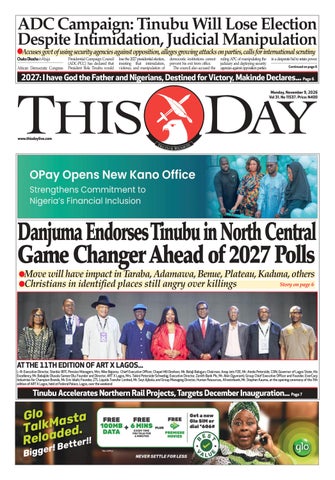
ADC Campaign: Tinubu Will Lose Election Despite Intimidation, Judicial Manipulation Accuses govt of using security agencies against opposition, alleges growing attacks on parties, calls for international scrutiny
Chuks Okocha in Abuja
African Democratic Congress
Presidential Campaign Council (ADC-PCC) has declared that President Bola Tinubu would
lose the 2027 presidential election, insisting that intimidation, violence, and manipulation of
democratic institutions cannot prevent his exit from office. The council also accused the
ruling APC of manipulating the judiciary and deploying security agencies against opposition parties
in a desperate bid to retain power. Continued on page 6
2027: I have God the Father and Nigerians, Destined for Victory, Makinde Declares... Page 6 Monday, Monday, November January 9, 6, 2026 2025 Vol Vol29. 31.No No10865. 11537. Price: N400
www.thisdaylive.com TR
UT H
& RE A S O
N
Danjuma Endorses Tinubu in North Central Game Changer Ahead of 2027 Polls Move will have impact in Taraba, Adamawa, Benue, Plateau, Kaduna, others Story on page 6 Christians in identified places still angry over killings
AT THE 11TH EDITION OF ART X LAGOS...
L–R: Executive Director, Stanbic IBTC Pension Managers, Mrs. Nike Bajomo; Chief Executive Officer, Chapel Hill Denham, Mr. Bolaji Balogun; Chairman, Anap Jets FZE, Mr. Atedo Peterside, CON; Governor of Lagos State, His Excellency, Mr. Babajide Olusola Sanwo-Olu; Founder and Director, ART X Lagos, Mrs. Tokini Peterside-Schwebig; Executive Director, Zenith Bank Plc, Mr. Akin Ogunranti; Group Chief Executive Officer and Founder, EverCorp Industries for Champion Brands, Mr. Eric Idiahi; Founder, ZTL Liquids Transfer Limited, Mr. Seyi Ajibola; and Group Managing Director, Human Resources, Afreximbank, Mr. Stephen Kauma, at the opening ceremony of the 11th edition of ART X Lagos, held at Federal Palace, Lagos, over the weekend
Tinubu Accelerates Northern Rail Projects, Targets December Inauguration... Page 7
2
MONday, NOVEMBER 9, 2026 • T H I S D AY
MONDAY, NOVEMBER 9, 2026 • T H I S D AY
3
4
MONday, NOVEMBER 9, 2026 • T H I S D AY
MONDAY, NOVEMBER 9, 2026 • T H I S D AY
Chief Executives of all 36 States
5
6
T H I S D AY • MONDAY, NOVEMBER 9, 2026
PAGE SIX
2027: I have God the Father and Nigerians, Destined for Victory, Makinde Declares Urges Christians to participate in politics
Chuks Okocha in Abuja and Yemi Kosoko in Jos
Presidential candidate of the Allied Peoples Movement (APM), Engr. Seyi Makinde, has said that with God and Nigerians behind him, he is poised to win the 2027 Presidential election. A statement by Richard Ihediuwa, the presidential campaign council spokesman said that Makinde who spoke
at a church service at Church of Christ in Nations (COCIN), Jos, Plateau State, on Sunday, lamented that Nigeria is in dire need of economic, social and political reset from years of poor and ineffective leadership, particularly in the last three and half years. He stressed the need to reset governance in Nigeria inspired his RESET NIGERIA Manifesto tailored to make life easier for citizens.
The APM presidential candidate specifically said his aspiration is not backed by any political godfather but by God Almighty and the people of Nigeria. He expressed optimism that God will be merciful to Nigerians with the right leadership through the 2027 Presidential election According to Makinde, "When I said in Oyo State in 2018 that I would like to be
governor, somebody asked me, 'governor of which Rotary District?' I said governor of Oyo State, and they asked, 'with no godfather; nobody in politics who can stand in for you?' I responded by saying, well I have God the Father. And I became the governor of Oyo State. "This time around, we also have God the Father and that God will be merciful unto Nigeria and He will show us
mercy in this country," the APM Presidential candidate stated. Makinde further said that as the governor of Oyo State, he anchored his stewardship on planning, transparency and accountability. He said that during his first term, he developed a Road Map for the development of Oyo State covering 2019 to 2023 adding that when he also decided to seek a second term, he developed another roadmap
Makinde
for the sustainable development of Oyo State, covering 2023 to 2027. He stressed the documents guided his administration to effectively deliver on its promises to the people.
DANJUMA ENDORSES TINUBU IN NORTH CENTRAL GAME CHANGER AHEAD OF 2027 POLLS Olawale Olaleye
Weekend’s endorsement of President Bola Tinubu's re-election bid by a former Minister of Defence, General Theophilus Yakubu Danjuma, has introduced a potentially consequential dimension to the battle for the Christian Middle Belt and parts of the North-East. But with memories of unceasing killings, displacement and insecurity still fresh and ongoing in several communities, the question is whether the elder statesman's considerable influence can translate into votes in 2027. The decision by Danjuma, to openly endorse President Tinubu for a second term, has introduced a new variable into the unfolding political contest in northern Nigeria, particularly in the North-Central and parts of the North-East, where the retired general commands considerable respect and admiration. According to sources, Danjuma’s position was hinged on the fact that since the north under former Nigerian leader, Muhammadu Buhari, served for two terms of eight years, it’s only fair that the south, currently represented by APC’s Bola Tinubu, should also serve out two terms of eight years. This he is said to believe will promote unity and national cohesion. It is worth noting that for several years now, Danjuma has been a major financier of Christian causes in the North. In 2019, he helped to a large extent to sway Christian support to late President Muhammadu Buhari's reelection. So, he is a man of considerable means and stature amongst the Christian community in the North East and North Central. However, coming barely ten weeks before the January 16, 2027 presidential election, the endorsement is significant not simply because
of Danjuma's stature as a former Chief of Army Staff, defence minister and influential member of Nigeria's political establishment, but because of the constituencies in which his intervention could carry weight. From Taraba, his home state, to Adamawa, Plateau, Benue and parts of Kaduna, Danjuma remains a recognised voice among sections of the Middle Belt's political, traditional and Christian leadership. His endorsement, therefore, presents Tinubu with an opportunity to broaden his political coalition in territories where the president's Muslim-Muslim ticket encountered resistance in 2023 and where continuing insecurity has complicated relations between the federal government and affected communities. Yet, the development has also thrown up an uncomfortable question: Can the endorsement of one of the region's most influential figures sufficiently assuage the anger of communities still grappling with killings, displacement and the destruction of their livelihoods? That question may ultimately determine whether Danjuma's intervention becomes a genuine electoral game changer or remains an important, but limited, political endorsement.
How the Endorsement Unfolded Danjuma's position became clearer over the weekend when, at the 20th anniversary celebration of the Adamawa State Government House Chapel in Yola, he appealed for support for Tinubu's re-election rather than that of former Vice-President Atiku Abubakar, the presidential candidate of the African Democratic Congress (ADC). Represented by a former Chief of Army Staff, General Ishaya Bamaiyi,
President Bola Ahmed Tinubu (L) with Gen TY Danjuma at the Presidential Villa when the latter led a delegation of Middle Belt leaders to visit the president in Abuja last week
Danjuma argued that the Tinubu administration had demonstrated a measure of inclusiveness through the appointment of Christians into important government positions, notwithstanding the controversy that attended APC's Muslim-Muslim presidential ticket in 2023. He also announced a donation of N250 million towards the expansion of the Government House Chapel and the provision of residential accommodation for its chaplain and deputy chaplain. The declaration followed his participation in a high-powered delegation that met Tinubu at the Presidential Villa, Abuja, on Thursday, November 5. The delegation included Plateau State Governor, Caleb Mutfwang;
Taraba State Governor, Agbu Kefas; former Speaker of the House of Representatives, Yakubu Dogara; Minister of Defence, Christopher Musa; and APC National Chairman, Nentawe Yilwatda. After the meeting, Dogara explained that the delegation had come to demonstrate solidarity with the president and discuss political cooperation, security and support mobilisation ahead of the election. The sequence of events suggested that Danjuma's public endorsement was more than a ceremonial expression of goodwill. It represented an unmistakable entry into the political conversation at a moment when the APC was attempting to consolidate its expanding northern coalition.
Why Danjuma's Intervention Matters Danjuma's influence is not easily measured by the conventional instruments of electoral politics. He does not command a mass political party, nor is he known for the kind of routine electioneering associated with career politicians. His strength derives principally from his standing in the military establishment, his longstanding relationships with northern political leaders, his philanthropic activities and the considerable respect he commands among sections of the Middle Belt. He is also associated with a tradition of outspoken
interventions on security, particularly the failure of government institutions to protect vulnerable communities. This history makes his endorsement of Tinubu especially noteworthy. It gives the president a potentially credible intermediary in communities where the assurances of conventional politicians may carry less weight. But such influence cannot also be confused with automatic electoral control. The Middle Belt is too politically diverse, and its grievances deeply rooted, for the endorsement of any individual to guarantee a wholesale transfer of votes. The electoral figures from 2023 explain both the opportunity and the limitations. Continued on page 36
ADC CAMPAIGN: TINUBU WILL LOSE ELECTION DESPITE INTIMIDATION, JUDICIAL MANIPULATION Director of Media and Publicity of ADC-PCC, Kola Ologbondiyan, made the assertions in Abuja, warning that the growing attacks on opposition members and supporters across the country pose a serious threat to Nigeria's democracy. Ologbondiyan specifically cited the killing of several members of the Nigeria Democratic Congress (NDC) in Delta State, allegedly following an attack on the party's campaign venue by suspected APC thugs.
He said the incident was part of a disturbing pattern of violence against opposition parties, particularly members of the ADC, NDC and Allied Peoples Movement (APM), in Kaduna, Kogi, Katsina, Kebbi and Sokoto states. Describing the incidents as an assault on democratic freedoms, the ADC-PCC spokesman said, "This is not politics. This is state-sponsored terror against democracy." The Council further raised
concerns over the preparedness and neutrality of the Independent National Electoral Commission (INEC), alleging that the commission's voter register database had been compromised and that APC sympathisers had been deployed to sensitive positions within the electoral body. It also alleged that security agencies were being used to harass, arrest and intimidate opposition members across the country. Ologbondiyan expressed
particular concern over the alleged involvement of a serving director of a security agency in the APC Presidential Campaign Council as a co-Director of National Security and Intelligence, describing the development as a violation of the law establishing the agency. According to him, the alleged use of state institutions against political opponents reflected a government more interested in retaining power than submitting itself to a credible electoral contest. "One thing is now very clear
to all Nigerians: Tinubu is not preparing for an election. He is preparing for a coronation," he said. The ADC-PCC maintained that the alleged manipulation of judicial processes and electoral institutions would not guarantee President Tinubu's re-election, warning that Nigerians would resist any attempt to impose a president through what it described as compromised judicial decisions or electoral fraud. It called on Nigerians to remain
vigilant and prepare to defend their votes, democratic rights and constitutional freedoms ahead of the 2027 general election. The Council also urged the international community, civil society organisations, religious leaders and traditional institutions to pay closer attention to what it described as the deteriorating political and security environment in the country. It warned that silence in the face Continued on page 35
7
T H I S D AY • MONDAY, NOVEMBER 9, 2026
NEWS
COMMITTEE OF E-BUSINESS INDUSTRY HEADS AND NIMC PARTNERSHIP...
L-R: Divisional Head, Digital Banking, GTBank/Secretary, Pricing & Revenue Assurance, CeBIH, Jimmy Banjoko; Chairman, CeBIH/Divisional Head, e-Business & Transaction Banking, Premium Trust Bank, Abidemi Asunmo; Director-General/CEO, National Identity Management Commission (NIMC), Abisoye Coker-Odusote; Managing Director/CEO, Nigerian Consumer Credit Corporation (Credicorp), Uzoma Nwagba; and Chief Partnership Officer, Wema Bank Plc/Advisor, CeBIH, Ajibade Laolu-Adewale, during a visit to the NIMC DG in Abuja…recently
Tinubu Accelerates Northern Rail Projects, Targets December Inauguration Kano-Katsina-Maradi rail project reaches 70% completion Keyamo: aviation reforms to generate $25.7bn annual revenue by 2029
Chinedu Eze in Lagos and Adedayo Akinwale in Abuja
President Bola Tinubu is accelerating the completion of major railway projects in northern Nigeria, with the Kaduna–Kano Standard Gauge Railway scheduled for inauguration on December 3. All Progressives Congress (APC) Presidential Campaign Council (PCC) disclosed the development in a statement yesterday by its spokesperson, Dele Alake. That was as Minister of Aviation and Aerospace Development, Festus Keyamo, stated that the
aviation reforms of the Tinubu administration were projected to generate additional annual revenue of N2.58 billion and total projected revenue of $25.7 billion in 2029. Alake said the 203-kilometre Kaduna–Zaria–Kano railway project, one of the administration’s legacy projects, had reached approximately 90 per cent completion, while the 400-kilometre Kano–Katsina–Maradi railway project had attained 70 per cent completion. He recalled that when President Tinubu assumed office in 2023, the Kano–Katsina–Maradi rail project was at barely five per cent
Oyetola Mobilises States for Fish Sovereignty, Unveils $200m World Bank-backed Production Drive Kasim Sumaina in Abuja Minister of Marine and Blue Economy, Adegboyega Oyetola, has intensified efforts to reposition Nigeria as a fish-sufficient nation, securing a US$200 million commitment from the World Bank Group to support a renewed national drive to expand fisheries and aquaculture production across the country. The funding to be made available to state governments as concessional loans, is expected to strengthen their capacity to develop and expand fisheries and aquaculture activities, unlock investment opportunities, boost domestic fish production and ultimately bridge Nigeria’s widening fish supply deficit. Oyetola's renewed push also places greater emphasis on collaboration between federal and state governments, investors and development partners to reduce the country's dependence on imported fish and strengthen national food security. The minister's position was
conveyed by the Senior Special Assistant to the President on Marine and Blue Economy, Professor Busayo Fakinlede, who represented him at a high-level Executive Training on Aquaculture Investment Guide organised by the Federal Ministry of Marine and Blue Economy in collaboration with the World Bank Group. The minister, in a statement issued weekend by his Special Adviser, Bolaji Akinola said Nigeria's ambition to achieve fish sufficiency could only become a reality through deliberate subnational participation, stressing that states must assume greater responsibility for expanding domestic production. He noted: "Fish is a pillar of food security, household nutrition and rural livelihoods. No nation can call itself food secure while it imports most of the fish it eats. Our ambition is to produce more, import less and, in time, become a net exporter. That ambition can be achieved only when every state plays its part," he said.
completion, while Kaduna–Kano was less than 30 per cent complete. Alake noted, “The projects demonstrate the administration’s commitment to expanding Nigeria’s railway infrastructure, improving regional connectivity and facilitating the movement of passengers and goods across the country and beyond.” He emphasised that the Kaduna–Kano railway, an extension of the existing Abuja–Kaduna standard gauge line, would establish a continuous rail connection between Abuja, Kaduna, Zaria and Kano, strengthening transportation links across major commercial centres in Northern Nigeria. The spokesperson stressed that the two rail projects were recently inspected on the directive of President Tinubu by a federal government team led by the
Permanent Secretary of the Federal Ministry of Transportation, Funso Adebiyi, who expressed satisfaction with the quality of construction work, particularly the railway alignment, drainage infrastructure, embankment protection, stone pitching and soil stabilisation. He said the inspection included a train test-run journey from Jaji in Kaduna State to Kano, allowing officials to assess the completed track infrastructure and passenger comfort. Alake added that the President had also directed that all outstanding land acquisition and compensation issues within Kaduna metropolis should be resolved immediately so that the railway corridor from Abuja to Kano would be completed. He said the completed 190-kilometre Jaji-Kano section out of the entire 205-kilometre
stretch of the Kaduna-Kano rail project and the 250-kilometre Dawanu-Kano-Kazaure-DauraKatsina section of the Kano-Maradi project would be inaugurated by December 3, 2026. When operational, the Kaduna– Kano railway would improve passenger transportation, facilitate commercial activities and provide an alternative to road travel along one of Northern Nigeria’s busiest commercial corridors. According to him, similarly, the Kano–Katsina–Maradi railway, which has reached 70 per cent completion, is expected to strengthen cross-border transportation and trade between Nigeria and the neighbouring Niger Republic. “In line with President Tinubu's agenda, all ongoing infrastructure projects will be delivered in every part of the country as scheduled.”
Meanwhile as tthe first tenure of the Tinubu administration winds down, Keyamo has said the aviation reforms are expected to unlock more than $1 billion in aircraft financing capacity for Nigerian airlines through the establishment of the Nigeria Aircraft Leasing Company. He explained that the initiative, approved by the Federal Executive Council (FEC) in April 2026, was designed to address the longstanding difficulties faced by indigenous airlines in accessing aircraft on competitive leasing terms. Keyamo, who disclosed this to THISDAY while reeling out the achievements of President Bola Tinubu's administration in the aviation sector as of November 2026, said the proposed company would operate as a locally based Special Purpose Vehicle (SPV).
IEA: Africa, Asia to Lead Growth as Global Renewable Capacity Set to Rise by 4,800Gw in 5 Years Clean energy-powered vehicles to increase by 60%
Emmanuel Addeh in Abuja
The International Energy Agency (IEA) has projected that global renewable power capacity will increase by almost 4,800 gigawatts (GW) between 2026 and 2031, with Africa and Asia set to lead the growth for the first time outside China. According to the agency’s latest report titled 'Renewables 2026', the projected 4,800GW addition is almost 60 per cent more than was added in the previous six-year period. The forecast, coming amid unprecedented disruptions to global energy markets since the outbreak of the Iran war, showed that stronger policy support and intensified energy security concerns
are driving faster deployment of renewables across Africa, India, South-east Asia, and the Middle East. According to the report, Solar Photovoltaic (PV) is set to account for more than three-quarters of global renewable capacity growth to 2031, followed by onshore wind. The IEA said that for the first time, the amount of renewable power capacity added in emerging and developing economies outside China is expected to match the amount added in advanced economies in the forecast period. China, according to the report, will remain the largest contributor to the global increase in renewable power capacity, but its share is set to decline from over 60 per cent in 2025 to an average of 53
per cent over the forecast period, amid changes to its renewable energy policies. Also, india is emerging as the world’s second-largest growth market, with its total renewable capacity set to more than double by 2031. Growth is also increasing across South-east Asia, the Middle East and North Africa, and sub-Saharan Africa. Across these regions, the amount of renewable capacity added in the 2026-2031 period is forecast to almost triple compared with the previous six-year period. The report noted that the growth is not only driven by major installations by utilities and developers, but also directly by consumers, with households and small businesses increasingly
turning to more affordable rooftop solar PV systems amid high fuel prices and unreliable electricity supplies. These small-scale installations, it stressed, have already helped improve electricity services for around 70 million households worldwide. On transport, the IEA made a forecast that the use of renewable energy for transport will rise by more than 60 per cent by 2031, by which point it will cover 6 per cent of the transport sector’s energy demand worldwide. Besides, renewable electricity used by electric vehicles will accounts for around 45 per cent of this increase, while biofuels will make the second-largest contribution, it said.
8
T H I S D AY • MONDAY, NOVEMBER 9, 2026
NEWS
AT THE AHI CARRIER YEAR END GALA...
L-R: Regional Manager West Africa, AHI Carrier, Mr. Anirban Saha; Senior Sales Engineer, Mr. Ishan Potnis; Lead Product Engineer, Airside Products, Mr. Awdhesh Gupta; Sales and Supports Engineer West and Central Africa, Abraham Okoko; Marketing Lead, Nisha Hussain; and Sales and Supports Engineer West Africa, Mr. Itamuko Johnson, at the AHI Carrier Year End Gala held in Lagos on Thursday
NDC: Tinubu Repeats Ibom Deep Seaport Promise, Questions APC’s 2020 Approval Says Buhari’s FEC approval for $4.6bn project remains unfulfilled Accuses ruling party of turning infrastructure pledge into campaign tool
Sunday Aborisade in Abuja Nigeria Democratic Congress (NDC) has criticised President Bola Tinubu over his renewed promise to construct the Ibom Deep Sea Port in Akwa Ibom State, questioning why All Progressives Congress (APC) continues to make fresh commitments on a project approved by the previous administration in 2020. The opposition party described Tinubu’s latest pledge as a repetition of an earlier campaign promise, insisting that the federal government has yet to demonstrate
tangible commitment to translating the proposed multibillion-dollar project into reality. Tinubu reportedly renewed the promise on Friday, November 6, 2026, while addressing supporters during his visit to Uyo, Akwa Ibom State. In a statement yesterday, the NDC National Publicity Secretary, Osa Director, accused the APC of using the proposed deep seaport as a political campaign instrument rather than demonstrating the political will to implement the project. The party recalled that the
Federal Executive Council (FEC), under former President Muhammadu Buhari, approved the implementation of the first phase of the $4.6 billion Ibom Deep Sea Port project on December 16, 2020. According to the opposition party, the approval had identified Bollore/Power China as the preferred bidder and was expected to pave the way for the commencement of construction. It argued that the renewed commitment by Tinubu was
particularly troubling because he had also promised to build the port during the APC 2023 presidential campaign in Akwa Ibom State. At the party's presidential campaign rally held at the Godswill Akpabio International Stadium, Uyo, on January 30, 2023, Tinubu reportedly promised to establish the seaport alongside other development initiatives. The NDC quoted the president as telling supporters: "We will
do mechanised farming. We will export food from Akwa Ibom. We will build your seaport." The opposition party, however, accused the APC of failing to fulfil that commitment more than three years after making it. It questioned the rationale behind making another promise on the same project without providing an account of what had happened to the earlier federal approval. Describing the development
as an indication of what it called APC's unfulfilled campaign promises, the NDC asked how many times the federal government would announce its approval of the Ibom Deep Sea Port before actual construction would commence. "What a hocus-pocus, what hogwash, and what barefaced lies and shenanigans of a rudderless party! How many times will the APC approve the Ibom Deep Sea Port?" the party asked.
NICArb: 30-Year Court Delays Driving NAFDAC Raids Delta Market, Businesses Towards Arbitration Seizes Suspected Fake Nivea, Listerine, KY Jelly Products Sylvester Idowu in Warri National Agency for Food and Drug Administration and Control (NAFDAC) has confiscated suspected counterfeit cosmetics and other regulated products during an enforcement operation at Igbudu Market, near Warri, Delta State, while issuing a fresh warning over KY Jelly lubricant currently in circulation. The operation, conducted over the weekend by officers of NAFDAC’s Asaba Zonal Office, followed intelligence reports indicating the proliferation of counterfeit regulated products in the popular Igbudu market. The enforcement team was supported by operatives of the Department of State Services (DSS), the Nigerian Army and officials of the market union. They visited identified shops and locations, where suspected counterfeit products were
discovered and evacuated. Items seized included suspected counterfeit cosmetics and other products bearing the brand names of Listerine, Nivea and SC Johnson, as well as KY Jelly lubricant and other regulated products. Speaking during the operation, a NAFDAC official said the agency had received information from the product’s Marketing Authorisation Holders that the last authorised supply of KY Jelly was made more than five years ago. He consequently urged consumers to treat any KY Jelly product currently being sold in the market as suspect, warning that buyers could not be certain of its authenticity. “Any KY Jelly in the market you see today is suspect,” the official warned, adding that the product should not be patronised because of the uncertainty surrounding its source.
Institute reports over 5,000 disputes handled across Africa
Wale Igbintade
Nigerian Institute of Chartered Arbitrators (NICArb) said it had handled more than 5,000 disputes across Africa, attributing the growing patronage of arbitration partly to prolonged court proceedings, which it said could take between 20 and 30 years to reach final resolution. The institute said arbitration and other alternative dispute resolution (ADR) mechanisms offered businesses and individuals faster and more reliable avenues for resolving commercial disputes, strengthening investor confidence and reducing pressure on conventional courts. Chairman of the 2026 Annual Conference Planning Committee, Dapo Akinosun, SAN, disclosed this at a press conference held at the institute's secretariat in Lekki, Lagos. Akinosun said the growing acceptance of arbitration reflected increasing demand for timely and satisfactory dispute resolution, particularly among businesses
seeking to avoid the uncertainties associated with prolonged litigation. He said the institute's experience in handling more than 5,000 cases across the continent demonstrated the growing relevance of alternative dispute resolution in delivering commercial justice. "We have handled well over 5,000 cases on this continent. But beyond that, it is not just the numbers; it is the number of satisfied people that we have. "What we have been assured is that people have come and have left here satisfied, getting justice in this institution," he said. Akinosun stressed, however, that arbitration and mediation were designed to complement, rather than replace, the conventional judicial system, noting that their wider adoption would also help decongest the courts. He said these issues would feature prominently at the institute's 2026 International Arbitration and Alternative Dispute Resolution Conference, scheduled for November 18 and 19 at the Oriental Hotel, Victoria Island, Lagos.
The conference is themed, "Reimagining Arbitration and ADR in Africa: Innovation, Integrity and Commercial Justice in a Changing World". Describing the theme as a call for a fundamental reassessment of existing dispute resolution mechanisms, Akinosun said the institute was seeking to address growing concerns about access to justice and encourage greater public confidence in arbitration. "This year's conference is not just an attractive theme. It is a call for us to rethink what we do, how we do it, and who the ends of justice are meant to serve. "We have seen in recent times that there is a lot of unhappiness about getting justice or the way justice seems to go in this system. We are trying to explain to people why they should embrace arbitration more," he said. He noted that businesses were more concerned about securing fair and timely resolutions when disputes arose than about the possibility of disagreements in their commercial transactions.
"Businessmen are not worried that there will be disputes; there will always be disputes. The only thing they want to be assured of is that if there is a dispute, there is going to be a fair resolution within a reasonable time, which will ensure that they can go back to their business and relate to one another," he said. The conference chairman also highlighted the importance of mediation in preserving commercial relationships, explaining that the process allowed disputing parties to resolve their differences without necessarily becoming adversaries. Unlike conventional litigation, which could leave parties antagonistic, he said mediation encouraged mutually acceptable settlements that enabled businesses to maintain existing relationships. "It is slightly different from the traditional court in which, when you go to court, you don't come out as friends. But mediation ensures that at the end of this dispute, you can still continue to work together," he said.
9
T H I S D AY • MONDAY, NOVEMBER 9, 2026
NEWS
POP24 PRESS CONFERENCE...
L-R: Gospel Artist, Chigozie Wisdom; Chairman, Planning Committee, POP24, Deji Popoola; Senior Pastor, Trinity House, Pastor Ituah Ighodalo; and guest ministers-Uchenna Okereke and Kleb Shout, at the POP24 press conference, held in Lagos, last Friday
Korea’s $1.1billion Trade with Nigeria Exposes Untapped Industrial Partnership, Ambassador Warns
Seeks resolution of 20-year-old tax treaty as Seoul pushes manufacturing, tech transfer, local production
Michael Olugbode in Abuja
South Korea has identified Nigeria’s failure to complete the ratification of a bilateral tax agreement signed 20 years ago as a lingering obstacle to deeper investment relations. It urged the federal government to resolve the outstanding issue as both countries sought to transform their $1.1 billion trade relationship into a broader industrial partnership. The Korean government said Nigeria’s economic relationship with Seoul must move beyond the traditional exchange of Nigerian oil and gas for Korean vehicles, electronics, and machinery to one built around manufacturing, technology transfer, agricultural industrialisation, and local employment. Korean Ambassador to Nigeria, Jeong Yo-an, made the comments
at a press briefing in Abuja. Yo-an said the double taxation agreement signed by both countries in 2006 remained an important outstanding issue that needed urgent attention to improve investment predictability and encourage Korean companies to establish and expand operations in Nigeria. The agreement, designed to prevent individuals and companies operating between the two countries from being taxed twice on the same income, was expected to provide greater certainty for cross-border investments. South Korea completed its domestic ratification process in 2007, while Nigeria’s legislative approval process advanced in 2019. However, the agreement did not receive the required presidential assent before the end of the administration at the time, leaving its implementation
unresolved. Yo-an said the delay was particularly concerning at a time when both countries were seeking to expand commercial relations and attract more private investment. He stated that investors needed predictable policies, particularly in taxation, customs administration, and foreign exchange, before committing substantial capital to long-term projects. The ambassador said the unresolved agreement was among the issues he intended to pursue during his diplomatic assignment, stressing that its resolution would
demonstrate Nigeria’s commitment to providing a more predictable investment environment. Beyond the tax agreement, he challenged both countries to reconsider the structure of their economic relationship, stating that the existing trade pattern has largely confined Nigeria to supplying energy resources while importing finished products from South Korea. “Today, Nigeria sells us mostly oil and gas. Korea sells mostly cars, electronics and machinery. We can do much more than that,” he said. The envoy said South
Korea wanted to deepen its involvement in Nigeria’s productive economy through local assembly, manufacturing partnerships, agricultural machinery production, digital skills development, and maritime cooperation. He said, “The next chapter should be ‘Made in Nigeria’. Local assembly. Machinery for rice farmers. Digital skills. The maritime sector.” The proposal comes against the background of decades of economic relations between the two countries, which established diplomatic ties in February 1980.
Over the years, Korean companies have developed interests in Nigeria’s construction, energy, telecommunications, electronics, and manufacturing sectors. Yo-an cited Daewoo Engineering and Construction’s participation in major Nigerian projects, including the Nigeria LNG Train Seven project and the Indorama fertiliser plant, as examples of the existing industrial relationship. He also identified Samsung, LG, Hyundai, and Solpia among Korean companies maintaining business activities and partnerships in Nigeria.
Neveah Redeems N23.33bn Commercial Papers Across 5 Commercial Paper Series, Boosts Investor Confidence
Ibidapo Lawal: Redemption reflects strength of our business fundamentals, disciplined financial stewardship, robust cash flow generation capabilities United Capital says timely repayment strengthens access to debt capital market
Nollywood Financing, Nigerian the development to the company's also shows our commitment to According to him, investor Art Take Centre Stage as Odujinrin James Emejo in Abuja liquidity position, cash flow maintaining the highest standards confidence in issuers helps Neveah Limited said it has generation and disciplined financial of corporate governance and channel capital to businesses & Adefulu Marks 54 Years financial responsibility. seeking funding for expansion redeemed N23.33 billion raised management. Sunday Ehigiator
Nollywood financing, the growing influence of streaming platforms and the importance of intellectual property in the creative economy took centre stage as Odujinrin & Adefulu, a commercial law firm, hosted an evening of Nigerian art and culture ahead of its 54th anniversary. The event, tagged ‘An Evening of Nigerian Art & Culture’, recently held at the firm’s Lagos office, brought together artists, creative industry professionals and other guests to celebrate Nigeria’s creative ecosystem. A major highlight was a fireside chat with Zulumoke Oyibo, Cofounder and Chief Operating Officer of Inkblot Productions, who offered insights into the financing challenges confronting Nollywood and the opportunities emerging from the industry’s growth.
Oyibo explained that filmmakers often depend on family and friends to finance their productions, particularly because such investors tend to be more patient and willing to believe in the vision behind a project. She, however, identified access to institutional financing as a major challenge, noting that commercial banks typically require collateral before extending loans to film producers. On managing investment risks, she advised filmmakers to diversify their investments across multiple productions rather than commit all available resources to a single project. She also emphasised the importance of working with partners who share a common vision. The discussion examined the possibility of using intellectual property as collateral to secure financing for film productions.
through five commercial paper issuances. This reinforces its repayment record in the country's debt capital market, potentially strengthening the company's capacity to attract fresh funding. The commodities export and manufacturing company said the redemption covered Series 1 to 5 issued under its N30 billion Commercial Paper Programme. The five issuances comprised N3.47 billion for Series 1, N8.28 billion for Series 2, N5.50 billion for Series 3, N4.49 billion for Series 4 and N1.60 billion for Series 5. The repayment represented the settlement of all series under the programme, although the company did not disclose the respective maturity dates or the specific periods within which the instruments were redeemed. Managing Director of Neveah Limited, Ibidapo Lawal, attributed
He said the successful settlement reflected the strength of its business fundamentals and commitment to meeting obligations to investors and other stakeholders. Lawal added that the repayment would reinforce the company's credibility in the Nigerian debt market as it pursues its long-term growth strategy. He said, “The successful redemption of our obligations under the Commercial Paper Programme reflects the strength of our business fundamentals, disciplined financial stewardship, and robust cash flow generation capabilities. "We are deeply appreciative of the confidence and support extended to us by our investors, and business partners throughout this period. "This milestone not only reinforces our credibility in the Nigerian debt capital market but
" As we continue to execute our long-term growth strategy, we remain focused on creating sustainable value for all stakeholders while contributing meaningfully to Nigeria’s economic development.” The transaction further highlights the importance of repayment discipline in sustaining investor appetite for commercial paper and other short-term funding instruments. Managing Director, United Capital Investment Banking, lead arranger of the issuances, Dr. Gbadebo Adenrele, said the redemption demonstrated the importance of issuers honouring their commitments to investors. He noted that a consistent record of meeting repayment obligations was critical to building confidence and sustaining companies' access to the debt market.
and other growth opportunities. He said, “The successful redemption of these Commercial Papers is a positive outcome for Neveah and a reflection of the importance of meeting commitments to investors. "For companies looking to raise capital, a track record of honouring obligations helps build investor confidence and supports continued access to the debt capital market. "A market where investors have confidence in issuers is better positioned to channel capital to businesses that need it to grow. We congratulate Neveah on the successful redemption of all five series under its Commercial Paper Programme.” He congratulated Neveah on redeeming all five series, describing the development as a positive outcome for the company and the market.
10
T H I S D AY • MONDAY, NOVEMBER 9, 2026
NEWS
MY RESET NIGRRIA MANIFESTO...
Presidential Candidate of Allied Peoples Movement (APM), Seyi Makinde (right), presenting copies of Reset Nigeria Manifesto to former Governor of Plateau State in Jos on Saturday
Tax Ombud Resolves 25 Complaints, Expands Dispute Resolution to Rural Communities, Markets Nwabueze says online complaint portal to be launch as agency seeks wider public awareness Office identifies bureaucratic correspondence as major obstacle to 14-day complaint resolution
James Emejo in Abuja The Tax Ombud/Chief Executive, Office of the Tax Ombud, Dr. John Nwabueze, said it had resolved between 22 and 25 of the 33 complaints received since its establishment. He also said administrative bottlenecks remained a threat to its target of resolving taxpayers' grievances within 14 days. He spoke during an engagement with the media in Abuja, over the weekend. Nwabueze identified delays in correspondence between the
office and tax authorities as a major impediment to the speedy resolution of complaints. He said the office was introducing dedicated desk offices in about 16 tax and revenue-generating institutions to eliminate bureaucratic delays and facilitate real-time communication in handling disputes. The office also disclosed plans to expand its operations beyond Abuja through six proposed regional offices and partnerships with institutions with nationwide reach, including the Nigerian Postal Service (NIPOST) and the Joint
Revenue Board (JRB). The expansion is expected to improve access to independent complaint-resolution services for market traders, small businesses and taxpayers in rural communities, many of whom may be unaware of the existence of the office. Nwabueze said the office had received complaints from different states and economic sectors, including grievances relating to delays in tax assessments and assessments considered unsatisfactory by taxpayers. He, however, acknowledged that the statutory 14-day resolution
timeline had proved difficult to achieve in some instances because of delays in obtaining responses from relevant tax authorities. According to him, correspondence between institutions could consume as much as one week, leaving limited time for examining complaints and facilitating resolutions. He said, "When a complainant brings a case before us, we must reach out to the relevant tax authority. Getting communication back and forth sometimes takes a long time. We could lose as much as a week waiting for a letter to
SERAP Warns FG Against Politicising N50,000 Relief Payments
Chuks Okocha in Abuja
The Socio-Economic Rights and Accountability Project (SERAP) has warned the federal government against possible political interference in its N50,000 relief programme, demanding full disclosure of beneficiaries, payments and safeguards ahead of the 2027 elections. The organisation made the demand in a Freedom of Information request dated November 7 and addressed to
the Minister of Humanitarian Affairs and Poverty Reduction, Dr. Bernard Doro, following the government’s announcement of the National Emergency Relief and Stabilisation Intervention (NERSI). SERAP urged the ministry to publish details of the programme’s funding, eligibility requirements, beneficiary selection process, geographical coverage and payment arrangements, insisting that public assistance must not become a tool for political mobilisation.
“Publicly funded social assistance must be allocated strictly on the basis of genuine need and objective eligibility criteria. It must not be used to reward political supporters, secure partisan loyalty, finance political mobilisation or influence the electoral choices of vulnerable Nigerians, particularly ahead of the 2027 general elections,” the organisation said. It further warned that beneficiaries must not be pressured to attend political rallies, support
candidates or display political materials in exchange for the financial assistance. “Beneficiaries must not be required or encouraged to attend political rallies, support political parties or candidates, display political materials or demonstrate political loyalty as a condition for receiving assistance. NERSI is a government programme funded with public resources, not a personal gift or political benefit from any office-holder or political party,” SERAP stated.
move from one office to another and for a response to come back." To address the challenge, he said the office had commenced arrangements to establish desk offices within approximately 16 tax and revenue institutions, allowing complaints and official responses to be processed without the delays associated with conventional correspondence. Nwabueze said the office was also intensifying engagement with the JRB, whose nationwide institutional presence could provide an effective channel for reaching taxpayers outside major urban centres. He added that discussions were ongoing with NIPOST on a proposed partnership to extend complaint-handling services to market traders and rural communities. The tax ombud said the office was also planning six regional offices, with December as its target for commencement, subject to the completion of recruitment, infrastructure and other administrative requirements, as well as the necessary presidential approval. He said the response from state governments to the proposed regional expansion had been encouraging, with states indicating their willingness to support the initiative.
Access to Redress Nwabueze disclosed that the office was almost ready to launch an online complaints platform, which would be available in different languages to make its services more accessible. He said the platform was awaiting the necessary approvals and would provide Nigerians with a more convenient channel to understand the office's mandate and submit grievances. He also plans to deploy television, print and outdoor advertising to raise public awareness, acknowledging that limited knowledge of its existence remained a major constraint to its operations. He said many of the complaints received so far had come through professional and legal channels, partly reflecting the low level of public awareness. On the possibility of tax authorities rejecting the office's recommendations, Nwabueze said its approach was to secure resolutions acceptable to both taxpayers and revenue authorities, rather than immediately resorting to litigation. He acknowledged that either party could disagree with a proposed resolution but maintained that the office would continue engaging the parties to find equitable solutions.
ActionAid Nigeria Impacts 3m Lives in Nationwide GBV Campaign Blessing Ibunge in Port Harcourt
ActionAid Nigeria has disclosed that its interventions against Gender-Based Violence (GBV) have reached about three million people, including men and women, as part of efforts to
tackle harmful cultural practices and strengthen the protection of women and girls across the country. The organisation made this known at the close-out stakeholders' forum of its Multi-Stakeholder Action for the Prevention of Gender-Based
Violence (MAP-GBV) project in Port Harcourt, Rivers State at the weekend. The intervention, implemented with support from the Ford Foundation, recorded significant milestones in Anambra, Osun and Rivers States, particularly in community mobilisation,
advocacy, public awareness and the engagement of traditional and religious institutions. Speaking at the event, ActionAid's Director of People and Culture, Funmi Olukeye, said the programme had recorded remarkable achievements in changing
attitudes towards gender-based violence, including efforts that contributed to the abandonment of Female Genital Mutilation (FGM) in some communities in Rivers State. She identified the creation of community influencers and the engagement of traditional rulers,
lawyers, lawmakers and religious leaders as some of the major achievements of the intervention. According to her, behavioural change has improved considerably over the past two years, largely due to sustained grassroots engagement and increased awareness.
MONDAY, NOVEMBER 9, 2026 • T H I S D AY
11
NIGHT OF TRIBUTES Friday, December 4, 2026 | 5PM No 2, Bunu Sheriff Musa Street, Katampe Extension, Abuja. CELEBRATION OF LIFE Monday, December 7, 2026 | 5PM Harbour Point, Victoria Island, Lagos State. SERVICE OF SONGS Wednesday, December 9, 2026 | 5PM EUI Centre – Plot F11, Sani Abacha Road, GRA Phase 3, Port Harcourt, Rivers State. WAKE KEEP SERVICE Friday, December 11, 2026 | 7PM St. Paul’s Nyemoni Cathedral, Abonnema, Rivers State. FUNERAL SERVICE Saturday, December 12, 2026 | 11AM The VIP Marquee, Lulu Ama Sandfield, District town of Abonema, Rivers State.
OUTING SERVICE Sunday, December 13, 2026 | 10AM St. Paul’s Nyemoni Lutheran Cathedral, Abonnema, Rivers State.
THANKSGIVING SERVICE Sunday, December 20, 2026 | 10AM St. Paul’s Nyemoni Lutheran Cathedral, Abonnema, Rivers State.
Amb, Chief, Dr.
Patrick Dele Cole AGED 86 YEARS
12
T H I S D AY • MONDAY, NOVEMBER 9, 2026
NEWS
FOLAKE SOETAN'S 50TH BIRTHDAY THANKSGIVING SERVICE...
L-R: Son of the celebrant, Tomisin Soetan; the celebrant, Managing Director of Arahas Global Oilfield Services Limited, Mrs Folake Soetan; her husband, Managing Partner of Siji Soetan & Co, Ladipo Soetan; First Lady of Ogun State, Mrs Bamidele Abiodun and son of the celebrant, Siji Soetan during Folake Soetan's 50th birthday thanksgiving service at RCCG the King's Court , Victoria Island, Lagos on Thursday PHOTO: KUNLE OGUNFUYU
Delta Condemns Political Violence in Asaba, Police Confirm One Dead at NDC Rally
Sylvester Idowu in Warri
The Delta State Government has condemned the political violence that erupted in Asaba, the state capital, on Saturday, leaving one person dead and five others seriously injured. The government, in a statement by the Commissioner for Works (Rural Roads) and Public Information, Mr. Charles Aniagwu yesterday described the incident as unacceptable, warning political parties and their supporters against actions capable of threatening public peace and security. He reiterated the government’s zero tolerance for political violence, intimidation and other forms of political rascality. Aniagwu said the government had repeatedly cautioned political parties against engaging in
activities capable of disrupting the peace, stressing that the unfortunate incident could have been avoided if the organisers had heeded security advice. He explained that the police had advised the organisers to shelve the proposed street march and instead hold their campaign at a designated venue where adequate security arrangements could be provided. The government expressed concern that the advice was ignored, resulting in a confrontation that claimed a life and left several others injured. It called on the police to conduct a thorough investigation into the circumstances surrounding the incident and ensure that everyone found responsible is brought to justice. Aniagwu further warned that the state government would
25 Niger State Council Chairmen Commit to Implementation of UNICEFAssisted Child Nutrition Programme
Onyebuchi Ezigbo in Abuja
Executive chairmen of the 25 local government areas of Niger State have unanimously committed to sustainable financing for child nutrition, including prompt payment of counterpart funding to unlock the UNICEF Child Nutrition Fund (CNF). The commitment was contained in a communique adopted at the end of a two-day capacity-building retreat on Sustainable Nutrition Financing held in Abuja. The retreat was organised by the Civil Society Scaling Up Nutrition in Nigeria (CS-SUNN) in partnership with the Niger State Government under Governor Mohammed Umaru Bago. It was aimed at building sustained political commitment, enhancing institutional capacity and establishing predictable financing mechanisms at local government
level to combat maternal and child malnutrition. Participants noted that N500 million is already available in the state nutrition account, but stressed that budgetary allocation alone is insufficient. Continuous advocacy is needed to ensure funds are fully released and effectively utilised. They also noted that malnutrition often competes with other pressing priorities, including security, and that chairmen must provide deliberate political leadership, championing nutrition as a core economic and development strategy. The retreat further observed that LGAs currently run nutrition activities on ad hoc basis due to absence of dedicated budget lines, and that complex nutrition data must be translated into accessible evidence for political leaders, alongside community sensitization on local nutritious foods like Tom Brown.
no longer tolerate politically motivated attacks against any individual, irrespective of party affiliation. He stressed that Delta remained a safe place for residents and visitors, adding that the government would not allow the actions of individuals or groups to undermine the peaceful atmosphere in the state. The government urged political parties, their leaders and supporters to conduct their activities within the bounds of the law and demonstrate respect for human life, public order and the rights of other citizens. The political atmosphere in
Delta State had come under tension following a violent attack on supporters of the Nigeria Democratic Congress (NDC) during a political rally in Asaba. The incident, which occurred along the busy Nnebisi Road, triggered accusations and counter-accusations between the opposition NDC and the ruling All Progressives Congress (APC), raising fresh concerns about the safety of political activities ahead of the 2027 general election. Meanwhile, Delta State Police Command confirmed the death of one person while five others sustained injuries, disclosing that it had commenced a full-scale
investigation to establish the circumstances surrounding the violence and identify those responsible. The police spokesperson, SP Bright Edafe, said the rally was organised by the Obedient/OK Movement in support of the NDC presidential candidate. According to him, the Command had received intelligence indicating the possibility of violence before the rally and consequently invited the organisers to a security meeting. Edafe explained that during the meeting, the organisers were briefed on the identified security threats and advised against
embarking on an open-road procession. Instead, the police reportedly recommended that the political activities be conducted at a designated venue where adequate security arrangements could be provided. Also, the Delta State APC Campaign Council, has strongly condemned the violence. The Chairman of the Media Committee, Honorable Charles Aniagwu, in a statement, said the council was deeply saddened by reports of loss of life, injuries and destruction of property arising from the unfortunate incident.
Akpabio, NDC Hail Flamingos’ Historic World Cup Triumph Senate president says Nigeria’s golden girls have made Africa proud
Sunday Aborisade in Abuja President of the Senate Godswill Akpabio and the Nigeria Democratic Congress (NDC) have congratulated the country’s Under-17 women’s national football team, the Flamingos, following their historic triumph at the FIFA U-17 Women’s World Cup. Akpabio described the victorious players as Nigeria’s Golden Girls, saying their achievement had brought immense pride and honour to the country and made history for the African continent. In a congratulatory statement issued on Sunday by his Special Assistant on Media and Communication, Anietie Ekong, the senate president said Nigeria had become the first African country to win the FIFA U-17 Women’s World Cup. He described the victory as more than a football achievement,
noting it represented a significant milestone for Nigerian sports and the entire African continent. "By achieving this remarkable feat, you have made Nigeria the first African nation to win the FIFA U-17 Women’s World Cup. This is not just a victory for Nigerian football; it is a proud moment for the entire African continent," Akpabio said. He commended the players for demonstrating extraordinary talent, determination, resilience and the Nigerian spirit, attributing their success to the collective efforts of the players, coaches and other members of the technical crew. According to him, their courage, discipline, teamwork and fighting spirit have brought joy to millions of Nigerians and demonstrated that talent, hard work and self-belief can make seemingly impossible dreams achievable. The senate president said the team had not only won a
trophy but had also captured the hearts of Nigerians and inspired a new generation of young girls to pursue their ambitions. "You have not only won a trophy; you have won the hearts of millions of Nigerians and inspired a generation of young girls to dream big, believe in themselves and reach for greatness. You are our pride, our champions and our golden girls," he said. Akpabio added the team's achievement had raised Nigeria's flag high and encouraged young girls across Africa to aspire to greater accomplishments. "You are more than champions; you are history makers!" he declared. He congratulated the players, coaches, technical crew and everyone who contributed to the team's historic success, adding: "The world has heard our victory song!" Similarly, the Nigeria Democratic Congress (NDC)
congratulated the Flamingos, describing their triumph over Japan as a remarkable demonstration of courage, determination and the resilience associated with the Nigerian spirit. In a statement issued on Saturday by its National Campaign Council spokesperson, Dr. Chiogo Constance Ikokwu, the opposition party said the young players had made the country proud and demonstrated the enormous potential of Nigerian youths, particularly women. "Congratulations to our incredible Flamingos on their historic victory over Japan. What a remarkable performance by these young Nigerian women who have just won the FIFA U-17 Women's World Cup," the party said. The NDC noted that defeating Japan was no small achievement, commending the players for their never-say-die attitude and commitment throughout the competition.
MONDAY, NOVEMBER 9, 2026 • T H I S D AY
13
14
MONday, NOVEMBER 9, 2026 • T H I S D AY
MONDAY, NOVEMBER 9, 2026 • T H I S D AY
15
16
T H I S D AY • MONday NOVEMBER 9, 2026
Politics
Acting Group Politics Editor DEJI ELUMOYE Email: deji.elumoye@thisdaylive.com 08033025611 sms only
M O N D AY D I S C O U R S E State Police: When Numbers Add Up But Records Don’t As 30 State Houses of Assembly back the constitutional amendment, a puzzling information gap over Abia and Kano states, and fears of political abuse ahead of 2027, demand urgent safeguards. Sunday Aborisade reports.
Barau
N
igeria’s search for a more effective policing architecture has entered a critical constitutional phase. The National Assembly reports that 30 of the 36 State Houses of Assembly have approved the proposed amendment establishing State Police. That figure exceeds the constitutionally required two-thirds majority of 24 states. Yet the way the approvals have been tallied has exposed an apparent communication gap between the federal legislature and some state assemblies, raising questions about how a reform of this magnitude is being managed. The controversy began when Senate Leader, Senator Opeyemi Bamidele, told plenary last week that 30 state legislatures had approved the amendment. From his record, the six outstanding states were Benue, Oyo, Cross River, Niger, Abia and Kano. He explained that the National Assembly had discharged its duty by passing the proposal and transmitting it to all 36 state legislatures. Abia quickly disputed the claim. In a statement the same day. The Chief Press Secretary to Governor Alex Otti, Ukoha Njoku Ukoha, described reports that the state had yet to approve the bill as inaccurate and misleading. He insisted that the Abia State House of Assembly had passed it as part of a reform meant to strengthen community-based policing and improve the security of lives and property. The government also reaffirmed its readiness to work with the Federal Government and other states towards implementation. Kano presented a different wrinkle. During the same proceedings, Deputy President of the Senate, Senator Jibrin Barau, told colleagues that the Kano Assembly had submitted its response, which was being conveyed to the National Assembly. He acknowledged a delay but maintained that the legislature had done the needful. Senate President, Senator Godswill Akpabio welcomed the news. The developments pose uncomfortable questions: Why did the Senate list Abia as silent when its government says the bill was passed? Why did the Deputy Senate President have to offer fresh information on Kano from the floor? Is the problem delayed transmission of documents, poor communication between the two tiers of legislature, or weak verification mechanisms in the National Assembly?
Bamidele
And does the confusion matter at all, given that the threshold has already been crossed? It does, because there is a vital distinction between a state assembly passing a resolution and the National Assembly formally receiving it. Abia’s statement establishes the state’s position, but the Senate’s list suggests the communication was not reflected in official records when Bamidele spoke. Barau’s intervention similarly indicates that Kano’s response had been delayed or not fully processed. A constitutional amendment of this weight should not be managed through fragmented information, informal assurances or last-minute interventions at plenary. Clerk to the National Assembly and the clerks of the affected state legislatures should establish a reliable verification mechanism so that official records accurately reflect the decisions of all 36 states. The credibility of the process rests not only on securing approvals but on demonstrating transparency and institutional efficiency. Bamidele disclosed that state legislatures have until November 15, 2026, to communicate their decisions. The Clerk to the National Assembly formally conveyed the request to all 36 Houses on October 15, giving them 30 days. He warned that any assembly that failed to respond by the deadline would be deemed to have withheld approval, or face whatever constitutional implications might follow. Akpabio had urged him to give the
Disu
outstanding states a definite timeframe so that the National Assembly could establish whether they supported or rejected the alteration. Section 9 of the 1999 Constitution, as amended, prescribes the procedure for alterations, including approval by at least two-thirds of the State Houses of Assembly. The requirement is affirmative approval by the prescribed number. With 30 reportedly on board, the threshold of 24 has been exceeded by six, so the remaining states cannot individually frustrate the amendment, although their decisions remain politically significant. The National Assembly should therefore be guided by the Constitution rather than administrative assumptions about silence, and should concentrate on completing the process transparently instead of creating needless uncertainty around approvals already obtained. Growing support for State Police reflects a recognition that the centralised policing arrangement has struggled to meet the country’s complex security challenges. The Nigeria Police Force operates largely as a centrally controlled institution, with commands deployed across states and local government areas. Although the Inspector-General of Police, Olatunji Disu, exercises operational authority through that structure, governors, who are constitutionally the chief security officers of their states, have repeatedly complained of limited control over police deployments. The contradiction between their responsibilities and their powers has long fuelled the debate. State Police could address some of these limitations. Its most immediate advantages would be better intelligence gathering and faster responses to threats. The dangers facing communities in Borno, Katsina and Zamfara differ considerably from those confronting rural communities in the South-east, South-west and South-south.
The National Assembly should urgently reconcile its records with the affected legislatures, particularly Abia, whose government insists its assembly passed the bill, and Kano, whose approval was announced by the Deputy Senate President.
Decentralisation could let states craft strategies suited to their geography, culture and criminal realities. Officers recruited locally would better understand the terrain, community relationships, criminal networks and local security dynamics. Formations in rural areas could build ties with traditional rulers, farmers, transport operators and residents who hold useful information, strengthening early-warning systems and encouraging prevention over reaction. Delays in requesting federal deployments during emergencies could shrink, with adequately equipped states responding faster to kidnappings, communal clashes and armed robbery. The reform could also create jobs for young Nigerians, spur investment in surveillance, forensics and specialised investigation, and foster healthy competition among states. Better security, in turn, could attract investment, revive agriculture, strengthen commerce and restore public confidence. These benefits, however, are not automatic. They depend on recruitment, training, funding, intelligence coordination, operational independence and accountability. Despite the legislative momentum, opposition parties, civil society organisations and rights activists remain wary. Their concern is less with decentralisation itself than with whether Nigeria’s political and institutional environment is mature enough to stop state-controlled police from becoming instruments of oppression. With the 2027 general election approaching, opposition parties fear governors could use the formations to intimidate rivals, disrupt campaigns, harass supporters and shape the electoral environment. In states with intense competition and powerful incumbents, partisan policing cannot be dismissed. A governor who controls recruitment, funding and operations could influence investigations involving political associates or opponents. There are also fears that officers could be used to restrict freedom of assembly, block lawful gatherings or intimidate activists and journalists, a worry sharpened by Nigeria’s history of political violence, misuse of security agencies and selective enforcement of the law. NOTE: Interested readers should continue in the online edition on www.thisdaylive.com
17
T H I S D AY • MONday november 9, 2026
FEatures
Group Features Editor: Chiemelie Ezeobi Email chiemelie.ezeobi@thisdaylive.com,
Two Decades of Power Reforms,Yet Nigerians Remain in Darkness as Households, Businesses Count Their Losses Since the return to democratic governance in 1999, successive Nigerian administrations have introduced reforms, policies and interventions aimed at addressing the country's persistent electricity challenges. Yet, more than two decades later, reliable power supply remains elusive, with households and businesses continuing to count their losses. The latest manifestation of this enduring challenge is evident in the last two weeks, as selected states across the country, including Lagos, Abuja, Ogun, Kwara and Oyo, have experienced varying degrees of power outages, characterised by outright blackouts and electricity supply for as little as less than one hour a day. In the midst of a heat wave projected to claim about 31,000 additional lives and a population grappling with the rising cost of living, Chiemelie Ezeobi and Esther Oluku write on the economic cost of power outages on businesses and families
W
hen Joseph Olasunkanmi Tegbe appeared before the Senate for screening on May 6, 2026 as the minister designated for the Ministry of Power, he initially outlined a 100-day plan aimed at stabilising Nigeria's national electricity grid and addressing the recurring power challenges in the country. He identified grid stability as a priority, alongside improving electricity metering, enforcing operational discipline across the power sector and strengthening the country's electricity reserves. As a minister-designate then, he also promised visible improvements in electricity supply, assuring lawmakers that his administration would work towards delivering measurable results within the first 100 days. However, following concerns over the interpretation of his commitment, his spokesperson clarified on May 8, 2026, that Tegbe had not promised to completely fix the national grid within three months, rather, the 100-day target was focused on commencing interventions to stabilise the grid, while broader structural reforms could take up to one year. Six months after taking office, the recurring outages across several states have again brought the question of grid stability and the delivery of the minister's initial commitments into focus because sadly, that same electricity has eluded Nigerians across five states of the country in the last two weeks and more. Data released by the National Institute for Legislative and Democratic Studies (NILDS), in March 2026, reported that Nigeria's national grid had experienced 564 partial and total collapses between 2000 and 2022, with failures continuing in subsequent years. Two Decades of Reforms, Yet Nigeria Remains in Darkness Nigeria's struggle with unreliable electricity supply is not a recent development. Since the return to democratic governance in 1999, successive administrations have introduced policies, reforms and interventions aimed at addressing the country's persistent power challenges. Yet, more than two decades later, reliable electricity remains elusive for millions of households and businesses. When civilian rule returned in 1999, the electricity sector was already in a poor state, with ageing infrastructure, inadequate investment and declining generation capacity. The administration of former President Olusegun Obasanjo introduced the National Electric Power Policy in 2001, setting the foundation for reforms intended to restructure the sector and attract private investment. This was followed by the Electric Power Sector Reform Act of 2005, which provided the legal framework for unbundling the then National Electric Power Authority (NEPA) and establishing the Nigerian Electricity Regulatory Commission (NERC). Under former President Goodluck Jonathan, the privatisation of the electricity sector was completed in 2013, with the transfer of generation and distribution
Minister of Power, Joseph Tegbe
companies to private investors. The expectation was that private-sector participation would attract investment, improve efficiency and deliver more reliable electricity. However, persistent generation shortages, inadequate transmission infrastructure and distribution challenges continued to undermine the expected improvements. The administration of former President Muhammadu Buhari also pursued interventions to improve generation and transmission capacity, but frequent grid collapses and electricity shortages remained a major concern. Under President Bola Tinubu, the Electricity Act 2023 introduced another major policy shift by allowing states to participate more directly in electricity generation, transmission and distribution, opening the door to decentralised electricity markets. Despite these successive reforms, investments and policy changes, the gap between electricity demand and available supply remains significant. Ageing infrastructure, inadequate gas supply, transmission constraints, vandalism and liquidity challenges continue to affect the sector. Businesses Speak on Economic Implications of Power Outage For micro, small and medium-scale enterprises, which make up more than 60 per cent of Nigeria's working population, the power outage has resulted in losses running into hundreds of thousands of naira, low patronage resulting in debts, and low turnover. For Mrs. Ese Oshareode, a frozen foods vendor at Alakoto Market in Ajeromi-Ifelodun Local Government Area of Lagos State, the power outage has resulted to huge losses. "This light situation is affecting us badly. Our goods get spoilt and we have no choice but to dispose of them. Some of the goods that didn't spoil so badly were sold to buyers, while the
ones which could not be redeemed were disposed of. The situation had also made us buy goods in very small portions," she said. On his part, Mr. Stanley Igwe, a drinks and provisions store owner, revealed that the power situation had caused a drastic reduction in the sale of sachet water and drinks. According to him, people who would naturally patronise him to buy cold water and drinks would not come because his drinks were not cold. "The light situation in Nigeria is terrible and to imagine that the President himself uses solar and does not know how ordinary Nigerians live." Another frozen foods vendor who spoke to THISDAY, Mrs. Blessing Omozer, stated that she lost goods worth in excess of N300,000 as a result of the power outage. "This power outage has been a very bad season for us businesswomen, especially the frozen food vendors. Up to four cartons of my fish got spoilt. One carton is N75,000. If you calculate it, it's more than 300,000. I'm struggling to regain myself as a result of the loss," she said. For businesses in the manufacturing space, the power outage has shifted production deadlines and would have an effect on end-of-year production and sales. Chief Executive Officer of XTA Leathers, Esther Okewole, noted that she had not been able to do any meaningful work in the last two weeks. "The electricity situation is terrible. I have not been able to do any meaningful work for two weeks now. It is dragging the fulfilment of customers' orders backwards. My production for ember sales is pending because there is no light," she said. Effect of Power Outage on Families Families who spoke to THISDAY said that the power outage had caused
both financial losses and physical stress to them and their households. Mr. Victor Israel, a father of three, explained that the intense heat of the season and the lack of power to run his cooling system had made it difficult to regain lost energy after a stressful workday. Mrs. Clara Okafor, a housewife, said that she had had to dispose of a fresh pot of soup which could not last until morning because of the heat. Speaking on how her family copes with the situation, she said: "My husband sleeps outside until morning because of the heat. My children and I sleep without clothes. I no longer put my soup inside the fridge. When I cook, I have to keep warming it to ensure it remains good for consumption. "One night, I was optimistic they'd give us electricity. I had cooked and put the soup inside the fridge. The following day, the soup had swollen. I had spent up to 15,000 naira to cook that soup. Everything was gone. I threw it away," she said. A widow and mother of four children, Ms. Latifat, said that it had become hard to cook. "If you cook soup now, put it in the freezer, everything will spoil because of the light issue." What Exactly is the Ministry of Power Doing? The epileptic power supply has of course elicited the question what the ministry in charge of power is actually doing. On November 6, 2026, the minister blamed the drop in electricity supply on the commencement of planned maintenance at Egbin Power Station and constraints in gas supply to some thermal power stations, which had reduced the amount of electricity available on the national grid. This, he said, had necessitated the grid operators implementing load shedding in some areas to manage the shortfall. He added that the sabotage of key transmission lines had also restricted the use of alternative routes to supply some locations, especially Lagos. In another statement on November 7, 2026, he shared that 98 of over 300 containers carrying power supply equipment, which had been 'stranded' at the port for nearly 20 years, had been approved for release. He noted that as soon as the ministry take delivery of the equipment, it would be tested and deployed to boost electricity supply by expanding power networks, relieving overloaded substations and bringing more reliable electricity to Nigerians. Tegbe further assured Nigerians that the ministry was working to return the affected generating units to service in phases, with the first units coming back online within the next 48 to 72 hours from November 8, 2026. He added that the ministry was also working with operators to improve gas supply and accelerate repairs to the damaged infrastructure. Even with the assurances, the reality is totally different for Nigerians who have been left to grapple with the cost of the epileptic power supply across board and the effects on their daily lives.
T H I S D AY MONDAY NOVEMBER 9, 2026 18 TR
UT H
& RE A S O
Monday November 9, 2026 Vol 27. No 11528
N
opinion@thisdaylive.com
www.thisdaylive.com
THE SELLING OF THE PRESIDENT JACK OKUDE reckons that Tompolo’s door-to-door strategy will make a huge difference
See page 23
BUILDING LASTING INSTITUTIONS
What lasting gift will you leave for posterity? asks LINUS OKORIE
See page 23
EDITORIAL
CONCERNS OVER GROWING DEBT PROFILE
See page 24
1
JACOB K. OLUPONA argues for a peaceful and fair selection of the next traditional ruler of Ute
CRIED THE BELOVED HOMETOWN: UTE IN THE EYES OF HISTORY Ute, my hometown, is an ancient community in Ose Local Government Area of Ondo State. It has produced wellknown and successful sons and daughters scattered across Nigeria and around the world. Like several towns in southwestern Nigeria, Ute is proud of her accomplished children: medical doctors, professors, engineers, farmers, lawyers, including a recently appointed Senior Advocate of Nigeria, commissioners, accountants and even famous photographers, such as the well-known Billy Rose of Lagos. Yet, despite this endowment in human capital, the town is plagued with the disease often associated with many ancient communities across the country where their best and brightest children live abroad and very few venture to come home to participate in the development of their home place. The development of Ute has also suffered from decades of neglect by successive administrations. Today, the tussle over its Obaship adds another troubling chapter to its history as migrants make claim to power and authority in our ancestral home. And I write this with all sense of responsibility as a son of Ute and the Chair of Ute Development Association while appealing for attention of the authorities to the conditions of our town and for a peaceful and fair selection of the next traditional ruler, the Olute. Ute’s oral traditions trace its origins to Ile-Ife, through Imeri, and recount the migration led by its primogenitor, Akensi to its present home. These traditions preserve memories of journeys, covenants and encounters with neighbouring peoples. They speak to a community with a history, an identity and institutions through which generations have organised their lives. The town’s men and women have shared responsibility for community work, service and responsibility to one another. That spirit must be brought to bear on the challenges confronting the town today. Between 1983 and 1990, while I was a lecturer at the Obafemi Awolowo University, I made numerous appeals to the Ondo State Government to develop and tar the roads linking Ute to the state capital, Akure, and neighbouring towns such as Owo. My concern was that a town capable of becoming the state’s food basket was being neglected. Decades later, access remains a major concern. Meanwhile, Ute has long accommodated people from different parts of Southwest Nigeria who live and work within the town and its surrounding settlements. There is nothing wrong with people claiming a place where they were
born, grew up and have thrived. We live in a free country. What is wrong is when claims to power and authority are pursued through violence, stifle development and take advantage of the people’s liveand-let-live disposition. Ute witnessed a disturbing example a few years ago when the Oba of the town, HRH Oba Oluwole transitioned to the other world. We received reports that certain people had recruited thugs into the town in an attempt to prevent the burial of the king in the palace. Men and women of goodwill called on those of us in different parts of the world to help save our town. Not only was this conduct an abomination in Yoruba and Ute culture, but the boldness and resolve of those involved were unprecedented. It took the intervention of a few of us, including my very self, who called on our contacts to help stop this desecration of tradition before sanity could prevail. I remain grateful to the Olowo of Owo, His Imperial Majesty Ọba (Dr.) Ajibade Gbadegesin Ogunoye III, who assured me that he was following developments in Ute and would take appropriate steps to help restore peace and normalcy. He followed through on that assurance. Appalled by what had happened, I spoke with a member of the deceased Oba’s family, who told me that those responsible claimed that the throne belonged exclusively to their family. At that point, I decided to withdraw from the conversation. I objected to the claim that the throne belonged to one family alone as the Ute’s kingship belongs to the people and there is more than one ruling house. The present tussle over the Obaship requires the urgent attention of the Ondo State Government and the goodwill of all who believe that Ute deserves a peaceful succession. We must not allow a repetition of the disruption that accompanied the burial of the late Oba. As the people of
Ondo State rejoice over the peaceful transition of the Obaship in Idanre, I share in their joy. Idanre is a town I know well, where my late father once served as an Anglican priest during the reign of Oba Aroloye, the Owa of Idanre and where I also did some research. I also rejoice at the recent graduation of the His Royal Majesty Oba Oloyede Adekoya Akinghare 11, the Arujale-Ojima of Okeluse Kingdom. I wish the same peace and progress for my hometown. A cardinal issue in the Ute succession is the alleged influence and involvement of government in the selection process. The throne belongs to the people, and they should be allowed to make their choice, in accordance with the town’s traditions and the prescribed process, without prejudice or undue interference. During my visit to Ute in July 2026, I spoke with the town’s elders and made my position clear: their choice for the Olute would be my choice, provided the selection process was free and fair. No family should seek to impose its claim through intimidation or violence. The government should not fold its arms and claim neutrality, or simply assure us that there is peace. The handwriting is clear on the wall. The warning signs must be taken seriously. Ute’s ruler is a first-class Oba, on a par with other first-class traditional rulers in Ondo State. The Olute must therefore be educated and equipped for the responsibilities of the office. I have privately expressed concern about what I understand to be the influence of a particular traditional chief from Owo in the affairs of Ute. I have appealed to those who know him to plead with him to leave Ute alone. This is not the time for the state to play politics with the lives and destiny of Ute people, or to allow outsiders to exercise undue influence over the town’s affairs. Questions concerning entitlement to the throne must be resolved through the proper process, with respect for the town’s traditions and the rights of its people. No claim should be pursued through violence and anarchy. My intervention through this medium is an appeal to our youth, elders, men and women of goodwill, and the Ondo State Government to allow peace and justice to reign in Ute land. The government must address the town’s urgent needs and ensure that the succession process proceeds fairly. Olupona FNAL, NNOM, is a Professor at Harvard University and Chair of Ute Development Association
19
T H I S D AY • MONDAY, NOVEMBER 9, 2026
PERSPECTIVE Tinubunomics in the Shadow of Makinde’s Reset Nigeria Richard Ihediwa
T
he economic vision articulated in the Four-Pillar RESET NIGERIA Manifesto presented by the Presidential Candidate of the Allied Peoples Movement (APM), Engr. Seyi Makinde offers a compelling alternative to the Tinubu administration’s, retrogressive economic model. Beyond offering a different policy direction, the RESET NIGERIA Manifesto challenges the assumptions underpinning the Tinubu reforms and raises a fundamental question as to what is the value of macroeconomic stability, as claimed by the Tinubu administration, if it does not translate into improved living conditions for every day Nigerians. In this sense, the Economic Reset has opened a wider debate about the purpose, priorities and consequences of the failed economic reforms of the President Bola Ahmed Tinubu government which has crippled the productive sector with attendant biting economic hardship on citizens. The setting was the Congress Hall of the Transcorp Hilton, Abuja, on Wednesday, November 4, 2026, where the APM unveiled its presidential campaign manifesto. While the event featured speeches and other political proceedings, the most consequential issues were those directly affecting the daily lives of Nigerians: hunger, rising living costs, unemployment and the deepening economic hardship confronting households and businesses. These concerns form the focus of the first pillar of Makinde’s RESET Nigeria Agenda, the Economic Reset. The other three pillars which include Security, Education and Socio-political Reforms remain very critical to national stability and development. However, this particular discourse focuses on the economy, arguably the most decisive battleground of the 2027 presidential election. Given the depth of economic hardship, the high cost of living and the centrality of livelihoods, the state of the economy is likely to weigh heavily on the choices Nigerians make at the polls. Indeed, Engr. Makinde has triggered a contest between his Economic Reset and “Tinubunomics” that goes beyond a comparison of political manifestoes. It is a fundamental debate about the direction and impact of Nigeria’s economic reforms. The question is; what is the ultimate purpose of reforms like those of the failed Tinubu administration, that claims bogus macroeconomic achievements, while millions of citizens struggle with poverty, hunger and declining purchasing power? This is where Makinde’s Economic Reset offers a compelling counterpoint, challenging the assumption that paper economic statistics constitute recovery or growth. Makinde captured this concern with a striking analogy: “The over emphasis on macroeconomic reforms by the Tinubu administration to the detriment of a broad-based economic growth is akin to someone saying his family has a lot of money in the savings while everyone in the family is starving and sick. What does macroeconomic stability mean if it does not improve the living conditions of ordinary Nigerians? Macroeconomic stability must have a direct impact on the people through job creation, improved incomes and a low cost of living.” The argument is not that macroeconomic stability is unnecessary, but that it must serve a broader purpose which is improving household welfare, expanding productive activities and creating economic opportunities. Growth that does not translate into better incomes, jobs and
Makinde
affordable essential goods leaves ordinary citizens disconnected from the benefits of reform. This is the central promise of Makinde’s Economic Reset. It seeks to address the structural drivers of high living costs, by among other things, reducing energy and production expenses and expanding electricity access. The logic is straightforward. High operating costs make Nigerian businesses less competitive, discourage investment and ultimately push up the prices of goods and services. By improving access to affordable energy and reducing the cost of production, the Reset Agenda aims to stimulate local manufacturing, attract investment, strengthen enterprise competitiveness and create jobs. These measures are expected to improve domestic production and help moderate consumer prices. This approach is anchored on the Reset’s core philosophy: “stop the loss, recover value and build systems that prevent failures.” Recovering value also means treating agricultural development and farm security as inseparable responsibilities. Farmers cannot sustain production when their farms and livelihoods are exposed to insecurity. Threats to farming communities disrupt cultivation, reduce food supply and contribute to rising prices. The Reset Agenda therefore recognises that protecting farms and farmers is essential to securing the entire agricultural value chain. Increased production, supported by improved farm security, would help strengthen food availability and ease the pressure of food inflation in a country where the minimum wage is increasingly inadequate to meet basic household needs. Energy affordability is another critical component of the proposed economic transformation. Recognising that energy costs affect virtually every household and
business, the RESET seeks to reduce petroleum and electricity costs by addressing structural inefficiencies, without reintroducing hidden subsidies or transferring unsustainable financial burdens to Nigerians. Its proposals include a Domestic Energy Value Credit, an independent assessment of domestic refineries and measures to reduce the cost of doing business. It also places responsibility on the Federal Government to address persistent electricity generation and distribution challenges. On the management of foreign earnings, Makinde argues that rising international crude oil prices should translate into increased public revenue and improved living standards, not additional hardship for Nigerians. His position is that oil revenues are not presidential largesse or the discretionary generosity of the Federal Government, but constitutionally shared Federation resources. He further questioned the transparency of the Federal Government’s budget performance, particularly how additional oil revenue is accounted for when international crude prices exceed budget benchmarks. His central point is that higher oil earnings should not merely improve government revenue figures; they must translate into tangible benefits for citizens. Consequently, any additional earnings from higher oil prices should produce visible benefits through improved welfare, infrastructure and economic opportunities. This argument goes beyond how much revenue the country earns to how effectively that revenue is managed and converted into public value. “If crude oil is benchmarked at $50 per barrel in the budget and the international price rises to $100, Nigerians are entitled to ask what happens to the additional earnings. Should citizens continue to bear the burden of high living costs while government fails to demonstrate how the windfall benefits them?” he asked.
For Makinde, the issue is fundamentally one of transparency and accountability. At a time when many governors appear reluctant to challenge the Federal Government over fiscal and political issues, Makinde stands out for his insistence on the constitutional position of the states and their entitlement to Federation revenues. He explained: “In fact, someone once said that state allocations were given to us by the Federal Government. That is not the case. The money is paid into the Federation Account and must constitutionally be shared among the different tiers of government. Therefore, nobody should say that the President gave you this money or that money. These are revenues belonging to the Federation and are shared in accordance with the Constitution.” Makinde’s position also demonstrates an appreciation of the distinction between temporary relief and sustainable economic reform. His acknowledgement that interventions such as price modulation and Compressed Natural Gas (CNG) may provide temporary relief reflects an understanding that immediate measures can ease pressure without necessarily resolving the underlying problems. What Nigeria needs, he argues, is a transparent and sustainable framework that converts increased oil revenues into measurable public benefits. Technology is central to achieving greater transparency in the petroleum sector. Deploying technology to curb corruption across oil production, distribution and marketing is essential to unlocking the sector’s potential. Nigeria’s oil wealth must work for Nigerians through fairer domestic crude pricing, transparency across the petroleum value chain and technologydriven reforms that promote investment, industrial productivity and job creation. For Makinde, the failure to pursue effective transparency and accountability measures reflects a deeper governance problem that continues to undermine national development. He illustrated this accountability deficit with Tinubu’s unfulfilled promise of constant electricity. Rather than accept responsibility for the failure to provide reliable power, the Tinubu administration, he argued, has shifted attention to electricity autonomy and the authority granted to states to regulate their electricity markets. Instructively, Makinde recalled President Tinubu’ declaration that Nigerians should not vote for him in 2027 if he fails to fix electricity, insisting that citizens must hold the administration to that commitment. Ultimately, the Reset Nigeria Agenda reawakens the consciousness of Nigerians to hand President Tinubu a red card in 2027. Aware that Nigerians have grown weary of unfulfilled promises, Makinde says his commitments will be backed by responsible institutions, clear delivery plans and measurable outcomes. Within his first 100 days in office, his presidency will establish performance targets against which citizens can assess its record and demand accountability. That is the essential distinction at the heart of this contest: economic reforms should not be judged by what government claims to have achieved, but by what citizens can actually see, feel and experience in their daily lives. On the whole, the defining promise of the RESET NIGERIA Agenda goes beyond policy proposals: it is a commitment to make government answerable for results. It is a commitment to make life easier for Nigerians; a commitment to move Nigerians from poverty to prosperity. •Ihediwa is the Director of Strategic Communication, Makinde/Daura Presidential Campaign Organisation (MDPCO)
20
MONDAY, NOVEMBER 9, 2026 • T H I S D AY
MONDAY, NOVEMBER 9, 2026 • T H I S D AY
21
22
etamilc etalsnart nac sknab rehtehw tset lliw enildaed gnitroper ytilibaniatsus 8202 s ksir draoB dna noitaulav laretalloc ,ygetarts oiloftrop ,tnemssessa reworrob otni noit i s r e• vMONDAY, o T H I.St hDgAY NOVEMBER 9, 2026
THE 2028 AGENDA THE ROAD TO 2028 | SUSTAINABILITY REPORTING, RISK AND VALUE
eyomnudalO hajilE yB
BY ELIJAH OLADUNMOYE
From Climate Ambition to Capital Allocation: What Makes a Transition Plan Credible A credible transition plan is not a collection of climate promises. It is a funded business strategy that connects targets, operational action, financial planning, governance and measurable progress.
T
he opening four articles in The 2028 Agenda established the financial foundations of the series. The first showed why climate risk must enter bank credit decisions. The second connected ESG due diligence to valuation discipline for private equity firms and asset managers. The third explained how scenario analysis can bridge sustainability disclosure and financial decision-making. The fourth addressed the GHG data and controls required for information to withstand assurance Together, those articles moved from risk identification to valuation, resilience testing and reliable measurement. The next question is unavoidable: what will the organisation actually do, how much will it cost, who will fund it, and how will the Board know whether it works? This article, the fifth in the series, begins the implementation phase. Articles 5 to 20 will examine the architecture required to turn sustainability ambitions into governed action before the series moves fully into sector applications. Topics in this series include transition planning, governance, materiality, risk integration, data, systems, internal controls, financial connectivity, and reporting and assurance readiness. This article starts with the bridge between ambition and execution: the transition plan. A target says where a company hopes to go. A credible transition plan explains how the business will get there, what will change, what resources are required and what management will do if the pathway does not unfold as expected. IFRS S2 does not require every company to have a transition plan That point is important. IFRS S2 does not require an entity to create a transition plan. It does require material information about climate-related risks and opportunities that could reasonably be expected to affect the entity’s prospects. Where an entity has a transition plan, IFRS S2 requires relevant disclosure about that plan as part of the entity’s strategy and decision-making. The IFRS Foundation’s June 2025 guidance builds on material developed by the Transition Plan Taskforce and supports disclosures about an entity’s transition towards a lower-carbon and climate-resilient economy. The guidance covers both mitigation and adaptation. It does not change IFRS S2, prescribe a single pathway, or require every plan to align with a particular temperature goal. Its purpose is to help companies explain material transition information clearly and comparably. This distinction protects against a common error: treating compliance with IFRS S2 as proof that the company’s plan is environmentally ambitious or commercially viable. Disclosure quality and plan credibility are related, but they do not lead to the same conclusion. A target is not a plan A target may be concise, memorable and easy to announce. A plan is harder. It must confront the business model, asset base, customer demand, technology, policy, supply chain, workforce, financing, and execution capacity. It should identify what management controls, what depends on others and what remains uncertain. This is why a net-zero statement, an emissions-reduction percentage or a list of green projects is not enough. A credible transition plan should show the connection among the company’s starting point, strategic ambition, actions, capital requirements, financing, governance, metrics and contingency responses. Capital allocation is the credibility test The fastest way to test a transition plan is to follow the money. If the plan promises a lower-carbon or more resilient business but the capital budget continues to fund a different direction, investors will eventually see the inconsistency. A credible plan should translate actions into a sequenced investment pipeline. It should distinguish maintenance expenditure from transformational expenditure, identify enabling investments such as metering or grid connections, and quantify both transition and adaptation needs. It should also consider the economic life of existing assets, implementation downtime, foreign-exchange exposure, supply-chain capacity and the reliability of anticipated savings. Not every climate action will have a positive standalone net present value. Some may preserve market access, reduce interruption risk, meet regulation or protect the value of other assets. Management should therefore
explain the financial and strategic rationale rather than hiding weak economics behind an ESG label. The financial plan should be coherent The transition plan should identify how actions will be funded: retained cash flows, conventional debt, green or sustainability-linked finance, equity, grants, guarantees, blended finance or carbonrelated revenue. Each source has conditions, transaction costs, currency exposure, tenor and evidence requirements. This is particularly important in Nigeria, where high interest rates, foreign-exchange volatility, power reliability, imported equipment, infrastructure gaps and limited long-tenor financing can reshape otherwise attractive projects. A credible pathway should use Nigeria-relevant assumptions rather than simply importing global cost curves. The financing strategy should not assume that every environmentally beneficial project qualifies automatically as green finance or that every emissions reduction produces saleable carbon credits. Eligibility, verification, additionality, registry status and permitted claims require separate analysis. The plan must connect to the financial statements KPMG’s transition-plan guidance emphasises that a transition plan is an aspect of the company’s overall business strategy and that related disclosures require connectivity across multiple functions and across the annual report. That connection matters because the plan may affect forecasts, capital expenditure, impairment, useful lives, provisions, expected credit losses, fair values, financing and going concern. The figures do not have to be mechanically identical. Sustainability disclosures may include scenarios and anticipated effects that do not meet recognition or measurement thresholds in the financial statements. But management should understand material differences, apply coherent assumptions where appropriate and explain apparent inconsistencies. A company should be prepared to answer a simple challenge: if management believes the plan strongly enough to publish it, where is it visible in the approved budget, forecast and investment decisions? Governance should focus on delivery, not endorsement
.krowemarf gnitroper ytilibaniatsus s’airegiN dna 2S SRFI ,1S SRFI no gniward ,sisylana s’rohtuA :ecruoS
A Board resolution approving a transition plan is reliable gas or electricity, imported process equipment only the beginning. The Board should understand and customer acceptance of lower-carbon products. the strategic choices, capital commitments, major For a bank, delivery may depend on borrower plans, dependencies and points at which management financed-emissions data and transition-finance demand. yomnuinformation dalO hajilE | noissimbus YADSIHT | 8202 ot daoR ehT would change course. It shouldereceive For real estate, it may depend on flood resilience, showing what has been delivered, what is behind building standards and tenant economics. These schedule, why assumptions changed and whether dependencies should shape scenarios, sequencing corrective action is required. and capital commitments. Management ownership should be clear. Finance should connect the plan to budgets and funding. What the Board should ask Operations and technology teams should own delivery. Risk should assess exposure and resilience. • Which climate-related risks and opportunities Sustainability should support methodology and is the transition plan designed to address? reporting. Human Resources should align skills • What changes in the business model, products, and incentives. Internal Audit should challenge assets and value chain are required? governance and controls without taking ownership • How much capex and opex are needed, and of the plan. where are these amounts reflected in approved plans? Remuneration links require care. An incentive • Which actions have positive economics, should not reward an attractive headline while which protect resilience, and which are primarily ignoring boundary changes, acquisitions, offsets, compliance-driven? data revisions or deterioration in absolute emissions. • How will the plan be financed under realistic Nigerian currency, interest-rate and infrastructure Measure what changed, not only what conditions? was promised • Which assumptions and external dependencies could cause the pathway to fail? Performance should be decomposed. Emissions • What milestones, triggers and corrective actions may change because of operational projects, will the Board monitor? production volumes, energy mix, acquisitions, • Are public targets, budgets, valuation assumptions disposals, outsourcing, updated factors or better and financial statements telling a coherent story? data. Capital expenditure may be approved but not deployed. A project may be commissioned From ambition to investable action but fail to deliver the expected operating savings. A target may remain formally achievable only The credibility of a transition plan does not come because later years carry an unrealistic share from its length, design or vocabulary. It comes of the required reduction. from the discipline with which the organisation The transition dashboard should therefore connects ambition to action, action to funding, combine leading and lagging indicators: approved funding to accountability and accountability to and deployed capital, project milestones, measurable results. operational performance, emissions, data quality, For Nigerian PIEs, the period before 2028 is financing secured, client or supplier engagement, an opportunity to make that connection before resilience actions and the forecast gap to target. mandatory reporting exposes the gaps. Companies should build a controlled baseline, identify material A Nigerian transition plan should be risks and opportunities, test the strategy through honest about dependencies scenarios, prioritise actions, quantify the financial effects, secure funding, assign ownership and begin No company controls the grid, national reporting progress before the first mandatory year. infrastructure, technology prices, public A transition plan should therefore be read less policy, customer behaviour or the availability like a public promise and more like a strategic of affordable finance. Credibility does not require investment case. When the plan changes budgets, pretending otherwise. It requires identifying projects, financing and management decisions, climate external dependencies, assessing their materiality, ambition begins to influence enterprise value. That and setting out contingency options. is when transition planning becomes credible. For a manufacturer, the plan may depend on About the author: Elijah Oladunmoye is a Partner and finance and sustainability thought leader with expertise in financial reporting, audit and assurance, valuation and climate-related financial risk. The views expressed are personal.
“Climate ambition becomes credible only when it enters the strategy, the budget, the investment pipeline and management accountability.”
T H I S D AY
323
MONDAY NOVEMBER 9, 2026
JACK OKUDE reckons that Tompolo’s door-todoor strategy will make a huge difference What lasting gift will you leave for posterity? asks LINUS OKORIE
BUILDING LASTING INSTITUTIONS
There is a question every leader should ask at some point in their journey, preferably before the demands of leadership become overwhelming: if I were to leave this position tomorrow, what would remain stronger because I was here? It is a simple question, but its implications are profound. It forces us to examine the difference between occupying a position and building something of lasting value. It challenges us to look beyond personal achievements, titles, recognition and the immediate results of our leadership to consider what will endure when our influence is no longer directly felt. History is filled with individuals who achieved extraordinary things during their lifetimes. Yet, not all of them built institutions capable of sustaining those achievements. Some organizations rise dramatically under the influence of a charismatic founder, only to struggle when that individual departs. Others continue to grow, adapt and serve new generations long after their founders are gone. The difference is often found in what was built beneath the visible success. An institution is more than a building, a name, a collection of employees or a legal structure. It is an enduring system of purpose, values, relationships, knowledge, processes and responsibilities. It creates an identity that is bigger than the individuals who temporarily lead it. More importantly, it provides a structure through which future generations can continue to create value. This is why building an institution requires a different mindset from simply managing an organization. Management is concerned with delivering results. Institutional leadership must deliver results while also building the capacity to sustain them. Consider the history of Ford Motor Company. Henry Ford transformed the automobile industry through mass production and made motor vehicles more accessible to ordinary people. His innovations changed manufacturing and working life, and the company he founded in 1903 became one of the most recognizable industrial organizations in the world. Yet the history of Ford also reveals that building a successful enterprise and building a durable institution are not the same thing. The company experienced difficult periods, including leadership and suc-
cession challenges. Henry Ford’s son, Edsel, succeeded him as president in 1919, but Henry later returned to the position. Following Edsel’s death in 1943, Henry again resumed leadership before eventually stepping aside in favour of his grandson, Henry Ford II, in 1945. The company’s subsequent development involved changes in ownership, governance and professional management. The lesson is not that succession is ever simple, particularly in a family-founded business. It is that the continuity of an institution cannot be left entirely to family relationships, personal loyalty or the assumption that the next generation will automatically be prepared to lead. A founder may provide the vision, energy and courage required to establish an organization. But the institution must eventually develop capabilities that do not depend exclusively on the founder. It needs competent leadership at different levels, clear decision-making structures, reliable processes and a culture that can withstand change. If an organization’s effectiveness disappears when its founder leaves, what was built may have been a successful personal enterprise rather than a lasting institution. This distinction becomes even clearer when we consider institutions that have served generations of people. Harvard University, founded in 1636, has survived for nearly four centuries. Its continued existence cannot be attributed to the influence of one president, one professor or one generation of benefactors. It has been sustained through an enduring academic mission, governance structures, successive generations of scholars, alumni contributions and systems designed to support teaching and research over time. Its endowment is particularly instructive. Built from generations of philanthropic contributions, it provides a financial foundation intended to support both present and future generations. The principle behind this arrangement is important: resources entrusted to an institution must be managed with an understanding that those who benefit from them today are not the only people entitled to their value. This is institutional thinking. It recognizes that leadership carries an obligation to people who may never meet the individuals currently making decisions. The same principle applies to organizations with far fewer resources. OkorieMFR is a Leadership Development Expert
THE SELLING OF THE PRESIDENT As the January 16, 2027 presidential election approaches, field survey points to a resounding victory for President Bola Ahmed Tinubu. Some analysts describe the impending Tinubu victory as ‘electoral tsunami.’ One of the major actors pushing for the Tinubu victory is High Chief Government Oweizide Ekpemupolo (more commonly known as Tompolo). In June, 2025, Tompolo, a Niger Delta scion and businessman, unveiled the PBAT Door-to-Door Movement, a strategic special purpose vehicle for the re-election of President Tinubu. Tompolo understands politics and electoral processes. He knows that connecting with voters is far beyond social media noise and trends. To engage with real voters requires direct physical connections, visits, neighbourhood interactions and house-to-house engagements. It is a smart strategy prevalent in advanced and older democracies in which politicians create an ecosystem of volunteers, road-runners, and other actors whose duty is to directly mobilise voters at every nook and cranny. They liaise with both the young and old, male and female, with one singular message: Sell their candidate to the voters; ask potential voters questions, and return the feedback to their principal’s office. That way, they create a strong bond with the voting publics. It has the advantage of on-field identification of a candidate’s loyalists, non-loyalists and undecided voters. This is the template Tompolo has designed to swing votes in favour of Tinubu. The movement’s chief objective is to take the Renewed Hope agenda of President Tinubu from ward-to-ward, streetto-street, and door-to-door across all 774 local government areas, wards, and polling units in Nigeria. The strategy aims to mobilise no fewer than 10 million votes for President Tinubu. Nigeria has 774 local governments areas, 8,809 wards, and 176,846 polling units. Reaching across to voters in this vast and diverse community of electorate is never a piece of cake. It draws demand on logistics, efficient communication machinery, foot-soldiers of diverse tongues and religion. To achieve this, the Movement has appointed coordinators, ambassadors and sundry volunteers in every state. And every state has its own campaign vehicles to ease mobility. The ultimate goal is to take the message of development wrought by Tinubu in infrastructure, agriculture, healthcare, education, economic stability, social interventions, and others to every Nigerian in the North, South, East and West. Already, the Movement has gathered momentum across the nation with support for Tinubu swelling. There is a strong reason to believe that Tompolo’s strategy is what Tinubu needs at the moment. Door-to-door marketing campaign strategy has worked in most places where it
was deployed. Barack Obama, the first black man to become President of America used similar strategy in 2008 (Yes, We Can) campaign that swept out the Republicans and installed him as the 44th president of the United States. He used the same strategy for his re-election in 2012. On both occasions, Obama faced whirls of resistance from both Republicans and independents, first on account of his skin colour and on his re-election bid, on a propaganda that he ruined America economy. On both occasions, the resistance failed. Obama won. Post-Obama victory analyses point to his maverick door-to-door, face-to-face campaign strategy as chief driver of his victory. This model was remodeled in France in 2012 when Socialist Francois Hollande won the French presidential election, beating incumbent centre-right Nicolas Sarkozy. In the extant Nigeria context where propaganda, social media bullying and deliberate distortion of evidence-based metrics, are being deployed by a desperate armada of opposition, Tompolo’s door-to-door strategy is proving the most pragmatic approach to thaw the slew of anti-Tinubu propaganda. And it is working. From Benin to Birnin-Kebbi, Port Harcourt to Potiskum, Tompolo’s army of coordinators, ambassadors and volunteers are moving from street to street and door to door marketing the candidacy of Tinubu, using identifiable projects and feasible statistics, not the conjured figures and freak statistics being bandied by the opposition on social media. What many do not understand is that social media is not always a true reflection of reality. In modern politics, a candidate may trend and wax with astonishing popularity on social media but such a candidate may not be the favourite of the actual voting publics. This is common in developing democracies like Nigeria. A majority of the actual voters are not on social media. Neither are they swayed by social media algorithms and viral videos. They are convinced by direct, face-to-face marketing of candidates which is the essence of the Tompolo movement. Okude, analyst, writes from Abuja.
24 4
T H I S D AY MONDAY NOVEMBER 9, 2026
EDITORIAL
Editor, Editorial Page PETER ISHAKA Email peter.ishaka@thisdaylive.com
CONCERNS OVER GROWING DEBT PROFILE
N
The spate of borrowing is excessive
igeria’s burgeoning public debt stock has become a subject of intense debate within and outside the country. Multilateral institutions and corporate analysts have been unrelenting in their call for restraint on the level of borrowing, particularly under the present administration. According to the World Bank’s International Debt Report 2026 released last week, Nigeria’s external debt stock increased to $145.02 billion at the end of 2025, representing a 6.6 per cent rise from the previous year. Since Nigeria’s external debt in 2015 stood at $83.21 billion, the latest figure represents an increase of about $61.8bn over the 10-year period, highlighting the growing scale of indebtedness. While making explicit reference to excessive borrowing, former President Olusegun Obasanjo said generations are being increasingly mortgaged. “How did we get ourselves into this trap?” he asked. But amid these concerns, the federal government is defending its reduced request of $7.707 billion (approximately N10.79 trillion) to part-finance the 2026 budget deficit. “The objective is to increasingly direct new borrowing towards productive capital investment, while maintaining fiscal discipline, reducing financing pressures and ensuring that public debt translates into measurable economic value,” said President Bola Tinubu who has defended the decision. “Nigeria borrows to invest in roads, ports, rail and power that will generate growth, revenue and jobs for decades.” Over the years, Nigerians have been fed with a steady diet that loans will impact positively on the economy and generate stronger growth. Indeed, borrowing is not essentially bad. And there is no doubt that Nigeria needs some borrowing to fix infrastructural and other development needs. However, public debt has been a dangerous drain, costly to sustain, and leaving all with a sense of bewilderment. In several cases, loans have translated to short-term consumption, rather than productive economic va-
lue. Public debt obligations have increasingly crippled fiscal space for many essential social services like public health and education. It is concerning that public debt has climbed astronomically. According to the Debt Management Office (DMO), the debt stock further rose to about N167 trillion by mid-2026. The deal in the offing will only heighten the debt burden. Besides, the states and the FCT, many of which are also implicated in the current effort, are constantly under fiscal stress as debt services rose to uncomfortable levels, while recurrent expenditure is almost crowded out. But even more harrowing is that interest payments are money diverted from roads, schools, hospitals, electricity or social protection. The World Bank reported recently that interest payments hit N7.7 trillion in the first half of 2026, an amount that far exceeded reported federal revenues. Even though the federal government discounted the figures, arguing that part of the debt was induced by subnational governments, there is no doubt that the ratio is still elevated. This is despite the marginal progress in increased revenue as well as in the current tax-toGDP ratio. Thus, though the federal government has always used infrastructure as an alibi for the rising borrowing, there are concerns about inefficient loan utilisation and poor debt management practices. Regrettably, whether the loans are well applied or not, meeting debt obligations is a given. The federal government should therefore listen to the wise counsel from within and outside the country to halt the journey to another debt trap. Even if the now familiar refrain by government officials that "Nigeria does not have a debt problem," is to be taken on its face value, we believe the wise counsel of Benjamin Franklin that "he who goes a borrowing goes a sorrowing," should provide a useful guide. As it is for individuals, so it is for nations. Nigeria must stay within disciplined borrowing limits.
Whether the loans are well applied or not, meeting debt obligations is a given T H I S D AY
EDITOR SHAKA MOMODU DEPUTY EDITOR WALE OLALEYE MANAGING DIRECTOR ENIOLA BELLO DEPUTY MANAGING DIRECTOR ISRAEL IWEGBU CHAIRMAN EDITORIAL BOARD OLUSEGUN ADENIYI EDITOR NATION’S CAPITAL IYOBOSA UWUGIAREN THE OMBUDSMAN KAYODE KOMOLAFE
T H I S D AY N E W S PA P E R S L I M I T E D
EDITOR-IN-CHIEF/CHAIRMAN NDUKA OBAIGBENA GROUP EXECUTIVE DIRECTORS ENIOLA BELLO, KAYODE KOMOLAFE, ISRAEL IWEGBU DIVISIONAL DIRECTORS SHAKA MOMODU, PETER IWEGBU, ANTHONY OGEDENGBE DEPUTY DIVISIONAL DIRECTOR OJOGUN VICTOR DANBOYI SNR. ASSOCIATE DIRECTOR ERIC OJEH ASSOCIATE DIRECTOR PATRICK EIMIUHI CONTROLLERS ABIMBOLA TAIWO, UCHENNA DIBIAGWU, NDUKA MOSERI DIRECTOR, PRINTING PRODUCTION CHUKS ONWUDINJO TO SEND EMAIL: first name.surname@thisdaylive.com
Letters to the Editor Letters in response to specific publications in THISDAY should be brief (150-300 words) and straight to the point. Interested readers may send such letters along with their contact details to opinion@thisdaylive.com. We also welcome comments and opinions on topical local, national and international issues provided they are well-written and should also not be longer than (750- 1000 words). They should be sent to opinion@thisdaylive.com along with photograph, email address and phone numbers of the writer.
LETTERS
ADC AND FATE OF THE OPPOSITION
For the African Democratic Congress, one courtroom after another is providing a gripping battleground in its quest to unseat the ruling All Progressives Congress. Barely two months to the 2027 general elections, a Federal High Court sitting in Abuja has sacked the National Working Committee (NWC) of the party, putting its chances of victory at the next general elections in grave jeopardy. The judgment has affected the primaries conducted by the National Working Committee led by David Mark, effectively stripping former vice president Atiku Abubakar of his nomination as its presidential candidate. Nigerian politics has always provided plenty examples of ruthlessness. There used to be a lot of bloodshed in politics just after Nigeria returned to democracy in 1999. These days there isn’t as much bloodshed, but all manner of underhand tricks still go into our politics. Chief among these is the ruling party using all means available to dis-
rupt the opposition. From the moment the APC contentiously won the 2023 general elections and started failing almost immediately, it knew it would face an uphill task in the 2027 general elections. Its worst fears appeared to be confirmed when the ADC was formed, initially bringing together Atiku Abubakar and Peter Obi, the two runners-up in the 2023 election. Once the ADC was formed, it was clear that the APC was panicking, and the attacks began almost immediately. Most of the attacks were generated from within the ADC, albeit by people largely believed to have been planted by the APC. These attacks and the lurid promise of more to come tied into the chief reasons Peter Obi left the ADC for the NDC. Now, with this setback just months to the election itself, Nigeria’s flailing opposition faces a fight to give Nigerians options that have nothing to do with a government
that has failed to meet the aspirations of Nigerians at all levels. The ADC's travails betray the pitfalls of playing opposition politics in Nigeria. Many Nigerians lack the mental fortitude to navigate the treacherous labyrinth of opposition politics, while many other Nigerians are available for peanuts to be used as pawns and saboteurs. Despite the considerable political weight of Atiku, the ADC is running out of time to mount the kind of formidable challenge that can unsettle the ruling APC. Nigerians must also brace themselves for what is to come. It is now clear even to the blind that the battle to save the soul of Nigeria from the ruling APC will run through courtrooms on its way to going down to the wire. The fact that many Nigerians no longer trust the judiciary only adds to the growing intrigue. Ike Willie-Nwobu is a policy practitioner and social thinker. ikewilly9@gmail.com
25
T H I S D AY • Monday, November 9, 2026
BUSINESSWORLD R A T E S MONEY MARKET
A S
A T
REPO
Group Business Editor Eromosele Abiodun Email oriarehu.eromosele@thisdaylive.com
08056356325
N ovember
S & P INDEX
6 , 2 0 2 6
S & P INDEX
EXCHANGE RATE
OPR
25.34%
CALL
23.25%
INDEX LEVEL
595.26
1/4 to daTE
0.24%
N1,381/ 1 US DOLLAR*
OVERNIGHT
25.18%
1-MONTH
21.37%
1-DAY
0.10%
YEAR TO DATE
-10.99%
*AS AT Fri., November 6, 2026
3-MONTH
22.41%
MONTH-TO-DATE
0.24%
Amid Price Hike, Cement Manufacturers Ra k e N5.8tn Reve nue in 9 M o n t h s
Kayode Tokede The three largest cement manufacturers in Nigeria Dangote Cement Plc, Lafarge Africa Plc, and BUA Cement Plc reported a combined N5.8 trillion revenue for the nine months ended September 30, 2026, driven by a spike in the price of cement. According to their unaudited result and accounts, the N5.8 trillion revenue is about 21 per cent increase over the N4.8 trillion revenue reported in nine months of 2025. A breakdown revealed that Dangote Cement reported N3.8 trillion revenue during
the period under review, about 19.6 per cent increase when compared to N3.15 trillion in 2025. Dangote Cement’s production capacity increased by 9 per cent to 22.1million metric tonnes from 20.2 million tonnes in the corresponding period of 2025. It sold 14.1Mt, up by 6.4 per cent in the period under review. Its average selling price also rose by 9.4 per cent to N170,493 per tonne. Exports of cement and clinker from Nigeria increased by 41.8 per cent to 1.5Mt, including 26 clinker shipments to Ghana, Cameroon and Ivory Coast. The company’s
operations in other African countries sold 9.1Mt, up by 14 per cent. Senegal grew by 30%, Ethiopia by 19 per cent and Tanzania by nine per cent, and a new grinding plant in Ivory Coast sold 0.53Mt. Sales in Ghana and Cameroon were lower. The first phase of the company’s 6Mt/yr plant at Itori in Ogun state is on track to be commissioned in 2027, part of a plan to increase capacity to 80Mt/yr from 55Mt/yr across Africa. On its part, BUA Cement posted N1.09 trillion revenue, a growth of 26.5 per cent from N858.72 billion in 2025, while HBM Nigeria declared
N928.25 billion revenue, representing an increase of nearly 19 per cent from N780.5 billion in 2025. THISDAY checks revealed that a 50kg bag of cement sold for approximately N12,000 to N15,000 between July and September 2026 in Lagos and Ogun States, compared with around N10,000 sold in September 2025. The improved revenue generation is on the backdrop of renewed activities in Nigeria’s construction sector, supported by Federal and State governments infrastructure projects, housing development and private-sector investments.
Nigeria’s construction sector expanded by 6.38 per cent year-on-year (YoY) in the second quarter of 2026, following 6.4 per cent growth in the first quarter of 2026. Its performance contributed to the country’s overall economic growth of 4.5 per cent during the second quarter. Government infrastructure programmes have also strengthened the industry’s demand outlook, with more than 2,700 kilometres of highways and major roads under construction. These include the Lagos-Calabar Coastal Highway, SokotoBadagry Superhighway, Abuja-Kaduna-Zaria-Kano
corridor and East-West Road. Additionally, approximately 10,000 housing units are under construction across 14 states, including Lagos, Abuja and Kano, providing another potential source of demand for cement producers. However, the spike in revenue also resulted in hike cost of sales with significant growth in profit generation in the period under review. The three companies posted N2.23 trillion cost of sales in nine months of 2026, which is about N2,04 trillion reported in nine months of 2025. The story continues online on www.thisdaylive.com
them the most actively traded instruments during the period. Their N3.56 trillion turnover represented 48.3 per cent of the N7.37 trillion traded across the market. The figures point to the continued weight of OMO bills in fixed-income trading, with their turnover significantly ahead of activity in Federal Government of Nigeria (FGN) bonds and Treasury bills. FGN bonds followed with transactions valued at N2.29 trillion from 702 trades,
accounting for 31.1 per cent of total turnover. Treasury bills recorded N1.50 trillion across 421 trades, while Sukuk attracted N13.85 billion from just eight transactions. Analysis of trading numbers for last week showed that in all, the four security categories recorded 1,897 trades during the six-day period. The distribution of activity was equally telling. Although OMO bills led in value and number of transactions, Treasury bills also recorded
23 participants, the same as OMO bills. FGN bonds attracted 19 participants, while Sukuk had two. The dashboard put the total number of participants at 26, suggesting that trading activity across the different instruments was concentrated among a relatively limited pool of market participants. Beyond the volume of transactions, the yield data showed that returns remained relatively high across several maturities, although longer-
dated instruments generally recorded lower closing yields. On the overall closing yield curve, the shortest tenor recorded 20.08 per cent, before declining to 18.52 per cent at the next maturity and moving largely within the 16 per cent range across several intermediate tenors. The moderation became more pronounced towards the longer end of the curve, with closing yields falling to 15.41 per cent at the 19-year tenor and 14.59 per cent at 23
years, before settling at 15.01 per cent at 27 years. A similar pattern was visible in FGN bonds, where closing yields remained around 16 to 17 per cent across much of the intermediate maturities before declining at the longer end. The dashboard showed yields of 15.41 per cent at 19 years, 14.49 per cent at 23 years and 14.86 per cent at 27 years. The story continues online on www.thisdaylive.com
OMO Bills Attract N3.56tn as Fixed-income Turnover Hits N7.37tn Nume Ekeghe
Open Market Operations (OMO) bills accounted for almost half of transactions in Nigeria’s fixed-income market in the first five trading days of November, attracting N3.56 trillion as total turnover across major government securities reached N7.37 trillion. Figures from the fixedincome dashboard showed that OMO bills recorded 766 trades between November 1 and November 6, making
M a r k e t d ata A s at F r i d ay, N o v e m b e r 6 , 2 0 2 6 BONDS Description Price Yield Change Updated Time (%) ^13.98 23November 97.64 16.01 -0.09 6, 2026 FEB-2028 November ^21.00 20105.83 16.02 -0.08 6, 2026 MAR-2028 ^19.30 17November 106.03 16.20 -0.10 6, APR-2029 2026 ^14.55 26November 97.89 15.60 0.00 APR-2029 6, 2026 ^18.50 21November 104.96 16.80 0.00 6, FEB-2031 2026
BILLS Maturity NTB 3-Dec26 NTB 7-Jan27 NTB 4-Feb27 NTB 4-Mar27 NTB 8-Apr27
Discount Yield
Change (%) Updated Time
17.01
17.23
November 0.00 6, 2026
16.90
17.40
November -0.01 6, 2026
16.79
17.52
November 0.00 6, 2026
16.60
17.54
November -0.01 6, 2026
17.70
November -0.01 6, 2026
16.48
CLEARED NAIRA-SETTLED NDFS
CPs Maturity AGRO CP IV 7-DEC-26 DAIL CP II 26-NOV-26 JVIL CP XXIV 29-DEC-26 EMZO CP II 14-JAN-27 SKIS CP II 1-APR-27
Discount Yield 22.65
23.09
21.03
21.28
22.06
22.78
21.51
22.42
20.71
22.57
Change (%)
Updated Time
November -0.01 6, 2026 November 0.00 6, 2026 November -0.01 6, 2026 November -0.01 6, 2026 November -0.01 6, 2026
Contract Tenor Contract (Month)
Current Rate ($/₦)
Updated Time
–
–
–
––
–
–
–
–
–
–
–
–
–
–
–
–
–
–
–
–
26
Monday, November 9, 2026 • T H I S D AY
BUSINESSWORLD
News
L–R: Group Chief Innovation/Technology Officer, Meristem, Dr. Stanley Jacob; Executive Director, Parallex Bank, Olubukunola Awosanya; MIC Winner, Peace Adeti; Managing Director/CEO, Parallex Bank, Dr. Olufemi Bakre; MIC winner, Ebubechukwu Ogubunka; MIC Winner, Halimat Fagbile; MIC Winner, Olatoye Adepoju; at the Mayor’s Innovation Challenge Grand finale organised by Parallex Bank in lagos… recently
As Fiscal Deficit Widens, IMF Projects Nigeria’s Investment at 20% of GDP
Nume Ekeghe
The International Monetary Fund (IMF), has predicted that Nigeria’s total investment will rise to 20 per cent of Gross Domestic Product (GDP) in 2026, its highest level since 2020, even as the country’s fiscal deficit is expected to widen, highlighting the contrasting outlook for investment activity and government finances. According to the, Nigeria’s
total investment will increase from 17.76 per cent of GDP in 2025 to 19.97 per cent in 2026, before rising further to 20.19 per cent in 2027. The projected recovery followed three consecutive years of declining investment, from 21.06 per cent of GDP in 2020 to 19.23 per cent in 2021, 18.10 per cent in 2022, 17.55 per cent in 2023 and 16.78 per cent in 2024. However, the anticipated improvement comes alongside
Air Peace Elevates Two Pilots to Captains Chinedu Eze
Nigeria’s major carrier, Air Peace, has promoted two of its accomplished Senior First Officers (SFOs), Felix Adebambo and Emmanuel Adeniji, to the prestigious rank of Captain on its Embraer 195-E2 fleet. The milestone decoration ceremony, held at the airline’s corporate headquarters in Lagos at the weekend, was
Group Business Editor Eromosele Abiodun Deputy Business Editor Chinedu Eze Comms/e-Business Editor Emma Okonji Asst. Editor, Energy Emmanuel Addeh Asst. Editor, Money Market Nume Ekeghe Correspondents KayodeTokede(CapitalMarkets) James Emejo (Finance) Ebere Nwoji (Insurance) Reporter Peter Uzoho (Energy)
graced by the Chairman/ CEO, Dr. Allen Ifechukwu Onyema; Director of Flight Operations, Capt. James Onipe; Head of Training, Capt. Gerald Udaya; and family members of the newly promoted Captains. Setting the tone for the ceremony, Capt. Onipe highlighted the impressive career trajectories of both officers, acknowledging their accumulated flight experience, exceptional performance during training and successful completion of the rigorous assessments required for their elevation. He noted that their promotion was a testament to their technical competence, discipline and readiness to assume the greater responsibilities of aircraft command. Reinforcing this position, Capt. Udaya underscored the importance of strict adherence to operational procedures, sound judgment and an uncompromising commitment to safety, reminding the officers that the privilege of command comes with an even greater responsibility to protect lives and uphold the airline’s operational standards.
pressure on public finances, with the IMF projecting Nigeria’s fiscal deficit to widen from 1.76 per cent of GDP in 2025 to 3.30 per cent in 2026. The primary balance, which excludes interest payments, is also expected to move from a surplus of 0.81 per cent of GDP to a deficit of 0.96 per cent over the same period. Despite this, government
gross debt is projected to decline from 36.1 per cent of GDP in 2025 to 34.6 per cent in 2026. On the broader economic outlook, the IMF projects real GDP growth of 4.2 per cent in 2026, compared with 4.0 per cent in 2025, while non-oil growth is expected to reach 4.19 per cent. Nigeria’s economy is also projected to expand to $386.67
billion in nominal dollar terms, from $290.49 billion in 2025. The external sector is expected to record further improvement, with the current account surplus projected to rise from $14.04 billion in 2025 to $27.20 billion in 2026, equivalent to seven per cent of GDP. Meanwhile, average inflation is projected to moderate to 15.6 per cent
in 2026, from 23 per cent in 2025, although end-ofperiod inflation is expected to edge up slightly from 15.2 to 15.4 per cent. The IMF also projected that Nigeria’s population will increase from 237.58 million in 2025 to 242.58 million in 2026, while real GDP per capita growth is expected to remain modest at 2.05 per cent.
CBN, NITDA Advance Sovereign Cloud Implementation, Data Localisation Emma Okonji
The Central Bank of Nigeria (CBN) and the National Information Technology Development Agency (NITDA), in partnership with Africa Hyperscalers, are pushing for Nigeria’s sovereign cloud implementation and data localisation, ahead of
the January 1 2027 deadline for data hosting in Nigeria. Both government agencies made the move by bringing together, regulators, financial institutions and digital infrastructure providers to discuss issues about the implementation of Nigeria’s National Sovereign Cloud Initiative (NSCI) and payment-
data localisation requirements. Held in Lagos, participants at the forum, focused on the practical steps required to migrate critical financial data and workloads to secure infrastructure within Nigeria. Discussions covered implementation planning, cybersecurity, operational resilience, provider
assurance, third-party risk and collaboration among regulators, financial institutions and technology providers. Opening the dialogue, the Director-General, of NITDA, Kashifu Inuwa Abdullahi, described digital sovereignty as an issue of national resilience and economic security.
Google.org Awards $2.5m for Clinical AI Deployment in Nigeria Emma Okonji
Nigerian health tech startup, Helium Health, has received a $2.5 million (N 3.4 billion) grant from Google.org to deploy clinical AI models into primary maternal healthcare in Nigeria. Helium Health was selected as the only Nigerian organisation among 15 global recipients in the $30 million Google.org Impact Challenge: AI for
Government Innovation, which supports organisations partnering with governments to improve public services. Alongside the funding to deploy clinical AI models into primary maternal healthcare, the cohort will participate in a dedicated Google.org Accelerator to receive support from Google engineers and AI product experts. Speaking about the grant, CEO of Helium
Health, Dimeji Sofowora, said: “For the past decade, Helium Health has been building the technology and partnerships needed to improve healthcare delivery across Africa. Through our maternal health initiatives, we’ve already reached over 3.5 million women, and Google.org’s support gives us an opportunity to build on that foundation, scale what works, and reach even more women with quality maternal
healthcare.” Head of Public Health at Helium Health, Dr. Shona Oluwatola, said: “Nigeria accounts for nearly three in every ten maternal deaths globally. Behind every maternal death is a woman whose family expected her to come home. Our goal is to reach an additional 1.9 million women over three years and contribute to a 30 per cent reduction in maternal mortality.
shaping the world. The Executive Vice Chairman of the NCC, Dr. Aminu Maida, said this in his keynote speech at the second International Cyber Security Conference ICSC2026, with the theme: ‘Cyber Resilience in the Age of AI: Defending Minds, Networks, and Nations’, hosted by
the National Information Technology Development Agency (NITDA), in collaboration with NCC in Abuja recently. Maida who was represented by the Executive Commissioner Technical Standards at NCC, Abraham Oshadami, said telecommunications today
is central to the nation’s digital economy. “Telecommunications is today a central nervous system of Nigeria’s digital economy. Every transaction, every conversation, every critical public service, and every enterprise operation runs across our networks,” Maida said.
NCC: Telecommunications Central to Nigeria’s Digital Economy
Oghenevwede Ohwovoriole in Abuja
The Nigerian Communications Commission (NCC), has said the telecommunications sector is the central nerve of Nigeria’s digital economy, especially in the era of Artificial Intelligence (AI) technology that is
27
Monday, November 9, 2026 • T H I S D AY
BUSINESSWORLD
economy
Makinde’s Reset Agenda: Can His Four-pillar Blueprint Transform Nigeria’s Economy?
As Governor Seyi Makinde advances his presidential ambition, his proposed Reset Nigeria Agenda offers a vision of economic restructuring, improved security, education reform and a more functional federation. Built around the argument that government policies must translate into tangible improvements in citizens’ lives, the programme promises to address the structural costs of living and doing business, strengthen institutions and expand opportunities. Sunday Ehigiator examines the proposals and the lessons from Makinde’s eight-year administration in Oyo State
N
igeria’s economic difficulties have exposed a persistent weakness in the country’s governance system: the disconnect between government policies, public expenditure and the living conditions of ordinary citizens. Despite successive economic reforms, substantial public spending and numerous development programmes, millions of Nigerians continue to contend with high living costs, unreliable electricity, inadequate infrastructure, insecurity, unemployment and declining purchasing power. It is against this background that Governor Seyi Makinde’s Reset Nigeria Agenda seeks to reposition the country’s development priorities around four interconnected pillars: economic restructuring, security reform, education and socio-political transformation. The central argument of the proposed programme is that Nigeria does not necessarily lack resources or development policies. Rather, its institutions have struggled to translate available resources and policy decisions into measurable improvements in the lives of citizens. The Agenda consequently advocates a departure from a governance model that celebrates budgetary allocations, projects commissioned and macroeconomic indicators without adequately examining their effects on households, businesses and productive activities. For the business community, the proposition is particularly relevant. Nigeria’s competitiveness depends not only on exchange-rate stability, fiscal discipline and monetary reforms, but also on the cost of electricity, transportation, logistics, access to finance, security and the efficiency of public institutions. Makinde’s proposed economic reset seeks to address these structural constraints while establishing a stronger connection between government spending, private investment, productivity and household prosperity.
Reducing structural cost of living The economic pillar is arguably the most consequential component of the Reset Agenda because it directly addresses the constraints confronting Nigerian households and businesses. Rather than concentrating exclusively on conventional macroeconomic indicators, the proposal seeks to reduce the structural costs that make production, transportation, distribution and everyday living expensive. Its underlying argument is that inflation and the high cost of living cannot be addressed sustainably without reducing the underlying costs of producing and distributing goods and services. For instance, manufacturers who depend on diesel-powered generators face additional operating expenses that undermine their competitiveness. Farmers contend with inadequate rural infrastructure, insecurity, storage limitations and expensive transportation, while businesses face overlapping regulatory requirements and bureaucratic bottlenecks. The Agenda therefore proposes an integrated approach in which infrastructure, energy, agriculture, security, finance and markets operate as interconnected components of the productive economy. This approach is sensible because reducing production costs can improve business margins, encourage investment, expand employment and eventually
Connecting production to markets
M akind e moderate consumer prices. The proposal also emphasises that economic reforms must be evaluated through their impact on employment, household incomes, food affordability and purchasing power rather than through macroeconomic statistics alone. This is an important distinction, particularly at a time when improvements in some macroeconomic indicators have not necessarily translated into corresponding relief for households.
Giving Nigerians a stake in petroleum wealth One of the more distinctive proposals associated with Makinde’s economic thinking is the Domestic Energy Value Credit (DEVC), which seeks to establish a direct relationship between the economic value generated from Nigeria’s petroleum resources and the welfare of citizens. The proposal challenges the conventional approach to petroleum pricing and revenue management, under which increases in international crude oil prices can result in higher domestic energy costs while additional petroleum revenue accrues to government. Makinde argues that Nigerians should derive tangible benefits when international crude prices rise above the benchmark used in preparing the national budget. The proposed arrangement is intended to ensure that additional petroleum-related value translates into direct benefits for citizens rather than merely increasing government revenue and allocations. The underlying proposition is that Nigerians, as owners of the country’s natural resources, should have a recognisable stake in the additional value generated from them. This is potentially significant because it introduces a citizen-centred dimension to petroleum revenue management without necessarily requiring a return
to the conventional fuel subsidy system. The proposal has considerable potential as a new approach to petroleum wealth distribution, but its credibility will depend on the precision of its design, funding arrangements and accountability framework.
Electricity Electricity represents another critical component of the proposed economic reset and arguably one of the most urgent challenges confronting Nigerian businesses. Unreliable power supply remains a major constraint on manufacturers, small businesses, commercial establishments and service providers. Businesses that rely on diesel and petrol generators face higher production costs, which are ultimately transferred to consumers through increased prices. Makinde has argued that manufacturers should be able to connect to the national electricity grid and access more affordable power. He has also advocated greater participation by states in electricity generation and distribution under the evolving electricity regulatory framework. The economic logic is straightforward: reliable and competitively priced electricity is essential to improving industrial productivity and attracting investment. The Electricity Act 2023 provides a framework for states to establish and regulate electricity markets within their jurisdictions, subject to the applicable legal and regulatory requirements. The proposed approach could therefore build on an existing legislative framework rather than require an entirely new electricity structure. Makinde’s experience in Oyo State provides some evidence of his interest in alternative energy arrangements. His administration commissioned an 11MW hybrid power plant in Ibadan in 2024, with plans to expand solar capacity.
The Reset Agenda places considerable emphasis on infrastructure that supports productive economic activity rather than projects undertaken primarily for political visibility. It proposes prioritising roads and other transport infrastructure according to their economic importance, particularly their ability to connect farms, industrial clusters, markets, businesses and consumers. This represents a results-oriented approach to infrastructure planning. Rather than measuring success exclusively through kilometres of roads constructed, the government would assess reductions in travel times, logistics costs, post-harvest losses and improvements in commercial activity. The proposal is consistent with Makinde’s experience in Oyo State, where strategic road projects, including the Moniya-Iseyin Road, Ogbomoso-Fapote-Iseyin Road and Oyo-Iseyin Road, have improved connectivity across important agricultural and commercial corridors. Its proposed Federal-State Road Compact is particularly important in this regard. Such an arrangement could establish clearer responsibilities for financing, construction, reimbursement and maintenance when states undertake projects on federal roads.
Agriculture Agriculture is another major component of the economic reset. The Agenda proposes developing priority agricultural value chains, connecting production with storage, processing, financing, transportation and markets. Rather than concentrating government intervention on the distribution of agricultural inputs, the approach recognises that farmers need commercially viable markets and infrastructure to convert production into sustainable income. The Fasola Agribusiness Industrial Hub in Oyo State provides an example of this philosophy. According to the administration, the project attracted 16 agribusiness companies and approximately N20 billion in private investment within three years, while more than 5,000 youths received training. The administration also puts private investment attracted into agribusiness across the state at more than N46 billion. These figures provide useful evidence of the potential of public infrastructure to attract private capital. However, the distinction between investment commitments and capital actually deployed must be maintained.
Private capital, fiscal discipline and investment climate Another important element of the economic reset is its proposed redefinition of the government’s role in commercial activities. The Agenda argues that public resources should primarily finance public goods, essential services, targeted protection for vulnerable households and infrastructure that the market cannot adequately provide. Commercial activities, meanwhile, should attract private capital and competitively selected operators wherever continuous government funding is unnecessary. The story continues online on www.thisdaylive.com
28
T H I S D AY • Monday, November 9, 2026
BUSINESSWORLD
Interview
Aig-Imoukhuede: Inflation, Broader Economic Uncertainty Continue to Influence Investor Behaviour
In this interview, the Managing Director, Coronation Asset Management, Mr. Aigbovbioise Aig-Imoukhuede hinted that the asset management industry in Nigeria continues to evolve, stressing that inflation, broader economic uncertainty, among other factors continue to influence investor behaviour. He also speaks on the company’s current expansion, future plans, and investment opportunities. Kayode Tokede presents excerpts How would you describe the current state of Nigeria’s asset management industry, and what opportunities and challenges do you see emerging? igeria’s asset management industry continues to evolve, supported by growing awareness of investment opportunities, increasing demand for alternative ways to preserve and grow wealth, and the gradual adoption of digital financial services. We believe the industry is entering an important growth phase as more individuals and institutions seek professionally managed investment solutions. However, there remain significant opportunities to deepen participation, particularly among retail investors. Many Nigerians are yet to fully appreciate the benefits of investing through regulated investment institutions. At the same time, inflation, changing interest rates, market volatility and broader economic uncertainty continue to influence investor behaviour. The opportunity for professional asset managers is not only to deliver credible investment solutions, but also to strengthen Aig-Imoukhuede investor education, build trust and encourage greater participation in the financial markets. The starting point for every investor As an industry, we must continue to create should be a clear understanding of the confidence required for more Nigerians their financial objectives, investment to invest for the long term. horizon, and tolerance for risk. There is no single investment solution that With changing economic conditions is suitable for everyone. and evolving investor expectations, what Depending on their needs, investors may investment opportunities should individuals consider money market funds for shortand businesses be paying attention to? term liquidity requirements, fixed-income
N
investments for income generation and capital preservation, or equities for longterm capital appreciation. Diversification remains particularly important, as it helps investors avoid excessive concentration in a single asset class. At Coronation Asset Management, our focus is on helping clients understand these options and make informed decisions based on their individual circumstances, rather than following market trends without a clear investment strategy. In today’s environment, disciplined investing, diversification and professional guidance are more important than attempting to react to short-term market movements. Our role is to help investors align their portfolios with their goals while remaining focused on long-term value creation. How are digital innovation and changing customer behaviour shaping the future of investment management in Nigeria? Digital innovation is fundamentally changing how people access financial services, including investment products. Today’s investors increasingly expect convenience, transparency and the ability to manage their investments without necessarily visiting a physical office. We recognise this shift and continue to strengthen our digital distribution channels and strategic partnerships to make investment access more seamless and efficient. However, technology should complement, not replace, professional investment guidance and relationship
management. We believe the future of asset management will be shaped by firms that can successfully combine technology, investment expertise and strong client relationships to deliver accessible, relevant and dependable solutions. Companies that strike the right balance between digital convenience and human expertise will be best positioned to meet the needs of the next generation of investors. What informed the decision to establish a new branch in Ikeja, and how does this align with the firm’s broader growth strategy? The decision to establish our Ikeja office reflects our commitment to strengthening our presence in key economic centres and making professional investment management more accessible to individuals and businesses. Ikeja is one of Lagos’ most important commercial and residential districts, home to a growing community of professionals, entrepreneurs and corporate organisations seeking structured investment and wealth management solutions. Beyond expanding our physical footprint, this move is about being closer to our clients, understanding their evolving needs and creating more opportunities for meaningful engagement. It also supports our long-term strategy of broadening market access, deepening client relationships and positioning Coronation Asset Management for sustainable growth. The story continues online on www.thisdaylive.com
LFZ Courts European Manufacturers for Industrial Investments in Nigeria Oluchi Chibuzor
Lagos Free Zone,has called for stronger investment partnerships between Nigerian, Belgian and Luxembourg businesses to accelerate trade relationships, local manufacturing, agro-
processing and industrial development that create jobs and retain more economic value in Nigeria. The call was made by the Managing Director of Lagos Free Zone, Adesuwa Ladoja, during her keynote address at the Nigeria–
MAN President, Others Demand Manufacturing Reforms Blessing Ibunge in Port Harcourt The President of the Manufacturers Association of Nigeria (MAN), Dr Ifeanyi Okoye, has called on the Federal Government and state governments to introduce far-reaching reforms in the manufacturing sector, particularly in the areas of electricity, taxation, infrastructure and access to affordable finance. Okoye made the call on Wednesday at the 2026 Conference, Exhibition and 42nd Annual General Meeting of MAN Rivers/ Bayelsa States Branch, in
Port Harcourt, where he lamented the high cost of production and unfavourable lending conditions confronting Nigerian manufacturers. Speaking on the conference theme, “Manufacturing for National Development: Integrating Education, Skills, Investment and Tax Incentives in Nigeria,” the MAN president said manufacturers could not survive under prevailing economic conditions, citing electricity tariffs of about N285 per kilowatt-hour, diesel prices of approximately N2,000 per litre and lending rates of between 32 and 36 per cent.
Belgium–Luxembourg Business Forum, which held in Brussels from 28–30 October 2026. Ladoja highlighted the complementary strengths of the three countries,
noting that Nigeria’s natural resources, talent and market potential, alongside Belgium’s manufacturing expertise and trade connections and Luxembourg’s industrial and financial capabilities, create
significant opportunities for mutually beneficial investment. She emphasised that stronger cross-border partnerships could help Nigeria expand local
production, process more of its agricultural resources, manufacture products for domestic consumption and develop industries capable of competing in international markets.
NIMASA Unveils Newly Acquired Tactical Assets for Deep Blue Project The Nigerian Maritime Administration and Safety Agency (NIMASA) has unveiled modern security assets, including advanced surveillance technology, drones, armoured vehicles and specialised tactical equipment to strengthen maritime security and surveillance under the Integrated National security
and Waterways Protection Infrastructure otherwise known as the Deep Blue Project. The Minister of Defence, General Christopher Gwabin Musa (rtd) was one of the dignitaries who visited the NIMASA Deep Blue Stand and also took time to witness the tactical simulation of piracy
attack in Nigeria waters by the Deep Blue Project. The Director-General, NIMASA Dr Dayo Mobereola, noted that these newly acquired assets are to strengthen the sustainability of the Deep Blue project and ensure that the military personnel deployed under the project have enough
equipment to sustain the fight against piracy in Nigerian waters. Mobereola who was represented by the Head of the Deep Blue Unit, Aisha Yakubu Idris, noted that Nigeria would not rest on its oars in sustaining zero tolerance for illegal activities in its waters.
FCMB Calls for Investment in Local Data Infrastructure Kayode Tokede
First City Monument Bank (FCMB) has highlighted the need for investment in local data infrastructure and careful implementation of data localisation measures to protect customer information and maintain reliable digital banking services. The Bank’s Chief
Technology Officer, Blessing Ehize, discussed the issue during a panel session at the CIO & C-Suite Conference and Awards Africa in Lagos. Ehize highlighted the importance of a risk-based approach that considers data sensitivity, cybersecurity, infrastructure capacity and service continuity as financial
institutions implement applicable regulatory requirements. Ehize also emphasised the need to develop local infrastructure capable of supporting secure and reliable digital financial services as demand grows. Beyond physical infrastructure, he highlighted the importance of cybersecurity capabilities,
technical skills and operational resilience. For customers, these capabilities matter because digital banking depends on both the protection of personal information and consistent access to financial services. Ehize also addressed the need to balance innovation with cost efficiency.
29
T H I S D AY • Monday, November 9, 2026
BusinessSpecial
Editor: Goddy Egene goddy.egene@thisdaylive.com 0803 350 6821
Appraising the 30th Annual Conference of Chartered Institute of Stockbrokers
Sola Oni
medium-sized enterprises. To address Nigeria’s estimated US$2.3 trillion infrastructure deficit, Meshioye advocated greater mobilisation of pension funds, infrastructure bonds, green bonds, Sukuk and public-private partnerships. He said manufacturers needed long-term financing for equipment, medium-term working capital and alternative energy investments to reduce production costs. Export finance, trade guarantees and regional payment systems were equally important for competitiveness under the African Continental Free Trade Area. For SMEs, he proposed credit guarantees, pooling small loans into marketable securities and using digital data to improve credit assessment. He urged stockbrokers to prepare bankable projects, mobilise long-term naira capital, promote evidence-based risk pricing, widen SME financing and measure investment outcomes.
T
he 30th annual conference of the Chartered Institute of Stockbrokers (CIS) challenged Nigeria’s capital market to move beyond improved infrastructure and capital mobilisation to financing productive investments, creating jobs and delivering shared prosperity. Nigeria’s capital market has made considerable progress in building the infrastructure required to support economic growth. Faster settlement cycles, improved trading systems, regulatory reforms and increased capital mobilisation have enhanced its capacity to channel funds into the economy. However, the ultimate measure of success lies in translating these achievements into productive investments, business expansion, employment generation and improved living standards. This was the central message of the 30th annual conference of CIS, which brought together policymakers, regulators, stockbrokers, investors and business leaders in Lagos from November 4 to 5, 2026. Held under the theme, “From Capital Mobilised to Prosperity Realised: Financing Nigeria’s Next Era of Growth and Global Competitiveness,” the conference examined how the capital market could become a more effective financing mechanism for infrastructure development, industrial Ahimie expansion and national competitiveness. securities trading. He disclosed that the Its overarching conclusion was that while Commission was deploying technology significant progress had been made in to strengthen market surveillance, strengthening market infrastructure, the next regulatory oversight and the detection frontier was market depth and the effective of market abuses, thereby protecting deployment of capital into the real economy. investors, preserving market integrity and sustaining confidence. Setting the agenda The build-up included a visit to Nigerian Exchange (NGX), where CIS President and 14th Chairman of Council, Dr Fiona Ahimie, rang the closing gong. She urged stockbrokers to embrace innovation, strengthen professional competencies and intensify investor education. The Second Vice President and Chief Executive Officer of the NGX, Jude Chiemeka, highlighted the exchange’s role in providing companies with mediumand long-term financing while creating liquidity for investors. Chairman of the Association of Securities Dealing Houses of Nigeria (ASHON), Sehinde Adenagbe, reaffirmed the longstanding partnership between both professional bodies. A town hall meeting also provided members with an opportunity to discuss professional concerns and the Institute’s future direction. From market reforms to economic impact Opening the conference, Ahimie challenged stakeholders to broaden their definition of capital market success. She argued that performance should not be measured solely by market capitalisation, transaction volumes and funds raised, but also by the market’s contribution to business expansion, infrastructure development, employment and improved living standards. She described the capital market as a critical bridge between savings and businesses requiring long-term financing, stressing that resource mobilisation must translate into national development. The Director-General of the Securities and Exchange Commission (SEC), Dr Emomotimi Agama, identified technology as a major force transforming capital raising and
Building the market of the future At Executive Panel 1, themed, “Building the Capital Market of the Future: Leveraging Technology, Innovative Finance and Regulatory Excellence for Nigeria’s Global Competitiveness,” Chapel Hill Denham Chief Executive Officer, Bolaji Balogun, reviewed reforms that had improved operational efficiency. These included the Investments and Securities Act 2025, the transition from T+3 to T+2 and subsequently T+1 settlement, and extended trading hours. However, Balogun cautioned that improved infrastructure would not automatically produce a deeper market. Despite raising N6.49 trillion in 2025, the top 10 listed companies accounted for approximately 72 per cent of total market value, while market capitalisation stood at about 37 per cent of GDP. He called for more quality listings, wider investor participation and innovative instruments, including project bonds, infrastructure funds, Sukuk, green and orange bonds, and convertible securities to finance roads, electricity, ports and housing. He also urged government to integrate the capital market into privatisation and infrastructure concession programmes. Investment-grade ratings and domestic listings for government concessions, he argued, could strengthen transparency, accountability and liquidity. Positioning Lagos as Africa’s preferred capital market hub was another recommendation, leveraging Nigeria’s economic scale, professional expertise and substantial pension assets.
Mobilising domestic and international investment
Pension funds and productive investment In her keynote address, the DirectorGeneral of National Pension Commission (PenCom), Omolola Oloworaran, described pension funds as a significant source of long-term, patient capital capable of supporting infrastructure, business expansion and employment. She emphasised, however, that their deployment must be guided by prudence, sustainable returns and protection of contributors’ retirement savings. Oloworaran identified limited liquidity, weak price discovery, inadequate listings, market concentration and low investor participation as constraints to effective pension investment. She challenged stockbrokers to attract quality companies and create viable opportunities for converting long-term savings into productive economic activity. Financing infrastructure, manufacturing and SMEs Executive Panel 2 examined “Financing Productive Investments in the Real Economy: Spotlight on Infrastructure, Manufacturing and SMEs.” Its lead speaker, who is the Chairman, Manufacturers Association of Nigeria (MAN), Otunba Francis Meshioye, argued that Nigeria’s financing challenge was not simply the availability of capital but the limited channels through which funds reached productive enterprises. Using an economy-as-a-farm analogy, he likened capital to water and the capital market to a reservoir. Although the reservoir was filling, the pipes connecting funds to productive activities remained narrow. He identified four financing mismatches: short-term funding for long-term projects; foreign-currency borrowing by businesses earning naira revenues; high lending rates; and limited credit access for small and
The conference also examined strategies for attracting domestic and foreign investment into the Nigerian capital market. Family-owned businesses and corporate founders were encouraged to reconsider their reluctance to list on NGX, which participants argued should become a preferred destination for companies seeking capital, liquidity and broader ownership. The N2.15 trillion Dangote Refinery initial public offering, which attracted investors from all 54 African countries, demonstrated the market’s potential to attract substantial investment. Dual listings and Nigerian Depositary Receipts were also proposed as instruments for connecting Nigerian businesses with international investors. With pension assets estimated at N31.8 trillion, participants called for attractive investment opportunities to diversify allocations beyond government securities. A Nigerian Personal Investment Account scheme, supported by tax incentives and digital access, was proposed to encourage retail participation. Experiences from the United Kingdom, Japan, Malaysia and Kenya were cited as useful models. Lessons from the London Stock Exchange(LSE) and Johannesburg Stock Exchange(JSE) highlighted the importance of credible institutions, effective regulation, reliable infrastructure and strong corporate governance. Nigerian companies, participants stressed, must improve productivity, embrace technology and meet international standards to compete globally. Sanwo-Olu Endorses N5bn endowment fund A major highlight was the launch of a N5 billion CIS Endowment Fund to support capital market research, professional education, academic excellence and human capital development. Lagos State Governor, Babajide Sanwo-Olu, himself a stockbroker, endorsed the initiative and pledged the state government’s support. He disclosed that Lagos had raised more than N200 billion through the capital market to finance infrastructure development. The fund is expected to strengthen the Institute’s capacity to invest in research, professional knowledge and the next generation of capital market professionals. The story continues online on www.thisdaylive.com
30
T H I S D AY • MONDay, NOVEMBER 9, 2026
business/MOnEYGUIDE
Africa’s Banks Must Drive Growth, Not Just Profits, Says Aig-Imoukhuede Oluchi Chibuzor Chairman of Access Holdings Plc, Aigboje Aig-Imoukhuede, has warned that Africa’s economic growth will remain limited unless its banks move beyond profitability and financial stability to finance businesses, infrastructure and job creation. He also called for globally competitive African banks, easier access to credit and deeper financial integration before the continent pursues a common currency. Speaking at the closing session of the Africa Financial Summit (AFIS) 2026 in Luanda, Angola, Aig-Imoukhuede said Africa could no longer afford a financial system in which banks remain profitable while businesses struggle for funding and millions face limited economic opportunities. “A banking system can be well, can be as safe as you want it to
be, it can be profitable, but then it can still serve an economy that is very underperforming,” he said. Addressing the summit’s theme, Making Capital Count: Unlocking Growth Through African Finance, he urged governments, central banks and financial institutions to measure their success by their contribution to economic development and improved living standards. He identified poor access to working capital as a major obstacle facing small businesses, noting that many struggle to obtain financing even when supplying goods and services to financially strong companies. “When an SME supplies goods to a creditworthy buyer, that SME should be able to attract capital and financing at the same cost of the credit rating of that buyer immediately,” he said. Citing India and Brazil, he urged African banks and regulators to adopt
digital invoicing systems that would improve business financing and support economic expansion. Aig-Imoukhuede also called for greater investment of pension funds and domestic savings in infrastructure, warning against using short-term bank deposits to finance long-term projects. “We can’t use bank deposits, which can be withdrawn tomorrow, to finance long-term projects which require 20-year money,” he said. He cited the Dangote Refinery as an example of large-scale investment opportunities and warned that excessive government borrowing could limit private-sector access to finance. Turning to the banking industry, he said the withdrawal of some international banks from Africa had created opportunities for indigenous institutions but warned that African ownership alone would not guarantee progress.
Fidelity Bank Deepens Support for Abuja SMEs with Affordable Financing
Nume Ekeghe
Fidelity Bank Plc has reiterated its commitment to supporting the growth and competitiveness of small and medium-sized enterprises (SMEs) through improved access to affordable financing, business advisory services and capacitybuilding initiatives. The bank reaffirmed this commitment at the Abuja edition of its quarterly SME Business Forum. Speaking at the event, Executive Director, North Directorate, Fidelity Bank Plc, Sufiyanu Garba, reiterated the bank’s commitment to
supporting entrepreneurs with financing, knowledge, connections and solutions, while urging business owners to strengthen their financial discipline, structures and use of technology. “A business may record strong sales and still struggle with cash flow. Sustainable growth requires business owners to understand what drives profitability, manage costs and working capital effectively, keep reliable records and use technology to make better decisions. These are the disciplines that position businesses to access finance, pursue larger opportunities and compete
successfully,” he said. He emphasised that Fidelity Bank provides financing solutions covering working capital, overdrafts, term lending, asset and equipment finance, trade finance and structured lending, tailored to businesses’ funding needs and operating cycles. Commending the initiative, Secretary of the Iron Dealers Association, Mararaba, Okwuchukwu Okolo, described the forum as a valuable opportunity for entrepreneurs to engage directly with the bank and relevant regulatory agencies.
Zitra Appoints Dakwom as Managing Director Kayode Tokede
Zitra Fund Managers Limited, the asset and wealth management arm of Zitra, has appointed Zenret Lynda Dakwom as its Managing Director, reinforcing the company’s commitment to expanding its investment solutions and strengthening its position in Nigeria’s asset management industry. Zenret, who previously served as Head of Business at Zitra Fund Managers, assumes the leadership role with nearly a decade of experience spanning investment banking, asset management, and strategic business development.During
her tenure as Head of Business, she played a key role in strengthening the firm’s investment management operations, expanding client relationships, and developing. Her leadership comes at a pivotal juncture as the firm accelerates its strategic drive to deepen market presence, enhance client relationships, and deliver tailored investment opportunities driving long-term wealth creation. Prior to her career at Zitra, Zenret gathered extensive expertise across regional leadership, business development, and market expansion during her tenures as Business Development Manager at CFG Africa Group and Head of Northern
Region at AVA Global Asset Managers Limited. Speaking on her appointment, Zenret said, “I am both extremely honored and thrilled to lead Zitra Fund Managers Limited at such an important stage in its growth journey. Ultimately, our focus is to promote financial inclusivity, whilst contributing meaningfully to the growth of Nigeria’s capital market and creating sustainable long-term value for our investors and stakeholders. Exciting things are coming and we are going to make sure anyone can partake and benefit. Access to wealth creation should not be limited to a select few!”
MARKET INDICATORS MONEY AND CREDIT STATISTICS (MILLION NAIRA) October 2025
Month
Money Supply (M3)
119,037,577.07
-- CBN Bills Held by Money Holding Sectors
9,291.49
Money Supply (M2)
119,028,285.58
Quasi Money
79,681,419.97
-- Narrow Money (M1)
39,346,865.60
---- Currency Outside Banks
4,646,794.28
---- Demand Deposits
34,700,071.33
Net Foreign Assets (NFA)
34,804,442.84
Net Domestic Assets(NDA)
84,233,134.23
-- Net Domestic Credit (NDC)
99,199,655.08
---- Credit to Government (Net)
24,787,980.96
---- Memo: Credit to Govt. (Net) less FMA
0.00
---- Memo: Fed. and Mirror Accounts (FMA)
0.00
---- Credit to Private Sector (CPS)
74,411,674.12
--Other Assets Net
2,603,854.03
Reserve Money (Base Money)
36,641,142.21
--Currency in Circulation
5,057,881.01
--Banks Reserves
31,583,261.21
--Special Intervention Reserves
284,361.95 • Source - CBN
Money Market Indicators (in Percentage) Month
October 2025
Inter-Bank Call Rate
October 2025
Minimum Rediscount Rate (MRR) Monetary Policy Rate (MPR)
27.00
Treasury Bill Rate
15.07
Savings Deposit Rate
7.43
1 Month Deposit Rate
11.37
3 Months Deposit Rate
11.32
6 Months Deposit Rate
11.12
12 Months Deposit Rate
11.78
Prime Lending rate
18.89
Maximum Lending Rate
29.56
NSE MARKET INDEX CAP
0.75%(52%YoY)
Index
0.9% (29%Y/D) • Monetary Policy Rate - 27%
OPEC DAILY BASKET PRICE As At 24TH NOVEMBER , 2025
The price of OPEC basket of twelve crudes stood at $63.14 a barrel on Monday, according to OPEC Secretariat calculations. The OPEC Reference Basket of Crudes (ORB) is made up of the following: Saharan Blend (Algeria), Djeno (Congo), Zafiro (Equatorial Guinea), Rabi Light (Gabon), Iran Heavy (Islamic Republic of Iran), Basrah Medium (Iraq), Kuwait Export (Kuwait), Es Sider (Libya), Bonny Light (Nigeria), Arab Light (Saudi Arabia), Murban (UAE) and Merey (Venezuela).
31
T H I S D AY • MONDay, NOVEMBER 9, 2026
mARKET NEWS
NAHCO Grows Profit to N16bn in Nine Months of 2026 Kaode Tokede
Nigerian Aviation Handling Company (NAHCO) Plc sustained its growth trajectory, with doubledigit growths across key performance indices in the third quarter highlighting the continuing brand preference and operation efficiency of West Africa’s leading aviation
handling and logistics group.Interim report and accounts of NAHCO for the nine-month period ended September 30, 2026 released at the Nigerian Exchange (NGX) showed that total revenue rose by 16.51 per cent, combining with higher operating margin to expand operating profit by 19.5 per cent. A 19.7 per cent decline in finance costs moderated
P R I C E S MaiN Board
F O R DEALS
39.1 per cent drop in finance income, leaving pre-tax profit higher by 18.39 per cent. After taxes, net profit rose by 19.2 per cent. Earnings per share consequently increased by 19.2 per cent.The report showed that total revenue rose to N55.64 billion in third quarter 2026 as against N47.76 billion recorded in comparable period of 2025. Chairman, NAHCO, Dr Seinde Fadeni, said the third
S E C U R I T I E S Market Price
quantity traded
quarter 2026 performance demonstrated the group’s leadership in the aviation services industry and the resilience of its business strategy.According to him, NAHCO has continued to invest in human, technical and infrastructural capabilities that have sustained its leadership as the mostpreferred and largest aviation handling and logistics group in West Africa.
T R A D E D
value traded ( N )
MaiN Board
A S
O F
He assured that the board remains committed to ensuring that corporate growth translates into bigger returns to shareholders, who have continued to demonstrate confidence in the board and management of the group. “We are confident about the outlook for the aviation industry and our business. We remain focused on our strategic plan on sustainability and diversification. We
n o v e m b er DEALS
Market Price
will continue to explore opportunities to grow the business and deliver competitive returns to our stakeholders,” Fadeni said. Group Managing Director, NAHCO, Mr Olumuyiwa Olumekun said the third quarter 2026 performance showed the results of management’s emphasis on quality growth, expanding the business with a focus on costs and returns.
6 / 2 6 quantity traded
value traded ( N)
32
T H I S D AY • MONDAY, NOVEMBER 9, 2026
NEWS
AWAITING THE ARRIVAL OF PRESIDENT TINUBU AT THE PORT HARCOURT INTERNATIONAL AIRPORT...
L-R : Chairman of Progressives Governors' Forum/Governor of Imo State, Sen. Hope Uzodimma, Minister of the Federal Capital Territory, Chief Nyesom Wike and Deputy Speaker, House of Representatives, Rt. Hon Benjamin Kalu, awaiting the arrival of President Bola Ahmed Tinubu at the Presidential Wing of the Port Harcourt International Airport ahead of the presidential campaign held in Port Harcourt Rivers State on Saturday
Gbenga Olawepo-Hashim Draws Global Attention to over 3.6m IDPs in Engagement with US Commission Canvasses release of Hausa cultural activist, Maisango, highlights reported burning of 11 villages in Shanga, Kebbi state
Chuks Okocha in Abuja The Accord Party presidential candidate, Dr. Gbenga OlawepoHashim, has drawn international attention to the plight of approximately 3.68 million internally displaced Nigerians, calling for a broader response to religious persecution, ethnic discrimination and insecurity during an engagement with the United States Commission on International Religious Freedom (USCIRF). Hashim, who is the first major opposition political leader to be engaged by the Commission, also called for the release of Hausa cultural activist, Maisango, whom he said was
being unlawfully detained. He further highlighted reports of attacks and the burning of 11 villages in Shanga Local Government Area of Kebbi State, urging the international community to pay closer attention to the suffering of affected communities. Speaking during the engagement on Friday, Hashim acknowledged that Christians in Northern Nigeria face persecution but argued that religious persecution in the country extends beyond Christians. He pointed to the persecution of Muslim minorities, including Shia Muslims, Minority Sects even in the broader Shiite
Niger Foods Officially Achieved Four Distinct Food Standards to Halt Nigeria's $11.2bn Agric Economic Drain Yinka Kolawole in Osogbo Niger Food Security Systems and Logistics Ltd (Niger Foods) is said to have officially achieved full international ISO certification across four distinct food standards: ISO 14001:2015; ISO 45001:2018; ISO 9001:2015, and ISO 22000:2018. A statement signed by the Chairman/CEO of Niger Foods, Engr. Sammy Adigun, on Sunday, and made available to THISDAY over the weekend in Osogbo, said the historic milestone marks the successful fulfillment of Pillar 3 of the Niger Food Policy, establishing a rigid infrastructure designed to guarantee food safety, protect public health, and position Nigerian agricultural assets for unfettered global export. He explained that, ISO 22000:2018 – Food Safety Management System (FSMS) directly resolves international agricultural export rejections caused by chemical and toxicity limits, building global trust in Nigerian food security systems. "ISO 9001:2015 – Quality Management Systems (QMS)
standardize logistics lines to aggressively combat the 50% post-harvest transit spoilage rate, bringing structural accountability to the entire distribution process, and ISO 45001:2018 – Occupational Health & Safety Management System provides an institutional safety layer for farm personnel, technicians, and heavy equipment logistics operations across massive regional farm hubs. "ISO 14001:2015 – Environmental Management System (EMS) guarantees that the intensive push to feed the nation does not diminish soil fertility, mismanage natural water basins, or compromise regional ecological integrity", Adigun said in the statement. He said by securing these four ISO certifications, Niger Foods moves beyond traditional farming into an enforceable, highly profitable agro-industrial reality. "Through a comprehensive, technology-driven infrastructure network, Niger Foods is controlling critical structural entry points of the agricultural value chain.
group, and argued that Hausa Muslim communities also face discrimination, exclusion and persecution. He said Nigeria's religious freedom crisis extends beyond the conventional ChristianMuslim divide, pointing to discrimination within Muslim communities in which ethnic identity and cultural affiliation can influence religious and social acceptance. Hashim particularly highlighted what he described as the marginalisation of Hausa Muslims in parts of Northern Nigeria. According to him, some Hausa communities experience unequal treatment despite sharing the same Islamic faith The Accord candidate also raised the case of Hausa cultural activist, Maisango, whom he said remains in detention without trial despite reportedly having been dismissed from his employment with the Department of State Services
(DSS). He called for Maisango's immediate release, stressing the importance of due process and respect for fundamental rights. Hashim also drew attention to Nigeria's displacement crisis, citing approximately 3.68 million internally displaced persons, based on UNHCR figures as of October 2026. He argued that the humanitarian crisis cuts across religious and ethnic boundaries and that the experiences of displaced Hausa communities deserve greater international recognition. He specifically cited attacks on communities in Shanga Local Government Area of Kebbi State, including Kalkami, Tungar Bori and Kawara. Reports of the April 2026 attacks indicated that suspected bandits killed residents, set buildings ablaze and forced people to flee their homes. Hashim said the reported burning of 11 villages in
the area deserved sustained international attention. He alleged that some armed groups operating in the region are not primarily interested in religious conversion but in killing residents, destroying settlements and taking control of territory. A major concern raised by Hashim was what he described as the government's failure to protect vulnerable communities and decisively confront armed groups. He warned that Nigeria must not allow the security and religious freedom situation to deteriorate further as the country approaches another political transition. Hashim further criticised what he described as insufficient accountability under the present administration, alleging that political interests have weakened the government's response to terrorism and other forms of armed violence. The United States
designated Nigeria a Country of Particular Concern in October 2025, following earlier recommendations by USCIRF, which also called for the designation in its 2026 recommendations. Hashim argued that international attention must recognise all victims of religious and ethnic persecution rather than focus on one religious community alone. He called for a comprehensive approach that recognises the experiences of Christians, Shia Muslims, Hausa communities and other vulnerable populations, while addressing the responsibility of State institutions to protect constitutional rights. The Accord Party Presidential candidate commended the commission for its work on religious freedom in Nigeria and President's Trump's interest in the subject, stating that "religious freedom is an intrinsic part of democratic right".
Borno Targets Regional Economic Hub Status, Woos Investors for Agric, Livestock Industries State seeks private capital to transform raw produce, rebuild livelihoods, unlock cross-border trade
Michael Olugbode in Abuja
The Borno State Government has unveiled plans to transform the state into a regional hub for agricultural processing, livestock industries and cross-border commerce, inviting private investors to exploit its productive potential as it seeks to rebuild an economy battered by years of insurgency. The government said its economic recovery strategy would prioritise moving beyond the production and transportation of raw agricultural commodities and livestock to establishing processing industries, storage facilities, manufacturing enterprises and export-oriented
businesses capable of creating jobs and retaining more economic value within the state. At a Private Sector Engagement and Investment Roundtable in Abuja, the government identified agriculture, livestock, renewable energy, housing, manufacturing and regional logistics as major investment opportunities, urging businesses and financial institutions to partner with it in converting the state’s resources into commercially viable enterprises. The Chief Adviser and Coordinator, Sustainable Development, Partnership and Humanitarian Response, Dr. Mairo Mandara, said Borno had the potential to become a
major production and trading centre, given its agricultural resources, livestock population and strategic location bordering Chad, Cameroon and Niger. She argued the state’s recovery would remain incomplete unless reconstruction and humanitarian interventions translated into productive businesses, sustainable employment and improved incomes for residents. Mandara said more than 60 per cent of Borno’s population depended on agriculture, identifying rice, cowpeas, groundnuts, onions, vegetables and other commodities as areas with considerable investment potential. However, she said the greatest
opportunity lay beyond farming, particularly in processing, packaging, certification, storage, transportation and access to domestic and international markets. She called for integrated agricultural value chains that would connect farmers with aggregators, processors, equipment suppliers, transporters, financial institutions and buyers, enabling the state to capture greater value from its agricultural output. On livestock, Mandara urged investors to look beyond the conventional movement of animals between markets and explore the industries that could be developed around Borno’s livestock resources.
33
T H I S D AY • MONDAY, NOVEMBER 9, 2026
NEWS
ADVANCING AVIATION INDUSTRY MANPOWER...
L-R: Chief of Staff, Mallam Habib A. Kareem; Registrar, Mahmoud A. Lawi; Vice Chancellor, Prof. Abiodun Adeniyi; 1st Pilot, Vacmir Descadim; Chancellor and Founder, Sen. Yusuf Datti Baba-Ahmed; 2nd Pilot, Niklas Herrele; Coordinator, Baze Aviation School, AVM Aliyu Gaya (Rtd); and Deputy Vice Chancellor Admin, Dr. Atiku D. Saleh, at the landing of the two Diamond DA40 Aircrafts for the Baze University Aviation School at the Nnamdi Azikiwe International Airport, Abuja, last Friday
Enugu Pensioners Recount Past Ordeals as Mbah Pays 26-Year Gratuity Arrears
Pensioners hail gov as promise keeper Mbah: No retiree should go to bed hungry
Enugu State pensioners under the auspices of the Nigeria Union of Pensioners (NUP) have hailed Governor Peter Mbah for keeping his campaign promise to clear legacy arrears, describing their decades of disappointment after serving their fatherland as a harrowing experience. The pensioners spoke as retirees started receiving their gratuities dating back to the year 2000, with some also extending to the military era, saying the development had restored life to their bodies. The Chairman, Enugu
State Chapter of NUP, Ikechukwu Ekere, confirmed the development at the weekend, describing it as “an emotional moment for pensioners, many of whom had long given up hope of receiving their gratuities in their lifetime.” “Yes, I can confirm to you that our members have started receiving the alerts. Governor Mbah is a promise keeper; he has done it again and we can’t thank him enough,” he said. In the same vein, the Caretaker Chairman of the Nigeria Union of Pensioners, Local
Government Staff Pensions Board Branch, Kenneth Ugwueze, told journalists the development had restored hope and joy in many homes, saying Mbah had, once again, proven himself as a leader who could be trusted. “You know what it means for a governor to pay debts incurred by many governors before him? It takes a large quantity of milk of human kindness. We are happy to see a day like this in our lifetime. We will continue to pray for him. "We are also grateful and happy with the new
dimensions brought in by our governor in pension administration, especially in the local government system. "Before now, local government workers and primary school teachers who retired had to wait for two years before receiving their pensions. But since the conclusion of the verification exercise in July 2024, no pensioner in the local government system has been denied pension. We have been receiving our pensions as and when due. "Now that our people have started receiving alerts for their gratuity, it is a thing
Lokpobiri Warns Nigerians Against Business Dealings with Ex-wife
Emmanuel Addeh in Abuja
The Minister of State for Petroleum Resources (Oil), Senator Heineken Lokpobiri, has warned Nigerians and corporate organisations against engaging in any business or financial dealings with his estranged wife, Susan Waibode. The warning was contained in a public notice signed by the minister's Special Adviser on Media and Communications, Nneamaka Okafor, and published in some national newspapers. Lokpobiri said Waibode was no longer married to him and does not represent
him, the office of the Minister or the Federal Ministry of Petroleum Resources in any capacity. He declared that Waibode currently holds no official affiliation with or authorisation from him or the ministry to act on his behalf or on behalf of the federal government. The minister also disowned the activities of a Non-Governmental Organisation (NGO) linked to her, the “Reaching Every Adult and Child Foundation,” saying any engagement with the organisation is independent of him and the ministry. He said: “Members of the public, corporate bodies, and organisations
are kindly advised to exercise discretion in their dealings with Susan Waibode or in connection with the activities of the ‘Reaching Every Adult and Child Foundation’, as such engagements are independent of the Honourable Minister and the Federal Ministry of Petroleum Resources.” Lokpobiri further stated that neither he nor the ministry would be responsible for any representations, commitments, transactions, financial dealings, programmes or activities undertaken by Waibode or the foundation. He urged members of the public to seek
clarification and verify any claims of representation, endorsement or affiliation with him or the ministry through appropriate official channels, adding that the notice was issued in the interest of clarity and to enable the public make informed decisions. “For the avoidance of doubt, the Honourable Minister and the Federal Ministry of Petroleum Resources are not responsible for any representations, commitments, transactions, financial dealings, programmes, or activities undertaken by Susan Waibode or the Foundation," the minister maintained.
of joy," he said. Some beneficiaries of the ongoing payments also expressed gratitude to the governor, describing the development as a rekindling of hope after years and devades of waiting. They said previous governments had not paid them even in the days of excess crude revenues. Mr. Luke Obi Ezea, who retired in 2014, said he had since resigned himself to fate and put everything in the hands of God. “I put in 35 years in service. Already, I had put everything in the hands of God because previous governors had made promises, but to no avail. They were just empty promises at the end of their eight years. But Peter Mbah is an action governor and keeps his word,” he stated. Mr. Sunday Nwadi, a 2015 retiree, described Mbah as a godly and listening governor who does not play politics with the welfare of his people. “I am enjoying today because, apart from this gratuity, he is not owing monthly pensions. He is up to date. He is not like the others, who would owe us pensions for many months. Nothing will happen to Mbah. He is returning for a second term.” Susanna Emehelu, whose husband retired in 2013, said the man had been sick for a long time, and they had been hoping against hope that the gratuity would come to help ameliorate their challenges. “When I broke the good news to him, he was so
happy and asked me to rush to the office to confirm. Now, he is so happy that he would eat the fruits of his labour in his lifetime. May God bless our governor,” she stated. Mr. Paul Ozoeze, a 2010 retiree, said the gratuity payment had restored life to his body, noting that it had been nearly 20 years of suffering for him. Meanwhile, the Accountant-General of Enugu State, Mr. Tony Okenwa, recalled that Mbah had always insisted during discussions leading up to the verification and payment of backlogs that no senior citizen should go to bed hungry. “These are old debts. Some of them date back even to the military era. But the governor has said that no retiree will stay without receiving his or her pension and gratuity, and he is very passionate about it. “Whenever I went to him, he would ask: ‘Do you mean that people retire and then don’t go home with their gratuity?’ “He could not understand how somebody would work for many years, retire and still not receive what he had earned,” Okenwa said. He said the State Executive Council, after several layers of verification, approved N32bn, with the governor releasing an initial N10bn, assuring that the releases would continue until the entire liabilities were cleared.
34
T H I S D AY • MONDAY, NOVEMBER 9, 2026
NEWS
2026 FICAN BREAKFAST MEETING WITH TAX OMBUD...
L-R: General Secretary, Finance Correspondents Association of Nigeria (FICAN), Mr. Benjamin Umuteme; Tax Ombud/Chief Executive, Tax Ombud Office, Dr. John Nwabueze; and Chairman, FICAN, Bassey Udo, during the Fourth Quarter 2026 FICAN breakfast meeting with the Tax Ombud in Abuja, at the weekend PHOTO: ENOCK REUBEN
ADC-PCC Thanks Nigerians for Heroic Welcome in Sokoto, Kebbi Director-General of African Democratic Congress Presidential Campaign Council (ADC-PCC), Senator Austin Akobundu, has expressed gratitude to ADC supporters and Nigerians, who turned out in their
numbers to give the party’s presidential candidate, Atiku Abubakar, and his running mate, Chibuike Amaechi, a heroic welcome in Sokoto and Kebbi states. The ADC Presidential campaign council said the
scale of the welcome was a powerful expression of the people’s enthusiasm for the ADC campaign and their determination to have a voice in the country’s future. In a statement by the Director General of the
campaign, Akobundu, thanked everyone who came out, stood with the candidates and helped make the rallies a resounding show of popular support. He challenged the federal government and the APC-led
Sani Donates 39 Vehicles to JNI, CAN, Others John Shiklam in Kaduna Governor Uba Sani of Kaduna State has donated 39 vehicles to Muslim and Christian organisations to strengthen peacebuilding efforts. Speaking during the distribution, the governor said the vehicles would support the religious groups in the advocacy for
peaceful coexistence and credible elections in Kaduna State and across the country. Sani, represented by the Director General of Interfaith, Malam Tahir Umar Tahir, expressed concern that some politicians who anticipated defeat were allegedly planning to disrupt public peace before, during and after the forthcoming elections. He recalled that the First
Aid Group of Fityanul Islam had earlier requested six buses to enhance its peacebuilding activities during its national seminar and award ceremony in August. He said two buses each would be allocated to the national body and its Kaduna State chapter. The governor added that First Aid groups of other Islamic sects and the Boys
Brigade of the Christian faith are also beneficiaries of the initiative. He said other Islamic sects and blocs within CAN were among the beneficiaries of the Hummer buses. Sani assured Christian denominations and Islamic groups not covered in the current distribution that they would be considered in subsequent donations.
administration to prove their confidence at the ballot box by allowing a genuinely free and fair election. Akobundu challenged the APC to follow due processed in their campaigns, stating that ''Their resort to a backdoor process to stop the ADC through a court judgment only deepens concerns about their willingness to face the people in a free contest. “If the federal government and the APC believe they have the capacity to win, let them allow a free and fair election. Let Nigerians choose without intimidation, obstruction or interference. They must stop trying to muzzle the political space and using a backdoor court process to remove us from the contest. “Nigerians must be free
to hear competing ideas, attend political events and choose their leaders without intimidation or interference. The ballot must remain the people’s choice, and every party must be allowed to campaign freely. “We call on our party supporters to remain calm and resolute. Let us continue to campaign peacefully and confidently, knowing that the people’s will must prevail. “The ADC will continue to engage Nigerians across the country with its message of affordable living, opportunity and national renewal. We are grateful to everyone who welcomed our candidates in Sokoto and Kebbi, and we look forward to meeting more Nigerians as the campaign continues,” Akobundu said.
Ewu Stool: Court Grants Monarch Leave to Seek Mandamus against Edo Govt on Execution of S'Court Judgment Felix Omoh-Asun in Benin City An Edo State High Court, Benin City, has granted His Royal Highness Jafaru Isesele I, the Onogie of Ewu, leave to commence judicial review proceedings against the Edo State Government and other authorities over the implementation of the Supreme Court judgment recognising his entitlement to the traditional stool. This marks another significant legal turn in the protracted dispute over the traditional stool of Ewu Kingdom in Edo State. In a related development, the same court also granted a
Garnishee Order Nisi in favour of Isesele against Prince Rasak Ogiefo, in proceedings seeking to recover a combined N13 million in outstanding costs awarded by the Supreme Court in two separate decisions arising from the long-running chieftaincy dispute. The two orders, made by Hon. Justice I. O. Omotoso of High Court, Benin City, in Suit NO. B/242/2026, followed separate ex-parte applications filed by Isesele on September 30 and October 7, 2026, respectively. Both applications were argued by his counsel, K. O. Obamogie, SAN. In the first application,
Isesele sought the court's permission to institute judicial review proceedings against the Governor of Edo State, the Edo State Executive Council, the Attorney-General of Edo State, the Commissioner for Local Government and Chieftaincy Affairs, Esan Central Local Government Council and Esan Central Traditional Council. The application seeks, among other reliefs, an order of mandamus compelling the relevant state authorities to implement the judgment of the Supreme Court delivered on July 19, 2024, in Appeal No. SC.147/2014, Prince Rasak Yesufu
Ogiefo v. His Royal Highness Jafaru Isesele I & Ors. The apex court had confirmed Isesele as the rightful monarch rather than the present occupant, Prince Ogiefo. Specifically, Isesele is asking the court to compel the authorities to recognise his status as the legitimate Onogie of Ewu and formally approve, present and issue the Staff of Office and accompanying certificate or instrument of recognition. The applicant also wants the court to compel the relevant authorities to take all necessary administrative steps to give practical effect to the Supreme
Court judgment, including the publication or issuance of appropriate official instruments recognising his position. A particularly significant aspect of the application is the allegation that the state authorities have failed to give effect to the subsisting Supreme Court judgment. Relying on Section 287(1) of the 1999 Constitution, as amended, Isesele is asking the court to declare that the Supreme Court judgment is binding on the respondents and that they cannot lawfully refuse or neglect to implement it. The application further seeks an
order directing the respondents to pay him the financial benefits attached to the office of Onogie of Ewu with effect from August 6, 1997. According to the application, the financial benefits had previously been adjudged by the High Court in Suit No. B/437/2001 on February 10, 2005, affirmed by the Court of Appeal on February 14, 2014, and further reaffirmed by the Supreme Court in its judgment of July 19, 2024. In granting leave, Justice Omotaso held that the applicant was within his rights to institute the judicial review proceedings.
35
T H I S D AY • MONDAY, NOVEMBER 9, 2026
NEWS
30TH ANNIVERSARY CELEBRATION OF LASEPA 3 DECADES OF EXCELLENCE...
L-R: Executive Assistant to the Governor on Environmental Protection, Tolulope Adebowale; General Manager, Lagos State Environmental Protection Agency (LASEPA), Dr. Babatunde Ajayi; Permanent Secretary, Office of Environmental Services, Dr. Omobolaji Gaji; General Manager, Lagos State WasteWater Management Office (LASWMO), Engr. Femi Afolabi; and the Director Agege Zonal Office, LASEPA, Mrs. Disu Bolanle, at the 30th anniversary celebration of LASEPA three decades of excellence held at the Secretariat, Alausa Ikeja...recently
2027: Amupitan Tasks INEC Staff on Election Credibility, Seeks Monarchs' Support Ibrahim Oyewale in Lokoja The Chairman of the Independent National Electoral Commission (INEC), Prof. Joash Amupitan, has urged the staff of the organisation to work towards credible polls in 2027, while seeking the support of traditional
rulers at the grassroots level. Amupitan noted that electoral credibility cannot be produced overnight through sudden rhetoric on the eve of the polls, stressing that it required urgency of preparation and operational rigor. The INEC chair spoke during
an interactive meeting with the staff of the commission in the North-central zone for readiness assessment towards the general elections in Lokoja at weekend. Amupitan explained that engagement with the staff had become imperative in view of the ongoing preparations by
INEC ahead of the 2027 general elections across the country. He explained that electoral credibility is built through painstaking preparation, professional ethics, technological investment, robust staff welfare, and methodological advancement of administrative processes long
Air Force Redeploys 41 Officers to Strengthen Command Effectiveness Linus Aleke in Abuja
The Nigerian Air Force (NAF) has redeployed no fewer than 41 Air Vice Marshals (AVMs) in a major strategic realignment of its senior leadership. According to a statement by the Director of Public Relations and Information, NAF, Air Commodore Ehimen Ejodame, the postings and appointments were designed to strengthen command effectiveness,
enhance institutional capacity and sustain operational readiness in support of national security objectives. He noted that the exercise, approved by the Chief of the Air Staff (CAS), Air Marshal Sunday Aneke, takes immediate effect. Ejodame said: "The appointments span Service Headquarters, operational commands, Defence Headquarters, training institutions and other strategic establishments, reflecting a deliberate effort to
align leadership competencies and professional experience with the Service’s evolving operational and institutional priorities." According to the Air Force, at Headquarters of NAF, AVM AK Ademuwagun has been appointed Chief of Transformation and Innovation; AVM IV Ajiboye as Superintendent of Standards and Evaluation; AVM PN Amadi as Chief of Air Intelligence; AVM NN Ananaba as Chief of Operations
and AVM AH Bakari as Air Provost Marshal. Also, AVM EE Efiom is Chief of Training; AVM MS Ibrahim is Chairman, Air Expo and International Liaison; AVM AG Kehinde was appointed Chief of Civil-Military Relations; AVM MA Sulaiman as Chief of Communications and Information Systems; AVM S Peters as Coordinator, Project Implementation Team; and AVM AJ Laoye as Chief of Aircraft Engineering.
before the first ballot is cast. He urged the staff to be more professional, noting that within a short period the commission has conducted elections in Anambra, Ekiti and Osun seamlessly and conducted FCT Councils elections without major issues. He said: "We gather here today in Lokoja to evaluate our operational standing and engage directly with our key personnel who uphold electoral integrity across this important zone. "This meeting marks the strategic communication culmination of zonal readiness assessment tours, having systematically assessed across the country: South-west, Northwest, South-east, North-east, and South-south. "We are now bringing this vigorous engagement to this our dear Confluence City to conclude our nationwide zonal readiness circuit ahead of the election. Yesterday, as we heard, we paid a visit to the Kogi State
Council of Chiefs before holding high-level consultations on statelevel preparedness. "We are here specifically because the true electoral integrity is forged in the field across the 121 Local Government Areas and six Area Councils that comprise the six states of the North Central Zone and the Federal Capital Territory. "They have handed over to us; we must also play our own part to have something that is better than what was handed over to us, to hand over to the coming generation. This is very important. "Our physical presence here today in Lokoja represents that exact active commitment required of our generation to renew, defend, and fortify Nigerian democracy, " he stated. Quoting Alexander Hamilton, Amupitan stressed that true democratic integrity is preserved not by sudden impulse, but through steady execution.
ADC CAMPAIGN: TINUBU WILL LOSE ELECTION DESPITE INTIMIDATION, JUDICIAL MANIPULATION of alleged political violence could embolden those undermining democratic institutions. The ADC-PCC equally appealed to security agencies to remain politically neutral, stressing that their allegiance should be to the Constitution and the Nigerian people rather than any political party or individual. "Those who allow themselves to be used as tools of oppression today will answer for their actions tomorrow,"Ologbondiyan warned. The council insisted that the 2027 presidential election must be allowed to reflect the genuine will of Nigerians, declaring that no amount of intimidation, violence or alleged institutional manipulation would stop the electorate from deciding the country's political future.
Jerry Gana, Turaki-led PDP Cautions on the Reminisce of 1983, Say Country is Boiling
National Chairman of the Peoples Democratic Party (PDP) faction, Taminu Turaki and former Minister of Information, Prof. Jerry Gana, have alerted on the dangers of tension within the political system, warning that political actors should be wary of the implications of the 1983 political episode. Addressing a press conference on the increasing political tensions and violence, the factional chairman of the PDP faction, Turaki said, 'A little reminiscence of our political history will help us recall the imminent danger lurking on the road that the current ruling APC leadership is forcing the nation to travel. ' In the First Republic, ‘Operation Wetie’ was the inevitable result of
the asphyxiation of the opposition and the ruling party’s engineered crisis in the opposition political parties. The crisis continued unabated, and eventually that republic caved in. “In the Second Republic, the governing party, refusing to learn from its predecessor and smarting from its hair’s-breadth survival through the judiciary in the 12 2/3 debacle, went all out to decimate the opposition. ''It deployed orthodox and unorthodox methods to attain what it christened a ‘moonslide victory’, using the power of coercion to enthrone leaders in opposition strongholds. The judiciary was complicit, giving judgments that did not reflect the reality at the polls. Eventually, that republic collapsed. ''We have taken the trouble of convoking this press conference,
and of drawing on our history as a reference point, because we believe in the veracity of the postulation of the Spanish-American philosopher George Santayana that, ‘Those who cannot remember the past are condemned to repeat it’.” Today, the governing party, the All Progressives Congress, and the presidency, led by a pseudo-democrat, are speeding down the infamous lane that leads to democratic destruction: the lanes of constriction of the political space, violence against the opposition, the ‘buying’ and co-optation of opposition leaders, and the judicialisation of politics,'' Turaki stated. According to the factional chairman of the PDP, ''History, both local and foreign, has shown that these lanes lead to only one destination: the death of democracy and the birth of full authoritarian
rule, which subjugates the people and destroys the nation. ''The obvious question, then, is, is this what the Tinubu-led administration wants? In the entire political history of our country, never have Nigerians been more uncertain of the processes, institutions and general character of the forthcoming elections. “This can be gleaned from Yiaga Africa’s third National Voting Intentions Survey (NVIS 3.0), released on 7 October 2026. While 84% of Nigerians say they are likely or very likely to vote, 61% say fear of violence could keep them away from the polls. ''Only 34% are confident that INEC will conduct credible elections, down from 45% in the two previous rounds, while a staggering 63% have little or no confidence that the judiciary will resolve electoral disputes fairly,
rising to 81% in the South-South. ''The results are damning in all critical respects. Ordinarily, they would have triggered the government to take definite steps to de-escalate the situation and build confidence in voters. This should have become a top priority, considering that less than 28% of registered voters turned out at the last presidential election. ''Viewed through an objective lens, the President won with less than 40% of the votes cast by that less than 28%: about 8.8 million votes out of 93.4 million registered voters. That is a super minority, and a mandate resting on so thin a base carries a serious legitimacy deficit. If turnout was that low in 2023, without the anomalies we are witnessing today, we can only imagine how much worse the coming elections will fare.''
36
T H I S D AY • MONDAY, NOVEMBER 9, 2026
NEWS
HBM GRADUATION CEREMONY FOR FASHION DESIGN TRAINING PROGRAMME...
L-R: Team Executive, Corporate Relations, HBM Nigeria Plc, Eseosa Otoighile; Beneficiary, HBM Nigeria Plc Fashion Design Training Programme, Tosin Omirin; Director, Corporate Relations, HBM Nigeria Plc, Viola GrahamDouglas; Chief Executive Officer, Awesome Empowerment Foundation, Omotola Bamigbaiye; Country Corporate Citizenship & Sponsorship Manager, HBM Nigeria Plc, Brenda Apata; and another beneficiary, HBM Nigeria Plc Fashion Design Training Programme, Zainab Muhammed, during the graduation ceremony of beneficiaries of the HBM Nigeria Plc fashion design training programme held in Lagos, last Friday
DANJUMA ENDORSES TINUBU IN NORTH CENTRAL GAME CHANGER AHEAD OF 2027 POLLS What the 2023 Results Reveal In 2023, the North-Central provided Tinubu with 1,670,091 votes, making the region his second-largest source of northern support after the North-West. However, that aggregate strength concealed considerable resistance in some states with significant Christian populations. In Plateau, Peter Obi of the Labour Party polled 466,272 votes, defeating Tinubu, who received 307,195 votes. Atiku secured 243,808. Obi's advantage over Tinubu was 159,077 votes. The outcome demonstrated that Plateau, despite the presence of an established APC organisation, was far from a secure presidential constituency for the ruling party. In Benue, Tinubu managed a remarkably narrow victory, securing 310,468 votes against Obi's 308,372, a difference of only 2,096 votes. Atiku finished with 130,081 votes. The result was particularly instructive because Benue had already experienced serious security challenges and political disagreements over the protection of farming communities. Nasarawa was another striking example. Obi won the state with 191,361 votes, ahead of Tinubu's 172,922 and Atiku's 147,093. The margin separating Obi and Tinubu was 18,439 votes. Taken together, Plateau, Benue and Nasarawa demonstrated the existence of a substantial electoral constituency that was not persuaded by Tinubu's candidacy in 2023, even though the APC maintained significant political structures across the region. The North-Central contest is consequently not simply about winning new voters. It is also about understanding the concerns that influenced the choices of existing voters and whether those considerations have changed sufficiently since 2023.
Taraba: Danjuma's Immediate Test Taraba offers perhaps the most direct opportunity to assess the practical significance of Danjuma's endorsement. Although
geographically situated in the North-East, the state maintains deep political, ethnic and cultural connections with the Middle Belt. In the 2023 presidential election, Atiku won Taraba with 189,017 votes. Obi came second with 146,315 votes, while Tinubu finished third with 135,165. The distribution was revealing. Tinubu trailed Atiku by 53,852 votes, but the combined opposition vote was substantially larger than his tally. Danjuma's influence within sections of Taraba's political establishment could help the APC consolidate support that was divided between the PDP and Labour Party in the previous election. The political environment has also changed. Governor Agbu Kefas, who was elected on the PDP platform in 2023, defected to the APC in December 2025. His presence in the ruling party gives Tinubu an incumbency advantage that was absent during the previous presidential contest. A combination of Kefas's administrative and political network and Danjuma's influence could improve the president's competitiveness. Nevertheless, Taraba's political divisions run deeper than party labels. Communities have different historical loyalties, and the former PDP electorate cannot automatically be assumed to have followed the governor into the APC. Atiku retains a recognised political constituency, while Obi, the presidential candidate of the Nigeria Democratic Congress (NDC), offers another option to voters, who supported him in 2023. Taraba is therefore a genuine opportunity for Tinubu, but not yet a state that can safely be classified as an APC presidential stronghold.
Adamawa: Challenging Atiku on Home Ground The significance of Danjuma's declaration in Adamawa is equally compelling. Adamawa is Atiku's home state and one of his most dependable electoral bases. In 2023, Atiku obtained 417,611 votes, against Tinubu's 182,881 and Obi's 105,648. The former vice-president defeated Tinubu by 234,730 votes, one of the APC
candidate's most substantial deficits in northern Nigeria. Danjuma's decision to make an explicit appeal for Tinubu at a Christian gathering in Yola could introduce fresh debate within some of the state's political and religious constituencies. However, Adamawa cannot be reduced to its religious composition. Atiku has cultivated political relationships across the state for decades, while the influence of Governor Ahmadu Fintiri and competing local political structures add further complexity. Even a considerable improvement in Tinubu's performance among voters sympathetic to Danjuma would not necessarily erase Atiku's 2023 advantage. For Tinubu, a realistic political gain might be a reduction in the margin of defeat rather than an outright victory. In a national election decided by relatively narrow margins, however, reducing a deficit can be almost as important as winning a state.
Plateau, Benue and Kaduna: The Security Burden The more difficult challenge lies in communities where security concerns have become inseparable from political judgment. In Plateau, particularly in areas affected by repeated attacks and communal violence, the issue is not merely whether the federal government has appointed prominent Christians to office. For families that have lost relatives, farmland and homes, the more pressing questions concern physical protection, the prevention of further attacks, justice for victims and the ability of displaced people to return safely. The June 2025 attack on Yelewata in Benue, where more than 100 people were reported killed, and other deadly attacks in Plateau have reinforced the seriousness of those concerns. Amnesty International reported that violence had displaced more than 510,000 people across Benue by mid2025, illustrating the extraordinary human consequences of the crisis. The violence has multiple dimensions, including land disputes,
competition over resources, criminality and failures of security enforcement. Nevertheless, the religious identities of many victims and some of the communities involved have made the issue particularly sensitive. In Benue, Governor Hyacinth Alia's APC membership offers Tinubu a political advantage, but the party's narrow presidential victory in 2023 demonstrates how easily the electoral balance could shift. In Plateau, Governor Caleb Mutfwang's defection from the PDP to the APC in January 2026, alongside the influence of APC National Chairman, Yilwatda, has considerably strengthened the ruling party's formal political position. Yet Mutfwang's membership of the APC does not automatically settle the preferences of the 466,272 voters who supported Obi in 2023. Kaduna presents its own dimension. Atiku won Kaduna in 2023 with 554,360 votes, against Tinubu's 399,293. Obi secured 294,494 votes, reflecting a substantial third-force presence in a politically divided state. Southern Kaduna, where concerns about insecurity, communal relations and representation remain politically consequential, presents a particular test of the APC ability to rebuild trust. Governor Uba Sani's administration, his reconciliation efforts and Danjuma's endorsement may however strengthen the ruling party's political arguments. But voters' assessments of safety and the government's performance will remain important. In Gombe, another North-East state with communities maintaining strong cultural connections to the Middle Belt, Atiku's overwhelming 2023 victory presents a different challenge. Atiku secured 319,123 votes, compared with Tinubu's 146,977 and Obi's 26,160. The president will require a significant political realignment to become competitive there.
The Muslim-Muslim Ticket and the Question of Representation One of the more intriguing aspects of Danjuma's endorsement is his argument that Tinubu's appointments demonstrate greater inclusiveness
than the controversy surrounding the 2023 ticket might have suggested. The president and Vice-President Kashim Shettima were elected on a Muslim-Muslim ticket, a decision that generated considerable opposition among Christian organisations and political leaders. Danjuma's intervention introduces a distinction between the religious composition of an electoral ticket and the actual distribution of responsibility within government. For the APC, that is an important argument. But it is also an argument that must withstand examination. Political appointments may offer evidence of representation, but representation cannot substitute for security, effective governance or measurable improvements in living conditions. Indeed, the principal danger for the ruling party would be to interpret the endorsement as evidence that the grievances of Christian communities have been resolved. They have not necessarily been resolved, and the persistence of violence in some affected areas means that the government's record will continue to face scrutiny.
What Changes in the 2027 Equation? Three factors make the electoral situation considerably different from 2023. First, the APC has attracted important governors and political leaders, who were previously aligned with the opposition. This has strengthened its organisational reach in states such as Plateau and Taraba. Second, Danjuma's endorsement brings an influential voice into the conversation at a time when the ruling party is seeking to address doubts about its acceptance in parts of the Christian Middle Belt. Third, the opposition vote may be distributed differently in 2027. Atiku is contesting on the ADC platform with former Rivers State Governor Rotimi Amaechi as his running mate, while Obi is running with former Kano State Governor Rabiu Musa Kwankwaso on the NDC ticket. This arrangement means that the constituencies which supported Atiku, Obi and Kwankwaso in 2023 will
again face competing appeals. The consequences are far from straightforward. If Danjuma's endorsement helps Tinubu attract a portion of former Obi supporters in Plateau, Benue or Nasarawa, it could reduce the opposition's advantage. Conversely, if the anger over insecurity remains intense, the same voters could retain their allegiance to Obi or consider another opposition candidate. Atiku may also benefit where economic hardship and insecurity have created broader dissatisfaction with the incumbent administration. There is no credible basis for assuming that all Christian voters will respond uniformly to Danjuma's position, just as there is no guarantee that every voter who backed Obi in 2023 will do so again.
The Limits of Political Endorsement Ultimately, Danjuma's intervention is going to have a significant boost for Tinubu's electoral fortune in the 2027. Its potential is largely in helping the APC cross political and social boundaries that proved difficult in 2023. Its limitation is that the concerns of affected communities are rooted in lived experience rather than merely in political endorsements. For the president, the most persuasive evidence of progress will not come from the number of prominent personalities joining his campaign, but from whether citizens believe their communities are safer, their livelihoods more secure and their grievances adequately addressed. Danjuma has made his political choice known. His considerable reputation could influence discussions among political elites and sections of the electorate in Taraba, Adamawa, Plateau, Benue, Kaduna and beyond. But the election itself will establish how much of that influence translates into electoral support. In that sense, Danjuma's endorsement could change the political conversation across the Middle Belt. Whether it changes the voting figures will depend on the government's performance, the opposition's response and, above all, the judgment of voters, whose concerns cannot simply be wished away.
monday November 9, 2026 • T H I S D AY
37
NEWS xtra
CHARTERED INSTITUTE OF STOCKBROKERS CONFERENCE…
L-R:GroupManagingDirector/ChiefExecutiveOfficer,NigerianExchangeGroup(NGXGroup),Mr.TemiPopoola;GroupChairman,NGXGroup,AlhajiUmaruKwairanga;ManagingDirector/ChiefExecutiveOfficer,APT Securities and Funds Limited, Alhaji Kasimu Kurfi; FirstVice President, Chartered Institute of Stockbrokers (CIS), Dr Akeem Oyewale; 14th President and Chairman of Council, CIS, Dr. Fiona Ahimie; Governor of Lagos State,Mr.BabajideSanwo-Olu;GroupExecutiveDirector,CardinalStonePartnersLimited,ElileOlutimayin;SpecialAdvisertothePresident,EconomicAffairs,Dr.TopeFasua;Director-General,SecuritiesandExchange Commission(SEC),Dr.EmomotimiAgama,andFirstVicePresident,CISandChiefExecutiveOfficer,NigeriaExchangeLimited,Mr.JudeChiemeka, atthe30thAnnualStockbrokersConference inLagos…recently
Don’t Sell Your Votes, Archbishop Kaigama Admonishes Nigerians OnyebuchiEzigboinAbuja
The CatholicArchbishop ofAbuja, Most Rev. Ignatius Kaigama, has warned Nigerians against selling their votes ahead of the 2027 general election, urging them to choose leaders who respect human dignity and genuinely seek the good of the people. Archbishop Kaigama gave the admonition in his Homily
at the Holy Infant Jesus Parish, Iddo, Abuja, yesterday. He said: “As we look towards the coming elections in 2027, let us also be wise. Do not sell your conscience for money, food, or temporary gifts. Do not allow politicians to use you to cause violence or hatred. “Choose leaders who respect human dignity and genuinely seek the good of the people.
Hamzat Felicitates TBG, Advocates Stronger Public-Private Partnership The Deputy Governor of Lagos State and All Ptogressives Congress(APC) gubernatorial candidate, Dr. Kadir Obafemi Hamzat, has congratulated the Thursday Business Group (TBG) on its 10th anniversary, commending its vision and contributions to business development while advocating stronger publicprivate partnerships to accelerate Nigeria’s economic resurgence. Hamzat, who was represented by the Lagos State Commissioner for Transportation, Mr Seun Osiyemi, spoke at the Group’s 10th Founders’ Day Dinner and Awards held in Lagos. The event attracted business leaders, professionals, traditional rulers and public office holders
to discuss the theme, “Economic Resurgence in Nigeria: Enterprise, Tax Responsibility and Government’s Role.” In his keynote address, Hamzat described enterprise as the engine of economic growth, stressing that government must focus on creating an enabling environment for businesses to thrive through consistent policies, infrastructure development, transparent taxation and improved access to finance. “Government has no business with running enterprises. At best, we should be partners with business, with government creating the enabling environment that allows businesses to create the prosperity we desire,” he stated.
Lagos Teacher Wins N10m, Car in Maltina Teacher of the Year Award
Raheem Akingbolu
A Lagos State teacher, Adeyemo Busayo of Lanre Awolokun High School, has emerged as the winner of the 2026 Maltina Teacher of the Year competition, securing a N10 million cash prize and a brand-new Honda HR-V. Adeyemo was announced as the winner at the grand finale of the competition, held recently in Lagos. The Maltina Teacher of the Year, which celebrates outstanding teachers, is organised by the Nigerian
Breweries-Felix Ohiwerei Education Trust Fund, in partnership with Union Bank, Air Peace, Eko Hotels and Suites, and Honda Manufacturing Nigeria Limited. Adeyemo also won a N30 million infrastructure development package for her school, a one-year supply of Maltina and an international capacity-building training programme. The inclusion of a brand-new Honda HR-V in the winner’s prize package marks the first time the competition will reward its overall winner with a car.
Remember, a little money received today cannot replace the future of our children and community.” The archbishop also spoke on the need for Christians to forgive
one another and show true love to people around them, stressing that Christian faith must be seen in daily life. “Our Christian faith must be seen in our daily lives. The
farmer who refuses to cheat his neighbour in the market, the trader who uses honest measurements, the husband who remains faithful to his wife, the wife who cares for her
family, the young person who respects elders and avoids bad company, and the person who helps a neighbour in need, are all keeping their lamps burning,” he said.
Bandits Burn 11 Family Members to Death in Zamfara Onuminya Innocent in Sokoto Eleven members of a family have been burnt to death in their home by suspected bandits at Gidan Taba village in Dosara Birnin Kaya Ward of Maradun Local Government Area in Zamfara State. The incident, which occurred last Saturday
night, has thrown the entire community into mourning and fear. Confirming the sad development, the spokesperson of the state Police Command, DSP Yazid Abubakar, said the attack was carried out by suspected bandits. According to him, the armed group stormed the house and gathered the entire
household in one room. He said the bandits thereafter set the room ablaze, burning all the occupants to death. It was gathered that the victims belonged to the family of one Mallam Muhammadu Sani. Sani is said to be a member of the local vigilante group operating in the area. He had reportedly denied
the bandits freedom of operation in the troubled area. The bandits were said to have decided to eliminate him and his entire family in retaliation for his resistance. The Zamfara State Police Command spokesman said police operatives are on the trail of the assailants, adding that the police are currently working to restore normalcy in the affected village.
‘Grassroots Leadership Collapse Aggravating Security Crisis’ Michael Olugbode in Abuja
A Senior Advocate of Nigeria (SAN), Professor Shehu Abdullahi Zuru, has warned that Nigeria’s worsening insecurity is being aggravated by the collapse of grassroots leadership, dysfunctional public institutions and persistent governance failures,
declaring that the country’s security crisis cannot be resolved without rebuilding authority and accountability at the community level. Zuru said the weakening of local government institutions, declining influence of traditional and religious leaders, widespread poverty and social injustice had
created conditions in which intolerance, extremism and organised criminality continued to thrive. He called on the federal government to address the question of local government autonomy and restore effective grassroots governance, arguing that communities increasingly lack
the institutional leadership needed to confront their development challenges, resolve grievances and prevent conflicts. The senior advocate gave the warning while delivering the lead paper at a policy dialogue organised by the Institute for Peace and Conflict Resolution (IPCR) in Abuja.
SSDC Moves to Rescue Bille Kingdom from Gas Seepage Threats Blessing Ibunge in Port Harcourt
The South-South Development Commission (SSDC) has delivered humanitarian relief materials to residents of Bille Kingdom in Degema Local Government Area of Rivers State following persistent gas seepage and
methane emissions that have contaminated underground water sources, rivers, and local wells. The intervention, initiated by the Commission’s Managing Director/Chief Executive Officer, Ms Usoro Akpabio, is aimed at alleviating the hardship imposed on residents by
the environmental crisis that has disrupted livelihoods, threatened food security, and affected access to safe drinking water. Leading the SSDC delegation to the affected community, the Executive Director, Social Services and Human Capital Development, Preye Aganaba, conveyed
the Commission’s assurance that Bille would not be abandoned. Akpabio, in a statement, described Bille as a significant economic hub in Rivers State and the South-South region, warning that the environmental emergency posed serious humanitarian and economic consequences.
PEFTI Relaunched as Innovation Institute to Revolutionise Higher Education Sunday Okobi
The award-winning institute of higher education, Performing Arts, Entrepreneurship, Fashion and Technology Innovations (PEFTI), has been relaunched as PEFTI Innovation Institute to revolutionise technical and
higher education in Nigeria, the management has said. Established in 2004, PEFTI is accredited by the Federal Ministry of Education, through the National Board for Technical Education (NBTE), to offer two-year National Diploma programmes in
Business Administration, Mass Communication, Music Technology, Multimedia Technology, and Fashion Design. According to the PEFTI Registrar, Abiola Adenuga Adimora, a United States IVLP alumnus, in a statement yesterday, “PEFTI is
revolutionising higher education in Nigeria. Over the past decades, we have produced award-winning alumni, including T.G. Omori, Tunde Olaoye, Fido, and Mr. Macaroni, among countless others. PEFTI methodology is Practical, ProjectOriented Professional Training.
38
T H I S D AY • MONDAY, NOVEMBER 9, 2026
MONDAYSPORTS
Nwankwo, Bright Sprint to Double Gold in Youth Olympic Games Duro Ikhazuagbe Nigeria’s teenage sprinters, Rosemary Nwankwo and Gift Bright, yesterday emerged fastest male and female athletes of the ongoing 2026 Youth Olympic Games in Dakar, Senegal. In the girls’ 100m event of the track & field, 17-year-old Nwankwo who is Team Nigeria Captain led the field to hit the finish line first in 11.16secs personal best time. Nwankwo left the silver and bronze for United Arab Emirates’ Arwa Ali (11.41) with Qatar’s Dana Salem picking the bronze with 11.48. Nwankwo is the third Nigerian girl to win the Youth Olympic
Games 100m gold, following in the footsteps of Josephine Omaka at the inaugural edition in Singapore in 2010 and Rosemary Chukwuma in Argentina in 2018. Nwankwo’s winning time came a little above the legal wind reading of 2.0m/s limit for record purposes. Her wind reading was +2.4 metres per second. It however did little to diminish the significance of her performance for Nigeria. In the boys’ 100m, 15-year-old Bright completed the sprint double for Nigeria. He gave an outstanding performance in the boys’ final to win in a personal best of 10.28 seconds. His gold was the first for Team
Nigeria boys in the Youth Olympic Games 100m sprint. China’s Zhang Hangyu finished second in 10.57, while Poland’s Szymon Dolega took bronze in 10.61. Unlike the women’s final, Bright’s performance was achieved under legal wind conditions of +1.7m/s, making his 10.28-second mark eligible for recognition as a personal best. It also takes Nigeria’s athletics gold medal tally at the Youth Olympic Games to five, further strengthening the country’s historical connection with the sprint events. Nigeria also collected three silver medals at the 2018 edition, through
Group Sports Editor Duro Ikhazuagbe
Email duro.ikhazuagbe@thisdaylive.com
08111813083 SMS Only
Alaba Akintola in the men’s 100m and Ineh Oritsemeyiwa in the triple jump, among others. Meanwhile, the Director General of the National Sports Commission (NSC), Hon. Bukola Olopade, has urged Team Nigeria to surpass the country’s previous best performance at the Dakar 2026 Games coming to a close on November 12. Yesterday, Ugoh Tejiri, advanced to the 400m semifinal event. Five athletes are representing Team Nigeria in the track and field event at the Dakar 2026 Youth Olympic Games. Some other athletes who Rosemary Nwankwo (left) and Gift Bright won the gold medal in men and had concluded their events have women’s 100m events of the ongoing 2026 Youth Olympic Games in Dakar, returned home from the Games. Senegal... yesterday
12 Governors Take Centre Messi Makes MLS History, Wins Golden Boot Back-to-back Stage in National Grassroots Inter Miami forward Lionel Messi MLS season, ensuring his 43 goal three-time Landon Donovan become the first player in the contributions was also a league MLS MVP winner. Sports Summit Countdown has United States’ MLS history to win best for the second year in a row. The former Argentina
With barely 10 days to the National Grassroots Sports Development Summit 2026, attention is shifting to the critical role of state governments in transforming Nigeria’s sporting future. A major highlight of the November 18–19 gathering at the Banquet Hall, State House, Presidential Villa, Abuja, will be the Governors’ Round Table, themed “Sub-National Leadership in Grassroots Sports Implementation.” The session will spotlight 12 state governors in discussions aimed at moving grassroots sports development beyond policy declarations into practical implementation across communities. Governors featured in the proposed session include AbdulRahman AbdulRazaq (Kwara), Hope Uzodimma (Imo), Douye Diri (Bayelsa), Abdullahi Sule (Nasarawa), Lucky Aiyedatiwa (Ondo), and Babajide Sanwo-Olu (Lagos). Others are Babagana Zulum (Borno), Hyacinth Alia (Benue), Alex Otti (Abia), Peter Mbah (Enugu), Monday Okpebholo (Edo), and Uba Sani (Kaduna). The initiative recognises that sustainable sporting excellence cannot be achieved through federal interventions alone,
particularly when thousands of talented youngsters depend on facilities, competitions and development opportunities within their states. According to the Senior Special Assistant to the President on Grassroots Sports Development, Hon. Adeyinka Anthony Adeboye, state governments remain indispensable partners in building an effective national talent-development structure. The round table will examine school sports revival, community infrastructure, funding mechanisms, publicprivate partnerships and stronger collaboration between state and local governments. It will also explore how states can establish measurable sporting development programmes capable of surviving changes in political leadership. The summit, themed “Creating a New Pathway for Sustainable Grassroots Sports Development,” is designed to produce actionable recommendations for expanding sporting opportunities across Nigeria’s 774 local government areas. The Nigerian Economic Summit Group (NESG) serves as technical partner.
the Golden Boot in consecutive seasons. The eight-time Ballon d’Or winner scored 26 goals in 31 appearances, four clear of FC Dallas striker Peter Musa and five more than Nashville’s English forward Sam Surridge. Messi becomes only the sixth player to land the award twice, joining a list that includes former Charlton Athletic and Southampton striker Bradley Wright-Phillips. In addition to his goals, the 39-year-old notched 17 assists over the course of the
And the World Cup winner could soon make more history as he bids to become the first
Chelle Lists Atata, Daga, in 23-man Squad LA 2028 Qualifying Clash with DR Congo Head Coach Èric Chelle has included goalkeeper Michael Atata, midfielder Daniel Daga and exciting junior international Abdulmuiz Adeleke in his list of 23 players for this month’s U23 AFCON qualifying home-and-away battle with the Democratic Republic of Congo. Atata, who has been called to the Super Eagles on a number of occasions, will contend with SJK FC’s Samuel James and fellow home-boy Clinton Andy for the number one jersey as Nigeria seek
Golf: ‘CIO Championship Is Crucial for Top African Players’
a place in the finals to be staged in Egypt in a year’s time, and from where Africa’s representatives to the 2028 Olympics Men’s Football Tournament will emerge. There are also defenders Victory Akpe, Vince Osuji and Emmanuel Ochobi, midfielders Chibuzor Nwoko and Aderemi Adeoye, and forwards Peter Edokpolor, Zadok Yohanna and Umar Abubakar. The seven players on the roster who play their club football in Nigeria will depart the country on Tuesday, ahead of the first leg of the fixture scheduled for the Stade TP Mazembe in Lubumbashi on
Ugandan professional Ronald Rugumayo has described the CIO Golf Championship as a defining event for Safari Tour players, citing its N100 million purse and significant influence on rankings and qualification for the prestigious Magical Kenya Open. One of the few East African professionals with repeated appearances at the championship, Rugumayo said its growing prize fund has attracted leading
The zonal qualifiers for the inaugural Sam Okwaraji Championship, sponsored by FirstBank Plc, have ended, with 12 schools securing tickets to the national finals. The qualifiers, held across the country’s six geopolitical zones, provided a platform for young talents to showcase
continental players, increasing competition and the ranking points available. “The CIO is one singular event that has the biggest leverage on the Safari Tour because of the huge points players get when they perform well in it. Most players who falter or have huge gaps have one event that can give them the highest leverage, and that is the CIO,” he said. The championship is among eight designated events on the
forward landed the award in 2024 as Inter Miami won the Supporters’ Shield title and also in 2025 as they won the MLS Cup. Despite Messi’s magic, Miami weren’t able to land top spot in the MLS Eastern Conference, with the team finishing 17 points behind Surridge’s Nashville. They will now face Columbus Crew over three games in the first round of the MLS Cup play-offs which begin later this month.
R E S U LT S PREMIER LEAGUE Brighton 2-0 Brentford Cry’Palace 1-3 Liverpool Ipswich 1-2 Bo’mouth Sunderland 1-0 Chelsea Man Utd 4-4 Aston Villa Serie A Napoli 1-1 Lazio Genoa 1-2 AC Milan Monza 0-1 Atalanta Inter 2-0 Como Euromatch NPFL Abia War 2-2 Doma Utd Barau 1-0 Shooting Bendel 2-1 Tornadoes Nasarawa 3-1 Plateau Ranchers 1-0 Enyimba Rangers 1-0 Kwara W’Wolves 1-1 Katsina
Road to Magical Kenya Open 2027, jointly recognised by Kenya Open Golf Limited and the Sunshine Development Tour. Under the qualification structure, players’ best four performances count towards their final rankings, with points weighted by prize money. Consequently, the CIO’s substantial purse offers players an opportunity to close ranking gaps and strengthen their qualification prospects.
Friday, 13th November. The return leg will hold at the Remo Stars Stadium, Ikenne-Remo on Tuesday, 17th November. 23 PLAYERS FOR DR CONGO: Goalkeepers: Samuel James (SJK FC, Finland); Clinton Andy (Rivers United); Michael Atata (Ikorodu City) Defenders: Christian Akpan (Genk FC, Belgium); Victory Akpe (FC Basel, Switzerland); Vince Osuji (Tromsø IL FC, Norway); Emmanuel Godwin (Pardubice FC, Czechia); Odinaka Alfred (Nasarawa United); Emmanuel Ochobi (Rivers United); Aliu Sugau (Barau FC)
Midfielders: John Otomewo (Reims FC, France); Daniel Daga (Molde FC, Norway); Wilfred George (Kristiansund FC, Norway); Chibuzor Nwoko (Fulham FC, England); Aderemi Adeoye (Ikorodu City); Sadiq Saleh (FC Metta, Latvia); Victor Samuel (Pardubice FC, Czechia) Forwards: Peter Edokpolor (SL Benfica, Portugal); Sulaiman Sani (AlQadsiah FC, Saudi Arabia); Umar Abubakar (FC Famalicao, Portugal); Zadok Yohanna (Brighton FC, England); Abdullahi Umar (Hradec Kralove, Czechia); Abdulmuiz Adeleke (Sporting Supreme)
First Bank/Samuel Okwaraji Cup: Ondo, Ogun, Imo, Abia, Others Qualify for National Finals their skills, with participating schools delivering impressive performances in their respective centres. At the Lagos centre, which featured four states, Ondo and Ogun emerged as the two teams to qualify for the national finals after impressing against hosts
Lagos and Oyo. Ondo State emerged champions of the zone with seven points from three matches, finishing as the only unbeaten team. Ogun secured the second ticket despite putting up a strong challenge for the top position.
39
T H I S D AY • MONDAY, NOVEMBER 9 , 2026
BACKPAGE CONTINUATION IF DONALD TRUMP DID NOT EXIST… appointments, including a Fox newsroom anchor as Defence Secretary. He insulted newspaper reporters who asked him searching questions and variously described them as stupid and silly. He has described some of his country’s biggest news organisations as “fake news.” To the consternation of the whole world, he maltreated a visitor, Ukrainian President Volodymyr Zelensky, in the Oval Office, on live television. He tried to do the same thing to South African President Cyril Ramaphosa; he even brought a fake picture and alleged that it was genocide of Whites in South Africa, when it was a scene from Congo. He tried to add his name to Kennedy Center of the Performing Arts and when that did not succeed, he financially starved it. He converted the once famously non-partisan Department of Justice into a personal retribution machine to go after James Comey and anyone else who offended him during his years out of power. He snatched the President of Venezuela from his bed in the dead of night and hauled him off to an American prison. He sent warships and planes to shoot boats in the Atlantic and Pacific oceans, claiming they were drug boats, even though the media and the world saw no proof. Donald Trump has waged a stiff tariff war against all of his country’s trading partners, under the mistaken notion that the whole world rips off the United States, when the truth is the other way round. He waged a bitter trade war against Canada, ending centuries of the chummiest relationship between two countries that share the world’s longest undefended border. He alienated all his NATO allies by threatening them to pay for their own defence and to no longer rely on the American military umbrella
since World War II. He wrecked the NATO consensus over the war in Ukraine, adores Russian President Vladimir Putin, pressures Ukraine to reach a settlement by giving up parts of its territory, called on Ukrainians to shove aside their president, the comedian turned war leader Volodymyr Zelensky. He attempted to browbeat China through tariffs, but found that China is unbrow-beatable because it swiftly retaliated by withholding the export of rare earth minerals, forcing him to beat a hasty retreat. He endorsed a right-wing candidate in Brazil’s elections, who lost to the left-wing Luiz Inacio Lula da Silva. Donald Trump threw a monkey wrench in NATO by starting a move to snatch Greenland from Denmark, an unheard-of case of a NATO member snatching territory from another member, the first intra-NATO clash since the “cod war” between UK and Iceland in 1974. Donald Trump said Italy’s female prime minister sought a photo op with him, but she denied it. He dismantled the internationally wellregarded aid agency USAID and sent the heartless trillionaire Elon Musk to ravage the US public service. In one fell swoop, he withdrew the US from 66 international organisations, including Paris Climate Change Treaty; World Health Organisation; UN’s Department of Economic and Social Affairs; Economic Commission for Africa; Economic Commission for Latin America and the Caribbean; International Institute for Democracy and Electoral Assistance; International Institute for Justice and Rule of Law; International Union for Conservation of Nature; Pan American Institute of Geography and History; Office of the Special Adviser on Africa; Office of the Special Representative of
the Secretary General for Children in Armed Conflict; Office of the Special Representative of the Secretary-General on Sexual Violence in Conflict; Office of the Special Representative of the Secretary-General on Violence Against Children; Permanent Forum on People of African Descent; UN Alliance of Civilizations; UN Democracy Fund and United Nations University. He has used the presidency to increase his personal wealth. According to The Guardian of UK, he reaped $2.2 billion in 2025 from cryptocurrency holdings, benefitting from wealthy foreign interests and expanding his Truth Social business. He accepted the gift of a luxury plane from the Emir of Qatar, which shocked us here in Nigeria because, in 2000 AD when President Bill Clinton visited a local community in FCT and was given the gift of a white stallion, the US Embassy in Abuja returned it, saying US officials do not accept gifts worth more than $20. He made moves to topple the Cuban government, after it has endured American hostility, pressure, isolation and sanctions under fourteen US Presidents since 1959. He continued to supply Israel with deadly weapons while the siege on Gaza continued for a year. He pretended to be negotiating with Iran in 2025, only to launch a sudden attack on it. Donald Trump started the Iran war without justification, without consultation, without Congressional authorization and without an exit strategy, saying Iran must not have a nuke, when it signed an agreement during the Obama Administration that provided for regular inspection of its nuclear facilities. Trump stopped FIFA-graded Somali referee Omar Artan from entering the US to officiate a World Cup football match. He muscled
aside the President of Latvia during a photo op at a NATO meeting. He tried to rename Gulf of Mexico to Gulf of America and tried to punish National Geographic and Google for not recognizing the change. He tried to rename Lake Ontario to Lake America in order to spite Canada. He repeatedly says Iran wants to make a deal to end the war when he is the one who is desperate to make a deal. Donald Trump has toyed with the idea of running for third term in office, against the tradition set by George Washington in 1797 and against the 22nd amendment to the US Constitution, passed in 1951. No wonder, Americans themselves are fed up and in last week’s midterm elections, they recorded a lot of anti-Trump first. They include the first Black female governor, in Georgia; the first Muslim senator, Abdul ElSayed from Michigan; California’s first elected Latino governor, Xavier Becerra; Texas’s first Latina governor, Democrat Gina Hinojosa; the first female Native American governor, Deb Haaland in New Mexico; Florida’s first Black governor, Republican Byron Donalds; the first openly gay man elected to US Senate, Chris Pappas of New Hampshire; the first Native American woman elected to Senate, Peggy Flanagan of Minnesota; the first Black governors of Wisconsin and Nevada, David Crowley and Aaron Ford, both Democrats; as well as the first female governors of Ohio, Minnesota and Tennessee, Amy Acton, Amy Klobuchar [both Democrats] and Marsha Blackburn, a Republican, respectively; and overwhelming victory for his pet-hate, Somali-born Representative Ilhan Omar in Minnesota. If Donald Trump did not exist, who could have invented him?
TINUBU’S REFORMS: HOW STATES ARE BENEFITING AND THE OPPORTUNITY TO REBUILD NIGERIA This is why collaboration between the Federal Government and state governments is so important. National development cannot be achieved by Abuja acting alone. Federal infrastructure investments must complement state development priorities, while states must create the conditions for private-sector participation. The ongoing rehabilitation and reconstruction of the Sagamu–Ijebu-Ode–Ore Road illustrates this relationship. By improving connectivity across a major economic corridor linking the South-West with the South-East and SouthSouth, the project will facilitate commerce, transportation and investment across state boundaries. Ogun State offers another illustration of how an improved fiscal environment, strategic planning and collaboration can accelerate development. The state is undertaking the construction of more than 1,700 kilometres of roads across its 20 local government areas, alongside the development of the Gateway International Airport, power infrastructure, schools and other critical facilities. The Gateway Deep Sea Port and proposed Blue Marine Special Economic Zone, developed with international investment partners, are also intended to strengthen Ogun’s position as an industrial and investment destination. The objective is bigger than constructing roads or buildings. It is to open up communities, attract industries, create jobs and build an economy capable of generating wealth beyond government allocations. This is the kind of economic transformation that increased fiscal resources should make possible across the federation. NELFUND: INVESTING IN THE NEXT GENERATION Another important dimension of the reforms is the Nigerian Education Loan Fund (NELFUND). Through interest-free student loans, eligible Nigerians can access funding for institutional fees and upkeep allowances to support feeding and other basic needs. By March 2026, NELFUND had reportedly disbursed approximately N206.29 billion to more than 1.16 million students across 270 institutions. This is more than an education financing initiative. It is an investment in human capital. It reduces the financial burden on parents,
Tinubu
expands access to tertiary education and gives students greater opportunity to concentrate on their studies without the constant anxiety of raising money for tuition and basic living expenses. A country aspiring to industrialise and compete globally must invest in the education and skills of its young population. NELFUND represents an important step in that direction. Beyond education, the increased fiscal capacity of states also creates opportunities to expand agricultural production, support small businesses, improve healthcare and strengthen social infrastructure. Whether these opportunities translate into better living conditions will depend on responsible governance, transparency and effective implementation. TRUMP IS NOT TINUBU: AMERICA’S ELECTION IS NOT NIGERIA’S DESTINY It is against this background that attempts by sections of the opposition to draw parallels between the electoral setbacks suffered by
President Donald Trump’s Republican Party in the United States and the political fortunes of President Tinubu and the APC ahead of Nigeria’s 2027 general election must be challenged. The comparison is fundamentally misplaced. Trump is not Tinubu. The Republican Party is not the APC. America is not Nigeria. The political, economic and institutional circumstances shaping elections in the two countries are fundamentally different. American midterm elections are primarily congressional contests held halfway through a president’s four-year tenure. They allow voters to express their satisfaction or dissatisfaction with an administration through elections into Congress. Nigeria’s 2027 general election will involve a direct presidential contest in which Nigerians will assess the Tinubu administration’s record and the alternatives offered by competing political parties. The issues influencing American voters, including Trump’s foreign policy, tariffs and domestic economic pressures, cannot automatically determine the political choices of Nigerian voters.
To suggest otherwise is to confuse political commentary with serious electoral analysis. More importantly, Nigeria has its own economic realities. The Tinubu administration inherited longstanding structural weaknesses that required difficult decisions. The reforms have not eliminated hardship, but they have created additional fiscal resources for the federation and expanded the financial capacity of state governments. These developments deserve to be part of any honest assessment. The opposition must therefore do more than borrow electoral predictions from Washington. It must explain its alternative economic programme. Would it restore the petrol subsidy? How would it finance it sustainably? Would it return to the multiple exchange-rate system? How would it fund infrastructure, attract investment, improve revenue generation and create employment? Nigerians deserve answers, not borrowed political predictions. This does not mean the Tinubu administration should take the opportunities created by its reforms for granted. Increased government revenue must translate into better roads, improved public services, more jobs, affordable food and a visible reduction in economic hardship. Ultimately, citizens will judge the reforms by what they experience in their daily lives. That is the real test of leadership and the responsibility of government. The 2027 election will be determined by Nigerian voters, their assessment of the country’s circumstances and the choices presented to them. It will not be decided by the electoral fortunes of the Republican Party in America. Trump must answer to American voters for his record. Tinubu will answer to Nigerians for his. America is not Nigeria. Trump’s electoral setback is not Tinubu’s political destiny. Nigeria’s task is to move beyond economic stabilisation towards industrialisation, competitiveness and shared prosperity. The opportunities created by the reforms must be consolidated through responsible governance, effective federal-state collaboration and sustained implementation. That is the bigger picture. And that is where the real test of these reforms lies. *Prince Dapo Abiodun, CON, is the Governor of Ogun State
MONDAY, NOVEMBER 9 , 2026 • T H I S D AY BACK PAGE LEAD PHOTOGRAPH
Price: N400
APC PRESIDENTIAL CAMPAIGN IN PORT HARCOURT...
L-R: Chairman, Senate Committee on Niger Delta Development Commission (NDDC), Asuquo Ekpenyong; Deputy Senate President, Jibrin Barau; President of the Senate, Godswill Akpabio; Speaker, House of Representatives, Tajudeen Abbas and Deputy Speaker, House of Representatives, Benjamin Kalu, at the All Progressives Congress (APC), Presidential Campaign in Port Harcourt, on Saturday
MAHMUDJEGA If Donald Trump Did Not Exist… VIEW FROM THE GALLERY
I
thought at the weekend of an old 1978 Time magazine cover story, about the then Prince of Wales, now King Charles. It said, if I remember right, “If Charles Phillip Arthur George Mountbatten-Windsor did not exist, who could invent him? Consider:” It then listed the many qualities of the then bachelor prince, including his many royal titles, that he was the first member of the British royal family ever to earn a university degree, who anchored an 8-part television history series, is an expert horseman, a plus 7 handicap polo player, a paratrooper, a deep sea diver, an Alpine skier, a Grand Prix motor racer, a Samba dancer, an Army Colonel, a Navy Captain, a helicopter pilot, a fighter jet pilot, Honorary Colonel of 80 regiments and patron of 500 clubs and associations, among the things I remember. Last Tuesday night and Wednesday morning when I sat up all night to watch results trickling in from the US midterm elections, one thought crossed my mind. That, “If Donald John Trump
Trump
did not exist as a 21st Century President of the United States, which newspaper editor, novelist,
fiction writer or film director could invent him? Consider:” He is the first US President to use insulting words against his predecessors, notably Joseph Biden and Barack Obama. He is the first US President to turn his Cabinet meetings into televised monologues, when his predecessors held theirs’ behind closed doors to allow for robust discussion. He has surrounded himself with fawning yes-men and women; Trump has no one around him like Cyrus Vance, who in 1980 resigned as Secretary of State to protest President Jimmy Carter’s decision to order a military operation inside Iran to rescue American hostages. Trump is the first US President to deport 2300 Mexicans to rogue prisons in Guatemala. He unleashed ICE agents across American streets to grab and deport suspected illegal migrants, shooting and killing some citizens in the process. He told an untold number of lies, including that US is in a Golden Age, that he ended seven wars around the world
DAPOABIODUN
[nobody knows who they are], that US is now much respected in the world when the reverse is true. He has tried to stampede Norway’s fiercely independent Nobel Prize Committee to award him a Nobel Peace Prize, which would have completely discredited the prize. Thinking back to Richard Nixon, Gerald Ford, Jimmy Carter, Ronald Reagan, the two Bushes, Bill Clinton, Barack Obama and Joe Biden, Donald Trump is the first US President to exchange hot words with the Canadian Prime Minister, British Prime Minister, French President, Spanish Prime Minister, German Chancellor, Danish Prime Minister and Italian Prime Minister. He launched a war against 600 of his country’s most renown universities, including Harvard, Johns Hopkins, Columbia, Cornell and Chicago, accusing them of condoning anti-Semitism because their students protested against Israel’s actions in Gaza. He made the most shocking Continued on page 39
GUEST COLUMNIST
Tinubu’s Reforms: How States are Benefiting and the Opportunity to Rebuild Nigeria
E
conomic reforms are rarely painless, particularly when they seek to correct decades of structural distortions. Their ultimate value, however, lies in the opportunities they create to rebuild economies, strengthen institutions and improve the lives of citizens. Since assuming office in May 2023, President Bola Ahmed Tinubu has confronted some of Nigeria’s most entrenched economic challenges, including an unsustainable petrol subsidy regime, distorted foreign exchange arrangements, weak revenue mobilisation and excessive dependence on imports. While the reforms have imposed significant costs on households and businesses, their impact must also be assessed against the opportunities they
have created, particularly for the 36 states of the federation. One of the clearest outcomes is the improved financial capacity of state governments. For years, many states struggled to pay salaries, finance capital projects and maintain basic infrastructure. Increased Federation Account allocations have substantially expanded their fiscal space. The Federal Government’s 2026 reform scorecard indicates that the number of states unable to pay salaries declined from 27 in 2023 to zero in 2026. This is significant. Beyond meeting salary obligations, states now have greater capacity to invest in infrastructure, strengthen public institutions and stimulate economic activity. The challenge is to convert these increased
revenues into productive investments while strengthening internally generated revenue. The Federal Government has reinforced this opportunity with substantial funding for state-level development. Between March 2024 and August 2025, approximately N2.45 trillion was disbursed to states and the Federal Capital Territory for infrastructure and security interventions. Such support gives state governments greater capacity to undertake projects that might otherwise have remained on the drawing board. The removal of the petrol subsidy and foreign exchange reforms have fundamentally altered Nigeria’s fiscal landscape. Although the transition has been difficult, the increased resources available to the three tiers of
government have created opportunities to accelerate development. What matters now is how responsibly these resources are deployed. INFRASTRUCTURE: OPENING UP THE STATES FOR ECONOMIC GROWTH Infrastructure is the bridge between increased government revenue and economic prosperity. Roads, bridges, airports, power projects, schools, hospitals, agricultural facilities and industrial parks reduce the cost of doing business, connect markets, attract investment and create employment. Continued on page 39
Printed and Published in Lagos by THISDAY Newspapers Limited. Lagos: 35 Creek Road, Apapa, Lagos. Abuja: Plot 1, Sector Centre B, Jabi Business District, Solomon Lar Way, Jabi North East, Abuja . All Correspondence to P.O. Box 54749, Ikoyi, Lagos. EMAIL: editor@thisdaylive.com, info@thisdaylive.com. TELEPHONE Lagos: 0802 2924721-2, 08022924485. Abuja: Tel: 08155555292, 08155555929 24/7 ADVERTISING HOT LINES: 0811 181 3085 0811 181 3086, 0811 181 3087, 0811 181 3088, 0811 181 3089, 0811 181 3090. ENQUIRIES & BOOKING: adsbooking@thisdaylive.com (ISSN: 1117-871X).