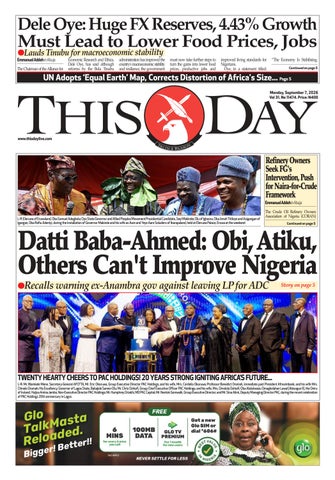
Dele Oye: Huge FX Reserves, 4.43% Growth Must Lead to Lower Food Prices, Jobs Lauds Tinubu for macroeconomic stability
Emmanuel Addeh in Abuja
The Chairman of the Alliance for
Economic Research and Ethics, Dele Oye, has said although reforms by the Bola Tinubu
administration has improved the country's macroeconomic stability and resilience, the government
must now take further steps to turn the gains into lower food prices, productive jobs and
improved living standards for Nigerians. Oye, in a statement titled:
“The Economy Is Stabilising. Continued on page 5
UN Adopts ‘Equal Earth’ Map, Corrects Distortion of Africa's Size... Page 5 Monday, Monday, September January 6, 7, 2026 2025 Vol Vol29. 31.No No10865. 11474. Price: N400
www.thisdaylive.com TR
UT H
& RE A S O
N
Refinery Owners Seek FG's Intervention, Push for Naira-for-Crude Framework
Emmanuel Addeh in Abuja L-R: Eleruwa of Eruwaland, Oba Samuel Adegbola; Oyo State Governor and Allied Peoples Movement Presidential Candidate, Seyi Makinde; Olu of Igboora, Oba Jimoh Titiloye and Asigangan of Igangan, Oba Rafiu Adeniyi, during the Installation of Governor Makinde and his wife as Aare and Yeye Aare Soludero of Ibarapaland, held at Eleruwa Palace, Eruwa at the weekend
The Crude Oil Refinery Owners Association of Nigeria (CORAN) Continued on page 5
Datti Baba-Ahmed: Obi, Atiku, Others Can't Improve Nigeria Recalls warning ex-Anambra gov against leaving LP for ADC
TWENTY HEARTY CHEERS TO PAC HOLDINGS! 20 YEARS STRONG IGNITING AFRICA’S FUTURE...
Story on page 5
L-R: Mr. Wamkele Mene, Secretary-General AFCFTA, Mr. Eric Okoruwa, Group Executive Director PAC Holdings; and his wife, Mrs. Cordelia Okoruwa; Professor Benedict Oramah, immediate past President Afreximbank; and his wife Mrs. Chinelo Oramah; His Excellency, Governor of Lagos State, Babajide Sanwo-Olu; Mr. Chris Oshiafi, Group Chief Executive Officer PAC Holdings; and his wife, Mrs. Omolola Oshiafi; Oba Abdulwasiu Omogbolahan Lawal (Abisogun II), the Oniru of Iruland; Hajiya Amina Jambo, Non-Executive Director PAC Holdings; Mr. Humphrey Oriakhi, MD PAC Capital; Mr. Nentok Gomwalk, Group Executive Director; and Mr. Sina Alimi, Deputy Managing Director PAC, during the recent celebration of PAC Holdings 20th anniversary in Lagos
2
MONDAY, SEPTEMBER 7, 2026 • T H I S D AY
MONDAY, SEPTEMBER 7, 2026 • T H I S D AY
3
4
MONDAY, SEPTEMBER 7, 2026 • T H I S D AY
5
T H I S D AY • MONDAY, SEPTEMBER 7, 2026
PAGE FIVE
UN Adopts ‘Equal Earth’ Map, Corrects Distortion of Africa's Size 164 countries back resolution, US votes against
Emmanuel Addeh in Abuja and Dike Nwamaeze in Lagos
The United Nations General Assembly (UNGA) at the weekend adopted a resolution promoting the wider use of equal-area world maps, including the Equal Earth projection, in a move aimed at addressing long-standing distortions in the representation of Africa and other equatorial regions. The resolution, titled: “Correct the Map: Rebalancing Global
Cartographic Representation and Promoting Equitable Representation of the World’s Regions, Particularly Africa,” was adopted by a recorded vote of 164 in favour to one against, with six countries abstaining. The United States voted against the resolution, while Estonia, Georgia, Lithuania, the Republic of Moldova, Serbia and Ukraine abstained. The initiative, sponsored principally by African Union (AU) member states, seeks
to encourage governments, schools, international organisations and technology companies to use equalarea projections where the comparative size of continents is relevant. Supporters argued that the widespread use of the Mercator projection, developed by Flemish cartographer, Gerardus Mercator in 1569, has contributed to an exaggerated visual representation of Europe and other regions farther from the equator while
making Africa and other equatorial regions appear disproportionately smaller. Introducing the resolution on behalf of the Group of African States, Togo’s Foreign Minister, Robert Dussey, said the debate was not simply about cartography but about how people understand the world. Dussey said maps had been used for centuries in textbooks, the media, digital platforms and official documents in ways that distorted the relative size
of continents. “Correcting the map means recognising that every region of the world deserves to be represented accurately and with dignity,” he said. He stressed that the initiative was not intended to target any country or challenge established cartographic traditions. “Our approach is not directed against any nation, any civilisation or any cartographic tradition,” Dussey said, adding that the objective was to promote projections
UN Secretary-General, António Guterres
that “better preserve the true proportions of continents,” including the Equal Earth projection supported by the African Union.
DATTI BABA-AHMED: OBI, ATIKU, OTHERS CAN'T IMPROVE NIGERIA
Chuks Okocha and Emmanuel Addeh in Abuja
A vocal member of the opposition in Nigeria, Datti Baba-Ahmed, at the weekend said none of the politicians challenging President Bola Tinubu in the 2027 presidential election, including his erstwhile political ally, Peter Obi, and exVice President, Atiku Abubakar, has the capacity to improve or change Nigeria. Baba-Ahmed, who was Obi’s running mate in the 2023 presidential election, disclosed that he had warned Obi against joining the African Democratic Congress (ADC), but the former Anambra State governor ignored his advice and subsequently moved away from what he described as his
political “comfort zone”. The comments by BabaAhmed came as the the presidential candidate of the ADC in next year's election, Atiku, yesterday accused Tinubu of subsidising his friends and the International Oil Companies (IOCs) but won't do the same for poor and struggling Nigerians. But speaking on the MIC ON Podcast, hosted by Seun Okinbaloye, Baba-Ahmed said his political differences with Obi became more pronounced after the latter ignored his warning ahead of his move to the ADC. He said he personally approached Obi at the Yar’Adua Centre to express his reservations about the proposed defection, stressing that he had told him the ADC
was not suitable for his political ambitions. “When he was going to join ADC, I had to go to Yar’Adua Centre ahead of him, so I called him aside. They were worried. Why is Datti calling Peter Obi aside and talking to him? And I told him, ‘This is the last time I’m coming to this place. I gave him my reasons. This is not a place for you.’ Was I wrong? I was proven right,” he said. According to Baba-Ahmed, Obi’s eventual departure from the ADC vindicated his earlier position, noting that he had predicted that the former governor would not remain in the party. “Within four months, Peter Obi left ADC,” he said. Baba-Ahmed also explained that Obi’s decision to move outside the political position
he had advised him to maintain made it difficult for him to continue influencing his former running mate’s political choices. “Peter Obi moved out of his comfort zone against my advice. Beyond that point, I could no longer help him,” he said. The former federal lawmaker, who subsequently left the Labour Party for the Peoples Redemption Party (PRP) said he was also uncomfortable with what he described as contradictions in Obi’s political positions. “Now, I don’t like people who contradict themselves, and I don’t want to go into criticising again the politics of Atiku because that’s not what I’m about,” he said. On the 2027 presidential contest, Baba-Ahmed said
Tinubu should prepare to leave office but should not hand over power to any of the politicians currently challenging him because, in his view, none of them had the capacity to improve the country. “I will simply advise uncle (Tinubu) to please prepare to hand over and move away, but not to the people contesting against him because none of them will improve Nigeria,” he said. Specifically, asked if he was referring to all the opposition politicians seeking to replace Tinubu, Baba-Ahmed replied: “None of that part. Tinubu should leave the stage. All those people contesting against him, too, they were all in bed together at some point or another.”
When the interviewer particularly asked whether that included Obi, Baba-Ahmed responded: “Including Peter Obi, I’m sorry to say.” He argued that Obi had previously belonged to the Peoples Democratic Party (PDP), which was the ruling party at the time, questioning how politicians with such political histories could convincingly present themselves as agents of a new Nigeria. “Tell me one politician who has never been in a ruling party. Tell me,” he said. However, when reminded that he had also been involved in politics and had served in the National Assembly, Baba-Ahmed distinguished his Continued on page 35
REFINERY OWNERS SEEK FG'S INTERVENTION, PUSH FOR NAIRA-FOR-CRUDE FRAMEWORK at the weekend called for urgent presidential intervention to address mounting structural constraints confronting domestic refiners, warning that Nigeria risks continuing to export its crude oil, jobs and refining margins while remaining dependent on imported petroleum products. The association, in a position paper, called for the immediate convening of a Presidential Refining Industry Roundtable, bringing together refiners, regulators, crude producers, the Nigerian National Petroleum Company Limited (NNPC), financial institutions, infrastructure investors and relevant government ministries to develop a clear roadmap for the sector. CORAN said the proposed intervention should focus on
securing commercially viable crude supplies for local refineries, institutionalising the Naira-forCrude initiative, establishing a domestic crude pricing framework, unlocking long-term financing and curbing what it described as unnecessary dependence on imported petroleum products. It argued that despite being one of Africa's largest crude oil producers, Nigerian refiners still faced difficulties accessing feedstock under commercially workable arrangements. While acknowledging improved crude supplies to local refineries in the second quarter of 2026, the association maintained that physical allocation alone would not guarantee the survival and growth of domestic refining.
According to CORAN, the real issue was whether crude could be supplied under arrangements that adequately reflected transportation costs, crude quality, delivery points, evacuation expenses, financing requirements and the proximity of refineries to producing assets. It said Nigerian refiners often faced additional costs associated with trucking, barging and pipeline transportation, which must be considered in determining commercially sustainable crude prices. CORAN therefore proposed a domestic crude pricing mechanism that would take into account crude quality, delivery location, avoided international freight and insurance costs, domestic evacuation expenses and reasonable commercial margins
for producers. The refinery owners also renewed their push for the full institutionalisation of the Nairafor-Crude initiative, describing the policy as critical to reducing the foreign exchange exposure of domestic refiners whose products were largely sold in the local currency. “Naira-for-Crude should become an industrialisation policy rather than an episodic intervention,” CORAN stated. The association argued that requiring refineries to source crude in foreign currency while selling most of their products in naira created an unnecessary commercial mismatch that could undermine investments in the sector. It consequently called for
a transparent and predictable framework through which qualified domestic refineries, including modular and emerging operators, could access Nigerian crude and settle eligible transactions in naira. CORAN also raised concerns about the continued influx of imported petroleum products, warning that excessive imports could weaken incentives for investment in domestic refining. Although it acknowledged that imports might be necessary to bridge genuine supply gaps and maintain adequate product availability, the association said they should increasingly serve as a temporary balancing mechanism rather than remain the foundation of Nigeria's downstream petroleum market.
According to CORAN, continued dependence on imported products would increase foreign exchange demand, expose Nigeria to international freight costs and geopolitical disruptions, while transferring jobs and refining margins outside the country. The association identified the high cost and limited availability of long-term financing as another major obstacle to the development of new refineries and the expansion of existing facilities. It therefore proposed the establishment of a Refinery Development and Expansion Financing Framework involving development finance institutions, commercial banks, pension funds, Continued on page 34
DELE OYE: HUGE FX RESERVES, 4.43% GROWTH MUST LEAD TO LOWER FOOD PRICES, JOBS Now Let the People Feel It,” said the administration deserved recognition for taking politically difficult decisions, including petrol subsidy removal, foreign exchange reforms, the abandonment of monetary financing of fiscal deficits, the rebuilding of external reserves and tighter monetary policy. According to him, these measures have helped address distortions that had weakened the foundations of the Nigerian economy, stressing that macroeconomic stability was only the beginning of the work, and that the success of the reforms must ultimately be measured by their impact on ordinary citizens. He cited Nigeria’s foreign
exchange reserves, which it said reached a 17-year high of $53.11 billion as of August 24, 2026 (it has now reached $54 billion), as evidence of stronger external buffers and referenced the National Bureau of Statistics’ report that the economy grew by 4.43 per cent year-on-year in the second quarter of 2026, up from 3.89 per cent in the previous quarter, with both oil and non-oil sectors recording stronger growth. The former National President of the Nigerian Association of Chambers of Commerce Industry Mines and Agriculture (NACCIMA) noted that the figures suggested that the economy was moving from holding steady to building momentum, adding
that stronger reserves and rising gross domestic product would not automatically translate into improved welfare. Oye also cited the International Monetary Fund (IMF) June 2026 assessment, which estimated poverty at 63 per cent at the national poverty line and 27 million Nigerians facing food insecurity in autumn 2025. He noted that the figures demonstrated the gap between national economic performance and the daily experiences of households. “Nigerians should be honest enough to acknowledge progress when progress has been made and courageous enough to say when progress has not yet
become prosperity. The Tinubu administration deserves credit for taking decisions that many Nigerian governments postponed for years. “The removal of the petrol subsidy, the movement toward a more market-based foreign-exchange regime, the abandonment of monetary financing of fiscal deficits, the rebuilding of external reserves, and the tightening of monetary policy were politically costly measures. They imposed pain, but they also confronted distortions that had been quietly weakening the foundations of the Nigerian economy. “This is not a small achievement. Reform is easy to
announce and difficult to sustain. In Nigeria, every attempt to correct an entrenched distortion is immediately tested by politics, public anger, vested interests, institutional weakness, and the daily pressure of survival. The Tinubu administration has nevertheless stayed the course on several of the most consequential elements of the macroeconomic reset,” he stated. He listed some of the achievements to include a clearer macroeconomic direction, more credible foreign-exchange framework and rebuilding of external buffers. He also acknowledged Nigeria’s broaderbased growth. Oye stated: “President Tinubu’s
administration has done something important: it has begun to move Nigeria away from denial. It has acknowledged that subsidies, opaque foreign-exchange regimes, deficit monetisation, weak revenue mobilisation, and fragile financial institutions cannot deliver national prosperity. For that courage, the government deserves recognition. “But courage at the beginning of reform must become competence at the point of delivery. The administration now has to convert stabilisation into lived security. It must make the Nigerian economy not only investable, but inhabitable; not only credible to markets, but useful to families; not only resilient on paper, but humane in practice.
6
T H I S D AY • MONDAY, SEPTEMBER 7, 2026
NEWS
Group News Editor: Goddy Egene Email: Goddy.egene@thisdaylive.com, 0803 350 6821, 08074010580
INAUGURAL MEETING OF THE STEERING COMMITTEE OF THE LIFC...
L-R: Attorney General of the Federation/Minister of Justice, Mr. Lateef Fagbemi, SAN; Co- chair, Lagos International Financial Centre (LIFC) Council and Governor of Lagos State, Mr. Babajide Sanwo-Olu; Minister of Industry, Trade and Investment, Dr. Jumoke Oduwole; Secretary to the Government of the Federation, SGF, Mr. George Akume; Co-chair, LIFC Council, Mr. Aigboje Aig-Imoukhuede; Chairman, Nigeria Revenue Service, Dr. Zacch Adedeji; Permanent Secretaries, Office of SGF, General Services Office, Dr. Ibrahim Abubakar Kana and Cabinet Affairs Office, Dr. John Ezeamama during the inaugural meeting of the Steering Committee of the LIFC, held at the Office of the SGF in Abuja...recently
Despite DisCos’ Protest, NERC Pushes Forward with New OpEx Spending Order Slashes operational funding for utilities to 40% by 2027 Pegs debt-free DisCos’ CapEx accounts remittance at 60% Power distributors insist regulator micromanaging private entities
Emmanuel Addeh in Abuja Despite protests by Electricity Distribution Companies (DisCos), the Nigerian Electricity Regulatory Commission (NERC) has proceeded with a revised framework that will progressively restrict the amount of surplus operational revenue the utilities can deploy at their discretion. Under the revised arrangement, debt-free DisCos will retain 50 per cent of their earned non-administrative Operating Expenditure (OpEx) for operational needs between August 2026 and January 2027, with the balance transferred into dedicated Capital Expenditure (CapEx) Provision Accounts. The new Order No: NERC/2026/062A, titled: “Revised Order on Successor Distribution Companies’ Utilisation of Earned Non Administrative Operating Expenditure”, dated September 4 effectively reviewed and
replaced the earlier Order No: NERC/2026/062 issued by the commission on June 30, 2026. The document seen by THISDAY was signed by NERC's Chairman, Musiliu Oseni and Vice Chair, Yusuf Ali. Besides, it indicated that from February 2027 the operational share will fall to 40 per cent, with 60 per cent of the earned non-administrative OpEx required to be channelled into CapEx accounts for approved investments. However, the development has further raised opposition from some DisCos, which have argued that the commission is moving beyond regulation of performance and service standards into the financial and operational management of privately owned companies. Although the revised order provided some immediate relief compared with the original framework, it retained NERC’s central requirement that
a significant portion of revenues earned above administrative operating expenditure and current upstream market obligations must be ring-fenced for capital investment. NERC said the framework was necessary to ensure that resources available to the DisCos were prudently deployed to improve and expand electricity distribution infrastructure, strengthen financial discipline and align investments with their approved Performance Improvement Plans (PIPs). The commission also said the intervention was designed to accelerate end to end feeder rehabilitation, reinforce and expand distribution networks and complement existing interventions in the sector. The revised order provides that for DisCos without outstanding market debts, 50 per cent of earned non administrative OpEx will be transferred into a dedicated CapEx Provision Account during the August
2026 to January 2027 transition period, with the remaining 50 per cent retained for operations. According to NERC, from February 2027, the CapEx allocation will rise to 60 per cent, leaving the companies with 40 per cent for operational requirements, representing a moderation of the original June order, which required debt-free DisCos to transfer 70 per cent of their earned non administrative OpEx into CapEx Provision Accounts and retain only 30 per cent for operations. But for DisCos with outstanding market obligations, the revised framework provided a separate allocation formula. Twenty five per cent is to be applied towards obligations to the Nigerian Bulk Electricity Trading Plc (NBET), another 25 per cent towards the Market Operator (MO), while the balance is shared between CapEx and operational requirements under the prescribed framework.
Eyesan: NUPRC May Adopt Biannual Licensing Cycles to Raise Oil Output Sees 4 million bpd production in 10 years
Emmanuel Addeh in Abuja The Nigerian Upstream Petroleum Regulatory Commission (NUPRC) may begin conducting oil licensing rounds twice yearly as part of strategies to accelerate investment, bring new operators into the sector and substantially increase Nigeria's crude oil production, the commission's Chief Executive, Mrs Oritsemeyiwa Eyesan, has said. Eyesan, who spoke in an
interview with S&P Global, said the regulator was seeking to establish a predictable and faster licensing cycle, with successive bid rounds, at the minimum, taking new assets to the market annually. "These will be annual, if possible, even twice-annual events. At a minimum, we'll be going to the market on an annual basis," Eyesan said, adding that future licensing processes could be completed within six to seven months.
The move marks a significant departure from Nigeria's previous licensing regime, under which the country could go between five and 10 years without a bid round before the enactment of the Petroleum Industry Act (PIA) in 2021. Since then, the scale and frequency of licensing exercises have increased, with seven blocks offered during the 2022/2023 mini bid round, 19 blocks put up for auction in 2024 and 50 assets offered in the 2025 licensing
round. The most recent exercise, which covered assets in the Niger Delta as well as the Benin, Anambra and Chad Basins, resulted in the award of 37 of the 50 licences offered, S&P recalled. Eyesan said the assets awarded were expected to contribute about 300,000 bpd of additional production within their first three years, with the commission targeting between 300,000 bpd and 600,000 bpd from successive licensing rounds.
Where a Disco has an outstanding obligation to only one of NBET or the Market Operator, the share that would otherwise have been paid to the other market participant is also required to be transferred into the CapEx Provision Account. However, the development has particularly angered the better performing DisCos, which contend that the regulator is effectively imposing tighter financial controls on companies that have invested in reducing losses, improving metering, strengthening revenue assurance and increasing collection efficiency. The utilities argue that improved commercial performance should give companies greater financial flexibility rather than trigger additional restrictions on how their legitimately earned revenues can be deployed. “We understand NERC’s responsibility to regulate the industry, but regulation should not extend to determining the day to day operational expenditure of privately owned companies or prescribing how efficiently earned revenues must be deployed,” one of the operators told THISDAY. According to the DisCos, the regulatory framework could undermine the commercial incentives that are required to attract private capital into the distribution segment, particularly as the companies continue to face substantial investment requirements, liquidity pressures and high network maintenance costs. Another operator argued that companies which had improved their financial and operational performance should not be
treated as though they had committed a regulatory breach simply because they generated revenues in excess of immediate market obligations. “The companies that have invested in improving metering, revenue assurance, customer service and collection efficiency should not be subjected to additional restrictions simply because their efforts have resulted in higher revenues,” another operator said. The DisCos also questioned the extent to which NERC should determine the internal allocation of funds generated by private companies, insisting that the commission’s responsibility was to regulate outcomes rather than take over corporate financial decisions. “NERC has the statutory responsibility to set standards, monitor compliance and protect consumers. That's not under contention at all. But that mandate cannot reasonably mean that the regulator should determine the internal spending priorities of companies that are expected to operate commercially and remain financially sustainable,” an industry source said. The utilities maintained that NERC already possesses several regulatory tools through which it can compel investment and sanction poor performance without imposing what they described as a detailed spending regime. They pointed to existing tariff and performance monitoring mechanisms, including the ability of the regulator to disallow expenditure that does not meet regulatory requirements, impose penalties and hold companies accountable for agreed investment and service delivery targets.
7
T H I S D AY • MONDAY, SEPTEMBER 7, 2026
NEWS
FIRST LADY IN CALABAR...
First Lady of Nigeria, Senator Oluremi Tinubu presenting the cheque to Cross River state Governor, Bassey Otu and his wife, Eyoanwan-itam Bassey Otu on behalf of the 18 victims of the totally burnt brands/businesses at Calabar mall in Cross River, yesterday
Baiyewu: How Stakeholders' Collaboration Cut Cooking Gas Prices By 40 Percent
Emmanuel Addeh in Abuja
The Executive Secretary/Chief Executive Officer of the Nigeria Liquefied and Compressed Gases Association (NLCGA), Mr Lanrewaju Baiyewu, has said the prices of Liquefied Petroleum Gas (LPG), popularly known as cooking gas, dropped by as much as 40 per cent from their June peak following renewed collaboration among key players
across the domestic gas value chain. Baiyewu disclosed this while speaking at an industry event in Lagos, attributing the improvement to coordinated interventions by the federal government, terminal operators, off-takers, marketers, regulators and other stakeholders. The development represents a reversal of the sharp price escalation recorded earlier in the
Fast-track CVFF Disbursement to Nigerian Ship Owners, Oyetola Urges NIMASA, PLIs
Says 20 out of 92 applications await approval
Kasim Sumaina in Abuja
Minister of Marine and Blue Economy, Adegboyega Oyetola, has urged the Nigerian Maritime Administration and Safety Agency (NIMASA) to work closely with the 12 approved Primary Lending Institutions (PLIs) to accelerate the disbursement of the Cabotage Vessel Financing Fund (CVFF) to qualified Nigerian ship-owners. The move underscored Oyetola’s determination to end more than two decades of delay surrounding the disbursement of the fund and unlock a new era of growth, investment, and job creation in Nigeria’s maritime sector. Oyetola, in a statement issued at the weekend by his special adviser, Bolaji Akinola, said significant progress had been made in processing applications under the CVFF framework. He disclosed that NIMASA had received 92 funding applications, with 20 already submitted to the PLIs and one application reviewed
and forwarded for approval. The minister explained that the push for the operationalisation of the CVFF marked a major milestone in the federal government’s efforts to strengthen indigenous participation in Nigeria’s maritime industry. In April 2025, Oyetola directed NIMASA to commence the process for the long-awaited disbursement of the fund, signalling a decisive break from years of administrative stagnation and setting the stage for the strategic repositioning of Nigeria’s indigenous shipping capacity. The momentum continued with the launch of the CVFF Application Portal in Lagos on January 22, 2026. The portal established a more transparent and structured process through which eligible Nigerian ship-owners could apply for financing. To further accelerate the process, Oyetola announced an expansion of the number of PLIs from five to 12.
year, when supply constraints, logistics challenges and broader market pressures pushed the cost of cooking gas beyond the reach of many households and small businesses. According to Baiyewu, the national average price of LPG stood at about N1,360 per kilogramme in February before rising above N2,000 per kilogramme in June, with prices reaching as high as N2,300 in some locations. At the peak, consumers, he recalled, faced significant increases in the cost of refilling cylinders, with a 6kg cylinder costing about N13,800 and a 12.5kg cylinder selling for as much as N28,750 in some markets. Baiyewu said the subsequent decline followed sustained
engagements aimed at resolving bottlenecks limiting the flow of LPG into the domestic market. He, however, warned that the recent improvement should not be mistaken for a permanent solution to the structural challenges that periodically trigger supply shortages and price spikes. He stressed that effective implementation of the recently enacted Petroleum Industry Act (PIA) remained critical to establishing a more predictable domestic gas market and preventing recurring supply disruptions. Baiyewu also pointed to the exposure of domestic LPG prices to international benchmarks as an important factor affecting retail prices, noting that movements in
foreign exchange, global energy prices and logistics costs could continue to influence what consumers pay. He said increased investment by industry players in storage facilities, transportation infrastructure, cylinder manufacturing and distribution would be necessary to deepen the resilience of the domestic market. Beyond cooking gas, the association said it is also positioning gas as a major component of Nigeria’s transportation transition, with its new leadership under Mr Ladi Falola, targeting domestic LPG consumption of 5 million metric tonnes by 2030. Baiyewu said the association would also intensify advocacy
for Compressed Natural Gas (CNG) as a preferred fuel for mobility, in line with the federal government’s gas-for-mobility initiative. He argued that expanding the use of gas-powered mass transit buses and haulage vehicles could help reduce transportation costs, particularly given the dominant role of road transport in the movement of people and goods across the country. He therefore called for sustained cooperation among government agencies, regulators, producers, terminal operators, marketers, off-takers and other participants in the gas value chain, stressing that achieving greater gas penetration would require coordinated action rather than isolated interventions.
SERAP to Tinubu: Probe N78.8bn Cash Transfer Scandal, Recover Diverted Funds Chuks Okocha in Abuja
Socio-Economic Rights and Accountability Project (SERAP) has urged President Bola Tinubu “to direct the Ministry of Humanitarian Affairs and Poverty Reduction, the National Cash Transfer Office (NCTO), and the National Social Safety Nets Coordinating Office (NASSCO) to urgently account for over N78.8 billion in public funds reportedly diverted, unaccounted for, or irregularly spent”. The allegations were documented in the 2024 Annual Report published by AuditorGeneral of the Federation on August 7. According to the auditor-
general, the findings in the report variously covered periods between January and December 2023 and ending on December 31, 2024. In a letter dated September 5, 2026 and signed by SERAP’s Deputy Director, Kolawole Oluwadare, the organisation urged the president “to direct the Ministry and NCTO to publish the full records and audit trail of the N33.751 billion 2023 cash transfers, including the name of the beneficiaries, payments, verification, authorisations and reconciliation, and to explain the failure to provide REMITA records to the Auditor-General”. SERAP also urged Tinubu “to direct the Ministry and NCTO to account for the
N36.744 billion payments made without prepayment audit, the N4.616 billion in unsupported expenditures, the N350.182 million enrolment payments, the N89.511 million store purchases and the N17.422 million diesel advances”. It said the president should “direct appropriate anticorruption agencies to promptly and thoroughly investigate the N76.24 billion in questionable and unaccounted-for expenditures at NCTO and N2.55 billion at NASSCO, and to ensure the recovery and remittance of any public funds improperly spent, diverted or lost”. The group said in the letter, “Anyone suspected to be
responsible should be sanctioned and prosecuted as appropriate if sufficient admissible evidence is established, irrespective of status, position or institutional affiliation”. It stated, “Every naira identified in the report must be properly accounted for, and any public funds found to have been diverted, misapplied or ‘paid to ineligible or fictitious beneficiaries’ must be fully recovered and remitted to the treasury.” The letter, read in part, “The ministry should be directed to publish a clear schedule showing the amount recovered, the date of recovery, the institution responsible and the Treasury account into which each recovered amount was paid.
8
T H I S D AY • MONDAY, SEPTEMBER 7, 2026
NEWS
PANEL SESSION AT DAY I OF GITEX NIGERIA...
L-R: Managing Director, Ilorin Innovation Hub, Nigeria, Temi Kolawole; Co-founder & CEO, Zindi, USA, Celina Lee; Director of Zein AUB Innovation Park, American University of Beirut, Lebanon, Maha Zouwayhed; Country Manager, inDrive, Nigeria, Oladimeji Timothy; and Communications Consultant, T.A. Media, Nigeria, Toba Adedurin, during a panel session at Day 1 of GITEX Nigeria held in Lagos... weekend
Olawepo-Hashim Unveils Plan for N605 Fuel, Says Naira Undervalued Insists 4m bpd oil output achievable in 24 months Pledges to end imports, targets N525-N700/$ exchange rate Says local fuel pricing can't be based solely on international crude prices
Emmanuel Addeh in Abuja Accord Party’s presidential candidate in the 2027 election, Gbenga Olawepo-Hashim, at the weekend explained how he hoped to achieve a N605 per litre petrol in Nigeria, saying the current pricing structure amounts to an overvaluation of the commodity and imposes unnecessary costs on consumers. Olawepo-Hashim, who spoke during an interview on Channels Television, said the proposed price was based on a domestic crude cost of about $30 per barrel, additional refining and logistics costs, as well as an energy tax intended to support the development of alternative energy sources. He also challenged the federal government’s approach to the naira, stating that the national currency is currently undervalued. Olawepo-Hashim said increased crude oil production, reduced petroleum imports, and greater use of domestic crude for local refining could substantially improve Nigeria’s foreign exchange position. According to him, the economics of domestic petroleum pricing should not be based entirely on international crude prices because oil-producing countries routinely make arrangements for domestic crude supplies to support local industries and energy security. He stated, “The domestic crude price, according to NNPC statistics, is $30, which is one of the highest production costs in the world. Saudi Arabia is $10. If you give them a margin of $15 on top of that, which is 50 per cent margin, you end up with $45. If you allocate $5 for refining and then transport and
insurance, $7, you end up with $57. At the end of the day, what this translates to is about $0.34, which is N501 at an exchange rate of N1,400.” He said the N605 per litre proposal deliberately provided an additional margin for investment in alternative energy, insisting that Nigeria should not encourage permanent dependence on cheap petrol at the expense of cleaner energy sources. Olawepo-Hashim argued that the country's domestic crude should be priced differently from crude intended for export, describing international pricing as an “opportunity price”. He said, “Nobody sells domestic crude at international prices. Saudi Arabia does not do it. Kuwait does not do it. No oil-producing country in OPEC does what Nigeria is doing.” The Accord presidential candidate also criticised the continued importation of refined petroleum products, stating that the government should prioritise the supply of domestic crude to Nigerian refineries, including the Dangote refinery and smaller private refineries. He said the objective should be to transform Nigeria from a crude exporter dependent on imported petroleum products into a net producer of refined products and petrochemicals. He said, “Who in this world tries to rob his own local economy of that comparative advantage? The comparative advantage we have is that we are an energy-rich resource country. Then we should use that to drive industrialisation, not to begin to outprice that product in such a way that we are only focusing on exporting crude.” On foreign exchange market, Olawepo-Hashim said the naira
was being kept below what he considered its appropriate value, citing an International Monetary Fund (IMF) assessment that the currency is undervalued by 25.6 per cent.
He stated that increased domestic refining would reduce Nigeria’s demand for dollars, while higher crude production would increase foreign exchange earnings.
Olawepo-Hashim stated, “If you look at all the indicators, there is no pressure any longer, as we see as the data has provided. There is no disparity, and there is no undulating effect, as we see,
in the FX, in the exchange rate. “IMF, the advocate of freemarket fundamentalism, in their June report said Nigerian currency is currently undervalued by 25.6 per cent.
Bacita Sugar Exits Receivership as KIA Secures Fresh Investor Backing for Revival KIA, Keystone Bank resolve dispute
James Emejo in Abuja
Bacita Sugar Company Limited, yesterday, announced that it had exited receivership following an amicable resolution of outstanding financing and redevelopment issues between its shareholders and Keystone Bank. The development paves the way for the company to resume its planned transformation into a major sugar and agro-industrial hub. KIA Africa Group, the company’s investment and operating partner, announced, in a statement signed by Wale Suleiman for management, that full ownership and operational control of Bacita had been
restored to the company and its shareholders after a conciliation process involving the relevant stakeholders. The resolution, according to KIA, cleared the way for the company to shift its attention from the dispute to the redevelopment of the long-dormant sugar estate, with institutional investors already providing fresh capital to support the turnaround. KIA said the resolution with Keystone Bank reflected the shared interest of both parties in preserving Bacita and restoring its productive capacity, while protecting the interests of employees, creditors, investors, host communities, and other stakeholders.
With the ownership and operational issues now resolved, the group said it had secured the backing of a leading institutional investor whose initial capital injection had enabled the company to achieve key financial milestones and strengthen the foundation for the next phase of the project. The fresh investment, it added, represented a vote of confidence in Bacita’s commercial prospects and its potential role in Nigeria’s sugar value chain. KIA Africa Group said its immediate priority would be to implement an ambitious transformation programme covering the modernisation of the sugar-processing facilities,
rehabilitation of critical estate infrastructure, and expansion of sugarcane cultivation. The programme would also involve the development of large-scale outgrower schemes, improvement of irrigation infrastructure, and deployment of modern agricultural technologies to raise productivity across the estate and surrounding farming communities. According to the group, the planned investments are expected to substantially expand Bacita’s production capacity while generating thousands of direct and indirect jobs and stimulating economic activities within its host communities and across Kwara State.
Tinubu Eulogises Health Minister, Prof Ali Pate, at 58 Deji Elumoye in Abuja President Bola Tinubu felicitated Coordinating Minister of Health and Social Welfare, Professor Muhammad Ali Pate, on his 58th birthday on September 6. Tinubu, in a release issued on Sunday by his Adviser on Information and Strategy, Bayo Onanuga, celebrated the distinguished and globally acclaimed health professional
on the special occasion, lauding his invaluable contributions to Nigeria's health and social welfare sector. Tinubu acknowledged the significant transformation in the health sector under the Renewed Hope Agenda through Pate's ministry, particularly the revitalisation of over 3,100 primary healthcare centres; reorganisation of Basic Health Care Provision Fund
(BHCPF), enabling over 37 million Nigerians to access basic healthcare; and upgrade of health facilities across the country. The president also highlighted the investments in health infrastructure and manpower, such as the establishment of three oncology centres across the geo-political zones to reduce outbound medical tourism;
the recruitment of over 20,000 health professionals into federal tertiary hospitals to cushion brain drain impacts; the training of over 78,000 frontline health workers to improve primary health care delivery quality; HPV vaccination for over 17.1 million adolescent girls to protect them against cervical cancer; and many other significant initiatives in the health sector.
9
T H I S D AY • MONDAY, SEPTEMBER 7, 2026
NEWS
SIGNING CEREMONY OF BOI'S LANDMARK N274.18 BILLON INAUGURAL DOMESTIC BOND...
L-R: Head, Debts Capital Markets, RMB Nigeria, Laju Atake; Executive Director and Treasurer, RMB Nigeria; Yetunde Ogunremi; Executive Secretary, Bank of Industry, Olufunlola Salami; Executive Director, Corporate Finance, Sustainability & Investments, Bank of Industry, Rotimi Akinde; Executive Director, Public Sector and Intervention Program, Bank of Industry, Mabel Ndagi; General Manager/Divisional Head, Corporate Finance and Advisory Services, Bank of Industry, Ayo Bajomo; Legal Advisor, Bank of Industry, IretiOluwa Daramola; Executive Director, RMB Nigeria, Head of Investment Banking, Broader Africa, Chidi Iwuchukwu; Senior Relationship Manager, RMB Nigeria, Titilope Olatunji and, Group Head, Debt Capital Markets, Bank of Industry, Faruk Hamidu at the signing ceremony of Bank of Industry's Landmark N274.18 Billon Inaugural Domestic Bond in Lagos....weekend
NERD’s Academic Database Hits 400,000, 115,000 Credentials Verified 907 institutions enrolled in boost for FG's education digitisation drive At 228,347, female students exceed males' 181,536 submissions
Emmanuel Addeh in Abuja
The Nigeria Education Repository and Databank (NERD) has crossed the 400,000 mark in digitised academic submissions, while its National Credential Verification Service (NCVS) has processed more than 115,000 academic credentials. The development has also seen 907 tertiary institutions enrolled on the platform, with 629 currently active, indicating growing adoption of the repository as the government seeks to create a central digital ecosystem for academic research, credentials and institutional knowledge. Specifically, the latest figures obtained from the repository showed that more than 410,000
theses, dissertations, student projects and other academic works had been submitted by September 2026, with undergraduate research accounting for the overwhelming majority of the materials uploaded. The repository is designed to preserve, index and improve access to academic works produced by Nigerian institutions, and is increasingly being positioned beyond a conventional digital archive, particularly as the credential verification component begins to provide an additional layer of authentication for academic qualifications. According to available information, participating institutions cut across the university, polytechnic,
monotechnic and college of education systems, reflecting the broad scope of the federal government’s digitisation initiative. Of the 907 institutions enrolled, 259 are universities, 163 polytechnics, 179 monotechnics, 178 colleges of education, while 130 fall under other categories. The spread, according to the data, has also translated into increasing academic participation, with 2,020 faculties and 9,626 departments enrolled on the platform. More than 1,600 faculties and 5,300 departments already have academic works visible on the repository. Universities such as the University of Benin, Ahmadu Bello University, Zaria, Ekiti State University, the University
of Calabar and the University of Nigeria, Nsukka, are among institutions with significant volumes of submissions. Several polytechnics, including Kwara State Polytechnic, Kaduna Polytechnic, Auchi Polytechnic, Federal Polytechnic, Nasarawa and Federal Polytechnic, Nekede, have also recorded notable participation, suggesting that the repository is gradually extending beyond the university system. The data further showed that student research remains the principal driver of the platform’s growth. As of September 4, undergraduate submissions stood at 409,456, compared with 1,563 postgraduate submissions. According to the data, the gender distribution of submissions
showed 228,347 works attributed to female students, compared with 181,536 from male students, while 77 submissions were uncategorised. The age profile indicated that students between 25 and 29 years constituted the largest group of contributors, followed by those between 20 and 24 years. Beyond the volume of material being digitised, the repository is also beginning to provide a picture of the areas of research attracting the attention of Nigerian students. The submissions span the sciences, social sciences, humanities, law, education and technology, with increasing interest in innovation and technology-related subjects reflected across several disciplines. This, in particular, could provide government and policymakers with a potentially
valuable pool of information on the nature of research being undertaken in Nigerian tertiary institutions and the areas where young researchers are seeking solutions to economic and social challenges. The credential verification arm of the initiative is expected to strengthen this function by providing a structured mechanism for authenticating academic qualifications and assigning National Credential Numbers to verified credentials. With more than 115,000 credentials already verified, the service haa become increasingly important in a system where employers, government agencies, foreign institutions and other organisations routinely need to establish the authenticity of Nigerian academic qualifications.
Shutdown of Ossiomo Power Plant Worries Edo Govt Abiodun’s Leadership Attracting
Felix Omoh-Asun in Benin
Edo State Government expressed concern over the shutdown of Ossiomo power plant, with reports indicating that prior to the shutdown Ossiomo was generating about 11mega watts and supplying power to the state government offices and residents of Benin. Commissioner for Power, Hon. Paul Usenbo, who described the shutdown as unfortunate, said it had affected government facilities and residents who relied on the plant for electricity supply. Usenbo said, “The effect has been significant. Ossiomo previously supplied electricity to residents of Edo State, SME, business owners, industries as well as several government facilities.” Following the shutdown, the state government had to reconnect some of its facilities to BEDC, while also dealing with the wider consequences of inadequate electricity supply.
Usenbo stated, “These concerns and the impact on businesses, industries, hospitals, artisans, households, and the overall economy draw the attention of government, which has, indeed, focused on proffering solutions to these issues. “Every megawatt that is unavailable has an economic consequence. The government’s position is clear: we want the dispute resolved, the investment protected and electricity restored to consumers, but this must be achieved in accordance with the law.” On whether the government was aware the people were unhappy with the inability of Ossiomo Power Company to continue to provide them with electricity, the commissioner affirmed, “Yes, we are aware of the concerns of the people, and we understand their frustration. Edo people want electricity. They do not want explanations; they want results.
“However, it is important to clarify that the state government does not own or operate Ossiomo Power Company. The government cannot simply take over a private company’s facilities or impose a commercial settlement on parties involved in a dispute. “What government can and is doing is to facilitate dialogue, provide regulatory support, protect lawful investments, and work with security agencies and other relevant authorities to ensure that the rule of law prevails. “Indeed, as recently as August 2026, there were reports that Ossiomo was attempting to resume generation but encountered further disruption (by youths) at its Ologbo facility.” Usenbo said there were things government could do, including ensuring, “Firstly, all parties must respect the rule of law and the sanctity of contracts and legitimate investments. “Secondly, the state government will continue to facilitate structured
negotiations between the parties, without taking sides in a private commercial dispute. “Thirdly, the security of critical electricity infrastructure must be guaranteed. No community, individual or private interest should be allowed to vandalise or unlawfully take control of power infrastructure. “Finally, the state government will continue to encourage multiple sources of electricity generation.” He sympathised with Edo people and said the government understood their present frustration, and assured that the government was not complacent. The commissioner stated, “Electricity is no longer being treated merely as a social service; we see efficient and reliable electricity as an economic infrastructure and a foundation for industrialisation, job creation, healthcare, education, and improved living standards. The reforms taking place in Edo are designed to change the structure of the sector permanently.
Investment, Transforming Ogun, Says Akinmade
The Special Adviser to the Ogun State Governor on Information and Strategy, Hon. Kayode Akinmade, has said Governor Dapo Abiodun’s leadership has transformed the state’s development trajectory and strengthened its position as one of Nigeria’s leading investment destinations. Speaking with newsmen on Sunday in Abeokuta, Akinmade attributed the state’s growing appeal to the administration’s purposeful governance, political maturity, infrastructure development and commitment to creating a stable, business-friendly environment. He said the administration had pursued its development agenda with passion, discipline, integrity and focus despite political and economic challenges.
According to him, Abiodun’s ability to maintain peace and stability while implementing ambitious development programmes had enhanced investor confidence and created opportunities for businesses, residents and communities across the state. “Governor Abiodun plays politics without acrimony. He understands that political differences should not be allowed to destroy relationships, communities or the larger society. “His approach is anchored on political maturity, restraint and a commitment to the larger interest of Ogun State. He has consistently avoided actions that could overheat the polity because he understands that peace and stability are essential to development,” Akinmade said.
T H I S D AY • MONDAY, SEPTEMBER 7, 2026
10
NEWS
SSDC'S STAKEHOLDERS ENGAGEMENT WITH TRADITIONAL RULERS COUNCIL IN CROSS RIVER...
L-R: Special Assistant on Chieftaincy Affairs to the Cross River State Governor, Otuekong Francis Edet; representative of the MD/ CEO of South South Development Commission (SSDC), Ms Usoro Akpabio; Hon. Larry Odey and Obong of Calabar, His Majesty, Edidem Ekpo Okon Otu, during the SSDC's Stakeholders engagement with Traditional Rulers Council in Cross River State, yesterday
NDIC Disburses N125.5 Billion to Depositors of Defunct Heritage Bank, Intensifies Recovery Drive
Says N71.28 billion liquidation dividends declared, N54.23 billion insured deposits paid to 715,529 depositors Verification gaps leave N15.23 billion dividends unpaid
James Emejo in Abuja
The Nigeria Deposit Insurance Corporation (NDIC), yesterday disclosed that a total sum of N125.51 billion has been disbursed to depositors of the defunct Heritage Bank Limited through insured-deposit reimbursements and liquidation dividends, as it intensifies efforts to recover outstanding assets of the failed lender. The figure comprises N54.23 billion paid to 715,529 insured
depositors and N71.28 billion declared as liquidation dividends for depositors whose balances exceeded the statutory insured limit of N5 million. Providing an update on the liquidation and reimbursement of depositors of the failed bank, NDIC stated that N15.23 billion in insured deposits remained unpaid as of the reporting date. According to the corporation, the outstanding funds were largely linked to depositors without Bank Verification Numbers (BVNs),
those without alternative bank accounts, unresolved verification issues and affected customers who had yet to submit claims for their entitlements. The NDIC said it had continued public awareness campaigns and stakeholder engagements to bring the affected depositors forward for verification and payment. Beyond the insured deposits, the corporation, acting as liquidator, had declared two tranches of liquidation dividends totalling N71.27 billion to
uninsured depositors. The dividends, according to NDIC, were funded from proceeds recovered from loans and the realisation of assets belonging to the defunct bank. The total liquidation dividends translate to 14.40 kobo for every naira of uninsured deposits, providing an additional layer of recovery for depositors whose balances exceeded the N5 million insured threshold. The corporation explained that its role as liquidator involves
NDLEA Tracks Convicted Cocaine Trafficker Through New Identity, Legitimate Business Front Michael Olugbode in Abuja A convicted cocaine trafficker who allegedly returned to the drug trade after serving a fiveyear prison sentence has been arrested in Lagos, exposing how narcotics syndicates are increasingly using legitimate businesses, false identities and everyday commodities to conceal their operations. The National Drug Law Enforcement Agency (NDLEA) said 34-year-old Dunu Ebubechukwu was arrested in a sting operation at Article Market, opposite Trade Fair Market, Ojo, Lagos, after investigators traced him to a cocaine shipment intercepted weeks earlier on its way to Saudi Arabia. According to a statement by the spokesman of the antinarcotics agency, Femi Babafemi, the case began on July 31, when NDLEA operatives intercepted 1.2 kilogrammes of cocaine hidden inside phone chargers at a courier company in Lagos. The parcel was reportedly destined
for Riyadh. Rather than ending with the seizure, investigators followed the trail to the person allegedly behind the shipment. According to the Babafemi, painstaking intelligence gathering by the agency’s Directorate of Operations and General Investigation eventually led officers to Ebubechukwu, who was arrested on September 4 while presenting himself as an herbal tea businessman. His arrest led to the discovery that Ebubechukwu had previously been arrested in 2011 at the Murtala Muhammed International Airport, Lagos, after he ingested 900 grammes of cocaine and 130 grammes of heroin in an attempt to travel to Austria. He was convicted and sentenced to five years in prison, but according to NDLEA, the imprisonment did not end his involvement in the illicit trade. He was said to have later changed his name from Dunu Chukwuyenre Enoch to Dunu
Bethel Ebubechukwu and allegedly returned to drug trafficking, this time operating behind the appearance of a legitimate business. Babafemi said the latest alleged operation also showed the lengths to which traffickers can go to disguise their consignments. A search of his Ejigbo residence uncovered phone chargers similar to those used in the intercepted Saudi-bound shipment, with their internal components removed to create spaces for drugs. Ebubechukwu’s arrest came as NDLEA operations across nine states exposed a much wider web of trafficking involving cannabis, opioids, methamphetamine, cocaine, codeine and other controlled substances. At Lagos airport, operatives seized 966,200 tablets of Tramadol 225mg, valued at more than N1.1 billion, concealed among thrift trousers in a consignment from Pakistan. Another shipment from Singapore yielded 57.8 kilogrammes of Loud, a synthetic
cannabis strain valued at more than N173 million, concealed inside cartons of disposable hand gloves. The most dramatic concealment, however, occurred on the highway in Ondo State, where NDLEA officers pursued a 20,000-litre fuel tanker that allegedly refused to stop. The driver eventually abandoned the tanker at a church premises in Ugbe Akoko and escaped into the bush. Inside the vehicle, officers discovered a false compartment containing 165 bags of cannabis weighing 2,145 kilogrammes, hidden alongside its legitimate fuel cargo reportedly destined for Jos. At Tincan Port, Lagos, NDLEA officers also intercepted 598.08 kilogrammes of cannabis-infused cookies and gummies packed in 890 packets inside a 40-foot container. The consignment was linked to three suspects already in custody over an earlier seizure of 842.54 kilogrammes of cannabis-laced cookies.
recovering debts, realising investments and disposing of physical assets of failed banks, with proceeds applied to verified liabilities according to the statutory order of priority. Under the NDIC Act, uninsured deposits rank ahead of other claims in the distribution of liquidation proceeds. Creditors and shareholders can only be considered after depositor claims and liquidation expenses have been fully settled, subject to the availability of recoverable funds. The corporation said it had therefore, adopted a proactive approach to the recovery and realisation of Heritage Bank's assets, while continuing to dispose of the bank's remaining assets and intensify recovery of outstanding loans. It identified loan recovery as a major focus of the liquidation process, given that outstanding loans constitute the largest component of the defunct bank's
asset portfolio. NDIC also said it was working to resolve legal impediments and other challenges slowing the effective liquidation of the bank, with the objective of maximising recoveries and accelerating the settlement of outstanding claims. The corporation commenced payment of insured deposits within four days of Heritage Bank's closure, significantly ahead of the 30-day statutory response period under the NDIC Act, 2023, and the seven-day payout period recommended under international best practices. To facilitate the process, the NDIC partnered with the Nigeria Inter-Bank Settlement System (NIBSS) to identify depositors and credit their alternative bank accounts directly using the BVN database. Depositors without BVNs or alternative accounts were required to submit claims online or visit NDIC offices nationwide to complete the necessary verification.
Babcock University Inducts 20 New Doctors
Funmi Ogundare
Babcock University, Ilishan-Remo, Ogun State, weekend, inducted 20 newly qualified medical doctors of the Orion 11 class, reaffirming its commitment to strengthening Nigeria’s healthcare workforce amid a critical shortage of medical personnel. The doctors were inducted at a special mop-up ceremony held at the 600-seater auditorium of the Benjamin Carson Sr. College of Health and Medical Sciences of the institution. Registrar/Chief Executive Officer of the Medical and Dental Council of Nigeria (MDCN), Prof. Fatima Kyari, represented by the Head
of Registration Department and Assistant Registrar of the Council, Dr. Tijjani Ali Mandaka, described the induction as a defining moment in the professional lives of the new doctors. He urged the inductees to practise with empathy, humility and respect for other healthcare professionals, stressing that effective medical practice depends on teamwork. He also advised the new doctors to secure housemanship placements within the mandatory two-year period using their provisional registration certificates, warning that failure to do so could require them to sit for a reassessment examination.
MONDAY, SEPTEMBER 7, 2026 • T H I S D AY
11
12
MONDAY, SEPTEMBER 7, 2026 • T H I S D AY
September 7, 2026 President Bola Ahmed Tinubu, GCFR President Villa, Aso Rock, Abuja. Your Excellency,
“OPEN LETTER TO OUR DEAR MR. PRESIDENT”
IN RE: THE NEED TO CALL HONOURABLE JAMES ABIODUN FALEKE AND THE MANAGEMENT OF OGUN-OSHUN RIVER BASIN DEVELOPMENT AUTHORITY (OORBDA) TO ORDER AND TO STOUTLY AND UNEQUIVOCALLY RESPECT THE RULE OF LAW AND SANCTITY OF JUDICIAL PROCESS IN REGARD TO A PARCEL OF LAND MEASURING APPROXIMATELY 8,000 SQUARE METRES SITUATE ALONG LATEEF JAKANDE ROAD, AGIDINGBI, IKEJA, LAGOS STATE. INTRODUCTION We, the undersigned, are the accredited representatives of the AkinoleOshiun family of Agidingbi, Ikeja, Lagos State, and we use this medium to send our best wishes to Your Excellency in your efforts to ensure that this country is piloted on the right footing within the precincts of law and order. It is with a heavy heart and enormous displeasure that we bring to your attention the conduct and overbearing attitude of one of the members of the House of Representatives, Honourable James Abiodun Faleke (representing Ikeja Constituency), and the management of OORBDA in employing political influence to interfere with the due process of the law regarding a parcel of land opposite Coca-Cola Factory, Agidingbi, Ikeja, measuring approximately 8,000 square metres. The said land has already been vested in our family by judicial process, with the concurrence and backing of the Lagos State Government. BACKGROUND FACTS Our family has been adjudged the owner of parcels of land measuring approximately 398 acres within and around Agidingbi, including the subject property opposite the Coca-Cola Factory, measuring approximately 8,000 square metres. The title of our family to this land has been confirmed in the judgments of the High Court of Lagos State in Suit No. ID/216/77L – Chief Sule Akinole & Anor. v. Ato Mogaji & Ors., registered as 16/16/2178 at the Lands Registry, Alausa, Lagos; the Court of Appeal in Appeal Nos. CA/L/517M/99 – Ato Mogaji & Ors. v. Chief Sule Otabiyi Akinole & Anor.; CA/L/649M/06 – Attorney-General of Lagos State v. Chief Sule Otabiyi Akinole & Ors.; and CA/L/776/2014 – Alhaja Muinat Adufe Ashorobi v. Alhaji Musediku Abudu Akinole; and the Supreme Court in SC/173/2009 – Ato Mogaji & Ors. v. Chief Sule Otabiyi Akinole. Following the aforesaid judgments confirming the legal and beneficial interest and ownership of our family over the above-mentioned parcels of land at Agidingbi, our family applied for and was granted a writ of possession, which was effectively executed by the Deputy Sheriff of the High Court of Lagos State in the presence of members of the Nigeria Police Force sometime in April 2019. Form 'O', being a Certificate of Writ of Execution, was subsequently issued to our family. As a fallout of the Writ of Possession executed within Agidingbi, the Lagos State House of Assembly (LAHA), through its Rules and Business Committee, conducted a public hearing in respect of a petition titled “Request for Urgent Intervention in the Illegal Allocations of the Tract of Land Covered by the Judgment of the Supreme Court.” All stakeholders within Agidingbi were invited, including officials of OORBDA, to wit: Mrs. Abiodun Nkwocha and AGD Judith, Director, Legal Services, OORBDA. After exhaustive deliberations, the LAHA passed resolutions directing the Lagos State Government (LASG) to comply with the judgments of the courts and recognise the family as the rightful, lawful and legitimate owners of lands measuring 398 acres, including the subject parcels of land, situate, lying and being at Agidingbi, Ikeja, Lagos State, by allowing unhindered access to use and occupation of the same. In consequence of this, the LASG proceeded to recognise our family as the legal and beneficial owners of the land covered by the aforesaid judgments of the superior courts within Agidingbi by issuing land allocations and LASG Survey Plans in respect of some vacant plots within Alausa Central Business District and along Lateef Jakande Road, Agidingbi, Ikeja, Lagos, including the subject property. HON. JAMES ABIODUN FALEKE'S UNLAWFUL INTERFERENCE Following the confirmation of our family's ownership of the subject property at Agidingbi, our family took possession of the same and has been in undisturbed and unhindered possession of the subject property for over two years, exercising all rights of ownership. However, recently, Hon. James Abiodun Faleke, in the company of his land agents and attorneys, has been creating significant interference with our lawful possession of the subject property under the guise of obtaining a purported long lease from OORBDA.
The same Honourable has equally promised us that he would use presidential power to eject us from the subject property, and that this would involve enlisting officials of the Nigeria Police Force to uproot our interest in the subject property. Similarly, OORBDA has also been spewing out distorted and fake information/public notices claiming ownership of the subject property, when, in fact, the courts of the land and the Lagos State Government have spoken loudly that our family remains the owner of the subject property. Hon. James Abiodun Faleke and OORBDA have promised to unleash mayhem on our family members until we vacate the subject property. We will surely not be cowed, frightened, intimidated and/or submit to Hon. Faleke's and OORBDA's threats, as we would not shy away from protecting our family heritage within the confines of the extant laws of the land. OORBDA'S FALSE CLAIM OF PENDING LITIGATION RELATING TO THE SUBJECT PROPERTY. We wish to state emphatically that since having notice of our family's ownership of all the landed property within Agidingbi and its environs through Judgments of various Superior Courts of record in the last two (2) decades, OORBDA has done nothing to challenge or impeach these Judgments and Order of possession granted to our family by the High Court of Lagos State. When it became obvious that some persons were desecrating the Orders of possession granted our family over the land in Agidingbi, we instructed our Counsel sometime in July 2024 to commence committal proceedings against these persons, which included OORBDA, the Royal Masters School, AHCH Towers, De Martinos Hotels and Event Center, Japaul Building and ADDAS Mall among others in Suit No: ID/923M/99 before Hon. Justice K.O Alogba, Chief Judge. This culminated in the service of Forms 48 & 49 as well as application for committal on notice on the aforesaid persons. OORBDA responded to the committal proceedings through its Counsel. However, due to the intervention of the Lagos State House of Assembly in finding a walkable and acceptable resolution regarding our family land in relation to other competing interests within Agidingbi, we instructed our Counsel to withdraw the committal proceedings as a demonstration of good faith. This much is evident in the proceedings of 17th May, 2025 before Hon Justice K.O Alogba, Chief Judge in the aforesaid suit No: ID/923M/99 wherein the Court struck out the Forms 48 & 49 earlier served on the aforesaid cited persons. It is therefore wrong and uncanny on the part of OORBDA to continue to peddle false claims of a subsisting suit that enures in its favour before the Court. OUR PRAYERS Our family remains law-abiding and will continue to be guided by due process of the law. It is an aberration on the part of Hon. James Abiodun Faleke and OORBDA to sidestep due process and resort to self-help when they have full knowledge of our family's interest, duly vested by judgments of superior courts of record and recognised by the Government of Lagos State as far as ownership of the subject property is concerned. It is on this premise that we are passionately appealing to Your Excellency to call Hon. James Abiodun Faleke and OORBDA officials to order, ensuring due obedience to the sanctity of our country's judicial process and respect for the rule of law, instead of seeking to coerce state apparatus and security agents to hoodwink justice. We thank you for the good work you are doing for the nation and your commitment to ensuring that citizens are guided and authorities at various levels operate within the precincts of the rule of law. Thank you.
DATED MONDAY, 7
TH
DAY OF SEPTEMBER, 2026
Chief Isiaka Lamina Akiti Akinole
Prince Fatai Abayomi Oshiun
(Head of Family)
(Secretary of family)
MONDAY, SEPTEMBER 7, 2026 • T H I S D AY
13
14
MONDAY, SEPTEMBER 7, 2026 • T H I S D AY
PUBLIC NOTICE IN THE HIGH COURT OF LAGOS STATE IN THE LAGOS JUDICIAL DIVISION
15
MONDAY, SEPTEMBER 7, 2026 • T H I S D AY
NIGERIA DEPOSIT INSURANCE CORPORATION Plot 447/448 Constitution Avenue, Central Business District, Abuja E-mail: info@ndic.gov.ng, Website: www.ndic.gov.ng
PROGRESS REPORT ON THE LIQUIDATION OF HERITAGE BANK LIMITED AND REIMBURSEMENT OF DEPOSITORS OF THE DEFUNCT BANK
T
he Nigeria Deposit Insurance Corporation (NDIC) is committed to protection of depositors and ensuring the orderly resolution of failed financial institutions in accordance with the provisions of the NDIC Act, 2023. In this reg ard, following the revocation of the operating license of Heritage Bank Limited by the Central Bank of Nigeria (CBN) on June 3, 2024, the NDIC was appointed as the liquidator of the defunct bank. Consequently, the NDIC assumed two primary responsibilities to depositors in its capacity as Deposit Insurer and Liquidator. As Deposit Insurer, the NDIC is mandated under Section 28 of the NDIC Act, 2023 to reimburse depositors up to the maximum insured amount of � 5,000,000 per depositor per bank. These reimbursements are made from the Deposit Insurance Fund (DIF), which is financed through the premiums paid by insured institutions and administered by the Corporation in trust for depositors in accordance with Section 17 of the NDIC Act, 2023. To ensure the prompt and seamless payment of insured deposits, the Corporation partnered with the Nigeria Inter-Bank Settlement System (NIBSS) to identify and directly credit depositors' alternative bank accounts in other bank using the Bank Verification Number (BVN) database. Depositors without BVNs or alternative bank accounts were required to submit their claims online or visit the nearest NDIC office nationwide to complete the verification process towards the receipt of their funds. Consequently, the Corporation commenced payment of insured deposits within four days of the defunct bank's closure, outperforming both the statutory response time of 30 days
stipulated in the NDIC Act, 2023, and the seven-day payout period recommended under international best practices. As at July 31, 2026, the Corporation had successfully paid � 54,230,381,812.89 to 715,529 insured depositors of Heritage Bank Limited (in-Liquidation). However, � 15,231,213,874.80 in insured deposits remains unpaid. These outstanding balances are largely attributable to the absence of BVNs, lack of alternative bank accounts, unresolved verification issues, and the failure of many affected depositors to file for their entitlements. The Corporation continues to undertake extensive public awareness and stakeholder engagement initiatives to encourage these depositors to come forward for verification and payment. In its capacity as Liquidator, the NDIC is responsible for sales of the physical assets, recovery of debts and realisation of investment of banks whose operating license has been revoked. The proceeds of these activities are then applied towards the settlement of verified liabilities through the payment of liquidation dividends. The primary objective of this process is to reimburse claimants, particularly depositors with balances exceeding the statutory insured limit of � 5,000,000. In accordance with the statutory order of priority of claims, uninsured deposits are paid first by declaring liquidation dividends. Upon the full settlement of depositor claims and liquidation expenses, any remaining proceeds, if any, are applied towards the settlement of creditors and shareholders claims, in line with the provisions of Section 25(4) of the NDIC Act, 2023. To achieve this objective, the Corporation has taken different proactive steps towards the recovery
and realisation of the assets of the defunct bank. As a result of these efforts, the NDIC has declared two tranches of liquidation dividends to uninsured depositors of the defunct Heritag e Bank. So far, the Corporation has declared a total of � 71,276,233,042.75 in liquidation dividends from the proceeds of recovery from loans and realisation of assets of the defunct bank amounting to 14.40k per Naira. The Corporation, therefore, uses this opportunity to once again call on depositors who are yet to claim their funds to visit the NDIC website at www.ndic.gov.ng to complete and submit their claims online. Alternatively, they may visit any NDIC office nationwide to file their claims and complete the necessary verification process for payment. The NDIC wishes to reassure all stakeholders that it remains fully committed to expediting the liquidation process. To this end, the Corporation continues to actively dispose of the remaining assets of the defunct bank while intensifying efforts to recover outstanding loans, which constitute the largest component of the defunct bank's asset portfolio. In addition, the Corporation is working diligently to fast-track the resolution of legal impediments and other challenges affecting the effective liquidation of the bank. These efforts are aimed at maximising recoveries and facilitating the timely settlement of all outstanding claims. The NDIC remains steadfast in fulfilling its statutory mandates and will continue to ensure that all recoverable funds are distributed transparently, efficiently and in accordance with the NDIC Act, 2023 towards sustaining public confidence in the financial system.
16
MONDAY, SEPTEMBER 7, 2026 • T H I S D AY
17
MONDAY, SEPTEMBER 7, 2026 • T H I S D AY
CONGRATULATIONS TO HIS EXCELLENCY, FARMER MOHAMMED UMARU BAGO, ON THE DAILY TIMES GOVERNOR OF THE YEAR AWARD
W
e heartily congratulate His Excellency, Farmer Mohammed Umaru Bago, Executive Governor of Niger State, on his well-deserved recognition as Governor of the Year at the Daily Times Heroes Awards. This prestigious honour is a fitting recognition of your visionary leadership, remarkable achievements and unwavering commitment to transforming Niger State into a prosperous, productive and investment-driven state. Your administration’s bold strides in agriculture, infrastructure, healthcare, education, human capital development and economic empowerment continue to give renewed meaning to the #NewNiger vision. The award is not only a recognition of your achievements but also an affirmation that purposeful leadership, courage and a clear vision can transform societies and inspire hope. As you receive this honour, we pray that Almighty God grants you greater wisdom, strength and good health to continue your service to the people of Niger State and Nigeria.
Congratulations, Your Excellency. The best is yet to come.
Signed: ABAYOMI AKAPO | KABIR MUSLIM | BAYONLE ADELOYE
18
MONDAY, SEPTEMBER 7, 2026 • T H I S D AY
A WELL-DESERVED HONOUR FOR A VISIONARY LEADER
CONGRATULATIONS YOUR EXCELLENCY!
I
heartily congratulate His Excellency, Farmer Mohammed Umaru Bago, Executive Governor of Niger State, on his well-deserved recognition as GOVERNOR OF THE YEAR by Daily Times Nigeria. This prestigious honour is a fitting recognition of Your Excellency’s visionary leadership, bold reforms and unwavering commitment to the transformation of Niger State. Through the #NewNiger agenda, Your Excellency has demonstrated that leadership is not merely about occupying office, but about creating opportunities, transforming lives and laying enduring foundations for the prosperity of present and future generations. From the agricultural revolution and massive infrastructure renewal to investments in human capital, healthcare and economic development, your administration continues to pursue an ambitious vision of a stronger, more prosperous and self-reliant Niger State. This award is therefore not only a celebration of your achievements, but also an affirmation of the confidence that your leadership continues to inspire. Your Excellency, congratulations on this well-deserved honour. May Almighty God continue to grant you wisdom, strength and the grace to accomplish even greater milestones in the service of Niger State and Nigeria. Congratulations, Farmer Governor! Congratulations, Governor of the Year!
Signed DEMOLA BANJO
19
MONDAY, SEPTEMBER 7, 2026 • T H I S D AY
TO A DISTINGUISHED LEADER
O
n behalf of Prixair, we warmly congratulate His Excellency, Farmer Mohammed Umaru Bago, CON, on his well-deserved recognition as Governor of the Year by Daily Times Nigeria. This prestigious honour is a fitting acknowledgment of Your Excellency’s visionary leadership, transformative governance and unwavering commitment to the development and prosperity of Niger State. Your bold initiatives in agriculture, infrastructure, human capital development and economic transformation continue to demonstrate a clear vision for a New Niger—a state of greater opportunity, productivity and sustainable growth. We celebrate this distinguished recognition and commend Your Excellency for your courage, dedication and service to the people. May this honour inspire even greater accomplishments as you continue to build a prosperous and resilient Niger State.
Congratulations, Your Excellency! Congratulations, Governor of the Year!
HIS EXCELLENCY
FARMER MOHAMMED UMARU BAGO Executive Governor of Niger State
Signed:
Management: Prixair
T H I S D AY MONDAY SEPTEMBER 7, 2026 20 TR
UT H
& RE A S O
Monday September 7, 2026 Vol 27. No 11465
N
opinion@thisdaylive.com
www.thisdaylive.com
SO FAR, SO HOPEFUL
FRANK TIETIE commends EFCC and its leadership
See page 21
THE BONGA SOUTH-WEST APARO PROJECT
The project could reshape Nigeria’s energy oil future, reckons SALIHU ONIMISI
See page 21
EDITORIAL
DEATH BY LEAD POISONING
See page 22
1
A leader’s greatest legacy may not be what happens while he is present, but what remains possible after he is gone, argues LINUS OKORIE
THE TRUE TEST OF LEADERSHIP
There is a question every leader should ask long before retirement, resignation, or succession: What will happen to this organization when I am no longer here? It is a deceptively simple question. Many leaders spend years building organizations around their vision, relationships and personal authority. They become the face of the institution, the final decision-maker and, eventually, the person everyone turns to whenever something important needs to happen. At first, this can look like strength. But there is a dangerous point at which leadership becomes dependence. An organization that cannot function without its leader has not necessarily produced a great leader. It may have produced a great dependency. One of the most powerful examples of this distinction can be found in Singapore. When Lee Kuan Yew became Singapore’s first Prime Minister in 1959, the country faced extraordinary challenges. It was a small, newly selfgoverning island with limited natural resources and an uncertain future. Lee became synonymous with Singapore’s transformation from a relatively poor trading port into one of the world’s most prosperous economies. But perhaps the most important part of his leadership was not what happened while he was in power. It was what happened after he stepped down. Lee voluntarily relinquished the position of Prime Minister in 1990, handing leadership to Goh Chok Tong. He remained influential as Senior Minister and later Minister Mentor, but Singapore’s government continued to operate through institutions rather than requiring Lee to remain Prime Minister indefinitely. That distinction matters. A leader who builds everything around himself may create impressive results during his tenure. A leader who builds institutions creates the possibility that those results can continue without him. This is one of the least appreciated dimensions of leadership. We celebrate founders. We celebrate CEOs. We celebrate presidents. We celebrate charismatic personalities. But history is often determined by something less glamorous: whether the systems they build can survive their absence. Consider the difference between an organization where every major decision requires the founder’s approval and one where leaders at different levels understand the principles, processes
and purpose well enough to make sound decisions independently. The first organization may move quickly when the founder is present. The second has the potential to endure. This is why succession planning should not be treated as an administrative exercise performed shortly before a leader leaves. Succession is a leadership responsibility that begins when leadership begins. The question is not simply: “Who will replace me?” The better question is: “What kind of organization am I building that another capable person can lead?” This distinction is particularly important in Africa, where many businesses remain heavily dependent on founders. A founder may have built the company through extraordinary sacrifice. Customers trust the founder. Employees know the founder. Banks know the founder. Suppliers know the founder. But if all these relationships remain personal rather than institutional, the organization can become vulnerable. The death, retirement or sudden departure of the founder can expose weaknesses that were hidden during years of apparent success. Family businesses provide some of the clearest examples. The first generation often succeeds through entrepreneurial instinct: seeing opportunities, taking risks and working relentlessly. The second generation faces a different challenge: professionalizing what was built. The third generation faces another: preserving the institution without becoming imprisoned by the methods of previous generations. The challenge is therefore not simply transferring ownership. It is transferring values, knowledge, governance and leadership capacity. Toyota offers another useful lesson. The company has experienced generations of leadership while maintaining a strong institutional identity. Its famous Toyota Production System was not simply a set of instructions stored in one executive’s memory. It became embedded in processes, behaviors and organizational culture.
That is what institutionalization looks like. The knowledge of the organization does not disappear when one person leaves. It has been converted into systems, standards, practices and people. This is also why institutions matter beyond business. Countries that depend excessively on individual leaders become vulnerable to political transitions. Universities that depend entirely on one extraordinary vice-chancellor struggle when that person leaves. Nonprofits built around one charismatic founder may lose momentum after succession. The principle is universal: If the institution cannot outlive the individual, the institution is not yet strong enough. But building institutions does not mean removing personality from leadership. People still need vision. They need courage. They need inspiration. They need someone willing to make difficult decisions. The goal is not to make leaders irrelevant. The goal is to make their contribution multipliable. A great teacher does not simply produce students who admire the teacher. A great teacher produces students who can teach. A great executive does not create employees who wait for instructions. A great executive creates leaders who can make decisions. A great founder does not build a company that needs the founder forever. A great founder builds a company whose principles are strong enough to survive the founder. This requires leaders to overcome one of the most subtle temptations of power: the desire to remain indispensable. Okorie MFR is a leadership development expert spanning 30 years in the research, teaching and coaching of leadership in Africa and across the world. He is the CEO of the GOTNI Leadership Centre. www.gotni.africa
T H I S D AY
321
MONDAY SEPTEMBER 7, 2026
FRANK TIETIE commends EFCC and its leadership
SO FAR, SO HOPEFUL Nigeria's Economic and Financial Crimes Commission (EFCC) has been trending recently in the Nigerian media for good reasons. Even die-hard critics of President Bola Tinubu and opposition figures have been unable to fault the Commission's unprecedented achievements in just three and a half years. Under the Tinubu administration, between October 2023 and June 2026, the EFCC, led by its Chairman, Ola Olukayode, a lawyer, has recovered stolen public funds and criminal assets totaling ₦1.23 trillion, $684.48 million, and substantial sums in other foreign currencies. It also secured forfeiture orders covering more than 10,000 assets, including 1,177 properties, 251 plots of land, 370 vehicles, petroleum products, industrial equipment, company shares, and digital assets. Notable among the recoveries is the 753-unit housing estate in Abuja. Never at any time has the world witnessed such restituted justice, financially, in an infamously corrupt environment like Nigeria, where public servants, especially politically exposed persons and political appointees, have taken the looting of public funds to steroidal levels, even to the point of inventing fake and non-existent government agencies just to collect budgetary allocations for themselves. It is the same environment in Nigeria where many of its unscrupulous and criminally minded citizens and foreign nationals primarily operate advance-fee fraud schemes to fleece unsuspecting members of the public of their hardearned money. It is an environment where, sadly, kidnapping for ransom payments has become an industrial complex. Against this grim backdrop of financial crime, the EFCC's recent recoveries are significant. More significant is how the Tinubu administration has applied part of the assets the EFCC recovered to programmes intended to deliver direct public benefits to the Nigerian people. Notably, ₦50 billion was transferred to the Nigerian Education Loan Fund (NELFUND) to expand access to tertiary education. Another ₦50 billion was allocated to the Nigerian Consumer Credit Corporation (CREDITCORP) to provide affordable credit to Nigerians. The recovered 753-unit Abuja estate was transferred to the Federal Ministry of Housing for assessment, completion and eventual allocation or sale to citizens. Other recovered funds have been returned to federal and state government agencies, tax authorities, public institutions, companies and individual victims of financial crimes. Funds recovered from oil companies as unpaid statutory levies have also been returned or earmarked for the Niger Delta Devel-
opment Commission (NDDC) to ensure developmental projects in the devastated areas of Nigeria's oil-rich Niger Delta. Additionally, money recovered from fraudsters has been returned to Nigerian and foreign victims, thereby strengthening confidence in Nigeria’s justice system. Overall, these applications demonstrate a positive attempt to transform proceeds of corruption and economic crimes into funding for education, housing, consumer credit, public revenue, regional development and victim compensation. Huge commendation must be given to the leadership of Ola Olukayode who has transformed the public perception of the EFCC from that of an organization once used as an instrument of political persecution to one that is independent in its operations and is highly responsive to public complaints of financial crimes. Ask anyone who has recently petitioned the EFCC against fraud, and the usual feedback is that the agency's men and women are eager to ensure restorative justice, especially its investigators and prosecutors, who show zero tolerance for advance-fee fraud and official corruption. The EFCC's remarkable achievements in less than four years are supposed to be a major fulfilment of a campaign promise by the Bola Ahmed Tinubu administration. How the administration will frame this success in an election season remains a challenge for a political party whose leadership has failed to practise positive communication but has often resorted to reactionary commentary. Remember that when Prof. Dora Akinyuli performed so well on her mandate at NAFDAC, former President Olusegun Obasanjo used her as one of the success posters to campaign for the re-election of the PDP. Let not hate and anger. Not even opposition politics should blind anyone to the huge success achieved by the EFCC and the Tinubu administration's good decision to apply funds recovered by the EFCC to tangible development. That is indeed an important aspect of good governance that must be commended. Tietie Esq, a Lawyer, Executive Director of Citizens Advocacy for Social & Economic Rights (CASER), writes from Abuja
The project could reshape Nigeria’s energy oil future, reckons SALIHU ONIMISI
THE BONGA SOUTH-WEST APARO PROJECT After more than two decades of delays, negotiations and uncertainty, one of Nigeria's most ambitious deepwater oil projects is moving closer to reality. With potential lifetime investment of up to $21 billion, the Bonga South-West Aparo (BSWA) project could become a defining test of whether Nigeria has restored the conditions necessary to attract large-scale energy investments. For more than two decades, beneath the deep waters of Nigeria's offshore Niger Delta, one of the country's most promising petroleum assets has remained undeveloped. It has endured changes in government, evolving fiscal policies, prolonged negotiations, commercial disputes and an accelerating global energy transition that has made investment decisions on large oil projects increasingly complex. Today, however, the long-delayed BSWA project has returned to the centre of Nigeria's energy agenda. The project, estimated to attract between $15 billion and $21 billion over its lifetime, has taken a significant step towards Final Investment Decision (FID) following the execution of addenda to the Oil Mining Lease (OML) 118 Production Sharing Contract (PSC) and the Dispute Settlement Agreement (DSA) by NNPC Limited and its contractor partners, Shell Nigeria Exploration and Production Company Limited (SNEPCo), Esso Exploration and Production Nigeria (Deepwater) Limited and Nigerian Agip Exploration Limited. The agreements, executed in August 2026, represent more than contractual formalities. They are an effort to unlock one of the largest deepwater investments contemplated in Nigeria in years and may signal a broader restoration of confidence in the country's upstream petroleum sector. The asset was discovered more than two decades ago and spans offshore acreage within Nigeria's deepwater petroleum province. Despite its considerable resource potential, the project remained caught in a cycle of delays. On August 24, 2026, NNPC Ltd and the OML 118 Contractor Parties executed addenda to both the PSC and DSA, providing renewed momentum for the project. The agreements give effect to fiscal and commercial terms approved by the Federal Government and are intended to establish the conditions required for the partners to proceed towards Final Investment Decision (FID). The development followed the Federal Government's approval of the Deep Offshore Oil and Gas Projects Incentives (Tax Remission) Order, 2026, a policy intervention aimed at improving the competitiveness of Nigeria's deepwater investment environment. For Nigeria, the significance of this development extends beyond a single oilfield. At the upper end of current projections, Bonga South-West Aparo could attract as much as $21 billion in investment.
At a time when global capital is increasingly cautious about long cycle fossil fuel projects, that figure is highly significant. Twenty-one billion dollars represents more than a line item in an investment announcement. It could translate into capital deployed across engineering, fabrication, drilling, subsea infrastructure, logistics, technology, professional services and workforce development. The project is expected to rank among Nigeria's largest deepwater developments, with projected peak production of approximately 175,000 barrels of oil per day and about 140 million standard cubic feet of gas per day. These volumes could significantly strengthen Nigeria's oil and gas production profile as the country seeks to stabilise output, improve revenue generation and reinforce its foreign exchange position. Perhaps the investment's greatest value, however, is its potential to restore market confidence. For years, Nigeria's oil and gas industry has faced difficult questions from investors. A successful transition of the BSWA project from negotiations to FID would provide a compelling response. It would demonstrate that Nigeria remains capable of competing for major international energy capital. It is easy to assess an oil project solely by its projected production volumes. However, the economic impact of Bonga South-West Aparo could extend well beyond crude production. Large deepwater projects generate activity across a broad value chain. Engineers design facilities. Fabricators construct components. Nigerian service companies provide logistics. Marine operators support offshore installations. Technology firms supply specialised systems. Financial institutions structure transactions. The project could also create training opportunities for young professionals and facilitate knowledge transfer between international operators and indigenous companies. According to NNPC Ltd, the project could contribute to government revenues, foreign exchange earnings, employment, local content development and expanded opportunities for Nigerian businesses. Onimisi, an Upstream Analyst, writes from Lagos
22 4
T H I S D AY MONDAY SEPTEMBER 7, 2026
EDITORIAL
Editor, Editorial Page PETER ISHAKA Email peter.ishaka@thisdaylive.com
R
DEATH BY LEAD POISONING
The authorities should do more by creating awareness among miners
ich in mineral deposits including gold, Zamfara State first recorded a major lead poisoning epidemic in 2010 in Anka and Bukkuyum Local Government Areas, killing about 400 inhabitants, mainly children. A significant number of the children died within a short period, highlighting the severity of the infection. The poisoning was linked to unsafe artisanal gold mining practices, where gold ore with high lead content was processed in residential areas. Another lead poisoning epidemic seven years later in Yar-Galma village also killed many children, most of them under five years old. The contamination occurred through soil and dust exposure, with children being particularly affected due significantly to hand-to-mouth behaviour and accidental ingestion of contaminated objects. Despite the ban on illegal mining, the practice is still booming, leading to another outbreak of lead poisoning in Bungudu local government area of the state. Like previous tragedies, the recent incident was linked to unsafe artisanal gold mining practices which led to environmental contamination and the poisoning of hundreds of residents. Minister of Solid Minerals Development, Dele Alake, had warned that mining activities remain on hold until the release of standard operating procedures, but the people are too desperate to care. Artisanal mining is a poverty-driven activity that is widespread in many communities across the country as an important source of income. Indeed, many have transformed their villages into processing sites for all kinds of minerals including heavy metals that are associated with poisoning of humans - lead, mercury, arsenic and cadmium. In a bid to separate the gold, the villagers grind the rocks, resulting in dust containing high levels of lead to settle on soil and other nearby surfaces, and in the process exposing the locals to the poison. Besides, many of the miners are themselves carriers of death. Some of them took home their dusty clothes and shoes contaminated with lead, which their innocent children inhaled to their peril.
Therefore, the menace of lead poisoning due principally to the activities of illegal miners is commonplace. Some recent “mysteries” leading to the death of 164 children in Sokoto State were traced to metal poisoning. A decade ago, no fewer than 28 children died after suffering symptoms of convulsions, insomnia and hallucinations in Kawo and Magiro, two remote villages in Niger State. Doctors without Borders (MSF) later discovered that the children died due to extremely high levels of lead in their bodies. Simba Tirima, an environmental scientist, noted that the outbreak resulted from unregulated rudimentary processing of lead-rich gold ores in the villages. Lead is colourless, odourless and tasteless, making it an insidious killer. Besides death, the short-term effects of lead poisoning include acute fever, convulsion, loss of consciousness and blindness, while the long-term effects include anaemia, renal failure and brain damage in children, who are often the main victims. Some of them are left with severe handicaps in the form of paralysis while others are afflicted with severe mental retardation and other health disorders. Over the years, however, some interventions have largely reduced deaths from lead poisoning. The government and other international organisations have implemented measures to clean contaminated soil and water sources in the affected communities. Organisations like Doctors Without Borders (MSF) played a major role in providing medical care, conducting assessments, and assisting with environmental remediation. But as some recent outbreaks have shown, there are still challenges in addressing the long-term health consequences and preventing future incidents. There is a need to do more to regulate artisanal mining practices, and ensure safer methods are employed. Traditional institutions and local authorities have a responsibility to ensure that government directives are obeyed. The recent approval for the deployment of satellite technology to monitor mining sites nationwide will help in containing illegal mining practices. Communities must be stopped from digging their own graves.
Some of the miners took home their dusty clothes and shoes contaminated with lead, which their innocent children inhaled to their peril T H I S D AY
EDITOR SHAKA MOMODU DEPUTY EDITOR WALE OLALEYE MANAGING DIRECTOR ENIOLA BELLO DEPUTY MANAGING DIRECTOR ISRAEL IWEGBU CHAIRMAN EDITORIAL BOARD OLUSEGUN ADENIYI EDITOR NATION’S CAPITAL IYOBOSA UWUGIAREN THE OMBUDSMAN KAYODE KOMOLAFE
T H I S D AY N E W S PA P E R S L I M I T E D
EDITOR-IN-CHIEF/CHAIRMAN NDUKA OBAIGBENA GROUP EXECUTIVE DIRECTORS ENIOLA BELLO, KAYODE KOMOLAFE, ISRAEL IWEGBU DIVISIONAL DIRECTORS SHAKA MOMODU, PETER IWEGBU, ANTHONY OGEDENGBE DEPUTY DIVISIONAL DIRECTOR OJOGUN VICTOR DANBOYI SNR. ASSOCIATE DIRECTOR ERIC OJEH ASSOCIATE DIRECTOR PATRICK EIMIUHI CONTROLLERS ABIMBOLA TAIWO, UCHENNA DIBIAGWU, NDUKA MOSERI DIRECTOR, PRINTING PRODUCTION CHUKS ONWUDINJO TO SEND EMAIL: first name.surname@thisdaylive.com
Letters to the Editor Letters in response to specific publications in THISDAY should be brief (150-300 words) and straight to the point. Interested readers may send such letters along with their contact details to opinion@thisdaylive.com. We also welcome comments and opinions on topical local, national and international issues provided they are well-written and should also not be longer than (750- 1000 words). They should be sent to opinion@thisdaylive.com along with photograph, email address and phone numbers of the writer.
LETTERS
ANAMBRA: A STATE’S CHEQUERED JOURNEY
What is today known as Anambra State used to co-exist with Enugu State as one state, with Enugu as its capital. But as the agitation for the creation of more states intensified in Nigeria, Gen. Ibrahim Badamasi Babangida, created more states on August 27, 1991. The old Anambra State was split in two, with one becoming Enugu State; and the other, Anambra. The new Anambra State, with capital at Awka, is a state endowed with highly gifted people. What Anambra State lacks in landmass, it makes up for with its possession of internationally renowned people. They are/were international personages, who achieved distinctions in their diverse areas of specialization. And not a few of them blazed the trails in those areas. A few examples will suffice. Anambra State is the home state of the Rt. Hon. Nnamdi Azikiwe, a Pan-Africanist and freedom fighter; the late Chinua Achebe, Africa's greatest raconteur and novelist; Chief Emeka Anyaoku,
a former secretary general of the Commonwealth; Mary Onyali-Omagbemi, a former African sprints queen of the tracks; and Prof. Laz Ekwueme, a great music teacher and composer. But it is not only the state's possession of highly educated and skilled people that makes it thick. Anambra has the singular honour of being the state that has the largest market in the entire West African sub-region. Besides the Onitsha main market, the largest in West Africa, there are many other big markets in towns that make up the state. Those markets are central to the economic growth and survival of the state as huge revenues are generated from them. While Onitsha, in addition to towns, which are contiguous to it, is the commercial hub of the state, Nnewi is the industrial centre. It has industries, including motor spare parts industries that produce goods, which serve the needs of the people. If given the needed support, it
will become the Japan-China-Dubai of Africa. But Anambra State, which is a sub-national political entity, is afflicted with the same problems, which have hobbled Nigeria. Nigeria's problems, which are hydra-headed, are traceable to bad, clueless, profligate, and corrupt political leadership. A country that has not got its politics cum political leadership right cannot achieve economic prosperity, political stability, and technological advancement. Anambra State had experienced bad political leadership. Dr. Chinweoke Mbadinuju, who led the state between 1999 and 2003, performed abysmally in office. He ran the state aground. Not only were schools shut down and other public institutions paralyzed, but, also, civil servants and retirees were owed arrears of salaries and backlog of unpaid pension and gratuity entitlements. Chiedu Uche Okoye, Uruowulu-Obosi, Anambra State
23
T H I S D AY • Monday, September 7, 2026
BUSINESSWORLD R A T E S MONEY MARKET
A S
A T
REPO
Group Business Editor Eromosele Abiodun Email oriarehu.eromosele@thisdaylive.com
08056356325
S eptember
S & P INDEX
4 , 2 0 2 6
S & P INDEX
EXCHANGE RATE
OPR
25.34%
CALL
23.25%
INDEX LEVEL
595.26
1/4 to daTE
0.24%
N1,381/ 1 US DOLLAR*
OVERNIGHT
25.18%
1-MONTH
21.37%
1-DAY
0.10%
YEAR TO DATE
-10.99%
*AS AT Fri., September 4, 2026
3-MONTH
22.41%
MONTH-TO-DATE
0.24%
FG Reforms Drive 12.3% Growth in Nigerian Ports’ Cargo Throughput Vessel traffic rises 14.4% as outward cargo jumps 22% Container traffic hits 602,392 TEUs Vehicle traffic up 18.3%
Eromosele Abiodun The federal government’s ongoing reforms in the maritime sector are beginning to yield tangible results, with the nation’s ports recording significant growth in cargo throughput, vessel traffic, container movements and vehicle traffic in the second quarter (Q2) of 2026. The latest performance indicates strengthening activity across Nigeria’s seaports, with several key operational indicators recording doubledigit growth during the
period under review. According to the Nigerian Ports Authority’s (NPA) Operational Performance Report for Q2 2026, cargo throughput rose by 12.3 per cent year-on-year, while the number of ocean-going vessels handled increased by 14.4 per cent. The report also showed an 11.3 per cent increase in container traffic, an 18.3 per cent rise in vehicle traffic and significant growth in service boat operations, pointing to increased utilisation of the nation’s maritime
infrastructure. Commenting on the performance, the Managing Director of NPA, Dr Abubakar Dantsoho, said the growth in cargo volumes and ship calls underscored the resilience of Nigerian ports and their growing capacity to facilitate trade. “The increase in cargo volumes and ship calls underscores the continued resilience of the nation’s seaports to facilitate trade and be more competitive,” Dantsoho said. A breakdown of the report
showed that cargo throughput increased from 31,825,592 metric tonnes in Q2 2025 to 35,740,362 metric tonnes in Q2 2026, representing a 12.3 per cent increase. By trade category, inward cargo accounted for 56.8 per cent of total cargo handled during the quarter, while outward cargo represented 41.9 per cent. Transshipment cargo contributed 488,364 metric tonnes, accounting for approximately 1.4 per cent of total throughput. The report further revealed that inward cargo
increased by 7.7 per cent, while outward cargo surged by 22 per cent, signalling stronger export activity during the period. The growth in outward cargo is particularly significant for Nigeria as the federal government intensifies efforts to diversify the economy, expand non-oil exports and improve the country’s trade competitiveness. Vessel Traffic Rises The number of oceangoing vessels completed
at Nigerian ports rose from 1,050 in Q2 2025 to 1,201 in Q2 2026, representing a 14.4 per cent increase. The Gross Registered Tonnage (GRT) of oceangoing vessels also increased significantly, rising from 40.87 million tonnes to 49.95 million tonnes, representing a 22.2 per cent growth. The increase in both vessel calls and tonnage suggests higher levels of maritime activity and growing demand for Nigeria’s port facilities. The story continues online on www.thisdaylive.com
Market Value of 12 Banks on NGX Surges Past N28tn Kayode Tokede The market capitalisation of First Holdco Plc, Zenith Bank Plc and 10 others listed banks on the Nigerian Exchange Limited (NGX) as of August 2026 crossed N28 trillion mark to N28.4 trillion from N16.12 trillion in December 2025. The N12.3 trillion or 56.8per cent Year till Date (YtD) growth is on the backdrop of impressive corporate earnings that led to surge
investors demand. The N28.4 trillion banking sector market capitalisation is about 18.03 per cent of the overall N157.74 trillion NGX market capitalisation as of August 31, 2026. The growth in the NGX Banking Index was driven by stock price appreciation in First Holdco, Zenith Bank, nine others. Only FCMB Group Plc saw a -2.9 per cent YtD decline in stock price in the period
under review but the group’s market capitalisation closed August 2026 at N771.67 billion, up by 49.7 per cent from N515.4billion in 2025. However, First Holdco led others as the most capitalised banking stock in the eight months under review, followed by Zenith Bank Plc, and Guaranty Trust Holding Company Plc (GTCO). The three banks were included in FTSE Russell highly capitalised stocks in
FTSE Frontier Index Series. Nigeria on September 21, 2026 returned to Frontier Market status after a three years absence from the global index provider’s classification. The market capitalisation of First Holdco closed at N6.59 trillion as of August 2026 from N2.01 trillion when it closed December 2025. The stock price of First Holdco appreciated by 202.7 per cent to close at N145 per share from N47.90 per share it
closed for trading in December 2025. The oldest financial institution in Nigeria two months ago saw its market capitalisation above N5.88 trillion to become the top most capitalized financial institution on the NGX. The growth in stock price is on the backdrop of acquisition of additional shares by investors and impressive half year (H1) 2026 result and accounts.
Zenith Bank and GTCO came second and third with market capitalisation at N5.23 trillion, and N4.86 trillion as of August 2026 from N2.54 trillion and N3.3 trillion, December 2025, respectively. YtD, the NGX Banking Index appreciated by 73.11 per cent to outshine the major market index excluding the NGX Oil & Gas index that has increased by 96.8 per cent YtD. The story continues online on www.thisdaylive.com
M a r k e t d ata A s at F r i d ay, S e p t e m b e r 4 , 2 0 2 6 BONDS Description Price Yield Change Updated Time (%) ^13.98 23September 96.03 17.03 0.00 4, 2026 FEB-2028 September ^21.00 200.00 4, 105.29 17.04 2026 MAR-2028 ^19.30 17September 104.70 17.00 0.00 4, APR-2029 2026 ^14.55 26September 94.79 17.00 0.00 APR-2029 4, 2026 ^18.50 21September 103.43 17.37 -0.05 4, FEB-2031 2026
BILLS Maturity NTB 3-Sept26 NTB 8-Oct26 NTB 5-Nov26 NTB 3-Dec26 NTB 7-Jan27
Discount Yield
Change (%) Updated Time
15.78
15.92
September 0.00 4, 2026
15.70
16.08
September -0.01 4, 2026
16.60
17.25
September -0.07 4, 2026
16.77
17.67
September 0.00 4, 2026
18.77
September -0.01 4, 2026
17.46
CLEARED NAIRA-SETTLED NDFS
CPs Maturity HAAI CP X 7-SEP-26 PCLL CP V 25-SEP-26 AGRO CP IV 7-DEC-26 DAIL CP II 26-NOV-26 JVIL CP XXIV 29-DEC-26
Discount Yield 22.41
22.72
22.16
22.53
21.68
22.63
20.08
20.73
21.40
22.48
Change (%)
Updated Time
September 0.01 4, 2026 September 0.04 4, 2026 September -0.36 4, 2026 September -0.27 4, 2026 September -0.54 4, 2026
Contract Tenor Contract (Month)
Current Rate ($/₦)
Updated Time
–
–
–
––
–
–
–
–
–
–
–
–
–
–
–
–
–
–
–
–
24
Monday, September 7, 2026 • T H I S D AY
BUSINESSWORLD
News
Market Value of 12 Banks on NGX Surges Past N28tn
FMDA: Banks Set for N15.72tn Liquidity Inflow in September on Maturing OMO Nume Ekeghe
Nigeria’s banking system is heading into September with a sizeable liquidity cushion, with N15.72 trillion in estimated inflows expected during the month, largely from maturing OMO bills and other securities. The figure is 16.1 per cent higher than the estimated N13.54 trillion inflow in August and comes after system liquidity jumped 56.17 per cent to N4.65 trillion last month. This is according to the latest projection by the Financial Markets Dealers Association (FMDA), which
stressed that OMO maturities will do most of the heavy lifting in September. “At N11.60 trillion, they account for about 74 per cent of the expected inflows,” the report said. It added, “Treasury bills maturities are expected to add N1.255 trillion, while FGN bond coupons will contribute N285.6 billion. FAAC allocations are estimated at N2.5 trillion, with the balance coming from corporate bonds and commercial paper maturities and coupons.” The numbers suggest that banks should have
The Gold and Gemstones Conference & Exhibition (GGCE) is celebrating a major milestone as it marks its 5th Anniversary in 2026, commemorating five years of bringing together businesses, investors, industry leaders and stakeholders to unlock opportunities across
Group Business Editor Eromosele Abiodun Deputy Business Editor Chinedu Eze Comms/e-Business Editor Emma Okonji Asst. Editor, Energy Emmanuel Addeh Asst. Editor, Money Market Nume Ekeghe Correspondents KayodeTokede(CapitalMarkets) James Emejo (Finance) Ebere Nwoji (Insurance) Reporter Peter Uzoho (Energy)
manage excess liquidity. It added, “That is already becoming evident in the market. In August, system liquidity rose from N2.98 trillion to N4.65 trillion as sizeable inflows from maturing securities, FAAC allocations, and other repayments more than offset the CBN’s liquidity mop-up operations. Yet money-market
conditions did not simply loosen across the board. “Treasury bill yields actually rose, with the average yield climbing 73 basis points to 19.21 per cent, while the average FGN bond yield fell 14 basis points to 16.92 per cent. Investor appetite remained strong. Treasury bill bid-to-cover rose to 5.86
times in August from 4.34 times in July, while OMO bid-to-cover increased to 4.62 times from 3.99 times.” The FMDA said, “Strong investor demand across instruments supported market activity in August and noted that the reopening of OMO auctions to domestic investors had pushed stop rates below the 20 per cent mark.
Ebere Nwoji
and across the industry. Following the inauguration of the new committees, the NIA now has a total of 16 Technical Committees. Speaking at the inauguration, the DirectorGeneral of the NIA, Mrs. Bola Odukale, described the association’s technical committees as an essential platform for advancing the industry. She explained that the two new committees
were inaugurated in response to calls from Governing Council members and other industry stakeholders for dedicated committees to address emerging issues and reinforce professional practice in these key segments of insurance. Odukale noted that the Agricultural Insurance Technical Committee would focus on promoting best practices in agricultural
insurance, while strengthening members’ capabilities in underwriting and claims management for agricultural insurance business. The DG further stated that the Reinsurance Technical Committee would focus on reinsurance matters and practices, while enhancing the capacity of member companies in reinsurance underwriting and claims management.
NIA Inaugurates Agricultural Insurance and Reinsurance Technical Committees
The Nigerian Insurers Association (NIA), has inaugurated two new Technical Committees; the Agricultural Insurance Technical Committee and the Reinsurance Technical Committee, as part of efforts to strengthen technical expertise, Africa’s gold, gemstone promote best practices, and and jewellery value chain. build capacity in these The landmark GGCE specialised areas of insurance 2026, taking place November 2026 in Lagos, will turn this milestone into a celebration of achievement, investment and opportunity under the theme: “African Women Driving Africa’s Gold and Gemstone Emma Okonji Economy: Catalysing in the Investment, Innovation and Stakeholders sustainability profession Global Competitiveness.” For the President of have called for a contextWomen in Mining Nigeria, driven practice, and stronger Mrs. Janet Adeyemi, the 5th professional standards among Anniversary is not simply a organisations. They made the call in celebration of five years; it is a reflection of resilience, Lagos during the inaugural conference dedication, consistency, and sustainability an unwavering belief in the organised by the Sustainability potential of Africa’s gold Professionals Institute of and gemstone industry. With Nigeria (SPIN). The hybrid event brought GGCE entering its fifth year, sustainability she has promised an edition together that will be bigger, more professionals, business leaders, investors, impactful, and positioned to policymakers, meet the expectations of an financial institutions and increasingly global industry. other stakeholders to examine The anniversary edition how organisations can adapt, will spotlight the people remain resilient and create and businesses transforming long-term value amid growing Africa’s mineral wealth into uncertainty. Themed: ‘The Adaptive sustainable economic value, with a particular focus on Enterprise: Sustainability the growing role of African Strategies for Challenging Times’, the conference women.
GGCE to Mark Five Years of Connecting Africa’s Gold, Other Opportunities Kayode Tokede
relatively comfortable funding conditions in the near term. But there is an important catch: the N15.72 trillion will not necessarily stay in the system. The FMDA said the net liquidity impact would depend on the CBN’s sterilisation stance, particularly as the central bank continues to use OMO operations to
Stakeholders Call for Context-driven Practice, Stronger Professional Standards explored the evolving role of sustainability in business and the need for organisations to move beyond reporting and compliance, towards integration with strategy, governance, risk management, finance and leadership. In his opening remarks, President of SPIN, Prof. Kenneth Amaeshi, reflected on the institute’s development and its growing role in advancing sustainability practice in Nigeria and Africa. He called for an approach that responds to local realities rather than importing frameworks developed elsewhere. “Let us not make sustainability another form of imperialism travelling around the world. We must contextualise it to meet our needs,” Amaeshi said. According to him, while global standards have a role, their application must produce
25
T H I S D AY • Monday, September 7, 2026
BUSINESSWORLD
NEWS
Nigeria Customs Seizes N3.951bn Worth of Illicit Goods, Arrest Three Suspects
Oluchi Chibuzor
The Nigeria Customs Service (NCS), Federal Operations Unit, Zone A, of the has seized N3.951 billions worths of illicit goods comprising mainly of psychotropic substance and four high grade mercury cylinder. Speaking at the formal handing over of the seized items in Lagos, Comptroller, Federal Operations Unit, Gambo Aliyu, said the development demonstrates public safety. He said the illicit movement of cannabis sativa and other controlled substances poses a serious threat to public health, national security and the future of the young people. He noted that such substances fuel addiction, criminality, violence and other social
problems. He also noted that it reflects the importance of strategic partnership in the fight against smuggling and other forms of transborder crime. According to him, “The Psychotropic Substances being handed over today were intercepted and seized by the gallant officers and men of this unit during our sustained anti-smuggling operations along the boarder corridor , highways, and other strategic locations within our area of responsibility (AOR). “Our recent decisive enforcement action was deliberate against drugs trafficking syndicates in the Zone, and this effort led to the interceptions of the following: 5,669 parcels, and 19 sacks of synthetic strain
of cannabis sativa weighing 3,116.9KG; 31/2 packs of Grinded Cannabis (Skunk) weighing 3.45kg; 2 packs of Granula Cannabis (Skunk) weighing 1kg; 11 small packs of Granula Cannabis (Skunk) weighing 0.35kg; 24 packets of backwoods Russian Cream Cigars weighing 0.5g. “49 wraps of Cannabis
(Skunk) weighing 26.1kg; 1 wrap of Crystal Methamphetamine weighing 0.35kg are being formally handed over to the NDLEA for further investigation and other necessary action in accordance with its statutory mandate. Other items also being handed over include 1,754 packs and 6, 948
sachet of 225mg, 100mg of Tramadol Tablets, 1200 Hypnox Tablets 1mg, and 97 bottles of Codeine Syrup.” Aliyu acknowledged that the Nigeria Customs Service, through strengthening the integrity of the supply chain would continue to support the efforts of the NDLEA by disrupting the movement of narcotic drugs and illicit goods
across Nigeria’s borders. “We are equally committed to providing relevant information and supporting further investigation whenever necessary. The formal transfer of these items to the NDLEA will enable the Agency to conduct the appropriate forensic, investigative and prosecutorial processes in accordance with the law,” he said.
NAICOMLaunchesStrengtheningProgrammeto Transform Insurance Landscape
Ebere Nwoji
The National Insurance Commission ( NAICOM) recently launched the Insurance Sector Strengthening Programme (ISSP), describing it as a landmark initiative designed to accelerate the transformation of Nigeria’s insurance landscape and position
the sector as a more inclusive, innovative, resilient, and trusted contributor to national development. The Commissioner for Insurance, Mr Ayo Omosehin, in his welcome address at the launch of the initiative said the initiative was built around six critical pillars of advocacy and
poolicy, awareness and education, capacity building, gender inclusion, youth engagement, and MSME and value chain development. According to him, the initiative offers a comprehensive framework for advancing the growth and sustainability of the insurance
sector. “Its focus on awareness and education is particularly timely. Insurance uptake is directly linked to public understanding and trust. No insurance market can flourish where consumers do not appreciate insurance as a practical tool for financial protection and risk management.
Ethiopian Expands Operations in Nigeria, Adds Port Harcourt Chinedu Eze
Africa`s most profitable carrier, Ethiopian Airlines has further strengthened its presence in Nigeria with increased flight frequencies and the introduction of a new service to Port Harcourt, thus reinforcing the airline’s long-term commitment to one
of its most important African markets. Under the expansion, Ethiopian Airlines has increased its Lagos operation to 21 weekly flights, offering up to three daily services, while also increasing frequencies to Kano by 4 bringing the total to 11 flights a week The airline will additionally commence four
weekly flights to Port Harcourt, complementing its existing services to Lagos, Abuja, Kano, and Enugu. With the PH flight, ET would be operating 53 weekly flights to Nigeria Speaking on the expansion, the General Manager of Ethiopian Airlines in Nigeria, Firiehiwot Mekonnen, said
the increased capacity reflects the airline’s confidence in Nigeria’s aviation market and its wider economic potential. “Nigeria remains a very important market for Ethiopian Airlines. By increasing our frequencies and adding Port Harcourt, we are giving passengers
more flexibility, greater seat availability, better connectivity, and access to more attractive and competitive fares,” Mekonnen said. She further explained that the expansion goes beyond passenger convenience and will contribute to Nigeria’s tourism, trade, investment, and
employment while creating additional business opportunities for local service providers. “Every additional flight creates economic activity. It means more business for Nigerian ground handling companies, airports, travel agencies, hotels, transport providers, catering, and other local service providers.
26
T H I S D AY • MMONDAY, SEPTEMBER 7, 2026
FOCUS
Leemon Ikpea: The Industrialist Betting on Nigeria’s Rebirth Under Tinubu
For more than three decades, Founder of Lee Engineering, Chief Leemon Ikpea CON, has built his reputation around an idea that Nigerians could build and own businesses capable of competing in some of the most technically demanding sectors of the economy. Under the Bola Tinubu administration, he believes that the country has never had a better chance of thriving and progressing significantly, writes Emmanuel Addeh
A
t a time the oil and gas industry was largely defined by the dominance of multinational corporations and foreign technical expertise, Leemon Ikpea chose to invest in indigenous engineering capacity, gradually building what has become a formidable Nigerian business presence across engineering, construction, fabrication, oil and gas services and other allied interests. That journey, from entrepreneur to industrialist and from businessman to philanthropist, provides perhaps the clearest context for understanding Ikpea’s outlook on Nigeria and his strong support for the economic reform programme being pursued by President Bola Tinubu. Today, aside from Lee Engineering & Construction Company, he also runs Lee International Machinery & Services Limited; Tribet Aviation as well as Tribet Travels and Tours; Lee Oasis, among others. To Ikpea, the ongoing restructuring of the Nigerian economy is not simply a political project to be judged through the prism of immediate popularity. Rather, it represents a difficult but necessary attempt to confront structural weaknesses that have accumulated over decades and which, in his view, could no longer be ignored without placing the country’s long-term economic future in even greater jeopardy. “We must begin to look at Nigeria beyond the convenience of today and ask ourselves what kind of country we are preparing for the generations coming behind us. No serious businessman builds an organisation by spending everything on immediate comfort and leaving nothing for investment,” he insists. His support for the administration’s direction, he says, is therefore rooted substantially in his experience as an investor who has spent much of his professional life confronting the realities of doing business in Nigeria: Unreliable infrastructure, policy uncertainty, foreign exchange volatility, inadequate technical manpower and the enormous costs associated with operating in an environment where businesses are frequently compelled to provide for deficiencies that more developed economies take for granted. For a man whose business philosophy has revolved around building capacity and investing for the long term, the central question confronting Nigeria today, the businessman believes, is not whether reform will be difficult. It is whether the country can afford to continue postponing the difficult decisions required to build a more sustainable economy. “In the same way, no serious nation can continue postponing difficult decisions indefinitely and expect a different outcome. Nigeria has enormous potential, but potential alone does not build roads, factories, industries or prosperous societies. “Somebody must take the responsibility of building, investing and creating the foundations upon which the future will stand. That, fundamentally, is why I believe we must support every sincere effort by the Bola Tinubu administration to reposition this country for sustainable growth,” Ikpea mentions.
Indigenous Ambition to Industrial Capacity For Ikpea, the establishment of Lee Engineering and Construction Company Limited in 1991 represented an important personal and professional statement of intent. Nigeria’s petroleum industry was already a major
“Foreign investors are welcome and Nigeria needs them. We need partnerships, technology, capital and international expertise, but we must never forget that the ultimate strength of any economy lies in the capacity of its own people. “We must build Nigerian companies that can sit at the table with international organisations as partners, not merely as spectators waiting for crumbs. The future I want to see is one in which indigenous companies are strong enough, competent enough and sufficiently capitalised to compete anywhere in the world,” he maintains.
FG’s Oil Reforms Transforming the Sector
Ikpea
source of national revenue, but much of the sophisticated engineering, technical expertise and specialised services required to sustain the industry remained substantially dependent on foreign companies. For Nigerian entrepreneurs seeking to participate meaningfully in the sector, the barriers were formidable. Capital requirements were high, technical standards were demanding and the industry itself was structured around companies with decades of international experience. Yet, Ikpea believed that Nigerian businesses had to begin somewhere. Over the years, Lee Engineering developed from its early foundations into an indigenous organisation with capabilities across engineering, procurement, construction, operations and maintenance, establishing a reputation within the energy industry while participating in the gradual expansion of Nigerian capacity in sectors that had traditionally been dominated by foreign expertise. The importance of that journey extends beyond the success of an individual company. It speaks directly to the broader question of how Nigeria can retain more of the value generated from its enormous natural resources. For decades, the country exported crude oil while importing substantial quantities of equipment, technology and technical services. Even where Nigerian resources generated enormous wealth, a significant proportion of the economic activity associated with developing those resources took place outside the country. The emergence and growth of indigenous companies represented an attempt to change that reality. Ikpea has consistently maintained that Nigerians cannot afford to remain spectators
in the development of their own economy, particularly in sectors where the country possesses substantial natural advantages. “Local content, to me, is much more than giving contracts to Nigerians because they are Nigerians. That is not the essence of it. The real objective is to build genuine Nigerian capacity, develop our people, transfer knowledge, create industries and ensure that when major projects are taking place in our country, Nigerian companies have the competence to participate meaningfully. “We cannot continue to be a country blessed with resources while other people do all the technical work and retain most of the value. Nigerian companies must be able to engineer, fabricate, construct, operate and maintain critical facilities. That is how you build a strong economy and that is the philosophy that has guided our journey,” he told THISDAY. That philosophy has increasingly become relevant as Nigeria attempts to reposition its oil and gas industry for a new phase of investment and growth. The federal government’s efforts to improve the investment environment, increase crude oil production, unlock gas resources and attract capital into the petroleum sector have created fresh opportunities, but they have also reinforced the importance of indigenous companies possessing the capacity to participate in the expanding value chain. For Ikpea, attracting foreign investment and strengthening Nigerian enterprise should not be competing objectives. Nigeria requires international capital, technology and partnerships, but it must also develop domestic companies capable of standing alongside their global counterparts.
According to Chief Ikpea, Tinubu’s reforms in the oil and gas industry represent a deliberate attempt to reverse years of declining investment, regulatory uncertainty and rising operational costs that weakened Nigeria’s competitiveness as an energy destination. As the founder of Lee Engineering Group and an industrialist with more than three decades of experience in Nigeria’s petroleum industry, Ikpea particularly supports the series of presidential directives and executive orders designed to make the country’s oil and gas sector more attractive to both international and indigenous investors. Central to these reforms, he enunciates, is the Oil and Gas Companies (Tax Incentives, Exemption, Remission, etc.) Order, 2024, also known as Presidential Directive 40, which introduced fiscal incentives for non-associated gas developments, midstream projects and deep offshore investments. \He recalled the administration also issuing the Presidential Directive on Reduction of Petroleum Sector Contracting Costs and Timelines, 2024, aimed at simplifying contracting procedures, reducing costs and shortening project execution cycles. The third major intervention, he mentioned, is the Presidential Directive on Local Content Compliance Requirements, 2024, sought to address the high-cost implications of local content implementation while preserving the broader objective of building genuine Nigerian capacity. The reforms, according to him, were designed to ensure that local content requirements promote indigenous participation without unnecessarily discouraging investment or making Nigerian projects uncompetitive. Ikpea also supports the administration’s subsequent Upstream Petroleum Operations Cost Efficiency Incentives Order, 2025, which introduced performance-based incentives for operators able to achieve verifiable cost savings and improve operational efficiency. Under the framework, the NUPRC, he stresses, is expected to establish cost benchmarks across different terrains, while qualifying operators can receive incentives linked to improved efficiency. For Ikpea, these measures, alongside the renewed implementation of the Petroleum Industry Act (PIA) efforts to clarify regulatory responsibilities between the NUPRC and the NMDPRA, the push to increase crude oil production and the administration’s growing emphasis on gas development, demonstrate a more coordinated approach to rebuilding the sector. He points out: “What is particularly encouraging is that the government has recognised that Nigeria Continued on page 27
27
T H I S D AY • MONDAY, SEPTEMBER 7, 2026
FOCUS
Tinubu’s Economic Reforms Need the Support and Sacrifice of All Nigerians must compete for investment. We cannot simply sit on enormous oil and gas reserves and assume that investors will automatically come. “The fiscal incentives, the reduction of contracting timelines, the reforms in local content implementation and the new cost-efficiency framework are all sending an important message that Nigeria is serious about making its petroleum industry globally competitive. “As somebody who has spent decades building an indigenous company in this sector, I strongly believe that these reforms can create a new era for Nigerian oil and gas. But we must sustain them. Policy consistency is critical. “We need to attract international capital, but we must simultaneously build strong Nigerian companies with the capacity to participate in the industry’s future. President Tinubu’s reforms have created an opportunity to do both, and that is why I believe they deserve the support of everyone who genuinely wants to see Nigeria’s energy industry grow.”
policies. They are investments in Nigeria’s human capital, economic stability and national security. What President Tinubu is attempting, in my view, is to confront long-standing weaknesses simultaneously and lay a foundation upon which a stronger and more prosperous Nigeria can be built,” he emphasises.
Building Roads to Economic Prosperity
Tinubu’s Brave Subsidy Removal Ikpea says that President Tinubu’s decision to remove the decades-long fuel subsidy remains one of the boldest and most courageous economic decisions ever taken by a Nigerian leader. In his view, the policy required an uncommon measure of political will, particularly because successive administrations had recognised the enormous burden of the subsidy regime but lacked the courage to confront its consequences. Ikpea believes that Tinubu took a decision that many leaders would have avoided because of its immediate political cost and the hardship it was bound to create in the short term. According to him, the President chose the difficult path of economic restructuring over the easier option of preserving a system that had become increasingly unsustainable and vulnerable to abuse. He argues that although the transition has been painful for millions of Nigerians, the removal of the subsidy has created an opportunity to redirect scarce public resources towards critical sectors of the economy, including infrastructure, education, healthcare and social development. For Ikpea, the courage displayed by Tinubu in taking the decision is inimitable, insisting that few, if any, Nigerian leaders would have been willing to take such a politically risky step. “ On this, he has my unwavering support,” the businessman enthuses. “It is for tomorrow’s prosperity, there is a determination to move the country in a new direction. So, it is incumbent on us all to make this sacrifice for the sake of our tomorrow. Any country that wants to grow its economy must be will to make sacrifice, Ikpea further explained. Beyond his support for economic reforms, Ikpea has continued to demonstrate his faith in Nigeria’s industrial future through investments designed to deepen local capacity in the oil and gas industry. One of such investments is his fabrication yard in Warri, Delta State, which is expected to play an important role in strengthening indigenous participation in the energy value chain. To him, the facility represents more than a business investment. It is a platform for technology transfer, skills development and the gradual localisation of technical capabilities that have historically been sourced from outside Nigeria. By providing an environment where Nigerian engineers, technicians and other skilled workers can participate in sophisticated fabrication activities, the yard is expected to help build a stronger domestic industrial base. For Ikpea, Nigeria’s economic transformation must go beyond policy reforms to the deliberate development of productive capacity. His investments in fabrication and related energy infrastructure reflect a belief that the country must not only consume technology but increasingly acquire, adapt and deploy it locally, creating jobs and transferring knowledge to a new generation of Nigerian professionals.
Why FG’s Reforms Cannot Wait
Ikpea
Ikpea’s support for President Tinubu’s economic agenda, he says, is shaped significantly by the realities of enterprise. For businesses operating in Nigeria, economic policy is never an abstract matter discussed only in boardrooms and government offices. Exchange rates affect the cost of machinery and raw materials. Energy costs influence production and logistics. Infrastructure determines the efficiency with which goods and equipment can be moved. Policy uncertainty can delay investment decisions worth billions of naira. The reforms introduced since Tinubu assumed office, according to him, have undoubtedly imposed significant hardship on businesses and households. The removal of petrol subsidy and the restructuring of the foreign exchange market have contributed to one of the most difficult economic periods experienced by many Nigerians in recent years. Ikpea does not dismiss that reality. Rather, his argument is that the hardship must be understood alongside the structural problems that made reform unavoidable. “We must be honest enough to acknowledge that Nigerians have gone through difficult times and the government must never become insensitive to the pain people are experiencing. The welfare of ordinary citizens must always remain at the centre of governance. But we must also ask ourselves whether the old system was truly sustainable. “Were we going to continue borrowing and spending scarce resources to maintain distortions forever? Were we going to continue pretending that problems would disappear simply because difficult decisions were postponed? At some point, leadership requires the courage to confront realities,” the Edo-born entrepreneur insists. For Ikpea, one of the most important benefits expected from reform is the creation of a more predictable environment for investment. Businesses, particularly those involved in capital-intensive industries, he stresses, cannot make serious long-term commitments in an atmosphere of perpetual uncertainty. “The private sector can survive many challenges, but uncertainty is one of the greatest enemies of investment. An investor can assess risk and make a decision, but when nobody knows what the policy direction will be tomorrow, capital becomes afraid. What Nigeria needs is consistency. We need an environment where businesses can plan, where investors understand the rules and where people who are prepared to commit their money for ten or twenty years
can have confidence that the country is moving in a clear direction,” he adds. That, he believes, is one of the central objectives that must guide the Tinubu administration as it continues its reform programme.
Thumbs Up for NELFUND, Security & Economic Reforms Beyond his support for reforms in the oil and gas sector and infrastructure development, Chief Ikpea has also identified several social and economic initiatives of the President Tinubu administration as important indicators of a government attempting to build a stronger foundation for Nigeria’s future. Prominent among these, in his view, is the Nigerian Education Loan Fund (NELFUND), which he considers a potentially transformative intervention for young Nigerians who have the ambition and intellectual capacity to acquire higher education but lack the financial means to do so. Having himself invested substantially in education through scholarships and other interventions, Ikpea sees the student loan scheme as complementing the efforts of individuals and philanthropists by institutionalising access to education on a broader national scale. He is also encouraged by efforts to strengthen Nigeria’s foreign exchange position and improve confidence in the economy which has now exceeded $54 billion, arguing that a healthier external reserve position and a more stable foreign exchange environment are critical to attracting investment and enabling businesses to plan effectively. The industrialist equally supports the improvement in the remuneration and welfare of military personnel, maintaining that a country confronting significant security challenges must adequately motivate the men and women entrusted with protecting its territorial integrity and citizens. According to him, the broader reform programme must be viewed as an interconnected effort spanning education, security, infrastructure and economic management. “I believe we must begin to look at these reforms as parts of a larger national rebuilding process. NELFUND gives hope to young Nigerians who may otherwise be denied education because of poverty, while stronger foreign exchange fundamentals can restore investor confidence and give businesses greater certainty. “Our military personnel, who put their lives on the line for the country, also deserve improved welfare and motivation. These are not isolated
As an industrialist whose business interests have been closely connected with engineering and major projects, Ikpea has little difficulty explaining why infrastructure occupies such an important place in his thinking about Nigeria’s future. The country’s infrastructure deficit has imposed enormous costs on businesses for decades. Poor roads increase transportation expenses and damage equipment. Inadequate port infrastructure delays imports and exports. Weak electricity supply forces companies to spend heavily on alternative energy. Inefficient logistics networks make it more expensive to move people, goods and industrial materials across a country of more than 200 million people. The renewed emphasis on strategic infrastructure, including major road corridors such as the Lagos-Calabar Coastal Highway and other legacy projects, rehabilitation of the ports, among others, is therefore viewed by Ikpea as an important component of the administration’s broader effort to unlock economic activity. He believes that Nigeria cannot aspire to become a major global economy while continuing to operate with infrastructure that falls far below the requirements of its population and industrial ambitions. He says: “When people look at infrastructure, they sometimes see only the cost of construction. But infrastructure is much bigger than concrete and asphalt. A good road connects farmers to markets, manufacturers to consumers, businesses to ports and communities to opportunities. “It reduces costs, saves time and makes investment more attractive. The same thing applies to power, railways, ports and other strategic facilities. These are not luxuries. They are the foundations upon which modern economies are built.” The benefits, he argues, will extend far beyond the immediate construction period if projects are properly planned, executed and maintained.
Philosophy & Human Capital While his name is most closely associated with industry and enterprise, Ikpea’s contribution to national development has also extended into education and philanthropy. Through the Agbonjagwe Leemon Ikpea Foundation, educational support, scholarships and other interventions have become an important part of his broader philosophy of giving back to society. The connection between his commitment to education and his business experience is not difficult to understand: Technical industries depend on skilled people. Engineering companies require competent engineers, technicians, project managers and specialists. Manufacturers need trained workers. Modern economies require scientists, innovators and entrepreneurs capable of responding to rapidly changing technologies. Nigeria may possess abundant natural resources, but Ikpea believes that no country can transform those resources into lasting prosperity without investing in its people. “You can have oil, gas, minerals and every natural resource imaginable, but without educated and skilled people, you will remain dependent on others to develop them for you. Human beings are the greatest resource of any nation. “That is why education is so important to me. When you educate a young person, you are not simply helping one individual. You are potentially changing the future of a family, a community and even an entire generation,” he argues.
28
MARCHSEPTEMBER 11, 2026 • T H 7, I S2026 D AY T WEDNESDAY, H I S D AY • MONday,
business/MOnEYGUIDE
Bank Raises $3m Facility through CardinalStone to Expand Cross-border Payments Sunday Ehigiator
Nomba, a digital bank focused on businesses, has secured a $3 million debt facility through CardinalStone Finance Company Limited to expand its cross-border payments infrastructure from the Democratic Republic of Congo (DRC). The facility, according to the company, will provide additional US dollar liquidity for deployment through its banking relationships in Hong Kong and Singapore, strengthening its DRC operations as a base for faster settlement of trade between Central Africa and Asia. Nomba DRC Raises $3M Through CardinalStone. Nomba said the financing comes as crossborder trade continues to grow across Africa, despite challenges including limited payment infrastructure,
unreliable access to foreign currencies and lengthy settlement periods. The company is targeting monthly cross-border payment volumes of more than $1 billion and plans to raise an additional $20 million to $50 million in the coming months to support the expansion of its cross-border payment infrastructure. Nomba said it is profitable across the group, including its Nigerian and DRC operations, providing a base for financing its expansion. Nomba DRC Raises $3M Through CardinalStone. Commenting on the transaction, Nomba’s Chief Executive Officer, Yinka Adewale, said the facility would provide the company with greater liquidity and enable it to expand payment corridors and accelerate settlement. “African businesses are trading more with the rest
of the world every year, but the infrastructure to support that trade is still catching up. This facility gives us more room to move, more liquidity, more corridors, faster settlement,” Adewale said. Also speaking, Managing Director of CardinalStone Finance, Ayoola Adeola, said the transaction reflected the company’s confidence in the growth potential of cross-border payments and the role of financial infrastructure in connecting African businesses to global markets. “This transaction reflects our confidence in the growth opportunity presented by crossborder payments, and the role innovative financial infrastructure can play in connecting African businesses to global markets,” Adeola said.
Firm Rolls Out ILO Programme to Build Nigeria’s SME Trainerbusiness Base working with entrepreneurs covering Jessica Erobomhan
Simply Exponential Consult Limited is set to roll out the International Labour Organisation’s (ILO) Start and Improve Your Business (SIYB) Train-the-Trainer programme in Lagos and Abuja, as it seeks to expand the pool of professionals providing structured support to Nigeria’s small businesses. Speaking at a press conference in Lagos, Founder and Managing Partner of Simply Exponential Consult and ILO-certified Master Trainer, Mrs. Morounfayo Williams, said the programme was designed for professionals
and small businesses. “It is a two-week hybrid certification initiative designed to build the capacity of professionals who support entrepreneurs and small businesses across Nigeria,” Williams said. Williams said the programme would focus on three core training packages — Generate Your Business Idea (GYBI), Start Your Business (SYB) and Improve Your Business (IYB). Participants will also work with practical tools including business simulation games, role plays, “life cards”, recordkeeping exercises and 12 participant manuals
planning, marketing, adult learning and trainer guides. Also speaking, DirectorGeneral of the Nigeria Employers’ Consultative Association (NECA), Mr. Adewale-Smatt Oyerinde, represented by Mrs. Adenike Adebayo-Ajala, said the private sector supported initiatives that strengthen small businesses, create jobs and contribute to economic growth. He said structured business training was particularly important in an environment where many small businesses struggle with the fundamentals required to remain viable.
Sampath Assumes Office as Managing Director/CEO of Champion Breweries
Champion Breweries Plc (“Champion” or the “Company”) is pleased to announce that Mr. Malolan Sampath has formally assumed office as the Managing Director and Chief Executive Officer of the Company with effect from 1 September 2026. Sampath’s assumption of office follows the earlier announcement by the Board of Directors of his appointment as Managing Director and Chief Executive Officer as part of the Company’s leadership transition arrangements. Sampath is an accomplished executive with over 26 years of international leadership experience across the beverage, FMCG, manufacturing and agroindustrial sectors, with a strong track record of building, managing and transforming businesses across Africa. His beverage and brewing
experience includes serving as Managing Director of Unique Beverages in Angola and as Sales & Marketing Director for a PepsiCo bottling franchise, in addition to earlier experience in the brewing sector. Prior to joining Champion Breweries Plc, he held the dual role of Managing Director, NPK Joint Venture, and Chief Marketing Officer at Indorama Eleme Fertilizers in Nigeria. He also previously served as Chief Executive Officer of Global Industries Limited, a Wilmar International joint venture in Zambia. Sampath holds a Postgraduate Diploma in Management (MBA) from the Symbiosis Centre for Management & HRD, Pune, and a Bachelor of Business Administration from the University of Chennai. The Board welcomes
Mr. Sampath to Champion Breweries Plc and looks forward to working with him as the Company enters its next phase of growth and transformation. With his extensive experience in manufacturing excellence, commercial execution, business transformation and leadership across diverse markets, the Board is confident that Mr. Sampath will provide the strategic leadership required to advance the Company’s objectives, strengthen its market position and deliver sustainable long-term value to shareholders and other stakeholders. The Board also expresses its appreciation to Mr. Rasheed Ademola Adebiyi, Executive Director, Finance, for his leadership, dedication and commitment while serving as Acting Managing Director during the transition period.
MARKET INDICATORS MONEY AND CREDIT STATISTICS (MILLION NAIRA) October 2025
Month
Money Supply (M3)
119,037,577.07
-- CBN Bills Held by Money Holding Sectors
9,291.49
Money Supply (M2)
119,028,285.58
Quasi Money
79,681,419.97
-- Narrow Money (M1)
39,346,865.60
---- Currency Outside Banks
4,646,794.28
---- Demand Deposits
34,700,071.33
Net Foreign Assets (NFA)
34,804,442.84
Net Domestic Assets(NDA)
84,233,134.23
-- Net Domestic Credit (NDC)
99,199,655.08
---- Credit to Government (Net)
24,787,980.96
---- Memo: Credit to Govt. (Net) less FMA
0.00
---- Memo: Fed. and Mirror Accounts (FMA)
0.00
---- Credit to Private Sector (CPS)
74,411,674.12
--Other Assets Net
2,603,854.03
Reserve Money (Base Money)
36,641,142.21
--Currency in Circulation
5,057,881.01
--Banks Reserves
31,583,261.21
--Special Intervention Reserves
284,361.95 • Source - CBN
Money Market Indicators (in Percentage) Month
October 2025
Inter-Bank Call Rate
October 2025
Minimum Rediscount Rate (MRR) Monetary Policy Rate (MPR)
27.00
Treasury Bill Rate
15.07
Savings Deposit Rate
7.43
1 Month Deposit Rate
11.37
3 Months Deposit Rate
11.32
6 Months Deposit Rate
11.12
12 Months Deposit Rate
11.78
Prime Lending rate
18.89
Maximum Lending Rate
29.56
NSE MARKET INDEX CAP
0.75%(52%YoY)
Index
0.9% (29%Y/D) • Monetary Policy Rate - 27%
OPEC DAILY BASKET PRICE As At 24TH NOVEMBER , 2025
The price of OPEC basket of twelve crudes stood at $63.14 a barrel on Monday, according to OPEC Secretariat calculations. The OPEC Reference Basket of Crudes (ORB) is made up of the following: Saharan Blend (Algeria), Djeno (Congo), Zafiro (Equatorial Guinea), Rabi Light (Gabon), Iran Heavy (Islamic Republic of Iran), Basrah Medium (Iraq), Kuwait Export (Kuwait), Es Sider (Libya), Bonny Light (Nigeria), Arab Light (Saudi Arabia), Murban (UAE) and Merey (Venezuela).
29
T H I S D AY • MONday, SEPTEMBER 7, 2026
mARKET NEWS
Stock Market Gains N3.72tn WoW on Renewed Buy Interest Kayode Tokede
The stock market section of the Nigerian Exchange Limited (NGX) closed last week on a positive note, supported by renewed buying interest across selected counters. The NGX All-Share Index (ASI) rose by 2.36 per cent week-on-week (WoW) to close at 246,992.44 points, while market capitalisation
increased by N3.72 trillion to N159.559 trillion. The outturn was predominantly driven by gains in MTN Nigeria Communications (MTNN), Seplat Energy, Aradel Holdings and Nigerian Breweries. Accordingly, the market’s Year-to-Date (YtD) return rose to 58.72 per cent. Market breadth remained positive, with 56 gainers against 35
P R I C E S MaiN Board
F O R DEALS
losers, reflecting improved investor sentiment. Royal Exchange recorded the highest price gain of 25 per cent to close at N1.10, per share. Champion Breweries followed with a gain of 20.10 per cent to close at N11.95, while Nigerian Breweries rose by 18.80 per cent to close at N82.45, per share. On the other hand, Beta Glass led the losers’ chart by 17.38 per cent to close
S E C U R I T I E S Market Price
quantity traded
at N465.00, per share. NASCOM Allied Industries followed with a decline of 15.90 per cent to close at N164.00, per share. Meanwhile, a total turnover of 4.360 billion shares worth N210.331 billion in 223,284 deals was traded last week by investors on the floor of the Exchange, in contrast to a total of 2.507 billion shares valued at N123.223 billion that exchanged hands previous week in 173,561
T R A D E D
value traded ( N )
MaiN Board
A S
O F
deals. The Financial Services Industry led the activity chart with 3.580 billion shares valued at N88.635 billion traded in 99,488 deals: contributing 82.10 per cent and 42.14 per cent to the total equity turnover volume and value respectively. The Consumer Goods Industry followed with 188.039 million shares worth N15.343 billion in 24,518 deals, while the
S E P T E M B E R DEALS
Market Price
Services Industry pulled a turnover of 142.292 million shares worth N2.020 billion in 14,007 deals. Trading in the top three equities, Fortis Global Insurance, United Bank for Africa (UBA) and Access Holdings accounted for 2.287 billion shares worth N35.232 billion in 20,975 deals, contributing 52.46 per cent and 16.75 per cent to the total equity turnover volume and value respectively.
4 / 2 6 quantity traded
value traded ( N)
30
BusinessSpecial
T H I S D AY • Monday, September 7, 2026 Editor: Goddy Egene goddy.egene@thisdaylive.com 0803 350 6821
C BN R e fo r ms: Building New Tracks for Nigeria’s Next Economy
Nume Ekeghe
early-stage growth towards institutional infrastructure. Nigeria’s top nine fintechs now carry a combined valuation of $10.6 billion, led by Flutterwave ($3 billion), OPay ($2.75 billion) and Moniepoint, past the Unicorn threshold at $1 billion. CBN guardrails around digital assets, BVN verification and agent banking are accelerating consolidation. Manufacturing is plugging into the Real Sector Support Facility through the Differentiated Cash Reserve Requirement (RSSF-DCRR). With the standard CRR at 45 per cent, a large share of bank deposits sits frozen at the CBN; the DCRR lets banks release those funds for greenfield or brownfield manufacturing at a concessionary nine per cent rate, a seven-year minimum tenor, a twoyear moratorium, and obligor limits up to N10 billion per project strictly for backward integration, local content and import substitution. Petrochemical and packaging firms are building local raw-material processing; pharmaceutical companies are tapping the window for WHO-compliant cleanrooms; FMCG giants are sourcing local sorghum and cassava derivatives to insulate production costs from FX volatility. These tracks are converging: agribusiness supplies scale, fintech supplies payment rails, manufacturing builds the value-addition core, and recapitalised banks distribute capital efficiently down the chain.
F
or three years, analysts have followed the reforms of the Central Bank of Nigeria(CBN) under Olayemi Cardoso with a mix of scrutiny and measured optimism, watching how far businesses are prepared to move onto the tracks the CBN has been laying down. The apex bank, as a catalyst of economic reform, has never been more scrutinised – some of it a genuine push to hold the institution to the transparency and accountability standards it has itself set out to restore and some of it criticism dressed in political or personal agendas. The distinction that matters is where conjecture gets misrepresented as fact to smear the institution and those implementing its policies. Recent commentary on the CBN’s 2025 financial statements has raised questions about disclosure and comparability worth addressing on their own terms. The summary statements and the joint auditor’s report disclose that the CBN Financial Reporting Manual applied to the bank from 1 January 2025, that this differs from the IFRS-based framework used the prior year, and that year-onyear figures are accordingly not directly comparable. The auditors also issued an unmodified opinion with an emphasis of matter relating to Section 38 of the CBN Act. None of this is hidden, since it is stated on the record, by the CBN’s own external auditors. That distinction matters because a change in reporting basis, a flagged emphasis of matter, and a summary that omits disclosures reserved for the full statements are standard features of how central banks present abridged annual accounts pending the full audited report. They invite technical scrutiny, and that scrutiny is legitimate. They do not, on their own, establish deception. Where specific treatments are contested, the appropriate response is a like-for-like accounting reconciliation, not a presumption of bad faith. Cardoso’s wider record is better assessed against the bank’s policy decisions, governance reforms and measurable impact than against a single disputed reading of a summary statement. That record begins with what the reforms replaced. The decade before Cardoso demanded a mastery of volatility rather than corporate strategy, where treasurers hunted parallel-market arbitrage across multiple FX windows instead of optimising production, while ad hoc interventions and unbacked monetary expansion kept growth erratic. Over the past three years, the CBN has dismantled that legacy system, shifting from emergency damage control to a permanent structural foundation, opening new tracks for capital across key sectors.
Four Pillars of the New Equilibrium True inflation targeting: The Monetary Policy Committee (MPC) held its benchmark rate at 26.5 per cent, resisting pressure to ease early. Headline inflation has decelerated to 15.43 per cent, restoring the baseline predictability businesses need for multi-year planning.
C ard oso Exit from quasi-fiscal financing. The CBN has stepped back from direct developmental lending, including the Anchor Borrowers Scheme, and enforced strict limits on Ways and Means advances – separating monetary policy from fiscal spending and removing unbacked money creation at the source. FX unification and liquidity depth: Collapsing the multiplewindow FX regime into a marketdetermined float cleared structural bottlenecks. The official-parallel spread has narrowed to under two per cent, and gross external reserves have climbed past $53 billion – the highest level in over 17 years. Banking recapitalisation: A tenfold increase in the minimum paid-in capital threshold, to N500 billion for international banks, has injected N4.65 trillion in fresh equity into 33 compliant institutions, shifting banks from short-term trading hubs into anchors for long- term industrial financing.
The Cost of Stability This shift exchanges easy tradingfloor profits for a harder requirement: genuine operational efficiency. An Monetary Policy Rate of 26.5 per cent keeps borrowing costs high in the near term,but it also filters out business models built on FX speculation rather than productivity. Nigeria’s approach echoes structural adjustments elsewhere: Brazil’s Real Plan (1994) decoupled its central bank from fiscal spending, much
as the CBN’s hard line on Ways and Means has curbed Nigeria’s inflationary spiral; India’s 2015–2017 recapitalisation drive mirrors the N4.65 trillion exercise here; and Egypt’s 2016 currency float, followed by an foreign direct investment (FDI) surge, is a path Nigeria appears to be retracing. A functioning FX window has also revived the forwards and derivatives market. Private equity in long-gestation assets like agribusiness can lock in 12-to-24-month forward rates; importers of capital equipment can shield capex budgets across order-to-delivery cycles and with reserves above $53 billion, banks can price and settle these contracts with confidence the CBN can back them at maturity.
Where the New Tracks are Opening Agribusiness has shifted from fragile, state-dependent lending toward large-scale commercial funding. Niger State secured a N1 trillion investment commitment from Chinese consortiums, deploying over 600 John Deere tractors and a dedicated 10-megawatt power plant for cold-chain logistics. The federal government (FG) and Niger Delta Development Commission (NDDC) have structured a $500 million agribusiness fund for the Niger Delta, while the World Bank has approved $1.25 billion for agricultural value chains and MSME digital inclusion. Fintech has moved from speculative
Limits, Risks, and the Missing Pieces Monetary discipline provides a predictable framework, but durable growth depends on navigating real constraints: Time Lags: policy changes take months to show up in jobs and output; businesses must survive the tightening cycle first. Trade-Offs: manufacturers must balance insulated 9% DCRR loans against working capital lines exposed to standard rates above 30 per cent. External Shocks: oil price swings, logistics crises or geopolitical conflict can weaken reserves and undercut policy gains. Fiscal Execution Dependency: without follow-through on power, transport and security, businesses will keep diverting monetary headroom into private generators and private security rather than expansion. For corporate Nigeria, the signal is clear: the era of building profit around currency arbitrage is fading. The tracks have been built by a resolute central bank, working to restore stakeholders’ trust in the institution’s mandate. Legitimate scrutiny of the institution’s numbers and governance has a role to play in that process and it is one of the disciplines that keeps reform honest. But scrutiny should sharpen decision-making, not substitute for it; conjecture dressed as conclusion serves no one, least of all the businesses trying to plan around a renewed stable framework. The restorative work and the track-building have come this far; what makes them durable is a different test. That now depends less on the noise around the CBN and more on how much the rest of the system, private capital included, catches up.
31
T H I S D AY • MONday SEPTEMBER 7, 2026
Politics
Acting Group Politics Editor DEJI ELUMOYE Email: deji.elumoye@thisdaylive.com 08033025611 sms only
M O N D AY D I S C O U R S E
As Obaigbena Tasks Politicians to Make 2027 Poll Contest of Ideas...
Sunday Aborisade writes that the charge by the Chairman/Editor-in-Chief of THISDAY Newspapers and AriseNews Group, Nduka Obaigbena, to political gladiators last Thursday exposes the country’s enduring campaign culture of personality, propaganda and smear, and raises questions about what the contestants, the media and the regulators must henceforth, do differently.
Obaigbena
A
s Nigeria inches towards another general election in 2027, the country is once again confronted with an old but increasingly dangerous question: will political parties compete on the strength of their ideas, or will the contest degenerate into another bruising battle of personalities, accusations, propaganda and smear campaigns? That question assumed renewed significance following the intervention by the Chairman of THISDAY and Arise Media Group, Nduka Obaigbena, who challenged political leaders to make the 2027 election a contest of policies rather than that of personalities. Speaking during a panel discussion at the centenary celebration of the Daily Times of Nigeria at the THISDAY DOME in Abuja, Obaigbena did not merely appeal for civility in political campaigns. He put before Nigeria’s political class, a more fundamental democratic proposition: that elections should give citizens the opportunity to compare competing visions for the country and make informed choices. His challenge was direct: “I believe I should implore our leaders to fight the election on policies.” He immediately followed the appeal with questions that go to the heart of Nigeria’s political and economic predicament. He asked, “Should we have subsidy or should we not? Let us debate it. Should we go back to the command-and-control exchange rates, or should we allow the markets? Should we have tax reforms such that we can equalise the gaps between the rich and the poor? How do we deal with insecurity? Is state police an answer? What does Abubakar Atiku think? What does Peter Obi think? Let us debate our future on policies.” There is perhaps no better time for such an intervention. Nigeria’s elections have historically been characterised by intense personality contests in which candidates and parties frequently devote considerable energy to defining the weaknesses, alleged failings and controversies surrounding their opponents, sometimes at the expense of presenting detailed and measurable alternatives.
Tinubu
From the First Republic through the military interregnums and the return to democratic rule in 1999, Nigerian politics has repeatedly demonstrated that electoral contests can become battles not merely for votes but for control of the political narrative. Campaigns have often revolved around personalities, ethnicity, religion, regional calculations, allegations of corruption, questions of competence and accusations of betrayal. In the digital age, these tendencies have acquired a new and potentially more destructive dimension, as social media has made every supporter a potential campaign broadcaster and every allegation capable of reaching millions within minutes. It is against this background that Obaigbena’s warning deserves to be taken seriously. “Let us not return to any smear campaign,” he cautioned. “Let us domesticate our fight in Nigeria and debate policies that affect people, especially poverty, hardship. What is your alternative?” The phrase “what is your alternative?” perhaps represents the most important challenge in the entire intervention. For an electorate struggling with the cost of living, unemployment, insecurity, weak purchasing power,
Obi
Atiku
inadequate infrastructure and declining confidence in public institutions, the central question should not simply be whether one politician is better or worse than the other. It should be what each candidate intends to do differently, how the proposed policies will be financed, how they will be implemented and what measurable outcomes Nigerians should expect. The practical difficulty, however, is that issue-based politics is easier demanded than practised. Nigerian political campaigns have traditionally been expensive, highly competitive and personality-driven. Political parties frequently depend on political structures built around influential individuals, financiers and local power brokers. Candidates are therefore often encouraged to deploy every available political weapon against opponents. A serious policy debate also carries risks for politicians. Once a candidate makes a specific promise on fuel pricing, taxation, exchange rates, security, electricity or employment, the electorate and the media can subsequently hold that candidate accountable. A vague attack on an opponent is easier to make and harder to measure. A policy commitment is different. It creates an obligation. That is precisely why Obaigbena’s proposal, if embraced, could fundamentally alter the quality of political competition in Nigeria. Imagine a 2027 presidential campaign in which candidates are required to confront,
in sustained public debate, the question of whether Nigeria should retain the present market-oriented approach to foreign exchange or return to greater state control. Imagine them defending their respective positions on fuel subsidy, taxation, fiscal federalism, state police, unemployment, education, healthcare and insecurity. Rather than asking Nigerians to vote principally for personalities, the political class would be compelled to explain competing policy choices. The electorate would then have something concrete to compare. Obaigbena’s challenge to presidential contenders was therefore particularly pointed. “What does Abubakar Atiku think? What does Peter Obi think?” The significance of that question extends beyond the two politicians he mentioned. It is a demand directed at every presidential aspirant and political party: tell Nigerians what you believe, explain how you intend to achieve it and submit your ideas to public scrutiny. “Let us debate our future on policies,” he declared. The implications of political gladiators heeding this advice could be profound. First, it would strengthen democratic accountability. Candidates who campaign on clearly defined policies can be judged after assuming office against the commitments they made before the election. Second, it would improve the quality of voter choice. Citizens would be better positioned to distinguish between political rhetoric and workable programmes. Third, it could reduce the toxicity of electoral campaigns. This does not mean disagreement would disappear. Democracy thrives on disagreement. But disagreement over policy is fundamentally different from personal vilification, character assassination and the deliberate circulation of falsehoods.
The more consequential question is whether, in 2027, the fierce contest will be over who can offer Nigeria the better future, or who can most effectively destroy the reputation of the person standing in the way. Obaigbena has succinctly put the choice before the political class saying “let us debate our future on policies.” Nigeria should demand nothing less.
NOTE: Interested readers should continue in the online edition on www.thisdaylive.com
32
T H I S D AY • MONDAY, SEPTEMBER 7, 2026
NEWS
MENTORSHIP TRAINING PROGRAMME...
L-R: Principal Nutrition Officer, Lagos State Health District III, Mr. Onoriode Chris Akporhonor; Assistant Chief Scientific Officer, Lagos State Parks and Gardens Agency, Mr. Oluwaseyi Daniel Ojo; Assistant Chief Education Officer, Lagos State Ministry of Basic and Secondary Education, Education District IV, Temilola Saidat Enalebor; Lagos State Permanent Secretary, Ministry of Tourism, Arts and Culture, Mrs. Bopo Oyekan-Ismaila; Principal Official Reporter, Lagos State Judiciary (TBS Division), Aderiyike Adefesobi; and Computer Engineer, Lagos State Ministry of Establishment and Training, Kolawole Mojeed, during Mentorship Training Programme for participants of the Lagos State Public Service Accelerator Programme (PSAP) to the Lagos State Ministry of Tourism, Arts and Culture, held at the ministry’s conference room... recently
Nigeria Requires Leaders Devoted to Public Good, Not Personal Interests, Says Tinubu
Wole Ayodele in Jalingo
President Bola Tinubu said Nigeria needed patriotic leaders, whose commitment to national development transcended personal interests and self-aggrandisement. Tinubu stated this at St. Monica Cathedral of the Lutheran Church of Christ in Nigeria, Jimeta, Yola, Adamawa State, at a thanksgiving service to mark the 70th birthday of former Secretary to the Government of the Federation (SGF), Dr. Boss Mustapha.
He called on public officials and citizens to embrace devotion to public good as a core value. Tinubu, who was represented by the current SGF, Senator George Akume, stated, "Nigeria needs men and women who value what transcends personal interest, but rather a devotion to public service. "Today is first and foremost a day for thanksgiving. We gathered not only to celebrate a passage of seven decades, but to celebrate the faithfulness of God, who has preserved and sustained
Boss Mustapha through the various seasons of life." Plateau State Governor, Caleb Muftwang, described the celebrant as a benchmark for public service integrity, while making a case for unity among political leaders in the Middle Belt region. Muftwang commended Mustapha for choosing to invest in public education rather than personal luxury to mark his 70th milestone. Mustapha urged the Nigerian youth not to allow their humble backgrounds to define their future, but rather use their origins as a
stepping stone to greatness. He gave the charge at the official handing over of a library complex he donated to Lutheran University Nigeria in Demsa, Adamawa State, to mark his 70th birthday. The facility was named “Wesley Mustapha Library Complex” by Archbishop of the Lutheran Church of Christ in Nigeria, Most Revd. Musa Panti Filibus, in honour of the celebrant's late father, who was a devoted teacher. Advising the younger generation to remain determined, the former SGF stated that his life
journey served as proof that anyone could achieve success regardless of their upbringing. He said, "I want my life to be a template for the younger generation. If the son of a classroom teacher can make it, then you can make it. Do not allow your background to define your life—use it as a stepping stone. "My decision to undertake this project is borne out of the need to better the lives of the generation coming after us. My father was a
classroom teacher who rose to become a headmaster at the Government Science School founded by LCCN." Filibus expressed appreciation to the former SGF, stating that the gesture represents an enduring contribution to tertiary education in the region. Adamawa State Governor, Ahmadu Fintiri, described the library complex as a monument of knowledge that would serve generations of scholars across the state and country.
Broad Street Property: Court Further Demolition After NAFDAC Links Progress in Local Production Halts Council’s 48-hour Quit Notice
of Medicines to Policy Initiatives Onyebuchi Ezigbo in Abuja
Director-General of National Agency for Food and Drug Administration and Control (NAFDAC), Professor Mojisola Adeyeye, said the agency’s “5 Plus 5” policy and Ceiling List initiatives had enhanced local production of medicines and medical devices. Adeyeye said the development had led to an increase in the number of pharmaceutical manufacturing companies in the
country, from 174 to 190. She gave a breakdown of the overall impact of the 5+5/ ceiling list on local manufacturing as follows: 28 newly developed and retrofitted companies and 16 new facilities, making a total of 44, and resulting in a 25 per cent increase in local manufacturing, as part of efforts to stimulate local manufacturing of the items. Adeyeye made the assertion during the just concluded Invest in Nigeria Conference organised by Lagos Chamber of
Commerce and Industry (LCCI). A statement signed by Resident Media Consultant, Sanyo Akintola, said Adeyeye used the opportunity to invite foreign investors from over 43 countries at the event to take advantage of the transformation of the food and drug regulatory framework in the country to register their presence in Nigeria. The NAFDAC boss explained that the 5+5 Policy was a regulatory initiative by NAFDAC, designed in 2019 to phase out the
Wale Igbintade
importation of some medicines selected through scientific survey and critical analysis. According to her, the selected products, which are those for which local manufacturers have the capacity to produce, are prohibited from entering Nigeria and can only be manufactured locally. She added that stakeholders were required to set up facility locally or go into contract manufacturing from existing suitably qualified local manufacturers.
Army Adopts Mission Command to Counter Insecurity, New Book Reveals Kuni Tyessi in Abuja
A new book examining the leadership approach of the Chief of Army Staff, Lt. Gen. Waidi Shaibu, has been unveiled in Abuja. Titled "The Shaibu Doctrine: Mission Command and the
Remaking of Nigeria’s Army at War", the book analyzes how the army is tackling insecurity through mission command, a strategy that gives commanders clear goals and the freedom to take initiative on the ground. Announcing the publication at a press briefing, lead author Dr.
AK Etta Peters said the book aims to spark a national conversation on military leadership, doctrine, and the future of the Nigerian Armed Forces. “This is not just documentation of events. It is rigorous scholarship with deep operational insight, preserving leadership lessons for
future generations," Peters said. He described the book as a tribute to leadership in action, noting that Gen. Shaibu’s adoption of mission command has made the Army “more adaptive, more professional, and more connected to the people it serves.”
Lagos State High Court has halted further demolition and construction on a disputed property at 168 Broad Street, Lagos Island, following a 48-hour quit notice issued by Lagos Island Local Government. Justice Yetunde Adesanya granted the pre-emptive order after the property’s alleged owner, Dr. Abimbola Adebowale, claimed the premises were partly demolished and subsequently taken over by Taiwo Ige Yusuf, who allegedly commenced preparations to develop the land. The court’s intervention followed an enforcement notice issued by Lagos Island Local Government directing occupiers of the property to vacate the premises and remove containers and other structures described by the council as illegal. In the notice dated August 6, 2026, and signed by Ojora A.O. for the Council Engineer, the local government warned that failure to comply within 48
hours could result in appropriate enforcement action in accordance with applicable laws and regulations. The notice subsequently became part of a wider dispute over the property. The applicant alleged the premises were partly demolished and that, following the local government’s intervention, the first defendant, Yusuf, allegedly took possession of the property and commenced steps to develop the land. She alleged that the defendants forcefully ejected tenants from the property and partly demolished the structure before barricading the premises with aluminium zinc, allegedly in preparation for further demolition and construction. The sequence of events prompted the applicant to approach the court for a preemptive remedy, contending that further demolition or construction could cause irreparable damage before the parties completed the required pre-action protocol.
33
T H I S D AY • MONDAY, SEPTEMBER 7, 2026
NEWS
COURTESY VISIT TO THE LEADERSHIP OF ETRANZACT...
L-R: Vice President Institute of Chartered Accountants of Nigeria, Chief Etofolam Felix Osuji FCA; Managing Director/CEO, eTranzact Plc, Mr. Niyi Toluwalope FCA; 62nd President and Chairman of Council, Institute of Chartered Accountants of Nigeria (ICAN), Hajia Queensley Sofuratu Seghosime FCA; Chief Financial Officer, eTranzact Plc, Mr. Emmanuel Ogunji; and second Deputy Vice President Institute of Chartered Accountants of Nigeria (ICAN), Mr. Tajudeen Olayinka FCA, during a courtesy visit to the leadership of eTranzact Plc in Lagos…recently
Musa: Military’s New Strategy Choking Financial Help, Others for Asymmetric War
Linus Aleke in Abuja
Minister of Defence, General Christopher Musa, has revealed that a major component of the military’s updated strategy was focused on choking the logistical and financial lifelines sustaining asymmetric warfare in the country. Musa asserted that the days of brazen terrorist attacks on
vulnerable communities and military formations were over, as troops of the Armed Forces of Nigeria, working with partner intelligence agencies, had disrupted the operational momentum of major terrorist networks, including Boko Haram and ISWAP. He said the conflict had consequently shifted from a
structured insurgency towards desperate, isolated criminal cells. In a statement by his Special Assistant on Media, Leah KatungBabatunde, the minister cautioned villagers against spying on troop movements or supplying logistics to terrorist fighters, warning that such activities are prolonging the insurgency and its unintended consequences.
He said the military high command had confirmed that aggressive offensive operations conducted directly within insurgent enclaves had significantly degraded the adversary’s capacity to launch large-scale and brazen attacks on communities. The minister stated, “We don’t have those brazen attacks that
Mbah Commends Youths for Marching against Insecurity, Supporting FG, Enugu’s War Against Crime, Terrorism Says Correctional Centres'll lose relevance if youths shun crime
Emmanuel Ugwu-Nwogo in Enugu
Governor Peter Mbah of Enugu State has commended youths in the state for embarking on solidarity march in support of the security measures both the federal and Enugu governments have put in place to root out insecurity. He gave the commendation when he received a large crowd of youths that converged at the government house, to express their support for President Bola Tinubu and Mbah for waging relentless war against terrorism and all forms of criminalities. Before converging at the government house the pro-
security marchers comprising Enugu youths, members of the National Youth Service Corps(NYSC) and undergraduate students had marched through popular streets in the state capital vehemently condemning all activities that engender insecurity. They sang solidarity songs and displayed banners with inscriptions declaring their zero tolerance for terror, criminality and violent extremism. Some of the messages read: Unite Against terror; 'Be vigilant, secure your neighbourhood'; #Ndi Enugu, let us unite against terror#; 'Terrorism destroys lives, unity builds nations'. Mbah told the youths that right from the inception of
his administration security was identified as one of the recurring risk factors while mapping out the building blocks of development for the state, hence his decision to tackle the menace head-on. “For you to march through the streets and end here preaching the message against crime and terrorism is profound. Ordinarily, we should be the ones preaching to you against such vices. “But by this act, you are telling us that you are not going to be on the fringes or stand by and watch. Rather, you are going to be at the forefront of the campaign against cultism, crime and terrorism,” the governor said.
Mbah, pledged to mobilise young people across the state in the fight against criminal activities and violent extremism. He said that greater involvement of youths in the fight against criminality would lead to a significant reduction in crime, freeing up resources for job creation and poverty eradication. According to him, Correctional Centres would eventually become unnecessary in Nigeria if youths could shun getting involved in criminal activities. He noted that some countries had shut down many of their correctional facilities after recording significant reductions in crime.
Eno: My Govt is Focused on Improving Life, Not Unnecessary Politics at Expense of Devt
Okon Bassey in Uyo
Akwa Ibom State Governor, Umo Eno, commissioned the 6.475-kilometre Amanyam– Mbiaso Road in Ikot Ekpene Local Government Area as part of activities marking the 39th anniversary of the state’s creation.
The project was the third among 39 projects lined up for commissioning till the end of September across the 31 local government areas of the state. Speaking at the road commissioning, Eno said his administration’s priority was to improve the quality of life of the people rather than engage
in unnecessary politicking at the expense of development. He said, “Whatever developmental efforts that we are putting in place are tailored towards the overall benefit and improved living conditions of our people. “We don’t play politics with the welfare of our citizenry."
Eno lauded the people of Ikot Ekpene for their unwavering support for his administration and assured them that all uncomplicated projects inherited from previous administrations would be reviewed and completed for the benefit of the people.
used to be. Before now, Boko Haram would go to places, attack areas, and go. You don’t hear of that anymore. “The trajectory has moved from insurgency back downwards towards terrorism, abductions, and kidnapping because that is the easiest way for desperate networks to try and raise money.” Musa also highlighted that the recent uptick in security incidents followed a historical and consistent pattern observed ahead of major political cycles. With political campaigns for the upcoming elections scheduled to commence in January, Musa questioned whether the recent spikes in insecurity were being deliberately weaponised by political actors to stir negative sentiments against government’s performance. He reassured the public that security forces were actively working to contain the incidents,
adding that political movements and campaigns across the country would remain unhindered and fully secured. Musa further disclosed that, working in tandem with Nigerian Financial Intelligence Unit (NFIU), security forces had successfully tracked and intercepted illicit funding networks using proxy accounts, social media crowdfunding, and cryptocurrency. “Following a high-level summit with the United States State Department, Nigeria is now deploying advanced international counter-funding tools to isolate foreign influences, like ISIS, from local affiliates,” he said. Addressing public scepticism over the continued survival of terrorist cells, Musa emphasised that the military was also confronting the deep-seated ideological radicalisation driving asymmetric warfare.
IMAN Appoints Ndubisi Ugo as National President Ayodeji Ake The Board of Trustees of the Importers Association of Nigeria (IMAN) has appointed Chief Dr. Ndubisi George Ugo as the new National President of the association. Ugo’s appointment took effect on August 1, 2026, following a decision by the Board communicated in a letter dated July 21, 2026. Before his elevation, Ugo served as the National Vice Chairman of IMAN. In a statement, the Board said the appointment was based on Ugo’s experience, dedication and contributions to the association, as well as his administrative and leadership capabilities demonstrated
during his tenure as vice chairman. The Board said it had formally communicated the appointment to relevant stakeholders, including government agencies, trade unions, maritime practitioners, trade facilitators and international trade partners. As National President, Ugo is expected to oversee the administration of the association and lead its activities while working with members and stakeholders to advance the interests of Nigerian importers. The Board expressed confidence that his experience, leadership qualities and administrative competence would contribute to the growth, unity and stability of IMAN.
T H I S D AY • MONDAY, SEPTEMBER 7, 2026
34
NEWS
COMMERCIALISING MINERAL ASSETS, BUILDING MINING CENTRE OF EXCELLENCE...
L-R: Representative of the Department of Geology, Obafemi Awolowo University, Prof. Olatunbosun Adedayo; Council Member, Obafemi Awolowo University, Barr. Joseph Abaagu; Minister of Solid Minerals Development, Dele Alake; Council Member, Obafemi Awolowo University, Ile-Ife, Prof. Ralph Akinfeleye; Amb. Edward Sarki; and Yinka Ayanfola, Esq., during a courtesy visit to the Ministry of Solid Minerals Development in Abuja ... recently
Shehu Buba: I Have No Links with Bandits
Sunday Ehigiator
The senator representing Bauchi South Senatorial District, Shehu Buba, has denied having any links with bandits, dismissing viral videos purportedly showing bandit kingpins visiting his residence in Bauchi as fabricated and deliberately manipulated.
Buba, who is also Chairman, Senate Committee on Livestock and Animal Husbandry, and the Peoples Redemption Party (PRP) governorship candidate in Bauchi State, said a fact-check of the videos established that they combined two unrelated clips. He said the individuals shown in the first video
spoke Fulfulde, while those in the second spoke English, stressing that the claim that the footage showed bandits visiting his residence is false. In a statement, titled, “Setting the Record Straight: My Response to Fabricated Videos, False Allegations and a Sustained Campaign of Disinformation,” Buba said the first clip showed
Kaduna-based Hajj returnees who visited his residence in 2023, while the second featured different individuals displaying passports. Buba described the allegations as “false, malicious” and part of a coordinated campaign driven by financial motives and partisan interests rather than genuine concern for truth or accountability.
Idris Backs Niger’s Bago for Second Term Laleye Dipo in Minna
Minister of Information, Alhaji Mohammed Idris, has thrown his weight behind the second term bid of Niger State Governor, Mohammed Bago. The support was contrary to speculation in political circles. Idris, who was in Minna to commiserate with the family of the late Chairman of National Population Commission (NPC), Alhaji Aminu Yussuf, also drummed support for the reelection of President Bola Tinubu. Idris put speculations to rest last weekend when he paid a solidarity visit to the governor
and pledged his support for his aspiration. The minister commended the administration’s development initiatives and concluded that with his performance, the governor deserved continuity in office He said Bago had demonstrated "a strong commitment to transforming Niger State through his administration’s New Niger Agenda", stressing that the achievements recorded since the inception of the administration provide a basis for the governor to seek another term in office. According to him, Bago’s
second-term bid would provide an opportunity for the administration to consolidate ongoing projects, deepen its development programmes, and build on the gains already recorded across various sectors. Idris also called for continued support for Tinubu and his administration’s Renewed Hope Agenda, maintaining that the reforms and programmes being implemented by the federal government are aimed at repositioning the Nigerian economy and improving the living conditions of citizens. He urged Nigerians and members of All Progressives
Congress (APC) to support Tinubu’s bid for another term, saying continuity would enable the federal government to consolidate on the gains of its ongoing reform agenda. Idris stated that the political objectives of the 2027 elections extended beyond individual ambitions, saying APC should present a united front at both the national and state levels. In his remarks, Bago expressed appreciation to the minister for the visit and the confidence reposed in his administration, reiterating his commitment to promoting the wellbeing of the people of state.
REFINERY OWNERS SEEK FG'S INTERVENTION, PUSH FOR NAIRAFOR-CRUDE FRAMEWORK infrastructure funds and private investors. CORAN said the framework should provide longer-tenor funding, credit guarantees, refinancing windows and construction-risk support for refinery projects. The association further called for increased investment in pipelines, storage terminals, depots, raillinked transportation and marine evacuation facilities, arguing that Nigeria's overwhelming dependence on road transportation was increasing costs for refiners and consumers. It said moving crude and finished petroleum products predominantly by road was not only commercially inefficient
but also contributed to road deterioration and heightened transportation and accident risks. CORAN urged the federal government to begin treating refining as strategic industrial infrastructure, rather than simply as another component of the downstream petroleum business. It noted that a stronger domestic refining industry could stimulate employment and investment across engineering, fabrication, transportation, petrochemicals, lubricants, plastics and construction, while helping the country conserve foreign exchange. The association said its call for presidential engagement was reinforced by recent
developments in the United States, where President Donald Trump met refinery and fuel industry executives to discuss ways of expanding refining capacity and reducing fuel prices. CORAN argued that government engagement with refiners should not be interpreted as corporate entitlement, but as recognition of the strategic importance of refining to energy security and economic stability. It said the proposed Presidential Refining Industry Roundtable should produce measurable timelines for the full institutionalisation of Nairafor-Crude, the strengthening of the Domestic Crude Supply Obligation, the development of
a domestic crude pricing template and the creation of sustainable financing mechanisms for refinery development. Other issues requiring urgent attention, it said, included promoting commercially viable crude swaps, developing shared infrastructure, supporting refinery expansion and establishing a national roadmap capable of positioning Nigeria as a major refining hub for Africa. CORAN maintained that with the right policy framework, Nigeria could build an integrated refining ecosystem comprising large, medium-sized and modular facilities located around crudeproducing areas and major consumption centres.
He challenged individuals or organisations with credible evidence of wrongdoing against him to submit such evidence to the appropriate authorities, insisting that he has nothing to hide or fear from any legitimate investigation. The senator also urged his supporters not to be provoked by the allegations, saying their attention should remain focused on the 2027 elections and offering Bauchi State a credible alternative built on service, development, and security. “Let us remain calm,
disciplined, and committed to the democratic process,” he said. Buba explained that he initially refrained from responding to the allegations because of the sensitive nature of his former responsibility as Chairman of Senate Committee on National Security and Intelligence. According to him, national security requires discretion, as publicising certain operational successes could expose sources, endanger individuals and communities, or compromise ongoing interventions.
Burial Plans Announced for Mother of THISDAY Arts Editor
The family of the late Sir Daniel C.W. Uwaezuoke of Ifite, Ogbunike, Oyi Local Government Area of Anambra State, has announced burial arrangements for his widow, Lady Elizabeth Chinwe Uwaezuoke (née Onyekwuluje), who died at the age of 93 on May 16. According to a statement signed by Sir Barr. Chike Uwaezuoke on behalf of the family, Lady Elizabeth’s remains will be interred in her hometown of Ifite, Ogbunike, following funeral rites scheduled for September and October. The funeral programme will begin with a service of songs on Monday, September 28, at Christ Church, Uwani, Enugu, at 5 p.m. The wake-keep will hold on Thursday, October 8, at the compound of the late Sir Dan Uwaezuoke, Ifite, Ogbunike, at 5 p.m. Her remains will depart the University on the Niger Teaching Hospital Mortuary, Iyi-Enu, Ogidi, at 7 a.m. on Friday, October 9. The funeral cortege will stop at the compound of the late Engr. Onyekwuluje at Ire, Ogidi, before proceeding to Ifite, Ogbunike.
A lying-in-state will be held at the late Sir Dan Uwaezuoke’s compound from 8:30 a.m. to 9:30 a.m., followed by the funeral service at St Mark’s Anglican Church, Ogbunike, at 10 a.m. Interment will take place immediately after the service, followed by entertainment of guests at the late Sir Dan Uwaezuoke’s compound and Okolomesike Primary School field. A thanksgiving service will be held on Sunday, October 11, at St Mark’s Church, Ifite, Ogbunike, at 9 a.m. Lady Elizabeth is survived by eight children, including THISDAY Arts Editor and former Deputy Editor (Sunday), Okechukwu Uwaezuoke, and 12 grandchildren. Her other surviving children are Sir Barr. Chike Uwaezuoke, Dr Chinedu Uwaezuoke, Sir Arc. Chuka Uwaezuoke, Dr Tochukwu Uwaezuoke, Venerable Prof. Nkachukwu Uwaezuoke, Dr Chukwunonso Uwaezuoke, and Ms Ifeoma Uwaezuoke. The funeral arrangements were announced by Sir Barr. Chike Uwaezuoke on behalf of the family.
T H I S D AY • MONDAY, SEPTEMBER 7, 2026
35
NEWS
LSSTF DONATES PATROL VEHICLES TO RAILWAY POLICE AND NSCDC RAILWAY COMMANDS...
L-R: Director, Admin, Lagos State Security Trust Fund, LSSTF, Mr. Adegbola Lewis; Head of Intelligence, NSCDC Railway Command, ACC Ademola Adetola; Executive Secretary/CEO, LSSTF, Dr. Ayodele Ogunsan; Managing Director, Nigeria Railway Corporation, Dr. Kayode Opeifa and Deputy Commissioner of Police, DC Operations, Railway Police Command, DCP Yahaya Mana during the presentation of Two Operational Vehicles to Railway Police and NSCDC Railway Command by LSSTF at the Mobolaji Johnson Railway Station, Yaba, Lagos
2027: Bauchi APC Crisis Deepens as Ex-Dep Gov, Aspirants, Thousands Dump Party Segun Awofadeji in Bauchi
The unresolved internal crisis within the All Progressives Congress (APC) in Bauchi State has deepened, with prominent chieftains and former governorship and legislative aspirants resigning from the party ahead of the 2027 general election. The latest development has heightened concerns over the party’s internal cohesion, coming at a time when the APC was expected to be consolidating its structures and reconciling aggrieved members ahead of general election.
Among the prominent figures said to have recently resigned were former deputy governor of Bauchi State, Alhaji Sagir Aminu Saleh; former two-time APC governorship aspirant, Captain Muhammad Bala Jibrin; and Hon. Sunusi Aliyu Kunde, a close associate of former Minister of Foreign Affairs, Ambassador Yusuf Maitama Tuggar, among many others. There were also reports that other prominent party members, including Alhaji Ahmed Shuaibu, popularly known as Raba Gardama, may leave the APC, although this could not be independently
confirmed as of the time of filing this report. The latest wave of resignations came despite reconciliation efforts by the APC, including the state reconciliation committee led by former Speaker of the House of Representatives, Hon. Yakubu Dogara. Aggrieved members have repeatedly accused the party leadership of injustice, lack of internal democracy and alleged imposition of candidates during its primaries for the 2027 elections. Saleh, who served as deputy governor during the
administration of former Governor Isa Yuguda, formally resigned his APC membership in a letter dated August 19, 2026. The letter, addressed to the APC chairman of Katagum Local Government Area through the party chairman of Matsango Ward, Azare, cited personal reasons for his resignation. Captain Muhammad Bala Jibrin, a former National Auditor of the defunct Congress for Progressive Change (CPC) and a two-time APC governorship aspirant in Bauchi State, in a letter dated August
31, 2026, addressed to the APC chairman of Nasarawa/ Bakin Kasuwa Ward in Azare, Katagum Local Government Area, said his resignation and withdrawal of support for the party would take immediate effect. Another prominent APC member, Hon. Sunusi Aliyu Kunde, in a letter dated August 10, 2026 and addressed to the APC chairman of Beti Ward in Misau Local Government Area, Kunde said he was resigning from the party “with a heavy heart.” Similarly, an aspirant for Katagum Federal Constituency,
Hon. Tijjani Mohammed Aliyu, resigned from the party, alleging that the primaries were characterised by predetermined results, vote allocation and violations of party guidelines. Hon. Abubakar Dahuwa Abdulkadir also withdrew his membership, alleging that the party failed to conduct the planned direct primary election for the Azare/Madangala State Assembly constituency. Other members reported to have left the party included Hon. Sulaiman Sunusi Lalaye, Sani Muhammad Night, Hon. Rabi’u Abubakar Bishi and Mohammed Bakoji Maiwada.
No N-Power. Food is expensive. Transport is expensive. Life itself has become expensive. What exactly are Tinubu’s defenders defending? “This is why my Production Subsidy is about putting money back into people’s pockets. Support what we produce and refine here, increase supply, monitor the price and make sure Nigerians feel the benefit at the pump,” he argued. According to him, the point CORAN is making is that there's a need to support domestic production, stressing that America understands the importance of supporting strategic energy production. “Yet Tinubu attacks relief for ordinary Nigerians while his government understands perfectly well how to grant waivers, incentives and concessions to multinational oil companies and businesses close to his administration. “So why does intervention suddenly become bad economics when ordinary Nigerians are meant to benefit?
“Nigerians have now seen what Tinubu’s economics means in their daily lives: higher fuel prices, higher food prices, higher transport costs, weaker businesses and emptier pockets. They do not need another lecture on patience. They need relief. “The choice before Nigeria is therefore clear: continue with an economy that takes more from the people, or build one that puts money back in their pockets. Support production. Refine in Nigeria. Create Nigerian jobs. Lower the cost of living,” he added. The former VP urged Nigerians to reject a government that has made life harder and embrace a plan that makes life affordable again. “Enough of empty pockets. Enough of endless hardship. Nigeria must produce more, Nigerians must pay less, and families must have money left to live. Tinubu made life expensive. Atiku will make life affordable again,” Atiku maintained.
DATTI BABA-AHMED: OBI, ATIKU, OTHERS CAN'T IMPROVE NIGERIA political history from those of the politicians he was criticising. “I have never been in a ruling party. While I was in the CPC, CPC was the leading opposition party, even above ANPP then. When they merged with APC and came to power, you have my letter of resignation from the then APC because, even though I was, because I have never had a card, a membership card of APC. Never. I never had a membership card of APC,” he said. However, Baba-Ahmed maintained that his criticism was not simply about party membership but about the political history of the leading figures seeking to challenge Tinubu in 2027. Obi and Baba-Ahmed contested the 2023 presidential election on the Labour Party platform and finished third behind Tinubu of the All Progressives Congress (APC) and Atiku of the PDP.
Atiku Accuses Tinubu of Discriminatory
Subsidy Approval Meanwhile, former Vice President and presidential candidate of the ADC, Atiku, yesterday accused Tinubu of subsidising his friends and the International Oil Companies (IOCs) but won't do the same for poor and struggling Nigerians. He also accused Tinubu of wrecking Nigerians’ purchasing power, emptying household pockets and pushing businesses to the brink through economic policies that have made virtually everything more expensive while leaving ordinary citizens with less money to survive. In a statement issued by his Senior Special Assistant on Public Communication, Phrank Shaibu, Atiku said Tinubu can no longer hide behind impressive economic figures announced from Abuja when Nigerians are living with the painful consequences of his decisions. He said Tinubu removed fuel subsidy from the people,
presided over soaring fuel, transport and food costs, and is now attacking a ‘production subsidy’ proposal designed to reduce that burden and return money to Nigerians’ pockets. Atiku said the position being canvassed by the Crude Oil Refinery Owners Association of Nigeria (CORAN) for support for domestic refining, alongside President Donald Trump’s intervention to strengthen petroleum production and refining in the United States, further exposes the weakness of Tinubu’s argument against targeted support for Nigerian production. “Tinubu did not inherit this cost-of-living crisis from Nigerians. His policies created and deepened it. He took away relief from the people, made fuel, food, transport and basic survival more expensive, and now wants Nigerians to applaud statistics while their pockets are empty. “Recent reports that a significant share of the shortterm assets of some of Nigeria’s
biggest companies is now trapped in unpaid customer bills tell the same story: companies may record sales, but customers increasingly cannot pay because Tinubu’s economy has drained their purchasing power. “Take a woman selling frozen food in Kubwa. She pays more to transport her goods, more to power her freezer and more to restock. Her customers are poorer, so they buy less or ask for credit. Soon she cannot restock, her supplier is owed, and Tinubu’s economic pain spreads through the entire chain,” he stated. He stressed that Nigerians know the prices they come against daily, with fertiliser moving from about N9,000 to around N50,000; petrol from about N199 to around N1,400 per litre; cement from roughly N4,000 to around N13,500; and the dollar from around N450 to about N1,400. “And after all this pain, what has the ordinary Nigerian received? No reliable electricity. Loan for a degree. No security.
monday September 7, 2026 • T H I S D AY
36
NEWS xtra
Sociologist Warns of Impending National Security Challenge over Arming of Non-State Actors Dike Onwuamaeze
An eminent sociologist and former Dean of the Faculty of Social Sciences, University of Lagos, Professor Omololu Soyombo, has warned of impending national security challenges as experienced after the civil war in the 1970s over the alleged arming of non-state actors in a bid to maintain security. Soyombo gave the warning in his ‘Exaugural Lecture’ titled: ‘Why We Are Where We Are: A Sociological Analysis of the Trials and Travails of Security
Control in Nigeria’, in which he championed more support for victims of terrorism, banditry and kidnapping rather than rehabilitating and rewarding terrorists with financial support. He said that the ‘exaugural lecture’, which was delivered last Friday, was his departing lecture as a full-time academic after teaching and researching for over 45 years at the University of Lagos. According to him, “My joining the services of Unilag on August 1, 1981, was the fulfilment of a long-desired
dream, because right from my undergraduate days, I wanted to join the academic profession. So, my being here was intentional, not accidental.” Speaking on the security challenges besetting the
Boniface Okoro in Umuahia
The Peoples Democratic Party (PDP) governorship candidate in Abia State, Dr. Kelechi Anosike, has said government and the media must function as partners, not adversaries, if democracy and the welfare of the people are to be protected ahead of the 2027 general elections. Anosike made the call artistic excellence, discipline and a deep commitment to using while addressing members movement as a powerful form of the Nigeria Union of of storytelling. He previously served as the North East Zonal Dance Coordinator for the Dance Guild of Nigeria, contributing Onuminya InnocentinSokoto to the growth and development of dance across the region while Troops of the COAS Special mentoring emerging talent and Intervention Battalion 7, Sector promoting artistic excellence. 2 of Operation FANSAN As the founder of Bendancer YAMMA have dislodged Academy International, a terrorist elements in Tangaza fully registered organisation, Local Government Area of Bendancer has remained Sokoto State, and recovered a committed to nurturing the cache of high-calibre weapons next generation of dancers and mobility assets during a through training, mentorship series of clearance operations and performance opportunities. in the Northwest. The offensive, which formed His work spans multiple creative disciplines, including part of the military’s ongoing choreography, creative direction, campaign to clear identified dance consultancy, modelling terrorist enclaves, saw soldiers and fitness instruction, reflecting advance through multiple a career dedicated to expanding flashpoints in the border the possibilities of performance LGA. The operation targeted areas long used as transit and and artistic expression.
The President-General of Udo Peoples Assembly (UPA), Udo Autonomous Community in Ezinihite Local Government Area of Imo State, Collins Onyewuchi, has appealed to relevant government authorities to investigate alleged cases of excessive use of force and infringement of the rights of residents of the community. Onyewuchi also called on security agencies to exercise restraint and adhere to
established rules of engagement when responding to disputes or security concerns in the community. He made the appeal while recounting a series of incidents which, according to him, had heightened tension and fear among residents of Udo. Speaking with journalists in Port Harcourt, yesterday, he explained that a major source of the dispute is the process for selecting and recognising a traditional ruler for the community following the death and burial of the former
traditional ruler in 2020. According to him, Udo constitution provides a process for determining which village produces the traditional ruler before candidates emerge. He said disagreements arose over the process, while the state government subsequently presented a staff of office to one of the contenders. Onyewuchi said the UPA wrote to the governor over the matter but, after receiving no response, approached the court seeking clarification on the applicable process.
‘El-Rufai’s Governance Affected Entire Kaduna’ Segun Awofadeji in Bauchi
A chieftain of the All Progressives Congress (APC) in Bauchi State and loyalist of President Bola Ahmed Tinubu, Khamis Musa Darazo, has said that the governance style of former Kaduna State Governor, Nasiru El-Rufai, affected people across the state (Kaduna) and was not limited to Southern Kaduna. Darazo clarified while speaking with journalists at the weekend in Bauchi, against what he described as attempts by some commentators to give a sectional or religious interpretation to recent remarks made by the Minister of
“This, on its own, could lead to another serious problem in the future-a situation in which members of disbanded groups have weapons that they can use to attack citizens, as happened after the civil war.”
Journalists (NUJ), Abia State Council, during their Monthly Congress at the NUJ Press Centre, Aba Road, Umuahia. The legal practitioner and international oil and gas commercial lawyer, who holds degrees from Abia State University, the Nigerian Law School and the University of Dundee, Scotland, said he came to speak “more as a statesman” on the tripartite relationship between “government, the
media and the people.” Describing himself as “the welfarist governorship candidate of the PDP”, Anosike said the media’s primary duty is accountability, not public relations for politicians. “The media is not a campaign instrument for politicians. I see you more as critical stakeholders and partners in democratic accountability and the welfare of the people,” he said.
“If you remove the people, there is no government. So government exists for the people, and that places an additional responsibility on the media to report to government where the people are hurting.” He charged journalists to interrogate candidates and policies ahead of 2027. “2027 must be a referendum of ideas, not personalities, not social media hype. It’s about ideas,” Anosike said.
Troops Flush Out Bandits in Sokoto, Recover Arms Cache
Imo Community Seeks Govt’s Intervention Over Alleged Security Brutality Blessing Ibunge inPort Harcourt
police in some communities. He said: “The inability/ failure of the government and its security agencies to adequately protect its citizens inevitably leads to the arming of non-state actors.
Anosike : Govt, Media Must Work Together for Credible 2027 Polls
Bendancer Eyes Guinness World Records Title for Longest Dance Marathon
Award-winning Nigerian professional dancer, choreographer and Founder of Bendancer Academy International, Benjamin Daniel Gabriel, professionally known as Bendancer, has officially announced his attempt to earn the Guinness World Records title for the Longest Dance Marathon by an individual, with an ambitious goal of dancing continuously for 168 hours. The historic attempt is scheduled to take place from 21 to 27 September 2026 at Freedom Park, Lagos, where members of the public, the creative industry, dance enthusiasts and supporters from across Nigeria and beyond will gather to witness one of the country’s most ambitious endurance dance events. With over 18 years of experience in dance, Bendancer has built a career defined by
country, Soyombo observed that in recent times, there has been an increasing trend in the establishment of community vigilante and ‘ethnic militia’ groups that serve as alternative/parallel
Defence, Christopher Musa, during an interview on Channels Television. He said the minister’s reference to the experiences of “our people” should be understood in the broader context of Kaduna State, rather than being interpreted as a reference exclusively to Southern Kaduna. According to him, “The reality is that the grievances surrounding El-Rufai’s style of administration were felt across Kaduna State and not exclusively by the people of Southern Kaduna.” Darazo maintained that General Musa did not criticise El-Rufai based on
religion, describing such an interpretation as misplaced. “The minister did not call out Nasiru El-Rufai because he is a Muslim. That interpretation is completely misplaced. “President Bola Ahmed Tinubu and Governor Uba Sani are both Muslims, yet both have continued to demonstrate efforts toward reducing division and promoting unity,” he said. The APC chieftain urged Nigerians to avoid turning the issue into a religious or regional confrontation, stressing that he would not support any attempt to exploit the matter to deepen divisions.
staging points by armed groups operating across the North West. According to a statement issued by the acting Army Public Relations Officer, Lt Colonel Olaniyi Osoba, the troops moved through Manu, Alkasim, and Kandam villages before pushing into the Magarya forest axis, a location described by security sources as one of the major hideouts used by terrorists in Tangaza and
adjoining communities. Osoba said contact was made with the terrorists inside the Magarya forest. The troops engaged the insurgents with superior firepower, forcing them to abandon their positions and flee deeper into the forest in disarray. Following the encounter, the troops conducted follow-up sweeps and a thorough search of the general area. The exercise
led to the recovery of significant arms and equipment abandoned by the fleeing terrorists. Items recovered included one PKT general-purpose machine gun, AK-47 rifles, and a large quantity of 7.62 x 54mm belted ammunition. The troops also recovered motorcycles and assorted logistical and miscellaneous items used to support the group’s operations in the area.
37
T H I S D AY • MONDAY, SEPTEMBER 7, 2026
MONDAYSPORTS
Group Sports Editor Duro Ikhazuagbe
Email duro.ikhazuagbe@thisdaylive.com
08111813083 SMS Only
Nigeria’s D’Tigresses Crash out of 2026 FIBA Women’s World Cup in Germany
Duro Ikhazuagbe
African champions, D’Tigresses of Nigeria, have crashed out of the ongoing 2026 FIBA Women’s Basketball World Cup in Berlin, Germany. Even before South Korea defeated France 95-69 on Saturday, the handwritings were already on the wall, signaling the imminent exit of the Paris 2024 Olympic Games quarterfinalists from the World Cup. Poor start to the tournament that resulted in D’Tigresses losing to Korea and Hungary partly contributed to the early exit of Rena Wakama and her ladies. Even if France had defeated Korea on Saturday, both Korea and Hungary would still have been ahead of Nigeria on
the head-to-head rule of the tournament for the third place in the standing. Nigeria’s final group game against France is inconsequential. The latest development is particularly painful for Nigeria because of the structure of the 2026 competition. Under the World Cup format, the four group winners advance directly to the quarter-finals, while teams finishing second and third in each group enter a single-elimination qualification round for the last eight. The crossover qualification games are played between teams from Groups A and B, and Groups C and D. The winners of those do-or-die encounters then advance to the quarter-finals to face the four group winners. Teams finishing fourth
Olapade Backs Lagos to Showcase Nigeria’s Sporting Potential with Eko 2026 The Director-General of the National Sports Commission, Hon. Bukola Olopade, has expressed confidence in Lagos State’s readiness to host the inaugural National Intermediate Games, EKO 2026, describing the event as a platform to showcase Nigeria’s sporting potential. Speaking at a joint technical meeting ahead of the Games, Olopade commended Governor Babajide Sanwo-Olu and the Lagos State Government for their commitment to sports development and youth empowerment. “When you look at the build-up to the first National Intermediate Games, you cannot but marvel at the leadership that Governor Babajide Sanwo-Olu has given to sports in this country,” Olopade said. He cited the Access Bank Lagos City Marathon as an example of the governor’s support for sporting events, noting that the race was retained and upgraded under Sanwo-Olu’s administration. Olopade also emphasized the importance of discovering young talents through initiatives targeting secondary school athletes, recalling
performances he witnessed at competitions in Asaba and Abeokuta. According to him, Lagos has demonstrated through its preparations that it can provide the systems and facilities required to successfully host the Games. “You have not only started putting in place systems and facilities, but you have also brought out the best of your leadership to drive these Games,” he said. The NSC boss added that the foundation being laid should ensure the Intermediate Games evolve into a national sporting platform beyond the inaugural edition. He urged the technical committee to give the event the attention it deserves and project it as one of Nigeria’s major sporting competitions. Olopade further called on stakeholders to channel their energy into the Intermediate Games while efforts continue to address challenges in Nigerian football. Scheduled for October 1–15, EKO 2026 is expected to bring together over 14,000 young athletes from across Nigeria, providing a platform for talent identification and development.
in their respective groups, however, are eliminated at the conclusion of the group stage. Nigeria’s elimination means D’Tigresses cannot reach even the qualification to-the quarter finals stage and will have to settle for their final group fixture against France. The setback also marks a significant regression from Nigeria’s historic performance at the 2018 FIBA Women’s
World Cup in Tenerife, Spain, where D’Tigresses reached the quarter-finals. That 2018 campaign remains Nigeria’s best-ever performance at the Women’s World Cup, and the team had hoped to match or surpass that achievement in Germany. Instead, the African champions have been knocked out at the group stage, ending their hopes of another deep run on the global stage.
Nigeria’s D’Tigresses have been eliminated from the ongoing FIBA Women’s Basketball World Cup in Berlin, Germany
Nigeria’s Falconets to Open Campaign Like Cup Final against Spain Today Nigeria’s U20 Women National Team, Falconets, have declared that the team will throw everything into today’s opening match of Group F against Spain at the FIFA U20 Women’s World Cup at the Stadion Sosnowiec in Poland. Nigeria, two-time runners-up of the global championship that began as an U19 tournament in Canada in 2002, will go up against the Spaniards from 5pm local time (4pm Nigeria time) before taking on China and New Caledonia in the other group matches on Thursday and Sunday respectively. Speaking ahead of the
U20 WOMEN’S WORLD CUP clash, Head Coach of the Falconets, Moses Aduku insisted yesterday that they will not spare anything for Nigeria to have a good start to the tournament. “We are looking forward to the match against Spain with high expectations. We are ready and set to go. Spain is a good side no doubt; let us not forget they are champions of the world at men’s senior level. “However, we will approach the game like a Cup final because we want to win. The three points will put us
in good stead in our group phase campaign,” Aduku said. Spain have made remarkable progress in the FIFA U20
Coach Moses Aduku...says Falconets will play Spain like cup final today
Weekend of Mixed Fortunes as El-Kanemi, Shooting Stars Win, Rangers, Rivers Utd Held Nigeria’s representatives in the CAF Confederation Cup campign, El Kanemi Warriors of Maiduguri and Shooting Stars Sports Club (3SC) of Ibadan opened their first leg, preliminary rounds campaigns with victories at the weekend. El Kanemi won their clash with Guinea Bissau’s Uniao Desportiva Internacional de Bissau (UDIB) 3-0 to make the return leg fixture a done deal. In the game played at the Remo Stars Stadium in Ikenne, first half ended goalless to give the visitors the hope of leaving Nigeria with a share of the spoil. But El Kanemi returned for the second stanza energised.
the WAFU-B Women’sto progress Champions League tournament first of play in the second half held in Ouagadougou, capital to make Rangers trip a tricky of Burkina Faso. one so early in the tournament. Nigeria’s other team in the R E S U LT S CAF Champions League, Rivers NPFL United claimed a valuable 1-1 away draw against FC San Inter Lagos 0-1 Doma Utd Pedro of Cote d’Ivoire. Plateau Utd 1-0 Kwara Utd Speaking yesterday, the Nasarawa 1-0 B’Insurance Acting General Secretary of Kano Pillars 3-2 Tornadoes Nigeria Football Federation, Dr Emmanuel Ikpeme hailed Kun Khalifat 0-0 Barau FC the Nigerian teams that won Ranchers v Abia War (Today) and drew to strive to progress Sporting Lagos Ikorodu City (PP) to the next round. Enyimba Int’l v Shooting (PP) Dr Ikpeme also congratulated Katsina Utd v Rivers Utd (PP) Nigeria’s flag-bearers Edo Queens for emerging winners of W’Wolves v Rangers Int’l (PP)
CAF COMPETITIONS They completely dominated the half with Nnamdi Mejuobi scoring two of the three goals. The third was from the penalty spot. Earlier on Saturday, Shooting Stars defeated Tunisian side CS Sfaxien to have a slim advantage into the second leg this weekend in the North African country. In the CAF Champions League, Enugu Rangers were held 1-1 in Ikenne neighbors from Benin Republic Sobemap. Chidozie Iwundu scored Rangers goal in the 32nd minute but the Beninoise returned to snatch the equalizer in the first
MFM Youth Games Kicks off in Prayer City with Over 3,000 Athletes The inaugural MFM Youth Games scheduled to start today at the MFM Prayer City along the Lagos-Ibadan Expressway is expected to feature over 3000 young boys and girls from across the country. Speaking ahead of the opening ceremony at the weekend, Director of Sports at MFM, Godwin Enakhena confirmed that the expected
participants from all the zones of the church will feature in track & field, football, basketball, table tennis, Tennis, chess, scrabble amongst other sports. Enakhena stressed that the Youth Games “is in continuation of the church’s General Overseer, Dr Daniel Kolawole Olukoya’s “Youth Repositioning Agenda.
Women’s World Cup in the past eight years. Against all odds, they went all the way to the final in France in 2018, finishing as runners-up after a 3-1 defeat by Japan.
He listed some of Nigeria’s great athletes that have passed through earlier competitions sponsored by the church to include such athletes as Olympics and World Championships medallists, Ese Brume and Tobi Amusan. “ These athletes featured in the DK Olukoya Athletics Championships and grew from there to become Olympic
medallists. “In wrestling, we have seen Odunayo Adekuoroye and her younger sister, Mercy, rise to international acclaim, just as the current Super Eagles Captain, Wilfred Ndidi, is a boy the church picked, trained and saw him move to the Golden Eaglets, and he is today playing professional football in Europe.
“There are so many others in basketball; in fact, our basketball team has represented Nigeria in many international competitions after winning the national championships. “Now, we want to give the same opportunity to a new crop of talents to stake their claims in various events, be scouted by professional scouts and grow from there.”
Premier League Everton 2-2 Man Utd Arsenal 2-1 Chelsea Serie A Juventus 1-1 AC Milan Bologna 2-2 Sassuolo Parma 1-1 Monza Frosinone 3-2 Venezia La Liga Valencia 0-5 Barca Espanyol 1-1 Sevilla Alaves 5-2 Osasuna Malaga 0-0 Levante
38
T H I S D AY • MONDAY, SEPTEMBER 7, 2026
BACKPAGE CONTINUATION 2027 ELECTIONS: ECONOMY, SECURITY AND NIGERIA'S FUTURE preparing budgets, negotiating concessions and building infrastructure in the most demanding city on this continent. I speak as a politician, who has stood before the electorate twice and been trusted twice, and who now leads his party into the 2027 elections in Lagos State. And I speak as a governor in the final months of his second and last term, whose name will not appear on any ballot in 2027. That fact gives me a certain freedom this morning, and I intend to use it. I am not here to ask for your vote. I am here to ask for your attention and, before I finish, for something a little harder than that. I will not pretend to be neutral. I am a proud member of the All-Progressives Congress. I believe in the reforms of President Bola Ahmed Tinubu, and I will say so plainly. But I will try to speak first as a Nigerian and only then as a partisan, because I think that is what the theme deserves and what this audience expects. Distinguished ladies and gentlemen, let me begin with the number that should frame everything else we say today. That number is twenty-eight. By the time the polls open in January, this Fourth Republic will be twenty-eight years old. Consider what that means. The First Republic lasted five years and a few months, from Independence in October 1960 to the coup of January 1966. The Second Republic lasted four years and three months. The Third Republic gave us elected governors and an elected National Assembly, but never quite arrived at an elected President. Add those three together, and this Republic has now lasted more than twice as long as all of them combined. The election of 2027 will be the eighth consecutive general election since 1999. One of those elections, in 2015, produced something this country had never seen: a sitting President conceding defeat and handing over, peacefully, to the opposition. We should say these things out loud, because we live in a neighborhood where they can no longer be taken for granted. In the last six years, soldiers have seized power in Mali, in Guinea, in Burkina Faso and in Niger, and more recently in Guinea-Bissau. Three of those countries have walked out of ECOWAS altogether. In a region where the ballot box is under siege, Nigeria's unbroken run of elections is the anchor, and we should say so. None of it came free. This democracy was paid for by people who were detained, exiled and, in some cases, killed for it. The President knows this better than most; he spent years in exile for the cause of June 12. So, when we speak about 2027, let us speak about it with the seriousness it deserves. It is one more milestone on a road that many people did not live to see. That election is now 135 days away. The presidential campaign opened officially on the 19th of August. The governorship campaigns open in six days, on the 9th of September. The season is upon us, and the two questions that will define it are exactly the two on this morning's program: the economy and security. So let me address the subsidy directly, because Nigerians deserve better than slogans on either side of it. The subsidy was not removed because anybody enjoyed removing it. It was removed because it had become a hole in the national purse through which the money for roads, schools and hospitals was draining away, and because much of that money was never reaching the ordinary motorist it was supposed to help. In the 2023 election, every major candidate promised to remove it. Only one of them was in a position to do it, and he did it on his first day in office. I will not stand here and tell you that it has been painless. It has not. Lagosians have felt it at the pump, at the market, and in the price of a bag of rice, and any governor who tells you otherwise has not been listening to his own people. But the measure of a reform is not whether it hurts. It is whether it heals. And the evidence that this one is healing is now arriving, quarter by quarter. On Monday, the National Bureau of Statistics published the growth figures for the second quarter of this year. The economy grew by 4.43 per cent, up from 3.89 per cent in the first quarter and from 4.23 per cent in the same quarter of last year. Agriculture, the sector on which most of our people depend, grew by 4.39 per cent, up from 2.82 per cent a year earlier. Services grew by 4.6 per cent. In nominal terms, the economy is more than 18 per cent larger
Tinubu
than it was twelve months ago. Look past the headline and the picture holds. Our external reserves stood at 53 billion dollars last week, the highest they have been since January 2009. We are running a trade surplus. Fitch and Moody's both upgraded Nigeria's credit rating last year. Inflation, which peaked at almost 35 per cent at the end of 2024, was 15.9 per cent in June. The naira has held its ground against the dollar for the better part of a year. And the era of unpaid public servants, unpaid pensioners and abandoned federal projects is behind us. This week, too, the Central Bank reported that Nigerians abroad sent home 947 million dollars through formal channels in the month of July. That is the largest monthly figure in our history, and it is within touching distance of the one-billiondollar-a-month target that many people laughed at when it was set two years ago. These are not my numbers. They belong to the National Bureau of Statistics and the Central Bank of Nigeria, and every journalist in this hall can check them. I invite you to. That, in the end, is the difference between a case built on facts and a campaign built on fear. For us in the All Progressives Congress, the position that follows is a simple one. We intend to stay the course, to deepen the reforms, and to make sure that the benefits reach, quickly and visibly, the people who bore the cost. Distinguished ladies and gentlemen, security will shape 2027 in two ways, and we should be clear-eyed about both. The first is practical. In the communities where banditry and insurgency persist, insecurity touches everything: whether candidates can campaign, whether INEC can move its materials and its people safely, whether voters will come out at all. INEC's own leadership has spoken openly about the threats to this election, and the Commission and the security agencies must plan for them now, not in December. The second is a matter of perception. People vote on how safe they feel. And I believe Nigerians can see, because they are not blind, that this President has taken the security of this country as seriously as any Commander-in-Chief since 1999. Consider what has been done in three years. In July, the President approved the expansion of the Nigerian Army from eight divisions to twelve, with 28,000 additional personnel and new divisional headquarters in Makurdi, Ilorin, Jalingo and Benin City, closer to the theatres where they are needed. The Navy has a new Special Operations Command. Police training has been decentralized. Forest Guards and Mining Marshals now operate in spaces that were, for years, simply ungoverned. A new presidential office coordinates homeland security. And in May, in a joint operation with our American partners, some of the most wanted terrorist commanders in the Lake Chad Basin were taken off the battlefield. Then there is State Policing. When it is completed, it will rank among the most consequential reforms in the history of this country, and I want to say something about it from experience rather than theory.
Lagos has been running a version of it for almost twenty years. The Lagos State Security Trust Fund, created in 2007, pools contributions from the private sector and the State to equip the police and the other agencies that keep this city safe. Our Neighborhood Safety Corps puts men and women from every community on the ground in that community. The lesson of two decades is not complicated. Security works best when the people who pay for it and the people who depend on it can see, and hold to account, the people who provide it. That is the whole argument for State Policing in a single sentence. The President understands this because he governed this State. His conviction about devolving power to the grassroots is the same conviction behind his fight for full financial autonomy for local governments, which the Supreme Court affirmed in July 2024. State Policing will require amendments to the Constitution, which means the National Assembly and our State Houses of Assembly. Whoever sits in the next Assembly, I hope they will finish the job. Lagos is the proof. Every business that opens in this city is a vote of confidence in the safety of this city. We did not attract the Lekki Deep Sea Port, or build the blue and red rail lines, or draw the investment that has made Lagos the technology capital of Africa, by accident. We did it because, first, people had to believe that Lagos was safe enough to bet on. That is the nexus. I have not read about it. I have lived it for seven years. It is why the President's interventions have gone straight at the poverty that feeds insecurity, and straight at the demographic with the most to gain or to lose: our young people. Nigeria has one of the largest youth populations on earth. That is either the greatest dividend in our history or the greatest danger to it, depending entirely on what we do in the next ten years. The Nigerian Education Loan Fund is keeping students in school who would otherwise have dropped out. The Consumer Credit Corporation is building the credit culture without which no modern economy functions. The 3 Million Technical Talent program is training the workforce of a digital economy. The recently unveiled reform of the National Youth Service Corps is turning a year of service into a year of enterprise. And behind these stand the Nigerian Youth Academy, the Nigeria Health Fellowship, the Student Venture Capital Grant, the Power Force program and the Labor Employment and Empowerment Program. It is hard to name an administration that has invested in young Nigerians on this scale. Distinguished ladies and gentlemen, we can argue about the economy and about security from now until January. None of it will matter if the election itself is not credible. So let me turn to the referee. Our elections have improved. Anyone who covered the elections of the 2000s, as many in this hall did, knows how far we have come, and much of that distance was travelled on this party's watch: the Electoral Act of 2022 and now the Electoral Act of 2026, and the technology that verifies voters and transmits results. But this is
not the moment to rest on our oars. INEC must be ready in every polling unit on the 16th of January and again on the 6th of February, and each of us has a duty to help it be ready. I want to say something about the President and this process, and I want to say it with a recent example, because an example is worth more than an assurance. Nineteen days ago, on the 15th of August, the people of Osun State elected a governor. The candidate of my party, the President's party, lost. The incumbent, Governor Ademola Adeleke, of a different party, won by more than sixty thousand votes. The President did not sulk and he did not equivocate. He picked up the telephone the following day, congratulated the winner, urged him to unite the State, and thanked INEC and the security agencies for a peaceful and transparent election. Governor Adeleke has since publicly thanked the President for ensuring a level playing field. Think about what that means. There was a time in this country when "federal might" was a phrase that a ruling party used without irony. Under this President, the ruling party can lose a state, in the South-West, in an election year, and the sky does not fall. That is what a maturing democracy looks like. This President is a lifelong democrat, and he means to leave behind a stronger democracy than he inherited, not only for Nigerians but as an example to a continent that badly needs one. And let me add one sentence for every candidate and every party, my own included. A mandate is only as strong as the process that produced it. No office in this land is worth the life of a single Nigerian, and no victory won by the wrong means is a victory at all. Voters may not be economists, but they are excellent accountants. They know whether their State built the road it promised. They know whether the primary health center has a nurse in it. They will bring that ledger with them to the polling unit. Let me be candid with my colleagues, because I have sat where they sit for seven years. Under this President, the States have had it very good. Since the subsidy was removed, the monthly allocations to States and local governments have more than doubled in naira terms. The President has done his part; the money is arriving. What is done with it is on us. The excuses have been removed, and the electorate knows it. It is not. Oil prices, the wars in Europe and the Middle East, the interest-rate decisions of the world's major central banks: these move our economy, for good and for ill, and no President controls them. What a government controls is how it responds, and the test of any response is whether it protects people's livelihoods, businesses and industries while the shock passes through. I believe this government has passed that test more often than not, and I believe the reserves and the naira are the evidence. The same is true of security. Our neighbors’ wars do not stay on their side of the border, and our borders are long. We must keep our eyes on the region and keep improving our early-warning and response systems. The President's recent decision to set up a high-level panel to produce a National Threat Assessment and a Five-Year Strategic Defence Operations Plan is exactly the kind of planning a serious country does. This is also where the President's foreign policy has quietly delivered. It has had two objectives: bring investment in, and bring security partners in. On investment, the verdict of the market is in. The Nigerian stock market has been one of the best-performing in the world this year, and the value of the companies listed on it has grown more than five-fold since 2023. On security, we now have partners who are not merely sympathetic but present. In July, President Trump wrote to President Tinubu to say that it was, in his words, "a true honor to stand with you in the fight against terrorists." Behind that sentence stand a Defense Cooperation Roadmap, a joint working group led by the national security advisers of both countries, and joint operations that have already produced results. There is a future beyond 2027, and it is a bright one. The President has set the destination: a onetrillion-dollar economy by 2030. I know there are people who scoff at that number. People also scoffed at reserves of fifty billion dollars, and at a billion dollars a month in remittances, and at a stock market worth more than 150 trillion naira. Set the target, do the work, and let the scoffers keep the score.
39
T H I S D AY • MONDAY, SEPTEMBER 7, 2026
BACKPAGE CONTINUATION ONE WEEK, EIGHT BIG GAFFES 15 governorship election.” Borno State Commissioner of Youths, Sports and Poverty Alleviation Saina Buba soon added a gaffe of his own into the fray. He threatened to cut off the finger of anyone who pointed at government officials. Speaking at a City Boy Movement Empowerment Programme in Maiduguri, Buba said all citizens who vote for the ruling APC party would be fed with honey, while those who refused to support them would be caned. When sharp criticism followed from opposition politicians and civil society groups, Buba at first stood his ground, saying at a press briefing that he had no apology to offer because there was no opposition in Borno and no one could fairly accuse him of threatening opponents. However, when Police Headquarters declared last week that it would investigate him and two other persons who made incendiary remarks, Buba climbed down and apologized. Incendiary remarks in this campaign season appeared to acquire a distinct North Eastern flavour. In neighbouring, politically peaceable Yobe State, Chairman of the state’s ruling APC Alhaji Mohammed Gadaka raised eyebrows when, at a rally in Nangere Local Government Area, he urged married women to divorce husbands who prevent them from voting for APC. Gadaka said he would find new husbands for them and would personally pay the dowry for them to remarry. Political opponents and some clerics soon charged that his remarks were harmful to family values. Gadaka at first said his remarks were a misunderstood cultural joke rooted in traditional banter between Ngamo and Kare-Kare ethnic groups. He never intended to encourage marital discord, the chairman said, but he later released a video retracting his words and apologised. Lest political gaffes become a monopoly of the states, the Chairman of Kuje Area Council in the FCT, Samuel Danjuma Shekwolo, was captured in a viral video telling residents that they should
either support APC or they should leave the area council. He said the council had benefitted from development projects undertaken by President Bola Tinubu and FCT Minister Nyesom Wike, so its citizens must show political appreciation. The Nigeria chapter of Amnesty International and the opposition ADC immediately demanded for Shekwolo’s arrest and prosecution. The chairman then tried to climb down on his incendiary remarks, saying he had no power to disenfranchise anyone and that his remarks were made in a particular context during a meeting with APC youths and loyalists. Whatever the “particular context” in which he spoke, Shekwolo’s remarks quickly became a remark of particular concern. Not only commissioners, party and Area Council chairmen, but a state governor soon joined the incendiary remarks train. Mid last week, Governor Francis Nwifuru of Ebonyi State vowed that he would remove from office any local government chairman who fails to secure victory for APC in next year’s elections. Speaking in his state capital, Abakaliki, while inaugurating new chairpersons and vice-chairpersons of 13 Local Government Areas, Nwifuru said, “Any chairman who fails to win his council will be removed from office and replaced with a councilor. I want this information to be on the headlines of newspapers because, as politicians, we would not speak in secret. The chairmen know we would win in the state, and if they choose to sleep and allow others to take their areas, they would be removed.” Politicians had better harbour some thoughts in secret, because Governor Nwifuru’s remarks quickly drew flak from many quarters, especially because he also charged the council chairpersons to do all they can to deliver a 100 percent vote for APC. It was not at all clear if the law empowers a state governor to remove elected Local Council chairmen from their seats for failing to deliver their areas in elections, but Nwifuru apparently
knew something that most Nigerians didn’t. His incendiary remarks at least obscured other events at the Abakaliki inauguration, including the fact that one of the new council chairpersons is Osborne Umahi, son of the state’s former governor and current Minister of Works Dave Umahi, and Chidi Nwode, brother of Governor Nwifuru’s wife. Federal Capital Territory (FCT) Minister Nyesom Wike, never famous for temperate language, released another verbal cat among the pigeons when he said he would become the first target should President Bola Tinubu lose the 2027 presidential election to former Vice President Atiku Abubakar of ADC or to NDC’s Peter Obi. Not satisfied with enough controversy to be the godfather of a rump PDP faction while at the same time being the lead battering ram of President Tinubu’s reelection campaign, Wike said during a media chat that he was fully aware of the consequences of the position he had taken, which he said had already made him a prominent target of his political opponents. “I will be the first politician that I think they will come after. I will be the first politician. I know they will come for my head,” he said, adding however that the possibility of political consequences had not weakened his resolve to campaign for Tinubu. “Each day I sleep, I am thinking about the president’s reelection. When I am eating, I think about the president’s reelection. Everything I am doing now is about the president’s reelection,” he stated. Wike’s raising the red flag of political reprisals so early in the campaign threatens to push programs and promises to the backyard and for all actors to instead concentrate their minds on political reprisals, from denial of rights to targeting of business interests to detention to imprisonment and exile. Presidential candidates themselves got into the gaffe action last week. Mr. Peter Obi, NDC Presidential Candidate, declared at a town hall meeting in Port Harcourt on Thursday that he is
ready to lose his life while protecting his votes in the 2027 election. Nigerians, he said, should prevent a repeat of the “irregularities” witnessed during the 2023 general election. Urging his supporters to go all out and exercise their franchise on election day, Obi said, “Somebody said, ‘We are ready to die.’ Let me tell you, I’m ready to die too.” Oga Obi, what brings death into this matter? If we die, what is the use of votes, elections or even democracy? Please, let us protect our votes, but let us stay alive first. Political gaffes are too serious a business to be left to politicians, so at the end of last week, Defence Minister General Christopher Musa jumped into the fray and released the political equivalent of armed drones inside the political field. Musa has long been regarded as one of the country’s ramrod stiff, apolitical, straight-talking Four-Star Generals. Since his removal as Chief of Defence Staff and his rejuvenation as Defence Minister, Musa had concentrated on the task of ridding the country of insurgency and banditry, the political Archilles’ Heel of the Tinubu administration. Now he has decided to become a politician. Appearing on a live television program, he fired salvos at the detained former Kaduna State governor Nasiru el-Rufaí, saying he caused division in the state and showed hatred for the people of Southern Kaduna, Musa’s home region. Attacking el-Rufaí is politically safe because he is clearly seen as an enemy of the Administration. It might also win wide applause for Musa in Southern Kaduna State, where he said el-Rufai is loathed. On the flip side, it is morally questionable to launch a scathing attack on a man in detention and is unable to answer; the ancient Romans at least gave a condemned man a club to defend himself against a charging lion in an execution theatre. A military hero trying to become a politician is a delicate art.
LINDSAY BARRETT AT 85: A LIFE OF WORDS, WAR AND WONDER respect. Even then, one sensed that here was a man whose life had been shaped not merely by books but by experience. Little did I know that our professional paths would intersect again and eventually blossom into one of the most rewarding friendships of my life. His own journey to Nigeria had already become the stuff of history. Born in Jamaica, Barrett arrived in Nigeria in July 1966, one of the most turbulent moments in the country's history. While uncertainty engulfed the nation, he chose commitment over comfort. As an independent contributor to West Africa magazine he covered the Nigerian political scene and chronicled events that would define the international understanding of what was occurring in the country for a generation. When the civil war broke out two of his Nigerian friends Ajie Ukpabi Asika and the legendary police officer Alhaji M. D. Yusufu requested that he continue reporting and arranged for him to have discretionary residency and serve as a Federal Director of Information in the war zone. Reporting from the frontlines demanded more than professional competence; it required uncommon courage and profound humanity. Barrett possessed both. The experience deepened his understanding of Nigeria and, perhaps more importantly, strengthened his emotional attachment to the country. Though Jamaica gave him birth, Nigeria gradually became the country he chose with his heart. Eventually marriage has rooted him even more firmly in Bayelsa State, whose people have embraced him as one of their own. Today, few remember him as a Jamaican writer. He has become, in every meaningful sense, a Nigerian and an African. Journalism, however, is only one chapter of an extraordinarily rich life. He has emerged as one of Africa's respected poets and men of letters, producing works that explored history, identity, politics and the human condition with equal sensitivity. His brief informal service as a part-time guest lecturer at the University of Ibadan, School of Drama, where he first met Ukpabi Asika in 1967, enabled him to inspire younger generations of writers, while his essays and commentaries have enriched public discourse. It was also in Ibadan that Barrett became one of
the rallying spirits of the legendary Mbari literary circle, that extraordinary gathering of creative minds that included Wole Soyinka, J. P. Clark and many others whose writings transformed African literature. Mbari was far more than a meeting place; it was the intellectual heartbeat of a newly independent Africa searching for its voice. Barrett was not just a participant. He helped sustain the conversations that gave that remarkable movement its vitality. Fate reunited us in 2013 in Yenagoa, Bayelsa State. The Bayelsa State Tourism Development Agency was preparing to host what promised to become a memorable international jazz festival. The celebrated American Guitarist Earl Klugh was among the artistes expected for the event. We renewed an acquaintance that had begun decades earlier in the newsroom of the Daily Times. This time, however, journalism was no longer the strongest bond between us. Poetry was. It was through poetry that admiration matured into friendship. We discovered in each other a shared fascination with language, memory and the enduring power of the written word. Since then, our conversations have ranged effortlessly across literature, politics, philosophy, journalism and music. Every meeting became an informal seminar. Every discussion revealed another layer of his astonishing intellectual range. Our friendship later found another expression in Yenagoa. Together we co-presented a weekly radio programme devoted to jazz music. It was one of the happiest collaborations of my professional life. Barrett's knowledge of jazz was simply breathtaking. He did not merely know the music; he knew the lives behind the music, the social movements that inspired it, the struggles that shaped it and the friendships that sustained it. He had cultivated relationships with several of the world's leading avant-garde jazz musicians and spoke about them not as distant celebrities but as fellow travellers in the universal language of art. Among our many broadcasts, one remains unforgettable. We devoted an entire programme to the incomparable Aretha Franklin. It became one of our finest productions, blending music, history and thoughtful conversation in a way that left us both deeply satisfied. Then tragedy struck.
A devastating fire consumed the radio studio, destroying that treasured recording along with many others. Barrett was genuinely heartbroken. It was more than the loss of an audio archive. It was the disappearance of a creative moment that could never be recreated. Whenever the incident came up in conversation, one could still detect the quiet pain of that loss. To understand Lindsay Barrett fully is to understand his relationship with jazz. To him jazz is not entertainment. It is philosophy. It is memory. It is freedom expressed through improvisation. Listening to him discuss Duke Ellington, John Coltrane, Miles Davis or the evolution of African-American music is to attend a masterclass in cultural history. Few people have devoted themselves so completely to preserving the intellectual traditions surrounding jazz. His intellectual influence extends well beyond literature and music. Over the decades he cultivated friendships with military leaders, statesmen, diplomats, academics and artists across Africa. His relationships reached into Sierra Leone, Ghana and Liberia, where presidents and public figures valued his insights and friendship. He travelled widely, reporting, lecturing and participating in literary and cultural engagements that strengthened his reputation as one of Africa's genuine public intellectuals. Recognition eventually caught up with his extraordinary contributions. Only a few years ago, the Association of Nigerian Authors deservedly inducted him into its prestigious Inner Circle, one of the highest honours the organisation bestowed on writers whose work has profoundly enriched Nigerian literature. It was a fitting acknowledgement of decades spent nurturing African letters with uncommon dedication. And then recently the ECOWAS Commission recognised his reporting about, and constructive advocacy of, its peacekeeping initiatives during the civil wars in Liberia and Sierra Leone and awarded him a special plaque depicting regional gratitude for his efforts. His influence has also found expression within his own family. One of his sons has earned international recognition as a BBC literary award winner, a reminder that in the Barrett household literature is not merely admired; it is lived and passed from
one generation to another. Life, however, has also tested him. The amputation of his left leg that he underwent some six years ago would have discouraged many. Yet Barrett confronted the challenge with the quiet dignity that has always defined him. His physical strength may have been altered, but neither his intellect nor his generosity has diminished. Visitors still encounter the same warm smile, the same restless curiosity and the same inexhaustible appetite for conversation. Earlier this year, providence gave us another memorable moment. We stood side by side once again in Yenagoa to receive awards recognising our contributions as veteran journalists, honours sponsored by Tantita Security Services. As I watched my mentor receive his recognition, I reflected on the extraordinary journey that had brought us from the bustling newsroom of the Daily Times to that distinguished gathering in Bayelsa. Few friendships survive the passage of decades. Ours has been strengthened by them. Looking back today, I realise that Lindsay Barrett has been far more than a celebrated writer in my life. He has been a mentor whose wisdom was never imposed but generously shared. He has been a friend whose conversations always leave one intellectually richer. He has shown, by the example of his own life, that true citizenship is defined not by birthplace but by belonging; not by passports but by commitment; not by acclaim but by service. At eighty-five, Lindsay Barrett remains one of Africa's enduring treasures—a poet whose verses continue to resonate, a journalist whose courage illuminated history, a teacher whose influence lives on in countless minds, a broadcaster whose love for jazz preserved a priceless cultural heritage, and above all, a human being whose generosity has touched everyone privileged to know him. Years from now, readers will remember his books. Journalists will remember his reporting. Students will remember his lectures. Lovers of jazz will remember his voice on the airwaves. I shall remember the man. The mentor. The friend. Happy 85th birthday, Lindsay Barrett. May the years ahead continue to reward a life so magnificently lived in the service of words, war, wonder—and humanity.
Price: N400
MONDAY, SEPTEMBER 7, 2026 • T H I S D AY BACK PAGE LEAD PHOTOGRAPH
DURING FLAG-OFF OF SECOND TENURE BID OF PRESIDENT TINUBU BY THE SOUTH-SOUTH ZONE... L-R: Chairman of the event, Chief Lambert Ototo; Bayelsa State Chairman, All Progressives Congress, Hon. Warman Ogoriba; South-South Coordinator, PBAT Door To Door Movement, Reuben Wilson; Governor of Bayelsa State, Senator Douye Diri; Deputy Governor Peter Akpe; immediate past APC State Chairman, Dr. Dennis Otiotio; and the state coordinator, Hon. Charles Daniel, during the flag-off of the second tenure bid of President Bola Tinubu by the South-South zone of the PBAT Door To Door Movement in Yenagoa... recently
MAHMUDJEGA VIEW FROM THE GALLERY
One Week, Eight Big Gaffes
T
he 2027 general and presidential election campaign season kicked off in earnest last week, not with great elocution, thoughtful programs, mouth-watering campaign promises or slam-dunk observations, but with eight notable gaffes spewed by important political actors. Senator Francis Fadahunsi of Osun East had kicked off the gaffes season days before last month’s off-season Osun State governorship polls. The senator, an APC chieftain, led his supporters in a protest march to the palace of the Owa Obokun of Ijesaland to, he said, protest the incessant killing of his party members ahead of the election. Fadahunsi led the
Blaming the killings on members of Governor Ademola Adeleke’s Accord Party, the senator said, “The cap they wear – it is Yellow Fever cap, it is the cap of an animal. It is animal that kills. Have you ever heard that APC killed anyone? Are those being killed not your people? So, we have come to tell you, up till the day of the election, if we see them, it is killing.” When a video of the remarks went viral, the police invited Senator Fadahunsi to their station to explain his remarks. He however appeared Senator Fadahunsi on a live TV programme and said the remark march a day after three people were killed in a was “political and metaphorical”, that he was shooting in the Imo area of Ilesa. only urging his supporters to defeat Accord at
the ballot box rather than attack its members physically. Fadahunsi, who made his remarks in Yoruba language, said it was wrong to interpret his remarks literally. “If you listen to me very well, I didn’t say it in English, so you cannot interpret it in English. I told them that this shows that they are weak, this shows that they cannot win. They should shut them down with their votes.” The senator’s media office later said his comment was “a call on supporters to overwhelmingly reject the Accord Party at the ballot box through lawful, peaceful and democratic means during the August
BABAJIDESANWO-OLU
Continued on page 39
GUEST COLUMNIST
2027 Elections: Economy, Security and Nigeria's Future Text of the lecture delivered by Mr. Babajide Olusola Sanwo-Olu, Governor of Lagos State, at the Freedom Online 7th Yearly Lecture, Sheraton Lagos Hotel, Ikeja, on Thursday, 3 September 2026. Let me begin with the Chairman of this occasion, Alhaji Lai Mohammed, who spent nearly eight
years as this country's chief communicator and who knows better than anyone in this hall how narrow, and how important, the ground between government and the press can be. I did my homework before coming here. Since its inception in 2017, this lecture has taken on unemployment, leadership, Nigeria's place in
the world, politics and democracy, and the social contract. That is not a random list of topics. It is the record of a platform that has kept asking the hardest questions about this country and has refused to settle for easy answers. I am honored to add to that record. I have been asked to speak on the theme "2027
THOMASPERETU
Elections: Economy, Security and Nigeria's Future," and I want to be honest, at the outset, about the vantage points from which I speak. I speak as a technocrat, with more than two decades in public service, much of it spent Continued on page 38
GUEST COLUMNIST
Lindsay Barrett at 85: A Life of Words, War and Wonder
S
ome lives are measured by the years they have lived. Others are measured by the worlds they have helped to create. Lindsay Barrett belongs to the latter. At eighty-five, the Jamaican-born writer who made Nigeria his permanent home remains one of the last living bridges to a remarkable generation of African intellectuals whose words shaped the conscience of a continent. His fervour for Pan-Africanism is not a surprise, having
been from his schooldays an admirer of the work of William Edward Burghardt Du Bois the great African-American scholar and advocate of Pan Africanism. Poet, novelist, journalist, broadcaster, teacher, cultural ambassador and jazz connoisseur, Barrett has spent more than six decades proving that literature is not merely an art form but a way of life. To celebrate him is to celebrate a generation that believed words could change societies, music could
unite cultures, and journalism could become a moral force in public life. My own journey with Lindsay Barrett began in the newsroom of the Daily Times. It was in the early years of my career when the newspaper still attracted some of the finest literary minds in the country. Around him moved distinguished figures such as Chief Olu Akaraogun, Ken Saro-Wiwa and Tam Fiofori, accomplished writers whose essays and
commentaries enriched the pages of the Sunday Times. To a young journalist, they appeared almost mythical—men who demonstrated that newspapers could be homes for literature as much as they were vehicles for news. Lindsay Barrett stood comfortably among them. He possessed that rare combination of scholarship and simplicity that immediately commanded Continued on page 39
Printed and Published in Lagos by THISDAY Newspapers Limited. Lagos: 35 Creek Road, Apapa, Lagos. Abuja: Plot 1, Sector Centre B, Jabi Business District, Solomon Lar Way, Jabi North East, Abuja . All Correspondence to P.O. Box 54749, Ikoyi, Lagos. EMAIL: editor@thisdaylive.com, info@thisdaylive.com. TELEPHONE Lagos: 0802 2924721-2, 08022924485. Abuja: Tel: 08155555292, 08155555929 24/7 ADVERTISING HOT LINES: 0811 181 3085 0811 181 3086, 0811 181 3087, 0811 181 3088, 0811 181 3089, 0811 181 3090. ENQUIRIES & BOOKING: adsbooking@thisdaylive.com (ISSN: 1117-871X).