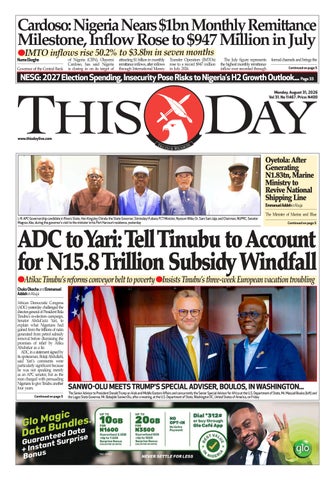
Cardoso: Nigeria Nears $1bn Monthly Remittance Milestone, Inflow Rose to $947 Million in July IMTO inflows rise 50.2% to $3.8bn in seven months
Nume Ekeghe
Governor of the Central Bank
of Nigeria (CBN), Olayemi Cardoso, has said Nigeria is closing in on its target of
attracting $1 billion in monthly remittance inflows, after inflows through International Money
Transfer Operators (IMTOs) rose to a record $947 million in July 2026.
The July figure represents the highest monthly remittance inflow ever recorded through
formal channels and brings the Continued on page 5
NESG: 2027 Election Spending, Insecurity Pose Risks to Nigeria’s H2 Growth Outlook... Page 33 Monday, Monday, August January31, 6, 2026 2025 Vol Vol29. 31.No No10865. 11467. Price: N400
www.thisdaylive.com TR
UT H
& RE A S O
N
Oyetola: After Generating N1.83tn, Marine Ministry to Revive National Shipping Line Emmanuel Addeh in Abuja
L-R: APC Governorship candidate in Rivers State, Hon Kingsley Chinda; the State Governor, Siminalayi Fubara; FCT Minister, Nyesom Wike; Dr. Sam Sam Jaja; and Chairman, NUPRC, Senator Magnus Abe, during the governor's visit to the minister in his Port Harcourt residence, yesterday
The Minister of Marine and Blue Continued on page 5
ADC to Yari: Tell Tinubu to Account for N15.8 Trillion Subsidy Windfall Atiku: Tinubu’s reforms conveyor belt to poverty Insists Tinubu’s three-week European vacation troubling
Chuks Okocha and Emmanuel Addeh in Abuja African Democratic Congress (ADC) yesterday challenged the director-general of President Bola Tinubu's re-election campaign, Senator Abdul’aziz Yari, to explain what Nigerians had gained from the trillions of naira generated from petrol subsidy removal before dismissing the promises of relief by Atiku Abubakar as a lie. ADC, in a statement signed by its spokesman, Bolaji Abdullahi, said Yari’s comments were particularly significant because he was not speaking merely as an APC senator, but as the man charged with persuading Nigerians to give Tinubu another four years. Continued on page 5
SANWO-OLU MEETS TRUMP'S SPECIAL ADVISER, BOULOS, IN WASHINGTON...
The Senior Advisor to President Donald Trump on Arab and Middle Eastern Affairs and concurrently the Senior Special Advisor for Africa at the U.S. Department of State, Mr. Massad Boulos (left) and the Lagos State Governor, Mr. Babajide Sanwo-Olu, after a meeting, at the U.S. Department of State, Washington DC, United States of America, on Friday
2
MONday AUGUST 31, 2026 • T H I S D AY
MONday AUGUST 31, 2026 • T H I S D AY
3
4
MONday AUGUST 31, 2026 • T H I S D AY
5
T H I S D AY • MONDAY, AUGUST 31, 2026
PAGE FIVE
Dare: Tinubu Travelled to 'Refuel' After Tasking State Matters Deji Elumoye in Abuja
Presidential spokesperson, Sunday Dare, on Sunday justified the three-week annual working leave embarked upon by President Bola Tinubu on Sunday. Explaining the reason for the leave, Dare told newsmen
after seeing off the President at the presidential wing of the Nnamdi Azikiwe airport in Abuja, that the break would allow Tinubu to “refuel” after months of intense engagement with state matters. According to him, the President had spent the past six to seven months handling state
matters, including decisions on security and the economy, ahead of the campaign season for the 2027 elections. His words: "The President has had several months—six, seven months—of being engaged with state matters. We’ve seen monumental changes, monumental decisions
taken with our security, with our economy and so many other things as pertains to the running of the affairs of this country." Dare added that the campaign season had begun and would involve several months of intense political activities, although governance
would continue. “And at this point, it’s important that the President also refuels. And even though he’s going on leave, we know that he’ll be engaged with state matters on a daily basis. He will receive briefings from his ministers, from the service chiefs as the case may be, and
Dare
from every other person who is handling very key decisions in our country,” he said.
ADC TO YARI: TELL TINUBU TO ACCOUNT FOR N15.8 TRILLION SUBSIDY WINDFALL Since the removal of petrol subsidy shortly after Tinubu assumed office in May 2023, Federation Account Allocation Committee (FAAC) disbursements have risen sharply, driven by savings from subsidy payments, exchange rate adjustments, and higher naira-denominated oil revenues. The increased inflows have significantly boosted the resources available to the federal, state, and local governments, with states recording particularly large increases in monthly allocations compared with the pre-subsidy removal era. However, the sharp improvement in government revenues has coincided with one of the most difficult costof-living periods for Nigerian households in recent years. Petrol prices rose dramatically following deregulation, driving significant increases in transportation, food, and other essential costs. The depreciation of the naira and the removal of energy subsidies combined to fuel inflation, eroding household
purchasing power and intensifying pressure on workers and businesses. The development has consequently generated growing public debate over whether the increased revenues accruing to governments have translated into improved infrastructure, social services, and welfare for citizens. Critics have repeatedly questioned the utilisation of the additional FAAC resources, particularly by state governments, amid persistent concerns over poor roads, inadequate healthcare facilities, unemployment, and the rising cost of living. The controversy has also been heightened by borrowing by several states, despite the significant increase in their monthly allocations from the federation account. While governments have argued that inherited infrastructure deficits, debt obligations, wage commitments, and rising costs have constrained their ability to immediately translate higher revenues into improved living standards, opposition parties
have increasingly accused the Tinubu administration of failing to demonstrate tangible benefits from the sacrifices imposed by its economic reforms. ADC’s latest intervention comes against the backdrop of an intensifying political debate ahead of the 2027 general election, with the ruling All Progressives Congress (APC) seeking to defend the economic reforms as necessary measures to stabilise the economy, while opposition parties argue that Nigerians have yet to see commensurate improvements in their welfare. The debate has recently shifted increasingly towards the question of whether the savings and additional revenues generated by subsidy removal and foreign exchange reforms have been transparently deployed, as well as what concrete measures the federal government intends to implement to reduce transportation costs, food prices, and broader inflationary pressures before the next election. “If the message of the president’s re-election campaign
is that Nigerians must accept today’s hardship as permanent and anyone promising relief is a liar, then Nigerians must be seriously concerned,” ADC said in the statement released yesterday. Separately, the presidential candidate of ADC, Atiku Abubakar, described the continued rise in petrol prices, despite lower crude prices, as further evidence that Tinubu’s economic experiment had become a conveyor belt transferring pain from government policy directly into Nigerian homes. In a statement issued by his Senior Special Assistant on Public Communication, Phrank Shaibu, the former vice president also condemned Tinubu’s three-week vacation in Europe, beginning August 30, as announced by the presidency, as troubling. Atiku said the vacation coming at a time many Nigerian families and businesses were struggling showed insensitivity to the plight of citizens. Quoting figures attributed to Minister of Finance and Coordinating Minister of the
Economy, Taiwo Oyedele, ADC stated that petrol subsidy removal and foreign-exchange reforms generated about N15.8 trillion in additional resources for the federation between June 2023 and December 2025. Of this, ADC explained that about N5.4 trillion went to the federal government, N5.4 trillion to states, and N3.9 trillion to local governments. States alone, reportedly, received N47.25 trillion in FAAC allocations between 2023 and 2025, rising from N10.09 trillion in 2023 to N15.26 trillion in 2024, and N21.90 trillion in 2025. Monthly FAAC distributions, according to ADC, have since crossed N2 trillion, compared with less than N1 trillion around the period before subsidy removal. Yet, while government revenues soared, Nigerians became poorer, the opposition party stated. Besides, ADC pointed out that petrol moved from about N185 per litre in May 2023 to N1,300+ in many places by August 2025, while food inflation crossed 40 per cent at some points during the period. Transport costs surged,
and the promised Compressed Natural Gas (CNG) mass-transit alternative had yet to reach Nigerians at the scale required, the party said. ADC stated, “The contradiction is impossible to ignore. The government is counting trillions while Nigerian families are counting the meals they can afford. If governments are receiving substantially more money, why are Nigerians getting substantially less food to eat? “Before asking Nigerians for four more years, Senator Yari and the APC must answer one question: after N15.8 trillion in additional resources, record FAAC allocations and three years of unprecedented sacrifice, are Nigerians better off?” The party said the situation was even more troubling because increased revenues appeared to have led only to increased government borrowing. About 20 states, it stressed, reportedly borrowed N458 billion in 2025 despite the surge in FAAC Continued on page 60
OYETOLA: AFTER GENERATING N1.83TN, MARINE MINISTRY TO REVIVE NATIONAL SHIPPING LINE Economy, Dr. Adegboyega Oyetola, at the weekend stated that Nigeria’s maritime sector has undergone transformation since President Bola Tinubu established the Ministry of Marine and Blue Economy three years ago, with the ministry generating N1.83 trillion in 2025, representing a 160 per cent increase from the N700.79 billion recorded in 2023. Oyetola also stated that indigenous shipping capacity remains another priority area for him, stressing that plans were underway to revive a national shipping carrier through a Public-private Partnership (PPP) while the long-awaited process of disbursement of the Cabotage Vessel Financing Fund (CVFF) to enable Nigerian shipowners
to acquire modern vessels, had commenced. “We cannot build a truly blue economy if Nigerians remain spectators in their own maritime industry,” he said. Oyetola said the ministry had moved swiftly to unlock the economic potential of Nigeria’s 853-kilometre coastline and extensive inland waterways, positioning the marine and blue economy as a major driver of revenue, trade, security and job creation. In a statement in Abuja, the minister attributed the increase in earnings to regulatory reforms, stronger revenue assurance, digitisation and the systematic closure of financial leakages. “At the heart of our mandate is
a simple but powerful objective: to turn Nigeria’s vast marine resources into sustainable economic value for Nigerians,” Oyetola noted. The reform drive, he said, was reinforced in May 2025 with the approval of Nigeria’s first National Policy on Marine and Blue Economy. Oyetola said the policy ended decades of fragmented approaches to the sector by establishing a unified framework covering shipping, fisheries, offshore energy, marine biotechnology and other emerging opportunities. “This policy gives us a clear roadmap. It provides the predictability and transparency investors need while ensuring that our marine resources are developed sustainably,” he said.
The minister also said that port modernisation has been another major plank of the transformation. He said the ministry has launched the most ambitious upgrade of Nigeria’s major seaports in five decades, covering Apapa, Tin Can Island, Onne, Rivers, Calabar and Warri. The programme, he explained, includes deeper channels to attract larger vessels, modern cargo-handling infrastructure and digitalised terminal operations. According to the minister, ongoing reforms are already attracting international recognition as the World Bank and S&P Global Market Intelligence ranked Tin Can Island Port 10th and the Lagos Port Complex, Apapa, 12th among the world’s 20 most improved container ports between 2020
and 2025. Oyetola also said the ministry had finally broken the decades-old Apapa port gridlock through the electronic truck call-up system, dedicated holding bays and expanded inland barging. The acquisition of modern tugboats, pilot cutters and dredging equipment by the Nigerian Ports Authority (NPA), he pointed out, has further improved port operations. “We have moved from managing congestion to building a port system that can compete globally,” Oyetola said. Nigeria’s maritime security profile has also strengthened, according to the Minister, with the country having maintained zero piracy in its territorial
waters for four consecutive years, supported by maritime security assets procured under the Deep Blue Project. The achievement, Oyetola said, had eliminated costly piracy-related surcharges on vessels calling at Nigeria and reinforced the country’s reputation as a safe maritime corridor. According to the minister, the security gains were matched by diplomatic breakthroughs. In November 2025, he recalled that Nigeria regained its seat on the International Maritime Organization’s Category C Council after a 14-year absence. The ministry, through the Nigerian Maritime Administration and Continued on page 59
CARDOSO: NIGERIA NEARS $1BN MONTHLY REMITTANCE MILESTONE, INFLOW ROSE TO $947 MILLION IN JULY country within touching distance of the $1 billion monthly milestone set by CBN under Cardoso’s leadership. Remittance inflows through IMTOs also reached $3.8 billion in the first seven months of 2026, representing a 50.2 per cent increase over the $2.5 billion recorded in the corresponding period of 2025. The apex bank, in a statement, said the increase followed a series of reforms by CBN aimed at making formal remittance
channels more competitive, transparent, and accessible. The reforms included a move to a more market-determined exchange rate, reforms to the regulatory framework for IMTOs, and the introduction of Non-Resident Bank Verification Number (NRBVN), alongside closer engagement with IMTOs, banks, and Nigerian diaspora communities. More recently, CBN had strengthened requirements for remittance transactions to
be routed through designated settlement accounts with authorised dealer banks. The significance extends beyond the headline figure. Increasing diaspora flows through formal channels boosts foreign-exchange liquidity and transparency, supports households and investment, and strengthens Nigeria’s external financing position. Cardoso said, “When we set a clear ambition to reach $1 billion a month in remittance inflows
through formal channels nearly two years ago, some people thought we were dreaming. At $947 million in July, we are now approaching that milestone.” CBN stated that while individual monthly figures will naturally vary, the focus was on the broader trajectory and on sustaining the shift towards formal channels. The significant increase in inflows recorded so far in 2026 points to the growing impact of reforms designed to make
formal remittance channels more competitive, accessible, and transparent. CBN is building on this momentum by deepening engagement with Nigerian diaspora communities and financial-sector partners across key remittance corridors. As part of its wider international engagements, the bank says it will continue to use opportunities in major global financial centres to engage diaspora communities, IMTOs, banks, and other stakeholders
to reduce friction, widen access, and bring a greater share of remittance flows into formal channels. Cardoso added, “July is an important marker, but our focus is not on a single month. It is on creating the conditions for sustained growth in formal remittances. “We expect to keep seeing improvement and believe Nigeria can reach and ultimately sustain monthly inflows above $1 billion.”
6
T H I S D AY • MONDAY, AUGUST 31, 2026
NEWS
Group News Editor: Goddy Egene Email: Goddy.egene@thisdaylive.com, 0803 350 6821, 08074010580
6TH NIGERIA OIL & GAS OUTLOOK...
L-R: Chief Technical Officer, NewcrossEP, Dr. Abiodun Ogunjobi; Chairman, Petroleum Technology Association of Nigeria, Engr. Wole Ogunsanya; Executive Director, Sahara Group, Ejiro Gray; Deputy Managing Director, Bell Oil and Gas, Ayodeji Aderibigbe; Chief Operating Officer, Nigeria Machine Tools Limited, Obehi Ojeaga; and Contract and Procurement Manager, Aradel Holdings, Chukwuma Nkwodinmah, during the 6th Nigeria Oil & Gas Outlook at Civic Center, Lagos, where they participated in a panel discussion on Beyond Compliance: Elevating Local Content in an Indigenous-Led Era. … recently
In New Realignment, APC National Scribe Visits Adeleke, Pledges Support for Tinubu Gov appreciates Osun royal fathers as Owa Obokun says re-election is ‘divine judgement’
Yinka Kolawole in Osogbo
In what appears to be the start of a new political realignment ahead of the 2027 general election, National Secretary of All Progressives Congress (APC), Senator Ajibola Basiru, at the weekend, visited Osun State Governor, Ademola Adeleke. Basiru described Adeleke’s
re-election – on the platform of Accord Party – and the defeat of APC as painful. He said although “election is over”, APC’s defeat was painful for members of the party, stating that he personally campaigned extensively for the APC candidate for the August 15 governorship election in Osun State, Bola Oyebamiji, across at least 12 local
government areas. Basiru said the election was now a thing of the past and that political actors should focus on the unity and progress of the state. He stated, “Yes, it is very painful for some of us that he defeated our party in the election. I campaigned in at least 12 local governments for my candidate and I deployed all resources to
ensure that we won the election." The national secretary congratulated Adeleke on his victory, and pledged to work with him towards securing massive support for President Bola Tinubu in the 2027 presidential election. Basiru, who was the campaign coordinator of Oyebamiji, said his visit to Adeleke was motivated by three major reasons.
Finance Bill 2027: FG Sets September 11 Deadline for Submission of Proposals Ndubuisi Francis in Abuja
The federal government has set September 11 as deadline for the submission of proposals for the Finance Bill 2027 from members of the public, businesses, investors, professional bodes, civil society organisations, academia, public institutions, and other stakeholders. The deadline was conveyed via a circular issued by the Federal Ministry of Finance, titled, "Call for Inputs into the Finance Bill 2027," with a sub-theme, "Shaping Better Fiscal Laws for a More Productive and Competitive Nigeria." It invited
the aforementioned entities to submit proposals for the 2027 bill. According to the circular, submissions should propose practical, evidence-based legislative or regulatory reforms that strengthen Nigeria’s fiscal framework, improve the business and investment environment, enhance fiscal transparency and accountability, and support sustainable economic growth. Areas for submission include taxation and revenue administration with emphasis on tax policy revenue mobilisation, compliance, taxpayer services, tax
certainty, incentives, customs and excise, and coordination among revenue agencies. They also encompass fiscal policy and management, revenue and expenditure management, budgeting, public financial management, fiscal sustainability, public debt, and inter-governmental fiscal relations. Fiscal responsibility, transparency and accountability relating to budget discipline, financial reporting and disclosure, monitoring, accountability and institutional oversight also form part of the areas of focus.
According to the circular, the proposals should also focus on financial and economic regulation, capital markets, investment and cross-border capital flows, antimoney laundering, financial reporting, and other regulations with significant fiscal or economic implications. It equally provided a window for other related matters, including any law, regulation, policy or institutional arrangement requiring amendment, harmonisation or introduction to improve Nigeria's competitiveness and economic governance.
He said it was to appreciate the governor for his condolence visit and attendance at his late mother’s burial; congratulate him on his electoral victory; and thank him for endorsing Tinubu for the 2027 presidential election. The visit came shortly after Oyebamiji, the APC governorship candidate in the election, congratulated Adeleke and pledged to support efforts aimed at promoting peace and development in the state. Oyebamiji had also urged Adeleke to urgently address the recent killings in Ikire, Irewole Local Government Area, stressing the need for lasting peace and security in the state now that the election has been concluded. Basiru recalled the governor’s personal gesture during the burial of his mother, saying Adeleke not only visited his family but also attended the burial ceremony. Basiru stated, “My visit here is in three fold. I want to thank His Excellency and also to return the visit he made to my house during the time I lost my mother. “You know that it was well
reported that he came to my house to visit me and my family. He also graciously attended the burial ceremonies for my mother. “He even wore a complete Agbada of the same attire that I wore. So I came to thank him as is expected of an Omoluabi.”
Gov Thanks Royal Fathers as Owa Obokun Says His Re-Election is ‘Divine Judgement’ Adeleke expressed gratitude to all traditional rulers who stood by him during the re-election struggles. The governor, who spoke when he visited Owa Obokun, Adimula of Ijeshaland, His Imperial Majesty, Oba Adesuyi Haastrup, stated that monarchs came under tremendous pressure but praised those who stood their ground in defence of truth and good governance. Adeleke, who also presented his certificate of return to the Owa Obokun, described the election as near war, but said he looked up to God and God answered.
Tinubu Begins Three-Week Working Vacation, Leaves FG Explores Legal Option to End Buhari-era For London Sunday To retun to Nigeria after leave to join hectic Concession Deal on Benin-Asaba Road campaign for his re-election in January, 2027
Says Tinubu will win 2027 presidential election
Emmanuel Addeh in Abuja The federal government is exploring legal options, including the possible invocation of the “law of necessity” on grounds of overriding public interest, to end the concession agreement inherited from the administration of former President Muhammadu Buhari for the reconstruction of
the Benin-Asaba Road. The Minister of Works, Senator David Umahi, disclosed that the government had become increasingly concerned about the prolonged deterioration of the strategic highway and the suffering being experienced by motorists and other road users. Umahi, who spoke during an inspection of Phase 2B of
the Second Niger Bridge at the Nkwerre-Ezunaka section of the Onitsha-Enugu Expressway at the weekend, said although the Bola Tinubu administration inherited the concession arrangement with Africa Plus Partners Limited, it would not allow the agreement to become an excuse for the continued neglect of the road.
Deji Elumoye in Abuja
The Benin-Asaba road in Edo and Delta states was one of the 12 major federal highways selected for concession under the pilot phase of the Highway Development and Management Initiative (HDMI) during Babatunde Fashola’s tenure as Minister of Works and Housing under the Buhari's administration.
President Bola Tinubu will depart Abuja, the nation's capital on Sunday for Europe to begin a three-week vacation as part of his annual leave. Presidential spokesperson, Bayo Onanuga, in a release stated disclosed that Tinubu’s first stop will be London, United Kingdom.
The President is expected to return home after the working vacation to join the hectic campaign for the January 2027 election. Vice President Kashim Shettima had earlier this month went on two-week leave, his first since the Tinubu government assumed office over three years ago. Shettima resumed work last week.
7
T H I S D AY • MONDAY, AUGUST 31, 2026
NEWS
SIGNING OF MOU BETWEEN UNILEVER AND NIGERIA CUSTOMS SERVICE...
The Managing Director, Unilever Nigeria Plc, Tobi Adeniyi (left), and Comptroller General, Nigeria Customs Service, Bashir Adeniyi, during the signing of the Memorandum of Understanding between Unilever Nigeria Plc and Nigeria Customs Service on anti-counterfeiting held in Abuja, last Friday
Nigeria Gets N87.85bn from Niger, Togo, Benin as Discos’ Revenue Hits N2.3tn in One Year International power buyers achieve 84.90% remittance rate
Emmanuel Addeh in Abuja
Nigeria’s power sector generated significant cross-border and domestic revenues in 2025, receiving a total of approximately N87.85 billion ($62.75 million) at an exchange rate of N1,400/ dollar in electricity tariff payments from its international bilateral customers in Niger, Togo, and the Republic of Benin. Official figures extracted from
the just released 2025 Annual Report of the Nigerian Electricity Regulatory Commission (NERC) revealed that the Market Operator (MO) issued an aggregate invoice of $73.91 million to three neighbouring international power utilities. The utilities include: Société Beninoise d’Energie Electrique of Benin, Compagnie Energie Electrique du Togo, and Société Nigerienne d’electricité of Niger.
Japa: Nigeria Targets Enrolment of 20,000 New Doctors Yearly
Six new simulation centres coming up soon
Kuni Tyessi in Abuja
The federal government has set a target of increasing annual admission into Nigeria’s medical schools to about 20,000 students within the next three years as part of efforts to rapidly expand the country’s healthcare workforce. A statement from the media aide to the Minister of Education, Ikharo Attah, indicated that the Minister, Dr. Tunji Alausa, disclosed this while receiving the report of the Tertiary Education Trust Fund (TETFund) Medical Simulation Committee. Alausa said the government would establish world-class medical simulation centres across the six geopolitical zones to provide practical training for the growing number of medical, dental, nursing, pharmacy and other allied healthcare students.
He explained the expansion of healthcare training is necessary to address the country’s growing demand for qualified professionals and ensure that increased enrolment is matched with quality practical education. He disclosed that annual admission into medical schools had risen from about 5,000 students when President Bola Ahmed Tinubu assumed office to almost 12,000 currently. “Today, I’m happy to report that we’re admitting almost 12,000 students primarily now. Our goal in the next three years is to increase the number of annual medical student enrollment in medical school to about 20,000,” he said. The minister said the surge was not limited to medicine, noting that admissions into pharmacy and dental schools had also doubled.
Out of this total bill, a THISDAY review indicated that the international offtakers remitted $62.75 million, representing an overall remittance performance of 84.90 percent and demonstrating significantly sustained cross-border financial liquidity. Despite suffering severe domestic supply deficits, Nigeria exports electricity to neighbouring countries like Niger, Benin, and Togo primarily due to strategic geopolitical treaties, river damming agreements, and regional energy commitments under the West African Power Pool (WAPP). Chief among these is a longstanding legal and environmental arrangement regarding the River Niger wherein Nigeria agreed to guarantee continuous power supply to upstream neighbours in exchange
for their commitment not to dam or divert the river's flow before it reaches Nigeria. This is because major Nigerian hydroelectric assets such as the Kainji, Jebba, and Shiroro dams depend heavily on an unhindered water inflow. Therefore, providing electricity to these nations acts as a vital geopolitical compromise to protect Nigeria's own hydrogeneration capabilities and downstream security. In addition to water rights diplomacy, power exports serve as a crucial source of the much needed foreign exchange and financial liquidity for Nigeria's power market. Similarly, the NERC data showed that domestic bilateral customers operating within the Nigerian Electricity Supply Industry (NESI) grid demonstrated some level of payment compliance during
the regulatory period. Domestic bilateral off-takers received a combined invoice of N13.20 billion from the Market Operator and settled N12.75 billion, achieving a strong 96.60 percent remittance rate. On the domestic retail distribution front, Electricity Distribution Companies (Discos) recorded aggregate revenue collections of N2.31 trillion against a total issued bill of N2.98 trillion to end-use electricity consumers across the country. The performance represented a national collection efficiency of 77.60 percent, meaning that for every N100 worth of energy billed to domestic consumers in 2025, roughly N22.40 went unrecovered, leaving an uncollected revenue balance of N669.49 billion. According to the NERC figures, regional financial performances across the distribution network
showed stark operational disparities between utilities operating in industrial commercial hubs and those covering vast, lower-density territories. It showed that Eko Electricity Distribution Company (EKEDC) led the nation with an 87.90 per cent collection efficiency by recovering N424 billion out of N482.35 billion billed. Besides, Ikeja Electric followed with an 87.89 per cent efficiency rate, collecting N440.86 billion from N501.61 billion in issued bills, while Benin Disco secured an 84.17 per cent collection efficiency by recovering N202.68 billion. Conversely, utilities in mostly northern operations struggled with commercial collection. Kaduna Disco recorded the lowest performance in the country at 45.68 per cent, collecting only N51.38 billion out of N112.48 billion billed.
172 Oil Host Community Development Trusts Incorporated So Far, Says NUPRC Emmanuel Addeh in Abuj a nd Peter Uzoho in Lagos
Nigerian Upstream Petroleum Regulatory Commission (NUPRC) has revealed that 172 Host Communities Development Trusts (HCDTs) have been incorporated by oil and gas companies (settlors) so far. Under the Petroleum Industry Act (PIA), oil and gas companies are mandated to contribute three per cent of their Operating
Expenditure (OPEX) of the preceding financial year to a Host Community Development Fund for the benefit of such communities. Addressing the leadership of the Revenue Mobilisation Allocation and Fiscal Commission (RMAFC) in Abuja, Chief Executive Officer of NUPRC, Oritsemeyiwa Eyesan, said the commission had been enforcing the provisions of PIA, especially those relating to host communities and the obligations of operating
companies. According to a statement by the commission's Head of Media and Corporate Communications, Eniola Akinkuotu, Eyesan said, “We have laid out procedures for doing things and we have put regulations in place to streamline the process. So far, we have registered 172 HCDTs and we have been able to manage contributions by settlors.” Eyesan said HCDT, which had funded the construction of schools,
hospitals, and other infrastructure, had contributed significantly to peace and stability in hitherto volatile communities. She said this had also led to an increase in oil production. While admitting that some of the HCDTs had been the subject of litigation due to disagreements over the constitution of the Board of Trustees, Eyesan said NUPRC had been working persistently to ensure that they run smoothly in the interest of the country.
8
T H I S D AY • MONDAY, AUGUST 31, 2026
NEWS
21ST EXTRAORDINARY SESSION OF THE ASSEMBLY OF THE AFRICAN UNION...
L-R: Minister of Interior, Hon Olubunmi Ojo; Minister of Foreign Affairs, Ambassador Bianca Odumegwu-Ojukwu; Vice-President Kashim Shettima; Minister of Defence, Gen Christopher Musa (Rtd); Nigeria's Permanent Representative to the African Union (AU) and the United Nations Economic Commission for Africa, (UNECA) Ambassador Nasir Aminu; and Chargé d'Affaires, Nigerian Mission in Angola, Ambassador Maxy Ogbede, at the 21st Extraordinary Session of the Assembly of the African Union in Luanda, Angola on Sunday
NESG: 2027 Election Spending, Insecurity Pose Risks to Nigeria’s H2 Growth Outlook Flooding, insecurity threaten agriculture, food supply, non-oil growth
Emmanuel Addeh in Abuja
The Nigerian Economic Summit Group (NESG) has warned that Nigeria’s economic growth outlook for the second half of 2026 could be threatened by global economic and geopolitical shocks, rising political activities ahead of the 2027 general elections, persistent insecurity and climate-related disruptions. In its H1 2026 State of the Economy report titled: “Turning Potential into Progress: Accelerating Nigeria's Industrialisation for Economic Transformation”, the NESG identified a combination of domestic and external factors capable of weakening the country’s macroeconomic stability, slowing non-oil sector expansion and undermining investor confidence. The group, however, noted that stronger-than-projected recovery in the oil sector, increased foreign capital inflows and faster implementation of structural
reforms could provide significant upside to the country’s growth outlook. Oil prices have hovered between $80 to $120 this year. The projection for 2026 was $64.85 per barrel. The NESG warned that a sharper-than-expected slowdown in global economic growth, renewed trade tensions and tighter global financial conditions could adversely affect Nigeria’s economy by weakening export earnings, reducing foreign exchange inflows and constraining fiscal revenues. According to the report, an abrupt easing of geopolitical tensions could also lead to lower crude oil prices, with implications for Nigeria’s export earnings and government revenues, while increasing pressure on the exchange rate. Conversely, it said a further escalation of geopolitical conflicts could worsen global inflationary pressures and result in tighter external financing conditions,
The President of the Court of Appeal, Justice Monica Dongban-memsen, has warned that economic crimes, including the looting of the country's resources besides depriving the people of opportunities weakens public confidence. Dongban-memsen sounded out the warning at the just concluded 43rd Cambridge International Symposium on Economic Crime, which held at the University of Cambridge. Delivering the vote of thanks at the event which featured prominently Nigeria's judiciary, law enforcement, and financial regulators, the Court of Appeal
reforms and place fiscal discipline under considerable pressure. It noted that increased preelection spending could undermine macroeconomic stability, delay critical structural reforms and weaken investor confidence at
a period when the country is seeking to consolidate recent gains in economic stabilisation. “As political activities intensify ahead of the 2027 General Elections, reform momentum. could weaken
while fiscal discipline comes under pressure from increased pre-election spending. This could undermine macroeconomic stability, delay structural reforms, and reduce investor confidence,” it added.
ECOWAS: Touray Exits After Four Years Marked by Crises, AES Withdrawal and Regional Unity Challenge Michael Olugbode in Abuja
Dr. Omar Alieu Touray will leave the presidency of the ECOWAS Commission after four years marked by some of the most profound political and security upheavals in West Africa, including the withdrawal of Burkina Faso, Mali and Niger from the regional bloc. His departure, alongside members of his 2022–2026 team, comes at a critical moment for the organisation as it confronts the challenge of rebuilding regional confidence, strengthening integration and responding to persistent security and development pressures. The ECOWAS Commission is scheduled to hold an official President stated that illicit welcome and farewell ceremony wealth must not be allowed to for incoming and outgoing fund further crime, influence, or impunity. According to a statement issued by the Assistant Chief Information Officer of the Court of Appeal, Bukola Garr, the president in her remarks, observed that the Nigerian Chuks Okocha in Abuja delegation's participation reflected the country's The Socio-Economic Rights and commitment to fighting Accountability Project and the economic crime through Nigerian Guild of Editors have "institutional collaboration called on the National Assembly and international cooperation.” to withdraw a proposed law She thanked symposium seeking to regulate organisations founder Professor Barry and institutions receiving foreign Rider, OBE, the University assistance. They warned that the decision of Cambridge, and Jesus College for hosting the event could undermine media freedom and restrict civic space ahead of from August 24-31.
A' Court President: Stolen Resources Deprive Societies of Opportunities, Weaken Public Confidence Alex Enumah in Abuja
creating additional challenges for the Nigerian economy. On domestic political risks, the NESG cautioned that intensifying political activities ahead of the 2027 general elections could weaken the momentum of ongoing economic
statutory officials in Abuja on Monday, August 31, formally closing the Touray era. Touray, a Gambian diplomat who assumed office in 2022, presided over the organisation during a period characterised by political transitions, insecurity, economic pressures and humanitarian challenges. His tenure also coincided with the creation and consolidation of the Alliance of Sahel States by Burkina Faso, Mali and Niger, fundamentally altering the political architecture of West Africa. Beyond the political crises, the Commission under Touray continued to pursue the ECOWAS Vision 2050, with emphasis on regional integration, free movement, trade, youth employment, agriculture, healthcare and humanitarian
response. Peace and security remained central to the Commission’s agenda, while the West African Health Organisation intensified regional cooperation on disease surveillance, emergency preparedness and health-system resilience. The recent distribution of 30 medical ambulances to member states was cited as one example of efforts to translate regional solidarity into practical support. Touray’s exit therefore represents more than a routine change of leadership. It closes a four-year chapter in which ECOWAS was forced to confront the erosion of its traditional regional consensus and the emergence of a competing Sahelian bloc. The immediate challenge for the incoming leadership will be
to preserve the gains of regional integration while restoring confidence in an organisation whose cohesion has been severely tested. Touray had, in the final weeks of his tenure, embarked on farewell engagements with regional leaders, including Ivorian President Alassane Ouattara, to whom he expressed appreciation for his support during the fouryear mandate. With Touray and his team handing over on August 31, the next ECOWAS leadership inherits an organisation at a crossroads — one that must simultaneously address insecurity, economic development, mobility and the urgent question of how to rebuild West African unity after the departure of three key Sahelian states.
Foreign Assistance Regulation: SERAP, Guild of Editors Urge National Assembly to Withdraw Proposed Law the 2027 elections. The joint statement was signed by Kolawole Oluwadare, Deputy Director, SERAP, and Onuoha Ukeh, General Secretary, Nigerian Guild of Editors. The organisations said the proposed Foreign Aids (Regulation, Transparency and Disclosure) Bill, 2026, would give the government sweeping powers over civil society organisations, independent media, religious bodies and other groups
that receive foreign grants or assistance. The groups described the proposed legislation as unnecessary and unconstitutional, arguing that Nigeria already has several government institutions responsible for monitoring corporate activities, financial transactions, taxation and money laundering. The bill, sponsored by Senator Ibrahim Dankwambo, representing Gombe North Senatorial District,
seeks to establish a Foreign Aid Regulatory Commission with powers to register organisations receiving foreign assistance and compel them to disclose details of such funding. Under the proposed law, the commission would also be empowered to inspect records, monitor foreign-funded activities, issue directives and impose sanctions on organisations that fail to comply.
MONday AUGUST 31, 2026 • T H I S D AY
11
MONday AUGUST 31, 2026 • T H I S D AY
12
Impacting Lives, Renewing Hope for Nigerians Building brighter futures through strategic investments in education, healthcare, food security, sustainability, social investment, and the creative economy.
MONday AUGUST 31, 2026 • T H I S D AY
13
MONday AUGUST 31, 2026 • T H I S D AY
14
THE ADAMAWA STATE GOVERNMENT IN COLLABORATION WITH THE NIGERIAN SHIPPERS’ COUNCIL (NSC) 4, OTUNBA AYODELE SOYODE LANE, APAPA, LAGOS.
THROUGH ADAMAWA INVESTMENT AND PROPERTY DEVELOPMENT COMPANY LIMITED
REQUEST FOR EXPRESION OF INTEREST (EOI)
FROM PROSPECTIVE INVESTORS FOR THE DEVELOPMENT OF NGURORE VEHICLE TRANSIT AREA (NVTA), ADAMAWA STATE, NIGERIA 1. INTRODUCTION The Adamawa State Government through Adamawa Investment and Property Development Company Limited in collaboration with Nigerian Shippers Council (“NSC”) intends to develop a Vehicle Transit Area (VTA) on 40hectares of land at Ngurore, Adamawa State through a Public Private Partnership (PPP) model. Adamawa State Government/NSC invites interested firms and/or consortiums of firms to participate in the qualification process for the selection of a Private Partner through Competitive Bidding (CB) for the “Development of the Ngurore Vehicle Transit Area”. The Adamawa State Government expects the selected Private Partner to undertake the Design, Finance, Build, Operate, and Transfer (“DFBOT’’) of the facility for a concession period, based on Tenure, Terms and Conditions to be set out in the Concession Agreement. 2. PROJECT OBJECTIVE. One of the major goals of VTA is intended to provide a planned and coordinated framework for the long-term development of the bulk haulage sector, an integrated approach to addressing the increased movement of goods and services in response to the high demands of a growing population and providing security. 1. ELIGIBILITY i. Evidence of Company Registration with Corporate Affairs Commission (CAC) or its equivalent for foreign firms; ii. Ownership structure of bidding entity, Name(s) of major shareholders and percentage shareholding of participants in the bidding entity; iii. Audited Financial Statements prepared in accordance with the International Financial Reporting Standards (IFRS) of the bidding company or members of consortium for the most recent three (3) years; iv. Evidence of remittance to Industrial Training Funds; v. Evidence of compliance with the provisions of the Pension Reform Act 2004; vi. Sworn affidavit; vii. Evidence of Nigerian Social insurance trust fund (NSITF) clearance certificate valid till 31st December, 2025 (Nigerian firm only); viii. In the case of a Consortium, evidence in the form of letter of association, agreement (joint venture agreement and/or Memorandum of Understanding (MOU); or Consortium Agreement must be provided
iii.
3.
Evidence of Financial Capacity illustrated by evidence of good financial standing with a minimum net worth of N1 billion and Letters of Support from credible financial institutions in support of the consortium’s ability to manage and operate the VTA. REQUIREMENTS FOR QUALIFICATION
Interested firms and/or consortium are required to pay a non-refundable amount of NGN300,000.00 (Three Hundred Thousand Naira, only) in favor of Adamawa Investment and Property Development Company Limited through United Bank for Africa, UBA Plc Account Number: 1001211846. Interested firms and/or consortium of firms may submit their Bids Statements in response to this EOI wherein firms and/or will be shortlisted for issuance of a detailed Request for Proposal. Details of the project, application submission process and requirement have been set out in the Expression of Interest (EOI). 4.
METHOD OF SUBMISSION
All application shall be submitted physically • All submission must be in a sealed envelope and should be registered with Adamawa Investment and Property Development Company Limited, No. 42 Galadima Aminu Way, Jimeta-Yola, Adamawa State not later than four (4) weeks from the date of advertisement 31st August, 2026; • All Applications must be received not later than 11am on 28th September, 2026;
Experience in the Development and Operation of a Truck Park or similar facilities, illustrated by the following: Experience in the Development, Operations, Investment and Financing of a Truck Park or similar facilities (such as Car Parks, Warehouses, Hotels, etc.); General experience of design, finance, development and operations & investment in Vehicle Transit Areas/ major logistics & Haulage related projects globally/ locally (list all relevant track
SIGNED: MANAGEMENT Managing Director/Chief Executive Officer Adamawa Investment and Property Development Company Limited Phone: 08033346007/Date: 31st August, 2026 e-mail: adamawainvestment@gmail.com
• •
•
5. IMPORTANT NOTICE. i. Only shortlisted applicants will be contacted. ii. This notice shall not be construed to be a commitment on the part of Adamawa State Government to award any form of contract to any respondent(s) nor shall it entitle any organization submitting document to claim any indemnity from the Government. iii. The envelope containing 5 copies of the completed EOI and the required supporting documents shall be clearly marked “Application for the Concession of Vehicle Transit Area, Ngurore Adamawa State” and the Bidder’s name, and should be addressed to the Managing Director/Chief Executive Officer, Adamawa Investment and Property Development Company Limited iv. Late submission will be return un-opened; v. Submission shall be in English language only; vi. Submission via courier will be accepted only if delivered within the submission time shown above; vii. Adamawa Investment and Property Development Company Limited is not bound to shortlist any firm and reserves the right to annul procurement process at any time without incurring any liabilities.
2. TENDER REQUIREMENTS: Technical, Operational and Financial capability including: i. Profile of firm or firms (if in a consortium); including ownership structure and role of each firm; with full contact details (including full name of contact person, telephone numbers and email addresses); In the case of a consortium, the members of the consortium must jointly submit the required information and must also clearly identify one of the consortium members as the lead firm; ii.
•
records or similar projects (such as Car Parks, Warehouses, Hotels, etc.); Experience and Expertise of key Personnel as by Profile of key management staff with relevant experience working on a similar project and at least ten (10) years in the relevant industry. Construction/ Delivery/ Financing of Large-Scale Vehicle Transit Area Infrastructure.
MONday AUGUST 31, 2026 • T H I S D AY
15
16
MONday AUGUST 31, 2026 • T H I S D AY
ROTUS ODDIRI
Moderator
Dr. Farouk Umar Mr. Olufemi Awoyemi Mr. Ugodre Obi-Chukwu
Dr. Muda Yusuf
PANELISTS SAMAILA ZUBAIRU
STRICTLY BY INVITATION
Venue: Eko Hotel & Suites, Lagos Orchid & Lantana Hall
THURSDAY SEPT 3, 2026. 10am - 12noon
Chairman/Special Guest of Honour
The Real Deal Africa’s Greatest Investment Opportunity
Event will be streamed live : https://surl.li/bgsgzs
2nd Speaker
Dr. BIODUN ADEDIPE
1st Speaker
BISMARCK REWANE
MONday AUGUST 31, 2026 • T H I S D AY
17
18
MONday AUGUST 31, 2026 • T H I S D AY
MONday AUGUST 31, 2026 • T H I S D AY
19
20I S D AY
MONDAY AUGUST 31, 2026 TR
UT H
& RE A S O
Monday August 31, 2026 Vol 27. No 11457
N
opinion@thisdaylive.com
www.thisdaylive.com
ANAKWUE’S CASE FOR A HEART-HEALTHY NIGERIA
Sound medicine, safer environments and smarter policy are all needed to protect every heart, writes PAT ONUKWULI
See page 17
WHEN FEAR CREATES OPPORTUNITY
SOLA ONI argues that the NGX’s recent decline could be a market reset after months of extraordinary appreciation
See page 17
EDITORIAL
CONTAINING DIPHTHERIA OUTBREAK IN KANO
See page 18
1
Success should give an organisation confidence, not complacency, argues LINUS OKORIE
THE DANGER OF BECOMING TOO SUCCESSFUL Success creates one of the most dangerous illusions in leadership: that what worked yesterday will continue to work tomorrow. It is easy to understand failure as a threat. We study failed companies, failed strategies and failed leaders because the lessons appear obvious. Success is harder to question. When an organization has spent decades doing something well, challenging the formula that created its success can feel almost irrational. Why abandon what is working? Yet some of the greatest threats to an organization do not come from failure. They come from success that has become too comfortable to question itself. Toyota offers an instructive example. For decades, the Japanese automobile company built its reputation around disciplined manufacturing, continuous improvement and operational excellence. But in the 1990s, as the global automobile industry changed and the Japanese economy faced prolonged weakness, Toyota needed to think beyond the model that had made it successful. Hirosh Okuda, who became Toyota’s president in 1995, pushed an ambitious transformation. He championed greater overseas production and global expansion at a time when the strong yen and weak Japanese exports were creating significant pressure. Reuters reported this week that Okuda’s Vision 2005 strategy helped drive a 67% increase in Toyota’s global sales over the following decade, while he also supported early development of the Prius hybrid. The significance of Okuda’s leadership was not simply that he grew Toyota. It was that he recognized that preserving an organization sometimes requires changing the organization. This is one of the hardest assignments of leadership. Leaders are often rewarded for protecting what works. Boards celebrate predictable revenue. Employees become comfortable with familiar processes. Customers expect consistency. Investors want returns. But the external environment does not sign a contract promising to remain familiar. Technology changes. Customers change. Competitors change. Society changes. And eventually, the organization must choose between changing itself or being changed by circumstances it can no longer control. Kodak provides the painful
counterexample. The company became synonymous with photography and was deeply involved in the development of digital imaging. Yet the existence of a new technology does not automatically produce organizational transformation. The real challenge is recognizing what the new technology means for the business model that made the company successful. This is why leadership requires a difficult discipline: the ability to question your own success. A leader who only asks, “What are we doing well?” may preserve today’s performance. A leader who also asks, “What are we doing well that may become irrelevant?” begins preparing for tomorrow. The distinction is subtle but profound. Many organizations conduct strategy meetings by examining competitors, markets and external threats. Fewer examine the assumptions embedded inside their own success. What if our customers change? What if our most profitable product becomes obsolete? What if a new technology makes our strongest capability less valuable? What if the process that once gave us efficiency now makes us slow? These are uncomfortable questions because they force leaders to challenge the very systems they are being praised for managing. But leadership is not the art of defending yesterday. It is the responsibility to prepare an organization for tomorrow. This lesson is particularly important for Nigeria and Africa. Our businesses operate in environments where disruption is not theoretical. Currency movements, infrastructure constraints, technological shifts, demographic changes and evolving consumer behaviour can alter an industry quickly. PwC’s 2026 Africa CEO survey found that African business leaders demonstrate considerable operational resilience, but many remain focused on short-term horizons: 51% of CEOs surveyed said they spend their time on activities with horizons of less than one year, while only 15% direct their time toward planning
five years ahead. There is nothing wrong with solving today’s problems. The danger is solving today’s problems so completely that we forget to prepare for tomorrow’s. A leader who is constantly fighting today’s fires may eventually discover that the organization has become excellent at surviving but poor at imagining. This is where strategic leadership becomes different from operational management. Operational management asks: How do we perform better today? Strategic leadership asks: What must we become to remain relevant tomorrow? The second question requires imagination, but it also requires courage. Because transformation often means asking successful people to stop doing some of the things that made them successful. It may mean moving money away from a profitable division to fund an uncertain opportunity. It may mean replacing a familiar process with a new one. It may mean allowing younger voices to challenge established assumptions. It may even mean admitting that an organization's greatest strength could become its greatest weakness if circumstances change. That is why leaders must build cultures where questioning is not interpreted as disloyalty. An organization that cannot challenge its leader will eventually be unable to challenge the market. The healthiest organizations are not those in which everyone agrees. They are those in which people can disagree intelligently, test assumptions honestly and change direction without treating change as failure. Toyota’s history illustrates another important principle: transformation does not necessarily mean abandoning everything that came before. Okorie MFR is a leadership development expert spanning 30 years in the research, teaching and coaching of leadership in Africa and across the world. He is the CEO of the GOTNI Leadership Centre.
T H I S D AY
21
MONDAY AUGUST 31, 2026
Sound medicine, safer environments and smarter policy are all needed to protect every heart, writes PAT ONUKWULI
ANAKWUE’S CASE FOR A HEART-HEALTHY NIGERIA The 249th Inaugural Lecture of the University of Nigeria, delivered by Professor Raphael Anakwue and titled “Beyond Traditional Cardiovascular Risk Factors: Toxic Shadows and the Heart-Habitat Interface,” offers a thought-provoking examination of contemporary cardiovascular health. It challenges familiar assumptions, broadens the conversation around heart disease, and invites closer reflection on influences that often receive less attention in conventional practice. For this author, the lecture holds personal resonance. Anakwue was not merely a distinguished physician; they were also classmates and dormitory mates in Asagba House at Saint Patrick’s College, Asaba, in the mid-1970s. The college then was more than a place of academic instruction: it shaped young people in character, discipline, service and leadership, preparing them for responsible adulthood. Even in those early years, Anakwue clearly stood out for exceptional academic ability and disciplined conduct. His intellectual brilliance was matched by humility, diligence, hygiene, moral steadfastness and respect for others, making him, in the eyes of contemporaries, an ideal student. Those qualities foreshadowed the seriousness of purpose that later defined a distinguished medical and scholarly career. It is therefore hardly surprising that he progressed from medical training at the University of Nigeria to the professorial podium, a progression that made the occasion particularly significant. The growing burden of cardiovascular disease underscores the lecture’s urgency. Cardiovascular diseases remain among the leading causes of death worldwide and are rising across Africa, causing disability and premature mortality, often during productive years. Their financial burden is also severe, with treatment frequently involving lifelong medication, repeated investigations, hospital admissions, specialist procedures and major surgery. For families paying directly for healthcare, a single cardiovascular crisis may consume years of savings. Prevention is therefore not merely preferable to treatment; it is medically, socially and economically necessary. High prevalence, high mortality and expensive treatment make this lecture especially important. The lecture’s most compelling insight is that cardiovascular medicine must extend beyond the traditional clinical lens. Conventional prevention rightly emphasises blood-pressure control, cholesterol reduction, diabetes management, smoking cessation, regular exercise and healthy weight. Yet these measures address only part of the risk landscape.
It therefore highlights less visible but equally consequential influences on heart health. Persistent exposure to traffic pollution, generator fumes, smoky cooking fuels, industrial emissions and hazardous workplaces may compound conventional risk factors and place additional strain on the cardiovascular system. Effective prevention must consequently address both established clinical risks and these environmental exposures. This is where the lecture’s “heart-habitat” concept matters. The heart does not function independently of its surroundings. Air pollution, heavy metals, pesticides, industrial chemicals, plastics and occupational toxins may operate alongside traditional risk factors, increasing cardiovascular harm. However, environmental cardiology should complement conventional cardiovascular medicine, not replace it. Hypertension, diabetes, smoking, obesity, dyslipidaemia and physical inactivity remain powerful, established causes of disease. Environmental explanations must broaden personal responsibility, not diminish it. Similarly, scientific enthusiasm must be balanced with caution. Environmental exposures can be difficult to measure; people may be exposed to several pollutants simultaneously; and association does not automatically prove causation. Nigeria needs neither unquestioning acceptance nor dismissive scepticism, but rigorous local research into exposures, biological mechanisms, biomarkers and effective interventions. The argument therefore extends beyond the consulting room into the realm of public policy. Individuals cannot reasonably be expected to avoid exposures over which they have little control: roadside traders inhale traffic fumes, households reliant on generators or smoky cooking fuels often lack viable alternatives, and mechanics, battery recyclers and industrial workers remain vulnerable where occupational safeguards are inadequate. Dr. Onukwuli is a legal scholar and public affairs analyst. patonukwuli2003@yahoo.co.uk
SOLA ONI argues that the NGX’s recent decline could be a market reset after months of extraordinary appreciation
WHEN FEAR CREATES OPPORTUNITY
The Nigerian equities market is experiencing one of those uncomfortable moments when investors begin to question whether the bull run has finally run out of steam. After an impressive rally that pushed the NGX All-Share Index to remarkable heights, the market has entered a sustained correction, with selling pressure spreading across several sectors. The numbers tell part of the story. The NGX All-Share Index declined 1.35 per cent in the week ended August 21 to 239,351.16 points, reducing its year-todate gain to 53.81 per cent. Seventeen of the 20 indices tracked by Proshare closed lower, demonstrating that the selling pressure has become broad-based. Market capitalisation had earlier crossed the N160 trillion threshold before retreating sharply. By August 19, investors had lost about N5 trillion in market value from the August 10 peak of N160.42 trillion. (The Guardian Nigeria) But while the immediate reaction may be to panic, the more intelligent response for long-term investors should be to ask a different question: Is the market falling because the underlying businesses have become weaker, or because investors are simply reallocating capital? The answer, for now, appears to be a combination of profit-taking, portfolio rebalancing and the growing attractiveness of fixed-income securities. A market that has delivered such extraordinary returns will naturally attract profit-taking. Investors who bought substantially cheaper stocks earlier in the year have every reason to lock in gains. There is another powerful force at work: fixed income. The recent reforms and increased activity in Open Market Operations (OMO), have provided investors with attractive short-term alternatives to equities. The CBN’s recent OMO auction attracted N4.93 trillion in bids against an initial offer of N600 billion, with a 103-day OMO bill allotted at a stop rate of 20.39 per cent. Treasury Bills have also remained attractive, with average secondary-market yields around 18 per cent in August. It is therefore understandable that some investors, particularly those driven by short-term returns, fondly called speculators, are moving money from equities into fixed-income instruments. Why accept the volatility of the stock market when a government-backed short-term instrument can offer a relatively attractive yield?
But this is precisely where investors must distinguish investment from speculation. The availability of attractive fixed-income yields does not make equities irrelevant. Rather, it creates an opportunity for investors to reconsider their asset allocation according to their risk appetite, investment horizon and financial objectives. For the long-term investor, the current correction may actually be a welcome development. A bear market can be painful, but it can also create the conditions under which quality businesses become available at more reasonable prices. The important qualification is quality. Investors should not buy stocks simply because their prices have fallen. A cheap stock can become cheaper if its earnings, balance sheet or competitive position is deteriorating. The right approach is to identify companies with strong fundamentals: sustainable earnings, healthy cash flows, manageable debt, strong brands, competent management, competitive advantages, sound corporate governance and a credible history of rewarding shareholders. Such companies should be viewed differently from speculative counters whose prices are driven largely by market sentiment. Indeed, the present market mood could provide an opportunity for investors who previously found quality equities too expensive. Rather than attempting to predict the exact bottom of the market, investors can adopt a disciplined accumulation strategy, gradually increasing their holdings as valuations become more attractive. This is particularly important because markets rarely announce when a bottom has been reached. By the time confidence returns and the bull market becomes obvious again, many of the best stocks may already have recovered significantly. The current rotation into OMO and Treasury Bills should therefore not be regarded as a reason to abandon the equities market altogether. Fixed income has an important role in a diversified portfolio, especially for investors seeking capital preservation and predictable income. Oni, an Integrated Communications Strategist, Chartered Stockbroker, Commodities Broker and Capital Market Registrar, is the Chief Executive Officer, Sofunix Investment and Communications
T H I S D AY MONDAY AUGUST 31, 2026
22
EDITORIAL
Editor, Editorial Page PETER ISHAKA Email peter.ishaka@thisdaylive.com
CONTAINING DIPHTHERIA OUTBREAK IN KANO
T
Government must embark on massive vaccination against the disease
he diphtheria outbreak that has reportedly killed over 50 children in Rano Local Government Area of Kano State is very concerning. Although emergency measures had been taken, including the purchase of medication and deployment of health workers to the affected communities, further intervention is reportedly needed to contain the outbreak. This is more so as the Federal Teaching Hospital in neighbouring Katsina State is reportedly under pressure with suspected and confirmed cases in its children ward. While it remains a shame that Nigerians are burdened with these preventable diseases, especially at this period, we hope that the Nigeria Centre for Disease Control and Prevention (NCDC) will work with health authorities to stop the disease from further spreading. Until about 15 years ago, this serious and highly contagious bacterial infection was known to be endemic only in the Caribbean and Spanish countries. Diphtheria affects the throat and nose and can lead to difficulty in breathing, heart rhythm problems, lungs, kidney issues, and ultimately death. Like many other African countries that do not take pre-emptive measures against looming diseases, Nigeria’s poor vaccination for Diphtheria, Pertussis and Tetanus (DPT) has become the finger-bed for the incessant outbreaks of the disease in the country since 2011. In 2022, the NCDC issued a national diphtheria surveillance guidelines with specific measures on how to prevent, detect and respond to the disease. A few months later, hundreds of people were killed following an outbreak of diphtheria which suggested that no lessons were learnt. The challenge is obvious. A renowned epidemiologist and Professor of Virology, Oyewale Tomori once revealed that only about 60 per cent of Nigerians have been vaccinated against diphtheria, going by official figures. He added that the statistics cannot be relied upon. Conservatively, according to Tomori, the number of unvaccinated people in the country could be as high as 87 million. Unfortunately, most of those susceptible to the disease are children
below five years. These are victims whose immunity cannot withstand the associated illnesses for diphtheria. As experts have warned, the chief factors for the diphtheria scourge are low vaccine coverage, insufficient storage and transportation, as well as inadequate disease and laboratory surveillance. Poor response system, and the citizens’ low awareness on vaccination against diphtheria are other factors putting the entire country at risk. The greater danger is that health authorities in many of the 36 states are not doing enough to tackle the problem. To deal with the challenge posed by diphtheria, government at all levels must take urgent coordinated steps, including mass vaccination of Nigerians. Relevant authorities must also prioritise treatment for infected persons, as well as set up mass awareness programmes on the need for Nigerians to embrace the vaccines and immunisation process. Infected persons should be hospitalised as against the current situation in which most persons are given medications while they remain in their homes. Health facilities, especially primary health centres, should be equipped enough to manage cases where secondary and tertiary health facilities are not available. In the immediate, health authorities in Kano State seem to be handling the issue on their own. That is not a helpful approach for a contagious disease like diphtheria. It requires the collaboration of the federal government and other critical stakeholders. For longterm planning, there must be collaboration between education and health authorities to ensure that vaccination against DPT becomes requirement for primary and school admissions or for continuous learning. They should also borrow a leaf from many countries free from diphtheria that require people already vaccinated against the disease to take booster shots after being vaccinated for a considerable number of years. As late in the day as it may seem, government at all levels should isolate infected persons and commence mass vaccination. Another outbreak of diphtheria will not augur well for Nigeria’s health security.
The factors for the diphtheria scourge are low vaccine coverage, insufficient storage and transportation, as well as inadequate disease and laboratory surveillance T H I S D AY
EDITOR SHAKA MOMODU DEPUTY EDITOR WALE OLALEYE MANAGING DIRECTOR ENIOLA BELLO DEPUTY MANAGING DIRECTOR ISRAEL IWEGBU CHAIRMAN EDITORIAL BOARD OLUSEGUN ADENIYI EDITOR NATION’S CAPITAL IYOBOSA UWUGIAREN THE OMBUDSMAN KAYODE KOMOLAFE
T H I S D AY N E W S PA P E R S L I M I T E D
EDITOR-IN-CHIEF/CHAIRMAN NDUKA OBAIGBENA GROUP EXECUTIVE DIRECTORS ENIOLA BELLO, KAYODE KOMOLAFE, ISRAEL IWEGBU DIVISIONAL DIRECTORS SHAKA MOMODU, PETER IWEGBU, ANTHONY OGEDENGBE DEPUTY DIVISIONAL DIRECTOR OJOGUN VICTOR DANBOYI SNR. ASSOCIATE DIRECTOR ERIC OJEH ASSOCIATE DIRECTOR PATRICK EIMIUHI CONTROLLERS ABIMBOLA TAIWO, UCHENNA DIBIAGWU, NDUKA MOSERI DIRECTOR, PRINTING PRODUCTION CHUKS ONWUDINJO TO SEND EMAIL: first name.surname@thisdaylive.com
Letters to the Editor
Letters in response to specific publications in THISDAY should be brief (150-300 words) and straight to the point. Interested readers may send such letters along with their contact details to opinion@thisdaylive.com. We also welcome comments and opinions on topical local, national and international issues provided they are well-written and should also not be longer than (750- 1000 words). They should be sent to opinion@thisdaylive.com along with photograph, email address and phone numbers of the writer.
LETTERS
THE UNSUNG LIFELINE IN THE FOOD INFLATION CRISIS
Ikeja. A roadside stall. The evening air thick with the aroma of sizzling suya, steaming amala, and pepper soup. I sat there, one of those occasional roadside meals that still feel like a small act of normalcy in a country where the cost of living has rewritten daily life. Then a welldressed woman approached the seller. She explained that she was expecting a transfer that had not yet landed. She would pay as soon as it came in. For a moment I thought the seller would refuse. Instead, without blinking, she sold and packed the food for the woman to take away. I was aghast. “Do you know her?” I asked. “She comes here on occasion,” the seller replied simply. That small act of trust, repeated across countless street corners, markets, and junctions in Lagos and beyond, captures something profound about this moment in Nigeria. Grocery stores and formal food sellers have become lifelines for many families. But the real MVPs
of this season are the street food sellers. These are the women and men who stretch ingredients, keep prices affordable, and extend credit quietly when the bank alert refuses to come. Today, food inflation remains stubbornly high. The National Bureau of Statistics reveal that food inflation stood at 20.31 per cent year-on-year in July 2026, up from 17.52 per cent in June. This is the highest reading in about ten months. Month-on-month, it accelerated to 5.56 per cent. Headline inflation eased slightly to 15.43 per cent, but the divergence is telling: overall prices are moderating while the cost of the food that dominates household budgets continues to climb. Rice, tomatoes, garri, plantain, beef, eggs, onions, pepper and other staples drove the latest rise. This crisis is not new. The difference now is that multiple forces have converged. Think rising insecurity in key farming regions; climate shocks (floods/drought) and the
perennial massive post-harvest losses. To these, add high fuel costs which feed directly into transport and logistics; imported inputs (fertiliser, seeds, machinery, agro-chemicals) which are priced in foreign currency; and structural low productivity, rain-fed farming with limited mechanisation. Together, it becomes obvious why supply struggles to keep pace with demand and population growth. The government has not been idle. The Tinubu administration granted temporary import duty and levy waivers on selected staples and inputs to ease immediate supply gaps. Thousands of tractors and equipment have been rolled out under the Renewed Hope Agricultural Mechanisation Programme. Farm input support schemes, subsidised seeds and fertiliser, and efforts to recapitalise the Bank of Agriculture aim to reach smallholders. Elvis Eromosele is a corporate communications expert, elviseroms@ gmail.com
MONday AUGUST 31, 2026 • T H I S D AY
23
24
MONday AUGUST 31, 2026 • T H I S D AY
MONday AUGUST 31, 2026 • T H I S D AY
25
26
MONday AUGUST 31, 2026 • T H I S D AY
MONday AUGUST 31, 2026 • T H I S D AY
27
28
MONday AUGUST 31, 2026 • T H I S D AY
MONday AUGUST 31, 2026 • T H I S D AY
29
30
MONday AUGUST 31, 2026 • T H I S D AY
MONday AUGUST 31, 2026 • T H I S D AY
31
32
MONDAY, AUGUST 31, 2026 • T H I S D AY
33
MONDAY, AUGUST 31, 2026 • T H I S D AY
How Oyetola Transformed Nigeria's Marine and Blue Economy in Three Years W hen His Excellency President Bola Ahmed Tinubu, GCFR, established the Federal Ministry of Marine and Blue Economy in August 2023, it signaled a decisive step towards diversifying Nigeria’s economic engine beyond traditional sectors. Under the pioneer leadership of His Excellency Adegboyega Oyetola, CON, the Ministry was charged with unlocking the vast, underutilized value of Nigeria’s 853 kilometers of coastline, extensive inland waterways, and exclusive economic zones. Over the past three years, the Ministry has successfully transitioned from a newly created institution into a vital engine of national revenue, security, and trade expansion. Through sweeping regulatory overhauls, bold port modernization projects, safety interventions, and targeted investments in indigenous capacity, the Ministry has elevated Nigeria’s standing in global maritime commerce. This publication highlights the monumental achievements that have defined its first three years of impact. KEY ACHIEVEMENTS (August 2023–August 2026) Record Revenue Generation The agencies under the Ministry achieved a historic financial milestone by generating ₦1.83 trillion in 2025. This figure represents a staggering 160 percent increase compared to the ₦700.79 billion generated in 2023, effectively more than doubling the revenue levels recorded prior to the Ministry’s creation.
Port Modernization and Upgrade - First in 50 Years The Ministry initiated the country’s most ambitious seaport modernization program in more than five decades, focusing on the complete structural overhaul of the Apapa and Tin Can Island ports in Lagos, Onne Port, Rivers Port, Calabar Port and Warri Port. The program involves rebuilding quay walls, deepening channel drafts to accommodate larger modern ocean vessels, replacing outdated cargo-handling equipment, and fully digitalizing terminal gate operations. This infrastructure update positions Nigeria to handle larger cargo volumes at lower unit costs. It addresses physical decay at older port facilities and equips the nation’s maritime hubs to process international trade efficiently for decades to come. The Ministry thanks Mr. President for granting the approval for this landmark project. World Bank Names Apapa and Tin Can Ports Among Top 20 Ports Validating these aggressive port reforms, the World Bank and S&P Global Market Intelligence ranked Nigeria’s Tin Can Island Port 10th and the Lagos Port Complex in Apapa 12th globally among the top 20 most improved container ports from 2020 to 2025. This global endorsement was based on data tracking vessel turnaround times, berth productivity, container handling speeds, and overall operational efficiency improvements. It confirmed that long-standing operational bottlenecks at
secured the lifting of the 12-year US Coast Guard (USCG) Condition of Entry restrictions previously imposed on ships arriving from Nigerian ports. The restriction had been placed due to historical gaps in port security protocols and compliance with the International Ship and Port Facility Security (ISPS) Code. The Ministry achieved full compliance across Nigeria’s port facilities by enforcing strict security measures, upgrading access controls, and receiving the validation of the USCG inspection teams. The removal of these restrictions eliminates mandatory security delays and extra inspection costs for US-bound vessels originating from Nigeria. It restores full international trust in Nigeria's maritime security architecture and expands direct sea trade with Western markets.
Deep Seaport Development To future-proof Nigeria’s port capacity, the Ministry established strong collaborative partnerships with sub-national governments to advance deep seaport projects across coastal states. These include the Ibom Deep Seaport (Akwa Ibom), Bakassi (Cross River), Agge (Bayelsa), Ondo (Ondo State), Badagry (Lagos State), and Bonny Deep Seaport (Rivers State). Unlike the existing traditional river ports, these deep seaports feature naturally deep draft channels capable of hosting the world's largest ships. The Ministry provided necessary federal regulatory approvals, inter-agency coordination, and PPP structuring support to ensure project viability. This deep seaport strategy prevents regional port congestion, decentralizes maritime trade across multiple coastal corridors, and positions Nigeria to serve as the dominant transshipment hub for West and Central Africa. NPERA Act and Ports Regulation Reform A major legislative triumph occurred with President Tinubu’s recent signing of the Nigeria Ports Economic Regulatory Agency (NPERA) Act into law. This legal milestone gives permanent statutory authority to an independent economic regulator for Nigeria's port logistics sector, transitioning the system away from ad-hoc oversight arrangements. The NPERA Act equips the regulator with legal backing to enforce service standards, monitor port tariffs, eliminate anticompetitive practices, and protect port users from exploitative fee structures. It establishes clear commercial ground rules for terminal operators, shipping lines, and logistics providers. This institutional reform significantly boosts investor confidence by guaranteeing market fairness and transparency. It directly addresses long-standing complaints of excessive shipping charges, placing Nigerian ports on a competitive footing with regional maritime hubs across West Africa.
This surge was driven by deliberate structural reforms, including strengthened regulatory oversight, improved revenue assurance mechanisms, the aggressive digitization of core operations, and an unyielding commitment to blocking systemic leakages. By installing strict accountability measures across revenue-collecting bodies, the Ministry ensured that marine and blue economy operations directly fortify the national treasury. The economic significance of this achievement proves the fiscal viability of establishing a standalone blue economy portfolio. It provides critical non-oil revenue to support federal infrastructure development, demonstrating that Nigeria's maritime assets are becoming a cornerstone of sustainable national prosperity. Landmark National Policy on Marine and Blue Economy In May 2025, the Federal Executive Council (FEC) formally approved Nigeria’s first-ever National Policy on Marine and Blue Economy. For decades, the nation’s aquatic resources were governed by fragmented sectoral rules, leading to policy overlap, operational friction, and severe under-exploitation of maritime resources. This landmark policy established a unified strategic roadmap designed to guide sustainable growth, environmental preservation, and economic diversification over the next decade. It provides potential investors, global partners, and local stakeholders with predictable, transparent operational guidelines covering everything from shipping and ports to fisheries, marine biotechnology, and offshore energy. By aligning national marine resource management with international standards, the policy safeguards marine ecosystems while creating a clear environment for private capital. It serves as the master playbook for transforming Nigeria’s aquatic assets into long-term national wealth. Following the global acclaim of the policy, the Gulf of Guinea Commission has invited H.E. Adegboyega Oyetola to provide strategic leadership in shaping a comprehensive Gulf of Guinea Blue Economy Framework.
Nigeria's flagship ports were being resolved. The ranking provides global trade partners with independent verification that Nigerian ports are transitioning into fast, reliable trade gateways. This recognition lowers international risk perception and makes Nigeria a more attractive destination for global shipping lines. Historic IMO Council Election In November 2025, Nigeria achieved a major diplomatic triumph by reclaiming its seat on the prestigious International Maritime Organization (IMO) Category C Council after a 14year absence. This victory was the result of a coordinated international campaign that highlighted Nigeria’s maritime reforms, zeropiracy record, port modernization efforts, and leadership in the Gulf of Guinea. Rejoining the IMO Council gives Nigeria a direct vote and voice in shaping global maritime policy, marine environmental regulations, seafarer welfare standards, and international shipping laws. It cements the nation’s position as an influential maritime authority on the world stage. Zero Piracy Record Building on strategic safety and security initiatives, Nigeria has maintained a zero-piracy record across its territorial waters for four consecutive years. This was accomplished through the continuous deployment of modern maritime security assets, real-time satellite surveillance, deep-sea patrol vessels under the globally-acclaimed Deep Blue Project domiciled under one of our agencies - the Nigerian Maritime Administration and Safety Agency (NIMASA). Sustaining zero piracy has eliminated the costly surcharges previously levied on ships bound for Nigeria. This saves shippers hundreds of millions of dollars annually, directly lowers consumer import costs, and reinforces Nigeria’s standing as a safe maritime corridor. US Lifts Restriction on Vessels From Nigeria In a major international breakthrough, the Ministry successfully
Revival of Nigeria’s National Shipping Carrier Under PPP Reversing decades of absence in international ocean shipping, the Ministry made decisive progress toward refloating a new National Shipping Carrier through a Public-Private Partnership (PPP) model. The nation’s previous national line went out of business decades ago, leaving foreign vessel owners to handle virtually all of Nigeria's seaborne international trade. Under the new PPP structure, the Ministry secured technical and financial commitments from reputable international shipping partners while protecting domestic ownership interests. This approach minimizes government financial risk while ensuring the fleet operates on pure commercial efficiency and international standards. Restoring a national merchant fleet retains billions of dollars in sea-freight earnings locally, creates sea-time training opportunities for Nigerian cadets, and elevates the nation's economic independence on global trade routes. Boosting Indigenous Shipping Capacity Through CVFF Addressing a long-standing demand of domestic operators, Mr. President has authorized the Ministry to commence the disbursement of the Cabotage Vessel Financing Fund (CVFF) domiciled under the Nigerian Maritime Administration and Safety Agency (NIMASA). The fund had accumulated for over two decades without being accessed by domestic shipowners. By establishing a transparent disbursement framework with approved primary lending institutions, the Ministry has cleared the way for local shipowners to access low-interest, long-term credit. This financing enables them to acquire modern vessels and expand their fleets to compete for lucrative coastal and offshore shipping contracts. This initiative is targeted to generate over 30,000 direct and indirect jobs across shipyards, marine engineering firms, and maritime logistics companies. It develops domestic shipowning capacity and reduces local dependence on foreign vessel operators. Seafarers Development Highlights Ÿ 222 seafarers trained cost-free in basic and advanced courses Ÿ 333 NSDP cadets trained and graduated with academic degrees; 135 earned Certificates of Competency (CoC) Ÿ 144 NSDP cadets and 122 additional cadets placed on global vessels for mandatory seatime Ÿ 7,059 Nigerian seafarers placed on vessels nationwide (130.36% increase) Ÿ Over 80% average increase in seafarer earnings, boosting monthly compensation for Able Seafarers (AB) from about ₦400,000 up to ₦1.3 million. Naira-for-Crude Scheme
The Ministry, through one of its agencies - the Nigerian Ports Authority (NPA) - played a vital role in facilitating the seamless operational execution of the Federal Government's historic Naira-for-Crude framework. This policy allowed domestic refineries to purchase crude oil in local currency, altering the economic landscape of Nigeria's energy sector. The Ministry streamlined port logistics, marine tugging services, dedicated berth allocations, and marine clearance protocols specifically tailored for vessels operating under the naira-denominated framework. This ensured that crude supply to local refineries and the subsequent distribution of refined products by sea faced zero operational friction. The scheme has eased pressure on foreign exchange reserves, stabilized domestic petroleum product availability nationwide, and optimized marine tanker traffic within Nigerian waters. It highlights how the Ministry leverages maritime logistics to support macroeconomic stability.
Waterways Safety Intervention Prioritizing human life across Nigeria's inland waterways, the Ministry executed a massive safety intervention by distributing 3,500 standard lifejackets across high-density coastal and riverine transit hubs. Complemented by community education on loading limits and safety protocols, this direct action has dramatically reduced watercraft fatalities, restored public confidence in water transit, and safeguarded riverine commerce. The Ministry also established an intergovernmental committee to investigate the root causes of boat mishaps. Following a nationwide assessment, the committee submitted a comprehensive report outlining critical policy interventions to eliminate preventable casualties and upgrade inland maritime infrastructure. A key recommendation of the report is the phased replacement of unsafe wooden boats with modern, durable fiberglass vessels to improve stability and fleet resilience. The Ministry is actively partnering with state governments to enforce these recommendations, monitor safety compliance, and build a modern, dependable water transportation network nationwide. Acquisition of Modern Marine Crafts To upgrade harbour operational capacities, the Ministry, through the Nigerian Ports Authority (NPA), acquired state-of-the-art marine crafts, including heavy-duty tugboats, high-speed pilot cutters, and specialized dredgers. These modern vessels replaced aging equipment that had previously caused costly delays in maneuvering large cargo ships to their berths. The new fleet guarantees rapid pilotage, safe tugging services, and continuous maintenance dredging across narrow navigational channels. The deployment of these marine crafts has drastically reduced vessel wait times upon entering Nigerian waters. It enhances operational safety, lowers the operational costs of shipping lines, and improves the operational throughput of all major seaports. Increased Fish Production & Fishing Terminal Revamp Under the Ministry’s sustainable blue growth initiative, Nigeria achieved a major milestone in domestic food security as national fish production rose from 1.1 million to 1.4 million metric tonnes in 2025. This increase reflects targeted policy interventions designed to maximize the potential of Nigeria’s coastal and inland fisheries, reduce market deficits, and strengthen local food supply chains. The economic benefits of this production expansion extend across multiple levels of the national economy. Beyond directly enhancing nutritional security, the increased yield significantly curbs foreign currency expenditure on fish imports, conserving scarce foreign exchange reserves. Furthermore, the growth of the domestic aquaculture and capture fisheries sectors has generated thousands of sustainable livelihoods and empowered local enterprise across coastal communities. To ensure long-term sustainability, the Ministry is advancing Public-Private Partnership (PPP) models to revamp legacy fishing terminals nationwide, including the strategic Kirikiri Lighter Terminal in Lagos. Through these partnerships, the Ministry plans to modernize landing jetties, establish state-of-the-art cold-chain processing facilities, simplify licensing workflows for local trawlers, and strengthen coastal anti-poaching patrols to protect Nigerian waters from illegal foreign vessels. Increased Shrimp Exports In a major win for export trade and environmental compliance, Nigeria achieved a 100% compliance rate after all 23 inspected commercial shrimp trawlers met technical requirements for Turtle Excluder Devices (TEDs) during a rigorous joint evaluation by U.S. inspectors. TEDs are specialized devices built into fishing nets that allow sea turtles to escape unharmed. Achieving full compliance required strict regulatory enforcement, equipment standards inspections, and technical training for local trawler crews. This total compliance secured Nigeria's vital shrimp export certification to international markets, including the United States. It protects hundreds of millions of dollars in annual export earnings while demonstrating Nigeria’s commitment to marine biodiversity conservation. Ended Apapa Gridlock The Ministry, in collaboration with the Lagos State Government, achieved what had eluded previous administrations for over two decades: the total elimination of the persistent traffic gridlock along the Apapa port corridors. This success was driven by a modern electronic truck call-up system (E-Call-Up), strict enforcement of dedicated holding
bays, the clearance of illegal truck parks, and the integration of inland waterways for barging containers directly out of the ports. Eliminating the gridlock has restored business viability to portadjacent commercial zones, dramatically reduced cargo transit delays, and saved logistics companies billions of naira annually in idle truck time and demurrage costs.
Establishment of Inland Dry Ports (IDPs) To bring shipping and port services closer to landlocked hinterlands, the Ministry facilitated the strategic development and operationalization of Inland Dry Ports (IDPs) across designated commercial corridors nationwide. A major milestone in this program was the formal commissioning of the Funtua Inland Dry Port in Katsina State, alongside key progress recorded at the Moniya (Ibadan), Ijebu Ode, and Jos Inland Dry Ports. These IDPs operate as intermodal inland trade gateways, fully equipped with customs clearance facilities, modern container yards, and direct rail and road connections to coastal seaports. By functioning as ports of origin and destination, they enable importers and exporters in inland states to process cargo documentation and clear goods locally without traveling to coastal ports. This decentralized dry port infrastructure significantly lowers cargo transit costs for northern and inland commercial hubs. Furthermore, by diverting heavy freight traffic away from
Capital Flight Prevention Working closely with the Central Bank of Nigeria, the Ministry, through the Nigeria Ports Economic Regulatory Agency, instituted a verification process to confirm the commercial reasonableness of freight rates, demurrage claims, and charter party fees before foreign exchange transfers are approved. Prior to this intervention, the maritime sector was vulnerable to invoice padding, artificial fee inflation, and illegal capital flight via unauthorized foreign exchange transactions. This oversight protects national foreign exchange reserves from illicit siphoning, restores discipline to maritime financial transactions, and ensures that legitimate operators receive timely foreign exchange allocations.
Abolition of Unapproved Charges The Ministry issued regulatory directives that eliminated all unauthorized surcharges previously introduced by foreign shipping lines. Simultaneously, it mandated shipping companies to establish and maintain off-port holding bays for empty container returns. Foreign shipping lines had routinely imposed illegal charges—such as container maintenance fees, port congestion surcharges, and arbitrary demurrage—while forcing importers to return empty containers directly to crowded port gates. Abolishing these unauthorized charges directly reduces the cost
H.E. Adegboyega Oyetola (6th from left), Permanent Secretary of the Ministry, Mrs. Fatima Mahmood (5th from left) and Heads of Government Agencies under the Ministry during the signing of the 2026 performance bonds between the Minister and heads of maritime agencies in Lagos on April 2, 2026.
coastal terminals, the IDP network eases sea port congestion, reduces wear and tear on major road corridors, and integrates inland states directly into regional trade frameworks under the African Continental Free Trade Area (AfCFTA). Operationalized Regional Maritime Development Bank (RMDB) The Ministry ended a 16-year diplomatic and financial impasse by enabling the operational takeoff of the Regional Maritime Development Bank (RMDB) headquartered in Nigeria. The Ministry coordinated multilateral approvals across Maritime Organisation of West and Central Africa (MOWCA) Member States, secured operational premises, and structured capital contribution frameworks to bring the bank to life. The RMDB was set up to provide dedicated maritime financing for regional shipping enterprises, port infrastructure, vessel acquisition, and marine tech ventures. Its operationalization establishes Nigeria as the financial center for blue economy investments across West and Central Africa. ₦200,000 Minimum Wage for Shipping Workers Prioritizing labour welfare, the Ministry facilitated a historic tripartite agreement that established a ₦200,000 monthly minimum wage for maritime and shipping sector workers — nearly triple the national minimum wage of ₦70,000. Recognizing that human capital is the foundation of maritime operational efficiency, the Ministry brought together shipping companies and labor unions to negotiate a fair, inflationadjusted wage structure. This wage review has improved living conditions for maritime workers, eliminated recurring labour strikes, and created a stable work environment across all Nigerian ports and maritime logistics operations. Digital Transformation & Enterprise Content Management System (ECMS) The Ministry completed its digital transformation by deploying an Enterprise Content Management System (ECMS), fully automating internal workflows and digitizing legacy paper files across all departments. The ECMS eliminates manual paperwork, automates document routing, standardizes approval steps, and enables secure, realtime tracking of administrative requests and operational permits. This digital shift has cut file processing times from weeks to hours, minimized human interference, eliminated opportunities for administrative corruption, and set a modern standard for efficient governance.
of doing business at Nigerian ports. Requiring off-port holding bays has removed thousands of container trucks from port access roads, ending gate congestion. Continuous Dredging of Port Channels To maintain navigation access for international vessel traffic, the Ministry sustained a continuous maintenance dredging program across main access channels, including the Lagos, Bonny, and Calabar channels. Marine channels naturally experience silt accumulation over time, which reduces water depth and creates grounding hazards for deep-draft vessels. Continuous maintenance dredging ensures that channels maintain their declared operational depths. This continuous dredging program prevents maritime accidents, eliminates draft-related vessel size restrictions, and ensures that shipping lines can call at Nigerian ports without operational disruptions. Conclusion The remarkable trajectory of the Federal Ministry of Marine and Blue Economy over its first three years stands as a testament to the transformative power of vision, strategic focus, and disciplined execution. Created by President Bola Ahmed Tinubu, GCFR, as a foundational pillar of his Renewed Hope Agenda, the Ministry was entrusted with a clear mandate: to unlock the economic potential of Nigeria’s vast aquatic resources, drive non-oil revenue growth, create sustainable jobs, and position the nation as a premier maritime hub in Africa. Under the pioneer leadership of His Excellency Adegboyega Oyetola, CON, this strategic vision has been translated into concrete, measurable outcomes — from record-breaking revenues and unprecedented port efficiency to heightened maritime security and global diplomatic recognition. By directly aligning its operational priorities with the core pillars of the Renewed Hope mandate — specifically macroeconomic stability, infrastructure modernization, security, and human capital development — the Ministry has reshaped Nigeria's economic landscape. The doubling of sector revenues to ₦1.83 trillion, the resolution of decades-long port congestion, the historic return to the IMO Council, and the disbursement of the Cabotage Vessel Financing Fund (CVFF) represent a fundamental restructuring of Nigeria's marine ecosystem to deliver direct socio-economic benefits to Nigerians. As the Ministry enters its next phase, it remains a vanguard of President Tinubu’s economic diversification drive. The achievements recorded over these initial three years provide a durable blueprint for sustainable growth, demonstrating that Nigeria’s blue economy is no longer an untapped frontier, but a maj or engine driving national prosperity, regional competitiveness, and long-term economic independence.
34
MONday AUGUST 31, 2026 • T H I S D AY
MONday AUGUST 31, 2026 • T H I S D AY
35
36
MONday AUGUST 31, 2026 • T H I S D AY
MONday AUGUST 31, 2026 • T H I S D AY
37
38
MONday AUGUST 31, 2026 • T H I S D AY
MONday AUGUST 31, 2026 • T H I S D AY
39
40
MONday AUGUST 31, 2026 • T H I S D AY
MONday AUGUST 31, 2026 • T H I S D AY
41
42
MONday AUGUST 31, 2026 • T H I S D AY
MONday AUGUST 31, 2026 • T H I S D AY
43
MONday AUGUST 31, 2026 • T H I S D AY
45
46
T H I S D AY • MONday August 31, 2026
Politics
Acting Group Politics Editor DEJI ELUMOYE Email: deji.elumoye@thisdaylive.com 08033025611 sms only
M O N D AY D I S C O U R S E
2027: Can Akpabio’s Balancing Act Save 10th N’Assembly’s Final Stretch?
Senate President, Senator Godswill Akpabio, insists federal lawmakers will combine campaigns with parliamentary duties as constitutional review, electoral reforms, state police, women’s representation and legislative backlog await September, 2026 resumption, Sunday Aborisade examines the issues at stake.
Akpabio
A
s the political temperature rises ahead of the 2027 general elections, the 10th National Assembly is approaching perhaps the most delicate phase of its tenure, a period in which lawmakers will be required to perform a difficult balancing act between the demands of electioneering and the constitutional responsibilities for which they were elected. President of the Senate, Godswill Akpabio, has sought to settle concerns over the possible collision between politics and parliamentary business, assuring Nigerians that preparations for the 2027 elections will not derail the legislative calendar or diminish the commitment of lawmakers to their constitutional duties. His message is emphatic: the National Assembly will not shut down because politicians have begun campaigning. Akpabio, while speaking with newsmen at the Presidential Wing of the Victor Attah International Airport, Uyo, Akwa Ibom State, after attending a meeting of All Progressives Congress stakeholders in Akwa Ibom NorthWest Senatorial District, at the weekend said lawmakers were elected for four-year term and must work throughout the period of their mandates. “We are elected for four years and we are going to work for four years. Anybody that is walking on the tiny rope must be able to do the balancing act,” he declared. For the Senate President, the solution is relatively straightforward. Legislative duties can be performed during parliamentary hours, while political engagements can be scheduled around them. “We are politicians and campaigns would start very soon. Campaigns can be fixed in the afternoons or evenings while we do our work in the mornings,” he said. The assurance comes at a particularly consequential moment for the 10th National Assembly. The lawmakers are scheduled to return from their long annual recess in September, 2026 with a legislative portfolio
Abbas
that is arguably more demanding than at any other point in the life of the current Assembly. The challenge before the Senate and the House of Representatives is therefore not merely whether they can sit while campaigns are going on. It is whether they can maintain the quality, intensity and consistency of legislative work while many of their members are simultaneously fighting to retain their seats, secure party nominations or pursue entirely new political ambitions. The September resumption could consequently become a defining test of the capacity of the 10th National Assembly to separate governance from electoral politics. Akpabio is confident that it can be done. He insisted: “It is not everybody that will go for campaign at the same time because we belong to different political parties. Nothing will affect legislation. “We will continue to make laws to take care of the needs of the people. It has never affected the work of the parliament.” That position is politically significant because the approaching elections will inevitably alter the priorities and calculations of lawmakers.
Some senators and members of the House will seek re-election. Others may contest governorships, return to state politics or seek other elective positions. Political parties will also be preoccupied with primaries, alliances, mobilisation, campaign structures and the search for competitive candidates. In such an environment, parliamentary attendance, committee meetings, public hearings and plenary debates could face increasing competition from political engagements. Yet the legislative agenda awaiting the lawmakers in September leaves little room for distraction. One of the most consequential assignments is the ongoing review of the 1999 Constitution. The review has generated proposals touching virtually every major aspect of Nigeria’s political and administrative architecture, including devolution of powers, state creation, electoral reforms, judicial reforms, state police, local government administration and gender representation. The constitutional alteration exercise has the potential to leave one of the most enduring legacies of the 10th National Assembly. But it also requires painstaking deliberation, extensive consultation and, in many instances, approval by the required number of state Houses of Assembly. That makes the timetable critical. Among the most politically sensitive proposals is the establishment of state police.
The challenge before the Senate and the House of Representatives is therefore not merely whether they can sit while campaigns are going on. It is whether they can maintain the quality, intensity and consistency of legislative work while many of their members are simultaneously fighting to retain their seats, secure party nominations or pursue entirely new political ambitions.
Supporters argue that Nigeria’s centralised policing structure has become inadequate for a country confronting complex and geographically dispersed security challenges. They contend that state police could improve intelligence gathering, shorten response times and provide security agencies with a better understanding of local peculiarities. Opponents, however, remain worried about the possibility of governors turning state-controlled police formations into instruments of political intimidation. The debate, therefore, goes beyond whether state police should be established. The more difficult question is what constitutional and institutional safeguards should accompany it. For the National Assembly, this is precisely the kind of issue that demands substantial parliamentary time. It is the commodity most likely to come under pressure as the 2027 political calendar accelerates. The proposed constitutional intervention on women’s representation is another potentially landmark issue. The Reserved Seats for Women Bill seeks to create additional legislative seats to be contested exclusively by women, with proposals covering both the National Assembly and State Houses of Assembly. The measure has attracted strong support from women’s groups and development partners, who argue that Nigeria’s level of female representation remains too low to reflect the country’s demographic composition or democratic aspirations. But the proposal is also politically sensitive because it involves altering the architecture of legislative representation. Should the proposal secure approval from both chambers, it would still have to pass the constitutionally prescribed threshold among state Houses of Assembly before becoming law. That process alone could consume considerable political energy. NOTE: Interested readers should continue in the online edition on www.thisdaylive.com
47
T H I S D AY • Monday, August 31, 2026
BUSINESSWORLD R A T E S MONEY MARKET
A S
REPO
A T
Group Business Editor Eromosele Abiodun Email oriarehu.eromosele@thisdaylive.com
08056356325
A u g u st
S & P INDEX
2 8 , 2 0 2 6
S & P INDEX
EXCHANGE RATE
OPR
25.34%
CALL
23.25%
INDEX LEVEL
595.26
1/4 to daTE
0.24%
N1,381/ 1 US DOLLAR*
OVERNIGHT
25.18%
1-MONTH
21.37%
1-DAY
0.10%
YEAR TO DATE
-10.99%
*AS AT Fri., August 28, 2026
3-MONTH
22.41%
MONTH-TO-DATE
0.24%
OMO Policy Revision Deepens Market Pressure as August Losses Hit N2.5tn
Kayode Tokede The Nigerian equities market depreciated by N2.5 trillion in August 2026, influenced by the revised Open Market Operations (OMO) framework by the Central Bank of Nigeria (CBN). The revised policy allows individuals, corporates and non-bank financial institutions to participate in the market. Analysis of trading numbers showed that the market capitalisation of listed stocks on the Nigerian Exchange Limited (NGX) closed for
trading at N155.8266 trillion, a decline of N2.5trillion or 1.6 per cent when compared with the N158.326 trillion it closed for trading July 31, 2026. However, the stock market rebounded between August 27 and 28, gaining N1.67 trillion as Nigeria returned to FTSE Russell’s Frontier Market. FTSE Russell confirmed on August 27, 2026, that Nigeria’s reclassification from Unclassified to Frontier Market status will proceed from the market open on Monday, 21 September 2026. The confirmation follows
an additional assessment of Nigeria’s transition from a T+2 to T+1 settlement cycle, after market participants raised concerns that the change could effectively result in a de facto prefunding requirement for international institutional investors. Furthermore, the NGX All-Share Index (ASI) stood at 241,298.47 basis points as of August 28, 2026, about 3,985.21 basis points or 1.6 per cent decline from 245,283.68 basis points it opened for trading in the month under review. The NGX ASI in its
Year till Date closed August 28, 2026 at 55.06 per cent. The Acting Director, Financial Markets Department of the CBN, Mr. Okey Umeano, had announced in a circular dated August 12, 2026, that participation in both the primary and secondary OMO markets would be open to all eligible investors through Deposit Money Banks (DMBs). “OMO participation (primary and secondary markets) shall be open to all eligible investors
through Deposit Money Banks (DMBs). Eligible investors include individuals, corporates and non-bank financial institutions. DMBs shall continue to submit bids and settle transactions on behalf of their customers,” the circular stated. Under the previous framework, access to the CBN’s Discount Window was restricted for banks that participated in the Nigerian Foreign Exchange Market (NFEM) or purchased government securities at primary auctions. The
restriction on accessing the Discount Window on the same day as participating in OMO operations also applied. The circular removes the restrictions, allowing banks to participate in these markets without losing same day access to the CBN’s liquidity facility. However, the restriction on using the Discount Window and participating in OMO auctions on the same day remains in place. The story continues online on www.thisdaylive.com
Experts: Naira Could Strengthen Below N1,000/$ in One Year, N985/$ is Fair Value Nume Ekeghe
The naira could strengthen to below N1,000/$ within the next 12 months, with analysts at MDU Capital Limited putting the currency’s fair value at N984.7/$, according to its latest research. The firm in its recent research note titled, “Nigerian Naira: Valuation Gap Points to a Potential Sub-N1,000/$1 Path Over the Next 12 Months,” said its valuation
pointed to a significant gap between the naira’s market rate and its estimated fundamental value. MDU Experts stated: “MZM fair-value estimate for the naira is N984.7/$1 (Jun-2026)”, adding that this was “already below N1,000 and -29 per cent below the N1,385 parallel market rate.” It added, “A re-rating toward this trend would place $/NGN below N1,000 by mid-2027.”
The research house arrived at its valuation using three measures of fair value: the money-supply model, forward-rate model and its own blended valuation model. Under the money-supply approach, MDU Capital estimated the naira’s fair value at about N987/$, while its forward-rate estimate stood at approximately N1,043/$. Its blended model, which gives a 90 per cent weight to the money-supply valuation
and 10 per cent to the forwardrate estimate, produced a fair value of N984.7/$. Explaining its methodology, the firm said the money-supply model uses, “The most liquid tranche of M2, proxied by broad monetary base,” while its fair-value estimate “depreciates as M2 growth outpaces external reserves growth.” For the forward-rate model, MDU Capital said
the valuation was based on the “derived uncovered interest-rate parity”, reflecting the relationship between Nigerian and US interest rates and the forward exchange rate. On its blended model, the firm said it was “anchored to fundamentals with a market-pricing cross-check.” MDU Capital also argued that the naira’s recent pricing in the foreign exchange market remained above
its fundamental valuation. It stated: “The MZMimplied rate has tracked spot closely in periods of pricing efficiency. The wide dispersion recorded since 2024 signals pricing above fundamental value.” The firm noted that the moneysupply measure was “the most useful as a fair-value benchmark.” The story continues online on www.thisdaylive.com
M a r k e t d ata A s at F r i d ay, A u g u s t 2 8 , 2 0 2 6 BONDS Description Price Yield Change Updated Time (%) ^13.98 23August 96.03 17.03 0.00 28, 2026 FEB-2028 ^21.00 200.00 August 105.29 17.04 28, 2026 MAR-2028 ^19.30 17104.70 17.00 0.00 August APR-2029 28, 2026 ^14.55 26August 94.79 17.00 0.00 APR-2029 28, 2026 ^18.50 21103.43 17.37 -0.05 August FEB-2031 28, 2026
BILLS Maturity NTB 3-Sept26 NTB 8-Oct26 NTB 5-Nov26 NTB 3-Dec26 NTB 7-Jan27
Discount Yield
Change (%) Updated Time
Maturity
15.78
15.92
0.00 August 28, 2026
15.70
16.08
-0.01 August 28, 2026
16.60
17.25
-0.07 August 28, 2026
16.77
17.67
0.00 August 28, 2026
18.77
-0.01 August 28, 2026
HAAI CP X 7-SEP-26 PCLL CP V 25-SEP-26 AGRO CP IV 7-DEC-26 DAIL CP II 26-NOV-26 JVIL CP XXIV 29-DEC-26
17.46
CLEARED NAIRA-SETTLED NDFS
CPs Discount Yield 22.41
22.72
22.16
22.53
21.68
22.63
20.08
20.73
21.40
22.48
Change (%)
Updated Time
0.01 August 28, 2026 0.04 August 28, 2026 -0.36 August 28, 2026 -0.27 August 28, 2026 -0.54 August 28, 2026
Contract Tenor Contract (Month)
Current Rate ($/₦)
Updated Time
–
–
–
––
–
–
–
–
–
–
–
–
–
–
–
–
–
–
–
–
48
Monday, August 31, 2026 • T H I S D AY
BUSINESSWORLD
News
L-R: Head of Higher Education, British Council Nigeria, Daniel Emenahor; Owner & CEO, Auldon Group and Chair, Henley Business School Alumni Association, Nigeria, Dr Paul Orajiaka; UN Women Country Representative to Nigeria and ECOWAS, Beatrice Eyong; Founder, Nigerian Teachers Community and Head, University of Reading Alumni Chapter, Lagos, Dr Peter Ogudoro; Dean & Director, Henley Business School Africa and Associate Pro Vice-Chancellor for Global Engagement (Sub-Saharan Africa), University of Reading, Jon Foster-Pedley; Group Executive Director, Mike Adenuga Group, Sade Michael-Adenuga; Group CEO, Browncon Group, Dr Samuel Ndubuisi-Brown; Founder & CEO, Nomadicpod, Tega Isiboge; Senior Regional Manager for Sub-Saharan Africa, University of Reading, Franki Hunt and Henley Africa, Global MBA Lead, MBA faculty, Chair Pan-African Alumni, Barry van Zyl during the institution’s 100th anniversary in Lagos… recently
Access Holdings Awaits CBN Approval Before Releasing Audited H1 Results Kayode Tokede Access Holdings Plc has said that it has secured board approval for its audited interim consolidated and separate financial statements for the half-year ended June 30, 2026, subject to approval from the Central Bank of Nigeria (CBN). The Company Secretary, Access Holdings, Sunday Ekwochi in a statement posted on the Nigerian Exchange Limited (NGX), stated that the financial statements were considered and approved by the board
at its meeting held on 27 August 2026 and will now proceed through the required regulatory process, including approval by the CBN. Following receipt of the CBN’s approval, the statement noted that it would publish the audited financial statements through the NGX and make them available to shareholders, investors and other stakeholders through the Group’s established communication channels. The process reflects Access Holdings’ commitment to strong governance, regulatory
Stakeholders Urge Firms to Spend More in Brand Communication
Oluchi Chibuzor
In the midst of changing macro economic dynamics, communication stakeholders are calling on firms to spend more on communicating their brands to the public and their customers. Speaking at a public speaking masterclass
Group Business Editor Eromosele Abiodun Deputy Business Editor Chinedu Eze Comms/e-Business Editor Emma Okonji Asst. Editor, Energy Emmanuel Addeh Asst. Editor, Money Market Nume Ekeghe Correspondents KayodeTokede(CapitalMarkets) James Emejo (Finance) Ebere Nwoji (Insurance) Reporter Peter Uzoho (Energy)
event in Lagos recently, Co-Convener, ,Eloquent Unfiltered, Akin Akingbogu, said there is a need for more organisations to invest in training their communication officers. He explained that firms must see developing their PR department as an investment so that their brands can be better communicated to the public and their customers. “Brand communication is very essential for the public or private sector. That’s why organisations invest in PRs and communication experts who help to manage their public images. And organisations are faced with the macro environment where a lot of things are changing so quickly, they need to react positively. “They need to take authority and charge of situations that might not be exactly very pleasurable or pleasant to them. So basically, it means learning to speak and communicate properly not just to those companies, but even to people personally.
compliance and transparent engagement with its stakeholders as it continues to build a more connected and resilient financial services
group serving Africa and its international markets. In accordance with the NGX Issuers’ Rules, Access Holdings will remain in a
closed period until 24 hours after the audited financial statements have been released to the public. During this period,
directors, insiders and their connected persons are prohibited from dealing, directly or indirectly, in the securities of Access Holdings.
Nigeria, Canada to Strengthen Trade Relation, as Minister Leads Delegation to Toronto Emma Okonji
The Minister of Arts, Culture, Tourism, and Creative Economy, Hannatu Musawa, has stressed the need for collaboration between Nigeria and Canada, to further strengthen the trade relation that exist between both countries. The minister said this at a gathering in Lagos at the
weekend, organised by the Headies and hosted by the Deputy High Commission of Canada in Lagos. Musawa who is billed to lead Nigerian delegation to the Trade and Investment Summit in Toronto, Canada, that will also showcase the 18th edition of the African Music Awards, said: “The decision to take the Headies to Canada under
the theme” ‘Africa to the World’, is particularly significant. It represents Nigeria to the world, from our music, our culture, our stories, our talents, and our entrepreneurs. For us as government, this is more than cultural celebration, because it is about economic expansion, and about creating a stronger, more productive, and more prosperous Nigeria
economy.” Speaking about the growth of the Nigerian creative economy, Musawa said: “Every song that travels internationally, every film that reaches a new audience, every Nigerian fashion, fabric, brand that enters a new market, and every creative enterprise that attracts investment, contributes to the expansion of the Nigerian economy.
ASCE Reaffirms Commitment to Champion Sustainable Infrastructure Initiatives Oluchi Chibuzor
The American Society of Civil Engineers (ASCE), Nigeria Section, has said that they would continue to champion resilient and sustainable infrastructure through initiatives such as engineering standards, research, professional education, policy advocacy
and strategic partnerships. Speaking at ASCE 2026 Conference, President, Nigeria Section, ASCE Nigeria, Austin Odibi, said as section they will continue to promote engineering excellence, knowledge exchange and innovative approaches to Nigeria’s infrastructure challenges.
Coronation Art Gallery last night officially opened The Value of Belief — Collectors, Conviction and the Making of Cultural Futures, welcoming guests to an evening that marked the beginning of its most ambitious exhibition programme to date. The opening at Coronation Plaza, in Lagos, brought together senior executives across the Group, business
leaders, collectors, artists, and media, and was also graced by Aigboje Aig-Imoukhuede CFR, Chairman of Coronation Group, and members of the Board. The exhibition presents works from the private collections of three distinguished Nigerian collector-patrons — Kayode Adegbola, Kola Aina, and Seyi Ajibola — whose
He noted that these efforts equip engineers with the knowledge and tools required to address climate change, advance innovative infrastructure solutions and contribute to the United Nations Sustainable Development Goals. He also noted that the event themed, ‘Climate
Adaptive Cities: Engineering Solutions for Resilient Urban Futures’, aimed particularly at efforts relating to resilient infrastructure, sustainable cities and climate action. He maintained that this year’s conference builds on that tradition by placing climate adaptation and urban resilience at the centre of our professional discourse.
Coronation Art Gallery Opens ‘The Value of Belief’ to Resounding Acclaim decades of deliberate, conviction-led collecting have helped shape the contemporary Nigerian art landscape. Managing Partner, Coronation Capital, Kayode Akindele, said: “Last night reminded us why spaces like this matter. The conversations in that room, between collectors, artists, clients and executives, could not have happened anywhere else. The Value of Belief is
ultimately about conviction: the willingness to see worth before the world agrees, to commit before there is consensus, and to hold on long enough for something lasting to take shape. That is what the collectors in this exhibition have done for Nigerian art, and it is not far from what we do for a living. We are proud to have given that conviction a room.”
49
T H I S D AY • Monday, August 31, 2026
BUSINESSWORLD
NEWS
L–R: ManagingDirector/CEO, Trium, Adebayo Adewolu; Managing Partner, Coronation Capital, Kayode Akindele; ManagingDirector/CEO, Coronation Group, Wole Onasanya; CEO, Zircon Marine (Featured Art Collector), Seyi Ajibola; MD/CEO, Coronation Merchant Bank, Obeahon Ohiwerei; MD/CEO, Coronation Asset Management, Aigbovbioise Aig-Imoukhuede at the opening of the August 2026 edition of the Coronation Art Gallery Exhibition in Lagos...recently
APM Terminals Records 6% Growth in Export Volumes in H1 Eromosele Abiodun APM Terminals Apapa, has said that it recorded a 6 per cent increase in export volumes in the first half of 2026, reinforcing its commitment to supporting the country’s non-oil export growth and improving access to international markets. Terminal Managing Director of APM Terminals Apapa, Kamal Alhraishat, attributed the growth to the resilience of Nigerian exporters, supported by a series of operational and service improvements designed to facilitate export trade. “Over the last five years, exports through our terminal have maintained a positive growth trajectory. This reflects both the resilience
of Nigerian exporters and the targeted improvements we have made to facilitate export trade, simplify cargo flows and improve access to international markets,” Alhraishat said. He highlighted several initiatives introduced by the terminal to encourage exports, including dedicated export lanes at the terminal gate to accelerate cargo terminal access. “Our role goes beyond handling containers. We want to make it easier, faster and more competitive for Nigerian exporters to access global markets. Dedicated export lanes and our rail connectivity are all designed around that objective. “The rail connection between Lagos and Moniya (Ibadan) operates three times
a week, providing exporters with an efficient alternative to road transportation. By reducing reliance on trucks and exposure to interstate and Apapa traffic, we can improve the predictability of
cargo movement and help exporters reach international markets more efficiently,” he added. Speaking on the significance of the Exporters Forum, Head of Commercial,
Kayode Olufemi-Daniel, said the initiative aligns with the Federal Government’s drive to build an export-led economy. “Time is a critical factor in export trade, particularly for
agricultural products. Delays within the supply chain can affect the quality of goods and, in some cases, render them unsuitable for export by the time they reach their destination.
SBTS Unveils AI-native Platform for Compliance, Risk Management Emma Okonji
SBTS Group has launched an AI-native, human-in-the-loop platform designed to unify cybersecurity, regulatory compliance, and risk management. The platform addresses rising demand for integrated threat intelligence, regulatory compliance and audit readiness across Nigerian enterprises.
It is positioned to help banks, government agencies, oil and gas companies, and other enterprises move beyond fragmented, spreadsheet-based processes toward continuous, real-time trust and risk management. Giving details about the AI platform, the CEO of SBTS Group, Evelyn Lewis, said while AI would automate risk identification and evidence collection,
SBTS emphasises that accountability still requires human judgment. According to Lewis, Aegis360AI uses a human-in-the-loop model. It eliminates repetitive manual work and delivers actionable intelligence, while cybersecurity and compliance experts retain authority to validate high-risk findings and direct incident response. Speaking during a recent
tour of the company’s Security Operations Centre in Abuja by FCT Internal Revenue Service officials, Lewis said: “The challenge is no longer simply about detecting a cyberattack or preparing for an annual audit. Organisations need continuous visibility and integrated controls to stay ahead of evolving threats and regulatory expectations.”
The Nigerian Aviation Handling Company Plc (nahco aviance), has announced its appointment by Air France-KLM (AFKL) as its ticketing General Sales Agent (GSA) in Nigeria. The appointment authorises NAHCO, through its subsidiary, NAHCO Travel andHospitality Limited, to sell tickets on behalf of the European mega carrier.
to run for five years. The company said the contract marks a significant shift from previous operations and a new chapter in NAHCO’s partnership with Air France-KLM. Previously, NAHCO managed AFKL’s terminal Airport Ticket Offices (ATO), delivered as part of the Standard Ground Handling Agreement (SGHA) between the parties.
is a distinct and fresh commercial agreement, formally expanding NAHCO’s scope into full City Ticketing Office sales and retail ticket distribution throughout Nigeria. Speaking on the development, NAHCO’s Group Executive Director, Commercial and Business Development (CBD), Prince Saheed Lasisi, emphasised that the appointment
longstanding partnership between NAHCO and Air France-KLM. He said, “Moving from handling airport terminal ticketing under the traditional SGHA framework to assuming full commercial ticketing authority across Nigeria demonstrates the immense trust Air France–KLM places in our corporate capabilities and market reach.”
The agreement is aimed at strengthening aviation security and enhancing the integrity of Nigeria’s air cargo supply chain. Implementation of the framework will initially focus on inbound air cargo, while establishing a structured basis for technology deployment, stakeholder onboarding and operational assessment. Speaking at the signing
ceremony, the Director General of Civil Aviation, Captain Chris Najomo, described the agreement as an important milestone in efforts to strengthen Nigeria’s aviation security architecture. Captain Najomo said the initiative would contribute to building a safer, more secure and internationally compliant air cargo system.
He stressed that the signing of the MoU was not merely the conclusion of an agreement but the beginning of the actual implementation process. “This is not just about signing an agreement; this is the beginning of the actual work,” Najomo said, urging the partners to remain focused and ensure that the agreed processes were properly followed.
FSL Assets Strategises to Bridge Air France-KLM Sign Five-Year Ticketing, GSA Deal Funding Gap in Agrobusiness NAHCO, The agreement is slated The new GSA contract marks a milestone in the Chinedu Eze Ebere Nwoji
executive team. The briefing was held with FSL Asset Management, has the support of other company outlined strategy to bridge executives, including the the multi-billion-Naira funding Team Lead, Fund Operations, gap facing agribusinesses Sunday Kadiri; Head, Sales and Marketing, Yussuff across the country. The firm which operates Abdulfatai; and Head, Brands as an open-ended unit and Communications, Victor trust scheme, said the Adaha. Addressing newsmen at the initiative focused primarily on securitised agricultural launch, Odukoya emphasised contracts, commercial that the fund was developed papers issued by leading to solve two major market agri-firms, and exchange- challenges: providing cheaper, traded commodities listed flexible patient capital for on registered platforms such agricultural production and as the AFEX Commodities processing, and protecting Exchange and the Lagos everyday investors from unregulated, high-risk Commodities Exchange. The asset manager commodity schemes that have announced this during an proliferated in recent years. He said, “Agriculture interactive media briefing at the company’s office in accounts for roughly 25 to Lagos, where the Chief 30 per cent of Nigeria’s GDP Executive Officer of FSL and remains a key driver of Asset Management, Adetola economic growth, yet the Odukoya, briefed journalists sector continues to face severe alongside key members of the capital constraints.
NCAA Signs MoU to Implement PLACI Framework for Air Cargo Security Chinedu Eze
The Nigeria Civil Aviation Authority (NCAA) has signed a Memorandum of Understanding (MoU) with Firstway FZE and Global Software & Digital Solution (GSDS) for the implementation of the Pre-Loading Advance Cargo Information (PLACI) framework in Nigeria.
50
WEDNESDAY, 11, 2026 • T H31, I S2026 D AY T H I S D AY •MARCH MONday, AUGUST
business/MOnEYGUIDE
University of Reading Unveils Fresh Africa Growth Strategy at 100thAnniversary Sunday Ehigiator
The University of Reading over ther weekend, marked its 100th anniversary in Lagos, reaffirming its commitment to Nigeria and unveiling plans to deepen its presence across Sub-Saharan Africa as the institution begins its next century of global engagement. The centenary celebration and awards evening, brought together university leaders, alumni, business executives and other stakeholders to celebrate the institution’s centurylong journey and its growing links with Africa. Delivering the University of Reading Centenary Address, Associate Pro ViceChancellor and Dean & Director, Henley Business School Africa, Jon Foster-Pedley, said the decision to hold the Nigerian leg of the centenary celebration in Lagos was deliberate. “This centenary started in India. It went through
the UK, then Malaysia, Thailand and China. Tonight it’s in Lagos, and it finishes in December in Southern Africa. “You can tell what a university has become by where it chooses to have its birthday. We chose to have ours across the world, and we chose to have this part of it in Nigeria,” he said. The celebration also featured a keynote address by the Chief Executive Officer and Chief Creative Officer of X3M Ideas, Steve Babaeko, who challenged University of Reading alumni to combine formal education with creativity, resilience and practical leadership. Babaeko, a Henley alumnus and visiting fellow, reflected on his leadership journey and argued that global business education could be successfully applied within the African environment. “What I understand now that I did not understand then is that world-class rigour and African relevance are not
opposites. You can have both in the same room.” Also speaking at the event, the Head of Henley Business School Nigeria Alumni Association, Paul Orajiaka, expressed delight at the centenary celebration, saying the quality and diversity of award recipients demonstrated the impact of the university’s alumni on Nigerian society. “As the Head of the School’s Nigeria alumni association, I’m very delighted with today’s event as this shows the impact the school’s alumni are making in Nigerian society, with the quality of awardees recognised tonight from different sectors of the economy,” Orajiaka said. According to him, the achievements of the alumni were a testament to the institution’s emphasis on more than academic excellence. “This is a testament of the school’s training of her students in not just academics but also in leadership and values,” he said.
OPay Plans Landmark Listing on NGX Details of the proposed OPay is planning to list been targeting a valuation its shares on the Nigerian Exchange Limited (NGX), according to a report obtained by THISDAY. According to numerous reports, the fintech company is expected to formally announce plans for the NGX listing soon amid its preparation for a potential initial public offering (IPO) in the United States, where the company has reportedly
of about $4 billion. It is not immediately clear whether the proposed NGX listing will take place simultaneously with the planned US IPO or subsequently as part of a dual-listing structure. The Fintech company listing on the bourse could become one of the most significant technology listings in the history of Nigeria’s capital market.
Nigerian listing, including its timing, offer size, valuation and the percentage of shares that could be made available to investors, have also not yet been disclosed. OPay is one of Nigeria’s largest fintech companies and has grown rapidly in recent years, particularly following the acceleration in digital payments and electronic transfers.
Propak W’Africa Returns with Global Innovation, Industry Expertise As manufacturers across West Africa respond to growing demand for greater productivity, efficiency and sustainability, access to the latest technologies, expert knowledge and trusted industry partners has never been more important. Opening soon in Lagos, Propak West Africa will once again bring together local and international exhibitors, manufacturers and industry professionals for one of West Africa’s premier manufacturing and packaging exhibitions, serving the packaging, plastics, print, labelling and food processing sectors.
More than an exhibition, Propak West Africa provides a platform where global innovation, technical expertise and business opportunities converge to support sustainability, strengthen regional manufacturing and connect local industry with worldclass technologies and solutions. Against a backdrop of evolving consumer markets, increasing sustainability requirements and rapid advances in automation and digital technologies, businesses are seeking practical solutions that improve operational performance while
strengthening long-term competitiveness. Propak West Africa provides a unique opportunity to explore these developments firsthand, compare technologies, engage with technical specialists and discover innovations designed to address today’s manufacturing challenges. At the heart of the exhibition, visitors will have the opportunity to explore the latest machinery, materials and technologies, compare solutions firsthand, and engage directly with technical specialists and industry experts.
MARKET INDICATORS MONEY AND CREDIT STATISTICS (MILLION NAIRA) October 2025
Month
Money Supply (M3)
119,037,577.07
-- CBN Bills Held by Money Holding Sectors
9,291.49
Money Supply (M2)
119,028,285.58
Quasi Money
79,681,419.97
-- Narrow Money (M1)
39,346,865.60
---- Currency Outside Banks
4,646,794.28
---- Demand Deposits
34,700,071.33
Net Foreign Assets (NFA)
34,804,442.84
Net Domestic Assets(NDA)
84,233,134.23
-- Net Domestic Credit (NDC)
99,199,655.08
---- Credit to Government (Net)
24,787,980.96
---- Memo: Credit to Govt. (Net) less FMA
0.00
---- Memo: Fed. and Mirror Accounts (FMA)
0.00
---- Credit to Private Sector (CPS)
74,411,674.12
--Other Assets Net
2,603,854.03
Reserve Money (Base Money)
36,641,142.21
--Currency in Circulation
5,057,881.01
--Banks Reserves
31,583,261.21
--Special Intervention Reserves
284,361.95 • Source - CBN
Money Market Indicators (in Percentage) Month
October 2025
Inter-Bank Call Rate
October 2025
Minimum Rediscount Rate (MRR) Monetary Policy Rate (MPR)
27.00
Treasury Bill Rate
15.07
Savings Deposit Rate
7.43
1 Month Deposit Rate
11.37
3 Months Deposit Rate
11.32
6 Months Deposit Rate
11.12
12 Months Deposit Rate
11.78
Prime Lending rate
18.89
Maximum Lending Rate
29.56
NSE MARKET INDEX CAP
0.75%(52%YoY)
Index
0.9% (29%Y/D) • Monetary Policy Rate - 27%
OPEC DAILY BASKET PRICE As At 24TH NOVEMBER , 2025
The price of OPEC basket of twelve crudes stood at $63.14 a barrel on Monday, according to OPEC Secretariat calculations. The OPEC Reference Basket of Crudes (ORB) is made up of the following: Saharan Blend (Algeria), Djeno (Congo), Zafiro (Equatorial Guinea), Rabi Light (Gabon), Iran Heavy (Islamic Republic of Iran), Basrah Medium (Iraq), Kuwait Export (Kuwait), Es Sider (Libya), Bonny Light (Nigeria), Arab Light (Saudi Arabia), Murban (UAE) and Merey (Venezuela).
51
T H I S D AY • MONday, AUGUST 31, 2026
mARKET NEWS
PZ Grows Profit by 348.7% in 2026FY, Declares N2.50 Dividend Kayode Tokede
PZ Cussons Nigeria Plc has announced N45.17 billion profit after tax in its audited financial statement for year ended May 31, 2026, about 348.7 per cent increase over N10.07 billion declared in audited financial statement for year ended May 31, 2025. The audited financial results released on the Nigerian Exchange Limited
(NGX) revealed that the Group achieved N77.32 billion profit before tax in 2026, representing an increase of 364.08 per cent when compared to N16.66 billion reported in 2025. The company noted that the dividend proposed in respect of the year ended May 31, 2026 stood at N2.50 per share (2025: Nil). “No provision for the dividend is recognised in the financial statements for
P R I C E S MaiN Board
the year then ended because, dividend is recognised as a liability in the period it is approved by shareholders,” the company explained. The leading manufacturer of personal healthcare products and consumer goods, declared revenue of N260.46 billion in 2025, representing 22.5 per cent growth from N212.63 billion reported in the corresponding period of 2025. According to the results
F O R
S E C U R I T I E S
DEALS
Market Price
quantity traded
released by NGX, Cost of sales closed 2026 at N187.19 billion, up by 20.8 per cent from N154.93billion declared in 2025. However, the cost of Sales as a percentage of revenue was 71.87per cent in 2026, lower than 72. 86 per cent in the prior year. This was driven by better mix and supply efficiencies. Marketing and Distribution expenses increased by 48.2per cent from N17.89 billion in
T R A D E D
value traded ( N )
MaiN Board
A S
O F
2025 to N26.51 billion in 2026. Administrative expenses also spiked, increasing from N14.70 billion in the 2025 financial year to N21.07 billion in the 2026 financial year. The Chief Executive Officer of PZ Cussons, Oghale Elueni, stated that the company’s strong performance was largely driven by the strength of the business, the equity of the brands, and the discipline
A U G U ST DEALS
of execution. Elueni explained that despite the complex and consistently challenging operating environment, the company pulled through to deliver growth in both revenue and profit. He disclosed that the 22per cent revenue growth recorded for the 2026 financial year was influenced by a healthy mix of volume and price initiatives.
2 6 / 2 6 Market Price
quantity traded
value traded ( N)
52
BusinessSpecial
T H I S D AY • Monday, August 31, 2026 Editor: Goddy Egene goddy.egene@thisdaylive.com 0803 350 6821
How Modern Oil Refining is Driving Economic Growth in Africa
The emergence of world-class refining capacity in Nigeria led by the Dangote Petroleum Refinery represents more than an achievement in energy. It signals the possibilities of an economy increasingly defined by value addition, industrial capability, and productive investment, writes Peter Uzoho
F
or decades, conversations about Africa’s energy future have been dominated by a familiar question: Can the continent produce enough fuel to meet its own needs? While that question remains important, many people believe it is the wrong one. The more consequential question today is this: How can refining become a catalyst for broad-based economic transformation? Modern refining is no longer simply about converting crude oil into petrol, diesel, aviation fuel or petrochemicals. It has evolved into a strategic industrial platform capable of stimulating manufacturing, creating skilled jobs, strengthening national competitiveness, improving trade balances and attracting long-term investment. Around the world, countries that have successfully leveraged refining have done so not merely by producing fuel but also by building integrated industrial ecosystems around it. Nigeria now stands at a pivotal moment in that journey. As Africa’s largest crude oil producer and one of its largest consumer markets, Nigeria has long carried the paradox of exporting crude while importing significant volumes of refined petroleum products. The economic implications of this model have been substantial; from pressure on foreign exchange reserves to supply vulnerabilities and lost opportunities for industrial expansion. Addressing this imbalance is therefore, not simply an energy policy objective; it is an economic development imperative. Recent investments in large-scale refining capacity have begun to shift this narrative. More importantly, they invite a broader conversation about what refining can mean for national prosperity. The Dangote brand, through its longstanding investments across cement, fertiliser, logistics and manufacturing, has consistently demonstrated that industrial-scale infrastructure can reshape markets and unlock economic opportunities. The emergence of world-class refining capacity extends that philosophy into Nigeria’s energy landscape, illustrating how strategic industrial investments can influence
far more than their immediate sectors. The true value of a modern refinery lies in its multiplier effect. Every refinery supports thousands of direct and indirect jobs across engineering, logistics, maintenance, construction, information technology, environmental management, maritime services and professional consulting. Beyond employment, it creates opportunities for local suppliers, equipment manufacturers, transport companies, financial institutions and service providers. This interconnected value chain stimulates entrepreneurship while encouraging local capacity development in highly specialised industries. Refining also strengthens competitiveness across the wider economy. Manufacturers depend on reliable access to energy and industrial feedstocks. Transport companies require stable fuel supplies. Aviation, agriculture, mining and telecommunications all operate more efficiently when energy markets become more predictable. Lower supply disruptions and stronger domestic production capacity can improve planning, reduce operational uncertainty and enhance productivity across sectors. Businesses can allocate resources more effectively when they spend less time managing supply risks and volatile procurement cycles. The benefits extend even further through petrochemicals. Globally, successful refining hubs rarely operate in isolation. They anchor petrochemical industries that produce plastics, packaging materials, pharmaceuticals, synthetic fibres, detergents, fertilisers and numerous industrial chemicals. These downstream industries generate substantially higher economic value than fuel production alone. For Nigeria, expanding domestic refining creates the foundation upon which a broader industrial economy can flourish. Rather than exporting raw materials and importing finished products,
the country gains greater opportunity to manufacture higher-value goods locally, thereby retaining more economic value within its borders. Trade dynamics also stand to improve as reduced dependence on imported refined products strengthens foreign exchange resilience while positioning Nigeria as a potential regional supplier within West and Central Africa. The African Continental Free Trade Area (AfCFTA) presents additional opportunities for countries with competitive industrial capacity to serve expanding regional markets. In this context, refining becomes not merely a domestic asset but a strategic export capability. Equally significant is investor confidence as large-scale industrial infrastructure sends important signals to both domestic and international markets. It demonstrates long-term commitment, institutional capability and confidence in the future of the economy. Such investments often encourage complementary investments in logistics, ports, pipelines, storage facilities, manufacturing parks and supporting infrastructure. Global capital increasingly seeks economies capable of creating sustainable industrial growth instead of relying solely on commodity exports. Nations that demonstrate integrated value chains, resilient infrastructure and industrial diversification are generally better positioned to attract long-term investment. The economic impact of refining ultimately depends on the broader ecosystem that surrounds it. Stable regulations, efficient logistics, transparent markets, infrastructure development and investment-friendly policies determine whether refining becomes an isolated success or the foundation of a larger industrial renaissance. Analysts believe governments, regulators and the private sector must therefore, continue collaborating to deepen local content, strengthen technical education, improve transport infrastructure and encourage downstream manufacturing.
Industrial policy works best when it aligns infrastructure investment with workforce development, innovation and enterprise growth. The private sector, meanwhile, has an equally critical responsibility to continue investing with a long-term perspective. Building globally competitive industries requires patience, capital and operational excellence. It also requires confidence that strategic investments today will create national competitiveness tomorrow. Nigeria has seen examples of this approach before. Across sectors such as cement and fertiliser, investments associated with the Dangote brand have contributed to expanding domestic production capacity while reducing dependence on imports. These experiences demonstrate how industrial-scale investments can influence national economic outcomes beyond the immediate businesses themselves. The evolution of refining offers an opportunity to extend that story. Ultimately, the conversation should move beyond litres of fuel produced or barrels processed each day. Those metrics, while important, represent only the beginning of the value chain. The larger story concerns productivity, employment, industrial competitiveness, technology transfer and inclusive economic growth. Modern refining should, therefore, be viewed not simply as an energy asset but also as economic infrastructure. Its greatest contribution lies not only in powering vehicles, aircraft or factories but in powering ambition, enterprise and national development. It enables businesses to operate with greater certainty, encourages industries to expand with confidence and provides policymakers with stronger foundations for economic resilience. For Nigeria, the emergence of world-class refining capacity represents more than an achievement in energy. It signals the possibilities of an economy increasingly defined by value addition, industrial capability and productive investment. The story continues online on www.thisdaylive.com
53
T H I S D AY • MONday, AUGUST 31, 2026
FEatures
Group Features Editor: Chiemelie Ezeobi Email chiemelie.ezeobi@thisdaylive.com,
Operation Abo Eja: Strengthening Surveillance, Enforcing Regulations and Protecting Nigeria’s Fisheries To tackle illegal, unreported and unregulated fishing and protect Nigeria’s marine resources, the Nigerian Navy recently launched Operation Abo Eja, a joint patrol crackdown with the Federal Department of Fisheries and Aquaculture. By the time the operation ended, three fishing trawlers had been intercepted and about 30 crew members arrested over suspected fisheries violations. The arrests came at a time when Nigeria imports more than 70 per cent of its fish requirements, making the protection of local fish stocks critical to food security, coastal livelihoods and the country’s blue economy ambitions. Chiemelie Ezeobi reports
N
igeria’s fish crisis is no longer just about what happens in the markets. It begins much farther offshore, where illegal fishing is steadily taking a bite out of the country’s fish stocks, depriving legitimate fishermen of catches, denying government revenue and putting further pressure on a country that already imports more than 70 per cent of its fish requirements. 'Measuring' the Deficit, Damage Nigeria’s annual fish demand is estimated at about 3.6 million tonnes, against local production of roughly 1.1 million tonnes, leaving a deficit of about 2.5 million tonnes. At the same time, estimates of what the country loses to illegal, unreported and unregulated (IUU) fishing range from more than $30 million annually in a United Nations assessment to about $70 million, according to the Fisheries Cooperative Federation of Nigeria. But the loss is not measured only in dollars. This is because illegal fishing removes fish faster than stocks can replenish themselves, threatens breeding populations, damages marine habitats and can result in the capture of species that fishermen are not permitted to target. Marine pollution and plastic waste compound the problem by damaging the same aquatic environment on which the fisheries industry depends. Operation Abo Eja It was against this backdrop that the Nigerian Navy, working with the Federal Department of Fisheries and Aquaculture (FDFA), took the fight to sea through Operation Abo Eja, a joint fisheries protection patrol designed to strengthen surveillance, enforce fisheries regulations and protect Nigeria’s marine resources. The operation, whose name means "Fisheries Protection" in Yoruba language, was launched aboard Nigerian Navy Ship KADA in Lagos last week as part of a broader effort involving the Navy, the Federal Department of Fisheries and Aquaculture (FDFA) and the Fisheries Committee for the West Central Gulf of Guinea (FCWC). Operation Abo Eja brought together naval ships, helicopters, Special Boat Service personnel and maritime surveillance assets, coordinated through the Western Naval Command Mission Control Centre. Fisheries officials provided the technical expertise required to identify violations of fisheries regulations. At the flag-off ceremony, the Flag Officer Commanding, Western Naval Command, Rear Admiral Abubakar Mustapha, who represented the Chief of the Naval Staff, Vice Admiral Idi Abbas, said the operation represented a deliberate attempt to combine the Navy’s maritime enforcement capabilities with the regulatory responsibilities of fisheries authorities. “Operation Abo Eja marks a significant milestone in our collective determination to safeguard Nigeria's marine resources, protect the means of livelihood of our coastal communities, and strengthen interagency cooperation in the fight against illegal, unreported, and unregulated fishing,” he said, adding that the collaboration with the FDFA "would ensure comprehensive surveillance, rapid response, and coordinated enforcement of fishery regulation across our maritime domain". But he stressed that arrests alone were not the ultimate objective. “Our objective is clear- to recalibrate our strategies, tactics, techniques, and procedures in order to detect, deter, disrupt, and deny illegal, unregulated, and unreported fishing, as well as other criminal activities in
marine pollution, particularly plastic waste. The problem is significant because the destruction of fish stocks cannot be separated from the destruction of the environment in which they breed and grow. Garba warned that plastic waste was killing aquatic life rather than simply driving fish away from Nigerian waters. He also called for stronger sanctions against offenders, arguing that weaknesses in fisheries laws could allow violators to continue exploiting the country’s marine resources. Flag Officer Commanding, Western Naval Command, Rear Admiral Abubakar Mustapha, who represented the Chief of the Naval Staff, Vice Admiral Idi Abbas, flagging-off Operation Abo Eja last week as part of a broader effort involving the Nigerian Navy, the Federal Department of Fisheries and Aquaculture (FDFA) and the Fisheries Committee for the West Central Gulf of Guinea (FCWC)
NN personnel with some of the arrested crew members, the intercepted vessels and the seized illegallygotten fishes
Nigeria's maritime domain.” Protecting Nigeria’s Fish Stocks For the Navy, the issue is increasingly tied to Nigeria’s food security and blue economy ambitions. Rear Admiral Mustapha, who acknowledged the difficulty of putting a precise figure on the losses because of inconsistencies in fisheries data, however stressed that "fishery resources are a critical component of Nigeria's global economy aspiration. Nigeria has abundant fishery resources but the activities of poachers or illegal, unreported and unregulated fishing has actually affected our fishery stock to a large extent, to the extent that Nigeria imports over 70 per cent of our fishery needs". Thus he opined that the answer lies in bringing security and regulation together. “So the partnership between the Nigerian Navy and the Federal Department of Fisheries and Aquaculture is a step in the right direction,” he said. “In fact, the days of illegal fishers and poachers are numbered because the intersection of security which the Navy brings and regulation which the Federal Department of Fisheries brings to the table would translate to the denial of these criminal activities and which will also translate to more revenue and more food security in terms of fishery proteins to this country.” Successes at Sea The essence of that partnership was tested almost immediately. After two days
at sea, the patrol returned with evidence of the scale of the challenge- three fishing trawlers were intercepted over suspected IUU fishing activities, with their crew members taken into custody for further investigation. Reports on the operation put the number of arrested crew at 30, while the FDFA’s breakdown identified three Chinese, two Ghanaians and 28 Nigerians among those arrested. However, the violations were not limited to the act of fishing itself. According to the FDFA, one vessel was found operating with a 36mm mesh size, contrary to the prescribed standard for its category, while discrepancies were also detected in its Automatic Identification System (AIS) data. Two other vessels were allegedly found fishing within five nautical miles of the shoreline with their AIS switched off while another had two AIS, which they were switching alternatively. After the arrests, the vessels were escorted to the Lagos Defence Jetty for further investigation and processing in accordance with the law. For the Navy, the arrests demonstrated the practical value of putting naval enforcement capacity and fisheries expertise on the same patrol. Attention to Marine Pollution The operation also brought attention to a threat that exists alongside illegal fishing: marine pollution. According to the Director of Monitoring, Control and Surveillance at the FDFA, Usman Garba, the department was working with other agencies to tackle
Push for Sustained for Regional Cooperation What this operation has brought into sharper focus is that the fight against illegal fishing cannot stop at Nigeria’s territorial waters because fish stocks are migratory. Thus, because the Gulf of Guinea has overlapping maritime boundaries involving countries such as Ghana, Togo, Cameroon, Equatorial Guinea and São Tomé and Príncipe, this makes regional cooperation essential, as illegal fishing in one country’s waters can ultimately affect another. According to Rear Admiral Mustapha, this is imperative "because fisheries are migratory in nature, if they go and steal fish, it affects us because they come down to us during their breeding season", adding that Nigeria was already exploring ways of addressing the challenge through regional cooperation. “We have discussed with the federal government fisheries that can be addressed under regional cooperation. We will talk to our partners that the more we sustainably protect these resources, all the countries in the Gulf or around us would benefit better," he said. Given that Operation Abo Eja was itself part of a wider Regional Simultaneous Fisheries Patrol coordinated by the Fisheries Committee for the West Central Gulf of Guinea (FCWC), with a corresponding exercise conducted in Ghana, the FOC said the participation of Nigerian personnel in the Ghana operation was evidence that the regional approach was beginning to take shape. “Part of this exercise is also being conducted in Ghana. Some of our participants are there. So it shows that regional cooperation against illegal, unreported, unregulated fishing is actually gaining traction.” The development is important because the success of Operation Abo Eja cannot be measured only by the three vessels intercepted or the crew members arrested. Its broader value lies in strengthening the cooperation needed to track an activity that moves across maritime boundaries. Way Forward With the successes recorded during the operation, the challenge now is to sustain the surveillance and enforcement measures Operation Abo Eja has brought into sharper focus. Essentially, fisheries protection cannot depend on occasional patrols; regular monitoring, intelligence gathering and coordinated action will be needed to keep illegal operators at bay. Also, better fisheries data is also essential because reliable data would help authorities better track fish stocks, identify pressure points and measure the impact of illegal fishing. Stronger sanctions, sustained regional cooperation, emplacing fishing off season to protect fingerlings, and continued efforts to tackle marine pollution, particularly plastic waste, are equally important. Ultimately, the success of Abo Eja will depend not only on the arrests made, but on whether its renewed approach to surveillance, enforcement and cooperation can be sustained.
54
T H I S D AY • MONDAY, AUGUST 31, 2026
POLITY
The Centralization of Nigeria’s Higher Education System: Challenges and Implications
Emmanuel Uzo Obi
while preserving quality.
igeria’s higher education system is at a critical juncture. As the nation experiences one of the world’s fastest-growing youth populations, it faces the urgent challenge of expanding access to quality education and preparing graduates for a rapidly evolving economy. However, the current system is structurally constrained and struggles to address these challenges. Nigeria currently operates one of the most centralized higher education governance models worldwide. The National Universities Commission and the Joint Admissions and Matriculation Board exercise extensive authority over academic programs and admissions nationwide. While this structure has promoted standardization, it has also created bottlenecks, stifled innovation, and restricted institutional flexibility. Consequently, the system struggles to address the diverse needs of students, employers, and regional stakeholders. This situation prompts a critical question: Does centralization continue to serve Nigeria’s long-term interests?
Addressing the Risks
N
Critics of decentralization raise legitimate concerns, including the potential for uneven standards and the risk that wealthier regions may advance while others lag behind. These risks are genuine, yet they can be effectively managed. Countries with devolved systems address these challenges through targeted funding, national benchmarks, and transparent performance monitoring. Nigeria can adopt similar strategies. A federal equalization fund, in conjunction with a national performance dashboard, would ensure that all regions meet minimum standards and promote continuous improvement. The essential principle is to balance institutional autonomy with accountability. The Price of Inaction
A System Under Pressure Each year, millions of young Nigerians compete for a limited number of university places. At the same time, institutions face delays in launching new programs, particularly in high-demand fields such as technology, healthcare, and applied sciences. These challenges are not merely operational; they are fundamentally structural. A centralized approval system inherently concentrates decisionmaking authority. While this approach can promote uniform standards, it also diminishes institutions’ ability to adapt swiftly to changing circumstances. In a rapidly evolving global economy, delays in program development lead to missed opportunities. Furthermore, the current system reinforces a rigid divide between universities and technical institutions. Polytechnics and other applied institutions, intended to drive workforce development, are often viewed as secondary options. This perception restricts student mobility and undermines national productivity. What Other Countries Do Differently While Nigeria is not unique in confronting these challenges, it is increasingly an outlier in its approach to higher education governance. Countries such as the United States, Canada, Australia, and Germany use decentralized or mixed governance
Minister of Education, Tunji Alausa
systems. In these contexts, quality assurance responsibilities are distributed across multiple bodies, often at the regional or state level. Institutions have greater autonomy, while national standards ensure accountability. Although these systems are not without flaws, they share a common characteristic: flexibility. Universities and colleges in these systems can introduce new programs more quickly, respond to local labor market demands, and cultivate specialized strengths. At the same time, students benefit from diverse educational pathways, including clear transitions from technical education to degree programs. The key insight is not that decentralization is inherently superior, but rather that effective governance structures are essential. A Smarter Way Forward Nigeria need not abandon national standards; however, it must reconsider the mechanisms for implementing them.
A tiered federal governance model represents a viable approach. In this model, quality assurance responsibilities would be assigned to regional bodies, while national agencies would retain oversight. This structure would reduce bottlenecks and maintain consistency. Simultaneously, institutions would be organized into functional tiers: Technical and community colleges focused on applied training. Applied-degree institutions bridging technical and academic pathways. Research universities focused on advanced scholarship. This differentiation would align institutional roles with their respective capacities, rather than imposing a uniform model on all institutions. Equally important is student mobility. Students should be able to transfer between institutions via structured pathways, such as 2+2 programs, without forfeiting time or academic credit. This approach would expand access
The stakes are exceptionally high. Nigeria’s youth population is growing rapidly. By mid-century, the country is projected to be among the most populous in the world. If the higher education system fails to expand and adapt, the consequences may include higher unemployment and underemployment, as well as social instability. Conversely, a responsive and inclusive higher education system could serve as a significant driver of economic growth. The central issue is not whether reform is necessary, but whether Nigeria is prepared to implement the structural changes required to realize its potential. A Moment for Leadership Reforming higher education governance is not a simple task. It requires legislative action, institutional coordination, and political will. However, this process also presents a significant opportunity. By adopting a more flexible, tiered, and federal approach, Nigeria can develop a higher education system that is not only larger but also more adaptive, inclusive, and aligned with the workforce. The choice is clear. Nigeria can either maintain a centralized system designed for a bygone era or reimagine higher education to meet the demands of the twenty-first century. •Emmanuel Uzo Obi is a professor of cybersecurity, a public safety & security analyst, and a higher education leader who writes from North Carolina.
55
T H I S D AY • MONDAY, AUGUST 31, 2026
NEWS
AT THE 2ND GOLF SUMMIT OF THE NIGERIA GOLF FEDERATION...
L-R: President of Nigeria Golf Federation, Otunba Olusegun Runsewe; Chairman of the summit, Mr. Lawal Garba; Royal Father of the Day, Oba Saheed Elegushi; Former Plateau State Governor, Senator Simon Lalong; and Former Senate Minority Leader, Senator Lawali Shuaibu, at the 2nd Golf Summit of the Nigeria Golf Federation held in Abuja... recently
CPPE: 234% Surge in Fuel Import Will Discourage Downstream Investment Says unexplained reversals in import policy increase uncertainty Dangote Refinery to block petrol importers over quality concerns
Dike Onwuamaeze and Peter Uzoho
The Centre for the Promotion of Private Enterprise (CPPE) has raised concern over the surge in importation of petrol by 234 per cent within three months, from 5.9 million litres in May 2026 to 19.7 million litres in July 2026. The CPPE said that available data from Nigeria Midstream and Downstream Petroleum Regulatory Authority (NMDPRA) showed that average petrol import increased from 5.9 million litres per day in May 2026 to 18.1 million litres per day in June, which is a 206.8 per cent increase while the figures rose further to 19.7 million litres per day in July. It highlighted that while import
was rising the market share of domestic refineries declined from 41.5 per cent in May 2026 to 32.5 per cent in June 2026 and further 25.8 per cent in July 2026 whereas the market share of imported petrol rose from 12.4 per cent in May to 43.3 per cent of July 2026. According to CPPE, imports should close gaps and not create displacement of domestic refineries because a deregulated market does not imply regulatory indifference to the structure of supply. The centre said that refining is a strategic anchor industry that provides fuels and feed stocks for petrochemicals, plastics, fertiliser, pharmaceuticals, paints, packaging and other manufacturing chains and warned that any policy that
displaces viable domestic refining output will contradict Nigeria’s ambition to deepen industrial capacity. Speaking in a policy brief on: “Rising Petroleum-Product Imports and the Future of Domestic Refining,” the Chief Executive of CPPE, Dr. Muda Yusuf, said that the centre’s concern is not with imports required to close a genuine and independently verified domestic shortfall a legitimate contingency tool for refinery outages, seasonal demand spikes, quality gaps and strategic-stock replenishment. Yusuf said that the CPPE’s policy concern arises where import permits are issued without a transparent demonstration that domestic refiners cannot meet the
relevant demand at acceptable standards and competitive market terms. He said: “CPPE believes that petroleum-product imports should function as a transparent supply-gap instrument and not as a parallel market that displaces adequate domestic production. “Where local refiners can supply products of acceptable quality, quantity and competitive market price, indiscriminate import licensing weakens investment, jobs, foreign-exchange conservation, industrialisation and national energy security.” He added that Nigeria has reached a point where downstream policy must shift decisively from managing chronic import dependence to building
a competitive domestic refining ecosystem. “Allowing imports without a transparent, verified shortfall would squander an historic opportunity to conserve foreign exchange, create jobs, deepen industrial linkages and strengthen energy security. “The required policy is a rules-based regime in which efficient domestic production receives a fair opportunity to serve the Nigerian market, imports close only demonstrable gaps, consumers remain protected and competition is preserved. “The credibility of Nigeria’s industrialisation agenda will be judged partly by whether regulators align their day-to-day decisions with these national objectives,” Yusuf explained. The CPPE stressed that
the Petroleum Industry Act (PIA) Sections 317(8) and (9) contemplate petroleum-product import licensing in the context of a domestic supply shortfall and cautioned that regulatory discretion should, therefore, be exercised transparently, predictably and consistently with the country’s domestic-refining and industrialisation objectives. The CPPE also urged the NMDPRA to publish a product-by-product supply gap determination before approving material import volumes; give qualified domestic refiners a fair opportunity to meet verified demand; restrict import permits to the quantified residual gap and a defined validity period; and publish monthly permit, landing and domestic-evacuation data.
NDLEA Busts N6.2bn International Drug Pipeline, Seizes Olusola: Nigeria Spends ‘Jihadi Drug’ Hidden in Ghana Soap, 3.9m Opioid Pills Lawal $600m Importing Palm Oil
Michael Olugbode in Abuja
The National Drug Law Enforcement Agency (NDLEA) has uncovered a major international drug trafficking operation spanning Africa, Europe and Asia, intercepting illicit consignments worth more than N6.2 billion in Lagos while arresting a suspected cross-border kingpin and several other traffickers. The seizures expose the increasingly sophisticated methods being deployed by drug syndicates to move narcotics into Nigeria, including the concealment of 47,200 tablets of captagon, notoriously known as the “Jihadi drug,” inside ordinary blocks of bathing soap imported from Ghana. The captagon haul, valued at more than N1.5 billion, was intercepted at the Murtala
Muhammed International Airport (MMIA), Lagos, after NDLEA operatives arrested 49-year-old Akinbile Kazeem Aikins, who arrived from Accra aboard an African World Airlines flight. But the captagon seizure represented only part of a larger haul uncovered at the airport. NDLEA operatives also recovered 3,900,030 tablets of Tramaking 225mg and Tapentadol 250mg, with a combined weight of 2,787.40 kilogrammes and an estimated street value exceeding N4.6 billion, from four abandoned consignments. The spokesman of the antinarcotics agency Femi Babafemi in a statement on Sunday said the shipments originated from multiple international routes, with three consignments containing 900,000 tablets of Tramaking arriving from Bangladesh through RwandAir, while another
shipment containing more than three million Tapentadol tablets arrived from Amsterdam aboard Qatar Airways. He noted the scale and geographical spread of the seizures point to a sophisticated transnational trafficking chain exploiting Nigeria’s international aviation routes and commercial cargo channels to move dangerous pharmaceutical opioids and illicit stimulants into the country. The development came as NDLEA operations across several states yielded further major seizures, including cocaine, heroin, Colorado and more than one tonne of cannabis, underscoring the expanding challenge confronting Nigeria’s drug-control authorities. In Rivers State, operatives cracked open a fireproof iron safe recovered from a notorious
drug den in Port Harcourt, discovering 316 grammes of cocaine, 10 grammes of heroin and 237 grammes of Colorado concealed inside. In Ondo State, five suspects were arrested in separate operations with a combined 1,069 kilogrammes of skunk, while Delta State recorded the recovery of more than 176,000 assorted opioid pills. The latest operations highlight not only the sheer volume of illicit drugs being moved through Nigeria but also the increasingly inventive concealment techniques and international routes being exploited by traffickers. NDLEA Chairman and Chief Executive Officer, Brig. Gen. Buba Marwa (rtd.), commended the officers involved and ordered personnel across the country to sustain the pressure on traffickers.
Despite Vast Production Potential
Michael Olugbode in Abuja
Nigeria is spending about $600 million annually importing palm oil and its derivatives, despite being one of the crop’s natural homes and having the potential to become a major global producer and exporter, an industry stakeholder has disclosed. The development, described as a major reversal of Nigeria’s fortunes in the oil palm industry, has raised fresh concerns over the country’s dependence on imports for a commodity it once produced in significant quantities for the international market. The stakeholder, Lawal Olusola Lawal, who spoke at the unveiling of his
book: “Trade Protectionism Disguised as Climate Advocacy: Why Europe is Demonizing the Oil Palm Tree,” said Nigeria had historically contributed about 45 per cent of global vegetable oil demand, but had since lost its competitive position following years of neglect and inadequate investment. He said the country currently produces only about half of the palm oil required for domestic consumption, leaving a substantial supply deficit that is being met through imports. “It is very disheartening that the commodity we used to sell to others is what we are now importing back into the country to augment our local production,” he said.
T H I S D AY • MONDAY, AUGUST 31, 2026
56
NEWS
AT THE 4TH EDITION OF NCC HACKATHON LIVE SHOW...
L-R: Victor Akpan, Chief Executive Officer, Ikor; Abdurrahman Gambo, Chief Executive Officer, Gyronics; Stephanie Nwangwu, Chief Executive Officer, Clearssignal; Barr. Rimini Makama, Executive Commissioner, Stakeholder Management, Nigerian Communications Commission (NCC); Ms. Helen Obi, Director, Digital Economy, NCC; Sani Mahmud Madobi, Chief Executive Officer, Meertech Ltd.; and Abdulhaqq Somoye, Chief Executive Officer, Sora, at the NCC 4th Edition Hackathon Live Show, at NCC Annex Office Mbora, Abuja... recently
Nigeria’s Refugee Crisis Deepens as 426,000 Flee to Niger, Cameroon, Chad Nation accounts for 2.33 million internally displaced persons in region
Emmanuel Addeh in Abuja
About 426,448 Nigerians have fled the country and are currently living as refugees in neighbouring Niger, Cameroon and Chad, underscoring the continuing regional humanitarian consequences of years of conflict and insecurity in parts of Nigeria. Latest data published by the United Nations High Commissioner for Refugees (UNHCR) showed that Niger hosts the largest number of
Nigerian refugees, with 278,077 persons, representing 65.2 per cent of the total Nigerian refugee population in the three countries. In the same vein, Cameroon hosts 126,320 Nigerian refugees, accounting for 29.6 per cent of the total, while Chad accommodates 22,051 Nigerians, representing 5.2 per cent. The figures showed that more than two-thirds of Nigerians displaced across international borders have found refuge in Niger, highlighting the country's
central role in hosting populations fleeing insecurityThe data for Niger and Cameroon were updated as of July 31, 2026, while the figures for Chad were based on information available as of June 30, 2026, the data seen by THISDAY showed. Beyond those who have crossed Nigeria's borders, the UNHCR data also pointed to the scale of internal displacement affecting Nigeria and neighbouring countries, with a combined 3.26 million internally displaced
persons recorded across Nigeria, Cameroon, Chad and Niger. Nigeria alone accounted for 2.33 million internally displaced persons, representing 71.5 per cent of the total displaced population covered by the regional situation. Cameroon recorded 510,855 internally displaced persons, while Chad had 219,595 and Niger accounted for 199,542. The figures illustrated the wider regional impact of the crisis, with displacement affecting populations both within Nigeria and across
Nestoil Deploys Rig, Completes Workover Operations on Two Oil Wells Obiejesi: Group driving increased oil production in Nigeria
Emmanuel Addeh in Abuja
Nestoil Group at the weekend announced the successful deployment of one of its rigs, the Pathfinder 500, completing workover operations on two producing wells in Oil Mining Lease (OML) 42 through its strategic business unit, Scorpio Drilling International. The workover campaign, the oil firm said, was carried out using the Pathfinder 500 rig, one of two rigs, the second being the Scorpio 300, acquired by the Group as part of a combined investment of approximately $28 million. According to Nestoil, the rig was successfully mobilised to site in OML 42, completed workover operations on the two wells without any Health, Safety and Environment (HSE) incidents, thereby contributing to incremental oil production from the asset. It has since been safely demobilised back to base. The company stated that the
achievement was particularly notable as it represents the rig's first productive assignment since it was acquired roughly eight years ago, at a time when there was widespread scepticism that the unit would ever be deployed successfully. Nestoil Group described the milestone as a major proof point for its long-term strategy of building indigenous drilling capacity to support the redevelopment of OML 42, a legacy Shell-operated asset, and to unlock further in-field drilling opportunities across the field. It said the new operation will drive further oil production in the Niger Delta. Speaking on the achievement, Chairman of the Nestoil/ Neconde Group, Dr. Ernest Obiejesi, described the milestone as a defining moment for the Group and for Nigeria's indigenous drilling capacity. He noted that the rig sat idle for eight years amid widespread doubt that it would ever be put
to productive use, making its successful mobilisation, incidentfree workover operations and safe demobilisation a genuine success story for the organisation. Obiejesi explained that the investment in the Pathfinder 500 and Scorpio 300 rigs was driven by the recognition that Nigeria's operating environment made it difficult and costly to rely on hired rigs, and that as an asset owner in OML 42, the Group needed reliable in-house capacity to conduct workovers, revive older wells and ultimately drill new wells as the field matured. He said the milestone now positions the Group to proceed with its planned in-field drilling programme. He further highlighted that the entire project, from rig refurbishment to crewing, was delivered wholly by Nigerian personnel, without foreign partnership or support, and that the crew currently operating the
rig is 100 per cent Nigerian. The chairman credited this to decades of local capacity-building by international operators in Nigeria's oil and gas sector, which he said has positioned the country as a net exporter of skilled drilling personnel to other oil-producing nations. He commended the teams at Scorpio Drilling International and all those involved in the rig's rehabilitation and operation. Obiejesi added that the achievement carries significance beyond Nestoil Group, noting that with two operating rigs, Scorpio Drilling International now stands among the ranks of companies with rig assets in Nigeria, a marker used across other oil-producing nations to gauge indigenous drilling capacity. He described the development as a value-adding contribution to the broader growth of Nigeria's oil and gas industry. Nestoil Group, through Neconde Energy, holds interests in OML 42.
its international borders. In all, the data showed that Nigeria remains the epicentre of the humanitarian emergency, accounting for the overwhelming proportion of internally displaced persons, while hundreds of thousands of its citizens have also been forced to seek protection in neighbouring countries. The concentration of Nigerian refugees in Niger, Cameroon and Chad may also reflect the crossborder nature of the humanitarian crisis, particularly in communities affected by prolonged insecurity in Nigeria's northern regions. Niger's hosting of 278,077 Nigerian refugees means the country accommodates almost two out of every three Nigerians who have sought refuge in the three neighbouring countries, while Cameroon hosts almost one-third of the population. Together, Niger and Cameroon account for 404,397 Nigerian refugees, or almost 95 per cent of the total Nigerian refugee population recorded in the three
countries, leaving Chad with the remaining 22,051, the UN data indicated. The latest figures come against the backdrop of the forced displacement crisis across West and Central Africa, where the UNHCR has continued to report millions of refugees, asylum seekers and internally displaced persons. According to the UNHCR's Regional Bureau for West and Central Africa, the region had 3.9 million refugees and asylum seekers as of June, 2026, while the number of internally displaced persons stood at more than 14.21 million based on the latest available regional data. The regional figures demonstrate that Nigeria's displacement challenge is part of a much wider humanitarian crisis affecting several countries across West and Central Africa, although Nigeria remains one of the countries with the largest internally displaced populations in the region.
Lagos Country Club Marks 77th Anniversary, as Ooni of Ife Unveils Project Falcon
Chinedu Eze
It was a gathering of prominent Nigerians, royal fathers, business leaders, politicians and Lagos socialites when Lagos Country Club, Ikeja, marked its 77th anniversary at the weekend. The anniversary celebration, held at the Club’s premises was highlighted with the unveiling of Project Falcon by the Ooni of Ife, Oba Adeyeye Ogunwusi, Ojaja II. Project Falcon is an extensive remodeling and redevelopment of key sections and facilities of the Club. It covers the Club’s entrance
and foyer, Main Bar, Garden Bar and Falcon Bar, as well as the Aerobics/Taekwondo, Scrabble, Other Games and Snooker/ Billiards sections. Speaking at the unveiling, the Ooni said “The president, Seyi Adewunmi, has taken the Club to another level. As a Vice Patron of the Club, I am so proud to be a part of Lagos Country Club. In his address, the President of Lagos Country Club, Adewunmi, paid tribute to generations of members whose contributions have sustained the Club since its establishment on August 3, 1949.
57
T H I S D AY • MONDAY, AUGUST 31, 2026
NEWS
PRESS BRIEFING FOR THE 2026 LAGOS PUBLIC RELATIONS INDUSTRY GALA AND AWARDS...
L-R: Chairman, Awards Selection Committee, 2026 Lagos Public Relations Industry Gala and Awards (LaPRIGA), Dr. Oludare Ogunyombo; Chairman, Planning and Fund Raising Committee, Mr. Tope Akande; Chairman, Nigeria Institute of Public Relations (Lagos NIPR), Dr. Samuel Ayetutu; and Vice-Chairman, Lagos NIPR, Eniola Mayowa, at the press briefing for the 2026 Lagos Public Relations Industry Gala and Awards (LaPRIGA) held at the Lagos NIPR Secretariat ... recently
Mbah, NSC Unveil Coal City Games Mascot, Vow to Deliver World-class Sports Festival NSC: ‘it’s going to be the biggest, highest-sponsored festival’ Ekweremadu Jr.: ‘we’re hosting to win, set records’
Gideon Arinze in Enugu
Enugu State Governor, Dr. Peter Mbah, and National Sports Commission (NSC) have unveiled the official mascot for the 2026 National Sports Festival, tagged, “Coal City Games,” assuring that the state would deliver a competition that meets international standards. The mascot, named, “Odum Eze, Lion King,” was unveiled by Mbah at the International Conference Centre, Enugu, at the weekend. Mbah, represented by the deputy governor, Barr. Ifeanyi
Ossai, said the choice of the lion was deliberate, stating that it represents Enugu State’s seat of power, while also symbolising strength, courage, leadership, and discipline. According to him, the same qualities would also be expected of participating athletes in the games, which will hold from November 27 to December 11, 2026. Mbah stated, “We expect a sports festival that will be defined by integrity. We expect a sports festival that will depict Nigerian strength, courage, and utmost discipline.
“We expect a sports festival that the media will write, after we have concluded, that we met world standards and surpassed all expectations.” He lamented that Nigeria, which once enjoyed a strong reputation in international sports, had lost ground and needed to return to a system that nurtured talents from the grassroots. The governor called on NSC to pay greater attention to school sports as part of efforts to revive sports development and discover young talents across the country. Earlier, Director-General of NSC, Bukola Olapade, expressed
excitement at Enugu’s hosting rights and preparations. Enugu would be the second South-east state to host the National Sports Festival, after Imo State in 1998. Olapade, who described Enugu as his home state, said the hosting rights represented a significant development for the region and the state. He said the festival had historically rotated largely between the South-west and South-south regions before Enugu emerged as the next host in the South-east. The NSC boss said an inspection of facilities in the
DSS Seeks Adjournment of Sowore’s Cybercrime Case Till After 2027 Elections Michael Olugbode in Abuja
The Department of State Services (DSS), has directed its private counsel, A.T. Kehinde, SAN, to seek an adjournment of the alleged cyber-bullying case instituted against African Action Congress (AAC) presidential candidate, Omoyele Sowore, until after the 2027 presidential election. The move, according to a
source close to the DSS legal team, was aimed at ensuring that Sowore was able to fully participate in the presidential election without the pending court proceedings constituting a hindrance to his campaign. Sowore is facing prosecution over social media posts published on his X handle and Facebook page on August 25, 2025, in which he allegedly referred to President Bola Tinubu as
a “criminal.” The DSS had approached the Federal High Court seeking judicial determination of whether it was lawful for Sowore to make such a reference to the president or any other individual, describing the case as an effort to obtain judicial interpretation of the limits of such expressions. The service had earlier given Sowore seven days to remove the posts. Following his refusal
to comply with the directive, the DSS approached the court on September 16, 2025, seeking adjudication rather than arresting or inviting him. The source disclosed that DSS Director-General, Tosin Ajayi, met with Kehinde and senior officials of the service’s legal directorate on August 20, 2026, shortly after the Independent National Electoral Commission (INEC) lifted the ban on political campaigns.
FG, NDDC Embark on Reconstruction of Failed Benin-Sapele Expressway Sylvester Idowu in Warri
Motorists and travelers plying the deplorable Benin- Sapele would soon heave a sigh of relief as the Niger Delta Development Commission (NDDC) has commenced the
reconstruction of the failed road in line with President Bola Ahmed Tinubu’s directive. Chairman of the NDDC Governing Board, Mr. Chiedu Ebie, while flaggingoff the exercise at Amukpe Roundabout, Sapele in Delta
State end at the weekend said the commission commenced the reconstruction following President Bola Ahmed Tinubu’s directive to address the hardship faced by motorists along the corridor. Ebie said two contractors
would be deployed to work from opposite ends of the project to accelerate completion, stressing that the Benin-Sapele Expressway was a critical national economic corridor linking the South-South with other parts of the country.
state showed that Enugu was well prepared for the games, describing Enugu State’s security and the development of infrastructure as top-notch. Olapade stated, “After the inspection yesterday, we came to the conclusion that Enugu is ready to take the National Sports Festival to unprecedented heights. We are very much impressed with what is going on in Enugu.” He, however, disclosed that
some facilities, including the swimming pool and indoor sports hall, still required finishing touches, expressing confidence that they would be completed before the festival begins in November. Olapade announced that the federal government had also decided to support host states with sports infrastructure, rather than leave the responsibility entirely to the state governments.
Africa’s Wealth Creation Stalled by Disconnect Among Founders, Funders, Mentors, Mintage Africa Warns Kuni Tyessi in Abuja
A new Pan-African platform, Mintage Africa, has officially launched an ecosystem designed to build a new generation of wealth owners across the continent. The platform will connect entrepreneurs, investors, mentors and critical information in one place. The organization, cofounded by Dipo Fisho, Anna Odukoya, and Mimshak Obioha says the core problem facing Africa is not a lack of opportunity, but a lack of access to knowledge, networks, and guidance. Speaking on the mission yesterday in Abuja, Dipo Fisho, serial entrepreneur and author, said Mintage Africa is designed to change how Africans view wealth creation. He stressed that the goal is to help people create, retain and grow value on the continent and added that the platform is curating experienced Africans who
want to mentor genuine people that want to be successful to close the leadership and talent gap in the country. “There has to be a mentality shift. There has to be a system shift that tells an African that there is wealth and there are opportunities in Africa. “What Mintage Africa is doing is building an ecosystem where the opportunities, the entrepreneurs, the venture capitalists, the investors, the information, the knowledge required for businesses, innovations, ideas, for everyone to just succeed and create wealth and not be waiting for handouts" he said. He also pushed back on narratives around Gen Z and work ethic. “The truth is anyone can be disciplined, anyone can be taught, anyone can succeed. Some of the startups that have been previewed to us are startups that this same Gen Z committed themselves, disciplined themselves to build" he added.
58
T H I S D AY • MONDAY, AUGUST 31, 2026
NEWS
2026 ISHK TOLARAM FOUNDATION VOCATIONAL SKILLS GRADUATION...
L-R: Lead Private sector Engagement and investment, National Talent Export Programme (NATEP), Oluwajoba Oloba; Principal Education Officer, Employment Department, Ministry of Wealth Creation and Employment, Lagos State, Habebah Ibrahim; Program Director, Nigeria Ishk Tolaram Foundation, Oje Ivagba; Director of Employment Ministry of Wealth Creation and Employment, Shitta Lateef Damilola; Communications Lead, Public Relations and Strategy, Nigeria Ishk Tolaram Foundation, Ayanfejesu Famubode; and Director NITDA IT hub (NITHUB), UNILAG, Prof. Victor Odumuyiwa, at the 2026 Ishk Tolaram Foundation Vocational Skills Graduation in Lagos...weekend
IGP Intensifies Rescue Operations in Niger, Empathises with Borgu Families of Victims
CAN wants security beefed up in all places of worship across the state Dantoro: Borgu Emirate under siege Troops dismantle terrorists enclave, repel attacks in Katsina, Borno, Sokoto
Francis Sardauna in Katsina, Laleye Dipo in Minna, Linus Aleke in Abuja and Onuminya Innocent in Sokoto
Inspector-General of Police (IGP), Olatunji Disu, has ordered heightened rescue operations in Niger State for worshippers abducted during terrorist attacks on communities within Dekara District of Borgu Local Government Area of the state recently. Disu also directed Niger State Police Command to deepen inter-agency coordination and community engagement, stating that effective intelligence gathering and early response depend on strong partnerships with traditional rulers, religious and community leaders, and other stakeholders. The IGP, who was in the state
on a working visit to assess the security situation and ongoing rescue operations, conveyed the condolences of the Nigeria Police to the government and people of Niger State, as well as the families of the victims. He assured them that the safe rescue of the abducted persons and the arrest of the perpetrators were the focus of ongoing operations. Addressing officers and men of Niger State Police Command, Disu charged them to sustain intelligence-led and professionally coordinated operations, while prioritising the safety of victims and affected communities. He assured the command of the continuing support of Force Headquarters to strengthen its logistics, mobility, intelligence, training, and operational capacity.
According to a statement by Force Public Relations Officer, CSP Ani Iniedu, the IGP commended Commissioner of Police, Niger State Command, CP Adamu Abdullahi Elleman, for the command’s response and the timely situation reports on the incident. He also appreciated the Niger State government for its sustained support for the police, particularly through the provision of operational vehicles, repairs to Armoured Personnel Carriers, and welfare support for officers and men. During his visit to Niger State Government House, Minna, the IGP was received by the deputy governor, Comrade Yakubu Garba, who represented the governor, Mohammed Umaru Bago, alongside Commissioner
for Homeland Security, Maurice Bello Magaji. In his remarks, the deputy governor commended the IGP for personally visiting the state to assess the situation and reinforce ongoing operations. He reiterated the support of the Niger State government for the Nigeria Police and other security agencies in their efforts to protect lives, restore peace, and secure the release of the kidnap victims. As part of the working visit, the IGP also met with Emir of Minna, Alhaji Dr Umar Farouk Bahago, to commiserate with the Emirate and strengthen collaboration with traditional institutions in support of intelligence gathering, community engagement, and ongoing efforts to restore peace across Niger State.
Oyo APC Reconciles Aggrieved Assembly Aspirants in 32 Constituencies in the State
Kemi Olaitan in Ibadan
The Oyo State chapter of the All Progressives Congress (APC) has reconciled a majority of the aspirants, who contested its recent House of Assembly primary election, with the aspirants pledging to work for the party’s success across the state’s 32 constituencies in the 2027 elections. The development was however seen as a significant step towards rebuilding cohesion within the party ahead of the 2027 elections, particularly after protests and grievances reportedly followed the conduct and outcome of the House of Assembly primary election. In a communique at the end of the reconciliation meetings by
the Chairman, Oyo State APC House of Assembly Reconciliation Committee, Alhaji Mufitau Adisa Gbayawu, Co-Chairman, Aare Abisoye Fagade, and Secretary, Barrister Rotimi Okeowo, the party disclosed that substantial progress has been made in resolving the issues and grievances arising from the exercise. Fagade, who read the communique on behalf of the committee said the committee had engaged extensively with aspirants, who purchased nomination forms, as well as other stakeholders and party members, who expressed interest in the electoral process, stressing that the engagements were undertaken in the spirit of “reconciliation, unity, mutual understanding and the
collective interest” of the APC in Oyo State. According to him, the outcome of the engagements showed that the majority of the aspirants had demonstrated maturity and sportsmanship by choosing the larger interest of the party over their individual political ambitions. “The Committee is pleased to report that the majority of the aspirants who participated in the primary election, including those who purchased nomination forms and those who did not, have demonstrated commendable sportsmanship, maturity and commitment to the unity of the Party,” the communique stated. Fagade added that the reconciled aspirants had “expressed their readiness to work harmoniously
with one another and with the leadership of the Party towards securing electoral victory for the APC in the 2027 general elections.” The committee further revealed that the reconciled aspirants had pledged their support for the reelection of President Bola Tinubu and the election of APC candidates contesting the Senate, House of Representatives and Oyo State House of Assembly elections. “In furtherance of this commitment, the reconciled aspirants pledged their support for the re-election of His Excellency, President Bola Ahmed Tinubu, GCFR, as well as the election of the APC candidates for the Senate, House of Representatives and the Oyo State House of Assembly,” it said.
CAN Wants Security Beefed Up in All Places of Worship Across Niger State Following the abduction of a yet unknown number of worshippers at a mosque in Dekira town in the Borgu emirate of Niger State, Christian Association of Nigeria (CAN), asked that security be beefed up in all places of worship across the state, especially during the jummat and Sunday services Chairman of CAN in the state, Most Reverend Bulus Dauwa Yohanna, gave the charge in his homily at St Michaels Catholic Cathedral, Minna, where prayers were offered for the release of those kidnapped by bandits and terrorists in Dekira mosques in the Borgu local government of the state over a week ago. Yohanna said Christians had to undertake the prayer because "for us, an attack on any place of worship, irrespective of religion, is an attack on the sanctity of places of worship and a threat to the wider community". He added, “As a body, we express solidarity with the victims and their families and share in the grief of the affected Muslim communities.” The CAN chairman said the whole of Borgu Emirate, which included Agwara and Borgu local governments, "needs strong and permanent security presence so that those in the rural communities can live without fear of being abducted". The clergyman, who is also Catholic Bishop of Kontagora Diocese, condemned the abduction of hundreds of Muslim worshippers during Juma’at prayers, disclosing that “millions of Christians and all the churches across the state have intensified prayers for the safe return of the
abducted worshippers”. He stated, “As a body, we have set aside today (Sunday) to call on all Nigerlites, Christians and churches across Niger State to use this Sunday service to cry to God and to pray specifically for the safe return of the abductees and for God to help our security agencies. We are praying and we believe God has heard and answered our prayers already.” Yohanna commended the federal and state governments, as well as security agencies for their role so far, but charged them to intensify efforts to secure the release of those abducted.
Dantoro: Borgu Emirate Under Siege A prince of Borgu Kingdom in Niger State, Alhaji Murtala Dantoro, raised the alarm that Borgu emirate was under the siege of terrorists and bandits. Dantoro called on President Bola Tinubu to quickly intervene to save the situation. Dantoro made the assertions while addressing a news conference in Minna, yesterday. He said people were now migrating from the emirate to Babana, Benin Republic, and New Bussa. Dantoro stated, “Borgu is under siege of bandits, families can no longer go to their farms, people are afraid to travel on the roads." He described the situation as sad and worrisome, adding that the only bridge linking the community with other parts of the state has been blown up He acknowledged the presence of some security operatives since the mass kidnap of people from the mosque over a week ago but said "government has to do more to give the people confidence”.
T H I S D AY • MONDAY, AUGUST 31, 2026
59
NEWS
TIMOTHY IYENAGBE'S GRADUATION...
L-R: Wife of the Celebrant, Edith Iyenagbe; Graduant/Celebrant of the Doctorate Degree, Dr. Timothy Osieghe Iyenagbe; his mother, Mrs. Grace Iyenagbe; and Mr. Adeyemi Hammed, during the Dr. Timothy Iyenagbe's Doctorate Degree graduation at Lagos State University 29th and 30th Convocation Ceremony in Lagos...recently
NDC Accuses INEC of Hijacking List of Candidates for 2027, Thinks Legal Redress
Sunday Aborisade in Abuja
The Nigeria Democratic Congress (NDC), has accused the Independent National Electoral Commission (INEC) of allegedly hijacking its list of candidates for the 2027 State Houses of Assembly elections by substituting names nominated by the party with
what it described as “strange and unauthorised candidates”. The opposition party, in a statement by its National Chairman, Senator Moses Cleopas Zuwoghe, alleged that the development was part of a systematic attempt to undermine the party ahead of the 2027 general election, particularly in Anambra
State, the home state of its presidential candidate, Peter Obi. The NDC said it was particularly alarmed by the publication of nine names in various Anambra State constituencies which, according to the party, were neither nominated at its primaries nor submitted to INEC as
its candidates. It, therefore, demanded an immediate investigation by INEC Chairman, Professor Joash Amupitan, into how the names found their way into the commission’s published list, while warning that it would seek judicial intervention to reclaim the candidacies. Zuwoghe, in the statement,
NILDS: Govs May Use State Police Against Opponents Chuks Okocha in Abuja The Director-General of the National Institute for Legislative and Democratic Studies, Prof. Abubakar Sulaiman, has warned that state police could be turned into a political weapon by governors if adequate safeguards were not put in place. Sulaiman raised the concern on Sunday in Abuja while speaking on the proposed reform of Nigeria’s policing system, saying the conduct of some governors had raised questions about their ability to
exercise such powers responsibly. The NILDS boss said he supported the establishment of state police as a possible response to Nigeria’s insecurity but warned that giving governors direct control of police formations could create room for political abuse. His concern, he said, was reinforced by the alleged failure of some governors to respect the Supreme Court judgment on local government financial autonomy. “If the control of state police will be under the governors at the state level, with due respect, how
mature and politically cultured are our governors? How enabled are they in terms of their psyche, their temperament? These are worries,” he said. Sulaiman argued that governors who allegedly disregarde judicial pronouncements could also abuse the powers that would come with controlling state police. “If they could violate a pronouncement, or ruling of the Supreme Court, maybe the only person they cannot violate His directive is God,” he said. He also raised concerns over
the conduct of state governments during local government elections, alleging that opposition parties were often denied opportunities to campaign and compete freely. “Tell me one state where state governors have allowed opposition to have their way when it comes to local government election, up till today. “There was a state in this country where a sitting governor then denied opposition campaigning and nothing happened! So, should such a state governor now be given control of the police?” he queried.
OYETOLA: AFTER GENERATING N1.83TN, MARINE MINISTRY TO REVIVE NATIONAL SHIPPING LINE
Safety Agency (NIMASA), also secured the lifting of the 12-year US Coast Guard Condition of Entry restrictions on vessels arriving from Nigerian ports. “These achievements demonstrate that Nigeria is not only reforming its maritime sector at home; we are reclaiming our rightful voice and influence internationally,” he emphasised. To expand capacity beyond existing ports, Oyetola said the ministry was advancing deep seaport projects in Akwa Ibom, Cross River, Bayelsa, Ondo, Lagos and Rivers states. The operationalisation of Inland Dry Ports, including the Funtua Inland Dry Port in Katsina State, he stressed, is similarly bringing port and cargo-clearance services closer to businesses in the
hinterland. The minister said the new Nigeria Ports Economic Regulatory Authority (NPERA) Act had further strengthened port regulation, while interventions through the agency had saved port users more than N86 billion in unjustified demurrage and resolved nearly 300 commercial disputes through Alternative Dispute Resolution (ADR). The ministry, Oyetola said, also moved to eliminate unauthorised shipping charges and curb capital flight through freight and foreignexchange verification. Human capital development, according to the minister, has also expanded, with free seafarer training, academic programmes and sea-time placements contributing to an increase of
more than 80 per cent in average seafarer earnings. Oyetola said the ministry, through the Nigeria Port Economic Regulatory Agency (formerly known as the Nigerian Shippers’ Council), facilitated a N200,000 monthly minimum wage for maritime and shipping workers. Besides, he stated that the ministry supported the federal government’s Naira-for-Crude policy by streamlining marine logistics for domestic refineries, while inland-waterway safety interventions included the distribution of thousands of lifejackets and plans to replace unsafe wooden boats with modern fibreglass vessels. He stated that fish production rose to 1.4 million metric tonnes in 2025, while Nigeria achieved 100
per cent compliance with Turtle Excluder Device requirements among inspected commercial shrimp trawlers, safeguarding access to international markets and protecting marine biodiversity. The ministry, Oyetola explained, has also digitised its internal operations through an Enterprise Content Management System (ECMS) and helped resolve a 16year impasse that paved the way for the operationalisation of the Regional Maritime Development Bank (RMDB) in Nigeria, saying that the achievements mark only the beginning. “The blue economy is no longer an untapped frontier. It is becoming a major engine of national prosperity, regional competitiveness and sustainable growth,” he assured.
said, “The Nigeria Democratic Congress, NDC, totally condemns the action of the Independent National Electoral Commission (INEC) and its officials over the uploading and publication of unauthorized names in various constituencies, principally in the Anambra State House of Assembly, home state of our Presidential Candidate, His Excellency Peter Obi. “Here, nine names, unknown to the party; names not authorized by the party; names not sent by the party to
INEC, in accordance with the law, have now been uploaded and published as candidates of the party.” The party chairman described the development as “a deliberate plot to sabotage the NDC ahead of the general elections” and cause confusion and disaffection among its supporters. “We call on the INEC Chairman to urgently and immediately cause an investigation into the matter and unravel how this came to be,” he said.
2027: Sani Mobilises N’West for Tinubu
Segun Awofadeji in Bauchi
Kaduna State Governor, Uba Sani, has called on voters across the North-West to support President Bola Tinubu’s re-election bid in 2027, saying the region has benefited significantly from his administration. Sani appealed on Saturday at the inauguration of coordinators and members of the “Relax, Tinubu Is Fixing Nigeria” support group for the seven North-West states in Kaduna. Represented by his Special Adviser on Politics, Abubakar Mamadi, the governor said the Tinubu administration had made significant interventions in agriculture, education, youth empowerment and women development across the region. “No region has benefited under Tinubu’s administration like the North, particularly the seven states in the North-West region,” Mamadi quoted Sani as saying. He urged members of the support group to take information about the federal government’s programmes and achievements to grassroots communities and mobilise support for Tinubu across
Kaduna, Kano, Katsina, Kebbi, Jigawa, Sokoto and Zamfara states. The governor also charged the coordinators to ensure that residents in rural areas were adequately informed about government policies and interventions ahead of the 2027 presidential election. The group’s convener, Mike Auta, urged members to intensify their grassroots mobilisation efforts, stressing that the campaign should extend beyond major cities “Go to all nooks and crannies of the states and mobilise the people. We must ensure victory for President Tinubu come 2027,” Auta said. The group’s women leader, Karima Abdullai, said women in the North-West had benefited from cash assistance and empowerment programmes introduced by the Tinubu administration. She urged women to support the President’s re-election bid. Also, the Director of Town Hall Engagement and Special Duties, Farida Bala, appealed to Nigerians to remain patient with the administration, describing its policies as part of an ongoing process of rebuilding the country.
T H I S D AY • MONDAY, AUGUST 31, 2026
60
NEWS
CLOSING CEREMONY OF LAWMA ACADEMY SUMMER SCHOOL 6.0 EDITION...
L-R: Mrs. Idowu Mohammed, Head Legal LAWMA; Mr. Olaniyi Ajisafe, Regional Coordinator Street Sanitation Services LAWMA; Mr. Victor Adedeji, Head Advocacy LAWMA; Mr. Bayo Adekoya, Head CCDW LAWMA; Mr. Okunnu, Head Marine Services; Mrs. Olaleye Olufunke, Director Environmental Education Unit MOE; Mrs. Tolulope Adeyo, Director Conservation & Ecology MOE; Engr. Olakunle Rotimi-Akodu, Special Advisor to the Governor on Environment; Dr. Muyiwa Gbadegesin, Managing Director/CEO LAWMA; Mr. Kunle Adebiyi, Executive Director Finance LAWMA; Mrs. Hauwa Momoh-Ajibola, Head LAWMA Academy; Dr. Mukaila Sanusi, Director Public Affairs LAWMA; Engr. James, Director Office of Drainage Services; and Dr. Jalilat Adeniran, Financial Controller LAWMA, during LAWMA Academy Summer School 6.0 Edition; Themed "Young Eco-Heroes: Protecting the Environment" Closing Ceremony after four weeks experience on environmental education, practical activities, upcycling, waste sorting, recycling, waste to wealth opportunities, circular economy, creative projects and educational visits (combination of classroom & practical experience) of children of Ages 7-15 years recently at LAWMA Headquarters, Ijora Olopa, Lagos
Opposition ADC, SDP, PDP Faction Confirm Attendance at Proposed G100 Meet LP opts out
Chuks Okocha in Abuja
Some of the opposition parties with the exception of the Labour Party, have reportedly confirmed their attendance at the proposed G100 summit expected to hold today at the Yar’Adua Centre, Abuja. The African Democratic Congress (ADC), has clarified that the goal of the summit was not to anoint a single presidential candidate, but to build a framework for cooperation that could make opposition parties stronger ahead of 2027. The National Publicity Secretary
of the ADC, Mallam Bolaji Abdullahi, explained that the thrust of the gathering was to build a bridge of unity among opposition parties ahead of the 2027 elections. Asked if opposition parties would come together to present a common front, Abdullahi said that was not the immediate objective. “The way I understand it, that is not the objective of the summit. It’s to prepare terms for cooperation not necessarily single candidate. “I don’t want anyone to run away with the impression that the reason is to look for a single
presidential candidate. If that doesn’t work, then they say opposition collapses again.” On expectations at the meeting, Abdullahi said the ADC was looking forward to exploring areas of collaboration. “We are looking forward to exploring opportunities for cooperation. Like I said, there are many areas that opposition parties can collaborate and work together. So, we will see how far we can go. Opposition working together makes all of us strong,” he stated. The summit, themed: “A Framework for Opposition
Cooperation and Coordination”, G100 convener, Salihu Mohammed Lukman, said the meeting was not meant to decide presidential candidacy in one sitting, but to establish a formal architecture for transparent and collective negotiations. “The first question before party leaders is not who leads the ticket. It is what we are, together, prepared to do for this country,” the statement said. Expected at the gathering are National Working Committee members of the ADC, Allied Peoples Movement (APM), Nigeria Democratic Congress
(NDC), Peoples Democratic Party (PDP), Peoples Redemption Party (PRP), and Social Democratic Party (SDP). Also were G100 signatories and members of the Minority Caucus of the House of Representatives. The G100 said it was convening the summit as a facilitator and observer, not as a substitute for the constitutional authority of the parties. “The decisions arising from this process will remain the responsibility of the parties themselves,” Lukman maintained. The Labour Party (LP), however, said it would not be
involved in the summit, declaring that it was already a coalition in itself and has a well-established structure across the 36 states and the Federal Capital Territory (FCT). The National Publicity Secretary of the party, Ken Asogwa, said the party’s decision not to participate in the G-100 Summit was not because it was opposed to the idea of political parties forming a coalition to defeat the ruling All Progressives Congress (APC) but more of the fact that the LP had a better structure and coordination.
ADC TO YARI: TELL TINUBU TO ACCOUNT FOR N15.8 TRILLION SUBSIDY WINDFALL receipts. ADC stated, “After N47.25 trillion to states in three years, Nigerians have a right to ask: where are the results? If states received an additional N5.4 trillion from the reforms, let the government publish the projects. Show Nigerians the schools, hospitals, roads, and mass-transit systems that their sacrifice paid for.” ADC said it found it “disgraceful” that the only thing the APC government haf to show for trillions of naira was payment of workers’ salaries that could no longer guarantee food on the table. It stated, “Meanwhile, budgets remain unimplemented, local contractors remain unpaid, major public roads remain terrible, and Nigeria becomes one of the most dangerous places to live in, and home to the highest number of poor people on earth. “The big lie is in the government telling Nigerians that its reforms are working while driving the country towards
certain destruction.” ADC challenged Tinubu’s campaign to explain why it took the APC government more than three years and a few months to elections to realise the need to make plans for reducing the cost of transportation. It said, in the statement, “If Senator Yari says subsidy can never return, then he must tell Nigerians what the president’s campaign is offering instead. What is the plan to dramatically reduce petrol prices and bring down food and transportation costs before 2027? ‘Endure’ is not an economic policy.” ADC explained that it was not advocating a return to the corruption and opacity associated with the old subsidy regime. The party explained that its alternative would prioritise domestic refining with targeted and transparent support aimed at lowering the price of fuel and reducing the cost of living for Nigerians. The party said, “The 2027 election will not be about who shouted ‘liar’ the loudest. It will
be about who can put food on Nigerians’ tables, create jobs, provide security, and reduce the cost of living. “Nigerians have sacrificed enough. They need a break.” Meanwhile, Atiku described the continued rise in petrol prices, despite lower crude oil prices, as further evidence that the Tinubu administration’s economic experiment had become a conveyor belt conveying pain from government policy directly into Nigerian homes. Atiku said, in the statement by Shaibu, that the response from Tinubu’s aides had become predictable whenever Nigerians complained about the cost of living. He stressed that the presidency had continued to produce frightening arithmetic to justify citizens’ persistent suffering rather than explaining what its reforms had actually delivered. The statement said, “The latest trick is the claim that Atiku’s targeted intervention will cost N22 trillion. That
figure is not Atiku’s policy. It is Villa arithmetic built on Villa assumptions. They selected their own pump price, subsidy rate and financing model, multiplied their assumptions and then presented the result as Atiku’s bill. That is not economic analysis. It is arithmetic vandalism. “Atiku has never proposed an unlimited resurrection of the import-subsidy racket. His proposal is targeted, capped, appropriated, transparent and independently audited, tied to domestic production and measurable consumer benefit. Its precise parameters must reflect actual production and the fiscal space.” Atiku said the irony was particularly striking because while the presidency was quick to manufacture a N22 trillion bill for an opposition policy, it had yet to provide the detailed public reconciliation he had demanded for nearly N30 trillion in federation revenues, deductions, savings, and transfers identified from published FAAC
figures. Atiku recalled that he had earlier challenged the administration to reconcile those figures transparently, after his analysis put the cumulative amount requiring explanation at nearly N30 trillion by July 2026. The statement added, “If Aso Rock has suddenly discovered a calculator, Nigerians would like it applied to the Federation Account too. Before inventing trillions for Atiku, account clearly for the trillions collected, deducted, saved and transferred under Tinubu. “The question remains painfully simple: with government revenues substantially higher, why are ordinary Nigerians still being crushed by food, transportation and energy costs? Where is the prosperity that supposedly followed subsidy removal?” Atiku said Nigerians were already paying very real bills while presidential aides debated imaginary ones, recalling a Vanguard report that MRS increased petrol from N1,205 to N1,310 per litre, with other
marketers selling between N1,315 and above N1,400, even as crude prices declined from about $92 to $87.31 per barrel. The former vice president said in the statement, “At N1,500 per litre, 20 litres would cost N30,000. That is not an abstract figure on an economist’s spreadsheet. That is money disappearing from a family’s feeding allowance. “The tomato farmer in Plateau pays more to move produce. The truck driver adds his fuel cost. The Mile 12 trader adds transportation. The neighbourhood market woman adds hers. By the time a mother buys tomatoes for stew, she is paying for every kilometre Tinubu made more expensive. “The same mathematics follows bread from the bakery, garri from the farm, a child into a school bus and a worker into a commercial vehicle. The barber running a generator and the vulcaniser keeping his shop open feel it too. Petrol enters the Nigerian pocket long before the Nigerian enters a filling station.”
monday august 31, 2026 • T H I S D AY
61
NEWS xtra
CEBIH ELECTS NEW EXECUTIVE MEMBERS...
Head, Digital Channels, FirstBank of Nigeria/ Vice Chairman, Committee of e-Business Industry Heads (CeBIH) Abednego Ugwueke; Chairman, CeBIH/Group Head e-Business, PremiumTrust Bank, Abidemi Asunmo; immediate past Chairman, CeBIH/Chief Partnership Officer, Wema Bank Plc, Ajibade Laolu-Adewale; Deputy Head, e-Business Operations, United Bank for Africa, Olapeju Ikutiminu, and Head, E-Settlement Operations, Zenith Bank, Daniel Ivagba, during the election of new CeBIH executives in Lagos… recently
PDP Condemns Imposition of Exorbitant Charges on Political Campaign Advertising Permits in Kwara Hammed Shittu in Ilorin The Kwara State chapter of the Peoples Democratic Party (PDP) has condemned the purported imposition of ‘exorbitant’ charges placed on political campaigns advertising permits for political parties in the state. The party described the levies as illegally excessive,
unjustifiable and capable of creating a financial barrier against opposition parties and their candidates ahead of the 2027 elections. Recall that, at the stakeholders’ engagement on political advertising and campaign communications organised in Ilorin by KWASAA recently, a fee schedule was presented under
which presidential candidates are expected to pay N100 million, governorship candidates N50 million, senatorial candidates N30 million, House of Representatives candidates N10 million, and House of Assembly candidates N2 million for campaign advertising permits. However, the PDP, in a
statement issued yesterday signed by the party’s state Publicity Secretary, Olusegun Olusola Adewara, the PDP said the party or any of its candidates would not submit to any charge that is arbitrary, unlawful or unsupported by a valid and properly disclosed legal instrument. The PDP said that it
would only comply with legitimate requirements governing lawful, decent, orderly and responsible political communication but will not surrender to an unjustifiable financial burden imposed by an outgoing Governor AbdulRazaq-led administration. The party stated that it
recognised and respected regulatory responsibilities to regulate outdoor structures, issue permits, control the size, number and location of outdoor advertising structures, regulate posters and political signs, protect public safety, but the regulatory body should not create hazards or obstruct public infrastructure.
Yoruba Group Sets Agenda Abia PDP Gov Candidate, Anosike, Promises Lawyers Financial Autonomy, Welfare Reforms for Political Aspirants Boniface For Anosike, the matter citizens.” Okoro in Umuahia 2027 general election. Yinka Kolawole in Osogbo
The Yoruba for Democratic Values (YDV) has called on all political aspirants seeking elective offices across Yorubaland, particularly in the South-west region, to place the interests, welfare, security, dignity and aspirations of the Yoruba people at the centre of their political programmes and governance agenda. The Convener of the group, Debo Adeniran, who spoke with THISDAY at the weekend on behalf of other members of the socio-political organisation, stated that: “As political activities intensify ahead of
the 2027 general election, YDV reminds aspirants that seeking public office is not merely an opportunity to acquire political power, but a solemn commitment to serve the people and protect their collective interests.” The Yoruba group also insisted that the ordinary people must never be left behind in the governance process. According to the group, “Political leaders must move beyond campaign promises and establish verifiable mechanisms through which citizens can contribute meaningfully to decisions affecting their lives.”
Emir of Argungu Endorses Idris for Second Term
Onuminya Innocent
The Emir of Argungu, His Royal Highness Alhaji Samaila Muhammad Mera, has formally endorsed the Kebbi State Governor, Dr. Nasir Idris, for a second term in office, describing his administration as people-oriented and development-driven. The royal father, who doubles as the vice chairman of the Kebbi State Council of Chiefs, gave the endorsement last Saturday during a courtesy visit by the Kebbi State Governor’s Media Team to his palace in Argungu. The team is currently on a nationwide tour to showcase the achievements of the Idris administration.
While acknowledging that traditional rulers are apolitical by virtue of their status, Emir Mera said it has become necessary to recognize and appreciate leaders who are delivering tangible results to their people. “Sustainable development in a democratic dispensation can only be achieved if a track record of selfless service is used as a yardstick for electing political leaders,” the Emir declared. He continued: “In fairness and sentiment apart, our governor is on course considering the unprecedented development being witnessed in the state across infrastructure, education, security, and economic empowerment programmes.
The Peoples Democratic Party (PDP) governorship candidate in Abia State, Dr. Kelechi Anosike, has condemned the repeated industrial actions in the state judiciary, promising to prioritise the welfare of judicial workers and enforce full financial autonomy for the Bench if elected in the
Anosike, who disclosed this while addressing over 495 lawyers at a dinner he hosted at the Atlantic Presidential Hall of the Presidential Hotel in Port Harcourt, Rivers State, described the four strikes embarked upon by judicial workers in Abia State within three years as “condemnable and appalling.”
goes beyond the welfare of judicial officers. He told the gathering of Senior Advocates of Nigeria (SANs), Professors of Law, lecturers and Bar and Bench members that: “A judiciary that is repeatedly shut down affects the administration of justice, the economy, businesses, litigants and the fundamental rights of
The dinner was organised on the sidelines of the justconcluded Annual General Conference of the Nigeria Bar Association held in Port Harcourt. A statement issued by the PDP candidate’s Media Unit said he also aimed what he called “executive cherry-picking” of funds appropriated to the judiciary.
Cybernovr Secures Global Information Security Certification
Sunday Okobi
A leading cybersecurity company in Nigeria, Cybernovr Limited, has secured the ISO/ IEC 27001:2022 certification for its Information Security Management System (ISMS), covering information security, governance, risk and compliance, and cyber resilience. The certification, according to the Chief Executive Officer
of Cybernovr Nigeria Limited, Dr Kazeem Durodoye, in a statement, marks a significant milestone in the company’s efforts to strengthen its cybersecurity capabilities and demonstrate compliance with internationally recognised information security management standards. Durodoye said the certification reinforces the company’s commitment to
helping organisations build resilience against evolving cybersecurity threats. According to him, “Cybernovr provides a range of professional cybersecurity services designed to complement cybersecurity products already deployed to organisations, with a focus on strengthening governance, managing risks and protecting critical assets.
“The company is also very passionate about developing young talents through its Cybersecurity Education and Awareness Programme (CEAP). The programme provides participants with essential cybersecurity knowledge and skills to protect themselves in the digital world and also showcases the very lucrative job opportunities in information security as a career.”
Over 60,000 Bauchi PDP Supporters Defect to PRP, Back Shehu Buba Segun Awofadeji in Bauchi
Over 60,000 supporters of the Peoples Democratic Party (PDP) in Bauchi State have defected to the Peoples Redemption Party (PRP), citing frustration with the PDP-led administration in the state. The defectors, under the aegis of the Hon. Umar Farouk Adam Support Group, who gathered at the MHWUN
Complex in Bauchi at the weekend to announce their switch, pledged support for Senator Shehu Buba Umar. Speaking at the event, the group’s leader, Hon. Umar Farouk, claimed that their decision was informed by unfulfilled campaign promises, inadequate empowerment programmes, and the neglect of youths and communities by the previous government.
Farouk said: “We are moving to a platform that we believe will offer better representation and real opportunities for our people. Senator Shehu Buba has demonstrated commitment to grassroots welfare through direct interventions and consistent engagement with communities. That is why we trust his leadership.” Buba, the PRP gubernatorial
candidate and Deputy Chairman, Senate Committee on Culture and Tourism, was represented by his deputy, Hon. Tijjani Aliyu Madangala, who is the Majority Leader of the Bauchi State House of Assembly. Welcoming the defectors, Madangala described the development as a timely sign of victory for the PRP ahead of the 2027 general election.
62
T H I S D AY • MONDAY, AUGUST 31, 2026
MONDAYSPORTS
Ofili, Kanyisola Shine at Grand Prix Meets in Europe
Embattled Nigerian sprinter, Favour Ofili, was at her best to dominate the women’s 200 metres at the Grand Prix Brescia in Italy on Sunday. Ofili who attempted
to switch to Turkey after she was messed up by incompetent Nigerian track & field officials at Paris 2024 Olympic Games, clocked 22.03 secs with a zero wind
reading. Jamaica’s Ashanti Moore placed second in 22.47secs, while Ivory Coast’s Maboundou Kone was third in 22.66secs. Ireland’s sprinter with Nigerian ancestry, Rhasidat Adeleke, placed sixth in 22.85 seconds. The emphatic win for Ofili continues her solid season on the international circuit Ajax third goal on the hour despite her opting out of against Telstar and played the entire 90 minutes. Sofascore awarded him an impressive 8.5 points. Ajax won 4-0 and are now fourth in the standings with seven points from three matches. He has now netted four There might have been a few goals in all competitions for scares, but in the end the home teams got off to a good start the Dutch giants. on the opening day of action in the Nigeria Premier Football League (NPFL). Defending champions Enugu Rangers saved themselves some blushes after they pegged back visiting Katsina United to a 1-1 draw, Kwara United fought Founder and President of the back 2-0 in front of their fans Amateur Basketball Academies, DC Aliyu Lucky Abubakar, who declared the event opened, described the commencement of the league as a significant step towards changing the fortunes of Nigerian basketball. He said the large number of young players participating in Bruno Fernandes scored the competition demonstrated a hat-trick as Manchester the depth of talent at the United came from behind grassroots, adding that the to comfortably beat Ipswich right structure and sustained Town on Sunday evening. The visitors, who beat development could produce Sunderland on their Premier players capable of competing League return last weekend, at the highest level. led when Leif Davis scored “This event is not merely a fine half-volley after a basketball competition; wonderful wing play by it is a declaration of our Abdul Fatawu. commitment to the future But the whole momentum of Nigerian basketball. It is a of the game turned when statement that the time has Marcelino Nunez slipped, come to build a sustainable allowing United to break system where talents are not from a corner and Matheus only discovered but carefully Cunha fed Fernandes to score. nurtured, developed, and United then led when prepared for greatness.” Harry Maguire’s shot was Abubakar said. deflected in by Jacob Greaves for an own goal. The ball hit Maguire’s arms in the build-up but the goal was allowed since he did not score it himself.
Arokodare Opens Ajax Goal Account
Super Eagles striker Tolu Arokodare is doing just nicely on loan at Ajax after he scored his first goal in the Dutch league last night. He thus followed up on his brace in a UEFA Confederation Cup playoff victory against FC Sion. Arokodare, who is on a season-long loan from English club Wolves, scored
The inaugural 2026 Abuja ABA League commenced over the weekend at the Mo Arena, Zone 5, Abuja with over 500 players and 40 clubs comprising 20 boys’ team and 20 girls’ team taking part in the two- week competition. The opening day of the league organised by the Amateur Basketball Academies, featured fanfare including entertainment that gave the guests an unforgettable day. In the opening match, One Ball defeated Queens court 14-6 in the female game. However, the standout opening-day encounters saw TNT Basketball Academy of Abuja face Suleja Bulldogs in a closely fought contest. After an intense battle, Suleja Bulldogs emerged 24-22 winners in a game that provided an early glimpse of the quality of talent on parade.
08111813083 SMS Only
Favour Ofili...storms to 200m podium at Grand Prix Brescia, Italy on Sunday evening
to hold visitors Kano Pillars to a 2-2 draw. Veteran Rabiu ‘Pele’ Ali scored Pillars second goal, before Alex Jerry scored in the 47th minute and then deep into stoppage time to rescue Kwara. Ikorodu City recovered from Ranchers Bees going ahead after seven minutes to win 3-1 in Lagos. The scorers for the Lagos
team were Umar Dan’azumi and Abayomi Ayodeji in the first half, before Farouk Salami put away a penalty three minutes from time. Doma United were 2-0 winners over fellow promoted team Sporting Lagos, Bendel Insurance won the derby against Warri Wolves 2-1 and Barau United were 3-1 winners at home against Nasarawa United.
R E S U LT S NPFL Barau FC 3-1 Nasarawa Bendel 2-1 W’Wolves Doma Utd 2-0 Sporting Lag. Ikorodu City 3-1 Ranchers Kwara Utd 2-2 K’Pillars Tornadoes 2-1 Enyimba Rangers 1-1 Katsina Rivers Utd 2-0 Plateau
Premier League Chelsea 4-3 Brighton Leeds 1-1 Brentford Sunderland 1-0 Fulham Man Ut 5-2 Ipswich
Bruno Fernandes’ Hat-trick Helps Man Utd Recover to Beat Ipswich
Eko 2026: LOC, MOC to Deploy NIMC Against Age Cheating
In preparation for the maiden National Intermediate Games tagged Eko 2026, the Local Organising Committee (LOC), in collaboration with the Main Organising Committee (MOC), has announced plans to deploy the National Identity Management System to curb age cheating among athletes. The Games, scheduled to hold in Lagos from October 1 to 15, will feature thousands of young athletes aged 15 to 18 years, competing across multiple sports.
Email duro.ikhazuagbe@thisdaylive.com
Home Teams in Flying Start to New NPFL Season
500 Players, 40 Teams Jostle at Inaugural 2026 Abuja ABA League Olawale Ajimotokan in Abuja
competing for Nigeria at the last Commonwealth Games in Glasgow, Scotland. Elsewhere in the circuit, Nigeria’s Kanyisola Ajayi powered to victory in the men’s 100m at the GalAthletics Bellinzona, clocking a time of 9.91s (0.2). USA’s Ronnie Baker who got out brilliantly, finished second in 9.94secs while South Africa’s Akani Simbine was third in 9.95 secs.
Group Sports Editor Duro Ikhazuagbe
To safeguard the integrity of the competition, LOC Co-chair, Lekan Fatodu, explained that technology will be central to ensuring only eligible participants are allowed to compete. “As we are aware, the Games are meant to bridge the gap between the Youth Games and the National Sports Festival. Hosting this tournament gives us the opportunity to set a new standard in checking agecheating. We want to ensure that only athletes within the right age bracket compete.”
Three minutes later Ipswich centre-back Greaves was involved again, chopping down Cunha for a penalty - which Fernandes dispatched. The United captain then grabbed his third, pouncing after Kobbie Mainoo and Bryan Mbeumo both had shots blocked. Fernandes then sent Mbeumo away with a ball over the top and his shot hit the crossbar before spinning over the line to make it 5-1 to the hosts. Ipswich grabbed a late consolation when Julio Enciso cut the ball back for half-time substitute Chuba Akpom to score. The goals were Fernandes third hat-trick in a United shirt to take his tally up to 113 goals in 330 games.
Bruno Fernandes scored hat trick as Manchester United came back from one goal down to hammer Ipswich 5-2 in a Premier League fixture last night
Guild of Sports Editors Hails Tinubu, Demands Credible NFF Reforms The Guild of Sports Editors, the umbrella body of sports editors and managers in Nigeria, has commended President Bola Ahmed Tinubu for what it described as a bold and courageous intervention to reform Nigerian football following the resignation of the leadership of the Nigeria Football Federation (NFF). Rising from an emergency meeting on Friday, the Guild
said the resignation of NFF President Ibrahim Musa Gusau, the General Secretary and members of the Executive Committee must mark the beginning of genuine and far-reaching reforms rather than another change of faces. The Guild said Nigerians have endured years of frustration as the country’s football fortunes declined, citing the back-to-back failure of the Super Eagles to
qualify for the FIFA World Cup, Nigeria’s absence from the FIFA U-17 and U-20 World Cups, the decline of Nigerian clubs in the CAF Champions League and Confederation Cup, and the Super Falcons’ failure to qualify for the FIFA Women’s World Cup for the first time in their history. “The emotions and joy of Nigerians have repeatedly been shattered by the failures that have
become our lot in football,’ the Guild said in a statement signed by its President, Tony Ubani. It commended President Tinubu for having the courage to confront the crisis and urged the National Sports Commission, NSC, to ensure that the proposed Normalisation Committee is made up of people with proven integrity, competence, honesty and a genuine commitment to football development.
63
T H I S D AY • MONDAY, AUGUST 31, 2026
BACKPAGE CONTINUATION TINUBU'S FUEL SUBSIDY GAMBLE: NIGERIANS PAID THE PRICE, NOW ATIKU OFFERS A WAY
a basic jollof rice meal has more than doubled since Tinubu assumed office. That is the Nigeria Nigerians know. Let us be clear: Nigeria's old subsidy system was deeply flawed. It was expensive. It was vulnerable to corruption. It encouraged rent-seeking. It created opportunities for politically connected middlemen. But acknowledging the failures of the old system does not mean Nigerians were condemned to accept an equally damaging alternative. The Tinubu administration presented Nigerians with what amounted to a false choice: Keep the old subsidy and risk fiscal collapse — or remove it and allow Nigerians to absorb the shock. There was another option. A smarter option. A Nigerian option. A production-based subsidy. And that is precisely where Atiku Abubakar's proposal enters the debate. President Tinubu has repeatedly defended subsidy removal as necessary to save Nigeria from bankruptcy. Indeed, in May 2026, the President said subsidy removal saved Nigeria from imminent bankruptcy and laid the foundation for economic recovery. But there is a question that cannot be answered by repeating the word “reform”: If the reform saved government finances, why did it have to destroy so much household purchasing power and dragged millions into the poverty trap? This is not an argument against fiscal discipline. It is an argument for better fiscal discipline. A government exists not merely to balance its books but to improve the welfare of its citizens. It is actually enshrined in the constitution: The primary responsibility of a government is to ensure the security, safety and welfare of its citizens. And the evidence of the hardship is not merely opposition political rhetoric. The IMF reported in 2026 that Nigeria's poverty had reached approximately 63 percent at the national poverty line and an estimated 27 million Nigerians faced food insecurity in late 2025. That is an extraordinary indictment of the gap between macroeconomic reform and human welfare. Indeed, Tinubu’s reform forgot the average Nigerian. This is where his administration's economic philosophy deserves serious scrutiny. The government essentially told Nigerians: "Endure today. Prosper tomorrow.” But what happens when tomorrow keeps moving further away? What happens when inflation eats salaries faster than wages can rise? What happens when transportation costs push food prices beyond the reach of ordinary families? What happens when businesses that were barely surviving before the reform begin closing their doors? What happens when young Nigerians conclude that their country has no economic future for them? A government cannot indefinitely ask citizens to sacrifice their present for an unspecified future, especially when Tinubu and family and friends are living large. There must be a dividend. There
must be relief. There must be evidence that the pain is producing something tangible. And for millions of Nigerians, that evidence remains painfully elusive. Atiku's answer: Move the subsidy from consumption to production. And this is why Atiku Abubakar's latest proposal deserves a serious national conversation. It is important to understand what Atiku is actually proposing. He is not simply calling for a restoration of the old petrol-import subsidy system. That has gone with the wind. His proposal is to move government support: from importation to production; from middlemen to Nigerian refineries; from unverifiable claims to verifiable barrels. Under Atiku’s proposal, government support would be capped, targeted at domestic refining and tied to verified production, with the objective of reducing energy costs while accelerating domestic refining. That is a fundamentally different proposition. And it deserves to be judged on its economic merits. Why subsidise imports when Nigeria can subsidise production? This is the question Nigerians should be asking. Nigeria produces crude oil. Nigeria has enormous refining potential. Nigeria now has the Dangote Refinery, a 650,000-barrel-per-day facility, alongside other emerging and existing refining capacity. Yet we have spent decades in the absurd position of exporting crude oil and importing much of its refined petroleum needs. Why should Nigeria continue using public policy primarily to facilitate expensive imported petroleum products when it can use that same policy to strengthen domestic production? Why should Nigerian taxpayers subsidise foreign refineries and foreign economies when Nigerian refineries can be supported to produce for Nigerians? That is the policy revolution Nigeria needs. And that is indeed the revolutionary #AtikuSubsidyPlan: Subsidise the barrel — not the middleman. Imagine a system in which government says to a refinery: “We will provide a carefully capped production incentive, but only for verified Nigerian crude processed in Nigeria.” No crude processed? No subsidy. No verifiable production? No subsidy. No measurable consumer benefit? No subsidy. False documentation? Criminal sanctions. Independent audit?Mandatory. Public disclosure? Non-negotiable. That is how Nigeria can take the corruption out of subsidy without taking the affordability out of petroleum. The principle is remarkably simple: Let the subsidy follow the barrel. Not the politician. Not the middleman. Not the importer. Not the briefcase. But the barrel. The #AtikuSubsidyPlan is not returning to an endless, opaque and uncontrolled subsidy regime. He understands that it is laden with corruption and not cost-saving. That explains why he also
proposes to implement the Oronsaye Report. For doubting Thomases, Atiku's proposal should be understood as a carefully designed production incentive that helps Nigeria move from import dependence to domestic refining and eventually to a competitive petroleum market. That is the difference between: subsidising consumption indefinitely and subsidising production to build capacity. The first can create dependency. The second can create industry. Truth be told, Nigeria needs industrial policy, not economic punishment. The Tinubu administration's defenders will argue that Nigerians had been living beyond the country's means and that the subsidy had to go. Fair enough. But economic reform is not a religious doctrine. It is a tool. If a policy produces unacceptable consequences, responsible governments modify it. The objective should never be: “We removed the subsidy.” The objective should be: “We made energy affordable, built domestic refining capacity, created jobs, conserved foreign exchange and strengthened the Nigerian economy.” Those are very different objectives. And Nigerians deserve the second. The government is now confronting the need to reform crude supply and pricing arrangements for domestic refiners. Reuters reported that Nigeria was considering reforms to crude allocation and pricing to improve feedstock access for domestic refineries, including the Dangote Refinery. Proposed measures include allowing producers to deliver crude directly to nearby refineries and discounts that reflect reduced transportation and handling costs. That development actually strengthens the argument for an Atiku production-centred petroleum subsidy policy. The debate is no longer about whether Nigeria should refine domestically. The debate is about how government policy can make domestic refining economically viable and ensure Nigerians benefit from it. And Atiku's proposal speaks directly to that question. And to show that he means business, Atiku has already promised Nigerians that there will be no blank cheque subsidy. He has promised that every naira spent will be traceable. He has promised independent audits. He has promised to publish the volume of crude allocated to participating refineries. He has promised to publish the amount of subsidy paid. He has promised to publish the quantity of refined products produced. And he has promised to publish the pump-price benefit delivered to consumers. He has promised to establish penalties severe enough to make subsidy fraud economically suicidal. Tinubu says his reform may have saved the government. The jury is still out. But who will save the Nigerian household? This is perhaps the most uncomfortable question of all. The government's defenders say the reforms saved Nigeria from economic collapse. But if saving the government
means millions of Nigerians are unable to afford food, transport, housing and basic necessities, then the reform cannot be the end of the conversation. It must be the beginning of a correction. Even Finance Minister Taiwo Oyedele has acknowledged that the government needs to do more to ensure prosperity is broadly shared. Reuters quoted him warning that persistent inequality is dangerous. That admission is important. Because the debate is no longer whether the reforms have produced some macroeconomic gains. The debate is whether ordinary Nigerians are receiving a fair share of those gains. And that is where the Tinubu administration remains vulnerable. Nigeria cannot eat GDP. Nigeria cannot ride on foreign reserves. Nigeria cannot cook investor confidence. Nigeria cannot pay school fees with a favourable credit outlook. Nigeria cannot transport farm produce with macroeconomic stability. The Nigerian people need purchasing power. They need affordable energy. They need jobs. They need food. They need affordable transportation. They need businesses capable of producing competitively. They need an economy in which hard work once again provides a reasonable pathway to a decent life. That is the economy that government must build. And that is where the 2027 choice becomes bigger than Tinubu versus Atiku. The 2027 election should not merely be a referendum on personalities. It should be a referendum on economic philosophy. Do Nigerians want another four years of: “Endure the pain; the benefits will eventually come”? Or do they want a government prepared to say: “We will reform, but we will reform intelligently. We will discipline public spending, but we will also protect production. We will eliminate corruption, but we will not punish the poor for the corruption of the powerful. We will build domestic industry and make Nigerians the primary beneficiaries of Nigeria's resources.” That is the choice. And Atiku's production-based subsidy proposal trumps Tinubu’s current "suffering and smiling" reckless removal of subsidy. President Tinubu asked Nigerians to trust his reform. Millions have paid the price. Atiku Abubakar's production-anchored subsidy proposal is a better alternative — it will be transparent, capped, independently audited and firmly tied to measurable domestic production and lower prices for Nigerians. The time has come to stop asking Nigerians how much more pain they can endure. The question should be: How much longer can Nigeria afford an economic policy that makes the Nigerian people poorer in the name of making Nigeria richer? That is the question every Nigerian, handed the shortest end of the stick in President Tinubu's subsidy removal misadventure, must answer with their ballots in 2027. Nigeria deserves reform. But Nigerians deserve to benefit from the reform.
TINUBU’S N1.4 TRILLION SOCIAL PROTECTION RESET: TURNING ECONOMIC REFORM INTO PEOPLE-CENTRED GOVERNANCE
families establish reliable incomes. That is a significant conceptual improvement.
EMERGENCY RELIEF MUST LEAD TO EMPOWERMENT The Emergency Cash Transfer Programme reportedly targets 7.6 million vulnerable households with a one-off digital payment of N40,000. This could provide immediate relief for families struggling to purchase food, medicine or essential transportation. The payment should nevertheless be presented for what it is: emergency support. At N40,000 per household, the component would cost approximately N304 billion. It cannot, by itself, move millions of families permanently out of poverty. President Tinubu’s broader architecture appears to recognise this limitation by combining emergency assistance with household prosperity, empowerment and poverty-response programmes. That approach should be strengthened. A vulnerable household may require temporary income support, but it may also need health insurance, school assistance, subsidised transportation, agricultural inputs, vocational training, childcare, electricity or access to affordable credit. Cash transfers should therefore serve as an entry point into a wider protection system, not
its final destination. The proposed poverty-graduation pathway is commendable if it connects beneficiaries to productive opportunities. However, graduation must reflect independently verified improvement in income, food security, health, housing and resilience. It should not become an administrative method of removing families from support to create favourable statistics.
TRANSPARENCY WILL PROTECT THE PRESIDENT’S LEGACY The programme has been presented both as a $1 billion initiative and as a N1.4 trillion intervention. The Government should publish the applicable exchange rate, funding sources, implementation period and complete expenditure framework. This clarification would strengthen public confidence rather than diminish the programme. It should show how much is allocated to direct assistance, technology, administration, monitoring, livelihood support and other interventions. Government should also clarify whether the advertised total includes existing facilities supported by development partners, earlier programmes or entirely new funding. The reported claim that more than N600 billion has already reached over 10 million households
should be supported by an independently audited account stating when payments were made, how beneficiaries were selected and what outcomes were achieved. These accountability measures should not be regarded as hostile demands. They are essential safeguards for an initiative that could become one of President Tinubu’s defining social achievements. Citizens who endured the initial consequences of economic reform deserve to see how resources released through those reforms are being used to protect them.
LESSONS FROM OTHER COUNTRIES Brazil’s Bolsa Família programme demonstrates the value of consolidating overlapping schemes, establishing clear eligibility standards and maintaining a unified household register. Its strength lies not merely in cash payments, but in connecting families with education, healthcare and local social services. South Africa’s social-grant system offers another lesson: predictability matters. Regular support enables vulnerable households to plan, retain children in school and avoid distress decisions such as selling productive assets. India demonstrates how digital identity and direct payments can reduce duplication and
ghost beneficiaries. It also warns that rigid authentication may exclude genuine recipients through documentation problems, biometric failures, weak connectivity and delayed payments. Nigeria should therefore use National Identification Number verification as a safeguard, not as a barrier. Elderly citizens, displaced persons, remote communities and people with incomplete documentation require assisted registration, offline alternatives and accessible appeal procedures. AN INDEPENDENT COMMISSION FOR DELIVERY To protect this initiative from political interference, diversion and administrative fragmentation, President Tinubu should establish an independent Social Protection Implementation and Accountability Commission. The commission should include competent representatives of relevant government institutions, civil society, labour, women, persons with disabilities, humanitarian organisations, professional bodies and development partners. Its leadership should be technically qualified, politically non-partisan and subject to conflict-of-interest rules and independent audit. Continued online on www.thisdaylive.com
MONDAY, AUGUST 31, 2026 • T H I S D AY BACK PAGE LEAD PHOTOGRAPH
Price: N400
BARAU CELEBRATES HAUSA DAY IN GHANA....
L-R: Chairman of the Senate Committee on Basic and Secondary Education, Senator Lawal Adamu Usman; Chairman of the Senate Committee on Tertiary Institutions and TETFUND, Senator Muntari Dandutse; Chairman of the Senate Committee on Army, Senator Abdulazeez Yar’Adua; Deputy Senate President, Senator Jibrin Barau; Sarkin Hausawan Accra, Sarki Kabiru Khadir English; and the National Chief Imam of Ghana, Sheikh Dr Usman Nuhu P HOTO: DSP MEDIA OFFICE Sharubutu, at the World Hausa Day 2026 celebration organised by Hausa Youth Ghana at the Forecourt of the State House, Accra, Ghana on Saturday
PAULIBE GUEST COLUMNIST
Tinubu's Fuel Subsidy Gamble: Nigerians Paid The Price, Now Atiku Offers A Way
N
igeria does not need a return to the corrupt subsidy regime of the past. It needs a production-based subsidy that puts Nigerian refineries, Nigerian jobs and Nigerian consumers first. There comes a point in every government's life when explanations cease to matter and results become the only language citizens are prepared to hear. For President Bola Ahmed Tinubu, that moment has arrived. Three years after the dramatic declaration that “fuel subsidy is gone,” Nigerians are asking a brutally simple question: Are we better off today Tinubu Atiku than we were more than three years ago? The answer, is a resounding NO! Nigeria — the Nigeria outside the conference transport fare has swallowed a large part of her The government has bandied stats claiming that rooms, financial markets and government statistics. profit. The Nigeria of the civil servant whose the economy is doing "well". But there is another It is the Nigeria of the market woman whose salary disappears within days. The Nigeria of
GLORIAFRASER
the young graduate who cannot find work. The Nigeria of the small manufacturer whose diesel, petrol, electricity and financing costs have made production almost impossible. The Nigeria of parents who have reduced the quantity and quality of food on their children's plates. And it is the Nigeria of millions who have discovered that economic growth on paper, akin to what the character Squealer, the chief propagandist in 'Animal Farm', was used to churning out daily, does not necessarily translate into food on the table. Reuters reported this month that the cost of living crisis remains acute despite investor optimism around the government's reforms. It noted that petrol prices are roughly six times their level before subsidy removal and that the cost of preparing Continued on page 63
GUEST COLUMNIST
Tinubu’s N1.4 Trillion Social Protection Reset: Turning Economic Reform Into People-centred Governance
T
he ambitious programme could become the human face of Nigeria’s reform agenda, but transparent financing, independent oversight and measurable household outcomes will determine its success President Bola Ahmed Tinubu’s proposed N1.4 trillion social protection programme represents an important transition in his administration’s reform journey: from stabilising Nigeria’s weakened macroeconomic foundations to placing households and human welfare more firmly at the centre of governance. The first phase of the administration demanded difficult decisions. Petrol-subsidy removal, foreignexchange reform and efforts to improve government revenue were intended to confront structural weaknesses that had accumulated over decades.
Those measures may have been economically necessary, but their immediate consequences were severe for millions of Nigerians through higher food, transportation and business costs. The administration’s third year therefore provides an opportunity to translate improving fiscal capacity and macroeconomic stability into visible relief for citizens. This is the context in which the proposed social protection architecture should be understood. It is not merely another palliative. Properly implemented, it could become the human face of President Tinubu’s reform programme and demonstrate that economic restructuring is ultimately intended to improve people’s lives. FROM FRAGMENTED PALLIATIVES
TO AN INTEGRATED SYSTEM According to published reports, the initiative comprises the Household Prosperity and Empowerment Social Protection Project, known as HOPE-SP; the One-Humanitarian-One Poverty Response System; an Emergency Cash Transfer Programme; the Federal Ministry of Humanitarian Affairs and Poverty Reduction Ministerial Blueprint; and Humanity First Magazine. Its emphasis on unified data, digital delivery, household-level assessment and coordination among federal, state and local governments addresses weaknesses that have undermined earlier poverty-alleviation programmes. Nigeria has never lacked intervention schemes. The recurring problem has been fragmentation, duplication, weak monitoring and the absence
of credible evidence that beneficiaries achieved lasting economic improvement. A unified household register could prevent some families from receiving assistance from several programmes while equally vulnerable citizens remain excluded. More importantly, household-level assessment recognises that poverty has different causes and cannot be addressed through one standard payment. The administration also deserves credit for proposing that outcomes should be tracked. The real test is not how many names are entered into a database, but whether assistance improves nutrition, restores school attendance, protects people with disabilities, sustains small businesses or helps Continued on page 63
Printed and Published in Lagos by THISDAY Newspapers Limited. Lagos: 35 Creek Road, Apapa, Lagos. Abuja: Plot 1, Sector Centre B, Jabi Business District, Solomon Lar Way, Jabi North East, Abuja . All Correspondence to P.O. Box 54749, Ikoyi, Lagos. EMAIL: editor@thisdaylive.com, info@thisdaylive.com. TELEPHONE Lagos: 0802 2924721-2, 08022924485. Abuja: Tel: 08155555292, 08155555929 24/7 ADVERTISING HOT LINES: 0811 181 3085 0811 181 3086, 0811 181 3087, 0811 181 3088, 0811 181 3089, 0811 181 3090. ENQUIRIES & BOOKING: adsbooking@thisdaylive.com (ISSN: 1117-871X).