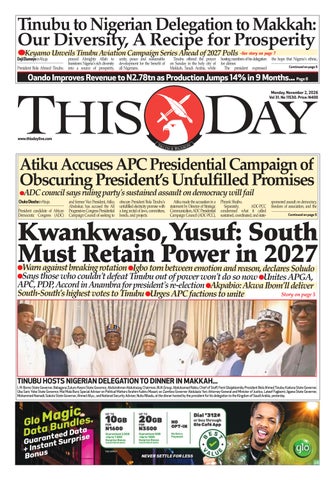
Tinubu to Nigerian Delegation to Makkah: Our Diversity, A Recipe for Prosperity Keyamo Unveils Tinubu Aviation Campaign Series Ahead of 2027 Polls –See story on page 7
Deji Elumoye in Abuja
President Bola Ahmed Tinubu
prayed Almighty Allah to transform Nigeria’s rich diversity into a source of prosperity,
unity, peace and sustainable development for the benefit of all Nigerians.
Tinubu offered the prayer on Sunday in the holy city of Makkah, Saudi Arabia, while
hosting members of his delegation for dinner. The president expressed
the hope that Nigeria’s ethnic, Continued on page 5
Oando Improves Revenue to N2.78tn as Production Jumps 14% in 9 Months... Page 8 Monday, Monday, November January 2, 6, 2026 2025 Vol Vol29. 31.No No10865. 11530. Price: N400
www.thisdaylive.com TR
UT H
& RE A S O
N
Atiku Accuses APC Presidential Campaign of Obscuring President’s Unfulfilled Promises ADC council says ruling party's sustained assault on democracy will fail
Chuks Okocha in Abuja President candidate of African Democratic Congress (ADC)
and former Vice President, Atiku Abubakar, has accused the All Progressives Congress Presidential Campaign Council of seeking to
obscure President Bola Tinubu’s unfulfilled electricity promise with a long recital of laws, committees, bonds, and projects.
Atiku made the accusation in a statement by Director of Strategic Communication, ADC Presidential Campaign Council (ADC-PCC),
Phrank Shaibu. Separately, ADC-PCC condemned what it called sustained, coordinated, and state-
sponsored assault on democracy, freedom of association, and the Continued on page 5
Kwankwaso, Yusuf: South Must Retain Power in 2027
Warn against breaking rotation Igbo torn between emotion and reason, declares Soludo Says those who couldn't defeat Tinubu out of power won't do so now Unites APGA, APC, PDP, Accord in Anambra for president's re-election Akpabio: Akwa Ibom’ll deliver South-South’s highest votes to Tinubu Urges APC factions to unite Story on page 5
TINUBU HOSTS NIGERIAN DELEGATION TO DINNER IN MAKKAH...
L-R: Borno State Governor, Babagana Zulum; Kwara State Governor, Abdulrahman Abdulrazaq; Chairman, BUA Group, Abdulsamad Rabiu; Chief of Staff, Femi Gbajabiamila; President Bola Ahmed Tinubu; Kaduna State Governor, Uba Sani; Yobe State Governor, Mai Mala Buni; Special Adviser on Political Matters Ibrahim Kabiru Masari; ex-Zamfara Governor Abdulaziz Yari; Attorney-General and Minister of Justice, Lateef Fagbemi; Jigawa State Governor, Mohammed Namadi; Sokoto State Governor, Ahmed Aliyu , and National Security Adviser, Nuhu Ribadu, at the dinner hosted by the president for his delegation to the Kingdom of Saudi Arabia, yesterday
2
MONday, NOVEMBER 2, 2026 • T H I S D AY
MONDAY, NOVEMBER 2, 2026 • T H I S D AY
3
ZENITH BANK PLC
STATEMENT TO THE NIGERIAN STOCK EXCHANGE AND SHAREHOLDERS ON THE GROUP’S UNAUDITED IFRS RESULTS FOR THE THIRD QUARTER ENDED 30 SEPTEMBER 2026
FOR THE NINE MONTHS PERIOD ENDED In millions of Naira
Group
30 SEP
2026
Group 30 SEP
2025
Bank
30 SEP
2026
Bank
AS AT
2025
In millions of Naira Assets
30 SEP
Gross earnings
2,865,288 3,371,829 2,310,005 2,813,143
Interest and similar income Interest and similar expense
2,617,139 2,740,946 2,200,331 2,300,823 (688,727) (814,227) (550,025) (637,755)
Net interest income Impairment Charge on financial instrument Net interest income after impairment charge Net income on fees and commission Trading gains Other operating income impairmnent credit on non‑financial instruments Depreciation of property and equipment Amortisation of intangible assets Personnel expenses Operating expenses
1,928,412 1,926,719 1,650,306 1,663,068 (230,770) (782,763) (230,673) (777,385) 1,697,642 1,143,956 1,419,633 885,683 256,849 202,943 171,190 134,300 (229,194) 277,654 (260,043) 242,413 90,775 45,276 54,185 106,544 1,239 – 1,239 – (52,797) (37,742) (40,797) (29,241) (9,813) (9,217) (11,484) (10,625) (213,152) (182,083) (144,228) (120,964) (625,611) (532,115) (560,546) (477,426) 917,412
666,171 672,063
Group
Group
2026
2025
Bank
Bank
31 DEC
30 SEP
31 DEC
Cash and balances with central banks Treasury bills Assets pledged as collateral Due from other banks Derivative assets Loans and advances Investment securities Investment in subsidiaries Deferred tax asset Other assets Current tax receivable Property and equipment Intangible assets
7,658,966 6,925,426 3,277,318 4,662,814 115,525 94,189 4,576,511 2,721,675 8,146 5,135 11,636,702 10,448,952 5,391,086 5,409,945 – – 32,296 10,742 572,712 1,132,266 3,721 10,629 478,018 522,919 78,821 70,858
6,540,160 2,584,977 94,189 3,800,945 2,460 9,371,398 2,192,185 164,802 – 640,659 – 444,671 62,264
5,891,436 3,893,729 94,477 2,450,381 1,416 8,167,344 2,339,994 34,625 1,756 328,884 – 329,007 69,372
Total assets
34,387,321 31,458,051 25,898,710 23,602,421
Liabilities Customers' deposits Derivative liabilities Current income tax payable Deferred tax liabilities Other liabilities On‑lending facilities Borrowings
27,114,756 24,329,961 20,210,352 18,114,919 177,428 195,498 196,072 189,092 91,112 87,168 95,198 96,008 11,378 – 7,492 14,821 1,670,535 1,150,591 1,551,311 1,043,195 75,246 83,755 103,369 90,506 579 377,003 651,162 138,475
Total liabilities
29,314,193 26,533,845 22,117,406 19,901,538
Capital and reserves Share capital Share premium Retained earnings Other reserves
20,535 20,535 20,535 20,535 594,113 594,113 594,113 594,113 3,035,970 2,808,194 2,051,577 2,013,692 1,417,379 1,497,570 1,115,079 1,072,543
Attributable to equity holders of the parent
5,067,997 4,920,412 3,781,304 3,700,883
30 SEP
2026
2025
Profit before tax
928,797
Income tax expense
(252,971) (153,208) (198,821) (92,992)
Profit for the period after tax
675,826
764,204
467,350 579,071
(27,567) –
29,485 31,843
(27,567) –
29,485 –
(27,567)
61,328
(27,567)
29,485
Items that are or may be reclassified to profit or loss꞉ Foreign currency translation differences for foreign operations Fair value movements on debt securities at FVOCI
(132,418) (7,558)
43,029 6,470
– –
– –
Other comprehensive income for the period net of taxation
(167,543)
110,827
(27,567)
29,485
Total shareholders' equity
5,073,128 4,924,206 3,781,304 3,700,883
Total comprehensive income for the Period
508,283
875,031
439,783 608,556
Total liabilities and equity
34,387,321 31,458,051 25,898,710 23,602,421
674,140 1,686 675,826
763,857 347 764,204
467,350 579,071 ‑ – 467,350 579,071
The financial statements were approved and authorised for issue by the Board of Directors on 29th October, 2026 and signed on its behalf by꞉
506,946 1,337 508,283
874,684 347 875,031
439,783 608,556 ‑ – 439,783 608,556
16.41
18.60
Other comprehensive income/(loss)꞉ Items that will never be reclassified to profit or loss꞉ Fair value movements on equity instruments at FVOCI Impact of adopting IAS29 on 1 January Total items that will not be reclassified to profit or loss
Profit/(loss) attributable to꞉ Equity holders of the parent Non‑controlling interest Total comprehensive income attributable to꞉ Equity holders of the parent Non‑controlling interest
5,131
Non‑controlling interest
3,794
–
–
Engr. Mustafa Bello (Chairman) FRC/2026/PRO/DIR/003/693530
Key financial information
Earnings per share – Basic and diluted (Naira)
11.38
14.10
Dame Dr. Adaora Umeoji, OON (GMD/Chief Executive) FRC/2024/PRO/DIR/003/967545
Durosinmi Abiodun Akanbi (Chief Financial Officer) FRC/2013/ICAN/00000001308
The above statements of financial position, profit or loss and other comprehensive income are published in accordance with the requirements of Rule 41 of the Securities and Exchange Commission (SEC), Rules and Regulations 2011. For a better understanding of the financial position of the Group and its operation for the period, the above financial information should be read in conjunction with the condensed unaudited interim financial statements of the Group.
THE BOARD
Chairman꞉ Engr. Mustafa Bello | Group Managing Director/CEO꞉ Dame Dr. Adaora Umeoji, OON | Executive Directors꞉ Adobi Stella Nwapa, Anthony Akindele Ogunranti, Adamu Lawani, Louis Odom, Kennedy Okwudili | Non‑Executives꞉ Dr. Al‑Mujtaba Abubakar, MFR, Omobola Ibidapo‑Obe Ogunfowora (Ph.D), Peter Olatunde Bamkole (Ph.D), Mr. Chuks Emma Okoh, Dr. Juliet Ehimuan, Pamela Yough, Dr. Rislana Kanya Abdulazeez
4
MONday, NOVEMBER 2, 2026 • T H I S D AY
5
T H I S D AY • MONDAY, NOVEMBER 2, 2026
PAGE FIVE
N70,000 Transport Allowance: Public Service Unions Back NLC as Labour Rift Deepens Onyebuchi Ezigbo in Abuja
The disagreement between the two main labour centres, Nigeria Labour Congress (NLC) and Trade Union Congress (TUC), over the federal government's N70,000 transportation allowance approved for public servants seemed to be deepening as Joint National Public Service Negotiating Council (JNPSNC) backed NLC against TUC, which rejected the allowance. National Secretary of JNPSNC, Comrade Gbenga Olowoyo, said,
in circular to affiliate unions and state councils, that the agreement leading to approval of the allowance was the product of constructive engagement and exhaustive negotiation. Olowoyo said the meeting was presided by Minister of Labour and Employment, Alhaji Mohamed Maigari Dingyadi, and attended by a labour team led by NLC President Comrade Joe Ajaero, with the participation of the leadership of JNPSNC and Joint Health Sector Union (JOHESU).
According to the circular, the meeting was tough and lasted more than six hours before both sides reached the terms. Olowoyo said the N70,000 monthly transportation allowance to be paid for the next six months to public servants, starting November 2026, and it was meant to subsidise unbearable transportation costs being experienced by workers. He expressed hope that states and local governments, with their current humongous allocations, will be patriotic
enough to concur with the agreement to complement the federal government’s effort to ameliorate the hardship of workers and their dependants. He said the agreement also cemented implementation of long overdue 40 per cent peculiar allowance, reflecting N70,000 minimum wage, which ought to have started since July 2024, when the new minimum wage commenced. The allowance will be domesticated at sub-national levels from November 2026
while arrears from May 1, 2026 will be paid in three tranches. Olowoyo stated that the federal government agreed to set up a tripartite negotiation committee comprising government, labour, and Nigeria Employers’ Consultative Association (NECA) representatives with immediate effect, which formed the focal request from JNPSNC under Comrade Benjamin Anto Uyanto that necessitated the three-day warning strike called on October 2, 2026. Olowoyo tried to correct what
Ajaero
he termed a notion that NLC was a union of junior workers, saying all unions affiliated to NLC have members across Ministries, Departments and Agencies up to Directorate level.
KWANKWASO, YUSUF: SOUTH MUST RETAIN POWER IN 2027
Deji Elumoye, Sunday Aborisade in Abuja, David-Chyddy Eleke in Awka and Ahmad Sorondinki in Kano
The Vice Presidential candidate of the Nigeria Democratic Congress (NDC), Rabiu Kwankwaso; Kano State Governor, Abba Kabir Yusuf, and Personal Assistant to the President on Radio and Broadcast (Office of the Vice President), Hajya Rahma Abdulmajid, yesterday insisted that the South should retain power in 2027, warning against breaking the existing rotational arrangement between the North and the South. While Kwankwaso warned former Vice President Atiku Abubakar and the African Democratic Congress (ADC) against disrupting the zoning
arrangement, Yusuf and Abdulmajid argued that allowing the South to complete its eight-year tenure was necessary for national stability, reciprocity and peaceful coexistence. Also yesterday, Anambra State Governor, Prof. Chukwuma Soludo, said the Igbo were torn between emotion and reason ahead of the 2027 elections, urging them to support President Bola Tinubu's re-election, while Senate President Godswill Akpabio assured that Akwa Ibom State would deliver the highest votes for the President in the South-South.
It's Still Turn of South in 2027, Kwankwaso Warns Atiku, ADC Kwankwaso has warned
Atiku not to disrupt the zoning system by contesting, urging him to allow the system to continue by supporting Mr. Peter Obi to complete the remaining tenure belonging to the South. Kwankwaso, who stated this during an interactive session with journalists at his residence in Kano, yesterday, also warned the ADC against causing confusion over the rotational presidency between the North and the South. He said even though zoning was not enshrined in the constitution, common sense dictates that if one part of the country rules for two terms, the other region should be allowed to take over. According to the former governor, fielding any candidate from the North would not help the country's peaceful coexistence
but will rather create confusion and disharmony among Nigerians. "Atiku should not disrupt the system by contesting at this point in time. He should allow the system to continue by supporting Peter Obi to complete the remaining tenure belonging to the South." Kwankwaso recalled how he contested for president three consecutive times but decided to abandon his ambition to allow the Southern part of the country to produce Mr. Peter Obi. "What is happening in the ADC will not help us. Some people want to create confusion by bringing a candidate from the North, knowing full well that it is still the turn of the South. After Obi presidency, it will return to the north. "I sacrificed my ambition for Peter Obi because he is credible
and from the South. We share common goals and ideology. We are strong and can manage the affairs of this country with ease," he added. The Kwankwasiyya leader stressed that for the Nigerian system to be balanced, Obi from the South should be given the opportunity to steer the affairs of the presidency.
Yusuf, Presidential Aide Insist on Power Rotation Specifically, the Presidency justified the existing power rotation between the North and the South by urging the North to honour the current eight-year tenure being served by the South to completion, in the interest of reciprocity and national stability.
It said Nigeria’s national stability hangs by a slender thread, demanding that the North honour the unwritten power rotation pact and allow the South to complete its full eight-year tenure, warning that breaking this foundational trust could jeopardise the country's unity. Personal Assistant to the President on Radio and Broadcast (Office of the Vice President), Hajya Rahma Abdulmajid, stated this in Kano during the Grand Inauguration & Strategic Media Awards Ceremony of Matan Arewa 4 Tinubu Again (MATA). According to her, Nigeria's power rotation arrangement was not a sectional concession but a reciprocal compact that has stabilised the Fourth Republic. Continued on page 36
ATIKU ACCUSES APC PRESIDENTIAL CAMPAIGN OF OBSCURING PRESIDENT’S UNFULFILLED PROMISES constitutional right of Nigerians to political participation under the Tinubu administration. It, however, declared that the assaults would fail and democracy was bound to survive and outlive APC. Atiku said, in the statement by ADC-PCC, “The APC should spare Nigerians the spectacle of celebrating paperwork while homes and businesses remain in darkness. “After three and a half years, families still struggle to keep their homes lit. Traders and small business owners spend scarce resources on alternative power, yet struggle to keep their businesses alive.” ADC campaign council said, “Nigerians are billed for electricity they cannot rely on. President Tinubu promised steady power
and an end to estimated billing. That promise has not been kept. “Across Nigeria, consumers are placed in Bands A, B, C, D and E and charged different rates. In many areas, Band A customers pay about N209.50 per unit before VAT. Rates for the other bands vary by state and electricity provider. ' Yet across every band, the same hardship endures: the power fails, but the bill arrives. No family should have to weigh the cost of electricity against the cost of food. No business should be left to pay more while receiving less.” ADC added, “The government now says it plans to end electricity subsidies from 2027, even as it insists there will be no immediate tariff increase. Nigerians are entitled to a
clear answer: what will happen to their bills when the subsidy ends?” The ADC presidential candidate promised that if elected, “I will work with state governments and regulators, within the law, to abolish the present band system and replace it with a fair, transparent and affordable framework that protects households and holds power companies accountable for the electricity they deliver. “Steady power that Nigerians can afford will be a national priority.” Insisting that Tinubu had no justification for seeking another term, the ADC campaign council stated, “When President Tinubu campaigned in 2022, he made an unmistakable commitment. He said: ‘If I don’t give you constant
electricity for four years, when I come back for a second term, don’t vote for me.’ “Nigerians have lived through those four years. They do not need his campaign council to interpret his words for them. They need him to answer for them. “His administration has not built a single new generation infrastructure of its own to increase Nigeria’s power capacity. Yet it has floated a multitrillion naira bond programme to settle legacy debts owed to generation companies, without showing Nigerians how this financial intervention has produced the steady electricity they were promised. ''Paying old debts is not the same as building new power
infrastructure. Bonds cannot be presented as a substitute for power in people’s homes.” ADC also accused the Tinubu government of worsening the power woes with unjustifiable energy taxes. It stated, “Meanwhile, Nigerians face VAT on electricity, and the Nigeria Tax Act provides for a five per cent surcharge on certain fossil fuels, including petrol and diesel. “The government says the surcharge has not been activated and would require a ministerial order. At a time when families already struggle to meet the cost of energy, Nigerians deserve to know why another potential charge has been placed before them. “Dele Alake’s statement cannot light a home. Signing a law is not
electricity. Raising a bond is not electricity. Approving a project is not power delivered. Nigerians cannot cook, study, work or sustain a business on announcements. ''President Tinubu invited Nigerians to judge him by his performance. They have done so. What they seek is simple: reliable electricity they can afford, and a government that keeps its word.”
APC's Sustained Assault On Democracy Will Fail, Says ADC Presidential Campaign ADC-PCC condemned what it described as organised Continued on page 33
TINUBU TO NIGERIAN DELEGATION TO MAKKAH: OUR DIVERSITY, A RECIPE FOR PROSPERITY religious, and cultural diversity would continue to serve as a source of strength and national advancement rather than division. He stressed the need for citizens to embrace mutual understanding, peaceful coexistence, and a shared commitment to the country’s progress. He prayed that Almighty Allah would bless Nigeria with enduring peace, harmony, and prosperity, and grant the nation’s leaders the wisdom, courage, and foresight to steer the country towards greater development and improved living conditions for its people. "May Almighty Allah bless Nigeria, convert our diversity into prosperity as a country," the president said.
Tinubu also prayed for divine guidance and protection for Nigerians at home and abroad, asking Allah to strengthen the bonds of brotherhood among citizens and inspire a renewed spirit of patriotism, compassion and service to the nation. The president stated that Nigeria’s abundant human and natural resources, coupled with the talents, creativity and enterprise of its diverse population, provided a strong foundation for building a prosperous and inclusive nation. The dinner with members of his delegation in Makkah provided an opportunity for fellowship and reflection on Nigerians' shared aspirations for a peaceful, united and prosperous country.
Tinubu urged Nigerians of all faiths and backgrounds to keep working together in the national interest, expressing confidence that, with faith in Almighty Allah, unity of purpose, and collective determination, Nigeria would overcome its challenges and realise its full potential. Chairman of BUA, Alhaji Abdulsamad Rabiu, reaffirmed Tinubu's commitment to peace, unity and prosperity of Nigeria. Rabiu said, "Today is actually the third dinner we're having with His Excellency, Mr President, since we came to Makkah on Thursday night or Friday morning when Mr President arrived. "So, we discussed, and the discussion was, you know, to always
continue to pray for Nigeria, for peace, for unity and for Nigeria's prosperity. To again, you know, thank His Excellency for his passion, for what he's doing for Nigeria. "And also for us, it's quite important because, as I said, it has given us the opportunity to come and pray not only for ourselves and our families, but also for Nigeria. "We will continue to support His Excellency in whatever capacity we can and, definitely, as you all know, Mr President is very passionate about the country. He's working very hard, and we'll continue to support him." Kwara State Governor and Chairman of Nigerian Governors' Forum (NGF), Abdulrahman AbdulRazaq, said the forum was
overwhelmed by the president's passion and commitment to achieving a united and prosperous nation. AbdulRazaq stated, "Only Allah can reward you; we will continue to pray for you daily and pray for Nigeria that you lead. May Allah continue to strengthen you in making the right decisions, strengthen your wisdom, your boldness, your audacity, your courage. May Allah lead you to the right path." Attorney-General of the Federation and Minister of Justice, Mr Lateef Fagbemi (SAN), also prayed for Almighty Allah to continue to strengthen the president in his determination to deliver governance and justice to
all Nigerians, irrespective of their religion or ethnic backgrounds. The dinner was attended by Yobe State Governor Mai Mala Buni; Kaduna State Governor Uba Sani; Jigawa State Governor Mohammed Namadi; Sokoto State Governor Ahmed Aliyu; Borno State Governor Babagana Umara Zulum; Coordinating Minister of Health and Social Welfare, Professor Mohammed Ali Pate; and National Security Adviser, Mallam Nuhu Ribadu. Others were Chief Executive Officer of Oando Plc, Mr Wale Tinubu; Special Adviser to the President on Political Matters, Ibrahim Kabiru Masari; and Chief of Staff to the President, Femi Gbajabiamila, among others.
6
T H I S D AY • MONDAY, NOVEMBER 2, 2026
NEWS
APC DEDICATION SERVICE FOR COMMENCEMENT OF 2027 ELECTION CAMPAIGN...
L-R: Wife of the Senate President, Mrs. Unoma Godswill Akpabio; President of the Senate, Godswill Akpabio; Governor Umo Eno of Akwa Ibom State and the Coordinator, Office of the First Lady, Akwa Ibom State, Helen Obareki, during the Akwa Ibom APC dedication service for the commencement of the 2027 election campaigns at the International Christian Worship Centre in Uyo, yesterday
Falana Gives Senate 14 Days to Recover $123.17bn, N66.4bn Unremitted Oil Revenues from NNPC, IOCs, Others Says $62bn worth of royalties not collected from companies for 18 years Alleges $23.1bn NLNG dividends withheld by state oil firm; threatens legal suit on non-compliance
Peter Uzoho
Human rights activist and Senior Advocate of Nigeria (SAN), Mr. Femi Falana, has asked the senate president, Senator Godswill Akpabio, to immediately move to recover a staggering $123.17 billion and N66.4 billion owed the federation by Nigerian National Petroleum Company Limited (NNPCL), several international oil companies (IOCs), and indigenous producing firms.
In a strongly worded letter dated October 28, 2026, addressed to the senate president, and copied to Speaker of the House of Representatives, Hon. Tajudeen Abbas, Falana, through his law firm, Falana and Falana Chambers, said the funds represented outstanding royalties, taxes, dividends, stolen crude proceeds, and failed refinery rehabilitation contracts established by judgements of courts of competent jurisdiction and reports of federal agencies.
Nigeria, Türkiye Move to Deepen Ties After Tinubu’s Ankara Visit Michael Olugbode in Abuja
Nigeria and Türkiye have pledged to deepen bilateral relations across trade, investment, defence, education, and other strategic sectors following the signing of nine agreements and memoranda of understanding during President Bola Tinubu’s state visit to Ankara in January 2026. The federal government reaffirmed the commitment in a statement congratulating the Turkish government and people on the 103rd anniversary of the founding of the Republic of Türkiye, celebrated on October 29. Nigeria said the agreements signed during Tinubu’s visit had strengthened the foundation for expanded cooperation between the two countries in areas including trade and investment, education, diaspora policy, military cooperation, media and communication, and diplomatic training. The government also identified manufacturing, construction, textiles and solid minerals as
sectors offering opportunities for stronger economic partnerships between both countries. It said Nigeria remained committed to sustaining highlevel engagements and using institutional mechanisms, including the Joint Economic and Trade Commission, to consolidate existing partnerships, explore new areas of cooperation and promote mutually beneficial economic opportunities. The federal government also welcomed progress in defence cooperation, particularly in local capacity building, technology transfer and institutional collaboration between the armed forces of both countries. According to the government, the partnership reflects a shared commitment to strengthening defence capabilities and addressing common security challenges. Nigeria further noted that both countries continued to cooperate at the multilateral level on international peace and security, sustainable development and other global challenges.
The firm, which described itself as dedicated to the promotion of human rights, social justice, and public accountability in Nigeria, said it was compelled to write the letter after the federal government failed to act on verified reports of massive revenue losses. The letter stated, "We wish to draw your attention to the relevant judgements of courts of competent jurisdiction and reports of some agencies of the federal government, which have established that the government of the federation is owed the sum of $123.17 billion, being outstanding royalties, taxes and dividends." Falana gave the National Assembly 14 days to initiate recovery measures, warning, "If you fail to initiate legal measures for the recovery of the aforesaid huge funds belonging to the government of the federation within 14 days of the receipt of
this letter, we shall not hesitate to file the necessary processes in the Federal High Court with a view to compelling you to discharge the duty of your office." A breakdown of the uncollected funds, according to the letter, began with what the senior lawyer described as "$62 billion worth of royalties not collected from IOCs for 18 years". Falana traced the discovery to his firm's campaign for the amendment of the Deep Offshore and Inland Basin Production Sharing Contracts Act. He said his firm discovered that some public officers had deliberately refused to implement Section 16 of the Act, which provided for an upward review of royalties whenever the price of crude oil was sold beyond $20 per barrel in the international market. He stated, "Confronted with the fact of the economic sabotage,
the federal government admitted that the country had lost billions of dollars due to the nonimplementation of the law but our demand for the collection of the huge fund was ignored without any legal basis." He explained that it was at that stage that the governments of Akwa Ibom, Bayelsa, and Rivers states filed a suit at the Supreme Court and sought to compel the federal government to collect all outstanding royalties under the Act. Falana recalled that in a consent judgement delivered on October 20, 2018, the Supreme Court had ordered the federal government to collect the outstanding royalties, which had accrued for 18 years under the Deep Offshore Inland Basin Production Sharing Contract Act, and that the 13 per cent derivation due to the plaintiffs be paid to them upon recovery of the fund in accordance with
Section 162 of the 1999 Constitution, as amended. He added that pursuant to the said consent judgement, the office of the Attorney-General of the Federation constituted a committee to determine the respective liabilities of the IOCs, including the amount due to the oil producing states as derivation proceeds. Falana said the committee found that the amount not collected from the IOCs was $62 billion. He said though the demand of the federal government for payment of the said sum was ignored by the IOCs, the governments of Akwa Ibom and Rivers states filed a case at the Federal High Court wherein they sought a declaration that they were entitled to the sum of $1,114,551,610.00 and $2,258,411,586, respectively, from the said sum.
Court Bars EFCC from Arresting Honda Nigeria Executives, Over 200 Others Wale Igbintade The Lagos State High Court has restrained the Economic and Financial Crimes Commission (EFCC) from arresting or detaining executives of Honda Manufacturing (Nigeria) Limited, Honda Automobile West Africa Limited, and more than 200 individuals and businesses in connection with an ongoing investigation by the anti-graft agency. The court also barred the commission from taking any step to deprive the applicants or their officers of their personal
liberty over the subject matter of the investigation, pending the hearing and determination of the substantive fundamental human rights suit. Justice Olukayode Ogunjobi made the order, while ruling on an ex parte application filed by the two automobile companies, their executives, dealers, distributors and other business associates against the EFCC. The suit, marked LD/22659MFHR/2026, has an extensive list of corporate and individual applicants, including two Japanese nationals, Tetsuya
Kawai and Mita Daisuke, alongside Nigerian executives, motorcycle dealers, automobile businesses and other commercial entities. Other individual applicants include Olayemi Adebiyi, Olabade Badejo and Lanre Akinsola, while corporate applicants include H3 Motors & Industries Limited, Movack Services Nigeria Limited, Tony Moore Nigeria Enterprises and Hardé Global Motorcycle Venture, among several others. At the proceedings, Bolaji Ayorinde, SAN, led the legal team representing the applicants, with Wale Rokosu.
The applicants approached the court through a fundamental human rights enforcement action, seeking protection against what they described as unlawful interference with their personal liberty, freedom of movement and privacy in the course of the EFCC investigation. Specifically, they sought interim orders restraining the commission, its officers, agents, servants and representatives from arresting, detaining or otherwise depriving them or their officers of their personal liberty in connection with the investigation.
7
T H I S D AY • MONDAY, NOVEMBER 2, 2026
NEWS
RHI STAKEHOLDERS MEETING...
L-R: Wife of the Imo State Governor, Mrs. Chioma Uzodimma; Wife of Vice President Hajia Nana Shettima; First Lady of Nigeria Senator Oluremi Tinubu; Wife of the Senate President, Mrs. Unoma Godswill Akpabio; and Wife of the Chief of Staff to the President, Mrs. Salamatu Gbajabiamila, all members of the Board of Trustees of the Renewed Hope Initiative, RHI at the Stakeholders meeting between the First Lady, Renewed Hope Initiative and APC Senatorial Candidates at the State House Banquet Hall, last Thursday
Keyamo Unveils Tinubu Aviation Campaign Series Ahead of 2027 Polls 30-second television series to broadcast president's Tinubu administration’s record in aviation
James Emejo in Abuja
Minister of Aviation and Aerospace Development, Mr. Festus Keyamo, has launched a television campaign series to promote President Bola Tinubu’s aviation sector record ahead of the 2027 presidential election. The move signals an early push to use the administration’s sectoral performance in its re-election campaign. The 30-second programme, tagged Tinubu Aviation Revolution Series, is scheduled to begin airing on major television stations on November 1, with broadcasts expected to continue until a few days before the presidential
election. The initiative follows Keyamo’s appointment as Director of the Directorate of Air Transport Mobilisation under the All Progressives Congress Presidential Campaign Council (APC PCC), where he is responsible for coordinating air transportation for authorised campaign activities. A statement issued by the minister's Special Adviser on Media and Communications, Tunde Moshood, said had mobilised his team to produce the campaign material following his appointment. The statement added that the television campaign had been fully paid for, although it did not disclose the cost of production or
broadcast placement. The series is designed to present the Tinubu administration’s aviation policies and achievements in a short, accessible format, using the sector’s contribution to economic activity as part of the case for the president’s re-election. Aviation plays a strategic role in trade, tourism, investment and international connectivity, making developments in the
History was made weekend when Omo N’ Oba N’ Edo, Uku Akpolokpolo, Oba Ewuare II, Oba of Benin, performed a symbolic ceremonial tee-off at the Benin Club Golf Section in Benin City, Edo State. In a rare public appearance rich with royal heritage and symbolism, His Majesty— marking 10 years on the throne of Benin—struck 10 ceremonial golf balls as part of activities commemorating his decade on the throne. The Oba was joined on the green by his children, including his daughter, Princess Amenaghawon, alongside his three sons—Prince Ikponmwosa, Prince Igbinosa, and Prince Idugbowa — that also took turns hitting ceremonial balls. The brief, yet colourful ceremony, drew an audience, including top Benin Palace Chiefs, members of the Local Organising Committee of the tournament, captains of industry, tournament sponsors, and professional and amateur golfers from across Nigeria and beyond.
Speaking at the event, the Chief Organiser of the tournament, Prince Aghatise Erediauwa, described the competition as a fitting tribute to a decade of peace, cultural renaissance, and purposeful leadership under Oba Ewuare. Prince Aghatise highlighted that the 2026 event marks the 9th edition of the coronation anniversary series, making a grand return after its last outing in 2022. He praised the impressive turnout of both professional and amateur players, as well as the overwhelming enthusiasm from participants. He said, "You can see the joy on everybody's face today. Normally, there is a ceremonial tee-off. This has been a fantastic golf tournament where people came from all over the world—both professional and amateur players." "It has been going so well. We are excited that His Royal Majesty dedicated his time to be with us at the tournament. We are extremely delighted, and we thank him so much for that," Prince Erediauwa added.
role within the APC’s presidential campaign structure, ahead of the 2027 general election. The television campaign is expected to run until shortly before the presidential poll, placing the administration’s aviation record before voters as political activities gather momentum. The statement adds, "With aviation serving as a critical driver of economic growth, tourism, trade,
investment and international connectivity, the series is intended to draw attention to the sector’s role in advancing the Renewed Hope Agenda and to encourage an informed public assessment of the administration’s performance. "The launch of the Tinubu Aviation Revolution Series signals the beginning of a focused campaign as the APC prepares for the 2027 general election."
NHIA DG Vows Tougher Accountability, Says Integrity Key to Better Healthcare James Emejo in Abuja
General, National Health Oba of Benin Marks Decade on Director Insurance Authority (NHIA), Kelechi Ohiri, has called for Throne with 10 Historic Golf Shots Dr. stronger institutional accountability Felix Omoh-Asun in Benin City
sector a potential component of the administration’s broader economic performance narrative. The campaign will seek to draw public attention to what the government considers its progress in aviation and link the sector’s development to Tinubu’s Renewed Hope Agenda. The rollout also marks an early campaign communication initiative by Keyamo in his new
in the management of public healthcare resources. He warned that failures in transparency and oversight ultimately undermine access to essential medical services. Ohiri, who made the observation while receiving an award for commitment to the anti-corruption drive, said the recognition should spur the Authority to strengthen internal controls and ensure that
resources deployed to the health sector translate into measurable benefits for Nigerians. The award, presented by the Anti-Corruption Academy of Nigeria (ACAN), the training and research arm of the Independent Corrupt Practices and Other Related Offences Commission (ICPC), recognises Ohiri's commitment to transparency and accountability. He dedicated the honour to NHIA employees and Nigerians, insisting that the recognition was a product of collective institutional efforts rather than an individual achievement. He stressed that the fight against
corruption in the public sector must extend beyond adherence to financial regulations to ensuring that public funds achieve their intended purposes, particularly in healthcare, where inefficiencies and resource leakages can have direct consequences for human lives. The NHIA boss said accountability in health insurance was especially critical because it determined whether patients could access necessary treatment and whether funds committed to protecting citizens were being effectively utilised. He said the authority was pursuing institutional reforms designed to close accountability
gaps, strengthen operational safeguards and improve the efficiency of its service delivery system. Among the measures are the digitisation of financial management processes, efforts to clear outstanding audit backlogs, tighter monitoring of healthcare service providers and improvements in complainthandling mechanisms. The authority has also intensified capacity-building for its Anti-Corruption and Transparency Unit (ACTU) to strengthen preventive oversight and embed greater transparency in its operations.
Demolition of N1bn Property: Senate, IG Urged to Investigate, Discipline AIG Moshood over Alleged Court's Disobedience Alex Enumah in Abuja
The Senate President, Inspector General (IG) of Police and the Chairman of the Police Service Commission have been called upon to immediately commence the investigation and disciplining of the Assistant Inspector General (AIG) Zone 2, Jimoh Moshood, over alleged complicity in the demolition of a property worth over N1 billion in Lekki, Lagos.
The AIG, who is being accused of land grabbing, abuse of office, abuse of power, malicious destruction and force entry over the property known as Plot 77 Lekki Phase 1, Lagos state, is alleged to have acted in flagrant disobedience of an order of the Court of Appeal, Lagos. In three separate petitions dated October 27 but received by the various officials between October 28-30, the AIG Zone
2 Officer was alleged to have acted in company of some others in the demolition of the said property, despite being aware of the pendency of the suit at the appellate court which had issued a Stay of Execution and status quo order, over the demolished property. The petitions were written on behalf of the petitioner, a Lagos socialite, businessman and philanthropist; Alhaji Akeem
Osuolale Ogunseye, by his lawyer, an Abuja-based human rights activist, Marshal Abubakar. The petitioner who identified himself as the beneficial owner of the property with Certificate of Occupancy no; 50/50/1990A, disclosed that the property situated at Lekki Peninsula Scheme 1, was issued in the name of his elder brother, Samuel Alao Ajibade, from whom he derived title upon purchase.
8
T H I S D AY • MONDAY, NOVEMBER 2, 2026
NEWS
2026 CIBN FELLOWSHIP INVESTITURE...
L-R: Chief Executive Officer, Nigeria Economic Summit Group (NESG), Dr. Tayo Aduloju; Governor of Lagos State, Mr. Babajide Sanwo-Olu; President/Chairman of Council, Chartered Institute of Bankers of Nigeria (CIBN), Mr. Dele Alabi; Chief Executive Officer, Grosse Pointe Capital & Advisory Ltd, Mallam Bello Maccido; and 1st Vice President of CIBN, Mrs. Mojisola Asieru-Sweet, during the 2026 CIBN Fellowship investiture themed: “Bank Recapitalisation: Leveraging New Bank Capital for Nigeria’s Industrial Transformation” at Harbour Point Events Centre, Victoria Island, on Saturday
Oando Improves Revenue to N2.78tn as Production Jumps 14% in 9 Months
Operating costs drop 22% as facility uptime hits 96.1% Records N159.7bn operating profit as gross profit surges 483% Wale Tinubu: performance demonstrates how diligent execution under our operatorship is delivering greater efficiency, improved reliability, others
James Emejo in Abuja Oando Plc grew its revenue by nine per cent to N2.78 trillion in the first nine months of 2026, as higher crude oil liftings, increased gas and natural gas liquids (NGL) sales, and improved realised prices boosted earnings. Stronger operational efficiency also helped restore the group to operating profitability. The indigenous energy company, in its unaudited results for the nine months ended September 30, 2026, reported an average daily production of 42,985 barrels of oil equivalent per day (boepd), up 14 per cent from 37,614 boepd in the corresponding period of 2025.
Its operating performance recorded a significant turnaround, with operating profit reaching N159.7 billion, compared with an operating loss of N109.7 billion a year earlier. Gross profit also rose sharply by 483 per cent to N174.5 billion from N29.8 billion, reflecting higher production volumes, improved facility reliability and lower operating costs. The results point to a stronger earnings position for the group as it expands output from its upstream assets and pursues a drilling programme intended to raise production capacity over the medium term.
POSAT Launches N1.5bn Development Fund as Alma Mater Marks 50th Anniversary Sunday Ehigiator The Progressive Old Students’ Association, Tede (POSAT), has announced plans to launch a N1.5 billion development fund as part of activities marking the 50th anniversary of Progressive Secondary Grammar School, Tede, Oyo State. The association, which brings together alumni of Progressive Modern School, established in 1959, and Progressive Secondary Grammar School, upgraded to secondary school status in 1976, said the golden jubilee celebration would commence in November 2026. According to a statement jointly signed by POSAT’s Interim National President, Dr. Funso Folaranmi, and Interim National Secretary, Tajudeen Alabede, the school, originally established by
the government of the old Oyo State on November 22, 1976, would officially mark its 50th anniversary on November 22, 2026. The association said the milestone would celebrate five decades of academic excellence and the institution’s contributions to education and community development. To commemorate the anniversary, POSAT said it had lined up activities to include its first-ever Global Alumni Reunion, the celebration of the school's 67th anniversary since its original establishment in 1959, and the golden jubilee of its upgrade to secondary school status. The statement said the activities would feature special thanksgiving services, Community Engagement Day, Homecoming and School Community Day, Global Alumni Reunion Day, and a grand finale.
Higher Crude Liftings, Gas Sales Drive Revenue Oando's production growth was supported by improved output across its crude oil, gas and NGL operations. Crude oil production increased 12 per cent to 12,193 barrels per day, while gas production rose 13 per cent to 28,689 boepd. NGL production recorded the strongest growth, climbing 53 per cent to 2,103 barrels per day. The increase in output translated into higher sales volumes across the group's exploration and production portfolio. Crude oil liftings rose 43 per cent to 3.97 million barrels, while natural gas sales grew five per cent to 34.01 billion standard cubic feet. NGL sales surged 90 per cent to 570,000 barrels. Combined exploration and production sales volumes increased
21 per cent to 10.21 million barrels of oil equivalent. Commenting on the performance, Group Chief Executive, Wale Tinubu, said the results reflected improved execution under the group's operatorship, supported by renewed investment across its expanded upstream portfolio. Tinubu said average production rose 14 per cent year-on-year, while facility uptime improved to 96.1 per cent from 85 per cent in the corresponding period of 2025. He stated, "Our performance in the first nine months of 2026 demonstrates how diligent execution under our operatorship, supported by our renewed investment drive, is delivering greater efficiency, improved reliability, lower unit costs and ultimately higher production across our expanded upstream portfolio.
"Production averaged 42,985 boepd, up 14 per cent year-on-year, while facility uptime improved to 96.1 per cent and production operating costs declined by 22 per to $15.39 per boe. These gains were achieved with zero fatalities and zero lost-time injuries across approximately 14.9 million hours worked.” The improvement in operational reliability, alongside increased output, helped reduce production operating costs by 22 per cent to $15.39 per barrel of oil equivalent. The lower cost base was attributed to optimisation across transportation, logistics, services and information and communications technology, as well as higher production spread across a largely fixed field cost base. Oando also reported zero fatalities and zero lost-time injuries over approximately 14.9 million hours worked during the period,
representing a 55 per cent increase in total hours worked compared with the same period last year.
Drilling Programme Targets Higher Output According to the report, the company committed N110.7 billion to capital expenditure during the nine-month period, with the bulk directed towards drilling activities across Oil Mining Leases (OMLs) 60–63. Its seven-well development programme for 2026 recorded progress, with Idu 6ST and Idu 15 completed and brought on stream. Workovers at Samabri 4T and Samabri 7T had also been completed. Drilling is continuing at Idu T and Samabri A50, while the final well in the programme, Ogbainbiri, is scheduled to commence drilling in December.
Stakeholders Laud Ogun Free Trade Zone's Education Programme James Sowole in Abeokuta
Education stakeholders and community leaders in Igbesa, AdoOdo/Ota Local Government area in Ogun State, have commended the Ogun–Guangdong Free Trade Zone (OGFTZ) for its sustained investment in educational development across its host communities. The leaders described the OGFTZ interventions as significant contributions to improving learning opportunities, nurturing talents and shaping the future of young people. The stakeholders who spoke during separate interaction with journalists, highlighted the impact of its educational initiatives,
particularly the establishment of the China–Nigeria Friendship Model School, scholarship opportunities for deserving students and various academic, sporting and extracurricular programmes. Speaking on the Zone’s contributions, Mr. Joseph Ibikunle, Head of Academics and School Services at the Ado-Odo/Ota Local Government Education Authority, described OGFTZ’s educational interventions in the community for the past 15 years as remarkable and worthy of commendation. Ibikunle noted the Zone had consistently supported learners through interventions in school infrastructure, the provision of educational materials and
scholarship opportunities for deserving students. According to him, these sustained contributions had positively influenced the learning environment and created opportunities for students across the host communities. He expressed appreciation to the management of OGFTZ for its continued commitment to educational development, urging the organisation to sustain its interventions, which he said had made a meaningful difference in the lives of learners across the local government. Also speaking, High Chief Ezekiel Adewumi Durojaiye, the Otunba Amona of Igbesa,
identified the establishment of the China–Nigeria Friendship Model School as one of the most significant contributions of the Zone to the community. He observed that since the arrival of OGFTZ and the establishment of the school, Igbesa had increasingly become associated with China, to the extent that residents and visitors sometimes jokingly refer to the town as “China in Nigeria.” Describing the school's impact as remarkable, Durojaiye recalled discussions surrounding its development during the visit of the Chinese Consul-General, expressing optimism that the institution would continue to grow.
9
T H I S D AY • MONDAY, NOVEMBER 2, 2026
NEWS
10TH ANNIVERSARY CELEBRATION OF CAPITALSAGE HOLDINGS...
L-R: Ooni of Ife, His Imperial Majesty, Oba Adeyeye Enitan Ogunwusi, Ojaja II; Olubadan of Ibadanland, His Imperial Majesty, Oba Rashidi Adewolu Ladoja; Founder and Group Managing Director, CapitalSage Holdings, John Alamu; and Executive Governor of Oyo State, His Excellency, Engr. Seyi Makinde, during the 10th anniversary celebration of CapitalSage Holdings and the official commissioning of its global headquarters in Ibadan, Oyo State, yesterday
Uwaleke Prescribes Project-tied Sukuk to Build Public Trust in Government Borrowing Says Nigeria faces substantial future Eurobond repayment obligations
Ndubuisi Francis in Abuja Amid the ongoing controversy over the federal government’s proposed $20.52 billion and €1.045 billion external borrowing, renowned professor of capital market, Prof. Uche Uwaleke has advised that rather than a complete resort to conventional loans, the federal government should undertake a serious assessment of the proportion of its proposed infrastructure financing that can be mobilised through international Sukuk. He stated that one of Sukuk's appeal lies in its potential to strengthen transparency and accountability in the utilisation
of public borrowing. He said the controversial $20.52 billion and €1.045 billion external borrowing move should provide an opportunity for a fundamental rethink of the country's financing strategy. In an article titled "Rebuilding Public Trust in Government Borrowing: The Case for Scaling Up Sukuk Financing in Nigeria," Uwaleke said the recent request by President Bola Tinubu to the National Assembly for approval to raise $20.52 billion and €1.045 billion in fresh external loans had once again brought Nigeria’s growing public debt burden into sharp focus. The financial expert who is also
heads the Institute of Capital Market Studies (ICMS), Nasarawa State University, Keffi, explained that one of the principal reasons for public scepticism towards government borrowing was the perceived disconnect between the amounts borrowed and the infrastructure outcomes delivered. Nigerians, he further argued, were increasingly concerned that governments accumulate enormous debt obligations without providing sufficient information about the projects financed, the amounts disbursed, the physical progress achieved and the economic returns generated. This perception, he stressed,
had weakened public confidence in borrowing as an instrument of development, adding that Sukuk can help change this narrative, provided that its project-linked features are supported by effective institutional and contractual safeguards. Accordiing to him, although President Bola Tinubu had justified the proposed borrowing on the grounds of the country's enormous infrastructure deficit and the need to finance critical projects across various sectors of the economy, the announcement had understandably generated considerable concern among Nigerians. These concerns, he observed,
ActionAid Demands Transparency Over FG’s N50,000 Cash Support, Questions Funding, Beneficiary Selection Michael Olugbode in Abuja ActionAid Nigeria has demanded full transparency from the federal government over its proposed N50,000 cash support for poor and vulnerable Nigerians, insisting that the government must disclose the funding source, beneficiary selection criteria and disbursement arrangements. The organisation also raised concerns over conflicting descriptions of the intervention under the National Emergency Relief and Stabilisation Intervention (NERSI), noting that while the
Minister of Humanitarian Affairs and Poverty Reduction, Dr. Bernard Doro, announced it as a monthly intervention, the programme's official website describes it as a one-off grant. In a statement issued on Sunday in Abuja, ActionAid Nigeria's Country Director, Andrew Mamedu, said Nigerians deserved clear and verifiable information on the programme's financial commitments and mechanisms for ensuring that public funds reached intended beneficiaries. Mamedu said the government must explain whether the
intervention was financed through existing budgetary allocations, supplementary appropriations, savings from economic reforms, development financing or other sources. He also called for the disclosure of the total amount committed, funds released and administrative costs associated with the programme. "Direct cash assistance can provide immediate relief, but such interventions must be transparent, equitable and sustainable," he said. ActionAid said the absence of a clearly disclosed programme
budget, specific beneficiary targets and implementation timeline raised questions about the scale and sustainability of the intervention. It noted that supporting one million households with N50,000 monthly would require N50 billion, while five million households would cost N250 billion monthly, stressing the need for transparent budgeting, legislative oversight and regular public reporting. The organisation also questioned the proposed reliance on the National Social Register and verified national identity records for beneficiary selection.
cannot be dismissed as mere opposition to government borrowing, but must be viewed against the background of Nigeria’s debt accumulation over the past decade, the relatively limited visible impact of such borrowing on infrastructure development and the growing proportion of government revenue devoted to servicing existing debt. According to him, the fundamental question Nigerians were asking was whether borrowed funds are being efficiently deployed, transparently managed and translated into tangible developmental outcomes. The one-time finance commisioner in Imo State noted that Nigeria’s public debt statistics provide sufficient grounds for this concern, adding that as at June 30, 2026, the country’s total public debt stood at N166.79 trillion, comprising domestic debt of N91.59 trillion, representing 54.91 per cent, and external debt of N75.20 trillion, equivalent to $54.52 billion, representing 45.09 per cent of the total. This represents a phenomenal increase from the N11.24 trillion public debt stock recorded in December 2014, Uwaleke stated. He further submitted that while part of this increase reflects naira devaluation, and the securitization of previously accumulated obligations, the scale of the expansion over a relatively short period raises legitimate questions about debt sustainability and the
developmental returns on borrowed resources. Uwaleke said,"More importantly, Nigeria’s debt challenge should not be assessed exclusively through the conventional debt-to-GDP ratio. Although this ratio may appear moderate by international standards, the more immediate fiscal constraint is the country’s capacity to generate sufficient revenue to service its obligations. "Debt service has, in recent years, consumed an exceptionally high proportion of government revenue, averaging in excess of 70 per cent over the period under consideration. This leaves progressively less fiscal space for infrastructure, education, healthcare and other essential public services. "The composition of Nigeria’s debt portfolio also raises important questions about the extent to which borrowing has been linked to productive investment. The Federal Government’s domestic debt stock outstanding by instruments as at June 30, 2026, stood at N86.99 trillion. "Of this amount, discretionary FGN Bonds accounted for N64.84 trillion, representing 74.53 per cent of the total, including N22.11 trillion in securitized Ways and Means advances. By comparison, FGN Sukuk outstanding amounted to only N1.19 trillion, representing 1.37 per cent, while FGN Green Bonds accounted for a mere N47.36 billion, or 0.05 per cent.
Stakeholders Sensitise FCT Residents on Early Cancer Detection Onyebuchi Ezigbo in Abuja
Minister of Budget and Economic Planning, Abubakar Atiku Bagudu, said the federal government has made huge investment in cancer detection machines and treatment procedures in last one year. Bagudu stated this Saturday in
Abuja during 5.4 kilometre walk themed "One Walk, One Fight Walk Away Cancer" organised by the Medicaid Cancer Foundation (MCF). He said investment in cancer treatment is in addition to improved allocation to health sector, noting additional revenue
has been provided to states and local governments for early detection, prevention and cure of cancer. He stressed need to pressure states and local governments for judicious use of cancer funds. "I want to commend Union for International Cancer Control
(UICC) under leadership of Dr. Zainab Shinkafi Bagudu for their relentless and age-long cancer awareness sensitization campaign, being one of priority areas of President Tinubu's Renewed Hope Agenda in health sector," he said. Minister of State for FCT, Dr.
Mariya Mahmoud, said early detection plays significant role in fighting disease before it gets out of hand, urging Nigerians especially the girl-child to go for early screening which is almost free everywhere. "We really appreciate and commend this sensitization
initiative. With this kind of massive turnout, high prevalence of cancer of cervix will go down," she said. Minister of State for Education, Prof. Suwaiba Ahmed, said no one fights cancer alone, stressing need for early screening, adding disease does not care about age or influence.
10
T H I S D AY • MONDAY, NOVEMBER 2, 2026
NEWS
AT THE SHE-EO DAY OF SERVICE IN BANJUL...
L-R: The She-EO Community Manager, Joy Okoronkwo; MD of GTBank Gambia, Abolaji Yusuff; Founder, Starfish International, Mam Yassin Sarr Korede Demola-Adeniyi; and Wumni Jenmi, at the She-EO Day of Service held during Starfish International Library in Banjul, The Gambia... recently
Yilwatda: Tinubu’s Trans-Sahara Highway’ll Transform Northern Economy, Security Says party's structure formidable ahead 2027 with 13 million membership
Adedayo Akinwale in Abuja and Yemi Kosoko in Jos
The National Chairman of the All Progressives Congress (APC), Prof. Nentawe Yilwatda, has described the ongoing reconstruction of the Akwanga-Jos section of the Trans-Sahara Super Highway as a landmark infrastructure that would transform economic activities, improve security and deepen national integration across Nigeria. Yilwatda stated this during an inspection tour of the project, where he expressed satisfaction with the pace of work and commended the commitment of President Bola Ahmed Tinubu’s administration to delivering critical road infrastructure across the country. The APC national chairman said the project represented one
of the most significant federal investments in the region in decades, noting that the corridor had suffered years of neglect despite its strategic importance to socio-economic development in the North-Central and North-East regions. According to him, the reconstruction formed part of the larger Trans-Sahara Superhighway corridor, stretching from Calabar through Ebonyi, Enugu, Benue, Abuja and Jos, before extending to Gombe, Biu and Maiduguri, linking several geopolitical zones and creating a seamless transport network across the country. He said the highway, which spans more than 1,400 kilometres, would serve as a catalyst for trade, investment and national cohesion by connecting communities, markets and businesses across the South-South, South-East,
North-Central and North-East regions. Yilwatda noted that the Akwanga-Jos road, originally constructed around 1972, had not witnessed major rehabilitation for more than five decades, with successive interventions limited largely to palliative repairs and patchwork. “For over five decades, since the days of the late Joseph Gomwalk around 1972, this corridor witnessed only piecemeal patching. Communities along the Nasarawa-Plateau axis rarely saw federal capital projects running into even N10 billion. Today, President Bola Ahmed Tinubu has committed hundreds of billions of naira to build an infrastructure asset designed to endure for over a century,” he said. APC’s Structure is Formidable Ahead 2027, We've 13m Members
Positioned for Election In another development, the APC national chairman has declared membership strength of approximately 13 million members, giving it a significant advantage over other political parties ahead of the 2027 general election. Yilwatda made this known while receiving a pre-election fact-finding mission of the Economic Community of West African States (ECOWAS), led by former Vice-President of Sierra Leone Victor Foh, over the weekend. In a statement by his Special Adviser on Media and information Strategy, Abimbola Tooki, he said the party received the mission with other members of the National Working Committee (NWC) at the party's secretariat in Abuja.
He said the APC had, over the years, built an extensive and well-coordinated political organisation that distinguished it from other political parties in Nigeria and placed it in a strong position to mobilise voters and compete effectively in the 2027 elections. The chairman disclosed that the APC had approximately 13 million registered members spread across all local government areas in Nigeria, with detailed records of members and membership identity cards designed to facilitate verification through their National Identification Numbers (NIN) and voter identification details. Yilwatda noted: “The party’s strength is rooted not merely in its electoral victories but also in its verifiable membership database, grassroots structures, elected
representatives, nationwide support groups and established internal processes. “Our party is the largest political party in Nigeria. In terms of structure, organisation and membership, no other political party comes close to us. We are approximately three times larger than the next political party in the country,” The National Chairman explained that the party’s membership database and identification system provide a strong foundation for effective grassroots engagement, mobilisation, internal coordination and electoral planning. According to him, the APC has more than 261,000 executive members across its organisational hierarchy, a network he described as a major source of its political strength and nationwide reach.
Tompolo, Oyetola, Adeleke Inaugurate 10,000 eyes and tell them a lie without Door-to-door Canvassers for Tinubu’s Re-election
ADC Chides Governor Alia Over Performance in Office
George Okoh in Makurdi
The African Democratic Congress (ADC) governorship candidate in Benue State for the 2027 general elections, Rt. Hon. Herman Hembe, has declared that Governor Hyacinth Alia is no longer electable, calling on the people of Benue State to reject him at the polls. He maintained the governor has not performed well enough to deserve a second term in office. Hembe made this declaration in Oju, headquarters of Oju Local Government Area, during the campaign flag-off ceremony for the ADC Benue South Senatorial candidate, Dr. David Olofu. Addressing thousands of party faithful drawn from all nine local government areas in Zone C, Hembe said that, in all his years of political experience, he had never encountered a governor who could look his people in the
hesitation. He expressed concern over what he described as the unfair distribution of the state's financial resources, alleging that about N1.1 trillion accrued to Benue State over the last three years. According to Hembe, Governor Alia stated that Zone B received N317 billion, representing 91 per cent, while Zone A received N17 billion (5 per cent) and Zone C received what he described as an insulting N8 billion (2 per cent). Hembe questioned the basis for the alleged disparity in resource allocation, asking why Zone B would receive such a significant share while Zone C was left with so little. He maintained that an ADC-led government would not practise sectional governance, stressing that development should promote unity, fairness and equal opportunities across the state.
Yinka Kolawole in Osogbo
The Osun State Chapter of the All Progressives Congress (APC), Minister of Marine and Blue Economy, Adegboyega Oyetola, Governor Ademola Adeleke and other political leaders have inaugurated a 10,000-member door-to-door canvassing team to mobilise support for the re-election of President Bola Tinubu ahead of the 2027 general election. The inauguration, held at the Nelson Mandela Freedom Park, Osogbo, brought together prominent political figures across party lines, including APC leaders, members of Adeleke-led administration and representatives of the Niger Delta political bloc, in a demonstration of their commitment to building a broad-based coalition to secure a second term for President Tinubu. The Minister of Marine and
Blue Economy, Adegboyega Oyetola while addressing the gathering noted the inauguration is a demonstration of commitment, organisation and shared conviction in President Bola Tinubu’s continuity agenda. Oyetola who was represented by the 2026 Osun State APC guber candidate, Asiwaju Bola Oyebamiji, commended High Chief Oweizide Ekpemupolo (Tomopolo), for supporting the initiative for his nationwide advocacy for re-election of President Tinubu. He said “There is no doubt that the presidential campaign of President Tinubu is highly visible and increasingly gaining momentum across the Southwest. This gives us an enormous responsibility to ensure that the Southwest delivers overwhelming votes for our leader, President Bola Ahmed Tinubu in the forthcoming
general election. “I am particularly impressed by the massive mobilisation of the APC structure for today’s inauguration. Our target of mobilising 1.5 million votes for President Tinubu in Osun is achievable if we approach the assignment with unity, discipline and determination.” He encouraged Nigerians, irrespective of their political affiliations, to identify with the continuity agenda of President Tinubu by contributing meaningfully well to the success of his re-election. He tasked the canvassers, saying, “I charge you to approach this assignment with sincerity, discipline and an unwavering commitment to the cause. Shun hypocrisy, political pretence and complacency.” Also, Adeleke who was represented by his deputy, Kola
Adewusi, tasked Accord Party, Peoples Democratic Party (PDP) members and his supporters to forget past disagreements and unite to deliver for the president. Also, the National Coordinator of PBAT Door-to-Dooor, Comrade Sunday Adekanbi, encouraged voters to collect their PVC and deliver the state’s two million votes for President Tinubu irrespective of political party affiliation. The Managing Director of Tantita Security Service Nigeria Limited Representing Government Owoizidei Ekpemupolo or Oweizidei Thomas Ekpemupolo), Dr. Kestin Pondi, said “We are not just coming to inaugurate, we are also bringing to you 30 campaign vehicles mounted with speakers and generators and amplifiers to make the campaign work very easily.
MONDAY, NOVEMBER 2, 2026 • T H I S D AY
11
12
MONday, NOVEMBER 2, 2026 • T H I S D AY
MONDAY, NOVEMBER 2, 2026 • T H I S D AY
13
14
MONday, NOVEMBER 2, 2026 • T H I S D AY
MONDAY, NOVEMBER 2, 2026 • T H I S D AY
15
16
MONday, NOVEMBER 2, 2026 • T H I S D AY
MONDAY, NOVEMBER 2, 2026 • T H I S D AY
17
MONday, NOVEMBER 2, 2026 • T H I S D AY
18
The Unveiling of DESTMA PLASTIC LTD Brand Ambassadors Destma Plastic Ltd has unveiled its brand ambassadors to boost its company profile and sales. The brand ambassadors are Femi Adebayo, Odunlade Adekola, Toyin Abraham, Kola Ayeyemi, and Kunle Afod. Speaking at the event, the Managing Director, Destma Global, Dr. Olabode Olagundoye, said the unveiling of the brand ambassadors is more than a ceremony. According to him, it is a statement of intent, a declaration of confidence, and a significant milestone in the journey of Destma Plastic. “We have gathered not merely to unveil five outstanding personalities as our brand ambassadors, but to announce a strategic partnership between a growing Nigerian manufacturing brand and individuals whose talents, influence, and connection with the public offer tremendous opportunities for our brand. “At Destma Plastic, we believe that a great brand must stand for more than the products it manufactures. It must stand for values, deliver on its promises, earn the confidence of its customers, and
contribute meaningfully to the Responding after the tour of the factory each Ambassadors promised to continue to support the company's effort in promoting locally made goods in the country. Speaking at the tour of the factory, Femi Adebayo said, “I was introduced by our own Nigerians. So, it's the very first time that I have the opportunity to come to where plastics are made. And I'm wowed, I'm impressed. I actually read about them before jumping on the fact that I want to be their ambassador. But coming to see it physically today, I am amazed. And I can only tell the general public that this is our own thing. And of course, to patronise our own things should be the priority.” Also, Kolawole Ajeyemi, the company must maintain the quality of goods we have seen them produce and explain to me . “I trust their competence and must challenge them to maintain quality in the products. Because what we see is that some will start and compromise, but with what I see here today the quality is guaranteed.”
For, Odunlade Adekola, “If you know me so well, you know I propagate and promote Yoruba culture. So anything that any company is doing that is made in the country, definitely I will be proud and happy to promote and support the company. Being part of Destma from today is something that is so good to me because I will do my best to make people see the reason why they don't need to travel abroad to get what they can get here.” For, Kunke Afod, he stressed how to support our local entrepreneurs in the country, especially those doing things we can produce locally rather than importing them. For, Toyin Abraham, we must support local business and encourage Destma Plastic so that they can contribute to employment creation in the country “If you see artists doing or supporting or promoting local brands now, you can see from like four or five years ago, we've been even doing more local movies, like indigenous movies, the cultural movies, and we can tell our stories better than anybody else. So this company is our own and we must support and patronise them.”
BELOW IS A PICTORIAL ACCOUNT OF THE EVENT.
The MD Mr Olagundoye Olabode, Femi Adebayo and staff member
L-R Mr Olagundoye Olabode, Toyin Abraham, Kola Ajeyemi
L-R Mr Olagundoye Olabode (CEO Destma Plastics), Kunle Afod
L-R Mr Olagundoye Olabode MD/CEO Destma plastic and Odunlade Adekola
L-R Anibilowo Oyindamola Taofikat , Eze Doris Chizoba, Akinola Clinton, Madu Ngozi Grace, Mr Olagundoye Olabode, Odunlade Adekola, Bamike Fadipe, Kayode Aboderin, Isaac Adeusi
L-R Mr Kayode Adeagbo, Mrs Bamike Fadipe, Mr Olagundoye Olabode , Pastor Niyi Adesanya, Mr Temitope Olaniran
L-R Anibilowo Oyindamola Taofikat, Mr Olagundoye Olabode, Femi Adebayo, Eze Doris Chizoba, Isaac Adeusi
MONDAY, NOVEMBER 2, 2026 • T H I S D AY
19
With profound joy and deep reverence, on behalf of the family of late Alhaji Ahmadu Sokoto, Sarkin Gona, associates and well-wishers, I extend my warmest felicitations to His Eminence, Alhaji Muhammad Sa'ad Abubakar III, CFR, mni, the Sultan of Sokoto and President-General of the Nigeria Supreme Council for Islamic Affairs (NSCIA), on the momentous occasion of his 20th Anniversary on the exalted throne of his forefathers. Your two-decade reign has been a golden era of peace, wisdom, tolerance, and selfless service. As the spiritual leader of Nigerian Muslims and custodian of the Sokoto Caliphate's noble heritage, you have distinguished yourself as a bridge-builder, a champion of inter-faith harmony, education, and national unity. You remain a father to all of us, a voice of moderation, and a beacon of hope for the underprivileged in challenging times. As you celebrate this historic milestone, I pray Almighty Allah (SWT), in His infinite mercy, grant you long life, sound health, wisdom and renewed strength to continue your noble service to Islam, the Sokoto Caliphate, Nigeria and humanity at large.
Signed:
Engr. Farouk Ahmed (Maishanu) Dan Madamin Sakkwato
T H I S D AY MONDAY NOVEMBER 2, 2026 16 TR
UT H
& RE A S O
Monday November 2, 2026 Vol 27. No 11522
N
opinion@thisdaylive.com
www.thisdaylive.com
WHY SOME COUNTRIES GROW AND OTHERS DON’T Nations prosper when their institutions allow individual ability to become collective progress, argues LINUS OKORIE
See page 17 RMRDC AND NIGERIA'S INDUSTRIAL FUTURE
WILLIAM JOHNSON argues why policy continuity, raw material development and institutional reforms matter
See page 17
EDITORIAL
ENDING IMPUNITY AGAINST JOURNALISTS
See page 18
1
The challenge is not to eliminate politics or ethnicity, but to ensure that neither overrides moral responsibility, contends GODWIN SOGOLO
POLITICS, ETHNICITY AND MORALITY NEED NOT COLLIDE
Politics, ethnicity and morality are three distinct yet interrelated dimensions of human existence. Their interaction often complicates practical judgement and responsible citizenship. Politics concerns the acquisition, exercise and distribution of power; ethnicity refers to a collective identity rooted in shared ancestry, history and culture; while morality provides the principles by which conduct is judged as right or wrong, just or unjust, and responsible or irresponsible. Of course, there are other dimensions of human existence – such as religion, etiquette and customs – all of which, like politics, are subject to moral evaluation. Through praise or blame, reward or punishment, society encourages responsible behaviour and discourages actions harmful to the common good. This reflects the recognition that laws and institutions alone cannot guarantee social order; mutual trust, shared values and a sense of obligation towards others are also indispensable. There is, however, a school of thought which holds that politics should be exempt from moral scrutiny on account of its practical realities and peculiar demands. This position is commonly associated with the political philosopher, Niccolò Machiavelli, whose analysis of political power emphasises the realities of governance rather than idealised expectations of how rulers ought to conduct themselves. The underlying argument is that political leaders must contend with competing interests, uncertainty, opposition and the imperatives of national security: circumstances that may sometimes require decisions that depart from conventional moral expectations. However, the distinctive pressures of politics do not make political conduct immune to moral judgement. They merely require that such judgement take account of circumstances, consequences and competing obligations. Political expediency may sometimes justify difficult choices, but it cannot serve as a blanket excuse for corruption, deception, oppression or the abuse of power. Since political decisions affect people's lives, liberties, property and welfare, citizens must retain the right to evaluate their leaders by standards of justice, integrity and accountability. Otherwise, political necessity becomes a convenient justification for virtually any wrongdoing. The same distinction applies to ethnicity. Ethnic identity is neither inherently virtuous nor morally objectionable. It can provide a sense of belonging, preserve cultural heritage and foster solidarity.
The problem arises when ethnic loyalty is treated as an unquestionable obligation, requiring people to defend wrongdoing by members of their group or to distrust others simply because they belong to a different community. Ethnic solidarity need not entail moral blindness, just as national unity need not require the abandonment of cultural identity. As we approach the 2027 elections, the challenge is not to eliminate politics or ethnicity, but to ensure that neither overrides moral responsibility. Nigerians are perfectly entitled to support candidates from their own ethnic communities, but ethnic affinity should not become the overriding criterion for political choice. There is, therefore, nothing inherently wrong with a Yoruba person supporting Bola Tinubu or an Igbo person supporting Peter Obi, provided such support is informed by genuine political convictions, considered judgement and legitimate interests, without compromising the fundamental values of honesty, justice, competence and the common good. Ethnic identity may influence political preferences, but it should never be allowed to substitute for independent judgement. Similarly, opposition to a candidate from one's own ethnic group should not be construed as an act of betrayal or disloyalty. Neither Charles Soludo nor David Umahi should be regarded as an Igbo traitor simply because their political positions or choices differ from those of other members of their ethnic community. In a democracy, political allegiance is a matter of individual conviction, not an obligation imposed by ethnic belonging. Indeed, the freedom to disagree with one's kinsmen, without being subjected to accusations of disloyalty, is an essential expression of democratic maturity. Ethnic identity does not, in itself, establish merit, just as belonging to another ethnic group does not imply unworthiness. The relevant questions should be what candidates stand for, the values they uphold, how they have conducted themselves in public office, what they have achieved and what they are likely
to contribute to the country. These, rather than the accidents of ethnic ancestry, should provide the basis for political evaluation and choice. In judging one another, our guiding principles must be consistency, objectivity and an unwavering commitment to the common good. We must be prepared to apply the same standards of judgement to ourselves, our political allies and our opponents, without allowing ethnic sentiment, personal interests or political affiliations to compromise our sense of fairness. Ultimately, whatever our differences in ethnicity, political persuasion or personal convictions, we share a common aspiration: to see Nigeria prosper, become a more just and inclusive society, and fulfil its enormous potential. Our collective responsibility is not merely to secure a better country for ourselves, but also to ensure that we bequeath to generations yet unborn a nation that is more united, stable, prosperous and worthy of their hopes and aspirations. The distinction between politics, ethnicity and morality is therefore essential to responsible citizenship. It does not mean that the three domains must operate in isolation. Rather, it means recognising their distinct purposes and refusing to confuse political advantage or ethnic solidarity with moral rightness. The conceptual challenge is to preserve these distinctions, while the practical challenge is to uphold them when political competition, communal loyalty, historical grievances and personal interests exert pressure on judgement. The ultimate test of moral independence is not whether citizens have political loyalties or ethnic attachments, but whether they can subject both to critical moral scrutiny. A society demonstrates greater moral maturity when people can celebrate their ethnic identities without using them to justify injustice; participate in politics without surrendering their conscience; and condemn wrongdoing without allowing the identity of the offender to determine their judgement. Clearly, therefore, politics, ethnicity and morality need not collide. Their interaction becomes conflictual – and even destructive – only when either political ambition or ethnic allegiance is allowed to override moral responsibility. Sogolo is an Emeritus Professor who has taught and conducted research in Philosophy for over five decades – at the University of Ibadan, Cardiff University of Wales and currently at the National Open University of Nigeria.
T H I S D AY
317
MONDAY NOVEMBER 2, 2026
Nations prosper when their institutions allow individual ability to become collective progress, argues LINUS OKORIE
WHY SOME COUNTRIES GROW AND OTHERS DON’T
Every nation has resources. Some have abundant natural wealth; others possess little beyond the ingenuity and determination of their people. Yet some countries turn their resources into lasting prosperity, while others remain trapped in cycles of poverty, instability and unrealized potential. The difference is rarely explained by resources alone. It has much more to do with the rules that govern a society, the institutions that enforce them and the choices made by those who hold power. In Why Nations Fail, economists Daron Acemoglu and James Robinson make a compelling argument: nations prosper when their institutions create opportunities for people to work, invest, innovate and participate in economic life. They struggle when institutions are designed primarily to protect the interests of a privileged few. This argument has profound implications for leadership. A nation’s future depends not only on the quality of its leaders, but also on whether those leaders are willing to build systems that remain effective beyond their own tenure. Consider Nogales, a town divided by the border between the United States and Mexico. On the American side, residents generally enjoy higher incomes, better public services and stronger economic opportunities than their counterparts on the Mexican side. The two communities share a geographical setting and many cultural similarities, yet their economic experiences differ considerably. Geography and history still matter, but the institutional differences help explain much of the divide. Can people trust the courts to enforce contracts? Can entrepreneurs build businesses without fearing arbitrary seizure? Can citizens hold public officials accountable? Can individuals expect their efforts to translate into opportunity? These questions shape the decisions people make every day. A business owner is more likely to invest when property rights are protected. A farmer is more likely to improve production when the returns from that investment are secure. A young person is more likely to develop valuable skills when the economy offers a credible opportunity to use them. Where institutions protect effort, people are encouraged to build. Where institutions make success vulnerable to arbitrary power, people become cautious, move their resources elsewhere or leave
altogether. Prosperity grows when people have good reason to believe that their effort will be rewarded. History offers a powerful example of what happens when political power is subjected to institutional constraints. England’s Glorious Revolution of 1688 helped establish a political settlement in which the Crown’s authority was increasingly constrained by Parliament. The transformation was neither immediate nor perfect, but it contributed to a system in which taxation, property rights and government authority became more predictable. That predictability mattered economically. Merchants, manufacturers and investors could make longer-term decisions with greater confidence that their investments would not depend entirely on the preferences of the monarch. The lesson is not that the leaders involved were motivated solely by public interest. They were political actors with competing interests. What mattered was that the resulting settlement placed greater limits on the exercise of power. This is one of the most difficult tests of leadership: the willingness to accept constraints that may limit one’s own authority. The challenge is that leaders often benefit personally from the very systems that prevent their societies from progressing. Open competition creates opportunities for new businesses. Merit-based appointments allow talented people outside established circles to rise. Independent institutions make it harder for powerful individuals to act without accountability. For leaders who value control above progress, these developments can feel threatening. The Austrian emperor Francis I, for example, resisted the introduction of railways in his territories partly because of concerns about the social and political disruption they might cause. Such resistance illustrates a recurring problem in history: those who control a system may fear the changes required to improve it. A country can lose years of progress when its leaders prioritise preserving their position over expanding their people’s opportunities. The choices leaders make become particularly consequential during periods of crisis. Acemoglu and Robinson describe such moments as critical junctures: periods when major disruptions weaken existing arrangements and create opportunities to establish new ones. Okorie MFR is a Leadership Development Expert
William Johnson argues why policy continuity, raw material development and institutional reforms matter
RMRDC AND NIGERIA'S INDUSTRIAL FUTURE Nigeria's quest for industrial transformation requires deliberate policies, institutional stability and sustained investment in research and development. At the centre of this aspiration is the Raw Materials Research and Development Council (RMRDC), an institution with enormous potential to drive industrialisation, economic diversification, employment generation and national prosperity. I believe the federal government should prioritise the effective implementation and strengthening of the RMRDC Act, 2022, rather than constantly pursuing legislative changes. Frequent policy alterations create uncertainty, weaken institutional stability and discourage longterm investment. The current leadership of the Council should consolidate the achievements of previous administrations, strengthen existing programmes and introduce improvements where necessary. Institutional progress should be built on continuity, not disruption. Equally important is the need for Nigeria to increase its capacity to produce adequate quantities of quality raw materials before making mandatory value addition the immediate priority. While value addition is desirable, imposing a compulsory 30 per cent requirement without first establishing sufficient production capacity, processing facilities, reliable electricity, transportation networks and supporting infrastructure could undermine the country's industrial objectives. On the 30% proposal, the idea sounds patriotic but is unrealistic in practice. Nigeria exports raw materials like lithium, cocoa, sesame and solid minerals not because of a lack of ambition, but because of a lack of the basics for processing: stable power, affordable credit, good roads, industrial water and reliable ports. A law cannot legislate away these deficits. Forcing a miner in Nasarawa or a farmer in Taraba to add 30% value where there is no factory, cold chain or power does not create industry. It creates illegality. The 30% figure is also arbitrary. Does it mean 30% of weight, price, labour content or processing stages? That vagueness gives officials wide discretion, which in Nigeria often means rent-seeking, delays at ports and bribes to certify compliance. Instead of stopping raw export, the rule risks becoming another tollgate for exporters. It will also hurt the very people it claims to help. Smallholder farmers and artisanal miners cannot afford processing plants. Foreign buyers will simply move to Ghana, Côte d'Ivoire, Mali or the DRC where they can buy raw materials without a forced processing requirement. When buyers leave, farm-gate prices will collapse. The farmer will not suddenly become a chocolate manufacturer. He will become poorer.
Successful value addition in Asia did not start with export bans. It started with infrastructure, industrial parks, tax holidays, subsidised energy for manufacturers and technical training. Nigeria wants to copy the outcome without building the foundation. We cannot ban our way to industrialisation. Any legislation on mandatory value addition must therefore involve broad consultations with relevant ministries, manufacturers, research institutions, the Nigerian Export Promotion Council and private-sector stakeholders. Nigeria must first strengthen agriculture and mining, invest in research and technology, improve logistics and develop infrastructure for competitive manufacturing. Another critical area is the RMRDC's Technology Incubation and Pilot Plant Programme, one of the Council's most valuable strategic assets. Before technologies from this programme are presented to investors, they must undergo proper technical validation, commercial viability assessments and market feasibility studies. Investors must be confident that the technologies are reliable, economically competitive, scalable and capable of meeting market demand. This will reduce investment risks and improve commercialisation prospects. Institutional continuity must also become a guiding principle. Successive leaderships should not abandon valuable programmes simply because they were initiated by previous administrations. They should preserve, strengthen and expand successful initiatives while introducing new ideas to address emerging challenges. The welfare and professional development of staff must also receive greater attention. A motivated and adequately trained workforce is essential to achieving the Council's mandate. Investment in modern laboratories, advanced equipment, digital transformation, research funding, staff capacity building and effective performance management will significantly improve institutional productivity and research output. Johnson writes from Lagos
18 4
T H I S D AY MONDAY NOVEMBER 2, 2026
EDITORIAL
Editor, Editorial Page PETER ISHAKA Email peter.ishaka@thisdaylive.com
ENDING IMPUNITY AGAINST JOURNALISTS
T
Government must take steps to curb violence against journalists
he ability of the citizenry to make sound judgment about policy is the fulcrum upon which an informed society leans. Such would be almost impossible without the news, information and analysis that the media provides. But the Nigerian environment remains hostile to journalists who risk their lives in pursuit of truth and holding the people in power accountable. In many instances, especially in some states, reporters are repressed and detained even without any court warrant for their critical reporting. In recent years, security personnel acting on behalf of some powerful individuals in both the public and private sectors have deployed Section 24 of the Cybercrime Act, the law’s cyberstalking provision, and Section 27, which deals with conspiracy and related offences, to detain and prosecute journalists. The 2026 ‘International Day to End Impunity for Crimes against Journalists’, being observed today throughout the world, therefore provides an opportunity for stakeholders to reflect on the safety and wellbeing of journalists. The United Nations General Assembly proclaimed 2 November as the ‘International Day to End Impunity for Crimes against Journalists’ in commemoration of the assassination of two French journalists in Mali on 2 November 2013. It is indeed most fitting that the theme for this year’s ‘International Day to End Impunity for Crimes against Journalists’, is ‘Safety of Journalists in Crises and Emergencies’. Nigeria “is one of West Africa’s most dangerous and difficult countries for journalists, who are regularly monitored, attacked and arbitrarily arrested”, according to Reporters Without Borders. “Despite timid attempts to promote press freedom by amending certain articles of the cybercrime law in 2024, at least eight journalists have since been wrongfully prosecuted, arrested, or detained under this legislation, which poses a threat to investigative journalism.”
The media is the fourth estate of the realm and its watchdog role is clearly captured under Section 22 of the Nigerian 1999 Constitution, which provides that, “the press, radio, television and other agencies of mass media shall at all times be free to uphold the fundamental objectives contained in this chapter and uphold the responsibility and accountability of the government to the people.” It is therefore a given that no society can thrive without a robust, virile and vibrant media to gauge the pulse of the public, offer institutional check on government’s abuse of power and make the powerful accountable to the people. However, journalists must also stand and be counted in the service of justice. At all times and in all circumstances, they must ask salient questions, tell interesting stories, and inspire those in power to do the right thing. But above all, it is also important to be mindful of the operating environment and the need for balance and sensitivity to the culture and diversity of our people. We therefore call on the government to uphold the right to freedom of expression reflected in Article 19 of the Universal Declaration of Human Rights adopted by the UN General Assembly in 1948 and in Article 19 of the International Covenant on Civil and Political Rights adopted by the General Assembly in 1966. We urge the government, at all levels, to take appropriate steps in curbing violence, threats and attacks against journalists and media workers. Public officials must also refrain from actions that could be seen as instigating violence against journalists for doing their job. But the onus is also on media organisations to set editorial templates that will mitigate the effect of fake news and breaches of professional standards. While the advent of social media may have raised serious questions about the future of traditional media, there can be no doubt that journalists will continue to matter, as they play the critical role of informing the citizens and keeping those in power accountable.
No society can thrive without a robust, virile and vibrant media to gauge the pulse of the public, offer institutional check on government T H I S D AY
EDITOR SHAKA MOMODU DEPUTY EDITOR WALE OLALEYE MANAGING DIRECTOR ENIOLA BELLO DEPUTY MANAGING DIRECTOR ISRAEL IWEGBU CHAIRMAN EDITORIAL BOARD OLUSEGUN ADENIYI EDITOR NATION’S CAPITAL IYOBOSA UWUGIAREN THE OMBUDSMAN KAYODE KOMOLAFE
T H I S D AY N E W S PA P E R S L I M I T E D
EDITOR-IN-CHIEF/CHAIRMAN NDUKA OBAIGBENA GROUP EXECUTIVE DIRECTORS ENIOLA BELLO, KAYODE KOMOLAFE, ISRAEL IWEGBU DIVISIONAL DIRECTORS SHAKA MOMODU, PETER IWEGBU, ANTHONY OGEDENGBE DEPUTY DIVISIONAL DIRECTOR OJOGUN VICTOR DANBOYI SNR. ASSOCIATE DIRECTOR ERIC OJEH ASSOCIATE DIRECTOR PATRICK EIMIUHI CONTROLLERS ABIMBOLA TAIWO, UCHENNA DIBIAGWU, NDUKA MOSERI DIRECTOR, PRINTING PRODUCTION CHUKS ONWUDINJO TO SEND EMAIL: first name.surname@thisdaylive.com
Letters to the Editor Letters in response to specific publications in THISDAY should be brief (150-300 words) and straight to the point. Interested readers may send such letters along with their contact details to opinion@thisdaylive.com. We also welcome comments and opinions on topical local, national and international issues provided they are well-written and should also not be longer than (750- 1000 words). They should be sent to opinion@thisdaylive.com along with photograph, email address and phone numbers of the writer.
LETTERS
THE ABANDONED GWAGWA-AIRPORT RAILWAY CORRIDOR I am deeply concerned by the apparent abandonment of the Abuja rail project being handled by the China Civil Engineering Construction Corporation (CCECC), Nig Ltd. It is particularly worrisome that a multinational company that prides itself on technological expertise for timely delivery would abandon a project of such strategic importance midstream. We the residents along the Gwagwa-Airport axis, which hosts three railway stations out of the 12 from the Central Business District station to the Airport, feel let down. This is happening at a time when the entire nation is commending the infrastructural drive of the administration of President Bola Ahmed Tinubu and the FCT Minister, Nyesom Wike. There is no gainsaying the massive road and rail interventions currently ongoing across the FCT and the country under this administration. That is why it beats our imagination that a critical segment involving railway sta-
tions would be left to rot. For over one year and five months, work has stalled on the corridor. The installation of power supply infrastructure and other critical components to the stations has been abandoned by CCECC Nig Ltd. Worse still, the prolonged abandonment has exposed the installations to vandalism. Residents have watched helplessly as critical materials are stripped away daily. We call on the relevant authorities to call CCECC Nig Ltd to order. If completed and connected to the national grid, this rail corridor would save the federal government huge sums of money currently spent on diesel to power the stations. If urgent action is not taken, residents will be forced to question the sincerity of the much-lauded infrastructural strides of this administration. If a project can be abandoned in Abuja, the seat of power, one can only imagine what obtains in other parts of the country. Abubakar Rilwan, Gwagwa, Abuja
NOT JUST THE ODD UNCLE A few 'family' photos might be missing some familiar faces. The G20 photo was a no-goer when a number of leaders were not willing to stand alongside a Russian representative. It is hardly surprising given the Ukraine war they started. Another family photo missing a few faces would be the British royal family Christmas meeting where Meghan and Harry probably won't be invited and Andrew will be warned off completely. These are the times when we should recognise that being a boring family, clear of any political power or influence, makes for happy family photos and uneventful afternoon naps after a big Christmas meal. There are a few families Santa won't be visiting this year. Dennis Fitzgerald, 28 Landale St., Box Hill, Vic., Australia
T H I S D AY • MONDAY, NOVEMBER 2, 2026
etamilc etalsnart nac sknab rehtehw tset lliw enildaed gnitroper ytilibaniatsus 8202 s ksir draoB dna noitaulav laretalloc ,ygetarts oiloftrop ,tnemssessa reworrob otni noit .thgisrevo
THE 2028 AGENDA THE ROAD TO 2028 | SUSTAINABILITY REPORTING, RISK AND VALUE
23
eyomnudalO hajilE yB
BY ELIJAH OLADUNMOYE
GHG Numbers That Stand Up to Assurance: Why Finance Teams Must Own Sustainability Controls Finance should orchestrate the control environment Finance does not need to collect every meter reading or become the technical owner of every emissions factor. Engineers, sustainability specialists, operations teams, procurement staff and portfolio managers remain essential. Finance’s role is different: to help turn dispersed operational information into controlled corporate reporting. That role fits naturally with the CFO organisation. Finance understands close calendars, consolidation, materiality, estimates, management review, Audit Committee expectations and external assurance. Risk connects the information to exposures and scenarios. Sustainability provides technical methods. Operations own much of the source data. Internal Audit evaluates whether governance and controls are working. The process is cross-functional, but it still needs one reporting discipline.
As Nigerian Public Interest Entities prepare for mandatory sustainability reporting, emissions data must become as governed, traceable and defensible as financial information.
A
FROM ACTIVITY DATA TO ASSURANCE-READY DISCLOSURE
greenhouse gas number can look precise and still be unreliable. It may be calculated to the last tonne, yet depend on incomplete energy bills, inconsistent reporting boundaries, outdated emission factors, undocumented estimates or third-party data that nobody has properly reviewed. That distinction between precision and reliability is becoming critical. Nigeria’s Sustainability Reporting Guideline 1 places sustainability disclosures within the annual report and reinforces the need for governance, controls and an identifiable reporting process. IFRS S2 requires material information on Scope 1, Scope 2, and Scope 3 emissions, along with the measurement approach, inputs, and assumptions used. This is not simply an environmental reporting exercise. Once emissions information informs transition targets, loan covenants, product claims, investment decisions, executive incentives or capital allocation, it becomes corporate reporting information. Investors need to know not only the number, but also how it was produced and whether they can trust it.
Why GHG Reporting is Harder Than it Appears Financial information usually emerges from systems with established charts of accounts, close timetables, reconciliations and review protocols. Emissions data often do not. It may come from electricity meters, fuel invoices, generator logs, refrigerator records, production systems, suppliers, borrowers, investee companies and external databases. Some information is measured directly; much of it is estimated. The arithmetic may appear simple: activity data multiplied by an appropriate emission factor, with the required unit and global warming-potential conversions. But every stage involves judgement. Which legal entities, facilities and leased assets are included? Which Scope 3 categories are material? Is a supplier-specific figure more reliable than a sector average? Has a new factor changed the trend? Does a portfolio movement reflect real decarbonisation, disposal or better data? KPMG’s September 2026 IFRS Sustainability handbook describes judgement, estimates, the reporting entity, value chain, materiality, connected information and greenhouse gas disclosures as integral parts of the reporting architecture. The message to preparers is clear: methodological decisions and limitations are part of the information, not footnotes.
Finance Should Orchestrate the Control Environment Finance does not need to collect every meter reading or become the technical owner of every emissions factor. Engineers, sustainability specialists, operations teams, procurement staff and portfolio managers remain essential. Finance’s role is different: to help turn dispersed operational information into controlled corporate reporting. That role fits naturally with the CFO organisation. Finance understands close calendars, consolidation, materiality, estimates, management review, Audit Committee expectations and external assurance. Risk connects the information to exposures and scenarios. Sustainability provides technical methods. Operations own much of the source data. Internal Audit evaluates whether governance and controls are working. The process is cross-functional, but it still needs one reporting discipline.
Boundaries Come Before Calculations Many reporting failures begin before the first
.krowemarf gnitroper ytilibaniatsus s’airegiN dna 2S SRFI ,1S SRFI no gniward ,sisylana s’rohtuA :ecruoS
Source: Author’s framework, informed by IFRS S1, IFRS S2, Nigeria’s SRG 1, ISSA 5000, KPMG’s IFRS Sustainability guidance. ssimbus YAcannot DSIHT |prove 8202 that ot daa oRfuture ehT target will be calculation. A company may use financial control will improve over time. eyomnudalO hajilE | noiAssurance achieved. It can assess whether the target, baseline, for its GHG inventory, operational control for Five controls that move GHG data from available to reportable methodology, assumptions, controls, and disclosures selected facilities, and a different approach for The Financed-Emissions Control with suitable criteria. Control pillar What management should establishwere prepared in accordance Evidence joint arrangements without documenting Challenge As uncertainty increases, the focus shifts from simply the logic. Acquisitions, disposals, leases and to assessing whether the The challenge is particularly significant for checking an outcome outsourced activities can also change both the Data map, system report, process and explanation are reasonable. A named owner, source, preparer, banks, insurers and asset managers.reviewer Portfolio and reporting perimeter and the trend. invoice, meter file and Ownership and lineage depend on counterparty A credible inventory therefore beginsapproval with calculations route formay every material metric. sign-off. 2027 as Controlled an approved boundary paper. It should emissions, exposure data, attribution factors, asset- Use 2026 and connect the reporting entity in IFRS S1 with class methods, enterprise-value denominators Rehearsal Years data-quality scores. Changesmethod, in financedfactor the organisational and operational boundaryApproved used and boundary, calculation Methodology paper, emissions may reflect client performance, Treat the remaining window as a for emissions measurement, while explaining hierarchy, estimates, exclusions and recalculation version preparation log and change Governed methodology value-chain information outside the controlled portfolio growth, asset sales, market values, reporting dry run, not a waiting period. Nigerian define boundaries, prepare a first group. Where the GHG boundary differspolicy. from improved coverage, or a revised methodology. PIEs should approval. The December 2025 amendments to IFRS S2, controlled inventory, screen all material Scope 3 financial-statement consolidation, the difference Trend analysis, reconciliation, Controlmethods, evidence, effective for operational annual periods beginning on or after categories, document map data flows, may be valid, but it should never be accidental. 1 January 2027, permit entities to limit Scope test controls and report gaps to the completeness checks and investigation of unusual exceptionunresolved report and Validation and reconciliation 3 Category 15 measurement and disclosure to Board. They should also reconcile sustainability Control the Emission Factors and movements. management explanation. financed emissions as defined in the standard. assumptions with budgets, transition plans, credit the Estimates They also allow a relevant industry-classification models, impairment assessments and public claims. This does not mean every company needs Emission factors are often treated as system rather than mandating one global system and provide specified jurisdictional reliefs. The perfect data or expensive software on day one. background data, yet they can materially change the reported result. Management reliefs reduce avoidable complexity, but they Proportionality is available, and manual processes can not remove the need for transparent be controlled. But proportionality is not informality. THE 2028 do AGENDA | THISDAY submission | Elijahscope, Oladunmoye should retain the factor source, geography, A spreadsheet can be part of a controlled process technology, reporting year, unit and version. methods, coverage and control. For Boards, the lesson is simple: decompose only if access, formulas, inputs, changes, review When factors are updated, the company should assess whether the change affects prior-period a movement in a portfolio metric before and evidence are governed. celebrating it. If emissions fall because a bank The ultimate test is not whether a company comparability or a base-year recalculation. Estimation is not inherently a weakness. sold an exposure while the underlying activity can publish an emissions number in 2028. It is Unsupported estimation is. Scope 3 and continues elsewhere, the reported outcome whether the Board, investors, regulators and assurance provider can understand where that financed-emissions reporting will often rely does not reflect real-economy transition. number came from, what its limitations are, and on supplier data, spend-based estimates, sector averages or modelled information. The strongest Assurance Changes The Standard of whether it is reliable enough to support decisions. That is why finance teams must own the reporting approach distinguishes measured, reported and Evidence discipline around sustainability controls. When estimated data; applies a controlled hierarchy; ISSA 5000 becomes effective on 15 December GHG information becomes governed, repeatable explains uncertainty; and sets out how quality 2026, with early application encouraged. It and evidence-based, sustainability reporting moves provides a global baseline for sustainability beyond compliance. It becomes part of how the assurance across topics and reporting organisation measures performance, allocates capital For preparers, the practical and protects trust. “A figure should not become frameworks. implication is not that every estimate must reportable merely because become certain. Instead, methods, assumptions, •About the author: Elijah Oladunmoye is a Partner evidence, governance, and disclosures and finance and sustainability thought leader with someone can calculate it in source expertise in financial reporting, audit & assurance, must be supportable. This is especially important for value-chain valuation and climate-related financial risk. The a spreadsheet.” estimates and forward-looking information. views expressed are personal.
24
MONday, NOVEMBER 2, 2026 • T H I S D AY
25
T H I S D AY • Monday, November 2, 2026
BUSINESSWORLD R A T E S MONEY MARKET
A S
A T
REPO
Group Business Editor Eromosele Abiodun Email oriarehu.eromosele@thisdaylive.com
08056356325
O ctober
S & P INDEX
3 0 , 2 0 2 6
S & P INDEX
EXCHANGE RATE
OPR
25.34%
CALL
23.25%
INDEX LEVEL
595.26
1/4 to daTE
0.24%
N1,381/ 1 US DOLLAR*
OVERNIGHT
25.18%
1-MONTH
21.37%
1-DAY
0.10%
YEAR TO DATE
-10.99%
*AS AT Fri., October 30, 2026
3-MONTH
22.41%
MONTH-TO-DATE
0.24%
22 Firms Report N12.1tn PBT in 9 Months Despite Macro-economic Headwinds
Kayode Tokede Despite macroeconomic headwinds, MTN Nigeria Communications Plc and 21 other listed companies on the Nigerian Exchange Limited (NGX) reported N12.1 trillion profit before tax in nine months ended September 30, 2026. This represent a 35.4 per cent Year-on-Year (YoY) increase over N8.94 trillion reported in recorded in the same period in 2025. The 22 companies that are made up of cement manufacturing, financial institutions, and others generated an estimated N7.6
trillion profit after tax in nine months of 2026, up by 22.1per cent when compared to N6.2 trillion in nine months of 2025. In the period under review, the economy weathered insecurity, weak purchasing power despite inflation easing, among others. Nigeria’s inflation eased to 14.63 per cent as of September 2026 from 15.15 per cent December 2025, while the Naira at the closed September 30, 2026 at N1,331.50 against the dollar from N1,478.00 against the dollar September 30, 2025. Also, the ongoing unrest in the Middle East between US/
Israel and Iran has impacted on global oil prices, led to uncertainties and companies in Nigeria felt the impact. After navigating heightened uncertainty and trade barriers last year, the global economy now faces a fresh shock from the war in the Middle East. Growth is projected to slow to 3.1 per cent in 2026 and 3.2per cent in 2027, weighed down by rising geopolitical tensions. Meanwhile, analysis of the companies’ unaudited result and accounts for nine months ended September 2026 showed that MTN Nigeria Communications Plc recorded the highest profit
followed by Dangote Cement Plc and Seplat Energy Plc. MTN declared N1.79 trillion profit before tax in nine months of 2026, about 59.4 per cent from N1.13 trillion reported in nine months of 2025. The Chief Executive Officer, MTN Nigeria Communications, Mr. Karl Toriola in a statement said: “We delivered a very strong third quarter, reversing the temporary slowdown in Q2. Service revenue grew 19.7per cent (8.4per cent QoQ), with growth accelerating each month to 21.6per cent in September. “Profitability grew even
faster: Q3 EBITDA rose 32.8 per cent (12.5per cent QoQ) and the EBITDA margin widened by 5.8 per cent to 58.7 per cent. For the nine months, service revenue grew 23.7per cent with an EBITDA margin of 56.9 per cent. Both are comfortably within the guidance of ‘at least low-20per cent’ revenue growth and a ‘mid-to-high50per cent’ margin. “Growth is increasingly volume-led, driven by more users, deeper data adoption, higher usage and rising demand for home broadband, supported by continued investment in network coverage, capacity
and quality. In fintech, core mobile money revenue more than doubled, up 102.2per cent, while our airtime and data credit service continued to recover following its resumption under a multipartner model, with revenue up 78.5per cent in Q2.” Dangote Cement announced N1.47trillion profit before tax, which is 41.45 per cent increase over N1,04 trillion in corresponding period of 2025, while Seplat Energy declared N1.34 trillion profit before tax, which is 52.7 per cent growth from N878.99 billion in nine months of 2025. The story continues online on www.thisdaylive.com
Sanwo-Olu, CIBN Task Banks on Productive Lending to Drive I n d u s t r i a l G r o w t h Nume Ekeghe Governor, Babajide SanwoOlu; President and Chairman of Council of the Chartered Institute of Bankers of Nigeria (CIBN), Dele Alabi and former Group Chief Executive Officer of FBN Holdings Plc, Mallam Bello Maccido, have urged banks to channel funds raised through the recent recapitalisation exercise
towards productive lending to businesses, particularly SMEs and manufacturers, to accelerate industrial growth.\ They made the call at the CIBN Fellowship Investiture Ceremony held in Lagos over the weekend.\Speaking at the event, Sanwo-Olu said the success of the recapitalisation exercise would ultimately depend on how effectively the additional capital was
deployed to support productive enterprises, expand industries and create economic opportunities. He identified access to affordable, long-term financing as one of the major constraints facing Nigerian businesses, urging banks to increase lending to sectors capable of driving sustainable growth. “But raising capital is only
the beginning. The two major obstacles, in our view, are how effectively that capital supports productive enterprises, how it helps industrial expansion, and how it creates economic opportunities for every Nigerian,” the governor said. He noted that manufacturers needed financing to acquire machinery, fund production and compete internationally, while agricultural businesses
required capital to strengthen storage and processing capacity. He also called for increased support for start-ups, particularly young businesses requiring seed capital to establish and expand their operations. Sanwo-Olu stressed that the banking industry had a critical role to play in growing the Micro, Small and Medium
Enterprises (MSMEs) segment, noting that improved access to financing would broaden economic participation. Earlier, Alabi said the recapitalisation programme had mobilised N4.65 trillion in fresh capital through the Nigerian capital market, with 33 banks meeting the new capital requirements. The story continues online on www.thisdaylive.com
M a r k e t d ata A s at F r i d ay, O c t o b e r 3 0 , 2 0 2 6 BONDS Description Price Yield Change Updated Time (%) ^13.98 23October 97.51 16.10 0.00 30, 2026 FEB-2028 October ^21.00 200.00 30, 105.82 16.10 2026 MAR-2028 ^19.30 17October 105.77 16.35 0.00 30, APR-2029 2026 ^14.55 26October 97.89 15.60 0.00 APR-2029 30, 2026 ^18.50 21October 105.37 16.68 -0.31 30, FEB-2031 2026
BILLS Maturity NTB 3-Dec26 NTB 7-Jan27 NTB 4-Feb27 NTB 4-Mar27 NTB 8-Apr27
Discount Yield
Change (%) Updated Time
Maturity
17.01
17.28
October -0.01 30, 2026
16.50
17.03
October -0.01 30, 2026
16.79
17.57
October -0.01 30, 2026
16.60
17.60
October -0.01 30, 2026
17.76
October -0.01 30, 2026
AGRO CP IV 7-DEC-26 DAIL CP II 26-NOV-26 JVIL CP XXIV 29-DEC-26 EMZO CP II 14-JAN-27 SKIS CP II 1-APR-27
16.48
CLEARED NAIRA-SETTLED NDFS
CPs Discount Yield 22.58
23.13
20.98
21.31
21.99
22.81
21.44
22.44
20.26
22.14
Change (%)
Updated Time
October 0.00 30, 2026 October -0.01 30, 2026 October -0.01 30, 2026 October -0.02 30, 2026 October -0.42 30, 2026
Contract Tenor Contract (Month)
Current Rate ($/₦)
Updated Time
–
–
–
––
–
–
–
–
–
–
–
–
–
–
–
–
–
–
–
–
26
Monday, November 2, 2026 • T H I S D AY
BUSINESSWORLD
News
TOWARDS INCREASED CARGO VOLUMES…
Managing Director/CEO Nigerian Ports Authority (NPA) Dr. Abubakar Dantsoho(2nd Left); GM CMA-CGM Nigeria Shipping Limited, Mr. Hinelder Ferreira; Director of Finance Group CMA-CGM Nigeria, Ramon Fernandez and Chief executive Officer CMA-CGM Nigeria Oussama Yakra, after a meeting geared towards increasing cargo volumes in Lagos… recently
Onafowokan Urges Entrepreneurs, Professionals to Develop Clear Long-term Visions Kayode Tokede
The Managing Director and Chief Executive Officer of Coleman Technical Industries Limited, George Onafowokan, has advised entrepreneurs and professionals to develop clear long-term visions, remain focused and uphold strong ethical standards, warning against the pursuit of quick money and shortcuts to success. He maintained vision helps individuals identify what they want to build, the problems they intend to solve and the
lasting value they hope to create. Onafowokan, who was delivering his keynote address at the first international conference of the Pan-Atlantic University (PAU) Alumni Association 2026 international Conference held in Lagos, urged Nigerian youths to embrace mentorship, integrity, discipline and patience as essential ingredients for building successful businesses and careers. He said success should not be measured only by an individual’s personal
R M B : N i g e r i a ’s Investment Ranking Now 11th in Africa on Reforms Nume Ekeghe
Rand Merchant Bank (RMB) has ranked Nigeria 11th among 31 African economies in its 2026/27 Where to Invest in Africa report, following a seven-place improvement
Group Business Editor Eromosele Abiodun Deputy Business Editor Chinedu Eze Comms/e-Business Editor Emma Okonji Asst. Editor, Energy Emmanuel Addeh Asst. Editor, Money Market Nume Ekeghe Correspondents KayodeTokede(CapitalMarkets) James Emejo (Finance) Ebere Nwoji (Insurance) Reporter Peter Uzoho (Energy)
that represents the biggest upward movement in this year’s rankings. The improved position signals growing recognition of Nigeria’s economic reform efforts and suggests that the difficult adjustments undertaken in recent years are beginning to strengthen the country’s investment outlook, although significant structural challenges remain. Nigeria’s latest ranking marks a recovery from 18th position in 2025/26, when the immediate impact of major economic reforms weighed on its investment attractiveness. The country had ranked ninth in the 2024/25 edition before slipping nine places in the following assessment. Commenting on the improvement, RMB Chief Economist, Isaah Mhlanga, said Nigeria’s latest performance reflected a gradual recognition of the longer-term benefits of the policy changes introduced in recent years.
achievements but also by the number of people empowered to succeed through their knowledge and experience. According to him, business leaders should be willing to share what they have learnt rather than withhold knowledge for fear that those they mentor might eventually become more successful than them.
Onafowokan said, “Success should be seen not by what you have built as an individual, but how many people around you have actually become successful through what you have shared and expressed with them.” Speaking, the Managing Director/Chief Executive Officer, West African Exploration and Production
(WAEP) Company, Mrs. Olajumoke Cecilia Ajayi, offered practical guidance on family and personal development. She advised parents to counsel their children while allowing them the freedom to express themselves, emphasising that competence must be paired with confidence. She also urged young people to discuss
their ambitions openly with their partners before entering marriage. Earlier, Vice- Chancellor of Pan- Atlantic University, Professor Enase Okonedo said the university’s approximately 15,000 alumni from its business school and university had the capacity to make a significant contribution to society if they worked together.
Green Climate Fund Approves InfraCredit’s Accreditation as Direct Ac c es s E n t i t y Infrastructure Credit Guarantee Company Plc (“InfraCredit”), Nigeria’s ‘AAA’-rated specialised infrastructure credit guarantee institution has announced that the Board of the Green Climate Fund (“GCF” or “the Fund”) has approved
its accreditation as a Direct Access Entity at the Fund’s 46th Board Meeting (B.46), held on 28 October 2026. The accreditation creates a direct pathway for InfraCredit to develop and submit climate finance proposals to the GCF, building on its established
role in mobilising long-term local-currency capital for lowemission and climate-resilient infrastructure investments. As a Nigerian Direct Access Entity, InfraCredit will be able to originate GCF funding proposals in partnership with domestic
project sponsors, financial institutions and other stakeholders, helping to strengthen country ownership and translate Nigeria’s climate and development priorities into investable infrastructure programmes.
PZ Cussons Shareholders Approve N9.926bn Dividend Payout Shareholders of PZ Cussons Nigeria Plc, a leading manufacturer of personal healthcare products and consumer goods, have unanimously approved a final dividend payout of N9.926 billion for the 2026 financial year. The dividend was approved at the company’s 78th Annual General Meeting (AGM) held at the Fraiser Suites in Abuja on Wednesday, October 28,
2026. Speaking during the Annual General Meeting, the Chair of the company’s Board of Directors, Mrs. Ifueko Omoigui Okauru, explained that each shareholder would receive a final dividend of N2.50k per ordinary share of 50k each. Mrs. Omoigui Okauru also announced that the board has equally approved the implementation of a Scrip
Dividend Scheme, under which qualifying shareholders may elect to receive new ordinary shares in the company in lieu of all or part of their cash dividend entitlement. She stated that the company has demonstrated strong resilience and shown remarkable improvement in operating performance backed by a restructured balance sheet.
“Our performance is improving year-on-year, and we will continue to leverage our strategic operating model and a more stable macroeconomic environment to drive growth and create value for all stakeholders”. Shareholders at the meeting commended the board and management for approving the dividend despite the challenging business environment in Nigeria.
LFZ Awards Scholarships to Indigent Students from Host Communities
Lagos Free Zone, Nigeria’s first private special economic zone, centrally located in Lagos State and promoted by Tolaram, has awarded scholarships to 23 students across its host communities, reinforcing its commitment to advancing education and youth development. The scholarships were presented at the Zone’s annual
scholarship award ceremony held on Monday, October 19, 2026. Eight students received N150,000 each, while fifteen others received N100,000 each, bringing the total scholarship support to N2.7 million. Speaking at the ceremony, the Managing Director and Chief Executive Officer of Lagos Free Zone, Adesuwa Ladoja, reaffirmed the
company’s commitment to investing in education and creating opportunities for young people to realise their potential. Ladoja encouraged students and their guardians to remain committed to academic excellence, noting that discipline, dedication and consistent effort are essential in achieving educational goals.
“Education is one of the most important investments we can make in the future of our communities. Through our scholarship programme, we aim to support students in their academic journeys, encourage them to pursue their aspirations and help create opportunities for them to contribute meaningfully to society.
MONDAY, NOVEMBER 2, 2026 • T H I S D AY
27
POSTPONEMENT The Central Planning Commi ee
THE REFORM BOLA AHMED TINUBU GCFR
wishes to
ANNOUNCE THE POSTPONEMENT of the official unveiling of the book,
Title THE COURAGE TO
REFORM ARCHITECTURE OF PRESIDENT
BOLA AHMED TINUBU GCFR BEYOND 2027 IONAL RENEWAL
NAT STATECRAFT, VISION FOR
Architecture of President
BOLA AHMED TINUBU, GCFR Beyond 2027
Statecraft, Vision for National Renewal The book unveiling, earlier scheduled to hold on Thursday, November 5, 2026, at the Bola Ahmed Tinubu International Conference Centre, Abuja is postponed due to adjustments in the schedule of His Excellency, President Bola Ahmed Tinubu (GCFR) who is the Special Guest of Honour of the occasion.
A new date for the unveiling will be officially communicated in due course. Any inconvenience caused by this postponement is highly regretted.
Principal Contact for the Event Major General AT Jibrin (Rtd) Telephone: 08036290961 ANNOUNCER: HON. IMAAN SULAIMAN-IBRAHIM Honorable Minister of Women Affairs and social development and Chairperson, Central Planning Committee.
Powered by: High Chief Government Oweizide Ekpemupolo (Tompolo), Leader PBAT DOOR-TO-DOOR MOVEMENT FOR THE RE-ELECTION OF PRESIDENT BOLA AHMED TINUBU GCFR AND CHAIRMAN TANTITA SECURITY SERVICES
28
MONday, NOVEMBER 2, 2026 • T H I S D AY
29
T H I S D AY • Monday, November 2, 2026
BUSINESSWORLD
PERSPECTIVE
Funding: Why Stronger Partnerships Are Essential to Unlocking Nigeria’s Investment Potential Richard Madiebo
N
igeria is not a country short of opportunities. Across its states and economic sectors, there are infrastructure projects waiting to be developed, agricultural value chains capable of supporting greater productivity, businesses seeking opportunities to expand and communities whose economic prospects could be transformed by well-directed investment. From the possibilities of industrial development to the growing interest in technology, trade and renewable energy, the country’s economic potential remains considerable. Yet, between identifying these opportunities and translating them into projects that create jobs, strengthen institutions and improve livelihoods lies one of Nigeria’s most persistent development challenges: the ability to mobilise the right resources, build credible partnerships and convert investment intentions into measurable results. For years, conversations about economic development have understandably focused on the availability of funding. Governments require resources to deliver infrastructure and public services. Businesses need capital to expand operations, while development institutions seek opportunities that align financial commitments with sustainable outcomes. But experience continues to demonstrate that access to capital, while important, is rarely sufficient on its own. A project may attract investor interest without having the institutional capacity required for execution. An investment opportunity may appear commercially attractive but lack the financial structures needed to manage its risks. Similarly, a partnership may bring together influential stakeholders without establishing a clear pathway from agreement to implementation. The real opportunity for Nigeria, therefore, lies not only in attracting more investment, but in strengthening the systems, relationships and institutional capabilities that enable investment to deliver lasting economic value.
Development Finance and Access to Capital Development finance remains an important instrument for supporting economic transformation, particularly in sectors where long-term financing needs, infrastructure requirements or investment risks may limit the availability of conventional commercial funding. Through appropriate financing structures, technical assistance, guarantees and partnerships, development finance institutions can help support projects with significant economic and social potential. However, effective development financing requires a clear understanding of the relationship between funding, project readiness and execution capacity. Consider a state government seeking to develop an agricultural processing hub. The opportunity may be compelling: improved market access for farmers, increased local processing capacity, employment opportunities and stronger regional trade. Yet translating that ambition into a viable investment requires more than securing an initial financial commitment. There must be clarity around infrastructure requirements, commercial demand, financial sustainability, governance arrangements, environmental and social considerations, and the responsibilities of participating institutions. Investors need confidence that the project is appropriately structured. Development
partners require assurance that resources will be deployed towards clearly defined objectives. Governments must also establish mechanisms for accountability and continuity. These considerations reinforce an important principle: investment readiness is just as critical as investment availability. By strengthening project preparation, financial governance and institutional capacity, Nigeria can improve its ability to attract suitable financing and maximise the value of available development resources. Turning Partnerships to Economic Growth As development priorities become increasingly complex, collaboration between governments, development institutions, private investors and financial service providers is no longer merely desirable. It is essential. No single institution possesses all the financial resources, technical expertise, market knowledge and operational capabilities required to address Nigeria’s development needs. Government provides policy direction, public infrastructure priorities and the enabling environment. Development finance institutions contribute specialised financing instruments and technical expertise. Private sector organisations bring investment, innovation
and operational capacity. Financial institutions, meanwhile, play an important role in connecting these interests through banking relationships, financial intermediation, appropriate transaction structures and the management of financial flows. The effectiveness of these partnerships, however, depends on the clarity of their shared objectives. Partnerships must move beyond expressions of interest and ceremonial agreements to clearly defined responsibilities, realistic implementation plans and measurable outcomes. A successful collaboration should answer fundamental questions: What specific problem is being addressed? What resources and capabilities are required? How will risks be allocated and managed? What constitutes success, and how will progress be evaluated? Equally important is the ability of institutions to sustain these relationships beyond individual projects, leadership transitions or immediate funding cycles. Where trust, transparency and accountability are embedded in the partnership structure, the potential for long-term value creation becomes significantly stronger. Strengthening Public Institutions The public sector occupies a particularly important position in Nigeria’s investment landscape. Across federal, state and local government institutions, decisions regarding infrastructure development, revenue management, financial administration and public service delivery directly influence the environment in which businesses and investors operate. • Richard Madiebo is the Divisional Head, Public Sector & Collections, Fidelity Bank Plc. Fidelity Bank’s high-level stakeholder webinar holds on November 3, 2026, at 10:00am WAT. Registration: www.fidelitybank.ng/ publicsectorwebinar/
The story continues online on www.thisdaylive.com
30
T H I S D AY • MONDay, NOVEMBER 2, 2026
business/MOnEYGUIDE
APMT Champions Port Modernisation, Collaboration to Drive Inclusive Growth Oluchi Chibuzor APM Terminals Nigeria has underscored the importance of efficient ports, modern infrastructure and stronger public-private collaboration in enabling trade, improving productivity and supporting Nigeria’s economic growth. The call was made at the 32nd Nigerian Economic Summit (NES #32), held in Abuja under the theme,“Growth that Works: Delivering Jobs, Productivity and Shared Prosperity.” The Summit brought together leaders from government, the private sector and other stakeholders to advance conversations around Nigeria’s economic development. Speaking at the Summit, Vice President Kashim Shettima, delivering President Bola Ahmed Tinubu’s address, reinforced the importance of improving productivity to translate reforms into
prosperity. “Our pursuit of prosperity demands greater productivity from every worker, enterprise, and investment,” he said, noting that government would continue efforts to ease regulatory burdens, strengthen transparency and policy predictability, and expand access to finance. During a plenary session, Chief Executive Officer of APM Terminals Nigeria, Koen De Backker reinforced the critical role ports play in facilitating trade and creating economic value. “Our job is to facilitate trade, to be an enabler for cargo to move in and out of the port, and to create wealth and prosperity for the population of Nigeria,” he said. Highlighting capacity constraints within ports as a key challenge, De Backker explained that containers remaining too long within terminals restrict the capacity required to keep cargo moving. He stressed the need to diversify cargo evacuation beyond road transportation by expanding alternatives such as barging and rail. He cited APM Terminals’
logistics centre in the Ibadan area, where export cargo is consolidated, stuffed into containers and moved by rail into the terminal, as an example of how alternative transport links can support cargo flows. De Backker also emphasised the need to modernise Nigeria’s ageing port infrastructure, noting that technology, specialised expertise and investment are essential to increasing capacity and efficiency. Rather than viewing private sector participation simply as privatisation, he described it as an opportunity for “professionalising the infrastructure, modernising, and getting experts in.” He further highlighted collaboration with government agencies, Customs and clearing agents as central to achieving meaningful improvements. Citing the deployment of cargo scanners, De Backker said collaboration with Customs had enabled containers to be scanned rather than relying solely on physical examinations, improving efficiency and security.
GTCO Deploys Google Pay Across GTBank, Squad Platforms Nume Ekeghe
Guaranty Trust Holding Company Plc (GTCO) has integrated Google Pay across two of its subsidiaries, GTBank and HabariPay, positioning the financial services group to facilitate digital payments on both sides of the transaction as the service launches in Nigeria. Under the arrangement, customers of Guaranty Trust Bank Limited (GTBank) can now link their debit cards to Google Wallet and use Google Pay for online transactions locally and internationally. At the same time, businesses using Squad, the payment gateway operated by
the Group’s payments subsidiary, HabariPay, can now accept Google Pay from customers at checkout. Commenting on the launch, the Group Chief Executive Officer of GTCO, Mr Segun Agbaje, said: “Most failed online payments are not refused, they are abandoned. Somewhere along the way the customer gives up, and the business never learns about the sale it lost. As a customer centric Financial Services Group, we are committed to ensuring that we continue to deliver payment solutions that make transacting safe and simple for our various customer Groups. With Google Pay, what matters
to us is that we are ready on both sides from the first day: a GTBank customer can pay with it, and a business on Squad can accept it.” The Managing Director of HabariPay, Mrs Eduofon Japhet, said: “For a merchant, every extra field at checkout is a reason for a customer to leave. Squad businesses now get Google Pay inside the checkout they already use, so their customers can pay in a few taps with a card they have already saved. A merchant set up for international payments can now be paid with Google Pay by a customer anywhere in the world, with nothing new to integrate.”
Nestlé Appoints Egbebi Corporate Communications, Sustainability Manager Ayodeji Ake
Nestlé Nigeria Plc has appointed Toritseju Egbebi as its Corporate Communications and Sustainability Manager, effective November 1, following the retirement of Victoria Uwadoka after 10 years of service with the company. Egbebi, who currently serves as the company’s Corporate Affairs Manager, brings 18 years of experience in public relations and corporate communications across the technology, financial services and
consumer goods sectors. At Nestlé Nigeria, she has been involved in strengthening the company’s reputation, managing public affairs and stakeholder engagement, as well as advancing its Nestlé for Good platform, which focuses on nutrition, community development and environmental sustainability. Her appointment comes as Uwadoka concludes a decade-long tenure during which she led the company’s corporate communications and sustainability initiatives. Under Uwadoka’s
leadership, the company’s communications and sustainability activities covered nutrition, youth empowerment, agriculture, water stewardship and community development. She also played a role in employee engagement and the advancement of Nestlé’s Creating Shared Value agenda. Commenting on the leadership transition, Nestlé Nigeria’s Managing Director and Chief Executive Officer, Wassim Elhusseini, expressed appreciation for Uwadoka’s contributions and confidence in Egbebi’s ability to build on the company’s progress.
L-R: Chief Executive Officer, APM Terminals Nigeria, Koen De Backker; Regional Director, West and Central Africa, International Organisation for Migration (IOM), Sylvia Ekra; Minister, Ministry of Industry, Trade and Investment, Dr. Jumoke Oduwole, Managing Director/Editor-in-Chief, News Central TV, Kayode Akintemi; Chairman, Nigerian Economic Summit Group, Olaniyi Yusuf and the Minister of Budget and Economic Planning, Senator Abubakar Atiku Bagudu at the 32nd Nigerian Economic Summit in Abuja…recently
MARKET INDICATORS MONEY AND CREDIT STATISTICS (MILLION NAIRA) October 2025
Month
Money Supply (M3)
119,037,577.07
-- CBN Bills Held by Money Holding Sectors
9,291.49
Money Supply (M2)
119,028,285.58
Quasi Money
79,681,419.97
-- Narrow Money (M1)
39,346,865.60
---- Currency Outside Banks
4,646,794.28
---- Demand Deposits
34,700,071.33
Net Foreign Assets (NFA)
34,804,442.84
Net Domestic Assets(NDA)
84,233,134.23
-- Net Domestic Credit (NDC)
99,199,655.08
---- Credit to Government (Net)
24,787,980.96
---- Memo: Credit to Govt. (Net) less FMA
0.00
---- Memo: Fed. and Mirror Accounts (FMA)
0.00
---- Credit to Private Sector (CPS)
74,411,674.12
--Other Assets Net
2,603,854.03
Reserve Money (Base Money)
36,641,142.21
--Currency in Circulation
5,057,881.01
--Banks Reserves
31,583,261.21
--Special Intervention Reserves
284,361.95 • Source - CBN
Money Market Indicators (in Percentage) Month
October 2025
Inter-Bank Call Rate
October 2025
Minimum Rediscount Rate (MRR) Monetary Policy Rate (MPR)
27.00
Treasury Bill Rate
15.07
Savings Deposit Rate
7.43
1 Month Deposit Rate
11.37
3 Months Deposit Rate
11.32
6 Months Deposit Rate
11.12
12 Months Deposit Rate
11.78
Prime Lending rate
18.89
Maximum Lending Rate
29.56
NSE MARKET INDEX CAP
0.75%(52%YoY)
Index
0.9% (29%Y/D) • Monetary Policy Rate - 27%
OPEC DAILY BASKET PRICE As At 24TH NOVEMBER , 2025
The price of OPEC basket of twelve crudes stood at $63.14 a barrel on Monday, according to OPEC Secretariat calculations. The OPEC Reference Basket of Crudes (ORB) is made up of the following: Saharan Blend (Algeria), Djeno (Congo), Zafiro (Equatorial Guinea), Rabi Light (Gabon), Iran Heavy (Islamic Republic of Iran), Basrah Medium (Iraq), Kuwait Export (Kuwait), Es Sider (Libya), Bonny Light (Nigeria), Arab Light (Saudi Arabia), Murban (UAE) and Merey (Venezuela).
31
T H I S D AY • MONDay, NOVEMBER 2, 2026
mARKET NEWS
Sterling Financial’s Profit Before Tax Up 37.1% to N97.28bn Kaode Tokede
Sterling Financial Holdings Company Plc has announced its unaudited results for the nine months ended 30 September 2026, reporting strong earnings growth, balance sheet expansion and a stronger equity base. Profit before tax (PBT) grew by 37.1 per cent year-on-year
to N97.28 billion, while profit after tax (PAT) increased by 21.0 per cent to N75.37 billion. Gross earnings rose by 33.2 per cent to N454.94 billion, and non-interest income increased by 27.6% to N101.16 billion, supported by fee-based activities, commodities trading and joint enterprise investments across the Group’s businesses. The Group’s diversification
P R I C E S MaiN Board
F O R DEALS
strategy is also gaining traction, with SterlingFi Wealth Management, now in its second year of operations, beginning to contribute to Group earnings and broadening its income streams beyond traditional banking. Total assets rose by 30.4 per cent from year-end 2025 to N5.10 trillion, while net loans and advances to customers
S E C U R I T I E S Market Price
quantity traded
increased by 28.8 per cent to N1.82 trillion. Customer deposits rose by 28.7 per cent to N3.84 trillion, and shareholders’ funds increased by 38.8 per cent to N595.2 billion. The Group recorded a post-tax return on average equity (ROAE) of 20.0 per cent and a return on average assets (ROAA) of 2.22 per cent. Commenting on the results, Group Chief Executive Officer,
T R A D E D
value traded ( N )
MaiN Board
A S
O F
Yemi Odubiyi, said: “Our nine-month performance demonstrates the collective strength of our businesses and the progress we are making towards building a diversified financial services group. Surpassing N5 trillion in total assets is an important milestone, while SterlingFi’s emerging contribution reflects the potential of our expanding financial services portfolio.
octo b er DEALS
“The Group’s priority is to translate this growth into sustainable shareholder value through disciplined capital allocation, effective governance and strategic oversight. We will continue to support our businesses in pursuing sustainable growth while maintaining financial resilience and prudent risk management.”
3 0 / 2 6 Market Price
quantity traded
value traded ( N)
32
T H I S D AY • MONday NOVEMBER 2, 2026
Politics
Acting Group Politics Editor DEJI ELUMOYE Email: deji.elumoye@thisdaylive.com 08033025611 sms only
M O N D AY D I S C O U R S E
Insecurity: As 30 State Houses of Assembly Okay State Police...
With 30 State Houses of Assembly endorsing state police, Nigeria moves closer to decentralised policing. But constitutional approval, operational legislation, funding, safeguards and implementation challenges remain critical to success, writes Sunday Aborisade.
Akpabio
N
igeria’s decades-long debate over the establishment of state police appears to be approaching a decisive turning point, following the endorsement of the proposed constitutional amendment by no fewer than 30 State Houses of Assembly. The development, announced by the Senate Leader, Senator Opeyemi Bamidele, represents a significant milestone in efforts to decentralise the country’s security architecture and introduce a policing arrangement that allows state governments to establish their own police services alongside the existing federal structure. For a country grappling with banditry, kidnapping, terrorism, communal conflicts and other violent crimes, the proposed reform has far-reaching implications for national security, federalism and the protection of lives and property. However, beyond the excitement generated by the legislative breakthrough, Nigerians must understand two separate but interconnected initiatives: the Constitution (Sixth Alteration) Bill, 2026, which seeks to provide constitutional authority for state police, and the proposed National Policing Bill, 2026, which will establish the operational, administrative and regulatory framework. While the former provides the constitutional foundation, the latter prescribes the institutional arrangements, standards and safeguards required to implement the reform. This distinction is important because approval of the constitutional amendment does not automatically authorise governors to recruit police officers, establish commands or commence independent policing operations. Advocates of state police have consistently argued that Nigeria’s centralised policing structure has become inadequate for a federation of its size, population and security complexities. They maintain that a single national police organisation cannot always respond effectively to the peculiar security challenges confronting communities across 36 states and the Federal Capital Territory. State governments, being closer to their communities, are considered better positioned to
Bamidele
identify local threats, understand the terrain, communicate in indigenous languages and develop intelligence networks capable of preventing criminal activities. Opponents, however, fear that governors could turn state police formations into instruments of political intimidation, persecution of opponents and suppression of dissent. Others question the financial capacity of several states to maintain properly equipped and professionally trained police organisations. Despite these concerns, the National Assembly has taken the process considerably further. The Senate passed the State Police Constitution Alteration Bill on June 24, 2026, while the House of Representatives approved it on July 23. Following the passage by both chambers, the Clerk to the National Assembly, Kamoru Ogunlana, transmitted the proposal to the 36 State Houses of Assembly on September 16 for consideration and approval. Under Section 9(2) of the 1999 Constitution, an alteration requires resolutions from not less than twothirds of all State Houses of Assembly. With 36 states, the constitutional requirement is 24. On October 23, the Presidential Working Group on the National Policing Bill announced that the required threshold had been achieved. Six days
Gbajabiamila
later, on October 29, Bamidele disclosed that the National Assembly had received formal reports indicating that at least 30 state assemblies had endorsed the amendment. Although the constitutional requirement had already been satisfied upon securing 24 approvals, the additional endorsements provide a broader political foundation for the proposed reform. Bamidele, who is also Vice Chairman of the Senate Committee on the Review of the 1999 Constitution, described the development as a historic breakthrough. He said the National Assembly intended to complete the outstanding legislative procedures and transmit the amendment to President Bola Tinubu for assent latest by December 2026. The remaining procedures include the consideration and collation of reports from the state legislatures and the passage of the necessary resolutions by both chambers before transmission to the President. The Senate Leader stressed that the proposed reform was not intended to establish state armies or weaken the Federal Government’s authority. Rather, it would create state-led, community-based policing arrangements operating within constitutional safeguards, professional standards, oversight mechanisms and human rights protections. Perhaps the most important issue in the ongoing debate is the distinction between the constitutional amendment and the National Policing Bill. The Constitution (Sixth Alteration) Bill, 2026, provides the legal authority for Nigeria to move from its existing centralised police arrangement
For Nigerians, the central expectation is straightforward: a policing system that responds faster to emergencies, understands local security challenges, prevents crimes more effectively and protects citizens without fear or favour.
towards a dual structure comprising the Federal Police Service and State Police Services. In practical terms, it removes the constitutional obstacles preventing individual states from establishing their own police organisations. The National Policing Bill, on the other hand, will provide the operational framework, including recruitment requirements, training procedures, institutional responsibilities, accountability mechanisms, funding arrangements and minimum professional standards. This means constitutional permission does not automatically translate into operational readiness. The Presidential Working Group on the National Policing Bill, chaired by the President’s Chief of Staff, Hon. Femi Gbajabiamila, was established to develop the comprehensive legislative framework. On October 19, the group submitted the draft National Policing Bill, 2026, alongside 29 consequential amendment bills, to the Federal Ministry of Justice for legislative drafting review and validation. The proposed legislation is expected to address existing legal provisions designed around a single national police organisation that may become inconsistent with the introduction of state police services. The official National Policing Bill information portal explains that the constitutional amendment is enabling and phased. Under the proposed arrangement, a state may possess the constitutional authority to establish its police service but cannot commence operational policing until it has enacted the necessary state legislation and obtained certification that it meets the national minimum standards prescribed by an Act of the National Assembly. Consequently, the constitutional amendment and the National Policing Bill must progress together. One establishes the legal foundation, while the other provides the institutional machinery for implementation. NOTE: Interested readers should continue in the online edition on www.thisdaylive.com
T H I S D AY • MONDAY, NOVEMBER 2, 2026
33
NEWS
WHEN AKPABIO RECEIVED COMMITTEE ON ECONOMIC DEVELOPMENT OF THE GERMAN BUNDESTAG...
L-R: Deputy Speaker, House of Representatives, Benjamin Kalu; Leader of delegation, Prof Wolfgang Stefinger; President of the Senate, Godswill Akpabio and Deputy Senate President, Jibrin Barau, when a delegation of the Committee on Economic Development of the German Bundestag, the Parliament of the Federal Republic of Germany paid a courtesy visit to the Senate President, last Thursday
NERC: Discos Collected N220.93bn Revenue in August, Billing Efficiency Rose to 75.36% Abuja, Eko lead collection efficiency as Kaduna, Jos struggle Discos recover 77.63% of allowed revenue per kilowatt-hour
Emmanuel Addeh in Abuja
Nigeria's electricity Distribution Companies (Discos) collected N220.93 billion from customers in August 2026, representing a 7.49 per cent increase over the previous month, as their revenue collection efficiency rose to 84.62 per cent, according to the Nigerian Electricity Regulatory Commission (NERC). The commission's August 2026 factsheet on the commercial performance of the 11 Discos showed that total billings stood at N261.10 billion, leaving N40.17 billion uncollected during the month. The collection performance, which improved by 2.66 percentage points from July, indicated that the distribution companies collected about 84.62 per cent of the amount billed to customers. However, the figures also showed significant differences in the ability of the individual Discos to collect revenue, with Abuja, Eko and Ikeja recording relatively strong performances, while Kaduna, Jos and Kano continued to struggle.
Abuja Electricity Distribution Company (AEDC) recorded the highest collection efficiency at 91.91 per cent, collecting N37.57 billion out of N40.88 billion billed to customers. Its performance improved by 10.89 percentage points compared with July. Despite their strong performances, Eko and Ikeja recorded declines of 5.42 and 9.67 percentage points, respectively, in collection efficiency compared with July. At the other end of the table, Kaduna Electric recorded the weakest collection performance, collecting N5.57 billion from N10.05 billion billed, representing an efficiency rate of 55.44 per cent. Jos Disco collected N6.42 billion from N10.35 billion billed, translating to 61.98 per cent, while Kano Electric recorded a collection efficiency of 60.31 per cent after collecting N9.07 billion from N15.04 billion billed. The figures highlighted the persistent disparity in the commercial performance of the distribution companies, with some collecting nearly all the revenue billed to customers while others recorded substantially lower rates.
On energy billing, the 11 Discos received a total of 346.49 billion naira worth of electricity during the month but billed customers for N261.10 billion, translating to a billing efficiency of 75.36 per cent. The billing efficiency improved by 0.26 percentage points from July, but the gap between the
value of energy received and the amount billed stood at N85.39 billion. Abuja Disco received energy valued at N54.93 billion but billed customers N40.88 billion, while Ikeja received N54.99 billion and billed N40.45 billion. Eko recorded the highest billing efficiency at 84.49 per cent,
followed by Kano at 82.24 per cent and Port Harcourt at 80.22 per cent. Kaduna recorded the lowest at 60.92 per cent, followed by Yola at 64.04 per cent and Jos at 66.47 per cent. The NERC data also showed that the distribution companies recovered an average of N101.03 per kilowatt-hour against an
allowed average tariff of N130.15 per kilowatt-hour, representing a revenue recovery efficiency of 77.63 per cent. Although the recovery efficiency improved by 2.71 percentage points from July, the actual average collection remained N29.12 per kilowatt-hour below the allowed average tariff.
Discrepancies in Voter Register: Election Advocacy Groups Demand Explanations from INEC David-Chyddy Eleke in Awka Two election advocacy groups, MundX Analytics and Actizens Social Impact Foundation (ASIF) have called for explanation from the Independent National Electoral Commission (INEC) over reported discrepancies in the voters' register. The groups made the call yesterday, during a joint presummit world press conference held in Awka, Anambra State, to introduce a forthcoming summit on the roles citizens are expected to play in the 2027 polls, to ensure credible elections.
There had been recent revelations by the groups on the infiltration of INEC portals with AI generated images attached to printed voter's cards, and the astronomical rise in number of registered voters in some polling units in Edo State, suspected to be linked to politicians. The groups while calling for answers to some of this discoveries from INEC also announced its forthcoming summit themed: 2027 Election Evidence Summit, which comes up on November 30, 2026. The groups said the conference would be looking at the roles
citizens can play in preserving polling unit results as evidence for election tribunals, and would also question the astronomical increase in registered voters in some wards suspected to be those of politicians. The press conference was jointly addressed by Mr. Martin Uwakwe, representing MundX Analytics, and Mr. Chidi Lucky Kanu, who is Executive Director of Actizens Social Impact Foundation. Uwakwe in his address said: "The forthcoming summit will question one of our findings concerning a polling unit
associated with Edo State Governor Monday Okpebholo. The polling unit had 397 registered voters during the 2024 governorship election but recorded 4,783 voters in the 2026 preliminary register. The reported increase of 4,386 voters represents approximately 1,105%. "We will be questioning the circumstances surrounding the increase, and documented explanation from INEC. We're also concerned about suspicious voter photographs, including images alleged to have been generated using artificial intelligence."
ATIKU ACCUSES APC PRESIDENTIAL CAMPAIGN OF OBSCURING PRESIDENT’S UNFULFILLED PROMISES assault on democracy and freedom of association and political participation under the administration of Tinubu, declaring that the assaults will fail, as democracy will outlive APC. The council said the unfolding incidents across the country went beyond ordinary political rivalry. It alleged that the incidents represented a disturbing pattern of intimidation, harassment, and suppression of opposition voices. The council said the Tinubu government had engaged in calculated atrocious actions skewed to scare Nigerians ahead of the general election. In a statement signed by its
Director of Media and Publicity, Kola Ologbondiyan, ADC-PCC recalled a series of incidents, including attacks on its leaders and members in Kaduna, the reported assault on its Sokoto State governorship candidate, Alhaji Munir Dan Iya, by operatives of the Sokoto Marshals along Airport Road, Sokoto, and alleged attacks on other opposition figures. It also cited the reported demolition of its governorship campaign office in Kebbi State and the alleged denial of a campaign venue in Enugu State to Nigeria Democratic Congress (NDC) presidential candidate, Mr Peter Obi.
The council further referenced the reported attacks on the presidential candidate of African Action Congress (AAC), Omoyele Sowore, and other opposition voices, describing the incidents as part of an emerging pattern of political intolerance. According to ADC-PCC, the attacks, denial of campaign venues, arrests, harassment, and intimidation of opposition figures raised serious concerns about the state of democratic freedoms and political pluralism in Nigeria. The council maintained that no government, regardless of its political or institutional strength, could successfully suppress the
democratic aspirations of Nigerians, recalling that popular resistance contributed to the collapse of former President Olusegun Obasanjo's third-term agenda. It also stated that Tinubu and APC enjoyed the benefits of political participation and opposition politics when they were outside government, insisting that those same democratic freedoms must be guaranteed to all political parties and their members. Sharing Atiku’s thoughts, ADC-PCC also described as an afterthought the attempt by Alake and APC-PCC to rewrite Tinubu's categorical 2023 electricity pledge through selective quotations and
elaborate explanations. Reacting to comments by Alake, Ologbondiyan maintained that Tinubu was unequivocal when he told Nigerians not to vote for him for a second term if he failed to deliver electricity during his first tenure. According to ADC-PCC, Nigerians have not forgotten the president's words. His commitment was clear and unambiguous: "Don't vote for me for second term if I fail to deliver electricity." The council said no amount of selective editing, additional paragraphs, or grammatical gymnastics could erase that commitment from the
consciousness of Nigerians. It said rather than end estimated billing, the Tinubu administration had presided over increased electricity bills, leaving many households struggling to afford power supply. ADC-PCC further observed that businesses, including hospitality facilities, had been forced to ration electricity by switching off power for guests during daytime hours to contain operating costs. It also criticised the introduction of discriminatory tariff classifications under Bands A, B, C and others, stating that consumers continue to pay more without receiving reliable electricity supply.
T H I S D AY • MONDAY, NOVEMBER 2, 2026
34
NEWS
OPENING CEREMONY MANAGEMENT RETREAT BY THE TAX OFFICERS...
L-R: Tax Ombud/Chief Executive Tax Ombud, Dr. John Nwabueze; Representative of Akwa Ibom State Governor/ Honourable Commissioner of Finance, Mr. Emem Almond Bob; and Chairman, Akwa Ibom State Internal Revenue Service , Mr. Okon Okon, during the opening ceremony of the Management Retreat by the Office of the Tax Ombud in Ikot-Ekpene town, Akwa Ibom State... recently
2027: Pantami’s Inclusion Will Enrich Gombe Guber Race, Says PDP
Chuks Okocha in Abuja
The Peoples Democratic Party (PDP) in Gombe State has commended the Independent National Electoral Commission (INEC) for uploading Professor Isa Ali Ibrahim Pantami’s name to its portal. Pantami, who holds the
traditional title of Majidadin Daular Usmaniyya, was cleared ahead of the 2027 governorship election after INEC’s review found that he met all constitutional and Electoral Act requirements. In a statement on Sunday, the Gombe PDP described the development as a landmark for democracy, political inclusion and
respect for the constitutional right of eligible Nigerians to contest elective offices. According to the party, Pantami’s clearance will enrich Gombe’s political landscape, deepen competition and give voters a wider opportunity to make informed choices. The party also thanked
supporters who offered prayers, advice and support while the clearance process lasted. It called on political actors in the state to embrace issuebased campaigns and peaceful engagement, and urged INEC to remain impartial and committed to credible elections. “The people of Gombe State
Ooni Congratulates Reelected Brazilian President, Sultan on 20th Anniversary Yinka Kolawole in Osogbo The Ooni of Ife, Ooni Adeyeye Enitan Ogunwusi, has congratulated Brazil’s President, Luiz Inácio Lula da Silva, on his re-election, describing the development as an opportunity to strengthen international cooperation, promote cultural exchange and deepen relations between Africa and Brazil. Also in the same vein, Ooni Adeyeye congratulated the Sultan of Sokoto and President-General
of the Nigerian Supreme Council for Islamic Affairs (NSCIA), His Eminence, Alhaji Muhammad Sa’ad Abubakar, on the occasion of the 20th anniversary of his ascension to the revered throne of the Sultanate of Sokoto. The Ooni’s congratulatory message was contained in a statement issued on Sunday by the Senior Media Officer, Ooni’s Palace, Sodiq Lawal, on behalf of the Director of Media and Public Affairs, Ooni’s Palace, Otunba Moses Olafare.
Ooni, who is widely recognised for his advocacy for African cultural heritage, global Yoruba unity and stronger international relations, extended his congratulations to the Brazilian leader, expressing optimism that his renewed mandate would provide further opportunities to advance mutual understanding and collaboration with Nigeria, Yoruba race and the international community as a whole. The Ooni emphasised the
historical and cultural connections between Africa and Brazil, noting the importance of sustaining relationships that promote shared heritage, people-to-people engagement, economic cooperation and cultural diplomacy. According to the Ooni, the historical ties between the two regions provide a strong foundation for expanding partnerships in areas such as tourism, education, trade, youth development and the preservation of African cultural identity.
Access Bank Appoints Kumapayi DMD, African Subsidiaries, Bamisebi ED, IT
Nume Eekeghe
Access Bank Plc has announced the appointed Oluseyi Kumapayi as Deputy Managing Director, African Subsidiaries, and Olanrewaju Bamisebi as Executive Director, Information Technology and Digitalisation, as its parent company, Access Holdings Plc, moves to strengthen operational efficiency, profitability and technology-driven growth. The Holdings company in a statement noted that the
appointments which received the approval of the Central Bank of Nigeria (CBN), took effect from October 27 and October 28, 2026, respectively. Kumapayi was elevated from his previous position as Executive Director, African Subsidiaries, while Bamisebi joins the board of Access Bank from Access Holdings, where he held the position of Executive Director, Information Technology and Digitalisation. The appointments reflect the
Group’s shift from expanding its footprint to extracting greater value from its existing businesses, with increased emphasis on profitability, capital efficiency, operational performance and sustainable shareholder returns. Kumapayi brings more than 25 years of banking experience spanning financial management, strategy, risk, treasury and business development. He joined Access Bank in 2002 and served as Group Chief Financial Officer from 2007 to 2020, before becoming Executive
Director, African Subsidiaries, in November 2020. In his new role, he will continue overseeing the Bank’s African operations, with an expanded mandate to improve subsidiary profitability, capital productivity and operational efficiency, while strengthening business integration across the markets. He will also support the Managing Director/Chief Executive Officer in the broader leadership and strategic management of the Bank.
deserve a credible electoral process in which their votes count and their collective aspirations are respected,” the party said. Meanwhile, the PDP in Gombe has dismissed claims that its Chairmen in Kwami and Nafada Local Government Areas have defected to the All Progressives Congress (APC). The party was reacting to an allegation made by an APC chieftain during the inauguration of the APC State Campaign Council at the International Conference Centre, Gombe. In a statement, the PDP said the claim is false, stressing
that the two chairmen remain bonafide members of the party and have never indicated interest in joining the APC. “It is unfortunate that this false information came from a high-level personality who held a national position under the platform of the PDP in an attempt to impress his paymasters in the APC,” the party said. The PDP warned the ruling APC to desist from spreading falsehood about its members and officials, accusing it of using propaganda to attract public sympathy.
Opeyemi Bamidele: State Police Now a Reality, Not Rhetoric Sunday Aborisade in Abuja Leader of the Senate, Senator Opeyemi Bamidele, has declared that the establishment of state police in Nigeria is now a reality in the making, following the approval of the State Police Constitution Alteration Bill, 2026, by at least 30 state Houses of Assembly. Bamidele, who is also Vice Chairman of the Senate Committee on the Review of the 1999 Constitution, said the constitutional threshold for the proposed reform had been met, paving the way for the National Assembly to complete the remaining legislative procedures and transmit the bill to President Bola Tinubu for assent. He disclosed that the National Assembly had set December 2026 as its target for completing the outstanding stages of the process, including the collation of reports from state assemblies, passage of resolutions by both chambers and transmission of the bill to the President. The Senate leader described the development as a historic
breakthrough in Nigeria's efforts to restructure its security architecture, insisting that state police had moved beyond political rhetoric and years of unsuccessful legislative attempts. "We are pleased to inform our constituents across the federation that state police have moved from rhetoric to reality. We have already received formal reports from the State Houses of Assembly and, as of today, no fewer than 30 states have approved the State Police Constitution Alteration Bill, 2026," he said. Bamidele spoke on Thursday while delivering a lecture to participants of Senior Executive Course 48 at the National Institute for Policy and Strategic Studies (NIPSS), Kuru, Jos, Plateau State. The lecture, titled "Improving the Efficiency and Effectiveness of Governance through Proactive Lawmaking," examined the centrality of legislation to public governance and the need for the National Assembly to develop laws capable of addressing the country's security, economic and institutional challenges.
35
T H I S D AY • MONDAY, NOVEMBER 2, 2026
NEWS
BYTE BUSTERS SHOWCASE 2026...
L-R: Lead Student, Gboluji Anglican Grammar School, Ondo State, Victor Adepeloye explaining the working of the Airguard AI App created by the school to the Chairman, Lagos Airport Hotel, Prince Oyeleye Fasua; Independent Director, Odua Investment Company, Lady Debola Osibogun; Executive Director, Odua Investment Company, Mr. Yemi Ajao; and Independent Director, Odua Investment Company, Mrs. Foluso Olaniyan, during the Byte Busters showcase 2026 (the first expression of the Digital Education For Innovation And Economic Development Project) held at the University of Ibadan, Oyo State, weekend PHOTO: ABIODUN AJALA
Support NDC to Defeat Insecurity, Poverty, Unemployment, Dickson Urges Nigerian Youths Says Obi, Kwankwaso ticket offers opportunity to rebuild economy, education, healthcare
Sunday Aborisade in Abuja
National Leader of the Nigerian Democratic Congress (NDC), Senator Henry Seriake Dickson, has urged Nigerian youths to mobilise support for the party ahead of the 2027 general election, arguing its proposed agenda offers an opportunity to tackle insecurity, poverty, unemployment and the deterioration of critical national institutions. Dickson who described young Nigerians as the owners of the country's future, said their active participation in the electoral process was essential to reversing what he characterised as years of economic decline, worsening insecurity and governance failures under the ruling party. He identified the restoration of national security, rebuilding of the education system, improvement of healthcare delivery, expansion of productive economic activities and promotion of national unity as the major priorities underpinning the
NDC's political agenda. The former Bayelsa State governor also urged youths to support the party's presidential ticket of Peter Obi and Rabiu Musa Kwankwaso, insisting that the forthcoming election presented Nigerians with an opportunity to change the country's political direction. Dickson spoke in Abuja while receiving members of the Dickson Movement for Democracy, led by its National Coordinator, Comrade Ogbidi Emmanuel, who formally presented the organisation to him and requested that he serve as its Grand Patron. The movement, according to its coordinator, was established to promote multiparty democracy, nurture a new generation of responsible political leaders and mobilise young Nigerians behind the NDC's candidates in the 2027 elections. Dickson, who accepted the Grand Patron position, said the involvement of young people in
the country's political development was particularly important at a time when Nigeria was facing enormous economic, security and governance challenges. He said, "I also want to appeal directly to the young people of Nigeria. You are the owners of the future we are trying to safeguard, and you must take an active interest in the country's political direction. "I encourage you to identify with the NDC's reform agenda, which is aimed at restoring hope, rebuilding institutions and putting Nigeria on a path of sustainable development. "Our ticket represents an opportunity to restore the country and address the numerous challenges confronting our people." Explaining the priorities of the party, Dickson said the first responsibility of an NDC-led government would be to address the worsening security situation across the country. "First, we must tackle insecurity.
We need to end the killings, banditry, kidnappings and other forms of violence affecting communities across the country," he said. He also identified the rebuilding of the education sector as a critical component of the party's proposed reforms, arguing that the country's educational infrastructure and institutions required urgent attention to provide Nigerian children and young people with quality education and opportunities. On healthcare, the former governor said the NDC would prioritise strengthening healthcare delivery and ensuring that Nigerians had access to affordable and reliable medical services. Dickson further advocated a fundamental reorganisation of the economy, stressing the need to move the country away from excessive dependence on consumption towards production. He said the party's economic thinking was anchored on strengthening small and medium-
At PenCom Awards Night, Oloworaran Courts Stakeholders on Better Retirement Outcomes for Nigerians Urges sustained collaboration, deeper reforms as awards seek to drive higher standards, compliance
James Emejo in Abuja
Director General/Chief Executive, National Pension Commission (PenCom), Ms Omolola Oloworaran, urged pension industry stakeholders to strengthen institutional capacity, deepen regulatory compliance and sustain collaboration to ensure that reforms translate into better retirement outcomes for Nigerian workers. She made the call at the commission’s conference and award dinner held over the
weekend in Abuja. Oloworaran stressed the need for stakeholders to build on the progress recorded in the Contributory Pension Scheme (CPS) through sustained commitment and collective responsibility. She said the gathering provided an opportunity to recognise outstanding contributions to the development of the industry while reinforcing the shared responsibility of regulators, operators and other stakeholders to improve the
system. She encouraged industry participants to sustain their engagement with the commission and make use of its official communication channels for updates and resources relevant to the sector. Oloworaran said, "Today, we are having an important conversation about how we can ensure that the organisation continues to fulfil its mandate and achieve its objectives. "I would like to thank everybody again for being part of this occasion and for
joining us throughout the activities leading up to tonight. "Our main event tonight is to recognise and reward those who have distinguished themselves through their contributions. We will be presenting awards to individuals and organisations that have performed exceptionally well." She said, "There will also be special recognitions for individuals who have made significant contributions. It is a night of celebration and recognition.
sized enterprises, developing agricultural value chains and promoting manufacturing as essential pathways to job creation, improved living standards and national prosperity. According to him, these interventions, alongside national unity, political stability and greater inclusion, would help create a country where every Nigerian,
irrespective of geographical location or background, would have a genuine sense of belonging. On the electoral objective of the NDC, Dickson said the party was determined to win the presidency on the first ballot and secure a majority in the National Assembly to enable its prospective administration to implement the reforms it was proposing.
CCB's Boss Notified of Suit Challenging Non-release of Obi’s Asset Declaration Forms
Alex Enumah in Abuja
The attention of the Chairman of the Code of Conduct Bureau (CCB) has been brought to a suit filed against him and the bureau, over their alleged refusal and failure to release the Certified True Copy (CTC) of the Assets Declaration Form relating to the Presidential candidate of the National Democratic Party (NDC), Mr. Peter Gregory Obi. The notification was contained in a letter dated October 30, 2026, by a chieftain of the Labour Party (LP), Mr. Abayomi Arabambi. The letter written by his lawyer, Oshoke Asimegbe was simply to inform the CCB boss of the pending suit marked: FHC/ ABJ/CS/2504/2026, Dr. Arabambi Abayomi v. The Code of Conduct Bureau (CCB) & 3 Ors, before the Federal High Court, Abuja. The lawyer explained that the suit concerns the CCB’s refusal to issue his client a CTC of Peter Obi’s asset declaration form, submitted to the Bureau in 2006 or at any other time, covering the period of March 17, 2006 to March 17, 2014, when he (Peter Obi) served as Governor of Anambra State under the All Progressive Grand Alliance (APGA). "Pursuant to our client instruction we hereby bring to your notice our client pending legal suit against
you for your failure and refusal to release to our client the certified true copy of the Asset declaration Form of Mr. Peter Obi Gregor, he submitted to your office containing his Assets declaration particulars and all attached documents to the Asset Declaration Form he submitted to your office in 2006 prior and when he was sworn in as the governor of Anambra State for the period of March 17, 2006 to March 17, 2014 when he served as the Governor of Anambra State under the All Progressive Grand Alliance (APGA)", the letter read in part. Arabambi had dragged the CCB, its chairman, the Senate President and Speaker of the House of Representatives, to court over the alleged refusal of the bureau to release the NDC's presidential candidate's assets declaration form when he served as Anambra State Governor. Among the reliefs the plaintiff is seeking in the suit filed on October 15, 2026, included a declaration that the applicant’s letters dated August 31, 2026 and October 8, 2026 and duly received by the 1st and 2nd Respondents at their office, constitute a valid request for access to the information and official records sought in the letter pursuant to the Freedom of Information Act 2011.
36
T H I S D AY • MONDAY, NOVEMBER 2, 2026
NEWS
FUNERAL OF LATE MADAM FELICIA ADETOLA IDOWU...
L-R: Pastor Olawale Idowu, Engr. Olumuyiwa Idowu, Abimbola Idowu, also a Journalist; Iyabode Adesina, a business woman; Abiola Ajayi-Bembe, a Senior Civil Servant in Lagos Service; Olaitan Afolayan, a retired Matron; and Mr. Sylvester Idowu, during the funeral service for their late mother, Madam Felicia Adetola Idowu and 44th Rememberance Anniversary of their late Father, Pa. James Adebayo Idowu at St. Benedict Catholic Cathedral, Popo-Osogbo, Osun State last Friday
KWANKWASO, YUSUF: SOUTH MUST RETAIN POWER IN 2027 In a veiled reference to Atiku, who she recalled attended and participated in the famous Kaduna meeting where the power rotation agreement was reached, Abdulmajid argued that the North cannot sacrifice the stability of Nigeria for the ambition of one man. Tracing the origin to Kaduna, she noted that when military rule ended, patriots negotiated a framework for unity, maintaining that, "present in that room was Atiku Abubakar himself, as later confirmed by the Secretary to the Government of the Federation (SGF), George Akume. "Chief Sunday Awoniyi, the great Northern elder, stood up in 1998 and declared that the North should not field a candidate, in order to heal the wounds of June 12 and soothe the pain of the South." She further listed other patriots who shaped the understanding to include Dr. Chuba Okadigbo, speaking for the South; Alhaji Abubakar Rimi, speaking for the North; Dr. Alex Ekwueme, and Dr. Okwesilieze Nwodo. Insisting on the power rotation arrangement, the Presidency said, "In 1999, when the guns of military rule finally fell silent, this nation did not just switch governments—we made a sacred promise. Our founding patriots gathered in Kaduna with one urgent, defining question echo-chambered in their minds: How do we keep Nigeria one? "And from that sacred deliberation came a compact: not a sectional concession, but a reciprocal agreement. This gentleman's agreement decreed that power must rotate between North and South every eight years—an arrangement to guarantee fairness, to ensure stability, and to guarantee that no Nigerian ever feels like a stranger in his own country." On how the arrangement worked, Abdulmajid said it survived because it was honoured. "This is not fiction. This is our history. And how did it work? It worked because we honoured it. In 1999, we gave it to the South—Chief Olusegun Obasanjo, eight years, from 1999 to 2007. Then we gave it to the North: Umaru Musa Yar'Adua in 2007. But death, a painful death, cut his tenure short in 2010. "His vice, Goodluck Jonathan from the South, took over. The North felt cheated. The North said our turn was not complete,
and that agitation was legitimate. What happened? In 2015, power returned to the North. The late former President Muhammadu Buhari, eight full years, 2015 to 2023! The sequence was restored! The principle survived," she stated. The Presidency contended that the agreement was a two-way street and the North has already taken its full benefit. "My people, listen to me. The agreement is reciprocal; it is a two-way street. The North has already taken its full benefit after eight solid years under Buhari. You cannot eat your cake and still demand another man's cake," Abdulmajid said. The presidential aide stressed that stability requires reciprocity, recalling that the current President, a Southerner, worked tirelessly for the late General Muhammadu Buhari to emerge victorious when the North demanded power must return after Jonathan's tenure. "That same logic applies today. You cannot abandon a principle when it becomes inconvenient. If you do, you tell the world that the agreement was never a principle at all—merely a temporary tactic. And if we destroy trust today, what will we use to negotiate tomorrow? Let us be honest. Much of this noise against the South completing its term is not a matter of principle. It is personal ambition," she queried. Attributing opposition to the South completing its term to personal ambition, Abdulmajid said, "Former Vice President Atiku Abubakar tells us zoning is "self-defeating." But he participated in and benefited from zoned arrangements in 2015 and 2019 when they favored his ambition! When rotation opened the door for him, it was acceptable. When it stands in his way, it becomes "intellectually dishonest." "Shall we sacrifice Nigeria's stability for one man's ambition? The North's genuine interest is not served by that; the North's interest is stable inclusion. The guarantee that power will return to you only lives if we honour the compact today." The Presidency appealed to the North not to break the sacred promise that binds nation, urging the people of the region to rise together and complete the Southern tenure, describing it as not merely an election. "This is for our honour. This is for reciprocity. This is for the enduring stability and peaceful
coexistence of our great nation. That is exactly what the re-election of Asiwaju Bola Ahmed Tinubu for a second term stands for. That is the future we build today," it added. Also speaking, Governor Yusuf corroborated Abdulmajid's position, saying the unity of Nigeria could only be guaranteed by fair play and inclusivity. The Governor who was represented by his Director-General of Media and Publicity, Sunusi Bature Dawakin Tofa, argued that reversing the existing rotational arrangement would paint the North in ignoble light, even as he urged the region to maintain the status quo by re-electing President Tinubu for a second term. In his remarks, former Governor of Jigawa State and immediate past Minister of Defence, Mohammad Abubakar Badaru, said the Renewed Hope Administration of President Tinubu has benefited the North more than any other part of Nigeria. Badaru listed major completed road projects to include the 88km Zuba-Jere section and the 81km Abuja-Kaduna section of the Abuja-Kaduna-Kano Highway commissioned in October 2026, the 77km Kaduna-Pambeguwa road, Yakasai-Badume-DamarguMarken Zalli roads in Kano, and the Jimeta Bridge in Yola. On social infrastructure, Badaru cited completed health facilities such as Gadon Kaya PHC in Kano, three Polio Emergency Centers in Katsina, Kano and Sokoto, pharmacy lab at ABUTH Zaria, 50-bed mental health center at UNIMAID, and infertility center at ATBUTH Bauchi, plus ongoing upgrades at Bichi General Hospital and deployment of 79 CNG ambulances.
Igbo Torn Between Emotion and Reason in 2027 Elections, Declares Soludo Soludo has summarised the disposition of the Ndigbo ahead of the 2027 elections, saying they were torn between emotions and reason in the forthcoming presidential election, but advised that it was better to embrace reason than work on emotion. Soludo was referring to the support being given by most Igbo people to Obi, who is from the region. Speaking at a stakeholders'
meeting of the All Progressives Grand Alliance (APGA), All Progressives Congress (APC), Peoples Democratic Party (PDP) and Accord Party, which he convened in Awka as the Anambra State Coordinator of the Presidential Campaign Committee of APC, Soludo insisted that those who couldn't win Tinubu when he was not in power should not expect to win him now that he was in charge. Speaking at the well-attended meeting which had members of the four political parties in attendance, Soludo insisted that there would be consequences for not supporting Tinubu if he won reelection next year. He said: "This is a grand coalition for the progress, prosperity, security, and welfare of Nigeria and of course, Anambra. This is a battle for the soul of Ndigbo and Anambra, a battle between emotion and reason. Emotion will always dominate, but reason will eventually triumph. "We have clamoured for the presidency since 1978, we have held many positions in Nigeria except president. So, how do we get there? We need partnerships. Politics is about interest, we are not doing Tinubu any favour by supporting him, rather we are doing ourselves a favour. We did not vote for him in 2023, yet he won, and some people want us to repeat the same mistake?" Soludo said he was sure of Tinubu's victory next year, saying, "A warrior who you couldn't beat when he was sleeping in 2023, is it now that he is fully awake that you think you can defeat him? It can't happen. Show me anywhere in the world that anyone has taken power from a powerful incumbent president? "Ndigbo have been playing politics of protest and it is not in our own favour. Our brother who is running for president (Peter Obi) is my friend. We are close, our families are close and we will remain close. The only place where we disagree with each other is in politics. We cannot keep deceiving our people. "In politics, there is not prize for second position, that is why I say we should not throw away our votes. We must remember there is consequence for running and failing. So, for Ndigbo, this is a battle between temporary emotion and reason.
"If we back Tinubu for a second term, after his tenure, power will move to the north, and when it comes to the South again, we will be able to negotiate with other regions in the South to support us because we supported them when they needed us." The Governor insisted that he was not supporting Tinubu's reelection for any percuniary gains, adding that after winning a second term as governor, he was done with election contest. He said: "I grew up in the era when we used to say - speak the truth and shame the devil. In 2023 I even wrote it down that he (Obi) will fail. I wrote that at best he would come third, and what later happened? This time, I'm saying it again that he will fail. Once you go to election with fragmented opposition, the incumbent will carry the day. "I'm saying this truth because I care for Igbo. I'm no longer contesting any election after my second term, so I can retire to my village and be enjoying fresh palm wine, but it is the future of Ndigbo that we are fighting for. That is why I'm shouting because I know that contesting and failing has serious consequences." Soludo charged all parties in the coalition to go out and scout for votes to ensure a resounding victory for Tinubu on January 16, 2026. He said parties must adopt a door-to-door campaign strategy to be able to reach undecided voters, insisting that securing victory for Tinubu in Anambra will give the state the right to negotiate for favours in his second term. He also scored the president high on projects being done in the state, saying only victory will give him the courage to complete the projects when he returns. "Tinubu is doing many projects in Anambra State. We want to support him to ensure that he returns to complete them. There are numerous other projects that we would want him to do, but you can only ask for them if you are a member of the inner chamber. "We need to partner the federal government for some projects. Our roads need to be motorable, there is the gas pipeline project, rail project, erosion menace. Some of these are not things a state can take on with just FAAC, and the only way the federal government can come to our aid is if we are partners," Soludo said.
Akpabio: Akwa Ibom’ll Deliver South-South’s Highest Votes for Tinubu in 2027 The President of the Senate, Godswill Akpabio, has assured President Bola Tinubu and the leadership of the APC that Akwa Ibom State would deliver the highest number of votes for the ruling party's presidential candidate in the South-South geopolitical zone in the January 16, 2027 general election. Akpabio, according to a statement from his Media Office, gave the assurance yesterday, at a special religious service organised to dedicate the APC's 2027 election campaigns to God at the International Christian Worship Centre, Uyo, the Akwa Ibom State capital. The service, which had the theme, 'We Are Well Able,' brought together party leaders, government officials, political stakeholders and supporters to seek divine guidance for the party ahead of the forthcoming general election. The Senate President, who called on APC members in the state to close ranks and present a united front, said the party could only translate its electoral ambitions into reality if internal divisions and disagreements were set aside. He attributed his emergence as President of the Senate to the support of Tinubu, describing the development as an opportunity for Akwa Ibom State to demonstrate its appreciation through massive electoral support for the President. He said, "An Akwa Ibom son, through the support of Mr. President, is today the President of the Senate and the number three citizen of Nigeria. Whether you like him or not, he is there today. "The only way to thank Mr. President for that support is to give him all our votes. From what I have seen here today, Akwa Ibom State will give Mr. President the highest number of votes in the South-South region." In an address titled 'One Family, One Destiny, One Akwa Ibom Under God,' the statement explained that Akpabio emphasised the importance of unity, inclusiveness and peaceful coexistence among members of the APC, warning against divisions based on the length of membership or political affiliation.
monday November 2, 2026 • T H I S D AY
37
NEWS xtra
NEW SISTERS IN DEEN FOUNDATION ORPHANAGE OPEN HOUSE EVENT…
L-R: VIce President, Sisters in The Deen Foundation , (SIDF)- Baytu Sakeenah, Hajia Binta Adisa; Public Relations Officer, SlDF, Olori Fatima Saliu Adenekan; Chairman, Board of Trustees, SIDF, Hajia Rafat Sanusi, Member of Trustees, Hajia Olayinka Kareem; Welfare Secretary, Hajia Olusosu Basirat Omolara; President, SIDF, Dr Nurat Akinlabi-Babalola; Director SIDF NEXTGEN, Pharm. Munirat Amolegbe, and Secretary,SIDF, Hajia Fatima Abubakar Monguno, during the. New Sisters in Deen Foundation Orphanage( ( BaytuSakeenah Home ) Open House event held in Lagos...on Saturday
CSW: Insecurity Making Church Service Impossible in Many Northern Communities John Shiklam in Kaduna The Chief Executive Officer of Christian Solidarity Worldwide -Nigeria (CSW-N), Rev. Yunusa Nmadu, has said that insecurity has made church service impossible in many northern communities. He decried the persistent attacks, mass abductions, and killings, which, according to him, are targeted at Christian
communities. Nmadu said the attacks had displaced thousands of people from their ancestral homes and made it increasingly difficult for Christians in some communities to worship freely. He spoke on Sunday at ECWA Goodnews Church, Kaduna, during activities marking the International Day of Prayer for the Persecuted Church (IDOP), with the theme:
Linkage Assurance Plc grew its profit after tax(PA) by 31 per cent to N4.09 billion in the nine months ended September 2026, while its total assets climbed to N100.8 billion, reflecting growth in its financial position despite a challenging operating environment. The insurer’s unaudited financial results filed with the Nigerian Exchange (NGX) showed that PAT increased from N3.12 billion recorded in 2025 to N4.09 billion in 2026. Profit before tax also rose by 29 per cent to N4.32 billion, compared with N3.34 billion
The growth in profitability was largely supported by investment and other income, which rose 27 per cent to N7.71 billion from N6.05 billion a year earlier, helping the company manage rising claims and other insurance-related costs during the review period. Insurance revenue increased by six per cent to N20.55 billion from N19.30 billion, reflecting growth in the company’s insurance business, while the company continues to meet its obligation to customers as reflected in gross claims pay out of N5.59 billion during the nine-month period, compared with N4.02 billion in the corresponding period of 2025.
Linkage Assurance Grows Profit by 31% in Nine Months in the same period last year. DeborahNdinorouba
Stakeholders Laud Ogun Free Trade Zone’s Education Programme
James Sowole inAbeokuta
Education stakeholders and community leaders in Igbesa, Ado-Odo/Ota Local Government Area in Ogun State have commended the Ogun–Guangdong Free Trade Zone (OGFTZ) for its sustained investment in educational development across its host communities. The leaders described the OGFTZ interventions as significant contributions to improving learning opportunities, nurturing talents and shaping the future of young people. The stakeholders, who spoke during separate interactions with
journalists, highlighted the impact of its educational initiatives, particularly the establishment of the China–Nigeria Friendship Model School, scholarship opportunities for deserving students and various academic, sporting and extracurricular programmes. Speaking on the zone’s contributions, Mr. Joseph Ibikunle, head of Academics and School Services at the Ado-Odo/Ota Local Government Education Authority, described OGFTZ’s educational interventions in the community for the past 15 years as remarkable and worthy of commendation.
‘Light in the Darkest Places’. He said CSW is a human rights organisation advocating freedom of religion and beliefs, adding that for the past 17 years, the organisation has
stood with people whose religious freedom was being threatened. “Our conviction is that everyone should be free to believe. Everyone should be
free to worship, hold their faith, change it, or hold none, and to live it out without fear,” he said. He said the organisation speaks for victims and
survivors, documents violations, trains and supports human rights defenders, and engages governments and institutions to protect vulnerable people and pursue justice.
50,000 Former Railway Workers Homeless, Face Eviction from Official Quarters, Says ANRSC Sunday Okobi
The Association of Nigeria Railway Senior Citizens (ANRSC) has raised the alarm that over 50,000 former workers of the Nigerian Railway Corporation (NRC) are currently homeless, while others are facing eviction from their official quarters due to the refusal
of the NRC management to implement a 2004/2005 Monetization Policy of the Federal Government. Addressing transportation journalists over the weekend, the National Chairman of ANRSC, Segun Esan, said: “It is important to mention here that the federal government introduced the Monetization Policy in 2004/2005 for two
major reasons. “The first reason is to relieve the federal government of the huge financial burden of maintaining these government quarters, vehicles, and domestic staff across the country. These quarters are to be sold to the occupants on an owner-occupier basis, whether serving or retired,
at discounted and affordable prices.” According to him, “The second reason for the promulgation and implementation of this gazetted monetization policy is to use the reality of the existing quarters to provide homes for the federal government workers and their families.
Catholic Priest Urges Nigerians to Prioritise Heaven, At Idowu Mother’s Burial The Parish Priest of St Benedict Catholic Cathedral, PopoOsogbo, Osun State, Rev. Fr. Femi Komolafe, has urged Nigerians, particularly political leaders, to focus on eternity and shun societal vices, warning that excessive attachment to earthly possessions often undermines the welfare of others. Komolafe gave the charge
over the weekend during the funeral mass for Mrs. Felicia Adetola Idowu, mother of Mr. Sylvester Bankole Idowu, the Warri-based Correspondent of THISDAY Newspapers, who was laid to rest last Friday. The cleric said a constant consciousness of humanity’s eventual return to God would encourage people to live
responsibly, exercise restraint and prioritise the common good over personal enrichment. He noted that if people, especially those in positions of authority, focused more on their ultimate destination after death, society would witness fewer vices and less abuse of power. According to him, leaders
would be less inclined to appropriate resources meant to improve people’s lives if they remained mindful that earthly positions, wealth, and influence were temporary. ”Our homeland is in heaven, and no matter how powerful you think you are, you are created out of dust and dust you shall return,” the priest said.
Ogonis Seek Action on 20 Recommendations, Bori State Creation A coalition of Ogoni youth groups has called on President Bola Tinubu and the federal government to stop delaying the implementation of demands arising from the Ogoni dialogue process, insisting that the creation of Bori State must form a central part of the implementation roadmap. The Coalition of Ogoni Youth
Groups (COYOG) also warned against what it described as attempts by politicians, privileged individuals and vested interests to hijack the dialogue process for personal, political, and economic benefits. In a statement jointly signed by 17 youth leaders, including Chief Kpakol Aleema Kpakol, President, Ogoni National Youth
Congress; Collins Lebeteh Kenneth, its spokesman; Gen. Ikeh Albert Jnr, President General, Khana Youth Assembly; Chief Barineka Tornwe, President, Ogoni General Youth Assembly; Mene Barisi Kenneth Kaabee, President General, PA-Gokana Supreme Youth Council; Ken Nnaa, President, Yorla Oil Field Youth Association; and
Nadum Ana-Ana, President, Ogoni Community-Based Youth Leaders Forum, COYOG expressed concern over what it described as political and elite capture of the dialogue process, warning that the collective aspirations of the Ogoni people must not be sacrificed for personal, political or economic interests.
Coronation Pushes Africa’s Private Capital, Infrastructure Financing Agenda Nume Ekeghe
Coronation Group is set to advance discussions on mobilising domestic capital and expanding institutional investors’ participation in infrastructure financing at the Africa Financial Summit
(AFIS) 2026, as two of its senior executives prepare to share insights on unlocking private investment for the continent’s development. Slated to hold from 3 to 4 November 2026 in Luanda, Angola, AFIS will convene senior financial services
executives, policymakers, regulators and investors under the theme “Forging Africa’s Financial Powerhouse”. Coronation’s participation reflects its commitment to strengthening African financial markets and connecting capital to productive
opportunities that support sustainable wealth creation. Managing Partner of Coronation Capital, Kayode Akindele, will share insight on the panel themed, “The Growth Reset: Crowding in Private Capital as the Era of Easy Globalisation Unwinds.”
38
T H I S D AY • MONDAY, NOVEMBER 2, 2026
MONDAYSPORTS Unstoppable Flamingos Cruise into S’final to Meet Brazil Group Sports Editor Duro Ikhazuagbe
Email duro.ikhazuagbe@thisdaylive.com
08111813083 SMS Only
Nigeria’s cadet women’s team, Flamingos, secured a 1-0 victory over Venezuela on Sunday evening to book their place in the semifinals of the FIFA U17 Women’s World Cup in Rabat, Morocco. Azeezat Oduntan scored the backbreaking, late penalty in the 89th minute as the Flamingos set up a mouthwatering, semifinal clash with Brazil.
U17 WOMEN’S WORLD CUP The quarter-final contest had been closely fought, with Nigeria creating several opportunities but finding Venezuela goalkeeper Valeria Rebanales a huge stumbling block. The Flamingos enjoyed much of the attacking play in the first half, but Rebanales produced a couple of saves to keep the
Tonic FC Emerge Champions of 1XCup 2026, Claim N10m Star Prize Debutants Tonic FC of Ikorodu emerged champions of the 1XCup 2026 at the weekend, cruising over Young Strikers of Lagos Island 4-2 on penalty shootouts. Regulation and added time had ended goalless before the resort to penalty kicks. The Ikorodu lads smiled out of the Inspire Sports Arena, Cappa, Oshodi, Lagos with the ultimate winner’s prize of a giant trophy and N10million cheque, courtesy sponsors 1XBet Nigeria. They however have their goalkeeper to thank for saving two of Young Strikers penalty kicks. Surprisingly, the Islanders were the better team of the final but poor finishing costs them the trophy and the huge cash on offer. They however received the consolation N5million purse for the losing finalist. Tonic’s victory completed a successful knockout campaign that included a 2–1 quarter-final win over Joy Cometh FC and another 2–1 triumph against JP Young Stars in the semi-finals. Young Strikers had demonstrated their attacking strength with a 4–1 defeat of Emiloju FC in the quarterfinals. However, they could
not reproduce that finishing in a cautious final in which both sides remained defensively organised Earlier in the third-placed match, favourites Collins Edwin SC lost to JP Young Stars 4-2 on penalty shootouts after regulation timed deadlocked 2-2. Collins Edwin fought-back from two goals down to tie the game 2-2. They however failed to score two of their kicks in the ensuing shootouts for JP Young Stars to claim the N3million on offer for the bronze match winners. Former Nigeria and Manchester United’s forward, Odion Ighalo was one of the sports personalities that watched the epic final. Speaking after the final, Ighalo praised 1XBet Nigeria for the support to grassroots sports in Nigeria. “We need tournaments like this to identify good players and discover the next Victor Osimhen and the next generation of strikers and midfielders for Nigeria,” observer the former Watford player. He also reserved special commendations for the organisers of the foremost grassroots tournament in Nigeria.
Captain of Tonic FC, Alfred Isaac (in orange-coloured jersey), receiving the 1XCup 2026 winner’s trophy from the Director General of Lagos State Sports Commission, Lekan Fatodu, and 1XBet’s Country Manager, Ms Chioma Geraldine Ibeanusi at the final of the foremost grassroots football tournament in Lagos... on Saturday
scores level. Midfielder Favour Nkwocha was also cautioned as Nigeria continued to press for an opening goal. Head Coach Hakeem Busari made his first change of the evening, introducing Precious Oscar for Oluwakemi Adegbuyi as Nigeria looked to find a way
through. The deadlock remained unbroken until the 88th minute, when the referee initially awarded Nigeria a penalty before being invited to the VAR monitor to review the decision. Following the review, the penalty was upheld, and Oduntan stepped forward to convert from the spot with a
minute left on the clock, giving Nigeria the breakthrough. Top scorer Oluebube Umejiaku had won the penalty for the Flamingos, setting up Oduntan to deliver the decisive moment of the contest. The victory sends Nigeria into the semi-finals, where they will face Brazil, who secured a 2-1 win over China in their quarter-final encounter.
Arsenal Edge Liverpool 1-0 to Climb to the Summit of the Premier League Marvelous David Arsenal yesterday secured a hard-fought 1-0 victory over Liverpool at Anfield to claim all three points and ascend the summit of the English Premier League. Kai Havertz’s 16th minute winner was all the Gunners needed to leapfrog Manchester City to the top of the Premier League log on 24 points. Havertz found the back of the net after meeting Declan
Rice’s low delivery into the penalty area. The Gunners delivered a disciplined performance against Liverpool, whose attempts to find an equaliser were unsuccessful as Arsenal held on to their narrow advantage until the final whistle. Arsenal capitalised on a Liverpool mistake while building from the back to take the lead. Liverpool responded with
increased attacking pressure and came close to drawing level when Florian Wirtz’s free-kick struck the crossbar. Alexis Mac Allister also missed an opportunity with a header that went over the goal. After the break, Liverpool continued searching for an equaliser, but Arsenal maintained their defensive organisation. Goalkeeper David Raya and the Gunners’ backline stood firm, while
R E S U LT S
PREMIER LEAGUE Liverpool 0-1 Arsenal EUROMATCH NPFL Tornadoes 0-0 Barau FC Doma Utd 2-2 Ikorodu City Shooting 4-1 Abia Warriors Rivers Utd 1-1 Rangers Enyimba 1-0 Kun Khalifat Kano Pillars 2-0 Nasarawa Kwara Utd 1-2 B’ Insurance Katsina Utd 2-1 Sporting Lag. Plateau Utd 1-1 Warri Wolves Inter Lagos 1-1 Ranchers Bees U17 WOMEN’S WORLD CUP Nigeria 1-0 Venezuela Ghana 0-1 Japan N’Korea 3-0 USA China 1-2 Brazil
Alisson Becker produced an important save to deny Christos Tzolis from extending Arsenal’s advantage. Despite enjoying more possession and registering more shots, Liverpool could not find a breakthrough as Arsenal secured an important away victory. The result ended Liverpool’s five-match winning run and strengthened Arsenal’s position in the Premier League title race.
Adeboye Eyes Stronger Nigeria, Morocco Partnership as Nov. 18 Countdown Continues As preparations intensify for the National Grassroots Sports Development Summit scheduled for November 18–19, 2026, the Senior Special Assistant to the President on Grassroots Sports Development, Hon. Adeyinka Anthony Adeboye, has expressed optimism that Nigeria’s growing sporting relationship with Morocco will open new opportunities for grassroots athletes and
G R AS S R O OT S S P O RT S S U M M I T strengthen international cooperation. Adeboye, who recently visited the Moroccan Embassy in Abuja for discussions with the Moroccan Ambassador to Nigeria, H.E. Moha Ou Ali Tagma, said the engagement forms part of ongoing efforts to build strategic partnerships capable of transforming grassroots sports development
in Nigeria. The Presidential aide, who also travelled to Morocco during the ongoing FIFA U-17 Women’s World Cup to support Nigeria’s Flamingos, described the North African country’s sporting environment as an important example of how sustained investment, infrastructure development
and international collaboration can contribute to sporting excellence. According to him, discussions surrounding potential cooperation between Nigeria and Morocco are encouraging, with highranking Moroccan sports officials, including the country’s sports minister and other key stakeholders, among those expected to feature in further engagements.
CIO Championship Confirms N100m Nigeria Set for 50th World SAMBO Championships in Uzbekistan Purse, Attracts Top African Golfers Nigeria will field a four-member heavyweight athlete Akintunde The team is expected to depart
The organisers of the seventh CIO Golf Championship has confirmed a record N100 million prize purse, attracting top African professionals to Python Golf Club, Port Harcourt, Rivers State, from November 8 to 15, 2026. With entries from 30 African professionals alongside a strong Nigerian contingent, the championship
is strengthening Nigeria’s position on the continental golf calendar, offering substantial financial rewards and a pathway to the prestigious Magical Kenya Open. Ikenna Okafor, Chairman of Keves Global Leasing, described the championship as Nigeria’s richest professional golf event, underscoring
its growing significance in developing African talent. “The CIO Championship is the most prized professional golf event in Nigeria, with a purse of N100 million. Our commitment is to reward excellence, attract Africa’s finest players and create opportunities for Nigerian professionals beyond our shores,” Okafor said.
team at the 50th World SAMBO Championships scheduled to hold from November 6 to 8 in Tashkent, Uzbekistan, as the country continues to build its reputation in one of the world’s fastest-growing combat sports. The Nigerian contingent comprises Amara Bella Udeze in the 59kg category, Ogechi Favour Udeze in the 50kg division,
Adewunmi Sherifat, and Rukayat Taiwo Sulieman, who will compete in the Blind SAMBO event. According to the Sambo Association of Nigeria, three of the athletes secured sponsorship from sports enthusiast and promoter Lanky Osagie Omoregbe, popularly known as BIGJUDO, to facilitate their participation at the prestigious competition.
Nigeria this week ahead of the championships. The three-day event will take place at the Game Sports Arena in Tashkent’s Olympic Village and is expected to attract athletes from more than 90 countries. Competitors will battle for honours in Sport SAMBO, Combat SAMBO and Blind SAMBO, with 33 sets of medals on offer.
39
T H I S D AY • MONDAY, NOVEMBER 2 , 2026
BACKPAGE CONTINUATION POULTRY DIVISION WITHOUT A HEN accompanied my managing director Dr. Omar Faruk Ibrahim to Sokoto to pacify Governor Attahiru Bafarawa. He was very angry because, in our inside page, his picture was used to illustrate a story about a Sokoto magistrate court that convicted two homosexuals. Bafarawa was certain that New Nigerian’s Sokoto reporter planted it that way to embarrass him. We struggled to convince him that the reporter was far away from the production center and could not possibly know how a sub editor carelessly designed that page. In 1991, very fresh into my journalism career as a Citizen magazine reporter, I was in Katsina to interview military governor Colonel John Yahaya Madaki. As we sat in the visitors’ room, Madaki saw us on a CCTV camera. He stormed out, chased away a woman and a male contractor, then came for me and said, “Who are you?” His Chief Press Secretary Abubakar Yar’adua quickly intervened and said he brought me. I was ushered into the office and sat in the conference area. Madaki left his desk, came near me and sat on the center table, his starched khaki menacingly rubbing my leg. I was young and audacious then, so I said, “Sir, please sit down on the chair.” The Jungle Expert exploded; “This is my office! I will sit down where I want! If you don’t want, pack your things and go!” But we had a rich two-hour interview. My next explosive gubernatorial interview came 18 years later, with Adamawa State Governor Murtala Nyako in Abuja. Two of us were ushered to the
dining table where the governor sat. Looking at the other man, he said, “Girigiri [Second Republic Senator Girigiri Lawan of Yobe], I asked you to come because I am going to talk to this journalist, and I do not trust him.” Turning to me, he said, “You, you hate the people of Adamawa State!” I quickly replied, “Sir, I was born in Adamawa State.” “It’s a lie!” “It is true!” “When?” “In Northern Nigeria. My father was the D.O in Mubi.” Nyako then changed tack and said, “I know why you are mischievous. It is because your family’s cattle have finished. There is no person more evil than a Fulani man whose cattle has finished.” I said, “Sir, my grandfather left behind many cows.” “How many?” I said, “Up to 30.” He said, “My father left behind 15,000 cows!” Katsina State Governor Umaru Musa Yar’adua was one of the gentlest governors I interviewed, in 2001. I [audaciously] asked him why he drove a car with three commissioners to go on a condolence visit, why he stopped at a roadside kiosk to buy cigarettes, and why, as governor, he prayed under a Tsamiya tree instead of entering the Friday mosque to pray beside the Emir. Malam Umaru looked at me quietly and said, “I have been praying under that tree for 18 years. Why should I enter the mosque and pray beside the Emir, only to come out again one day when I am no longer the governor and resume praying under that tree? You see, all these things, my fear is for women and children. Me, any day I lose privileges, I can adjust, but when women and children are used to something, they find it
difficult to adjust. It is the cause of the corruption all around.” In 1992, I interviewed Sokoto State Governor Malam Yahaya Abdulkarim and asked him about a protracted quarrel between himself and Senator Garba Ila Gada. The governor looked at me and said, “Turn off your tape recorder.” He then said, “You know the real reason for this quarrel between me and him? It is because he wants this chair.” I once asked former Abia State governor and then ANPP national chairman Dr. Ogbonnaya Onu about the fiasco at ANPP’s 1999 Kaduna convention, when he was nominated as presidential candidate and then substituted with AD candidate Olu Falae. Onu laughed heartily and said, “My brother, it is something you do not wish to happen even to your worst enemy.” In 2001, Kogi State Governor Abubakar Audu invited me to Lokoja to mark two years of his administration. When I was ushered in, he said no interview until I first toured his projects. His Chief Press Secretary then grabbed a car and we charged through the state until well after dusk, inspecting roads, housing projects, the Audu Oyigi eye hospital and the then new Abubakar Audu University at Ayingba. On our way back I told the CPS that I was really impressed with what I saw. So he said, “When we go to see Oga, please praise him! My Oga likes praise. Please praise him very well, and agbada will flow!” Small fry like me, I once found myself settling a
quarrel between two governors. Former Zamfara State governor Senator Ahmed Sani came to my Abuja office in 2009 and said, “I come to report your friend [his successor, Governor Mahmud Aliyu Shinkafi].” He told me that he went to Government House to see the governor, was told that he was praying in the mosque, so he waited for him in his office. After a very long wait, he asked what was delaying the governor’s return, and the office messenger told him that when the governor heard that Yarima was waiting for him in the office, he summoned his car to the mosque and sneaked away. I then sent a message to Governor Shinkafi and said “Sir, Yarima has reported you to me.” The very gentle Shinkafi replied that he will be in Abuja in two days and will send for me, which he did. I told him what Yarima said, and he said, “Yarima was wrong!” That there was going to be an ANPP primaries contest in Bakura LGA, and he asked Yarima who was his preferred candidate, but he said both men were the same to him. The two men went for the primaries and after one of them won, Yarima said he preferred the other one. “That was why I went away.” For the first [and possibly the last] time in my life, I found myself scolding a sitting governor. I said, “Sir, you made a mistake by going away. As the Governor, you should have stayed and told him firmly that he was wrong. But by sneaking away, you spoilt the case.”
OUR COMMITMENT TO NDI ENUGU: THE JOURNEY SO FAR For too long, public announcements had been treated as achievements. A project could be celebrated at its commencement and then disappear from public attention. I wanted a different standard. If we promise a school, people should be able to visit it. If we announce a road, they should be able to travel on it. If we say that public services are improving, citizens should be able to tell us whether that is true. This is why accountability, measurable performance and public participation were written into our original Statement of Purpose. We were asking the people of Enugu to place their confidence in a programme of substantial change. We therefore had an obligation to demonstrate, through our work, that their confidence was justified. Distinguished Guests, Today, I can stand before you and point to changes that have taken place across our state. One of the earliest and most important was the restoration of normal activity on Mondays. I remember how deeply the sit-at-home restrictions had affected people's lives. The fear was real, and the economic consequences were considerable. Today, people are going about their business with a freedom that had been denied to them for far too long. A trader can plan a full working week. Children can attend school. Businesses can receive customers, move goods and keep their employees working. It may seem strange that we should celebrate something as ordinary as being able to go to work on Monday. But anyone who lived through those years understands its importance. Security gave us a foundation upon which other changes could begin. We turned our attention to the condition of our roads and the movement of people around the state. Road construction is often discussed in kilometres and contract values. Most people experience it rather differently. They know the road that used to damage their vehicles, the journey that took too long, or the difficulty of getting produce from a farm to a market. These are the experiences that matter. We have undertaken substantial road development and begun introducing a more organised transport system, including new buses and terminals. Our ambition is to make movement around Enugu safer, more comfortable and more dependable, while connecting communities to the opportunities being created across the state. The same thinking informs our work in aviation. When we assumed office, Enugu had barely two incoming flights a day. In our recent review, we counted more than fifteen. That change tells us something about the renewed interest in our state. Through Enugu Air and our wider aviation plans, we want to strengthen the connections between Enugu, the rest of Nigeria and international markets. A businessperson should be able to reach customers and partners without unnecessary difficulty. Investors should be able to visit our state. People who have made their lives elsewhere should find it easier to return, visit family and participate in our economy. Of course, improved air travel alone will not transform the life of someone living in a rural community. But a growing economy needs these connections, and our responsibility is to ensure that the opportunities they generate reach much further.
Mbah
That brings me to education. I have always believed that the most important investment we can make is in the abilities of our children. Consider the world into which a child entering school today will eventually graduate. Technology is already changing the way people work. Some occupations will disappear, others will be transformed, and entirely new industries will emerge. That child needs an education that prepares them to think independently, solve problems, communicate well and adapt to circumstances we cannot yet predict. This is the thinking behind our 260 Smart Green Schools, designed to bring a new standard of education to every ward in Enugu State. We want children in our rural communities to have access to the kind of learning opportunities that parents might once have believed were available only in the most privileged schools. Imagine what that could mean for a family whose children are the first generation to receive such an education. A daughter might develop the skills to build an agricultural business using modern methods. A son might become an engineer, a software developer or a skilled technician. Another child might become a teacher or a healthcare professional and return to serve the community in which they grew up. We cannot know exactly what each child will become. But we can give them a stronger foundation from which to choose. That is why education occupies such a central place in our development programme. And we must ensure that the economy grows alongside it. There would be little satisfaction in educating a generation of talented young people if they could find no opportunity to put their abilities to work. Our plans for agriculture, industry, technology, energy and commerce are intended to create those opportunities. Take agriculture: Enugu has fertile land, experienced farmers and communities with generations of knowledge about food production. Yet many farmers still struggle with poor access to
equipment, storage, processing facilities and markets. They work hard, take considerable risks and often receive too little of the final value of what they produce. We want to build an agricultural economy in which more of that value remains here. Think of a farmer who grows cassava. If the crop can be processed locally, it creates work beyond the farm. Someone operates the equipment. Someone maintains it. Someone packages the finished product. Others transport and sell it. The income generated by that activity can support families and create further businesses within the community. Now imagine similar opportunities developing around other crops and agricultural products across Enugu. That is the practical meaning of agricultural industrialisation. Our plans for energy and industrial development follow the same logic. Reliable electricity can change the prospects of a small business. A tailor can work more efficiently. A food processor can preserve produce. A manufacturer can operate equipment without constantly depending on expensive alternative power. We have set out major ambitions for increasing electricity generation and attracting industrial investment because these are essential to the kind of economy we want to build. Some of these undertakings are long-term. Their benefits will develop over several years, and we must be realistic about the work involved. But we cannot afford to postpone them. I also want to speak about healthcare. For a parent with a sick child, the most important question is whether good medical attention is available when it is needed. For an expectant mother, it is whether she can receive proper care during pregnancy and childbirth. For an elderly person, it is whether treatment can be obtained without travelling an unreasonable distance or placing an impossible burden on the family. These are the circumstances against which our healthcare investments must be judged. We have been working to improve primary healthcare facilities and strengthen services across the state. We
are also investing in the wider systems needed to make healthcare more effective. There is still work ahead, particularly in ensuring that improvements reach every community. And I want to acknowledge that openly. I know that some people listening today are already experiencing the benefits of the changes we have made. Others are still waiting for a road to be completed, a facility to become fully operational, or a new economic opportunity to reach their community. I understand that frustration. A government must be judged by the experiences of all its citizens, including those who have yet to see the full benefit of its work. That is why our programme must continue, and why we must remain willing to listen and make corrections. Now consider the larger investments we are pursuing. We are working to expand Enugu's aviation connections, develop tourism destinations, attract major hospitality investment, improve electricity supply and create new areas for business and residential development. Some people will understandably ask what these projects have to do with their daily lives. It is a fair question. A new hotel can bring visitors and create demand for food, transport, maintenance, laundry, construction and many other services. A tourism destination can support local businesses. Better electricity can make investment in manufacturing more attractive. But government must do more than hope that these benefits spread. We must help our people acquire the skills, access the finance and establish the businesses that allow them to participate. A large project should create possibilities for many smaller enterprises. That is how economic development begins to reach into households and communities. We have made substantial progress in restoring Enugu's position as a place where people want to live, work, invest and visit. The changes are visible, and the scale of our ambition is becoming clearer. We should take pride in what has been achieved, while recognising how much remains to be done. My fellow citizens, there is a reason I have spent time today looking back at where we began and examining the progress we have made. I want us to understand the opportunity now before us. We are living through a period of extraordinary change. Technology is reshaping industries across the world. The way food is produced, goods are manufactured, businesses are managed and knowledge is shared is changing faster than at any previous point in our lives. The opportunities created by these changes are considerable, but they will not be distributed equally. Places that invest in education, infrastructure, skills and productive enterprise will be better prepared to benefit. Those that fail to prepare may find themselves falling further behind. This matters enormously for Enugu. We have a young population, talented people, valuable natural resources and a long history of enterprise. We also have a generation of children growing up at a time when the possibilities available to them could be greater than anything their parents experienced. But those possibilities depend upon the choices we make now. A young person who wants to establish a business needs more than encouragement. They need access to skills, customers, finance and dependable infrastructure. Continued online on www.thisdaylive.com
MONDAY, NOVEMBER 2 , 2026 • T H I S D AY BACK PAGE LEAD PHOTOGRAPH
Price: N400
ELEVATE AFRICA ACCRA DECLARATION 2026...
L-R: Founder, Elevate Africa, Her Majesty, Olori Atuwatse iii, Queen Consort of Warri Kingdom; Co-Founder, His Majesty Ogiame Atuwatse iii, the Olu of Warri and Director of Diaspora Affairs, office of the President Federal Republic of Ghana, Mr. Kofi Okyere Darko after the signing of Accra Declaration on the sideline of Elevate Africa Convening 2026
MAHMUDJEGA VIEW FROM THE GALLERY
Poultry Division without a Hen
O
ne of the most funnily memorable stories I ever heard from a state governor was in 2001, when then Borno State Governor Mala Kachallah paid us a visit at New Nigerian, where I was the editor. He had left his state capital, Maiduguri in some turmoil because the state NLC branch was demanding implementation of the newly approved national minimum wage. The governor said BOSG was handicapped because it had the second largest number of civil servants in Nigeria, 30,000, so he had to retrench some workers before he could implement the new wage. NLC rejected that option. To give us an idea of the problem he faced, Kachallah said, "The Poultry Division of the Borno State Ministry of Agriculture; their last hen died in 1981, but they have 571 staffers, and every year they bring a promotion list.” Eleven years later, I heard a slightly different complaint from Borno State Governor Kashim Shettima. In response to Boko Haram attacks, he had banned motorcycles from Maiduguri streets and instead bought 5,000 tricycles, all of which were sold to beneficiaries at a discounted price, to be paid for instalmentally.
Kachallah
Many beneficiaries turned around, sold them at an even lower price and squandered the money. The governor was unhappy; he wondered if such attitude can happen anywhere else. I said, “Sir, take heart. I don’t know about the South, but in almost
PETERMBAH
every Northern state, the same thing will happen if you sell anything on loan at a discounted price.” The Kachallah/Shettima worry in Borno reminded me of what then Niger State Governor Musa Inuwa told me in 1993. He had proposed to retrench some skilled civil servants and instead get for them bank loans to set up businesses. They rejected the plan and threatened to go on strike. Inuwa said, “Niger State Scholarships Board has eight typists but only three typewriters. Niger State Ministry of Works has 60 skilled artisans, carpenters, electricians and plumbers who are not doing any work. They are to be found sitting in front of the ministry’s premises, and small thing they will say “Strike! Strike!” I used to think that governors are well fed, but on two occasions I encountered a hungry governor. In 1993, Governor Musa Inuwa gave me an 8am appointment in Minna but when I arrived at his office, he had a sudden visitor in Abia State Governor Dr. Ogbonnaya Onu. I had to wait for two hours until he escorted Onu out of town. When I was ushered into his office, he apologized for keeping me waiting, said we should proceed with the interview,
even though he had not eaten his breakfast. So I said, “Sir, please have your breakfast. I will wait in CPS’s office.” He was very grateful! In 2002, Jigawa State Governor Ibrahim Saminu Turaki arrived very late for an interview at New Nigerian. An hour into the interview, he suddenly said he was very hungry, and asked if the man who used to sell roasted meat at nearby NEPA roundabout was still there. Staffers rushed out and brought hot roasted meat. The governor retreated into the MD’s office, ate his fill, and returned to continue the interview. Most memorable was Abacha-era Works Minister Major General Abdulkarim Adisa’s press conference in Abuja. A reporter audaciously asked him why he awarded contracts only to his friends. The rambunctious Adisa said, “Those who say I give contracts only to my friends, I pray to God to make them minister so that they will give contracts to their enemies.” In 2000AD, as Editor of New Nigerian, I Continued on page 39
GUEST COLUMNIST
Our Commitment to Ndi Enugu: The Journey So Far
F
irst let me begin by giving my profound gratitude to the entire Management and Staff of Godfrey Okoye University and its other collaborators for this excellent forum – and the opportunity it offers for an enriching dialogue. My dear people of Enugu State, I want to begin today by asking you to remember something. Think back to May 2023, when we first assumed office. Think about the condition of our state, the difficulties we faced, and the expectations we had gradually learned to live without. I want us to be honest about that period, because unless we remember where we began, it becomes difficult to appreciate the distance we have travelled. There was a time when Monday was no longer an ordinary working day in Enugu. Shops remained closed. Roads were deserted. Parents were afraid to send their children to school. People who depended on their daily earnings had to surrender an entire day's income because others had decided they should remain indoors. Consider what that meant for a woman selling
food in the market. Her customers were at home, her produce was deteriorating, and the money she needed to support her family would not be earned that day. Or the young man who had borrowed money to start a business, only to discover that one working day in every week had effectively been taken away from him. Our children who lost a whole academic year before their compulsory external exam paper fell on a Monday. That was the reality we inherited. Our roads were in poor condition. Public services had deteriorated. Many schools were struggling to provide the kind of education our children deserved. Our health facilities needed substantial investment. And Enugu, a city that had once been the natural centre of commercial, political and cultural life across the region, was gradually losing that position. Businesses were looking elsewhere. Major events were moving to other cities. Our airport had barely two incoming flights a day. Perhaps the greatest danger was that we might begin to accept these conditions as normal. Because when people live with the same
difficulties for long enough, their expectations begin to change. They stop asking what is possible and concentrate instead on getting through the day. I knew we could do better. I had spent much of my working life building businesses, dealing with challenges and making decisions about the future. I understood that Enugu possessed enormous resources, but I also knew that those resources would achieve very little unless we created the conditions for people to use them. Our greatest resource was already here: the people of Enugu. What was missing was a clear direction, the determination to pursue it, and a government prepared to take responsibility for the results. When I presented my original Statement of Purpose, I set out an ambition that some people considered almost impossible. We proposed to grow Enugu's economy from approximately $4.4 billion to at least $30 billion within eight years, making our state one of Nigeria's three leading economies. We also committed ourselves to the long-term ambition of eliminating poverty. Those were enormous goals. I
knew that. But I wanted us to understand the scale of the change required. An economy cannot grow substantially if businesses cannot operate safely, if electricity is unreliable, if roads are impassable, or if young people leave school without the skills they need. These problems are connected. They have to be addressed together. So, we began by identifying the foundations of a functioning state: security, education, healthcare, infrastructure, productive industries and institutions capable of delivering results. And we made some difficult choices. We committed an unusually large share of our resources to education because we recognised that the future of Enugu would depend upon the abilities of its children. We began restoring security and normal economic activity. We invested in roads and transport, planned improvements to healthcare and set about attracting the businesses and industries that would create employment. I also knew that government itself had to change. Continued on page 39
Printed and Published in Lagos by THISDAY Newspapers Limited. Lagos: 35 Creek Road, Apapa, Lagos. Abuja: Plot 1, Sector Centre B, Jabi Business District, Solomon Lar Way, Jabi North East, Abuja . All Correspondence to P.O. Box 54749, Ikoyi, Lagos. EMAIL: editor@thisdaylive.com, info@thisdaylive.com. TELEPHONE Lagos: 0802 2924721-2, 08022924485. Abuja: Tel: 08155555292, 08155555929 24/7 ADVERTISING HOT LINES: 0811 181 3085 0811 181 3086, 0811 181 3087, 0811 181 3088, 0811 181 3089, 0811 181 3090. ENQUIRIES & BOOKING: adsbooking@thisdaylive.com (ISSN: 1117-871X).