Mariya Dangote Explains Why Company Picked London over Dubai for Cement Listing
why it chose the London Stock Exchange ahead of Dubai for the planned international listing of
Dangote Cement, saying the UK market offers faster execution, deeper liquidity and a more
attractive regulatory environment for global investors. Besides, the conglomerate has reaffirmed its ambition to become a $100 billion industrial empire by 2030. The disclosures were made
Obi Unveils 2027 Agenda, Vows to Personally Lead War Against Insecurity
Promises production-driven economy, lower cost of governance, tougher anti-corruption fight Says he'll serve only one four-year term if elected
and Olawale Ajimotokan in Abuja
Presidential candidate of Nigeria Democratic Congress (NDC), Mr. Peter Obi, has unveiled what he
described as a radically different governance blueprint for Nigeria that he will implement if he wins the 2027 presidential election.
Obi pledged to personally lead the fight against insecurity, rebuild the economy through production, wage a more transparent war against corruption, slash the cost of governance, and ensure leadership by example.
In a two-hour wide-ranging interview on a national television programme, Sunday Politics, Continued on page 5
Mbah's Enugu Emerges Nigeria's Fastest Improving State in Phillips Consulting Index
Ranks first with +1.15 score, ahead of Jigawa, Abia Report credits governance reforms, fiscal discipline, institutional capacity South-east tops regional performance Katsina, Imo and Edo are bottom of table Ex-senate president, Nnamani, NASS Caucus hail governor Say Mbah poster boy for good governance
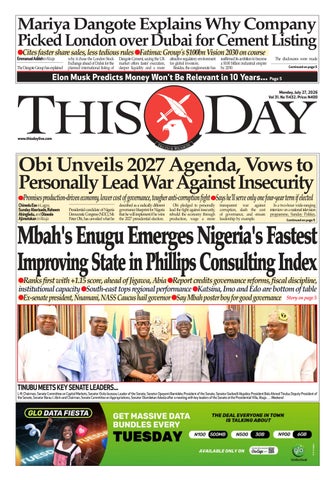
MEETS KEY SENATE LEADERS...
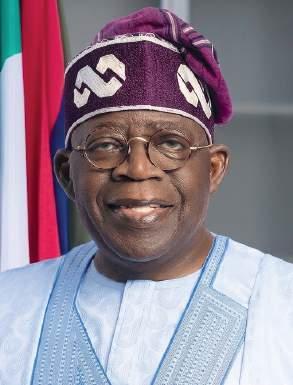
L-R: Chairman, Senate Committee on Capital Markets, Senator Osita Izunaso; Leader of the Senate, Senator Opeyemi Bamidele; President of the Senate, Senator Godswill Akpabio; President Bola Ahmed Tinubu; Deputy President of the Senate, Senator Barau I. Jibrin and Chairman, Senate Committee on Appropriations, Senator Olamilekan Adeola
Chinedu Eze in Lagos, Sunday Aborisade, Raheem Akingbolu,
Emmanuel Addeh in Abuja The Dangote Group has explained
Elon Musk Predicts Money Won't Be Relevant in 10 Years
Emmanuel Addeh in Abuja
World's richest person, Elon Musk, has predicted that money could become largely irrelevant within the next decade as advances in artificial intelligence and robotics usher in what he described as an era of "incredible abundance," where machines produce more goods and services than humanity can consume.
Speaking in a wide-ranging
Enugu State has been ranked as Nigeria's fastest-improving state in the 2026 Phillips Consulting State Performance Momentum Index, outperforming 32 other states in the latest assessment of governance and development across the country.
The report assigned Enugu led by Governor Peter Mbah a Momentum Score of +1.15, the highest among the 33 states assessed, placing it ahead of Jigawa, which scored +0.77, and Abia with +0.67 to complete the top three.
According to Phillips Consulting, the Momentum Index measures the rate at which states improved relative to the national average during the review period. Positive scores indicate aboveaverage progress, while negative scores reflect slower-than-average improvement.
The index is one of the major additions to the 2026 Phillips Consulting State Performance Index (pSPI), a data-driven
yesterday, in which he articulated his vision for the country, Obi also renewed his commitment to serve only one four-year term if elected president next year.
He said the period would be sufficient to place Nigeria on the path of sustainable development and restore citizens' confidence in government.
His intervention comes as political activities ahead of the 2027 general election gradually gather momentum, with opposition figures outlining their policy alternatives to the administration of President Bola
in separate interviews with Bloomberg by Mariya Dangote, a board member of Dangote Cement Plc, and Fatima Dangote, Executive Director, Oil and Gas, Dangote Group, providing fresh insight into the conglomerate's capital market strategy and long-term expansion plans.
Mariya Dangote said the company decided to pursue a secondary listing in London because investors can buy and sell shares more quickly on the UK exchange than on alternative international exchanges, including Dubai.
According to her, recent reforms in the UK's capital market
interview with The Economist, Musk said the rapid pace of technological innovation would fundamentally transform the global economy and labour market, making traditional concepts of wealth and employment less important. "Money won't matter in 2036," Musk insisted.
Questioning the future role of money, the Tesla and SpaceX chief executive maintained that with surplus goods than humans can consume, money
framework that evaluates governance and development outcomes across Nigeria's 36 states and the Federal Capital Territory (FCT).
Unlike traditional rankings that focus solely on current performance, the Momentum Index tracks the pace of change over time by combining objective development indicators with citizen perception to provide a broader assessment of each state's progress.
Beyond the top three states, Osun (+0.65), Kano (+0.46), Gombe (+0.39), Akwa Ibom (+0.33), Sokoto (+0.27), Borno (+0.26), Ogun (+0.24), Ekiti (+0.19), Kogi (+0.15), Kwara (+0.08), Kaduna (+0.01) and Adamawa (+0.01) also posted positive momentum scores, signalling improvement that was above or broadly in line with the national average.
On the other hand, Niger (-0.03), Bauchi (-0.05), Plateau (-0.07), Lagos (-0.08), Cross River (-0.09), Bayelsa (-0.10), Taraba (-0.14), Nasarawa (-0.17), Anambra
Tinubu.
On security, Obi faulted the current approach to combating insecurity, insisting that Nigeria requires more committed and visible leadership.
He said unlike the present arrangement, he would personally coordinate the country's response to insecurity, regularly visit troubled communities, and ensure that security agencies receive adequate equipment, funding and operational support.
Obi stated, "I will personally lead the fight against insecurity. I will be visible, engaged and
regulations have significantly improved London's attractiveness as a destination for emerging market companies seeking international capital, making it the preferred venue for Dangote Cement's planned overseas listing. The secondary listing, expected before the end of 2026, will complement the company's primary listing on the Nigerian Exchange (NGX), enabling global institutional investors across Europe and North America to trade Dangote Cement shares directly in major international currencies without the settlement and foreign exchange constraints associated with local markets.
would become useless in the next 10 years.
"What do you want money for? You want money for goods and services, right? If robots and AI are providing more goods and services than any human could possibly consume, what do you need money for in that case?" he asked.
Musk argued that widespread automation would not necessarily result in economic hardship, predicting instead what he called
(-0.19), Delta (-0.24), Kebbi (-0.25), Oyo (-0.26), Ebonyi (-0.32), Ondo (-0.43), Benue (-0.49), Katsina (-0.66), Imo (-0.72) and Edo (-0.79) recorded below-average momentum, with Edo ranking as the least-improved state during the assessment period.
“The highest-performing states demonstrate different pathways to improvement. Although several common themes emerge, stronger fiscal management, improvements in internally generated revenue, investments in service delivery, and prudent debt management are prominent across many leading states.
“Enugu recorded the highest Momentum Index score, supported by substantial growth in internally generated revenue through revenue administration reforms. The state now earns more than twice its federal allocation alongside notable investments in water infrastructure and sustained capital spending,” the report stated.
Overall, the findings suggested that favourable
directly involved. I will visit affected communities and ensure that our security architecture is properly equipped, adequately funded, and fully supported.
"We will work with all our domestic and international partners to secure every part of Nigeria."
Although declining to disclose operational strategies publicly, Obi promised to strengthen security institutions and provide them with the support required to tackle terrorism, banditry, kidnapping, and other violent crimes.
According to him, poverty
The move is also expected to broaden the company's investor base while improving access to long-term international capital as it pursues an ambitious expansion programme across Africa, with the company offering about 10 per cent of its equity to foreign institutional investors as part of the exercise.
“It will happen maybe by the end of this year, you know, the secondary listing, and we are planning to list in London because I think we compared many like stock exchanges. London is the one that is compatible with our business. Before, we thought of the secondary listing in Dubai, but
"universal high income" as AI systems increasingly take over productive activities currently performed by humans.
He also suggested China could emerge as a dominant force in artificial intelligence because of its growing computing capacity, noting that Chinese technology companies were already making significant progress despite having comparatively limited computing resources.
The billionaire acknowledged
economic conditions alone were not sufficient to improve momentum, stressing that states that complemented increased fiscal resources with effective governance, sound financial management, and improvements in public service delivery generally recorded stronger performance than those where these gains were not realised.
Since his assumption of office, the Enugu government has said it prioritised infrastructure, education, healthcare, security and economic growth as part of an ambitious agenda to transform Enugu into a leading investment destination.
The government said it has embarked on the construction and rehabilitation of hundreds of kilometres of roads and bridges, launched an extensive urban renewal programme, expanded water supply projects and invested in transport infrastructure.
In education, it has begun the rollout of Smart Green Schools across the state's wards, while the healthcare sector has seen
remains the biggest driver of insecurity, and lasting peace cannot be achieved without massive investments in education, job creation, and economic opportunities for young Nigerians.
He said, "You cannot create widespread poverty and expect peace. The more people are pushed into poverty, the greater the insecurity. Education and job creation remain the most sustainable solutions."
On the economy, Obi said his administration would abandon what he described as a consumption-driven model and
the rules, you know, will make it hard for us to do the primary listing in Dubai.
“There are many regulatory compliance that we have to do, and it will take us more years, and we have been talking about this listing for almost like I think six or five years, more than that.
I'm confident because we did all our background checks and everything.
“As I'm talking now, you know, we have our lawyers, our financiers, and every other person, and even the team are working day and night to see if there is anything that will stop the listing, and as I'm talking now,
that he became "a little too involved in politics" following his role in the 2024 United States presidential election, after President Donald Trump appointed him senior adviser and co-head of the Department of Government Efficiency (DOGE), which ceased operations earlier this month.
According to Musk, the department was established to ensure public funds were spent prudently and to curb fraudulent expenditure. "I got a lot of flak from this," he admitted.
the development of Type-2 Primary Healthcare Centres and the upgrade of existing medical facilities to improve access to quality healthcare.
The administration has also pursued reforms aimed at boosting Internally Generated Revenue (IGR), improving the ease of doing business and strengthening digital governance. Investments in agriculture, technology and youth empowerment have been complemented by enhanced security initiatives, including the deployment of surveillance technology and the establishment of a modern command-andcontrol system to support law enforcement.
Phillips Consulting explained that the Momentum Index evaluates the extent of change recorded by each state during the review period, rather than measuring absolute performance.
According to the report, Enugu's emergence as the national leader reflects deliberate governance, strong fiscal discipline
replace it with a production-based economy anchored on agriculture, manufacturing, and support for small businesses.
He maintained that Nigeria possessed sufficient human and natural resources to become a major global producer of agricultural commodities if appropriate policies were implemented.
According to the NDC presidential candidate, "Nigeria must move from consumption to production. Agriculture alone can generate more revenue than crude oil if properly developed.
nothing, no constraint for now,” she stated.
Dangote Cement, Africa's largest cement producer, currently has an installed production capacity of about 55 million metric tonnes annually across 11 African countries and plans to increase that figure to more than 80 million tonnes by 2030.
The planned London listing forms part of a larger capital market strategy by Dangote Industries Limited (DIL), which also includes plans to list the Dangote Petroleum Refinery and its fertiliser business in the coming years.
The overseas listing follows
and sustained implementation of reforms, while the South-east recorded the strongest overall regional performance among Nigeria's six geopolitical zones. The report noted that Enugu's performance demonstrates how purposeful leadership and disciplined execution of public policies can translate into measurable development outcomes within a relatively short period.
It further highlighted the state's progress in governance effectiveness, institutional reforms and implementation capacity, describing Enugu as one of Nigeria's leading examples of transformational governance.
Phillips Consulting ranking provides independent validation of Enugu's reform agenda and reinforces its position as one of Nigeria's emerging models for sustainable development and effective governance.
Earlier, speaking at the launch of the 2026 pSPI, Chairman of
We have enough arable land not only to feed ourselves but also to become a major exporter." He added that government under his leadership would prioritise support for farmers and manufacturers, improve access to affordable credit, and create an enabling environment for businesses to thrive.
Drawing comparisons with countries, such as Bangladesh, the Netherlands, Indonesia, and China, Obi stated that Nigeria's economic revival would
recent comments by President of Dangote Group, Aliko Dangote, who indicated that several of the group's businesses remained privately held, resulting in what he described as an understatement of the value of his assets. Speaking previously, Dangote had said: "Most of our businesses are not listed yet... It will come out soon."
In a related interview with Bloomberg, Fatima Dangote reaffirmed the conglomerate's Vision 2030, saying the group remains firmly committed to transforming itself from a business
Emmanuel Addeh in Abuja
Musk
Email: Goddy.egene@thisdaylive.com,
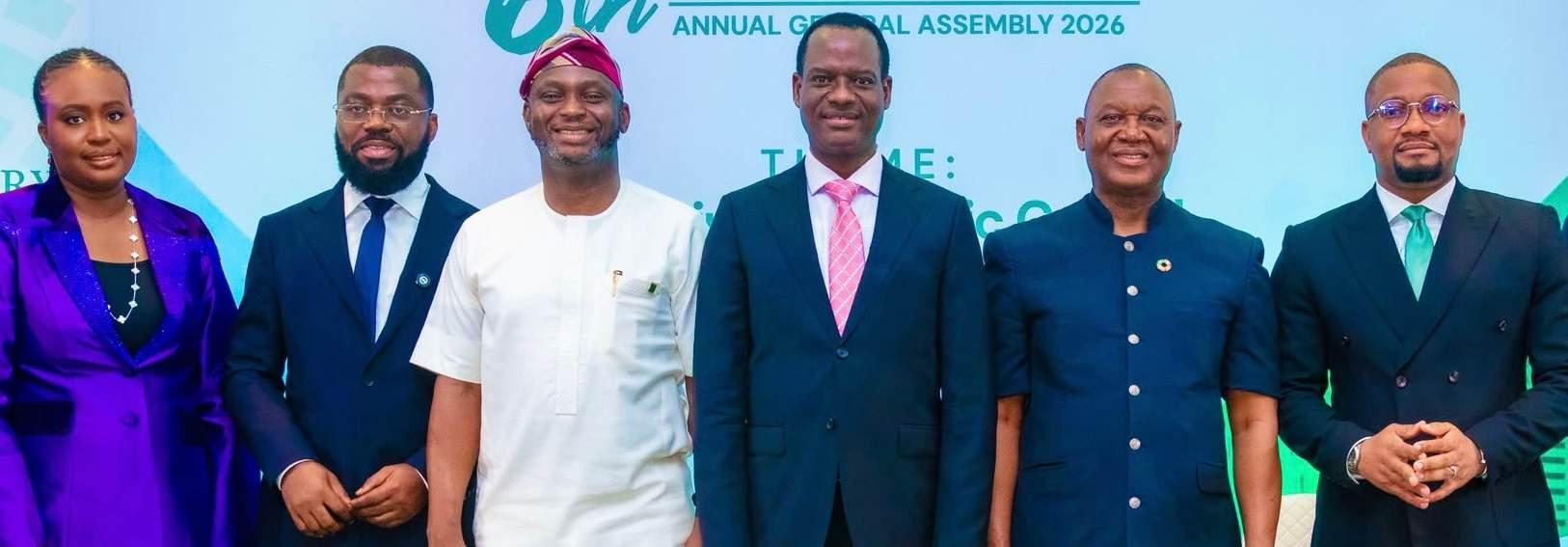
6TH ANNUAL GENERAL ASSEMBLY OF THE ASSOCIATION OF NIGERIAN DEVELOPMENT FINANCE INSTITUTIONS...
Olusi: Nigeria Must Mobilise Domestic Funds for Development, Reduce
Declares domestic
James Emejo in Abuja
Reliance on Foreign Capital
capital key for infrastructure, industrialisation, $1tn economy Oyedele
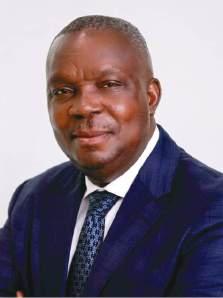
Managing Director/Chief Executive, Bank of Industry (BoI), Dr. Olasupo Olusi, has declared that the country must urgently shift from excessive dependence on foreign development finance and begin the mobilisation of domestic capital on a much larger scale to fund its economic transformation.
Olusi said the era when countries relied heavily on longterm international development financing is steadily fading.
He spoke while addressing participants at the 6th Annual Conference and General Assembly of the Association of Nigerian Development Finance Institutions (ANDFI), with the theme, "Unlocking Domestic Capital for Development Financing" in Abuja over the weekend.
He said it was imperative for the country to build a stronger domestic financing architecture capable of supporting infrastructure development, industrialisation, agriculture, housing, manufacturing, and
micro, small and medium enterprises (MSMEs).
ANDFI provudes policymakers, development finance institutions, multilateral agencies and financial sector leaders the platformto discuss strategies for financing Nigeria's development agenda.
Olusi, who also chairs ANDFI, said the conference theme reflected one of the country's most urgent economic realities.
According to him, Nigeria can no longer afford to postpone the difficult but
necessary task of mobilising local resources to finance national development.
outlines priorities to accelerate domestic capital mobilisation investments must increasingly flow into infrastructure, industrialisation, agriculture, housing, MSME development and other sectors identified under Nigeria's long-term development strategy.
He said, "As access to long-term global development capital becomes increasingly constrained, mobilising domestic resources is no longer simply desirable. It is essential."
He stressed that domestic capital must now assume a much greater responsibility in financing strategic sectors that will determine Nigeria's future competitiveness.
According to him,
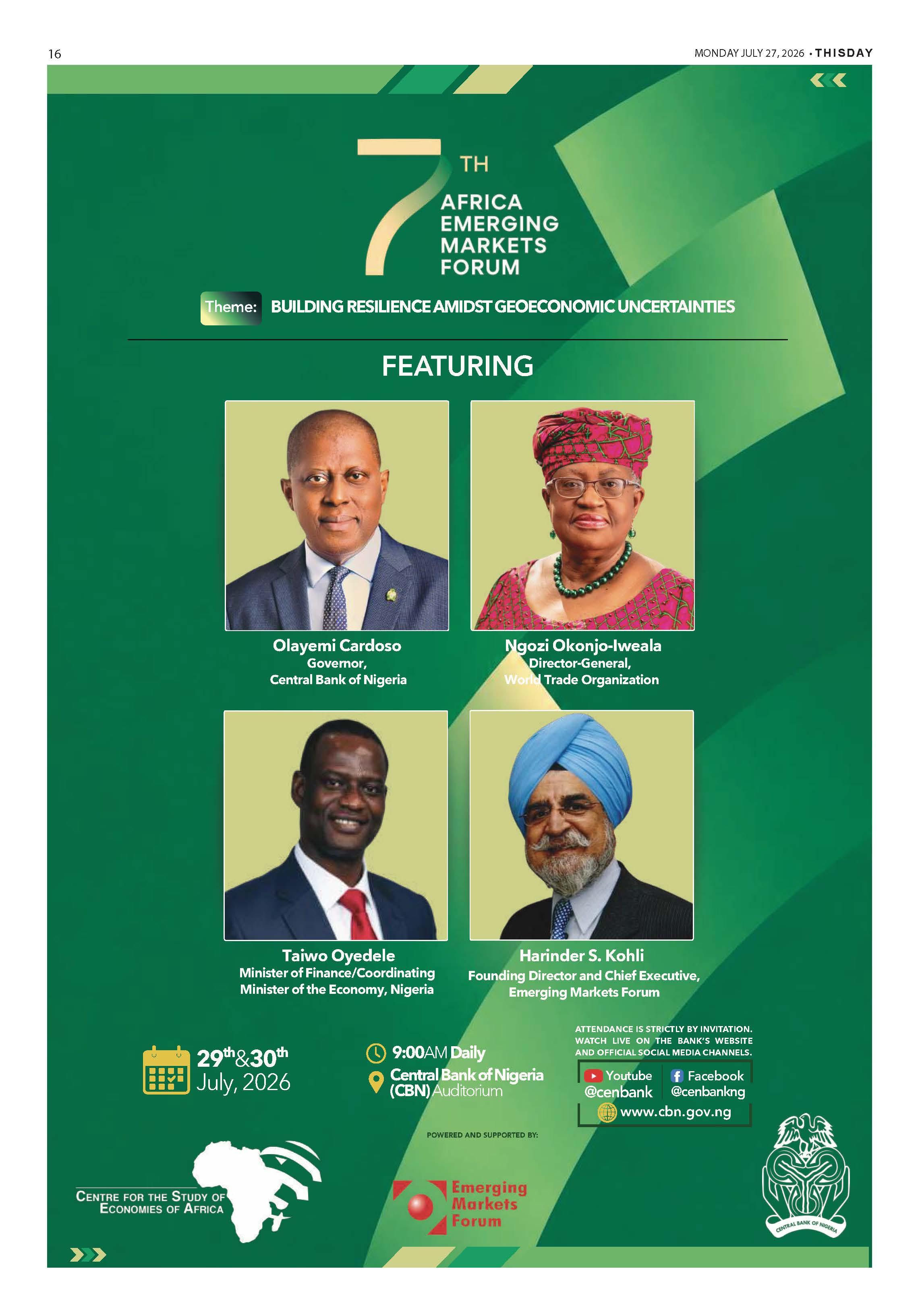
Cardoso, Okonjo-Iweala, Oyedele to Offer Insights on Reforms, Macroeconomic Stability, Growth Acceleration, Others
James Emejo in Abuja
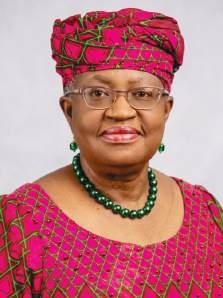
Governor of the Central Bank of Nigeria (CBN), Mr Olayemi Cardoso, and Director-General, World Trade Organisation (WTO), Dr Ngozi Okonjo-Iweala, will lead discussions at the 7th Africa Emerging Markets Forum, hosted by the apex bank, in partnership with Emerging Markets Forum (EMF) and Centre for the Study of the Economies of Africa (CSEA).
Themed, "Building Resilience
Amidst Geoeconomic Uncertainties", the event is scheduled to hold between July 29 - 30, 2026 in Abuja.
The dialogue is expected to focus on practical policy choices that can help African economies strengthen resilience, sustain difficult reforms, deepen regional trade integration and position the continent for longterm growth despite increasing global economic fragmentation.
The Cardoso-Okonjo-Iweala fireside session will provide a
platform for candid discussions on how African countries can preserve macroeconomic stability while pursuing reforms capable of attracting investment, boosting competitiveness and accelerating inclusive growth.
According to a statement by the central bank, the event will also feature keynote addresses by Minister of Finance and Coordinating Minister of the Economy, Mr. Taiwo Oyedele, and the Minister of Science, Technology and Innovation, Dr.
Kingsley Udeh, highlighting the growing importance of aligning fiscal, monetary and innovation policies to support sustainable development.
According to the organisers, this year's forum aims to foster open dialogue on issues of strategic importance to emerging markets and developing economies while identifying practical policy solutions that can be adapted to the unique circumstances of individual countries.
Olusi noted that development finance institutions have become more important than ever because they occupy a strategic position between government policy and private sector investment.
He said DFIs are expected not only to provide financing but also to mobilise capital, improve access to finance, strengthen businesses and catalyse inclusive economic growth.
According to him, "Development finance institutions occupy a unique position at the intersection of public policy and private enterprise. Our responsibility goes beyond lending. We must mobilise capital, expand access to finance, support businesses and catalyse sustainable economic development."
He noted that despite increasingly difficult global financial conditions, tighter international liquidity and heightened uncertainty
across global markets, Nigerian development finance institutions have continued to support national economic priorities.
According to him, DFIs have remained committed to implementing President Bola Tinubu's Renewed Hope Agenda by financing productive sectors of the economy.
Reflecting on the progress recorded since the establishment of ANDFI, Olusi said the association had evolved into an important platform for collaboration among federal, regional and stateowned development finance institutions.
He said stronger institutional cooperation had helped members exchange ideas, deepen technical capacity and jointly address some of Nigeria's biggest development finance challenges.
He said, "Together, we have strengthened institutional partnerships, built capacity, shared knowledge and experience, and advanced practical solutions to some of Nigeria's most pressing development finance challenges."
Johnvents Unveils First Sustainability Report, Screens 50,000 Farms in ESG Drive
Fidelis David in Akure
Johnvents Group, a multinational agribusiness and manufacturing company has unveiled its inaugural Sustainability Report, setting out an ambitious roadmap for environmental protection, responsible sourcing and corporate governance in
a move that reinforces the growing push for sustainable business practices within Nigeria's agribusiness sector and global export markets.
The firm said the report demonstrates its commitment to transparent, accountable and sustainable growth, while aligning its operations with internationally
recognised Environmental, Social and Governance (ESG) standards.
Covering the 2025 reporting period, the report was prepared in accordance with the Global Reporting Initiative (GRI) 13: Agriculture, Aquaculture and Fishing Sectors 2022 Standard. It also incorporates
a Double Materiality Assessment aligned with the Corporate Sustainability Reporting Directive (CSRD), providing a comprehensive assessment of the group's environmental, social and governance performance. The report consolidates sustainability initiatives across the group's subsidiaries,
including Johnvents Foods, Johnvents Industries, Premium Cocoa Products, Ile-Oluji, and Noble-Eagle.
Founder and Group Managing Director of Johnvents Group, Mr. John Alamu, described the publication as a defining moment in the company's journey towards responsible
and sustainable growth. "This report marks the beginning of a new phase in how we measure, manage and communicate our environmental and social impact. It reflects our commitment to accountability, transparency and creating long-term value for all stakeholders," Alamu said.
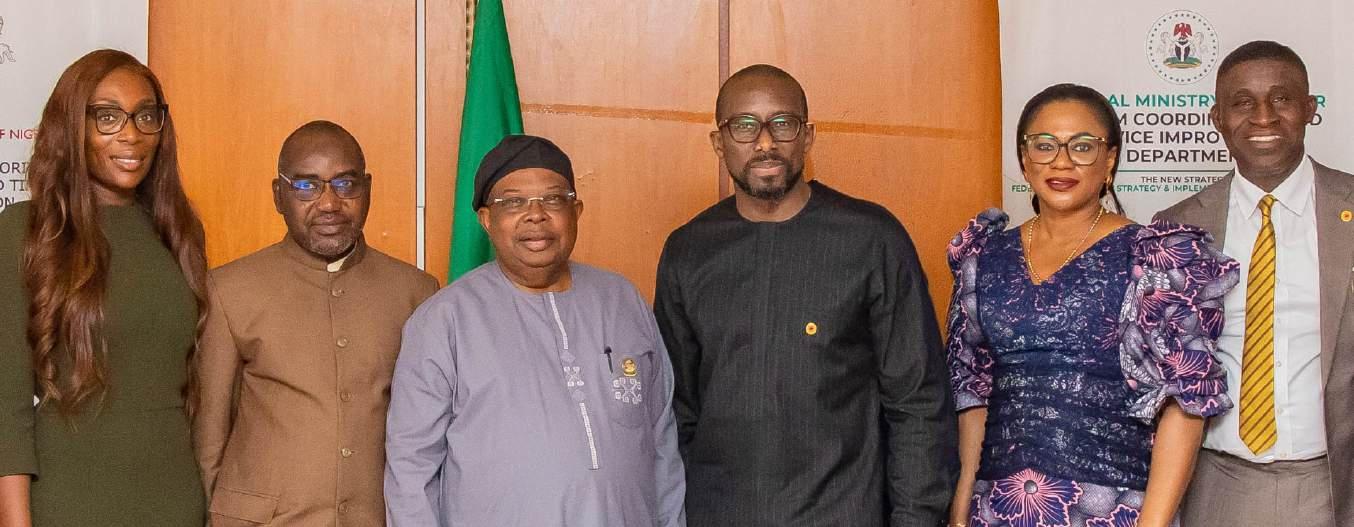
L-R: Founder and Managing Partner, Aruwa Capital Management, Adesuwa Okunbo Rhodes; Managing Director/Chief Executive Officer, Bank of Agriculture (BOA), Ayo Sotinrin; Managing Director/Chief Executive Officer, Bank of Industry (BOI) and Chairman, Association of Nigerian Development Finance Institutions (ANDFI), Dr. Olasupo Olusi; Honourable Minister of Finance and Coordinating Minister of the Economy, Prof. Taiwo Oyedele, who delivered the keynote address; Regional Director General for Nigeria, African Development Bank (AfDB), Dr. Abdul Kamara; and Director-General, Small and Medium Enterprises Development Agency of Nigeria (SMEDAN), Charles Odii, at the 6th Annual General Assembly of the Association of Nigerian Development Finance Institutions (ANDFI), themed "Unlocking Domestic Capital for Development Financing," held in Abuja.
COURTESY VISIT BY THE OANDO DELEGATION TO THE MINISTER OF POWER...
Oando Meets Power Minister, Lists Contributions of Its 480MW Okpai Plant
Says facility supplies 15% of Nigeria's total electricity Reaffirms
Emmanuel Addeh in Abuja
Oando Energy Resources (OER), a subsidiary of energy group, Oando Plc, has met with the Minister of Power, Joseph Tegbe, to discuss the company's role in advancing the nation's gas-to-power ambitions as well as the potential of domestic gas utilisation.
The meeting, according to
a statement from the energy company, underscored the growing partnership between the private sector and government in tackling Nigeria's energy challenges.
It brought together senior representatives from the company's upstream division and officials from the ministry, in a session both partners described as timely and productive, given
FG Vows to Sustain Investments in Youth Devt, Expansion of Economic Opportunities
Pleased with UNN for keying into Renewed Hope Agenda
Emmanuel Ugwu-Nwogo in Enugu
The federal government has expressed commitment to sustain the current momentum in its investment drive and initiatives towards capacity building for Nigerian youths, expansion of economic opportunities, and overall development.
President Bola Tinubu gave the assurance at the weekend during the 55th convocation ceremony of the University of Nigeria Nsukka (UNN), saying there is need to adequately prepare the country's youth for "the responsibility of building a better society".
Tinubu said his administration placed high premium on the youth population because Nigeria needs their knowledge, creative courage, and integrity to achieve its national development goals.
"The future of our country will be shaped not only by government but also by who
are prepared to solve problems, create jobs, build industries, and strengthen our democracy," Tinubu said.
The president’s address was read by his representative at the event, Professor Edoba Omoregie, Vice-Chancellor of the University of Benin.
The president acknowledged the anxiety among Nigerian youth about what the future held for them.
But he assured the youth that "my administration is doing everything possible to ensure that our youth are productively engaged" hence they should "embrace the future with optimism".
Tinubu stated, "We are promoting digital economy by expanding tech hubs, digital skills training, and providing funding for young tecn entrepreneurs.
“We have equally laid out plans to repackaging the NYSC to be skill and entrepreneurshiporiented and technology-driven."
ongoing efforts to resolve constraints within the power sector.
Speaking at the meeting, Managing Director, OER, Dr Ainojie Irune, outlined the scale of the company's gas assets, noting that its operations currently supports power generation infrastructure and directly contributes to the national grid through its Independent Power Plant (IPP) Okpai.
According to Oando, the plant which provides 50 million Nigerians with electricity, is responsible for approximately 15 per cent of the nation’s power supply.
Irune highlighted the strong operational track record of the ‘black start’ facility, citing decades of reliable output, and stressed
commitment to gas-led economic growth
that the company's broader portfolio is increasingly weighted toward gas, a shift he described as central to the country's economic future.
"Domestic capacity is not only an imperative now, but it is also the only way we get out of an economic crisis,” Irune said, adding that building a productive economy and supporting industrialisation would require sustained investment in basic infrastructure and power.
The company also detailed work being done through its clean energy division, Oando Clean Energy (OCEL) established five years ago, to explore how gas, solar, wind, and hydro resources can be blended to expand access to reliable and affordable power across the continent.
Irune pointed out innovative efforts already underway, including a pilot project repurposing abandoned oil wells across the Oando Joint Venture to generate geothermal-style power, as an example of the kind of creative, homegrown solutions the sector will need going forward. He emphasised that the responsibility for Nigeria's energy transformation could not rest on any single stakeholder. "The ambition is not yours alone," he told the minister, calling for a shared, long-term commitment between government and industry to realise the sector's set roadmap.
Irune stated that Oando remains committed to supporting Nigeria's power agenda, reinforcing its long-held view
that gas is central to the country's industrial future.
According to the company, the visit reflects a broader momentum building around gas as the linchpin of Nigeria's energy strategy, one that industry and government leaders increasingly agree will determine the pace of the country's industrial growth in the years ahead.
In his remarks, the minister welcomed the company's continued engagement, describing the discussions as a valuable opportunity to align government policy with private sector capacity, and noted that the ministry remains focused on strengthening gas-to-power delivery as one of the cornerstones of the nation's industrialisation agenda.
Babcock Graduates 3,521, Produces 306 First Class Honours
Honours Gov Sanwo-Olu with leadership, service award Embrace opportunities, faith, integrity, charges Lagos gov
Funmi Ogundare
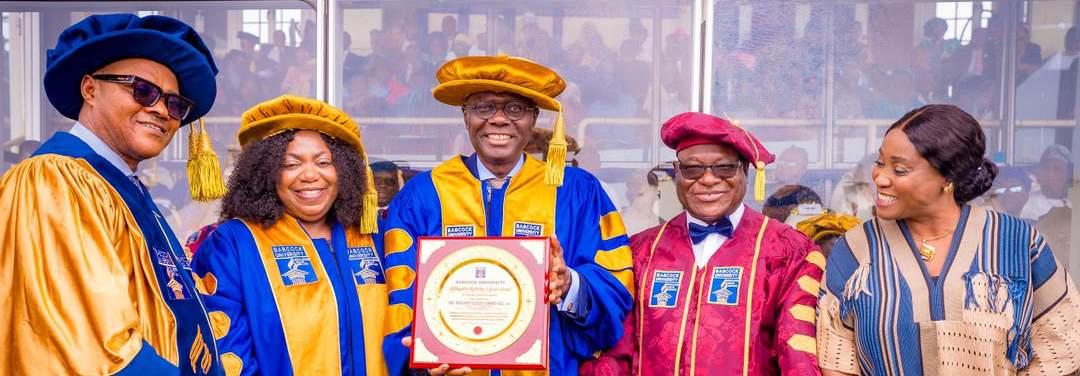
Babcock University, IlishanRemo, Ogun State, weekend, graduated 3,521 students, with 306 earning First Class honours across its various schools.
In a related development, the institution honoured the Lagos State Governor, Mr. Babajide Sanwo-Olu, with the Leadership and Service Award in recognition of his outstanding performance and excellence in governance in Lagos State, during the varsity’s 24th Undergraduate Convocation Ceremony.
The university also named Miss Oluwapelumi Amosu of
the Veronica Adeleke School of Social Sciences as its overall best graduating student after she attained an outstanding Cumulative Grade Point Average (CGPA) of 4.96. In recognition of her exceptional academic performance and contributions to leadership, community development and spiritual service, Amosu received the President and Senior Vice President's prize, alongside several awards.
She was also presented with cash prizes, including N10 million from the Sunbeth Excellence Partnership Program
(SEPP).
In his commencement speech titled, Break New Grounds', the Lagos State Governor, Babajide Sanwo-Olu, urged the graduating class to embrace faith, resilience and adaptability as they prepare for life beyond the university.
He stressed the world rewards competence, value and perseverance rather than entitlement.
He stated that the Nova Class of 2026, were stepping into a new chapter filled with opportunities and responsibilities. According to him, while
the university has provided them with a solid academic foundation, it is now their responsibility to build on it and distinguish themselves in an increasingly competitive global environment.
"The world will not give you what you believe you deserve. The world will only give you what you become known for being," he said.
Sanwo-Olu recalled his own graduation nearly four decades ago, saying that when he left the university in 1988, the world was vastly different, with no internet, mobile phones, or virtual work opportunities.
L-R: Head of Corporate Communications, Oando Energy Resources (OER), Sinmisola Hughes-Obisesan; Permanent Secretary, Federal Ministry of Power, Alhaji Mahmuda Mamman; Honourable Minister of Power, Joseph Olasunkanmi Tegbe; Managing Director, OER, Dr Ainojie 'Alex' Irune; Chief of Staff to the Honourable Minister of Power, Doyin Adelabu; and General Manager, Base and District Management, OER, Solomon Ikanade-Agba, during a courtesy visit by the Oando delegation to the Federal Ministry of Power in Abuja
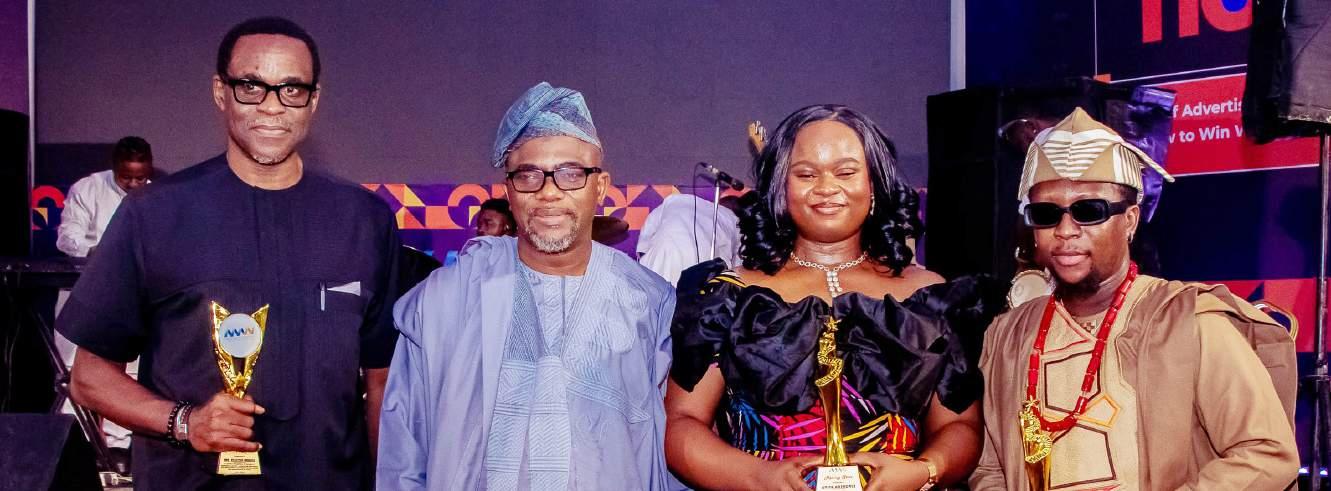
4TH NIDCOM AWARDS CEREMONY...
$1 Trillion Economy: Education Minister Says Reforms Building Nigeria’s Future Workforce
Kuni Tyessi in Abuja
The Minister of Education, Dr. Tunji Alausa, has said education will be the key driver of President Bola Ahmed Tinubu’s plan to build a $1 trillion Nigerian economy by 2030.
Speaking in an interview yesterday, Alausa said the federal government is repositioning the education sector to produce a globally competitive workforce through sustained investments in human capital development,
skills acquisition, and tertiary education reforms.
“We want to be the manpower supplier of the world. We need to produce competent, skilled and educated young Nigerians who will drive our economy, contribute to Africa's growth and compete successfully across the world,” he said.
The minister highlighted major interventions in the health sector, noting that annual admissions into nursing schools have risen from about 20,000 to 50,000.
Ernst & Young to Host Webinar on FRC Draft Valuation Rules
Global professional services firm, Ernst & Young (EY) Nigeria, will this week host a webinar aimed at helping businesses, valuation professionals and other stakeholders understand and prepare for the implementation of the Financial Reporting Council of Nigeria's (FRC) draft valuation regulations.
The virtual session, scheduled for Wednesday, July 29, is expected to provide practical guidance on the implications of the proposed rules, which introduce new expectations for valuation quality, governance, transparency and regulatory oversight within Nigeria's financial reporting framework.
According to EY, the webinar, themed: "Navigating the FRC Valuation Guidelines for Financial Reporting: Key Requirements and Practical Considerations," will examine the evolving valuation landscape, the rationale behind the draft regulations and their implications for reporting entities, valuation professionals, auditors, boards and management.
The firm said the programme is designed to equip participants with insights into the emerging regulatory environment and practical steps required to ensure compliance once the guidelines come into effect.
EY noted that the session would be particularly relevant for board members, chief executive officers, chief financial officers, finance directors, audit committee members, finance professionals, valuation specialists, auditors, risk professionals and other stakeholders involved in financial reporting, governance and regulatory compliance.
The webinar will feature a keynote presentation by the Head of the Directorate of Valuation Standards at the FRC, Ugochukwu Nwora, who is expected to speak on the background, rationale and key requirements of the draft valuation regulations.
Participants will also engage in an interactive panel discussion featuring EY partners Olufemi Alabi, Abiodun Ogunoiki, Jamiu Olakisan and Williams Erimona, alongside Idowu Bakare and Nwora.
Admissions into medicine, pharmacy and dentistry have also been expanded.
He expressed optimism that the reforms will end the shortage of healthcare professionals in the coming years.
On financing, Alausa said the Nigerian Education Loan Fund, NELFUND, was
designed with a sustainable model to support students across generations.
He added that President Tinubu had directed that all major reforms must outlast the current administration.
Speaking on industrial relations, the minister credited the president’s leadership for restoring stability in tertiary
institutions. He noted that government paid 50% of withheld salaries owed to university unions and approved a nearly 40% salary increase for staff.
According to him, the improved climate has reflected in global rankings, with Nigerian universities in the Times Higher Education
list rising from 21 to 24, and public universities reclaiming top national spots. Alausa reaffirmed the ministry’s commitment to expanding access, strengthening human capital, and preparing Nigerian youths to compete globally under the President’s Renewed Hope Agenda.
Bonga: Ex-NLNG CEO, Energy Analyst Differ on FG’s $11.5/Barrel Tax Credit for Shell
Emmanuel Addeh in Abuja
A former Managing Director of Nigeria LNG (NLNG), Babs Omotowa and Energy Analyst, Kelvin Emmanuel have disagreed sharply over the federal government's decision to grant Shell Plc an enhanced $11.50 per barrel production-linked tax incentive for the Bonga South West Aparo deepwater project.
Omotowa, a non-executive director at the Nigerian National Petroleum Company (NNPC), former independent non-director at Seplat and ex-Shell executive defended the fiscal concession as a necessary catalyst for a $20 billion investment.
But Emmanuel described it as
an overly generous package that favours operators at the expense of government revenues.
The exchange, which unfolded on social media, specifically on LinkedIn, attracted widespread attention within Nigeria's oil and gas industry, highlighting the growing divide over the use of fiscal incentives to revive investment in the country's upstream sector.
The controversy followed President Bola Tinubu's approval of an investment-linked fiscal package for the long-delayed Bonga South West Aparo development, including a production tax credit of $11.50 per barrel, which experts say is more than double the standard
incentive provided under the Petroleum Industry Act (PIA).
The package is expected to unlock the project's Final Investment Decision (FID) after almost two decades of delays.
In an article titled: "100% of Zero is Zero: What NLNG Teaches Us About the Bonga SW Tax Incentive," Omotowa argued that the value of the incentive should be judged by its ability to unlock investments that would otherwise remain stranded.
Drawing parallels with the NLNG project, he noted that the NLNG Act of 1989 was also criticised for offering generous tax incentives but eventually unlocked billions of dollars in investment and substantial long-term returns for Nigeria.
According to him, undeveloped projects generate no revenue, employment or economic value. "The Bonga South West field has sat stranded since 2010. This is nearly two decades of idle oil that has paid no dividends, created no jobs and funded no roads simply because it has never been allowed to flow," Omotowa wrote. He argued that NLNG has since generated about $130 billion in sales revenue, more than $36 billion in direct fiscal revenues to the government, alongside thousands of jobs and significant domestic economic activity, demonstrating that carefully designed incentives can produce lasting national benefits.
Michael Ugbewanko Joins Forbes Human Resources Council, Takes African Leadership Voice Global
Sunday Ehigiator
Nigerian management consultant, organizational strategist, and leadership expert, Michael Odafe Ugbewanko, has joined the prestigious Forbes Human Resources Council, positioning him among global leaders influencing conversations around leadership, workforce transformation, and the future of work.
Ugbewanko, the Lead Consultant at Dmidaf Global Consult, was admitted into the invitation-only professional community comprising senior human resources executives, chief people officers, founders, and business leaders who are driving innovation and shaping the evolution of organizations globally.
His admission into the council represents a major
recognition of his contributions to organizational effectiveness, human capital development, and leadership transformation, while also providing a platform for him to amplify African perspectives in global business conversations.
The Forbes Human Resources Council brings together accomplished professionals in the human resources ecosystem, including C-suite executives, vice
presidents, directors, founders, and business owners who have demonstrated measurable impact and leadership excellence within their fields.
In a congratulatory message to Ugbewanko, Forbes Councils Member Success Specialist, Jessica McClendon, welcomed him into the global community and highlighted the opportunities available to members.
Emmanuel Addeh in Abuja
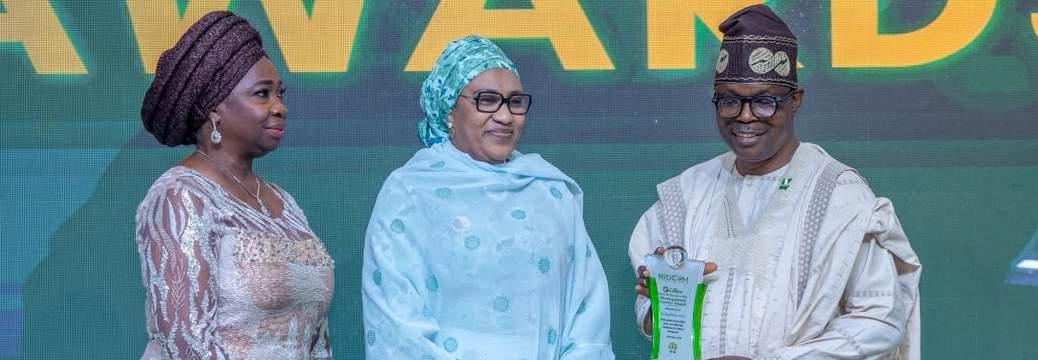
L-R: Chairman/CEO of NIDCOM, Hon. Mrs. Abike Dabiri-Erewa; Wife of the Vice President, Hajia Nana Shettima (who represented the First Lady of Nigeria), presenting an award to the Minister of state for Health, Dr. Ishaq Salako, at the 4th NIDCOM Awards Ceremony held in Abuja on Saturday
Delta State Economic and Investment Summit 2026
REQUEST FOR EXPRESSIONS OF INTEREST
(CONSULTING SERVICES – FIRMS SELEC TION)
DEVELOPMENT BANK OF NIGERIA PLC.
FEDERAL REPUBLIC OF NIGERIA
LIVESTOCK PRODUC TIVITY AND RESILIENCE SUPPORT PROJEC T
Loan No./Credit No./ Grant No.: P160865
ASSIGNMENT TITLE: CONSULTANCY SER VICES FOR THE COMPREHENSIVE INSTITUTIONAL DIAGNOSTIC, ORGANIZATIONAL RESTRUC TURING, AND STRATEGIC PLAN DE VELOPMENT FOR THE BANK OF AGRICULTURE (BOA), NIGERIA.
REFERENCE NO. (as per Procurement Plan): NG-DBN-563824- CS- QCBS
Development Bank of Nigeria has received �nancing from the World Bank towa rd the cost of the Livestock Produc tivit y and Resilience Suppor t Projec t and intends to apply par t of the proceeds for consulting ser vices
The consulting ser vices (“the Ser vices”) will equip and strengthen the BOA with an independent, evidence -based basis for its restruc turing and recapitalizing, and with a credible new strategy for its future Speci�c objec tives of the assignment are:
• Establish the Bank's true �nancial position through an independent asset quality review, yielding a veri�ed opening balance sheet and a quanti�ed provisioning gap;
• Design the balance -sheet restruc turing, including the car ve - out of legac y non-per forming assets, the disposal or monetization of noncore assets, and the restruc turing or transfer of legac y liabilities;
• Size and struc ture the recapitalization against the veri�ed, cleaned balance sheet;
• Design governance, credit-process, systems and legal/regulator y reforms consistent with the applicable prudential and corporateg ove r n a n ce f r a m e wo r k a n d i n s u
inter ference;
• Design the ownership restruc turing, including dilution of the current s h a re h o
par ticipation in line with the reform design and tested against prospec tive investor requirements; and
• Develop a new corporate strategy and business plan, grounded in a m a r k e t a n
choice, and international lessons, for a bank able, investable agricultural development �nance institution.
Development Bank of Nigeria Plc. now invites eligible consulting �rms (“Consultants”) to indicate their interest in providing the S er vices. Interested Consultants should provide information demonstrating that they have the required quali�cations and relevant experience to per form the Ser vices The shor tlisting criteria are:
• At least 10 years of Demonstrated experience conduc ting bank/DFI institutional diagnostics, asset quality reviews, �nancial due diligence, loan por tfolio reviews, IFRS 9/provisioning assessment s, prudential reviews or balance -sheet veri�cation for banks, DFIs or comparable regulated �nancial institutions
• Demonstrated experience in bank/DFI restruc turing, recapitalization, balance -sheet clean-up, NPL car ve - out, legac y asset/liability r e s t r u c t u r i n g , o w n e r s h i p r e s t r u c t u r i n g o r
turnaround.
• D e m o n s t rate d ex p e r i e n
development �nance, MSME �nance, cooperative �nance, valuechain �nance or comparable mandate - driven �nancial institutions
• D e m o
�nancial institutions/Agricultural DFIs
• Demonstrated experience in Nigeria, Africa or comparable emerging markets, including familiarit y with regulated �nancial institutions, public-sec tor reform and �nancial sec tor regulator y environments.
• Technical and managerial capability of the �rm, including capacity to manage complex multi-workstream assignments, quality assurance arrangements, projec t governance, data con�dentiality and ability to mobilize multidisciplinar y advisor y capability ( More details on the assignment can be seen in the TOR) please visit our website for m o re i n
tenders
Key Exper ts will not be evaluated at the shor tlisting stage
The attention of interested Consultants is drawn to Sec tion III, parag r a p h s , 3 1 4 , 3 1 6 , a n d 3 1 7 o f t h e Wo r l d B a n k ' s “ P r o c
Regulations for IPF Borrowers” 7th Edition September 2025 (“Procurement Regulations”), setting for th the World Bank's polic y on con�ic t of interest. In addition, please refer to the following speci�c information on con�ic t of interest related to this assignment: Procurement Regulations for I nvestment Pro jec t Financing (IPF) B or rowe rs” outlines s
c circumstances under which consultants should not be hired due to potential con�ic ts of interest. I t states that consultants shall not be hired for assignments that would be in con�ic t with their prior or current obligations to other clients, or that may place them in a position of being unable to carr y out the assignment in the best interests of the Borrower Speci�cally, it mentions that a �rm that has been engaged by the Borrower to provide goods, works, or non- consulting ser vices for a projec t shall be disquali�ed from providing consulting ser vices resulting from or direc tly related to those goods, works, or non- consulting services.
Consultants may associate with other �rms to enhance their quali�cations but should indicate clearly whether the association is in the form of a joint venture and/or a sub - consultanc y In the case of a joint venture, all the par tners in the joint venture shall be jointly and severally liable for the entire contrac t, if selec ted
A �rm will be selec ted in accordance with the Qualit y and Cost Base Selec tion (QCBS) method set out in the Procurement Regulations
Fur ther information can be obtained at the email address below during office hours at piu@devbank ng.com
The deadline for the submission of Expressions of Interest (EOI) is set for twenty- one days (three weeks) period, commencing on Monay, 27th July 2026, and closing on Monday, 17th August 2026, at 11:59 HRS. Any r
Implementation Unit (PIU) at on or before 3rd piu@devbank ng.com
A u g u s t 2 0 2 6 A l l E O I m u s t b e s u b m i t t e d v i a e m a i l t o audit@devbank ng.com.
How Nigeria’s Biggest Army Expansion in Decades’ll Redefine National Security
Nigeria’s decision to undertake its biggest military expansion in decades signals a strategic shift aimed at strengthening national security, enhancing operational readiness and positioning the army to confront an increasingly complex and evolving threat landscape, writes linus Aleke
The decision by President Bola Tinubu to approve the expansion of the Nigerian Army’s order of battle from eight to 12 divisions, alongside the recruitment of an additional 28,000 personnel, marks one of the most significant military reforms in Nigeria’s recent history. More than a routine increase in troop numbers, the initiative reflects an acknowledgement that the country’s evolving security environment demands a larger, more agile and better-distributed military capable of responding to increasingly complex threats.
The Nigerian Army’s history itself is one of continuous expansion shaped by changing national realities. It began in 1863 as the 18-man Glover Hausa Guard, established by the British colonial administration in Lagos to protect commercial interests and maintain order. The force later evolved into the Lagos Constabulary before becoming part of the Royal West African Frontier Force (RWAFF) in 1900, with Nigerian soldiers serving with distinction in both the First and Second World Wars across East Africa, Burma and other theatres.
Following independence in 1960, the Nigerian Military Force became the Nigerian Army, assuming responsibility for defending the sovereignty of the new nation. However, it was the Nigerian Civil War between 1967 and 1970 that fundamentally transformed the Army. Massive recruitment and the establishment of new battalions, brigades and divisions created a modern standing force capable of prosecuting a large-scale conflict. In the years that followed, the Army consolidated its structure, expanded its training institutions and specialised corps, and earned international recognition through peacekeeping operations in Liberia, Sierra Leone and several United Nations and African Union missions.
Since Nigeria’s return to democratic rule in 1999, and particularly with the emergence of the Boko Haram insurgency in 2009, the Army has undergone another major phase of expansion to confront terrorism, banditry, kidnapping, oil theft, piracy and other internal security threats. Today’s proposed enlargement therefore represents the latest chapter in a long tradition of adapting the Army’s structure to meet the nation’s changing security needs.
Military analysts argue that expanding formations is about far more than increasing manpower. Abroader military footprint enhances
the ability to respond rapidly to both conventional and asymmetric threats, especially in a country where insecurity varies significantly across regions.
Additional divisions and formations improve operational reach, reduce response times, strengthen intelligence gathering and surveillance, and enable forces to sustain prolonged operations without overstretching existing units. A more widespread military presence can also reinforce border security, protect critical national infrastructure and deny criminal groups the freedom to exploit ungoverned spaces.
The benefits extend beyond the battlefield. New barracks, operational bases and training facilities often stimulate economic activity in host communities by generating demand for housing, construction, transportation, food supplies and other commercial services. Expansion also creates employment opportunities, not only through military recruitment but across logistics, engineering, healthcare and civilian support services. During emergencies such as floods, disease outbreaks or other disasters, additional formations positioned across the country can significantly improve the speed and effectiveness of humanitarian response.
Equally important is the impact on the professional development of the armed forces. Larger formations provide greater opportunities for recruitment, specialised training and career progression while allowing for improved troop rotation, equipment maintenance and
operational readiness. Strategically positioned formations also strengthen state presence in underserved areas, foster closer coordination with other security agencies and, through civilmilitary engagements, contribute to community development and public confidence.
It is against this backdrop that the Presidency announced the latest expansion. According to a statement issued by the President’s Special Adviser on Information and Strategy, Mr Bayo Onanuga, President Tinubu approved the initiative as part of efforts to strengthen national security and improve the Army’s ability to respond more effectively to emerging threats. The Presidency said the decision reflects the administration’s commitment to building a more robust and responsive military capable of protecting lives, property and Nigeria’s territorial integrity.
The announcement has received broad support from security experts, although many insist that the success of the initiative will depend on careful implementation.
Former Director of Army Public Relations, Brigadier-General Sani Kukasheka Usman (rtd), described the decision as both timely and necessary, noting that the Army’s expansion from eight to 12 divisions had become inevitable given Nigeria’s size, population and increasingly complex security environment.
Speaking on Arise News Night, Usman said: “This initiative is long overdue, considering the country’s vast size, growing population, the myriad security challenges confronting the nation, and the increasingly prominent role of the Nigerian Army in internal security operations over the years.”
According to him, the Army’s training capacity has consistently expanded over time, evolv-
More than a routine increase in troop numbers, the initiative reflects an acknowledgement that the country’s evolving security environment demands a larger, more agile and betterdistributed military capable of responding to increasingly complex threats.
ing from a single training depot to multiple facilities across the country, making it logical for operational formations to grow accordingly. He said: “The Nigerian Army has consistently expanded its capacity over time. For instance, the Depot Nigerian Army was once the sole training institution, except during the Civil War when temporary training facilities were established in Abeokuta and other locations. Today, training capacity has been significantly enhanced with the establishment of additional depots in Oshogbo and Amasiri, Ebonyi State. It is therefore only logical that this growth should be matched by a corresponding expansion in the Army’s order of battle. This is a welcome development that will undoubtedly strengthen the Army’s operational capability.”
He, however, cautioned that organisational expansion alone would not guarantee success.
“Expectations must be managed because this expansion goes beyond organisational structure. There are critical administrative and logistical considerations that must be addressed. While the recruitment of 28,000 additional personnel is commendable, careful attention must be paid to the costs of training, kitting, accommodation and sustainment,” he said.
Usman noted that the accommodation needs of thousands of new recruits, alongside serving personnel already awaiting housing, would require substantial investment, while new formations would also need barracks, equipment, training facilities and armaments.
“There is also the question of force composition. What types of battalions will be established? Will they be infantry, armoured, artillery or composite battalions? Each division typically comprises at least three brigades, including infantry, artillery and armoured formations. Consequently, planners must consider the equipment holdings required for each brigade, including tanks, artillery pieces, Mine-Resistant Ambush Protected vehicles, Armoured Personnel Carriers, infantry support weapons and other essential combat equipment. When viewed from this broader perspective, it is clear that while this expansion is a positive and necessary step, a great deal of work remains to ensure its successful implementation,” he explained.
NOTE:
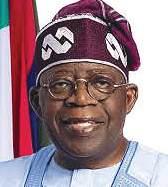
Tinubu
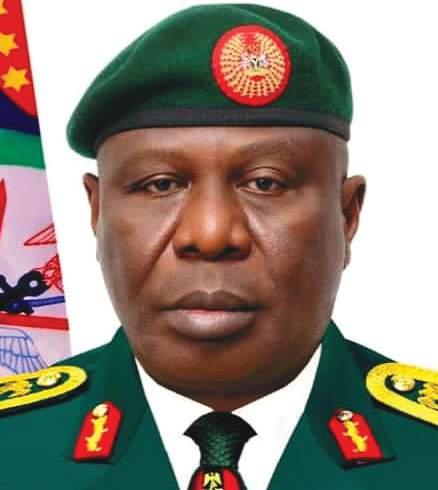
Gen Oluyede
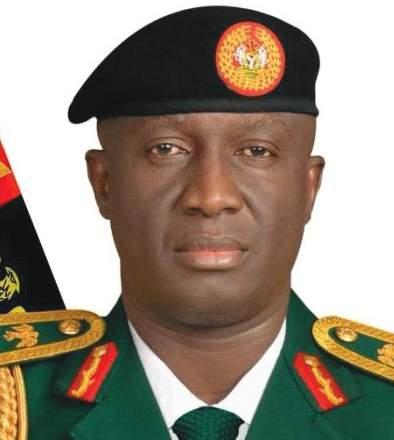
lt Gen Shaibu
FEaturEs Operation Delta Sentinel: How the Nigerian Navy is Turning the Tide Against Crude Oil Theft
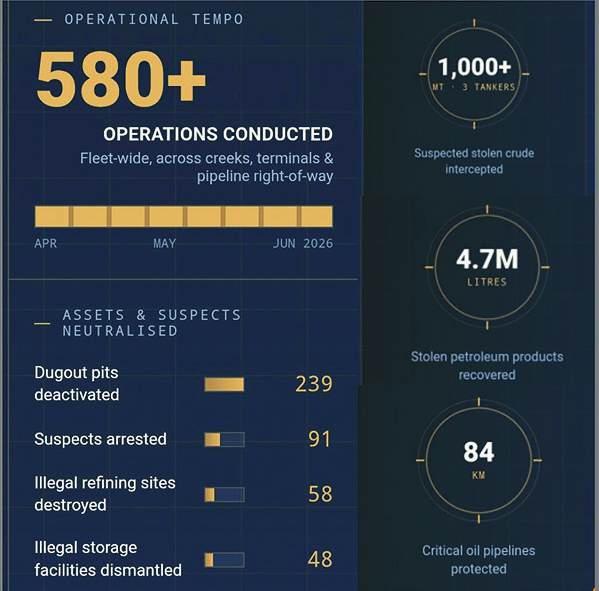
more than 580 operations, 91 suspects arrested, 58 illegal refining sites destroyed, 48 illegal storage facilities dismantled, 239 dugout pits deactivated, 4.7 million litres of stolen petroleum products recovered, three motor tankers intercepted carrying over 1,000 metric tonnes of suspected stolen crude, and 84 kilometres of critical oil pipelines protected tell the story of the nigerian navy's intensified offensive against crude oil theft under operation delta Sentinel between april and June 2026. driven by intelligence-led operations and sustained military pressure across the niger delta and beyond, it has become one of the country's most aggressive efforts to dismantle illegal refining networks, secure oil infrastructure and support nigeria's drive to increase crude oil production. Chiemelie Ezeobi reports
Operation Delta Sentinel was launched by the Nigerian Navy (NN) as a dedicated maritime security operation to combat crude oil theft, illegal bunkering, pipeline vandalism and other forms of economic sabotage threatening Nigeria's oil and gas sector.
The operation forms part of the navy's broader mandate to secure the nation's maritime domain while supporting the federal government's efforts to boost crude oil production, protect strategic national assets and strengthen economic stability.
However, it entered a more intensive phase under the leadership of Chief of the Naval Staff, Vice Admiral Idi Abbas, who, after assuming office on October 24, 2025, made the operation a key priority.
In April 2026, rather than allowing the initial phase to wind down, Abbas approved a 90-day extension to sustain operational momentum and ensure economic saboteurs are driven out of business.
That extension provided the platform for the second-quarter operations, during which naval personnel intensified intelligence-led raids, expanded interagency collaboration and significantly increased the scale of enforcement across the Niger Delta and adjoining maritime corridors.
Inside the Nigerian Navy's War on Crude Oil Theft
In the tangled mangrove swamps of Egboama and Ogbogolo, where waterways disappear beneath dense vegetation and illegal operators rely on difficult terrain to evade security forces, personnel from the Nigerian Navy Ship (NNS) SOROH uncovered a concealed illegal refining camp hidden deep within the creeks with dugout pits, refining ovens, reservoirs, storage tanks and the infrastructure needed to process stolen crude oil.
It was not an isolated operation. It was one of more than 580 operations carried out across the Niger Delta between April and June 2026 under Operation Delta Sentinel, the Nigerian Navy's flagship campaign against crude oil theft, illegal bunkering and maritime economic sabotage.
Thus, between April and June 2026, the navy recorded more than 580 operations, 91 suspects arrested, 58 illegal refining sites destroyed, 48 illegal storage facilities dismantled, 239 dugout pits deactivated, 4.7 million litres of stolen petroleum products recovered, three motor tankers intercepted carrying over 1,000 metric tonnes of suspected stolen crude, and 84 kilometres of critical oil pipelines protected.
Dismantling the Infrastructure of Illegal Refining
Rather than simply arrest suspects, the navy also concentrated on destroying the infrastructure that enables crude oil theft to thrive. Thus, during the quarter, naval personnel destroyed 58 illegal refining sites and 48 illegal storage facilities. They also deactivated 239 dugout pits—crude-filled holes carved into creek banks and used as makeshift storage tanks, while destroying 13 refining ovens used to convert stolen crude into diesel, kerosene and other petroleum products destined for the black market.
In addition, 53 reservoirs were
deactivated, while 17 pipeline connections vulnerable to illegal tapping were secured as part of the Navy's protection of 84 kilometres of pipeline infrastructure during the quarter.
Most of these operations followed a familiar pattern. Intelligence reports would identify suspected locations before combined land and maritime teams navigated difficult terrain for hours to locate facilities deliberately concealed within the creeks.
Millions of Litres Recovered from Criminal Networks
Operation Delta Sentinel also yielded significant recoveries of stolen petroleum products.
Between April and June 2026, naval personnel recovered approximately 4.7 million litres of petroleum products, comprising 2.31 million litres of stolen crude oil, 2.38 million litres of Automotive Gas Oil (AGO), more than 6,000 litres of Premium Motor Spirit (PMS), alongside assorted refined petroleum products recovered from tanks, reservoirs and drums across numerous illegal refining locations.
Weapons, Communications Equipment and Logistics Expose Organised Operations
The discoveries made during the operations extended well beyond stolen petroleum products. Naval teams recovered 12 outboard engines, 18 handheld radios and 328 rounds of 7.62mm ammunition.
They also seized suspected Improvised Explosive Device (IED)-making materials, industrial hoses used to siphon crude directly from pipelines, a pump-action gun, and vehicles deployed to transport both stolen products and personnel.
Taken together, the recoveries
point to criminal organisations operating with structured logistics rather than isolated opportunistic thieves.
The communications equipment and marine engines suggest coordinated movement across the creeks, while the ammunition and suspected IED materials indicate a readiness to confront security forces when necessary.
The navy also seized 11 boats, dismantled three or more militant camps and hideouts, established one new forward security outpost to maintain its presence in cleared areas, and secured 17 wellheads and pipeline connections that had been targeted for illegal tapping.
Extending the Fight Beyond the Creeks
Operation Delta Sentinel has not been confined to illegal refining camps hidden within the mangroves. Recognising that stolen crude must eventually leave Nigeria's waters, the Navy intensified efforts against vessels transporting illicit cargo offshore.
During the quarter, naval personnel interdicted three motor tankers. The MT Mkpodu was intercepted carrying an estimated 480 metric tonnes of suspected stolen crude oil. The MT Westaf was found with approximately 459 metric tonnes of suspected stolen crude.
In a follow-up operation, the MT Stelos K was also arrested while believed to be carrying more than 100 metric tonnes of suspected stolen crude.
Collectively, the three vessels accounted for over 1,000 metric tonnes of crude oil removed from the illegal export chain in a single quarter, preventing cargo that would otherwise have entered international markets.
Mapping the Frontline of the Operations
The navy's operational assessment identifies Rivers, Delta, Abia, Akwa Ibom and Bayelsa States as the country's most vulnerable locations for crude oil theft, with Rivers State remaining the principal operational focus.
Among the communities repeatedly
identified as hotspots are Bonny, Soku, Okirika, Onne, Ndoni, Abua-Odual, Egbaoma/Ogbogolo and Ogba-EgbemaNdoni. However, the operational footprint proved even broader.
In a separate account covering the same reporting period, the Director of Naval Information, Captain Abiodun Folorunsho, stated that operations extended across Rivers, Bayelsa, Delta, Cross River and Lagos States, highlighting the geographical spread of the criminal networks involved and reinforcing the need for coordinated operations beyond traditional oil-producing communities.
Linking Security Operations to Upsurge in National Oil Production
Undoubtedly, the success of Operation Delta Sentinel can be linked to improvement in Nigeria's crude oil production.
According to the NN, national crude production reached a peak of 1.89 million barrels per day by June 2026, while production increased by 18 per cent between the first and second quarters, an improvement it attributed to intensified anti-crude theft operations.
The independently reported figure released by the Nigerian Upstream Petroleum Regulatory Commission (NUPRC) placed Nigeria's June 2026 production at 1.735 million barrels per day.
Although slightly lower than the navy's figure, it still represented the country's highest production level since April 2020 and placed Nigeria at 104 per cent of its OPEC production quota.
The CNS Operational Strategy
Since assuming office as Chief of the Naval Staff on October 24, 2025, Vice Admiral Idi Abbas has made Operation Delta Sentinel the centrepiece of the Nigerian Navy's campaign against economic sabotage.
Rather than allowing the operation to wind down after the initial phase, Abbas directed in April 2026 that it be extended by 90 days. That decision proved significant, as it enabled the navy to sustain pressure throughout the second quarter, producing many operational results with the CNS maintaining close operational oversight.
His approach has consistently prioritised intelligence-led operations supported by technology and inter-agency collaboration over routine patrols.
Sustaining the Pressure
Viewed in its entirety, Operation Delta Sentinel reflects a sustained effort to weaken crude oil theft at every stage of the criminal supply chain.
Onshore, the Nigerian Navy has concentrated on dismantling illegal refining infrastructure and securing vulnerable oil facilities. Offshore, it has pursued vessels transporting stolen crude beyond Nigeria's territorial waters.
At the same time, forward security outposts and protected pipeline corridors are intended to prevent criminal groups from quickly re-establishing operations after military raids and as the figures from the second quarter of 2026 confirmed, it underscored both the scale of the challenge and the intensity of the navy's ongoing campaign against crude oil theft.
These figures tell the story of the Nigerian Navy's intensified offensive against crude oil theft under Operation Delta Sentinel between April and June 2026
NEW ENUGU SMART CITY: BEYOND TECHNOLOGY
The smart city may set a new benchmark for disciplined planning and sustainable urban development, argues PAT ONUKWULI
See page 21
RESETTING SOCIAL SECURITY AGENDA
The NSITF under Faleye is being repositioned to serve the nation better, contends EMMANUEL ULAYI
See page 21
It’s time to serve an eviction notice, writes TONY EDEMENAHA
THE ELITE ARE TENANTS SELLING THE HOUSE
There is a joke that has survived three generations in my village. The landlord’s son never sleeps in the house his father built with mud, sweat, and palm wine debts. He lives abroad, collects rent in dollars through Western Union, and sends voice notes from London: “My people, please manage the leaking roof. Pour cement and hope. Maintain the spirit of the house.” When the walls finally crack and the rain enters the parlor, he books a flight, lands with contractors, sells the land to a foreign investor, and calls it “urban renewal.” The tenants who raised children in that house are told to relocate with “compensation” that cannot buy a wheelbarrow. That joke is no longer funny. That joke is Nigeria.
Our elite are not landlords. Landlords have responsibility. Landlords sweep the compound, fix the gate, and pray for tenants who pay on time. Our elite are tenants. Caretakers who sneaked into the master bedroom in 1999, changed the locks, printed new keys for their cousins, and began selling the house room by room while the owners—you and I, the bus driver, the nurse, the corper, the market woman—watch from the backyard. The house is Nigeria. The furniture is our commonwealth: the oil beneath our feet, the schools our parents built with communal labor, the hospitals named after heroes, the roads that were supposed to connect destinies, the very fragile idea of “we.” For decades, a small, insatiable clique has been auctioning it piece by piece, and they have perfect names for the crime: privatization, deregulation, commercialization, publicprivate partnership. The language is polished. The theft is not. They are tenants selling the house, and they are in a hurry because they know the lease is expiring.
I remember when NEPA was the national joke. At least NEPA was our joke. Then NEPA became PHCN, and PHCN became eleven Discos with names that sound like energy drinks and no electricity to show for it. Overnight, darkness was “privatized.” We were promised competition, efficiency, and light that would not apologize. What arrived was estimated billing, a mathematical miracle where you pay for kilowatts you never consumed, like paying rent for a room you never entered. The tenant took what belonged to all—refineries built with petro-naira and national pride—ran them aground through decades of deliberate “mismanagement” and turnaround maintenance that never turned anything around. He has not sold them yet, but he keeps them rusting on the veranda while we import fuel at midnight prices and call
it policy. It is the ancient art of borrowing your neighbor’s car, draining the fuel, scratching the paint with a key, then parking it to rot while he tells you to buy your own car. The tenant burns the house to justify selling the ashes, then charges you for the smoke. Walk into many public primary schools across the country today and you will see classrooms without desks, blackboards that have not been painted in years, and children learning in overcrowded rooms. Meanwhile, the same government that cannot fund basic school infrastructure budgets billions for the upkeep of presidential jets. That is what it means to push a nation to the precipice of disintegration: when the future learns in neglect while the present flies first class and calls it sacrifice.
Corruption in Nigeria no longer hides behind curtains. It has graduated. It wears agbada, speaks in bullet points, and gives interviews on Arise TV. It calls itself policy reform. Subsidy is removed, but no safety net is woven. The naira is floated, but only the tenant knows where the tide will land. Hospitals are commissioned three times with the same ribbon, yet the minister flies to London for a headache. Roads are re-commissioned every election cycle, but your car suspension dies before your salary lands. Greed has dressed up as governance, and governance has become a WhatsApp status update. The metaphor is cruel and simple: they are eating the seed yam and then organizing press conferences to lament famine. They vandalize public healthcare through neglect, then build private hospitals in their village and charge you in dollars. They collapse the naira through roundtripping, then convert their allowances and estacodes to greenbacks before landing at Heathrow. They preach patriotism on Monday and move their families abroad on Tuesday. The tenant sets the house on fire, stands outside with a gold-plated fire extinguisher, and sends you an invoice for the water. If you
want wit, here it is, sharp and bitter: In Nigeria, you do not become a billionaire by inventing anything. You do not need a lab or a startup pitch. You only need proximity to the man who allocates the commonwealth. If you want to become a saint, try surviving on minimum wage while watching that same man explain on Channels TV that “sacrifice is necessary for national rebirth.” Sacrifice, like soup, is always for the diners. The chef never tastes the pepper.
But the cruelest cut is not the stealing. It is the insensitivity. While we queue for fuel that costs a day’s wage, they queue for chieftaincy titles that cost a nation’s conscience. While we bury children whose education was paused by strikes, they bury their shame under layers of PR and philanthropy that is just recycled loot. While mothers sell sachet water in Lagos traffic under the sun, their wives buy handbags in Paris that could fund a maternity ward in Jigawa. A nation is not just GDP, debt-to-GDP ratio, and investor confidence. A nation is the look in a corper’s eyes when she receives her allawee and knows it cannot rent a room. It is the nurse who treats accident victims by candlelight because the generator drank the diesel. It is the graduate with First Class honors riding Okada because the job market was privatized too. When the elite privatize hope, they do not just sell assets. They sell humanity in bulk, discounted, no warranty. We are not poor because God forgot our coordinates. We are poor because a few tenants decided the house was theirs to strip. And to keep the stripping quiet, they push us to disintegration. Ethnic tension here, religious outrage there, Twitter wars over trivia. Divide and loot. It is the oldest trick in the tenant’s handbook. If the tenants in the parlor are fighting over tribe, they will not notice the man in the master bedroom removing the roof. If we are busy shouting “my people versus your people,” we will not ask, “Where is our money?”
But houses have owners. And tenants, however powerful, however many security aides they travel with, can be evicted. The law of houses is older than the law of men. The eviction notice will not arrive on embossed letterhead with a government seal. It will arrive quietly, in millions. It will arrive as PVCs pulled from drawers and dusted off. It will arrive as citizens who refuse to clap for mediocrity because the man danced at a rally.
Edemenaha, poet and social commentator, writes from Asaba
The smart city may set a new benchmark for disciplined planning and sustainable urban development, argues PAT ONUKWULI
NEW ENUGU SMART CITY: BEYOND TECHNOLOGY
Urban civilisation is measured less by imposing buildings than by the quality of life a city sustains. Cities prosper when growth, technology and investment are balanced with sound planning, environmental responsibility and social inclusion. New Enugu Smart City therefore deserves national attention as an opportunity to establish a better model of urban development in Nigeria.
Over the past five decades, Nigeria has produced very few genuinely planned cities. Abuja remains the country's foremost example of a city conceived and built largely from the ground up, primarily to decongest Lagos and provide a purpose-built Federal Capital. Its original master plan was one of Africa's most ambitious urban planning exercises, carefully integrating residential, commercial, institutional and recreational districts with supporting infrastructure.
Abuja, however, also offers an important lesson. Repeated alterations to the master plan, inconsistent development control and an increasing number of planning exceptions have gradually weakened many of its founding principles. The result is mounting congestion, growing pressure on infrastructure and development patterns that increasingly resemble the urban problems the city was designed to avoid. The lesson is not that master plans fail, but that they cease to protect cities when cities cease to protect them.
Most generations inherit cities they did not build and leave behind cities they will never fully inhabit. Urban leadership is therefore judged not only by completed projects but also by the institutions, standards and public spaces preserved for those who follow. The true measure of development lies as much in what endures as in what is delivered.
That is why New Enugu Smart City should matter. It could offer an opportunity to demonstrate that disciplined planning can withstand political cycles and commercial pressures, that long-term vision need not yield to short-term convenience, and that institutional consistency can safeguard urban integrity. The initiative reflects the vision of Governor Peter Mbah and the practical leadership of Mrs Nkeiru Arum; the decisive test is faithful execution.
The greatest test, however, is not how projects begin but how they endure. Successful cities are built over decades, often outlasting the tenure of those who initiate them. New Enugu Smart City should therefore be safeguarded by institutions, professional standards and planning controls strong enough to outlast leadership changes.
A genuine smart city is defined not by the quantity of technology it deploys, but by the quality of life it delivers. Technology has value only when it improves how people live, work and move through safer communities, efficient services, sustainable infrastructure and responsive governance. By enhancing liveability, wellbeing and economic productivity, these qualities also strengthen a city’s competitiveness. Efficient infrastructure, predictable regulation and reliable public services could therefore position New Enugu Smart City as a centre for investment, innovation, entrepreneurship and skilled talent.
The potential benefits are considerable. Intelligent transport reduces congestion and commuter stress; smart utilities improve the reliability of essential services; digital healthcare expands access to medical care; environmental monitoring improves air and water quality; and parks, pedestrian networks and integrated emergency systems promote healthier, safer communities. Together, these measures improve both urban efficiency and quality of life.
Yet every opportunity carries risk. Technologies that improve efficiency may compromise privacy, heighten cyber exposure, strain public finances, or exclude digitally disadvantaged citizens. Artificial intelligence can strengthen decision-making, but without oversight it may also reinforce bias. These risks call not for less ambition, but for stronger institutions. Like Icarus in Greek mythology, a city may be undone by ambition unrestrained by judgement; technology must therefore remain anchored in sound governance, discipline and accountability.
Equally important is the human dimension. No development, however technologically advanced, can command lasting confidence without transparent land administration, environmental stewardship, community engagement and institutional accountability.
Dr. Onukwuli is a legal scholar and public affairs analyst. patonukwuli2003@yahoo.co.uk
The NSITF under Faleye is being repositioned to serve the nation better, contends EMMANUEL ULAYI
RESETTING SOCIAL SECURITY AGENDA
Two years after Mr. Oluwaseun Faleye assumed leadership of the Nigeria Social Insurance Trust Fund (NSITF), the Fund has become a growing regional reference point and a benchmark for social security and employees’ compensation in Africa. In only two years, his administration changed the metrics of the Fund: processes are faster, more employers are registered, more beneficiaries are being compensated, and in all these, NSITF is repositioning itself as a critical pillar in President Ahmed Tinubu’s Renewed Hope Agenda.
The core mandate of NSITF is simple: Ensure that no Nigerian worker is left destitute after a workplace injury, occupational disease and disability, and that the dependents of a deceased worker, in the case of death arising out of employment, are not left stranded. In the last 24 months, that mandate has been given a new urgency. Mr Faleye’s administration prioritized clearing the backlog of claims. New standard operating procedures have been introduced to fast-track verification and payment to beneficiaries. The goal, he has said repeatedly said, is “dignity in times of distress.”
Beyond compensation, the Fund has expanded sensitization across formal and informal sectors. Employers are being brought into compliance with the Employees’ Compensation Act, while workers are being educated on their rights to social protection. For many families who previously had no safety net, the Fund has become the difference between hardship and stability.
The Federal Government’s Renewed Hope Agenda places emphasis on job creation, poverty reduction, and inclusive growth. NSITF’s reforms are being deliberately framed within that vision. “Social security is not welfare. It is an investment in productivity,” a senior management official of the Fund noted, “when workers know they are protected, employers comply more, and the economy becomes more stable.”
Under Faleye, NSITF has aligned its programmes with federal priorities: expanding coverage to more Ministries, Departments and Agencies (MDAs), supporting vulnerable workers, and ensuring that social protection contributes directly to national development goals. Indeed, the scheme has expanded significantly, enrolling over 7.8 million employees into the ECS.
As at today, the NSITF has disbursed billions of naira in compensation to affected workers and dependents across various sectors, including oil and gas, banking, construction and the Civil Service amongst others. In addition to adequate compensation, it has also rehabilitated over 100 employees who suffered injuries and lost limbs in the course of work, restoring their hope and giving them back their lives.
Most importantly, the NSITF has extended its Employee Compensation Scheme (ECS) to cover the informal sector, providing a social safety net for millions of artisans, traders, and gig workers. The scheme aims to bridge the gap between the formal and informal economies, bringing millions of unprotected Nigerian workers into a secure social safety net. Falaye has conducted nationwide campaigns across the geopolitical zones, engaging with trade groups and unions. The Fund is actively collaborating with tech platforms (e.g., ride-hailing services) to ensure that independent collaborators can also participate in the social security scheme. Perhaps the most visible transformation has been in technology. Two years ago, many NSITF processes were still paper-based, leading to delays and opacity. The Fund has now rolled out digital platforms for employer registration, contribution remittance, and claims processing. The e-NSITF portal and upgraded database have cut processing times and improved transparency. Workers and employers can track claims status in real time, a move that has boosted trust in the system. This digitalization has also helped NSITF expand its reach beyond Abuja and Lagos, bringing social insurance closer to workers in state offices across the country.
Organizationally, Faleye initiated a wide-ranging reorganization. Redundant units were streamlined, job roles were clarified, and performance metrics were introduced.
Equally important has been the focus on staff welfare. Training programmes, career development workshops, and improved communication channels have been introduced to raise morale. “An agency that protects workers must first take care of its own people,” Faleye told staff at a meeting. The result is a workforce that is more motivated and more accountable to the public it serves.
Dr. Ulayi is Principal Manager with the Corporate Communications and Strategy Department of the NSITF
Editor, Editorial Page PETER ISHAKA
Email peter.ishaka@thisdaylive.com
NRS AND THE E-INVOICING DEADLINE
The initiative provides a transparent way of bringing more economic activities into the formal economy
The Nigeria Revenue Service (NRS) has reiterated its resolve to enforce the 31st July 2026 (this coming Friday) deadline for all large taxpayers to fully adopt the national e-invoicing and Electronic Fiscal System (EFS). Large taxpayers are companies with a gross turnover of N5 billion and above. According to the NRS Chairman, Zacch Adedeji, all large taxpayers need to complete the onboarding, integration, testing, and commencement of invoice transmission to the NRS e-invoicing platform in accordance with the prescribed implementation framework.
Although the current implementation focuses on large taxpayers, the National E-Invoicing initiative lays the foundation for the gradual formalisation of Nigeria's informal sector, which accounts for a substantial share of economic activity. Many Micro, Small and Medium Enterprises (MSMEs) currently operate with limited documentation of business transactions, making it difficult to access bank credit, attract investment, participate in government procurement, or establish reliable business records. As the e-invoicing ecosystem expands over time, small businesses will benefit from the ability to generate recognised digital invoices, maintain credible transaction histories, and build stronger financial records. These records can improve access to financing, enhance business credibility, and support growth into larger, more competitive enterprises.
ates greater opportunities for investment, employment, innovation, and sustainable economic development. For the NRS, the National E-Invoicing initiative represents a transformation from periodic tax reporting to near real-time transaction visibility. Rather than relying solely on tax returns submitted after business activities have occurred, the Service can monitor invoice transactions as they are generated, enabling earlier identification of compliance risks and supporting more effective tax administration.
The National E-Invoicing system represents an opportunity to modernise business operations, improve efficiency, and simplify tax compliance
T H I S D AY
EDITOR SHAKA MOMODU
DEPUTY EDITOR WALE OLALEYE
MANAGING DIRECTOR ENIOLA BELLO
By integrating their Enterprise Resource Planning (ERP), billing, or accounting systems with the NRS E-Invoicing platform through approved Access Point Providers (APPs) or Systems Integrators (SIs), businesses can automate invoice reporting, minimise manual processes, reduce compliance risks, and improve the accuracy of tax records. The system also enables taxpayers to generate invoices with unique Invoice Reference Numbers (IRNs), providing assurance that transactions are authentic and recognised by the tax authority. The National E-Invoicing system therefore represents an opportunity to modernise business operations, improve efficiency, and simplify tax compliance.
For government, the initiative provides a transparent pathway for bringing more economic activities into the formal economy through digital records and voluntary compliance rather than relying solely on traditional enforcement mechanisms. A larger formal economy cre-
DEPUTY MANAGING DIRECTOR ISRAEL IWEGBU
CHAIRMAN EDITORIAL BOARD OLUSEGUN ADENIYI
EDITOR NATION’S CAPITAL IYOBOSA UWUGIAREN
THE OMBUDSMAN KAYODE KOMOLAFE
T H I S D AY N E W S PA P E R S L I M I T E D
EDITOR-IN-CHIEF/CHAIRMAN NDUKA OBAIGBENA
GROUP EXECUTIVE DIRECTORS ENIOLA BELLO, KAYODE KOMOLAFE, ISRAEL IWEGBU
DIVISIONAL DIRECTORS SHAKA MOMODU, PETER IWEGBU, ANTHONY OGEDENGBE
DEPUTY DIVISIONAL DIRECTOR OJOGUN VICTOR DANBOYI
SNR. ASSOCIATE DIRECTOR ERIC OJEH
ASSOCIATE DIRECTOR PATRICK EIMIUHI
CONTROLLERS ABIMBOLA TAIWO, UCHENNA DIBIAGWU, NDUKA MOSERI DIRECTOR, PRINTING PRODUCTION CHUKS ONWUDINJO TO SEND EMAIL: first name.surname@thisdaylive.com
One of Nigeria's long-standing fiscal challenges has been its relatively low tax-to-GDP ratio compared with many peer economies. Increasing domestic revenue mobilisation remains essential to achieving sustainable economic development while reducing dependence on volatile revenue sources. The National E-Invoicing programme will most likely contribute to this objective by improving transaction transparency, strengthening compliance, and reducing opportunities for under-reporting of taxable activities. By providing reliable, real-time information on commercial transactions, the system enables more accurate tax assessments, broadens the taxpayer base, and supports higher levels of voluntary compliance. Over time, this will contribute to increased tax revenues without necessarily increasing tax rates, ensuring that all eligible taxpayers pay their fair share based on actual economic activity.
Beyond the immediate benefits to taxpayers and the tax authority, the National E-Invoicing programme represents an important investment in Nigeria's digital economy. A transparent electronic invoicing ecosystem strengthens business confidence, improves financial reporting, reduces the cost of compliance, and creates a more competitive business environment. The adoption of internationally recognised e-invoicing standards also positions Nigeria alongside leading economies that have embraced digital tax administration. As businesses increasingly digitise their operations, the National E-Invoicing system will become a key component of Nigeria's broader digital public infrastructure, supporting innovation, economic resilience, and long-term fiscal sustainability.
However, while we support the initiative, the successful implementation of the National E-Invoicing regime depends on the commitment and transparency of the NRS technology providers, professional advisers, and government institutions.
Letters in response to specific publications in THISDAY should be brief (150-300 words) and straight to the point. Interested readers may send such letters along with their contact details to opinion@thisdaylive.com. We also welcome comments and opinions on topical local, national and international issues provided they are well-written and should also not be longer than (750- 1000 words). They should be sent to opinion@thisdaylive. com along with photograph, email address and phone numbers of the writer.
PROFESSIONAL MISCONDUCT AMONG SECURITY PERSONNEL
The alarming rate of professional misconduct among some security personnel in Nigeria is one that needs to be urgently addressed head on. Security agencies are established to protect lives and property, enforce the law and promote public safety. Unfortunately, the unethical conduct of a few officers has continued to undermine public confidence and diminish the reputation of institutions that should ordinarily command the respect and trust of Nigerians.
Every now and then, citizens are tortured, extorted, threatened and, in some cases, killed or left with permanent injuries by security personnel who ought to be protecting them. These disturbing incidents not only violate the fundamental rights of innocent citizens but also weaken the relationship between law enforcement agencies and the communities they are meant to serve. Such
actions have no place in a democratic society governed by the rule of law.
Chief amongst the complaints involve some police personnel who act unprofessionally and unethically in the discharge of their duties. While the Nigeria Police Force has many disciplined and dedicated officers who risk their lives daily to protect the nation, the misconduct of a few has continued to overshadow the sacrifices of these hardworking men and women. This unfortunate situation has contributed to growing public distrust of the police.
In the past week alone, two serious incidents involving police personnel were reported. The first was the alleged extortion of ₦53,000 from the Chairman of the Independent Corrupt Practices and Other Related Offences Commission (ICPC) in Abuja by four policemen report-
edly operating an illegal roadblock. The second involved another police team along the Lagos Ibadan Expressway. Incidents such as these are one too many and are fast becoming a national embarrassment that demands decisive action.
Despite these concerns, commendation should be given to the Inspector General of Police, Tunde Disu, for the reforms he has continued to implement and for consistently taking disciplinary action against erring personnel. Holding officers accountable for acts of misconduct sends a strong message that corruption, abuse of power and indiscipline will not be tolerated within the Nigeria Police Force.
Tochukwu Jimo Obi, Abuja
Discretion to Digital: NUPRC Pushes for Transparency at 2025 Oil Bid Round PERSPECTIVE
For decades, Nigeria’s oil block licensing rounds have been among the most closely watched exercises in the country’s petroleum industry, historically generating intense scrutiny over transparency, fairness and investor confidence issues. While earlier licensing exercises were often criticised for discretionary decision-making and post bid controversies that overshadowed the commercial objectives of the process, Emmanuel Addeh writes that the latest round appeared to be a clean break from the past.
The 2025 Licensing Round conducted by the Nigerian Upstream Petroleum Regulatory Commission (NUPRC) attempted to draw a clear line between that past and a new regulatory order envisaged under the Petroleum Industry Act (PIA) 2021.
From its design to its execution, the exercise seemed deliberately structured around digital processes, competitive evaluation and independent oversight. Most significantly, the commercial bid conference was streamed live, allowing investors, observers and the wider public to witness the process in real time.
Combined with the participation of oversight institutions such as the Nigeria Extractive Industries Transparency Initiative (NEITI), journalists and civil society organisations, the licensing round, the first under the NUPRC Chief Executive, Oritsemeyiwa Eyesan, represented perhaps the most visible demonstration yet of the industry’s efforts to institutionalise transparency rather than merely proclaiming it.
PIA as Enabler
The enactment of the Petroleum Industry Act fundamentally altered Nigeria’s upstream regulatory architecture. One of its most important innovations was removing much of the discretion that previously surrounded the allocation of petroleum assets. Under the old regime, petroleum ministers exercised broad powers in awarding oil blocks, a practice that frequently attracted criticism from investors, industry analysts and transparency advocates.
But the PIA instead established a rules-based system in which competitive bidding became the principal mechanism for awarding petroleum acreage. With the NUPRC assuming responsibility for organising licensing rounds, the emphasis shifted from administrative discretion to published guidelines, measurable evaluation criteria and regulatory accountability.
Under Eyesan, the 2025 Licensing Round therefore became more than a routine acreage offering. It served as one of the biggest practical tests of whether the new legal framework could translate legislative intentions into operational reality.
Structured Process
The process officially commenced on November 11, 2025, when the NUPRC announced that 50 oil and gas blocks across seven sedimentary basins would be offered to investors.
The acreage covered mature producing provinces as well as frontier basins, including 16 blocks in the Niger Delta Onshore, 18 in the Niger Delta Shallow Water, one Deep Offshore block, three in the Benin Basin, four in the Anambra Basin, four in the Chad Basin and four in the Benue Trough.
Afterwards, registration opened on December 1, 2025, while a pre-bid conference held in Lagos in January 2026 provided investors with detailed guidance on technical requirements, commercial terms and regulatory expectations.
Rather than relying only on closed door engagements, the Commission published timelines, evaluation procedures and application requirements well in advance. This predictability was itself an important departure from earlier licensing exercises
where uncertainty regarding procedures sometimes complicated participation. It was therefore not surprising that the response from investors suggested sustained interest despite global competition for upstream capital.
Out of 286 companies that submitted applications for prequalification, 196 were eventually pre-qualified. From this pool, 143 companies proceeded to submit 200 technical and commercial bids covering 37 of the 50 blocks on offer.
Technology as Transparency Tool
One of the defining features of the 2025 Licensing Round was the extensive deployment of digital technology. The Commission digitised virtually every stage of the process. Interested investors could access geological data electronically, submit applications through online platforms and interact digitally with regulators throughout the exercise.
Commission Chief Executive, Eyesan, had earlier signalled the Commission’s commitment to digital transformation shortly after assuming office, pledging to eliminate paper-based internal communications and arguing that digitisation improves efficiency, accountability and traceability.
That philosophy extended naturally into the licensing process itself.
So, for roughly 10 hours last Tuesday at the final stage of the event, digital platforms reduced opportunities for manual intervention while creating electronic audit trails capable of tracking every stage of the bidding exercise.
For international investors accustomed to digital licensing systems in other jurisdictions, the reforms also signalled Nigeria’s determination to modernise its regulatory environment.
Promise Kept
The emphasis on transparency was consistently reinforced by key government officials throughout the exercise. Commission Chief Executive of the NUPRC, Eyesan, promised the licensing round would be conducted “strictly in line with President Bola Tinubu’s directive for transparency, fairness and global best practice.”
In various forums leading to the final ceremony, she reiterated the importance of sticking to the rules, especially with the deployment of digital tools, which the organisers took time to explain to the potential awardees at the event.
Before the actual day, Eyesan assured the investors: “You are not navigating uncertainty, you are operating with a framework that is transparent, predictable, and deliberately designed to inspire confidence.
“Let me emphasise clearly that the bid process will comply with the Petroleum Industry Act, promote the use of digital tools for smooth data access and remain open to public and institutional scrutiny through NEITI and other oversight agencies.
“The 2025 Licensing Round is not merely a bidding exercise. It is a clear signal of a re-imagined upstream sector, anchored on the rule of law, driven by data, aligned with global investment realities, and focused on long-term value creation,” Eyesan said.
On Tuesday, Eyesan repeated this, stressing that every stage followed the published timetable from registration and prequalification through technical evaluation and commercial bidding.
For his part, the Minister of State for Petroleum Resources (Gas), Ekperikpe Ekpo, also described the commercial bid conference as evidence that “Nigeria’s licensing
regime is anchored on fairness, accountability and international best practice,” arguing that the Petroleum Industry Act had strengthened investor confidence through regulatory certainty and transparency.
Similarly, Minister of State for Petroleum Resources (Oil), Senator Heineken Lokpobiri, praised the PIA for eliminating discretionary allocation of oil blocks and replacing it with “a transparent competitive bidding process,” saying the reforms had made Nigeria one of the world’s most attractive destinations for upstream investment.
And the World Watched
Perhaps, one of the most symbolic departures from previous licensing rounds occurred during the commercial bid conference on Tuesday in Abuja. In one of the rarest moments in Nigeria’s petroleum licensing history, the decisive stage of the process was broadcast live. In fact, the entire process is still available online, a sign that the NUPRC might be saying: “ There’s nothing to hide”.
The significance extended beyond technological convenience. By opening the process to public observation, the Commission effectively invited scrutiny rather than attempting to avoid it. Industry participants, potential investors, journalists, analysts and ordinary citizens were able to watch the proceedings as they unfolded. The conference itself stretched for almost 10 hours, reflecting both the complexity of the exercise and the Commission’s determination to complete the process publicly rather than behind closed doors. Every commercial bid, every score and every outcome unfolded before a live audience. Such openness represented an important confidence building measure in a country where perceptions often influence investment decisions as much as regulatory frameworks.
It would then seem like rather than asking stakeholders simply to trust the process, the Commission allowed them to see it.
Testimonials
The transparency and credibility of the 2025 Licensing Round also drew strong endorsements from key industry stakeholders and independent observers, many of whom described the commercial bid conference as one of the most open and professionally conducted licensing exercises in Nigeria’s oil and gas sector.
SLB Country Director, Nosa Omorodion, said: “The openness, the transparency, it was really, really encouraging...The doubting Thomases that came are probably leaving here as converts. Kudos to the leadership of the NUPRC, kudos to innovation and kudos to the winners that believed in the process.”
President of the Nigerian Association of Petroleum Explorationists (NAPE), Olajumoke Ajayi, described the exercise as being of international standard, saying: “It was truly of international standard because of the professionalism that went into it. It was highly transparent.”
Chief Executive of NUPRC, Oritsemeyiwa Eyesan
Olanipekun’s 50th Year at the Bar: The Man, The Bar, The Institution TRIBUTE
Raheem Akingbolu
Great lawyers win cases. Exceptional lawyers shape the law itself. The rarest, however, leave footprints far beyond the courtroom. They build institutions, mentor generations, defend constitutional democracy and redefine the standards of professional excellence. For fifty years, Chief Wole Olanipekun, CFR, SAN, has remained firmly within that distinguished league.
As he marks half a century since his call to the Nigerian Bar, Nigeria is celebrating far more than an accomplished advocate. It is celebrating a legal institution whose influence has extended beyond law reports and courtrooms into the wider spheres of justice, public service, education, philanthropy and national development. Few lawyers have combined forensic brilliance with institution-building as consistently and successfully as Olanipekun.
His remarkable journey is not measured simply by the number of landmark cases he has won or the prestigious offices he has occupied. It is reflected in the constitutional principles he helped shape, the democratic values he defended, the minds he has nurtured, and the countless lives transformed through his philanthropy. Over five decades, he has demonstrated that the true measure of greatness lies not only in personal achievement but also in the enduring impact one leaves on people, institutions, and society.
Ironically, the legal profession almost lost him before it found him.
As a young student, Olanipekun’s first love was English Literature. Inspired by the brilliance of the renowned poet and scholar, Professor Niyi Osundare, he dreamt of studying English and followed a similar academic path like role model, who incidentally was his senior in Secondary School. When he eventually shared that ambition with his mentor, Osundare gently redirected him, insisting that the future belonged to professional courses and therefore encouraged the young Wole to study Law instead. It was advice that would alter the course of Nigerian legal history.
Even then, the decision was far from settled. His father, Pa Isaac Olanipekun, a devout Anglican, initially opposed a legal career, believing as many parents of his generation did that success at the Bar was tied to secret cults. He preferred that his son study Mass Communication. Providence, however, intervened. An admission to study Law at the University of Lagos, reinforced by timely counsel from respected mentors, finally settled the matter. Looking back today, it is difficult to imagine what Nigeria’s legal profession might have lost had events unfolded differently.
Called to the Nigerian Bar in July 1976, Olanipekun quickly distinguished himself through uncommon diligence, meticulous preparation, and an exceptional command of advocacy. Those qualities have remained the defining
features of a career that has endured for fifty years, earning him a place not merely among Nigeria’s finest lawyers but among the enduring institutions that have shaped the country’s legal profession.
It did not take long for Olanipekun to establish himself as one of the country’s most formidable advocates. Elevated to the rank of Senior Advocate of Nigeria in 1991, he steadily built a reputation for intellectual depth, painstaking preparation, and courtroom discipline. Whether handling constitutional matters, commercial disputes, or politically sensitive cases, he approached every brief with the same meticulous attention to detail. That consistency earned him not only victories but also the enduring confidence of clients, colleagues, and the Bench.
His imprint on Nigeria’s constitutional development is unmistakable. He led the legal team that secured the restoration of the mandate of former Oyo State Governor Rashidi Ladoja in the landmark Inakoju v. Adeleke case, a decision that fundamentally reshaped Nigeria’s constitutional understanding of impeachment by affirming that governors could not be removed through procedures that violated due process. He also successfully led the legal battles that restored the electoral mandates of former Edo State Governor Adams Oshiomhole, former Ekiti State Governor, Kayode Fayemi and former Ondo State Governor Olusegun Mimiko. Those cases remain defining milestones in Nigeria’s democratic evolution. Olanipekun’s constitutional
advocacy reached another high point in 2007 when he successfully challenged the attempted removal of then Vice President Atiku Abubakar by the administration of President Olusegun Obasanjo. The Supreme Court’s decision reaffirmed the supremacy of the Constitution over executive discretion and reinforced one of the cardinal principles of democratic governance, that no public office, however powerful, exists above the law.
As a serving vice president, Atiku joined the then Action Congress of Nigeria and obasanjo declared that he had been sacked as VP. He challenged it in court through Olanipekun and he won when SC said he could not be so casually sacked.
Over the years, he has also led other senior Lawyers in several presidential election petitions and other nationally significant disputes, further cementing his reputation as one of the country’s foremost constitutional lawyers.
Yet, reducing Wole Olanipekun’s legacy to courtroom triumphs alone would tell only a part of the story. His influence within the legal profession has been just as profound. As former AttorneyGeneral and Commissioner for Justice in old Ondo State, former President of the Nigerian Bar Association, Life Bencher, former Chairman of the Body of Benchers and member of several strategic legal institutions, he has consistently championed judicial independence, professional ethics and institutional reform. Those leadership roles reflected not merely professional recognition
but the confidence reposed in him by the legal community over several decades.
Perhaps his greatest investment has been in people. Through his chambers, hundreds of young lawyers have passed under his guidance, many of whom today occupy distinguished positions at the Bar, on the Bench, in academia, government and the corporate sector. Significantly, a remarkable number have themselves attained the prestigious rank of Senior Advocate of Nigeria. His approach to mentorship has always reflected his belief that the strength of any profession lies in the quality of those who inherit it. In nurturing future leaders, he has quietly ensured that his influence extends well beyond his own generation.
Outside the courtroom, the same philosophy of service has shaped his contributions to education, healthcare, faith and community development. From scholarship schemes for indigent students and major educational endowments to hospitals, church projects, ICT centres, Bar facilities and empowerment programmes for widows and young entrepreneurs, his philanthropy has remained both deliberate and enduring. Long before corporate social responsibility became fashionable, Olanipekun had embraced giving back as a personal obligation, demonstrating that the finest lawyers are remembered not only for the cases they win but also for the lives they touch and the institutions they leave stronger than they found them.
If the law is ultimately about building a just society, then Chief Wole Olanipekun’s legacy extends well beyond the courtroom. His life demonstrates that professional excellence finds its highest expression in service to others. Whether through landmark constitutional advocacy, principled leadership within the legal profession, generous investment in education, healthcare and community development, or his unwavering commitment to mentoring younger lawyers, he has consistently shown that influence is most meaningful when it outlives personal success. The institutions he has strengthened, the professionals he has nurtured and the countless lives touched by his philanthropy together form a legacy that no law report can fully capture.
As Chief Wole Olanipekun celebrates his fifty years at the Bar, Nigeria honours far more than one of its finest advocates. It celebrates a statesman of the law, a guardian of constitutionalism, and a builder of enduring institutions whose contributions have become woven into the nation’s democratic and legal history. In an era yearning for principled leadership and lasting values, his journey stands as compelling proof that the greatest lawyers are remembered not for the verdicts they secure, but for the institutions they strengthen, the people they inspire, and the generations they prepare to carry the torch long after they leave the courtroom.
Olanipekun
Stories by Kayode Tokede
The Nigerian equities market has emerged Africa’s strongest performer in U.S. dollar terms with a 68.2 per cent Year- till-Date (YtD) return in the first seven months of 2026.
The bourse performance between January and July 24, 2026 outpaced other continental stock markets helped by investors confidence on the back of reforms by the Nigerian government.
The strong performance
in dollar terms highlights the impact of exchange rate dynamics and renewed foreign portfolio participation.
By comparison, Zimbabwe Stock Exchange, trails Nigeria when returns are converted into dollars, underscoring how currency movements can significantly alter relative market standings from a global investment perspective.
Zimbabwe Stock Exchange closed July 24, 2026 with 64.08 per cent YtD returns , followed by Ghana Stock Exchange that
closed at 56.97per cent in its YtD performance as of July 24, 2026.
Zimbabwe’s market has faced currency-related pressures that have tempered its equity market’s appeal in dollar terms, even where nominal local gains appear strong. Across African markets, divergent exchange rate trends have become a decisive factor in shaping cross-border capital flows.
Among the top losers in Africa are: Malawi Stock Exchange with -15.28 YtD
performance, followed by Casablanca Stock Exchange that declined by -8.43 YtD.
However, when capered with data gathered from other African markets, the Nigerian market’s 58.96 per cent YtD return, placed it third behind Ghana Stock Exchange and Zimbabwe Stock Exchange in local currency terms.
In terms of value, the market capitalisation of the NGX in U.S dollar terms reached $117.16 billion (N159.588 trillion) as of July 2024, 2026 from $69.22 billion
(N99.376 trillion) in 2025.
This strong showing reflects a combination of significant surge in the prices of Airtel Africa Plc, MTN Nigeria, Dangote Cement Plc and improved currency stability.
The Nigerian stock market this year has witnessed: a historic bull run, fuelled by the successful completion of the banking sector recapitalisation programme, a rebound in external reserves to 13-year high and a fragile but genuine stabilisation of the naira.
The NGX has benefited
from improving macroeconomic signals, including tighter monetary policy of the Central Bank of Nigeria (CBN) aimed at stabilising inflation and restoring confidence in the foreign exchange market. While inflationary pressures remain elevated and economic reforms continue to test businesses and households, investors appear to be positioning ahead of anticipated medium-term recovery gains.
The average maximum lending rate charged by Nigerian banks declined to 33.16 per cent in June 2026, easing from 34.78 per cent in May, as the Central Bank of Nigeria (CBN) sustained monetary policy pause amid improving macroeconomic conditions.
The latest Money Market Indicators released by the CBN showed that although borrowing costs remained
high, the moderation in banks’ maximum lending rates coincided with the Monetary Policy Committee’s (MPC) decision to retain the Monetary Policy Rate (MPR) at 26.50 per cent, since February. While the lending rate is the highest interest rate charged on loans given to customers, the cost of borrowing is the total expense incurred by a
customer in obtaining and servicing a loan.
The report showed that despite the monthly decline in average maximum lending, lending costs remained significantly higher than a year earlier.
The CBN data indicated that the average maximum lending rate stood at 29.51 per cent in June 2025, underscoring a year-on-year increase of 3.65 percentage points.
The maximum lending rate represents the highest interest rate banks may charge borrowers and serves as a key indicator of credit conditions within the economy.
Businesses and investors closely monitor it because of its direct impact on borrowing costs, investment decisions and overall economic activity.
The latest moderation marks only the second notable decline in lending
rates this year, following the MPC’s decision in February to reduce the benchmark interest rate from 27 per cent to 26.50 per cent before subsequently maintaining the status quo.
At its meeting last week, the MPC unanimously voted to retain all policy parameters, citing continued exchange rate stability, moderating inflationary pressures and the need to guard against external shocks. The CBN governor, Mr. Olayemi Cardoso, said the committee’s decision reflected a careful assessment of both domestic economic conditions and prevailing global risks, including uncertainty surrounding the United States economy and persistent geopolitical tensions in the Middle East.
Nume
Ekeghe
Open Market Operation (OMO) bills accounted for the largest share of activity in Nigeria’s fixed income market last week, as investors executed transactions worth N6.86 trillion across Treasury bills, FGN bonds, OMO bills and Sukuk, reflecting sustained demand for highyield government securities amid elevated interest rates. Trading data showed that OMO bills attracted the highest turnover by value at N3.36 trillion, representing nearly half of the total market
activity, despite accounting for only 498 trades. This underscores the dominance of institutional investors in the OMO segment, where larger ticket transactions continue to outweigh volumes in other asset classes.
Overall, investors executed 2,330 trades with a combined face value of N6.863 trillion during the review period. FGN bonds remained the most actively traded instrument by number of transactions, recording 1,159 deals worth N1.98 trillion, while Treasury bills accounted for 666 trades valued at N1.51 trillion.
FG, Access Bank Push
Nume Ekeghe
The federal government and Access Bank Plc have intensified efforts to accelerate the adoption of artificial intelligence (AI) and digital financial solutions among Micro, Small and Medium Enterprises (MSMEs), positioning technology as a key driver of Nigeria’s ambition to build a $1 trillion economy.
The initiative was unveiled at the Access Bank MSME Digital Growth Conference themed, “AI for SMEs: Scaling Through Digital Tools,” where the lender also launched its new Access SME Application, a digital platform designed to provide small businesses with financial services and digital tools to support growth.
Sukuk securities recorded limited activity with only seven trades worth N19.73 billion.
Market yields remained broadly elevated across the sovereign yield curve, reflecting the prevailing high interest-rate environment. Treasury bill yields traded between approximately
17.6 per cent and 20.1 per cent, while OMO bill yields remained above 19 per cent, with the shortest tenor closing around 21.2 per cent. FGN bond yields were largely clustered between 15 per cent and 18.4 per cent across most maturities, indicating relatively stable pricing in the secondary market.
The strong performance of OMO bills also suggests that liquidity management remains a key focus for the banking sector. Banks have continued to deploy excess liquidity into CBN instruments while balancing reserve requirements and funding obligations, contributing to robust
participation in the segment. Meanwhile, the dominance of FGN bonds by transaction count indicates that longerdated securities continue to attract active portfolio rebalancing among institutional investors, even as demand remains concentrated in shorter-duration assets offering higher yields.
Comms/e-Business
Asst.
Asst.
Nume Ekeghe
Correspondents
KayodeTokede(CapitalMarkets)
James Emejo (Finance)
Ebere Nwoji (Insurance)
Reporter Peter Uzoho (Energy)
Speaking at the event in Lagos, the Senior Special Assistant to the President on Entrepreneurship Development in the Office of the Vice President, Chalya Shagaya, described MSMEs as the backbone of the Tinubu administration’s economic agenda, stressing that the success of small businesses would determine the country’s ability to achieve its long-term growth target.
She said: “Everyone wants to be an entrepreneur today. You are the ones who will drive the $1tn economy that Mr President has charged us with achieving... We are your partners, and you are ours. Shagaya urged entrepreneurs to embrace AI and digital technologies to expand beyond local markets and improve competitiveness.”
Nume Ekeghe
Cash held outside banking system declined to 89.1 per cent of currency in circulation (CIC) in June 2026, falling below the 90 per cent mark for the first time in 11 months as more cash flowed back into the formal banking system, latest data from the Central Bank of Nigeria (CBN) has shown.
According to the CBN Money and Credit Statistics,
currency outside banks fell by N271 billion to N4.922 trillion in June from N5.193 trillion in May. At the same time, total currency in circulation declined by N167 billion to N5.523 trillion, compared with N5.690 trillion a month earlier.
As a result, the share of cash held outside the banking system dropped to 89.1 per cent from 91.3 per cent in May, marking the lowest ratio since July 2025, when cash outside banks accounted for 89.8 per
cent of currency in circulation.
The latest reading ends a 10-month stretch during which the ratio remained above 90 per cent, suggesting that a larger proportion of cash is once again being retained within the banking system. Conversely, a lower ratio generally reflects stronger banking system liquidity and increased use of formal financial channels. A review of the past year shows that the proportion of cash outside
banks remained persistently elevated despite fluctuations in the volume of currency in circulation. The ratio stood at 89.8 per cent in July 2025 before rising to 90.4 per cent in August and 90.1 per cent in September. It increased further to 91.9 per cent in October and 93.3 per cent in November before reaching a one-year high of 94.3 per cent in December 2025, when seasonal cash demand traditionally surges.
The Director General of the Nigerian Maritime Administration and Safety Agency (NIMASA), Dr. Dayo Mobereola, has reaffirmed the Agency’s commitment to advancing maritime decarbonisation, promoting green shipping practices, and strengthening marine environmental protection in line with global efforts to build a sustainable maritime
Kayode Tokede
First City Monument Bank (FCMB) will this week convene healthcare operators, financiers, investors, policymakers, development partners and industry experts at the inaugural Healthcare
industry.
Mobereola made this known during a strategic engagement with the Chief Executive Officer of Natural Eco Capital Limited, Dr. Eugene Itua, where discussions focused on initiatives aimed at accelerating Nigeria’s transition to a cleaner and more environmentally sustainable maritime sector.
During the meeting, Itua presented the Nigerian
Summit to explore financing and partnership opportunities for building a stronger and more sustainable healthcare sector in Nigeria. The summit, themed, “Financing Growth: Unlocking Opportunity, Building the Future of
Green Shipping Excellence Programme (NGSEP) and the Green Maritime Recognition Scheme (GMRS), highlighting their potential to drive maritime decarbonisation, encourage the adoption of cleaner technologies, attract climate investments, and position Nigeria as a regional leader in sustainable shipping.
Responding, Mobereola commended the initiative,
Healthcare,” reflects FCMB’s commitment to supporting strategic sectors of the Nigerian economy through innovative financing, partnerships and capacity building that promote inclusive and sustainable growth.
noting that partnerships with the private sector and other stakeholders are essential to achieving Nigeria’s environmental sustainability objectives. He stressed that practical, innovative and collaborative approaches are critical to addressing climate change, safeguarding the marine environment, and enhancing the competitiveness of Nigeria’s maritime industry.
The Minister of State for Health, Dr Iziaq Salako, will deliver the keynote address, “The Future of Healthcare Financing in Nigeria,” setting the tone for discussions focused on the financing and delivery priorities shaping the sector.
BUSINESSWORLD N EWS
NAICOM Backs Lagos Building
Insurance Scheme, Describe Insurance as Social Protection
The Commissioner for Insurance and Chief Executive Officer of the National Insurance Commission (NAICOM), Mr Olusegun Ayo Omosehin,has urged Nigerians to see insurance as instrument of social protection and economic recovery rather than merely a financial product.
Omosehin who stated this in his key note address at the official launch of the Lagos State Building Insurance Scheme held in Lagos recently said, “In reality, insurance is an instrument of social protection and economic recovery. When a building collapses, insurance helps families recover. When fire destroys commercial premises, insurance enables businesses to restart operations. When floods damage homes and public facilities, insurance
provides financial support that reduces suffering and accelerates recovery.Without insurance, disasters push individuals, businesses, and governments into severe financial distress and trigger economic waste.”
According to him with insurance, shocks become manageable and recovery becomes possible.
He said that was why compulsory building insurance was not simply a regulatory requirement but a public safety intervention.
He said the Lagos State Building Insurance Scheme therefore advanced a broader national objective of ensuring that no Nigerian is left completely vulnerable when disaster strikes.
He said with the launch of the scheme, public buildings and buildings under construction
above a prescribed height must carry insurance cover that protects not only the owner, but the occupier, the visitor and the passer by.
He said the purpose of the law was not to burden the citizen but to ensure that where negligence, fire, flood or collapse caused loss, there is a fund from which that citizen could be made whole.
He said what Lagos State had done was to take this national law and give it practical, enforceable life at the level where buildings actually stood.
He described this as precisely the partnership the Act envisaged between the federal regulator and the state governments,adding that Nigeria did not suffer from a shortage of laws.
Stakeholders Highlight Nigeria’s Digital Innovation Challenges
Emma Okonji
Industry stakeholders in Nigeria’s telecoms sector, at the weekend, reflected on Nigeria’s telecommunications journey, and highlighted the country’s digital innovation challenges from the inception of digital era.
The stakeholders however gave reasons why Nigerians should be optimistic, despite past sector challenges, insisting that recent developments demonstrate that constructive engagement among government, regulators and industry is yielding tangible results and strengthening the foundation of Nigeria’s digital economy.
The stakeholders said this in Lagos during the innovative and scientific conference organised by the Nigeria Information Technology Reporters’
Association (NITRA), themed: ‘Bridging Nigeria’s Digital Divide with Scientific Innovation’.
Chairman of NITRA, Mr. Chike Onwuegbuchi, in his welcome address, said the theme became necessary following the impact of digital and scientific innovation in the telecoms sector.
Chronicling telecoms operators’ efforts in bridging Nigeria’s digital divide through innovation, the Chairman, Association of Licensed Telecoms Operators of Nigeria (ALTON), Gbenga Adebayo, in his keynote address, said Nigeria’s telecommunications sector represented one of Africa’s most remarkable success stories in economic liberalisation and digital transformation. According to him, from fewer than half a million connected
telephone lines before the advent of GSM in 2001 to over 200 million active subscriptions today, the sector has transformed how Nigerians communicate, transact, learn, govern and conduct business.
“Today we chronicle the contributions of telecommunications operators in bridging the country’s digital divide through sustained private sector investment, technological innovation and strategic collaboration with government and regulators. It examines the evolution of the industry from the early days of GSM to broadband, fibre-optic expansion, mobile financial services, 4G, 5G and emerging digital technologies. As we reflect on Nigeria’s telecommunications journey, there is every reason to be optimistic.
Coy to Advance Collaboration in Financial Services Sector
Interswitch, one of Africa’s leading integrated payments and digital commerce companies, recently hosted the inaugural edition of Core by Interswitch, designed to foster industry collaboration and strengthen the operational excellence that drives seamless digital payment experiences.
Held in Lagos, the forum brought together more than 400 participants, including operations professionals and other stakeholders from microfinance banks, commercial banks, fintechs.
Speaking at the event,
Executive Vice President, Operations and Technology, Interswitch, Babafemi Ogungbamila, said the forum reflected the company’s belief that exceptional customer experiences are built not only on innovative technology but also on the expertise, collaboration and commitment of the professionals who keep payment systems running every day.
“Every successful digital transaction is powered by professionals whose work often goes unseen but is fundamental to building trust in digital payments. Core by Interswitch was created to
STATEMENT TO THE NIGERIAN EXCHANGE LIMITED (NGX) AND THE SHAREHOLDERS ON THE EXTRACT OF UNAUDITED RESULTS FOR THE SIX MONTHS ENDED 30 JUNE 2026.
10,898,233
recognise their contribution, strengthen collaboration across the industry and create opportunities for shared learning that ultimately benefit financial institutions and the customers they serve. As digital payments continue to evolve, investing in the people and processes that power the technology is just as important as investing in the technology itself,” Ogungbamila said.
Participants also highlighted the growing importance of operational excellence in sustaining resilient payment infrastructure and meeting rising customer expectations.
Ebere Nwoji
Emma Okonji
AMCON Positions NTEL for Strategic Growth as Divestment Process Begins
Eromosele Abiodun
The Asset Management Corporation of Nigeria (AMCON), has reaffirmed its commitment to unlocking the full value of Nigeria’s legacy telecommunications assets, describing the ongoing transformation of NTEL/ NATCOM as one of its most promising asset recovery and investment success stories.
Managing Director and Chief Executive Officer of AMCON, Mr. Gbenga Alade, disclosed this during an interactive session with senior media executives in Lagos at the weekend. He said that following the successful divestment of the Ibadan Electricity Distribution Company (IBEDC), the Corporation has commenced the process of divesting its interests in the telecommunications sector through a transparent and structured programme designed to attract credible strategic investors.
According to Alade, NTEL, the successor company to the former Nigerian Telecommunications Limited (NITEL), has embarked on a comprehensive three-pronged transformation strategy aimed at repositioning the company as an attractive investment destination for world-class investors.
He expressed confidence that the transformation of NTEL represents a major milestone in the revitalisation of the legacy NITEL assets, which remain an important part of Nigeria’s telecommunications history
and infrastructure.
“The repositioning effort is designed to maximise value, strengthen operational competitiveness and prepare the business for long-term sustainability under new investment,” he said.
Alade noted that AMCON has full confidence in the Board and Management of NTEL/NATCOM, describing their experience, innovation, diligence and commitment as critical to laying a solid foundation for the company’s next phase of growth.
“The remarkable transformation of NTEL is poised to become one of AMCON’s most notable success stories in the telecommunications sector. We have full confidence in the Board and Management of NTEL/NATCOM as they continue to demonstrate experience, innovation, diligence and commitment towards positioning this Nigerian-owned company to compete favourably with its peers both locally and internationally,” he said.
He added that further updates on the divestment process would be communicated as key milestones are achieved, reaffirming the Corporation’s commitment to transparency throughout the exercise.
Alade explained that the planned telecommunications divestment aligns with AMCON’s statutory mandate to maximise value from distressed assets while supporting economic growth
and strengthening confidence in Nigeria’s financial system.
He also highlighted the corporation’s improved operational performance during the first half of the year, revealing that AMCON recovered approximately ₦165 billion between January and June, representing a 64 per cent increase over the ₦107 billion recovered during the corresponding period in 2025. According to him, the Corporation maintained a low cost-to-recovery ratio of 2.3 per cent, underscoring the efficiency of its debt recovery operations.
He also announced that the Corporation recently secured what he described as a landmark Supreme Court judgment that would have far-reaching implications for debt recovery and the administration of justice in Nigeria.
According to him, the apex court affirmed that the AMCON Act constitutes a special legal regime that should be interpreted purposively, given that the Corporation was established to address the financial crisis arising from the systemic banking challenges of 2008.
He said the Supreme Court also ruled that AMCON is exempt from the payment of stamp duties and confirmed that, irrespective of the size of an obligor’s indebtedness, the Corporation possesses the statutory authority to dispose of collateral assets in enforcing its rights and recovering outstanding debts.
Citi Marks Global Community Day, Trains Over 100 Students
Citi has reinforced its commitment to financial inclusion and youth empowerment by providing financial literacy training to more than 100 students in Lagos as part of its annual Global Community Day initiative.
The programme, implemented in partnership with Junior Achievement Nigeria (JAN), focused on equipping students with practical skills in budgeting, saving and responsible financial decision-making, reflecting Citi’s broader strategy of expanding financial capability and supporting inclusive economic growth.
The bank in a statement noted that the Global Community Day is Citi’s flagship volunteer initiative that mobilises employees,
alumni, family members and friends across its global network to contribute their time and expertise to community development projects in the countries where the bank operates.
Commenting on the initiative, Managing Director and Chief Executive Officer of Citibank Nigeria Limited, Nneka Enwereji, said the bank remains committed to expanding financial capability through strategic partnerships that create lasting social impact.
She said, “Through Global Community Day, we continue to invest in initiatives that expand financial capability and support inclusive economic growth. Our collaboration with Junior Achievement Nigeria enables us to deliver meaningful, practical learning experiences that equip young people with the tools to succeed.”
Also commenting, Acting Executive Director of Junior Achievement Nigeria, Olaolu Akogun, said the partnership continues to provide students with practical financial knowledge and confidence needed to thrive in an increasingly dynamic economy.
“At Junior Achievement Nigeria, we are committed to equipping young people with the skills and mindset needed to succeed in a rapidly evolving economy. Our longstanding partnership with Citi continues to create meaningful opportunities for students to gain practical financial knowledge and build confidence in their future. Initiatives like this demonstrate the impact of collective action in advancing youth empowerment and economic inclusion,” he stated.
Legend Unveils New World-Class Conference Facility
Kayode Tokede
Legend Hotel Lagos Airport, Curio Collection by Hilton, has unveiled the Herbert Wigwe Auditorium, a state-of-the-art event and conference facility that is redefining the meetings and events landscape in Lagos.
Named in honour of the late Herbert Wigwe, the auditorium
represents a significant milestone for the hotel and further strengthens Lagos’s capacity to host world-class conferences, corporate gatherings, product launches, executive forums and industry events.
The new auditorium combines a modern, purpose-built design with premium audiovisual capabilities; a flexible, collapsible layout that can be adapted for
different event formats, from intimate executive sessions to large-scale conferences and a contemporary interiors and highspec facilities designed to meet international event standards.
The auditorium is in a strategic airport location, offering guests convenient access just 8–10 minutes from both the local and international terminals of Murtala Muhammed Airport.
DAILY
The price of OPEC basket of twelve crudes
Nume Ekeghe
Saharan Blend
Djeno (Congo), Zafiro (Equatorial Guinea), Rabi Light (Gabon), Iran Heavy (Islamic Republic of Iran), Basrah Medium (Iraq), Kuwait Export (Kuwait), Es Sider (Libya), Bonny Light (Nigeria), Arab Light (Saudi Arabia), Murban (UAE) and Merey (Venezuela).
H1: Champion Breweries Declares N35.73bn Revenue, 34.13% Pro t Decline
Kayode Tokede
Kayode Tokede
Champion Breweries Plc has announced a pro t before tax of N2.28 billion for the half year ended June 30, 2026, about 34.13 per cent drop from N3.46 billion reported in the same period in 2025.
H1 2026: Champion Breweries Declares 124.3%
Champion Breweries Plc on the Nigerian Exchange Limited (NGX) announced first half year (H1) ended June 30, 2026 unaudited result and accounts with revenue at N35.73 billion, about 124.3 per cent increase when compared to N15.9 billion reported in first half year (H1) ended June, 30 2025. The significant increase in
strong revenue performance, as the bene t of higher sales was offset by increased cost pressures, particularly a sharp rise in nance costs, which climbed to N4.91 billion from N403.7 million in the prior-year.
The results, which was released to the Nigerian Exchange Limited (NGX), showed that the declined in pro tability came despite a
The company declared N35.73 billion revenue in H1 2026, which is 124.25 per cent increase over N15.9 billion in H1 2025.
The increase in revenue translated into higher gross
topline translated into higher gross profit, which grew to N13.15 billion in H1 2026 from N8.25 billion in H1 2025, although cost pressures remained elevated. With N368.9 million tax income in H1 2026, the multinational breweries company declared N2.65 billion profit after tax, representing an increase of nearly 16 per cent from N2.29 billion reported in H1 2025. Profit before tax, thus closed
pro t, which grew to N13.15 billion in H1 2026 from N8.25 billion in H1 2025, although cost pressures remained elevated.
H1 2026 at N2.28 billion, about 34.13 per cent drop from N3.46 billion reported in H1 2025.
Cost of sales increased faster than revenue, rising 193.83per cent year-on-year to N22.58 billion, which pressured gross margin.
expenses rose to N2.15 billion from N1.71 billion.
The decline in H1 2026 profitability came despite a strong revenue performance, as the benefit of higher sales was offset by increased cost pressures, particularly a sharp rise in finance costs, which climbed to N4.91 billion from N403.7 million in the prior-year period.
The company also recorded higher selling and distribution expenses, which increased to N4.80 billion from N2.70 billion, while administrative
Cost of sales increased faster
than revenue, rising 193.83per cent year-on-year to N22.58 billion, which pressured gross margin.
Despite these pressures, operating performance improved, with results from operating activities increasing to N6.17 billion, up from N3.86 billion in H1 2025. However, the improvement at the operating level was offset by higher nancing costs.
The company also recorded higher selling and distribution expenses, which increased to N4.80 billion from N2.70 billion, while administrative expenses rose to N2.15 billion from N1.71 billion.
Finance costs surged to N4.91 billion from N543.699 million, resulting in net
Despite these pressures, operating performance improved,
nance costs increasing to N3.90 billion from N403.726 million. On the balance sheet, Champion Breweries recorded signi cant expansion during the period.
cash and cash equivalents declined to N5.47 billion from N7.47 billion.
Increase in Revenue to N35.73bn
with results from operating activities increasing to N6.17 billion, up from N3.86 billion in H1 2025.
However, the improvement at the operating level was offset by higher financing costs.
Finance costs surged to N4.91 billion from N543.699 million, resulting in net finance costs increasing to N3.90 billion from N403.726 million.
Total assets increased to N130.80 billion as of June 30, 2026 from N52.15 billion at the end of 2025, driven mainly by higher investment in property, plant and equipment, which increased to N101.70 billion from N19.75 billion. However,
On the balance sheet,
Champion Breweries recorded significant expansion during the period.
Total assets increased to N130.80 billion as of June 30, 2026 from N52.15 billion at the end of 2025, driven mainly by higher investment in property, plant and equipment, which increased to N101.70 billion from N19.75 billion. However, cash and cash equivalents declined to N5.47 billion from N7.47 billion.
The company’s equity position strengthened signi cantly during the period, rising to N69.08 billion from N13.08 billion, supported by an increase in share capital, the addition of share premium of N35.78 billion, retained earnings growth, and the recognition of N16.88 billion in noncontrolling interest.
A Mutual fund (Unit Trust) is an investment vehicle managed by a SEC (Securities and Exchange Commission) registered Fund Manager. Investors with similar objectives buy units of the Fund so that the Fund Manager can buy securities that willl generate their desired return.
An ETF (Exchange Traded Fund) is a type of fund which owns the assets (shares of stock, bonds, oil futures, gold bars, foreign currency, etc.) and divides ownership of those assets into shares. Investors can buy these ‘shares’ on the
floor of the Nigerian Stock Exchange.
A REIT (Real Estate Investment Trust) is an investment vehicle that allows both small and large investors to part-own real estate ventures (eg. Offices, Houses, Hospitals) in proportion to their investments. The assets are divided into shares that are traded on the Nigerian Stock Exchange.
GUIDE TO DATA:
Date: All fund prices are quoted in Naira as at 23rd July 2026, unless otherwise stated.
Nigeria Reaffirms Commitment to Deepening Strategic Partnership with IMF
Nigeria has reaffirmed its commitment to deepening the longstanding partnership between its and the International Monetary Fund (IMF), while paying tribute to the Fund's outgoing Resident
Representative in Nigeria, Dr. Christian Ebeke, for his significant contributions to the country's economic reform efforts.
The Minister of Finance and Coordinating Minister of the Economy, Mr. Taiwo Oyedele who conveyed Nigeria's commitment
at a farewell dinner held in Abuja in honour of Ebeke, described him as a trusted partner whose professionalism, technical depth and constructive engagement helped strengthen cooperation between the country and the IMF during a critical period of economic transition.
He noted that Ebeke's
tenure coincided with the implementation of far-reaching reforms aimed at restoring macroeconomic stability, strengthening public finances, improving investor confidence and laying the foundation for sustainable economic growth.
According to a state issued by the Head, Information
Okonjo-Iweala to Grace Nwabuikwu's Book Presentation on Nigeria's Evolution
James Emejo in Abuja
Director General, World Trade Organisation (WTO), Dr. Ngozi Okonjo-Iweala, will headline a distinguished gathering of policymakers, academics, diplomats and media leaders as communications strategist and THISDAY Editorial Board member, Mr. Paul Nwabuikwu, unveils his latest book, "The Pain and the Promise: Insights and Fragments on Nigeria and People, Public and Personal (1990–2025)".
The event, scheduled for July 29 in Abuja is expected to draw influential figures from government, business, civil society
and the literary community.
Former Minister of Aviation, Osita Chidoka, will chair the presentation, while ViceChancellor of Baze University and Professor of Communication and Media Epistemology, Prof. Abiodun Adeniyi, will review the publication.
The book is a compilation of over three decades of Nwabuikwu's writings, bringing together essays, commentaries, analytical articles, poems and a short story that examine Nigeria's political, social and historical trajectory from 1990 to 2025.
According to the organisers, the publication offers reflections
on leadership, governance, citizenship, justice, national memory and hope, while documenting some of the defining moments that have shaped contemporary Nigeria.
The work revisits landmark episodes in the country's history, including the Nigerian Civil War, years of military rule, democratic transition and governance, while providing fresh perspectives on prominent personalities whose lives and actions have influenced national discourse.
Among those featured in the book are Nelson Mandela, Chief Obafemi Awolowo, Chinua Achebe, Dr. Ngozi Okonjo-Iweala,
Chief M.K.O. Abiola, Fela Anikulapo-Kuti, General Sani Abacha and Grammy Awardwinning artiste Burna Boy.
Beyond well-known public figures, the publication also shines a light on ordinary Nigerians whose experiences became national reference points, including Bello Jangebe, whose prosecution under Zamfara State's Sharia law attracted international human rights attention.
In the foreword to the book, Prof. Moses Ochonu of Vanderbilt University describes the publication as a compelling blend of literary craftsmanship and socio-political reflection.
Nigeria Targets Global Image Reset, Future Hosting Rights at World Social Forum
Folalumi Alaran in Abuja
Nigeria for the first time will participate as a unified national delegation at the 17th World Social Forum (WSF), deploying about 120 delegates to the global gathering in Cotonou, Benin Republic, as part of efforts to reposition the country’s international image and campaign to host a future edition of the forum.
The delegation expected to join representatives from over 130 countries at the August 4-8, 2026 event, said it would use the platform to showcase Nigeria’s investment potential, cultural heritage, tourism assets and commitment to peace and sustainable development.
Speaking at a press briefing in Abuja, Chief Host of the Nigerian delegation, Ambassador Zainab Muhammed, described the
country’s participation as historic, noting that it marks the first time Nigerian civil society organisations and stakeholders would attend the World Social Forum under a coordinated national platform rather than as individual groups.
She said the unified approach would enable participants to speak with one voice, promote African-led solutions to global social challenges and strengthen Nigeria’s leadership role on the
continent.
According to her, the delegation will also seek international support for Nigeria’s bid to host a future edition of the World Social Forum.
“Every country will be showcasing its strengths. Nigeria will present itself as a destination for investment, peace and sustainable development,” Muhammed said.
and Public Relations, Federal Ministry of Finance, Efe Ovuakporie, the minister noted that throughout that period, the outgoing IMF Resident Representative remained closely engaged with Nigerian authorities, providing valuable technical support while demonstrating a deep appreciation of the country's unique economic realities.
According to the him, Ebeke made significant contributions to policy discussions on fiscal reforms, domestic revenue mobilisation, public debt management, foreign exchange reforms and other strategic priorities of government. He added that his commitment to
dialogue, mutual respect and practical problem solving further strengthened the longstanding relationship between Nigeria and the IMF.
Oyedele observed that beyond his professional responsibilities, Ebeke distinguished himself through his humility, accessibility and ability to build confidence across institutions.
Rather than prescribing solutions from a distance, he noted that the top IMF official engaged stakeholders with openness, listened carefully to differing perspectives and worked collaboratively in support of Nigeria's development aspirations.
First Lady Seeks Sustained Diaspora Support for Nigeria's Healthcare System
Bags diaspora health and humanity champion award
Deji Elumoye in Abuja
Wife of the President, Senator Oluremi Tinubu, has canvassed sustained diaspora support for the nation's healthcare system.
Speaking at the weekend in Abuja while being honoured with Diaspora Health and Humanity Champion Award, Mrs. Tinubu charged diaspora healthcare professionals to continue investing their expertise, knowledge, and mentorship in Nigeria’s health sector, especially in the training of the next generation of medical professionals.
Mrs. Tinubu expressed profound appreciation to NiDCOM for the prestigious recognition, describing the award as a call to deepen collaboration in advancing quality healthcare for all Nigerians.
She announced that 70 medical professionals under the Diaspora Health Impact Initiative (DHII) will be returning to Nigeria to undertake medical missions, specialist training, and capacitybuilding programmes across the country.
According to her, the initiative reflects the unwavering commitment and patriotism of Nigerians in the diaspora towards improving healthcare delivery at home.
The First Lady, represented at the ceremony by the wife of the Vice President, Hajiya Nana Shettima, stressed the administration of President Bola Tinubu remains committed to building a resilient and efficient healthcare system recognizing that quality healthcare is fundamental to national development.
Ndubuisi Francis in Abuja
L-R: Technical Director, EDT Offshore West Africa Limited, John Stamoudakis; Managing Director, EDT Offshore West Africa Ltd, Carlo Tarantola; Board Director, Samuel Diminas; Chairman of the Board, Mutiu Summonu; Board Director, Darios Melas; and Corporate Director, Dr. Ibiene Ogolo, during the unveiling of EDT Offshore West Africa at Eko Atlantic City, Lagos, last Thursday
PHOTO: KUNLE OGUNFUYI
COURTESY VISIT TO THE MINISTER OF DEFENCE...
NDLEA Intercepts N10bn Worth of Cocaine, Loud, Opioids at Lagos Ports, Arrests Drug Kingpins
The National Drug Law Enforcement Agency (NDLEA) has intercepted illicit drugs valued at over N10 billion in a series of coordinated operations across Lagos and other parts of the country, arresting suspected drug kingpins and recovering military-grade ammunition concealed in kegs of palm oil.
The seizures, announced in a statement on Sunday by
the agency’s spokesman, Femi Babafemi, include cocaine, synthetic cannabis known as “Loud”, millions of opioid pills, and large consignments of cannabis destined for local and international markets.
One of the major arrests involved 55-year-old businessman Onuigbo Chinedu, a clothing trader at Lagos Island’s Balogun Market, who was identified as the alleged mastermind of an international cocaine trafficking syndicate.
According to the NDLEA, Chinedu was arrested on Thursday after investigators traced him to a failed attempt to export 3.3 kilogrammes of cocaine concealed within the walls of cartons containing food items bound for the United Kingdom.
The illicit consignment had been intercepted a day earlier at the export section of the Murtala Muhammed International Airport, Lagos.
Investigations initially led to the arrest of three cargo agents—Nkwor Justina, Adeleke Taoheed and Ukanwa Pilgrim—as well as Kenneth Okakpu, who delivered the shipment. Further intelligence linked the operation to Chinedu, who was apprehended while allegedly preparing another cocaine shipment to the UK.
In another breakthrough, NDLEA operatives arrested 31-year-old entrepreneur
2027: Tuggar Campaign Dismisses Alleged Defections, Warns Against Misinformation
Segun Awofadeji in Bauchi
The Tuggar Campaign Organisation has dismissed as false claims that supporters of Ambassador Yusuf Maitama Tuggar have defected to another governorship aspirant, describing the reports as a deliberate attempt to mislead members of the All Progressives Congress (APC) and the public.
In a statement issued over the Weekend by Ambassador Tuggar's special assistant on media, Mr. Alkasim Abdulkadir, the organisation described the claims as "False and misleading," insisting that no member of the campaign had abandoned its
support for the former Minister of Foreign Affairs.
According to the statement, the allegation was "A calculated act of political deception designed to manufacture a false narrative of momentum, mislead party members and distort the true state of affairs within the APC."
The reaction followed a recent press conference by a group led by Musa Abdullahi, which claimed to be former supporters of Ambassador Tuggar and announced their endorsement of Mohammed Abdullahi Abubakar (SAN), an APC governorship candidate in Bauchi State, ahead of the 2027 general elections.
The group made the declaration during a briefing held at the Nigeria Union of Journalists (NUJ) Press Centre in Bauchi.
The Tuggar Campaign Organisation argued that the deliberate dissemination of false information contravenes the spirit of the Electoral Act 2022, particularly Sections 92 and 95, which promote peaceful, responsible and issue-based campaigns.
"The APC deserves a contest defined by ideas, credibility and respect for the truth, not manufactured endorsements and media theatrics," the statement said.
The organisation reaffirmed that it remains united and steadfast in its support for Ambassador Yusuf Maitama Tuggar, stressing that no individual or group had been authorised to negotiate or announce support for any other aspirant on behalf of the campaign.
It urged all aspirants and their supporters to desist from spreading false information and to conduct their campaigns with honesty, integrity and respect for democratic principles.
"The pursuit of political ambition must never come at the expense of truth," the statement added.
First Ever World Public Summit to Be Held in Africa to Promote Global Business Travel
World Peoples Assembly is organising the first-ever World Public Summit in Africa to bring together hundreds of delegates from across the continent and beyond.
Emmanuella Chukwu-Edo at her residence in Surulere, Lagos, after intercepting 2.8 kilogrammes of Loud, a potent synthetic cannabis strain, which had arrived from the United States aboard a United Airlines flight.
The agency also recorded one of its largest pharmaceutical drug seizures after recovering 2.24 million pills of Tapentadol 250mg, estimated to be worth more than N2.2 billion, from a shipment originating from India on an Air Maroc flight.
The interception followed
intelligence processed by the agency.
In a related operation, officers also foiled an attempt to smuggle tramadol to the United Kingdom after discovering the drug hidden inside containers of black soap at a Lagos courier facility. At the Apapa Seaport, a joint examination uncovered 2,388.5 kilogrammes of Canadian Loud, packed in 4,777 sachets and concealed inside three imported vehicles. The seized consignment is estimated to have a street value exceeding N7.1 billion.
Bauchi Govt Debunks Viral Dowry Rumour, Warns Against Fake Social Media Claims
Segun Awofadeji in Bauchi
The Bauchi State Government has dismissed as false a viral video circulating on social media, particularly on Facebook and TikTok, claiming that Governor Bala Abdulkadir Mohammed fixed the dowry for divorced women at N1,500.
The video, allegedly circulated by individuals described as mischief-makers, also claimed that the traditional ruler of Zar (Gum Zar) had directed residents to comply with the supposed government policy.
Commissioner for Religious Affairs and Societal Reorientation, Engineer Muhammad Binni Abdulkadir, described the claims as entirely false and without any basis. He said the Bauchi State Government had never issued such directives or made any statement regarding dowry for divorced or single women.
The commissioner urged members of the public to disregard the viral video and treat its contents as fake and misleading.
According to him, Governor Bala Abdulkadir Mohammed has consistently respected the religious beliefs, cultural values, and traditions of the people of Bauchi State since assuming office.
World Peoples Assembly also noted that business travel is increasingly blending with
The conference to be held in Addis Ababa, the Ethiopian capital, is slated for July 29–30, 2026 to highlight the growing role of business travel in connecting people, ideas and investment across the continent. The theme of the conference is, "A New World: Africa in Shaping a Shared Future," and the event is expected to reflect a broader trend reshaping global travel.
leisure, with delegates extending trips to explore local attractions, cultural experiences and regional destinations—a phenomenon that continues to fuel demand for airlines, hotels, restaurants, tour operators and destination experiences across Africa.
In another claim, a social media user identified as Boroh James Hussaini alleged that the dowry for a single woman who gave birth outside marriage would be N3,000, while unmarried women who had remained at home for a long time without giving birth would be married off to drivers free of charge.
Reacting to the report while addressing journalists in Bauchi yesterday, the
Binni Abdulkadir also called on residents to be responsible ambassadors of the state by avoiding the spread of false information capable of creating confusion or damaging the reputation of the state's diverse cultures and religions.
Michael Olugbode in Abuja
Chinedu Eze
R–L: Pioneer President of the Defence Correspondents' Association of Nigeria (DECAN), Kingsley Omonobi; incumbent President of the Association, Odita Sunday; Minister of Defence, General Christopher Musa (Rtd); Immediate Past President of the Association, Ismail Musa; and Vice President of the Association, Linus Aleke, during a courtesy visit to the Minister of Defence at his office, Ship House, Abuja ... recently
GALA AND AWARDS NIGHT OF THE 53RD AGN OF AAAN...
Daily Times At 100: Yemi Ogunbiyi Urges Preservation of History, Credible Journalism
As Daily Times marks its 100th anniversary, former Managing Director, Dr. Yemi Ogunbiyi, has called for renewed commitment to preserving Nigeria's history, strengthening credible journalism and repositioning media institutions to meet the demands of the digital age.
Ogunbiyi, who rose through the ranks from the newsroom to become Managing Director of the newspaper, said the
centenary celebration was not only a milestone for the organisation but also an opportunity to reflect on the critical role institutions play in nation-building.
Speaking on the newspaper's
legacy, he described Daily Times as more than a newspaper, saying it played a pivotal role in shaping Nigeria's media landscape and documenting the country's political, economic and social evolution.
SARS Brutality: Nine Years After, FG to Prosecute Officers Allegedly Behind 'Missing' Businessman
As Police surrenders case file to AGF
Alex Enumah in Abuja
Hope for justice came the way of family members of a Lagos businessman, John Anozie, following the transfer of the original case file of investigation report to the office of the Attorney-General of the Federation (AGF), for the prosecution of Police officers allegedly behind the disappearance of the businessman.
The forwarding of the case file to the AGF was in compliance with the judgment of Justice Binta Nyako of the Federal High Court, delivered September last year.
Justice Nyako had ordered the Inspector General (IG) of Police, to release the duplicate case file and investigation reports to Mrs. Nnena Anozie, wife of the missing businessman; arrest the officers identified as the principal suspects; hand them over to the AGF for prosecution and pay N2 million in damages for violating her right to information.
Following delay in complying with the orders of the court Mrs. Anozie further filed a committal to prison charge against the IG last December, a move that paid off last week.
Recall that Justice Nyako had fixed Friday July 24, for ruling in the matter but however met with
counsel in her chamber, where she informed Mrs. Anozie's lawyer of the forwarding of the case file to the AGF for the prosecution of the police officers involved in the disappearance of Mr. Anozie.
Copies of the court documents showed that a Notice of Compliance dated July 21 was filed at the court on July 22, by Police counsel, Mr. Stanley Nwodo.
The notice read: I hereby forward an acknowledgement of the forwarded case file to the Honourable Attorney General’s office by the Nigeria Police Force as requested by the order of the Court in the suit accordingly.
The police in a forwarding letter dated July 15, said it took the action following the service of "Form 48 (Notice to Show Cause why an order to commit the IG to Prison/Correctional Centre should not be made), received from Federal High Court Abuja in Suit No. FHC/ ABJ/CS/865/2025.”
The letter to the AGF, signed by the Deputy Director (Administration), Directorate of Legal Services, CP Aremu Silas, read in part, "I have been directed to forward herewith the original case file in respect of the above case for your esteemed Office’s perusal, legal inputs and possible prosecution".
"It was never just a newspaper. It was an institution that helped build Nigeria," Ogunbiyi said.
According to him, Daily Times served as Nigeria's foremost training ground for journalists long before journalism became firmly established in universities, producing generations of reporters, editors, photographers and media executives who later assumed leadership positions across newspapers, television stations and other media organisations.
He noted that beyond reporting events, the newspaper preserved historical records that continue to serve as valuable archives of the nation's development.
Ogunbiyi expressed concern over what he described as the gradual erosion of institutional memory in Nigeria, warning that the country's history is increasingly being neglected.
"A nation that does not preserve its history gradually loses its identity," he said.
He added that countries build confidence by understanding their past, while institutions command
respect when their histories are preserved and their contributions recognised.
"When people no longer know where they are coming from, they struggle to determine where they should be going," he stated.
The former Daily Times boss said this conviction informed his support for the newspaper's centenary initiatives, including projects aimed at documenting individuals and institutions that have contributed significantly to Nigeria's development.
On the changing media landscape, Ogunbiyi acknowledged that technological advancement has transformed journalism globally, with digital platforms and social media fundamentally altering how news is produced, distributed and consumed.
"The greatest disruption has come from technology. Today almost everyone can publish information," he said.
While noting that technology has expanded access to information, he warned that it has also intensified challenges associated with misinformation and unverified content.
NEPL/Seplat Energy JV, Edo Specialist Hospital Collaborate on Healthcare Outreach
The NNPC Exploration and Production Limited (NEPL)/ Seplat Energy Joint Venture (JV) and the Edo Specialist Hospital (ESH) have collaboratively carried out a special edition of JV signature healthcentric Corporate Social Investment (CSI) initiative, titled: "Eye Can See."
The three-day event hosted at the ESH premises, Benin City, the Edo State capital, witnessed a massive turnout with thousands of eye screenings and surgeries
on the critical ones. Hundreds of eye glasses were given out free of charge to members of the public.
The programme also featured basic health checks and dental care, with the NEPL/ Seplat Energy JV providing consumables and the ESH backing with personnel and infrastructure.
According to the foremost energy company, its unwavering commitment to the ‘Eye Can See’ programme has continued to make a meaningful impact
across Edo and Delta States, demonstrating the company’s dedication to improving access to quality eye care services, restoring sight, and enhancing the overall well-being of individuals and communities through sustainable healthcare interventions.
The Director, External Affairs & Social Performance, Seplat Energy, Chioma Afe, speaking during the exercise, said the initiative is indeed improving access to eye care services and promoting better vision health for
communities across Edo and Delta States.
Identifying the programme’s achievements, community outreach efforts, and Seplat Energy’s continued commitment to enhancing healthcare outcomes and supporting sustainable development in the region, she said the dividends of the health intervention programme cannot be overemphasized.
The Chief Medical Director of ESH Hospital, Dr. Antonia Inibukun-Njoku, also speaking lauded the partnership between
the JV and the hospital, describing it as a significant collaboration expanding access to quality healthcare and bringing life-changing medical services closer to communities in Edo State.
According to Dr InibukunNjoku, the partnership marks a new chapter in the delivery of the long-running ‘Eye Can See’ initiative, as it brought together the resources of the NEPL/Seplat Energy JV and the specialist expertise of the hospital to provide comprehensive medicare
to hundreds of beneficiaries.
“This year’s programme is unique because it is being hosted in collaboration with Edo Specialist Hospital. The ‘Eye Can See’ initiative has been implemented in Edo for several years, but this is the first time we are partnering in this way, and we are delighted to be part of it,” she said. She explained the collaboration goes beyond eye care, with beneficiaries receiving access to a broad range of medical and surgical services.
Felix Omoh-Asun in Benin
L-R: Mr. Kelechi Nwosu, Chief Executive Officer, TBWA\Concept; Mr. Lanre Adisa, President, Association of Advertising Agencies of Nigeria (AAAN); Ms. Anita Adekunle of Playhouse Communications; and Mr. Tobi Adesina of Insight Publicis, during the presentation of awards at the Gala and Awards Night of the 53rd Annual General Meeting and Congress of the Association of Advertising Agencies of Nigeria in Lagos on Friday.
CHARTERED INSTITUTE OF BANKERS' COURTESY VISIT TO GOVERNOR OTU ...
DHQ: Military Has Sustained Nationwide Offensive as ISWAP Members Surrender
The Defence Headquarters (DHQ), yesterday, said troops of the Armed Forces of Nigeria (AFN) intensified nationwide offensive against terrorism, kidnapping, banditry, militancy, and crude oil theft between July 17 and July 23, recording significant operational successes across all theatres.
Interestingly, however, the sustained military pressure has forced a senior finance operative of the Islamic State West Africa Province (ISWAP) and several other high-ranking terrorist fighters to surrender to troops of Joint Task Force North-East Operation Hadin Kai (OPHK), the Nigerian military has said.
The military also stressed that troops sustained pressure on criminal networks and strengthened the security of strategic national assets.
According to a statement by Director of Defence Media Operations, Major General Michael Onoja, the latest operational outcomes reflected the military's coordinated approach to tackling the country's diverse security threats through intelligence-led operations, offensive raids and multi-agency collaboration.
According to him, the operations resulted in the neutralisation of terrorists and other criminal elements, the arrest of collaborators and logistics suppliers, the rescue of kidnapped victims and the recovery of arms, ammunition and logistics intended for insurgents, kidnappers, oil thieves and other criminal groups.
He added that troops also secured strategic national corridors, including major road and rail networks, to guarantee the safe movement of people, goods and services.
In the North-East, troops of Operation Hadin Kai recorded some of the week's most notable successes against Boko Haram and the Islamic State West Africa Province (ISWAP).
Among the major breakthroughs was the foiling of an attempted infiltration of the University of Maiduguri, the reinforcement of security around the institution, the rescue of several kidnapped women and children, and the arrest of suspected logistics suppliers, collaborators and a foreign terrorist fighter.
Operation Fansan Yamma also sustained momentum in the North-West, where troops arrested terrorist collaborators accused of providing logistics, intelligence and ransom support to criminal groups. Security forces repelled attacks in Kaduna and Zamfara States and rescued 11 abducted passengers after terrorists barricaded the Gummi-
Sokoto Road, while efforts to rescue the remaining victims continue.
Across the North-Central, troops under Operations Savannah Shield, Enduring Peace and Whirl Stroke intensified operations against kidnappers, militias and other armed criminals in Kwara, Plateau, Benue, Kogi, Nasarawa and Taraba States.
The operations led to the rescue of kidnap victims, the neutralisation and arrest of several suspects, and the recovery of weapons during joint operations with local vigilantes and other security agencies.
In the Niger Delta, Operation Delta Safe sustained pressure on crude oil thieves by dismantling illegal refining sites and bunkering camps in Rivers State.
Troops recovered stolen crude oil, illegally refined petroleum products and equipment used
Elumelu to Global Leaders: Africa's Youth Need Jobs, Not Handouts, Power Infrastructure
The Founder and Group Chairman of Heirs Holdings, Mr. Tony Elumelu, has urged global leaders to move beyond aid-based engagement with Africa, insisting that the continent's young population requires jobs, electricity and infrastructure not handouts to unlock its economic potential.
Speaking at the 2026 Africa Forward Summit, convened by Kenyan President William Ruto and French President Emmanuel Macron, Elumelu told an audience of heads of state, investors and business leaders that Africa is seeking partnerships built on equality and shared value rather than patronage.
He maintained that the continent's development would be driven by strategic investments in infrastructure and power, with the private sector playing a leading role in mobilising the capital required for sustainable economic growth.
"We welcome true partnership, partnerships of substance and based on equity where Africans and African solutions catalyse Africa's future," Elumelu said.
According to him, reliable electricity and critical infrastructure remain the foundation for industrialisation, job creation and poverty reduction across the continent.
"The private sector is what will help us mobilise capital to drive investment in infrastructure, investment in electricity. These
are two critical requirements for the economic prosperity and development of Africa. If we create the right operating environment, we will create jobs for our people. We will alleviate poverty and deliver growth and prosperity."
Addressing Africa's demographic advantage, Elumelu stressed that with more than 65 per cent of the continent's population under the age of 35, governments and development partners should prioritise creating opportunities rather than expanding aid programmes.
"In Africa, we have a young population. There is no room for victim mentality. Our youth do not need handouts; they need jobs, they need improved
access to electricity, they need to join the internet. What is important is providing this enablement, this infrastructure requirement, so that our young ones can realise their potential," he stated.
Elumelu also highlighted the impact of the Tony Elumelu Foundation (TEF), noting that it has provided entrepreneurship training to 2.5 million young Africans and funded more than 27,000 entrepreneurs across all 54 African countries, making it one of the continent's largest entrepreneurship support platforms.
He further encouraged African nations to embrace credible international partners willing to invest in the continent's long-term growth.
for illicit refining, while several suspects linked to oil theft and pipeline vandalism were arrested. Similar joint operations in Edo State also led to the arrest of suspected kidnappers, arms suppliers and gun runners.
Meanwhile, in the South-East, Operation Udo Ka targeted criminal networks linked to IPOB/ESN, arresting suspects in Enugu State and recovering rifles and ammunition from a forest hideout believed to have
been used for kidnapping and attacks on security personnel. Major General Onoja said the operational successes demonstrated the Armed Forces' continued commitment to dismantling terrorist leadership, disrupting criminal logistics networks and restoring security across the country's various theatres of operation through sustained, intelligencedriven and multi-agency operations.
Glo, Samsung Strengthen Partnership with Galaxy Z Fold8 Series Launch
Globacom and Samsung have strengthened their longstanding partnership with the unveiling of the new Galaxy Z Fold8 Ultra and Galaxy Z Fold8 during an exclusive Masterclass held at the Gloworld, Adeola Odeku Street, Victoria Island, Lagos.
The event highlighted the strong relationship between both companies, which has continued to deliver exclusive offers and premium experiences to Nigerian consumers.
In recognition of this successful collaboration, Samsung presented Globacom with its Foldable Legacy Award for its invaluable partnership and contribution to the growth and success of the Galaxy Foldable journey over the years.
Every Galaxy Z Fold8 Ultra and Galaxy Z Fold8 purchased at any Gloworld outlet nationwide comes bundled with an exclusive 18GB Free Data from Glo (3GB monthly for six months), a Glo eSIM with a Premium Number and 10GB monthly bonus data for six months.
Customers will also enjoy benefits worth up to N1 million, including access to Samsung Care+ and flexible payment options.
Speaking at the Masterclass, Samsung’s Product Manager, EIP & MNOs Business, Mr. Solomon Osibeluwo, described the partnership with Globacom as one built on years of trust and shared commitment.
He thanked Globacom for its continued support in bringing Samsung’s latest innovations closer to customers and providing opportunities for subscribers to experience the brand’s newest technologies firsthand.
Osibeluwo said the new Galaxy Z Fold8 series represents another step forward in smartphone innovation. Powered by the Snapdragon 8 Elite Gen 5 for Galaxy processor, the devices deliver faster performance, advanced Galaxy AI features and improved multitasking.
He explained the Galaxy Z Fold8 introduces Samsung’s new passport-inspired design, making it slimmer, lighter and easier to carry, while its brighter display, Vision Booster and antireflective technology deliver an improved viewing experience even in bright sunlight. He added that Galaxy AI features help users communicate, create content and work more efficiently.
L-R: The Executive Governor of Cross River State, Senator Bassey Edet Otu; the President/Chairman of Council, The Chartered Institute of Bankers of Nigeria (CIBN), Dr. Dele Alabi; and the Registrar/Chief Executive Officer, CIBN, Mr. Akin Morakinyo, during a courtesy visit by The Chartered Institute of Bankers of Nigeria (CIBN) to the Executive Governor of Cross River State held in Calabar, Cross River State ... recently
Linus Aleke in Abuja and Onuminya Innocent in Sokoto
Nume Ekeghe
AT GLO/SAMSUNG MASTERCLASS FOR THE NEW GALAXY Z FOLD SERIES...
Former Secretary to the Government of the Federation (SGF), Babachir Lawal, said President Bola Tinubu played a pivotal role in the formation of All Progressives Congress (APC) and bankrolled key aspects of the 2015 presidential campaign that brought former President Muhammadu Buhari to power. Lawal, who served as SGF
under Buhari, made the claims during an interview on Symfoni TV released on Saturday. He recounted how he acted as a bridge between Buhari and Tinubu to facilitate the merger of opposition parties into the APC, with the primary goal of defeating the Peoples Democratic Party (PDP).
According to Lawal, Buhari initially tasked him with the merger process because of his
close relationship with Tinubu.
He said he initially declined due to the potential backlash from some northern political figures but eventually accepted the role after Buhari insisted.
“I was in Dubai when he called me that I should come out because we want to do a merger with the ACN. And I told him, sir, this role you want me to play, I cannot play it…
“So Buhari said, you are the
only one that can help us do this merger because Bola is your friend,” Lawal said, narrating a conversation with the late former president.
The former SGF described how he shuttled between the parties and consulted cochairmen to ensure the merger succeeded.
He revealed that Tinubu deferred his own presidential ambition at the time to prioritise
Buhari Not Connected to Alleged PFIPC, PEAC Controversy, BMO Declares Position
Chuks Okocha in Abuja and Sunday Ehigiator in Lagos
Buhari Media Office (BMO) has denied reports linking former President Muhammadu Buhari to the controversy surrounding the “Presidential Foreign Intervention Promotion Council (PFIPC)” or claims that the “Presidential Economic Advisory Council (PEAC)” received a N1.3 billion allocation in the 2026 appropriation.
In a statement, yesterday, the BMO declared: "These claims are false."
The media office said President Buhari did not create any fictitious agency known as the
"What he created was the Presidential Economic Advisory Council (PEAC)," the statement said, adding that the council initially operated from offices designated for the Chief Economic Adviser to the president at the federal secretariat.
According to the statement, "Under the last administration, the PEAC had no budget line. Its activities were funded through presidential approvals to the Minister of Finance."
The BMO described the PEAC as "an ad-hoc (part-time) body, purely advisory, made
OBI UNVEILS 2027 AGENDA,
depend on empowering small and medium-scale enterprises, reducing borrowing costs, and attracting long-term productive investments rather than short-term portfolio capital.
He also criticised the implementation of the fuel subsidy removal policy, saying although he supports ending the subsidy regime, the process should have been gradual, transparent, and accompanied by clear communication with Nigerians.
Obi stated, "The problem is not simply removing subsidy. Government must explain to
up of professional economists and financial experts to offer expert economic advice to the President," under the chairmanship of Professor Doyin Salami, before he was later appointed Chief Economic Adviser.
Other members of the council, it said, included Professor Mahmuda Sagagi as Vice Chairman, Professor Ode Ojowu, Dr. Shehu Yahaya, Dr. Iyabo Masha, Professor Chukwuma Soludo, Mr. Bismarck Rewane and Dr. Mohammed Adaya Salisu, who served as Secretary in his capacity as Senior Special Assistant to the President on Development Policy.
The statement further noted that members of the council "were not paid salaries but office expenses were paid by the Permanent Secretary, State House upon approval by the President."
On the transition to the current administration, the BMO said, "When the current administration assumed office in 2023, it neither dissolved the Buhari-appointed PEAC nor reappointed its members."
It added that the members, "Being political appointees, considered that their term had ended following the departure from office of the administration that appointed them."
VOWS TO PERSONALLY LEAD WAR AGAINST INSECURITY
Nigerians what is being saved and where those savings are being invested. Economic reforms must translate into improved living conditions for ordinary citizens."
Obi maintained that while some macroeconomic indicators might have improved, the benefits had not reached average Nigerians.
He stated, "Many macroeconomic indicators may appear positive, but ordinary Nigerians are not feeling the impact. Poverty has increased, government revenue has grown, borrowing has continued and citizens have endured severe hardship without corresponding
benefits."
The former Anambra State governor also said economic reforms would only succeed if government demonstrated equal determination in tackling graft. He called for greater transparency in public finance, insisting that Nigerians deserve detailed explanations whenever government grants waivers, incurs major expenditure, or makes significant financial decisions.
He stated, "If government can implement painful economic reforms with determination, it should demonstrate the same
resolve in fighting corruption. Citizens have the right to know how public resources are being managed."
Obi also defended his personal integrity. He insisted that all his assets were lawfully declared while in office as governor, and challenged anyone with evidence of wrongdoing during his tenure to make it public.
Obi equally promised to reduce what he described as the excessive cost of governance, saying scarce national resources should be redirected from official luxuries to education, healthcare, and infrastructure.
removing the PDP from power.
According to Lawal, Tinubu told him: “BD, you know my ambition to be president. But the way the country is going, the primary goal is to get rid of PDP. I will defer my ambition, put it aside until we achieve this goal.”
At the APC presidential convention, Lawal said Tinubu played a decisive role in securing the support Buhari needed to emerge as the party’s candidate.
After analysing delegate strengths late into the night, he said he approached Tinubu with data showing Buhari’s strong northern support required backing from the South-West.
“I said, sir, look at it. I have this data… This man (Buhari), whether he is on the ballot or not, he normally gets 12 million votes from the north. So it required three more million votes… Sir, why not support
your winning ticket?” Lawal recalled telling Tinubu. He continued: “He (Tinubu) saw the logic, persuaded them with the argument. And coming from Tinubu, of course… So at the last minute, around 4 a.m., they agreed that they were going to support Buhari.”
Lawal also claimed that Tinubu mobilised substantial funds for the campaign and separately financed former Vice President Yemi Osinbajo’s campaign activities because they operated somewhat independently of the main Buhari campaign.
“Through him (Tinubu), we were able to raise sufficient funds to do the campaign. Not only did he do that, Osinbajo’s portion of the campaign, he funded it, hired a chartered plane to fund the trip because Osinbajo’s campaign was a little bit broken away from the main campaign.
Adedayo Akinwale in Abuja
The All Progressives Congress (APC), has announced the Governor of Imo State and Chairman of the Progressive Governors' Forum, Senator Hope Uzodimma, as the Chairman of the National Campaign Council for the Osun State governorship election.
The Independent National Electoral Commission (INEC) has scheduled the governorship election to hold Saturday, August 15, 2026.
National Publicity Secretary of the APC, Felix Morka, in a statement said the inauguration of the National Campaign Council and its Sub-Committees has been scheduled for Tuesday, July 28, 2026, at the Transcorp
Hilton Event Centre, Abuja at 12:00 noon.
The council has Governor of Yobe State, Mai Mala Buni; President of the Senate, Senator Godswill Akpabio; Speaker of the House of Representatives, Hon. Tajudeen Abbas as cochairmen; while Senior Special Assistant to the President on Political and Other Matters, Hon. Ibrahim Masari, is to serve as Deputy Chairman; whereas Deputy President of the Senate, Senator Barau Jibrin is the Secretary of the Council. As contained in a notice signed by the party's National Secretary, Senator Ajibola Basiru, Morka said the party has also constituted specialised sub-committees covering Election Planning and Management; Finance and Resource Mobilisation.
L-R: Gloworld Head of Sales, Oghenemaro Ugoje; CEO, AKS Divine Transactions Limited, Akin Akinpelu; Glo Marketing representative, Vikas Ghai; and Samsung Product Manager, EIP & MNOs, Solomon Osibeluwo, at the Glo/ Samsung Masterclass for the new Galaxy Z Fold series in Lagos on Friday
Chuks Okocha in Abuja
ANCHORIA'S THE QUORUM INVESTOR FORUM....
L-R: Executive Director, Treasury and Operations, Anchoria Asset Management, Mr. Jethro John; Managing Director, Anchoria Securities, Mr. Folagbade Adeyemi; Executive Director, Risk and Compliance,
Aikay-Unegbu; Chief Executive Officer, Kaino Edge Consulting, and keynote speaker, Dr. Doyin Salami; Group Managing Director, Anchoria, Mr.
Investment Opportunities in a Changing Market," held in Lagos...recently
Group: Obasanjo’s Recent Attack on Atiku Shows He's Covertly Working for President Tinubu
Adedayo Akinwale in Abuja
A group, Yoruba Ronu Leadership Forum, has said the recent attack by former President Olusegun Obasanjo on former Vice President Atiku Abubakar is an indication that Obasanjo is covertly working for President Bola Tinubu ahead of the 2027 elections.
The President of the group, Chief Akin Malaolu, in a statement said Obasanjo's recent salvo was a deliberate attack against the opposition parties in Nigeria.
Obasanjo had recently penned a controversial letter to a former Governor of Ogun State, Aremo
Segun Osoba, in which he made widespread allegations that the Presidential candidate of the African Democratic Congress (ADC) financially mobilised the late former Speaker of the House of Representatives, Hon. Ghali Na'Abba to impeach him.
Though Atiku had while responding to Obasanjo,
accused him of bellyaching over his role in working with other well-meaning leaders in shutting down his ignoble Third Term agenda.
Malaolu noted that by dragging the name of Na'Abba into his allegation, Obasanjo knew too well that the late former Na’Abba was incapable of a right of reply.
“To respond to Obasanjo, he has to be resurrected from the dead, which the former President knows is impossible.
“Many think that the attack by Chief Obasanjo is against Atiku. Far from it. What Obasanjo did was a deliberate attack against the opposition parties in Nigeria.
“By this letter, Obasanjo has
only confirmed speculations that he is working for his kinsman, President Bola Ahmed Tinubu to actualise his second term ambition.
“The so-called Obasanjo’s support for Obi and Kwankwaso is a mere smokescreen aimed at masking his covert support for the Tinubu-led APC administration.”
MBAH'S ENUGU EMERGES NIGERIA'S FASTEST IMPROVING STATE IN PHILLIPS CONSULTING INDEX
Phillips Consulting, Folusho Phillips, described the report as "a strategic national asset" capable of strengthening governance and accelerating sustainable development across Nigeria.
"As Nigeria continues its journey toward sustainable economic growth and stronger institutions, access to credible evidence has never been more important. The 2026 pSPI is designed to move conversations beyond assumptions and political narratives by providing a trusted framework for measuring progress, identifying opportunities and driving accountability.
“We believe every state should see this report not merely as an assessment, but as a practical tool for improving governance, strengthening institutions and creating better outcomes for citizens," he said.
Chief Operating Officer of Phillips Consulting, Olawanle Moronkeji, said the report goes beyond performance measurement, describing it as "an intelligence resource" that supports policy formulation, resource allocation, investment
generating about $20 billion in annual revenue into a $100 billion industrial powerhouse by the end of the decade.
She disclosed that the company expects annual revenue to increase to about $80 billion within the next three years before reaching the $100 billion milestone by 2030. The executive explained that achieving the target would require about $40 billion in fresh investment, to be raised through a combination of the planned
decisions and development planning.
"The value of the 2026 pSPI extends far beyond performance measurement. It is an intelligence resource that supports better policy formulation, smarter resource allocation, stronger investment decisions and more effective development interventions.
“Governments can identify where reforms are yielding results and where additional effort is required. Investors can better understand the operating environment across states, while development partners gain valuable insights for programme design and impact measurement. This is precisely the type of evidence required to support long-term national development," he stated.
Providing further insight into the methodology, Head of the Abuja Office of Phillips Consulting, Victor Mba, explained that the 2026 edition represents a significant evolution in the assessment of state performance.
"This year's report represents a major advancement in our
initial public offering (IPO) of the Dangote Refinery, the sale of a stake in the group's fertiliser business and the secondary London listing of Dangote Cement.
Describing the long-term strategy, Fatima Dangote said: "What drives all of us is to see that we actually attain Vision 2030. Vision 2030 is not the end. It's just the beginning."
The latest disclosure provides the clearest indication yet of how the Dangote Group intends to
methodology. Rather than focusing solely on comparative rankings, we developed the Momentum Index better to capture the trajectory of progress within each state. By combining objective data with citizen perspectives, we provide a richer understanding of governance performance and development outcomes.
“The result is a report that not only tells us where states stand today but also offers practical recommendations and implementation roadmaps that leaders can use to improve performance over time," he said.
The report draws on the 2026 pSPI dataset, FY2024 audited state accounts, population and Federation Account Allocation Committee (FAAC) baselines, and the 2026 citizen perception survey, while the overall index combines 70 per cent objective data with 30 per cent citizen perception across seven pillars: security, education, health, basic infrastructure, governance, economic development and fiscal performance.
The 2026 Phillips Consulting State Performance Momentum
finance one of Africa's most ambitious private-sector expansion programmes.
At the centre of the strategy is the 650,000 barrels per day Dangote Petroleum Refinery near Lagos, which the group plans to expand to about 1.4 million barrels per day by 2028, positioning it among the world's largest refining complexes.
The conglomerate is also pursuing expansion beyond Nigeria, including plans to replicate
Index assessed 33 states and ranked them based on how far they advanced during the review period relative to the national average.
On why some states were not assessed, Phillips Consulting stated: “Two states, the FCT and Rivers, had not published their FY2024 audited financial statements by the Index cutoff date (June 2026) and are therefore not included in the 2026 Momentum Index. Two more states, Yobe and Zamfara, did publish accounts and are fully assessed on the objective measures, but returned too few survey responses for their citizen verdict to be reliable.”
Meanwhile, a former President of the Senate, Senator Ken Nnamani, and the Enugu State Caucus of the National Assembly, have congratulated Governor Mbah on Enugu's emergence as Nigeria’s fastest-improving state in the 2026 Phillips Consulting State Performance Momentum Index.
They said that Enugu, under Mbah’s leadership, had witnessed unprecedented
its refinery model in Kenya's coastal town of Lamu, where a proposed refinery is expected to cost about $17 billion.
Beyond refining, the group plans to double fertiliser production from six million tonnes to 12 million tonnes annually through expansion projects in Nigeria and Ethiopia, while Dangote Cement is targeting production capacity of more than 80 million tonnes by 2030.
The Dangote Group's interests also span sugar refining, salt
transformation, thus making him the poster boy for good subnational governance in Nigeria.
In a statement he released at his Amechi Uwani country home, Enugu South LGA, Enugu State, yesterday, the elder statesman said that the rating did not come to the nation as a surprise, noting that any discussion about good governance in Nigeria today without a mention of Enugu State and Governor Mbah in the lead would be viewed as a mistake.
“This is good news for the people of Enugu State and I join other well-meaning Nigerians and lovers of democracy and good governance in congratulating Governor Peter Mbah on this achievement.
“The truth, however, is that it did not come as a surprise to us the people of Enugu State and those who have followed development in the state since the governor assumed office in May 2023. Indeed, any discussion about good governance and transformative
processing, ports, shipping, mining, power generation, automotive assembly and real estate.
“It is good that there's one of the biggest IPOs about to happen within the continent, but for me it is the participation of both Africans and people outside of Africa into this story that Dangote Group is trying to sell. So we're selling a story that Africa is able to industrialise at scale, not just a scale, but a global scale. It's
leadership without the mention of Enugu State under Governor Mbah’s leadership could only be a mistake.
“From the security sector to the health, education, agriculture, transport, tourism sectors and infrastructure, he has turned the state around in just three years and achieved what many could not achieve in eight years.
“The Philips Report justifies his endorsement for a second term by each of the three senatorial districts of the state because he is not presenting a promissory note. We will all be enthusiastically campaigning for him on the strength of his outstanding performance.
“Like him or hate him, Governor Peter Ndubuisi Mbah is no doubt the poster boy for good sub-national governance in Nigeria today and we are very proud of him,” Nnamani said.
Also, in a statement signed on its behalf by former Minority Whip of the Senate, Senator Osita Ngwu, the Enugu State Caucus of the National Assembly commended Mbah for making the state proud.
telling a story that Africa is able to conceive an idea, finance it, and manage a mega project at a global level.
“So it's not just an IPO selling shares, it's showing the world that Africa has entered into the new phase of industrialisation,” Fatima pointed out.
Speaking on the group's global appeal, Fatima Dangote added: "We are already an African giant and we attract a lot of investors both locally and internationally."
Anchoria, Perpetua
Sam Chidoka; Managing Director, Anchoria Asset Management, Esther Ugwu;
Mr. Emmanuel Osho, during Anchoria's The Quorum Investor Forum, with the theme, "Positioning for Growth:
MARIYA DANGOTE EXPLAINS WHY COMPANY PICKED LONDON OVER DUBAI FOR CEMENT LISTING
Group: Tinubu’s Approval of 28,000 Army Recruitment Will Boost Fight against Insecurity
FrancisSardaunainKatsina
The Tinubu/Dikko Again 2027 Women and Youth Centre has commended President Bola Tinubu for approving the recruitment of 28,000 personnel into the Nigerian Army.
The centre said the approval, alongside the creation of four additional Army divisions, underscores Tinubu’s commitment to restoring peace and safeguarding lives and property across Nigeria, particularly in the northern region.
In a communiqué issued after its stakeholders’ meeting held in Katsina yesterday, the
centre described the approval as the largest military expansion in recent years aimed at strengthening the nation’s fight against insecurity.
The communiqué, signed by the Director-General of the Centre, Hon. Salisu Yusuf Majigiri, stated that the president’s security initiatives would enhance military operations against banditry, terrorism and other security threats confronting the country.
The statement read: “The approval for the recruitment of 28,000 Army personnel, which is the largest military expansion in recent years, reflects President Tinubu’s determination to
NGX Group Grows Profit by 170%, Declares N1.30 Interim Dividend
Nigerian Exchange Group Plc (NGX Group) has announced an interim dividend of N1.30 per ordinary share for the six months ended 30 June 2026, following a record first-half financial performance.
The dividend reflects the quality of the Group’s earnings, improved cash generation and the Board’s confidence in the sustainability of NGX Group’s growth trajectory. It also preserves capacity for continued investment in technology, market development and strategic opportunities across the capital market value chain.
According to the figures, NGX Group recorded revenue of N17.60 billion in the first half of 2026, up 118 per cent
from N8.08 billion in the corresponding period of 2025, while total income grew 96 per cent to N19.34 billion.
The performance was driven principally by increased market activity, with transaction fees rising by 169 per cent to N13.34 billion from N4.96 billion.
Listing fees increased by 59 per cent to N2.38 billion, while technology income rose by 19 per cent to N447.86 million.
Operating profit increased by 155 per cent to N10.62 billion, compared with N4.16 billion in the corresponding period. This reflected strong operating leverage, as growth in income significantly outpaced the increase in operating expenses.
Fear Grips Kogi Poly Female Students over Return of Cultism, Others
brahim Oyewale inlokoja
Palpable fear may have gripped the female students of the Kogi State Polytechnic, Lokoja, following the return of cultism and sex for marks syndrome in the hitherto conducive academic environment of the institution . Investigations revealed that in the last few months after the resumption of Professor Salihu Sanusi Avidime as the rector of the polytechnic, that all the disciplinary measures enforced on students and staff by the former management have been abandoned. It was gathered that some lewd lecturers now openly seduce female students threatening to fail them unless they succumb to satisfy their amorous desires.
Sources cited a case of a
certain lecturer in the Public Administration and in the Graphics Design departments (names with held) currently trending on campus who at different times were said to have threatened some female students to either ‘ cooperate’ by opening their legs or pay certain amount of money ranging from N70,000 to N80,000 before they can pass their exams.
According to a source “sadly these lecturers’ insatiable amorous desires and corruption were tamed under the former management but as soon they noticed the ‘I - don’t- care’ attitude of the current rector, who hardly stays in office, the whole old bad traits of the polytechnic keep coming out at a frightening dimensions.
Wigwe University Denies Reports of Mass Sack
Blessing IbungeinPort
Harcourt
The Vice-Chancellor of Wigwe University, Prof. Marwan AlAkaidi, has dismissed reports alleging mass termination of staff at the institution, describing the claims as false and misleading.
Speaking in a telephone interview, the Vice-Chancellor clarified that no mass dismissal had taken place at the university, stressing that only two or three staff members left the institution last year after due process, while no employee has been terminated this year.
strengthen the nation’s security architecture and ensure the safety of Nigerians.”
The centre also commended President Tinubu for approving additional Army divisions in Northern Nigeria—5 Division in
Makurdi, Benue State; 9 Division in Ilorin, Kwara State; and 10 Division in Jalingo, Taraba State.
It further praised the Tinubu-led federal government for introducing a $3.05 billion package of social protection and human capital
development programmes such as the Nigeria Community Action for Resilience and Economic Stimulus (NG-CARES), the Solutions for Internally Displaced and Host Communities (SOLID) programme and the Human
Capital Opportunities for Prosperity and Equity (HOPE) initiative. In Katsina, the centre commended Governor Umar Dikko Radda, for implementing new security measures aimed at tackling insecurity.
Nigeria Calls for Calm as Houthi-Saudi Arabia Tensions Raise Fresh Regional Security Concerns
The Federal Government of Nigeria has appealed for urgent de-escalation between Yemen’s Houthi movement and the Kingdom of Saudi Arabia following renewed tensions and reported attacks, warning that further hostilities could worsen insecurity in the Middle East and threaten civilian lives. Nigeria, through the
Ministry of Foreign Affairs, expressed deep concern over the unfolding situation and urged all parties to exercise maximum restraint, avoid retaliatory actions and embrace dialogue as the pathway towards resolving their differences.
In a statement issued on Sunday, the ministry said Nigeria remained committed to the principles of peaceful
dispute resolution, international law and the objectives of the United Nations Charter.
“The Federal Government of Nigeria notes with deep concern the ongoing tensions and reported attacks involving the Houthi militia in Yemen and the Kingdom of Saudi Arabia,” the statement said.
“Nigeria strongly calls on all parties to exercise maximum restraint, immediately de-
escalate the situation, and refrain from any further actions that could inflame hostilities or endanger civilian lives and regional peace and stability.” The government stressed that any escalation of the conflict could have wider implications for regional security, adding that diplomacy and peaceful engagement remained the most effective means of preventing further deterioration.
A presidential aspirant of the Young Progressives Party (YPP), Hon. Julius Olajide Filani, has called on the National Assembly to investigate the implementation of the 2025 and 2026 budgets.
Filani also urged the legislature
According to him, the few staff separations that occurred were based strictly on performance considerations and were carried out in line with established disciplinary procedures.
“Our founder, the late Herbert Wigwe, set out to build one of the finest universities in Africa,” Al-Akaidi said. “Though he passed away over two years ago, our Governing Council, Board of Trustees, and management team remain deeply committed to fulfilling Our pace is fast and our standards are high. Naturally, some individuals may find it challenging to keep up.”
to consider appropriate constitutional measures over what he described as alleged breaches of the Appropriation Act by some agencies of the government.
He made the call in a statement issued in Abuja.
The YPP chieftain said his position followed recent
comments by the Senate Chief Whip, Senator Tahir Monguno, regarding challenges associated with the implementation of the 2025 budget.
According to Filani, the issues raised during the Senate’s engagement with members of the executive economic team require thorough legislative scrutiny. He called on lawmakers to exercise their constitutional oversight responsibilities and examine the implementation of the approved budgets. Filani said: “The concerns surrounding the implementation of the 2025 and 2026 budgets require urgent attention. “
Michael Olugbode in abuja
MONDAYSPORTS
Nyong Adds Another Silver to Team Nigeria’s Haul in Weightlifting
Ruth Asuquo Nyong yesterday added another silver medal to Team Nigeria’s three gold and three silver medals won on the opening day of competition at the ongoing 2026 commonwealth Games here in Glasgow, Scotland.
The 20-year-old Nigerian lifter won the silver medal in the 48kg category of the women’s weightlifting event which kicked off on Sunday.
In the Snatch, she began with a 71kg before increasing the weight bars to 75kg which she also successfully lifted. She however failed to lift her third which was also an upgrade to 77kg.
But after two failed attempts to lift 93kg in the Clean and Jerk, Nyong mustered all strength in her frail body to successfully lift her third attempt of the same
weight. Her total point haul of 168 in both the Snatch and Clean & Jerk was a new PB for her as she aims to step up to the gold in subsequent editions of the Games.
India’s Mirabai Chanu Saikhom won the gold medal with 85 and 105 lifts in the Snatch and Clean & Jerk with a total score of 190.
Malaysia’s Irene Jane Henry with 72, 75, 77 (77) and 90, –, 90, and a total of 167 points settled for the consolation bronze.
In Men’s 60 kg category, Malaysia Bin Qasdan Mohanad Aniq, won the gold with a total games record of 273 while Indian lifter Rishikanta Singh Chinambam with total 264 won the silver. Joshua Amunga Mboya gave Kenya their first bronze medal with a total score of 260.
Anthony Joshua Clash with Tyson Fury Revived After Prenga Hurdle
After just 20 seconds, the biggest fight in British boxing had seemingly gone up in smoke in Jeddah’s desert air.
Anthony Joshua was flat on his back and a long-awaited showdown with Tyson Fury was hanging in the balance.
One More knockdowns, one astonishing comeback and a second-round knockout later, the blockbuster bout was revived.
But after one of the wildest nights of Joshua’s career against Kristian Prenga, the Fury fight suddenly feels like a very different contest.
“That was chaos. Absolute chaos. Just madness,” former cruiserweight world champion Tony Bellew said on DAZN.
Anthony Joshua survived two knockdowns in round one to win his 30th pro fight with a stoppage victory over Kristian Prenga
Team Nigeria kicked off the country’s quests to better her previous outings in the Commonwealth Games with aplomb last Friday, winning three gold and three silver medals in the para-powerlifting event. What many didn’t know was how the two ladies and a gentleman fought their ways to the precious gold medals in particular.
Before the games began, top officials of the National Sports commission (NSC) had projected that Team Nigeria was going to win 16 gold medals to better her previous outings. Part of the calculations was that the para powerlifters will contribute
The emotion of Joshua’s comeback victory cannot be overstated. Given everything he has endured since the tragic car crash in Nigeria that claimed the lives of his close friends Sina Ghami and Latif ‘Latz’ Ayodele, simply stepping back into the ring was an achievement.
Sentiment aside, though, had Albanian Prenga pressed home his advantage after dropping Joshua twice in the opening round, the story could have been very different.
Prenga arrived with an impressive record - 20 knockouts from 20 victories and one defeat - but had never operated anywhere near this level or under this kind of spotlight.
“I think we need to look at that first round and look at how easily AJ was hurt. We can’t just skip past that,” 5 Live boxing pundit Steve Bunce said.
three gold medals to the till.
However, when competition began, Roland Ezuruike who was one of the lifters to deliver one of the gold medals, miscalculated and failed to lift his second lift that was supposed to be a world record and the gold medal. This was after gold medalist from Birmingham 2022 Games, Maylasia’s Bonnie Bunyau Gustin had failed in his bid to lift what would have ended the contest in his favour. Homeboy, Mark Swan of England easily took the gold, leaving Ezuruike with the silver.
But NSC Chairman, Shehu Dikko and DG, Bukola Olopade,
The Weightlifting events will continue this morning at the SEC Armadillo Hall of the Hydro Stadium in Glasgow.
Team Nigeria will continue search for more medals today when the weightlifting event continues with Nigerian lifters, Favour Omonigho Agboro in action in the men’s 65kg categories respectively.
Gold medalist from Birmingham 2022, Rafiatu Lawal will also be in action this Monday morning along with Edidiong Joseph Umoafia (71kg) and Onome Omolola
Didih in the 53kg categories respectively.
Elsewhere at the Games, Nigeria’s men’s 3x3 basketball team secured a dramatic 2019 victory over Guyana to rekindle the team’s chances of making it to the quarter final from Pool A.
After leading Guyana by five points in the opening quarter, Team Nigeria lost focus to allow them to rally back to level 19-19. With the clock winding down, Team Nigeria fought back to snatch the lone point victory at 20-19.
Kanyinsola, Chukwuma drawn bye as Ashe, Fakorede, Miracle listed in heats
As the track & field events of the 2026 Commonwealth Games begin today at the Scotstoun Stadium in Glasgow, Scotland, Team Nigeria’s projection of winning seven gold medals in the sport has been described as achievable. The men and women’s 100m heats will kick off campaign
for Team Nigeria, but the country’s medal prospects, American NCAA collegiate champion, Kanyisola Ajayi and Rosemary Chukwuma will not be in action as they enjoyed the new rule that allows them to be drawn bye into the next round starting from Tuesday.
However, reigning national champion, Favour Ashe will run in Heat 1 of the 100m race while Adekalu Fakorede is listed in Heat 10. For the women’s 100m, teenage sensation, Miracle Ezechukwu, will race in round 1 Heat 8.
In the women’s Hammer Throw US-based Oyesade
Olatoye will participate in the Qualifying Round Group A for the women’s Hammer Throw. She will have to be in her best to be able to make the podium in the event where Canada’s Camryn Rogers holds the ace with leading best throw record of 81.13m which is both her PB and SB time.
watching from the sideline were not ready to give on three gold from the sport. That was how they both approached Riluwan Idris who was the last to lift in the men’s heavyweight category. Idris was not in the reckoning for the gold medal project for Team Nigeria. At best, he was listed for a bronze. A silver medal was going to be a bonus.
Olopade who as sports commissioner in Ogun State under the Gbenga Daniel administration made the state one of the powerhouses in the country’s sports along with
Dikko sat with Idris before going for his event. They psyched him up, telling him that he can deliver the gold. Instead of the $5,000 bonus for gold medal winner, both men promised to double it to $10,000 if he made good his promise. An insider amongst the para weightlifters told THISDAY that Idris who cannot boast of having one million Naira in his bank account, brought out his phone and did rough calculation of what $10,000 plus FG’s $5,000 will fetch him if he wins. Idris was already seeing himself as a millionaire with
$15,000 at black market rate translating to N21milllion in his bank account. While other were lifting under 200, Idris kicked off with 200kg. He moved on to 208kg. His attempts to lift 212kg fell flat. Winner of the gold four years ago in Birmingham, India’s Sudhir could only start with 182kg. His second was 183kg. Seeing Idris lifting 208 in his second lift, the Indian attempted to overhaul all in the race when he went for 211kg in his final attempt. He failed in the bid. Ghana’s Tahiru Haruna who also wanted to shock Idris by calling for final lift of 218kg also failed.
Opening win against Cayman Island on Saturday painted a rosy picture of roller coaster for Nigeria but three consecutive
defeats cast a lull on the initial great run with qualification for the quarter finals a mirage until the win last night.
Ruth Asuquo Nyong added another silver to Team Nigeria’s medals collection at the ongoing 2026 Commonwealth Games in Glasgow, Scotland...yesterday
Idris Rilwanu...the latest millionaire in town
SGF, WHERE IS NAMDAS’ LETTER?
other four did not succeed. Neither Tuggar, nor Adelabu, nor Alkali tried to return to their vacated seats; Tuggar’s exalted post is already occupied by Mrs. Bianca Ojukwu while Joseph Olasunkanmi Tegbe now sits smugly in Adelabu’s [electric] chair. Namdas was not the only person appointed on that day. Contained in the same statement was the appointment of Nigeria’s top wordsmith, Patrick Obahiagbon of Edo, as Executive Director, Strategy & Commercial of the Niger Delta Power Holding Company [NDPHC]. Also reappointed that day was Chukwuma Umeoji as Executive Director, Corporate Services of NDPHC. One newspaper reported that when the three of them went to Secretary to the Government of the Federation [SGF] George Akume’s office to collect their appointment letters, Obahiagbon and Umeoji were invited in to collect their letters but Namdas was told to wait; that after two hours’ wait, he was told to “go away.”
Whatever happened? There had been no further statement from the Presidency saying his appointment was cancelled. However, things began to look murky because George, after losing his contest for Rivers APC ticket, resurfaced at BCDA and reoccupied his seat. Newspapers quoted some of the agency’s staff as saying that he never actually relinquished control of BCDA even after he submitted his resignation letter, but that he continued to govern it and issue directives. Infact, well after the announcement of his successor, George began to carry out public duties as “Executive Secretary” of BCDA. According to Punch, “The latest instance occurred on Thursday July 9, when George met with the Minister of Finance and Coordinating Minister of the Economy, Taiwo Oyedele, in Abuja to seek intervention for the release of funds for BCDA projects. A detailed account of the meeting in a statement
that it took genuine originality to act on it: she located her cassava processing factory, producing foodgrade starch, glucose and sorbitol, in a village encircled by farmland ideal for cassava.
Understand what she was reversing. Cassava is an impatient crop. It begins to deteriorate within days of leaving the ground, which meant generations of smallholders hauling their harvest over broken roads to distant buyers, watching the value rot in transit, and absorbing the rejection at the other end. The farmers were never the problem. The distance was. So she collapsed it. She took the factory to the farm gate. The results read like a development agency’s fantasy, except they are real and privately built. She is now the darling of development economists. Some 35,000 farmers, the majority of them women, now grow with a guaranteed local offtaker. Mothers who once sold at the mercy of itinerant traders are sending children to university. Solar power lights entire villages around the plant. Piles of cassava
accompanied by official photographs, was published on Facebook by ‘Port Harcourt Force’, a Rivers-based news platform, where George was repeatedly described as the “Executive Secretary” of the agency. During the meeting, George congratulated the minister on his appointment and appealed for timely release of budgetary allocations for ongoing infrastructure projects across Nigeria’s border communities.” George was also quoted as informing the minister that BCDA had facilitated a proposed $2bn Chinese investment for a livestock processing hub in Maigatari, Jigawa State, and “was collaborating with security agencies on plans to establish a Border Communities Intelligence Corps.”
Wonderful. How did this happen? Did the Presidency quietly cancel Namdas’ appointment, without informing the public that it had done so? Apparently not, because Punch quoted presidential spokesman Bayo Onanuga as telling its reporters that “As far as I know, the President has not changed his mind. Namdas remains the Executive Secretary of the agency. All these things they are talking about, they don’t know what they are talking about. The President has not changed his mind about the appointment of Namdas as the head of that border agency.” So why has he not resumed in his new office weeks after the appointment was announced? Onanuga told Punch that the issuance of the formal appointment letter falls within the responsibility of the Office of the Secretary to the Government of the Federation, and that “His appointment has been communicated to the Office of the SGF, so the SGF has to give him a letter.” Well, he didn’t. Are you Presidency guys aware of that?
Another news medium quoted some persons close to George as saying that he resumed in his former office because he in the end did not contest in the Rivers APC primary but was made to withdraw. But that is another
line the streets — not as waste, but as inventory for a buyer whose gates are twenty minutes away. Nestlé, Unilever and Nigerian Breweries buy what those villages produce. That is economic growth at the micro level: measurable, compounding, and owned by the people it touches.
No ministry designed this. No national programme funded it into existence. A businesswoman with local knowledge understood something that every federal intervention I ever supervised struggled with: proximity is not a sentiment. It is a production input. I sat in her factory three and a half hours from home, surrounded by rural Nigeria, blown away, and made a rare emotional declaration: “Nigeria can make it.”
The King of Small Chops
Then yesterday, I interviewed Saheeto, the King of Small Chops (to be broadcast soon). He dismantled another of my assumptions. From Lagos Island, he has created thousands of parttime job opportunities — flexible, entry-level, paid work of exactly the kind I argued for in my May
matter entirely; what about the small matter of the resignation letter he submitted to the President? Is there any secret proviso in the Constitution, Public Service Rules or any other law that says that a public officer who resigns from his post can reclaim it anytime he wishes? Such a proviso, if it exists, must have been kept secret from the Nigerian public, otherwise thousands of former public servants would have scrambled back to their old posts by now. Whenever a public officer is departing, the official letter accepting his resignation invariably wishes him “well in your future endeavours.” Is that to say that if your future endeavours do not turn out as well as you wished, you could double back and reclaim the post, even after someone else had been lawfully appointed to occupy it?
Oga George, you left in order to seek to become Governor of Rivers State. Many people see BCDA job as juicy because we saw you asking the Finance Minister to release billions of naira budgeted for it. The fact that you willfully abandoned that post via a resignation letter, must be because you believe the Rivers Governor’s chair, now unsteadily occupied by Simi Fubara, is a lot juicier, so you ran after it. That was a risk you took, and as with every risk, it could go wrong and leave you in an even worse state. Now, the man appointed to occupy your former chair, Abdulrazaq Namdas, also resigned from his position as North East zonal representative on the board of the [lucrative] Niger Delta Development Commission, NDDC. He went after the Adamawa APC governorship ticket and like you, he lost. When he lost, he did not double back to NDDC. Instead, he apparently pulled some political strings and got the BCDA job as compensation. You Oga George, instead of doing the same thing, you ran back to a job from which you willfully resigned, without getting the Presidency to reappoint you to it, on
Day piece on the minimum wage. The formal labour market, designed in Abuja around a monthly wage floor and a full-time template, has no category for what he has built, given thousands their first earnings and the discipline of work. Yet what he has built is precisely what a city of underemployed young people needs: a first rung.
He did not achieve this by reading a national employment strategy. He achieved it by knowing Lagos Island — its rhythms, its events calendar, its supply chains, its people — at a resolution no federal database will ever capture.
Proximity is not a sentiment. It is a production input. And it is the one input the federal government structurally cannot supply.
Where This Is Going
Sit with what these two stories have in common. Neither needed Abuja. Both needed something Abuja structurally cannot manufacture: knowledge of the ground at the resolution of a single village, a single island, a single value chain. One woman moved a factory to a village and changed 35,000 lives.
the grounds that you did not succeed in your governorship gambit. Do you even have an Adeniyi Adeyemi-style “forged appointment letter” to justify your return?
You see, handing in a resignation letter is not even necessary for one to vacate public office. If you are sitting on your desk, peacefully munching sandwich and you suddenly hear on the radio that the President has appointed someone else to occupy the same seat, will you say, “but I never handed in a resignation letter”? The 1999 Constitution, recklessly in my opinion, vested “all the executive powers of the Federation” in one person. If that person removes you from a post, whether or not he made a mistake, whether or not you are the best qualified for it, whether or not he was misadvised, whether or not he had good reasons and whether or not he had ill motives, the removal stands until he himself reverses it. Which, understandably, he will be reluctant to do, because it will convey the impression of indecisiveness. Which brings us to the final issue in this saga, the non-issuance of an appointment letter from the SGF’s office. Oga SGF, State House announced that the President appointed a man to a position. It never said he reversed it. Its spokesman actually said the approval was conveyed to your office. Several appointees came to collect their appointment letters, you gave out to others but mysteriously withheld one. You even created room for the opposition ADC to say that the President has lost control of his Administration. Is there anyone lurking somewhere who is powerful enough to override presidential orders? If so, kindly let us know who that person is.
Only yesterday, Sunday, President Tinubu appointed Wasiu OlanrewajuSmart as Special Adviser on National Assembly Matters, House of Representatives. Will you also withhold his appointment letter?
One man understood a city island well enough to give thousands their first earnings.
If those are not exceptions but demonstrations — if proximity really is a production input — then the policy conclusion is uncomfortable for everyone who has ever designed a national programme, myself included. It means the centre must learn to do less, and the tier of government we trust least must be equipped to do more.
That is next week’s argument: the case for putting Abuja on a financial dry fast, the nations — from China to Indonesia to Kerala — that took the bottom-up road and prospered, and an honest answer to the objection I know you are already forming about Nigeria’s local governments. The evidence came from the street. The argument follows it there.
•Kemi Adeosun is a former Minister of Finance of the Federal Republic of Nigeria and former Commissioner for Finance of Ogun State. She is the founder of Nidacity.com and the Dash Me Foundation. She writes from Lagos
BABCOCK UNIVERSITY HONOURS SANWO-OLU WITH LEADERSHIP AND SERVICE AWARD..
MAHMUDJEGA
SGF, Where is Namdas’ Letter?
One would have thought that while the sizzling scandal over the “ghost”’ Presidential Foreign Investment Promotion Council [PFIPC], its “imposter” Director General Mathew Adeniyi Adeyemi [the proper arrangement of his names is still in dispute] and his “forged” presidential appointment letter has gripped the headlines in Nigeria for several weeks now, is subject to a [quiet] ICPC probe and a public hearing by a House of Representatives committee, the Presidency will by now have no further appetite for scandal. But then, in short order, came this
More than a month ago, on June 26, the Presidency had announced the appointment of former House of Representatives spokesperson Abdulrazaq Namdas as Director General of the Border Communities Development Agency, BCDA. The Presidency’s statement, signed by Special Adviser to the President on Information and Strategy Bayo Onanuga, said “the appointment took immediate effect” and that Namdas was appointed “to replace Dr Dakorinama Alabo George, who resigned to contest for an elective post in his home state” of Rivers.
Presidency had given a deadline of March 31 for any public officer seeking to contest in 2027 elections to resign his position. Many did, most notably Foreign Affairs Minister Yusuf Tuggar, Minister of Power Adebayo Adelabu, Transportation Minister Sa’idu Alkali, Minister of State for Humanitarian Affairs Yusuf Tanko Sununu, Executive Secretary of Petroleum Technology Development Fund [PTDF] Ahmed Galadima, and George. Of these six, Galadima won the Adamawa APC’s governorship ticket, Sununu got a Kebbi APC senatorial ticket while the matter of “One agency, two heads” as one newspaper described it.
KEMI ADEOSUN
No surprise there, because the
Development Has an Address: The Factory in the Village
•Two conversations that explain why development keeps failing to arrive. First of two parts.
Ihave spent the last few months on the Nidacity podcast, travelling up and down the country, sitting across from the people who actually build things here. It has been the best economic education of my professional life — and I say that as someone who has run a state treasury and a federal one. What I have learned is too large for one sitting, so I am doing something I rarely do: writing in two parts. This week, the evidence — two conversations that dismantled
things I thought I knew about how development actually arrives. Next week, the argument — what that evidence demands of policy, which tier of government should deliver it, and the nations that have already proved the model works.
Let me start with the question that follows me from conversation to conversation: why do so many wellintentioned government initiatives fail to deliver? I can already hear the answers being shouted at the page. Corruption. Cluelessness. The easy words that are thrown around,
making us feel simultaneously helpless and vindicated. Whilst not always wrong, they are rarely the whole explanation, and they have a convenient property: they require nothing of us analytically. Blame the character of officials and you never have to examine the architecture they operate within. What the podcast has taught me — at close quarters, from people with no interest in flattering any government — is that the architecture is part of the problem. The old injunction to think global, act local
was no slogan. It was a design principle. And Nigeria has spent sixty years violating it, designing nationally and delivering nowhere.
Two of my recent guests made the case better than any policy paper I have read.
The Woman Who Moved the Factory
This week’s episode features Yemisi Iranloye, the founder of Psaltry International. Her founding insight was so blindingly obvious
Namdas
L-R: Chancellor, Babcock University, Professor Bassey Udoh; Associate Vice President and Director, Research, Innovation and International Cooperation (RIIC) Division, Babcock University, Professor Foluso Ojewole; Governor of Lagos State, Mr. Babajide Sanwo-Olu; President and Vice-Chancellor, Babcock University, Professor Afolarin Ojewole; and the wife of the Deputy Governor of Lagos State, Mrs. Oluremi Hamzat, during Babcock University's 2026 Undergraduate Convocation Ceremony, held at the University Stadium, Ilishan-Remo, Ogun State… yesterday