FirstHoldCo Reports N911bn Profit Before Tax in 9 Months 2026; Reinforcing Profitability and Resilience
First HoldCo Plc’s 9 months 2026 performance marks an important transition: the Group is moving from balance sheet repair toward a more resilient, capital-supported
growth phase. The headline is compelling — profit before tax rose 60.8% year on year to N911.2 billion, while profit after tax advanced 65.1% to N744.5
billion; importantly, the quality of this growth is also improving. First, earnings have broadened year on year and beyond the traditional interest income. Second,
operating discipline has improved efficiency. Third, stronger capital and better asset-quality indicators are increasing the Group’s capacity to absorb risk and pursue selective
growth. These factors support a more durable earnings profile and a stronger long-term shareholder Continued on page 6
Otedola
Tinubu Mourns as Ngozi Okonjo-Iweala Loses 96-year Old Mother... Page 32 Monday, Monday, October January26, 6, 2026 2025 Vol Vol29. 31.No No10865. 11523. Price: N400
www.thisdaylive.com TR
UT H
& RE A S O
N
Nigeria’s Index Ebola Case Set for Medical Evacuation Abroad Today, Two Contacts Test Negative Quarantined persons may get N100,000 weekly upkeep Ebola, brain drain top agenda as doctors in W/Africa meet in Abuja
Emmanuel Addeh and Onyebuchi Ezigbo in Abuja
Nigeria’s index case of the Ebola virus disease is expected to be evacuated abroad for further
medical treatment early Monday (today), a source familiar with the development told THISDAY
last night. The source said arrangements had been made to fly the 42-year-
old woman out of the country by 6am, adding that a medical evacuation aircraft was already at
the airport awaiting her arrival. Continued on page 6
FG: Era of Holding Nigeria’s Oil, Gas Assets as Souvenirs Over
Drill-or-drop policy: Operators returning assets voluntarily, says Lokpobiri Explains how exit of EPC firms pushed up project costs Kachikwu: How govt interference delayed decisions as NNPC GMD Ekpo: Nigeria’s 215TCF gas reserves must lead to higher domestic supply NEITI: NUPRC has brought greater openness to oil bid rounds Emmanuel Addeh in Abuja The federal government has declared an end to the era of oil companies holding petroleum assets without developing them, insisting that operators must either invest in production or relinquish their licences under the drill-or-drop provisions of the Petroleum Industry Act (PIA). Minister of State for Petroleum Resources (Oil), Senator Heineken Lokpobiri, said the policy has empowered the Nigerian Upstream Petroleum Regulatory Commission (NUPRC) to recover undeveloped assets and make them available to investors willing and able to develop them. Also, a former Minister of State for Petroleum Resources, Continued on page 6
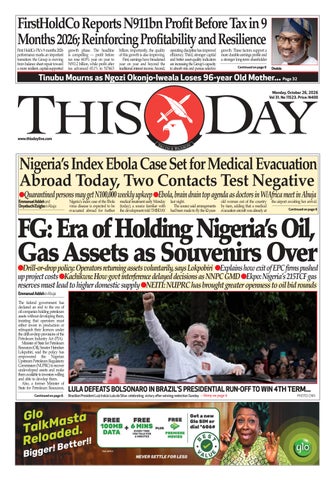
LULA DEFEATS BOLSONARO IN BRAZIL'S PRESIDENTIAL RUN-OFF TO WIN 4TH TERM... – Story on page 6 Brazilian President Luiz Inácio Lula da Silva celebrating victory after winning reelection Sunday
PHOTO: CNN
2
MONDAY, OCTOBER 26, 2026 • T H I S D AY
MONDAY, OCTOBER 26, 2026 • T H I S D AY
3
4
MONDAY, OCTOBER 26, 2026 • T H I S D AY
Pay for Dangote Refinery Shares through Access Bank Multiple channels. One opportunity.
Please read the Prospectus on ipo.dangote.com and, where in doubt, consult your stockbroker, fund/portfolio managers, accountant, banker, solicitor or any other professional adviser registered by the SEC for guidance before subscribing. Payment does not guarantee or automatically result in the allotment of shares. Allotment is subject to the applicable terms and conditions.
offer price
Scan for:
• Risk Disclosures • Terms & Conditions • FAQs
07030000000
MONDAY, OCTOBER 26, 2026 • T H I S D AY
5
6
T H I S D AY • MONDAY, OCTOBER 26, 2026
PAGE SIX
Lula Stages Historic Comeback to Beat Flávio Bolsonaro in Brazil's Presidential Poll Emmanuel Addeh in Abuja Luiz Inácio Lula da Silva, the Brazilian president, has staged a dramatic election fightback, defeating his far-right opponent, Flávio Bolsonaro, to claim a historic fourth term in power. With nearly 99 per cent of
votes counted this morning, the 80-year-old leftist received 51.75 per cent of the vote to his 45-year-old rival’s 48.25 per cent. Lula narrowly lost the first round of the election to Bolsonaro in early October, casting his political future into doubt and plunging progressive Brazilians
into three weeks of despair. Never, since the return of democracy in the 1980s, has the first round runner-up won the second vote, the Guardian UK reported. But Lula did precisely that on Sunday, prompting joyous scenes on the streets of São Paulo, where he had been following the count,
and at the hotel where he was watching the count. As the result was confirmed, Reginaldo Lopes, a key Lula ally, told the Guardian: “I feel incredible … This is Brazil telling the world that the extreme right is fascist, that the extreme right is against black people, is against
the poor, against the state, against gay people ... We are going to reorganise the democratic forces (in this country).” The incumbent, who had lost by 2.2 million votes three weeks ago, has now won by 4.3 million. The 81-year-old leftist appears to have made up much of the
Investors Rush for Dangote Refinery Shares as Offer Closes on 27 October
Peter Uzoho
Dangote Petroleum Refinery & Petrochemicals has reported a sharp increase in investor subscriptions as its landmark Initial Public Offering (IPO) enters its final days, with retail
and institutional investors accelerating participation ahead of the closing date of 27 October 2026. The company confirmed in a statement yesterday that the IPO will close on Tuesday, 27 October 2026, as scheduled.
"This is the final deadline, and no further extension will be granted. Investors wishing to participate must complete their subscriptions before the offer closes", the company said. The surge in demand follows the refinery's recently
released nine-month financial results, which showed exceptional growth in revenue, profitability and cash generation, reinforcing investor confidence in the company's long-term prospects. Dangote Refinery reported
FG: ERA OF HOLDING NIGERIA’S OIL, GAS ASSETS AS SOUVENIRS OVER
and Group Managing Director of the Nigerian National Petroleum Corporation (NNPC), Prof. Ibe Kachikwu, has recalled how government interference and cumbersome approval processes delayed decisions and constrained investment during his tenure at the national oil company. In the same vein, Minister of State for Petroleum Resources (Gas), Ekperikpe Ekpo, said Nigeria must translate its 215 Trillion Cubic Feet (TCF) of proven gas reserves into higher domestic supply, stronger infrastructure and industrial growth over the next
five years. Similarly, the Olu of Warri, Ogiame Atuwatse III, has maintained that the PIA has brought greater calm and responsibility to oil-producing communities by giving them a clearer stake in petroleum operations through Host Communities Development Trusts (HCDTs). They all spoke in a series of interviews published in ‘Upstream Gaze’, a special edition of a quarterly magazine by the NUPRC to mark its fifth anniversary. Lokpobiri said the policy had
helped make petroleum assets available for fresh investment, with 50 assets recently offered for bidding and another licensing round in the offing. The drill-or-drop policy, provided for under the PIA requires oil and gas companies to develop their licensed petroleum assets within the stipulated period or risk losing them to the government. The policy empowers the regulator to revoke or recover licences for undeveloped assets and make them available to investors willing and capable of putting them into production.
Essentially, it is designed to discourage speculative ownership and the hoarding of oil blocks which has been the norm, accelerate exploration and development, attract fresh investment, increase crude oil and gas production, and help Nigeria achieve its production targets. Lokpobiri said: “The drill-ordrop provision is one of the most consequential provisions of the PIA. It has kept operators on their toes. If you do not develop your assets within the provisions of the law, the NUPRC has the authority
revenue of $22.5 billion and net profit of $4.73 billion for the nine months ended September 30, 2026, representing a significant turnaround from a loss recorded in the corresponding period of 2025.
to recover those assets and make them available to investors that are willing and able to develop them. “The era of holding assets as souvenirs or symbols of wealth is gone: you either drill or drop. Some operators are now willing to relinquish assets voluntarily because that may be preferable to regulatory recovery. Others are reassessing their portfolios and recognising that certain assets no longer fit their development plans.” He also attributed the increase in active drilling rigs to reforms and improved regulatory activity, saying the number had risen from
Lula
difference through what his allies had identified as his main opportunity: persuading his voters to turn out. After a record abstention rate of 21.08 per cent in the first round, which disproportionately affected Lula voters because they tend to live farther from polling stations, the rate fell to 19.21 per cent. For Lula, who turns 81 on Tuesday, the victory represents a sensational final chapter in a storied political career that began when he emerged as a union leader in São Paulo’s industrial suburbs in the late 1970s, the Guardian UK report added. between 10 and 14 in 2023 to more than 60 currently. However, the minister said the departure of major Engineering, Procurement and Construction (EPC) contractors, deep-offshore contractors and other service providers had contributed to higher project costs in Nigeria, following prolonged uncertainty before the passage of the PIA. According to him, inadequate project activity had made it difficult for contractors to sustain their operations, prompting some to Continued on page 43
NIGERIA’S INDEX EBOLA CASE SET FOR MEDICAL EVACUATION ABROAD TODAY, TWO CONTACTS TEST NEGATIVE The fresh development came as the Nigeria Centre for Disease Control and Prevention (NCDC) said two suspected Ebola cases from the Federal Capital Territory (FCT) and Rivers State have tested negative, while 53 primary contacts of the confirmed index case have been identified and are being monitored. The agency also said that based on complaints by the contacts in quarantine, the federal government was considering the payment of N100,000 per week. However, NCDC said that the welfare arrangement was in the interim, as states were expected
to take over maintenance of the contacts cases in their domain subsequently. "The medivac plane is already at the airport waiting to evacuate her,” the source said, adding that the federal government was expected to announce the development after the patient had departed Nigeria. The proposed evacuation is coming amid heightened surveillance and contact-tracing efforts by Nigerian health authorities to prevent further transmission of the disease. Earlier, the Director General of the NCDC, Dr. Jide Idris, spoke at a press briefing in Abuja to
provide an update on Nigeria's Ebola disease response. Idris said the search for other secondary contacts was ongoing, assuring Nigerians that the federal government through Federal Ministry of Health and Social Welfare, NCDC, FCT health authorities and partners was fully committed to containing the outbreak. "As previously announced, Nigeria has confirmed one case of Ebola disease caused by the Bundibugyo virus. The patient is currently receiving medical care under isolation, with infection prevention and control measures
in place. Clinical teams continue to monitor and manage patient's condition," he said. According to him, the 53 primary contacts comprise 44 personnel from the hospital where the index case is receiving treatment, while nine additional contacts from the index, three from Julius Berger office where she visited before coming down with symptoms, and three health workers who attended to index case. He said samples collected from the husband of the index case tested negative, adding that two suspected cases in FCT and Rivers also tested negative, but
will have more follow up. Responding to a question about the true identity of the index case, the DG said she is from Uganda and married to a Swiss national, and the government is carrying out further investigations to establish her exact travel details. He said Nigerian officials will meet with Ugandan officials online to exchange information. Idris explained that the case was detected through event-based surveillance after vigilant healthcare workers recognised clinical features that raised concern. He said the response was being implemented through a structured
Incident Management System coordinated by the Emergency Operations Centre under the leadership of the Coordinating Minister of Health and Social Welfare, Prof. Ali Pate, and Presidential Task Force on EVD. Idris listed critical components as identifying and monitoring contacts for 21 days, ensuring safe clinical care, strengthening infection prevention and control across facilities, boosting surveillance and laboratory capacity, and community engagement. The DG said the centre is being Continued on page 45
FIRSTHOLDCO REPORTS N911BN PROFIT BEFORE TAX IN 9 MONTHS 2026; REINFORCING PROFITABILITY AND RESILIENCE proposition.
Profitability continues to strengthen Gross earnings increased 8.8% to N2.87 trillion, but profitability expanded faster: profit before tax reached N911.2 billion and profit after tax reached N744.5 billion. Post-tax return on average equity improved to 27.7% from 24.7% in the previous year, while return on average assets rose to 3.3% from 2.6% in 9M 2025 showing that balance sheet growth is generating stronger returns. This growth was supported by a more diversified revenue mix. Non-interest income surged 143.5% to N722.9 billion, supported by
a 48.1% increase in net fee and commission income to N316.4 billion. Transaction-led revenues, including electronic banking, funds transfers and credit-related services and other non-interest income contributions are giving the Group more diversified avenues for earnings growth.
Operating leverage is becoming visible Operating income rose 10.3% even as operating expenses declined 8.1% to N866.6 billion. The resulting cost-to-income ratio of 43.7%, down from 52.4%, is a strong indicator of improving operating leverage and cost discipline particularly in a 15.39%
inflationary environment. The result suggests that management is not relying on balance-sheet expansion alone; it is extracting more value from the franchise while containing the cost base. Core margins present a compelling earnings-upside opportunity. Although net interest income moderated by 16.0% to N1.26 trillion and net interest margin adjusted to 8.7% from 11.3% amid softer asset yields, the improvement in cost of funds to 4.5% from 4.9% demonstrates effective funding discipline and provides a strong foundation for margin recovery. Enhanced risk-adjusted pricing and a more efficient funding mix offer credible levers for margin
expansion and sustainable returns, while maintaining rigorous credit standards and asset quality. A balance sheet with greater strategic capacity The balance sheet provides greater capacity for disciplined growth. Total assets increased 18.1% from year-end 2025 to N32.20 trillion, while customer deposits grew 21.3% to N22.91 trillion. Group equity rose 17.0% to N3.86 trillion. In contrast, net customer loans expanded by a deliberate and measured 4.8% to N9.39 trillion. This combination of strong funding growth, firmer equity and selective lending reflects disciplined capital deployment rather than indiscriminate risk-taking. FirstBank’s capital adequacy ratio
improved to 18.6% at September 2026 from 16.7% at half-year. The stronger capital buffer increases resilience supports regulatory confidence and provides greater flexibility to finance attractive opportunities. Importantly, capital is strengthening while profitability is accelerating, improving the Group’s capacity to compound value internally.
Asset-quality repair is gaining traction Asset-quality repair is also advancing. The Group’s nonperforming loan ratio declined to 10.4% from 13.9% at H1 2026 while NPL coverage, including regulatory reserves, increased
to 98.8%. Impairment charges declined 28.3% to N207.1 billion and recoveries reached N94.3 billion. These figures show broad-based progress: stronger coverage, reduced impairment charges and meaningful recoveries to date. Although the NPL ratio remains above management’s desired level, the downward trajectory improves protection and loss-absorption capacity. To further strengthen asset quality by year-end, management could combine targeted restructuring of viable exposures, negotiated settlements and intensified recoveries with ongoing Continued on page 44
7
T H I S D AY • MONDAY, OCTOBER 26, 2026
NEWS
Group News Editor: Goddy Egene Email: Goddy.egene@thisdaylive.com, 0803 350 6821, 08074010580
BURIAL OF CHIMAOBI IFEANYICHUKWU ANOSIKE...
L-R: Executive Director Business Development and Portfolio Management, Federal Mortgage Bank of Nigeria, Mrs. Chinenye Chinedu Anosike, her husband/ bereaved elder brother, Mazi Chinedu Anosike, and bereaved wife, Adaeze Sonia Anosike, at the burial ceremony of Mr. Chimaobi Ifeanyichukwu Anosike, at Umuoriaku, Umuobasi, Umuahia North L.G.A Abia State on Saturday
Umahi: Cost of 750km Lagos-Calabar Coastal Highway Unknown, Alleged N15 Trillion Value Unfounded
Says no single design for project, fixes next 3 years for completion Group seeks more accountability from works minister FG inaugurates 30.58-km section of Abuja–Kano expressway Emmanuel Addeh in Abuja
The Minister of Works, David Umahi, at the weekend said the total cost of the 750-kilometre Lagos-Calabar coastal highway remains undetermined, describing the N15 trillion figure widely
cited for the project as false. Umahi, who spoke in an interview on Arise Television, said the federal government was procuring the highway in sections, with the cost of each determined by the terrain, soil conditions, bridges and other engineering requirements.
He challenged those citing N15 trillion as the total cost to explain how the figure was arrived at, insisting that it was wrong to calculate an average cost per kilometre from one section and multiply it by the entire 750 kilometres. "Who fixed this N15 trillion
that people are just brandishing everywhere? Who fixed it?" he asked, arguing that engineering costs could not be determined through generalised calculations without detailed designs for the different sections. The minister's comments come amid a prolonged controversy
ICPC Gets Recognition for Institutional Performance, Accountability, Service Delivery Alex Enumah in Abuja
The Independent Corrupt Practices and Other Related Offences Commission (ICPC) has received fresh recognition for its institutional performance in the fight against corruption in the country. The recognition followed an independent assessment by a Coalition of Civil Society Organisations (CSOs), which identified the commission and the Bureau of Public Procurement (BPP) among the notable performers in
public accountability and service delivery. A statement by ICPC said the assessment, presented at a civil society roundtable in Lagos, examined selected Ministries, Departments and Agencies (MDAs) of the federal government, focusing on transparency, institutional efficiency, accountability, and measurable contributions to public service delivery. The statement referenced a report published by NewsNowOnline on October 24, where ICPC's contributions
to protecting public resources, strengthening institutional safeguards against corruption, and promoting integrity within the public service were acknowledged. "The recognition comes amid ongoing efforts by the commission, under the leadership of its Chairman, Dr. Musa Adamu Aliyu, SAN, to strengthen the effectiveness of its investigative, preventive and enforcement responsibilities," the statement said. It observed that beyond investigating allegations of
corruption, the commission had continued to emphasise systemic interventions designed to identify institutional weaknesses, strengthen compliance mechanisms, and reduce opportunities for the abuse of public office. The civil society assessment particularly highlighted the importance of ICPC's oversight responsibilities in public procurement, where weak institutional controls and corrupt practices could expose government finances to substantial losses.
NDPHC Begins Project to End 15year Blackout in Kaduna Council Emmanuel Addeh in Abuja
The Niger Delta Power Holding Company Limited (NDPHC) has announced the commencement of an electricity infrastructure project aimed at ending a 15-year blackout in Rigasa community, Igabi Local Government Area of Kaduna State. The project comprises a two-kilometre 11kV line, a 1.5-kilometre 33kV line as well as a 7.5MVA, 33/11kV
injection substation designed to strengthen electricity distribution and improve power supply to residents and businesses. In a statement in Abuja by the General Manager, Corporate Communication and External Relations, NDPHC, Nazo Agim, the company said the project was facilitated by the Bola Ahmed Tinubu Ideological Group (BAT-IG). According to the NDPHC, the project reached a major
milestone at the weekend with a groundbreaking ceremony performed by the Kaduna State Deputy Governor, Dr. Hadiza Balarabe, who represented Governor Uba Sani. In his remarks, the governor commended NDPHC for the intervention, describing it as a life-saving initiative that would address the community's longstanding electricity challenges. Also, the Managing Director and Chief Executive Officer
of NDPHC, Jennifer Adighije, reaffirmed the company's commitment to improving electricity supply in underserved communities. Represented by the Executive Director, Networks, Babayo Bello, Adighije said that although the company's primary mandate was power generation, its interventions extended to transmission and distribution infrastructure to address critical gaps and expand electricity access.
over the cost, procurement process and transparency of the Lagos-Calabar Coastal Highway, one of President Bola Tinubu's flagship infrastructure projects. The highway has attracted scrutiny over the scale of public expenditure involved, the award of construction contracts and the basis for determining its overall cost. Critics have questioned whether the government can provide a clear estimate for the entire project. The debate has also centred on the project's route, land acquisition and the potential environmental and economic implications of building a major highway along Nigeria's coastline. The government has defended the project as a strategic transport corridor intended to improve connectivity and support economic activity. But Umahi said the LagosCalabar Coastal Highway was first mentioned in 1955, while a concept for the project was developed in 2006. However, he said he had not found any comprehensive engineering design, subsoil investigation or gazetted documents covering the entire route in the archives of the Federal Ministry of Works. "So it is very wrong for anybody to say, give me the cost of the project. Because there must be engineering dissection in every section that you are going through," he said. Umahi explained that each section must undergo environmental and social impact assessment, subsoil investigation and engineering design before its construction cost could be established. He said the environmental assessment helped determine the proposed route, ecological
implications and potential challenges, while soil investigations and engineering designs provided the technical basis for determining the scope and cost of construction. The minister maintained that the government had obtained environmental certificates for the sections being procured, adding that the assessments and reviews were conducted before the relevant projects proceeded. "There is no one single design that the 750 kilometres of LagosCalabar Coastal Highway is holding," he said. Umahi also defended the cost of the first section of the highway, arguing that comparisons with other coastal roads were misleading when differences in design and carriageway specifications were ignored. He cited a 47-kilometre stretch under Section One, which he said cost N1.06 trillion, and explained that the six-lane configuration meant its cost could not be directly compared with that of a conventional two-lane carriageway. According to him, dividing the cost by the length of the section and adjusting for the carriageway configuration produced an estimated cost of about N7.3 billion per standard two-lane carriageway kilometre, equivalent to approximately $5.5 million at an exchange rate of N1,330 to the dollar. He said the cost of other sections would depend on their individual engineering requirements, noting that Section Two, covering 55 kilometres, included 19 bridges despite having terrain that was more than 70 per cent similar to that of the first section.
8
T H I S D AY • MONDAY, OCTOBER 26, 2026
NEWS
5TH INDUCTION OATH-TAKING CEREMONY OF MEDICINE & SURGERY GRADUATES CLASS OF 2026, EDO UNIVERSITY...
Best Graduating Student, Dr. Kawthar Adédolápò Oladosu (holding the trophy) with her parents, Alhaja Temilade Oladosu (r) and Alhaji Ademola Oladosu (l) at the 5th Induction Oath-Taking ceremony of Medicine & Surgery graduates class of 2026, Edo State University, Iyamho held recently in the university
Dele Oye: Why FG Must Probe N373bn NELFUND Student Loan Disbursements Says NEC’s 90-day economic recovery plan unachievable without clear targets Calls for urgent review of multiple taxes, levies
Emmanuel Addeh in Abuja
Former national President of the Nigerian Association of Chambers of Commerce Industry Mines and Agriculture (NACCIMA), Dele Oye, yesterday called for better clarity and accountability in the administration of the Nigerian Education Loan Fund (NELFUND). Oye, who is the Chairman of the Alliance for Economic Research and Ethics (AERE), in a commentary on the federal government’s 90-day economic
action plan, said this followed the announced disbursement of N372.62 billion in institutional fees and student upkeep allowances. The past Chairman Organised Private Sector of Nigeria (OPSN), said the scale of the disbursement underscored the need for clear service standards, transparent reporting and effective complaintresolution mechanisms to ensure that beneficiaries receive the support they need on time. According to the NELFUND Student Loan Disbursement Report generated on October 3, 2026, he
Tinubu Pays Glowing Tribute to Veteran Journalist, Lade Bonuola At 80 Deji Elumoye in Abuja President Bola Tinubu has paid glowing tribute to veteran journalist and ex-Managing Director of The Guardian Newspaper, Mr Oyinlade Bonuola, on the occasion of his 80th birthday. The President, in a tribute issued on Sunday acknowledged Mr Bonuola's legacy of professionalism, mentorship and service to the nation as well as his invaluable contributions to Nigeria’s democratic journey. Tinubu, in the 12-paragraph congratulatory message stated, inter alia: "I extend my warmest congratulations to Mr Oyinlade "Ladbone" Bonuola, veteran journalist, distinguished editor, and former Managing Director of The Guardian Newspaper, on his 80th birthday. "This milestone birthday reminds us of your enduring contributions to journalism, your professional excellence, and your commitment to developing Nigeria’s media industry. "Recognised by media peers and mentees as a craftsman par excellence, Bonuola began his career at the Daily Times in February
1971 as a trainee sub-editor, rose through the ranks, and joined The Guardian in 1982 as pioneer editor, later serving as Managing Director till 1999. He later co-founded the defunct Comet newspaper, where he served as Managing Director. He also served as Managing Director of Nigerian Compass. "At 80, you stand tall as one of Nigeria's most respected figures in journalism, a man whose professional excellence, editorial courage, integrity, and commitment to the truth have left an enduring imprint on the nation’s media landscape. "As one of the 20th century's exceptional editors, your contributions to Nigerian journalism remain indelible. Through decades of dedicated service, you helped shape the language of media reporting, uphold responsible journalism, and strengthen the media’s role as a vital pillar of democracy and a keeper of factual records. Your commitment to accuracy, fairness, integrity, and public accountability is a value that remains integral to the media’s responsibility to inform citizens, hold public institutions accountable, and strengthen democracy.
stated that the fund had disbursed N372.62 billion as of September 29, 2026, while processing 1,659,853 applications. While acknowledging the importance of the scheme, Oye said the amount disbursed should not be treated as the sole measure of its performance, stressing that the government must also demonstrate how efficiently the programme serves students. He called on NELFUND to publish service standards covering application decisions, institutional payments and upkeep transfers, alongside aggregated data showing approval and rejection rates and payment timelines. He also advocated a real-time application tracking system that would allow students to monitor
the progress of their applications, as well as a transparent complaintresolution channel with clear response and closure targets. Oye said the same principles should guide household support programmes, skills financing and small-enterprise credit, insisting that public assistance should be based on verified data, delivered directly to beneficiaries and reported through privacy-protected information. According to him, publishing measurable results would help Nigerians assess whether government interventions are translating into tangible improvements in their lives rather than remaining as figures in official announcements. Oye urged NELFUND to
publish service standards for application decisions, institutional payments and upkeep transfers; show applicants a real-time status trail; publish aggregated approval, rejection and payment-time data; and operate a visible complaintresolution channel with response and closure targets “Accessibility, timely payment, transparent eligibility and swift redress are not side notes. They are the bridge between a scheme on paper and a student who can actually plan a semester,” he explained. On the National Economic Council (NEC) 90-day economic action plan, Oye said the initiative was a welcome recognition of the country’s cost-of-living crisis but warned that its success would
depend on clear targets, defined responsibilities and transparent implementation. The plan, endorsed by NEC on October 22, 2026, identifies five priority areas: food affordability, tax harmonisation, high-impact projects, investment bottlenecks and regulated household support. It also provides for a national dashboard to track projects and fuel-subsidy proceeds, while the government has identified reducing headline inflation and interest rates to single digits by 2027 as key policy objectives. However, Oye noted that the announcement did not provide a delivery matrix, public baselines, named delivery owners, itemised costs or milestone deadlines.
Tax Ombud Seeks to Ease Compliance Burden, Dispute Costs for Businesses Says proposed NIPOST partnership to usher free complaint-resolution services to market traders, rural taxpayers Ombud says intervention will improve fairness, compliance without shielding taxpayers from lawful obligations Transport operators flag overlapping levies, complex tax rules as businesses seek clarity James Emejo and Precious Ologbondiyan in Abuja
Tax Ombud and Chief Executive, Office of the Tax Ombud, Dr. John Nwabueze, has revealed plans to extend free tax complaint-resolution services to market traders and businesses in rural communities. Speaking at a town hall meeting in Abuja, over the weekend, he said the move aimed to reduce the cost of resolving disputes with revenue authorities and ease administrative bottlenecks confronting small enterprises. Acc9rding to him, the initiative, which involves a proposed partnership with the Nigerian Postal Service (NIPOST), is expected to bring the services
closer to taxpayers who may otherwise struggle to access formal channels for challenging disputed assessments, procedural irregularities and other grievances arising from tax administration. This came as representatives of market associations, professional bodies, transport unions, airline operators and other private sector groups highlighted the need for simpler tax procedures and more effective dispute-resolution mechanisms. Although the proposed collaboration is yet to be formalised, its implementation could provide smaller businesses with a more accessible avenue for addressing tax-related complaints without incurring the costs and delays
associated with prolonged disputes. Nwabueze said the Office was working towards formalising the arrangement with NIPOST to improve access to its services, particularly for taxpayers in underserved locations. He explained that the tax ombud was established to address operational, procedural and administrative grievances arising from tax and revenue administration through an independent, impartial and non-judicial process. He said, “Our services, which are offered free of charge, are designed to resolve disputes, mediate complaints, and promote a transparent, fair, and consistent tax administration system."
No waiver of legitimate tax
obligations Nwabueze stressed that the Office was not established to cancel legitimate tax liabilities or protect taxpayers unwilling to meet their legal obligations. He said the institution did not formulate tax policy or perform the functions of the courts, but was mandated to facilitate the fair and impartial resolution of eligible complaints within its statutory powers. The distinction is significant for businesses seeking relief from administrative disputes: the intervention is intended to address unfair processes and grievances, rather than provide a blanket exemption from taxation.
9
MONDAY, OCTOBER 26, 2026 • T H I S D AY
C E L E B R AT I O N O F A B E L OV E D PAT R I ARC H
Dr Geoffrey Chukunwiken Ohen (Jr) 20th January 1957 – 22nd September 2026 Beloved Husband, Father, Grandfather, Brother, Uncle and Friend
The Ohen family cordially invites you to celebrate his life at the funeral ceremonies. “Blessed are the dead who die in the Lord … they will rest from their labour, for their deeds will follow them.” R E V E L AT I O N 1 4 : 1 3 S U RV I V E D B Y
Monday, 26th October
WIFE
Service of Songs & Night of Tributes V E N U E St Saviour’s School, Alexander Avenue, Ikoyi TIME 4pm Service of Songs 6pm Night of Tributes COLOUR A touch of blue
Barr Mrs Ogugua “OG” Ohen CHILDREN
Geoffrey Ohen III Carmen Ohen Frederick Ohen II GRANDCHILD
Alaïa Ohen‐Kazeem
Tuesday, 27th October
LAGOS
LAGOS
Commendation Service V E N U E Our Saviour’s Church, TBS TIME 9am
Friday, 30th October
D E LTA
Lying in State V E N U E Family home, Owa TIME 9am Funeral Service V E N U E Anglican Cathedral Church of Ascension, Lagos/Asaba Road, Boji‐Boji Owa TIME 11am COLOUR Cream on cream Fabric available on request
Interment: private, at Owa Alizomor
Thursday, 29th October
D E LTA
Service of Songs V E N U E St James Anglican Church, Agbor TIME 4pm COLOUR Green
Reception V E N U E Ika Grammar School
Sunday, 1st November Thanksgiving & Outing Service
Fabric available on request
TA P H E R E TO R S V P → or visit geoffrey-ohen.lovable.app/rsvp ENQUIRIES
0803 324 1670 · frederick@geoffohenltd.com
D E LTA
10
MONDAY, OCTOBER 26, 2026 • T H I S D AY
11
MONDAY, OCTOBER 26, 2026 • T H I S D AY
N AT I O N A L P E N S I O N W E E K 2 0 2 6
PENSIONS FOR ALL Building a Secure Future Together
The Nigerian Pension Industry presents the maiden National Pension Week (NPW) 2026, holding from 26–30 October 2026. NPW 2026 promotes pension awareness, expands participation and strengthens retirement security through five days of engagement with the youth, entrepreneurs, workers, retirees, pension operators and policymakers.
T H E N AT I O N A L P E N S I O N S U M M I T KEYNOTE ADDRESS
GROWING AND DEPLOYING NIGERIA’S PENSION FUND FOR ACCELERATED NATIONAL DEVELOPMENT The National Pension Summit will bring together policymakers, pension industry leaders, institutional investors and key stakeholders to explore how pension funds can support national development, expand coverage and strengthen retirement security. F E AT U R E D K E Y N O T E S P E A K E R
CONVENER
Omolola Oloworaran
Director-General, National Pension Commission (PenCom)
KEYNOTE SPEAKER
Dr. Akinwumi Adesina, CON, CGH
N AT I O N A L P E N S I O N W E E K
26–30 October 2026
Pensions for All: Building a Secure Future Together
Three Focused Breakout Sessions State Government Participation
Strengthening pension reform and expanding coverage at the subnational level. Capital and Development
Exploring how pension funds can support inclusive economic growth. Employer Participation and Compliance
Dr. Akinwumi Adesina, CON, CGH
Moving from regulatory compliance to stronger employer commitment.
Dr. Adesina, a former Minister of Agriculture, served as President of the African Development Bank from 2015 to 2025, transforming the institution's financial capacity and global standing. Under his leadership, the Bank's capital increased from $93 billion to $318 billion.
Also Featured
Globally renowned economist and development expert
A recipient of the 2017 World Food Prize and numerous international honours, he brings extensive experience in economic development, institutional leadership and strategic investment to this important national conversation.
Nigerian Pension Industry Documentary and CPS Achievements Showcase. National Pension Week Industry Awards of Excellence.
His address will explore the potential of Nigeria's pension assets to contribute to national development while safeguarding contributors' retirement savings.
B E PA R T O F T H E C O N V E R S AT I O N
Join the stakeholders shaping the future of pensions and national development. Explore the programme and register at npw.ng.
npw.ng
NATIONAL PENSION WEEK 2026 · Pensions for All: Building a Secure Future Together
12
MONDAY, OCTOBER 26, 2026 • T H I S D AY
OFFICIAL UNVEILING OF
RAINBOW COALITION CANDIDATES FOR 2027 GENERAL ELECTION The Rivers State Rainbow Coalition family cordially invites distinguished guests, political leaders, stakeholders and the general public to the unveiling its CANDIDATES. N ALLIA E NC
ACT I
O
AA
RA I N B OW COA L I T I O N . . . T I N U B U I S O U R P R E S I D E N T. . . T I N U B U I S O U R P R E S I D E N T. . .
ST R O N G E R TO G E T H E R . . .
Date: Tuesday October 27, 2026 Venue: General Yakubu Gowon Stadium Elekahia, Port Harcourt. Time: 10am prompt
MONDAY, OCTOBER 26, 2026 • T H I S D AY
13
14
MONDAY, OCTOBER 26, 2026 • T H I S D AY
O
n behalf of the members of the Presidential Campaign Council (PCC) and the All Progressives Congress (APC), I extend our heartfelt appreciation and gratitude to everyone who participated in the successful flag-off of our party’s presidential campaign in Kaduna on Saturday, 24th October 2026.
It is gratifying to note the overwhelming enthusiasm and solidarity demonstrated in support of the leadership continuity of our dear President, His Excellency, Senator Bola Ahmed Tinubu, GCFR. The mammoth crowd that converged on Kaduna was an eloquent testimony to the goodwill and support Mr. President enjoys across the thirty-six states of the Federation and the Federal Capital Territory. Let me place on record our profound gratitude to His Excellency, the Vice President, Senator Kashim Shettima, GCON, for his unwavering support. Special appreciation goes to members of the Federal Executive Council who graced this epoch-making occasion. Our sincere gratitude also goes to our esteemed Executive Governors, the President of the Senate, Distinguished Senator Godswill Akpabio, GCON, the Speaker of the House of Representatives, Rt. Hon. Tajudeen Abbas, GCON, and other distinguished members of the National Assembly. Your presence at the flag-off ceremony added colour, beauty and grandeur to the entire programme. We equally appreciate members of the State Houses of Assembly, Local Government Chairmen, Councillors, political appointees, party leaders and stakeholders who turned out in large numbers to grace the occasion. The opposition, dwelling on AI, tried to parrot the wrong narratives with dubious photo-ops and deepfake concoctions. They orchestrated crisis, and tried to cause a stampede, but despite and in spite of their various mischief, our gallant members drawn from across the states navigated the events on an even keel from the beginning, to the end of the rally. The successful outing was a motivation for our collective resolve to sustain our effort towards Mr. President’s re-election. We are further emboldened by this generous show of love and support for our president and candidate, and together we shall sing songs of victory on 16 January 2027. I wish to thank most sincerely our Muslim and Christian brothers and sisters for their special participation. Our youths deserve particular recognition. I commend our indefatigable and resilient youths who have stood by us through thick and thin. We cannot thank you enough. To our captains of industry, organised private sector, barbers, hairdressers, farmers, drivers, security personnel, civil servants, public servants, vulcanizers, market women, youth groups, support groups and the media, both traditional and digital, we extend our profound appreciation. We could not have achieved such a successful outing without your invaluable support. The remarkable success of the Kaduna flag-off has further re-energised us for the task ahead and strengthened our collective resolve as we work towards Mr. President’s re-election. We remain deeply encouraged by the generous show of love, goodwill and solidarity demonstrated by Nigerians from all walks of life. As we move across the country in continuation of our campaigns, I commit us all into the hands of Almighty Allah, praying that He grants us wisdom, guidance and divine protection in the air, on land and at sea, for a peaceful and hitch-free campaign. May we assemble individually and collectively to celebrate our victory come 16th January 2027, to the glory of God Almighty. To our numerous followers and supporters whom space does not permit me to mention individually, please accept my heartfelt thanks and appreciation. Your contributions are deeply valued.
Thank you all.
Senator Abdul’aziz Yari
Director General PRESIDENTIAL CAMPAIGN COUNCIL (PCC)
MONDAY, OCTOBER 26, 2026 • T H I S D AY
15
16
MONDAY, OCTOBER 26, 2026 • T H I S D AY
17
T H I S D AY • MONday OCTOBER 26, 2026
Politics
Acting Group Politics Editor DEJI ELUMOYE Email: deji.elumoye@thisdaylive.com 08033025611 sms only
M O N D AY D I S C O U R S E
Campaign Council: Of NDC’s Authority, O-K Movement and Race against Time As the January 16, 2027 presidential poll approaches, the Nigerian Democratic Congress faces a defining test: reconcile competing campaign structures, resolve support-group tensions and translate political enthusiasm into coordinated electoral strength, writes Sunday Aborisade.
Obi
T
he Nigeria Democratic Congress (NDC) is approaching a critical moment in its preparations for the January 16, 2027 general election. With Peter Obi as its presidential candidate and Senator Rabiu Musa Kwankwaso as his running mate, the party has assembled a ticket with potential cross-regional appeal. Yet, beneath the enthusiasm surrounding the alliance lies an organisational challenge that could determine whether its electoral promise translates into success: who controls the campaign, how competing interests are accommodated and how quickly a coherent national structure can emerge. The delayed inauguration of the National Campaign Council (NCC), uncertainty surrounding the party’s manifesto and friction with support groups, particularly the ObiKwankwaso movement that established a Presidential Campaign Council (PCC) outside the party’s approved framework, have raised questions about NDC’s preparedness. These are more than administrative disagreements. They concern the relationship between political parties and the movements supporting their candidates, the balance between institutional authority and grassroots mobilisation, and the ability of an opposition platform to manage competing expectations under a demanding electoral timetable. The central question is whether the NDC can resolve these differences or allow disputes over recognition, appointments and authority to consume valuable campaign time. The NDC leadership has attributed the delay in constituting its campaign council to consultations, due diligence and the need to involve its presidential candidates in selecting key officials. Following a two-day meeting of the National Working Committee (NWC), National Chairman, Senator Moses Cleopas announced October 20 as the proposed inauguration date, explaining that the party had been developing its campaign blueprint since August. “The constitution and inauguration of the presidential campaign council is a responsibility of the party at the highest level. But the party
Kwankwaso
itself cannot do that without recourse to the presidential candidate and the vice-presidential candidate,” Cleopas said. He disclosed that Obi and Kwankwaso were consulting on appointments to strategic positions, including director-general, deputy directorgeneral, finance director, mobilisation director and media director. “It is better to get it right. It is a sensitive election that we are going into, and we must check characters,” he added. The October 20 inauguration was subsequently postponed to October 26, with the party citing Obi’s overseas engagement. National Publicity Secretary, Osa Director attributed the decision to “the very tight schedule of our presidential candidate” and an important overseas engagement. The party later announced that its third National Executive Committee (NEC) meeting, scheduled for October 26 in Abuja, would feature the unveiling of the NCC, presentation of certificates of return to candidates and disclosure of its financial accounts. Although consultation and scrutiny are legitimate, repeated adjustments to the inauguration timetable risk creating an impression of uncertainty. The leadership must demonstrate that consultation has a definite endpoint and
Dickson
will not become an obstacle to implementation. The candidates deserve meaningful input into the composition of their campaign council. They will defend the party’s policies, lead public engagements and bear the greatest political responsibility for the election. However, consultation must not translate into the indefinite concentration of campaign decisions in the hands of two individuals. A presidential campaign council is the operational machinery through which a party coordinates communications, finances, policy, state organisations, mobilisation and electoral protection. The NDC must therefore reconcile the candidates’ preferences with its institutional responsibilities. Cleopas has warned against appointing officials whose loyalty is uncertain, arguing that divided political commitments could undermine the campaign. While understandable, such screening must not become an open-ended exercise or reduce appointments to questions of personal loyalty rather than competence and clearly defined responsibilities. The party needs transparent appointment criteria, firm deadlines and a mechanism for resolving disagreements. If the candidates and leadership cannot agree on every position, they should settle essential appointments first and establish a deadline for completing the remaining arrangements. In an election campaign, the cost of prolonged vacancies may exceed the benefits of pursuing ideal appointments. The more complicated issue concerns the
Ultimately, the contest is about whether the NDC can demonstrate the competence required to compete for national power. Its promises of transparency, internal discipline and early electoral preparation will carry greater weight if reflected in how it manages its affairs.
relationship between the party and the support groups associated with its candidates. Obi’s political appeal has been sustained by the Obidient Movement and networks of volunteers, professionals, young people, diaspora supporters and community organisers. Kwankwaso also brings an established political constituency and mobilisation networks that the NDC needs to incorporate into its national strategy. These groups can provide campaign resources, grassroots contacts, volunteers and visibility beyond conventional party structures. However, the Obi-Kwankwaso movement’s creation of a separate PCC raises a fundamental question: can a support group establish a parallel campaign structure while the party is constituting its own NCC? Cleopas has insisted that the NDC welcomes support groups but expects them to operate within its approved framework. “Why wouldn’t we be here and love an OK Movement? Why wouldn’t we be here and love an obedient movement?” he asked. He added: “We are not against support groups. We know their relevance. We need them, we love them, and we see them as our helpmates.” The chairman identified the Directorate of Mobilisation under the Office of the National Organisation Secretary as the channel through which support groups should register and coordinate their activities. His position reflects a legitimate concern about accountability. Multiple bodies issuing competing directives, organising overlapping programmes or claiming authority over the same resources could undermine campaign coordination. Nevertheless, support groups also have legitimate interests in preserving their identities, networks and operational independence. Many volunteers have invested personal resources and spent years mobilising supporters before the emergence of the NDC as their preferred political platform. NOTE: Interested readers should continue in the online edition on www.thisdaylive.com
18
T H I S D AY • MONDay, OCTOBER 26, 2026
FEatures
Group Features Editor: Chiemelie Ezeobi Email chiemelie.ezeobi@thisdaylive.com,
Why Oil Production, Asset Protection Matter to Nigeria’s 7% Economic Growth Target
Nigeria’s ambition to achieve seven per cent economic growth in 2026 will depend partly on its ability to increase crude oil production and protect the assets that sustain the industry. With crude oil exports accounting for a significant share of the country’s foreign exchange earnings, production losses arising from oil theft, pipeline vandalism and other disruptions could undermine efforts to boost revenue and expand the economy. As the government pursues its growth target amid domestic and external economic pressures, sustained oil production, effective asset protection and the role of Tantita Security Services Nigeria Limited in safeguarding oil infrastructure in the Niger Delta have become important considerations in the country’s economic outlook. Victoria Ojiako writes
N
igeria’s ambitious seven per cent Gross Domestic Product (GDP) growth forecast for this year will not be a tea party. The World Bank projects growth at 4.4 per cent, citing stronger resilience and better-than-expected economic performance. The International Monetary Fund (IMF) forecasts real GDP growth at 4.1 per cent;PwC Nigeria estimates economic expansion at 4.2 per cent, driven by improved crude oil production and key sector performance. The Federal Government is targeting around 4.68 per cent, while domestic groups like the Lagos Chamber of Commerce and Industry (LCCI) hold a more ambitious outlook of up to seven per cent. One thing is standing out in these projections. It is the role to be played by the oil sector, which continually holds the ace on the economic performance especially in revenue inflows. The growth projection will therefore be largely driven supported by several factors including higher crude oil production and stronger performance in dominant sectors. With crude oil export accounting for over 80 per cent on Nigeria’s FX earnings, the continuous flow of petrodollars will play a critical role in achieving the projected growth rate. Analysts said that sustaining investments and increasing exploration activities were critical to achieving the target and boosting the nation’s reserves. It is equally important to develop a comprehensive framework for increasing production, expanding reserves and enhancing the sector’s contribution to national economic development. Achieving these feats requires sustaining ongoing oil assets protection and security, infrastructure repairs as well as consistent industry reforms. The operations of Tantita Security Services Nigeria Ltd (TSSNL) in the Niger Delta region is also key. For many stakeholders, the Federal Government of Nigeria’s appointment of Tantita Security Services Nigeria Ltd (TSSNL) to protect oil assets and ensure peace and stability in the Niger Delta comes to play. President Bola Ahmed Tinubu had appointed Tantita Security Services Nigeria Limited (TSSNL) led by High Chief, Dr. Government Oweizide Ekpemupolo, alias Tompolo, to protect Nigeria’s oil assets in the Niger Delta region. The apointment was to enable TSSNL, through its security operations, support the national economy in getting the full benefits of oil resources. The TSSNL works in collaboration with other security outfits to achive its goals of securing oil assets and ensuring peace and stability in the Niger Delta region. Tantita’s operations had ensured the security of oil pipelines, ensuring the uninterrupted flow of petroleum resources, and ensuring that Nigeria migrated from a position of constant loss management to stability, planning, growth and development. The TSSNL operations have transformed the oil and gas landscape and allowed Nigeria to expand oil production quota and significantly cut rampant oil theft. Its track record in mitigating risks associated with oil pipelines has positioned it as a reliable partner in preserving Nigeria’s economic backbone. As stakeholders advocate for the continued collaboration with TSSNL, the imperative of securing oil infrastructure remains at the forefront of efforts to ensure the nation’s sustainable development. In the development process of any society, certain assets contribute to the advancement of
Dr. Government Oweizide Ekpemupolo, alias Tompolo
society and its people. These assets ensure economic or monetary benefits for the people. These assets could be regarded as operating assets, non-operating assets or leased assets, among others. The impact of TSSNL’s operations was captured in a recent survey, with majority of the respondents attributing the de-escalation of security incidents in the Niger-Delta region to the pipeline surveillance operations executed by TSSNL. Tantita’s Milestone Achievements Tantita Security Services Nigeria Limited’s sustained efforts to protect oil pipelines and other critical infrastructure in the Niger Delta have contributed significantly to improved crude oil production, environmental safety and economic activities in the region, the company’s Media Consultant, Dr Paul Bebenimibo, has said. Bebenimibo, who is also Special Adviser to Tantita Chairman, Government Ekpemupolo, popularly known as Tompolo, made the disclosure while speaking on the sidelines of an award presented to Tantita by Blueprint Newspapers in recognition of the company’s contributions to pipeline security and national development. He said the award was further recognition that Tantita’s intervention in the Niger Delta was yielding tangible results, particularly in the fight against oil theft, pipeline vandalism and other illegal activities threatening Nigeria’s oil industry. According to him, since Tantita assumed a major role in pipeline surveillance and protection in 2022, the company has recorded significant progress in securing oil facilities across the Niger Delta. “Over the years, awards have been coming in, and that shows that Tantita is really doing the job very well,” Bebenimibo said. He noted that improved security around oil-producing communities had also created an environment conducive to the revival of legitimate economic activities, including fishing and farming. Bebenimibo said Tantita remained committed to supporting efforts to increase Nigeria’s crude oil production to 2.5 million barrels per day, stressing that effective protection of oil infrastructure was critical to achieving the target.
He attributed part of the company’s success to the leadership and extensive knowledge of the Niger Delta terrain possessed by its chairman, Tompolo. According to him, Tompolo’s familiarity with the creeks and communities has enabled the company to develop strategies for effectively monitoring and securing oil infrastructure. Bebenimibo disclosed that Tantita had deployed modern technology, including drones, to monitor activities in the creeks and detect illegal operations. “We have acquired drones that are now picking up every illegal activity that is going on in the creek,” he said, adding that illegal operators were increasingly finding it difficult to evade the company’s surveillance efforts. Beyond pipeline surveillance, Bebenimibo said Tantita had placed significant emphasis on youth empowerment as part of its strategy to tackle insecurity and discourage young people from engaging in oil theft, bunkering and other criminal activities. He disclosed that more than 60,000 youths were currently employed by the company and paid monthly. He further said Tantita had introduced skills acquisition programmes and supported young people, women and other members of host communities through grants and other forms of economic empowerment. “Tantita is not just employing the youths. It is also giving them skills and promoting their businesses in the area by giving grants to youths, women and men,” he said. According to him, the combination of employment, skills development and community support had contributed to reducing criminal activities in parts of the Niger Delta. Bebenimibo also highlighted the growing relationship between Tantita and the media, describing journalists as important partners in communicating the company’s activities and promoting transparency around its operations. He disclosed that Tantita had built a correspondents’ secretariat in Delta State and was planning to extend similar structures to other states in the Niger Delta, as well as establish a facility for journalists at the national level.
He said the initiative was part of the company’s commitment to strengthening its relationship with the media and ensuring that its activities and contributions to national development were properly communicated to Nigerians. Bebenimibo maintained that Tantita’s approach to security was not limited to enforcement, but also involved creating legitimate economic opportunities for youths and supporting host communities. He expressed confidence that sustained collaboration among security agencies, oil companies, host communities, the media and private security contractors would further strengthen the protection of Nigeria’s oil infrastructure and contribute to increased national revenue. Examining Nigeria’s H1 and H2 2026 Economic Outlook and reform journey, PwC Partner, Chief Economist and Lead Strategy & West Africa, Olusegun Zaccheaus; Partner, Clients & Market Leader, West Market, Pedro Omontuemhen and Director, Akolawole Odunlami agreed that macroeconomic conditions have continued to improve, supported by greater foreign-exchange stability, moderating inflation, stronger external reserves, higher revenue mobilisation and increased capital inflows. Insight from their “Unlocking Nigeria’s reform dividend From macroeconomic stabilisation to inclusive growth” revealed that the next step is to translate these gains into stronger household incomes, higher productivity, more jobs, and broader-based economic growth. “Nigeria entered the second half of 2026 from a stronger macroeconomic position. Real GDP grew by 3.89 per cent year-on-year in Q1 2026, supported by ICT, Finance & Insurance, Construction and Agriculture. Headline inflation moderated to 15.91 per cent in June, while the naira remained broadly stable at N1,379.68/US$. Gross foreign reserves rose by 38.3 per cent per cent year-on-year to US$51.46 billion in June, providing a stronger external buffer and supporting confidence in the foreign-exchange market,” they said. On the other hand, household affordability remains under pressure, private-sector financing conditions are still tight, and growth remains concentrated in a relatively narrow group of sectors. External risks have also increased, particularly through geopolitical tensions, energy-market volatility and weaker global growth. These factors will influence how quickly Nigeria can move from macroeconomic stabilisation to more inclusive and sustainable growth. Economic Outlook for H2 2026 Nigeria’s economic outlook remains positive, although the second half of the year will continue to be shaped by domestic and external risks. Inflation is expected to moderate, although food-price pressures, other supply-side shocks and pre-election spending could create upside risks. The naira is expected to remain broadly stable, supported by improved external buffers and foreign-exchange market reforms, but it remains exposed to shifts in oil prices, capital flows and domestic FX demand. Monetary policy is expected to remain relatively tight, with room for gradual rate reductions if the decline in inflation is sustained. Fiscal pressures may also persist as continued spending needs, the budget deficit, and government financing requirements place demands on available resources.
19
THISDAY • MONDAY, OCTOBER 26, 2026
DIGITAL ASSET MARKETS
with Nicky Okoye
( digitalassets@anabelgroup.com )
Digital Assets and Enterprise Development
N
ation-building primarily focuses on job creation, rising living standards for citizens, and economic prosperity for the nation-state. In this respect, all nation-building efforts, at the national and sub-national levels, must consider how digital asset markets stimulate enterprise development and entrepreneurship. Nothing will affect entrepreneurship and enterprise development more than the expansion of digital assets and the ability of digital asset classes to move frictionlessly across global blockchain rails.
Enterprise Development Strategy and Digital Assets Enterprise Development and Digital Assets are inseparable. As the World continues to evolve in the Digital Asset Markets space, some of the most important applications of the digital asset revolution will be felt by enterprises seeking to access or raise capital from global sources, using previously unavailable strategies which have now become very strategic, including several digital asset classes, decentralised capital and decentralised financial ecosystems. Collectively, these strategies are changing the game for enterprise fundraising in the 21st century. Large and small enterprises seeking to innovate and respond to local and global market opportunities can use strategies outlined in my upcoming “Digital Asset Markets Strategy guide” to deliver value-innovation development processes. For intentional enterprises and entrepreneurs, this approach will be customised and tailored to each industrial segment, depending on the industry’s peculiarities, reach, capital requirements, and the talent of the professionals operating within it. Tokenisation strategies to raise capital are already becoming common worldwide. This can be achieved through real-world asset digital tokens or utility tokens, which are designed to enhance community participation and reward systems. Using digital assets to fund municipal projects, set up new decentralised enterprises, build infrastructure etc., are all options that are now available Where will the new capital come from to grow the digital asset market ecosystem? I would like to use this illustration to make my point. On 1 September 1972, in what was considered the “Match of the Century,” chess grandmaster Bobby Fischer defeated Russian grandmaster Boris Spassky during the World Chess Championship in Reykjavik, Iceland. This history-making feat was the first time since the inception of the global chess tournament, which began in 1866, that an American won the Championship, and the first time in 22 years that a non-Russian was crowned the King of Chess. For the leadership of Nation States, Financial Institutions, Global Capital Markets, Global Enterprises as well as Entrepreneurs, the next twenty-five years will redefine and will determine, the geo-political zones, nation states, the families, communities and individuals, that will benefit from the newly created wealth that is projected from the monumental growth of global GDP as it grows to heights of over $200 trillion, by 2050. This monumental economic growth is projected to add $100 trillion in new economic value in just under 25 years. Positioning and winning key niche markets, including the Digital Asset Markets, as a major part of the Next One Hundred Trillion Dollars GDP growth that is projected, in my opinion, is going to be as exciting for nation-states, capital market operators, enterprises and entrepreneurs as winning the “Match of the Century” Championship was for the citizens of the United States of America in 1972. We at the Global Investment Advisory Community (GIAC) are committed not only to making this process of participating in the digital asset
L – R : His Excellency Dr Alex Otti Executive Governor of Abia State, Dr Nicky Okoye, Founder, Global Investment Advisory Community at the Nigeria Leadership Summit for Enterprise Development.
markets exciting but also profitable.
The Next One Hundred Trillion Dollars (N1HTD) Nothing holds more promise and excitement for nation-states, sub-national regions, communities, enterprises, and individuals actively engaged in enterprise and commercial activity than this projected growth forecast for the global economy, which is expected to expand to over two hundred trillion by 2050, adding an unprecedented additional over One Hundred Trillion dollars between now and then. This means that in less than twenty-five years, the global economy’s GDP will more than double. Enterprise Development and the next one hundred trillion dollars We in the GIA community expect policymakers and legislators to design strategic, job-creating government policies and growth-enabling legislation to position their people for this monumental shift in global economic fortunes. In our Digital Asset Markets Strategy, we have extracted proprietary analysis which guides leaders on the way forward. Our Next One Hundred Trillion Dollars analysis and strategic information provide wealth-creation-driven policies that reposition and stimulate 21st-century job creation through enterprise development at the nation-state level, as well as for geopolitical regions, municipalities, and enterprises, particularly those exclusively participating in our N1HTD Mastermind community. The most strategic use of our N1HTD analysis will be to design and develop 21st-century wealth maps that reflect the direction and growth of global GDP within the N1HTD context. In my “Digital Asset Markets Strategy” guide, members of our global investment advisory community will find analysis of global economic disruptive indicators as they relate to N1HTD’s projected growth. I also include my opinion on industry expansions and trends in enhanced economic value, as defined by industrial segments, geography, geopolitics, and even access to technological advancements. Population migration trends and resultant consumer behaviour.
Guide to the Next One Hundred Trillion Dollars The Next one hundred trillion dollars in
global GDP growth will be impacted by the following drivers: • Digital Asset Markets Strategy. • Artificial Intelligence, Artificial General Intelligence, Artificial Superintelligence and machine learning with specific industry impact and analysis. • Technological advancements in industrial applications, as they relate to specific industries. • Industrial ecosystems and global value chains, with specific engagements for African suppliers. • Global supply chains as they relate to the World’s most critical industries. • Geopolitical touchpoints, including economic disruptions and transformations with strategic impact from specific innovations. • Global populations, changing consumer behaviour and the direction of economic demand trends. • 21st-century indicators and the impact of BIG DATA analysis in strategic industries. • Value Chain Intelligence and Enterprise Excellence, projections and trends.
The Geopolitics of the Next One Hundred Trillion Dollars A strategic look at China China currently accounts for over 30% of global manufacturing output, whereas the USA accounts for just under 16%. China’s high-speed rail infrastructure shows it has installed and operates over 40,000 km of high-speed rail, accounting for over 70% of global high-speed rail infrastructure. The United States has just about 753km, which is less than 2% of China’s installed capacity. In the electric vehicle arena, China has overtaken the United States, with over 60% of global Electric Vehicle (EV) production compared to the United States, which has 10-15% of global capacity. In 21st-century telecommunications, built on 5G networks, China has over 2.9 million 5G base stations, representing over 60% of global output. The United States has about five hundred thousand (500k) 5G base stations, less than 20% of China’s capacity. In the value chain required for processing rare earth metals, which are essential for modern electronics, quantum computers and Artificial Intelligence, China has nearly cornered the global market. Currently, China accounts for 90% of global rare earth metal processing capacity,
while the United States has less than 5%. In industrial robot use and installation, China again accounts for 51% of installed capacity. In this case, annual industrial robot installations include not only Chinese-designed and built robots but also those fully installed in Chinese factories. The rest of the world, including the USA and Europe, shares the remaining 49% of industrial robot installation capacity. And it’s going to get worse for the West and better for China, depending on how you look at it. According to an OECD report, by 2030, 37% of all science, technology, engineering, and mathematics (STEM) graduates worldwide will be Chinese. This compares with projections of just 4.2% for the USA, 1.2% for Germany, 1.2% for the UK, and 0.8% for France. India is projected to follow China closely with 26.7% of STEM scientists. In 2011, China produced and used more cement than the United States used in the entire 20th century. In 2011, a Chinese firm built a 30-story skyscraper in just15 days. In 2014, a different Chinese firm topped that by building a 57-story skyscraper in 19 days. China built the equivalent of Europe’s entire housing block in just 15 years. In 2024, a Chinese construction company built an entire highway with Artificial intelligence robots, with no human engineers. China has the first all-AI hospitals, which can perform diagnosis-to-treatment with no human doctors involved. In the Maritime industry, China currently has 129 times the shipbuilding capacity of the United States. In other words, competition with China in shipbuilding is nonexistent. As the global economy races to $200 trillion in GDP by 2050, China’s economy is projected to grow to over $60 trillion in GDP, ahead of every other country in the entire World. India, also in Asia, is projected to grow to over $51 trillion in GDP within the same timeframe. This means China and India combined will represent over half of global GDP by 2050. This is fascinating and significant, and it shows why we must continue to study and monitor the Next One Hundred Trillion Dollars (N1HTD), in the interest of those coming after us.
Global Investment Advisor’s opinion It is important to understand what nationstates and sub-nationals need to do to ensure their regions remain competitive, even in the face of a rising China. Simply outsourcing everything to China will ensure that your people will lose in the long run. Leaders must look at the guides I have provided as key areas of impact for the next one hundred trillion dollars in global GDP and find ways their regions or nations can compete. As far as we in Africa and the Caribbean are concerned, the most important factor to hold on to will be a grand, large, and coordinated effort to educate the next generation of our people in Science, Technology, Engineering, and Mathematics (STEM), and not much anything else. The arts and entertainment will always be important; however, when it comes to the matter of life and death of Nation-states over the next fifty years, those that will win and those that will dominate will be those Nations whose Leaders decided in 2026/2027 to drive an elaborate education policy in STEM for their young people. There is no other way. The global digital asset market ecosystems and transformational artificial intelligence systems will both ride on the backs of the World’s STEM-educated experts. Indeed……Great Things are Happening. •Nicky Okoye Global Investment Advisor Founder, Global Investment Advisory Community (GIAC)
T H I S D AY 20
MONDAY OCTOBER 26, 2026 TR
UT H
& RE A S O
Monday October 26, 2026 Vol 27. No 11516
N
opinion@thisdaylive.com
www.thisdaylive.com
DOES NIGERIA HAVE 103 MILLION VOTERS?
CHIDI ANSELM ODINKALU argues that the INEC electoral register is suspect
See page 21
THE COURAGE TO UNLEARN The courage to unlearn gives an organisation a future, contends LINUS OKORIE
See page 21
EDITORIAL
DISCOS AND ESTIMATED BILLING
See page 22
1
The purpose of economic policy is to build a capable, prosperous and secure society, argues K. BOLANLE ATI-JOHN
WHO OWNS THE NATION’S WEALTH? Something troubling is stirring across the world. In the United States, Donald Trump’s return to power reflects, among other forces, economic insecurity, immigration anxieties and declining confidence in established institutions. In France, protests against austerity and rising living costs have challenged successive governments. Indonesia’s 2025 demonstrations exposed public anger over political privilege and inequality. Across parts of Europe, economic uncertainty has accompanied the resurgence of nationalism and populism. Closer to home, South Africa offers a particularly disturbing warning. Persistent unemployment, inequality and frustration with governance have provided fertile ground for xenophobic and Afrophobic movements such as Operation Dudula, which have turned grievances over jobs and public services into hostility towards fellow Africans. What should be a demand for accountable government becomes, instead, an assault upon vulnerable neighbours. In Kenya, deadly protests against the 2024 Finance Bill exposed wider anger over taxation, living costs and political leadership. These developments have different causes. Economic hardship alone cannot explain them, nor justify violence or xenophobia. Yet they raise a common question: what happens when citizens increasingly believe that the economic and political systems governing their lives no longer offer a credible prospect of shared prosperity? And then there is Nigeria. A nation of more than 200 million people, enormously endowed with human and natural resources, yet struggling with poverty, deteriorating purchasing power, inadequate public services and persistent insecurity. The National Bureau of Statistics reported that 133 million Nigerians, approximately 63 per cent of the population surveyed in 2022, were multidimensionally poor. Governments borrow. Public debt accumulates. Taxes and tariffs rise. Citizens are repeatedly asked to sacrifice today for prosperity tomorrow. Yet, for many households, tomorrow never seems to arrive. History warns that prolonged economic exclusion, perceived injustice and declining institutional trust can threaten social cohesion. The danger is not necessarily imminent revolution. It is the gradual erosion of the conditions that sustain a stable society. How did we arrive here? And are our economic policies strengthening the
state or progressively undermining its capacity to serve its people? Part of the answer lies in an economic doctrine that has profoundly influenced public policy for decades: the belief that market forces and private ownership generally deliver greater efficiency than government management. Although rooted in earlier economic thought, this philosophy gained political ascendancy through the market-oriented ideas associated with Friedrich Hayek and Milton Friedman, and the reforms championed by Margaret Thatcher and Ronald Reagan. It subsequently influenced structural adjustment programmes, privatisation and the Washington Consensus. John Maynard Keynes had earlier challenged excessive confidence in markets’ capacity to maintain economic stability without public intervention. These schools of thought address genuine economic problems. Public enterprises can be inefficient, corrupt and politically manipulated. Private investment can introduce capital, technology, competition and managerial discipline. Nigeria’s telecommunications revolution demonstrates what private investment can deliver, but it came from opening the market to competition, not from selling an existing public enterprise. But somewhere between recognising the value of markets and elevating market efficiency into a governing doctrine, a dangerous simplification emerged: that transferring public assets into private hands is itself economic reform. It is not. A change of ownership is a transaction. Reform must be measured by improved services, productive capacity, public welfare and the preservation of national wealth. Consider the underlying contradiction. If a public enterprise fails because of corruption, political interference, incompetent appointments and weak
financial management, why should selling it be regarded as the natural solution? Why is the first responsibility of leadership not to confront the institutional failures responsible? Private investors employ professional managers, enforce budgets, maintain financial discipline and demand accountability. None of these practices is beyond the capacity of a competent public institution. Ownership incentives certainly matter, but private ownership can also produce monopolistic pricing, underinvestment and the extraction of excessive returns where regulation is weak. Indeed, a government incapable of managing a public monopoly may be equally incapable of regulating a private one. That is the privatisation paradox. It exposes a deeper danger in leadership: mistaking the disposal of national assets for the difficult work of institutional reconstruction. Economic theories do not govern nations. Leaders do. They choose whether to confront corruption or accommodate it, repair institutions or abandon them, preserve national wealth or consume it. Norway demonstrates that another approach is possible. Its government retains 67 per cent ownership of Equinor, while major energy enterprises such as Statkraft remain publicly owned. Professional management and commercial discipline coexist with strategic public ownership. Petroleum revenues have also been converted into substantial national savings through its sovereign wealth fund. Singapore offers another lesson. Its combination of state investment institutions, commercial enterprise and deliberate housing policy has helped give citizens a material stake in national development. In 2025, more than threequarters of resident households lived in public housing, while over 91 per cent owned their homes. Neither country provides a formula Nigeria can simply import. Their institutional histories and circumstances differ considerably. But both demonstrate that effective leadership need not choose between market efficiency and public purpose. It can build institutions capable of advancing both. Rear Admiral Ati-John (Rtd) is a Distinguished Fellow of the National Defence College, Abuja. He writes from Lagos
T H I S D AY
321
MONDAY OCTOBER 26, 2026
CHIDI ANSELM ODINKALU argues that the INEC electoral register is suspect
The courage to unlearn gives an organisation a future, contends LINUS OKORIE
DOES NIGERIA HAVE 103 THE COURAGE TO UNLEARN MILLION VOTERS? Ahead of Nigeria’s general elections in January and February 2027, Africa Confidential warns that “turnout in the elections is likely to be even lower than the average 26.7% four years ago. Nigerian voters are among the least enthusiastic in the world…. Out of more than 93.4 million registered voters, 24.9 million total votes were cast. This represented an 8.03-point decline from the 2019 elections and was the lowest voter turnout since Nigeria’s return to civilian rule in 1999.” Complaints about “voter apathy” are the staple of Nigeria’s electoral commentariat. The numbers and patterns seem to bear this out. In 1999, turnout was 52.3%. Officially, it grew to 69% in 2003; and has fallen since then to 57.5% in 2007; 53.7% in 2011; 43.7% in 2015; and 34.8% in 2019, before cratering to 26.7% in 2023. These claims require us to accord credibility to the underlying numbers from the Independent National Electoral Commission (INEC). That begins with belief in the baseline of INEC’s electoral register against which turnout is judged. If that register is flawed, then all calculations hinged on it also suffer. Yet, the foundational affliction underlying of Nigeria’s elections is not in INEC’s numbers. Rather, it is an absence of credible demographic management system against which to verify INEC’s claims. The National Population Commission (NPoPC) claims 53% of births in the country are registered and only 10% of deaths are. The implications of this for the credibility of the electoral register should worry everyone. To be sure, electoral rolls are ambulatory. People are not static: we move; relocate, and die too. This is why a demographic management system is essential. In Nigeria, this does not exist. A register of voters does not automatically change because a person whose name is on it has died. But a person should also not be on the register one decade after their death. In Nigeria, there is no way of stopping this. These define the many curiosities about Nigeria’s voting numbers. First, they bear no rational relationship to wider demographic trends. Nigeria’s pattern of supposedly precipitous collapse in voter turnout, for instance, is inversely proportional to both baseline population and civic gripe. In 1999, Nigeria’s population was estimated to be 115,766,000. Nigeria’s current population is estimated at 244 million. That means the country has more than doubled its population since 1999 by 128,234,000 or 110.77%. Over the same period, the voting roll has grown by 81.4%, even as life expectancy in the intervening quarter century has increased by about nine years. If life expectancy is growing with the population and crude death rates falling, then
the rate of growth in the voting population should ordinarily outstrip the underlying population growth rate. In 20 years from 1999 to 2023, Nigeria’s population rose by about 87% but the register of voters grew by 36,530,063 or 63.05%. The mis-match between the two trendlines is significant. In 1999, Nigeria had 57.94 million registered voters. This rose by 2.88 million or 4.97% to 60.82 million in 2003 and then by a mere three-quarters of a million or 1.23% to 61.57 million in 2007. By 2011, the number of registered voters climbed by over 12 million (20.5%) to 73.53 million, representing an average yearly growth rate of nearly 5.12%, where previously it had grown by 1.24 % in 1999-2003 and 0.3% between 2003-2007. By 2015, the population of registered voters fell to 68.83 million, a deficit of 4.7 million voters or 6.39%, representing an annualized rate of reversal of 1.6%. Yet, over the same period, Nigeria, a country with a median age of just under 18 years, had grown in population from an estimated 162.9 million to 181.2 million, an increase of 15.174 million or 11.23%, representing an annual growth rate of 2.8%. The patterns from these numbers do not lend themselves to easy explanations. It is possible to speculate about what may explain this significant delta in growth between the general population and register of voters. Rational factors such as migration; agency dysfunctions in INEC; civic inertia or disaffection; or high transaction costs may be relevant. But there remain worrying patterns that are not easily accounted for even by all these. As the Justice Uwais presidential committee on electoral reform pointed out in its 2008 report, much of what passed for electoral numbers in Nigeria before 2011 was voodoo. Just to illustrate this point, the INEC does not have a breakdown of official results for the 2007 presidential elections yet there are turnout figures for that election. This leads to a second issue: Nigeria’s register of voters has always had invalid voters. The current register of voters in Nigeria dates back to November 2010 when the Attahiru Jega-led INEC set about establishing a credible register of voters for the country. The Commission had limited time to authenticate the raw data before the 2011 general election. A lawyer and a teacher, Odinkalu can be reached at chidi.odinkalu@tufts.edu
There is a stage in leadership when experience stops being an advantage and quietly becomes a liability. It happens when a leader becomes so confident in what has worked that they stop questioning whether it still will. The strategy that built the company becomes untouchable. The product that created the brand becomes sacred. The management style that produced results becomes the default. The assumptions that once gave the organization an advantage become so familiar that nobody thinks to challenge them. This is one of the most dangerous transitions in leadership. Because the world can change while the leader is still using yesterday’s map. One of the most instructive examples came from Intel. In its early years, Intel built much of its reputation and commercial strength around memory chips. The company had developed deep technical expertise in the business, and memory was central to its identity. Then the competitive landscape changed. Japanese semiconductor manufacturers began producing memory chips at increasingly competitive prices, putting enormous pressure on American companies. Intel’s leadership initially tried to fight its way back into profitability. But the numbers kept telling a different story. The question eventually became bigger than how to improve the memory-chip business. It became: Should Intel remain the company it had become, or become the company the future required? Andy Grove and Gordon Moore faced a decision that demanded something more difficult than innovation. They had to let go. Intel moved away from memory and increasingly committed itself to microprocessors. That decision helped transform the company and positioned it at the center of the personal-computing revolution. What makes the story remarkable is that Intel did not simply learn something new. It had to unlearn something that had made it successful. That is a fundamentally different leadership challenge. Learning asks: “What do we need to know?” Unlearning asks: “What do we believe that is no longer true?” The second question is harder be-
cause beliefs become attached to people. They become attached to careers, investments, reputations and identities. An executive who spent years building a particular strategy may find it difficult to accept that the strategy has run its course. A founder may struggle to replace a management structure that worked beautifully when the company was small. A senior leader may continue using a leadership style that delivered results in one generation but frustrates another. A company may continue investing in a product because it once defined the organization, even as customers have moved on. This is why success can be dangerous. Failure forces questions. Success often postpones them. When the numbers are good, there is little incentive to ask whether the underlying assumptions are becoming obsolete. But markets do not freeze because an organization is performing well. Technology changes. Customers change. Competitors change. Employees change. The basis of competition changes. The executive’s responsibility is therefore not simply to protect today’s success. It is to recognize when the foundations of that success are beginning to shift. Consider Nokia. There was a time when Nokia’s name was almost synonymous with mobile phones. It had enormous market presence, a powerful brand and considerable engineering capability. But the mobile-phone industry was transformed by the rise of smartphones. The competition was no longer primarily about making a reliable handset. The value proposition had changed. Software, ecosystems, applications, user experience and developer communities became increasingly important. The lesson is not that Nokia lacked intelligent people. It is that intelligence inside an organization is not enough if the organization is interpreting a new world through an old model. The question for leaders is not only, “How good are we?” It is also, “Are we still solving the problem that customers now care about?” Okorie MFR is a leadership development expert spanning 30 years in the research, teaching and coaching of leadership in Africa and across the world. He is the CEO of the GOTNI Leadership Centre. www.gotni.africa
22 4
T H I S D AY MONDAY OCTOBER 26, 2026
EDITORIAL
Editor, Editorial Page PETER ISHAKA Email peter.ishaka@thisdaylive.com
DISCOS AND ESTIMATED BILLING
F
The billing process should be measured and transparent
or several years across the nation, there has been a chorus of protests over exploitative billing by the electricity distribution companies (DisCos). Many homes that are barely supplied with power are charged outrageous sums of money, in a billing that is not cost effective. In some cases, the difference in charges can be as high as 100 per cent within a short time, even when there is little or no improvement in power supply. Most of those affected by this exploitation are consumers without pre-paid meters as their billing comes in the form of estimation. Unfortunately, despite repeated promises by the Nigerian Electricity Regulatory Commission (NERC), millions of electricity users are still subjected to estimated billing. According to the latest factsheet data published by NERC, as of the end of August this year, electricity metering rate rose marginally to 63.1 from 62.4 per cent in the preceding month. Newly metered customers, the report states, declined during the period, falling from 159,980 in July to 141,746 in August. A breakdown of the performance of the DisCos reveals a wide disparity in their metering rates. While Eko, Ikeja and Abuja have metered more than 80 per cent of their active customers, Jos, Yola, Kaduna and Kano remain below 43 per cent. Most people believe that the Discos are deliberate in their fitful supply of meters, even to those who want to buy - which indeed could encourage conservation of energy because the ‘crazy’ estimation system pays them far more. As most Nigerians continue to express their frustrations over the rising cases of estimated billing, there seems to be no end to the practice of charging their consumers based on projected usage rather than actual consumption. Meanwhile, NERC had last November warned against an estimated billing regime and the antic of making access to reload energy credits difficult. NERC stated that it
had been notified that the DisCos were instructing customers to apply and make payments for the replacement of spoilt and obsolete meters in their franchise areas. Evidently, the DisCos don’t take the NERC seriously on the issue. When in November 2013 the electricity distribution and power generation companies were handed over to some private operators at an elaborate ceremony, the hope was that daily blackouts and power outages would be reduced to the barest minimum, until they were gradually eased out. But it is now apparent that those hopes were largely misplaced. Today, consumers are paying more and getting less electric power. And now, they are demanding that the process of billing should be measured, transparent and efficient. They are also being ignored. We understand that the demand for pre-paid metres far exceeds the supply. We also understand the challenges given the Nigerian Bulk Electricity Trading Plc (NBET) reports about collection rates, especially in the North. But evidence suggests that the DisCos seem to be in no hurry to provide consumers while playing down the Meter Asset Provider regulation which expects them to address the metering gap on grounds of financial inability. That millions of power customers in the country are billed for what they do not consume explains why there is agitation against this practice. So pervasive is the situation that the Abuja Electricity Distribution Company (AEDC) was once directed by the NERC to refund money to some consumers who were excessively billed. All that consumers are asking for is that the process of billing should be transparent. We hope that the authorities in the NERC will enforce their own regulations on estimated billing to protect power consumers in the country from continued exploitation by the DisCos.
NERC should enforce their own regulations on estimated billing to protect power consumers in the country from continued exploitation by the DisCos T H I S D AY
EDITOR SHAKA MOMODU DEPUTY EDITOR WALE OLALEYE MANAGING DIRECTOR ENIOLA BELLO DEPUTY MANAGING DIRECTOR ISRAEL IWEGBU CHAIRMAN EDITORIAL BOARD OLUSEGUN ADENIYI EDITOR NATION’S CAPITAL IYOBOSA UWUGIAREN THE OMBUDSMAN KAYODE KOMOLAFE
T H I S D AY N E W S PA P E R S L I M I T E D
EDITOR-IN-CHIEF/CHAIRMAN NDUKA OBAIGBENA GROUP EXECUTIVE DIRECTORS ENIOLA BELLO, KAYODE KOMOLAFE, ISRAEL IWEGBU DIVISIONAL DIRECTORS SHAKA MOMODU, PETER IWEGBU, ANTHONY OGEDENGBE DEPUTY DIVISIONAL DIRECTOR OJOGUN VICTOR DANBOYI SNR. ASSOCIATE DIRECTOR ERIC OJEH ASSOCIATE DIRECTOR PATRICK EIMIUHI CONTROLLERS ABIMBOLA TAIWO, UCHENNA DIBIAGWU, NDUKA MOSERI DIRECTOR, PRINTING PRODUCTION CHUKS ONWUDINJO TO SEND EMAIL: first name.surname@thisdaylive.com
Letters to the Editor Letters in response to specific publications in THISDAY should be brief (150-300 words) and straight to the point. Interested readers may send such letters along with their contact details to opinion@thisdaylive.com. We also welcome comments and opinions on topical local, national and international issues provided they are well-written and should also not be longer than (750- 1000 words). They should be sent to opinion@thisdaylive.com along with photograph, email address and phone numbers of the writer.
LETTERS
BARO PORT AND ECONOMIC DIVERSIFICATION
I write to draw attention to the urgent need to fully operationalise the Baro Inland Port in Niger State, a strategic national infrastructure project with the potential to transform agricultural trade, reduce transportation costs, create jobs and strengthen Nigeria’s economic integration. Baro Port represents more than a facility in Niger State. It is a national economic asset whose strategic importance extends across northern Nigeria and the wider country. Its revival aligns with your administration’s economic diversification agenda, the development of the blue economy, food security, infrastructure expansion and the objectives of the African Continental Free Trade Area (AfCFTA). Yet, several years after its commissioning in 2019, the port remains constrained by inadequate road access, insufficient dredging and incomplete rail connectivity. This situation demands urgent and coordinated federal
intervention. Baro has a long commercial history. Established in 1908, it served as a transportation link for agricultural produce, livestock and other commodities moving between northern and southern Nigeria. The modern port was developed to restore that function through a more organised inland logistics system. According to the Federal Ministry of Information and National Orientation, the facility includes a 150-metre quay, a 7,000-square-metre cargo stacking yard, a 3,600-square-metre transit shed and cargo-handling equipment. These facilities were intended to support inland cargo distribution and trade. The financial implications of prolonged underutilisation are significant. In August 2025, the Managing Director of the National Inland Waterways Authority (NIWA), Bola Oyebamiji, told a House of Representatives ad hoc committee that the project had been award-
ed at ₦3.56 billion, with approximately ₦3.35 billion, representing 94 per cent of the contract sum, already paid. Despite this expenditure, the port has struggled to operate because essential supporting infrastructure remains inadequate. The figures underscore the need to protect the public investment already made and prevent further deterioration of the facility. The House committee, chaired by Saidu Musa Abdullahi, expressed concern during its 2025 oversight activities that the port could become a wasted investment without urgent rehabilitation of its access roads and waterways. A report by Premium Times also highlighted the poor condition of access roads, noting that a journey expected to take about 30 minutes could take more than four hours. A liyu Umar, aliyuumar721@gmail.com
23
MONDAY, OCTOBER 26, 2026 • T H I S D AY
ASSOCIATION OF NIGERIA
24
TRIBUTE
T H I S D AY • MONDAY, OCTOBER 26, 2026
Maccido’s Enduring Legacy of Peace, 20 Years After
Senator Iroegbu
S
ome deaths are mourned and gradually consigned to history. Others leave a void that time cannot completely fill, not merely because of the circumstances surrounding them, but because of the extraordinary lives they brought to an end. Twenty years after the tragic ADC Airlines Flight 053 crash of October 29, 2006, the death of His Eminence, Alhaji Muhammadu Maccido, the 19th Sultan of Sokoto and President-General of the Nigerian Supreme Council for Islamic Affairs (NSCIA), remains a profound loss to Nigeria. The ill-fated aircraft crashed shortly after departing Abuja for Sokoto, claiming 96 lives, including the Sultan, his son, Senator Badamasi Maccido, his grandson, and several other distinguished Nigerians. The Sultan had travelled to Abuja to participate in a Presidential Forum on Education. Tragically, a journey undertaken in the service of national development became his last. Yet, two decades later, what remains remarkable is not merely the magnitude of that tragedy, but the enduring relevance of the man whose life it prematurely ended. I had the privilege, as a young journalist, of documenting Sultan Maccido’s life and legacy. One particularly memorable experience was my exclusive interview with former President Shehu Shagari, at his residence in Sokoto in October 2008, two years after the tragedy. Shagari’s testimony was especially profound. He had taught Maccido at Sokoto Middle School in the 1940s, maintained a longstanding relationship with him, and subsequently appointed him Presidential Liaison Officer in Sokoto State during the Second Republic. He also lost his own son, Abdulrahman, in that unfortunate crash. A few people were therefore better positioned to speak about the Sultan’s character, leadership and humanity. What struck me most during our conversation was Shagari’s repeated emphasis on Maccido’s humility, patience, tolerance and willingness to consult others before taking decisions. “He hardly does anything without seeking or consulting those who know,” Shagari said, stressing: “He does not rush or dictate things.” According to him, those who misunderstood the Sultan’s disposition sometimes considered him too quiet or excessively peaceful. But Shagari offered a remarkable observation: “He acts more than he speaks.” That statement has remained with me over the years. It captures the essence of a leader, who understood that influence does not necessarily require intimidation; that wisdom often resides in restraint, and that genuine authority is earned through conduct rather than demanded through position. Born in 1926 in Dange, Sokoto, Muhammadu Maccido was a direct descendant of Sheikh Usman dan Fodio and the son of Sultan Abubakar III. Even his name carried a touching story of hope and survival, having been given following the loss of earlier children in the family. His education, administrative training and exposure to governance in Nigeria and abroad prepared him for decades of public service. He served in traditional administration and politics before eventually ascending the Sokoto throne in April 1996. His journey to the throne was not without challenges. Following his father’s death in 1988, his succession was set aside under the military administration. Rather than allow disappointment to consume him, he demonstrated the patience and restraint that would subsequently define his reign. For ten years, he presided over one of Africa’s most influential traditional institutions during
Maccido
a particularly delicate period in Nigeria’s political and religious history. The return to democratic rule, controversies surrounding the implementation of Sharia law, and recurring religious tensions in parts of Northern Nigeria demanded leadership that could reconcile competing interests without compromising deeply held convictions. Admirably, Maccido rose to that responsibility through dialogue, moderation and an unwavering commitment to peaceful coexistence. He understood that religious devotion should strengthen humanity rather than diminish it, and that the responsibility of spiritual leadership extended beyond one’s immediate religious constituency. Through it all, the Sultan spoke the language of moderation. He worked with Christian leaders to keep tempers from boiling over, knowing that religious conviction need not become hostility towards others. In 1998, he became the first Sultan of Sokoto to meet a Pope, when John Paul II visited Abuja. In 2003, parts of the North boycotted polio immunisation on the strength of baseless rumours, and he lent his authority to the vaccine. There is no doubt that his interventions in interfaith relations, public health campaigns against polio and HIV/AIDS, and educational development demonstrated his appreciation of traditional institutions as instruments of natio nal progress. It was, therefore, fitting that former President Olusegun Obasanjo described him as a man who lived and died for peace. Beyond his public responsibilities, Maccido was remembered for his simplicity, generosity and accessibility. Those close to him recall a man of simple tastes. Accounts of his household feeding numerous people daily reflected a tradition of hospitality that placed communal welfare above personal accumulation. His household fed scores of people every evening, largely
from grain sent as gifts. His life showed that leadership is measured by how authority is used in the service of the people, not by the distance between ruler and ruled. When he changed parties on the eve of the Second Republic, he took care to return the money he had received from the party he left. He respected people, in Shagari’s words, “whatever their profession”, and never let his position make him overbearing. If he had a fault, his old teacher said, it was being accommodating “sometimes to a fault”. But such qualities are particularly instructive today as Nigeria continues to grapple with terrorism, banditry, communal violence, religious intolerance, political polarisation and the growing weaponisation of misinformation and disinformation. So, 20 years after his demise, what does Sultan Maccido’s example mean for Nigeria today? We confront terrorism and communal violence, and banditry now stalks the very Sokoto countryside he loved. Religious intolerance persists, and disinformation spreads faster than ever. Our public life increasingly rewards loudness over wisdom and confrontation over consensus. Maccido proved that a leader could be influential without being intimidating, and courageous without being confrontational. He showed that one could be deeply religious without being intolerant. He knew that peace is more than the absence of conflict. It is the deliberate cultivation of justice, trust and mutual respect. Regrettably, even Sokoto and its surrounding communities, which once benefited from the Sultan’s stabilising influence, now confront security challenges that threaten livelihoods, social cohesion and peaceful coexistence. Therefore, at a time when public discourse increasingly rewards
confrontation over consultation, noise over wisdom and political expediency over moral conviction, Sultan Maccido’s leadership offers a compelling alternative. He demonstrated that one could be influential without being overbearing, courageous without being confrontational, and deeply religious without becoming intolerant. His death also leaves an enduring lesson about institutional responsibility. The ADC tragedy reminds us that honouring departed leaders must extend beyond commemorative ceremonies to ensuring that preventable disasters do not recur. Aviation safety, regulatory accountability and the protection of human life must remain enduring national obligations. This, therefore, provides a second lesson, as it concerns how he died. For years, many of us lamented that Nigeria honours its dead without learning from their deaths. The Accident Investigation Bureau eventually published its findings: the crew took off into known adverse weather and failed to recover from wind shear. The Bureau called for better crew training and windshear alert systems at our airports, and reforms followed. Yet a report is only as good as the vigilance that follows it. We cannot honour our departed heroes through ceremonies alone while neglecting the lessons of how we lost them. Shagari’s own counsel was plain: we should not put all our eggs in one basket. Fortunately, His Eminence Sultan Muhammad Sa’ad Abubakar III, who succeeded him, has carried forward his legacy through interfaith dialogue and national unity efforts. The Sultan Muhammadu Maccido Foundation was established to preserve his ideals. That work matters. But the truest memorial is whether those of us who remain choose his way. That means listening, consulting and respecting the ordinary person. It means keeping faith with peace when division would be easier. For the Maccido family, this twentieth anniversary is undoubtedly a moment of profound remembrance, but also one of legitimate pride. Their beloved father, grandfather and patriarch bequeathed something far more enduring than titles, wealth or political influence: a good name, an honourable reputation and a lifetime of service to humanity. As I reflect on my encounter with President Shagari and the testimonies of those who knew the late Sultan intimately, one lesson remains unmistakable: history ultimately judges leaders not by the power they wielded, but by the lives they touched, the conflicts they prevented and the values they left behind. Twenty years after his passing, Sultan Muhammadu Maccido remains relevant because the virtues he embodied are precisely those Nigeria desperately needs today. He might have suddenly vacated his throne twenty years ago, but his place in the moral history of our nation remains permanently occupied. May Almighty Allah forgive his shortcomings, grant him Al-Jannatul Firdaus, comfort his family, and reward his contributions to Nigeria, Islam, peace, and humanity. Twenty years on, the Man of Peace is still teaching us. Ameen. *Senator Iroegbu is a journalist and a security and geopolitics analyst. He is Editor-in-Chief of Global Sentinel and Convener of the Geopolitics Series. senator.iroegbu@yahoo.co.uk
25
T H I S D AY • Monday, October 26, 2026
BUSINESSWORLD R A T E S MONEY MARKET
A S
A T
REPO
Group Business Editor Eromosele Abiodun Email oriarehu.eromosele@thisdaylive.com
08056356325
O ctober
S & P INDEX
2 3 , 2 0 2 6
S & P INDEX
EXCHANGE RATE
OPR
25.34%
CALL
23.25%
INDEX LEVEL
595.26
1/4 to daTE
0.24%
N1,381/ 1 US DOLLAR*
OVERNIGHT
25.18%
1-MONTH
21.37%
1-DAY
0.10%
YEAR TO DATE
-10.99%
*AS AT Fri., October 23, 2026
3-MONTH
22.41%
MONTH-TO-DATE
0.24%
Despite Cut in MPR, Average Maximum Lending Rate Rises to 32.62%
Kayode Tokede Despite the reduction of the Monetary Policy Rate (MPR) to 23 per cent by the Monetary Policy Committee (MPC) of the Central Bank of Nigeria (CBN) in its last meeting, the banking sector’s average maximum lending rate increased to 32.62 per cent in September 2026 from 29.20 per cent in August 2026. Maximum lending rate refers to the highest permissible interest rate that lenders can charge borrowers. The rate is crucial for ensuring fair lending practices and protecting borrowers from excessive interest rates.
According to the CBN Money Market Indicators, the average maximum lending had opened January 2026 at 32.68 per cent when MPR was at 27 per cent, and reached a peak of 35.17 per cent in March 2026 as MPR stood at 26.50 per cent. An investigation by THISDAY revealed that most Nigerian banks’ maximum lending rate remained flat between September and October 9, 2026 amid the 350 basis points MPR cut by MPC. Specifically, between September 4, 2026 and October 9, 2026, “Manufacturing sector”
maximum lending rates of Access Bank, Alpha Morgan Merchant Bank, Coronation Merchant Bank and Ecobank remained flat at 32.28 per cent, 35.00 per cent, and 35 per cent respectively. FCMB Bank, Fidelity Bank Plc, First Bank of Nigeria also posted 41.40 per cent, 36 per cent and 36 per cent, respectively between September 4, 2026 and October 9, 2026… In the period under review, Citi Bank saw its Manufacturing sector maximum lending rate drop to 19 per cent from 20 per cent, while Quest Merchant Bank Manufacturing sector
maximum lending rate moved to 30 per cent from 35 per cent. In June 2026, the International Monetary Fund (IMF) had expressed that Nigerian banks are quick to raise lending rates when the CBN tightens monetary policy, but slow to reduce borrowing costs when rates are eased. The Washington-based institution said the country’s monetary policy transmission mechanism has strengthened since the unification of the foreign exchange (FX) market in June 2023, although distortions within the banking system still persist.
According to the IMF, interest rate transmission in Nigeria follows what economists describe as a ‘rockets-and-feathers’ pattern, where banks rapidly increase lending rates during tightening cycles but are reluctant to reduce them when policy conditions soften. The report stated that a 100 basis-point increase in the MPR typically pushes treasury bill and lending rates up by about 175 to 180 basis points almost immediately. However, a similar rate cut results in only a 25 to 30 basis-point decline in borrowing costs. “This asymmetry — statistically significant —
implies that banks transmit tightening rapidly and even amplify it but adjust much more slowly during easing cycles,” the IMF said. The institution noted that interbank rates respond more evenly to both tightening and easing, while deposit rates remain largely unresponsive in either direction. The IMF attributed the weak response in deposit rates to limited competition among banks for customer deposits and the existence of what it described as ‘captive depositors’ with limited investment alternatives. The story continues online on www.thisdaylive.com
KPMG: Economic Uncertainty, AI Readiness will Shape Next Phase of African Investment Emma Okonji
African business leaders remain confident about growth, but converting that confidence into sustained performance will depend on how effectively organisations navigate economic uncertainty, geopolitical disruption, technological change and structural constraints, according to the 2026 KPMG
Africa CEO Outlook. The Outlook examined the priorities shaping business leadership across the continent, from investment and growth expectations to emerging risks, Artificial Intelligence (AI), talent and sustainability. According to the report, while 66 per cent of African CEOs are confident in the global economy, broadly in line with the global benchmark
of 65 per cent, confidence in their domestic economies stood at 72 per cent. A further 79 per cent are confident in the growth prospects of their own organisations. The confidence is supported by recent performance, with 86 per cent of African CEOs reporting revenue growth in their latest financial year. However, only 58 per cent
expect annual earnings growth of at least 2.5 per cent over the next three years, compared with 68 per cent globally, suggesting that translating revenue gains into sustained profitability remains a priority. According to the findings, cybersecurity and data security, alongside supplychain resilience, are the leading threats to growth
among African CEOs, each cited by 31 per cent of respondents. According to the KPMG Outlook, about 45 per cent of African CEOs are increasing investment in cybersecurity and digital-risk resilience, 36 per cent in regulatory compliance and reporting, and 31 per cent in AI integration. The findings suggested
that resilience was no longer simply about protecting organisations against disruption. It is increasingly a condition for growth, enabling businesses to adapt to changing market conditions, protect critical operations and make investment decisions with greater confidence. The story continues online on www.thisdaylive.com
M a r k e t d ata A s at F r i d ay, O c t o b e r 2 3 , 2 0 2 6 BONDS Description Price Yield Change Updated Time (%) ^13.98 23October 97.48 16.10 -0.08 23, 2026 FEB-2028 October ^21.00 20105.88 16.12 -0.08 23, 2026 MAR-2028 ^19.30 17October 105.66 16.43 -0.04 23, APR-2029 2026 ^14.55 26October 97.88 15.60 0.00 APR-2029 23, 2026 ^18.50 21October 104.85 16.85 0.05 23, FEB-2031 2026
BILLS Maturity NTB 5-Nov26 NTB 3-Dec26 NTB 7-Jan27 NTB 4-Feb27 NTB 4-Mar27
Discount Yield
Change (%) Updated Time
Maturity
17.90
18.01
October -0.01 23, 2026
17.01
17.34
October -0.01 23, 2026
16.55
17.14
October -0.01 23, 2026
16.79
17.63
October -0.01 23, 2026
17.66
October -0.01 23, 2026
AGRO CP IV 7-DEC-26 DAIL CP II 26-NOV-26 JVIL CP XXIV 29-DEC-26 EMZO CP II 14-JAN-27 SKIS CP II 1-APR-27
16.60
CLEARED NAIRA-SETTLED NDFS
CPs Discount Yield 23.16
23.84
21.72
22.17
22.29
23.24
21.56
22.67
20.57
22.60
Change (%)
Updated Time
October 0.00 23, 2026 October -0.01 23, 2026 October 0.01 23, 2026 October 0.00 23, 2026 October 0.00 23, 2026
Contract Tenor Contract (Month)
Current Rate ($/₦)
Updated Time
–
–
–
––
–
–
–
–
–
–
–
–
–
–
–
–
–
–
–
–
26
Monday, October 26, 2026 • T H I S D AY
BUSINESSWORLD
News
L-R: Deputy Managing Director, eTransact International Plc, Hakeem Adeniji-Adele; Chief Technology Officer, First City Monument Bank, Blessing Ehize; Chief Executive Officer, Unicloud Africa, Dr. Krish Ranganath; Founder and CEO, Bridge57 Solutions Limited, Roseline Ilori; Founder and Editor-In-Chief, Techeconomy/GrowthX, Peter Oluka; Co-Founder and COO Cashwise Finance, Elsie Godwin; President, Nigeria Internet Registration Association (NIRA), Adeosola Akinsanya and CEO, Open Access Data Centre (OADC), Dr. Ayotunde Coker at the GrowthX by Techeconomy conference held in Lagos… recently
Cash Outside Banks Hit N4.92tn, Now 89% of Currency in Circulation Nume Ekeghe
Cash held outside Nigeria’s banking system stood at N4.92 trillion in September 2026, accounting for 89.23 per cent of the N5.52 trillion currency in circulation, the Central Bank of Nigeria (CBN) Money and Credit Statistics has revealed. Analysis of the data showed that despite the increase in cash outside banks over the past year, its share of currency in circulation declined slightly, while cash accounted for a
smaller proportion of the country’s expanding money supply. A breakdown showed that currency outside banks rose by 10.26 per cent yearon-year from N4.47 trillion in September 2025 to N4.92 trillion in September 2026. On a month-on-month basis, it increased by one per cent from N4.87 trillion in August. However, the proportion of currency in circulation held outside banks fell to 89.23 per cent in September from 90.15 per cent in the corresponding
UK, Nigeria Collaborate on AI Governance, Digital Transformation Emma Okonji The British High Commission in Nigeria has reaffirmed the UK’s commitment to supporting Nigeria’s digital transformation agenda following a successful suite
Group Business Editor Eromosele Abiodun Deputy Business Editor Chinedu Eze Comms/e-Business Editor Emma Okonji Asst. Editor, Energy Emmanuel Addeh Asst. Editor, Money Market Nume Ekeghe Correspondents KayodeTokede(CapitalMarkets) James Emejo (Finance) Ebere Nwoji (Insurance) Reporter Peter Uzoho (Energy)
of events and engagements during a recent visit by the British Standards Institution (BSI) to Nigeria. Central to the visit, was the successful delivery of an Executive Workshop on Artificial Intelligence Governance and Standards in partnership with the National Centre for Artificial Intelligence and Robotics (NCAIR) under the UK Government’s Digital Access Programme. The four-day workshop brought together senior government leaders, regulators and technology practitioners to strengthen Nigeria’s capacity for responsible AI adoption, governance and oversight. It explored practical approaches to implementing internationally recognised standards for AI governance, risk management, assurance and accountability, while supporting Nigeria’s ambition to become a leading AI economy in Africa.
period of the previous year. This suggests that although the amount of cash outside the banking system increased, its share of total currency in circulation moderated. Currency in circulation, which represents cash held both within and outside banks, rose to N5.52 trillion in September from N4.95 trillion
a year earlier, an increase of 11.40 per cent. It also increased by 1.50 per cent from N5.44 trillion in August. A comparison with the beginning of the year showed a different trend. Currency outside banks declined from N5.25 trillion in January to N4.92 trillion in September, representing a contraction of
6.28 per cent. Currency in circulation also fell from N5.73 trillion to N5.52 trillion over the same period, a decline of 3.73 per cent. The figures indicate that the amount of cash outside banks remained substantial, even as the total value of currency in circulation stayed below its January level.
Another notable development was the declining weight of physical cash relative to the broader money supply. Currency in circulation represented 3.76 per cent of broad money supply, measured by M3, in September 2026, compared with 4.21 per cent in September 2025.
Recapitalisation: Mutual Benefits Strengthens Position as Protection Partner for Nigerians Ebere Nwoji
With huge success recorded in the recent recapitalisation exercise in the insurance industry, Mutual Benefits Assurance said it has been well positioned for sustainable growth while strengthening its role as a trusted protection partner to Nigerians.
Commenting on the development, Managing Director/CEO of Mutual Benefit, Femi Asenuga said: “For over three decades, Nigerians have entrusted Mutual Benefits with what matters most to them. This includes their families, businesses, assets and financial futures.
That trust is both our greatest privilege and our greatest responsibility. Our recapitalisation strengthens the foundation from which we can serve our customers better, innovate more meaningfully and build sustainably for the future.” According to him, for Mutual Benefits, the
significance of recapitalisation goes beyond meeting a regulatory requirement. It provides a stronger platform to deepen investment in products, technology, customer experience and service capabilities, while responding to the evolving financial protection needs of Nigerians.
Zenith General Insurance Donates Learning Items to Supports Students Ebere Nwoji
Zenith General Insurance Limited, has donated school bags, exercise books and mathematical sets to students in six selected schools in Lagos State. In doing this, the company said it was combining educational support with a message
urging young people to embrace preparation, perseverance and purpose as pathways to success. The company said the initiative, implemented under its Corporate Social Responsibility (CSR) programme, sought to ease the financial burden on parents, improve students’ access to essential learning
materials and promote inclusive education, particularly among children in public schools. Speaking during the presentation, the General Manager, Zenith General Insurance Limited, Mrs. Dolapo Olatayo Talabi, challenged students to recognise their present academic experiences as
the foundation for future achievements. She engaged students at Alimosho Junior Grammar School, in an interactive session around the theme, “Prepared for Success,” encouraging them to develop habits that would position them to take advantage of opportunities.
W’African Insurance, Technology Conference Holds in November The 2026 edition of the insurance meeting with technology providers tagged Insurance Meets IMT 5.0, will hold Novermber 2026. The IMT, is Annual West Africa’s leading insurance and tech conference organised by marketing and corporate communication expert, Odion Aleobua.
According to the organiser, at this year’s edition, Andela and Flutterwave Co-Founder, Iyin Aboyeji has been slated to deliver the keynote address. He will speak on Capital, Code and the Race to Nigeria’s First Insurance Unicorn.”
The organisers said Aboyeji would examine how a better-capitalised industry, paired with scalable technology, could place insurance on the platforms Nigerians already use, and what it would take for a homegrown insurer to reach that milestone. According to the
organisers, Aboyeji was selected for his vantage point as both founder and investor, having helped creation of two of the continent’s first technology unicorns, and through Future Africa he continued to back founders solving hard problems across Africa.
27
T H I S D AY • Monday, October 26, 2026
BUSINESSWORLD
News
L–R: GM, Operations, Anglia International Services Limited, Hyacinth Chukwu; Kano Zonal Coordinator, Standard Organisation of Nigeria (SON), Babangida Mainasara; Vice President, Kaduna Chamber of Commerce and Industry, Kabiru Adamu; Group Head, Global Trade, Corporate Finance and Syndication, ProvidusUnity Bank, Dr. Biodun Ariyo; Head, Kano Regional Office, NEXIM; Nasiru Inuwa and President General, National Shippers’ Association of Nigeria (NSAN), Amb. Jamilu Goma, at the 5th edition of the ProvidusUnity Bank Export Business Forum held in Kano… recently
Omosehin Tasks Insurers to Contribute Towards Bridging Infrastructural Deficit Ebere Nwoji The Commissioner for Insurance, Mr Olusegun Ayo Omosehin, has urged insurance managers to contribute their quota towards bridging infrastructural deficit in Nigeria through sustainable risk management and local capital participation. Omosehin said insurers could do this through pool funds,infrastructure bonds and tailored risk guarantees which would position them as enablers of national development. Omosehin spoke at the 2026 National Insurance Brokers’ Conference and Exhibition in Abuja. While pledging NAICOM’s commitment to creating
an enabling environment that encourages product innovation, capital growth, and market expansion, Omosehin said he expected NCRIB and its members to lead from the front by building strategic alliances across the banking, energy, manufacturing, and public infrastructure sectors. “I urge us all to view this conference as an opportunity to move beyond discussions and develop practical recommendations that will strengthen the brokerage profession, advance the implementation of NIIRA 2025 and position insurance as a more effective instrument for infrastructure financing and national development. “Let us work together
to build an industry that commands public trust, delivers value to policyholders and contributes meaningfully to Nigeria’s economic
aspirations”, he stated. At this year’s conference which has the theme “Insurance: Infrastructure Financing & National
Development Agenda”, Omosehin stated that as Nigeria advances toward sustainable economic renewal and a multi-trillion-dollar
economy, the imperative for long-term domestic capital formation and robust risk management mechanisms had never been clearer.
Chinedu Eze
responsibility to drive the growth, efficiency, and global competitiveness of Nigeria’s aviation cargo industry. He spoke at SAHCO Plc Cargo Stakeholders Forum held in Ikeja, Lagos recently. Afolabi, who was represented by the Managing
Director of the Skyway Aviation Handling Company (SAHCO) PLC, Mrs. Adenike Aboderin highlighted that the air cargo sector plays a vital role in facilitating international trade, connecting markets, and supporting broader economic development.
He affirmed that SAHCO’s success is inextricably linked to the cooperation of every stakeholder within the value chain, from airlines and freight forwarders to regulatory agencies, cargo agents, importers, exporters, and other service providers.
SAHCO Affirms Importance of Collaboration in Growth of Air Cargo The Chairman of Skyway Aviation Handling Company (SAHCO) PLC, Dr Taiwo Afolabi has emphasized the critical need for robust stakeholder collaboration, mutual trust, and shared
Stanbic IBTC Pension Managers Supports PenCom
Ebere Nwoji
Stanbic IBTC Pension Managers, has thrown it’s support behind the National Pension Commission (PenCom) as it hosts the inaugural National Pension Week from Monday, 26 to Friday, 30 October 2026. The Pension week which has the theme “Building a entrepreneurs must begin Ssecured Future together’, Oluchi Chibuzor to think of doing business in As Nigerian professionals the European market legally, increasingly seek global noting that it is needed to prospects, immigration experts contribute to their nation’s Ebere Nwoji have highlighted structured economy. According to him, Consolidated Hallmark entrepreneurial pathways to some European countries as a “Expanding abroad often Insurance Limited (CHI viable alternative to traditional presents hurdles, particularly Limited) and CHI Life regarding trust, guarantees, Assurance Limited, both relocation routes. This, they said, is because and navigating bureaucratic members of Consolidated some countries prioritise language barriers. Firms Hallmark Holdings Plc, innovative startup ideas like O&J Capital, iworld recently assembled insurance backed by governmental and Mirsatori, work closely brokers together at the authorities such as ENISA with Nigerian clients to Ibadan Professional Brokers in Spain and the Ministry bridge these gaps by pairing Forum to look at the topic: vetted entrepreneurs with of Economy in France. Both bodies, the experts comprehensive legal and added, ensures that applicants corporate support structures.” Commenting, The Head Kemi Olaitan in Ibadan can find appropriate cofounders to gain necessary of Migration Department, permits to do business thereby Mirsatori, Maksin Mayer Government, financial contributing to their local Nikitin, explained that the services and technology have economy rather than just collaboration is designed stakeholders to connect Nigerian examined ways to expand being a migrant. Speaking during an entrepreneurs with European financial inclusion and engagement with the business markets through startup-based improve access to digital community in Lagos, the CEO programmes, tailored business financial services for O&J Capital, Mr. Johnson proposals and professional underserved communities in Nigeria. Anorh, said Nigerians immigration support.
Firms Promote EU Market Entry Pathways for Nigerian Entrepreneurs
aims to deepen public understanding of pensions, promote financial inclusion, encourage retirement planning and strengthen confidence in Nigeria’s pension system. According to the National Pension Commission, ( PenCom) , the organiser, the five-day initiative will engage different segments of society through youth
engagement; SME engagement and fair; Retiree fair; National Pension Summit and media briefing; creating opportunities for conversations around pension inclusion, retirement security and the future of Nigeria’s pension industry. Speaking on the initiative, Chief Executive Officer of Stanbic IBTC Pension Managers, Olumide Oyetan,
said: “We commend PenCom on the introduction of National Pension Week and its commitment to deepening pension awareness and inclusion across Nigeria. We believe that when people plan confidently for the future, they are better positioned to pursue opportunities, navigate life’s transitions and achieve meaningful growth.”
Insurers Brainstorm with Brokers on Building Future of Sector “Industry’s Next Chapter Will Be Written by Many Hands.” The two underwriting firms and the brokers at the meeting agreed that insurers cannot build that future alone but all would depend on how effectively brokers, underwriters, and other stakeholders in insurance sector work together to
understand customers, design relevant solutions and strengthen public trust. Leading the discussion were Mrs. Mary Adeyanju, Managing Director/Chief Executive Officer, CHI Limited, and Mr. Tope Ilesanmi, Managing Director/ Chief Executive Officer, CHI Life Assurance Limited. Both called for deeper cooperation,
bolder innovation and a sharper focus on the customer. Adeyanju, explained that insurance helps companies stay operational and recover after disaster strikes. “Business continuity is about ensuring that a company continues in business even after experiencing a catastrophe,” she said.
The discussion took place in Ibadan, Oyo State, at TechConnect 6.0, an industry engagement organised by digital payments company, Interswitch to discuss the development of financial infrastructure and the growth of Nigeria’s digital economy. The event with the
theme, “Built for What’s Next: Designing Adaptive Financial Infrastructure for a Dynamic Market,” brought together participants from the public and private sectors to examine how technology, shared infrastructure and collaboration could support businesses and widen
economic participation. The Managing Director of Ilorin Innovation Hub, Temi Kolawole, while delivering the keynote remarks, highlighted the need for infrastructure and solutions that support innovation, business expansion and sustainable economic development.
Stakeholders Seek Expanded Financial Inclusion
28
BusinessSpecial
T H I S D AY • Monday, October 26, 2026 Editor: Goddy Egene goddy.egene@thisdaylive.com 0803 350 6821
Okupe: Soulsight Framework ‘ll Help to Turn Brands into Engines of Business Growth
The Chief Executive of Soulsight Africa and innovator of the Brand-Led Business Growth framework, Joko Okupe, in this conversation with Ayodeji Ake, explains why organisations must move beyond conventional branding and turn their brands into engines of business growth by aligning strategy, leadership, people and customer experience with brand for improved business performance and sustainable growth Soulsight Africa recently unveiled its Brand-Led Business Growth (BLBG) framework. What informed its development, and why do you believe organisations need a different approach to building brands and achieving growth? aving been involved in branding and communications for over 20 years, we have observed a fundamental challenge in many businesses and this is the gap between what organisations promise through their brands and what they are equipped to deliver. This gap erodes brand strength, which in turn impairs growth. First, many organisations treat branding as a communications function rather than an integral part of business strategy. An organisation may have an attractive identity, a compelling brand story and strong visibility, but if its people, processes, products and operating systems are not aligned with its brand promise, the business may struggle to deliver the value customers expect, which depletes customer trust and confidence in the brand. Many businesses, who have built strong brands through substantial investment in branding, marketing, advertising, public relations, brand visibility and a whole gamut of other initiatives, still struggle to leverage O kupe the strength of their brandto build better innovative without investing in the product businesses for greater growth. At Soulsight development capabilities, technology or Africa, we believe that brand and business organisational culture needed to support should be inseparable activities. The brand innovation. must inform the organisation’s strategic BLBG encourages management to priorities and the capabilities required to examine these inconsistencies and deliver value consistently. address their underlying causes. Rather All of these put together, birthed the BLBG than automatically responding to weak Framework, which is a structured approach to commercial performance with more aligning business strategy, business operations, advertising, leaders should investigate leadership, organisational culture, customer whether the challenge concerns the experience with the brand, using the brand value proposition, product relevance, as an engine to drive business growth. Our operational efficiency, employee capabilities objective is to help organisations move beyond or customer experience. The framework visibility and ask a more fundamental question: therefore, positions the brand as a strategic are we creating and delivering the value our business asset, capable of improving the brand promises, and is that value supporting business and not simply a marketing tool. our business objectives? It helps organisations keep the promise made to the market by ensuring that Many organisations already have internal capacity is built to deliver that branding strategies, business plans and promise. marketing departments. What distinguishes the BLBG framework from conventional From your explanation, this approaches, and what is the brand–business framework follows six stages: Discover, growth Gap it seeks to address? Define, Design, Align, Activate and The distinction lies in the relationship Grow. How do these stages work between these activities. Conventional together to help an organisation branding often concentrates on positioning, move from strategy to measurable identity, reputation and communication, business outcomes? while business strategy focuses on growth, The six stages provide a holistic, resources, operations and performance. structured pathway from understanding Both are important, but they can become the business challenge to implementing disconnected when the brand promise is initiatives designed to support not reflected in how the business actually growth. Discover involves examining the operates. We describe the resulting disconnect as organisation, its market, customers and the Brand–BusinessGap. It is the gap between the opportunities or challenges affecting what a brand promises, what the business performance. It establishes the basis for delivers, what customers experience and what understanding where the business stands the market ultimately rewards. and what may be preventing it from Consider a company that promises achieving its objectives. Define clarifies exceptional customer service but has inefficient the business opportunity, positioning, processes, poorly coordinated service channels value proposition and brand promise. The or employees who lack the authority and organisation must understand the value resources to resolve customer problems. Its it intends to create, the customers it seeks communications may create expectations to serve and how it intends to distinguish that the business cannot consistently deliver. itself in the market. Design focuses on Similarly, a company may position itself as
H
When these functions reinforce the same value proposition, the organisation can reduce inconsistencies between itspromises and actual delivery. The third is improved customer experience. Customers encounter a brand through its products, services, employees, systems and processes. When these elements are aligned, the business is better positioned to deliver consistently, strengthen customer confidence and build lasting relationships. The fourth is better-informed resource allocation. Management can examine whether its investments in brand building are supported by the operational capabilities needed to generate value. It can also identify where improvements in processes, products, technology or employee development or re-orientation may be necessary. Finally, the framework encourages organisations to connect brand strategy with measurable business objectives, which may include customer acquisition and retention, higher conversion rates, customer satisfaction, market penetration, revenue growth etc. These benefits are not automatic. Commercial outcomes depend on the relevance of the organisation’s offering, market conditions, leadership commitment and the quality of implementation. BLBG provides a structured approach to improving alignment and decisionmaking, but the organisation must still execute developing the brand, customer experience effectively and measure its results. initiatives and organisational capabilities required to translate the value proposition One of the framework’s central arguments into practical action. Align is particularly is that brand-led growth cannot be left important because it connects leadership, to the marketing department. What does people, culture, processes and systems this mean for leadership, organisational with the organisation’s strategic priorities. culture and employee performance? A business may have an excellent It means creating a consciousness that strategy, but without the appropriate involvement and commitment of the entire organisational capabilities, execution organisation is required to fulfil the brand becomes difficult. Activate focuses on promise. Marketing may communicate that a implementing the agreed strategy and company is reliable, innovative or customerinitiatives, while Grow concentrates on focused, but operations, employees, technology advancing the organisation’s growth and management decisions determine whether objectives. customers experience those attributes. The stages are interconnected. Discover Leadership therefore, has to make the brand and Define establish the strategic promise relevant to how the organisation is foundation; Design and Align prepare the structures, enabled and managed. Strategic organisation to deliver; Activate translates priorities, resource allocation, performance the strategy into action; and Grow focuses expectations and organisational culture should attention on the organisation’s growth reinforce the value the business intends to objectives. The framework is not intended deliver. Human resources, for example, has a to replace financial planning, operational role in developing the employee capabilities management or other established and behaviours needed to fulfil that promise. business disciplines. Rather, it provides Operations must provide effective processes, an overarching approach for connecting while technology should enable the organisation them to the organisation’s promise and to deliver value more efficiently. Employees the outcomes it seeks to achieve. need to understand how their work contributes to the customer experience and the wider What practical benefits can business business objectives. This is why the Align leaders expect from the BLBG stage matters. It encourages organisations framework to improve performance? to examine whether their people, culture, The first benefit is strategic clarity. processes and systems support the promise. Organisations need to understand the value For a business that competes on service they want to create, the customers they quality, it is not enough to communicate a want to serve and the capabilities required commitment to excellent service. Employees to compete effectively. A clearly defined must have the orientation, training, tools and value proposition can help management authority to deliver the excellence promised. make more focused decisions about For an organisation that promises innovation, products, investments and priorities. The its culture and investment priorities must second benefit is organisational alignment. support the development and implementation BLBG encourages leadership, marketing, of new ideas. The CEO and Board must ensure operations, human resources, technology that these elements reinforce one another. and customer service to work towards a common strategic direction, pointed The story continues online on by the brand promise. www.thisdaylive.com
T H I S D AY • MONDAY, OCTOBER 26, 2026
etamilc etalsnart nac sknab rehtehw tset lliw enildaed gnitroper ytilibaniatsus 8202 s ksir draoB dna noitaulav laretalloc ,ygetarts oiloftrop ,tnemssessa reworrob otni noit .thgisrevo
THE 2028 AGENDA
29
eyomnudalO hajilE yB
BY ELIJAH OLADUNMOYE
THE ROAD TO 2028 | SUSTAINABILITY REPORTING, RISK AND VALUE
Testing the Future: How Scenario Analysis Can Improve Strategy and Capital Allocation Scenario analysis is not a prediction exercise. Used well, it helps Nigerian Boards test whether strategies, portfolios and investment plans remain resilient under different climate, policy and economic conditions.
M
ost strategic plans are built around one preferred view of the future. Revenue, costs, capital expenditure, financing and growth are combined into a forecast that management considers achievable. The danger is not that the forecast exists. The danger is that major decisions can depend on assumptions that have never been properly challenged. Scenario analysis offers a disciplined way to challenge those assumptions. Its relevance is rising as Nigerian Public Interest Entities prepare to apply the IFRS Sustainability Disclosure Standards, which will be mandatory for accounting periods beginning on or after 1 January 2028. IFRS S2 requires companies to use climate-related scenario analysis to assess climate resilience, using an approach that is commensurate with their circumstances. The aim is not to predict the future with artificial precision. It is to explore plausible pathways, understand how risks and opportunities could travel through the business, and decide which actions make the organisation more resilient.
Four tools that should not be confused Forecasts, sensitivities, scenarios and stress tests are related, but they answer different questions. Confusing them can produce work that looks sophisticated without helping the Board make a better decision. The IFRS Foundation’s March 2026 factsheet reinforces this distinction. Scenario analysis explores a range of possible outcomes under uncertainty. The disclosure should help investors understand the implications for strategy and business model, significant uncertainties, and the entity’s capacity to adapt over the short, medium and long term.
Start with the decision, not the model One of the easiest ways to waste time is to begin by downloading a complex global scenario dataset. The better starting point is the decision that management or the Board needs to test. Is the issue a new factory, a long-dated loan, coastal infrastructure, an acquisition, an energy contract or a portfolio concentration? The decision determines the relevant time horizon, geography, risk drivers and level of sophistication. KPMG’s scenario-analysis guidance makes a similar point: scenarios answer “what-if” questions; they are not forecasts and do not depend on assigning a probability to each pathway. They may be qualitative, quantitative or a combination of both. The analysis becomes useful when it connects assumptions about policy, markets, technology and physical hazards to business and financial performance.
Global scenarios need Nigerian translation Global pathways from organisations such as the Network for Greening the Financial System can provide a consistent starting point. The NGFS portal currently presents seven long-term scenarios, spanning orderly transition, delayed action, fragmented policy
and current-policy pathways. But these scenarios are analytical tools, not readymade forecasts for Nigeria. For Nigeria, localisation may require assumptions about grid reliability, selfgeneration, diesel and gas dependence, foreign exchange, inflation, interest rates, infrastructure, insurance availability, flooding, heat, water stress, technology access and the pace of policy implementation. A global shadow carbon price, for example, may matter less as a direct tax forecast and more as a signal of changing export standards, energy technology, customer demand and financing conditions. Localisation should not mean adjusting a scenario until it produces a comfortable answer. It means translating global pathways into transparent, internally consistent assumptions that reflect the entity’s locations, sectors, value chain and decision horizons.
Scenario sources also require governance Scenario users should not assume that every published dataset remains equally reliable over time. The NGFS has warned users that the academic paper underpinning certain Phase V physical-damage estimates was retracted. The affected outputs include specific integrated physical-damage and GDP-loss variables, while other variables and earlier or short-term scenario sets are unaffected. This is a timely lesson: govern scenario-source selection, version control, and model limitations like other important model inputs. A model inventory should therefore identify the scenario source, version, variables used, affected geographies,
“A scenario becomes valuable when it changes a price, a limit, an investment, a funding plan or a strategic priority.”
downscaling method, limitations, owner, What Boards should receive: validation date and conditions requiring refresh. If external science changes, A Board does not need hundreds of scenario management should assess whether variables. It needs a concise resilience view: earlier conclusions and disclosures which assumptions matter most, where the remain lie, .krowsupportable. emarf gnitroper ytilibaniatsus s’airegiN vulnerabilities dna 2S SRFI ,1S SR FI nwhat o gniwmanagement ard ,sisylana s’rocan htuA :ecruoS control, which external dependencies are Translate climate pathways into critical and which decisions follow.
financial effects
Three common failure modes
eyomnudalO hajilE | noissimbus YADSIHT | 8202 ot daoR ehT
A temperature or policy pathway is not yet a financial analysis. The organisation must identify how the pathway reaches the income statement, balance sheet, cash flows, capital plan or risk metrics. This translation should avoid false precision. Where data and capabilities are limited, a transparent qualitative or semiquantitative assessment may be more credible than a complex model built on fragile assumptions. IFRS S2 deliberately requires an approach commensurate with the entity’s exposure and available skills, capabilities and resources, while expecting capability to improve over time.
Financial-statement assumptions need a reasoned connection Scenario outputs may differ from the assumptions used in financial statements because a scenario is a hypothetical pathway rather than management’s best estimate. That difference is not automatically an inconsistency. However, management should understand and explain the relationship. If a transition plan assumes early retirement of an asset while impairment and depreciation models assume full utilisation for decades, the gap deserves challenge. The same applies to credit losses, collateral values, provisions, fair values and going-concern assumptions. KPMG’s 2026 IFRS Sustainability disclosure checklist and illustrative materials emphasise clear, connected, decisionuseful reporting. For Boards, that means scenario analysis should not live in a sustainability appendix. It should link to strategy, financial planning, risk reports, and the related financial statements.
The first is isolation: the sustainability team runs the exercise without Finance, Risk, Strategy, Treasury or Operations. The second is disconnection: the analysis affects no budget, credit paper, valuation or capital plan. The third is false confidence: complex model outputs obscure uncertain assumptions and are reported as if they were forecasts. The remedy is cross-functional ownership, transparent assumptions, model governance, clear limitations and an explicit link to decisions.
What Nigerian PIEs should do now 1 Start with material business decisions, not a generic scenario library. 2 Select a diverse and relevant range of transition and physical-risk pathways. 3 Localise assumptions for Nigerian sectors, assets, infrastructure and macroeconomic conditions. 4 Translate climate variables into cash flows, valuations, credit metrics and capital needs. 5 Document scenario sources, versions, limitations, owners and model-change controls. 6 Take conclusions to the Board with clear actions, triggers and accountability. The value of scenario analysis lies not in the model’s sophistication; it is found in the quality of the assumptions challenged and the decisions that change. Once an alternative future changes a price, a limit, an investment, a funding plan or a strategic priority, climate disclosure begins to improve management judgement. About the author: Elijah Oladunmoye is an Audit Partner and finance and sustainability thought leader with expertise in financial reporting, assurance, valuation and climaterelated financial risk. The views expressed are personal.
30
MONDAY, OCTOBER 26, 2026 • T H I S D AY
31
MONDAY, OCTOBER 26, 2026 • T H I S D AY
TRANSITION TO
GLORY
With deep sorrow and profound gratitude to Almighty God for a life exemplary in faith, love, and service, we announce the passing of our beloved mother, grandmother, sister, and aunt:
MRS. THERESA LAURETTA LADI IRHIROHWO AKPOVETA-NAKPOBERUO (6th August 1950 – 15th September 2026) We extend our heartfelt condolences to our dear friend and sister, Mrs. Erhi Tamuno, as well as the entire Akpoveta and Nakpoberuo families during this period of grief. May the Almighty grant the families fortitude, strength, and divine comfort.
May her noble soul rest in eternal peace. Signed:
Friends of Mrs. Erhi Tamuno. 1. Mz. Elizabeth Elohor Isiorho 2. Dr. Chidinma Anyasor 3. Mrs. Ngozi Akintujoye 4. Mrs. Chika Nnamani Kuku 5. Mr. & Mrs. Kuteyi 6. Mrs. Tolu Akinyele 7. Mz. Bisola Dejonwo 8. Mz. Oge Lima 9. Dr. Mrs Ada Odili Oreh 10. Mz. Tolu Adigun 11. Mr. Ola Daramola 12. David Ogebe, SAN
Contributions
13. Hajia Halima 14. Mz. Ekene Nwakuche 15. Mz. Lara Rawa 16. Chief Mrs. Ada Offor 17. Mrs. Temi Sule 18. Chief Mrs. Sarah Penawou 19. Mz. Abimbola Shonekan 20. Honourable Justice Njideka Nwosu-Iheme 21. Mrs. Mabel 22. Rt. Hon. Omosede Igbinedion 23. Ms. Abieyuwa Omoregie 24. Chief Mrs. Akunna Nwala Akano
25. H.E Chioma Uzodinma 26. Ms. BaFunke Babs-Kufeji 27. Mrs. Eniola Olutimilehin 28. Mrs. Zena Enaholo 29. Mrs. Osasu Igbinedion Ogwuche 30 Mrs. Ngozi Afolabi 31. Mz. Loretta Edozien 32. Mrs. Elaine Shobanjo 33. Mz. Veronica Odeka 34. Mz. Biani Okungbowa 35. Mrs. Joke Are 36. Mrs. Angel Okechukwu
32
MONDAY, OCTOBER 26, 2026 • T H I S D AY
MONDAY, OCTOBER 26, 2026 • T H I S D AY
33
34
T H I S D AY • MONDay, OCTOBER 26, 2026
business/MOnEYGUIDE
Firm Seeks FX, Security Reform to Unlock Nigeria’s Tourism Potential Blessing Ibunge in Port Harcourt Finchglow Travels Limited has called on the federal government to address foreign exchange constraints, insecurity and inadequate investment in tourism infrastructure to unlock the Nigerian travel industry’s potential to drive economic growth, attract foreign investment and boost the country’s Gross Domestic Product (GDP). The Managing Director and Chief Executive Officer of Finchglow Travels Limited, Ezekiel Ikotun, made the call at an industry engagement organised by the company under its Partner Plus Connect initiative, themed “Winning with AI NDC and Smarter Airline Retailing”, held in Port Harcourt, at the weekend.
Ikotun identified foreign exchange access as one of the major challenges confronting travel agencies, noting that operators often face difficulties issuing tickets in dollars and remitting payments in the same currency despite limited access to foreign exchange. “One of the greatest challenges we are facing is the issue of forex. We will be asked to issue tickets in dollars and remit in dollars, but we have limited dollar access,” he said. He urged the government to encourage airlines to sell tickets in naira and accept remittances in the local currency, arguing that the policy would ease operational difficulties and improve business certainty for travel agencies. “If all the airlines can be mandated to sell in naira, then we can remit in naira. So, we don’t
have any problem when it comes to remittances,” he added. The Finchglow chief executive also stressed the need for improved security and stronger government support for tourism, describing Nigeria as a country with abundant natural attractions capable of drawing visitors from across the world. He, however, warned that insecurity, including kidnapping and banditry, continued to discourage potential visitors and investors. “The first thing is insecurity drives people away. Who wants to come to a space where you hear about a lot of kidnapping, hear about bandits, and all of that?” Ikotun said. According to him, sustained investment, security and a more predictable business environment could position tourism as a stronger contributor to Nigeria’s economy.
RMB Opens Beijing Office, Eyes Greater China-Nigeria Investment Ties Nume Ekeghe
Rand Merchant Bank (RMB) has strengthened its push to connect Chinese businesses with African investment opportunities with the opening of a new advisory office in Beijing, as the bank identifies Nigeria as an important market for translating growing China-Africa economic ties into longterm investments. The launch of Rand Merchant Advisory (Beijing) Co., Ltd. at the 2026 China-Africa Forum comes as bilateral trade between China and Africa exceeds $350 billion. The new operation is expected to deepen RMB’s engagement with Chinese companies and
financial institutions looking beyond trade towards investments in infrastructure, manufacturing, critical minerals and other sectors across the continent. In a statement, the Chief Executive Officer of RMB, Emrie Brown, said the relationship between China and Africa is shifting from trade-led engagement towards deeper, longerterm partnership. “We increasingly see Chinese businesses looking beyond trade to build, own and operate in Africa, while interest is growing in processing, manufacturing and greater value creation on the continent. Realising that opportunity requires commercially viable projects, sound
Leadway Clinches BAFI Awards
Leadway Assurance, a member of Leadway Group, has been named Insurance Company of the Year at the 14th BusinessDay Banks and Other Financial Institutions (BAFI) Awards, held at the Civic Centre, Lagos. The recognition marks Leadway Assurance’s third consecutive win in the category, following its victories in 2024 and 2025, reinforcing its track record of sustained performance and standing in Nigeria’s insurance industry. Speaking on the award, Managing Director/CEO of Leadway Assurance,
Gboyega Lesi, said: “Being named Insurance Company of the Year for the third consecutive year is a strong affirmation of the confidence our customers place in us. That confidence is built on consistency, accountability, and our ability to deliver when it matters most. The N137 billion in claims paid in 2025 reflects this responsibility in tangible terms and reinforces our commitment to helping individuals and businesses navigate uncertainty with greater financial security. “Our responsibility, however, extends beyond
financing structures, local knowledge and partners who can deliver.” On his part, Chief Executive Officer of Rand Merchant Advisory (Beijing) and Head of Asia at RMB, Erwin Pon, said the Beijing operation would serve as a bridge between Chinese decisionmakers and RMB’s African capabilities. “Our role is to understand our partners’ priorities, help them navigate the practical realities of operating in African markets and connect them with the right people, expertise and financial solutions. We want Chinese enterprises to see RMB as a long-term, on-the-ground partner in Africa.”
insurance. Financial wellbeing requires an integrated approach to protection, wealth creation, security, wellbeing and legacy planning. Through Leadway ecosystem, we are strengthening the connections across these needs to deliver more comprehensive solutions for individuals, families and businesses. This award is both an endorsement of the work we have done and a responsibility to keep raising the bar for service, value and trust across the industry”, he stated.
MARKET INDICATORS MONEY AND CREDIT STATISTICS (MILLION NAIRA) October 2025
Month
Money Supply (M3)
119,037,577.07
-- CBN Bills Held by Money Holding Sectors
9,291.49
Money Supply (M2)
119,028,285.58
Quasi Money
79,681,419.97
-- Narrow Money (M1)
39,346,865.60
---- Currency Outside Banks
4,646,794.28
---- Demand Deposits
34,700,071.33
Net Foreign Assets (NFA)
34,804,442.84
Net Domestic Assets(NDA)
84,233,134.23
-- Net Domestic Credit (NDC)
99,199,655.08
---- Credit to Government (Net)
24,787,980.96
---- Memo: Credit to Govt. (Net) less FMA
0.00
---- Memo: Fed. and Mirror Accounts (FMA)
0.00
---- Credit to Private Sector (CPS)
74,411,674.12
--Other Assets Net
2,603,854.03
Reserve Money (Base Money)
36,641,142.21
--Currency in Circulation
5,057,881.01
--Banks Reserves
31,583,261.21
--Special Intervention Reserves
284,361.95 • Source - CBN
Money Market Indicators (in Percentage) Month
October 2025
Inter-Bank Call Rate
October 2025
Minimum Rediscount Rate (MRR) Monetary Policy Rate (MPR)
27.00
Treasury Bill Rate
15.07
Savings Deposit Rate
7.43
1 Month Deposit Rate
11.37
3 Months Deposit Rate
11.32
6 Months Deposit Rate
11.12
12 Months Deposit Rate
11.78
Prime Lending rate
18.89
Maximum Lending Rate
29.56
NSE MARKET INDEX CAP
0.75%(52%YoY)
Index
0.9% (29%Y/D) • Monetary Policy Rate - 27%
OPEC DAILY BASKET PRICE As At 24TH NOVEMBER , 2025
The price of OPEC basket of twelve crudes stood at $63.14 a barrel on Monday, according to OPEC Secretariat calculations. The OPEC Reference Basket of Crudes (ORB) is made up of the following: Saharan Blend (Algeria), Djeno (Congo), Zafiro (Equatorial Guinea), Rabi Light (Gabon), Iran Heavy (Islamic Republic of Iran), Basrah Medium (Iraq), Kuwait Export (Kuwait), Es Sider (Libya), Bonny Light (Nigeria), Arab Light (Saudi Arabia), Murban (UAE) and Merey (Venezuela).
35
T H I S D AY • MONDay, OCTOBER 26, 2026
mARKET NEWS
Market Capitalisation Down N210bn WoW on Profit-taking in Aradel, Others Kaode Tokede
The Nigerian stock market closed last week on a negative note, as sustained profit taking in Aradel Holdings, others dragged the market capitalisation low by N210bn. As the market capitalisation fell by N206 billion week-on-week (W-o-W) to N160.52 trillion,
the Nigerian Exchange Limited All-Share Index (NGGX ASI) dropped by 0.97 per cent W-o-W to close at 247,222.27 basis points. Consequently, the market’s year-to-date (YTD) return moderated to 58.87 per cent. Investor sentiment remained weak, as market breadth closed negative, with 20 gainers against 55 decliners, reflecting the dominance of declining
P R I C E S MaiN Board
F O R DEALS
stocks. ABC Transport Plc led the gainers, appreciating by 20.7 per cent to close at N7.30 per share. AVA Capital Partners Limited followed with a 17.7 per cent gain to close at N7.30 per share, while Caverton Offshore Support Group Plc rose by 17.1 per cent to close at N4.80 per share. On the losing side, Omatek Ventures Plc
S E C U R I T I E S Market Price
quantity traded
recorded the steepest decline, shedding 12.5 per cent to close at N1.40 per share. University Press Plc followed with a 12.1 per cent loss to close at N4.35 per share, while Regency Alliance Insurance Plc depreciated by 11.3 per cent to close at 71 kobo per share. Overall, a total turnover of 2.024 billion shares worth N110.773 billion in 173,113
T R A D E D
value traded ( N )
MaiN Board
A S
O F
deals was traded last week by investors on the floor of the Exchange, in contrast to a total of 1.659 billion shares valued at N98.088 billion that exchanged hands previous week in 184,632 deals. The Financial Services Industry (measured by volume) led the activity chart with 1.111 billion shares valued at N53.908 billion traded in 81,787
octo b er DEALS
deals, contributing 54.89 per cent and 48.66 per cent to the total equity turnover volume and value respectively. The Consumer Goods Industry followed with 394.039 million shares worth N9.811 billion in 17,912 deals, while the Agriculture Industry pulled a turnover of 147.170 million shares worth N2.821 billion in 7,462 deals.
2 3 / 2 6 Market Price
quantity traded
value traded ( N)
36
PERSPECTIVE
T H I S D AY • MONDAY, OCTOBER 26, 2026
Pipeline Security Claims Raise Bigger Questions
Tracing the Reform Dividend from Fiscal Savings to Public Spending, Social Protection and Measurable Results There is a legitimate national conversation to be had about the cost, structure, transparency and effectiveness of Nigeria’s pipeline surveillance architecture. There is also a legitimate argument about whether communities in the Niger Delta should derive greater economic value from the protection of the natural resources extracted from their environment. When that conversation is reduced to ethnic insinuations, unverified figures and an apparent attempt to justify one contractor by attacking another, the country risks losing sight of the bigger issue: energy security is a national security matter, not a tribal entitlement. That is where Asari Dokubo appears to have missed the point. In a video circulating this week, the Niger Delta activist questioned why Government Ekpemupolo, popularly known as Tompolo, has faced criticism over pipeline surveillance while, according to him, the Olu of Warri, Ogiame Atuwatse III, and Dr. Osahon Okunbo were receiving as much as N2.7 trillion annually for protecting pipelines. Dokubo initially referred to the amount as monthly before correcting himself to annual. Importantly, however, no documentary evidence was presented in the video to substantiate the N2.7 trillion figure, and reports carrying the allegation have expressly treated it as unverified. That distinction is not cosmetic. It is fundamental. A claim of N2.7 trillion annually for pipeline surveillance is so extraordinary, that it demands concrete documentary evidence. Contracts, procurement records, payment schedules, scope of work, contracting entities and government approvals would have to be placed before the public. Without such evidence, the figure remains an allegation - Not a fact. That is perhaps the first thing Dokubo missed. The mathematics of the allegation in public domain - Therein is another problem where Dokubo’s allegation appears to collapse different entities, individuals and contractual relationships into one giant financial arrangement. Osahon Okunbo is associated with Pipeline Infrastructure Nigeria Limited (PINL), where he has served in senior executive capacity. The Olu of Warri has also been publicly associated with PINL’s leadership structure. The relationship between a monarch, a company and a pipeline surveillance contract cannot simply be translated into a claim that the monarch personally receives the entire value of a corporate contract. Indeed, this is not a new controversy. In 2022, reporting on the pipeline surveillance arrangement specifically recorded a denial that the Olu of Warri personally owned PINL, while identifying PINL alongside Tantita Security Services Nigeria Limited and Maton Engineering Nigeria Limited among companies awarded pipeline surveillance contracts. More recent reporting identifies Osahon Okunbo as a key executive of PINL, with the company operating on critical pipeline infrastructure. The distinction matters because
is wrong. Tantita’s role in pipeline surveillance is itself an important part of Nigeria’s evolving security architecture. Reports have put the company’s annual contract value at about N48 billion, following a federal government award reported in 2023. The appropriate question, therefore, is not whether Tompolo deserves a contract, while somebody else does not. The appropriate question is whether every contractor is delivering value commensurate with public expenditure. That standard should apply equally to Tantita, PINL and every other contractor. If Dokubo believes the Federal Government is paying too much for pipeline security, let the contracts be published. If he believes one company is receiving preferential treatment, let procurement records establish it. If he believes Niger Delta communities are being shortchanged, let the data demonstrate it.
Dokubo
corporate contract value is not the emerging pipeline-security automatically personal income. model represented by PINL is actually trying to do. What Dokubo Gets Right Okunbo has publicly argued that sustainable infrastructure To be fair, there is a legitimate security cannot depend on force question beneath Dokubo’s alone. At the World Economic provocative presentation. If several Forum in Davos, he emphasised companies are receiving public inclusion, community engagement money to protect critical national and indigenous partnerships infrastructure, Nigerians are as critical to securing energy entitled to know how much each infrastructure. He has also spoken contractor receives, what kilometres about the importance of patient of infrastructure each is responsible capital and community buy-in to for, what performance indicators Nigeria’s energy future. apply and what results have been In a public account of PINL’s achieved. operations, Okunbo described That is a serious governance an approach built around question - So too is Dokubo’s traditional institutions, youths, broader argument that the Niger local leadership, surveillance Delta should benefit economically technology and continuous from the protection and development stakeholder engagement. of its natural resources. That is a materially different That argument should lead to proposition from simply putting a conversation about transparent men on boats and around procurement, community pipelines. Modern energy security participation, local employment, involves intelligence, technology, measurable security outcomes community relations, rapid and accountability - Not ethnic response, environmental protection, arithmetic(s). infrastructure maintenance and Pipeline security cannot become the creation of incentives for a competition over whether an communities to protect - Not Ijaw, Itsekiri, Bini or any other destroy the assets around them. Nigerian is entitled to a particular Indeed, host-community groups contract. have publicly credited PINL’s Nigeria’s oil infrastructure belongs engagement model with improved to Nigeria. The responsibility to pipeline security and community protect it is therefore national relations, although such claims priority - This is where Osahon should themselves be assessed Okunbo becomes relevant. against independently verifiable Perhaps the greatest irony in production and security data. Dokubo’s intervention is that he The Tompolo question is legitimate appears to have overlooked what to an extent, but the comparison
If he believes there is corruption, the appropriate institutions can investigate, but once the argument moves from evidence to ethnicity, the substance begins to disappear. Energy security is bigger than Dokubo’s quarrel, as Nigeria has spent decades paying the price for oil theft, pipeline vandalism, illegal refining and production disruptions. Every barrel prevented from reaching the market affects government revenue, foreign exchange, investment confidence and the capacity of the country to finance development. Pipeline security is therefore not merely about who gets a contract. It is about whether Nigeria can secure the infrastructure through which its economic lifeblood flows. That is the point Asari Dokubo appears to have missed. His intervention could have opened a valuable national debate about procurement transparency and the economics of Niger Delta security. Instead, by advancing an extraordinary N2.7 trillion allegation without documentary proof and framing the matter partly through ethnic identity, he risks turning a serious national-security conversation into another quarrel over who owns the Niger Delta. Nigeria needs more accountability, not more suspicion; more evidence, not more allegations; more collaboration, not more ethnic polarisation. The pipelines do not know the ethnicity of the men protecting them. In a nutshell, the Nigerian economy does not either need such distraction(s) - What matters is whether the infrastructure is secure, whether oil production is protected, whether communities benefit, whether public money is properly spent and whether every contractor, regardless of name or origin, can account for the value delivered. That is the conversation worth having and that is precisely why energy security should never be twisted on its head. •Ayoola Ajanaku is a Communications and Advocacy Specialist based in Lagos, Nigeria
37
MONDAY, OCTOBER 26, 2026 • T H I S D AY
L-R: Executive Director and Head of Investment Banking, Broader Africa, RMB Nigeria, Chidi Iwuchukwu; Transactor Corporate Finance Department, RMB Nigeria, Damilola Owasanoye; Transactor, Debt Capital Markets, RMB Nigeria, David Ishola; Head of Custody Services, RMB Nigeria and CEO RMBN Nominees Limited, Regina Asala; and Head, Debt Capital Markets, RMB Nigeria, Laju Atake, at the Association of Investment Houses of Nigeria (AIHN) Awards, where RMB Nigeria won the award for M&A Deal of the Year 2025 for its advisory role in the US$583 million Axxela Acquisition in Lagos...recently
L-R: Chief Executive Officer, J.Soji-George Consulting Nigeria Limited, Prof. Olusoji George; Professor of AI and Natural Language Processing, University of Lagos (UNILAG), Prof. Victor Odumuyiwa; Deputy Vice Chancellor, Research, Innovation and Enterprise, University of Kigali, Prof. Ogechi Adeola; and Dean, School of Economics, Finance and Accounting, University of Kigali, Rwanda, at the opening ceremony of a training workshop for Lagos State civil servants held in Ojudu, Lagos…recently
L-R: Former General Overseer, Emeritus, Foursquare Gospel in Nigeria, Dr. Gabriel Olu Faronubi; General Overseer, Dr. Sam Aboyeji; his wife, Mrs. Olabisi Aboyeji; National Secretary, Rev Samson Alawode; his wife, Dr Sarah Alawode; wife of the Chairman, Convention Planning Committee, Mrs. Tolulope Fashola; and Chairman, National Convention Planning Committee, Dr. Charles Fashola, during the closing ceremony and cutting of cake of the 71st Annual National Convention of Foursquare Gospel Church held at the campground in Ajebo, Ogun State…recently
Veteran broadcaster and former Chairman, Governing Board of Lagos State Broadcasting Corporation, Omotayo Omotosho (left), with a fellow Awardee for Excellence in Business and Industry, Ramesh K. Vala (right), when a member of the House of Lords, United Kingdom, hosted the 16th edition of the African Achievers Awards and the conferment of the Lifetime Achievement Award for Media Excellence on both Omotosho and Vala, held in the UK…recently
L-R: Assistant Director of Education, District Counsellor, Education District III in Falomo, Ikoyi, Lagos State, Olaoye Temitope Oluwaseyi; Principal, Girls Senior Secondary Grammar School, Ikoyi, Mrs. Akinmutimi Christie Abiola; Head of Marketing and Corporate Communications, Quest Merchant Bank Limited, Adefisayo Akinsanya; Chief Information Security Officer, Quest Merchant Bank Limited, Maji Allamogu; and Head of Science Department, Girls Senior Secondary Grammar School, Ikoyi, Mrs. Olaore Taiwo Adeola, during a financial literacy and health education outreach held at the Girls Senior Secondary Grammar School, Ikoyi, Lagos...recently
38
T H I S D AY • MONDAY, OCTOBER 26, 2026
NEWS
VIRTUAL NATIONAL ECONOMIC COUNCIL MEETING...
L-R: Minister of state for Budget and Economic Planning, Dr. Doris Nkiruka Uzoka-Anite; Deputy Chief of Staff to the President, Office of the Vice President, Sen. Ibrahim Hadejia; Vice President Kashim Shettima; Special Adviser to the President on the National Economic Council (NEC), Rukaiya El-Rufai; and Permanent Secretary Budget and Economic Planning, Dr. Deborah Odoh, during the Virtual National Economic Council Meeting at the Presidential Villa in Abuja...recently GODWIN OMOIGUI
Seplat: Strong Corporate Governance Key to Unlocking Structured Financing Highlights transparency, collaboration as drivers of investor confidence
Emmanuel Addeh in Abuja
Seplat Energy Plc has identified strong corporate governance, transparency and stakeholder collaboration as critical to unlocking structured financing opportunities for Nigerian businesses, urging companies to embrace global best practices to attract investment and sustain growth. The company's Chief Financial Officer (CFO) and Executive Director, Eleanor Adaralegbe, stated this at the Olaniwun Ajayi Structured Finance Roundtable in Lagos, where she highlighted how Seplat's governance framework, management credibility and transparent engagement with financiers had helped it attract capital to support its expansion. Speaking during a panel
session themed, “From Theory to Transactions: Overcoming Barriers and Scaling Structured Finance in the Nigerian Market,” Adaralegbe said investor confidence depended largely on the credibility of a company's leadership and the strength of its governance structures. "I think one of the most fundamental things for the success of structured financing is the management team. The role of a management team is unbelievable. I've found in my journey with the company that this has been one area where a lot of people have invested in us because they believe in the management team," she said. She explained that Seplat approached financing institutions as partners, prioritising transparency
Nigeria, Cyprus Seek Stronger Economic, Education Ties as Envoy Presents Credentials Michael Olugbode in Abuja
Nigeria and Cyprus have pledged to deepen bilateral relations, with particular emphasis on trade, investment, education and political dialogue, following the formal accreditation of Nigeria’s ambassador to the Mediterranean island nation. The commitment was made at the weekend in Nicosia when Nigeria’s Ambassador to Israel, with concurrent accreditation to Cyprus, Nkechi Linda Ufochukwu, presented her Letters of Credence to the Cypriot President, Nikos Christodoulides, at the Presidential Palace. The ceremony formally marked the commencement of Ufochukwu’s diplomatic duties in Cyprus and opened a fresh opportunity for both countries to strengthen cooperation in areas of shared interest. Ufochukwu conveyed the fraternal greetings of President
Bola Tinubu to Christodoulides and expressed her commitment to advancing relations between Nigeria and Cyprus throughout her tour of duty. In welcoming the Nigerian envoy, Christodoulides reaffirmed the longstanding friendship between the two countries, which he said was rooted in shared historical experiences, common principles and enduring people-to-people connections. He also acknowledged Nigeria’s strategic importance in West Africa and across the African continent, particularly its contributions to regional dialogue, cooperation, integration and stability. The Cypriot president said his government was prepared to work closely with Nigeria to expand bilateral engagement, identifying the economy, trade, investment, education and political dialogue as priority areas.
and a shared understanding of its business objectives rather than simply presenting proposals to secure approvals. "At Seplat, we work with financiers as partners. We don't try to package a deal so that they can approve it. We work with them to ensure there's a general understanding of what we're trying to achieve, and we carry them along in our process," she said. According to her, the
company's commitment to sound governance, disciplined financial management and international reporting standards had helped it establish lasting relationships with lenders, investors and regulators, strengthening its access to local and international capital. Adaralegbe maintained that governance should be viewed as a strategic business advantage rather than merely a compliance requirement, particularly for
companies seeking long-term financing for major investments. "The quality of our governance, the strength of our management team and our willingness to engage openly with stakeholders have enabled us to build credibility in the market. Governance is not just a compliance exercise; it is a strategic enabler that gives investors and lenders confidence to support long-term growth,"
she said. She also credited Seplat's dual listing on the Nigerian Exchange Limited and the London Stock Exchange with strengthening its institutional processes and investor confidence. According to her, complying with the requirements of both markets instilled greater discipline in the company's operations, particularly in governance and disclosure.
MDCN Clears Five Doctors of Prima Facie Misconduct Over Lovelyn John’s Death, Refers One Other to Tribunal Sunday Ehigiator
The Medical and Dental Practitioners Investigation Panel has found no prima facie case of professional misconduct against five doctors linked to the death of Mrs Lovelyn Akudo John at Gynescope Specialist Hospital, while referring another practitioner, Dr Joseph Aliyu Yahaya, to the Medical and Dental Practitioners Disciplinary Tribunal. The development was contained in a recent communication, which outlined the Panel’s findings following its consideration of complaints arising from the circumstances surrounding John’s
death. According to the communication, the five doctors against whom no prima facie case was established are Professor Jude Ehiabhi Okohue, Dr Adeyi Taiwo Olugbenga, Dr Chukwuebuka Igbokwe, Dr Olawale Enigbokan and Dr Owoseni Taiwo. Professor Okohue, the proprietor of Gynescope Specialist Hospital, was specifically considered by the Panel but was not referred to the Disciplinary Tribunal. However, the Panel referred Dr Yahaya, who was involved in the management of the deceased patient, to the Tribunal after its preliminary assessment of the
allegations against him. The referral represents a separate regulatory outcome and does not amount to a conviction or a final determination of professional negligence. It means the allegations against Dr Yahaya will proceed to the appropriate disciplinary stage for further examination and determination in accordance with the applicable procedures. The distinction between the practitioners’ respective outcomes comes amid public debate over the circumstances surrounding John’s death and the medical care she received. The controversy has also drawn
attention to the need to distinguish preliminary regulatory findings from final decisions on professional misconduct or negligence. The Panel’s decision not to refer the five doctors indicates that it did not establish a sufficient basis for disciplinary referral against them at that stage. It does not, however, constitute a judicial determination resolving every possible question of liability in other proceedings. Similarly, Dr Yahaya’s referral does not establish that the allegations against him have been proved, as he remains entitled to present his defence before the Tribunal.
NSIA Stakes $275,000 on Startups to Drive Job Creation, Growth James Emejo in Abuja
The Nigeria Sovereign Investment Authority (NSIA), said it has committed $275,000 in prize funding to Nigerian startups operating in manufacturing, food security and healthcare, as it seeks to strengthen local production, attract investment into emerging businesses and stimulate job creation.
The funding, announced under the fourth edition of the NSIA Prize for Innovation (NPI 4.0), is targeted at businesses developing solutions to economic and social challenges, with additional opportunities for eligible winners to access up to $1.5 million in growth capital through the Pula Xcelerator. Speaking at the Demo Day of the innovation prize awards
in Abuja, over the weekend, Managing Director/Chief Executive, NSIA, Mr. Aminu Umar-Sadiq, said supporting entrepreneurs to expand their businesses and create jobs remained central to the authority’s investment strategy, with a focus on helping promising Nigerian businesses achieve long-term growth. He said the NSIA Prize for
Innovation (NPI) was designed not only to provide funding but also to equip entrepreneurs with the education, business support and market exposure needed to build sustainable enterprises. Meanwhile, Come Again Foods, a manufacturer of packaged snacks using locally sourced agricultural commodities, emerged overall winner, securing a combined prize valued at $100,000.
39
T H I S D AY • MONDAY, OCTOBER 26, 2026
NEWS
DELEGATION OF THE EMBASSY OF CHINA'S VISIT TO THE FIRST LADY...
L-R: Third Secretary of Political Sector, Embassy of China, Mrs. Wu Yujun; China's Ambassador to Nigeria, Yu Dunhai; First Lady of Nigeria, Senator Oluremi Tinubu; China's Deputy Ambassador, Zhong Hongyou; and Director of Political Sector, Embassy of China, Zhu Songbo, during the visit of the delegation of the Embassy of China to the first lady at the Presidential Villa, Abuja, last Thursday GODWIN OMOIGUI
2027 Re-election Campaign: Tinubu Appoints Keyamo to Head APC's Directorate of Air Mobilisation NAMA, FAAN MDs named deputy directors
Kasim Sumaina in Abuja President Bola Tinubu has appointed Minister of Aviation and Aerospace Development, Festus Keyamo, SAN, to head the Directorate of Air Mobilisation of All Progressives Congress (APC) 2027 re-election campaign, placing him at the helm of one of the campaign’s strategic operational structures. Under the new arrangement, Keyamo will serve as Director
of the Directorate of Air Mobilisation, with Managing Director of Federal Airports Authority of Nigeria (FAAN), Mrs. Olubunmi Kuku, appointed Deputy Director 1, while Engr. Farouk Ahmed Umar will serve as Deputy Director II. Keyamo, in a statement issued on Sunday by his Special Adviser on Media and Communications, Tunde Moshood, stated that the appointments underscored the strategic importance of air
transportation, operational coordination, and aviation logistics to the organisation of a nationwide presidential campaign in a country as geographically extensive as Nigeria. According to the statement, the Directorate of Air Mobilisation is expected to play a crucial role in coordinating the campaign’s air-movement requirements, facilitating travel arrangements for designated campaign officials and personnel, and ensuring
effective planning for air transportation in support of campaign activities across the six geopolitical zones of the country. The statement added that given the scale of the 2027 presidential campaign, the directorate was expected to work closely with other relevant campaign structures to promote seamless coordination, operational efficiency, and effective deployment of available
ALIF Invests N2.23bn in 62-Bed Medical Centre to Boost Healthcare in Edo Community
Sunday Ehigiator
Industrialist and philanthropist, Chief (Dr.) Leemon Ikpea, through the Agbonjagwe Leemon Ikpea Foundation (ALIF), has invested approximately N2.23 billion in the construction and equipping of a 62-bed medical centre in Ewatto, Esan South East Local Government Area of Edo State, in a move aimed at improving access to quality healthcare in the community and its environs. The facility, named the ‘Chief (Dr.) Leemon Ikpea CON Medical Centre’, was commissioned ratly this week, with the founder describing it as a legacy project dedicated to preserving human lives, improving community welfare and ensuring that access to healthcare is not determined by geographical location or economic circumstances. Speaking at the commissioning ceremony, Ikpea said the decision to establish the medical centre was informed by the difficulties residents of Ewatto and neighbouring communities faced in accessing functional healthcare facilities. He noted that patients in the
area had often been compelled to travel considerable distances to obtain medical attention, sometimes at significant cost and with potentially serious consequences during emergencies. “It was against this background that I conceived the idea of establishing this Medical Centre. The objective is straightforward: to provide accessible, functional and quality healthcare services to the people of Ewatto in Esan South East Local Government Area, and neighbouring towns and villages.” According to him, the facility is designed to serve not only Ewatto but also surrounding communities requiring medical attention, thereby bringing essential healthcare services closer to residents. Ikpea said the investment, valued at N2,227,300,000, represented more than expenditure on buildings and medical equipment, describing it as an investment in human life, dignity and the future of the community. “I firmly believe that one of the most meaningful legacies any individual can leave behind is
an institution that continues to improve and preserve human lives long after the individual is gone. It is my sincere hope that this Medical Centre will become such a legacy,” he said. The philanthropist emphasised that the project was conceived to complement government efforts rather than replace the responsibilities of public authorities in providing healthcare infrastructure and essential medical services. He said the scale of Nigeria’s healthcare needs required contributions from individuals, foundations, corporate organisations, development partners and communities alongside government interventions. “Healthcare delivery is a collective responsibility,” Ikpea said, adding that the centre was intended to become a valuable partner to the federal and Edo State governments in expanding access to affordable and quality healthcare. He also stressed that the long-term value of the investment would depend on the centre’s effective management, maintenance, staffing and
continued availability of appropriate medical equipment. According to him, the commitment extends beyond commissioning the facility to ensuring that it remains functional and capable of meeting the needs of patients. “Our responsibility does not end with commissioning this facility. The real test begins after today,” he said. He expressed the hope that the centre would provide opportunities for medical and healthcare professionals to work, train and contribute to the development of healthcare delivery in the area. Ikpea said the ultimate objective was to establish a facility where mothers could receive timely medical attention, children could access appropriate treatment, elderly residents could obtain care without unnecessary travel and emergency cases could receive prompt attention. He called on residents of Ewatto and neighbouring communities to take ownership of the facility, protect its equipment, maintain its environment and respect the medical professionals who would work there.
logistical resources, subject to applicable aviation regulations and electoral laws. Keyamo’s appointment, the statement further read, brings to the campaign structure the experience of a serving aviation minister who has been at the forefront of policy initiatives aimed at strengthening Nigeria’s aviation sector, improving its international standing, and positioning the country as a major aviation hub in Africa. His familiarity with the operational demands of the aviation industry is expected to provide useful leadership in coordinating the directorate’s activities and establishing an effective framework for airmobilisation planning. The appointment of Kuku and Umar as Deputy Directors also brings aviation-sector leadership and technical experience into the directorate, strengthening its
capacity to address the planning and coordination demands associated with nationwide campaign movements. Air transportation is an important component of national campaign logistics, particularly where campaign leaders and officials are required to cover multiple locations within compressed schedules. The Directorate of Air Mobilisation is expected to support the broader campaign organisation through structured planning, coordination with relevant stakeholders, efficient scheduling, and appropriate logistical arrangements. Its effectiveness will depend on collaboration with other campaign directorates, clear operational procedures, and strict compliance with aviation safety requirements and all applicable laws governing political campaigns.
Sultan of Sokoto Pays Tribute to Benin Monarch on 10th Coronation Anniversary
Felix Omoh-Asun in Benin City
The Sultan of Sokoto and President-General of the Nigerian Supreme Council for Islamic Affairs, His Eminence Sa'ad Abubakar III, has described the Oba of Benin, Omo N' Oba N' Edo, Uku Akpolokpolo, Ewuare II, as a role model to traditional rulers in Nigeria. The Sultan made the statement over the weekend during a royal Durbar organised as part of activities marking the Benin monarch's 10th coronation anniversary. The Durbar has become a recurring feature since Oba Ewuare II ascended the throne of his ancestors 10 years ago. Represented by the Emir of
Kagara, Niger State, Malam Ahmed Garba Gunna, the Sultan paid tribute to Oba Ewuare, who rode on horseback from his palace to Garrick Memorial Ground to lead a massive crowd at the royal horse race. He described the Oba as a worthy and influential leader deserving of the Durbar honour as a first-class traditional ruler. "We are following in your footsteps while praying for grace and courage," said the Sultan, whose delegation joined other traditional rulers - including the Imah IV of Somorika Kingdom, HRH Sule Idaiye, and the Ojie of Uneme N' Ekehuan, HRH Oba Felix Collins, both from Akoko-Edo Local Government Area of Edo State - in paying homage.
40
T H I S D AY • MONDAY, OCTOBER 26, 2026
NEWS
ARCHITECTS FORUM 2026...
L-R: Architect, Vildex Assets Limited, Kelechi Onyeka; President, Association of Consulting Architects Nigeria, Ekeate Basey Fujah; Founder and Chief Executive, Design Union Limited, Anthony Alhie; and Chairman and CEO, 9 Wesley Design Office Limited, Olumide Ajose-Odegun, at the Architects Forum 2026 during Design Week Lagos, held in Lagos...recently
Tinubu Mourns as Ngozi OkonjoIweala Loses 96-year Old Mother
Deji Elumoye in Abuja and Sylvester Idowu in Warri
Ogwashi-Uku Kingdom in Aniocha South Local Government Area of Delta State was at the weekend thrown into mourning, following the death of Prof. Kamene Okonjo, mother of the Director General of the World Trade Organisation (WTO), Dr Ngozi Okonjo-Iweala. The renowned sociologist and matriarch of the Umu Obi Obahai royal family, who is also the mother of the kingdom’s traditional ruler, Dr Ifechukwude Anishi Okonjo II, died on Friday at the age of 96. She was also the wife of the late Obi of the kingdom, Prof. Chukwuka Okonjo, the immediate past traditional ruler of OgwashiUku, with whom she shared 66 years of marriage. The Palace Secretary,
Ifeakanachukwu Emordi, in a statement yesterday, said the royal family was mourning an exceptional woman whose life was marked by intellectual brilliance, humility, compassion and commitment to humanity. He described the late professor as an internationally recognised sociologist who distinguished herself through her academic achievements, intellectual contributions and lifelong advocacy for women’s rights and empowerment. “She was a woman of exceptional intellect, yet possessed a rare gentleness of spirit, humility and grace that endeared her to everyone privileged to know her,” he said. The palace secretary noted that her achievements transcended Ogwashi-Uku and Nigeria, earning her international recognition and respect within academic and
Autism: Experts Reiterate GMOs, Poor Parenting Not Responsible
Kuni Tyessi in Abuja
The Founder of Mindful Bridges Foundation, Rosemary Mbanefo, has clarified that poor parenting is not responsible for autism, urging Nigerians to stop stigmatizing parents of autistic children. Mbanefo spoke on Saturday in Abuja during an autism awareness engagement and walk organized by the Foundation to debunk myths and promote acceptance for persons living with autism. She said there is a widespread misconception that autism is caused by the way a child is raised. "I've cleared the air so that it's not been a cause, yeah it's not been due to poor parenting. Exactly, autism is not caused by poor parenting," she said. According to her, autism is a neurodevelopmental condition that can happen in any family and is not a result of parental failure or a curse.
"Anybody can have autism. Any family can have a child with autism. It is not because the parents failed or did not train the child well. We need to stop the blame and start understanding," Mbanefo stated. She said Mindful Bridges Foundation is committed to creating awareness, promoting acceptance and providing lifelong support for autistic individuals through skills empowerment and advocacy. Also speaking at the event, a scientist, Amarachi Clara Onyebuchi clarified that autism is a neurodevelopmental genetic defect and not caused by consumption of Genetically Modified Organisms, GMOs. Onyebuchi, who spoke on the verified causes of autism amid growing public misconceptions linking the condition to food, said science has established that it is primarily a defect in genetics.
intellectual circles. He described her as an embodiment of scholarship, womanhood, motherhood and service to society. Beyond her professional accomplishments, Okonjo was a devoted mother, grandmother and great-grandmother, as well as a pillar of the royal family, the statement added. Emordi added that her wisdom, kindness, quiet strength, and exemplary character would remain an enduring source of inspiration for future generations. “While we mourn her passing, we celebrate a life exceptionally well lived,” he added. He maintained that the
deceased left a lasting legacy of scholarship, service, family values, and advocacy for the dignity and advancement of women. The royal family expressed confidence in its Christian faith, saying it drew comfort from the belief that she was resting peacefully with the Lord after completing her earthly journey with grace and distinction. It also extended its condolences to the reigning Obi of OgwashiUku and to the deceased’s children, including Dr. Okonjo-Iweala, Dr. Njideka Okonjo-Udochi, Prince Onyema Okonjo and Prince Chichi Okonjo, as well as their spouses, grandchildren, great-grandchildren and the wider Okonjo family.
It urged the people of OgwashiUku to join the royal family in celebrating the late professor’s life and legacy. Meanwhile, President Bola Tinubu yesterday extended his heartfelt condolences to the Okonjo royal family of Ogwashi-Uku, Delta State, on the passing of their matriach. He described the deceased as a distinguished scholar, a champion of women's empowerment, and a revered matriarch. The President, in a release issued on Sunday by his Adviser on Information and Strategy, Bayo Onanuga, particularly commiserated with her daughter, Ngozi Okonjo-Iweala, Director
General of the WTO; other family members, and the people of Ogwashi-Uku over the loss of their beloved mother, matriarch, and community leader. Tinubu described Okonjo's passing as the loss of an accomplished academic whose life was defined by intellectual distinction, service to humanity, and an enduring commitment to advancing women and society. The President acknowledged her contributions to scholarship and her inspiring example as a woman who combined professional excellence with dedication to family, community, and the preservation of traditional institutions.
Olukoyede, Umahi, Others Task Media on Leading Anti-Corruption Fight, Sustenance of Democracy
Emmanuel Ugwu-Nwogo in Enugu
The Nigerian media have again been tasked on the challenge of winning the ongoing war against corruption as well as taking up the responsibility of ensuring the sustenance of the democratic governance. The twin challenges echoed in the speeches delivered by prominent personalities at the grand finale of the 2026 Press Week of the Correspondents Chapel of the Nigeria Union of Journalists (NUJ), Enugu State Council.
Minister of Works, Engr David Umahi, who spoke on the theme of the Press Week, "Strengthening Democracy through Responsible Journalism: 2027 Poll in Focus", stressed that the media have critical role to play in sustaining democracy. He said that media people must be "very careful" in the way they carry out their responsiblities as any mistake on their part could hurt democratic governance and jeopardise its survival. "If this democracy dies, then it is journalists that will be held responsible because whatever
we do today will be used to judge what we have managed to achieve," he said. Umahi, who was represented by his media aide, Dr Emmanuel Uzor, advised media practitioners to play their role as impartial observers in the political space without infusing personal opinions and emotions in their reportage. He also stated that the media should be alive and sensitive to issues bothering on national security hence news stories must be scrutinised for potential harm to peace and natiknal security before they are put
out for public consumption. In the keynote address entitled "the role of the media and other critical stakeholders in sustaining the fight against corruption, the Executive Chairman of the Economic and Financial Crimes Commission (EFCC), Mr. Ola Olukoyede, said that the anti-corruption war won't be won without the media leading the charge. "It is appropriate to declare that the media in the fight against corruption and economic and financial crime should not just be watchdog, but in the front lines.
UNICEF Seeks Curriculum Review to Bridge Graduate Skills Gap Funmi Ogundare
The United Nations Children’s Fund (UNICEF), yesterday called for a review of Nigeria’s education curriculum to address the mismatch between graduates’ skills and labour market demands, stressing the need to equip young people with relevant digital and vocational skills.
The UNICEF Deputy Representative in Nigeria, Dr. Rownak Khan, made the call during a visit by UNICEF and Airtel Africa to schools in Agege, Lagos and Yaba College of Technology (YABATECH), to showcase their digital learning and youth skills development initiatives. She stressed the impact of
the organisation’s partnership with Airtel and educational institutions on youth skills development. Khan said although Nigeria had an established education system, much of its curriculum was outdated and failed to adequately prepare young people for the realities of the modern workplace.
“In many countries, and to some extent broadly in Nigeria, the education is there, but the curricula that have been followed are quite decades old. When these children come out into the real world, they are in shock because there is a mismatch between what they have learnt and what the market is asking for,” she said.
T H I S D AY • MONDAY, OCTOBER 26, 2026
41
NEWS
INSTALLATION OF THE NEW ODOFIN IN SAGAMU...
L-R: The wife of the gubernatorial candidate of the All Progressives Congress; Chief (Mrs.) Temitope Adeola; the gubernatorial candidate of the All Progressives Congress, Senator Solomon Olamilekan Adeola; the Akakigbo and Paramount Ruler of Remoland, Oba Adewale Ajayi; Ogun State Commissioner for Finance, Dapo Okubadejo; and the newly installed Odofin of Ofin, Sagamu and Odofin of Remoland, Odafin Adewunmi Ogunshanya, during the installation of the new Odofin in Sagamu, last Thursday
ADC: Tinubu Lacks Empathy, Should Learn from France's Macron Opposition faults president’s response to national tragedies
Chuks Okocha in Abuja
The African Democratic Congress Presidential Campaign Council (ADC-PCC) yesterday criticised President Bola Tinubu over what it described as his lack of empathy for Nigerians facing insecurity, hunger and economic hardship, urging him to learn lessons in responsive leadership from French President, Emmanuel Macron. The council’s reaction followed reports that Macron postponed his scheduled state visit to Nigeria, initially planned for October 28–29, 2026, amid domestic challenges in France. The proposed visit, which was also expected to include the France-Nigeria Business Forum in Lagos, was rescheduled for early 2027. According to the ADC-PCC in a statement signed by the Director Strategic Communication, Kola Ologbondiyan, the reported decision underscored the importance of a leader’s responsibility to remain attentive to pressing domestic concerns. The council argued that the principle of placing citizens’ welfare at the centre of governance should guide leadership, particularly at a time when Nigerians are grappling with insecurity, rising living costs and other socioeconomic difficulties.
It cited persistent attacks and killings in Plateau, Niger, Benue, Zamfara, Kaduna, Kogi, Kwara, Katsina, Sokoto and other parts of the country, alongside reports of mass abductions, displacement of communities and unlawful detentions. The ADC-PCC accused Tinubu of failing to demonstrate sufficient public empathy in the face of these challenges, alleging that his official engagements have not adequately reflected the gravity of the suffering experienced by affected communities. The council also raised concerns over a reported incident in Niger State involving the detention of more than 60 young Nigerians under allegedly inhumane conditions, with over 37 reportedly dying in custody. It described the incident as a grave national concern that demanded urgent government attention, accountability and compassion for the affected families. According to the council, Tinubu’s response fell short of the level of public engagement it expected from the country’s leader. It further claimed that Vice President Kashim Shettima’s eventual visit to the state came weeks after the incident and after former Vice President
Atiku Abubakar had visited to commiserate with affected communities and bereaved families. The ADC-PCC said Abubakar Atiku’s visit reflected the importance of identifying with citizens during moments of grief, adding that public office
holders should demonstrate concern not merely through official statements but also through visible engagement with affected people. The council maintained that leadership requires more than the discharge of official duties, arguing that empathy, accountability and
respect for human life are essential qualities in responding to national emergencies. “President Macron has offered a reminder that the concerns of citizens must remain central to leadership. When a country faces a serious domestic crisis, its leadership must demonstrate
urgency, compassion and a willingness to take responsibility,” the council said. It urged the Tinubu administration to give greater priority to protecting lives, addressing insecurity and alleviating the economic hardship confronting Nigerians.
Polio Eradication: UNICEF, Bauchi Govt, Rotary Seek Stronger Immunisation As first lady honours polio survivors
Segun Awofadeji in Bauchi
As the World celebrate this year's International Polio Day, stakeholders in Bauchi State have reaffirmed their commitment to achieving a polio-free society, where no child suffers from a preventable disease. This was as the wife of the State Governor, Hajia Aisha Mohammed celebrated the polio survivors, declaring their presence serves as a reminder of the devastating effects of the disease and the importance of preventing other children from experiencing similar challenges The event was organised by
the Bauchi State Government in collaboration with Rotary Bauchi District 9127 with support from the United Nations Children's Fund (UNICEF) Bauchi Field Office in collaboration. The event of World Polio Day, with the theme, "One Day, One Focus: Ending Polio for Good" which was held yesterday began with a road walk from the Bauchi Emir’s Palace to Government House, Bauchi, to raise public awareness about polio eradication and the importance of protecting every child against the preventable disease. Speaking at the event, the health officer of the United
Nations Children's Fund (UNICEF), Bauchi Field Office, Dr. Patrick Akor, described Polio as a highly infectious viral disease that can cause permanent paralysis or death, particularly among children under five. He said safe and effective vaccines remained the most reliable means of preventing the disease and protecting children from its devastating effects. "Vaccination has saved millions of lives and brought the world closer to ending polio. Yet outbreaks, conflicts, weak health systems, immunisation gaps, misinformation and inadequate funding threaten
these gains. "Until polio is eradicated everywhere, children everywhere remain at risk," he said. Akor stressed the need to strengthen routine immunisation and vaccination campaigns to ensure that every eligible child receives life-saving vaccines, particularly children who have never received any routine vaccine and those in underserved communities. He urged stakeholders to counter misinformation about vaccines, encourage parents to present their children for immunisation and support health workers in reaching every eligible child.
Duchess Magazine Leadership Summit Makes UK Debut The Duchess International Magazine Leadership Summit 2026 marked a significant milestone in the publication’s international growth on October 14 to 16, by bringing together academics, public officials, entrepreneurs, professionals and community leaders into Brighton, United Kingdom for a brainstorming session. Organised by Duchess International Magazine, a publication of Custodian Global Consult Ltd, in collaboration with
the University of Brighton, the three-day summit combined leadership dialogue, cultural engagement, professional networking and recognition of outstanding contributions to society. Convened by Duchess Abolaji Odunuga, the event was held under the theme, “Honouring Our Communities: The Audacity to Lead, Redefining Power, Purpose and Legacy.” The programme opened on October 14 with a Meet and Greet at the DoubleTree by Hilton Hotel,
Brighton. Ms Yemisi Jenkins MBE led the welcome, creating an opportunity for delegates to introduce themselves, establish professional connections and engage with fellow participants ahead of the main summit. The gathering set a collaborative tone for the programme, bringing together individuals from diverse backgrounds united by an interest in leadership, service and community development.
On October 15, delegates took part in a cultural sightseeing programme, visiting the Royal Pavilion and SEA LIFE Brighton. Beyond the opportunity to experience some of Brighton’s prominent attractions, the excursion gave participants time to strengthen relationships in an informal setting. It complemented the summit’s emphasis on crosscultural engagement, professional interaction and the value of building connections beyond the conference room.
The main summit took place at the University of Brighton on October 16, providing a platform for discussions on leadership, personal development, communication, accountability and community impact. Anchored by Dr. Dayo Olomu, the event featured contributions from Professor Abubakar Sulaiman, Karen Dobres, Tony Kalume, Valdirene Ruston, Hon. Sa’adatu Mohammed, Praise Agomounso, Dr Jess Moriarty, Dr. Yetunde Adeshile, Dr. Kemi Ogunyemi
and Funke Nnenanya Michaels. Their presentations explored different dimensions of leadership, challenging participants to consider how individual responsibility, purposeful influence and collaboration can help address societal needs and create lasting value. The programme concluded with the Duchess International Magazine Leadership Awards Night, anchored by Dr Femi Aratokun Ale and Tokunbo Olunloyo.
T H I S D AY • MONDAY, OCTOBER 26, 2026
42
NEWS
CLOSING CEREMONY OF 2026 ICAN ANNUAL CONFERENCE...
L-R: His Royal Majesty, the Ojagba 1 of Lasuka Kingdom, Oba Lateef Olawale Awojobi; Human Rights activist, and Presidential Candidate of African Action Congress (AAC) Omoyele Sowore; Vice President of the Institute of Chartered Accountants of Nigeria (ICAN) Mazi Etofolam Osuji; and the President/ Chairman of Council, ICAN, Queensley Sofuratu Seghosime, during the closing ceremony of 2026 ICAN annual conference in Abuja ...recently PHOTO: KINGSLEY ADEBOYE
DHQ: Troops Rescue 70 Abducted Victims in One Week, Recover N10 Million Ransom NAF spends nearly N18bn on Jet A-1 fuel in 10 months to support national security
Linus Aleke in Abuja
The Defence Headquarters (DHQ) says troops of the Armed Forces of Nigeria (AFN) deployed across all theatres of operation nationwide have rescued 70 abducted victims and recovered N10 million in suspected ransom payments within one week of the ongoing security operations. The development highlighted the efforts of security personnel to dismantle criminal networks, rescue kidnapped victims, and disrupt the activities of armed groups, in compliance with the presidential directive to the military and other security agencies in Abuja. In his weekly update on the operational activities of troops of the Armed Forces of Nigeria, Director of Defence Media Operations, Major-General Michael Onoja, said the ongoing operations underscored the continued focus on tackling kidnapping, recovering ransom payments,
and restoring security in affected communities. Onoja said AFN had sustained the momentum of operations across the country's various geopolitical zones, adding that consistent efforts have been made to deny terrorists, kidnappers, gunrunners, and other criminal elements freedom of action. He revealed that the operations covered the period from 15 to 22 October 2026. Onoja stated, "In the course of the week, troops rescued 70 abducted and kidnapped victims, including 27 villagers freed at Gamji in Katsina State and 29 farmers rescued in Mariga, Niger State. Troops also recovered N10 million suspected to be ransom payment in Kano State. "Additionally, troops arrested a wanted terrorist kingpin in Mokwa, Niger State, as well as five members of the syndicate responsible for abducting prospective corps members in Imo State.”
Turning to operations in the North-east geopolitical zone, Onoja said troops had sustained offensive operations against terrorists across Borno and Yobe states, consolidating the gains of recent engagements. He added that following a terrorist attack on troops' location at Mairari in Guzamala Local Government Area (LGA) of Borno State, troops conducted clearance operations from 16 to 18 October 2026. He said, "The operations led to the capture of eight AK-47 rifles, two pump-action guns, 300 rounds of PKT ammunition, two rocketpropelled grenade bombs and chargers, a handheld radio and a motorcycle. "On 18 October 2026, troops intercepted a resident of Monguno LGA who had escaped after being kidnapped alongside 11 others around Minati in Kukawa LGA on 17 October 2026. Efforts are ongoing to rescue the remaining victims.
“Similarly, on 22 October 2026, troops intercepted an abductee who had escaped from Chikide Village on the Mandara Mountains along the Guduf-Bubayagwa axis in Gwoza LGA. The individual was subsequently handed over to the IDP Camp Office in Gwoza." Troops also recorded sustained surrenders and arrests during the period, Onoja stated. He said, "On 16 October 2026, troops arrested suspected terrorist logistics suppliers and collaborators at Benisheikh Market in Kaga LGA of Borno State. “The following day, a suspected terrorist who claimed to have been recruited through a social media group in 2024 surrendered to local security groups at Buni Gari in Gujba LGA of Yobe State. “On the same day, troops arrested suspected terrorist collaborators at Kanama in Yunusari LGA of Yobe State.
Maccido at 20: Family Tasks Leaders on Dialogue, Accountability
Michael Olugbode in Abuja
The family of the late Sultan of Sokoto, Muhammadu Maccido, has challenged Nigerian leaders to embrace dialogue, accountability and religious tolerance as the country grapples with insecurity, communal tensions and growing threats to peaceful coexistence. The call came as the family prepares to mark 20 years since Maccido died in the October 29, 2006, ADC Airlines Flight 053 crash in Abuja, which claimed 96 lives, including the Sultan, his son, Senator Badamasi Maccido,
and his grandson. In a statement on Sunday signed by Bello Maccido, the family said the late monarch’s leadership philosophy offered enduring lessons for a country struggling with security and social challenges. “At a time when our nation faces serious security and social challenges, the ideals our father stood for remain as relevant as ever,” the family said. Maccido, who became the 19th Sultan of Sokoto in April 1996, was known for his emphasis on consultation, moderation, national unity and service to humanity.
He also served as PresidentGeneral of the Nigerian Supreme Council for Islamic Affairs, where he occupied a prominent position in the country’s Islamic leadership. Born in 1926 in Dange, Sokoto State, Maccido was a son of Sultan Abubakar III and a descendant of Sheikh Usman dan Fodio. Before ascending the throne, he served in public administration, including as Presidential Liaison Officer in Sokoto State. The family said his reign was marked by support for interfaith engagement, education, public health and campaigns against
polio and HIV/AIDS, reflecting his conviction that traditional institutions should contribute meaningfully to national development. It recalled former President Shehu Shagari’s description of Maccido as a patient and consultative leader who preferred dialogue to confrontation. “He does not rush or dictate things,” Shagari was quoted as saying. The Sultan died when an ADC Boeing 737 crashed shortly after taking off from Abuja on October 29, 2006. He had travelled to the capital to attend a Presidential Forum on Education.
"Further arrests were made in Damboa on 19 October 2026. The suspects were reportedly supplying clothing materials for terrorists' uniforms in the Maidaji and Multe camps.” Onoja added, "Between 16 and 22 October 2026, a total of 19 terrorist fighters and family members surrendered to, or were intercepted by, troops in Bama, Konduga, Mafa and Gwoza LGAs of Borno State. “They cited hunger, hardship and violent clashes between rival terrorist factions as reasons for fleeing the terrorist
camps." Chief of Defence Staff, General Olufemi Olatubosun Oluyede, on behalf of the AFN, commended the resilience of troops across all theatres of operation, particularly their efforts in rescuing the 27 villagers in Gamji and the 29 farmers in Mariga, recovering the ransom in Falgore Forest, and sustaining the steady flow of surrenders in the North-east. The said the achievements demonstrated that terrorists were being squeezed from all sides.
Lagos 2027: APC Banks on Continuity as Hamzat Unveils Manifesto October 30
Wale Igbintade
The All Progressives Congress (APC) in Lagos State has pledged to sustain the development policies of successive administrations while addressing persistent challenges in housing, transportation, security, healthcare and infrastructure under its 2027 governorship candidate, Dr. Kadri Obafemi Hamzat. The party said Hamzat would build on the foundations laid by President Bola Tinubu, former governors Babatunde Fashola and Akinwunmi Ambode, and the incumbent governor, Babajide Sanwo-Olu, while correcting existing shortcomings and responding to the demands of Lagos' growing population. The Director-General of the PBAT-KOH Campaign Council, Senator Musiliu Obanikoro, disclosed this yesterday at a press conference in Lagos, where he announced that the APC would unveil Hamzat's
governorship manifesto on Friday, October 30, ahead of the 2027 election. According to him, the manifesto launch, scheduled for the Wole Soyinka Centre for Culture and Creative Arts, formerly known as the National Arts Theatre, Iganmu, Lagos, would provide an opportunity for Hamzat to outline his vision, policy priorities and plans for the state's continued development. Obanikoro said the campaign was anchored on two principles: continued shared progress and inclusivity, emphasising the need to consolidate existing achievements while ensuring that no segment of the population was excluded from the state's development agenda. “Continuity is not about doing things the same way simply because they have been done before. It is about protecting what works, correcting what needs improvement and building on existing progress,” he said.
43
T H I S D AY • MONDAY, OCTOBER 26, 2026
NEWS
STAKEHOLDERS ENGAGEMENT FORUM ON TAX MATTERS....
L-R: Representative of Nigerian Association of Chambers of Commerce, Industry, Mines and Agriculture (NACCIMA), Chukwumeka Eze; Executive Chairman, Enugu State Internal Revenue Service, Mr. Emmanuel Nnamani; Tax Ombud/ Chief Executive of the Tax Ombud, Dr. John Nwabueze; Former President, Chartered Institute of Taxation of Nigeria (CITN), Innocent Ohagwe; General Secretary, Nigerian Bar Association (NBA), Adam Okeke, Esq. and Member, CITN, Mr. Simon Kato, during the Stakeholders’ Engagement Forum on promoting fairness in tax and revenue administration in Nigeria, held in Abuja at the weekend PHOTO: ENOCK REUBEN
Pantami: We’ll Soon Expose Those Plotting to Scuttle My Gubernatorial Bid Ahead 2027 Chuks Okocha in Abuja
Former Minister of Communications and Digital Economy, Professor Isa Ali Pantami, has urged his supporters to remain steadfast in prayers and not be distracted by critics, saying those who work against his candidacy would soon be
exposed. Pantami, an Islamic scholar, had been in the news since his formal declaration of intention to contest the governorship election in Gombe State. Previously a member of All Progressives Congress (APC), Pantami left the party after it settled for Jamilu Isyaku Gwamna
as its consensus governorship candidate in the state. He subsequently joined Peoples Democratic Party (PDP) to pursue his political ambition, where he emerged as the party’s governorship on May 26. But one of the aspirants, who had sought the PDP governorship ticket, Khamisu
Ahmed Mailantarki, challenged Pantami’s emergence as the party’s flag-bearer at the Federal High Court in Gombe. The court nullified Pantami’s eelection and ordered a fresh primary, which the former minister clinched again. But a September 24 Supreme Court judgement, which barred
political parties from fielding candidates whose names were not in the membership register submitted to Independent National Electoral Commission (INEC) within the stipulated time, later cast uncertainty on Pantami’s participation in the 2027 election. Although his name was listed
as a governorship candidate by INEC on August 29, the new list released by the commission in October excluded Pantami. He had assured his supporters that the issue would be resolved and described the exclusion of his name as a temporary challenge, which was not unusual in the electoral process.
and pipeline infrastructure. “Over the next five years, Nigeria must convert its 215 trillion cubic feet of proven gas reserves into increased production, stronger infrastructure and sustainable industrial growth. Success must ultimately translate into reliable gas supply for power generation, fertiliser production, petrochemicals, manufacturing, Liquefied Petroleum Gas and Compressed Natural Gas, alongside sustained regional gas supply projects and Liquefied Natural Gas exports,” he said. On the Compressed Natural Gas (CNG) initiative, introduced to provide a cheaper transport alternative following the removal of the petrol subsidy, Ekpo said the planned national network of refuelling stations was being expanded from 500 to 1,000. He repeated that more than $2 billion had been catalysed in the CNG ecosystem since 2023, supporting 120,000 vehicle conversions, more than 400 certified conversion centres and over 90 operational refuelling stations. He said the priority was to extend access beyond major cities and ensure that the lower cost of CNG translated into reduced transport expenses for Nigerians.
(NEITI), Musa Adar, commended the NUPRC for improving licensing procedures, disclosure and regulatory oversight since its establishment under the PIA. Adar, who chaired the House Committee on Petroleum Resources (Upstream) in the Ninth National Assembly, said the law had created a clearer institutional and regulatory framework after years of concerns over transparency, accountability and disclosure. “The NUPRC, as one of the institutions established under the Act, has helped to improve the licensing process, strengthen disclosure and provide more structured oversight of upstream operations. These are commendable developments,” he said. On the 2025 licensing round monitored by NEITI, Adar said the organisation was awaiting its final report and would not pre-empt its conclusions, although preliminary feedback from field officers had not identified any material misalignment in the process. He called for further improvements in disclosure, accountability and regulatory responsiveness, noting that investors valued regulators that were firm, fair, transparent and predictable. Adar also argued that Nigeria's ambitions should extend beyond crude oil production to greater domestic refining and petrochemical processing to retain more value within the economy and reduce exposure to imported refined products.
FG: ERA OF HOLDING NIGERIA’S OIL, GAS ASSETS AS SOUVENIRS OVER leave the country and reducing competition in critical areas of the industry. “The cost of our projects became higher than in some other jurisdictions because there was limited competition and insufficient project activity. Contractors can only survive where there are projects to execute. If the project pipeline dries up, they will leave,” he said. “Many contractors therefore left the country, leaving only one or two providers in some areas and contributing to prohibitive costs. That was a major challenge, but we are now working to bring them back.” Lokpobiri said the government was engaging contractors in Europe and America to encourage their return, while pursuing fiscal, operational and regulatory reforms to improve Nigeria's competitiveness. He added that a recent presidential executive order was expected to help unlock almost $50 billion in deep-offshore investments, while the re-entry of shut-in wells following recent divestments was contributing to production growth. He cited developments following Seplat Energy's acquisition of ExxonMobil's assets and Renaissance Africa Energy's acquisition of Shell's onshore assets as examples of efforts to revive previously inactive wells. Looking ahead, Lokpobiri said Nigeria could significantly increase crude oil production over the next five years if investment commitments and development
programmes materialised, projecting a potential output range of 3 million to 5 million barrels per day.
Kachikwu: Govt Interference Hobbled My Work as Minister Also, former Group Managing Director of the NNPC and former Minister of State for Petroleum Resources, Prof. Kachikwu, has recalled how government interference and cumbersome approval processes delayed decisions and constrained investment during his tenure at the national oil company. Kachikwu said the petroleum industry had suffered from excessive government control, which restricted managerial independence and made it difficult to implement decisions quickly, even when the commercial case for action was clear. “The oil sector could be very frustrating because there was a great deal of government interference. In my case, I had the rare privilege of serving as both GMD of NNPC and Minister of State. Dealing with the investment process at NNPC was difficult because you could hardly do anything without government approval. “The lack of independence constrained decision-making. The oil sector was run almost like a conventional government agency, which limited creativity. One of the things I tried to do when I came in was to bring more of a private-sector orientation into
NNPC and the Ministry. It took quite a while for the system to adjust to new ways of doing things,” he explained. He said the absence of clearly defined institutional powers under the old Petroleum Act meant investment decisions often depended on the initiative of individual officeholders, while the PIA had introduced greater clarity on responsibilities and institutional independence. However, Kachikwu expressed concern that significant government control remained and that the new law had yet to deliver the scale of investment anticipated. He noted that much of the investment recorded since the PIA's passage involved domestic acquisitions, mergers and takeovers of existing assets, rather than the development of major new production platforms and floating production facilities at the expected pace. Kachikwu also argued that Nigeria needed to raise its production ambitions beyond the federal government's 3 million barrels per day target, saying the country had the potential to produce 4 million barrels daily by 2030. “I think Nigeria could do four million barrels per day by 2030; targeting three million barrels may be underestimating our potential. We have to recognise that oil will not simply remain in the ground waiting for us indefinitely,” he said. “The world is changing. Electric vehicles are expanding, solar power is growing, alternative
energy systems are developing and new producing countries are entering the market. The world will not wait while we increase production gradually. We need a significant volumetric shift and we should sit down and ask what would it take to reach four million barrels per day,” he added. He said Nigeria needed to identify the investments, projects, infrastructure and timelines required to achieve the higher target, warning that the country was competing with emerging oil producers, including Guyana and Namibia, for international capital. Predictable fiscal terms, transparency, competitive project economics and timely government decisions, he stressed, were essential to attracting the investments required to increase production.
Ekpo: Enormous Gas Resources Must Benefit Nigerians In the gas sector, the Minister of State for Petroleum Resources (Gas), Ekpo, said Nigeria must translate its 215 trillion cubic feet of proven gas reserves into higher domestic supply, stronger infrastructure and industrial growth over the next five years. He reiterated that the country was targeting gas production of 10 billion standard cubic feet per day by 2027 and 12 billion standard cubic feet daily by 2030, but achieving the goals would require faster development of non-associated gas resources and sustained investment in processing
NEITI: NUPRC Has Improved Licensing Processes Speaking on transparency in the upstream sector, the Executive Secretary of the Nigeria Extractive Industries Transparency Initiative
44
T H I S D AY • MONDAY, OCTOBER 26, 2026
NEWS
TOWARDS TURNING AGRICULTURE TO AGRIBUSINESS...
L-R: Executive Director, Corporate Services, Origin Tech Group, Mr. Olusesan Ayeni; Dean, Faculty of Agriculture, OAU, Prof. Adedayo Olufemi Ajayi; Executive Chairman, Origin Tech Group, Prince S.J. Samuel; Vice Chancellor, OAU, Prof. A. S. Bamire; Deputy Vice Chancellor, Administration, OAU, Prof. E.O. Akinfala; and Dr. Owolabi during the visit of Origin Tech Group Nigeria to OAU for the formal announcement of the endowment of the Origin Tech Group Professorial Chair in Agriculture at Obafemi Awolowo University (OAU), Ile-Ife
Uzodimma Seeks National Media Centre to Advance Democracy, Development Imo governor urges government to protect press freedom Warns against political interference, economic pressures and AI-driven misinformation
Sunday Aborisade in Abuja
Imo State Governor, Hope Uzodimma, has called for the establishment of a national media centre in honour of the late media entrepreneur, Raymond Dokpesi, to promote development journalism, strengthen democratic institutions and advance national development. Uzodimma made the proposal on Sunday while delivering the keynote lecture at the third Raymond Aleogho Dokpesi Annual Diamond Lecture, organised by the Nigerian Institute of Public Relations (NIPR) and DAAR Communications Plc in Abuja. The governor also urged governments at all levels to abandon the perception that
critical journalism constitutes an attack on their authority, insisting that a free and independent media remains indispensable to democratic consolidation and sustainable development. He said the proposed centre would serve as a hub for research into the relationship between the media and economic development, adding that he was prepared to lead the campaign for its establishment. The governor said, “The best tribute we can pay to his memory is to protect that freedom and ensure that the journalism practised within it remains worthy of public trust. “I think that as his friends and associates, we should take the lead by building a national media centre in his honour. "The centre will be a hub for
research on the media and how it can be properly channelled for economic development, or, put simply, for development journalism. I shall be prepared to lead in the campaign for the establishment of this centre.” Uzodimma described the late Dokpesi, founder of DAAR Communications, which operates African Independent Television (AIT) and RayPower FM, as a trailblazer whose investments in private broadcasting helped expand the space for independent journalism in Nigeria. He recalled that RayPower began commercial broadcasting on September 1, 1994, becoming Nigeria's first private radio station, while AIT followed in December 1996. According to him, the
establishment of the two media organisations transformed Nigeria's broadcasting landscape, which had previously been dominated by governmentowned outlets. “Dokpesi entered that environment and helped to change it for good,” he said, noting that private broadcasting created new opportunities for political discussion, news dissemination, entertainment and public participation before the country's return to democratic government in 1999. The governor, however, cautioned against romanticising the achievements of independent broadcasting, arguing that freedom from government ownership did not automatically guarantee editorial independence.
He identified political interference, commercial interests, inadequate remuneration, delayed salaries, harassment of journalists and declining public trust as major challenges confronting the Nigerian media. Uzodimma said media independence required more than freedom from government censorship, stressing that journalists must also be protected from pressures arising from ownership interests, advertisers, political affiliations and the pursuit of online traffic. He said, “Freedom is certainly the starting point. Journalism that operates at the pleasure of government cannot credibly hold that government accountable. “For example, a reporter who knows or fears that an inconvenient investigation may
result in detention, the closure of a station, withdrawal of a licence or some other form of punishment may decide to self-censor. "Yes, censorship does not always require an official directive. Fear can do the work more than any external censor.” The governor, who acknowledged that politicians sometimes feel unfairly treated by journalists, said such experiences should not become grounds for weakening the press. “Any public officer who wants only favourable coverage is asking the press to serve as his publicity department. Journalism has a different responsibility, and the discomfort that comes with independent scrutiny is part of the price of exercising public power in a democracy,” he said.
FIRSTHOLDCO REPORTS N911BN PROFIT BEFORE TAX IN 9 MONTHS 2026; REINFORCING PROFITABILITY AND RESILIENCE legal actions. These asset-quality measures are supported by more than N850 billion already held in regulatory risk reserves, providing a substantial prudential buffer against identified credit risks. Accordingly, subject to applicable accounting and regulatory treatment, additional impairment charges recognised in the books would be broadly capitalneutral, enabling management to accelerate the resolution or write-off of fully provided loans with limited recovery prospects without materially weakening regulatory capital, while recovery efforts continue. These measures should further reduce the NPL ratio, reinforce coverage and underscore the strength of the balance sheet.
the Group’s principal earnings subsidiary, generating gross earnings of N2.70 trillion and profit before tax of N784.7 billion. Its scale, deposit franchise and broad customer relationships underpin recurring revenue. Alongside this core franchise, Investment Banking and Asset Management is becoming more significant. The segment generated gross earnings of N120.1 billion, up 85.5%, and profit before tax of N85.7 billion, up 133.6%. This high-growth, capital-light platform broadens the Group’s exposure to advisory, asset management, trusteeship, brokerage and securities activities, reducing reliance on traditional banking spreads.
Diversification strengthens the earnings growth outlook
Why the investment case is strengthening
Commercial Banking remains
FirstHoldCo’s investment case is increasingly persuasive because
improvement is visible across several reinforcing dimensions: faster earnings growth, better operating efficiency, expanding transaction-led revenues, stronger capital, disciplined loan growth and an improving asset quality position. These are not isolated gains; they describe a franchise becoming more resilient and better positioned to convert scale into sustainable returns. The Group is well positioned to unlock the next phase of value creation by building on its current momentum. Continued progress toward a single-digit NPL ratio, sustained coverage, recovery in net interest margin, disciplined deployment of deposits, and greater fee income contribution provide clear pathways to stronger, more resilient earnings. Consistent execution should improve earnings quality and deepen market confidence.
Enhanced dividend policy reinforces the shareholder-value proposition The market is already recognising this stronger proposition: as of 23 October 2026, FirstHoldCo’s 200.84% year-to-date share-price gain had delivered the highest total shareholder return in 2026 among its banking peers, signaling strong investor confidence in the Group’s earnings momentum and outlook. Reinforcing these market gains, FirstHoldCo earlier this year reaffirmed its commitment to shareholder returns through an enhanced dividend policy. Under the policy, the Board approved a minimum annual distribution of 60% of profit after tax, commencing with the 2027 accounts. The policy gives shareholders a clearer route to participate in earnings growth
and signals confidence in the Group’s profitability, capital and cash-generation. The timing is strategically important. Beginning with the 2027 accounts allows FirstHoldCo to consolidate capital strength, further improve asset-quality and fund disciplined growth before the higher payout takes effect. Subject to distributable reserves, regulatory approvals and prevailing financial conditions, the policy offers a credible path to stronger shareholder returns.
Outlook: Disciplined growth with meaningful optionality FirstHoldCo enters the final quarter of 2026 with a stronger balance sheet, improving credit metrics and enhanced operating leverage. Its N22.91 trillion deposit base provides substantial funding
capacity, while the improved capital position creates room for selective expansion. Targeted investment in technology, innovation and customer experience can deepen transaction volumes and strengthen the durability of non-interest revenue. The investment story therefore extends beyond stronger earnings. Capital strength, franchise depth, cost discipline and diversified capabilities make performance more sustainable. Margin pressure and the remaining NPL stock still require attention, but each also presents a defined opportunity for improvement. Overall, the 9Months 2026 results show a Group regaining strategic flexibility and converting reform into measurable progress. Continued improvement in asset quality, margin recovery and disciplined capital allocation provide a credible path to resilient earnings and durable long-term value
45
T H I S D AY • MONDAY, OCTOBER 26, 2026
NEWS
LAUNCH OF THE LAGOS APC GOVERNORSHIP CANDIDATE’S MANIFESTO...
L-R: Secretary, News Media Directorate, Mr. Majeed Adekunle; News Media Directorate, Hon. San Daniel; Lagos State Commissioner for Information and Strategy, Mr. Gbenga Omotoso; Secretary of the Media Committee of the Campaign Council, Mrs. Bola Akindele; APC Lagos Publicity Secretary, Hon. Seye Oladejo; Director General, PBAT-KOH Campaign Council, Senator Musiliu Obanikoro; Campaign Deputy Director General, Hon. Rasaki Ajala; Campaign Secretary, Dr. Adekunle Olayinka; Special Adviser to Governor Sanwo-Olu on Media and Publicity, Mr. Gbenga Akosile; former Media Aide to Ex-Minister of Works and Housing, Mr. Hakeem Bello and Senior Special Assistant to the Governor on Media (Deputy Governor’s Office), Mr. Tunde Alao (behind), during a press conference to announce launch of the Lagos APC Governorship candidate’s Manifesto, held at the PBAT-KOH Campaign Office in Ikeja, yesterday
Sanwo-Olu: Why Opebi-Odoiya Alaro Bridge Yet to Open, Pays Unscheduled Visit Says cane monument 80 per cent installed Vows bridge will receive traffic before Yuletide
Motorists will enjoy a new commuting experience on the recently completed Opebi-Odoiya Alaro Bridge once the additional monument being fitted to the structure is complete, Lagos State Governor, Mr. Babajide Sanwo-Olu, has said. Sanwo-Olu made an unscheduled visit, yesterday, to the bridge to personally review work progress on the installation of the 25-metre steel ornament by Julius Berger,
raising concerns about further delays in the construction. The governor said although the iconic monument was not part of the original design of the bridge, noted that the architectural design was conceived during the last stage of the project’s construction, which, he said, delayed its immediate opening to traffic. He pleaded with Lagosians to exercise a little more patience in order to allow for a safe
installation of the monument, which, he said, would not only preserve the local heritage of the site but also enhance the bridge’s architectural aesthetics. “In a recent media gathering, I mentioned that the newly completed Opebi-Odoiya Alaro Bridge would be open to traffic at the end of September based on the work plan I was briefed. “But, we are approaching the end of October and the work is yet to be completed. As a
responsible governor, I needed to come and find out personally what caused the delay and the issues around the work. “My purpose of bringing the media men to the site is to enable the public see the size and enormousness of the architectural design we are trying to fix on the bridge. “The monument is to replicate the craft which this site has been known for, which is a cane market. The steel ornament is
NIGERIA’S INDEX EBOLA CASE SET FOR MEDICAL EVACUATION ABROAD TODAY, TWO CONTACTS TEST NEGATIVE
assisted by the Department of State Services (DSS) in tracking contacts, has expanded case definition for community surveillance, and is boosting genomic capabilities of 12 laboratories to test for Ebola. He said the government has designated the University of Abuja Teaching Hospital as a special isolation centre and has fumigated premises of the index case. On the welfare of contacts, Idris said the federal government was considering the payment of N100,000 per week for feeding and upkeep of each quarantined contact, while states are expected to take responsibility for contacts in their domain. He appealed to Nigerians to cooperate with contact tracing teams, provide accurate information and adhere to public health advisories. "An identified contact does not mean you have Ebola. It means public health teams need to assess and monitor your health," he said, urging hand hygiene, avoiding contact with blood or body fluids of suspected cases and prompt reporting. Idris commended healthcare workers whose vigilance led to detection and called on all public and private facilities to strengthen screening, triage and availability of personal protective equipment.
He recalled leading Lagos State response in 2014 as Commissioner for Health, saying experience taught lessons on leadership, coordination and public trust which are being deployed. He warned against misinformation and stigmatisation, urging reliance on verified information from NCDC and Federal Ministry of Health. "The government has worked hard to strengthen the surveillance system and boost capacities of disease testing laboratories. Success depends on the whole of society," he said, noting that the patient is improving. Meanwhile, to find solutions to major healthcare challenges facing West Africa, issues such as brain drain, infrastructure deficit and Ebola threat will be among key issues for deliberation as West African College of Physicians (WACP) marks 50 years anniversary with a summit in Abuja beginning on Monday. The body had earlier visited President Bola Tinubu at State House Presidential Villa in Abuja where the president urged them to help find solutions to some of the daunting healthcare challenges facing the region. Speaking at a press conference on Saturday, President of WACP, Dr. Mamadou Mourtalla, said the
College will appraise developments in the health sector as it relates to new scientific discoveries, manpower training, infrastructure and infectious disease control. "We'll be discussing various perspectives, how to deal with the pandemic, an epidemic coming up in Africa which puts a lot of stress on our health system. We have over 70 scientific papers based on this theme. At the end, we usually issue a communique," Mourtalla said. He said implementation of resolutions is key, adding that the President of ECOWAS Commission, Director General of West African Health Organisation and President Tinubu who promised to send the Minister of Health will be present to make recommendations to leaders. Assistant Secretary General of WACP, Dr. Habibu Galadanci, said the conference has scheduled deliberations on several key areas including brain drain, infrastructure deficit, rise in non-communicable diseases like kidney disease, hypertension, and infectious disease epidemics including current spread of Ebola. "The scientific content will touch on several aspects of medicine, including disease conditions, health policies and contemporary medical issues,"
he said. On brain drain, he said the conference has a whole session that will look at push and pull dynamics. "There are pull dynamics, push dynamics, and we are going to look at that and find solutions. When we saw President Tinubu, that was one main thing he charged us with, that we should discuss Japa syndrome and find solutions," Galadanci said. He said the conference will also look at use of artificial intelligence in medicine and ethical concerns in managing patients, maternal and reproductive health, access to safe healthcare for women and children, mental health priorities and development of balanced scorecards for improving performance of public sector hospitals. Galadanci said the conference will be a landmark event that offers opportunity for stakeholders to pause and look at where College has come from in 50 years, achievements and pending issues. "We still have a lot of problems, but we have come a long way, at least we can train our doctors. We have specialists, so many doctors that they poach them from outside because of how good we are," he said.
to replicate the four hands of cane weaving and reflect the history of the vocation which the site is known for. “Engineering designs are about innovation and ensuring that the designs are unique. This is a site where we are installing about 300 tonnes of steel at about 25 metres high. Each of the steel hands has four components, three have been fully assembled and installed. “Installation of the final steel hand will start. This is an extreme engineering process. We must ensure that the steels are safely fitted before the infrastructure is open to traffic. That is why I have come to the
site myself. “The work is at 80 per cent completion. The construction work will require few more days to allow the fourth steel beam to be installed. “After this, other proposed features on the project will be added and make the entire infrastructure an iconic piece that will reflect what Lagos truly stands for. “This bridge will be an additional landmark infrastructure built in Lagos. If we have waited this long to ensure we deliver a bridge that every Lagosian will be proud of, we cannot short-change ourselves.”
2027: INEC Vows Impartiality, Seeks Political Parties' Cooperation
Amby Uneze in Owerri
The Independent National Electoral Commission (INEC) has pledged to conduct the 2027 general elections impartially without giving advantage to any political party or candidate outside the law. The commission's National Chairman, Prof. Joash Amupitan (SAN) made the commitment in a keynote address at the Second Public Lecture of the Ezinwanne Leadership Foundation in Owerri, the Imo State capital, at the weekend. The lecture was themed: "Democratic Governance and the Challenge of Electoral Credibility in Nigeria." Amupitan, who was represented by the Imo State Resident Electoral Commissioner (REC) Chukwuemeka Ibeziakor, said the legal framework for the polls comprises the 1999 Constitution (as amended), the Electoral Act 2026, the
commission's regulations and guidelines, and binding judicial decisions. He stressed that INEC's compliance with these instruments "remains absolute and not optional." The INEC chairman said institutional independence must be understood in practical terms. According to him, it requires freedom from improper political interference, adequate and timely resources, professional election personnel, and the courage to make difficult decisions according to law. He added that independence carries accountability, stressing that INEC must explain its procedures, preserve verifiable records, submit to lawful judicial scrutiny, and keep an open relationship with citizens and stakeholders. According to the electoral umpire, Independence without accountability would be insufficient, while accountability without independence would be ineffective.
monday OCTOber 26, 2026 • T H I S D AY
46
NEWS xtra
LAGOS CITY COLLEGE CLASS OF 1976 NEWS CONFERENCE…
L-R: Member, Lagos City College Class of 1976, Mrs. Mary Awoniyi, Chairman, Anniversary Planning Committee, Mr. Dave Nwanze, and Member, Mr. Olukayode Adeegbe, during a news conference to announce celebration of their 50 years of graduation in Lagos…recently
Yiaga Africa Raises Poser on Voters Register, Asks if Young People were Removed Chuks Okocha in Abuja The Executive Director of Yiaga Africa, Samson Itodo, has raised a serious poser over the voters’ list released by the Independent National Electoral Commission (INEC), asking whether the commission deliberately reduced the number of young persons’ capacity to vote. In a statement made
available to THISDAY yesterday, Itodo raised a question on the declining number of young voters. According to Itodo, who compared the percentage of young persons in the 2023 voters register, said: ‘’The recent voter registration figures released by INEC have raised important questions about the declining number of young people on Nigeria’s
voter register. Let’s look at what the data tells us. According to INEC, Nigeria had 93,469,008 registered voters in 2023, distributed across four age categories: Youth: 18–34 years: 37,060,399 (39.6%); Middle age: 35–49 years: 33,413,591 (35.8%), and Elderly: 50–69 years: 17,700,270 (18.9%), while 70
As part of activities commemorating the International Month of the Girl Child, the organisations called on parents, government institutions, traditional and religious leaders, educators and community stakeholders to take urgent and collective action against child marriage and other harmful practices that threaten the safety, dignity and future of girls. Under the theme: “End Child Marriage; Invest in Girls’ Rights,” the organisations engaged girls and young people across different communities through school-based activities, interactive discussions, debates, drama presentations and online conversations.
Enugu
years and above: 5,294,748 (5.7%).’’ Continuing, Itodo said: ‘’The 2026 figures show that the voter register has increased to 103,428,715 registered voters, representing an increase of 9,959,707 voters, or 10.66 percent compared with the 11.27 percent increase recorded in 2023.
The 2026 age distribution is as follows: Youth: 18–34 years: 29,777,578 (28.79%); Middle age: 35–49 years: 43,265,946 (41.83%); Elderly: 50–69 years: 22,982,900 (22.22%), while 70 years and above got 7,402,291 (7.16%).’’ Accordingly, the Executive Director of Yiaga Africa said: ‘’What do these figures tell us? While the overall voter
register figure for 2026 increased by 10.66 percent, the number of registered voters aged 18–34 declined by 7,282,821, representing a 19.65 percent reduction in this age category. Their share of the register also declined from 39.6 percent in 2023 to 28.79 percent in 2026, a decrease of approximately 10.9 percentage points.
Women Groups Demand End Rights Groups, CSOs Demand Investigation into Alleged Torture, Custodial Deaths in South-east to Child Marriage in Nigeria Disappearances, disappearances, there was The call was made at a Southeast over the years. Emmanuel Ugwu-Nwogo in Segun James
Women’s Rights Organisations under Renewed Women’s Voice and Leadership Nigeria (RWVL-N) have demanded an end to child marriage and protection of the girl-child rights. They also want the assurance that every girl has the opportunity to complete her education, make informed decisions about her future and reach her full potential. The organisations, in a statement by Communications Specialist, Emmanuel Olonade, said they demanded an end to child marriage and greater investment in girls’ rights in the country.
ARCON Honours Osaren Emokpae with Award The Advertising Regulatory Council of Nigeria (ARCON) has honoured Chairman of Mindshare Communications Limited, Professor Osaren Philips Emokpae, with the Frontrunner Award for his pioneering contributions to Nigeria’s advertising industry, particularly in media independent practice. The award was presented at the maiden edition of the ceremony in Lagos, which brought together captains of the advertising industry, government representatives and other distinguished guests. Organised by ARCON, the event is expected to become
an annual affair, providing a platform to celebrate individuals whose contributions have helped shape the growth and direction of advertising practice in Nigeria. With more than three decades of experience spanning marketing communications, strategic planning, media management, education and entrepreneurship, Professor Emokpae has played a part in shaping the development of Nigeria’s advertising industry. His contribution to media independent practice stands out, particularly his role in establishing the Media Independent Practitioners Association of Nigeria (MIPAN).
As families keep asking questions and seeking answers on the whereabouts of their loved ones, a group of human rights organisations has demanded an independent panel to investigate “all reported disappearances, torture, and custodial deaths in the Southeast.”
press conference in Enugu by the Southeast Human Rights Bureau (SEHRB) in partnership with civil society organisations, including the International Society for Civil Liberties and Rule of Law (Intersociety), and the Oganihu Igbo Development Foundation. They alleged that the incidents occurred during security operations in the
In a joint statement read to journalists, the groups said that well-documented evidence has shown that so many people have died in the Southeast at the hands of security agents while others just disappeared without any trace. The rights groups said that given the mysteries surrounding the recorded deaths and forced
a need for “comprehensive facility audit of all detention centres, including Wawa Barracks, Kuje, Suleja, and DSS facilities, to log every detainee and their legal status.” Their eight-point demands also include full accounting of the missing by disclosing arrest, transfer, and custody records for all individuals taken by state agents.
Door-to-Door Movement Donates Buses to 14 State Coordinators The PBAT Door-to-Door Movement founded by High Chief Government Ekpemupolo, popularly known as Tompolo, has presented buses to its coordinators in 14 states to strengthen grassroots mobilisation and rally support for President Bola Tinubu ahead of the 2027 presidential election. The National Coordinator of the movement, Sunday Asuku, who handed over the buses yesterday in Abuja, said the
vehicles would enable the coordinators to reach local government areas, wards, polling units, and households to mobilise votes for Tinubu’s re-election. Asuku explained that the latest presentation was intended to strengthen the operations of state coordinators, noting that vehicles previously distributed were primarily meant for local government coordinators. “Like I just mentioned, we
have visited 14 states so far. The vehicles we gave them in those states are mainly meant for the local government coordinators to enable them to coordinate the affairs of their respective local governments. “But this is going directly to the office of the state coordinators. This is going to assist them to manage the affairs of the entire state,” he said. He charged the beneficiaries to intensify grassroots
engagement and establish an effective feedback mechanism through which information from the field would be communicated to the movement’s national secretariat. “We are expecting them to give us feedback, go from local government to local government, ward to ward, unit to unit, and from door to door. All reports and feedback will be sent back to the national secretariat,” Asuku said.
NUJ Sokoto Correspondent Chapel Mourns Olugbemi Onuminya Innocent in Sokoto
The Nigeria Union of Journalists (NUJ), Correspondents’ Chapel, Sokoto State chapter, has been thrown into mourning following the death of its member, Mr. Adeniyi Olugbemi. Olugbemi, a veteran journalist and prolific writer, died last Saturday, leaving his colleagues, friends and
the entire media community in Sokoto State in deep shock and sorrow. Reacting to the sad news, the Chairman of the Chapel, Mr. Ankeli Emmanuel, described Olugbemi as a hard-working and easy-going fellow, who was deeply committed to the ethics and practice of journalism. Ankeli stated that Olugbemi has left a vacuum that will not
be easy to fill, stressing that the Chapel has lost a gem whose presence, experience and counsel will be sorely missed. He further described the late journalist as a prolific writer, whose pen gave voice to the voiceless and whose reports shaped public discourse in every state where he practised. Also reacting, the Secretary of
the Chapel, Musa Ubandawaki, said Olugbemi was a dedicated colleague whose humility, diligence and passion for the job endeared him to many within and outside the profession. Late Adeniyi Olugbemi hailed from Yelwa in Ogun State, and built a rich and remarkable career that spanned several leading media organisations across Nigeria.
47
T H I S D AY • MONDAY, OCTOBER 26, 2026
MONDAYSPORTS Mbappe, Kane,Yamal Are Ballon d’Or Front RunnersToday
Group Sports Editor Duro Ikhazuagbe
Email duro.ikhazuagbe@thisdaylive.com
08111813083 SMS Only
Duro Ikhazuagbe France’s Kylian Mbappé, England’s Harry Kane and Lamine Yamal of Spain are amongst the men front runners for this year’s
R E S U LT S EUROMATCH NPFL Abia War 0-1 Tornadoes Barau FC 1-1 Kwara Utd Bendel 2-1 Rivers Utd Ikorodu City 2-2 Shooting Kun Khalifa 1-0 Inter Lagos Nasarawa 1-0 Enyimba W’Wolves 1-1 K’Pillars Premier League Cry’Palace 0-2 Newcastle Hull 1-1 Brentford Liverpool 2-0 Brighton Man Utd 0-3 Bo’mouth Sunderland 0-0 Leeds Bundesliga Hoffenheim 3-0 Leverkusen Freiburg 1-3 B’Munich La Liga Bilbao 4-0 Getafe Celta Vigo 0-0 Betis Sociedad 2-1 Levante Barcelona 1-2 R’Madrid
Ballon d’Or awards to be unveiled this evening in London. According to the organisers of the 70th edition of this prestigious football honour, the ceremony is scheduled to begin at 8pm UK time. The 2026 edition scheduled to hold at the London Palladium, is the first time ever that the Ballon d’Or will take place outside its traditional Paris venue. It was selected in honour of the inaugural 1956 winner, Sir Stanley Matthews. Expectedly, the awards ceremony has created abuzz in the British capital city, with most football fans looking in the direction of England/Bayern Munich’s forward, Harry Kane, to win his first Ballon d’Or. No British male footballer has won the award since 2001 when Michael Owen was the recipient of the exclusive top football honour. Spain’s Yamal on the other hand has done more than enough for both club and country to be considered for the title. This year, he led Spain to win the World Cup in North America after defeating Argentina in the final. Other top runners for the award include; defending champion Ousmane Dembélé of France/ Paris Saint-Germain, and Norway/ Manchester City striker Erling Haaland, amongst others. In the women’s categories, Barcelona midfielder Alexia Putellas is among the nominees
Tinubu, Fashola, NESG, Governors, Others Headline Day One of National Grassroots Sports Summit
The stage is being set for a landmark gathering at the Presidential Villa as President Bola Ahmed Tinubu, former Lagos State Governor Babatunde Raji Fashola, SAN, and leading figures from government, sports administration and international development feature in the proposed opening-day programme of the National Grassroots Sports Development Summit 2026. The two-day Summit, scheduled for November 18–19, 2026, at the Banquet Hall, State House, Presidential Villa, Abuja, is being organised by the Office of the Senior Special Assistant to the President on Grassroots Sports Development, Hon. Adeyinka Anthony Adeboye. With the theme “Creating a
New Pathway for Sustainable Grassroots Sports Development,” the gathering seeks to produce practical solutions to Nigeria’s longstanding challenges in talent discovery, infrastructure, funding, coaching and athlete development. The opening day, Wednesday, November 18, promises high-level engagement, with President Tinubu listed as Special Guest of Honour, while Fashola is scheduled to deliver a keynote address. Also featuring in the Day One programme is Dr. Tayo Aduloju, Chief Executive Officer of the Nigerian Economic Summit Group (NESG), whose organisation has been engaged as technical partner to help translate discussions into a workable development roadmap.
seeking to add to her previous Ballon d’Or Féminin victories. The award will recognise the standout performer in women’s football over the relevant assessment period.
In addition to the men’s and women’s Ballon d’Or, the ceremony will recognise achievements across several categories. These include the Kopa
Trophy for young players, the Yashin Trophy for goalkeepers, the Johan Cruyff Trophy for coaches, the Gerd Müller Trophy for goalscorers and the Club of the Year awards.
The ceremony will also feature the Sócrates Award, which recognises footballrelated solidarity initiatives and contributions to social causes.
Iheanacho, Dessers, Arokodare on Fire in European Leagues! Kelechi Iheanacho has become unstoppable in the second tier Turkish Lig. Yesterday, he thumped in another goal to make it straight 16 goals in favour 12 matches for Bursaspor. ‘Senior Man’ Iheanacho scored Bursaspor third goal in the 50th minute at Keciorengucu. His team won 4-2 on the
road to climb top of the Turkish second division with 28 points from 12 matches. Bursaspor are now pushing for a return to the Turkish Super Lig and the goals of Iheanacho will go a long way in determining just how far they go in their quest. His goals in Turkey will also boost his chances of being part
of next month’s 2027 AFCON double-header against Tanzania. He has already scored on his international recall against Russia last month. Elsewhere, another Nigerian forward, Cyriel Dessers, is pushing for a Super Eagles recall after he scored for Panathinaikos for the fourth straight game.
The experienced striker, who was forced out of the Super Eagles final squad to the 2025 AFCON by injury, was the match winner for Pana to win 1-0 at Volos in the Greek league. The Nigerian forward has thus followed up with his brace against Kairat in the UEFA Conference League.
NFF Hails Alex Iwobi on another Milestone in Premier League The Nigeria Football Federation (NFF) has celebrated Super Eagles’ midfield ace Alexander Iwobi on his new milestone of becoming the joint-second mostcapped African football player in the English Premiership, alongside Egyptian icon Mohamed Salah. Iwobi, who celebrated his 100th cap for Nigeria during this summer’s friendly match with Portugal at the Estádio Dr. Magalhães Pessoa in Leiria, has now featured in 328 matches in the English Premier League. Acting General Secretary of
the NFF, Dr Emmanuel Ikpeme MON, congratulated Iwobi on his latest accomplishment. “The NFF celebrates Alex Iwobi for this new achievement and we wish him even greater glory. We will be very happy to see him become the African with the most appearances in the Premier League in the near future,” prayed Dr Ikpeme. The 30-year-old, who has won silver and two bronze medals with Nigeria at the Africa Cup of Nations, achieved the latest milestone when he featured for his English Premiership club
Fulham in their 1-0 win over which he made 51 passes, and Coventry City on Saturday. accomplished 86.3% passing The game was his 328th accuracy. appearance in the EPL, taking him joint-second with Salah, and 25 games more to match the all-time record holder, Ivorian Kolo Toure. Ivorian legend Toure played a total of 353 matches in the EPL – widely regarded as the biggest and most glamorous football league in the world. In the match with Coventry, the Nigerian superstar had 60 touches on the ball in his 73-minute appearance, during Iwobi
Nigeria Judo Federation Assures Real Madrid Thump Barcelona Stakeholders of Fair Electoral Process in Dramatic El Clásico
The Caretaker Committee of the Nigeria Judo Federation (NJF) has reaffirmed its commitment to conducting a transparent, credible and inclusive electoral process, while maintaining its independence and neutrality in the discharge of its transitional responsibilities. In a statement issued by the Committee Chairman, Sheriff Hammed, the Committee
clarified its position following recent public comments and reports concerning its activities and mandate. The Committee emphasised that although it operates under the authority granted by the National Sports Commission (NSC), it remains fully committed to acting independently, fairly and in the best interests of Nigerian judo.
“The Caretaker Committee is not a mouthpiece for any individual, group or interest, nor is it a platform for advancing personal or political agendas,” the statement said. The Committee acknowledged that it has received information and concerns regarding the conduct of certain individuals associated with the former Board.
Marvelous David
Real Madrid secured a dramatic 2-1 victory over Barcelona in Sunday’s El Clásico at the Camp Nou with Kylian Mbappé scoring the decisive goal to hand the visitors a crucial win in the La Liga title race. Mbappé opened the scoring shortly before half-time, giving
Real Madrid the advantage after a tense first half in which both sides struggled to create clear chances. The French forward benefited from a defensive clearance that deflected off him and ended up in the net. Barcelona responded strongly after the break and found an equaliser through Raphinha in the 61st minute. The Brazilian
winger finished confidently after receiving a cleverly disguised pass from Pedri, bringing the home supporters back to life. The hosts pushed for a winner and came close when Gerard Martín attempted a header from a corner, but Real Madrid goalkeeper Andriy Lunin produced an excellent save to keep the visitors in the game.
Price: N400
MONDAY, OCTOBER 26, 2026 • T H I S D AY BACK PAGE LEAD PHOTOGRAPH
SANWO-OLU INAUGURATES ADEBUTU SECURITY TRUST FUND BUILDING FOR LSSTF...
L-R: Chief (Mrs.) Kofoworola Adebutu; her Husband/Founder, Premier Lotto Ltd, Sir Kesington Adebutu; Governor, Lagos State, Mr. Babajide Sanwo-Olu; Board Chairman, Lagos State Security Trust Fund, LSSTF, Mr. Kehinde Durosinmi-Etti; Executive Secretary/CEO, LSSTF, Dr. Ayodele Ogunsan and his Wife/CEO, Executive Hotel and Suites, Dr. Ajoke Ogunsan during the commissioning of Sir Kesington Adebutu Security Trust Fund Building for LSSTF new Headquarters at Assbifi road, Alausa Ikeja on Friday PHOTO: SUNDY ADIGUN
MAHMUDJEGA Tricky Art of Campaign Rallies VIEW FROM THE GALLERY
T
he most visible element of the Nigerian political season is the rally, and until last Saturday when the ruling APC launched its presidential campaign with a rally in Kaduna, most Nigerians thought the campaigns had not started. A political rally is a tedious undertaking. It involves securing a venue, usually a stadium or a large open space; adorning it with flags and banners, getting security agencies to sweep it for explosives and then guard its surroundings; decorating adjoining city streets with banners, deploying thugs to guard the banners lest rival gangs tear them up, move thousands, or even tens of thousands, of party “supporters” to fill the venue, wave flags and shout party and candidate slogans, then bring in dancing and singing troupes to add colour to the occasion. Lastly, eloquent party leaders and the main candidates must get their thoughts together and say something meaningful at the rally. How difficult is it to organize a rally? Not very, according to what an experienced politician once told me. We had just attended the launch of a governor’s reelection campaign rally, and I found myself departing from the venue in the State Assembly Majority Leader’s car. I complimented him on the success of the rally, but he said, “It is not difficult at all. All you have to do is to deploy hired buses at town motor parks, say whoever enters a bus, it will take him to the rally venue and back, that food will be served in the bus and everyone will get 5,000 naira, then inside the bus you distribute posters and banners to them. Once you arrive at the venue, they will jump out and shout themselves hoarse. So it is not really difficult, once you have money.” How much money? Ahead of APC’s Kaduna rally last Saturday, a “memo” by Kaduna State Governor Uba Sani, supposedly sent to APC campaign director general Abdulazeez Yari, went viral on social media, saying N2.3 trillion had been released for the event. It turned out to be an artfully placed hoax. Kaduna State government said its combined three years’ budgets did not amount to that much, so there was no way it could spend such money on a single rally. There is however no way to know how much was actually spent, to prepare the venue, arrange food, accommodation and security, mobilise and move the huge crowds that attended the rally. Certainly the expenses were “decentralized” [to borrow a phrase from Prof M. J. Kuna], since every state contingent must had been financed by its own governor and party leaders. How much political impact does a rally make? The most obvious one is to impress town folks and, through TV images and social media, other
Tinubu
Nigerians as well, that the party is popular. But not always; local folks have a good idea how the crowd was mobilised, how much was given to each rally attendee and the singers, and whether or not they actually support that candidate or they were just guns for hire, because they will return home and tell stories to their friends and relatives. A rally is also meant to intimidate opponents; although they know that it is not an accurate measure of political popularity, they feel challenged to mount a similar spectacle lest people get the impression that their own party is not popular. In mounting dazzling campaign rallies, ruling parties, especially, seem oblivious to the danger that they may instead convey to the public an impression of opulence and waste. A convoy of one hundred or more vehicles, mostly jeeps, luxurious Coaster buses and limousines, with security vehicles endlessly blaring sirens, could give down-and-out townsfolk the impression of elite opulence, instead of an impressive political outing. They may think of fuel price of N1,400 per litre and wonder how much fuel those vehicles needed to get there. The rally may be the most conspicuous element of a Nigerian political campaign, but it is not the only one. Ahead of APC’s Kaduna rally, its VIP campaign team visited important clerics and traditional rulers. It is an old tradition, with some changes; back in the Second Republic, three of the five presidential candidates [except Malam Aminu Kano and Chief Obafemi Awolowo] made the palaces of traditional rulers the first stop when they visited every town. Locally it is symbolic, because by visiting the royal father, the politician is seen to “respect” the community. Yet, traditional
rulers are supposed to be strictly non-partisan, to receive every candidate who visits them, but to refrain from endorsing any candidate. It is a tricky business, because traditional rulers often fear incumbents or they feel obliged to support those who appointed them. Besides, some candidates also splash money around the palaces they visit, making courtiers to shout their praises. On the flip side, how much “truth” should a traditional ruler tell a visiting candidate, without being seen to humiliate him? A viral social media post recently showed a prominent Northern emir telling a visiting campaign team that they only come looking for support every four years while local folks are in IDP camps or are held hostage in bandit camps. It was unusual; a Northern emir’s normal script during such a visit is to pray for peace in the country and pray for the visitor’s safety and good health. The “truth,” such as it were, can be told by taking the visitor into the palace’s inner recesses, out of reporters’ earshot. Campaign teams have also been seen visiting prominent clerics. Clerics, too, are supposed to be non-partisan, since their congregations are often a political mixed-bag. In reality, many of them stray out of line. In 2003, LP presidential candidate Peter Obi got a lot of bashing for a leaked “Yes Daddy” phone call to the leader of a mega church. On the Muslim side, the most controversial cleric has been the Jos-based sect leader who has been intently campaigning for the “Muslim/Muslim” ticket, even though it has receded to the background in most Nigerians’ political reckoning. After four years, the Christian community probably saw no harm in the ticket beyond the symbolic, while the Muslim community laughed that it brought no special advantages. Perhaps, a future Christian/ Christian ticket would elicit no special controversy. This year, several groups have jumped into the fray to compliment the efforts of political parties. They include Arewa 4 Asiwaju, led by former Kano State governor Malam Ibrahim Shekarau and made up of a dozen other former governors and ministers; City Boys Movement, apparently promoted by the president’s son Seyi Tinubu; PBAT Door to Door Movement, supported by First Lady Remi Tinubu; Tinubu and Mbah Move [ATM], promoted by Minister of Science and Innovation Dr. Kingsley Udeh, as well as the opposition Tinubu Must Go [TMG] movement, quite prominent on social media and in some states. Nigerian youths eagerly welcome the onset of political campaigns and rallies. Youths are the ones with the numbers to fill stadiums and city squares; they are the ones with the time,
the energy and the dare devilry to jump, sing, dance, cling to the sides of speeding vehicles, race across cities on motorcycles, shout themselves hoarse at rallies, guard posters and billboards, if necessary clash with and chase away thugs deployed by opponents. All because they can do with some naira notes dished out by rally organisers, in these hard times. Chinua Achebe said proverbs are the palm oil with which words are eaten. Money is the grease with which the political machine is oiled. In 2023, when Central Bank threw a spanner in the works by changing the currency ahead of an election, a prominent North Eastern state governor running for reelection told me that he had to suspend his campaign tours for a week because he had no cash. Campaign vehicles were already lined up and ready to go, when his party chairman came and asked the governor if he had cash. He had none, but suggested they could send out money by transfer. The chairman said, “Your Excellency, let us suspend the rally. Dancers, singers and thugs cannot be paid by transfer. Most of them have no bank accounts.” Where in all these is the place of records of achievement and promises for the next governance period? Surely, incumbents reel out projects that they say they did in the last four years. At APC’s Kaduna rally for instance, Works Minister Dave Umahi reeled out the length of roads he said the Tinubu Administration built. Since roads are the most tangible of government projects, road users all over the country were either nodding in agreement or shaking their heads in disbelief. As for promises, APC and Tinubu Administration were completely upstaged last month by ADC presidential candidate Atiku Abubakar’s promise to restore fuel subsidy if elected. Removal of fuel subsidy is the Administration’s single most unpopular deed, and most citizens blame it for the current socio-economic hardship in the land. Atiku’s promise to restore it was a master stroke. Never mind if the promise will be hard to keep; most folks are just happy with it. The challenge facing all the major candidates, as the campaign season finally picks up, is to sit down with teams of clever intellectuals, grassroots politicians and publicists, and work out mouth-watering campaign promises that immediately capture the public’s imagination. Trouble however is, a lot of water having already gushed under the Nigerian political bridge, we are able, given a candidate’s previous record, to determine if indeed he is capable of or can be relied upon to fulfill a mouth-watering campaign promise.
Printed and Published in Lagos by THISDAY Newspapers Limited. Lagos: 35 Creek Road, Apapa, Lagos. Abuja: Plot 1, Sector Centre B, Jabi Business District, Solomon Lar Way, Jabi North East, Abuja . All Correspondence to P.O. Box 54749, Ikoyi, Lagos. EMAIL: editor@thisdaylive.com, info@thisdaylive.com. TELEPHONE Lagos: 0802 2924721-2, 08022924485. Abuja: Tel: 08155555292, 08155555929 24/7 ADVERTISING HOT LINES: 0811 181 3085 0811 181 3086, 0811 181 3087, 0811 181 3088, 0811 181 3089, 0811 181 3090. ENQUIRIES & BOOKING: adsbooking@thisdaylive.com (ISSN: 1117-871X).