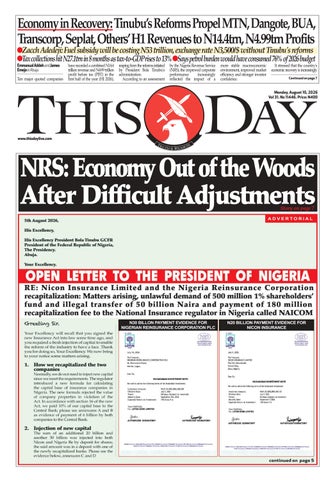
Economy in Recovery: Tinubu’s Reforms Propel MTN, Dangote, BUA, Transcorp, Seplat, Others’H1 Revenues to N14.4trn, N4.99trn Profits Zacch Adedeji: Fuel subsidy will be costing N53 trillion, exchange rate N3,500/$ without Tinubu's reforms Tax collections hit N27.1trn in 8 months as tax-to-GDPrises to 13% Says petrol burden would have consumed 76% of 2026 budget
Emmanual Addeh and James Emejo in Abuja
Ten major quoted companies
have recorded a combined N14.4 trillion revenue and N4.99 trillion profit before tax (PBT) in the first half of the year (HI 2026),
reaping from the reforms initiated by President Bola Tinubu's administration. According to an assessment
by the Nigeria Revenue Service (NRS), the improved corporate performance increasingly reflected the impact of a
more stable macroeconomic environment, improved market efficiency and stronger investor confidence.
It stressed that the country's economic recovery is increasingly Continued on page 7
Monday, Monday, August January10, 6, 2026 2025 Vol Vol29. 31.No No10865. 11446. Price: N400
www.thisdaylive.com TR
UT H
& RE A S O
N
NRS: Economy Out of the Woods After Difficult Adjustments Story on page 7
2
MONday AUGUST 10, 2026 • T H I S D AY
MONday AUGUST 10, 2026 • T H I S D AY
3
MONday AUGUST 10, 2026 • T H I S D AY
4
3 days
is all it takes
Get nancing to own your dream car in as little as 3 days
Approval, disbursement, and delivery within 72 hours
Apply anytime, anywhere
Subject to credit approval and delivery timelines.
In partnership with:
More Information: 0700-300-00, 0201-2273000-9 accessbankplc.com
Access Bank PLC. RC.-125384 (Licensed by the Central Bank of Nigeria)
Equity contribution from 10% of invoice value
Optimized total cost of ownership
Scan to get started
Terms and conditions apply
MONday AUGUST 10, 2026 • T H I S D AY
5
6
MONday AUGUST 10, 2026 • T H I S D AY
7
T H I S D AY • MONDAY, AUGUST 10, 2026
PAGE FIVE
FCCPC Lagos Resolves Over 15,000 Consumer Complaints, Urges Nigerians to Seek Redress Ayodeji Ake
The Lagos zonal office of Federal Competition and Consumer Protection Commission (FCCPC) has resolved more than 15,000 consumer complaints received through its online and physical channels. Zonal Coordinator of FCCPC, Lagos Office, Dr. Olubunmi Otti, disclosed this during an interactive session with journalists at the commission’s office in Ikeja, recently. Otti said the complaints were
submitted either through the commission’s online platform or directly at its Lagos corporate office by consumers seeking redress over products and services that failed to meet their expectations. She stressed that consumers who paid for goods and services had a legitimate expectation of receiving value for their money and should not hesitate to seek assistance when that expectation was not met. “Any consumer that purchases products expects to get value from them, and
when these expectations are not met, consumers have a right to complain to the FCCPC,” she said. According to her, consumers are, however, expected to first engage the service provider or seller in an attempt to resolve the dispute before approaching the Commission. She explained that where the consumer is dissatisfied with the response or outcome, a formal complaint can then be lodged with the FCCPC through its complaints’ portal or physically at its Lagos office.
Otti urged consumers to provide sufficient information when filing complaints, noting that this would make it easier for the Commission to investigate and resolve their cases. She said complaints should contain the address and location of the service provider, evidence of purchase such as receipts, the amount of money involved and the specific redress being sought by the complainant. The Zonal Coordinator said the Lagos office had handled about 17,000 complaints
received through its various channels, with more than 15,000 successfully resolved. She said the primary objective of the Commission was to protect the interests and welfare of consumers while promoting fairness in the marketplace. The FCCPC is empowered by the Federal Competition and Consumer Protection Act 2018 to promote fair business practices and safeguard consumers against exploitative and anti-competitive practices. The Commission is also responsible for preventing
subsidy, unification of the foreign exchange market, implementation of the Petroleum Industry Act (PIA), tighter monetary policy, and ongoing tax overhaul as the major reforms driving improvement in economic fundamentals. Adedeji added that the reforms implemented by President Bola Tinubu since May 2023, when he was sworn in, were beginning to produce stronger and more measurable outcomes across the economy. He said the economy was now showing “strong signs of full recovery and accelerated growth” following the difficult
adjustments triggered by the initial reforms. According to him, improvements in exchange rate stability, moderating inflationary pressures and liquidity conditions had strengthened business confidence and enabled companies and investors to make longer-term decisions with greater certainty. Adedeji said, “Nigeria’s economy is showing strong signs of full recovery and accelerated growth following a series of necessary reforms by the current administration. “The economy has moved
decisively from acute macroeconomic distress to a more stable and increasingly resilient footing.” According to him, “Nigeria’s economy is showing strong signs of full recovery and accelerated growth following a series of necessary reforms by the current administration. The economy has moved decisively from acute macroeconomic distress to a more stable and increasingly resilient footing. “This is as a result of President Bola Tinubu’s economic management acumen and doggedness in implementing his
reforms as part of his Renewed Hope Agenda for the country.” The NRS boss noted that the banking sector recapitalisation had strengthened the financial system’s capacity to support large-scale corporate financing, adding that the ongoing tax reforms had simplified administration and broadened the revenue base. He said, “These reforms have improved the overall business climate and reduced structural inefficiencies as well as enhanced the operating environment for capital intensive and exportoriented firms by improving market efficiency, strengthening
FCCPC CEO, Tunji Bello
practices capable of leading to the abuse of market dominance or monopolies and investigating anti-competitive conduct, including price fixing, bid rigging, market allocation and abuse of dominant market positions.
NRS: Economy Out of the Woods After Difficult Adjustments James Emejo in Abuja and Chinedu Eze in Lagos
Executive Chairman of Nigeria Revenue Service (NRS), Dr. Zacch Adedeji, yesterday declared that the Nigerian economy had emerged from a difficult period of adjustment. Adedeji said a combination of far-reaching reforms had moved the country from acute macroeconomic distress to a more stable and increasingly resilient footing. Speaking on Channels Television’s Sunday Politics, he identified the removal of petrol
macroeconomic stability, increasing investor confidence." He affirmed that comprehensive structural reforms embarked by the current administration had translated into measurable improvements in corporate financial performance through stronger market fundamentals and a more predictable business environment. “The resulting improvements in operational efficiency, financial transparency, and investment planning provide a clear economic explanation for the substantial Continued on page 38
ECONOMY IN RECOVERY: TINUBU’S REFORMS PROPEL MTN, DANGOTE, BUA, TRANSCORP, SEPLAT, OTHERS’ H1 REVENUES TO N14.4TRN, N4.99TRN PROFITS translating into stronger corporate earnings. The performance represented a sharp improvement over the corresponding period of 2025, when the companies collectively generated about N10.59 trillion in revenue and N2.99 trillion in profit before tax. Essentially, the earnings surge came against the backdrop of the far-reaching economic reforms introduced by Tinubu from mid-2023, including the removal of petrol subsidy, foreign exchange market reforms, tighter monetary management, tax reforms and measures aimed at restoring investor confidence and improving fiscal sustainability. Among the companies driving the corporate earnings growth were MTN Nigeria Communications Plc, Dangote Cement Plc, Seplat Energy Plc and Aradel Holdings Plc, which recorded substantial increases in both revenue and profit before tax during the period. MTN Nigeria led the revenue table with N2.99 trillion, representing a 25 per cent increase from N2.38 trillion recorded in the first half of 2025. The company recorded N1.09 trillion profit before tax, up 75.2 per cent from N622.26 billion, while Dangote Cement posted N981 billion, compared with N730 billion in the previous year. Dangote Cement followed
with N2.51 trillion, up 21.4 per cent from N2.07 trillion in the corresponding period. Seplat Energy reported N2.5 trillion revenue, representing a 16.5 per cent increase from N2.17 trillion a year earlier. The company's profit before tax rose to N700 billion from N454 billion, an increase of 54.2 per cent. Other companies in the group also recorded notable revenue growth. Also, Aradel Holdings recorded one of the strongest increases, with revenue rising to N2.49 trillion from N368.08 billion, representing a 576.9 per cent increase. It recorded N752 billion profit before tax, representing a 293.7 per cent increase from N191 billion. The companies' combined profit before tax also rose sharply to N4.99 trillion in H1 2026, representing a 66.7 per cent increase from N2.99 trillion in the corresponding period of 2025. In addition, Nigerian Breweries increased revenue by 8.9 per cent to N803.68 billion, while BUA Foods grew revenue by 16.2 per cent to N765.12 billion. BUA Cement also recorded a 25.6 per cent increase to N728.93 billion, while HBM Nigeria Conglomerate grew revenue by 31.2 per cent to N678.41 billion. Also, Nestlé Nigeria reported a 12 per cent increase in revenue to N581.04 billion, while Transcorp
recorded a 13.4 per cent decline to N279.04 billion. This is as Executive Chairman of NRS, Dr. Zacch Adedeji, defended the economic reforms by the Bola Tinubu administration, arguing that Nigeria’s petrol subsidy would have risen to N53 trillion if the Nigerian leader had not removed it in 2023. He said the figure represented the potential annual cost of maintaining the subsidy regime amid rising international oil prices and global energy disruptions, pointing out that by now the naira-dollar exchange rate could have also deteriorated to about N3,500. According to NRS, the performance of the blue-chip companies represented a significant turnaround from the difficult conditions experienced by many large businesses following the initial implementation of the administration's reforms. Tinubu, upon assumption of office in 2023, removed the petrol subsidy and moved to unify the foreign exchange market, while the Central Bank of Nigeria (CBN) under Governor Olayemi Cardoso subsequently pursued tighter monetary management and measures aimed at restoring confidence in the foreign exchange market. The reforms initially triggered significant pressure on businesses with foreign currency obligations,
with several companies reporting huge exchange-rate losses that affected profitability, share prices and dividend payments. However, Adedeji said the transition to a more marketdetermined exchange-rate regime had enabled companies with substantial foreign-exchange exposure to better reflect the value of their dollar-denominated earnings and assets. According to the NRS, improving exchange-rate stability, moderating inflationary pressures and better liquidity conditions have subsequently strengthened business confidence and improved the ability of companies to undertake longer-term investment decisions. NRS also pointed to the recapitalisation of the banking sector, describing it as a development that has strengthened the financial system's capacity to provide large-scale corporate financing. The combination of monetary, fiscal, tax and structural reforms, it said, had created a more predictable operating environment for capital-intensive and exportoriented companies. The impact had been particularly visible in the oil and gas sector, where companies such as Seplat Energy and Aradel Holdings have benefited from higher production, foreigncurrency-linked revenues and
increased investor confidence. The government's approval of major upstream transactions involving Aradel Holdings and Seplat Energy also strengthened the companies' long-term growth prospects. Aradel is part of the consortium involved in the acquisition of Shell Petroleum Development Company assets, while Seplat completed the acquisition of Mobil Producing Nigeria Unlimited. The transactions are expected tofurther expand the companies' reserve bases and production capacity while reducing regulatory uncertainty around major upstream investments. NRS said the improvement im revenue was supported by the digitalisation of tax administration, including the rollout of the national e-invoicing system for large taxpayers, as well as the implementation of four new tax laws from January 1, 2026. The laws include the Nigeria Tax Act, Nigeria Tax Administration Act, Nigeria Revenue Service Establishment Act and Joint Tax Board Establishment Act. The transformation of the former Federal Inland Revenue Service into the Nigeria Revenue Service has also expanded the government's revenue consolidation framework by bringing together non-tax revenue streams previously collected by
other agencies. The service said non-oil sources accounted for 76 per cent of total collections, describing the development as evidence of progress in diversifying government revenue, although oil revenues remain significant. Despite the improvement, the agency said the tax-to-GDP ratio still has considerable room for expansion toward the government's 18 per cent target. It projected that wider adoption of e-invoicing and the full implementation of the new tax laws could further strengthen collections in 2026 and 2027. The NRS report also highlighted developments in the petroleum sector, saying crude oil production had recovered to about 1.73 million barrels per day by August 2026, equivalent to about 104 per cent of Nigeria's OPEC quota. It attributed the recovery to intensified security operations against pipeline vandalism and crude theft, as well as the continued implementation of the Petroleum Industry Act, which it said had improved fiscal and regulatory certainty for upstream operators. Domestic refining capacity was also reported to have risen from about 30,000 barrels per day in May 2023 to approximately Continued on page 27
8
NEWS
T H I S D AY • MONDAY, AUGUST 10, 2026
Group News Editor: Goddy Egene Email: Goddy.egene@thisdaylive.com, 0803 350 6821, 08074010580
RENEWED HOPE AMBASSADORS PROJECTS TOUR LANDS IN NASARAWA...
Special Adviser to President Tinubu on Information and Strategy, Bayo Onanuga (left) with Nasarawa State Governor, Engr. Abdullahi Sule at the governor's office in Lafia during a courtesy ahead of the Renewed Hope Ambassadors Projects Tour in Nasarawa State on Saturday
Nigeria’s $516m Humanitarian Appeal Attracts $247m Amid Funding Gap UN body says 47% of 2026 requirement funded, targets 2.25m people
Emmanuel Addeh in Abuja
Nigeria’s 2026 humanitarian response has attracted $247.3 million in funding against a requirement of $516.4 million, leaving the country with a substantial financing shortfall as humanitarian agencies seek to assist millions of people affected by conflict, displacement, food insecurity and other emergencies. The latest data from the United Nations Office for the Coordination of Humanitarian Affairs (OCHA) 2026 Financial Tracking Service seen by THISDAY showed that the funding available as of June
22 represented about 47 per cent of the requirement under Nigeria’s humanitarian response framework. The 2026 Humanitarian Needs and Response Plan (HNRP) requires $516.4 million to provide assistance to 2.25 million people identified as being in need of humanitarian support. Of the $247.3 million recorded as total humanitarian funding for Nigeria, $232.8 million was channelled through the HNRP, while about $5.8 million was recorded for humanitarian activities outside the plan. According to the document, the funding represents a
significant improvement from the position earlier in the year. OCHA's tracking data showed that funding coverage had stood at about 33 per cent in late March before rising steadily to 47 per cent by June 22. During the period, funding through the humanitarian plan increased from $173.6 million on March 30 to $192.8 million by April 27, $199.9 million by May 4, $214.6 million by May 26 and $232.8 million by June 22. The increase amounted to $59.2 million, or about 34 per cent, in less than three months, according to the OCHA data. Despite the improvement,
the level of funding, it said, remains inadequate to fully implement the response plan, leaving humanitarian organisations dependent on further contributions from international donors and other sources. OCHA's Nigeria humanitarian appeal is being implemented amid persistent crises across several parts of the country, particularly the North-east, where prolonged insecurity has resulted in displacement and acute humanitarian needs. The United Nations has continued to warn that food insecurity, malnutrition,
NCAA Moves to Mend Fences Between Airlines, Labour over Planned Picketing Airlines servicing old TSC debt as agreed with NCAA MD, Aero Contractors canvasses overhaul of aviation sector
Chinedu Eze
Nigeria Civil Aviation Authority (NCAA) has decided to wade into the impasse between aviation unions and airlines over Ticket Sales Charge debt, which accumulated during the US-Iran war due to a sudden spike in the cost of aviation fuel. Labour unions, especially the Air Transport Service Senior Staff Association (ATSSAN) and the National Union of Air Transport Employees (NUATE) on August 7, 2026, issued a three-day notice of strike against airlines deemed to be indebted to the NCAA.
The unions also added another condition against the airlines, alleging that the airlines have refused their workers to join unions, although there was no indication that workers of any of the airlines accused have written to the unions complaining that the airlines they work for refused to allow them join the unions. In a statement signed by both unions, they said they made it open that they would “strike” against the airlines at any time and in addition to the demand about the payment of the debts accruing from Ticket Sales Charge, they also added
the condition of unionization. The unions alleged the airlines made “unfettered unionisation of staff in their organisation impossible after several efforts made by the aviation unions. Their workers dare not even express the intention to belong to unions of their choices.” They therefore demanded, “Unequivocal declaration through circulars and other direct means of communication to their staff that they are free to join unions of their choices without fear of victimisation and immediate remittance of the seized operational funds of the aviation agencies to
allow for the implementation of the conditions of service of our members in the various aviation agencies.” However, the Director, Public Affairs and Consumer Protection, NCAA, Michael Achimugu, told THISDAY in a telephone interview that the Director General, NCAA, Captain Chris Najomo, would wade into the matter between the unions and the airlines, saying that as the regulator of the industry, the authority would ensure that industrial action is prevented in order not to disrupt flight operations.
displacement and insecurity are combining to increase humanitarian pressures, while reductions in international humanitarian financing have made it increasingly difficult for agencies to meet all identified needs. The funding situation also highlights the scale of the challenge facing Nigeria compared with the previous year. In 2025, the country required about $910.2 million for its humanitarian response but received only about $321.5
million, according to OCHA's funding data. The 2026 requirement is therefore substantially lower than the previous year's appeal, reflecting a more targeted response focused on the most critical needs and the people considered most vulnerable. OCHA said the Nigeria Humanitarian Fund, established in 2017, remains one of the mechanisms used to provide flexible funding for humanitarian operations in the country.
Dangote, Sanwo-Olu Back Local Production of Advanced Medicine, Say Nigeria Must End Medical Dependence Ayodeji Ake
President of Dangote Group, Aliko Dangote, and Lagos State Governor, Babajide Sanwo-Olu, have thrown their weight behind efforts to develop Nigeria’s capacity to produce advanced medical therapies locally, saying the country must reduce its dependence on imported healthcare products and reverse the growing loss of patients, capital and medical expertise to foreign countries. Their positions came as Atunse Healthcare launched in Lagos with plans to manufacture and distribute advanced regenerative biologics in Nigeria, train local scientists and clinicians, and expand access to specialised treatments in a bid to reduce medical tourism. Speaking as keynote speaker at the African Regenerative
Medicine and Longevity Summit in Lagos, Dangote, represented by Fatima Aliko Dangote, Group Executive Director, Commercial Operations for Oil & Gas, Dangote Industries, said the COVID-19 pandemic exposed the dangers of Africa’s dependence on imported medical products. “COVID-19 taught us a very important lesson: dependence is a vulnerability,” Dangote said, noting that the pandemic demonstrated how countries prioritised their own populations during a global health crisis, particularly in access to vaccines, diagnostics and essential medicines. He said Nigeria and other African countries must move from being consumers of advanced medicine to becoming producers of medical technologies.
9
T H I S D AY • MONDAY, AUGUST 10, 2026
NEWS
DAPO ABIODUN GETS DISTINGUISHED EGBA ANGLICAN DIOCESE AWARD...
L-R: The Diocesan Bishop of the Egba Anglican Diocese, Rt. Rev’d Oludaisi Adekunle; the Alake and Paramount Ruler of Egbaland, Oba Adedotun Aremu Gbadebo; Ogun State Governor, Prince Dapo Abiodun; the Archbishop, Metropolitan and Primate of All Nigeria Anglican Communion, The Most Rev’d Henry Ndukuba; former Primate of the Church of Nigeria (Anglican Communion), Archbishop Peter Akinola; and the Bishop of the Remo Anglican Diocese and Archbishop of the Ecclesiastical Province of Lagos, Rt. Rev’d Olusina Fape, during the presentation of an award to Governor Dapo Abiodun as a Distinguished Benefactor of the Egba Anglican Diocese at the 50th anniversary celebration of the Diocese, held at St. Peter’s Cathedral, Ake, Abeokuta, on Sunday
Canada, Nigeria Expand Air Deal, Allow Direct Flights, 24 Weekly Services Multiple airlines from both countries to operate scheduled services Agreement provides 14 weekly passenger, 10 cargo flight slots Nigeria emerges Canada’s third-largest bilateral air market in Africa
Emmanuel Addeh in Abuja
Canada and Nigeria have expanded their air transport agreement to allow direct flights between the two countries for the first time, in a move expected to strengthen trade, investment, tourism and people-to-people ties. The expanded agreement, announced by Canada’s Minister
of Transport and Leader of the Government in the House of Commons, Steven MacKinnon, provides for multiple airlines from both countries to operate scheduled air services between Canada and Nigeria. Under the new arrangement, the statement seen by THISDAY indicated that airlines from each country will have capacity for up to 14 weekly passenger flights
Abiodun Seeks Stronger GovtChurch Partnership to Raise Responsible Future Leaders James Sowole in Abeokuta Ogun State governor, Prince Dapo Abiodun, has called for a stronger partnership between government and the Church to raise disciplined, cultured and responsible young people capable of providing the leadership needed to drive Nigeria’s future development. Abiodun made the call on Sunday at the Golden Jubilee Thanksgiving Service of the Egba Anglican Diocese, held at St. Peter’s Cathedral, Ake, Abeokuta. The governor said while government has the responsibility to provide infrastructure, quality education and economic opportunities, the Church and other faith-based institutions have a critical role to play in building character, strengthening families and instilling sound moral values in the younger generation. He noted that the 50th
anniversary of the Egba Anglican Diocese, coming in the same year Ogun State marks its own golden jubilee, was a significant opportunity to reflect on the journey so far and renew the collective commitment to building a peaceful, prosperous and united society. Abiodun stressed that true development must go beyond roads, bridges and physical infrastructure to include deliberate investment in human capital and character. He warned that the rapid advancement of technology and artificial intelligence must not come at the expense of truth, wisdom, conscience and moral intelligence. “The future we seek to build must be a future where technological advancement is matched by moral advancement; where artificial intelligence does not replace human wisdom, conscience and responsibility,” he said.
and 10 weekly all-cargo flights. The agreement also grants fifth freedom rights for all-cargo operations, allowing airlines to operate flights between two foreign countries where the service either originates from or terminates in the airline’s home country. Announcing the development, MacKinnon said the expanded agreement would create opportunities for Canadian airlines while providing travellers with greater choice. “By expanding our air transport agreements, we are creating new opportunities for Canadian airlines and giving travellers more choice. The newly expanded Canada-Nigeria Air Transport Agreement will strengthen our economic ties, support tourism and trade, and make it easier for people and businesses in both countries to connect,” he said. For his part, Canada’s Minister
of International Trade, Maninder Sidhu, said the agreement would deepen the commercial relationship between the two countries, noting the size and growing economic importance of Nigeria. “I’ve seen that strength firsthand in communities like Brampton, home to one of the largest Nigerian Canadian communities in the country,” Sidhu said. He added that Nigeria offered opportunities for Canadian businesses and workers through its growing market and expanding industries, stressing that the agreement would support Canada’s trade diversification efforts while bringing families and communities closer together. The Canadian government said Nigeria, with a population of more than 237 million people, represented an important market for Canada, particularly
because of its young population and strong entrepreneurial base. It disclosed that more than 25,000 Nigerians held study permits for Canada as of March 31, 2026, underscoring the significant people-to-people links between the two countries. According to Transport Canada, Nigeria was Canada’s 38th-largest international air transport market in 2025 and has now become its thirdlargest bilateral air market in Africa, behind Morocco and Algeria. The Canada-Nigeria air transport market has also more than doubled in size over the past decade, which the Canadian government said reflected strong commercial and people-to-people connections between the two countries. The expanded agreement represents the first expansion of the Canada-Nigeria air transport arrangement since 2014.
Transport Canada said the original Canada-Nigeria Air Transport Agreement, which was limited to code-share operations, was negotiated in 2014 and signed in March 2025. The new provisions are therefore expected to move the relationship beyond the previous code-share framework by creating the regulatory basis for direct scheduled passenger and cargo services. The increased cargo capacity could also facilitate stronger trade links, particularly as both countries seek to expand commercial engagement and diversify their international economic relationships. Under the agreement, each country can designate multiple airlines to provide scheduled services, potentially creating greater competition and choice for passengers and shippers once airlines begin operating under the expanded rights.
Nigeria Seeks Private Investment, Partnerships to Close Climate Adaptation Gap Michael Olugbode in Abuja
The federal government has called for stronger partnerships and increased private-sector investment to close Nigeria’s climate adaptation gap, saying government alone cannot deliver the level of resilience required to protect communities, infrastructure and the economy from the growing impacts of climate change. The Minister of Environment,
Balarabe Lawal, made the call in Abuja at the weekend during a stakeholders’ engagement on the socialisation of Nigeria’s National Adaptation Plan (NAP) for development partners and the private sector, with the theme: “Mobilising Partnerships and Investments for Climate-Resilient Development through Nigeria’s National Adaptation Plan.” Represented by the Permanent Secretary of the ministry, Dr. Salihu Usman, the minister said
Nigeria remained steadfast in its commitment to global climate action while pursuing its national development priorities. He said the government had established a number of strategic frameworks and initiatives, including the Climate Change Act, Nationally Determined Contribution (NDC 3.0), National Adaptation Plan, Energy Transition Plan, National Clean Cooking Policy and National Carbon Market Activation
Framework, as part of efforts to build a climate-resilient and low-carbon economy. According to him, the NAP represents a major milestone in Nigeria’s climate action journey, providing a comprehensive framework for identifying climate risks, reducing vulnerabilities, strengthening resilience and integrating climate adaptation into national, sectoral and subnational development planning.
10
MONday AUGUST 10, 2026 • T H I S D AY
MONday MONday AUGUST aUGUST 10, 10, 2026 2026 •• TTH HIIS SD DAY AY
11 11
MONday AUGUST 10, 2026 • T H I S D AY
12
PRESIDENTIAL WORKING GROUP
ON THE NATIONAL POLICING BILL
PUBLIC CALL FOR MEMORANDA AND POSITION PAPERS Background The Presidential Working Group on the National Policing Bill has been convened to translate the constitutional amendment establishing a dual police structure, comprising the Federal Police Service and State Police Services, into a final, implementation-ready draft National Policing Bill for handover to the Federal Ministry of Justice. This Call for Memoranda and Position Papers is issued to: • •
Solicit informed, evidence-based input on the policy choices underlying the draft National Policing Bill Solicit institutional, operational, fiscal and constitutional considerations that may not be fully captured in the Policy Outline;
All submissions must be made through the official portal at nationalpolicingbill.com, in PDF format and OSCOLA referencing style as set out below, on or before 13 August 2026 at 5:00 p.m. (WAT). Submissions received after the deadline may not be considered. Submissions made by any channel other than the official portal will not be accepted. Memoranda and position papers should: • Not exceed ten (10) pages, excluding annexes, and be submitted in English, • Be submitted as a single PDF document, with any supporting annexes clearly labelled, paginated and merged into the same file; • Use OSCOLA (Oxford University Standard for Citation of Legal Authorities) referencing throughout, including for citations to legislation, case law, official reports and secondary sources; • State the submitting institution or individual, designation, and contact details; • Disclose any institutional or professional interest relevant to the subject matter of the submission. • Submissions are encouraged on any of the themes as outlined on the official portal, nationalpolicingbill.com. • Respondents need not address every theme; focused, well-substantiated submissions on one or two themes are. preferred to broad but general commentary.
Memoranda and position papers are invited from: • State Governments, State Houses of Assembly and State Ministries of Justice; • The Nigeria Police Force, Police Service Commission and other federal security and justice institutions; • The Nigeria Bar Association and other professional legal and judicial bodies; • Civil society organisations, human-rights bodies and academic and research institutions working on policing, security sector governance or constitutional law; • Private-sector bodies with an interest in data protection, firearms regulation, private security regulation, or public finance; Enquiries • Individual subject-matter experts and members of the Further information on this Call, including guidance on the public with relevant technical or professional expertise. submission portal and referencing requirements, is available at nationalpolicingbill.com Submission Guidelines and Deadline
Signed:
Nnadubem Moghalu
Senior Special Assistant to the President (Planning and Research) Secretary, Presidential Working Group on the National Policing Bill
MONday AUGUST 10, 2026 • T H I S D AY
13
MONday AUGUST 10, 2026 • T H I S D AY
14
|
NIMENA
THE NIGERIAN INSTITUTION OF MARINE ENGINEERS AND NAVAL ARCHITECTS
LANDMARK REPORT LAUNCH
NIGERIA SET TO LEAD AFRICA'S SHIPBUILDING REVOLUTION NIMENA LAUNCHES LANDMARK REPORT UNVEILING A STRATEGIC ROADMAP TO TRANSFORM NIGERIA INTO AFRICA'S LEADING HUB FOR SHIPBUILDING, OFFSHORE ENGINEERING AND MARITIME INNOVATION.
A
buja, Nigeria – The Nigerian Institution of Marine Engineers and Naval Architects NIMENAAhas oicially launched its landmark Trend Report on the Advancement of Shipbuilding in Nigeria, a comprehensive strategic publication that provides the first forward-looking assessment of Nigeria’s readiness to compete in the rapidly evolving global shipbuilding industry. Developed in collaboration with leading international innovation experts Plug and Play Singapore, the report presents a practical roadmap for transforming Nigeria into a globally competitive maritime industrial nation by leveraging engineering excellence, technological innovation, digital transformation, and progressive policy reforms. It identifies the immense opportunities available to Nigeria as the global shipbuilding industry undergoes unprecedented transformation driven by digitalization, decarbonization, automation, artificial intelligence, and changing geopolitical dynamics. The report emphasizes that while Asia continues to dominate global shipbuilding capacity, Nigeria possesses unique strategic advantages, including Africa’s largest maritime economy, a growing oshore energy sector, expanding local content initiatives, an emerging innovation ecosystem, and increasing government support, which can be har-
Among the major areas covered are:
• Global trends reshaping the international shipbuilding industry.
• Comparative analysis of leading maritime nations in-
cluding China, Singapore and South Africa, identifying lessons applicable to Nigeria. Nigeria’s current shipbuilding capabilities, opportunities and structural constraints. Emerging technologies transforming modern shipbuilding, including Artificial Intelligence, Digital Twins, robotics, smart shipyards, blockchain-enabled supply chains, intelligent manufacturing and advanced engineering systems. Strategic technology prioritization and investment opportunities. Startup and innovation models capable of accelerating indigenous maritime industrialization. A phased implementation roadmap for building globally competitive shipyards and strengthening Nigeria’s engineering capabilities.
• •
• • •
The report concludes that Nigeria’s competitive advantage does not lie in aempting to replicate the massive production capacity of existing global leaders, but rather in developing a technology-enabled, engineering-driven and innovation-focused maritime ecosystem capable of delivering high-value shipbuilding, ship repair, oshore fabrication and lifecycle maritime services.
According to the report:
ecosystem. Rather than presenting another academic study, the report serves as a practical national strategy document that outlines how Nigeria can progressively build a world-class maritime manufacturing ecosystem. "The future of maritime leadership will not be determined solely by the size of shipyards or the number of vessels built, but by the capacity of nations to innovate, engineer, and sustainably transform their maritime ecosystems." ENGR. DR. EFEREBO I. SYLVANUS, FNSE NATIONAL CHAIRMAN, NIMENA
A NATIONAL CALL TO ACTION Building a globally competitive, technology -driven and resilient maritime industry.
•
Nigeria currently has 27 accredited shipyards with strong capabilities in vessel repair, maintenance and oshore support services. The country’s local content policy has significantly increased indigenous participation in maritime operations, creating a stronger foundation for domestic shipbuilding. Digital technologies, engineering innovation and smart manufacturing present the greatest opportunities for rapidly closing competitiveness gaps. Nigeria should pursue a phased development strategy beginning with digital technologies, followed by engineering capability development and ultimately advanced manufacturing and automation.
• • •
For more inquiries please contact:
In line with NIMENA’s mandate of advancing marine engineering and maritime industrial development in Nigeria, the Institution announced that the Trend Report will be formally transmied to:
• The Federal Ministry of Marine and Blue Economy, and • The National Headquarters of the Nigerian Society of
Engineers NSEE Nigerian Content Development and Monitoring House Commiee on Nigerian Content Development and Monitoring Senate commiee on local Content House and Senate Commiee on Maritime Ship Owners Association of Nigeria National Shippers Council Council for the Regulation of Engineering in Nigeria CORENN
• • • • • • •
As a strategic policy advisory document to support evidence-based decision-making, national maritime industrial policy formulation, investment planning and long-term capacity development. The Institution expressed confidence that the recommendations contained in the report will contribute significantly to ongoing eorts to deepen local content, expand indigenous shipbuilding capacity, strengthen maritime infrastructure, promote engineering innovation, and create high-value employment and position Nigeria as the leading maritime industrial hub in Africa. NIMENA called on policymakers, government agencies, investors, financial institutions, shipyard operators, research institutions, universities, classification societies, development partners and the private sector to work collaboratively in implementing the strategic recommendations contained in the report. The Institution believes that with the right policies, sustained investment and engineering leadership, Nigeria can transition from being primarily a maritime consumer nation to becoming a globally recognized producer of advanced maritime technologies, vessels and oshore engineering solutions.
nimenahqt@nimena.org.ng info@nimena.org.ng
+234 803- 7523- 127 +234 814426900451
MONday AUGUST 10, 2026 • T H I S D AY
15
16
MONday AUGUST 10, 2026 • T H I S D AY
Election Integrity & EFCC Enforcement Timing: Why President Tinubu's Position Deserves Commendation
T
he fight against corruption and the protection of electoral integrity are two pillars of every constitutional democracy. Neither should be sacrificed for the other. If President Bola Ahmed Tinubu's intervention on the Osun State matter was limited to expressing concern over the timing of freezing state government accounts during an ongoing investigation — not to stopping the investigation itself — then his position aligns with a principle recognized across mature democracies: prosecutorial independence and electoral neutrality are not in tension when institutions exercise judgment about timing. The issue is not whether corruption allegations should be investigated. They should. The question is narrower: whether an enforcement action capable of disrupting an elected state government's finances, taken days before a governorship election, risks creating the perception that law enforcement is shaping the outcome of that election. It is worth stating plainly that Nigeria's uninterrupted democratic experience is not yet thirty years old. Institutions, norms, and conventions that older democracies took generations to settle are, in Nigeria's case, still being framed in real time — often through contested episodes like this one. That context does not excuse poor practice, but it does mean each such episode carries outsized weight in shaping the precedent future administrations will follow. Investigations Should Continue, But Enforcement Timing Is a Separate Question In constitutional democracies, criminal investigations are expected to proceed without political interference. Equally important is the corollary principle: investigative agencies should avoid actions that unnecessarily create the appearance of favoring or disadvantaging a political party during an election. The United States Department of Justice codifies this in its internal guidance, which bars prosecutors from timing investigative steps, announcements, or charges to affect an election or to advantage or disadvantage any candidate. Notably, the policy does not prohibit investigations — it constrains overt enforcement actions close to elections absent an overriding law-enforcement necessity. The distinction is between investigating quietly and acting visibly. The clearest illustration remains 2016, when FBI Director James Comey's announcement reopening the Clinton email investigation days before the U.S. presidential election drew bipartisan criticism — not because the investigation was improper, but because its public timing was widely seen as shaping the vote. That episode is now a standard reference point in democraticgovernance discussions precisely because it shows that even legally grounded action can damage institutional trust when its timing collides with an election. France offers a comparable institutional habit: prosecutors handling politically sensitive matters have, in several instances,
By Bashir Are delayed public disclosure of investigative steps until after elections concluded — not to protect any individual, but to preserve confidence that the judiciary is not thumbing the scale. The lesson generalizes: legitimacy depends as much on when institutions act as on whether they act. Brazil's "Car Wash" (Lava Jato) investigations cut the other way, and are worth citing for that reason. Critics — across the political spectrum, not only allies of those implicated — argued that the timing of arrests and disclosures during election periods had a direct and asymmetric effect on specific candidates' electoral prospects. Car Wash is less a model of restraint than a cautionary tale: it shows what happens to public trust in both the judiciary and the electoral process when timing questions go unaddressed. It is the risk Nigeria should be trying to avoid, not an example of the norm working as intended. Applying the Principle to Osun State Osun State holds its governorship election on 15 August 2026. If an investigation into the state government's accounts is underway, there is no ordinary objection to investigators continuing to gather evidence, trace transactions, and build a case. What changes the calculus is a specific, visible act — freezing the operational accounts of a sitting state government — executed in the immediate runup to the vote. Even where legally justified, that action is likely to be read by segments of the public as bearing on the electoral environment, particularly given that the incumbent governor belongs to an opposition party. Whether that reading is fair is a separate question from whether it will be made. Public confidence in democratic institutions rests on both actual and perceived impartiality, and the two are not always the same thing to secure. President Tinubu's Position Read in this light, the President's reported concern is better understood as an appeal for institutional balance than as interference. If his position was that investigators should continue their work while avoiding enforcement measures whose timing could reasonably be read as influencing an imminent election, that position tracks recognized democratic practice. It does not direct investigators to stand down, and it does not shield anyone from accountability. It asks that EFCC enforcement not be overshadowed by a dispute about its timing. This position also carries a personal dimension worth noting. As Governor of Lagos State, Tinubu's own government had its federal allocation withheld for an extended period during a dispute over the creation of new local government areas — a freeze that persisted for years and placed real strain on the state's finances. Having governed under that experience, President Tinubu has, as head of the federal government, declined to deploy that same weapon against a state government's finances. That restraint gives his position on the Osun account freeze added weight: it is not
the abstract preference of someone who has never felt the cost of such action, but the considered restraint of someone who has. Seen this way, President Tinubu's intervention does more than resolve a single dispute over Osun State's accounts. It functions as an act of institutional transplantation — taking a norm long codified in the United States Department of Justice's internal electionperiod guidance and, through practice rather than statute, embedding it into Nigeria's own democratic conventions. Mature democracies did not arrive at this norm by legislation alone; they arrived at it through repeated executive and prosecutorial choices that, over time, hardened into expectation. By declining to allow an enforcement action's timing to shadow an active election, Tinubu is not merely avoiding a controversy — he is contributing, in real time, to the body of precedent from which Nigeria's own version of that norm will eventually be drawn. A Better Democratic Standard Nigeria's democracy is strengthened when several principles hold at once. Corruption investigations should proceed independently and professionally, without regard to political timing. Enforcement actions, where practicable, should avoid creating unnecessary perceptions of electoral interference, even when the underlying legal basis is sound. Decisions should rest on legal necessity and evidence, not on political calendars — the closer an action falls to an election, the more scrutiny its timing deserves. And public confidence in both anti-corruption institutions and electoral processes should be treated as a legitimate governance interest in its own right, not as an afterthought to be managed once controversy arises. Conclusion Democracies are judged not only by their commitment to fighting corruption but by whether justice is administered — and seen to be administered — impartially. This is especially true for a democracy still short of thirty years old, where each precedent set now will shape institutional practice for decades to come. If President Tinubu's intervention was directed solely at the timing of freezing government accounts during an active election period, while leaving the underlying investigation to proceed, then his position reflects a standard already recognized in several mature democracies — and one he has shown, through his own restraint as president, that he is prepared to honor even when he holds the power to do otherwise. In this sense, what began decades ago as internal U.S. Justice Department guidance is, through choices like this one, being quietly written into Nigeria's own democratic inheritance — not imported wholesale, but earned precedent by precedent. Protecting electoral integrity and fighting corruption are not competing objectives — the strongest democracies pursue both at once, and treat the timing of enforcement as part of how that balance is kept.
MONday AUGUST 10, 2026 • T H I S D AY
17
18
T H I S D AY • MONday AUGUST 10, 2026
Politics
Acting Group Politics Editor DEJI ELUMOYE Email: deji.elumoye@thisdaylive.com 08033025611 sms only
M O N D AY D I S C O U R S E
EFCC Under Olukoyede: Enforcement, Politics and Fight for Credibility
Recent move by the Economic and Financial Crimes Commission to freeze Osun state government’s account reignites debate over timing, independence and results of the country’s anti-graft war. Iyobosa Uwugiaren writes.
B
aarely days before the Osun State governorship election, the Economic and Financial Crimes Commission (EFCC) found itself at the centre of another political storm. Reports emerged that the commission had frozen a bank account belonging to the Osun State Government. Governor Ademola Adeleke and his supporters immediately accused the EFCC of political interference, warning that the action was capable of crippling government activities on the eve of a crucial election. The controversy dominated headlines and social media, apparently forcing President Bola Tinubu to publicly distance himself from the commission’s action. While critics have questioned the timing and alleged political motives, others have argued that anti-corruption agencies should not suspend investigations simply because elections are approaching. As the debate intensified, attention once again shifted to the man leading Nigeria’s foremost anti-graft agency — Ola Olukoyede, the Executive Chairman of the EFCC — whose three years in office have become one of the most closely scrutinised in the commission’s history. The Osun incident is only the latest example of how the EFCC’s work inevitably places it at the intersection of law, politics and public opinion. The criticism that trailed the Osun account freeze is hardly surprising. In Nigeria, every major anti-corruption drive has generated controversy, especially when investigations touch politically exposed persons, state governments, or strategic sectors. For the EFCC Chairman, the political headwinds are part of the job description. The agency’s mandate — to investigate, prosecute and prevent economic and financial crimes — inevitably puts it on a collision course with powerful interests. Yet beyond the partisan noise and daily headlines lies a more fundamental question: has the current leadership of the EFCC remained faithful to its constitutional mandate of fighting corruption without fear or favour? To answer the question, it is necessary to look beyond the controversies and examine what the commission has done, how it has done it, and the constraints within which it operates. Available evidence suggests that despite enormous political pressure, legal battles and relentless public scrutiny, the commission has intensified its enforcement activities under Olukoyede. The approach has been threepronged: pursue high-profile cases, prioritise asset recovery, and expand the fight into new frontiers like cybercrime while strengthening institutional capacity. One of the most remarkable examples of this commitment is the ongoing investigation into the alleged diversion of funds allocated for the rehabilitation of Nigeria’s state-owned refineries. The probe is regarded as one of the largest corruption investigations in the country’s oil and gas sector in recent years. It touches on billions of public funds approved over several years for projects that Nigerians are yet to feel the impact of. The EFCC has so far recovered over N9.4 billion, US$21.2 million, and several landed properties allegedly linked to individuals under investigation in connection with the programme. Beyond the impressive figures, the exercise demonstrates the commission’s determination to follow financial trails, recover proceeds of crime and ensure accountability in one of the country’s most strategic and opaque sectors. For many observers, pursuing such a case illustrates the chairman’s willingness to confront corruption in areas traditionally regarded as politically sensitive. The petroleum industry has long been associated with enormous public
Olukoyede
expenditure and allegations of financial misconduct. Investigating it inevitably attracts resistance from influential interests. Nevertheless, the commission has pressed ahead, reinforcing the principle that no institution or individual should be beyond the reach of the law. Also, asset recovery has become one of the defining hallmarks of the current EFCC leadership. The commission has disclosed that under Olukoyede, it has recovered over N566 billion in the last three years, alongside millions of dollars, pounds, euros, luxury vehicles, landed properties and other assets linked to proceeds of crime. Rather than focusing exclusively on arrests and media parades, the commission has prioritised tracing, confiscating and recovering illicit assets. These recoveries do two things. First, they return stolen wealth to the public treasury. Second, they send a powerful message that corruption carries tangible consequences. “Crime does not pay” has ceased to be a slogan and becomes a financial reality for offenders. Another significant indicator of the chairman’s commitment is the consistency with which the EFCC has pursued high-profile investigations and prosecutions. The commission has continued to investigate politically exposed
persons, public office holders, contractors, and individuals suspected of financial crimes irrespective of their political affiliations. Former governors, ministers, heads of agencies and private sector actors have all featured in EFCC investigations in the last three years. While the outcome of every investigation ultimately depends on judicial processes, the willingness of the EFCC to initiate inquiries into influential individuals has demonstrated institutional courage in an environment where political interference often poses substantial obstacles. Such investigations have reinforced the perception that no individual should be above the law, even if convictions remain slow in coming. The EFCC has also intensified its prosecution of cybercrime, which has become one of the fastest-growing forms of financial crime in Nigeria. Internet fraud, identity theft, cryptocurrency scams, and business email compromise schemes have not only defrauded victims but have also negatively affected Nigeria’s international image and undermined confidence in legitimate digital businesses. Recognizing the growing threat, the commission has increased intelligence gathering, surveillance operations, arrests, and prosecutions involving internet fraud syndicates. There have been several high-profile arrests and convictions, including mass operations in cybercrime hubs across the country. The chairman has repeatedly emphasized that
The criticism that trailed the Osun account freeze is hardly surprising. In Nigeria, every major anticorruption drive has generated controversy, especially when investigations touch politically exposed persons, state governments, or strategic sectors.
combating cybercrime is necessary not only to protect victims but also to preserve Nigeria’s reputation within the global digital economy. In addition to enforcement, the chairman has promoted preventive strategies designed to reduce corruption before it occurs. The EFCC has expanded public enlightenment campaigns targeting schools, universities, professional associations, religious organisations, and community groups. Anti-corruption clubs in educational institutions reflect an understanding that sustainable change requires shaping attitudes among younger generations. The commission has equally strengthened collaboration with domestic and international partners. Financial crimes increasingly involve cross-border transactions and money laundering networks. Consequently, the EFCC has worked more closely with foreign law enforcement agencies, financial intelligence units and international organizations to trace illicit financial flows and recover stolen assets. Institutional capacity building has also been a priority. The EFCC has invested in specialised training, modern investigative techniques, digital forensic laboratories, and intelligence-driven operations to deal with crimes involving technology, cryptocurrency, and complex international transactions. The chairman has also advocated stronger compliance with anti-money laundering regulations by financial institutions and improved inter-agency cooperation with police, customs, taxation and intelligence agencies. Despite these achievements, a critical analysis must acknowledge the significant challenges confronting the chairman and the EFCC. Perhaps the most persistent criticism concerns allegations of selective prosecution. Critics have continued to argue that anti-corruption efforts appear more vigorous against certain political actors than others, especially those in opposition. But the EFCC has consistently maintained that investigations are based on petitions, intelligence and available evidence rather than political considerations. However, in anti-corruption work, public confidence is strengthened not only by actual impartiality but also by the perception that justice is administered fairly and consistently. The Osun account freeze, coming days to an election, fed directly into that perception problem. The commission also has faced significant legal and judicial constraints. Many corruption cases remain in court for several years because of procedural delays, interlocutory appeals, and congested court dockets. Consequently, successful investigations do not always translate into timely convictions. These delays create public frustration and reduce the deterrent effect of anti-corruption enforcement. The chairman has repeatedly emphasized the importance of judicial reforms, including the creation of special courts, that would accelerate corruption trials while safeguarding defendants’ constitutional rights. Anti-corruption agencies frequently investigate individuals possessing substantial political influence, financial resources, and legal expertise. Such circumstances inevitably expose the commission’s leadership to criticism, lobbying, media campaigns, and legal challenges. Maintaining institutional independence under these conditions requires strong administrative leadership and strict adherence to legal procedures. The chairman’s ability to sustain investigations despite these pressures has been viewed by supporters as evidence of resilience. Critics, however, see every major action through a political lens, as the Osun case demonstrated. NOTE: Interested readers should continue in the online edition on www.thisdaylive.com
19
T H I S D AY • MONday, AUGUST 10, 2026
FEatures
Group Features Editor: Chiemelie Ezeobi Email chiemelie.ezeobi@thisdaylive.com,
New Nigerian Army Divisions, Bold Reforms and the Contiguity Question President Bola Tinubu’s decision to expand the Nigerian Army from eight to 12 divisions marks one of the boldest restructurings of the military in recent years, aimed at decentralising command, strengthening security and reducing response time to emerging threats. But as the new formations take shape, questions around manpower, resources, logistics and, particularly, the geographical contiguity of the states under each command are emerging, raising important questions about how effectively the ambitious reform can deliver on its promises. Chiemelie Ezeobi reports
I
n sweeping reforms and restructuring that will decentralise Nigerian Army commands, tighten border security, and cut down the time it takes soldiers to reach an emergency, President Bola Tinubu recently approved the expansion of the force from eight divisions to twelve. With the sweeping restructuring, four new divisional headquarters will rise in Makurdi as 5 Division; Ilorin as 9 Division; Jalingo as 10 Division; and Benin City as 83 Division, joining the existing commands in Kaduna, Ibadan, Jos, Port Harcourt, Maiduguri, Sokoto, Lagos and Enugu. The announcement came via a State House statement from Bayo Onanuga, Special Adviser to the President on Information and Strategy, who described the move as a "landmark" step in reshaping the country's security architecture. Holistic Reforms Alongside the divisional expansion, President Tinubu approved the recruitment of 28,000 additional personnel, continuing a pattern of investment that has included new military hardware and welfare improvements for troops. The recruitment of 28,000 additional personnel is meant to give these new commands the manpower to actually function, rather than existing as headquarters on paper alone. According to the president, implementation will roll out in two phases with the first covering the 5, 9 and 10 Divisions and a reorganisation of existing formations, is billed for completion by September 2026. The second, which stands up the 83 Division in Benin City, is expected by December 2026. What's Expected Undoubtedly, the presidency has laid out ambitious goals for the restructuring with the expectation of better protection for critical national infrastructure like pipelines, power installations, and transport corridors, alongside sharper counter-insurgency and internal security operations. Perhaps the most important aspect of the new divisions is the promise of speed and faster military response to emerging threats nationwide. Because for communities in the Middle Belt battling farmer-herder clashes, or in the South-South facing pipeline vandalism and kidnapping, a division headquarters located closer to home is meant to translate into troops arriving in hours rather than days. Breaking Down the New Map Under the new structure, Nigeria's 36 states are distributed across twelve commands: 1 Division in Kaduna, which overseas Kaduna, Kano, Katsina, and Jigawa States; 2 Division in Ibadan, which covers Oyo, Osun, Ekiti, and Ondo States; 3 Division in Jos, which superintends Plateau, Bauchi and Gombe States. Others include the 5 Division in Makurdi, which covers Benue, Nasarawa and Kogi States; 6 Division in Port Harcourt, which commands Rivers, Akwa Ibom and Cross River States; 7 Division in Maiduguri, with Borno and Yobe States; 8 Division in Sokoto, which covers Sokoto, Kebbi and Zamfara States; 9 Division in Ilorin, which covers Kwara and Niger States. For 10 Division in Jalingo, it covers Taraba and Adamawa States; 81 Division
Speaking on anonymity, a concerned stakeholder noted that divisional headquarters should sit within a cluster of states that are not just administratively grouped, but geographically and logistically close to one another. Where that isn't the case, as with Kogi, Niger and Bayelsa, the very speed of response the reform promises could be the first casualty.
in Lagos covers Lagos, and Ogun States; 82 Division in Enugu, covers Enugu, Anambra, Abia, Ebonyi and Imo States; while 83 Division in Benin City oversees Edo, Delta and Bayelsa States. The four newcomers — Makurdi, Ilorin, Jalingo and Benin City, effectively split the old Middle Belt and South-South commands into finer-grained zones, each theoretically closer to the communities it protects. Hitting the Ground Running Hitting the ground running after the announcement, the The Chief of Army Staff, Lieutenant General Waidi Shaibu, has already appointed pioneer General Officers Commanding (GOCs), conducted initial on-site needs assessments, launched a massive 28,000-personnel recruitment drive, and completed advanced combat training for troops being deployed to these new formations. For the leadership appointments, Major General Moses Gara was named GOC of the 5 Division (Makurdi); Major General Yakubu Yahaya took command of the 9 Division (Ilorin); and Major General Chinedu Ralph Nnebeife was appointed as the pioneer GOC of the 10 Division (Jalingo), while that of Benin City will come with the second phase of the implementation. In terms of the promised welfare, the presidency last week announced a massive salary increment ranging from 30 per cent to 80 per cent for the Nigerian Armed Forces, which will take full effect on September 1, 2026. This pay review directly benefits roughly 250,000 personnel across the Army, Navy, and Air Force, raising the military's annual personnel wage bill from N660 billion to N924 billion. While the junior ranks and non-commissioned officers, from Private up to Staff Sergeant will expect 80 per cent increase, middle-level officers and senior non-commissioned officers, from Warrant Officer up to Colonel will
get 50 per cent increase; and senior military leadership, including Brigadier Generals, Major Generals, Lieutenant Generals and Generals will take 30 per cent increase. The Contiguity Question But a closer look at the map raises a question the Presidency's statement doesn't address: does every state assigned to a division actually sit closest to that division's headquarters? Take Kogi for instance. It has been placed under the 5 Division, headquartered in Makurdi, alongside Benue and Nasarawa. On paper, Kogi does share borders with both. In practice, however, Lokoja, which is Kogi's capital, sits much closer to Ilorin, headquarters of the neighbouring 9 Division, and is arguably nearer to Abuja itself than to Makurdi. The road from Lokoja to Makurdi is longer and less direct than the route to Ilorin. For a state that has seen its share of banditry and kidnapping along its highways, that extra distance matters when minutes count. Kogi isn't alone. In the 9 Division, Niger State, which boasts of Nigeria's largest by land area, is paired with Kwara under Ilorin's command. But Niger's far north, around Kontagora and the Kainji axis, is remote from Ilorin and sits arguably closer to Kebbi or Kaduna. A single headquarters simply cannot be equally close to both ends of a state that size. Further South, the 83 Division in Benin City covers Edo, Delta and Bayelsa, but Edo and Bayelsa don't actually touch each other; they're joined only through Delta. Bayelsa's creek-heavy terrain means the road route from Benin City is long and indirect, while Yenagoa is far better connected to Port Harcourt, home of the neighbouring 6 Division. A similar, if smaller, strain shows up in Division 6 itself: Cross River is technically linked to Rivers through Akwa Ibom, but Calabar to Port Harcourt remains a five-to-six-hour drive. By contrast, divisions like 1 (Kaduna), 8 (Sokoto), 7 (Maiduguri) and 81 (Lagos) show tight, genuinely contiguous clusters where the headquarters sits close to every assigned state, a template the newer divisions could still be adjusted to match before the September and December rollout deadlines.
An Unrealistic Creation? For so many others, the question even goes beyond contiguity to the reality of creating new divisions with nothing on ground to support that. In this line of thought is Group Captain Sadeeq Shehu (rtd), a former Airforce Spokesman, who described it as unrealistic and impossible. In an interview aired on Arise News, he said: "With all due respect. The President cannot just throw numbers, it is unprofessional. How did you come about 4 Divisions? Creating 2 Army Divisions in 2-5 months is unrealistic, impossible. It’s not like putting a sign board on a building and it becomes an international airport. "You need 15-20,000 men in one. Is it the 28,000 new people that want to man the 4 divisions? Fix the existing gaps first, before talking of another division. If this a political decision, it won’t help the military and the country.” Pending Reorganisation of Existing Divisions Given some of the contrary voices over the new divisions, a senior official in the Defence Headquarters, who spoke on strict condition of anonymity told THISDAY that although there will soon be reorganisation of the existing divisions, the new divisions are very much continguous with many things in common. He said: "You forgot Kogi was carved out of Benue State. They are very much contiguous with many things in common. Again in the press statement there is mention of reorganisation of existing divisions. "Previously 2 Division in Ibadan conducts operations up to Niger State before Operation Savannah Shield was created. I think the new divisions will indeed decentralise and improve operational efficiency." Recommendation/ Caution For former Chief of Defence Staff, General Lucky Irabor (Rtd.), who described the expansion as the “right step in the right direction”, its success would depend on adequate funding, manpower, equipment and logistics. Urging the government to properly staff and equip the existing divisions while providing modern combat enablers, including surveillance, communication and night-fighting capabilities, he further called for the development of Nigeria’s militaryindustrial complex to reduce reliance on foreign defence equipment. With over three-quarters of the defence budget going to personnel costs, he said capital funding must increase to properly equip and accommodate the 28,000 new recruits. Ultimately, the expansion will only deliver the faster and more responsive Army envisaged if the new divisions are matched with the resources, infrastructure and equipment needed to function effectively.
T H I S D AY MONDAY AUGUST 10, 2026 20 TR
UT H
& RE A S O
Monday August 10, 2026 Vol 27. No 11438
N
opinion@thisdaylive.com
www.thisdaylive.com
TOWARDS SELF-RELIANCE IN DEFENCE PRODUCTION
Besides providing technical expertise, the DICON Institute of Technology will significantly reduce Nigeria’s reliance on foreign sources for critical defence capabilities, argues JACK OKUDE
See page 21
EKO ATLANTIC, DANGOTE REFINERY AND CHIKE-OBI
The refinery is impacting every household in the country, contends ETIM ETIM
See page 21
EDITORIAL
FG AND THE AUTISM CENTRES
See page 22
1
K BOLANLE ATI-JOHN urges the country to move from establishing university as status to education as capability
THE UNIVERSITIES WE NEED, AND THE UNIVERSITIES WE MERELY CREATE There is much in the federal government’s emerging education reform agenda that deserves acknowledgement. The renewed emphasis on technical and vocational education, Science, Technology, Engineering, Mathematics and Medicine (STEMM), student financing, education data, innovation and quality assurance reflects an important recognition by the Tinubu administration: Nigeria’s education system cannot remain detached from the economic, technological and demographic realities reshaping the country. Perhaps even more significant was government’s decision last year to halt the proliferation of new tertiary institutions. The reasons were sobering. Education Minister Tunji Alausa disclosed that 199 universities received fewer than 100 applications through JAMB in the preceding admission cycle, while 34 received none. In one federal university, he said, roughly 1,200 staff serve fewer than 800 students. Government was confronting an uncomfortable truth: multiplying institutions is not necessarily the same thing as expanding meaningful educational opportunity. It is precisely because these reforms point in the right direction that the moment invites a deeper question: what should determine whether Nigeria needs another university? That question has acquired fresh relevance following President Bola Tinubu’s approval, in July 2026, of the conversion of the Federal Polytechnic, Nasarawa, into the Federal University of Mining, Engineering and Technology. There is considerable strategic logic behind the decision. Nasarawa sits within an important mineral belt, and Nigeria urgently needs expertise in mining, mineral processing, metallurgy, manufacturing and engineering if we are serious about moving from extracting minerals to creating value from them. The Presidency explicitly connected the institution to industrialisation and the country’s solid-minerals potential. The issue, therefore, is not whether Nigeria needs mining capability. It unquestionably does. The more consequential question is whether creating or converting a university should automatically be the preferred instrument for producing
every capability the country requires. Nigeria now has more than 300 universities across federal, state and private ownership. Yet a country approaching a quarter of a billion people, with an overwhelmingly young population, cannot reasonably be told that it has too much higher education. Millions more Nigerians will require post-secondary opportunities in the decades ahead. Here lies the paradox: Nigeria can simultaneously have too little tertiary capacity for its population and too many poorly differentiated institutions competing for limited professors, laboratories, research funding and students. Our problem, then, is not fundamentally how many universities we have. It is that we have gradually confused the multiplication of institutions with the accumulation of capability. A University Is Not a Signboard A university does not become a serious university merely because legislation establishes it and buildings carry its name. A university represents accumulated intellectual capital: professors, laboratories, libraries, doctoral programmes, research traditions, international networks, industry relationships and generations of scholarship. Those things cannot be created by proclamation. They are accumulated painstakingly over decades. More importantly, not every national skills requirement needs a university. Consider mining. A modern mining industry certainly requires geologists, metallurgists, mining engineers and researchers. But it also requires drill technicians, surveyors, mineral-
processing technologists, electricians, welders, heavy-equipment specialists, instrumentation technicians, plant operators and maintenance professionals. Who will train them? If every strategic skills shortage eventually produces another university, Nigeria risks developing an education system increasingly rich in degreeawarding institutions but poor in the technical depth required to industrialise. And beneath that institutional problem lies something even harder to reform: perception. For decades, we have constructed an educational status hierarchy in which the university degree sits at the summit, the polytechnic below it, and technical and vocational education somewhere further down. Parents absorb it. Students absorb it. Employers reinforce it. Government, sometimes inadvertently, validates it. That hierarchy has consequences. When a polytechnic becomes successful, its apparent next step is often to become a university. But why? Perhaps a successful polytechnic does not need to become a university. Perhaps it needs to become an exceptional polytechnic. What Successful Countries Understand Some of the world’s most technologically sophisticated economies have understood something we have yet fully to internalise: educational institutions do not need identical names, missions or pathways to possess equal national value. Germany maintains conventional universities alongside universities of applied sciences and dual programmes that integrate academic learning with substantial company experience and vocational training. Singapore connects universities, polytechnics, technical education and lifelong reskilling closely to manpower requirements and economic competitiveness. Education is not treated merely as a social service; it is part of the machinery through which the country builds economic capability. Rear Admiral Ati-John (Rtd) psc(+) fdc(+) is a Distinguished Fellow of the National Defence College, Abuja, and writes from Lagos
T H I S D AY
321
MONDAY AUGUST 10, 2026
Besides providing technical expertise, the DICON Institute of Technology will significantly reduce Nigeria’s reliance on foreign sources for critical defence capabilities, argues JACK OKUDE
TOWARDS SELF-RELIANCE IN DEFENCE PRODUCTION
The Minister of State for Defence, Bello Matawalle, is passionately pushing a President Tinubu agenda on national security. On Wednesday, July 29, 2026, Matawalle, was in Kaduna to inaugurate the Defence Industries Corporation of Nigeria (DICON) Institute of Technology. The trip was without fanfare but it was loud on implications for President Tinubu’s iron-cast resolve to fight and overawe insecurity in the country. It bears restating that Matawalle, a ardent ally of President Tinubu, has been very active in promoting the Tinubu government. He has been discreet in strategy as the government rallies to tame the bogey of insecurity. For context, the institute was established as part of the Federal Government’s efforts to achieve self-reliance in defence production through the building and sustenance of a viable military industrial complex within the country. The institute will not only provide the requisite technical expertise for the design, development and sustenance of platforms and systems critical for the security of the nation, it will significantly reduce Nigeria’s reliance on foreign sources for critical defence capabilities including technical capacities and relevant 21st century skill sets for the nation’s security personnel. For decades, Nigeria has relied on foreign technical and technological assistance to defend its territorial integrity and ensure internal security for the citizenry. This has obvious implications on the sovereignty of the nation. It has also over the years put enormous pressure on the naira as all the imported arms and ammunition including high-end military hardware and training of security personnel overseas are procured with forex. The establishment of the institute, therefore, is not only a landmark but a paradigm shift for the nation’s indigenous defence industrial base especially in the area of capacity building and professional counterterrorism training. In modern warfare, possession of defence infrastructure is no longer enough. Strategy and intelligence innovation have become inevitable resources to place a nation at the cutting edge of any war or security threat. Without strategic thinking, communication cum surveillance gadgets, and innovative positioning, the physical defence infrastructure could become articles for decoration. The operators of such physical defence infrastructure, if they lack the requisite knowhow on how to handle the military hardware, may consistently strike amiss resulting in waste of personnel and money. This is why critical skills set and strategy have become strong
combinations in modern warfare. This is the essence of DICON and its Institute: To produce not only defence infrastructure including guns and drones and all, but also to mint the right manpower drilled in the foundry of operational efficiency and strategy. It is called specialized security training in counterterrorism lingo. It means to not only equip but also to train your security personnel in the art and craft of counterinsurgency operations, bomb disposal techniques, hostage rescue stunts, and crisis/conflict management. These are some of the capacities to be built into Nigerian security personnel and others in the Institute. Th DICON institute is inaugurated with the full awareness that counter-terrorism does not consist only in military-style kinetics of physical offensive and violent efforts to exterminate the opponent, it also involves non-kinetic approaches including enlightenment and re-orientation of the terrorists to wean them of terror traits and evil behavioural patterns. Other non-kinetics methods include financial squeeze and deliberate blockade of the financial sources of the terrorists and in some cases cyber weakening of the terrorists’ camp through cyber-attacks and other tech-driven techniques that shuts down their ability to communicate and engage effectively in electronic transactions. Matawalle is confident that the Institute will provide extra layer of intelligence reconnaissance for the Nigerian military. Before the inauguration of the institute, DICON itself has been involved in the production of small arms from pistols to rifles. Other DICON products include a range of ammunition, Amoured personnel carriers (APC), built-for-purpose tactical military vehicles, ballistic vests and sundry protective garments. It is a growing list and a clear attestation to the engineering proficiency of the nation’s military personnel. Okude, a public policy strategist, writes from Abuja
The refinery is impacting every household in the country, contends ETIM ETIM
EKO ATLANTIC, DANGOTE REFINERY AND CHIKE-OBI
When we were in secondary school, Prof. Chike Edozien Obi was a renowned mathematician, reputed to be the first Nigerian to hold a doctorate in mathematics. Awarded Ph.D in 1950 by the University of Cambridge for his thesis titled ‘’Periodic Solutions of Non-Linear Differential Equations of Second Order’’, he had earlier obtained his first and second degrees from University of London as external student through correspondence courses. Obi’s story fascinated my classmates and I in those days so much so that any one of us who was good in maths was nicknamed after Chike Obo. Dr. Obi died in 2008 at the age of 87. I am not sure if Nigeria has ever honoured him with a national award or named a street after him. It’s been 18 years since the old man passed away, and his first son, Mustafa Chike-Obi, former chairman of Fidelity Bank, has come up with a new hypothesis of his own - not in science nor mathematics - but in economy and business. And unlike his father’s discovery, Mustafa’s proposition is set to create some controversies. Speaking in a podcast ‘’Policy Without Politics’’ which he co-hosts with Ken Ikpe last week, Mustafa Chike-Obi said Eko Atlantic City could eventually contribute more to Nigeria’s GDP than Dangote Petroleum Refinery & Petrochemicals FZE (DPRP). He argued that although the refinery has transformed the nation’s downstream oil sector, Eko Atlantic’s long-term contributions to the economy would be broader because of its capacity to attract businesses, institutions and residents. He said: ‘’Ten years from now, Eko Atlantic will employ more people than the refinery can employ in 10 years… by the time Eko Atlantic is a well thought-out, developed city, the impact on the Nigerian economy and GDP will, in my opinion, dwarf that of the refinery.’’ He then suggested that the federal government should adopt ‘’even-handed approach’’ to supporting landmark private-sector investments. According him, although both the City and the refinery are both located in free trade zones, the City appears to depend less on government than the refinery. ‘’If government is going to invest in something as big, important and successful as the refinery, they should consider an investment in Eko Atlantic in some way’’, Chike-Obi said. Chike-Obi’s argument is disputable and flawed in many ways, and it’s quite tempting to question his motives. By every parameter that measures an organization’s contributions to GDP, DPRP is and will remain a bigger contributor to GDP than Atlantic City. A business contributes to a nation’s GDP primarily by producing goods and
services, investing capital in the business to expand and engaging in international trade to earn foreign exchange and improve earnings. Specifically, any business that produces goods and services; buys new machinery, equipment, technology or construct new buildings, etc., trade with foreign partners creates jobs and pay taxes, are contributing to GDP of the country. To that extent, while DPRP is already making a direct contribution to our GDP, Eko Atlantic would be making indirect contribution through the businesses that would be operating from there. For readers who do not live in Lagos and might not be aware of what Eko Atlantic is, it is a new city near Victoria Island that is being developed on a 10-square kilometer parcel of land which was reclaimed from the Atlantic Ocean. Designed as a sustainable, self-sufficient smart city, it will accommodate about 250,000 residents and feature 10 distinct commercial and residential districts. It is roughly five times the size of Monaco, another haven for the rich, located near France. DPRP occupies a 25-square kilometer land size and has initial refining capacity of 640,000 barrels of crude oil per day which has recently been ramped up to 700,000 bpd. The complex also produces fertilizer and petrochemical products which are used as raw materials in pharmaceutical industry. DPRP and its integrated complexes (fertilizer and petrochemicals) currently employ over 15,000 people – direct and indirect – mostly Nigerians. Eko Atlantic is still being built and a few businesses have already moved in there. United States has announced plans to build its biggest diplomatic mission in Africa in the Atlantic City. By the time it is fully occupied – say in the next 10 years – Eko Atlantic City will only accommodate service firms like the telecommunications; banks; IT and shopping malls. A big shopping mall has already been built. However, there is no room for manufacturing business in the new City. Etim is a Journalist
22 4
T H I S D AY MONDAY AUGUST 10, 2026
EDITORIAL
Editor, Editorial Page PETER ISHAKA Email peter.ishaka@thisdaylive.com
W
FG AND THE AUTISM CENTRES The initiative on the spectrum disorder is welcome
e commend the initiative by the federal government to transform autism care through expanded specialist training, targeted investments in tertiary institutions, and the establishment of autism centres across the country’s six geopolitical zones. The initiative, according to the Minister of Education, Tunji Alausa, represents a significant step towards addressing the country’s shortage of highly skilled professionals in Audiology, Speech and Language Therapy, and Occupational Therapy, while also revealing that the number of universities offering the specialised programmes has increased. According to a recent report, one in every 100 Nigerian children currently live with autism while no fewer than 600,000 children are on the spectrum nationwide. Across all ages, about 2.4 million Nigerians are reportedly affected by the health condition that alters brain functioning, especially in how a person communicates, behaves, and relates to others. Even at that, these figures are, at best conservative. Those living with the condition may talk later than others or have difficulty understanding jokes, body language, or social cues. They may prefer simple, direct communication or just being alone. For many families, the journey is isolating and financially draining. The Nigerian system has not been designed to include them. But this is not merely a health gap, it is a structural failure. Speaking during an engagement with stakeholders last week, Alausa said investment was ongoing in the human capital needed to strengthen diagnosis, therapy, and rehabilitation services while ensuring that Nigerian families can increasingly access quality care within the country. “We have moved from about four universities to almost 16 universities, but we want even more institutions to train the manpower needed to support these essential services,” said Alausa. He admitted that many Nigerian families still travel abroad and even to neighbouring countries in search of specialised care for children with autism and Attention Deficit Hype-
ractivity Disorder (ADHD), because of limited local capacity. “This is not acceptable, and the federal government is determined to change that,” he said. Globally, autism is increasingly approached through a developmental and rights-based lens; recognising that early support, inclusive education, and sustained interventions can significantly improve outcomes. But for decades, children with autism have been excluded from mainstream education, leaving many families to shoulder disproportionate economic and emotional burdens. Now that the federal government is intervening, we hope that authorities in the 36 states will be encouraged to follow. Autism should be integrated into primary healthcare for routine developmental checks at immunisation clinics and health centres. As a nation, we must break the scepter of silence on Autism, which now seems to be orchestrated by the health design that should scale public awareness beyond urban centres. Awareness campaigns must also move past ceremonial observances and become sustained, community-level education efforts that confront stigma and misinformation. There should be teacher training in neurodevelopmental disorders, classroom support systems, and individualised learning approaches. These trainings, among other things, should link health, education, and social services - backed by funding, timelines, and accountability mechanisms. This way, people with the spectrum will not feel marginalised, but given a sense of belonging required for inclusion. To effectively address the silence on autism, families, individuals and the communities must play their part. Children who are observed to be ‘different’ should be presented quickly enough for evaluation and then given special attention as they deserve. But Nigeria must decide whether autism will remain a peripheral issue or become a national priority. Because the reality is clear: Autism is present. The science is available. The cost of delay should not only be measured in the numbers, but in the futures diminished and potentialities that may be denied due to inaction. And that is a price no nation should be willing to pay.
Children who are observed to be ‘different’ should be presented quickly enough for evaluation and then given special attention as they deserve T H I S D AY
EDITOR SHAKA MOMODU DEPUTY EDITOR WALE OLALEYE MANAGING DIRECTOR ENIOLA BELLO DEPUTY MANAGING DIRECTOR ISRAEL IWEGBU CHAIRMAN EDITORIAL BOARD OLUSEGUN ADENIYI EDITOR NATION’S CAPITAL IYOBOSA UWUGIAREN THE OMBUDSMAN KAYODE KOMOLAFE
T H I S D AY N E W S PA P E R S L I M I T E D
EDITOR-IN-CHIEF/CHAIRMAN NDUKA OBAIGBENA GROUP EXECUTIVE DIRECTORS ENIOLA BELLO, KAYODE KOMOLAFE, ISRAEL IWEGBU DIVISIONAL DIRECTORS SHAKA MOMODU, PETER IWEGBU, ANTHONY OGEDENGBE DEPUTY DIVISIONAL DIRECTOR OJOGUN VICTOR DANBOYI SNR. ASSOCIATE DIRECTOR ERIC OJEH ASSOCIATE DIRECTOR PATRICK EIMIUHI CONTROLLERS ABIMBOLA TAIWO, UCHENNA DIBIAGWU, NDUKA MOSERI DIRECTOR, PRINTING PRODUCTION CHUKS ONWUDINJO TO SEND EMAIL: first name.surname@thisdaylive.com
Letters to the Editor Letters in response to specific publications in THISDAY should be brief (150-300 words) and straight to the point. Interested readers may send such letters along with their contact details to opinion@thisdaylive.com. We also welcome comments and opinions on topical local, national and international issues provided they are well-written and should also not be longer than (750- 1000 words). They should be sent to opinion@thisdaylive. com along with photograph, email address and phone numbers of the writer.
LETTERS RENEWABLE ENERGY, AGRICULTURE AND THE ENVIRONMENT
Did you know that how we produce and consume food can have a huge impact on the environment? Some of these environmental impacts include: water pollution, carbon and other harmful greenhouse gas emissions, deforestation, pesticide toxicity, and biodiversity loss. There is therefore an urgent need for us to reexamine the ways in which we produce and consume food, in an effort to reduce negative impact on our environment, economy and health, as well as to build resilience against shocks like economic disruptions. So, how can we attempt to build a food system that has minimal negative impacts on the environment, that would be far more resilient to future economic shocks? One way we can do this is by shifting towards climate-smart agriculture by using renewable energy sources in our agricultural production processes. Renewable Energy is energy derived from natural
sources that are replenished at a higher rate than they are consumed. Sunlight and wind, for example, are such sources that are constantly being replenished. Renewable energy sources are plentiful and all around us. A few common sources of renewable energy include: solar energy, wind energy, geothermal energy, hydropower, ocean energy, and bioenergy (produced from a variety of organic materials, called biomass, such as wood, charcoal, dung and other manures for heat and power production, and agricultural crops for liquid biofuels). However, it is important to note that although biofuels, such as ethanol and bio-diesel are often portrayed as sustainable alternatives to fuel, the crops used to produce these fuels (such as corn and rapeseed) can occupy a great expanse of land, which could otherwise be used for things like food production, re-wilding and carbon storage. Fossil fuels - coal, oil and gas - on the other hand, are
non-renewable resources that take hundreds of millions of years to form. Fossil fuels, when burned to produce energy, cause harmful greenhouse gas emissions, such as carbon dioxide. On the other hand, generating renewable energy creates far lower emissions than burning fossil fuels. Therefore, to address growing concerns about global warming and climate change, the time has now come for us to make a transition from fossil fuels to renewable energy! Furthermore, renewables are now cheaper in most countries, and can even generate three times more jobs than fossil fuels! Nowadays, it is very common for farmers and other agricultural experts to use Nitrogen-based fertilizers in their agricultural production processes. One of the key ingredients of Nitrogen-based fertilizer is Ammonia. Daniel Ighakpe, FESTAC Town, Lagos
23
T H I S D AY • Monday, August 10, 2026
BUSINESSWORLD R A T E S MONEY MARKET
A S
REPO
A T
Group Business Editor Eromosele Abiodun Email oriarehu.eromosele@thisdaylive.com
08056356325
A u g u st
S & P INDEX
7 , 2 0 2 6
S & P INDEX
EXCHANGE RATE
OPR
25.34%
CALL
23.25%
INDEX LEVEL
595.26
1/4 to daTE
0.24%
N1,381/ 1 US DOLLAR*
OVERNIGHT
25.18%
1-MONTH
21.37%
1-DAY
0.10%
YEAR TO DATE
-10.99%
*AS AT Fri., August 7, 2026
3-MONTH
22.41%
MONTH-TO-DATE
0.24%
Liquidity: Banks Deposit with CBN Drops by 6.02% MoM to N83.96trn
Kayode Tokede Following excess liquidity in the financial sector, banks and merchant banks’ deposits with the Central Bank of Nigeria (CBN) dropped by 6.02 per cent Month-on-Month (M-o-M) in July to N83.96 trillion as against N89.33 trillion recorded in June 2026. According to the CBN’s financial data, the N83.96 trillion is the third lowest deposited with the apex banking regulating body. Experts attributed the decline to OMO sales by CBN, government cash flow,
banks increasing lending to the real sector and changes in interbank liquidity conditions. “A drop in CBN deposits by banks and merchant banks does not necessarily mean banks and merchant banks become less liquid. It can mean that excess liquidity was being converted into loans or securities or was absorbed by the CBN,” said Vice President, Highcap Securities, Mr. David Adnori The July 2026 when compared to N10.91 trillion deposit in July 2025 is about 669.6 per cent increase. Canks and merchant banks constantly seek attractive
interest overnight, making deposit with the CBN the preferred option for them. Banks and merchants deposit excess cash with CBN using the Standing Deposit Facility (SDF) window. CBN, showed that banks’ and merchant banks’ deposits in March 2026 was the highest with about N128.92 trillion. In February 2026, it stood at N61.11 trillion,16.18 per cent increase when compared to N52.6 trillion deposited in January 2026. Between April and May 2026, the banks’ and merchant banks’ deposits with CBN was at N92.32 trillion and N87.13
trillion, respectively. The CBN data revealed that in seven months of 2026, banks and merchant banks have deposited an estimated N595.4 trillion , about645.6per cent Year-onYear (YoY) , an increase of over N79.85 trillion in the seven months of 2025. THISDAY had reported that an estimated N336.2 trillion was deposited with the CBN in 2025 ,about 777.2 per cent YoY increase over N38.33trillion deposited in 2024. The decision by banks to reduce deposits with the CBN can be attributed to the
recent cut in the Monetary Policy Rate (MPR) to 26.50 per cent in February 2026 from 27 per cent 2025. Also, the decision was driven by the lower opportunity cost of holding cash with the CBN compared to lending it out in the market. The Monetary Policy Committee (MPC) of the CBN in February 2026 had retained the Standing Facilities Corridor around the MPR at +50/-450 basis points. Analysts at Cordros Research in a report after the November 24-25 MPC
meeting stated that by adjusting the asymmetric corridor to +50/-450basis points (Previous: +250basis points/-250basis points) around the MPR indicates a reduction in interest rates for the SLF and the SDF to 27.5per cent (Previous: 29.5per cent) and 22.5per cent (Previous: 24.5per cent), respectively. “The adjustment is expected to ease monetary conditions and strengthen banks’ private sector credit expansion,” they explained. The story continues online on www.thisdaylive.com
Fixed-income Market Records N8.84trn Trades in One Week as OMO Bills Dominate
Nume Ekeghe
Trading activity in Nigeria’s fixed-income market rose to N8.84 trillion in face value during the week ended August 7, 2026, with Open Market Operations (OMO) bills accounting for the largest share of transactions, according to data from the Central Bank of Nigeria
(CBN). The CBN’s Fixed Income Dashboard showed that a total of 2,348 trades were executed across OMO bills, Treasury bills, Federal Government of Nigeria (FGN) bonds and Sukuk during the period. OMO bills dominated activity with 916 trades valued at N6.33 trillion, representing about 71.6 per cent of total
traded face value. Treasury bills followed with 769 trades valued at N1.34 trillion, while FGN bonds recorded 656 trades with a face value of N1.15 trillion. Sukuk accounted for seven trades valued at N13.08 billion. Overall, the market attracted 27 participants during the week, with OMO bills recording 23 participants,
while Treasury bills and FGN bonds each attracted 24 participants. Sukuk had four participants. The trading pattern underscores the continued prominence of short-term government securities in the fixed-income market, particularly OMO bills, amid prevailing liquidity and monetary policy conditions.
Meanwhile, yields across the fixed-income curve remained elevated during the review period. The dashboard showed closing yields ranging from the mid-teens to above 20 per cent across various maturities and instruments. For OMO bills, the reported closing yield reached 22.67 per cent at the shorter tenor, compared with a weighted-
average yield of 21.59 per cent. Treasury bill yields also remained high, with the dashboard showing a closing yield of 20.25 per cent at one of the reported tenors, while the FGN bond curve featured yields ranging from around 14.85 per cent to above 17 per cent across several maturities. The story continues online on www.thisdaylive.com
M a r k e t d ata A s at F r i d ay, A u g u s t 7 , 2 0 2 6 BONDS Description Price Yield Change Updated Time (%) ^13.98 23August 95.10 17.58 0.00 7, 2026 FEB-2028 August ^21.00 200.00 7, 104.66 17.60 2026 MAR-2028 ^19.30 17August 102.97 17.84 0.00 7, APR-2029 2026 ^14.55 26August 92.91 17.87 0.00 APR-2029 7, 2026 ^18.50 21August 101.52 17.98 -0.05 7, FEB-2031 2026
BILLS Maturity NTB 6-Aug26 NTB 3-Sept26 NTB 8-Oct26 NTB 5-Nov26 NTB 3-Dec26
Discount Yield
Change (%) Updated Time
Maturity
16.22
16.37
August 0.00 7, 2026
15.70
16.03
August -0.01 7, 2026
15.80
16.39
August -0.07 7, 2026
16.45
17.32
August 0.00 7, 2026
18.05
August -0.01 7, 2026
HAAI CP X 7-SEP-26 PCLL CP V 25-SEP-26 AGRO CP IV 7-DEC-26 DAIL CP II 26-NOV-26 JVIL CP XXIV 29-DEC-26
16.89
CLEARED NAIRA-SETTLED NDFS
CPs Discount Yield 22.01
22.72
21.59
22.53
20.79
22.63
19.29
20.73
20.41
22.48
Change (%)
Updated Time
August 0.01 7, 2026 August 0.04 7, 2026 August -0.36 7, 2026 August -0.27 7, 2026 August -0.54 7, 2026
Contract Tenor Contract (Month)
Current Rate ($/₦)
Updated Time
–
–
–
––
–
–
–
–
–
–
–
–
–
–
–
–
–
–
–
–
24
Monday, August 10, 2026 • T H I S D AY
BUSINESSWORLD
News
L-R: Head, Bancassurance & Client Proposition, Standard Chartered Bank Nigeria, Funmi Dosumu; Head, Wealth Solutions, Ernest Adejumo; Head, Wealth & Retail Banking, Lanre Olajide; Acting Chief Executive Officer, Ayodeji Adelagun; Executive Director, Prudential Zenith Life Insurance, Afolabi Lawal; Chief Commercial Officer, Oluwatosin Adebayo-Yusuf; Chief Officer, Commercial, Strategy & Operations, and Regional Director, Operations & Strategic Partnerships, Prudential Africa, Vera Adomako-Nyantakyi, at the launch of the bancassurance partnership between Standard Chartered and Prudential Zenith in Lagos… recently
Tax Ombud Reiterates Commitment to Promoting Fairness, Transparency within Nigeria’s Tax System Eromosele Abiodun
The Tax Ombud/Chief Executive of the Office of the Tax Ombud, Dr. John Nwabueze, has reiterated the Office’s commitment to promoting fairness and transparency within Nigeria’s tax system as it continues to mediate between taxpayers and revenue authorities.
Speaking at the third-quarter Breakfast Meeting with business editors in Lagos, Dr. Nwabueze highlighted the Office’s major milestones and outlined its vision for the future. Highlighting the progress made so far, he said the Office has significantly improved taxpayers’ access to its services through the launch of a digital
complaints portal, a case management system, a toll-free call centre, and SMS callback services. According to him, these innovations have made it easier for individuals and businesses to file complaints and obtain timely resolutions. According to him: “Within three months, the Office received over 20 genuine complaints, most of them involving state revenue services. Of these, eight have
been successfully resolved, all within the statutory 14day resolution period, with provision for an additional seven days where necessary. “The Office has expanded capacity of its skilled accountants and legal experts to handle complex tax matters, including disputes relating to digital asset taxation, should such cases arise. We are also enhancing accessibility at the grassroots through plans to
establish offices across all six geopolitical zones.” Nwabueze further disclosed that the Office has intensified engagement with professional bodies, the media, revenue authorities, and other stakeholders, while also planning a nationwide public sensitisation campaign to address persistent issues such as multiple taxation. Speaking on efforts to address systemic issues,
he stressed that multiple taxation, particularly at the state and local government levels, is receiving the attention of the Federal Government. He commended His Excellency, President Bola Ahmed Tinubu, GCFR, for establishing an independent tax ombudsman institution to strengthen voluntary tax compliance and build public trust in Nigeria’s tax administration.
Jessica Erobomhan
Retreat of the House Committee on Insurance and Actuarial Matters with the Nigeria Deposit Insurance Corporation (NDIC), themed, “Strengthening Financial Safety Nets in an Era of Banking Sector Recapitalisation and Fintech Innovation.” He said while fintech innovation had significantly improved financial inclusion and payment efficiency, its rapid expansion had also
introduced new risks and challenges for the financial system. According to him, these challenges include cyber resilience, operational risks, consumer protection, digital fraud and questions around the scope of deposit insurance coverage. “Today, Nigerias banking industry continues to occupy a central position in our economy, with banking
sectors assets running into several trillions of Naira and serving tens of millions of depositors across conventional banking channels and rapidly expanding digital platforms. Likewise, Nigeria’s fintech has become one of the largest in Africa, attracting substantial investment and processing billions of electronic payment transactions annually.”
FX Inflows Rise 31.9% to $4.36bn in July ‘Nigeria’s Fintech Ecosystem Has Become One of Africa’s Largest’ Nume Ekeghe Inflows into Nigeria’s Foreign Exchange Market (NFEM) rose by 31.9 per cent month-onmonth to $4.36 billion in July 2026, reaching their highest level in five months, according to Cordros Securities. The increase was driven largely by stronger inflows from local sources, which accounted for 66.7 per cent of total inflows during the month, the investment firm said in a report released recently. Cordros said: “Preliminary data from FMDQ shows that total inflows into the Nigerian Foreign Exchange Market (NFEM) increased
Group Business Editor Eromosele Abiodun Deputy Business Editor Chinedu Eze Comms/e-Business Editor Emma Okonji Asst. Editor, Energy Emmanuel Addeh Asst. Editor, Money Market Nume Ekeghe Correspondents KayodeTokede(CapitalMarkets) James Emejo (Finance) Ebere Nwoji (Insurance) Reporter Peter Uzoho (Energy)
to its highest level in five months, rising by 31.9per cent m/m to $4.36 billion in July compared to June at $3.31 billion. “The outturn was driven by the increases in inflows from local, 66.7per cent of total inflows sources. Specifically, inflows from local sources rose by 79.8 per cent m/m to $2.91 billion June: $1.62 billion, reflecting increased market intervention from the CBN (+11.8x m/m) and higher inflows from non-bank corporates (+31.9per cent m/m) which offset the decline from the individual (-54.0per cent m/m) and Exporter (-12.9per cent m/m) segments.” It added, “Meanwhile, inflows from foreign sources declined by 13.9per cent m/m to $1.45 billion (June: $1.69 billion), as the decreases from the FPIs (-18.5per cent m/m) and other corporates (-48.4per cent m/m) segments was enough to offset the increase in the FDIs (+388.3per cent m/m) segment. Specifically, declines in the equity investment (-53.2per cent m/m) and Fixed income (-16.1per cent m/m) sub-segments drove the dip in FPI inflows.” The latest increase in NFEM inflows comes amid ongoing efforts by the CBN to improve liquidity and strengthen price discovery in the foreign exchange market.
Chairman of the House Committee on Insurance and Actuarial Matters, Ahamadu Usman Jaha, has said Nigeria’s fintech ecosystem has become one of the largest in Africa, noting that the country’s growing payment ecosystem continues to attract significant investment. Jaha spoke recently in Lagos at the 2026 Stakeholders’
With 26% Growth in H1, Neimeth Outshines Peers in Revenue Generation Neimeth International Pharmaceuticals Plc emerged as the fastest-growing listed pharmaceutical company by revenue in the first half of 2026, recording a 26 per cent year-on-year increase in sales despite a challenging operating environment marked by high borrowing costs, inflationary pressures and foreign exchange volatility. An analysis of the
unaudited half-year financial statements of three major listed pharmaceutical companies—Neimeth International Pharmaceuticals Plc, Fidson Healthcare Plc and May & Baker Nigeria Plc shows that while Fidson retained its leadership in terms of revenue and profitability, Neimeth delivered the strongest top-line growth among its
peers, reflecting improving market penetration and sustained demand for its pharmaceutical products. Neimeth’s revenue rose to N3.66 billion in the six months ended June 30, 2026, from N2.91 billion recorded in the corresponding period of 2025, representing a 26 per cent increase. The company’s revenue performance underscores
its ability to expand sales despite operating from a significantly smaller asset and production base than its larger competitors. Industry analysts note that faster revenue growth often reflects successful market expansion, stronger product acceptance and effective commercial execution, particularly in a highly competitive pharmaceutical market.
The Shipping Correspondents Association of Nigeria (SCAN) has begun arrangements for its forthcoming 2026 Summit to address the persistent financial challenges and regulatory hurdles confronting indigenous shipowners in Nigeria’s maritime sector. The high-level gathering
will take place on October 29th, 2026, at the prestigious Rockview Hotels, Apapa, Lagos. Themed, “Low-Risk Capital for Indigenous Shipowners: Overcoming Regulatory, Financial Bottlenecks,” the summit aims to chart actionable pathways for unlocking
adequate funding and creating an enabling environment that increases the participation and capacity of Nigerian-owned vessels in the domestic and international waters. SCAN President, Moses Ebosele, said despite Nigeria’s rich maritime potential, foreign operators have
continued to dominate the nation’s maritime domain controlling over 95% of the carriage of Nigerian imports, exports, and associated freight earnings, while the local participation remains critically low, with indigenous ship owners capturing only about 4% to 5% of the market.
SCAN Summit to Tackle Financing, Regulatory Bottlenecks for Indigenous Shipowners
25
T H I S D AY • Monday, August 10, 2026
BUSINESSWORLD
News
L–R: Captain, Ikoyi Club 1938, Afolabi Balogun; Head, Partnership and Hospitality, Golf Section, Rerhe Idonije; Deputy Vice Chairman, Ikoyi Club, Bolaji Martins; President, Association of Corporate Communication and Marketing Professionals in Banks (ACAMB), Jide Sipe and Publicity Secretary, ACAMB, Abiodun Coker, during the Golf and Networking Experience Hosted by ACAMB to commemorate its 30th Anniversary celebration in Ikoyi, Lagos… recently
NCC Deepens Digital Economy Agenda with Lease to Enugu Govt
Emma Okonji
The Nigerian Communications Commission (NCC) has reaffirmed its support for Nigeria’s digital economy agenda through initiatives that will expand digital opportunities, as it formalised a 15-year operational lease of the NCC Digital Industrial Park and NCC Learning Centre in Enugu to the Enugu State Government. The Executive Vice Chairman and Chief Executive Officer of the NCC, Dr. Aminu Maida, announced the partnership at the handover ceremony in Enugu, describing the facilities as platforms
designed to develop the people, ideas and enterprises that will power Nigeria’s digital future. Maida said NCC was pleased to hand over the facilities to a state government that had demonstrated the vision and commitment required to activate them for productive use. “These facilities were conceived as platforms for innovation, entrepreneurship and human capital development. They were designed to deepen digital skills, support startups, attract investment, create jobs and position Nigeria as a competitive destination
Oyedele, Dangote, Others to Speak at FT Africa Summit
Kayode Tokede
The Minister of Finance and Coordinating Minister of the Economy, Taiwo Oyedele, President and Chief Executive, Dangote Group, Aliko Dangote will join other speakers at the Financial Times 13th edition of its flagship Africa Summit taking place in London. Under the theme, “Mobilising Growth in a New Global Order,” the summit will convene African Heads of State, policymakers, chief executives, investors and nextgeneration entrepreneurs to examine how the continent can sustain its growth trajectory amid shifting trade alliances, technological change and a reordering of global power. Other high-level speaker line-up includes: Macky Sall, Former President, Republic of Senegal; Jakaya Kikwete,
for business process outsourcing, knowledge process outsourcing and other
technology-enabled services,” Maida said. According to him, the
intervention is not merely about physical infrastructure, but about building capacity,
expanding opportunity and supporting enterprise in the digital economy.
Prudential Zenith Enters Bancassurance Partnership With Standard Chartered Bank Ebere Nwoji
Prudential Zenith Life Insurance and Standard Chartered Bank Nigeria Limited have entered into a strategic bancassurance partnership to expand access to life insurance and financial
protection across Nigeria. The collaboration combines Prudential Zenith’s underwriting expertise with Standard Chartered’s banking network to deliver accessible protection solutions to a larger segment of the Nigerian population.
Speaking on the gamechanging potential of this collaboration initiative, the Executive Director and Chief Financial Officer, Prudential Zenith Life Insurance, Mr Afolabi Lawal, said Prudential Zenith, believed that financial inclusion was not only
about access, but also about empowerment. He said the partnership with Standard Chartered Bank would allow the two organisations to reach more Nigerians with products that were not exclusively protective but also aspirational.
Firms Partner to Bring Micro-pension Contributions to PoS Nationwide
Emma Okonji
TeamApt Limited, a leading payment infrastructure company, has partnered digital pension agent platform Awabah to power Pension Direct, a micro-pension solution for self-employed and informal-sector workers. Former President of the The partnership was United Republic of Tanzania; announced at the launch of Baroness Jennifer Chapman, Minister of State (International Development and Africa), Foreign, Commonwealth & Development Office, United Kingdom; Ahmed Shide, Minister of Finance, The packaging industry Ethiopia, alongside ministers across West Africa continues and business leaders from to evolve, driven by expanding South Africa, Nigeria, Ethiopia, consumer markets, rising Angola, Mauritius, Rwanda, demand for more efficient Sierra Leone, Côte d’Ivoire and sustainable packaging and the Democratic Republic solutions, and advances of the Congo. in automation and digital The 2026 summit takes technologies. As manufacturers place at a time of profound change in the global trading system. Shifting US tariff policy and the approaching Chinedu Eze expiry of the African Growth and Opportunity Founder of Medview Airlines, Act are prompting African Muneer Bankoke has launched governments and businesses his biography in Lagos and to deepen regional trade, said he was prompted to strengthen ties with the Gulf, have his life documented China and India. to it to teach patience, faith
Pension Direct in Lagos. Speaking about the initiative, Managing Director/CEO, TeamApt, Dennis Ajalie, said: “Financial inclusion isn’t only about giving people access to payments; it’s about giving them access to the financial tools that help them build long-term security. For millions of Nigerians in the informal economy,
contributing consistently to a pension has often been difficult because the underlying infrastructure wasn’t built for the way they earn and spend, unlike formal sector workers whose pension savings are made almost automatic through payroll deductions.” According to him, “We created our Direct Debit
service to address exactly this, because we know longterm contributions need card tokenisation and recurring mandates that hold up over years. By combining this infrastructure with Awabah’s pension expertise, we are making long-term savings just as seamless for artisans, traders and other self-employed Nigerians.”
respond to these changing market dynamics, improving productivity, efficiency and competitiveness has become an increasing priority. In this rapidly changing environment, informed decision-making is more important than ever. Beyond
evaluating new equipment and technologies, businesses are seeking practical insights and proven strategies to help optimise operations, address emerging challenges and prepare for future growth. Providing a platform to address these opportunities
and challenges, Propak West Africa returns to the Landmark Centre in Lagos, Nigeria, bringing together suppliers, manufacturers and industry professionals from across the packaging, plastics, print, labelling and food processing sectors.
and other virtues of life in the midst of hard times and challenges to others. He said his years in the aviation sector inspired his biography titled ‘Pathways Pilgrimage and Destiny.” The launch of the book, written by Omobolanle
Ebunoluwa Sotunsa, attracted the stakeholders in the aviation sector, government signatories and traditional rulers from different parts of the country. Bankole, who continually attributed his feats in the aviation sector and life
in general to God, urged stakeholders not to allow the challenges and harsh conditions dictate their fate and overwhelm their vigour to pursue their goals and aspirations but be courageous even in stormy situations.
Propak W’Africa Conference to Deliver Insights for Packaging Professionals
Bankole Launches Biography that Captures His Experience in Aviation Sector
26
Monday, August 10, 2026 • T H I S D AY
BUSINESSWORLD
News
‘How Industrialists, Business Owners Can Sustain Economic Growth, Boost Competition’ Hammed Shittu in Ilorin A Professor of Business Administration and Entrepreneurship at Kwara State University, Malete (KWASU), Rahman Olarewaju Mustapha at the weekend called on the industrialists and business owners in the country to take customer satisfaction as a main priority in their operations if they want to remain competitive and achieve sustainable economic growth. He identified quality assurance, reliable supply, technical support, innovation and relationship management as the five major pillars needed to build customer trust. Professor Mustapha made the submissions in Ilorin, the state capital while delivering a commemorative lecture to mark the 35th anniversary of Lubcon Oil Limited in Ilorin. Lubcon oil is a leading oli manufacturing company established in Ilorin in 1991 by the Offa born industrialist and National President of the Nigerian Association of Chambers of Commerce, Industry, Mines, and
Agriculture(NACCIMA) , Engineer Jani Ibrahim. It specialises in the production, blending, and distribution of quality engine oils, industrial lubricants, and petroleum-allied products. However, Mustapha who spoke on the theme, “Customer Focus: The Heart of Sustainable Business Growth,” said that, “the changing business environment had made it necessary for companies to look beyond products and prices in dealing with their customers.” He said customers were increasingly concerned about the quality of their experience, trust, transparency, responsiveness, value and the relationships they build with businesses. Mustapha noted that businesses that placed customers at the centre of their operations could benefit from stronger loyalty, improved profitability, better innovation and a stronger reputation. He identified quality assurance, reliable supply, technical support, innovation and relationship management as the five major pillars needed to build customer
trust. According to him, maintaining consistent quality is important because customers need to have confidence in the products they buy, while reliable supply ensures that products are available whenever they are needed. He said businesses must also provide technical support to help customers get the best from their products, adding that innovation was necessary to meet changing market and industrial needs. Speaking, the Group Managing Director of Lubcon, Mr Adesoji Fagbemi, said the 35th anniversary celebration provided an opportunity for the company to reflect on its journey and renew its commitment to the values that had sustained it. Fagbemi, who delivered the opening remarks at the event, expressed gratitude to Almighty God for sustaining Lubcon over the years, saying the company had grown from humble beginnings into a respected brand serving customers across industries and geographical boundaries.
27
T H I S D AY • MONDAY, AUGUST 10, 2026
NEWS
ROTARY CLUB'S MEETING AT SEA SCHOOL, APAPA...
L-R: Chair, Youth Service, Rotary Club of Ikeja, Rotarian Titi Akintan; Guest Speaker/Managing Partner, Knewrow, Tomiwa Anjorin; District Governor Nominee, Rotary International District 9111, Rotarian Ade Oyenekan; Impact President, Rotary Club of Ikeja, Kayode Osokomaiya and Chair, Rotary Youth Leadership Academy, RYLA 2026, District 9111, Jide Ogunleye; at the Club's meeting at Sea School, Apapa, Lagos...recently.
ECONOMY IN RECOVERY: TINUBU’S REFORMS PROPEL MTN, DANGOTE, BUA, TRANSCORP, SEPLAT, OTHERS’ H1 REVENUES TO N14.4TRN, N4.99TRN PROFITS 700,000 barrels per day by mid-2026. NRS said about 90 per cent of domestic petrol supply was now being met through local refining, while diesel imports had fallen to zero by May 2026. The Dangote Refinery had been central to the shift, with the government's crude-for-naira arrangement with the Nigerian National Petroleum Company Limited helping to reduce dollar demand associated with petroleum imports. The NRS said the developments showed the growing impact of private-sector investment supported by greater policy and regulatory certainty. According to the revenue agency, Nigeria has moved from what it described as acute macroeconomic distress in May 2023 towards a more stable and increasingly resilient economic position. It identified fuel subsidy removal, foreign-exchange unification, implementation of the Petroleum Industry Act, disciplined monetary policy and the tax law overhaul as the principal reforms behind the shift. It also noted that Nigeria's debt-to-GDP ratio had declined from 35.5 per cent in 2025 to 32.3 per cent in 2026, attributing the improvement largely to nominal GDP growth outpacing the growth in debt. The service added that the November 2025 Eurobond was oversubscribed, which it said reflected improving investor confidence in Nigeria's fiscal outlook. However, the NRS cautioned that debt-service-to-revenue remained an important indicator requiring continued attention, stressing that further improvement in domestic revenue mobilisation would provide the government with greater fiscal space for capital expenditure without relying excessively on new borrowing. While the reforms initially generated considerable pain for businesses and households, the stronger first-half performance of major quoted companies suggests that the economy is gradually moving from adjustment towards consolidation, with improved market pricing, stronger fiscal
capacity and greater investment certainty beginning to translate into higher corporate earnings. The apex revenue serivice said the combination of greater exchange-rate stability, moderating inflationary pressures and improved liquidity conditions had “enhanced business confidence,” allowing companies to make longer-term investment decisions with greater certainty. It further noted that the recapitalisation of the banking sector had strengthened the capacity of financial institutions to support large-scale corporate financing, providing businesses with improved access to capital as they expand operations. The NRS said the impact was particularly important for capital-intensive and exportoriented companies, which had previously been exposed to significant foreign-exchange and financing risks. It stated, “Taken together, these reforms have enhanced the operating environment for capital intensive and export-oriented firms by improving market efficiency, strengthening macroeconomic stability, increasing investor confidence, and facilitating more efficient allocation of capital." NRS in report titled “ National Economic Performance: Baseline (May 29, 2023 vs current outlook (Mid-June 2026): A comparative review of President Bola Ahmed Tinubu Administration’s Economic Reform Programme”: stated that the non-oil share of collections grew, but oil-dependence still significant, stressing that 76per cent of total collections — a genuine diversification result. NRS noted that the gains drivers are attributable to: the digitalization of the tax systems such as national e-invoicing system rolled out to large taxpayers; Four new tax reform laws — the Nigeria Tax Act, the Nigeria Tax Administration Act, the Nigeria Revenue Service Establishment Act, and the Joint Tax Board Establishment Act — effective January 1, 2026 and the FIRS to NRS transformation, which folded in non-tax revenue streams previously collected by other agencies, thereby creating a central revenue consolidation system. NRS in its outlook said, the
tax-to-GDP ratio, while already improving, still has room to grow toward the government's 18per cent target —representing a clear and achievable runway for the Service to build on its current momentum, particularly as e-invoicing coverage and the new tax laws take fuller effect through 2026 and 2027. When Tinubu was inaugurated on 2023, Nigeria's economy was carrying four mutually ere inforcing distortions: a fuel subsidy that had become fiscally unsustainable, a fragmented and opaque exchange-rate system that discouraged investment, an oil sector producing well below capacity, and a tax base far below its potential. Within days of taking office, the administration removed the fuel subsidy and unified the exchange rate — the two structural adjustments from which nearly every indicator in this report can be traced, The report by NRS stated that, Nigeria's debt-to-GDP ratio fell from 35.5per cent (2025) to 32.3per cent (2026, IMF Fiscal Monitor) — below the International Monetary Fund’s (IMF) 55per cent risk threshold — as nominal GDP growth outpaced debt growth. “The naira-denominated debt stock rose mainly because dollardenominated debt was revalued at the new exchange rate (N463/ US$1 → N1,400–1,500/US$1), not from fresh borrowing. Investor confidence reflects this: the November 2025 Eurobond was oversubscribed 12x, with a record order book, signaling markets are pricing in improved fiscal credibility,”the report stated. NRC in its outlook said, the share of revenue absorbed by debt servicing remains the metric most worth continued attention. “Bringing the debt-serviceto-revenue ratio down further — most durably achieved through continued growth in NRS collections Rather than through additional borrowing restraint alone — would meaningfully widen the government's capital-spending space in the years ahead,” the report by NRS explained. NRS attributed the 1.73 million bpd as of Aug 2026-104 per cent of Nigeria's OPEC quota from 1.2–1.3
million bpd - well below quota to intensified security operations against pipeline vandalism and crude theft in the Niger Delta, continued implementation of the Petroleum Industry Act (PIA) which has improved fiscal and regulatory certainty for upstream operators. “Monthly output has fluctuated along the way to this recovery, which is a normal feature of a sector rebuilding investor confidence and operational consistency after years of under investment the overall trajectory since 2023 remains clearly upward,” the report said. The May 29th, 2023 removal of the fuel subsidy and unification of the exchange rate were the two foundational reforms behind GDP growth, among others. NRS stated that the subsidy removal freed federally collectible revenue previously consumed by fuel under-recovery, stressing that the foreign exchange unification ended round-tripping and arbitrage, restoring price discovery and credibility to Nigeria's currency market. Domestic refining that was at 30,000 bpd May 2023 moved to 700,000 bpd mid 2026 as 90per cent of domestic petrol supply now locally refined; diesel imports at zero (May 2026). “This is the most consequential shift in the entire report. It reflects the success of the administration's broader strategy of using policy and regulatory certainty to unlock large-scale private capital rather than relying solely on public financing. The DangoteRefinery, commissioned in May 2023, became commercially operational through 2024–2025 under a regulatory and fiscal environment shaped by the Petroleum Industry Act (PIA). “The NNPC-Dangote crudefor-naira arrangement has reduced dollar demand for fuel imports, easing pressure on the exchange rate, while NMDPRA licensing decisions have actively supported the shift toward local refining. NNPC's legacy refineries in Port Harcourt, Warri, and Kaduna remain an area of continued attention, and government strategy has increasingly shifted toward partnership models with proven operators to bring these assets
back into productive usez, ”the report said. The report by NRS added that, “Measured against its May 2023 starting point, the Nigerian economy has moved decisively from acute macroeconomic distress toward a more stable and increasingly resilient footing. “The reforms most responsible for this shift are the fuel subsidy removal, FX unification, the Petroleum Industry Act, disciplined monetary policy, and the tax law overhaul culminating in the establishment of the Nigeria Revenue Service. External reserve buffers have been rebuilt in short time, the debt-to-GDP ratio is falling for the first time in over a decade, and international capital markets are once again pricing Nigerian risk favorably. “NRS sits at the operational center of this transition, its expanded mandate, record collections, and central role in Federation Account distribution make it one of the clearest institutional beneficiaries of the reform programme, and one of the institutions best positioned to convert further macro stabilisation into durable, real revenue growth.” However, Adedeji, who later spoke on Channels Television, argued that the subsidy, which he described as an “under-recovery” rather than a conventional subsidy, was already financially unsustainable when the Tinubu administration assumed office. The argument by the Chairman of the NRS, comes against the backdrop of the economic hardship that has accompanied some of the major reforms introduced by the current government since May 2023. The removal of the petrol subsidy and the unification of the foreign exchange market, among other measures like electricity tariff increase triggered a sharp rise in the prices of fuel, food, transportation and other essential goods and services, significantly raising the cost of living for households and businesses. Although the federal government has maintained that the reforms were necessary to address longstanding structural weaknesses, boost government revenue and place the economy
on a more sustainable footing, their immediate impact has been particularly severe on low and middle income Nigerians. The reforms have also fuelled public debate over whether the economic gains being reported by the government are translating into improved living standards for citizens. While the administration has pointed to rising revenue, increased investment and other macroeconomic improvements as evidence that the reforms are beginning to yield results, Nigerians have continued to grapple with high inflation, elevated energy and transport costs and declining purchasing power. “If Mr President has not removed it (subsidy), given what is happening in Iran, given what is happening globally, the subsidy today will have been N53 trillion. Imagine that this unsustainable, unsubstantiated burden is now 76 per cent of the Nigeria budget on subsidy alone,” the NRS boss argued. According to him, retaining the subsidy would also have placed further pressure on the exchange rate, with the naira potentially trading at about N3,500 to the dollar. “The exchange rate today would have been roughly at N3,500 if that had not been done,” he stated. Adedeji said the argument that the government had simply taken money previously available to Nigerians and stopped distributing it was based on a misunderstanding of the subsidy regime. He maintained that the Tinubu administration inherited an economy characterised by four major distortions: An unsustainable petrol subsidy, an opaque foreign exchange market, an underperforming oil sector and a narrow tax base. Adedeji also cited a trade deficit, negative foreign investment flows, a foreign exchange backlog of about $7 billion and ways and means obligations of roughly N23 trillion as part of the conditions inherited by the administration. He argued that the reforms, although painful, were intended to correct those structural problems rather than merely provide shortterm relief.
28
WEDNESDAY, 11, 2026 • T H10, I S2026 D AY T H I S D AY •MARCH MONDAy, AUGUST
business/MOnEYGUIDE
NECA Seeks FG, LASG Intervention Over Closure of Manufacturing, Commercial Facilities Dike Onwuamaeze The Nigeria Employers’ Consultative Association (NECA) has called on the federal government and the Lagos State Government to urgently explore a balanced interim solution that would reopen manufacturing and commercial facilities within the Dopemu industrial corridor of Lagos State pending the final determination of the matter by the law courts. The call was made yesterday by the DirectorGeneral of NECA, Mr. Adewale-Smatt Oyerinde, who stressed that the association is not seeking to interfere with the judicial process but merely drawing attention to the far-reaching economic implications of the prolonged closure of productive enterprises. Oyerinde noted that the affected corridor forms part of the Lagos-Ogun industrial axis, which accounts for more than 50 percent of Nigeria’s industrial output, making the implications of the disruption a matter of
national economic concern rather than an isolated commercial dispute. He said that the closure of manufacturing and commercial facilities within the Dopemu industrial corridor followed the enforcement of a warrant of possession by the Lagos State High Court Sheriff’s Department on July 30, 2026, in a longstanding land dispute. He said: “Our appeal is straightforward. We urge the federal government and Lagos State Government to work with all relevant stakeholders to find a balanced solution that upholds the rule of law while safeguarding jobs, sustaining critical manufacturing activities, protecting investor confidence and preventing avoidable socio-economic hardship. “Nigeria cannot afford to lose productive enterprises and livelihoods when pragmatic interim measures can preserve economic stability without prejudicing the judicial process.” He said that NECA reaffirmed its unwavering respect for
the independence of the judiciary and the rule of law but is urging the federal government, through the Nigerian Investment Promotion Commission (NIPC) and the Federal Ministry of Industry, Trade and Investment (FMITI), together with the Lagos State Government, to explore a balanced interim solution that would safeguards jobs, protects investments, sustains industrial activities and mitigate the growing socioeconomic consequences of the closures, pending the final determination of the matter by the courts. He added: “We fully respect the judicial process and are not seeking to interfere with ongoing court proceedings. However, there is an equally compelling public interest in ensuring that businesses employing thousands of Nigerians are not subjected to prolonged operational paralysis while legal issues are being resolved. The preservation of jobs, investments and productive capacity should remain a priority for all stakeholders,” he said.
Mabel Adeteye Launches MAA Insight Room Business, brand and executive communications strategist, Mabel Adeteye, has launched MAA Insight Room, a new thought leadership platform created to deepen conversations around business, branding, leadership and executive communications. The platform will bring professionals, founders, business leaders and emerging talents into practical conversations that go beyond popular opinions to examine the thinking, judgement and decisions behind meaningful business and career outcomes. According to Adeteye, the growing volume of information available
today has not necessarily translated into better thinking or stronger decision-making. “We live in a time where people have access to more information, more opinions and more tools than ever before, but access does not automatically produce insight. The real advantage is no longer simply knowing more. It is being able to ask better questions, recognise what others may overlook and apply knowledge with judgement. The quality of our decisions will always depend on the quality of our thinking,” she said. MAA Insight Room was created to provide a space for conversations
that are often reduced to quick answers, generic advice or surface-level commentary. Adeteye explained that this approach is deliberate. “I do not want to build a room around what I assume people need. I want to hear what they are thinking about, what they are struggling to understand and the conversations they believe are not happening enough. “The room is not only about sharing what I know. It is about creating a place where experience meets curiosity and where the questions from the audience can lead us into more useful and honest conversations,” she said.
ACAMB Holds Networking Experience to Commemorate Anniversary
As part of activities lined up to commemorate its 30th anniversary, Association of Corporate Communication and Marketing Professionals in Banks (ACAMB) recently hosted a Golf and Networking Experience with senior executives of banks, captains of industry, Media partners and clients in attendance. Held at the prestigious Ikoyi Club 1938, the networking initiative designed to promote unity, genuine connections and partnerships was organised to honour three decades of advancing corporate
communications and marketing excellence within the nation’s banking industry. ACAMB President, Jide Sipe, who welcomed members and dignitaries to the networking event, reaffirmed the Association’s commitment to the reputation and growth of the banking industry. “Over the past 30 years marketing and corporate communications professionals have continued to contribute significantly to the transformation of the financial sector from a closed-door industry
into an ecosystem driven by transparency, speed, and digital engagement. We have remained consistent, from gatekeepers to strategic drivers in actualising growth, positive brand perception, aligning business values to customer needs, customer satisfaction and loyalty. The list is endless,”he said. The Deputy Chairman of Ikoyi Club 1938, Mr. Bolaji Martins, congratulated ACAMB on its upcoming anniversary in September and thanked ACAMB’s president for choosing the club for the auspicious occasion.
MARKET INDICATORS MONEY AND CREDIT STATISTICS (MILLION NAIRA) October 2025
Month
Money Supply (M3)
119,037,577.07
-- CBN Bills Held by Money Holding Sectors
9,291.49
Money Supply (M2)
119,028,285.58
Quasi Money
79,681,419.97
-- Narrow Money (M1)
39,346,865.60
---- Currency Outside Banks
4,646,794.28
---- Demand Deposits
34,700,071.33
Net Foreign Assets (NFA)
34,804,442.84
Net Domestic Assets(NDA)
84,233,134.23
-- Net Domestic Credit (NDC)
99,199,655.08
---- Credit to Government (Net)
24,787,980.96
---- Memo: Credit to Govt. (Net) less FMA
0.00
---- Memo: Fed. and Mirror Accounts (FMA)
0.00
---- Credit to Private Sector (CPS)
74,411,674.12
--Other Assets Net
2,603,854.03
Reserve Money (Base Money)
36,641,142.21
--Currency in Circulation
5,057,881.01
--Banks Reserves
31,583,261.21
--Special Intervention Reserves
284,361.95 • Source - CBN
Money Market Indicators (in Percentage) Month
October 2025
Inter-Bank Call Rate
October 2025
Minimum Rediscount Rate (MRR) Monetary Policy Rate (MPR)
27.00
Treasury Bill Rate
15.07
Savings Deposit Rate
7.43
1 Month Deposit Rate
11.37
3 Months Deposit Rate
11.32
6 Months Deposit Rate
11.12
12 Months Deposit Rate
11.78
Prime Lending rate
18.89
Maximum Lending Rate
29.56
NSE MARKET INDEX CAP
0.75%(52%YoY)
Index
0.9% (29%Y/D) • Monetary Policy Rate - 27%
OPEC DAILY BASKET PRICE As At 24TH NOVEMBER , 2025
The price of OPEC basket of twelve crudes stood at $63.14 a barrel on Monday, according to OPEC Secretariat calculations. The OPEC Reference Basket of Crudes (ORB) is made up of the following: Saharan Blend (Algeria), Djeno (Congo), Zafiro (Equatorial Guinea), Rabi Light (Gabon), Iran Heavy (Islamic Republic of Iran), Basrah Medium (Iraq), Kuwait Export (Kuwait), Es Sider (Libya), Bonny Light (Nigeria), Arab Light (Saudi Arabia), Murban (UAE) and Merey (Venezuela).
29
T H I S D AY • MONDAy, AUGUST 10, 2026
mARKET NEWS
Stock Market Gains N187bn W-o-W on Positive Sentiment Kayode Tokede The stock market section of the Nigerian Exchange Limited (NGX) closed last week on a positive note, advanced by N187 billion buoyed by positive investor sentiment across key counters. The NGX All-Share Index (ASI) gained 0.12 per cent week-on-week to close at
245,573.60 points, while market capitalisation increased by N187 billion to N158.513 trillion. Consequently, the market’s year-to-date return improved to 57.81 per cent. Despite the positive performance of the benchmark index, market breadth remained negative, with 26 gainers against 63 losers, reflecting cautious investor sentiment, as declining stocks continued to outnumber advancing stocks throughout
P R I C E S MaiN Board
F O R DEALS
the week. AVA Capital led the gainers table by 33.33 per cent to close at N11.00, per share. FCMB Group followed with a gain of 13.10 per cent to close at N12.95, while First Holdco went up by 12.23 per cent to close to N145.40, per share. On the other side, Thomas Wyatt Nigeria led the decliners table by 26.71 per cent to close at N3.21, per share. Trans-Nationwide
S E C U R I T I E S Market Price
quantity traded
Express followed with a loss of 23.76 per cent to close at N2.15, while Critical Minerals Financing Corp declined by 22.68 per cent to close at N3.00, per share. Meanwhile, a total turnover of 5.359 billion shares worth N139.053 billion in 261,869 deals was traded last week by investors on the floor of the Exchange, in contrast to a total of 5.119 billion shares valued at N404.762 billion
T R A D E D
value traded ( N )
MaiN Board
A S
that exchanged hands previous week in 285,223 deals. The Financial Services Industry led the activity chart with 3.469 billion shares valued at N73.013 billion traded in 117,509 deals, contributing 64.73 per cent and 52.51 per cent to the total equity turnover volume and value respectively. The Oil & Gas Industry followed with 1.023 billion shares worth N18.900 billion
O F
AU G U ST DEALS
in 17,680 deals, while the ICT Industry pulled a turnover of 232.368 million shares worth N14.624 billion in 31,866 deals. Trading in the top equities, Japaul Gold & Ventures, Fortis Global Insurance and FCMB Group accounted for 2.562 billion shares worth N14.173 billion in 6,645 deals, contributing 47.80 per cent and 10.19 per cent to the total equity turnover volume and value respectively.
7 / 2 6
Market Price
quantity traded
value traded ( N)
MONday AUGUST 10, 2026 • T H I S D AY
30
PUBLIC NOTICE PRE-DISCONNECTION NOTICE
MADE PURSUANT TO THE NIGERIAN COMMUNICATIONS ACT 2003 AND THE GUIDELINES ON DISCONNECTION OF COMMUNICATIONS OPERATORS 2025
The Nigerian Communications Commission hereby notifies the General Public that approval has been granted for the disconnection of SUNAB Telecoms Services Limited (SUNAB) from Airtel Networks Limited (Airtel) as a result of non-settlement of interconnect charges. SUNAB was notified of the application and was given opportunity to comment and state its case. The Commission has examined the application and circumstances surrounding the indebtedness, including SUNAB’s failure to comply with the terms of an Undertaking of repayment in line with the provisions of the Guidelines. The Commission has determined that SUNAB does not have sufficient reason for nonpayment of the interconnect charges. The general public is, therefore, requested to TAKE NOTICE that: 1. The Commission has approved the Disconnection of SUNAB to Airtel in accordance with Section 100 of the Nigerian Communications Act 2003 and the Guidelines on Disconnection of Communications Operators 2025. 2. At the expiration of 7 (Seven) days from the date of this notice, Airtel will discontinue passing voice and data traffic through SUNAB and will thereafter utilize alternative channels in interconnecting with other Network Service Providers. Please note that this disconnection will subsist until otherwise determined by the Commission. Dated this 10th Day of August, 2026 Signed: Nnenna Ukoha Director, Public Affairs Department Plot 423 Aguiyi Ironsi Street, Maitama, Abuja, Tel: +234-8-61-7000-29 fax: +234-9-461-7514 Toll Free No: 622. E-mail: ncc@ncc.gov.ng
www.ncc.gov.ng www.ncc.gov.ng KHALEESI
arpa6429
32
T H I S D AY • MONDAY, AUGUST 10, 2026
NEWS
FUNERAL SERVICE OF DEACONESS JENNY ONOFIOK UFOT...
L-R: First son of the late Deaconess Jenny Onofiok Ufot; Dr. Andrew Onofiok Ufot Jnr; Governor of Akwa Ibom State; Pastor Umo Eno; Son of the deceased, Mr. Udeme Ufot and his wife, Prof Dorothy Udeme Ufot, SAN; and son-in-law, Prof Patrick Ebong, during the funeral service of Deaconess Jenny Onofiok Ufot in Etinan, Akwa Ibom State
Tinubu Urges Religious Leaders to Denounce Banditry, Terrorism, Bigotry NAF air strike kills ISWAP commander, 8 other extremists in Borno Military donates educational materials to schools
Olawale Ajimotokan and Linus Aleke in Abuja
President Bola Tinubu yesterday appealed to religious and spiritual leaders across Africa to speak against terrorism, kidnapping, banditry and the misuse of religion to justify violence and cruelty. He made the charge yesterday in Kano in his goodwill message at the Grand Maulud of Sheikh Ahmad Al-Tijani. Also, the Nigerian Air Force (NAF) yesterday revealed that the Air Component of the Joint Task Force North-east, Operation Hadin Kai, eliminated a key ISWAP Commander, Abu Khalid Al Muhajir, and eight other extremist fighters during a coordinated air interdiction operation in Borno State. The President, represented by the Secretary to the Government of the Federation (SGF), Senator George Akume in his address at the World Khalifa of the Tijjaniyya
Order, said religious leaders have an important responsibility in confronting violence, extremism and the manipulation of faith for destructive purposes. He stated that no genuine service to God can be advanced through the destruction of innocent human life. Tinubu urged religious institutions and networks to strengthen their advocacy for peace education, religious literacy, scholarship and the moral formation of young people, while using their influence to promote justice, responsibility, compassion and peaceful resolution of grievances. He said the federal government recognised the critical roles of religious and traditional leaders in deepening tolerance, countering misinformation and identity-based division, strengthening grassroots peacebuilding and promoting peaceful coexistence. Tinubu said: “Your voices must be raised consistently against
the murder of innocent people, against terrorism, kidnapping, banditry and the misuse of religion to justify cruelty. Your institutions and networks must become stronger in the advocacy for peace education, religious literacy, scholarship and the formation of upright young men and women. “You must also remind political leaders of justice, responsibility and compassion, while reminding citizens that legitimate grievances must never become permission for lawlessness or violence. Above all, our spiritual fathers must continue to teach that no genuine service to Allah is advanced by destroying the innocent human life that Allah has made sacred". He described the gathering as timely, noting it was held at a time when societies across the world were confronted by conflicts, uncertainty, climate shocks, food and energy shocks, violent extremism, terrorism, transnational crimes and increasingly dangerous manipulation of identity and religion. The President, who referenced a United Nations High Commissioner for Refugees report a coordinated governance that 117.8 million people were framework had limited the impact forcibly displaced worldwide at of the additional resources on the lives of ordinary Nigerians. In a statement issued on Wednesday, the Convener of BAT-IG, Comrade Bamidele Atoyebi, said Nigeria's governance challenge was no longer primarily about inadequate funding but the Governor Babajide Sanwo-Olu need for stronger policy alignment of Lagos State on Saturday, and a shared development expressed the state's readiness agenda across the three tiers of to host the inaugural National government. Intermediate Sports Festival, According to him, President scheduled from 1 to 15 October. Tinubu's administration has Governor Sanwo-Olu embarked on bold economic stated that Lagos accepted the reforms and sustained major opportunity to host the first infrastructure investments despite National Intermediate Sports inheriting significant economic Festival after the National and security challenges. Sports Commission awarded
BAT-IG Wants Tinubu to Institutionalise Monthly Policy Reviews, Quarterly Leadership Summit Bennett Oghifo
The Bola Ahmed Tinubu Ideological Group (BAT-IG) has urged President Bola Tinubu to institutionalise a Monthly Policy Focus and Quarterly Leadership Empowerment Summit involving governors, ministers, political appointees and local government chairmen to improve policy coordination, strengthen accountability and fast-track development across the country. The group argued that while the federal government had substantially increased statutory allocations to states and local governments through recent fiscal reforms, the absence of
the end of 2025, said that the scale of global challenges makes the intervention of spiritual leaders increasingly indispensable. He emphasised that the Tijjaniyya community, with its extensive spiritual networks across West Africa, North Africa and beyond, possessed relationships and moral capital that could be deployed for reconciliation, countering violent extremism, youth guidance and humanitarian solidarity across the Sahel, West Africa and the wider world. Tinubu reaffirmed Nigeria's commitment to regional cooperation, counter-terrorism, maritime security, economic integration and dialogue, noting that the country's strategic location at the intersection of West Africa, the Sahel, Lake Chad Basin, Gulf of Guinea and the wider Atlantic world makes its peace and stability consequential to the wider region. “Our position means that peace in Nigeria has consequences far beyond Nigeria. It also means that religious communities with deep transnational connections, such as the Tijjaniyya, can be valuable partners in building an architecture of social peace that complements the work of governments and regional
institutions,” Tinubu said. He asserted that such partnership should mobilise the ethical resources of religion, including truthfulness, compassion, justice, restraint, service and the sanctity of human life, for the common good. Tinubu assured that the federal government would continue to uphold the freedom of Nigerians to practise their faith while strengthening collaboration with religious and traditional institutions to promote peace, mutual respect and national cohesion. The World Khalifa of the Tijjaniyya Order had in attendance scholars, spiritual leaders and other guests who travelled from Algeria, Morocco, Senegal, Egypt and other countries for the Maulud. Tinubu described Nigeria as a country where the Tijjaniyya tradition has established deep roots in scholarship, remembrance, service, moral instruction and peaceful community life. He said the recent Supreme Council of the Tijjaniyya held in Abuja, offered adherents an opportunity for reflection, renewal and recommitment to the teachings of Islam, the love of Prophet Muhammad and
the spiritual legacy of Sheikh Ahmad Al-Tijani, particularly the virtues of humility, mercy, wisdom, service and giving comfort to others. The President also paid tribute to the late Sheikh Dahiru Usman Bauchi, whose foundation played a significant role in organising the Maulud, describing him as a teacher, a father and a voice of moderation and reason, and as an advocate of peace and piety. He said the late Islamic scholar was one of the towering figures whose absence was deeply felt at the gathering. He also assured that the most enduring monument that could be built in honour of the Sheikh would be the preservation of his legacy of Qur'anic scholarship, moral instruction, devotion to Allah, respect for learning, peaceful coexistence and concern for the wellbeing of society. Tinubu expressed appreciation to the Supreme Council of the Tijjaniyya, the Sheikh Dahiru Usman Bauchi Foundation, the Government and people of Kano State, scholars, traditional rulers, security and emergency services, organisers and volunteers for their contributions to the successful hosting of the event.
Sanwo-Olu: We’re Ready to Host Maiden National Intermediate Sports Festival Inspects ongoing renovation work at Teslim Balogun Stadium the hosting rights to the state. He described the event as a chance to enhance grassroots sports development and motivate young athletes to stay in the country. The governor revealed that about 14,000 to 15,000 athletes are expected to participate, with facilities such as Rowe Park and other sports centres across the state to be utilised.
The governor made these remarks on Saturday during an inspection of the ongoing rehabilitation works at Teslim Balogun Stadium in Surulere, in preparation for the maiden National Intermediate Sports Festival to be hosted by Lagos. Leading a site tour, Governor Sanwo-Olu examined the main football and athletics arenas, the indoor sports hall, the volleyball
court, and the swimming pool. He explained that the ongoing renovation of sports facilities across Lagos is part of a broader strategy initiated by his administration about three years ago to rebuild and upgrade sporting infrastructure in various locations, including Surulere, Ifako, Bagada, Ikorodu, Epe, Agege and Badagry.
33
T H I S D AY • MONDAY, AUGUST 10, 2026
NEWS
NCC’S HANDOVER CEREMONY OF DIGITAL INDUSTRIAL PARK AND DIGITAL BRIDGE INSTITUTE TO ENUGU GOVT...
L-R: Secretary to the Government of Enugu State, Professor Chidiebere Onyia; His Excellency, Executive Governor of Enugu State, Dr. Peter Mbah; Executive Vice Chairman of the Nigerian Communications Commission, NCC, Dr. Aminu Maida; Secretary of NCC, Mr. G.T Mohammed at the NCC’s official handover ceremony of the Digital Industrial Park (DIP) and Digital Bridge Institute (DBI) to the Enugu State Government at the Government House in Enugu ... recently
Nigeria’s Metered Customers Rise by 111,654 to 7.44 Million in One Month Metering rate rises to 59.69% as unmetered customers fall by 41,434 5.02 million active customers still without metering devices
Emmanuel Addeh in Abuja The number of metered electricity customers in Nigeria increased by 111,654 in April 2026, rising from 7,324,079 in March to 7,435,733, as the country continued to make
gradual progress in closing its metering deficit. Data from the Nigerian Electricity Regulatory Commission (NERC) showed that the increase in metered customers pushed the national metering rate from 59.13 per
cent in March to 59.69 per cent in April, representing a 0.56 percentage point improvement. However, the increase in the number of metered customers did not translate into an equivalent reduction in the overall metering gap
because the number of active electricity customers also increased during the month. According to the NERC data, active customers rose from 12,386,848 in March to 12,457,068 in April, representing an increase of 70,220 customers
The Alternative Bank Charts New Path for Wealth Creation
Kuni Tyessi in Abuja
The Alternative Bank has concluded plans to chart a new course for capital allocation in Nigeria as it hosted investors, policymakers and business leaders in Lagos under the theme, ‘Beyond Interest: Capital, Innovation, and the Future of Wealth’. The event focused on noninterest finance and the need to deploy patient capital into the country’s productive sectors rather than extractive models that only generate short-term gains. Opening the forum, Muhtar Bakare, Chairman of The
Alternative Bank, said the economy must move away from capital that merely harvests value. “Extractive capital treats the economy chiefly as a place from which value is harvested. It may reward its owner, but it rarely leaves the economy stronger. Productive capital invests in enterprises, assets and systems that grow over time. It creates income for workers, demand for suppliers, revenue for governments and sustainable returns for investors,” Bakare stated. Delivering the keynote on behalf of Lagos State Governor,
Babajide Sanwo-Olu, the Commissioner for Finance, Abayomi Oluyomi, said government has a critical role in de-risking investment through infrastructure and credible policy. He cited the Blue and Red Line rail projects as examples of public investment expanding markets and reducing business costs. “The future of finance will belong to capital that is more purposeful, innovative and closely connected to productive economic activity. “The future of development finance will increasingly draw on instruments including green
bonds, sukuk and other ethical and non-interest structures that connect capital to real assets, productive activity and measurable outcomes. Investors do not invest in government promises. They invest in credible systems" he said. Also speaking, former Lagos State Governor and former Minister of Works and Housing, Babatunde Raji Fashola, urged financial institutions to prioritize investments tied to tangible assets and community well-being over those chasing immediate profits, noting that such investments deliver more lasting social and economic returns.
MTN Foundation, UN Women Sign MoU to Empower 200 Women in Kano, Cross River Jessica Erobomhan
The MTN Foundation, in partnership with UN Women, weekend, signed a Memorandum of Understanding ( MoU) to empower 200 women from Kano and Cross River states through capacity building, digital and financial inclusion, market access and the establishment of processing hubs. Speaking at the signing ceremony in Lagos, the Executive Director of the MTN Foundation,
Odunayo Sanya, explained the organisation began deliberately mainstreaming gender issues a few years ago under the leadership of Karl Toriola. She noted the foundation has recorded 43.7 per cent female participation across its programmes and is targeting a 50/50 gender balance by 2030. “We have a target to hit 50/50, 50 per cent male and 50 per cent female by the year 2030,” Sanya said. She explained that
mainstreaming gender at the foundation is driven by the conviction that when a woman is empowered, she becomes a multiplier who can transform her community and strengthen the economy. Sanya emphasised on the foundation’s Y’elloPreneur initiative, saying that it was launched to address the challenges female entrepreneurs face in accessing capacity, funding and markets. “Few years ago it was
important for us to intervene and help women out with access to capacity and access to funding and also access to market because that’s something the female entrepreneur struggles with, and so we commenced the Y’elloPreneur initiative and till date through the foundation we have been able to seed about N304 million to a 122 female entrepreneurs and overall we’ve been able to build capacity for over 6,000 female entrepreneurs.”
or 0.57 per cent. Consequently, the number of active customers without meters fell from 5,062,769 in March to 5,021,335 in April, representing a reduction of 41,434 customers or 0.82 per cent. The figures therefore showed that although 111,654 customers were added to the metered customer base in April, 70,220 additional customers entered the active customer base during the same period, leaving a net reduction of 41,434 in the number of unmetered customers. The development underscores the challenge
confronting the Distribution Companies (Discos) as they seek to improve metering across the country. Sustained progress in closing the gap will depend on the pace of meter deployment consistently exceeding the growth in the number of electricity customers. According to the NERC data, performance of the 11 distribution companies also remained uneven, with only three recording metering rates above 70 per cent in April. Eko Disco retained the highest metering rate at 88.78 per cent, followed by Ikeja at 87.93 per cent and Abuja at 80.08 per cent.
EU-SDGN Launches Election ReportPoint to Strengthen Citizen Reporting During Elections
Wale Igbintade
The EU Support to Democratic Governance in Nigeria (EUSDGN) cohort has launched the Election ReportPoint, a citizen reporting channel designed to enable Nigerians to report electoral misconduct and incidents that could threaten peaceful participation and the integrity of elections. The Election ReportPoint provides citizens with a direct channel to report incidents including violence, intimidation, vote buying, ballot snatching and disruption of voting. While the platform is designed for elections more broadly, it will be deployed during the Osun State Governorship Election as part of efforts to strengthen citizen participation and the timely reporting of electoral incidents. Speaking on behalf of the EU-SDGN cohort, the Executive Director of the International Press Centre, Lanre Arogundade, said
the initiative recognises that safeguarding elections requires active participation by citizens alongside the work of electoral and security institutions. “Citizens are often the first to see or hear about incidents that could undermine an election. Election ReportPoint gives them a direct channel to report those incidents and contribute to protecting the integrity of the electoral process,” Arogundade said. He noted that timely reporting could help ensure that incidents are documented and brought to the attention of relevant stakeholders for appropriate action. “Violence, intimidation, vote buying and disruption of voting should never be treated as normal parts of an election. When citizens speak up and report what they witness, they strengthen accountability and help protect peaceful participation,” he said.
34
T H I S D AY • MONDAY, AUGUST 10, 2026
NEWS
SANWO-OLU'S INSPECTION OF ONGOING RENOVATION OF SPORTING FACILITIES...
Governor of Lagos State, Mr. Babajide Sanwo-Olu flanked by Commissioner for Youth and Social Development, Mr. Mobolaji Ogunlende (left); Director-General, Lagos State Sport Commission, Mr. Lekan Fatodu (right); Special Adviser to the Governor on Health, Dr. Kemi Ogunyemi (second right); Chief of Staff to the Governor, Mr. Tayo Ayinde (far right) and others during the governor’s inspection of the ongoing renovation of sporting facilities for the maiden National Intermediate Game (NIG) Lagos 2026, at the Teslim Balogun Stadium, Surulere, on Saturday
Dele Oye: How Nigeria Can Sustain Position as World’s Best-performing Stock Market Urges FG to ensure policy consistency, deepen market liquidity Market value rises 228% from N30tn to N158tn in 3 years
Emmanuel Addeh in Abuja
Erstwhile National President of the Nigerian Association of Chambers of Commerce Industry Mines and Agriculture (NACCIMA), Dele Oye, yesterday argued that Nigeria must maintain policy consistency, deepen market liquidity and strengthen investor confidence to sustain its position as the world’s
best-performing stock market. After recording a 228 per cent growth in three years, the Chairman of the Alliance for Economic Research and Ethics (AERE), said the impressive rise of the Nigerian Exchange (NGX), which saw market capitalisation increase from about N30 trillion in 2023 to N158.3 trillion, represents a significant shift in investor perception of
Nigeria’s economy. He, however, stressed that sustaining the momentum would require continued economic reforms, improved corporate governance, stronger institutional participation and policies that support long-term investment. “Three years ago, if you had told a seasoned investment banker that Nigeria's stock market would become the
world's best-performing equity market, outpacing the United States, Europe, and even Asia— they would have laughed you out of the room. Nigeria was a frontier market, code for ‘risky, illiquid, and best avoided.’ “The Nigerian Exchange (NGX) was where capital went to take a nap, not to multiply. Today, that same banker would be scrambling to explain why
Nigeria, China Enter ‘Season of Unprecedented Opportunity’ as 55-year Tie Yields New Push for Science, Agriculture Michael Olugbode in Abuja Nigeria and China are seeking to open a new chapter in their 55-year diplomatic relationship, with both countries placing greater emphasis on cultural understanding, agricultural transformation, science, technology and trade as engines of a broader strategic partnership. The emerging direction of the relationship was highlighted at the weekend in Abuja at the “Seasonal Life & Harmonious China” Cultural Exhibition held at the China Cultural Center, where Chinese and Nigerian officials
used the celebration of traditional Chinese culture to underscore the growing opportunities for cooperation between the two countries. The event, organised as part of the China-Africa Year of People-to-People Exchanges, also provided a platform to reflect on the 55th anniversary of China-Nigeria diplomatic relations and the expanding scope of bilateral cooperation. Speaking at the occasion, the Permanent Secretary, Federal Ministry of Innovation, Science and Technology, Dr. Mukhtar Yawale Muhammad, described the moment as the beginning of a “season of unprecedented
opportunity” for Nigeria-China relations, saying the partnership was moving beyond conventional trade towards agricultural, scientific and technological transformation. He drew a connection between the exhibition’s theme of harmony with nature and the broader relationship between the two countries, arguing that, just as farmers work with the seasons to produce a harvest, Nigeria and China must deliberately cultivate their partnership to produce tangible benefits for their peoples. “The partnership between Nigeria and China is entering a season of unprecedented
opportunity,” Muhammad said, noting that the relationship was already evolving beyond traditional areas of engagement into agriculture, technology and science. His remarks came as the Chinese side reaffirmed the importance of cultural diplomacy in strengthening the foundation of bilateral relations. The Chinese representative said the 55th anniversary offered an opportunity to deepen mutual understanding between two ancient civilisations whose peoples, despite their geographical distance, share rich cultural traditions and values of openness and community.
Senate Engages Financial Sector Stakeholders on Reforms, Economic Stability Sunday Ehigiator
The Senate Committee on Banking, Insurance and Other Financial Institutions has intensified efforts to strengthen Nigeria’s financial system, convening an expanded stakeholders’ engagement with key financial sector regulators and experts to promote economic
stability, financial inclusion and sustainable growth. The high-level engagement, held in Lagos over the weekend, brought together the leadership of the Central Bank of Nigeria (CBN), Nigeria Deposit Insurance Corporation (NDIC), Asset Management Corporation of Nigeria (AMCON), National
Insurance Commission (NAICOM) and Nigeria ExportImport Bank (NEXIM), among other stakeholders. Speaking at the engagement, Chairman of the Senate Committee, Senator Mukhail Adetokunbo Abiru (Lagos East), who was represented by Senator Osita Izunaso (Imo
West), reaffirmed the Senate’s commitment to legislative reforms and stronger collaboration with financial regulators. Abiru said the Senate recognised the critical role of the financial sector in driving investment, job creation, business growth and macroeconomic stability.
they missed it. As of August 6, 2026, the NGX All-Share Index stands at 245,209 points, having surged from approximately 74,800 points at the end of 2023, a staggering 228 per cent gain in less than three years. “Market capitalisation has exploded from N30 trillion in 2023 to N158.3 trillion today (approximately $116 billion). In dollar terms, the NGX has delivered 67 per cent returns year-to-date in 2026 alone, making it the world's bestperforming equity market among 92 global indices tracked by Bloomberg, overtaking South Korea's KOSPI and leaving the S&P 500 in the dust. This is not a typo. This is not a bubble. This is what happens when a government actually reforms its economy.” “When President Bola Ahmed Tinubu took office in May 2023, Nigeria was in crisis. The naira was collapsing. Inflation was soaring. Foreign investors had written Nigeria off. The stock market reflected this despair: it was a place to lose money slowly, not to build wealth. Then something remarkable happened: the administration did what few governments do, it made the hard choices,” he added. Oye pointed out that although the removal of fuel subsidies and the unification of exchange rate windows were politically explosive, causing immediate pain, and inflation spiking to a 24-month high of 34.8 per cent in December 2024, things have begun to improve. “Ordinary Nigerians suffered. But here is the crucial point: the government stayed the course. It did not reverse course. It did not panic. It did not blame external factors and give up. By November 2025, inflation
had decelerated to 14.45 per cent, with projections of 12 per cent by end-2026 and potentially below 10 per cent by year-end. “The naira, after initial volatility, has appreciated approximately 4 per cent against the USD in 2026. Foreign reserves have crossed $45 billion, with the Central Bank projecting $50 billion by Q1 2026. Nigeria posted a current account surplus of $16 billion in 2024, projected to rise to $18.8 billion in 2026. Non-oil exports surged 48 per cent by Q3 2025, with exports to Africa rising 97 per cent. “The macroeconomic fundamentals shifted. And the stock market, which is always a forward-looking instrument, responded with enthusiasm,” Oye, the past Chairman of the Organised Private Sector of Nigeria (OPSN) stressed. Oye noted that the four pillars of ‘the bull run’ include banking recapitalisation, strategic listings, currency dynamics and oil prices. He insisted that the NGX’s performance is not really about stocks, but about something more fundamental: the power of policy consistency. Oye stressed: “For decades, Nigeria has been characterised by policy whiplash. A government announces a reform, faces political pressure, reverses course. An administration implements a policy, the next administration reverses it. “This creates uncertainty, which depresses investment, which depresses growth. It is a vicious cycle. The Tinubu administration broke that cycle. It made hard choices. It faced political opposition. It did not reverse course. The result is that investors, both domestic and foreign, began to believe that Nigeria was serious about reform.
35
T H I S D AY • MONDAY, AUGUST 10, 2026
NEWS
INAUGURATION OF ROAD NETWORK IN ARAROMI MARKET AND THE ULTRA-MODERN PARK...
L-R: Oyo State Governor and Allied People's Movement (APM), Presidential Candidate, Seyi Makinde; Executive Chairman, Ibadan North East Local Government, Hon Ibrahim Akintayo and Secretary to the State Government, Prof Musibau Babatunde, during the inauguration of Road Network in Araromi Market and the Ultra-Modern Park at Gate, Ibadan ... recently
TRCN Unveils Global Teacher Mobility Plan, Tightens Licensing, to Bar Paedophiles from Nigerian Classrooms
All teachers to acquire TRCN licence by end of 2027 as six-month fast-track programme begins Ogun showcases digital education model, trains 4,750 teachers in global ICT certifications ReadManna pushes international digital certifications to prepare Nigerian teachers for global opportunities
Sunday Ehigiator Teachers Registration Council of Nigeria (TRCN) has unveiled several reforms aimed at transforming the teaching profession.The reforms included plans to make Nigerian teachers globally competitive through international licensing partnerships, enforce compulsory professional licensing nationwide, and establish a criminal records database to permanently prevent convicted sexual offenders from working in schools. Registrar and Chief Executive of TRCN, Dr Aderonke Soyombo, disclosed this yesterday, while delivering her keynote address at the 4th Digital Educators Conference and Exhibition held at the Ecobank Pan African Centre, Victoria Island, Lagos. The conference, organised by ReadManna Empowerment Initiative (REI), brought together policymakers, regulators, school
owners, teachers, education technology experts and development partners under the theme, ‘Building EdTech Capacity for Educators’. Addressing participants, Soyombo said the teaching profession in Nigeria was undergoing one of its biggest reforms in decades, with the federal government determined to raise standards, improve professionalism and ensure teachers remain relevant in an increasingly technology-driven world. A major highlight of the reforms, she said, is Nigeria’s admission into both the African Forum of Teaching Regulatory Authorities (AFTRA) and the International Forum of Teaching Regulatory Authorities (IFTRA), opening a pathway for Nigerian teaching licenses to receive wider international recognition. According to her, discussions are already underway to ensure
that teachers licensed by the TRCN can eventually secure employment in countries belonging to the international regulatory network, including the United Kingdom and Australia. “For the first time, Nigeria is now part of IFTRA. We have countries like the United Kingdom and Australia there, and what we are working towards is ensuring that your license can enable you to work in any of these countries,” she said. She explained that Nigeria’s recent reforms had begun attracting continental attention, revealing that officials from Ghana recently visited the TRCN to understudy the country’s teacher regulation framework. According to her, Nigeria is increasingly becoming a reference point for teacher regulation in Africa because of the reforms currently being implemented
under the Federal Ministry of Education. Soyombo also announced that by the end of 2027, every teacher in Nigeria would be expected to possess a valid TRCN license, saying the era of unlicensed classroom teaching was gradually coming to an end. She clarified that “teachers would only obtain certification once after passing the Professional Qualifying Examination (PQE), while professional licenses would thereafter be renewed every three years upon evidence of continuous professional development.” To ensure that graduates already teaching without education qualifications are not left behind, the TRCN boss unveiled a new Accelerated Teacher Professionalisation Pathway, a six-month programme being developed in collaboration with the National Teachers’ Institute (NTI).
2027: Kwara APC Guber Candidate, Danladi, Vows to Continue with AbdulRazaq's Legacies Seeks more support from Kwara Central Senatorial
Hammed Shittu in Ilorin
Candidates of the All Progressives Congress (APC) in Kwara State at the weekend reassured the people of the state that they would continue with the good works of Governor AbdulRahman AbdulRazaq so as to advance more dividends of democracy to the rural communities come 2027. The APC governorship candidate in the forthcoming elections and Speaker of the State House of Assembly, Rt. Hon. Yakubu Danladi-Salihu, made the pledge at the palace
of Emir of Ilorin, Alhaji Ibrahim Sulu-Gambari during the ‘thank you' visit to the people of Kwara Central senatorial district of the state. Danladi who led the team of the APC candidates to the Emir’s palace thanked the traditional and religious leaders and party stakeholders in Ilorin West and Asa for their support, which he said will lead the party to victory. He commended President Bola Ahmed Tinubu for the stability of the country. He said, “The president has done a lot and by His grace, the second term is assured
for continuity of progress and development. “We are here to thank the people of Ilorin West. That is the purpose of coming here today. "We are here to reassure you that, by His grace, as you stand for APC, we are going to win. Relax your mind. Let campaign starts. “In this hall are youth, women and elders. We have who is who in Ilorin West Local Government here. We thank you for standing by us. I want to reassure you that you will not be disappointed as far as APC is concerned.
“You already know what your son, His Excellency Governor AbdulRahman AbdulRazaq, has done for Ilorin West and Kwara State in general. What he is doing will never stop. You will not be disappointed for having SYD". House of Representatives’ member and candidate for Ilorin West and Asa Federal Constituency, Hon Mukhtar Tolani Shagaya, while speaking in Afon (Asa), said he was confident that all the party candidates will coast home to victory come 2027, adding Kwarans will not want to go backward.
“The initiative, expected to commence by September, will enable graduates teaching in reputable schools without education degrees to earn a Postgraduate Diploma in Education (PGDE), qualify for the TRCN examination and obtain professional licenses.” She described the programme as a practical solution to Nigeria’s shortage of professionally qualified teachers and another major step towards fully professionalising the teaching profession. Beyond licensing, Soyombo announced tougher measures to safeguard schoolchildren by eliminating sexual offenders from classrooms across the country. She revealed that the TRCN
had commenced collaboration with the Inspector-General of Police (IGP) to establish a national criminal records database that would screen teachers before they are employed. According to her, “the initiative is designed to stop the practice whereby individuals accused or convicted of sexual abuse simply move from one school to another without detection. “We keep moving paedophiles from one school to another. That must stop. TRCN is working with the Inspector-General of Police to establish a criminal records database, and if you have a criminal record relating to sexual abuse, you will not be able to work in any Nigerian school,” she declared.
Funding Gap, Not Ideas, Killing Nigerian Startups, Warns Bet9ja Foundation as Schooled Afrika Wins N10m Mary Nnah
Nigeria is not short of entrepreneurs with solutions. What is missing, according to Bet9ja Foundation, is capital, access, and mentorship to turn those ideas into businesses that create jobs and survive beyond the first year. That reality played out over the weekend at the Bet9ja Foundation ScaleUp Business Pitch Night 2.0 in Lagos, where Schooled Afrika, an EdTech platform founded by Bukola Aleriwa, won the N10 million grand prize after the Foundation doubled the award from N5 million. The move, announced by Executive Director Ada Cuomo, was a direct response to what she called the biggest
barrier facing young founders: lack of funding and visibility. Out of more than 900 applications received nationwide, only 10 startups made it through a rigorous selection process. For 10 weeks, they went through business strategy sessions, masterclasses, and one-on-one advisory in sectors critical to Nigeria’s development - EdTech, HealthTech, FinTech, AgriFinTech, AI, LegalTech, Sports Tech, and Cross-Border Trade. At the end, the Foundation disbursed N40 million in grants across all finalists, with BUZZA by Taofeeq Lawal taking First Runner-Up and Digitaley Drive by Ruby Ihekweme emerging Second Runner-Up.
36
T H I S D AY • MONDAY, AUGUST 10, 2026
NEWS
PUBLIC PRESENTATION OF LIONS CLUB NEW DISTRICT GOVERNOR FOR 404B4 NIGERIA...
L-R: Ist Vice District Governor, Lion Obisesan Oludare Akinwale, District 404B4 Nigeria, Immediate Past District Governor, Lions Club, 404B4, Lion Debo Afolayan; Multiple Districts Council Chairperson, Lion Adedipe Adekunle Adedoyin; Deputy Governor of Ogun State, Mrs. Noimot Salako Oyedele; District Governor, 404B4 Nigeria, Patience Okosi Ngene; Chairman of the occasion, John Ethagbe; his wife, Mrs. Ethagbe; and 2nd Vice District Governor, Lion Oluomo Taiwo Oloyede, at the public presentation of Ngene as the District Governor for 404B4 Nigeria, in Lagos, on Saturday
APC Completes Upload of All Candidates Ahead of Deadline for 2027 General Election
Adedayo Akinwale in Abuja
Ahead of the 2027 general election, the National Chairman of the All Progressives Congress (APC), Prof. Nentawe Yilwatda, has revealed that the party, has successfully uploaded into the Independent National Electoral Commission (INEC) portal all its candidates into all available elective positions. Yilwatda, in a statement yesterday by his Special Adviser on Media and Information Strategy, Abimbola Tooki, disclosed this, weekend, after the successful completion of the exercise, well ahead of the deadline initially set by the INEC. He added that the successful completion of the upload of the party’s candidates across the country from the State House of Assembly to the president was a demonstration of APC’s organisational strength, institutional discipline and
readiness for the 2027 elections. The chairman noted that while the APC completed the exercise within the original timeframe, several other political parties were still struggling to meet the deadline and subsequently appealed to INEC for additional time to complete their submissions. Following these appeals, INEC extended the deadline from Saturday, August 8, 2026, to Tuesday, August 11, 2026, giving political parties an additional three days to conclude their submissions through the Commission’s online portal. Yilwatda described the development as another clear indication that the party has moved beyond the politics of slogans to the politics of structure, planning, systems and execution. He noted: “The ability of a political party to successfully coordinate the nomination, documentation, verification and
electronic submission of thousands of candidates across the 36 states and the Federal Capital Territory within a prescribed timeline is a serious test of organisational capacity. “The APC has once again demonstrated that we are prepared for the responsibility of governing Nigeria. We did not wait until the last minute. “We planned ahead, coordinated our structures and ensured that our candidates were successfully uploaded before the expiration of the original deadline. This is what organisation, discipline and responsible political leadership mean.” Yilwatda added that the successful completion of the exercise was particularly significant because the 2027 elections would be one of the most consequential electoral contests in the history of Nigeria, requiring political parties to demonstrate
not only popularity but also capacity, internal coordination and preparedness. The national chairman stressed that APC’s performance should also be viewed against the complexity of managing a nationwide political organisation with structures in every state, senatorial district, federal constituency and local government area. He explained that the exercise required meticulous coordination between the National Secretariat, state chapters, candidates and other relevant party structures. The chairman noted that the ability to complete the process ahead of schedule reflected the efficiency of the systems being developed under the current leadership of the party. Yilwatda further stated that the development sent an important message to Nigerians about the importance of organisational capacity in choosing political
Italy-Based Businessman Excretes 98 Cocaine Wraps at Enugu Airport NDLEAintercepts cocaine bound for Saudi Arabia, Italy; seizes over 3.2 tonnes of cannabis in nationwide operations
Michael Olugbode in Abuja
A 30-year-old Italy-based businessman, Joseph Cyril, has been arrested by operatives of the National Drug Law Enforcement Agency (NDLEA) after he allegedly ingested 98 wraps of cocaine and attempted to smuggle them out of Nigeria through the Akanu Ibiam International Airport, Enugu. Cyril was arrested on Sunday, August 2, 2026, during the outward clearance of passengers aboard Ethiopian Airlines flight ET930, which was scheduled to take him to Italy through Addis Ababa and France.
Following his arrest, NDLEA operatives placed him under excretion observation, during which he excreted all 98 wraps containing cocaine with a combined weight of 1.510 kilogrammes. The spokesman of NDLEA, Femi Babafemi in a statement on Sunday said investigations by the anti-narcotics agency revealed that Cyril had arrived in Nigeria from Italy on July 13 and allegedly ingested the cocaine in a hotel in Awka, Anambra State, before travelling to Enugu to board his flight back to Europe. The suspect reportedly told
investigators that he had been doing business in Italy for years but agreed to traffic the consignment for €3,500, allegedly to raise money to relocate to Germany, where members of his family are based. The Enugu arrest was one of several major interdictions recorded by the NDLEA across the country in the past week as the agency intensified its campaign against international drug trafficking and domestic distribution networks. In Lagos, NDLEA operatives foiled attempts by drug trafficking syndicates to export
1.2 kilogrammes of cocaine to Saudi Arabia after the drug was discovered concealed inside 25 pieces of phone chargers at a courier company. Another 500 grammes of cocaine destined for Italy was intercepted last Monday after operatives discovered the drug hidden inside the false bottom of a backpack at another logistics company. NDLEA officers last Tuesday also intercepted a consignment of 2.3 kilogrammes of Loud, a potent synthetic strain of cannabis, imported from the United States through a shipping company in Lagos.
parties and leaders. He cautioned Nigerians against political parties that were quick to make ambitious promises about governing the country but unable to demonstrate basic organisational competence within their own structures. “Governance is not an experiment. The management of a country as complex as Nigeria requires planning, coordination, discipline, competence and the ability to deliver within deadlines. “If a political organisation cannot effectively organise its
own internal processes, coordinate its candidates and meet simple statutory and administrative deadlines, Nigerians must ask serious questions about its preparedness to manage the affairs of the nation. “Political parties seeking the mandate of Nigerians must be judged not only by their campaign rhetoric but also by their internal systems, preparedness, capacity to manage people and resources, and ability to comply with electoral regulations,” the chairman added.
Accord Party Presidential Candidate, Gbenga Olawepo-Hashim, Accuses Tinubu of Waging War Against Osun Chuks Okocha in Abuja Presidential candidate of the Accord Party, Dr. Gbenga Olawepo-Hashim, has accused President Bola Ahmed Tinubu of waging "a war against the people" of Osun State, in the countdown to the governorship election. Olawepo-Hashim alleged that recent actions of the federal government crossed the line from politics into what he described as ‘punitive state oppression.’ In a strongly-worded statement he personally issued over the weekend, Hashim, who is also Co-Chairman of the Movement for Democratic Renewal (MDR), alleged that withholding of Osun State’s local government allocations, freezing of state government accounts and the provision of security protection for APC supporters allegedly involved in attacks on opposition members formed part of a coordinated attempt to undermine democracy and punish the people of Osun for political reasons. While acknowledging reports that the restrictions placed on the state's accounts by the EFCC had been lifted following the
president’s directive, Hashim maintained that the measures should never have been imposed in the first place. He described those actions as abuse of federal power; inconsistent with constitutional democracy. Hashim said: This is not politics. It is the punitive conduct of a federal colonial state treating the people of Osun as vassals." He further noted that democracy cannot survive where federal institutions are deployed as political weapons against elected state governments, insisting that the sovereignty of the people must never be subordinated to partisan interests. Hashim also issued a stern warning to public officials whom he alleged participated in implementing the measures, saying they would bear personal responsibility for any unlawful actions, irrespective of how the political dispute ultimately ends. "However this ends, all state officials involved in this political brigandage must note that they will be held individually accountable for their actions," he declared.
T H I S D AY • MONDAY, AUGUST 10, 2026
37
NEWS
FINANCIAL LITERACY FOR TEENAGE GIRLS...
L-R: Founder of Making Every Naira Count, Miss. Oluwatariiresimi Agbeyangi; President/Project Director, Street Child Care and Welfare Initiative (SCCWI), Mrs. Comfort Alli; and Volunteer, Making Every Naira Count, Mr. Tele Agbeyangi, during a two-day programme on Financial Literacy for Teenage Girls, held at Alagomeji, Yaba, Lagos... recently
Atiku: Tinubu’s Scorecard Soaked in Blood, Pledges Support for Soldiers’ Salaries Chuks Okocha in Abuja
Presidential Candidate of the African Democratic Congress (ADC), Atiku Abubakar, has expresse worry over reports that 5,091 Nigerians were killed in violent incidents across the country within three months, saying the situation reflected that President Bola Tinubu’s scorecard was soaked in blood. The former vice president, however, pledged support to the recent announcement by the federal government to increase the salaries of members of the armed forces. Atiku said the report was a damning scorecard of the Tinubu administration’s inability to maintain the constitution on the protection of lives and property.
In a statement by his Senior Special Assistant on Public Communication, Phrank Shaibu, Atiku said the figures were not merely statistics but a grim measure of the human cost of insecurity and the consequences of a government that has failed to match its rhetoric with the resources, discipline and urgency required to protect Nigerians. According to the statement released Sunday, the former vice-president said. “Behind every number is a Nigerian, whose life was cut short, a family thrown into mourning, children deprived of parents and communities condemned to fear. “Five thousand and ninety-one reported killings in just three months should trouble the conscience of any government.”
Atiku said Nigeria’s worsening insecurity could not be separated from the Tinubu administration’s fiscal indiscipline, wasteful expenditure and poor implementation of budgetary appropriations. “These figures are the human cost of every padded budget, every frivolous expenditure and every failure to fully implement funds appropriated for critical national priorities. “You cannot run the public treasury as though it were a private purse, squander scarce resources on questionable priorities and then expect soldiers and other security personnel on the front lines to perform miracles. “The continued pattern of treating fiscal appropriation as
an inconvenience while public resources are diverted to wasteful and politically expedient projects undermines national security and impedes the capacity of our Armed Forces and other security agencies to respond decisively to threats,” the ADC presidential candidate stated Welcoming the recent pay increase for military personnel, Atiku said improved remuneration, while necessary, represented only a fraction of what was required to restore morale and strengthen operational effectiveness, particularly among troops fighting on the frontlines. “Our soldiers deserve better pay, but morale is about much more than salaries. They require adequate
equipment, operational funding, timely allowances, proper welfare for their families and the assurance that the government they defend is as committed to their mission as they are.” Atiku said Nigerians deserved a government that cuts waste, eliminates questionable expenditure and substantially improves the implementation of budgetary appropriations, particularly for defence and security. “A government that cannot protect its citizens has failed the first test of governance. Nigerians cannot continue to pay with their lives for the failures, waste and misplaced priorities of an administration
that has failed in its most basic constitutional duty. “Every Nigerian needlessly lost to terrorism, banditry, kidnapping and other violent crimes represents a failure of the state. These are not mere statistics. They were fathers, mothers, sons, daughters, breadwinners and citizens who had every right to expect protection from their government. “Today, we have 5,091 reported killings in just three months, 5,091 shattered families, 5,091 indictments of this administration’s security failures, and ultimately, 5,091 reasons this government must go,” he said.
Asaba Behind Tinubu,
Declare Your Assets, SERAP Tells Tinubu, Oborevwori’s Re-election in Atiku, Obi, Other Presidential Candidates 2027 Election, Monarch Declares Chuks Okocha in Abuja
The Socio-Economic Rights and Accountability Project, has called on the 19 presidential candidates announced by the Independent National Electoral Commission to publicly declare their assets and liabilities and reject vote-buying ahead of the 2027 presidential election. SERAP also urged the candidates to disclose the assets and liabilities of their spouses and, where applicable, unmarried children below 18 years, as well as the legitimate sources of their significant wealth. The organisation made the demands in an open letter dated August 8, 2026, and signed by its Deputy Director, Kolawole Oluwadare. SERAP urged the candidates to go beyond the minimum requirements of the law by voluntarily embracing higher standards of transparency,
accountability and integrity as they seek Nigeria’s highest elected office. Among those listed by the organisation were President Bola Tinubu of the All Progressives Congress; former Vice-President Atiku Abubakar of the African Democratic Congress; Peter Obi of the National Democratic Congress; Senator Sandy Onor of the Peoples Democratic Party; Omoyele Sowore of the African Action Congress; former Cross River State Governor Donald Duke of the Peoples Redemption Party; and Okwori Ada Elizabeth Frederick of the National Democratic Party. Others were Chukwu Anita Zugwai of the Young Progressive Party; Rufai Adekunle Omoaje of the Action Alliance; Adenuga Sunday of the Boot Party; Memeh Samuel of the Democratic Leadership Alliance; Nwanyanwu Daniel Danerechukwu of the Zenith
Labour Party; and Okereke Sunday Chibuzor of the Labour Party. On the list, too, were Okereke Iken Esther of the National Rescue Movement; Abbas-Bin Aliyu of the Action Democratic Party; Dikwa Suleiman Mohammed of the New Nigeria Peoples Party; Adebayo Adewole Ebenezer of the Social Democratic Party; Seyi Makinde of the Accord Movement; and Yusuf Kabiru of the Allied Peoples Party. SERAP said presidential candidates seeking the powers attached to the office should be prepared to subject their personal financial affairs to reasonable public scrutiny before asking Nigerians for their votes. “Candidates asking Nigerians to entrust them with enormous constitutional powers over public finances, natural resources, appointments and security institutions should be willing,
before asking for their votes, to demonstrate that their personal financial affairs can withstand reasonable public scrutiny,” the organisation said. It argued that Nigerians should be able to choose their next president on the basis of policies, competence, integrity, character and vision rather than the financial strength of the candidates. According to SERAP, voluntary pre-election asset disclosure would enable voters to identify potential conflicts of interest and scrutinise significant sources of wealth, while providing a baseline for monitoring changes in the assets of candidates who eventually assume office. The organisation said the 2027 presidential election offered political leaders an opportunity to demonstrate that they regarded public office as a public trust.
Sylvester Idowu in Warri
The Asagba of Asaba, Prof. Epiphany Azinge, has assured President Bola Tinubu and Governor Sheriff Oborevwori of his Kingdom support in their re-elections in the forthcoming elections. He also threw his weight behind Tinubu and Oborevwori’s support group, the FOOG Women Support Group, in their empowerment initiatives for the women of Delta North Senatorial District. The Asaba monarch gave the assurance, weekend, when the FOOG Women Support Group for President Tinubu and Governor Oborevwori paid him a courtesy visit at his palace at Asaba, last week. He said they respected and appreciated women in all their endeavours towards growth and development of the community and Kingdom
because they could access where even men could not. The Royal Father said Nigerians had no business with poverty given her Godgiven oil and gas resources and charged FOOG Women to continue with their good work of empowering women, noting that they were the engineers of the good things in every community and nation. Director-General of FOOG Women Support Group For President Bola Tinubu And Governor Sheriff Oborevwori For 2027 Continuity, Chief (Mrs) Esther Okotie-Eboh, said they were in Asaba to empower the women but decided to visit His Majesty and sought his royal blessing. The empowerment programme for Women of Delta North Senatorial District was held at the Samuel Dietake Multi-Purpose event hall.
38
T H I S D AY • MONDAY, AUGUST 10, 2026
NEWS
UNVEILING THE NOMINEES OF THE 2026 ALMOND INSURANCE INDUSTRY AWARDS...
L-R: Member, Panel of Judges, 2026 Almond Insurance Industry Award, Mr. Obinna Chilekezi; Founder/CEO, Eximia Realty Limited and member, Panel of Judges, Hakeem Ogunniran; Chairman, 2026 Almond Insurance Industry Awards Panel of Judges, Sir Ogala Osoka; Chief Executive Officer, Almond Productions Limited, Faith Kesiena Ughwode; and Consultant, Almond Insurance Industry Awards, Prof. Olajide Solomon Fadun, during the press conference unveiling the nominees of the 2026 Almond Insurance Industry Awards which kickstarts the voting process, held in Lagos ... recently
Nigeria’s Legal Profession Mourns as Scholar, Prof. Kasunmu Dies at 92 Bayo Ojo, Osipitan, Ajogwu, Nwobike, Ajayi, others pay glowing tributes
Wale Igbintade The Nigerian legal profession has been thrown into mourning following the death of renowned legal scholar, advocate and former Attorney-General and Commissioner for Justice of Lagos State, Prof. Alfred Kasunmu (SAN) who died peacefully in the early hours of Sunday. He was 92. Kasunmu, widely regarded as one of the most distinguished figures of Nigeria’s legal profession and a towering personality of the golden era of Nigerian advocacy,
was remembered by leading members of the Bar as a remarkable scholar, gentleman, mentor and statesman whose contributions profoundly shaped legal education, jurisprudence and legal practice in Nigeria. It came as Kasunmu’s death was formally announced by his family, which described him as a beloved father, grandfather and great-grandfather. “With gratitude to God for a life well spent, we announce the passing of our beloved father, grandfather, and greatgrandfather, Professor Alfred Bandele Kasunmu, SAN, who
departed peacefully in the early hours of Sunday, 9th August 2026,” the family said. “Born on May 23, 1934, in Lagos to parents from Ilesa, Osun State, Kasunmu received his early education at Elizabeth Fowler Memorial School, Reagan Memorial Baptist School and Baptist Academy, Lagos. “He proceeded to University College London, where he obtained his Bachelor of Laws and Master of Laws degrees. He was called to the Nigerian Bar in 1964 and began his academic career the same year as one of the pioneer lecturers at the Faculty of
Law of the University of Ife, now Obafemi Awolowo University. In 1971, he joined the University of Lagos as a senior lecturer and was subsequently elevated to the rank of Professor of Law. He served as Dean of the Faculty of Law, University of Lagos, from 1973 to 1975 before his appointment in 1975 as Attorney-General and Commissioner for Justice of Lagos State, a position he held for three years,” the family stated. His appointment as a Senior Advocate of Nigeria, the family stressed, followed on January 25, 1978, placing him among the
earliest members of the Inner Bar. Kasunmu was also a Notary Public of Nigeria and remained active in legal scholarship and advocacy for decades. A prolific author, he was joint author of several influential legal texts and published numerous scholarly articles covering a wide range of legal subjects. His legal practice spanned several areas of Nigerian law. The family said he represented prominent expatriate and domestic clients before courts at various levels and appeared as counsel before arbitration panels in Nigeria and abroad.
Among those who paid glowing tributes to the late legal luminary was former Attorney General of the Federation and Minister of Justice, Chief Bayo Ojo (SAN) who described Kasunmu as a remarkable scholar and gentleman whose influence extended far beyond the classroom and courtroom. Recalling his personal encounter with the deceased, Ojo said Kasunmu was his Dean at the Faculty of Law of the University of Lagos (UNILAG) in 1974. “He was my Dean at the Faculty of Law of the University of Lagos in 1974,” he said.
It attributed the recovery to intensified security operations against pipeline vandalism and crude theft, as well as continued implementation of the PIA, which it said had improved fiscal and regulatory certainty for upstream operators. It acknowledged that monthly output had fluctuated during the recovery but said the overall trajectory remained upward after years of underinvestment and operational disruptions. Perhaps more significant, the NRS said, was the sharp expansion in domestic refining capacity. From about 30,000 barrels per day in May 2023, domestic refining capacity had risen to approximately 700,000 barrels per day by mid-2026. About 90 per cent of domestic petrol supply is now being met through local refining, while diesel imports had fallen to zero by May 2026. The service attributed the development largely to the growing role of private capital in the downstream petroleum sector, with the Dangote Refinery emerging as a major component of the transition. It said the crude-for-naira
arrangement between the Nigerian National Petroleum Company Limited and Dangote Refinery had also reduced dollar demand associated with fuel imports, thereby easing pressure on the foreign exchange market. The NRS said the developments demonstrated the impact of providing greater policy and regulatory certainty to unlock private-sector investment rather than relying solely on public financing. It further noted that major upstream transactions involving Seplat Energy and Aradel Holdings had strengthened the long-term prospects of the oil and gas sector by expanding reserves and production capacity and reducing uncertainty around major investments. The banking sector recapitalisation was also identified as another important pillar of the emerging recovery. According to the NRS, stronger bank capital positions would improve the capacity of financial institutions to support large-scale corporate financing and provide businesses with greater access to capital for expansion.
NRS: ECONOMY OUT OF THE WOODS AFTER DIFFICULT ADJUSTMENTS increases in both revenue and earnings before tax recorded by many of the companies in this dataset,” he said. However, the NRS, in its report titled, “National Economic Performance: Baseline (May 29, 2023) vs Current Outlook (Mid-June 2026): A Comparative Review of President Bola Ahmed Tinubu Administration’s Economic Reform Programme,” said the economy inherited four mutually reinforcing distortions in May 2023. These, it said, included an unsustainable fuel subsidy regime, a fragmented and opaque foreign exchange market, an oil sector producing substantially below capacity and a tax base far below its potential. According to the report, the removal of the fuel subsidy and unification of the exchange rate within days of Tinubu's assumption of office constituted the two foundational adjustments from which several subsequent improvements could be traced. The service said subsidy removal freed federally collectible revenue that had previously been consumed by fuel under-recovery, while FX unification eliminated round-tripping and arbitrage,
restoring price discovery and credibility to the currency market. The impact, it said, had increasingly become visible in government revenue, investment, production and corporate performance. Tax collections rose from N12.3 trillion in 2023 to N21 trillion in 2024 and N28.3 trillion in 2025, while total collections stood at N27.1 trillion in the first eight months of 2026. The improvement has also pushed the tax-to-GDP ratio to 13 per cent from 10.3 per cent in 2023, although the NRS said there remained considerable room for further expansion towards the government's 18 per cent target. It attributed the revenue growth to the digitalisation of tax administration, expansion of the tax base and the implementation of the new tax framework. The national e-invoicing system for large taxpayers, it said, was among the key digital initiatives supporting improved compliance, while four new laws that came into effect on January 1, 2026 had further transformed the country's tax administration. The laws are the Nigeria Tax Act, Nigeria Tax Administration Act, Nigeria Revenue Service
Establishment Act and Joint Tax Board Establishment Act. The transformation of the former Federal Inland Revenue Service into the NRS has also expanded the revenue consolidation framework by bringing together non-tax revenue streams previously collected by other government agencies. The service stated that nonoil sources now accounted for 76 per cent of total collections, describing the development as a major step towards diversifying public revenue, even though oil receipts remain significant. NRS projected that revenue mobilisation could strengthen further as e-invoicing coverage expands and the new tax laws become fully operational in 2026 and 2027. The service also pointed to improvements in the country's debt position, saying the debtto-GDP ratio declined from 35.5 per cent in 2025 to 32.3 per cent in 2026. It attributed the decline largely to nominal GDP growth outpacing debt accumulation and noted that the ratio remained below the IMF's 55 per cent risk threshold. The NRS explained that the increase in naira-denominated
debt stock had been driven largely by the revaluation of dollar-denominated obligations following the movement in the exchange rate rather than fresh borrowing. It pointed out that investor confidence had also improved, citing the oversubscription of Nigeria's November 2025 Eurobond by 12 times and a record order book as evidence that international markets were increasingly pricing Nigerian risk more favourably. However, NRS cautioned that debt-service-to-revenue remained an important metric requiring sustained attention. It said stronger domestic revenue mobilisation remained the more durable route to reducing the burden and creating additional fiscal space for capital expenditure. The oil and gas sector also recorded a significant turnaround, according to the NRS, with crude production recovering to about 1.73 million barrels per day by August 2026, equivalent to about 104 per cent of Nigeria's OPEC quota. This compares with production of about 1.2 million to 1.3 million barrels per day around the beginning of the reform period.
39
T H I S D AY • MONDAY, AUGUST 10, 2026
MONDAYSPORTS
Group Sports Editor Duro Ikhazuagbe
Email duro.ikhazuagbe@thisdaylive.com
08111813083 SMS Only
Super Falcons Crash out of WAFCON 2026, Face Tough Path to World Cup Ticket Duro Ikhazuagbe Nigeria’s Super Falcons have been knocked out of the 2026 Women’s Africa Cup of Nations by Cameroon’s Indomitable Lionesses. The 1-0 defeat has not only denied Nigeria the chance to proceed to the semi-final with the hope of defending the trophy and possibly extending their reign as African champions for the 11th time, it has put a wedge on Falcons’ qualification for the FIFA Women’s World Cup Brazil 2027. Like the Super Eagles who failed to qualify back-to-back for the FIFA World Cup, the chances of Super Falcons making it from the tough African and Intercontinental playoffs to Brazil 2027 World
Cup, appears another mission impossible after the direct path has been bungled. The fiercely contested quarterfinal in Casablanca produced a resilient display by the Cameroonians. Myriam Maéva Nyadjou struck a thunderous effort from set piece that flew past Falcons’ wall of defenders. Chiamaka Nnadozie in goal for Nigeria had no answer for it as the ball went into the top corner beyond her outstretched hands. Nigeria looked for an immediate response a minute later when Rasheedat Ajibade delivered a dangerous cross into the area, but Gift Monday was unable to make a clean connection after the initial effort had been comfortably dealt with.
The Super Falcons continued to push forward and came close again in the 28th minute. Rinsola Babajide’s delivery found Jennifer Echegini in a promising position, but her effort was well saved as Cameroon protected their slender advantage. Despite Nigeria enjoying spells of possession and creating opportunities, Cameroon remained organised
at the back and carried their 1-0 lead into the half-time break. Nigeria emerged for the second half with even more urgency and intent in search of an equaliser. However, they found Cameroon goalkeeper Michaely Bihina in inspired form. Cameroon owed their automatically qualification for the World Cup thanks largely to the heroics of 22-year-old
Benfica goalkeeper Michaely. She was simply unbeateable on the day and deservedly named Player of the Match! It is only the second time in 14 meetings that the Lionesses will beat their Nigerian counterparts. Now, Nigeria’s path to the Women’s World Cup has become a difficult one as they will have to play in the African Playoff to earn one of the two slots from the
continent to advance to the FIFA Intercontinental Playoff Tournament later in the year. Ten teams of two each from Africa, Asia, CONCACAF, CONMEBOL plus one from Oceania and one from Europe will feature in the Phase two of the playoffs scheduled for February next year. The final three slots for the World Cup in Brazil will emerge from this final intercontinental playoff.
Ugboaja Urges Unity as He Bids for NBBF Presidency
Olawale Ajimotokan in Abuja
Former Nigerian international Ejike Ugboaja has announced his intention to contest for the presidency of the Nigeria Basketball Federation (NBBF). The ex- D’Tigers forward said he was motivated by desire to contribute to the development of the sport and help build a more united, transparent and sustainable basketball structure in Nigeria. Ugboaja , who was once drafted by Cleveland Cavaliers in the NBA, said he wanted to give back to the sport by using his experience, relationships and understanding of basketball to contribute to the future of the game that played a significant role in his life. According to him the decision came out of a period
of reflection and consultations with stakeholders within the basketball community who felt that Nigerian basketball needed a renewed approach in its direction, administration and development. Ugboaja said the that he understood the opportunities basketball can provide to young Nigerians as well as the challenges confronting players, coaches, clubs, administrators and other stakeholders within the basketball ecosystem, having played the game for Nigeria on the international stage. He anchors his campaign around a central belief: Nigerian basketball has the talent and potential to achieve far more, but can only be realised through unity, proper structures, investment and effective leadership.
Nigeria Chess Federation Commends Successful Hosting of FIDE World Amateur Championships, Abuja 2026 The President of the Nigeria Chess Federation (NCF), Senator Ibrahim Hassan Dankwambo, Ph.D, has described the successful hosting of the FIDE World Amateur Rapid and Blitz Chess Championships, Abuja 2026, as a landmark achievement for Nigerian sport and a significant milestone in the advancement of chess in Africa. Held from August 1st to 8th 2026 at the Bolton White Hotel, Abuja, the Championships marked the first occasion on which Africa hosted this prestigious international competition. The event brought together players, officials and chess enthusiasts from across the
world for a week of high-level competition, professional conduct and international camaraderie. FIDE confirmed that the Championship brought amateur players from around the world to Abuja for the Rapid and Blitz events. Senator Dankwambo expressed the Federation’s profound appreciation to the International Chess Federation (FIDE) for granting Abuja the hosting rights following a competitive selection process. He noted that the decision demonstrated international confidence in Nigeria’s organisational capacity, sporting infrastructure and commitment to the development of chess.
Super Falcons’ Esther Okoronkwo (left) battling out ball possession with Cameroon’s Lionesses’ Easther Mayi Kith during the quarter-final fixture of the 2026 Women’s Africa Cup of Nations (WAFCON) last night. Cameroon won 1-0 to knock out Nigeria from the tournament
Esiovwa-Thompson Wins Nigeria’s First Gold Medal at Commonwealth Fencing Championships
kunle Adewale
Oghenegaren EsiovwaThompson yesterday made history at the Commonwealth Fencing Championships, winning Nigeria’s first-ever gold medal in the men’s U-23 epee at Rugby School Nigeria in Atlantic City, Lagos. Competing for Nigeria for the very first time after switching allegiance from England, the 16-year-old stunned the field, brushing aside three Indian opponents on his way to the podium. His triumph sparked jubilation among fans and marked a
defining moment for Nigerian fencing. To claim the crown, EsiovwaThompson produced a masterclass in the final, defeating Asian champion Lokesh Vemani of India 15–5.
The Nigerian teenager showed composure and class against his more experienced rival, while India’s Godwin Natarajan and Ashwini Shaurya settled for bronze medals. At just 16, Esiovwa-
Thompson has already etched his name into Nigeria’s sporting history—not only as the first Nigerian to win a medal at the tournament, but also as the first to capture gold at any international fencing event.
B’Faso Deny Flying Eagles AFCON Ticket Nigeria’s Flying Eagles fell 4-1 to Burkina Faso in the final of the 2026 WAFU Zone B U-20 Championship on Saturday at the Stade Charles Konan Banny in the Ivorian city of Yamoussoukro. It was a tough afternoon for the defending champions, who
were undone by a blistering first-half display from the Young Stallions and could not recover despite a spirited second-half push. Burkina Faso came out with clear intent and took full control inside the first 45 minutes. Three quick goals put the
Burkinabe 3-0 up at the break, exposing gaps in Nigeria’s backline that the opponents exploited with pace and direct running. The early pressure from Burkina Faso set the tone, and the Flying Eagles were left chasing the game before the teams went in for half-time.
Oyinlola, Lalong, Elegushi, Others Listed for 2nd NGF Golf Summit in Abuja The 2nd edition of the Nigeria Golf Federation’s Summit for Stakeholders has been scheduled to hold between August 26 and 27 in Abuja. According to the President of the NGF, Otunba Olusegun Runsewe, the summit to hold at the NICON Luxury Hotel, Abuja, is expected to draw participants from stakeholders in the sport and also have in attendance two former governors of Osun and Plateau states, Prince Oyinlola Olagunsoye and
Sen. Simon Bako Lalong respectively. Both of them are passionate golfers.
Chairman of Trobel Nigeria Limited, Mr. Lawal Garba, is expected to chair the summit
Chief Oyinlola
Sen Bako Lalong
while His Royal Majesty, Oba Saheed Ademola Elegushi, Kusenla III of Ikate-Elegushi Kingdom, is the Royal Father of the Day at the summit. Top golf personalities and stakeholders across Nigeria and beyond, are also expected to add colour to the event. The NGF President hinted further that the forthcoming event would be a highly glamorous one based on the confirmation received from many of the dignitaries expected to grace the occasion.
Price: N400
MONDAY, AUGUST 10, 2026 • T H I S D AY BACK PAGE LEAD PHOTOGRAPH
DIRI’S DAUGHTER, SPOUSE JOINED IN GLAMOROUS WEDDING ...
L-R: Presiding Overseer, Royal House of Grace International Church, Apostle David Zilly-Aggrey, former Military Administrator of Bayelsa State, Col. Edor Obi (rtd), Abia State Governor, Dr. Alex Otti, Bayelsa Governor, Senator Douye Diri, his wife, Dr. Gloria, the new couple, Ballad and Stephanie Agbeyei, Bayelsa Deputy Governor, Dr. Peter Akpe and his wife, Dr. Favour, and the Minister of State for Petroleum Resources (Oil), Senator Heineken Lokpobiri, during the wedding of Governor Diri’s daughter and her spouse at the Royal House of Grace Church in Yenagoa ... yesterday
MAHMUDJEGA Debit Better Pass Credit Alert? VIEW FROM THE GALLERY
A
t the weekend, I joined millions of Nigerians in expressing surprise, awe, amazement, puzzle, incredulity, shock and bewilderment having read the “alarm” raised by former Vice President and African Democratic Congress [ADC] presidential candidate Atiku Abubakar, Waziri Adamawa, that he received a credit alert from an anonymous person or persons that paid money into one of his private accounts. The statement, signed by Atiku’s Senior Special Assistant on Public Communication Phrank Shaibu, said it was raising alarm over “a suspicious credit alert” the Waziri received even though “neither His Excellency nor his campaign solicited, authorised or has any knowledge of the individual or entity behind the unauthorised payment.” The credit alert, Shaibu said, had the narration “Contribution Electioneering Campaign,” but that the circumstances surrounding the transfer are deeply troubling to Waziri. Why should a credit alert be “deeply” or even mildly troubling to anybody? In Nigeria today, millions of people are standing by their phones every minute, hoping to see credit alerts from employers, customers, parents, children, godfathers, kinsmen, political masters, boyfriends or even from people who made a mistake while in a hurry to input account details. I know a man who hurriedly withdrew money that was paid into his account even though he did not know the source and suspected it was a mistake, but by the time the sender contacted him, he had already spent the money, and said he thought it was from his son. One woman said on social media last year that a credit alert is the best cure for headache and migraine, that it acts faster than Panadol Extra or even Cataflan. Shaibu said this credit alert is “deeply troubling to His Excellency [because] the account is a strictly private one whose details are not in the public domain. This raises a fundamental question: How did unknown persons obtain the confidential banking details of a private citizen? If the private banking information of a former Vice President and a leading presidential candidate can be accessed and deployed for reasons yet unknown, then no Nigerian’s financial privacy is safe. Even more disturbing is the suspicion that such confidential information may have been obtained through persons with privileged access. If established, this would amount to a grave abuse of power
Atiku
capable of exposing the account holder to kidnappers, terrorists, bandits, fraudsters and other criminal elements.” Ranka ya dade Waziri, if you think a credit alert is deeply troubling, what will you say about a debit alert from an equally unknown source? Let me tell you a story about what I went through recently. This year’s Id-el Kabir fell on Wednesday, May 27. Given the spiraling cost of rams, I had been saving money to buy a ram or two, just in case I did not get a free ram from any of my benefactors. When I woke up early morning on May 25, the first thing I did was to check my account balance. Around 10 am, I received a credit alert of my month’s salary, which made me very happy. Ten minutes later, the smile on my face evaporated when I saw a debit alert of one and a half million naira, said to have been withdrawn from a POS. I immediately reached for my wallet, and the bank’s debit card was intact inside it. How could money be withdrawn from a POS when the card was safely with me? Minutes later, another debit alert arrived, this one of half a million naira. I raised alarm; my family members urged me to rush to the bank and block the account. I was about to, but then I relaxed because all the money in the account had been cleared, so there was no need for hurry in blocking the account.
I spent the whole of that afternoon, the next day and many more days over the next week at the bank, also “one of Nigeria’s leading commercial banks,” as Shaibu’s statement described their offending bank. The account was blocked; I did Sallah with a blocked account [even though there was nothing to withdraw from it] but the stolen money was never returned. After a week’s “investigation,” the bank told me that there was nothing they could do, that my debit card was used to withdraw the money. My protestation that the card was with me and no one else knew the pin was brushed aside. I was then advised to report the matter to Central Bank’s anti-fraud unit, which I did. CBN found the account into which the money was paid; found that it was fraudulent because it was a student account in Taraba State that was not supposed to receive more than 50,000 at a time but that the [this time, small] bank allowed two million naira to be transferred into it. I heard that CBN ordered the bank to refund my money, but up to now, nine weeks later, I have not received a kobo. That was why I was puzzled by this complaint from Waziri, that he received a credit alert. Me, if I had received a credit alert instead of a debit one, would I have spent so many hours in the banking hall, made so many phone calls, sent so many SMS, emails and WhatsApp chats, issued a press statement or even escalated the matter to CBN? If CBN does not solve this matter soon, I intend to find my way to EFCC and Police Headquarters. At least they should apprehend that Taraba student and make him cough out the money. With respect to Waziri Atiku’s alarm, I am even wondering; could it be that the money was sent by one of his genuine supporters, in order to help him offset the stupendous costs of the upcoming campaign? Sure, Waziri has a lot of such dedicated supporters, having been running for President for 34 years now, before three quarters of today’s Nigerians were even born. We understand that he himself never solicited for funds, at least not publicly. But then, it was not such a long time ago that Muhammadu Buhari publicly solicited for Nigerians’ help during his fourth run for the Presidency, after three unsuccessful earlier attempts. That year, in 2014-15, tens of thousands of poor Nigerians bought recharge cards and sent their widow’s mites to
Buhari’s campaign. Looks like some people are now thinking that look, Waziri ran for President six and a half times since 1993 [the half time was in 2003, when many PDP governors urged him to challenge president Obasanjo but he declined]. Which still earned him the former president’s life-long enmity. Remember the old woman from Argungu in Kebbi State, Mai Talle Tara, who in 2014 sold her entire kitchenware and foodstuff for making and selling bean cakes and donated one million naira to Buhari’s campaign? Why wouldn’t an Adamawa seller of sour cow milk do the same to Waziri today? Adamawa women are very compassionate; she will say, our brother has been trying many times to get this seat, I must donate all my life’s savings to help him get it this time. Waziri also has solid in-laws in Yorubaland and in Igbo land. They too are very compassionate, and they will sell every akara, gari and akpu to help him realise this what looks like a final throw of the electoral dice. But of course, the old political warhorse that he is, having been in Nigerian politics since he teamed up with General Shehu Yar’adua in the late 1980s, having seen every trick and treachery that there is in Nigerian politics and having known a lot more tricks in his earlier life as a Customs officer, Waziri Atiku will not overlook the possibility of tricks and traps even in a normally welcomed credit alert. And indeed there could be. Only last week, EFCC did an anticipatory blocking of Osun State Government accounts in order to prevent Governor Adeleke’s Accord Party from undertaking vote buying ahead of this week’s elections. The manoeuver was so visibly partisan political that President Tinubu said he was embarrassed by it and ordered EFCC to roll it back. Waziri must be thinking that EFCC or DSS could soon come after that credit alert and allege either intended money laundering or terrorism financing. For millions of folks like me who are not running for any political office, a credit alert from any source is a most welcome news. What we fear is debit alert, even from a known customer. Even if a credit alert comes from EFCC itself, many Nigerians will not think twice before they make haste and spend the money. Only money laundering? Many Nigerians will gladly wash, starch, iron and even dry clean naira notes if they can find them.
Printed and Published in Lagos by THISDAY Newspapers Limited. Lagos: 35 Creek Road, Apapa, Lagos. Abuja: Plot 1, Sector Centre B, Jabi Business District, Solomon Lar Way, Jabi North East, Abuja . All Correspondence to P.O. Box 54749, Ikoyi, Lagos. EMAIL: editor@thisdaylive.com, info@thisdaylive.com. TELEPHONE Lagos: 0802 2924721-2, 08022924485. Abuja: Tel: 08155555292, 08155555929 24/7 ADVERTISING HOT LINES: 0811 181 3085 0811 181 3086, 0811 181 3087, 0811 181 3088, 0811 181 3089, 0811 181 3090. ENQUIRIES & BOOKING: adsbooking@thisdaylive.com (ISSN: 1117-871X).